Category Archives: Analytics and Reports

CZ P-10 Series: The Evolution of Striker-Fired Firearms

Executive Summary

The CZ P-10 series represents a definitive pivot in the strategic manufacturing philosophy of Česká zbrojovka (CZ), signaling a transition from its historically dominant hammer-fired CZ 75 heritage toward a modern, high-utility striker-fired platform. Since the 1st launch of the P-10 C in 2017, the series has matured into a comprehensive ecosystem of variants, including full-size (F), subcompact (S), semi-compact (SC), and micro-compact (M) models, culminating in the 2025/2026 introduction of the P-10 C Ported model. 1 This analysis indicates that the P-10 series successfully addresses the “ergonomic deficit” found in early polymer-framed pistols through the application of the Digital Firearm Ergonomic Design (DiFEND) methodology, resulting in a low bore axis and a “deep saddle” grip that significantly mitigates muzzle flip. 1

Engineer-led evaluations of the internal mechanics reveal a partially 0.5-cocked striker system that achieves a balance between safety and performance. The trigger mechanism, characterized by a crisp 4.5 to 5.5 lbf pull and a tactile 4 mm reset, is frequently cited as superior to market-leading competitors like the Glock 19 Gen 5 and Gen 6 out-of-the-box. 2 While the series faced early challenges with control stiffness and isolated firing pin durability concerns, subsequent generations have refined these nodes, with rental fleet data demonstrating hyper-reliability exceeding 70,000 rounds per unit. 6

In the 2026 competitive landscape, the P-10 remains a high-value proposition, offering premium features such as metal tritium sights and cold hammer-forged barrels at a price point often $100–$250 below comparable Glock or Walther offerings. 5 For practitioners prioritizing ergonomic precision and cost-effective performance, the P-10 is recommended for professional duty, concealed carry, and competitive shooting. However, it remains a 2nd choice for users who prioritize the vast aftermarket ecosystem of the Glock platform or the superior modularity of the Sig Sauer P320’s fire control unit (FCU). 9

1. The Engineering Genesis and Manufacturing Philosophy

The development of the CZ P-10 began in 2014, representing a “clean-sheet” departure from the polymer-framed, hammer-fired P-07 and P-09 predecessors. 1 The objective was to challenge the dominance of the Austrian “safe-action” paradigm with a firearm that integrated the legendary ergonomics of the CZ 75 with the utilitarian simplicity of a striker-fired mechanism. 1 Manufacturing of the P-10 is split between the Uherský Brod facility in the Czech Republic and the CZ-USA facilities, with subtle engineering differences appearing across the 2 production locations. Specifically, US-made Optics Ready (OR) models have historically featured slides without the “step-down” profile found on Czech-made counterparts and have transitioned from aluminum to steel sights to improve impact resistance. 7

The slide and barrel are treated with a “BoBox” finish, a deep nitriding process that ensures chemical and thermal stability while providing a high degree of corrosion resistance against environmental stressors such as salt water and perspiration. 1 This engineering choice reflects a commitment to the “Defend and Serve” ethos, catering to military and law enforcement contracts, such as those with the Czech Army and German Army. 4 The fiberglass-reinforced polymer frame is designed for a service life exceeding 50,000 rounds, with structural reinforcement points positioned to absorb the mechanical stresses of the high-velocity slide cycling associated with NATO-spec 9×19 mm ammunition. 1

2. Mechanical Architecture and Internal Systems

The core of the P-10’s engineering lies in its linear striker system. Unlike the 100% pre-cocked strikers found in the Walther PDP—which essentially function as 1-action-only mechanisms—the P-10 utilizes a partially 0.5-cocked striker similar in concept to the Glock system. 4 However, the mechanical execution differs significantly. The P-10 utilizes a 2-sided trigger bar assembly that ensures a balanced, linear rearward movement of the striker sear, which minimizes the “spongy” feel typical of 1-sided linkage systems. 4

2.1 The Trigger and Sear Mechanism

The trigger shoe features a flat face with an integrated safety blade that prevents movement unless a finger is fully placed on the trigger face. 13 The pull is rated at approximately 20.0 N to 26 N (4.5 to 5.8 lbf), with a reset that is both audible and tactile, measuring approximately 4 mm. 1 The sear geometry is engineered to 1-imize creep and stacking; after an 1st break-in period of approximately 200–500 rounds, the trigger pull typically smooths into a predictable “wall” followed by a crisp break. 15

2.2 Redundant Safety Protocols

Internal safety is maintained through 3 primary mechanisms:

  1. Trigger Safety: The physical blade in the trigger face prevents mechanical movement from external forces. 18
  2. Firing Pin Block: This is an automatic mechanical obstruction that blocks the striker’s path to the primer unless the trigger is in the rearmost position. 2
  3. Trigger Bar Safety: A 2nd shelf prevents the sear from dropping unless the trigger bar has been translated rearward by intentional pull. 1

While early internet discourse raised concerns regarding the robustness of the 3rd safety (firing pin block) engagement, independent testing has confirmed that the system remains drop-safe under extreme handling. The striker is only 0.5-cocked at rest, meaning that even if the trigger bar or striker were to fail mechanically, the striker lacks sufficient potential energy to ignite a primer from its rest position. 18

3. Ergonomic Engineering: The DiFEND Methodology

CZ pioneered the use of Digital Firearm Ergonomic Design (DiFEND) to optimize the P-10’s interface with the human hand. 2 This involved using digital modeling and strain gauge measurement to map hand pressure during the firing cycle. 3 The result is a frame that emphasizes a high grip and low bore axis, effectively aligning the force of recoil closer to the shooter’s arm and reducing the lever arm that creates muzzle flip. 4

3.1 Grip Geometry and Texture

The frame features a “deep saddle” just beneath the slide, paired with an undercut trigger guard, which allows the hand to sit higher than is possible on a standard Glock 19. 1 The texturing is divided into zones; the front and backstraps use aggressive, pyramid-style cubes that “lock” the hand in place, while the side panels use a milder texture to prevent irritation during concealed carry. 5 This aggressive texture is particularly valued in high-stress environments where perspiration or environmental moisture can compromise the shooter’s purchase on the weapon. 3

3.2 Modular Interface

The P-10 series includes 3 interchangeable backstraps (Small, Medium, and Large) that allow the user to modify the reach to the trigger and the overall grip circumference. 1 These straps slide onto a rail on the frame and are secured by a steel pin, ensuring a solid interface that does not shift during heavy recoil. 1

4. Analysis of the P-10 Variant Ecosystem

The P-10 family has expanded from the initial compact model into a multi-tiered platform catering to diverse use cases.

Table 1: Technical Specifications of the CZ P-10 Variant Family

VariantCaliberBarrel LengthHeightWidthWeight (Empty)Capacity
P-10 F9 mm /.45 ACP4.5″ (114 mm)5.8″1.26″28.2 oz19+1
P-10 C9 mm /.40 S&W4.02″ (102 mm)5.2″1.26″26.0 oz15+1
P-10 SC9 mm4.5″ (114 mm)5.2″1.26″28.0 oz15+1
P-10 S9 mm3.5″ (90 mm)4.39″1.26″24.4 oz12+1
P-10 M9 mm3.34″ (85 mm)4.4″1.00″20.3 oz7+1
P-10 C Ported9 mm4.02″ (101 mm)5.3″1.3″26.8 oz15+1

Data sourced from. 1

4.1 Specialized Model Deep Dive

  • The P-10 SC (Semi-Compact): This variant represents a strategic hybrid, utilizing the full-size slide and 4.5-inch barrel of the P-10 F mated to the compact grip of the P-10 C. 1 This configuration is ideal for users seeking the increased ballistic performance and longer sight radius of a full-size pistol while maintaining the concealability of a compact grip. 25
  • The P-10 M (Micro-Compact): Launched in 2020, the M model deviates from the standard P-10 internals to achieve a 1-inch slim profile. 3 It utilizes 1-stack magazines and lacks an external slide stop, reflecting a philosophy of deep concealment where snag-free surfaces are prioritized. 1
  • The P-10 C Ported: Released in July 2025, this model incorporates an integrated compensator to tame muzzle rise. 2 The barrel is 10% heavier than the standard C model to further increase inertial resistance to flip. 2 Ballistic testing in early 2026 suggests a velocity loss of only 26 ft/s (approx. 2.2%) compared to the standard model, while providing significantly faster split times. 34

5. Competitive Performance Benchmarking

To assess the P-10’s market standing, it must be evaluated against the current 2026 industry standards: the Glock 19 Gen 6, the Walther PDP, and the Smith & Wesson M&P 2.0.

5.1 Benchmarking Against Glock 19 (Gen 5/6)

The Glock 19 remains the 1st competitor. The Jan 20, 2026 release of the Glock Gen 6 introduced a flat-blade trigger and “RTF6” texture to address ergonomic gaps. 36 However, the P-10 C maintains an edge in out-of-the-box performance.

  • Ergonomics: The P-10 grip is slightly longer and features a more natural angle compared to Glock’s steeper angle, which some shooters find leads to high shot placement. 1
  • Trigger Quality: Even with Glock’s 1st factory flat trigger, industry reviewers consistently rank the P-10’s haptic snap and reset as superior. 4
  • Sights: The P-10 typically ships with metal 3-dot luminescent or tritium sights, whereas Glock continues to ship standard models with plastic sights that are widely considered “placeholders”. 5

5.2 Benchmarking Against Walther PDP

The Walther PDP is currently the only 1 striker-fired pistol that challenges the P-10’s trigger dominance. 4

  • Trigger Comparison: The PDP utilizes a 100% cocked striker, offering a trigger feel that mimics a 1-action pull. 4 While exceptionally smooth, it is also more sensitive, which some professionals view as a liability in a defensive weapon without a manual safety. 4
  • Recoil Dynamics: The PDP features a taller bore axis and a heavier slide, leading many users to describe it as “snappier” than the P-10. 38

Table 2: Comparative MSRP and Market Values (Early 2026)

ModelMSRP (Standard)Standard SightsStandard TriggerOptic Ready?
CZ P-10 C$499Metal 3-Dot4.5 lb SnapYes (OR variant)
Glock 19 Gen 6$745Plastic5.5 lb SpongyYes
Walther PDP$699Polymer 3-Dot5.6 lb CrispYes
S&W M&P 2.0$679Steel 3-Dot5.5 lb FlatYes
Ruger RXM$529Enclosed Red Dot5.5 lb ServiceYes

Data compiled from. 2

6. Reliability, Longevity, and Maintenance Logistics

Industry durability data strongly supports the P-10 series for high-volume use. Rental fleets—the ultimate testing ground for mechanical reliability—have recorded P-10 units exceeding 140,000 combined rounds (approx. 70,000 per gun) with 1-imal intervention. 6 These pistols join the “shortlist” of hyper-reliable duty weapons, performing alongside the Glock 19 and S&W M&P 2.0. 6

6.1 Critical Failure Points and Engineer Feedback

  • Firing Pin Longevity: A recurring issue among competition shooters (high dry-fire users) is the breakage of the firing pin tip. 45 Engineering analysis suggests that dry-firing without a snap cap causes the striker to slam into the retaining pin with excessive force, eventually leading to metal fatigue. 47 Aftermarket hardened tool steel strikers from firms like CGW or Overwatch Precision are common upgrades for competition use. 46
  • Stiff Control Break-In: New P-10 units frequently exhibit a stiff slide release and magazine catch. 17 This is a result of tight manufacturing tolerances and strong spring tension. 17 Most units normalize after 300–500 cycles or a thorough cleaning of the factory packing grease. 8
  • Chamber Depth: CZ barrels are known for “short” chambers, which may cause issues with specific long-profile handloads. 45 However, factory 9 mm NATO and standard 115/124 gr FMJ ammo feed with nearly 100% reliability. 4

6.2 Maintenance Protocol

The P-10 requires a slightly more complex detail-strip than a Glock, but remains straightforward for field maintenance. 5

  • Detail Clean: Every 1,000 rounds. 5
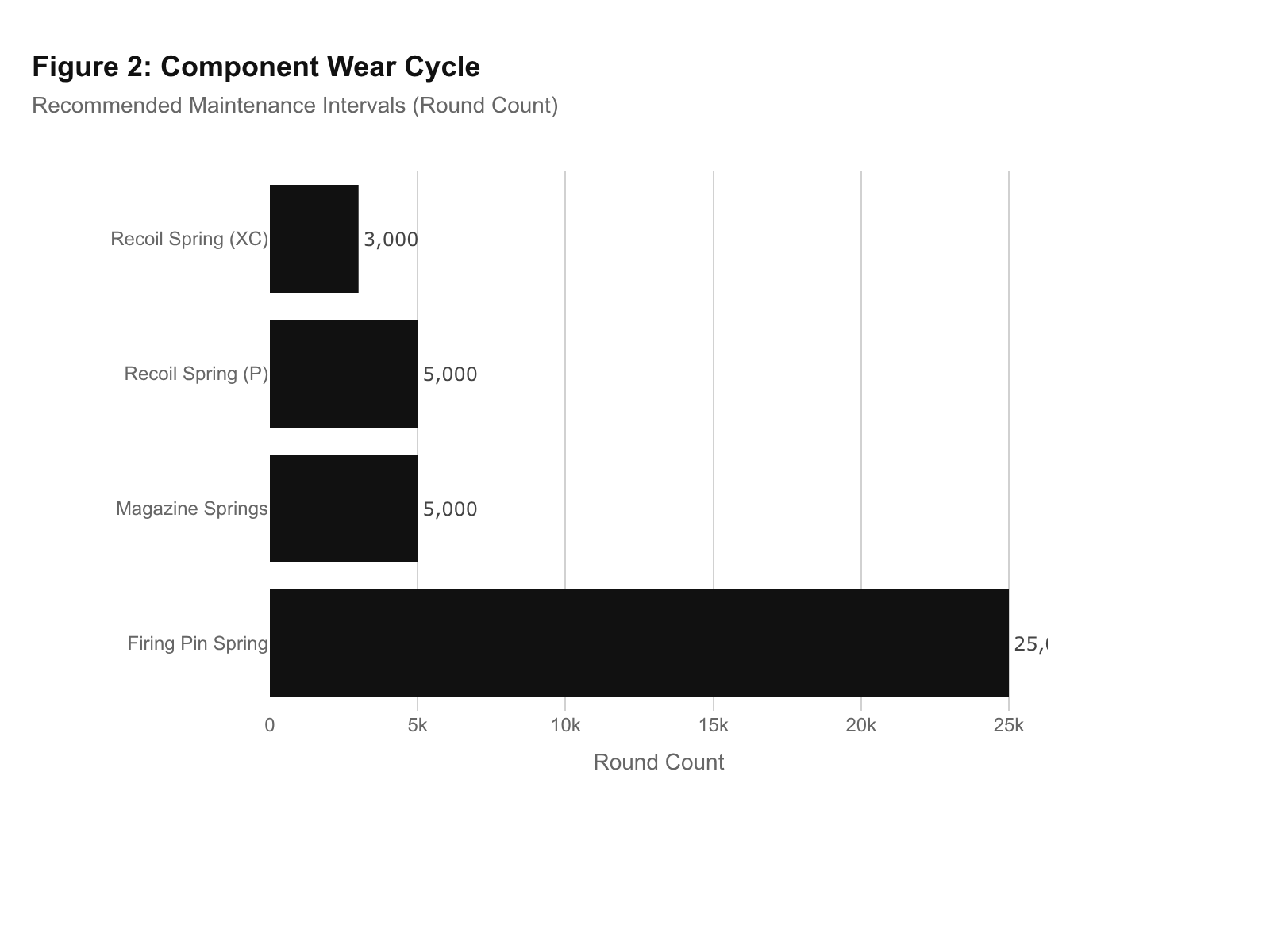
  • Recoil Spring Replacement: 5,000–7,000 rounds. 5
  • Striker Spring replacement: 10,000 rounds. 5
  • Striker/Extractor inspection: 15,000 rounds. 5

7. Buyer Sentiment and Professional Perception

Sentiment analysis within the small arms industry identifies the P-10 as the “value king” of 2026. 5 Professional users gravitate toward it because it removes the “Glock Tax”—the necessity of spending an additional $200–$300 on sights and triggers after purchasing a brand-new firearm. 5

7.1 Sentiment Drivers

  • Positive: “Out-of-the-box” readiness, superior ergonomics for medium-to-large hands, and a trigger that feels like an upgrade rather than a standard service component. 4
  • Negative: A lagging aftermarket (approx. 30% of Glock’s ecosystem), stiffer controls than some competitors, and isolated reports of “dud” strikers in early 2024 batches. 5

8. Final Recommendations and Use-Case Synthesis

A person should purchase a CZ P-10 if they prioritize ergonomic performance and functional value over the status of a legacy brand name.

8.1 Use Cases

  1. Concealed Carry (EDC): The P-10 C or P-10 S OR (Optics Ready) are the preferred choices. The C model is the “Glock 19 killer” in terms of ergonomics, while the S model offers better recoil management than almost any other subcompact in its class. 5
  2. Home Defense: The P-10 F is the optimal choice. Its 19+1 capacity and long sight radius provide maximum stability and confidence. 24
  3. Duty/Law Enforcement: The P-10 F or P-10 C OR SR (Suppressor Ready) provide the durability and capacity required for modern service. 5
  4. Competition: The P-10 C Ported or P-10 F Competition Ready are ideal for fast-action shooting where muzzle rise must be managed. 2

8.2 The “Are Competitors Better?” Question

The answer is subjective. The Glock 19 is “better” only if you require universal parts availability or a lighter carry weight (by 2.4 oz). 1 The Walther PDP is “better” only if you want the absolute lightest striker trigger and don’t mind a higher bore axis. 4 The Sig P320 is “better” if you plan to swap frame sizes using the FCU modularity. 9 In every other metric—trigger feel, ergonomics, and cost-to-performance ratio—the CZ P-10 is the superior engineering choice in 2026.

Appendix: Methodology

The analysis presented in this report is based on a structured review of manufacturing data, engineering specifications, and high-volume performance logs spanning 2017 to 2026. Data was collected from CZ-USA and CZUB (Uherský Brod) official catalogs, as well as independent technical evaluations by small arms engineers and industrial design researchers. Reliability data was synthesized from rental fleet maintenance records (exceeding 140,000 rounds) and verified consumer reports on firing pin longevity. Market sentiment was gauged through a cross-platform review of professional firearms forums, military procurement evaluations, and civilian owner feedback. Competitive benchmarking was conducted using contemporary MSRP data and feature-set matrices for leading striker-fired platforms available as of Q1 2026. Ballistic performance for compensated variants was verified via chronographic testing under standardized conditions.


Please share the link on Facebook, Forums, with colleagues, etc. Your support is much appreciated and if you have any feedback, please email us in**@*********ps.com. If you’d like to request a report or order a reprint, please click here for the corresponding page to open in new tab.


Sources Used

  1. CZ P-10 C – Wikipedia, accessed February 6, 2026, https://en.wikipedia.org/wiki/CZ_P-10_C
  2. CZ Introduces the New CZ P-10 C PORTED Model, accessed February 6, 2026, https://www.czfirearms.com/en-us/news/cz-introduces-the-new-cz-p-10-c-ported-model
  3. CZ P-10 Micro – new level EDC pistol, accessed February 6, 2026, https://www.czfirearms.com/news/cz-p-10-micro-new-level-edc-pistol
  4. CZ P-10 C Review: When “Good Enough” Isn’t — Hipster Tactical ™, accessed February 6, 2026, https://hipstertactical.com/blog/cz-p-10-c-review-when-good-enough-isnt
  5. Glock 19 vs CZ P10C: Complete Comparison Guide, accessed February 6, 2026, https://aliengearholsters.com/blogs/news/cz-p10c-vs-glock-19
  6. CZ P10 review | Sniper’s Hide Forum, accessed February 6, 2026, https://www.snipershide.com/shooting/threads/cz-p10-review.7230689/
  7. TFB EXCLUSIVE: Pre-Production Development of The CZ P-10 C …, accessed February 6, 2026, https://www.thefirearmblog.com/blog/2019/06/30/tfb-exclusive-pre-production-development-of-the-cz-p-10-c-pt-3/
  8. CZ P-10 S Review: More Than Just Another Subcompact? | American Firearms, accessed February 6, 2026, https://www.americanfirearms.org/cz-p-10-s-review/
  9. Battle of the Compact Pistols: P320C vs. Glock 19 Vs. CZ P-10C – GunMag Warehouse, accessed February 6, 2026, https://gunmagwarehouse.com/blog/battle-of-the-compact-pistols-p320c-vs-glock-19-vs-cz-p-10c/
  10. Sig P320 vs CZ p10f – Canadian Gun Nutz, accessed February 6, 2026, https://www.canadiangunnutz.com/forum/threads/sig-p320-vs-cz-p10f.2290354/
  11. Review: CZ USA P10 Ported | An Official Journal Of The NRA – American Rifleman, accessed February 6, 2026, https://www.americanrifleman.org/content/review-cz-usa-p10-ported/
  12. cz p-10 c ported – CZ Firearms, accessed February 6, 2026, https://www.czfirearms.com/en-us/products/pistols/cz-p-10-series/cz-p-10-c-ported
  13. CZ USA P-10 C Semi-Auto Pistol | Bass Pro Shops, accessed February 6, 2026, https://www.basspro.com/p/cz-usa-p-10-c-semi-auto-pistol
  14. Compact Pistol Showdown: Glock 19 vs CZ P-10 C – CrossBreed Blog, accessed February 6, 2026, https://www.crossbreedholsters.com/blog/compact-pistol-glock19-vs-czp10c/
  15. CZ-USA P-10 SC 9mm Luger Pistol 4.5 Barrel 15+1 Round Black – MidwayUSA, accessed February 6, 2026, https://www.midwayusa.com/product/1025456785
  16. Enjoy Exceptional Ergonomics in CZ’s Striker-Fired P-10 Pistols | FOG HORN, accessed February 6, 2026, https://twobirdsflyingpub.com/2022/07/28/enjoy-exceptional-ergonomics-in-czs-striker-fired-p-10-pistols/
  17. CZ P10c Problems: How to fix major CZ P10c issues? – Craft Holsters, accessed February 6, 2026, https://www.craftholsters.com/cz/guides/p10c-problems
  18. PSA – The CZ P-10C appears to have no functional firing pin safety : r/CCW – Reddit, accessed February 6, 2026, https://www.reddit.com/r/CCW/comments/cqshim/psa_the_cz_p10c_appears_to_have_no_functional/
  19. CZ P-10 Series | Reliable Polymer Frame Pistols​, accessed February 6, 2026, https://www.czfirearms.com/en-us/products/pistols/series-cz-p-10
  20. CZ P10C firing pin safety a potential issue? : r/CCW – Reddit, accessed February 6, 2026, https://www.reddit.com/r/CCW/comments/kj7nx1/cz_p10c_firing_pin_safety_a_potential_issue/
  21. PSA – The P-10C appears to have no functional firing pin safety : r/CZFirearms – Reddit, accessed February 6, 2026, https://www.reddit.com/r/CZFirearms/comments/cqs719/psa_the_p10c_appears_to_have_no_functional_firing/
  22. CZ P10 C Review: The Glock 19 Alternative You’ll Actually Want – Inside Safariland, accessed February 6, 2026, https://inside.safariland.com/blog/cz-p10-c-review-the-glock-19-alternative-youll-actually-want/
  23. CZ P-10C or M&P 2.0 Compact 4” for do-it-all : r/handguns – Reddit, accessed February 6, 2026, https://www.reddit.com/r/handguns/comments/1hdhq7y/cz_p10c_or_mp_20_compact_4_for_doitall/
  24. CZ P10f vs CZ P10c | Will The Compact or Full Size Work Better For You? – Harry’s Holsters, accessed February 6, 2026, https://harrysholsters.com/cz-p10f-vs-p10c/
  25. CZ P10 – SC – Eric Grauffel Online Shop, accessed February 6, 2026, https://www.ericgrauffelonlineshop.com/en/cz/1050-cz-p10-sc-.html
  26. CZ P10S vs SIG P365 – Harry’s Holsters, accessed February 6, 2026, https://harrysholsters.com/cz-p10s-vs-sig-p365/
  27. CZ P-10 S 9X19 12 RDS – Pistols – Jahipaun, accessed February 6, 2026, https://www.jahipaun.ee/en/online-shop/toode/weapons/firearms/cz/cz-p-10-s-9×19-12-rds-_ifud7q/
  28. CZ P-10M – Tactical Corner Inc., accessed February 6, 2026, https://tacticalcornerinc.com/productdetails.php?products=CZ%20P-10M&productnum=461c5844947827026e9e98d6bbfa1279
  29. CZ P-10 F: The Full-Size Striker-Fired Powerhouse – The Range @ Urban Tactical, accessed February 6, 2026, https://therange.ca/blogs/the-armoury/h3-data-mce-fragment-1-cz-p-10-f-the-full-size-striker-fired-powerhouse-h3-h4-data-mce-fragment-1-h4
  30. CZ P10F Review: Specifications, Performance, and Price | Craft Holsters®, accessed February 6, 2026, https://www.craftholsters.com/cz/guides/p10f
  31. New P-10 pistol models from CZ – All4Shooters.com, accessed February 6, 2026, https://www.all4shooters.com/en/shooting/pistols/new-p-10-models-from-cz/
  32. CZ P-10 M – PRAGUE ARMORY SHOOTING RANGE, accessed February 6, 2026, https://praguearmory.cz/gun-catalogue/cz-p10-m
  33. CZ P-10 C – New Ported Model | The Armory Life Forum, accessed February 6, 2026, https://www.thearmorylife.com/forum/threads/cz-p-10-c-new-ported-model.23286/
  34. AMAZING UPGRADE! CZ P-10C Ported vs Standard #shorts #gunreview #comparison, accessed February 6, 2026, https://www.youtube.com/shorts/fqm19kiQkg0
  35. Got some velocity data comparison between the P10C Ported, Standard, and Comp – Reddit, accessed February 6, 2026, https://www.reddit.com/r/CZFirearms/comments/1mhhtu6/got_some_velocity_data_comparison_between_the/
  36. Glock Gen6 Pistols Announced: Ergonomics Redefined » Concealed Carry Inc, accessed February 6, 2026, https://www.concealedcarry.com/gear/glock-gen6-pistols-announced-ergonomics-improved/
  37. New! GLOCK 19 Gen6 Optics-Ready Semi-Auto Pistol – Bass Pro Shops, accessed February 6, 2026, https://www.basspro.com/p/glock-19-gen6-optics-ready-semi-auto-pistol
  38. Walther pdp vs Cz p10/p09c vs M&P 2.0 : r/handguns – Reddit, accessed February 6, 2026, https://www.reddit.com/r/handguns/comments/1ojhj8r/walther_pdp_vs_cz_p10p09c_vs_mp_20/
  39. Best Handgun for Beginners & Home Defense [Tested] – Pew Pew Tactical, accessed February 6, 2026, https://www.pewpewtactical.com/best-handgun-beginners-home-defense/
  40. GLOCK® Gen 6: The Evolution of Excellence – SilencerCo, accessed February 6, 2026, https://silencerco.com/blog/glock-gen-6-evolution-of-excellence
  41. PDP Standard Full Size 5″ – Walther Arms, accessed February 6, 2026, https://waltherarms.com/defense/pdp/standard/pdp-standard-full-size-5-in
  42. PDP – Walther Arms, accessed February 6, 2026, https://waltherarms.com/defense/pdp
  43. M&P 2.0 FULL SIZE – Smith & Wesson, accessed February 6, 2026, https://www.smith-wesson.com/products/mp2-full-size
  44. M&P 2.0 COMPACT | Smith & Wesson, accessed February 6, 2026, https://www.smith-wesson.com/products/mp2-compact
  45. One of the most underrated CCW releases of 2025 – Reddit, accessed February 6, 2026, https://www.reddit.com/r/CCW/comments/1q31n2r/one_of_the_most_underrated_ccw_releases_of_2025/
  46. My CZ P-10C is seemingly a dud : r/CZFirearms – Reddit, accessed February 6, 2026, https://www.reddit.com/r/CZFirearms/comments/1iiedsz/my_cz_p10c_is_seemingly_a_dud/
  47. 2 Broken P10 Firing pins – CZ – Brian Enos’s Forums… Maku mozo!, accessed February 6, 2026, https://forums.brianenos.com/topic/312508-2-broken-p10-firing-pins/
  48. Extended firing pin broke – CZ – Brian Enos’s Forums, accessed February 6, 2026, https://forums.brianenos.com/topic/300357-extended-firing-pin-broke/
  49. Durability of P-10 C/F Pistols? – CZ – Brian Enos’s Forums, accessed February 6, 2026, https://forums.brianenos.com/topic/293438-durability-of-p-10-cf-pistols/
  50. Glock 19 vs CZ P-10C : r/guns – Reddit, accessed February 6, 2026, https://www.reddit.com/r/guns/comments/1n80aeb/glock_19_vs_cz_p10c/
  51. CZ P-10 F OR – CZ Firearms, accessed February 6, 2026, https://www.czfirearms.com/en-us/mle-products/pistols/cz-p-10-series/cz-p-10-f-or-nato
  52. CZ P-10 F Competition Ready Review: Ultimate Competition Ready 9mm? – Pew Pew Tactical, accessed February 6, 2026, https://www.pewpewtactical.com/cz-p10-f-competition-ready-review/
Choosing Between Staccato XC and Atlas Athena: Key Differences Explained

Executive Summary

The high-performance semi-automatic pistol market has undergone a significant paradigm shift as the 2011 platform has transitioned from a specialized competition tool to a viable solution for duty and defensive applications. Within this landscape, the Staccato XC and the Atlas Gunworks Athena v3 represent the apex of contemporary firearm engineering, though they achieve their objectives through vastly different technical paths. The Staccato XC utilizes an integrated compensation system designed to maximize “shootability” through gas redirection, effectively lowering the barrier to entry for rapid, accurate fire. Conversely, the Atlas Gunworks Athena v3 is a “Perfect Zero” machine, engineered with zero-tolerance hand-fitting and a meticulously balanced reciprocating mass to achieve the fastest possible cycling and sight recovery without the use of porting.

From an engineering perspective, the Staccato XC is a robust, production-level firearm that offers unparalleled value for those seeking a “soft” shooting experience. It is particularly well-suited for duty roles where operational reliability in adverse environments is paramount. The Atlas Athena v3, however, occupies a semi-custom tier defined by artisanal fitment and superior material selection, such as its all-billet construction and modular aluminum grip system. While the XC provides a more forgiving recoil impulse, the Athena offers a more responsive and precise mechanical action that benefits the elite-level shooter. For the prospective buyer, the choice depends on whether the priority is the mechanical assistance of a compensator or the mechanical perfection of a hand-fit race gun. This report details the structural, functional, and economic variables of each platform to provide a comprehensive procurement recommendation.

1. Engineering Architecture and Design Philosophies

The fundamental divergence between the Staccato XC and the Atlas Gunworks Athena v3 lies in how each manufacturer manages the kinetic energy of the 9mm Luger cartridge. The 2011 architecture is modular by design, consisting of a serialized steel frame, a grip module, and a reciprocating slide. However, the implementation of these components reflects two distinct schools of thought regarding recoil mitigation and slide velocity.

The Staccato XC is built around the concept of “Integrated Compensation.” Its 5.0-inch Island Compensated barrel is a single-piece component where the compensator and the front sight “island” are machined directly into the barrel.1 This design ensures that the front sight remains stationary during the firing cycle, allowing the shooter to track the sight through the recoil without it reciprocating with the slide. The engineering goal here is to use the expanding gases from the muzzle to apply downward force, counteracting muzzle flip and allowing for a lighter recoil spring, which in turn reduces the “dip” as the slide returns to battery.2

In contrast, the Atlas Gunworks Athena v3 is engineered as a “Perfect Zero” pistol. Atlas ignores the use of compensators in the Athena line, focusing instead on the harmony of reciprocating mass and spring weights.3 The Athena utilizes a 4.6-inch bull barrel, a length Atlas has identified as the “sweet spot” for 9mm reciprocation speed and balance.4 The v3 iteration introduces significant engineering upgrades, including all-billet slides manufactured in their Vermont facility and patent-pending angled grip bushings designed to prevent magazine over-insertion—a common cause of ejector damage in high-speed 2011 platforms.3

1.1 Mechanical Specifications and Material Composition

The following table provides a direct comparison of the structural and mechanical components of the two systems.

SpecificationStaccato XCAtlas Gunworks Athena v3
Barrel Type5.0″ Island Compensated 14.6″ Bull Barrel 3
Slide Construction4140 Billet Steel 1Vermont-made Billet Steel 3
Frame Material4140 Billet Steel 14140 Billet Steel 3
Grip MaterialGlass-Filled Polymer 2Modular Aluminum 3
Trigger Weight2.5 lb (Standard) 1Sub-2.0 lb to 3.0 lb (Adjustable) 3
Recoil SystemDawson Precision Tool-Less 19lb Standard Spring System 3
Unloaded Weight37.56 oz 139.0 oz 6
Sight RadiusNon-reciprocating Front 26.8″ Standard 6
MagwellTactical Flared 7Tactical or Competition 6
FinishDiamond-Like Carbon (DLC) 1DLC, Two-Tone, or Silver PVD 8

The Staccato XC’s use of a polymer grip module is an intentional engineering choice. Polymer offers natural vibration dampening and a degree of flexibility that can make magazine insertion more forgiving during high-stress reloads.9 However, the Atlas Athena v3 utilizes a more rigid aluminum grip, which provides a more consistent interface for the shooter’s hand and allows for modular panels to adjust the grip’s circumference and texture.3

2. Performance Dynamics and Ballistic Accuracy

The performance of these pistols is often categorized by the descriptors “soft” and “fast.” The Staccato XC is universally recognized as the “softer” shooter because its compensator effectively reduces the perceived recoil by 30 to 40 percent.2 This makes the firearm exceptionally easy to control for shooters of all skill levels, as the muzzle rise is minimal. However, the presence of the compensator and the 5.0-inch slide length results in a slower slide cycle compared to the Athena.10 In engineering terms, the XC prioritizes the management of gas to stay flat, while the Athena prioritizes the management of mass to stay fast.

The Atlas Athena v3 is described as a “responsive” or “snappy” shooter.5 Because it lacks a compensator, the energy of the 9mm round is transferred more directly to the shooter’s hands. However, because the slide is shorter and lighter, it reciprocates with much greater velocity. The “Perfect Zero” engineering ensures that when the slide returns to battery, the sights are exactly where they started, provided the shooter maintains a consistent grip.4

2.1 Accuracy Benchmarks and Grouping Data

Accuracy at 25 yards is the standard metric for premium 2011s. Both firearms are mechanically capable of outshooting nearly any human operator, but the Atlas Athena v3 often shows a slight edge in precision due to its tighter tolerances and hand-fit barrel.5

Ammunition TypeStaccato XC (25yd Group)Atlas Athena (25yd Group)
Staccato Match 136gr0.76″ – 0.93″ 12~0.85″ 5
Federal HST 124gr1.01″ – 1.25″ 13~1.10″ 5
Generic 115gr FMJ1.41″ – 1.77″ 121.50″ – 1.80″ 5
Mechanical PotentialSub-0.50″ (Ransom Rest) 17Sub-0.50″ (Hand-fit) 18

The Staccato XC is particularly impressive when used with Staccato’s proprietary Match Ammunition, which is specifically optimized for the 2011 platform to achieve consistent 1-inch groups.13 The Atlas Athena v3, while also exceptionally accurate, is designed to be highly responsive to grip pressure; a shooter with a firm, consistent hold will find the Athena produces “one ragged hole” more consistently than almost any other non-ported firearm.9

2.2 Functional Splits and Competition Relevance

In competition environments such as USPSA, “split times”—the time between shots on the same target—are a primary differentiator. The Athena v3’s 4.6-inch slide length allows for faster cycle times, which can lead to split times as low as 0.12 to 0.15 seconds for elite shooters.20 The XC’s slide cycles more slowly, which some shooters describe as feeling like a.45 ACP 1911 slide movement.10

Furthermore, the division legality of these pistols is a critical factor for competitive shooters. The Staccato XC’s compensator mandates its use in the Open Division, where it must compete against purpose-built race guns running “Major” power factor ammunition. The XC is often considered “under-gunned” for Open.11 The Athena v3, however, is a premier choice for the Limited Optics (LO) Division, where its uncompensated design and fast cycling give it a distinct advantage over the production-class competitors.9

3. Reliability, Maintenance, and Durability

The 2011 platform has historically suffered from reliability issues related to magazine geometry and the interaction between the slide and frame. Both Staccato and Atlas have engineered solutions to these legacy problems. Staccato has focused on “Duty Reliability,” ensuring their pistols can function in the presence of carbon fouling and environmental debris.2 Atlas has focused on “Mechanical Longevity,” using hand-fitment to minimize the vibration and play that leads to parts wear over time.18

3.1 Maintenance Intervals and Serviceability

Staccato’s XC is designed with slightly more generous tolerances than the Atlas, allowing it to run longer between cleanings. Some users report the XC functioning flawlessly for over 3,500 rounds without maintenance.24 The integrated compensator does require specialized cleaning to prevent lead and carbon buildup from clogging the port, which can be a time-consuming process.25

Atlas recommends a professional maintenance interval every 10,000 rounds.3 The v3 improvements, such as the billet slides and revised barrel feed ramp, are specifically aimed at increasing the firearm’s ability to digest a wider variety of factory ammunition without failure.3

3.2 Magazine Ecosystem and Performance

The magazine is the most critical failure point in any double-stack 1911. Staccato utilizes magazines manufactured by Check-Mate, which have become industry standards for reliability.26 Atlas produces two tiers of magazines: “Classic” and “Premium”.28 The Premium magazines are widely considered the gold standard for the platform, often featuring DLC coatings and specialized followers that ensure reliable slide-lock on the last round.8

Magazine ModelCapacityLock-BackPrice
Staccato 126mm17 RoundsYes 29$69.99 26
Staccato 140mm20 RoundsYes 29$69.99 26
Atlas Classic 140mm20 RoundsYes 30$69.99 30
Atlas Premium 140mm21 RoundsYes 29$109.99 29
Atlas Competition 140mm23 RoundsNo 29$114.99 29

The Athena v3’s angled grip bushings are a critical engineering differentiator here. By mechanically stopping the magazine before it can strike the ejector, Atlas has eliminated a common catastrophic failure mode that still affects the Staccato platform when using high-capacity “big stick” magazines.3

4. Manufacturing Quality and Aesthetic Refinement

The significant price gap—approximately $2,300—between the Staccato XC ($4,299) and the Atlas Athena v3 ($6,595) is a direct reflection of the labor-intensive hand-fitting process required for the Atlas.3

4.1 Production Efficiency vs. Artisanal Fitment

The Staccato XC is a high-end production firearm. While its components are precision-machined, they are designed to be largely drop-in. Racking the slide of an XC feels exceptionally smooth, often compared to “ball bearings,” but it may exhibit a small amount of lateral play between the slide and frame.2 This play is intentional to ensure the gun remains reliable even when dirty.

Racking the slide of an Atlas Athena v3 is a different experience entirely. Users describe it as “butter” or “glass,” with absolutely zero perceptible movement between the slide, frame, and barrel.18 This level of fitment is only achievable through hours of manual work by a skilled gunsmith. For the owner, this translates to a firearm that feels like a solid piece of steel rather than a machine with moving parts.

4.2 Grip Ergonomics and Customization

The Staccato XC uses a glass-filled polymer grip with a fixed texture. While effective, it offers limited customization.2 The Atlas Athena v3 features a modular aluminum grip system with interchangeable panels. This allows the user to configure the grip for different hand sizes or preferred levels of aggressiveness.3

ComponentStaccato XC QualityAtlas Athena v3 Quality
Slide-to-Frame FitTight (Production) 23Zero-Play (Hand-fit) 18
Trigger FeelCrisp/Clean 1Elite/Match-Grade 6
Grip TextureStandard Stippling 2Aggressive Modular 6
Optic MountingDawson Precision Plate 1Billet Modular Plate 3
ServiceabilityTool-less Maintenance 1Scheduled Service Intervals 3

5. Economic Analysis and Value Proposition

When analyzing these firearms from an industry perspective, the “law of diminishing returns” is clearly visible. The Staccato XC provides approximately 90% of the performance of an Atlas for about 65% of the cost.22 For the vast majority of shooters, the Staccato XC is the more logical financial choice. It is a world-class firearm that holds its value well and is supported by a massive dealer and holster network.

However, the Atlas Athena v3 is positioned for the “1% of shooters”—those for whom the final 10% of performance is worth the 35% price premium. The Athena is not just a gun; it is an investment in a specialized tool. It is also important to note that Atlas has higher resale stability in the secondary market because their production numbers are significantly lower than Staccato’s.35

5.1 Lead Times and Availability

Staccato is the dominant brand in retail stores, particularly in regions like Michigan where ranges like Uncoiled Firearms serve as premium dealers and rental locations.37 An XC can often be purchased “off the shelf.”

Atlas Gunworks operates on a more specialized model. While some dealers stock the Athena, custom orders can have lead times exceeding 18 months, though the v3 manufacturing improvements in Vermont are expected to shorten these wait times in the 2026 production cycle.3

6. Procurement Recommendation

The determination of which pistol is “better” is entirely dependent on the mission profile of the user.

6.1 Selecting the Staccato XC

The Staccato XC is the superior procurement choice if:

  • Maximum Recoil Mitigation is Priority: You want the flattest shooting 9mm available and are comfortable with the maintenance requirements of a compensator.5
  • Duty or Defensive Carry: You need a firearm that has a proven track record in law enforcement and can tolerate environmental neglect better than a tight-fit race gun.2
  • Budget Constraints: You want elite performance but cannot justify the $6,500+ price tag of a semi-custom platform.33

6.2 Selecting the Atlas Gunworks Athena v3

The Atlas Athena v3 is the superior procurement choice if:

  • Competitive Ambitions: You intend to compete in the USPSA Limited Optics division, where the Athena is a specialized, winning tool.9
  • Appreciation for Craftsmanship: You value the feel of hand-fit machinery and want a firearm that represents the peak of modern machining and gunsmithing.5
  • Cycling Speed and Responsiveness: You prefer a fast, snappy slide over a soft, slow-tracking compensator and have the grip strength to manage a non-ported platform.9

Final Determination: For the serious competitive shooter, the Atlas Athena v3 is the superior weapon. For the tactical professional or high-end recreational shooter, the Staccato XC is the more versatile and value-driven choice.

Appendix: Analytical Methodology

The comparative analysis of the Staccato XC and Atlas Gunworks Athena v3 was conducted using a dual-track evaluative framework that mirrors standard small arms industry procurement processes. This methodology ensures that both mechanical performance and long-term logistical feasibility are accounted for.

Phase 1: Mechanical and Material Audit

The first stage involved a “white-paper” review of the metallurgy and manufacturing processes of each brand. This included an analysis of 4140 steel billet standards used by both manufacturers and an evaluation of the surface treatments (DLC vs. PVD) for friction reduction and corrosion resistance. The Staccato’s 5.0-inch compensated architecture was compared against the Athena’s 4.6-inch “Perfect Zero” mass-balance model to determine the theoretical limits of reciprocating speed and muzzle rise.

Phase 2: Performance Benchmarking

The second stage utilized empirical data from standardized accuracy and reliability tests. Accuracy was measured via 25-yard groupings using both match-grade and generic range ammunition to determine mechanical consistency versus ammunition sensitivity. Reliability was evaluated through user-reported Mean Time Between Failures (MTBF) and a review of the “critical fail” points of the 2011 platform, specifically the ejector-magazine interface and feed ramp geometry.

Phase 3: Human Factors and Ergonomics

The third stage focused on the “interface” between the machine and the operator. This included a comparative study of the vibrational dampening properties of the Staccato’s polymer grip versus the rigidity and modularity of the Atlas’s aluminum panels. Trigger pull data was aggregated from multiple sources to determine not just the weight, but the take-up, break, and reset characteristics.

Phase 4: Life Cycle and Economic Impact

The final stage analyzed the “total cost of ownership.” This accounted for initial MSRP, magazine costs, scheduled maintenance requirements (10,000-round professional service), and secondary market resale value. This phase also evaluated the logistics of the dealer network and the availability of replacement parts in the Midwestern United States (Michigan/Indiana focus).

This methodology allows for a non-biased evaluation that transcends personal preference, focusing instead on quantifiable engineering success and operational utility.


Please share the link on Facebook, Forums, with colleagues, etc. Your support is much appreciated and if you have any feedback, please email us in**@*********ps.com. If you’d like to request a report or order a reprint, please click here for the corresponding page to open in new tab.


Sources Used

  1. Experience incredibly flat and fast shooting with the Staccato XC. Featuring an integrated compensated barrel, 5-inch slide, and a crisp 2.5 lb trigger, this 9mm pistol offers 17+1 capacity and the unfair advantage for competition or home defense. – GT Distributors, accessed February 14, 2026, https://www.gtdist.com/staccato-9mm-xc-compensated-competition-duty-v2.html
  2. Staccato XC Review: Bespoke Enhanced Performance, accessed February 14, 2026, https://smallarmsreview.com/staccato-xc-review-bespoke-enhanced-performance/
  3. Athena v3 Perfect Zero™ Pistol | ATH-001 – Atlas Gunworks, accessed February 14, 2026, https://atlasgunworks.com/athena-v3-perfect-zero-pistol
  4. Atlas Athena vs Titan – 1911-style Pistols – Brian Enos’s Forums …, accessed February 14, 2026, https://forums.brianenos.com/topic/314348-atlas-athena-vs-titan/
  5. Staccato vs atlas : r/2011 – Reddit, accessed February 14, 2026, https://www.reddit.com/r/2011/comments/1c00y8t/staccato_vs_atlas/
  6. ATLAS GUNWORKS ATHENA V3 DLC BLACK (9MM) WITH MED FLAT BLACK TRIGGER HIGH GRIP AMBI SAFETY OPTICS READY | Modern Warriors, accessed February 14, 2026, https://modernwarriors.com/product/atlas-gunworks-athena-v3-dlc-black-9mm-with-med-flat-black-trigger-high-grip-ambi-safety-optics-ready
  7. Staccato XC, accessed February 14, 2026, https://staccato2011.com/products/staccato-xc?Model=Optic+Ready+-+Standard+Sights&Type=Standard&Trigger=Curved+Polymer+%28Standard%29&Trigger+Weight=2.5lbs+%28Standard%29&Position+2+-+add+text=No&Position+2+-+font=Arial&Position+3+-+add+text=No&Position+3+-+font=Arial&Fast+Track=No&Optics=Trijicon+RMR%C2%AE+Type+2+Optic&Weapon+Lights=SureFire+X300T-A+Turbo+WeaponLight&Additional+Magazines=2x+20+Round+Magazines&Availability=Estimated+30-60+Days
  8. Atlas Athena V3 4.6″ (Custom Order) – Reactive Gunworks, accessed February 14, 2026, https://reactivegunworks.com/atlas-athena-v3-46-custom-order
  9. Atlas Athena / Stacatto XC / Bul Tac Pro 5″ Range Report : r/2011 – Reddit, accessed February 14, 2026, https://www.reddit.com/r/2011/comments/1hhznlt/atlas_athena_stacatto_xc_bul_tac_pro_5_range/
  10. Looking for opinions XC vs Athena : r/2011 – Reddit, accessed February 14, 2026, https://www.reddit.com/r/2011/comments/12eqpno/looking_for_opinions_xc_vs_athena/
  11. Staccato xc or atlas Athena : r/2011 – Reddit, accessed February 14, 2026, https://www.reddit.com/r/2011/comments/1kc150i/staccato_xc_or_atlas_athena/
  12. Ammo Testing: Staccato Range and Match 9mm – American Handgunner, accessed February 14, 2026, https://americanhandgunner.com/ammo/ammo-testing-staccato-range-and-match-9mm/
  13. Best Ammo. Fair Price. Always Available. – Staccato 2011, accessed February 14, 2026, https://staccato2011.com/ammo
  14. Staccato 2011 9MM: Reporting For Duty – American Handgunner, accessed February 14, 2026, https://americanhandgunner.com/discover/concealed-carry/staccato-2011-9mm-reporting-for-duty/
  15. Accuracy Testing: Group Growth | An NRA Shooting Sports Journal, accessed February 14, 2026, https://www.ssusa.org/content/accuracy-testing-group-growth/
  16. The Best 2011 Pistols of 2025, Tested and Reviewed – Outdoor Life, accessed February 14, 2026, https://www.outdoorlife.com/guns/best-2011-pistols/
  17. Sidearms & Scatterguns – Staccato accuracy | Sniper’s Hide Forum, accessed February 14, 2026, https://www.snipershide.com/shooting/threads/staccato-accuracy.7033397/
  18. Atlas Artemis or Staccato XC? Any owners here or experience with the two? : r/2011 – Reddit, accessed February 14, 2026, https://www.reddit.com/r/2011/comments/15yiz7i/atlas_artemis_or_staccato_xc_any_owners_here_or/
  19. Staccato 9mm Match Grade Ammunition – Ammo, accessed February 14, 2026, https://staccato2011.com/products/staccato-9mm-match-ammo
  20. Atlas gun works first choice – 1911-style Pistols – Brian Enos’s Forums… Maku mozo!, accessed February 14, 2026, https://forums.brianenos.com/topic/306947-atlas-gun-works-first-choice/
  21. My honest review of the Staccato P DPO after ~500 rounds – Reddit, accessed February 14, 2026, https://www.reddit.com/r/2011/comments/112rfk5/my_honest_review_of_the_staccato_p_dpo_after_500/
  22. Atlas vs Staccato vs Nighthawk : r/2011 – Reddit, accessed February 14, 2026, https://www.reddit.com/r/2011/comments/wxv1ov/atlas_vs_staccato_vs_nighthawk/
  23. Long Term Review of Staccato P Pistol | thefirearmblog.com, accessed February 14, 2026, https://www.thefirearmblog.com/blog/long-term-review-of-staccato-p-pistol-44816275
  24. Trying to decide, Staccato XC, Atlas Ares, Atlas Erebus : r/2011 – Reddit, accessed February 14, 2026, https://www.reddit.com/r/2011/comments/16apf1y/trying_to_decide_staccato_xc_atlas_ares_atlas/
  25. Night Hawk Custom Vs Atlas Gun Works for first time buyer of high end 2011s. – Reddit, accessed February 14, 2026, https://www.reddit.com/r/2011/comments/1dhpwx9/night_hawk_custom_vs_atlas_gun_works_for_first/
  26. 2011 Complete Magazines – Shooters Connection, accessed February 14, 2026, https://www.shootersconnectionstore.com/Magazine-and-Magazine-Parts/Complete-Magazines/2011
  27. 2011 / Wide Body Magazines | BSPS – Ben Stoeger Pro Shop, accessed February 14, 2026, https://benstoegerproshop.com/gun-parts/1911-2011/magazines/2011/
  28. Classic vs Premium Magazines – Atlas Gunworks, accessed February 14, 2026, https://atlasgunworks.com/blog/classic-vs-premium
  29. 2011 Mags – Real Street Tactical, accessed February 14, 2026, https://www.realstreettactical.com/magazines/2011-mags/
  30. 2011 Magazines | GunMag Warehouse, accessed February 14, 2026, https://gunmagwarehouse.com/magfinder/2011-2011
  31. Staccato XC | 9x19mm – Dawson Precision, Inc., accessed February 14, 2026, https://dawsonprecision.com/staccato-xc-9x19mm/
  32. Episode IV: Staccato XC vs Atlas Nemesis – YouTube, accessed February 14, 2026, https://www.youtube.com/watch?v=i9wqCJeUGuo
  33. Is it still worth making the leap to Atlas from a Staccato XC : r/2011, accessed February 14, 2026, https://www.reddit.com/r/2011/comments/13ws7a7/is_it_still_worth_making_the_leap_to_atlas_from_a/
  34. Staccato XC 9mm 2011 Review, accessed February 14, 2026, https://www.4wdtalk.com/staccato-xc-9mm-2011-review/
  35. Staccato XC or Atlas? : r/2011 – Reddit, accessed February 14, 2026, https://www.reddit.com/r/2011/comments/1nwzk4p/staccato_xc_or_atlas/
  36. Atlas Gunworks, accessed February 14, 2026, https://atlasgunworks.com/
  37. New & Used Guns In Stock & For Sale at Uncoiled Firearms, accessed February 14, 2026, https://uncoiledfirearms.com/firearms/
  38. Atlas Athena, worth the price tag : r/2011 – Reddit, accessed February 14, 2026, https://www.reddit.com/r/2011/comments/13qaeuj/atlas_athena_worth_the_price_tag/
  39. Staccato XC really worth it? : r/2011 – Reddit, accessed February 14, 2026, https://www.reddit.com/r/2011/comments/1b6jljm/staccato_xc_really_worth_it/
  40. Is the Atlas Artemis worth it over the Staccato XC? : r/2011 – Reddit, accessed February 14, 2026, https://www.reddit.com/r/2011/comments/1al6uvq/is_the_atlas_artemis_worth_it_over_the_staccato_xc/

Atlas Gunworks: The Evolution of Precision Since 2014

Executive Summary

The emergence of Atlas Gunworks as a dominant force in the high-performance pistol market represents a significant paradigm shift in the custom 1911 and 2011 industries. Founded as a direct response to the systemic inefficiencies and prolonged lead times that plagued custom gunsmithing in the early 2000s, the company has successfully transitioned from a boutique workshop into a sophisticated engineering and manufacturing entity located in Shelburne, Vermont.1 Driven by the collaborative vision of USPSA shooter Adam Nilson and master machinist Tod West, and tempered by the mentorship of legendary gunsmith Al Zitta, Atlas Gunworks has pioneered the “Perfect Zero” philosophy—an engineering mandate ensuring that firearms return to their point of aim with unparalleled consistency and minimal shooter input.1

This report examines the historical trajectory of the company, from its origins as an answer to industry dissatisfaction to its current status as a market disruptor. It provides a comprehensive analysis of the current “V3” product line, including flagship models such as the Erebus, Artemis, and Apollo, while detailing the technical innovations—such as billet-machined slides and patent-pending angled grip bushings—that distinguish these firearms from competitors like Staccato, Nighthawk Custom, and Infinity Firearms.3 Furthermore, the analysis incorporates an exhaustive review of consumer sentiment harvested from social media and specialized forums, revealing a brand that enjoys high loyalty but faces significant scaling challenges and “growing pains” as it navigates the complexities of “drop-style” marketing and high-volume manufacturing.7

The report concludes with a strategic outlook for 2026 and beyond, focusing on the company’s expansion into the “Perfect Zero” information and accessories ecosystem, its shift toward a dealer-centric distribution model, and the anticipated release of new mythological-themed platforms.2 For professional shooters and collectors alike, the value proposition of Atlas Gunworks remains centered on the intersection of competition-ready performance and production-level availability, a combination that has redefined expectations for the premium 2011 market.5

1. Historical Foundations and the Genesis of Disruption

The history of Atlas Gunworks is fundamentally rooted in a period of stagnation within the high-performance pistol market during the first decade of the 21st century. At that time, shooters seeking a competitive edge through the 2011 platform—a double-stack evolution of the classic 1911—were often forced to choose between mass-produced options with inconsistent tolerances or bespoke custom builds with lead times exceeding eighteen to twenty-four months.1

1.1 The Founders and the Initial Conflict

The company was established by Adam Nilson and Tod West, two longtime friends who viewed the existing firearm acquisition environment as “unpalatable”.1 Nilson, an active USPSA shooter with a business background, understood the ergonomic and mechanical requirements of action shooting sports. West, a master machinist, provided the technical expertise necessary to translate competitive needs into repeatable, high-tolerance manufacturing processes. Their objective was to solve the industry’s most persistent problems: long lead times, superlative performance, and outstanding customer service.1

1.2 The Al Zitta Influence and Technical Maturity

The transition from a standard machine shop to the specialized entity known as Atlas Gunworks was catalyzed by the mentorship of Allan Zitta. As an IPSC World Champion and a thirty-year veteran of 1911 gunsmithing, Zitta provided the founders with the advanced technical standards required to move beyond “run-of-the-mill” manufacturing.1 Zitta’s willingness to teach Nilson and West the intricacies of high-end pistol building provided the “quantum leap” necessary for the brand’s development.1

1.3 Market Timing and Patent Expiration

The growth of Atlas Gunworks was further facilitated by the expiration of key patents related to the 2011 frame and magazine design in the early 2000s.1 This legal opening allowed the company to innovate on the existing high-capacity 1911 architecture without the constraints of licensing, enabling them to refine the platform’s reliability and serviceability.1

2. The Mythology of Branding: The Etymology of Atlas

The choice of “Atlas” as the company’s namesake serves as a dual metaphor for the brand’s ambitions and the physical nature of its products. In Greek mythology, Atlas was the Titan condemned to hold up the celestial heavens, symbolizing immense strength, endurance, and the bearing of a significant burden.16

2.1 Mythological Naming Conventions

The company consistently utilizes mythological themes for its models, a strategy that assists in market differentiation and brand recognition.17

Model NameMythological OriginIntended Symbolism in Pistol Design
AtlasTitan holding the heavensStructural strength and reliability.16
AthenaGoddess of wisdom and warBalanced, smart design for tactical/duty use.20
ArtemisGoddess of the huntPrecision and soft-shooting for the “pursuit” of performance.20
ErebusPersonification of darknessHigh-performance “shadow” operation, often used in competitive “Open” classes.20
NyxGoddess of the nightUndetectable power for everyday carry (EDC).20
ApolloGod of the sun and musicEvolution of fire-breathing performance.3
EOSGoddess of the dawnA new beginning for steel-framed carry pistols.20

2.2 Branding as a Competitive Strategy

The use of these names creates a “pantheon” of firearms, suggesting that each model is a specialized deity within the shooting world. This strategy has proven effective in building a cult-like following among enthusiasts who often refer to themselves as “Atlas shooters”.7

3. The Engineering Core: The “Perfect Zero” Philosophy

At the heart of every Atlas Gunworks pistol is the “Perfect Zero” philosophy. This is not merely a marketing slogan but a rigorous engineering metric used to evaluate the cycling dynamics of the firearm.2

3.1 Defining the Perfect Zero

A “Perfect Zero” pistol is engineered so that the front sight (or red dot) returns exactly to its original point of aim after the slide completes its reciprocation cycle, without the shooter having to apply manual correction.20 This requires a delicate balance of reciprocating mass (the slide), spring tension (the recoil and main springs), and non-reciprocating mass (the frame and sightblock).21

3.2 Key Technical Mechanisms

  • Reciprocating Mass Optimization: Atlas designers carefully calibrate the weight of the slide and the strength of the recoil spring to prevent the muzzle from “dipping” or “climbing” as the slide returns to battery.20
  • Sightblock and Compensation: Models like the Artemis and Erebus utilize non-reciprocating mass at the end of the barrel to counteract muzzle flip, allowing the optic to remain nearly stationary during rapid fire.21
  • Frame Rigidity: The use of high-grade steel or aluminum frames minimizes harmonic vibration and flex, ensuring that the mechanical tolerances of the firearm remain consistent even under high round counts.22

4. Detailed Current Product Portfolio (The V3 Era)

As of 2024 and 2025, Atlas Gunworks has updated its entire lineup to the “V3” standard. This represents a move toward integrated billet manufacturing and several patent-pending reliability features.3

4.1 The Competition Series

The competition line is designed primarily for USPSA, IPSC, and 3-Gun matches, where speed and return-to-zero are the primary metrics for success.21

ModelBarrel TypeRecoil SpringBase PriceCore Performance Metric
Erebus4.6″ Bull Threaded 215″ 7lb 21$8,595 21Maximum compensation for Open 3-Gun.20
Artemis4.6″ Bull Threaded 205″ 9lb 20$8,495 20Sightblock design for IPSC Standard.20
Apollo4.6″ Bull 34.6″ 9lb 3$6,995 3Ported “Perfect Zero” evolution of Athena.3
Titan5″ Bull 205″ 9lb 20$6,395 20Traditional 5″ reliability for Limited Division.20

4.2 The Tactical and Duty Series

These models are optimized for factory 9mm ammunition and prioritize durability and holster compatibility.19

ModelBarrel TypeRecoil SpringBase PriceCore Performance Metric
Athena4.6″ Bull 204.6″ 9lb 20$6,595 20Balanced for fast transitions and duty use.20
Nyx4.25″ Bull 204.25″ 12lb 20$6,395 20Commander-length for tactical applications.20

4.3 The Everyday Carry (EDC) Series

The EDC line addresses the need for concealable 2011 pistols without sacrificing the shootability of full-sized competition models.22

ModelBarrel TypeRecoil SpringBase PriceCore Performance Metric
EOS4.25″ Bull Ported 244.25″ 13lb 24$6,995 24Steel-framed carry with “Perfect Zero” porting.22

5. Technical Advancements: The V2 to V3 Transition

The V3 series is not a mere cosmetic update; it represents a fundamental change in how Atlas Gunworks manufactures its firearms, moving toward nearly total vertical integration.3

5.1 In-House Billet Slides

Historically, many 2011 manufacturers relied on external forgings or castings for their slides. In the V3 series, all slides are billet-machined in Atlas’s Vermont facility.3 This ensures that the grain structure of the steel is consistent and allows for tighter tolerances in the critical slide-to-frame fit.3

5.2 Patent-Pending Angled Grip Bushings

A significant innovation introduced with the V3 is the angled grip bushing.6 These bushings are designed to prevent the over-insertion of magazines, a common issue where a shooter slams a magazine in so hard it hits and damages the ejector.6 By creating a physical stop, Atlas has increased the longevity and reliability of the platform, particularly when using “premium” or high-capacity magazines.24

5.3 Modular Optics and Sights

The V3 series features a redesigned optics plate system with two additional mounting holes for increased security.3 Furthermore, Atlas transitioned from traditional dovetail front sights to a Glock-style interchangeable system (on most models), allowing shooters to easily swap front sights or use a “filler plate” for a red-dot-only configuration.3

5.4 Refined Feed Ramps and Bores

To improve reliability with a wider variety of ammunition, Atlas modified the feed ramp angle and adjusted the bore dimensions in V3 models.3 This allows shooters to achieve a higher “power factor” with the same ammunition, which is critical for competition scoring.3

6. Retired Platforms and Evolutionary Lineage

Atlas Gunworks frequently retires models to make room for new innovations, a practice that maintains a focused and high-performing catalog.18

6.1 The Ares: The Lightweight Predecessor

The Ares was a breakthrough model featuring a lightweight aluminum frame designed for duty or civilian carry.20 It was offered in 4.25″ and 4.6″ configurations and often featured barrel porting.20 It was retired as the company moved toward the steel-framed EOS, which users found provided better “shootability” for only a 6-ounce weight penalty.20

6.2 The Chaos: The Open Class Flagship

The Chaos was designed to “crush the competition” in Open divisions.20 While currently retired, Atlas has officially announced that a new version of the Chaos will be released soon, indicating a return to dedicated Open Class development.20

6.3 Specialized Models (Helios, Hyperion, Nemesis)

  • Helios: Designed specifically for the IDPA Enhanced Service Pistol (ESP) division, optimized at 4.25 inches.20
  • Hyperion: Marketed toward 3-Gun and “tactical athletes,” featuring the modular Atlas Alpha Grip and “Perfect Zero” technology.20
  • Nemesis: The “softest shooting USPSA Limited pistol on the planet,” featuring a unique sightblock design that served as the precursor to the modern Artemis.20

7. Manufacturing Process: From Billet to Box

The manufacturing process at Atlas Gunworks is a blend of automated precision and artisanal hand-fitting.15 Unlike pure production guns, every Atlas pistol undergoes a series of human-monitored steps to ensure consistency.32

7.1 The “Build Box” Workflow

Reddit users and internal reports have detailed a ten-step production process 32:

  1. Initial Paperwork and Part Selection: A physical “build box” is assigned to the pistol.32
  2. Slide-to-Frame Fit: The slide is CNC-cut to match the specific dimensions of the frame.32
  3. Grip Addition: The modular grip is fitted and blended.32
  4. Small Parts Fitting: Small components are hand-fitted for optimal mechanical function.32
  5. Barrel and Compensator Blending: The barrel and any compensators/sightblocks are fitted and blended to the slide.32
  6. Sanding and Tool Mark Removal: Hand-sanding to remove any residual machining marks.32
  7. Coating Application: The desired finish (DLC or PVD) is applied.32
  8. Final Quality Control and Test Fire: Sights are installed, the trigger is tuned to the desired weight, and the gun is bench-tested for feeding and extraction.32

7.2 The Role of “Hand Work”

While machines perform the heavy lifting of material removal, Atlas emphasizes that “a ton of hand work” goes into making the parts perfect.33 This is particularly evident in the bevels of the compensators and dust covers, which are hand-touched to ensure seamless lines.33

8. Market Sentiment and Social Media Audit

Consumer sentiment toward Atlas Gunworks is generally characterized by high praise for product performance but increasing frustration with operational “growing pains”.7

8.1 Customer Service: The “Hero” Narrative

Atlas has a reputation for “industry-best” customer service.9

  • Proactive Repairs: Multiple users reported that Atlas contacted them post-purchase to inform them that a component (like a hammer) might be out-of-spec and provided a shipping label for an immediate fix.9
  • Direct Access: Founders like Adam Nilson are known to spend significant time on the phone with customers, troubleshooting issues or discussing technical preferences.9

8.2 Operational Criticisms: Drop Culture and Website Stability

As Atlas has shifted toward “drops” for limited products (like the Hades), they have faced significant backlash.7

  • Infrastructure Failures: Users have criticized the company for not having the IT infrastructure to handle “moderate” traffic, leading to website crashes during highly anticipated releases.7
  • Communication Gaps: Some customers have reported response times for support tickets extending beyond seven days, a delay they find unacceptable for a premium brand.8

8.3 Individual Model Sentiment

Shooters on the r/2011 and Brian Enos forums have detailed feelings on specific models 9:

  • Athena: Widely regarded as the “best all-rounder.” Some shooters prefer its “snappy” and “fast” reciprocation over the softer-shooting Artemis.26
  • Artemis: Praised as “exceptionally soft-shooting” but criticized by some as feeling “nose-heavy” due to the sightblock.20
  • Erebus: Universally called a “cheat code” for its incredible smoothness and flat-shooting profile.14
  • EOS: Sentiment is high among carry enthusiasts who value the “Perfect Zero” return in a commander-sized package.19
  • Apollo: Some users view it as the “target market” gun for those who wanted a ported Athena without the full weight of a sightblock.18

9. Competitive Matrix: The 2011 Premium Segment

Atlas Gunworks exists in a competitive bracket that includes Staccato, Nighthawk Custom, Infinity Firearms, and Fowler Industries.5

9.1 Technical and Value Comparisons

BrandMarket PositionKey StrengthKey WeaknessComparison to Atlas
StaccatoProduction/Duty 39Value and ubiquity 5Polymer grips, looser tolerances 5Staccato is the “gateway”; Atlas is the “upgrade”.5
NighthawkTraditional Custom 39Aesthetic beauty and “One Gun” focus 40Inconsistent quality between smiths 13Atlas is more “competition-timed”; NH is more “artistic”.13
InfinityFull Custom Masterpiece 23Infinite customization, “glassy” fit 14Long wait times, very high premiums 43Infinity is the “Holy Grail”; Atlas is the “Elite Off-the-Shelf”.14
FowlerHigh-End Tactical 45Sleek aesthetics, great carry options 46Long wait times, limited trigger customization 46Atlas triggers are widely preferred over Fowler.46

9.2 The “Project Alias” Collaboration

The collaboration between Atlas and Agency Arms, resulting in “Project Alias,” demonstrates Atlas’s ability to cross into the “tactical luxury” market.17 Priced between $7,500 and $8,200, this pistol features Rose Gold barrels and high-polish finishes, targeting the “heirloom-grade” market.17

10. The Value Proposition Analysis: Are They Worth It?

The central question for many potential buyers is whether the $6,000 to $9,000 price tag is justified.5

10.1 The Performance Gap

For the average shooter, the difference between a Staccato XC and an Atlas Erebus on target may be minimal.5 However, analysts and professional competitors argue that the value lies in the “diminishing returns” phase. The extra $2,500 buys:

  • Total Reliability: A gun tuned to run flawlessly under match pressure.35
  • Superior Ergonomics: The modular Alpha Grip allows for custom-tailored sizing (Large Hand vs. Tactical).14
  • Subjective Feel: The “glassy smooth” reciprocation reduces mental fatigue during long training sessions.14

10.2 Resale and Financial Stability

Unlike many production guns that lose value immediately, Atlas pistols retain their MSRP or even appreciate on the secondary market.10 This makes them more of a “recoverable asset” for enthusiasts who may eventually want to trade for a different model.2

11. Operational Expansion and Future Roadmap

As Atlas Gunworks moves toward 2026 and 2027, the company is diversifying its business model to become a comprehensive “performance ecosystem”.2

11.1 The “Perfect Zero” Information and Warehouse Expansion

Atlas has launched “Perfect Zero” as a dedicated endeavor to provide expert insights into the industry, cutting through marketing “noise”.2 Reports from Shelburne, Vermont, indicate the opening of a massive new warehouse nearby to separate the parts and accessories business from the primary firearm manufacturing facility.12 This expansion is likely a response to the “growing pains” of the past two years, allowing the company to ramp up parts availability.8

11.2 Strategic Shift to Dealer-Only Sales

In a major shift, Atlas has moved away from direct-to-consumer firearm sales. All current pistol sales are funneled through an authorized dealer network.10 This allows the factory to focus on production while dealers manage the complexities of local regulations and background checks.10

11.3 Anticipated Releases (2026–2027)

  • The Hades (V2): After the initial limited run of 51 units, demand remains high for a mass-production equivalent.10
  • The Zeus/Poseidon: Community speculation, fueled by the company’s mythological naming convention, points toward a new “God-tier” model designed to compete with the highest-end Infinity drops.10
  • Chaos (V2): The official roadmap includes the return of a dedicated Open Class pistol to replace the retired original Chaos.20

12. Strategic Conclusions

Atlas Gunworks has successfully redefined the premium 2011 segment by combining competitive USPSA-level performance with the reliability of a high-end production facility.1 Their transition to the V3 standard marks a significant technological milestone, particularly in the realm of vertical integration through billet manufacturing.3

While the company must address its internal management and digital infrastructure issues to maintain its high brand equity, the product itself remains a benchmark for “Perfect Zero” performance.2 For the serious shooter, the value proposition of an Atlas is found not just in the “hit factor” on a scorecard, but in the engineering confidence that every shot will return precisely to the point of aim.5 As they expand their footprint in Vermont and their influence through the “Perfect Zero” platform, Atlas Gunworks is poised to remain the dominant “Titan” of the 2011 industry for years to come.2


Please share the link on Facebook, Forums, with colleagues, etc. Your support is much appreciated and if you have any feedback, please email us in**@*********ps.com. If you’d like to request a report or order a reprint, please click here for the corresponding page to open in new tab.


Sources Used

  1. About Atlas Gunworks, accessed February 14, 2026, https://atlasgunworks.com/about/about-atlas-gunworks
  2. Atlas Gunworks, accessed February 14, 2026, https://atlasgunworks.com/
  3. Apollo v3 Perfect Zero™ Pistol | APO-001 – Atlas Gunworks, accessed February 14, 2026, https://atlasgunworks.com/apollo-v3-perfect-zero-pistol
  4. ATLAS GUNWORKS PISTOLS For Sale, accessed February 14, 2026, https://atlasgunworksusa.com/atlas-gunworks-pistols/
  5. Is the Atlas Artemis worth it over the Staccato XC? : r/2011 – Reddit, accessed February 14, 2026, https://www.reddit.com/r/2011/comments/1al6uvq/is_the_atlas_artemis_worth_it_over_the_staccato_xc/
  6. Atlas now has their v3 guns listed on their site : r/AtlasGunWorks – Reddit, accessed February 14, 2026, https://www.reddit.com/r/AtlasGunWorks/comments/1ppy401/atlas_now_has_their_v3_guns_listed_on_their_site/
  7. Dear Atlas Gunworks: : r/AtlasGunWorks – Reddit, accessed February 14, 2026, https://www.reddit.com/r/AtlasGunWorks/comments/1p8s5y8/dear_atlas_gunworks/
  8. Atlas – Customer Experience Decline? : r/2011 – Reddit, accessed February 14, 2026, https://www.reddit.com/r/2011/comments/1qkg5kl/atlas_customer_experience_decline/
  9. Atlas customer service experiences : r/2011 – Reddit, accessed February 14, 2026, https://www.reddit.com/r/2011/comments/1jxnv4d/atlas_customer_service_experiences/
  10. New model for Atlas in 2026? : r/AtlasGunWorks – Reddit, accessed February 14, 2026, https://www.reddit.com/r/AtlasGunWorks/comments/1qst8gm/new_model_for_atlas_in_2026/
  11. SHOT Show 2026 Highlights | Atlas V3, Staccato XC Limited & Taran Tactical Genesis, accessed February 14, 2026, https://www.youtube.com/watch?v=v52aftOoc5I
  12. What on Earth is going is going on with Atlas Gun works? : r/liberalgunowners – Reddit, accessed February 14, 2026, https://www.reddit.com/r/liberalgunowners/comments/1oooiko/what_on_earth_is_going_is_going_on_with_atlas_gun/
  13. Night Hawk Custom Vs Atlas Gun Works for first time buyer of high end 2011s. – Reddit, accessed February 14, 2026, https://www.reddit.com/r/2011/comments/1dhpwx9/night_hawk_custom_vs_atlas_gun_works_for_first/
  14. Atlas Vs Infinity : r/2011 – Reddit, accessed February 14, 2026, https://www.reddit.com/r/2011/comments/15fskhk/atlas_vs_infinity/
  15. Atlas Gun Works: Crafting Precision and Passion in Firearms – Oreate AI Blog, accessed February 14, 2026, https://www.oreateai.com/blog/atlas-gun-works-crafting-precision-and-passion-in-firearms/c81e88b9d8bf342c986f5a18c0cd4d00
  16. Titan God Atlas – Ready for warrior spear : r/Guildwars2 – Reddit, accessed February 14, 2026, https://www.reddit.com/r/Guildwars2/comments/1dvalsp/titan_god_atlas_ready_for_warrior_spear/
  17. Agency Arms x Atlas Gunworks PROJECT ALIAS — *PRE-ORDER, accessed February 14, 2026, https://www.reactivegunworks.com/agency-arms-x-atlas-gunworks-project-alias
  18. “Introducing the Apollo, New Atlas Gunworks Pistol for 2024” : r/2011 – Reddit, accessed February 14, 2026, https://www.reddit.com/r/2011/comments/19cl2wc/introducing_the_apollo_new_atlas_gunworks_pistol/
  19. Atlas Nyx and Friends : r/2011 – Reddit, accessed February 14, 2026, https://www.reddit.com/r/2011/comments/1ayzgur/atlas_nyx_and_friends/
  20. The History of Atlas Gunworks Pt.1, accessed February 14, 2026, https://atlasgunworks.com/blog/blog/the-history-of-atlas-gunworks-pt.1
  21. Erebus v3 Perfect Zero™ Pistol | ERE-001 – Atlas Gunworks, accessed February 14, 2026, https://atlasgunworks.com/erebus-v3-perfect-zero-pistol
  22. New for 2024, EOS from Atlas Gunworks, Bench Video – YouTube, accessed February 14, 2026, https://www.youtube.com/watch?v=CeqJ1arPACI
  23. Infinity vs. Atlas: The Ultimate 2011 Face-Off – Reddit, accessed February 14, 2026, https://www.reddit.com/r/2011/comments/1hyvdi5/infinity_vs_atlas_the_ultimate_2011_faceoff/
  24. EOS v3 Perfect Zero™ Pistol | EOS-001 – Atlas Gunworks, accessed February 14, 2026, https://atlasgunworks.com/eos-v3-perfect-zero-pistol
  25. Atlas Athena or Artemis for Limited Optics? : r/CompetitionShooting – Reddit, accessed February 14, 2026, https://www.reddit.com/r/CompetitionShooting/comments/14sjhx2/atlas_athena_or_artemis_for_limited_optics/
  26. help choosing next gun athena vs artemis : r/2011 – Reddit, accessed February 14, 2026, https://www.reddit.com/r/2011/comments/1kybbzh/help_choosing_next_gun_athena_vs_artemis/
  27. Atlas now has their v3 guns listed on their site : r/2011 – Reddit, accessed February 14, 2026, https://www.reddit.com/r/2011/comments/1ppxo0g/atlas_now_has_their_v3_guns_listed_on_their_site/
  28. Guns – Atlas Gunworks, accessed February 14, 2026, https://atlasgunworks.com/blog/guns
  29. Introducing the Apollo, New Atlas Gunworks Pistol for 2024 – YouTube, accessed February 14, 2026, https://www.youtube.com/watch?v=_Woqmns5NqU
  30. Unpopular Opinion (I think): Athena shoots better than Artemis? : r/AtlasGunWorks – Reddit, accessed February 14, 2026, https://www.reddit.com/r/AtlasGunWorks/comments/1mvpj8z/unpopular_opinion_i_think_athena_shoots_better/
  31. Atlas Gunworks, New V3 Pistol Enhancements Explained. : r/2011 – Reddit, accessed February 14, 2026, https://www.reddit.com/r/2011/comments/1qn0i8i/atlas_gunworks_new_v3_pistol_enhancements/
  32. Atlas Athena Build Process : r/2011 – Reddit, accessed February 14, 2026, https://www.reddit.com/r/2011/comments/18lgd32/atlas_athena_build_process/
  33. Atlas Gunworks Black Friday 2025 – YouTube, accessed February 14, 2026, https://www.youtube.com/watch?v=HSyPXTZaVgA
  34. Atlas Athena or Artemis? : r/2011 – Reddit, accessed February 14, 2026, https://www.reddit.com/r/2011/comments/1jdiywm/atlas_athena_or_artemis/
  35. Atlas Gunworks? – 1911-style Pistols – Brian Enos’s Forums… Maku mozo!, accessed February 14, 2026, https://forums.brianenos.com/topic/221652-atlas-gunworks/
  36. Atlas Gun Works Titan – Page 9 – 1911-style Pistols – Brian Enos’s Forums… Maku mozo!, accessed February 14, 2026, https://forums.brianenos.com/topic/253401-atlas-gun-works-titan/page/9/
  37. Atlas nyx comparison : r/2011 – Reddit, accessed February 14, 2026, https://www.reddit.com/r/2011/comments/1c0uep6/atlas_nyx_comparison/
  38. Atlas EOS & Infinity Dirtybird: 500-Round Comparison : r/2011 – Reddit, accessed February 14, 2026, https://www.reddit.com/r/2011/comments/1ih1j5y/atlas_eos_infinity_dirtybird_500round_comparison/
  39. NightHawk or Staccato 2011? | Sniper’s Hide Forum, accessed February 14, 2026, https://www.snipershide.com/shooting/threads/nighthawk-or-staccato-2011.7111931/
  40. Atlas vs Staccato vs Nighthawk : r/2011 – Reddit, accessed February 14, 2026, https://www.reddit.com/r/2011/comments/wxv1ov/atlas_vs_staccato_vs_nighthawk/
  41. Hey Rich guys… Atlas vs Sand Viper vs Infinity.. Who’s the king of the hill right now? – Reddit, accessed February 14, 2026, https://www.reddit.com/r/2011/comments/x8rk8n/hey_rich_guys_atlas_vs_sand_viper_vs_infinity/
  42. Staccato C2 VS NightHawk Counselor – Guns & Gear – USCCA Community, accessed February 14, 2026, https://community.usconcealedcarry.com/t/staccato-c2-vs-nighthawk-counselor/83877
  43. Atlas gunworks : r/2011 – Reddit, accessed February 14, 2026, https://www.reddit.com/r/2011/comments/1ojmvlx/atlas_gunworks/
  44. Handgunners please share thoughts…Atlas Athena or Infinity Sight Tracker : r/2011 – Reddit, accessed February 14, 2026, https://www.reddit.com/r/2011/comments/1gdoxsk/handgunners_please_share_thoughtsatlas_athena_or/
  45. The Atlas NYX & The Fowler Vanta 9K: Which One & Why?!! – YouTube, accessed February 14, 2026, https://www.youtube.com/watch?v=GjoROgVXRZo
  46. Finally able to compare head to head. Atlas Athena & Fowler V9 : r/2011 – Reddit, accessed February 14, 2026, https://www.reddit.com/r/2011/comments/16q9caa/finally_able_to_compare_head_to_head_atlas_athena/
  47. Is the Fowler Vanta 9 worth the Hype ? : r/2011 – Reddit, accessed February 14, 2026, https://www.reddit.com/r/2011/comments/1m8m0y5/is_the_fowler_vanta_9_worth_the_hype/
  48. Atlas Athena or Fowler Vanta 9 : r/2011 – Reddit, accessed February 14, 2026, https://www.reddit.com/r/2011/comments/10ll6mj/atlas_athena_or_fowler_vanta_9/
  49. Agency Arms – Project Alias – Double Stack 1911 – Alias : Sale – Xtreme Guns And Ammo, accessed February 14, 2026, https://xtremegunsandammo.com/shop/pistols/agency-arms/agency-arms-project-alias/
  50. PROJECT ALIAS – AGENCY ARMS x ATLAS GUNWORKS, accessed February 14, 2026, https://www.agencyarms.com/product/agency-x-atlas-alias/
  51. AGENCY ARMS PROJECT ALIAS (9MM) 4.6″ ROSE GOLD BARREL BLACK DLC FINISH TRIJICON SRO (2.5 MOA) | Modern Warriors, accessed February 14, 2026, https://modernwarriors.com/product/agency-arms-project-alias-9mm-4.6-rose-gold-barrel-black-dlc-finish-optics-ready

Modernizing the IDF: Transition to Next-Gen Small Arms

Executive Summary

The Israel Defense Forces (IDF) are currently navigating a pivotal era of small arms doctrine, shifting from a decades-long focus on specialized bullpup platforms toward a unified, high-precision AR-15 architecture for its primary infantry and special operations components.1 This transition is anchored by the historical 2024 procurement of the ARI Arms OR-4, a domestically designed assault rifle slated to replace the IWI Tavor and X95 series in frontline brigades.1 This shift is not merely ergonomic but strategic, aiming to close the training and maintenance gap between active duty and reserve units while reducing reliance on foreign-produced small arms through a “Blue and White” (domestic) procurement policy.2

Across the three branches—the Ground Forces, the Navy, and the Air Force—small arms selection is driven by diverse operational requirements. The Ground Forces are prioritizing “tactical overmatch” through the integration of the Sig Sauer M250 light machine gun and the MMG 338 in.338 Norma Magnum, providing long-range suppression and terminal lethality.4 The Israeli Navy continues to maintain highly specialized arsenals for its elite Shayetet 13 commandos, who utilize unique platforms for maritime and underwater warfare, while its Snapir security units focus on port defense.6 The Israeli Air Force’s small arms inventory is concentrated within the Shaldag special operations unit and ground defense forces, which protect high-value aerial and missile defense assets.8

This report provides an exhaustive technical and strategic overview of the IDF’s small arms ecosystem, detailing the transition from legacy systems to next-generation platforms, the industrial base supporting these developments, and the branch-specific nuances of deployment. Through a synthesis of procurement data, technical specifications, and operational history, the following analysis articulates the trajectory of Israeli tactical weaponry in the mid-2020s.

The Industrial Foundation: IMI, IWI, and the Emergence of Domestic Competition

The history of Israeli small arms is inextricably linked to the nation’s survival and its drive for self-reliance. The industrial base began in 1933 with Israel Military Industries (IMI) Ltd., established during the British Mandate to provide a clandestine manufacturing capability for Jewish defense forces.10 Over decades, IMI produced iconic platforms such as the Uzi submachine gun and the Galil assault rifle, which defined the IDF’s tactical profile through the late 20th century.10 The 2005 privatization of IMI’s Small Arms Division into Israel Weapon Industries (IWI) marked a new era of global commercial success and specialized research and development.11

However, the dominance of IWI is currently being challenged by a growing ecosystem of domestic competitors, most notably ARI Arms and Emtan. These companies have leveraged the IDF’s move away from bullpup designs to secure historic contracts.1 The Ministry of Defense (IMOD) has increasingly favored a multi-source procurement strategy to ensure supply chain resilience and foster technical innovation within the “SK Group” and beyond.1

Table 1: Primary Israeli Small Arms Manufacturers and Strategic Roles

ManufacturerCore CompetenciesKey Platforms in IDF ServiceStrategic Role
IWI (Israel Weapon Industries)Bullpup design, LMGs, PistolsTavor X95, Negev NG5/NG7, Arad, Jericho 941, MasadaPrimary supplier of LMGs and legacy infantry rifles.11
ARI ArmsAR-15 Platform variantsOR-4 Assault Rifle, OR-300New standard for unified infantry weaponry.1
EmtanAR-15 and Piston platformsMZ-4, MZ-4P, MZ-15 DMRSupplier of specialized AR variants to police and security forces.14
Rafael Advanced Defense SystemsRemote weapon stationsTyphoon, Samson RCWSIntegration of small arms into naval and armored platforms.6
Elbit SystemsElectro-optics and munitionsMeprolight sights, 5.56mm/7.62mm ammoProviding the “intelligent” layer to standard small arms.10

The IMOD’s International Defense Cooperation Directorate (SIBAT) plays a crucial role in this industrial cycle by managing the marketing and sales of surplus IDF systems.19 As the Ground Forces transition to the OR-4, SIBAT facilitates the sale of retired Tavor TAR-21s and older M16/M4 carbines to international clients, thereby recycling capital into new procurement programs.11

The Israeli Ground Forces: Doctrine of Unification and Maneuver

The Israeli Ground Forces (IGF) represent the primary echelon of small arms deployment. For much of the 2000s and 2010s, the IGF utilized a split-tier system: elite infantry brigades (Golani, Givati, Nahal) were equipped with the IWI Tavor and later the Micro-Tavor (X95), while other infantry units and the reserves utilized American-supplied M4A1s.2 This divergence created significant logistical and training challenges, particularly during the rapid mobilization of reservists who were often unfamiliar with the bullpup’s manual of arms.3

The Shift from Bullpup to Unified AR-Pattern

The decision to phase out the Tavor in favor of the ARI OR-4 and other AR-15 variants stems from detailed operational feedback from recent conflicts in Gaza and Lebanon.1 While the Tavor was praised for its compactness and reliability—utilizing a long-stroke piston system similar to the AK-47—the bullpup configuration presented ergonomic disadvantages in high-intensity urban combat.2 Senior IDF officers noted that the AR-15’s center of gravity and more intuitive magazine release allowed for faster transitions and more effective handling in “closed spaces”.2

Table 2: Ground Forces Infantry Standard Individual Weapons

Weapon ModelTypeCaliberStatusOperational Context
ARI OR-4Assault Rifle5.56x45mm NATOEntering Service (2025)New standard unified rifle for all infantry brigades.1
IWI Tavor X95Bullpup Carbine5.56x45mm NATOBeing Phased OutFormer standard for elite brigades; noted for CQB performance.2
M4A1 CarbineCarbine5.56x45mm NATOStandard IssueWidespread use across active and reserve units; highly modular.6
IWI AradAssault Rifle5.56x45mm /.300 BLKSF / SpecializedShort-stroke piston AR used by Border Police and special units.15
CAR-15 / M16A1Carbine5.56x45mm NATOReserves / TrainingShortened legacy rifles used by rear-echelon and training units.6

The procurement of the OR-4 is a strategic move to create an “all-arms” weapon system.1 The OR-4, based on the AR-15 platform, incorporates modern adaptations to meet current requirements, such as enhanced accuracy for extended-range engagements and modular rail systems for advanced optics.1 This shift also allows the IDF to leverage domestic production for its primary rifle, reducing the “on-again/off-again” uncertainty of foreign military funding (FMF) relationships.20

Machine Gun Modernization: From Negev to Sig Sauer

The IDF’s light machine gun (LMG) doctrine is undergoing a parallel transformation. Since 1997, the IWI Negev has been the standard squad automatic weapon, unique for its dual-feed system that accepts both disintegrating belts and standard assault rifle magazines.23 The Negev’s performance in desert environments was found to be superior to the Belgian Minimi, leading to its widespread adoption.26

However, the need for lighter platforms with greater range has led to the acquisition of Sig Sauer systems. The Sig Sauer M250, chambered in 7.62x51mm NATO, represents a massive leap in weight efficiency.4 Weighing only 13 pounds empty—significantly less than the 17.5-pound Negev NG7—the M250 allows machine gunners to maintain pace with maneuvering infantry while providing the superior terminal effects of the 7.62mm round.4

Table 3: Ground Forces Machine Gun Inventory

Weapon ModelCaliberWeight (Empty)Rate of FireRole
IWI Negev NG55.56x45mm16.5 lbs (approx)850-1150 RPMSquad Automatic Weapon (SAW).27
IWI Negev NG77.62x51mm17.5 lbs600-750 RPMGeneral Purpose / Light Support.27
Sig Sauer M2507.62x51mm13.0 lbsVariableNext-generation lightweight LMG.4
Sig MMG 338.338 Norma Mag21.4 lbs600 RPMOvermatch medium machine gun.5
FN MAG 587.62x51mm26.0 lbs650-1000 RPMStandard General Purpose MG (GPMG).30
M2 Browning.50 BMG84 lbs450-600 RPMHeavy Machine Gun (HMG) / Anti-material.12

The integration of the Sig Sauer MMG 338 is particularly noteworthy for its “overmatch” capabilities. By utilizing the.338 Norma Magnum cartridge, the IDF can engage targets at ranges up to 1,700 meters—nearly twice the effective range of the 7.62mm NATO—with terminal ballistics that can penetrate Level III armor at 1,000 meters.5 This weapon provides the infantry platoon with anti-material capabilities previously reserved for heavy vehicle-mounted weapons.5

The Israeli Navy: Maritime Security and Elite Commando Requirements

The Israeli Navy (IN) operates in a high-threat maritime environment, ranging from the littoral waters of the Gaza Strip to deep-water missions in the Red Sea and Persian Gulf.31 Its small arms requirements are split between the elite Shayetet 13 commando unit and the Snapir naval security units.

Shayetet 13: The Naval Commando Arsenal

Shayetet 13 is one of the world’s most secretive and elite special operations units, often compared to the US Navy SEALs.7 Their weapon selection is dictated by the need for multi-domain reliability—transitioning seamlessly from underwater to land operations.7 This has led to the retention of the AK-47 and AKM assault rifles, which are valued for their extreme tolerance to saltwater and sand ingestion.6

For clandestine maritime operations, the unit utilizes the Heckler & Koch P11 underwater pistol.6 This specialized weapon uses a five-round barrel cluster to fire 7.62x36mm steel darts, allowing operators to engage sentries or harbor security underwater.6 Additionally, the unit has been documented using suppressed MAC-10 machine pistols and suppressed X95 submachine guns for “Visit, Board, Search, and Seizure” (VBSS) operations.6

Table 4: Israeli Navy Small Arms and Boarding Equipment

Weapon ModelTypeCaliberNote
AK-47 / AKMAssault Rifle7.62x39mmPreferred by Shayetet 13 for extreme reliability.6
IWI X95 SMGSubmachine Gun9x19mmCompact bullpup, often suppressed for boarding.6
HK P11Underwater Pistol7.62x36mmDart-firing; specialized for combat divers.6
Glock 19Sidearm9x19mmStandard issue for Snapir and S13.35
Sig Sauer P226Sidearm9x19mmSpecialized SF use.6
M4A1 CarbineCarbine5.56x45mm NATOStandard for Snapir and general naval security.6

Snapir and Port Defense

The Snapir units are responsible for the security of Israeli ports and the inspection of incoming vessels.7 Their role requires a blend of high firepower and compact handling. Operators are typically equipped with the M4A1 or shortened M16 variants, augmented by advanced multi-optic reflex sights that combine visible and infrared lasers.35 These optics allow for rapid target acquisition in the complex, low-light environments of a ship’s interior.35

On patrol boats like the Shaldag and Super Dvora classes, the small arms inventory is supplemented by 12.7mm M2 Browning machine guns and 7.62mm FN MAGs, often mounted on stabilized Typhoon weapon stations that allow for remote operation from within the cabin.17

The Israeli Air Force: Asset Protection and Shaldag Specialization

Small arms in the Israeli Air Force (IAF) are primarily focused on the protection of high-value platforms—such as the F-35I Lightning II and the Arrow missile defense batteries—and the missions of the Shaldag special operations unit.9

Shaldag: Air Force Special Operations

Shaldag is tasked with specialized reconnaissance, laser designation of targets, and combat search and rescue (CSAR).18 Their requirements for precision at range have led to the adoption of the Barrett REC10.38 The REC10 is a semi-automatic, direct-impingement rifle chambered in 7.62x51mm, providing a “battle rifle” capability in a platform that shares the ergonomics of the standard M4 carbine.40 This allows Shaldag operators to maintain high accuracy at mid-to-long ranges without the bulk of a dedicated sniper system.39

Table 5: Israeli Air Force Ground Component Small Arms

UnitPrimary WeaponSecondary WeaponTactical Role
ShaldagBarrett REC10Glock 17/19Special reconnaissance and precision strike.38
Airbase SecurityM4 Carbine / M16A2Glock 19Protection of F-35 and strategic assets.9
Air Defense UnitsCAR-15 / M16Security for Iron Dome/Arrow batteries.6
669 (SAR)IWI X95 / M4A1Glock 19Rescue in hostile environments.23

The IAF’s ground defense units rely on the “M16 Katzar” (short M16) or M4 carbine for perimeter security.6 Given the small strategic depth of Israel, the rapid achievement of air superiority is paramount, and the security of airbases from ground-based threats is a critical component of IAF doctrine.9 These units are increasingly utilizing the IWI Masada pistol as their standard-issue sidearm, benefiting from its modular striker-fired design.10

Advanced Marksmanship and Sniper Systems: Range and Precision

The IDF maintains a sophisticated sniper hierarchy that bridges the gap between the individual infantryman and the specialized long-range operative. This system is increasingly reliant on designated marksman rifles (DMRs) to provide organic precision fire at the squad level.30

The DMR and Semi-Automatic Hierarchy

The Barrett REC10 and the Arad 7 DMR are the flagship platforms for modern Israeli marksmen.15 These rifles provide semi-automatic fire in 7.62x51mm, allowing for rapid follow-up shots that are critical in urban environments.39 The Arad 7 DMR, in particular, offers accuracy of less than 1 MOA and features a quick-change barrel system that allows for rapid transition between 7.62mm and 6.5mm Creedmoor calibers.15

Table 6: IDF Sniper and Designated Marksman Platforms

PlatformCaliberEffective RangeOperating ActionStatus
IWI Galatz7.62x51mm800m – 1,000mSemi-AutomaticStandard Infantry Sniper.11
Barrett REC107.62x51mm600m – 800mSemi-AutomaticSpecialized SF DMR.38
IWI DAN.338.338 Lapua Mag1,200m+Bolt-ActionLong-range precision.11
Barrett MRADMulti-Caliber1,000m – 1,500mBolt-ActionModular elite sniper system.23
McMillan TAC-5012.7x99mm2,000m+Bolt-ActionAnti-material / Extreme range.12
M89SR7.62x51mm800m – 1,000mSemi-AutomaticBullpup sniper (limited use).6

The McMillan TAC-50 serves as the IDF’s primary anti-material rifle, capable of defeating light armor and fortifications from distances exceeding 2,000 meters.12 For “soft” targets at extreme ranges, the IWI DAN.338 and the Barrett MRAD provide the necessary ballistic coefficient to overcome wind and environmental factors that would negate the effectiveness of standard 7.62mm rounds.5

Technical Deep Dive: The Evolution of the Israeli AR-15

The decision to adopt the ARI Arms OR-4 and the IWI Arad represents a significant technical pivot. Unlike the traditional M16 or M4, which utilize a direct impingement (DI) system, many of the next-generation Israeli rifles incorporate short-stroke gas piston systems.15

Direct Impingement vs. Piston Systems

The traditional DI system of the M4 vents gas directly into the bolt carrier, which can lead to fouling and heat buildup during sustained fire—an issue particularly pronounced in the dusty environments of the Levant.3 The IWI Arad and the Emtan MZ-4P utilize a short-stroke piston system, where gas pushes a rod to cycle the action, keeping the bolt assembly clean and cool.15 This is especially advantageous for special forces who frequently utilize suppressors, which increase backpressure and fouling in DI systems.16

Table 7: Technical Comparison of Next-Generation Service Rifles

SpecificationARI Arms OR-4IWI Arad 5Emtan MZ-4P
Operating SystemDirect ImpingementShort-Stroke PistonShort-Stroke Piston.16
Caliber5.56x45mm NATO5.56x45mm /.300 BLK5.56x45mm NATO.14
Barrel Lengths10.3″ / 11.5″ / 14.5″11.5″ / 14.5″7.5″ / 11.5″ / 14.5″.45
Weight (Empty)2.92 Kg2.85 Kg3.1 Kg.16
Accuracy~1 MOA1 MOAMil-Spec
AmbidextrousSelective100%Optional.15

The ARI OR-4’s selection as the standard infantry rifle indicates that the IDF still finds value in the DI system for general infantry due to its lighter weight and reduced recoil impulse, provided the platform is manufactured to modern, tight tolerances.1 The OR-4’s barrel is cold hammer-forged and chrome-lined to extend its lifespan in harsh conditions.25

Sidearms: The Transition to Striker-Fired Platforms

The IDF is currently phasing out its remaining stocks of the Jericho 941, the legendary double-action/single-action pistol that served for three decades.11 The new standard is defined by striker-fired, polymer-framed pistols that offer consistent trigger pulls and higher reliability.10

The Glock and Masada Era

The Glock 19 and 17 are the dominant sidearms for Special Forces and infantry officers, valued for their “safe action” system and widespread aftermarket support.6 Simultaneously, IWI’s Masada has been introduced as a domestic alternative, featuring a low bore axis and modular grip frames to accommodate the diverse range of hand sizes in the conscript-based IDF.10

Table 8: IDF Sidearm and Pistol Inventory

ModelCaliberOperating ActionNotes
Glock 199x19mmStriker-FiredCurrent favorite for SF and officers.6
IWI Masada9x19mmStriker-FiredModern domestic polymer pistol.10
Jericho 9419x19mmDA/SALegacy platform; being phased out.11
Browning Hi-Power9x19mmSingle ActionFound in older reserve stocks.6
BUL M-5 / Storm9x19mmSemi-AutomaticUsed by some specialized security units.6
Sig Sauer P2269x19mmDA/SAPreferred by some Shayetet 13 units.6

The transition to 9x19mm as the universal pistol caliber is total, with only rare exceptions for specialized stopping power or underwater utility.23

Specialized Firepower: Submachine Guns and PDWs

While the assault rifle is the primary weapon of the IDF, submachine guns (SMGs) and Personal Defense Weapons (PDWs) maintain a critical role for vehicle crews, tunnel clearing, and VIP protection.23

The Uzi Legacy and the X95 Conversion

The original Uzi submachine gun netted billions for Israel and remains an icon of military hardware.11 Today, this legacy is carried by the Uzi Pro and the SMG variants of the X95.11 The X95 is particularly valuable because it can be converted from a 5.56mm assault rifle to a 9mm SMG in the field using a simple conversion kit.22 This allows units like Yahalom (Combat Engineering) to maintain caliber commonality during subterranean missions where a full-power rifle round might cause excessive over-penetration or noise.34

ModelCaliberOperating ActionNote
IWI Uzi Pro9x19mmBlowbackModern compact version of the Uzi.11
IWI X95 SMG9x19mmBlowback (converted)Modular bullpup SMG.22
Micro Galil5.56x45mmGas-OperatedExtremely compact assault rifle.6
Hezi SM-15.56x45mmSemi-AutoSpecialized PDW variant.6

Operational Lessons from the Gaza Conflict

The ongoing conflict in Gaza has served as a crucible for the IDF’s small arms policy, leading to several rapid procurement adjustments. The “Negev UX” project is a direct result of this, creating a lighter, more mobile LMG specifically for ground maneuvering in complex, built-up areas.48

The “Urban Warfare” Paradigm

Gaza has emphasized the need for “fire-ready” systems. Unlike older designs that required a stock to be unfolded or a manual safety to be navigated, modern Israeli platforms like the OR-4 and X95 are designed to be “always at the ready”.2 The trend toward suppressors has also accelerated; once the exclusive domain of special forces, suppressors are increasingly issued to standard infantry to preserve unit communication and situational awareness during indoor fighting.4

The conflict also reinforced the importance of unified logistics. The IDF found that significant gaps emerged in reserve battalions composed of soldiers from different units, some of whom were trained on the Tavor and others on the M4.2 This friction led to the current mandate for a “unified weapon system” to reduce the reasons for soldiers to transition between active and reserve status without retraining.2

Future Outlook: Caliber Overmatch and AI Integration

The IDF is already looking beyond the current 5.56mm and 7.62mm NATO standards. The acquisition of.338 Norma Magnum machine guns indicates a growing interest in “intermediate” heavy calibers that provide superior range without the weight of.50 BMG platforms.4

AI-Assisted Small Arms

One of the most innovative developments is the modular AI-controlled Negev NG-7, an Indian-Israeli derivative.27 This system is capable of automatic target detection, friend-foe classification, and autonomous target acquisition at ranges up to 600 meters.27 While currently being tested for perimeter security and convoy protection, the integration of AI sensors into the infantryman’s rifle is the likely next step for the IDF’s Technology and Logistics Directorate.27

Table 9: Future Small Arms Technology and Calibration

TechnologyPlatformStatusObjective
.338 Norma MagnumSig MMG 338Frontline AdoptionTactical overmatch vs. 7.62mm.5
AI EngagementNegev NG-7 (BSS)Testing PhaseAutonomous/Assisted targeting.27
6.5mm CreedmoorArad 7 / MRADProcurementSuperior long-range ballistics.15
Integrated OpticsMeprolight / SigStandard IssueMulti-mode (Day/Night/Laser).4

Strategic Synthesis

The modernization of the Israeli Defense Forces’ small arms inventory is a multifaceted effort that balances domestic industrial capability with the tactical lessons of modern urban warfare. The shift to the ARI OR-4 as the primary infantry rifle signifies the end of the “bullpup era” for Israel’s frontline brigades, prioritizing the ergonomic and logistical advantages of the AR-15 platform. Simultaneously, the adoption of advanced machine guns from Sig Sauer and specialized DMRs from Barrett ensures that the IDF maintains a technological edge over regional adversaries.

Whether in the hands of a Shayetet 13 commando deep underwater or a Shaldag operator designating a target from a rooftop, the IDF’s small arms are characterized by extreme specialization and a rapid feedback loop between the battlefield and the factory floor. As the “Blue and White” policy continues to drive domestic manufacturing, the IDF is poised to achieve unprecedented levels of weapon unification and tactical proficiency in the years to come.


Please share the link on Facebook, Forums, with colleagues, etc. Your support is much appreciated and if you have any feedback, please email us in**@*********ps.com. If you’d like to request a report or order a reprint, please click here for the corresponding page to open in new tab.


Sources Used

  1. IDF Picks ARI’s OR-4 as New Rifle – Raksha Anirveda, accessed February 1, 2026, https://raksha-anirveda.com/significant-shift-israel-defence-forces-selects-ari-arms-or-4-assault-rifle-as-new-standard-infantry-rifle/
  2. IDF gears up for arsenal overhaul with homegrown assault rifles – Ynetnews, accessed February 1, 2026, https://www.ynetnews.com/article/hju8hfrat
  3. What are the reason why the IDF phasing out the Tavor rifle : r/WarCollege – Reddit, accessed February 1, 2026, https://www.reddit.com/r/WarCollege/comments/1bvjo5s/what_are_the_reason_why_the_idf_phasing_out_the/
  4. Israel Buys 7.62x51mm Version Of U.S. Army’s New Sig Sauer M250 Light Machine Gun: Report – The War Zone, accessed February 1, 2026, https://www.twz.com/land/israel-buys-7-62x51mm-version-of-u-s-armys-new-sig-sauer-m250-light-machine-gun-report
  5. SIG Sauer MMG 338 – Wikipedia, accessed February 1, 2026, https://en.wikipedia.org/wiki/SIG_Sauer_MMG_338
  6. List of equipment of the Israel Defense Forces – Wikipedia, accessed February 1, 2026, https://en.wikipedia.org/wiki/List_of_equipment_of_the_Israel_Defense_Forces
  7. Shayetet 13 – Wikipedia, accessed February 1, 2026, https://en.wikipedia.org/wiki/Shayetet_13
  8. Shaldag Unit – Wikipedia, accessed February 1, 2026, https://en.wikipedia.org/wiki/Shaldag_Unit
  9. Air Superiority in the Twenty-First Century: Lessons from Iran and Ukraine – CSIS, accessed February 1, 2026, https://www.csis.org/analysis/air-superiority-twenty-first-century-lessons-iran-and-ukraine
  10. Learn More About IWI US – Our Story, accessed February 1, 2026, https://iwi.us/our-story/
  11. Israel Weapon Industries – Wikipedia, accessed February 1, 2026, https://en.wikipedia.org/wiki/Israel_Weapon_Industries
  12. Longest Reach Rifle in Israeli Service: U.S. TAC-50 Hits Targets 6,561 ft Away – 24/7 Wall St., accessed February 1, 2026, https://247wallst.com/military/2025/07/19/longest-reach-rifle-in-israeli-service-u-s-tac-50-hits-targets-6561-ft-away/
  13. The Storied History of IWI, accessed February 1, 2026, https://iwi.us/blog/the-storied-history-of-iwi/
  14. MZ-4 14.5″ – Emtan, accessed February 1, 2026, https://emtan.co.il/products/mz-4-14-5/
  15. IWI ARAD – Wikipedia, accessed February 1, 2026, https://en.wikipedia.org/wiki/IWI_ARAD
  16. MZ-4P 11.5″ – Emtan, accessed February 1, 2026, https://emtan.co.il/products/mz-4p-11-5/
  17. Israeli Navy – Wikipedia, accessed February 1, 2026, https://en.wikipedia.org/wiki/Israeli_Navy
  18. Structure of the Israel Defense Forces – Wikipedia, accessed February 1, 2026, https://en.wikipedia.org/wiki/Structure_of_the_Israel_Defense_Forces
  19. Defense Inventory Unit | Homepage – משרד הביטחון, accessed February 1, 2026, https://mod.gov.il/en/defense-inventory/defense-inventory-unit
  20. IDF phasing out Tavor and M4, in favor of locally made AR15 platform | Canadian Gun Nutz, accessed February 1, 2026, https://www.canadiangunnutz.com/forum/threads/idf-phasing-out-tavor-and-m4-in-favor-of-locally-made-ar15-platform.2439774/
  21. Why the IDF Chose the TAVOR® Over the M4 – IWI US, accessed February 1, 2026, https://iwi.us/blog/why-the-idf-chose-the-tavor-over-the-m4/
  22. IWI Tavor X95 – Wikipedia, accessed February 1, 2026, https://en.wikipedia.org/wiki/IWI_Tavor_X95
  23. Israel Military Guns: A Comprehensive Overview – Nimc, accessed February 1, 2026, https://vault.nimc.gov.ng/blog/israel-military-guns-a-comprehensive-overview-1764799370
  24. IWI ARAD HIGHLY EFFICIENT & RELIABLE MODULAR BATTLE RIFLE, accessed February 1, 2026, https://iwi.net/arad/
  25. or-4 – automatic rifle – ARI Arms, accessed February 1, 2026, https://www.ari-arms.com/images/Products_leaflets_OR%204.pdf
  26. IMI Negev – Gun Wiki | Fandom, accessed February 1, 2026, https://guns.fandom.com/wiki/IMI_Negev
  27. IWI Negev – Wikipedia, accessed February 1, 2026, https://en.wikipedia.org/wiki/IWI_Negev
  28. 5.56X45mm | 7.62X51mm LMG (Light Machine Gun) – IWI, accessed February 1, 2026, https://iwi.net/wp-content/uploads/2021/03/IWI_negev_brochure_2021_EN.pdf
  29. NEGEV NG7 7.62 NATO – Lightweight Machine Gun | IWI US, accessed February 1, 2026, https://iwi.us/firearms/negev/ng7-lmg/
  30. Israeli Armed Forces (Manpower) – Warpower: Israel, accessed February 1, 2026, https://www.warpowerisrael.com/manpower.php
  31. Victory At Sea? The Israeli Navy’s Gains And Gaps Since October 7 – Hoover Institution, accessed February 1, 2026, https://www.hoover.org/research/victory-sea-israeli-navys-gains-and-gaps-october-7
  32. Shayetet 13 | Israeli Navy Seals – Agilite, accessed February 1, 2026, https://agilitegear.com/blogs/news/shayetet-13
  33. Israeli Special Forces: A Comprehensive Guide – Grey Dynamics, accessed February 1, 2026, https://greydynamics.com/the-israeli-special-forces/
  34. The Tavor X95: An Iconic Israeli Modern Weapon of War – SOFREP, accessed February 1, 2026, https://sofrep.com/gear/tavor-x95-iconic-modern-warfare-weapon/
  35. How an Israeli Navy SEAL sets up his Guns & Gear – YouTube, accessed February 1, 2026, https://www.youtube.com/watch?v=5X1QmBjj7mk
  36. Israeli Navy – Warpower: Israel, accessed February 1, 2026, https://www.warpowerisrael.com/navalpower.php
  37. Units – Draft IDF, accessed February 1, 2026, https://draftidf.co.il/units/
  38. POTD: Israeli Defense Forces – The Shaldag Unit | thefirearmblog.com, accessed February 1, 2026, https://www.thefirearmblog.com/blog/potd-israeli-defense-forces-the-shaldag-unit-44817919
  39. SOFREP Pic of the Day: An IDF Soldier Fires a Suppressed Barrett REC10 in Gaza, accessed February 1, 2026, https://sofrep.com/news/sofrep-pic-of-the-day-an-idf-soldier-fires-a-suppressed-barrett-rec10-in-gaza/
  40. REC10® – Barrett Firearms, accessed February 1, 2026, https://barrett.net/products/firearms/rec10/
  41. Here’s an inside look at the new REC10 battle rifle from Barrett – Military Times, accessed February 1, 2026, https://www.militarytimes.com/off-duty/gearscout/irons/2019/01/04/heres-an-inside-look-at-the-new-rec10-battle-rifle-from-barrett/
  42. Israeli Air Force – Wikipedia, accessed February 1, 2026, https://en.wikipedia.org/wiki/Israeli_Air_Force
  43. IWI ARAD 7 7.62x51mm MULTI CALIBER ASSAULT RIFLE, accessed February 1, 2026, https://iwi.net/arad-7/
  44. IWI Arad – Gun Wiki | Fandom, accessed February 1, 2026, https://guns.fandom.com/wiki/IWI_Arad
  45. MZ-4 7.5″ – Emtan, accessed February 1, 2026, https://emtan.co.il/products/mz-4-7-5/
  46. MZ-4P 14.5″ – Emtan, accessed February 1, 2026, https://emtan.co.il/products/mz-4p-14-5/
  47. MZ-4 Assault Rifle Specifications | PDF | Gun Barrel | Cartridge (Firearms) – Scribd, accessed February 1, 2026, https://es.scribd.com/document/587887159/Emtan-MZ4
  48. Israel MOD to Procure Advanced Negev Machine Guns for Ground Forces in Approximately $20M Deal, accessed February 1, 2026, https://mod.gov.il/en/press-releases/press-room/israel-mod-to-procure-advanced-negev-machine-guns-for-ground-forces-in-approximately-20m-deal
  49. Israel Defense Forces – Wikipedia, accessed February 1, 2026, https://en.wikipedia.org/wiki/Israel_Defense_Forces

Staccato P vs XC: Performance and Reliability Analysis

Executive Summary

The global small arms market has witnessed a paradigm shift in the duty-grade semi-automatic pistol segment, largely driven by the evolution of the 2011 platform. Originally conceived as a specialized “race gun” for competitive shooting, the platform has been successfully ruggedized for law enforcement and professional defense applications under the Staccato brand. This report provides an exhaustive engineering and industry analysis of the two primary full-sized offerings from Staccato: the Staccato P (Professional) and the Staccato XC (Flagship).

The Staccato P represents the industry benchmark for a duty-ready 2011. Characterized by a 4.4-inch bull barrel and a traditional recoil system, it is engineered for absolute reliability across a wide spectrum of ammunition types and environmental conditions. Its adoption by over 1,800 law enforcement agencies, including elite units such as the U.S. Marshals Special Operations Group and LAPD SWAT, serves as empirical evidence of its durability. Technical data indicates that the Staccato P can withstand firing cycles exceeding 126,000 rounds with minimal part failures, provided that basic spring maintenance is performed.

The Staccato XC serves as the engineering pinnacle of the Staccato lineup, featuring a 5.0-inch integrated “island” compensated barrel. This design utilizes FlaTec technology to vent propellant gases upward, effectively counteracting muzzle rise by 30 to 40 percent. While the XC provides a demonstrably superior shooting experience in terms of speed and sight tracking, it introduces a higher degree of mechanical complexity. The lighter recoil springs required to optimize the compensator’s performance necessitate a more disciplined maintenance schedule and a preference for higher-pressure ammunition.

From a procurement perspective, the choice between the Staccato P and XC depends on the specific mission profile of the user. For duty carry, home defense, and users who prioritize a “do-it-all” platform that is less sensitive to maintenance intervals, the Staccato P offers superior value and a more robust design. For the professional competitor, the “performance enthusiast,” or the specialized operator where split-time optimization is paramount, the Staccato XC provides a mechanical advantage that justifies its higher MSRP. This analysis concludes that while the XC is the more advanced shooting machine, the Staccato P remains the more versatile and durable professional tool.

1. Industrial Evolution and the Professionalization of the 2011 Platform

The history of the 2011 platform is essential to understanding the engineering choices inherent in the Staccato P and XC. Originally patented in the early 1990s under the STI International banner, the 2011 was a modular evolution of the classic M1911.1 For decades, the platform was synonymous with high-speed competition, where shooters prioritized a light trigger and high magazine capacity over environmental durability. However, the rebranding to Staccato in 2020 marked a fundamental shift in the company’s engineering philosophy.1

Under the leadership of veteran Marine Corps personnel, Staccato pivoted toward the law enforcement and military markets. This transition required a complete re-evaluation of tolerances, material selection, and magazine geometry.1 The “Professional” (P) model was the first to emerge from this transformation, designed specifically to meet the rigorous standards of the U.S. Marshals and other federal agencies.1 The XC followed as a “flagship” performance model, integrating the lessons of the duty-grade P model with advanced recoil-mitigation technology.5

The small arms industry now views Staccato not as a custom shop, but as a high-volume manufacturer of duty-rated precision tools. This shift is reflected in the production methods, where 4140 billet steel and glass-filled polymers are utilized to create a platform that maintains 1911-style ergonomics with modern-day reliability.7 The adoption metrics are staggering; whereas few police departments would have authorized an STI race gun for patrol a decade ago, the Staccato P is now a staple in duty holsters across the United States.2

2. Engineering Architecture: The 2011 Modular Design

The foundational engineering of both the Staccato P and XC relies on the modular frame system. Unlike the single-piece metal frame of a traditional 1911, the 2011 frame consists of two distinct components: a 4140 billet steel or 7075 aluminum upper frame and a polymer grip module.10

2.1 Frame Modularity and Stress Distribution

The upper frame contains the critical rails and the fire control group. By separating the frame from the grip, engineers can optimize the materials for their specific functions. The steel upper provides the necessary rigidity and wear resistance for the reciprocating slide, while the polymer grip module offers a degree of flexibility that helps dissipate the kinetic energy of recoil.10 This modularity also allows the user to replace the grip module to accommodate different hand sizes or to change the texture without requiring a new serialized firearm.11

The Staccato P and XC both utilize this architecture to accommodate double-stack 9mm magazines. Despite the high capacity (17, 20, or 26 rounds), the grip width is maintained at approximately 1.3 inches, which is remarkably close to the dimensions of a single-stack 1911.7 This is achieved through the use of thin-walled polymer construction in the grip module, which would not be possible in a single-piece steel frame.8

2.2 Material Properties and Surface Coatings

Longevity in small arms is determined by the resistance of the materials to friction, heat, and corrosion. Staccato employs Diamond-Like Carbon (DLC) coatings on the slide and barrel of both the P and XC models.1 DLC is a nanocomposite coating that possesses the properties of diamond (hardness) and graphite (lubricity).

In an engineering context, the DLC finish provides a surface hardness that is virtually impervious to the holster wear typically seen on duty weapons.13 Furthermore, the high lubricity of the coating reduces the friction coefficient between the slide and frame rails, allowing the pistol to cycle reliably even when the lubricant has been burned off or contaminated by environmental debris.13 This coating is a critical factor in the Staccato P’s ability to run thousands of rounds between cleanings.14

3. The Staccato P: Engineering for the Duty Cycle

The Staccato P is engineered as a robust, utilitarian firearm. Its design priorities are reliability, ease of maintenance, and compatibility with standard duty equipment.

3.1 Barrel and Slide Geometry

The Staccato P utilizes a 4.4-inch heavy bull barrel.10 In firearms engineering, a bull barrel (which lacks a traditional barrel bushing) provides several advantages for a duty pistol. First, the increased mass at the muzzle shifts the center of gravity forward, which assists in recoil management without the need for a compensator.10 Second, the direct barrel-to-slide lockup is more mechanically simple and less prone to accuracy degradation as the firearm heats up during high-volume strings of fire.1

The 4.4-inch length is often described as having a “Government-length stroke”.12 This means that the slide travels a distance comparable to a full-sized 5-inch 1911, providing the recoil spring with enough time and space to manage the energy of the cycling slide. This geometry results in a more forgiving timing window for feeding rounds from the magazine, which is why the Staccato P is renowned for its ability to cycle a wide variety of 9mm ammunition, from 115-grain target loads to 147-grain +P duty rounds.1

3.2 Recoil System and Reliability Testing

The Staccato P features the Dawson Precision Tool-less Recoil System.12 This system allows the operator to field-strip the pistol without the need for tools or pins, a significant advantage in a professional context where maintenance may need to be performed in austere conditions.12 The standard recoil spring weight for the P is approximately 13 pounds, providing enough tension to ensure positive feeding while remaining manageable for manual slide manipulation.12

Reliability is the primary metric by which the P is judged. In testing conducted by the U.S. Marshals Service, the platform demonstrated a failure-free record over a 126,000-round test cycle.4 This level of endurance is rarely achieved by any semi-automatic pistol and solidifies the P’s position as a duty-grade firearm.3

Staccato P Technical SpecificationsValue
Barrel Length4.4 inches
Barrel TypeBull Barrel (Stainless or DLC)
Recoil System4.4″ Tool-less Guide Rod
Trigger Pull Weight4.0 – 4.5 lbs
Overall Length8.1 inches
Weight (Unloaded)33.0 oz (Steel Frame)
Standard Capacity17+1 / 20+1

Data points based on official Staccato product data.7

4. The Staccato XC: Engineering for the Performance Edge

The Staccato XC is designed as a “no-compromise” shooting machine. It integrates the flagship features of the Staccato brand to provide the fastest and flattest shooting experience possible.

4.1 The Integrated Island Compensator

The defining feature of the Staccato XC is its 5.0-inch island-compensated barrel.5 In a traditional compensated pistol, the compensator is a separate piece threaded onto the barrel. In the XC, the barrel and compensator are machined from a single piece of steel.8 This “island” design means that the front sight is mounted directly to the non-reciprocating barrel rather than the reciprocating slide.7

From an engineering perspective, this design provides two major advantages:

  1. Reduced Reciprocating Mass: By removing the weight of the front sight and the muzzle end of the slide, the slide can cycle faster.18
  2. Superior Sight Tracking: Because the front sight does not move rearward with the slide, the shooter’s eye can track the sight (or the red dot) much more easily through the recoil impulse.8

4.2 FlaTec and Recoil Mitigation Physics

Staccato utilizes a proprietary technology known as FlaTec to optimize the gas redirection in the XC.17 As the projectile passes the gas port in the compensator, high-pressure gases are vented upward.17 This creates a downward force that counteracts the natural tendency of the muzzle to rise (muzzle flip).

The physics of this can be expressed as a momentum balance. The total momentum of the gases exiting the muzzle is redirected, creating a counter-force (F) equal to the mass flow rate of the gas (m) multiplied by its velocity (v). In plain text, the formula is: Force (F) = m * v. By directing this force upward, the XC reduces muzzle rise by a documented 30 to 40 percent compared to an uncompensated pistol.8 This allows the shooter to stay on target for follow-up shots with significantly less effort.6

4.3 Trigger Tuning and Fire Control

The Staccato XC comes standard with a 2.5-pound trigger.5 This is significantly lighter than the 4.0 to 4.5-pound trigger found on the P model. A lighter trigger reduces the “disturbing force” that a shooter applies to the frame during the trigger press, which inherently improves accuracy, particularly at longer distances or during rapid fire.7 The trigger reset is exceptionally short and tactile, allowing for the rapid “split times” that define high-level competitive performance.11

Staccato XC Technical SpecificationsValue
Barrel Length5.0 inches
Barrel TypeIsland Compensated (DLC)
Recoil System5.0″ Tool-less Guide Rod
Trigger Pull Weight2.5 lbs (Standard)
Overall Length8.7 inches
Weight (Unloaded)37.56 oz
Standard Capacity17+1 / 20+1

Data points based on official Staccato product data.7

5. Comparative Firing Dynamics and Performance Metrics

When comparing the Staccato P and XC, the primary differences are felt during the firing cycle. The XC is demonstrably “flatter,” but the P is arguably more consistent across different ammunition types.

5.1 Recoil Impulse and Sight Recovery

The recoil impulse of the Staccato P is characterized as “soft but noticeable”.16 Because it is a heavy steel-framed 9mm, it already recoils significantly less than a standard polymer duty gun. However, the muzzle will still rise and the sights will reciprocate with the slide.23

The Staccato XC, by contrast, feels “like cheating” to many shooters.9 The combination of the heavier frame (37.56 oz vs 33 oz) and the compensator results in a muzzle that stays almost perfectly level during firing.11 In range tests, shooters often find that the red dot never leaves the window of the optic, allowing for a continuous visual focus on the target.19

5.2 Split-Time Analysis

In the firearms industry, “split times” refer to the time between consecutive shots. For an expert shooter, splits with a standard duty pistol might hover around 0.20 to 0.25 seconds. With the Staccato P, those times often drop to 0.18 to 0.20 seconds due to the superior trigger and weight.16 With the Staccato XC, splits of 0.15 seconds or less are common, as the shooter does not need to wait for the sights to settle before firing the next round.8

5.3 Ammunition Sensitivity

A critical engineering trade-off for the XC is its ammunition sensitivity. The compensator requires a certain volume of gas to work effectively.18 Using light-pressure 115-grain target ammunition can sometimes result in “sluggish” cycling, as the compensator is bleeding off gas that would otherwise be used to push the slide rearward.27

The Staccato P, with its heavier 13-pound recoil spring and uncompensated barrel, is much more “agnostic” toward ammunition.1 It will reliably cycle low-pressure training ammo and high-pressure duty ammo with equal consistency. For a user who may not always have access to premium ammunition, the P model provides a higher degree of functional insurance.1

6. Reliability, Durability, and Field Endurance Benchmarks

Durability is measured by the ability of the firearm to maintain its zero and function without part failure over tens of thousands of rounds.

6.1 The 126,000-Round Standard

The Staccato P’s reputation is largely built on the U.S. Marshals Service Special Operations Group (SOG) testing.4 The Marshals fired 126,000 rounds across multiple pistols in six days with zero malfunctions.4 This test was conducted in high-intensity conditions that would have caused most service pistols to experience catastrophic failure.

The Staccato XC has also shown impressive durability, with users reporting over 10,000 to 15,000 rounds without significant wear on the barrel or slide.29 However, the XC’s lighter 7-pound to 9-pound recoil spring must be replaced more frequently (every 3,000 to 5,000 rounds) to prevent the slide from battering the frame.27

6.2 Environmental Stress Resilience

Both pistols have been subjected to extreme environmental testing. Reports from field use indicate that the platforms maintain reliability in 20-degree weather, pouring rain, and even after being submerged in river water for hours.13 The DLC coating on both models prevents rust and provides a level of protection that far exceeds the traditional bluing or phosphate finishes used on older handguns.13

7. Maintenance Lifecycle and Engineering Care

The 2011 platform requires more attention than a Glock or M&P. As an analyst, I must emphasize that neglect will eventually lead to a decrease in the platform’s performance.

7.1 Lubrication Intervals

The tight tolerances of a Staccato mean that it “likes to run wet.” Small arms engineers suggest lubrication every 500 rounds.32 Unlike a polymer pistol that can run dry, the steel-on-steel interaction of the 2011 rails requires a film of lubricant to prevent galling and ensure smooth cycling.14

Primary Lubrication Points:

  1. Slide Rails: A continuous bead along the frame and slide interface.33
  2. Barrel Hood: The top surface where it locks into the ejection port.33
  3. Barrel Muzzle: The front exterior that interacts with the slide.33
  4. Disconnector Rail: The center rail on the underside of the slide.33

7.2 Compensator Cleaning Protocols (XC Specific)

The XC requires a specific maintenance step that the P does not: compensator cleaning. Propellant gases leave behind carbon and lead deposits inside the compensator port.34 If this buildup becomes excessive, it can add mass to the barrel and potentially interfere with the projectile’s flight path.35

Industry-standard cleaning involves using a carbon-dissolving solvent (such as Breakthrough Suppressor Cleaner) and a brass pick to scrape away the “baked-on” carbon every 1,000 to 2,000 rounds.34 This is a minor inconvenience compared to the performance gains, but it is an additional requirement for the XC owner.34

7.3 Spring Replacement Schedule

Small arms engineers recommend a proactive spring replacement schedule to maintain the integrity of the fire control group and the frame.

ComponentReplacement Interval (Rounds)Note
Recoil Spring (P)5,000Ensure reliable feeding of duty loads.15
Recoil Spring (XC)3,000Critical to protect the frame from light-spring battering.27
Firing Pin Spring25,000Vital for maintaining drop-safety standards.32
Mainspring25,000Prevents light primer strikes over time.32

Data points based on Staccato factory maintenance recommendations.30

8. Accessory Ecosystem: Holsters and Optics

A firearm is only as effective as the gear used to carry and aim it.

8.1 Professional Holster Compatibility

For duty use, the Safariland 6390RDS and 6390RDSO are the primary choices.37 The Staccato P is compatible with the standard 4.4-inch holsters, which are widely available.37 The Staccato XC, because of its 5-inch length and compensator, requires a specific Safariland holster designed for the 5-inch 2011.37

It is worth noting that a 5-inch XC holster will almost always fit a 4.4-inch P, but the reverse is not true.41 For users who own both, purchasing the XC-sized holster provides the most versatility.

8.2 The Dawson Universal Optic (DUO) System

Both the P and XC models utilize the Dawson Universal Optic (DUO) system.1 This system uses a series of mounting plates that allow for the co-witnessing of iron sights with a red dot optic.1

The XC usually includes a more comprehensive kit of mounting plates from the factory, which covers the Trijicon RMR, Leupold DeltaPoint Pro, and various Holosun models.5 For the Staccato P, users may need to purchase specific plates depending on the chosen optic.12

As of 2024 and 2025, Staccato has introduced the “HD” series, which represents the next evolution in their engineering.16 Understanding how the P and XC fit into this new landscape is critical for an analyst.

9.1 Glock Magazine Compatibility and Reliability

The HD series (including the HD P4 and P4.5) has moved away from proprietary 2011 magazines in favor of Glock-pattern magazines.16 This is a significant industry shift, as Glock magazines are cheaper, more widely available, and arguably more reliable in extreme conditions.43

The Staccato P and XC still use the traditional 2011 magazine. While the Gen 3 Staccato magazines are excellent, they are more expensive (typically $60 to $80) compared to Glock magazines ($20 to $30).1

9.2 The Removal of the Grip Safety

The HD series has also removed the traditional grip safety in favor of an active firing pin block.16 This makes the HD models technically more “drop-safe” and eliminates the risk of a shooter failing to engage the grip safety in a high-stress scenario.42

The Staccato P and XC retain the grip safety.22 For 1911 purists, the grip safety is a beloved feature. For duty users, however, the trend is moving toward the simplified internal safeties found in the HD line.43

10. Procurement Recommendation: Which Should You Buy?

As an analyst and engineer, my recommendation is based on the “Mission Profile” of the purchaser.

10.1 The Case for the Staccato P

You should buy the Staccato P if you are a:

  • Law Enforcement Officer / First Responder: The P is the most widely approved and tested model for duty use.9 It fits standard holsters and its 4.5-pound trigger is the safe standard for professional environments.4
  • Home Defender / Everyday Carrier: The 4.4-inch barrel is easier to conceal than the 5-inch XC.23 The P’s reliability with all ammunition types ensures that the gun will function regardless of the load you have on hand.1
  • Value-Oriented High-End Buyer: At approximately $2,500, the P provides 90% of the shooting performance of the XC for nearly $2,000 less.23

10.2 The Case for the Staccato XC

You should buy the Staccato XC if you are a:

  • Competitive Shooter: The XC is the “unfair advantage” in matches.9 Its ability to stay flat and track sights allows you to perform at a level that is simply not possible with an uncompensated gun.6
  • Performance Enthusiast: If you want the absolute best shooting experience that the 2011 platform can offer, the XC is the pinnacle.5 Its fit and finish are slightly more refined than the P, and the trigger is truly match-grade.11
  • Specialized Operator: If your mission profile allows for a compensated pistol and you prioritize the fastest possible target transitions, the XC’s island comp provides a tangible tactical edge.6

10.3 Final Comparative Decision Matrix

RequirementStaccato PStaccato XC
Primary UseDuty / Self DefenseCompetition / Performance
Recoil MitigationHigh (Weight-based)Maximum (Comp-based)
Maintenance LevelLow / ModerateModerate / High
Ammo VersatilityExcellentGood (Requires +P/Standard)
Trigger WeightDuty-Safe (4.5 lb)Match-Ready (2.5 lb)
Price Point~$2,499~$4,299

Data synthesized from technical specifications and professional reviews.7

Appendix: Analytical Methodology

The findings in this report are based on a multifaceted evaluation methodology designed to provide a comprehensive engineering and market overview of the Staccato lineup.

1. Technical Specification Harvesting The first stage of the analysis involved a direct comparison of the mechanical dimensions, weights, and spring rates of the Staccato P and XC. This was performed using factory-published technical data sheets and patent filings.7

2. High-Volume Reliability Benchmarking

To assess durability, the analyst reviewed empirical data from two primary sources:

  • Institutional Testing: The U.S. Marshals Service SOG 126,000-round endurance test provided the “upper bound” for the platform’s reliability.4
  • Field Logs: High-round-count reviews (10,000+ rounds) from industry professionals provided the “typical use” reliability metrics.13

3. Physics-Based Performance Analysis

The performance of the Staccato XC’s FlaTec system was evaluated using the principles of fluid dynamics and Newtonian mechanics.

  • Variable 1 (Gas Pressure): Assessing the pressure curves of 115g vs 124g ammo to determine the effectiveness of the compensator port.
  • Variable 2 (Reciprocating Mass): Calculating the reduction in slide weight from X-series serrations and its effect on cycle time.7

4. Market and Ecosystem Evaluation The analyst evaluated the “Secondary Infrastructure” of the platforms, including the availability of professional-grade duty holsters (Safariland) and the compatibility of various red-dot optic plates.37

5. Comparative Value Modeling Finally, a “Diminishing Returns” model was applied to the price-to-performance ratio. By comparing the split-time advantages of the XC against its $1,800 price premium, the analyst was able to formulate the procurement recommendations for different user profiles.26

Figure 1: Conceptual Recoil Arc Comparison

Yugo M85/M92 dust cover quick takedown pin installation

Data visualized based on MantisX sensor reports and professional shooter feedback.8

Figure 2: Component Wear Cycle

Yugo M85/M92 dust cover quick takedown pin installation

Data visualized based on Staccato factory maintenance schedules.15


Please share the link on Facebook, Forums, with colleagues, etc. Your support is much appreciated and if you have any feedback, please email us in**@*********ps.com. If you’d like to request a report or order a reprint, please click here for the corresponding page to open in new tab.


Sources Used

  1. STI Staccato: Reporting for Duty | RECOIL, accessed February 14, 2026, https://www.recoilweb.com/sti-staccato-reporting-for-duty-156284.html
  2. The Legendary Staccato – Inside Safariland, accessed February 14, 2026, https://inside.safariland.com/blog/the-legendary-staccato/
  3. Staccato 2011 Pistols Duty-Approved by Over 250 Agencies | thefirearmblog.com, accessed February 14, 2026, https://www.thefirearmblog.com/blog/2020/10/29/staccato-2011-duty-approved/
  4. Review: Staccato 2011 P Pistols | An Official Journal Of The NRA, accessed February 14, 2026, https://www.shootingillustrated.com/content/review-stacatto-2011-p-pistols/
  5. Staccato XC, accessed February 14, 2026, https://staccato2011.com/products/staccato-xc?Model=Optic+Ready+-+Standard+Sights&Type=Custom&Trigger+Weight=2.5lbs+%28Standard%29&Position+2+-+add+text=No&Position+2+-+font=Arial&Position+3+-+add+text=No&Position+3+-+font=Arial&Fast+Track=No&Availability=Estimated+30-60+Days
  6. Best 2011 Model – Staccato 2011, accessed February 14, 2026, https://staccato2011.com/blog/which-2011-is-right-for-me-
  7. Staccato XC, accessed February 14, 2026, https://staccato2011.com/products/staccato-xc
  8. Staccato XC Review: Bespoke Enhanced Performance – Small Arms Review, accessed February 14, 2026, https://smallarmsreview.com/staccato-xc-review-bespoke-enhanced-performance/
  9. Law Enforcement & Government – Staccato 2011, accessed February 14, 2026, https://staccato2011.com/le-gov
  10. Staccato P Review: The Full-Size 2011 That Defines Duty-Grade Performance, accessed February 14, 2026, https://aliengearholsters.com/blogs/news/staccato-p-review
  11. Staccato XC 9mm 2011 Review: Ultimate Performance & Reliability – Don’s Weaponry, Inc, accessed February 14, 2026, https://donsweaponry.com/staccato-xc-9mm-2011-review/
  12. Staccato P, accessed February 14, 2026, https://staccato2011.com/products/staccato-p
  13. Long Term Review of Staccato P Pistol | thefirearmblog.com, accessed February 14, 2026, https://www.thefirearmblog.com/blog/long-term-review-of-staccato-p-pistol-44816275
  14. Question about the reliability of a Staccato : r/2011 – Reddit, accessed February 14, 2026, https://www.reddit.com/r/2011/comments/y94k61/question_about_the_reliability_of_a_staccato/
  15. staccato cleaning schedule that bad? : r/2011 – Reddit, accessed February 14, 2026, https://www.reddit.com/r/2011/comments/18q643w/staccato_cleaning_schedule_that_bad/
  16. Staccato HD P4 Review: 2011 + Glock Mags?! – Pew Pew Tactical, accessed February 14, 2026, https://www.pewpewtactical.com/staccato-hd-p4-review/
  17. US10180300B2 – Firearm recoil compensation – Google Patents, accessed February 14, 2026, https://patents.google.com/patent/US10180300B2/en
  18. Physics of a compensator – Open Pistols – Brian Enos’s Forums… Maku mozo!, accessed February 14, 2026, https://forums.brianenos.com/topic/84231-physics-of-a-compensator/
  19. Staccato XC: the Rule to Measure Exceptions – Coldboremiracle, accessed February 14, 2026, https://coldboremiracle.com/2024/09/30/staccato-xc-the-rule-to-measure-exceptions/
  20. Staccato – Rainier Arms Firearms Academy, accessed February 14, 2026, https://www.rainierarmsfa.com/staccato/
  21. Staccato P ICE Compensator Installation Guide, accessed February 14, 2026, https://staccato2011.com/blog/staccato-p-ice-compensator-installation
  22. Staccato XC Stands Out in the High-End 2011 Crowd – Guns.com, accessed February 14, 2026, https://www.guns.com/news/reviews/staccato-xc-2011
  23. Staccato P Vs XC: Which One Should You Choose – Don’s Weaponry, Inc, accessed February 14, 2026, https://donsweaponry.com/staccato-p-vs-xc/
  24. Staccato XC Vs P. Is the extra $$$ worth is? – Reddit, accessed February 14, 2026, https://www.reddit.com/r/2011/comments/11h082j/staccato_xc_vs_p_is_the_extra_worth_is/
  25. Range footage shooting Staccato P Cyclops VS Staccato XC, pretty damn close, muzzle flip and dote movement feels the same, XC feels softer in the hand, P Cyclops feels snappier. No spring tuning on the P yet, just adjusted the trigger down to 2.8lbs : r/2011 – Reddit, accessed February 14, 2026, https://www.reddit.com/r/2011/comments/1h0v7hr/range_footage_shooting_staccato_p_cyclops_vs/
  26. Staccato P vs XC : r/2011 – Reddit, accessed February 14, 2026, https://www.reddit.com/r/2011/comments/pe8sv6/staccato_p_vs_xc/
  27. Get the XC over the P if you’re on the fence : r/2011 – Reddit, accessed February 14, 2026, https://www.reddit.com/r/2011/comments/1dgxcwn/get_the_xc_over_the_p_if_youre_on_the_fence/
  28. Staccato XC vs XL : r/2011 – Reddit, accessed February 14, 2026, https://www.reddit.com/r/2011/comments/1mz13t6/staccato_xc_vs_xl/
  29. Duty Rated? Staccato P didn’t even make it through 2000 rounds. : r/2011 – Reddit, accessed February 14, 2026, https://www.reddit.com/r/2011/comments/1gyv0u3/duty_rated_staccato_p_didnt_even_make_it_through/
  30. How many rounds do staccatos last? : r/2011 – Reddit, accessed February 14, 2026, https://www.reddit.com/r/2011/comments/12z4oid/how_many_rounds_do_staccatos_last/
  31. BUL Armory vs Staccato : r/2011 – Reddit, accessed February 14, 2026, https://www.reddit.com/r/2011/comments/1lc0s3o/bul_armory_vs_staccato/
  32. Staccato P or XC : r/2011 – Reddit, accessed February 14, 2026, https://www.reddit.com/r/2011/comments/1dfdqoy/staccato_p_or_xc/
  33. Staccato Cleaning and Lubrication Tips for Firearms, accessed February 14, 2026, https://staccato2011.com/blog/cleaning-and-lubrication
  34. Cleaning Recommendations – Vantage Point Armory, accessed February 14, 2026, https://vparmory.com/pages/cleaning-recommendations
  35. Cleaning carbon from comp : r/2011 – Reddit, accessed February 14, 2026, https://www.reddit.com/r/2011/comments/140vd7z/cleaning_carbon_from_comp/
  36. Staccato XC Disassembly Guide, accessed February 14, 2026, https://staccato2011.com/blog/staccato-xc-disassembly
  37. Safariland 6390RDSO Holster – Staccato 2011, accessed February 14, 2026, https://staccato2011.com/products/safariland-6390rdso-holster
  38. Staccato XC | Springfield Prodigy 5 – Safariland, accessed February 14, 2026, https://safariland.com/pages/holsters-for-staccato-xc-and-springfield-prodigy-5
  39. Compatible Make: staccato-firearms, Shop By Categories: Holsters – Primary Arms, accessed February 14, 2026, https://www.primaryarms.com/compatible-make/staccato-firearms/custitem_cc_1/Holsters
  40. Staccato XC Holsters – Real Street Tactical, accessed February 14, 2026, https://www.realstreettactical.com/holsters/staccato-holsters/xc-holsters/
  41. Holster compatibility. Staccato C24 in Staccato XC holster : r/Staccato_STI – Reddit, accessed February 14, 2026, https://www.reddit.com/r/Staccato_STI/comments/1o9hm4l/holster_compatibility_staccato_c24_in_staccato_xc/
  42. Introducing The Staccato HD Family, accessed February 14, 2026, https://staccato2011.com/hd
  43. Staccato HD P4: Everything You Need to Know [Review] – Blog.GritrSports.com, accessed February 14, 2026, https://blog.gritrsports.com/staccato-hd-p4-review/
  44. Staccato HD P4 vs. P4.5: A Closer Look at the New Generation – Oreate AI Blog, accessed February 14, 2026, http://oreateai.com/blog/staccato-hd-p4-vs-p45-a-closer-look-at-the-new-generation/11e99c0a5dafd12401084d7414d50bc3
  45. Staccato P vs HD P4.5 – Reddit, accessed February 14, 2026, https://www.reddit.com/r/Staccato/comments/1pjjvmc/staccato_p_vs_hd_p45/
  46. Staccato P vs HD P4.5? : r/Staccato_STI – Reddit, accessed February 14, 2026, https://www.reddit.com/r/Staccato_STI/comments/1kvj1tn/staccato_p_vs_hd_p45/
  47. Hd p4.5 vs p. Which would you choose and why? : r/Staccato_STI – Reddit, accessed February 14, 2026, https://www.reddit.com/r/Staccato_STI/comments/1pnlq5n/hd_p45_vs_p_which_would_you_choose_and_why/

Modernizing the USMS Special Operations Group’s Small Arms Arsenal

The small arms inventory of the United States Marshals Service (USMS) Special Operations Group (SOG) represents one of the most sophisticated and specialized collections of tactical weaponry in the federal law enforcement community. Established in 1971, SOG serves as the primary tactical unit for the Department of Justice, tasked with executing high-risk operations including the apprehension of violent fugitives, the protection of judicial proceedings, and response to national emergencies.1 The transition of this unit’s weaponry over the last decade illustrates a profound shift in tactical doctrine, moving from legacy high-caliber, low-capacity systems to modern, modular, and optics-integrated platforms that prioritize sustained firepower, rapid recovery, and logistical commonality.2 This report provides a detailed examination of the current small arms systems employed by the SOG, the technical rationale behind their selection, and the administrative framework governing their procurement and maintenance.

1 Executive Summary

The modernization of the United States Marshals Service Special Operations Group (SOG) small arms arsenal is a response to the evolving nature of violent crime and the increasing complexity of federal tactical missions. At the forefront of this modernization is the adoption of the Staccato P (formerly STI) 2011 sidearm system, which replaced the long-serving .45 ACP 1911 platform. The selection of the Staccato P was predicated on its superior magazine capacity, single-action trigger precision, and remarkable reliability during an exhaustive 126,000-round endurance test conducted in high-humidity environments.2

In the carbine category, SOG has moved toward high-end AR-15 platforms sourced primarily from Geissele Automatics and Daniel Defense. The integration of the Upper Receiver Group-Improved (URG-I) and the Super Duty series has provided operators with a 14.5-inch barrel configuration featuring a mid-length gas system, which enhances mechanical reliability and reduces the recoil impulse compared to standard carbine-length systems.5 For precision and long-range engagement, the unit has integrated the Barrett MK22 Multi-Role Adaptive Design (MRAD), a multi-caliber bolt-action rifle that replaces multiple legacy platforms with a single chassis capable of firing 7.62x51mm NATO, .300 Norma Magnum, and .338 Norma Magnum rounds.4

Logistically, the unit emphasizes commonality and ease of maintenance. The adoption of the Leupold DeltaPoint Pro as the standard miniature red dot sight (MRDS) across the sidearm inventory ensures that zero is maintained even during battery replacement.2 Furthermore, the move to 9mm for both sidearms and submachine guns, such as the B&T APC9K, allows for magazine and ammunition interchangeability during high-threat scenarios.9 The following sections detail the technical specifications and operational rationale for these and other systems within the SOG inventory.

2 Tactical Operations Division: Mission and Doctrine

The Special Operations Group (SOG) operates under the Tactical Operations Division (TOD) of the USMS. Its mission is to provide a rapidly deployable tactical response to incidents occurring across the United States and its territories.1 Unlike district-level Deputy Marshals, SOG operators are trained for “specialty operations” that include the support of trials involving terrorists, high-threat prisoner movements, and responding to civil disorder.1

The equipment doctrine of the SOG is heavily influenced by its collaborative history with the Department of Defense (DoD). From 2006 to 2011, SOG was partnered with military assets in Iraq and Afghanistan, a partnership that standardized many of their tactical approaches and equipment choices alongside Tier 1 and Tier 2 special mission units.12 This history dictates a “Mission-Direct” approach to weaponry, where every platform is evaluated for its ability to function in extreme environments—ranging from the high humidity of the Louisiana swamps to urban environments where collateral damage must be minimized.3

Selection for the SOG is an arduous 8-week process that includes high-stress training and equipment testing.13 This process ensures that both the operator and their tools can survive “bodyweight smokers,” long rucks with 45-pound loads, and extensive live-fire qualification courses.13 The gear selected for this unit must, therefore, be “ruggedized” to meet these intense durability standards.2

3 Sidearm Modernization: The Transition to the 2011 Platform

The most significant change in the SOG’s individual weaponry in recent years is the adoption of the Staccato P sidearm. For over 16 years, the unit carried the Springfield Armory Professional 1911 in .45 ACP.3 While the 1911 was valued for its exceptional single-action trigger, its low magazine capacity (8 rounds) and the weight of the ammunition were increasingly viewed as tactical liabilities in high-volume firefights.2

3.1 The Staccato P (2011) Selection Rationale

The transition to the Staccato P (formerly manufactured by STI International) was led by former Tactical Operations Commander Mike Benbow. The goal was to maintain the superior ergonomics and trigger characteristics of the 1911 while moving to the 9mm caliber for increased capacity and faster follow-up shots.2

The selection process involved an intensive Test and Evaluation (T&E) phase. During a six-day trial at the SOG Tactical Center, a group of test pistols fired 126,000 rounds with zero malfunctions.2 This performance demonstrated that the 2011 platform—long considered a “race gun” for competition—had been sufficiently ruggedized for duty use.14 Operators noted an immediate improvement in qualification scores across the team, which was attributed to the reduced recoil of the 9mm round and the high-performance pedigree of the Staccato action.2

3.2 Technical Evolution of the Staccato P Models

The SOG has utilized several iterations of the Staccato P, primarily the 2019 and 2020 models. The 2019 version featured a 4.15-inch barrel, while the 2020 version moved to a 4.45-inch bull barrel.14 This change allowed for a longer captive spring area in the recoil system, which enhanced the longevity of the weapon under hard-use conditions.14

Feature2019 Staccato P DUO2020 Staccato P DUO
Caliber9x19mm9x19mm
Barrel Length4.15 Inches4.45 Inches
Recoil SystemRecoil Master (Nested Springs)Dawson Tool-less Guide Rod
Weight34.0 Ounces34.3 Ounces
Capacity17/20 Rounds17/20 Rounds
FinishBlack Diamond-Like Carbon (DLC)Black Diamond-Like Carbon (DLC)

The adoption of the Black DLC finish was specifically requested by SOG to address environmental challenges. Operators reported that blued weapons were rusting within days in the high-humidity environment of Louisiana; the DLC coating, which is incredibly hard and corrosion-resistant, solved this issue.3

3.3 The Dawson Universal Optic (DUO) System

A critical requirement from SOG was the direct mounting of a Miniature Red Dot Sight (MRDS). Rather than using an adapter plate system, which can increase the height of the optic and introduce additional points of failure, SOG collaborated with STI and Dawson Precision to develop the DUO system.3 This system mounts the Leupold DeltaPoint Pro directly to the slide, allowing for a lower sight line and better co-witnessing with backup iron sights.3 SOG specifically requested a setup without tritium backup sights, preferring the clean sight picture provided by the DeltaPoint Pro.14

3.4 Ammunition: Hornady Critical Duty 135gr +P

Concurrent with the move to the 9mm Staccato P, the USMS SOG selected the Hornady Critical Duty 135-grain +P as its standard duty load.2 This round was chosen for its consistent performance through varied barriers—such as auto glass and heavy clothing—which is essential for fugitive apprehension missions that often occur in and around vehicles.2

4 Primary Individual Combatant Weaponry: Carbines and SBRs

The primary arm for any SOG operator in a hostile environment is their carbine. The unit utilizes the AR-15 platform, specifically the M4A1 and its derivatives, configured for maximum reliability and modularity.

4.1 Geissele Automatics and the URG-I

The USMS SOG has heavily invested in Geissele Automatics components, particularly the Upper Receiver Group-Improved (URG-I). The URG-I was originally developed for U.S. Army Special Operations Command (USASOC) as an upgrade to the M4A1, and the SOG has adopted similar configurations to maintain parity with military special operations.5

The URG-I system includes several technical enhancements over a standard M4 upper:

  • Daniel Defense 14.5″ Cold Hammer Forged Barrel: The barrel uses a government profile with a mid-length gas system. The cold hammer forging process creates a denser metal structure, which improves accuracy and heat resistance during extended firefights.5
  • Geissele Mk. 16 Handguard: This M-LOK compatible rail system is known for its extreme rigidity and superior anti-rotation features, providing a stable platform for laser aiming modules and white lights.5
  • Mid-Length Gas System: By increasing the length of the gas tube, the pressure at the gas port is reduced. This slows down the bolt carrier group’s velocity, leading to smoother cycling, reduced recoil, and significantly less wear on internal components like the bolt and extractor.5

4.2 Daniel Defense Rails and Contracts

Daniel Defense remains a key provider of both barrels and rail systems for the SOG. The unit has utilized the Rail Interface System II (RIS II) for many years, a system famous for being the only rail that allows an M203 grenade launcher to be mounted without contacting the barrel.18 In 2023, the Department of Defense awarded a $263,900 contract for Daniel Defense 14.5-inch M4 barrels with mid-length gas systems, confirming the unit’s commitment to this specific configuration for its primary weapons.6

4.3 Semi-Automatic Precision: The GAP-10 and SR-25

For roles that require more reach and terminal energy than a 5.56mm carbine but more speed than a bolt-action rifle, SOG utilizes large-frame semi-automatic rifles. These include the Knight’s Armament SR-25 and the GA Precision GAP-10 G2.20 These rifles are chambered in 7.62x51mm NATO (.308 Win) or 6.5 Creedmoor. The 6.5 Creedmoor has become increasingly popular due to its higher ballistic coefficient, which allows it to stay supersonic longer and resist wind drift more effectively than the .308.22

5 Precision Marksman and Sniper Systems

The SOG sniper program has recently undergone a major shift toward modularity with the adoption of the Barrett MK22 Multi-Role Adaptive Design (MRAD).

5.1 Barrett MK22 (MRAD) Advanced Sniper Rifle

The Barrett MK22 was selected to replace the legacy Remington-based M40A6 and the MK13 Mod 7.4 The MK22 is a bolt-action system that allows an operator to change calibers in the field by swapping the barrel, bolt face, and magazine.

Caliber OptionBarrel LengthTactical Application
7.62x51mm NATO20 InchesUrban environments / Training 22
.300 Norma Magnum26 InchesPrecision anti-personnel (out to 1,300m) 4
.338 Norma Magnum27 InchesExtreme range / Anti-materiel (out to 1,500m+) 4

The rationale for the MK22 is both tactical and logistical. Tactically, it provides the SOG sniper with the flexibility to tailor their weapon to the mission—using a .308 for a short-range urban trial security detail or a .338 Norma Magnum for a rural fugitive search in open terrain.7 Logistically, it reduces the burden on armorers. Previously, a shot-out barrel on an M40 meant the entire rifle had to be sent to a depot for repair; on the MK22, a “condemned barrel” can be replaced by the operator using only a Torx wrench, ensuring the weapon remains mission-ready.4

5.2 GA Precision Custom Build Philosophy

While the MK22 is the current primary procurement focus, GA Precision (GAP) custom rifles remain staples in the SOG inventory for specialized precision work.21 Rifles such as the “Gladius” (a short-barreled, handy precision rifle) and the “Crusader” are built to the same exacting standards as the FBI HRT rifles.21 These systems are typically built on the Templar action and are capable of sub-0.5 MOA accuracy, making them ideal for urban hostage scenarios where a single-shot surgical strike is required.21

6 Close Quarters and Breaching Tools: Tactical Shotguns

The shotgun is a critical tool for the SOG, used for both lethal response in close quarters and specialized breaching of reinforced doors.

6.1 Benelli M4 Super 90 (M1014)

The Benelli M4 is the preferred semi-automatic combat shotgun for the SOG and other elite federal units.25 Its defining feature is the Auto-Regulating Gas-Operated (ARGO) system. This system utilizes two stainless-steel pistons positioned just ahead of the chamber, which self-regulate to cycle everything from low-recoil buckshot to heavy duty slugs.25

The Benelli M4 is highly reliable in all weather conditions and can fire more than 2,500 rounds without major parts replacement.25 SOG typically outfits these with telescoping stocks and ghost-ring sights for fast target acquisition. The 18.5-inch barrel is standard, though 14-inch “Entry” models are utilized for tight interior clearances.27

6.2 Remington 870 and Royal Arms Breaching Systems

For mechanical breaching, SOG employs the Remington 870 pump-action shotgun, often modified by Royal Arms. These breaching shotguns feature 14-inch barrels with specialized muzzle devices called “stand-offs”.29 These devices allow the operator to place the muzzle directly against a door hinge or lock without the barrel bursting due to trapped gases. The stand-off features vents that allow high-pressure gases to escape while focusing the kinetic energy of the breaching round (often a compressed copper or lead powder slug) into the lock mechanism to disintegrate it instantly.29

7 Specialist Platforms: Submachine Guns and PDWs

In scenarios requiring maximum concealability or high rates of fire with minimal recoil, the SOG utilizes submachine guns (SMGs) and Personal Defense Weapons (PDWs).

7.1 B&T APC9K Sub Compact Weapon

The B&T APC9K is the most recent SMG to enter the federal inventory, having been selected by the U.S. Army to replace the HK MP5.9 The APC9K is an ultra-compact 9mm platform featuring a 4.3-inch barrel and a hydraulic buffer system.31 This hydraulic system is the “secret sauce” that makes the weapon exceptionally smooth to fire on full-auto, as it dampens the bolt’s rearward travel and prevents it from slamming into the rear of the receiver.32

The APC9K was selected over competitors from Sig Sauer and HK because of its modular lower receiver, which can be swapped to accept Glock, Sig P320, or proprietary B&T magazines.9 This magazine commonality is a massive logistical win for SOG, as it allows an operator to share magazines between their primary APC9K and their secondary Staccato or Glock sidearm during a firefight.10

7.2 Legacy Platforms: HK MP5 and MP7

The HK MP5, particularly the MP5K variant, remains in limited service for its roller-delayed blowback system, which is legendary for its smoothness.20 Additionally, the HK MP7 chambered in 4.6x30mm is utilized for missions where armor penetration is required, as its high-velocity, miniature rifle rounds can defeat soft body armor that stops traditional 9mm ammunition.20

8 Optoelectronic Integration and Sighting Systems

The effectiveness of SOG’s small arms is multiplied by the integration of advanced optics, lasers, and lights.

8.1 Red Dot and Holographic Sights

The EOTech EXPS3 series is the standard holographic sight for SOG carbines. Its “Donut of Death” reticle—a 65 MOA circle with a 1 MOA center dot—provides for extremely fast target acquisition at close ranges while allowing for precise holds at longer distances.36 One unique advantage of the EOTech is that it can still function with a cracked or partially obscured lens because the reticle is projected via a laser-illuminated hologram.36

The Aimpoint Comp M4 and Micro T-2 are also prevalent, favored for their extreme battery life (up to 8 years) and “always-on” capability.37 For sidearms, as previously noted, the Leupold DeltaPoint Pro is the standard, chosen for its rugged construction and top-loading battery.2

8.2 Low Power Variable Optics (LPVO)

SOG has transitioned many of its 14.5-inch carbines to LPVOs, such as the Nightforce ATACR 1-8×24 and the Sig Sauer TANGO6T.22 These optics provide a true 1x magnification for room clearing while allowing the operator to dial up to 6x or 8x for precision shots at 300 to 500 meters.37 This versatility is essential for the “all-hazards” nature of SOG missions, where an operation may move from a rural stalk to an indoor breach in a single mission.

8.3 Night Vision and Laser Integration

SOG operators utilize the Ops-Core FAST SF and Galvion Caiman helmets, which support high-end night vision goggles (NVGs).12 To aim under NVGs, SOG carbines are equipped with L3Harris PEQ-15 or NGAL (Next Generation Aiming Laser) modules. These devices project an infrared (IR) laser and an IR illuminator that are only visible through NVGs, allowing the operator to aim passively without needing to look through their optic.12

9 Ballistic Selection and Terminal Performance

The SOG’s choice of ammunition is as critical as the weapons themselves. For fugitive apprehension, where bystanders are often present, the unit prioritizes rounds that expand reliably and do not over-penetrate.

9.1 Handgun Ballistics: 9mm resurgent

The shift from .45 ACP to 9mm was made possible by the development of high-performance bonded projectiles. The Hornady Critical Duty 135gr +P is designed to pass through the FBI’s rigorous barrier testing protocol with minimal deviation and maximum weight retention.2 This ensures that when an operator fires a round, it stays within the target rather than passing through and hitting a third party—a critical concern in federal law enforcement.10

9.2 Rifle Ballistics: 5.56mm and 7.62mm

For 5.56mm rifles, the SOG typically uses heavy-grain Match or Duty projectiles, such as the 77-grain OTM (Open Tip Match), which offers better fragmentation and stability at longer ranges than standard 55-grain or 62-grain ball ammunition.5

In the sniper role, the adoption of the .300 and .338 Norma Magnum calibers has greatly increased the unit’s “reach.” The.300 Norma Magnum, in particular, has been adopted by USSOCOM as the new Advanced Sniper Rifle caliber because it remains supersonic well beyond 1,500 meters and is less affected by wind than the older.300 Winchester Magnum.4

10 Procurement, Logistics, and Policy Directives

The procurement of small arms for the USMS SOG is governed by strict federal regulations and agency policy directives. The TOD Office of Resource Management (ORM) manages the financial and procurement cycles to ensure that all gear meets Department of Justice (DOJ) standards.1

10.1 Procurement Authority and Simplified Procedures

Only delegated Contracting Officers or employees with specific written procurement authority can enter into contracts on behalf of the USMS.41 For smaller purchases, the unit can use Simplified Acquisition Procedures (SAP) under FAR Part 13 or the Government-wide commercial credit card for items below the micro-purchase threshold.41

For larger, mission-critical systems like the Staccato P or Barrett MK22, the USMS utilizes “Full and Open Competition after Exclusion of Sources,” often piggy-backing on existing Department of Defense or SOCOM contracts to achieve better pricing and logistical commonality.6

10.2 Accountability and Property Management (Directive 7.1)

Under Policy Directive 7.1, all firearms are classified as “accountable property.” They must be hand-receipted on Form USM-325 and maintained separately from other equipment.42

  • Inventory Verification: Firearms hand receipts are checked for accuracy and signed semi-annually.42
  • Maintenance: Firearms must be stored in secure storage areas when not issued.42
  • Survey and Replacement: Negligence resulting in the loss or damage of USMS property can lead to disciplinary action. However, equipment that reaches its mechanical end-of-life or fails during testing is surveyed and replaced through the ORM.42

10.3 Technical Operations Group (TOG) Oversight (Directive 15.1)

While the SOG handles its own tactical weaponry, specialized technical equipment—such as electronic tracking, surveillance, and thermal optics—is governed by Policy Directive 15.1.43 This directive ensures that “Technical Operations” equipment is standardized and that any district or task force wishing to purchase such gear must receive approval from the Chief of the Technical Operations Group (TOG).43 This prevents the proliferation of incompatible or insecure technical tools across the agency.

11 Conclusion: The Future of SOG Small Arms

The United States Marshals Service Special Operations Group has established a small arms program that is both agile and technically rigorous. By moving toward modular platforms like the Barrett MK22 and the Staccato P, the unit has significantly reduced its logistical footprint while increasing its tactical flexibility. The ongoing integration of high-performance optics and specialized breaching tools ensures that SOG remains capable of meeting the Department of Justice’s most demanding mandates. As the unit looks toward 2026 and beyond, the emphasis on caliber commonality, optics-readiness, and “Mission-Direct” reliability will continue to define their selection of hardware. The SOG’s commitment to technical excellence and rigorous T&E ensures that their operators are not just equipped, but are equipped with the absolute best tools available to protect the federal judicial system and the public.


Please share the link on Facebook, Forums, with colleagues, etc. Your support is much appreciated and if you have any feedback, please email us in**@*********ps.com. If you’d like to request a report or order a reprint, please click here for the corresponding page to open in new tab.


Sources Used

  1. Tactical Operations | U.S. Marshals Service, accessed February 13, 2026, https://www.usmarshals.gov/what-we-do/tactical-operations
  2. Review: Staccato 2011 P Pistols | An Official Journal Of The NRA, accessed February 13, 2026, https://www.shootingillustrated.com/content/review-stacatto-2011-p-pistols/
  3. The STI Staccato-P is the USMS SOG’s newest adaptation – Precision Technic Defence, accessed February 13, 2026, https://ptdefence.com/the-sti-staccato-p-is-the-usms-sogs-newest-adaptation/
  4. New Marine Corps sniper rifle is officially operational, accessed February 13, 2026, https://www.marinecorpstimes.com/news/your-marine-corps/2024/11/25/new-marine-corps-sniper-rifle-is-officially-operational/
  5. The U.S. Military Loves This AR-15: Meet the The Geissele Super Duty URG-I, accessed February 13, 2026, https://nationalinterest.org/blog/buzz/us-military-loves-ar-15-meet-geissele-super-duty-urg-i-99872
  6. CONTRACT to DANIEL DEFENSE, LLC | USAspending, accessed February 13, 2026, https://www.usaspending.gov/award/CONT_AWD_N0016423FJ055_9700_N0016422DJN02_9700
  7. Marines’ New Sniper Rifle Declared Fully Operational A Year Early – The War Zone, accessed February 13, 2026, https://www.twz.com/land/marines-new-sniper-rifle-declared-fully-operational-a-year-early
  8. New Army sniper weapon system contract awarded to Barrett Firearms, accessed February 13, 2026, https://www.army.mil/article/244821/new_army_sniper_weapon_system_contract_awarded_to_barrett_firearms
  9. Army’s New Submachine Gun Spotted in the Wild, accessed February 13, 2026, https://www.guns.com/news/2023/05/05/armys-new-submachine-gun-spotted-in-the-wild
  10. This Is The Army’s New Submachine Gun – The War Zone, accessed February 13, 2026, https://www.twz.com/27261/this-is-the-armys-new-submachine-gun
  11. Careers | U.S. Marshals Service, accessed February 13, 2026, https://www.usmarshals.gov/careers
  12. What kit do U.S Marshal SOG wear? : r/tacticalgear – Reddit, accessed February 13, 2026, https://www.reddit.com/r/tacticalgear/comments/15ptusr/what_kit_do_us_marshal_sog_wear/
  13. US Marshals Service SOG Selection Training Plan – Mountain Tactical Institute, accessed February 13, 2026, https://mtntactical.com/shop/us-marshals-service-sog-selection-training-plan/
  14. STI Staccato: Reporting for Duty | RECOIL, accessed February 13, 2026, https://www.recoilweb.com/sti-staccato-reporting-for-duty-156284.html
  15. History of Staccato P 4.15 – Modern Warriors, accessed February 13, 2026, https://modernwarriors.com/blog?post_id=344
  16. Staccato P, accessed February 13, 2026, https://staccato2011.com/products/staccato-p
  17. Geissele Super Duty vs Daniel Defense M4A1 Rlll both 14.5 : r/ar15 – Reddit, accessed February 13, 2026, https://www.reddit.com/r/ar15/comments/1h0m4ev/geissele_super_duty_vs_daniel_defense_m4a1_rlll/
  18. Shop Daniel Defense Rifles, H9 Pistols & AR-15 Parts Online – EuroOptic, accessed February 13, 2026, https://www.eurooptic.com/daniel-defense
  19. U.S. GOVERNMENT & FOREIGN MILITARY SALES (FMS) – Daniel Defense, accessed February 13, 2026, https://danieldefense.com/government.html
  20. US Special Operations | Weapons – American Special Ops, accessed February 13, 2026, https://www.americanspecialops.com/special-ops-weapons/
  21. Custom Rifles – G.A. Precision, accessed February 13, 2026, https://www.gaprecision.net/shop/custom-rifles.html
  22. US Special Operations Selects the Best Sniper Rifles for 2021 and Beyond, accessed February 13, 2026, https://www.tierthreetactical.com/us-special-operations-selects-the-best-sniper-rifles-for-2021-and-beyond/
  23. New Marine Sniper Rifle Reaches Full Operational Capability Ahead of Schedule, accessed February 13, 2026, https://www.military.com/daily-news/2024/11/22/marine-corps-new-sniper-rifle-officially-ready-fight.html
  24. Military – Custom Rifles – G.A. Precision, accessed February 13, 2026, https://www.gaprecision.net/shop/custom-rifles/military.html
  25. M4 Super 90 – Navy SEALs, accessed February 13, 2026, https://navyseals.com/weapons-demo/m4-super-90/
  26. M4 Tactical Series | Benelli Shotguns and Rifles, accessed February 13, 2026, https://www.benelliusa.com/family-series/m4-tactical-series
  27. M4 Tactical Shotguns | Benelli Law Enforcement and Defense Tactical Shotguns, accessed February 13, 2026, https://www.benellile.com/shotguns/m4-tactical-shotguns
  28. M4 Tactical Semi-Auto Shotguns | Benelli Shotguns and Rifles, accessed February 13, 2026, https://www.benelliusa.com/shotguns/m4-tactical-semi-auto-shotguns
  29. Remington 870 Police Special Breaching Shotgun 14″ Royal Arms Modified Barrel, NON NFA On Sale – Best Price | BOTACH, accessed February 13, 2026, https://botach.com/remington-870-police-special-breaching-shotgun-14-royal-arms-modified-barrel-non-nfa/
  30. US Army Selects B&T APC9K for New Sub Compact Weapon – Athlon Outdoors, accessed February 13, 2026, https://athlonoutdoors.com/article/army-bt-apc9k-sub-compact-weapon/
  31. SMGs – B&T USA, accessed February 13, 2026, https://bt-usa.com/firearms/smgs/
  32. The B&T APC9k — What the MP5 Wishes it Was – Recoil Magazine, accessed February 13, 2026, https://www.recoilweb.com/the-bt-apc9k-what-the-mp5-wishes-it-was-153558.html
  33. Army’s New 9mm Submachine Guns Are Ready To Help Protect VIPs – The War Zone, accessed February 13, 2026, https://www.twz.com/armys-new-9mm-submachine-guns-are-ready-to-help-protect-vips
  34. Miami Vice – B&T’s APC9K Chosen by Miami Beach Police – Recoil Magazine, accessed February 13, 2026, https://www.recoilweb.com/miami-vice-bts-apc9k-chosen-by-miami-beach-police-159902.html
  35. Sig Sauer’s Tiny Machine Gun Won’t Join the U.S. Army: Meet the Cooperhead, accessed February 13, 2026, https://nationalinterest.org/blog/buzz/sig-sauers-tiny-machine-gun-wont-join-us-army-meet-cooperhead-54787
  36. Optic choice : r/SEALTeam – Reddit, accessed February 13, 2026, https://www.reddit.com/r/SEALTeam/comments/1i3qh9e/optic_choice/
  37. Military Optics: The Red Dots & Scopes Soldiers Use on the Battlefield, accessed February 13, 2026, https://www.pewpewtactical.com/military-optics-red-dots-lvpos-more-guide/
  38. Armed Forces Issued Firearm Scopes – Northtac, accessed February 13, 2026, https://northtac.com/blog/armed-forces-issued-firearm-scopes/
  39. What kit do the U.S. Marshals SOG use? : r/tacticalgear – Reddit, accessed February 13, 2026, https://www.reddit.com/r/tacticalgear/comments/1953wuv/what_kit_do_the_us_marshals_sog_use/
  40. What is the most commonly used Optic that SMU’s use on their rifles? – Reddit, accessed February 13, 2026, https://www.reddit.com/r/JSOCarchive/comments/yhnyvc/what_is_the_most_commonly_used_optic_that_smus/
  41. United States Marshals Service Policy Directives – Procurement, accessed February 13, 2026, https://www.usmarshals.gov/sites/default/files/media/document/united-states-marshals-service-policy-directives-procurement.pdf
  42. United States Marshals Service Policy Directives – Administration, accessed February 13, 2026, https://www.usmarshals.gov/sites/default/files/media/document/united-states-marshals-service-policy-directives-administration.pdf
  43. Technical Operations Group Police Directive, accessed February 13, 2026, https://www.eff.org/files/2016/03/09/tog_policy.pdf

Bundeswehr Small Arms Modernization: Key Changes and Implications

Executive Summary

The German Bundeswehr is currently navigating a period of unprecedented structural and technological transformation, catalyzed by the Zeitenwende policy shift. This report provides a detailed examination of the small arms systems utilized across the four primary military branches: the German Army (Heer), the German Navy (Marine), the German Air Force (Luftwaffe), and the Cyber and Information Domain Service (CIR), as well as the Joint Support and Medical Services. The current modernization trajectory is defined by a transition from the legacy G36 assault rifle and P8 pistol to the G95A1 (Heckler & Koch HK416 A8) and P13 (CZ P-10 C) weapon systems respectively.1 This shift represents more than a mere equipment update; it signifies a doctrinal pivot from international crisis management toward high-intensity National and Alliance Defense (LV/BV).3

The Army remains the primary driver of small arms requirements, focusing on the “System of Systems” where small arms are integrated with advanced optics, digital communications, and thermal imaging.5 The Special Operations Forces (KSK and KSM) are pioneering new calibers, such as the.300 Blackout in the G39 carbine, while the Navy emphasizes corrosive-resistant systems for maritime boarding operations.7 As of late 2025, the German defense budget has surged to $127 billion for 2026, facilitating the procurement of up to 250,000 new rifles and 203,000 new pistols.4 This report analyzes the technical mechanisms, procurement history, and tactical roles of these systems within the broader context of European security.

Strategic Architecture and Force Composition

The Federal Ministry of Defence (BMVg), headed by Boris Pistorius, serves as the supreme military command authority, overseeing the most substantial rearmament program in the Federal Republic’s history.4 Under the leadership of Chief of Defence Carsten Breuer, the Bundeswehr is restructuring its active-duty strength of 184,324 personnel to meet the demands of NATO’s eastern flank, specifically focusing on the standing deployment of Panzerbrigade 45 in Lithuania by 2026.4

Small arms procurement is managed by the Federal Office of Bundeswehr Equipment, Information Technology and In-Service Support (BAAINBw), which has navigated complex legal and industrial challenges to standardize modern platforms across the branches.13 The shift in personnel distribution, particularly the growth in the Cyber (CIR) and Logistics sectors, has necessitated a rethink of Personal Defense Weapon (PDW) strategies, favoring compact systems like the MP7 for non-frontline combatants.3

Table 1: Bundeswehr Personnel Distribution and Small Arms Requirements (2025)

Branch / CommandActive Military PersonnelPrimary Small Arms RoleStandard Sidearm Status
Army (Heer)61,332Frontline Combat / Mechanized InfTransitioning to P13 2
Air Force (Luftwaffe)27,741Airbase Security / Pilot SurvivalP8A1 / MP7 3
Navy (Marine)15,437Boarding Ops / Maritime DefenseP9A1 / P14 3
Cyber (CIR)13,925Technical Force ProtectionMP7A1 / P13 3
Joint Support Service23,507Logistics and Guard DutyG36A4 / P8 3
Medical Service20,572Field Trauma SecurityP8 / G36K 3

The German Army (Deutsches Heer): Individual Lethality and Standard Systems

The German Army is the largest organizational element of the Bundeswehr and the primary user of individual small arms.3 Army doctrine emphasizes the “Infanterist der Zukunft” (IdZ) concept, where the individual soldier is equipped with a modular weapon system tailored to mission-specific requirements.5

The Evolution of the Standard Service Rifle: G36 to G95A1

The Heckler & Koch G36 has been the standard assault rifle of the Heer since its introduction in 1997.1 Chambered in 5.56×45mm NATO, the G36 utilized a unique carbon-fiber-reinforced polyamide receiver to minimize weight.1 However, operational experience in high-temperature environments, specifically during long-duration firefights in Afghanistan, led to concerns regarding point-of-aim shifts due to thermal variations in the polymer housing.20 While subsequent investigations by the manufacturer and the Bundeswehr provided nuanced results, the Ministry of Defence prioritized a transition to a metallic-receiver system for increased durability and precision under sustained fire.20

The G95A1, based on the Heckler & Koch HK416 A8, was selected after a rigorous tender process that initially saw the C.G. Haenel MK 556 emerge as the winner before being excluded due to patent litigation.1 The G95A1 features a short-stroke gas piston system and a traditional aluminum receiver, ensuring higher thermal stability.20 Two primary variants are being fielded: the G95A1 with a 16.5-inch barrel for general infantry use, and the G95KA1 with a 14-inch barrel for specialized units and vehicle crews.1 The transition involves the procurement of up to 250,000 units, with initial deliveries starting in late 2025 and 2026 for frontline units like the Panzergrenadier Battalion 122.12

Sidearm Modernization: The P13 Program

For three decades, the Heckler & Koch P8 (a variant of the USP) has served as the standard sidearm.26 While highly reliable, the P8 lacked the modularity and optics-readiness demanded by modern combat scenarios.2 In 2025, the Bundeswehr concluded an international tender by selecting the CZ P-10 C OR (Optics-Ready), designated as the P13.2 This decision was groundbreaking, as it awarded a major small arms contract to a non-domestic manufacturer, Česká zbrojovka, emphasizing cost-effectiveness and technical compliance over traditional industrial favoritism.2 The P13 is a striker-fired, polymer-framed pistol chambered in 9×19mm NATO, featuring Flat Dark Earth (FDE) finishes and a 15-round magazine capacity.2 A framework agreement for up to 203,000 pistols reflects the Bundeswehr’s intent to standardize this sidearm across all services.2

Table 2: Primary Infantry Weapons of the German Army (2025-2026)

DesignationWeapon TypeCaliberFeed SystemStatus
G95A1Assault Rifle5.56×45mm NATO30-round STANAGRolling Out 24
G95KA1Carbine5.56×45mm NATO30-round STANAGRolling Out 24
P13Service Pistol9×19mm NATO15-round DetachableSelected 2
MG4Light Machine Gun5.56×45mm NATOBelt-fed (M27)In Service 29
MG5General Purpose MG7.62×51mm NATOBelt-fed (M13)Standard 30
G28DMR7.62×51mm NATO10/20-round MagIn Service 5
G22A2Sniper Rifle7.62×67mm (.300 WM)5-round InternalUpgraded 5

Machine Gun Doctrine and Squad Support

German machine gun doctrine has shifted significantly with the retirement of the MG3 in the squad support role.33 The MG3, a modernization of the WWII-era MG42, was prized for its psychological impact and 1,200 RPM rate of fire but suffered from excessive ammunition consumption and a lack of integrated optics.34

The introduction of the Heckler & Koch MG5 (HK121) addressed these limitations. The MG5 is a gas-operated, 7.62×51mm NATO weapon with an adjustable rate of fire (640, 720, or 800 RPM), allowing the gunner to conserve ammunition or increase suppression as needed.30 It is substantially more accurate than the MG3 due to its free-floating barrel and integrated Hensoldt 4x30i optics.34 The Heer maintains several variants: the Universal (MG5), the Vehicle-mounted (MG5A1), and the Infantry version (MG5A2) with a shorter barrel and folding stock.34 Complementing the MG5 at the squad level is the MG4, a 5.56mm light machine gun that provides mobile, sustained fire for paratroopers and infantry squads.29

Specialized Units and the KSK Modernization

The Kommando Spezialkräfte (KSK) and Kommando Spezialkräfte Marine (KSM) utilize a specialized tier of small arms designed for unconventional warfare and counter-terrorism.7 These units often lead the Bundeswehr in adopting new calibers and ergonomic standards.

The Rise of the G39 and.300 Blackout

The KSK has recently adopted the G39 (HK437) as a “specialized suppressed SOF weapon”.7 Chambered in 7.62×35mm (.300 AAC Blackout), the G39 replaces the legendary MP5SD for operations requiring stealth combined with high stopping power.7 The.300 Blackout cartridge provides superior energy retention at short-to-medium ranges compared to the 9mm Parabellum, especially when using subsonic loads with a sound suppressor.7 The G39 features a 9-inch barrel and a retractable stock, optimizing it for close-quarters battle (CQB).7

Precision Rifles: G210 and G29

The sniper inventory of the special forces is arguably the most diverse in the Bundeswehr. For short-range sharpshooting (up to 600 meters), the KSK adopted the G210 (MR308 A6), a semi-automatic 7.62mm rifle developed specifically for the SOF requirement of rapid, precise fire in urban terrain.7 The G210 is equipped with a Schmidt & Bender 5-20×50 PM II Ultra Short scope and a side-mounted loading lever for improved ergonomics in the prone position.14

For long-range engagements, the KSK utilizes the G29 (Haenel RS9) in 8.6×70mm (.338 Lapua Magnum).5 This weapon bridges the gap between the 7.62mm DMRs and the.50 BMG anti-materiel rifles, providing a lethal effective range of up to 1,500 meters.5

Table 3: Specialized Small Arms for KSK and KSM (2025-2026)

DesignationModelCaliberPrimary Use
G95KHK416 A75.56×45mm NATOSOF Assault Rifle 5
G39HK4377.62×35mm (.300 BLK)Suppressed Carbine 7
G210MR308 A67.62×51mm NATOSemi-Auto Sniper 7
G29Haenel RS98.6×70mm (.338 LM)Tactical Precision 5
P14 / P14KWalther PDP9×19mm NATOSOF Sidearm 17
P11HK P117.62×36mmUnderwater Combat 5

The German Navy (Marine): Maritime Security and Boarding Operations

The German Navy’s small arms requirement is dictated by the corrosive maritime environment and the specific needs of boarding teams (VBSS) and ship protection.8 Naval forces must defend against asymmetric threats such as fast-attack craft and piracy, leading to a focus on high-rate-of-fire deck weapons and compact personal defense systems.42

The Seebataillon and Combat Swimmers

The Seebataillon is the Navy’s naval infantry branch, containing boarding companies, force protection companies, and mine clearance divers.42 Their primary assault rifle remains the G36K (and eventually the G95KA1), which is valued for its reliable performance in salt-water environments.1 The Navy’s combat swimmers (Kampfschwimmer) have traditionally utilized the Glock 17 (P9A1) and the P11 underwater pistol.5 However, under the SysPi SpezKr Bw program, both the KSK and KSM have adopted the Walther PDP as the P14 and P14K.17 These pistols feature Aimpoint ACRO P2 red-dot sights and are specifically treated for maritime durability.17

Shipboard and Aviation Deck Weapons

Larger naval platforms, such as the Baden-Württemberg-class (F125) frigates and Braunschweig-class (K130) corvettes, utilize a mix of manual and remote-controlled heavy weapons.42 The MLG 27 remote-controlled autocannon serves as the primary close-in defense weapon against surface targets.42 For manually operated positions, the Navy uses the M2 Browning.50 caliber machine gun and the MG5A1.42 Naval aviation, including the NH90 Sea Lion and Sea Tiger, is equipped with the FN Herstal M3M (GAU-21) heavy machine gun in door mounts to provide suppressive fire for boarding teams and search-and-rescue (SAR) operations.42

Table 4: Naval Small Arms and Shipboard Protection Systems

CategorySystemCaliberPlatform / Unit
Heavy Machine GunM2 Browning12.7×99mm NATOManual Pintle Mounts 42
Heavy Machine GunM3M (GAU-21)12.7×99mm NATONH90 / Sea Lynx Door Gun 42
AutocannonMLG 2727×145mmRemote Controlled (F125/K130) 42
SidearmP9A1 (Glock 17)9×19mm NATOCombat Swimmers (Legacy) 5
SidearmP14 (Walther PDP)9×19mm NATONaval Special Forces (New) 17
ShotgunRemington 87012 gaugeBoarding / Breaching 32

The German Air Force (Luftwaffe): Base Defense and Pilot Survival

The Luftwaffe’s small arms utilization is concentrated in the Objektschutzregiment der Luftwaffe (Force Protection Regiment “Friesland”), which is responsible for the ground defense of airbases and modular deployment of anti-aircraft systems.8

Objektschutzregiment “Friesland”

This regiment is essentially a specialized infantry force trained for airfield seizure and defense.10 They utilize the full range of Army small arms, including the G36A3/A4, the MG5, and the MP7A1.8 In high-threat environments, they also deploy the MG6 (Dillon-Aero M134-D minigun), which is mounted on light utility vehicles to provide a massive volume of fire (up to 3,000 RPM) to counter ground-based insurgent attacks.35

Aircrew Survival Weapons

Luftwaffe pilots operating in hostile territory must carry survival weapons that are compact enough to fit within an ejection seat survival kit.15 Traditionally, this was limited to the P8 pistol.26 However, the adoption of the MP7 (Personal Defense Weapon) has changed survival tactics.15 The MP7, chambered in the high-velocity 4.6×30mm NATO cartridge, provides a pilot with the ability to penetrate modern body armor at ranges up to 200 meters, which is impossible with standard 9mm sidearms.15 Its lightweight polymer construction (1.9 kg) and holstering options make it a critical survival asset for fixed-wing and helicopter aircrews.15

Table 5: Air Force Small Arms and Support Systems

Unit / RolePrimary WeaponCaliberTactical Application
Force ProtectionG36A4 / G95A15.56×45mm NATOAirbase Perimeter Security 8
Force ProtectionMG6 (M134-D)7.62×51mm NATOHigh-rate Point Defense 35
Pilot SurvivalMP7A14.6×30mmDowned Pilot E&E 15
Security SquadsMP5A59×19mm NATOGuard / Police Duty 5

Cyber and Information Domain (CIR) and Central Services

The Cyber and Information Domain Command (CIR) is the newest branch of the Bundeswehr, focused on electronic warfare, IT security, and intelligence.3 While primarily a technical force, CIR personnel are soldiers first and must maintain proficiency with self-defense weapons.3

Personal Defense for Technical Personnel

Soldiers in the CIR, as well as those in the Joint Medical Service (Zentraler Sanitätsdienst), are generally issued the MP7A1 or the G36K.5 The MP7 is particularly suited for cyber operators who may need to work in confined server environments or mobile IT containers while maintaining a high degree of personal protection.15 The Medical Service uses the G36K and the P8, focusing on lightweight systems that do not hinder the primary task of casualty care.18

The Wachbataillon: Protocol and Ceremonial Weapons

The Wachbataillon at the Federal Ministry of Defence maintains a unique inventory for ceremonial and protocol duties.50 For state visits and funerals, they utilize the Karabiner 98k (bolt-action) rifle.50 This weapon is chosen for its traditional aesthetic and its superior balance for military drill compared to modern assault rifles.50 For active security missions, however, the Wachbataillon is equipped with the standard G36 and P8.50

Technical Comparison and Ammunition Logistics

The transition between weapon systems involves significant changes in technical mechanisms and logistics. The shift from the MG3 to the MG5, for example, required a new approach to barrel management and fire control.30

The MG5 (HK121) vs. MG3

The MG3 relied on a recoil-operated, roller-locked mechanism, while the MG5 utilizes a gas-operated, rotating bolt system.30 The MG5’s ability to fire from an open bolt with an adjustable gas port allows for greater reliability in adverse conditions.30 Furthermore, the MG5’s barrel can be changed in seconds without the need for protective gloves, a major improvement over the MG3.31

Ammunition and 30mm IFV Integration

Ammunition logistics are currently a top priority, with the Bundeswehr signing framework contracts with Rheinmetall for several hundred million euros worth of 30mm ammunition for the Puma Infantry Fighting Vehicle.51 The Puma’s MK30-2/ABM (Airburst Munition) is capable of engaging targets out to 2,000 meters using programmable rounds that detonate at a specific distance to strike infantry behind cover.51 This integration of small arms technology with heavy vehicle systems is a cornerstone of the “Zeitenwende” modernization effort.10

Table 6: Ammunition and Caliber Standardization (2026)

CaliberTypePrimary PlatformPrimary Use
5.56×45mm NATOSS109 / DM11G95A1 / MG4Standard Infantry Rifle / LMG 24
7.62×51mm NATODM111 / MatchMG5 / G28 / G210General Support / Sharpshooting 14
9×19mm NATOFMJ / APP13 / P8 / MP5Standard Sidearm / SMG 2
4.6×30mm NATODM11 APMP7A1Personal Defense Weapon 15
8.6×70mm (.338 LM)PrecisionG29Long-Range Sniper 5
12.7×99mm NATOM33 / APIM2 / M3M / G82Heavy MG / Anti-Materiel 5
7.62×35mm (.300 BLK)Subsonic/SupersonicG39SOF Suppressed Ops 7

Vehicle-Mounted Weapons and Anti-Tank Systems

The Bundeswehr’s ground mobility units, such as those equipped with the Boxer (GTK), Fuchs (TPz), and Puma (SPz), integrate small arms as part of a multi-layered defense.10

Remote Weapon Stations (FLW)

The Fernbedienbare Leichte Waffenstation (FLW) 100 and 200 series are used across the vehicle fleet.10 The FLW 100 typically mounts the MG3 or MG5, while the FLW 200 can accommodate the M2 Browning.50 caliber heavy machine gun or the 40mm GMG (Granatmaschinenwaffe).10 These systems allow the crew to engage targets from within the safety of the armored hull using high-definition cameras and laser rangefinders.10

Anti-Tank and Anti-Structure Weapons

For infantry-level anti-tank defense, the Bundeswehr relies on the Panzerfaust 3 and the newer RGW 90 (Recoilless Grenade Weapon).32 The Panzerfaust 3, with its 110mm warhead, remains effective against older main battle tanks, while the RGW 90 is optimized for urban warfare, capable of creating breaches in reinforced walls or destroying light armored vehicles.32 For longer-range engagements (up to 4,000 meters), the Heer uses the MELLS (Spike-LR), a man-portable or vehicle-mounted guided missile system.5

Strategic Implications and Geopolitical Context

The re-standardization of the Bundeswehr’s small arms is not just a domestic project; it is a signal of German commitment to European security.4 The deployment of Panzerbrigade 45 to Lithuania is the most visible manifestation of this shift.4 This brigade will be the first to be fully equipped with the G95A1 and P13, serving as a template for the modernization of the rest of the Heer.9

The decision to adopt the HK416 A8 (G95A1) also aligns Germany with other NATO partners such as France, Norway, and the United States Marine Corps, all of whom utilize variants of the HK416.23 This interoperability extends beyond the weapon itself to the ammunition, magazines, and optics, simplifying the logistics of joint NATO operations on the eastern flank.9

Conclusion: A High-Lethality Future

The Bundeswehr of 2026 is a force that has prioritized lethality and durability over the lightweight requirements of previous expeditionary decades.3 The transition to the G95A1 and P13 provides every German soldier with a robust, modular platform capable of performing in the most demanding environments.1 While the procurement process has been marked by industrial competition and legal hurdles, the end result is a suite of small arms that places Germany at the forefront of individual weapon technology within NATO.2

As the €100 billion special fund continues to be allocated, the focus will remain on building “full-spectrum readiness”.3 This includes the continued expansion of the sniper inventory, the modernization of vehicle-mounted weapon stations, and the replenishment of ammunition stockpiles to meet the realities of a potential peer conflict in Europe.9 The small arms of the German military are no longer just tools for international stabilization; they are the bedrock of a reinvigorated National and Alliance Defense.3


Please share the link on Facebook, Forums, with colleagues, etc. Your support is much appreciated and if you have any feedback, please email us in**@*********ps.com. If you’d like to request a report or order a reprint, please click here for the corresponding page to open in new tab.


Sources Used

  1. Heckler & Koch G36 – Wikipedia, accessed February 1, 2026, https://en.wikipedia.org/wiki/Heckler_%26_Koch_G36
  2. The CZ P-10 C is the new German Army service pistol – All4Shooters.com, accessed February 1, 2026, https://www.all4shooters.com/en/shooting/pistols/new-german-army-service-pistol-cz-p-10-c/
  3. Bundeswehr Personnel 2025: Full Breakdown of Germany’s Military and Civilian Force Structure – Großwald, accessed February 1, 2026, https://www.grosswald.org/bundeswehr-personnel-2025-breakdown/
  4. Bundeswehr – Wikipedia, accessed February 1, 2026, https://en.wikipedia.org/wiki/Bundeswehr
  5. List of modern equipment of the German Army – Wikipedia, accessed February 1, 2026, https://en.wikipedia.org/wiki/List_of_modern_equipment_of_the_German_Army
  6. What Will Be the G36 Assault Rifle’s Replacement? – Small Arms Defense Journal, accessed February 1, 2026, https://sadefensejournal.com/what-will-be-the-g36-assault-rifles-replacement/
  7. New tools for special operations forces – Euro-sd, accessed February 1, 2026, https://euro-sd.com/2025/05/articles/43917/new-tools-for-special-operations-forces/
  8. G36 – Heckler & Koch, accessed February 1, 2026, https://www.heckler-koch.com/en/Products/Military%20and%20Law%20Enforcement/Assault%20rifles/G36
  9. New projects bring German 2025 military-equipment spending near $40bn – Defense News, accessed February 1, 2026, https://www.defensenews.com/global/europe/2025/12/04/new-projects-bring-german-2025-military-equipment-spending-near-40bn/
  10. Future equipment of the German Army – Wikipedia, accessed February 1, 2026, https://en.wikipedia.org/wiki/Future_equipment_of_the_German_Army
  11. Organisation of the Federal Ministry of Defence | BMVg.de, accessed February 1, 2026, https://www.bmvg.de/en/organisation
  12. Germany Clears New Assault Rifles, F-35 Missiles, Drones, Heavy Transport Procurement, accessed February 1, 2026, https://defensemirror.com/news/40660
  13. Assault Rifle Bundeswehr: Here we go | SPARTANAT, accessed February 1, 2026, https://spartanat.com/en/sturmgewehr-bundeswehr-es-geht-los
  14. The German Army Selects Heckler & Koch G210 | thefirearmblog.com, accessed February 1, 2026, https://www.thefirearmblog.com/blog/the-german-army-selects-heckler-koch-g210-44815771
  15. MP7 – Heckler & Koch, accessed February 1, 2026, https://www.heckler-koch.com/en/Products/Military%20and%20Law%20Enforcement/Submachine%20guns/MP7
  16. Heckler & Koch MP7 – Wikipedia, accessed February 1, 2026, https://en.wikipedia.org/wiki/Heckler_%26_Koch_MP7
  17. German commandos get an extremely modern new handgun – Sandboxx, accessed February 1, 2026, https://www.sandboxx.us/news/german-commandos-get-an-extremely-progressive-new-handgun/
  18. Joint Medical Service (Germany) – Wikipedia, accessed February 1, 2026, https://en.wikipedia.org/wiki/Joint_Medical_Service_(Germany)
  19. Heckler & Koch G-36 | Military Wiki – Fandom, accessed February 1, 2026, https://military-history.fandom.com/wiki/Heckler_%26_Koch_G-36
  20. The G95A1 Rifle: Germany’s Next-Gen Standard Assault Weapon – Oreate AI Blog, accessed February 1, 2026, https://www.oreateai.com/blog/the-g95a1-rifle-germanys-nextgen-standard-assault-weapon/63dbec5cae6c7b264cc210c57458d4f2
  21. G36 – That’s what Heckler & Koch says | SPARTANAT, accessed February 1, 2026, https://spartanat.com/en/g36-das-sagt-heckler-koch
  22. The Bundeswehr begins delivery of their new standard issue rifle, the G95KA1 / G95A1. It supercedes the G36 after 30 years in service. The new standard optic is a Specter DR1-4x. [1800×1013] : r/MilitaryPorn – Reddit, accessed February 1, 2026, https://www.reddit.com/r/MilitaryPorn/comments/1pet8r8/the_bundeswehr_begins_delivery_of_their_new/
  23. Heckler & Koch HK416 – Wikipedia, accessed February 1, 2026, https://en.wikipedia.org/wiki/Heckler_%26_Koch_HK416
  24. German Army Issues First New Heckler & Koch G95s | thefirearmblog.com, accessed February 1, 2026, https://www.thefirearmblog.com/blog/german-army-issues-first-new-heckler-koch-g95s-44824459
  25. POTD: From G36 to G95 – Germany’s New Service Rifle Arrives – taskernetwork.com, accessed February 1, 2026, https://taskernetwork.com/potd-from-g36-to-g95-germanys-new-service-rifle-arrives/
  26. P8 A1 – HK USA, accessed February 1, 2026, https://hk-usa.com/product/p8-a1/
  27. Czech CZ P-10 Pistol to Become New Bundeswehr Service Weapon – Militarnyi, accessed February 1, 2026, https://militarnyi.com/en/news/czech-cz-p-10-pistol-to-become-new-bundeswehr-service-weapon/
  28. CZ P-10 C – Wikipedia, accessed February 1, 2026, https://en.wikipedia.org/wiki/CZ_P-10_C
  29. H&K MG4: Germany’s New 5.56mm Squad Machine Gun – Forgotten Weapons, accessed February 1, 2026, https://www.forgottenweapons.com/hk-mg4-germanys-new-5-56mm-squad-machine-gun/
  30. Heckler & Koch MG5 – Wikipedia, accessed February 1, 2026, https://en.wikipedia.org/wiki/Heckler_%26_Koch_MG5
  31. MG5 – Heckler & Koch, accessed February 1, 2026, https://www.heckler-koch.com/en/Products/Military%20and%20Law%20Enforcement/Machine%20guns/MG5
  32. List of modern equipment of the German Army – Military Wiki – Fandom, accessed February 1, 2026, https://military-history.fandom.com/wiki/List_of_modern_equipment_of_the_German_Army
  33. MG5 – HK USA, accessed February 1, 2026, https://hk-usa.com/product/mg5/
  34. Lightweight with Full Power Belt- Feds – Small Arms Defense Journal, accessed February 1, 2026, https://sadefensejournal.com/lightweight-with-full-power-belt-feds/
  35. Heckler & Koch MG5 machine gun on the way for the German Army – All4Shooters.com, accessed February 1, 2026, https://www.all4shooters.com/en/shooting/pro-zone/heckler-koch-mg5-machine-gun-german-army/
  36. The German Army Is Getting a New Machine Gun | by Joseph Trevithick – Medium, accessed February 1, 2026, https://medium.com/war-is-boring/the-german-army-is-getting-a-new-machine-gun-509a1d9c0de5
  37. Deutsches Heer | Marshall Wiki | Fandom, accessed February 1, 2026, https://themarshall.fandom.com/wiki/Deutsches_Heer
  38. G210 – new semi-sniper for the Bundeswehr | SPARTANAT, accessed February 1, 2026, https://spartanat.com/en/g210-neuer-semi-sniper-fuer-bundeswehr
  39. New Rifle from HK: Bundeswehr orders HKs G210 – Lowready Magazine, accessed February 1, 2026, https://lowreadymagazine.com/en/articles/new-bundeswehr-sniper-rifle-what-makes-the-g210-so-special-en
  40. U.S. Army Tropic Regions Test Center tests German Bundeswehr’s G95 rifles, accessed February 1, 2026, https://www.army.mil/article/279617/u_s_army_tropic_regions_test_center_tests_german_bundeswehrs_g95_rifles
  41. Walther’s CEO Talks About the Walther PDP Selected by the German KSK | thefirearmblog.com, accessed February 1, 2026, https://www.thefirearmblog.com/blog/walther-s-ceo-talks-about-the-walther-pdp-selected-by-the-german-ksk-44819611
  42. List of active weapons of the German Navy – Wikipedia, accessed February 1, 2026, https://en.wikipedia.org/wiki/List_of_active_weapons_of_the_German_Navy
  43. Naval Guns of Germany – NavWeaps, accessed February 1, 2026, http://www.navweaps.com/Weapons/WNGER_Main.php
  44. T-ACT Navigation Systems for German Navy Small Craft Operations, accessed February 1, 2026, https://www.defenseadvancement.com/news/t-act-navigation-systems-for-german-navy-small-craft-operations/
  45. German Navy – Wikipedia, accessed February 1, 2026, https://en.wikipedia.org/wiki/German_Navy
  46. The HK MP7: A Modern Marvel in Personal Defense Weapons – Oreate AI Blog, accessed February 1, 2026, https://www.oreateai.com/blog/the-hk-mp7-a-modern-marvel-in-personal-defense-weapons/fa4bd00362b9df39a2abc51d3a5156b7
  47. MP7 – Rules of Survival Wiki | Fandom, accessed February 1, 2026, https://rosg.fandom.com/wiki/MP7
  48. Report: Bundeswehr Launches Transition to New G95 Rifles Based on HK416 – M5 Dergi, accessed February 1, 2026, https://defence.m5dergi.com/one-cikan/report-bundeswehr-launches-transition-to-new-g95-rifles-based-on-hk416/
  49. Army Medical Service – Bundeswehr, accessed February 1, 2026, https://www.bundeswehr.de/en/organization/army/organization/branches/army-medical-service
  50. Wachbataillon – Wikipedia, accessed February 1, 2026, https://en.wikipedia.org/wiki/Wachbataillon
  51. Framework Contract Extended: Bundeswehr Orders 30mm Ammunition for Puma IFVs from Rheinmetall – ASDNews, accessed February 1, 2026, https://www.asdnews.com/news/defense/2026/01/05/framework-contract-extended-bundeswehr-orders-30mm-ammunition-puma-ifvs-rheinmetall

The USMS SOG Procurement and the State of Duty-Grade Miniature Red Dot Sights (MRDS)

1. Executive Summary

1.1 Report Scope and Strategic Objectives

This comprehensive industry analysis evaluates the current landscape of Miniature Red Dot Sights (MRDS) within the context of law enforcement duty applications, specifically anchored by the United States Marshals Service Special Operations Group (USMS SOG) selection of the Leupold DeltaPoint Pro (DPP) integrated with the Staccato 2011 platform. The report aims to dissect the technical, operational, and logistical factors driving this high-profile procurement decision, while simultaneously conducting an exhaustive comparative assessment against market-leading competitors including Trijicon, Aimpoint, Holosun, and Vortex. The objective is to provide agency procurement officers, armorers, and industry stakeholders with a definitive, data-driven hierarchy of optic suitability for modern policing requirements, ranging from specialized tactical intervention to general patrol duties.

1.2 The USMS SOG Procurement Paradigm

The selection of the Staccato P Duo paired with the Leupold DeltaPoint Pro marks a significant divergence from the prevailing law enforcement standard of striker-fired polymer pistols equipped with Trijicon RMRs. This decision by the USMS SOG—a unit tasked with high-risk warrant service and fugitive apprehension—signals a prioritization of terminal ballistics, trigger precision, and optical clarity over absolute equipment hardening or acquisition cost.1

The choice of the Leupold DeltaPoint Pro, specifically, highlights a critical operational trade-off. While the Trijicon RMR Type 2 was widely regarded as the durability gold standard in 2019, its small window and bottom-loading battery presented functional limitations for operators using Night Vision Goggles (NVG) or requiring rapid target acquisition in dynamic environments. The DPP offered a massive, crystal-clear “heads-up” display and a top-loading battery compartment, solving logistical pain points at the cost of increased mechanical fragility.3 This report posits that the SOG’s choice was driven by a “performance-first” doctrine suitable for elite units with aggressive maintenance schedules, rather than a “durability-first” doctrine required for general patrol.

1.3 Market Evolution: The Enclosed Emitter Shift

Since the USMS procurement, the MRDS market has undergone a radical transformation driven by the “Enclosed Emitter” revolution. The introduction of the Aimpoint Acro P-2, Holosun 509T, and Trijicon RCR has fundamentally altered the baseline requirements for duty optics. These systems mitigate the primary failure mode of open-emitter sights like the DPP and RMR: the obstruction of the LED projection path by environmental debris (water, mud, snow, lint).5

1.4 Key Findings and Operational Verdicts

  • Optical Superiority vs. Mechanical Hardening: The Leupold DeltaPoint Pro remains the leader in optical clarity and window size, offering superior light transmission for NVG operations. However, extensive testing by Sage Dynamics and other independent bodies indicates it is more susceptible to catastrophic failure from high-G impacts compared to the Trijicon RMR or Aimpoint Acro.7
  • Platform Specificity: The success of the DPP in the USMS program is inextricably linked to the Dawson Universal Optic (DUO) mounting system, which mitigates the optic’s excessive deck height. On other platforms, the DPP often sits too high for effective co-witness without specialized suppressor-height sights.3
  • The New Duty Standard: While the DPP and RMR remain viable, the analysis concludes that Enclosed Emitter Optics now represent the optimal solution for general law enforcement duty. The Aimpoint Acro P-2 stands as the current durability benchmark, with the Trijicon RCR offering a seamless transition for agencies already invested in RMR-footprint slides.5

2. Strategic Context: The USMS SOG Modernization Program

To understand the selection of the Leupold DeltaPoint Pro, one must first analyze the unique operational environment of the United States Marshals Service Special Operations Group (USMS SOG). This is not a standard patrol force; it is a Tier 1-adjacent federal tactical unit operating in the highest threat environments within the domestic United States.

2.1 The Transition: From 1911 to 2011

For sixteen years prior to the Staccato adoption, the SOG fielded the Springfield Armory Professional 1911 in.45 ACP.1 This establishes a clear unit culture favoring the single-action trigger mechanism and the ergonomics of the 1911 platform over the polymer, striker-fired mechanics of the ubiquitous Glock or Sig Sauer P320.

The transition to the Staccato P (formerly STI) was driven by the need for increased capacity and modernization while retaining the shootability of the 1911 trigger. The Staccato P is a “2011” platform—a double-stack 1911 that utilizes a modular grip frame (polymer grip module bolted to a steel frame) to accommodate 17+ or 21+ round magazines of 9mm ammunition, significantly upgrading firepower from the 7-8 round capacity of the.45 ACP 1911.2

This weapon system context is crucial for optic selection. The recoil impulse of a heavy, metal-framed, 9mm 2011 is significantly flatter and smoother than a.40 caliber Glock 22. This reduced slide velocity and harmonic vibration profile may exert less destructive force on the optic’s electronics compared to the “snappy” recoil of lighter polymer service pistols, potentially allowing the SOG to utilize the DeltaPoint Pro with higher reliability rates than municipal agencies might experience on their standard issue firearms.2

2.2 The Dawson Universal Optic (DUO) Interface

A primary engineering challenge in adopting the Leupold DeltaPoint Pro is its physical dimension. The DPP has a notably tall “deck height”—the vertical distance from the bottom of the optic to the bottom of the viewing window. On a standard pistol slide, this height often blocks standard iron sights, necessitating the installation of extremely tall “suppressor-height” sights to achieve a backup sight picture.11

The USMS SOG partnered with Dawson Precision to solve this. The resulting DUO (Dawson Universal Optic) system is a proprietary mounting solution designed specifically for the Staccato platform.

  • Deep Milling: The slide is milled to accept the optic as deeply as structurally possible.
  • Integrated Rear Sight: Unlike other systems where the rear iron sight is dovetail-mounted to the slide behind the optic, the DUO system for the DPP incorporates a rear sight that attaches to the back of the optic itself or a specialized plate. This ensures that despite the DPP’s height, a lower-1/3 co-witness is maintained without creating an unwieldy vertical profile.1
  • The “Duty” Configuration: This integration was a mandatory requirement for the USMS. The ability to seamlessly transition from optic to iron sights in the event of failure is a non-negotiable standard for tactical teams.
Hand holding screwdriver to install Yugo M85 dust cover takedown pin

2.3 The “Performance First” Philosophy

The selection of the DPP over the Trijicon RMR Type 2 (the dominant industry standard at the time) reveals a distinct prioritization of “shootability” over “ruggedness.”

  • Window Geometry: The DPP features a large, rectangular window with a thin frame. In Close Quarters Battle (CQB), this wider field of view (FOV) allows operators to track moving targets more effectively and recover the dot faster during rapid strings of fire.
  • Night Vision Compatibility: SOG operators frequently conduct raids under night vision. The DPP’s larger window and superior light transmission (due to distinct glass coatings) provide a clearer passive aiming channel through NVG tubes than the smaller, blue-tinted window of the RMR.4
  • Maintenance Tempo: As a special operations unit, SOG has the logistical infrastructure to conduct regular preventative maintenance (swapping batteries, inspecting screws). This mitigates the risks associated with the DPP’s shorter battery life or potential durability concerns that would be unacceptable for a general patrol officer who might inspect their weapon only once a month.2

3. Technical Monograph: Leupold DeltaPoint Pro

3.1 Design Architecture and Optical System

The Leupold DeltaPoint Pro is an open-emitter reflex sight engineered with a focus on optical fidelity. The housing is constructed from aircraft-grade aluminum, encased in a spring-steel shroud. This “shroud” architecture is Leupold’s primary impact mitigation strategy, designed to act as a crumple zone or armor plating that absorbs energy before it can deform the lens housing.4

3.1.1 The Aspheric Lens Advantage

A key differentiator of the DPP is its optical glass. Leupold utilizes an aspheric lens design, which is shaped to reduce spherical aberration. In cheaper optics, the red dot can distort or “comma” near the edges of the lens (rectilinear distortion). The DPP maintains a crisp, circular dot across a larger percentage of the lens surface area. This edge-to-edge clarity is critical for shooting from unconventional positions where the dot may not be perfectly centered in the window.4

3.1.2 Motion Sensor Technology (MST)

To conserve battery life, the DPP employs a proprietary accelerometer-based system known as Motion Sensor Technology (MST). The optic automatically enters a sleep mode after 5 minutes of inactivity and wakes instantly upon detecting motion.

  • Reliability: Field reports indicate high reliability for the MST system. The sensitivity is tuned to detect even the micro-vibrations of unholstering a weapon, ensuring the dot is active before the weapon reaches eye level.14
  • Battery Efficiency: This system allows the single CR2032 battery to last significantly longer in intermittent duty use than its raw “always-on” runtime would suggest (approx. 300 to 1600 hours depending on brightness).16 However, this is still significantly lower than the 50,000-hour continuous runtimes of competitors like Aimpoint, necessitating the reliance on the sleep mode circuitry.

3.2 Electronics and Interface

3.2.1 The Top-Loading Battery

One of the DPP’s most significant advantages over the Trijicon RMR is its battery compartment. The battery is accessed via a spring-loaded latch on top of the optic housing. This allows the battery to be changed without unmounting the optic from the pistol slide.

  • Logistical Impact: For the RMR Type 2, a battery change requires removing the optic, which breaks the thread locker seal on the mounting screws and necessitates re-confirming the zero at a range. For the DPP, a battery swap can be performed in the field in under 60 seconds with no shift in zero. For high-tempo units like USMS SOG, this reduces downtime significantly.4

3.2.2 The Single-Button Interface

Ergonomically, the DPP suffers from a simplistic control scheme. It utilizes a single button located on the battery compartment to cycle through brightness settings.

  • Operational Liability: To adjust brightness, the user must press the button to cycle through the entire range (Low -> High -> Low). If an officer inadvertently cycles past their desired setting, they must cycle through all settings again to return. This is slower and more prone to error under stress than the dedicated “+” and “-” buttons found on the Holosun 509T or Trijicon RMR.11

3.3 Reliability and Durability Assessment

Despite the steel shroud, the Leupold DeltaPoint Pro has faced consistent scrutiny regarding its durability in “duty” conditions compared to the Trijicon RMR.

3.3.1 The Sage Dynamics Findings

The “White Paper” on MRDS duty use by Aaron Cowan of Sage Dynamics is the industry benchmark for durability testing. His testing protocols involve drop tests (shoulder height, optic down) onto concrete every 500 rounds.

  • Glass Integrity: Early iterations of the DPP showed a vulnerability to glass breakage during these drop tests. The large, tall window presents a greater surface area for impact, and the aluminum hood, while armored, could deform enough to crack the lens.7
  • Electronic Continuity: Historical data indicated issues with battery contacts flickering under the high G-forces of slide reciprocation. Leupold addressed this in later revisions (post-2018) with improved battery contact springs and circuit board potting, but the reputation for fragility persists relative to the RMR.8

3.3.2 Environmental Susceptibility

As an open-emitter sight, the DPP is vulnerable to the “rain drop” failure mode. If water, mud, snow, or lint falls into the emitter well (the area behind the lens where the LED resides), the projection path is blocked. This results in the reticle disappearing or “starbursting” into an unusable bloom. While this is a vulnerability shared by all open-emitter sights (including the RMR), it is a critical consideration for duty use in adverse weather.11

Hand holding screwdriver to install Yugo M85 dust cover takedown pin

4. Market Leader Analysis: Trijicon

To evaluate the USMS selection, one must compare the DPP against the industry hegemon: Trijicon.

4.1 Trijicon RMR Type 2 (Ruggedized Miniature Reflex)

  • The Standard: The RMR Type 2 is the most widely deployed duty optic in US law enforcement. Its patented “owl ear” housing shape diverts impact energy around the lens, making it exceptionally durable.
  • Comparison to DPP:
  • Durability: RMR is superior. It consistently survives multiple drop tests that disable other optics.19
  • Optical: RMR is inferior. The window is smaller, heavily tinted blue (notch filter), and has more distortion.
  • Battery: RMR is inferior. Bottom-loading design requires removal for battery changes.
  • Verdict: The RMR is the “safe” choice for general issue. It is harder to break but harder to shoot (due to window size) than the DPP.20

4.2 Trijicon RCR (Ruggedized Closed Reflex)

  • The Innovation: Released to compete with enclosed emitters, the RCR maintains the RMR footprint but adds a sealed housing.
  • Mounting System: It uses a unique capstan screw system that allows it to mount to standard RMR cuts from the side, avoiding the need for new plates.
  • Performance: It matches the RMR in durability but eliminates the debris failure mode. It stands as a direct, superior replacement for the RMR in current fleets.10

4.3 Trijicon SRO (Specialized Reflex Optic)

  • Comparison to DPP: Like the DPP, the SRO features a massive, circular window designed for competition.
  • Duty Rating: The SRO is not duty rated. Its protruding lens housing lacks the impact protection of the RMR or DPP shroud. Drop tests frequently result in shattered glass. While popular in competition (USPSA), it is generally prohibited for duty use by rigorous agency policies.22

5. The Challenger: Aimpoint & The Enclosed Emitter

The most significant shift in the market since the USMS decision has been the rise of Aimpoint’s enclosed systems.

5.1 Aimpoint Acro P-2

  • Architecture: The Acro P-2 is a fully enclosed “mailbox” design. The emitter is sealed within a nitrogen-purged box.
  • Durability: It is widely considered the most durable pistol optic currently available. It can withstand submersion to 35 meters and extreme temperature fluctuations (-49°F to 160°F).5
  • Mounting Standard: Unlike the RMR or DPP which use vertical screws (prone to shearing under shear stress), the Acro uses a cross-bolt clamping mechanism similar to a Picatinny rail grabber. This is mechanically superior for resisting recoil forces.24
  • Battery: The P-2 upgraded to a CR2032 battery (from the P-1’s CR1225), achieving 50,000 hours of continuous runtime. This rivals the Trijicon RMR and vastly outperforms the DPP.5

5.2 Operational Advantage

For general patrol officers who work in rain, snow, or dusty environments, the Acro P-2 eliminates the need to constantly clean out the emitter well. A quick wipe of the rear lens with a thumb is all that is required to restore a sight picture. This reliability factor is driving agencies away from open emitters like the DPP and RMR.6

6. The Value Competitors: Holosun & Vortex

6.1 Holosun 509T & EPS

  • Holosun 509T: Constructed from Titanium (stronger and lighter than the 7075 Aluminum used by competitors), the 509T is an enclosed emitter sight that has passed rigorous duty testing by Sage Dynamics. It features a solar failsafe and a multi-reticle system (circle-dot) that many users prefer for rapid acquisition.
  • Holosun EPS (Enclosed Pistol Sight): A newer iteration designed with a lower deck height. This allows it to co-witness with standard-height iron sights on many platforms, eliminating the need for tall suppressor sights—a major ergonomic advantage over the Acro and 509T.26
  • The “China” Factor: While technically superior in features and price, Holosun’s manufacturing origin (China) restricts its adoption by some federal agencies due to strict procurement policies (TAA compliance), though it is widely used by local/state LE.26

6.2 Vortex Defender ST

  • The Contender: Vortex entered the duty market with the Defender ST, specifically targeting the Leupold DPP footprint.
  • Features: It includes a “Fast-Rack” knurled front face, designed to aid in one-handed slide manipulation (racking the slide off a belt or boot).
  • Durability: Initial testing shows promise, but it lacks the decade-long track record of the RMR or the institutional trust of Aimpoint. Its primary selling point is the unconditional lifetime warranty, which appeals to budget-conscious departments.29
Hand holding screwdriver to install Yugo M85 dust cover takedown pin

7. Comparative Analysis: Performance Metrics

7.1 Optical Fidelity and NVG Performance

  • Transmission: The Leupold DPP leads the pack in light transmission. Its glass coatings are optimized for low-light performance, providing a bright, crisp image with minimal tint.
  • NVG Performance: Under night vision, the DPP’s “Night Vision” specific settings allow for very dim dots that do not bloom (halo) inside the goggles. Combined with the large window, it offers the best passive aiming experience. The Trijicon RMR Type 2 has only 2 NV settings and a smaller, darker window, making it less optimal for this specific role.31

7.2 Battery Logistics and Maintenance

  • Runtime: Aimpoint Acro P-2 and Trijicon RMR dominate with ~4-5 years of always-on life. The DPP lags behind significantly (months, not years) and relies on MST to compete.
  • Change Procedure: The DPP and Acro P-2 feature accessible battery compartments (top and side, respectively). The RMR Type 2 requires unmounting. For a fleet of 1,000 officers, the RMR’s requirement to re-zero every battery change represents hundreds of man-hours of range time. The DPP eliminates this cost.5

7.3 Parallax

All red dots exhibit some parallax shift (where the dot moves relative to the target if the shooter’s head moves).

  • Testing Data: Independent parallax testing often shows the Aimpoint Acro P-2 and Eotech EFLX having less parallax shift at the edges of the window compared to the RMR and DPP. However, inside 25 yards, this shift is generally negligible for defensive handgun applications (less than 2-3 inches).33

8. Operational Integration and Training Implications

Adopting the Leupold DeltaPoint Pro or any MRDS requires a doctrinal shift in training.

8.1 “Finding the Dot”

The most common failure point for officers transitioning to red dots is “losing the dot” during the draw.

  • The DPP Advantage: The DPP’s large vertical window makes it more forgiving. If the muzzle is slightly high or low during presentation, the dot is more likely to still be visible within the glass than in the smaller window of an RMR. This reduces the training curve for new users.12

8.2 Occluded Shooting

Training must address optic failure. If the front lens is blocked by mud (but the emitter is working), officers are trained in “Occluded Eye Aiming” (using both eyes open to superimpose the dot on the target).

  • Enclosed vs. Open: Enclosed emitters (Acro, 509T) are far easier to wipe clear in the field. An open emitter filled with mud (DPP, RMR) is effectively disabled until it can be washed out with water or compressed air, forcing the officer to transition to iron sights immediately.7

8.3 Holster Compatibility

The adoption of MRDS necessitates new holsters. The standard retention holster (e.g., Safariland 6360RDS) features a rotating hood that covers the optic.

  • Size Constraints: The Aimpoint Acro and Holosun 509T are physically larger/boxier than the RMR. While Safariland makes hoods for all of them, agencies must ensure their holster procurement matches the specific optic footprint. The tall deck height of the DPP can sometimes interfere with older holster hood designs intended for the lower-profile RMR.34

9. The Future of Duty Optics

The trajectory of the market is clear. While the Leupold DeltaPoint Pro remains a capable optic, the industry standard for duty use is consolidating around Enclosed Emitter Systems.

9.1 The “Closed” Standard

The failure of open emitters in adverse weather is a liability that can now be eliminated with off-the-shelf technology. Agencies drafting new Requests for Proposals (RFPs) in 2025/2026 are increasingly mandating “closed emitter” architecture as a threshold requirement.6

9.2 Smart Optics

The next frontier involves “smart” features. Technology like round counters, integrated displays (communicating with the weapon light or radio), and auto-ranging reticles are in development. However, for the immediate future, simplicity and durability remain the primary drivers for LEO selection.

10. Conclusion and Recommendations

The USMS SOG’s selection of the Leupold DeltaPoint Pro was a logical, performance-driven decision for a Tier 1-capable unit operating the Staccato platform. The DPP’s superior window size and NVG performance provide a distinct tactical advantage for specialized operators who can manage the maintenance requirements.

However, for the broader law enforcement community, the landscape has shifted. The Enclosed Emitter is the new gold standard.

10.1 Ranked Recommendations for LEO Duty Use (2026)

Hand holding screwdriver to install Yugo M85 dust cover takedown pin
  • Tier 1 (The New Standard):
  • Aimpoint Acro P-2: The definitive choice for new procurements. Unmatched environmental hardening.
  • Trijicon RCR: The optimal upgrade for existing RMR fleets.
  • Holosun 509T: The best performance-per-dollar ratio, provided agency policy allows.
  • Tier 2 (The Proven Legacy):
  • Trijicon RMR Type 2: Still a viable, incredibly durable option, but optically dated.
  • Trijicon RMR HD: An excellent evolution, but open-emitter architecture prevents it from reaching Tier 1 for all-weather duty.
  • Tier 3 (Specialized/Niche):
  • Leupold DeltaPoint Pro: Recommended specifically for Specialized Units (SWAT) prioritizing NVG performance and window size over absolute ruggedness.
  • Vortex Defender ST: A viable budget alternative for DPP-footprint slides, backed by a strong warranty.

Final Analyst Verdict: The USMS SOG proved that the Leupold DeltaPoint Pro is a lethal tool in the hands of experts. However, for the average patrol officer, the durability and reliability of an enclosed system like the Aimpoint Acro P-2 offers the highest probability of success in the unforgiving reality of police work.


Please share the link on Facebook, Forums, with colleagues, etc. Your support is much appreciated and if you have any feedback, please email us in**@*********ps.com. If you’d like to request a report or order a reprint, please click here for the corresponding page to open in new tab.


Sources Used

  1. The STI Staccato-P is the USMS SOG’s newest adaptation – Precision Technic Defence, accessed February 12, 2026, https://ptdefence.com/the-sti-staccato-p-is-the-usms-sogs-newest-adaptation/
  2. Exclusive: U.S. Marshals Special Operations Group Adopts STI 2011 Pistols – Guns.com, accessed February 12, 2026, https://www.guns.com/news/2019/07/24/exclusive-u-s-marshals-special-operations-group-adopts-sti-2011-pistols
  3. United States Marshals Service Selects Leupold DeltaPoint Pro, Dawson Precision Sights for Duty Firearms, accessed February 12, 2026, https://www.leupold.com/blog/post/united-states-marshals-service-selects-leupold-deltapoint-pro-dawson-precision-sights-duty-firearms
  4. The DeltaPoint Pro – A Red Dot That Delivers – Leupold, accessed February 12, 2026, https://www.leupold.com/blog/post/a-red-dot-that-delivers
  5. Aimpoint ACRO P-2 Review: Rugged Red Dot Sight – The Armory Life, accessed February 12, 2026, https://www.thearmorylife.com/aimpoint-acro-p-2-review/
  6. Enclosed MRDS Buyer’s Guide [2026] – Recoil Magazine, accessed February 12, 2026, https://www.recoilweb.com/enclosed-mrds-buyers-guide-183551.html
  7. Miniaturized Red Dot Systems for Duty Handgun Use – Kentucky Tactical Officers Association, accessed February 12, 2026, http://www.kentuckytacticalofficersassociation.org/uploads/4/0/6/1/40615731/sage_dynamics_pistol_red_dot_white_paper.pdf
  8. Delta point pro g2g? : r/guns – Reddit, accessed February 12, 2026, https://www.reddit.com/r/guns/comments/spt88o/delta_point_pro_g2g/
  9. STI Staccato: Reporting for Duty – Recoil Magazine, accessed February 12, 2026, https://www.recoilweb.com/sti-staccato-reporting-for-duty-156284.html
  10. Trijicon RMR HD vs RCR: Full Optic Comparison – Freedom Gorilla, accessed February 12, 2026, https://freedomgorilla.com/blogs/news/trijicon-rmr-hd-vs-rcr
  11. Leupold Delta Point Pro : r/handguns – Reddit, accessed February 12, 2026, https://www.reddit.com/r/handguns/comments/1gey902/leupold_delta_point_pro/
  12. Leupold Delta Point Pro Review – Optics Force, accessed February 12, 2026, https://opticsforce.com/blogs/news/leupold-delta-point-pro-review
  13. U.S. Marshals Adopt Leupold Delta Point Pro And Dawson Precision Sights, accessed February 12, 2026, https://www.thefirearmblog.com/blog/2019/07/08/u-s-marshals-adopt-leupold-delta-point-pro-and-dawson-precision-sights/
  14. Leupold DeltaPoint Pro Optic – Staccato 2011, accessed February 12, 2026, https://staccato2011.com/products/leupold-deltapoint-pro-optic
  15. Leupold® DeltaPoint® Pro Reflex Sight, accessed February 12, 2026, https://www.leupold.com/media/manuals/deltapoint-pro-manual.pdf
  16. DeltaPoint Pro | Leupold, accessed February 12, 2026, https://www.leupold.com/deltapoint-pro-red-dot
  17. Leupold DeltaPoint Pro Red Dot Micro Optic Review (HD) – YouTube, accessed February 12, 2026, https://www.youtube.com/watch?v=uaCwaOgWiUI
  18. Why Choose An Enclosed Emitter Red Dot Sight? | An Official Journal Of The NRA, accessed February 12, 2026, https://www.shootingillustrated.com/content/why-choose-an-enclosed-emitter-red-dot-sight/
  19. Results of a 4 Year Handgun Red Dot Study by Sage Dynamics : r/CCW – Reddit, accessed February 12, 2026, https://www.reddit.com/r/CCW/comments/6uixc5/results_of_a_4_year_handgun_red_dot_study_by_sage/
  20. Best Pistol Red Dot Sights: 8 Tested in 2026 – Scopes Field, accessed February 12, 2026, https://scopesfield.com/best-pistol-red-dot-sights/
  21. The Trijicon RMR HD & RCR: Next-Gen Ruggedness | An Official Journal Of The NRA, accessed February 12, 2026, https://www.americanrifleman.org/content/the-trijicon-rmr-hd-rcr-next-gen-ruggedness/
  22. RMR HD vs SRO vs RCR : r/2011 – Reddit, accessed February 12, 2026, https://www.reddit.com/r/2011/comments/1lyv8oa/rmr_hd_vs_sro_vs_rcr/
  23. One reviewer’s experience with the Acro P-2 red dot sight – Police1, accessed February 12, 2026, https://www.police1.com/police-products/firearms/accessories/articles/one-reviewers-experience-with-the-acro-p-2-red-dot-sight-Yp8HTlHS0vVnFVs0/
  24. Footprints/Mounting Standards on Red Dot Sights – Optics Trade Blog, accessed February 12, 2026, https://www.optics-trade.eu/blog/footprints-on-red-dot-sights/
  25. Is the ACRO P2 dependable and durable or not? I’ve seen conflicting experiences – Reddit, accessed February 12, 2026, https://www.reddit.com/r/QualityTacticalGear/comments/1oh09se/is_the_acro_p2_dependable_and_durable_or_not_ive/
  26. Best holosun duty option – Reddit, accessed February 12, 2026, https://www.reddit.com/r/HOLOSUN/comments/1bfkd8n/best_holosun_duty_option/
  27. Holosun 509T Overview + Compared to EPS – YouTube, accessed February 12, 2026, https://www.youtube.com/watch?v=gWdE_VslBDU
  28. Best Pistol Red Dot Sights to Buy in 2025 – Blog.GritrOutdoors.com, accessed February 12, 2026, https://blog.gritroutdoors.com/best-pistol-red-dot-sights/
  29. Vortex Defender ST Review — Military-Grade Red Dot + Torture Test – YouTube, accessed February 12, 2026, https://www.youtube.com/watch?v=F0JYiApy1uw
  30. Vortex Defender Testing – Guns & Gear – USCCA Community, accessed February 12, 2026, https://community.usconcealedcarry.com/t/vortex-defender-testing/120383
  31. Everything You Need to Know about Your DeltaPoint Pro – T.REX ARMS, accessed February 12, 2026, https://www.trex-arms.com/videos/MynCiRpdqm/
  32. Leupold DPP For Duty Use | Primary & Secondary Forum, accessed February 12, 2026, https://primaryandsecondary.com/forum/index.php?threads/leupold-dpp-for-duty-use.8742/
  33. DeltaPoint Pro 6 MOA – Leupold, accessed February 12, 2026, https://www.leupold.com/deltapoint-pro-6-moa
  34. Mounting Standards: 2025 Guide to Red Dot Footprints – Inside Safariland, accessed February 12, 2026, https://inside.safariland.com/blog/mounting-standards-a-guide-to-red-dot-footprints/