Tag Archives: USMS SOG

Modernizing the USMS Special Operations Group’s Small Arms Arsenal

The small arms inventory of the United States Marshals Service (USMS) Special Operations Group (SOG) represents one of the most sophisticated and specialized collections of tactical weaponry in the federal law enforcement community. Established in 1971, SOG serves as the primary tactical unit for the Department of Justice, tasked with executing high-risk operations including the apprehension of violent fugitives, the protection of judicial proceedings, and response to national emergencies.1 The transition of this unit’s weaponry over the last decade illustrates a profound shift in tactical doctrine, moving from legacy high-caliber, low-capacity systems to modern, modular, and optics-integrated platforms that prioritize sustained firepower, rapid recovery, and logistical commonality.2 This report provides a detailed examination of the current small arms systems employed by the SOG, the technical rationale behind their selection, and the administrative framework governing their procurement and maintenance.

1 Executive Summary

The modernization of the United States Marshals Service Special Operations Group (SOG) small arms arsenal is a response to the evolving nature of violent crime and the increasing complexity of federal tactical missions. At the forefront of this modernization is the adoption of the Staccato P (formerly STI) 2011 sidearm system, which replaced the long-serving .45 ACP 1911 platform. The selection of the Staccato P was predicated on its superior magazine capacity, single-action trigger precision, and remarkable reliability during an exhaustive 126,000-round endurance test conducted in high-humidity environments.2

In the carbine category, SOG has moved toward high-end AR-15 platforms sourced primarily from Geissele Automatics and Daniel Defense. The integration of the Upper Receiver Group-Improved (URG-I) and the Super Duty series has provided operators with a 14.5-inch barrel configuration featuring a mid-length gas system, which enhances mechanical reliability and reduces the recoil impulse compared to standard carbine-length systems.5 For precision and long-range engagement, the unit has integrated the Barrett MK22 Multi-Role Adaptive Design (MRAD), a multi-caliber bolt-action rifle that replaces multiple legacy platforms with a single chassis capable of firing 7.62x51mm NATO, .300 Norma Magnum, and .338 Norma Magnum rounds.4

Logistically, the unit emphasizes commonality and ease of maintenance. The adoption of the Leupold DeltaPoint Pro as the standard miniature red dot sight (MRDS) across the sidearm inventory ensures that zero is maintained even during battery replacement.2 Furthermore, the move to 9mm for both sidearms and submachine guns, such as the B&T APC9K, allows for magazine and ammunition interchangeability during high-threat scenarios.9 The following sections detail the technical specifications and operational rationale for these and other systems within the SOG inventory.

2 Tactical Operations Division: Mission and Doctrine

The Special Operations Group (SOG) operates under the Tactical Operations Division (TOD) of the USMS. Its mission is to provide a rapidly deployable tactical response to incidents occurring across the United States and its territories.1 Unlike district-level Deputy Marshals, SOG operators are trained for “specialty operations” that include the support of trials involving terrorists, high-threat prisoner movements, and responding to civil disorder.1

The equipment doctrine of the SOG is heavily influenced by its collaborative history with the Department of Defense (DoD). From 2006 to 2011, SOG was partnered with military assets in Iraq and Afghanistan, a partnership that standardized many of their tactical approaches and equipment choices alongside Tier 1 and Tier 2 special mission units.12 This history dictates a “Mission-Direct” approach to weaponry, where every platform is evaluated for its ability to function in extreme environments—ranging from the high humidity of the Louisiana swamps to urban environments where collateral damage must be minimized.3

Selection for the SOG is an arduous 8-week process that includes high-stress training and equipment testing.13 This process ensures that both the operator and their tools can survive “bodyweight smokers,” long rucks with 45-pound loads, and extensive live-fire qualification courses.13 The gear selected for this unit must, therefore, be “ruggedized” to meet these intense durability standards.2

3 Sidearm Modernization: The Transition to the 2011 Platform

The most significant change in the SOG’s individual weaponry in recent years is the adoption of the Staccato P sidearm. For over 16 years, the unit carried the Springfield Armory Professional 1911 in .45 ACP.3 While the 1911 was valued for its exceptional single-action trigger, its low magazine capacity (8 rounds) and the weight of the ammunition were increasingly viewed as tactical liabilities in high-volume firefights.2

3.1 The Staccato P (2011) Selection Rationale

The transition to the Staccato P (formerly manufactured by STI International) was led by former Tactical Operations Commander Mike Benbow. The goal was to maintain the superior ergonomics and trigger characteristics of the 1911 while moving to the 9mm caliber for increased capacity and faster follow-up shots.2

The selection process involved an intensive Test and Evaluation (T&E) phase. During a six-day trial at the SOG Tactical Center, a group of test pistols fired 126,000 rounds with zero malfunctions.2 This performance demonstrated that the 2011 platform—long considered a “race gun” for competition—had been sufficiently ruggedized for duty use.14 Operators noted an immediate improvement in qualification scores across the team, which was attributed to the reduced recoil of the 9mm round and the high-performance pedigree of the Staccato action.2

3.2 Technical Evolution of the Staccato P Models

The SOG has utilized several iterations of the Staccato P, primarily the 2019 and 2020 models. The 2019 version featured a 4.15-inch barrel, while the 2020 version moved to a 4.45-inch bull barrel.14 This change allowed for a longer captive spring area in the recoil system, which enhanced the longevity of the weapon under hard-use conditions.14

Feature2019 Staccato P DUO2020 Staccato P DUO
Caliber9x19mm9x19mm
Barrel Length4.15 Inches4.45 Inches
Recoil SystemRecoil Master (Nested Springs)Dawson Tool-less Guide Rod
Weight34.0 Ounces34.3 Ounces
Capacity17/20 Rounds17/20 Rounds
FinishBlack Diamond-Like Carbon (DLC)Black Diamond-Like Carbon (DLC)

The adoption of the Black DLC finish was specifically requested by SOG to address environmental challenges. Operators reported that blued weapons were rusting within days in the high-humidity environment of Louisiana; the DLC coating, which is incredibly hard and corrosion-resistant, solved this issue.3

3.3 The Dawson Universal Optic (DUO) System

A critical requirement from SOG was the direct mounting of a Miniature Red Dot Sight (MRDS). Rather than using an adapter plate system, which can increase the height of the optic and introduce additional points of failure, SOG collaborated with STI and Dawson Precision to develop the DUO system.3 This system mounts the Leupold DeltaPoint Pro directly to the slide, allowing for a lower sight line and better co-witnessing with backup iron sights.3 SOG specifically requested a setup without tritium backup sights, preferring the clean sight picture provided by the DeltaPoint Pro.14

3.4 Ammunition: Hornady Critical Duty 135gr +P

Concurrent with the move to the 9mm Staccato P, the USMS SOG selected the Hornady Critical Duty 135-grain +P as its standard duty load.2 This round was chosen for its consistent performance through varied barriers—such as auto glass and heavy clothing—which is essential for fugitive apprehension missions that often occur in and around vehicles.2

4 Primary Individual Combatant Weaponry: Carbines and SBRs

The primary arm for any SOG operator in a hostile environment is their carbine. The unit utilizes the AR-15 platform, specifically the M4A1 and its derivatives, configured for maximum reliability and modularity.

4.1 Geissele Automatics and the URG-I

The USMS SOG has heavily invested in Geissele Automatics components, particularly the Upper Receiver Group-Improved (URG-I). The URG-I was originally developed for U.S. Army Special Operations Command (USASOC) as an upgrade to the M4A1, and the SOG has adopted similar configurations to maintain parity with military special operations.5

The URG-I system includes several technical enhancements over a standard M4 upper:

  • Daniel Defense 14.5″ Cold Hammer Forged Barrel: The barrel uses a government profile with a mid-length gas system. The cold hammer forging process creates a denser metal structure, which improves accuracy and heat resistance during extended firefights.5
  • Geissele Mk. 16 Handguard: This M-LOK compatible rail system is known for its extreme rigidity and superior anti-rotation features, providing a stable platform for laser aiming modules and white lights.5
  • Mid-Length Gas System: By increasing the length of the gas tube, the pressure at the gas port is reduced. This slows down the bolt carrier group’s velocity, leading to smoother cycling, reduced recoil, and significantly less wear on internal components like the bolt and extractor.5

4.2 Daniel Defense Rails and Contracts

Daniel Defense remains a key provider of both barrels and rail systems for the SOG. The unit has utilized the Rail Interface System II (RIS II) for many years, a system famous for being the only rail that allows an M203 grenade launcher to be mounted without contacting the barrel.18 In 2023, the Department of Defense awarded a $263,900 contract for Daniel Defense 14.5-inch M4 barrels with mid-length gas systems, confirming the unit’s commitment to this specific configuration for its primary weapons.6

4.3 Semi-Automatic Precision: The GAP-10 and SR-25

For roles that require more reach and terminal energy than a 5.56mm carbine but more speed than a bolt-action rifle, SOG utilizes large-frame semi-automatic rifles. These include the Knight’s Armament SR-25 and the GA Precision GAP-10 G2.20 These rifles are chambered in 7.62x51mm NATO (.308 Win) or 6.5 Creedmoor. The 6.5 Creedmoor has become increasingly popular due to its higher ballistic coefficient, which allows it to stay supersonic longer and resist wind drift more effectively than the .308.22

5 Precision Marksman and Sniper Systems

The SOG sniper program has recently undergone a major shift toward modularity with the adoption of the Barrett MK22 Multi-Role Adaptive Design (MRAD).

5.1 Barrett MK22 (MRAD) Advanced Sniper Rifle

The Barrett MK22 was selected to replace the legacy Remington-based M40A6 and the MK13 Mod 7.4 The MK22 is a bolt-action system that allows an operator to change calibers in the field by swapping the barrel, bolt face, and magazine.

Caliber OptionBarrel LengthTactical Application
7.62x51mm NATO20 InchesUrban environments / Training 22
.300 Norma Magnum26 InchesPrecision anti-personnel (out to 1,300m) 4
.338 Norma Magnum27 InchesExtreme range / Anti-materiel (out to 1,500m+) 4

The rationale for the MK22 is both tactical and logistical. Tactically, it provides the SOG sniper with the flexibility to tailor their weapon to the mission—using a .308 for a short-range urban trial security detail or a .338 Norma Magnum for a rural fugitive search in open terrain.7 Logistically, it reduces the burden on armorers. Previously, a shot-out barrel on an M40 meant the entire rifle had to be sent to a depot for repair; on the MK22, a “condemned barrel” can be replaced by the operator using only a Torx wrench, ensuring the weapon remains mission-ready.4

5.2 GA Precision Custom Build Philosophy

While the MK22 is the current primary procurement focus, GA Precision (GAP) custom rifles remain staples in the SOG inventory for specialized precision work.21 Rifles such as the “Gladius” (a short-barreled, handy precision rifle) and the “Crusader” are built to the same exacting standards as the FBI HRT rifles.21 These systems are typically built on the Templar action and are capable of sub-0.5 MOA accuracy, making them ideal for urban hostage scenarios where a single-shot surgical strike is required.21

6 Close Quarters and Breaching Tools: Tactical Shotguns

The shotgun is a critical tool for the SOG, used for both lethal response in close quarters and specialized breaching of reinforced doors.

6.1 Benelli M4 Super 90 (M1014)

The Benelli M4 is the preferred semi-automatic combat shotgun for the SOG and other elite federal units.25 Its defining feature is the Auto-Regulating Gas-Operated (ARGO) system. This system utilizes two stainless-steel pistons positioned just ahead of the chamber, which self-regulate to cycle everything from low-recoil buckshot to heavy duty slugs.25

The Benelli M4 is highly reliable in all weather conditions and can fire more than 2,500 rounds without major parts replacement.25 SOG typically outfits these with telescoping stocks and ghost-ring sights for fast target acquisition. The 18.5-inch barrel is standard, though 14-inch “Entry” models are utilized for tight interior clearances.27

6.2 Remington 870 and Royal Arms Breaching Systems

For mechanical breaching, SOG employs the Remington 870 pump-action shotgun, often modified by Royal Arms. These breaching shotguns feature 14-inch barrels with specialized muzzle devices called “stand-offs”.29 These devices allow the operator to place the muzzle directly against a door hinge or lock without the barrel bursting due to trapped gases. The stand-off features vents that allow high-pressure gases to escape while focusing the kinetic energy of the breaching round (often a compressed copper or lead powder slug) into the lock mechanism to disintegrate it instantly.29

7 Specialist Platforms: Submachine Guns and PDWs

In scenarios requiring maximum concealability or high rates of fire with minimal recoil, the SOG utilizes submachine guns (SMGs) and Personal Defense Weapons (PDWs).

7.1 B&T APC9K Sub Compact Weapon

The B&T APC9K is the most recent SMG to enter the federal inventory, having been selected by the U.S. Army to replace the HK MP5.9 The APC9K is an ultra-compact 9mm platform featuring a 4.3-inch barrel and a hydraulic buffer system.31 This hydraulic system is the “secret sauce” that makes the weapon exceptionally smooth to fire on full-auto, as it dampens the bolt’s rearward travel and prevents it from slamming into the rear of the receiver.32

The APC9K was selected over competitors from Sig Sauer and HK because of its modular lower receiver, which can be swapped to accept Glock, Sig P320, or proprietary B&T magazines.9 This magazine commonality is a massive logistical win for SOG, as it allows an operator to share magazines between their primary APC9K and their secondary Staccato or Glock sidearm during a firefight.10

7.2 Legacy Platforms: HK MP5 and MP7

The HK MP5, particularly the MP5K variant, remains in limited service for its roller-delayed blowback system, which is legendary for its smoothness.20 Additionally, the HK MP7 chambered in 4.6x30mm is utilized for missions where armor penetration is required, as its high-velocity, miniature rifle rounds can defeat soft body armor that stops traditional 9mm ammunition.20

8 Optoelectronic Integration and Sighting Systems

The effectiveness of SOG’s small arms is multiplied by the integration of advanced optics, lasers, and lights.

8.1 Red Dot and Holographic Sights

The EOTech EXPS3 series is the standard holographic sight for SOG carbines. Its “Donut of Death” reticle—a 65 MOA circle with a 1 MOA center dot—provides for extremely fast target acquisition at close ranges while allowing for precise holds at longer distances.36 One unique advantage of the EOTech is that it can still function with a cracked or partially obscured lens because the reticle is projected via a laser-illuminated hologram.36

The Aimpoint Comp M4 and Micro T-2 are also prevalent, favored for their extreme battery life (up to 8 years) and “always-on” capability.37 For sidearms, as previously noted, the Leupold DeltaPoint Pro is the standard, chosen for its rugged construction and top-loading battery.2

8.2 Low Power Variable Optics (LPVO)

SOG has transitioned many of its 14.5-inch carbines to LPVOs, such as the Nightforce ATACR 1-8×24 and the Sig Sauer TANGO6T.22 These optics provide a true 1x magnification for room clearing while allowing the operator to dial up to 6x or 8x for precision shots at 300 to 500 meters.37 This versatility is essential for the “all-hazards” nature of SOG missions, where an operation may move from a rural stalk to an indoor breach in a single mission.

8.3 Night Vision and Laser Integration

SOG operators utilize the Ops-Core FAST SF and Galvion Caiman helmets, which support high-end night vision goggles (NVGs).12 To aim under NVGs, SOG carbines are equipped with L3Harris PEQ-15 or NGAL (Next Generation Aiming Laser) modules. These devices project an infrared (IR) laser and an IR illuminator that are only visible through NVGs, allowing the operator to aim passively without needing to look through their optic.12

9 Ballistic Selection and Terminal Performance

The SOG’s choice of ammunition is as critical as the weapons themselves. For fugitive apprehension, where bystanders are often present, the unit prioritizes rounds that expand reliably and do not over-penetrate.

9.1 Handgun Ballistics: 9mm resurgent

The shift from .45 ACP to 9mm was made possible by the development of high-performance bonded projectiles. The Hornady Critical Duty 135gr +P is designed to pass through the FBI’s rigorous barrier testing protocol with minimal deviation and maximum weight retention.2 This ensures that when an operator fires a round, it stays within the target rather than passing through and hitting a third party—a critical concern in federal law enforcement.10

9.2 Rifle Ballistics: 5.56mm and 7.62mm

For 5.56mm rifles, the SOG typically uses heavy-grain Match or Duty projectiles, such as the 77-grain OTM (Open Tip Match), which offers better fragmentation and stability at longer ranges than standard 55-grain or 62-grain ball ammunition.5

In the sniper role, the adoption of the .300 and .338 Norma Magnum calibers has greatly increased the unit’s “reach.” The.300 Norma Magnum, in particular, has been adopted by USSOCOM as the new Advanced Sniper Rifle caliber because it remains supersonic well beyond 1,500 meters and is less affected by wind than the older.300 Winchester Magnum.4

10 Procurement, Logistics, and Policy Directives

The procurement of small arms for the USMS SOG is governed by strict federal regulations and agency policy directives. The TOD Office of Resource Management (ORM) manages the financial and procurement cycles to ensure that all gear meets Department of Justice (DOJ) standards.1

10.1 Procurement Authority and Simplified Procedures

Only delegated Contracting Officers or employees with specific written procurement authority can enter into contracts on behalf of the USMS.41 For smaller purchases, the unit can use Simplified Acquisition Procedures (SAP) under FAR Part 13 or the Government-wide commercial credit card for items below the micro-purchase threshold.41

For larger, mission-critical systems like the Staccato P or Barrett MK22, the USMS utilizes “Full and Open Competition after Exclusion of Sources,” often piggy-backing on existing Department of Defense or SOCOM contracts to achieve better pricing and logistical commonality.6

10.2 Accountability and Property Management (Directive 7.1)

Under Policy Directive 7.1, all firearms are classified as “accountable property.” They must be hand-receipted on Form USM-325 and maintained separately from other equipment.42

  • Inventory Verification: Firearms hand receipts are checked for accuracy and signed semi-annually.42
  • Maintenance: Firearms must be stored in secure storage areas when not issued.42
  • Survey and Replacement: Negligence resulting in the loss or damage of USMS property can lead to disciplinary action. However, equipment that reaches its mechanical end-of-life or fails during testing is surveyed and replaced through the ORM.42

10.3 Technical Operations Group (TOG) Oversight (Directive 15.1)

While the SOG handles its own tactical weaponry, specialized technical equipment—such as electronic tracking, surveillance, and thermal optics—is governed by Policy Directive 15.1.43 This directive ensures that “Technical Operations” equipment is standardized and that any district or task force wishing to purchase such gear must receive approval from the Chief of the Technical Operations Group (TOG).43 This prevents the proliferation of incompatible or insecure technical tools across the agency.

11 Conclusion: The Future of SOG Small Arms

The United States Marshals Service Special Operations Group has established a small arms program that is both agile and technically rigorous. By moving toward modular platforms like the Barrett MK22 and the Staccato P, the unit has significantly reduced its logistical footprint while increasing its tactical flexibility. The ongoing integration of high-performance optics and specialized breaching tools ensures that SOG remains capable of meeting the Department of Justice’s most demanding mandates. As the unit looks toward 2026 and beyond, the emphasis on caliber commonality, optics-readiness, and “Mission-Direct” reliability will continue to define their selection of hardware. The SOG’s commitment to technical excellence and rigorous T&E ensures that their operators are not just equipped, but are equipped with the absolute best tools available to protect the federal judicial system and the public.


Please share the link on Facebook, Forums, with colleagues, etc. Your support is much appreciated and if you have any feedback, please email us in**@*********ps.com. If you’d like to request a report or order a reprint, please click here for the corresponding page to open in new tab.


Sources Used

  1. Tactical Operations | U.S. Marshals Service, accessed February 13, 2026, https://www.usmarshals.gov/what-we-do/tactical-operations
  2. Review: Staccato 2011 P Pistols | An Official Journal Of The NRA, accessed February 13, 2026, https://www.shootingillustrated.com/content/review-stacatto-2011-p-pistols/
  3. The STI Staccato-P is the USMS SOG’s newest adaptation – Precision Technic Defence, accessed February 13, 2026, https://ptdefence.com/the-sti-staccato-p-is-the-usms-sogs-newest-adaptation/
  4. New Marine Corps sniper rifle is officially operational, accessed February 13, 2026, https://www.marinecorpstimes.com/news/your-marine-corps/2024/11/25/new-marine-corps-sniper-rifle-is-officially-operational/
  5. The U.S. Military Loves This AR-15: Meet the The Geissele Super Duty URG-I, accessed February 13, 2026, https://nationalinterest.org/blog/buzz/us-military-loves-ar-15-meet-geissele-super-duty-urg-i-99872
  6. CONTRACT to DANIEL DEFENSE, LLC | USAspending, accessed February 13, 2026, https://www.usaspending.gov/award/CONT_AWD_N0016423FJ055_9700_N0016422DJN02_9700
  7. Marines’ New Sniper Rifle Declared Fully Operational A Year Early – The War Zone, accessed February 13, 2026, https://www.twz.com/land/marines-new-sniper-rifle-declared-fully-operational-a-year-early
  8. New Army sniper weapon system contract awarded to Barrett Firearms, accessed February 13, 2026, https://www.army.mil/article/244821/new_army_sniper_weapon_system_contract_awarded_to_barrett_firearms
  9. Army’s New Submachine Gun Spotted in the Wild, accessed February 13, 2026, https://www.guns.com/news/2023/05/05/armys-new-submachine-gun-spotted-in-the-wild
  10. This Is The Army’s New Submachine Gun – The War Zone, accessed February 13, 2026, https://www.twz.com/27261/this-is-the-armys-new-submachine-gun
  11. Careers | U.S. Marshals Service, accessed February 13, 2026, https://www.usmarshals.gov/careers
  12. What kit do U.S Marshal SOG wear? : r/tacticalgear – Reddit, accessed February 13, 2026, https://www.reddit.com/r/tacticalgear/comments/15ptusr/what_kit_do_us_marshal_sog_wear/
  13. US Marshals Service SOG Selection Training Plan – Mountain Tactical Institute, accessed February 13, 2026, https://mtntactical.com/shop/us-marshals-service-sog-selection-training-plan/
  14. STI Staccato: Reporting for Duty | RECOIL, accessed February 13, 2026, https://www.recoilweb.com/sti-staccato-reporting-for-duty-156284.html
  15. History of Staccato P 4.15 – Modern Warriors, accessed February 13, 2026, https://modernwarriors.com/blog?post_id=344
  16. Staccato P, accessed February 13, 2026, https://staccato2011.com/products/staccato-p
  17. Geissele Super Duty vs Daniel Defense M4A1 Rlll both 14.5 : r/ar15 – Reddit, accessed February 13, 2026, https://www.reddit.com/r/ar15/comments/1h0m4ev/geissele_super_duty_vs_daniel_defense_m4a1_rlll/
  18. Shop Daniel Defense Rifles, H9 Pistols & AR-15 Parts Online – EuroOptic, accessed February 13, 2026, https://www.eurooptic.com/daniel-defense
  19. U.S. GOVERNMENT & FOREIGN MILITARY SALES (FMS) – Daniel Defense, accessed February 13, 2026, https://danieldefense.com/government.html
  20. US Special Operations | Weapons – American Special Ops, accessed February 13, 2026, https://www.americanspecialops.com/special-ops-weapons/
  21. Custom Rifles – G.A. Precision, accessed February 13, 2026, https://www.gaprecision.net/shop/custom-rifles.html
  22. US Special Operations Selects the Best Sniper Rifles for 2021 and Beyond, accessed February 13, 2026, https://www.tierthreetactical.com/us-special-operations-selects-the-best-sniper-rifles-for-2021-and-beyond/
  23. New Marine Sniper Rifle Reaches Full Operational Capability Ahead of Schedule, accessed February 13, 2026, https://www.military.com/daily-news/2024/11/22/marine-corps-new-sniper-rifle-officially-ready-fight.html
  24. Military – Custom Rifles – G.A. Precision, accessed February 13, 2026, https://www.gaprecision.net/shop/custom-rifles/military.html
  25. M4 Super 90 – Navy SEALs, accessed February 13, 2026, https://navyseals.com/weapons-demo/m4-super-90/
  26. M4 Tactical Series | Benelli Shotguns and Rifles, accessed February 13, 2026, https://www.benelliusa.com/family-series/m4-tactical-series
  27. M4 Tactical Shotguns | Benelli Law Enforcement and Defense Tactical Shotguns, accessed February 13, 2026, https://www.benellile.com/shotguns/m4-tactical-shotguns
  28. M4 Tactical Semi-Auto Shotguns | Benelli Shotguns and Rifles, accessed February 13, 2026, https://www.benelliusa.com/shotguns/m4-tactical-semi-auto-shotguns
  29. Remington 870 Police Special Breaching Shotgun 14″ Royal Arms Modified Barrel, NON NFA On Sale – Best Price | BOTACH, accessed February 13, 2026, https://botach.com/remington-870-police-special-breaching-shotgun-14-royal-arms-modified-barrel-non-nfa/
  30. US Army Selects B&T APC9K for New Sub Compact Weapon – Athlon Outdoors, accessed February 13, 2026, https://athlonoutdoors.com/article/army-bt-apc9k-sub-compact-weapon/
  31. SMGs – B&T USA, accessed February 13, 2026, https://bt-usa.com/firearms/smgs/
  32. The B&T APC9k — What the MP5 Wishes it Was – Recoil Magazine, accessed February 13, 2026, https://www.recoilweb.com/the-bt-apc9k-what-the-mp5-wishes-it-was-153558.html
  33. Army’s New 9mm Submachine Guns Are Ready To Help Protect VIPs – The War Zone, accessed February 13, 2026, https://www.twz.com/armys-new-9mm-submachine-guns-are-ready-to-help-protect-vips
  34. Miami Vice – B&T’s APC9K Chosen by Miami Beach Police – Recoil Magazine, accessed February 13, 2026, https://www.recoilweb.com/miami-vice-bts-apc9k-chosen-by-miami-beach-police-159902.html
  35. Sig Sauer’s Tiny Machine Gun Won’t Join the U.S. Army: Meet the Cooperhead, accessed February 13, 2026, https://nationalinterest.org/blog/buzz/sig-sauers-tiny-machine-gun-wont-join-us-army-meet-cooperhead-54787
  36. Optic choice : r/SEALTeam – Reddit, accessed February 13, 2026, https://www.reddit.com/r/SEALTeam/comments/1i3qh9e/optic_choice/
  37. Military Optics: The Red Dots & Scopes Soldiers Use on the Battlefield, accessed February 13, 2026, https://www.pewpewtactical.com/military-optics-red-dots-lvpos-more-guide/
  38. Armed Forces Issued Firearm Scopes – Northtac, accessed February 13, 2026, https://northtac.com/blog/armed-forces-issued-firearm-scopes/
  39. What kit do the U.S. Marshals SOG use? : r/tacticalgear – Reddit, accessed February 13, 2026, https://www.reddit.com/r/tacticalgear/comments/1953wuv/what_kit_do_the_us_marshals_sog_use/
  40. What is the most commonly used Optic that SMU’s use on their rifles? – Reddit, accessed February 13, 2026, https://www.reddit.com/r/JSOCarchive/comments/yhnyvc/what_is_the_most_commonly_used_optic_that_smus/
  41. United States Marshals Service Policy Directives – Procurement, accessed February 13, 2026, https://www.usmarshals.gov/sites/default/files/media/document/united-states-marshals-service-policy-directives-procurement.pdf
  42. United States Marshals Service Policy Directives – Administration, accessed February 13, 2026, https://www.usmarshals.gov/sites/default/files/media/document/united-states-marshals-service-policy-directives-administration.pdf
  43. Technical Operations Group Police Directive, accessed February 13, 2026, https://www.eff.org/files/2016/03/09/tog_policy.pdf
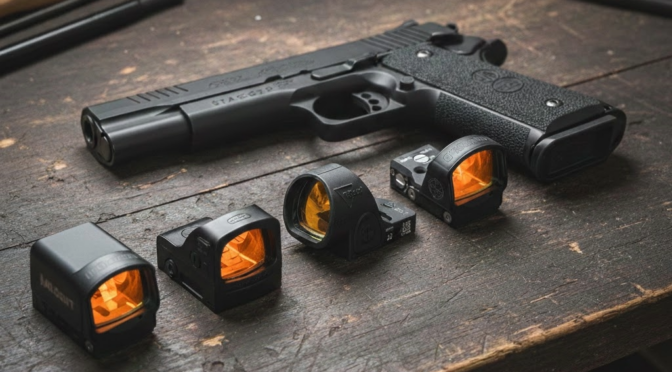
The USMS SOG Procurement and the State of Duty-Grade Miniature Red Dot Sights (MRDS)

1. Executive Summary

1.1 Report Scope and Strategic Objectives

This comprehensive industry analysis evaluates the current landscape of Miniature Red Dot Sights (MRDS) within the context of law enforcement duty applications, specifically anchored by the United States Marshals Service Special Operations Group (USMS SOG) selection of the Leupold DeltaPoint Pro (DPP) integrated with the Staccato 2011 platform. The report aims to dissect the technical, operational, and logistical factors driving this high-profile procurement decision, while simultaneously conducting an exhaustive comparative assessment against market-leading competitors including Trijicon, Aimpoint, Holosun, and Vortex. The objective is to provide agency procurement officers, armorers, and industry stakeholders with a definitive, data-driven hierarchy of optic suitability for modern policing requirements, ranging from specialized tactical intervention to general patrol duties.

1.2 The USMS SOG Procurement Paradigm

The selection of the Staccato P Duo paired with the Leupold DeltaPoint Pro marks a significant divergence from the prevailing law enforcement standard of striker-fired polymer pistols equipped with Trijicon RMRs. This decision by the USMS SOG—a unit tasked with high-risk warrant service and fugitive apprehension—signals a prioritization of terminal ballistics, trigger precision, and optical clarity over absolute equipment hardening or acquisition cost.1

The choice of the Leupold DeltaPoint Pro, specifically, highlights a critical operational trade-off. While the Trijicon RMR Type 2 was widely regarded as the durability gold standard in 2019, its small window and bottom-loading battery presented functional limitations for operators using Night Vision Goggles (NVG) or requiring rapid target acquisition in dynamic environments. The DPP offered a massive, crystal-clear “heads-up” display and a top-loading battery compartment, solving logistical pain points at the cost of increased mechanical fragility.3 This report posits that the SOG’s choice was driven by a “performance-first” doctrine suitable for elite units with aggressive maintenance schedules, rather than a “durability-first” doctrine required for general patrol.

1.3 Market Evolution: The Enclosed Emitter Shift

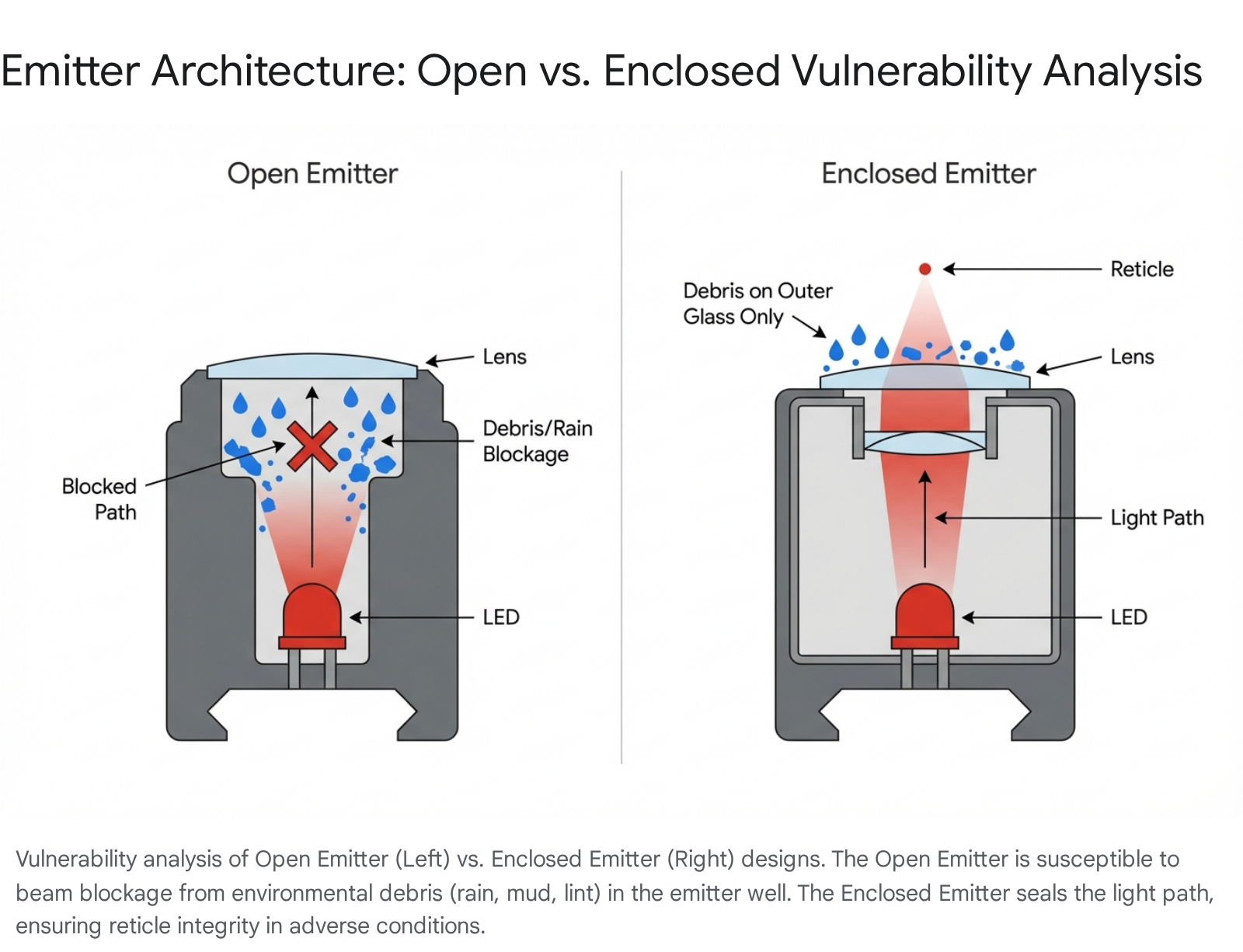
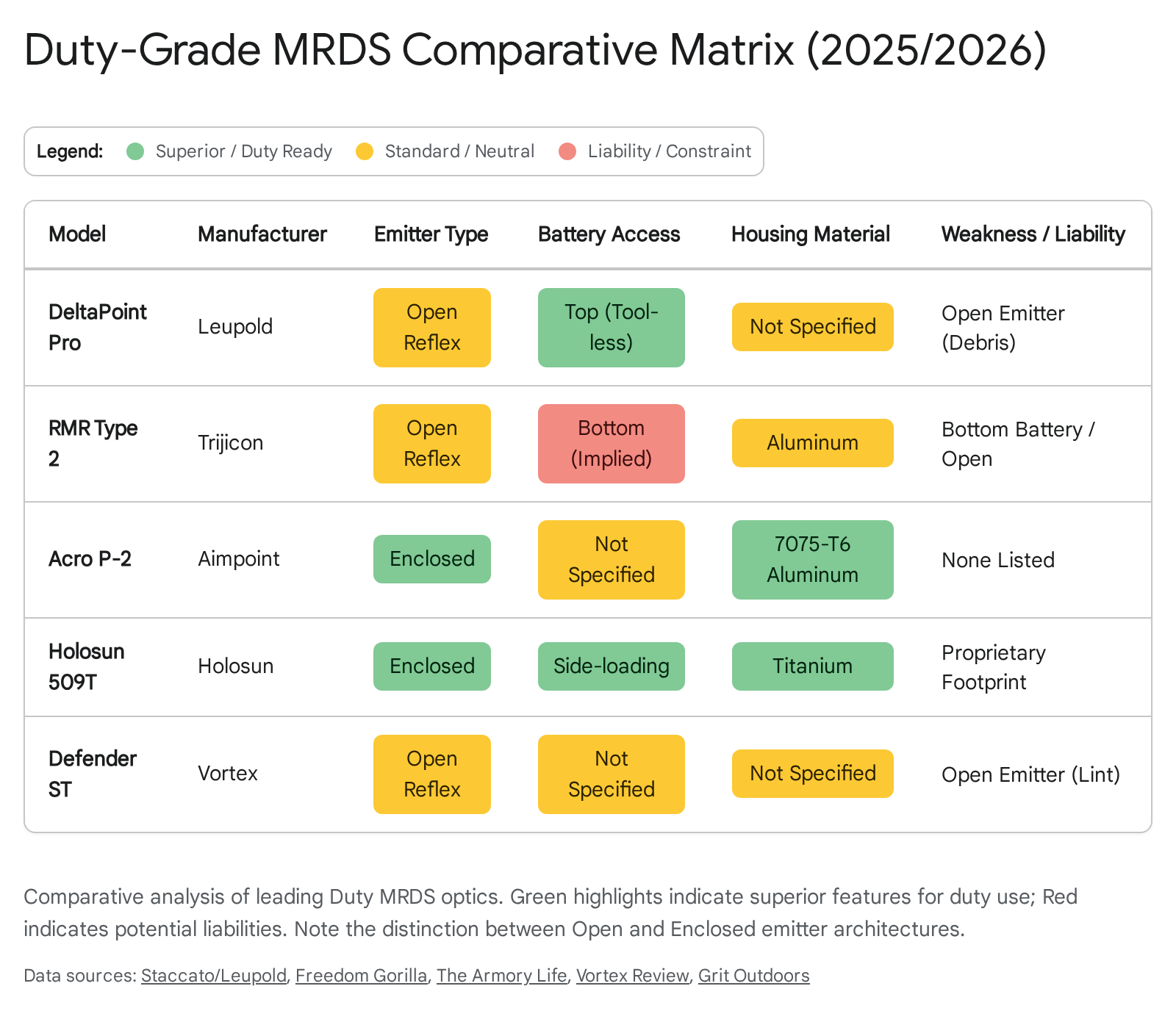
Since the USMS procurement, the MRDS market has undergone a radical transformation driven by the “Enclosed Emitter” revolution. The introduction of the Aimpoint Acro P-2, Holosun 509T, and Trijicon RCR has fundamentally altered the baseline requirements for duty optics. These systems mitigate the primary failure mode of open-emitter sights like the DPP and RMR: the obstruction of the LED projection path by environmental debris (water, mud, snow, lint).5

1.4 Key Findings and Operational Verdicts

  • Optical Superiority vs. Mechanical Hardening: The Leupold DeltaPoint Pro remains the leader in optical clarity and window size, offering superior light transmission for NVG operations. However, extensive testing by Sage Dynamics and other independent bodies indicates it is more susceptible to catastrophic failure from high-G impacts compared to the Trijicon RMR or Aimpoint Acro.7
  • Platform Specificity: The success of the DPP in the USMS program is inextricably linked to the Dawson Universal Optic (DUO) mounting system, which mitigates the optic’s excessive deck height. On other platforms, the DPP often sits too high for effective co-witness without specialized suppressor-height sights.3
  • The New Duty Standard: While the DPP and RMR remain viable, the analysis concludes that Enclosed Emitter Optics now represent the optimal solution for general law enforcement duty. The Aimpoint Acro P-2 stands as the current durability benchmark, with the Trijicon RCR offering a seamless transition for agencies already invested in RMR-footprint slides.5

2. Strategic Context: The USMS SOG Modernization Program

To understand the selection of the Leupold DeltaPoint Pro, one must first analyze the unique operational environment of the United States Marshals Service Special Operations Group (USMS SOG). This is not a standard patrol force; it is a Tier 1-adjacent federal tactical unit operating in the highest threat environments within the domestic United States.

2.1 The Transition: From 1911 to 2011

For sixteen years prior to the Staccato adoption, the SOG fielded the Springfield Armory Professional 1911 in.45 ACP.1 This establishes a clear unit culture favoring the single-action trigger mechanism and the ergonomics of the 1911 platform over the polymer, striker-fired mechanics of the ubiquitous Glock or Sig Sauer P320.

The transition to the Staccato P (formerly STI) was driven by the need for increased capacity and modernization while retaining the shootability of the 1911 trigger. The Staccato P is a “2011” platform—a double-stack 1911 that utilizes a modular grip frame (polymer grip module bolted to a steel frame) to accommodate 17+ or 21+ round magazines of 9mm ammunition, significantly upgrading firepower from the 7-8 round capacity of the.45 ACP 1911.2

This weapon system context is crucial for optic selection. The recoil impulse of a heavy, metal-framed, 9mm 2011 is significantly flatter and smoother than a.40 caliber Glock 22. This reduced slide velocity and harmonic vibration profile may exert less destructive force on the optic’s electronics compared to the “snappy” recoil of lighter polymer service pistols, potentially allowing the SOG to utilize the DeltaPoint Pro with higher reliability rates than municipal agencies might experience on their standard issue firearms.2

2.2 The Dawson Universal Optic (DUO) Interface

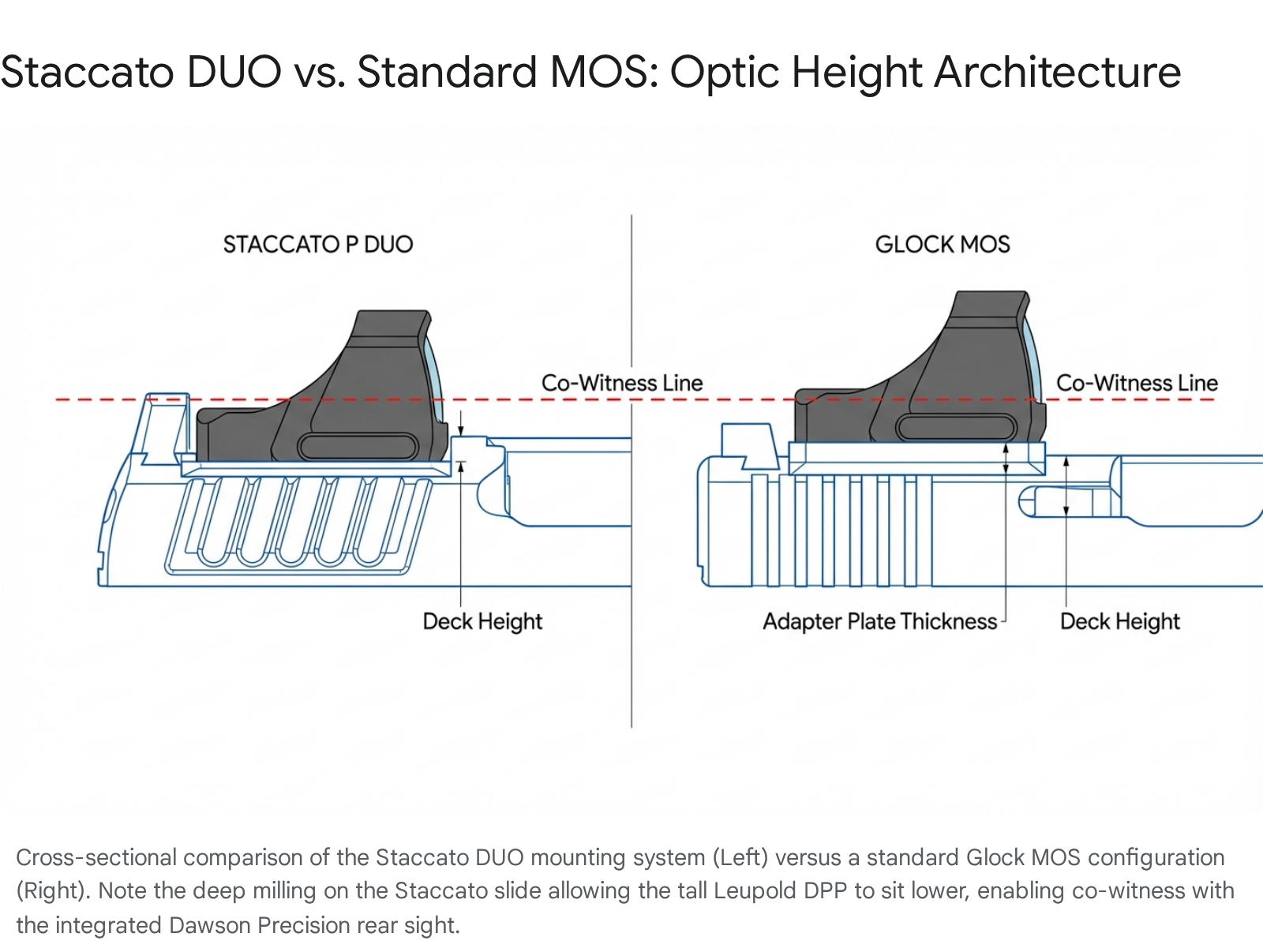
A primary engineering challenge in adopting the Leupold DeltaPoint Pro is its physical dimension. The DPP has a notably tall “deck height”—the vertical distance from the bottom of the optic to the bottom of the viewing window. On a standard pistol slide, this height often blocks standard iron sights, necessitating the installation of extremely tall “suppressor-height” sights to achieve a backup sight picture.11

The USMS SOG partnered with Dawson Precision to solve this. The resulting DUO (Dawson Universal Optic) system is a proprietary mounting solution designed specifically for the Staccato platform.

  • Deep Milling: The slide is milled to accept the optic as deeply as structurally possible.
  • Integrated Rear Sight: Unlike other systems where the rear iron sight is dovetail-mounted to the slide behind the optic, the DUO system for the DPP incorporates a rear sight that attaches to the back of the optic itself or a specialized plate. This ensures that despite the DPP’s height, a lower-1/3 co-witness is maintained without creating an unwieldy vertical profile.1
  • The “Duty” Configuration: This integration was a mandatory requirement for the USMS. The ability to seamlessly transition from optic to iron sights in the event of failure is a non-negotiable standard for tactical teams.
Hand holding screwdriver to install Yugo M85 dust cover takedown pin

2.3 The “Performance First” Philosophy

The selection of the DPP over the Trijicon RMR Type 2 (the dominant industry standard at the time) reveals a distinct prioritization of “shootability” over “ruggedness.”

  • Window Geometry: The DPP features a large, rectangular window with a thin frame. In Close Quarters Battle (CQB), this wider field of view (FOV) allows operators to track moving targets more effectively and recover the dot faster during rapid strings of fire.
  • Night Vision Compatibility: SOG operators frequently conduct raids under night vision. The DPP’s larger window and superior light transmission (due to distinct glass coatings) provide a clearer passive aiming channel through NVG tubes than the smaller, blue-tinted window of the RMR.4
  • Maintenance Tempo: As a special operations unit, SOG has the logistical infrastructure to conduct regular preventative maintenance (swapping batteries, inspecting screws). This mitigates the risks associated with the DPP’s shorter battery life or potential durability concerns that would be unacceptable for a general patrol officer who might inspect their weapon only once a month.2

3. Technical Monograph: Leupold DeltaPoint Pro

3.1 Design Architecture and Optical System

The Leupold DeltaPoint Pro is an open-emitter reflex sight engineered with a focus on optical fidelity. The housing is constructed from aircraft-grade aluminum, encased in a spring-steel shroud. This “shroud” architecture is Leupold’s primary impact mitigation strategy, designed to act as a crumple zone or armor plating that absorbs energy before it can deform the lens housing.4

3.1.1 The Aspheric Lens Advantage

A key differentiator of the DPP is its optical glass. Leupold utilizes an aspheric lens design, which is shaped to reduce spherical aberration. In cheaper optics, the red dot can distort or “comma” near the edges of the lens (rectilinear distortion). The DPP maintains a crisp, circular dot across a larger percentage of the lens surface area. This edge-to-edge clarity is critical for shooting from unconventional positions where the dot may not be perfectly centered in the window.4

3.1.2 Motion Sensor Technology (MST)

To conserve battery life, the DPP employs a proprietary accelerometer-based system known as Motion Sensor Technology (MST). The optic automatically enters a sleep mode after 5 minutes of inactivity and wakes instantly upon detecting motion.

  • Reliability: Field reports indicate high reliability for the MST system. The sensitivity is tuned to detect even the micro-vibrations of unholstering a weapon, ensuring the dot is active before the weapon reaches eye level.14
  • Battery Efficiency: This system allows the single CR2032 battery to last significantly longer in intermittent duty use than its raw “always-on” runtime would suggest (approx. 300 to 1600 hours depending on brightness).16 However, this is still significantly lower than the 50,000-hour continuous runtimes of competitors like Aimpoint, necessitating the reliance on the sleep mode circuitry.

3.2 Electronics and Interface

3.2.1 The Top-Loading Battery

One of the DPP’s most significant advantages over the Trijicon RMR is its battery compartment. The battery is accessed via a spring-loaded latch on top of the optic housing. This allows the battery to be changed without unmounting the optic from the pistol slide.

  • Logistical Impact: For the RMR Type 2, a battery change requires removing the optic, which breaks the thread locker seal on the mounting screws and necessitates re-confirming the zero at a range. For the DPP, a battery swap can be performed in the field in under 60 seconds with no shift in zero. For high-tempo units like USMS SOG, this reduces downtime significantly.4

3.2.2 The Single-Button Interface

Ergonomically, the DPP suffers from a simplistic control scheme. It utilizes a single button located on the battery compartment to cycle through brightness settings.

  • Operational Liability: To adjust brightness, the user must press the button to cycle through the entire range (Low -> High -> Low). If an officer inadvertently cycles past their desired setting, they must cycle through all settings again to return. This is slower and more prone to error under stress than the dedicated “+” and “-” buttons found on the Holosun 509T or Trijicon RMR.11

3.3 Reliability and Durability Assessment

Despite the steel shroud, the Leupold DeltaPoint Pro has faced consistent scrutiny regarding its durability in “duty” conditions compared to the Trijicon RMR.

3.3.1 The Sage Dynamics Findings

The “White Paper” on MRDS duty use by Aaron Cowan of Sage Dynamics is the industry benchmark for durability testing. His testing protocols involve drop tests (shoulder height, optic down) onto concrete every 500 rounds.

  • Glass Integrity: Early iterations of the DPP showed a vulnerability to glass breakage during these drop tests. The large, tall window presents a greater surface area for impact, and the aluminum hood, while armored, could deform enough to crack the lens.7
  • Electronic Continuity: Historical data indicated issues with battery contacts flickering under the high G-forces of slide reciprocation. Leupold addressed this in later revisions (post-2018) with improved battery contact springs and circuit board potting, but the reputation for fragility persists relative to the RMR.8

3.3.2 Environmental Susceptibility

As an open-emitter sight, the DPP is vulnerable to the “rain drop” failure mode. If water, mud, snow, or lint falls into the emitter well (the area behind the lens where the LED resides), the projection path is blocked. This results in the reticle disappearing or “starbursting” into an unusable bloom. While this is a vulnerability shared by all open-emitter sights (including the RMR), it is a critical consideration for duty use in adverse weather.11

Hand holding screwdriver to install Yugo M85 dust cover takedown pin

4. Market Leader Analysis: Trijicon

To evaluate the USMS selection, one must compare the DPP against the industry hegemon: Trijicon.

4.1 Trijicon RMR Type 2 (Ruggedized Miniature Reflex)

  • The Standard: The RMR Type 2 is the most widely deployed duty optic in US law enforcement. Its patented “owl ear” housing shape diverts impact energy around the lens, making it exceptionally durable.
  • Comparison to DPP:
  • Durability: RMR is superior. It consistently survives multiple drop tests that disable other optics.19
  • Optical: RMR is inferior. The window is smaller, heavily tinted blue (notch filter), and has more distortion.
  • Battery: RMR is inferior. Bottom-loading design requires removal for battery changes.
  • Verdict: The RMR is the “safe” choice for general issue. It is harder to break but harder to shoot (due to window size) than the DPP.20

4.2 Trijicon RCR (Ruggedized Closed Reflex)

  • The Innovation: Released to compete with enclosed emitters, the RCR maintains the RMR footprint but adds a sealed housing.
  • Mounting System: It uses a unique capstan screw system that allows it to mount to standard RMR cuts from the side, avoiding the need for new plates.
  • Performance: It matches the RMR in durability but eliminates the debris failure mode. It stands as a direct, superior replacement for the RMR in current fleets.10

4.3 Trijicon SRO (Specialized Reflex Optic)

  • Comparison to DPP: Like the DPP, the SRO features a massive, circular window designed for competition.
  • Duty Rating: The SRO is not duty rated. Its protruding lens housing lacks the impact protection of the RMR or DPP shroud. Drop tests frequently result in shattered glass. While popular in competition (USPSA), it is generally prohibited for duty use by rigorous agency policies.22

5. The Challenger: Aimpoint & The Enclosed Emitter

The most significant shift in the market since the USMS decision has been the rise of Aimpoint’s enclosed systems.

5.1 Aimpoint Acro P-2

  • Architecture: The Acro P-2 is a fully enclosed “mailbox” design. The emitter is sealed within a nitrogen-purged box.
  • Durability: It is widely considered the most durable pistol optic currently available. It can withstand submersion to 35 meters and extreme temperature fluctuations (-49°F to 160°F).5
  • Mounting Standard: Unlike the RMR or DPP which use vertical screws (prone to shearing under shear stress), the Acro uses a cross-bolt clamping mechanism similar to a Picatinny rail grabber. This is mechanically superior for resisting recoil forces.24
  • Battery: The P-2 upgraded to a CR2032 battery (from the P-1’s CR1225), achieving 50,000 hours of continuous runtime. This rivals the Trijicon RMR and vastly outperforms the DPP.5

5.2 Operational Advantage

For general patrol officers who work in rain, snow, or dusty environments, the Acro P-2 eliminates the need to constantly clean out the emitter well. A quick wipe of the rear lens with a thumb is all that is required to restore a sight picture. This reliability factor is driving agencies away from open emitters like the DPP and RMR.6

6. The Value Competitors: Holosun & Vortex

6.1 Holosun 509T & EPS

  • Holosun 509T: Constructed from Titanium (stronger and lighter than the 7075 Aluminum used by competitors), the 509T is an enclosed emitter sight that has passed rigorous duty testing by Sage Dynamics. It features a solar failsafe and a multi-reticle system (circle-dot) that many users prefer for rapid acquisition.
  • Holosun EPS (Enclosed Pistol Sight): A newer iteration designed with a lower deck height. This allows it to co-witness with standard-height iron sights on many platforms, eliminating the need for tall suppressor sights—a major ergonomic advantage over the Acro and 509T.26
  • The “China” Factor: While technically superior in features and price, Holosun’s manufacturing origin (China) restricts its adoption by some federal agencies due to strict procurement policies (TAA compliance), though it is widely used by local/state LE.26

6.2 Vortex Defender ST

  • The Contender: Vortex entered the duty market with the Defender ST, specifically targeting the Leupold DPP footprint.
  • Features: It includes a “Fast-Rack” knurled front face, designed to aid in one-handed slide manipulation (racking the slide off a belt or boot).
  • Durability: Initial testing shows promise, but it lacks the decade-long track record of the RMR or the institutional trust of Aimpoint. Its primary selling point is the unconditional lifetime warranty, which appeals to budget-conscious departments.29
Hand holding screwdriver to install Yugo M85 dust cover takedown pin

7. Comparative Analysis: Performance Metrics

7.1 Optical Fidelity and NVG Performance

  • Transmission: The Leupold DPP leads the pack in light transmission. Its glass coatings are optimized for low-light performance, providing a bright, crisp image with minimal tint.
  • NVG Performance: Under night vision, the DPP’s “Night Vision” specific settings allow for very dim dots that do not bloom (halo) inside the goggles. Combined with the large window, it offers the best passive aiming experience. The Trijicon RMR Type 2 has only 2 NV settings and a smaller, darker window, making it less optimal for this specific role.31

7.2 Battery Logistics and Maintenance

  • Runtime: Aimpoint Acro P-2 and Trijicon RMR dominate with ~4-5 years of always-on life. The DPP lags behind significantly (months, not years) and relies on MST to compete.
  • Change Procedure: The DPP and Acro P-2 feature accessible battery compartments (top and side, respectively). The RMR Type 2 requires unmounting. For a fleet of 1,000 officers, the RMR’s requirement to re-zero every battery change represents hundreds of man-hours of range time. The DPP eliminates this cost.5

7.3 Parallax

All red dots exhibit some parallax shift (where the dot moves relative to the target if the shooter’s head moves).

  • Testing Data: Independent parallax testing often shows the Aimpoint Acro P-2 and Eotech EFLX having less parallax shift at the edges of the window compared to the RMR and DPP. However, inside 25 yards, this shift is generally negligible for defensive handgun applications (less than 2-3 inches).33

8. Operational Integration and Training Implications

Adopting the Leupold DeltaPoint Pro or any MRDS requires a doctrinal shift in training.

8.1 “Finding the Dot”

The most common failure point for officers transitioning to red dots is “losing the dot” during the draw.

  • The DPP Advantage: The DPP’s large vertical window makes it more forgiving. If the muzzle is slightly high or low during presentation, the dot is more likely to still be visible within the glass than in the smaller window of an RMR. This reduces the training curve for new users.12

8.2 Occluded Shooting

Training must address optic failure. If the front lens is blocked by mud (but the emitter is working), officers are trained in “Occluded Eye Aiming” (using both eyes open to superimpose the dot on the target).

  • Enclosed vs. Open: Enclosed emitters (Acro, 509T) are far easier to wipe clear in the field. An open emitter filled with mud (DPP, RMR) is effectively disabled until it can be washed out with water or compressed air, forcing the officer to transition to iron sights immediately.7

8.3 Holster Compatibility

The adoption of MRDS necessitates new holsters. The standard retention holster (e.g., Safariland 6360RDS) features a rotating hood that covers the optic.

  • Size Constraints: The Aimpoint Acro and Holosun 509T are physically larger/boxier than the RMR. While Safariland makes hoods for all of them, agencies must ensure their holster procurement matches the specific optic footprint. The tall deck height of the DPP can sometimes interfere with older holster hood designs intended for the lower-profile RMR.34

9. The Future of Duty Optics

The trajectory of the market is clear. While the Leupold DeltaPoint Pro remains a capable optic, the industry standard for duty use is consolidating around Enclosed Emitter Systems.

9.1 The “Closed” Standard

The failure of open emitters in adverse weather is a liability that can now be eliminated with off-the-shelf technology. Agencies drafting new Requests for Proposals (RFPs) in 2025/2026 are increasingly mandating “closed emitter” architecture as a threshold requirement.6

9.2 Smart Optics

The next frontier involves “smart” features. Technology like round counters, integrated displays (communicating with the weapon light or radio), and auto-ranging reticles are in development. However, for the immediate future, simplicity and durability remain the primary drivers for LEO selection.

10. Conclusion and Recommendations

The USMS SOG’s selection of the Leupold DeltaPoint Pro was a logical, performance-driven decision for a Tier 1-capable unit operating the Staccato platform. The DPP’s superior window size and NVG performance provide a distinct tactical advantage for specialized operators who can manage the maintenance requirements.

However, for the broader law enforcement community, the landscape has shifted. The Enclosed Emitter is the new gold standard.

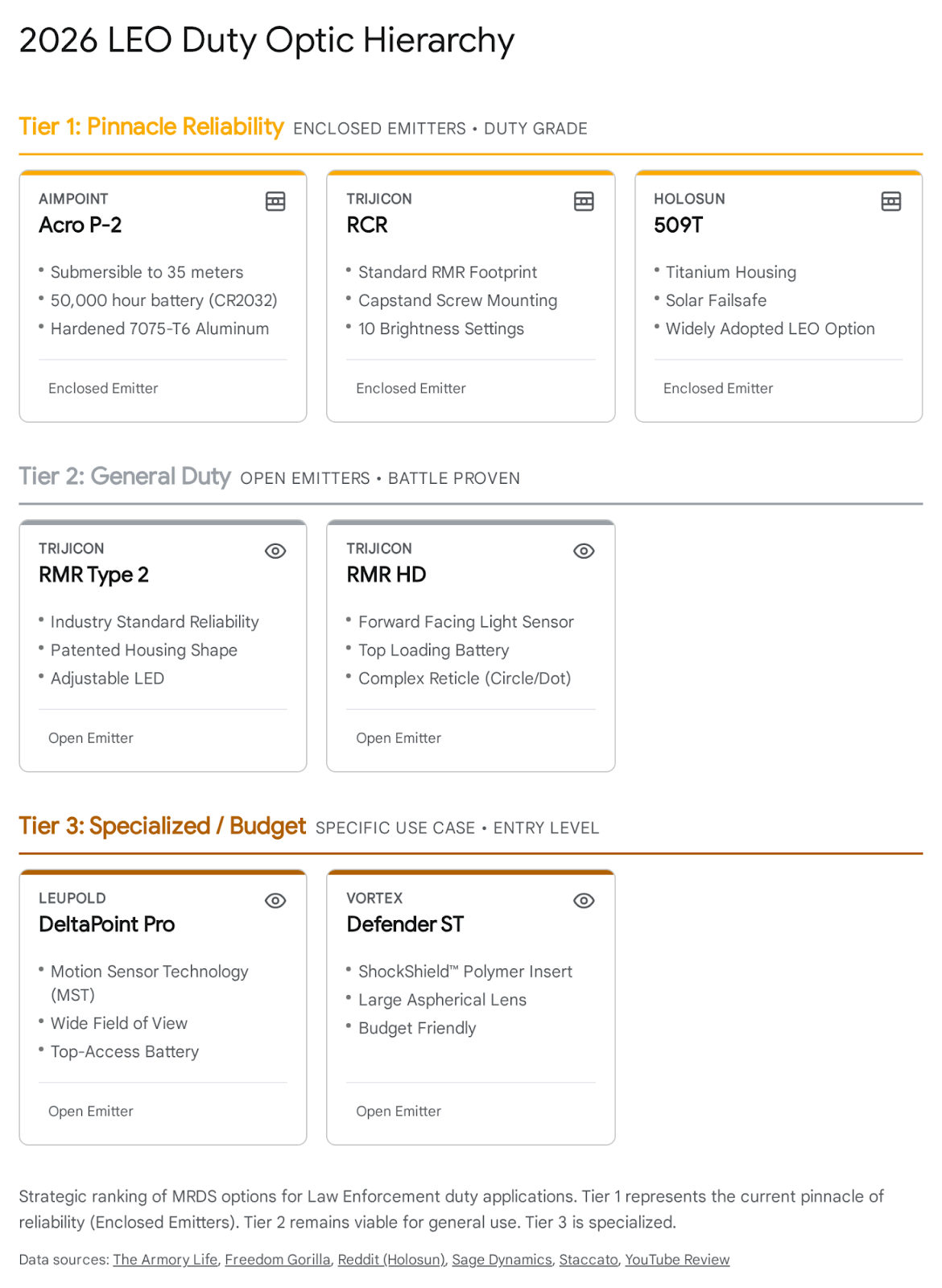
10.1 Ranked Recommendations for LEO Duty Use (2026)

Hand holding screwdriver to install Yugo M85 dust cover takedown pin
  • Tier 1 (The New Standard):
  • Aimpoint Acro P-2: The definitive choice for new procurements. Unmatched environmental hardening.
  • Trijicon RCR: The optimal upgrade for existing RMR fleets.
  • Holosun 509T: The best performance-per-dollar ratio, provided agency policy allows.
  • Tier 2 (The Proven Legacy):
  • Trijicon RMR Type 2: Still a viable, incredibly durable option, but optically dated.
  • Trijicon RMR HD: An excellent evolution, but open-emitter architecture prevents it from reaching Tier 1 for all-weather duty.
  • Tier 3 (Specialized/Niche):
  • Leupold DeltaPoint Pro: Recommended specifically for Specialized Units (SWAT) prioritizing NVG performance and window size over absolute ruggedness.
  • Vortex Defender ST: A viable budget alternative for DPP-footprint slides, backed by a strong warranty.

Final Analyst Verdict: The USMS SOG proved that the Leupold DeltaPoint Pro is a lethal tool in the hands of experts. However, for the average patrol officer, the durability and reliability of an enclosed system like the Aimpoint Acro P-2 offers the highest probability of success in the unforgiving reality of police work.


Please share the link on Facebook, Forums, with colleagues, etc. Your support is much appreciated and if you have any feedback, please email us in**@*********ps.com. If you’d like to request a report or order a reprint, please click here for the corresponding page to open in new tab.


Sources Used

  1. The STI Staccato-P is the USMS SOG’s newest adaptation – Precision Technic Defence, accessed February 12, 2026, https://ptdefence.com/the-sti-staccato-p-is-the-usms-sogs-newest-adaptation/
  2. Exclusive: U.S. Marshals Special Operations Group Adopts STI 2011 Pistols – Guns.com, accessed February 12, 2026, https://www.guns.com/news/2019/07/24/exclusive-u-s-marshals-special-operations-group-adopts-sti-2011-pistols
  3. United States Marshals Service Selects Leupold DeltaPoint Pro, Dawson Precision Sights for Duty Firearms, accessed February 12, 2026, https://www.leupold.com/blog/post/united-states-marshals-service-selects-leupold-deltapoint-pro-dawson-precision-sights-duty-firearms
  4. The DeltaPoint Pro – A Red Dot That Delivers – Leupold, accessed February 12, 2026, https://www.leupold.com/blog/post/a-red-dot-that-delivers
  5. Aimpoint ACRO P-2 Review: Rugged Red Dot Sight – The Armory Life, accessed February 12, 2026, https://www.thearmorylife.com/aimpoint-acro-p-2-review/
  6. Enclosed MRDS Buyer’s Guide [2026] – Recoil Magazine, accessed February 12, 2026, https://www.recoilweb.com/enclosed-mrds-buyers-guide-183551.html
  7. Miniaturized Red Dot Systems for Duty Handgun Use – Kentucky Tactical Officers Association, accessed February 12, 2026, http://www.kentuckytacticalofficersassociation.org/uploads/4/0/6/1/40615731/sage_dynamics_pistol_red_dot_white_paper.pdf
  8. Delta point pro g2g? : r/guns – Reddit, accessed February 12, 2026, https://www.reddit.com/r/guns/comments/spt88o/delta_point_pro_g2g/
  9. STI Staccato: Reporting for Duty – Recoil Magazine, accessed February 12, 2026, https://www.recoilweb.com/sti-staccato-reporting-for-duty-156284.html
  10. Trijicon RMR HD vs RCR: Full Optic Comparison – Freedom Gorilla, accessed February 12, 2026, https://freedomgorilla.com/blogs/news/trijicon-rmr-hd-vs-rcr
  11. Leupold Delta Point Pro : r/handguns – Reddit, accessed February 12, 2026, https://www.reddit.com/r/handguns/comments/1gey902/leupold_delta_point_pro/
  12. Leupold Delta Point Pro Review – Optics Force, accessed February 12, 2026, https://opticsforce.com/blogs/news/leupold-delta-point-pro-review
  13. U.S. Marshals Adopt Leupold Delta Point Pro And Dawson Precision Sights, accessed February 12, 2026, https://www.thefirearmblog.com/blog/2019/07/08/u-s-marshals-adopt-leupold-delta-point-pro-and-dawson-precision-sights/
  14. Leupold DeltaPoint Pro Optic – Staccato 2011, accessed February 12, 2026, https://staccato2011.com/products/leupold-deltapoint-pro-optic
  15. Leupold® DeltaPoint® Pro Reflex Sight, accessed February 12, 2026, https://www.leupold.com/media/manuals/deltapoint-pro-manual.pdf
  16. DeltaPoint Pro | Leupold, accessed February 12, 2026, https://www.leupold.com/deltapoint-pro-red-dot
  17. Leupold DeltaPoint Pro Red Dot Micro Optic Review (HD) – YouTube, accessed February 12, 2026, https://www.youtube.com/watch?v=uaCwaOgWiUI
  18. Why Choose An Enclosed Emitter Red Dot Sight? | An Official Journal Of The NRA, accessed February 12, 2026, https://www.shootingillustrated.com/content/why-choose-an-enclosed-emitter-red-dot-sight/
  19. Results of a 4 Year Handgun Red Dot Study by Sage Dynamics : r/CCW – Reddit, accessed February 12, 2026, https://www.reddit.com/r/CCW/comments/6uixc5/results_of_a_4_year_handgun_red_dot_study_by_sage/
  20. Best Pistol Red Dot Sights: 8 Tested in 2026 – Scopes Field, accessed February 12, 2026, https://scopesfield.com/best-pistol-red-dot-sights/
  21. The Trijicon RMR HD & RCR: Next-Gen Ruggedness | An Official Journal Of The NRA, accessed February 12, 2026, https://www.americanrifleman.org/content/the-trijicon-rmr-hd-rcr-next-gen-ruggedness/
  22. RMR HD vs SRO vs RCR : r/2011 – Reddit, accessed February 12, 2026, https://www.reddit.com/r/2011/comments/1lyv8oa/rmr_hd_vs_sro_vs_rcr/
  23. One reviewer’s experience with the Acro P-2 red dot sight – Police1, accessed February 12, 2026, https://www.police1.com/police-products/firearms/accessories/articles/one-reviewers-experience-with-the-acro-p-2-red-dot-sight-Yp8HTlHS0vVnFVs0/
  24. Footprints/Mounting Standards on Red Dot Sights – Optics Trade Blog, accessed February 12, 2026, https://www.optics-trade.eu/blog/footprints-on-red-dot-sights/
  25. Is the ACRO P2 dependable and durable or not? I’ve seen conflicting experiences – Reddit, accessed February 12, 2026, https://www.reddit.com/r/QualityTacticalGear/comments/1oh09se/is_the_acro_p2_dependable_and_durable_or_not_ive/
  26. Best holosun duty option – Reddit, accessed February 12, 2026, https://www.reddit.com/r/HOLOSUN/comments/1bfkd8n/best_holosun_duty_option/
  27. Holosun 509T Overview + Compared to EPS – YouTube, accessed February 12, 2026, https://www.youtube.com/watch?v=gWdE_VslBDU
  28. Best Pistol Red Dot Sights to Buy in 2025 – Blog.GritrOutdoors.com, accessed February 12, 2026, https://blog.gritroutdoors.com/best-pistol-red-dot-sights/
  29. Vortex Defender ST Review — Military-Grade Red Dot + Torture Test – YouTube, accessed February 12, 2026, https://www.youtube.com/watch?v=F0JYiApy1uw
  30. Vortex Defender Testing – Guns & Gear – USCCA Community, accessed February 12, 2026, https://community.usconcealedcarry.com/t/vortex-defender-testing/120383
  31. Everything You Need to Know about Your DeltaPoint Pro – T.REX ARMS, accessed February 12, 2026, https://www.trex-arms.com/videos/MynCiRpdqm/
  32. Leupold DPP For Duty Use | Primary & Secondary Forum, accessed February 12, 2026, https://primaryandsecondary.com/forum/index.php?threads/leupold-dpp-for-duty-use.8742/
  33. DeltaPoint Pro 6 MOA – Leupold, accessed February 12, 2026, https://www.leupold.com/deltapoint-pro-6-moa
  34. Mounting Standards: 2025 Guide to Red Dot Footprints – Inside Safariland, accessed February 12, 2026, https://inside.safariland.com/blog/mounting-standards-a-guide-to-red-dot-footprints/