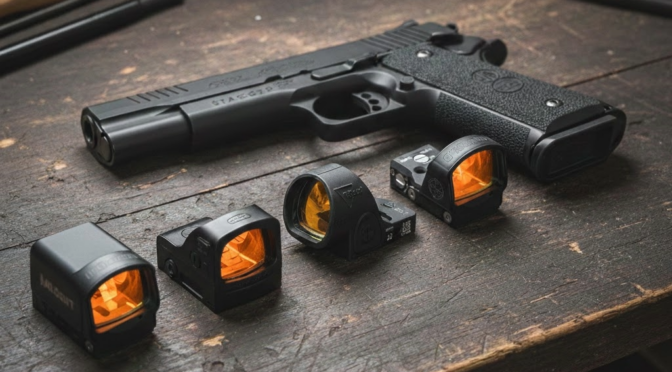
This comprehensive industry analysis evaluates the current landscape of Miniature Red Dot Sights (MRDS) within the context of law enforcement duty applications, specifically anchored by the United States Marshals Service Special Operations Group (USMS SOG) selection of the Leupold DeltaPoint Pro (DPP) integrated with the Staccato 2011 platform. The report aims to dissect the technical, operational, and logistical factors driving this high-profile procurement decision, while simultaneously conducting an exhaustive comparative assessment against market-leading competitors including Trijicon, Aimpoint, Holosun, and Vortex. The objective is to provide agency procurement officers, armorers, and industry stakeholders with a definitive, data-driven hierarchy of optic suitability for modern policing requirements, ranging from specialized tactical intervention to general patrol duties.
1.2 The USMS SOG Procurement Paradigm
The selection of the Staccato P Duo paired with the Leupold DeltaPoint Pro marks a significant divergence from the prevailing law enforcement standard of striker-fired polymer pistols equipped with Trijicon RMRs. This decision by the USMS SOG—a unit tasked with high-risk warrant service and fugitive apprehension—signals a prioritization of terminal ballistics, trigger precision, and optical clarity over absolute equipment hardening or acquisition cost.1
The choice of the Leupold DeltaPoint Pro, specifically, highlights a critical operational trade-off. While the Trijicon RMR Type 2 was widely regarded as the durability gold standard in 2019, its small window and bottom-loading battery presented functional limitations for operators using Night Vision Goggles (NVG) or requiring rapid target acquisition in dynamic environments. The DPP offered a massive, crystal-clear “heads-up” display and a top-loading battery compartment, solving logistical pain points at the cost of increased mechanical fragility.3 This report posits that the SOG’s choice was driven by a “performance-first” doctrine suitable for elite units with aggressive maintenance schedules, rather than a “durability-first” doctrine required for general patrol.
1.3 Market Evolution: The Enclosed Emitter Shift
Since the USMS procurement, the MRDS market has undergone a radical transformation driven by the “Enclosed Emitter” revolution. The introduction of the Aimpoint Acro P-2, Holosun 509T, and Trijicon RCR has fundamentally altered the baseline requirements for duty optics. These systems mitigate the primary failure mode of open-emitter sights like the DPP and RMR: the obstruction of the LED projection path by environmental debris (water, mud, snow, lint).5
1.4 Key Findings and Operational Verdicts
Optical Superiority vs. Mechanical Hardening: The Leupold DeltaPoint Pro remains the leader in optical clarity and window size, offering superior light transmission for NVG operations. However, extensive testing by Sage Dynamics and other independent bodies indicates it is more susceptible to catastrophic failure from high-G impacts compared to the Trijicon RMR or Aimpoint Acro.7
Platform Specificity: The success of the DPP in the USMS program is inextricably linked to the Dawson Universal Optic (DUO) mounting system, which mitigates the optic’s excessive deck height. On other platforms, the DPP often sits too high for effective co-witness without specialized suppressor-height sights.3
The New Duty Standard: While the DPP and RMR remain viable, the analysis concludes that Enclosed Emitter Optics now represent the optimal solution for general law enforcement duty. The Aimpoint Acro P-2 stands as the current durability benchmark, with the Trijicon RCR offering a seamless transition for agencies already invested in RMR-footprint slides.5
2. Strategic Context: The USMS SOG Modernization Program
To understand the selection of the Leupold DeltaPoint Pro, one must first analyze the unique operational environment of the United States Marshals Service Special Operations Group (USMS SOG). This is not a standard patrol force; it is a Tier 1-adjacent federal tactical unit operating in the highest threat environments within the domestic United States.
2.1 The Transition: From 1911 to 2011
For sixteen years prior to the Staccato adoption, the SOG fielded the Springfield Armory Professional 1911 in.45 ACP.1 This establishes a clear unit culture favoring the single-action trigger mechanism and the ergonomics of the 1911 platform over the polymer, striker-fired mechanics of the ubiquitous Glock or Sig Sauer P320.
The transition to the Staccato P (formerly STI) was driven by the need for increased capacity and modernization while retaining the shootability of the 1911 trigger. The Staccato P is a “2011” platform—a double-stack 1911 that utilizes a modular grip frame (polymer grip module bolted to a steel frame) to accommodate 17+ or 21+ round magazines of 9mm ammunition, significantly upgrading firepower from the 7-8 round capacity of the.45 ACP 1911.2
This weapon system context is crucial for optic selection. The recoil impulse of a heavy, metal-framed, 9mm 2011 is significantly flatter and smoother than a.40 caliber Glock 22. This reduced slide velocity and harmonic vibration profile may exert less destructive force on the optic’s electronics compared to the “snappy” recoil of lighter polymer service pistols, potentially allowing the SOG to utilize the DeltaPoint Pro with higher reliability rates than municipal agencies might experience on their standard issue firearms.2
2.2 The Dawson Universal Optic (DUO) Interface
A primary engineering challenge in adopting the Leupold DeltaPoint Pro is its physical dimension. The DPP has a notably tall “deck height”—the vertical distance from the bottom of the optic to the bottom of the viewing window. On a standard pistol slide, this height often blocks standard iron sights, necessitating the installation of extremely tall “suppressor-height” sights to achieve a backup sight picture.11
The USMS SOG partnered with Dawson Precision to solve this. The resulting DUO (Dawson Universal Optic) system is a proprietary mounting solution designed specifically for the Staccato platform.
Deep Milling: The slide is milled to accept the optic as deeply as structurally possible.
Integrated Rear Sight: Unlike other systems where the rear iron sight is dovetail-mounted to the slide behind the optic, the DUO system for the DPP incorporates a rear sight that attaches to the back of the optic itself or a specialized plate. This ensures that despite the DPP’s height, a lower-1/3 co-witness is maintained without creating an unwieldy vertical profile.1
The “Duty” Configuration: This integration was a mandatory requirement for the USMS. The ability to seamlessly transition from optic to iron sights in the event of failure is a non-negotiable standard for tactical teams.
2.3 The “Performance First” Philosophy
The selection of the DPP over the Trijicon RMR Type 2 (the dominant industry standard at the time) reveals a distinct prioritization of “shootability” over “ruggedness.”
Window Geometry: The DPP features a large, rectangular window with a thin frame. In Close Quarters Battle (CQB), this wider field of view (FOV) allows operators to track moving targets more effectively and recover the dot faster during rapid strings of fire.
Night Vision Compatibility: SOG operators frequently conduct raids under night vision. The DPP’s larger window and superior light transmission (due to distinct glass coatings) provide a clearer passive aiming channel through NVG tubes than the smaller, blue-tinted window of the RMR.4
Maintenance Tempo: As a special operations unit, SOG has the logistical infrastructure to conduct regular preventative maintenance (swapping batteries, inspecting screws). This mitigates the risks associated with the DPP’s shorter battery life or potential durability concerns that would be unacceptable for a general patrol officer who might inspect their weapon only once a month.2
3. Technical Monograph: Leupold DeltaPoint Pro
3.1 Design Architecture and Optical System
The Leupold DeltaPoint Pro is an open-emitter reflex sight engineered with a focus on optical fidelity. The housing is constructed from aircraft-grade aluminum, encased in a spring-steel shroud. This “shroud” architecture is Leupold’s primary impact mitigation strategy, designed to act as a crumple zone or armor plating that absorbs energy before it can deform the lens housing.4
3.1.1 The Aspheric Lens Advantage
A key differentiator of the DPP is its optical glass. Leupold utilizes an aspheric lens design, which is shaped to reduce spherical aberration. In cheaper optics, the red dot can distort or “comma” near the edges of the lens (rectilinear distortion). The DPP maintains a crisp, circular dot across a larger percentage of the lens surface area. This edge-to-edge clarity is critical for shooting from unconventional positions where the dot may not be perfectly centered in the window.4
3.1.2 Motion Sensor Technology (MST)
To conserve battery life, the DPP employs a proprietary accelerometer-based system known as Motion Sensor Technology (MST). The optic automatically enters a sleep mode after 5 minutes of inactivity and wakes instantly upon detecting motion.
Reliability: Field reports indicate high reliability for the MST system. The sensitivity is tuned to detect even the micro-vibrations of unholstering a weapon, ensuring the dot is active before the weapon reaches eye level.14
Battery Efficiency: This system allows the single CR2032 battery to last significantly longer in intermittent duty use than its raw “always-on” runtime would suggest (approx. 300 to 1600 hours depending on brightness).16 However, this is still significantly lower than the 50,000-hour continuous runtimes of competitors like Aimpoint, necessitating the reliance on the sleep mode circuitry.
3.2 Electronics and Interface
3.2.1 The Top-Loading Battery
One of the DPP’s most significant advantages over the Trijicon RMR is its battery compartment. The battery is accessed via a spring-loaded latch on top of the optic housing. This allows the battery to be changed without unmounting the optic from the pistol slide.
Logistical Impact: For the RMR Type 2, a battery change requires removing the optic, which breaks the thread locker seal on the mounting screws and necessitates re-confirming the zero at a range. For the DPP, a battery swap can be performed in the field in under 60 seconds with no shift in zero. For high-tempo units like USMS SOG, this reduces downtime significantly.4
3.2.2 The Single-Button Interface
Ergonomically, the DPP suffers from a simplistic control scheme. It utilizes a single button located on the battery compartment to cycle through brightness settings.
Operational Liability: To adjust brightness, the user must press the button to cycle through the entire range (Low -> High -> Low). If an officer inadvertently cycles past their desired setting, they must cycle through all settings again to return. This is slower and more prone to error under stress than the dedicated “+” and “-” buttons found on the Holosun 509T or Trijicon RMR.11
3.3 Reliability and Durability Assessment
Despite the steel shroud, the Leupold DeltaPoint Pro has faced consistent scrutiny regarding its durability in “duty” conditions compared to the Trijicon RMR.
3.3.1 The Sage Dynamics Findings
The “White Paper” on MRDS duty use by Aaron Cowan of Sage Dynamics is the industry benchmark for durability testing. His testing protocols involve drop tests (shoulder height, optic down) onto concrete every 500 rounds.
Glass Integrity: Early iterations of the DPP showed a vulnerability to glass breakage during these drop tests. The large, tall window presents a greater surface area for impact, and the aluminum hood, while armored, could deform enough to crack the lens.7
Electronic Continuity: Historical data indicated issues with battery contacts flickering under the high G-forces of slide reciprocation. Leupold addressed this in later revisions (post-2018) with improved battery contact springs and circuit board potting, but the reputation for fragility persists relative to the RMR.8
3.3.2 Environmental Susceptibility
As an open-emitter sight, the DPP is vulnerable to the “rain drop” failure mode. If water, mud, snow, or lint falls into the emitter well (the area behind the lens where the LED resides), the projection path is blocked. This results in the reticle disappearing or “starbursting” into an unusable bloom. While this is a vulnerability shared by all open-emitter sights (including the RMR), it is a critical consideration for duty use in adverse weather.11
4. Market Leader Analysis: Trijicon
To evaluate the USMS selection, one must compare the DPP against the industry hegemon: Trijicon.
4.1 Trijicon RMR Type 2 (Ruggedized Miniature Reflex)
The Standard: The RMR Type 2 is the most widely deployed duty optic in US law enforcement. Its patented “owl ear” housing shape diverts impact energy around the lens, making it exceptionally durable.
Comparison to DPP:
Durability: RMR is superior. It consistently survives multiple drop tests that disable other optics.19
Optical: RMR is inferior. The window is smaller, heavily tinted blue (notch filter), and has more distortion.
Battery: RMR is inferior. Bottom-loading design requires removal for battery changes.
Verdict: The RMR is the “safe” choice for general issue. It is harder to break but harder to shoot (due to window size) than the DPP.20
4.2 Trijicon RCR (Ruggedized Closed Reflex)
The Innovation: Released to compete with enclosed emitters, the RCR maintains the RMR footprint but adds a sealed housing.
Mounting System: It uses a unique capstan screw system that allows it to mount to standard RMR cuts from the side, avoiding the need for new plates.
Performance: It matches the RMR in durability but eliminates the debris failure mode. It stands as a direct, superior replacement for the RMR in current fleets.10
4.3 Trijicon SRO (Specialized Reflex Optic)
Comparison to DPP: Like the DPP, the SRO features a massive, circular window designed for competition.
Duty Rating: The SRO is not duty rated. Its protruding lens housing lacks the impact protection of the RMR or DPP shroud. Drop tests frequently result in shattered glass. While popular in competition (USPSA), it is generally prohibited for duty use by rigorous agency policies.22
5. The Challenger: Aimpoint & The Enclosed Emitter
The most significant shift in the market since the USMS decision has been the rise of Aimpoint’s enclosed systems.
5.1 Aimpoint Acro P-2
Architecture: The Acro P-2 is a fully enclosed “mailbox” design. The emitter is sealed within a nitrogen-purged box.
Durability: It is widely considered the most durable pistol optic currently available. It can withstand submersion to 35 meters and extreme temperature fluctuations (-49°F to 160°F).5
Mounting Standard: Unlike the RMR or DPP which use vertical screws (prone to shearing under shear stress), the Acro uses a cross-bolt clamping mechanism similar to a Picatinny rail grabber. This is mechanically superior for resisting recoil forces.24
Battery: The P-2 upgraded to a CR2032 battery (from the P-1’s CR1225), achieving 50,000 hours of continuous runtime. This rivals the Trijicon RMR and vastly outperforms the DPP.5
5.2 Operational Advantage
For general patrol officers who work in rain, snow, or dusty environments, the Acro P-2 eliminates the need to constantly clean out the emitter well. A quick wipe of the rear lens with a thumb is all that is required to restore a sight picture. This reliability factor is driving agencies away from open emitters like the DPP and RMR.6
6. The Value Competitors: Holosun & Vortex
6.1 Holosun 509T & EPS
Holosun 509T: Constructed from Titanium (stronger and lighter than the 7075 Aluminum used by competitors), the 509T is an enclosed emitter sight that has passed rigorous duty testing by Sage Dynamics. It features a solar failsafe and a multi-reticle system (circle-dot) that many users prefer for rapid acquisition.
Holosun EPS (Enclosed Pistol Sight): A newer iteration designed with a lower deck height. This allows it to co-witness with standard-height iron sights on many platforms, eliminating the need for tall suppressor sights—a major ergonomic advantage over the Acro and 509T.26
The “China” Factor: While technically superior in features and price, Holosun’s manufacturing origin (China) restricts its adoption by some federal agencies due to strict procurement policies (TAA compliance), though it is widely used by local/state LE.26
6.2 Vortex Defender ST
The Contender: Vortex entered the duty market with the Defender ST, specifically targeting the Leupold DPP footprint.
Features: It includes a “Fast-Rack” knurled front face, designed to aid in one-handed slide manipulation (racking the slide off a belt or boot).
Durability: Initial testing shows promise, but it lacks the decade-long track record of the RMR or the institutional trust of Aimpoint. Its primary selling point is the unconditional lifetime warranty, which appeals to budget-conscious departments.29
7. Comparative Analysis: Performance Metrics
7.1 Optical Fidelity and NVG Performance
Transmission: The Leupold DPP leads the pack in light transmission. Its glass coatings are optimized for low-light performance, providing a bright, crisp image with minimal tint.
NVG Performance: Under night vision, the DPP’s “Night Vision” specific settings allow for very dim dots that do not bloom (halo) inside the goggles. Combined with the large window, it offers the best passive aiming experience. The Trijicon RMR Type 2 has only 2 NV settings and a smaller, darker window, making it less optimal for this specific role.31
7.2 Battery Logistics and Maintenance
Runtime: Aimpoint Acro P-2 and Trijicon RMR dominate with ~4-5 years of always-on life. The DPP lags behind significantly (months, not years) and relies on MST to compete.
Change Procedure: The DPP and Acro P-2 feature accessible battery compartments (top and side, respectively). The RMR Type 2 requires unmounting. For a fleet of 1,000 officers, the RMR’s requirement to re-zero every battery change represents hundreds of man-hours of range time. The DPP eliminates this cost.5
7.3 Parallax
All red dots exhibit some parallax shift (where the dot moves relative to the target if the shooter’s head moves).
Testing Data: Independent parallax testing often shows the Aimpoint Acro P-2 and Eotech EFLX having less parallax shift at the edges of the window compared to the RMR and DPP. However, inside 25 yards, this shift is generally negligible for defensive handgun applications (less than 2-3 inches).33
8. Operational Integration and Training Implications
Adopting the Leupold DeltaPoint Pro or any MRDS requires a doctrinal shift in training.
8.1 “Finding the Dot”
The most common failure point for officers transitioning to red dots is “losing the dot” during the draw.
The DPP Advantage: The DPP’s large vertical window makes it more forgiving. If the muzzle is slightly high or low during presentation, the dot is more likely to still be visible within the glass than in the smaller window of an RMR. This reduces the training curve for new users.12
8.2 Occluded Shooting
Training must address optic failure. If the front lens is blocked by mud (but the emitter is working), officers are trained in “Occluded Eye Aiming” (using both eyes open to superimpose the dot on the target).
Enclosed vs. Open: Enclosed emitters (Acro, 509T) are far easier to wipe clear in the field. An open emitter filled with mud (DPP, RMR) is effectively disabled until it can be washed out with water or compressed air, forcing the officer to transition to iron sights immediately.7
8.3 Holster Compatibility
The adoption of MRDS necessitates new holsters. The standard retention holster (e.g., Safariland 6360RDS) features a rotating hood that covers the optic.
Size Constraints: The Aimpoint Acro and Holosun 509T are physically larger/boxier than the RMR. While Safariland makes hoods for all of them, agencies must ensure their holster procurement matches the specific optic footprint. The tall deck height of the DPP can sometimes interfere with older holster hood designs intended for the lower-profile RMR.34
9. The Future of Duty Optics
The trajectory of the market is clear. While the Leupold DeltaPoint Pro remains a capable optic, the industry standard for duty use is consolidating around Enclosed Emitter Systems.
9.1 The “Closed” Standard
The failure of open emitters in adverse weather is a liability that can now be eliminated with off-the-shelf technology. Agencies drafting new Requests for Proposals (RFPs) in 2025/2026 are increasingly mandating “closed emitter” architecture as a threshold requirement.6
9.2 Smart Optics
The next frontier involves “smart” features. Technology like round counters, integrated displays (communicating with the weapon light or radio), and auto-ranging reticles are in development. However, for the immediate future, simplicity and durability remain the primary drivers for LEO selection.
10. Conclusion and Recommendations
The USMS SOG’s selection of the Leupold DeltaPoint Pro was a logical, performance-driven decision for a Tier 1-capable unit operating the Staccato platform. The DPP’s superior window size and NVG performance provide a distinct tactical advantage for specialized operators who can manage the maintenance requirements.
However, for the broader law enforcement community, the landscape has shifted. The Enclosed Emitter is the new gold standard.
10.1 Ranked Recommendations for LEO Duty Use (2026)
Tier 1 (The New Standard):
Aimpoint Acro P-2: The definitive choice for new procurements. Unmatched environmental hardening.
Trijicon RCR: The optimal upgrade for existing RMR fleets.
Holosun 509T: The best performance-per-dollar ratio, provided agency policy allows.
Tier 2 (The Proven Legacy):
Trijicon RMR Type 2: Still a viable, incredibly durable option, but optically dated.
Trijicon RMR HD: An excellent evolution, but open-emitter architecture prevents it from reaching Tier 1 for all-weather duty.
Tier 3 (Specialized/Niche):
Leupold DeltaPoint Pro: Recommended specifically for Specialized Units (SWAT) prioritizing NVG performance and window size over absolute ruggedness.
Vortex Defender ST: A viable budget alternative for DPP-footprint slides, backed by a strong warranty.
Final Analyst Verdict: The USMS SOG proved that the Leupold DeltaPoint Pro is a lethal tool in the hands of experts. However, for the average patrol officer, the durability and reliability of an enclosed system like the Aimpoint Acro P-2 offers the highest probability of success in the unforgiving reality of police work.
The U.S. market for pistol-mounted Micro Red Dot Sights (MRDS) has transitioned from a niche, early-adopter segment to a phase of explosive, mainstream growth. This expansion is primarily fueled by the widespread adoption of “optics-ready” slide configurations by nearly every major handgun manufacturer, a move that has significantly lowered the cost and complexity for consumers to mount an MRDS.1 Once considered an aftermarket accessory for enthusiasts and competitors, the MRDS is now increasingly viewed as a primary sighting system for defensive, duty, and recreational handguns. The broader electro-optics market, valued in the tens of billions of dollars with a projected compound annual growth rate (CAGR) of over 6%, reflects the immense commercial momentum behind this technological shift.3
This report, based on a comprehensive analysis of consumer and prosumer sentiment from high-traffic U.S. online communities, identifies a clear stratification of the MRDS market into three distinct tiers. Tier 1 (Premium & Duty-Grade) is defined by an uncompromising focus on durability and reliability, where brands like Trijicon and Aimpoint have historically set the performance benchmark. Tier 2 (High-Performance Prosumer) represents the most dynamic and competitive segment, where brands, most notably Holosun, offer a compelling balance of proven durability, advanced features, and strong value. Tier 3 (Entry-Level/Value) caters to price-conscious consumers, a segment where features once considered novel, such as motion-activated illumination, are rapidly becoming standard expectations.
Several key market trends are shaping the competitive landscape. First is the decisive shift toward enclosed-emitter designs for any serious-use application, driven by consumer demand for all-weather reliability and protection from debris.3 Second is the ongoing battle over mounting footprint standards (e.g., RMR, RMSc, ACRO), which creates consumer friction and a secondary market for adapter plates.6 Finally, the most significant disruptive force is the rise of products perceived as “durable enough” while offering a superior feature set and value proposition. This has created intense competition between established duty-grade brands and aggressive new entrants, fundamentally altering consumer expectations and eroding the market share of legacy products that have been slow to innovate.6
The following table summarizes the market sentiment analysis for the top 20 MRDS models, providing a quantitative and qualitative snapshot of the current competitive landscape.
Key Table: Top 20 Micro Red Dot Sights – Market Sentiment Analysis
2.1 Defining the Pistol Red Dot: Emitter Technology
The core technology of a modern reflex sight is elegant in its simplicity: a power-efficient Light-Emitting Diode (LED) projects an illuminated aiming point (the “dot”) onto a specially coated lens. This lens is designed to reflect the specific wavelength of the LED’s light back toward the shooter’s eye while allowing other light to pass through.9 This creates a sighting system that is effectively parallax-free at typical handgun distances, meaning the dot does not need to be perfectly centered in the window to indicate the point of impact. This allows the shooter to remain “target focused,” a significant advantage over the three-focal-plane alignment required by traditional iron sights (rear sight, front sight, target).10 Within this framework, two distinct design philosophies have emerged: open-emitter and enclosed-emitter systems.
Open-Emitter Systems represent the traditional design for pistol MRDS, exemplified by models like the Trijicon RMR and Holosun 507C. In this configuration, the LED emitter is housed in the base of the optic and projects the dot forward onto a single lens. The primary advantages of this design are a generally wider, less obstructed field of view, a lower profile, lighter weight, and a more accessible price point.5 However, this design contains a critical vulnerability: the path between the emitter and the lens is open to the environment. Debris such as dust, mud, rain, snow, or even lint from a concealed carry garment can block the emitter, causing the dot to disappear and rendering the optic useless until cleared.9 While this is a rare occurrence for many users, particularly in concealed carry where the optic is protected, the potential for failure in adverse conditions is the design’s single greatest drawback.
Enclosed-Emitter Systems, often referred to as “mailbox” sights like the Aimpoint ACRO P-2 and Holosun EPS, address this vulnerability directly. This design seals the entire light path within a robust housing, using a front and rear lens to create a self-contained optical system.5 This makes the optic completely impervious to environmental obstructions, offering a significant leap in all-weather reliability that is highly valued for duty, military, and serious defensive applications.11 The trade-offs for this enhanced reliability are a generally bulkier and heavier housing, a higher cost, and a more constricted field of view that some users describe as a “tube effect”.9 The market’s strong pivot toward these systems indicates a fundamental shift in user priorities. As MRDS have become the primary sighting system for life-saving tools, the user base has become less tolerant of potential failure points. The demand for absolute reliability in any condition is now driving innovation and purchasing decisions in the serious-use market segment.
2.2 The Durability & Footprint Arms Race
The evolution of the MRDS market has been heavily influenced by a parallel arms race in durability and mounting standards, a race largely initiated by Trijicon. When the Trijicon RMR (Ruggedized Miniature Reflex) was introduced, its patented housing shape, with distinctive “ears” that divert impact forces away from the lens, and its construction from forged 7075-T6 aluminum, set a new benchmark for durability.13 It was one of the first optics proven to reliably withstand the violent, high-G-force environment of a reciprocating pistol slide over tens of thousands of rounds, earning it the reputation of being “bombproof” and “duty-grade”.8
This market dominance had a profound secondary effect: the RMR’s mounting pattern—defined by two screw holes and two shallow forward sockets for recoil lugs—became the de facto industry standard for full-size optics-ready pistols.15 This created a powerful ecosystem. Handgun manufacturers adopted the cut to appeal to the largest segment of the market, and competing optics manufacturers were compelled to adopt the RMR footprint to ensure their products were compatible.17 This strategic advantage for Trijicon also created a significant point of friction for the industry.
As the market expanded, new footprints emerged to serve specific needs. The Shield RMSc footprint, with its narrower profile, became the standard for the burgeoning micro-compact pistol market, including popular models like the SIG Sauer P365 and Springfield Hellcat.19 The Leupold DeltaPoint Pro (DPP) footprint gained traction in competition circles due to the optic’s large window, but its unique pattern limited its broader adoption.7 Most recently, the Aimpoint ACRO footprint, a robust rail-clamp design, has rapidly become the standard for enclosed-emitter sights, with competitors like Steiner and C&H Precision adopting it for their own enclosed models.21 This fragmentation of standards has created a confusing landscape for consumers and a lucrative sub-market for companies producing adapter plates. However, the use of plates is a compromise, as it adds height, complexity, and an additional potential point of failure to the mounting system.
2.3 The Feature Revolution: Reticles, Solar, and Shake Awake
While durability and mounting standards formed the foundation of the market, a revolution in electronic features has defined its modern competitive dynamics. Three key innovations, largely pioneered and popularized by Holosun, have shifted consumer expectations from mere reliability to intelligent functionality.
Shake Awake Technology, also marketed as MOTAC by SIG Sauer or AutoLive by Primary Arms, incorporates a motion sensor into the optic’s electronics.23 This allows the sight to automatically enter a low-power sleep mode after a user-defined period of inactivity and instantly reactivate the LED upon detecting the slightest movement.24 This elegantly solves the classic dilemma between readiness and battery conservation. Users can leave their optic turned on indefinitely, confident it will be ready the moment it is drawn, while still achieving battery life measured in years.17 This feature has moved from a novelty to a baseline expectation for any serious-use MRDS.
Solar Failsafe, a signature Holosun feature, integrates a small solar panel into the top of the optic’s housing.26 This panel serves two functions: in auto-brightness mode, it can power the reticle in sufficiently bright conditions, preserving the battery; more critically, it acts as a true backup power source, allowing the optic to function even if the battery is completely dead.26 This feature provided Holosun with a powerful marketing and functional advantage, directly addressing a key concern of users reliant on battery-powered electronics.
Multi-Reticle Systems (MRS) broke the paradigm of the single-dot aiming point. Holosun’s MRS allows the user to cycle between a precise 2 MOA dot, a large 32 MOA circle, or a combination of both.27 This innovation was met with widespread consumer approval. The large circle is praised for its ability to draw the eye and facilitate rapid dot acquisition during the draw, while the dot-only option provides an uncluttered sight picture for precision shots.27 This single feature allows one optic to cater to multiple shooting disciplines and user preferences, dramatically increasing its value proposition.
This tier is composed of optics where absolute reliability and proven durability are the paramount considerations for consumers, often justifying a significant price premium. These models serve as the benchmarks against which all other market entrants are measured.
1. Trijicon RMR Type 2 (Adjustable LED)
Total Mention Index: 100.0
% Positive Sentiment: 85%
% Negative Sentiment: 15%
User Sentiment Summary: The Trijicon RMR Type 2 is consistently referred to as the “gold standard” and the benchmark for durability in the open-emitter category.13 User discussions are replete with praise for its “bombproof,” “duty-proven,” and “North Korean tank” toughness, with many citing its ability to withstand thousands of rounds and significant impacts without losing zero.8 The patented housing shape with its distinctive “owl ears” is widely recognized as the key to its resilience.13 However, negative sentiment is equally consistent and focused on three primary areas: the bottom-loading battery, which requires un-mounting the optic and re-confirming zero to change; the noticeable blue tint of the lens, which is seen as dated compared to clearer competitor glass; and its high price, which many users feel is no longer justified given its lack of modern features.6
Analyst Assessment: The RMR Type 2’s market position is that of the deeply entrenched, but aging, incumbent. Its brand equity, built on years of proven performance in military and law enforcement circles, is its single greatest asset.14 From a technical standpoint, however, it is a dated design. Its dominance is under severe threat from competitors that have systematically targeted its weaknesses—battery replacement, optical clarity, and price—while offering features like multi-reticle systems and solar backup. Trijicon is leveraging its formidable reputation for ruggedness, but this advantage is diminishing as competitors are increasingly perceived as “durable enough.” The RMR Type 2 remains the choice for users and agencies where institutional validation and a long track record of absolute durability outweigh all other considerations. The recent introductions of the RMR HD and enclosed RCR are direct strategic responses to the market pressures that have eroded the Type 2’s competitive edge.
2. Aimpoint ACRO P-2
Total Mention Index: 95.2
% Positive Sentiment: 92%
% Negative Sentiment: 8%
User Sentiment Summary: The ACRO P-2 is overwhelmingly hailed as the “king” of enclosed emitters and the new standard for a hard-use, no-compromise duty optic.11 Users express extreme confidence in its fully enclosed design, which completely eliminates the primary failure point of open-emitter sights—obstruction from rain, mud, snow, or lint.12 Its exceptional 50,000-hour (over 5 years) battery life is a cornerstone of its positive reception, reinforcing its “set it and forget it” reliability.21 Negative sentiment is almost exclusively centered on two points: its very high price, frequently cited as being around $600, and its blocky, “mailbox” aesthetic, which some find too large or unappealing for concealed carry applications.12
Analyst Assessment: The ACRO P-2 has successfully established a new paradigm in the premium duty-grade market. It has made the enclosed emitter the new expectation for ultimate reliability, directly challenging the open-emitter design philosophy that the RMR championed. Its market position is that of the definitive “cost is no object” duty optic. The P-2’s technical strength lies in its elegantly simple, brutally effective, and utterly reliable design. Its primary strategic weakness is its premium price, which creates a significant market opening for competitors to offer “good enough” enclosed alternatives at a fraction of the cost. Aimpoint’s establishment of the ACRO mounting footprint as the emerging standard for enclosed sights is a significant strategic victory, forcing competitors to adopt their pattern.
3. Holosun 509T X2
Total Mention Index: 91.5
% Positive Sentiment: 90%
% Negative Sentiment: 10%
User Sentiment Summary: The Holosun 509T is widely positioned in user discussions as the most direct and compelling high-value competitor to the Aimpoint ACRO P-2.6 Consumers are highly positive about its combination of an enclosed emitter, a rugged Grade 5 titanium housing, and a superior feature set that includes Holosun’s Multi-Reticle System (MRS) and Solar Failsafe technology.35 A recurring theme is that the 509T provides a comparable level of durability to the ACRO P-2 but with more advanced features and for a significantly lower price, making it a smarter purchase for many.6 The most common points of negative feedback relate to its proprietary mounting footprint (which is similar but not identical to the ACRO pattern) often requiring an adapter plate, which adds height and another potential failure point.35
Analyst Assessment: The 509T represents Holosun’s successful assault on the premium enclosed-emitter market. It is a masterful example of market disruption, directly challenging the ACRO P-2 not by copying it, but by offering a product with a comparable core benefit (enclosed reliability) while integrating the advanced features that define the Holosun brand. Its market position is the “smart money” or “prosumer” choice for a duty-grade enclosed optic. While it lacks Aimpoint’s military pedigree, the technical package—a titanium body, enclosed design, MRS, and Solar Failsafe—at its price point presents an almost unbeatable value proposition. The 509T is the single greatest competitive threat to Aimpoint’s dominance in the enclosed-emitter space.
4. Trijicon SRO
Total Mention Index: 88.7
% Positive Sentiment: 88%
% Negative Sentiment: 12%
User Sentiment Summary: The Trijicon SRO (Specialized Reflex Optic) receives overwhelming praise from the competition shooting community for its defining feature: a massive, round, and exceptionally clear viewing window.39 Users report that the large window makes it significantly easier to find and track the dot during recoil and to transition between targets with speed, a critical advantage in disciplines like USPSA.2 The convenient top-loading battery is consistently cited as a major and necessary improvement over the RMR’s design.39 Conversely, the SRO’s durability is its primary point of negative sentiment. The large, forward-projecting lens housing is widely perceived as a structural weak point, making it far less suitable for duty use or even hard-use concealed carry compared to the RMR.30
Analyst Assessment: The SRO was Trijicon’s strategic response to two key market demands that the RMR failed to meet: a larger window and a more convenient battery change. It was a resounding success in capturing the competition market, where speed and optical performance are prioritized over ultimate ruggedness. However, this design choice explicitly sacrificed the legendary durability that defines the Trijicon brand, creating a clear product segmentation. Its market position is firmly established as the premier open-emitter optic for competition use. The SRO’s success in one segment but perceived fragility in another created the precise market gap that the newer, more durable Trijicon RMR HD is now designed to fill, attempting to merge the SRO’s window with the RMR’s toughness.
5. Holosun EPS Carry
Total Mention Index: 85.1
% Positive Sentiment: 94%
% Negative Sentiment: 6%
User Sentiment Summary: The Holosun EPS Carry is arguably the most lauded and recommended optic for the rapidly growing micro-compact pistol category (e.g., SIG P365, Springfield Hellcat, Glock 43X).43 The overwhelming positive sentiment stems from its unique ability to bring the all-weather reliability of an enclosed emitter to the slimline RMSc footprint.46 For concealed carry users, this is a game-changing feature, as it eliminates the persistent worry of clothing lint, dust, or moisture obstructing an open emitter.30 Another massively praised feature is its extremely low deck height, which allows for a functional co-witness with the standard-height iron sights on many popular micro-compacts.46 It is viewed as the perfect synthesis of modern features in a compact, concealable package. Negative feedback is minimal and generally limited to minor critiques of glass clarity compared to premium brands or isolated QC complaints.
Analyst Assessment: The EPS Carry is a category-defining product and a testament to Holosun’s acute understanding of market needs. The company identified a critical, unmet demand: a reliable, enclosed-emitter optic specifically designed for the booming micro-compact concealed carry market. By engineering an enclosed system that fits the RMSc footprint and maintains a low profile for co-witnessing, Holosun created a product that, at its launch, had no direct competitor. Its market position is the undisputed leader and default choice in the micro-compact enclosed segment. The EPS Carry did not just compete in an existing market; it effectively created a new, high-demand sub-market that it now dominates.
This tier represents the heart of the market, where the battle for the mainstream consumer is most intense. These optics balance proven durability with a rich feature set and a strong value proposition, appealing to a broad range of users from serious concealed carriers to competitive shooters.
6. Holosun 507C X2
Total Mention Index: 82.4
% Positive Sentiment: 93%
% Negative Sentiment: 7%
User Sentiment Summary: The 507C is the quintessential “prosumer” choice and is positioned as the Trijicon RMR’s most direct and formidable challenger.6 User sentiment is overwhelmingly positive, centered on its exceptional value proposition. It offers the industry-standard RMR footprint for broad compatibility, a convenient side-loading battery, Solar Failsafe technology, and the versatile Multi-Reticle System, all at a price point often half that of an RMR.8 It is widely regarded as “durable enough” for any civilian application, including concealed carry, with many users explicitly stating they trust their lives to it.8 Negative comments are infrequent and typically minor, pointing to a slight blue/green lens tint and an auto-brightness mode that can sometimes adjust too dimly.17
Analyst Assessment: The 507C is the product that cemented Holosun’s reputation as a dominant force in the market. It was a strategic masterstroke, directly attacking the RMR’s most significant weaknesses (high price, bottom-loading battery, lack of features) while leveraging its greatest strength (footprint compatibility). Its market position is the undisputed “best bang for your buck” in the full-size open-emitter category. The 507C single-handedly forced the entire industry, including premium brands, to re-evaluate the expected price-to-feature ratio. It is largely responsible for the competitive pressure that ultimately led Trijicon to develop more modern offerings like the RMR HD. For the vast majority of non-institutional users, the 507C offers the ideal blend of reliability, features, and price.
7. Leupold Deltapoint Pro (DPP)
Total Mention Index: 78.9
% Positive Sentiment: 70%
% Negative Sentiment: 30%
User Sentiment Summary: The DPP is consistently praised for its two primary optical qualities: an exceptionally large field of view and crystal-clear glass with almost no perceptible color tint.50 Many users strongly prefer its sight picture to the blue hue common on Trijicon RMRs.51 Its convenient top-loading battery is also a frequently cited positive. However, the DPP is subject to significant and recurring negative sentiment regarding its durability and battery performance. It is widely perceived as being substantially less durable than the RMR, with numerous user reports and formal reviews noting electronic failures or loss of zero after several thousand rounds or from moderate impacts.6 Battery life is also a common complaint, described as inconsistent and significantly shorter than its competitors.53
Analyst Assessment: The Leupold Deltapoint Pro occupies a precarious market position. Its superior optical characteristics make it a favorite among some competition shooters who prioritize window size and clarity above all else. However, its reputation for questionable durability and poor battery life makes it a non-starter for most defensive or duty applications. The DPP is being squeezed from the top by more durable options (RMR, SRO) and from below by more feature-rich and often more durable options from Holosun. Leupold is relying heavily on its brand prestige and optical engineering, but it is demonstrably losing ground in the crucial areas of electronic robustness and power efficiency.
8. Holosun 508T X2
Total Mention Index: 75.5
% Positive Sentiment: 91%
% Negative Sentiment: 9%
User Sentiment Summary: The 508T is commonly described by users as a “beefed-up 507C” or the “RMR killer”.6 It is viewed as a direct upgrade over the 507C, offering the same highly-regarded feature set (MRS, Solar Failsafe, side-loading battery, RMR footprint) but housed in a more robust, squared-off Grade 5 titanium body.6 This provides users with enhanced peace of mind regarding durability, positioning it as a middle ground between the aluminum 507C and a fully enclosed optic like the 509T.56 Negative sentiment is minimal and almost entirely relates to its higher price when compared to the already-durable 507C.
Analyst Assessment: The 508T is a shrewd product line extension that demonstrates Holosun’s sophisticated market segmentation strategy. It successfully captures the segment of consumers who are willing to pay a premium for durability that exceeds the 507C but are not yet prepared to accept the size, weight, or cost of a fully enclosed emitter. The 508T effectively brackets the Trijicon RMR, with the 507C competing on price and features, and the 508T competing on durability and features. This multi-pronged approach puts immense competitive pressure on Trijicon’s single, aging RMR Type 2 offering.
9. SIG Sauer Romeo-X Compact
Total Mention Index: 72.8
% Positive Sentiment: 89%
% Negative Sentiment: 11%
User Sentiment Summary: As a relatively new entrant, the Romeo-X Compact has garnered significant positive attention. Its most praised feature is its ultra-low deck height, which enables a clear and functional co-witness with the standard-height iron sights on SIG’s P365 series pistols—a major selling point for users who want a seamless backup sighting system.47 The optical quality is frequently described as excellent, with many users finding the glass clearer and the dot crisper than competing Holosun models.47 Negative sentiment has largely focused on early quality control issues, particularly with out-of-spec battery caps causing the optic to shut off under recoil, though SIG’s customer service is noted as being responsive in resolving these problems.58 Its premium price point, higher than the Holosun EPS Carry, is also a point of contention.59
Analyst Assessment: The Romeo-X series marks SIG Sauer’s successful maturation into a top-tier optics manufacturer. By engineering a product that solves a key user pain point—the difficulty of co-witnessing on micro-compacts—SIG has created a powerful incentive for its massive P365 customer base to remain within its brand ecosystem. Its market position is that of the premium, best-integrated optics solution for the P365 platform. While more expensive than the EPS Carry, its superior optical clarity and exceptionally low mounting height are strong technical differentiators that justify the premium for many users. It represents the most significant competitive threat to Holosun’s dominance in the micro-compact segment.
10. Holosun 407K / 507K X2
Total Mention Index: 70.1
% Positive Sentiment: 95%
% Negative Sentiment: 5%
User Sentiment Summary: This duo represents the benchmark for open-emitter micro-compact optics. User discussions clearly delineate their roles: the 407K, with its simple 6 MOA dot, is lauded as an incredible value, offering a tough, reliable, and no-frills optic at a very accessible price.60 The 507K is for users willing to pay a premium for the added versatility of the Multi-Reticle System.28 Both models are praised for their rugged 7075 aluminum construction, Shake Awake feature, and convenient side-loading battery.28 There is virtually no significant negative sentiment associated with these models; they are widely considered the default “go-to” choice for this category.
Analyst Assessment: The 407K and 507K series achieved for the micro-compact market what the 507C did for the full-size market: they established a new, high standard for the balance of price, features, and reliability. Their market position is one of near-total dominance in the open-emitter micro-dot segment. By offering a simple choice between budget-friendly simplicity (407K) and feature-rich versatility (507K), Holosun effectively captured the majority of the market and locked out most competitors. This success laid the commercial and reputational groundwork for the launch of their enclosed EPS Carry.
11. Steiner MPS
Total Mention Index: 68.4
% Positive Sentiment: 75%
% Negative Sentiment: 25%
User Sentiment Summary: The Steiner MPS (Micro Pistol Sight) is consistently viewed as a direct competitor to the Aimpoint ACRO P-2, often available at a lower price.21 Users who are positive about the MPS praise its robust build, crystal-clear German glass, and a window that is slightly wider than the ACRO P-2’s, which some find aids in dot acquisition.31 However, there is a significant undercurrent of negative sentiment focused on two key areas: its comparatively poor battery life (13,000 hours vs. the P-2’s 50,000) and reports of early production quality control issues, including failed waterproof seals and complete electronic failures.31
Analyst Assessment: The MPS was Steiner’s ambitious entry into the enclosed-emitter market, aimed squarely at the ACRO P-2. However, it has struggled to gain significant market share due to its technical compromises and early reliability concerns. Its current market position is that of a “second choice” or “value alternative” in the enclosed-emitter space. The substantially shorter battery life is a major technical weakness in a market where 50,000 hours is becoming the duty-grade standard. Furthermore, the initial QC problems damaged its reputation as a truly dependable alternative to Aimpoint, despite Steiner’s strong brand heritage in other optics categories.
12. Vortex Defender-CCW
Total Mention Index: 65.0
% Positive Sentiment: 65%
% Negative Sentiment: 35%
User Sentiment Summary: The Defender-CCW is a budget-to-mid-tier optic for micro-compact pistols. The most prominent positive theme in user discussions is not about the optic itself, but about Vortex’s industry-leading lifetime warranty and excellent customer service, which provides a powerful purchasing incentive and safety net.20 The optic is considered to have a good window size and a durable build for its price. However, its reputation was significantly damaged at launch by early models that suffered from a low refresh rate (causing a visible “flicker”) and an impractical 14-hour auto-shutoff timer.67 Although Vortex has since implemented rolling updates to fix these issues (a faster emitter and a 10-minute shutoff), the initial negative perception persists in online discussions.67
Analyst Assessment: The Defender-CCW is a compelling case study in how a product’s launch can define its long-term market perception. Despite Vortex’s commendable efforts to rectify the initial flaws and their stellar warranty support, the optic struggles to compete against the Holosun 407K/507K, which are widely perceived as more reliable and feature-complete out of the box.69 The Defender-CCW’s market position is that of a value-oriented micro-dot whose primary selling point is its post-purchase support rather than its intrinsic technical performance. It is a viable choice for consumers who prioritize a no-questions-asked warranty above all other factors.
13. Trijicon RMR HD
Total Mention Index: 63.3
% Positive Sentiment: 90%
% Negative Sentiment: 10%
User Sentiment Summary: As one of the newest optics on the market, the RMR HD has fewer total mentions, but the sentiment is highly positive. It is universally seen as Trijicon’s direct and comprehensive answer to years of market feedback on the RMR Type 2’s shortcomings and the competitive pressure from optics like the Trijicon SRO and Holosun’s lineup.70 Users are enthusiastic about the combination of a larger, SRO-style window with the RMR’s legendary housing durability. The top-loading battery and a new forward-mounted light sensor for more accurate auto-brightness adjustments are lauded as critical, long-overdue upgrades.70 The only consistent negative point is its extremely high price, which exceeds even that of the already-premium RMR Type 2.70
Analyst Assessment: The RMR HD is a strategically vital product for Trijicon, designed to reclaim the high-end, “do-it-all” open-emitter market segment. It successfully merges the best attributes of the RMR (durability) and the SRO (window size, top-load battery) into a single, cohesive package. Its intended market position is the new premium, duty-grade open-emitter standard. Its long-term success will be determined by whether the market is willing to pay a significant price premium for the Trijicon name and its proven durability when highly capable competitors are available for much less. It is a technically superb product that demonstrates Trijicon is listening to consumer demands, albeit at its own pace.
This tier is characterized by a primary focus on affordability. These optics appeal to new red dot users, those outfitting secondary firearms, or shooters for whom budget is the main constraint. Competition in this space is fierce, with brands vying to offer the most features and perceived reliability at the lowest possible price.
14. Holosun 407C X2
Total Mention Index: 60.5
% Positive Sentiment: 96%
% Negative Sentiment: 4%
User Sentiment Summary: The 407C is the dot-only sibling to the 507C and is lauded for its outstanding value. User sentiment is exceptionally positive, highlighting that it provides all the essential features that make Holosun popular—Solar Failsafe, Shake Awake, a side-loading battery, a durable aluminum housing, and the RMR footprint—at a price point even lower than the 507C.60 For users who do not require the multi-reticle system, the 407C is frequently described as a “no-brainer” and the best entry point into a truly reliable, full-featured pistol optic.60
Analyst Assessment: The 407C exemplifies Holosun’s mastery of market segmentation. By stripping away the non-essential MRS feature from their flagship 507C, they created a product that dominates the upper-entry-level/lower-mid-tier market. Its market position is the undisputed value king for a full-size, feature-rich optic. It delivers a level of technological sophistication and build quality that brands in the sub-$250 price bracket struggle to match, effectively setting the performance floor for a credible pistol optic.
15. Swampfox Optics (Justice II / Liberty II / Sentinel II)
Total Mention Index: 55.8
% Positive Sentiment: 80%
% Negative Sentiment: 20%
User Sentiment Summary: Swampfox has established a solid reputation in the budget-to-mid-tier segment. Users are generally positive, frequently praising the brand for offering impressive features for the price, such as large windows (especially on the competition-oriented Justice II), Shake ‘N Wake technology, and multiple reticle options.60 The use of industry-standard footprints (RMR for Justice/Liberty, RMSc for Sentinel) is also a significant plus for compatibility.18 Negative sentiment typically revolves around concerns about long-term durability compared to premium brands and occasional quality control issues, such as noticeable parallax or missing mounting screws.75
Analyst Assessment: Swampfox has successfully carved out a niche as a credible entry-level brand that offers a significant step up from generic, unbranded “Amazon” optics. They provide compelling designs that often mimic the aesthetics and feature sets of higher-end models at a highly accessible price. Their market position is that of a go-to choice for range use, entry-level competition, and for budget-conscious users seeking a carry optic. They compete directly with brands like Vortex and Primary Arms in the value-driven segment.
16. Primary Arms Classic Mini Reflex
Total Mention Index: 52.1
% Positive Sentiment: 78%
% Negative Sentiment: 22%
User Sentiment Summary: Praise for this optic is almost entirely anchored to its extremely low price point (around $150) combined with the trust consumers place in the Primary Arms brand and its warranty.2 Users often express being “shocked” at the build quality and clarity for such a low cost.77 Its use of the common RMR footprint is a major advantage. Negative feedback consistently points to a lack of modern features like Shake Awake (though newer generations have added it), non-tactile or “mushy” windage and elevation adjustments, and some reports of fitment issues on RMR-cut slides, suggesting minor dimensional inconsistencies.78
Analyst Assessment: The Primary Arms Classic Mini Reflex is a pure value play. Its market position is the absolute price floor for a dependable optic from a trusted U.S.-based company. It forces consumers to critically assess their needs and question whether spending two or three times as much is truly necessary. While it lacks the feature set and refinement of Holosun’s offerings, its rock-bottom price makes it an extremely attractive option for outfitting secondary firearms, rimfire trainers, or for users wanting to experiment with a red dot without a significant financial commitment.
17. C&H Precision (COMP / DUTY)
Total Mention Index: 49.5
% Positive Sentiment: 75%
% Negative Sentiment: 25%
User Sentiment Summary: C&H Precision, widely known for its high-quality adapter plates, has entered the optics market with products that are viewed with interest. The open-emitter COMP is seen as a budget-friendly alternative to the Trijicon SRO, offering a similarly large window on an RMR footprint.79 The enclosed DUTY model competes with the Holosun 509T and Steiner MPS at a lower price point.82 Positive comments highlight the good feature set (Shake Awake, multi-reticle options) for the price. Negative feedback includes observations that the glass clarity is not on par with premium options and some concerns about long-term durability, with one reviewer noting internal condensation after a freeze test on the DUTY model.83
Analyst Assessment: C&H is strategically leveraging its strong brand recognition in the optics mounting accessory market to launch its own line of optics. Their approach is to offer products with designs and features that closely mirror popular high-end models (SRO, ACRO/509T) at a more accessible price. Their market position is that of a value-oriented “inspired by” alternative to the market leaders. Their long-term success will be contingent on their ability to establish a reputation for consistent quality control and long-term durability.
18. Bushnell (RXS-250 / RXC-200 / RXU-200)
Total Mention Index: 46.2
% Positive Sentiment: 70%
% Negative Sentiment: 30%
User Sentiment Summary: Bushnell’s new reflex sights are seen as a credible, if late, entry into the modern MRDS market.84 The larger RXS-250 (DPP footprint) is noted for its large window and clear, tint-free glass.85 The micro-compact RXC-200 and RXU-200 (RMSc footprint) are praised for their rugged 7075 aluminum construction, extremely low profile for concealment, and crisp 6 MOA dot, all at a competitive price.87 Negative sentiment focuses on the lack of user control; the micro-compact models are “always on” with auto-brightness as the only mode, and some models lack tactile click adjustments for zeroing.88
Analyst Assessment: Bushnell, a legacy brand in the broader optics world, is playing catch-up in the pistol red dot space. Their current strategy appears to prioritize simplicity, durability, and affordability over a feature-rich experience. Their market position is that of a solid, no-frills option from a well-known brand. However, by eschewing now-common features like Shake Awake and user-selectable brightness on their micro-dots, they may struggle to differentiate themselves in a crowded market where feature-rich budget brands hold significant sway.
19. Viridian (RFX35 / RFX15)
Total Mention Index: 43.8
% Positive Sentiment: 65%
% Negative Sentiment: 35%
User Sentiment Summary: Viridian’s offerings are noted for their aggressive price point and focus on green dot emitters, which some users, particularly those with astigmatism, find easier to see.91 The RFX35 is praised for its large, SRO-like window on an RMR footprint, while the RFX15 serves the RMSc-footprint micro-compact market.92 Negative sentiment is common and often centers on design choices like the bottom-loading battery on some models, which is seen as a major inconvenience, as well as inconsistent reports on the optic’s ability to hold zero under recoil.92
Analyst Assessment: Viridian is competing in the hyper-competitive entry-level segment by using green dot technology as its primary differentiator. Its market position is that of a budget-friendly green dot alternative. However, dated design features like bottom-loading batteries and a mixed reputation for reliability make it a difficult choice for many consumers when compared to the more refined and proven offerings from Holosun, Swampfox, and Primary Arms in the same price bracket.
20. Gideon Optics (Alpha / Omega)
Total Mention Index: 40.1
% Positive Sentiment: 70%
% Negative Sentiment: 30%
User Sentiment Summary: As a newer entrant to the budget market, Gideon Optics has generated cautiously optimistic feedback. Users are often pleasantly surprised by the quality offered for the low price, noting crisp reticles that work well for shooters with astigmatism, solid-feeling construction, and large, SRO-style windows.95 They are viewed as a viable alternative to other entry-level brands. Negative feedback is still developing but points to limitations such as fixed, non-switchable reticles (the circle-dot cannot be changed to dot-only) and some minor optical distortion near the edges of the lens.96
Analyst Assessment: Gideon Optics appears to be a new brand or a house brand for a larger distributor, aiming to capture the low end of the market with optics that mimic the form factors of popular RMR and SRO models. Their market position is a value-driven option for hobbyists, range use, and budget builds. As with any new brand in this tier, their long-term viability will depend entirely on their ability to build a consistent track record for product reliability and responsive customer service.
Section 6: Strategic Insights & Forward Outlook
6.1 Key Market Trajectories
The analysis of consumer sentiment and product trends reveals three primary trajectories that will define the MRDS market in the near future:
Enclosed Emitters Become the Standard: The market is undergoing a fundamental shift in its definition of “duty-grade.” For any user who prioritizes absolute reliability for defensive, law enforcement, or hard-use competition applications, the enclosed emitter is rapidly moving from a premium feature to a baseline requirement. The immunity to environmental factors like rain, dust, and lint is too significant an advantage to ignore.3 Manufacturers that fail to offer competitive enclosed options will risk being relegated to the casual and recreational segments of the market.
The Quest for Optical Perfection: As the mechanical durability of MRDS becomes a largely solved problem across multiple price tiers, the next frontier for competition is optical quality. Consumer discussions are becoming increasingly sophisticated, focusing on nuanced attributes like the degree of lens color tint, edge-to-edge clarity without distortion, and the crispness of the emitter, particularly for the large segment of the population with astigmatism.30 The brand that can deliver a truly colorless, distortion-free sight picture in a durable, reliable package will command a significant competitive advantage.
Miniaturization and Seamless Integration: The commercial success of the Holosun EPS Carry and SIG Sauer Romeo-X Compact underscores a powerful demand for highly integrated, low-profile optics designed for concealed carry.46 The market will continue to push for smaller, lighter optics that can mount low enough to allow for a co-witness with standard-height iron sights. This will drive innovation in emitter technology, housing design, and power systems to shrink the overall footprint without compromising performance.
6.2 Opportunities and Threats
The current market dynamics present clear strategic opportunities and threats for manufacturers:
Opportunity: The “Trifecta” Optic: A substantial market opportunity exists for the first manufacturer to successfully deliver the “trifecta” of consumer demands in a single product: 1) The proven, bombproof durability of a Trijicon or Aimpoint; 2) The advanced feature set of a Holosun (e.g., Multi-Reticle System, Solar Failsafe, Shake Awake); and 3) The superior optical clarity of a Leupold (large, nearly tint-free window). Crucially, this product would need to be offered at a competitive “prosumer” price point (under $450). Currently, no single product meets all these criteria, leaving a significant gap in the market.
Threat: Margin Compression and Brand Erosion: The primary strategic threat to established premium brands like Trijicon, Aimpoint, and Leupold is the commoditization of “good enough” reliability. As Tier 2 and Tier 3 brands continue to prove that their products can reliably withstand the rigors of pistol use over thousands of rounds, it becomes increasingly difficult for Tier 1 brands to justify a 2x or 3x price multiplier based on durability alone. This trend erodes the prestige of legacy brands and compresses their profit margins, forcing them to compete on features and price—a battle they have historically been slow to engage in.
6.3 Forward Outlook
Looking ahead, the MRDS market will continue its trajectory toward greater sophistication and integration. Enclosed emitters are poised to become the dominant form factor for all service-sized and duty pistols within the next five years. Open emitters will likely be relegated to specialized applications where minimal size is the absolute priority (deep concealment micro-compacts) or to the lowest-cost budget offerings.
The next major technological leap is likely to occur in power systems—moving beyond current solar and motion-sensing technologies toward innovations like kinetic charging or new battery chemistries that offer decade-long run times as a standard. Concurrently, advancements in materials science will enable the creation of stronger, lighter housing materials and new lens technologies that can deliver a truly distortion-free, colorless sight picture without compromising durability. The footprint standards war will likely see the ACRO pattern solidify its position as the standard for enclosed sights, while the RMR and RMSc footprints will persist for open sights, ensuring a continued, albeit frustrating, need for a robust adapter plate market.
Appendix: Social Media Sentiment Analysis Methodology
A.1 Objective
The objective of this methodology was to systematically analyze and quantify consumer and prosumer sentiment regarding pistol-mounted micro red dot sights (MRDS) within the U.S. market. The goal was to identify market leaders, key performance trends, and strategic insights based on user-generated data.
A.2 Data Sourcing
The analysis was conducted on publicly available, English-language content posted between Q1 2022 and the present day from the following U.S.-centric online platforms:
Reddit: Subreddits including r/CCW, r/Pistols, r/Glocks, r/SigSauer, r/CompetitionShooting, and r/AR15.
Specialist Forums: Pistol-Forum.com and the handgun-specific sections of AR15.com.
YouTube: Comment sections on MRDS review videos from major U.S.-based firearms channels.
A.3 Methodology
Data Aggregation: A keyword-based search was performed across the specified platforms to collect relevant posts, comments, and threads. Keywords included generic terms (MRDS, red dot, pistol optic, open emitter, enclosed emitter, astigmatism, starburst, lens tint, shake awake) and specific brand/model names (Trijicon RMR, Holosun 507C, Aimpoint ACRO, etc.).
Total Mention Index Calculation: To quantify an optic’s prominence in online discourse, a “Total Mention Index” was calculated. Each unique, substantive mention of a specific model was counted. A weighting system was applied to reflect the discussion density and user engagement levels of different platform types. The formula used is:
The highest resulting score was normalized to 100, and all other scores were calculated proportionally to establish a relative ranking.
Sentiment Classification: Each substantive mention was manually classified as Positive, Negative, or Neutral based on its context and the keywords used.
Neutral mentions, such as simple questions about specifications without expressing an opinion, were excluded from the sentiment percentage calculations to avoid diluting the results.
A.4 Objectivity and Limitations
This analysis is subject to several inherent limitations that must be acknowledged:
Sampling Bias: The data is sourced exclusively from online communities, which may over-represent enthusiasts and prosumers and may not fully capture the sentiment of the broader, more casual market of MRDS owners.
Brand Tribalism: Users often exhibit strong loyalty to their chosen brands (“fanboyism”), which can lead to biased positive reporting for their own gear and biased negative reporting for competing brands.
Amplification Effect: Online forums can act as echo chambers, amplifying both positive and negative experiences, which may not be representative of the typical user’s experience.
Persistence of Early Issues: Negative sentiment related to the initial launch problems of a product (e.g., early issues with the Vortex Defender-CCW or Steiner MPS) can persist in search results and discussions long after the manufacturer has corrected the issues, potentially skewing the long-term sentiment score unfairly.
Sponsored Content: While efforts were made to identify and exclude overtly sponsored content, the subtle influence of brand ambassadors and marketing can impact online discussions.
Despite these limitations, this methodology provides a robust and directionally accurate snapshot of the prevailing consumer attitudes, priorities, and competitive dynamics within the U.S. pistol MRDS market.