1. Executive Summary
1.1 Report Scope and Strategic Objectives
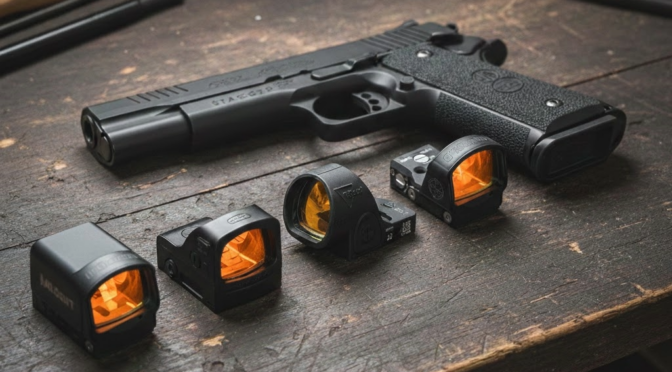
This comprehensive industry analysis evaluates the current landscape of Miniature Red Dot Sights (MRDS) within the context of law enforcement duty applications, specifically anchored by the United States Marshals Service Special Operations Group (USMS SOG) selection of the Leupold DeltaPoint Pro (DPP) integrated with the Staccato 2011 platform. The report aims to dissect the technical, operational, and logistical factors driving this high-profile procurement decision, while simultaneously conducting an exhaustive comparative assessment against market-leading competitors including Trijicon, Aimpoint, Holosun, and Vortex. The objective is to provide agency procurement officers, armorers, and industry stakeholders with a definitive, data-driven hierarchy of optic suitability for modern policing requirements, ranging from specialized tactical intervention to general patrol duties.
1.2 The USMS SOG Procurement Paradigm
The selection of the Staccato P Duo paired with the Leupold DeltaPoint Pro marks a significant divergence from the prevailing law enforcement standard of striker-fired polymer pistols equipped with Trijicon RMRs. This decision by the USMS SOG—a unit tasked with high-risk warrant service and fugitive apprehension—signals a prioritization of terminal ballistics, trigger precision, and optical clarity over absolute equipment hardening or acquisition cost.1
The choice of the Leupold DeltaPoint Pro, specifically, highlights a critical operational trade-off. While the Trijicon RMR Type 2 was widely regarded as the durability gold standard in 2019, its small window and bottom-loading battery presented functional limitations for operators using Night Vision Goggles (NVG) or requiring rapid target acquisition in dynamic environments. The DPP offered a massive, crystal-clear “heads-up” display and a top-loading battery compartment, solving logistical pain points at the cost of increased mechanical fragility.3 This report posits that the SOG’s choice was driven by a “performance-first” doctrine suitable for elite units with aggressive maintenance schedules, rather than a “durability-first” doctrine required for general patrol.
1.3 Market Evolution: The Enclosed Emitter Shift
Since the USMS procurement, the MRDS market has undergone a radical transformation driven by the “Enclosed Emitter” revolution. The introduction of the Aimpoint Acro P-2, Holosun 509T, and Trijicon RCR has fundamentally altered the baseline requirements for duty optics. These systems mitigate the primary failure mode of open-emitter sights like the DPP and RMR: the obstruction of the LED projection path by environmental debris (water, mud, snow, lint).5
1.4 Key Findings and Operational Verdicts
- Optical Superiority vs. Mechanical Hardening: The Leupold DeltaPoint Pro remains the leader in optical clarity and window size, offering superior light transmission for NVG operations. However, extensive testing by Sage Dynamics and other independent bodies indicates it is more susceptible to catastrophic failure from high-G impacts compared to the Trijicon RMR or Aimpoint Acro.7
- Platform Specificity: The success of the DPP in the USMS program is inextricably linked to the Dawson Universal Optic (DUO) mounting system, which mitigates the optic’s excessive deck height. On other platforms, the DPP often sits too high for effective co-witness without specialized suppressor-height sights.3
- The New Duty Standard: While the DPP and RMR remain viable, the analysis concludes that Enclosed Emitter Optics now represent the optimal solution for general law enforcement duty. The Aimpoint Acro P-2 stands as the current durability benchmark, with the Trijicon RCR offering a seamless transition for agencies already invested in RMR-footprint slides.5
2. Strategic Context: The USMS SOG Modernization Program
To understand the selection of the Leupold DeltaPoint Pro, one must first analyze the unique operational environment of the United States Marshals Service Special Operations Group (USMS SOG). This is not a standard patrol force; it is a Tier 1-adjacent federal tactical unit operating in the highest threat environments within the domestic United States.
2.1 The Transition: From 1911 to 2011
For sixteen years prior to the Staccato adoption, the SOG fielded the Springfield Armory Professional 1911 in.45 ACP.1 This establishes a clear unit culture favoring the single-action trigger mechanism and the ergonomics of the 1911 platform over the polymer, striker-fired mechanics of the ubiquitous Glock or Sig Sauer P320.
The transition to the Staccato P (formerly STI) was driven by the need for increased capacity and modernization while retaining the shootability of the 1911 trigger. The Staccato P is a “2011” platform—a double-stack 1911 that utilizes a modular grip frame (polymer grip module bolted to a steel frame) to accommodate 17+ or 21+ round magazines of 9mm ammunition, significantly upgrading firepower from the 7-8 round capacity of the.45 ACP 1911.2
This weapon system context is crucial for optic selection. The recoil impulse of a heavy, metal-framed, 9mm 2011 is significantly flatter and smoother than a.40 caliber Glock 22. This reduced slide velocity and harmonic vibration profile may exert less destructive force on the optic’s electronics compared to the “snappy” recoil of lighter polymer service pistols, potentially allowing the SOG to utilize the DeltaPoint Pro with higher reliability rates than municipal agencies might experience on their standard issue firearms.2
2.2 The Dawson Universal Optic (DUO) Interface
A primary engineering challenge in adopting the Leupold DeltaPoint Pro is its physical dimension. The DPP has a notably tall “deck height”—the vertical distance from the bottom of the optic to the bottom of the viewing window. On a standard pistol slide, this height often blocks standard iron sights, necessitating the installation of extremely tall “suppressor-height” sights to achieve a backup sight picture.11
The USMS SOG partnered with Dawson Precision to solve this. The resulting DUO (Dawson Universal Optic) system is a proprietary mounting solution designed specifically for the Staccato platform.
- Deep Milling: The slide is milled to accept the optic as deeply as structurally possible.
- Integrated Rear Sight: Unlike other systems where the rear iron sight is dovetail-mounted to the slide behind the optic, the DUO system for the DPP incorporates a rear sight that attaches to the back of the optic itself or a specialized plate. This ensures that despite the DPP’s height, a lower-1/3 co-witness is maintained without creating an unwieldy vertical profile.1
- The “Duty” Configuration: This integration was a mandatory requirement for the USMS. The ability to seamlessly transition from optic to iron sights in the event of failure is a non-negotiable standard for tactical teams.

2.3 The “Performance First” Philosophy
The selection of the DPP over the Trijicon RMR Type 2 (the dominant industry standard at the time) reveals a distinct prioritization of “shootability” over “ruggedness.”
- Window Geometry: The DPP features a large, rectangular window with a thin frame. In Close Quarters Battle (CQB), this wider field of view (FOV) allows operators to track moving targets more effectively and recover the dot faster during rapid strings of fire.
- Night Vision Compatibility: SOG operators frequently conduct raids under night vision. The DPP’s larger window and superior light transmission (due to distinct glass coatings) provide a clearer passive aiming channel through NVG tubes than the smaller, blue-tinted window of the RMR.4
- Maintenance Tempo: As a special operations unit, SOG has the logistical infrastructure to conduct regular preventative maintenance (swapping batteries, inspecting screws). This mitigates the risks associated with the DPP’s shorter battery life or potential durability concerns that would be unacceptable for a general patrol officer who might inspect their weapon only once a month.2
3. Technical Monograph: Leupold DeltaPoint Pro
3.1 Design Architecture and Optical System
The Leupold DeltaPoint Pro is an open-emitter reflex sight engineered with a focus on optical fidelity. The housing is constructed from aircraft-grade aluminum, encased in a spring-steel shroud. This “shroud” architecture is Leupold’s primary impact mitigation strategy, designed to act as a crumple zone or armor plating that absorbs energy before it can deform the lens housing.4
3.1.1 The Aspheric Lens Advantage
A key differentiator of the DPP is its optical glass. Leupold utilizes an aspheric lens design, which is shaped to reduce spherical aberration. In cheaper optics, the red dot can distort or “comma” near the edges of the lens (rectilinear distortion). The DPP maintains a crisp, circular dot across a larger percentage of the lens surface area. This edge-to-edge clarity is critical for shooting from unconventional positions where the dot may not be perfectly centered in the window.4
3.1.2 Motion Sensor Technology (MST)
To conserve battery life, the DPP employs a proprietary accelerometer-based system known as Motion Sensor Technology (MST). The optic automatically enters a sleep mode after 5 minutes of inactivity and wakes instantly upon detecting motion.
- Reliability: Field reports indicate high reliability for the MST system. The sensitivity is tuned to detect even the micro-vibrations of unholstering a weapon, ensuring the dot is active before the weapon reaches eye level.14
- Battery Efficiency: This system allows the single CR2032 battery to last significantly longer in intermittent duty use than its raw “always-on” runtime would suggest (approx. 300 to 1600 hours depending on brightness).16 However, this is still significantly lower than the 50,000-hour continuous runtimes of competitors like Aimpoint, necessitating the reliance on the sleep mode circuitry.
3.2 Electronics and Interface
3.2.1 The Top-Loading Battery
One of the DPP’s most significant advantages over the Trijicon RMR is its battery compartment. The battery is accessed via a spring-loaded latch on top of the optic housing. This allows the battery to be changed without unmounting the optic from the pistol slide.
- Logistical Impact: For the RMR Type 2, a battery change requires removing the optic, which breaks the thread locker seal on the mounting screws and necessitates re-confirming the zero at a range. For the DPP, a battery swap can be performed in the field in under 60 seconds with no shift in zero. For high-tempo units like USMS SOG, this reduces downtime significantly.4
3.2.2 The Single-Button Interface
Ergonomically, the DPP suffers from a simplistic control scheme. It utilizes a single button located on the battery compartment to cycle through brightness settings.
- Operational Liability: To adjust brightness, the user must press the button to cycle through the entire range (Low -> High -> Low). If an officer inadvertently cycles past their desired setting, they must cycle through all settings again to return. This is slower and more prone to error under stress than the dedicated “+” and “-” buttons found on the Holosun 509T or Trijicon RMR.11
3.3 Reliability and Durability Assessment
Despite the steel shroud, the Leupold DeltaPoint Pro has faced consistent scrutiny regarding its durability in “duty” conditions compared to the Trijicon RMR.
3.3.1 The Sage Dynamics Findings
The “White Paper” on MRDS duty use by Aaron Cowan of Sage Dynamics is the industry benchmark for durability testing. His testing protocols involve drop tests (shoulder height, optic down) onto concrete every 500 rounds.
- Glass Integrity: Early iterations of the DPP showed a vulnerability to glass breakage during these drop tests. The large, tall window presents a greater surface area for impact, and the aluminum hood, while armored, could deform enough to crack the lens.7
- Electronic Continuity: Historical data indicated issues with battery contacts flickering under the high G-forces of slide reciprocation. Leupold addressed this in later revisions (post-2018) with improved battery contact springs and circuit board potting, but the reputation for fragility persists relative to the RMR.8
3.3.2 Environmental Susceptibility
As an open-emitter sight, the DPP is vulnerable to the “rain drop” failure mode. If water, mud, snow, or lint falls into the emitter well (the area behind the lens where the LED resides), the projection path is blocked. This results in the reticle disappearing or “starbursting” into an unusable bloom. While this is a vulnerability shared by all open-emitter sights (including the RMR), it is a critical consideration for duty use in adverse weather.11

4. Market Leader Analysis: Trijicon
To evaluate the USMS selection, one must compare the DPP against the industry hegemon: Trijicon.
4.1 Trijicon RMR Type 2 (Ruggedized Miniature Reflex)
- The Standard: The RMR Type 2 is the most widely deployed duty optic in US law enforcement. Its patented “owl ear” housing shape diverts impact energy around the lens, making it exceptionally durable.
- Comparison to DPP:
- Durability: RMR is superior. It consistently survives multiple drop tests that disable other optics.19
- Optical: RMR is inferior. The window is smaller, heavily tinted blue (notch filter), and has more distortion.
- Battery: RMR is inferior. Bottom-loading design requires removal for battery changes.
- Verdict: The RMR is the “safe” choice for general issue. It is harder to break but harder to shoot (due to window size) than the DPP.20
4.2 Trijicon RCR (Ruggedized Closed Reflex)
- The Innovation: Released to compete with enclosed emitters, the RCR maintains the RMR footprint but adds a sealed housing.
- Mounting System: It uses a unique capstan screw system that allows it to mount to standard RMR cuts from the side, avoiding the need for new plates.
- Performance: It matches the RMR in durability but eliminates the debris failure mode. It stands as a direct, superior replacement for the RMR in current fleets.10
4.3 Trijicon SRO (Specialized Reflex Optic)
- Comparison to DPP: Like the DPP, the SRO features a massive, circular window designed for competition.
- Duty Rating: The SRO is not duty rated. Its protruding lens housing lacks the impact protection of the RMR or DPP shroud. Drop tests frequently result in shattered glass. While popular in competition (USPSA), it is generally prohibited for duty use by rigorous agency policies.22
5. The Challenger: Aimpoint & The Enclosed Emitter
The most significant shift in the market since the USMS decision has been the rise of Aimpoint’s enclosed systems.
5.1 Aimpoint Acro P-2
- Architecture: The Acro P-2 is a fully enclosed “mailbox” design. The emitter is sealed within a nitrogen-purged box.
- Durability: It is widely considered the most durable pistol optic currently available. It can withstand submersion to 35 meters and extreme temperature fluctuations (-49°F to 160°F).5
- Mounting Standard: Unlike the RMR or DPP which use vertical screws (prone to shearing under shear stress), the Acro uses a cross-bolt clamping mechanism similar to a Picatinny rail grabber. This is mechanically superior for resisting recoil forces.24
- Battery: The P-2 upgraded to a CR2032 battery (from the P-1’s CR1225), achieving 50,000 hours of continuous runtime. This rivals the Trijicon RMR and vastly outperforms the DPP.5
5.2 Operational Advantage
For general patrol officers who work in rain, snow, or dusty environments, the Acro P-2 eliminates the need to constantly clean out the emitter well. A quick wipe of the rear lens with a thumb is all that is required to restore a sight picture. This reliability factor is driving agencies away from open emitters like the DPP and RMR.6
6. The Value Competitors: Holosun & Vortex
6.1 Holosun 509T & EPS
- Holosun 509T: Constructed from Titanium (stronger and lighter than the 7075 Aluminum used by competitors), the 509T is an enclosed emitter sight that has passed rigorous duty testing by Sage Dynamics. It features a solar failsafe and a multi-reticle system (circle-dot) that many users prefer for rapid acquisition.
- Holosun EPS (Enclosed Pistol Sight): A newer iteration designed with a lower deck height. This allows it to co-witness with standard-height iron sights on many platforms, eliminating the need for tall suppressor sights—a major ergonomic advantage over the Acro and 509T.26
- The “China” Factor: While technically superior in features and price, Holosun’s manufacturing origin (China) restricts its adoption by some federal agencies due to strict procurement policies (TAA compliance), though it is widely used by local/state LE.26
6.2 Vortex Defender ST
- The Contender: Vortex entered the duty market with the Defender ST, specifically targeting the Leupold DPP footprint.
- Features: It includes a “Fast-Rack” knurled front face, designed to aid in one-handed slide manipulation (racking the slide off a belt or boot).
- Durability: Initial testing shows promise, but it lacks the decade-long track record of the RMR or the institutional trust of Aimpoint. Its primary selling point is the unconditional lifetime warranty, which appeals to budget-conscious departments.29

7. Comparative Analysis: Performance Metrics
7.1 Optical Fidelity and NVG Performance
- Transmission: The Leupold DPP leads the pack in light transmission. Its glass coatings are optimized for low-light performance, providing a bright, crisp image with minimal tint.
- NVG Performance: Under night vision, the DPP’s “Night Vision” specific settings allow for very dim dots that do not bloom (halo) inside the goggles. Combined with the large window, it offers the best passive aiming experience. The Trijicon RMR Type 2 has only 2 NV settings and a smaller, darker window, making it less optimal for this specific role.31
7.2 Battery Logistics and Maintenance
- Runtime: Aimpoint Acro P-2 and Trijicon RMR dominate with ~4-5 years of always-on life. The DPP lags behind significantly (months, not years) and relies on MST to compete.
- Change Procedure: The DPP and Acro P-2 feature accessible battery compartments (top and side, respectively). The RMR Type 2 requires unmounting. For a fleet of 1,000 officers, the RMR’s requirement to re-zero every battery change represents hundreds of man-hours of range time. The DPP eliminates this cost.5
7.3 Parallax
All red dots exhibit some parallax shift (where the dot moves relative to the target if the shooter’s head moves).
- Testing Data: Independent parallax testing often shows the Aimpoint Acro P-2 and Eotech EFLX having less parallax shift at the edges of the window compared to the RMR and DPP. However, inside 25 yards, this shift is generally negligible for defensive handgun applications (less than 2-3 inches).33
8. Operational Integration and Training Implications
Adopting the Leupold DeltaPoint Pro or any MRDS requires a doctrinal shift in training.
8.1 “Finding the Dot”
The most common failure point for officers transitioning to red dots is “losing the dot” during the draw.
- The DPP Advantage: The DPP’s large vertical window makes it more forgiving. If the muzzle is slightly high or low during presentation, the dot is more likely to still be visible within the glass than in the smaller window of an RMR. This reduces the training curve for new users.12
8.2 Occluded Shooting
Training must address optic failure. If the front lens is blocked by mud (but the emitter is working), officers are trained in “Occluded Eye Aiming” (using both eyes open to superimpose the dot on the target).
- Enclosed vs. Open: Enclosed emitters (Acro, 509T) are far easier to wipe clear in the field. An open emitter filled with mud (DPP, RMR) is effectively disabled until it can be washed out with water or compressed air, forcing the officer to transition to iron sights immediately.7
8.3 Holster Compatibility
The adoption of MRDS necessitates new holsters. The standard retention holster (e.g., Safariland 6360RDS) features a rotating hood that covers the optic.
- Size Constraints: The Aimpoint Acro and Holosun 509T are physically larger/boxier than the RMR. While Safariland makes hoods for all of them, agencies must ensure their holster procurement matches the specific optic footprint. The tall deck height of the DPP can sometimes interfere with older holster hood designs intended for the lower-profile RMR.34
9. The Future of Duty Optics
The trajectory of the market is clear. While the Leupold DeltaPoint Pro remains a capable optic, the industry standard for duty use is consolidating around Enclosed Emitter Systems.
9.1 The “Closed” Standard
The failure of open emitters in adverse weather is a liability that can now be eliminated with off-the-shelf technology. Agencies drafting new Requests for Proposals (RFPs) in 2025/2026 are increasingly mandating “closed emitter” architecture as a threshold requirement.6
9.2 Smart Optics
The next frontier involves “smart” features. Technology like round counters, integrated displays (communicating with the weapon light or radio), and auto-ranging reticles are in development. However, for the immediate future, simplicity and durability remain the primary drivers for LEO selection.
10. Conclusion and Recommendations
The USMS SOG’s selection of the Leupold DeltaPoint Pro was a logical, performance-driven decision for a Tier 1-capable unit operating the Staccato platform. The DPP’s superior window size and NVG performance provide a distinct tactical advantage for specialized operators who can manage the maintenance requirements.
However, for the broader law enforcement community, the landscape has shifted. The Enclosed Emitter is the new gold standard.
10.1 Ranked Recommendations for LEO Duty Use (2026)

- Tier 1 (The New Standard):
- Aimpoint Acro P-2: The definitive choice for new procurements. Unmatched environmental hardening.
- Trijicon RCR: The optimal upgrade for existing RMR fleets.
- Holosun 509T: The best performance-per-dollar ratio, provided agency policy allows.
- Tier 2 (The Proven Legacy):
- Trijicon RMR Type 2: Still a viable, incredibly durable option, but optically dated.
- Trijicon RMR HD: An excellent evolution, but open-emitter architecture prevents it from reaching Tier 1 for all-weather duty.
- Tier 3 (Specialized/Niche):
- Leupold DeltaPoint Pro: Recommended specifically for Specialized Units (SWAT) prioritizing NVG performance and window size over absolute ruggedness.
- Vortex Defender ST: A viable budget alternative for DPP-footprint slides, backed by a strong warranty.
Final Analyst Verdict: The USMS SOG proved that the Leupold DeltaPoint Pro is a lethal tool in the hands of experts. However, for the average patrol officer, the durability and reliability of an enclosed system like the Aimpoint Acro P-2 offers the highest probability of success in the unforgiving reality of police work.
Please share the link on Facebook, Forums, with colleagues, etc. Your support is much appreciated and if you have any feedback, please email us in**@*********ps.com. If you’d like to request a report or order a reprint, please click here for the corresponding page to open in new tab.
Sources Used
- The STI Staccato-P is the USMS SOG’s newest adaptation – Precision Technic Defence, accessed February 12, 2026, https://ptdefence.com/the-sti-staccato-p-is-the-usms-sogs-newest-adaptation/
- Exclusive: U.S. Marshals Special Operations Group Adopts STI 2011 Pistols – Guns.com, accessed February 12, 2026, https://www.guns.com/news/2019/07/24/exclusive-u-s-marshals-special-operations-group-adopts-sti-2011-pistols
- United States Marshals Service Selects Leupold DeltaPoint Pro, Dawson Precision Sights for Duty Firearms, accessed February 12, 2026, https://www.leupold.com/blog/post/united-states-marshals-service-selects-leupold-deltapoint-pro-dawson-precision-sights-duty-firearms
- The DeltaPoint Pro – A Red Dot That Delivers – Leupold, accessed February 12, 2026, https://www.leupold.com/blog/post/a-red-dot-that-delivers
- Aimpoint ACRO P-2 Review: Rugged Red Dot Sight – The Armory Life, accessed February 12, 2026, https://www.thearmorylife.com/aimpoint-acro-p-2-review/
- Enclosed MRDS Buyer’s Guide [2026] – Recoil Magazine, accessed February 12, 2026, https://www.recoilweb.com/enclosed-mrds-buyers-guide-183551.html
- Miniaturized Red Dot Systems for Duty Handgun Use – Kentucky Tactical Officers Association, accessed February 12, 2026, http://www.kentuckytacticalofficersassociation.org/uploads/4/0/6/1/40615731/sage_dynamics_pistol_red_dot_white_paper.pdf
- Delta point pro g2g? : r/guns – Reddit, accessed February 12, 2026, https://www.reddit.com/r/guns/comments/spt88o/delta_point_pro_g2g/
- STI Staccato: Reporting for Duty – Recoil Magazine, accessed February 12, 2026, https://www.recoilweb.com/sti-staccato-reporting-for-duty-156284.html
- Trijicon RMR HD vs RCR: Full Optic Comparison – Freedom Gorilla, accessed February 12, 2026, https://freedomgorilla.com/blogs/news/trijicon-rmr-hd-vs-rcr
- Leupold Delta Point Pro : r/handguns – Reddit, accessed February 12, 2026, https://www.reddit.com/r/handguns/comments/1gey902/leupold_delta_point_pro/
- Leupold Delta Point Pro Review – Optics Force, accessed February 12, 2026, https://opticsforce.com/blogs/news/leupold-delta-point-pro-review
- U.S. Marshals Adopt Leupold Delta Point Pro And Dawson Precision Sights, accessed February 12, 2026, https://www.thefirearmblog.com/blog/2019/07/08/u-s-marshals-adopt-leupold-delta-point-pro-and-dawson-precision-sights/
- Leupold DeltaPoint Pro Optic – Staccato 2011, accessed February 12, 2026, https://staccato2011.com/products/leupold-deltapoint-pro-optic
- Leupold® DeltaPoint® Pro Reflex Sight, accessed February 12, 2026, https://www.leupold.com/media/manuals/deltapoint-pro-manual.pdf
- DeltaPoint Pro | Leupold, accessed February 12, 2026, https://www.leupold.com/deltapoint-pro-red-dot
- Leupold DeltaPoint Pro Red Dot Micro Optic Review (HD) – YouTube, accessed February 12, 2026, https://www.youtube.com/watch?v=uaCwaOgWiUI
- Why Choose An Enclosed Emitter Red Dot Sight? | An Official Journal Of The NRA, accessed February 12, 2026, https://www.shootingillustrated.com/content/why-choose-an-enclosed-emitter-red-dot-sight/
- Results of a 4 Year Handgun Red Dot Study by Sage Dynamics : r/CCW – Reddit, accessed February 12, 2026, https://www.reddit.com/r/CCW/comments/6uixc5/results_of_a_4_year_handgun_red_dot_study_by_sage/
- Best Pistol Red Dot Sights: 8 Tested in 2026 – Scopes Field, accessed February 12, 2026, https://scopesfield.com/best-pistol-red-dot-sights/
- The Trijicon RMR HD & RCR: Next-Gen Ruggedness | An Official Journal Of The NRA, accessed February 12, 2026, https://www.americanrifleman.org/content/the-trijicon-rmr-hd-rcr-next-gen-ruggedness/
- RMR HD vs SRO vs RCR : r/2011 – Reddit, accessed February 12, 2026, https://www.reddit.com/r/2011/comments/1lyv8oa/rmr_hd_vs_sro_vs_rcr/
- One reviewer’s experience with the Acro P-2 red dot sight – Police1, accessed February 12, 2026, https://www.police1.com/police-products/firearms/accessories/articles/one-reviewers-experience-with-the-acro-p-2-red-dot-sight-Yp8HTlHS0vVnFVs0/
- Footprints/Mounting Standards on Red Dot Sights – Optics Trade Blog, accessed February 12, 2026, https://www.optics-trade.eu/blog/footprints-on-red-dot-sights/
- Is the ACRO P2 dependable and durable or not? I’ve seen conflicting experiences – Reddit, accessed February 12, 2026, https://www.reddit.com/r/QualityTacticalGear/comments/1oh09se/is_the_acro_p2_dependable_and_durable_or_not_ive/
- Best holosun duty option – Reddit, accessed February 12, 2026, https://www.reddit.com/r/HOLOSUN/comments/1bfkd8n/best_holosun_duty_option/
- Holosun 509T Overview + Compared to EPS – YouTube, accessed February 12, 2026, https://www.youtube.com/watch?v=gWdE_VslBDU
- Best Pistol Red Dot Sights to Buy in 2025 – Blog.GritrOutdoors.com, accessed February 12, 2026, https://blog.gritroutdoors.com/best-pistol-red-dot-sights/
- Vortex Defender ST Review — Military-Grade Red Dot + Torture Test – YouTube, accessed February 12, 2026, https://www.youtube.com/watch?v=F0JYiApy1uw
- Vortex Defender Testing – Guns & Gear – USCCA Community, accessed February 12, 2026, https://community.usconcealedcarry.com/t/vortex-defender-testing/120383
- Everything You Need to Know about Your DeltaPoint Pro – T.REX ARMS, accessed February 12, 2026, https://www.trex-arms.com/videos/MynCiRpdqm/
- Leupold DPP For Duty Use | Primary & Secondary Forum, accessed February 12, 2026, https://primaryandsecondary.com/forum/index.php?threads/leupold-dpp-for-duty-use.8742/
- DeltaPoint Pro 6 MOA – Leupold, accessed February 12, 2026, https://www.leupold.com/deltapoint-pro-6-moa
- Mounting Standards: 2025 Guide to Red Dot Footprints – Inside Safariland, accessed February 12, 2026, https://inside.safariland.com/blog/mounting-standards-a-guide-to-red-dot-footprints/