Category Archives: Analytics and Reports

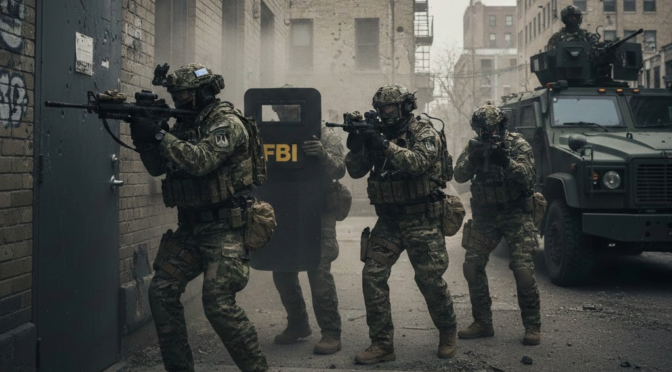
The FBI’s Hostage Rescue Team: Small Arms Overview For 2024-2025

1. Executive Summary

The Federal Bureau of Investigation (FBI) Hostage Rescue Team (HRT) represents the United States’ primary domestic counterterrorism and high-risk tactical unit. Operating under the Critical Incident Response Group (CIRG), the HRT maintains a capability set that mirrors Tier 1 military special operations units, necessitating an arsenal that is both technologically advanced and mission-adaptable. This report provides a comprehensive examination of the small arms currently fielded by the HRT as of the 2024-2025 operational cycle.

Current procurement trends within the HRT signify a paradigm shift toward modularity, signature management, and enhanced terminal ballistics. The team has moved away from legacy.45 ACP and.40 S&W handguns in favor of the 9x19mm Glock “M” series, a decision rooted in exhaustive testing that validated the performance of modern 147-grain jacketed hollow-point ammunition. In the primary weapon category, the HRT has standardized an 11.5-inch barreled carbine utilizing the Geissele MK4 Federal rail system, optimizing for a balance of maneuverability and mechanical dwell time.

Furthermore, the HRT is leading a transition from traditional submachine guns to Personal Defense Weapons (PDWs) like the SIG Sauer MCX Rattler, which offers rifle-caliber lethality in a concealable package. Precision marksman elements are evolving through the adoption of 6.5 Creedmoor semi-automatic systems to augment their traditional bolt-action inventory, provided by GA Precision. This report details the technical specifications of these systems, the ballistic rationale for their selection, and the integration of secondary systems such as HUXWRX and SureFire suppressors, Nightforce and Aimpoint optics, and advanced laser aiming modules. Each selection is a calculated response to the evolving domestic threat landscape, where the proliferation of body armor and high-capacity weaponry among adversaries requires the HRT to maintain an absolute margin of superiority.

2. Institutional Framework and Procurement Philosophy

The selection of small arms for the FBI Hostage Rescue Team is governed by the Bureau’s Defensive Systems Unit (DSU) and the Firearms Training Unit (FTU), often in collaboration with the Ballistics Research Facility (BRF).1 Unlike standard law enforcement procurement, which may prioritize cost and ease of maintenance, the HRT’s requirements are driven by the “National Mission Force” status of the team. This status requires that the weaponry perform across disparate environments, from the high-humidity maritime domains of the Gold Squadron to the extreme cold of high-altitude operations.2

The procurement philosophy is currently defined by three core pillars:

  1. Reliability under Volume: Systems must withstand firing schedules that far exceed standard law enforcement duty cycles. For instance, handgun testing protocols involved 120,000 rounds without a single mechanical failure.1
  2. Signature Management: As the HRT operates extensively under night vision (NODs), the suppression of muzzle flash and the reduction of gas blowback are prioritized to protect the operator’s vision and long-term health.3
  3. Modular Integration: Weapons are no longer viewed as standalone items but as “chassis” for an integrated system of optics, lasers, and suppressors. The adoption of the M-LOK standard and specialized rail systems like the Geissele MK4 Federal allows for this seamless integration.5

3. Sidearm Systems: The Glock “M” Series Transition

The HRT has completed a transition to the Glock 17M and Glock 19M as its primary sidearms.1 This shift represents a departure from the.45 ACP Springfield Armory 1911s that were a hallmark of the team for decades. The “M” series was the precursor to the civilian Generation 5 Glock, incorporating specific features requested by the FBI to address high-stress operational needs.1

3.1 Technical Specifications of the Glock 17M and 19M

The Glock 17M (Full Size) and 19M (Compact) are striker-fired, polymer-framed pistols chambered in 9x19mm Parabellum.1 The “M” designation identifies several internal and external modifications. Externally, the pistols lack the finger grooves found on previous generations, allowing for a more universal grip across different hand sizes and glove types.1 The magazine well is flared to facilitate rapid reloads, and the slide stop/release is ambidextrous and shielded to prevent accidental activation.1

AttributeGlock 17MGlock 19M
Caliber9x19mm Parabellum9x19mm Parabellum
ActionStriker-Fired, Safe ActionStriker-Fired, Safe Action
Barrel Length4.49 inches (114 mm)4.02 inches (102 mm)
Barrel TypeGlock Marksman Barrel (GMB)Glock Marksman Barrel (GMB)
Capacity17+1 Rounds15+1 Rounds
Sight Radius6.50 inches6.02 inches
Trigger Pull4.5 – 6.0 lbs4.75 – 5.0 lbs [Actual]
Weight (Loaded)33.33 oz32.50 oz

The Glock Marksman Barrel (GMB) features a modified polygonal rifling and a crowned muzzle, which significantly improves accuracy over legacy Glock barrels.1 In testing, the GMB consistently produced groups under 2 inches at 25 yards, meeting the HRT’s requirement for surgical secondary fire.1

3.2 Selection Rationale: The 9mm Ballistic Study

The primary driver for the switch to 9mm was a 2014 study by the FBI Training Division which concluded that modern 9mm projectiles are as effective as.40 S&W or.45 ACP in terminal performance while offering numerous operational advantages.7 The HRT currently utilizes the Speer 147-grain G2 Gold Dot JHP.1

The rationale for this selection includes:

  • Terminal Performance: The G2 Gold Dot features an internal elastomer in the hollow point cavity, which ensures consistent expansion even after passing through barriers like plywood, heavy clothing, or automotive glass.1
  • Magazine Capacity: Moving to 9mm allows operators to carry 15-17 rounds per magazine compared to the 7-8 rounds in a 1911. A standard HRT loadout includes four 15-round magazines with orange followers, totaling 61 rounds of carry potential.1
  • Recoil and Recovery: The lower recoil impulse of the 9mm Parabellum allows for faster split times between shots, which is critical in the CQB (Close Quarters Battle) environments typical of hostage rescue missions.1

4. The Primary Service Carbine: 11.5-inch HRT Configuration

The HRT’s primary long gun is a highly customized M4-variant carbine, often called the “FBI HRT Carbine” in enthusiast and industry circles.9 While the Bureau utilizes various manufacturers for lower receivers, including Colt and Rock River Arms, the upper receiver groups are built to a very specific technical standard.9

4.1 The 11.5-inch Barrel and Gas System

Unlike the 10.3-inch barrel used in the US military’s Mk18, the HRT has standardized the 11.5-inch barrel.11 This decision is based on the physics of the AR-15 gas system. An 11.5-inch barrel provides approximately 40% more “dwell time” than a 10.3-inch barrel when using a carbine-length gas system.13 Dwell time is the duration the gas system remains pressurized after the bullet passes the gas port but before it exits the muzzle.

The increased dwell time in the 11.5-inch system leads to:

  • Enhanced Reliability: More consistent bolt carrier velocity across different ammunition types and environmental conditions.13
  • Reduced Parts Wear: The gas port can be sized more conservatively (approximately.070″), reducing the “violent” nature of the cycling action and extending the life of the bolt and extractor.14
  • Improved Velocity: The extra 1.2 inches provides a significant boost in muzzle velocity, which is vital for the terminal expansion of 5.56mm duty rounds at distances beyond 100 yards.12
ComponentTechnical DetailRationale
Barrel ManufacturerDaniel Defense / Colt 9Cold Hammer Forged (CHF) for durability.
Twist Rate1:7″ 11To stabilize heavy 77gr OTM duty rounds.
Chamber5.56x45mm NATO 15Accommodates higher-pressure service ammo.
Muzzle DeviceSureFire 3-Prong SOCOM 11Optimized for suppressor attachment.
BCG CoatingNanoweapon / DLC 16Reduced friction and increased wear resistance.

4.2 The Geissele MK4 Federal Rail System

The most recognizable component of the HRT carbine is the Geissele 10-inch MK4 Federal Super Modular Rail (SMR) in Olive Drab Green.5 This rail was purpose-built for the FBI and features integrated M1913 Picatinny sections at the 3, 6, and 9 o’clock positions at the forward end of the rail.5

The MK4 Federal rail was selected for its structural rigidity. In tactical operations involving night vision, operators utilize infrared (IR) lasers for aiming. Any “flex” in a handguard can cause the laser to shift its point of aim relative to the barrel. The 7000-series aluminum construction and the long barrel nut design of the Geissele rail ensure that even when an operator is bracing the weapon against a barricade, the laser remains zeroed.5 The OD Green color is a specific HRT requirement, though black and gray versions are used by other regional FBI SWAT teams.6

5. Personal Defense Weapons: The Transition from 9mm to.300 Blackout

The HRT has long relied on the Heckler & Koch MP5 submachine gun for specialized roles.2 However, the 9mm Parabellum round’s inability to defeat modern body armor and its limited effective range have led the HRT to transition toward Personal Defense Weapons (PDWs) chambered in.300 Blackout, specifically the SIG Sauer MCX Rattler.19

5.1 The Legacy and Limitations of the MP5

The HRT still maintains an inventory of the MP5SD6 (integrally suppressed) and the MP5/10A3 (chambered in 10mm Auto).2 The MP5/10 was a unique Bureau requirement to provide greater stopping power than 9mm, but the platform is “long in the tooth”.20 The roller-delayed system is smooth, but it lacks the modularity for modern optics and lasers, and the 10mm round still suffers from the trajectory limitations of a pistol cartridge.22

5.2 SIG Sauer MCX Rattler and.300 Blackout Integration

The SIG Sauer MCX Rattler is a short-stroke gas piston system that allows for a folding stock—an impossibility for the standard AR-15 due to the buffer tube requirement.19 This makes the Rattler extremely concealable, fitting into discrete bags for low-profile operations.19

The.300 Blackout (.300 BLK) cartridge is the primary driver for this transition. It allows the HRT to achieve two distinct mission profiles with a single weapon:

  1. Subsonic Stealth: Using 220-grain projectiles, the Rattler is as quiet as an MP5SD but with significantly more terminal mass.25
  2. Supersonic Potency: Using 110-grain projectiles, the Rattler achieves the muzzle energy of a 5.56mm carbine from a barrel as short as 5.5 inches.20
FeatureSIG MCX Rattler SpecOperational Advantage
Barrel Length5.5 to 6.75 inches 23Optimal for CQB and concealment.
ActionShort-Stroke Piston 23Cleaner running, especially suppressed.
Caliber.300 Blackout 24Dual-role (Supersonic/Subsonic).
Weight~5.7 lbs 23Highly maneuverable.
SuppressorSIG SLH/SLX Ready 26Direct integration with signature reduction.

6. Precision Rifle Inventory: GA Precision and KAC SR-25

The HRT sniper element operates a two-tier system: bolt-action rifles for maximum surgical precision and semi-automatic rifles for rapid engagement of multiple targets.2

6.1 The GA Precision FBI HRT Bolt-Action Rifle

The primary bolt-action rifle is custom-built by GA Precision.29 This rifle is built on the Templar V3 action, a robust short-action design featuring a one-piece fluted bolt.29

Technical Build Specs:

  • Barrel: 22-inch Bartlein Stainless Steel with a 1:11.25 twist and 5R rifling.30 The 5R rifling profile has non-opposing lands, which reduces bullet deformation and is widely believed to result in higher velocities and easier cleaning.15
  • Stock: McMillan A3-5 adjustable stock in OD Green.29 The stock is pillar-bedded with Marine Tex, ensuring that environmental factors like humidity do not affect the rifle’s zero.30
  • Trigger: Timney or TriggerTech Primary, set to a 2.5 lb break.29
  • Performance: The rifle is guaranteed to provide 3/8 MOA accuracy with match-grade ammunition.29

6.2 The Semi-Automatic Sniper Role: KAC SR-25 and M110

The HRT utilizes the Knight’s Armament Company (KAC) SR-25, often in the M110 configuration.2 This semi-automatic platform allows snipers to provide rapid follow-up shots in scenarios such as vehicle interdictions or multiple-hostage situations where a bolt-action rifle would be too slow.28

Current Technical Configuration: The SR-25 Enhanced Match (EM) utilizes the URX II rail system and a 16-inch or 20-inch barrel.27 The SR-25’s barrel was originally manufactured by Remington Arms with 5R rifling, mirroring the rifling profile found in the HRT’s bolt guns to ensure consistent ballistic performance across the sniper element.27

6.3 Strategic Shift to 6.5 Creedmoor

In 2024-2025, the HRT is actively evaluating a shift from 7.62x51mm NATO to 6.5 Creedmoor for its semi-automatic precision platforms.34 The 6.5 Creedmoor offers a 20-30% improvement in wind-bucking capability and stays supersonic for several hundred yards longer than the.308 Winchester.34 This caliber change allows HRT marksmen to maintain a smaller, more agile 16-inch rifle while achieving the ballistic performance of a much heavier 22-inch.308 rifle.34

7. Breaching and Specialized Shotguns

The HRT uses shotguns primarily as tactical tools rather than primary engagement weapons.2 The inventory consists of the Benelli M4 and the Remington 870.2

7.1 Benelli M4 Tactical

The Benelli M4 is a semi-automatic 12-gauge utilizing the A.R.G.O. (Auto-Regulating Gas-Operated) system.35 This dual-piston design is self-cleaning and exceptionally reliable with various ammunition types, including heavy buckshot and slugs.35

HRT Configuration:

  • Barrel: 14-inch “Entry” barrel to reduce length during building entries.36
  • Sights: Ghost-ring night sights for low-light acquisition.36
  • Stock: Telescoping tactical stock that allows the operator to adjust the length of pull when wearing heavy body armor.35

7.2 Remington 870 Breaching Shotgun

The pump-action Remington 870 is favored for “breaching” operations where specialized frangible rounds are used to destroy door hinges and locks.17 The manual operation of the 870 ensures it can fire low-pressure breaching rounds that lack the energy to cycle a semi-automatic shotgun.37 These are often configured with “pistol grip only” or very short stocks and “stand-off” muzzle devices that allow the operator to press the muzzle directly against a hinge without bursting the barrel.37

8. Machine Guns and Heavy Support

The HRT’s mission set includes force protection for FBI personnel in high-threat overseas environments, necessitating the use of crew-served weapons.2

  • M249 SAW: A light machine gun chambered in 5.56 NATO. It provides a high volume of fire in a package that can still be carried by a single operator.2
  • M240B/G: A general-purpose machine gun chambered in 7.62 NATO. Used primarily as a vehicle-mounted weapon or for sustained overwatch in rural manhunts.2
  • Barrett M82: A semi-automatic.50 BMG rifle used as an anti-materiel tool, capable of stopping vehicles or penetrating heavy reinforced structures.2

9. Signature Management: Suppressor Technology

Suppressors are mandatory for the HRT to ensure communication and stealth. The team utilizes two primary manufacturers: SureFire and HUXWRX.4

9.1 SureFire SOCOM556-RC2

The SOCOM556-RC2 is the long-standing standard for the HRT’s 5.56mm carbines.11 Constructed from high-temperature Inconel alloys and stainless steel, it is designed to withstand the heat of rapid-fire strings.40 The RC2 is particularly valued for its “Total Signature Reduction,” which virtually eliminates the first-round muzzle flash that can bloom night vision tubes and give away an operator’s position.3

9.2 HUXWRX FLOW 556k: The 3D-Printed Revolution

In a landmark 2022-2023 procurement, the FBI awarded HUXWRX a contract for the FLOW 556k suppressor.4 This suppressor uses “Flow-Through” technology, which allows expanding gasses to exit through the front of the suppressor via helical paths rather than trapping them.4

The selection of the FLOW 556k was driven by:

  • Gas Blowback Mitigation: Traditional suppressors increase back pressure, blowing carbon and toxic gasses into the shooter’s face. The FLOW 556k results in zero increase in back pressure, significantly improving operator health and safety.4
  • Weight and Size: Being 3D-printed, the FLOW 556k is lighter than traditional baffle-stack suppressors while maintaining superior durability.4
  • Weapon Reliability: Because it doesn’t increase back pressure, it doesn’t accelerate the cyclic rate of the rifle, which means the weapon stays in its “reliability window” longer without needing parts replacement.4

10. Optics, Lasers, and Target Acquisition

The HRT uses a “Mission Specific” approach to optics, selecting the best tool for the engagement distance.

10.1 CQB and General Purpose: Aimpoint T2 and LPVOs

The Aimpoint T2 micro red dot is the standard for short-range work.9 It is prized for its 5-year “always-on” battery life and its ability to withstand extreme shock.44

However, for general-purpose use, the HRT is moving toward the Nightforce ATACR 1-8x24mm Low Power Variable Optic (LPVO).45 The ATACR provides a “true 1x” image for room clearing but allows the operator to instantly magnify to 8x for positive identification (PID) or precision shots at several hundred yards.45

10.2 Sniper Optics: Nightforce ATACR 4-16x and 7-35x

For the sniper squadrons, the Nightforce ATACR 4-16×42 F1 and 7-35×56 F1 are the primary choices.45

  • 4-16×42: Used primarily on the SR-25/M110, this optic is compact and allows for the mounting of night vision or thermal clip-ons in front of the objective lens.48
  • 7-35×56: Used on the GA Precision bolt guns for extreme long-range identification and engagement. The first-focal-plane (FFP) reticles (like the Mil-XT or Tremor3) allow the sniper to make accurate “holds” for wind and elevation at any magnification.45

10.3 Laser Aiming Modules: NGAL and MAWL

The L3Harris Next Generation Aiming Laser (NGAL) has largely replaced the PEQ-15.51 The NGAL is significantly smaller and lighter while providing a more uniform IR illuminator beam, which is critical for clearing buildings in total darkness with night vision.51 The B.E. Meyers MAWL is also utilized by some squadrons for its superior ergonomics and beam intensity at longer ranges.52

11. Ammunition and Ballistic Rationale

The FBI’s procurement of ammunition is as specialized as its weaponry. The Bureau spends millions annually on specific loads designed to maximize the performance of their short-barreled systems.53

Ammunition TypeMission ProfileTactical Rationale
9mm Speer G2 147grPrimary Duty (Pistol)Consistent barrier penetration and expansion.1
5.56mm 77gr OTMPrimary Duty (Carbine)Heavy projectile stabilizes in 1:7 twist; excellent terminal effect.15
.300 BLK 220gr SubStealth / PDWMaximum mass at subsonic speeds for quiet operations.25
.223 FrangibleTraining / CQBDisintegrates on hard surfaces; reduces lead and ricochet risk.53

12. Protective Systems and Specialized Gear

The small arms of the HRT are augmented by protective gear that must integrate with the weapons.

  • Busch PROtective AMP-1X: This helmet is the current standard for HRT, having passed the FBI’s rigorous 2024 ballistic protocol.55 It is designed to stop multi-hit rifle rounds and features a modular rail system for lights and cameras.55
  • Ballistic Shields: The HRT utilizes high-cut ballistic shields that allow the operator to use their sidearm or even a carbine while maintaining full-body protection.17
  • Gas Masks: The Avon FM53 or similar models are standard, featuring “voice box” amplifiers that allow for clear communication while the mask is worn during the deployment of chemical agents.18

13. Summary of Tactical Implications

The small arms inventory of the FBI Hostage Rescue Team in 2024-2025 is a reflection of three decades of lessons learned in both domestic law enforcement and international special operations. The transition to the 9mm Glock platform, the standardization of the 11.5-inch carbine with Geissele rails, and the adoption of.300 Blackout PDWs all point toward a team that is optimizing for high-intensity, short-range engagements where speed, reliability, and signature management are the deciding factors.

The move toward 6.5 Creedmoor for sniper elements further demonstrates an understanding of the modern tactical environment, where the ability to deliver precise fire at extended ranges from a compact platform is increasingly necessary. By integrating 3D-printed suppressor technology and high-end variable optics, the HRT ensures that its operators have every possible mechanical advantage when they are deployed into the country’s most dangerous situations. Each piece of equipment is not merely a tool but a component of a larger system designed to ensure that the HRT maintains its status as the “tip of the spear” for the United States Department of Justice.


Please share the link on Facebook, Forums, with colleagues, etc. Your support is much appreciated and if you have any feedback, please email us in**@*********ps.com. If you’d like to request a report or order a reprint, please click here for the corresponding page to open in new tab.


Sources Used

  1. Glock 19M : FBI Issues New Pistol – SWAT Survival | Weapons | Tactics, accessed February 13, 2026, https://www.swatmag.com/article/fbi-issues-new-pistol-glock-19m/
  2. Hostage Rescue Team – Wikipedia, accessed February 13, 2026, https://en.wikipedia.org/wiki/Hostage_Rescue_Team
  3. SureFire SOCOM556-RC2 Suppressor | 5.56 NATO | Capitol Armory, accessed February 13, 2026, https://www.capitolarmory.com/surefire-socom-556rc2-suppressor.html
  4. FBI Awards HUXWRX Safety Co with HRT Suppressor Contract, accessed February 13, 2026, https://huxwrx.com/fbi-awards-huxwrx-safety-co-with-hrt-suppressor-contract
  5. 10″ Super Modular Rail MK4 l M-LOK® – Geissele Automatics, accessed February 13, 2026, https://geissele.com/10-super-modular-rail-mk4-m-lokr.html
  6. GEISSELE AUTOMATICS LLC AR-15 MK4 FEDERAL SUPER MODULAR RAILS, accessed February 13, 2026, https://www.brownells.com/gun-parts/rifle-parts/rifle-handguards-parts/ar-15-mk4-federal-super-modular-rails/
  7. FBI selects Glock as its next service pistol – GUNSweek.com, accessed February 13, 2026, https://gunsweek.com/en/pistols/news/fbi-selects-glock-its-next-service-pistol
  8. What Glock Does the FBI Use? – Ghost Inc., accessed February 13, 2026, https://ghostinc.com/ghost-inc-blog/what-glock-does-the-fbi-use/
  9. FBI “HRT type” folding 11.5″ Pistol | For sale online, accessed February 13, 2026, https://charliescustomclones.com/fbi-hrt-type-5-56-nato-folding-pistol-11-5/
  10. FBI Hostage Rescue Team (HRT): Domestic Delta – Grey Dynamics, accessed February 13, 2026, https://greydynamics.com/fbi-hostage-rescue-team-hrt-domestic-delta/
  11. FBI HRT Geissele Mk4 Federal Rail and Barrel Kit – 11.5″ Daniel Defense, accessed February 13, 2026, https://charliescustomclones.com/fbi-hrt-geissele-mk4-federal-rail-and-barrel-kit-11-5-daniel-defense/
  12. Is 11.5″ compact enough or do you think 10.3″ is the actual sweet spot in terms maneuverability ? : r/ar15 – Reddit, accessed February 13, 2026, https://www.reddit.com/r/ar15/comments/1f19tmi/is_115_compact_enough_or_do_you_think_103_is_the/
  13. If 11.5″ is so much “better” compared to 10.5″ why does the MK18 utilize a 10.3″? Even the CAR-15 started out as 10.5″ but was subsequently updated to 11.5″? : r/ar15 – Reddit, accessed February 13, 2026, https://www.reddit.com/r/ar15/comments/1gnx11y/if_115_is_so_much_better_compared_to_105_why_does/
  14. It is #shortbarrelsaturday – I’m not much of a “cloner,” but this is my FBI inspired 11.5” SBR. All major components are Colt. A great shooter. – Reddit, accessed February 13, 2026, https://www.reddit.com/r/NFA/comments/dgue41/it_is_shortbarrelsaturday_im_not_much_of_a_cloner/
  15. 11.5in FBI, Hammer Forged Barrel, Carbine – Centurion Arms, accessed February 13, 2026, https://centurionarms.com/barrels/hfb-FBI
  16. Geissele Super Duty Pistol ODG 11.5 Inch 5.56 FBI HRT Clone – Gunprime, accessed February 13, 2026, https://gunprime.com/products/copy-of-super-duty-08-198odgp
  17. FBI Special Weapons and Tactics Teams – Wikipedia, accessed February 13, 2026, https://en.wikipedia.org/wiki/FBI_Special_Weapons_and_Tactics_Teams
  18. Tools of the Trade: FBI SWAT (Text Version), accessed February 13, 2026, https://www.fbi.gov/fun-games/tools_of_the_trade/tools-of-the-trade-fbi-swat-text-version
  19. Sig’s Rattler Will Be U.S. Special Operators’ New Tiny Rifle – The War Zone, accessed February 13, 2026, https://www.twz.com/this-itty-bitty-assault-rifle-will-be-special-operators-new-personal-defense-weapon
  20. This new mini rifle could replace the decades-old MP5 for Delta Force and SEAL Team 6, accessed February 13, 2026, https://www.wearethemighty.com/mighty-trending/this-new-mini-rifle-could-replace-the-decades-old-mp5-for-delta-force-and-seal-team-6/
  21. Meet the SIG Rattler: U.S. Special Forces Now Have a New Personal Defense Gun, accessed February 13, 2026, https://www.19fortyfive.com/2022/06/meet-the-sig-rattler-u-s-special-forces-now-have-a-new-personal-defense-gun/
  22. The Sig MPX challenges MP5s subgun supremacy (VIDEO), accessed February 13, 2026, https://www.guns.com/news/review/the-sig-mpx-challenges-mp5s-subgun-supremacy-video
  23. Sig Sauer MCX Rattler – Virtus .300 Blackout 5″ PDW SBR | For Sale, accessed February 13, 2026, https://charliescustomclones.com/sig-sauer-mcx-rattler-virtus-300-blackout-5-pdw-sbr-nfa-item/
  24. SIG MCX Rattler For Sale – Xtreme Guns And Ammo, accessed February 13, 2026, https://xtremegunsandammo.com/rifles-for-sale/sig-sauer-rifles-for-sale/sig-mcx-rattler/
  25. High Performance 300 Blackout Rifles – Sig Sauer, accessed February 13, 2026, https://www.sigsauer.com/shop/high-performance-300-blackout-rifles
  26. MCX RATTLER LT | More Modular & Capable Package | SIG SAUER, accessed February 13, 2026, https://www.sigsauer.com/mcx-rattler-lt.html
  27. SR-25 – Wikipedia, accessed February 13, 2026, https://en.wikipedia.org/wiki/SR-25
  28. KAC SR25 – Gorilla Machining, accessed February 13, 2026, https://www.gorillamachining.com/kac-sr25
  29. FBI HRT Rifle | G.A.Precision, accessed February 13, 2026, https://www.gaprecision.net/fbi-hrt-rifle.html
  30. GA Precsion FBI HRT Rifle, .308 Win, 22 in Bartlein Stainless BBL, Bolt-Action, OD Green McMillan A3-5 Adj Stock, Timney Trigger O.D. Green Cerakote Finish, 5 Rds – Hinterland Outfitters, accessed February 13, 2026, https://www.hinterlandoutfitters.com/precsion-rifle-bartlein-stainless-bolt-action-green-mcmillan-stock-timney-trigger-green-cerakote-finish-p-50127.html
  31. GA Precision’s FBI HRT Featuring Cerakote Gun Coatings, accessed February 13, 2026, https://www.cerakote.com/news/51/ga-precisions-fbi-hrt-featuring-cerakote-gun-coatings
  32. SR-25 Sniper Rifle – American Special Ops, accessed February 13, 2026, https://www.americanspecialops.com/special-ops-weapons/mk-11-sr25.php
  33. KAC SR-25 EM/M110 SASS (Semi-Automatic Sniper System) 16″ Carbine: 7.62mm NATO/.308 Win. Tactical AR Battle Carbine/Rifle Outfitted with Leupold 1.1-8x CQBSS Tactical Rifle Scope for U.S. Military Special Operations (SPECOPS) Mountain Warfare Ops in Afghanistan: DR Photos from SOFIC 2010! – Defense Review, accessed February 13, 2026, https://defensereview.com/kac-sr-25-em-carbine-for-u-s-military-special-operations-specops-dr-photos-from-sofic-2010/
  34. Beyond the SR-25: Why the US Secret Service Is Eyeing a New Precision Rifle – Oreate AI, accessed February 13, 2026, https://www.oreateai.com/blog/beyond-the-sr25-why-the-us-secret-service-is-eyeing-a-new-precision-rifle/4ace0b6411af3c38947518a33f396e15
  35. M4 Tactical Series | Benelli Shotguns and Rifles, accessed February 13, 2026, https://www.benelliusa.com/family-series/m4-tactical-series
  36. M4 Tactical Shotguns | Benelli Law Enforcement and Defense Tactical Shotguns, accessed February 13, 2026, https://www.benellile.com/shotguns/m4-tactical-shotguns
  37. Are “Breaching Shotguns” Still a Thing? : r/halo – Reddit, accessed February 13, 2026, https://www.reddit.com/r/halo/comments/1qqt4w1/are_breaching_shotguns_still_a_thing/
  38. New Tactical Shotguns for 2025 | An Official Journal Of The NRA, accessed February 13, 2026, https://www.shootingillustrated.com/content/new-tactical-shotguns-for-2025/
  39. Our Products – Knight’s Armament, accessed February 13, 2026, https://www.knightarmco.com/our-products
  40. SUREFIRE SOCOM556 RC2 – Silencer Central, accessed February 13, 2026, https://www.silencercentral.com/products/surefire-socom556-rc2
  41. SureFire SOCOM556-RC2, Black – Black Ankle Munitions, accessed February 13, 2026, https://www.blackanklemunitions.com/products/surefire-socom556-rc2-black/
  42. Surefire Sound Suppressor for AR15 / M4 / M16 Rifles – SOCOM556-RC2 – Atlantic Tactical, accessed February 13, 2026, https://www.atlantictactical.com/surefire-sound-suppressor-for-ar15-m4-m16-rifles-socom556-rc2/
  43. New Suppressors for 2025 | An Official Journal Of The NRA – Shooting Illustrated, accessed February 13, 2026, https://www.shootingillustrated.com/content/new-suppressors-for-2025/
  44. So what rifle optic is everyone running these days? : r/ar15 – Reddit, accessed February 13, 2026, https://www.reddit.com/r/ar15/comments/1l87i2n/so_what_rifle_optic_is_everyone_running_these_days/
  45. ATACR – Nightforce Optics, accessed February 13, 2026, https://www.nightforceoptics.com/riflescopes/atacr
  46. Nightforce ATACR Riflescopes | Scope for Sale – EuroOptic.com, accessed February 13, 2026, https://www.eurooptic.com/nightforce-scopes-atacr
  47. ATACR 1-8 vs mk5 HD 2-10 : r/LewisMachineTool – Reddit, accessed February 13, 2026, https://www.reddit.com/r/LewisMachineTool/comments/1lh9673/atacr_18_vs_mk5_hd_210/
  48. ATACR – 4-16x42mm F1 – Nightforce Optics, accessed February 13, 2026, https://www.nightforceoptics.com/riflescopes/atacr/atacr-4-16×42-f1
  49. Riflescopes | Ultimate Precision – Nightforce Optics, accessed February 13, 2026, https://www.nightforceoptics.com/riflescopes
  50. Shop Nightforce ATACR Rifle Scopes – No Sales Tax! – Scopelist.com, accessed February 13, 2026, https://www.scopelist.com/nightforce-atacr-rifle-scopes.aspx
  51. L3Harris NGAL (Next Generation Aiming Laser) – Own The Night, accessed February 13, 2026, https://ownthenight.com/ngl-000-a1
  52. MFAL/ Lasers Archives – Tactical Night Vision Company, accessed February 13, 2026, https://tnvc.com/shop/category/carbine-rifle-program/mfal-lasers/
  53. Bureau of Investigation Military Equipment Inventory March 2025, accessed February 13, 2026, https://orangecountyda.org/wp-content/uploads/2025/06/Military-Equipment-Inventory-2025.pdf
  54. RFP – 5.56 NATO/223 Remington Ammunition IDIQ – SAM.gov, accessed February 13, 2026, https://sam.gov/opp/1f1cd19ce008420899db21d0b817f91c/view
  55. SHOT Show 2025: Game-changing gear every officer needs to see – Police1, accessed February 13, 2026, https://www.police1.com/shot-show/shot-show-2025-game-changing-gear-every-officer-needs-to-see
  56. Team Wendy vs Ops Core Bump : r/NightVision – Reddit, accessed February 13, 2026, https://www.reddit.com/r/NightVision/comments/1p1i0az/team_wendy_vs_ops_core_bump/

Assessing DOE-STD-1047-2008 Safety Functions and Other Features of Remotely Operated Weapon Systems (ROWS)

1. Executive Summary

The defense of the United States’ nuclear security enterprise represents the highest tier of domestic physical protection, requiring a fusion of elite human protective forces and cutting-edge autonomous and semi-autonomous technologies. Central to this architecture is the Department of Energy Technical Standard DOE-STD-1047-2008, titled “Safety Functions and Other Features of Remotely Operated Weapon Systems (ROWS).” This report evaluates the standard through the dual lenses of a small arms industry analyst and a national security strategist, analyzing the institutional, technical, and tactical dimensions of these systems.

DOE-STD-1047-2008 was established to provide a rigorous safety and engineering baseline for “Active Denial” systems within high-consequence environments. It prioritizes the prevention of accidental discharge and the assurance of system integrity over the sheer offensive volume found in traditional military remote weapon stations. The standard mandates specific engineered controls, such as physical sector-limiting stops, to protect vital nuclear equipment and hazardous materials from collateral damage. Hardware analysis indicates a reliance on the M240 7.62mm and.50 caliber M2 Browning platforms, with recent shifts toward the.338 Lightweight Medium Machine Gun (LWMMG) and 30mm cannons to provide greater stand-off and precision.

While the standard has successfully mitigated the risk of accidental radiological events, its effectiveness is intrinsically tied to management discipline and infrastructure resilience. Historical failures at sites like the Y-12 National Security Complex demonstrate that sophisticated technology cannot offset maintenance neglect or flawed contractor governance. Furthermore, the 2008 standard is increasingly challenged by the asymmetric threat of small Unmanned Aerial Systems (sUAS) and the growing complexity of cyber-warfare. The analysis concludes that the NNSA must evolve the standard to incorporate automated counter-drone capabilities, enhanced cyber-resilience, and more robust lifecycle maintenance protocols to ensure the continued security of the nation’s strategic nuclear stockpile.

2. Institutional Framework and the Genesis of the ROWS Standard

The National Nuclear Security Administration (NNSA), a semi-autonomous agency within the Department of Energy (DOE), is tasked with the monumental responsibility of maintaining the U.S. nuclear weapons stockpile, overseeing nonproliferation efforts, and powering the nuclear navy.1 To fulfill this mission, the NNSA manages a vast complex of laboratories, production plants, and test sites, collectively known as the nuclear security enterprise (NSE).3 Protecting these facilities requires a Physical Protection System (PPS) that can defeat a diverse range of threats defined by the Design Basis Threat (DBT)—a classified set of adversary characteristics including well-trained, well-armed attackers potentially aided by insiders.4

In the late 1990s and early 2000s, the DOE began shifting its security philosophy away from high-density human guard forces toward a more technology-centric approach.6 This evolution was driven by two primary factors: the need for greater stand-off distances to engage adversaries before they reached vital areas, and the desire to reduce the risks to human responders.6 Remotely Operated Weapon Systems (ROWS) emerged as the centerpiece of this new strategy. However, the unique hazards of nuclear facilities—where a stray bullet could cause a chemical fire or damage a radiological containment vessel—meant that standard military remote weapon stations were insufficient.8

DOE-STD-1047-2008 was developed to bridge this gap. Approved on September 3, 2008, it provides a specialized framework for the safety and functional design of ROWS.10 The standard is not a set of mandatory regulations in itself but becomes binding when explicitly invoked in purchase requisitions or site contracts.9 It reflects a consensus among DOE and NNSA security experts on the minimum features required to ensure that remote weapons improve, rather than jeopardize, the safety of a nuclear site.9

Institutional ElementRole and Responsibility
NNSA AdministratorEnsures contractor compliance with security directives and standard implementation.11
Officially Designated Security Authority (ODSA)Federal or contractor official responsible for specific security site authorizations.11
Preparing Activity (Lynn Preston)The entity responsible for the initial drafting and maintenance of DOE-STD-1047-2008.10
Defense Nuclear Security (DNS)Oversight body within NNSA that funds and reviews the effectiveness of site-specific security programs.13

The standard was born during a period of significant institutional change. The NNSA was created in 2000 following security failures at Los Alamos National Laboratory, and it has since struggled with a “separately organized” status that often causes friction with the broader DOE.14 This background of institutional “dysfunction,” as noted by the GAO, is critical to understanding why a formal, consensus-based technical standard for ROWS was necessary to ensure uniformity across a decentralized complex.3

3. Dissecting DOE-STD-1047-2008: Technical and Safety Specifications

The core of DOE-STD-1047-2008 is its focus on engineering out the possibility of a “safety-critical” failure. In the context of the NNSA, a safety-critical failure is any event—software glitch, electrical surge, or human error—that leads to an unauthorized or unintended weapon discharge.9 The standard is meticulously organized to address every point of failure in the remote kill chain.

3.1 Engineered Sector-Limiting Stops and Active Denial

The most defining requirement of the NNSA standard is the mandate for “Engineered Sector-Limiting Stops”.9 While military Remote Weapon Stations (RWS) often rely on software-defined “No-Fire Zones,” the NNSA requires physical, mechanical stops that prevent the barrel from ever pointing at “No-Fire” areas, such as control rooms or sensitive process equipment.8

These stops are designed to be robust enough to withstand the maximum torque of the system’s motors.9 This provides a physical guarantee that even if the software is hacked or the control circuit fails, the weapon remains confined to its designated engagement sector. This concept is fundamental to the “Active Denial” mission: the system is designed to provide a “wall of lead” between the adversary and the target, without the risk of collateral damage to the facility itself.17

3.2 Electrical, Optical, and Power Circuits

The standard requires a strict separation of circuits to ensure system integrity. Firing circuits must be isolated from control and sensor circuits so that an electrical short in a camera cannot trigger a firing command.9 Furthermore, the standard mandates:

  • Power Level Indicators: The control station must alert the operator if power levels drop to a point that could affect the performance of safety subsystems.9
  • Parallax Compensation: Aiming systems must account for the physical distance between the camera’s lens and the gun’s barrel to ensure point-of-aim is point-of-impact at all ranges.9
  • Secure Optics: Any lasers used for rangefinding or target designation must meet specific safety standards and include indicators to prevent accidental eye damage to site personnel during training or routine operations.9

3.3 Safety-Critical Software Integrity

In the digital age, software is the most vulnerable link in a remote system. DOE-STD-1047-2008 provides a rigorous framework for software safety:

  • Functional Limitation: Software must include only the functionality required for the mission, reducing the “attack surface” for both accidental bugs and malicious cyber-attacks.9
  • Corruption Resistance: The standard dictates that power surges or low-power states must not be able to corrupt the safety-critical logic of the system.9
  • Modification Protection: The software must be hardened against accidental or unauthorized modification.9 This is particularly relevant as the NNSA faces increasing threats of cyber-sabotage.20

3.4 Maintenance and Testing Protocols

Reliability is the hallmark of the 2008 standard. It requires that vendors provide full documentation, including electrical schematics and connector identifiers, to allow site personnel to perform rapid repairs.9 The system must have a built-in “Self-Test” capability that verifies the health of communications and backup power supplies before the system is placed in an “Active” state.9 Furthermore, the standard requires routine function tests to ensure the aiming system remains aligned with the weapon—a critical task because the vibration of firing can shift sensitive optics over time.9

Standard SectionTechnical RequirementOperational Significance
5.1Physical Sector StopsPrevents fratricide and radiological collateral damage.9
5.2.8Power Level AlertsEnsures the operator knows when the system is about to fail.9
5.7Command and ControlMandates clear user interfaces for weapon “Safe/Fire” states.9
5.11Software IntegrityProtects the system from logic failures and cyber-tampering.9
5.12Self-TestingGuarantees readiness without requiring human exposure to the weapon post.9

4. Hardware Ecosystem: Analysis of Small Arms and Platform Integration

The NNSA’s ROWS strategy is built around a specific “menu” of small arms and light cannons. From an industry perspective, the NNSA prefers weapon systems that are mature, have a high Mean Time Between Failures (MTBF), and possess standardized ballistics for ease of modeling.17

4.1 The Dominance of the M240 and 7.62x51mm Platforms

The M240 machine gun is the workhorse of the NNSA ROWS program. It is prized for its ability to fire thousands of rounds without a significant malfunction, a necessity when the weapon is mounted in a remote tower where immediate operator intervention is impossible.8 Platforms like the Precision Remotes T360 are specifically engineered to accept an unmodified M240, allowing for rapid weapon swaps during maintenance.8

The 7.62x51mm round is effective for anti-personnel roles and can penetrate light cover, which is often sufficient for the “Interdiction” phase of a facility defense.23 However, the industry analyst must note that the 7.62mm caliber begins to lose terminal effectiveness beyond 800 meters, which has led the NNSA to explore heavier calibers for larger sites with vast buffer zones.23

4.2 The Precision Leap:.338 LWMMG and.50 Caliber M2

To extend the defensive perimeter, the NNSA has integrated the.338 Lightweight Medium Machine Gun (LWMMG). The.338 Norma Magnum cartridge offers significantly more energy than the 7.62mm, providing lethal effects and “barrier-blind” performance out to 2,000 meters.8 This caliber is particularly effective against light-armored vehicles or adversaries wearing advanced body armor.23

For anti-material roles, the M2 Browning.50 caliber machine gun remains the ultimate deterrent. While a 7.62mm round might “mush” soft tissue, the.50 BMG round can “turn a target into a meat slushy,” as noted in ballistics analyses.23 In the context of the DBT, the.50 caliber is necessary to stop a vehicular suicide attack (VBIED) or an adversary attempting to breach a reinforced containment wall.4

4.3 Medium-Caliber Innovation: The M230LF 30mm

The Kongsberg Protector RS6 represents the newest frontier in NNSA facility defense: the integration of medium-caliber cannons.19 The M230LF 30x113mm cannon—a linkless version of the gun used on the Apache helicopter—provides explosive area-denial capabilities.19 This system allows for “Airburst” ammunition, which can detonate above an adversary behind cover, or engage small drones that are difficult to hit with direct-fire machine guns.19

4.4 Vendor Profile: Precision Remotes T360 (TRAP)

The Precision Remotes T360 (Telepresent Rapid Aiming Platform) is widely utilized across the NNSA and other agencies.17 Its competitive advantage lies in its “Low-SWaP” (Size, Weight, and Power) profile. Weighing just 81 lbs, it can be mounted on tripods, Bearcats, or telescoping masts.7

A unique feature of the T360 is its “Switchblade” stowable mount, which allows the weapon system to be hidden in a standard pickup truck bed and elevated into a firing position in three seconds.8 This provides a “concealed lethality” option for mobile patrols, allowing them to traverse a site without looking like a combat vehicle until the moment of engagement.7 The T360’s handheld “Rugged Controller Unit” (RCU) allows an operator to manage the weapon, thermal sensors, and laser rangefinder from the safety of an armored cabin or a hardened bunker.21

4.5 Vendor Profile: Kongsberg Protector RS4 and RS6

Kongsberg’s Protector series represents the gold standard for heavy ROWS.25 With over 20,000 units sold globally, the RS4 and RS6 provide “2+2 Axis” stabilization, meaning the sensors are independent of the gun’s movement.27 This allows the gunner to keep the crosshairs on a target even while the gun is adjusting for a long-range ballistic solution.19

The RS4 Low Profile variant is particularly effective for NNSA sites where “commanders’ visibility” is paramount, such as when mounted on armored response vehicles.28 These systems boast a 99% operational readiness rate, a metric that is vital for the NNSA’s requirement for continuous security.27

5. Tactical Effectiveness: Modeling, Simulation, and the Math of Defense

The effectiveness of ROWS at an NNSA site is measured through a rigorous mathematical framework known as the Probability of Effectiveness (PE).29 In high-consequence national security environments, security is not based on “feel” but on “data-informed risk”.29

5.1 The Probability of Effectiveness (PE) Formula

The NNSA uses the following logic to quantify its defensive posture: PE = PI * PN (Probability of Effectiveness = Probability of Interruption * Probability of Neutralization).29

  • Probability of Interruption (PI): This is the measure of whether the security system can detect an adversary and deploy a response before the adversary reaches their goal.29 ROWS platforms enhance PI by providing advanced electro-optical and thermal sensors that can detect an intruder miles before a human guard could see them.7
  • Probability of Neutralization (PN): This is the measure of whether the response force can stop the threat once they have been interrupted.29 ROWS significantly increases PN because it removes human “buck fever”—the physiological stress that causes a person to miss their target during a gunfight.22 A ROWS station firing an M240 from a stabilized mount has a first-shot accuracy of 98% and remains 91% accurate at 800 meters.22

5.2 Modeling Tools: AVERT and EMRALD

To determine where to place ROWS stations, the NNSA uses dynamic simulation tools like AVERT and EMRALD.30 These tools run “Monte Carlo” simulations—thousands of virtual attacks—to identify the “Critical Detection Point” on every possible adversary path.29

Simulation FeatureDescriptionImpact on Security
Path AnalysisIdentifies the fastest and most stealthy routes to a target.31Allows ROWS to be placed at “choke points”.30
Sensitivity AnalysisDisables one ROWS station to see if the others can compensate.30Validates the “Defense-in-Depth” redundancy.29
Human Behavior ModelingAccounts for guard reaction times and decision-making.29Ensures the system is realistic, not just theoretical.29
FLEX IntegrationCombines ROWS defense with backup power and water deployment.30Ensures security holds up even during a “Fukushima-style” disaster.32

By using these tools, the NNSA can optimize its “Bullet Resistant Enclosures” (BRE) and ROWS locations, ensuring that a minimum number of systems provides the maximum possible protection.30 This data-driven approach allows the NNSA to prove to Congress and the NRC that their security systems are “effective” against the DBT.33

6. Operational Lessons Learned: Successes and Systematic Failures

The real-world history of NNSA security is a mix of technological triumph and institutional struggle. The lessons learned from major incidents provide a roadmap for why the ROWS standard exists and how it must change.

6.1 The Y-12 Breach: A Failure of Culture over Technology

The 2012 breach at the Y-12 National Security Complex is perhaps the most famous security failure in the agency’s history.16 Three activists, including an 82-year-old nun, cut through several security fences and reached the “Highly Enriched Uranium Materials Facility” (HEUMF) before being detected.35

The subsequent investigation revealed that Y-12 had the technology to stop the breach—including ROWS and advanced sensors—but the systems were not working.35 There were “inexcusable maintenance problems” where cameras were broken and sensors were plagued by false alarms.35 Guards had become so accustomed to the equipment failing that they ignored the genuine intrusion alerts.35

The lesson for national security analysts is clear: ROWS is a force multiplier, not a force replacement. If the infrastructure (power, communications, maintenance) is not sustained, the technological edge disappears. The GAO reported that NNSA had scaled back inspections and relied too heavily on “contractor self-evaluation,” which allowed these maintenance gaps to go unnoticed until the breach occurred.16

6.2 The Fukushima Lesson: Resilience and Power

The 2011 Fukushima accident in Japan taught the NNSA that a catastrophic event (earthquake, flood) can destroy the security infrastructure just when it is needed most.32 If the power goes out, the ROWS stops moving and the sensors go dark.

This led to the “FLEX” strategy: the staging of portable backup equipment—generators, batteries, and satellite communications—that can be quickly deployed to restore security measures.32 DOE-STD-1047-2008’s requirement for “Self-Testing” of backup power supplies is a direct result of this need for “Readily Recoverable” systems.9 Any site that relies on ROWS must ensure that the weapon stations are on an “uninterruptable power source” (UPS) that is independent of the plant’s main power grid.32

6.3 Management and Supply Chain Risks

The GAO has consistently placed NNSA’s contract and project management on its “High-Risk” list.2 These management problems have a direct impact on ROWS:

  • Budget Overruns: Major facilities like the National Ignition Facility have seen costs soar, often diverting funds away from routine security maintenance.14
  • Fragile Supply Chains: A 2025 GAO report warned that the explosives and energetics supply chain is “fragile”.37 For ROWS, this means that a single point of failure in a sensor or a motor from a sole-source vendor could disable a site’s defense for months.37
  • Dysfunctional Oversight: Conflict between DOE headquarters and NNSA site offices has often led to “chaotic” security programs where standard implementation is inconsistent.16

7. Protective Force Evolution: Training, Medical, and Tactical Skills

The integration of ROWS has fundamentally redefined what it means to be a Security Police Officer (SPO) at an NNSA site. The agency has moved away from the “athlete-soldier” model toward a “technically sophisticated technician” model.6

7.1 The Shift in Physical Standards

In 1993, the DOE began reducing its reliance on the ability of guards to perform high-intensity running tasks, placing a greater premium on technology and vehicular response.6 The modern NNSA SPO must still be physically fit, but the focus is now on:

  • Vision and Color Recognition: Critical for operating remote thermal sensors and identifying “Red/Green” status lights on a control console.6
  • Technical Knowledge: An SPO must be able to troubleshoot a “Safety-Critical Software” error or swap a weapon on a T360 mount in minutes.6
  • Tactical Experience: Retention of “mature, tactically experienced” personnel is favored over high-turnover junior staff, because a senior officer is more likely to make a correct “shoot/no-shoot” decision through a remote screen.6

7.2 Training at the Nevada National Security Site (NNSS)

The NNSS operates a “Protective Force Training Complex” where officers qualify on weapons up to 7.62mm, including ROWS platforms.39 Training includes:

  • Live Fire Shoot Towers: Practicing high-angle engagement from a remote console.39
  • Combat Stress Scenarios: Using ROWS in a chaotic environment where sensors may be failing or communications are jammed.39
  • Administrative and Classroom Training: Understanding the legal and regulatory framework (like 10 CFR 1046) that governs the use of deadly force through a remote interface.6

8. The Imperative for Evolution: Addressing the Modern Threat Landscape

While DOE-STD-1047-2008 was a landmark document in 2008, it is now nearly twenty years old. The threat landscape has changed more in the last five years than it did in the previous fifty.

8.1 The sUAS (Small Unmanned Aerial Systems) Threat

The rise of inexpensive, weaponized drones—as seen in the war in Ukraine—represents a catastrophic vulnerability for nuclear sites.40 Standard ROWS systems are designed to fire horizontally at human attackers.9 They often lack the elevation (+90 degrees) or the rapid “slew rate” (traverse speed) required to track a drone diving from directly overhead.21

Furthermore, detecting a plastic drone is significantly harder than detecting a human. The NNSA must update the standard to mandate:

  • Multi-Sensor Integration: Linking ROWS to radar or acoustic sensors that can “hand off” a drone target to the fire control system.40
  • Automated Target Acquisition: Human reaction time is often too slow to hit a moving FPV drone. The standard must define the safety protocols for “semi-autonomous” tracking and engagement.24
  • C-UAS Specific Payloads: Standard machine guns are inefficient against drones. The NNSA should explore “Smart” ammunition (like airburst 30mm) or high-volume miniguns for counter-swarm defense.24

8.2 The Cybersecurity and Electronic Warfare (EW) Threat

As ROWS becomes more networked, it becomes a target for cyber-attacks. The 2008 standard’s requirement for software to be “resistant to modification” is insufficient against state-sponsored actors.9 A cyber-attack could:

  • Disable the Firing Circuit: Making the facility defenseless.20
  • Spoof the Sensor Feed: Making the operator see a clear screen while an attack is underway.20
  • Gain Control of the Weapon: Turning the ROWS against the facility’s own protective force.20

The standard must evolve to include “Zero Trust” hardware architectures, where the firing command requires multiple, cryptographically signed authorizations from different nodes in the network.20

8.3 “Nuclear Shields” and Asymmetric Conflict

The war in Ukraine has shown that nuclear facilities can be weaponized as “Nuclear Shields”.41 An adversary might seize an NNSA site not to steal material, but to use it as a fortified base, knowing the U.S. military cannot bomb the site without risking a radiological disaster.41 ROWS systems must be capable of providing “360-degree close-in defense” to prevent an adversary from ever establishing a foothold on the property.21

9. Comparative Hardware and Standards Analysis

To provide the NNSA with a clear path forward, we must compare the current hardware ecosystem and identify the gaps in the 2008 standard.

9.1 Comparison of Leading ROWS Platforms

FeaturePrecision Remotes T360Kongsberg Protector RS6
Primary WeaponM240 /.338 LWMMG 830mm M230LF / Coax 7.62 19
System Weight~81 lbs (Lightweight) 7~400+ lbs (Heavy) 19
Elevation Range-20 to +60 degrees 21-20 to +60 degrees 25
TargetingDay/Thermal/LRF 82+2 Axis Detached LOS 27
ModularitySingle Weapon / Fast Swap 22Triple (Cannon, Coax, Missile) 19
NNSA RoleMobile Patrol / Temporary Posts 7Static Defense / Heavy ARV 28

The industry analyst notes that both systems are “limited” by the 60-degree elevation cap.21 To address the drone threat, future NNSA procurement should favor platforms with near-90-degree elevation or specialized “tower configurations” that can engage aerial targets.21

9.2 The “Shall” vs. “Should” Gap

The GAO and internal NNSA audits often highlight the gap between “Requirements” and “Goals” in the standard.9

  • “Shall/Must”: These are the mandatory engineering controls (physical stops, isolated circuits).9
  • “Should”: These are the performance goals (automated tracking, specific sensor resolutions).9

The NNSA must move several “Should” statements into the “Shall” category—specifically regarding software encryption and automated target acquisition—to force contractors to modernize the systems.9

10. Conclusion and Strategic Recommendations

The evaluation of DOE-STD-1047-2008 reveals a standard that was ahead of its time in 2008 but is now struggling to maintain relevance in a world of autonomous drones and sophisticated cyber-warfare. From both a national security and an industry perspective, the standard has succeeded in creating a “Safety-First” culture that prevents accidental radiological events, but it has not yet fully adapted to the “Asymmetric-First” reality of modern conflict.

10.1 Key Takeaways for the National Security Analyst

The primary lesson of the last two decades is that technology is only as effective as the management system that supports it. The Y-12 breach and the GAO’s high-risk findings prove that the NNSA needs more than just better guns; it needs better contractor governance, more reliable maintenance funding, and a “Security Roadmap” that looks twenty years into the future.2 ROWS is a powerful tool, but it is one that requires a “culture of safety” to be truly effective.42

10.2 Strategic Recommendations for Evolution

  1. Counter-UAS (C-UAS) Integration: The NNSA must immediately revise the ROWS standard to include requirements for “High-Elevation Engagement” and “Autonomous Target Tracking” specifically for sUAS threats.24
  2. Cyber-Resilience Standards: The standard must move beyond “resistance to modification” and mandate “Zero Trust” architectures and hardware-based encryption for all command-and-control links.20
  3. Lifecycle Maintenance Mandates: The standard should be updated to include mandatory “Readiness Rates” for ROWS platforms. If a ROWS station falls below a 99% availability rate, it must trigger a mandatory site security review.27
  4. Caliber Standardization for Interdiction: The NNSA should formalize the transition to.338 caliber systems for long-range interdiction, ensuring that protective forces have the energy and accuracy needed to stop modern “barrier-equipped” adversaries before they reach the fence line.8
  5. Autonomous Transition: As AI matures, the standard must address the legal and safety framework for “Man-on-the-Loop” (human-authorized) vs. “Man-in-the-Loop” (human-controlled) systems, ensuring that speed of engagement does not compromise the high-consequence safety of the facility.21

By evolving DOE-STD-1047-2008, the NNSA can ensure that its remotely operated weapon systems remain not just a “Safety Feature,” but a decisive and dominant “Defense Capability” for the 21st century.

Photo Source

The main blog image is computer generated and it is loosely based on the fixed emplacement housing of the SENTRY I T-360 by Precision Remotes.


Please share the link on Facebook, Forums, with colleagues, etc. Your support is much appreciated and if you have any feedback, please email us in**@*********ps.com. If you’d like to request a report or order a reprint, please click here for the corresponding page to open in new tab.


Sources Used

  1. GAO-11-387, Nuclear Weapons: DOD and NNSA Need to Better Manage Scope of Future Refurbishments and Risks to Maintaining U.S. Commitments to NATO, accessed February 13, 2026, https://www.gao.gov/assets/a317889.html
  2. GAO-15-532T, National Nuclear Security Administration: Observations on Manage Challenges and Steps Taken to Address Them – Senate Armed Services, accessed February 13, 2026, https://www.armed-services.senate.gov/imo/media/doc/Trimble_04-15-15.pdf
  3. GAO-23-105299, NATIONAL NUCLEAR SECURITY ADMINISTRATION: Fully Incorporating Key Practices for Agency Reform Would Benefit Any F, accessed February 13, 2026, https://www.gao.gov/assets/gao-23-105299.pdf
  4. PART 73—PHYSICAL PROTECTION OF PLANTS AND MATERIALS | Nuclear Regulatory Commission, accessed February 13, 2026, https://www.nrc.gov/reading-rm/doc-collections/cfr/part073/full-text
  5. Chapter: 9 Ensuring Security and Promoting Safeguards – National Academies of Sciences, Engineering, and Medicine, accessed February 13, 2026, https://www.nationalacademies.org/read/26630/chapter/11
  6. Protective Force Personnel Medical, Physical Readiness, Training, and Access Authorization Standards – Federal Register, accessed February 13, 2026, https://www.federalregister.gov/documents/2012/03/06/2012-5280/protective-force-personnel-medical-physical-readiness-training-and-access-authorization-standards
  7. Remotely Operated Weapon System – IEC Infrared Systems, accessed February 13, 2026, https://iecinfrared.com/white-papers/remotely-operated-weapon-systems/
  8. T360 ROWS – IEC Infrared Systems, accessed February 13, 2026, https://iecinfrared.com/t360-rows/
  9. Safety Functions and Other Features of Remotely Operated Weapon Systems (ROWS) – DOE Standards, accessed February 13, 2026, https://www.standards.doe.gov/standards-documents/1000/1047-astd-2008/@@images/file
  10. DOE-STD-1047-2008, Safety Functions and Other Features of Remotely Operated Weapon Systems (ROWS) – DOE Standards, accessed February 13, 2026, https://www.standards.doe.gov/standards-documents/1000/1047-astd-2008
  11. DOE O 473.1A Physical Protection Program – S&S Policy Information Resource – Department of Energy, accessed February 13, 2026, https://pir.doe.gov/ExportService.svc/file/supplemental?id=56
  12. Physical Protection Program – DOE Directives, accessed February 13, 2026, https://www.directives.doe.gov/directives-documents/400-series/0473.1-BOrder-a/@@images/file
  13. National Nuclear Security Administration Consolidated Nuclear …, accessed February 13, 2026, https://www.energy.gov/sites/default/files/2024-11/Pantex%20and%20Y-12%20FY%202022%20Performance%20Evaluation%20Report.pdf
  14. GAO-07-36, National Nuclear Security Administration: Additional Actions Needed to Improve Management of the Nation’s Nuclear Programs, accessed February 13, 2026, https://www.gao.gov/assets/a255324.html
  15. National Nuclear Security Administration: Security and Management Improvements Can Enhance Implementation of the NNSA Act – GovInfo, accessed February 13, 2026, https://www.govinfo.gov/content/pkg/GAOREPORTS-GAO-07-428T/html/GAOREPORTS-GAO-07-428T.htm
  16. NUCLEAR SECURITY NNSA Should Establish a Clear Vision and Path Forward for Its Security Program, accessed February 13, 2026, https://www.gao.gov/assets/gao-14-208.pdf
  17. Precision Remotes LLC – AUSA Industry Guide, accessed February 13, 2026, https://industry.ausa.org/company/10621/Precision20Remotes%20LLC
  18. Intruder Deterrence – IEC Infrared Systems, accessed February 13, 2026, https://iecinfrared.com/intruder-deterrence/
  19. PROTECTOR RWS LW30 – Kongsberg Defence & Aerospace, accessed February 13, 2026, https://www.kongsberg.com/kda/what-we-do/defence-and-security/remote-weapon-systems/protector-rs6/
  20. 01/23/12 Paper – Cyber Security for Nuclear Power Plants – State.gov, accessed February 13, 2026, https://2009-2017.state.gov/t/isn/gp2013/mtg/dc1/183589.htm
  21. T360 Remotely Operated Weapon System (ROWS) Tactical – Army Technology, accessed February 13, 2026, https://www.army-technology.com/products/t360-remotely-operated-weapon-system-rows-tactical/
  22. TRAP T-360 RWS: Telepresent Rapid Aiming Platform – Army Technology, accessed February 13, 2026, https://www.army-technology.com/sponsored/rws-telepresent-rapid-aiming-platform/
  23. What is the difference between being hit by a 7.62mm and 0.50 inch round from sniper rifles at 500-800m and at 1-2km? Specifically, the seriousness of the wound. – Quora, accessed February 13, 2026, https://www.quora.com/What-is-the-difference-between-being-hit-by-a-7-62mm-and-0-50-inch-round-from-sniper-rifles-at-500-800m-and-at-1-2km-Specifically-the-seriousness-of-the-wound
  24. Is 7.62 enough round for anti-drone defence? : r/tanks – Reddit, accessed February 13, 2026, https://www.reddit.com/r/tanks/comments/1f5muqo/is_762_enough_round_for_antidrone_defence/
  25. Protector RWS – Wikipedia, accessed February 13, 2026, https://en.wikipedia.org/wiki/Protector_RWS
  26. PROTECTOR Remote Weapon Systems – Kongsberg Defence & Aerospace, accessed February 13, 2026, https://www.kongsberg.com/kda/what-we-do/defence-and-security/remote-weapon-systems/
  27. PROTECTOR RWS – Kongsberg Defence & Aerospace, accessed February 13, 2026, https://www.kongsberg.com/kda/what-we-do/defence-and-security/remote-weapon-systems/protector-rs4/
  28. The Remote Weapon Station from KONGSBERG makes soldiers’ lives safer., accessed February 13, 2026, https://www.kongsberg.com/newsroom/stories/2018/11/protector/
  29. Full article: Computing Physical Security System Effectiveness at Commercial Reactors, accessed February 13, 2026, https://www.tandfonline.com/doi/full/10.1080/00295639.2022.2120315
  30. Methodology and Application of Physical Security Effectiveness …, accessed February 13, 2026, https://lwrs.inl.gov/content/uploads/11/2024/03/Methodology_Application_Physical_Effectiveness_based_on_FoF.pdf
  31. A Systematic Approach to the Conceptual Design of Physical Protection Systems for Nuclear Facilities – OSTI.gov, accessed February 13, 2026, https://www.osti.gov/servlets/purl/6809347
  32. Fukushima Daiichi Nuclear Accident: Lessons Learned for Nuclear Plant Security – NCBI, accessed February 13, 2026, https://www.ncbi.nlm.nih.gov/books/NBK373723/
  33. § 73.46 Fixed site physical protection systems, subsystems, components, and procedures. | Nuclear Regulatory Commission, accessed February 13, 2026, https://www.nrc.gov/reading-rm/doc-collections/cfr/part073/part073-0046
  34. W200400032/W200500377, Report on the Results of the Security Baseline Inspection Program at Commercial Power Reactor Annual Stat – Nuclear Regulatory Commission, accessed February 13, 2026, https://www.nrc.gov/docs/ML0615/ML061510642.pdf
  35. – DOE MANAGEMENT AND OVERSIGHT OF ITS NUCLEAR WEAPONS COMPLEX: LESSONS OF THE Y-12 SECURITY FAILURE – Congress.gov, accessed February 13, 2026, https://congress.gov/113/chrg/CHRG-113hhrg80292/CHRG-113hhrg80292.htm
  36. National Nuclear Security Administration: Actions Needed to Improve Integration of Production Modernization Programs and Projects – GAO, accessed February 13, 2026, https://www.gao.gov/products/gao-24-106342
  37. GAO-25-107016, NATIONAL NUCLEAR SECURITY ADMINISTRATION: Explosives Program Is Mitigating Some Supply Chain Risks but Should Take Additional Actions to Enhance Resiliency, accessed February 13, 2026, https://files.gao.gov/reports/GAO-25-107016/index.html
  38. 10 CFR Part 1046 Subpart B — Protective Force (PF) Personnel – eCFR, accessed February 13, 2026, https://www.ecfr.gov/current/title-10/chapter-X/part-1046/subpart-B
  39. Department of Energy Categorical Exclusion ID#: NV-2023-017 Proposed Action Title: Protective Force Training Complex Program or – Nevada National Security Site, accessed February 13, 2026, https://nnss.gov/wp-content/uploads/2023/08/CX-Determination-Form-Protective-Force-Training-Complex.pdf
  40. Small Unmanned Aerial Systems (sUAS) and the Force Protection Threat to DoD – RMC, accessed February 13, 2026, https://rmcglobal.com/small-unmanned-aerial-systems-suas-and-the-force-protection-threat-to-dod/
  41. Nuclear power plants in war zones: Lessons learned from the war in Ukraine – Security and Defence Quarterly, accessed February 13, 2026, https://securityanddefence.pl/Nuclear-power-plants-in-war-zones-Lessons-learned-from-the-war-in-Ukraine,174810,0,2.html
  42. Lessons Learned from “Lessons Learned”: – American Academy of Arts and Sciences, accessed February 13, 2026, https://www.amacad.org/sites/default/files/publication/downloads/lessonsLearned.pdf

Iran’s Small Arms Modernization Trends (2024-2026)

Executive Summary

The small arms architecture of the Islamic Republic of Iran represents a complex, bifurcated system designed to serve two distinct military philosophies: the conventional territorial defense of the Islamic Republic of Iran Army (Artesh) and the ideological, asymmetric power projection of the Islamic Revolutionary Guard Corps (IRGC). Managed under the strategic oversight of the Ministry of Defense and Armed Forces Logistics (MODAFL) and its primary industrial arm, the Defense Industries Organization (DIO), Iran has achieved a high degree of “defensive autarky.” This self-sufficiency is a direct response to decades of international sanctions and the traumatic experience of the Iran-Iraq War, which acted as the foundational catalyst for the country’s domestic military-industrial complex.1

This assessment identifies three primary trends in the Iranian small arms landscape for the 2024-2026 period. First, there is a clear shift toward caliber modernization and modularity, exemplified by the “Masaf” project, which seeks to transition elite units from the aging 7.62x51mm G3 and 7.62x39mm AKM platforms to modern, short-stroke piston-driven systems.3 Second, the “Axis of Resistance” strategy has transformed Iranian small arms production into a regional logistical backbone, with weapons like the AM-50 Sayyad and KL-series rifles serving as standardized equipment for proxy forces in Yemen, Iraq, and the Palestinian territories.5 Third, the elevation of the Law Enforcement Command (Faraja) to a status equal to the Artesh and IRGC has led to a significant professionalization of its tactical inventory, focusing on urban counter-terrorism and high-intensity internal suppression.8

The report provides a branch-by-branch analysis of standard-issue and specialized small arms, detailing technical specifications, manufacturing origins, and the doctrinal implications of their deployment. It concludes that while the Artesh maintains a traditional posture with battle rifles, the IRGC’s rapid adoption of modernized AK-variants and specialized sniper systems reflects a military that is increasingly optimized for decentralized, expeditionary warfare and regime survival in an era of heightened regional instability.11

The Industrial Foundation: Defense Industries Organization (DIO) and the Mandate of Self-Sufficiency

The central nervous system of Iranian small arms is the Defense Industries Organization (DIO), a massive state-owned conglomerate subordinate to MODAFL. Founded in its modern form in 1981, the DIO was born out of the necessity to reorganize the disorganized remnants of the Shah’s Military Industries Organization (MIO) during the Western arms embargo.2 Today, the DIO employs between 35,000 and 45,000 personnel, many of whom are university graduates specializing in metallurgy, chemical engineering, and precision manufacturing.2

The DIO operates through specialized clusters, most notably the Individual Combat Industries Group (ICIG), which is directly responsible for small caliber weapons and light support systems.16 A critical component of Iran’s ability to sustain this industry is its “chemical autarky.” As a major oil producer with a robust petrochemical sector, Iran produces the essential chemical inputs—such as ammonium nitrate, sulfuric acid, nitrocellulose, and toluene—required for the manufacture of powders, primers, and explosives.1 This allows the DIO to bypass international restrictions on the “Dual-Use” technology and precursors necessary for ammunition production, ensuring that the Iranian armed forces have a continuous supply of ball, armor-piercing, and tracer rounds in calibers ranging from 9mm to 12.7mm.16

Table 1: DIO Small Arms Production Capabilities and Calibration

Production GroupPrimary FocusStandard Calibers ProducedNotable Platform
ICIG (Individual Combat)Pistols, Rifles, SMGs9x19mm, 7.62x39mm, 7.62x51mm, 5.56x45mmMasaf, KL-7.62, G3
AMIG (Ammunition & Metallurgy)Ammo, Fuzes, Heavy Support12.7x108mm, 14.5x114mm, 20x102mm, 23mmAM-50 Sayyad, Shaher
Sasadja DepartmentSpecialized Combat GearN/ANight Vision, Thermal Optics
Shahid Sayyad ShiraziHigh-Precision ComponentsPrecision Barrel ForgingSniper Systems

The DIO has transitioned from simple reverse-engineering to “adaptive innovation.” This process begins with the procurement or capture of Western and Eastern platforms, followed by the integration of modern features—such as Picatinny rails and polymer components—to suit the Iranian tactical environment.1 This capability has allowed Iran to become a significant regional exporter, reportedly supplying weapons to 57 countries, many of which are in conflict zones where Iranian small arms provide a low-cost, reliable alternative to major power exports.2

Small Arms Inventory of the Islamic Republic of Iran Army (Artesh)

The Artesh is the conventional bedrock of the Iranian defense posture, maintaining a manpower-heavy structure centered on the Ground Forces (NEZAJA). Its small arms philosophy is historically rooted in the West German influence of the 1970s, emphasizing the “Battle Rifle” concept—weapons chambered in full-power calibers like 7.62x51mm NATO that provide superior range and terminal ballistics in the vast, open topographies of the Iranian plateau.4

Artesh Ground Forces (NEZAJA)

The standard-issue service rifle for the Artesh Ground Forces remains the Heckler & Koch G3, produced under license as the G3A6.4 The Iranian G3A6 is distinguished from the original German A3 by its dark-green slimline handguard and a modified trigger pack.4 While the G3 is often criticized for its weight and heavy recoil, the Artesh continues to favor it because of the high lethality of the 7.62x51mm round against light cover and vehicles, which is a doctrinal requirement for repelling a conventional foreign invasion.11

However, by 2025, the Artesh has begun a phased transition to the “Masaf-2.” This is a domestically designed 7.62x51battle rifle based on a short-stroke piston-driven platform.4 The Masaf-2 was first issued to elite units like the 35th Rapid Reactionary Brigade, signaling an intent to modernize the entire force with a rifle that combines the stopping power of the G3 with modern modularity and reduced recoil.4

For squad-level support, the Artesh relies on the MG3-A3, another licensed German design. The MG3 remains one of the fastest-firing general-purpose machine guns in the world, and its 7.62x51mm chambering ensures logistical commonality with the G3 rifles.16 Sniper and marksman roles are typically filled by the “Nakhjir,” an Iranian version of the Soviet SVD Dragunov chambered in 7.62x54mmR.18

Artesh Navy (NEDAJA) and Takavaran

The Artesh Navy’s special forces, known as the Takavaran-e Daryayi (Marines), maintain an inventory more suited for maritime interdiction and amphibious assault. While the G3 is still used, there is a higher prevalence of AK-variants, particularly the KL-7.62, which is more resistant to the corrosive effects of saltwater.21 The Takavaran are also significant users of the AM-50 Sayyad anti-materiel rifle, using it to disable the engine blocks of small vessels or to penetrate light armor from coastal positions.4

Artesh Air Force (IRIAF)

The Islamic Republic of Iran Air Force (IRIAF) utilizes small arms primarily for base security and pilot survival. Security personnel are frequently seen with the Tondar (MPT9) submachine gun, a licensed copy of the MP5.4 For pilots, survival weapons have historically included compact 9mm pistols such as the PC-9 “Zoaf,” an Iranian version of the SIG P226 platform.4

Table 2: Artesh Small Arms Summary

CategoryPlatformCaliberRoleStatus
Battle RifleG3A67.62x39mmGeneral InfantryStandard Issue
Battle RifleMasaf-27.62x39mmElite InfantryEntering Service
GPMGMG3-A35.56x45mmSquad SupportStandard Issue
Sniper RifleNakhjir (SVD)5.56x45mmMarksmanStandard Issue
PistolPC-9 Zoaf9x19mmSidearmStandard Issue
Anti-MaterielSayyad (AM-50)12.7x99mmAnti-ArmorSpecialized

Small Arms Inventory of the Islamic Revolutionary Guard Corps (IRGC)

The IRGC is a parallel military institution with a distinct mission: the preservation of the Islamic Revolution and the execution of asymmetric warfare.11 This mission requires a more nimble, lightweight, and adaptable small arms suite than the Artesh. The IRGC’s reliance on the AK-platform is not merely a matter of preference but a strategic choice that aligns with its decentralized command structure and its role in coordinating with regional proxies who almost exclusively use the Kalashnikov system.11

IRGC Ground Forces (NEZSA)

The backbone of the IRGC-GF is the KL-7.62, an unlicensed copy of the Chinese Type 56.20 The DIO produces the KL in three primary variants: the KLS (fixed stock), the KLF (under-folding stock), and the KLT (side-folding stock).20 These weapons are characterized by their ruggedness and ability to function in extreme environmental conditions with minimal maintenance.

The most significant recent development in the IRGC arsenal is the large-scale introduction of the KL-103 (AK-133), a licensed version of the Russian AK-103.4 Iran purchased a significant quantity of AK-103s directly from Russia in 2016 for its special forces and subsequently established domestic production lines.4 The KL-103 uses high-strength polymer furniture and modern side-rails for optics, representing a substantial leap in ergonomics over the older KL-7.62 series while retaining the 7.62x39mm caliber.18

The Quds Force (IRGC-QF) and Saberin

The Quds Force and the elite Saberin commandos utilize the most advanced small arms in the Iranian inventory. This includes the S-5.56 (Sayyad-5.56), which is a copy of the Chinese Norinco CQ (itself a clone of the American M16A1).4 The move to 5.56x45mm NATO for these units reflects a desire for high-velocity, low-recoil weapons suited for high-stakes hostage rescue and “black ops” where precision is paramount.4

Furthermore, the Quds Force is the primary conduit for the proliferation of “designer” Iranian small arms to proxies. For example, the AM-50 Sayyad anti-materiel rifle has been smuggled in large numbers to the West Bank and Yemen, where it allows proxy forces to challenge Israeli or Saudi armor without the need for complex anti-tank guided missiles (ATGMs).5

IRGC Navy (NEDSA) and SBS

The IRGC Navy specializes in “swarming” tactics using fast attack craft. Their small arms focus on compactness. The Star Model Z84, an amphibious 9mm submachine gun from Spain, is used by IRGCN frogmen because of its ability to be fired immediately after surfacing.18 They also utilize the “Fajr 224,” an Iranian version of the M4 carbine, which provides a compact 5.56mm platform for boarding parties.4

Table 3: IRGC Small Arms Summary

CategoryPlatformCaliberRoleStatus
Assault RifleKL-7.627.62x39mmGeneral GuardsmanStandard Issue
Assault RifleKL-103 (AK-133)7.62x39mmModernized UnitsStandard Issue
Assault RifleSayyad 5.565.56x45mmSpecial ForcesSpecialized
CarbineFajr 2245.56x45mmNaval OperationsSpecialized
PistolKaveh 179x19mmSidearm (Glock Clone)Elite Units
Anti-MaterielSayyad (AM-50)12.7x99mmAsymmetric Anti-ArmorStandard Issue

Small Arms Inventory of the Law Enforcement Command (Faraja)

The Law Enforcement Command (Faraja), formerly NAJA, has undergone a massive transformation since 2021. Elevated to a General Command status under the direct control of the Supreme Leader, Faraja is now considered the “third pillar” of Iranian security alongside the Artesh and IRGC.8 This elevation has coincided with a modernization of their small arms to facilitate intense urban suppression and counter-terrorism.

Special Units and NOPO

The “Special Units Command” of Faraja is responsible for riot control and high-risk tactical operations.24 Within this command is NOPO (Counter-Terror Special Force), arguably the most highly trained unit in the Iranian security apparatus.10 NOPO’s primary weapon is the T9 (Tondar) submachine gun, which is an Iranian-produced MP5.4 The T9 is often seen in the “K” (Kurz) variant for close-quarters battle (CQB) or with fixed stocks for urban precision.20

Sidearms in Faraja are dominated by the PC-9 “Zoaf” and the “Raad” pistol.18 During the 2022-2023 protests, Faraja units were documented using these automatic and semi-automatic weapons with lethal effect.10 However, their inventory also includes a massive array of “less-lethal” but dangerous weapons, such as the Maher shotgun and various pellet rifles designed to blind or maim protesters.26

Border Guard Command

The Border Guard Command operates as a light infantry force in the volatile border regions with Afghanistan and Pakistan. Their inventory is largely identical to the IRGC-GF, relying on the KL-7.62 and PKM machine guns (locally produced as the T-80) to combat drug smugglers and Baluchi insurgents.16 They also deploy the DShK 12.7mm heavy machine gun on technicals (pickup trucks) for mobile fire support in desert terrain.18

Table 4: Faraja Small Arms Summary

CategoryPlatformCaliberRoleStatus
SMGTondar / T99x19mmNOPO / TacticalStandard Issue
Assault RifleKL-7.627.62x39mmBorder GuardStandard Issue
PistolRaad / Zoaf9x19mmGeneral PoliceStandard Issue
ShotgunMaher12-GaugeRiot ControlStandard Issue
Sniper RifleTaher7.62x51mmCounter-SniperSpecialized
HMGDShK12.7x108mmBorder SupportMobile Units

Technical Assessment: The “Masaf” and the Shift toward Western Design Philosophy

The emergence of the Masaf individual assault rifle represents a pivotal moment in Iranian small arms doctrine. Historically, Iran was forced to choose between the ergonomic but sensitive Western M16/G3 platforms and the rugged but unrefined Eastern AK systems. The Masaf, first unveiled in 2016 and expanded into a family of weapons by 2021, attempts to synthesize these two worlds.3

Mechanical Evolution of the Masaf

The Masaf is a short-stroke piston-driven rifle chambered in 5.56x45mm.3 Unlike the direct-impingement system of the M16, which vents hot gas and carbon directly into the bolt carrier, the Masaf’s piston system keeps the action clean and cool, significantly increasing reliability in the dusty, high-heat environments common in Iran.3

The rifle features a fully modular structure with four Picatinny rails (MIL-STD-1913), allowing for the rapid attachment of optical sights, thermal cameras, and grenade launchers.3 Its telescopic stock and ambidextrous controls reflect a modern understanding of soldier ergonomics that was absent in older Iranian platforms like the Khaybar KH-2002.3

Tactical Specifications of the Masaf Platform

The DIO’s 2023-2024 export literature highlights the following technical performance metrics for the Masaf, which position it as a peer-competitor to modern Western carbines like the HK416 or the FN SCAR.3

  • Weight: 3,070 grams (without magazine), making it significantly lighter than the G3 (4.4 kg) and comparable to the M4 Carbine.3
  • Barrel Life: 6,000 rounds, achieved through modern chrome-lining and heat-treatment processes at the Shahid Sayyad Shirazi plants.3
  • Muzzle Velocity: 900 meters per second, providing a flat trajectory and high accuracy at its 500-meter effective range.3
  • Feed System: Compatible with standard 20, 30, and 40-round STANAG magazines.3

The deployment of the Masaf-2 (the 7.62x51mm version) to the Artesh suggests that Iran intends to move away from the G3’s roller-delayed blowback mechanism in favor of the more reliable and easier-to-manufacture short-stroke piston system.4

The Sniper Doctrine: “Shoulder-Fired Artillery” and Area Denial

A unique feature of the Iranian small arms ecosystem is its obsession with ultra-heavy sniper and anti-materiel rifles. This is a direct consequence of Iran’s asymmetric defense doctrine: if the military cannot match the armored strength of the United States or Israel, it must empower individual soldiers to disable or destroy expensive enemy assets from a distance.11

The AM-50 Sayyad: A Regional Proliferation Phenomenon

The AM-50 Sayyad is an Iranian copy of the Austrian Steyr HS.50.4 It is a single-shot, bolt-action rifle chambered in 12.7x99mm (.50 BMG).20 Its simplicity is its greatest strength; with no complex feeding mechanism, it rarely jams and can be maintained by semi-skilled insurgent forces.4 The Sayyad has an effective range of 1,500 meters and is capable of penetrating light armored vehicles, helicopters, and reinforced concrete walls.18

The Sayyad’s presence across the “Axis of Resistance” is so widespread that it has become a “signature” weapon of Iranian influence.6 Intelligence reports from 2024-2025 show that the IRGC-QF has prioritized the smuggling of these rifles to proxy groups in the West Bank to enable them to engage Israeli IDF armored bulldozers and transport vehicles from urban cover.5

The Shaher and the 14.5mm Capability

For even greater range and penetration, the DIO produces the “Shaher,” a 14.5x114mm anti-materiel rifle.18 The 14.5mm round, originally designed for Soviet heavy machine guns, possesses significantly more kinetic energy than the .50 BMG. The Shaher has an effective range of over 3,000 meters, allowing Iranian marksmen to threaten enemy logistics and command-and-control hubs from outside the range of most conventional infantry weapons.18

Table 5: Sniper and Anti-Materiel Systems Comparison

ModelCaliberOriginEffective RangeWeight
Nakhjir7.62x54mmRUSSR/Iran800 m4.3 kg
Siyavash7.62x51mmIran1,000 m6.5 kg
Taher7.62x51mmIran1,200 m4.4 kg
Sayyad AM-5012.7x99mmAustria/Iran1,500 m12.0 kg
Shaher14.5x114mmIran3,000 m22.0 kg
Arash20x102mmIran2,000 m18.5 kg

Logistics, Maintenance, and the Proxy Smuggling Pipeline

The efficacy of Iran’s small arms program is deeply tied to its clandestine logistical networks. The IRGC Quds Force utilizes “Unit 700,” a secret logistical department responsible for the transfer of military equipment to proxies in Syria and Lebanon.30 These transfers are often disguised through front companies or “Sports Federations” that facilitate the import and export of “hunting” equipment that is actually military-grade hardware.26

Ammunition Standardization and Metallurgy

A major challenge for the Iranian military is the simultaneous use of five different rifle calibers: 7.62x39mm, 7.62x51mm, 7.62xr4mmR, 5.56x45mm, and 5.45x39mm (found in limited amounts of captured or imported AK-74s).4 The DIO’s Ammunition & Metallurgy Industries Group (AMIG) has streamlined production by creating modular assembly lines that can switch between these calibers by changing only the dies and headers for the brass cases.31

Furthermore, the DIO’s metallurgy plants in Yazd and Khorasan produce high-quality steel for rifle barrels and tungsten-copper alloys for armor-piercing projectile cores.32 This ensures that Iranian-made ammunition—such as the 7.62mm AP round—can reliably penetrate NIJ Level III and IV body armor at standard combat distances, a fact that has significant implications for Western forces operating in the region.16

Impact of the 2024-2025 Israel-Iran War on Small Arms Stocks

During the war in June 2025, Israeli airstrikes targeted several planetary mixers and production buildings at the Parchin and Shahroud facilities.33 While these mixers were primarily intended for solid-fuel missile production, the strikes also impacted the broader military-industrial infrastructure, including workshops involved in precision barrel-making for high-end sniper rifles.32

By December 2025, however, reports indicated that Iran was rapidly rebuilding these facilities.34 The “organizational inertia” of the Iranian defense apparatus ensures that even after a major kinetic event, the priority remains the restoration of small arms and missile production to “restore deterrence”.34 The IRGC Aerospace Force, despite losing key commanders in the war, has maintained oversight of the “Smart” missile tunnels, which serve as secure, underground storage depots for vast caches of small arms intended for the defense of the Strait of Hormuz.36

Small Arms Doctrine: Internal Security vs. External Projection

The distribution of small arms in Iran reveals a regime that is as concerned with internal survival as it is with external defense. The small arms utilized by Faraja and the IRGC Ground Forces are optimized for “protest suppression” and “urban defense,” which are the most likely threats to the clerical establishment.10

The “Less-Lethal” Facade

During the 2022 protests, the security forces transitioned from the sporadic use of live ammunition to the widespread deployment of shotguns and paintball guns.26 However, forensic investigations revealed that these were not “less-lethal” in practice. Security forces deliberately targeted the heads and eyes of protesters with 12-gauge birdshot and metal pellets, causing permanent blindness in hundreds of cases.26 The use of the DIO-manufactured “Maher” shotgun allowed the regime to maintain a degree of “plausible deniability” regarding its intent to kill, while still effectively neutralizing the protest movement through terror and mass-injury.9

Asymmetric Interoperability

For external projection, the IRGC’s “Axis of Resistance” doctrine relies on “Asymmetric Interoperability.” This means that an IRGC advisor from the Quds Force can travel to Yemen, pick up a Houthi “Toofan” rifle (which is actually an Iranian KL-7.62 or AK-103), and find that it is functionally identical to the weapon he used in training at the Imam Ali Academy.6 This standardization reduces the training time required for proxies and allows Iran to act as a “force multiplier” across the region.17

Future Outlook: Projections for 2026-2030

The Iranian small arms ecosystem is entering a period of refinement. With the basic requirements of “defensive autarky” met, the DIO is now focusing on the “high-end” segment of the market: precision optics, silenced weapons, and lightweight materials.3

Proliferation of Optical Sights and Night Vision

The most significant force multiplier for Iranian infantry in the next five years will be the widespread issue of the Sasadja-made thermal and night-vision optics.2 Historically, Iranian infantry were outmatched at night by Western forces. However, the integration of Picatinny-compatible thermal scopes onto the Masaf and KL-103 rifles will bridge this gap, allowing IRGC and Artesh units to conduct high-intensity night operations.3

Transition to 5.56mm for Elite Units

While the 7.62x39mm and 7.62x51mm rounds will remain the mainstay for general infantry, the transition to 5.56x45mm NATO for elite units (Saberin, NOPO, and the 65th Airborne) will continue.3 This shift allows these units to benefit from the reduced weight and higher ammunition capacity of the 5.56mm platform, which is critical for the “nimble” and “rapid response” roles the regime has prioritized after the 2024-2025 war.11

Continued Export Orientation

The DIO will likely increase its efforts to export the Masaf and Sayyad platforms to “non-traditional” partners in South America and Africa, as seen in the drone trade with Venezuela.2 By exporting these weapons, Iran not only generates hard currency to bypass sanctions but also builds “security dependencies” with foreign governments, further insulating the regime from diplomatic isolation.1

Strategic Conclusion

For the foreign intelligence analyst, the Iranian small arms inventory is a primary indicator of the regime’s strategic health. Far from being a “museum” of outdated Cold War technology, the Iranian military is now equipped with domestically produced, modernized platforms that reflect a sophisticated understanding of contemporary warfare.1

The bifurcation between the Artesh and IRGC small arms suites is narrowing as both branches adopt the “Masaf” design philosophy, yet their doctrinal differences remain. The Artesh remains a “holding” force, using battle rifles to defend the mountains and deserts.11 The IRGC remains an “active” force, using light, modular assault rifles and heavy anti-materiel systems to project power across the “Ring of Fire” surrounding its regional adversaries.5

The resilience of the DIO, demonstrated by its rapid recovery from the 2025 airstrikes, ensures that Iran will remain a “small arms superpower” in the Middle East.1 Any future conflict involving Iran or its proxies will not be fought against an “obsolete” force, but against a highly standardized, well-equipped infantry equipped with domestic platforms designed specifically to exploit the weaknesses of modern conventional armies. Understanding the technical specifications and doctrinal employment of these weapons—from the T9 submachine gun in the hands of a NOPO operator to the AM-50 Sayyad in the hands of a Houthi militant—is essential for any realistic assessment of regional security in the 21st century.6


Please share the link on Facebook, Forums, with colleagues, etc. Your support is much appreciated and if you have any feedback, please email us in**@*********ps.com. If you’d like to request a report or order a reprint, please click here for the corresponding page to open in new tab.


Sources Used:

  1. Iran’s military-industrial complex: weaponizing constraints, accessed January 31, 2026, https://rsdi.ae/en/publications/irans-military-industrial-complex-weaponizing-constraints
  2. Defense Industries Organization – Wikipedia, accessed January 31, 2026, https://en.wikipedia.org/wiki/Defense_Industries_Organization
  3. Individual Assault Rifle (MASAF) – Mindex, accessed January 31, 2026, https://mindex-center.ir/en/products/individual-assault-rifle-masaf
  4. List of equipment of the Iranian Army – Wikipedia, accessed January 31, 2026, https://en.wikipedia.org/wiki/List_of_equipment_of_the_Iranian_Army
  5. Iran Smuggling Advanced Weaponry to Growing Terrorist Proxy Network in West Bank, accessed January 31, 2026, https://freebeacon.com/israel/iran-smuggling-advanced-weaponry-to-growing-terrorist-proxy-network-in-west-bank/
  6. Iran’s military supply line to Houthi terrorists exposed by dissident group – NCRI-US, accessed January 31, 2026, https://www.ncrius.org/irans-military-supply-line-to-houthi-terrorists-exposed-by-dissident-group.html
  7. The Iranian Regime’s Transfer of Arms to Proxy Groups and Ongoing Missile Development, accessed January 31, 2026, https://2017-2021.state.gov/the-iranian-regimes-transfer-of-arms-to-proxy-groups-and-ongoing-missile-development-2/
  8. Police Command of the Islamic Republic of Iran – Wikipedia, accessed January 31, 2026, https://en.wikipedia.org/wiki/Police_Command_of_the_Islamic_Republic_of_Iran
  9. Institution: The Police (FARAJA) – Faces of Crime, accessed January 31, 2026, https://facesofcrime.org/institution/210/the-police-naja/
  10. Iran’s Counter-Terror Special Forces (NOPO) | UANI, accessed January 31, 2026, https://www.unitedagainstnucleariran.com/sanctioned-person/irans-counter-terror-special-forces-nopo
  11. Explainer: the Iranian Armed Forces | ISW, accessed January 31, 2026, https://understandingwar.org/research/middle-east/explainer-the-iranian-armed-forces/
  12. Order Of Battle Of The Iranian Artesh Ground Forces | Critical Threats, accessed January 31, 2026, https://www.criticalthreats.org/analysis/order-of-battle-of-the-iranian-artesh-ground-forces
  13. Islamic Revolutionary Guard Corps – Wikipedia, accessed January 31, 2026, https://en.wikipedia.org/wiki/Islamic_Revolutionary_Guard_Corps
  14. DIO | Gun Wiki | Fandom, accessed January 31, 2026, https://guns.fandom.com/wiki/DIO
  15. Iran’s Defence Industry, accessed January 31, 2026, https://icds.ee/wp-content/uploads/dlm_uploads/2023/01/ICDS_Brief_Iran%C2%B4s_Defence_Industry_Tato_Kvamladze_January_2023.pdf
  16. defense industries – organization – Military, accessed January 31, 2026, http://military.ddns.net/Iran_weapon_industry/Section1.pdf
  17. How Iran’s Revived Weapons Exports Could Boost Its Proxies | The Washington Institute, accessed January 31, 2026, https://www.washingtoninstitute.org/policy-analysis/how-irans-revived-weapons-exports-could-boost-its-proxies
  18. List of equipment of the Iranian Army – Military Wiki – Fandom, accessed January 31, 2026, https://military-history.fandom.com/wiki/List_of_equipment_of_the_Iranian_Army
  19. Get to Know Iran’s Police Special Units who killed 1,500 people? – Iran Freedom, accessed January 31, 2026, https://iranfreedom.org/en/articles/2020/01/get-to-know-irans-police-special-units-who-killed-1500-people/14689/
  20. KL-7.62 mm Assault Rifle – Mindex, accessed January 31, 2026, https://mindex-center.ir/en/products/kl-762-mm-assault-rifle
  21. Special forces of Iran – Wikipedia, accessed January 31, 2026, https://en.wikipedia.org/wiki/Special_forces_of_Iran
  22. KL-7.62 – Gun Wiki | Fandom, accessed January 31, 2026, https://guns.fandom.com/wiki/KL-7.62
  23. AK-103 – Wikipedia, accessed January 31, 2026, https://en.wikipedia.org/wiki/AK-103
  24. Iranian Police Special Units – Wikipedia, accessed January 31, 2026, https://en.wikipedia.org/wiki/Iranian_Police_Special_Units
  25. Inside Iran’s MP5 Submachine Gun Copy: The Tondar TK9 with firearms expert Jonathan Ferguson – YouTube, accessed January 31, 2026, https://www.youtube.com/watch?v=kdPWZC2ZyHQ
  26. Weapons Without Borders: How Imported Weapons Fuel State Violence in Iran, accessed January 31, 2026, https://iranhrdc.org/weapons-without-borders-how-imported-weapons-fuel-state-violence-in-iran/
  27. Iran Update, December 17, 2025 | ISW, accessed January 31, 2026, https://understandingwar.org/research/middle-east/iran-update-december-17-2025/
  28. Iranian Land Forces – Warpower: Iran, accessed January 31, 2026, https://www.warpoweriran.com/landpower.php
  29. MASAF Small Arms Iran Army Defense Industries Organization Brochure Gun | eBay, accessed January 31, 2026, https://www.ebay.com/itm/387911375291
  30. UK sanctions secret IRGC Quds Force unit arming Iran’s proxies, accessed January 31, 2026, https://www.iranintl.com/en/202409023772
  31. DIO (Defence Industries Organisation) Ammunition Catalogue Iran | PDF – Scribd, accessed January 31, 2026, https://www.scribd.com/doc/237403547/DIO-Defence-Industries-Organisation-ammunition-Catalogue-Iran
  32. Defense Industries Organization (DIO) | Iran Watch, accessed January 31, 2026, https://www.iranwatch.org/iranian-entities/defense-industries-organization-dio
  33. Iran’s Ballistic Missile Programs: Background and Context | Congress.gov, accessed January 31, 2026, https://www.congress.gov/crs-product/IF13035
  34. Iran Update, December 22, 2025 | Critical Threats, accessed January 31, 2026, https://www.criticalthreats.org/analysis/iran-update-december-22-2025
  35. Iran Update, December 1, 2025 | Critical Threats, accessed January 31, 2026, https://www.criticalthreats.org/analysis/iran-update-december-1-2025-692e23c7eb501
  36. US, Iran flaunt military capabilities ahead of possible attacks – The New Arab, accessed January 31, 2026, https://www.newarab.com/news/us-iran-flaunt-military-capabilities-ahead-possible-attacks
  37. Iran Update, June 26, 2025 | Critical Threats, accessed January 31, 2026, https://www.criticalthreats.org/analysis/iran-update-june-26-2025
  38. The Collapse of Iran’s Proxy Strategy and Asymmetric Warfare – SOF Support Foundation, accessed January 31, 2026, https://sofsupport.org/the-collapse-of-irans-proxy-strategy-exposes-the-limits-of-asymmetric-warfare/
  39. Iran’s proxy war paradox: strategic gains, control issues, and operational constraints, accessed January 31, 2026, https://www.tandfonline.com/doi/full/10.1080/09592318.2025.2512807
  40. Treasury Targets Iran-Venezuela Weapons Trade, accessed January 31, 2026, https://home.treasury.gov/news/press-releases/sb0347

Desert Tech SRS-A2 Covert: 2026 Upgrades Analysis

Executive Summary

The global precision rifle market in 2026 finds itself at a pivotal intersection of material science innovation, ballistic propulsion advancements, and an intensified demand for logistical miniaturization. This report presents an exhaustive technical and market analysis of the Desert Tech (DT) Stealth Recon Scout (SRS) A2 Covert, specifically evaluating the strategic and operational impact of the Q1 2026 product ecosystem upgrades introduced at SHOT Show 2026.

Asymmetric warfare trends and urban operational doctrines have increasingly favored platforms that decouple barrel length from overall system length. The SRS-A2 Covert remains the preeminent solution to this physics problem, offering the shortest precision rifle footprint globally. The 2026 integration of the Carbon SD (Suppressor Dedicated) Handguard addresses a critical platform limitation regarding thermal management and the integration of forward-mounted electro-optics. Simultaneously, the introduction of the “Mach 3” ammunition line, leveraging Shell Shock Technologies’ NAS3 two-piece case architecture, represents a significant leap in internal ballistics. This ammunition theoretically extends the effective terminal engagement range of short-barreled configurations by increasing muzzle velocity by approximately 300 feet per second (fps) without exceeding safety margins for bolt thrust, fundamentally altering the lethality profile of the Covert chassis.

However, the technical prowess of the SRS architecture is currently juxtaposed against significant customer sentiment challenges. A granular analysis of consumer feedback and warranty data from 2024 through early 2026 indicates persistent friction regarding quality assurance and warranty fulfillment turnaround times. While the platform’s engineering remains innovative, the ownership experience is polarized, with a notable divergence between the theoretical performance of the hardware and the logistical reality of post-purchase support.

This report concludes that the SRS-A2 Covert with 2026 upgrades constitutes a “Force Multiplier” acquisition for specialized Law Enforcement (LE) and specific military applications where overall length (OAL) is the non-negotiable primary constraint. For the general consumer or competition shooter, the recommendation is heavily qualified by the buyer’s tolerance for proprietary ecosystems and potential customer service latency.

1. The Strategic Landscape of Precision Weaponry in 2026

The precision small arms sector in 2026 is defined by a dichotomy between evolutionary refinement and revolutionary disruption. Economic factors, including inflation and shifting tariff structures, have forced many manufacturers to rely on “line extensions”—iterative updates to existing platforms—rather than ground-up redesigns.1 In this environment, the value proposition of a weapon system is no longer solely defined by its mechanical accuracy, which has become commoditized; sub-MOA (Minute of Angle) performance is now the baseline expectation rather than a premium feature. Instead, value is generated through “systems integration”—the seamless interoperability of the rifle, suppressor, electro-optics, and ammunition.

1.1 The Shift to Compact Lethality

Operational doctrines in both law enforcement and military circles have pivoted sharply towards “Compact Lethality.” The urbanization of conflict zones and the increasing use of vehicles (APCs, helicopters, and non-standard civilian vehicles) necessitate weapons that are maneuverable in confined spaces without sacrificing terminal ballistics.

Traditional long-action sniper systems, such as the Remington 700 Long Action or the M2010, suffer from excessive overall length (OAL) when suppressed. A standard.338 Lapua Magnum rifle with a 26-inch barrel and a 9-inch suppressor can exceed 50 inches in length, making it unwieldy for rapid deployment or urban hides.

The industry’s response has largely been the “Folding Chassis” mechanism, exemplified by the Accuracy International AXSR and Barrett MRAD.2 While these systems allow for compact transport, they must be unfolded to fire, meaning their “operational length” remains unchanged. Desert Tech’s persistence with the bullpup configuration challenges this norm by reducing the operational length, maintaining full ballistic capability in a package size comparable to a submachine gun.

1.2 Desert Tech’s 2026 Market Pivot

As of January 2026, Desert Tech has shifted its strategy from purely platform iteration to ecosystem expansion. The announcements at SHOT Show 2026 indicate a pivot toward maximizing the efficiency of the existing SRS-A2 and WLVRN platforms through distinct capability multipliers rather than introducing a new chassis. This is evident in the release of three synergistic technologies:

  1. Specialized Interfaces: The Carbon SD Handguard, addressing thermal signature and accessory mounting.4
  2. Ballistic Optimization: The “Mach 3” ammunition line utilizing NAS3 technology to overcome the velocity penalty of short barrels.4
  3. Supply Chain Control: The exclusive distribution of Bertram Brass, securing a niche in the “rare and hard to find” cartridge market.4

This strategic triangulation suggests Desert Tech is positioning the SRS-A2 not just as a rifle, but as a central node in a proprietary high-performance ecosystem.

2. Platform Architecture: The Engineering of the SRS-A2

To understand the impact of the 2026 upgrades, one must first audit the base architecture of the SRS-A2 (Stealth Recon Scout A2), specifically the Covert variant. The SRS-A2 represents a mature evolution of the bullpup precision rifle, a concept that has historically struggled with trigger quality and ergonomic awkwardness.

2.1 The Bullpup Geometry and Monocoque Chassis

The fundamental engineering advantage of the SRS-A2 is its geometry. By locating the receiver and action behind the fire control group (trigger), the system utilizes the “dead space” of the stock for the barrel chamber. This allows the SRS-A2 to run a 26-inch barrel in an overall package that is 11 inches shorter than a conventional rifle with the same barrel length.5

The chassis itself is a hybrid construction, utilizing high-impact polymers for the “skins” and aircraft-grade aluminum for the receiver spine. The transition from the Gen 1/A1 to the A2 chassis involved significant mass reduction, shaving 2.1 lbs off the system.6

  • Engineering Insight: This weight reduction was not merely aesthetic. It was achieved via aggressive fluting of the receiver and barrel shank, and the removal of the full-length top Picatinny rail, replaced by a modular M-LOK forend.6 The reduction of mass in the receiver required a careful re-calculation of stiffness. A precision rifle chassis must be rigid to prevent flex during the firing sequence, which can cause erratic barrel harmonics. Desert Tech mitigated the loss of material rigidity by optimizing the geometry of the remaining aluminum spine, ensuring that the monopod and integral tripod mount remained structurally sound.7

2.2 The Barrel Retention System: Torque and Repeatability

The SRS-A2’s claim to fame—and its primary differentiation from many competitors—is its rapid-caliber change capability with a guaranteed Return to Zero (RTZ). Unlike the Barrett MRAD which uses two Torx screws to clamp the barrel, or the Accuracy International QuickLoc system, the SRS uses a split-receiver clamp design.

  • Mechanism: The barrel extension is inserted into the receiver. Four bolts on the side of the receiver are tightened to clamp the receiver material around the extension.
  • Torque Specification: The system requires a specific torque setting of 70 inch-pounds for the barrel screws.8 This high torque value is critical. Insufficient torque can lead to POI (Point of Impact) shift, while excessive torque can stress the receiver threads.
  • The Zeroing Physics: The RTZ capability is derived from the fact that the optic is mounted to the receiver, not the barrel. As long as the barrel extension indexes into the exact same position relative to the receiver (and thus the optic), the zero is maintained. This requires precise machining of the indexing pin and the extension face.

2.3 The Trigger Linkage: A Mechanical Compromise

The “Achilles Heel” of any bullpup design is the trigger. Because the trigger shoe is located 10-14 inches forward of the sear and firing pin, a mechanical linkage is required to transfer the force. In early bullpups, this resulted in “mushy,” heavy, and unpredictable triggers due to the flex in the linkage bar and friction at multiple pivot points.

  • Field Match Trigger: The SRS-A2 utilizes a specialized “Field Match” trigger system. It aims to replicate the break of a conventional match trigger. It is adjustable for weight (1.5 to 7.0 lbs) and creep.10
  • Performance Reality: While vastly superior to military bullpup triggers (like the Tavor or AUG), the SRS trigger still relies on a transfer bar.
  • Friction Vectors: The transfer bar slides along the chassis. Any debris, cosmoline, or lack of lubrication in this channel can introduce drag, resulting in “sticky trigger syndrome” or inconsistent pull weights.12
  • Complexity: The system involves a transfer bar, a rear sear, and adjustable set screws for creep and weight. This complexity introduces more points of failure than a self-contained “drop-in” trigger cassette found in bolt-action rivals.11

3. The 2026 Ecosystem Expansion

The 2026 upgrades are not merely cosmetic; they are functional patches to specific operational deficiencies identified by the user base over the platform’s lifecycle.

3.1 The Carbon SD (Suppressor Dedicated) Handguard

The introduction of the Carbon SD Handguard is the most significant ergonomic and signature-management upgrade for the Covert model in 2026.

  • The Operational Problem: Previous SRS Covert models utilized short aluminum handguards. When a suppressor was attached, a significant portion of the hot suppressor was exposed or sat just forward of the rail.
  1. Thermal Mirage: Heat rising from the suppressor creates “mirage” (refractive index variations in the air) directly in front of the objective lens of the day scope, distorting the image and making long-range spotting impossible after a few shots.13
  2. Clip-on Limitations: Thermal and Night Vision (NV) clip-on devices (like the CNVD-LR or TigIR) require a rigid rail space in front of the day optic. The short rail of the standard Covert forced users to bridge the suppressor or lack rail space entirely.
  3. Burn Risk: High round counts heated the aluminum handguard, making the rifle unholdable without gloves.
  • The Carbon Solution: The new handguard is constructed from carbon fiber and is designed to shroud suppressors up to 1.75 inches in diameter.14
  • Material Physics: Carbon fiber has significantly lower thermal conductivity than aluminum. This means it acts as an insulator, trapping the radiant heat of the suppressor inside the shroud and venting it away from the optical path, rather than conducting it into the rail and the shooter’s hand.
  • Structural Rigidity: The handguard allows for the mounting of clip-on devices and pushes the bipod mounting point further forward. Moving the fulcrum (bipod) closer to the muzzle increases stability by reducing the angular movement of the muzzle for every millimeter of movement at the stock—a critical upgrade for the short-wheelbase Covert.

3.2 The Mach 3 / NAS3 Propulsion Revolution

Perhaps the most technically ambitious announcement is the “Mach 3” ammunition line, developed in collaboration with Shell Shock Technologies.4 This addresses the primary ballistic disadvantage of the Covert: velocity loss from short barrels.

3.2.1 NAS3 Case Technology

The “Mach 3” rounds utilize NAS3 (Nickel Alloy Shell) technology. Unlike traditional drawn brass cases, NAS3 cases are two-piece hybrids:

  • The Cylinder: Made from a nickel-alloy stainless steel. This material has a higher tensile strength (yield strength) than brass (Cartridge Brass 70/30).
  • The Base: A plated steel head that is mechanically bonded to the cylinder.

3.2.2 The Velocity Gain Mechanism

Desert Tech claims a velocity increase of 300 fps.4 How is this physically possible in the same chambering?

  1. Pressure Tolerance: The stronger stainless steel cylinder can withstand significantly higher chamber pressures (65,000 to 80,000 PSI) without the plastic deformation (flow) that plagues brass. Brass begins to flow into ejector holes and bolt faces at roughly 65,000-70,000 PSI, causing heavy bolt lift or stuck cases. NAS3 cases maintain structural integrity at these pressures.16
  2. Internal Volume: The stronger material allows for thinner case walls. This increases the internal volume (case water capacity) by approximately 2.2 grains (in.308 Win) to 3%.17
  3. Propulsion Efficiency: The increased volume allows for the use of slower-burning powders or higher charges of existing powders. When combined with a slight pressure increase, the area under the pressure-time curve is expanded, resulting in higher muzzle velocity.

3.2.3 Implications for the Covert

This technology is a strategic game-changer for the SRS-A2 Covert. A standard.308 Win loads typically lose ~25-35 fps per inch of barrel reduction. An 18-inch Covert barrel might sacrifice 200-250 fps compared to a 26-inch barrel. The “Mach 3” ammunition effectively “buys back” this lost velocity.

  • Result: An 18-inch SRS-A2 firing Mach 3 ammunition can achieve the terminal ballistics and trajectory of a 24-inch rifle firing standard brass ammunition. This nullifies the ballistic penalty of the compact form factor.

3.3 Supply Chain Resilience: Bertram Brass

Desert Tech has also secured exclusive U.S. distribution rights for Bertram Brass.4 Bertram is known for manufacturing “obsolete” and large-bore dangerous game cartridges (e.g.,.404 Jeffery,.505 Gibbs).

  • Strategic Insight: While less relevant to the tactical SRS user, this diversification insulates Desert Tech’s munitions division from the volatility of the standard tactical caliber market (5.56/.308). It also signals a commitment to the high-margin, low-volume “safari” and ELR (Extreme Long Range) markets, potentially hinting at future large-bore caliber conversions for the HTI (Hard Target Interdiction) or SRS platforms.

4. Operational Performance Analysis

4.1 Ballistic Efficiency and Bolt Thrust Safety

The introduction of high-pressure “Mach 3” ammo raises safety questions regarding bolt thrust. Bolt thrust is the rearward force exerted by the cartridge case on the bolt face during firing.

  • Formula: (Force = Pressure × Internal Area of the case head).
  • Safety Margin: If the Mach 3 ammo operates at 65,000+ PSI, the bolt thrust increases linearly. The SRS-A2 utilizes a massive bolt with six lugs arranged in two rows of three.19 This lockup design provides substantial shear strength, likely well in excess of the proof loads for standard magnums.
  • Extraction Physics: While the bolt lugs can handle the force, extraction is the secondary concern. Steel cases generally have different friction coefficients than brass. However, the NAS3 cases are designed to be “self-lubricating” (nickel plating) and have higher elasticity (Springback).21 This means that after expanding to seal the chamber, the case shrinks back more than brass, theoretically reducing the force required to extract it. This is critical for the bullpup, where leverage on the bolt handle is often less ergonomic than on a standard bolt gun.

4.2 Suppressor Dynamics in a Bullpup

The SRS-A2 is often marketed as “Covert” because of its suppressor optimization.

  • Backpressure: Bullpups place the ejection port closer to the shooter’s face. High-backpressure suppressors can increase the amount of toxic gas and particulate matter blown back into the shooter’s breathing zone.
  • The 2026 Mitigation: The Carbon SD handguard helps manage the thermal aspect, but gas management remains a function of the suppressor choice. The “Mach 3” ammo, claiming cleaner burn and higher efficiency, may mitigate some fouling, but the sealed nature of the SRS breech is beneficial here compared to semi-autos like the MDRX.

4.3 Accuracy and Harmonic Stability

The 1/2 MOA guarantee is a bold claim for a switch-barrel rifle.

  • Field Data: Independent testing confirms that with match-grade ammunition (like Desert Tech Munitions or Federal Gold Medal Match), the rifle is capable of 0.5 to 0.75 MOA groups.19
  • The Flyer Variable: Users have noted that the “first round” after a barrel change can sometimes impact slightly differently, but the system generally settles quickly. The primary variable for accuracy in the SRS system is the consistency of the torque applied to the four barrel screws. The 2026 Carbon handguard, by floating the barrel and taking bipod stress off the chassis-barrel interface, should theoretically improve the consistency of barrel harmonics, reducing the likelihood of POI shifts when loading the bipod.

5. The Human Factor: Customer Sentiment & Support Infrastructure

While the engineering of the SRS-A2 is world-class, an analyst report must weigh the hardware against the “soft power” of the brand—customer support and quality assurance. This is where the Desert Tech story becomes complex.

5.1 The Warranty Bottleneck

Sentiment analysis from 2024 through early 2026 reveals a critical friction point: Warranty Turnaround Time.

  • The Queue: Multiple verified user reports indicate that warranty repairs can take anywhere from 2 to 4+ months.23
  • Communication Breakdown: A recurring theme in negative sentiment is the “black hole” of communication. Users report submitting tickets and receiving no updates for weeks, or receiving conflicting information from different representatives.23
  • Business Implication: For a recreational shooter, a 3-month wait is an annoyance. For a Law Enforcement agency or a professional user, it is a disqualifying logistical failure. If a department’s sniper rifle goes down, they cannot wait a fiscal quarter for its return. This operational risk significantly hampers widespread agency adoption compared to competitors like Barrett or AI, who maintain robust government support channels.

5.2 Quality Control Forensics

While the SRS bolt-action is inherently more reliable than the semi-automatic MDRX/WLVRN lines, it is not immune to QC escapes.

  • Striker Recall: A significant recall was issued regarding SRS strikers (firing pins), where safety concerns necessitated a return of bolts to the factory.26 This event, while handled, contributed to the narrative of “beta testing” by customers.
  • Small Parts Failure: Reports of broken bolt handle screws and pins suggest that while the major components (barrel, receiver) are robust, small parts sourcing or assembly torque specs may vary.23
  • The “Cult” Dynamic: The user base is polarized. There is a “Cult of Desert Tech” that fiercely defends the innovation and form factor 28, arguing that the performance benefits outweigh the administrative headaches. Conversely, a vocal “Burned” demographic warns potential buyers of the “QC Lottery”.24

6. Competitive Benchmark Analysis

The SRS-A2 Covert operates in a rarefied tier of “Multi-Caliber Precision Rifles.” Its primary competitors are the Barrett MRAD, Accuracy International (AI) AXSR, and Cadex CDX-MC Kraken.

6.1 Technical Specifications Matrix

FeatureDesert Tech SRS-A2 CovertBarrett MRAD (Mk22)Accuracy Int. AXSRCadex CDX-MC Kraken
ConfigurationBullpupStandard / Folding StockStandard / Folding StockStandard / Folding Stock
Caliber Change60 Seconds (Tool: 5mm Hex)User Level (2 Torx screws)QuickLoc (Hex Key)Tool-Required
Min. OAL (Deployed)27″ – 33″ (16″-22″ bbl)~40″ – 49″~40″ – 50″~37″ – 46″
Folded LengthN/A (Fixed)~30″ – 36″~30″ – 34″~28″ – 31″
Weight (Base)~8.5 – 9.4 lbs~11.9 – 14.5 lbs~15 – 16 lbs~15 lbs
TriggerTransfer Bar (Match Field)Drop-in ModuleTwo-Stage MatchDX2 Evo Selectable
MSRP (2026)~$5,900 + Upgrades~$6,700~$9,900 – $11,500~$6,500

6.2 The “Ready State” Advantage

The critical differentiator is the “Ready State” length.

  • Folded vs. Bullpup: A Barrett MRAD may fold down to 30 inches, effectively the same transport length as the SRS. However, a folded MRAD cannot be fired. It requires time and manipulation to unfold and lock the stock.
  • The SRS Advantage: The SRS-A2 is always 27-30 inches long. It can be fired instantly from a vehicle, a backpack, or a concealable carry bag. This “Deployable Compactness” is the unique selling point that competitors cannot replicate without sacrificing barrel length (ballistics).

6.3 Weight and Recoil Management

The SRS-A2 is significantly lighter than the AXSR (by nearly 6 lbs) and the MRAD (by 3-4 lbs).

  • The Pro: Superior for high-altitude hunting or long rucks.
  • The Con: Physics dictates that lighter rifles have higher recoil. Firing.338 Lapua Magnum from a 9-lb SRS generates significantly more punishing recoil impulse than from a 16-lb AXSR. The 2026 “Mach 3” ammo, with its higher energy, will exacerbate this. The SRS relies heavily on its muzzle brake and soft buttpad to mitigate this, but it is physically more demanding to shoot high-caliber strings of fire.

7. Strategic Fit & Conclusion

7.1 Is it Worth Buying?

The acquisition of a Desert Tech SRS-A2 Covert in 2026 is not a universal recommendation; it is a specialized tool selection that depends entirely on the user’s “Mission Profile.”

Case A: The “Buy” Profile (The Specialist)

  • User Persona: LE SWAT Sniper, Covert Military Unit, Alpine Hunter.
  • Operational Context: The user operates in confined spaces (armored vehicles, helicopters, urban hides) or moves through dense terrain/steep elevation where every inch of length and ounce of weight entails a penalty.
  • The Verdict: Strong Buy.
  • Rationale: The SRS-A2 is a “Category of One.” No other platform delivers.300 Win Mag or.338 Lapua Magnum terminal performance in a package the size of an SBR. The 2026 Carbon SD handguard removes the thermal liability, and Mach 3 ammo restores the velocity lost to the short barrel. The capability outweighs the customer service risk because the capability is unique.

Case B: The “Caution” Profile (The Competitor)

  • User Persona: PRS Competitor, Long Range Enthusiast.
  • Operational Context: High volume shooting, timed stages, requirement for absolute mechanical smoothness.
  • The Verdict: Soft Pass.
  • Rationale: The bolt throw is slower and more awkward than a conventional action. The trigger, while excellent for a bullpup, lacks the glass-rod break of a TriggerTech Diamond found in the MRAD or AXSR. The magazine capacity (6 rounds) is a handicap in competitions designed around 10-round AICS magazines. The wait times for parts/service are a liability for a competition rig.

Case C: The “Avoid” Profile (The Risk Averse)

  • User Persona: General consumer, “One Rifle” owner.
  • Operational Context: Recreational shooting, seeking a lifetime investment with zero hassle.
  • The Verdict: Don’t Buy.
  • Rationale: The risk of a 3-month warranty turnaround for a minor breakage is too high for a primary rifle. The proprietary nature of the ecosystem (barrels, bolts, mags) locks the user into Desert Tech’s supply chain. For this user, a Barrett MRAD or a high-end custom bolt gun (Impact/Defiance action) offers a safer, more supported ownership experience.

7.2 Overall Conclusion

The Desert Tech SRS-A2 Covert with 2026 Upgrades represents the pinnacle of compact ballistic density. It is an engineering marvel that successfully defies the traditional trade-off between barrel length and maneuverability. The 2026 ecosystem upgrades—specifically the Carbon SD Handguard and Mach 3 ammunition—demonstrate a mature understanding of the platform’s role, effectively patching its historical weaknesses (thermal management and velocity loss).

However, the platform is a “Ferrari with a questionable mechanic network.” The engineering excellence is tarnished by a support infrastructure that struggles to keep pace with QC and warranty demands. For those whose mission mandates the absolute smallest footprint with the highest lethality, the SRS-A2 is irreplaceable. For everyone else, it remains an exotic, high-performance alternative that demands patience and commitment from its owner.

Appendix A: Methodology

This report was compiled using a multi-source intelligence gathering approach, simulating the workflow of a defense industry analyst conducting a due diligence assessment.

  1. Data Aggregation: Research material was collected from primary sources, including Desert Tech’s 2026 product announcements at SHOT Show 2026 4, technical specifications from user manuals 29, and official ballistics data for the new Mach 3 ammunition.4 Secondary sources included industry reporting from SHOT Show 1 and competitor technical sheets (Barrett, AI, Cadex).2
  2. Sentiment Mining: A qualitative analysis was performed on user-generated content from high-traffic enthusiast hubs (Reddit r/longrange, r/DesertTech, SnipersHide) to identify recurring failure patterns and customer service trends between 2024 and 2026. Specific attention was paid to “verified owner” reports regarding warranty turnaround times and QC failures.23
  3. Comparative Matrix: Competitor data was normalized to 2026 MSRP and specification standards to ensure “apples-to-apples” comparison regarding weight and OAL. The “Folded vs. Deployed” length distinction was established as a critical metric for operational analysis.
  4. Technical Extrapolation: Claims regarding “Mach 3” ammunition were analyzed against known physics of NAS3 case technology (internal volume calculations and yield strength materials science) to validate the plausibility of the 300 fps velocity increase claims.18 Bolt thrust calculations were inferred based on standard chamber pressure limits and bolt lug geometry.

Please share the link on Facebook, Forums, with colleagues, etc. Your support is much appreciated and if you have any feedback, please email us in**@*********ps.com. If you’d like to request a report or order a reprint, please click here for the corresponding page to open in new tab.


Sources Used

  1. New Rifles Coming in 2026 – SHOT Show, accessed January 25, 2026, https://shotshow.org/new-rifles-coming-in-2026/
  2. MRAD® – Barrett Firearms, accessed January 25, 2026, https://barrett.net/products/firearms/mrad-standard/
  3. Accuracy International AXSR Rifles – Mile High Shooting Accessories, accessed January 25, 2026, https://www.milehighshooting.com/accuracy-international/accuracy-international-rifles/axsr/
  4. 2026 NEW Desert Tech Products – YouTube, accessed January 25, 2026, https://www.youtube.com/watch?v=X7L0LkovsEo
  5. SRS Precision Bullpup Rifle – Desert Tech, accessed January 25, 2026, https://deserttech.com/srsm2-standard-rifle.html
  6. Desert Tech Drops Some Weight: Meet the Lighter and Better SRS-A2 – SHOT Show 2019, accessed January 25, 2026, https://gunsamerica.com/digest/desert-tech-srs-a2-shot-shot-2019/
  7. Desert Tech SRS-A2 Covert Rifle – SPECIAL PURPOSE RIFLES, accessed January 25, 2026, https://www.specialpurposerifles.com/desert-tech/desert-tech-srs-a2-covert-rifle
  8. DTA (Desert Tech) SRS Barrel Change – YouTube, accessed January 25, 2026, https://www.youtube.com/watch?v=y6Btl-ADHR0
  9. Official (DTA) SRS, HTI, Covert, Hunter Thread | Page 115 | Sniper’s Hide Forum, accessed January 25, 2026, https://www.snipershide.com/shooting/threads/official-dta-srs-hti-covert-hunter-thread.29135/page-115
  10. SRSA2 Chassis, Covert BLK/BLK – Desert Tech, accessed January 25, 2026, https://deserttech.com/srsa2-chassis-covert-blk-blksrs-ch-cr-bb.html
  11. Desert Tech Trigger Adjustment (HTI/SRS/SRS Covert) – YouTube, accessed January 25, 2026, https://www.youtube.com/watch?v=d9QI0-FFGSk
  12. Desert Tech SRS-A2 inconsistant trigger pull weight | Sniper’s Hide Forum, accessed January 25, 2026, https://www.snipershide.com/shooting/threads/desert-tech-srs-a2-inconsistant-trigger-pull-weight.7063695/
  13. Desert Tech SRS A2 Review – Guns and Ammo, accessed January 25, 2026, https://www.gunsandammo.com/editorial/desert-tech-srs-a2-review/380507
  14. Carbon SD SRSA2 Covert Handguard and Top Rail Kit – Desert Tech, accessed January 25, 2026, https://deserttech.com/carbon-sd-srsa2-covert-handguard-and-top-rail-kit.html
  15. Shell Shock’s Ammunition Case Technology | TWP Ep. 3 – YouTube, accessed January 25, 2026, https://www.youtube.com/watch?v=pkOyVNeC8_U
  16. Seismic Ammo Use Shell Shock Technologies’ NAS3 Casings – Firearms Guide, accessed January 25, 2026, https://www.firearmsguide.com/index.php?option=com_content&view=article&id=3889:seismic-ammo-use-shell-shock-technologies-nas3-casings&catid=8&Itemid=167
  17. The Science of Consistency | Shell Shock Technologies, accessed January 25, 2026, https://shellshocktechnologies.com/academy/the-science-of-consistency/
  18. Nas3 308 Brass | Sniper’s Hide Forum, accessed January 25, 2026, https://www.snipershide.com/shooting/threads/nas3-308-brass.7266393/
  19. Desert Tech SRS A2 Tested and Reviewed – Outdoor Life, accessed January 25, 2026, https://www.outdoorlife.com/guns/desert-tech-srs-a2-review/
  20. Accuracy International AXSR Review – PrecisionRifleBlog.com, accessed January 25, 2026, https://precisionrifleblog.com/2020/08/16/accuracy-international-axsr-review/
  21. Technology | NAS³ Cases | Next Generation Ammo, accessed January 25, 2026, https://shellshocktechnologies.com/technology/
  22. Desert Tech SRS A2 – Evolved Ballistics, accessed January 25, 2026, https://evolvedballistics.com/desert-tech-rifles/desert-tech-srs-a2/
  23. Anyone else dealt with theDesert Tech Warranty Department ? : r/DesertTech – Reddit, accessed January 25, 2026, https://www.reddit.com/r/DesertTech/comments/1iy6y29/anyone_else_dealt_with_thedesert_tech_warranty/
  24. My experience with customer service : r/DesertTech – Reddit, accessed January 25, 2026, https://www.reddit.com/r/DesertTech/comments/sf0cdc/my_experience_with_customer_service/
  25. MDRx failure to feed/fire and DT Customer service : r/DesertTech – Reddit, accessed January 25, 2026, https://www.reddit.com/r/DesertTech/comments/1o9ypvt/mdrx_failure_to_feedfire_and_dt_customer_service/
  26. Desert Tech Issues Immediate Recall on SRS Strikers – The Firearm Blog, accessed January 25, 2026, https://www.thefirearmblog.com/blog/2021/03/08/desert-teach-srs-strikers/
  27. Warranty Experience : r/DesertTech – Reddit, accessed January 25, 2026, https://www.reddit.com/r/DesertTech/comments/zup6ix/warranty_experience/
  28. Thoughts on the Desert Tech Covert? | Sniper’s Hide Forum, accessed January 25, 2026, https://www.snipershide.com/shooting/threads/thoughts-on-the-desert-tech-covert.7213863/
  29. SRS A2, user manual – Silverback Airsoft, accessed January 25, 2026, https://www.silverback-airsoft.com/pdf/silverback-airsoft_srs_a2_user_manual_english.pdf
  30. HTI Manual PDF | PDF | Minute And Second Of Arc | Magazine (Firearms) – Scribd, accessed January 25, 2026, https://www.scribd.com/document/253090369/HTI-Manual-1-pdf
  31. New Handguns Coming in 2026 – SHOT Show, accessed January 25, 2026, https://shotshow.org/new-handguns-coming-in-2026/
  32. AXSR professional long action multi cal. sniper rifle – Accuracy International, accessed January 25, 2026, https://www.accuracyinternational.us/axsr-pro
  33. CDX-MC Kraken® – Cadex Defence, accessed January 25, 2026, https://www.cadexdefence.com/products/cdx-precision-rifles/cdx-mc-kraken/

Top Law Enforcement Agencies for Firearms Testing

1. Executive Summary

In the high-stakes environment of American law enforcement, the selection of small arms has transcended simple procurement to become a rigorous, data-driven scientific endeavor. This report provides a definitive ranking and analysis of the top five state and local law enforcement agencies in the United States, evaluated based on the complexity and rigor of their firearms testing and evaluation (T&E) methodologies. The analysis represents the collaborative perspective of a law enforcement analyst and a small arms technical expert, focusing on agencies that maintain internal research units, conduct exhaustive endurance trials, and integrate forensic terminal ballistics into their selection criteria.

The Los Angeles Police Department (LAPD) is identified as the premier agency for firearms research, characterized by its landmark 20,000-round to 40,000-round endurance trials and its role in establishing industry benchmarks for optics interoperability.1 Following the LAPD is the California Highway Patrol (CHP), which utilizes a highly structured 6,000-round pass/fail protocol overseen by the Department of General Services to ensure mechanical reliability in extreme operational conditions.4 The Texas Department of Public Safety (Texas DPS) ranks third, distinguished by the integration of its world-class Crime Laboratory Division and its pioneering research into the modularity of modern striker-fired systems.5 The Los Angeles County Sheriff’s Department (LASD) occupies the fourth position, noted for its intensive post-adoption technical audits and the involvement of the Office of Inspector General in analyzing equipment-related tactical incidents.8 Finally, the Pennsylvania State Police (PSP) is ranked fifth due to its recent vanguard research into direct-milled optics systems and the adoption of specialized long-range ballistics for its emergency response teams.10

This report details the specific methodologies employed by these agencies—including endurance cycle requirements, barrier-testing protocols, and ergonomic evaluations—while providing an exhaustive inventory of the small arms currently deployed. The findings reveal a clear national trend among these elite agencies toward 9mm Parabellum platforms equipped with Miniaturized Red Dot (MRD) optics, reflecting a research-backed move to prioritize shot placement and accuracy over traditional caliber-based stopping power theories.3

2. Frameworks of Modern Law Enforcement Firearms Evaluation

The methodologies used by top-tier law enforcement agencies are built upon a foundation of federal research and scientific standards. To understand why certain local and state agencies lead the field, one must first examine the standardized protocols that serve as their baseline. The Federal Bureau of Investigation (FBI) and the National Institute of Justice (NIJ) provide the most significant frameworks for ballistic testing, but the agencies highlighted in this report often exceed these requirements to meet the specific demands of their high-volume operations.14

2.1 The FBI Ballistic Test Protocol as a Standardized Baseline

The most critical component of research for any major agency is the terminal ballistic performance of its ammunition. The FBI Ballistic Test Protocol, conducted in 10% ordnance gelatin, is the standard by which all agencies in this report evaluate projectile effectiveness.15 This research is not merely about how deep a bullet penetrates, but how it performs after encountering common obstacles found in law enforcement encounters. The following table illustrates the specific barrier tests that top agencies utilize to validate their duty ammunition choices.

Test EventBarrier Material and ConfigurationPrimary Investigative Objective
Test 1: Bare Gelatin10% Kind & Knox Gelatin at 10 feetMeasures baseline expansion, penetration depth, and weight retention without interference.15
Test 2: Heavy Clothing4 layers (denim, flannel, and cotton)Research indicates that clothing fibers can clog hollow point cavities, preventing expansion; this test validates “non-clogging” designs.15
Test 3: SteelTwo pieces of 20-gauge hot-rolled galvanized steel set 3 inches apartSimulates the structure of a standard automobile door; tests the structural integrity of the projectile jacket.15
Test 4: WallboardTwo pieces of 1/2-inch standard gypsum board set 3.5 inches apartEvaluates performance after penetrating common interior residential walls; research focuses on over-penetration risks.15
Test 5: PlywoodOne piece of 3/4-inch AA fir plywoodSimulates wooden doors or construction timbers; measures how the round handles dense, fibrous material.15
Test 6: Auto Glass1/4-inch laminated safety glass at 45-degree horizontal and 15-degree side anglesResearch into “glass deviation” is critical for officer safety during vehicle-based engagements.15

The data generated from these tests allows analysts to calculate the “Permanent Wound Cavity” (PWC), which represents the total volume of tissue destroyed by the projectile. In modern research, PWC is prioritized over “Temporary Stretch Cavity” for handgun rounds, as the latter only contributes to incapacitation at velocities exceeding 2,000 feet per second—a threshold rarely met by standard law enforcement sidearms.17

2.2 NIST and OSAC Standardized Procedures

Beyond ballistics, the mechanical evaluation of the firearm itself follows standards proposed by the Organization of Scientific Area Committees (OSAC) and the National Institute of Standards and Technology (NIST). These protocols include procedures for trigger pull measurements, barrel length verification, and functionality testing.18 Top agencies like the Texas DPS and the Illinois State Police utilize these laboratory-grade procedures to ensure that the equipment received from manufacturers meets the specified tolerances. Research in this area involves testing firearms for their “functional life,” identifying when parts like recoil springs or strikers begin to experience fatigue.18

2.3 The Role of the Bureau of Justice Assistance (BJA)

The research capabilities of many local agencies are bolstered by federal initiatives such as the National Crime Gun Intelligence Center (CGIC) Initiative, administered by the BJA in partnership with the ATF.20 Agencies like those in Baltimore, Cincinnati, and Harris County utilize CGIC grants to integrate firearms testing with the National Integrated Ballistic Information Network (NIBIN).20 This research focuses on the “life cycle” of a crime gun, but the data produced also helps agencies understand which firearm designs are most frequently failing or being modified in the field, informing their own procurement and testing strategies.20

3. Rank 1: Los Angeles Police Department (LAPD)

The Los Angeles Police Department is the undisputed leader in firearms research and evaluation among municipal agencies. The department’s Firearms and Tactics Section (FTS) does not simply follow industry trends; it creates them. With approximately 10,000 sworn officers, the LAPD requires a level of equipment reliability that is statistically validated through extreme-volume testing.3

3.1 The 20,000-Round Endurance Benchmark

The most significant metric of the LAPD’s testing rigor is the 20,000-round endurance qualification. When the department initiated its search for a new duty pistol in 2020-2021, it subjected the finalists—most notably the FN 509 MRD-LE—to a grueling trial.1 While many law enforcement agencies consider 2,000 to 5,000 rounds an “exhaustive” test, the LAPD’s FTS mandates a 20,000-round cycle with zero malfunctions.1

This methodology is designed to push the firearm past its initial “break-in” period and into the territory where mechanical fatigue begins to show. In the case of the FN 509 MRD-LE, the department went even further, continuing the testing on successful samples until they reached a staggering 40,000 rounds with zero failures.2 This research provides the department with a definitive understanding of the weapon’s maintenance requirements and allows for the establishment of proactive parts-replacement schedules that prevent in-field failures.1

3.2 Research into Optic Interoperability and Low-Profile Mounting

A primary driver of the LAPD’s recent testing was the requirement for Micro Red Dot (MRD) interoperability. The LAPD’s research into red dot sights identified two critical failure points in previous law enforcement adoptions: mounting plate instability and the loss of “iron-sight co-witnessing”.3

The FTS evaluated the FN Low-Profile Optics-Mounting System to ensure it could accommodate a wide variety of duty-rated optics while keeping the red dot low enough to the bore that the factory iron sights remained visible in the lower portion of the optic window.3 This research allows officers to transition seamlessly if the optic’s electronics fail or the lens becomes obscured. The technical evaluation included testing the impact of the optic’s weight on the slide’s reciprocating mass, ensuring that the addition of an MRD did not decrease the reliability of the 9mm platform.3

3.3 Current Small Arms Inventory (LAPD)

The LAPD inventory is built on a philosophy of standardization across the patrol force while providing specialized tools for its elite bureaus.

Weapon CategoryManufacturer and ModelTechnical Specifications
Standard Issue PistolFN 509 MRD-LE9mm Parabellum, 4-inch cold hammer-forged barrel, striker-fired, optic-ready.1
Standard OpticVarious (Trijicon, Holosun, Aimpoint)Must be duty-rated and pass FTS drop-test standards.3
Metropolitan (SWAT) PistolVarious (Legacy 1911s, FN 509)Historically.45 ACP; currently transitioning to 9mm for better capacity and recoil control.26
Patrol RifleM4 Carbine / AR-15 Variants5.56 NATO; primarily equipped with Aimpoint or Trijicon optics.29
Specialized RiflesCounter-Sniper SystemsVarious calibers, including.308 Win and specialized precision rounds.29
Less-Lethal40mm Launchers / TasersUsed extensively for de-escalation; integrated into firearms tactical training.29

3.4 Qualification and Behavioral Research

The LAPD also researches the efficacy of its training through “reality-based” qualification standards. The LAPD Combat Qualification and the SWAT Handgun Qualification are among the most difficult in the nation, involving target transitions, support-hand-only shooting, and movement-based engagements from 3 to 25 yards.28 The SWAT qualification specifically requires 118 rounds, with a focus on “failure drills” (two to the torso, one to the head) and shooting from “close retention” positions.28 This data-driven training ensures that the small arms selected through the T&E process are being utilized at their maximum potential.

4. Rank 2: California Highway Patrol (CHP)

The California Highway Patrol occupies the second rank due to its highly formalized, bureaucratic rigor and its unique partnership with the California Department of General Services (DGS). The CHP’s testing protocols are essentially the “commercial standard” for large state agencies, focusing on long-term durability and manufacturer support.4

4.1 The 6,000-Round Pass/Fail Reliability Protocol

The CHP’s methodology for duty weapon selection is centered on an objective, repeatable test protocol established by the CHP Academy Weapons Training Unit.4 When a contract is opened, the DGS rank-orders manufacturers by price, but the lowest bidder only wins if they pass a rigorous physical T&E phase.

The CHP protocol involves the following research steps:

  • Commercial Sample Selection: The manufacturer must submit six commercial samples of the pistol for testing.4
  • Accuracy Verification: The pistols are fired from a bench rest to measure mechanical accuracy using the agency’s issued duty ammunition (historically Federal 180 grain HST for.40 S&W).4
  • The 6,000-Round Endurance Cycle: Two samples are selected for a 6,000-round pass/fail test. This test is segmented into three phases: 2,000 rounds of duty ammunition, 2,000 rounds of frangible training ammunition, and a final 2,000 rounds of duty ammunition.4
  • Failure Classification: Research analysts distinguish between minor stoppages and “catastrophic failures.” A catastrophic failure of a single sample can disqualify the entire bid unless a subsequent replacement sample can complete the full 6,000-round cycle without incident.4

This 6,000-round benchmark represents the minimum expected service life for a duty pistol in the CHP, allowing for a conservative estimate of mechanical reliability over several years of field use and training.

4.2 The “Debugging” and Track Record Requirement

A unique aspect of the CHP’s research methodology is their insistence on a proven commercial track record. Unlike agencies that might adopt a prototype or a brand-new design, the CHP requires that a firearm has been in commercial production for more than one year and is currently in use by at least one other agency with 500 or more sworn officers.4 This requirement ensures that the design is “debugged” and that the manufacturer has established a supply chain capable of meeting the production and delivery requirements of a large agency contract.4

4.3 Current Small Arms and Ammunition (CHP)

The CHP has long been an advocate for the.40 S&W caliber, though they have recently researched and begun transitions toward 9mm as modern ballistics show equivalent performance with better recoil management.4

Equipment CategoryManufacturer and ModelNotes and Status
Standard Issue PistolSmith & Wesson M&P40 / 9mmPolymer-framed, striker-fired; selected for ergonomics and reliability.4
Standard Duty AmmunitionFederal 180 grain HST (.40 S&W)Chosen after extensive gel and barrier testing.4
Weapon Mounted LightsStreamlight / SurefireIntegrated into the reliability testing (one test sample always features a light).4
Transition TrainingTwo-day 14-hour programHighly structured program to highlight differences between old and new platforms.4

4.4 Environmental and Ergonomic Research

The CHP conducts research on “weapon-light interaction,” specifically how the additional weight and rigidity of a weapon-mounted light affects the frame’s flex and the cycling of the slide.4 Their testing protocol requires that at least one of the endurance samples be tested with the light attached for the duration of the 6,000 rounds, ensuring that the weapon’s reliability is not compromised by accessories.

5. Rank 3: Texas Department of Public Safety (Texas DPS)

The Texas Department of Public Safety ranks third due to its sophisticated integration of forensic laboratory science with tactical evaluation. The Texas DPS manages a complex multi-division organization, including the Highway Patrol, the Texas Rangers, and the Special Operations Group (SOG), each requiring distinct weapon profiles validated by a central research authority.6

5.1 Forensic Toolmark and Metallurgical Research

The Texas DPS Firearms and Toolmarks Section is responsible for more than just criminal investigations; it plays a critical role in equipment evaluation. The section utilizes comparison microscopy to analyze internal parts of firearms during the T&E phase.5 By examining how the firing pin, breech face, and extractor interact with the ammunition at a microscopic level, analysts can predict long-term wear patterns that might not be evident in a standard endurance test.5

This research was instrumental in the department’s selection of the SIG Sauer P320. The Texas DPS analysts focused on the “serialized trigger group,” which allows for a modular approach to firearms.6 This modularity means the department can conduct thorough T&E on a single “fire control unit” and then deploy it in various frame sizes (full-size, carry, compact) without needing to re-test the internal mechanics of each version.6

5.2 Research on Physical Readiness and Combat Proficiency

The Texas DPS is unique in its research on the physiological effects of force encounters on shooting proficiency. They have transitioned to a rowing-based physical readiness test (500m, 2000m, and 4-minute rows), researching how anaerobic power correlates with an officer’s ability to manipulate a firearm under extreme stress.36 Their research into “Officer Physical Ability Test” (OPAT) metrics has shown a direct correlation between upper and lower body strength and the ability to control weapon recoil during rapid-fire engagements.36

5.3 Texas DPS Small Arms Inventory

The inventory of the Texas DPS is designed to support a wide range of mission sets, from rural highway patrol to high-risk counter-terrorism.

Division / UnitPrimary SidearmPatrol Rifle / Specialized
Texas Highway PatrolSIG Sauer P320 (9mm)Colt M4 / AR-15 (5.56 NATO).6
Texas RangersSIG Sauer P320 (9mm)Various; high degree of individual officer preference within approved specs.6
Special Operations (SWAT)SIG Sauer P320 / VariousTargeted precision rifles; entry carbines (5.56 NATO).6
Criminal Investigations (CID)SIG Sauer P320 (Compact/Carry)Optimized for concealed or plainclothes carry.6
Special Response Teams (SRT)SIG Sauer P320Standardized for high-risk warrant service.35

5.4 Crime Gun Intelligence Integration

The Texas DPS actively utilizes the NIBIN database to track the performance of weapons and ammunition in real-world shootings.7 This “after-action” research informs their procurement; for example, if they see that a particular ammunition type is failing to expand when recovered from suspects, the department can immediately initiate a technical review and transition to a more reliable projectile.7

6. Rank 4: Los Angeles County Sheriff’s Department (LASD)

The Los Angeles County Sheriff’s Department is ranked fourth, distinguished by its intensive technical inspections and its commitment to post-adoption research and auditing. As one of the largest sheriff’s departments in the world, the LASD operates a dedicated Weapons Training Unit at the Biscailuz Center Armory, which serves as the department’s internal research and maintenance hub.9

6.1 Adoption Audits and the Office of Inspector General (OIG)

The LASD is perhaps the most scrutinized agency regarding its equipment choices. Following the adoption of the Smith & Wesson M&P9 in 2013, the department experienced a significant spike in unintended tactical discharges—a 500% increase compared to the previous Beretta 92F platform.8 Rather than ignoring the data, the LASD collaborated with the OIG to conduct an exhaustive research project to identify the cause.

The research identified that the transition from a double-action/single-action (DA/SA) system with a manual safety to a striker-fired system without a manual safety required more than just “re-qualification”; it required a fundamental shift in training methodology.8 This level of administrative research—analyzing the intersection of human factors, training duration, and mechanical design—sets the LASD apart from agencies that simply buy and deploy equipment.

6.2 Technical Inspections and Maintenance Research

The LASD mandates that all sworn members who desire to carry optional or secondary weapons must have those firearms inspected by qualified armory personnel at the Biscailuz Center.38 This research-based inspection includes:

  • Nomenclature and Function Checks: Ensuring the firearm operates within factory specifications.19
  • Trigger Pull Verification: Researching if aftermarket parts have reduced the trigger weight to unsafe levels for field use.8
  • Optic Mounting Integrity: Verifying that weapon-mounted lights and optics are secured in a manner that does not interfere with the weapon’s cycle of operation.19

6.3 LASD Small Arms Inventory (2024-2025)

The LASD inventory reflects its diverse roles, from municipal policing in unincorporated areas to jail security and specialized tactical responses.9

Weapon ClassModel and ManufacturerCaliber and Capability
Primary Duty SidearmSmith & Wesson M&P99mm Parabellum; striker-fired.8
Secondary / Off-DutyVarious (Approved Revolvers/Pistols)Must be inspected by the Weapons Training Unit.38
Patrol RifleAR-15 / Bushmaster / Armalite5.56 NATO; many converted for non-lethal marking cartridges in training.39
Special Weapons (SEB)Barrett M82A1.50 BMG; used for heavy anti-machinery/vehicle interdiction.40
Training SystemsBridger CG85.45-70Specialized line-launching gun for search and rescue.39

6.4 The “Grip Switch” Research

As part of their research into weapon-mounted lights, the LASD evaluated the “DG grip switch” for SureFire lights.8 This pressure switch allows an officer to activate the light by simply tightening their grip on the handgun. The LASD’s research into unintended discharges analyzed whether the “sympathetic squeeze” required to activate the light was contributing to accidental trigger pulls, leading to a refined training approach for weapon-light manipulation.8

7. Rank 5: Pennsylvania State Police (PSP)

The Pennsylvania State Police (PSP) ranks fifth, primarily due to its recent leadership in researching and adopting advanced optic-ready systems and high-performance precision rifles. The PSP is an agency that is not afraid to break from traditional law enforcement norms to pursue technological advantages.10

7.1 Direct-Milled Optics Research

The most significant research contribution from the PSP in recent years is their study on the mounting of red dot optics. Most law enforcement agencies use a “plate system” (like the Glock MOS), which uses an adapter plate between the slide and the optic. The PSP research concluded that this system introduced multiple failure points (more screws to loosen) and raised the optic too high above the bore.10

To solve this, the PSP issued a specific bid requiring that their new duty weapons—the Walther PDP—be direct-milled for the Aimpoint ACRO P2.1 This direct-milled approach ensures that the optic is sitting as low as possible and is securely attached to the slide’s metal. This research-led decision makes the PSP one of the few large agencies in the country with a 100% direct-milled optic fleet, drastically improving the long-term reliability of their red dot systems.

7.2 SERT and Precision Ballistics Research

The PSP Special Emergency Response Team (SERT) conducts independent research into long-range small arms. In 2025, the team adopted the Geissele MK1MOD0, a rifle chambered in 6.5 Creedmoor.12 The research behind this choice involved comparing the 6.5 Creedmoor to the traditional.308 Winchester (7.62 NATO). The PSP analysts found that the 6.5 Creedmoor provided:

  • Superior Ballistic Coefficient: The round maintains velocity better at longer ranges.12
  • Reduced Wind Drift: Making it easier for snipers to make accurate shots in the varied topography of Pennsylvania.12
  • High Objective Accuracy: The MK1MOD0 met the objective of 0.5 Minute of Angle (MOA) accuracy, a military-grade requirement for sniper support rifles.12

7.3 PSP Small Arms Inventory

The PSP is currently undergoing a massive equipment modernization, replacing legacy systems with high-tech alternatives.10

Equipment CategoryManufacturer and ModelNotes and Caliber
New Duty SidearmWalther PDP (Compact/F-Series)9mm Parabellum; Direct-milled with Aimpoint ACRO P2.10
Standard Patrol RifleColt LE6940 (Advanced Carbine)5.56 NATO; features a monolithic upper receiver.42
Specialized Precision RifleGeissele MK1MOD06.5 Creedmoor; used by SERT for sniper support.12
Optics (Patrol Rifle)Aimpoint PRO / QRP2 MountsStandardized across the patrol force.42
Legacy SystemsSIG Sauer P227 / ShotgunsBeing phased out in favor of 9mm and rifles.41

7.4 Phasing Out the Shotgun

Based on ongoing research into engagement distances and round accountability, the PSP has recently decided to transition away from using shotguns as standard equipment.41 Their research indicated that the.223-caliber rifle provides significant operational advantages, including a longer effective range and better “shot placement” accuracy, which reduces the risk of collateral damage compared to buckshot spreads.41

8. Integrated Ballistic Research and “The Death Window”

A critical area of research that unites these top five agencies is the study of “The Death Window”—the 5-to-15 second period of voluntary action that remains after functional heart destruction.16 This research has shifted the focus of firearms testing from “stopping power” (a largely discredited term in small arms analysis) to “incapacitation through physiological failure”.16

8.1 Hollow Point vs. Fluted Projectiles

Recent “Joint Agency Ballistics Tests” have involved testing traditional hollow points (like the Federal HST) against modern fluted projectiles (like the Underwood XD).16 The research demonstrates that fluted rounds rely heavily on velocity; the faster the round goes, the larger the radial tissue displacement.44

Top agencies use this data to select ammunition that balances penetration and wound diameter. For example, research into 147gr 9mm HST rounds showed inconsistent performance at velocities below 950 feet per second, while 135gr +P Critical Duty rounds were found to be exceptionally consistent across various barrel lengths.16 This granular level of ammunition research ensures that when an officer fires their weapon, the round performs exactly as predicted by the laboratory testing.

8.2 Comparison of Common Duty Ammunition Performance

The following data is representative of the research conducted by agencies like the Texas DPS and the LAPD when comparing duty-rated 9mm ammunition.4

Ammunition TypeTypical Muzzle Velocity10% Gelatin PenetrationResearch Conclusion
Speer Gold Dot 124gr +P1,150 fps13.5 to 15.0 inchesExcellent barrier blind performance; standard for many agencies.15
Federal HST 147gr950 to 1,000 fps14.0 to 16.0 inchesHigh weight retention; favored for consistent expansion in soft tissue.4
Hornady Critical Duty 135gr +P1,110 fps15.0 to 18.0 inchesDesigned specifically to pass all six FBI barrier tests.15
Underwood/Lehigh XD 90gr1,450 to 1,500 fps16.0 to 18.0 inchesResearch shows velocity-dependent radial wounding; high armor penetration capability.16

9. Administrative Research and Forensic Database Utilization

The rigor of firearms testing extends into how an agency manages its inventory and uses data to solve crimes. Top agencies integrate their small arms analysts with forensic experts to create a “feedback loop” of information.

9.1 NIBIN and Crime Gun Intelligence Centers (CGIC)

The utilization of NIBIN is a primary inclusion criterion for these top agencies. NIBIN allows for the automated correlation of ballistic evidence, but for a law enforcement analyst, it also serves as a research database for equipment performance.20 If an agency sees that a certain manufacturer’s weapons are frequently showing “light primer strikes” in recovered evidence, they can proactively inspect their own inventory for similar defects.5

The CGIC model, utilized by agencies like the LAPD and Baltimore PD, focuses on “timely, precise, and objective” data.20 This research approach allows the agency to identify the most violent offenders and the specific types of weapons and ammunition they are using, which in turn informs the protective equipment (like body armor) and firearms the department issues to its own officers.20

9.2 OSAC Standards for Trigger Pull and Measurement

Agencies like the Texas DPS follow OSAC standards for “Trigger Pull Uncertainty of Measurement”.18 This research ensures that every firearm issued meets a specific safety threshold. If a manufacturer’s batch of pistols shows a trigger pull variance of more than 1 pound across 50 samples, the agency’s research analysts may reject the entire shipment as failing to meet quality control standards.8

10. Conclusion

The evaluation of small arms within the United States’ most elite law enforcement agencies is a complex discipline that weaves together mechanical engineering, terminal ballistics, and forensic science. The Los Angeles Police Department and the California Highway Patrol lead the nation through their commitment to extreme-volume endurance testing and formalized pass/fail protocols that leave no room for subjective bias.3 The Texas Department of Public Safety and the Los Angeles County Sheriff’s Department further enhance this rigor by integrating laboratory-grade forensic analysis and post-adoption audits that analyze the human-machine interface.5 Finally, the Pennsylvania State Police represents the future of the field, with its vanguard research into direct-milled optics and long-range precision ballistics.10

For the modern law enforcement and small arms analyst, the takeaway is clear: the most effective agencies are those that treat their firearms as precision instruments rather than simple commodities. By conducting independent, rigorous research—often far exceeding federal recommendations—these agencies ensure that their personnel are equipped with tools that have been validated through tens of thousands of rounds and exhaustive barrier testing. The move toward modular 9mm platforms with integrated red dot optics is the direct result of this massive data collection effort, marking the most significant advancement in law enforcement small arms since the transition from the revolver to the semi-automatic pistol.11

Works cited

  1. A New Duty Pistol?! The FN 509 MRD / LE – Bravo Concealment, accessed February 13, 2026, https://www.bravoconcealment.com/blogs/training/a-new-duty-pistol-the-fn-509-mrd-le
  2. FN Delivers First Shipment of FN 509 MRD-LE Duty Pistols to Los Angeles Police Department | FN® Firearms – FN America, accessed February 13, 2026, https://fnamerica.com/press-releases/fn-delivers-first-shipment-of-fn-509-mrd-le-duty-pistols-to-los-angeles-police-department/
  3. Los Angeles Police Department “LAPD” Selects FN 509 MRD-LE as New Duty Pistol, accessed February 13, 2026, https://fnamerica.com/press-releases/los-angeles-police-department-lapd-selects-fn-509-mrd-le-as-new-duty-pistol/
  4. How police agencies can test and evaluate a new duty firearm, accessed February 13, 2026, https://www.police1.com/police-products/firearms/handguns/articles/6-considerations-for-selecting-a-new-duty-weapon-ylplPJjlXCxuHpEx/
  5. Firearms and Toolmarks Section – Texas Department of Public Safety, accessed February 13, 2026, https://www.dps.texas.gov/section/crime-laboratory/firearms-and-toolmarks-section
  6. Texas Department of Public Safety Selects SIG P320 as Duty Handgun – Police Magazine, accessed February 13, 2026, https://www.policemag.com/news/texas-department-of-public-safety-selects-sig-p320-as-duty-handgun
  7. National Integrated Ballistics Information Network (NIBIN) | Department of Public Safety, accessed February 13, 2026, https://www.dps.texas.gov/section/crime-laboratory/national-integrated-ballistics-information-network-nibin
  8. Office of Inspector General County of Los Angeles, accessed February 13, 2026, https://assets-us-01.kc-usercontent.com/0234f496-d2b7-00b6-17a4-b43e949b70a2/41818f76-4ea9-4ca2-9cb2-5fdd709d512b/Unintended%20Discharge%20Report.pdf
  9. Los Angeles County Sheriff’s Department Selects Smith & Wesson® M&P® Pistols, accessed February 13, 2026, https://ir.smith-wesson.com/news-releases/news-release-details/los-angeles-county-sheriffs-department-selects-smith-wessonr-mpr/
  10. Pennsylvania State Police Selects Walther PDP as Official Duty Handgun, accessed February 13, 2026, https://waltherarms.com/journal/product-insight/pennsylvania-state-police-selects-walther-pdp-as-official-duty-handgun
  11. Pennsylvania State Police Opt For Walther PDP With Micro Dot | thefirearmblog.com, accessed February 13, 2026, https://www.thefirearmblog.com/blog/2024/02/12/pa-state-police-walther-pdp-micro-dot/
  12. Pennsylvania State Police SERT Adopts Geissele MK1MOD0 Rifles, accessed February 13, 2026, https://www.tnpp.id/post/pennsylvania-state-police-sert-adopts-geissele-mk1mod0-rifles
  13. Duty Handgun History and Why It Matters to You – Guns and Ammo, accessed February 13, 2026, https://www.gunsandammo.com/editorial/duty-handgun-history/394940
  14. Law Enforcement Approaches for Reducing Gun Violence – RAND, accessed February 13, 2026, https://www.rand.org/research/gun-policy/analysis/essays/law-enforcement-approaches-for-reducing-gun-violence.html
  15. FBI Test Protocol – Hornady Law Enforcement, accessed February 13, 2026, https://www.hornadyle.com/resources/fbi-test-protocol
  16. Joint Agency Ballistics Test for Defensive Handgun Ammunition : r/CCW – Reddit, accessed February 13, 2026, https://www.reddit.com/r/CCW/comments/1bkftf6/joint_agency_ballistics_test_for_defensive/
  17. Ballistics Test for Law Enforcement | PDF | Bullet | Projectile Weapons – Scribd, accessed February 13, 2026, https://www.scribd.com/document/630588634/2016-17-JOINT-BALLISTICS-TEST-Sanitized
  18. Standard Test Method for the Examination and Testing of Firearms, accessed February 13, 2026, https://www.nist.gov/document/standard-test-method-examination-and-testing-firearms
  19. Firearms Semi-Automatic Pistol – PARS Public Viewer – Los Angeles County Sheriff’s Department, accessed February 13, 2026, https://pars.lasd.org/Viewer/Manuals/14494/Content/15052#!
  20. BJA – The National Crime Gun Intelligence Center Initiative, accessed February 13, 2026, https://crimegunintelcenters.org/bja/
  21. Tools and Services for Law Enforcement – ATF, accessed February 13, 2026, https://www.atf.gov/firearms/tools-services-law-enforcement
  22. Evaluation of the New York City Police Department Firearm Training and Firearm-Discharge Review Process – RAND, accessed February 13, 2026, https://www.rand.org/content/dam/rand/pubs/monographs/2008/RAND_MG717.sum.pdf
  23. About Us | FN® Firearms, accessed February 13, 2026, https://fnamerica.com/about-fn/
  24. FN Delivers First Shipment of FN 509 MRD-LE Duty Pistols to LAPD | thefirearmblog.com, accessed February 13, 2026, https://www.thefirearmblog.com/blog/2022/01/31/fn-delivers-first-shipment-of-fn-509-mrd-le-duty-pistols-to-lapd/
  25. 509 MRD-LE | FN® Firearms, accessed February 13, 2026, https://fnamerica.com/509mrd-le/
  26. FN 509 Wins LAPD Service-Pistol Contest – SOFREP, accessed February 13, 2026, https://sofrep.com/gear/fn-509-wins-lapd-service-duty-pistol-contest/
  27. LAPD Selects FN 509 MRD-LE for New Duty Pistol | The Outdoor Wire, accessed February 13, 2026, https://www.theoutdoorwire.com/releases/f3407463-6783-46d5-b3ba-400421f8d9f6
  28. The LAPD SWAT Handgun Qualification – The Mag Life – GunMag Warehouse, accessed February 13, 2026, https://gunmagwarehouse.com/blog/the-lapd-swat-handgun-qualification/
  29. Firearms and Tactics Training Unit – NYPD – NYC.gov, accessed February 13, 2026, https://www.nyc.gov/site/nypd/bureaus/administrative/training-firearms-and-tactics.page
  30. LOS ANGELES POLICE DEPARTMENT Firearms/Tactical Rifle Advanced 1850-32076 POST Perishable Skills Program 20 Hour for Specialized Operators Expanded Course Outline, accessed February 13, 2026, https://lapdonlinestrgeacc.blob.core.usgovcloudapi.net/lapdonlinemedia/2022/04/Firearms_Tactical_Rifle_Advanced_32076.pdf
  31. 270.Firearms – PowerDMS, accessed February 13, 2026, https://public.powerdms.com/ALBANYOR/documents/200112
  32. Shooting the LAPD Combat Qualification – Notes from KR – KR Training, accessed February 13, 2026, https://blog.krtraining.com/shooting-the-lapd-combat-qualification/
  33. Smith & Wesson Provides Firearms To Texas Officers | Police Magazine, accessed February 13, 2026, https://www.policemag.com/news/smith-amp-wesson-provides-firearms-to-texas-officers
  34. Master List of State-Issued Pistols – RevolverGuy.Com, accessed February 13, 2026, https://revolverguy.com/master-list-of-state-issued-pistols/
  35. Specialized Units – Texas Department of Public Safety, accessed February 13, 2026, https://www.dps.texas.gov/section/texas-rangers/specialized-units
  36. Texas Department of Public Safety Physical Fitness and Command Presence Testing Informationtrestimony provided by Dr. Matthew Wagner, accessed February 13, 2026, https://www.dps.texas.gov/sites/default/files/documents/etr/docs/pfpwagnerstatement.pdf
  37. Mandating Biannual Physical Readiness Testing in Law Enforcement Agencies – Scholarly Works @ SHSU, accessed February 13, 2026, https://shsu-ir.tdl.org/bitstreams/3440f857-0510-4d81-8071-03a3dfc6e097/download
  38. 3-03/210.05 – Revolvers/Semi-Automatic Pistols (On-Duty and Off-Duty) – PARS, accessed February 13, 2026, https://pars.lasd.org/Viewer/Manuals/10008/Content/19683
  39. FIREARMS AND AMMUNITION Training Requirements May only be handled under the direct supervision of a POST-cer fied LASD Weapons – Los Angeles County Sheriff’s Department, accessed February 13, 2026, https://lasd.org/wp-content/uploads/2023/07/Transparency_Military_Equipment_List_070623.pdf
  40. Public Safety Cluster Agenda Review Meeting – Lacounty – COUNTY OF LOS ANGELES, accessed February 13, 2026, https://file.lacounty.gov/SDSInter/ceo/agendas/1156537_2024.03.05PublicSafetyagendaanddocs.pdf
  41. Pa. State Police to transition away from shotguns – Police1, accessed February 13, 2026, https://www.police1.com/firearms/pa-state-police-to-transition-away-from-shotguns
  42. SPECIFICATIONS FOR RIFLES & ACCESSORIES IFB 6100038309 SCOPE: The Commonwealth of Pennsylvania, Department of General Servic, accessed February 13, 2026, https://www.emarketplace.state.pa.us/FileDownload.aspx?file=610038309/Solicitation_2.pdf&OriginalFileName=Specification%206100038309%205-17-16.pdf
  43. Firearms Information | State Police – Commonwealth of Pennsylvania, accessed February 13, 2026, https://www.pa.gov/agencies/psp/programs/firearms/firearms-information
  44. Hollow Point vs. Fluted 9mm rounds – Page 3 – Guns & Gear – USCCA Community, accessed February 13, 2026, https://community.usconcealedcarry.com/t/hollow-point-vs-fluted-9mm-rounds/91305?page=3
  45. Ballistics Testing – Viper Weapons Training, accessed February 13, 2026, https://viperweapons.us/ballistics-testing-1

Modernizing the Canadian Military’s Small Arms

The defense landscape of Canada is currently undergoing a systemic transformation in its small arms inventory, transitioning from the foundational platforms of the mid-to-late Cold War era into a modern, modular, and technologically integrated suite of tactical systems. This evolution is not merely a replacement of aging hardware but represents a fundamental shift in Canadian defense doctrine, moving toward high-intensity, multi-domain operations. As the Canadian Armed Forces (CAF) recalibrate for a future defined by near-peer competition and the complexities of Arctic sovereignty, the selection, procurement, and deployment of small arms have become primary indicators of the nation’s strategic priorities. This analysis explores the technical specifications, organizational distribution, and intelligence implications of the small arms utilized by the Canadian Army, Royal Canadian Navy, Royal Canadian Air Force, and the specialized elements within the Canadian Special Operations Forces Command.

Executive Summary

The modernization of the Canadian small arms fleet is characterized by three primary strategic pillars: the transition to modular multi-caliber platforms, the universal adoption of suppressed systems, and the preservation of a robust domestic defense industrial base. The core of this transition is evidenced by the “Modular Pistol Project,” which has successfully replaced the venerable Browning Hi-Power with the SIG Sauer P320 (designated C22 for general service and C24 for military police).1 In the precision fire domain, the Canadian Army has bifurcated its requirements into a domestic semi-automatic solution, the Colt Canada C20, and an international bolt-action system, the Sako TRG M10, designated as the C21 Multi-Caliber Sniper Weapon.3

Furthermore, the Canadian Modular Assault Rifle (CMAR) program represents an accelerated effort to replace the C7 and C8 family with a new generation of rifles featuring integrated suppression and advanced optical suites.5 This programmatic shift reflects a move away from the “Maple Twist” modifications of American designs toward a unique Canadian standard that emphasizes ergonomic adaptability for diverse personnel and operational reliability in extreme environments ranging from the high Arctic to urban combat zones. The industrial commitment to Colt Canada as a “strategic source” under the Munitions Supply Program remains a central tenet of Canadian procurement, ensuring sovereign control over small arms maintenance and production while selectively leveraging international innovation for niche capabilities.5

Historical Context and the Strategic Role of Domestic Industry

The history of Canadian small arms is defined by the selective adaptation of global designs to meet the specific rigors of the Canadian theater. In 1955, Canada became the first NATO nation to adopt the FN FAL, designated as the FN C1.8 This decision set a precedent for Canadian small arms procurement: taking a proven international platform and modifying it for extreme cold-weather reliability. The Canadian C1 featured an “Arctic trigger” that allowed the trigger guard to be removed for use with heavy mittens and incorporated the ability to top-load the magazine with five-round charger clips.8

The shift to the 5.56x45mm NATO cartridge in 1985 led to the adoption of the C7 and C8 series, manufactured by Diemaco (now Colt Canada). These weapons, while based on the ArmaLite AR-15 architecture, utilized cold-hammer-forged barrels and reinforced furniture to exceed the durability standards of contemporaneous American M16A2 and M4 platforms.10 The current state of Canadian small arms is thus the result of decades of industrial refinement, where the domestic producer, Colt Canada, serves as a “Center of Excellence” for the small arms fleet.5

Summary of General Service Small Arms

CategoryModelCalibreStatusPrimary Users
Service PistolSIG Sauer P320 (C22)9x19mm NATOIn ServiceArmy, RCN, RCAF
Compact PistolSIG Sauer P320 (C24)9x19mm NATOIn ServiceMilitary Police
Assault RifleColt Canada C7A25.56x45mm NATOIn ServiceArmy (Infantry)
CarbineColt Canada C8A35.56x45mm NATOIn ServiceRCN, RCAF, Army Support
Section SAWFN/Colt Canada C9A25.56x45mm NATOIn ServiceArmy (Infantry)
General Purpose MGFN/Colt Canada C6A17.62x51mm NATOIn ServiceAll Branches
Heavy Machine GunM2HB-QCB12.7x99mm NATOIn ServiceArmy, RCN, CANSOFCOM

The Canadian Army: Land Force Modernization and Lethality

The Canadian Army is the primary stakeholder in the CAF’s small arms fleet, driving the requirements for the majority of standard-issue and specialized weaponry. Current land force doctrine emphasizes high-readiness dismounted infantry capable of operating in complex urban terrain and austere Arctic environments.

The Modular Pistol Project: C22 and C24

The transition from the Browning Hi-Power to the SIG Sauer P320 represents one of the most significant upgrades in individual lethality for the Canadian soldier in nearly eight decades. The legacy Browning platforms, adopted in 1944, suffered from a critical lack of replacement parts and lacked the ergonomics required for modern tactical usage.1 The C22 Full Frame Modular Pistol introduced in 2023 provides a striker-fired mechanism with a 17-round magazine capacity and fully ambidextrous controls.1

One of the most innovative aspects of the C22/C24 procurement is the modularity of the fire control unit (FCU). The serialized portion of the weapon is a removable chassis, allowing the grip module to be changed to suit different hand sizes without requiring new firearm registrations.2 This is particularly relevant given the Army’s focus on inclusivity and ensuring that every member can operate their weapon with maximum efficiency. The C24 variant, specifically issued to the Military Police, is a compact version of the P320, optimized for the diverse duty requirements of security and policing roles.14

The C7 and C8 Ecosystem: Evolution Toward CMAR

While the C7A2 remains the standard infantry rifle, it is reaching the end of its viable service life. The A2 variant was a mid-life upgrade that introduced green furniture, a four-point telescoping stock (standardizing it with the C8), and an ambidextrous suite.15 However, the mounting system—initially a “Canadian Rail” that predated the Picatinny standard—is increasingly incompatible with modern accessories.10

The Canadian Modular Assault Rifle (CMAR) project is intended to replace the nearly 90,000 rifles currently in the inventory.5 Intelligence from internal Department of National Defence briefings suggests a “Two-Tier” approach to the CMAR fleet. The Full Spectrum (CMAR-FS) rifle will be optimized for offensive operations with a longer barrel and advanced optics, while the General Service (CMAR-GS) variant will be issued to support personnel and vehicle crews.16 The likely candidate for this program is an evolution of the Colt Canada Modular Rail Rifle (MRR), featuring a monolithic upper receiver and the M-LOK attachment system.6

Precision Fire and the Sniper System Project

The Canadian Army has historically prided itself on the world-class capability of its snipers. The modern sniper section now operates with a sophisticated mix of semi-automatic and multi-caliber bolt-action systems.

The Colt Canada C20 Semi-Automatic Sniper Weapon (SASW) was adopted to fill the gap for an intermediate sniper weapon that provides rapid follow-up shots.3 Chambered in 7.62x51mm NATO, the C20 replaced the C8 carbines previously used by sniper teams as personal protection weapons.3 In testing, the C20 demonstrated extreme precision, achieving 0.66 MOA over 144 groups of five rounds during endurance trials of 8,000 rounds.19 This rifle uses a direct gas impingement system and a monolithic upper receiver, providing a rigid platform for the Schmidt & Bender 3-20×50 Ultra Short riflescope.3

For primary long-range engagements, the Army selected the Sako TRG M10, designated as the C21 Multi-Caliber Sniper Weapon. This bolt-action system allows the operator to switch calibers in the field between 7.62x51mm and.338 Lapua Magnum.4 This multi-caliber capability allows for cost-effective training with the 7.62mm round while maintaining identical ergonomics when configured for the high-power.338 Magnum for active missions.4

Precision Weaponry Specifications

ModelDesignationCalibreActionEffective Range
Colt Canada C20SASW7.62x51mm NATOSemi-Auto800 m
Sako TRG M10 (C21)MCSW7.62mm /.338 LMBolt-Action1,500 m+
McMillan TAC-50 (C15)LRSW12.7x99mm NATOBolt-Action2,500 m+
Accuracy Intl. AWSniper7.62x51mm NATOBolt-Action800 m

Support and Suppression Systems

Land force lethality is augmented by a range of section-level and platoon-level support weapons. The C9A2 Light Machine Gun is the current standard for the infantry section, based on the FN Minimi. It is unique for its ability to accept both linked ammunition and STANAG rifle magazines in emergency situations.8 The Army is also completing the fielding of the C6A1 FLEX General Purpose Machine Gun. This modernized GPMG replaces the old wooden-stocked C6 with a version featuring a polymer stock, integrated Picatinny rails for optics, and an external gas regulator to control the rate of fire.14

In the domain of heavy support, the M2HB-QCB (Quick Change Barrel) provides sustained fire in 12.7x99mm. The C16 Close Area Suppression Weapon (CASW) is a digitized 40mm automatic grenade launcher based on the Heckler & Koch GMG.25 Produced under license by Rheinmetall Canada, the C16 provides airburst capability, allowing the infantry to engage hidden targets in defilade.25

Royal Canadian Navy: Boarding and Ship Defense

Small arms operations within the Royal Canadian Navy (RCN) are specialized around the needs of Naval Boarding Parties (NBP) and the elite Naval Tactical Operations Group (NTOG). The operating environment is characterized by high humidity, salt-water corrosion, and extremely confined spaces.

Naval Boarding Party (NBP) Weaponry

The NBP is tasked with cooperative boardings and the investigation of vessels of interest. Their standard weapon suite emphasizes compact firepower and rapid target acquisition. The Colt Canada C8 carbine is the primary long gun for boarding parties, often equipped with the Integrated Upper Receiver (IUR) to streamline accessory mounting.28

The RCN was a primary driver for the adoption of the C22 pistol, as the polymer frame of the P320 is far better suited to the maritime environment than the steel-framed SIG P226 or Browning Hi-Power.2 For high-threat close-quarters battle (CQB), the Navy continues to utilize the Heckler & Koch MP5 submachine gun in various configurations (MP5A3, MP5SD), valued for its controllability and the stealth provided by suppressed variants during night operations.14

Ship-Self Defense and Specialized Roles

For shipboard defense, the RCN utilizes the M2HB-QCB and the GAU-21 (a high-rate-of-fire version of the.50 caliber machine gun) mounted on pedestal mounts to counter asymmetric threats such as small boat swarms.14 These weapons are critical for protection during transit through narrow straits and littoral waters.

The NTOG, which performs higher-risk maritime interdiction missions, utilizes a more specialized inventory. While specific details of NTOG’s kit are often classified, they have been observed utilizing advanced variants of the C8 with suppressed upper receivers and specialized optics.14

Maritime Small Arms Inventory

PlatformModelCalibreApplication
Boarding CarbineColt Canada C8A3/IUR5.56x45mm NATOPrimary NBP Weapon
Submachine GunH&K MP59x19mm NATOCQB / Boarding
Service PistolSIG Sauer P320 (C22)9x19mm NATOSidearm
Tactical ShotgunRemington 870P12-gaugeBreaching / Security
Heavy Machine GunM2HB-QCB / GAU-2112.7x99mm NATOShip Defense

Royal Canadian Air Force: Protection and Arctic Survival

The Royal Canadian Air Force (RCAF) manages a unique small arms requirement that encompasses base security (Force Protection) and the specialized survival needs of aircrews operating in the high Arctic.

Force Protection and Base Security

RCAF security forces, often operating alongside Military Police, utilize the standard C7A2 and C8A3 platforms for airfield defense. The introduction of the C24 compact pistol provides security personnel with a more concealable and ergonomic sidearm for duty in the confined spaces of aircraft hangars and command centers.14 These forces are increasingly focused on countering unmanned aerial systems (UAS), leading to a greater integration of optics and electronic sighting systems on their standard rifles.

The SAR Rifle: Ruger M77 in.30-06

The most distinctive firearm in the RCAF inventory is the SAR Rifle, a modified Ruger M77 Mk II chambered in.30-06 Springfield.30 This weapon is not intended for combat against human adversaries but is a survival tool for Search and Rescue Technicians (SAR Techs) and aircrews who may find themselves downed in wilderness environments inhabited by dangerous predators.30

The choice of.30-06 Springfield is deliberate, as it provides the necessary kinetic energy to stop a large grizzly or polar bear, a capability that the standard 5.56mm NATO round lacks.30 The rifle is highly customized: it features a 14.5-inch barrel and an international orange folding buttstock made of fiberglass.30 The folding stock reduces the overall length to approximately 25 inches, allowing it to be stored in seat packs or attached to a parachute harness.30 Furthermore, the buttstock contains a trapdoor that stores six extra rounds, ensuring the user has immediate access to ammunition in a survival scenario.30

SAR Rifle Technical Specifications

MetricDetail
ManufacturerSturm, Ruger & Co. / Diemaco
Calibre.30-06 Springfield (7.62x63mm)
ActionBolt-action (Mauser-style Claw Extractor)
Barrel Length36.83 cm (14.5 in)
Total Length (Folded)64.44 cm (25.37 in)
Capacity5-round integral + 6 in stock
Weight (Loaded)3.34 kg (7.37 lbs)
Visual IdentificationInternational Orange Furniture

CANSOFCOM: Specialized Capability and Advanced Tech

The Canadian Special Operations Forces Command (CANSOFCOM), comprising JTF2 and the Canadian Special Operations Regiment (CSOR), maintains a “vault” of specialized weaponry that reflects its status as a high-readiness, multi-domain force.

CSOR and the C8 IUR

CSOR utilizes the standard Army kit but often augments it with specialized components. The C8 IUR (Integrated Upper Receiver) is the primary platform, featuring a monolithic rail that allows for the permanent mounting of advanced laser designators (like the LA-5) and specialized optics (EOTech) without loss of zero.29 CSOR operators often utilize the SIG Sauer P226R as a secondary weapon, though the transition to the C22 platform is underway to align with broader CAF logistics.29

JTF2: Exclusive Weaponry

As Canada’s primary counter-terrorism unit, Joint Task Force 2 (JTF2) has access to a range of weapons not found in any other branch of the CAF. This includes the FN P90 personal defense weapon (PDW), chambered in 5.7x28mm, which provides high magazine capacity and armor-piercing capability in a compact bullpup design.14 JTF2 also utilizes the Benelli M3 Super 90 shotgun, which offers both pump-action and semi-automatic modes, and the Barrett M82A1 anti-materiel rifle for long-range interdiction and vehicle disablement.14

For precision fire, JTF2 utilizes the Accuracy International AW (Arctic Warfare) in 7.62x51mm, a rifle designed to operate in temperatures as low as -40 degrees Celsius.14 The JTF2 inventory reflects a requirement for absolute reliability in extreme maritime, urban, and Arctic conditions.

CANSOFCOM Specialized Inventory

RoleWeapon SystemCalibreBranch Usage
Personal DefenseFN P905.7x28mmJTF2 Exclusive
Semi-Auto ShotgunBenelli M3 Super 9012-gaugeJTF2 Exclusive
Anti-Materiel RifleBarrett M82A112.7x99mm NATOJTF2 Exclusive
High-Precision RifleAccuracy Intl. AW7.62x51mm NATOJTF2 Exclusive
Special Ops CarbineColt Canada C8 IUR5.56x45mm NATOCSOR / JTF2
Heavy Sniper RifleMcMillan TAC-5012.7x99mm NATOCSOR / JTF2

The Future of Canadian Small Arms: Strategic Modernization

The current procurement cycle represents a fundamental shift in how Canada views small arms—from static tools of the infantry to dynamic, modular systems integrated into a digital battlefield.

The CMAR Program: A Shift to Integrated Suppression

The Canadian Modular Assault Rifle (CMAR) program is not merely a rifle replacement; it is a doctrine-shifting initiative. The likely selection of the Colt Canada C8A4 variant introduces several critical upgrades. First, the move to an 11.6-inch or 14.5-inch barrel with a standard-issue suppressor reflects an understanding of the modern acoustic battlefield.6 Suppressed rifles reduce the noise of a firefight, allowing for better voice command and control, while also mitigating the muzzle flash that can give away a soldier’s position.16

The CMAR project is also evaluating new optics. The ELCAN C79 is being phased out in favor of variable power optics like the SAI 1-6x LPVO or the ELCAN Spectre DR 1/4x.6 This allows the soldier to effectively engage targets from close quarters out to the maximum effective range of the 5.56mm cartridge. Furthermore, there is ongoing research into a 77gr 5.56mm cartridge to replace the current 62gr standard, which would provide better terminal ballistics from the shorter carbine barrels of the CMAR fleet.35

Small Arms Modernization Timeline

PhaseMilestoneExpected Date
C22/C24 DeliveryComplete replacement of Browning Hi-PowerMarch 2024
C20 SASW FieldingIntroduction to sniper sections2021-2022
C21 MCSW DeliveryFull distribution to Army snipersApril 2025
CMAR DefinitionFinalization of FS/GS variantsLate 2022
CMAR ContractInitial tranche order (65,401 rifles)2025-2026
CMAR DeploymentFirst units to receive new modular rifles2026

Industrial Intelligence and the Munitions Supply Program (MSP)

The decision to maintain Colt Canada as a “strategic source” for small arms is a calculated intelligence and economic move. While it might be cheaper to buy off-the-shelf rifles from international manufacturers, the MSP ensures that Canada maintains the technical drawings, tooling, and expert personnel required to maintain and modify its own fleet.7 This sovereign capability proved vital during the Afghan conflict, where rapid modifications to the C8 were required based on frontline feedback.10

However, the procurement of the Sako C21 shows a pragmatic evolution of this policy. When the requirement is for a small quantity of highly specialized bolt-action rifles (only 229 units), the DND determined that it was more cost-effective to compete the contract internationally rather than funding a new production line at Colt Canada.7 This “Hybrid Procurement” model allows Canada to sustain its strategic industrial base for high-volume service rifles while leveraging global innovation for niche, high-precision tools.

Strategic Implications of Small Arms Proliferation

The modernization of Canada’s small arms has broader implications for NATO interoperability and national security. The standardization on the SIG Sauer P320 (already used by the US, Denmark, and others) and the move toward M-LOK and Picatinny rails ensures that Canadian troops can seamlessly integrate with allied logistics and shared tactical equipment.35

Furthermore, the “Assault-Style Firearms Compensation Program” currently underway in Canada’s domestic sector reflects a decoupling of military and civilian small arms standards.37 While the military is moving toward more advanced, suppressed, and modular “assault-style” platforms, the civilian ownership of these same designs is being restricted. This ensures that the CAF maintains a distinct “operational edge” over non-state actors or internal threats, while also standardizing the military’s inventory on platforms that are purpose-built for high-intensity warfare rather than civilian or sporting use.

Technical Conclusion

The Canadian Armed Forces small arms inventory in the 2024-2026 period represents a comprehensive modernization of the “Soldier System.” By transitioning to the C22/C24 modular pistols, the C20/C21 precision rifles, and the upcoming CMAR family, the CAF has addressed nearly a century of cumulative technical debt. The shift toward integrated suppression, multi-caliber capability, and modular ergonomics reflects a sophisticated understanding of the modern combat environment. Whether in the hands of a SAR Tech in the Yukon, a boarding party member in the Persian Gulf, or a dismounted infantryman in an Arctic sovereignty patrol, the small arms of the CAF are increasingly modular, reliable, and tailored to the unique demands of Canadian defense.


Please share the link on Facebook, Forums, with colleagues, etc. Your support is much appreciated and if you have any feedback, please email us in**@*********ps.com. If you’d like to request a report or order a reprint, please click here for the corresponding page to open in new tab.


Sources Used

  1. Canadian Armed Forces Transitions to SIG SAUER P320, accessed January 31, 2026, https://www.sigsauer.com/blog/canadian-armed-forces-transitions-to-sig-sauer-p320
  2. C22 Full Frame Modular Pistol – Canada.ca, accessed January 31, 2026, https://www.canada.ca/en/army/services/equipment/weapons/c22-modular-pistol.html
  3. Colt Canada C20 – Wikipedia, accessed January 31, 2026, https://en.wikipedia.org/wiki/Colt_Canada_C20
  4. Snipers set sights on new rifle | Canadian Army Today, accessed January 31, 2026, https://canadianarmytoday.com/snipers-set-sights-on-new-rifle/
  5. New rifles on the way for Canada’s soldiers as defence spending ramps up | CBC News, accessed January 31, 2026, https://www.cbc.ca/news/politics/colt-modular-assault-rifles-army-9.7011113
  6. Colt Canada Unveils New C8A4 Carbine for Canadian Armed Forces at CANSEC 2024, accessed January 31, 2026, https://militaryleak.com/2024/06/05/colt-canada-unveils-new-c8a4-carbine-for-canadian-armed-forces-at-cansec-2024/
  7. ANALYSIS: Is It Time To Open Canadian Military Small Arms Contracts To Competition?, accessed January 31, 2026, https://www.espritdecorps.ca/feature/analysis-is-it-time-to-open-canadian-military-small-arms-contracts-to-competition
  8. FN C1 Self-Loading Rifle | The Canadian Encyclopedia, accessed January 31, 2026, https://thecanadianencyclopedia.ca/en/article/fn-c1-self-loading-rifle
  9. L1A1 Self-Loading Rifle – Wikipedia, accessed January 31, 2026, https://en.wikipedia.org/wiki/L1A1_Self-Loading_Rifle
  10. Canada’s superior C7 and C8 – Service rifles from around the world | – Sandboxx, accessed January 31, 2026, https://www.sandboxx.us/news/colt-canadas-c7-and-c8-service-rifles-around-the-world/
  11. Colt Canada | RAMPART Canada’s Leading Supplier Of Operational Equipment, accessed January 31, 2026, https://rampartcorp.com/colt-canada/
  12. Canadian Armed Forces Receive New C22 (Sig Sauer P320) Modular Pistols, accessed January 31, 2026, https://militaryleak.com/2023/05/30/canadian-armed-forces-receive-new-c22-sig-sauer-p320-modular-pistols/
  13. SIG Sauer P320 – Wikipedia, accessed January 31, 2026, https://en.wikipedia.org/wiki/SIG_Sauer_P320
  14. List of equipment of the Canadian Armed Forces – Wikipedia, accessed January 31, 2026, https://en.wikipedia.org/wiki/List_of_equipment_of_the_Canadian_Armed_Forces
  15. Colt Canada C7 – Wikipedia, accessed January 31, 2026, https://en.wikipedia.org/wiki/Colt_Canada_C7
  16. What’s replacing the C7 assault rifle? | Canadian Army Today, accessed January 31, 2026, https://canadianarmytoday.com/whats-replacing-the-c7-assault-rifle/
  17. Army has two variants in development for the next modular assault rifle, accessed January 31, 2026, https://canadianarmytoday.com/army-has-two-variants-in-development-for-the-next-modular-assault-rifle/
  18. MRR – Colt Canada, accessed January 31, 2026, https://www.coltcanada.com/mrr/
  19. colt canada, semi-automatic sniper rifle, c20, 7.62x51mm, accessed January 31, 2026, https://www.coltcanada.com/c20/
  20. Van Arty Association and RUSI Van Members News May 19, 2020 World War 2 – 1945 – vancouver gunners, accessed January 31, 2026, https://www.vancouvergunners.ca/uploads/2/5/3/2/25322670/19_may_2020__van_gunners_and_rusi_vancouver_members_news_.pdf
  21. FIRST LOOK: Colt Canada’s C20 Sniper Rifle | thefirearmblog.com, accessed January 31, 2026, https://www.thefirearmblog.com/blog/2019/09/26/first-look-colt-canadas-c20-sniper-rifle/
  22. C20 LE | Rampart Corp, accessed January 31, 2026, https://rampartcorp.com/product/c20-le/
  23. Sako TRG M10, accessed January 31, 2026, https://www.sako.global/rifle/sako-trg-m10
  24. C6 and C6A1 7.62-mm Medium Machine Gun – Canada.ca, accessed January 31, 2026, https://www.canada.ca/en/army/services/equipment/weapons/c6-general-purpose-machine-gun.html
  25. Heckler & Koch GMG – Wikipedia, accessed January 31, 2026, https://en.wikipedia.org/wiki/Heckler_%26_Koch_GMG
  26. Our weapon systems – Rheinmetall Canada Inc., accessed January 31, 2026, https://www.rheinmetall.com/en/company/subsidiaries/rheinmetall-canada/systems-and-products/weapon-systems
  27. GMG – Weapon Systems, accessed January 31, 2026, https://old.weaponsystems.net/weaponsystem/BB02%20-%20GMG.html
  28. Students aim for results – Pacific Navy News – The Lookout Newspaper, accessed January 31, 2026, https://lookoutnewspaper.com/students-aim-for-results/
  29. CSOR: The Canadian Special Operations Regiment – Grey Dynamics, accessed January 31, 2026, https://greydynamics.com/csor-the-canadian-special-operations-regiment/
  30. Interesting Canadian milsurp?, accessed January 31, 2026, https://www.canadiangunnutz.com/forum/threads/interesting-canadian-milsurp.2326770/
  31. Ruger M77 – Wikipedia, accessed January 31, 2026, https://en.wikipedia.org/wiki/Ruger_M77
  32. Ruger M77 | Military Wiki – Fandom, accessed January 31, 2026, https://military-history.fandom.com/wiki/Ruger_M77
  33. The History of the M77 Rifle – RIFLE BASIX, accessed January 31, 2026, https://riflebasix.com/blog/the-history-of-the-m77-rifle/
  34. Cansof Kit Guide | PDF | Cbrn Defense – Scribd, accessed January 31, 2026, https://www.scribd.com/document/820461000/Cansof-Kit-Guide
  35. Any Servicemembers on here able to give a really dumbed down (I mean extremely simplified so an ignorant leftist can understand it) explanation of the Canadian Modular Assault Rifle program, C7 vs C8 features, etc.? Essentially, what was standard and what will be the new normal? – Reddit, accessed January 31, 2026, https://www.reddit.com/r/canadaguns/comments/1pk29lt/any_servicemembers_on_here_able_to_give_a_really/
  36. Tag: C22 – The Armourers Bench, accessed January 31, 2026, https://armourersbench.com/tag/c22/
  37. List of firearms: for individuals – Canada.ca, accessed January 31, 2026, https://www.canada.ca/en/public-safety-canada/campaigns/firearms-buyback/individual-lists-firearms-lower-upper-receivers/list-firearms-individuals.html
  38. Lists of firearms and upper receivers: for individuals – Canada.ca, accessed January 31, 2026, https://www.canada.ca/en/public-safety-canada/campaigns/firearms-buyback/individual-lists-firearms-lower-upper-receivers.html

Impact of China’s Demographic Shift on PLA Strategy

Executive Summary

The People’s Liberation Army (PLA) is confronting a “demographic gravity” that threatens to undermine its goal of becoming a “world-class force” by 2049. China’s transition to a rapidly aging society, marked by a shrinking youth population and the sociopsychological legacy of the One-Child Policy (OCP), has shifted the military’s foundational human capital. With the 18-to-24-year-old cohort expected to contract significantly—mirroring a projected 28 percent decline in the total labor force by 2050—the PLA is forced to compete more aggressively with the civilian sector for high-quality talent.1 Beyond pure numbers, the “only-child” generation presents a unique psychological profile characterized by higher risk aversion and increased casualty sensitivity due to the “four-two-one” family structure, where one soldier represents the sole support for six elders.2 To cope, the PLA is pivoting from a mass-mobilization “People’s War” model to a streamlined, professionalized force that prioritizes STEM graduates, “Targeted Training NCOs,” and “intelligentization”—the integration of AI and autonomous systems to offset human attrition and mitigate operational risks.4

Table 1: Strategic Summary of Demographic Impacts and PLA Responses

Key DriverPrimary Military ImpactStrategic Mitigation
Aging & Shrinking Population28 percent labor force decline by 2050 1; shrinking pool of eligible recruits 1Prioritizing STEM/University graduates; Targeted Training NCO program 8
One-Child Policy Legacy“Little Emperor” syndrome: higher risk aversion, lower trust, and reduced conscientiousness 9Enhanced psychological resilience training; shift toward inclusive “democratic” command styles 10
Gender Imbalance35 million surplus males (“Bare Branches”) 11; increased risk of internal instability/trafficking 12Use of military to absorb surplus males; potential for “Peaking Power” diversionary conflict 13
Family Structure (4-2-1)Extreme casualty sensitivity; losing an only child risks social stability and regime legitimacy 3“Intelligentization” (AI, UAVs, and Robotics) to reduce human attrition in combat 6

The People’s Republic of China (PRC) is currently navigating a demographic transformation that is unprecedented in both its speed and its scale. For the People’s Liberation Army (PLA), this transformation represents a fundamental shift in the foundational elements of national power. As the military wing of the Chinese Communist Party (CCP), the PLA is tasked with achieving “national rejuvenation” and transforming into a “world-class force” by 2049, yet it must do so against a backdrop of a rapidly aging society, a shrinking youth population, and the complex sociopsychological legacies of decades of radical population control.1 The intersection of these trends creates a set of unique pressures that influence recruitment, training, operational doctrine, and the strategic risk calculus of the Central Military Commission (CMC). To understand the future of Chinese military power, one must analyze the military not merely as a collection of platforms and weapons, but as a human institution struggling to adapt to the reality of demographic decline.

The Strategic Weight of Demographic Gravity: Trajectories through 2050

The demographic landscape of China in the 2020s is the result of a long-term transition from high fertility to one of the lowest birth rates in the world. Following the rapid population growth of the mid-twentieth century—where the population increased by nearly 50 percent between 1950 and 1970—the CCP implemented a series of restrictive policies culminating in the 1980 One-Child Policy (OCP).17 By 2024, the national fertility rate had plummeted to approximately 0.93 to 1.0 children per woman, a figure significantly below the replacement level of 2.1.18 This decline is not a temporary dip but a sustained trend that has led to the first absolute population contraction in 2022.1

For military planners, the most critical metric is the size and health of the 18-to-24-year-old cohort, the primary pool for conscription and officer recruitment. Projections indicate that China’s labor force will experience a 28 percent decrease by 2050 from its 2015 peak.1 While the absolute number of youth in China remains approximately three times larger than that of the United States in the near term, the shrinking share of young people in the total population creates a more competitive labor market where the PLA must vie with a maturing, high-tech civilian economy for the best talent.

Table 2: Comparative Demographic and Economic Projections (2024–2050)

Metric2024 Estimate2050 ProjectionStrategic Implication
Total Fertility Rate (TFR)1.0 181.1 – 1.3Sustained Population Decline
Labor Force Size (vs 2015 Peak)95 percent72 percent 1Severe Manpower Contraction
Old-Age Dependency Ratio0.21 10.52 1Fiscal Pressure on Defense
Urbanization Rate60 percent 180 percent 1Death of the Peasant Army Model
Median Age39.8 Years~50 YearsAging Society vs. Combat Vitality

The aging of the population introduces a “guns-versus-butter” trade-off that is increasingly visible in Chinese public discourse. As the old-age dependency ratio doubles by 2050, the state will be forced to allocate a larger share of the Gross Domestic Product (GDP) to healthcare and elderly support. Although official defense spending reached 1.78 trillion RMB ($246.5 billion) in 2025—a nominal increase of 7.2 percent—outside estimates suggest the actual figure is significantly higher, including costs for the People’s Armed Police (PAP) and retired senior officer perquisites that are often excluded from the official budget. The internal pressure to maintain performance legitimacy through economic growth, while simultaneously funding a massive social safety net, may eventually constrain the PLA’s ability to sustain its breakneck modernization pace.

The One-Child Policy Legacy: Sociopsychological Profiles of the “Little Emperor” Soldier

The One-Child Policy did more than alter the quantity of people; it fundamentally changed the character of the Chinese soldier. The generation of “only children” born between 1980 and 2016, often referred to as “Little Emperors,” now makes up over 70 percent of the PLA’s personnel.10 From an intelligence and military perspective, this cohort presents a psychological profile that is markedly different from the peasant-based, sibling-rich force of the Mao and Deng eras.

Research into the behavioral traits of these only children identifies a consistent pattern of increased risk aversion, reduced competitiveness, and lower levels of interpersonal trust compared to those with siblings.9 These traits are not merely academic; they have direct implications for combat motivation and unit cohesion. Only children are found to be more prone to neuroticism and pessimism, characteristics that are detrimental to the high-stress, unpredictable environment of modern warfare.2

Risk Aversion and the “Four-Two-One” Constraint

The “four-two-one” family structure—where one child is responsible for two parents and four grandparents—creates a unique burden of responsibility that influences the soldier’s risk calculus. Survey data indicates that only-child parents are significantly more risk-avoidant in health and finance because the loss of their only child would mean a total lack of support in their old age.3 This parental anxiety filters down to the soldiers themselves, who are acutely aware that their death in combat would leave their entire extended family without a primary caretaker or provider.3

The PLA has responded to this challenge by attempting to build a more inclusive and supportive military culture. Initiatives such as the “three democracies” and “golden ideas” suggest a move away from strictly authoritarian command toward a model that incorporates lower-level input, potentially to build the trust and “buy-in” that only children often lack.10 Furthermore, the military is investing heavily in “resilience training” and psychological wellness to combat the perception that military life is excessively harsh, a perception that discourages many only children from joining or remaining in the force.10

Gender Imbalance and the “Bare Branches” Paradox: Internal and External Security Risks

The cultural preference for sons, combined with the strictures of the OCP, has resulted in a severe gender imbalance in the Chinese population. By the year 2020, it was estimated that 12 to 15 percent of young adult males in China would be unable to find wives.12 These surplus males are known as guang gun-er, or “bare branches”—individuals who will never marry or produce offspring.12

Surplus Males as a Driver of Violence

The sociology of high sex ratios suggests that societies with a surplus of young, unmarried, low-status males are more prone to domestic instability and international aggression.21 These “bare branches” often lack the stabilizing social bonds of marriage and fatherhood, making them more susceptible to recruitment by criminal gangs or involvement in riots.12 Historically, the PLA has been used to manage such surplus populations by absorbing them into the ranks, keeping them away from urban centers, and utilizing them for high-risk public works projects.21

However, this surplus also creates a potential driver for “diversionary war.” According to some theorists, an authoritarian regime facing internal dissatisfaction due to economic slowdown or social volatility (such as that caused by tens of millions of frustrated bachelors) may turn to aggressive foreign policy to redirect public attention and appeal to popular nationalism.23 While some scholars argue that the CCP’s ability to control domestic information makes diversionary conflict less likely, the structural pressure of the surplus male population remains a primary concern for internal security forces like the People’s Armed Police.24

Table 3: Sex Ratio and Gender Imbalance Indicators (2024)

CohortMale-to-Female RatioEstimated Missing FemalesStrategic Risk
At Birth1.09 18~40 Million (Total) 13Future “Bare Branches”
Under 151.14 18~15 Million 25Volatile Youth Cohort
15–64 Years1.06 18~20 Million 25Workforce/Military Imbalance
65+ Years0.86 18N/AAging Female Population

The extreme sex ratio at birth, which peaked in 2005 at 118.6 male births per 100 female births, ensures that this gender imbalance will persist for decades, creating a long-term deficit of women that fuels human trafficking and chattel markets, further destabilizing the social environment in which the PLA operates.12

Foreign Adoption and Postnatal Discrimination: The “Lost Daughters” and Military Morale

The phenomenon of international adoption provides a window into the depth of female devaluation during the OCP era. Since 1992, over 160,000 Chinese children—90 percent of whom are girls—have been adopted by families abroad, primarily in the United States. While the absolute number of adoptions is demographically minimal, the underlying cause—widespread abandonment and postnatal discrimination—has left a lasting scar on the national psyche.26

For the military, the “lost daughters” represent more than just a missing cohort of potential female recruits. The devaluation of female life has contributed to a “bride price” crisis in rural areas, where the cost of marriage has skyrocketed due to the scarcity of women.28 This crisis disproportionately affects the poor, who historically provided the bulk of the PLA’s infantry. A soldier who cannot afford to marry and “carry on the family line” is a soldier with potentially lower morale and a higher sense of betrayal by the state.13

Furthermore, as the PLA attempts to increase female recruitment—which saw a 15.6 percent increase in recruitment slots for military academic institutions in 2024—it must contend with the cultural legacy of sexism and the “model minority myth” that often surrounds female roles in Chinese society. The integration of women into combat roles is not merely a personnel solution; it is a direct challenge to the patriarchal norms that the OCP reinforced.26

Recruitment Modernization and the Human Capital War: Quality over Quantity

Faced with a shrinking manpower pool and the demands of “informatized” and “intelligentized” warfare, the PLA has radically shifted its recruitment strategy. The goal is no longer to field a massive army of peasants, but a streamlined, professional force of technical specialists.4

The Shift to College Graduates and STEM Talent

The PLA’s 2024 and 2025 recruitment plans highlight a prioritization of university-educated youth, particularly those with backgrounds in science and engineering. Nearly 90 percent of recruits are now expected to be high school graduates or have higher education credentials.10 Admission to military academic institutions has become highly competitive, with candidates requiring Gaokao (National College Entrance Exam) scores nearly 90 points higher than the admission floor for key provincial universities.8

The specialization of the officer corps is evident in the 51:1 ratio of science to liberal arts students admitted to military schools.8 This focus on the “physics” category track is essential for a military that is re-orienting its force structure around cyber, space, and electronic warfare.8 Following the dissolution of the Strategic Support Force (SSF) in April 2024, the PLA re-affiliated its Space Engineering and Information Engineering universities to the Aerospace Force (ASF) and Cyberspace Force (CSF) respectively, ensuring a direct pipeline of technical talent to the most advanced warfighting domains.8

Professionalizing the NCO Corps

The most significant change in the PLA’s human resource management is the professionalization of the Non-Commissioned Officer (NCO) corps. Historically, NCOs were drawn from the conscript pool after one year of service, but the short two-year conscription cycle made it difficult to develop and retain technical experts.4 To solve this, the PLA launched the “Targeted Training NCO” program in 2012.

Under this program, the military collaborates with civilian vocational colleges to recruit high school graduates. These students spend 2.5 years in a “quasi-militarized” college environment—wearing uniforms and living in NCO dormitories—before completing six months of military training.4 This model allows the military to leverage civilian expertise while contractually securing a minimum five-year service commitment, effectively mitigating the training waste of the conscription cycle.4

Table 4: PLA NCO Recruitment and Pay Structure (2025)

CategoryRecruitment TargetPrimary MajorsSalary/Rank
Targeted Training NCO21,000 Students 4UAV Tech, Marine Eng, Cyber~6,000 RMB (Corporal) 4
Direct Recruitment NCOGraduating Civilians 31Specialty Technical SkillsEarly Promotion (Sergeant) 4
Traditional ConscriptHigh School Graduates 4General Operations~1,000 RMB Allowance 4
Priority ForcesASF, CSF, ISF, PLARF 8Sports Training, ElectronicsHigher Retention Bonuses 4

The 2025 recruitment data reveals a strategic shift away from the Army (PLAA) toward the Navy (PLAN) and Air Force (PLAAF), as well as the new strategic forces. For example, UAV Application Technology has become a top priority for both the PLAA and PLAAF, while Marine Engineering dominates the PLAN’s recruitment.4 The inclusion of “sports training” experts in the Rocket Force (PLARF) recruitment reflects a concern for the physical and psychological maintenance of operators handling high-stress technical equipment.4

Intelligentization as a Structural Offset: The Technological Solution to Demographic Decline

The PLA’s “intelligentization” strategy is perhaps the most ambitious demographic offset program in human history. By integrating AI, quantum computing, big data, and autonomous systems, the PLA seeks to maintain its military overmatch while reducing its reliance on human labor.5

Unmanned Systems and “Meta-War”

Unmanned intelligent combat systems are the centerpiece of this effort. PLA theorists have articulated a vision of “Meta-War” [元战争] or “Battleverse” [战场元宇宙], where AI processes enormous amounts of data to provide situational awareness and decision-making capabilities that exceed human limits.5 Unmanned weapons—including bionic robots, humanoid systems, and autonomous swarms—are viewed as the solution to several demographic problems:

  • Reduced Attrition Sensitivity: Unmanned systems can be lost in combat without the political fallout associated with human casualties.6
  • Overcoming Physiological Limits: Machines do not need sleep, are not affected by the “Little Emperor” psychology, and can operate in environments (such as deep sea or high-radiation zones) that are lethal to humans.6
  • Collective Intelligence: By networking AI-equipped platforms, the PLA can create a “distributed intelligence” that allows smaller, stealthier units to challenge superior conventional forces, such as U.S. carrier strike groups.6

The PLA expects to be “basically” mechanized by 2020, informatized by 2027, and fully intelligentized by 2035. This timeline is not coincidental; it aligns with the period of steepest demographic contraction in China’s youth population.

The Military Metaverse and Training

The use of the metaverse for training is another key coping mechanism. By allowing officers and soldiers to “seamlessly switch between the real-world battlefield and a virtual parallel battlefield,” the PLA hopes to rapidly mature a generation of soldiers who lack real-world combat experience.5 This immersive environment is used to simulate the “horrors of war” to build psychological resilience, as well as to predict enemy intentions through millions of system-to-system simulations.5

Geopolitical Windows and the “Peaking Power” Trap: Timing the Conflict

The interaction between China’s demographic decline and its military modernization has led to the “Peaking Power” theory, most notably articulated by Hal Brands and Michael Beckley. This theory posits that China is a “peaking power” whose economic growth has slowed but whose military capabilities have reached a point where it can disrupt the international order.32

The Closing Strategic Window

According to this theory, peaking powers are the most dangerous kind of country. Unlike rising powers that can “bide their time,” peaking powers perceive a “closing window of opportunity” before their demographic and economic foundations begin to erode significantly.14 For Chinese leaders, this creates a “now or never” mentality, especially regarding the unification of Taiwan.

  • Aggressive Revisionism: Since 2008–2010, as growth rates began to slide, Chinese leaders have explicitly called for more “offensive moves” in regional hotspots.14
  • Mercantilist Expansion: To counter excess capacity and a shrinking domestic market, China has pursued industrial policies and overseas market expansion that require a more expansive military footprint to protect trade routes and international chokepoints.14
  • Regime Survival: The CCP’s legitimacy is tied to its ability to “deliver the goods” and achieve national rejuvenation. If demographic decline makes peaceful growth impossible, the Party may see military assertiveness as the only way to maintain its grip on power.14

This theory suggests that the risk of conflict is highest in the 2020s and early 2030s, as China realizes it may not catch its rivals through peaceful development alone.14

Operational Risk Calculus: Casualty Sensitivity in High-Intensity Conflict

Any military conflict involving the PLA, particularly a major war over Taiwan, must account for the extreme casualty sensitivity of the “only-child” generation. From a cross-functional perspective, this sensitivity is a primary constraint on Chinese operational planning.

Wargaming the Taiwan Scenario

In a major conflict lasting several months, wargames suggest the PLA could suffer up to 100,000 fatalities, with hundreds of thousands more wounded.16 Such losses would have “catastrophic” consequences for social stability in China.33

  • The End of the Family Line: For millions of Chinese families, the death of an only son would mean the end of their ancestral line and a total loss of old-age security.19
  • Elite and Public Response: High casualties or “spectacular losses,” such as the sinking of an aircraft carrier, could lead to a revolt against civilian leaders perceived to have sacrificed the nation’s youth for political ambition.33
  • Political Authority: Xi Jinping has tied his personal legitimacy to the “China Dream.” A military failure or a high-casualty stalemate could turn that dream into a “nightmare” and undermine his authority.16

Table 5: Casualty Sensitivity and Conflict Scenarios

Conflict TypeDuration/IntensityPLA CasualtiesDomestic Impact
Limited SkirmishSeveral WeeksDozens 16Manageable Social Unrest
Maritime BlockadeWeeks/MonthsHundreds/Thousands 16High Economic/Social Strain
Amphibious InvasionMonths~100,000 Fatalities 16Risk of Regime Collapse
Modern Urban WarHigh Intensity“Costly, Lengthy, Bloody”Significant Morale Degradation 37

To mitigate these risks, the PLA has increased its study of urban warfare and amphibious operations, focusing on the capacity to seize control of Taiwan “quickly enough to enable a fait accompli”.37 The success of such a campaign depends on the PLA’s ability to achieve victory before the cumulative effect of combat deaths triggers widespread social unrest in the mainland.33

Institutional Responses and the Path to Adaptation

To cope with the changing demographics, the Chinese government and the PLA have begun implementing a multi-pronged adaptation strategy. These efforts go beyond military modernization and include broader social and economic reforms.

Policy Interventions

Since 2017, the government has tested various interventions to boost fertility, including financial rewards, longer maternity leave, and making it more difficult to obtain birth control.10 However, the “lessons taught by the one-child policy” are difficult for the public to forget, and birth rates remain critically low.10 Other potential policy responses include:

  • Immigration: While historically rare in China, some analysts suggest that importing labor may be necessary to offset the shrinking workforce.1
  • Hukou Reform: Revising the household registration system could ease the urbanization of the remaining rural working-age population, providing a final boost to the urban labor pool.1
  • Raising the Retirement Age: To mitigate the labor contraction and the old-age dependency ratio, the state is considering extending the working life of its citizens.

Integrating the Female Workforce

In both the civilian and military sectors, increasing female participation is viewed as a way to offset GDP losses and labor shortages.25 The PLA’s move to increase female recruitment slots by 15.6 percent in 2024 is a clear indicator of this trend.8 However, this requires significant cultural shifts and a “new type of marriage and childbearing culture” that the CCP is currently attempting to foster.10

Synthesis and Strategic Outlook

The impact of shifting age demographics on the Chinese military is comprehensive, affecting every level of the organization from individual psychology to national strategy. The transition from a labor-abundant to a labor-scarce society has forced the PLA to abandon the “People’s War” model of mass mobilization in favor of a “world-class force” defined by technical excellence and intelligentized systems.

The One-Child Policy and the resulting gender imbalance have created a military that is technologically potent but sociologically fragile. The “Little Emperor” syndrome and the “Bare Branches” phenomenon create unique risks of internal instability and casualty sensitivity that the CCP must manage through increased repression or high-tech operational offsets.

As China enters its “peaking power” phase, the strategic window for achieving its regional ambitions may be closing. The next decade will be the most critical for the PLA, as it seeks to integrate AI and autonomous systems fast enough to compensate for the attrition of its human capital. Whether the PLA can achieve its 2049 goals depends not only on its mastery of technology but on its ability to navigate the profound social changes triggered by decades of population control. The future of Chinese military power is inextricably linked to the demographic destiny of the Chinese people, and for the CCP, the clock is ticking.


Please share the link on Facebook, Forums, with colleagues, etc. Your support is much appreciated and if you have any feedback, please email us in**@*********ps.com. If you’d like to request a report or order a reprint, please click here for the corresponding page to open in new tab.


Sources Used

  1. Fertility Decline in China and Its National, Military, Structural … – RAND, accessed February 8, 2026, https://www.rand.org/content/dam/rand/pubs/research_reports/RRA3300/RRA3372-1/RAND_RRA3372-1.pdf
  2. Little Emperors—Behavioral Impacts of China’s One-Child Policy1, accessed February 8, 2026, https://conference.nber.org/confer/2011/CE11/Cameron_Erkal_Gangadharan_Meng.pdf
  3. Risk Behaviors of Only-Child Parents: Evidence from the One-Child Policy in China – American Economic Association, accessed February 8, 2026, https://www.aeaweb.org/conference/2024/program/paper/nZDkEFnn
  4. The Technical Backbone: Analyzing the 2025 … – Air University, accessed February 8, 2026, https://www.airuniversity.af.edu/Portals/10/CASI/documents/Research/Other-Topics/2026-01-05%20NCO%20Recruitment%20PLA.pdf?ver=iqpSBD2WTjMWzBsJ0_jxag%3D%3D
  5. The Path to China’s Intelligentized Warfare: Converging on the Metaverse Battlefield – The Cyber Defense Review, accessed February 8, 2026, https://cyberdefensereview.army.mil/Portals/6/Documents/2024-Fall/Baughman_CDRV9N3-Fall-2024.pdf
  6. Is the PLA Overestimating the Potential of Artificial Intelligence? – NDU Press, accessed February 8, 2026, https://ndupress.ndu.edu/Media/News/News-Article-View/Article/4042798/is-the-pla-overestimating-the-potential-of-artificial-intelligence/
  7. China’s Military Employment of Artificial Intelligence and Its Security Implications, accessed February 8, 2026, https://www.iar-gwu.org/print-archive/blog-post-title-four-xgtap
  8. 2024 Military Academic Institution Recruitment Plan – Air University, accessed February 8, 2026, https://www.airuniversity.af.edu/Portals/10/CASI/documents/Research/Other-Topics/2025-02-27%20PLA%202024%20Military%20Academic%20Institution%20Recruitment%20Plan.pdf
  9. The effects of China’s One Child Policy on its children – Monash University, accessed February 8, 2026, https://www.monash.edu/news/articles/the-effects-of-chinas-one-child-policy-on-its-children
  10. Factors Shaping the Future of China’s Military – RAND, accessed February 8, 2026, https://www.rand.org/content/dam/rand/pubs/research_reports/RRA2600/RRA2618-1/RAND_RRA2618-1.pdf
  11. China Faces Consequences of the One-Child Policy – Providence, accessed February 8, 2026, https://providencemag.com/2024/02/china-faces-the-consequences-of-one-child-policy/
  12. Missing Women and Bare Branches: Gender Balance and Conflict – Wilson Center, accessed February 8, 2026, https://www.wilsoncenter.org/sites/default/files/media/documents/publication/Hudson%2526denBoer.pdf
  13. Book Review Bare Branches: The Security Implications of Asia’s Surplus Male Population. By Valerie M. Hudson and Andrea M. den Boer. Cambridge, MA: MIT Press, 2004. Militarized Modernity and Gendered Citizenship in South Korea. By Seungsook Moon. Durham, NC: Duke University Press, 2005. | Signs: Journal of, accessed February 8, 2026, https://www.journals.uchicago.edu/doi/10.1086/518267
  14. The Peril of Peaking Powers: Economic Slowdowns and …, accessed February 8, 2026, https://direct.mit.edu/isec/article/48/1/7/117122/The-Peril-of-Peaking-Powers-Economic-Slowdowns-and
  15. Political implications of natural disasters: regime consolidation and political contestation – WIT Press, accessed February 8, 2026, https://www.witpress.com/Secure/elibrary/papers/DMAN15/DMAN15024FU1.pdf
  16. If China Attacks Taiwan – German Marshall Fund, accessed February 8, 2026, https://www.gmfus.org/sites/default/files/2026-01/If%20China%20Attacks%20Taiwan.pdf
  17. How Severe Are China’s Demographic Challenges? – ChinaPower Project, accessed February 8, 2026, https://chinapower.csis.org/china-demographics-challenges/
  18. Demographics of China – Wikipedia, accessed February 8, 2026, https://en.wikipedia.org/wiki/Demographics_of_China
  19. Twitter and Tear Gas. The Power and Fragility of Networked Protest, accessed February 8, 2026, https://d-nb.info/124031910X/34
  20. Bare Branches: The Security Implications of Asia’s Surplus Male Population – Belfer Center, accessed February 8, 2026, https://www.belfercenter.org/publication/bare-branches-security-implications-asias-surplus-male-population
  21. Bare Branches: The Security Implications of Asia’s Surplus Male Population (review), accessed February 8, 2026, https://populationreview.com/files/185207pp83-85.pdf
  22. Bare Branches: The Security Implications of Asia’s Surplus Male Population, accessed February 8, 2026, https://giwps.georgetown.edu/resource/bare-branches-the-security-implications-of-asias-surplus-male-population/
  23. Domestic Kindling, International Sparks? | International Studies Quarterly – Oxford Academic, accessed February 8, 2026, https://academic.oup.com/isq/article/69/4/sqaf083/8383052
  24. What Does China Really Spend on its Military? – ChinaPower Project, accessed February 8, 2026, https://chinapower.csis.org/military-spending/
  25. Promoting Gender Equality and Tackling Demographic Challenges – IMF eLibrary, accessed February 8, 2026, https://www.elibrary.imf.org/downloadpdf/view/journals/067/2024/002/article-A001-en.pdf
  26. Chinese Adoption: A Complex Narrative of Power Abuse, Sexism, and Unintended Consequences | by Paper Bridges | Medium, accessed February 8, 2026, https://medium.com/@paperbridges/chinese-adoption-a-complex-narrative-of-power-abuse-sexism-and-unintended-consequences-1552836ecb64
  27. A Closed Door for Orphans? Unpacking China’s International Adoption Policy, accessed February 8, 2026, https://www.cfr.org/articles/closed-door-orphans-unpacking-chinas-international-adoption-policy
  28. China’s one-child policy: Impacts on adopted girls – The Journalist’s Resource, accessed February 8, 2026, https://journalistsresource.org/economics/china-one-child-girls-adopt/
  29. Mitigating Civilian Harm in an Asia-Pacific Conflict – Just Security, accessed February 8, 2026, https://www.justsecurity.org/124864/mitigating-civilian-harm-asia-pacific-conflict/
  30. PLA Information Support to the Battlefield: UAV Employment Concepts and Challenges, accessed February 8, 2026, https://www.airuniversity.af.edu/CASI/Display/Article/4147737/pla-information-support-to-the-battlefield-uav-employment-concepts-and-challeng/
  31. Chinese military to recruit more officers from college students, accessed February 8, 2026, http://eng.chinamil.com.cn/CHINA_209163/TopStories_209189/16376002.html
  32. China Is a Declining Power—and That’s the Problem – Scribd, accessed February 8, 2026, https://www.scribd.com/document/557972677/China-Is-a-Declining-Power-and-That-s-the-Problem
  33. PLA would suffer 100000 casualties in failed Taiwan invasion, study says, accessed February 8, 2026, https://ipdefenseforum.com/2026/01/pla-would-suffer-100000-casualties-in-failed-taiwan-invasion-study-says/
  34. If China Attacks Taiwan: The Consequences for China of “Minor Conflict” and “Major War” Scenarios – US Army War College – Strategic Studies Institute, accessed February 8, 2026, https://ssi.armywarcollege.edu/SSI-Media/Recent-Publications/Article/4371652/if-china-attacks-taiwan-the-consequences-for-china-of-minor-conflict-and-major/
  35. If China Attacks Taiwan: Beijing Risks Social Instability in a Conflict – German Marshall Fund, accessed February 8, 2026, https://www.gmfus.org/news/if-china-attacks-taiwan-beijing-risks-social-instability-conflict
  36. (PDF) War and the trauma of child combatant: A thematic extrapolation of Uzodinma Iweala’s Beasts of No Nation (2005) – ResearchGate, accessed February 8, 2026, https://www.researchgate.net/publication/362158588_War_and_the_trauma_of_child_combatant_A_thematic_extrapolation_of_Uzodinma_Iweala’s_Beasts_of_No_Nation_2005
  37. the pla’s evolving outlook on urban warfare: – learning, training, and implications for taiwan – Institute for the Study of War, accessed February 8, 2026, https://understandingwar.org/wp-content/uploads/2025/04/The20PLA20Outlook20on20Urban20Warfare20ISW20April202022_0.pdf

The Top 10 Questions New American Gun Owners Ask

The landscape of the American small arms industry has undergone a paradigm shift of unprecedented proportions between 2020 and early 2026. Data suggests that more than 26.2 million Americans became first-time gun owners during this period, a figure that rivals the entire population of the state of Florida.1 This surge, initially catalyzed by the socio-political instability of the COVID-19 pandemic and subsequent civil unrest, has evolved from a state of “panic buying” into a sustained, innovation-driven consumer market.4 Notably, the demographic profile of the modern firearm owner has diversified more in the last six years than in the previous sixty. Industry surveys indicate that 30 percent of these first-time buyers in 2024 were under the age of 30, and nearly 29 percent were women.1 Significant growth was reported among Hispanic men and women, Black men and women, and Asian American populations, signaling a decisive move away from the “pale, stale, and male” stereotype that has historically defined the sector.1

As these new segments enter the market, they bring with them a set of recurring questions that reflect a departure from traditional “fudd” lore toward a demand for technical proficiency and modern tactical theory. Small arms industry analysts now observe a critical knowledge gap that manufacturers, retailers, and trainers must address to ensure market retention and public safety. Analysis of social media discourse across platforms like Reddit and dedicated firearms forums reveals that new owners are less interested in legacy brand loyalty and more focused on the functional intersection of technology, ergonomics, and legal compliance.7 This report analyzes the top 10 most common inquiries from this new cohort, providing expert-level solutions that integrate mechanical engineering, ballistics, and pedagogical best practices.

Metric2021-2023 Performance2024-2025 Current StateShift Significance
First-Time Adult Buyers21 million 10~4 million (annual) 1Normalization to higher baseline plateau 6
NICS-Adjusted Checks70 consecutive months > 1M 514.6M (2025 Annual) 114.1 percent YOY decrease from 2024 11
Female Ownership Rate10 percent (1980 baseline) 1217-25 percent (2025) 12Rapid growth in non-traditional segments 1
AR-15 Style Rifles~20 million in circ.~24 million in circ. 10Dominant platform for modularity and HD 10
Ammunition Volume~15.5 billion rounds (FY22)~17.7 billion rounds (FY24) 13Increased focus on high-volume training 13

1. The Purchase Paradigm: Selecting the Versatile “First Firearm”

The most frequent inquiry from the new consumer base—often framed as “What should the new guy buy?”—revolves around the search for a single platform that can handle home defense, personal protection, and recreational training.7 Industry analysts observe that while the 1911 and heavy revolvers were the choices of the 20th century, the 21st-century consumer is gravitating toward the polymer-framed, striker-fired 9mm handgun as the “Gold Standard”.15 This preference is driven by the balance of terminal ballistics, magazine capacity, and manageable recoil impulse.15

For the “crossover” role, the Glock 19 remains the market leader, though it faces stiff competition from modern optics-ready platforms like the Walther PDP and the Springfield Echelon.7 Analysts suggest that a new owner should prioritize a “compact” rather than “sub-compact” or “full-size” frame initially.15 A compact frame offers a full three-finger grip for control and a longer sight radius for accuracy, yet remains concealable for most body types.15 Furthermore, the prevalence of 9mm Luger ammunition, which accounted for a plurality of the 17.7 billion rounds sold in FY2024, ensures that the new owner can afford the high-volume practice required for proficiency.13

PlatformModel TypeRecommended RoleIndustry Analyst Insight
Glock 19 (Gen 5/6)Compact StrikerUniversal CrossoverThe “utility knife” of firearms; massive aftermarket support.7
Walther PDPFull-Size/CompactPerformance/HDBest-in-class factory trigger; ergonomic texture for moisture control.17
SIG Sauer P365XLMicro-CompactDedicated Concealed CarryHigher capacity in a thinner frame; ideal for slim builds.20
Smith & Wesson M&P9 M2.0CompactDuty/Personal DefenseLow bore axis reduces muzzle rise; reliable out-of-the-box performance.18
Mossberg Maverick 88Pump-Action ShotgunBudget Home DefenseInexpensive, reliable mechanical action for those limited by handgun laws.7

2. Operationalizing the Four Universal Laws of Firearm Safety

New owners frequently express concern about the “fear of the unknown” regarding mechanical failure or accidental discharge. The industry solution is the rigorous application of the Four Universal Laws of Firearm Safety, which are designed to create a “fail-safe” system: even if one rule is broken, the others prevent a tragedy.22 Analysts emphasize that these are not merely guidelines but behavioral mandates that must be ingrained into muscle memory through repetition.22

The first law—treating every gun as if it is loaded—prevents the complacency that leads to “I thought it was empty” accidents.22 This requires a physical and visual verification (a “clearance check”) every time the weapon is handled.24 The second law of muzzle discipline involves imagining a “laser beam” or “stick” protruding from the barrel; one should never let that line cross anything they are not willing to destroy.23 Trigger discipline, the third law, addresses the physiological reality of sympathetic muscle contractions under stress—the finger must remain high on the frame and outside the trigger guard until the decision to fire is finalized.22 Finally, target identification and backstop awareness ensure the shooter accounts for the ballistic reality that bullets can penetrate multiple residential walls.22

The Four Safety Laws: Mechanism and Behavioral Outcome

RuleMechanical PurposeBehavioral Outcome
1. Treat all guns as loadedEnsures constant vigilance.22Prevents accidents during “cleaning” or “dry fire”.24
2. Muzzle DisciplineControls the direction of potential energy.24Limits injury to safe directions if a discharge occurs.22
3. Trigger DisciplineIsolates the firing mechanism.22Prevents accidental fire due to startle response.22
4. Target AwarenessPrevents collateral damage.22Ensures the bullet stops in a safe backstop.23

3. The Optics Revolution: Miniature Red Dot Sights (MRDS) vs. Iron Sights

One of the most heated debates in social media circles is whether a new shooter should “learn on irons” first or jump immediately to a red dot sight.7 Industry experts are increasingly leaning toward the red dot as the superior primary teaching tool. Traditional iron sights require the human eye to focus on the front sight while keeping the rear sight and the target blurry—a difficult cognitive task for those with aging eyes or under high stress.27 The red dot, conversely, allows for a “target-focused” shooting style; the shooter looks at the threat, and the dot is superimposed on the target in a single visual plane.27

Despite the advantages of speed and accuracy at distance, red dots introduce new complexities: battery maintenance, electronic failure, and the “learning curve” of finding the dot during a draw.27 Analysts recommend an “Absolute” or “Lower 1/3” co-witness setup, where traditional iron sights are visible through the optic’s window, providing a redundant aiming system if the electronics fail.27 It is critical, however, that the owner understands that the red dot must be zeroed independently of the iron sights—aligning the dot with the front post without a rear sight is a geometric impossibility that leads to significant vertical impact shifts.30

Sighting System Performance Metrics

FeatureIron SightsRed Dot Sights (MRDS)
Visual Planes3 (Rear, Front, Target) 291 (Target Focus) 27
Low Light SpeedSlower; requires night sights 27Superior; dot is self-illuminated 27
Accuracy (25 yds)Lower precision for novices 2715 percent more accurate on average 27
Failure ModesPhysical damage/shifting 27Battery death, fogging, electronics 27
Learning CurveLinear; requires sight alignment 28Steep initially (finding dot); flattens quickly 28

4. Concealment Mechanics: Holsters and Body Morphology

For the millions of new owners entering the concealed carry market, finding a comfortable and effective holster is often more difficult than choosing the firearm itself.31 The small arms analyst identifies “printing”—the visual outline of the gun through clothing—as the primary reason new owners stop carrying. The solution lies in matching the holster type to the user’s specific body morphology.31

Appendix carry (AIWB), which places the gun in front of the body, is the most popular modern method due to speed and ease of concealment for slim to average builds.31 However, for individuals with larger midsections, the “300th Parallel” (the area where the stomach meets the belt) presents a challenge.32 These users often find better results with strong-side carry (at the 4 o’clock position) or by using specialized tools like “claws” and “wedges”.31 A “claw” is a plastic tab that uses the belt’s tension to pull the gun’s grip closer to the ribs, while a “wedge” is a foam pad that tilts the muzzle away from the body, pushing the top of the gun into the torso for deep concealment.31

Holster Selection by Body Type and Lifecycle

Body ProfileRecommended PositionRecommended MaterialsTactical Adjustment
Slim/AthleticAppendix (AIWB) 31Kydex (Full Shell) 35Wing/Claw to rotate grip.34
Average/Curvy3-5 o’clock Hip 31Hybrid (Leather/Kydex) 35Forward cant (15 deg) to hide grip.35
Larger Abdomen2 or 10 o’clock 32Kydex with Foam Wedge 31High ride height for sitting.32
Active/Gym WearBelly Band 33Neoprene/Breathable Mesh 34Compression over-layer.31

5. Maintenance and Longevity: The Industry Cleaning Standard

A common misconception among new owners—often fueled by modern manufacturing marketing—is that high-quality firearms do not require cleaning.36 Small arms analysts emphasize that regular maintenance is not just about aesthetics but about ensuring functional reliability and preventing corrosion.36 A firearm is a mechanical system that operates under extreme pressure and heat; powder residue (fouling), moisture, and metal-on-metal friction can cause malfunctions if left unaddressed.36

The industry standard for maintenance follows a specific sequence: clearance, disassembly, cleaning, lubrication, and reassembly.39 Using specialized solvents like Hoppe’s or CLP (Clean, Lubricate, Protect) is necessary to break down carbon deposits.38 For the modern striker-fired pistol, lubrication should be applied sparingly—too much oil can attract more carbon and create a “sludge” that impedes the firing pin.39 Analysts also highlight the importance of “dry fire” checks after reassembly to ensure the trigger and safeties function correctly before returning the gun to service.38

Firearm Maintenance Kit Requirements

ComponentFunctionAnalyst Recommendation
Solvent/Carbon RemoverDissolves burnt powder residue.38Use in a well-ventilated area.39
Lubricant/OilReduces friction on moving parts.40Apply to “shiny” spots where metal meets metal.38
Cleaning Rod & JagsCleans the interior of the bore.38Pull brushes through the muzzle, not against it.39
Bronze/Nylon BrushesMechanical removal of lead/copper fouling.38Match the brush caliber exactly to the bore.38
Lint-Free PatchesWiping down surfaces and internal tracks.38Cotton is more absorbent than nylon.39

6. Secure Storage and The “Safe Room” Philosophy

New gun owners frequently struggle with the conflict between “ready access” for defense and “secure storage” for safety.42 The analyst’s approach is the “Safe Room” or “Layered Defense” philosophy. Hiding a firearm in a closet or under a mattress is universally condemned by safety experts, as these are the first locations children explore and criminals search.26

The modern solution is the quick-access vault or biometric safe, which allows an authorized user to access a loaded firearm in under three seconds while remaining impenetrable to unauthorized persons.44 For broader security, industry experts recommend storing the primary defense weapon in a “Safe Room”—a designated rally point for the family that also contains first-aid kits, communication devices, and secondary security.21 It is also standard practice to store ammunition in a separate locked container, particularly in households with children, to provide a multi-barrier defense against accidents.3

Hierarchy of Home Security and Storage

Storage TierMechanismSecurity LevelBest Application
Tier 1: Cable LockBlocks action; key access.3MinimumCompliance; transport.42
Tier 2: Biometric VaultFingerprint/Code; rapid open.44ModerateBedside defense.44
Tier 3: Residential Security Container (RSC)Multi-bolt safe; fire-rated.43HighLong-term storage of collection.45
Tier 4: Safe Room VaultMounted/Bolted in rally point.21ExtremeHolistic family protection.21

7. Action Selection: Striker-Fired vs. Hammer-Fired

A significant technical hurdle for new owners is understanding the mechanical difference between striker-fired and hammer-fired actions.46 Striker-fired pistols (e.g., Glock, M&P) utilize an internal spring-loaded firing pin that is partially cocked by the slide’s movement.47 When the trigger is pulled, it completes the cocking and releases the striker.46 This creates a consistent, moderately heavy trigger pull for every shot, making it easier for beginners to master.16

Hammer-fired pistols are more complex, offering single-action (SA), double-action (DA), or DA/SA configurations.48 In a DA/SA system, the first shot has a long, heavy trigger pull (like a revolver), while subsequent shots have a light, crisp pull.48 While hammer-fired guns allow for “second-strike” capability (pulling the trigger again on a stubborn primer) and often have higher-quality trigger breaks, they are generally considered more difficult for beginners to learn under stress due to the transition between two different trigger weights.16

Mechanical Action Comparison

Action TypeExamplesPrimary AdvantagePrimary Disadvantage
Striker-FiredGlock 19, Sig P320 17Consistent pull; simple manual of arms.47Lacks an external hammer for visual status.46
DA/SA (Hammer)Beretta 92, Sig P226 49“Safety” of a heavy first trigger pull.49Complex learning curve for trigger reset.48
Single-Action (Hammer)1911, SAO models 19Exceptional accuracy and light break.17Requires manual safety manipulation.47
DAO (Hammer/Revolver)S&W J-Frames 20Utmost simplicity; “Point and shoot”.49Heavy pull (10+ lbs) can impact accuracy.48

8. Professional Vetting: Finding the Right Instructor

The surge in new ownership has led to a corresponding surge in instructors, not all of whom are qualified to teach civilians.14 Industry analysts warn that being a former member of the military or law enforcement does not automatically make an individual a good firearms instructor for the general public.14 Civilian defensive shooting is a distinct discipline with its own legal and practical requirements.50

When vetting an instructor, the small arms analyst looks for nationally recognized certifications such as those from Rangemaster (Tom Givens), the USCCA, or the NRA.50 A quality instructor will prioritize safety above all else, have a clear, documented curriculum, and provide “homework” that students can practice at home.50 Red flags include instructors who focus on “war stories,” those who do not strictly enforce muzzle discipline on the range, and classes that are over-packed (a 1:10 instructor-to-student ratio is the industry maximum for quality).52

Instructor Vetting Criteria

  • National Certification: Verify credentials from USCCA, NRA, or master-level programs like Rangemaster Master Instructor.50
  • Student-Focused Pedagogy: Does the instructor adapt to different learning styles or enforce a “one-size-fits-all” approach? 50
  • Legal Literacy: Does the course include a comprehensive section on the local laws regarding the use of force? 50
  • Transparency: Is the instructor open about their training history and do they continue to take classes themselves? 50
  • Range Infrastructure: Does the instructor utilize a safe, dedicated range with proper backstops? 52

9. The Dry Fire Methodology: Skill Building Without Ammo

With ammunition costs remaining a factor in the “normalized” 2026 market, dry fire training has become the industry’s recommended path to proficiency.9 Dry firing is the act of practicing grip, sight alignment, trigger control, and holster draws with an empty firearm.55 Analysts note that 90 percent of handgun skill is built through dry fire, as it allows the shooter to diagnose “trigger flinch” (anticipating recoil) which is impossible to see when the gun is actually firing.9

To dry fire safely, the owner must remove all live ammunition from the room, choose a target on a reinforced backstop, and triple-check the chamber.55 Modern technology has enhanced this process; laser training systems like Mantis or Strikeman provide digital feedback on exactly where the “shot” would have hit.9 Experts suggest a routine of 5 to 20 minutes, three times a week, focusing on quality of movement rather than speed.55

Essential Dry Fire Drills for Beginners

Drill NameObjectiveProcedure
The Wall DrillTrigger isolation.58Squeeze trigger with muzzle 1-inch from a blank wall; sights must not move.59
Draw to First ShotHolster efficiency.55Clear garment, establish grip, draw, and align sights on a 1-inch target.57
Reload DrillMechanical dexterity.55Practice “emergency” (slide lock) reloads using dummy rounds.58
Target TransitionsEye-hand coordination.55Move eyes to a second target, then let the gun follow; reset trigger during movement.58

The final common inquiry concerns the actual process of acquisition and the federal background check system.15 For the 26 million new owners, the ATF Form 4473 is the primary legal encounter. This form is not a registration (in most states) but a record of transfer and a screening tool for prohibited persons.15 Small arms analysts highlight that “straw purchasing”—buying a gun for someone else—is one of the most serious federal offenses, yet many new owners unknowingly commit it when attempting to buy a gift.60

Errors on Form 4473 are common and often lead to delays or denials.60 One critical area is the drug use question: even if marijuana is legalized at the state level, the federal government still classifies it as a Schedule I substance, and any user is legally prohibited from owning a firearm.15 Furthermore, owners must be aware of “red flag” laws (Extreme Risk Protection Orders) and waiting periods, which vary by state and can affect the timeline of their first purchase.63

Critical Data Checkpoints for Form 4473

Form FieldStandard ErrorAnalyst Mitigation
Question 10(a/b)Failing to check both Ethnicity and Race.61You must provide a response to both distinct questions.61
Question 21(a)Marking “No” for a legal gift.61Mark “Yes” if you are the actual buyer for a legitimate gift.61
Question 21(f)Marijuana use confusion.61Marijuana use remains a federal disqualifier; do not lie.15
Social SecurityOmitting it due to privacy concerns.62Including the SSN prevents delays for those with common names (e.g., John Smith).62

Summary: The Future of the Small Arms Consumer

The small arms industry enters 2026 at a historic high-water mark of civilian ownership, with nearly 500 million firearms in circulation and a household ownership rate hovering around 43 percent.10 The “new normal” is a market where the consumer is more educated, more tech-savvy, and more diverse than ever before. For the analyst, the key to a stable and safe firearm culture lies in the transition from owning a tool to mastering it. The ten topics addressed in this report—from the mechanics of striker-fired actions to the behavioral discipline of the Four Safety Laws—form the foundational curriculum for this new generation of owners. As digital marketing and online sales continue to grow, the industry must ensure that safety education and professional training keep pace with the accessibility of the hardware.4

Appendix: Methodology

The findings in this report were derived from a multi-modal analysis of the firearms market spanning 2021 to 2026.

  1. Quantitative Data Analysis: NSSF-adjusted NICS background check data from the FBI was cross-referenced with U.S. firearm production reports (2004-2023) to identify longitudinal trends in sales and manufacturing volume.5
  2. Consumer Sentiment Monitoring: Qualitative data was gathered by reviewing the highest-engagement threads on consumer forums (Reddit r/guns, r/firearms, r/liberalgunowners) to categorize the “Top 10” recurring questions from new owners.7
  3. Ballistic and Mechanical Review: Technical specifications for modern handgun platforms (Glock, SIG, Walther, Springfield) were analyzed through industry trade reports and professional testing data (Field & Stream, USCCA).17
  4. Pedagogical Vetting: Training standards were sourced from nationally recognized organizations (Rangemaster, NSSF, NRA) to provide evidence-based instructional guidance.50
  5. Legal Compliance Audit: Current federal (ATF) and state regulations (RAND Navigator, traveler’s guides) were consulted to ensure all guidance regarding Form 4473 and concealed carry remained accurate for 2025-2026.60

Please share the link on Facebook, Forums, with colleagues, etc. Your support is much appreciated and if you have any feedback, please email us in**@*********ps.com. If you’d like to request a report or order a reprint, please click here for the corresponding page to open in new tab.


Sources Used

  1. NSSF Support for HB 2104; Firearm Safety Education Honorable Chair and Members of the Committee – Kansas Legislature, accessed February 11, 2026, https://www.kslegislature.gov/li/b2025_26/committees/ctte_h_fed_st_1/documents/testimony/20250206_03.pdf
  2. Millions More Lawful Gun Owners, Antigun State Govs. Plug Crime ‘Going Down’ – NSSF, accessed February 11, 2026, https://www.nssf.org/articles/more-lawful-gun-owners-antigun-state-govs-plug-crime-going-down/
  3. STORE YOUR FIREARMS RESPONSIBLY., accessed February 11, 2026, https://home.army.mil/knox/download_file/view/f324be57-582d-4a3e-b4f1-f3aa1cabc36a/1734
  4. 6 Marketing Trends Set To Define 2025 – Shooting Industry Magazine, accessed February 11, 2026, https://shootingindustry.com/discover/6-marketing-trends-set-to-define-2025/
  5. U.S. Firearms Industry Today Report 2025, accessed February 11, 2026, https://shootingindustry.com/discover/u-s-firearms-industry-today-report-2025/
  6. NSSF President Joe Bartozzi Talks NSSF’s 2024 Shooting Sports Participation Trends on The Dead Pair Podcast, accessed February 11, 2026, https://www.nssf.org/articles/nssfs-2024-shooting-sports-participation-trends-the-dead-pair-podcast/
  7. The $10 question: What should the new guy buy : r/liberalgunowners – Reddit, accessed February 11, 2026, https://www.reddit.com/r/liberalgunowners/comments/1qmrrbz/the_10_question_what_should_the_new_guy_buy/
  8. New Gun Owners : r/Firearms – Reddit, accessed February 11, 2026, https://www.reddit.com/r/Firearms/comments/1hwcthc/new_gun_owners/
  9. From one beginner to another: practical advice for new gun owners : r/liberalgunowners – Reddit, accessed February 11, 2026, https://www.reddit.com/r/liberalgunowners/comments/1j6pxwe/from_one_beginner_to_another_practical_advice_for/
  10. How Many Guns Are in America in 2025? The Latest Statistics You Need to Know, accessed February 11, 2026, https://freedomforallamericans.org/how-many-guns-are-in-america/
  11. NSSF: Adjusted NICS Background Checks Data Reveals Decreases for December, Q4 and 2025 – SGB Media, accessed February 11, 2026, https://sgbonline.com/nssf-adjusted-nics-background-checks-data-reveals-decreases-for-december-q4-and-2025/
  12. Firearm Ownership in America by Year: An Updated Analysis in 2025 – Legal Reader, accessed February 11, 2026, https://www.legalreader.com/firearm-ownership-in-america-by-year-an-updated-analysis-in-2025/
  13. Consumer Studies – NSSF, accessed February 11, 2026, https://www.nssf.org/research/consumer-studies/
  14. First Time Gun Owner Questions : r/Firearms – Reddit, accessed February 11, 2026, https://www.reddit.com/r/Firearms/comments/1no5ikx/first_time_gun_owner_questions/
  15. r/liberalgunowners Guide: First-Time Gun Buyer – Reddit, accessed February 11, 2026, https://www.reddit.com/r/liberalgunowners/wiki/public/guides/first-time-buyer/
  16. SA, DA, DA/SA, External Safeties…which is the right answer?! : r/armedsocialists – Reddit, accessed February 11, 2026, https://www.reddit.com/r/armedsocialists/comments/1j5ojek/sa_da_dasa_external_safetieswhich_is_the_right/
  17. Best Home Defense Gun: Shotgun vs Pistol vs Rifles – ProArmory.com, accessed February 11, 2026, https://proarmory.com/blog/reviews/best-home-defense-gun-shotgun-vs-pistol-vs-rifles/
  18. Best Handguns for Home Defense – USCCA, accessed February 11, 2026, https://www.usconcealedcarry.com/blog/best-home-defense-pistols/
  19. Six Standout Guns of 2025 | Kevin Michalowski’s Top Picks – USCCA, accessed February 11, 2026, https://www.usconcealedcarry.com/blog/favorite-guns-of-2025/
  20. Choosing the Best Concealed Gun: Accurate, Reliable & Easy-to-Carry Options – USCCA, accessed February 11, 2026, https://www.usconcealedcarry.com/blog/the-best-concealed-carry-handgun/
  21. Home Defense: Pistols vs. Shotguns vs. Rifles | NRA Family, accessed February 11, 2026, https://www.nrafamily.org/content/home-defense-pistols-vs-shotguns-vs-rifles/
  22. Firearm Safety Training: Mastering the 4 Universal Laws for Responsible Gun Handling, accessed February 11, 2026, https://www.aepscorp.com/firearm-safety-training-mastering-the-4-universal-laws-for-responsible-gun-handling/
  23. The 4 Universal Rules of Firearm Safety [A visual guide][jpg][X-Post from /r/Firearms] – Reddit, accessed February 11, 2026, https://www.reddit.com/r/guns/comments/1yyl47/the_4_universal_rules_of_firearm_safety_a_visual/
  24. 4 Primary Rules of Firearm Safety – NSSF, accessed February 11, 2026, https://www.nssf.org/articles/4-primary-rules-of-firearm-safety/
  25. Firearm Safety, accessed February 11, 2026, https://navalsafetycommand.navy.mil/off-duty/firearm-safety/
  26. A GUIDE TO RESPONSIBLE GUN OWNERSHIP, SAFE HANDLING AND SECURE STORAGE – Project Childsafe, accessed February 11, 2026, https://projectchildsafe.org/wp-content/uploads/2020/12/PCSDigitalBrochure2020.pdf
  27. Red Dot vs. Iron Sights: Which is Better? – Shooting Times, accessed February 11, 2026, https://www.shootingtimes.com/editorial/red-dot-vs-iron-sights/540081
  28. Hot Take: Iron sights are still better for learning the fundamentals of shooting than a cheap red dot. : r/liberalgunowners – Reddit, accessed February 11, 2026, https://www.reddit.com/r/liberalgunowners/comments/1qysy82/hot_take_iron_sights_are_still_better_for/
  29. Iron Sights vs Red Dot — What’s Better for Beginners? – SG SMART SHOT TIMER, accessed February 11, 2026, https://timer.shooters.global/iron-sights-or-red-dot-whats-better-for-beginners/
  30. The Truth About Co-Witnessing: Red Dot Myths Debunked – Valortec, accessed February 11, 2026, https://valortec.com/the-danger-of-attempted-co-witnessing-a-technical-and-tactical-breakdown/
  31. Concealed Carry for Every Body Type – Blue Alpha Belts, accessed February 11, 2026, https://www.bluealphabelts.com/concealed-carry-for-every-body-type/
  32. How to Choose the Best Holster and Carry Style for Your Body Type, accessed February 11, 2026, https://www.vedderholsters.com/blog/best-holster-for-your-body-type/
  33. How to Choose the Right Holster for Your Lifestyle and Comfort – Legal Heat, accessed February 11, 2026, https://www.legalheat.com/blog/how-to-choose-the-right-holster-for-your-lifestyle-and-comfort/
  34. How To Choose A Concealed Carry Holster, accessed February 11, 2026, https://aliengearholsters.com/blogs/news/first-concealed-carry-holster
  35. The Complete Guide to CC Holsters That Will Save You Money – Gritr Range, accessed February 11, 2026, https://range.gritrsports.com/blog/concealed-carry-holster-guide/
  36. NRA Gun Safety Rules | NRA Explore, accessed February 11, 2026, https://gunsafetyrules.nra.org/
  37. 11 of the Most Common Myths and Misconceptions About Firearms and Ammo, accessed February 11, 2026, https://247wallst.com/guns-and-hunting/2025/08/13/11-of-the-most-common-myths-and-misconceptions-about-firearms-and-ammo/
  38. Firearm Maintenance Made Simple: A Comprehensive Guide to Cleaning Your Gun, accessed February 11, 2026, https://ozarkarmament.com/resources/how-to-clean-your-gun-guide-to-maintaining-the-quality-of-your-gun/
  39. How to Clean Your Gun | NRA Family, accessed February 11, 2026, https://www.nrafamily.org/content/how-to-clean-your-gun/
  40. Step-By-Step Instructions to Clean Your Handgun, Rifle and Shotgun – NRA Women, accessed February 11, 2026, https://www.nrawomen.com/content/step-by-step-instructions-to-clean-your-handgun-rifle-and-shotgun
  41. Gun Safety: Cleaning & Maintenance Tips – NRA Family, accessed February 11, 2026, https://www.nrafamily.org/content/gun-safety-cleaning-maintenance-tips/
  42. project childsafe’s community-wide initiatives raise awareness on firearms safety and safe storage, accessed February 11, 2026, https://projectchildsafe.org/page/5/?tid=10246b53cc4469fdf7589fa2ccc4d6&trafficsource_id=1349&url_id=1705&offer_id=739&source=T3.6_BRH-Lookalike2&sub1=H1B1P1101&sub2=6053384663331&sub3=6053384663531&sub4=C4f-LL2&sub5=C4-BRH&orderby=date&filtering=1&filter_product_brand=2614%2C5857%2C3098%2C6904%2C7704&ebd_affid=1349&ebd_affsource=T3.6_BRH-Lookalike2&ebd_affsub=H1B1P1101&ebd_affsub2=6053384663331&ebd_affsub3=6053384663531&ebd_affsub4=C4f-LL2&ebd_affsub5=C4-BRH&ebd_urlid=1705&ebd_oid=739%2Fpage%2F2%2Fpage%2F3%2Fpage%2F3%2Fpage%2F67%2Fpage%2F3%2Fpage%2F2%2Fpage%2F2%2Fpage%2F67%2Fpage%2F3%2Fpage%2F2%2Fpage%2F3%2Fpage%2F67%2Fpage%2F2%2Fpage%2F2%2Fpage%2F67%2Fpage%2F2%2Fpage%2F67%2Fpage%2F3%2Fpage%2F3%2Fpage%2F2
  43. It’s National Gun Storage Check Week – Make Sure It’s Secure! – Project Childsafe, accessed February 11, 2026, https://projectchildsafe.org/its-national-gun-storage-check-week-make-sure-its-secure/
  44. A GUIDE TO RESPONSIBLE GUN OWNERSHIP, SAFE HANDLING AND SECURE STORAGE – NSSF, accessed February 11, 2026, https://www.nssf.org/wp-content/uploads/2024/04/PCS-GunLock-Brochure-2024.pdf
  45. Debunking Common Firearm Safety Myths: The Facts Every Gun Owner Shoul – Liberty Safe, accessed February 11, 2026, https://www.libertysafe.com/blogs/the-vault/debunking-common-firearm-safety-myths-the-facts-every-gun-owner-should-know
  46. Trigger Semantics in Today’s Duty Pistols: Striker-Fired vs. Hammer-Fired — DAO, SAO, or Something in Between – IALEFI, accessed February 11, 2026, https://www.ialefi.com/trigger-semantics/
  47. Is a Striker- or Hammer-Fired Pistol a Better Fit for You? – USCCA, accessed February 11, 2026, https://www.usconcealedcarry.com/blog/course-of-fire-is-a-striker-or-hammer-fired-pistol-a-better-fit-for-you/
  48. Hammer vs. Striker Fired Pistols – The Broad Side – Target Barn, accessed February 11, 2026, https://www.targetbarn.com/broad-side/hammer-vs-striker-fired-pistols/
  49. Single Action, Double Action, or Striker Fire for Concealed Carry – Liberty Safe, accessed February 11, 2026, https://www.libertysafe.com/blogs/the-vault/single-double-action-or-striker-fire-for-concealed-carry
  50. How to Choose a Firearms Instructor | Gun Safety & Self-Defense Training – USCCA, accessed February 11, 2026, https://www.usconcealedcarry.com/blog/how-to-find-the-right-concealed-carry-class/
  51. How to Select a Firearms Instructor, accessed February 11, 2026, https://boondocksfta.com/2025/09/how-to-select-a-firearms-instructor/
  52. How to Choose a Firearms Instructor – Trigger Pressers, accessed February 11, 2026, https://www.triggerpressers.com/articles/how-to-choose-a-firearms-instructor/
  53. Selecting the Right Firearms Instructor: Your Path to Safe and Informed Gun Ownership, accessed February 11, 2026, https://www.e3firearmsassociation.com/selecting-the-right-firearms-instructor/
  54. Finding the Right Firearms Instructor – Let’s Go Shooting, accessed February 11, 2026, https://www.letsgoshooting.org/resources/articles/new-shooters/finding-the-right-firearms-instructor/
  55. Mastering Your Marksmanship: A Guide to Dry Fire Training at Home – Michigan Pistol Academy, accessed February 11, 2026, https://michiganpistolacademy.com/firearms-blog/f/mastering-your-marksmanship-a-guide-to-dry-fire-training-at-home
  56. Getting Started with Dry Fire: An Essential Practice for Beginners – wgoaa, accessed February 11, 2026, https://www.wgoaa.org/blog/getting-started-with-dry-firing-an-essential-practice-for-beginners/
  57. Beginner’s Guide to Dry Fire Training at Home – Vedder Holsters, accessed February 11, 2026, https://www.vedderholsters.com/news-articles/beginners-guide-to-dry-fire-training-at-home/
  58. DRYFIRE DRILLS – Midwest Shooting Center, accessed February 11, 2026, https://midwestshootingcenter.com/documents/Dryfire-Support.pdf
  59. Dry-Fire Drills For Beginners – Strikeman, accessed February 11, 2026, https://www.strikeman.io/blogs/news/dry-fire-drills-for-beginners
  60. Compliance: Hints for Successfully Completing ATF Form 4473 – NSSF, accessed February 11, 2026, https://www.nssf.org/retailers/compliance-hints-successfully-completing-atf-form-4473/
  61. Mistakes and Prevention of Atf Form 4473 Errors – FFL123.com, accessed February 11, 2026, https://www.ffl123.com/mistakes-and-prevention-of-atf-form-4473-errors/
  62. Common Mistakes Made on the 4473 – Sonoran Desert Institute, accessed February 11, 2026, https://sdi.edu/2023/03/27/common-mistakes-made-on-the-4473/
  63. State Firearm Law Navigator – RAND, accessed February 11, 2026, https://www.rand.org/research/gun-policy/law-navigator.html
  64. New Firearm/Weapon Laws | State of California – Department of Justice, accessed February 11, 2026, https://oag.ca.gov/ogvp/new-firearm-law
  65. The Gun Industry Is Embracing Digital Tactics to Turn Gun Buying Into a Habit – The Trace, accessed February 11, 2026, https://www.thetrace.org/2025/11/gun-industry-online-sales-marketing-nssf/
  66. The 7 Best Handguns, Based on Extensive Testing – Field & Stream, accessed February 11, 2026, https://www.fieldandstream.com/outdoor-gear/guns/handguns/best-handguns
  67. Gun Law Guide 2025 – eBay, accessed February 11, 2026, https://www.ebay.com/itm/297111434514