1. Executive Summary
The defense of the United States’ nuclear security enterprise represents the highest tier of domestic physical protection, requiring a fusion of elite human protective forces and cutting-edge autonomous and semi-autonomous technologies. Central to this architecture is the Department of Energy Technical Standard DOE-STD-1047-2008, titled “Safety Functions and Other Features of Remotely Operated Weapon Systems (ROWS).” This report evaluates the standard through the dual lenses of a small arms industry analyst and a national security strategist, analyzing the institutional, technical, and tactical dimensions of these systems.
DOE-STD-1047-2008 was established to provide a rigorous safety and engineering baseline for “Active Denial” systems within high-consequence environments. It prioritizes the prevention of accidental discharge and the assurance of system integrity over the sheer offensive volume found in traditional military remote weapon stations. The standard mandates specific engineered controls, such as physical sector-limiting stops, to protect vital nuclear equipment and hazardous materials from collateral damage. Hardware analysis indicates a reliance on the M240 7.62mm and.50 caliber M2 Browning platforms, with recent shifts toward the.338 Lightweight Medium Machine Gun (LWMMG) and 30mm cannons to provide greater stand-off and precision.
While the standard has successfully mitigated the risk of accidental radiological events, its effectiveness is intrinsically tied to management discipline and infrastructure resilience. Historical failures at sites like the Y-12 National Security Complex demonstrate that sophisticated technology cannot offset maintenance neglect or flawed contractor governance. Furthermore, the 2008 standard is increasingly challenged by the asymmetric threat of small Unmanned Aerial Systems (sUAS) and the growing complexity of cyber-warfare. The analysis concludes that the NNSA must evolve the standard to incorporate automated counter-drone capabilities, enhanced cyber-resilience, and more robust lifecycle maintenance protocols to ensure the continued security of the nation’s strategic nuclear stockpile.
2. Institutional Framework and the Genesis of the ROWS Standard
The National Nuclear Security Administration (NNSA), a semi-autonomous agency within the Department of Energy (DOE), is tasked with the monumental responsibility of maintaining the U.S. nuclear weapons stockpile, overseeing nonproliferation efforts, and powering the nuclear navy.1 To fulfill this mission, the NNSA manages a vast complex of laboratories, production plants, and test sites, collectively known as the nuclear security enterprise (NSE).3 Protecting these facilities requires a Physical Protection System (PPS) that can defeat a diverse range of threats defined by the Design Basis Threat (DBT)—a classified set of adversary characteristics including well-trained, well-armed attackers potentially aided by insiders.4
In the late 1990s and early 2000s, the DOE began shifting its security philosophy away from high-density human guard forces toward a more technology-centric approach.6 This evolution was driven by two primary factors: the need for greater stand-off distances to engage adversaries before they reached vital areas, and the desire to reduce the risks to human responders.6 Remotely Operated Weapon Systems (ROWS) emerged as the centerpiece of this new strategy. However, the unique hazards of nuclear facilities—where a stray bullet could cause a chemical fire or damage a radiological containment vessel—meant that standard military remote weapon stations were insufficient.8
DOE-STD-1047-2008 was developed to bridge this gap. Approved on September 3, 2008, it provides a specialized framework for the safety and functional design of ROWS.10 The standard is not a set of mandatory regulations in itself but becomes binding when explicitly invoked in purchase requisitions or site contracts.9 It reflects a consensus among DOE and NNSA security experts on the minimum features required to ensure that remote weapons improve, rather than jeopardize, the safety of a nuclear site.9
| Institutional Element | Role and Responsibility |
| NNSA Administrator | Ensures contractor compliance with security directives and standard implementation.11 |
| Officially Designated Security Authority (ODSA) | Federal or contractor official responsible for specific security site authorizations.11 |
| Preparing Activity (Lynn Preston) | The entity responsible for the initial drafting and maintenance of DOE-STD-1047-2008.10 |
| Defense Nuclear Security (DNS) | Oversight body within NNSA that funds and reviews the effectiveness of site-specific security programs.13 |
The standard was born during a period of significant institutional change. The NNSA was created in 2000 following security failures at Los Alamos National Laboratory, and it has since struggled with a “separately organized” status that often causes friction with the broader DOE.14 This background of institutional “dysfunction,” as noted by the GAO, is critical to understanding why a formal, consensus-based technical standard for ROWS was necessary to ensure uniformity across a decentralized complex.3
3. Dissecting DOE-STD-1047-2008: Technical and Safety Specifications
The core of DOE-STD-1047-2008 is its focus on engineering out the possibility of a “safety-critical” failure. In the context of the NNSA, a safety-critical failure is any event—software glitch, electrical surge, or human error—that leads to an unauthorized or unintended weapon discharge.9 The standard is meticulously organized to address every point of failure in the remote kill chain.
3.1 Engineered Sector-Limiting Stops and Active Denial
The most defining requirement of the NNSA standard is the mandate for “Engineered Sector-Limiting Stops”.9 While military Remote Weapon Stations (RWS) often rely on software-defined “No-Fire Zones,” the NNSA requires physical, mechanical stops that prevent the barrel from ever pointing at “No-Fire” areas, such as control rooms or sensitive process equipment.8
These stops are designed to be robust enough to withstand the maximum torque of the system’s motors.9 This provides a physical guarantee that even if the software is hacked or the control circuit fails, the weapon remains confined to its designated engagement sector. This concept is fundamental to the “Active Denial” mission: the system is designed to provide a “wall of lead” between the adversary and the target, without the risk of collateral damage to the facility itself.17
3.2 Electrical, Optical, and Power Circuits
The standard requires a strict separation of circuits to ensure system integrity. Firing circuits must be isolated from control and sensor circuits so that an electrical short in a camera cannot trigger a firing command.9 Furthermore, the standard mandates:
- Power Level Indicators: The control station must alert the operator if power levels drop to a point that could affect the performance of safety subsystems.9
- Parallax Compensation: Aiming systems must account for the physical distance between the camera’s lens and the gun’s barrel to ensure point-of-aim is point-of-impact at all ranges.9
- Secure Optics: Any lasers used for rangefinding or target designation must meet specific safety standards and include indicators to prevent accidental eye damage to site personnel during training or routine operations.9
3.3 Safety-Critical Software Integrity
In the digital age, software is the most vulnerable link in a remote system. DOE-STD-1047-2008 provides a rigorous framework for software safety:
- Functional Limitation: Software must include only the functionality required for the mission, reducing the “attack surface” for both accidental bugs and malicious cyber-attacks.9
- Corruption Resistance: The standard dictates that power surges or low-power states must not be able to corrupt the safety-critical logic of the system.9
- Modification Protection: The software must be hardened against accidental or unauthorized modification.9 This is particularly relevant as the NNSA faces increasing threats of cyber-sabotage.20
3.4 Maintenance and Testing Protocols
Reliability is the hallmark of the 2008 standard. It requires that vendors provide full documentation, including electrical schematics and connector identifiers, to allow site personnel to perform rapid repairs.9 The system must have a built-in “Self-Test” capability that verifies the health of communications and backup power supplies before the system is placed in an “Active” state.9 Furthermore, the standard requires routine function tests to ensure the aiming system remains aligned with the weapon—a critical task because the vibration of firing can shift sensitive optics over time.9
| Standard Section | Technical Requirement | Operational Significance |
| 5.1 | Physical Sector Stops | Prevents fratricide and radiological collateral damage.9 |
| 5.2.8 | Power Level Alerts | Ensures the operator knows when the system is about to fail.9 |
| 5.7 | Command and Control | Mandates clear user interfaces for weapon “Safe/Fire” states.9 |
| 5.11 | Software Integrity | Protects the system from logic failures and cyber-tampering.9 |
| 5.12 | Self-Testing | Guarantees readiness without requiring human exposure to the weapon post.9 |
4. Hardware Ecosystem: Analysis of Small Arms and Platform Integration
The NNSA’s ROWS strategy is built around a specific “menu” of small arms and light cannons. From an industry perspective, the NNSA prefers weapon systems that are mature, have a high Mean Time Between Failures (MTBF), and possess standardized ballistics for ease of modeling.17
4.1 The Dominance of the M240 and 7.62x51mm Platforms
The M240 machine gun is the workhorse of the NNSA ROWS program. It is prized for its ability to fire thousands of rounds without a significant malfunction, a necessity when the weapon is mounted in a remote tower where immediate operator intervention is impossible.8 Platforms like the Precision Remotes T360 are specifically engineered to accept an unmodified M240, allowing for rapid weapon swaps during maintenance.8
The 7.62x51mm round is effective for anti-personnel roles and can penetrate light cover, which is often sufficient for the “Interdiction” phase of a facility defense.23 However, the industry analyst must note that the 7.62mm caliber begins to lose terminal effectiveness beyond 800 meters, which has led the NNSA to explore heavier calibers for larger sites with vast buffer zones.23
4.2 The Precision Leap:.338 LWMMG and.50 Caliber M2
To extend the defensive perimeter, the NNSA has integrated the.338 Lightweight Medium Machine Gun (LWMMG). The.338 Norma Magnum cartridge offers significantly more energy than the 7.62mm, providing lethal effects and “barrier-blind” performance out to 2,000 meters.8 This caliber is particularly effective against light-armored vehicles or adversaries wearing advanced body armor.23
For anti-material roles, the M2 Browning.50 caliber machine gun remains the ultimate deterrent. While a 7.62mm round might “mush” soft tissue, the.50 BMG round can “turn a target into a meat slushy,” as noted in ballistics analyses.23 In the context of the DBT, the.50 caliber is necessary to stop a vehicular suicide attack (VBIED) or an adversary attempting to breach a reinforced containment wall.4
4.3 Medium-Caliber Innovation: The M230LF 30mm
The Kongsberg Protector RS6 represents the newest frontier in NNSA facility defense: the integration of medium-caliber cannons.19 The M230LF 30x113mm cannon—a linkless version of the gun used on the Apache helicopter—provides explosive area-denial capabilities.19 This system allows for “Airburst” ammunition, which can detonate above an adversary behind cover, or engage small drones that are difficult to hit with direct-fire machine guns.19
4.4 Vendor Profile: Precision Remotes T360 (TRAP)
The Precision Remotes T360 (Telepresent Rapid Aiming Platform) is widely utilized across the NNSA and other agencies.17 Its competitive advantage lies in its “Low-SWaP” (Size, Weight, and Power) profile. Weighing just 81 lbs, it can be mounted on tripods, Bearcats, or telescoping masts.7
A unique feature of the T360 is its “Switchblade” stowable mount, which allows the weapon system to be hidden in a standard pickup truck bed and elevated into a firing position in three seconds.8 This provides a “concealed lethality” option for mobile patrols, allowing them to traverse a site without looking like a combat vehicle until the moment of engagement.7 The T360’s handheld “Rugged Controller Unit” (RCU) allows an operator to manage the weapon, thermal sensors, and laser rangefinder from the safety of an armored cabin or a hardened bunker.21
4.5 Vendor Profile: Kongsberg Protector RS4 and RS6
Kongsberg’s Protector series represents the gold standard for heavy ROWS.25 With over 20,000 units sold globally, the RS4 and RS6 provide “2+2 Axis” stabilization, meaning the sensors are independent of the gun’s movement.27 This allows the gunner to keep the crosshairs on a target even while the gun is adjusting for a long-range ballistic solution.19
The RS4 Low Profile variant is particularly effective for NNSA sites where “commanders’ visibility” is paramount, such as when mounted on armored response vehicles.28 These systems boast a 99% operational readiness rate, a metric that is vital for the NNSA’s requirement for continuous security.27
5. Tactical Effectiveness: Modeling, Simulation, and the Math of Defense
The effectiveness of ROWS at an NNSA site is measured through a rigorous mathematical framework known as the Probability of Effectiveness (PE).29 In high-consequence national security environments, security is not based on “feel” but on “data-informed risk”.29
5.1 The Probability of Effectiveness (PE) Formula
The NNSA uses the following logic to quantify its defensive posture: PE = PI * PN (Probability of Effectiveness = Probability of Interruption * Probability of Neutralization).29
- Probability of Interruption (PI): This is the measure of whether the security system can detect an adversary and deploy a response before the adversary reaches their goal.29 ROWS platforms enhance PI by providing advanced electro-optical and thermal sensors that can detect an intruder miles before a human guard could see them.7
- Probability of Neutralization (PN): This is the measure of whether the response force can stop the threat once they have been interrupted.29 ROWS significantly increases PN because it removes human “buck fever”—the physiological stress that causes a person to miss their target during a gunfight.22 A ROWS station firing an M240 from a stabilized mount has a first-shot accuracy of 98% and remains 91% accurate at 800 meters.22
5.2 Modeling Tools: AVERT and EMRALD
To determine where to place ROWS stations, the NNSA uses dynamic simulation tools like AVERT and EMRALD.30 These tools run “Monte Carlo” simulations—thousands of virtual attacks—to identify the “Critical Detection Point” on every possible adversary path.29
| Simulation Feature | Description | Impact on Security |
| Path Analysis | Identifies the fastest and most stealthy routes to a target.31 | Allows ROWS to be placed at “choke points”.30 |
| Sensitivity Analysis | Disables one ROWS station to see if the others can compensate.30 | Validates the “Defense-in-Depth” redundancy.29 |
| Human Behavior Modeling | Accounts for guard reaction times and decision-making.29 | Ensures the system is realistic, not just theoretical.29 |
| FLEX Integration | Combines ROWS defense with backup power and water deployment.30 | Ensures security holds up even during a “Fukushima-style” disaster.32 |
By using these tools, the NNSA can optimize its “Bullet Resistant Enclosures” (BRE) and ROWS locations, ensuring that a minimum number of systems provides the maximum possible protection.30 This data-driven approach allows the NNSA to prove to Congress and the NRC that their security systems are “effective” against the DBT.33
6. Operational Lessons Learned: Successes and Systematic Failures
The real-world history of NNSA security is a mix of technological triumph and institutional struggle. The lessons learned from major incidents provide a roadmap for why the ROWS standard exists and how it must change.
6.1 The Y-12 Breach: A Failure of Culture over Technology
The 2012 breach at the Y-12 National Security Complex is perhaps the most famous security failure in the agency’s history.16 Three activists, including an 82-year-old nun, cut through several security fences and reached the “Highly Enriched Uranium Materials Facility” (HEUMF) before being detected.35
The subsequent investigation revealed that Y-12 had the technology to stop the breach—including ROWS and advanced sensors—but the systems were not working.35 There were “inexcusable maintenance problems” where cameras were broken and sensors were plagued by false alarms.35 Guards had become so accustomed to the equipment failing that they ignored the genuine intrusion alerts.35
The lesson for national security analysts is clear: ROWS is a force multiplier, not a force replacement. If the infrastructure (power, communications, maintenance) is not sustained, the technological edge disappears. The GAO reported that NNSA had scaled back inspections and relied too heavily on “contractor self-evaluation,” which allowed these maintenance gaps to go unnoticed until the breach occurred.16
6.2 The Fukushima Lesson: Resilience and Power
The 2011 Fukushima accident in Japan taught the NNSA that a catastrophic event (earthquake, flood) can destroy the security infrastructure just when it is needed most.32 If the power goes out, the ROWS stops moving and the sensors go dark.
This led to the “FLEX” strategy: the staging of portable backup equipment—generators, batteries, and satellite communications—that can be quickly deployed to restore security measures.32 DOE-STD-1047-2008’s requirement for “Self-Testing” of backup power supplies is a direct result of this need for “Readily Recoverable” systems.9 Any site that relies on ROWS must ensure that the weapon stations are on an “uninterruptable power source” (UPS) that is independent of the plant’s main power grid.32
6.3 Management and Supply Chain Risks
The GAO has consistently placed NNSA’s contract and project management on its “High-Risk” list.2 These management problems have a direct impact on ROWS:
- Budget Overruns: Major facilities like the National Ignition Facility have seen costs soar, often diverting funds away from routine security maintenance.14
- Fragile Supply Chains: A 2025 GAO report warned that the explosives and energetics supply chain is “fragile”.37 For ROWS, this means that a single point of failure in a sensor or a motor from a sole-source vendor could disable a site’s defense for months.37
- Dysfunctional Oversight: Conflict between DOE headquarters and NNSA site offices has often led to “chaotic” security programs where standard implementation is inconsistent.16
7. Protective Force Evolution: Training, Medical, and Tactical Skills
The integration of ROWS has fundamentally redefined what it means to be a Security Police Officer (SPO) at an NNSA site. The agency has moved away from the “athlete-soldier” model toward a “technically sophisticated technician” model.6
7.1 The Shift in Physical Standards
In 1993, the DOE began reducing its reliance on the ability of guards to perform high-intensity running tasks, placing a greater premium on technology and vehicular response.6 The modern NNSA SPO must still be physically fit, but the focus is now on:
- Vision and Color Recognition: Critical for operating remote thermal sensors and identifying “Red/Green” status lights on a control console.6
- Technical Knowledge: An SPO must be able to troubleshoot a “Safety-Critical Software” error or swap a weapon on a T360 mount in minutes.6
- Tactical Experience: Retention of “mature, tactically experienced” personnel is favored over high-turnover junior staff, because a senior officer is more likely to make a correct “shoot/no-shoot” decision through a remote screen.6
7.2 Training at the Nevada National Security Site (NNSS)
The NNSS operates a “Protective Force Training Complex” where officers qualify on weapons up to 7.62mm, including ROWS platforms.39 Training includes:
- Live Fire Shoot Towers: Practicing high-angle engagement from a remote console.39
- Combat Stress Scenarios: Using ROWS in a chaotic environment where sensors may be failing or communications are jammed.39
- Administrative and Classroom Training: Understanding the legal and regulatory framework (like 10 CFR 1046) that governs the use of deadly force through a remote interface.6
8. The Imperative for Evolution: Addressing the Modern Threat Landscape
While DOE-STD-1047-2008 was a landmark document in 2008, it is now nearly twenty years old. The threat landscape has changed more in the last five years than it did in the previous fifty.
8.1 The sUAS (Small Unmanned Aerial Systems) Threat
The rise of inexpensive, weaponized drones—as seen in the war in Ukraine—represents a catastrophic vulnerability for nuclear sites.40 Standard ROWS systems are designed to fire horizontally at human attackers.9 They often lack the elevation (+90 degrees) or the rapid “slew rate” (traverse speed) required to track a drone diving from directly overhead.21
Furthermore, detecting a plastic drone is significantly harder than detecting a human. The NNSA must update the standard to mandate:
- Multi-Sensor Integration: Linking ROWS to radar or acoustic sensors that can “hand off” a drone target to the fire control system.40
- Automated Target Acquisition: Human reaction time is often too slow to hit a moving FPV drone. The standard must define the safety protocols for “semi-autonomous” tracking and engagement.24
- C-UAS Specific Payloads: Standard machine guns are inefficient against drones. The NNSA should explore “Smart” ammunition (like airburst 30mm) or high-volume miniguns for counter-swarm defense.24
8.2 The Cybersecurity and Electronic Warfare (EW) Threat
As ROWS becomes more networked, it becomes a target for cyber-attacks. The 2008 standard’s requirement for software to be “resistant to modification” is insufficient against state-sponsored actors.9 A cyber-attack could:
- Disable the Firing Circuit: Making the facility defenseless.20
- Spoof the Sensor Feed: Making the operator see a clear screen while an attack is underway.20
- Gain Control of the Weapon: Turning the ROWS against the facility’s own protective force.20
The standard must evolve to include “Zero Trust” hardware architectures, where the firing command requires multiple, cryptographically signed authorizations from different nodes in the network.20
8.3 “Nuclear Shields” and Asymmetric Conflict
The war in Ukraine has shown that nuclear facilities can be weaponized as “Nuclear Shields”.41 An adversary might seize an NNSA site not to steal material, but to use it as a fortified base, knowing the U.S. military cannot bomb the site without risking a radiological disaster.41 ROWS systems must be capable of providing “360-degree close-in defense” to prevent an adversary from ever establishing a foothold on the property.21
9. Comparative Hardware and Standards Analysis
To provide the NNSA with a clear path forward, we must compare the current hardware ecosystem and identify the gaps in the 2008 standard.
9.1 Comparison of Leading ROWS Platforms
| Feature | Precision Remotes T360 | Kongsberg Protector RS6 |
| Primary Weapon | M240 /.338 LWMMG 8 | 30mm M230LF / Coax 7.62 19 |
| System Weight | ~81 lbs (Lightweight) 7 | ~400+ lbs (Heavy) 19 |
| Elevation Range | -20 to +60 degrees 21 | -20 to +60 degrees 25 |
| Targeting | Day/Thermal/LRF 8 | 2+2 Axis Detached LOS 27 |
| Modularity | Single Weapon / Fast Swap 22 | Triple (Cannon, Coax, Missile) 19 |
| NNSA Role | Mobile Patrol / Temporary Posts 7 | Static Defense / Heavy ARV 28 |
The industry analyst notes that both systems are “limited” by the 60-degree elevation cap.21 To address the drone threat, future NNSA procurement should favor platforms with near-90-degree elevation or specialized “tower configurations” that can engage aerial targets.21
9.2 The “Shall” vs. “Should” Gap
The GAO and internal NNSA audits often highlight the gap between “Requirements” and “Goals” in the standard.9
- “Shall/Must”: These are the mandatory engineering controls (physical stops, isolated circuits).9
- “Should”: These are the performance goals (automated tracking, specific sensor resolutions).9
The NNSA must move several “Should” statements into the “Shall” category—specifically regarding software encryption and automated target acquisition—to force contractors to modernize the systems.9
10. Conclusion and Strategic Recommendations
The evaluation of DOE-STD-1047-2008 reveals a standard that was ahead of its time in 2008 but is now struggling to maintain relevance in a world of autonomous drones and sophisticated cyber-warfare. From both a national security and an industry perspective, the standard has succeeded in creating a “Safety-First” culture that prevents accidental radiological events, but it has not yet fully adapted to the “Asymmetric-First” reality of modern conflict.
10.1 Key Takeaways for the National Security Analyst
The primary lesson of the last two decades is that technology is only as effective as the management system that supports it. The Y-12 breach and the GAO’s high-risk findings prove that the NNSA needs more than just better guns; it needs better contractor governance, more reliable maintenance funding, and a “Security Roadmap” that looks twenty years into the future.2 ROWS is a powerful tool, but it is one that requires a “culture of safety” to be truly effective.42
10.2 Strategic Recommendations for Evolution
- Counter-UAS (C-UAS) Integration: The NNSA must immediately revise the ROWS standard to include requirements for “High-Elevation Engagement” and “Autonomous Target Tracking” specifically for sUAS threats.24
- Cyber-Resilience Standards: The standard must move beyond “resistance to modification” and mandate “Zero Trust” architectures and hardware-based encryption for all command-and-control links.20
- Lifecycle Maintenance Mandates: The standard should be updated to include mandatory “Readiness Rates” for ROWS platforms. If a ROWS station falls below a 99% availability rate, it must trigger a mandatory site security review.27
- Caliber Standardization for Interdiction: The NNSA should formalize the transition to.338 caliber systems for long-range interdiction, ensuring that protective forces have the energy and accuracy needed to stop modern “barrier-equipped” adversaries before they reach the fence line.8
- Autonomous Transition: As AI matures, the standard must address the legal and safety framework for “Man-on-the-Loop” (human-authorized) vs. “Man-in-the-Loop” (human-controlled) systems, ensuring that speed of engagement does not compromise the high-consequence safety of the facility.21
By evolving DOE-STD-1047-2008, the NNSA can ensure that its remotely operated weapon systems remain not just a “Safety Feature,” but a decisive and dominant “Defense Capability” for the 21st century.
Photo Source
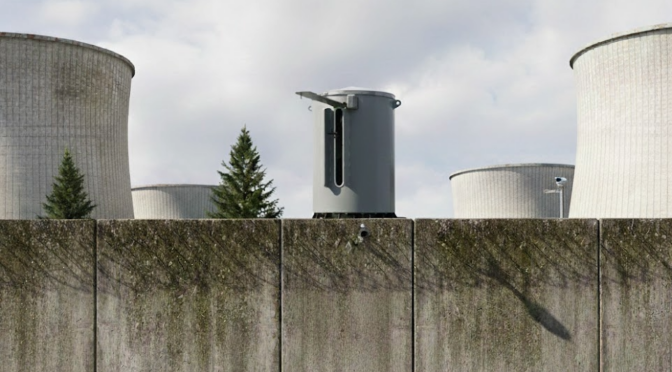
The main blog image is computer generated and it is loosely based on the fixed emplacement housing of the SENTRY I T-360 by Precision Remotes.
Please share the link on Facebook, Forums, with colleagues, etc. Your support is much appreciated and if you have any feedback, please email us in**@*********ps.com. If you’d like to request a report or order a reprint, please click here for the corresponding page to open in new tab.
Sources Used
- GAO-11-387, Nuclear Weapons: DOD and NNSA Need to Better Manage Scope of Future Refurbishments and Risks to Maintaining U.S. Commitments to NATO, accessed February 13, 2026, https://www.gao.gov/assets/a317889.html
- GAO-15-532T, National Nuclear Security Administration: Observations on Manage Challenges and Steps Taken to Address Them – Senate Armed Services, accessed February 13, 2026, https://www.armed-services.senate.gov/imo/media/doc/Trimble_04-15-15.pdf
- GAO-23-105299, NATIONAL NUCLEAR SECURITY ADMINISTRATION: Fully Incorporating Key Practices for Agency Reform Would Benefit Any F, accessed February 13, 2026, https://www.gao.gov/assets/gao-23-105299.pdf
- PART 73—PHYSICAL PROTECTION OF PLANTS AND MATERIALS | Nuclear Regulatory Commission, accessed February 13, 2026, https://www.nrc.gov/reading-rm/doc-collections/cfr/part073/full-text
- Chapter: 9 Ensuring Security and Promoting Safeguards – National Academies of Sciences, Engineering, and Medicine, accessed February 13, 2026, https://www.nationalacademies.org/read/26630/chapter/11
- Protective Force Personnel Medical, Physical Readiness, Training, and Access Authorization Standards – Federal Register, accessed February 13, 2026, https://www.federalregister.gov/documents/2012/03/06/2012-5280/protective-force-personnel-medical-physical-readiness-training-and-access-authorization-standards
- Remotely Operated Weapon System – IEC Infrared Systems, accessed February 13, 2026, https://iecinfrared.com/white-papers/remotely-operated-weapon-systems/
- T360 ROWS – IEC Infrared Systems, accessed February 13, 2026, https://iecinfrared.com/t360-rows/
- Safety Functions and Other Features of Remotely Operated Weapon Systems (ROWS) – DOE Standards, accessed February 13, 2026, https://www.standards.doe.gov/standards-documents/1000/1047-astd-2008/@@images/file
- DOE-STD-1047-2008, Safety Functions and Other Features of Remotely Operated Weapon Systems (ROWS) – DOE Standards, accessed February 13, 2026, https://www.standards.doe.gov/standards-documents/1000/1047-astd-2008
- DOE O 473.1A Physical Protection Program – S&S Policy Information Resource – Department of Energy, accessed February 13, 2026, https://pir.doe.gov/ExportService.svc/file/supplemental?id=56
- Physical Protection Program – DOE Directives, accessed February 13, 2026, https://www.directives.doe.gov/directives-documents/400-series/0473.1-BOrder-a/@@images/file
- National Nuclear Security Administration Consolidated Nuclear …, accessed February 13, 2026, https://www.energy.gov/sites/default/files/2024-11/Pantex%20and%20Y-12%20FY%202022%20Performance%20Evaluation%20Report.pdf
- GAO-07-36, National Nuclear Security Administration: Additional Actions Needed to Improve Management of the Nation’s Nuclear Programs, accessed February 13, 2026, https://www.gao.gov/assets/a255324.html
- National Nuclear Security Administration: Security and Management Improvements Can Enhance Implementation of the NNSA Act – GovInfo, accessed February 13, 2026, https://www.govinfo.gov/content/pkg/GAOREPORTS-GAO-07-428T/html/GAOREPORTS-GAO-07-428T.htm
- NUCLEAR SECURITY NNSA Should Establish a Clear Vision and Path Forward for Its Security Program, accessed February 13, 2026, https://www.gao.gov/assets/gao-14-208.pdf
- Precision Remotes LLC – AUSA Industry Guide, accessed February 13, 2026, https://industry.ausa.org/company/10621/Precision20Remotes%20LLC
- Intruder Deterrence – IEC Infrared Systems, accessed February 13, 2026, https://iecinfrared.com/intruder-deterrence/
- PROTECTOR RWS LW30 – Kongsberg Defence & Aerospace, accessed February 13, 2026, https://www.kongsberg.com/kda/what-we-do/defence-and-security/remote-weapon-systems/protector-rs6/
- 01/23/12 Paper – Cyber Security for Nuclear Power Plants – State.gov, accessed February 13, 2026, https://2009-2017.state.gov/t/isn/gp2013/mtg/dc1/183589.htm
- T360 Remotely Operated Weapon System (ROWS) Tactical – Army Technology, accessed February 13, 2026, https://www.army-technology.com/products/t360-remotely-operated-weapon-system-rows-tactical/
- TRAP T-360 RWS: Telepresent Rapid Aiming Platform – Army Technology, accessed February 13, 2026, https://www.army-technology.com/sponsored/rws-telepresent-rapid-aiming-platform/
- What is the difference between being hit by a 7.62mm and 0.50 inch round from sniper rifles at 500-800m and at 1-2km? Specifically, the seriousness of the wound. – Quora, accessed February 13, 2026, https://www.quora.com/What-is-the-difference-between-being-hit-by-a-7-62mm-and-0-50-inch-round-from-sniper-rifles-at-500-800m-and-at-1-2km-Specifically-the-seriousness-of-the-wound
- Is 7.62 enough round for anti-drone defence? : r/tanks – Reddit, accessed February 13, 2026, https://www.reddit.com/r/tanks/comments/1f5muqo/is_762_enough_round_for_antidrone_defence/
- Protector RWS – Wikipedia, accessed February 13, 2026, https://en.wikipedia.org/wiki/Protector_RWS
- PROTECTOR Remote Weapon Systems – Kongsberg Defence & Aerospace, accessed February 13, 2026, https://www.kongsberg.com/kda/what-we-do/defence-and-security/remote-weapon-systems/
- PROTECTOR RWS – Kongsberg Defence & Aerospace, accessed February 13, 2026, https://www.kongsberg.com/kda/what-we-do/defence-and-security/remote-weapon-systems/protector-rs4/
- The Remote Weapon Station from KONGSBERG makes soldiers’ lives safer., accessed February 13, 2026, https://www.kongsberg.com/newsroom/stories/2018/11/protector/
- Full article: Computing Physical Security System Effectiveness at Commercial Reactors, accessed February 13, 2026, https://www.tandfonline.com/doi/full/10.1080/00295639.2022.2120315
- Methodology and Application of Physical Security Effectiveness …, accessed February 13, 2026, https://lwrs.inl.gov/content/uploads/11/2024/03/Methodology_Application_Physical_Effectiveness_based_on_FoF.pdf
- A Systematic Approach to the Conceptual Design of Physical Protection Systems for Nuclear Facilities – OSTI.gov, accessed February 13, 2026, https://www.osti.gov/servlets/purl/6809347
- Fukushima Daiichi Nuclear Accident: Lessons Learned for Nuclear Plant Security – NCBI, accessed February 13, 2026, https://www.ncbi.nlm.nih.gov/books/NBK373723/
- § 73.46 Fixed site physical protection systems, subsystems, components, and procedures. | Nuclear Regulatory Commission, accessed February 13, 2026, https://www.nrc.gov/reading-rm/doc-collections/cfr/part073/part073-0046
- W200400032/W200500377, Report on the Results of the Security Baseline Inspection Program at Commercial Power Reactor Annual Stat – Nuclear Regulatory Commission, accessed February 13, 2026, https://www.nrc.gov/docs/ML0615/ML061510642.pdf
- – DOE MANAGEMENT AND OVERSIGHT OF ITS NUCLEAR WEAPONS COMPLEX: LESSONS OF THE Y-12 SECURITY FAILURE – Congress.gov, accessed February 13, 2026, https://congress.gov/113/chrg/CHRG-113hhrg80292/CHRG-113hhrg80292.htm
- National Nuclear Security Administration: Actions Needed to Improve Integration of Production Modernization Programs and Projects – GAO, accessed February 13, 2026, https://www.gao.gov/products/gao-24-106342
- GAO-25-107016, NATIONAL NUCLEAR SECURITY ADMINISTRATION: Explosives Program Is Mitigating Some Supply Chain Risks but Should Take Additional Actions to Enhance Resiliency, accessed February 13, 2026, https://files.gao.gov/reports/GAO-25-107016/index.html
- 10 CFR Part 1046 Subpart B — Protective Force (PF) Personnel – eCFR, accessed February 13, 2026, https://www.ecfr.gov/current/title-10/chapter-X/part-1046/subpart-B
- Department of Energy Categorical Exclusion ID#: NV-2023-017 Proposed Action Title: Protective Force Training Complex Program or – Nevada National Security Site, accessed February 13, 2026, https://nnss.gov/wp-content/uploads/2023/08/CX-Determination-Form-Protective-Force-Training-Complex.pdf
- Small Unmanned Aerial Systems (sUAS) and the Force Protection Threat to DoD – RMC, accessed February 13, 2026, https://rmcglobal.com/small-unmanned-aerial-systems-suas-and-the-force-protection-threat-to-dod/
- Nuclear power plants in war zones: Lessons learned from the war in Ukraine – Security and Defence Quarterly, accessed February 13, 2026, https://securityanddefence.pl/Nuclear-power-plants-in-war-zones-Lessons-learned-from-the-war-in-Ukraine,174810,0,2.html
- Lessons Learned from “Lessons Learned”: – American Academy of Arts and Sciences, accessed February 13, 2026, https://www.amacad.org/sites/default/files/publication/downloads/lessonsLearned.pdf