Executive Summary
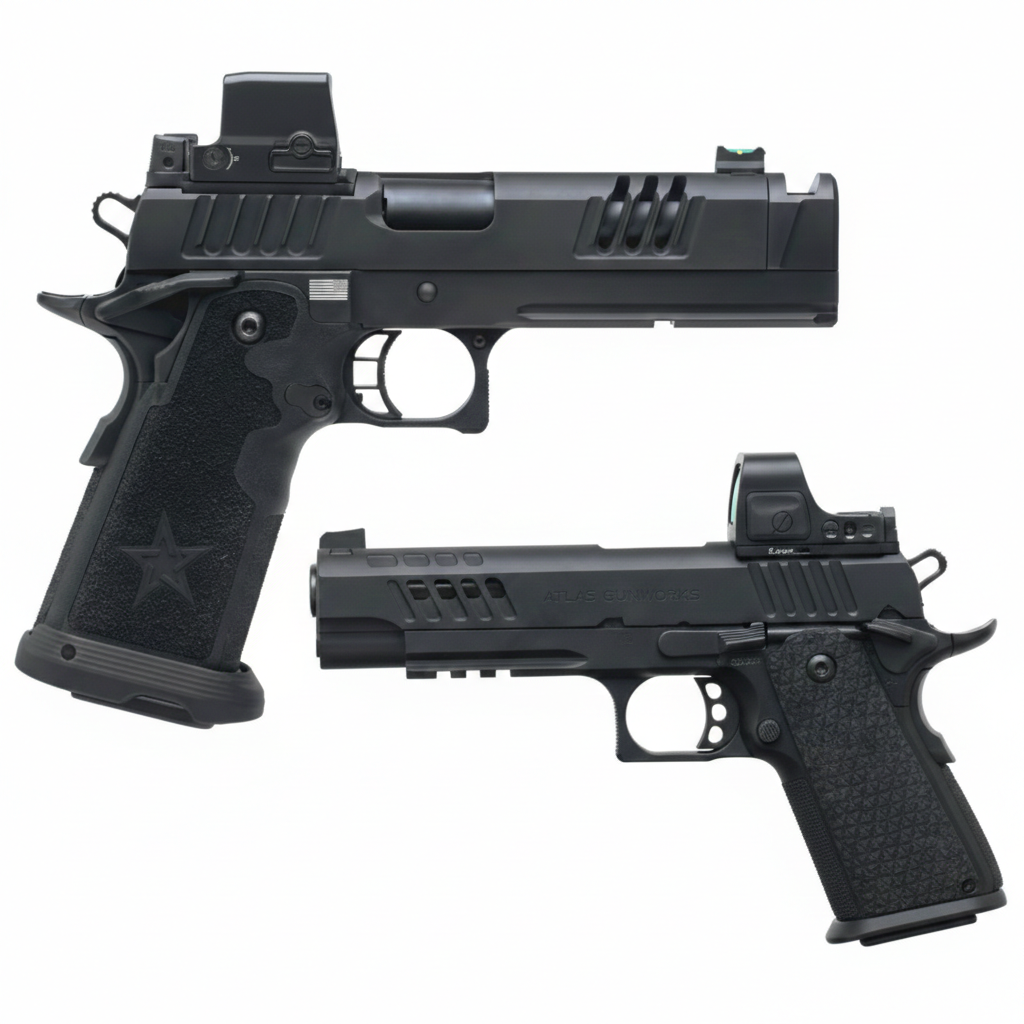
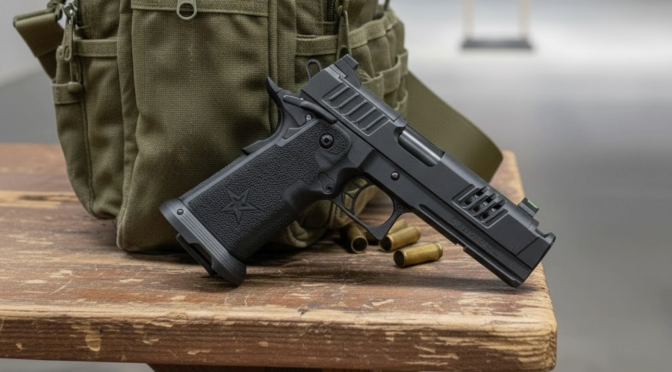
The evolution of the double-stack 1911 platform—commonly referred to in the modern era as the 2011—has fundamentally altered the performance expectations for contemporary defensive, duty, and competitive handguns. At the absolute apex of this mechanical paradigm shift stands the Staccato XC. Chambered in 9x19mm Parabellum, the Staccato XC is defined by its 5.0-inch Island Compensated barrel, its precision-machined 4140 steel billet frame, and a factory-tuned 2.5-pound single-action trigger mechanism.1 While the exacting mechanical tolerances of the firearm provide the requisite foundation for extreme, sub-minute-of-angle accuracy, the realization of that mathematical potential is entirely dependent on the specific commercial ammunition deployed by the end user. Because the Staccato XC utilizes an integrated, single-port compensator, the internal ballistics, gas expansion volume, powder burn rate, and projectile mass of a given cartridge play uniquely critical roles in both the firearm’s cyclic reliability and its terminal accuracy downrange.
An exhaustive, multi-layered review of empirical range data, independent ballistic testing, and qualitative user reports aggregated from prominent firearms communities—including precision-focused forums like Sniper’s Hide, competition-oriented platforms like Brian Enos, and general enthusiast aggregates like Reddit’s r/2011 and r/Staccato_STI—reveals a highly nuanced and complex landscape regarding ammunition preferences for this specific platform. The aggregated data indicates unequivocally that not all 9mm Luger loads interact with the Staccato XC’s integrated compensator in the same manner, and the choice of ammunition can drastically alter the kinematic rhythm and mechanical precision of the firearm.
The primary conclusion drawn from this extensive analysis is that 124-grain and 125-grain true-jacketed projectiles operating at a Power Factor (PF) between 135 and 146 deliver the optimal balance of gyroscopic stability, downward compensator actuation force, and cyclic slide rhythm.3 Premium commercial loads engineered specifically for high-end platforms, most notably the proprietary Staccato 136-grain Special Match Projectile (SMP), the Hornady Critical Duty 135-grain FlexLock, and the Federal Premium HST 124-grain standard and +P variants, consistently yield sub-inch to 1.5-inch five-shot groups at 25 yards when fired from a stabilized machine rest or sandbag support.5 These loads generate the exact volume of high-pressure gas required to drive the muzzle downward without overwhelming the 8-pound factory recoil spring.
Conversely, the deployment of thinly plated, budget-tier ammunition, such as standard CCI Blazer Brass, presents significant mechanical risks. The high-pressure environment of the compensator’s expansion chamber can cause the electroplated copper to shear off the lead core, simultaneously degrading projectile accuracy, creating dangerous spalling hazards, and causing rapid lead fouling within the compensator baffle.7 Furthermore, ultra-heavy polymer-coated projectiles favored by uncompensated competitive shooters, most notably the 150-grain Federal Syntech Action Pistol load, have demonstrated marginal stabilization issues and instances of terminal keyholing out of the Staccato XC’s fast 1:10 twist rate barrel at extended distances.8
This comprehensive report provides a deep engineering analysis of how specific bullet weights, propellant burn rates, and jacket constructions interface with the Staccato XC’s unique kinematics. By dissecting the physical forces at play and aggregating thousands of data points from high-volume shooters, this document serves as the definitive guide to achieving maximum accuracy and operational efficiency with commercial 9mm ammunition in the Staccato XC platform.
1. The Engineering Architecture of the Staccato XC
To accurately evaluate how various commercial 9mm loads perform within the Staccato XC, it is first necessary to deconstruct the mechanical architecture and kinetic environment of the platform itself. The Staccato XC is a flagship model that bridges the gap between dedicated, open-class race guns used in United States Practical Shooting Association (USPSA) competitions and rugged, duty-ready tactical sidearms utilized by elite law enforcement units.9 This duality of purpose is achieved through several proprietary engineering features that fundamentally alter how the gun processes the recoil energy of a fired cartridge.
1.1 The 2011 Modular Frame and Weight Distribution
The Staccato XC is built upon the patented 2011 modular frame design. Unlike traditional 1911 pistols which utilize a single piece of steel or aluminum for the entire frame and grip, the 2011 platform separates these components. The upper receiver—the portion that houses the slide rails, the fire control group, and the barrel linkage—is precision-machined from a solid billet of 4140 high-carbon steel.1 This steel upper frame is then mated to a glass-filled polymer grip module. This modularity allows for the integration of a double-stack magazine (providing a capacity of 17+1 or 20+1 rounds of 9mm) without making the circumference of the grip unwieldy for the average human hand.1
The use of a steel upper frame is critical to the XC’s recoil management strategy. The firearm features a full-length steel dust cover that extends all the way to the muzzle end of the slide, incorporating a Picatinny accessory rail for weapon-mounted lights.1 This extended dust cover adds significant non-reciprocating mass to the front of the pistol. Because this weight does not move during the firing cycle, it acts as a static anchor, resisting the upward rotational torque (muzzle flip) generated when the gun is fired. When completely empty and devoid of an optic or magazine, the Staccato XC weighs 37.56 ounces.1 This substantial mass is the first line of defense against recoil, dampening the physical impulse before the compensator is even engaged.
1.2 The Island Barrel and Slide Kinematics
The defining feature of the Staccato XC, and the characteristic that makes it highly sensitive to ammunition selection, is its 5.0-inch Island Compensated barrel.1 In a standard semi-automatic pistol, the front sight is dovetailed directly into the top of the steel slide. When the gun is fired, the slide moves violently to the rear to eject the spent casing, taking the front sight with it. The shooter entirely loses their visual reference point during this cyclic phase.
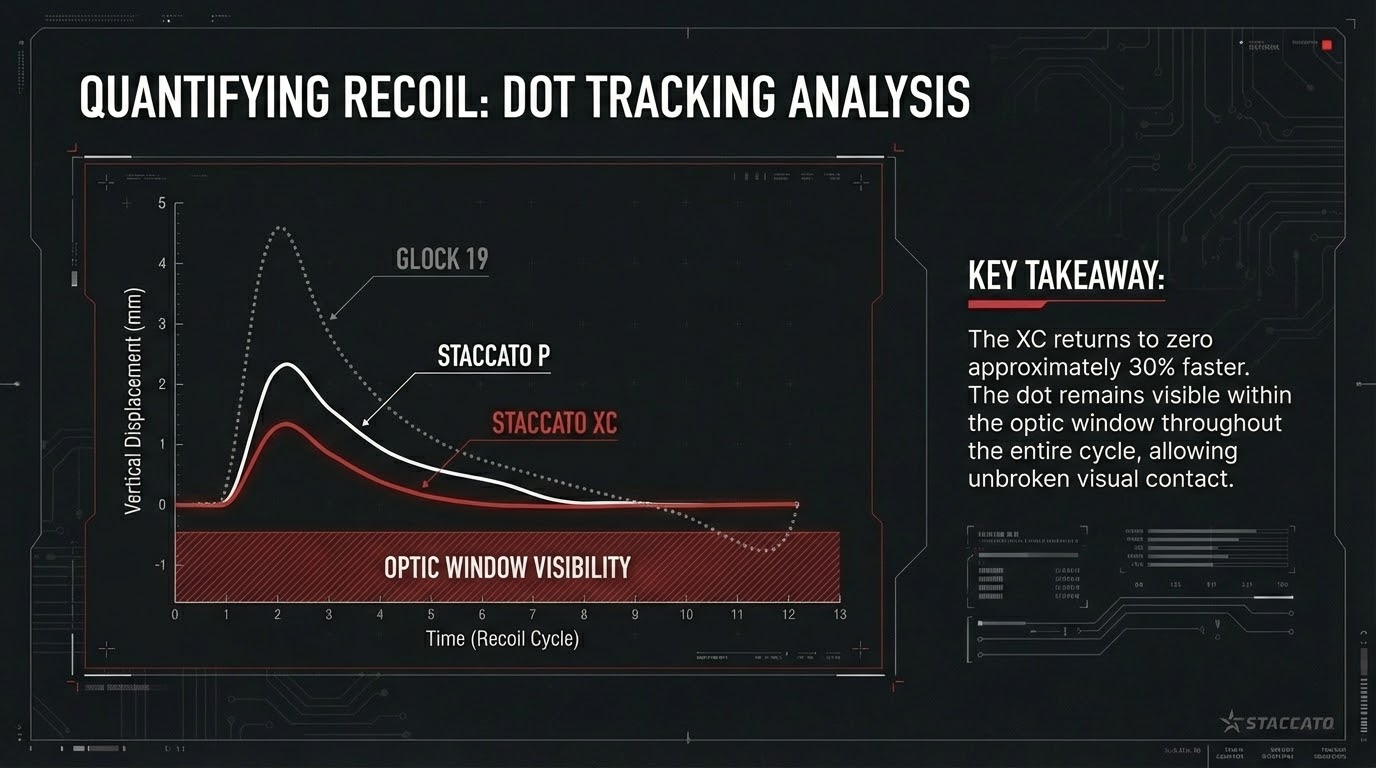
The Staccato XC utilizes an “island” barrel design to eliminate this issue. A section of the barrel near the muzzle is machined with a raised, rectangular plateau—the “island”—which protrudes through a corresponding cutout in the top of the slide.2 The front sight is pinned directly onto this stationary island. When the Staccato XC is fired, the slide cycles rearward, but the barrel (and therefore the front sight) remains practically static, dropping only slightly to unlock the breech.2 This allows the shooter to maintain uninterrupted visual tracking of the front sight throughout the entire recoil sequence, facilitating incredibly fast follow-up shots.
Furthermore, removing this section of steel from the top of the slide significantly reduces the slide’s overall reciprocating mass. A lighter slide requires less kinetic energy to move rearward, accelerates faster, and, crucially, generates less forward momentum when the recoil spring slams it back into battery. This reduction in forward momentum prevents the muzzle from “dipping” below the center line of the target after a shot is fired, keeping the pistol perfectly neutral in the shooter’s hands.
1.3 The Integrated Expansion Chamber
Directly in front of the island sight block lies the integrated compensator. Typical aftermarket compensators are separate devices that must be threaded onto a standard extended barrel. Thread-on compensators are prone to backing off under thermal expansion and harmonic vibration, and they often suffer from concentricity issues that can degrade accuracy.
Staccato engineers circumvented these issues by milling the compensator directly into the single piece of steel that forms the barrel.2 The XC’s compensator is a single-port design featuring a large, vertical blast chamber. As the 9mm projectile travels down the bore and clears the rifling, the rapidly expanding, super-heated propellant gases follow immediately behind it. In a standard pistol, these gases exit the front of the muzzle in a spherical blast wave, contributing to recoil.
In the Staccato XC, these high-pressure gases enter the expansion chamber and strike the forward baffle. Because the top of the chamber is open (the port), the gases take the path of least resistance and vent violently upward. According to Newton’s third law of motion—for every action, there is an equal and opposite reaction—this massive upward venting of gas creates an equal downward force vector on the muzzle.11 This downward thrust actively fights the upward muzzle flip generated by the slide’s rearward movement. The expanding gases are trapped by the baffle and redirected upward to counteract muzzle flip, while the non-reciprocating front sight provides an undisturbed aiming point, working in tandem to create a perfectly flat shooting experience.
The efficiency of this gas redirection is the absolute core of the Staccato XC’s performance. The compensator is essentially a gas-driven engine; it remains dormant unless it is fed sufficient gas pressure and volume. Therefore, the internal ballistics of the chosen cartridge directly dictate how flat, fast, and accurately the Staccato XC will perform.
1.4 Fire Control Group and Trigger Mechanics
The mechanical accuracy of any firearm is fundamentally limited by the human interface, primarily the trigger mechanism. A heavy, gritty, or unpredictable trigger pull forces the operator to exert excessive kinetic force with their index finger, which inevitably imparts lateral or vertical movement to the muzzle at the exact millisecond of primer ignition.
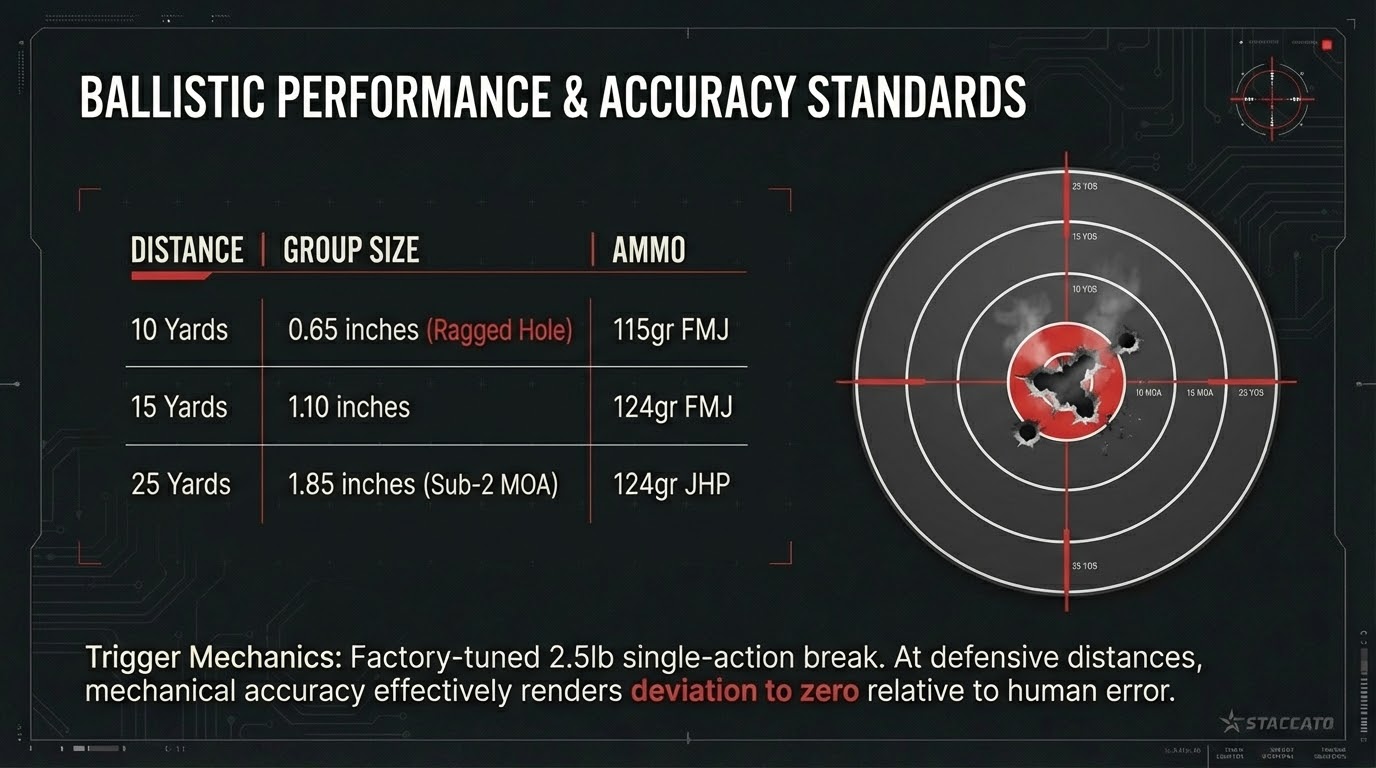
The Staccato XC eliminates this human error variable by utilizing a highly refined, skeletonized polymer trigger linked to a competition-grade sear and hammer assembly. The trigger is factory-calibrated to a remarkably crisp 2.5-pound break.1 The trigger features almost zero take-up, a clearly defined mechanical wall, an immediate glass-rod break, and an incredibly short, tactile reset. This elite fire control group allows the operator to execute rapid strings of fire without disturbing the optical alignment of the pistol, ensuring that the theoretical mechanical accuracy of the barrel and ammunition is actually realized on the target paper.12
2. Internal Ballistics: The Physics of Compensator Actuation
To understand why the Staccato XC prefers certain commercial loads over others, one must analyze the internal ballistics of the 9x19mm Parabellum cartridge. The performance of a compensated pistol is governed by a delicate interplay between projectile mass, propellant burn rate, and the resulting gas volume.
2.1 The Relationship Between Bullet Mass and Propellant Volume
In commercial ammunition manufacturing, the internal dimensions of the 9mm brass casing are constant. To safely load cartridges with different bullet weights while remaining within the Sporting Arms and Ammunition Manufacturers’ Institute (SAAMI) maximum pressure specifications (typically 35,000 PSI for standard 9mm, and 38,500 PSI for +P), manufacturers must manipulate the type and volume of the smokeless powder used.13
Heavy projectiles, such as the 147-grain or 150-grain bullet, seat deeper into the brass casing, leaving less internal volume for powder. Furthermore, because a heavy bullet has more inertia and resists moving down the barrel, pressure builds very rapidly behind it. To prevent catastrophic over-pressure events, manufacturers typically use smaller volumetric charges of very fast-burning powders for heavy bullets.
Conversely, light projectiles, such as the 115-grain bullet, offer less resistance. To accelerate these light bullets to high velocities, manufacturers use much larger volumetric charges of slower-burning powders. This allows the pressure to build more gradually and push the bullet further down the barrel before peaking.13
2.2 Kinetic Energy vs. Gas Volume
For standard, uncompensated pistols, the primary metric of recoil is related to the kinetic energy and momentum of the projectile. The formula for Kinetic Energy is universally expressed as:
KE = 1/2 m v^2
Where ‘m’ is the mass of the bullet and ‘v’ is the velocity. Because velocity is squared in this equation, a lighter, faster bullet often produces a sharper, more energetic felt recoil impulse than a heavier, slower bullet, even if both possess a mathematically similar momentum.14 This is why traditional pistol shooters often prefer 147-grain ammunition; the recoil feels like a gentle “push” rather than a sharp “snap”.15
However, the Staccato XC is not a standard pistol. The presence of the integrated compensator fundamentally changes the physics of the recoil impulse. A compensator does not mitigate the rearward momentum of the slide; it mitigates the upward rotation of the muzzle. To do this, it requires gas.
When a 115-grain cartridge is fired, the large volume of slow-burning powder creates a massive cloud of high-pressure gas that follows the bullet out of the muzzle.11 When this massive gas cloud hits the XC’s compensator baffle and vents upward, it creates a very strong downward thrust, aggressively pinning the muzzle down.11
When a 147-grain cartridge is fired, the small charge of fast-burning powder creates a relatively small volume of gas. By the time the heavy bullet reaches the end of the 5.0-inch barrel, the gas pressure has already begun to dissipate. When this weak gas cloud hits the compensator, it produces very little downward thrust. In this scenario, the compensator is essentially inactive, and the shooter is relying purely on the 37.56-ounce weight of the steel gun to manage the recoil.11
2.3 The Power Factor Metric
In practical shooting sports, ammunition performance is standardized using a metric known as Power Factor (PF). Power Factor is a calculation that roughly correlates to the momentum of the bullet, providing a baseline to ensure all competitors are managing a minimum amount of recoil. The formula is written in plain text as:
Power Factor = (Bullet Weight in grains x Muzzle Velocity in fps) / 1000.4
For example, a 124-grain bullet traveling at 1,180 feet per second yields the following calculation: (124 x 1180) / 1000 = 146.32 Power Factor.4
The Staccato XC’s Dawson Precision Tool-Less Recoil System is factory-calibrated with an 8-pound recoil spring.16 This specific spring rate was chosen by Staccato engineers to perfectly harmonize with minor power factor 9mm ammunition, specifically loads falling between 130 and 146 PF.3
If a shooter utilizes under-powered ammunition (e.g., a lightweight 115-grain target load generating only a 125 PF), the slide may lack the rearward kinetic energy to fully compress the 8-pound spring, potentially resulting in stovepipe malfunctions or failures to strip a new round from the magazine. Conversely, if a shooter utilizes over-pressured submachine gun ammunition (+P+ generating a 160+ PF), the slide will cycle so violently that it smashes into the frame buffer, causing erratic muzzle rise and potential premature wear on the firearm’s internal components.
Finding the most accurate ammunition for the Staccato XC requires finding a load that provides enough gas volume to effectively work the compensator, enough kinetic energy to reliably cycle the 8-pound spring, and a bullet mass that maintains gyroscopic stability out of a 1:10 twist rate barrel.
3. Projectile Mass Analysis and Community Consensus
To determine the most accurate commercial loads for the Staccato XC, it is vital to analyze the empirical experiences of thousands of high-volume shooters. By aggregating range reports, competitive match results, and technical discussions from platforms like Reddit (r/2011, r/Staccato_STI) and the Brian Enos competition forums, distinct trends emerge regarding how different bullet weights perform in the XC.
3.1 115-Grain Ammunition: The High-Velocity Baseline
The 115-grain Full Metal Jacket (FMJ) is the most ubiquitous and economically accessible 9mm load on the commercial market. Due to its light weight, it achieves high velocities, frequently exceeding 1,150 fps.
In the context of the Staccato XC, 115-grain ammunition produces a unique kinematic signature. Because these loads utilize generous powder charges, they generate an immense volume of gas at the muzzle.11 This high gas volume effectively “turns on” the compensator, venting aggressively and locking the muzzle down. Shooters frequently note that the XC exhibits virtually zero muzzle rise when firing 115-grain ammunition.15
However, there is a distinct trade-off. The high velocity of the 115-grain bullet combined with the large powder charge results in an extremely fast slide velocity. The slide rockets to the rear and slams back into battery with intense speed. While the muzzle remains flat, the overall feeling in the hands is often described by experienced shooters as “snappy,” “harsh,” or “buzzy”.15
From an accuracy standpoint, premium 115-grain loads perform adequately at close range. However, standard 115-grain range ammunition is rarely utilized by professionals attempting to shoot sub-MOA groups at 25 yards or beyond. The light projectile is more susceptible to environmental factors like wind drift, and the snappy cyclic rate can disrupt the shooter’s physical grip over long strings of fire. While users like “ShadowSRO” on Reddit note firing over 6,000 rounds of SuperVel 115-grain with excellent reliability 17, the general consensus is that 115-grain is best reserved for close-range bay work rather than precision bullseye shooting.
3.2 124-Grain and 125-Grain Ammunition: The Optimal Harmonic Balance
Across all analyzed social media platforms and professional reviews, the 124-grain and 125-grain projectile weights are universally recognized as the optimal choice for the Staccato XC. This weight class represents the perfect intersection of gas volume, slide velocity, and projectile mass.17
A 124-grain bullet requires a moderate powder charge. This charge produces sufficient gas volume to effectively actuate the XC’s compensator, providing the necessary downward thrust to keep the dot in the optical window. Simultaneously, the slightly heavier mass of the 124-grain bullet slows the cyclic velocity of the slide compared to a 115-grain round.
This creates a harmonic balance that is highly prized by competitive shooters. The recoil impulse feels soft and manageable, yet the slide cycles fast enough to keep up with the world’s fastest trigger fingers. When firing 124-grain ammunition, the Staccato XC exhibits a perfectly predictable cyclic rhythm. The red dot lifts slightly, tracks in a clean, vertical loop, and returns exactly to the point of origin. Shooters reporting on r/2011 explicitly note that 124-grain loads provide “the smoothest and most consistent” feel.17
Because the gun is not fighting a snappy slide velocity, the shooter can maintain a highly consistent grip pressure, which directly translates to superior mechanical accuracy on paper. Premium 124-grain and 125-grain loads consistently dominate accuracy testing in the XC platform, delivering precise, repeatable hits at 25 yards and beyond.
3.3 147-Grain Ammunition: The Heavy Subsonic Dilemma
The 147-grain projectile sits at the heavy end of the traditional 9mm spectrum. Traveling at subsonic velocities (typically below 1,000 fps), these long, heavy bullets are historically favored by tactical units utilizing suppressors, as they do not produce a supersonic ballistic crack.13 In uncompensated firearms, 147-grain ammunition is beloved for its incredibly soft, rolling recoil impulse.15
However, introducing a 147-grain load into the Staccato XC yields complex and polarizing results. Because the 147-grain cartridge utilizes a very small charge of fast-burning powder, the volume of gas exiting the muzzle is drastically reduced.11 Consequently, the XC’s compensator is starved of the pneumatic pressure it needs to function. The downward thrust generated by the compensator is minimal.11
When shooting 147-grain loads, the operator relies almost entirely on the 37.56-ounce physical weight of the steel gun to absorb the recoil.16 While the initial physical impulse to the hands is undeniably soft, the lack of compensator actuation means the muzzle will flip higher than it would with a 124-grain load.11 Furthermore, because the slide is cycling slowly, the 8-pound recoil spring can feel overly heavy as it returns the slide to battery, sometimes causing the muzzle to “dip” below the point of aim upon return.
Despite these cyclic quirks, high-quality 147-grain ammunition is inherently very accurate. The long bearing surface of the heavy bullet engages the rifling effectively, and the subsonic velocity means the bullet does not experience the aerodynamic turbulence associated with crossing the transonic barrier during flight. Precision shooters firing from supported bench rests have reported exceptional accuracy with 147-grain loads in the XC. However, for dynamic, rapid-fire applications, the sluggish dot tracking often leads shooters to revert to the more balanced 124-grain options.
3.4 150-Grain Polymer Coated Anomalies
A modern development in the competitive shooting sphere is the introduction of ultra-heavy, polymer-coated lead bullets, exemplified by the Federal Syntech Action Pistol 150-grain load.14 These cartridges feature a distinct red polymer coating that entirely encapsulates the lead core, eliminating metal-on-metal friction within the barrel and drastically reducing barrel heat and fouling.14
These 150-grain loads are specifically engineered to barely meet the 125 Power Factor threshold required for USPSA Minor divisions, utilizing minuscule powder charges to create an impossibly soft recoil impulse in heavy, steel-framed, uncompensated competition guns.14
When utilized in the Staccato XC, however, severe ballistic anomalies have been documented. The XC utilizes a relatively fast 1:10 barrel twist rate (one full rotation every 10 inches).18 While a 1:10 twist is generally excellent for stabilizing heavy 9mm projectiles, the extreme physical length of the 150-grain bullet, combined with the low-friction nature of the slick polymer coating, occasionally results in a failure of the bullet to properly engage and grip the rifling.
Numerous competitive shooters on platforms like Brian Enos and Reddit have submitted range reports indicating that the 150-grain Federal Syntech load can become gyroscopically unstable when fired from the Staccato XC. Users report the bullets “tumbling” or “keyholing”—striking the paper target completely sideways—at distances as close as 15 to 25 yards.8
A tumbling bullet possesses no aerodynamic stability, completely obliterating any semblance of mechanical accuracy. While some users report satisfactory results 19, the prevalence of these keyholing reports strongly indicates that the 150-grain Syntech load sits squarely on the ragged edge of the XC’s stabilization envelope. For operators demanding uncompromising, guaranteed accuracy at 25 yards, industry analysts uniformly recommend avoiding ultra-heavy polymer loads in favor of traditional jacketed ammunition in the 124-grain to 136-grain window.
4. The Engineering Hazard of Plated Ammunition
Beyond bullet weight, the physical construction of the projectile’s outer layer is a critical variable when operating a compensated firearm like the Staccato XC. In the commercial 9mm market, bullets are generally manufactured in three ways: Full Metal Jacket (FMJ), Jacketed Hollow Point (JHP), and Copper-Plated (often branded as Total Metal Jacket or TMJ, though the processes vary).
An FMJ or JHP bullet is constructed by taking a thick, pre-formed copper cup (the jacket) and mechanically swaging a lead core into it under immense pressure. The resulting copper jacket is highly durable, structurally rigid, and deeply integrated with the lead core.
Conversely, a copper-plated bullet (such as the highly popular, budget-tier CCI Blazer Brass or various re-manufactured “extreme plated” brands) is created using an entirely different process. A raw lead core is submerged in an electrochemical bath, and a micro-thin layer of copper is electroplated onto the surface of the lead.17 This process is highly cost-effective, making plated ammunition the dominant choice for cheap range practice.
However, firing thinly plated ammunition through the Staccato XC presents severe mechanical hazards. As the bullet travels down the bore and reaches the island compensator, it crosses the open void of the expansion chamber.7 In this fraction of a millisecond, the micro-thin copper plating is subjected to the sudden, violent release of super-heated propellant gas expanding at over 30,000 PSI.
This extreme thermodynamic and kinetic shock can cause the thin copper plating to tear, shear, or completely strip away from the lead core as it bridges the gap of the compensator port.7 This catastrophic jacket separation results in three distinct and highly detrimental outcomes:
- Immediate Accuracy Degradation: If even a tiny flake of the copper plating shears off, the bullet’s center of gravity and aerodynamic profile are instantaneously altered at the exact moment it leaves the muzzle. This induces immediate yaw and pitch, causing the bullet to fly erratically and drastically opening up group sizes. A load that should shoot 1.5 inches at 25 yards may suddenly print 5-inch, scattered patterns.
- Compensator Baffle Fouling: The fragments of sheared copper and the newly exposed molten lead atomize and fuse directly to the internal walls of the expansion chamber and the face of the compensator baffle.7 Over the course of just a few hundred rounds, this metal accumulation physically alters the volumetric space of the chamber, degrading the compensator’s ability to redirect gas effectively.7 Furthermore, if lead builds up heavily on the exit crown of the compensator, it can physically physically strike the base of subsequent bullets as they exit, completely destroying accuracy.
- Spalling Hazards: The sheared fragments of copper plating do not simply disappear; they are frequently ejected forcefully upward through the compensator port.7 This “spalling” acts as miniature shrapnel, presenting a legitimate safety hazard to the shooter’s face and hands, as well as to adjacent bystanders on the firing line.
Due to these severe engineering incompatibilities, ammunition manufacturers explicitly warn against using plated rounds in compensated firearms.7 Analysts and experienced Staccato XC operators universally agree that to maintain the platform’s legendary accuracy and safety, shooters must strictly utilize true Full Metal Jacket (FMJ) or Jacketed Hollow Point (JHP) ammunition.
5. Empirical Accuracy Data: Premium Match and Defensive Loads
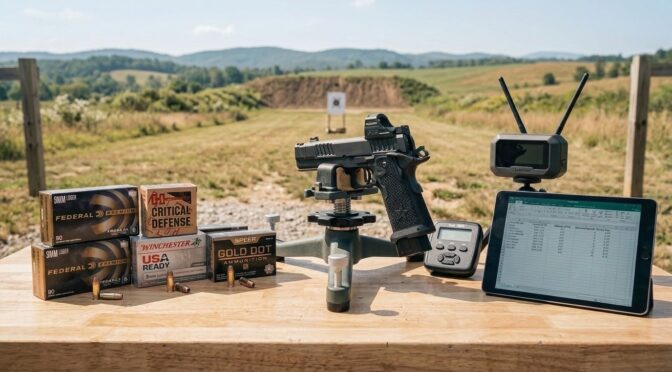
When establishing the absolute upper limits of a firearm’s mechanical accuracy, analysts discount subjective human factors and look to data gathered via stabilized, mechanically fixed platforms. Testing conducted using Ransom Rests (heavy, mechanical vices that completely eliminate human muscular tremors and trigger pull errors) or highly stabilized sandbag supports at standardized distances—almost universally 25 yards—provides the ultimate truth regarding a barrel’s capability.
When the Staccato XC is fed premium, true-jacketed ammunition in the optimal weight classes, the empirical results are nothing short of extraordinary, consistently rivaling or exceeding the accuracy guarantees of custom-built, bolt-action rifles.
5.1 Staccato Proprietary Match Ammunition
Recognizing the highly specific kinematic requirements of their proprietary 2011 pistols, Staccato engineers took the unprecedented step of developing their own in-house ammunition lines, specifically designed to maximize the harmonic potential of platforms like the XC.
The Staccato 136-Grain SMP Match Load To replace their legacy 125-grain match offering, Staccato introduced the 136-grain Special Match Projectile (SMP). This load represents a masterclass in ballistic tuning for a compensated platform.18 Clocking at an average muzzle velocity of 990 fps, the load creates a highly specific Power Factor of 134.6.18
The engineering intent behind this load was to provide the soft, “pushing” recoil impulse generally associated with a heavy 147-grain subsonic bullet, while utilizing a proprietary propellant blend that generates enough sustained gas volume to fully actuate the XC’s compensator and maintain the proper reciprocation speed of the slide.18
The accuracy results achieved with the 136-grain SMP are statistically exceptional. Fired from a universal test receiver (a one-ton mechanical barrel vice that totally isolates ammunition performance) in a climate-controlled indoor facility, Staccato guarantees that this ammunition will produce 1-inch or smaller groups at 25 yards.6
Independent testing by ballistic analysts completely corroborates these lofty corporate claims. Utilizing Garmin Xero C1 Pro radar chronographs to verify incredibly tight extreme velocity spreads (a mere 32.2 fps variance across multiple strings, indicating flawless powder drop consistency at the factory), testers firing from Ransom Multi-Caliber Steady Rests documented an average five-shot group size of just 0.93 inches at 25 yards.6 The best single group recorded during this independent testing shrank to an astonishing 0.76 inches center-to-center.6 Additional independent reviews noted consistent average groups of 1.27 inches at 25 yards under less strictly controlled field conditions.20 This level of precision firmly establishes the Staccato 136-grain Match load as one of the most accurate commercial 9mm cartridges available globally.
The Staccato 124-Grain Range Load Designed to serve as a high-volume training counterpart to the elite Match load, the Staccato 124-grain FMJ travels at an advertised 1,130 fps, yielding a robust 140 Power Factor.21 While marketed strictly as “Range” ammo, its manufacturing tolerances mirror those of premium defensive loads. The brass casing and boxer primers ensure consistent ignition, and the true copper full metal jacket safely traverses the compensator without spalling. Independent testing from a mechanical rest at 25 yards yielded a three-group average of 1.77 inches 6, comfortably meeting Staccato’s internal factory guarantee of consistent sub-2-inch precision.21
5.2 Premium Law Enforcement Defensive Ammunition
For duty carry, self-defense, and high-stakes practical applications, the Staccato XC demonstrates remarkable mechanical synergy with top-tier jacketed hollow-point (JHP) ammunition. The stringent governmental quality control requirements, consistent proprietary powder drops, and highly uniform skived bullet jackets inherent to premium defensive rounds translate directly to extreme precision on paper.
Hornady Critical Duty 135-Grain FlexLock
Hornady’s Critical Duty line, specifically the 135-grain FlexLock projectile, offers a highly unique and effective ballistic profile for the Staccato XC. Sitting precisely between the standard 124-grain and 147-grain weight classes, the 135-grain projectile provides a flawless balance of slide momentum and gas generation. Furthermore, the bullet utilizes a high-antimony lead core locked to a heavy-duty jacket, combined with a patented Flex Tip polymer insert in the hollow point cavity. This polymer insert not only aids in terminal expansion through heavy clothing but also creates a highly uniform, aerodynamic meplat that prevents flight drag inconsistencies.
During rigorous 25-yard bench rest testing comparing the absolute finest custom 2011 pistols on the market, the Hornady 135-grain Critical Duty load achieved the single tightest group of the entire evaluation, printing an extraordinary 0.89-inch 5-shot cluster.5 This data point confirms that the 135-grain weight is a mechanical sweet spot for the XC’s 1:10 barrel twist rate.
Federal Premium HST (124-Grain and 147-Grain) The Federal Premium HST line is widely regarded by law enforcement agencies and ballistic analysts as the absolute benchmark for modern 9mm terminal performance. Both the 124-grain and 147-grain variants are highly favored by Staccato XC operators for concealed carry and duty use.22
The 124-grain variants, particularly the +P (over-pressure) loadings, provide an ideal, massive volume of high-pressure gas to aggressively actuate the XC’s compensator.23 The heavy, electro-chemically bonded and structurally skived copper jacket of the HST maintains perfect structural integrity as it crosses the violent environment of the compensator port, ensuring the bullet’s center of gravity remains perfectly intact upon exiting the crown. Users consistently report repeatable sub-2-inch precision with this load at 25 yards, combined with flawlessly flat dot tracking during rapid-fire strings.23
Speer Gold Dot Operating in the exact same elite tier as the Federal HST, the Speer Gold Dot (specifically the 124-grain +P and the 147-grain G2 variants) is a proven, battle-tested performer. The defining characteristic of the Gold Dot is its proprietary electrochemical bonding process, which molecularly fuses the copper jacket to the lead core one atom at a time. This ensures that the jacket absolutely cannot separate from the core, making it an exceptionally safe and mechanically sound choice for a compensated barrel. In comprehensive aggregate tests evaluating high-end 2011 platforms, the 147-grain Speer Gold Dot produced average 5-shot group sizes of 1.16 inches at 25 yards.5
6. Bulk and Training Ammunition: Analyzing Social Media Sentiment
While premium match and defensive loads showcase the theoretical maximum mechanical accuracy of the Staccato XC, the economic realities of high-volume competition and tactical training dictate that the vast majority of operators will utilize bulk, commercial Full Metal Jacket (FMJ) ammunition. Range reports aggregated from social media platforms—specifically the highly active r/2011 and r/Staccato_STI subreddits, alongside the Brian Enos competition forums—provide an invaluable wealth of qualitative data regarding how these bulk loads perform over tens of thousands of rounds.
6.1 The Standard Bearers: Sellier & Bellot and PMC Bronze
Across all monitored digital communities, a fierce and overwhelming consensus exists regarding the superior performance of two specific bulk ammunition lines in the Staccato XC. The undisputed favorite among high-volume users is Sellier & Bellot (S&B) 124-grain FMJ.3
Users consistently note that the S&B 124-grain load is loaded slightly “hotter” than domestic bulk competitors, providing an excellent Power Factor (often calculated around 130-135 when fired from the XC’s 5.0-inch barrel).3 This robust pressure curve smoothly and authoritatively cycles the 8-pound factory recoil spring while generating a high enough gas volume to effectively actuate the compensator.3 Furthermore, S&B is universally lauded within the community for utilizing incredibly clean-burning propellant formulations. This is a critical functional factor for compensated pistols, as dirty powders rapidly accelerate carbon fouling within the expansion chamber, requiring tedious mid-range-session scraping to maintain accuracy.
PMC Bronze 124-grain FMJ stands as the second most highly recommended bulk option.17 While slightly lower in velocity than S&B, it serves as a highly reliable, exceptionally consistent practice round that closely mimics the recoil impulse and point-of-impact (POI) zero of premium 124-grain defensive loads.
Crucially, both Sellier & Bellot and PMC manufacture their projectiles using true copper jackets swaged over lead cores, completely avoiding the catastrophic jacket shearing issues associated with cheap electroplated ammunition.17 For operators seeking domestic options, SuperVel 115-grain and 124-grain FMJ loads are also frequently cited by serious competitive shooters as highly accurate, clean-running bulk options that are specifically tailored by the manufacturer to suit the dynamic requirements of the 2011 platform.17
6.2 NATO Specification Ammunition
Another highly favored category among Staccato XC owners is 124-grain NATO specification ammunition (frequently manufactured by Winchester or Winchester White Box).24 The 9mm NATO specification mandates higher chamber pressures than standard commercial 9mm Luger, closely mirroring modern +P specifications.
When fired through the Staccato XC, these high-pressure NATO loads generate an enormous volume of gas that drives the compensator to its absolute maximum efficiency. Users on the r/2011 subreddit report that the XC “hammers” with NATO loads, noting that the red dot sight returns to zero faster and more decisively than with almost any other commercial offering.24 While the slide velocity is intensely fast, the massive downward pressure exerted by the compensator keeps the muzzle pinned flat, allowing for blisteringly fast split times during competitive drills.
7. Operator Interface and Mechanical Variables Impacting Accuracy
It is a fundamental tenet of ballistics analysis that the mechanical accuracy of any specific commercial load cannot be fully isolated from the human interface elements and the physical maintenance state of the host firearm. The Staccato XC is a highly tuned, tightly toleranced machine engineered with specific features designed to extract maximum precision; however, failing to respect these tolerances will rapidly degrade the accuracy of even the finest ammunition.
7.1 The Optical Sighting Interface
While the Staccato XC is capable of utilizing traditional iron sights via the Dawson Precision Tactical Optic System, the overwhelming majority of users deploy the platform with a slide-mounted miniature red dot sight (MRDS), such as the Trijicon RMR/SRO or the Holosun 507/508 series.1
The transition from iron sights to a red dot fundamentally changes the operator’s perception of accuracy. Because the red dot presents a single focal plane superimposed over the target, it completely eliminates the optical alignment errors inherent in trying to align a rear notch, a front post, and a distant target simultaneously. When utilizing high-quality red dot optics, shooters are much more capable of realizing the sub-inch grouping capabilities of loads like the Hornady Critical Duty and Staccato Match, as the optic removes the physical limitations of the human eye’s depth of field.6 Range reports explicitly note that the combination of the non-reciprocating island compensator and a high-refresh-rate red dot makes tracking the bullet’s impact point almost effortless.25
7.2 Maintenance Protocols and Lubrication Regimens
The Staccato XC’s integrated compensator and tightly fitted steel frame introduce rigid maintenance requirements that directly and immediately impact long-term accuracy. As high-pressure gas violently vents through the compensator port, carbon, vaporized lead, and unburnt powder granules are aggressively deposited inside the walls of the expansion chamber and blasted onto the face of the baffle.
If this carbon matrix is permitted to accumulate unchecked over hundreds of rounds, it begins to physically alter the precisely machined volumetric space of the chamber. This carbon build-up drastically changes the internal pressure dynamics and fluid flow of the venting gas. As the chamber fills with carbon, less gas is caught by the baffle, and the downward force exerted on the muzzle is reduced, allowing the gun to rise increasingly higher under recoil. Furthermore, severe, hardened carbon build-up on the exit crown of the compensator can physically scrape against the base of the bullet as it exits the firearm, instantly inducing yaw and destroying the bullet’s gyroscopic stability.
Experienced operators and industry analysts recommend a rigorous, proactive maintenance schedule for the XC’s compensator.7 Utilizing true jacketed ammunition (like S&B or PMC) significantly delays this build-up compared to plated or exposed lead rounds. However, periodic soaking of the compensator chamber in specialized, aggressive carbon solvents (such as Hoppe’s No. 9) and physical mechanical scraping of the baffle face with specialized tools are strictly required to maintain the pristine gas dynamics necessary for extreme 25-yard precision.26
Additionally, the exactingly tight tolerances of the 4140 steel billet frame and forged steel slide require a consistent, heavy lubrication regimen. The 2011 platform operates via intense metal-on-metal friction along full-length steel frame rails. While the factory DLC (Diamond-Like Carbon) coating provides exceptional surface hardness and some inherent lubricity, the platform will physically decelerate and begin to bind if run completely dry.3 A dry gun slows slide velocity, which alters the timing of the recoil spring and changes the harmonic rhythm of the pistol, ultimately degrading the shooter’s ability to track the sights accurately during rapid fire. A properly and heavily lubricated Staccato XC ensures that the 8-pound recoil spring functions precisely at its intended velocity, keeping the kinematic rhythm of the pistol perfectly timed with the chosen ammunition’s specific power factor.
8. Conclusion
The Staccato XC represents a watershed achievement in modern defensive and competitive handgun engineering. By seamlessly integrating a single-port expansion chamber directly into a 5.0-inch island barrel, and housing it within a heavyweight, precision-machined steel 2011 frame, the platform offers unprecedented recoil mitigation. However, this complex kinematic system relies heavily on the internal ballistics, gas volume, and physical construction of the chosen commercial ammunition to achieve its legendary flat-shooting characteristics and extreme mechanical precision.
An exhaustive synthesis of empirical ballistic data, controlled machine-rest testing, and extensive qualitative range reports from the professional shooting community yields definitive conclusions regarding commercial ammunition efficacy in this specific platform.
For the absolute maximum mechanical accuracy, premium mid-weight projectiles operating at a standard or +P power factor are demonstrably unequaled. The Staccato 136-grain SMP Match, the Hornady Critical Duty 135-grain FlexLock, and the Federal Premium HST 124-grain load consistently deliver the highest levels of precision, mathematically capable of maintaining sub-MOA to 1.5-inch groups at 25 yards when the human error variable is removed. These highly engineered loads provide the exact requisite gas volume to actuate the compensator effectively while maintaining impeccable gyroscopic stability as they interface with the XC’s 1:10 twist rate barrel.
For high-volume, economical training applications, 124-grain true-jacketed ammunition from respected manufacturers like Sellier & Bellot and PMC Bronze offers the closest ballistic and cyclic mimicry to premium defense loads, reliably generating the necessary power factor to cycle the 8-pound factory spring without inducing undue wear.
Crucially, operators must strictly avoid utilizing thinly plated ammunition (such as standard CCI Blazer Brass) to prevent catastrophic jacket separation, compensator baffle strikes, and immediate accuracy degradation. Furthermore, while heavy 147-grain subsonic loads and ultra-heavy 150-grain polymer-coated loads offer remarkably soft initial recoil impulses, their lack of sufficient gas volume fails to leverage the integrated compensator’s full potential, and these ultra-heavy projectiles run the distinct risk of aerodynamic destabilization and keyholing at distance.
Ultimately, paring the Staccato XC with high-quality, true-jacketed, 124-grain to 136-grain commercial ammunition ensures the operator fully harnesses the geometric, thermodynamic, and kinematic advantages painstakingly engineered into this elite platform.
Please share the link on Facebook, Forums, with colleagues, etc. Your support is much appreciated and if you have any feedback, please email us in**@*********ps.com. If you’d like to request a report or order a reprint, please click here for the corresponding page to open in new tab.
Sources Used
- Staccato XC, accessed February 22, 2026, https://staccato2011.com/products/staccato-xc
- Staccato XC Review: Bespoke Enhanced Performance, accessed February 22, 2026, https://smallarmsreview.com/staccato-xc-review-bespoke-enhanced-performance/
- Staccato XC and Ammo : r/2011 – Reddit, accessed February 22, 2026, https://www.reddit.com/r/2011/comments/z6g52q/staccato_xc_and_ammo/
- What Bullet weights are you running for you compensated Staccatos? : r/2011 – Reddit, accessed February 22, 2026, https://www.reddit.com/r/2011/comments/wzcn30/what_bullet_weights_are_you_running_for_you/
- The Best 2011 Pistols of 2025, Tested and Reviewed – Outdoor Life, accessed February 22, 2026, https://www.outdoorlife.com/guns/best-2011-pistols/
- Ammo Testing: Staccato Range and Match 9mm – American Handgunner, accessed February 22, 2026, https://americanhandgunner.com/ammo/ammo-testing-staccato-range-and-match-9mm/
- What range ammo are you running in your ported / comp’d pistols? : r/2011 – Reddit, accessed February 22, 2026, https://www.reddit.com/r/2011/comments/1eqnqqt/what_range_ammo_are_you_running_in_your_ported/
- Syntech 150 gr tumbling. – 9mm/38 Caliber – Brian Enos’s Forums… Maku mozo!, accessed February 22, 2026, https://forums.brianenos.com/topic/267463-syntech-150-gr-tumbling/
- Staccato – Rainier Arms Firearms Academy, accessed February 22, 2026, https://www.rainierarmsfa.com/staccato/
- [Video+Review] Staccato XC & XL: Worth the Cost?, accessed February 22, 2026, https://www.pewpewtactical.com/staccato-xc-xl-2021-review/
- 147gr +P (1135 fps) for a Staccato XC = 166 Power Factor, correct? – Reddit, accessed February 22, 2026, https://www.reddit.com/r/CompetitionShooting/comments/18853qs/147gr_p_1135_fps_for_a_staccato_xc_166_power/
- DILLON PRECISION PRESENTS, accessed February 22, 2026, https://dilloncdn.com/magento/bluepress/2024/oct-2024.pdf
- 115gr vs 124gr vs 147gr 9mm? Why the different bullet weights? If the bullet weighs more, does that mean it’s actually bigger and would that mean there’s less room for gunpowder in the case, so it’s slower? – Reddit, accessed February 22, 2026, https://www.reddit.com/r/armedsocialists/comments/1jdj80h/115gr_vs_124gr_vs_147gr_9mm_why_the_different/
- 9mm ammo. 115, 124, or 147? : r/CompetitionShooting – Reddit, accessed February 22, 2026, https://www.reddit.com/r/CompetitionShooting/comments/xp213l/9mm_ammo_115_124_or_147/
- 115gr vs 124gr vs 147gr…. – 9mm/38 Caliber – Brian Enos’s Forums… Maku mozo!, accessed February 22, 2026, https://forums.brianenos.com/topic/79387-115gr-vs-124gr-vs-147gr/
- Sidearms & Scatterguns – Staccato accuracy | Sniper’s Hide Forum, accessed February 22, 2026, https://www.snipershide.com/shooting/threads/staccato-accuracy.7033397/
- What ammo should I use for the staccato XC (and my other pistols with compensators)?, accessed February 22, 2026, https://www.reddit.com/r/2011/comments/1lr9l7z/what_ammo_should_i_use_for_the_staccato_xc_and_my/
- Staccato Ammunition, accessed February 22, 2026, https://staccato2011.com/blog/staccato-ammunition
- Thoughts on Federal Syntech? : r/CompetitionShooting – Reddit, accessed February 22, 2026, https://www.reddit.com/r/CompetitionShooting/comments/1jvl9p0/thoughts_on_federal_syntech/
- Best Ammo. Fair Price. Always Available. – Staccato 2011, accessed February 22, 2026, https://staccato2011.com/ammo
- Staccato Range 9mm Ammo 124 Grain Full Metal Jacket – LHA124FMJ-STAC, accessed February 22, 2026, https://www.targetsportsusa.com/staccato-range-9mm-luger-ammo-124-grain-fmj-lha124fmj-stac-p-113532.aspx
- Staccato C2 and P Personal Defense Ammo : r/2011 – Reddit, accessed February 22, 2026, https://www.reddit.com/r/2011/comments/vqek77/staccato_c2_and_p_personal_defense_ammo/
- Practice shooting with 9mm 115 grain v. 124 grain : r/Shooting – Reddit, accessed February 22, 2026, https://www.reddit.com/r/Shooting/comments/1jxaclv/practice_shooting_with_9mm_115_grain_v_124_grain/
- Best Factory Ammo for Staccato XC? : r/2011 – Reddit, accessed February 22, 2026, https://www.reddit.com/r/2011/comments/166oed0/best_factory_ammo_for_staccato_xc/
- Range Fun Report – Staccato XC | Sig P226 | CZ Shadow 2 : r/2011 – Reddit, accessed February 22, 2026, https://www.reddit.com/r/2011/comments/1fyq8ge/range_fun_report_staccato_xc_sig_p226_cz_shadow_2/
- Coated bullets in a Staccato XC – General Reloading – Enos Forums, accessed February 22, 2026, https://forums.brianenos.com/topic/301100-coated-bullets-in-a-staccato-xc/
- Ben Stoeger – Staccato XC Duty Gun/Ammo Challenge – XC has about 2K rounds on it – Fully clean and lube (with Rem Oil) and then run 2K rounds of Winchester Ranger 147 gr. and see what happens. 7# recoil spring is stupid but will be used since it is what comes with pistol. Done – Reddit, accessed February 22, 2026, https://www.reddit.com/r/2011/comments/1cbo1c9/ben_stoeger_staccato_xc_duty_gunammo_challenge_xc/