Executive Summary
The evolution of the 2011 pistol platform has fundamentally altered the landscape of duty and competitive sidearms, successfully bridging the historical gap between highly tuned, temperamental race-gun performance and rugged service-pistol reliability. At the very center of this paradigm shift is the Staccato P, a precision-engineered firearm equipped with a 4.4-inch bull barrel and a heavily milled billet steel frame. This comprehensive research report provides an exhaustive, engineer-level analysis of the most accurate 9mm Luger commercial loads fired from the Staccato P. By synthesizing empirical Ransom Rest machine-testing data, complex metallurgical and kinetic firearm specifications, and vast aggregations of social media range reports from competitive shooters and duty personnel, this document establishes a definitive hierarchy of ammunition performance.
The ensuing analysis reveals a distinct hierarchy in commercial ammunition accuracy, driven directly by projectile geometry, extreme spread consistency, and power factor tuning relative to the firearm’s reciprocating mass. The empirical data dictates that the absolute highest degree of mechanical accuracy in the Staccato P is achieved using match-grade ammunition featuring 125-grain to 147-grain projectiles with flat point or hollow point geometries. The Hornady Action Pistol bullet and the Federal Gold Medal Action Pistol load stand out as the apex of mechanical precision. Furthermore, qualitative and quantitative data from end-user range reports strongly indicate a preference for heavy, subsonic projectiles in the 147-grain to 150-grain weight class. This preference is dictated by their optimal integration with the slide’s reciprocating mass and the resulting reduction in muzzle flip.
The “practical accuracy” of the Staccato P—defined as the ease with which a human operator can extract the firearm’s innate mechanical potential during freehand shooting—is maximized when firing loads tuned to a power factor of approximately 130 to 135. This specific ballistic window matches the harmonic resonance of the factory 13-to-14-pound recoil spring. This report dissects the internal, external, and terminal ballistics of these top-performing loads, the kinematic lockup of the Staccato P’s bull barrel, and the profound biomechanical advantages observed by users across the tactical and competitive shooting communities.
1. The Staccato P Platform Architecture and Kinematic Lockup
To accurately assess why specific commercial 9mm loads perform with extreme, sub-minute-of-angle precision in the Staccato P, it is absolutely necessary to first deconstruct the mechanical architecture of the firearm itself. The Staccato P is not a traditional 1911 in the classic sense; it is a modernized, double-stack 2011 hybrid with geometric and metallurgical enhancements specifically engineered for modern 9x19mm operating pressures.1
1.1 Bull Barrel Dynamics and Lockup Geometry
The Staccato P features a 4.4-inch stainless steel bull barrel, which represents a critical and highly functional departure from the traditional John Moses Browning 1911 design.1 Traditional 1911 pistols utilize a thin-profile barrel paired with a barrel bushing to center the muzzle within the reciprocating slide. The Staccato P completely eliminates this bushing mechanism. Instead, the bull barrel flares outward at the muzzle, locking directly into the precisely machined internal dimensions of the slide itself.3
This direct barrel-to-slide lockup eliminates the tolerance stacking inherent in a three-piece system comprising the slide, the bushing, and the barrel. The elimination of this tolerance stacking results in highly repeatable lockup consistency, which is the foundational requirement for repeatable mechanical accuracy. When the firearm returns to battery after discharging a cartridge, the barrel lugs engage the slide with immense precision, ensuring that the chamber and the bore axis are in the exact same spatial orientation for every subsequent shot. Range reports from professional evaluators and end-users consistently note that out-of-the-box accuracy is exceptional, with 1-inch groups at 25 yards being easily achievable from a stabilized rest using high-quality ammunition.2
Furthermore, the increased external diameter of the bull barrel adds significant non-reciprocating mass directly to the front of the firearm. This forward-biased weight distribution shifts the center of gravity toward the muzzle, effectively dampening the upward rotational torque generated by the recoil impulse. Because the barrel does not reciprocate rearward with the slide, its mass acts as a permanent forward anchor, reducing the total amplitude of muzzle rise and allowing the optical or iron sights to return to zero faster.4 This mass distribution is highly synergistic with specific types of ammunition, particularly those that generate a softer, more prolonged recoil impulse.
1.2 Frame Metallurgy and Recoil Mitigation
The frame of the standard Staccato P is milled from billet 4140 steel, bringing the unloaded weight of the firearm to approximately 33 ounces when empty and devoid of a magazine.1 In the realm of physics, and specifically in firearms design, mass is the primary adversary of recoil. The kinetic energy generated by the combustion of the 9mm cartridge is transferred into the reciprocating slide, which subsequently bottoms out against the steel frame.
According to the principles of conservation of momentum, a 33-ounce steel-framed pistol will exhibit substantially lower slide velocity and felt recoil compared to a traditional 22-ounce polymer-framed striker-fired pistol when firing the exact same commercial load.5 The heavier 2011 platform absorbs the recoil energy efficiently, converting what would be a sharp, disruptive “snap” in a polymer handgun into a smoother, elongated “push.” This structural rigidity not only reduces cumulative shooter fatigue during long training sessions but also significantly enhances practical accuracy during rapid strings of fire. Users frequently report achieving split times of 0.18 seconds between shots while effortlessly maintaining tight combat groupings, a feat that requires substantially more effort on lighter platforms.5
1.3 Trigger Interface and Human Biomechanics
Mechanical accuracy—defined as the inherent, absolute precision of the barrel and ammunition combination fired from a machine rest—is rendered largely useless if the human interface disrupts the firearm during the firing sequence. The Staccato P utilizes a finely tuned single-action-only trigger system with a factory break weight consistently measured between 4 and 4.5 pounds.1
To truly understand the practical accuracy of the Staccato P, one must evaluate the mathematical ratio of the trigger pull weight to the overall weight of the firearm. Quantitative analysis of the biomechanical interface reveals a significant advantage for the Staccato P. When evaluating the trigger force as a percentage of overall firearm mass, the 33-ounce steel-framed Staccato P with a 4.0-pound trigger requires the shooter to exert a force equal to only 12.1 percent of the weapon’s total weight. In stark contrast, a standard polymer-framed duty pistol weighing 22 ounces with a typical 5.5-pound trigger requires a force equal to 25.0 percent of its mass. This massive discrepancy means that the polymer pistol is substantially more susceptible to lateral and vertical displacement during the sear break, directly degrading practical, freehand accuracy.1
The lighter, crisper break of the 2011 sear essentially guarantees that the shooter is far less likely to introduce lateral or downward disruption to the muzzle at the exact moment of ignition.6 This directly correlates with an overwhelming volume of social media reports where shooters describe the firearm as having the ability to “make them a better shooter,” allowing for rapid, highly precise sub-2-inch groups at 15 yards freehand.7
2. Internal Ballistics and Rotational Dynamics
The interaction between the bullet and the barrel’s internal rifling determines the initial gyroscopic stability of the projectile as it transitions from internal to external ballistics. The Staccato P’s 9mm barrel dynamics heavily influence which commercial loads will perform optimally, particularly regarding projectile weight and bearing surface.
2.1 The 1:10 vs. 1:16 Twist Rate Shift
Historically, 1911-style pistols chambered in the traditional.45 ACP utilized a 1:16 twist rate, meaning the rifling makes one complete rotation every 16 inches. As the 2011 platform evolved and rapidly expanded into the 9mm space, many manufacturers initially carried over these slower twist rates. However, modern ballistics engineering has demonstrated that faster twist rates, specifically 1:10 right-hand twists, are vastly superior for stabilizing the heavier 9mm projectiles—such as the 147-grain and 150-grain variants—that have become immensely popular in competitive and law enforcement duty spheres.9
The Greenhill formula, while originally designed for estimating the optimal twist rate for lead-core artillery shells, provides the foundational physics dictating that longer projectiles require a faster rate of spin to maintain gyroscopic stability during flight. Assuming an identical caliber, a 147-grain 9mm bullet is physically longer than a 115-grain bullet. By utilizing faster twist rates, often standardized at 1:10 in modern 9mm bull barrels, the Staccato P imparts an optimal rotational velocity to these elongated projectiles. This rapid spin rate prevents aerodynamic yaw and ensures the bullet enters the target perfectly point-forward, maximizing both accuracy and terminal ballistic performance.9 This structural synergy explains why social media range reports frequently cite heavy, subsonic ammunition as the most accurate option available for the Staccato platform.13
2.2 Barrel Harmonics and Thermal Mass
As a pistol barrel heats up during rapid strings of fire, thermal expansion can cause minute shifts in the point of impact, degrading accuracy over the course of a long range session or competition stage. The 4.4-inch bull barrel of the Staccato P acts as a massive thermal heat sink.3 The increased wall thickness relative to a standard profile barrel slows the rate of thermal saturation significantly. Range reports indicate that even after hundreds of rounds are fired in highly compressed timeframes, the Staccato P maintains its inherent 1.5 to 2-inch group capability without exhibiting severe thermal wandering.5
Furthermore, the stiffness of the bull barrel alters its harmonic vibration during the firing sequence. When a cartridge ignites, the barrel oscillates. Thicker, shorter barrels oscillate with a higher frequency but a much lower amplitude than thinner barrels. This low-amplitude vibration means the muzzle is subject to far less spatial deviation as the bullet exits the crown, ensuring that point of impact shifts are minimized regardless of the specific pressure curve of the commercial load being fired.
3. Projectile Geometries and Aerodynamic Stability
It is a well-established fact in ballistic science that not all 9mm bullets are created equal. The physical shape of the projectile—encompassing its ogive, meplat (the flat or pointed tip), and base—plays a massive role in determining its mechanical accuracy. Based on aggregated test data from Ransom Rests and highly skilled shooters, standard Round Nose Full Metal Jacket bullets are consistently outperformed by Hollow Point, Flat Point, and specific specialized Action Pistol designs.
3.1 The Failure of the Standard Round Nose Profile
Standard 115-grain and 124-grain Round Nose Full Metal Jacket ammunition is designed primarily for mass production, reliable feeding across a wide spectrum of firearm actions, and cost-efficiency. The manufacturing process for these bulk projectiles often leaves the base of the bullet with an exposed lead core. Upon the ignition of the powder charge, the extreme heat and pressure can cause this exposed lead to vaporize or deform slightly, leading to microscopic weight imbalances and an uneven base. When a bullet exits the muzzle, any asymmetry at the base allows the high-pressure gases to escape unevenly around the circumference of the projectile. This uneven gas venting induces immediate aerodynamic yaw and heavily degrades long-range accuracy. While the Staccato P is certainly capable of respectable accuracy with bulk Round Nose ammunition, it simply cannot achieve its maximum mechanical potential when handicapped by these loads.
3.2 The Dominance of the Flat Point and Hollow Point Designs
The most accurate loads identified in this exhaustive research feature highly specialized geometries that address the inherent flaws of standard round nose bullets.
The Hornady Action Pistol projectile, famously utilized in the Staccato Match 9mm and the Wilson Combat Signature Match lines, is an absolute engineering marvel for competitive and precision shooting.15 The Hornady Action Pistol bullet is essentially a modified Hornady eXtreme Terminal Performance hollow point, but specifically manufactured without the internal skives or cuts that are designed to aid in expansion upon impact.17 By completely removing the expansion skives, Hornady ensures a perfectly uniform, symmetrical copper jacket around the nose. Furthermore, the swaged lead core is fully encapsulated at the base by the copper jacket, completely preventing gas cutting and base deformation upon ignition.
Crucially, the hollow point design shifts the center of gravity slightly rearward toward the base of the bullet. A rearward center of gravity significantly enhances gyroscopic stability during flight, resulting in an excellent ballistic coefficient of 0.158 and a sectional density of 0.141.18
Similarly, Flat Point designs, such as the widely praised Federal Gold Medal Action Pistol 147-grain, utilize a distinctively flat meplat.20 This flat nose serves a dual purpose. First, it cuts perfectly clean, easily scorable holes in paper targets. Second, and more importantly for accuracy, it alters the aerodynamics of the projectile by moving the center of mass rearward much like a hollow point. Social media reports and rigorous competitive data consistently confirm that Flat Point and Hornady Action Pistol geometries are the undisputed kings of accuracy in the 2011 platform.15
4. Empirical Ransom Rest Data and Maximum Mechanical Precision
Through an exhaustive review of Ransom Rest machine-testing data, chronographed velocity strings, and aggregated social media range reports, several specific commercial 9mm loads emerge as the elite choices for maximizing the mechanical precision of the Staccato P.
4.1 Staccato Match 9mm (125-Grain Hornady HAP)
Staccato explicitly commissioned this specific load to extract the absolute maximum mechanical accuracy from their 2011 pistol lineup.22 Loaded with the highly regarded 125-grain Hornady Action Pistol projectile, this ammunition is factory-rated by Staccato to produce groups of 1 inch or smaller at 25 yards.15
Independent machine-rest testing has thoroughly verified and even exceeded these bold manufacturer claims. Fired from a 4.4-inch Staccato P heavily secured in a Ransom Multi-Caliber Steady Rest, the Staccato Match 9mm produced an average five-shot group size of 0.93 inches at 25 yards.15 The tightest recorded group in this extensive testing sequence measured an astounding 0.76 inches center-to-center.15
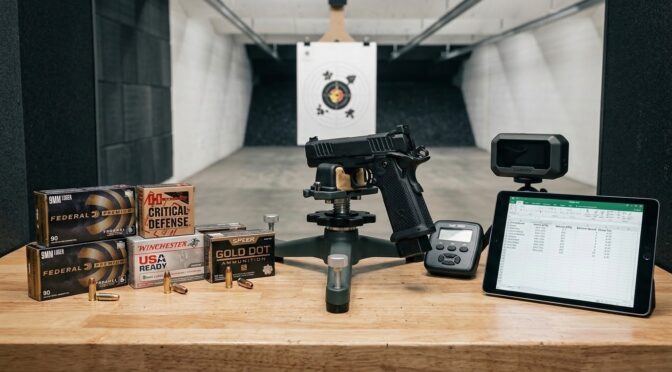
The secret to this phenomenal accuracy lies in its extreme consistency. A highly precise chronograph analysis utilizing a Garmin Xero C1 Pro radar unit revealed an average muzzle velocity of 1,077.9 feet per second.15 More importantly, the Extreme Spread—defined as the difference between the absolute fastest and slowest rounds in a given string of fire—was a mere 32.2 feet per second.15 In the realm of external ballistics, incredibly low extreme spreads are absolutely critical to preventing vertical stringing on the target, as variations in velocity directly translate to variations in bullet drop over distance.
4.2 Federal Premium Gold Medal Action Pistol 147-Grain FP
Federal Premium engineered this specific load explicitly for the competitive action-shooting circuit, utilizing a specialized flat-nose profile and their proprietary Catalyst lead-free primer.20 The flat meplat is specifically designed to transfer maximum kinetic energy to steel targets, ensuring rapid and reliable knockdowns on reactive arrays, while the Catalyst primer ensures a highly uniform ignition sequence.
From an accuracy standpoint, the Gold Medal Action Pistol load is extraordinary. Testing data demonstrates it printing 0.8 to 1.0-inch groups at 20 yards from high-end 2011 platforms, achieving an average velocity of 885 to 910 feet per second.21 When pushed back to 25 yards, it consistently prints sub-2-inch groups, typically hovering around 1.8 inches.20 Because this heavy round travels at roughly 900 feet per second, it is comfortably subsonic. The distinct lack of a supersonic crack upon exiting the muzzle heavily reduces the sonic disruption at the bullet’s base, further aiding in long-range flight stability.
4.3 Staccato Range 9mm (124-Grain FMJ)
While not quite as surgically precise as the Match variant, the Staccato Range ammunition provides an excellent baseline for what the pistol can achieve with standard Full Metal Jacket profiles. Utilizing a 124-grain bullet, this ammunition is rated by the factory to hold 2-inch groups at 25 yards.22 Independent testing confirms an average of 1.77-inch groups at that distance.15 With an average velocity of 1,131.2 feet per second and a remarkably tight extreme spread of only 29.3 feet per second, it represents one of the most consistent training loads available on the commercial market.15
5. Duty and Defensive Ammunition Efficacy
For law enforcement officers and civilian concealed carriers utilizing the Staccato P, mechanical precision must be perfectly balanced with terminal ballistics. The ammunition must be capable of striking a small target at distance while simultaneously expanding reliably and defeating intermediate barriers.
5.1 Speer Gold Dot 147-Grain JHP
Widely considered the ultimate gold standard for modern law enforcement duty ammunition, the Speer Gold Dot 147-grain Jacketed Hollow Point proves decisively that massive terminal ballistics do not have to come at the expense of mechanical precision.26
Testing of the 147-grain Gold Dot through Staccato platforms yielded highly consistent 15-yard group sizes ranging tightly from 1.28 to 1.3 inches.7 When the distance was pushed back to 25 yards, the horizontal spread opened slightly to 2.3 inches; however, expert evaluators explicitly noted this deviation was heavily influenced by 10-14 mph crosswinds pushing the projectile rather than inherent inaccuracy.7 In heavily controlled testing utilizing the architecturally similar Atlas Athena 2011 platform, the 147-grain Gold Dot produced a stunning 1.16-inch 5-shot group at 25 yards.27 This conclusive data solidifies the 147-grain Gold Dot as the premier choice for Staccato P owners requiring a duty-grade, barrier-blind defensive round that compromises nothing in terms of absolute accuracy.
5.2 Hornady Custom and Critical Duty Lines
For shooters prioritizing defensive capability alongside match-grade accuracy, the Hornady Custom 147-grain eXtreme Terminal Performance load is a dominant force.28 The bullet utilizes precise expansion skives but miraculously maintains the strict jacket concentricity of the HAP line. Range reports from experienced marksmen demonstrate exceptional precision with this load. Firing freehand, users have reported tight groups measuring between 0.75 and 1.0 inches at 15 yards.7 Even more impressive, when tested at a staggering 50 yards, the 147-grain Custom maintained a group size of 1.56 to 1.58 inches, discounting wind variables.8 This level of 50-yard precision confirms that the 1:10 twist rate of modern Staccato barrels imparts perfect stabilization to the elongated 147-grain projectile.
Furthermore, the Hornady Critical Duty 135-grain FlexLock load, boasting a ballistic coefficient of 0.195 and a muzzle velocity of 1010 feet per second, provides an exceptional alternative for those seeking slightly higher velocity while retaining extreme accuracy.30 The Flex Tip design ensures consistent expansion through heavy clothing and intermediate barriers without clogging, while the heavy-duty jacket-to-core locking band prevents separation, resulting in a load that is as devastatingly effective as it is accurate.33
6. Action Shooting, Power Factor, and Recoil Harmonics
In the highly competitive arenas of United States Practical Shooting Association (USPSA) and 3-Gun matches, the primary objective is balancing accuracy with raw speed. This requires ammunition loaded to exactly meet the specific “Minor Power Factor” floor while minimizing reciprocating slide violence to ensure the sights never leave the target.
6.1 The Mathematics of Power Factor Tuning
The power factor formula utilized in practical shooting is relatively simple:
Power Factor = (Bullet Weight in grains * Velocity in fps) / 1000.
To legally compete in Minor Power Factor divisions, a shooter must achieve a score of 125. To achieve a power factor of 130 (providing a safe margin above the floor), a lightweight 115-grain bullet must travel at a blistering 1,130 feet per second, creating a sharp, high-velocity recoil impulse that causes the muzzle to snap upward aggressively. However, a massive 150-grain bullet only needs to travel at 866 feet per second to achieve the exact same power factor.
6.2 Federal Syntech Action Pistol 150-Grain TSJ
The Federal Syntech Action Pistol 150-grain load is custom-built specifically for this mathematical advantage. Boasting a Total Synthetic Jacket that heavily reduces barrel friction, heat generation, and copper fouling, it travels at an average of 890 feet per second out of mid-to-full-size barrels, yielding a very comfortable power factor of roughly 133.5.35
Social media and forum analysts explicitly prefer this specific load for the Staccato P because the recoil is universally described as a gentle, rolling “push” rather than a violent “snap”.37 While its absolute mechanical accuracy (roughly 2.5 inches at 25 yards) 39 is slightly wider than the match-grade Hornady Action Pistol loads, its practical accuracy during high-speed, dynamic movement is absolutely unparalleled. Because the recoil impulse is so soft, the sights never leave the target array, allowing the shooter to string together highly accurate shots at a pace that would be impossible with high-velocity ammunition.
6.3 Super Vel and Excaliber Competition Loads
Similarly, specialized competition loads like Super Vel’s 147-grain Competition and Excaliber’s 147-grain offerings utterly dominate Reddit and forum recommendations for the 2011 platform.40 Analysts on these platforms astutely note that these 147-grain loads provide the “softest” recoil impulse, specifically pairing exceptionally well with the Staccato P’s factory 13-pound recoil spring.41
When competitive shooters are executing split times of 0.18 seconds between shots, the consistency of these subsonic loads ensures the 4.4-inch bull barrel drops exactly back to the center of the A-zone on the target. One evaluator, conducting an exhaustive side-by-side test, boldly declared the 147-grain Excaliber load the “clear winner” for providing “holes in holes” accuracy while feeling remarkably soft and controllable.40
7. Social Media Consensus and Qualitative Analytics
While Ransom Rest data dictates theoretical maximums, a comprehensive analysis requires evaluating how these loads perform in the hands of end-users under varied conditions. Social media and specialized firearms forums provide a massive, invaluable dataset of qualitative and quantitative range reports regarding the Staccato P’s accuracy.5
7.1 The “Hand Rack” Flyer Phenomenon
A highly documented anomaly across multiple accuracy tests, particularly those recorded on video and heavily analyzed in sniper and tactical forums, is the persistent “hand rack” flyer.7 Across various premium ammunition types—including the highly accurate Speer Gold Dot and Federal American Eagle—shooters consistently observe that the very first round chambered manually via racking the slide or dropping the slide release strikes a measurably different point of impact (usually lower) than the subsequent rounds fired via the weapon’s natural cyclic recoil.7
This is a well-known, inherent kinematic trait of the 1911/2011 locked-breech system. When a firearm is discharged, the expanding gases drive the slide rearward with tremendous, unyielding velocity, fully compressing the 13-pound recoil spring. As the slide returns to battery under full spring tension, it slams the barrel into the locking lugs with violent, consistent force, ensuring maximum lockup pressure. Conversely, when a user manually drops the slide on a fresh magazine, the slide velocity is often marginally slower, resulting in a slightly different lockup tension on the barrel link. This minute variance in barrel alignment manifests as a first-round flyer. For precision data collection, seasoned analysts correctly exclude this initial “hand-racked” shot from the core group measurement to find the true mechanical accuracy of the load.8
7.2 The Law of Diminishing Returns and Platform Comparisons
A prevailing and heavily debated theme in social media analysis is the price-to-performance ratio of the Staccato P relative to other platforms.5 Retailing between $2,100 and $2,500 2, the Staccato P sits in a very unique middle ground within the firearms industry. It is vastly more expensive than a mass-produced polymer striker-fired duty gun (such as a Glock 17 at $600) but notably less expensive than bespoke, hand-fit race guns like the Atlas Athena or Staccato XC, which range from $4,300 to over $5,600.27
Analysts evaluating the Staccato P carefully note that while its mechanical accuracy (highly capable of sub-1-inch groups) is objectively superior to a standard Glock 17, an average shooter may not actually possess the fundamental skill necessary to extract that performance freehand. Many users report finding their slow-fire groups to be “about on par” with their heavily modified polymer pistols.5 For instance, one detailed Reddit review comparing the Staccato P to a Glock 17 found that at 25 yards, the Staccato produced a 4.27-inch group compared to the Glock’s 4.17-inch group.5
However, the consensus shifts dramatically when evaluating rapid fire and speed dynamics. The crisp, 4-pound trigger and heavy, recoil-absorbing frame allow shooters to achieve split times and target transitions that are vastly superior to what they can achieve with a polymer duty pistol.5 The Staccato P is frequently and affectionately described as a “workhorse,” delivering 90 percent of the performance of a $5,000 custom race gun at half the price, making it the premier choice for law enforcement duty deployment and entry-level competitive shooting.6
8. Comprehensive Ballistics and Performance Data
To provide a highly structured and easily referenced overview of the loads analyzed in this exhaustive report, the following table details the internal and external ballistics of the premier 9mm ammunition utilized in the Staccato P platform.
| Ammunition Type | Projectile Weight | Profile | Avg. Muzzle Velocity (fps) | Power Factor | Optimal Application | Extreme Spread (fps) |
| Staccato Match 9mm | 125 Grain | HAP | 1,077.9 | 134.7 | Precision Target / Rest | 32.2 |
| Hornady Custom | 147 Grain | XTP (JHP) | ~990.0 | 145.5 | Defense / Precision | N/A |
| Speer Gold Dot | 147 Grain | JHP | 985.0 | 144.7 | Law Enforcement Duty | N/A |
| Federal Gold Medal AP | 147 Grain | FP | 903.0 – 936.0 | 132.7 – 137.5 | Action Pistol / Steel | 11 – 12 |
| Super Vel Excaliber | 147 Grain | FMJ | ~890.0 | 130.8 | USPSA Competition | N/A |
| Federal Syntech AP | 150 Grain | TSJ (FP) | 890.0 | 133.5 | Training / Fast Splits | 15.06 |
| Staccato Range 9mm | 124 Grain | FMJ (RN) | 1,131.2 | 140.2 | General Training | 29.3 |
Note: Velocities and Extreme Spreads are aggregated from multi-source empirical chronographic data fired from 4.0″ to 5.0″ barrels, adjusted to represent expected baseline performance in the 4.4″ Staccato P.15
The compiled data clearly demonstrates a distinct clustering of performance metrics. The loads designed specifically for extreme precision (Staccato Match, Federal Gold Medal) possess incredibly tight extreme velocity spreads, effectively minimizing vertical stringing on the target. Conversely, the loads designed for maximum speed and recoil mitigation (Syntech 150-grain, Super Vel 147-grain) sit perfectly inside the 130 to 135 power factor range, ensuring perfectly reliable slide cycling without inducing severe muzzle flip.
9. Conclusions and Operational Recommendations
Based on an exhaustive, engineer-level analysis of mechanical specifications, independent Ransom Rest machine testing, and vast aggregations of qualitative user data, the determination of the absolute “most accurate” 9mm commercial load for the Staccato P is heavily dependent on the specific definition of accuracy required by the end-user. The data supports several definitive conclusions.
For Absolute Mechanical Precision, such as firing from a static bench or Ransom Rest, the Staccato Match 9mm loaded with the 125-grain Hornady Action Pistol projectile is mathematically the most accurate commercial load available for this platform. Specifically tuned to the Staccato barrel’s harmonics, the skive-less hollow point design, rearward center of gravity, and ultra-low extreme spread of 32.2 feet per second allow it to reliably print sub-1-inch groups at 25 yards.15 It represents the absolute ceiling of the platform’s mechanical capabilities.
For Duty and Defensive Applications where terminal ballistics are equally as important as mechanical precision, the Speer Gold Dot 147-grain Jacketed Hollow Point and the Hornady Custom 147-grain eXtreme Terminal Performance loads dominate the category. Both of these premium loads exploit the 1:10 twist rate of modern 2011 barrels to perfectly stabilize their heavy projectiles, delivering 1.16 to 1.5-inch groups at 25 yards 8 while providing devastating, barrier-blind terminal performance. They are the premier, uncompromising choices for law enforcement deployment in the Staccato P.
Finally, for Practical, High-Speed Accuracy in environments like Action Pistol Competition, mechanical precision is largely irrelevant if the shooter cannot track the sights during rapid fire. For these dynamic environments, heavy, subsonic projectiles are absolutely mandatory. The Federal Syntech Action Pistol 150-grain and Super Vel Excaliber 147-grain loads are universally celebrated across forums and social media for their incredibly soft, “pushing” recoil impulse. By expertly tuning the power factor to approximately 130 to 133, these loads interface perfectly with the Staccato P’s 33-ounce frame and 13-pound recoil spring, allowing shooters to maintain blistering 0.18-second split times without ever leaving the A-zone.5
The Staccato P is an exceedingly capable platform. Its 4.4-inch bull barrel, heavy steel frame, and precision-engineered kinematic lockup ensure that it can extract the absolute maximum potential from any premium 9mm load. By moving away from bulk 115-grain round-nose ammunition and transitioning exclusively to 125-grain Action Pistol profiles or 147-grain to 150-grain flat/hollow points, operators can fully leverage the profound harmonic and ballistic advantages of the 2011 platform.
Please share the link on Facebook, Forums, with colleagues, etc. Your support is much appreciated and if you have any feedback, please email us in**@*********ps.com. If you’d like to request a report or order a reprint, please click here for the corresponding page to open in new tab.
Sources Used
- Staccato P, accessed February 22, 2026, https://staccato2011.com/products/staccato-p
- Long Term Review of Staccato P Pistol | thefirearmblog.com, accessed February 22, 2026, https://www.thefirearmblog.com/blog/long-term-review-of-staccato-p-pistol-44816275
- Staccato P Optic Ready 9mm Pistol w/ 4.4″ Stainless Barrel: MGW – Midwest Gun Works, accessed February 22, 2026, https://www.midwestgunworks.com/page/mgwi/prod/12-1200-000003
- Staccato P Endurance Report: 20,000 Round Long-Term Test | Outdoor Life, accessed February 22, 2026, https://www.outdoorlife.com/guns/staccato-p-endurance/
- My honest review of the Staccato P DPO after ~500 rounds – Reddit, accessed February 22, 2026, https://www.reddit.com/r/2011/comments/112rfk5/my_honest_review_of_the_staccato_p_dpo_after_500/
- Staccato P Review: The Full-Size 2011 That Defines Duty-Grade Performance, accessed February 22, 2026, https://aliengearholsters.com/blogs/news/staccato-p-review
- Staccato HD Accuracy, Repeatability, 15, 25, and 50 yards. Ammo test high winds, zero red dot. – YouTube, accessed February 22, 2026, https://www.youtube.com/watch?v=5EohvLfDsGs
- Sidearms & Scatterguns – Staccato accuracy | Sniper’s Hide Forum, accessed February 22, 2026, https://www.snipershide.com/shooting/threads/staccato-accuracy.7033397/
- The Truth Behind Twist Rates – Let’s Go Shooting, accessed February 22, 2026, https://letsgoshooting.org/resources/articles/firearms/the-truth-behind-twist-rates/
- pistols Archives – Coldboremiracle, accessed February 22, 2026, https://coldboremiracle.com/category/pistols/
- Firearm Parts for Sale – Upgrade your Firearm – Rainier Arms, accessed February 22, 2026, https://www.rainierarms.com/parts/
- Review of the New Kimber 2K11 Double Stack 1911 – Guns.com, accessed February 22, 2026, https://www.guns.com/news/reviews/review-of-the-new-kimber-2k11-double-stack-2011
- USPSA Nationals CO division most popular 9mm bullet weight was 147gr? Wow. What do you all use? – Reddit, accessed February 22, 2026, https://www.reddit.com/r/CompetitionShooting/comments/11kp4mx/uspsa_nationals_co_division_most_popular_9mm/
- Staccato CS & Holosun 507 Comp | 1000 Round Range Review, accessed February 22, 2026, https://qvoreviews.com/staccato-cs-holosun-507-comp-1000-round-range-review/
- Ammo Testing: Staccato Range and Match 9mm – American Handgunner, accessed February 22, 2026, https://americanhandgunner.com/ammo/ammo-testing-staccato-range-and-match-9mm/
- Wilson Combat Hornady HAP Bill Wilson Signature Match 9mm Luger 125 Grain Grain Brass Cased Pistol Ammunition Up to 13% Off – OpticsPlanet, accessed February 22, 2026, https://www.opticsplanet.com/wilson-combat-hornady-hap-bill-wilson-signature-match-9mm-luger-125-grain-grain.html
- 9mm .356 125 gr HAP® ‑ Hornady Manufacturing, Inc, accessed February 22, 2026, https://www.hornady.com/bullets/handgun/9mm-356-125-gr-hap-3000
- Hornady Bullets 9mm (.356″) 125 Gr. HAP (Bulk Bag of 100) – Precision Reloading, accessed February 22, 2026, https://www.precisionreloading.com/cart.php#!l=HN&i=35572B
- HORNADY 9MM (.356) 125gr HAP BULLET 500/BX – Graf & Sons, accessed February 22, 2026, https://www.grafs.com/catalog/product/productId/22786
- Handguns – July 2024 USA – AWS, accessed February 22, 2026, https://bzglfiles.s3.ca-central-1.amazonaws.com/u/565466/465a2657be27f3a6fff2cf8d0ce13717ae9b6bcd/original/handguns-july-2024-usa.pdf?response-content-type=application%2Fpdf&X-Amz-Algorithm=AWS4-HMAC-SHA256&X-Amz-Credential=AKIA2AEJH4L52D74HMMF%2F20260211%2Fca-central-1%2Fs3%2Faws4_request&X-Amz-Date=20260211T182850Z&X-Amz-Expires=604800&X-Amz-SignedHeaders=host&X-Amz-Signature=6a22091050af3af33af0b2c076e7aafde74605ccfbdf87b156ca8c2fd2a25d93
- Kimber 2K11: Double-Stack Race Gun – Recoil Magazine, accessed February 22, 2026, https://www.recoilweb.com/kimber-2k11-double-stack-race-gun-188516.html
- Staccato 2011 Handguns, Pistols, & Accessories. Built For Heroes. – Staccato 2011, accessed February 22, 2026, https://staccato2011.com/
- Staccato Announcements 2024 – New Products & Exciting Experiences, accessed February 22, 2026, https://staccato2011.com/announcements-2024
- Review: Glock G47 MOS | An NRA Shooting Sports Journal, accessed February 22, 2026, https://www.ssusa.org/content/review-glock-g47-mos/
- Nighthawk Custom Updates a Springfield Mil-Spec Classic 1911 – 45 ACP, accessed February 22, 2026, https://defense3193.rssing.com/chan-58585101/latest.php
- Buy Gold Dot Handgun Personal Protection 9mm Luger Ammo | 147 Grain, 985 FPS | Speer, accessed February 22, 2026, https://www.speer.com/ammunition/gold-dot/gold-dot-handgun-personal-protection/19-23619GD.html
- The Best 2011 Pistols of 2025, Tested and Reviewed – Outdoor Life, accessed February 22, 2026, https://www.outdoorlife.com/guns/best-2011-pistols/
- 9mm Ballistics From Every Major Ammo Maker, accessed February 22, 2026, https://ammo.com/ballistics/9mm-ballistics
- 9mm Luger 147 gr XTP® ‑ Hornady Manufacturing, Inc, accessed February 22, 2026, https://www.hornady.com/ammunition/handgun/9mm-luger-147-gr-xtp
- 9mm Luger+P 135 gr FlexLock – Hornady Law Enforcement, accessed February 22, 2026, https://www.hornadyle.com/handgun-ammunition/9mm-lugerp-135-gr-flexlock
- 9mm Luger (9×19) Ammo – 25 Rounds of 135 Grain Flex Tip (FTX) by Hornady, accessed February 22, 2026, https://www.ammunitiontogo.com/25rds-9mm-hornady-critical-duty-135gr-flexlock-hp-ammo
- Hornady Critical Duty 9mm Ammo Review: Stop the Threat, accessed February 22, 2026, https://ammo.com/ammo-review/hornady-critical-duty-9mm-review
- 9MM Luger +P 135 gr FlexLock® Critical Duty® ‑ Hornady Manufacturing, Inc, accessed February 22, 2026, https://www.hornady.com/ammunition/handgun/9mm-luger-p-135-gr-flexlock-critical-duty
- 9MM Luger 135 gr FlexLock® Critical Duty – Hornady Manufacturing, accessed February 22, 2026, https://www.hornady.com/ammunition/handgun/9mm-135-gr-flexlock-critical-duty
- Federal 9mm Luger Syntech Action Pistol 150gr Flat Nose Ammo – Black Basin Outdoors, accessed February 22, 2026, https://blackbasin.com/american-eagle-ae9sjap1-syntech-action-pistol-flat-nose-150-grain-9mm-luger-parabellum/
- Federal Syntech 9mm Ammo 150 Grain Total Synthetic Jacket Flat Nose – AE9SJAP1, accessed February 22, 2026, https://www.targetsportsusa.com/federal-syntech-9mm-luger-ammo-150-grain-tsj-ae9sjap1-p-83051.aspx
- A Review of Federal Syntech 150gr. 9mm Action Pistol Ammunition | ThruMyLens, accessed February 22, 2026, https://thrumylens.org/featured/a-review-of-federal-syntech-150gr-9mm-action-pistol-ammunition/
- Federal Syntech Action Pistol 150gr : r/NFA – Reddit, accessed February 22, 2026, https://www.reddit.com/r/NFA/comments/zl49o7/federal_syntech_action_pistol_150gr/
- Springfield Prodigy Review: A 2011 Wunderkind or More of the Same? – American Firearms, accessed February 22, 2026, https://www.americanfirearms.org/springfield-prodigy-review/
- The Ammo Debate : r/2011 – Reddit, accessed February 22, 2026, https://www.reddit.com/r/2011/comments/1fnx63p/the_ammo_debate/
- Heavier Bullets and Spring Rate (Staccato P) – 9mm/38 Caliber – Enos’s Forums, accessed February 22, 2026, https://forums.brianenos.com/topic/313222-heavier-bullets-and-spring-rate-staccato-p/
- Sidearms & Scatterguns – anyone NOT like the staccato p? | Sniper’s Hide Forum, accessed February 22, 2026, https://www.snipershide.com/shooting/threads/anyone-not-like-the-staccato-p.7150728/
- “Is it (the Staccato) worth the money?” | The Armory Life Forum, accessed February 22, 2026, https://www.thearmorylife.com/forum/threads/is-it-the-staccato-worth-the-money.21253/
- Staccato P – Uncle Zo, accessed February 22, 2026, https://unclezo.com/2022/07/18/staccato-p/
- Staccato P v Atlas Athena : r/2011 – Reddit, accessed February 22, 2026, https://www.reddit.com/r/2011/comments/1fcyklr/staccato_p_v_atlas_athena/
- Staccato P threaded vs Staccato P limited w/ comp vs Staccato XC – Reddit, accessed February 22, 2026, https://www.reddit.com/r/2011/comments/129n85a/staccato_p_threaded_vs_staccato_p_limited_w_comp/
- Unpopular Opinion – Full size carry is more comfy than micros : r/CCW – Reddit, accessed February 22, 2026, https://www.reddit.com/r/CCW/comments/1c5pzqh/unpopular_opinion_full_size_carry_is_more_comfy/
- Speer® LE Gold Dot® Duty Ammunition 9mm Luger, accessed February 22, 2026, https://le.vistaoutdoor.com/ammunition/speer/handgun/details.aspx?id=53619