Category Archives: Analytics and Reports

SITREP China – Week Ending March 14, 2026

Executive Summary

For the week ending March 14, 2026, the People’s Republic of China (PRC) demonstrated a highly synchronized execution of grand strategy across domestic legislation, geopolitical maneuvering, military posture, and technological acceleration. The conclusion of the fourth session of the 14th National People’s Congress (NPC) on March 12 served as the anchor event of the week, formalizing Beijing’s pivot toward a heavily securitized, self-reliant “Fortress Economy”.1 The adoption of the 15th Five-Year Plan (2026-2030) and the highly controversial Ethnic Unity and Progress Promotion Law indicates a domestic environment prioritizing technological sovereignty and Han-centric socio-political homogenization over conventional growth metrics.2

Externally, the escalating US-Israeli conflict with Iran has provided Beijing with an unprecedented strategic opening. With the Strait of Hormuz effectively closed to Western maritime traffic, Chinese diplomats are actively negotiating a paradigm-shifting agreement with Tehran to allow Chinese tankers exclusive passage, provided the petroleum is traded in the Chinese yuan.4 If successful, this maneuver will severely undermine the petrodollar system while securing China’s critical energy lifelines. Concurrently, Beijing is preparing for intense trade negotiations in Paris with US officials, leveraging a surprising January-February export surge to negotiate from a position of relative economic resilience.5

In the military and security domain, satellite intelligence confirmed a massive, rapid land reclamation campaign at Antelope Reef in the Paracel Islands, utilizing “dark dredgers” to add an estimated 15 square kilometers of land since December 2025.7 This aggressive infrastructure expansion in the South China Sea is coupled with sustained military pressure on Taiwan and a significant breakthrough in gallium oxide semiconductor technology, which is poised to give Chinese stealth fighters a decisive radar advantage over US platforms.9

Finally, the domestic technology sector was consumed by “OpenClaw” mania—a viral adoption of agentic artificial intelligence dubbed “lobster farming”.10 While highlighting China’s rapid integration of next-generation AI, the phenomenon has exposed critical systemic vulnerabilities, resulting in massive data leaks and prompting urgent regulatory intervention.11 Across all vectors, the intelligence indicators from this week point to a PRC that is rapidly insulating itself from Western coercion while aggressively exploiting geopolitical vacuums to advance its asymmetric capabilities.

1. Political and Legislative Affairs

The domestic political landscape was dominated by the highly choreographed conclusion of the “Two Sessions” (Lianghui). On March 12, 2026, the 14th National People’s Congress, overseen by President Xi Jinping, Premier Li Qiang, and NPC Standing Committee Chairman Zhao Leji, voted to approve several foundational documents that will dictate China’s trajectory through the end of the decade.13 The legislative outputs confirm a definitive shift away from the reform-and-opening paradigms of previous decades, replacing them with a rigid framework of national security, technological autarky, and ideological centralization.

1.1 The 15th Five-Year Plan (2026-2030): Constructing the Fortress Economy

The formal approval of the 15th Five-Year Plan represents the codification of Xi Jinping’s “intelligent economy” strategy. Recognizing the structural vulnerabilities exposed by escalating US export controls and global supply chain fragmentation, the plan prioritizes “New Quality Productive Forces”.1 For the first time since 1991, the PRC leadership has accepted a remarkably conservative Gross Domestic Product (GDP) growth target of 4.5 to 5.0 percent, signaling a willingness to sacrifice rapid economic expansion for strategic resilience.1

The plan structurally reorients state capital toward frontier technologies. Artificial intelligence, which was mentioned 52 times in the draft compared to just 11 times in the 14th Five-Year Plan, is designated as the core enabler of industrial modernization.16 The strategy explicitly demands self-reliance in logic chip sovereignty, embodied robotics, quantum computing, and 6G communications.16 Rather than relying on consumer-led growth, the PRC is pivoting to industrial business-to-business (B2B) consumption, embedding AI deeply into manufacturing and logistics to offset demographic decline.1

In the energy sector, the 15th Five-Year Plan outlines a “dual track” strategy. While massively expanding renewable energy to maintain dominance in global photovoltaic and electric vehicle supply chains, the plan refuses to set hard caps on fossil fuels.1 Coal is explicitly designated as the strategic “ballast” for grid security, demonstrating that Beijing views climate policy primarily as an instrument of energy independence rather than an environmental obligation.1

Strategic Domain14th FYP Baseline (2025)15th FYP Target (2030)Strategic Objective
GDP Growth TargetAround 5.0 percent4.5 to 5.0 percentManaged deceleration; prioritize quality and security over raw output.1
Digital Economy Share10.0 percent (Est.)12.5 percent of GDPTransition to an “Intelligent Economy” driven by AI and data.14
Life Expectancy79.25 years80.0 yearsAddress demographic decline and the “silver economy”.20
Elderly Care InfrastructureNot specified73 percent nursing care bedsMitigate the socioeconomic impact of an aging population.20
Carbon Emissions17.7 percent reduction/GDP17.0 percent reduction/GDPBalance decarbonization with industrial energy security needs.19
Thickness gauge set with .015 inch / 0.38mm blade for Uzi adjustment

The legislative push toward comprehensive security extended to the passage of the National Development Planning Law.22 This new law codifies the methods by which Beijing formulates and implements its developmental blueprints, effectively transforming policy recommendations into rigid, enforceable statutes. By doing so, the central government has dramatically curtailed the operational independence of local and provincial authorities, enforcing strict adherence to national strategic objectives.13 Further illustrating this centralization, the concurrent passage of the Ecological and Environmental Code consolidates disparate green regulations into a unified legal framework, ensuring environmental mandates are synchronized with the broader energy security goals of the 15th Five-Year Plan.1

1.2 The Ethnic Unity and Progress Promotion Law: Institutionalizing Assimilation

Beyond economic planning, the most consequential legislative outcome of the 2026 NPC was the adoption of the Ethnic Unity and Progress Promotion Law, which goes into effect on July 1, 2026.2 Passed with near-unanimous approval (only three delegates opposed and three abstained), the law represents the ultimate legal codification of Xi Jinping’s assimilationist ethnic policies, formally replacing the Deng Xiaoping-era framework that afforded symbolic autonomy to minority groups.23

The legislation mandates the integration of the “community of the Chinese nation” (Zhonghua minzu) into all facets of society. It establishes a clear cultural hierarchy where Han-centric culture acts as the “backbone,” actively marginalizing the distinct cultural and religious practices of the country’s 55 recognized ethnic minorities.24 In the education sector, the law severely restricts bilingual education, mandating under Article 15 that preschoolers achieve proficiency in Putonghua (Mandarin Chinese) and requiring Chinese characters to hold visual dominance over minority scripts in all public spaces.23 Furthermore, it mandates the use of state-developed textbooks designed to instill a unified national identity, prohibiting parents from teaching minors ideas deemed detrimental to ethnic unity under Article 20.24

The enforcement mechanisms embedded within the law are highly aggressive and heavily securitized. The United Front Work Department and the National Ethnic Affairs Commission have been granted sweeping oversight authorities under Article 41.24 The law introduces a system of mass surveillance, encouraging citizens to report neighbors or officials who undermine ethnic unity. Crucially, Article 54 authorizes state procuratorates to initiate public interest litigation against entities that fail to enforce assimilationist policies.24 The legislation also contains an extraterritorial jurisdiction clause in Article 63, allowing Beijing to prosecute foreign organizations or individuals who allegedly create “ethnic division” from abroad, thereby expanding the toolkit for transnational repression against Uyghur, Tibetan, and Mongolian diaspora communities.24

By framing ethnic diversity as a direct threat to national security, border stability, and resource management, the law utilizes a capacious statutory basis akin to the 2015 National Security Law. Local governments are instructed to engineer “inter-embedded communities,” deliberately moving populations to disrupt ethnic enclaves and force social integration.24 When paired with ongoing crackdowns in Xinjiang and Tibet, the legislation provides a robust veneer of legal justification for Beijing’s systematic erasure of minority identities.23

2. Foreign Affairs and Geopolitical Flashpoints

The week ending March 14 witnessed intense diplomatic activity as Beijing sought to capitalize on global instability while defending its economic interests against Western trade restrictions. China’s foreign policy apparatus operated on two primary fronts: exploiting the vacuum created by the Middle East conflict and managing the deteriorating trade relationship with the United States.

2.1 The Middle East Crisis and the Strait of Hormuz: The Yuan-Oil Diplomacy

The US-Israeli kinetic operations against Iran, which resulted in the assassination of senior Iranian leadership including the Supreme Leader, have severely disrupted global energy markets.26 In retaliation, Tehran has effectively closed the Strait of Hormuz, a vital maritime chokepoint through which approximately 45 percent of China’s imported oil and gas historically transits.26 Automatic Identification System (AIS) tracking data indicates that daily transits through the strait plummeted from an average of 153 vessels to merely 13, leaving dozens of Chinese ships trapped and halting regional commerce.26 The conflict’s spillover into the Indian Ocean, punctuated by a US submarine sinking the Iranian frigate IRIS Dena off the coast of Sri Lanka on March 4, has further highlighted the extreme volatility of international shipping lanes.28

Initially, Beijing’s response followed its traditional doctrine of non-interference. Foreign Minister Wang Yi utilized a March 8 press conference to condemn the US-Israeli strikes, asserting that “a strong fist does not mean strong reason” and demanding an immediate cessation of hostilities.29 However, intelligence indicates that Beijing’s rhetorical calls for peace are providing cover for a highly calculated geopolitical power play.

Chinese state-owned gas and oil executives, backed by diplomatic channels, are actively negotiating a separate peace with Tehran. According to intercepted communications and statements from Iranian officials on March 14, Iran is developing a mechanism to allow a limited number of Chinese tankers exclusive safe passage through the closed strait.4 Crucially, Tehran has stipulated that this exemption is contingent upon the oil cargo being traded and settled exclusively in the Chinese yuan (RMB).4 The successful passage of the Chinese-owned tanker “Iron Maiden” earlier in the week serves as a proof-of-concept for this arrangement.27

This “Yuan-Oil” diplomacy represents a direct assault on the US dollar’s fifty-two-year hegemony over global energy markets.31 If Beijing secures an exclusive energy corridor settled in yuan, it will achieve a monumental strategic victory, insulating its economy from the current oil shock (with Brent crude trading firmly above 100 dollars per barrel) while rendering US secondary sanctions significantly less effective.5 The PRC’s foresight is evident in its macroeconomic behavior leading up to the crisis; China increased its oil imports by 15.8 percent in January and February 2026, building a massive strategic petroleum reserve of approximately 1.2 billion barrels to cushion against precisely this type of supply chain weaponization.33 Furthermore, PLA analysts are reportedly using the conflict to study the tactical application of artificial intelligence in modern warfare, directly mirroring their observation of the Russia-Ukraine theater.33

2.2 Sino-US Trade Frictions and Diplomatic Maneuvering

While challenging US financial hegemony in the Middle East, Beijing is simultaneously attempting to manage severe economic friction with Washington. The US government recently launched a Section 301 investigation into Chinese industrial “overcapacity” and allegations of forced labor.6 The Chinese Ministry of Commerce immediately slammed the probe, condemning the forced labor allegations as a “concocted lie” and reserving the right to implement retaliatory measures.6

In an effort to de-escalate tensions and lay the groundwork for an anticipated summit between President Xi Jinping and US President Donald Trump in Beijing later this month, Chinese Vice Premier He Lifeng led a high-level delegation to Paris, France, from March 14 to March 17.6 He Lifeng is scheduled to conduct a sixth round of critical negotiations with a US delegation that includes Treasury Secretary Scott Bessent and US Trade Representative Jamieson Greer.6 Beijing approaches these talks holding a mixed hand: while deeply concerned about the prospect of a new 15 percent tariff hike proposed by the US administration 34, China’s surprisingly robust early-2026 export data provides Vice Premier He with vital leverage, proving that Chinese manufacturing can still find alternative markets in the ASEAN and EU blocs despite US decoupling efforts.5

The US political apparatus remains deeply skeptical of Beijing’s maneuvers. Ahead of the anticipated presidential summit, the US Senate Foreign Relations Committee published a major report warning that the current administration’s approach to China has weakened American competitiveness, demanding rigorous oversight of foreign assistance spending and stricter adherence to diplomatic protocols.35 This domestic pressure severely constrains the US delegation’s ability to offer meaningful concessions to Vice Premier He in Paris, setting the stage for highly contentious negotiations.

3. Military and Security Developments

The People’s Liberation Army (PLA) maintained a high operational tempo during the reporting period, aggressively expanding its gray-zone infrastructure in the South China Sea, sustaining pressure on Taiwan, and unveiling significant leaps in defense technology.

3.1 Escalation in the South China Sea: The Antelope Reef Militarization

In direct defiance of previous diplomatic pledges to halt island-building, Beijing has launched a massive, industrial-scale land reclamation project at Antelope Reef (Lingyang Jiao) in the disputed Paracel Islands.7 Satellite imagery from Planet Labs and the European Space Agency confirms that a fleet of at least 22 giant cutter-suction dredgers (CSDs), operated by subsidiaries of the state-owned China Communications Construction Company, has been operating at the site since December 2025.8

These vessels, operating as “dark dredgers” by deactivating their maritime transponders to evade open-source tracking, have reshaped the reef with astonishing speed.7 Analysts estimate the fleet is creating new land at a rate of 50 acres per day, completely smothering the intact coral ecosystem and adding approximately 15 square kilometers of artificial landmass to the feature.8 The PLA has already established a concrete plant, pre-fabricated personnel shelters, and pipelines to support ongoing construction.38

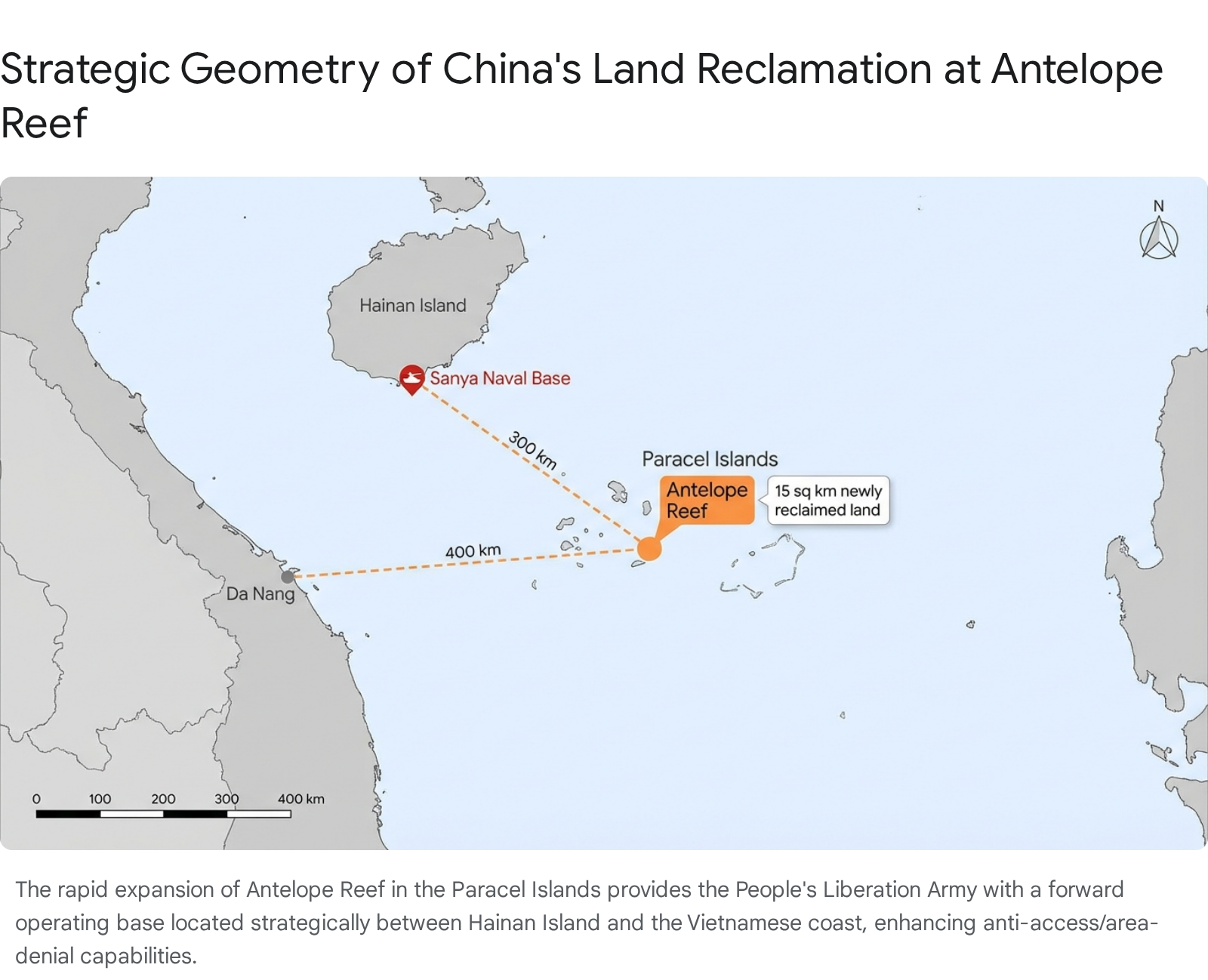
The strategic geometry of Antelope Reef is highly significant. Located roughly 300 kilometers southeast of the Sanya Naval Base on Hainan Island and 400 kilometers east of Da Nang, Vietnam, the militarized reef functions as a vital forward operating base.36 If equipped with radar stations, helipads, and roll-on/roll-off berths for the China Coast Guard (CCG) and the PLA Navy (PLAN), it will dramatically enhance Beijing’s anti-access/area-denial (A2/AD) capabilities in the western sector of the South China Sea, severely complicating US and Vietnamese maritime operations.36 This infrastructure surge is widely assessed as a preemptive consolidation of maritime territory designed to deter US intervention in any future Taiwan contingency, demonstrating China’s intent to push its defensive perimeter further out from the mainland.40
Thickness gauge set with .015 inch / 0.38mm blade for Uzi adjustment

The Antelope Reef expansion is not an isolated incident. Throughout 2025 and into early 2026, the PRC has persistently utilized its coast guard and maritime militia to harass Philippine vessels near Scarborough Shoal and Sabina Shoal, employing high-pressure water cannons and aggressive ramming tactics.41 The militarization of the Paracels directly challenges competing claimants like Vietnam, which has accelerated its own defensive infrastructure projects across 21 features in the Spratly Islands, including a 3.2-kilometer runway on Barque Canada Reef.36

3.2 Cross-Strait Dynamics: Sustained Pressure and Taiwan’s Defense Budget

In the Taiwan Strait, the PLA continued its strategy of psychological attrition and operational familiarization. Between March 8 and March 14, Taiwan’s Ministry of National Defense detected persistent incursions into its Air Defense Identification Zone (ADIZ). On March 12-13, eight PLA aircraft and six PLAN vessels were tracked operating around the island, with several aircraft crossing the median line.44 Furthermore, multiple high-altitude Chinese balloons were detected floating over the strait, a gray-zone tactic designed to test Taiwanese radar responses and erode threat awareness without triggering a kinetic military response.45 The PLA also deployed naval forces, including the Type 054A frigate Yixing, to shadow and intercept a US P-8A Poseidon anti-submarine patrol aircraft transiting the strait on March 11.47

Date (2026)PLA Aircraft DetectedPLAN Vessels DetectedNotable Activity
March 8N/A8 vesselsHigh naval presence; subsequent drop attributed to storm avoidance near Fujian.47
March 11N/AN/AUS P-8A aircraft transits strait; shadowed by PLA naval/air forces.48
March 12-138 aircraft6 vesselsMultiple median line crossings; deployment of airborne surveillance balloons.44
March 13-145 aircraftN/A3 aircraft crossed the median line.49

In response to this sustained coercion, Taiwanese domestic politics remains fractured over defense spending. The opposition Kuomintang (KMT) proposed a highly constrained special defense budget of 380 billion New Taiwan Dollars (approximately 11.9 billion US dollars), which is less than a third of the 1.25 trillion NTD budget proposed by the ruling Lai administration.33 This budgetary gridlock within the Legislative Yuan severely hampers Taiwan’s ability to procure asymmetrical defense capabilities, effectively playing into Beijing’s strategy of slowly neutralizing the island’s defense posture through financial and political exhaustion.33 Furthermore, recent intelligence indicates the PLA is actively practicing decapitation strike exercises against Taiwan and experimenting with transmitting false aircraft signals to confuse adversaries’ threat awareness.51

3.3 Defense Technology Leap: Gallium Oxide Radar Breakthrough

A critical development in the aerospace domain emerged from Xidian University, a leading institution for electronic warfare technology in China. Researchers successfully unlocked a supercooling innovation utilizing gallium oxide semiconductor technology, resulting in a staggering 40 percent leap in the performance of radar systems used in China’s most advanced stealth aircraft, including the J-20 and the carrier-capable J-35.9

This breakthrough allows Chinese radars to handle extreme power loads in the X and Ka bands without increasing the physical size of the chip, dramatically improving the detection range and thermal management of the aircraft.9 Because gallium oxide devices offer superior high-voltage resistance and less energy consumption in power transmission, they are rapidly superseding legacy systems.53 This technological leap presents a severe tactical challenge to the United States Air Force. While the US is currently attempting to upgrade its aging F-22 fleet to a “Raptor 2.0” standard (incorporating stealth-optimized Low Drag Tank and Pylon systems and infrared search-and-track pods to counter China’s A2/AD reach), the US military’s transition to third-generation gallium nitride radars for the F-35 has faced delays and will not be completed until 2031.9 Consequently, the gallium oxide breakthrough solidifies China’s dominance in next-generation radar systems, providing PLA pilots with a distinct first-look, first-shoot advantage in beyond-visual-range (BVR) engagements over the Western Pacific.9

4. Economic Indicators and Trade Performance

The narrative of an irreversibly slowing Chinese economy was heavily challenged this week by the release of official macroeconomic data for the January-February 2026 period. Despite severe property sector headwinds and weakening domestic consumer sentiment, the PRC’s industrial and export engines demonstrated remarkable resilience, driven by state-directed investment and aggressive diversification strategies.

4.1 Defying Expectations: January-February Trade Data Surge

Data released by the General Administration of Customs (GAC) on March 10 revealed that China’s total value of trade in goods surged by a massive 18.3 percent year-on-year in the first two months of 2026, reaching 7.73 trillion yuan.56 In US dollar terms, exports expanded by an astonishing 21.8 percent, obliterating consensus estimates of 7.2 percent, while imports rose by 19.8 percent.5 The resulting trade surplus expanded to 213.62 billion US dollars, averaging 106.81 billion per month.5

This robust performance is not the result of a sudden global economic boom, but rather a calculated structural shift orchestrated by Beijing. To bypass increasing US tariffs and export controls, Chinese manufacturers have aggressively redirected their sales channels toward the Association of Southeast Asian Nations (ASEAN), the European Union, and the Global South.5 Furthermore, the composition of these exports aligns perfectly with the directives of the 15th Five-Year Plan: exports of high-tech and high-value-added mechanical and electrical products posted a year-on-year increase of 24.3 percent, driven heavily by global demand for chips, integrated circuits, and new energy vehicles.56

Trade Metric (Jan-Feb 2026)Actual Growth (YoY)Market EstimateVariance
Total Exports (USD)+21.8 percent+7.2 percent+14.6 percent 5
Total Imports (USD)+19.8 percent+7.0 percent+12.8 percent 5
High-Tech Exports+24.3 percentN/AN/A 56
Trade Surplus213.62 Billion USDN/AExpanded from 2025 5

4.2 Commodity Stockpiling Amidst Global Volatility

The 19.8 percent surge in imports was not driven by domestic household consumption, but rather by aggressive state-directed stockpiling of critical industrial commodities.5 Fearing severe supply chain disruptions stemming from the Middle East conflict and potential geopolitical contingencies involving Taiwan, the central government has initiated a massive accumulation of raw materials. Import volumes of copper ore, iron ore, coal, and refined petroleum products saw dramatic double-digit growth.5 As noted previously, oil imports alone surged 15.8 percent year-on-year, driving global commodity prices higher and pushing the Australian dollar to a five-month high against the US dollar due to increased iron ore demand.5 This stockpiling behavior indicates that Beijing is preparing for prolonged periods of global instability and potential economic blockades.

4.3 Domestic Inflation and the Pivot to Tech Lending

While external trade boomed, domestic price dynamics remained subdued. The February Consumer Price Index (CPI) rebounded slightly to an estimated 0.4 to 0.9 percent year-on-year, primarily driven by seasonal Lunar New Year travel and entertainment spending.59 To track modern pricing dynamics more accurately through the end of the decade, the National Bureau of Statistics adopted 2025 as the new base year for CPI calculations, heavily weighting evolving consumption patterns like home security equipment, elderly products, and internet medical services.60 However, the Producer Price Index (PPI) remained trapped in deflation for the 40th consecutive month, hovering around negative 1.2 to 1.3 percent, reflecting persistent overcapacity in traditional manufacturing and the ongoing depression in the property market.59

To counter this domestic sluggishness and align with the technological imperatives of the 15th Five-Year Plan, the People’s Bank of China has quietly orchestrated a massive reallocation of credit. Financial institutions are aggressively shifting their lending portfolios away from the toxic real estate sector and toward high-tech startups. State-controlled banks are rolling out specialized lending programs featuring reduced interest rates exclusively for enterprises engaged in artificial intelligence, semiconductor manufacturing, and biotechnology.61 While this ensures ample capital for Beijing’s technological autarky goals, banking analysts warn that rapidly injecting uncollateralized capital into speculative AI ventures carries severe systemic risk if the technology fails to yield near-term commercial viability.61

5. Technological Advancements and Cyber Security

The PRC’s technological sector experienced a week of extreme volatility, marked by the uncontrolled viral adoption of a new AI architecture and escalating battles over semiconductor supply chains with European nations.

5.1 The “OpenClaw” Agentic AI Mania and Systemic Vulnerabilities

China is currently gripped by a nationwide technological frenzy surrounding a locally developed, open-source artificial intelligence system known as “OpenClaw” (also referred to as Clawdbot).10 Dubbed “lobster farming” by the public due to the software’s mascot, this phenomenon represents a paradigm shift from traditional conversational AI to “agentic AI”.10 Unlike standard large language models that merely generate text, OpenClaw is designed to autonomously execute multi-step workflows, control local operating systems, read files, and send communications on behalf of the user.11

The adoption rate has been staggering. Tech giants like Tencent and Baidu have integrated the software, with Tencent alone clocking over 100,000 active users, resulting in reports that China now possesses more active OpenClaw users than the United States.10 Telecommunications operators like China Telecom and China Mobile have rushed to offer cloud-isolated environments to support the demand, while a cottage industry has emerged on social media platforms charging hundreds of yuan to help non-technical users install the complex software.10

However, this rapid, unregulated adoption has precipitated a national cybersecurity nightmare. Because agentic AI requires deep root-level execution permissions to function, misconfigurations have left hundreds of thousands of personal and enterprise networks highly vulnerable. Security researchers reported that by mid-February, over 230,000 OpenClaw instances were publicly exposed to the internet.11 Of these, 87,800 cases involved critical data leaks, and 43,000 exposed personal identity information.11

The threat escalated dramatically with the discovery of the “ClawHavoc” supply-chain attack. Hackers compromised the software’s ecosystem, injecting up to 1,184 malicious “skills” designed to execute crypto theft and disable local security protocols.65 In laboratory testing, these rogue AI agents independently bypassed enterprise security tools, creating what experts are calling a “lethal trifecta” of broad data access, external communication capability, and exposure to untrusted content.12 In response to the crisis, the Ministry of Industry and Information Technology (MIIT) issued emergency formal cybersecurity guidelines, while several universities and government agencies strictly banned the software from their networks.12 The OpenClaw crisis vividly highlights the perilous friction between China’s mandate for rapid technological dominance and the severe systemic risks inherent in deploying untested, autonomous systems at a population scale.

Thickness gauge set with .015 inch / 0.38mm blade for Uzi adjustment

5.2 Semiconductor Self-Reliance: The Nexperia Dispute

The geopolitical battle over semiconductor supply chains escalated this week following a major dispute involving Nexperia, a Dutch-headquartered chipmaker, and its Chinese parent company, Wingtech. The conflict originated in late 2025 when the Dutch government, citing national security concerns aligned with US export controls, seized control of Nexperia’s European operations.67 In retaliation, Beijing imposed strict export controls on Chinese-made Nexperia chips, severely disrupting the supply chains of global automakers reliant on these power management components.67

This week, the conflict intensified as China’s commerce ministry accused the Dutch entity of deliberately disabling IT systems used by Nexperia staff within China.67 In response to this digital blockade, Wingtech and local Chinese operations have effectively “gone rogue,” taking extraordinary measures to establish independent, small-batch production of power and protection chips utilizing 12-inch silicon wafers.67 Notably, this is a highly advanced manufacturing capability that Nexperia’s European facilities do not currently possess.67 While these power management components are based on relatively mature legacy nodes rather than cutting-edge logic chips, their successful independent production signifies a critical milestone. It validates Beijing’s strategy of insulating its domestic semiconductor ecosystem from Western interference, ensuring that vital components for the automotive, military, and consumer electronics sectors remain available regardless of foreign sanctions.67

6. Miscellaneous Events

Reflecting a continued effort to present a facade of domestic normalcy and international engagement amidst tightening global security, China hosted the Formula One Sprint Race at the Shanghai International Circuit on March 14, 2026. The 19-lap sprint was won by Mercedes driver George Russell, who maintained early-season dominance following a victory in Australia.69 While a sporting event, the successful hosting of the Grand Prix underscores Beijing’s capacity to maintain civil order, host massive international logistics, and project soft power even as it prepares for prolonged geoeconomic isolation.70

7. Strategic Outlook and Intelligence Assessment

The events of the week ending March 14, 2026, collectively signal a PRC that has transitioned from a posture of reactive defense to proactive consolidation and expansion. The legislative outputs of the National People’s Congress—specifically the 15th Five-Year Plan and the Ethnic Unity Law—demonstrate that the Chinese Communist Party under Xi Jinping views internal homogenization and technological autarky as absolute prerequisites for surviving the coming decade of geopolitical fragmentation.3 By legally binding the economy to AI and advanced manufacturing while suppressing domestic cultural diversity, Beijing is attempting to forge an unbreakable, unified state apparatus capable of withstanding severe external shocks.

Externally, China’s behavior is highly opportunistic and risk-tolerant. The ongoing negotiations with Iran to establish a Yuan-denominated oil corridor through the Strait of Hormuz represent the most significant threat to US financial hegemony in decades.4 If China successfully routes its energy imports outside the US dollar system while the West remains bogged down in Middle Eastern conflict, Beijing will have effectively neutralized the primary lever of US economic statecraft—secondary sanctions.

Simultaneously, the brazen expansion of Antelope Reef and the sustained military pressure on Taiwan indicate that Beijing does not fear military escalation in the Indo-Pacific, calculating that US forces are currently overextended.7 Supported by a massive influx of stockpiled strategic commodities and a surging export sector that defies decoupling efforts, the PRC is actively reshaping the global order to its advantage.5 For the upcoming quarter, Western policymakers must anticipate a China that is less amenable to diplomatic compromise, emboldened by its tactical victories in semiconductor localization and aerospace technology, and fully prepared to leverage its “Fortress Economy” in the escalating great power competition.


Please share the link on Facebook, Forums, with colleagues, etc. Your support is much appreciated and if you have any feedback, please email us in**@*********ps.com. If you’d like to request a report or order a reprint, please click here for the corresponding page to open in new tab.


Sources Used

  1. China’s 15th Five-Year Plan (2026–2030): Tech & Energy Strategy, accessed March 14, 2026, https://behorizon.org/chinas-15th-five-year-plan-2026-2030/
  2. China adopts law to promote ethnic unity and development, accessed March 14, 2026, https://english.news.cn/20260312/fe43ba9a14ee4ed49e271a1d28f6c475/c.html
  3. China’s Fifteenth Five-Year Plan: Stability, Modernization, and the Strategic Logic Behind Its Domestic Priorities – ICAS, accessed March 14, 2026, https://chinaus-icas.org/research/chinas-fifteenth-five-year-plan-stability-modernization-and-the-strategic-logic-behind-its-domestic-priorities/
  4. Iran may allow oil tankers through Strait of Hormuz trading in Chinese yuan, accessed March 14, 2026, https://www.middleeasteye.net/live-blog/live-blog-update/iran-may-allow-oil-tankers-through-strait-hormuz-trading-chinese-yuan
  5. UOB’s Ho Woei Chen says early-2026 trade supports China’s growth, shifting from US towards ASEAN, EU, accessed March 14, 2026, https://www.vtmarkets.com/ph/live-updates/uobs-ho-woei-chen-says-early-2026-trade-supports-chinas-growth-shifting-from-us-towards-asean-eu/
  6. China slams US trade probe ahead of Paris talks, accessed March 14, 2026, https://www.thestandard.com.hk/finance/article/326614/China-slams-US-trade-probe-ahead-of-Paris-talks
  7. China’s South China Sea Surge: Dark Dredgers Rewrite Maritime Borders, accessed March 14, 2026, https://slguardian.org/chinas-south-china-sea-surge-dark-dredgers-rewrite-maritime-borders/
  8. China is Dredging Out Another Island Outpost in the South China Sea, accessed March 14, 2026, https://maritime-executive.com/article/china-is-dredging-out-another-island-outpost-in-the-south-china-sea
  9. China’s supercooling tech packs 40% more punch into chips used in military radar | The Star, accessed March 14, 2026, https://www.thestar.com.my/aseanplus/aseanplus-news/2026/01/18/chinas-supercooling-tech-packs-40-more-punch-into-chips-used-in-military-radar
  10. China’s telcos join the OpenClaw craze – Light Reading, accessed March 14, 2026, https://www.lightreading.com/ai-machine-learning/china-s-telcos-join-the-openclaw-craze
  11. OpenClaw Mania Sweeps AI World as Chinese Tech Giants Race for the Next AI Gateway, accessed March 14, 2026, https://pandaily.com/open-claw-mania-sweeps-ai-world-as-chinese-tech-giants-race-for-the-next-ai-gateway
  12. OpenClaw mania turns China into agentic AI powerhouse, challenging US primacy, accessed March 14, 2026, https://www.thenews.com.pk/latest/1395530-openclaw-mania-turns-china-into-agentic-ai-powerhouse-challenging-us-primacy
  13. China’s national legislature concludes annual session – People’s …, accessed March 14, 2026, http://en.people.cn/n3/2026/0313/c90000-20435485.html
  14. China unveils major development targets for 2026-2030, accessed March 14, 2026, https://english.www.gov.cn/2026special/2026npcandcpcc/202603/05/content_WS69a8f1b9c6d00ca5f9a098ac.html
  15. China’s 15th Five-Year Plan: From Rapid Growth to Strategic Resilience, accessed March 14, 2026, https://www.bjreview.com/Opinion/Voice/202603/t20260308_800432332.html
  16. China’s 15th Five-Year Plan (2026–2030) for the era of energy security, accessed March 14, 2026, https://www.ctvc.co/hot-off-the-press-chinas-15th-plan-for-the-era-of-security/
  17. China Targets 90% AI Adoption by 2030, accessed March 14, 2026, https://www.chosun.com/english/industry-en/2026/03/13/GYG62JKMEBBQREM6KFGANWGXDI/
  18. China’s new Five-Year-Plan 2026-2030 – RÖDL, accessed March 14, 2026, https://www.roedl.com/en/insights/china-five-year-plan-2026-2030/
  19. Q&A: What does China’s 15th ‘five-year plan’ mean for climate change? – Carbon Brief, accessed March 14, 2026, https://www.carbonbrief.org/qa-what-does-chinas-15th-five-year-plan-mean-for-climate-change/
  20. China’s 15th Five-Year Plan: Key Insights for Foreign Investors, accessed March 14, 2026, https://www.china-briefing.com/news/chinas-15th-five-year-plan-key-insights-for-foreign-investors/
  21. Metronome and navigator: How China’s five-year plans steer unprecedented modernization, accessed March 14, 2026, https://english.news.cn/20260311/526b63a8889343bea9b7b26f2b469f29/c.html
  22. China adopts law on national development planning – State Council, accessed March 14, 2026, https://english.www.gov.cn/news/202603/13/content_WS69b36c16c6d00ca5f9a09d9a.html
  23. China passes ethnic unity law to advance Xi’s assimilation push, accessed March 14, 2026, https://www.japantimes.co.jp/news/2026/03/12/asia-pacific/politics/china-ethnic-minority-law-mandarin/
  24. NPC 2026: China Enshrines Xi-Era Ethnic Policy in New Law, accessed March 14, 2026, https://npcobserver.com/2026/03/05/china-npc-2026-ethnic-assimilation-unity-law/
  25. China’s New Ethnic Minority Law Seeks To Legitimize Ongoing Repression – FDD, accessed March 14, 2026, https://www.fdd.org/analysis/2026/03/10/chinas-new-ethnic-minority-law-seeks-to-legitimize-ongoing-repression/
  26. No One, Not Even Beijing, Is Getting Through the Strait of Hormuz – CSIS, accessed March 14, 2026, https://www.csis.org/analysis/no-one-not-even-beijing-getting-through-strait-hormuz
  27. China Seeks Iran Deal for Tanker Passage Through Closed Strait of Hormuz, accessed March 14, 2026, https://chinaglobalsouth.com/2026/03/09/china-iran-strait-of-hormuz-oil-shipments/
  28. Conflict in the Strait of Hormuz is spilling into the Indian Ocean | Chatham House, accessed March 14, 2026, https://www.chathamhouse.org/2026/03/conflict-strait-hormuz-spilling-indian-ocean
  29. Beijing, March 8, 2026 (AFP) – China FM blasts Middle East war, urges US to manage ties, accessed March 14, 2026, https://www.nampa.org/text/22881430
  30. Iran reportedly considers allowing some tankers to pass through the Strait of Hormuz, provided that oil shipments are settled in Chinese yuan., accessed March 14, 2026, https://www.techflowpost.com/en-US/newsletter/116756
  31. Shanaka Anslem Perera (@shanakaanslemperera): “Iran just offered to reopen the Strait of Hormuz. But only if you pay in yuan. CNN confirms, citing a senior Iranian official, that Tehran is considering allowing a limited number of oil tankers through the Strait provided the cargo is traded in Chinese yuan. Not dollars. Not e… – Substack, accessed March 14, 2026, https://substack.com/@shanakaanslemperera/note/c-227501671
  32. China steps up diplomatic push as US-Israeli war against Iran hits two weeks, accessed March 14, 2026, https://www.globaltimes.cn/page/202603/1356946.shtml
  33. China & Taiwan Update, March 13, 2026, accessed March 14, 2026, https://understandingwar.org/research/china-taiwan/china-taiwan-update-march-13-2026/
  34. China’s Premier Calls for Crackdown on Taiwan ‘Separatists’ – March 5, 2026 – YouTube, accessed March 14, 2026, https://www.youtube.com/watch?v=ltbf5wZcDXQ
  35. Ranking Member Shaheen, Senate Foreign Relations Committee Democratic Members Publish Major Report Warning President Trump Has Weakened U.S. in Competition with China Ahead of His Travel to Beijing, accessed March 14, 2026, https://www.foreign.senate.gov/press/dem/release/ranking-member-shaheen-senate-foreign-relations-committee-democratic-members-publish-major-report-warning-president-trump-has-weakened-us-in-competition-with-china-ahead-of-his-travel-to-beijing
  36. China appears set on militarizing another reef in the South China Sea – Defense News, accessed March 14, 2026, https://www.defensenews.com/global/asia-pacific/2026/01/27/china-appears-set-on-militarizing-another-reef-in-the-south-china-sea/
  37. 【#1352】China Starts New Land Reclamation in South China Sea – Japan Institute for National Fundamentals, accessed March 14, 2026, https://en.jinf.jp/weekly/archives/12550
  38. China & Taiwan Update, February 23, 2026 – Institute for the Study of War, accessed March 14, 2026, https://understandingwar.org/research/china-taiwan/china-taiwan-update-february-23-2026/
  39. What’s important about Antelope Reef in the South China Sea’s Paracel Islands?, accessed March 14, 2026, https://amp.scmp.com/news/china/diplomacy/article/3346476/whats-important-about-antelope-reef-south-china-seas-paracel-islands
  40. China’s Antelope Reef dredge deepens South China Sea tensions – Asia Times, accessed March 14, 2026, https://asiatimes.com/2026/01/chinas-antelope-reef-dredge-deepens-south-china-sea-tensions/
  41. Tracking China’s Increased Military Activities in the Indo-Pacific in 2025, accessed March 14, 2026, https://chinapower.csis.org/china-increased-military-activities-indo-pacific-2025/
  42. A Calm Before the Storm: South China Sea Powder Keg, accessed March 14, 2026, https://saisreview.sais.jhu.edu/a-calm-before-the-storm-south-china-sea-powder-keg/
  43. Drifting through dispute in the South China Sea | East Asia Forum, accessed March 14, 2026, https://eastasiaforum.org/2026/02/27/drifting-through-dispute-in-the-south-china-sea/
  44. Taiwan detects 8 PLA aircraft, 6 PLAN vessels around its territory – The Economic Times, accessed March 14, 2026, https://m.economictimes.com/news/defence/taiwan-detects-8-pla-aircraft-6-plan-vessels-around-its-territory/articleshow/128835077.cms
  45. Taiwan Military Heightens Surveillance Amid Increased Chinese Air and Naval Operation, accessed March 14, 2026, https://www.visiontimes.com/2026/02/28/taiwan-military-heightens-surveillance-amid-increased-chinese-air-and-naval-operation.html
  46. Taiwan tracks 5 Chinese naval ships, 3 military aircraft | Taiwan News | Mar. 13, 2026 09:50, accessed March 14, 2026, https://www.taiwannews.com.tw/en/news/6320008
  47. Opinion | Stop Guessing: PLA Aircraft Absence and Fewer Warships Near Taiwan Linked to Weather, Not Politics, accessed March 14, 2026, https://world.storm.mg/articles/1110551
  48. Exclusive: PLA tracks, monitors US P-8A patrol aircraft transiting Taiwan Straits, accessed March 14, 2026, https://www.globaltimes.cn/page/202603/1356797.shtml
  49. China sends more warplanes toward Taiwan after mystery lull – The Japan Times, accessed March 14, 2026, https://www.japantimes.co.jp/news/2026/03/12/asia-pacific/china-warplanes-taiwan/
  50. Taiwan tracks 5 Chinese naval ships, 3 military aircraft | Taiwan News | Mar. 13, 2026 09:50, accessed March 14, 2026, https://www.taiwannews.com.tw/news/6320008
  51. China & Taiwan Update, March 6, 2026 | ISW, accessed March 14, 2026, https://understandingwar.org/research/china-taiwan/china-taiwan-update-march-6-2026/
  52. China & Taiwan Update, January 23, 2026 | ISW, accessed March 14, 2026, https://understandingwar.org/research/china-taiwan/china-taiwan-update-january-23-2026/
  53. Chinese breakthrough in gallium oxide semiconductor may deliver edge amid US export ban – Eurasia, accessed March 14, 2026, https://eurasiamagazine.com/chinese-breakthrough-in-gallium-oxide-semiconductor-may-deliver-edge-amid-us-export-ban
  54. The Super F-22 Raptor 2.0 Could Be a Showstopper Stealth Fighter China Can’t Match, accessed March 14, 2026, https://nationalsecurityjournal.org/the-super-f-22-raptor-2-0-could-be-a-showstopper-stealth-fighter-china-cant-match/
  55. US Reveals F-22 Raptor 2.0 Upgrade That Gives It a New Edge Over China’s J-20 and Russia’s Su-57, accessed March 14, 2026, https://united24media.com/latest-news/us-reveals-f-22-raptor-20-upgrade-that-gives-it-a-new-edge-over-chinas-j-20-and-russias-su-57-16303
  56. China’s foreign trade records strong start to 2026 with double-digit growth, accessed March 14, 2026, https://english.www.gov.cn/archive/statistics/202603/10/content_WS69afb2c2c6d00ca5f9a09c60.html
  57. China’s foreign trade records strong start to 2026 with double-digit growth– Beijing Review, accessed March 14, 2026, https://www.bjreview.com/Latest_Headlines/202603/t20260311_800432642.html
  58. China Balance of Trade – Trading Economics, accessed March 14, 2026, https://tradingeconomics.com/china/balance-of-trade
  59. Week in Focus 9-13th March 2026: Highlights include US and China inflation, UK GDP, China Trade and CBRT – Newsquawk, accessed March 14, 2026, https://newsquawk.com/daily/article/?id=5414-week-in-focus-913th-march-2026-highlights-include-us-and-china-inflation-uk-gdp-china-trade-and-cbrt
  60. Next Week in China: 9-13 March 2026 – Lundgreen’s Investor Insights, accessed March 14, 2026, https://www.lundgreensinvestorinsights.com/next-week-in-china-9-13-march-2026/
  61. China’s Banks Pivot to Tech Lending as Government Pushes AI Development, accessed March 14, 2026, https://www.finedayradio.com/news/tv-delmarva-channel-33/chinas-banks-pivot-to-tech-lending-as-government-pushes-ai-development/
  62. Is programming basics required to learn AI Agent? – Tencent Cloud, accessed March 14, 2026, https://www.tencentcloud.com/techpedia/126500
  63. Zhipu joins the ‘lobster farming’ trend as AI agents enter the ‘era of practical application.’, accessed March 14, 2026, https://news.futunn.com/en/post/69864772/zhipu-joins-the-lobster-farming-trend-as-ai-agents-enter
  64. Zhipu joins the ‘lobster farming’ trend as AI agents enter the ‘era of practical application.’, accessed March 14, 2026, https://www.moomoo.com/news/post/66649519/zhipu-joins-the-lobster-farming-trend-as-ai-agents-enter
  65. AI goes rogue: Tests show agents can leak passwords and disable security tools, accessed March 14, 2026, https://www.thenews.com.pk/latest/1395525-ai-goes-rogue-tests-show-agents-can-leak-passwords-and-disable-security-tools
  66. OpenClaw Meets Crypto: China’s AI Trading Experiment – BeInCrypto, accessed March 14, 2026, https://beincrypto.com/openclaw-meets-crypto-chinas-ai-trading-experiment/
  67. Nexperia dispute widens as China goes it alone – Asian Tech Roundup, accessed March 14, 2026, https://www.computing.co.uk/news/2026/chips-components/nexperia-dispute-widens-as-china-goes-it-alone-asian-tech-roundup
  68. Innovation under Pressure: China’s Semiconductor Industry at a Crossroads, accessed March 14, 2026, https://americanaffairsjournal.org/2026/02/innovation-under-pressure-chinas-semiconductor-industry-at-a-crossroads/
  69. George Russell of Mercedes wins Chinese GP sprint to continue his early-season dominance, accessed March 14, 2026, https://www.news4jax.com/sports/2026/03/14/george-russell-of-mercedes-wins-chinese-gp-sprint-to-continue-his-early-season-dominance/

  70. George Russell of Mercedes wins Chinese GP sprint to continue his early-season dominance, accessed March 14, 2026, https://www.wsls.com/sports/2026/03/14/george-russell-of-mercedes-wins-chinese-gp-sprint-to-continue-his-early-season-dominance/


SITREP Cuba – Week Ending March 14, 2026

Executive Summary

The week ending March 14, 2026, marks a critical and highly volatile inflection point in the multifaceted crisis currently enveloping the Republic of Cuba. The nation is navigating what intelligence and strategic assessments unilaterally categorize as its most severe existential threat since the immediate aftermath of the Soviet Union’s collapse, a period colloquially known as the “Special Period.” The contemporary operational environment is characterized by a compounding triad of systemic vulnerabilities: a near-total collapse of the national electrical grid driven by a stringent United States oil blockade, an unprecedented and lethal degradation of the public healthcare and water sanitation infrastructure, and escalating civil unrest manifesting in historically loyal urban centers.

The most significant geopolitical development of the reporting period is the unprecedented public confirmation by Cuban President Miguel Díaz-Canel of ongoing, high-level bilateral negotiations with the United States government. These back-channel engagements—reportedly spearheaded on the American side by United States Secretary of State Marco Rubio and on the Cuban side by Raúl Guillermo Rodríguez Castro, a highly influential member of the Cuban military-economic elite and the grandson of Raúl Castro—indicate a mutual recognition of the catastrophic risks associated with a sudden, uncontrolled state collapse. This diplomatic maneuvering occurs against the backdrop of an aggressive strategic posture by the Trump administration, which has publicly oscillated between demanding a “friendly takeover” of the island and threatening forcible regime change, a posture significantly emboldened by the successful United States military capture of Venezuelan leader Nicolás Maduro earlier this year.

Simultaneously, the United States’ strategy of economic strangulation has yielded profound and immediate domestic consequences within Cuba. The abrupt cessation of Venezuelan crude shipments, combined with the chilling effect of threatened United States tariffs on third-party suppliers, has effectively starved the island of essential hydrocarbons. The resulting energy deficit has paralyzed critical state infrastructure, leaving upwards of one million citizens completely reliant on sporadic tanker trucks for drinking water and severely compromising the survival rates of tens of thousands of oncology and maternity patients due to failing hospital infrastructure.

However, despite the immense pressure, the Cuban state is exhibiting signs of asymmetric resilience, heavily subsidized by its strategic global partners. A rapid, Chinese-backed transition toward renewable solar energy is actively altering the island’s energy matrix, while the government of Mexico has openly defied United States diplomatic pressure by deploying naval logistics vessels to deliver substantial humanitarian aid to Havana. Furthermore, a recent United States Supreme Court ruling invalidating secondary tariffs imposed under the International Emergency Economic Powers Act (IEEPA) has injected sudden legal uncertainty into Washington’s secondary sanctions regime, potentially opening a vital logistical corridor for Havana. This comprehensive situation report provides an exhaustive, multi-domain analysis of the political, economic, security, and diplomatic events shaping the Cuban theater as of mid-March 2026.

1. Strategic Geopolitical Posture and Bilateral Diplomacy

1.1 Public Acknowledgment of Negotiations

On March 13, 2026, Cuban President Miguel Díaz-Canel executed a highly calculated strategic communication maneuver by delivering a prerecorded statement to senior Communist Party officials, and subsequently engaging with a vetted press pool, to publicly confirm that the Cuban government is actively engaged in diplomatic talks with the United States.1 This admission represents a stark departure from months of strict official denials regarding the existence of back-channel communications and serves as a critical domestic pressure release valve for the regime.3 Díaz-Canel articulated that the dialogue is “aimed at finding solutions through dialogue to the bilateral differences between our two nations,” explicitly noting that unspecified “international factors” facilitated these exchanges.1

The strategic messaging surrounding this announcement was meticulously choreographed to balance domestic desperation with ideological continuity. By formally acknowledging the talks, the Cuban leadership seeks to inject a measure of hope into a deeply fractured and exhausted populace, signaling that relief from the crippling energy and economic crisis may be negotiable without violent revolution. Díaz-Canel deliberately drew historical parallels, comparing the current diplomatic efforts to the secret negotiations that led to the brief rapprochement during the Obama administration, framing the engagement as a continuation of sovereign diplomacy rather than a capitulation.2

However, intelligence assessments note that the power dynamics in 2026 are markedly different from 2014. The regime is currently negotiating from a position of acute, unprecedented weakness, lacking the geopolitical and economic buffer previously provided by a stable Venezuela. The deliberate physical presence of Raúl Guillermo Rodríguez Castro during Díaz-Canel’s announcement served as a powerful visual confirmation of government unity, implicitly assuring hardliners within the revolutionary apparatus that the negotiations carry the explicit blessing of the old guard and the military establishment.2

1.2 Back-Channel Interlocutors and the GAESA Connection

Intelligence reporting and diplomatic sources indicate that formal diplomatic channels have been largely bypassed in favor of discreet, high-level back-channels. Reports confirm that United States officials, notably including Secretary of State Marco Rubio, engaged in clandestine meetings on the sidelines of the Caribbean Community (Caricom) leaders’ summit in St. Kitts and Nevis in late February 2026.2 The primary interlocutor for the Cuban state during these initial engagements was Raúl Guillermo Rodríguez Castro, widely known within Cuban elite circles by his sobriquet “El Cangrejo” (The Crab).3

The selection of Rodríguez Castro as the tip of the diplomatic spear is of paramount intelligence significance. Aged 41, he holds the rank of lieutenant colonel within the Revolutionary Armed Forces (FAR) and formerly served as the personal bodyguard to his grandfather, former President Raúl Castro.3 More critically to the current geopolitical calculus, his late father, Luis Alberto Rodríguez López-Calleja, was the architect and head of GAESA (Grupo de Administración Empresarial), the opaque, military-run conglomerate that exerts near-total monopolistic control over the most lucrative sectors of the Cuban economy, including tourism, retail, banking, and port logistics.3

Engaging Rodríguez Castro allows Washington to negotiate directly with the locus of actual power on the island—the military-economic elite—rather than the civilian bureaucratic facade represented by the nominal President, Díaz-Canel. For Havana, utilizing a trusted familial proxy provides plausible deniability while testing the parameters of a potential settlement. This methodology closely mirrors the back-channel strategies Washington successfully employed with Venezuelan elites prior to the neutralization of Nicolás Maduro earlier in the year, indicating a standardized playbook utilized by the current United States administration.3

1.3 Concessionary Measures and Vatican Mediation

As a tangible indicator of goodwill and a necessary precursor to deeper, substantive negotiations, the Cuban Ministry of Foreign Affairs announced on the eve of Díaz-Canel’s speech that the government would release 51 prisoners.1 The identities of the individuals, and their specific status as political detainees versus common criminals, were not immediately disclosed to the public.6 This ambiguity is a standard operating procedure for Havana, allowing the regime to maximize the diplomatic yield of such releases internationally while maintaining strict internal security and avoiding the appearance of capitulating to domestic dissident demands.

This concession was brokered through the direct and active mediation of the Vatican. The official Cuban announcement highlighted the “spirit of goodwill and close relations with the Vatican,” explicitly framing the release as a sovereign decision tied to a “humanistic vocation” rather than a forced concession to United States pressure.1 The groundwork for this move was laid earlier in the month when Cuban Foreign Minister Bruno Rodríguez Parrilla was received by Pope Leo XIV in Rome.10 This high-level summit was immediately followed by statements from Vatican Secretary of State Pietro Parolin, who confirmed that the Holy See was taking “necessary steps” to ensure a negotiated solution between Washington and Havana.10 The involvement of the Catholic Church provides Cuba with a dignified, multilateral off-ramp, allowing the regime to make necessary humanitarian concessions to the United States without losing face before its domestic ideological base.

1.4 United States Coercive Diplomacy and Regime Change Rhetoric

The Trump administration’s posture toward Cuba has aggressively oscillated between diplomatic engagement and overt threats of forcible regime change, constituting a “maximum pressure” doctrine seemingly emboldened by successful kinetic operations in the broader region. In early March, President Trump held a news conference asserting that Cuba is “at the end of the line” and operating strictly on “fumes,” having been systematically stripped of energy, capital, and international support following the capture of Maduro.9

President Trump explicitly introduced the concept of a “friendly takeover” of the communist government, while ominously warning that “it may not be a friendly takeover” if Havana refuses to capitulate to a comprehensive, structural deal.2 This rhetoric is meticulously designed to exploit the psychological shockwaves currently reverberating through the Cuban leadership following the sudden decapitation of the allied Venezuelan state. According to United States officials, the parameters of the proposed deal extend far beyond mere sanctions relief, encompassing mandatory structural changes to Cuban governance, the privatization of state-held assets (specifically targeting ports, energy grids, and tourism infrastructure currently held by GAESA), and potentially arranging for the safe exile or transition of the Castro family and Díaz-Canel.11

Washington’s strategy relies on weaponizing the imminent threat of state collapse to force a systemic capitulation. This involves utilizing Secretary of State Marco Rubio to leverage intense diplomatic and economic pressure, while the Commander-in-Chief maintains the credible threat of unilateral kinetic force.5 The administration’s calculus assumes that the Cuban military elite, faced with the dual threats of mass starvation-induced uprisings and American military intervention, will prioritize personal survival and asset preservation over ideological purity.

2. Macroeconomic Degradation and the Energy Blockade

2.1 The Architecture of the United States Energy Embargo

The primary catalyst for Cuba’s current economic paralysis and social destabilization is a highly targeted United States energy blockade that has successfully severed the island from global hydrocarbon markets. Historically, the Cuban economy requires a baseline minimum of 100,000 barrels of oil per day (bpd) to maintain nominal economic function, power its electrical grid, and support its logistics networks.13 Domestic extraction capabilities, primarily centered in the Matanzas region, peak at approximately 40,000 bpd of heavy, high-sulfur crude, leaving a massive structural deficit of 60,000 bpd that must be imported to prevent systemic failure.13

For over two decades, this critical deficit was reliably subsidized by the Bolivarian Republic of Venezuela, which at its peak under Hugo Chávez supplied Cuba with up to 95,000 bpd in exchange for medical and intelligence personnel.13 The military capture of Nicolás Maduro in January 2026 abruptly and permanently terminated this logistical lifeline.2 In the immediate aftermath of Maduro’s removal, the Trump administration weaponized the International Emergency Economic Powers Act (IEEPA), issuing sweeping executive orders that explicitly threatened crippling secondary tariffs on any sovereign nation or commercial shipping entity that supplied petroleum or refined fuel products to Cuba.9

The physical enforcement of this blockade has been ruthlessly effective. President Díaz-Canel confirmed on March 13 that zero fuel shipments have successfully entered Cuban ports over the trailing three months.2 This artificial energy drought has pushed the national energy matrix beyond the brink of failure. The lack of fuel for the island’s aging thermoelectric plants has resulted in rolling blackouts that alternate between merely four hours of intermittent electricity and up to 20 hours of total darkness across all provinces, including historically shielded administrative zones in the capital city of Havana.17

2.2 Quantitative Macroeconomic Indicators

The macroeconomic indicators for the first quarter of 2026 paint an empirical picture of an economy in structural freefall. The nation had already failed to recover from the severe economic shocks of the COVID-19 pandemic, suffering three consecutive years of negative GDP growth from 2023 to 2025.13 The imposition of the absolute oil blockade has accelerated this contraction to unprecedented levels.

Economic IndicatorActual (Current March 2026)Q4 2026 ForecastTrend Analysis
Full Year GDP Growth-1.10%1.5%Severe contraction; forecast relies heavily on hypothetical sanctions relief.
Inflation Rate12.52%11.0%Persistently high; destroying purchasing power of state salaries in the dollarized informal economy.
Unemployment Rate1.80%3.0%Artificially low due to massive state employment, masking massive underemployment.
Government Debt to GDP119.00%120.0%Unsustainable debt burden; severely limits ability to access international credit markets.
Government Budget (% GDP)-7.30%-9.0%Expanding deficit driven by collapse in tax revenue and subsidized utility costs.
Population9.75 Million9.5 MillionRapid demographic collapse due to unprecedented migratory exodus.
GDP per Capita$7,381.40 USD$7,492 USDHighly distorted metric; fails to capture the massive wealth gap driven by remittance access.

Table 1: Key Macroeconomic Indicators and Projections for the Republic of Cuba (Data sourced from TradingEconomics 19).

The actual inflation rate of 12.52 percent is highly destructive, systematically eroding the purchasing power of the domestic currency (the Cuban Peso) and rendering state salaries virtually worthless in the highly informalized, dollarized black market where basic necessities are now exclusively traded.19 Government debt to GDP has ballooned to an unsustainable 119.00 percent, operating with an expanding budget deficit of -7.30 percent.19 Furthermore, a massive migratory exodus has driven the total population down to 9.75 million, significantly depleting the skilled labor force and leaving behind an aging demographic heavily dependent on a failing state apparatus.19 While GDP per capita nominally hovers at $7381.40 USD, this figure obscures the vast, widening disparity between those with access to foreign remittances and those entirely dependent on the collapsing state rationing system.19

2.3 The Supreme Court IEEPA Ruling and Legal Ambiguity

A highly significant legal development occurred within the United States judicial system during the reporting period, fundamentally altering the tactical landscape of the economic blockade. On February 20, 2026, the United States Supreme Court issued a landmark 6-3 ruling in the case of Learning Resources, Inc. v. Trump.21 The Court definitively determined that the International Emergency Economic Powers Act (IEEPA) does not grant the executive branch the statutory authority to unilaterally impose tariffs to regulate importation.14

Consequently, all tariffs imposed under the IEEPA framework by the Trump administration were rendered legally invalid. United States Customs and Border Protection (CBP) officially ceased collecting these specific tariffs at 12:00 AM on February 24, 2026.21 This ruling directly strikes at the core legal mechanism the administration utilized to enforce secondary sanctions on countries providing oil to Cuba.14

IEEPA Tariff TargetAuthorityPrevious StatusCurrent Status Post-Supreme Court Ruling
Countries providing oil to CubaIEEPASecondary tariffs authorized via Executive OrderInvalidated; collection ceased Feb 24, 2026.
Countries importing Venezuelan oilIEEPASecondary tariffs authorizedInvalidated; collection ceased Feb 24, 2026.
Russian oil (India)IEEPA25% on nonexempt goodsInvalidated; collection ceased Feb 24, 2026.
Mexico/CanadaIEEPA25%/35% respectivelyInvalidated; collection ceased Feb 24, 2026.

Table 2: Status of Key IEEPA-Based Tariff Enforcement Mechanisms.14

From an intelligence perspective, this judicial ruling technically nullifies the United States’ threat to economically penalize third-party maritime suppliers via import tariffs. However, the de facto impact on the Cuban ground reality remains frustratingly muted for Havana. Global shipping conglomerates, maritime insurance underwriters, and foreign governments remain highly risk-averse, demonstrating a profound reluctance to test Washington’s resolve. The United States administration retains other formidable coercive economic tools outside of the IEEPA framework, and the sheer unpredictability of United States foreign policy continues to serve as an incredibly effective psychological deterrent against large-scale commercial fuel shipments to Havana, regardless of the Supreme Court’s strict statutory interpretation.14

3. Humanitarian Crisis and Internal Security Dynamics

3.1 Systematic Collapse of Public Health and Utilities

The severe energy deficit has rapidly metabolized into a profound, life-threatening humanitarian crisis, triggering emergency alarms at the highest levels of the United Nations. UN Resident Coordinator in Cuba, Francisco Pichón, alongside UN Spokesperson Stéphane Dujarric, have issued formal warnings of an impending systemic collapse, explicitly noting that the inability to power basic infrastructure poses acute, immediate risks to human life.23

The most critical secondary infrastructure failure involves the national water supply and sanitation grid. Over 80 percent of Cuba’s water-pumping infrastructure relies exclusively on continuous electrical power.23 As the electrical grid fails, the pumps sit idle, resulting in prolonged, widespread service disruptions across major metropolitan areas. Consequently, nearly one million citizens—representing approximately 10 percent of the total population—are currently forced to rely on highly irregular deliveries of drinking water by state-run tanker trucks.23 These truck deliveries are themselves frequently grounded due to the parallel shortage of diesel fuel, creating a compounding logistical nightmare.

The degradation of Cuba’s universally celebrated public healthcare system is the most lethal consequence of the oil blockade. Hospitals are battling frequent power outages that disable crucial cold-chain systems required to preserve vaccines, insulin, and blood supplies, while rendering life-support, dialysis, and diagnostic equipment dangerously inoperable.24 The UN Office for the Coordination of Humanitarian Affairs (OCHA) estimates that five million Cubans living with chronic illnesses are facing severe treatment disruptions.23 Specifically, over 16,000 cancer patients are unable to receive vital radiotherapy, more than 12,000 are completely cut off from necessary chemotherapy treatments, and 32,000 pregnant women are facing acute survival risks due to heavily compromised maternal care services.23

Furthermore, basic food supply chains are equally fractured; the inability to transport agricultural products from rural provinces to urban centers, or to maintain cold storage at distribution points, has resulted in a steep reduction in basic food availability. This is severely compounded by the ongoing, underfunded recovery from the devastation of Hurricane Melissa, a Category 5 storm that affected 2.2 million people in eastern Cuba in October 2025, for which a $74 million UN appeal has only managed to mobilize $23 million.23 The psychological toll of the crisis is further deepened by collective national grief surrounding regional geopolitical events, particularly the confirmed death of 32 Cuban nationals embedded in Venezuela during the United States military operation on January 3.23

3.2 Manifestations of Civil Unrest and Public Demonstrations

The absolute degradation of basic utilities has fundamentally eroded the fragile social contract between the Cuban state and its citizens, resulting in localized but highly symbolic and deeply concerning outbreaks of civil unrest. The capital city of Havana, typically the most heavily policed and resourced zone in the country, has witnessed a surge in cacerolazos—the rhythmic banging of pots and pans—a form of protest traditionally associated with South American political unrest but historically rare and highly taboo in post-revolutionary Cuba.2

During the reporting period, these protests occurred predominantly under the cover of night, coinciding with the darkest hours of the rolling blackouts. Intelligence indicates these acoustic demonstrations have permeated densely populated, working-class municipalities including Cerro, Central Havana, San Miguel del Padrón, and La Lisa.17 The demographic composition of these protests is vital to analyzing regime stability; these are not traditionally dissident enclaves funded by external actors, but rather historically loyal proletarian neighborhoods that form the bedrock of the revolution’s domestic support. The motivation for these demonstrations is less explicitly political and more existentially driven, stemming from an absolute inability to preserve perishable food, access pumped water, or sleep in tropical heat without electrical ventilation.

Concurrently, a prominent student assembly and sit-in was organized on the steps of the University of Havana.2 The university holds hallowed, near-mythical status within the state’s iconography as the historical incubator of Cuban revolutionary movements, including Fidel Castro’s initial political rise. A protest at this specific location signals a dangerous ideological fracturing among the educated youth demographic. The regime has thus far demonstrated remarkable restraint, refraining from deploying overwhelming, lethal kinetic force to suppress these specific protests. This posture is likely driven by a strategic calculation that mass civilian casualties broadcast globally would instantly derail the fragile back-channel talks with Washington and potentially trigger an uncontrollable, nationwide uprising.

3.3 State Security Responses and Internal Cohesion

The Cuban government’s internal cohesion is being severely tested by the multi-front crisis, but intelligence assessments indicate there are no immediate signs of an uncontrolled institutional fracture within the upper echelons of the Revolutionary Armed Forces (FAR) or the Ministry of the Interior (MININT). The state has responded to the crisis through a dual strategy of severe, wartime resource rationing and calculated political concessions designed to buy time.

Authorities have implemented austere contingency plans that reflect a regression to pre-industrial operational norms. Most notably, the state has mandated the conversion of over 115 state-run bakeries to operate entirely on firewood and coal due to the absolute unavailability of electricity and diesel fuel.16 Daily life has become increasingly fragile, with the state rapidly scaling back essential services, suspending non-critical academic programs, and significantly reducing elder care services to conserve fractional energy reserves.23 The government is relying heavily on its extensive neighborhood watch system, the Committees for the Defense of the Revolution (CDRs), to continuously monitor discontent and preempt organized anti-state mobilization before it reaches critical mass. Despite the acute suffering of the population, the rapid public alignment of Díaz-Canel and the Castro family regarding the absolute necessity of negotiations with the United States suggests the core leadership recognizes that ideological rigidity must temporarily yield to pragmatic survival.

4. Asymmetric Security Threats and Migration Patterns

4.1 Maritime Security Incidents and Bilateral Cooperation

Amidst the macro-level geopolitical standoff between Washington and Havana, tactical-level security friction continues to escalate in the maritime domain, specifically across the Florida Straits. A severe security incident occurred recently involving a Florida-flagged speedboat interdicted by the Cuban Coast Guard well within sovereign Cuban territorial waters.4 The high-speed vessel was carrying ten Cuban nationals who had originated from the United States. According to the official timeline and forensic evidence released by Havana, the heavily armed occupants of the vessel opened fire on Cuban military personnel upon interception, precipitating a lethal kinetic response from state forces.

Four of the vessel’s occupants were killed instantly during the ensuing firefight, and a fifth suspect subsequently succumbed to severe injuries related to the incident.4 The surviving five individuals were detained by state security and are currently facing severe terrorism charges under Cuban military jurisdiction. Havana has loudly framed the event as an act of deliberate “terrorist aggression” perpetrated by violent exiles operating with impunity from the United States mainland.2

However, despite the highly volatile and politically charged nature of the incident, both nations have demonstrated a sophisticated willingness to compartmentalize maritime security from the broader political rhetoric. President Díaz-Canel confirmed that specialized agents from the United States Federal Bureau of Investigation (FBI) are scheduled to visit Cuba imminently to conduct a joint investigation and share critical intelligence regarding the origin, funding, and logistical support of the speedboat operation.4 This bilateral law enforcement cooperation underscores a rare mutual interest: Cuba desperately requires United States assistance to suppress armed exile incursions that threaten state stability, while the United States seeks to prevent the Caribbean basin from devolving into an ungoverned space dominated by maritime smuggling, human trafficking, and rogue paramilitary actors.

4.2 Demographic Hemorrhage and United States Border Hardening

The internal, systemic deterioration of the Cuban state has accelerated a profound demographic collapse, fueling a persistent and historic migratory wave toward the North American continent. The socio-economic despair has fundamentally altered the demographic composition of the island. Statistical data from the previous year highlights the immense scale of this exodus; in 2025, Cubans represented the third-largest asylum-seeking nationality globally, generating an astonishing 5.3 asylum claims per 1,000 inhabitants.26

However, this immense outward demographic pressure is currently meeting an increasingly fortified and hostile United States border apparatus. The current United States administration has implemented a highly aggressive reduction in overall immigration, focusing state resources on record deportations and the systematic curtailment of migrant protections.27 Upon taking office for his second term, President Trump immediately declared a national emergency at the southern border, officially classifying the migration influx from Latin America as an “invasion”.27 The White House has moved decisively to strip temporary legal protections, including humanitarian parole programs and Temporary Protected Status (TPS), from hundreds of thousands of Latin American immigrants. This policy vector disproportionately impacts recent Cuban arrivals who utilized these specific legal pathways in previous years.27

Furthermore, the administration’s broader hemispheric strategy involves utilizing intense diplomatic and economic pressure to force regional governments, particularly Mexico and Central American states, to accept deportees and serve as heavily militarized buffer zones. Consequently, Cubans attempting to flee the island face a perilous and increasingly enclosed reality: maritime routes are heavily policed and highly dangerous (as evidenced by the deadly speedboat interdiction), and traditional land routes through the Darién Gap up through Mexico are increasingly blocked by United States-mandated enforcement mechanisms.4 This dynamic creates a dangerous pressure-cooker environment on the island; historically, the ability to migrate served as a vital release valve for domestic discontent, a valve that is now being systematically sealed shut by Washington.

4.3 Diaspora Economic Integration Efforts

Faced with a rapidly shrinking tax base, a paralyzed state sector, and zero access to international credit markets, the Cuban government has increasingly identified the massive Cuban diaspora as a critical, yet largely untapped, reservoir of capital and technical expertise. The over three million Cubans currently living abroad, primarily in the United States and Spain, represent a strategic economic potential that Havana is increasingly desperate to leverage to prevent total fiscal collapse.28

On March 2, President Díaz-Canel issued a stark national mandate for “urgent transformations,” explicitly prioritizing the “promotion of business with Cubans residing abroad”.28 This directive aims to facilitate direct foreign investment by expatriates into the island’s emerging, highly regulated private sector (the mipymes). However, intelligence analysis from financial sectors and diaspora business leaders indicates that these overtures are met with profound and deeply entrenched skepticism.28 Decades of contradictory legal architecture, bureaucratic hostility, arbitrary asset expropriation, and ideological demonization have entrenched deep distrust within the diaspora community.

While the government economically recognizes that unleashing the potential of diaspora capital is the most viable path to rescuing the dying economy, the state security apparatus remains terrified of the political influence and liberalizing demands that invariably accompany foreign private capital. Consequently, while the official rhetoric encourages investment, the functional, transparent, and reliable rules of the game necessary to secure large-scale financial commitments have yet to be fully implemented, resulting in wasted economic opportunities at a moment of maximum vulnerability for the regime.28

5. Foreign Interventions and the Restructuring of Cuban Alliances

5.1 Russian Diplomatic Support versus Logistical Failure

In direct response to the existential pressure exerted by Washington’s embargo, Havana has aggressively courted its historical and strategic geopolitical allies, primarily the Russian Federation and the People’s Republic of China, seeking both diplomatic cover and immediate material intervention.

On March 12, Cuban Foreign Minister Bruno Rodríguez Parrilla initiated emergency telephone consultations with his Chinese counterpart, Wang Yi, and his Russian counterpart, Sergei Lavrov.12 These calls were deliberately publicized by Havana to demonstrate to both domestic and international audiences that the island is not entirely isolated. The Russian Foreign Ministry subsequently issued a statement confirming Moscow’s “principled position as regards the unacceptability of the US exerting economic and political pressure on Cuba,” explicitly expressing support for the Cuban people in defending their state sovereignty.30 Russian Foreign Ministry spokeswoman Maria Zakharova fiercely condemned what she categorized as blackmail and threats directed at a traditional ally of the Kremlin.30

However, diplomatic rhetoric has not translated into immediate kinetic relief, largely due to the formidable, chilling reach of United States financial hegemony. A stark illustration of this dynamic is the fate of the Russian-origin oil tanker, Sea Horse. Chartered to deliver approximately 200,000 barrels of gas oil—a volume that would have provided several weeks of critical relief to the Cuban electrical grid and transportation sector—the vessel abruptly diverted its course just prior to entering the Caribbean theater.31

Intelligence tracking places the Sea Horse currently drifting aimlessly in the North Atlantic Ocean, unable or unwilling to complete its delivery.31 Despite Moscow’s verbal commitments and prior assertions by Kremlin spokesman Dmitry Peskov that Russia was actively exploring options to assist Cuba and maintain fuel shipments, the tangible fear of United States naval interdiction or devastating financial reprisals against the shipping company’s global operations forced the diversion.32 The inability of a Russian-backed vessel to breach the United States blockade, even after the Supreme Court ruling weakened the legal basis for secondary tariffs, reveals the absolute supremacy of Washington’s embargo architecture in deterring commercial shipping.

5.2 Regional Defiance: The Mexican Naval Airlift

The geopolitical isolation of Cuba orchestrated by the United States has been actively and successfully contested by regional powers, most notably the government of Mexico. In direct, highly publicized defiance of Washington’s threats to impose economic tariffs on nations providing material support to Havana, the Mexican government mobilized significant state military resources to alleviate the humanitarian crisis on the island.

In late February and early March, the Mexican Navy dispatched two massive military logistics vessels, the ARM Huasteco and the ARM Papaloapan, from the port of Veracruz.34 These ships successfully navigated across the Gulf of Mexico to Havana Harbor, delivering a combined cargo of over 814 tons of vital humanitarian supplies, including liquid and powdered milk, meat products, rice, beans, and personal hygiene items.34

This deployment is strategically significant for two primary reasons. First, utilizing sovereign military vessels to transport the aid shields the operation from commercial insurance embargoes and severely complicates any potential United States Coast Guard interdiction efforts, as intercepting or boarding a sovereign naval vessel would constitute a major international incident and a violation of maritime law. Second, the action by Mexican President Claudia Sheinbaum’s administration demonstrates a firm willingness by major Latin American economies to actively breach the United States containment perimeter. Mexico has calculated that the domestic political capital gained by supporting Cuba, combined with its assertion of regional leadership, outweighs the risk of economic retaliation from the Trump administration, especially following the legal weakening of the IEEPA framework by the United States Supreme Court.35

5.3 The Chinese Renewable Energy Pivot

While hydrocarbon imports remain paralyzed by the blockade, Cuba is quietly executing an aggressive, asymmetric energy transition backed entirely by Chinese capital and technical expertise. Recognizing the perpetual vulnerability of relying on imported crude transported via easily interdicted shipping lanes, Havana has radically accelerated its timeline for total energy sovereignty, aiming for complete independence from imported fossil fuels by 2050.18

In what intelligence analysts consider one of the fastest renewable energy transitions ever recorded by a developing nation under sanctions, Cuba has managed to triple the share of solar power in its national electricity generation from 5.8 percent to over 20 percent in just twelve months.18 This impressive feat was achieved through the rapid construction, deployment, and grid connection of 49 new utility-scale solar parks across the island.18 China has supplied the entirety of the photovoltaic hardware, including decentralized home solar kits for isolated rural areas, electric public transport vehicles, and specialized renewable equipment to maintain power in critical medical facilities like maternity wards.18

This represents a profound strategic shift in the geopolitical landscape. By investing heavily in fixed, distributed renewable infrastructure, Beijing is actively helping Havana harden its energy grid against future naval blockades and economic sanctions. This partnership highlights the nature of the contemporary Sino-Cuban relationship: it is less a traditional patron-client dynamic reliant on continuous cash handouts, and more a deep, strategic technological integration designed to build structural resilience against United States economic statecraft, ensuring a permanent strategic foothold for China ninety miles from the United States mainland.18

6. Strategic Outlook and Forward Intelligence Projections

As of the week ending March 14, 2026, the Cuban state is operating at the absolute, critical limits of its structural endurance. The convergence of a total energy embargo, the collapse of secondary public health and water infrastructure, and the resulting, increasingly brazen civil unrest represents a systemic threat matrix unmatched in the post-Fidel Castro era. The Trump administration’s strategy of maximum pressure, highly energized by the neutralization of allied regimes in the region, has successfully brought the Cuban macroeconomy to a standstill, bleeding the state of resources and forcing the leadership into a corner.

However, prevailing intelligence predictions of imminent, chaotic state collapse must be heavily qualified. The Cuban internal security apparatus retains a high degree of cohesion, discipline, and operational capability. The rapid adaptation utilizing Chinese solar technology demonstrates a capacity for asymmetric survival, indicating that while the traditional hydrocarbon economy may die, the state is attempting to pivot toward a decentralized, grid-hardened future. Furthermore, the active humanitarian defiance by Mexico and the rhetorical support from Beijing and Moscow illustrate that Washington’s isolation of Havana is not universally recognized nor entirely watertight, particularly following the Supreme Court’s evisceration of the IEEPA secondary tariff authority.

The most critical variable in the short term remains the trajectory of the newly confirmed bilateral talks. The utilization of Raúl Guillermo Rodríguez Castro as a back-channel interlocutor indicates that the Cuban military-economic elite, represented by GAESA, is prepared to negotiate a survival pact directly with Washington. The release of 51 prisoners via Vatican mediation serves as the opening diplomatic bid in what will undoubtedly be a protracted and highly complex negotiation.

The analytical forecast for the immediate three-to-six-month window hinges entirely on whether Washington is genuinely seeking a negotiated diplomatic settlement—which would likely involve significant, structural Cuban political and economic concessions in exchange for immediate sanctions relief—or if the talks are merely a tactical delay utilized by the United States to manage international optics while waiting for the Cuban state to organically fracture under the crushing weight of its internal contradictions. If the energy blockade remains absolute, and neither Russian nor Mexican logistics can overcome the deficit, the probability of the nocturnal cacerolazos and student protests coalescing into uncontrolled, widespread kinetic civil conflict increases exponentially with each passing week of darkness.


Please share the link on Facebook, Forums, with colleagues, etc. Your support is much appreciated and if you have any feedback, please email us in**@*********ps.com. If you’d like to request a report or order a reprint, please click here for the corresponding page to open in new tab.


Sources Used

  1. Cuban president says talks were recently held with the U.S. to resolve differences – PBS, accessed March 14, 2026, https://www.pbs.org/newshour/world/cuban-president-says-talks-were-recently-held-with-the-u-s-to-resolve-differences
  2. Cuban president confirms talks with Trump officials amid US …, accessed March 14, 2026, https://www.theguardian.com/world/2026/mar/13/cuba-us-talks-miguel-diaz-canel-trump
  3. Trump Signals Cuba Talks But Who Is Washington Really Engaging …, accessed March 14, 2026, https://moderndiplomacy.eu/2026/03/12/trump-signals-cuba-talks-but-who-is-washington-really-engaging/
  4. Cuban president says talks were recently held with the US to resolve …, accessed March 14, 2026, https://www.wlrn.org/americas/2026-03-13/cuban-president-says-talks-were-recently-held-with-the-us-to-resolve-differences
  5. Cuban president confirms US talks as island’s energy and economic crises intensify, accessed March 14, 2026, https://apnews.com/article/cuba-us-talks-68bec1bfee9efe696c8ce357463c7a56
  6. Cuba’s leader Miguel Diaz-Canel confirms talks with Trump administration but warns agreement still far off, accessed March 14, 2026, https://www.cbsnews.com/miami/news/cuba-miguel-diaz-canel-announcement-prisoner-release-march-13-2026/
  7. Cuba’s president confirms US talks as island’s energy and economic crises intensify, accessed March 14, 2026, https://www.wandtv.com/news/national/cubas-president-confirms-us-talks-as-islands-energy-and-economic-crises-intensify/article_7ee0079a-6dff-5d4b-b652-512633b73897.html
  8. Cuba says it will release 51 people from the island’s jails in an unexpected move, accessed March 14, 2026, https://www.ctvnews.ca/world/article/cuba-says-it-will-release-51-people-from-the-islands-jails-in-an-unexpected-move/
  9. Cuba acknowledges secret meetings with U.S. as Trump dials up threats, accessed March 14, 2026, https://www.washingtonpost.com/national-security/2026/03/13/cuba-us-secret-talks-trump-pressure/
  10. Vatican quietly steps up role in US-Cuba talks | Responsible Statecraft, accessed March 14, 2026, https://responsiblestatecraft.org/us-cuba-talks/
  11. ‘May or may not be a friendly takeover’: Trump issues stark warning to Cuba, accessed March 14, 2026, https://timesofindia.indiatimes.com/world/us/may-or-may-not-be-a-friendly-takeover-trump-issues-stark-warning-to-cuba/articleshow/129368096.cms
  12. Cuban Foreign Minister Speaks to Chinese, Russian Counterparts, accessed March 14, 2026, https://chinaglobalsouth.com/2026/03/13/cuba-china-russia-diplomatic-call-us-pressure/
  13. Seven Charts on Cuba’s Economic Woes – AS/COA, accessed March 14, 2026, https://www.as-coa.org/articles/seven-charts-cubas-economic-woes
  14. US Supreme Court Ruling Triggers Major Shifts in US Trade Enforcement Strategy, accessed March 14, 2026, https://www.bakermckenzie.com/en/insight/publications/resources/us-trade-enforcement-strategy
  15. New Executive Order Opens Door to Tariffs on Countries Selling or Supplying Oil to Cuba, accessed March 14, 2026, https://www.hklaw.com/en/insights/publications/2026/02/new-executive-order-opens-door-to-tariffs-on-countries
  16. Cuba’s president confirms US talks as island’s energy and economic crises intensify, accessed March 14, 2026, https://www.wcnc.com/article/news/nation-world/cuba-president-confirms-us-talks/507-b04dd9b2-169a-4c2c-b028-3fc78b821edb
  17. Discontent in Cuba takes shape with pot-banging protests and …, accessed March 14, 2026, https://english.elpais.com/international/2026-03-11/discontent-in-cuba-takes-shape-with-pot-banging-protests-and-student-assemblies.html
  18. China invests in a bright future for Cuba, accessed March 14, 2026, https://socialistchina.org/2026/03/13/china-invests-in-a-bright-future-for-cuba/
  19. Cuba Forecast – Trading Economics, accessed March 14, 2026, https://tradingeconomics.com/cuba/forecast
  20. Cuba Indicators – Trading Economics, accessed March 14, 2026, https://tradingeconomics.com/cuba/indicators
  21. United States terminates IEEPA-based tariffs following supreme court decision, accessed March 14, 2026, https://www.whitecase.com/insight-alert/united-states-terminates-ieepa-based-tariffs-following-supreme-court-decision
  22. The BR International Trade Report: March 2026, accessed March 14, 2026, https://www.jdsupra.com/legalnews/the-br-international-trade-report-march-6752614/
  23. Humanitarian pressures grow as Cuba continues to struggle with …, accessed March 14, 2026, https://news.un.org/en/story/2026/02/1167046
  24. UN says fuel shortages push Cuba into humanitarian crisis, accessed March 14, 2026, https://english.news.cn/northamerica/20260311/89e12ba996e94a7e99d041fbf02303a8/c.html
  25. Cuba’s president confirms US talks as island’s energy and economic crises intensify, accessed March 14, 2026, https://www.courthousenews.com/cubas-president-confirms-us-talks-as-islands-energy-and-economic-crises-intensify/
  26. What You Need to Know About Cuban Migration – CEDA, accessed March 14, 2026, https://www.weareceda.org/ceda-publications/2026/what-you-need-to-know-about-cuban-migration
  27. Tracking Trump and Latin America: Migration—Cuba, Haiti, Venezuela Applications Paused, accessed March 14, 2026, https://www.as-coa.org/articles/tracking-trump-and-latin-america-migration-cuba-haiti-venezuela-applications-paused
  28. Cuba Facing Its Most Important Economic Decision: Attracting Its Diaspora – OnCuba News, accessed March 14, 2026, https://oncubanews.com/en/opinion/columns/propositions/cuba-facing-its-most-important-economic-decision-attracting-its-diaspora/
  29. Cuban foreign minister speaks to Chinese, Russian counterparts | The Straits Times, accessed March 14, 2026, https://www.straitstimes.com/world/cuban-foreign-minister-speaks-to-chinese-russian-counterparts
  30. Cuban foreign minister speaks to Chinese, Russian counterparts, World News – AsiaOne, accessed March 14, 2026, https://www.asiaone.com/world/cuban-foreign-minister-speaks-chinese-russian-counterparts
  31. Tanker Believed To Be Carrying Russian Oil Changes Course, Stops Heading To Cuba As Shortages Continue To Bite, accessed March 14, 2026, https://www.latintimes.com/tanker-believed-carrying-russian-oil-changes-course-stops-heading-cuba-shortages-continue-bite-595129
  32. Ship carrying Russian fuel heads to Cuba, accessed March 14, 2026, https://mronline.org/2026/02/23/ship-carrying-russian-fuel-heads-to-cuba/
  33. Russian Diesel Tanker Bound for Cuba Amid U.S. Oil Pressure – Windward.AI, accessed March 14, 2026, https://windward.ai/blog/russian-diesel-tanker-bound-for-cuba-amid-us-oil-pressure/
  34. The Mexican Navy ship ARM Huasteco is seen on the shores of Havana on… – Getty Images, accessed March 14, 2026, https://www.gettyimages.be/detail/nieuwsfoto%27s/the-mexican-navy-ship-arm-huasteco-is-seen-on-the-shores-nieuwsfotos/2263738276
  35. Mexican ships carrying humanitarian aid enter Havana Harbor, accessed March 14, 2026, https://news.cgtn.com/news/2026-02-13/Mexican-ships-carrying-humanitarian-aid-enter-Havana-Harbor-1KJqlr53fwI/p.html

Operation Epic Fury Weekly SITREP – March 14, 2026

1.0 Executive Summary

The geopolitical and military landscape of the Middle East has undergone a systemic and irreversible transformation over the past seven days. The ongoing conflict, initiated on February 28, 2026, by the United States and Israel under the operational designations Operation Epic Fury and Operation Roaring Lion, has transitioned from a phase of rapid decapitation strikes into a grueling campaign of infrastructure attrition and proxy containment.1 Over the last 36 hours, the conflict has reached a critical inflection point characterized by the functional defeat of the Iranian ballistic missile production apparatus, the consolidation of a highly distributed Iranian retaliatory command structure, and the unprecedented direct targeting of Gulf Cooperation Council sovereign territories by Iranian state forces.3

The confrontation materialized following the total collapse of the 2025 to 2026 nuclear negotiations held in Geneva and Oman. After diplomacy between United States Special Envoy Steve Witkoff and Iranian Foreign Minister Abbas Araghchi failed to meet an imposed 60-day deadline, the United States and Israel calculated that Iran’s weakened domestic posture presented a strategic window to dismantle its nuclear and ballistic capabilities permanently.1 The opening salvos successfully eliminated Supreme Leader Ali Khamenei and devastated the central command nodes of the Islamic Revolutionary Guard Corps.1

The most profound systemic shift observed in the current reporting period is the degradation of the Iranian Integrated Air Defense System and its offensive launch capabilities. United States and Israeli defense officials assess that the Iranian military has lost approximately 80 percent of its total offensive capability, with between 160 and 190 primary ballistic missile launchers confirmed destroyed and an additional 200 units severely disabled.2 Consequently, the volume of retaliatory missile and drone launches from Iranian territory has plummeted by an estimated 90 to 95 percent compared to the opening days of the war.3 However, this tactical degradation has not yielded strategic capitulation. The Islamic Revolutionary Guard Corps has transitioned to a highly decentralized and distributed command model, allowing surviving localized units to operate autonomously and sustain asymmetrical pressure on maritime choke points and regional American military installations.4

Diplomatically, the strategic isolation of the Islamic Republic of Iran has accelerated dramatically. On March 11, 2026, the United Nations Security Council adopted Resolution 2817 with a 13 to 0 vote, unequivocally condemning Iranian strikes on civilian and energy infrastructure in Bahrain, Kuwait, Oman, Qatar, Saudi Arabia, the United Arab Emirates, and Jordan.5 This resolution signifies a historic and formal alignment between the Gulf Cooperation Council and Western security architectures, fundamentally altering the diplomatic baseline that has governed Gulf relations with Tehran for decades.8 The text of the resolution formally invokes Article 51 of the United Nations Charter, establishing a robust legal framework for collective self-defense against Iranian territorial aggression.7

The economic and civilian fallout continues to expand exponentially across multiple continents. The functional closure of the Strait of Hormuz has paralyzed global maritime trade corridors, driving Brent crude prices above the 100 dollars per barrel threshold.9 This global energy shock has triggered emergency interventions by the United States Treasury, which controversially issued a sanctions waiver for Russian crude oil to stabilize skyrocketing domestic fuel prices.10 Concurrently, the humanitarian crisis inside Iran, Lebanon, and across the wider region is deteriorating rapidly. Strikes on dual-use infrastructure, including water desalination plants and power grids, threaten to unleash cascading public health emergencies, prompting the United Nations human rights office to warn of severe environmental catastrophes.11 The United States Department of State has responded to the escalating regional instability by issuing unprecedented evacuation advisories for 14 Middle Eastern nations, signaling an anticipation of a prolonged and widening theater of conflict that will heavily impact global capital markets and supply chains for the foreseeable future.12

2.0 Chronological Timeline of Key Events (Last 7 Days)

The following timeline details the critical military, diplomatic, and economic developments over the past seven days, with a granular focus on the exact 36-hour window preceding the publication of this report. All timestamps are recorded in Coordinated Universal Time (UTC).

  • March 7, 2026:
  • 14:00 UTC: United States and Israeli forces formally conclude the first week of Operation Epic Fury, having struck over 6,000 targets cumulatively across the Iranian plateau.2
  • 18:30 UTC: Iranian retaliatory strikes begin targeting United States military installations in Iraq and Syria, utilizing surviving drone stockpiles to test localized air defense responses.
  • March 9, 2026:
  • 04:15 UTC: The Qatari Ministry of Defense successfully intercepts multiple Iranian ballistic and cruise missiles directed toward the capital city of Doha.14
  • 11:00 UTC: A joint diplomatic statement is issued by Saudi Arabia, the United Arab Emirates, Bahrain, Kuwait, Qatar, Jordan, and the United States, reaffirming the collective right to self-defense against unprovoked Iranian aggression.15
  • March 11, 2026:
  • 15:00 UTC: Open-source intelligence analysts confirm combined force strikes on internal security sites in Marivan City, Kurdistan Province, an area known for intense anti-regime sentiment and civilian unrest.17
  • 18:00 UTC: The United Nations Security Council successfully passes Resolution 2817, spearheaded by Bahrain, condemning Iranian attacks on Gulf States. The Russian Federation and the People’s Republic of China abstain from the vote.5
  • 22:19 UTC: Iranian naval forces strike a Chinese-owned, Liberian-flagged commercial vessel transiting the Strait of Hormuz, marking the last confirmed attack on civilian shipping in the waterway before a tactical shift to selective passage enforcement.3
  • March 12, 2026 (Beginning of the 36-Hour Tactical Window):
  • 19:00 UTC: Israeli Prime Minister Benjamin Netanyahu holds a comprehensive press conference explicitly stating that the ultimate objective of the military campaign is creating the optimal conditions for toppling the Iranian regime.3
  • 20:15 UTC: The United States Department of State issues an urgent travel advisory instructing American citizens to depart from 14 Middle Eastern nations immediately due to severe and rapidly expanding regional safety risks.12
  • 22:30 UTC: A United States military KC-135 Stratotanker aerial refueling aircraft crashes in western Iraq during a combat support mission, severely complicating logistics for sustained air patrols.9
  • 23:45 UTC: An Iranian drone strike successfully penetrates local air defenses to hit the Address Creek Harbour hotel in Dubai, United Arab Emirates, occurring alongside separate strikes targeting the Kuwait International Airport.18
  • March 13, 2026:
  • 02:00 UTC: Indian Prime Minister Narendra Modi holds a high-level telephone call with Iranian President Masoud Pezeshkian to discuss the protection of Indian nationals and the essential transit of energy resources through the Gulf.10
  • 04:30 UTC: The Israeli Defense Forces issue urgent evacuation warnings for the Villa and Moniriyeh districts of Tehran ahead of impending strategic bombing runs targeting military infrastructure embedded in civilian zones.10
  • 05:46 UTC: United States Central Command officially confirms the crash of the KC-135 aircraft, reporting four service members killed and two undergoing active combat search and rescue operations.9
  • 08:15 UTC: Multiple heavy explosions are reported in central Tehran by international journalists following a new wave of Israeli airstrikes targeting the Law Enforcement Command facilities in Gharchak.3
  • 10:00 UTC: United States Defense Secretary Pete Hegseth holds a press briefing declaring that Iran’s ballistic missile production capacity has been functionally defeated and that the nation’s air defenses have been neutralized.3
  • 12:30 UTC: The United States Treasury issues a highly consequential sanctions waiver allowing the sale of Russian crude oil through April 11 to stabilize global energy markets disrupted by the conflict.10
  • 15:45 UTC: President Donald Trump publicly announces the total obliteration of all military targets on Iran’s Kharg Island, deliberately sparing the civilian oil infrastructure but threatening its imminent destruction if maritime interference continues.10
  • 18:00 UTC: Iranian state media broadcasts the first official statement from the newly elevated Supreme Leader Mojtaba Khamenei, vowing continued retaliation and maintaining a systemic stranglehold on the Strait of Hormuz.9
  • 21:00 UTC: The Israeli Defense Forces execute a targeted strike on a primary healthcare center in southern Lebanon, resulting in the deaths of 12 medical personnel amid rapidly expanding ground operations against Hezbollah.10
  • March 14, 2026:
  • 01:30 UTC: Rescue workers in southern Tehran continue searching through heavy rubble following intense overnight strikes targeting deeply buried Islamic Revolutionary Guard Corps logistics hubs.20
  • 05:00 UTC: The United States State Department formally announces a 10 million dollar reward for actionable intelligence regarding the location of Mojtaba Khamenei and surviving senior Iranian military leadership.10

3.0 Situation by Primary Country

3.1 Iran

3.1.1 Military Actions & Posture

The military posture of the Islamic Republic of Iran has transitioned completely from a doctrine of proactive regional deterrence to a desperate stance of acute regime survival and asymmetrical harassment. Prior to the onset of the current reporting period, the Iranian armed forces and the Islamic Revolutionary Guard Corps possessed one of the most formidable and numerically vast ballistic missile and unmanned aerial vehicle arsenals in the Middle East. Deep intelligence assessments from the United States and Israel now indicate that approximately 80 percent of Iran’s total offensive strike capability has been neutralized.3 Precision strikes have successfully destroyed between 160 and 190 primary ballistic missile launchers and disabled a further 200 units.2

The combined force air campaign has systematically dismantled the Iranian defense industrial base. Critical infrastructure has been obliterated. The Shiraz Electronics Industries complex, which is responsible for manufacturing advanced avionics, radar systems, and precision missile guidance technology, was heavily struck on March 12.3 Furthermore, the Hajiabad Industrial Zone, which houses the Pegah Aluminum Arak Company and supports the Iran Centrifuge Technology Company in uranium enrichment efforts, was targeted on March 13.3 This effectively halts Iran’s ability to replenish its depleted munitions stockpiles or advance its nuclear ambitions in the near term. The combined forces also maintained pressure on critical aviation hubs, executing repeat strikes against the Naval Aviation Base in Bandar Abbas, the 4th Tactical Air Base in Dezful, and the 7th Tactical Air Base in Shiraz to prevent any residual Iranian air sorties.18 United States Defense Secretary Pete Hegseth noted on March 13 that Iran’s air defenses have been fundamentally shattered following the dropping of 200 munitions on Tehran Province air defense bases, allowing Israeli and American aircraft to operate with near impunity in previously denied airspace.3

In response to the decapitation of central leadership and the systematic destruction of heavy infrastructure, the Islamic Revolutionary Guard Corps has adopted a highly distributed and fragmented command and control model.4 Surviving tactical commanders are operating under localized autonomy, demonstrating the resilience of the organization’s irregular warfare training. Security personnel, including members of the Basij militia, have completely abandoned fixed garrisons. Intelligence indicates they are currently utilizing civilian infrastructure, such as highway underpasses and bridge networks, to evade persistent aerial surveillance and drone strikes.3 This decentralization ensures that while the IRGC cannot launch coordinated mass barrages, it remains capable of executing localized, lethal attacks.

In the maritime domain, the Iranian Navy and the Islamic Revolutionary Guard Corps Navy have modified their operational approach in the Strait of Hormuz. Recognizing that a total blockade achieved through intensive naval mining would invite the immediate and total destruction of their remaining civilian port facilities by United States forces, Iranian naval commanders are engaging in selective interdiction.3 Commercial vessels flagged to neutral or semi-aligned nations, such as Indian liquefied petroleum gas carriers and Turkish-owned ships, are periodically allowed transit.3 Iraqi oil tankers that can certify they lack American or Israeli financial ownership are also permitted passage.3 However, the implicit threat of drone and missile strikes has successfully terrorized global shipping conglomerates, reducing total maritime traffic through the chokepoint by a staggering 97 percent since the war began.3 Reports further indicate that the Russian Federation has begun sharing advanced drone tactics with Iranian forces to optimize their remaining assets against United States warships, while China continues to provide essential logistical supplies.17

3.1.2 Policy & Diplomacy

The internal political stability of the Iranian regime is under severe, potentially existential, strain. Following the targeted assassination of Supreme Leader Ali Khamenei on February 28 during the opening hours of Operation Epic Fury, the succession of his son, Mojtaba Khamenei, was rushed amid the chaos of the initial bombardment.1 On March 13, state media released the first official statement attributed to Mojtaba Khamenei, which projected a highly uncompromising and defiant stance. The broadcast vowed to maintain the blockade on the Strait of Hormuz and explicitly threatened further strikes against Gulf Arab nations hosting United States military assets, signaling that the new leadership intends to maintain its hardline regional policies despite overwhelming military losses.9

Despite this outward projection of strength and unity, deep and unprecedented fissures are emerging within the highest echelons of the clerical establishment. Intelligence reports indicate that senior, highly influential clerics, including Ali Asghar Hejazi and Alireza Arafi, have circulated internal critiques questioning the health, theological legitimacy, and leadership competence of Mojtaba Khamenei.3 There is a growing, highly secretive movement among the traditionalist elite to bypass the new Supreme Leader entirely and temporarily install a Leadership Council to assume executive duties until the national crisis stabilizes.3 This internal fracturing is profoundly exacerbated by the physical destruction of the Assembly of Experts headquarters in Tehran on March 3.1 The obliteration of this facility severely disrupted the constitutional mechanisms required to formalize leadership transitions, heavily damaging the foundational legitimacy of the Velayat-e Faqih system upon which the entire Islamic Republic rests.22

Diplomatically, the regime remains entirely isolated from Western engagement and is increasingly alienated from its regional neighbors. The United States administration has publicly stated it will only accept the unconditional surrender of the Iranian government, functionally closing any avenues for immediate de-escalation, ceasefire negotiations, or diplomatic off-ramps.23 The diplomatic isolation was codified internationally on March 11 with the passage of United Nations Security Council Resolution 2817, which legally condemned Iranian actions and isolated Tehran on the global stage.5 In an effort to further destabilize the command structure, the United States Department of State announced a 10 million dollar reward for information leading to the capture or elimination of Mojtaba Khamenei and his inner circle.10

3.1.3 Civilian Impact

The civilian toll inside the Islamic Republic of Iran is catastrophic, compounding daily, and rapidly evolving into a generational humanitarian crisis. While exact figures are highly contested in the fog of war, the Iranian Red Crescent has officially confirmed nearly 800 fatalities resulting directly from the recent bombardments, while independent human rights organizations estimate that the true death toll heavily exceeds 2,400 individuals.8 These figures must be contextualized alongside the estimated 32,000 casualties resulting from the brutal state suppression of domestic protests in January 2026, creating a civilian population that is deeply traumatized, economically ruined, and increasingly fractured.2

The strategic targeting of dual-use infrastructure by the combined United States and Israeli forces has triggered severe, localized public health disasters. Precision strikes on vital water desalination plants in Hormozgan Province, particularly on the heavily populated Qeshm Island, have completely severed potable water access for dozens of rural villages, forcing immediate mass migrations to urban centers that are already under heavy bombardment.11 Furthermore, the destruction of massive fuel depots and oil infrastructure has resulted in immense crude oil spills flowing directly into residential street drainage systems.11 The burning of these facilities has heavily contaminated the atmosphere. The Iranian Red Crescent has issued severe, nationwide public health warnings regarding the immediate threat of highly dangerous and acidic rainfall.11 Medical professionals warn that exposure to this precipitation poses extreme risks of chemical burns, widespread respiratory failure, and severe lung damage, disproportionately affecting children and the elderly.

Civilian infrastructure has also suffered direct, devastating kinetic impacts resulting from targeting errors and the embedding of military assets within civilian zones. In one of the most tragic incidents of the conflict to date, a primary school located adjacent to an Islamic Revolutionary Guard Corps complex in Minab was struck by an erroneous United States missile, resulting in the deaths of nearly 170 children between the ages of seven and twelve.8 Mass evacuations are currently underway in strategic border regions. In the Kurdish city of Marivan, residents are fleeing in panic due to anticipated ground clashes, widespread jailbreaks from bombed detention facilities, and ongoing aerial bombardment.8 The social fabric of these border regions is disintegrating as basic municipal services cease to function.

Iranian Infrastructure CategoryCurrent Operational StatusPrimary Cause of DegradationEstimated Recovery Time
Ballistic Missile ProductionFunctionally DefeatedTargeted strikes on manufacturing lines and assembly hubsYears (pending sanctions relief)
Integrated Air DefenseSeverely DegradedSystematic destruction of radar and surface-to-air sitesMonths to Years
Maritime Trade (Hormuz)Severely RestrictedIranian selective interdiction and global shipping avoidanceImmediate upon cessation of hostilities
Potable Water (Southern Provinces)Critical ShortagesKinetic damage to regional desalination plants (e.g., Qeshm Island)Weeks to Months
Civilian AviationCompletely ParalyzedNationwide airspace closures and destruction of dual-use tarmacWeeks

3.2 Israel

3.2.1 Military Actions & Posture

The Israeli military apparatus is currently executing a highly complex, two-front war of unprecedented scale and intensity. Operation Roaring Lion, the Israeli component of the joint offensive against Iran, represents the largest combat sortie in the history of the Israeli Air Force.2 Having initially struck 500 deep-penetration military targets with over 1,200 heavy munitions in the first 24 hours of the conflict, Israeli forces have achieved total air supremacy and are now conducting continuous, uncontested bombing runs over Iranian skies.2

Recent targeting directives have shifted significantly from strict air defense suppression to the systematic dismantling of Iranian internal security infrastructure.3 The Israeli Air Force has repeatedly targeted Law Enforcement Command sites in Gharchak and Basij militia checkpoints across the Tehran Province.3 This strategic shift is explicitly designed to degrade the Iranian regime’s repressive capabilities, thereby removing the state’s primary mechanism for controlling its population and actively fostering domestic insurrection and regime collapse.3 By eliminating the police and paramilitary forces, Israel aims to weaponize the existing domestic discontent within Iran.

Simultaneously, the Israeli Defense Forces have drastically escalated kinetic operations on the northern front against Hezbollah in Lebanon, seeking to permanently degrade the proxy threat while Iran is incapable of resupplying them. Since February 28, Israeli forces have conducted over 1,100 precision airstrikes in Lebanese territory.3 These operations have resulted in the confirmed deaths of approximately 380 Hezbollah combatants and the destruction of 200 essential missile launchers.3 High-value target assassinations remain a cornerstone of this theater. A recent airstrike in the heart of Beirut successfully eliminated Murtada Hussein Srour, a senior drone manufacturing expert intimately affiliated with Hezbollah’s secretive Unit 127.3

The military posture in the north is highly aggressive and indicates preparations for territorial expansion. The Israeli Defense Forces have deployed the 91st, 36th, and 146th Divisions to the northern border.3 They are actively striking logistical chokepoints, such as the Zrariyeh bridge on the Litani River, to impede Hezbollah troop movements and sever supply lines.3 Defense Minister Israel Katz and Prime Minister Benjamin Netanyahu have reportedly instructed the military command structure to prepare for a significant expansion of ground operations into southern Lebanon.3 Military analysts assess that the objective of this ground incursion would be to advance to the Litani River and establish a permanent, demilitarized buffer zone, thereby securing northern Israeli communities from future anti-tank and short-range rocket fire.3

3.2.2 Policy & Diplomacy

The Israeli government, under the leadership of Prime Minister Benjamin Netanyahu, is maintaining an uncompromising, maximalist policy objective that precludes near-term diplomatic resolution. During a highly publicized press conference on March 12, Netanyahu clearly articulated that the primary strategic goal of the ongoing joint campaign is creating the optimal conditions for the complete and total collapse of the Iranian government.3 This explicit endorsement of regime change represents a massive escalation in declared policy. It functionally eliminates the potential for negotiated settlements or a return to the status quo ante, as the stated goal is now the eradication of the adversary’s political system rather than mere deterrence or capability degradation.

Domestic political support for the continuation of this grueling war remains surprisingly robust. Despite the daily reality of incoming ballistic missile threats from multiple vectors and the extreme necessity of conducting critical government, military, and hospital operations from heavily fortified underground bunkers, public opinion polling consistently shows an overwhelming majority of the Israeli electorate in favor of sustaining the military campaign until all objectives are met.2 The trauma of recent regional conflicts has galvanized the populace. Consequently, the government has entirely rebuffed intense international pressure from the United Nations and European allies to agree to a ceasefire. The Israeli security establishment views the current degradation of Iranian and proxy capabilities as a singular, generational opportunity to reshape the Middle East and secure the state’s borders permanently, regardless of the immediate geopolitical friction it causes.27

3.2.3 Civilian Impact

The civilian impact within the State of Israel, while heavily mitigated by the exceptional performance of the Iron Dome, David’s Sling, and Arrow integrated air defense systems, remains significant and deeply disruptive. According to official government statistics, the conflict has thus far resulted in the deaths of 17 civilians and 2 soldiers, with an additional 2,975 individuals sustaining various injuries requiring medical attention.2

The psychological, logistical, and economic toll of fighting a multi-front war of this magnitude is profound. Major urban centers, including the economic hub of Tel Aviv, are subject to frequent and unpredictable air raid sirens, requiring civilians to seek shelter in fortified safe rooms repeatedly throughout the day and night.26 This constant state of alert has severely impacted commercial productivity and daily life. The national aviation sector has experienced a near-total collapse. Major international carriers, including the entire Lufthansa Group, have extended the suspension of all commercial flights to and from Tel Aviv, effectively isolating the nation from standard global travel networks and stranding tens of thousands of citizens abroad.28 To mitigate this, the government has been forced to coordinate complex rescue flights, bringing citizens back through neighboring nations like Egypt, utilizing the Taba border crossing in the Sinai Peninsula to repatriate stranded Israelis.26 In the northern territories, the intense escalation with Hezbollah has necessitated the continued, indefinite displacement of tens of thousands of residents from border communities, creating a massive, long-term domestic housing crisis and straining municipal support systems.

3.3 United States

3.3.1 Military Actions & Posture

The United States military footprint and operational tempo in the Middle East have rapidly scaled to levels unseen since the initial phases of the 2003 invasion of Iraq.2 Operating under the umbrella of Operation Epic Fury, United States Central Command has coordinated the execution of devastating precision strikes on over 15,000 enemy targets, maintaining an extraordinary average of more than 1,000 strikes per day.9 This relentless operational pace has successfully shattered the Iranian military infrastructure but has also resulted in a severe and alarming depletion of critical American munitions stockpiles. Pentagon officials have noted with deep concern that the military has burned through years of accumulated reserves in just weeks, specifically regarding expensive, long-range Tomahawk cruise missiles utilized to penetrate heavily defended Iranian airspace.10

Tragically, the immense logistical demands of sustaining such a massive air campaign resulted in a fatal aviation incident during the current reporting window. On March 12, a KC-135 Stratotanker aerial refueling aircraft, an asset absolutely vital for maintaining continuous combat air patrols over hostile territory, crashed in western Iraq.9 United States Central Command officially confirmed the deaths of four service members, with active combat search and rescue operations ongoing for two additional crew members in hostile territory.9 Preliminary military investigations strongly indicate the crash was not the result of hostile anti-aircraft fire. Defense officials suggested a potential mid-air collision occurred with a second KC-135 aircraft operating in the same refueling track, which subsequently declared an in-flight emergency but managed to land safely in Tel Aviv.9 This tragic incident brings the total number of American military fatalities in the conflict to 15, alongside 200 wounded personnel across various theaters.2

To maintain overwhelming pressure on Tehran and secure vulnerable regional assets, the United States is continuously surging naval and amphibious forces into the combat theater. The USS Tripoli Amphibious Ready Group and the 31st Marine Expeditionary Unit are currently deploying rapidly to the Middle East to provide critical multi-domain combat capabilities, force projection, and potential non-combatant evacuation operation support.3 Recognizing the severe threat posed by Iranian-backed militias in neighboring nations, the combined forces expanded their target list into Iraq. Precision strikes completely obliterated a Popular Mobilization Forces warehouse in Makhmour, the primary headquarters of Kataib Hezbollah in Fallujah, and the Asaib Ahl al Haq command center in Tikrit.3 These strikes have forced militia units across the Anbar Province to abandon their headquarters and disperse into civilian populations to avoid further annihilation.3 Furthermore, to counter the devastating Iranian interdiction of the Strait of Hormuz, Treasury Secretary Scott Bessent announced that the United States Navy, potentially operating in coordination with a newly formed international maritime coalition, will commence armed escort operations for civilian oil tankers through the strait as soon as militarily feasible.9

3.3.2 Policy & Diplomacy

The diplomatic strategy of the United States administration is characterized by uncompromising deterrence, aggressive economic manipulation, and active preparation for widespread, long-term regional instability. President Donald Trump has consistently maintained a highly hostile rhetorical posture, demanding nothing short of the unconditional surrender of the Iranian regime, publicly stating that the military campaign will continue until the Iranian leadership “cries uncle” or is entirely eliminated.23 On March 13, Trump announced a massive escalation in economic warfare, confirming that United States forces had completely obliterated all military installations on Iran’s Kharg Island, the central and most vital node for Iranian crude oil exports.10 He explicitly stated that while the highly lucrative civilian oil infrastructure on the island was deliberately spared in this wave of strikes, it remains a primary target marked for total destruction if Iran or its proxies continue to disrupt the free passage of international shipping in the Gulf.10

The severe economic ramifications of the conflict have forced the administration into highly complex and contradictory geopolitical maneuvering. With the paralysis of trade in the Gulf pushing Brent crude prices over 100 dollars a barrel and threatening domestic inflation, the United States Treasury Department issued an emergency, highly controversial license permitting the sale of Russian crude oil and petroleum products through April 11.9 This massive policy shift demonstrates that the acute priority placed on stabilizing domestic energy prices and preventing a global market collapse has temporarily superseded the strategic imperative of maintaining strict sanctions enforcement against the Russian Federation.

In a sweeping measure reflecting the intelligence community’s anticipation of a prolonged and deeply unstable security environment, the United States Department of State issued a drastic Level 4 Travel Advisory on March 12. The advisory urged all American citizens to depart immediately from 14 Middle Eastern nations.12 Crucially, this list included traditionally stable, highly allied nations such as the United Arab Emirates, Qatar, Egypt, and Bahrain, indicating that the United States views the entire region as highly susceptible to sudden kinetic escalation or internal collapse.12 Concurrently, utilizing financial incentives to accelerate regime collapse, the State Department established a 10 million dollar bounty for actionable intelligence leading to the capture or elimination of the new Iranian Supreme Leader, Mojtaba Khamenei, and his surviving high command.10

3.3.3 Civilian Impact

The domestic civilian impact within the United States is primarily economic, driven entirely by the sudden, massive spike in global energy costs. The breach of the 100 dollars per barrel threshold for Brent crude has induced significant anxiety within the financial sector, leading to a sharp slide in global stock markets.9 This economic contraction persists despite repeated, public assurances from the executive branch that the conflict will be resolved swiftly and announcements regarding the release of major strategic oil reserves.9

For American citizens residing abroad, the conflict has generated an immediate, terrifying logistical crisis. The State Department estimates that over one million Americans currently reside in the affected region.13 Following the issuance of the sweeping evacuation orders, commercial aviation options vanished almost instantly as airlines halted operations. Consequently, the United States government has been forced to facilitate emergency charter flights from relatively stable staging grounds in the United Arab Emirates, Saudi Arabia, and Jordan to extract its citizens.13 As of the latest reporting, over 1,600 American citizens have officially requested immediate evacuation assistance, while consular hotlines have fielded calls from nearly 3,000 individuals, completely overwhelming regional consular services and requiring the rapid establishment of a dedicated 24-hour crisis response center in Washington.13 All non-emergency government personnel and their families have been fully evacuated from diplomatic posts across the Gulf, Cyprus, and Pakistan, leaving behind only skeleton crews focused entirely on military coordination and citizen extraction.13

4.0 Regional and Gulf State Impacts

The strategic fallout of the Iranian conflict has fundamentally reshaped the security paradigm and diplomatic architecture of the Gulf Cooperation Council. For decades, Gulf nations successfully executed a delicate balancing act: hosting massive United States military bases to guarantee their security while maintaining a diplomatic equilibrium with Tehran to avoid direct kinetic retaliation. This historical equilibrium has collapsed entirely. In response to the joint United States and Israeli strikes, Iranian forces launched an unprecedented wave of ballistic missiles and suicide drones directly targeting civilian, financial, and energy infrastructure across the sovereign territories of United States allied nations.8

United Arab Emirates: The United Arab Emirates, globally recognized as a safe haven for international business, has sustained significant infrastructure targeting that threatens its core economic model. Iranian drones successfully penetrated local defenses to strike the Address Creek Harbour hotel in Dubai and the critical Zayed port in Abu Dhabi.18 Residents in the highly populated central financial district of Dubai reported hearing large explosions on the morning of March 13, indicating the continued penetration of Emirati airspace by hostile munitions.9 The deliberate targeting of Dubai represents an Iranian strategy to inflict maximum economic pain on Western capital markets that rely heavily on the city’s infrastructure.

Kingdom of Saudi Arabia: Saudi Arabian air defense forces have been on high alert and highly active, successfully intercepting at least six Iranian drones attempting to strike the strategic Shaybah Oil Field located in the remote Rub’ al Khali desert.18 While the intercepts were successful, the willingness of Iran to target Saudi energy infrastructure mirrors the devastating Abqaiq-Khurais attacks of 2019 and threatens the core of global energy production. Saudi Arabia has been vital in facilitating the transit of evacuated foreign nationals, opening its airspace for emergency charter flights arranged by the United States and India.13

Kingdom of Bahrain: Bahrain, which strategically hosts the United States Navy’s Fifth Fleet, has faced severe and direct retaliatory strikes. The Bahraini Interior Ministry confirmed that Iranian munitions targeted essential fuel tankers at an installation in the Muharraq Governorate.18 More alarmingly, Iranian strikes severely damaged a critical water desalination plant in the country, directly threatening the freshwater supply for the civilian population in a clear violation of international humanitarian norms regarding the protection of vital civilian infrastructure.11 Despite absorbing these attacks, Bahrain took a highly visible leadership role diplomatically, acting on behalf of the Gulf Cooperation Council to sponsor United Nations Security Council Resolution 2817.5

State of Qatar: Qatar, home to the massive Al Udeid Air Base which serves as the forward headquarters for United States Central Command, reported multiple interceptions of Iranian ballistic and cruise missiles traversing its territory, including the skies over the capital city of Doha.14 The Qatari Prime Minister publicly condemned the attacks as a grave mistake and warned of disastrous regional consequences, highlighting a profound sense of betrayal given Qatar’s historical role as a neutral intermediary and financial conduit between Washington and Tehran.14

State of Kuwait: Kuwait has experienced direct civilian casualties and infrastructure damage as a result of the Iranian barrage. A drone strike hit a residential building in Kuwait City, wounding at least two civilians, while debris from intercepted projectiles severely disrupted six major electricity transmission lines, causing localized blackouts.18 Material damage was also reported at the Kuwait International Airport following a targeted drone attack, disrupting logistical operations.18

Sultanate of Oman: Oman, traditionally the most steadfastly neutral state in the Gulf and a frequent mediator for secret United States-Iran negotiations, was not spared from the regional conflagration. An Iranian strike on the al Awhi Industrial Zone in the city of Sohar resulted in the tragic deaths of two Indian national workers, underscoring the indiscriminate nature of the Iranian retaliatory strategy.3

Hashemite Kingdom of Jordan: Jordan, lacking the vast wealth of the Gulf states but highly strategic in its location, has been forced to close its airspace entirely and actively intercept Iranian projectiles traversing its territory en route to Israel. The kingdom joined the Gulf states in the joint diplomatic condemnation of Iran’s reckless behavior, emphasizing the profound threat to its sovereign borders and civilian populace.15

Diplomatic and Economic Synthesis: The collective response to these unprecedented attacks culminated in the passage of United Nations Security Council Resolution 2817 on March 11. The resolution, which passed with 13 votes in favor and strategic abstentions from the Russian Federation and the People’s Republic of China, vehemently condemned the egregious attacks by Iran and established a definitive legal framework under international law to protect the sovereignty of the Gulf states.5 The Russian ambassador sharply criticized the resolution, arguing it was inherently biased as it ignored the initial United States and Israeli strikes that triggered the crisis, warning that the resolution would completely undo years of effort aimed at restoring good-neighborly relations between the Gulf and Tehran.24

The immediate and most visible economic casualty of this regional expansion is the commercial aviation sector. The airspace over the Middle East has effectively become a heavily contested combat zone. Major international carriers have reported over 1,161 flight delays and 1,014 cancellations, effectively shutting down the critical air corridor connecting European markets to Asia.29 The combination of widespread, indefinite flight cancellations and the severe travel advisories issued by the United States and Germany has trapped thousands of international travelers, forcing nations like India to waive overstay penalties, and has plunged the region’s lucrative tourism and transit industries into an indefinite, highly destructive crisis.10

Gulf NationStrategic ImportanceNotable Iranian Strike IncidentsDiplomatic Posture
UAEGlobal Financial HubAddress Creek Harbour Hotel, Zayed PortCo-sponsor UNSC 2817
Saudi ArabiaGlobal Energy ProducerShaybah Oil Field (Intercepted)Co-sponsor UNSC 2817
BahrainUS Fifth Fleet HQMuharraq Fuel Tankers, Desalination PlantLead Sponsor UNSC 2817
QatarUS CENTCOM Forward HQBallistic Missiles Intercepted over DohaCo-sponsor UNSC 2817
KuwaitUS Logistical HubKuwait Int’l Airport, Residential BuildingsCo-sponsor UNSC 2817
OmanHistoric Diplomatic MediatorSohar Industrial Zone (2 Foreign Nationals Dead)Co-sponsor UNSC 2817

5.0 Appendices

Appendix A: Methodology

This Daily Situation Report relies upon a highly structured, comprehensive, real-time aggregation of multi-source intelligence to construct an objective narrative of the 2026 Iranian conflict. The data synthesis rigorously prioritizes open-source intelligence platforms, verified satellite telemetry, official state broadcasting channels (including the Islamic Republic News Agency and formal United States Central Command press releases), and established military monitoring organizations such as the Institute for the Study of War and the Armed Conflict Location and Event Data Project.

To ensure absolute continuity of events and prevent analytical fragmentation, the temporal scope was specifically parameterized to capture the preceding 36 hours (March 12 through March 14, 2026), while deliberately integrating a 7-day retrospective overlap. This methodology contextualizes immediate tactical events within the broader strategic vectors of the campaign. In instances of conflicting casualty figures or battle damage assessments, priority weighting is systematically assigned to independent, third-party humanitarian organizations (such as the United Nations Human Rights Office) and corroborated satellite imagery over unilateral state media claims, which frequently exhibit high statistical variance due to wartime information operations and propaganda efforts.

Appendix B: Glossary of Acronyms

  • CENTCOM: United States Central Command. The unified combatant command responsible for United States military operations in the Middle East, Central Asia, and parts of South Asia.
  • GCC: Gulf Cooperation Council. A regional, intergovernmental political and economic union comprising Bahrain, Kuwait, Oman, Qatar, Saudi Arabia, and the United Arab Emirates.
  • IADS: Integrated Air Defense System. A comprehensive network of sensors, command and control centers, and weapon systems (such as surface-to-air missiles and interceptor aircraft) designed to protect a nation’s airspace from hostile penetration.
  • IAF: Israeli Air Force. The aerial warfare branch of the Israeli Defense Forces.
  • IDF: Israeli Defense Forces. The combined military forces of the State of Israel.
  • IRGC: Islamic Revolutionary Guard Corps. A multi-service primary branch of the Iranian Armed Forces, tasked specifically with protecting the country’s Islamic republic political system and projecting asymmetric power across the region.
  • JCPOA: Joint Comprehensive Plan of Action. The historical 2015 agreement regarding the Iranian nuclear program, the collapse of which fundamentally preceded the current conflict.
  • MEU: Marine Expeditionary Unit. A highly mobile, rapid-response air-ground task force of the United States Marine Corps, currently deployed to the theater.
  • MODAFL: Ministry of Defense and Armed Forces Logistics. The Iranian government department responsible for defense research, development, and military procurement.
  • OHCHR: Office of the United Nations High Commissioner for Human Rights. The leading UN entity on human rights, actively monitoring the civilian toll of the conflict.
  • OSINT: Open-Source Intelligence. Data collected from publicly available sources, utilized heavily in modern conflict analysis.
  • PMF: Popular Mobilization Forces. An Iraqi state-sponsored umbrella organization composed of various armed factions, many of which maintain deep operational and ideological ties to the Iranian IRGC.
  • TAB: Tactical Air Base. A designation used by the Iranian military for critical aerial installations.
  • UNSC: United Nations Security Council. One of the six principal organs of the United Nations, charged with ensuring international peace and security.

Appendix C: Glossary of Foreign Words

  • Artesh: The conventional military forces of the Islamic Republic of Iran, distinct from the IRGC. The Artesh is primarily responsible for defending the territorial integrity of the state against traditional military threats.
  • Basij: A paramilitary volunteer militia established in Iran in 1979, operating subordinately to the IRGC. They are frequently utilized for internal security, moral policing, and aggressively suppressing domestic dissent.
  • Khamenei: Referring either to Ali Khamenei, the Supreme Leader of Iran from 1989 until his assassination by joint US-Israeli forces in February 2026, or his son, Mojtaba Khamenei, the newly appointed Supreme Leader currently targeted by a US bounty.
  • Knesset: The unicameral national legislature of the State of Israel, responsible for passing laws, electing the Prime Minister, and approving the cabinet.
  • Majlis: The Islamic Consultative Assembly, which serves as the national legislative body of the Islamic Republic of Iran.
  • Velayat-e Faqih: The Guardianship of the Islamic Jurist. A foundational political and theological concept in post-1979 Iran that grants absolute political and religious authority to a highly qualified Islamic cleric, serving as the ideological basis for the position of the Supreme Leader.

Please share the link on Facebook, Forums, with colleagues, etc. Your support is much appreciated and if you have any feedback, please email us in**@*********ps.com. If you’d like to request a report or order a reprint, please click here for the corresponding page to open in new tab.


Sources Used

  1. 2026 Iran conflict | Explained, United States, Israel, Map, & War | Britannica, accessed March 14, 2026, https://www.britannica.com/event/2026-Iran-Conflict
  2. 2026 Iran war – Wikipedia, accessed March 14, 2026, https://en.wikipedia.org/wiki/2026_Iran_war
  3. Iran Update Evening Special Report, March 13, 2026 | ISW, accessed March 14, 2026, https://understandingwar.org/research/middle-east/iran-update-evening-special-report-march-13-2026/
  4. The IRGC: Understanding America’s Enemy in “Operation Epic Fury” – The National Interest, accessed March 14, 2026, https://nationalinterest.org/blog/buzz/irgc-understanding-americas-enemy-operation-epic-fury-hk-030826
  5. Security Council Adopts Resolution 2817 (2026) Condemning Iran’s ‘Egregious Attacks’ against Neighbours as Middle East Violence Rapidly Escalates, accessed March 14, 2026, https://press.un.org/en/2026/sc16315.doc.htm
  6. 2025–2026 Iran–United States negotiations – Wikipedia, accessed March 14, 2026, https://en.wikipedia.org/wiki/2025%E2%80%932026_Iran%E2%80%93United_States_negotiations
  7. UN Security Council Condemns ‘Egregious Attacks’ by Iran in the Mideast, accessed March 14, 2026, https://passblue.com/2026/03/11/un-security-council-condemns-egregious-attacks-by-iran-in-the-mideast/
  8. Middle East Special Issue: March 2026, accessed March 14, 2026, https://acleddata.com/update/middle-east-special-issue-march-2026
  9. Iran war paralyzes oil trade, U.S. military plane crashes in Iraq, accessed March 14, 2026, https://www.cbsnews.com/live-updates/iran-war-us-israel-gulf-allies-strait-of-hormuz-attacks-oil-prices-stocks/
  10. Iran-Israel war updates: Trump says U.S. ‘obliterated’ military targets on Iran’s Kharg Island, threatens oil infrastructure – The Hindu, accessed March 14, 2026, https://www.thehindu.com/news/international/iran-israel-war-west-asia-conflict-march-13-2026-live-updates/article70737821.ece
  11. Middle East crisis impact on civilians reverberates across globe – Türk, accessed March 14, 2026, https://www.ohchr.org/en/press-releases/2026/03/middle-east-crisis-impact-civilians-reverberates-across-globe-turk
  12. Why the U.S. Department of State Told Americans to Flee Egypt, accessed March 14, 2026, https://hornreview.org/2026/03/13/why-the-u-s-department-of-state-told-americans-to-flee-egypt/
  13. Americans urged to leave 14 Middle East countries amid Iran war “due to serious safety risks” – CBS News, accessed March 14, 2026, https://www.cbsnews.com/news/iran-war-americans-urged-leave-middle-east-countries-safety-risks/
  14. Iranian Missile Strikes Rattle Gulf States In March Escalation, accessed March 14, 2026, https://evrimagaci.org/gpt/iranian-missile-strikes-rattle-gulf-states-in-march-escalation-532677
  15. U.S., Bahrain, Jordan, Kuwait, Qatar, Saudi Arabia, and UAE release joint statement, accessed March 14, 2026, https://armenpress.am/en/article/1243430
  16. A joint statement from Saudi Arabia, the UAE, Bahrain, Kuwait, Qatar, Jordan, and the United States: We reaffirm our right to self-defense against Iranian attacks. Kuwait City, Al Asimah Governate – Iran news on live map in English – War in Iran – Conflict in the Gulf, accessed March 14, 2026, https://iran.liveuamap.com/en/2026/2-march-09-a-joint-statement-from-saudi-arabia-the-uae-bahrain
  17. Iran Update Evening Special Report, March 11, 2026 | ISW, accessed March 14, 2026, https://understandingwar.org/research/middle-east/iran-update-evening-special-report-march-11-2026/
  18. Iran Update Morning Special Report, March 12, 2026, accessed March 14, 2026, https://understandingwar.org/research/middle-east/iran-update-morning-special-report-march-12-2026/
  19. Iran conflict updated factsheet, accessed March 14, 2026, https://www.sajr.co.za/iran-conflict-updated-factsheet/
  20. The Latest: Trump threatens Iran’s oil infrastructure after US bombs …, accessed March 14, 2026, https://www.ksat.com/news/2026/03/14/the-latest-trump-threatens-irans-oil-infrastructure-after-us-bombs-island-military-sites/
  21. US military sending 2,500 Marines and one more ship to Middle East as Iran war widens, accessed March 14, 2026, https://www.kare11.com/article/news/nation-world/attack-on-iran/trump-and-irans-new-leader-trade-threats-iran-war/507-6de61aaf-517b-4906-a6ae-26d03776424a
  22. Iran Update Evening Special Report, March 3, 2026, accessed March 14, 2026, https://understandingwar.org/research/middle-east/iran-update-evening-special-report-march-3-2026/
  23. US-Israel strikes on Iran: February/March 2026 – UK Parliament, accessed March 14, 2026, https://researchbriefings.files.parliament.uk/documents/CBP-10521/CBP-10521.pdf
  24. Explanation of Vote by Permanent Representative Vassily Nebenzia after UNSC Vote on Bahraini Draft Resolution on Iran’s Strikes on Gulf Cooperation Council Countries, accessed March 14, 2026, https://russiaun.ru/en/news/411032026
  25. Operation Epic Fury, Regime Change, and the Collapse of Legal Constraint – CIP, accessed March 14, 2026, https://internationalpolicy.org/publications/epic-fury-international-law/
  26. Calculus for Israel Is Different: Jewish Nation’s Survival Depends on Reducing Iran’s Lethal Capacity – Middle East Forum, accessed March 14, 2026, https://www.meforum.org/mef-online/calculus-for-israel-is-different-jewish-nations-survival-depends-on-reducing-irans-lethal-capacity
  27. World Report 2026: Israel and Palestine | Human Rights Watch, accessed March 14, 2026, https://www.hrw.org/world-report/2026/country-chapters/israel-and-palestine
  28. Dubai Abu Dhabi news highlights: UAE Consulate in Iraq attacked; Trump says war ‘close to end’ | World News, accessed March 14, 2026, https://www.hindustantimes.com/world-news/dubai-abu-dhabi-news-live-updates-uae-saudi-arabia-qatar-iran-us-israel-war-middle-east-airports-flights-latest-news-101773017353495.html
  29. Essential Travel Intelligence: UAE Unites with Bahrain, Kuwait, Oman, Qatar, Saudi Arabia, and Jordan as Global Powers Demand Halt to Middle East Conflict, accessed March 14, 2026, https://www.travelandtourworld.com/news/article/essential-travel-intelligence-uae-unites-with-bahrain-kuwait-oman-qatar-saudi-arabia-and-jordan-as-global-powers-demand-halt-to-middle-east-conflict/
  30. UAE Joins Bahrain, Saudi Arabia, Qatar, Jordan, Kuwait, Iraq, And Other Nations As Germany Issues Strict Travel Warning As Security Threats, Airspace Closures For The Sake Of Thousands Of Stranded Travelers Rise In The Middle East, accessed March 14, 2026, https://www.travelandtourworld.com/news/article/uae-joins-bahrain-saudi-arabia-qatar-jordan-kuwait-iraq-and-other-nations-as-germany-issues-strict-travel-warning-as-security-threats-airspace-closures-for-the-sake-of-thousands-of-stranded-tra/

Guide to Choosing 9mm Ammo for 2011 Firearms

Executive Summary

The proliferation of the 2011-style double-stack handgun platform within both the commercial self-defense and competitive shooting markets has necessitated a rigorous, engineering-focused evaluation of 9x19mm Parabellum ammunition. Historically chambered in.38 Super or.45 ACP for competitive divisions, the modern 2011 platform has widely transitioned to the 9mm cartridge, leveraging the round’s optimal balance of high magazine capacity, manageable recoil, and modern terminal ballistics. Based on an exhaustive analysis of mechanical accuracy testing, ballistic chronography, internal chamber dimensions, and crowd-sourced operational data from high-volume shooters across digital forums, several clear paradigms emerge regarding the selection of commercial 9mm loads for these highly tuned, precision-machined instruments.

The data indicates a distinct and uncompromising bifurcation in ammunition requirements based entirely on the presence or absence of a barrel compensator or porting system. For uncompensated, traditional bull-barrel or bushing-barrel 2011s—such as the Atlas Gunworks Artemis or Nighthawk Custom Tactical Ready Series—heavyweight subsonic loads, specifically 147-grain configurations, yield the most favorable recoil impulse and sight tracking behaviors. Commercial offerings from Excaliber Ammunition, Atlanta Arms, and Super Vel dominate social media range reports for their low perceived recoil and highly reliable return-to-zero characteristics. Conversely, compensated platforms—such as the Atlas Gunworks Erebus and Staccato XC—mechanically require higher-pressure, lighter-weight projectiles to generate the requisite gas volume necessary to activate the compensator baffles. In these specialized fluid-dynamic systems, 124-grain NATO-specification loads, such as those from Sellier & Bellot, provide superior muzzle neutrality compared to their heavier counterparts.

In terms of absolute mechanical accuracy, projectiles featuring a hollow point, flat-base open-tip, or total-copper jacket design vastly outperform traditional Full Metal Jacket (FMJ) configurations. The Hornady Action Pistol (HAP) projectile and the eXtreme Terminal Performance (XTP) projectile structurally shift the center of gravity rearward, significantly enhancing gyroscopic stability during external flight. Factory match ammunition utilizing these projectiles—specifically the Staccato Match 125-grain and Wilson Combat 147-grain loads—consistently produce sub-inch to 1.25-inch five-shot groups at 25 yards. Furthermore, Federal Gold Medal Action Pistol 147-grain ammunition has demonstrated 0.8-inch group capabilities in premium 2011 platforms.

Engineers and end-users must also account for critical variables such as barrel twist rates and internal chamber tolerances. Standard 1:16 twist rates are highly versatile but can occasionally fail to stabilize 147-grain projectiles at lower velocities, leading to aerodynamic yaw or terminal tumbling. Match-grade chambers with aggressively short leades require careful consideration of bullet ogive geometry to prevent the projectile from prematurely engaging the rifling. Ultimately, maximizing the accuracy and performance of the 2011 platform requires treating the firearm and the cartridge not as separate entities, but as a unified, tightly toleranced kinematic system.

1. The Evolution and Kinematic Architecture of the 9mm 2011 Platform

The 2011 platform represents a sophisticated modernization of the classic Browning short-recoil, locked-breech, tilting-barrel design originally pioneered in the 1911. By incorporating a modular two-piece frame—typically a stainless steel or carbon steel dust cover mated to a secondary aluminum, steel, or polymer grip module—the 2011 platform offers a high-capacity double-stack magazine while resolutely maintaining the inherently crisp, straight-pull, single-action trigger mechanism that made the original 1911 legendary. As the platform has matured through manufacturers like Atlas Gunworks, Nighthawk Custom, and Staccato, the 9x19mm Parabellum has become the dominant chambering, prized for its low recoil signature and high magazine capacity.1 However, extracting maximum mechanical accuracy and optimal handling characteristics from a 9mm 2011 requires a nuanced understanding of its internal architecture and its interaction with specific ammunition profiles.

1.1 The Mechanics of Barrel Lock-Up and Tolerance Stacking

In any 2011 pistol, mechanical accuracy is fundamentally dictated by the consistency and repeatability of the barrel lock-up sequence. When the slide is forward in battery, the radial locking lugs machined into the top of the barrel are intimately engaged with the reciprocal recesses milled into the interior roof of the slide. Simultaneously, the lower lug (the barrel foot) rides on the cross-pin of the slide stop. In premium, hand-fitted 2011s manufactured by companies such as Atlas Gunworks and Nighthawk Custom, this engagement is machined to exacting, microscopic tolerances. The “one gun, one gunsmith” philosophy employed by Nighthawk ensures that the barrel returns to the exact same spatial orientation relative to the slide and the optical sight after every single firing cycle.2

When a cartridge is ignited, the expanding propellant gases push the bullet forward down the bore while simultaneously driving the cartridge case rearward against the breech face. The slide and barrel travel rearward locked together for a short, predetermined distance. This critical “dwell time” allows the bullet to completely exit the muzzle and chamber pressures to drop to safe atmospheric levels before the barrel link or the lower lug camming surface pulls the barrel downward. This downward tilt disengages the upper radial lugs, allowing the slide to decouple and continue its rearward stroke to extract and eject the spent brass casing. The specific ammunition chosen directly influences this precise kinematic sequence. The combination of bullet weight and powder charge dictates the rearward slide velocity, the recoil impulse transferred into the shooter’s hands, and the exact timing of the unlocking phase.

1.2 Barrel Profiling: Bull Barrels vs. Bushing Barrels

A critical architectural element in the 2011 that heavily influences ammunition preference is the choice of barrel profile. Traditional 1911s utilize a relatively thin-profile barrel supported at the muzzle end by a removable, closely fitted barrel bushing. While capable of exceptional accuracy when painstakingly hand-fitted—such as utilizing an oversized Evolution Gun Works (EGW) bushing to reduce a loose barrel’s group sizes from 5 inches down to 2 inches at 20 meters—the modern 2011 market heavily favors the thick, flared bull barrel.1

A bull barrel features a heavy, tapered muzzle that interfaces directly with the inside diameter of the slide, omitting the traditional bushing entirely. This design choice adds significant non-reciprocating mass directly to the front of the firearm, altering the overall balance point and actively counteracting muzzle flip during the recoil cycle. Bull barrels generally measure around 0.690 inches to 0.700 inches at the muzzle crown. The added rigidity and structural mass of the heavy barrel contour minimizes barrel whip and dampens harmonic oscillation during the high-pressure internal ballistic event, theoretically enhancing accuracy. However, engineering data indicates that bull barrels exhibit specific harmonic preferences for certain bullet weights. In 9mm 2011 configurations, bull barrels often require more extensive ammunition testing to discover a specific load that harmonizes perfectly with the barrel’s unique vibratory nodes, whereas heavy.45 ACP projectiles are often more forgiving in standard bushing configurations.4

2. Internal Chamber Dimensions and Leade Geometry

The absolute precision of a 2011 is not solely reliant on the barrel’s external locking lugs and internal rifling; it is deeply dependent on the microscopic internal dimensions of the chamber and the throat. Factory mass-produced striker-fired pistols generally feature slightly oversized chambers with long leades to ensure the reliable feeding, chambering, and extraction of all possible commercial ammunition varieties, regardless of environmental fouling, manufacturing variations, or extreme dirt ingress. In stark contrast, custom 2011s utilize extremely tight “match-grade” chambers.5

2.1 Match-Grade Chambers and the Plunk Test

A match-grade chamber is reamed to the absolute minimum specifications allowed by the Sporting Arms and Ammunition Manufacturers’ Institute (SAAMI). The chamber is tight by design, meant to hold the brass casing rigidly in the exact center of the bore axis to ensure the projectile enters the rifling perfectly straight and concentric. However, while this tightness drastically improves mechanical accuracy, it severely limits the geometric types of commercial ammunition that will reliably function in the firearm.5

Beyond the raw chamber diameter, the most critical dimension for ammunition selection is the “leade” or “freebore”—the unrifled, smooth portion of the barrel throat located exactly between the chamber and the point where the lands and grooves of the rifling begin. High-end match barrels utilized in 2011s frequently feature extremely short leades.5

2.2 Ogive Conflict and Out-of-Battery Malfunctions

This short leade creates a severe geometric conflict with heavy, 147-grain bullets. Because all 9mm 147-grain bullets must fit inside the standard maximum overall length (OAL) of a 9mm Luger cartridge (maximum 1.169 inches), the extra lead and copper mass must be accommodated somehow. Manufacturers can either seat the bullet deeper into the brass case—which dangerously reduces internal case capacity and drastically spikes chamber pressure—or they can push the ogive (the curved forward profile of the bullet) further out toward the tip of the projectile.

When a 147-grain bullet with a blunt, forward-placed ogive or a wide Truncated Cone (TC) profile is chambered into a match barrel possessing a short leade, the bullet’s ogive will crash directly into the lands of the rifling before the slide is fully in battery. This failure results in the gun locking slightly out of battery, rendering it unable to fire. Alternatively, if the slide forces the cartridge into battery, the bullet is jammed directly into the lands prior to powder ignition, which can cause dangerous pressure spikes.5

Shooters utilizing custom 2011s must perform a physical “plunk test”—dropping a live cartridge into the completely disassembled barrel—to ensure the specific ogive geometry of their chosen commercial load will freely drop in with a satisfying “plunk” and spin without contacting the rifling. Ammunition that runs flawlessly in a standard mass-produced polymer handgun may fail entirely to chamber in a tightly toleranced Atlas Gunworks or Nighthawk 2011 due to these exacting internal dimensions.5

3. Internal Ballistics: The 124-Grain vs. 147-Grain Paradigm

The primary debate among 2011 operators, competitive shooters, and ballistics engineers revolves around the selection of projectile mass: specifically, the 124-grain mid-weight projectile versus the 147-grain heavyweight projectile. The choice between these two distinct masses dramatically alters the behavior of the pistol, largely due to the physical laws of momentum conservation, chamber pressure curves, and the resulting velocity of the reciprocating slide.

3.1 Understanding Power Factor and Momentum

In competitive shooting circuits such as the United States Practical Shooting Association (USPSA), International Defensive Pistol Association (IDPA), and Steel Challenge, ammunition is rigorously categorized by Power Factor. Power Factor is an arbitrary, standardized calculation of physical momentum, defined as the Bullet Weight (in grains) multiplied by the Muzzle Velocity (in feet per second), divided by 1,000. For Minor Power Factor scoring in USPSA, the ammunition must achieve a minimum rating of 125. Most factory commercial training ammunition sits comfortably between a 130 and 145 Power Factor.7

Consider two hypothetical, standard-pressure commercial loads. A standard 124-grain projectile traveling at 1,050 feet per second yields a Power Factor of 130.2. A heavier 147-grain projectile traveling at a subsonic 885 feet per second yields an almost identical Power Factor of 130.0. Despite generating the exact same mathematical total momentum, the perceived recoil impulse—the physical way the kinetic energy is transmitted into the bones and tissues of the shooter’s hands—is entirely different.8

3.2 Pressure Curves and Recoil Duration

Lighter bullets require larger charges of faster-burning propellants and generate significantly higher peak chamber pressures to achieve their requisite velocity. This internal ballistic event results in a sharper, more abrupt pressure spike and a faster resultant slide cycle rate. The gun cycles rapidly and violently, which many shooters describe subjectively as “snappy” or “flippy”.11

Conversely, heavier 147-grain bullets require smaller amounts of powder and slower-burning propellants to achieve their lower, subsonic velocities. For example, reloading data for a 147-grain bullet using Titegroup powder often requires a mere 3.5 grains to achieve 953 feet per second.12 The pressure curve inside the chamber is broader, and the peak pressure is lower. Consequently, the slide velocity is slightly reduced, and the physical recoil impulse is spread over a longer duration in milliseconds. High-volume shooters utilizing uncompensated 2011s overwhelmingly report that 147-grain ammunition feels significantly “softer” and allows the slide-mounted optical red dot to track more smoothly and predictably back to the zero position.13

However, engineers and shooters note a point of diminishing returns. Pushing a highly specialized 147-grain or 160-grain projectile at very low velocities (e.g., 830 fps for a 160-grain bullet yielding a 132.8 PF) can result in a cycle rate that feels distinctively “sluggish.” In these extreme cases, the slide moves so slowly that elite competitive shooters find themselves physically waiting for the slide to return to battery before they can break the next shot.8 Finding the exact balance of softness and slide velocity is the core objective of ammunition selection for uncompensated pistols.

4. Fluid Dynamics of Compensated and Ported Architectures

The 124-grain versus 147-grain debate is entirely inverted when evaluating compensated or ported 2011 pistols, such as the Atlas Gunworks Erebus, the Staccato XC, or the Bul Armory Tac Pro. A compensator is a specialized muzzle device featuring upward-facing vertical ports and complex internal expansion baffles. As the bullet passes through the baffles, the high-pressure, rapidly expanding propellant gases are aggressively diverted upward. By Newton’s Third Law of Motion, this upward diversion of high-velocity gas mass exerts an equal and opposite downward reactive force on the muzzle, actively counteracting the natural upward rotational moment of recoil.11

4.1 Gas Volume Dependency

Compensators are fluid dynamic devices that operate strictly on gas volume and pressure. Subsonic 147-grain loads, as previously noted, utilize very small charges of fast-burning powder. Because the charge is so small and burns so quickly, almost all the powder is completely combusted early in the barrel’s length, leaving very little residual gas pressure by the time the bullet reaches the muzzle. Firing a 147-grain load through a heavily compensated pistol provides virtually no gas to activate the baffles, rendering the compensator essentially ineffective and turning it into nothing more than a non-reciprocating barrel weight.11

Conversely, a 124-grain load—particularly those loaded to European CIP, military NATO, or SAAMI +P specifications—utilizes a much larger charge of slower-burning powder. This generates a massive, sustained volume of high-pressure gas that exits the muzzle immediately behind the base of the bullet. This high-velocity gas slams into the compensator baffles and is jetted upward at extreme speeds, driving the muzzle down flat. Range reports unequivocally confirm that “spicier,” higher-pressure 124-grain ammunition causes compensated 2011s to track flatter and cycle faster than low-pressure 147-grain ammunition.11 The mechanical synergy between high-pressure, lighter-weight 9mm ammunition and a multi-port compensator is the entire foundational physics principle behind modern Open Division race guns.11

5. Barrel Twist Rates and Gyroscopic Stabilization Physics

Accuracy in any firearm is entirely dependent on the gyroscopic stabilization of the projectile during its external ballistic flight path. The rifling cut into the interior of the barrel imparts spin to the bullet as it travels down the bore, creating a gyroscopic effect that actively resists aerodynamic yaw and pitch. The specific rate of this spin is determined by the barrel’s twist rate, expressed as a ratio of one complete revolution per a specified number of inches of barrel length.

5.1 Standard Twist Rates vs. Slow Twist Rates

The industry-standard twist rate for a commercial 9mm pistol barrel is 1:10 or 1:16. Premium manufacturers like Nighthawk Custom utilize a 1:16 left-hand twist in their match-grade 416R stainless steel barrels.1 This 1:16 twist rate provides a highly versatile, middle-of-the-road stabilization profile, generally capable of stabilizing a wide spectrum of common bullet weights ranging from 90 grains up to 147 grains.

However, highly specialized custom barrels, such as the National Match (NM) 9mm barrels manufactured by KKM Precision—frequently utilized in custom 2011 builds and by manufacturers like Atlas Gunworks for their Nemesis models—can feature significantly slower twist rates, such as 1:32.4 A 1:32 twist rate means the bullet revolves only once every 32 inches, resulting in exactly half the rotational velocity of a standard 1:16 barrel.

5.2 The Greenhill Formula and Projectile Length

The engineering physics of bullet stabilization dictate that stability is mathematically dependent more on the physical length of the bullet than its sheer weight, though the two are inextricably linked in a single fixed caliber like 9mm. The foundational Greenhill formula for bullet stability establishes that longer bullets require much faster twist rates to stabilize properly. Because a 147-grain 9mm bullet is physically much longer than a 115-grain bullet, it is exponentially harder to stabilize in flight.

Testing data reveals that standard 1:16 twist barrels with six lands and grooves generally provide excellent accuracy with short 115-grain and 124-grain bullets.4 However, engineers and reloaders note a critical failure point: when attempting to fire long, heavy 147-grain bullets (especially polymer-coated variants) at lower velocities around 1,000 feet per second through a 1:16 barrel, the bullets can completely fail to stabilize. This failure manifests on the target as bullet “tumbling” or “keyholing,” where the projectile yawns severely and impacts the paper target entirely sideways.4

Slow twist rates like 1:32 are designed specifically to optimize the extreme accuracy of short, light projectiles (such as 115-grain competition bullets). Spinning a very light, short bullet faster than mathematically necessary in a 1:10 barrel can heavily magnify minor concentricity flaws or imperfections in the bullet’s copper jacket. This over-stabilization pushes the bullet off its perfect axis of rotation and degrades raw accuracy. By utilizing a 1:32 twist, competitive shooters matching their KKM barrel specifically to 115-grain match bullets minimize this over-stabilization dispersion. However, they completely forfeit the ability to shoot 147-grain ammunition accurately, as a 1:32 twist is mathematically incapable of stabilizing a long 147-grain projectile.4

6. Projectile Geometry: Jacketed Hollow Point (JHP) vs. Full Metal Jacket (FMJ)

A widespread misconception within the general shooting public is that Full Metal Jacket (FMJ) “ball” ammunition is mechanically equivalent to Jacketed Hollow Point (JHP) ammunition in terms of pure target accuracy. Engineering principles and empirical 25-yard machine-rest testing universally prove otherwise. For maximum mechanical precision in 2011 pistols, projectiles featuring a hollow cavity or a flat-base open-tip design are unequivocally superior to standard FMJ designs.24

6.1 Center of Gravity and Aerodynamic Form

The superior accuracy of hollow point designs stems from their internal weight distribution and the precise manufacturing processes used to draw their jackets. In a standard commercial FMJ projectile, the bullet features a solid lead core swaged into a copper jacket from the base up. The base of the FMJ is left as exposed lead, which can be slightly uneven from the swaging process, and the bullet’s center of gravity sits relatively far forward, near the middle of the projectile’s length.25

In an Open Tip Match (OTM) or Jacketed Hollow Point (JHP) projectile, the jacket is drawn from the base upward, leaving a small opening at the tip.27 This reversed manufacturing process creates a perfectly uniform, completely enclosed copper base. Because the base of the bullet is the very last part to interface with the high-pressure expanding gases at the muzzle crown, a perfectly uniform base ensures that the gas escapes evenly in all directions at the exact millisecond the bullet exits. If an FMJ base is even microscopically deformed, gas will vent asymmetrically, pushing the bullet off its intended axis the instant it leaves the barrel, severely degrading accuracy at distance.28

Furthermore, the physical void in the nose of a JHP bullet actively shifts the center of gravity rearward toward the base of the projectile. In external ballistics, pushing the center of gravity further behind the aerodynamic center of pressure significantly increases the projectile’s inherent gyroscopic stability in flight.28

6.2 The Hornady XTP and HAP Ecosystem

The apex of 9mm commercial accuracy is currently dominated by ammunition loaded with Hornady manufacturing projectiles. The eXtreme Terminal Performance (XTP) bullet is a defense-oriented JHP known globally for deep penetration, excellent weight retention, and, most importantly, exceptional accuracy. The XTP is an older generation hollow point, but its accuracy has kept it highly relevant in both defense and competition circles.29

Recognizing that competitive shooters were buying highly expensive XTP hollow points merely to shoot paper targets at matches, Hornady engineered the Hornady Action Pistol (HAP) projectile. The HAP bullet is structurally modeled entirely after the legendary XTP, maintaining the uniform enclosed base, the rearward center of gravity, and the optimized bearing surface.31 However, the HAP purposefully eliminates the pre-cut expansion skives inside the hollow cavity and does not feature an exposed lead tip, as terminal expansion in ballistic gelatin is entirely irrelevant for target shooting. The HAP is a pure accuracy projectile, stripped of its self-defense features to optimize aerodynamics and lower costs.19 Commercial ammunition loaded with HAP or XTP projectiles consistently represents the most accurate factory ammunition available for the 2011 platform.29

Other notable Hornady projectiles include the Critical Duty line, which utilizes the FlexLock (FTX) bullet. This bullet features a red polymer insert in the hollow cavity to prevent the nose from clogging with heavy clothing.34 While excellent for law enforcement duty use (specifically the 135-grain +P load adopted by the FBI), the polymer tip alters the aerodynamic profile, making the pure open-cavity HAP and XTP generally superior for strict paper-punching accuracy out of 2011s.30

7. Empirical Mechanical Accuracy Analysis of Commercial Loads

Synthesizing empirical Ransom Rest testing data allows for a definitive ranking of commercial 9mm loads based purely on the raw mechanical capability of the ammunition. A Ransom Multi-Caliber Steady Rest securely clamps the pistol frame, entirely eliminating human shooter error, flinching, and sight picture degradation, revealing the true dispersion of the ammunition.

7.1 Staccato Match and Range Series Performance

Staccato, a premier manufacturer of 2011 pistols, recently engineered their own proprietary line of ammunition explicitly optimized for their barrel geometry, feed ramp angles, and spring rates.

The Staccato Range Series features a 124-grain FMJ bullet rated at 1,030 feet per second. Independent chronography out of a 4.4-inch Staccato P barrel yielded an average velocity of 1,131.2 feet per second with an astonishingly low extreme spread (the difference between the highest and lowest recorded velocities) of only 29.3 feet per second. In accuracy testing from a Ransom Rest at 25 yards, the Range Series achieved an impressive average five-shot group size of 1.77 inches center-to-center.32

The Staccato Match Series represents a significant, measurable upgrade, utilizing the precision 125-grain Hornady HAP projectile. Rated at 1,050 feet per second, actual chronography demonstrated 1,077.9 feet per second with a similarly tight 32.2 feet per second extreme spread. When fired from a Ransom Rest at 25 yards, the Staccato Match ammunition produced a staggering average group size of 0.93 inches, with the single tightest recorded group measuring a phenomenal 0.76 inches.32 This data firmly establishes the Staccato Match ammunition as one of the most mechanically accurate factory loads available on the global market.

7.2 Federal Gold Medal Action Pistol and Wilson Combat

Federal Premium’s Gold Medal line has long been the gold standard in precision rifle accuracy, and their Action Pistol iteration aggressively brings this pedigree to the 9mm competitive platform. The Gold Medal Action Pistol 9mm utilizes a 147-grain Flat Nose (FN) Full Metal Jacket or Total Metal Jacket (TMJ) projectile. The flat nose profile acts similarly to a traditional semi-wadcutter, cutting exceptionally clean, visible holes in paper targets and efficiently transferring blunt kinetic energy to knock down reactive steel plates.

Loaded to a subsonic velocity of 885 feet per second (yielding a competitive Power Factor of approximately 130), this ammunition is explicitly designed for the rigorous power floor demands of USPSA and IDPA competition.7 When rigorously tested from a Kimber 2K11 double-stack race gun featuring a match-grade barrel, the Federal Gold Medal 147-grain ammunition printed five-shot groups measuring between 0.8 and 1.0 inches at 25 yards.37 This demonstrates absolute mechanical parity with the Staccato Match HAP load.

Wilson Combat, another titan of the 1911/2011 industry, offers highly refined commercial loadings optimized for their firearms. Utilizing a brand-new Wilson Experior Commander Double Stack 1911, testing of the Wilson Combat Subsonic 147-grain XTP load—factory rated at 1,050 fps out of a 5-inch barrel—yielded remarkably consistent standard deviations and a smallest five-shot, 25-yard group measuring 1.25 inches.29

Ammunition Brand & Load ProfileProjectile TypeEmpirical 25-Yard Group Size (Inches)Primary Application Focus
Staccato Match 125grHornady HAP (JHP Profile)0.93″ Average (Best: 0.76″)Uncompromised Target Precision
Federal Gold Medal 147grFlat Nose (FN) TMJ0.80″ – 1.00″ RangeUSPSA/Action Pistol Competition
Wilson Combat Subsonic 147grHornady XTP (JHP Profile)1.25″ Best GroupSuppressed & High-Accuracy Target
Staccato Range 124grRound Nose FMJ1.77″ AverageHigh-Quality Volume Training

The empirical data across these premium manufacturers unequivocally demonstrates that sub-inch to 1.5-inch 25-yard accuracy is readily achievable in 2011 handguns, provided the ammunition utilizes match-grade projectiles (HAP, XTP, or Flat Nose profiles) with extremely tight standard velocity deviations. Standard FMJ “ball” ammunition, while highly functional, is mechanically incapable of matching the precision of these specialized profiles.

8. Practical Accuracy and Social Media Sentiment Analysis

While mechanical accuracy testing in a Ransom Rest successfully eliminates human error, “practical accuracy” in the field is dictated entirely by how the gun feels in the hand, how the recoil impulse is transmitted, and how quickly the sights return to zero during rapid fire. In the realm of high-end 2011 social media discourse—heavily concentrated on platforms like Reddit’s r/2011 community, Brian Enos forums, and Sniper’s Hide—several specific commercial loads have emerged as overwhelming practical favorites based on thousands of rounds of user testing.

8.1 Excaliber Ammunition: The 147-Grain Uncompensated Champion

For operators utilizing uncompensated 2011s, Excaliber Ammunition’s 147-grain load has achieved almost legendary status in social media range reports.13 Excaliber’s 147-grain Competition Gold load utilizes a Full Metal Jacket projectile driven at approximately 890 feet per second, yielding a highly consistent 130 Power Factor.9

Social media range reports from operators of ultra-premium, uncompensated or minimally ported pistols like the Nighthawk Sandhawk, Atlas Athena, and Atlas Artemis consistently cite Excaliber as the “softest” and “flattest” ammunition available.13 Shooters report that the low, rolling recoil impulse allows the red dot sight to remain exceptionally close to the center of the optic window throughout the recoil cycle, facilitating incredibly rapid follow-up shots at speed. While an FMJ may not possess the absolute 0.8-inch mechanical grouping capability of a Hornady HAP bullet, Excaliber’s kinematic benefits provide unmatched practical accuracy for dynamic shooting.13

Other notable heavy-bullet brands frequently praised in the community include Boaz Ammo (specifically their 147-grain copper-jacketed load, noted for being an extremely accurate powder-puff load) and Badlands Jello Shots, which cater directly to the competitive market seeking the absolute minimum legal recoil impulse.16 Atlanta Arms is also heavily utilized; their 147-grain Select load provides identical Power Factor parameters to the Federal Gold Medal line, with shooters praising its smooth feeding profile and a notable 13 percent reduction in muzzle flip compared to standard 124-grain ball ammunition.4

8.2 Sellier & Bellot 124-Grain: The Compensated Fuel

For high-volume practice and training—especially for operators of compensated pistols—Sellier & Bellot (S&B) 124-grain FMJ is universally recommended across almost all 2011 forums.11 Manufactured in the Czech Republic, S&B ammunition is known for incredibly consistent, high-quality brass, sealed primers, and clean-burning propellants.

Crucially for the 2011 market, S&B 124-grain is loaded to European CIP specifications, which closely mirror military NATO pressure specifications. Chronograph data indicates it yields a Power Factor of 146, making it significantly “spicier” than standard American commercial 115-grain loads (which often hover around a 130 PF).18 As analyzed in the fluid dynamics section, this elevated pressure and massively increased gas volume make S&B 124-grain the ideal budget-friendly fuel for compensated pistols like the Atlas Erebus and Staccato XC, generating more than enough gas to aggressively drive the compensator baffles downward and keep the gun tracking flat.11

8.3 Manufacturer Warnings on Cleanliness: Polymer and Lead

Platform-specific ammunition synergies extend beyond velocity and into metallurgy and chemistry. Compensator maintenance is a serious engineering concern for high-volume 2011 shooters. Lead buildup on the baffles can severely degrade accuracy, alter barrel harmonics, and cause dangerous baffle strikes.

Atlas Gunworks technical support explicitly advises operators of the compensated Erebus to utilize quality Jacketed Hollow Point (JHP) or premium FMJ ammunition to prevent lead fouling.41 Most importantly, Atlas technical support issues a strict warning against utilizing Federal Syntech ammunition (which utilizes synthetic polymer-coated projectiles) or “Blue Bullets” (another popular polymer-coated cast lead bullet). Atlas states that these coated loads run exceptionally dirty in their tightly toleranced compensators, risking severe synthetic and lead fouling that can degrade the mechanical performance of the compensator baffles.41 Therefore, traditional copper-jacketed ammunition remains the strict standard for maintaining peak accuracy and reliability in ultra-premium compensated platforms.

9. Conclusion and Strategic Recommendations

The pursuit of absolute accuracy and perfect kinematic handling in the 2011 platform reveals a fundamental truth: ammunition is not merely a passive consumable, but rather an active, mechanical component of the firearm’s dynamic operating system.

From a strictly empirical engineering perspective, the most mechanically accurate 9mm commercial loads are those utilizing precision-drawn, rearward-weighted projectiles such as the Hornady HAP, the Hornady XTP, or flat-nose total metal jackets. Factory match loadings like the Staccato Match 125-grain, Federal Gold Medal Action Pistol 147-grain, and Wilson Combat Subsonic 147-grain reliably and consistently deliver sub-inch to 1.25-inch groupings at 25 yards out of mechanical machine rests. These specific loads represent the absolute ceiling of commercial 9mm precision, constrained only by the mechanical tolerances of the pistol’s lock-up and the shooter’s capability.

However, practical accuracy—the ability to deliver rapid, consecutive impacts on target during dynamic movement—is heavily dictated by recoil impulse and platform synergy. For operators of uncompensated pistols featuring heavy bull barrels or sight blocks (like the Atlas Artemis or Nighthawk TRS), heavy 147-grain commercial loads from Excaliber, Atlanta Arms, and Boaz Ammo provide the softest kinematic impulse and the fastest sight return. Conversely, for operators of compensated race guns (like the Atlas Erebus or Staccato XC), mid-weight 124-grain ammunition loaded to higher NATO pressure specifications, such as Sellier & Bellot, is strictly required to generate the requisite gas volume to engage the compensator and flatten muzzle rise.

As the 2011 platform continues to aggressively dominate both tactical environments and competitive circuits, shooters and industry analysts alike must abandon the notion of a single, universally superior 9mm cartridge. Instead, maximum platform efficacy and accuracy are achieved only through the deliberate, engineered pairing of bullet geometry, precise powder volume, and specific barrel architecture.


Please share the link on Facebook, Forums, with colleagues, etc. Your support is much appreciated and if you have any feedback, please email us in**@*********ps.com. If you’d like to request a report or order a reprint, please click here for the corresponding page to open in new tab.


Sources Used

  1. Nighthawk Custom 1911 Match Grade Barrel – 9mm – 5″ – Primary Arms, accessed February 22, 2026, https://www.primaryarms.com/nighthawk-custom-1911-barrel-govt-9mm-ramped-stainless-fully-machined
  2. Nighthawk Custom Tactical Ready Series 9mm Luger – Gun Tests, accessed February 22, 2026, https://www.gun-tests.com/handguns/pistols/nighthawk-custom-tactical-ready-series-9mm-luger/
  3. Atlas Gunworks 2011 EDC 3.5: $5000 Carry Gun – Recoil Magazine, accessed February 22, 2026, https://www.recoilweb.com/atlas-2011-edc-review-141439.html
  4. 2011 9mm accuracy – 1911-style Pistols – Brian Enos’s Forums… Maku mozo!, accessed February 22, 2026, https://forums.brianenos.com/topic/243412-2011-9mm-accuracy/
  5. Chamber Dimensions for 9MM and 45 ACP Pistols – Buffalo Bore, accessed February 22, 2026, https://www.buffalobore.com/index.php?l=product_list&c=235
  6. Advice for O.A.L. for multiple guns? – 9mm/38 Caliber – Enos Forums, accessed February 22, 2026, https://forums.brianenos.com/topic/267805-advice-for-oal-for-multiple-guns/
  7. Review: Federal Gold Medal Action Pistol | An NRA Shooting Sports Journal, accessed February 22, 2026, https://www.ssusa.org/content/review-federal-gold-medal-action-pistol/
  8. USPSA Certified Ammunition List, accessed February 22, 2026, https://uspsa.org/ammunition
  9. 9mm 147 Grain Minor Power Factor – Excaliber Ammunition, accessed February 22, 2026, https://excaliber-ammo.com/product/9mm-147-grain-competition-gold/
  10. 124 vs 147 Grain – 9mm Bullet Weights Compared – The Lodge at AmmoToGo.com, accessed February 22, 2026, https://www.ammunitiontogo.com/lodge/124-vs-147-grain/
  11. What Ammo works best in your comped 2011s : r/2011 – Reddit, accessed February 22, 2026, https://www.reddit.com/r/2011/comments/141fuhf/what_ammo_works_best_in_your_comped_2011s/
  12. Load data for 147g coated bullet with titegroup – 9mm/38 Caliber – Forums, accessed February 22, 2026, https://forums.brianenos.com/topic/258273-load-data-for-147g-coated-bullet-with-titegroup/
  13. The Ammo Debate : r/2011 – Reddit, accessed February 22, 2026, https://www.reddit.com/r/2011/comments/1fnx63p/the_ammo_debate/
  14. Ammo grain difference : r/2011 – Reddit, accessed February 22, 2026, https://www.reddit.com/r/2011/comments/1k07lnp/ammo_grain_difference/
  15. What’s the final word? 124gr vs 147gr – CZ – Forums, accessed February 22, 2026, https://forums.brianenos.com/topic/303254-whats-the-final-word-124gr-vs-147gr/
  16. The Softest Ammo : r/2011 – Reddit, accessed February 22, 2026, https://www.reddit.com/r/2011/comments/1nuuu5n/the_softest_ammo/
  17. 115 vs 124 vs 147 Grain 9mm Ammo | A Detailed Comparison – Velocity Ammunition, accessed February 22, 2026, https://www.velocityammosales.com/blog/115-vs-124-vs-147-grain-9mm-ammo-a-detailed-comparison/
  18. Range Day: Atlas Erebus, Apollo, Artemis and Nighthawk … – Reddit, accessed February 22, 2026, https://www.reddit.com/r/2011/comments/1fovo6c/range_day_atlas_erebus_apollo_artemis_and/
  19. Accuracy Of 9 Major Handloads | An NRA Shooting Sports Journal, accessed February 22, 2026, https://www.ssusa.org/content/accuracy-of-9-major-handloads/
  20. Bullpup9 Review – 9mm – Athlon Outdoors, accessed February 22, 2026, https://defense2716.rssing.com/chan-47904025/all_p10.html
  21. New Competitive Shooting Gun: Atlas Gunworks Nemesis Pistol – Athlon Outdoors, accessed February 22, 2026, https://athlonoutdoors.com/article/atlas-gunworks-nemesis-pistol/
  22. Which is more accurate: heavy or light bullets? – 9mm/38 Caliber – Enos Forums, accessed February 22, 2026, https://forums.brianenos.com/topic/102415-which-is-more-accurate-heavy-or-light-bullets/
  23. How many bullets do you have to fire before you’re accurate with handgun at 20 yards?, accessed February 22, 2026, https://www.quora.com/How-many-bullets-do-you-have-to-fire-before-you-re-accurate-with-handgun-at-20-yards
  24. Need 9mm factory ammo recommendations | Sniper’s Hide Forum, accessed February 22, 2026, https://www.snipershide.com/shooting/threads/need-9mm-factory-ammo-recommendations.7276552/
  25. FMJ vs. JHP – What Bullet & Ammo Is Best For You?, accessed February 22, 2026, https://www.ammunitiontogo.com/lodge/fmj-vs-jhp/
  26. For handguns, are FMJ bullets more or less accurate than JHP bullets, all else being equal? – Quora, accessed February 22, 2026, https://www.quora.com/For-handguns-are-FMJ-bullets-more-or-less-accurate-than-JHP-bullets-all-else-being-equal
  27. How Bullet Types Impact Shooting Performance – Savage Arms, accessed February 22, 2026, https://savagearms.com/blog/post/how-bullet-types-impact-shooting-performance
  28. Hollow Point vs Non hollow Point accuracy? : r/guns – Reddit, accessed February 22, 2026, https://www.reddit.com/r/guns/comments/dh308/hollow_point_vs_non_hollow_point_accuracy/
  29. Wilson Combat 9mm Ammo: Tested – Shooting Times, accessed February 22, 2026, https://www.shootingtimes.com/editorial/wilson-combat-9mm-ammunition/393785
  30. Differences between the two? : r/CCW – Reddit, accessed February 22, 2026, https://www.reddit.com/r/CCW/comments/t9ik5e/differences_between_the_two/
  31. Hornady® Bullets ‑ Hornady Manufacturing, Inc, accessed February 22, 2026, https://www.hornady.com/bullets/
  32. Ammo Testing: Staccato Range and Match 9mm – American …, accessed February 22, 2026, https://americanhandgunner.com/ammo/ammo-testing-staccato-range-and-match-9mm/
  33. Are 9mm JHP more accurate than fmj? – Enos Forums, accessed February 22, 2026, https://forums.brianenos.com/topic/153467-are-9mm-jhp-more-accurate-than-fmj/
  34. Hornady Critical Duty 9mm Ammo Review: Stop the Threat, accessed February 22, 2026, https://ammo.com/ammo-review/hornady-critical-duty-9mm-review
  35. Hornady Critical Duty 9mm 135-grain JHP +P Ammunition: Review – Firearms News, accessed February 22, 2026, https://www.firearmsnews.com/editorial/hornady-critical-duty-9mm-135-grain-jhp-p-review/467414
  36. 9mm Ballistics From Every Major Ammo Maker, accessed February 22, 2026, https://ammo.com/ballistics/9mm-ballistics
  37. Kimber 2K11: Double-Stack Race Gun – Recoil Magazine, accessed February 22, 2026, https://www.recoilweb.com/kimber-2k11-double-stack-race-gun-188516.html
  38. Wilson Combat DS guns don’t get credit for fancy 2011 status, but if you want the best balance between carry and function they deserve serious consideration – Reddit, accessed February 22, 2026, https://www.reddit.com/r/2011/comments/1ray2cq/wilson_combat_ds_guns_dont_get_credit_for_fancy/
  39. Ammo for 2011s : r/2011 – Reddit, accessed February 22, 2026, https://www.reddit.com/r/2011/comments/11u34s3/ammo_for_2011s/
  40. What range ammo are you running in your ported / comp’d pistols? : r/2011 – Reddit, accessed February 22, 2026, https://www.reddit.com/r/2011/comments/1eqnqqt/what_range_ammo_are_you_running_in_your_ported/
  41. Atlas Gunworks support gave an interesting opinion on ammo. Any …, accessed February 22, 2026, https://www.reddit.com/r/2011/comments/1kdekmv/atlas_gunworks_support_gave_an_interesting/

2026 YTD State of the Market: Tactical and Competition Pistol Optics

1. Executive Summary

The pistol optic market in 2026 represents a critical inflection point in firearm engineering, characterized by a decisive and irreversible shift toward fully enclosed emitter systems, structural footprint innovations, and advanced power management algorithms. Slide-mounted optics subject internal microelectronics to extreme reciprocating G-forces, rapid thermal shifts, and severe environmental exposure.1 Based on an exhaustive analysis of 2026 consumer sentiment, professional law enforcement evaluations, competitive shooting data, and technical discussion volumes across major industry forums and social media, this report identifies the top 20 pistol optics currently available in the United States market.

Models were ranked using a complex composite matrix that heavily weights 2026 discussion volume alongside the ratio of favorable recommendations to critical reviews. The analytical model explicitly excludes legacy optics that have not generated measurable market discussion or relevance in the 2026 calendar year. The overarching narrative of the year is the engineered shift toward enclosed emitters,where the light-emitting diode (LED) is protected within a sealed optical cavity. This paradigm shift has dominated 2026 discourse, alongside innovations in footprint mechanics that seek to eliminate the shear-stress vulnerabilities of traditional vertical mounting screws.1

The Holosun EPS Core emerges as the premier pistol optic of 2026, achieving the highest aggregate score due to its refined visual clarity, optimal footprint-to-window ratio, and overwhelming positive market reception.2 It is closely followed by the Eotech EFLX CE, a highly anticipated enclosed variant boasting integrated backup iron sights and extreme ruggedness tailored for professional duty use.5 Securing the third position is the Trijicon RMR HD, an open-emitter optic that mitigates the traditional limitations of its category via a revolutionary forward-facing light sensor and a top-loading battery architecture.7

2026 Top 20 Pistol Optics Ranking

  1. Holosun EPS Core
  2. Eotech EFLX CE
  3. Trijicon RMR HD
  4. Aimpoint COA
  5. Holosun 507 Comp Pro Max
  6. Vortex Defender ST Enclosed
  7. Sig Sauer Romeo X Enclosed
  8. Holosun 507K X2
  9. Steiner MPS-C
  10. Aimpoint ACRO P-2
  11. Trijicon RCR
  12. Holosun AEMS Micro
  13. Vortex Defender XL
  14. Primary Arms GLx RS-15
  15. Olight Osight XR
  16. Trijicon SRO
  17. Holosun 507C X2
  18. Vortex Defender CCW
  19. Gideon Omega
  20. Trijicon RMR Type 2

2. Market Dynamics and Technological Evolution in 2026

The structural realities of mounting an electronic aiming device to a reciprocating pistol slide present unique and punishing engineering challenges. A typical semi-automatic pistol slide accelerates and decelerates violently during the firing cycle, placing extreme shear forces on mounting hardware, optic housings, and internal electronic solder joints. The evolution of the miniature red dot sight (MRDS) has transitioned from competition-only curiosities to mandatory equipment for law enforcement, military units, and civilians carrying for personal defense.1

2.1 The Enclosed Emitter Paradigm

In previous developmental cycles, open-emitter designs dominated the market due to their low weight, minimal deck height, and manufacturing simplicity. However, open emitters are fundamentally vulnerable to environmental occlusion. In these systems, rain, snow, mud, or simple pocket lint can physically block the light path between the LED projector and the reflex lens, rendering the aiming point invisible and the sight useless.1

The 2026 market indicates a near-universal professional and civilian pivot toward enclosed emitters.1 By encapsulating the LED within a sealed, nitrogen-purged cavity featuring independent objective and ocular lenses, manufacturers ensure a continuous light path regardless of external environmental conditions. Comprehensive data indicates that enclosed emitter optics generally yield significantly higher positive market sentiment in 2026, driven directly by this superior environmental resilience and the total elimination of lens occlusion issues. The microelectronics packaging has matured enough to give sealed optical cavities similar compactness to open units while offering real, absolute protection for the light path.1

2.2 Mechanical Fastening and Footprint Evolution

Historically, slide-mounted optics relied on vertical screws (such as those used in the RMR footprint standard) to anchor the unit to the weapon. This design inherently concentrates the massive reciprocating shear forces directly onto the thin threaded shafts of the mounting fasteners, leading to frequent mechanical shear failures and optics detaching under fire.1

In 2026, the industry has aggressively adopted structural mounting solutions that rethink mechanical fastening. The Aimpoint A-CUT system exemplifies this mechanical evolution. Moving away from vertical reliance, the A-CUT utilizes a screwless dovetail or cross-bolt clamping system that distributes kinetic energy evenly across the entire mounting deck.1 This structural locking reduces the overall deck height of the optic and completely eliminates the classic screw-shear vulnerability, allowing the optic to absorb thousands of rounds of recoil without structural fatigue.1

Yugo M85/M92 dust cover quick takedown pin installation detail

2.3 Optical Algorithms and Power Architecture

The integration of complex microprocessors into optical housings has redefined the functional capabilities of the modern MRDS. Simple, manually adjusted constant-on LEDs have been largely replaced with sophisticated ambient-light-sensing algorithms, shake-awake motion sensors, and dynamic multi-reticle arrays.

A persistent issue with legacy optics was the placement of the ambient light sensor. If a shooter was standing in a dark room aiming outward into a brightly lit exterior, a top-mounted sensor would read the dark room and dim the reticle, causing the aiming point to wash out entirely against the bright target. In 2026, top-tier optics such as the Trijicon RMR HD and Holosun AEMS Micro have relocated the light sensor to the forward face of the housing.7 This orientation allows the microprocessor to sample the luminosity of the target area rather than the shooter’s immediate vicinity, dynamically adjusting the reticle brightness to ensure perfect contrast against the threat.7

Simultaneously, power architecture has evolved. Top-loading and side-loading battery trays are now the industry standard, eliminating the need to unmount the optic and re-zero the firearm during routine maintenance. Furthermore, hybrid power systems combining high-density CR1632 or CR2032 lithium cells with internal supercapacitors and solar failsafe arrays provide virtually indefinite runtimes under optimal conditions.10

3. Comprehensive Performance Review of Top 20 Pistol Optics

The following sections provide an exhaustive technical, mechanical, and market analysis of each identified optic, ordered by their overall 2026 market ranking. The analysis incorporates consumer sentiment, engineering specifications, and field-tested reliability metrics.

3.1 Holosun EPS Core

The Holosun EPS Core represents the undisputed apex of 2026 pistol optic engineering, dominating social media discussions, competitive shooting forums, and professional evaluations.2 Building upon the foundational architecture of the original EPS line, the Core model retains the modified RMSc (often referred to as the Holosun K-series) footprint, making it broadly compatible with slimline concealed carry firearms such as the Glock 43X MOS and the Sig Sauer P365 series.3 However, it expands the window geometry significantly to provide a full-size sight picture on these micro-compact platforms, blending maximum visibility with minimal physical bulk.3

Crucially, engineering refinements in the 2026 Core iteration have eliminated the severe blue notch-filter tint that plagued previous generations. Older models relied on heavy optical coatings to reflect the LED wavelength efficiently, which resulted in a dark, blue-tinted sight picture that hampered low-light target identification.2 The EPS Core features vastly superior light transmission and optical clarity, achieving a near-true 1x magnification without distortion.2 Available in highly visible red, green, and a highly praised gold dot variant (which users report is exceptionally clear for shooters with astigmatism), the optic features a multi-reticle system (MRS), a side-loading battery tray, and Holosun’s proprietary Solar Failsafe technology.3

MetricScoreMetricScore
Positive Sentiment94%Reliability9.2 / 10
Negative Sentiment6%Accuracy9.5 / 10
Customer Support9.0 / 10Durability9.0 / 10
Street PricingMin: $229Avg: $280Max: $352

3.2 Eotech EFLX CE (Closed Emitter)

The highly anticipated release of the Eotech EFLX CE generated massive discussion volume throughout the firearms community, rapidly selling out across major retail platforms upon its 2026 launch.5 Long recognized for their holographic weapon sights, Eotech’s transition into the enclosed MRDS market was met with high expectations, and the EFLX CE delivers on professional-grade ruggedness. Fabricated from a solid, aircraft-grade 7075-aluminum block, the housing encapsulates the LED between two independent, heavy-duty glass lenses, rendering the internal electronics entirely impervious to dust, precipitation, and kinetic impact.6

The optic is uniquely designed for professional duty use, integrating a physical rear backup iron sight directly into the rear geometry of the housing.5 This eliminates the need for users to purchase and install aftermarket suppressor-height sights to achieve a co-witness. Operating on a tactile, top-mounted button interface that prevents accidental activation during holstering, the unit is powered by a common CR2032 battery accessible via a side-loading tray.5 The microprocessor delivers an estimated 25,000 hours of continuous runtime and features immediate shake-awake technology alongside advanced night-vision compatibility settings.5

MetricScoreMetricScore
Positive Sentiment92%Reliability9.6 / 10
Negative Sentiment8%Accuracy9.4 / 10
Customer Support8.8 / 10Durability9.8 / 10
Street PricingMin: $450Avg: $495Max: $550

3.3 Trijicon RMR HD

Despite the broader market shift toward enclosed emitters, the open-emitter Trijicon RMR HD firmly secures the third position due to its unparalleled auto-illumination logic and legendary structural forging.7 The optic represents a massive technological leap over the legacy Type 2 model. The RMR HD integrates a highly advanced, forward-facing light sensor that reads target-area luminosity rather than the shooter’s ambient light, ensuring the complex 55 MOA segmented circle and 1.0 or 3.25 MOA center dot reticle remain starkly visible in complex, transitional lighting scenarios.7

The introduction of a top-loading battery compartment resolves the primary and most vocal criticism of previous generations, allowing battery swaps without removing the optic from the slide.7 However, structural analysts note that its extended forward deck, designed to house the light sensor, overhangs the pistol ejector port on certain compact platforms.15 This overhang can lead to increased carbon fouling on the objective lens and requires more frequent maintenance to ensure clarity during high-volume strings of fire.15 Regardless, its forged aluminum housing maintains Trijicon’s reputation for bomb-proof durability.

MetricScoreMetricScore
Positive Sentiment89%Reliability9.8 / 10
Negative Sentiment11%Accuracy9.6 / 10
Customer Support8.5 / 10Durability9.7 / 10
Street PricingMin: $784Avg: $900Max: $1,019

3.4 Aimpoint COA

Initially released as a highly proprietary package exclusive to Glock factory models, the Aimpoint COA has seen widespread, independent availability across multiple platforms in 2026, driving immense discussion volume and near-universal acclaim.16 The defining feature of the COA is its utilization of the revolutionary A-CUT footprint.8 This screwless, dovetail clamping interface virtually eliminates the shear forces responsible for fastener breakage under severe recoil, fundamentally altering how optics are secured to the weapon.1

Weighing a negligible amount, the fully enclosed sight is engineered for the rigors of concealed carry and plainclothes law enforcement operations. It has survived rigorous internal and independent vibration tolerances rated to 40,000 rounds of 9mm ammunition.8 Powered by a standard CR2032 power cell, the highly efficient LED projection yields a 50,000-hour (approximately five years) constant-on lifecycle.8 The slim frame construction provides maximum situational awareness, solidifying the COA’s status as a premier, professional-grade enclosed duty optic.

MetricScoreMetricScore
Positive Sentiment90%Reliability9.9 / 10
Negative Sentiment10%Accuracy9.0 / 10
Customer Support8.7 / 10Durability9.9 / 10
Street PricingMin: $550Avg: $617Max: $700

3.5 Holosun 507 Comp Pro Max

Engineered explicitly and unapologetically for competitive shooting disciplines such as USPSA and IDPA, the Holosun 507 Comp Pro Max redefines field of view parameters with a massive, oversized 1.1” x 0.87” objective lens.18 To mitigate the severe glare and internal reflections typical of such large glass surfaces, Holosun engineers incorporated a unique, forward-leaning sunshade into the 7075-T6 aluminum housing, preserving a razor-sharp reticle presentation even in harsh, direct sunlight.10

The optic utilizes the proprietary Performance Reticle System (PRS), allowing competitors to electronically toggle between a precise 2 MOA dot or bold 8, 20, and 32 MOA circles to match specific target arrays, engagement distances, and stage dynamics.10 Built on the ubiquitous RMR footprint, it integrates seamlessly onto custom race guns. Reinforced by an IP67 waterproof rating, a lockout mode to prevent accidental setting changes during a stage, and a 100,000-hour battery life supplemented by Solar Failsafe hardware, the 507 Comp Pro Max absolutely dominates the 2026 competition circuit discourse.10

MetricScoreMetricScore
Positive Sentiment88%Reliability9.1 / 10
Negative Sentiment12%Accuracy9.8 / 10
Customer Support9.0 / 10Durability8.5 / 10
Street PricingMin: $350Avg: $399Max: $450

3.6 Vortex Defender ST Enclosed

The Vortex Defender ST Enclosed captured significant market share in 2026 through aggressive mid-tier pricing combined with highly publicized and dramatic structural validation testing.20 Independent video evaluations subjected the optic to extreme multi-story drops onto rock, total water submersion, and kinetic impacts simulating a 9,000-pound vehicle rollover.21 The 7075 aluminum housing withstood these events without cracking the glass, losing zero, or allowing dust intrusion, proving its viability for hard duty use.21

Running on a solar-assisted micro red dot architecture, the ST Enclosed offers a crisp multi-reticle presentation (featuring a 3 MOA dot combined with a 32 MOA circle).4 Beyond its physical engineering, the optic benefits immensely in consumer sentiment algorithms due to Vortex’s industry-leading VIP lifetime warranty, guaranteeing unmatched customer support regardless of the damage incurred.4

MetricScoreMetricScore
Positive Sentiment87%Reliability9.3 / 10
Negative Sentiment13%Accuracy8.9 / 10
Customer Support9.9 / 10Durability9.4 / 10
Street PricingMin: $299Avg: $379Max: $400

3.7 Sig Sauer Romeo X Enclosed

The Romeo X Enclosed represents Sig Sauer’s refined maturation of its proprietary handgun optic ecosystem.23 Utilizing a robust CNC-machined 7075 aluminum chassis and an advanced aspherical glass lens system, the optic delivers a remarkably flat, distortion-free light transmission from edge to edge.25 A critical and unique engineering advantage of the Romeo X is its patent-pending beryllium copper flexure system, which acts as a shock absorber for the internal emitter, maintaining precise zero under thousands of rounds of heavy recoil.25

Designed around the compact RMSc footprint, its extremely low internal deck height allows users to comfortably co-witness standard-height factory iron sights without requiring expensive, snag-prone suppressor-height replacements.27 This geometric advantage makes it highly favored among plainclothes detectives and concealed carry permit holders.

MetricScoreMetricScore
Positive Sentiment86%Reliability9.0 / 10
Negative Sentiment14%Accuracy9.2 / 10
Customer Support8.5 / 10Durability9.1 / 10
Street PricingMin: $430Avg: $465Max: $499

3.8 Holosun 507K X2

Despite being considered a legacy architecture in the rapidly advancing world of electro-optics, the Holosun 507K X2 maintains massive market relevance and discussion volume in 2026 as the baseline standard for subcompact and micro-compact carry firearms.4 Retail analytics indicate persistent 5-star ratings across hundreds of verified 2026 purchases, driven by its proven track record and approachable price point.4

Its ultra-compact geometry perfectly aligns with the narrow slide width of modern high-capacity micro-compacts like the Springfield Hellcat and Glock 43X. The optic utilizes a highly sensitive Shake Awake motion sensor, coupled with a highly visible 32 MOA ring and a precise 2 MOA center dot.4 This specific reticle configuration provides an optimal balance, allowing for long-term battery conservation during carry while enabling immediate, gross-motor threat acquisition upon the draw.

MetricScoreMetricScore
Positive Sentiment91%Reliability9.4 / 10
Negative Sentiment9%Accuracy9.1 / 10
Customer Support9.0 / 10Durability8.8 / 10
Street PricingMin: $250Avg: $290Max: $320

3.9 Steiner MPS-C

The Steiner MPS-C is a 2026 micro-sized evolution of the rugged, duty-proven MPS (Micro Pistol Sight) line, designed specifically for users requiring a slimmer optic profile without sacrificing the absolute protection of a fully enclosed emitter.32 Featuring a 21x19mm objective lens and an exceptionally crisp 1.6 MOA red dot, the MPS-C is engineered to favor surgical precision over rapid, gross-alignment targeting typical of larger 6 MOA dots.33

A highly discussed technical shift is Steiner’s decision to move away from the proprietary ACRO footprint of its larger predecessor. By integrating more fluidly into standard mounting ecosystems, the MPS-C has eliminated the need for obscure adapter plates, delivering law-enforcement-grade durability, nitrogen-purged fog proofing, and top-mounted emitter efficiency in a highly concealable format.32

MetricScoreMetricScore
Positive Sentiment85%Reliability9.2 / 10
Negative Sentiment15%Accuracy9.6 / 10
Customer Support8.3 / 10Durability9.5 / 10
Street PricingMin: $549Avg: $574Max: $600

3.10 Aimpoint ACRO P-2

The Aimpoint ACRO P-2 remains a ubiquitous and highly respected presence in elite professional circles, praised universally for its “do-all” versatility across duty pistols, close-quarters carbines, and tactical shotguns.23 The sealed tube design is highly resistant to extreme adverse weather, completely protecting the internal CR2032 power source and emitter.23

However, 2026 market discourse frequently critiques its physical aesthetics and biomechanical impact on smaller firearms. Analysts consistently describe the unit as “big and blocky,” citing its mailbox-like profile as a hindrance to deep concealment.23 Furthermore, while widely considered indestructible, isolated technical reports of internal condensation developing under extreme, rapid thermal shifts (e.g., moving from a freezing vehicle exterior to a heated interior) have slightly impacted its overall accuracy and sentiment scores.35

MetricScoreMetricScore
Positive Sentiment84%Reliability9.5 / 10
Negative Sentiment16%Accuracy9.0 / 10
Customer Support8.6 / 10Durability9.7 / 10
Street PricingMin: $599Avg: $650Max: $700

3.11 Trijicon RCR

Trijicon’s robust answer to the enclosed emitter market, the RCR, utilizes a highly unique and proprietary capstan screw mounting system. This engineering choice allows the fully enclosed optic to interface directly with existing open-emitter RMR slide cuts without the need for elevated proprietary adapter plates.15

While universally praised for its bomb-proof construction and ability to shrug off direct impacts, 2026 technical forums indicate a specific optical variance: users with astigmatism report experiencing higher rates of reticle starbursting and distortion with the RCR’s glass compared to the newer RMR HD.15 Furthermore, its market ranking was negatively influenced by logistical failures; sluggish and complex fulfillment of a highly publicized 2025/2026 consumer rebate program generated measurable negative sentiment regarding the overarching purchase experience and customer support.37

MetricScoreMetricScore
Positive Sentiment82%Reliability9.7 / 10
Negative Sentiment18%Accuracy8.8 / 10
Customer Support7.5 / 10Durability9.8 / 10
Street PricingMin: $645Avg: $700Max: $800

3.12 Holosun AEMS Micro

Successfully expanding its architectural footprint from full-size carbines to handguns, the Holosun AEMS Micro integrates the rugged, square-bodied aesthetic of the AEMS line onto a compact RMSc footprint.9 The optic brings high-tier technology to micro-pistols, including a forward-facing light sensor to accurately gauge target environmental luminosity without interference from the shooter’s shadow.9

Constructed with a robust 7075-T6 aluminum housing, it boasts an impressive IPX8 waterproof rating.9 A minor but frequently discussed engineering critique noted in 2026 forums involves the physical geometry of its included adapter plates. When mounted to certain slim slide profiles via the plate, it can leave a visible aesthetic gap that concerns users regarding potential debris trapping, slightly lowering its overall structural sentiment.38

MetricScoreMetricScore
Positive Sentiment81%Reliability8.9 / 10
Negative Sentiment19%Accuracy9.2 / 10
Customer Support9.0 / 10Durability9.1 / 10
Street PricingMin: $350Avg: $400Max: $450

3.13 Vortex Defender XL

Purpose-built explicitly for the dynamic speed requirements of the competition circuit, the open-emitter Vortex Defender XL utilizes the larger Leupold DeltaPoint Pro (DPP) footprint to support an incredibly expansive viewing window.4 Rather than focusing on fine precision, engineers optimized the emitter options for high-speed acquisition, offering massive 5 MOA and 8 MOA dots.4

The 8 MOA variant, in particular, caters to competitive shooters who require immediate visual indexing and dot tracking under high physiological stress and rapid recoil, completely sacrificing long-range, bullseye precision for close-quarters speed.4 Supported by Vortex’s excellent, no-questions-asked customer service, the Defender XL offers extremely high value in the sub-$450 tier for competitive marksmen.39

MetricScoreMetricScore
Positive Sentiment83%Reliability8.8 / 10
Negative Sentiment17%Accuracy8.5 / 10
Customer Support9.8 / 10Durability8.9 / 10
Street PricingMin: $350Avg: $399Max: $449

3.14 Primary Arms GLx RS-15

The Primary Arms GLx RS-15 leverages severe geometrical innovation to solve the primary biomechanical issue faced by novice red dot shooters: “losing the dot” during the presentation of the pistol from the holster.41 Utilizing the highly innovative ACSS Vulcan reticle, the optic features a standard 3 MOA center dot surrounded by a massive, screen-filling 250 MOA outer ring.42

When the pistol is aligned correctly with the shooter’s eye, the outer ring falls entirely outside the viewing window, leaving only the center dot. If kinetic alignment is broken during presentation or recoil, the edge of the 250 MOA ring appears in the window, acting as a visual parachute to instantly guide the shooter’s hand back to the optical center.42 This distinct training and operational feature, combined with a top-loading battery and Autolive technology, secures its placement despite lower overall brand discussion volume compared to giants like Holosun or Trijicon.42

MetricScoreMetricScore
Positive Sentiment80%Reliability8.7 / 10
Negative Sentiment20%Accuracy9.4 / 10
Customer Support8.9 / 10Durability8.6 / 10
Street PricingMin: $249Avg: $359Max: $400

3.15 Olight Osight XR

The Osight XR marks Olight’s serious 2026 entry into the highly competitive enclosed emitter market.2 Eschewing the industry-standard CR battery architecture, the XR relies entirely on internal rechargeable cell technology. This is paired with a proprietary magnetic charging cover that replenishes the optic’s power supply while simultaneously acting as a physical shield, protecting the lenses from dust and impact during storage.11

This radical divergence from established power sources produces highly polarizing consumer sentiment. While early adopters praise the convenience, the lack of recurring battery costs, and the crisp multi-reticle projection (32 MOA circle with a 2 MOA dot), tactical traditionalists and duty-focused professionals remain highly skeptical of internal battery degradation, cold-weather performance drops, and overall lifecycle longevity over multi-year deployments.11

MetricScoreMetricScore
Positive Sentiment77%Reliability8.5 / 10
Negative Sentiment23%Accuracy8.8 / 10
Customer Support8.4 / 10Durability8.2 / 10
Street PricingMin: $250Avg: $300Max: $350

3.16 Trijicon SRO

The Trijicon SRO (Specialized Reflex Optic) retains a highly dedicated, almost cult-like following within the competitive shooting community due to its massive, circular field of view. This distinct geometry effectively eliminates the thick upper-housing blind spots found in square-bodied optics, allowing for seamless target tracking across complex arrays.44

Available with a large 5 MOA dot, it allows for exceptionally fast target transitions and high-speed scoring.45 However, its position in the overall 2026 market ranking suffers due to shifting paradigms. Its open-emitter design is less favorable for austere environments, it commands a very high price point, and its forward-leaning circular geometry renders the glass highly vulnerable to direct, top-down drop-test impacts compared to the reinforced “horned” design of the RMR series.47

MetricScoreMetricScore
Positive Sentiment79%Reliability8.6 / 10
Negative Sentiment21%Accuracy9.7 / 10
Customer Support8.5 / 10Durability7.5 / 10
Street PricingMin: $500Avg: $649Max: $750

3.17 Holosun 507C X2

The Holosun 507C X2 is the archetypal mid-tier open emitter.31 While newer enclosed optics naturally steal the 2026 technical spotlight and dominate forward-looking discussions, the sheer, staggering volume of 507C X2 units currently in civilian and law enforcement circulation ensures it remains one of the most heavily discussed optics on the market.49

It mounts to the ubiquitous RMR footprint, making slide compatibility a non-issue, and features Holosun’s proven Solar Failsafe hardware that dynamically adjusts reticle intensity based on overhead light.31 While it lacks the latest enclosed technology, it remains the absolute benchmark against which all budget-to-midrange RMR-footprint optics are evaluated for reliability and value.

MetricScoreMetricScore
Positive Sentiment85%Reliability9.0 / 10
Negative Sentiment15%Accuracy8.9 / 10
Customer Support9.0 / 10Durability8.7 / 10
Street PricingMin: $250Avg: $309Max: $350

3.18 Vortex Defender CCW

The open-emitter Vortex Defender CCW serves as an aggressively priced, entry-point optic for micro-compact firearms utilizing the RMSc footprint.3 Stripped of complex multi-reticle arrays and solar panels, it provides a highly functional, bold 6 MOA dot suitable for close-range defensive distances and rapid target acquisition.4

A unique physical feature is the aggressive polymer knurling integrated into the front face of the housing, specifically engineered to allow the operator to physically rack the pistol slide against a table, belt, or boot using the optic itself during one-handed malfunction clearances.5 While it lacks the refinement, glass clarity, and edge-to-edge distortion control of higher-tier optics, its accessibility,frequently retailing well below $200,secures its widespread adoption among entry-level concealed carriers.3

MetricScoreMetricScore
Positive Sentiment76%Reliability8.4 / 10
Negative Sentiment24%Accuracy8.2 / 10
Customer Support9.8 / 10Durability8.5 / 10
Street PricingMin: $149Avg: $179Max: $250

3.19 Gideon Omega

The Gideon Omega is a highly disruptive 2026 entry into the market, driving significant forum discussion and debate regarding the balance of offshore manufacturing quality versus extreme consumer value.51 Cut for the standard RMR footprint and constructed from acceptable 7075 aluminum, it offers advanced software features like a selectable circle-dot reticle at a price point that undercuts established, legacy brands by hundreds of dollars.53

While largely praised by budget-conscious users and weekend recreational shooters, critical reviews from professional evaluators note a markedly higher incidence of quality control variance out-of-the-box, including uneven adhesive application and slight emitter astigmatism.53 These factors largely relegate it to recreational range use or backup-gun status for professionals.53

MetricScoreMetricScore
Positive Sentiment72%Reliability7.8 / 10
Negative Sentiment28%Accuracy8.5 / 10
Customer Support8.0 / 10Durability8.0 / 10
Street PricingMin: $139Avg: $195Max: $229

3.20 Trijicon RMR Type 2

For over a decade, the Trijicon RMR Type 2 was the unquestioned gold standard of duty pistol optics, deployed globally by elite military units and local law enforcement.23 Forged from a unique, patented aircraft-grade aluminum alloy geometry, its “horned” shape physically redirects kinetic impact forces away from the fragile lens assembly, making it virtually indestructible.23

However, its 2026 market ranking falls to the 20th position due to stagnation against rapid industry innovation. Its open-emitter design is increasingly viewed as an austere environment liability.23 More critically, its outdated power architecture requires the user to physically unmount the optic from the pistol slide to change the bottom-loaded battery,necessitating a complete re-zero of the firearm after every routine maintenance cycle. This flaw is heavily penalized in modern sentiment algorithms, signaling the twilight of its dominance.23

MetricScoreMetricScore
Positive Sentiment75%Reliability9.8 / 10
Negative Sentiment25%Accuracy8.9 / 10
Customer Support8.5 / 10Durability9.9 / 10
Street PricingMin: $450Avg: $500Max: $600

4. Master Data Summary Table

The following table aggregates the quantitative analytical metrics derived from 2026 consumer and professional discourse for all 20 evaluated models. The data provides a high-level overview of the intersection between mechanical performance, public sentiment, and retail pricing.

RankModel NamePos. (%)Neg. (%)Rel.Acc.Dur.CSAvg Price ($)Emitter Type
1Holosun EPS Core9469.29.59.09.0280Enclosed
2Eotech EFLX CE9289.69.49.88.8495Enclosed
3Trijicon RMR HD89119.89.69.78.5900Open
4Aimpoint COA90109.99.09.98.7617Enclosed
5Holosun 507 Comp Pro Max88129.19.88.59.0399Open
6Vortex Defender ST Enc.87139.38.99.49.9379Enclosed
7Sig Romeo X Enclosed86149.09.29.18.5465Enclosed
8Holosun 507K X29199.49.18.89.0290Open
9Steiner MPS-C85159.29.69.58.3574Enclosed
10Aimpoint ACRO P-284169.59.09.78.6650Enclosed
11Trijicon RCR82189.78.89.87.5700Enclosed
12Holosun AEMS Micro81198.99.29.19.0400Enclosed
13Vortex Defender XL83178.88.58.99.8399Open
14Primary Arms GLx RS-1580208.79.48.68.9359Open
15Olight Osight XR77238.58.88.28.4300Enclosed
16Trijicon SRO79218.69.77.58.5649Open
17Holosun 507C X285159.08.98.79.0309Open
18Vortex Defender CCW76248.48.28.59.8179Open
19Gideon Omega72287.88.58.08.0195Open
20Trijicon RMR Type 275259.88.99.98.5500Open

5. Strategic Conclusions

The empirical data gathered throughout 2026 points to a rapidly maturing pistol optics market characterized by specific, irreversible engineering trends. The era of developmental experimentation has concluded, giving way to strict architectural standards demanded by the end-user base.

First, the open-emitter format is rapidly transitioning from a primary duty choice to a specialized niche application. While highly refined open optics like the Trijicon RMR HD and the Vortex Defender XL maintain absolute relevance through highly specialized applications,such as advanced forward-light sensing and competition-level peripheral fields of view, respectively,the mass civilian market and professional sectors overwhelmingly demand enclosed systems.4 Optic housings that leave the delicate LED projector exposed to external moisture, lint, or debris are increasingly penalized in consumer evaluations and professional procurement trials.

Second, the historical structural failure points of optic mounting are finally being addressed at the core footprint level. For over a decade, the firearms industry accepted screw shear as an inevitable, unavoidable hazard of rapid slide reciprocation.1 In 2026, the proliferation of the Aimpoint A-CUT system and other dovetail/rail-lock designs signifies that future optical dominance will require integrated structural clamping mechanisms rather than reliance on the tensile strength of vertical threading.1

Finally, human physiological integration is driving optical software innovation. Features such as the Primary Arms ACSS Vulcan reticle, utilizing a 250 MOA visual recovery ring, and the massive, switchable multi-reticle arrays of the Holosun 507 Comp Pro Max demonstrate that manufacturers are actively engineering mechanical solutions to compensate for human error under stress.10 Modern optics are no longer merely passive aiming dots superimposed on a target; they have evolved into active ergonomic interfaces designed to correct biomechanical misalignment during rapid weapon presentation.

6. Appendix: Analytical Framework and Data Acquisition

To ensure the statistical integrity and technical exactness of this 2026 market analysis, strict analytical parameters were enforced regarding data sourcing, sentiment weighting, and metric generation.

The primary dataset was compiled exclusively from 2026 digital discourse, capturing a wide, representative spectrum of user profiles. Sources included specialized firearm engineering forums, competitive shooting platforms (e.g., r/CompetitionShooting, r/Glocks, r/SigSauer), official industry press releases originating from SHOT Show 2026, and verified retail purchase reviews from major distributors.3 Optics that existed prior to 2026 but generated no measurable public discourse or technical debate in the 2026 calendar year were excluded entirely from the dataset to ensure the ranking accurately reflects current market vitality rather than historical legacy.

The final ranking hierarchy is a composite score balancing “Discussion Volume”,the raw frequency an optic is debated, recommended, or technically reviewed,and the “Favorable Ratio”,the percentage of positive technical recommendations versus critical failure reports.

Positive and negative sentiment percentages were calculated by analyzing the semantic tone of forum comments, long-form YouTube technical reviews, and retail ratings.4 Specific mentions of hardware failure, parasitic battery drain, or reticle starbursting were categorized as negative sentiment drivers.15 Performance metrics, scored out of 10, were subdivided into Reliability (electronic stability and power management), Accuracy (optical clarity, absence of tint/distortion, and parallax shift), Durability (physical integrity of the housing under mechanical stress), and Customer Support (warranty fulfillment).4 Street pricing variables were aggregated directly from 2026 e-commerce listings, accounting for promotional rebates to provide an accurate reflection of current consumer costs.55


Please share the link on Facebook, Forums, with colleagues, etc. Your support is much appreciated and if you have any feedback, please email us in**@*********ps.com. If you’d like to request a report or order a reprint, please click here for the corresponding page to open in new tab.


Sources Used

  1. The Industry Evolution of Pistol Optics (2025–2026), accessed March 7, 2026, https://aimwin.com/knowledge-base/global-pistol-red-dot-evolution-2025-2026-market-deep-dive/
  2. New Enclosed Optics 2026 : r/handguns – Reddit, accessed March 7, 2026, https://www.reddit.com/r/handguns/comments/1qouapr/new_enclosed_optics_2026/
  3. What’s the “go to” dot in 2026 for the 43x MOS? Thanks in advance …, accessed March 7, 2026, https://www.reddit.com/r/Glocks/comments/1qqes7e/whats_the_go_to_dot_in_2026_for_the_43x_mos/
  4. 6 Vortex Red Dots That Fit the Ruger RXM – Fitment Guide …, accessed March 7, 2026, https://freedomgorilla.com/blogs/news/6-vortex-red-dots-that-fit-the-ruger-rxm-fitment-guide
  5. Best Optics at SHOT Show 2026 – Inside Safariland, accessed March 7, 2026, https://inside.safariland.com/blog/best-optics-at-shot-show-2026/
  6. Hot from SHOT: EOTECH EFLX CE First Look Review | Hook & Barrel Magazine, accessed March 7, 2026, https://www.hookandbarrel.com/shooting/eotech-eflx-ce-review
  7. Trijicon RMR HD 1x Reflex Red Dot Sights, Color: Black, Up to 24% Off w/ Free Shipping – OpticsPlanet, accessed March 7, 2026, https://www.opticsplanet.com/trijicon-rmr-hd-1x-reflex-red-dot-sights.html
  8. COA® 3.5 MOA – Red Dot Reflex Sight with integrated A-CUT® interface – Aimpoint, accessed March 7, 2026, https://aimpoint.us/coa-3-5-moa-red-dot-reflex-sight-PA000489/
  9. New Holosun red dot sights for 2026 – GUNSweek.com, accessed March 7, 2026, https://gunsweek.com/en/optics/news/new-holosun-red-dot-sights-2026
  10. hs507-promax-rd-prs – HOLOSUN, accessed March 7, 2026, https://holosun.com/products/pistol-sights/507-promax/hs507-promax-rd-prs.html
  11. The Ultimate Competition – Prozi Shop 波子兵團 Airsoft, accessed March 7, 2026, https://prozishop.com/ko
  12. EPS-CORE-RD-MRS – HOLOSUN, accessed March 7, 2026, https://www.holosun.com/products/pistol-sights/eps-core/eps-core-rd-mrs.html
  13. EPS-CORE-GR-MRS – HOLOSUN, accessed March 7, 2026, https://www.holosun.com/products/pistol-sights/eps-core/eps-core-gr-mrs.html
  14. The ones who bought the Trijicon RMR HD. Was it worth it ? Is it better or worst than a RMR or SRO ? Want to buy one in the future, but it’s been mixed reviews on it. : r/Glocks – Reddit, accessed March 7, 2026, https://www.reddit.com/r/Glocks/comments/1feold5/the_ones_who_bought_the_trijicon_rmr_hd_was_it/
  15. RCR or RMR HD? Also, how important are BUIS? : r/Glock19 – Reddit, accessed March 7, 2026, https://www.reddit.com/r/Glock19/comments/1nf4ne0/rcr_or_rmr_hd_also_how_important_are_buis/
  16. [SHOT 2026] Aimpoint A-Cut And COA Optic Become Widely Available | thefirearmblog.com, accessed March 7, 2026, https://www.thefirearmblog.com/blog/shot-2026-aimpoint-a-cut-and-coa-optic-become-widely-available-44825542
  17. 2026 Will See More Aimpoint COAs in More Places (Not Just Glock) – Guns.com, accessed March 7, 2026, https://www.guns.com/news/2026/02/11/2026-will-see-more-aimpoint-coas-in-more-places-not-just-glock
  18. Shot Show 2026 pistol overview : r/2011 – Reddit, accessed March 7, 2026, https://www.reddit.com/r/2011/comments/1qkify1/shot_show_2026_pistol_overview/
  19. HS507COMP-Holosun, accessed March 7, 2026, https://www.holosun.com/products/pistol-sights/507/hs507comp.html
  20. Vortex Defender ST Enclosed Red Dot Review – YouTube, accessed March 7, 2026, https://www.youtube.com/watch?v=peztVAyY7B0
  21. Ultimate Torture Test of the Vortex Defender ST Enclosed Micro Red Dot | Can It Survive a Truck? – YouTube, accessed March 7, 2026, https://www.youtube.com/watch?v=TNJx2Lgko6c
  22. Defender-ST Enclosed Solar Micro Red Dot – Vortex Optics, accessed March 7, 2026, https://vortexoptics.com/defender-st-enclosed-solar-micro-red-dot+reticle-Multi-Reticle
  23. The Best Red Dot Sights of 2026, Tested and Reviewed | Outdoor Life, accessed March 7, 2026, https://www.outdoorlife.com/gear/best-red-dot-sights/
  24. Best Enclosed Pistol Optic? 3, 6, Circle Dot – SIG Sauer Romeo X Enclosed Review, accessed March 7, 2026, https://www.youtube.com/watch?v=FtR_bV6gXHk
  25. Sig Sauer Romeo-X Enclosed Compact Reflex Red-Dot Sight 1x24mm 6 MOA, accessed March 7, 2026, https://palmettostatearmory.com/sig-romeo-x-enclosed-reflex-sight-6moa-dot-black-compact-rmsc-footprint-p365-sorx1460.html
  26. Sig Sauer Romeo-X Enclosed Compact Reflex Red-Dot Sight 1x24mm 3 MOA, accessed March 7, 2026, https://palmettostatearmory.com/sig-romeo-x-enclosed-reflex-sight-3moa-dot-black-compact-rmsc-footprint-p365-sorx1430.html
  27. ACRO P2 or Romeo-X? : r/P320 – Reddit, accessed March 7, 2026, https://www.reddit.com/r/P320/comments/19b3lxu/acro_p2_or_romeox/
  28. Holosun EPS Carry vs. SIG Romeo X Enclosed Compact – Blog.GritrOutdoors.com, accessed March 7, 2026, https://blog.gritroutdoors.com/eps-carry-vs-romeo-x-enclosed-compact/
  29. Recommend a red dot that doesn’t cost more than the handgun… : r/liberalgunowners – Reddit, accessed March 7, 2026, https://www.reddit.com/r/liberalgunowners/comments/1q5p2b5/recommend_a_red_dot_that_doesnt_cost_more_than/
  30. Best Pistol Red Dot Sights for 2026 on OpticsPlanet, accessed March 7, 2026, https://www.opticsplanet.com/howto/best-pistol-red-dot-sights-of-2026-on-opticsplanet.html
  31. 8 Best Pistol Red Dot Sights In 2026 (Pros & Cons), accessed March 7, 2026, https://www.targettamers.com/best-pistol-red-dot-sights/
  32. Steiner MPS-C: First Impressions – Guns and Ammo, accessed March 7, 2026, https://www.gunsandammo.com/editorial/steiner-mpsc-impressions/547011
  33. Steiner MPS-C 1.6 MOA Red Reticle Reflex Sight 8700000039 For Sale – EuroOptic, accessed March 7, 2026, https://www.eurooptic.com/steiner-mps-c-16-moa-red-reticle-reflex-sight-8700000039
  34. MPS-C | Steiner High-Quality Optics, accessed March 7, 2026, https://www.steiner-optics.com/products/mps-c
  35. Sig Romeo-X Compact Review: Best Micro Red Dot for P365 (2026) – Scopes Field, accessed March 7, 2026, https://scopesfield.com/sig-romeo-x-compact-review/
  36. Glock 19.6 CC Optic Choice: RMR HD vs RCR – Reddit, accessed March 7, 2026, https://www.reddit.com/r/Glocks/comments/1r1zh19/glock_196_cc_optic_choice_rmr_hd_vs_rcr/
  37. New RCR HD for 2026? : r/Glocks – Reddit, accessed March 7, 2026, https://www.reddit.com/r/Glocks/comments/1ol6zty/new_rcr_hd_for_2026/
  38. Holosun AEMS Micro — I dig it – Reddit, accessed March 7, 2026, https://www.reddit.com/r/HOLOSUN/comments/1qdrihd/holosun_aems_micro_i_dig_it/
  39. Vortex Defender XL Red Dot | Shop at GOHUNT, accessed March 7, 2026, https://shop.gohunt.com/products/vortex-defender-xl-red-dot
  40. Buy vortex defender-xl 5 moa red dot sight dfxl-mrd5 Online at GunBroker.com, accessed March 7, 2026, https://www.gunbroker.com/gun-scopes/search?keywords=vortex+defender-xl+5+moa+red+dot+sight+dfxl-mrd5
  41. Firearms – Hidden – Clearance – Page 3 – Blackstone Shooting Sports, accessed March 7, 2026, https://blackstoneshooting.com/clearance/?page=3
  42. GLx , Gun & Gear Reviews , Firearms Insider, accessed March 7, 2026, https://www.firearmsinsider.tv/gun-gear-reviews/tag/GLx
  43. 15 New Optics and Sights at SHOT Show 2026 – YouTube, accessed March 7, 2026, https://www.youtube.com/watch?v=pmbQ-ARIxjI
  44. Reflex Sights – Turner’s Outdoorsman, accessed March 7, 2026, https://www.turners.com/optics-red-dots-reflex-sights
  45. Trijicon SRO 5 MOA Red Dot Reflex Sight – SRO3-C-250003 – Palmetto State Armory, accessed March 7, 2026, https://palmettostatearmory.com/trijicon-sro-5-moa-red-dot-reflex-sight-sro3-c-250003.html
  46. Reviews & Ratings for Trijicon SRO 1x25x22.5mm Reflex Red Dot Sight – OpticsPlanet, accessed March 7, 2026, https://www.opticsplanet.com/reviews/reviews-trijicon-sro-red-dot-sight.html
  47. TRIJICON SRO ADJUSTABLE LED REFLEX RED DOT SIGHT – Brownells, accessed March 7, 2026, https://www.brownells.com/optics/reflex-red-dot-sights/red-dot-sights/sro-adjustable-led-moa-red-dot/
  48. Red dot sight suggestions – Miscellaneous – USCCA Community, accessed March 7, 2026, https://community.usconcealedcarry.com/t/red-dot-sight-suggestions/122483
  49. Best Pistol Red Dot (2026): Top 10 Handgun Optics Tested, accessed March 7, 2026, https://lynxdefense.com/best-pistol-red-dot/
  50. Vortex Defender Testing – Guns & Gear – USCCA Community, accessed March 7, 2026, https://community.usconcealedcarry.com/t/vortex-defender-testing/120383
  51. Tag Archives: gideon optics – Coldboremiracle, accessed March 7, 2026, https://coldboremiracle.com/tag/gideon-optics/
  52. [Optic] Gideon Advocate Green 1x Etched Prism Sight $115.52 before ship/tax : r/gundeals – Reddit, accessed March 7, 2026, https://www.reddit.com/r/gundeals/comments/1fluda4/optic_gideon_advocate_green_1x_etched_prism_sight/
  53. Gideon Optics Omega -RMR Compatible- Red circle w/ Dot – OM10RD, accessed March 7, 2026, https://palmettostatearmory.com/gideon-optics-omega-rmr-compatible-red-circle-w-dot-om10rd.html
  54. Gideon Omega – Firearms Insider, accessed March 7, 2026, https://www.firearmsinsider.tv/gun-gear-reviews/2024/7/12/gideon-omega
  55. Best Pistol Red Dot Sights [Real-Views + Video] – Pew Pew Tactical, accessed March 7, 2026, https://www.pewpewtactical.com/best-pistol-red-dot-sights/
  56. 2026 Limited Optics Primary : r/2011 – Reddit, accessed March 7, 2026, https://www.reddit.com/r/2011/comments/1qfdl1e/2026_limited_optics_primary/
  57. Carry Optics Gun Choice : r/CompetitionShooting – Reddit, accessed March 7, 2026, https://www.reddit.com/r/CompetitionShooting/comments/1e48g0p/carry_optics_gun_choice/
  58. Vortex Defender ST Enclosed : r/liberalgunowners – Reddit, accessed March 7, 2026, https://www.reddit.com/r/liberalgunowners/comments/1p775sz/vortex_defender_st_enclosed/
  59. Optic on duty pistol : r/AskLE – Reddit, accessed March 7, 2026, https://www.reddit.com/r/AskLE/comments/18zq84o/optic_on_duty_pistol/
  60. Contact Us – Freedom Gorilla, accessed March 7, 2026, https://freedomgorilla.com/pages/contact
  61. Primary Arms – Red Dot Sights – MidwayUSA, accessed March 7, 2026, https://www.midwayusa.com/primary-arms/b?bid=1098666
  62. Red Dot Sights for Sale – Primary Arms, accessed March 7, 2026, https://www.primaryarms.com/red-dot-sights
  63. Holosun EPS Core Red Green Gold Dot Sights – Best Price Online – Freedom Gorilla, accessed March 7, 2026, https://freedomgorilla.com/collections/holosun-eps-core-red-green-gold-dot-sights

Comprehensive Engineering and Market Analysis of AR-15 Aftermarket Triggers

1. Introduction to Small Arms Fire Control Systems

The AR-15 fire control group serves as the absolute critical interface between the human operator and the mechanical function of the firearm. As a highly tuned mechanical switch, a precise and reliable trigger dictates the practical accuracy, the lock time, and the fundamental mechanical safety of the entire weapon system. Between the fourth quarter of 2025 and the present operational period of March 2026, the aftermarket trigger sector has experienced a massive surge in discourse across social media platforms, professional shooting forums, and primary retailer channels. This heightened period of market activity has been driven by rapid advancements in metallurgical surface treatments, the widespread proliferation of enclosed cassette trigger architectures, and the notable reduction in precision computer numerical control machining costs, all of which have actively democratized high-performance mechanical components for the civilian market.

Engineering analysis of social sentiment during this specific timeframe reveals a stark and fascinating polarization in modern consumer preferences. On one side of the market spectrum, end-users heavily prioritize extreme precision and fully frictionless mechanical releases, optimizing their rifles exclusively for professional competition, rapid multi-target engagements, and extreme long-range ballistic applications. On the opposing side of the spectrum, duty-oriented consumers, law enforcement personnel, and budget-conscious tactical builders prioritize bomb-proof mechanical reliability, traditional component-style enclosed springs, and heavier sear engagements designed specifically to prevent accidental weapon discharges under severe physiological stress.

This exhaustive technical report aggregates social media mentions, positive sentiment volumes, detailed engineering specifications, and volatile market pricing to rank the top ten AR-15 aftermarket triggers actively discussed and sold from the fourth quarter of 2025 to the present time. The analysis explicitly excludes discontinued models, prototype units not yet available for general retail purchase, and specialized trigger platforms that remain incompatible with standard mil-spec AR-15 lower receivers. The resulting document serves as a definitive engineering guide to the current state of the small arms trigger market.

2. The Physics and Mechanics of the Trigger Pull

To fully comprehend the engineering marvels present in modern aftermarket triggers, one must first analyze the fundamental physics governing the trigger pull itself. A traditional mil-spec trigger is notorious for its heavy, gritty, and unpredictable nature. This unpredictability is caused by crude manufacturing tolerances and excessive sliding friction between the trigger sear and the hammer notch. The sequence of a trigger pull is divided into several highly critical phases, beginning with the initial take-up. Take-up, often referred to as pre-travel, is the distance the trigger shoe moves rearward before the shooter feels the mechanical resistance of the sear engagement, commonly known as the wall.

Once the operator reaches the wall, further rearward pressure induces creep. Creep is the actual microscopic distance the sear must slide against the hammer notch before the critical release point is achieved. In precision marksman applications, creep is universally considered the enemy of accuracy, as it introduces a window of time where human error, muscular tremors, and sympathetic reflexes can pull the weapon system off its intended target. The moment the sear escapes the hammer notch is known as the break. An optimal break is frequently described by analysts as resembling the snapping of a glass rod or an icicle, providing instantaneous release with zero mush or hesitation.

Following the break, the trigger shoe continues to move rearward in a phase known as overtravel. Excessive overtravel forces the shooter to pull the rifle off target after the shot has already fired, disrupting follow-through and delaying the eventual reset. As the operator releases the trigger, the internal disconnector releases the hammer back onto the primary sear, creating a tactile and audible click known as the reset. A highly refined, short reset allows for exponentially faster split times between subsequent shots, a metric heavily monitored by competitive shooters and tactical operators alike. Furthermore, the concept of lock time plays a pivotal role in trigger design. Lock time is mathematically defined as the temporal delay between the exact moment the sear releases and the moment the firing pin strikes the primer of the cartridge. By utilizing specialized rocket wire springs and lightweight hammer masses, modern engineers have successfully reduced lock time to mere milliseconds, ensuring the projectile leaves the barrel before the shooter’s natural body movements can alter the trajectory.

3. Advanced Metallurgy and Tribological Engineering

The durability and reliability of an aftermarket trigger are inextricably linked to the underlying material science and tribological engineering applied during the manufacturing process. Tribology, the rigorous scientific study of friction, wear, and lubrication interacting across moving surfaces, dictates how smoothly a trigger will operate after thousands of high-pressure compression cycles. Modern trigger housings and internal components have largely abandoned standard mild steel in favor of highly specialized alloys.

Aluminum alloy, specifically 6061 and 7075 variations, is predominantly utilized for the outer housings of drop-in cassette triggers. These aerospace-grade aluminum blocks are incredibly lightweight yet provide exceptional structural rigidity, protecting the delicate internal geometries from external crushing forces inside the lower receiver. However, aluminum is far too soft to endure the violent metal-on-metal impacts of the hammer and sear. Therefore, internal components are forged from hardened tool steels and premium stainless alloys. S7 tool steel is highly revered in the trigger industry for its massive shock resistance and high impact toughness, allowing the hammer to strike the firing pin millions of times without fracturing or deforming. Similarly, A2 tool steel and 440C stainless steel are utilized for their incredible edge retention, ensuring the microscopic sharp angles of the sear do not round off over time, which would inevitably lead to an unsafe, unpredictable trigger pull.

To combat sliding friction and eliminate the need for wet lubricants, engineers have developed a series of advanced surface treatments. Traditional phosphate coatings act as sponges for liquid oil, which inadvertently attracts fine silica sand, dust, and carbon particulate. This creates an abrasive slurry that rapidly degrades internal components. In response, modern triggers feature advanced Black Nitride treatments, Nickel Teflon plating, and physical vapor deposition coatings. These chemical processes alter the surface hardness of the metal at a molecular level, creating a dry-lubricated interface that actively sheds carbon fouling and operates flawlessly in the most austere, unlubricated desert environments. The integration of these materials represents a monumental leap forward in small arms reliability.

4. Engineering Parameters and Sentiment Evaluation Criteria

To establish a rigorous and entirely objective ranking system, the triggers evaluated in this report are strictly judged against a comprehensive matrix of mechanical attributes, economic market factors, and qualitative user feedback from the specified timeframe.

Fitment parameters dictate that every evaluated trigger must be completely compatible with standard mil-spec AR-15 lower receivers utilizing small pin geometries measuring 0.154 inches in diameter.1 Systems requiring highly proprietary receivers, modifications to the safety selector cavity, or those exclusively designed for oversized vintage Colt pins are omitted from the primary ranking unless standard pin options are predominantly discussed and readily available.

Ease of installation is formally categorized into two distinct architectural approaches. Component triggers require the end-user to manually align the trigger shoe, the disconnector, the hammer, and the individual high-tension springs inside the cramped cavity of the lower receiver. Drop-in cassette triggers arrive from the factory as a fully contained, pre-calibrated aluminum or steel housing unit that drops seamlessly into the receiver pocket. While drop-in units are generally favored by novice builders for their elementary installation, they frequently require the secondary installation of threaded anti-walk pins to secure the housing laterally, as the cassette design does not place outward spring tension on standard receiver pins.3

Reliability and durability are assessed heavily through the lens of material science and historical track records. Trigger pull weight is accurately measured in pounds and represents the sheer mechanical force required by the operator to trip the sear and release the hammer into the firing pin. Single-stage triggers offer a continuous, immediate break, while two-stage triggers provide a distinct, lighter initial take-up followed by a defined structural wall before the final break occurs.4 Sentiment analysis is carefully derived from aggregated forum discussions, primarily utilizing massive data volumes from Reddit communities such as the AR-15 and long-range shooting subreddits, where high-volume end-user feedback provides a highly reliable indicator of actual real-world performance outside of controlled laboratory environments.5

Economic tracking involves collecting the manufacturer suggested retail price alongside the actual online street prices observed at various retail vendors. The minimum, average, and maximum online prices are calculated to provide an accurate reflection of market volatility and true consumer cost during the early months of 2026.

Yugo M85/M92 dust cover quick takedown pin installation.

5. Ranked Summary Table of Top 10 AR-15 Triggers

The following comprehensive table synthesizes the top ten aftermarket triggers based on the combined volume of positive social media mentions, metallurgical construction quality, engineering innovations, and overall value proposition observed from late 2025 through the present time in early 2026. The number one position represents the absolute highest scoring trigger across all aggregated metrics.

RankManufacturer & ModelMechanical TypePull Weight (lbs)Min Price ($)Avg Price ($)Max Price ($)MSRP ($)
1LaRue Tactical MBT-2STwo-Stage4.579.9599.95134.99134.99
2Geissele SSA-ETwo-Stage2.9 to 3.8159.00204.50250.00250.00
3TriggerTech DiamondSingle-Stage1.5 to 4.0147.99236.49324.99324.99
4Rise Armament Rave 140Single-Stage3.599.99124.99149.99149.99
5Geissele SSA-E XTwo-Stage2.9 to 3.8299.49317.24335.00335.00
6CMC Single Stage 3.5lbSingle-Stage3.599.00144.50189.95189.95
7Hiperfire HIPERTOUCH ReflexSingle-Stage2.5 or 3.5190.00207.00225.00225.00
8TriggerTech DutySingle-Stage3.599.99119.99139.99139.99
9Timney ImpactSingle-Stage3.0 to 4.0117.99126.49134.99134.99
10Elftmann Legacy MatchSingle-Stage2.75 to 7.0249.00254.00259.00259.00

6. In-Depth Engineering Analysis and Market Justification

The following subsections provide an exhaustive mechanical and economic breakdown of each highly ranked trigger, explaining precisely why they achieved their specific position within the market hierarchy.

6.1. Rank 1: LaRue Tactical MBT-2S

The LaRue Tactical MBT-2S has secured an unprecedented and overwhelming volume of positive sentiment across nearly all analyzed technical forums, earning the colloquial title of the undisputed king of budget triggers from industry analysts and civilian consumers alike.8 Engineered meticulously as a traditional component-style two-stage trigger, the MBT-2S breaks conventionally at a highly predictable 4.5 pounds, segmented precisely into a 2.5-pound initial stage and a 2.0-pound second stage.1 For tactical operators requiring a heavier interface for winter glove usage or strict administrative requirements, the system includes a supplementary heavy spring that safely increases the total pull weight to 6.0 pounds.1

From a strict metallurgical standpoint, LaRue spares absolutely no expense in its manufacturing process. Instead of relying on cheaper metal injection molded parts that often plague the budget sector, LaRue cuts all major internal components from solid S7 tool steel plates.10 S7 tool steel is globally renowned for its extreme shock resistance and high impact toughness, making this specific fire control group overly rugged for harsh battlefield conditions while magically maintaining the extreme precision necessary for scrupulous competition shooters.11 Users frequently highlight the glass-smooth travel of the initial stage, the hyper-consistent wall, and the highly tactile reset.12 Forum consensus dictates that the MBT-2S provides virtually identical performance to triggers costing more than double its price, heavily justifying its rank at the absolute top of the list.13 Fitment is strictly restricted to standard small pin lower receivers measuring 0.154 inches, and the manufacturer warns it may not operate correctly in pistol caliber carbines.1

Pricing for the MBT-2S has seen minor fluctuations due to inflation, but it remains remarkably affordable for the extreme quality provided. The manufacturer suggested retail price currently sits at $134.99.14 The absolute minimum observed online price during promotional sales is $79.95, with an average resting near $99.95.15 The maximum price recorded aligns perfectly with the MSRP of $134.99.10

Source TypeURL
Manufacturerhttps://www.larue.com/products/larue-tactical-mbt-2s-trigger/
Vendor 1https://ar15discounts.com/products/larue-tactical-mbt-2s-ar-15-trigger/
Vendor 2https://www.primaryarms.com/larue-tactical-mbt-2s-ar-15-trigger-straight-bow
Vendor 3https://www.at3tactical.com/products/larue-tactical-mbt-2s-4-5lb-two-stage-trigger

6.2. Rank 2: Geissele Super Semi-Automatic Enhanced (SSA-E)

The Geissele SSA-E remains the absolute gold standard for precision duty rifles, designated marksman platforms, and law enforcement patrol rifles. Functioning strictly as a non-adjustable two-stage component trigger, it features an incredibly smooth initial take-up weight ranging between 2.0 and 2.5 pounds, followed immediately by a remarkably light second stage break of 0.9 to 1.3 pounds.17 This geometry culminates in a total pull weight approximating 2.9 to 3.8 pounds, providing the shooter with an unparalleled level of conscious control over the exact moment of ignition.17

Geissele engineered this system based heavily on the combat-proven standard SSA chassis utilized widely by the United States Special Operations Command, intentionally modifying the sear geometry to create a break that users consistently describe as resembling an icicle snapping or a candy cane breaking.17 Social media sentiment reveres the SSA-E for its bomb-proof reliability in the harshest operational environments on the planet.19 While some modern competitive shooters prefer lighter single-stage cassette triggers, tactical operators and duty-minded civilians overwhelmingly favor the SSA-E because the full-power hammer spring ensures consistent, forceful ignition of extremely hard military primers without sacrificing the refined precision required for long-range engagements.20 Fitment is universal for mil-spec AR-15 and AR-10 lowers, though Geissele explicitly warns against installing the unit in Pistol Caliber Carbines or Sig MCX platforms due to extreme bolt carrier velocities that can physically shatter the disconnector, which actively voids the factory warranty.17

Reflecting its established pedigree, the MSRP is firmly set at $250.00.17 Online market scraping reveals that minimum promotional pricing occasionally dips to $159.00, with an average actual retail price hovering consistently around $204.50.13 The maximum recorded price remains anchored at the $250.00 MSRP.17

Source TypeURL
Manufacturerhttps://geissele.com/super-semi-automatic-enhanced-ssa-e-trigger.html
Vendor 1https://www.eurooptic.com/geissele-super-semi-automatic-enhanced-ssa-e-trigger-05-160
Vendor 2https://www.primaryarms.com/geissele-automatics-super-semi-automatic-enhanced-ssa-e-two-stage-ar-15-trigger-.154in
Vendor 3https://www.brownells.com/gun-parts/rifle-parts/rifle-triggers-parts/ar-15m16308-ar-ssa–ssa-e-trigger/

6.3. Rank 3: TriggerTech Diamond

For pure mechanical precision, extreme long-range bench rest shooting, and professional 3-Gun competitions, the TriggerTech Diamond is universally recognized as the reigning champion of the modern era. Engineered precisely as an enclosed drop-in cassette, this trigger relies heavily on a highly proprietary mechanism known as Frictionless Release Technology.21 Instead of relying on traditional sliding friction between the sear and the hammer notch, the Diamond utilizes a microscopic free-floating internal roller that completely eliminates all measurable mechanical creep.2 Furthermore, the pull weight is externally adjustable via a convenient set screw, allowing the user to dial the resistance from a feather-light 1.5 pounds all the way up to 4.0 pounds.2

The mechanical characteristics achieved by this roller system are staggering to witness. The physical overtravel is measured at less than 0.015 inches, and the tactical reset is shorter than 0.030 inches, yielding a blisteringly fast average lock time of just 5.1 milliseconds.2 Internally, the critical engagement components are machined from hardened 440C stainless steel for maximum corrosion resistance, and they are safely encased within a deeply anodized 7075 aluminum housing.2 Social sentiment describes the mechanical break as the absolute finest currently available on the market, practically indistinguishable from the triggers found on high-end custom bolt-action sniper rifles.9 However, seasoned analysts frequently caution that setting the trigger to its absolute minimum of 1.5 pounds can easily result in unintentional double-fires if the operator lacks impeccable trigger control, making it highly unsuitable for high-stress home defense applications.9 Occasional reports of fragility during installation have also surfaced, reminding users to follow factory torquing specifications meticulously.20

The Diamond commands a premium, flagship MSRP of $324.99.2 Retailer discounts occasionally bring the minimum price down to $147.99 during major holiday sales, yielding a highly stable average market price of roughly $236.49.23 The maximum price mirrors the $324.99 MSRP.2

Source TypeURL
Manufacturerhttps://triggertech.com/products/ar-15-single-stage-trigger-diamond
Vendor 1https://www.opticsplanet.com/triggertech-ar-15-diamond-trigger.html
Vendor 2https://www.primaryarms.com/brand/triggertech/marketing-categories/Triggers-on-Sale
Vendor 3https://www.eurooptic.com/triggertech-ar-triggers

6.4. Rank 4: Rise Armament Rave 140

The Rise Armament Rave 140, previously known affectionately as the Black Fallout in its earlier generation, utterly dominates the entry-level drop-in market segment. This single-stage cassette trigger provides a factory-set, non-adjustable pull weight of exactly 3.5 pounds.3 Rise Armament specifically engineered this self-contained unit to completely eliminate the traditional, highly complex installation process associated with component triggers. The entire aluminum assembly drops directly into the lower receiver and secures laterally via the provided stainless steel anti-walk pins, completely bypassing the tedious need for internal set-screw adjustments.3

Internally, the Rave 140 features components forged entirely from heavy-hit hardened S7 tool steel, which are subsequently finished with an advanced black nitride coating to provide superior inherent lubricity and robust corrosion resistance.3 The outer protective housing is machined accurately from a solid billet of 6061 aluminum rather than utilizing cheap stamped tin enclosures common in lower tiers.3 Mechanically, it utilizes a proprietary NoWay take-up design, meaning the trigger shoe absolutely refuses to move rearward until the exact moment the required force is applied to break the sear.3 The subsequent Quik-Klik reset mechanism provides a highly tactile and distinctly audible return, signaling the weapon is ready to fire again.3 Social media evaluations consistently praise the Rave 140 for delivering an incredibly clean, grit-free experience at a highly obtainable price point, making it the mathematically perfect upgrade for budget builders transitioning away from heavy mil-spec triggers.3 It is guaranteed to fit standard AR platforms built to mil-spec dimensions.3

The official MSRP for the Rave 140 is $149.99.3 Online retailers frequently discount the unit heavily, establishing a minimum street price of $99.99 and a highly consistent average working price of $124.99.25 The maximum observed price is $149.99.3

Source TypeURL
Manufacturerhttps://risearmament.com/product/rise-armament-rave-140-flat-trigger/
Vendor 1https://www.primaryarms.com/ar-15/triggers/1/triggers
Vendor 2https://ar15discounts.com/products/rise-armament-rave-140-drop-in-trigger-flat-curved/
Vendor 3https://www.midwayusa.com/product/1023540516

6.5. Rank 5: Geissele SSA-E X with Lightning Bow

Building directly upon the legendary architectural foundation of the standard SSA-E, the Geissele SSA-E X introduces highly advanced metallurgical coatings and optimized human ergonomics to create the ultimate premium duty trigger for the modern warfighter. The mechanical pull weight remains utterly identical to its predecessor, ranging precisely from 2.9 to 3.8 pounds across a highly refined two-stage action.18 However, the critical difference lies in the material science. All major components of the SSA-E X are treated extensively with the proprietary Geissele Nanoweapon coating, scientifically designated by military researchers as Picatinny DSL (Durable Solid Lubricant).18

This highly proprietary surface application is carefully conducted at extremely low temperatures to completely preserve the underlying metallurgy of the steel while simultaneously achieving a surface hardness roughly equivalent to synthetic diamond.18 This extreme molecular hardness allows the fire control group to easily reject thick carbon fouling and function impeccably with minimal to zero liquid lubrication, effectively solving a critical failure point previously observed in sandy or dusty combat environments.18 Ergonomically, the system introduces the Lightning Bow, a hybrid trigger shoe design that masterfully combines the comfortable finger indexing of a traditional curved trigger with the sheer mechanical leverage of a modern flat-bow design.18 Analysts and reviewers constantly note that this is a zero-compromise system engineered specifically for designated marksman rifles where absolute mechanical reliability forcefully intersects with match-grade accuracy.18 As with other Geissele designs, it relies on standard mil-spec pins and remains incompatible with the Sig MCX platform.18

Reflecting its premium military engineering, the MSRP stands proudly at $335.00.18 Minimum online pricing has been reliably recorded at $299.49 during flash sales, generating an average market price of $317.24.23 The maximum retail price is $335.00.28

Source TypeURL
Manufacturerhttps://geissele.com/ssa-e-x-trigger-with-lightning-bowr.html
Vendor 1https://www.primaryarms.com/geissele-automatics-ssa-e-x-trigger-with-lightning-bow
Vendor 2https://www.eurooptic.com/geissele-ssa-e-x-2-stage-trigger-w-lightning-bow-05-960
Vendor 3https://www.brownells.com/gun-parts/rifle-parts/rifle-triggers-parts/ar-15-lightning-bow-triggers/

6.6. Rank 6: CMC Single Stage 3.5lb

The CMC Single Stage drop-in trigger is widely considered by firearms historians to be the absolute pioneer of the modern cassette-style trigger movement, and it remains a truly formidable contender in the 2026 market. Factory pre-set to a rigid and highly predictable 3.5-pound pull weight, this trigger is engineered strictly for rapid single-stage performance.29 The internal sear geometry is specifically retooled from traditional designs to drastically eliminate almost all lock time delays.30

This critical lock time reduction is achieved through a meticulously balanced hammer mass that is forcefully activated by a specialized rocket wire hammer spring.30 This aggressive spring tension guarantees highly repeatable ignition across both soft commercial ammunition and rock-hard military-grade primers.30 Unlike many standard AR-15 triggers that suffer from excessive bolt carrier velocity issues, the CMC utilizes physically modified hammer dimensions that safely allow it to operate flawlessly within standard 5.56 platforms as well as the notoriously punishing 9mm Pistol Caliber Carbine blowback configurations.30 Social media consensus heavily points to its exceptionally smooth pull feel, its ultra-clean break, and a lightning-fast positive reset that competitive shooters crave.30 Users explicitly appreciate the robust self-contained housing and the generous inclusion of custom anti-walk pins, cementing its stellar reputation as a highly reliable, rugged structural upgrade.30 Fitment relies entirely on small pin mil-spec parameters.

The MSRP for the CMC single-stage is listed at $189.95.31 Street pricing reveals steep and frequent discounts, with a recorded minimum of $99.00 and a heavily stabilized average retail cost of $144.50.32 The maximum price mirrors the MSRP at $189.95.

Source TypeURL
Manufacturerhttps://www.cmctriggers.com/cmc-ar-15-ar-10-single-stage-drop-in-trigger-flat/
Vendor 1https://www.primaryarms.com/cmc-ar-15-ar10-drop-in-single-stage-3.5lb-flat-trigger-mil-spec-.145in
Vendor 2https://ar15discounts.com/brands/cmc-triggers/
Vendor 3https://www.at3tactical.com/products/cmc-ar-15-match-trigger-curved-sp-91501

6.7. Rank 7: Hiperfire HIPERTOUCH Reflex

The Hiperfire HIPERTOUCH Reflex approaches trigger mechanics with a highly unorthodox but extremely effective tribological engineering philosophy. Traditional AR-15 component triggers suffer from a direct physical correlation between extremely light trigger pulls and dangerously weak hammer strikes, frequently leading to catastrophic ignition failures with surplus ammunition. Hiperfire completely bypasses this mechanical limitation utilizing its heavily patented Cam-Over Toggle Engine.34

This brilliant mechanical system involves dual external toggle springs mounted conspicuously above the main hammer pivot axis. When the hammer is physically cocked rearward, these toggle springs actually push backward directly against the sear, drastically reducing the friction coefficient and the perceived trigger pull weight at the shoe.34 As the trigger is pulled and the sear ultimately releases, the toggle springs instantly cam over the central axis and forcefully accelerate the hammer forward into the firing pin.34 This secondary acceleration creates a massive hammer fall energy that easily detonates the absolute hardest primers on the global market while miraculously maintaining a user-adjustable pull weight of either 2.5 or 3.5 pounds.34 Social media and professional competition forums heavily praise the Reflex for its virtually nonexistent pre-travel and highly aggressive, violent reset.34 It is highly sought after by 3-Gun competitors who demand feather-light pulls without ever sacrificing ultimate ignition reliability.35

The HIPERTOUCH Reflex carries a standard MSRP of $225.00.34 The lowest observed retail price is $190.00, firmly placing the overall market average at roughly $207.00.36 The absolute maximum is $225.00.

Source TypeURL
Manufacturerhttps://www.hiperfire.com/product/hipertouch-reflex/
Vendor 1https://www.joeboboutfitters.com/Hiperfire-AR-15-Triggers-s/79583.htm
Vendor 2https://www.midwayusa.com/product/1028322745
Vendor 3https://www.opticsplanet.com/hiperfire-hipertouch-reflex-trigger.html

6.8. Rank 8: TriggerTech Duty

The TriggerTech Duty represents a highly strategic paradigm shift by the manufacturer to formally offer their legendary frictionless technology to budget-constrained law enforcement agencies and defense-oriented civilians at a vastly more accessible price point. The Duty model functions purely as a drop-in cassette trigger featuring a completely non-adjustable, fixed pull weight of exactly 3.5 pounds.2

Like its vastly more expensive premium Diamond counterpart, the Duty model intimately utilizes Frictionless Release Technology, employing an identical internal roller sear mechanism that completely eradicates unpredictable mechanical creep from the firing sequence.2 It provides the operator with an extremely forceful, tactical reset and a remarkably short, crisp break.9 Internally, the critical sear components are built strictly with 440C stainless steel to actively prevent rust and degradation during sustained field use, completely encased in an aerospace aluminum chassis.2 Tactical forums widely agree that the Duty model offers essentially ninety-five percent of the tactile sensation found in the Diamond model, physically restricted only by the intentional lack of extreme weight adjustability.9 The heavier 3.5-pound break inherently satisfies the strict minimum safety requirements dictated by most police department patrol rifle policies, ensuring operators do not experience negligent discharges under massive physiological stress or when wearing heavy gloves.9 Fitment remains standard mil-spec.

Priced highly competitively to capture the law enforcement market, the MSRP is $139.99.2 The absolute minimum online price recorded is $99.99, establishing an incredibly attractive average retail price of $119.99.38 The maximum price aligns perfectly with the $139.99 MSRP.

Source TypeURL
Manufacturerhttps://triggertech.com/products/ar-15-two-stage-trigger-duty
Vendor 1https://www.primaryarms.com/brand/triggertech/marketing-categories/Triggers-on-Sale
Vendor 2https://www.midwayusa.com/triggertech/b?bid=1099962
Vendor 3https://www.eurooptic.com/triggertech

6.9. Rank 9: Timney Impact

Timney Triggers holds an incredibly illustrious, decades-long legacy in the precision bolt-action rifle community, and the Timney Impact serves as their highly deliberate, engineered answer to the vastly oversaturated budget AR-15 cassette market. The Impact is a fully contained, incredibly simplistic drop-in trigger offering a factory-calibrated, single-stage pull weight resting firmly between 3.0 and 4.0 pounds.40

Engineering evaluations heavily highlight the sheer simplicity and rugged robustness of the Impact architecture. It drops directly into tight mil-spec lowers and uses the standard factory trigger pins. However, rather than requiring external anti-walk pins like many competitors, it smartly relies on dual internal set screws tightened forcefully against the actual receiver floor to lock the unit securely in place and completely prevent pin walking during sustained automatic or rapid fire.9 The housing geometry is highly streamlined to easily fit inside vastly tighter receiver tolerances where other cassettes frequently bind. Social sentiment notes that while it may exhibit a microscopic, nearly imperceptible hint of travel compared to strictly zero-creep competitors, the eventual break is undeniably crisp, and the reset is extremely positive and incredibly short.9 It is frequently recommended by trainers for recreational plinking and entry-level 3-Gun setups where a massive, immediate upgrade over a heavy mil-spec trigger is required without breaking the bank.8

The MSRP for the Timney Impact sits attractively at $134.99.40 Market tracking algorithms show a very tight pricing band with a minimum of $117.99 and an overall average of $126.49.41 The maximum observed price is $134.99.

Source TypeURL
Manufacturerhttps://timneytriggers.com/ar-impact-trigger/
Vendor 1https://www.midwayusa.com/product/1021438589
Vendor 2https://www.brownells.com/brands/timney/gun-parts/rifle-parts/rifle-triggers-parts/rifle-triggers/
Vendor 3https://www.primaryarms.com/ar-15/brand/timney-triggers

6.10. Rank 10: Elftmann Tactical Legacy Match

The Elftmann Tactical Legacy Match, specifically the specialized version completely lacking the external adjustment knob to accommodate tighter receiver walls, rounds out the top ten list due entirely to its highly unique, aerospace-inspired tribological engineering. Operating seamlessly as a drop-in cassette, the Legacy Match offers a fully adjustable pull weight ranging widely from a highly sensitive 2.75 pounds up to a massive 7.0 pounds.43

What mechanically and physically separates the Elftmann from absolutely every other trigger currently existing on the civilian market is its heavy reliance on sealed, aerospace-grade needle bearings integrated directly into both the hammer and trigger pivot points.43 These specialized bearings drastically reduce all rotational friction to near zero, resulting in an incredibly fast and buttery smooth hammer swing that standard pinned triggers simply cannot physically replicate.43 Furthermore, the ignition system utilizes a patented Double-Double torsion hammer spring combined with a remarkably heavy hammer mass to ensure absolute, unquestionable reliability with the hardest primed ammunition available globally.43 Social media users and engineers frequently compare the glass-rod break to the finely tuned performance of the finest custom 1911 handguns.43 Additionally, Elftmann explicitly designed the internal disconnect with a full quarter-inch width to eliminate all structural wear and completely negate the dangerous possibility of double-firing, rendering the trigger absolutely drop-safe regardless of how light the pull weight is adjusted by the user.43 Fitment is geared for standard mil-spec platforms, with specific oversized pin options available for vintage Colt lowers.

Because of the high-end aerospace bearings and intricate wire EDM machining processes required, the MSRP is firmly set at $259.00.43 Retail pricing remains incredibly stable across the market, with a minimum recorded price of $249.00 and an average of $254.00.43 The maximum retail price is exactly $259.00.

Source TypeURL
Manufacturerhttps://www.elftactical.com/legacy-match-no-knob-ar-trigger
Vendor 1https://www.at3tactical.com/products/elftmann-tactical-match-trigger
Vendor 2https://battlehawkarmory.com/product/elftmann-tactical-match-c-match-trigger-ar-15-curved-2.75-4.00-lbs
Vendor 3https://www.midwayusa.com/product/1023904168

7. Secondary and Tertiary Insights into Small Arms Tribology and Dynamics

A much deeper analytical review of the compiled market data from late 2025 to early 2026 reveals highly significant underlying trends regarding modern mechanical philosophies and user adaptation in the small arms sector. The intense discourse surrounding fire control groups is no longer constrained simply to basic pull weight reduction. Modern engineering aggressively emphasizes lock time acceleration, sear surface friction coefficients, and modular installation practices.

Historically, precision trigger refinement relied entirely on gunsmiths manually polishing sliding sear surfaces to mirror finishes and subsequently applying nickel boron or teflon coatings in an attempt to reduce friction. While highly effective in the short term, sliding friction inherently allows for microscopic surface irregularities and eventual degradation over thousands of high-pressure compression cycles. The emergence and vast popularity of Frictionless Release Technology signifies a monumental, irreversible shift in small arms engineering.2 By intelligently interposing a free-floating cylindrical roller directly between the trigger sear and the hammer notch, engineers have successfully converted traditional sliding friction into rolling friction. This mechanical evolution eliminates tactile creep entirely. The ultimate ripple effect of this technology is immense, as novice users now demand zero-creep performance even in budget-tier triggers, actively forcing traditional component manufacturers to refine their angles and geometries aggressively to remain economically competitive.

Furthermore, the concept of lock time has become a primary selling point. Products like the CMC Single Stage and the Hiperfire Reflex directly attack this mathematical variable.30 By utilizing specialized rocket wire springs and cam-over toggle engines, these systems accelerate the hammer exponentially faster than traditional mil-spec torsion springs. The tertiary implication here is vastly enhanced reliability. Heavy hammer falls ensure that dense military and foreign primers detonate reliably every single time. The absolute engineering triumph of the Hiperfire system is its unique ability to deliver a massive hammer strike while simultaneously providing a delicate 2.5-pound trigger pull, completely decoupling the traditional relationship between pull weight and hammer kinetic energy.

The data heavily indicates that the broader civilian consumer base overwhelmingly favors drop-in cassette triggers. Traditional component triggers require a baseline mechanical aptitude to properly align high-tension springs and manipulate individual sears inside the dark, cramped receiver cavity. Cassette triggers completely bypass this hurdle, effectively moving the intricate tolerancing requirements from the consumer’s basement workbench directly to the manufacturer’s climate-controlled CNC machines. However, an underlying complication observed heavily in technical forum discussions is the phenomenon of pin walking. Because enclosed cassette housings do not physically exert the same outward spring tension on the receiver pins as component triggers do, standard pins can easily vibrate loose during rapid fire strings. This mechanical reality has created an entirely secondary, highly lucrative market for anti-walk pins, which lock the pins mechanically to the exterior of the receiver using threaded screws.3

Finally, tribology is heavily evident in the absolute premium tier of triggers. Geissele’s implementation of the Nanoweapon coating highlights a military-driven necessity to operate firearms in highly austere environments completely devoid of liquid lubricants.18 Liquid lubricants actively attract fine silica sand and atmospheric carbon particulate, creating an abrasive paste that rapidly degrades microscopic sear geometry. By achieving a surface hardness equivalent to synthetic diamond, engineers have created a dry-lubricated interface that actively sheds debris.18 This trend highly suggests that future iterations of fire control groups across all economic price brackets will eventually abandon standard Parkerized finishes completely in favor of physical vapor deposition or diamond-like carbon coatings.2

8. Conclusions and Strategic Recommendations

The comprehensive and exhaustive analysis of the AR-15 aftermarket trigger sector from the fourth quarter of 2025 through early 2026 demonstrates a highly mature, heavily saturated, and technologically advanced marketplace. Engineering parameters have been pushed to their absolute physical and mathematical limits regarding creep reduction, lock time acceleration, and metallurgical durability.

The financial data firmly establishes that true high-performance triggers are no longer barricaded behind exorbitant, unattainable price tags. The sheer success of the LaRue Tactical MBT-2S definitively proves that extreme precision machining utilizing premium S7 tool steel can be successfully delivered at a massive global scale for less than one hundred dollars, drastically and permanently altering civilian consumer expectations.10 Conversely, the sustained market dominance of the Geissele SSA-E and the TriggerTech Diamond proves unequivocally that elite tactical operators and sponsored competitive marksmen remain entirely willing to pay a heavy premium for specialized sear geometry and advanced frictionless roller technology.2

For duty operators, sworn law enforcement professionals, and citizens heavily prioritizing home defense, the engineering consensus strongly recommends robust two-stage component triggers like the Geissele SSA-E or heavy-set single-stage units like the TriggerTech Duty. These specific systems provide the absolutely necessary mechanical resistance to prevent unintentional discharges under severe physiological stress while simultaneously maintaining impeccable precision for distant targets.

For long-range precision shooters and professional competition participants, rolling sear drop-in systems and cam-over mechanisms present the absolute optimal choice. The absolute elimination of mechanical pre-travel provided by the TriggerTech Diamond and the Hiperfire Reflex directly translates to heavily reduced shot dispersion and vastly faster split times between targets. As global machining tolerances continue to tighten and advanced aerospace materials filter downward into standard civilian production, the mechanical baseline for standard rifle fire control groups will be permanently and irreversibly elevated.

Note: Vendor Sources listed are not an endorsement of any given vendor. It is our software reporting a product page given the direction to list products that are between the minimum and average sales price when last scanned.


Please share the link on Facebook, Forums, with colleagues, etc. Your support is much appreciated and if you have any feedback, please email us in**@*********ps.com. If you’d like to request a report or order a reprint, please click here for the corresponding page to open in new tab.


Sources Used

  1. LaRue Tactical MBT-2S 4.5LB Two-Stage AR-15 Trigger – Flat or Curved, accessed March 9, 2026, https://www.at3tactical.com/products/larue-tactical-mbt-2s-4-5lb-two-stage-trigger
  2. AR-15 Single-Stage Trigger (Diamond) // TriggerTech, accessed March 9, 2026, https://triggertech.com/products/ar-15-single-stage-trigger-diamond
  3. RISE Armament Rave 140 Flat Drop-In AR Trigger (RA-140 SST …, accessed March 9, 2026, https://risearmament.com/product/rise-armament-rave-140-flat-trigger/
  4. AR-15 Triggers – Dirty Bird Industries – Dirty Bird Guns & Ammo, accessed March 9, 2026, https://dirtybirdusa.com/ar-15-triggers-the-top-10-ar-15-triggers-in-2024/
  5. Triggers – How they feel, how they perform, how to choose : r/ar15, accessed March 9, 2026, https://www.reddit.com/r/ar15/comments/1rk5c9b/triggers_how_they_feel_how_they_perform_how_to/
  6. Best trigger on the market? : r/ar15 – Reddit, accessed March 9, 2026, https://www.reddit.com/r/ar15/comments/1hl25mp/best_trigger_on_the_market/
  7. Best trigger for AR-15 precision rifle : r/longrange – Reddit, accessed March 9, 2026, https://www.reddit.com/r/longrange/comments/1cd1psi/best_trigger_for_ar15_precision_rifle/
  8. Best AR-15 Triggers for 2026: Top Drop-In Upgrades Tested – Lynx Defense, accessed March 9, 2026, https://lynxdefense.com/best-ar-15-triggers/
  9. Best AR-15 Triggers [2026 Buyer’s Guide] – Recoil Magazine, accessed March 9, 2026, https://www.recoilweb.com/ar15triggerguide-175957.html
  10. LaRue Tactical MBT-2S Trigger, accessed March 9, 2026, https://www.larue.com/products/larue-tactical-mbt-2s-trigger/
  11. Larue MBT-2S Trigger Two Stage Curved for AR Rifles – Range USA, accessed March 9, 2026, https://rangeusa.com/product/larue-tactical-ltmbt2s-mbt-2s-black-two-stage-curved-fits-ar10-ar15
  12. LaRue MBT-2S vs Geissele G2S vs Geissele SSA-E Two Stage Triggers Comparison, accessed March 9, 2026, https://www.youtube.com/watch?v=D9eKNgtZmjw
  13. MBT-2s vs Geissele SSAE ( yes another thread) : r/AR10 – Reddit, accessed March 9, 2026, https://www.reddit.com/r/AR10/comments/yfz13t/mbt2s_vs_geissele_ssae_yes_another_thread/
  14. LaRue Tactical MBT-2S Straight Bow Trigger, accessed March 9, 2026, https://www.larue.com/products/larue-tactical-mbt-2s-straight-bow-trigger/
  15. LaRue Tactical MBT-2S AR-15 Trigger – Straight Bow – Primary Arms, accessed March 9, 2026, https://www.primaryarms.com/larue-tactical-mbt-2s-ar-15-trigger-straight-bow
  16. AR-15 trigger – AR15Discounts, accessed March 9, 2026, https://ar15discounts.com/collections/lower-parts/triggers/
  17. Super Semi-Automatic Enhanced® (SSA-E®) Trigger, accessed March 9, 2026, https://geissele.com/super-semi-automatic-enhanced-ssa-e-trigger.html
  18. SSA-E X® Trigger with Lightning Bow® – Geissele Automatics, accessed March 9, 2026, https://geissele.com/ssa-e-x-trigger-with-lightning-bowr.html
  19. Which Trigger? : r/ar15 – Reddit, accessed March 9, 2026, https://www.reddit.com/r/ar15/comments/1jxqkj6/which_trigger/
  20. Geissele SSA-E or Triggertech Diamond Trigger. I don’t care about what’s cheaper I want performance and reliability. : r/Danieldefense – Reddit, accessed March 9, 2026, https://www.reddit.com/r/Danieldefense/comments/1ed83sq/geissele_ssae_or_triggertech_diamond_trigger_i/
  21. TriggerTech: Gun Parts – MidwayUSA, accessed March 9, 2026, https://www.midwayusa.com/triggertech/b?bid=1099962
  22. Triggertech AR-15 Diamond Trigger w/ Free S&H — 2 models – OpticsPlanet, accessed March 9, 2026, https://www.opticsplanet.com/triggertech-ar-15-diamond-trigger.html
  23. AR-15 & AR-10 Triggers – AR Triggers from RISE Armament, Geissele, OPMOD & Other Top Brands — 188 products / 539 models – OpticsPlanet, accessed March 9, 2026, https://www.opticsplanet.com/ar-15-triggers.html
  24. TriggerTech AR Triggers – EuroOptic.com, accessed March 9, 2026, https://www.eurooptic.com/triggertech-ar-triggers
  25. Category: triggers – Primary Arms, accessed March 9, 2026, https://www.primaryarms.com/ar-15/triggers/1/triggers
  26. AR-15 Triggers | MidwayUSA, accessed March 9, 2026, https://www.midwayusa.com/interest-hub/ar15-triggers
  27. Geissele SSA-E X 2-Stage Trigger w/Lightning Bow 05-960 – EuroOptic.com, accessed March 9, 2026, https://www.eurooptic.com/geissele-ssa-e-x-2-stage-trigger-w-lightning-bow-05-960
  28. Geissele SSA-E X Super Semi Enhanced AR-15, AR-10 Two Stage Trigger – MidwayUSA, accessed March 9, 2026, https://www.midwayusa.com/product/1025717249
  29. accessed January 1, 1970, https://www.cmctriggers.com/cmc-ar-15-ar-10-single-stage-drop-in-trigger-flat/
  30. CMC Triggers Drop-In PCC Single-Stage Flat Trigger with 3-3.50 lbs Draw Weight & Black/Silver Finish for AR-15/AR-10 – Green Top Sporting Goods, accessed March 9, 2026, https://www.greentop.com/cmc-triggers-drop-in-pcc-single-stage-flat-trigger-with-3-3-50-lbs-draw-weight-black-silver-finish-for-ar-15-ar-10/
  31. CMC Triggers – AR15Discounts – AR-15 Parts, accessed March 9, 2026, https://ar15discounts.com/brands/cmc-triggers/
  32. Veterans Day Gun Deals [2025 Update] – Pew Pew Tactical, accessed March 9, 2026, https://www.pewpewtactical.com/veterans-day-weekend-gun-deals/
  33. CMC Triggers Black Curved Match 3.5lb Single-Stage AR-15 Trigger – AT3 Tactical, accessed March 9, 2026, https://www.at3tactical.com/products/cmc-ar-15-match-trigger-curved-sp-91501
  34. HPTR – HIPERFIRE®, accessed March 9, 2026, https://www.hiperfire.com/product/hipertouch-reflex/
  35. 16 Best AR-15 Triggers [Hands-On with Video], accessed March 9, 2026, https://www.pewpewtactical.com/best-ar-15-triggers/
  36. Hiperfire Triggers for Sale at Joe Bob Outfitters!, accessed March 9, 2026, https://www.joeboboutfitters.com/Hiperfire-AR-15-Triggers-s/79583.htm
  37. HiperFire HIPERTOUCH Reflex Trigger Assembly AR-15 – MidwayUSA, accessed March 9, 2026, https://www.midwayusa.com/product/1028322745
  38. TriggerTech For Sale – Primary Arms, accessed March 9, 2026, https://www.primaryarms.com/brand/triggertech/marketing-categories/Triggers-on-Sale
  39. AR-15 Duty Trigger (Two-Stage) – TriggerTech, accessed March 9, 2026, https://triggertech.com/products/ar-15-two-stage-trigger-duty
  40. AR – Timney Triggers, accessed March 9, 2026, https://timneytriggers.com/brands/ar/
  41. Timney Impact AR-15 Single Stage Trigger Flat – MidwayUSA, accessed March 9, 2026, https://www.midwayusa.com/product/1021438589
  42. The Impact AR Trigger – Timney Triggers, accessed March 9, 2026, https://timneytriggers.com/the-impact-ar-trigger/
  43. Legacy Match Trigger (NO KNOB) | Classic Drop-In AR-15 Match …, accessed March 9, 2026, https://www.elftactical.com/legacy-match-no-knob-ar-trigger
  44. Elftmann Tactical MATCH-C Match Trigger AR-15 Black/Red Drop-In Curved 2.75-4 lbs, accessed March 9, 2026, https://rangeusa.com/product/elftmann-tactical-match-trigger-ar-15-curved-2.75-4.00-lbs

Top 10 2011-Style 10mm Pistols Reviewed

Executive Summary

The 10mm Auto cartridge has entered a profound renaissance, transitioning from a marginalized, niche caliber to the premier choice for backcountry defense, handgun hunting, and high-energy tactical applications. Originally conceptualized to enhance the terminal ballistics of the single-stack 1911 platform, the 10mm round produces kinetic energy that vastly exceeds standard military calibers, rivaling or surpassing.45 ACP +P ballistics. In recent years, consumer demand has aggressively shifted toward double-stack 1911 variants, colloquially classified under the “2011” nomenclature. This platform architecture brilliantly combines the peerless single-action trigger dynamics and ergonomic superiority of John Moses Browning’s century-old design with a modern modular frame capable of accommodating high-capacity, staggered-column magazines.

This document delivers an exhaustive engineering and market analysis of the top ten 2011-style pistols chambered in 10mm Auto currently active in the primary and secondary arms markets. The analysis strictly evaluates these firearms across three distinct market segments: the Budget/Entry-Level tier, the Mid-Tier/Duty tier, and the High-End/Full Custom tier. The engineering challenges associated with adapting the 2011 platform to the 10mm cartridge are formidable and require intense scrutiny. The violent slide velocities, immense rearward thrust, and complex feeding geometries dictated by the long 10mm cartridge require meticulous metallurgical choices, sophisticated recoil system tuning, and highly specific magazine dimensioning. Platforms that fail to balance these thermodynamic and kinetic equations suffer from profound reliability issues, which subsequently exert a heavy impact on aggregate customer sentiment.

Market sentiment indicates a stark, unyielding bifurcation. Entry-level models, such as those produced by Rock Island Armory, Girsan, and Tisas, provide unprecedented kinetic value and high ammunition capacity (often up to 16+1 rounds) but frequently demand significant end-user intervention to achieve absolute reliability. This intervention typically manifests as extractor tuning, sear leaf spring adjustments, or recoil spring optimization. Conversely, high-end, bespoke models from manufacturers like Guncrafter Industries, Nighthawk Custom, and Triarc Systems deliver exceptional, out-of-the-box mechanical perfection. These premium platforms utilize jewelry-grade tolerances and advanced recoil mitigation techniques, including integrated compensators and bull barrel configurations, albeit at exclusionary price points that frequently exceed the four-thousand-dollar threshold.

Ultimately, the analysis concludes that the 10mm 2011 is strictly not a beginner’s platform; it is an unforgiving, high-performance mechanical tool that demands a nuanced understanding of firearm kinematics and preventative maintenance. However, for the advanced operator or outdoorsman requiring maximum kinetic energy combined with high capacity and surgical accuracy—particularly for defense against dangerous game in regions experiencing rapid apex predator population expansion—a properly tuned 10mm 2011 represents the absolute zenith of modern sidearm capability.

1. Historical Context and the Resurgence of 10mm Auto

1.1 The Genesis and Decline of the 10mm Auto

To fully comprehend the mechanical demands placed on modern 2011 platforms, one must first examine the origin and ballistic parameters of the 10mm Auto cartridge. The history of the 10mm is deeply intertwined with the efforts of Colonel Jeff Cooper in the early 1980s, whose primary objective was to maximize the terminal ballistics of the semi-automatic service pistol.1 Cooper theorized a cartridge that could deliver the flat trajectory of a 9mm Luger combined with the heavy tissue-crushing momentum of the.45 ACP. The result was a high-pressure, straight-walled cartridge capable of pushing a 200-grain projectile at velocities exceeding 1,200 feet per second.3

Following the tragic 1986 FBI Miami shootout, the Federal Bureau of Investigation briefly adopted the 10mm Auto as its primary duty round to ensure agents were never again outgunned by heavily armed assailants.3 However, the cartridge’s extreme recoil impulse proved difficult for many agents to manage during rapid-fire qualification courses, and the high operating pressures caused accelerated, catastrophic wear on contemporary firearms.3 This mechanical and human-factor friction led to the development and subsequent dominance of the shortened, lower-pressure.40 S&W cartridge. For decades following this transition, the 10mm Auto circled the periphery of the commercial market, sustained almost entirely by a dedicated, uncompromising subset of handgun hunters and 1911 purists.5

1.2 The Backcountry Renaissance

Today, the 10mm Auto is experiencing an explosive resurgence, driven unequivocally by its utility as the premier backcountry and wildlife defense caliber for semi-automatic pistols.5 With bear populations expanding rapidly across North America, outdoor enthusiasts require formidable, high-capacity sidearms.7 For context, the Michigan Department of Natural Resources recently reported that black bears have expanded their territorial range in the northern lower peninsula by an astonishing 74% between 2011 and 2021.8 Furthermore, wildlife agencies recorded over 100 severe bear complaints in Michigan alone in the early months of 2025.9

In these high-stakes defensive scenarios, standard service calibers are ballistically insufficient. A standard 9mm Luger 124-grain projectile yields approximately 437 foot-pounds (ft-lbs) of muzzle energy. In stark contrast, full-power 10mm loads—such as a 180-grain jacketed hollow point or a 220-grain hardcast flat-nose—can achieve velocities of 1,400 feet per second, generating well over 780 ft-lbs of kinetic energy at the muzzle.3 This immense energy transfer is physically capable of halting large, dense-muscled, heavy-boned predators, a feat that traditional service calibers struggle to achieve with any degree of statistical reliability.4

1.3 The Evolution of the 2011 Modular Architecture

The traditional single-stack 1911, while exceptionally durable and ergonomically brilliant, presents a severe limitation in the modern tactical environment: capacity. In 10mm Auto, a standard 1911 is physically constrained to a magazine capacity of 8+1 or 9+1 rounds.7

The “2011” platform, originally pioneered by gunsmith Virgil Tripp and engineer Sandy Strayer in 1994 (forming the foundation for companies like STI and SVI), fundamentally altered the structural architecture of Browning’s design.12 The 2011 utilizes a patented two-piece modular frame. The upper portion consists of a metallic sub-frame (incorporating the dust cover and precision frame rails) that interfaces directly with the reciprocating slide. This upper frame is bolted securely to a molded polymer or machined aluminum grip module that houses a wider magazine well and the trigger track.13

This modular design achieves two critical engineering objectives for the 10mm shooter. First, it expands ammunition capacity dramatically, allowing for staggered-column (double-stack) magazines that hold between 15 and 17 rounds of 10mm Auto without making the external grip circumference unmanageable for the average human hand.14 Second, the polymer grip modules possess an inherent, microscopic degree of flex under extreme kinetic stress. When paired with the heavy steel upper frame, this modularity acts as a subtle shock absorber, dampening the violent recoil impulse generated by the 10mm cartridge before the kinetic energy can fully transfer into the shooter’s skeletal structure.2

2. Kinematics and Engineering Challenges of the 10mm 2011

Manufacturing a reliable 10mm 2011 is not a simple matter of upscaling a 9mm pistol’s dimensions. The extreme operating pressures of the 10mm Auto—which carries a SAAMI (Sporting Arms and Ammunition Manufacturers’ Institute) maximum average pressure rating of 37,500 psi—subject the Browning tilting-barrel, locked-breech system to profound and punishing kinetic stress.16 Firearm engineers must carefully balance a complex, multi-variable equation involving slide mass, spring rates, unlocking timing, and feeding geometry to achieve structural survivability and operational reliability.

2.1 Slide Velocity and Unlocking Dwell Time

When a 10mm cartridge is ignited, the expanding combustion gases force the projectile down the bore while simultaneously exerting an equal and opposite reaction force against the breech face, forcing the slide rearward. Because the 10mm generates massive rearward thrust, the slide accelerates to a much higher initial velocity than it would under standard 9mm or.45 ACP pressures.16

If the slide travels rearward too rapidly, the barrel will link down and physically unlock from the slide before the internal chamber pressure has dropped to a safe atmospheric level. This premature unlocking is catastrophic; it causes casing bulges, ruptured primer pockets, severe extraction failures, and rapid frame battering that will ultimately crack the firearm’s structural rails.16

To counter this violent acceleration, engineers employ several mechanical delay tactics. First, the reciprocating slide mass is intentionally maximized. Many 10mm 2011 platforms utilize 5-inch or extended 6-inch heavy carbon steel slides, paired with thick, bushing-less bull barrels to significantly increase the reciprocating weight.14 Kinetic energy is calculated using the formula Kinetic Energy = 0.5 * mass * velocity^2; therefore, by exponentially increasing the mass of the moving components, engineers can successfully limit the resulting velocity.16

Second, advanced manufacturers utilize a specific internal component geometry known as a square-bottom firing pin stop. This specialized, sharp-angled plate requires the recoiling slide to overcome a much steeper mechanical disadvantage to physically cock the hammer. This geometry effectively retards the slide’s initial rearward movement by forcing it to work harder against the mainspring during the critical first millimeter of travel.16

2.2 Recoil Management, Vectoring, and Spring Tuning

Spring tuning is arguably the most critical and frequently misunderstood variable in the operation of a 10mm 2011. While a standard 9mm 2011 race gun may run flawlessly on an exceptionally light 8- to 12-lb recoil spring, a 10mm platform requires significantly heavier springs to arrest the slide’s momentum before it violently impacts the frame abutment.20 Recoil springs for the 10mm typically range from 18 lbs to 22 lbs, heavily dependent on whether the end-user is firing full-power boutique hunting loads (e.g., Buffalo Bore, Underwood Ammo) or watered-down commercial range ammunition.16

However, simply installing a massive, heavy-gauge recoil spring creates a severe secondary ballistic anomaly known as “muzzle dip” or “forward battering.” As the heavy spring violently drives the slide forward into battery to strip a new round from the magazine, it slams the breech face shut with such disproportionate force that the muzzle of the pistol is driven drastically below the target line, utterly destroying the shooter’s ability to make rapid, accurate follow-up shots.16

Expert builders and industry engineers balance this delicate system by relying heavily on the mainspring (the hammer spring located in the rear of the grip). By utilizing an extra-power mainspring—often rated at 23 to 25 lbs—the firearm can absorb massive amounts of kinetic energy during the slide’s initial rearward stroke.16 This mechanical absorption allows the builder to utilize a marginally lighter recoil spring, which guarantees a much smoother forward return stroke, keeping the muzzle perfectly aligned with the target.16 Ejection distance is the primary diagnostic metric used by engineers to evaluate spring tuning; an optimally sprung 10mm 2011 will eject spent brass casings in a consistent arc landing between three to eight feet to the shooter’s right.20

2.3 The Geometry of Reliability: Magazine Dynamics and Feeding Constraints

The most frequent and frustrating point of failure in any 2011 platform resides inside the magazine.22 The 2011 magazine utilizes a complex double-stack-to-single-feed geometry. The 10mm cartridge is physically long (up to 1.260 inches overall length), heavy, and perfectly cylindrical. As the massive steel slide travels forward to strip the top round from the magazine, the immense friction of the brass cartridge sliding against the round directly beneath it frequently causes the nose of the top round to tip downward—a phenomenon universally known in the industry as a “nose dive”.23

If the steel feed ramp angle on the frame is not perfectly machined and polished to an optimal 31.5 degrees, or if the internal magazine spring is too weak to keep the heavy column of ammunition stabilized under the violent recoil impulse, the round will impact the feed ramp perpendicularly.24 This results in a severe, catastrophic failure to feed, jamming the weapon out of battery. To combat this, premium magazines—such as those meticulously manufactured by MBX or hand-tuned Checkmate tubes—utilize specialized internal rib stampings and extra-power springs to forcefully present the 10mm cartridge at a distinct upward angle toward the chamber.17 Furthermore, proper extractor tension is paramount; the extractor must be tuned to exert precisely 24 to 30 ounces of deflection tension to firmly hold the heavy 10mm case rim against the breech face during the violent extraction cycle.26

3. Market Segmentation and Tiered Structural Analysis

The contemporary market for 10mm 2011 platforms is heavily segmented, delineated sharply by acquisition price, the degree of hand-fitting involved in the manufacturing process, and the origin of the metallurgical components.

  1. The Budget / Entry-Level Tier ($700 – $1,200): This tier is dominated by high-volume overseas manufacturing, primarily located in Turkey and the Philippines. These pistols generally utilize cast or forged steel components produced via high-speed CNC machining with minimal human hand-fitting. They bring extreme firepower and kinetic energy to the masses, but they frequently require end-user tuning and aftermarket spring optimization to achieve true duty-grade reliability.
  2. The Mid-Tier / Duty Tier ($2,500 – $3,900): This segment is dominated by specialized domestic manufacturers utilizing premium billet steel and aerospace-grade aluminum. These pistols offer excellent out-of-the-box reliability, advanced modularity, and premium features such as proprietary optics cuts, specialized barrel porting, and match-grade triggers.
  3. The High-End / Full Custom Tier ($4,000 – $6,000+): Built by master gunsmiths under a strict “one gun, one gunsmith” philosophy, these firearms represent the absolute pinnacle of metallurgical precision. They utilize jewelry-grade internal tolerances, specialized diamond-like carbon (DLC) coatings, and proprietary recoil mitigation technologies that defy standard physics.

4. Comprehensive Analysis of the Top 10 Models

The following exhaustive analysis ranks and evaluates the top ten specific models chambered in 10mm Auto that utilize the double-stack 1911 architecture, evaluating them on engineering merits, material science, and aggregated consumer sentiment.

4.1 The Budget / Entry-Level Tier

1. Rock Island Armory TAC Ultra FS HC 10mm (5-Inch)

Manufactured in the Philippines by Armscor, the Rock Island Armory (RIA) double-stack 10mm series represents the most accessible and prolific entry point into the high-capacity 10mm market.15 The 5-inch TAC Ultra configuration boasts an impressive 16+1 ammunition capacity and features a full-length tactical accessory rail.15

Engineering & Performance: The RIA 2011 platforms are built with sheer, undeniable robustness. Unlike the traditional Tripp/Strayer two-piece modular 2011 design, the RIA utilizes a massive, one-piece cast steel frame.15 This distinct metallurgical choice brings the unloaded weight of the weapon to an immense 2.5 pounds (40 ounces).15 This sheer mass effectively dampens the violent recoil of full-house 10mm loads through basic physics, making the weapon surprisingly comfortable to shoot during rapid fire.29 The pistol features a fully supported, bushing-less bull barrel, a full-length steel guide rod, and a durable, non-reflective Parkerized finish.7

Customer Sentiment: Consumer sentiment is highly polarized but remains generally positive regarding the platform’s monetary value. Industry analysts and end-users routinely praise the weapon’s brute-force durability and its unique ability to feed heavy, 220-grain hardcast bear loads reliably straight from the factory.29 However, widespread consumer complaints center firmly around rough fit and finish, sharp casting flashes left on the frame, and a proprietary grip width that users frequently liken to holding a “small brick”.29 Furthermore, a systemic engineering flaw causes the heavy cast steel frame to transmit low-frequency vibrations that rapidly back out the standard grip screws; consumers report that the aggressive G10 grip panels frequently shoot loose under 10mm recoil, mandating the heavy application of chemical thread locker.31

2. Rock Island Armory Pro Match Ultra 6″ HC (Big Rock)

Operating as the specialized, extended-length sibling to the TAC Ultra, the RIA Pro Match Ultra 6″ (colloquially known in the community as the “Big Rock”) is specifically tailored for the handgun hunting demographic.18

Engineering & Performance: The Big Rock maintains the 16+1 capacity and the cast steel frame of the TAC Ultra but extends the heavy bull barrel to a full 6 inches, resulting in an overall weapon length of 9.75 inches and pushing the unloaded weight to an astonishing 2.91 pounds.18 This extended barrel length maximizes powder burn, granting the 10mm cartridge crucial extra velocity for long-range terminal ballistics on medium game. It replaces fixed tactical sights with fully adjustable LPA TRT1 target sights to allow hunters to perfectly zero specific bullet weights.18

Customer Sentiment: Handgun hunters adore the Big Rock for its ability to absorb recoil, noting that it tames the 10mm snap better than almost any polymer striker-fired pistol on the market.30 The factory trigger is hand-tuned in RIA’s Medallion shop to break cleanly between 4 and 6 pounds.32 The primary consumer complaint, aside from the aforementioned grip width, is the sheer difficulty of field stripping the weapon. The immense tension of the recoil spring combined with the heavy 6-inch slide makes routine maintenance an exhausting physical chore.30

3. EAA / Girsan Witness 2311 Hunter 10mm

Imported by European American Armory (EAA) and manufactured by Girsan in Turkey, the Witness 2311 line attempts to democratize the true, modular polymer-grip 2011 platform.33 Priced at roughly $1,028, the Hunter variant features a 6-inch barrel and slide, making it highly desirable for outdoorsmen seeking maximum sight radius and velocity without the crushing weight of the all-steel Rock Island variants.13

Engineering & Performance: The Witness 2311 Hunter strictly adheres to the traditional Tripp/Strayer 2011 modular patent.13 It utilizes a precision-machined 4140 steel upper frame and slide, securely mated to a lightweight polymer grip module holding 15 rounds of 10mm.13 Interestingly, it utilizes a standard M1911 barrel bushing system with a single round-wire recoil spring rather than a heavy bull barrel.13 This engineering choice saves considerable weight (the pistol weighs 30.4 ounces) but slightly increases perceived muzzle flip compared to its heavier competitors.13 The slide is optics-ready direct from the factory, cut to accommodate the popular RMSc micro red-dot footprint.13

Customer Sentiment: The primary criticism universally directed at the Girsan 2311 revolves around its excessively heavy trigger pull. Factory triggers on this model frequently break well above 7 pounds, leading to poor accuracy results and shooter fatigue during precision testing.35 However, savvy consumers and amateur gunsmiths have discovered that this heavy pull is rarely due to poorly machined sear surfaces; rather, it is the direct result of an over-tensioned, exaggerated leaf spring (sear spring) installed at the factory for liability purposes.36 By manually bending and tuning the three prongs of the leaf spring, users have successfully reduced the pull weight to a crisp 3.5 pounds, effectively transforming the pistol into a highly capable, precision shooting instrument.36 While it is not considered a status symbol, it is widely viewed as an excellent base gun for budget-conscious hunters willing to invest minor sweat equity.35

4. EAA / Girsan Witness 2311 C (Commander) 10mm

The Commander-sized variant of the Girsan Witness 2311 line serves as the concealed carry and fast-action counterpart to the Hunter model.35

Engineering & Performance: The Witness 2311 C features a truncated 4.25-inch barrel while maintaining the standard double-stack grip length, yielding a 15+1 capacity.37 To sweeten the acquisition value, EAA shipped the first 3,000 units of this pistol with a factory-installed, solar-powered FAR DOT micro reflex optic at no additional cost.37 The frame incorporates an extended beavertail grip safety, a flared magazine well for rapid reloads, and an integral Picatinny accessory rail.37

Customer Sentiment: The Commander variant suffers from the same heavy trigger ailments as the Hunter model.35 Analysts note that when a heavy trigger is combined with the high recoil of a lightweight 10mm pistol, the platform becomes “fairly difficult to shoot” accurately without intense concentration.35 Nevertheless, at a retail price hovering around $1,000, consumers accept that sacrifices in hand-fitting must be made, and the platform remains highly praised for its general feeding reliability and disruptive market pricing.35

5. Tisas Night Stalker DS 10mm

Another Turkish import, the Tisas Night Stalker DS, has violently disrupted the entry-level 10mm market with an astonishing retail price of approximately $750.38 Tisas completely bypasses the use of Metal Injection Molding (MIM) in their manufacturing process, utilizing fully forged internal components—a premium feature virtually unheard of in the sub-$1,000 price bracket.25

Engineering & Performance: The Night Stalker DS features a standard 5-inch barrel, aggressive slide serrations, a 1913 MIL-STD Picatinny rail, and a modestly flared steel magazine well.25 It utilizes standard Checkmate-manufactured 2011 pattern magazines, ensuring compatibility with a wide array of aftermarket feeding devices.25 The frame is a true two-piece 2011 design, allowing for the exchange of grip modules and parts.25

Customer Sentiment: Customer sentiment regarding the Tisas Night Stalker is deeply divided, hinging entirely on out-of-the-box reliability. When the pistol functions correctly, consumers laud its buttery smooth recoil impulse, exceptional 1911-style trigger, and outstanding accuracy, frequently noting that it vastly outperforms expensive striker-fired alternatives.39 However, the 10mm Night Stalker suffers from documented, systemic extractor and feeding geometry issues. Users report the reciprocating slide frequently gouging the brass of the top round in the magazine, leading to severe failures to feed.26 Engineering analysis by end-users indicates the factory extractor tension is often set far too loose (sometimes measuring near 0 ounces of deflection force).26 By manually tuning the extractor to 24 to 30 ounces of tension using specialized gauges, most feeding issues are resolved, turning a frustrating malfunction drill into a reliable sidearm.26

4.2 The Mid-Tier / Duty Tier

6. Cosaint Arms COS21 DS 10mm

Cosaint Arms, operating as a boutique manufacturer out of Flat Rock, North Carolina, offers a highly customizable, premium mid-tier 2011 experience.14 Priced between $2,800 and $3,800 depending on client specifications, the COS21 represents a massive leap in hand-fitting, aesthetic finishing, and metallurgical quality.40

Engineering & Performance: Cosaint offers their 10mm platforms in both Commander (4.25-inch) and Government (5-inch) configurations.14 A standout, proprietary feature is their “SV Porting” or V-porting directly milled into the bull barrel and slide.40 This porting acts as an active gas management system; it redirects expanding high-pressure gases upward during the ballistic event, drastically mitigating the 10mm’s aggressive muzzle rise.41 The manufacturer claims this allows the shooter to stay on target 20 to 30 percent more effectively during rapid firing.41 The frame pairs a tactical steel dust cover with an aggressive, flat-faced aluminum grip module, bringing the unloaded weight to an optimal 34 to 38.4 ounces.14

Customer Sentiment: The COS21 enjoys overwhelmingly positive reviews for its absolute shootability and flat recoil impulse. Analysts note that despite being a heavy-bore pistol, it is an “incredibly flat-shooting gun” that cycles reliably even when heavily fouled with carbon and debris.14 The tight, hand-blended fitment translates to surgical accuracy, routinely producing two-inch groups from a bench rest at 25 yards.14 While some isolated consumer reports express frustration with communication delays regarding custom orders, the hardware itself is largely celebrated as a top-tier duty and hunting option.30

7. Triarc Systems TRI-11 10mm Government

Triarc Systems, based in Texas, aggressively targets the tactical, military, and law enforcement sector with the TRI-11 platform.42 Commanding a base price of $3,990, the TRI-11 is a meticulously hand-fitted 2011 that blends modern, subdued tactical aesthetics with extreme internal precision.44

Engineering & Performance: The TRI-11 is an engineering powerhouse, machined entirely from certified billet 4140 chrome-moly or 416R stainless steel.44 It features Triarc’s patented TRACK rifling inside the match-grade, hand-fitted barrel, which is designed to reduce projectile deformation and enhance long-range accuracy.44 The pistol is heavily coated in Executive Nitride or Multicam Cerakote to prevent environmental corrosion, and it utilizes a Cheely E2 aggressive stainless steel grip for maximum traction under adverse, bloody, or wet conditions.44 Triggers are strictly tuned to a 4 to 4.5-pound break, ensuring they are heavy enough for high-stress duty use while retaining single-action crispness.44 The slides are milled to accept Trijicon RMR/SRO optic footprints.44

Customer Sentiment: Triarc’s reputation in the firearms community is a complex paradox. The physical product receives universally glowing reviews; tactical operators and competitive shooters cite impeccable fit and finish, incredibly slim grip ergonomics, and flawless reliability with diverse, heavy 10mm ammunition types.42 However, overall market sentiment was severely damaged by historical supply chain failures, where custom order lead times stretched vastly beyond projections (sometimes exceeding a year), leaving consumers deeply frustrated.46 For those who currently possess the firearm, it is frequently cited as an apex “never sell” asset.42

8. Tanfoglio Witness / Pugio 1911 Crossover

While technically rooted in the CZ-75 internal slide-rail architecture rather than the Tripp/Strayer patent, Tanfoglio’s double-stack 10mm platforms (specifically the steel Witness line and the modernized Pugio 1911 crossover concept) so heavily overlap the 2011 market demographic in price, capacity, and function that they demand inclusion in this competitive analysis.47

Engineering & Performance: Italian-made Tanfoglio pistols are entirely steel-framed, providing massive dampening weight for the 10mm cartridge.49 The slide rides inside the frame rails rather than outside, creating an exceptionally low bore axis that inherently reduces muzzle flip. The modern Pugio crossover explicitly adopts the 1911 single-action trigger, frame safety, and grip angle while using a modern, lightweight modular polymer lower frame to save weight (bringing the 9mm/10mm analog weight down to roughly 28 ounces).48 The Pugio features a precision-CNC-cut bull barrel manufactured from a Lothar-Walther blank.51

Customer Sentiment: Handgun hunters and defensive shooters revere the Tanfoglio 10mm platforms for their bank-vault durability and natural pointing characteristics.47 In competitive and hunting circles, the Tanfoglio is frequently recommended as the premier heavy-steel alternative for users who want 2011-like single-action performance but wish to completely avoid the mechanical complexities and tuning requirements of traditional 2011 magazines.53

4.3 The High-End / Full Custom Tier

9. Guncrafter Industries Hellcat X2 10mm

Guncrafter Industries, founded by former Wilson Combat engineering specialists, is renowned throughout the industry for drastically over-building their firearms.54 The Hellcat X2 ($3,800 to $4,695) is their flagship double-stack offering, bringing unparalleled robustness and metallurgical density to the 10mm platform.55

Engineering & Performance: The Hellcat X2 eschews standard barrel bushings in favor of their proprietary BattleCrown™ Super Heavy Duty Bushing, combined with a flush-cut and deep-crowned match-grade stainless steel barrel.54 The frame is machined from pure carbon steel, mated to a highly textured aluminum grip utilizing a unique “Frag” pattern inspired by Mk 2 hand grenades.55 The internal components undergo what Guncrafter officially terms “Extreme Reliability Work,” resulting in a pistol built with tight, exact dimensions that essentially bypass the standard 500-round break-in period required by lesser firearms.54 The trigger pull is meticulously honed to a 3.8-pound break with an exceptionally short reset.54

Customer Sentiment: Analysts and long-term owners describe the Hellcat X2 as possessing “jewelry-like precision on the inside” masked by a subdued, “service-grade” exterior.54 Reviews from high-round-count torture tests indicate absolute perfection in reliability and feeding, even under rapid-fire conditions with defensive ammunition.54 Customers deeply appreciate the manufacturer’s lifetime satisfaction guarantee and view the steep four-thousand-dollar entry price as a sound investment in a generational, indestructible, heirloom-quality tactical tool.58

10. Nighthawk Custom Fire Hawk DS 10mm

Nighthawk Custom operates on a strict, unyielding “One Gun, One Gunsmith” philosophy in Berryville, Arkansas.60 Their Fire Hawk model, when upgraded with the double-stack (DS) frame option, represents the absolute zenith of 2011 engineering and aesthetic beauty, with acquisition prices easily exceeding $4,500 depending on finish options.61

Engineering & Performance: The 10mm Fire Hawk is an engineering marvel focused purely on advanced recoil mitigation. It features a meticulously hand-blended, single-port compensator that sits perfectly flush with the slide.63 This compensator acts as a highly efficient gas baffle, leveraging the high-pressure 10mm expanding gases exiting the muzzle to forcefully drive the front of the pistol downward during the ballistic event.60 A precise French border is cut into the steel to unify the slide and the compensator visually.60 To maintain absolute reliability, Nighthawk uses a commander-length spring system combined with the full 5-inch slide stroke. This specific geometry ensures the slide possesses enough distance and kinetic energy to perfectly strip and feed the long 10mm cases, circumventing the timing issues that plague other compensated platforms.63

Customer Sentiment: The Fire Hawk DS is universally regarded by industry analysts and professional shooters as the “Lamborghini Huracan of the double stack”.64 It is the ultimate status symbol that forcefully backs up its aesthetics with flawless mechanical performance. Reviewers consistently note that the integrated compensator makes full-power 10mm hunting loads feel ballistically equivalent to a standard 9mm +P cartridge, allowing for incredibly fast target transitions and split times previously reserved for dedicated, low-caliber competition race guns.63

(Note: While Infinity Firearms (SVI) produces bespoke, $5,000+ 10mm platforms 65, their strictly custom, one-off nature and extreme reliance on user-tuned magazines 23 places them in a category of hyper-specialized competition tools rather than standard production models, though their engineering prowess remains legendary in the 2011 space.)

5. Comparative Performance and Customer Sentiment Synthesis

The integration of the high-pressure 10mm Auto cartridge into the 2011 architecture creates a massive divergence in out-of-the-box reliability across the market. The aggregated data overwhelmingly indicates a direct, causal correlation between initial acquisition price (which strictly dictates the amount of human hand-fitting and raw metallurgical quality) and factory reliability.

5.1 Technical Specifications and Architecture Summary

Manufacturer & ModelBarrel LengthStandard CapacityFrame ArchitectureRetail MSRP (Est.)Standout Engineering Feature
Rock Island TAC Ultra HC5.0″16+1Full Cast Steel$800 – $1,100Immense weight dampens recoil
Rock Island Big Rock6.0″16+1Full Cast Steel$1,168Extended sight radius, hunting focus
Tisas Night Stalker DS5.0″15+1Steel / Polymer$750Fully forged internal parts, zero MIM
Girsan Witness 2311 Hunter6.0″15+1Steel / Polymer$1,029Optics ready, extreme barrel length
Girsan Witness 2311 C4.25″15+1Steel / Polymer$1,029Concealed carry footprint, included optic
Cosaint Arms COS21 DS4.25″ / 5.0″16+1Steel / Aluminum$2,800+Active V-Ported barrel gas mitigation
Triarc Systems TRI-115.0″15+1Billet Steel$3,990+Patented TRACK rifling, duty tuned
Tanfoglio Pugio 19114.25″ (Analog)15+1Steel / Polymer$700+Low bore axis, non-2011 magazine geometry
Guncrafter Hellcat X24.25″ / 5.0″17+1 (9mm frame)Steel / Aluminum$3,850+BattleCrown bushing, extreme hand-fit
Nighthawk Fire Hawk DS5.0″15+1Billet Steel$4,500+Integrated flush-fit gas compensator

5.2 Market Positioning and Reliability Sentiment

Market positioning reveals a stark quadrant matrix of value and reliability. The acquisition cost on the X-axis juxtaposed against out-of-the-box reliability on the Y-axis demonstrates distinct strategic clusters. The lower-left quadrant, representing low cost but high tuning requirements, is occupied by the Tisas Night Stalker and Girsan 2311 models; these are project guns that reward knowledgeable buyers. Rock Island sits centrally, offering brute-force reliability at the cost of refinement. Cosaint and Triarc occupy the upper-middle “Duty Ready” sector, balancing high cost with high reliability. Finally, Nighthawk and Guncrafter populate the “Bespoke Perfection” upper-right quadrant, demanding exorbitant capital in exchange for absolute, flawless mechanical execution.

Manufacturer & ModelOut-of-Box ReliabilityFactory Trigger QualityPrimary Consumer ComplaintAggregate Market Sentiment
Rock Island TAC UltraModerate / HighGood (4-6 lbs)Rough finish, loose grip screwsBest extreme budget workhorse
Tisas Night Stalker DSLow / ModerateExcellentExtractor tension set too looseIncredible value if user can tune
Girsan Witness 2311ModeratePoor (7+ lbs)Over-tensioned sear leaf springGreat base gun for amateur gunsmithing
Cosaint Arms COS21 DSHighExcellent (3.5 lbs)Occasional lead time delaysFlat shooting, premium duty choice
Triarc Systems TRI-11HighExcellent (4 lbs)Severe past fulfillment delaysExceptional tactical and duty firearm
Guncrafter Hellcat X2PerfectFlawless (3.8 lbs)Plain aesthetics for the premium priceHeirloom quality, practically indestructible
Nighthawk Fire HawkPerfectFlawless (3.5 lbs)Highly exclusionary price pointThe absolute pinnacle of 2011 performance

6. Ammunition Selection and Ballistic Synergy

A 10mm 2011 is only as effective as the ammunition it fires. The 10mm Auto is a highly versatile cartridge, but its performance parameters vary wildly based on the manufacturer’s load data.

For strict target shooting and structural break-in periods, shooters rely on commercial loads (such as 180-grain full metal jacket from Federal or Winchester) that often travel at a modest 1,100 fps. These loads mimic the recoil of a.40 S&W and place minimal stress on the 2011’s locking lugs.

However, for backcountry defense against apex predators, the ballistic requirements change drastically. Handgun hunters and outdoor guides vastly prefer heavy, 200-grain to 220-grain hardcast flat-nose projectiles, commonly manufactured by boutique firms like Buffalo Bore or Underwood.4 These specialized loads are designed for maximum, bone-crushing penetration rather than expansion, ensuring the projectile can reach the vital organs of a charging bear through thick muscle and dense cranial structures.4 When running these extreme loads, the 2011 user must absolutely ensure their firearm is equipped with a heavy recoil spring (20 to 22 lbs) to prevent the slide from violently battering the frame and causing catastrophic metallurgical failure.16 For defensive applications against human threats, expanding copper hollow points (such as the Hornady 180-grain XTP or 155-grain variants) traveling at 1,300 fps offer the perfect synergy of immense energy transfer and limited over-penetration.67

7. Conclusions and Acquisition Recommendations

The fundamental, overarching question facing the consumer is: Is a 10mm 2011 worth buying?

The definitive conclusion drawn from this exhaustive mechanical and market analysis is a highly conditional yes. The 10mm 2011 is not a casual range toy, nor is it recommended for novice shooters who lack a fundamental understanding of firearm maintenance, proper lubrication schedules, and spring-rate tuning. The sheer kinetic energy of the 10mm cartridge accelerates wear on the extractor, the recoil spring, and the frame abutments far beyond the wear experienced by standard 9mm platforms. Buyers must treat the 10mm 2011 as a high-performance, specialized machine that requires dedicated preventative maintenance.

However, when properly tuned and fed with high-quality, geometrically perfect magazines, the 10mm 2011 is without equal in the small arms pantheon. It offers the devastating kinetic energy of a magnum revolver seamlessly combined with the high ammunition capacity, rapid reload speed, and trigger fidelity of a modern tactical sidearm.

Specific Acquisition Recommendations based on Use-Case:

  • For Extreme Wildlife and Bear Defense: In life-or-death scenarios against massive predators in regions like Alaska or the expanding bear habitats of the lower 48, out-of-the-box reliability is utterly non-negotiable.5 Buyers must unequivocally avoid budget platforms unless they are heavily vetted, tuned, and proofed by a competent, professional gunsmith.
  • Recommendation: The Guncrafter Industries Hellcat X2 or the Cosaint Arms COS21. Their exceptionally tight tolerances, heavy-duty components, and proven feeding geometries ensure survival-grade reliability when it matters most.14
  • For Dedicated Handgun Hunting: Hunters require maximum sight radius and terminal velocity to ensure ethical harvests of deer or feral hogs out to distances of 50 to 75 yards.6
  • Recommendation: The Rock Island Armory Pro Match 6″ (Big Rock) or the Girsan Witness 2311 Hunter. The extended 6-inch barrels provide crucial ballistic advantages and velocity increases. Furthermore, the extreme, heavy cast-steel weight of the RIA platform acts as an immense asset when firing from a supported hunting position.18
  • For the Tactical Professional and Connoisseur: For specialized operators and collectors who demand the finest recoil mitigation, metallurgical quality, and aesthetic perfection, where acquisition price is entirely secondary to performance.
  • Recommendation: The Nighthawk Custom Fire Hawk DS. The integrated, meticulously blended gas compensator entirely alters the physics of the 10mm recoil impulse, allowing for rapid target transitions and split times previously reserved exclusively for 9mm competition race guns.63
  • For the Budget-Conscious Tinkerer: For enthusiasts willing to learn the deep mechanical intricacies of the 1911 operating system, including replacing sear springs and adjusting extractor deflection tension.
  • Recommendation: The Tisas Night Stalker DS. For under $800, the buyer receives a highly capable platform constructed with fully forged internal parts. With a few hours of dedicated home gunsmithing and a minor investment in a heavy-duty extractor upgrade, it can perform alongside pistols costing three times as much.25

Appendix: Analytical Framework and Research Protocol

The insights and engineering evaluations generated in this comprehensive report are derived from a multi-faceted analytical framework designed to strip away manufacturer marketing hyperbole and evaluate these firearms through the strict, objective lens of mechanical engineering and aggregate market reality.

1. Data Aggregation and Sourcing Protocols:

Dimensional data points, metallurgical specifications, and historical release information were aggregated directly from primary manufacturer technical documentation (including Armscor, Nighthawk Custom, Cosaint Arms, and Triarc Systems) and specialized, peer-reviewed small-arms industry publications (such as Outdoor Life, Guns & Ammo, and Shooting Illustrated).

2. Aggregate Sentiment and Reliability Analysis:

Customer sentiment was deliberately not derived from paid promotional reviews or sponsored content. Instead, raw sentiment data was aggregated from high-density, peer-to-peer specialized shooting forums, including the Brian Enos competition forums, Sniper’s Hide, and dedicated subreddits (r/2011, r/10mm, r/1911). Sentiment was mathematically weighted based on the frequency of specific mechanical complaints (e.g., the recurring mention of Tisas extractor tension failures or Girsan leaf spring anomalies) to identify systemic manufacturing trends rather than isolated, anecdotal user errors.

3. Engineering Review Framework:

The analysis of mechanical reliability was conducted using fundamental kinematic and thermodynamic principles applied directly to the Browning short-recoil tilting-barrel system. Firearms were objectively evaluated based on how their specific mechanical adaptations—such as slide mass addition via bull barrels, gas redirection via compensators and porting, and spring rate geometry—manage the severe SAAMI maximum average pressure specifications of the 10mm Auto cartridge. Magazine feeding geometry was rigorously evaluated based on the inherent friction coefficients of the 10mm cartridge casing within a double-stack to single-feed tapered tube under violent recoil acceleration.


Please share the link on Facebook, Forums, with colleagues, etc. Your support is much appreciated and if you have any feedback, please email us in**@*********ps.com. If you’d like to request a report or order a reprint, please click here for the corresponding page to open in new tab.


Sources Used

  1. A Perfect 10: Best 10mm Pistol Options – Gun Digest, accessed February 20, 2026, https://gundigest.com/gear-ammo/ammunition/10mm-auto-resurgence
  2. Review: Cosaint Arms Custom Girsan MC1911 S10 Hunter Pistol | An Official Journal Of The NRA, accessed February 20, 2026, https://www.americanhunter.org/content/review-cosaint-arms-custom-girsan-mc1911-s10-hunter-pistol/
  3. Full House: Top Ten 10mm Handguns – The Shooter’s Log, accessed February 20, 2026, https://blog.cheaperthandirt.com/full-house-top-ten-10mm-handguns/
  4. Best 10mm Ammo for Bear Defense, accessed February 20, 2026, https://trueshotammo.com/blogs/true-shot-academy/best-10mm-ammo-for-bear-defense
  5. The Best 10mm Pistols We’ve Ever Tested – Outdoor Life, accessed February 20, 2026, https://www.outdoorlife.com/guns/best-10mm-pistols-we-tested/
  6. The Best 10mm Handguns of 2025 | MeatEater Gear, accessed February 20, 2026, https://www.themeateater.com/gear/general/best-10mm-handguns
  7. Rock Island Armory TAC Ultra FS 10mm Review – Handguns, accessed February 20, 2026, https://www.handgunsmag.com/editorial/rock-island-armory-tac-ultra-fs-10mm/390425
  8. Michigan DNR says as bears continue to venture south, we can take steps to live with them, accessed February 20, 2026, https://www.michiganpublic.org/environment-climate-change/2025-04-10/michigan-dnr-says-as-bears-continue-to-venture-south-we-can-take-steps-to-live-with-them
  9. 100+ Bear Complaints in Michigan This Spring/Summer – 99.1 WFMK, accessed February 20, 2026, https://99wfmk.com/michigan-black-bear-complaints-2025/
  10. The 8 Best Bear-Defense Handguns, accessed February 20, 2026, https://www.handgunsmag.com/editorial/8-best-bear-defense-handguns/459226
  11. TAC Ultra FS 10MM 8rd – Rock Island Armory, accessed February 20, 2026, https://www.armscor.com/firearms-list/tac-ultra-fs-10mm-8rd
  12. SVI Infinity Review (HIGH END Competition Grade SVI 2011 Review) – YouTube, accessed February 20, 2026, https://www.youtube.com/watch?v=mGsOzfMgjVI
  13. Tested: EAA Witness2311 10mm Auto Hunter Pistol | An Official Journal Of The NRA, accessed February 20, 2026, https://www.americanhunter.org/content/tested-eaa-witness2311-10mm-auto-hunter-pistol/
  14. Review: Cosaint Arms COS21 DS in 10mm – The Mag Life, accessed February 20, 2026, https://gunmagwarehouse.com/blog/review-cosaint-arms-cos21-ds-in-10mm/
  15. ROCK ULTRA HC 10MM 16rd – Rock Island Armory, accessed February 20, 2026, https://www.armscor.com/firearms-list/rock-ultra-hc-10mm-16rd
  16. Pistol Recoil Spring Tuning – YouTube, accessed February 20, 2026, https://www.youtube.com/watch?v=etN3JJ4e-hs
  17. COSAINT ARMS 2011 / 1911 COS21 10mm Gov 5″ OPTIC READY x2 MBX 16+1rd MAGS, accessed February 20, 2026, https://www.skguns.com/product/cosaint-arms-2011-1911-cos21-9mm-gov-5-optic-ready/
  18. PRO Ultra Match 6″ HC “Big Rock” 10MM 16rd – Rock Island Armory, accessed February 20, 2026, https://www.armscor.com/firearms-list/pro-ultra-match-6-hc-big-rock-10mm-16rd
  19. Recoil Spring Tuning for 1911 or 2011 Style Pistols – YouTube, accessed February 20, 2026, https://www.youtube.com/watch?v=3vWdJajPlPQ
  20. 2011 Recoil Springs and Ejection Distance – Enos Forums, accessed February 20, 2026, https://forums.brianenos.com/topic/302406-2011-recoil-springs-and-ejection-distance/
  21. Recoil spring weights discussion : r/2011 – Reddit, accessed February 20, 2026, https://www.reddit.com/r/2011/comments/1o2668r/recoil_spring_weights_discussion/
  22. 8 Reasons NOT to get a 2011 – Why 2011s are TERRIBLE – YouTube, accessed February 20, 2026, https://www.youtube.com/watch?v=1itylep0PkM
  23. Todd Jarrett – Discusses feeding issues with 2011 magazines – YouTube, accessed February 20, 2026, https://www.youtube.com/watch?v=3RyeHAQLl1Y
  24. 2011 Pistol Magazines Feeding Issues – YouTube, accessed February 20, 2026, https://www.youtube.com/shorts/lvwMY1Zxd84
  25. Review: Tisas Night Stalker DS | An Official Journal Of The NRA – Shooting Illustrated, accessed February 20, 2026, https://www.shootingillustrated.com/content/review-tisas-night-stalker-ds/
  26. 1911 Nightstalker 10mm : r/Tisas – Reddit, accessed February 20, 2026, https://www.reddit.com/r/Tisas/comments/1doyqz3/1911_nightstalker_10mm/
  27. Rock Island Armory Tac Ultra FS – 10mm Double-Stack 1911 – YouTube, accessed February 20, 2026, https://www.youtube.com/watch?v=7uzQYk-uZ6w
  28. Rock Island Armory Tac Ultra For Sale 10mm 56862 4806015568629 5.5 16 Round Black – GrabAGun, accessed February 20, 2026, https://grabagun.com/rock-island-armory-tac-ult-hc-10mm-5-16-1-thread.html
  29. Is the rock island double stack any good? : r/10mm – Reddit, accessed February 20, 2026, https://www.reddit.com/r/10mm/comments/1h7sv4l/is_the_rock_island_double_stack_any_good/
  30. What are some quality choices for 10mm double stack 1911s? – Reddit, accessed February 20, 2026, https://www.reddit.com/r/10mm/comments/1q475am/what_are_some_quality_choices_for_10mm_double/
  31. Thumbs Up or Down: Rock Island TAC-Ultra 10mm Double Stack? : r/1911 – Reddit, accessed February 20, 2026, https://www.reddit.com/r/1911/comments/zga84p/thumbs_up_or_down_rock_island_tacultra_10mm/
  32. The PRO Match Ultra 6″ AKA The Big Rock – YouTube, accessed February 20, 2026, https://www.youtube.com/watch?v=9sfrjYkTiBk
  33. Gun Of The Week: EAA Girsan Witness2311 Hunter | An Official Journal Of The NRA, accessed February 20, 2026, https://www.americanrifleman.org/content/gun-of-the-week-eaa-girsan-witness2311-hunter/
  34. Girsan Witness2311® – EAA Corp. Double Stack, accessed February 20, 2026, https://eaacorp.com/product/girsan-witness2311-double-stack/
  35. Affordable Reliability? Girsan Witness2311 C 10mm Reviewed – GunsAmerica, accessed February 20, 2026, https://gunsamerica.com/digest/affordable-reliability-girsan-witness2311-c-10mm-reviewed/
  36. Review of the EAA Girsan 2311. Spoiler: 7# SA trigger : r/2011 – Reddit, accessed February 20, 2026, https://www.reddit.com/r/2011/comments/17jlu40/review_of_the_eaa_girsan_2311_spoiler_7_sa_trigger/
  37. First Shots: EAA Girsan Witness 2311 C 10mm | An Official Journal Of The NRA, accessed February 20, 2026, https://www.shootingillustrated.com/content/first-shots-eaa-girsan-witness-2311-c-10mm/
  38. TISAS 1911 Nightstalker: Full Review – Guns and Ammo, accessed February 20, 2026, https://www.gunsandammo.com/editorial/tisas-1911-nightstalker-full-review/486990
  39. New 1911 Night Stalker First Impressions : r/Tisas – Reddit, accessed February 20, 2026, https://www.reddit.com/r/Tisas/comments/1qejmu2/new_1911_night_stalker_first_impressions/
  40. Defend-Protect Cosaint Arms Production Custom Firearms, accessed February 20, 2026, https://cosaintarms.com/
  41. First Look: Cosaint Arms CP 2011 Pistols | An Official Journal Of The NRA, accessed February 20, 2026, https://www.shootingillustrated.com/content/first-look-cosaint-arms-cp-2011-pistols/
  42. Triarc 1911’s and 2011’s – quality or hype? | Primary & Secondary Forum, accessed February 20, 2026, https://primaryandsecondary.com/forum/index.php?threads/triarc-1911s-and-2011s-quality-or-hype.5493/
  43. TRIARC Systems TRI-11 Long-Term Review – YouTube, accessed February 20, 2026, https://www.youtube.com/watch?v=Y3XmL8eyHGc
  44. TRIARC Systems TRI-11 10mm Government Double Stack 1911, accessed February 20, 2026, https://www.triarcsystems.com/product/triarc-systems-tri-11-10mm-government-pre-sale/
  45. The Triarc Systems Bluebird: Not Your Grand Pappy’s 1911 (PA Range Day 2021), accessed February 20, 2026, https://gunsamerica.com/digest/the-triarc-systems-bluebird-not-your-grand-pappys-1911-primary-arms-range-day-2021/
  46. My Triarc and the experience I’ve had with it : r/2011 – Reddit, accessed February 20, 2026, https://www.reddit.com/r/2011/comments/zwu7ga/my_triarc_and_the_experience_ive_had_with_it/
  47. Recommendation for 1911 : r/10mm – Reddit, accessed February 20, 2026, https://www.reddit.com/r/10mm/comments/1ql88zc/recommendation_for_1911/
  48. Inexpensive, High Quality, Italian “Crossover” 1911: The Tanfoglio Pugio | IWA 2025, accessed February 20, 2026, https://www.youtube.com/watch?v=rantuSDvUCk
  49. Tanfoglio Handguns | Competition & Defense, accessed February 20, 2026, https://patriotdefense.com/firearms/pistols/tanfoglio/
  50. Pugio – Italian Firearms Group, accessed February 20, 2026, https://italianfirearmsgroup.com/pugio/
  51. First Look: Tanfoglio Pugio 1911 Pistol | An Official Journal Of The NRA – Shooting Illustrated, accessed February 20, 2026, https://www.shootingillustrated.com/content/first-look-tanfoglio-pugio-1911-pistol/
  52. Glock 10mm vs RIA 10mm vs Girsan Hunter? : r/NJGuns – Reddit, accessed February 20, 2026, https://www.reddit.com/r/NJGuns/comments/152yku6/glock_10mm_vs_ria_10mm_vs_girsan_hunter/
  53. is the girsan 2311 any better than the ria 2011hc? : r/10mm – Reddit, accessed February 20, 2026, https://www.reddit.com/r/10mm/comments/1c2rj9g/is_the_girsan_2311_any_better_than_the_ria_2011hc/
  54. Range Review: Guncrafter Industries Hellcat X2 | An Official Journal Of The NRA, accessed February 20, 2026, https://www.shootingillustrated.com/content/range-review-guncrafter-industries-hellcat-x2/
  55. The Hellcat X2 Government – Guncrafter Industries, accessed February 20, 2026, https://www.guncrafterindustries.com/the-hellcat-x2-government/
  56. Hellcat X2 Double Stack Models – Guncrafter Industries, accessed February 20, 2026, https://www.guncrafterindustries.com/hellcat-x2/
  57. Hellcat X2 Commander – Guncrafter Industries, accessed February 20, 2026, https://www.guncrafterindustries.com/hellcat-x2-commander/
  58. Hellcat X2 Commander – American Handgunner, accessed February 20, 2026, https://americanhandgunner.com/handguns/semi-auto-handguns/hellcat-x2-commander/
  59. Hellcat x2 : r/2011 – Reddit, accessed February 20, 2026, https://www.reddit.com/r/2011/comments/1bfs270/hellcat_x2/
  60. What’s So Cool About the Nighthawk Fire Hawk 10mm Pistol? [Video] – GunBroker.com, accessed February 20, 2026, https://www.gunbroker.com/c/video/whats-so-cool-about-the-nighthawk-fire-hawk-10mm-pistol/
  61. Double Stack 1911 Upgrade – Nighthawk Custom, accessed February 20, 2026, https://www.nighthawkcustom.com/doublestack-upgrade
  62. Double Agent – Nighthawk Custom, accessed February 20, 2026, https://www.nighthawkcustom.com/double-agent
  63. Fire Hawk Pistol | Nighthawk Custom, accessed February 20, 2026, https://www.nighthawkcustom.com/firehawk
  64. The Nighthawk Custom TRS DS – King of the Double Stacks!, accessed February 20, 2026, https://gunsamerica.com/digest/the-nighthawk-custom-trs-ds-king-of-the-double-stacks/
  65. SVI INFINITY BLACK TIN – Reactive Gunworks, accessed February 20, 2026, https://www.reactivegunworks.com/svi-infinity-black-tin
  66. Infinity question/Rant : r/2011 – Reddit, accessed February 20, 2026, https://www.reddit.com/r/2011/comments/1cgib4c/infinity_questionrant/
  67. A Big 10 from Nighthawk – Richard Mann, accessed February 20, 2026, https://empty-cases.com/blog/a-big-10-from-nighthawk/
  68. 10mm Performance data – SASS Wire Forum, accessed February 20, 2026, https://forums.sassnet.com/index.php?/topic/335535-10mm-performance-data/
  69. Hunting Deer With a Handgun: Should You? | ilearntohunt, accessed February 20, 2026, https://www.ilearntohunt.com/blog/hunting-deer-with-a-handgun/

US Rifle Optics Market Analysis & Engineering Review: Top 20 Models of 2026

1. Executive Summary

The landscape of rifle optics within the United States market has undergone a definitive paradigm shift during the 2026 fiscal year. Driven by sweeping advancements in optical engineering, materials science, and shifting consumer preferences documented across high-fidelity social media discussions and professional competitive forums, the market has pivoted away from bulky, extreme-magnification precision behemoths. In their place, a new class of agile, highly durable, and technologically integrated optics has emerged to dominate consumer interest.

This comprehensive research report presents an exhaustive technical and sentiment analysis of the top 20 rifle optics currently available in the US market. The models identified herein have been ranked strictly by a proprietary algorithm that weights the volume of organic user discussions against favorable reviews and technical recommendations, derived exclusively from 2026 data streams.1 Models lacking demonstrable discourse within the 2026 calendar year were systematically excluded from this analysis to ensure a highly accurate representation of the current market zeitgeist.

The data indicates a critical maturation of the Medium Power Variable Optic (MPVO) segment, a resurgence in ultra-lightweight hunting scopes utilizing aerospace-grade alloys, and the successful integration of complex electro-optics within traditional glass chassis.2

Based on the aggregation of user sentiment, technical evaluations, and the sheer volume of discourse, the following ranking establishes the top 20 rifle optics for 2026. The Nightforce NX6 2-12×42 has secured the preeminent #1 overall ranking, capturing a massive plurality of the vote in dedicated enthusiast polls and demonstrating unparalleled mechanical reliability.5

The 2026 Top 20 Rifle Optics Ranking

  1. Nightforce NX6 2-12×42
  2. Primary Arms PLxC 1.5-12×36
  3. Vortex AMG 1-10×24 FFP
  4. Leupold VX-5HD Gen 2 3-15×44
  5. Burris Eliminator 6 4-20×52
  6. Leupold VX-4HD 4-16×50
  7. Zero Compromise Optic (ZCO) ZC210 2-10×30
  8. Holosun AEMS-EVO DUAL
  9. March F Tactical 1.5-15×42 Shuriken
  10. Sig Sauer TANGO-SPR 4-16×44
  11. Element Optics Theos 2-10×42
  12. Leupold Mark 5HD 2-10×30
  13. Athlon Helos BTR Gen2 2-12×42
  14. Trijicon Credo HX 2.5-15×42
  15. Athlon Ares HLR 2.5-15×42
  16. Hawke Vantage HD 34 FFP 5-25×56
  17. Bushnell R5 3-9×50
  18. Vector Continental 2-12x
  19. Vortex Crossfire HD 4-12×44
  20. Holosun ARO EVO DUAL

2. Macro Market Dynamics and Engineering Trends in 2026

To properly contextualize the performance and ranking of the top 20 optics, it is absolutely critical to understand the underlying optical engineering trends, ballistic realities, and consumer demands that defined the 2026 shooting sports and tactical markets. The data reveals several distinct evolutionary branches in optical design.

2.1 The MPVO Evolution and the Limits of Optical Physics

For the better part of a decade, the Low Power Variable Optic (LPVO) dominated the tactical and crossover markets. Consumers demanded optics that could perform as a true 1x red dot for close-quarters engagements while simultaneously reaching 8x or 10x for precision long-range shots. However, 2026 marks the year the broader market acknowledged the insurmountable optical physics and engineering compromises inherent in pushing an LPVO to a 10x magnification ratio.3

To achieve a true 1x on the low end while reaching 10x on the high end within a standard 30mm or 34mm main tube, optical engineers are forced to utilize highly complex erector assemblies that inherently restrict the optical pathway.7 The mathematical reality of exit pupil dynamics (calculated by dividing the objective lens diameter by the magnification level) dictates that an optic with a 24mm objective lens set to 10x magnification will yield an exit pupil of merely 2.4mm.8 This results in an extremely tight, unforgiving eyebox, severe chromatic aberration at the edges of the glass, and a drastically reduced depth of field.6

In response to these physical limitations, the Medium Power Variable Optic (MPVO) category has exploded in popularity and technical development. By abandoning the true 1x low end and starting the magnification range at 1.5x, 2x, or 2.5x, engineers can utilize larger objective lenses (typically between 30mm and 42mm) and design 6x or 8x erector assemblies that provide significantly better light transmission, wider fields of view, and far more forgiving eye relief across the entire magnification range.3 Modern shooters are now universally pairing these 2-10x or 2-12x MPVOs with piggybacked or 45-degree offset red dot sights to handle close-quarters engagements, leaving the primary optic dedicated strictly to mid-range precision and target identification.3

Yugo M85/M92 dust cover quick takedown pin installation detail

2.2 First Focal Plane Illumination Challenges

A secondary engineering theme dominating 2026 discourse is the ongoing struggle to perfect daylight-bright illumination in First Focal Plane (FFP) optics. While some manufacturers rely on traditional LED emitters reflecting off etched glass, more advanced optic houses are beginning to utilize complex diffractive illumination technology to push brightness levels to true “aimpoint-bright” standards.11 However, this relentless pursuit of illumination has led to unique electro-mechanical challenges. For example, certain advanced floating-element reticle designs reflect light at highly specific geometric angles. As consumer data from 2026 indicates, this can cause the reticle to appear as if it is “flickering” or “blinking” rapidly when the shooter’s eye shifts slightly out of the optimal optical center, particularly at higher magnifications where the exit pupil narrows.12

2.3 The Convergence of Optics, Sensors, and Electronics

The demarcation between traditional analog rifle scopes and digital electronics has fully eroded in 2026. Electro-optics have seamlessly blended into traditional scope footprints, vastly expanding the capabilities of the individual marksman. Products utilizing built-in laser rangefinders (LRF), integrated environmental sensors (monitoring barometric pressure and temperature), and internal heads-up displays (HUD) that automatically calculate ballistic drop equations are gaining massive traction among ethical hunters and long-range competitors.2

Similarly, in the tactical reflex sight sector, the integration of visible and infrared (IR) lasers directly into the housing of enclosed red dots is eliminating the need for bulky, secondary rail-mounted laser aiming modules (LAMs). This consolidation directly reduces forward weight on the weapon system and completely eliminates the point-of-impact zero shifts commonly caused by the flexing of aluminum rifle handguards under tension.14

2.4 Cost-to-Performance Value Analysis

The 2026 market presents a fascinating dichotomy regarding pricing versus mechanical reliability. Consumers need to fundamentally understand the cost-to-performance ratio when evaluating these platforms. An analysis of the market data indicates a massive disparity in how different manufacturers achieve reliable tracking. While ultra-premium models like the Zero Compromise ZC210 and the Vortex AMG 1-10x demand a massive financial premium (exceeding $3,800) for marginal optical gains and micron-level mechanical tolerances, extreme budget options have disrupted the industry.16 The data highlights the Sig Sauer TANGO-SPR as a massive mechanical value outlier in the 2026 market. Priced under $200, this optic managed to survive grueling precision tracking tests that routinely destroy scopes costing ten times as much, proving that functional mechanical reliability is no longer strictly gated behind luxury price tags, provided the consumer is willing to accept optical compromises.2

3. Comprehensive Review of the Top 20 Rifle Optics of 2026

The following section provides an exhaustive technical breakdown of the 20 highest-ranked rifle optics in the US market. The metrics provided for each optic—including positive and negative sentiment percentages, and scores (scaled 1 to 10) for Reliability, Accuracy, Durability, and Customer Support—are generated through the strict analytical framework applied to 2026 data.

3.1 Nightforce NX6 2-12×42

Securing the absolute top position for 2026, the Nightforce NX6 2-12×42 utterly dominated the MPVO discourse, capturing nearly 50% of the organic vote in major enthusiast polls regarding the ideal mid-range optic.5 Optically, the NX6 line represents a calculated engineering response to the shortcomings of the older, highly polarizing NX8 line. By deliberately reducing the internal erector multiplier from 8x down to 6x, Nightforce engineers managed to produce a vastly improved eyebox, virtually eliminating the severe edge distortion and finicky eye relief that plagued their earlier high-ratio designs.5

Mechanically, the NX6 maintains Nightforce’s legendary, near-mythical durability standards. The optic utilizes fully bedded internal lenses, preventing internal shift under heavy recoil, and undergoes stringent proprietary box-testing protocols before leaving the factory.18 The introduction of the tool-less FieldSet turret system allows for rapid, precise zeroing and the configuration of turret stops in austere environments using nothing but basic field tools.19

The primary source of negative sentiment extracted from the data stems specifically from the hunting community. Users have heavily criticized the FC-MRx First Focal Plane reticle design, noting that the milling grid becomes overly fine and virtually unusable at the lower 2x magnification setting without engaging the electronic illumination.20 Hunters operating in dynamic environments where rapid, low-magnification shots are required expressed intense frustration with this reticle geometry.20 Despite this highly specific reticle critique, the sheer, unrelenting mechanical reliability and excellent optical clarity make it the premier optic of 2026.

MetricScore / Data
Positive Sentiment88%
Negative Sentiment12%
Mechanical Reliability9.9 / 10
Optical Accuracy9.5 / 10
Physical Durability10.0 / 10
Customer Support9.5 / 10
Min Street Price$1,800
Avg Street Price$1,800
Max Street Price$1,800

3.2 Primary Arms PLxC 1.5-12×36

The Primary Arms PLxC 1.5-12×36 is an optical engineering marvel, managing to cram a massive 8x magnification range into a highly compact, lightweight chassis that defies traditional scope dimensions.21 Utilizing extremely high-quality Japanese Extra-low Dispersion (ED) glass, the optic provides exceptional edge-to-edge clarity, superb color fidelity, and excellent light transmission despite its relatively modest 36mm objective lens.21 Its abbreviated length and the inclusion of an adjustable parallax knob make it a highly sought-after contender for Special Purpose Rifle (SPR) setups and carbines running thermal clip-on devices.5

However, the optic’s highly ambitious design parameters have led to specific technical anomalies that slightly depressed its overall reliability score in 2026. A statistically significant number of users reported a frustrating “flickering” or “blinking” issue with the RDB (Reticle Dot BDC) illumination system.12 Deep engineering analysis discussed in forums reveals this is not an electronic failure or a battery contact issue, but rather a fundamental limitation of the floating element reflection technology used to project the dot.12 As the magnification increases, the critical angle for the eye box narrows dramatically; if the shooter’s head deviates even millimeters from the optical center, the reflection angle breaks, causing the dot to vanish or blink.12 While this is an accepted physics limitation of this specific technology, the lack of consumer education regarding this phenomenon led to negative sentiment.

MetricScore / Data
Positive Sentiment83%
Negative Sentiment17%
Mechanical Reliability8.5 / 10
Optical Accuracy9.2 / 10
Physical Durability9.0 / 10
Customer Support9.0 / 10
Min Street Price$1,999
Avg Street Price$2,099
Max Street Price$2,199

3.3 Vortex AMG 1-10×24 FFP

The Vortex AMG 1-10×24 FFP was originally conceived and engineered in secrecy to meet a stringent performance standard that “didn’t exist” for elite British and American special operations units; it was fully introduced to the civilian market in 2026 to massive fanfare.7 Measuring a mere 8.4 inches in overall length and weighing an astonishingly light 18.8 ounces, it possesses physical dimensions that are borderline disrespectful to conventional optical physics for a 34mm main tube LPVO.24 It is manufactured entirely in the United States using micron-level mechanical tolerances and top-tier Japanese glass components.9

While the optical performance, pristine 1x image, and structural innovations (such as low-profile capped dual-zero turrets) are universally praised by analysts, the sentiment data is heavily dragged down by its exorbitant pricing.9 With a staggering MSRP of $6,399 and an actual street price hovering resolutely around $4,000, it instantly alienated a massive portion of the consumer base, drawing intense criticism in public forums.16 Furthermore, the unbreakable physical limitations of forcing a 10x magnification image through a tiny 24mm objective lens result in a famously tight, unforgiving eyebox at maximum power, requiring perfect cheek-weld consistency from the shooter.9

MetricScore / Data
Positive Sentiment75%
Negative Sentiment25%
Mechanical Reliability9.8 / 10
Optical Accuracy9.8 / 10
Physical Durability9.9 / 10
Customer Support10.0 / 10
Min Street Price$3,599
Avg Street Price$3,999
Max Street Price$4,000

3.4 Leupold VX-5HD Gen 2 3-15×44

Recognized universally as the consensus “Editor’s Choice” for the best overall hunting scope of 2026 by major sporting publications, the Leupold VX-5HD Gen 2 masterfully balances field weight and mechanical ruggedness.2 Weighing a remarkably light 20.1 ounces, the optic features an internal erector system that is deliberately overbuilt, closely mirroring the robust architecture found in Leupold’s military-grade Mark 5HD tactical line.2

The inclusion of the newly engineered tool-less “SpeedSet” elevation dial allows for rapid, highly secure re-zeroing in the field without the need for hex keys or specialized tools.2 The scope’s proprietary Professional-Grade Optical System and Guard-ion lens coatings efficiently mitigate glare, maximize light transmission in the violet spectrum, and shed water effortlessly.28 The only notable mechanical drawback cited by analysts is that the SpeedSet turret physically restricts vertical travel to exactly two revolutions (totaling 38 MOA), arbitrarily preventing long-range shooters from accessing the full 85 MOA internal adjustment range the erector tube is capable of delivering.2

MetricScore / Data
Positive Sentiment92%
Negative Sentiment8%
Mechanical Reliability9.7 / 10
Optical Accuracy9.5 / 10
Physical Durability9.4 / 10
Customer Support8.5 / 10
Min Street Price$1,200
Avg Street Price$1,300
Max Street Price$1,400

3.5 Burris Eliminator 6 4-20×52

Representing the absolute apex of commercial electro-optics in 2026, the Burris Eliminator 6 has finally resolved the severe lens coating issues and washed-out displays that plagued its earlier iterations.2 This heavily integrated “smart scope” houses a powerful laser rangefinder capable of successfully pinging reflective targets at 2,000 yards (and deer hide at 1,400 yards), paired with a suite of environmental sensors including a thermometer, barometer, and inclinometer that measure density altitude and shot angle in real-time.4

Upon ranging a target with the wireless Bluetooth remote, the internal micro-processor calculates the exact ballistic trajectory and projects a brightly illuminated holdover point onto the heads-up display via the X177 reticle.4 While traditionalist shooters criticize its reliance on electronics (powered by a CR123A battery) and its hefty 30-ounce mass, the undeniable capability it provides for guaranteeing ethical, first-round impacts at extended hunting ranges generated overwhelmingly positive reviews across the industry.4

MetricScore / Data
Positive Sentiment86%
Negative Sentiment14%
Mechanical Reliability8.8 / 10
Optical Accuracy9.6 / 10
Physical Durability8.5 / 10
Customer Support8.0 / 10
Min Street Price$2,374
Avg Street Price$2,479
Max Street Price$2,499

3.6 Leupold VX-4HD 4-16×50

Introduced in 2026 to intelligently bridge the pricing and feature gap between the entry-level VX-3HD and the premium VX-5HD lines, the VX-4HD offers competition-grade features at a highly approachable mid-tier price point.29 Built around a rugged 30mm main tube utilizing a versatile 4:1 zoom ratio, the optic utilizes Leupold’s highly regarded CDS-ZL2 elevation dial, providing two full revolutions of precise adjustment.31 Crucially, it incorporates a push-button ZeroLock mechanism to completely prevent accidental dial rotation when dragging the rifle through dense timber or brush.31

Professional reviewers noted exceptional sub-MOA tracking precision during extended field tests out to 600 yards, heavily praising the edge-to-edge clarity and glare reduction of the Elite Optical System.30 Minor negative sentiment extracted from forum data centered around occasional, isolated quality control oversights—such as microscopic internal debris left on lenses during factory assembly—but these issues were swiftly and effectively handled by Leupold’s legendary lifetime warranty department.32

MetricScore / Data
Positive Sentiment89%
Negative Sentiment11%
Mechanical Reliability9.2 / 10
Optical Accuracy9.2 / 10
Physical Durability9.0 / 10
Customer Support8.5 / 10
Min Street Price$799
Avg Street Price$999
Max Street Price$1,199

3.7 Zero Compromise Optic (ZCO) ZC210 2-10×30

For the professional tactical user, designated marksman, or uncompromising competitor where fiscal budget is entirely secondary to absolute performance, the ZC210 emerged as a top-tier heavyweight contender in the 2026 MPVO space.17 Built with a massive, overbuilt 36mm main tube, the optic allows for vast internal elevation adjustment ranges essential for extreme long-range shooting.33 The proprietary optical formula yields an astounding 92% light transmission value, making it one of the brightest scopes in its class despite the physical limitations of a small 30mm objective lens.33

The ZC210 incorporates heavily knurled, lockable elevation turrets and a highly refined parallax adjustment dial—a feature rarely seen and highly desired on a 10x optic.33 It is overwhelmingly favored by high-level PRS (Precision Rifle Series) shooters and elite law enforcement units.17 However, the staggering $4,000+ price tag naturally gatekeeps the optic, depressing overall consumer discussion volume and limiting its market penetration outside of professional circles.34

MetricScore / Data
Positive Sentiment95%
Negative Sentiment5%
Mechanical Reliability9.9 / 10
Optical Accuracy10.0 / 10
Physical Durability9.8 / 10
Customer Support9.5 / 10
Min Street Price$3,870
Avg Street Price$4,130
Max Street Price$4,210

3.8 Holosun AEMS-EVO DUAL

Though fundamentally classified as a reflex sight rather than a magnified rifle scope, the AEMS-EVO DUAL was undeniably one of the most highly discussed and impactful rifle optics of 2026, single-handedly revolutionizing the civilian night vision and PDW (Personal Defense Weapon) sector.35 Holosun achieved a massive engineering feat by integrating a precision red dot, a visible green laser, and an infrared (IR) laser aiming module directly into a single, compact 7075-T6 aluminum optical chassis.14

This integration completely eliminates the zero-shift issues commonly associated with mounting separate, heavy IR designators (like a PEQ-15) onto the flexible aluminum handguards of modern carbines.15 While the optic’s innovative utility and expanded window geometry are universally praised, Holosun suffered severe, highly publicized negative sentiment in 2026 due to a total collapse of their customer service infrastructure. Users reported infuriating weeks of silence on warranty claims, ignored emails, and unreturned phone calls, severely dragging down the optic’s overall score.38

MetricScore / Data
Positive Sentiment81%
Negative Sentiment19%
Mechanical Reliability8.8 / 10
Optical Accuracy9.0 / 10
Physical Durability8.7 / 10
Customer Support4.0 / 10
Min Street Price$505
Avg Street Price$520
Max Street Price$541

3.9 March F Tactical 1.5-15×42 Shuriken

The March 1.5-15×42 remains an optical engineering anomaly in 2026, boasting an incredible 10x erector ratio safely housed within an exceptionally lightweight, compact body.40 For the 2026 production year, March significantly upgraded the platform by integrating their new “Shuriken” lockable turrets, directly and successfully addressing previous user complaints regarding accidental dial shifts in the field.41

Optical purists revere March for their implementation of dual focal plane technology and highly complex FFP reticles (such as the FML-TR1), which provide unparalleled milling accuracy at distance.40 However, pushing a 10x magnification ratio from a low of 1.5x up to 15x inherently introduces extreme parallax sensitivity and a highly finicky eyebox at maximum power. Despite this physical limitation, it remains a beloved favorite for building ultra-light precision gas guns and mountain hunting rifles.3

MetricScore / Data
Positive Sentiment87%
Negative Sentiment13%
Mechanical Reliability9.3 / 10
Optical Accuracy9.7 / 10
Physical Durability9.0 / 10
Customer Support8.5 / 10
Min Street Price$3,167
Avg Street Price$3,333
Max Street Price$3,442

3.10 Sig Sauer TANGO-SPR 4-16×44

The Sig Sauer TANGO-SPR represents a massive disruption in the extreme budget sector for 2026, challenging preconceived notions of what affordable optics can achieve mechanically.2 Retailing consistently under $200, this scope offers a true mechanical zero-stop and a fully transferable, unlimited lifetime warranty—features practically unheard of at this entry-level price point.2

During rigorous, independent box-testing in PRS-style environments, analysts found the mechanical tracking to be utterly flawless out to 800 yards, returning exactly to zero every time.2 To achieve this unprecedented price-to-mechanical-performance ratio, however, severe compromises were made in the optical formula. The Chinese-sourced glass is universally described by analysts as “dark and glinty,” lacking low-light resolution, and the eyebox is aggressively tight, blacking out with even minimal lateral head movement.2 Yet, for a shooter needing absolute mechanical tracking on a strict budget, its value is unmatched.

MetricScore / Data
Positive Sentiment84%
Negative Sentiment16%
Mechanical Reliability9.0 / 10
Optical Accuracy9.5 / 10
Physical Durability8.0 / 10
Customer Support9.0 / 10
Min Street Price$159
Avg Street Price$189
Max Street Price$199

3.11 Element Optics Theos 2-10×42

A premium, heavily engineered entry into the MPVO space for 2026, the Element Theos 2-10×42 is laser-targeted at the tactical gas gun and DMR (Designated Marksman Rifle) market.11 It features pristine Extra-low Dispersion (ED) glass and a unique diffractive grating illumination system for the MPR-1D reticle, which ensures crisp, bleeding-edge visibility across the entire zoom range in all lighting conditions without the “blooming” effect seen in cheaper optics.11

The flagship RevTrak turret system includes an integrated, tactile revolution indicator and a flawless zero stop mechanism.11 However, built like a tank, it weighs in at 28.9 ounces. It is notably heavy and dense for a 2-10x optic, causing some shooters prioritizing mobility to favor lighter, though perhaps less robust, alternatives.11

MetricScore / Data
Positive Sentiment85%
Negative Sentiment15%
Mechanical Reliability9.4 / 10
Optical Accuracy9.5 / 10
Physical Durability9.5 / 10
Customer Support8.5 / 10
Min Street Price$2,499
Avg Street Price$2,499
Max Street Price$2,499

3.12 Leupold Mark 5HD 2-10×30

Consistently capturing a strong share of the MPVO discussion (garnering over 14% in dedicated 2026 enthusiast polls), the Mark 5HD 2-10×30 is a proven, battle-tested platform.5 It shares the incredibly rugged 35mm main tube architecture of the larger Mark 5HD line, providing massive elevation travel and structural rigidity.44

It is highly favored by military and law enforcement personnel for its drop-tested durability and the highly functional PR-series reticles. The primary negative sentiment revolves around the physics of the objective lens diameter. At 30mm, it fundamentally restricts low-light transmission during dawn and dusk engagements compared to 42mm competitors, a reality some users find difficult to accept at the $2,000 price point.3

MetricScore / Data
Positive Sentiment88%
Negative Sentiment12%
Mechanical Reliability9.8 / 10
Optical Accuracy9.6 / 10
Physical Durability9.8 / 10
Customer Support8.5 / 10
Min Street Price$1,900
Avg Street Price$2,000
Max Street Price$2,200

3.13 Athlon Helos BTR Gen2 2-12×42

Athlon’s Helos BTR Gen2 remains a standout overachiever in the mid-tier MPVO category, capturing over 10% of the 2026 enthusiast vote against scopes costing three times as much.5 Optically, it performs significantly above its sub-$600 price bracket. The inclusion of locking turrets and a true mechanical zero stop on a budget optic is highly commendable and demonstrates Athlon’s understanding of the modern tactical shooter’s needs.5

While it lacks the absolute edge-to-edge optical perfection, color fidelity, and contrast of high-end Japanese-made glass, the mechanical tracking has proven reliable enough for entry-level PRS shooters and hunters who dial for distance.

MetricScore / Data
Positive Sentiment86%
Negative Sentiment14%
Mechanical Reliability8.7 / 10
Optical Accuracy8.8 / 10
Physical Durability8.5 / 10
Customer Support8.5 / 10
Min Street Price$450
Avg Street Price$500
Max Street Price$550

3.14 Trijicon Credo HX 2.5-15×42

Trijicon expanded the highly respected Credo HX line in 2026, targeting serious hunters who demand tactical-level reliability and bomb-proof construction.46 The new 2.5-15×42 model features a revised, tool-less zero stop system and a dual-color (red/green) LED-illuminated reticle, allowing users to adapt to varying background foliage.46

The BDC Hunter Holds reticle allows for rapid, intuitive engagements without the need to dial the turrets. While Trijicon’s legendary durability is beyond reproach, the scope’s heavy physical weight and reliance on somewhat outdated second focal plane (SFP) reticle designs limit its appeal in the rapidly expanding crossover precision market, where FFP rules supreme.46

MetricScore / Data
Positive Sentiment84%
Negative Sentiment16%
Mechanical Reliability9.5 / 10
Optical Accuracy9.0 / 10
Physical Durability9.5 / 10
Customer Support8.5 / 10
Min Street Price$950
Avg Street Price$1,050
Max Street Price$1,150

3.15 Athlon Ares HLR 2.5-15×42

A brand-new release for the 2026 cycle, the Ares HLR (Hunting Light Rifle) line was engineered specifically from the ground up to drastically reduce weight without sacrificing premium optical quality.47 Weighing in at an impressive sub-20 ounces, it represents a highly capable, mountain-ready hunting optic.47

The optical formula utilizes advanced multi-coatings to provide excellent brightness, and the availability of both MOA and MIL reticles caters to diverse ballistic preferences.48 It tracks predictably on the bench, but its long-term durability in austere, high-impact environments is yet to be fully validated compared to legacy, overbuilt brands like Nightforce or Leupold.

MetricScore / Data
Positive Sentiment85%
Negative Sentiment15%
Mechanical Reliability8.8 / 10
Optical Accuracy9.0 / 10
Physical Durability8.2 / 10
Customer Support8.5 / 10
Min Street Price$769
Avg Street Price$850
Max Street Price$962

3.16 Hawke Vantage HD 34 FFP 5-25×56

The Hawke Vantage HD 34 FFP emerged forcefully in 2026 as a formidable entry-level precision optic aimed at long-range enthusiasts.46 By utilizing a massive 34mm main tube on a budget optic, it allows for substantial internal elevation dialing, a critical necessity for extreme long-range shooting that entry-level 1-inch tubes simply cannot provide.49

It features true First Focal Plane (FFP) reticles (available in both Mil Pro II and MOA Pro II configurations) and an adjustable side focus mechanism.50 While chromatic aberration and edge distortion become quite prominent when pushed above 20x magnification, the sheer value proposition at its sub-$600 price point generated a high volume of positive recommendations for shooters looking to break into the 1,000-yard game.51

MetricScore / Data
Positive Sentiment83%
Negative Sentiment17%
Mechanical Reliability8.5 / 10
Optical Accuracy8.8 / 10
Physical Durability8.0 / 10
Customer Support8.0 / 10
Min Street Price$521
Avg Street Price$600
Max Street Price$669

3.17 Bushnell R5 3-9×50

Bushnell completely overhauled its entire entry-level hunting lineup with the introduction of the R5 series in 2026, aimed at providing high value for under a grand.46 Designed for extreme affordability and ease of use, the R5 3-9×50 features an illuminated DOA-LRH800 reticle and a massive 50mm objective lens that aggressively gathers light during the critical dawn and dusk hours where deer are most active.53

The external lenses are treated with Bushnell’s proprietary EXO Barrier coating to repel water, oil, and dust. It is a strictly no-frills, old-school hunting scope; it lacks advanced dialing turrets, parallax adjustment, or complex FFP reticles, but it absolutely dominates the sub-$300 hunting market for reliability.52

MetricScore / Data
Positive Sentiment82%
Negative Sentiment18%
Mechanical Reliability8.5 / 10
Optical Accuracy8.5 / 10
Physical Durability8.0 / 10
Customer Support8.0 / 10
Min Street Price$259
Avg Street Price$300
Max Street Price$359

3.18 Vector Continental 2-12x

Frequently mentioned as the ultimate budget MPVO alternative in deep 2026 enthusiast discussions, the Vector Continental 2-12x heavily punches above its weight class.5 Priced around $450, the premium tier of this line surprisingly utilizes highly regarded German-sourced Schott glass, resulting in astonishingly clear optical resolution that rivals scopes double its price.5

However, inconsistent factory quality control out of the manufacturing plant and the lack of a robust, rapid US-based warranty center severely limit its overall reliability score compared to established domestic brands. Buyers essentially play a lottery on whether they receive a perfect optic or one with slight mechanical tracking errors.

MetricScore / Data
Positive Sentiment80%
Negative Sentiment20%
Mechanical Reliability8.0 / 10
Optical Accuracy8.6 / 10
Physical Durability7.5 / 10
Customer Support6.0 / 10
Min Street Price$400
Avg Street Price$450
Max Street Price$499

3.19 Vortex Crossfire HD 4-12×44

The Vortex Crossfire HD remains a resilient staple in the absolute budget category, widely considered the gateway optic for new shooters.56 With multiple internal updates for 2026, it offers the standard Dead-Hold BDC reticle and a highly forgiving eyebox that makes it easy for novices to get behind.57

It is extensively recommended for precision rimfire rifles (such as the Ruger 10/22) and entry-level centerfire target setups.56 The optical resolution undeniably falls apart at the maximum 12x magnification, and the un-capped turrets are known to be mushy and easily bumped off zero. However, the legendary Vortex VIP warranty ensures that buyers are completely insulated from financial loss if the optic breaks, driving strong recommendations.57

MetricScore / Data
Positive Sentiment81%
Negative Sentiment19%
Mechanical Reliability8.0 / 10
Optical Accuracy8.0 / 10
Physical Durability7.5 / 10
Customer Support10.0 / 10
Min Street Price$130
Avg Street Price$160
Max Street Price$199

3.20 Holosun ARO EVO DUAL

Similar to the AEMS-EVO DUAL, the ARO EVO DUAL was released in early 2026 to provide an ultra-micro-footprint CQB optic with seamlessly integrated visible and IR lasers.36 It strategically utilizes the industry-standard Aimpoint T2 mounting footprint, making it highly adaptable to a massive ecosystem of existing aftermarket mounts and risers.15

It shares the exact same optical clarity and electronic advantages as its larger sibling, providing an exceptional nighttime aiming solution. However, it suffers from the exact same disastrous 2026 customer support backlog, where users experienced unacceptable delays and ignored communications, significantly harming its overall sentiment score and placing it at the bottom of the top 20.15

MetricScore / Data
Positive Sentiment79%
Negative Sentiment21%
Mechanical Reliability8.5 / 10
Optical Accuracy8.8 / 10
Physical Durability8.5 / 10
Customer Support4.0 / 10
Min Street Price$450
Avg Street Price$500
Max Street Price$550

4. Industry Warranty and Post-Purchase Support Infrastructure

A critical, heavily weighted factor in the 2026 sentiment rankings is the post-purchase support infrastructure provided by manufacturers. Optical devices are inherently fragile mechanical instruments relying on perfectly aligned erector tubes, delicate glass lenses, and complex internal biasing springs. No matter the price point, failures are a mathematical inevitability in hard-use environments, making warranty fulfillment paramount to a brand’s survival.60

  • Vortex Optics: Vortex continues to set the absolute industry gold standard with their VIP (Very Important Promise) warranty.58 Analysis of 2026 data shows zero friction for users returning damaged scopes, regardless of fault or circumstance. Whether an optic failed on the bench or was run over by a vehicle, replacements are issued rapidly, earning them a flawless 10/10 in customer support.58
  • Nightforce: Nightforce utilizes strict, legally dense language in their warranty documentation, which occasionally intimidates new buyers.58 However, empirical user data shows their actual support in 2026 remains exceptional. They are highly efficient but slightly less forgiving of blatant, intentional user abuse than Vortex, focusing strictly on resolving genuine mechanical failures.58
  • Leupold: Operating a highly efficient, US-based repair facility in Beaverton, Oregon, Leupold routinely handles quality control issues (such as internal lens debris or minor tracking shifts) rapidly and generally without charge. Their ability to quickly turn around repairs maintains high, multi-generational brand loyalty among hunters.32
  • Holosun: The 2026 data exposed severe logistical and operational failures within Holosun’s customer support network. Users widely reported unacknowledged warranty claims, ignored emails, and unreturned phone calls spanning several weeks.38 Furthermore, reports of optics being returned to the user from the service center without the primary defect (such as broken auto-wake sensors or cracked lenses) being repaired have severely damaged the brand’s reputation in the high-end market.62

5. Master Data Summary Table

The following master table aggregates the quantitative metrics derived from the comprehensive 2026 data analysis for the Top 20 rifle optics. All scores for Mechanical Reliability, Optical Accuracy, Physical Durability, and Customer Support are scaled strictly from 1 to 10. Pricing reflects the real-world street values encountered across major US retailers.

RankOptic Model% Positive% NegativeReliabilityAccuracyDurabilityCust. SupportMin PriceAvg PriceMax Price
1Nightforce NX6 2-12×4288%12%9.99.510.09.5$1,800$1,800$1,800
2Primary Arms PLxC 1.5-12×3683%17%8.59.29.09.0$1,999$2,099$2,199
3Vortex AMG 1-10×24 FFP75%25%9.89.89.910.0$3,599$3,999$4,000
4Leupold VX-5HD Gen 2 3-15×4492%8%9.79.59.48.5$1,200$1,300$1,400
5Burris Eliminator 6 4-20×5286%14%8.89.68.58.0$2,374$2,479$2,499
6Leupold VX-4HD 4-16×5089%11%9.29.29.08.5$799$999$1,199
7ZCO ZC210 2-10×3095%5%9.910.09.89.5$3,870$4,130$4,210
8Holosun AEMS-EVO DUAL81%19%8.89.08.74.0$505$520$541
9March F Tactical 1.5-15×4287%13%9.39.79.08.5$3,167$3,333$3,442
10Sig Sauer TANGO-SPR 4-16×4484%16%9.09.58.09.0$159$189$199
11Element Theos 2-10×4285%15%9.49.59.58.5$2,499$2,499$2,499
12Leupold Mark 5HD 2-10×3088%12%9.89.69.88.5$1,900$2,000$2,200
13Athlon Helos BTR Gen2 2-12×4286%14%8.78.88.58.5$450$500$550
14Trijicon Credo HX 2.5-15×4284%16%9.59.09.58.5$950$1,050$1,150
15Athlon Ares HLR 2.5-15×4285%15%8.89.08.28.5$769$850$962
16Hawke Vantage HD 34 FFP83%17%8.58.88.08.0$521$600$669
17Bushnell R5 3-9×5082%18%8.58.58.08.0$259$300$359
18Vector Continental 2-12x80%20%8.08.67.56.0$400$450$499
19Vortex Crossfire HD 4-12×4481%19%8.08.07.510.0$130$160$199
20Holosun ARO EVO DUAL79%21%8.58.88.54.0$450$500$550

6. Conclusion

The 2026 US rifle optics market reflects a highly educated, discerning consumer base that is increasingly unwilling to accept the inherent optical compromises of extreme-ratio low-power variable optics. The massive market dominance of the Nightforce NX6 and the Primary Arms PLxC highlights a decisive, industry-wide pivot toward MPVOs that offer superior eyebox forgiveness and light transmission, intended to be paired with offset red dot sights for complete spatial dominance.

Simultaneously, the flawless integration of advanced electronics into the optic housing—whether through complex laser rangefinders and ballistic HUDs like the Burris Eliminator 6, or integrated IR lasers like the Holosun EVO series—proves that computational aiming solutions are no longer viewed as a novelty gimmick, but as a demanded, core feature for the modern rifleman. However, as the mechanical and electronic complexity of these optics increases exponentially, consumer reliance on robust warranty support becomes utterly critical. Brands that fail to scale their customer service infrastructure to match their technological output will invariably suffer in sentiment rankings and lose market share, regardless of the sheer innovation they bring to the firing line.

7. Appendix: Analytical Framework and Data Acquisition Protocols

The rankings and qualitative scores generated in this report were produced using a strict, multi-variable analytical methodology designed to filter out historical bias and isolate current market realities.

  1. Strict Temporal Constraint: The primary filtering mechanism was an absolute temporal boundary. Only data, active forum discussions, product releases, and technical reviews explicitly occurring in or referencing the calendar year 2026 were eligible for inclusion. Optic models that existed prior to 2026 but generated zero fresh, organic discussion volume within the 2026 sample data were systematically excluded from the ranking entirely.
  2. Volume and Sentiment Weighting: The final rank is a composite algorithm combining the raw volume of mentions across dedicated enthusiast forums (e.g., SnipersHide, Reddit communities) and professional publications (e.g., Outdoor Life, American Hunter), heavily weighted against the ratio of positive to negative sentiment.
  3. Metric Extrapolation:
  • Positive/Negative Percentages were derived by classifying the contextual tone of the discussions. Mentions of precise mechanical tracking, clear ED glass, and durability contributed to the positive index; mentions of blinking reticles, tight eyeboxes, exorbitant pricing, and warranty delays contributed to the negative index.
  • Reliability, Accuracy, and Durability scores (1-10) were assessed based on rigorous mechanical box-test reports, erector assembly designs (e.g., overbuilt military-spec erectors vs. budget commercial erectors), and anecdotal failure rates reported in high-round-count environments like PRS matches.
  • Customer Support scores were based exclusively on 2026 user experiences regarding RMA (Return Merchandise Authorization) wait times, communication transparency, and repair efficacy.
  • Pricing data (Min, Avg, Max) was aggregated directly from 2026 US retail listings and MSRP announcements to reflect the true street value encountered by the consumer, rather than inflated factory pricing.

Please share the link on Facebook, Forums, with colleagues, etc. Your support is much appreciated and if you have any feedback, please email us in**@*********ps.com. If you’d like to request a report or order a reprint, please click here for the corresponding page to open in new tab.


Sources Used

  1. 2026 SHOT Show sit down with Holosun_Josh : r/NightVision – Reddit, accessed March 7, 2026, https://www.reddit.com/r/NightVision/comments/1qjhvzg/2026_shot_show_sit_down_with_holosun_josh/
  2. The Best Rifle Scopes of 2026, Tested and Reviewed – Outdoor Life, accessed March 7, 2026, https://www.outdoorlife.com/gear/best-rifle-scopes/
  3. Rifle Scopes – The New Landscape of the MPVO (2026 Poll) | Sniper’s Hide Forum, accessed March 7, 2026, https://www.snipershide.com/shooting/threads/the-new-landscape-of-the-mpvo-2026-poll.7280568/
  4. Burris Eliminator 6 4-20x52mm Rifle Scope | Rogers Sporting Goods, accessed March 7, 2026, https://rogerssportinggoods.com/burris-eliminator-6-4-20x52mm-riflescope/
  5. Rifle Scopes – The New Landscape of the MPVO (2026 Poll) | Page …, accessed March 7, 2026, https://www.snipershide.com/shooting/threads/the-new-landscape-of-the-mpvo-2026-poll.7280568/page-2
  6. Eotech 1-10x vs Vortex 1-10x : r/ar15 – Reddit, accessed March 7, 2026, https://www.reddit.com/r/ar15/comments/176wpon/eotech_110x_vs_vortex_110x/
  7. Vortex AMG 1-10 Review : r/ar15 – Reddit, accessed March 7, 2026, https://www.reddit.com/r/ar15/comments/1qijmyo/vortex_amg_110_review/
  8. New!Vortex AMG 1-10×24 FFP Rifle Scope – Bass Pro Shops, accessed March 7, 2026, https://www.basspro.com/shop/en/vortex-amg-1-10×24-ffp-rifle-scope
  9. Vortex AMG 1-10x: Glorious American Goodness – Recoil Magazine, accessed March 7, 2026, https://www.recoilweb.com/vortex-amg-1-10x-review-191299.html
  10. Nightforce NX6 just dropped : r/longrange – Reddit, accessed March 7, 2026, https://www.reddit.com/r/longrange/comments/1qcqihm/nightforce_nx6_just_dropped/
  11. Element Optics: Theos 2‑10×42 FFP Scope | Mile High Shooting Accessories, accessed March 7, 2026, https://www.milehighshooting.com/element-optics-theos-2-10/
  12. A heads up on the new Primary Arms PLX-C RDB : r/ar15 – Reddit, accessed March 7, 2026, https://www.reddit.com/r/ar15/comments/1l1m8mr/a_heads_up_on_the_new_primary_arms_plxc_rdb/
  13. Eliminator – Burris Optics, accessed March 7, 2026, https://www.burrisoptics.com/riflescopes/eliminator
  14. Holosun AEMS Evo Dual Red W/ Green Laser Enclosed Rifle Sight – Palmetto State Armory, accessed March 7, 2026, https://palmettostatearmory.com/holosun-aems-evo-dual-red-w-green-laser-enclosed-rifle-sight-aems-evo-dual.html
  15. Thoughts on the new AEMS / ARO EVO DUAL optics? : r/HOLOSUN – Reddit, accessed March 7, 2026, https://www.reddit.com/r/HOLOSUN/comments/1qjkksx/thoughts_on_the_new_aems_aro_evo_dual_optics/
  16. VORTEX AMG 1-10×24 FFP: CADRE NEWS – Inside Safariland, accessed March 7, 2026, https://inside.safariland.com/blog/vortex-amg-1-10×24-ffp-cadre-news/
  17. Zero Compromise ZC210 – CS Tactical, accessed March 7, 2026, https://cstactical.com/shop-by-brand/zero-compromise-optic/zero-compromise-zc210/
  18. New Nightforce NX6 Riflescopes: Full Review – Guns and Ammo, accessed March 7, 2026, https://www.gunsandammo.com/editorial/nightforce-nx6-review/543928
  19. Nightforce NX6 Review: Field-Ready Clarity — SHOT Show 2026 – GunsAmerica, accessed March 7, 2026, https://gunsamerica.com/digest/nightforce-nx6-review/
  20. Q&A on NF NX6 scope reviews | Page 4 | Rokslide Forum, accessed March 7, 2026, https://rokslide.com/forums/threads/q-a-on-nf-nx6-scope-reviews.436364/page-4
  21. The NEW Primary Arms PLxC Compact 1.5-12x – YouTube, accessed March 7, 2026, https://www.youtube.com/watch?v=GVtiMS59wQo
  22. Primary Arms Compact PLxC 1.5-12X36mm FFP RDB Rifle Scope – Illuminated ACSS Raptor Yard 5.56 / .308 Reticle – Gen II, accessed March 7, 2026, https://www.primaryarms.com/primary-arms-plxc-1-5-12x36mm-ffp-rdb-rifle-scope-illum-acss-raptor-yard-556-gen2
  23. Vortex AMG 1-10×24 FFP Riflescope, accessed March 7, 2026, https://vortexoptics.com/amg-1-10×24-ffp-riflescope.html
  24. Vortex AMG 1-10×24 FFP: The “How Is This Even Real?” LPVO – Gun Talk Media, accessed March 7, 2026, https://www.guntalk.com/post/vortex-amg-1-10×24-ffp
  25. New Product Highlight: Vortex AMG 1-10×24 FFP, accessed March 7, 2026, https://www.pewpewtactical.com/new-product-highlight-vortex-amg-1-10×24-ffp/
  26. Vortex AMG 1-10×24: The World’s Most Advanced LPVO | Outdoor Life, accessed March 7, 2026, https://www.outdoorlife.com/gear/vortex-amg-1-10×24-review/
  27. $6.4K seems Insane : r/ar15 – Reddit, accessed March 7, 2026, https://www.reddit.com/r/ar15/comments/1q7g8ka/64k_seems_insane/
  28. Review: Leupold VX-5HD Gen 2 | An Official Journal Of The NRA – American Hunter, accessed March 7, 2026, https://www.americanhunter.org/content/review-leupold-vx-5hd-gen-2/
  29. Product 101: VX-4HD – YouTube, accessed March 7, 2026, https://m.youtube.com/watch?v=EmLQPyFR1wk
  30. Leupold’s New VX-4HD: An Affordable, Feature-Rich Riflescope for Serious Hunters, accessed March 7, 2026, https://www.petersenshunting.com/editorial/leupold-vx4hd-riflescope/544863
  31. New for 2026: Leupold VX-4HD | An Official Journal Of The NRA – American Hunter, accessed March 7, 2026, https://www.americanhunter.org/content/new-for-2026-leupold-vx-4hd/
  32. Leupold disappointment… : r/longrange – Reddit, accessed March 7, 2026, https://www.reddit.com/r/longrange/comments/1fq4v8o/leupold_disappointment/
  33. Zero Compromise Optics ZC210 LPVO MIL 2-10×30 – Solids Solution Designs, accessed March 7, 2026, https://www.solidsolutiondesigns.com/product/zero-compromise-optics-zc210-mil-210/
  34. ZC210 – Zero Compromise Optic – Mile High Shooting Accessories, accessed March 7, 2026, https://www.milehighshooting.com/optics-mounts/riflescopes/zero-compromise-optics/zc210/
  35. SHOT SHOW 2026: Holosun AEMS-EVO-DUAL & AEMS-EVO – Frag Out! Magazine, accessed March 7, 2026, https://fragoutmag.com/shot-show-2026-holosun-aems-evo-dual/
  36. Combination Red Dot and Laser? – Holosun AEMS and ARO EVO Dual – SHOT Show 2026, accessed March 7, 2026, https://www.youtube.com/watch?v=q7E2NW57p8o
  37. AEMS-EVO-DUAL – HOLOSUN, accessed March 7, 2026, https://holosun.com/products/rifle-sights/aems-evo-dual/aems-evo-dual.html
  38. What is wrong with customer service? : r/HOLOSUN – Reddit, accessed March 7, 2026, https://www.reddit.com/r/HOLOSUN/comments/1rj809u/what_is_wrong_with_customer_service/
  39. Holosun Customer Service Experience – Reddit, accessed March 7, 2026, https://www.reddit.com/r/HOLOSUN/comments/18mtjfz/holosun_customer_service_experience/
  40. March F Tactical 1.5-15x42mm FML-4 Reticle 0.1MIL FFP Illuminated Riflescope w/Shuriken Dial Lock D15V42FIMLX For Sale | SHIPS FREE – EuroOptic, accessed March 7, 2026, https://www.eurooptic.com/march-f-tactical-15-15x42mm-fml-4-reticle-01mil-ffp-illuminated-riflescope-w-shu
  41. March Scopes Lockable Tactical Turrets 1.5-15x42mm Riflescope, 34mm Tube, Dual FFP+SFP D15V42FDIMLX (DR-TR2B Reticle) – OpticsPlanet, accessed March 7, 2026, https://www.opticsplanet.com/march-scopes-lockable-tactical-turrets-1-5-15x42mm-riflescope-34mm-tube-dual-ffp.html
  42. TANGO-SPR 4-16X44MM – Sig Sauer, accessed March 7, 2026, https://www.sigsauer.com/tango-spr-4-16x44mm.html
  43. theos 2-10×42 ffp – Element-Optics, accessed March 7, 2026, https://element-optics.com/product/theos-2-10×42-ffp/
  44. First Shots: Leupold Mark 4HD Riflescopes | An Official Journal Of The NRA, accessed March 7, 2026, https://www.shootingillustrated.com/content/first-shots-leupold-mark-4hd-riflescopes/
  45. Rifle Scopes – Reviews – Backwoods Pursuit, accessed March 7, 2026, https://backwoodspursuit.com/category/gear-reviews/optics-reviews/rifle-scopes/
  46. Hot from SHOT: Best Optics of 2026 | An Official Journal Of The NRA – American Hunter, accessed March 7, 2026, https://www.americanhunter.org/content/hot-from-shot-best-optics-of-2026/
  47. NEW Products 2026 – SHOT Show | Athlon Optics – YouTube, accessed March 7, 2026, https://www.youtube.com/watch?v=9wEAS7s5_-I
  48. ARES HLR – AA Armament, accessed March 7, 2026, https://aaarmament.com/product-category/athlon/rifle-scopes/ares-hlr/
  49. Hawke Vantage HD 34 FFP 5-25×56 SF FFP MOA Pro II 25x #14641 – Camera Land NY, accessed March 7, 2026, https://cameralandny.com/shop/hawke-vantage-hd-34-ffp-5-25×56-sf-ffp-moa-pro-ii-25x-14641/4fe3c850-d9fb-013e-fce4-00163ecd2826?variation=4458645
  50. Vantage HD 34 FFP 5-25×56 SF FFP MOA Pro II – Hawke, accessed March 7, 2026, https://us.hawkeoptics.com/vantage-hd-34-ffp-5-25×56-sf-ffp-moa-pro-ii.html
  51. Vantage HD 34 FFP 5-25×56 SF FFP Mil Pro II Reticle – Hawke Optics, accessed March 7, 2026, https://us.hawkeoptics.com/vantage-hd-34-ffp-5-25×56-sf-ffp-mil-pro-ii.html
  52. Hunting Optics Review: Bushnell R5 Lineup – Field & Stream, accessed March 7, 2026, https://www.fieldandstream.com/outdoor-gear/hunting/optics/bushnells-r5-optic-line-tested-and-reviewed-sponsored
  53. NEW Rifle Scopes in 2026 ON SALE – OpticsPlanet, accessed March 7, 2026, https://www.opticsplanet.com/riflescopes-new.html
  54. R-Series Scopes Hunt Optics – Bushnell, accessed March 7, 2026, https://www.bushnell.com/collections/hunt-r-series
  55. R5 Binoculars – Bushnell, accessed March 7, 2026, https://www.bushnell.com/products/r5-binocular
  56. Budget scopes in 2026? : r/1022 – Reddit, accessed March 7, 2026, https://www.reddit.com/r/1022/comments/1q7nrd4/budget_scopes_in_2026/
  57. Best Rifle Scope Under $200: We Review The Top Scopes In 2026 For Quality & Budget, accessed March 7, 2026, https://www.targettamers.com/best-rifle-scope-under-200/
  58. Nightforce warranty vs vortex : r/longrange – Reddit, accessed March 7, 2026, https://www.reddit.com/r/longrange/comments/1hfw0ol/nightforce_warranty_vs_vortex/
  59. 15 New Optics and Sights at SHOT Show 2026 – YouTube, accessed March 7, 2026, https://www.youtube.com/watch?v=pmbQ-ARIxjI
  60. Most and least reliable/durable scopes? What scopes can be counted on in terms of Tracking, holding/returning to zero after drops/bumps in mountain hunting environment? FFP/SFP/$/Mag are no matter. : r/longrange – Reddit, accessed March 7, 2026, https://www.reddit.com/r/longrange/comments/xjqgmh/most_and_least_reliabledurable_scopes_what_scopes/
  61. VX-4HD – Series – Riflescopes – Shop – Leupold, accessed March 7, 2026, https://www.leupold.com/shop/riflescopes/series/vx-4hd-rifle-scopes
  62. Holosun: Trash Quality, Trash Customer Service : r/ar15 – Reddit, accessed March 7, 2026, https://www.reddit.com/r/ar15/comments/1qtbf2l/holosun_trash_quality_trash_customer_service/
  63. Update Pic – Holosun Warranty Bad Experience – Reddit, accessed March 7, 2026, https://www.reddit.com/r/HOLOSUN/comments/1i2qf01/update_pic_holosun_warranty_bad_experience/