Category Archives: Uncategorized

Global Proliferation of the AK-74: A Technical and Historical Analysis of Licensed Foreign Production

The development of the AK-74 assault rifle and its associated 5.45x39mm M74 cartridge represents a pivotal moment in Soviet small arms doctrine, a direct strategic response to the United States’ adoption of the 5.56x45mm M193 round and the M16 rifle platform. The combat experience in Vietnam had demonstrated the effectiveness of a small-caliber, high-velocity projectile, which offered a flatter trajectory, reduced recoil for better control in automatic fire, and allowed an individual soldier to carry a greater ammunition load.1 In 1974, the Soviet Union formally adopted the AK-74, an evolutionary step from the venerable AKM platform, but chambered for this new intermediate cartridge.3

The AK-74 was not merely a re-chambered AKM. It incorporated specific design improvements aimed at enhancing accuracy and user control, most notably a complex and highly effective muzzle brake that dramatically reduced recoil and muzzle rise.3 While this came at the cost of the 7.62x39mm round’s superior performance against intermediate barriers, the trade-off was deemed acceptable for the gains in hit probability at typical engagement ranges.

Following its adoption, the USSR initiated a program to standardize this new weapon system across the Warsaw Pact. This was not simply a matter of arming allies; it was a complex geopolitical strategy. Licensing the design to key allied nations like Bulgaria, East Germany, Poland, and Romania served multiple purposes. It ensured logistical and tactical interoperability in the event of a conflict with NATO, bolstered the industrial capacity of allied states, and solidified the Soviet sphere of influence.3 However, the terms of these licenses, particularly the restrictions placed on exports, also reveal a calculated effort by Moscow to control the global arms market and prevent its own allies from becoming commercial competitors.8 This report provides a detailed technical and historical analysis of the military-issue AK-74 variants produced outside of the Soviet Union/Russia, examining how each nation adapted the core design to its own industrial capabilities, tactical doctrines, and political realities.

Section 1: The Soviet and Russian Foundation – The Izhmash and Tula Lineage

To properly assess the foreign-produced variants, it is essential to first establish a technical and historical baseline with the original Soviet and subsequent Russian models. These rifles, produced primarily at the Izhmash (now Kalashnikov Concern) and Tula Arms Plant facilities, are the archetypes from which all others were derived or copied.3

1.1 AK-74 (GRAU Index 6P20)

Introduced in 1974, the AK-74 was the foundational model of the new series, designed to replace the AKM as the standard service rifle of the Soviet Armed Forces.3 It was an adaptation of the AKM, sharing approximately 50% parts commonality, but featured significant improvements centered around the new 5.45x39mm cartridge.3 Key design changes included a chrome-lined barrel with a faster rifling twist rate of 1:196 mm to stabilize the new projectile, a lightened bolt and carrier assembly, and a large, distinctive two-chamber muzzle brake that was highly effective at mitigating recoil and muzzle climb.3 Early models featured laminated wood furniture, with the buttstock having characteristic lightening cuts to reduce weight. Production was centered at the Izhmash factory, with over 5 million units estimated to have been produced between 1974 and 1991.3

1.2 AKS-74 (GRAU Index 6P21)

Developed concurrently with the fixed-stock model, the AKS-74 was designed for airborne, naval infantry, and mechanized units that required a more compact weapon for operations in and around vehicles and aircraft.3 Its defining feature is a stamped sheet metal, triangular-shaped buttstock that folds to the left side of the receiver.3 This design was a significant improvement over the under-folding stock of the preceding AKMS, offering greater stability when extended and not interfering with the magazine or fire controls when folded. A spring-loaded latch at the rear of the receiver locks the stock in the extended position, while a hook at the front of the receiver secures it when folded.11 Apart from the stock and its associated mounting hardware, the AKS-74 is mechanically identical to the standard AK-74.

1.3 AKS-74U (GRAU Index 6P26)

Adopted in 1979, the AKS-74U is a compact carbine variant developed at the Tula Arms Plant to fill the tactical gap between a submachine gun and a full-sized assault rifle.3 Popularly known in the West as the “Krinkov,” it was intended for special forces, vehicle crews, and rear-echelon personnel.3 Its compact dimensions were achieved by a drastically shortened 206.5 mm barrel.3 This required several critical engineering changes for reliable function: a redesigned gas block, an even faster rifling twist of 1:160 mm, and a special muzzle device that acts as a gas expansion chamber, or “booster,” to increase back-pressure and ensure the gas system cycles correctly.3 The rear sight was moved from its traditional position to a flip-up sight on the hinged receiver cover, and the front sight was integrated into the gas block.3 Its reduced size came with the trade-offs of a lower muzzle velocity (735 m/s), a shorter effective range (300-400 m), and the inability to mount a standard bayonet or under-barrel grenade launcher.3

1.4 AK-74M (GRAU Index 6P34)

The AK-74M, which entered full-scale production in 1991, represents the modernization and universalization of the AK-74 family, becoming the standard-issue rifle for the newly formed Russian Federation.3 It consolidated the fixed-stock AK-74 and folding-stock AKS-74 into a single model. Its key upgrades include the replacement of all wood furniture with a rugged, black, glass-filled polyamide.3 The buttstock, while retaining the shape of the fixed stock, folds to the left side of the receiver, making it universally applicable.14 A scope mounting rail on the left side of the receiver became a standard feature, allowing for the easy attachment of various optics.14 The AK-74M also incorporated minor manufacturing simplifications, such as dimple-pressing barrel components instead of pinning them, to reduce cost and production time.3 This model served as the direct basis for the subsequent AK-100 series of export rifles.4

Section 2: Licensed and Derivative Global Production of the AK-74

The Soviet Union’s decision to license the AK-74 design led to its production in several Warsaw Pact and allied nations. Each country, however, approached the task differently, resulting in a fascinating array of variants that reflect their unique industrial, economic, and political circumstances.

2.1 Azerbaijan

Licensing and Production Context

Following the dissolution of the Soviet Union, Azerbaijan sought to modernize its armed forces. In October 2010, a formal agreement was signed between the Azerbaijani Ministry of Defense Industry and Russia’s Rosoboronexport for the licensed assembly of the AK-74M.17 This arrangement represents a model of modern Russian arms diplomacy. Rather than transferring the complete and costly technology for full-scale manufacturing, Russia provides component kits for local assembly. This allows the client nation to claim domestic production and create local jobs, while Russia maintains control over the most critical components, ensures a long-term revenue stream, and contractually prevents the client from becoming an export competitor.17

Model: Khazri

  • Timeline and Production Volume: Assembly of the rifle, designated “Khazri” (Xəzri), began at the “Iglim” enterprise in Baku around 2013.17 The ten-year contract stipulated an annual assembly rate of 12,000 units, for a planned total of 120,000 rifles.17 By May 2019, it was reported that over 100,000 units had been completed and delivered to the Azerbaijani military.17
  • Technical Specifications and Features: The Khazri is a direct licensed copy of the Russian AK-74M, assembled from Russian-supplied components.17 It retains the 5.45x39mm caliber, side-folding black polymer stock, and overall specifications of its Russian progenitor. The primary distinguishing feature noted is a modified interface for mounting accessories, such as Picatinny rails for optics, laser designators, and lights, reflecting a local desire for enhanced modularity over the standard Russian design.18
  • Quality and Reliability Assessment: As the rifle is assembled from genuine Izhmash parts, its quality, reliability, and performance are considered identical to the Russian-issue AK-74M. It is a product of industrial cooperation rather than indigenous development.

2.2 Bulgaria

Licensing and Production Context

Bulgaria’s Arsenal AD, located in Kazanlak (formerly the state-run Factory 10), has a long and storied history as one of the premier arms manufacturers within the Warsaw Pact.19 Known for producing exceptionally high-quality Kalashnikovs, Bulgaria not only manufactured faithful copies for its own military but also successfully transitioned after the Cold War into a major independent exporter.19 This success was built on a reputation for quality and a savvy adaptation to market demands, including offering variants in NATO calibers.20

Models: AK-74, AKS-74, AKS-74U (and modern AR-M derivatives)

  • Timeline and Production Volume: Bulgaria began licensed production of the AK-74 family in the 1980s for the Bulgarian People’s Army.9 While exact Cold War production figures are not public, output was substantial. Arsenal AD continues to produce and export modernized versions today.19
  • Technical Specifications and Features: The initial Bulgarian AK-74, AKS-74, and AKS-74U were near-perfect clones of their Soviet counterparts, distinguished primarily by the Bulgarian factory markings, most notably the “((10))” proof mark on the trunnion.9 They followed the Soviet evolution from wood to polymer furniture.
  • Modern Derivatives: Post-Cold War, Arsenal evolved the basic design into its “AR-M” export series. While many of these are chambered in 7.62x39mm or 5.56x45mm NATO for the global market, the 5.45mm versions represent a direct continuation of the AK-74 lineage.20 Models like the AR-M1 (fixed stock) and AR-M1F (folding stock) often feature high-quality milled receivers—a feature largely abandoned by other producers in favor of less expensive stamped receivers—and modern black polymer furniture.23
  • Quality and Reliability Assessment: The consensus among analysts and end-users is overwhelmingly positive. Bulgarian Kalashnikovs are renowned for their superior manufacturing quality, excellent fit and finish, and unwavering reliability. They are widely considered to be equal to, and in some cases even superior to, Soviet-era production rifles in terms of craftsmanship.9

2.3 German Democratic Republic (GDR)

Licensing and Production Context

East Germany’s reputation for precision engineering was a known quantity, and this created a unique dynamic with the USSR. The GDR received a license to produce the AK-74 in 1981, but it came with a critical stipulation: the rifles were for domestic use only and could not be exported.8 This restriction strongly suggests that Moscow was wary of a high-quality, German-made Kalashnikov undercutting its own sales on the lucrative global arms market. Production was undertaken by VEB Geräte- und Werkzeugbau Wiesa from 1983 until the fall of the Berlin Wall and German reunification in 1990, which abruptly ended this unique chapter of AK history.8

Model: MPi-AK-74N

  • Timeline and Production Volume: Produced from 1983 to 1990. After reunification, the existing inventory was either absorbed by the Bundeswehr for limited use, sold as surplus, or destroyed.
  • Technical Specifications and Features: The MPi-AK-74N (Maschinenpistole Kalaschnikow-74, Nachtsicht) was based on the Soviet AK-74 but possessed distinct East German features. These included a unique “pebble grain” textured plastic buttstock and handguards, a Bakelite pistol grip, and a side-folding wire stock that was a copy of their earlier MPi-KMS-72 design.8 This folding stock became the de facto standard, even on full-length rifles (designated MPi-AKS-74N). The ‘N’ suffix indicates the standard inclusion of a side-rail for mounting optics, such as the Zeiss ZFK 4×25 scope.8 Early models featured a rare “zig-zag” style muzzle brake identical to the first-pattern Soviet brakes.8

Model: MPi-AKS-74NK

  • Timeline and Production Volume: Introduced in 1987 for airborne troops, tank crews, and special forces. Production was limited due to the short time before reunification.8
  • Technical Specifications and Features: This was the East German take on the AKS-74U carbine. It differed significantly from the Soviet model, featuring a longer 344 mm barrel (compared to the Soviet 206.5 mm) and utilizing the standard GDR wire folding stock instead of the Soviet triangular design. It also employed a simpler muzzle brake rather than the complex muzzle booster of the Soviet “U” model, likely due to the longer barrel providing sufficient gas pressure for reliable cycling.8
  • Quality and Reliability Assessment: East German Kalashnikovs are universally regarded by collectors and experts as the highest quality AK-pattern rifles ever produced.27 The precision of the manufacturing, the quality of the materials, and the overall fit and finish were exceptional, reflecting Germany’s long tradition of excellence in industrial production.

2.4 North Korea

Licensing and Production Context

There is no evidence of a formal license transfer from the USSR to North Korea for the AK-74. The North Korean Type 88 is widely understood to be a reverse-engineered copy, developed in line with the state’s “Juche” ideology of self-reliance in all matters, including defense production.31 Production is handled by clandestine state arsenals, and the weapon is a prominent feature in military parades and in the hands of elite units.

Model: Type 88

  • Timeline and Production Volume: The designation suggests adoption around 1988.33 Production numbers are unknown, but distribution appears prioritized for the KPA’s approximately 200,000 special operations forces and Kim Jong Un’s personal bodyguards, with older Type 58 (AK-47) and Type 68 (AKM) rifles arming reservist and rear-echelon troops.33
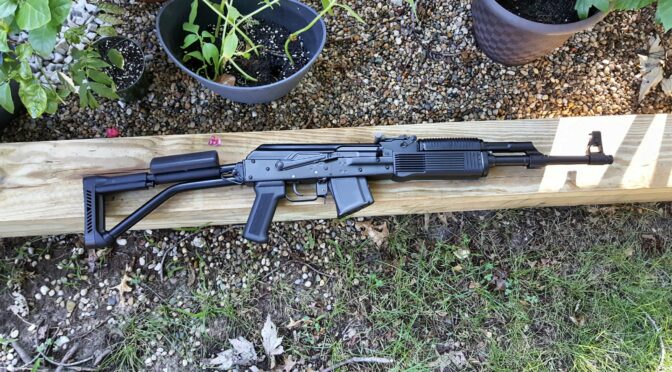
  • Technical Specifications and Features: The Type 88 is a copy of the AK-74, chambered in 5.45x39mm. It has been observed in several configurations: with a fixed stock, a side-folding stock copied from the AKS-74, and a unique top-folding stock designed to accommodate its most infamous accessory.31 This accessory is a massive, locally designed helical magazine with an estimated capacity of 100 to 150 rounds, which attaches under the barrel.33 The rifles typically feature an all-black painted finish, likely a cosmetic attempt at modernization.33
  • Quality and Reliability Assessment: The quality of North Korean arms is largely unknown to the outside world. Production is likely functional and sufficient for their needs, but unlikely to match the refinement of European producers. The helical magazine, in particular, is viewed with deep skepticism by Western analysts. Its extreme weight and complexity are seen as antithetical to the AK’s design philosophy of simplicity and reliability. Many believe it is an impractical weapon, intended more for propaganda and intimidation—projecting an image of overwhelming firepower—than for effective, sustained combat use.31

2.5 Poland

Licensing and Production Context

Poland, possessing a robust and independent arms industry centered at the Fabryka Broni “Łucznik” in Radom (identified by a “Circle 11” proof mark), chose a different path.28 Rather than pay for a license to produce a direct clone of the AK-74, Poland developed its own indigenous 5.45mm rifle. This decision was likely driven by a desire to avoid licensing fees, assert design autonomy, and incorporate features specific to Polish military doctrine.36

Model: Karabinèk wzór 1988 (Wz. 88 Tantal)

  • Timeline and Production Volume: Designed in the mid-1980s, the Tantal was formally adopted in 1991.36 Its service life was remarkably short; with Poland’s political pivot towards the West and eventual entry into NATO, the Tantal was quickly deemed obsolete. An estimated 25,000 rifles were produced before being phased out in favor of the 5.56mm NATO-chambered Wz. 96 Beryl rifle starting in the late 1990s and ending by 2005.28 The Tantal stands as a bridge between two distinct geopolitical eras. It represents the apex of Warsaw Pact national rifle design, a highly customized weapon that was almost immediately rendered obsolete by the very political changes that allowed for its adoption.
  • Technical Specifications and Features: The Tantal is a highly distinct AK-74 derivative. Its key features include a complex and unique fire control group with the standard safety/dust cover on the right side and a separate, three-position fire selector switch (safe, semi-auto, 3-round burst) on the left side of the receiver.9 It features a long, multi-function muzzle device that serves as a brake, compensator, and a spigot for launching rifle grenades.28 To handle the stress of grenade launching, it was fitted with a very robust side-folding wire stock copied from the East German design.28
  • Quality and Reliability Assessment: The Wz. 88 Tantal is generally well-regarded as a high-quality, robustly built rifle. The unique fire control mechanism, while more complex than a standard AK, is effective. It is considered an innovative, if short-lived, national variant of the Kalashnikov platform.26

2.6 Romania

Licensing and Production Context

Similar to Poland, Romania, under the fiercely independent leadership of Nicolae Ceaușescu, opted to develop its own 5.45mm rifle rather than produce a Soviet clone. This decision was a clear manifestation of Romania’s foreign policy, which complied with the letter of Warsaw Pact standardization (adopting the 5.45mm cartridge) while simultaneously asserting its political and industrial independence from Moscow. The resulting rifle, produced at the state arsenal in Cugir, was a pragmatic and unique hybrid.37

Model: Pușcă Automată model 1986 (PA md. 86 / AIMS-74)

  • Timeline and Production Volume: Adopted in 1986, the PA md. 86 (with the export designation AIMS-74) remains the standard service rifle of the Romanian Armed Forces. It has been produced in large quantities since its introduction.37
  • Technical Specifications and Features: The PA md. 86 is a fascinating hybrid, designed to minimize retooling costs by incorporating a significant number of parts from the older 7.62mm PM md. 63/65 (AKM) production line.40 Its most distinct features include: an AKM-style 45-degree gas block (though the gas port itself is 90 degrees); a distinctive laminated wood lower handguard with an integrated vertical foregrip, known colloquially to collectors as the “dong”; a unique upward-swept charging handle to provide clearance for the folding stock; and a left-side folding wire stock based on the East German pattern.2 Military versions also feature a 3-round burst capability, similar to the Polish Tantal.37 A notable quirk is its non-standard 22mm muzzle thread diameter, which makes finding compatible replacement muzzle devices difficult.2
  • Quality and Reliability Assessment: Romanian Kalashnikovs are generally considered to be reliable, serviceable workhorse rifles. However, they often lack the cosmetic refinement and tight tolerances of Bulgarian or East German production. On civilian export models in particular, minor quality control issues such as canted front sight blocks or gas blocks are more common than with other producers.27 Despite this, they are robust and functional firearms.

To prevent common misconceptions, it is important to briefly address several influential rifle systems that are often associated with the AK-74 but are not true variants, typically due to differences in caliber or developmental lineage.

3.1 East Germany: Wieger STG-940

Developed in the late 1980s, the Wieger STG-940 was not an AK-74 variant but rather an export-focused rifle based on the MPi-AK-74N’s action.45 Its purpose was to generate hard currency for the GDR by entering the lucrative 5.56x45mm NATO rifle market, thus bypassing the Soviet prohibition on exporting their 5.45mm rifles.8 Despite securing contracts with India and Peru, the project was terminated following German reunification in 1990.45

3.2 Yugoslavia/Serbia: Zastava M85

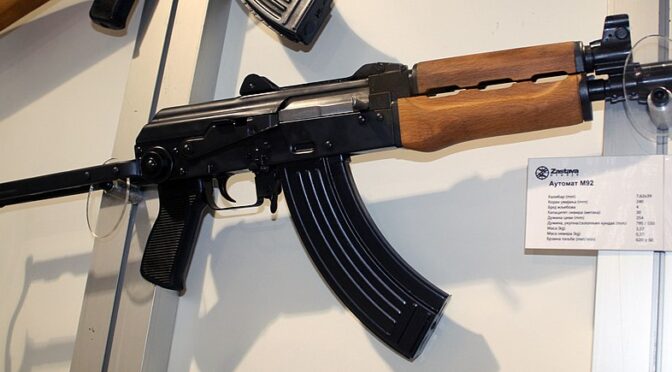
The Zastava M85 is frequently misidentified as a Yugoslavian copy of the AKS-74U.12 This is incorrect. Yugoslavia was a non-aligned state, not a member of the Warsaw Pact, and pursued its own independent path of Kalashnikov development. The M85 is a compact carbine heavily inspired by the AKS-74U’s form factor, but it is chambered in 5.56x45mm NATO and features distinctly Yugoslavian characteristics, such as a thicker 1.5mm stamped receiver, a three-vent handguard, and a different stock design.46 It is a derivative of the Zastava M80/M90 family, not the AK-74.

Section 4: Comparative Analysis and Conclusion

The global proliferation of the AK-74 is a case study in how a single weapon design can be interpreted and modified through the unique lens of national priorities. The analysis reveals distinct manufacturing and design philosophies among the licensed producers:

  • The Cloners (Bulgaria): Arsenal AD focused on creating faithful, high-quality reproductions of the Soviet design. Their post-Cold War success demonstrates a mastery of manufacturing that allowed them to pivot to the global market, adapting their product line with new calibers and features while maintaining a reputation for excellence.
  • The Perfectionists (East Germany): The GDR produced what many consider the pinnacle of the AK-74 in terms of pure manufacturing quality. Their work was a testament to German engineering, but they were ultimately a captive producer, constrained by Soviet geopolitical strategy and their story cut short by history.
  • The Innovators (Poland): The Tantal represents a nation using a base design as a launchpad for significant mechanical innovation. The addition of a complex burst-fire mechanism and an integrated grenade-launching capability shows a unique tactical doctrine and a desire for design sovereignty.
  • The Pragmatists (Romania): The PA md. 86 is a physical embodiment of political and economic pragmatism. By creating a hybrid of old and new parts, Romania met its alliance obligations while minimizing costs and asserting its industrial independence, even at the expense of logistical simplicity.
  • The Isolationists (North Korea & Azerbaijan): These two nations represent different models of proliferation outside the Warsaw Pact framework. Azerbaijan’s Khazri is a modern example of licensed assembly—a transfer of capability but not core technology. North Korea’s Type 88 is a product of reverse-engineering driven by an ideology of self-reliance, resulting in a weapon that serves as a tool of propaganda as much as a tool of war.

Ultimately, the AK-74 is not a monolithic design. It is a versatile and adaptable platform that was fundamentally shaped by the technical capabilities, tactical requirements, and overarching political realities of each nation that chose to produce it. Its legacy is written not just in the armories of Russia, but in the factories of Kazanlak, Radom, Cugir, and beyond.

Appendix A: Summary Table of AK-74 Military Variants (Sorted by Country/Model)

Country of OriginManufacturerModel DesignationYear IntroducedCaliberAction TypeRate of Fire (RPM)Weight (kg, empty)Length (mm, Ext.)Length (mm, Fold.)Barrel Length (mm)Key Distinguishing Features
AzerbaijanIglim NPPKhazri20135.45×39mmGas-operated, rotating bolt~6503.6943705415Licensed AK-74M copy, assembled from Russian parts, modified accessory interface. 17
BulgariaArsenal ADAK-74c. 1980s5.45×39mmGas-operated, rotating bolt~6503.3943N/A415High-quality clone of Soviet AK-74 with fixed wood/polymer stock. 9
BulgariaArsenal ADAKS-74c. 1980s5.45×39mmGas-operated, rotating bolt~6503.2943695415High-quality clone of Soviet AKS-74 with triangular side-folding stock. 9
BulgariaArsenal ADAKS-74Uc. 1980s5.45×39mmGas-operated, rotating bolt~7002.7735490210High-quality clone of Soviet AKS-74U with conical muzzle booster. 9
German Dem. Rep.VEB WiesaMPi-AK-74N19835.45×39mmGas-operated, rotating bolt~600~3.5920N/A415Fixed pebble-texture plastic stock, side rail for optics. 8
German Dem. Rep.VEB WiesaMPi-AKS-74N19835.45×39mmGas-operated, rotating bolt~600~3.4920720415Side-folding wire stock, pebble-texture plastic handguards, side rail. 8
German Dem. Rep.VEB WiesaMPi-AKS-74NK19875.45×39mmGas-operated, rotating bolt~600~3.2845645344Carbine with shorter barrel, wire folding stock, simple muzzle device. 8
North KoreaState ArsenalsType 88c. 19885.45×39mmGas-operated, rotating bolt~650~3.0~943Var.415Reverse-engineered AK-74 copy. Variants with fixed, side-folding, and top-folding stocks. Can use helical magazine. 31
PolandFB RadomWz. 88 Tantal19915.45×39mmGas-operated, rotating bolt~6503.69943748423Left-side fire selector (semi/burst/auto), grenade launching muzzle device, wire folding stock. 28
RomaniaROMARM/CugirPA md. 86 (AIMS-74)19865.45×39mmGas-operated, rotating bolt~7003.69943748432AKM-style 45° gas block, wood “dong” vertical grip, upswept charging handle, wire folding stock, 3-round burst. 2
Soviet UnionIzhmashAK-7419745.45×39mmGas-operated, rotating bolt~6503.07943N/A415Original model. Fixed laminated wood stock, large muzzle brake. 3
Soviet UnionIzhmashAKS-7419745.45×39mmGas-operated, rotating bolt~6502.97943690415Triangular metal side-folding stock for airborne/mechanized troops. 3
Soviet UnionTula Arms PlantAKS-74U19795.45×39mmGas-operated, rotating bolt~7002.7730490206.5Compact carbine with short barrel and conical muzzle booster. 3
RussiaKalashnikov ConcernAK-74M1991$5.45 \times 39\mm}$Gas-operated, rotating bolt~6503.4943700415Modernized version with folding polymer stock, side optics rail standard. 3

Appendix B: Summary Table of AK-74 Military Variants (Sorted by Date/Country/Model)

Year IntroducedCountry of OriginManufacturerModel DesignationCaliberAction TypeRate of Fire (RPM)Weight (kg, empty)Length (mm, Ext.)Length (mm, Fold.)Barrel Length (mm)Key Distinguishing Features
1974Soviet UnionIzhmashAK-745.45×39mmGas-operated, rotating bolt~6503.07943N/A415Original model. Fixed laminated wood stock, large muzzle brake. 3
1974Soviet UnionIzhmashAKS-745.45×39mmGas-operated, rotating bolt~6502.97943690415Triangular metal side-folding stock for airborne/mechanized troops. 3
1979Soviet UnionTula Arms PlantAKS-74U5.45×39mmGas-operated, rotating bolt~7002.7730490206.5Compact carbine with short barrel and conical muzzle booster. 3
c. 1980sBulgariaArsenal ADAK-745.45×39mmGas-operated, rotating bolt~6503.3943N/A415High-quality clone of Soviet AK-74 with fixed wood/polymer stock. 9
c. 1980sBulgariaArsenal ADAKS-745.45×39mmGas-operated, rotating bolt~6503.2943695415High-quality clone of Soviet AKS-74 with triangular side-folding stock. 9
c. 1980sBulgariaArsenal ADAKS-74U5.45×39mmGas-operated, rotating bolt~7002.7735490210High-quality clone of Soviet AKS-74U with conical muzzle booster. 9
1983German Dem. Rep.VEB WiesaMPi-AK-74N5.45×39mmGas-operated, rotating bolt~600~3.5920N/A415Fixed pebble-texture plastic stock, side rail for optics. 8
1983German Dem. Rep.VEB WiesaMPi-AKS-74N5.45×39mmGas-operated, rotating bolt~600~3.4920720415Side-folding wire stock, pebble-texture plastic handguards, side rail. 8
1986RomaniaROMARM/CugirPA md. 86 (AIMS-74)5.45×39mmGas-operated, rotating bolt~7003.69943748432AKM-style 45° gas block, wood “dong” vertical grip, upswept charging handle, wire folding stock, 3-round burst. 2
1987German Dem. Rep.VEB WiesaMPi-AKS-74NK5.45×39mmGas-operated, rotating bolt~600~3.2845645344Carbine with shorter barrel, wire folding stock, simple muzzle device. 8
c. 1988North KoreaState ArsenalsType 885.45×39mmGas-operated, rotating bolt~650~3.0~943Var.415Reverse-engineered AK-74 copy. Variants with fixed, side-folding, and top-folding stocks. Can use helical magazine. 31
1991PolandFB RadomWz. 88 Tantal5.45×39mmGas-operated, rotating bolt~6503.69943748423Left-side fire selector (semi/burst/auto), grenade launching muzzle device, wire folding stock. 28
1991RussiaKalashnikov ConcernAK-74M5.45×39mmGas-operated, rotating bolt~6503.4943700415Modernized version with folding polymer stock, side optics rail standard. 3
2013AzerbaijanIglim NPPKhazri5.45×39mmGas-operated, rotating bolt~6503.6943705415Licensed AK-74M copy, assembled from Russian parts, modified accessory interface. 17


Please share the link on Facebook, Forums, with colleagues, etc. Your support is much appreciated and if you have any feedback, please email us in**@*********ps.com. If you’d like to request a report or order a reprint, please click here for the corresponding page to open in new tab.


Works cited

  1. AK-74 Rifles – Shop Now | Palmetto State Armory, accessed August 3, 2025, https://palmettostatearmory.com/ak-47/ak-74-gf3.html
  2. Best AK Variants: the AIMS-74 – Sonoran Desert Institute, accessed August 3, 2025, https://sdi.edu/2024/03/25/best-ak-variants-the-aims-74/
  3. AK-74 – Wikipedia, accessed August 3, 2025, https://en.wikipedia.org/wiki/AK-74
  4. What Are the Different Types of AKs? – Guns.com, accessed August 3, 2025, https://www.guns.com/news/what-are-ak-variants
  5. AK Variants: A Closer Look – The Primary Source On PrimaryArms.com, accessed August 3, 2025, https://blog.primaryarms.com/guide/ak-variants-explored/
  6. 5.45×39 mm – AK 74 Assault Rifles – Armatec, accessed August 3, 2025, https://www.armatec.bg/products/5-45×39-mm-ak-74-assault-rifles
  7. U.S. Army Is Looking To Buy AK-74 Assault Rifles (Updated) – The War Zone, accessed August 3, 2025, https://www.twz.com/u-s-army-is-looking-to-buy-ak-74-assault-rifles
  8. East German AK History – Faktory 47, accessed August 3, 2025, https://www.faktory47.com/blogs/kalashnikov/east-german-ak-history
  9. Regional Differences and Design Evolution in AK Variants Explained, accessed August 3, 2025, https://blog.primaryarms.com/guide/ak-variants-by-region-explained/
  10. AK Models: Ultimate Guide to Kalashnikov Rifles – Pew Pew Tactical, accessed August 3, 2025, https://www.pewpewtactical.com/ak-models/
  11. AKS-74 “Kalashnikov” Assault Rifle with folding butt | Armaco JSC …, accessed August 3, 2025, http://www.armaco.bg/en/product/assault-rifles-c2/aks-74-kalashnikov-assault-rifle-with-folding-butt-p495
  12. AKS-74U – Wikipedia, accessed August 3, 2025, https://de.wikipedia.org/wiki/AKS-74U
  13. AK-74 | Weaponsystems.net, accessed August 3, 2025, https://old.weaponsystems.net/weaponsystem/AA04%20-%20AK-74.html
  14. AK-74M – Kalashnikov Group, accessed August 3, 2025, https://en.kalashnikovgroup.ru/catalog/boevoe-strelkovoe-oruzhie/avtomaty/avtomat-kalashnikova-ak74m
  15. AK-74M || Kalashnikov Group, accessed August 3, 2025, https://en.kalashnikovgroup.ru/catalog/boevoe-strelkovoe-oruzhie/avtomaty/avtomat-kalashnikova-ak74m?ysclid=mbgcb4vixt875391240
  16. Kalashnikov rifle – Wikipedia, accessed August 3, 2025, https://en.wikipedia.org/wiki/Kalashnikov_rifle
  17. В Азербайджане собрано уже более 100 тысяч автоматов АК …, accessed August 3, 2025, https://bmpd.livejournal.com/3646627.html
  18. Азербайджан начал лицензионное производство автоматов АК-74М, accessed August 3, 2025, https://weaponland.ru/news/azerbajdzhan_nachal_licenzionnoe_proizvodstvo_avtomatov_ak_74m/2011-07-08-652
  19. Bulgarian AK-47 History – Arsenal – Faktory 47, accessed August 3, 2025, https://www.faktory47.com/blogs/kalashnikov/bulgarian-ak-history
  20. AR-M1 – Wikipedia, accessed August 3, 2025, https://en.wikipedia.org/wiki/AR-M1
  21. 5.56×45 mm and 7.62×39 mm AR-M1 – Assault Rifles – Arsenal JSCo., accessed August 3, 2025, https://www.arsenal-bg.com/c/556×45-762×39-mm-assault-rifles-barrel-length-415-mm-44/556×45-mm-and-762×39-mm-ar-m1-30
  22. Bulgaria’s 5.45 Kalashnikov variants; AK-74, AKS-74, AKS-74U, RPK-74 and modern AR series. – YouTube, accessed August 3, 2025, https://www.youtube.com/watch?v=1KGWXG2SNoU
  23. Kalashnikov AK-74 – Small Arms Survey, accessed August 3, 2025, https://www.smallarmssurvey.org/sites/default/files/SAS-weapons-assault-rifles-Kalashnikov-AK-74.pdf
  24. Arsenal Barr-M1 | Rifle Reviews – Gun Mart, accessed August 3, 2025, https://www.gunmart.net/gun-reviews/firearms/rifles/arsenal-barr-m1
  25. Dusting Off Review Of The ORF Bulgarian AK74 – YouTube, accessed August 3, 2025, https://www.youtube.com/watch?v=lo5I7tbEylc
  26. AK-74 Showdown: Polish and Bulgarian Rifles Beat a WASR-2 – Gun Tests, accessed August 3, 2025, https://www.gun-tests.com/rifles/rifles9/ak-74-showdown-polish-and-bulgarian-rifles-beat-a-wasr-2-2/
  27. East German/DDR AKs – The Best In The World? | The Armory Life Forum, accessed August 3, 2025, https://www.thearmorylife.com/forum/threads/east-german-ddr-aks-the-best-in-the-world.17677/
  28. Polish AK-47 History – Circle 11 – Faktory 47, accessed August 3, 2025, https://www.faktory47.com/blogs/kalashnikov/polish-ak-history
  29. AK-74N – Gray Zone Warfare Wiki, accessed August 3, 2025, https://grayzonewarfare.miraheze.org/wiki/AK-74N
  30. East German MPi-AKS-74NK – YouTube, accessed August 3, 2025, https://www.youtube.com/watch?v=lpPgg64PUbE
  31. North Korea’s Huge Type 88 Helical Drum AK Magazine – Forgotten …, accessed August 3, 2025, https://www.forgottenweapons.com/north-koreas-huge-type-88-helical-drum-ak-magazine/
  32. Defense industry of North Korea – Wikipedia, accessed August 3, 2025, https://en.wikipedia.org/wiki/Defense_industry_of_North_Korea
  33. Type 88: The North Korean Army’s AK-74 Alternative – The National …, accessed August 3, 2025, https://nationalinterest.org/blog/reboot/type-88-north-korean-armys-ak-74-alternative-196419
  34. List of equipment of the Korean People’s Army Ground Force – Wikipedia, accessed August 3, 2025, https://en.wikipedia.org/wiki/List_of_equipment_of_the_Korean_People%27s_Army_Ground_Force
  35. North Korean Helical AK Magazines – Oryx, accessed August 3, 2025, https://www.oryxspioenkop.com/2014/02/north-korean-helical-ak-magazines.html
  36. The History & Specs Of The Tantal AK-74 Style … – Athlon Outdoors, accessed August 3, 2025, https://athlonoutdoors.com/article/polish-tantal-wz-88-rifle/
  37. Pușcă Automată model 1986 – Wikipedia, accessed August 3, 2025, https://en.wikipedia.org/wiki/Pu%C8%99c%C4%83_Automat%C4%83_model_1986
  38. Cugir PA 86 – AmmoTerra, accessed August 3, 2025, https://ammoterra.com/product/cugir-pa-86
  39. Cugir Arms Factory – Wikipedia, accessed August 3, 2025, https://en.wikipedia.org/wiki/Cugir_Arms_Factory
  40. www.northwestgunsupply.com, accessed August 3, 2025, https://www.northwestgunsupply.com/product-page/1990-romanian-md-86-aims74-1#:~:text=In%201986%2C%20the%20Romanian%20military,features%20of%20the%20older%20md.
  41. Foc!: A Brief Intro to the Cold War Era Romanian AKs Appearing in America, accessed August 3, 2025, https://www.gatewoodsupplyco.com/Foc-A-Brief-Intro-to-the-Cold-War-Era-Romanian-AKs-Appearing-in-America-_b_14.html
  42. A Collectors FAVORITE! The AK 74 Rifle – YouTube, accessed August 3, 2025, https://www.youtube.com/watch?v=vXE8Qpf39jQ
  43. Let’s take a Look at the Romanian take on the AK-74 : r/guns – Reddit, accessed August 3, 2025, https://www.reddit.com/r/guns/comments/65ws79/lets_take_a_look_at_the_romanian_take_on_the_ak74/
  44. SAR-2 / AIMS-74 Clone: The other AK-74 :: Guns.com, accessed August 3, 2025, https://www.guns.com/news/review/sar-2-aims-74-clone-the-other-ak-74
  45. Wieger StG-940 – Wikipedia, accessed August 3, 2025, https://en.wikipedia.org/wiki/Wieger_StG-940
  46. Zastava ZPAP M85 223 Rem | 5.56 NATO Semi Auto Pistol – 30+1 Rounds – Buds Gun Shop, accessed August 3, 2025, https://www.budsgunshop.com/product_info.php/products_id/730006418/zastava+zpap+m85+223+rem+5.56+nato+semi+auto+pistol
  47. Zastava M85 – Wikipedia, accessed August 3, 2025, https://en.wikipedia.org/wiki/Zastava_M85
  48. Zastava ZPAP M85 AK-47 Pistol .223/5.56 – 10″ – Blued – Primary Arms, accessed August 3, 2025, https://www.primaryarms.com/zastava-zpap-m85-ak-47-pistol-223-5-56-10-blued

The New Battlespace: Gray Zone Conflict in an Era of Great Power Competition

The primary arena for great power competition has shifted from conventional military confrontation to a persistent, multi-domain struggle in the “gray zone” between peace and war. This report provides a comprehensive analysis of the alternative forms of conflict employed by the United States, the Russian Federation, and the People’s Republic of China. It moves beyond theoretical frameworks to assess the practical application and effectiveness of economic warfare, cyber operations, information warfare, proxy conflicts, and legal warfare (“lawfare”). The analysis reveals distinct strategic approaches: the United States acts primarily as a defender of the existing international order, using its systemic advantages for targeted coercion; Russia operates as a strategic disrupter, employing asymmetric tools to generate chaos and undermine Western cohesion; and China functions as a systemic revisionist, patiently executing a long-term strategy to displace U.S. influence and reshape global norms in its favor.

The key finding of this report is that while these gray zone methods have proven effective at achieving discrete objectives and managing escalation, their long-term strategic success is mixed. Critically, they often produce significant unintended consequences that are actively reshaping the global security and economic order. The use of broad economic sanctions and tariffs, for example, has accelerated the formation of an alternative, non-Western economic bloc and spurred efforts to de-dollarize international trade. Similarly, persistent cyber and information attacks, while achieving tactical surprise and disruption, have hardened defenses and eroded the trust necessary for international cooperation. The gray zone is not a temporary state of affairs but the new, permanent battlespace where the future of the international order will be decided. Navigating this environment requires a fundamental shift in strategy from crisis response to one of perpetual, integrated competition across all instruments of national power.

Section I: The Strategic Environment: Redefining Conflict in the 21st Century

From Open War to Pervasive Competition

The 21st-century strategic landscape is defined by a distinct shift away from the paradigm of declared, conventional warfare between major powers. The overwhelming military and technological superiority of the United States and its alliance network has created a powerful disincentive for peer competitors to engage in direct armed conflict.1 Consequently, rivals such as Russia and China have adapted by developing and refining a sophisticated toolkit of alternative conflict methods. These strategies are designed to challenge the U.S.-led international order, erode its influence, and achieve significant strategic gains without crossing the unambiguous threshold of armed aggression that would trigger a conventional military response from the United States and its allies.1 This evolution does not signify an era of peace, but rather a transformation in the character of conflict to a state of persistent, pervasive competition waged across every domain of state power, from the economic and digital to the informational and legal.

Anatomy of the Gray Zone

This new era of competition is primarily conducted within a strategically ambiguous space known as the “gray zone.” The United States Special Operations Command defines this arena as “competitive interactions among and within state and non-state actors that fall between the traditional war and peace duality”.3 The central characteristic of gray zone operations is the deliberate calibration of actions to remain below the threshold of what could be legally and politically defined as a use of force warranting a conventional military response under international law (jus ad bellum).2

Ambiguity and plausible deniability are the currency of the gray zone. Actions are designed to be difficult to attribute and interpret, thereby creating confusion and sowing hesitation within an adversary’s decision-making cycle.4 This calculated ambiguity is particularly effective against democratic nations. The legal and bureaucratic structures of democracies are often optimized for a clear distinction between peace and war, making them slow to recognize and counter threats that defy this binary.3 This can lead to policy paralysis or responses that are either disproportionately escalatory or strategically insignificant, a vulnerability that actors like Russia and China consistently exploit.3 The toolkit for gray zone operations is extensive, including but not limited to information operations, political coercion, economic pressure, cyberattacks, support for proxies, and provocations by state-controlled forces.1 While many of these tactics are as old as statecraft itself, their integrated and synergistic application, amplified by modern information and communication technologies, represents a distinct evolution in the nature of conflict.1

The Hybrid Warfare Playbook

If the gray zone is the strategic arena, “hybrid warfare” is the tactical playbook used to compete within it. While not a formally defined term in international law, it is widely understood to describe the synchronized use of multiple instruments of power—military and non-military, conventional and unconventional, overt and covert—to destabilize an adversary and achieve strategic objectives.2 The objective is to create synergistic effects where the whole of the campaign is greater than the sum of its parts.2

The Russian strategic approach, often associated with Chief of the General Staff Valery Gerasimov, explicitly elevates the role of non-military means, viewing them as often more effective than armed force in achieving political and strategic goals.5 This doctrine was vividly demonstrated in the lead-up to the full-scale invasion of Ukraine, where Russia combined a massive military buildup with a sophisticated disinformation campaign, cyberattacks, economic pressure on European energy markets, and nuclear blackmail to shape the strategic environment.2

It is essential to distinguish between these two concepts: the gray zone describes the operational space where competition occurs, while hybrid warfare describes the methods employed within that space.2 Most hybrid tactics are deliberately applied in the gray zone precisely to exploit its ambiguity and avoid triggering a formal state of armed conflict as defined by international humanitarian law.3 This strategic choice is not an accident but a calculated effort to wage conflict in a manner that neutralizes the primary strengths of a conventionally superior adversary. The gray zone is, therefore, an asymmetric battlespace, deliberately crafted to turn the foundational pillars of the liberal international order—its commitment to the rule of law, open economies, and freedom of information—into exploitable vulnerabilities.

Section II: The Economic Arsenal: Geopolitics by Other Means

The US-China Tariff War: A Case Study in Economic Coercion

The economic competition between the United States and China escalated into open economic conflict in 2018, providing a clear case study in the use, effectiveness, and limitations of tariffs as a tool of modern statecraft.

Goals vs. Reality

The Trump administration initiated the trade war with a set of clearly articulated objectives: to force fundamental changes to what it termed China’s “longstanding unfair trade practices,” to halt the systemic theft of U.S. intellectual property, and to significantly reduce the large bilateral trade deficit.8 Beginning in January 2018 with tariffs on solar panels and washing machines, the conflict rapidly escalated. The U.S. imposed successive rounds of tariffs, eventually covering hundreds of billions of dollars of Chinese goods, citing Section 301 of the Trade Act of 1974 as its legal justification.8 China responded with immediate and symmetrical retaliation, targeting key U.S. exports with high political sensitivity, such as soybeans, pork, and automobiles, directly impacting the agricultural and manufacturing heartlands of the United States.8 This tit-for-tat escalation continued through 2019, culminating in a tense “Phase One” agreement in January 2020 that sought to de-escalate the conflict.8

Effectiveness Assessment: A Blunt Instrument

Despite the scale of the tariffs, the trade war largely failed to achieve its primary stated goals. The purchase commitments made by China in the Phase One deal were never fulfilled, with Beijing ultimately buying none of the additional $200 billion in U.S. exports it had pledged.8 Rigorous economic analysis has demonstrated that the economic burden of the tariffs was borne almost entirely by U.S. firms and consumers, not by Chinese exporters.11 This resulted in higher prices for a wide range of goods and was estimated to have reduced U.S. real income by $1.4 billion per month by the end of 2018.12

Furthermore, the pervasive policy uncertainty generated by the conflict had a chilling effect on global business investment and economic growth.13 Companies, unable to predict the future of the world’s most important trade relationship, delayed capital expenditures, disrupting global supply chains and slowing economic activity far beyond the borders of the two belligerents.13 The trade war thus serves as a powerful example of how broad-based tariffs function as a blunt and costly instrument, inflicting significant self-harm while yielding limited strategic gains.

Unintended Consequences

The most profound and lasting impacts of the trade war were not its intended effects but its unintended consequences. Rather than forcing a rebalancing of the U.S.-China economic relationship, the conflict accelerated a process of strategic decoupling. It compelled multinational corporations to begin the costly and complex process of diversifying their supply chains away from China, a trend that benefited manufacturing hubs in other parts of Asia, particularly Vietnam.15

Perhaps more significantly, the trade war reinforced Beijing’s conviction that it could not rely on an open, rules-based global economic system dominated by the United States. In response, China has intensified its national drive for technological self-sufficiency in critical sectors like semiconductors, a move that could, in the long term, diminish U.S. technological and economic leverage.16 By sidelining the World Trade Organization (WTO) in favor of unilateral action, the United States also weakened the very multilateral institutions it had built, encouraging a global shift toward protectionism and regional trade blocs.14

The Sanctions Regime Against Russia: Testing Economic Containment

The Western response to Russia’s 2022 full-scale invasion of Ukraine represents the most comprehensive and coordinated use of economic sanctions against a major power in modern history. This campaign serves as a critical test of the efficacy of economic containment in the 21st century.

Targeting the War Machine

The sanctions regime implemented by the United States and a broad coalition of allies was designed with a clear purpose: to cripple the Russian Federation’s ability to finance and technologically sustain its war of aggression.19 The measures were unprecedented in their scope and speed, targeting the core pillars of the Russian economy. Key actions included freezing hundreds of billions of dollars of the Russian Central Bank’s foreign reserves, disconnecting major Russian banks from the SWIFT financial messaging system, imposing a near-total ban on the export of high-technology goods like semiconductors, and implementing a novel price cap on Russian seaborne crude oil exports.21 This multi-pronged assault aimed to deny Moscow the revenue, financing, and technology essential for its military-industrial complex.20

The Limits of Efficacy and Russian Adaptation

While the sanctions have inflicted undeniable and significant damage on the Russian economy, they have failed to deliver a knockout blow or compel a change in Moscow’s strategic objectives. Estimates suggest that Russia’s GDP is now 10-12% smaller than it would have been without the invasion and subsequent sanctions.22 However, the Russian economy has proven far more resilient than initially expected.19

Moscow’s adaptation has been threefold. First, it transitioned its economy onto a full war footing, with massive increases in defense spending fueling industrial production and stimulating GDP growth, albeit in an unsustainable manner.19 Second, it proved adept at sanctions evasion. Russia successfully rerouted the majority of its energy exports from Europe to new markets in China and India, often selling at a discount but still generating substantial revenue.21 It also developed a “shadow fleet” of oil tankers operating outside of Western insurance and financial systems to circumvent the G7 price cap.22 Third, and most critically, it leveraged its partnership with China to procure essential dual-use technologies, such as microelectronics and machine tools, that were cut off by Western export controls.20

Strategic Realignment

The most significant long-term consequence of the sanctions regime has been a fundamental and likely irreversible strategic realignment of the Russian economy. Forced out of Western markets and financial systems, Moscow has dramatically deepened its economic, technological, and financial integration with China. Bilateral trade has surged to record levels, and the Chinese yuan has increasingly replaced the U.S. dollar in Russia’s trade and foreign reserves.17 This has accelerated the consolidation of a powerful Eurasian economic bloc positioned as a direct counterweight to the U.S.-led financial and trade system. The sanctions, intended to isolate Russia, have inadvertently catalyzed the creation of a more robust and resilient alternative economic architecture, thereby spurring global de-dollarization efforts and potentially weakening the long-term efficacy of U.S. financial power.19

This dynamic illustrates a central paradox of modern economic warfare: the aggressive use of systemic economic power, while effective at inflicting short-term pain, simultaneously provides a powerful incentive for adversaries to build parallel systems designed to be immune to that very power. Each application of sanctions against Russia or tariffs against China acts as a catalyst for the construction of an alternative global economic order, eroding the foundations of U.S. leverage over time.

China’s Belt and Road Initiative: Influence Through Investment

China’s Belt and Road Initiative (BRI) is a cornerstone of its foreign policy and a primary instrument of its economic statecraft. While often portrayed through a simplistic lens, its strategic function is nuanced and far-reaching.

Beyond the “Debt-Trap” Narrative

In Western strategic discourse, the BRI is frequently characterized as a form of “debt-trap diplomacy”.27 This narrative posits that China intentionally extends unsustainable loans to developing nations for large-scale infrastructure projects. When these nations inevitably default, Beijing allegedly seizes control of the strategic assets—such as ports or railways—thereby expanding its geopolitical and military footprint.27 The case of Sri Lanka’s Hambantota Port is consistently cited as the primary evidence for this strategy.27

A Nuanced Reality

A detailed examination of the Hambantota Port case, however, reveals a more complex reality that undermines the simplistic debt-trap thesis. The proposal for the port originated with the Sri Lankan government, not with Beijing, as part of a long-standing domestic development agenda.27 Furthermore, Sri Lanka’s severe debt crisis in the mid-2010s was not primarily caused by Chinese lending, but by excessive borrowing from Western-dominated international capital markets and unsustainable domestic fiscal policies.27 Chinese loans constituted a relatively small portion of Sri Lanka’s overall foreign debt.27

Crucially, the port was not seized in a debt-for-equity swap. Instead, facing a balance of payments crisis, the Sri Lankan government chose to lease a majority stake in the port’s operations to a Chinese state-owned enterprise for 99 years in exchange for $1.1 billion in hard currency.27 These funds were then used to shore up Sri Lanka’s foreign reserves and service its more pressing debts to Western creditors.27

While the debt-trap narrative is an oversimplification, it does not mean the BRI is benign. It is a powerful instrument of geoeconomic influence. By becoming the primary financier and builder of critical infrastructure across the developing world, China creates long-term economic dependencies, secures access to resources, opens new markets for its companies, and builds political goodwill that can be translated into diplomatic support on the international stage.30 The BRI allows China to systematically expand its global footprint and embed its economic and, increasingly, technological standards across Asia, Africa, and Latin America, thereby challenging the post-Cold War economic order.

Section III: The Digital Frontlines: Cyber and Electronic Warfare

The cyber domain has emerged as a central theater for great power competition, offering a low-cost, high-impact, and plausibly deniable means of projecting power and undermining adversaries. Russia and China have both developed sophisticated cyber capabilities, but they employ them in pursuit of distinct strategic objectives, reflecting their different geopolitical positions and long-term goals.

Russia’s Doctrine of Disruption

Russia’s approach to cyber warfare is fundamentally asymmetric and disruptive, designed to compensate for its relative weakness in the conventional military and economic domains. Its cyber operations prioritize psychological impact and the creation of societal chaos over permanent destruction.

This doctrine has been demonstrated through a series of high-profile operations against the United States. The cyberattacks on the Democratic National Committee (DNC) in 2015-2016 were not merely an act of espionage but an influence operation designed to disrupt the U.S. presidential election and erode public trust in the democratic process.32 The 2020 SolarWinds supply chain attack represented a new level of sophistication, compromising the networks of numerous U.S. government agencies and thousands of private sector companies by inserting malicious code into a trusted software update.34 This operation provided Russia with widespread, persistent access for espionage and potential future disruption. Similarly, the 2021 ransomware attack on Colonial Pipeline, while attributed to a criminal group, highlighted the profound vulnerability of U.S. critical infrastructure to disruptive cyberattacks, causing widespread fuel shortages along the East Coast.34

The strategic objective underpinning these actions is the generation of uncertainty and the degradation of an adversary’s will to act.37 By demonstrating the vulnerability of critical infrastructure and democratic institutions, Russia aims to create a psychological effect that far exceeds the direct technical damage, sowing division and decision-making paralysis within the target nation.37 Joint advisories from the Cybersecurity and Infrastructure Security Agency (CISA), the National Security Agency (NSA), and the Federal Bureau of Investigation (FBI) repeatedly confirm that Russian state-sponsored actors are persistently targeting U.S. critical infrastructure sectors, including energy, finance, and defense, for both espionage and disruptive purposes.38

China’s Strategy of Espionage and Exploitation

In contrast to Russia’s disruptive tactics, China’s cyber strategy is characterized by its industrial scale, persistence, and systematic focus on long-term intelligence gathering and intellectual property (IP) theft. It is not primarily a tool of chaos but a core component of China’s comprehensive national strategy to supplant the United States as the world’s leading economic and military power.

The People’s Liberation Army (PLA) maintains dedicated units, such as the infamous Unit 61398 (also known as APT1), tasked with conducting large-scale cyber espionage campaigns against foreign targets.42 These operations have successfully exfiltrated vast quantities of sensitive data from the United States. Notable examples include the systematic theft of design data for numerous advanced U.S. weapons systems, including the F-35 Joint Strike Fighter, the F-22 Raptor, and the Patriot missile system.34 This stolen IP directly fuels China’s own military modernization, allowing it to reverse-engineer and replicate advanced technologies, thereby leapfrogging decades of costly research and development and rapidly eroding America’s qualitative military edge.34

Beyond military secrets, China’s cyber espionage targets a wide array of sectors to advance its economic goals. This includes the theft of trade secrets from leading U.S. companies in industries ranging from energy to pharmaceuticals.34 The massive 2015 breach of the U.S. Office of Personnel Management (OPM), which compromised the sensitive personal data of over 21 million current and former federal employees, provided Beijing with an invaluable database for identifying, targeting, and recruiting intelligence assets for decades to come.34 Recent intelligence reports indicate a dramatic surge in Chinese cyber espionage operations, with a 150% increase in 2024 alone, highlighting the unabated intensity of this campaign.44

Effectiveness and Asymmetry

Both Russia and China have successfully weaponized the cyber domain as a highly effective asymmetric tool. It allows them to contest U.S. power and impose significant costs while operating below the threshold of armed conflict and maintaining a degree of plausible deniability.45 The difficulty of definitive, public attribution for cyberattacks creates a permissive environment for aggression, allowing state sponsors to operate with relative impunity.45

This reality reveals a critical divergence in strategic timelines. Russia’s cyber doctrine is optimized for the short term, employing disruptive attacks to achieve immediate political and psychological effects that can shape a specific crisis or event. China, in contrast, is waging a long-term, strategic campaign of attrition. Its patient, industrial-scale espionage is designed to fundamentally alter the global balance of technological, economic, and military power over the course of decades. The United States, therefore, faces a dual cyber threat: Russia’s acute, shock-and-awe style disruptions and China’s chronic, corrosive campaign of exploitation. Effectively countering these divergent threats requires distinct strategies, mindsets, and capabilities.

Section IV: The War for Minds: Information and Influence Operations

In the gray zone, the cognitive domain is a primary battlefield. The strategic manipulation of information to shape perceptions, control narratives, and undermine societal cohesion has become a central pillar of modern conflict. Russia and China, while often collaborating in this space, pursue fundamentally different long-term objectives with their information and influence operations.

Russia’s “Active Measures 2.0”

Russia’s contemporary information warfare is a direct evolution of the Soviet Union’s “active measures,” updated for the digital age.37 The core strategy is not to persuade foreign audiences of the superiority of the Russian model, but to degrade and disrupt the political systems of its adversaries from within.37

The 2016 U.S. presidential election serves as the canonical example of this doctrine in practice. The operation, directed by President Vladimir Putin, was multifaceted, combining the cyber theft of sensitive information with a sophisticated social media campaign.33 The GRU, Russia’s military intelligence agency, hacked the computer networks of the DNC and Clinton campaign officials, subsequently leaking the stolen emails through fronts like Guccifer 2.0 and platforms like WikiLeaks to generate damaging news cycles.33

Simultaneously, the St. Petersburg-based Internet Research Agency (IRA), a state-sponsored “troll farm,” created thousands of fake social media accounts to impersonate American citizens and political groups.33 The IRA’s primary tactic was not to spread pro-Russian propaganda, but to identify and inflame existing societal fault lines in the United States, particularly those related to race, gun control, immigration, and religion.50 By creating and amplifying hyper-partisan content on both the far-left (e.g., supporting Black Lives Matter) and the far-right (e.g., supporting secessionist movements), the IRA’s goal was to deepen polarization, foster distrust in institutions, suppress voter turnout among targeted demographics, and ultimately undermine faith in the American democratic process itself.50 This approach is highly effective because it acts as a social parasite, feeding on and magnifying organic divisions within an open society, making it difficult for citizens and policymakers to distinguish foreign manipulation from authentic domestic discourse.37

China’s Quest for “Discourse Power”

China’s information strategy is more systematic, ambitious, and long-term than Russia’s. It is explicitly guided by the doctrine of the “Three Warfares”: public opinion warfare (shaping public perception), psychological warfare (influencing the cognition and decision-making of adversaries), and legal warfare (using law to seize the “legal high ground”).54 The ultimate goal of this integrated strategy is to achieve what the Chinese Communist Party (CCP) calls “discourse power” (话语权).56

Discourse power is the ability to shape global norms, values, and narratives to create consensus around a new, China-led international order.56 This involves a multi-pronged effort to legitimize China’s authoritarian governance model and present it as a superior alternative to what it portrays as the chaotic and declining system of Western liberal democracy.56 The CCP pursues this goal through several mechanisms:

  • Massive Investment in State Media: Beijing has poured billions of dollars into expanding the global reach of its state-controlled media outlets, such as CGTN and Xinhua, to broadcast the CCP’s narratives directly to international audiences.54
  • United Front Work: The CCP’s United Front Work Department orchestrates a vast, global effort to co-opt and influence foreign elites, including politicians, academics, business leaders, and media figures, to advocate for China’s interests and silence criticism.54
  • Digital Dominance: China seeks to shape the global digital ecosystem by exporting its model of “cyber sovereignty,” which prioritizes state control over the free flow of information, and by promoting its own technical standards for next-generation technologies like 5G and AI.56

While Russia’s information operations are often opportunistic and focused on tactical disruption, China’s are patient, strategic, and aimed at a fundamental, long-term revision of the global information order.58 Russia seeks to burn down the existing house; China seeks to build a new one in its place, with itself as the architect.

The U.S. Response: Public Diplomacy

The primary instrument for the United States in the information domain is public diplomacy, executed largely through the U.S. Agency for Global Media (USAGM). The USAGM oversees a network of broadcasters, including Voice of America (VOA), Radio Free Europe/Radio Liberty (RFE/RL), and Radio Free Asia (RFA).60 The stated mission of these entities is to provide accurate, objective, and comprehensive news and information to audiences in countries where a free press is restricted, thereby serving as a counterweight to state propaganda and supporting the principles of freedom and democracy.60 However, the USAGM has historically faced challenges, including internal political disputes and questions regarding its strategic effectiveness in a modern, saturated, and highly fragmented digital media landscape.61

This reveals a fundamental divergence in strategic approaches. Russian information warfare is a strategy of cognitive disruption, designed to confuse, divide, and ultimately paralyze an opponent by turning its own open information environment against it. Chinese information warfare is a strategy of cognitive displacement, a long-term project aimed at methodically replacing the norms, values, and narratives of the liberal international order with its own. Countering the former requires tactical resilience and societal inoculation against division, while countering the latter requires a sustained, global competition of ideas and a compelling reaffirmation of the value of the democratic model.

Section V: Conflict by Other Means: Proxies and Lawfare

Beyond the economic and digital realms, great powers continue to engage in conflict through indirect means, leveraging third-party actors and legal frameworks to advance their interests while avoiding direct confrontation. Proxy warfare and lawfare are two prominent tools in the gray zone playbook, used to alter the strategic landscape and impose costs on adversaries without resorting to open hostilities.

The Modern Proxy War

Proxy warfare, a hallmark of the Cold War, has been adapted to the contemporary environment. States support and direct non-state or third-party state actors to wage conflict, allowing the sponsoring power to achieve strategic objectives with limited direct risk and cost.

Syria as a Microcosm

The Syrian Civil War serves as a stark example of modern, multi-layered proxy conflict. The Russian Federation intervened militarily in 2015 with the explicit goal of preserving the regime of its client, Bashar al-Assad, which was on the verge of collapse.63 This intervention was a direct pushback against U.S. and Western influence, as it placed Russian forces and their proxies, including the Wagner Group, in direct opposition to various Syrian opposition groups that were receiving support from the United States and its regional partners.63 This created a complex and dangerous battlespace where the proxies of two nuclear powers were engaged in active combat. Throughout this period, the People’s Republic of China played a crucial supporting role for Russia, using its position on the UN Security Council to provide diplomatic cover. Beijing repeatedly joined Moscow in vetoing resolutions that would have condemned or sanctioned the Assad regime, demonstrating a coordinated Sino-Russian effort to thwart Western policy objectives in the Middle East.65

Ukraine and the “Proxy Supporter” Model

The war in Ukraine represents a different but equally significant model of proxy conflict. The United States and its NATO allies are engaged in a classic proxy war, providing massive military, financial, and intelligence support to Ukraine to enable its defense against direct Russian aggression.25 A critical evolution in this conflict is the role played by China as a “proxy supporter” for Russia. While Beijing has refrained from providing large quantities of direct lethal aid, its comprehensive economic and technological support has been indispensable to sustaining Russia’s war effort.25 China has become the primary destination for sanctioned Russian energy, the main supplier of critical dual-use components like microelectronics for Russia’s military-industrial complex, and a key diplomatic partner in shielding Moscow from international condemnation.17 This support, while falling short of a formal military alliance, effectively makes China a co-belligerent in a gray-zone context. The dynamic is further complicated by North Korea’s role as a direct arms supplier to Russia, providing vast quantities of artillery shells and even troops, illustrating a multi-layered proxy network designed to sustain Russia’s war and bleed Western resources.25

China’s Lawfare in the South China Sea

“Lawfare” is the strategic use of legal processes and instruments to achieve operational or geopolitical objectives.69 China has masterfully employed lawfare in the South China Sea as a primary tool to assert its expansive territorial claims and challenge the existing international maritime order.

Challenging the International Order

China’s strategy is centered on enforcing its “nine-dash line” claim, which encompasses nearly the entire South China Sea. This claim was authoritatively invalidated in 2016 by an arbitral tribunal under the United Nations Convention on the Law of the Sea (UNCLOS), a ruling that Beijing has rejected and ignored.69 China’s lawfare is a systematic effort to create a new legal reality that conforms to its territorial ambitions.

Tactics of Creeping Jurisdiction

Beijing’s lawfare tactics are methodical and multi-faceted, designed to create a state of perpetual contestation and gradually normalize its control:

  1. Domestic Legislation as International Law: China passes domestic laws that treat the international waters of the South China Sea as its own sovereign territory. For example, its 2021 Coast Guard Law authorizes its forces to use “all necessary means,” including lethal force, against foreign vessels in waters it claims, in direct contravention of UNCLOS.70
  2. Creating “Facts on the Water”: China has engaged in a massive campaign of land reclamation, building and militarizing artificial islands on submerged reefs and shoals. These outposts serve as forward operating bases for its military, coast guard, and maritime militia, allowing it to project power and physically enforce its claims.69
  3. Reinterpreting Legal Norms: China actively seeks to redefine long-standing principles of international law. It argues that the right to “freedom of navigation” applies only to commercial vessels and does not permit foreign military activities within its claimed Exclusive Economic Zone (EEZ), a position contrary to the consensus interpretation of UNCLOS.70

This strategy of lawfare is not merely a legal or diplomatic maneuver; it is a foundational element of China’s gray zone strategy. By passing domestic laws that criminalize the lawful activities of other nations in international waters, China is attempting to create the legal and political pretext for future military action. This approach aims to reframe a potential act of aggression—such as firing on a Philippine or Vietnamese vessel—not as a violation of international law, but as a legitimate domestic law enforcement action within what it defines as its own jurisdiction. This calculated ambiguity is designed to paralyze the decision-making of adversaries and their allies, most notably the United States, thereby achieving a key objective of gray zone conflict.

Section VI: Strategic Assessment and Outlook

The preceding analysis demonstrates that the contemporary security environment is characterized by persistent, multi-domain competition in the gray zone. The United States, Russia, and China have each developed distinct doctrines and toolkits to navigate this new battlespace, with varying degrees of success and significant long-term consequences for the international order.

Comparative Analysis of National Strategies

The strategic approaches of the three major powers can be synthesized into a comparative framework that highlights their overarching goals and preferred methods across the key domains of conflict. The United States generally acts to preserve the existing international system from which it derives significant benefit, using its power for targeted enforcement and coercion. Russia, as a declining power with significant conventional limitations, acts as a disrupter, seeking to create chaos and exploit divisions to weaken its adversaries. China, as a rising and patient power, acts as a systemic revisionist, seeking to methodically build an alternative order and displace U.S. leadership over the long term.

Conflict DomainUnited States ApproachRussian ApproachChinese Approach
EconomicSystemic dominance (dollar, SWIFT), targeted sanctions, alliance-based trade pressure.Asymmetric coercion (energy), sanctions evasion, strategic pivot to China, weaponization of food/commodities.Systemic competition (BRI), supply chain dominance, technological self-sufficiency, targeted economic coercion.
CyberIntelligence gathering, offensive/defensive operations, alliance-based threat sharing.Disruption of critical infrastructure, sowing chaos, psychological impact, election interference.Industrial-scale espionage for economic/military gain, IP theft, strategic pre-positioning in critical networks (Volt Typhoon).
InformationPublic diplomacy (USAGM), countering disinformation, promoting democratic values.“Active Measures 2.0”: Exploiting and amplifying existing societal divisions, tactical disinformation.“Discourse Power”: Long-term narrative shaping, censorship, promoting authoritarian model, co-opting elites.
ProxySupport for state/non-state partners (e.g., Ukraine, Syrian opposition) to uphold international order.Direct intervention with proxies (Wagner) and state forces to prop up clients and challenge U.S. influence.Economic/military support to partners (e.g., Russia), avoiding direct military entanglement, using proxies for resource access.
LegalUpholding international law (e.g., FONOPs), use of legal frameworks for sanctions.Manipulation of legal norms, undermining international bodies, using legal pretexts for aggression.“Lawfare”: Using domestic law to rewrite international law, creating new “facts on the ground” to legitimize claims.

What Works, What Doesn’t, and Why

A critical assessment of these strategies reveals clear patterns of effectiveness and failure.

What Works:

  • Asymmetric and Low-Cost Tools: For Russia and China, gray zone tools like cyber operations, information warfare, and the use of proxies have proven highly effective. They impose significant strategic, economic, and political costs on the United States and its allies at a relatively low cost and risk to the aggressor.73 These methods are particularly potent because they are designed to exploit the inherent openness and legal constraints of democratic societies.
  • Incrementalism and Patience: China’s strategy of “creeping” aggression, particularly its lawfare and island-building campaign in the South China Sea, has been effective at changing the physical and strategic reality on the ground. By avoiding any single, dramatic action that would demand a forceful response, Beijing has incrementally advanced its position over years, achieving a significant strategic gain through a thousand small cuts.74
  • Targeted, Multilateral Coercion: For the United States, economic and diplomatic actions are most effective when they are targeted, multilateral, and leverage the collective weight of its alliance network. The initial shock of the coordinated financial sanctions against Russia demonstrated the immense power of this collective approach, even if its long-term coercive power has been blunted by Russian adaptation.19

What Doesn’t Work:

  • Broad, Unilateral Economic Pressure: The U.S.-China trade war demonstrated that broad, unilateral tariffs are a blunt instrument that often inflicts more economic pain on the imposing country than on the target, while failing to achieve its core strategic objectives and producing negative unintended consequences for the global trading system.12
  • A Purely Defensive Posture: A reactive and defensive strategy is insufficient to deter persistent gray zone aggression. Russia’s continued campaign of sabotage and subversion in Europe, despite heightened defensive measures, indicates that without the credible threat of proactive and costly consequences, adversaries will continue to operate in the gray zone with relative impunity.47
  • Building Compelling Alternative Narratives: While Russia is effective at disruptive information warfare and China is effective at censorship and control, both have largely failed to build a compelling, positive narrative that resonates with audiences in democratic nations. Their influence operations are most successful when they are parasitic on existing grievances rather than when they attempt to promote their own models.59

Recommendations for the United States

To compete more effectively in this new battlespace, the United States must adapt its strategic posture. The following recommendations are derived from the analysis in this report:

  1. Embrace Pervasive Competition: The U.S. national security apparatus must shift from a traditional crisis-response model to a posture of continuous, proactive competition across all domains. This requires institutional and cultural changes that recognize the gray zone as the primary arena of conflict.
  2. Strengthen Societal Resilience: The most effective defense against information warfare and foreign influence is a resilient society. This requires a national effort to enhance media literacy, secure critical election infrastructure, and address the deep-seated domestic social and political divisions that adversaries so effectively exploit.
  3. Integrate All Instruments of National Power: Gray zone threats are inherently multi-domain; the response must be as well. The U.S. must break down bureaucratic silos and develop a national strategy that seamlessly integrates economic, financial, intelligence, diplomatic, legal, and military tools to impose coordinated costs on adversaries.
  4. Leverage Alliances Asymmetrically: The U.S. alliance network remains its greatest asymmetric advantage. This network must be leveraged not just for conventional military deterrence, but for gray zone competition. This includes building coalitions for coordinated cyber defense, developing joint strategies for economic security and supply chain resilience, and crafting unified diplomatic and informational campaigns to counter authoritarian narratives.

Future Trajectory of Conflict

The trends identified in this report are likely to accelerate and intensify. The proliferation of advanced technologies, particularly artificial intelligence, will supercharge gray zone conflict. AI will enable the creation of hyper-personalized disinformation campaigns, deepfakes, and autonomous cyber weapons at a scale and speed that will overwhelm current defenses.58 The ongoing fragmentation of the global economic and technological landscape will create more clearly defined blocs, turning the economic domain into an even more central and contentious battlefield. The gray zone is not a passing phase of international relations. It is the new, enduring reality of great power competition, a permanent battlespace where ambiguity is the weapon, attribution is the prize, and the contest for influence is constant.


Please share the link on Facebook, Forums, with colleagues, etc. Your support is much appreciated and if you have any feedback, please email us in**@*********ps.com. If you’d like to request a report or order a reprint, please click here for the corresponding page to open in new tab.


Works cited

  1. Gray Zone Project | CSIS, accessed August 22, 2025, https://www.csis.org/programs/gray-zone-project
  2. Metaphors, Rules and War: Making Sense of Hybrid Threats and Grey Zone Conflict, accessed August 22, 2025, https://www.ejiltalk.org/metaphors-rules-and-war-making-sense-of-hybrid-threats-and-grey-zone-conflict/
  3. Grey-zone (international relations) – Wikipedia, accessed August 22, 2025, https://en.wikipedia.org/wiki/Grey-zone_(international_relations)
  4. ‘Hybrid threats’, ‘grey zones’, ‘competition’, and ‘proxies’: When is it …, accessed August 22, 2025, https://blogs.icrc.org/law-and-policy/2025/01/16/hybrid-threats-grey-zones-competition-and-proxies-when-is-it-actually-war/
  5. Hybrid Warfare: Aggression and Coercion in the Gray Zone | ASIL, accessed August 22, 2025, https://www.asil.org/insights/volume/21/issue/14/hybrid-warfare-aggression-and-coercion-gray-zone
  6. “Hybrid Warfare: How to Escape the Conceptual Gray-Zone” by …, accessed August 22, 2025, https://digitalcommons.usf.edu/jss/vol17/iss1/1/
  7. Russia’s hybrid war against the West – NATO Review, accessed August 22, 2025, https://www.nato.int/docu/review/articles/2024/04/26/russias-hybrid-war-against-the-west/index.html
  8. China–United States trade war – Wikipedia, accessed August 22, 2025, https://en.wikipedia.org/wiki/China%E2%80%93United_States_trade_war
  9. A Timeline of the U.S.-China Trade War During Trump’s Second Term – Time Magazine, accessed August 22, 2025, https://time.com/7292207/us-china-trade-war-trump-tariffs-timeline/
  10. US-China Trade War | PIIE, accessed August 22, 2025, https://www.piie.com/research/trade-investment/us-china-trade-war
  11. Trade Wars: History, Pros & Cons, and U.S.-China Example – Investopedia, accessed August 22, 2025, https://www.investopedia.com/terms/t/trade-war.asp
  12. The Impact of the 2018 Trade War on U.S. Prices and Welfare – National Bureau of Economic Research, accessed August 22, 2025, https://www.nber.org/system/files/working_papers/w25672/w25672.pdf
  13. Five Economists Explain: Impacts of the U.S.-China Trade War – NCUSCR, accessed August 22, 2025, https://www.ncuscr.org/podcast/economists-explain-trade-war/
  14. The global costs of the US-China tariff war are mounting. And the worst may be yet to come – Down To Earth, accessed August 22, 2025, https://www.downtoearth.org.in/economy/the-global-costs-of-the-us-china-tariff-war-are-mounting-and-the-worst-may-be-yet-to-come
  15. Four years into the trade war, are the US and China decoupling? | PIIE, accessed August 22, 2025, https://www.piie.com/blogs/realtime-economics/2022/four-years-trade-war-are-us-and-china-decoupling
  16. The New U.S.-China Trade War: Strategic Motives, Domestic Consequences, and Global Ramifications | Beyond the Horizon ISSG, accessed August 22, 2025, https://behorizon.org/the-new-u-s-china-trade-war-strategic-motives-domestic-consequences-and-global-ramifications/
  17. A Protracted U.S.-China Trade War Would Be a Gift to Moscow, accessed August 22, 2025, https://carnegieendowment.org/russia-eurasia/politika/2025/05/russia-china-trade-wars-opportunities?lang=en
  18. Trade War – CEPR, accessed August 22, 2025, https://cepr.org/system/files/publication-files/60137-trade_war_the_clash_of_economic_systems_threatening_global_prosperity.pdf
  19. The Economic Impact of Russia Sanctions – Congress.gov, accessed August 22, 2025, https://www.congress.gov/crs-product/IF12092
  20. How Sanctions Have Reshaped Russia’s Future – CSIS, accessed August 22, 2025, https://www.csis.org/analysis/how-sanctions-have-reshaped-russias-future
  21. Three Years of War in Ukraine: Are Sanctions Against Russia Making a Difference?, accessed August 22, 2025, https://www.cfr.org/in-brief/three-years-war-ukraine-are-sanctions-against-russia-making-difference
  22. Sanctions effectiveness: what lessons three years into the war on Ukraine?, accessed August 22, 2025, https://www.economicsobservatory.com/sanctions-effectiveness-what-lessons-three-years-into-the-war-on-ukraine
  23. US sanctions against Russia – Brookings Institution, accessed August 22, 2025, https://www.brookings.edu/collection/us-sanctions-against-russia/
  24. Sanctions and Russia’s War: Limiting Putin’s Capabilities | U.S. Department of the Treasury, accessed August 22, 2025, https://home.treasury.gov/news/featured-stories/sanctions-and-russias-war-limiting-putins-capabilities
  25. Ukraine Is Now a Proxy War for Asian Powers – RAND, accessed August 22, 2025, https://www.rand.org/pubs/commentary/2024/11/ukraine-is-now-a-proxy-war-for-asian-powers.html
  26. How the Latest Sanctions Will Impact Russia—and the World …, accessed August 22, 2025, https://carnegieendowment.org/russia-eurasia/politika/2024/06/finance-sanctions-russia-currency?lang=en
  27. Debunking the Myth of ‘Debt-trap Diplomacy’ | 4. Sri Lanka and the BRI, accessed August 22, 2025, https://www.chathamhouse.org/2020/08/debunking-myth-debt-trap-diplomacy/4-sri-lanka-and-bri
  28. China’s Debt-Trap Diplomacy in Central Asia – CACI Analyst, accessed August 22, 2025, https://www.cacianalyst.org/publications/analytical-articles/item/13823-chinas-debt-trap-diplomacy-in-central-asia.html
  29. Full article: Chinese debt trap diplomacy: reality or myth? – Taylor & Francis Online, accessed August 22, 2025, https://www.tandfonline.com/doi/full/10.1080/19480881.2023.2195280
  30. Debt Distress on the Road to “Belt and Road” – Wilson Center, accessed August 22, 2025, https://www.wilsoncenter.org/blog-post/debt-distress-road-belt-and-road
  31. Belt and Road Initiative – Wikipedia, accessed August 22, 2025, https://en.wikipedia.org/wiki/Belt_and_Road_Initiative
  32. Democratic National Committee cyber attacks – Wikipedia, accessed August 22, 2025, https://en.wikipedia.org/wiki/Democratic_National_Committee_cyber_attacks
  33. Russian interference in the 2016 United States elections – Wikipedia, accessed August 22, 2025, https://en.wikipedia.org/wiki/Russian_interference_in_the_2016_United_States_elections
  34. Cyber Clash with China (NSC) | CFR Education – Council on Foreign Relations, accessed August 22, 2025, https://education.cfr.org/learn/simulation/cyber-clash-china-nsc/background
  35. CrowdStrike Chaos Highlights Key Cyber Vulnerabilities with Software Updates | U.S. GAO, accessed August 22, 2025, https://www.gao.gov/blog/crowdstrike-chaos-highlights-key-cyber-vulnerabilities-software-updates
  36. Russian Cyber Threats to U.S. Critical Infrastructure – SecuLore, accessed August 22, 2025, https://seculore.com/resources/russian-cyber-threats-to-u-s-critical-infrastructure/
  37. Russian Cyber Information Warfare – Marine Corps University, accessed August 22, 2025, https://www.usmcu.edu/Outreach/Marine-Corps-University-Press/MCU-Journal/JAMS-vol-12-no-1/Russian-Cyber-Information-Warfare/
  38. Russia Threat Overview and Advisories | CISA, accessed August 22, 2025, https://www.cisa.gov/topics/cyber-threats-and-advisories/advanced-persistent-threats/russia
  39. Russia State-Sponsored Cyber Threat: Advisories – CISA, accessed August 22, 2025, https://www.cisa.gov/topics/cyber-threats-and-advisories/nation-state-cyber-actors/russia/publications
  40. Russian Military Cyber Actors Target US and Global Critical Infrastructure – CISA, accessed August 22, 2025, https://www.cisa.gov/news-events/cybersecurity-advisories/aa24-249a
  41. Russian Military Cyber Actors Target U.S. and Global Critical Infrastructure – Department of Defense, accessed August 22, 2025, https://media.defense.gov/2024/Sep/05/2003537870/-1/-1/0/CSA-Russian-Military-Cyber-Target-US-Global-CI.PDF
  42. Cyberwarfare and China – Wikipedia, accessed August 22, 2025, https://en.wikipedia.org/wiki/Cyberwarfare_and_China
  43. A Discussion on the Defense Department’s 2024 China Military Power Report – CSIS, accessed August 22, 2025, https://www.csis.org/analysis/discussion-defense-departments-2024-china-military-power-report
  44. Significant Cyber Incidents | Strategic Technologies Program | CSIS, accessed August 22, 2025, https://www.csis.org/programs/strategic-technologies-program/significant-cyber-incidents
  45. Cyberwarfare and the United States – Wikipedia, accessed August 22, 2025, https://en.wikipedia.org/wiki/Cyberwarfare_and_the_United_States
  46. CYBER THREATS FROM CHINA, RUSSIA, AND IRAN: PROTECTING AMERICAN CRITICAL INFRASTRUCTURE | Congress.gov, accessed August 22, 2025, https://www.congress.gov/event/113th-congress/house-event/LC801/text
  47. Russia’s Shadow War Against the West – CSIS, accessed August 22, 2025, https://www.csis.org/analysis/russias-shadow-war-against-west
  48. Background to “Assessing Russian Activities and Intentions in Recent US Elections”: The Analytic Process and Cyber Incident – DNI.gov, accessed August 22, 2025, https://www.dni.gov/files/documents/ICA_2017_01.pdf
  49. Report on the Investigation into Russian Interference in the 2016 Presidential Election – Department of Justice, accessed August 22, 2025, https://www.justice.gov/archives/sco/file/1373816/dl?inline=
  50. Fact Sheet: What We Know about Russia’s Interference Operations – German Marshall Fund, accessed August 22, 2025, https://www.gmfus.org/news/fact-sheet-what-we-know-about-russias-interference-operations
  51. The IRA and Political Polarization in the United States – DemTech, accessed August 22, 2025, https://demtech.oii.ox.ac.uk/research/posts/the-ira-and-political-polarization-in-the-united-states/
  52. New Evidence Shows How Russia’s Election Interference Has Gotten More Brazen, accessed August 22, 2025, https://www.brennancenter.org/our-work/analysis-opinion/new-evidence-shows-how-russias-election-interference-has-gotten-more
  53. What’s Old Is New Again: Cold War Lessons for Countering Disinformation, accessed August 22, 2025, https://tnsr.org/2022/09/whats-old-is-new-again-cold-war-lessons-for-countering-disinformation/
  54. To Win without Fighting – Marine Corps University, accessed August 22, 2025, https://www.usmcu.edu/Outreach/Marine-Corps-University-Press/Expeditions-with-MCUP-digital-journal/To-Win-without-Fighting/
  55. Political Warfare against Intervention Forces – Air University, accessed August 22, 2025, https://www.airuniversity.af.edu/JIPA/Display/Article/4167178/political-warfare-against-intervention-forces/
  56. CHINESE DISCOURSE POWER: AMBITIONS AND REALITY IN THE DIGITAL DOMAIN – Atlantic Council, accessed August 22, 2025, https://www.atlanticcouncil.org/wp-content/uploads/2022/11/Chinese-Discourse-Power-Ambitions-and-Reality-in-the-Digital-Domain.pdf
  57. Asked and Answered: China’s Strategy of Political Warfare – CSIS, accessed August 22, 2025, https://www.csis.org/analysis/asked-and-answered-chinas-strategy-political-warfare
  58. Chinese information operations and information warfare – Wikipedia, accessed August 22, 2025, https://en.wikipedia.org/wiki/Chinese_information_operations_and_information_warfare
  59. Sino-Russian Convergence in Foreign Information Manipulation and Interference: A Global Threat to the US and Its Allies – CEPA, accessed August 22, 2025, https://cepa.org/comprehensive-reports/sino-russian-convergence-in-foreign-information-manipulation-and-interference/
  60. United States Agency for Global Media – U.S. Government Manual, accessed August 22, 2025, https://www.usgovernmentmanual.gov/Agency?EntityId=oPpn5fYQYfM=&ParentEId=+klubNxgV0o=&EType=jY3M4CTKVHY=
  61. United States Agency for Global Media – Wikipedia, accessed August 22, 2025, https://en.wikipedia.org/wiki/United_States_Agency_for_Global_Media
  62. U.S. Agency for Global Media: Background, Governance, and Issues for Congress, accessed August 22, 2025, https://www.congress.gov/crs-product/R46968
  63. Russian intervention in the Syrian civil war – Wikipedia, accessed August 22, 2025, https://en.wikipedia.org/wiki/Russian_intervention_in_the_Syrian_civil_war
  64. Russia’s Strategic Success in Syria and the Future of Moscow’s Middle East Policy, accessed August 22, 2025, https://www.washingtoninstitute.org/policy-analysis/russias-strategic-success-syria-and-future-moscows-middle-east-policy
  65. China’s Role in the Middle East, accessed August 22, 2025, https://www.mei.edu/events/chinas-role-middle-east
  66. China’s Evolving Stance on Syria – Middle East Institute, accessed August 22, 2025, https://www.mei.edu/publications/chinas-evolving-stance-syria
  67. The potential and limitations of Russia-China cooperation in the Middle East, accessed August 22, 2025, https://www.mei.edu/publications/potential-and-limitations-russia-china-cooperation-middle-east
  68. US ambassador: China believes it is waging a proxy war through Russia – Atlantic Council, accessed August 22, 2025, https://www.atlanticcouncil.org/blogs/ukrainealert/us-ambassador-china-believes-it-is-waging-a-proxy-war-through-russia/
  69. What Has China’s Lawfare Achieved in the South China Sea? – ISEAS-Yusof Ishak Institute, accessed August 22, 2025, https://www.iseas.edu.sg/wp-content/uploads/2023/06/ISEAS_Perspective_2023_51.pdf
  70. Lawfare: China’s new gambit for global power – Universidad de Navarra, accessed August 22, 2025, https://www.unav.edu/web/global-affairs/lawfare-china-s-new-gambit-for-global-power
  71. 2023/51 “What Has China’s Lawfare Achieved in the South China Sea?” by Christian Schultheiss – ISEAS-Yusof Ishak Institute, accessed August 22, 2025, https://www.iseas.edu.sg/articles-commentaries/iseas-perspective/2023-51-what-has-chinas-lawfare-achieved-in-the-south-china-sea-by-christian-schultheiss/
  72. Chinese Lawfare in the South China Sea | Journal of Political Risk, accessed August 22, 2025, https://www.jpolrisk.com/chinese-lawfare-in-the-south-china-sea-a-threat-to-global-interdependence-and-regional-stability/
  73. Hybrid warfare – Wikipedia, accessed August 22, 2025, https://en.wikipedia.org/wiki/Hybrid_warfare
  74. The Changing Face of Conflict: What is Hybrid Warfare? – Global Security Review, accessed August 22, 2025, https://globalsecurityreview.com/hybrid-and-non-linear-warfare-systematically-erases-the-divide-between-war-peace/
  75. Russia is Winning the Global Information War | Royal United Services Institute – RUSI, accessed August 22, 2025, https://www.rusi.org/explore-our-research/publications/commentary/russia-winning-global-information-war
  76. how the US, China, and Russia are using artificial intelligence in their information warfare and influence operations – ResearchGate, accessed August 22, 2025, https://www.researchgate.net/publication/378764079_Artificial_intelligence_and_information_warfare_in_major_power_states_how_the_US_China_and_Russia_are_using_artificial_intelligence_in_their_information_warfare_and_influence_operations

Sentiment Analysis of Zenith Firearms

Up until recently, if I wanted to tell you the general opinion of some company or product, I would either write about my own take, maybe factor in comments from a few friends, articles I have read or maybe even skim a few newsgroups. Well, there is another option now. There is a method known as “Sentiment Analysis” wherein you use a tool that can skim countless posts and return an overview of the “sentiment” or categorized opinions about a topic, product, company, etc. They are pretty cool and while I have access to them at work, I didn’t have one I could afford for the blog until now and guess what? I am a donkey on the edge and not afraid to use it and share the results.

So here is my first sentiment analysis of Zenith Firearms. The analysis looks at social media and excludes vendor posts. Here’s what we get:

You’re right, it’s important to look beyond curated marketing materials and see what real users are saying. Here’s a refined sentiment analysis of Zenith Firearms based on social media, excluding vendor posts:

Positive Sentiment:

  • Forums and Enthusiast Groups: Places like Reddit (r/MP5, r/GunPorn, r/NFA), AR15.com, and dedicated firearm forums show a strong positive sentiment. Users frequently praise Zenith’s:
    • Accuracy and Reliability: Many share their experiences with tight groupings and flawless operation, often comparing favorably to original HKs.
    • Authenticity: The “clone correct” aspect is a big plus for many, with detailed comparisons and appreciation for staying true to the MP5 design.
    • Customer Service: While less frequent, positive interactions with Zenith’s customer service are mentioned, especially regarding warranty issues or questions.
  • Social Media Platforms:
    • YouTube: Videos from independent reviewers and enthusiasts generally echo the forum sentiment. Accuracy tests, comparisons, and build quality overviews are common, usually with positive conclusions.
    • Instagram: Photos and short videos often showcase Zenith firearms in use, with comments reflecting pride of ownership and positive experiences.

Negative Sentiment:

While less prevalent, some criticisms do appear:

  • Price: This remains a common concern, especially compared to other clones or pistol caliber carbine (PCC) options.
  • Availability: Frustration with limited stock and long wait times is occasionally voiced.
  • Quality Control: While generally positive, isolated reports of minor issues (e.g., finish blemishes, canted sights) do exist. It’s important to note these seem infrequent compared to the volume of positive feedback.
  • “Elitism” perception: A small segment perceives Zenith owners as elitist or “fanboys” due to the brand’s premium pricing and association with the MP5 platform. This is more about brand perception than the firearms themselves.

Important Notes:

  • Filtering Vendor Posts: Identifying and excluding vendor-influenced posts (ads, sponsored content) is crucial for an unbiased view.
  • Subjectivity: Sentiment analysis on social media is inherently subjective. Enthusiast communities may have inherent biases.
  • Context Matters: Individual negative comments should be weighed against the overall volume of positive feedback and the specifics of the complaint.

Overall (this is from the tool):

Even after considering social media and filtering out vendor posts, the sentiment towards Zenith Firearms remains largely positive. They have a strong reputation for producing high-quality, accurate, and reliable firearms that appeal to MP5 enthusiasts and discerning gun owners. While price and availability are recurring concerns, the overall feedback suggests that many consider Zenith’s offerings worth the investment.

Summary

That is pretty impressive and it seems to generally agree with what I have read. I like Zenith Firearms in general but don’t consider myself a fanboy. For example, I was excited when I heard they were doing their own trigger packs with machined sidewalls vs. bent sheet metal because they said the resulting triggers would be so much better. The reality was a “meh” trigger that didn’t impress me and was replaced with a Timney. Other than that though, my Zenith ZF5-P is a nice weapon and has had great reliability so far.

At any rate, I will start sharing more of these so you can get more of an “overall view” of what folks are saying on forums, redit, etc.

I hope this helps you out.


Please share the link on Facebook, Forums, with colleagues, etc. Your support is much appreciated and if you have any feedback, please email us in**@*********ps.com. If you’d like to request a report or order a reprint, please click here for the corresponding page to open in new tab.


What is the history of Zenith Firearms – the makers of roller-lock firearms

Zenith Firearms was founded in Afton, Virginia by Hanri and Kutlay Kaya. Hanri is the CEO and was originally from South Africa, Hanri met her husband Kutlay in the US. Her background wasn’t initially in firearms, but in international trade, which proved crucial to Zenith’s success.

Kutlay Kaya: An engineer from Turkey, Kutlay brought his knowledge of Turkish manufacturing and his connections in Turkey to the business.

Here’s a breakdown of their history:

  • Zenith Quest International (ZQI) Ammunition was founded in 2010 – Zenith Firearms Inc (ZFI) was not their first business venture. The couple had been importing other products from Turkey and were approached by Walmart to import ammunition during the 2012 ammo shortage from MKEK (Makina ve Kimya Endüstrisi Kurumu – “Mechanical and Chemical Industry Corporation”), a Turkish government-owned defense company that became the joint stock company MKE in 2021. That’s why you might recall seeing “ZQI” ammunition at Walmart back in the day.
  • In 2014, they structured their entities such that Zenith Quest Corporation (ZQC) was the holding company for both ZQI and ZFI. ZNT is Zenith Global that operates in Turkey.

The MKE Partnership (2014-2017):

  • MKE (Mechanical and Chemical Industry Corporation): This Turkish state-owned arms manufacturer has a long history, dating back to the Ottoman Empire. They’re known for producing a wide range of military equipment, including licensed copies of Heckler & Koch firearms like the G3 rifle and the MP5 submachine gun. The key here is that they were licensed and had the tooling, plans, etc. MKE was trained by HK back in the day to make these weapons so they had, and continue to have, deep knowledge about the designs. I own an MKE AP5-P, which is an HK MP5K clone, and it is very nicely done for example.
  • Zenith’s Role: Zenith Firearms became the exclusive importer of MKE’s MP5 clones for the US civilian market. They offered several variants, including pistols, short-barreled rifles (SBRs), and full-sized rifles.
  • Why it Worked: This partnership was initially successful because:
    • High Quality: MKE’s MP5s were known for their quality and faithfulness to the original HK design. Again, they were a licensed manufacturer.
    • Affordability: They were significantly cheaper than genuine HK MP5s, which were often prohibitively expensive for many buyers.
    • Strong Demand: There was a large, untapped market of enthusiasts and shooters who wanted an MP5 but couldn’t afford an HK.

Zenith’s Pivot to US Manufacturing (2017-Present):

  • Reasons for the Change: Several factors likely contributed to Zenith’s decision to manufacture in the US:
    • Relationship Rift: Due to a variety of factors, MKE and Zenith grew apart. Repeated promises of firearms shipping were missed, monies owed were not paid and finally there was a suit by MKE alleging trade secret theft that they lost. MKE wound up moving to Century Firearms to import their firearms.
    • Increased Control: Domestic production gave Zenith greater control over quality, production timelines, and product development.
    • “Buy American” Sentiment: Appealing to customers who prefer American-made products. In the HK-community this can actually be a con as well as some die hard HK advocates argue that only HK can make an HK-type weapon.
    • Potential Trade Issues: Relying on imports can be risky due to changing trade policies and international relations. There were, and continue to be, issues between the US and Turkey when it comes to trade.
  • The ZF-5: Zenith’s American-made MP5. They invested in tooling and machinery to produce these firearms in-house. They even made some improvements to the design, such as using a proprietary heat-treated barrel steel.
  • Expanding Product Line: Zenith has also introduced other roller-delayed firearms, like the Z-5RS, inspired by the HK53.

Summary

Zenith Fireams has a relatively short but lively history with entrepreneurship, politics and a drive to succeed on the parts of the founders. I’ve ordered direct from them a number of times and have found them great to deal with as a consumer. If you are looking for a roller locked firearm, take a look at what they have to offer.

I hope you find this interesting.

For More Information


Note, I have to buy all of my parts – nothing here was paid for by sponsors, etc. I do make a small amount if you click on an ad and buy something but that is it. You’re getting my real opinion on stuff.


Please share the link on Facebook, Forums, with colleagues, etc. Your support is much appreciated and if you have any feedback, please email us in**@*********ps.com. If you’d like to request a report or order a reprint, please click here for the corresponding page to open in new tab.


Are the MAC MP5 clones made by the same company that made the iconic MAC-10 and MAC-11 SMGs?

When I saw a MAC MP5 clone listed on a firearm website it immediately caught my eye mainly because of three key letters – “MAC”. When many folks see “MAC”, including me, they think Military Armaments Corporation and the iconic MAC-10 and MAC-11 submachine guns. But where did “MAC” come from? Had someone bought the brand or what? In typical firearm industry fashion, the brands are related by name but not by birth … at least that’s how I’m going to put it and let me explain why.

The Original Military Armaments Corporation (MAC)

The original MAC was founded in 1970 by engineer Gordon Ingram and businessman Mitchell WerBell III. MAC is best known for its iconic submachine guns (SMGs): the MAC-10 and MAC-11 that were featured in countless movies, TV series and video games.

The MAC SMGs were designed for military and law enforcement, these compact firearms quickly gained a reputation for their high rate of fire, affordability, and ease of concealment. While originally intended for professional use, their popularity soon extended to the civilian market.

Let’s sketch out a timeline:

  • 1969: Gordon Ingram joins SIONICS as Chief Engineer.
  • 1970: Ingram designs the original MAC-10 prototype.
  • 1970s: MAC manufactures and markets the MAC-10 and MAC-11, primarily to the military and law enforcement.
  • 1973: Production stopped due to internal politics
  • 1975: Financial problems worsened including failure to pay creditors and filed for brankruptcy
  • 1976: Bankruptcy sale of MAC assets including weapon and parts inventories (with some ATF-prohibited exceptions) and tooling

After that, various companies, including RPB, SWD and Cobray, manufactured versions of the MAC-10 and MAC-11. The MAC brand name kind of faded away and maybe for many reasons despite the iconic SMGs – the company failed, association with criminals, relatively low quality firearms, …. probably some combination but the MAC brand did die.

The Current Fate of the MAC Brand

As I’ve mentioned before, companies come and go but well known brands live on. Now MAC is an interesting case so someone email me if I am wrong because I am trying to string together nuggets of what I can find.

Let’s start with some background on the current owner – SDS Arms was founded in 2017 and is located in Knoxville, TN, and helps bring foreign firearms to the US market. Until October 2024, most us knew them as “SDS Imports” and the name change, according to them, was to better connect with their customers.

SDS Arms has a bevy of brands they import. The list includes: Tisas USA, Tokarev USA, Spandau Arms, Inglis Manufacturing and now, MAC.

In 2017, SDS revived the MAC name. They didn’t buy it from another firm – it would seem the MAC brand had fallen between the cracks in the industry brand ownership fabric and so SDS scooped it up. Well played SDS.

SDS has begun importing a number of firearms under the MAC brand name. The ones that caught my eye and caused me to want to find out more were the MAC-5 (MP5-clone) and the MAC-5K (MP5K-clone).

A quick comment on those two HK clones – they are made in Turkey but I think they are made by Mertsav. Interestingly, Mertsav is a subcontractor to MKE where they probably learned what they needed to know to pull this off.

Now who makes all of the parts that Mertsav is assembling from, that I do not know. There’s a lot of conjecture and not many facts. People seem to think that at least some of the components are from MKE while Mertsav builds up its capabilties.

In terms of MAC overall, they are importing a number of firearms including double stack 1911s, shotguns that look like Benelli M4 clones and more.

Summary

So, the MAC brand lives having been resucitated by SDS Arms. The MP5 and MP5K clones are being made Mertsav in Turkey and imported here. MAC is also selling other firearms as well.

I hope this helps you out.


The MP5 icon was downloaded from Wikimedia.


Note, I have to buy all of my parts – nothing here was paid for by sponsors, etc. I do make a small amount if you click on an ad and buy something but that is it. You’re getting my real opinion on stuff.


Please share the link on Facebook, Forums, with colleagues, etc. Your support is much appreciated and if you have any feedback, please email us in**@*********ps.com. If you’d like to request a report or order a reprint, please click here for the corresponding page to open in new tab.


Glock Truglo Tritium and Fiber Optic Sights Are Amazing Improvements!

A fellow emailed me wanting to upgrade his from the generic OEM Glock sights that I don’t think really excite anyone to something that would be more visible in general and also work in the dark. My answer was immediate – go with the TRUGLO TFX Pro Tritium and Fiber Optic Xtreme sights.

The featured photo above shows how bright they are on my G17 slide on it. I bought these sights by the way – so you are getting my honest opinion.

Folks, these are my hands down favorite sights for a number of reasons:

  • They are CNC machined from steel and have a durable black nitride finish — they are not soft plastic.
  • They do not need batteries – the lit dots are via fiber optics when there is light and sealed tritium when it is dark so you are covered regardless of the light available. The tritium ought to fluoresce (emit light) for about 10-20 years and I’ll worry about replacing them then.
  • I really like the three green dot configuration – two on the rear sight and one on the front. The front also has an orange ring that you can see when there is light but is green when operating off the tritium only.
  • The rear sight goes into the slide’s groove very easily and is then secured with a set screw. Some sights can be a bear to install but not these.
  • The rear sight is big enough that it can help you rack the slide one handed in a one-handed emergency.
  • They have a 12 year warranty.
  • They are assembled in the USA – the tritium capsules are made in Switzerland.

What Glock models are supported?

Because these are so popular TRUGLO is making a variety of models to support the different Glock configurations that are out there. I assembled the following table and you can also check their webpage if you want:

TG13GL1PCGlock® 17 / 17L, 19, 22, 23, 24, 26, 27, 33, 34, 35, 38, 39, 45 (Excluding M.O.S. models)
TG13GL2PCGlock® 20, 21, 25, 28, 29, 30, 31, 32, 37, 40, and 41 (Excluding M.O.S. models)
TG13GLAPC
(TFX front, Adjustable Rear)
Glock® 17 / 17L, 19, 20, 21, 22, 23, 24, 25, 26, 27, 28, 29, 30, 31, 32, 33, 34, 35, 37, 38, 39, 41, 45 (Excluding M.O.S. models)
TG13GL3PCGlock® 42, 43, 43x, 48; Honor Defense® (all models)
Source: https://truglo.com/spare-quiver-mount-spare-quiver-mount

Personally, I use the TG13GL1PC on a G17 and G34. I bought both off sight sets off Amazon – click here to see the large selection there.

Installing buffer tube on AR lower receiver during assembly
This gives you a better view of the sights overall. This is the TFX Pro TG13GL1PC with the fixed rear sight. I really like the sight picture these give day or night.
Installing buffer tube on AR lower receiver during assembly
Here’s the rear sight and you can just barely see the set screw that secures the sight between the two “ears”. The slot at the top of each fiber optic is where it collects light to illuminate the dot. If there isn’t any light then that is where the tritium capsules take over.
Installing buffer tube on AR lower receiver during assembly
Here’s the front sight. The orange ring is nice during the day and you only see the green tritium dot in the dark.
Installing buffer tube on AR lower receiver during assembly
Well, trying to take a photo in the dark of three green dots with a cell phone camera was an experience. I went in a basement room and shut the door to cut off light. It’s fuzzy but you get the idea – all three dots are nicely lit in any lighting condition.

Do they have lower cost models also?

Yes, they do. The Tritium series just has the tritium for illumination in the dark and show as bright white dots during the day.

TG231G1Glock® 17 / 17L, 19, 22, 23, 24, 26, 27, 33, 34, 35, 38, and 39 (Excluding M.O.S. models)
TG231G2Glock® 20, 21, 25, 28, 29, 30, 31, 32, 37, 40, and 41(Excluding M.O.S. models)
TG231G1AGlock® 42, 43
Source: https://truglo.com/catalog/product/view/id/2068/s/tritium-tritium/category/19/

They also make a Tritium Pro series that builds on the Tritium base model and adds an orange ring to the front sight plus the back sight is bigger and that makes it easier if you need to rack the slide with one hand.

TG231G1WGlock® 17 / 17L, 19, 22, 23, 24, 26, 27, 33, 34, 35, 38, and 39 (Excluding M.O.S. models)
TG231G2WGlock® 20, 21, 25, 28, 29, 30, 31, 32, 37, 40, and 41(Excluding M.O.S. models)
TG231G1AWGlock® 42, 43
TG231G1MWGlock® MOS 17, 19, 22, 23, 24, 26, 27, 33, 34, 35, 38 and 39
TG231G2MWGlock® MOS 20, 21, 25, 28, 29, 30, 31, 32, 37, 40 and 41
Source: https://truglo.com/catalog/product/view/id/2069/s/tritium-pro-tritium-pro/category/19/

Do they support other brands and models of pistols?

Definitely. These are very popular lights given their great combination of quality at a fair price. I tend to see the best prices on Amazon – click here to see them.

Conclusion

I find these sights to be an incredible improvement over the plain Glock sights – they are easy to see and aid with rapid aiming. I really do like these sights and use them personally. I strongly recommend them.

I hope this helps you out.


Note, I have to buy all of my parts – nothing here was paid for by sponsors, etc. I do make a small amount if you click on an ad and buy something but that is it. You’re getting my real opinion on stuff.


Please share the link on Facebook, Forums, with colleagues, etc. Your support is much appreciated and if you have any feedback, please email us in**@*********ps.com. If you’d like to request a report or order a reprint, please click here for the corresponding page to open in new tab.


Stribog SP10A3 10mm At The Range

I posted about the modifications to the SP10A3 as well as magazine loaders and now it is time to talk about how it performed. One of my brother-in-laws and nephews were in town and ready to help me try it out. First off, we had a lot of fun and second, the 10mm Stribog ran stunningly well.

Preparing For the Range

When the Stribog arrived, I field stripped, cleaned and lubricated it. This is always a good idea because you never know what all will be in a firearm – preservatives, dirt or even dry with no lubricant.

The manual is well written so read it. The sections on field stripping, cleaning, and oiling are worth your time. I would also recommend hand cycling the action a few hundred times to accelerate your parts getting to know each other – also known as wearing in.

Uzi top cover conversion: spring and bolt assembly
The bolt assembly made up of the large carrier to the rear (right) and the bolt head in front (left), is enormous. A lot of the 10mm recoil is eaten up by inertia, the recoil spring and then a giant buffer block. It’s no wonder the recoil is incredibly mild. Also, when you have something this big, there can be a ton of friction so you need to lubricate it.
Uzi top cover conversion: spring and bolt assembly
This giant rubbery green thing is the recoil buffer. I honestly don’t recall ever seeing one this big – every. If the inertia of the bolt and recoil spring leave enough energy to drive the bolt carrier into this buffer, it can handle it without a doubt.

Visiting the Range

My brother-in-law, Banduy, and nephew, Julian, headed to the range to have some fun and break in the Stribog. It was a great day as we unloaded and set up the targets, moved the bench into place and got ready.

Uzi top cover conversion: spring and bolt assembly
We used the Custom Smith .45 UMP loader to fill up four 20 round magazines with S&B 180gr FMJ. Folks, I have shot cases of this stuff and it’s fantastic range ammo in all of my 10mm pistols and now the Stribog.

I shot the first magazine and was very impressed. The action was smooth with very little felt recoil. I did need to dial in the UH-1 a bit as the laser boresight allowed me to get the UH-1 in the vacinity if the round impacts on the paper.

By the way, I initially had a quick connect sling loop on the A3 Stribog adapter just about the top rear of the grip. It was really annoying and I got rid of it very quickly. Maybe someone with smaller hands wouldn’t notice it but I sure did.

Uzi top cover conversion: spring and bolt assembly
Julian has been shooting with me for almost 20 years now. Time flies by. He was next up and with practiced skill did a steady 20 round set standing freehand with no problems at all.
Uzi top cover conversion: spring and bolt assembly
This was his first 20 round set as he got used to the Stribog. He was about 25-40 feet back getting started.
Uzi top cover conversion: spring and bolt assembly
His dad was up next and did a good run.
Uzi top cover conversion: spring and bolt assembly
I haven’t done a comparison of felt recoil with the micro compensator and without. I can tell you that it is incredibly smooth with it on.
Uzi top cover conversion: spring and bolt assembly
We had a lot of fun. The Stribog just rocked it, No failures of any kind through 200 rounds of ammo. The one thing I realized after the outing was that I could shoot through a case of 10mm pretty quick with the SP10A3.

Summary

We shot the Strbog freehand back to about 25 yards and found it to be a delight to shoot. It definitely filled my desire for a 10mm carbine vs. my various 10mm pistols and would highly recommend it. GrandPower did another great job with the SP10A3.

I’ve since had it out a couple of more times and it’s run great everytime. Yes, I did have to buy more S&B 180gr ammo because of it 🙂

I hope this helps you out.


Note, I have to buy all of my parts – nothing here was paid for by sponsors, etc. I do make a small amount if you click on an ad and buy something but that is it. You’re getting my real opinion on stuff.


Please share the link on Facebook, Forums, with colleagues, etc. Your support is much appreciated and if you have any feedback, please email us in**@*********ps.com. If you’d like to request a report or order a reprint, please click here for the corresponding page to open in new tab.


The Stribog 10mm Is Amazing!

Back in 2022, I bought a Stribog SP9A1 and really liked it. Then the ATF brace fiasco rolled around and I decided to sell it. It was a darned nice 9mm pistol caliber carbine (PCC) with the brace and I have since regretted selling it. Once the brace ruling was shot down, it went back on my “I need to get another one some day list”. Before I decided to buy te SP9A3, Grand Power decided to release a 10mm version – the SP10A3. Two weeks later I had one.

Why did I jump on the 10mm? In general, I like to let new designs settle down and get the bugs worked out. In this case, Grand Power was taking a very proven design and upscaling it. The second reason is that 10mm is God’s Pistol Cartridge in my mind. Sure, the 9mm has thousands of loads and can do the job but 10mm was designed by Colonel Cooper to fill a gap he saw for pistols reaching out to 50 yards. It was souped up from the get go.

At any rate, I have a number of 10mm pistols right now, have always liked the 10mm round including for back woods bear defense. I wasn’t adding a caliber but extending the situations wherein I could use it. I’m honestly not accurate with a pistol beyond 25 yards due to my tremor and have wanted a 10mm pistol caliber carbine (PCC) for quite some time. I have always been far more accurate with a carbine than a rifle. The problem has always been a lack of affordable 10mm PCC options on the market. So, when I read the first blog post about a 10mm Stribog being released, I moved fast.

Pile of Kalashnikov ammunition, relevant to US Dept of Treasury sanctions.
The Stribog SP10A3 showed up in a very nice hardcase with three of it’s magazines. It was time to get creative.

Making the Mods

I knew the base Stribog SP10A3 would be too heavy for me to shoot as a pistol so I started researching what all I was going to do in terms of the brace, compensator, optic and handstop.

The Brace

For the brace, my first choice was the F5 modular brace but they were sold out because they really hadn’t kicked back into gear after the brace ruling was repealed. I knew I wanted a folder so I went with an A3 Tactical Modular Folding Brace – which has adapter, folder and aluminum struts. For the actual brace portion, I like the aluminum Tailhook Mod 1 braces – they have great machining and don’t flex at all. I also opted for a Xeno cheekpiece that attaches to the strut.

By the way, the SP10A3 can use the same braces as the SP9A1 and SP9A3 series weapons. It comes with a polymer rear cap that has an integral 1913 Picatinny rail on it so you can use one of the many options out there – notably the various options from JMAC Customs that pioneered the concept.

Pile of Kalashnikov ammunition, relevant to US Dept of Treasury sanctions.
This is the A3 modular brace comprised of the Stribog adapter, folding mechanism, straight aluminum strut and a Mod 1 Tailhook brace. Note, The SP10A3 uses the same braces as the SP9A1 and A3.
Pile of Kalashnikov ammunition, relevant to US Dept of Treasury sanctions.
This is a close up of the Tailhook Mod 1 brace. You push a button on the other side and it opens up to provide support under your arm for more stable one-handed shooting.

The Compensator

Now this part might have been overkill. The Stribog SP10A3 is a chunky boy but not in a bad way. I expected it to manage the 10mm cartridge’s recoil just fine all on its own but it had a 9/16-24 threaded barrel that needed something stuck on it! Take that thread size and a 10mm/.40 S&W caliber and you enter the land of limited choices. Hint – search for the .40 and you’ll get more results.

First, I detest aluminum muzzle brakes. When you shoot a lot, the erode quickly due to the heat and particles of the muzzle blast. I’ve also seen aluminum brakes and fake cans droop/sag when the aluminum gets so hot it starts to melt. So, I wanted steel.

After some digging, I went with an HK Parts Micro Comp. It’s ordnance grade steel, nitride finished, very small and they have two models – one with slotted ports and one with numerous circular port holes. I went with the latter just because I’ve used the circular port style in the past with good luck.

Pile of Kalashnikov ammunition, relevant to US Dept of Treasury sanctions.
That huge green chunk of rubber is the recoil buffer of the Stribog SP10A3. As I wrote this, I was trying to think of all the SciFi movies that had some substance made up of this green color. Well, I’ll let you ponder that but I can tell you it does the job of soaking uip some of the remaining recoil remarkably well.
Pile of Kalashnikov ammunition, relevant to US Dept of Treasury sanctions.
This is the HK Parts Micro Comp – 9/16-24 for .40 caliber.

The Optic and BUIS

I wanted a fast optic sight for target acquisition within 100 yards. The Vortex AMG UH-1 is a perfect fit for this situation. Being a holographic sight, it is parallax free, has unlimited eye relief and appears to the eye as being on the same plane as the target. Moreover, the laser projected EBR-CQB reticle has a one minute of angle (MOA) red dot surrounded by a 65 MOA target acquisition ring.

People ask me why I am so pro-Vortex and the reasoning is simple – the optics have excellent engineering, work as claimed, are very durable and are backed up by a no-hassle warranty. To save money, I could have opted for the Vortex Crossfire red dot but the UH-1 is such a step up with its bigger window and reticle that I went with it.

By the way, unless a weapon will only be used at ranges, always factor in backup iron sights (BUIS). In the case of pairing BUIS with the UH-1, I used Magpul Pro Sights. The Pro series sights are made from steel vs. their polymer counterparts and I have slowly drifted towards them over the years because I find them robust and reliable.

Pile of Kalashnikov ammunition, relevant to US Dept of Treasury sanctions.
Here is the Vortex AMG UH-1 optic and the front and rear Magpul Pro Sights. I tend to run the BUIS folded down until I need them. They are in the deployed/up position right now for the photo.

The Handdguard and Handstop

One design difference that I appreciate is that the SP10A3 has a long handguard right out of the box. With the SP9 series you either had a lot of barrel exposed or you added something like the Dragon Snout. So, no changes there.

The one thing I did add was an Arisaka HS-P hand stop. Call me paranoid but I want something at the end of the handguard that stops my hand from sliding off the end. The Arisaka is a simple rugged hand stop that has a really novel way of locking itself onto your Picatinny rail vs. unsightly exposed screws.

Pile of Kalashnikov ammunition, relevant to US Dept of Treasury sanctions.
You slide the HS-P on your rail to the location you want. You then use a hex head wrench to deploy the silver lug shown above between the elevated Picatinny segments and it locks in place. It’s such an elegant design and rock solid.
Pile of Kalashnikov ammunition, relevant to US Dept of Treasury sanctions.
Here is a photo of the Arisaka HS-P in position. It works great and feels great — I seriously like this little hand stop!

I Haven’t Changed The Trigger Yet

One thing I did notice was the trigger. The SP9A1 Stribog I owned had a surprisingly good trigger. What was in my SP10A3 was a “meh” trigger. Not great but not horrible either. Guess what? It turns out it is an AR fire control group. You can go to whatever AR trigger you want although I am doubtful cartridge triggers will work. I may change it out for a Geiselle in the future or even just polish it but left it alone for now.

Pile of Kalashnikov ammunition, relevant to US Dept of Treasury sanctions.
I was surprised to find out from Grand Power USA that the Stribog SP10A3 uses an AR fire control group. I never asked about my SP9A1 because it was remarkably decent straight from the factory. Looking at the finish on the hammer, it could use some polishing or just to get worn in — in other words, shoot it a bunch, let the parts get to know each other ane a lot of the roughness will smooth itself out as imperfections get worn down.

End Result

Pile of Kalashnikov ammunition, relevant to US Dept of Treasury sanctions.
The Stribog turned out slick. The only thing I have ditched so far is the quick disconnect sling swivel you see just above the pitol grip. While it seemed like a great idea, it annoyingly interefered with the web of my hand between my thumb and index finger.

Summary

I was genuinely excited. The SP9A1 I had impressed me so much that I ordered this SP10A3, planned and installed some modifications. Next up was to take it to the range and just to spoil the next post a bit – it ran stunningly well with S&B 180gr 10mm FMJ ammo.


Note, I have to buy all of my parts – nothing here was paid for by sponsors, etc. I do make a small amount if you click on an ad and buy something but that is it. You’re getting my real opinion on stuff.


Please share the link on Facebook, Forums, with colleagues, etc. Your support is much appreciated and if you have any feedback, please email us in**@*********ps.com. If you’d like to request a report or order a reprint, please click here for the corresponding page to open in new tab.