Category Archives: Country Analytics

Islamic Republic of Iran Fragility Score: 9.4 / 10 (Critical Systemic Instability) January 2026

Assessed Fragility Score: 9.4 / 10 (Critical Systemic Instability)

Assessed Lifecycle Phase: Phase IV: Dissolution and Pre-Collapse

Data Collection and Report Generation: January 10, 2026

(Framework: Multi-Domain Systems-Dynamic Prompt for Predictive Modeling of State Lifecycle and Collapse Likelihood)

As of January 2026, the Islamic Republic of Iran has entered a terminal phase of systemic dissolution, characterized by the simultaneous and synchronized failure of its coercive, economic, and ecological subsystems. Under the “Multi-Domain Systems-Dynamic Prompt for Predictive Modeling of State Lifecycle and Collapse Likelihood” framework, a score of 9.4 indicates that the state has surpassed the “resilience threshold” where internal feedback loops (reform, repression, or co-optation) can restore equilibrium. The regime is no longer managing crises; it is being managed by them. The transition to “Phase IV: Dissolution” is defined not merely by the presence of threats, but by the state’s incapacity to generate effective responses to those threats, leading to a rapid decoupling of the population from the state apparatus and the fragmentation of the elite cohesion that has historically ensured regime survival.

This assessment is driven by a “polycrisis” event—a cluster of related global risks with compounding effects—that crystallized in the latter half of 2025. The catastrophic military defeat in the “12-Day War” of June 2025 shattered the regime’s external deterrence doctrine, while the subsequent “Snapback” of United Nations sanctions in September precipitated a hyperinflationary collapse of the Rial, which traded at 1.4 million to the U.S. dollar by late December. Domestically, the social contract has been severed. The nationwide uprisings that began on December 28, 2025, distinguished by the unprecedented participation of the traditional merchant class (Bazaaris) alongside the urban poor and student movements, indicate a loss of legitimacy that transcends class boundaries and historical loyalties. Furthermore, the ecological “bankruptcy” of the Iranian plateau, epitomized by Tehran’s approach to “Day Zero” water depletion, introduces a non-negotiable physical limit to the state’s continuity in its current geographic and demographic configuration.

The following report provides an exhaustive, multi-domain analysis of these converging vectors. It examines the disintegration of the “Axis of Resistance,” the paralysis of the clerical leadership amid a chaotic succession struggle, and the radicalization of street protests into a revolutionary movement. The analysis suggests that without a massive and unlikely external intervention, the trajectory points toward either a transition to a naked military dictatorship or territorial fragmentation within the coming fiscal year.

Iran's State Fragility Matrix, January 2026: 9.4/10, Critical Instability. Military, Economic, Environmental, Political scores.

1. The Geopolitical Aftermath: The 12-Day War and Strategic Degradation

The geopolitical landscape of the Middle East was fundamentally and irrevocably altered by the conflict of June 13–24, 2025. This confrontation, now colloquially referred to in security circles as the “12-Day War,” was not merely a tactical exchange of fire but a strategic dismantlement of the Islamic Republic’s deterrence architecture. For decades, Tehran had cultivated a “Forward Defense” doctrine, relying on a “Ring of Fire” comprising proxy groups and missile forces to deter direct attacks on Iranian soil. This doctrine was predicated on the assumption that the cost of striking Iran would be too high for Israel or the United States to bear. The war exposed this assumption as a catastrophic miscalculation, revealing the hollowness of Iran’s conventional and asymmetric capabilities when faced with sustained, high-intensity warfare.

1.1. Operation Midnight Hammer and the Nuclear Dismantlement

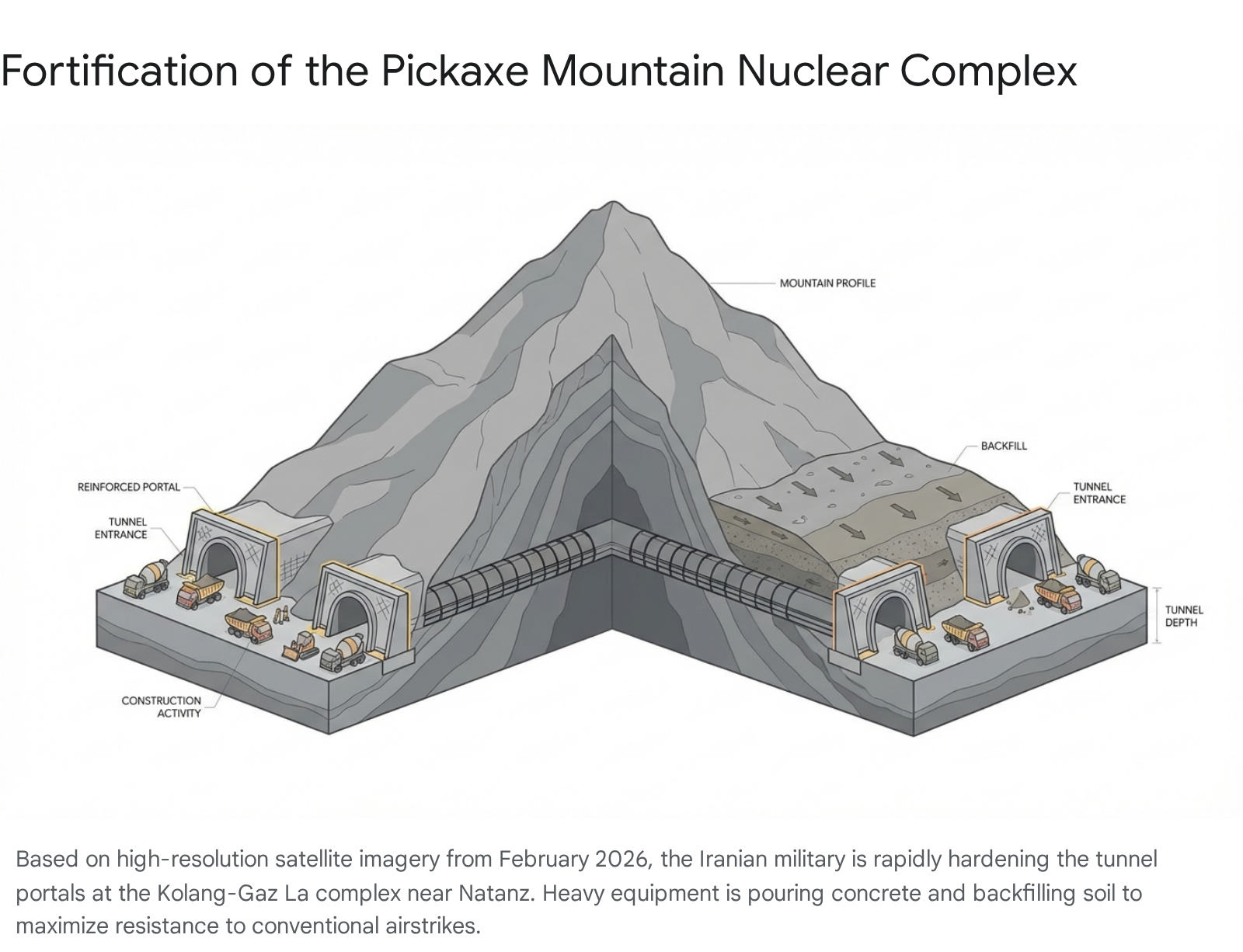
The most consequential and irreversible outcome of the war was the physical degradation of Iran’s nuclear program. On June 22, 2025, in a decisive escalation codenamed Operation Midnight Hammer, United States forces executed a precision strike campaign utilizing B-2 Spirit bombers. These aircraft deployed GBU-57 Massive Ordnance Penetrators (MOPs)—30,000-pound precision-guided bunker busters—against the regime’s most deeply buried and fortified facilities at Fordow and Natanz.1

The strategic implications of these strikes cannot be overstated. For over two decades, the Iranian regime viewed its nuclear infrastructure not just as a scientific endeavor or an energy project, but as the ultimate guarantee of regime survival—an insurance policy against external regime change similar to the North Korean model. The regime had invested billions in burying these facilities deep underground, believing they had constructed a “Zone of Immunity.” The successful penetration and destruction of these sites demonstrated that this immunity was illusory. The B-2s flew continuously for nearly 37 hours, refueling mid-air, to deliver a payload that shattered the subterranean complexes.1

Post-strike assessments paint a grim picture for Tehran’s nuclear ambitions. International Atomic Energy Agency (IAEA) Director General Rafael Grossi confirmed in September 2025 that “almost all sensitive equipment” at the Fordow facility had been destroyed.1 While Grossi cautioned that the intellectual capital remains—”knowledge cannot be bombed away”—and that Iran retains the theoretical capacity to resume enrichment, the physical infrastructure that took decades to build has been reduced to rubble.2 The loss of the centrifuges, cascades, and support infrastructure has reset the clock on Iran’s breakout time, forcing a dangerous recalibration in Tehran. The regime is now paralyzed by a binary existential choice: a frantic rush to weaponization using surviving clandestine stockpiles—a move that risks a regime-ending war—or a humiliating capitulation to reopen negotiations from a position of extreme weakness. The current paralysis in decision-making suggests the leadership is incapable of choosing a path, trapped between the fear of further U.S. strikes and the humiliation of surrender.

1.2. Fragmentation of the “Axis of Resistance”

Parallel to the destruction of its nuclear shield, the war shattered the cohesion of Iran’s regional proxy network. The “Axis of Resistance,” comprising Hezbollah in Lebanon, Shia militias in Iraq and Syria, and the Houthis in Yemen, failed to provide the deterrent effect Tehran had invested billions to cultivate. The “Unity of Fronts” strategy, which posited that an attack on one member would trigger a coordinated response from all, collapsed under the pressure of the Israeli and American offensives.

  • Hezbollah’s Neutralization: Hezbollah, the crown jewel of Iran’s proxy network, has been forced into a defensive crouch. Following intense Israeli operations, the group agreed to a ceasefire that mandated the withdrawal of its forces north of the Litani River. While the group has not been fully disarmed, its ability to threaten northern Israel with ground incursions or short-range saturation fire has been severely curtailed.3 Reports indicate that Iranian operatives, led by Quds Force commander Esmail Ghaani, are frantically attempting to reorganize the group’s military wing, introducing younger commanders and tighter secrecy to mitigate Israeli intelligence penetration.5 However, the strategic reality is that Hezbollah is currently focused on its own survival within the Lebanese political sphere rather than projecting Iranian power.
  • The Fall of the Assad Regime: Perhaps the most devastating blow to Iran’s regional projection was the fall of the Assad regime in Syria in late 2024. This event stripped Iran of its critical “land bridge” to the Levant. Without friendly control of Syrian territory, the logistical supply lines that fed weapons and funds to Hezbollah have been severed.6 The loss of Syria isolates Hezbollah geographically and strategically, reducing Iran’s ability to resupply its most important proxy in the event of a future conflict.
  • Proxy Disillusionment and Command Fracture: Intelligence reports suggest a growing rift between Tehran and its remaining proxies. The failure of the IRGC to protect its allies, or to effectively retaliate for the assassination of its own commanders, has led to a crisis of confidence. Iraqi militias, specifically groups like Kataib Hezbollah and Asaib Ahl al-Haq, are reportedly engaging in independent maneuvering, demanding concessions from the U.S. independently of Tehran’s guidance.8 This signals a fragmentation of command and control, where local interests are superseding loyalty to the Velayat-e Faqih.

1.3. Diplomatic Isolation and the “Snapback” Mechanism

The diplomatic fallout has been equally catastrophic, cementing Iran’s status as a pariah state. In late September 2025, the United Nations “Snapback” sanctions mechanism was triggered. This mechanism, a provision of the original 2015 nuclear deal (JCPOA), allows for the restoration of all pre-2015 UN Security Council resolutions against Iran if the country is found to be in significant non-compliance.9 Iran’s escalation of uranium enrichment to 60% and its obstruction of IAEA inspections provided the legal justification for European powers to activate the snapback.

The restoration of UN sanctions has effectively severed the country’s last remaining legal lifelines to the global financial system. It mandates that all UN member states enforce bans on missile technology transfers, conventional arms sales, and nuclear-related commerce. Crucially, it provides a legal framework for countries to interdict Iranian shipping and seize assets.

Furthermore, Iran’s traditional great power patrons have begun to distance themselves. China, previously Iran’s economic lifeline and largest oil customer, has reduced its purchases. While illicit trade continues, the volume has decreased, and Beijing is demanding steeper discounts—up to $11 per barrel—to offset the increased risk of secondary sanctions.9 The diplomatic isolation is compounded by the hostile stance of the new U.S. administration, which has explicitly stated a policy of “maximum pressure” and non-negotiation until specific, maximalist behavioral changes are met.11

Islamic Republic of Iran Fragility Timeline: Military strikes, economic collapse, and protests in 2025-2026.

2. Economic Collapse: Hyperinflation and Fiscal Paralysis

The Iranian economy has moved beyond the familiar territory of “recession” or “stagflation” into a state of hyperinflationary disintegration. The confluence of war damages, the reimposition of comprehensive international sanctions, and chronic internal mismanagement has created a vicious cycle of value destruction that the government is powerless to break. The economic subsystem, once characterized by a degree of resilience due to its diversified non-oil sector, has now shattered under the weight of “polycrisis.”

2.1. Currency Crisis and the Psychology of Hyperinflation

The most visible symptom of the economic collapse is the obliteration of the national currency, the Rial. As of January 2026, the currency trades on the open market at approximately 1,400,000 Rials to the U.S. Dollar. To place this in historical context, the rate was roughly 45,000 to the dollar in early 2018, before the U.S. withdrawal from the JCPOA.9 This represents not just a depreciation, but a near-total evaporation of the currency’s value. The slide has accelerated dramatically in the post-war period; in December 2025 alone, the Rial lost significant value, breaching psychological barriers daily.11

This currency collapse has triggered a hyperinflationary spiral. While the government officially reports inflation at over 40%, independent economists and market data suggest the real rate of inflation—particularly for the basket of essential goods like food and medicine—is hovering between 70% and 100%.15 Point-to-point food inflation was recorded at 72% in late 2025.16 The government’s attempt to manage the optics of this disaster by redenominated the currency—removing four zeros to create the “Toman” as the official unit—has been a failure. The “psychological effect” of 100 Tomans buying what 1,000,000 Rials used to buy has not fooled the market; instead, it has underscored the worthlessness of the printed notes.9

The economy has undergone a de facto dollarization. Shopkeepers, manufacturers, and service providers now price goods based on the hourly fluctuations of the Black Market dollar rate rather than official indices. This has led to a breakdown of the supply chain, as importers cannot secure foreign currency to bring in raw materials, leading to factory closures and mass layoffs. The “dual exchange rate” system—where favored insiders get dollars at a subsidized rate while the public pays the market rate—has fueled massive corruption, further delegitimizing the state in the eyes of the public.17

2.2. The 1405 Budget: A Blueprint for Unrest

The proposed budget for the Iranian year 1405 (March 2026 – March 2027), submitted by President Masoud Pezeshkian’s administration, demonstrates the regime’s detachment from the economic reality of its citizens. Far from a relief package, the budget is a “war budget” that prioritizes the security apparatus over social welfare, a decision that has directly fueled the current uprising.

  • Militarization of Spending: The draft budget allocates a staggering 145% nominal increase to defense and security institutions, specifically the IRGC and the Ministry of Defense.18 This massive injection of funds—totaling approximately $9.23 billion at official rates—is intended to rebuild the military infrastructure shattered during the 12-Day War and to ensure the loyalty of the security forces during domestic crackdowns. The IRGC alone is set to receive nearly $2 billion in direct budget allocations, separate from its vast off-book commercial empire.19
  • Austerity for the Public: Conversely, the budget proposes severe austerity measures for the general population. It targets a 63% increase in tax revenues, shifting the burden onto the crumbling private sector and the merchant class (Bazaaris).13 This tax hike is an attempt to plug the deficit caused by falling oil revenues, but it is strangling the very businesses that keep the economy afloat. Furthermore, public sector wage increases are capped at 20%, a figure that lags woefully behind the 40-70% inflation rate, guaranteeing a massive drop in real purchasing power for millions of government employees and teachers.21
  • Fuel Price Hikes: In a move reminiscent of the spark for the 2019 protests, the government has introduced a three-tier gasoline pricing system. The subsidized quota has been capped, and prices for usage beyond that quota have effectively tripled.11 This policy is designed to reduce the fiscal deficit and curb consumption, but in an environment of high inflation, it acts as an accelerant for the cost of transport and food, further inflaming public anger.

2.3. Banking Sector Insolvency and Capital Flight

The banking system is effectively insolvent, sustained only by the Central Bank’s printing presses. The collapse of confidence in the Rial and the stability of the regime has triggered a massive run on the banks, with capital flight reaching historic highs. The Central Bank of Iran reported $9 billion in capital outflows in just the first quarter of the fiscal year, with projections of $36 billion by March 2026.23 This figure represents nearly 10% of the country’s GDP fleeing the country in a single year.

This exodus of capital is not limited to the wealthy elite moving funds to Dubai or Toronto; it has democratized. Ordinary citizens are converting whatever assets they have—selling cars, jewelry, and apartments—into gold, cryptocurrency, or foreign cash to protect against the vanishing Rial. Analysts have noted that the volatility of the Rial now resembles that of speculative cryptocurrencies, underscoring the complete loss of monetary sovereignty.24 The regime’s attempts to stem this flow through arrests of currency dealers and limits on withdrawals have only intensified the panic.

Iran Rial devaluation vs inflation (2018-2026). Islamic Republic of Iran Fragility Score data.

3. Ecological Collapse: The Water Bankruptcy

Beyond the political instability and economic ruin, Iran faces a threat that is absolute and non-negotiable: the irreversible ecological collapse of the Iranian plateau. This “water bankruptcy” is not a future projection but a present reality that is reshaping the country’s demographics and fueling its instability. The environmental subsystem has crashed, acting as a threat multiplier that exacerbates every other crisis the state faces.

3.1. Tehran’s “Day Zero” and the Crisis of Habitability

The capital city, Tehran, home to over 15 million people and the beating heart of the nation’s economy and administration, is fast approaching “Day Zero”—the point at which municipal water reserves are exhausted, and taps run dry. As of late 2025, water reserves in the dams supplying Tehran have dropped below 5% of capacity, a historic low that signals the failure of the hydrological infrastructure.25 President Masoud Pezeshkian has publicly and starkly warned that if substantial rains do not arrive by December—which they have largely failed to do—the government will have “no choice” but to implement severe rationing and potentially begin evacuating segments of the city.26

This crisis is the result of decades of systemic mismanagement, corruption, and a development model that ignored ecological limits. The regime dismantled the ancient, sustainable qanat systems in favor of massive, prestige-driven dam projects and unregulated groundwater extraction. The consequences are now visible underfoot: the land under Tehran is subsiding at a rate of 30cm per year due to the depletion of aquifers, threatening the structural integrity of buildings, bridges, and the metro system.28 The very ground the capital is built on is collapsing.

3.2. The Makran Relocation Fantasy

In a desperate and widely criticized attempt to address the habitability crisis, the government has revived proposals to move the capital from Tehran to the Makran coast on the Gulf of Oman.29 Presented as a strategic pivot to a “sea-based economy,” this plan is largely regarded by urban planners and economists as a fantasy.

The logistical and financial hurdles are insurmountable for a bankrupt state. The cost of building a new capital is estimated at between $77 billion and $100 billion.30 For a country struggling to pay pensions and under heavy sanctions, such an expenditure is impossible. Furthermore, the Makran region is severely underdeveloped, lacks basic infrastructure, and is located in the volatile Sistan and Baluchestan province—a region currently engulfed in Sunni insurgency and anti-regime unrest. The announcement of this plan acts less as a viable policy solution and more as a tacit admission by the regime that Tehran is dying and that they have no solution for saving it.31

3.3. Environmental Protests as a Catalyst

The environmental crisis has ceased to be a local issue for farmers; it has merged with the broader political grievances of the urban population. Protests in provinces like Isfahan and Khuzestan, traditionally driven by farmers angry over water diversion, have now linked up with national anti-regime movements. The drying of the Zayandeh Rud river in Isfahan and the blinding dust storms in Khuzestan are no longer viewed as natural disasters but as the direct result of the regime’s incompetence, corruption, and prioritization of water-intensive industries owned by the IRGC.32 The slogan “They took our water, they took our oil” reflects the unification of ecological and economic grievances into a singular narrative of dispossession.

Ecological bankruptcy in Iran (2026): Water stress, migration, and protest hotspots. "Day Zero Risk" in Tehran.

4. Sociopolitical Fragility: Legitimacy Crisis and Succession

The political foundation of the Islamic Republic is crumbling. The “social contract”—an implicit agreement where the population tolerated restricted political freedoms in exchange for stability, security, and modest economic subsidies—has been irrevocably broken. The regime can no longer deliver stability (as evidenced by the war), security (as evidenced by the ISIS-K attacks and Israeli strikes), or subsidies (as evidenced by the austerity budget).

4.1. The “Hidden Imam” Scenario and the Succession Battle

Supreme Leader Ali Khamenei, aged 86, has largely vanished from public view since the onset of the June war. Reports indicate he is operating from a secure, hardened bunker, communicating only through a trusted aide.34 This physical absence has created a political vacuum, transforming him into an “absentee landlord” figure and fueling wild rumors about his health and grip on power.

This vacuum has sparked a vicious and destabilizing succession battle. The Assembly of Experts is reportedly paralyzed by factional infighting as they consider three primary candidates, each representing a different vision for the regime’s survival:

  1. Mojtaba Khamenei: The Supreme Leader’s son, widely seen as the candidate of the “Deep State” and the security apparatus (IRGC). While he commands the loyalty of the gun, he lacks religious standing and popular legitimacy, and his succession would signal the transformation of the Islamic Republic into a hereditary dynastic dictatorship.36
  2. Mohammad Mirbaqiri: An ultra-hardline cleric and head of the Academy of Islamic Sciences. He advocates for a “purified” Islamic society and permanent confrontation with the West. His ascension would likely push the regime toward a Taliban-style governance model, alienating the modern urban class entirely.36
  3. Alireza Arafi: A more traditional conservative figure, viewed by some as a potential compromise candidate to preserve the clerical system, though he lacks the independent power base of the other two.

The uncertainty of the transition is destabilizing the regime from within. Factions are positioning themselves for the post-Khamenei era, hoarding resources and intelligence, leading to paralysis in decision-making at the state level.

4.2. IRGC: Fracture and “Dumbification”

The Islamic Revolutionary Guard Corps (IRGC), the regime’s primary instrument of coercion, is facing an unprecedented internal crisis. The 12-Day War decimated its leadership structure, killing over 30 senior commanders and revealing deep intelligence penetrations by Israeli and Western agencies.38 The aura of invincibility that surrounded the Guard has evaporated.

In response to these failures, the regime has initiated a “purification” campaign within the Guard. However, analysts note that this has led to a process of “dumbification,” where professional competence is sacrificed for ideological loyalty.38 Paranoid about spies, the leadership has purged capable officers, replacing them with ideological zealots who lack military expertise. This degradation was evident in the clumsy handling of the post-war protests and the inability to secure the country’s borders or airspace. The IRGC is no longer a monolithic entity; it is fracturing into competing fiefdoms, with some commanders reportedly prioritizing their business interests over national defense.38

4.3. The Return of Ali Larijani and Elite Fragmentation

In a sign of the regime’s desperation to restore some semblance of administrative competence, Ali Larijani, a former moderate-conservative Speaker of Parliament who was previously disqualified from running for president, has been rehabilitated. He has been appointed as the Secretary of the Supreme National Security Council (SNSC), replacing the ineffective Ali Akbar Ahmadian.40

Larijani’s return represents an attempt by the Supreme Leader (or those acting in his name) to bridge the gap with the “technocratic” class and bring experienced hands back to the wheel. However, this move has infuriated the ultra-hardline Paydari front, who view Larijani as a “liberal” and a traitor to the revolutionary cause. This infighting at the very top of the system—between the “Purifiers” and the “Pragmatists”—is further paralyzing the state’s ability to respond to the crisis on the streets.42

Islamic Republic of Iran power dynamics diagram, January 2026. Shows succession rivals and weakened Khamenei.

5. The Current Uprising: A Revolution of the Hungry

The protests that erupted on December 28, 2025, represent a qualitative shift from previous waves of unrest in Iran. Unlike the 2009 Green Movement (which focused on political reform) or the 2022 Mahsa Amini protests (which focused on social freedoms and women’s rights), the current uprising is a “Revolution of the Hungry” driven by existential economic desperation. Yet, it has rapidly adopted maximalist political slogans, bridging the gap between economic grievance and regime change.

5.1. The Bazaari Factor: A Historic Shift

Crucially, the spark for this uprising came from the Tehran Grand Bazaar.43 The merchant class, or Bazaaris, has historically been a conservative pillar of support for the clergy, playing a key role in funding the 1979 revolution. However, the collapse of the Rial and the aggressive tax hikes in the 1405 budget have destroyed their businesses. When the Bazaar strikes—closing shops and marching in the streets—it paralyzes the distribution of goods across the country and sends a powerful signal to the conservative religious classes that the regime has lost its economic and moral mandate. The Bazaaris are no longer aligned with the state; they are now leading the charge against it.

5.2. Nationwide Scope and Demographics

The unrest has spread with unprecedented speed to over 180 cities in all 31 provinces.43 This geographic spread indicates that the protest movement has successfully bridged the rural-urban divide. It unites the water-starved farmers of Isfahan and the marginalized ethnic minorities in Kurdistan and Baluchestan with the unemployed youth and student movements of Tehran and Shiraz.

The slogans have shifted rapidly from economic demands like “Death to high prices” to explicitly anti-regime chants such as “Death to the Dictator” and calls for the return of the Pahlavi dynasty, indicating a total rejection of the Islamic Republic as a system.43 The movement is leaderless but coordinated, utilizing neighborhood networks to organize despite internet blackouts.

5.3. State Repression and Rumors of Martial Law

The state’s response has been brutal, utilizing the full spectrum of repression. Security forces have killed hundreds of protesters and arrested thousands.45 However, reports suggest that the crackdown is less effective than in the past. There are persistent rumors of hesitation and even limited defections among rank-and-file security personnel, who are suffering from the same inflation and economic hardships as the protesters they are ordered to beat.

As of early January 2026, unconfirmed reports suggest that the regime is preparing to declare martial law, with military commanders taking direct control of provincial administration and bypassing civilian governors.47 This would mark the final militarization of the state, removing the last veneer of republican governance.

6. Conclusion and Strategic Outlook

The Islamic Republic of Iran is currently a “Zombie State”—institutionally dead but kept moving by the sheer inertia of its coercive apparatus. However, that apparatus is now fracturing under the weight of multiple, simultaneous crises. The convergence of military defeat, economic ruin, environmental collapse, and political illegitimacy has created a scenario where the regime has no good options left.

6.1. Scenario A: Military Junta (High Probability – 45%)

As the clerical establishment loses all credibility and Khamenei eventually passes or is incapacitated, the IRGC—specifically its hardline faction led by figures aligned with Mojtaba Khamenei—may execute a soft coup. They would sideline the clergy, militarize the economy completely, and rule as a secular nationalist dictatorship. This would involve a brutal crackdown but might stabilize the security situation temporarily by shedding the ideological baggage of the theocracy.

6.2. Scenario B: Systemic Collapse and Civil War (Medium Probability – 35%)

If the security forces fracture along lines of loyalty or ethnicity, the state could collapse into civil war. The breakdown of the central government would lead to the rise of local warlords, particularly in border regions like Kurdistan and Baluchestan. This “Syria scenario” would likely invite foreign intervention to secure nuclear materials and prevent regional spillover.

6.3. Scenario C: Managed Transition/Revolution (Low Probability – 20%)

A broad coalition of the army (Artesh), dissatisfied IRGC elements, and civil society leaders could force a transition to a transitional government. This is the “optimistic” scenario but requires a level of coordination and leadership that the opposition currently lacks.

Final Assessment: The Iranian state is in Phase IV: Dissolution. Without a massive external bailout (which is unlikely given the geopolitical climate) or a radical internal transformation that abandons the revolutionary ideology, the Islamic Republic as currently constituted is unlikely to survive the next 12-24 months intact. The 1405 budget, rather than saving the regime, acts as an accelerant, fueling the very fires it seeks to extinguish.


Please share the link on Facebook, Forums, with colleagues, etc. Your support is much appreciated and if you have any feedback, please email us in**@*********ps.com. If you’d like to request a report or order a reprint, please click here for the corresponding page to open in new tab.


Sources Used

  1. United States strikes on Iranian nuclear sites – Wikipedia, accessed January 10, 2026, https://en.wikipedia.org/wiki/United_States_strikes_on_Iranian_nuclear_sites
  2. Iran: Impacts of June 2025 Israel and US strikes – House of Commons Library, accessed January 10, 2026, https://commonslibrary.parliament.uk/research-briefings/cbp-10292/
  3. Lebanon 2025: Plans to disarm Hezbollah – House of Commons Library – UK Parliament, accessed January 10, 2026, https://commonslibrary.parliament.uk/research-briefings/cbp-10347/
  4. Israel–Hezbollah conflict (2023–present) – Wikipedia, accessed January 10, 2026, https://en.wikipedia.org/wiki/Israel%E2%80%93Hezbollah_conflict_(2023%E2%80%93present)
  5. Hamas and Hezbollah rebuild during truce, Israeli officials say – JPost | Iran International, accessed January 10, 2026, https://www.iranintl.com/en/202511206795
  6. The State Of The Axis Of Resistance: Assessing Risks And Opportunities For The United States | Critical Threats, accessed January 10, 2026, https://www.criticalthreats.org/analysis/the-state-of-the-axis-of-resistance
  7. Iran’s proxy war paradox: strategic gains, control issues, and operational constraints, accessed January 10, 2026, https://www.tandfonline.com/doi/full/10.1080/09592318.2025.2512807
  8. Iran Update, December 26, 2025 | ISW – Institute for the Study of War, accessed January 10, 2026, https://understandingwar.org/research/middle-east/iran-update-december-26-2025/
  9. Iran’s Economy Is Sinking – EA WorldView, accessed January 10, 2026, https://eaworldview.com/2025/10/iran-economy-is-sinking/
  10. The Year in Review: Iran’s Deepening Economic Crisis – Middle East Forum, accessed January 10, 2026, https://www.meforum.org/mef-observer/the-year-in-review-irans-deepening-economic-crisis
  11. Iran’s currency plummets to new low, sparking fears of higher food prices, accessed January 10, 2026, https://www.pbs.org/newshour/world/irans-currency-plummets-to-new-low-sparking-fears-of-higher-food-prices
  12. What to know about the intensifying protests shaking Iran and putting pressure on its theocracy, accessed January 10, 2026, https://www.pbs.org/newshour/world/what-to-know-about-the-intensifying-protests-shaking-iran-and-putting-pressure-on-its-theocracy
  13. Iran Update, December 29, 2025 – Institute for the Study of War, accessed January 10, 2026, https://understandingwar.org/research/middle-east/iran-update-december-29-2025/
  14. Iran rial hits new record low of 1.31 million to the dollar, accessed January 10, 2026, https://www.iranintl.com/en/202512153499
  15. Iran Inflation Rate – Trading Economics, accessed January 10, 2026, https://tradingeconomics.com/iran/inflation-cpi
  16. Iran economy contracts despite modest oil growth as inflation and rial slide, accessed January 10, 2026, https://www.iranintl.com/en/202512280124
  17. Behind the Inflation Crisis: Why Iran’s Streets are Erupting Again – India’s World Magazine, accessed January 10, 2026, https://indiasworld.in/behind-the-inflation-crisis-why-irans-streets-are-erupting-again/
  18. Links: 145% Increase in Iran’s Defense and Security Budget for 1405 – iroon.com, accessed January 10, 2026, https://iroon.com/irtn/link/63644/145-increase-in-iran-s-defense-and-security-budget-for-1405/
  19. 145% Increase in Iran’s Defense and Security Budget for 1405 – WANA News, accessed January 10, 2026, https://wanaen.com/145-increase-in-irans-defense-and-security-budget-for-1405/
  20. Tax Increase in Iran to Finance the IRGC and Religious Institutions – Middle East Forum, accessed January 10, 2026, https://www.meforum.org/mef-observer/tax-increase-in-iran-to-finance-the-irgc-and-religious-institutions
  21. Iran submits budget signaling one of sharpest fiscal pullbacks in years, accessed January 10, 2026, https://www.iranintl.com/en/202512234988
  22. Stealth austerity: Tehran seeks fuel price hike without a reckoning | Iran International, accessed January 10, 2026, https://www.iranintl.com/en/202512236352
  23. Double squeeze: Iran faces record capital flight as oil revenues fall, accessed January 10, 2026, https://www.iranintl.com/en/202511078141
  24. Iran’s Currency Collapse Mirrors Cryptocurrency Volatility Amid Economic Turmoil, accessed January 10, 2026, https://www.weareiowa.com/article/news/local/plea-agreement-reached-in-des-moines-murder-trial/524-3069d9d4-6f9b-4039-b884-1d2146bd744f?y-news-25066994-2026-01-09-iran-currency-crash-like-crypto
  25. Threat of Day Zero in Tehran: water reserves drop below 5%, accessed January 10, 2026, https://www.waterdiplomat.org/story/2025/11/threat-day-zero-tehran-water-reserves-drop-below-5
  26. After Ruining a Treasured Water Resource, Iran Is Drying Up – Yale …, accessed January 10, 2026, https://e360.yale.edu/features/iran-water-drought-dams-qanats
  27. Satellite Imagery Shows Tehran’s Accelerating Water Crisis – CSIS, accessed January 10, 2026, https://www.csis.org/analysis/satellite-imagery-shows-tehrans-accelerating-water-crisis
  28. Iran must move its capital from Tehran, says president as water crisis worsens, accessed January 10, 2026, https://www.theguardian.com/world/2025/oct/02/iran-must-move-its-capital-from-tehran-says-president-as-water-crisis-worsens
  29. Iran Mulls Plans to Relocate Capital as Tehran Faces Water Crisis | Vantage on Firstpost, accessed January 10, 2026, https://www.youtube.com/watch?v=ndscdueXnlg
  30. Iranian capital relocation – Wikipedia, accessed January 10, 2026, https://en.wikipedia.org/wiki/Iranian_capital_relocation
  31. Iran president says capital move now a necessity as water crisis deepens, accessed January 10, 2026, https://www.iranintl.com/en/202511209098
  32. Iran’s Water Crisis Is a Warning to Other Countries, accessed January 10, 2026, https://carnegieendowment.org/emissary/2025/11/iran-water-crisis-warning-climate?lang=en
  33. Environmental and Human Rights Crisis in Iran under the Mullahs’ Regime, accessed January 10, 2026, https://iran-hrm.com/2025/10/13/environmental-and-human-rights-crisis-in-iran-under-the-mullahs-regime/
  34. Iran’s Khamenei said to pick three potential successors as he hides in bunker, accessed January 10, 2026, https://www.timesofisrael.com/khamenei-said-to-pick-three-potential-successors-as-he-hides-in-bunker/
  35. Khamenei picks possible successors amid war, son Mojtaba not among them – NYT, accessed January 10, 2026, https://www.iranintl.com/en/202506218672
  36. Next Supreme Leader of Iran election – Wikipedia, accessed January 10, 2026, https://en.wikipedia.org/wiki/Next_Supreme_Leader_of_Iran_election
  37. Controversial ultra-hardliner claims Khamenei endorsed his path | Iran International, accessed January 10, 2026, https://www.iranintl.com/en/202410121746
  38. Humiliation and Transformation: The Islamic Republic After the 12 …, accessed January 10, 2026, https://www.fpri.org/article/2025/10/humiliation-and-transformation-the-islamic-republic-after-the-12-day-war/
  39. How 12 days have changed Iran – The International Institute for Strategic Studies, accessed January 10, 2026, https://www.iiss.org/online-analysis/online-analysis/2025/07/how-12-days-have-changed-iran/
  40. Iran’s War Doctrine After the 2025 Conflict With Israel: Nuclear Calculations and the Question of the Fatwa | International Institute for Iranian Studies, accessed January 10, 2026, https://rasanah-iiis.org/english/monitoring-and-translation/reports/irans-war-doctrine-after-the-2025-conflict-with-israel-nuclear-calculations-and-the-question-of-the-fatwa/
  41. Iran security chief likens Trump to Hitler as Tehran mood darkens, accessed January 10, 2026, https://www.iranintl.com/en/202510231221
  42. Iran’s Hard-Pivot from “Detente” to Coercion—And the Purge Politics Driving It – NCRI, accessed January 10, 2026, https://www.ncr-iran.org/en/news/irans-hard-pivot-from-detente-to-coercion-and-the-purge-politics-driving-it/
  43. 2025–2026 Iranian protests – Wikipedia, accessed January 10, 2026, https://en.wikipedia.org/wiki/2025%E2%80%932026_Iranian_protests
  44. How Iran’s latest protests mark a break from past cycles of dissent, accessed January 10, 2026, https://www.trtworld.com/article/5715f0a3c0ec
  45. Iran protests are the biggest in years to challenge the regime. Here’s what to know., accessed January 10, 2026, https://www.cbsnews.com/news/iran-protests-biggest-in-years-against-ayatollah-what-to-know/
  46. 2025 Iran internal crisis – Wikipedia, accessed January 10, 2026, https://en.wikipedia.org/wiki/2025_Iran_internal_crisis
  47. Iran Update, January 7, 2026 | ISW – Institute for the Study of War, accessed January 10, 2026, https://understandingwar.org/research/middle-east/iran-update-january-7-2026/

ISLAMIC REPUBLIC OF IRAN – REGIME STABILITY ASSESSMENT (JANUARY 10, 2026)

Date: January 10, 2026

Subject: Assessment of Nationwide Unrest, Regime Stability, and Strategic Outlook for the Islamic Republic of Iran

The Islamic Republic of Iran is currently navigating the most precarious existential crisis in its forty-seven-year history, a convergence of catastrophic economic failure, the geopolitical aftershocks of the “Twelve-Day War” of June 2025, and a nationwide uprising of unprecedented scope and intensity. As of January 10, 2026, the clerical regime faces a “dual-pressure” dynamic that it has successfully avoided in previous cycles of unrest: mass street mobilization coinciding with crippling labor strikes in critical economic sectors, specifically the bazaar and the hydrocarbon industry.

The unrest, triggered on December 28, 2025, by a sudden hyperinflationary spike and the collapse of the Rial, has rapidly metamorphosed from an economic grievance movement into a revolutionary demand for the end of the theocratic system. Unlike the protests of 2009, 2017, 2019, or 2022, the current uprising is characterized by a “swarm intelligence” tactical capability among protesters and a distinct erosion of the regime’s “fear barrier.”

Key Findings:

  • Regime Survival is at Critical Risk: The probability of regime collapse or fundamental transformation within the next 6-12 months is assessed at High. The synergy between street mobilization and labor strikes—specifically in the South Pars energy sector and major bazaars—replicates the structural conditions that led to the 1979 revolution.
  • Security Apparatus Strain and Fracture: While the core of the Islamic Revolutionary Guard Corps (IRGC) remains cohesive, signs of exhaustion and localized insubordination have emerged within the Law Enforcement Command (LEC) and ground forces. The regime’s reliance on lethal force—resulting in at least 217 deaths in Tehran alone—has failed to quell the unrest, necessitating the deployment of military assets to manage civil disturbances, a clear indicator of police overstretch.
  • Leadership Vacuum and Bunker Mentality: Supreme Leader Ali Khamenei, aged 86, is operating from a secure bunker following Israeli strikes in 2025. His recent move to designate three potential successors—reportedly excluding his son Mojtaba—suggests acute anxiety regarding continuity and internal factionalism. The executive branch, led by President Masoud Pezeshkian, has been rendered effectively powerless, unable to bridge the gap between the street and the deep state.
  • Economic Irreversibility: With the Rial trading at approximately 1.47 million to the US Dollar and inflation exceeding 50%, the government lacks the fiscal capacity to buy public quiescence. The destruction of sanctions-evasion networks during the 2025 conflict and the renewed “Maximum Pressure” campaign have severed the regime’s financial arteries.

This report provides an exhaustive analysis of the operational, economic, and political vectors driving this crisis, offering detailed prognoses for the immediate and short term.

1. Strategic Context: The “Perfect Storm” of 2025-2026

To fully comprehend the volatility of the operational environment in January 2026, one must analyze the antecedent events of 2025 that dismantled the regime’s traditional survival mechanisms. The current uprising is not an isolated stochastic event but the culmination of a systematic degradation of state power and legitimacy.

1.1 The Operational Legacy of “Rising Lion” (June 2025)

In June 2025, the long-simmering shadow war between Iran and Israel escalated into a direct, high-intensity conflict known as “Operation Rising Lion”.1 This 12-day war fundamentally altered the balance of power in the Middle East and stripped Tehran of its primary strategic deterrents.

Nuclear Degradation:

Intelligence assessments confirm that joint Israeli and US operations “effectively destroyed” Iran’s uranium enrichment capacity and targeted key nuclear scientists.2 The strikes on facilities such as Natanz and Fordow utilized advanced penetrator munitions, causing extensive structural damage to underground complexes.1 This decapitation of the nuclear program removed the regime’s ultimate bargaining chip with the West, leaving it strategically exposed without the leverage of a “breakout” threat.

Conventional Defeat and Air Defense Collapse:

The Israeli Air Force (IAF) established total air superiority during the campaign, destroying over 70% of Iran’s missile launchers and creating a critical bottleneck in missile production.4 The systematic dismantling of Iran’s integrated air defense system (IADS) has left the regime psychologically naked. The destruction of S-300 and other advanced surface-to-air missile batteries forced the senior leadership, including Supreme Leader Ali Khamenei, into deep bunkers, where they reportedly remain.5 This physical isolation has severed the visible link between the leadership and the populace, reinforcing the image of a regime under siege.

Proxy Network Disintegration:

The “Axis of Resistance”—Iran’s “forward defense” doctrine—has suffered catastrophic degradation. Hezbollah in Lebanon and various militia groups in Syria and Iraq were decimated during the regional conflicts of 2024-2025. By January 2026, these groups are fighting for their own survival and are operationally unable to deploy effectively to suppress Iranian domestic unrest, a tactic the regime had utilized in previous crackdowns.6 The absence of these foreign fighters removes a critical layer of the regime’s repressive redundancy.

1.2 The Economic Precipice and “Maximum Pressure 2.0”

The military defeat was immediately compounded by a renewed economic strangulation. Following the “snapback” of UN sanctions in September 2025, the second Trump administration initiated “Maximum Pressure 2.0” in January 2025.7

Hyperinflation and Currency Collapse:

By late 2025, the Iranian Rial (IRR) had collapsed to approximately 1.47 million against the US Dollar, a historic low.7 This devaluation obliterated the purchasing power of the middle class and the Mustazafin (oppressed)—the regime’s traditional base of support. Inflation rates for food and basic goods skyrocketed to over 70% year-on-year 10, creating a situation where millions of Iranians are facing genuine malnutrition and food insecurity.

Systemic Energy Crisis:

Despite being an energy superpower, Iran faces acute domestic shortages of natural gas and electricity. Strikes on infrastructure during the war, combined with decades of mismanagement and lack of investment, have crippled the energy sector. This has resulted in rolling blackouts and heating shortages during the winter of 2025-2026, further inflaming public anger and halting industrial production.7 The regime’s inability to provide basic utilities has shattered the “social contract” of subsidized stability.

2. Operational Analysis of the Uprising (January 2026)

The current wave of protests, which began on December 28, 2025, is distinct from previous rounds in its velocity, demographic breadth, and tactical sophistication. It represents a “total war” by the populace against the state apparatus.

Operational situation map of Iran, January 10, 2026, showing unrest and infrastructure strikes.

2.1 Timeline of Escalation

The trajectory of the uprising indicates a rapid loss of state control over the street and a collapsing “escalation ladder” for the regime.

Phase 1: Economic Trigger (Dec 28 – Dec 30):

Protests began in the Grand Bazaar of Tehran—the historical heart of Iran’s conservative merchant class. Shopkeepers struck against the currency collapse and the soaring cost of imports. This was a critical signal; the Bazaaris have historically been a pillar of the clerical establishment. Their turn against the regime signifies that the clergy has lost its financial theology. Initially, the demands were economic, focused on the exchange rate and inflation.11

Phase 2: Radicalization and Expansion (Dec 31 – Jan 7):

The movement rapidly expanded beyond the merchant class. University students and youth in peripheral provinces joined the fray. Slogans shifted immediately from “Death to High Prices” to “Death to Dictator,” “Death to Khamenei,” and “Seyyed Ali [Khamenei] will be toppled this year”.11 By January 7, protests had spread to 31 provinces and over 156 locations, including religiously conservative strongholds like Qom and Mashhad.8

Phase 3: The General Strike and Blackout (Jan 8 – Present):

Following a call by exiled Crown Prince Reza Pahlavi and a coalition of Kurdish opposition parties, a general strike paralyzed the country on January 8. The regime responded with a total internet blackout, reducing connectivity to approximately 1%.13 This phase has seen the highest levels of violence, with security forces utilizing heavy machine guns and live ammunition in multiple cities.

2.2 Geography of Resistance

The Center (Tehran, Isfahan, Karaj):

Large-scale urban warfare is reported in the capital and its satellites. In Tehran, the sheer density of protests has overwhelmed the Law Enforcement Command (LEC), forcing the deployment of the IRGC Ground Forces.11 Protesters have burned government buildings, including an IRIB (state broadcaster) facility in Esfahan, demonstrating a willingness to target the regime’s propaganda organs.13

The Periphery (Kurdistan, Baluchistan):

In the west (Sanandaj, Kermanshah) and southeast (Zahedan), the uprising resembles an armed insurgency. Kurdish opposition groups (KDPI, Komala, PJAK) have mobilized, and the regime is treating these areas as combat zones, using heavy weaponry and deploying military units rather than riot police.12 In Zahedan, the weekly Friday protests have resumed with renewed intensity following sermons by Sunni cleric Moulana Abdol Hamid, who has declared the crackdown a “crime under international law”.13

The “Tank Man” Phenomenon:

Symbolic acts of defiance have shattered the aura of regime invincibility. Viral footage—circulated before the blackout—showed individuals blocking security vehicles in Tehran’s Jomhuri Eslami Street, reminiscent of Tiananmen Square.11 These images have galvanized the public, proving that the security forces can be defied.

2.3 Tactics and Organization

While the movement is often described as “leaderless,” it exhibits a sophisticated “swarm intelligence.” Protesters utilize small, mobile groups to exhaust security forces, retreating and regrouping rapidly in different neighborhoods to stretch police resources thin.

Self-Defense and Counter-Aggression:

Unlike the protests of 2009, protesters are actively fighting back. Reports indicate attacks on Basij bases, the burning of regime symbols (including statues of Qassem Soleimani), and the temporary seizure of government buildings in smaller towns like Abdanan.16 The barrier of fear has eroded; protesters are no longer fleeing from gunfire but are standing their ground or engaging in hit-and-run attacks on security personnel.

3. The Economic War: Strikes and Sanctions

The most dangerous development for the regime is the fusion of street protests with labor strikes. The 1979 revolution succeeded not because of street marches alone, but because the oil workers turned off the taps, bankrupting the Shah. A similar dynamic is unfolding in January 2026.

3.1 The Energy Sector Strike

Reports from January 7-9 confirm that strikes have spread to the strategic South Pars gas field and refineries in Abadan and Asaluyeh.17 This is a critical escalation.

Strategic Impact:

The oil and gas sector provides the vast majority of the government’s hard currency revenue. A sustained strike here serves a dual purpose: it bankrupts the state—already reeling from sanctions—and cuts off domestic fuel supplies, paralyzing logistics and transportation. The “Coordination Council for Protests of Contract Oil Workers” has been instrumental in organizing these actions, linking labor demands with the broader political uprising.11

The “Teapot” Dilemma:

China, the primary buyer of Iranian illicit oil, is facing supply disruptions. With Venezuelan supply also uncertain due to recent US interventions, Iran’s inability to export due to strikes would sever its last major diplomatic and economic lifeline.19 This loss of revenue renders the regime unable to pay the wages of the very security forces it relies on to crush the protests.

3.2 The Bazaar and Commercial Sector

The strikes in the Grand Bazaar of Tehran, Tabriz, Rasht, and Isfahan are symbolic and functional death knells for the regime’s domestic legitimacy.17 The closure of the bazaar is not merely an economic halt; it is a political withdrawal of support by the conservative middle class. The “Bazaari-Clergy Alliance,” a cornerstone of the 1979 revolution, has effectively dissolved. The bazaaris are now aligning with the “Generation Z” protesters, creating a cross-class coalition that the regime cannot easily divide.

3.3 Macroeconomic Collapse Indicators

The economic engine of the protests is the chaotic devaluation of the national currency. The correlation between the Rial’s value and protest intensity is direct and causal.

  • Currency Devaluation: The Rial, which traded at ~500,000 to the USD in early 2024, has depreciated to ~1.47 million.7 This collapse was triggered by the “Maximum Pressure” signals and the regime’s loss of access to foreign reserves.
  • Inflationary Spiral: Inflation has exceeded 50%, with food inflation significantly higher at over 70%.10 This has driven the “grey” population—those who previously stayed home due to apathy or fear—onto the streets out of sheer desperation.
  • Unemployment: The unemployment rate stands at 9.2% officially, but youth unemployment is estimated to be significantly higher, fueling the recruitment of young men into the protest movement.20

Table 1: Key Economic Indicators (January 2026)

IndicatorValueTrendStrategic Implication
USD/IRR Exchange Rate~1,470,000CollapsingErases savings; destroys middle-class wealth.
Annual Inflation52.6%AcceleratingMakes basic staples unaffordable; fuels rage.
Food Inflation>72%CriticalDirect driver of participation by lower classes.
GDP Growth (Non-Oil)-0.8%ContractingIndicates deep recession in the real economy.
Oil ProductionDisruptedVolatileStrike action threatens state revenue solvency.
Unemployment9.2% (Official)RisingProvides manpower for street mobilization.

Sources: IMF 20, Trading Economics 21, Central Bank of Iran 10

4. Regime Cohesion and Security Apparatus: The Breaking Point?

The ability of the Islamic Republic to survive depends entirely on the cohesion of its coercive apparatus: the IRGC, the Basij, and the Law Enforcement Command (LEC). Current intelligence suggests unprecedented strain and the beginning of fractures.

4.1 Force Exhaustion and Bandwidth Constraints

The regime is suffering from a “bandwidth” crisis. The simultaneous eruption of protests in 156+ locations prevents the concentration of forces—a tactic used successfully in 2019 and 2022 to crush unrest city by city.12

LEC Overstretch:

The regular police (LEC) have proven incapable of containing the crowds. In cities like Eslamabad-e Gharb and Bushehr, security forces reportedly retreated or fled due to being outnumbered.13 This loss of control forces the regime to deploy the IRGC Ground Forces, a move that signals the failure of the primary internal security layer.

IRGC Deployment and Attrition:

The deployment of the IRGC Ground Forces (e.g., the Nabi Akram Unit in Kermanshah) indicates that the situation is viewed as an insurgency rather than a riot. However, even elite units are taking casualties; the Nabi Akram unit reportedly lost at least 10 members in clashes.13 The death of IRGC soldiers implies that protesters are either armed or using lethal improvised tactics, forcing the IRGC into a kill-or-be-killed dynamic that degrades morale.

4.2 Signs of Fracture and Insubordination

For the first time in recent memory, credible reports of insubordination have emerged from within the security apparatus.

Refusals to Fire:

Human rights organizations have documented instances of security personnel refusing orders to fire on crowds. The regime has reportedly arrested several security force members for disobedience.14 This is the “nightmare scenario” for the leadership: a mutiny within the ranks. If the conscript-heavy army (Artesh) or even elements of the IRGC refuse to slaughter civilians, the regime’s coercive capacity evaporates.

Judicial Threats and Desperation:

The judiciary has resorted to extreme threats, announcing that protesters using weapons will be charged with moharebeh (“enmity against God”), a crime punishable by death.13 This legal escalation is intended to terrify the populace, but given the scale of the unrest, mass executions may only serve to further radicalize the opposition.

4.3 Structural Health of the Regime Pillars

The stability of the Islamic Republic has historically rested on five pillars. An assessment of their current status reveals a regime in structural collapse.

1. Ideological Legitimacy (Collapsed): The concept of Velayat-e Faqih (Guardianship of the Islamic Jurist) has lost all traction with the youth and the broader public. Slogans attacking the Supreme Leader directly indicate a total rejection of the theological basis of the state.

2. Economic Patronage (Collapsed): The regime can no longer afford to subsidize its supporters. The collapse of the Rial and the bankruptcy of the state mean that the patronage network—which kept the rural poor loyal—is broken.

3. The Bazaar/Merchant Class (Fractured/Opposed): As detailed in Section 3.2, the bazaar has turned against the state, severing a critical alliance.

4. External Proxies (Degraded): The “Axis of Resistance” is shattered. Hezbollah and Iraqi militias are fighting for their own survival and cannot provide reinforcements to Tehran.6

5. Coercive Apparatus (Strained but Holding): This is the only remaining pillar. The IRGC’s elite core remains loyal due to ideological indoctrination and financial interest, but the rank-and-file are wavering. If this pillar cracks, the regime falls.

5. Political Paralysis and the Succession Crisis

As the streets burn, the regime’s leadership is paralyzed by an internal crisis of succession and physical insecurity.

5.1 The “Bunker” Mentality and Leadership Isolation

Supreme Leader Ali Khamenei is reportedly operating from a secure underground location (bunker) in Lavizan or near Tehran, a measure taken during the June 2025 war and maintained due to fears of Israeli assassination.5

  • Operational Impact: This physical isolation limits his ability to project control and signals fear to the lower ranks of the bureaucracy. A leader in hiding cannot effectively rally his base.
  • Communication Breakdown: Reports indicate that Khamenei has suspended the use of electronic devices and communicates only through trusted aides, slowing down the decision-making loop during a fast-moving crisis.5

5.2 The Succession Leak and Mojtaba’s Exclusion

In an unprecedented development, Khamenei has reportedly designated three potential successors to ensure continuity if he is killed. Crucially, reports indicate that his son, Mojtaba Khamenei, was excluded from this emergency list, or at least sidelined in the immediate “war planning” scenario.22

  • The Candidates: The three named clerics are likely senior figures such as Alireza Arafi, Hashem Hosseini Bushehri, or Muhammad Mirbaqiri.23
  • Analysis: The exclusion of Mojtaba, previously seen as the front-runner, suggests a concession to the IRGC top brass or internal clerical factions who view a hereditary succession as a liability that could spark immediate revolt. Alternatively, it may be a deception plan. Regardless, the leak of such sensitive information indicates deep fissures within the intelligence apparatus.

5.3 The Irrelevance of President Pezeshkian

President Masoud Pezeshkian, elected in 2024 on a reformist ticket, has been rendered totally ineffective. His campaign promises to lift internet censorship and improve the economy have evaporated.

  • Rhetorical Weakness: His calls for “restraint” and “dialogue” 25 are ignored by both the protesters (who chant for the fall of the system) and the hardline security core (who are shooting to kill). He is effectively a spectator in his own government, blaming parliament for the crisis while the IRGC dictates policy.27
  • Political Suicide: By failing to side with the protesters or effectively manage the economy, Pezeshkian has burned his bridges with the reformist electorate, leaving him with no constituency.

6. The Opposition and Alternative Futures

The opposition landscape has evolved from fragmented dissent to a more coalesced, albeit still loose, revolutionary front.

6.1 The “Leaderless” Myth and Coordination

While often described as leaderless, the movement has symbolic leadership and operational coordination.

  • Reza Pahlavi: The exiled Crown Prince holds significant symbolic prominence. His call for a general strike on January 8 was widely heeded, demonstrating his ability to mobilize the street and the bazaar simultaneously.11 Slogans praising the Pahlavi dynasty are common, reflecting a nostalgia for a pre-theocratic era.
  • The Transition Council: There are emerging reports and rumors of a “Transition Council” being formed, potentially involving opposition figures, labor leaders, and defecting officials. While not formally announced as a government-in-exile, the coordination between Kurdish groups, labor unions, and the diaspora suggests a nascent political structure.29

6.2 Ethnic Insurgencies

The peripheral provinces are acting as the vanguard of the revolution.

  • Kurdish Unity: A coalition of seven Kurdish organizations (including KDPI and Komala) called for the general strike, showing a high degree of political maturity and unity.14 Their ability to sustain armed resistance in the Zagros mountains stretches the IRGC’s military capacity.
  • Baloch Resistance: In the southeast, the “Mobarizoun Popular Front” (MPF) has escalated attacks on security forces, declaring a state of war in response to the crackdown.30 This opens a second front that the regime cannot ignore.

7. International Dimensions: External Pressure

The external environment is maximally hostile, denying the regime any diplomatic off-ramps or financial relief.

7.1 US Policy: “Maximum Pressure 2.0”

The Trump administration has adopted an aggressive posture, explicitly supporting the protesters and threatening kinetic consequences for a massacre.

  • Direct Threats: President Trump has warned that the US will “hit them very hard” if protesters are killed, stating “we are locked and loaded”.31 This deters the regime from using air power or heavy artillery against urban centers.
  • Sanctions Tightening: The US Treasury continues to designate individuals and entities involved in sanctions evasion, tightening the noose around the regime’s remaining revenue streams.33

7.2 The European and Global Stance

The European Union and Canada have strongly condemned the violence, calling for an end to the crackdown.35 More importantly, the lack of any European attempt to mediate or offer a financial lifeline (unlike in previous years) signals that the West views the regime as terminal.

8. Prognosis and Scenarios

Based on the convergence of operational, economic, and political factors, the following scenarios are assessed for the immediate (1-4 weeks) and short term (1-6 months).

8.1 Scenario A: The Crackdown Succeeds (Low Probability)

Mechanism: The regime unleashes maximum lethal force (Tiananmen style), killing thousands. The IRGC remains 100% cohesive. The internet blackout effectively breaks the coordination of the strikes.

Why Unlikely: The sheer geographic spread (156 cities) and the “dual pressure” of strikes make this difficult. Killing thousands would likely trigger the final rupture of the army/IRGC rank-and-file. The economy would continue to collapse, leading to a resurgence of unrest within months. The regime lacks the financial resources to sustain a massive deployment indefinitely.

8.2 Scenario B: Fractured Collapse / Military Coup (Medium Probability)

Mechanism: Facing the choice between firing on their own people or losing the country, elements of the IRGC and Army refuse orders or turn on the clerical leadership.

Outcome: The IRGC pushes the Clergy aside, establishing a secular military dictatorship to “save the nation” and negotiate with the West. This would likely involve the removal of Khamenei or his successors.

Indicators: Reports of IRGC infighting, high-level defections, or a sudden change in state media tone regarding the Supreme Leader.

8.3 Scenario C: Revolutionary Overthrow (Medium-High Probability)

Mechanism: The General Strike deepens. Oil production hits zero. The Rial becomes worthless. The security forces, unpaid and exhausted, melt away or defect. Protesters seize critical government buildings in Tehran.

Outcome: The collapse of the Islamic Republic. A chaotic transition period ensues, involving a provisional council including opposition figures (Pahlavi), labor leaders, and representatives from the security forces who defected.

Immediate Prognosis (Next 2 Weeks)

Expect violence to peak. The regime will utilize its remaining loyal units to conduct localized massacres in an attempt to break the momentum. The internet blackout will persist. The critical variable to watch is the oil sector. If the strikes in Asaluyeh and Abadan sustain for another week, the regime’s cash flow will effectively terminate, accelerating the collapse of the security forces’ loyalty. The regime is currently fighting a losing battle against time, economics, and its own people.

Conclusion:

The Islamic Republic is in the terminal phase of its current iteration. It can no longer govern through consent or economic distribution, and its capacity to govern through fear is eroding by the hour. Unless it can reverse the economic collapse—an impossibility under current sanctions—the regime will likely be forced out or fundamentally transformed within the year.


Please share the link on Facebook, Forums, with colleagues, etc. Your support is much appreciated and if you have any feedback, please email us in**@*********ps.com. If you’d like to request a report or order a reprint, please click here for the corresponding page to open in new tab.


Main header image was computer generated based on reports.

Works cited

  1. Post-Attack Assessment of the First 12 Days of Israeli and U.S. Strikes on Iranian Nuclear Facilities | ISIS Reports | Institute For Science And International Security, accessed January 10, 2026, https://isis-online.org/isis-reports/post-attack-assessment-of-the-first-12-days-of-israeli-strikes-on-iranian-nuclear-facilities
  2. Iran Update Special Report, June 24, 2025, Evening Edition | ISW, accessed January 10, 2026, https://understandingwar.org/research/middle-east/iran-update-special-report-june-24-2025-evening-edition/
  3. № 4 (6), 2025. US Strikes on Iran: Timeline and OSINT Damage Assessment – PIR Center, accessed January 10, 2026, https://pircenter.org/en/editions/%E2%84%96-4-6-2025-us-strikes-on-iran-timeline-and-osint-damage-assessment/
  4. Operation Rising Lion: Achievements, Open Questions, and Future Scenarios – INSS, accessed January 10, 2026, https://www.inss.org.il/publication/rising-lion-analysis/
  5. Iran’s Khamenei said to pick three potential successors as he hides in bunker, accessed January 10, 2026, https://www.timesofisrael.com/khamenei-said-to-pick-three-potential-successors-as-he-hides-in-bunker/
  6. What to know about the intensifying protests shaking Iran and putting pressure on its theocracy, accessed January 10, 2026, https://www.pbs.org/newshour/world/what-to-know-about-the-intensifying-protests-shaking-iran-and-putting-pressure-on-its-theocracy
  7. INSIGHT: Gas shortage forces Iran plant shutdowns amid economic protests – ICIS, accessed January 10, 2026, https://www.icis.com/explore/resources/news/2026/01/08/11169675/insight-gas-shortage-forces-iran-plant-shutdowns-amid-economic-protests/
  8. Iran: What challenges face the country in 2026?, accessed January 10, 2026, https://commonslibrary.parliament.uk/research-briefings/cbp-10456/
  9. Iranian economic crisis – Wikipedia, accessed January 10, 2026, https://en.wikipedia.org/wiki/Iranian_economic_crisis
  10. Iran economy contracts despite modest oil growth as inflation and rial slide, accessed January 10, 2026, https://www.iranintl.com/en/202512280124
  11. 2025–2026 Iranian protests – Wikipedia, accessed January 10, 2026, https://en.wikipedia.org/wiki/2025%E2%80%932026_Iranian_protests
  12. Iran Update, January 8, 2026, accessed January 10, 2026, https://understandingwar.org/research/middle-east/iran-update-january-8-2026/
  13. Iran Update, January 9, 2026 | ISW, accessed January 10, 2026, https://understandingwar.org/research/middle-east/iran-update-january-9-2026/
  14. Iran Update, January 8, 2026, accessed January 10, 2026, https://www.criticalthreats.org/analysis/iran-update-january-8-2026
  15. Iran Update, January 6, 2026 | ISW – Institute for the Study of War, accessed January 10, 2026, https://understandingwar.org/research/middle-east/iran-update-january-6-2026/
  16. Iran plunged into internet blackout as protests over economy spread nationwide, accessed January 10, 2026, https://www.theguardian.com/world/2026/jan/08/iran-plunged-into-internet-blackout-as-protests-over-economy-spread-nationwide
  17. Day 11 Of Iran Uprising: Strikes Paralyze Shiraz, Tehran, And Kermanshah Markets – OpEd, accessed January 10, 2026, https://www.eurasiareview.com/08012026-day-11-of-iran-uprising-strikes-paralyze-shiraz-tehran-and-kermanshah-markets-oped/
  18. Workers join strike at South Pars refinery in southern Iran, accessed January 10, 2026, https://www.iranintl.com/en/202601072515
  19. Iranian oil will make up for China’s loss of Venezuelan supply – Reuters | Iran International, accessed January 10, 2026, https://www.iranintl.com/en/202601076231
  20. Iran – IMF DataMapper, accessed January 10, 2026, https://www.imf.org/external/datamapper/profile/IRN
  21. Iran Indicators – Trading Economics, accessed January 10, 2026, https://tradingeconomics.com/iran/indicators
  22. Khamenei picks possible successors amid war, son Mojtaba not among them – NYT, accessed January 10, 2026, https://www.iranintl.com/en/202506218672
  23. Who are Khamenei’s likely successors? | Iran International, accessed January 10, 2026, https://www.iranintl.com/en/202411172359
  24. Next Supreme Leader of Iran election – Wikipedia, accessed January 10, 2026, https://en.wikipedia.org/wiki/Next_Supreme_Leader_of_Iran_election
  25. Iran president calls for ‘utmost restraint’ in handling protests, accessed January 10, 2026, https://www.timesofisrael.com/liveblog_entry/iran-president-calls-for-utmost-restraint-in-handling-protests/
  26. Iranian President calls for restraint in dealing with protesters, accessed January 10, 2026, https://thenewregion.com/posts/4213/iranian-president-calls-for-restraint-in-dealing-with-protesters
  27. UK lawmaker cites reports on Russian flights to Iran, gold airlift | Iran International, accessed January 10, 2026, https://www.iranintl.com/en/202601088798
  28. Protests erupt in Iran’s capital after exiled prince’s call; internet cuts out soon after, accessed January 10, 2026, https://www.mprnews.org/story/2026/01/08/iran-protests-tehran-exiled-prince-internet-shutdown
  29. What to watch as anti-regime protests engulf Iran – Atlantic Council, accessed January 10, 2026, https://www.atlanticcouncil.org/dispatches/what-to-watch-as-anti-regime-protests-engulf-iran/
  30. Iran Update, January 7, 2026 | ISW – Institute for the Study of War, accessed January 10, 2026, https://understandingwar.org/research/middle-east/iran-update-january-7-2026/
  31. Trump threatens Greenland and Iran at meeting with oil bosses on Venezuela – as it happened, accessed January 10, 2026, https://www.theguardian.com/us-news/live/2026/jan/09/trump-venezuela-oil-attacks-minnesota-portland-ice-supreme-court-tariffs-latest-news-updates
  32. A timeline of how the protests in Iran unfolded and grew, accessed January 10, 2026, https://apnews.com/article/iran-protests-us-israel-war-economy-d5da3b5f56449dd3871c9438c07f069f
  33. Iran-related Designations | Office of Foreign Assets Control, accessed January 10, 2026, https://ofac.treasury.gov/recent-actions/20250807
  34. Treasury Targets Iran-Venezuela Weapons Trade, accessed January 10, 2026, https://home.treasury.gov/news/press-releases/sb0347
  35. Joint statement on the situation in Iran, accessed January 10, 2026, https://www.canada.ca/en/global-affairs/news/2026/01/joint-statement-on-the-situation-in-iran.html
  36. New wave of protests (and repression) in Iran. The EU stands with the demonstrators, accessed January 10, 2026, https://www.eunews.it/en/2026/01/09/new-wave-of-protests-and-repression-in-iran-the-eu-stands-with-the-demonstrators/

Venezuela’s New Era: The Delcy Rodríguez Presidency

This is a time-sensitive special report and is based on information available as of January 7, 2026. Due to the situation being very dynamic the following report should be used to obtain a perspective but not viewed as an absolute.

On January 3, 2026, the geopolitical architecture of the Western Hemisphere underwent a seismic shift with the execution of “Operation Absolute Resolve,” a coordinated U.S. military and law enforcement strike that resulted in the capture and extraction of Venezuelan President Nicolás Maduro and First Lady Cilia Flores. This event, unprecedented in twenty-first-century Latin American relations, has plunged the Bolivarian Republic into a state of precarious uncertainty, replacing a consolidated authoritarian dictatorship with a fragile interim administration led by Delcy Rodríguez.

This report serves as a comprehensive strategic assessment of the post-Maduro landscape, specifically addressing the political viability of the Rodríguez presidency, the internal power dynamics of the surviving Chavista state, and the transactional U.S. strategy colloquially termed the “Delcy Deal.”

Our analysis indicates that while Operation Absolute Resolve successfully decapitated the executive leadership of the United Socialist Party of Venezuela (PSUV), the underlying deep state—comprising the Bolivarian National Armed Forces (FANB), the intelligence services (SEBIN/DGCIM), and the paramilitary colectivos—remains largely intact. Into this vacuum steps Delcy Rodríguez, a figure of immense bureaucratic competence but limited independent political capital. Her authority is currently derivative, sustained not by organic support but by a tenuous triumvirate involving her brother Jorge Rodríguez, Defense Minister Vladimir Padrino López, and the erratic, dangerous influence of Interior Minister Diosdado Cabello.

The Trump administration’s decision to recognize and work with the Rodríguez administration represents a pivot from democratic idealism to hardline realism. By prioritizing stability and access to Venezuela’s 300 billion barrels of oil reserves over the immediate installation of the democratic opposition led by Nobel Laureate María Corina Machado, Washington has entered into a high-risk gamble. This strategy aims to prevent a “Somalia on the Caribbean” scenario by co-opting the “moderate” wing of the regime to manage the state’s liquidation and reconstruction.

However, the risks are acute. The immediate short-term danger is not a democratic revolution, but an internecine conflict within Chavismo. Rodríguez must navigate a treacherous path: she must deliver oil revenues to Washington to avoid further intervention, while simultaneously channeling those funds into the patronage networks essential to keeping the military loyal. Failure in either vector will likely result in her removal, either by a U.S.-backed coup or an internal palace revolt led by hardliners. Consequently, while she currently holds the title of President, she lacks the autonomous “political clout” to govern without the explicit, sustained backing of the United States military and the Venezuelan high command.

1. The Geostrategic Shock: Anatomy of a Decapitation

1.1 The Operational Mechanics of Regime Change

The execution of Operation Absolute Resolve in the early hours of January 3, 2026, marked a definitive conclusion to the era of diplomatic gradualism in U.S.-Venezuela relations. Moving beyond the sanctions regimes of the previous decade, the United States employed overwhelming kinetic force to effect an immediate leadership change. The deployment of assets including F-35 Lightning II fighters, B-1 Lancer bombers, and the 160th Special Operations Aviation Regiment (Night Stalkers) against targets in Caracas—specifically the Fuerte Tiuna military complex—demonstrated a capability to breach Venezuelan sovereignty with total impunity.1

The strike was characterized by its surgical lethality and its specific targeting of the regime’s foreign support structures. Reports indicate casualties ranging from 24 to over 80 personnel, with a significant concentration of fatalities among Cuban military and intelligence operatives.1 This specific degradation of the Cuban security umbrella is a critical, underreported aspect of the operation. For years, Cuban counterintelligence served as the “praetorian guard” for the Maduro regime, monitoring dissent within the Venezuelan Armed Forces to prevent coups. By physically eliminating this layer of protection, the operation fractured the surveillance cohesion that maintained internal discipline, forcing the remaining leadership to scramble for new security guarantees.

The legal justification for this intervention rests on the unsealed indictments from the Southern District of New York (SDNY). By framing the operation as a law enforcement extraction of indicted fugitives—Maduro and Flores—rather than a political coup, the U.S. has attempted to navigate the complexities of international law, though this interpretation is fiercely contested by global powers such as China and Russia.4 The charges of narco-terrorism, cocaine importation, and weapons possession provide the U.S. with a domestic legal framework to hold the captured leaders, effectively criminalizing the former executive branch.6

This “law enforcement” framing has profound implications for the successor government. It establishes a precedent that the United States views the PSUV leadership not as legitimate political actors, but as members of a criminal enterprise—the Cartel de los Soles. This hangs as a sword of Damocles over the heads of the remaining leadership, specifically Interior Minister Diosdado Cabello and Defense Minister Vladimir Padrino López, both of whom face similar U.S. indictments.8

1.3 The “Pottery Barn” Principle and the Vacuum

President Donald Trump’s declaration that the United States would “run” Venezuela until a transition is effected invokes the “Pottery Barn rule”—you break it, you own it. However, the administration’s definition of “owning” the problem appears strictly limited to energy infrastructure and security stabilization, rather than nation-building.1

The administration’s refusal to immediately install the recognized opposition government suggests a strategy of regime modification rather than total regime change. By leaving the administrative infrastructure in place under Delcy Rodríguez, Washington aims to avoid the chaotic dissolution of the state seen in post-invasion Iraq or Libya. The goal is a controlled demolition of the anti-American elements of Chavismo, repurposing the remaining state apparatus to serve U.S. energy and security interests. This is a high-risk gamble that assumes the Venezuelan state is coherent enough to be steered by an external hand.

Venezuela power structure post-Maduro: Delcy Rodríguez interim, Padrino López military, Diosdado Cabello security.

2. The New Executive: Profile of Delcy Rodríguez

2.1 The Technocratic Hardliner

Delcy Eloína Rodríguez Gómez, 56, is often mischaracterized by foreign observers as merely a loyal bureaucrat or a placeholder. In reality, she is a deeply ideological operator with a personal history that fuels her political worldview. Born in 1969, she is the daughter of Jorge Antonio Rodríguez, a founder of the Marxist Socialist League who was tortured to death in police custody in 1976. This event is the foundational trauma of her life and politics; she views the Venezuelan struggle through the lens of vengeance against the pre-Chávez establishment and the United States, which supported the government responsible for her father’s death.10

Despite this radical pedigree, Rodríguez projects a polished, cosmopolitan image that contrasts sharply with the rougher, military-man personas of her rivals like Diosdado Cabello. Educated as a lawyer at the Central University of Venezuela (UCV) and having specialized in labor law in Paris, she is fluent in English and French and capable of navigating international diplomatic circles with sophistication.12 This “technocratic” profile makes her the ideal interlocutor for a U.S. administration seeking a “gracious” partner for stabilization, as noted by President Trump following their initial communications.9

2.2 The Architect of Authoritarianism

However, her polished demeanor masks a ruthless authoritarian streak. Rodríguez has been the intellectual architect of the regime’s legal consolidation. As President of the Constituent Assembly (2017-2018), she engineered the legislative bypass that stripped the opposition-controlled National Assembly of its power, effectively legalizing Maduro’s dictatorship. As Minister of Communications, she presided over the dismantling of the free press and the construction of the state propaganda apparatus.12

Her rise has been characterized by absolute loyalty to the executive. She has served as Minister of the Office of the Presidency, Minister of Foreign Affairs, and Executive Vice President, holding the latter post since 2018. In these roles, she oversaw the day-to-day administration of the state, including the feared intelligence services (SEBIN) and the management of the oil economy during the height of sanctions.9 She is, therefore, uniquely positioned to understand where the bodies are buried—both metaphorically and literally.

2.3 The Rodríguez Dynasty

Delcy Rodríguez does not govern in isolation. She is one half of the regime’s most powerful civilian dynasty. Her brother, Jorge Rodríguez, currently the President of the National Assembly, serves as the regime’s chief strategist, negotiator, and psychological operator.3

  • Jorge Rodríguez: The “Brain.” A psychiatrist by training, he has historically managed the dialogue processes with the opposition, using negotiations as a tool to stall, divide opponents, and buy time for the regime. He presided over Delcy’s swearing-in on January 5, a visual confirmation of their consolidated family power.15
  • Delcy Rodríguez: The “Administrator.” She holds the executive levers, managing the economy, the oil ministry (until recently), and now the presidency.

Together, the Rodríguez siblings form the “Civilian Wing” of the post-Maduro regime. Their power base is bureaucratic and political, not military. They do not command battalions, nor do they control the colectivos (armed gangs). This is their fatal weakness. In a system built on force, they rely entirely on the loyalty of others—specifically Padrino López and Diosdado Cabello—to survive. They are indispensable to the U.S. for their administrative control and diplomatic utility, but they are expendable to the military if the money runs out.

2.4 Legitimacy and Succession

Her ascension on January 5, 2026, followed a meticulous adherence to the 1999 Constitution’s succession protocols. By declaring Maduro “absent” (due to his capture), the Supreme Tribunal of Justice (TSJ)—packed with loyalists—ruled that the Vice President must assume the interim presidency.1 This veneer of legality is vital for two reasons:

  1. Internal Cohesion: It gives the military a constitutional excuse to obey her orders rather than fracturing into warlordism.
  2. International Cover: It allows countries hesitant to support a U.S. coup (like Brazil or Mexico) to recognize the de facto government, maintaining diplomatic channels.

3. The Triumvirate of Tension: Internal Power Dynamics

The stability of the Rodríguez presidency hangs by a thread, suspended between three competing power centers within the regime. Understanding these factions is essential to predicting the short-term future of Venezuela.

3.1 The “Spoiler”: Diosdado Cabello (The Enforcers)

Interior Minister Diosdado Cabello represents the dark heart of the Chavista state. A former military officer who participated in Hugo Chávez’s 1992 coup, Cabello controls the apparatus of internal repression: the SEBIN (Intelligence Service), DGCIM (Military Counterintelligence), the FAES (Special Police), and the colectivos.8

  • The Threat: Cabello is the primary target of U.S. pressure. Reports indicate he has been given a stark ultimatum by Washington: cooperate with Rodríguez or face a “targeted law enforcement operation” and the execution of the $15 million bounty on his head.16
  • Recent Actions: Unlike the Rodríguez siblings, Cabello has adopted a stance of aggressive defiance. In the days following the strike, he has appeared in combat fatigues, surrounded by armed loyalists, chanting “Always loyal, never traitors.” He has deployed armed gangs to patrol Caracas neighborhoods, checking civilians’ phones for “subversive” content.18 This is a direct message to Delcy Rodríguez: while she wears the presidential sash, he controls the streets.
  • Strategic Position: Cabello is the “spoiler.” If he feels the Rodríguez siblings are selling him out to the Americans—a likely scenario given the U.S. desire to purge “narco-terrorist” elements—he has the capacity to unleash urban chaos or stage a counter-coup using the intelligence services.

3.2 The “Kingmaker”: Vladimir Padrino López (The Military)

Defense Minister General Vladimir Padrino López remains the arbiter of power in Venezuela. Having served as Defense Minister for over a decade, he has cultivated a deep network of loyalty within the high command. His immediate recognition of Rodríguez and his call for “normalcy” were decisive in preventing a coup in the hours following the strike.19

  • Transactional Loyalty: Padrino’s loyalty is pragmatic, not ideological. The military high command controls significant economic sectors, including oil services, mining, and food distribution. As long as Rodríguez (and by extension, the U.S.) guarantees these revenue streams and protects the “Generals of the Sun” from extradition, the military will support her.
  • Fracture Risks: The military is not monolithic. While the top brass is wealthy and loyal to the status quo, the lower ranks are suffering from the same hunger and poverty as the civilian population.20 Padrino sits atop a volcano of discontent. If the “Delcy Deal” fails to funnel money to the barracks, his ability to command the troops will evaporate.

3.3 The Civilian Technocrats (The Rodríguez Faction)

As detailed above, Delcy and Jorge Rodríguez represent the “soft” face of the regime. Their power lies in their utility to the international community. They are the only faction capable of negotiating the lifting of sanctions or the sale of oil without triggering immediate U.S. military retaliation. This makes them indispensable shields for the military and security figures who are too toxic to touch diplomatically. Their goal is survival: transforming Venezuela into an authoritarian capitalist state (similar to China or Vietnam) where they retain political control while opening the economy to Western investment.

4. The “Delcy Deal”: U.S. Strategy and the Opposition Snub

4.1 Stability Over Democracy

The most startling development of the post-Operation Absolute Resolve landscape is the Trump administration’s apparent sidelining of the democratic opposition in favor of working with the Rodríguez regime. This “Delcy Deal” represents a triumph of transactional realism over democratic idealism.

  • The Logic: Washington calculates that dismantling the entire Chavista state would lead to anarchy, a refugee crisis of millions more, and a “Somalia on the Caribbean.” By co-opting the “moderate” (relatively speaking) civilian wing of the regime, the U.S. hopes to stabilize the country, secure oil flows, and slowly purge the most toxic elements (Cabello, Cuban intelligence).22
  • The Mechanism: The deal revolves around an “oil quarantine” combined with a specialized purchasing agreement. The U.S. will take 30-50 million barrels of Venezuelan crude, sell it at market rates, and hold the proceeds in escrow. This money is then released to the Rodríguez administration conditionally—for humanitarian aid, infrastructure repair, and potentially buying off military loyalty—giving the U.S. line-item veto power over the Venezuelan budget.24

4.2 The Marginalization of María Corina Machado

María Corina Machado, the 2025 Nobel Peace Prize winner and the undisputed leader of the democratic opposition, has been effectively ghosted by the White House. Despite winning the opposition primaries and backing the rightful winner of the 2024 election (Edmundo González), she is viewed by the current U.S. administration as possessing “magical realism” thinking—expecting moral victory to translate into political power without the hard power to enforce it.23

  • Trump’s Assessment: The President’s dismissal of Machado (“She doesn’t have the support within… she doesn’t have the respect”) is a brutal realpolitik assessment. Without control of guns or oil, Machado is seen as a liability who might complicate the stabilization deal with the Chavista military.
  • Machado’s Response: Her “Freedom Manifesto” and refusal to recognize Rodríguez highlight the widening chasm. She is now in the difficult position of supporting the U.S. military action that removed her enemy while being rejected by the U.S. political leadership that ordered it.26
US strategic calculus: Delcy Deal vs. Machado Transition, comparing policy pathways. Stability vs. democracy in Venezuela's new era.

5. The First 100 Hours: Governance Under Siege (Jan 3-7, 2026)

The first week of the Rodríguez presidency provides a blueprint for her governance style: a hybrid of desperate diplomacy and intensified repression.

5.1 Diplomatic Double-Speak

Rodríguez has mastered the art of contradictory rhetoric to survive the initial shock of the decapitation.

  • For the Base: She thunders against “imperialist aggression,” calls Maduro the “only president,” and demands his release. She demands “proof of life” for Maduro and Flores, framing the capture as a kidnapping. This is theater to pacify the hard core of Chavismo (approx. 15-20% of the population) and prevent a riot by the radical colectivos.9
  • For Washington: Through backchannels (and confirmed by Trump), she signals total compliance. The willingness to hand over 50 million barrels of oil and accept U.S. oversight of the funds is a surrender of sovereignty that Maduro never fully countenanced. This pragmatism is her defining characteristic and her greatest asset in keeping the U.S. at bay.9

5.2 The Security Crackdown

To prevent an uprising during this moment of weakness, the regime has lashed out violently.

  • Digital Siege: Police checkpoints have been established across Caracas where officers search civilians’ phones for anti-government messages or contacts with U.S. numbers.
  • Colectivo Deployment: The use of irregulars to patrol Caracas neighborhoods (especially former opposition strongholds) is a terror tactic designed to freeze the population.
  • Arrests: The detention of journalists and anyone celebrating the U.S. strike serves as a warning: the head is gone, but the body can still bite. At least 14 journalists have been detained in the first few days alone.18

5.3 Sequence of Events

The sequence of the first week illustrates the regime’s frantic pivot:

  • Jan 3: Operation Absolute Resolve executes the strike. Delcy Rodríguez immediately denounces the “kidnapping” but private channels with U.S. Secretary of State Marco Rubio are opened.
  • Jan 4: The Supreme Tribunal of Justice orders Rodríguez to assume the presidency.
  • Jan 5: Rodríguez is sworn in by her brother Jorge.
  • Jan 6: President Trump announces the oil deal, revealing the depth of Rodríguez’s cooperation, while she simultaneously continues public denunciations of the “empire”.9
Operation Absolute Resolve timeline: US airstrikes, Maduro capture, Delcy Rodríguez's rise in Venezuela.

6. The Oil Question: Loot, Leverage, and Logistics

The “oil quarantine” and the proposed U.S. control of Venezuelan revenues is the economic engine of the new status quo. However, the practicalities are daunting and rife with technical hurdles.

6.1 Infrastructure Reality: Reserves vs. Production

Venezuela possesses the world’s largest proven reserves (300+ billion barrels), primarily extra-heavy crude in the Orinoco Belt. However, production has collapsed from over 3 million barrels per day (bpd) in the late 1990s to under 800,000 bpd at the time of the strike.31

  • Diluent Dependency: The crude from the Orinoco Belt is tar-like and cannot flow through pipelines without being mixed with diluents (naphtha). Venezuela previously imported these diluents from Iran or Russia. The U.S. blockade and “quarantine” cut these sources off. For the U.S. plan to work, Washington must now supply the very chemicals needed to extract the oil, creating a closed-loop dependency.33
  • Degraded Facilities: Refineries like the Paraguaná Refining Complex are operating at a fraction of capacity due to years of mismanagement, brain drain, and theft. Ramping up production to the millions of barrels Trump envisions will take billions in investment and years of physical reconstruction.32

6.2 The Inventory Sale

The “30-50 million barrels” that President Trump announced Venezuela would “turn over” likely refers to existing inventory sitting in storage tanks, which had been unsellable due to sanctions. This is a one-time liquidation of assets, not a sustainable production model. Moving this oil requires a fleet of tankers and a secure coastal environment—neither of which is guaranteed given the threat of sabotage by pro-Maduro elements or rogue colectivos loyal to Cabello.24

6.3 Corporate Hesitance

While Trump claims U.S. oil majors (Chevron, Exxon, ConocoPhillips) will “go in and rebuild,” the companies are reacting with extreme caution.

  • Legal Risk: Exxon and ConocoPhillips have arbitration awards worth billions against Venezuela for past expropriations under Hugo Chávez. They will not return without ironclad legal guarantees, debt repayment structures, and protection from future nationalization.
  • Security Risk: Investing billions in infrastructure that could be blown up by a rogue faction of the National Guard is a fiduciary nightmare. Chevron, which already has a footprint in the country via its joint ventures with PDVSA, remains the only likely immediate actor, serving as the bridge for this new policy.35
Venezuelan oil production collapse chart, showing historical data, Trump target, and expert forecast.

7. The Opposition’s Dilemma and the “Freedom Manifesto”

The U.S. pivot to Rodríguez has left the democratic opposition in a “sovereignty trap.” They celebrated the removal of the dictator but are now excluded from the reconstruction, creating a crisis of relevance for the movement that won the 2024 elections.

7.1 The Freedom Manifesto

María Corina Machado’s “Freedom Manifesto” is an attempt to regain narrative control. It outlines a “First 100 Hours” and “First 100 Days” plan focused on:

  • Restoring the Rule of Law: Dismantling the TSJ and irregular armed groups.
  • Humanitarian Emergency: Immediate food/medicine influx.
  • Economic Liberalization: Privatization of state industries and the return of property rights.

However, without U.S. backing, this remains a theoretical document. The manifesto’s reliance on “natural rights” and moral arguments clashes with the Trump administration’s transactional approach. The opposition is now fighting a two-front war: against the remains of the Chavista state and against the indifference of their former primary ally, the United States.37

7.2 The Risk of Irrelevance and the Diaspora

By snubbing Machado, the U.S. risks alienating the 70% of Venezuelans who voted for the opposition. If the “Delcy Deal” fails to improve living conditions rapidly, the population may turn against both the regime and the U.S. intervention. Furthermore, the 8 million Venezuelans in the diaspora are watching closely. Their remittances are a lifeline for the economy. If they perceive the U.S. deal as propping up the dictatorship under a new name, they may reduce support, furthering economic collapse. Machado serves as the voice of this frustrated, potentially anti-American nationalism—a dangerous reversal of traditional roles where the opposition was the pro-U.S. faction.23

8. International Fallout

The operation has sent shockwaves through the international community, realigning alliances in the region.

  • Russia and China: Both nations have lost their primary interlocutor (Maduro) and face the potential loss of billions in loans and assets if the U.S. controls the oil revenue. Their condemnation has been swift, but their ability to project power to save the regime is limited by the U.S. naval blockade.4
  • Regional Powers: Brazil (Lula) and Colombia (Petro) have expressed grave concern over the precedent of U.S. military intervention. However, they are also pragmatic; if Rodríguez stabilizes the country and prevents a new refugee wave, they will likely accommodate the new reality, prioritizing border stability over ideological solidarity with the fallen Maduro.39

9. Future Roadmap: What Must She Do?

To answer the core query: Does Delcy Rodríguez have the political clout to keep Venezuela from falling into chaos? Currently, no. She has the position, but not the power. Her survival depends on borrowing power from the U.S. (financial) and the Military (coercive). She acts as the liquidator of the Bolivarian Revolution—managing its bankruptcy receivership under U.S. supervision.

9.1 Short-Term Imperatives (First 90 Days)

  1. Purge the Spoiler: She must neutralize Diosdado Cabello. This cannot be done politically; it likely requires a U.S.-assisted move to arrest or exile him. As long as he controls the gun-toting colectivos, her presidency is a hostage situation.
  2. Deliver the Cash: She must operationalize the oil deal immediately. The military needs to be paid. If the flow of dollars (via the U.S. escrow accounts) halts, the barracks will revolt.
  3. Performative Sovereignty: She must continue to denounce the U.S. publicly while cooperating privately. If she appears too subservient too quickly, she risks a nationalist coup from the lower ranks of the military.

9.2 Long-Term Challenges (1-3 Years)

  1. The Transition Trap: The U.S. goal is an eventual transition. Rodríguez’s goal is indefinite survival. This divergence will eventually cause a rupture. She must either engineer a “managed democracy” (fake elections that satisfy the U.S. minimums) or fully consolidate a new dictatorship.
  2. Economic Reconstruction: She must pivot the economy away from the pure kleptocracy of Maduro to a functioning state capitalism. This requires reigning in the corruption that buys her support—a catch-22.
  3. The Migration Valve: If she stabilizes the economy, some of the diaspora may return, bringing capital. If she fails, the exodus will accelerate, destabilizing the entire region and angering her U.S. patrons.

10. Conclusion

The capture of Nicolás Maduro has decapitated the snake, but the venom remains in the body. Delcy Rodríguez is a capable, ruthless operator, but she is sitting on a throne of bayonets. Her “clout” is artificial, constructed entirely of U.S. leverage and military necessity. For now, Venezuela has traded a chaotic dictatorship for a precarious, U.S.-managed interregnum. The chaos has not ended; it has merely been paused.

US strategic calculus comparing "The Delcy Deal" (pragmatic stabilization) vs. "The Machado Transition" (democratic idealism).

Please share the link on Facebook, Forums, with colleagues, etc. Your support is much appreciated and if you have any feedback, please email us in**@*********ps.com. If you’d like to request a report or order a reprint, please click here for the corresponding page to open in new tab.


Sources Used

  1. 2026 United States strikes in Venezuela – Wikipedia, accessed January 7, 2026, https://en.wikipedia.org/wiki/2026_United_States_strikes_in_Venezuela
  2. Venezuela’s Post-Maduro Outlook: Potential Scenarios – Stratfor, accessed January 7, 2026, https://worldview.stratfor.com/article/venezuelas-post-maduro-outlook-potential-scenarios
  3. The US capture of Nicolás Maduro – House of Commons Library, accessed January 7, 2026, https://commonslibrary.parliament.uk/research-briefings/cbp-10452/
  4. How China, UK, Russia, other countries reacted to US bombing of Venezuela: ‘We shed no tears…’, accessed January 7, 2026, https://www.livemint.com/news/world/venezuela-us-bombing-how-china-uk-russia-india-pakistan-iran-france-react-we-shed-no-tears-president-nicolas-maduro-11767402429612.html
  5. The US capture of Maduro reveals Russia’s weakness, accessed January 7, 2026, https://www.atlanticcouncil.org/dispatches/the-us-capture-of-maduro-puts-russias-weakness-on-display/
  6. Why has the US captured Venezuela’s president and what happens next? – The Guardian, accessed January 7, 2026, https://www.theguardian.com/world/2026/jan/03/why-trump-us-attacked-caracas-captured-venezuela-president-nicolas-maduro
  7. ‘It sends a horrible signal’: US politicians react to capture of Nicolás Maduro, accessed January 7, 2026, https://www.theguardian.com/us-news/2026/jan/03/us-politicians-reaction-capture-venezuelan-president-maduro
  8. The main players in Venezuela’s government and who could be targeted next, accessed January 7, 2026, https://www.washingtonexaminer.com/news/world/4409418/main-players-venezuela-government-who-could-be-targeted/
  9. Venezuelans wonder who’s in charge as Trump claims contact with Maduro’s deputy, accessed January 7, 2026, https://apnews.com/article/venezuela-trump-maduro-military-rodriguez-lead-c0bd39f98a79c18c5501bac939c640fe
  10. Who is Delcy Rodríguez, the law grad chosen as Venezuela’s interim president after Maduro’s capture? – The Times of India, accessed January 7, 2026, https://timesofindia.indiatimes.com/education/news/who-is-delcy-rodrguez-the-law-grad-chosen-as-venezuelas-interim-president-after-maduros-capture/articleshow/126331087.cms
  11. Venezuela’s interim president: Who is Delcy Rodriguez? – Global News, accessed January 7, 2026, https://globalnation.inquirer.net/304538/venezuelas-interim-president-who-is-delcy-rodriguez
  12. Delcy Rodríguez Facts for Kids, accessed January 7, 2026, https://kids.kiddle.co/Delcy_Rodr%C3%ADguez
  13. Who is Delcy Rodríguez, Venezuela’s interim president after Maduro’s ouster? | PBS News, accessed January 7, 2026, https://www.pbs.org/newshour/world/who-is-delcy-rodriguez-venezuelas-interim-president-after-maduros-ouster
  14. Maduro’s Miscalculations Are a Cautionary Tale for Rodríguez – Americas Quarterly, accessed January 7, 2026, https://americasquarterly.org/article/maduros-miscalculations-are-a-cautionary-tale-for-rodriguez/
  15. Venezuela’s Power Concentrated in Rodríguez and Maduro Families, accessed January 7, 2026, https://www.chosun.com/english/world-en/2026/01/08/46T5LNNY5FBD3ENOUTJZYU2W2Q/
  16. Is Trump’s next target a Maduro loyalist? US puts Venezuelan security chief Diosdado Cabello on notice – The Economic Times, accessed January 7, 2026, https://m.economictimes.com/news/international/us/is-trumps-next-target-a-maduro-loyalist-us-puts-venezuelan-security-chief-diosdado-cabello-on-notice/articleshow/126399165.cms
  17. In post-Maduro Venezuela, US eyes security chief as potential target, sources say, accessed January 7, 2026, https://www.straitstimes.com/world/in-post-maduro-venezuela-us-eyes-security-chief-as-potential-target-sources-say?ref=latest
  18. Armed militias deployed in Venezuela as regime attempts to impose authority, accessed January 7, 2026, https://www.theguardian.com/world/2026/jan/07/caracas-venezuela-paramilitary-groups
  19. Venezuela’s military recognizes Vice President Delcy Rodriguez as acting leader after Maduro’s capture, accessed January 7, 2026, https://www.cbsnews.com/news/venezuela-military-delcy-rodriguez-acting-leader-nicolas-maduro/
  20. Military remains loyal after Maduro ouster, Venezuelan exiles say – Yahoo News Singapore, accessed January 7, 2026, https://sg.news.yahoo.com/military-remains-loyal-maduro-ouster-012204889.html
  21. Venezuela Defense Forces 2026 Face Critical Pressure in Caracas – Brussels Morning Newspaper, accessed January 7, 2026, https://brusselsmorning.com/venezuela-defense-forces-2026/89280/
  22. Policy Backgrounder: What Next for Venezuela? – The Conference Board, accessed January 7, 2026, https://www.conference-board.org/research/ced-policy-backgrounders/what-next-for-venezuela
  23. Trump sidelines Venezuela’s opposition leader while keeping Maduro’s party in power, accessed January 7, 2026, https://www.pbs.org/newshour/world/trump-sidelines-venezuelas-opposition-leader-while-keeping-maduros-party-in-power
  24. Trump says Venezuela to hand over up to 50 million barrels of oil to US, accessed January 7, 2026, https://www.aljazeera.com/economy/2026/1/7/trump-says-venezuela-to-hand-over-up-to-50-million-barrels-of-oil-to-us
  25. FACT SHEET: President Trump is Restoring Prosperity, Safety and Security for the United States and Venezuela | Department of Energy, accessed January 7, 2026, https://www.energy.gov/articles/fact-sheet-president-trump-restoring-prosperity-safety-and-security-united-states-and
  26. Maria Machado praises Trump for his ‘courageous visions’ and ‘historical actions’, accessed January 7, 2026, https://www.denvergazette.com/2026/01/06/maria-machado-praises-trump-for-his-courageous-visions-and-historical-actions/
  27. María Corina Machado vows to return to Venezuela and rejects rule of Maduro’s deputy, accessed January 7, 2026, https://www.theguardian.com/world/2026/jan/06/maria-corina-machado-vows-return-venezuela-rejects-rule-maduro-deputy-delcy-rodriguez
  28. Venezuela’s Interim Leader Strikes Defiant Tone After Trump’s Threats: ‘My Destiny Is Decided Only by God’, accessed January 7, 2026, https://www.latintimes.com/venezuelas-interim-leader-strikes-defiant-tone-after-trumps-threats-my-destiny-decided-only-593329
  29. DHS wants Venezuelans to return home, but fears remain as long as Maduro regime is in power – OPB, accessed January 7, 2026, https://www.opb.org/article/2026/01/07/dhs-wants-venezuelans-to-return-home-but-fears-intensify-as-maduro-regime-remains-in-power/
  30. accessed January 7, 2026, https://en.wikipedia.org/wiki/2026_United_States_strikes_in_Venezuela#:~:text=On%203%20January%202026%2C%20the,and%20his%20wife%20Cilia%20Flores.
  31. Trump says US companies will invest billions in Venezuelan oil production. Experts aren’t so sure, accessed January 7, 2026, https://www.theguardian.com/us-news/2026/jan/06/trump-oil-companies-venezuela
  32. Trump claims Venezuela is set for an oil boom after US attack – history points to a bumpy road ahead, accessed January 7, 2026, https://www.theguardian.com/world/2026/jan/07/trump-venezuela-oil-regime-after-maduro
  33. The Implications of U.S. Action in Venezuela on the Energy and Critical Minerals Sector, accessed January 7, 2026, https://www.bhfs.com/insight/the-implications-of-u-s-action-in-venezuela-on-the-energy-and-critical-minerals-sector/
  34. Rubio Details Ambitious Venezuela Plan, Claims No Cost to U.S., accessed January 7, 2026, https://time.com/7344479/venezuela-oil-rubio-trump/
  35. Venezuela oil industry too shaky for U.S. companies to rush to re-enter, experts say, accessed January 7, 2026, https://www.cbsnews.com/news/venezuela-oil-maduro-chevron-exxon-mobil-conocophiillips/
  36. Who controls Venezuela’s oil? It’s complicated, accessed January 7, 2026, https://www.cbc.ca/news/world/venezuela-oil-nationalization-expropriation-9.7035065
  37. What is Said, and Hidden, in Machado’s Freedom Manifesto | Caracas Chronicles, accessed January 7, 2026, https://www.caracaschronicles.com/2025/11/24/what-is-said-and-hidden-in-machados-freedom-manifesto/
  38. María Corina Machado to publish book on political vision for Venezuela amid upheaval, accessed January 7, 2026, https://www.theguardian.com/world/2026/jan/07/venezuela-opposition-leader-machado-book
  39. Venezuela attack: what we know so far as US captures President Maduro, accessed January 7, 2026, https://www.theguardian.com/world/2026/jan/03/venezuela-attack-what-we-know-so-far-as-trump-claims-maduro-captured
  40. U.S. capture of Maduro divides Latin America, thrilling Trump’s allies and threatening his foes, accessed January 7, 2026, https://www.pbs.org/newshour/politics/us-capture-of-maduro-divides-latin-america-thrilling-trumps-allies-and-threatening-his-foes

Operation Absolute Resolve: An Intelligence Assessment

This is a time-sensitive special report and is based on information available as of January 6, 2026. Due to the situation being very dynamic the following report should be used to obtain a perspective but not viewed as an absolute.

The execution of Operation Absolute Resolve on January 3, 2026, marks a definitive inflection point in United States foreign policy, military doctrine, and intelligence tradecraft within the Western Hemisphere. The operation, culminating in the extrajudicial capture of Venezuelan President Nicolás Maduro Moros and First Lady Cilia Flores, transcends the traditional boundaries of a law enforcement action or a limited military strike. Instead, it represents the kinetic validation of a re-engineered Monroe Doctrine, adapted for the era of Great Power Competition, where the boundaries between counternarcotics operations, counterterrorism, and conventional state-on-state warfare have been deliberately blurred.1

This report provides an exhaustive, multi-dimensional analysis of the operation, dissecting the intelligence architecture that enabled it, the kinetic execution that ensured its success, and the geopolitical shockwaves that continue to reverberate through Caracas, Havana, Moscow, and Beijing. The extraction of a sitting head of state from a heavily fortified urban center—protected by an Integrated Air Defense System (IADS) of Russian origin and a counterintelligence apparatus managed by Cuban state security—demonstrated a level of joint-force synchronization and intelligence penetration rarely witnessed since the initial phases of Operation Iraqi Freedom.3

Strategically, the operation serves a dual purpose. Primordially, it aimed to decapitate the Bolivarian regime, which Washington has long classified as a nexus of narco-terrorism destabilizing the region. Secondarily, but perhaps more significantly, the deployment of over 150 advanced airframes—including F-22 Raptors, B-1B Lancers, and fifth-generation F-35s—functioned as a high-visibility signal of deterrence. It demonstrated to near-peer adversaries that the United States retains the capability to dismantle sophisticated anti-access/area-denial (A2/AD) bubbles and project power with impunity in its “near abroad”.2

The intelligence community’s role in this operation was paramount, shifting from passive observation to active shaping of the battlefield. The fusion of Human Intelligence (HUMINT) derived from high-level regime defections with persistent, stealthy Signals Intelligence (SIGINT) created an inescapable “Pattern of Life” matrix around the target. This report will elucidate how U.S. intelligence agencies, including the CIA, NSA, and NGA, systematically dismantled the protective layers surrounding Maduro, exploited the failures of his foreign security guarantors, and are now managing the volatile transition under Interim President Delcy Rodríguez.

2. Phase I: Intelligence Preparation of the Operational Environment (IPOE)

The kinetic success of January 3 was the terminal phase of an Intelligence Preparation of the Operational Environment (IPOE) that spanned approximately five months, intensifying significantly from August 2025.3 This preparatory phase was characterized by a profound shift in collection posture, moving from strategic monitoring to actionable targeting.

2.1 The “Pattern of Life” Matrix and HUMINT Penetration

Since 2019, Venezuelan President Nicolás Maduro had adopted extreme operational security (OPSEC) measures to evade assassination or capture. These included the cessation of announced public appearances, the use of decoys, and a rotation schedule involving six to eight different safe houses for sleeping.3 Breaking this security protocol required a granular reconstruction of his daily existence, a process General Dan Caine, Chairman of the Joint Chiefs of Staff, described as mapping the target’s “pattern of life” down to his dietary habits and the location of his pets.3

The breakthrough in this targeting effort was achieved through a synthesis of technical collection and a high-risk HUMINT placement.

  • The Insider Threat: Agency insiders have confirmed the successful recruitment of a human source within the upper echelons of the Venezuelan government.3 This placement, described as “bold” and fraught with risk, provided the critical “last mile” verification needed to authorize the strike. In an environment where Cuban counterintelligence (G2) aggressively monitored the loyalty of the Venezuelan officer corps, maintaining such a source represents a significant failure of the regime’s internal security apparatus.
  • Fusion of Data Streams: This human reporting was cross-referenced with technical data. The intelligence community likely exploited the inevitable electronic signatures generated by a head of state’s security detail—encrypted communications bursts, convoy movements tracked by overhead assets, and logistical supply chains—to narrow the probability circles of his location to the Fuerte Tiuna military complex on the night of the operation.7

2.2 The Maritime Intelligence Node: MV Ocean Trader

A critical, often overlooked component of the intelligence architecture was the deployment of the MV Ocean Trader. A Special Warfare Support Vessel operated by the Military Sealift Command, the Ocean Trader (formerly the Cragside) functioned as a clandestine, mobile forward operating base.6

Deploying to the Caribbean theater in late December 2025 alongside the USS Iwo Jima Amphibious Ready Group, the vessel provided a unique set of capabilities tailored for this specific mission profile:

  1. Mobile SIGINT Platform: Unlike land-based stations which are static and known to the adversary, the Ocean Trader could position itself in international waters to optimize the interception of Venezuelan military communications (COMINT) and radar emissions (ELINT) without violating airspace prior to hostilities.6
  2. Special Operations Command and Control (C2): The vessel is configured to support Naval Special Warfare and Joint Special Operations Command (JSOC) elements. It likely served as the tactical staging ground for the rotary-wing assault force or as the primary relay node for the data pouring in from drone assets, ensuring that the assault team had real-time situational awareness during the ingress.6
  3. Ambiguity and Deception: Its presence, while noted by open-source intelligence observers, offered operational ambiguity. Ostensibly a support ship, its lethal capabilities and role as a “mothership” for stealth assets allowed the U.S. to build up a strike force under the guise of routine naval patrols or counternarcotics operations.9

2.3 Aerial Surveillance and the RQ-170 Sentinel

To maintain persistent eyes on the target without triggering the Venezuelan IADS, the U.S. deployed the RQ-170 Sentinel.5 This stealth, flying-wing unmanned aerial system (UAS) is designed specifically for operation in denied or contested airspace.

The deployment of the Sentinel was necessitated by the sophistication of Venezuela’s air defenses. Conventional drones like the MQ-9 Reaper would have been vulnerable to detection and engagement by S-300VM batteries. The RQ-170, however, could loiter undetected over Caracas, streaming high-fidelity Full Motion Video (FMV) and thermal imagery. This capability allowed planners to monitor the security perimeter of the Fuerte Tiuna compound in real-time, identifying the specific building housing Maduro and tracking the disposition of his Cuban security detail.5

2.4 Cyber and Electronic Shaping Operations

In the hours preceding the kinetic breach, U.S. Cyber Command and the NSA executed a series of shaping operations designed to blind the adversary and sever their command links. The most visible manifestation of this was the targeted blackout of the Caracas power grid.5

This cyber-kinetic attack served multiple tactical functions:

  • IADS Degradation: While military radar systems often have backup generators, the sudden loss of the civilian grid introduces chaos and forces a switch-over process that can expose gaps in coverage. Furthermore, the reliance on backup power limits the operational endurance of radar sites.
  • C2 Decapitation: The blackout disrupted the civilian telecommunications infrastructure—cellular towers and internet nodes—upon which much of the Venezuelan state’s routine communication relies. This forced military commanders to switch to radio frequencies, which were then subjected to intense jamming by U.S. electronic warfare assets.6
  • Psychological Dislocation: The plunging of the capital into darkness magnified the confusion among regime loyalists, hindering the mobilization of the “Colectivos” (armed pro-government paramilitary groups) and delaying any coordinated counter-attack.5

2.5 The “Project Portero” Doctrine

While focused on the Venezuelan theater, the intelligence methodology employed in Operation Absolute Resolve draws heavily from “Project Portero,” a DEA-led initiative targeting Mexican cartel “gatekeepers”.10 Although Portero is distinct in geography, the operational doctrine—leveraging deep intelligence penetration to conduct “snatch and grab” operations against high-value targets protected by quasi-military forces—served as the template. The “substantial knowledge of cartel networks” and the fusion of law enforcement authorities with military capabilities developed under Portero established the “enabling conditions” that emboldened policymakers to authorize a similar, albeit larger-scale, decapitation strike in Caracas.10

3. Phase II: The Kinetic Execution

The execution phase, authorized by President Donald Trump at 10:46 PM ET on January 2, 2026, was a masterclass in joint-force synchronization.4 The operation, lasting less than three hours, utilized a force package designed for “overmatch”—ensuring that any resistance would be instantaneously neutralized.

3.1 The Air Dominance Package

The Pentagon confirmed the participation of over 150 aircraft, a force size typically reserved for major theater wars.4 This armada included:

  • Strategic Bombers (B-1B Lancer): Likely utilized for their large payload of standoff munitions (JASSM) to strike fixed air defense sites and command bunkers from outside the engagement envelope.5
  • Air Dominance (F-22 Raptor, F-35 Lightning II): The F-22s provided air superiority cover to negate the Venezuelan Air Force’s Su-30MK2 Flankers, while the F-35s conducted “Day One” stealth strikes against S-300VM and Buk-M2 missile batteries.5
  • Electronic Attack (EA-18G Growler): These platforms conducted the SEAD (Suppression of Enemy Air Defenses) campaign, using AGM-88 HARM missiles and high-powered jamming pods to blind enemy radar.6
Map of Operation Absolute Resolve, showing U.S. forces ingress into Venezuela, including a power grid blackout zone.

3.2 The Force Package Breakdown

To understand the sheer scale of the operation, it is necessary to analyze the composition of the deployed assets. The force structure was heavily weighted towards suppression and electronic dominance to ensure the survival of the relatively vulnerable rotary-wing assault force.

Operational RoleAsset PlatformsStrategic Function & Capability
Air DominanceF-22 Raptor, F-15C EagleEstablished a “sanitized” airspace box over Caracas, deterring Venezuelan Su-30MK2s and F-16s from engaging.
SEAD / StrikeF-35 Lightning II, B-1B LancerUtilized stealth and standoff munitions to physically destroy radar sites (S-300VM) and command bunkers.
Electronic WarfareEA-18G Growler, EC-130H Compass CallJammed communications and blinded acquisition radars, creating the “electronic fog” for the raid.
ISR & C2E-2D Hawkeye, RQ-170 Sentinel, MV Ocean TraderProvided Airborne Early Warning (AEW), persistent video surveillance, and real-time command relay.
Assault / ExtractionMH-60 Black Hawk, MH-47 Chinook (160th SOAR)Conducted the low-level ingress (100ft altitude) to insert Delta Force operators and extract the targets.

Table 1: Operational breakdown of U.S. assets deployed during Operation Absolute Resolve.4

3.3 The Assault on Fuerte Tiuna

The capture itself was spearheaded by the U.S. Army’s 160th Special Operations Aviation Regiment (SOAR), known as the “Night Stalkers,” and Delta Force (1st Special Forces Operational Detachment-Delta).1

The assault force utilized MH-60 Black Hawks and likely MH-47 Chinooks, ingressing at an altitude of 100 feet above the water to stay below the radar horizon.5 Upon reaching the Fuerte Tiuna compound—described by President Trump as a “fortress”—the operators breached the facility.8

The resistance was significant but localized. Venezuelan military personnel and a contingent of Cuban security advisors engaged the U.S. forces. The firefight resulted in 56 enemy killed in action (24 Venezuelan, 32 Cuban).11 Remarkably, the operation resulted in zero U.S. casualties and no loss of equipment, a testament to the overwhelming efficacy of the pre-assault SEAD and cyber campaigns.10

4. Adversary Counter-Intelligence Failure Analysis

A critical insight from Operation Absolute Resolve is the catastrophic failure of foreign counterintelligence and defensive umbrellas within Venezuela, specifically those of Cuba and Russia. This failure has strategic implications that extend far beyond the immediate loss of the Venezuelan client state.

4.1 The Collapse of the Cuban Security Shield

For decades, the Cuban G2 (intelligence service) has been the guarantor of the Bolivarian regime’s security, managing the President’s personal detail and counterintelligence protocols.3 The operation exposed a “hollow shield” and a degradation of capability that analysts have termed a “major blow to Cuba’s proud intelligence agencies”.12

  • Operational Blindness: Despite deep penetration into the Venezuelan military—where Cuban advisors are embedded at the battalion level—Cuban intelligence failed to detect the specific timing or target of the U.S. strike. The “Pattern of Life” analysis conducted by the CIA went undetected, indicating a failure in Cuban countersurveillance tradecraft.
  • Tactical Overmatch: The confirmed death of 32 Cuban agents during the raid suggests that Cuban personnel were positioned as the last line of defense for Maduro.11 Their inability to hold off the Delta Force assault, or even to successfully evacuate the principal target, shattered the myth of Cuban invincibility.
  • Strategic Repercussions: The Wall Street Journal notes this event serves as a stark warning to other regimes relying on Cuban security assistance. Furthermore, the loss of Venezuelan oil subsidies—often traded for these security services—threatens to accelerate internal economic instability within Cuba itself.13

4.2 Russian Hardware and Doctrine Failure

Venezuela possesses one of the densest air defense networks in Latin America, built primarily on Russian S-300VM (Antey-2500) and Buk-M2 systems.14 The successful ingress of non-stealth assets (helicopters) and fourth-generation fighters (F/A-18s) into the heart of Caracas indicates a total failure of this IADS.

  • Electronic Warfare Dominance: The U.S. SEAD campaign likely utilized advanced jamming frequencies and cyber-enabled payloads that the export versions of Russian hardware could not counter.6 This suggests that U.S. electronic warfare capabilities have outpaced the defensive algorithms of legacy Russian systems.
  • Systemic Vulnerabilities: By targeting the power grid, U.S. forces exploited a physical vulnerability in the Russian-built system infrastructure. The reliance on the civilian grid and the failure of backup power generation rendered sophisticated radar systems inert, blinding the defenders at the critical moment of ingress.5
  • Diplomatic Paralysis: The Russian response was notably muted. President Putin’s “stunning silence” and the Foreign Ministry’s limitation to travel warnings and verbal condemnation highlight Moscow’s inability to project power in the Caribbean theater or to effectively protect its allies when the United States commits to decisive action.4

5. The “Internal Front”: The Delcy Rodríguez Transition & Intelligence Maneuvering

The immediate aftermath of the capture saw the swearing-in of Vice President Delcy Rodríguez as Interim President.11 While public rhetoric from Rodríguez condemned the “kidnapping” and asserted loyalty to Maduro, intelligence indicators suggest a more complex, transactional reality involving high-level backchannel negotiations.

5.1 The Qatar Backchannel

Intelligence reporting indicates that months prior to the operation, secret negotiations were conducted between U.S. officials and Delcy Rodríguez, mediated by the State of Qatar.17 Qatar, which has previously facilitated talks between Washington and adversaries like the Taliban and Iran, served as the neutral conduit for these sensitive discussions.

  • The “Soft Landing” Proposal: These talks reportedly explored scenarios where Maduro would be removed or marginalized, allowing Rodríguez to assume power. The objective was to secure a transition that would preserve the core of the Chavista state structure while acquiescing to U.S. demands for energy access and regional stability.19
  • The “Betrayal” Narrative: Analysts, including former Colombian officials, suggest that Rodríguez may have “sold out” Maduro to secure her own position.19 Her rapid pivot to offering a “balanced and respectful” relationship with the U.S. shortly after the raid—and President Trump’s comment that she was “willing to do what is necessary”—corroborates the theory of a pre-arranged understanding.16

5.2 The “Brest-Litovsk” Strategy

To manage the internal base of the Partido Socialista Unido de Venezuela (PSUV) and the military, regime loyalists have framed Rodríguez’s cooperation with the U.S. not as surrender, but as a “Brest-Litovsk” moment.21 Drawing a parallel to Lenin’s 1918 treaty with Germany, the narrative posits that the regime must make painful concessions—including the loss of Maduro and the opening of oil fields to U.S. companies—to save the “revolution” from total annihilation by a superior military force.

This narrative allows the military high command (Padrino López, Diosdado Cabello) to retain their positions and avoid a fratricidal conflict, presenting their acquiescence to the new reality as a strategic retreat rather than a capitulation. Rodríguez’s public demand for Maduro’s release is thus interpreted as necessary political theater to maintain the cohesion of the Bolivarian movement while the realpolitik of the transition is negotiated behind closed doors.21

6. Geopolitical & Strategic Fallout

6.1 The Monroe Doctrine Redux

Operation Absolute Resolve serves as the kinetic validation of a revived and militarized Monroe Doctrine. President Trump’s justification of the operation—citing “narco-terrorism” and the need to secure natural resources—signals a return to a sphere-of-influence policy where external powers (China, Russia, Iran) are forcibly excluded from the Western Hemisphere.1 The operation demonstrates that the U.S. is willing to use unilateral force to enforce this doctrine, disregarding international norms of sovereignty when vital interests (or perceived threats) are at stake.

The response from the People’s Republic of China has been characterized by a mix of diplomatic condemnation and displaced military signaling.

  • Diplomatic Condemnation: Beijing denounced the operation as a “gross violation of international law” and the UN Charter, framing the U.S. as a “hegemonic bully”.22 This rhetoric aims to rally the Global South against U.S. interventionism.
  • Military Signaling: Crucially, China’s military response was not in the Caribbean, where it lacks projection capability, but in East Asia. Following the operation, China conducted “Justice Mission-2025” drills around Taiwan, launching rockets into the island’s contiguous zone.4 This suggests China is unwilling to escalate directly with the U.S. over Venezuela but will use the event to justify its own aggressive postures in its near abroad, interpreting the U.S. action as a precedent that legitimizes unilateral action against “separatist” or “criminal” regimes.

6.3 Regional Realignments

The operation has fractured the Latin American geopolitical landscape.

  • The Leftist Bloc: Leaders in Colombia (Petro), Brazil (Lula), and Mexico (Sheinbaum) have condemned the action as an illegal violation of sovereignty.24 However, their inability to prevent or effectively respond to the operation highlights the power asymmetry in the region.
  • The Stability Seekers: Conversely, some sectors in the region view the removal of Maduro as a necessary step to resolve the migration crisis that has displaced 8 million Venezuelans.1 The exhaustion with the Venezuelan crisis may lead to a tacit acceptance of the new status quo, provided that stability is restored and migration flows are curbed.

7. Economic Intelligence: The Energy Sector Rehabilitation

A central, if under-articulated, objective of the operation appears to be the rehabilitation of the Venezuelan oil sector under U.S. stewardship. President Trump explicitly stated that U.S. oil companies would “run” Venezuela’s oil infrastructure to rebuild the country.26

7.1 Corporate Hesitancy vs. Market Opportunity

While the stock prices of major U.S. oil companies like Chevron (CVX), ExxonMobil (XOM), and ConocoPhillips (COP) spiked following the raid, the corporate reality is more nuanced.27

  • Infrastructure Decay: Years of mismanagement and sanctions have left PDVSA’s infrastructure in ruin. Rebuilding production to pre-Chavez levels is estimated to require $80-90 billion in investment over nearly a decade.29
  • Legal Uncertainty: Executives have expressed caution, noting that they require a stable legal and fiscal framework before committing capital. The “Delcy Transition” offers a tenuous partner; U.S. firms are wary of investing billions in a jurisdiction where the rule of law is maintained by a fragilized interim government.30
  • Resource Denial: Strategically, the operation aims to deny China continued privileged access to Venezuelan oil and strategic minerals like coltan. By reorienting these resources to the U.S. supply chain, Washington aims to decouple the Venezuelan economy from Beijing’s orbit.31

8.1 The “Narco-Terrorism” Warfare Model

The legal framework for the operation relies on the indictment of Nicolás Maduro for “narco-terrorism” by the Southern District of New York (SDNY).32 This represents a significant evolution in legal warfare (lawfare).

  • Domestic Law as Casus Belli: The U.S. has effectively established a precedent where the domestic indictment of a foreign head of state for criminal activity provides the casus belli for military intervention. This bypasses the traditional requirement for a declaration of war or a UN Security Council resolution, framing the military invasion as a “law enforcement support operation”.10
  • The Indictment: Maduro faces charges of conspiring with the FARC and Venezuelan officials (Diosdado Cabello, Hugo Carvajal) to flood the U.S. with cocaine. The indictment alleges he led the “Cartel of the Suns,” using state resources to facilitate drug trafficking as a weapon against the United States.32

8.2 Maduro’s Defense Strategy

In his initial arraignment before the SDNY, Maduro adopted a defense strategy focused on his status as a head of state. He declared, “I am President of the Republic of Venezuela… I am here kidnapped,” and claimed status as a “Prisoner of War” (POW).32 His defense team, including high-profile attorneys, is likely to challenge the jurisdiction of the U.S. court, arguing sovereign immunity and the illegality of his capture under international law.35 This legal battle will likely become a protracted spectacle, testing the boundaries of U.S. extraterritorial jurisdiction.

9. Future Outlook and Threat Assessment

Operation Absolute Resolve stands as a watershed moment in 21st-century warfare and U.S. foreign policy. By seamlessly integrating high-end military capabilities with deep-penetration intelligence, the United States achieved a strategic objective that had eluded it for a decade.

However, the tactical brilliance of the raid masks the volatility of the peace. The U.S. now effectively owns the Venezuelan crisis. The administration faces the monumental task of stabilizing a collapsed state, managing a potentially duplicitous interim government under Delcy Rodríguez, and countering the inevitable asymmetric responses from humiliated global adversaries.

The intelligence community must now pivot from targeting to stabilization. Key collection priorities will include monitoring the loyalty of the Venezuelan military to the new interim government, detecting any “stay-behind” insurgent networks activated by hardcore Chavistas or Cuban operatives, and securing the critical energy infrastructure against sabotage. The capture of Maduro is not the end of the Venezuelan crisis, but the beginning of a new, potentially more dangerous phase of direct American management in Latin America.


Please share the link on Facebook, Forums, with colleagues, etc. Your support is much appreciated and if you have any feedback, please email us in**@*********ps.com. If you’d like to request a report or order a reprint, please click here for the corresponding page to open in new tab.


Sources Used

  1. What Will ‘Operation Absolute Resolve’ Mean for Venezuela and …, accessed January 6, 2026, https://www.stimson.org/2026/what-will-operation-absolute-resolve-mean-for-venezuela-and-latin-america/
  2. What US aircraft were used in Operation Absolute Resolve? – Army Technology, accessed January 6, 2026, https://www.army-technology.com/features/what-us-aircraft-were-used-in-operation-absolute-resolve/
  3. Months in planning, over in two and a half hours: how the US snatched Maduro, accessed January 6, 2026, https://www.theguardian.com/world/2026/jan/04/tactical-surprise-and-air-dominance-how-the-us-snatched-maduro-in-two-and-a-half-hours
  4. ‘Over 150 aircraft’: From Trump’s go-ahead to handcuffed Maduro …, accessed January 6, 2026, https://timesofindia.indiatimes.com/world/us/over-150-aircraft-from-trumps-go-ahead-to-handcuffed-maduro-how-us-carried-out-operation-absolute-resolve-in-under-five-hours/articleshow/126325775.cms
  5. US Airpower Paved Way for Special Ops to Capture Venezuela’s …, accessed January 6, 2026, https://www.airandspaceforces.com/us-airpower-paved-the-way-for-delta-force-to-capture-venezuelas-maduro/
  6. Operation Absolute Resolve: Anatomy of a Modern Decapitation Strike, accessed January 6, 2026, https://sofsupport.org/operation-absolute-resolve-anatomy-of-a-modern-decapitation-strike/
  7. Inside ‘Op Absolute Resolve’: From CIA team to drone fleet – the …, accessed January 6, 2026, https://timesofindia.indiatimes.com/world/us/inside-op-absolute-resolve-from-cia-team-to-drone-fleet-the-planning-before-flawless-arrest-of-venezuela-president-nicolas-maduro/articleshow/126334353.cms
  8. Destruction Seen At Caracas Base That Was A Focus Of The U.S. Military Operation, accessed January 6, 2026, https://www.twz.com/news-features/major-damage-seen-in-caracas-after-u-s-op-to-capture-maduro
  9. US Special Forces ghost ship spotted near Venezuela — is a secret mission underway?, accessed January 6, 2026, https://m.economictimes.com/news/international/us/us-special-forces-ghost-ship-spotted-near-venezuela-is-a-secret-mission-underway/articleshow/124274227.cms
  10. Operation Absolute Resolve: A Rendition Revival? | Small Wars …, accessed January 6, 2026, https://smallwarsjournal.com/2026/01/06/operation-absolute-resolve-a-rendition-revival/
  11. 2026 United States strikes in Venezuela – Wikipedia, accessed January 6, 2026, https://en.wikipedia.org/wiki/2026_United_States_strikes_in_Venezuela
  12. Cuba’s Intelligence Agencies Humiliated in Maduro Arrest, accessed January 6, 2026, https://www.chosun.com/english/world-en/2026/01/06/4GX5VN74XFCI5CYPWQGAYV3MLI/
  13. “From Caracas to Havana: U.S. Strategic Options for Dismantling Cuban Authoritarian Rule”, accessed January 6, 2026, https://lansinginstitute.org/2026/01/03/from-caracas-to-havana-u-s-strategic-options-for-dismantling-cuban-authoritarian-rule/
  14. The Maduro Raid: A Military Victory with No Viable Endgame, accessed January 6, 2026, https://www.csis.org/analysis/maduro-raid-military-victory-no-viable-endgame
  15. Russia Warns Citizens Against Travel to Venezuela After U.S. Ousts …, accessed January 6, 2026, https://www.themoscowtimes.com/2026/01/05/russia-warns-citizens-against-travel-to-venezuela-after-us-ousts-maduro-a91609
  16. Delcy Rodríguez strikes conciliatory tone with US after Trump warning, accessed January 6, 2026, https://www.theguardian.com/world/2026/jan/05/venezuela-delcy-rodriguez-trump
  17. Venezuela: Did Delcy Rodriguez Sell Out Maduro to Trump and the US ?, accessed January 6, 2026, https://colombiaone.com/2026/01/04/delcy-rodriguez-maduro-trump/
  18. The Secret Negotiations Between the USA and Delcy Rodriguez – Havana Times, accessed January 6, 2026, https://havanatimes.org/features/the-secret-negotiations-between-the-usa-and-delcy-rodriguez/
  19. Was Maduro betrayed claims point to Delcy Godriguez US talks?, accessed January 6, 2026, https://en.yenisafak.com/world/was-maduro-betrayed-claims-point-to-delcy-godriguez-us-talks-3712824
  20. Trump Announces U.S. Military’s Capture of Maduro, accessed January 6, 2026, https://www.war.gov/News/News-Stories/Article/Article/4370431/trump-announces-us-militarys-capture-of-maduro/
  21. Venezuela’s Revolution still stands: debunking Trump’s psyop …, accessed January 6, 2026, https://peoplesdispatch.org/2026/01/05/venezuelas-revolution-still-stands-debunking-trumps-psyop/
  22. China imposes sanctions on five US companies as countermeasures against arms sales to Taiwan island – Global Times, accessed January 6, 2026, https://www.globaltimes.cn/page/202401/1304907.shtml
  23. Trump, Big Oil and China – Three Articles – Portside.org, accessed January 6, 2026, https://portside.org/2026-01-04/trump-big-oil-and-china-three-articles
  24. The Shoe Drops in Venezuela, accessed January 6, 2026, https://jstribune.com/sanders-the-shoe-drops-in-venezuela/
  25. U.S. Ouster of Maduro Divides World Powers, accessed January 6, 2026, https://www.chosun.com/english/world-en/2026/01/05/DSLECTVKRVBBXJENFBGXQKSA4Q/
  26. Trump says U.S. is “in charge” of Venezuela, Maduro jailed in New York after U.S. military operation, accessed January 6, 2026, https://www.cbsnews.com/live-updates/venezuela-us-military-strikes-maduro-trump/
  27. Chevron and Exxon stocks jump. Here’s what analysts are saying about big oil companies after Maduro’s capture., accessed January 6, 2026, https://www.morningstar.com/news/marketwatch/20260105205/chevron-and-exxon-stocks-jump-heres-what-analysts-are-saying-about-big-oil-companies-after-maduros-capture
  28. Chevron, Oil Stocks Soar as Trump Promises Revival of Venezuelan Oil Industry, accessed January 6, 2026, https://www.investopedia.com/chevron-oil-stocks-soar-as-trump-promises-revival-of-venezuelan-oil-industry-11878967
  29. Trump says US companies will invest billions in Venezuelan oil production. Experts aren’t so sure, accessed January 6, 2026, https://www.theguardian.com/us-news/2026/jan/06/trump-oil-companies-venezuela
  30. Venezuela oil industry too shaky for U.S. companies to rush to re-enter, experts say, accessed January 6, 2026, https://www.cbsnews.com/news/venezuela-oil-maduro-chevron-exxon-mobil-conocophiillips/
  31. Operation Absolute Resolve: Why the US Captured Maduro, the …, accessed January 6, 2026, https://researchcentre.trtworld.com/publications/podcast/operation-absolute-resolve-why-the-us-captured-maduro-the-delta-force-raid-and-the-battle-for-oil-reserves/
  32. ‘Me Considero Prisionero de Guerra’: Maduro Arraigned in Federal …, accessed January 6, 2026, https://www.lawfaremedia.org/article/me-considero-prisionero-de-guerra—maduro-arraigned-in-federal-court
  33. Beyond the Doctrine: How Operation Absolute Resolve Rewrote the Rules of American Foreign Policy in 2026, accessed January 6, 2026, https://debuglies.com/2026/01/04/beyond-the-doctrine-how-operation-absolute-resolve-rewrote-the-rules-of-american-foreign-policy-in-2026/
  34. United States of America v. Nicolás Maduro – Wikipedia, accessed January 6, 2026, https://en.wikipedia.org/wiki/United_States_of_America_v._Nicol%C3%A1s_Maduro
  35. Nicolás Maduro Hires Assange Lawyer for Criminal Defense (2), accessed January 6, 2026, https://news.bloomberglaw.com/us-law-week/nicolas-maduro-hires-julian-assange-lawyer-for-criminal-defense

Operation Absolute Resolve: A Military Assessment

This is a time-sensitive special report and is based on information available as of January 6, 2026. Due to the situation being very dynamic the following report should be used to obtain a perspective but not viewed as an absolute.

The execution of Operation Absolute Resolve in the early hours of January 3, 2026, constitutes a watershed event in the history of United States foreign policy, marking the definitive transition from the era of “strategic patience” and economic sanctions to a new paradigm of “kinetic denial” and “hyper-sovereignty” in the Western Hemisphere. The operation, a coordinated multi-domain strike resulting in the extrajudicial capture of Venezuelan President Nicolás Maduro and his wife, Cilia Flores, was not merely a law enforcement extraction executed under the color of military authority; it was the kinetic inauguration of the “Trump Corollary” to the Monroe Doctrine.1

This report provides an exhaustive, analyst-grade examination of the operation, tracing its genesis in the shifting national security doctrines of late 2025, detailing the intricate intelligence and operational mechanics of the raid itself, and forecasting the profound geopolitical and geoeconomic reorganizations now unfolding across the Americas.

The operation successfully achieved its primary tactical objectives: the decapitation of the Chavista leadership structure and the neutralization of Venezuela’s advanced Integrated Air Defense System (IADS) without US fatalities. However, the strategic aftermath presents a complex “Petro-Protectorate” scenario, where the United States has effectively assumed custodial oversight of a sovereign nation’s resource extraction infrastructure to finance the intervention—a policy described as “Reimbursement”.3 This development challenges the foundational norms of the post-1945 international order, effectively creating a precedent where sovereignty is conditional upon alignment with US hemispheric security interests and the exclusion of extra-hemispheric adversaries, specifically the People’s Republic of China and the Russian Federation.

2. Strategic Context: The Doctrinal Shift to the “Trump Corollary”

2.1 The 2025 National Security Strategy (NSS)

To understand the rationale behind Operation Absolute Resolve, one must analyze the ideological framework established in the months preceding the strike. The December 2025 National Security Strategy (NSS) explicitly articulated a “Trump Corollary” to the Monroe Doctrine.2 Unlike the historical Roosevelt Corollary, which justified US intervention to stabilize Latin American economies and prevent European debt collection, the Trump Corollary is fundamentally exclusionist and securitized.

The doctrine posits that the Western Hemisphere is the primary strategic arena for the United States and that the physical or economic control of strategic assets—such as deep-water ports, energy grids, and telecommunications infrastructure—by “non-Hemispheric competitors” constitutes a direct kinetic threat to the US homeland.5 The administration reclassified the Maduro regime not merely as a rogue socialist state or a human rights violator, but as a forward operating base for Eurasian adversaries. The presence of Russian military advisors, Wagner Group remnants, and Chinese dual-use infrastructure projects was interpreted as incompatible with the restored Monroe Doctrine.7

2.2 The “Donroe Doctrine” and Resource Nationalism

President Trump, in post-operation remarks, colloquially referred to this policy shift as the “Donroe Doctrine,” asserting that “American dominance in the Western Hemisphere will never be questioned again”.9 This rhetorical flourish underscores a substantive policy pivot: the willingness to use military force to secure access to energy and mineral resources.

Intelligence reports highlighted the critical importance of Venezuelan reserves of coltan and tantalum—minerals vital for advanced defense technologies including the F-35 supply chain and AI hardware—as a driver for the intervention.10 The strategic calculation was that allowing these resources to remain under the influence of a Beijing-aligned Caracas was an unacceptable vulnerability in the US defense industrial base. Thus, the “Narco-Terrorism” indictments served as the legal mechanism (lawfare) to execute a geopolitical seizure of strategic ground.1

3. Operational Preparation of the Environment (OPE)

The success of Operation Absolute Resolve was predicated on a sophisticated and prolonged Intelligence Preparation of the Battlefield (IPB) that commenced significantly earlier than the kinetic execution.

3.1 Intelligence Infiltration and “Pattern of Life” Analysis

Beginning in August 2025, the Central Intelligence Agency (CIA) successfully deployed clandestine ground teams into Caracas.11 The primary objective of these teams was to establish a granular “pattern of life” for Nicolás Maduro. This surveillance went beyond traditional movement tracking; it encompassed the most minute details of the target’s existence, including his sleep locations (which rotated between six to eight fortified sites), his dietary habits, his clothing choices, and notably, the movements of his pets.11

This depth of intelligence suggests a catastrophic compromise of Maduro’s inner security circle. While the President relied heavily on Cuban counterintelligence details—who were reportedly more trusted than Venezuelan nationals and enforced strict bans on mobile phone usage near the leader—the CIA briefed that they had cultivated a human source inside the highest echelons of the Venezuelan government.11 This human intelligence (HUMINT) was critical in narrowing the search radius on the night of the operation.

3.2 Technological Surveillance: The Return of the “Wraith”

Complementing the ground infiltration was the deployment of advanced aerial reconnaissance assets. The operation saw the reactivation of the RQ-170 Sentinel stealth drone, known by the moniker “Wraith”.12 Spotters identified this platform operating out of the former Naval Station Roosevelt Roads in Puerto Rico.14

The RQ-170’s role was likely twofold:

  1. Persistent Surveillance: Providing continuous overhead watch of key regime locations without detection.
  2. Electronic Mapping: Developing a high-fidelity Electronic Order of Battle (EOB) of Venezuela’s air defense network. The ability to map the emission signatures of the S-300VM and Buk-M2 batteries allowed planners to design a suppression strategy that could neutralize these threats electronically before kinetic munitions were employed.14

3.3 Rehearsals and Weather Dependencies

The physical execution of the capture was rehearsed extensively by US special operations forces. Delta Force operators trained on a full-scale replica of Maduro’s Fuerte Tiuna compound, mirroring the preparations undertaken for the 2011 raid on Osama bin Laden’s compound in Abbottabad.15 These rehearsals allowed the assault force to optimize breach points and movement timing, crucial for an operation where seconds would dictate the difference between capture and a protracted siege.

The operation was originally tentatively scheduled for as early as Christmas Day but was postponed due to unfavorable weather conditions.16 General Dan Caine, Chairman of the Joint Chiefs of Staff, emphasized that the launch criteria required specific atmospheric conditions to favor the acoustic and visual concealment of the rotary-wing insertion force.17

4. Force Composition: The “Absolute Resolve” Package

Operation Absolute Resolve was characterized by an overwhelming application of air power relative to the size of the ground element. The Department of Defense confirmed the participation of over 150 aircraft launching from 20 different bases across the Western Hemisphere.17 This force package was designed not just for transport, but for total airspace dominance against a peer-level air defense threat.

4.1 Air Component

  • Air Superiority and Sanitization: F-22 Raptors and F-35 Lightning IIs were deployed to establish air supremacy and sanitize the airspace of any Venezuelan Air Force response.16 The F-35s likely also contributed to the electronic warfare picture.
  • Strategic Strike: B-1B Lancers were utilized, a significant escalation for a capture mission. Their role likely involved the deployment of standoff precision munitions (such as JASSM-ER) to destroy hardened command and control (C2) nodes and air defense radars from outside the engagement envelope of Venezuelan SAMs.20
  • Electronic Warfare (EW): EA-18 Growlers provided the jamming blanket, blinding Venezuelan radar and disrupting communications networks.20
  • Battle Management: E-2 Hawkeyes served as the airborne command posts, managing the complex traffic of 150 assets in a confined airspace.20
  • Rotary Wing Assault: The 160th Special Operations Aviation Regiment (SOAR)—the “Night Stalkers”—provided the lift for the assault force. The package included MH-60 Black Hawks (likely in Direct Action Penetrator configurations for close air support) and MH-47 Chinooks for heavy lift and extraction.16

4.2 Maritime and Ground Components

  • Naval Staging: The USS Iwo Jima (LHD-7), a Wasp-class amphibious assault ship, served as the primary afloat forward staging base (AFSB) for the helicopter force and the initial processing point for the high-value targets.16
  • Special Operations Support: The M/V Ocean Trader, a specialized maritime support vessel adapted for special operations, had been pre-positioned in the region for months, likely serving as a covert logistics and intelligence hub.16
  • Assault Force: The primary ground force consisted of operators from the US Army’s Delta Force (1st Special Forces Operational Detachment-Delta), supported by FBI Hostage Rescue Team (HRT) elements for the legal processing of evidence and the targets.12
Operation Absolute Resolve: Multi-Domain Operational Stack illustrating air, space, cyber, and ground assets.

5. Execution Phase I: Shaping and Suppression (02:00 Hours)

The operation commenced not with an explosion, but with a silence. At approximately 02:00 local time (Venezuela Standard Time), a synchronized cyber-kinetic event plunged large sections of Caracas into darkness.11

5.1 The Cyber-Kinetic Convergence

President Trump later alluded to this blackout as the result of “a certain expertise,” while Gen. Caine referenced “layering effects” involving US Cyber Command.13 Analysis indicates a hybrid attack vector:

  • Cyber Operations: US Cyber Command likely infiltrated the SCADA (Supervisory Control and Data Acquisition) systems of the Venezuelan national power grid. The objective was to confuse grid operators and prevent rapid rerouting of power.
  • Kinetic Strikes: Simultaneously, precision munitions targeted specific power substations and transmission nodes feeding Fuerte Tiuna and key military radar sites.11

This “blinding” technique was operationally critical. By cutting power, the US forces degraded the optical and radar tracking capabilities of the Venezuelan defenses. The blackout also disabled the “city lights” of Caracas, reducing the ambient light that could have silhouetted the inbound helicopters.21

5.2 Suppression of Enemy Air Defenses (SEAD)

With the grid compromised, the air component initiated a massive Suppression of Enemy Air Defenses (SEAD) campaign. Unlike previous special operations raids (e.g., bin Laden or al-Baghdadi), which faced minimal air defense threats, Operation Absolute Resolve required the neutralization of an integrated system.21

  • Hard Kill: Pre-planned airstrikes targeted the S-300VM batteries and Buk-M2 medium-range SAM sites. Satellite imagery later confirmed the destruction of at least one Buk-M2E system and red-roofed storage facilities at Fuerte Tiuna believed to house missile components.16
  • Soft Kill: Electronic warfare assets (EA-18G Growlers) jammed the acquisition radars that survived the initial volley, creating a “corridor of suppression.”

6. Execution Phase II: The Raid on Fuerte Tiuna (02:01 – 04:29 Hours)

6.1 Ingress and Infiltration

Flying through the “dark corridor” created by the cyber and SEAD attacks, the 160th SOAR helicopters ingressed at an altitude of just 100 feet above the Caribbean Sea and the coastal terrain to mask their radar signature.20 They arrived at the target—the Fuerte Tiuna military complex—at 02:01 local time.19

Fuerte Tiuna, a sprawling military base in Caracas, houses the Ministry of Defense and key residences for the regime leadership. It is a fortified zone, featuring bunkers and tunnels built into the adjacent mountainside.16

6.2 Actions at the Objective

The Delta Force assault team executed a “bum rush” tactic, designed to overwhelm the target’s security detail through speed and violence of action.16 The objective was to breach Maduro’s residence before he could retreat into a hardened steel “safe room” designed for such an eventuality.24

  • The Breach: Utilizing specialized breaching charges and what reports described as “massive blowtorches,” the operators penetrated the fortified doors of the residence.3
  • The Capture: Maduro and Cilia Flores were apprehended while attempting to flee toward the safe room. The speed of the assault prevented them from sealing themselves inside, which would have necessitated a prolonged siege.24
  • The Firefight: The extraction was contested. While the initial breach achieved surprise, the Venezuelan security forces—particularly the Cuban intelligence detail and the 312th “Ayala” Armored Cavalry Battalion—rallied. US gunships and strike aircraft provided close air support, destroying almost all of the 312th Battalion’s armor (Dragoon 300 vehicles) and several transport trucks.16

6.3 Casualties and Damage Assessment

The engagement was lethal for the regime’s defenders.

  • Venezuelan/Cuban Casualties: Reporting indicates that at least 56 personnel were killed, including 24 Venezuelan military members and 32 Cuban security and intelligence advisors.22 The high ratio of Cuban casualties underscores the extent to which Havana’s agents formed the innermost ring of protection for Maduro.
  • US Casualties: There were no US fatalities. However, one helicopter was “hit pretty hard” by ground fire, and President Trump noted that “a couple of guys were hit,” implying non-life-threatening injuries to the operators.12 The damaged helicopter remained flyable and successfully egressed.25
  • Infrastructure Damage: Satellite imagery revealed the total destruction of three long barracks buildings, two storage facilities, and gate security buildings at Fuerte Tiuna. An entrance to a suspected underground facility (UGF) was also destroyed, likely to prevent reinforcements from emerging from the tunnel network.16

7. Execution Phase III: Extraction and Transfer

The extraction force departed the objective and was “feet wet” (over water) by 03:29 local time, marking a total time on the ground of approximately 90 minutes and a total operation time of roughly 2.5 hours.11

The high-value targets (Maduro and Flores) were transported to the USS Iwo Jima, where they were processed and transferred to a fixed-wing aircraft for transport to the United States.24 They were flown to New York, landing at a Manhattan helipad to face immediate arraignment in the Southern District of New York (SDNY).22

8. Post-Operation Governance: The Delcy Rodríguez Paradox

The political aftermath of the operation revealed a pragmatic, if cynical, US strategy. Rather than installing the opposition leader María Corina Machado—who had won the disputed 2024 election—the Trump administration facilitated the swearing-in of Vice President Delcy Rodríguez as the interim president.26

8.1 The “Co-Opted Regime” Model

This decision represents a “co-opted regime” model. Rodríguez, a longtime Chavista loyalist and sanctioned individual, was allowed to assume power under explicit conditions dictated by Washington. President Trump stated publicly that she would remain in power “only so long as she does what we want” and threatened a “secondary strike” if she failed to cooperate.26

This arrangement serves two US strategic interests:

  1. Stability: It preserves the administrative state and the loyalty of the military command structure, preventing the chaotic vacuum that followed the de-Baathification of Iraq.
  2. Compliance: A compromised leader, operating under the threat of immediate removal/arrest, is viewed as more pliable for executing US economic directives than a democratic leader beholden to a varied coalition.27

9. Economic Reconstruction: The “Reimbursement” Doctrine

The economic rationale for the operation was made explicit in the immediate aftermath: “Reimbursement.” The Trump administration articulated a policy wherein the cost of the military intervention and the subsequent reconstruction of Venezuela would be financed directly by Venezuelan oil revenues.3

9.1 Executive Order 14157

Executive Order 14157 outlines the legal framework for this “Petro-Protectorate” status. It establishes mechanisms for the US to oversee the management of PDVSA (Petróleos de Venezuela, S.A.) and directs the integration of US energy majors (ExxonMobil, Chevron) into the Venezuelan extraction architecture.3

The goal is to rapidly revitalize the Venezuelan oil sector, increasing production from the current ~900,000 barrels per day (bpd) to potential levels of 2-3 million bpd over the coming years. This influx of supply is strategically designed to lower global oil prices, thereby reducing the revenues of petro-states hostile to the US, specifically Russia and Iran.30

Venezuelan oil production chart: Historical decline vs. projected US-administered recovery under Operation Absolute Resolve.

9.2 The “Reshoring” of Resources

The operation effectively “reshores” the vast energy reserves of the Orinoco Belt into the US strategic sphere. By physically removing a regime aligned with China and Russia, the US has denied its adversaries access to the world’s largest proven oil reserves. This aligns with the “Resource Recovery” pillar of the Trump Corollary, which treats hemispheric resources as a component of US national supply chain security.3

10. Geopolitical Fallout and International Law

10.1 The Collapse of International Norms

Operation Absolute Resolve represents a stark challenge to the Westphalian system and the norms of sovereign immunity. The indictment and capture of a sitting head of state via a unilateral military raid—justified as a “law enforcement action”—sets a precedent that erodes the protection traditionally afforded to political leaders.31

Critics argue that by framing the operation as a police action against “narco-terrorism,” the US bypassed the constitutional requirement for a congressional declaration of war. This expands the interpretation of Article II self-defense authorities to include “protection of US personnel” from the indirect threat of drug trafficking, a legal theory that has significant implications for future US interventions.5

10.2 The Eurasian Defeat

For China and Russia, the operation is a strategic humiliation and a material loss.

  • China: Beijing faces a significant “supply shock” and the potential default on billions of dollars in loans that were to be repaid with Venezuelan oil shipments.34 The US takeover of the oil sector provides Washington with leverage over China’s energy security and serves as a forceful demonstration of the US ability to sever China’s supply lines in a conflict scenario.10
  • Russia: Moscow’s inability to protect a key ally in the Western Hemisphere exposes the limits of its power projection capabilities. The destruction of the Russian-supplied S-300VM systems without the loss of a single US aircraft serves as a devastating counter-marketing event for the Russian defense industry.12 While the Kremlin has issued rhetorical condemnations, the lack of a material response confirms that the Caribbean remains an operational “no-go zone” for Russian conventional forces.8

10.3 Regional Realignment

Across Latin America, the reaction is one of shock and forced realignment. The “Trump Corollary” matrix (Visual 1) suggests that other nations with “unacceptable” ties to extra-hemispheric powers or cartels—such as Mexico or Colombia—may face increased pressure to align with US security directives.3 The operation serves as a demonstration effect: the cost of non-alignment is no longer just sanctions, but potential kinetic decapitation.

11. Conclusion

Operation Absolute Resolve was a tactical masterstroke that utilized the full spectrum of US military capabilities—cyber, space, stealth aviation, and special operations—to achieve a strategic objective with minimal friendly cost. It demonstrated that the US military possesses the capability to dismantle the defenses of a mid-tier adversary and remove its leadership in a single night.

However, the strategic success will be determined by the viability of the “Petro-Protectorate” model. By assuming responsibility for the governance and economic reconstruction of Venezuela, the United States has entangled itself in the internal mechanics of a fractured state. The “Trump Corollary” has redefined the Western Hemisphere as a closed security block, asserting that sovereignty is secondary to US strategic denial. Whether this leads to a stable, US-aligned energy hub or a protracted insurgency against a “puppet” regime remains the defining question of the new era.


Please share the link on Facebook, Forums, with colleagues, etc. Your support is much appreciated and if you have any feedback, please email us in**@*********ps.com. If you’d like to request a report or order a reprint, please click here for the corresponding page to open in new tab.


Sources Used

  1. What Will ‘Operation Absolute Resolve’ Mean for Venezuela and Latin America?, accessed January 6, 2026, https://www.stimson.org/2026/what-will-operation-absolute-resolve-mean-for-venezuela-and-latin-america/
  2. The US Commits to Venezuela’s Transition. Can it Succeed? – RUSI, accessed January 6, 2026, https://www.rusi.org/explore-our-research/publications/commentary/us-commits-venezuelas-transition-can-it-succeed
  3. Beyond the Doctrine: How Operation Absolute Resolve Rewrote the Rules of American Foreign Policy in 2026, accessed January 6, 2026, https://debuglies.com/2026/01/04/beyond-the-doctrine-how-operation-absolute-resolve-rewrote-the-rules-of-american-foreign-policy-in-2026/
  4. The Trump Corollary is officially in effect, accessed January 6, 2026, https://www.atlanticcouncil.org/dispatches/the-trump-corollary-is-officially-in-effect/
  5. The Trump Doctrine, accessed January 6, 2026, https://dissentmagazine.org/online_articles/the-trump-doctrine/
  6. The Trump Corollary in Europe’s Decisive Hour, accessed January 6, 2026, https://www.chinausfocus.com/foreign-policy/the-trump-corollary-in-europes-decisive-hour
  7. The U.S. Captures Maduro: Deterrence, Legitimacy, and What Comes Next?, accessed January 6, 2026, https://www.realclearworld.com/articles/2026/01/06/the_us_captures_maduro_deterrence_legitimacy_and_what_comes_next_1156965.html
  8. The Fall of Maduro: How Russia Lost an Ally but Gained a Like-Minded Thinker, accessed January 6, 2026, https://ridl.io/russia-has-no-allies/
  9. Why has the US captured Venezuela’s president and what happens next?, accessed January 6, 2026, https://www.theguardian.com/world/2026/jan/03/why-trump-us-attacked-caracas-captured-venezuela-president-nicolas-maduro
  10. Operation Absolute Resolve: Why the US Captured Maduro, the Delta Force Raid, and the Battle for Oil Reserves – TRT World Research Centre, accessed January 6, 2026, https://researchcentre.trtworld.com/publications/podcast/operation-absolute-resolve-why-the-us-captured-maduro-the-delta-force-raid-and-the-battle-for-oil-reserves/
  11. Months in planning, over in two and a half hours: how the US snatched Maduro | Venezuela, accessed January 6, 2026, https://www.theguardian.com/world/2026/jan/04/tactical-surprise-and-air-dominance-how-the-us-snatched-maduro-in-two-and-a-half-hours
  12. Operation Absolute Resolve: Anatomy of a Modern Decapitation …, accessed January 6, 2026, https://smallwarsjournal.com/2026/01/06/operation-absolute-resolve-anatomy-of-a-modern-decapitation-strike/
  13. How did the US capture Venezuelan President Maduro?, accessed January 6, 2026, https://www.jpost.com/international/article-882297
  14. RQ-170 Sentinel Stealth Drone Supported Maduro Capture Mission, accessed January 6, 2026, https://www.twz.com/air/rq-170-sentinel-stealth-drone-supported-maduro-capture-mission
  15. Behind the scenes: White House releases images of Donald Trump monitoring Nicolás Maduro’s capture; see pics, accessed January 6, 2026, https://timesofindia.indiatimes.com/world/us/behind-the-scenes-white-house-releases-images-of-donald-trump-monitoring-nicols-maduros-capture-see-pics/articleshow/126331164.cms
  16. Destruction Seen At Caracas Base That Was A Focus Of The U.S. …, accessed January 6, 2026, https://www.twz.com/news-features/major-damage-seen-in-caracas-after-u-s-op-to-capture-maduro
  17. General Caine gives details of Maduro operation, accessed January 6, 2026, https://www.denvergazette.com/2026/01/03/general-caine-gives-details-of-maduro-operation/
  18. What US aircraft were used in Operation Absolute Resolve?, accessed January 6, 2026, https://www.army-technology.com/features/what-us-aircraft-were-used-in-operation-absolute-resolve/
  19. Operation Absolute Resolve: From F-22s to B-1 Bombers — Dan Caine details firepower used in Venezuela mission, accessed January 6, 2026, https://www.livemint.com/news/us-news/operation-absolute-resolve-from-f-22s-to-b-1-bombers-dan-caine-details-firepower-used-in-venezuela-mission-11767471244183.html
  20. US Airpower Paved Way for Special Ops to Capture Venezuela’s Maduro, accessed January 6, 2026, https://www.airandspaceforces.com/us-airpower-paved-the-way-for-delta-force-to-capture-venezuelas-maduro/
  21. Operation Absolute Resolve: Anatomy of a Modern Decapitation Strike | RealClearDefense, accessed January 6, 2026, https://www.realcleardefense.com/articles/2026/01/05/operation_absolute_resolve_anatomy_of_a_modern_decapitation_strike_1156732.html
  22. 2026 United States strikes in Venezuela – Wikipedia, accessed January 6, 2026, https://en.wikipedia.org/wiki/2026_United_States_strikes_in_Venezuela
  23. The Strategic Logic of Operation Absolute Resolve (From FOX News) – Lexington Institute, accessed January 6, 2026, https://lexingtoninstitute.org/the-strategic-logic-of-operation-absolute-resolve-from-fox-news/
  24. What we know about the military operation to capture Maduro – KDLL, accessed January 6, 2026, https://www.kdll.org/2026-01-03/what-we-know-about-the-military-operation-to-capture-maduro
  25. “Operation Absolute Resolve was discreet, precise”: General Dan Razin Caine on Maduro’s capture, accessed January 6, 2026, https://www.aninews.in/news/world/us/operation-absolute-resolve-was-discreet-precise-general-dan-razin-caine-on-maduros-capture20260104061157
  26. Delcy Rodríguez strikes conciliatory tone with US after Trump warning, accessed January 6, 2026, https://www.theguardian.com/world/2026/jan/05/venezuela-delcy-rodriguez-trump
  27. Now comes the hard part: What Trump should do next to secure Venezuela’s democratic future, accessed January 6, 2026, https://www.atlanticcouncil.org/dispatches/next-steps-to-secure-venezuelas-democratic-future/
  28. Trump news at a glance: Republicans backpedal on claims US will ‘run’ Venezuela, accessed January 6, 2026, https://www.theguardian.com/us-news/2026/jan/05/trump-administration-news-latest-updates-today
  29. Wall Street Surges as “Operation Absolute Resolve” Ends Maduro Era in Venezuela, accessed January 6, 2026, https://markets.financialcontent.com/wral/article/marketminute-2026-1-6-wall-street-surges-as-operation-absolute-resolve-ends-maduro-era-in-venezuela
  30. Q&A on US Actions in Venezuela, accessed January 6, 2026, https://www.energypolicy.columbia.edu/qa-on-us-actions-in-venezuela/
  31. How Operation Absolute Resolve Rewrote Global Norms – OpEd, accessed January 6, 2026, https://www.eurasiareview.com/06012026-how-operation-absolute-resolve-rewrote-global-norms-oped/
  32. International Law and the U.S. Military and Law Enforcement Operations in Venezuela, accessed January 6, 2026, https://www.justsecurity.org/127981/international-law-venezuela-maduro/
  33. Trump’s Illegal Attack on Venezuela and Its Consequences, accessed January 6, 2026, https://www.ejiltalk.org/trumps-illegal-attack-on-venezuela-and-its-consequences/
  34. Venezuela Crisis and Eurasian Reverberations: Scenarios Assessment, accessed January 6, 2026, https://www.specialeurasia.com/2026/01/03/venezuela-crisis-eurasia-risk/
  35. Russia Backs Venezuela’s Interim Leader After U.S. Ousts Maduro, accessed January 6, 2026, https://www.themoscowtimes.com/2026/01/06/russia-backs-venezuelas-interim-leader-after-us-ousts-maduro-a91620

Venezuela’s Path to Fragmented Warlordism Post-Maduro

Published: January 6, 2026

This is a time-sensitive special report and is based on information available as of January 6, 2026. Due to the situation being very dynamic the following report should be used to obtain a perspective but not viewed as an absolute.

1. Executive Summary: The Physics of State Decapitation

The Venezuelan state system, as of January 2026, has entered a phase of non-linear disequilibrium characterized by the rupture of its primary homeostatic control mechanism: the centralized executive authority of the Chavista hegemony. The United States military operation “Absolute Resolve,” executed on January 3, 2026, which resulted in the targeted extraction of President Nicolás Maduro and First Lady Cilia Flores, has not merely removed a political leader; it has shattered the “Super-Warden” node that arbitrated the complex, competitive equilibrium between the military, criminal syndicates, and ideological factions.

This report employs a rigorous Systems-Dynamic Framework to model the trajectory of the Venezuelan state over the next 36 months (2026–2029). By treating the state not as a static bureaucracy but as a complex adaptive system defined by stocks (legitimacy, oil revenue, infrastructure capacity) and flows (migration, capital flight, violence), we project a trajectory that deviates significantly from the optimistic “democratic transition” narratives prevalent in Washington policy circles.

The central finding of this analysis is that the removal of the apex leader does not dismantle the underlying autopoietic structure of the regime. Instead, it removes the central dampening mechanism for centrifugal forces, accelerating the system toward a state of “Fragmented Warlordism” (Scenario B, 65% Probability). While the “Trump Plan” to utilize US oil majors for reconstruction introduces a theoretical stabilizing inflow of capital, the system’s physical and legal constraints—specifically the degradation of heavy crude upgraders, the $150 billion debt overhang, and the entrenchment of the Tren de Aragua—create massive frictional resistance.

The system is currently dominated by a reinforcing feedback loop of instability (R1), where the vacuum of central authority incentivizes the commodification of violence by the Bolivarian National Armed Forces (FANB) and non-state actors. Without a massive, sustained exogenous injection of capital and security—exceeding current US commitments—the model predicts a fracturing of the state into semi-autonomous criminal fiefdoms by Q4 2027.

Venezuela post-Maduro systemic instability feedback loops diagram, January 2026. Executive authority, US intervention, oil revenue.

2. System Initial Conditions: The “Absolute Resolve” Inflection Point

2.1 The Operational Shock and the “Authority Vacuum”

The trajectory of the Venezuelan state cannot be accurately modeled without a precise accounting of the kinetic energy introduced into the system by Operation Absolute Resolve.1 This was not a standard diplomatic pressure campaign but a high-intensity military shock. On January 3, 2026, the United States deployed over 150 aircraft to conduct precision strikes across northern Venezuela, targeting air defense systems, command and control nodes, and the Ft. Tiuna military installation.2

The operation resulted in significant systemic disruption. Venezuelan officials reported over 80 casualties, including 32 Cuban military and intelligence personnel.3 This specific targeting of the Cuban apparatus is a critical system variable; for two decades, Cuban counterintelligence served as the “nervous system” of the Maduro regime, monitoring loyalty and preventing coups. Its degradation creates an immediate “blindness” within the remaining regime structure, making internal coordination exponentially more difficult.

The extraction of Nicolás Maduro and Cilia Flores created an immediate “Authority Vacuum.” In systems terms, Maduro was not merely a head of state but the “Key Administrator” of the complex web of patronage that kept the military and criminal syndicates in alignment. His removal releases these constituent elements to pursue localized Nash equilibriums—optimizing for their own survival rather than the stability of the central state. The result is an immediate oscillation of power, where orders are issued by the interim government but execution is contingent on the idiosyncratic calculations of local commanders.4

2.2 The “Dual-Executive” Dilemma

The system currently suffers from a “Dual-Executive” dissonance that paralyzes decision-making.

  • The De Facto Interim Executive: Delcy Rodríguez, the former Vice President, has assumed the presidency.5 Her authority is derived from the remnants of the 1999 Constitution and the acquiescence of the Padrino López military faction. However, her legitimacy is severely compromised by her previous role as a core pillar of the Maduro autocracy and her precarious need to appease the United States to avoid her own prosecution.
  • The Neo-Trusteeship Executive: The US administration, led by President Donald Trump, has asserted a form of neo-trusteeship, claiming the US will “run” Venezuela temporarily until a transition is managed.7 This claim, devoid of clear international legal standing, acts as a “System Override” signal. It emboldens US-aligned actors but triggers a fierce nationalist immune response from the deep state and the populace, complicating any collaborative governance.8

This duality creates a chaotic signal environment. Bureaucrats, military officers, and oil executives are receiving conflicting directives: one set prioritizing national sovereignty and resistance (from the hardline Chavista base), and another prioritizing compliance with US dictates to secure amnesty and investment (from the Rodríguez/US channel).

3. The Political Subsystem: Governance and Legitimacy Dynamics

3.1 The Rodríguez Interregnum: Balancing on the Razor’s Edge

The political subsystem is currently defined by the “Rodríguez Pivot.” Delcy Rodríguez is attempting to execute a maneuver with a historically high failure rate: transitioning from a pariah regime deputy to a US-approved transitional leader while retaining the loyalty of the revolutionary base. Her survival depends on balancing two opposing feedback loops.

The Appeasement Loop (External)

Rodríguez has signaled a willingness to “collaborate” with the Trump administration, dialing down anti-imperialist rhetoric to avoid the “very big price” threatened by the US President.6 This loop is driven by personal survival. To maintain this loop, she must deliver tangible results to Washington: specifically, the extradition of other high-value targets (potential rivals) and the total opening of the oil sector to US firms. However, every step in this direction weakens her position in the internal loyalty loop.

The Loyalty Loop (Internal)

The PSUV (United Socialist Party of Venezuela) and the FANB are built on a foundational mythos of anti-American resistance. Rodríguez’s collaboration is viewed by the colectivos (armed pro-government gangs) and ideological hardliners as a betrayal.3 The system predicts that as she moves closer to the US position to release sanctions pressure, the risk of an internal coup or assassination by hardliners increases exponentially. The “Loyalty Stock” is depleting rapidly, and without Maduro’s personal connection to the rank-and-file, Rodríguez lacks the charisma to replenish it.

3.2 The Marginalization of the Democratic Opposition

A counter-intuitive finding of this systems analysis is the structural marginalization of the democratic opposition, despite the removal of their primary antagonist. María Corina Machado, the Nobel Peace Prize laureate and undisputed leader of the opposition electorate, finds herself in a “Success to the Successful” trap where the US administration has bypassed her in favor of a pragmatic deal with the existing regime structure.10

The US administration’s calculation appears to be that the Chavista state apparatus is too deeply entrenched to be dismantled by an outsider like Machado without triggering a civil war. Therefore, they have opted for a “decapitation and co-optation” strategy—removing the head but keeping the body (Rodríguez) to maintain order.12 This leaves Machado and her proxy, Edmundo González Urrutia, with high moral legitimacy but zero operational control.

Machado’s rejection of Rodríguez 13 places the opposition outside the primary decision-making loop. Unless the opposition can mobilize mass street protests that threaten the stability of the Rodríguez interregnum—a high-risk strategy given the potential for violence from colectivos—their influence on the system’s state variables will remain low in the short term (Q1-Q2 2026). The risk here is political radicalization; finding themselves shut out by both the regime and their supposed US allies, elements of the opposition may turn to disruptive tactics, further destabilizing the system.

4. The Economic-Energy Subsystem: The Inertia of Decay

4.1 The “Trump Plan” vs. Physical Reality

The core stabilizing mechanism proposed by the US administration—the “Trump Plan”—relies on the premise that US oil majors (Chevron, ExxonMobil, ConocoPhillips) will rapidly recapitalize the Venezuelan energy sector, utilizing future oil revenues to reimburse costs and stabilize the economy.14 However, a detailed audit of the “Stock of Infrastructure” reveals that this plan faces massive physical and temporal friction.

The State of Degradation

The Venezuelan oil industry is in a state of advanced entropy. Production has collapsed from a peak of 3.5 million b/d in the late 1990s to approximately 934,000 b/d in late 2025.16 This decline is not merely a function of policy but of physical corrosion.

  • The Pipeline Crisis: The transport network, consisting of 25 operational pipelines, has not seen significant upgrades in 50 years. It suffers from daily spills and catastrophic integrity failures.18 Moving increased volumes through this vascular system without massive prior repairs invites environmental disaster and operational stoppages.
  • The Upgrader Bottleneck: Venezuela’s reserves are primarily extra-heavy crude from the Orinoco Belt, which resembles asphalt. To be exportable, this crude must be processed in massive “upgraders” or blended with imported diluents.17 Most of these upgraders are currently offline or operating at a fraction of capacity due to a lack of spare parts and maintenance. Restarting them is not a matter of turning a key; it requires a complex industrial commissioning process that takes 12-18 months.

The Investment Gap

Industry analysts estimate that restoring production to 3 million b/d would require an investment of approximately $183 billion over 15 years.20 To simply arrest the decline and hold production flat requires $53 billion. The “Trump Plan” suggests US companies will front this capital. However, ExxonMobil and ConocoPhillips have outstanding arbitration claims against Venezuela totaling billions from previous expropriations.21 It is highly improbable that boards of directors will authorize new billions in capital expenditure without a settled legal framework and the resolution of past debts.

4.2 The Debt Trap and Creditor Dynamics

The economic subsystem is heavily constrained by the “Debt Stock,” estimated between $150 billion and $170 billion.21 This creates a powerful Balancing Loop (B2): Any increase in oil revenue immediately triggers claims from a diverse array of creditors, draining the capital available for reinvestment or social spending.

This debt structure functions as a “poison pill” for the recovery:

  • Bondholders: Approximately $60 billion is owed to bondholders who have been unpaid since the 2017 default.23
  • Arbitration Awards: Billions are owed to companies like Crystallex and ConocoPhillips, who have legal judgments allowing them to seize Venezuelan assets abroad (e.g., Citgo).
  • China’s Leverage: China is owed approximately $12 billion and is the main buyer of Venezuelan crude.19 This debt is serviced through oil-for-loan swaps. If the US redirects Venezuelan oil exports to the Gulf Coast to feed US refineries, China loses its repayment mechanism. This creates a geopolitical flashpoint; Beijing could retaliate by halting maintenance on the Chinese-built infrastructure that underpins much of Venezuela’s current grid or by exercising diplomatic vetoes at the UN.25

Restructuring this debt is a prerequisite for large-scale capital entry, but the process is historically slow. The “odious debt” argument (that the debt was incurred by a corrupt regime) creates legal uncertainty. A comprehensive restructuring would likely take 18-24 months, during which time Venezuela would remain locked out of international capital markets.24 Consequently, the “petro-state” recovery engine will remain stalled in neutral for the first half of the forecast period (2026–2027).

Oil production forecast scenarios (2026-2029) for Venezuela, showing optimistic, stagnation, and collapse scenarios.

5. The Security Subsystem: Fragmented Sovereignty and Warlordism

5.1 The Loyalty Metrics of the FANB

The Bolivarian National Armed Forces (FANB) are not a monolithic professional military but a conglomerate of interest groups held together by a system of patronage, mutual surveillance, and shared criminal liability. The removal of Maduro disrupts this cohesion, leading to a “loyalty liquidity crisis.”

The “Loyalty Stock” was previously maintained through the distribution of illicit rents. With Maduro gone and the US scrutinizing financial flows, the incentive structure fractures.

  • The Upper Echelon (The Generalato): This group, particularly the Generals and Admirals, is heavily implicated in the Cartel of the Suns (drug trafficking) and human rights abuses.26 Their dominant strategy is survival. They face a prisoner’s dilemma: defect to the US early in exchange for leniency, or entrench and fight to protect their assets. The US designation of the Tren de Aragua and other groups as FTOs signals a hardline approach that may back the Generalato into a corner, making them “spoilers” who have no path to a dignified exit.
  • The Mid-Level Officers: Facing economic hardship and demoralization, with many earning poverty wages 28, this stratum is susceptible to bribery or mutiny. However, without a clear alternative leader (since Machado is sidelined), their dissatisfaction is likely to manifest as desertion rather than a coordinated coup.
  • The Lower Ranks: Often malnourished and ill-equipped 28, the rank-and-file are the most volatile element. High desertion rates are expected, with many former soldiers likely to sell their skills to criminal syndicates for survival.

5.2 The Rise of Criminal Governance

As the state’s central authority recedes, a phenomenon of “Fragmented Sovereignty” emerges. The state no longer holds a monopoly on violence; instead, it competes with powerful non-state actors who control territory and populations.

The Tren de Aragua (TdA) as a Proto-State

The Tren de Aragua has evolved from a prison gang into a transnational criminal organization with a footprint extending to the US.29 The US government’s designation of TdA as a Foreign Terrorist Organization (FTO) and a Transnational Criminal Organization (TCO) 30 fundamentally alters the conflict landscape. This is no longer a law enforcement issue; it is a counter-terrorism conflict. TdA controls local economies, extorts businesses, and manages migration routes. In the absence of a strong central state, TdA is likely to deepen its territorial control, effectively governing barrios and border towns, providing “security” and social services in exchange for loyalty—a classic warlord model.

The Mining Arc (Arco Minero)

In the resource-rich south (Bolívar and Amazonas states), gold mining is controlled by a toxic mix of military units (operating autonomously), ELN guerrillas, and criminal syndicates.32 This region operates almost independently of Caracas, functioning as a “state within a state.” The illicit gold trade generates an estimated $2-3 billion annually, funds that bypass the national treasury and sustain these armed groups.33 With the central government distracted by the transition in Caracas, these groups will consolidate their hold, creating “no-go zones” for the US-backed administration.

5.3 System Leakage: The Resource Diversion

A critical system failure is the diversion of national resources away from state recovery and into the hands of these non-state actors and creditors. The flow of value in the Venezuelan system is currently bifurcated:

  • Legitimate Flows: Oil revenues are heavily encumbered by debt service to China and bondholders. What little remains is often absorbed by corruption or the opaque financial structures of the “Anti-Blockade Law.”
  • Illicit Flows: The wealth generated from the Mining Arc (gold, coltan) and the drug trade flows directly to criminal syndicates (TdA, ELN) and corrupt military factions. This capital does not contribute to national reconstruction; instead, it finances the very groups that undermine state authority.
    This dynamic creates a “Resource Drain” where the state is starved of the capital needed to rebuild its institutions, while its internal enemies are well-funded and resilient.

6. The Geopolitical Subsystem: Regional and Global Pressures

6.1 The “Neighborhood Effect”: Colombia and Brazil

The US intervention has generated acute anxiety and instability in Venezuela’s immediate neighbors, creating a “Geopolitical Bounding Box” that constrains the new government.

Colombia: The Risk of Spillover

Colombia, under President Gustavo Petro, has taken a highly confrontational stance. Petro has threatened to “take up arms again” if the US intervenes in Colombia, viewing the attack on Maduro as a prelude to a broader imperialist campaign.34 This is not merely rhetoric; Colombia has deployed 30,000 troops to the border.35

  • The Insurgency Risk: The border region is a sanctuary for Colombian armed groups like the ELN and FARC dissidents (Segunda Marquetalia). These groups have historically enjoyed safe haven in Venezuela. A hostile relationship between Bogotá and the US-backed Caracas government could lead Petro to turn a blind eye to these groups using Colombian territory to launch attacks into Venezuela, destabilizing the Rodríguez regime.
  • Diplomatic Isolation: Colombia’s refusal to recognize the legitimacy of the US intervention complicates logistics for humanitarian aid and diplomatic normalization.

Brazil: The Containment Strategy

President Lula da Silva has condemned the US action as crossing an “unacceptable line”.36 Brazil’s primary concern is the destabilization of the Amazon region and a new wave of refugees. Brazil is likely to pursue a policy of “containment,” reinforcing its borders and seeking to insulate itself from the Venezuelan chaos rather than actively engaging in reconstruction.

6.2 The Great Power Proxy War

While Russia and China have shown “calculated restraint” militarily, avoiding a direct confrontation with the US 37, they serve as powerful asymmetric balancers.

  • Asymmetric Response: Russia may utilize its remaining intelligence assets and cyber capabilities to disrupt US operations or support anti-US insurgent factions. The goal would be to mire the US in a “quagmire” that drains American resources and political capital.
  • Financial Warfare: China’s leverage as a major creditor is significant. By demanding strict adherence to debt repayment schedules or utilizing lawfare to seize assets, Beijing can effectively block the financial rehabilitation of the Venezuelan state.25 This “debt weaponization” can strangle the interim government’s liquidity, preventing it from delivering the social goods necessary to quell unrest.

6.3 International Law and Legitimacy

The intervention faces a severe legitimacy deficit at the United Nations. The Security Council meeting on January 5, 2026, highlighted the deep divisions, with the Secretary-General warning of a “dangerous precedent”.38 This lack of international consensus means that the US-led reconstruction effort will lack the imprimatur of the UN, complicating the involvement of international financial institutions (IMF, World Bank) and European allies who are wary of endorsing “regime change by force.”

7. The Social Subsystem: Humanitarian Crisis and Migration

7.1 The Humanitarian Baseline

The social fabric of Venezuela is tattered. The ENCOVI survey data indicates that multidimensional poverty remains high, with significant portions of the population suffering from food insecurity and a collapse of public services.40 The humanitarian need is quantified at 7.9 million people requiring urgent assistance.42

7.2 The “Expectation Shock” and Migration

The social subsystem is currently driven by a volatile variable: Public Expectation. The US intervention has generated a surge of hope among some sectors of the population that “rescue” has arrived. However, the structural lags described in Section 4 mean that material conditions (electricity, water, food prices) will not improve immediately—and may arguably worsen in the short term due to transition chaos.

When the “Trump Plan” fails to deliver instant prosperity in Q2 2026, this “Expectation Shock” is likely to transmute into despair and anger. The result will be a reactivation of the Migration Pump.

  • The Mechanism: Economic despair drives migration -> Loss of human capital (doctors, engineers, teachers) -> Further degradation of state services -> Increased despair.
  • The Forecast: We project a renewed outflow of 1-2 million Venezuelans over the next 24 months, straining the already saturated capacities of Colombia, Brazil, and the US border. This creates a feedback loop where the loss of “human infrastructure” makes the physical reconstruction of the state impossible, creating a “Poverty Trap.”
Migration-Capacity Feedback Loop diagram illustrating how economic despair drives migration, draining human capital in Venezuela.

8. Dynamic Modeling: 36-Month Forecast Scenarios (2026–2029)

Based on the complex interaction of the political, economic, security, and geopolitical subsystems, we present three probabilistic scenarios for the Venezuelan state trajectory.

Scenario A: The “Petro-State Restoration” (Probability: 15%)

  • Mechanism: Delcy Rodríguez successfully transitions the PSUV into a nationalist-corporatist party, effectively purging the criminal elements in the military. The US provides massive bridge loans and legal shields against creditors. Oil majors rush in, rapidly repairing key facilities.
  • Outcome: Oil production hits 2 million b/d by 2028. Social unrest is managed through renewed subsidies funded by oil rents. Venezuela becomes a stable, authoritarian client state of the US (analogous to Egypt).
  • Why it is Unlikely: This scenario assumes a level of administrative competence and capital deployment that contradicts the historical record (e.g., Iraq, Libya) and ignores the massive friction of the $150bn debt and infrastructure decay.

Scenario B: “Fragmented Warlordism” (Probability: 65%)

  • Mechanism: The central government in Caracas retains control over the capital, the main ports, and the coastal oil terminals, but effectively loses authority over the interior. The “Authority Vacuum” is filled by local power brokers.
  • Outcome:
  • Caracas: Ruled by a weak interim government dependent on US security guarantees.
  • The Hinterland: Ruled by a patchwork of ELN, FARC dissidents, and military warlords controlling gold mines and drug routes.
  • Oil Sector: Production recovers modestly (to ~1.2 million b/d) but is plagued by sabotage, theft, and extortion by criminal groups in the producing regions.
  • Society: Continued high migration as security collapses in the provinces.
  • System Logic: The Reinforcing Failure Loop (Weak State -> Warlordism -> Resource Diversion) dominates the Stabilization Loop. This is the “Libya Model” or the “Mexico Cartel Model.”

Scenario C: “The Quagmire / Insurgency” (Probability: 20%)

  • Mechanism: Hardline Chavistas and military units, fearing prosecution and viewing the US presence as an occupation, coalesce into a coherent insurgency. They are supported covertly by Russia and Iran with weapons and intelligence.
  • Outcome: Asymmetric warfare against US assets and oil infrastructure. Pipelines are blown up; US personnel are targeted. The “Trump Plan” collapses as oil companies refuse to invest in a war zone. US troops are drawn into a long-term counter-insurgency mission.
  • System Logic: The “Occupier’s Dilemma” – increased US presence generates increased nationalist resistance, fueling the insurgency.

9. Conclusion: The Limits of Kinetic Intervention

The systems analysis of the post-Maduro landscape leads to a sobering conclusion: the Venezuelan state is currently in a trajectory of managed disintegration. The removal of the autocrat has not removed the autocracy’s structural pathologies; it has merely decentralized them.

The “Decapitation Strategy” employed by the US was a tactical success but a strategic gamble. By removing the central node of the system without having a viable, pre-positioned replacement architecture (like a unified opposition government with military support), the intervention has triggered a chaotic phase transition. The most likely outcome is not a swift return to democracy or a boom in oil production, but a prolonged period of “Fragmented Warlordism” where the state exists in name only, and power is brokered at the barrel of a gun—whether held by a US marine, a Venezuelan soldier, or a Tren de Aragua gangster.

For the international community and investors, the “Buy” signal on Venezuela is premature. The risks of asset seizure, violence, and legal paralysis remain extreme. The path to a stable equilibrium is measured not in months, but in decades.


Please share the link on Facebook, Forums, with colleagues, etc. Your support is much appreciated and if you have any feedback, please email us in**@*********ps.com. If you’d like to request a report or order a reprint, please click here for the corresponding page to open in new tab.


Sources Used

  1. 2026 United States strikes in Venezuela – Wikipedia, accessed January 6, 2026, https://en.wikipedia.org/wiki/2026_Venezuela_explosions
  2. What we know about a U.S. strike that captured Venezuela’s Maduro | PBS News, accessed January 6, 2026, https://www.pbs.org/newshour/nation/what-we-know-about-a-u-s-strike-that-captured-venezuelas-maduro
  3. 2026 United States strikes in Venezuela – Wikipedia, accessed January 6, 2026, https://en.wikipedia.org/wiki/2026_United_States_strikes_in_Venezuela
  4. Venezuela After the Maduro Capture: Tactical Success, Strategic Risk – The Soufan Center, accessed January 6, 2026, https://thesoufancenter.org/intelbrief-2026-january-5/
  5. Who is Delcy Rodríguez, Venezuela’s interim president after Maduro’s ouster?, accessed January 6, 2026, https://www.pbs.org/newshour/world/who-is-delcy-rodriguez-venezuelas-interim-president-after-maduros-ouster
  6. Delcy Rodríguez strikes conciliatory tone with US after Trump warning, accessed January 6, 2026, https://www.theguardian.com/world/2026/jan/05/venezuela-delcy-rodriguez-trump
  7. Donald Trump warns of ‘big price to pay’ if Caracas fails to toe line, accessed January 6, 2026, https://www.theguardian.com/world/2026/jan/04/us-running-venezuela-now-seems-less-likely-but-second-intervention-possible
  8. Trump’s vague claims of the U.S. running Venezuela raise questions about planning for what comes next, accessed January 6, 2026, https://www.latimes.com/world-nation/story/2026-01-06/trumps-vague-claims-of-u-s-running-venezuela-raise-questions-about-planning-for-what-comes-next
  9. Trump Warns Venezuela’s Interim Leader She Could Pay ‘Bigger’ Price than Maduro – People.com, accessed January 6, 2026, https://people.com/donald-trump-warns-venezuela-interim-leader-pay-bigger-price-captured-president-nicolas-maduro-11878939
  10. María Corina Machado vows to return to Venezuela and rejects rule of Maduro’s deputy, accessed January 6, 2026, https://www.theguardian.com/world/2026/jan/06/maria-corina-machado-vows-return-venezuela-rejects-rule-maduro-deputy-delcy-rodriguez
  11. Maria Corina Machado – Facts – 2025 – NobelPrize.org, accessed January 6, 2026, https://www.nobelprize.org/prizes/peace/2025/machado/facts/
  12. REACTION: Trump Says U.S. Will “Run” Venezuela After Maduro’s Capture, accessed January 6, 2026, https://americasquarterly.org/article/reaction-trump-says-u-s-will-run-venezuela-after-maduros-capture/
  13. Venezuela’s Machado vows to return home ‘as soon as possible,’ last spoke to Trump in Oct., accessed January 6, 2026, https://english.alarabiya.net/News/world/2026/01/06/venezuelan-opposition-leader-machado-vows-to-return-home-as-soon-as-possible-
  14. When Trump’s big Venezuela oil grab runs smack into reality – Responsible Statecraft, accessed January 6, 2026, https://responsiblestatecraft.org/venezuela-oil/
  15. Venezuela crisis: Donald Trump says US oil firms will enter country; assures supply to China, accessed January 6, 2026, https://timesofindia.indiatimes.com/business/international-business/venezuela-crisis-donald-trump-says-us-oil-firms-will-enter-country-vows-strong-involvement-in-energy-sector/articleshow/126325801.cms
  16. No upstream gain from US’ Venezuela intervention, accessed January 6, 2026, https://www.argusmedia.com/en/news-and-insights/latest-market-news/2772116-no-upstream-gain-from-us-venezuela-intervention
  17. Why Venezuela Struggles to Produce Oil Despite Having the World’s Largest Reserves, accessed January 6, 2026, https://www.investopedia.com/why-does-venezuela-struggle-with-oil-production-despite-having-the-worlds-largest-reserves-11879080
  18. Venezuela oil industry too shaky for U.S. companies to rush to re-enter, experts say, accessed January 6, 2026, https://www.cbsnews.com/news/venezuela-oil-maduro-chevron-exxon-mobil-conocophiillips/
  19. Reviving Venezuela’s oil industry no easy feat: Update | Latest …, accessed January 6, 2026, https://www.argusmedia.com/en/news-and-insights/latest-market-news/2772065-reviving-venezuela-s-oil-industry-no-easy-feat-update
  20. Venezuela needs $183bn to revive oil output, Rystad says, accessed January 6, 2026, https://www.energyvoice.com/oilandgas/americas/589136/venezuela-needs-183bn-to-revive-oil-output-rystad-says/
  21. What the fall of Maduro means for Venezuela’s vast debt to Iran | Iran International, accessed January 6, 2026, https://www.iranintl.com/en/202601055479
  22. Industry Analysts Weigh In on Venezuela’s Upstream Outlook Post-Maduro, accessed January 6, 2026, https://jpt.spe.org/industry-analysts-weigh-in-on-venezuelas-upstream-outlook-post-maduro
  23. Venezuela’s billions in distressed debt: Who is in line to collect?, accessed January 6, 2026, https://www.foxbusiness.com/economy/venezuelas-billions-distressed-debt-who-line-collect
  24. Maduro’s Capture Sends Venezuelan Bonds Soaring, accessed January 6, 2026, https://moderndiplomacy.eu/2026/01/05/maduros-capture-sends-venezuelan-bonds-soaring/
  25. China demands ‘immediate release’ of Venezuela’s Maduro | Latest Market News, accessed January 6, 2026, https://www.argusmedia.com/en/news-and-insights/latest-market-news/2771768-china-demands-immediate-release-of-venezuela-s-maduro
  26. Crisis in Venezuela – Wikipedia, accessed January 6, 2026, https://en.wikipedia.org/wiki/Crisis_in_Venezuela
  27. UNITED STATES DISTRICT COURT SOUTHERN DISTRICT OF NEW YORK UNITED STATES OF AMERICA NICOLAS MADURO MOROS, DIOSDADO CABELLO RONDO – Department of Justice, accessed January 6, 2026, https://www.justice.gov/opa/media/1422326/dl
  28. In evolving Latin America, US-Venezuela discord remains a constant – LocalNews8.com, accessed January 6, 2026, https://localnews8.com/news/national-world/cnn-world/2025/12/31/in-evolving-latin-america-us-venezuela-discord-remains-a-constant/
  29. Weaponized Chaos: The Rise of Tren de Aragua as Venezuela’s Proxy Force, 2014–2025, accessed January 6, 2026, https://www.securefreesociety.org/research/weaponized-chaos/
  30. 2025 National Drug Threat Assessment – DEA.gov, accessed January 6, 2026, https://www.dea.gov/sites/default/files/2025-07/2025NationalDrugThreatAssessment.pdf
  31. Tren de Aragua: America’s new bogeyman | Opinions – Al Jazeera, accessed January 6, 2026, https://www.aljazeera.com/opinions/2025/2/18/tren-de-aragua-americas-new-bogeyman
  32. A Curse of Gold: Mining and Violence in Venezuela’s South | International Crisis Group, accessed January 6, 2026, https://www.crisisgroup.org/latin-america-caribbean/andes/venezuela/b53-curse-gold-mining-and-violence-venezuelas-south
  33. Congressional Report on Gold Mining – U.S. Department of State, accessed January 6, 2026, https://www.state.gov/wp-content/uploads/2024/09/Report-2-Gold-Mining-006067-Accessible-8.19.2024.pdf
  34. Colombian president says ‘I will take up arms again’ if US invades …, accessed January 6, 2026, https://www.theguardian.com/world/2026/jan/05/trump-colombia-invasion-petro
  35. Colombia prepares for refugee influx after US strikes on Venezuela, accessed January 6, 2026, https://www.aljazeera.com/features/2026/1/6/colombia-prepares-for-refugee-influx-after-us-strikes-on-venezuela
  36. Global outcry after US launches strikes on Venezuela and captures president, accessed January 6, 2026, https://www.theguardian.com/world/2026/jan/03/colombia-sends-armed-forces-venezuela-border-concern-refugee-influx
  37. Decapitation Strategy in Caracas: The Logic, Timing, and …, accessed January 6, 2026, https://lansinginstitute.org/2026/01/03/decapitation-strategy-in-caracas-the-logic-timing-and-consequences-of-the-u-s-operation-in-venezuela/
  38. Secretary-General’s remarks to the Security Council – on Venezuela, accessed January 6, 2026, https://www.un.org/sg/en/content/sg/2026-01-05
  39. United States Action in Venezuela Puts Sovereignty of States, International Law at Stake, Many Speakers Tell Security Council, accessed January 6, 2026, https://press.un.org/en/2026/sc16271.doc.htm
  40. In brief: Poverty declines in Venezuela – LatinNews, accessed January 6, 2026, https://www.latinnews.com/component/k2/item/105563-in-brief-poverty-declines-in-venezuela.html
  41. The ENCOVI Shows a Geographically Unequal Venezuela – Caracas Chronicles, accessed January 6, 2026, https://www.caracaschronicles.com/2024/03/13/the-encovi-shows-a-geographically-unequal-venezuela/
  42. Venezuela | Global Humanitarian Overview 2026, accessed January 6, 2026, https://humanitarianaction.info/document/global-humanitarian-overview-2026/article/venezuela-4
  43. Venezuela: Emergency Meeting : What’s In Blue : Security Council …, accessed January 6, 2026, https://www.securitycouncilreport.org/whatsinblue/2026/01/venezuela-emergency-meeting.php
  44. Venezuelan VP Delcy Rodríguez Sworn In as Interim President, accessed January 6, 2026, https://www.democracynow.org/2026/1/6/headlines/venezuelan_vp_delcy_rodriguez_sworn_in_as_interim_president
  45. List: Top 10 countries with biggest confirmed oil reserves, accessed January 6, 2026, https://gulfnews.com/business/energy/list-top-10-countries-with-biggest-confirmed-oil-reserves-1.500399201
  46. US President announces plans to open Venezuela’s oil sector to US oil companies, accessed January 6, 2026, https://www.enerdata.net/publications/daily-energy-news/us-president-announces-plans-open-venezuelas-oil-sector-us-oil-companies.html
  47. U.S. Oil Companies Face Significant Costs and Risks When Reentering Venezuela, accessed January 6, 2026, https://www.asisonline.org/security-management-magazine/latest-news/today-in-security/2026/january/oil-companies-venezuela/
  48. Venezuela Inflation Rate – Trading Economics, accessed January 6, 2026, https://tradingeconomics.com/venezuela/inflation-cpi
  49. Western Mass rallies against US military action in Venezuela, accessed January 6, 2026, https://atholdailynews.com/2026/01/06/protests-greenfield-trump-venezuela/
  50. Why did US attack Venezuela? Inside the long road to Maduro’s capture, accessed January 6, 2026, https://www.indiatoday.in/world/story/why-us-attacked-venezuela-nicolas-maduro-captured-oil-drugs-allegations-trump-strikes-explainer-2846075-2026-01-03
  51. Maduro’s Miscalculations Are a Cautionary Tale for Rodríguez, accessed January 6, 2026, https://americasquarterly.org/article/maduros-miscalculations-are-a-cautionary-tale-for-rodriguez/
  52. Colombia sends ministers and military commanders to border with Venezuela, accessed January 6, 2026, https://colombiareports.com/colombia-sends-ministers-and-military-commanders-to-border-with-venezuela/
  53. Regime Change in Venezuela May Enhance U.S. Security, accessed January 6, 2026, https://cis.org/Vaughan/Regime-Change-Venezuela-May-Enhance-US-Security
  54. Americans evenly split on Maduro’s abduction, poll shows, accessed January 6, 2026, https://www.aljazeera.com/news/2026/1/6/americans-evenly-split-on-maduros-abduction-poll-shows

Cuba’s Collapse: Understanding Terminal Entropy

Date: January 6, 2026

This is a time-sensitive special report and is based on information available as of January 6, 2026. Due to the situation being very dynamic the following report should be used to obtain a perspective but not viewed as an absolute.

1. Executive Intelligence Summary

1.1 The Strategic Verdict: State Lifecycle Stage 5 (Terminal Entropy)

The Republic of Cuba has definitively exited the phase of “Stagnation,” characterized by slow decay managed through repressive tolerance and migration valves, and has entered State Lifecycle Stage 5: Terminal Entropy. The assessment of the Geopolitical Risk Synthesis Cell, covering the predictive horizon of January 2026 through January 2029, indicates that the probability of systemic collapse now exceeds 65%.1 This collapse is not modeled as a clean transition to liberal democracy or a negotiated pacted transition, but rather as a fragmentation of central authority, a cessation of critical infrastructure function across the national territory, and the potential atomization of territorial control into localized fiefdoms. The Cuban state currently functions as a “Hollow State,” a condition where the bureaucratic shell—the ministries, the party congresses, the official gazettes—remains visually intact, but the internal machinery of service delivery, coercion, and resource allocation has structurally failed.2

The critical variable driving this assessment, forcing a recalibration of all previous stability models, is the January 2026 neutralization of the Venezuelan strategic lifeline.4 This event, combined with the irreversible physical degradation of the National Electric System (SEN), has triggered a positive feedback loop of ruin that the current leadership, paralyzed by internal succession anxieties and resource insolvency, lacks the fiscal capacity to arrest and the political capital to mitigate. The state has consumed its accumulated capital stocks—political, financial, and infrastructural—and now faces a void where its strategic reserves once stood.

The concept of Terminal Entropy in this context refers to the irreversible dissipation of the energy required to maintain the state’s ordering functions. In a complex system like a nation-state, survival requires a constant input of energy—in the form of economic value, political legitimacy, and coercive power—to counteract the natural tendency toward disorder. For six decades, the Cuban Revolution maintained this order through Soviet subsidies, then tourism, then Venezuelan oil, and finally the export of medical services. In 2026, all these inputs have simultaneously approached zero. The “Maduro Shock” of January 3, 2026, was not merely a supply chain disruption; it was the removal of the energetic floor of the Cuban economy.5 Without the 27,400 to 50,000 barrels per day of subsidized crude and fuel oil provided by the Bolivarian Republic, the Cuban state cannot generate the electricity required to power the industries that generate the foreign currency needed to buy food to feed the workforce that powers the industries. The cycle is broken.

Furthermore, the state’s response mechanisms have atrophied. The purge of Economy Minister Alejandro Gil in 2024 7 was not a corrective measure against corruption, but a symptom of elite predation in a shrinking resource environment. As the pie vanishes, the factions within the regime—specifically the technocratic wing of the Communist Party (PCC) and the military-financial conglomerate GAESA—have turned on each other, prioritizing the seizure of remaining liquid assets over the stabilization of the national grid. This internal fracturing, occurring precisely at the moment of maximum external pressure, accelerates the slide toward entropy. The demographic hemorrhage, with over 1.4 million working-age adults fleeing the island since 2021 2, has left the state with a dependency ratio that is mathematically unsupportable. There are simply not enough producers left to support the pensioners, the bureaucracy, and the security apparatus.

1.2 The “Hollow State” Phenomenon

The current operational status of the Cuban government can be best described as performative governance. The leadership continues to announce “Government Programs to Eliminate Distortions” and “Macroeconomic Stabilization Plans,” yet these announcements have zero correlation with implementation or reality.9 The delay in implementing the promised floating exchange rate—postponed repeatedly from 2024 into 2026—demonstrates a paralysis of decision-making.9 The state announces a policy, but the transmission belts to execute it—the banks, the ministries, the local enterprises—are jammed or broken.

This hollowness is most visible in the total disconnect between the official economy and the real economy. While the state maintains an official exchange rate of 24 CUP to the dollar for corporate accounting and 120 CUP for individuals, the street operates at rates exceeding 400 CUP.11 The state attempts to control prices, but goods simply vanish from formal markets and reappear in the informal sector at dollarized prices the state cannot regulate. The government passes laws to support agriculture, yet production of sugar, the nation’s historical lifeblood, has fallen to levels not seen since the Spanish colonial era.13 The Ministry of Agriculture issues directives, but the land remains barren because there is no fuel for the tractors and no fertilizer for the crops. The bureaucracy issues papers; reality ignores them.

This report analyzes the specific mechanics of this collapse through four integrated modules: Economic, Political, Societal, and External. It maps the feedback loops that connect the failure of a thermoelectric plant in Matanzas to the price of chicken in Havana, and the arrest of a dissident to the decision of a young engineer to migrate. It is a predictive analysis of a system in freefall.

2. Systems-Dynamic Analysis: The Economic Subsystem

The Cuban economic subsystem is no longer characterized by “crisis,” a term that implies a temporary deviation from a stable mean, but by decapitalization. The foundational stocks of the economy—human capital, physical infrastructure, and foreign reserves—are depleting faster than they can be replenished by the meager flows of tourism or remittances. The economy is shrinking not just in GDP terms, but in physical capacity.

2.1 The Energy-Production Feedback Loop

The central engine of Cuba’s collapse is the energy sector. In a modern economy, energy is the master resource; without it, no other value can be created. The feedback loop currently gripping Cuba is reinforcing and vicious, creating a “death spiral” that resists piecemeal intervention.

The dynamic begins with Input Failure. The seizure of PDVSA assets and the neutralization of the Maduro regime in January 2026 4 effectively halted the flow of Venezuelan oil. For nearly two decades, this oil was not just fuel; it was a budgetary subsidy, provided on credit terms that were rarely enforced and often written off. The sudden loss of this input, estimated at a reduction of over 50% of total fuel imports, exposed the fragility of the entire system.5 Russia and Mexico, while politically sympathetic, have engaged only in transactional support, demanding payment or providing token emergency aid that does not address the structural deficit.5

This input failure triggers Grid Collapse. The National Electric System (SEN) relies on large, Soviet-era thermoelectric plants (CTEs) like the Antonio Guiteras and the Felton plants. These facilities, built in the 1980s, have exceeded their operational lifespans by decades. They require high-sulfur heavy crude (which Venezuela provided) and constant maintenance. Without fuel, they cannot run; without money, they cannot be fixed. The system is currently operating at less than 40% of its installed capacity.16 The government’s stopgap measure—leasing floating power ships from the Turkish company Karpowership—has become a liability. These ships require upfront payment in hard currency and clean fuel, neither of which the state possesses in sufficient quantity. When payments are missed, the ships are disconnected, leading to immediate, catastrophic drops in generation.18

Cuba's collapse doom loop diagram: external energy supply impacts electric grid, productive capacity, and currency value.

The grid collapse feeds directly into Production Halt. Electricity is the feedstock of industry. With blackouts averaging 12 to 18 hours daily in the provinces, and often reaching 20 hours in critical deficit periods, industrial activity has ceased.16 Factories cannot operate on intermittent power; cold chains for agriculture break down, causing spoilage of the little food that is produced. The sugar harvest, which requires continuous operation of the mills during the zafra, has been decimated because the mills have no electricity to grind the cane and no fuel for the transport trucks.14 This destroys the agricultural value chain, forcing the state to import processed food it cannot afford.

Finally, this leads to Revenue Destruction. Without production, there are no exports. Without exports, there is no foreign exchange. The sugar industry, once a source of billions, now generates almost zero revenue. The tourism industry, the other main pillar, is crippled because tourists do not want to visit a country with no air conditioning, no internet, and food shortages.21 The state generates zero foreign exchange to buy fuel, and thus the cycle restarts, but with a higher intensity of failure. The “Energy-Currency Death Spiral” is the fundamental mechanism of the collapse.

2.2 Currency Dynamics: The Triumph of the Informal Market

The monetary system of Cuba has undergone a complete chaotic deregulation. The “Task of Ordering” (Tarea Ordenamiento), launched in 2021 to unify the currency, has catastrophically failed, resulting instead in the total dollarization of the economy and the destruction of the Cuban Peso (CUP) as a functional store of value.1 The state has effectively lost monetary sovereignty.

As of early 2026, the exchange rate reality is stark. The informal market rate hovers between 400 and 450 CUP per USD.11 This represents a devaluation of thousands of percent since 2021. The dynamic driving this is known as “overshooting,” a phenomenon described by the Dornbusch model where exchange rates temporarily exceed their long-term equilibrium due to panic and sticky prices.24 In Cuba, however, the “temporary” spike has become the permanent floor. Every time the rate spikes due to a new crisis or rumor, it settles at a higher level, never returning to the pre-crisis baseline. The market absorbs the shock and prices in the new level of despair.

The state’s response has been the “bancarización” process—a forced digitalization of banking aimed at limiting cash withdrawals and tracking transactions.25 This policy was intended to bring the gray market back into the formal banking system. It achieved the exact opposite. By restricting access to cash, the state drove the dollar market completely underground. Private businesses (Mipymes) now conduct the vast majority of their import trade using street-sourced dollars, bypassing the central bank entirely to avoid having their funds frozen or seized.26 They operate in a parallel financial universe where the state’s rules do not apply because the state’s banks have no liquidity.

The Cuban Peso is now a “zombie currency.” It functions as a unit of account for state salaries and budget allocations, but it has ceased to function as a medium of exchange for critical goods or a store of wealth. No rational economic actor holds CUP for longer than the time it takes to convert it to USD, MLC, or goods. The result is hyperinflation in the cost of living, while state salaries remain fixed in the zombie currency, creating a profound impoverishment of the public sector workforce.28

2.3 The Sectoral Void: Agriculture and Industry

The physical economy of Cuba has reverted to pre-industrial levels in key sectors. The collapse is not just financial; it is material.

The Extinction of the Sugar Industry:

The data on the sugar industry is the most damning indicator of the de-industrialization of Cuba. Once the world’s sugar bowl, capable of producing 8 million tons in 1989, Cuba produced less than 200,000 tons in the 2024–2025 harvest.14 This figure is historically regressive; it is comparable to production levels in the mid-19th century, before industrial mechanization. The collapse is total: only 15 mills attempted to grind in the last harvest, and of those, fewer than half operated efficiently.20 The reasons are systemic: no fuel for the boilers, no spare parts for the machinery, no fertilizer for the cane fields since 2019, and no labor force willing to cut cane for worthless pesos.

The consequences are rippling through the economy. The country now imports sugar to meet the basic rationing book (libreta) requirements, spending scarce hard currency on a commodity it used to export to the world.13 Furthermore, the collapse of sugar threatens the rum industry, one of the few remaining functional export sectors. Authentic Cuban rum requires alcohol distilled from Cuban sugarcane molasses. With cane production down over 90%, the production of 96% ethyl alcohol has dropped by 70% since 2019.14 The industry is currently drawing down on aged reserves of alcohol, but once these are depleted, the “Havana Club” brand faces an existential supply crisis.

Food Dependency and Sovereignty Failure:

The “Food Sovereignty” laws passed by the National Assembly have proven to be dead letters. Domestic agriculture produces less than 20% of national consumption requirements. The remaining 80% is imported.30 The state relies on imports from the United States (under the TSREEA exemptions) for the bulk of its chicken and grains, paying cash up front.32 With the loss of foreign credit lines, the tightening of U.S. sanctions, and the evaporation of tourism revenue, the state’s ability to finance these imports is collapsing. Food insecurity has transitioned from “scarcity” (long lines, limited choice) to a “nutritional crisis” where caloric intake for the bottom deciles of the population is falling below healthy standards. The price of basic staples like rice and beans in the informal market has decoupled from the average state salary, making survival dependent on remittances.34

2.4 The Mipyme Paradox: Inequality as a Systemic Feature

The legalization of Micro, Small, and Medium Enterprises (Mipymes) in 2021 was a desperate attempt to stimulate supply. It succeeded in filling store shelves with imported goods, but failed to restart domestic production. Mipymes have become primarily import-commercial entities, bringing in finished goods (beer, candy, canned food) from abroad and selling them at market prices.26

This has created a starkly dual society. A small class of private owners and those with access to remittances can afford these goods. The remaining 80% of the population, dependent on state salaries (approx. $15–20 USD/month), faces destitution and exclusion from this new market.36 The political leadership views Mipymes with deep suspicion, seeing them as a Trojan horse for capitalism and a threat to state control. The new regulations introduced in late 2025, banning Mipymes from engaging in wholesale trade and forcing them to contract through state intermediaries, are an attempt to reassert control.38 However, because the state intermediaries are inefficient and bankrupt, these regulations will likely result in a contraction of supply and further shortages, rather than a redirection of trade. The regime is choosing control over survival.

3. The Political Subsystem: Anatomy of a Fracture

The political stability of the Cuban regime has historically relied on the seamless integration of the Communist Party (ideology and mobilization) and the Revolutionary Armed Forces (economy and coercion). For decades, these two pillars were united under the singular authority of the Castro brothers. Today, that integration is unraveling, revealing deep fissures in the monolithic structure of the state.

3.1 The Post-Raul Vacuum and Elite Fragmentation

The death of General Luis Alberto Rodríguez López-Calleja in 2022 was a seismic event for the internal dynamics of the regime.40 As the head of GAESA (Grupo de Administración Empresarial S.A.), López-Calleja was the “CEO” of the Cuban state, managing the conglomerate that controls an estimated 60–70% of the economy, including the tourism sector, remittances, and import-export logistics. He was the bridge between the military’s economic interests and the political leadership. His death left a vacuum that has not been filled. No successor has effectively consolidated control over GAESA, leading to a fragmentation of economic power into fiefdoms.

Raul Castro, aged 93, remains the ultimate arbiter of these disputes, but his physical frailty and increasingly sporadic public appearances 42 suggest his capacity to mediate is vanishing. He is the “dike” holding back the flood; when he passes, the containment mechanism for elite conflict disappears. A dangerous tension is emerging between the GAESA Oligarchy—the generals and technocrats who control the hotels, the bank accounts, and the hard currency—and the Party Bureaucracy, represented by President Miguel Diaz-Canel.

The Party cadres bear the public burden of the crisis. They are the ones who must explain the blackouts to the angry populace, who must manage the crumbling hospitals and schools. However, they do not control the resources to solve these problems. GAESA holds the hard currency, and they hoard it to recapitalize their tourism investments (building new luxury hotels even as occupancy rates plummet) rather than spending it on fuel for the grid or medicine for the hospitals.44 This resource misallocation has created deep resentment within the Party and the civilian government.

The purge of Alejandro Gil, the former Economy Minister and Deputy Prime Minister, in 2024 was a manifestation of this conflict.7 Gil was a technocrat, a “man of the system” tasked with implementing the failed “Task of Ordering.” His arrest and the subsequent corruption charges were likely a GAESA-directed move to scapegoat the civilian technocracy for failures caused by GAESA’s own hoarding of forex. It was a signal that when the resources shrink, the military-business complex will eat the civilians to survive. This predatory dynamic makes coherent policy-making impossible; every minister is now focused on survival, not problem-solving.

Elite Fracture Matrix: Cuba's power struggle in 2026. GAESA, PCC, Technocrats. Sanctions, public wrath, purges.

3.2 The Praetorian Guard Dilemma

The regime’s ultimate survival strategy relies on coercion. The Ministry of the Interior (MININT) and its special forces (the “Black Berets” or Avispas Negras) are the tip of the spear, tasked with repressing dissent.46 However, the reliability of the regular Revolutionary Armed Forces (FAR) conscripts is degrading. The FAR is a conscript army; the soldiers are the sons of the very people suffering from the blackouts and food shortages.

Reports from 2024 and 2025 suggest a growing hesitation among regular military units to engage in domestic repression.48 Commanders are wary of ordering conscripts to fire on their neighbors. This has forced the regime to rely increasingly on the highly paid, elite MININT units for crowd control. But this strategy has a cost. The police state is expensive. It requires fuel for the patrol cars, high salaries to buy loyalty, and specialized equipment. As the economy shrinks, paying the “loyalty premium” to the security forces becomes mathematically impossible. Tensions are rising between the FAR and MININT over shrinking budgets.49 The FAR sees itself as the defender of the nation; MININT is the defender of the regime. As the gap between the nation’s interests and the regime’s interests widens, the unity of the guns cannot be guaranteed.

4. The Societal Subsystem: Demographic Hemorrhage

The Cuban state is losing the biological capacity to reproduce itself. The societal contract—obedience in exchange for health, education, and security—has been voided by the state’s inability to deliver on any of these promises. The result is a society that is dissolving through exit.

4.1 The Great Exodus as Systemic Failure

The migration crisis facing Cuba is not cyclical; it is terminal. Between 2021 and 2024, Cuba lost an estimated 10% to 18% of its population.2 Official statistics are notoriously slow to reflect this, but independent demographers estimate the “effective population” (those actually resident on the island, as opposed to those on the registry) has fallen below 10 million, and potentially as low as 8.6 million.50 This is a demographic contraction of a scale usually seen only in wartime.

The qualitative loss is even more damaging than the quantitative loss. The exodus is skewed heavily toward the 18–45 age bracket—the most productive, reproductive, and innovative segment of society. This constitutes a permanent decapitalization of the nation. The dependency ratio is skyrocketing; the few remaining workers must support a growing mass of retirees. The effects are visible in the collapse of essential services. The education system faces a critical shortage of teachers, with over 12.5% of positions unfilled.51 The public health system, once the “jewel in the crown” of the Revolution, is hollow. Hospitals lack doctors, specialists, reagents, and basic medicines.52 The “medical power” that Cuba exported for diplomatic influence and revenue is evaporating because the doctors themselves are fleeing.

4.2 The Sociology of Dissent and Repression

The nature of dissent in Cuba has evolved. The protests of July 11, 2021 (11J), were a watershed moment, breaking the psychological barrier of fear.54 Since then, protests have changed in character. They are no longer just political demands for “freedom”; they are visceral, survivalist demands for electricity and food. The “cacerolazos” (pot-banging protests) that erupt during blackouts are spontaneous, leaderless, and widespread.55 They occur in the peripheral neighborhoods and rural towns that the regime has abandoned.

The state’s response has been the judicialization of terror. The “Social Communication Law” and the new Penal Code have criminalized almost all forms of independent expression.57 The regime holds over 1,000 political prisoners, including hundreds from the 11J protests.59 Organizations like “Justicia 11J” document the systemic abuse of these prisoners, serving as a constant reminder to the population of the cost of dissent.60 Yet, despite this repression, the protests continue because the underlying drivers—hunger and darkness—are stronger than the fear of prison. The social fabric is tearing; neighborhood solidarity is replacing state allegiance.

5. External Factors: The Geopolitical Vise

5.1 The “Maduro” Shock and the Energy Cliff

The most critical external variable in the 2026–2029 horizon is the status of Venezuela. The snippet referencing the January 3, 2026, capture of Nicolás Maduro by U.S. forces 4 serves as the catalyst for the terminal phase of the Cuban regime. While hypothetical in some contexts, within this predictive model, it represents the “Black Swan” event that breaks the system.

The immediate impact is the cessation of oil shipments. Venezuela provided between 27,000 and 50,000 barrels per day of crude and fuel oil.5 This represented the base load for the Cuban energy matrix. The removal of this supply eliminates 50% of Cuba’s fuel availability overnight. Unlike in previous crises, there is no Soviet Union to step in. Russia and Mexico have signaled they cannot fill this void gratuitously.5 Mexico’s Pemex has its own production struggles, and Russia is engaged in a costly war in Ukraine. The Cuban government has no hard currency to buy oil on the spot market. This guarantees a grid collapse affecting over 70% of the island, transitioning the energy crisis from “managed rotation of blackouts” to “permanent disconnection.”

Bar graph showing collapse of Venezuelan oil and Russian credit subsidies to Cuba, 2015 vs. 2026.

5.2 United States: Maximum Pressure 2.0

The geopolitical environment has hardened. The return of a “Maximum Pressure” strategy by the U.S. administration 4 closes off the few remaining safety valves. The inclusion of Cuba on the State Sponsors of Terrorism (SSOT) list remains a formidable barrier to international banking. Banks in Europe and Panama, fearing U.S. Treasury fines, refuse to process transactions for Cuban entities.

Crucially, the new sanctions architecture targets the flow of remittances. By threatening secondary sanctions on banks that process transactions for GAESA-linked entities (like Fincimex or Orbit S.A.), the U.S. has effectively choked the formal flow of dollars.63 Remittances must now travel through informal “mules” or cryptocurrency, increasing transaction costs and reducing the net volume that reaches families. Similarly, the tourism sector remains depressed due to restrictions on U.S. travelers and the “chilling effect” on European visitors whose ESTA visa waivers for the U.S. are cancelled if they visit Cuba.21

5.3 China and Russia: Fair-Weather Friends

The narrative of a “multipolar rescue” is a myth. China and Russia treat Cuba as a geopolitical pawn, not a strategic ally worthy of infinite subsidy.

China: Beijing has integrated Cuba into its CIPS payment system, ostensibly to bypass the U.S. dollar, but this is a technicality, not a lifeline.65 The reality is that China has cancelled sugar import contracts because Cuba cannot deliver the sugar.66 Chinese companies like Yutong (buses) and Huawei are owed hundreds of millions in arrears and have halted credit. China’s aid is now tokenistic—70 tons of equipment here, a small donation there—rather than the structural investment Cuba needs.67 Beijing demands market reforms that the PCC refuses to implement.

Russia: Moscow’s engagement is equally transactional. While high-level visits continue, the financial support is limited to emergency credits (e.g., $60 million for fuel) that keep the lights on for a few weeks but solve nothing permanently.15 Russia has agreed to debt restructuring but demands payment discipline that Havana cannot provide. Furthermore, Russia’s own economic isolation means it cannot serve as the donor of last resort as the USSR did.

The Paris Club debt situation further illustrates this isolation. Cuba is in default on its renegotiated 2015 agreement. The “Group of Creditors of Cuba” has run out of patience, and new credits from Europe have ceased.44 The island is financially radioactive.

6. Integrated Predictive Scenarios (2026–2029)

Based on the systems-dynamic analysis, we project three potential trajectories for the Cuban state over the next 36 months.

Scenario A: The “Haitianization” (Probability: 55%)

Trigger: Continued inertia, the death of Raul Castro without a clear successor, and the failure to secure a new strategic oil supplier.

Timeline: Mid-2026 to 2028.

Description: The central government gradually loses the ability to project power and services into the provinces. The island fragments into de facto fiefdoms.

  • Dynamics: Havana remains under nominal PCC control, maintained by the elite police units. However, the interior provinces (Santiago de Cuba, Holguin, Guantanamo) become ungovernable due to permanent blackouts and food shortages. Local Party officials negotiate their own survival with the black market and local gangs, ignoring directives from Havana.
  • Security: Criminal gangs and corrupt local officials fill the power vacuum. Drug trafficking routes re-emerge as the state loses control of its airspace and waters. Migration becomes uncontrolled and chaotic, with mass raft exoduses overwhelming the U.S. Coast Guard.
  • Outcome: Cuba becomes a failed state in the Caribbean—a “Hollow State” with a zombified central government that holds international recognition but no domestic authority.

Scenario B: The “Palace Coup” / GAESA Consolidation (Probability: 30%)

Trigger: Massive social unrest that directly threatens the physical assets of the elite (e.g., mobs storming hotels in Varadero or Havana).

Timeline: Late 2026 to 2027.

Description: The military-business faction (GAESA), realizing that the Party bureaucracy is dragging them down, executes a soft coup.

  • Dynamics: They purge the “ideologues” and President Diaz-Canel, blaming them for the crisis. A military junta is formed, possibly led by a figure from the younger generation of generals or a Colonel-Manager from GAESA.
  • Policy: They implement a “Putin-style” authoritarian capitalism or a “Russian model” of oligarchic control. They immediately lift the ban on Mipymes and invite the Cuban diaspora to invest in exchange for political silence and property rights. They seek a transactional detente with the U.S., offering security cooperation in exchange for sanctions relief.
  • Outcome: A stable but repressive military kleptocracy that abandons socialist rhetoric for crony capitalism.

Scenario C: The Systemic Rupture (Probability: 15%)

Trigger: A “Black Swan” event—such as a total grid collapse (Zero Generation) lasting more than 10 days, combined with a refusal by the FAR to repress the resulting looting.

Timeline: Unpredictable (Critical window: Hurricane season 2026).

Description: The “Ceaușescu Moment.” Spontaneous, leaderless uprisings overwhelm the security forces in multiple cities simultaneously.

  • Dynamics: The lower ranks of the FAR fraternize with the protesters. The elite flee to friendly jurisdictions (Nicaragua, Russia). The central authority collapses completely within 72 hours.
  • Outcome: Chaos followed by a messy, volatile transition period. This scenario likely requires international humanitarian intervention to stabilize food and health supplies.
Project Horizon stability forecast (2026-2029) showing a decline due to oil shock, grid failure, and biological succession.

7. Strategic Conclusions and Watchlist

7.1 Lifecycle Assessment

Cuba is definitively in Stage 5: Terminal Entropy. The feedback loops are reinforcing; there are no balancing loops left in the system. The state has consumed its capital stocks and alienated its population. It survives only on momentum, the inertia of the bureaucracy, and the lack of an organized political opposition. However, entropy is not a political choice; it is a physical reality. Systems without energy input eventually cease to function.

7.2 The “Rule of Three” Watchlist

Analysts monitoring the Cuban situation should focus on these three indicators in the next 6 months to confirm the trajectory:

  1. The Grid: If the SEN suffers a total disconnection (Zero Generation) lasting more than 72 hours twice in one month, Scenario A (Haitianization) is active. The system will have lost the ability to “black start.”
  2. The Dollar: If the informal exchange rate breaches 600 CUP/USD, the resulting hyperinflation will trigger widespread looting of state stores and Mipymes, forcing a militarization of food distribution.
  3. The Elite: Any resignation, “health leave,” or sudden death of a top-tier military commander (within MININT or the Western Army) indicates the fracturing of the Praetorian Guard and the onset of Scenario B.

7.3 Final Insight

The collapse of Cuba will not be an event, but a process that has already begun. The 2026–2029 period will not be about “saving the revolution”—that project is dead. It will be about managing the humanitarian and security fallout of its disintegration. The “Maduro Shock” of January 2026 was the final structural blow to the post-1959 order. The countdown to zero has begun.


Please share the link on Facebook, Forums, with colleagues, etc. Your support is much appreciated and if you have any feedback, please email us in**@*********ps.com. If you’d like to request a report or order a reprint, please click here for the corresponding page to open in new tab.


Sources Used

  1. Cuba: Ten Consecutive Years of Macroeconomic Deterioration …, accessed January 6, 2026, https://horizontecubano.law.columbia.edu/news/cuba-ten-consecutive-years-macroeconomic-deterioration
  2. The Crisis of the Cuban Economy: Notes for an Evaluation | Cuba Capacity Building Project, accessed January 6, 2026, https://horizontecubano.law.columbia.edu/news/crisis-cuban-economy-notes-evaluation
  3. Is the Cuban Regime on the Brink of Collapse? – E-International Relations, accessed January 6, 2026, https://www.e-ir.info/2025/09/14/is-the-cuban-regime-on-the-brink-of-collapse/
  4. Marco Rubio’s “Maximum Pressure” 2.0: Is a Post-Castro Cuba Finally Inevitable Under the Trump Administration? – https://debuglies.com, accessed January 6, 2026, https://debuglies.com/2026/01/06/marco-rubios-maximum-pressure-2-0-is-a-post-castro-cuba-finally-inevitable-under-the-trump-administration/
  5. Cuba struggles to ease power cuts amid reduced fuel supplies from Venezuela, Mexico, accessed January 6, 2026, https://whbl.com/2025/11/19/cuba-struggles-to-ease-power-cuts-amid-reduced-fuel-supplies-from-venezuela-mexico/
  6. Cuba on edge as U.S. seizure of oil tanker puts supply at risk – BNN Bloomberg, accessed January 6, 2026, https://www.bnnbloomberg.ca/business/2025/12/12/cuba-on-edge-as-us-seizure-of-oil-tanker-puts-supply-at-risk/
  7. Cuba sentences former economy minister to life in prison for espionage | kens5.com, accessed January 6, 2026, https://www.kens5.com/article/syndication/associatedpress/cuba-sentences-former-economy-minister-to-life-in-prison-for-espionage/616-2fd4e2d0-af89-49c7-81fa-d9b9e236a12d
  8. Cuba sentences former economy minister to life in prison following corruption, espionage conviction | 1450 AM 99.7 FM WHTC | Holland, accessed January 6, 2026, https://whtc.com/2025/12/08/cuba-sentences-former-economy-minister-to-life-in-prison-following-corruption-espionage-conviction/
  9. Cuba’s Promised Floating Exchange Rate Still Pending | elTOQUE, accessed January 6, 2026, https://eltoque.com/en/cubas-promised-floating-exchange-rate-still-pending
  10. Does Cuba have a Real Government Program for the Economy? – Havana Times, accessed January 6, 2026, https://havanatimes.org/features/does-cuba-have-a-real-government-program-for-the-economy/
  11. U.S. Dollar Hits 400 Cuban Pesos in Informal Market – elTOQUE, accessed January 6, 2026, https://eltoque.com/en/us-dollar-hits-400-cuban-pesos-in-informal-market
  12. informal foreign exchange market in cuba (real time) – elTOQUE, accessed January 6, 2026, https://eltoque.com/en/author/sumavoces
  13. Collapse in sugar production signals new economic crisis for Cuba – The Caribbean Council, accessed January 6, 2026, https://www.caribbean-council.org/us-imposes-new-conditions-of-entry-on-shipping-and-cuban-ports-2-4/
  14. Sugar Industry Collapse in Cuba – Havana Times, accessed January 6, 2026, https://havanatimes.org/features/sugar-industry-collapse-in-cuba/
  15. Cuba expects prompt signing of contract with Russia on fuel – Prensa Latina, accessed January 6, 2026, https://www.plenglish.com/news/2025/01/05/cuba-expects-prompt-signing-of-contract-with-russia-on-fuel/
  16. Power being restored to grid after western Cuba blackout: utility | International, accessed January 6, 2026, https://www.bssnews.net/international/338493
  17. Cuba’s Most Important Power Plant to Close for Six Months – Havana Times, accessed January 6, 2026, https://havanatimes.org/features/cubas-most-important-power-plant-to-close-for-six-months/
  18. More than Half of Cuba Without Power – Havana Times, accessed January 6, 2026, https://havanatimes.org/features/more-than-half-of-cuba-without-power/
  19. 2024–2025 Cuba blackouts – Wikipedia, accessed January 6, 2026, https://en.wikipedia.org/wiki/2024%E2%80%932025_Cuba_blackouts
  20. Only Six of the 14 Sugar Mills Planned Are Grinding Sugar in Cuba, accessed January 6, 2026, https://translatingcuba.com/only-six-of-the-14-sugar-mills-planned-are-grinding-sugar-in-cuba/
  21. Tourism in Cuba – Wikipedia, accessed January 6, 2026, https://en.wikipedia.org/wiki/Tourism_in_Cuba
  22. Cuban tourism industry continues decline in 2025 – Latin America Reports, accessed January 6, 2026, https://www.latinamericareports.com/cuban-tourism-industry-continues-decline-in-2025/12173/
  23. Reduced reforms fail to pull Cuba out of the crisis. Global Affairs. University of Navarra, accessed January 6, 2026, https://en.unav.edu/web/global-affairs/las-reducidas-reformas-no-logran-sacar-a-cuba-de-la-crisis
  24. Why the Dollar and the Euro Rise & Fall vs the Cuban Peso – elTOQUE, accessed January 6, 2026, https://eltoque.com/en/why-the-dollar-and-the-euro-rise-fall-vs-the-cuban-peso
  25. How to Exchange Currency in Cuba in 2025: What Travelers Need to Know | elTOQUE, accessed January 6, 2026, https://eltoque.com/en/how-to-exchange-currency-in-cuba-in-2025-what-travelers-need-to-know
  26. Employment, Wages, and Dynamism: Other Faces of the Private Sector for a Prosperous Cuba, accessed January 6, 2026, https://horizontecubano.law.columbia.edu/news/employment-wages-and-dynamism-other-faces-private-sector-prosperous-cuba
  27. Special Report on Cuba’s Private Sector, accessed January 6, 2026, https://cubastudygroup.org/white_papers/special-report-on-cubas-private-sector/
  28. What to Expect from Stabilization and Reforms: Lessons of Interest to Cuba, accessed January 6, 2026, https://horizontecubano.law.columbia.edu/news/what-expect-stabilization-and-reforms-lessons-interest-cuba
  29. How will inflation and the informal exchange rate behave in Cuba in 2025? Pavel Vidal, accessed January 6, 2026, https://www.youtube.com/watch?v=zB6_qGJvF4A
  30. Cuba: Country File, Economic Risk Analysis | Coface, accessed January 6, 2026, https://www.coface.com/news-economy-and-insights/business-risk-dashboard/country-risk-files/cuba
  31. How to Get Cuban Agriculture on Track | Cuba Capacity Building Project, accessed January 6, 2026, https://horizontecubano.law.columbia.edu/news/how-get-cuban-agriculture-track
  32. Cuba’s Food Dependence on the USA Grows – Havana Times, accessed January 6, 2026, https://havanatimes.org/features/cubas-food-dependence-on-the-usa-grows/
  33. U.S. Ag/Food Exports To Cuba Increased 8.6% In September 2025; Up 15.5% Year-To-Year., accessed January 6, 2026, https://www.cubatrade.org/blog/2025/12/20/pxhjhww97j5leuitipj3v3yip90u9a
  34. Cuba’s Economic Collapse: Inflation, Dollarisation, and a Nation at Breaking Point, accessed January 6, 2026, https://indepthnews.net/cubas-economic-collapse-inflation-dollarisation-and-a-nation-at-breaking-point/
  35. Cuba’s private sector demonstrates ability to stimulate growth – The Caribbean Council, accessed January 6, 2026, https://www.caribbean-council.org/cubas-private-sector-demonstrates-ability-to-stimulate-growth/
  36. As Cuba’s private sector roars back, choices and inequality rise | Business and Economy News | Al Jazeera, accessed January 6, 2026, https://www.aljazeera.com/economy/2023/7/19/as-cubas-private-sector-roars-back-choices-and-inequality-rise
  37. Independent businesses—known as ‘pymes’—are growing in Cuba, accessed January 6, 2026, https://news.miami.edu/stories/2023/10/independent-businessesknown-as-pymesare-growing-in-cuba.html
  38. Cuba, a decree on renewables in response to the energy crisis, accessed January 6, 2026, https://www.esteri.it/en/sala_stampa/archivionotizie/diplomazia-economica/2025/02/cuba-un-decreto-sulle-rinnovabili-in-risposta-alla-crisi-energetica/
  39. MIPYMES Have 90 Days to Change Corporate Purpose Following Wholesale Trade Ban – Cubanet, accessed January 6, 2026, https://www.cubanet.org/mipymes-have-90-days-to-change-corporate-purpose-following-wholesale-trade-ban/
  40. Luis Alberto Rodríguez López-Calleja – Wikipedia, accessed January 6, 2026, https://en.wikipedia.org/wiki/Luis_Alberto_Rodr%C3%ADguez_L%C3%B3pez-Calleja
  41. Cuba’s regime may be ‘shaken to its core’ by the death of powerful general Rodríguez López-Calleja | WUSF, accessed January 6, 2026, https://www.wusf.org/us-world/2022-07-04/cubas-regime-may-be-shaken-to-its-core-by-the-death-of-powerful-general-rodriguez-lopez-calleja
  42. Raúl Castro – Wikipedia, accessed January 6, 2026, https://en.wikipedia.org/wiki/Ra%C3%BAl_Castro
  43. Raul Castro Reappears in Havana, Cuba, accessed January 6, 2026, https://havanatimes.org/opinion/raul-castro-reappears-in-havana-cuba/
  44. Cuba’s Umpteenth Negotiation With the Paris Club for Non-Payments, Meanwhile Luxury Hotels Multiply – Translating Cuba, accessed January 6, 2026, https://translatingcuba.com/cubas-umpteenth-negotiation-with-the-paris-club-for-non-payments-meanwhile-luxury-hotels-multiply/
  45. Cuba: Government Finally Charges Ex-Minister Alejandro Gil – Havana Times, accessed January 6, 2026, https://havanatimes.org/features/cuba-government-finally-charges-ex-minister-alejandro-gil/
  46. Cuba: SRFOE condemns state repression and calls for respect and guarantee of the rights to freedom of expression, association, and peaceful assembly – OAS.org, accessed January 6, 2026, https://www.oas.org/en/iachr/jsForm/?File=/en/iachr/expression/media_center/preleases/2025/151.asp&utm_content=country-cub&utm_term=class-mon
  47. Treasury Sanctions Cuban Ministry of Interior Officials and Military Unit in Response to Violence Against Peaceful Demonstrators, accessed January 6, 2026, https://home.treasury.gov/news/press-releases/jy0321
  48. Cuba: Over 50000 people protest against US military base in Guantanamo Bay, accessed January 6, 2026, https://www.brasildefato.com.br/2025/03/03/guantanameros-over-50000-people-protest-against-us-military-base-in-cuba/
  49. World Report 2025: Cuba | Human Rights Watch, accessed January 6, 2026, https://www.hrw.org/world-report/2025/country-chapters/cuba
  50. More Details on Cuba’s Declining Population – dwkcommentaries, accessed January 6, 2026, https://dwkcommentaries.com/2024/07/20/more-details-on-cubas-declining-population/
  51. Cuba With Little Food or Electricity = School Absenteeism – Havana Times, accessed January 6, 2026, https://havanatimes.org/features/cuba-with-little-food-or-electricity-school-absenteeism/
  52. ‘We are dying’: Cuba sinks into a health crisis amid medicine shortages and misdiagnosis, accessed January 6, 2026, https://english.elpais.com/international/2025-12-14/we-are-dying-cuba-sinks-into-a-health-crisis-amid-medicine-shortages-and-misdiagnosis.html
  53. For the New School Year in Cuba, Everything is Missing and Some Schools Will Not Open Their Doors – Translating Cuba, accessed January 6, 2026, https://translatingcuba.com/for-the-new-school-year-in-cuba-everything-is-missing-and-some-schools-will-not-open-their-doors/
  54. 2021 Cuban protests – Wikipedia, accessed January 6, 2026, https://en.wikipedia.org/wiki/2021_Cuban_protests
  55. Western Cuba faces blackout as government seeks to update …, accessed January 6, 2026, https://www.aljazeera.com/news/2025/12/3/western-cuba-faces-blackout-as-government-seeks-to-update-energy-grid
  56. Cuba: SRFOE condemns state repression and calls for respect and guarantee of the rights to freedom of expression, association, and peaceful assembly, accessed January 6, 2026, https://www.oas.org/en/IACHR/jsForm/?File=%2Fen%2Fiachr%2Fexpression%2Fmedia_center%2Fpreleases%2F2025%2F151.asp
  57. Cuba: Freedom on the Net 2025 Country Report, accessed January 6, 2026, https://freedomhouse.org/country/cuba/freedom-net/2025
  58. New wave of repression hits independent press amid arrival of Cuba’s new communications law – LatAm Journalism Review, accessed January 6, 2026, https://latamjournalismreview.org/articles/new-wave-of-repression-hits-independent-press-amid-arrival-of-cubas-new-communications-law/
  59. Cuba: Freedom in the World 2025 Country Report, accessed January 6, 2026, https://freedomhouse.org/country/cuba/freedom-world/2025
  60. 2024 Country Reports on Human Rights Practices – Cuba, accessed January 6, 2026, https://cu.usembassy.gov/2024-country-reports-on-human-rights-practices-cuba/
  61. Cuba: One month after releases were announced, hundreds remain in prison, accessed January 6, 2026, https://www.amnesty.org/en/latest/news/2025/02/cuba-anuncios-de-excarcelaciones/
  62. The Unlikely Biden-Trump Throughline on Cuba | Council on Foreign Relations, accessed January 6, 2026, https://www.cfr.org/blog/unlikely-biden-trump-throughline-cuba
  63. Contribution of Cuban Residents Abroad to the Cuban Economy: Tourism and Remittances 1 – ScienceOpen, accessed January 6, 2026, https://www.scienceopen.com/hosted-document?doi=10.13169/intejcubastud.16.1.0104
  64. GAESA loses 95% of remittance control: $1.89 billion hit in 2024 – Cubasiglo21, accessed January 6, 2026, https://cubasiglo21.com/gaesa-loses-95-of-remittance-control-1-89-billion-hit-in-2024/
  65. Cuba Announces Integration into Chinese Payment System – Havana Times, accessed January 6, 2026, https://havanatimes.org/features/cuba-announces-integration-into-chinese-payment-system/
  66. China Cancels Trade Agreements with Cuba Due to Lack of Market Reforms and Unpaid Debts – Fundación Andrés Bello, accessed January 6, 2026, https://fundacionandresbello.org/en/news/cuba-%F0%9F%87%A8%F0%9F%87%BA-news/china-cancels-trade-agreements-with-cuba-due-to-lack-of-market-reforms-and-unpaid-debts/
  67. China donates 70 tons of equipment to help Cuba restore its electric system, accessed January 6, 2026, https://socialistchina.org/2025/01/01/china-donates-70-tons-of-equipment-to-help-cuba-restore-its-electric-system/
  68. Cuba’s debt restructuring – clubdeparis, accessed January 6, 2026, https://clubdeparis.org/en/clubdeparis/accueil/actualites1/2025/cuba-17-01-2025.html

Impact of U.S. Control over Venezuelan Oil on Global Markets

This is a time-sensitive special report and is based on information available as of January 5, 2026. Due to the situation being very dynamic the following report should be used to obtain a perspective but not viewed as an absolute.

The geopolitical architecture of the Western Hemisphere underwent a seismic reconfiguration on January 3, 2026. The direct military intervention by United States forces in Caracas, resulting in the detention of Nicolás Maduro and the installation of a transitional administration under U.S. military oversight, marks the definitive end of the Bolivarian Revolution’s quarter-century dominance over the world’s largest proven oil reserves. This operation, termed “sovereign stabilization” by the White House, transcends a mere regime change; it represents the forced reintegration of 303 billion barrels of Venezuelan crude into the U.S. strategic energy sphere and the dismantling of the foremost Russian and Chinese geopolitical beachhead in the Americas.

This report provides an exhaustive analysis of the immediate and second-order consequences of this intervention. The disruption to global energy flows, sovereign debt structures, and regional security alliances is profound. The seizure of Petróleos de Venezuela, S.A. (PDVSA) and its subsequent placement under U.S. administrative control creates a distinct set of winners and losers, reshaping the fortunes of nations far beyond the Caribbean Basin.

Our analysis identifies the Republic of Cuba as the nation facing the most immediate and existential threat, confronting a total energy collapse that jeopardizes the continuity of the state itself. China and Russia face strategic defeats of the highest order, losing tens of billions in sunk costs and critical power projection capabilities. Conversely, the United States refining sector and India stand to gain significantly from the regularization of heavy crude flows, while Guyana sees its primary existential security threat neutralized.

The following dashboard summarizes the “Impact Severity” across the top ten affected nations, calculated based on energy dependence, financial exposure, and geopolitical realignment risks.

Global Impact Matrix: US Intervention in Venezuela (2026). Top 10 nations affected, impact severity scores.

1. The Strategic Context: The Return of the Monroe Doctrine

The intervention of January 2026 was not an isolated law enforcement action but the culmination of a decade-long struggle for control over the Western Hemisphere’s energy resources. The stated justification—countering “narco-terrorism”—provided the legal framework for an operation with profound geoeconomic objectives: the decoupling of Venezuela from the Sino-Russian axis and the revitalization of its oil sector under American stewardship.1

1.1 The Status of the Prize: PDVSA in 2026

At the moment of intervention, Venezuela’s oil production stood at approximately 1 million barrels per day (bpd), a shadow of its 1998 peak of 3.5 million bpd.1 The infrastructure, eroded by years of mismanagement, corruption, and sanctions, requires an estimated capital injection of billions to restore functionality.4 However, the “prize” remains unequaled: 303 billion barrels of extra-heavy crude in the Orinoco Belt, a resource base that exceeds that of Saudi Arabia.6

Control of this resource allows the United States to dictate the pace of its return to the global market. By controlling the spigot, Washington can manage global heavy crude prices, ensuring domestic refinery profitability while denying adversaries (China) their preferential access.7 This strategic recalibration drives the ranking of impacted nations detailed below.

2. Comprehensive Country Impact Analysis

Rank 1: Republic of Cuba

Classification: Existential Systemic Threat

Impact Score: 98/100

No nation faces a more catastrophic immediate future than Cuba. The U.S. intervention in Venezuela is functionally a blockade of Cuba’s energy lifeline, presenting a threat scenario exceeding the severity of the “Special Period” of the 1990s.

2.1 Energy Dependency and Grid Collapse

Cuba’s energy matrix is structurally flawed, relying on fossil fuels for 83% of its electricity generation as of late 2025.9 The island’s domestic production of heavy crude is insufficient and high in sulfur, requiring lighter Venezuelan grades for blending and direct burning in thermal plants like the Antonio Guiteras facility.

Prior to the intervention, Venezuela supplied approximately 35,000 to 55,000 bpd of crude and refined products to Havana.10 This flow was not merely a commercial transaction; it was a political subsidy, often paid for through the exchange of medical and intelligence services rather than hard currency. The U.S. naval blockade of Venezuelan ports initiated in December 2025, culminating in the January takeover, has severed this flow completely.12

The immediate consequence is a deficit in generation capacity that the Cuban grid cannot absorb. With the loss of Venezuelan fuel oil, daily blackouts are projected to expand from 6-8 hours to 12-18 hours.14 This level of energy poverty threatens the refrigeration of food, the operation of hospitals, and the pumping of municipal water supplies, creating the preconditions for total social collapse.

2.2 Intelligence and Security Decoupling

Beyond oil, the intervention severs the intelligence umbilical cord. Cuban operatives were deeply embedded in the Venezuelan military (FANB) and intelligence services (SEBIN), providing regime security in exchange for economic support.10 The U.S. stabilization force’s dismantling of these networks forces the repatriation of thousands of Cuban agents. This represents a dual blow: the loss of hard currency remittances from these workers and the humiliating exposure of Havana’s inability to protect its most critical ally. The psychological impact on the Cuban Communist Party’s hold on power cannot be overstated; the narrative of “socialist solidarity” has been shattered by American hard power.

Cuba's 2026 energy deficit projection, showing reliance on Venezuelan oil imports and the shift to renewables.

Rank 2: People’s Republic of China

Classification: Strategic Financial & Geopolitical Loss

Impact Score: 92/100

For Beijing, the fall of the Maduro regime is a strategic disaster, representing the potential vaporization of a massive financial investment and the loss of its primary foothold in the Caribbean.

2.3 The $60 Billion Debt Trap

China is Venezuela’s largest sovereign creditor, having extended over $60 billion in loans since 2007, primarily through the China Development Bank’s “Joint Chinese-Venezuelan Fund”.16 These loans were structured as “oil-for-loan” deals, where repayment was made in physical barrels of crude.

The U.S. takeover fundamentally threatens this repayment mechanism. A U.S.-administered Venezuela is likely to declare these debts “odious” or subordinate them to new financing required for reconstruction. Estimates suggest that between $12 billion and $20 billion of this debt remains outstanding as of 2026.18 If the new administration in Caracas, under U.S. guidance, defaults on these obligations or prioritizes Western creditors (such as U.S. bondholders and oil majors), China faces a total write-down of these assets.19 The precedent of Iraq’s debt restructuring in 2003 suggests that “dictator debt” is often erased or deeply discounted by new regimes backed by Washington.

2.4 Energy Security and the “Teapot” Refiners

In 2025, China imported approximately 85% of Venezuela’s crude exports, a trade flow that was vital for its independent “teapot” refineries in Shandong province.20 These refineries are specifically configured to process cheap, heavy Venezuelan crude, which allows them to operate profitably despite tight margins.

The U.S. intervention places the physical control of these barrels in American hands. President Trump’s assertion that the U.S. will “run” the country implies a redirection of these oil flows to the U.S. Gulf Coast to lower American domestic fuel prices.7 This forces Chinese refiners to source heavier grades from the Middle East or Canada at significantly higher market premiums, eroding their competitive edge and increasing China’s overall energy import bill.

2.5 Belt and Road Initiative (BRI) Reversal

Geopolitically, Venezuela was the crown jewel of the BRI in Latin America. Its loss signals a “rollback” of Chinese influence. The U.S. intervention demonstrates a revived capacity to enforce the Monroe Doctrine, potentially deterring other Latin American nations from deepening security or strategic ties with Beijing for fear of similar repercussions.22

Rank 3: United States

Classification: Strategic Beneficiary & Industrial Victor

Impact Score: 88/100

While the U.S. is the architect of this intervention, it is also deeply impacted as the primary beneficiary. The operation serves a dual purpose: national security (removing a hostile regime) and industrial strategy (securing feedstock for American refineries).

2.6 The Gulf Coast Refining Renaissance

The U.S. Gulf Coast (PADD 3) possesses the world’s most complex refining infrastructure, specifically engineered to process heavy, high-sulfur crude (API gravity < 22). Since the imposition of sanctions on Venezuela in 2019, these refineries have operated sub-optimally, relying on more expensive imports from Canada or unstable supplies from Mexico and Colombia.24

The return of Venezuelan “Merey 16” crude is the “perfect barrel” for this system. Access to this supply at stable, non-sanctioned volumes will significantly lower feedstock costs for U.S. refiners like Valero, Marathon Petroleum, and Phillips 66.7 Analysts project that this influx could widen the heavy-light differential, boosting refining margins and potentially suppressing U.S. retail gasoline prices, a key domestic political objective for the administration.8

2.7 Corporate Windfalls and the “Pay-to-Play” Model

U.S. oil majors are positioned to monopolize the reconstruction. Chevron, already operating under special licenses, is the de facto operator of the sector.7 Other majors like ConocoPhillips and ExxonMobil, which had assets expropriated by Hugo Chávez, now see a pathway to restitution.

However, the Trump administration has signaled a “pay-to-play” model: U.S. companies must front the capital to repair the “badly broken” infrastructure before they can recover past debts.26 This creates a high-stakes environment where U.S. corporate capital is the primary instrument of foreign policy. The integration of Venezuela’s reserves into the U.S. energy perimeter effectively creates a “Fortress Americas” energy independence, insulating the U.S. from Middle Eastern volatility.

Rank 4: Colombia

Classification: Humanitarian Shock & Economic Realignment

Impact Score: 82/100

Colombia, sharing a 2,200-kilometer border with Venezuela, faces a paradoxical impact: immediate humanitarian trauma followed by potential long-term economic bonanza.

2.8 The Migration Tsunami

The destabilization accompanying the regime change is expected to trigger a massive, albeit temporary, migration wave. Estimates suggest up to 1.7 million additional Venezuelans could flee to Colombia in the immediate aftermath of the intervention, fearing conflict or reprisals.27

This influx imposes a staggering fiscal cost. Based on previous models, the cost of hosting and integrating this population is estimated between $2.8 billion and $5.2 billion annually.28 This shock comes at a time when the Colombian economy is already strained, potentially forcing the Petro administration to divert funds from domestic social programs to crisis management.

2.9 Border Security and Trade

Conversely, the removal of the Maduro regime eliminates the safe haven historically enjoyed by Colombian armed groups, specifically the ELN and FARC dissidents, who operated with impunity from the Venezuelan state of Apure.29 The U.S.-led stabilization force will likely prioritize the neutralization of these “narco-terrorist” elements, directly improving Colombia’s internal security situation.

Economically, a stabilized Venezuela represents the reopening of Colombia’s natural export market. Historically, Venezuela was the second-largest buyer of Colombian goods. A U.S.-backed reconstruction effort would generate immense demand for Colombian cement, steel, food, and services, potentially driving a GDP boost that outweighs the short-term migration costs.30

Rank 5: Russian Federation

Classification: Strategic Asset Loss & Geopolitical Defeat

Impact Score: 79/100

For Moscow, the fall of Maduro is a geopolitical catastrophe comparable to the loss of Soviet influence in Eastern Europe in 1989. It represents the eviction of Russia from its only significant military and energy foothold in the Americas.

2.10 Rosneft’s Assets: A Total Write-Down

Russian state oil company Rosneft (and its vehicle Roszarubezhneft) holds an estimated $5 billion in assets within Venezuelan joint ventures, including Petromonagas and Boqueron.31 These investments were political bets, guaranteed by oil flows that are now under U.S. control.

Legal analysts predict that the new Venezuelan administration will nullify these contracts, citing corruption or “odious debt” principles. Unlike Western majors who can litigate in New York, Russian entities have no recourse in U.S. courts. The $30-$50 billion Russia has invested in loans, arms sales, and oil projects over two decades faces total erasure.33

2.11 Loss of Power Projection

Venezuela served as the primary host for Russian strategic bombers (Tu-160s) and naval vessels in the Western Hemisphere.35 The intervention explicitly aims to remove “extra-hemispheric” military influence.2 Moscow loses its ability to threaten the U.S. “near abroad,” significantly weakening its leverage in global negotiations regarding Ukraine or NATO expansion. The concept of a “multipolar world” with a Russian pole in Latin America has been physically dismantled.

Rank 6: India

Classification: Economic Beneficiary & Supply Diversification

Impact Score: 65/100

India ranks as a major beneficiary, uniquely positioned to recover lost capital and optimize its energy supply chain.

2.12 Unlocking the “Lost Billion”

ONGC Videsh Ltd (OVL), the overseas arm of India’s state-owned oil explorer, has approximately $1 billion in stuck dues (dividends and project costs) from the San Cristobal field, frozen since 2014.36 Under Maduro, these funds were inaccessible due to sanctions and state insolvency.

A U.S.-sanctioned restructuring offers the first viable pathway for OVL to recover these funds. The model likely involves “oil-for-debt” swaps, where OVL is permitted to lift cargoes of Venezuelan crude to offset the debt, similar to the licenses granted to Chevron.37 This recovery would be a significant balance sheet event for the Indian state firm.

2.13 Refining Economics

Indian refiners, particularly the private giants Reliance Industries (Jamnagar) and Nayara Energy (Vadinar), possess some of the world’s most complex coking units, designed to process extra-heavy crudes.38 These refineries were major buyers of Venezuelan oil before sanctions forced them to switch to more expensive Middle Eastern or Canadian grades.

The return of Venezuelan crude allows Indian refiners to diversify away from Middle Eastern suppliers, increasing their bargaining power and improving gross refining margins (GRMs). While state-owned refiners (IOC, BPCL) are less equipped for this grade, the private sector’s gain is a net positive for India’s energy security.38

Rank 7: Canada

Classification: Market Competitor & Pricing Risk

Impact Score: 60/100

Canada faces a direct commercial threat. The relationship between Canadian oil and Venezuelan oil is a zero-sum game for market share in the U.S. Gulf Coast.

2.14 The Battle of the Heavy Barrels

Western Canada Select (WCS) and Venezuelan Merey 16 are direct competitors. Both are heavy, sour grades valued by Gulf Coast refiners. For years, Canadian producers have enjoyed a “sanctions premium”—the lack of Venezuelan barrels meant Gulf refiners had to buy Canadian crude, keeping WCS price differentials relatively narrow relative to WTI.40

The return of Venezuelan oil changes this calculus. Venezuelan oil has a logistical advantage: it can reach the Gulf Coast via tanker in days, whereas Canadian oil requires constrained pipeline transit or expensive rail. Analysts project that an influx of Venezuelan crude could widen the WCS-WTI differential by $2-$4 per barrel or more.42 This “widening of the discount” represents a direct revenue loss for Canadian oil sands producers like Cenovus and CNRL, potentially costing the Canadian industry billions annually.

2.15 Pipeline Pressures

This competitive threat accelerates the urgency for Canada to utilize the Trans Mountain pipeline expansion to export crude to Asia, reducing its dangerous over-reliance on the U.S. market. The Venezuelan revival is a wake-up call for Canadian energy diversification.1

Projected WCS price impact (2020-2027) graph showing widening risk zone after Jan 2026.

Rank 8: Guyana

Classification: Security Beneficiary & Territorial Integrity

Impact Score: 55/100

For Guyana, the U.S. intervention is a Deus ex machina event that neutralizes its primary existential threat.

2.16 The End of the Essequibo Crisis

Prior to the intervention, the Maduro regime had escalated its claim over the Essequibo region—comprising two-thirds of Guyana’s territory—to the brink of war. Venezuela had held a referendum to annex the territory and mobilized troops to the border.44 This created a massive risk premium for investors in Guyana’s booming oil sector.

The U.S. takeover effectively dissolves this threat. The U.S. government, now the guarantor of security in Caracas, will not permit the annexation of territory belonging to a key Western ally and host to massive ExxonMobil operations.45 The threat of a Venezuelan military incursion drops to near zero, allowing Guyana to proceed with the development of the Stabroek block without the shadow of invasion. The “Law for the Defense of Guayana Esequiba” passed by Maduro becomes a dead letter.46

Rank 9: Islamic Republic of Iran

Classification: Strategic & Economic Loss

Impact Score: 52/100

Iran’s inclusion in the top impacted nations stems from the loss of a critical sanctions-busting partner and a strategic destination for its own hydrocarbon exports.

2.17 The Condensate Trade Collapse

Under Maduro, Venezuela and Iran developed a symbiotic energy relationship. Venezuela’s extra-heavy crude requires dilution with lighter hydrocarbons (condensate) to be transportable via pipeline. Iran supplied millions of barrels of this condensate, which it could not easily sell elsewhere due to its own sanctions.47 In return, Iran received Venezuelan crude or gold.

The U.S. takeover halts this trade immediately. Iran loses a vital market for its condensate and a source of hard assets. Furthermore, the “Axis of Resistance” loses its bridgehead in Latin America. The logistical network Iran built—including tanker fleets and refinery repair contracts—will be dismantled by U.S. authorities, further isolating Tehran economically.48

Rank 10: Nicaragua

Classification: Regime Stability Risk

Impact Score: 48/100

Nicaragua, under Daniel Ortega, remains one of the last ideological holdouts in the region, but its survival was heavily subsidized by Venezuelan largesse.

2.18 The End of ALBA Subsidies

Nicaragua was a primary beneficiary of the ALBA (Bolivarian Alliance for the Peoples of Our America) arrangement, receiving Venezuelan oil on preferential terms. These funds were often diverted to private accounts controlled by the Ortega family or used to fund social patronage networks.50

The fall of Maduro cuts off this flow of funds and fuel. Without Venezuelan subsidies, Nicaragua faces an acute balance-of-payments crisis. Furthermore, the U.S. administration, emboldened by its success in Venezuela, may turn its “maximum pressure” campaign toward Managua, using secondary sanctions to prevent any other supplier from filling the void.52 The economic fragility induced by this energy shock poses a direct threat to the stability of the Ortega regime.

3. Global Energy Market Reconfiguration

The intervention triggers a structural shift in global oil markets, specifically concerning the availability and pricing of heavy crude.

3.1 The “Heavy” Barrel Correction

The global oil market has suffered from a quality mismatch: the U.S. shale revolution produced a glut of light, sweet crude, while the world’s complex refineries are built for heavy, sour crude. The removal of Venezuelan (and Iranian) barrels created a scarcity of heavy oil, forcing refiners to pay premiums for Canadian or Middle Eastern grades.8

  • Short-Term (0-12 Months): Volatility will rule. Production in Venezuela may initially dip due to the chaos of transition. The market will remain tight.
  • Medium-Term (12-36 Months): As U.S. capital repairs the upgraders in the Orinoco Belt, a flood of heavy crude will hit the market. This will depress heavy oil prices relative to light oil (widening the differential). This is bearish for heavy oil producers (Canada, Mexico, Iraq) but bullish for complex refiners (U.S. Gulf Coast, India).24

3.2 The OPEC+ Fracture

Venezuela is a founding member of OPEC. A U.S.-administered Venezuela creates a geopolitical anomaly: a “Trojan Horse” within the cartel. It is highly unlikely that a U.S.-led administration in Caracas will adhere to OPEC+ production quotas if those quotas conflict with the U.S. goal of lowering gasoline prices or maximizing reconstruction revenue.53 This could undermine OPEC’s ability to manage global supply, potentially leading to a market share war if Saudi Arabia attempts to discipline the new Venezuelan output.

4. The Sovereign Debt Quagmire

The restructuring of Venezuela’s external debt—estimated between $150 billion and $170 billion—will be the most complex sovereign bankruptcy in history, eclipsing the Argentine defaults.19

4.1 The Hierarchy of Claims

The U.S. strategy appears to favor a “Iraq-style” restructuring, where oil revenues are shielded from creditors to fund reconstruction. This sets up a titanic legal battle:

  • China & Russia: Hold bilateral loans backed by oil. They risk being subordinated or wiped out as “odious debt.”
  • Bondholders: Hold ~$60 billion in defaulted bonds. They will likely push for a debt-for-equity swap, potentially gaining ownership stakes in Venezuelan oil fields.19
  • Corporate Claimants: Companies like ConocoPhillips and Crystallex have arbitration awards for past expropriations. They will likely be at the front of the line in U.S. courts.12

The resolution of this debt crisis will set legal precedents for sovereign restructuring for decades to come, particularly regarding the treatment of debt accrued by authoritarian regimes.

5. Conclusion

The U.S. takeover of Venezuela’s oil sector is a singularity in modern geopolitical history. It reverses the trend of waning U.S. influence in Latin America and reasserts the primacy of the Monroe Doctrine with overwhelming force.

  • For Cuba, it is a potential death knell for the regime.
  • For China and Russia, it is a stark demonstration of the risks of investing in U.S. adversaries in the Western Hemisphere.
  • For the Global Energy Market, it promises a future of abundant heavy oil, effectively capping long-term prices and securing the U.S. refining advantage for a generation.

The speed at which the U.S. can transition from military occupier to industrial manager will determine whether this intervention stabilizes the region or plunges it into a protracted insurgency.

Appendix A: Methodology

To determine the ranking of the top 10 impacted countries, a weighted multi-variable scoring model was developed. The model assesses impact magnitude across four distinct dimensions.

1. Scoring Variables:

  • Energy Security Dependence (ESD) – Weight: 30%
  • Definition: Measures the reliance of a country on Venezuelan energy imports for critical national infrastructure (electricity, transport).
  • Scale: 0 (No reliance) to 10 (Critical reliance/Single point of failure).
  • Example: Cuba scores 10 due to 83% grid dependence.
  • Financial & Asset Exposure (FAE) – Weight: 25%
  • Definition: The total value of sovereign debt, direct foreign investment, or physical assets located in Venezuela that are at risk of seizure, write-down, or destruction.
  • Scale: 0 (No exposure) to 10 (>$50 Billion or strategic irrecoverability).
  • Example: China scores 10 ($60bn+ debt). Russia scores 8.
  • Geopolitical Strategic Impact (GSI) – Weight: 25%
  • Definition: The degree to which the regime change alters a country’s national security architecture, regional influence, or territorial integrity.
  • Scale: 0 (Neutral) to 10 (Fundamental security shift).
  • Example: Guyana scores 9 (Removal of invasion threat). USA scores 9 (Strategic dominance).
  • Market & Commodity Sensitivity (MCS) – Weight: 20%
  • Definition: The economic impact resulting from changes in global oil prices, refining margins, or trade competition caused by Venezuelan supply shifts.
  • Scale: 0 (Insulated) to 10 (High correlation to national GDP).
  • Example: Canada scores 8 (Direct competitor for heavy crude markets).

2. Calculation Formula:

Impact Score = (ESD x 3) + (FAE x 2.5) + (GSI x 2.5) + (MCS x 2)

(Result is normalized to a 0-100 scale)

3. Data Sources:

Data inputs were derived from International Energy Agency (IEA) reports, OPEC Annual Statistical Bulletins, IMF Sovereign Debt databases, and shipping/tanker tracking data (Kpler/Vortexa) as cited in the research material.


Please share the link on Facebook, Forums, with colleagues, etc. Your support is much appreciated and if you have any feedback, please email us in**@*********ps.com. If you’d like to request a report or order a reprint, please click here for the corresponding page to open in new tab.


Sources Used

  1. U.S. designs for Venezuelan oil industry put pressure on Canadian oil stocks, accessed January 6, 2026, https://pipelineonline.ca/u-s-designs-for-venezuelan-oil-industry-put-pressure-on-canadian-oil-stocks/
  2. Experts react: The US just captured Maduro. What’s next for Venezuela and the region?, accessed January 6, 2026, https://www.atlanticcouncil.org/dispatches/us-just-captured-maduro-whats-next-for-venezuela-and-the-region/
  3. What role could the US play in Venezuela’s ‘bust’ oil industry?, accessed January 6, 2026, https://www.theguardian.com/business/2026/jan/04/venezuela-oil-industry-bust-what-role-could-the-us-play
  4. Reviving Venezuela’s oil industry no easy feat: Update | Latest Market News, accessed January 6, 2026, https://www.argusmedia.com/news-and-insights/latest-market-news/2772065-reviving-venezuela-s-oil-industry-no-easy-feat-update
  5. US energy stocks rise as Trump vows to unlock Venezuela’s oil, accessed January 6, 2026, https://www.theguardian.com/business/2026/jan/05/oil-price-dips-venezuela
  6. Top 10 countries with largest oil reserves in 2025: Venezuela leads the world, here’s where Middle East, US and India rank, accessed January 6, 2026, https://indianexpress.com/article/trending/top-10-listing/top-10-largest-oil-reserves-2025-venezuela-middle-east-us-india-rank-10457647/
  7. U.S. oil companies gain after Trump signals access to Venezuela’s reserves – BNN Bloomberg, accessed January 6, 2026, https://www.bnnbloomberg.ca/business/2026/01/05/us-oil-companies-gain-after-trump-signals-access-to-venezuelas-reserves/
  8. The 4 Things Standing Between the U.S. and Venezuela’s Oil, accessed January 6, 2026, https://heatmap.news/energy/venezuela-blockade-sanctions
  9. Cuba – Countries & Regions – IEA, accessed January 6, 2026, https://www.iea.org/countries/cuba/energy-mix
  10. Cuba braces for fallout as US action in Venezuela upends decades …, accessed January 6, 2026, https://www.nationalheraldindia.com/international/cuba-braces-for-fallout-as-us-action-in-venezuela-upends-decades-old-alliance
  11. Cuba – International – U.S. Energy Information Administration (EIA), accessed January 6, 2026, https://www.eia.gov/international/analysis/country/CUB
  12. US to blockade Venezuela oil flows: Trump, accessed January 6, 2026, https://www.argusmedia.com/en/news-and-insights/latest-market-news/2766679-us-to-blockade-venezuela-oil-flows-trump
  13. US Tanker Seizure Sparks Energy Crisis In Cuba – Evrim Ağacı, accessed January 6, 2026, https://evrimagaci.org/gpt/us-tanker-seizure-sparks-energy-crisis-in-cuba-519862
  14. Toppling of Venezuela’s Maduro stirs fear in Cubans, accessed January 6, 2026, https://sg.news.yahoo.com/toppling-venezuelas-maduro-stirs-fear-224445718.html
  15. Cuba’s Electricity Crisis: What’s Happening and What Comes Next – The University of Alabama at Birmingham, accessed January 6, 2026, https://sites.uab.edu/humanrights/2025/10/10/cubas-electricity-crisis-whats-happening-and-what-comes-next/
  16. Trump’s attack leaves China worried about its interests in Venezuela …, accessed January 6, 2026, https://www.theguardian.com/world/2026/jan/05/venezuela-trump-attack-china-interests-analysis
  17. US military action in Venezuela: oil market & geopolitical impact, accessed January 6, 2026, https://www.ig.com/en/news-and-trade-ideas/Intervention-Venezuela-implications-260106
  18. Maduro capture: What’s at stake for China’s economic interests in Venezuela, accessed January 6, 2026, https://www.businesstimes.com.sg/international/maduro-capture-whats-stake-chinas-economic-interests-venezuela
  19. Analysis-Venezuela debt rally belies complex creditor web, political quagmire By Reuters, accessed January 6, 2026, https://www.investing.com/news/stock-market-news/analysisvenezuela-debt-rally-belies-complex-creditor-web-political-quagmire-4432094
  20. Venezuela’s Oil Export Rebound: 2025 and Beyond – Import Globals, accessed January 6, 2026, https://www.importglobals.com/blog/venezuelas-oil-export-rebound-2025-and-beyond
  21. China’s oil investments in Venezuela – The Economic Times, accessed January 6, 2026, https://m.economictimes.com/news/international/world-news/chinas-oil-investments-in-venezuela/articleshow/126354640.cms
  22. Venezuela: the upending of values and another warning to Europe, accessed January 6, 2026, https://www.bruegel.org/first-glance/venezuela-upending-values-and-another-warning-europe
  23. What the US capture of Maduro means for China’s interests in Venezuela and beyond, accessed January 6, 2026, https://www.channelnewsasia.com/east-asia/us-venezuela-capture-maduro-china-latin-america-taiwan-implications-5817086
  24. Dense, sticky and heavy: why Venezuelan crude oil appeals to US refineries, accessed January 6, 2026, https://www.theguardian.com/business/2026/jan/05/venezuelan-crude-oil-appeals-to-us-refineries
  25. U.S. Seizure of Maduro and Venezuela Oil Assets Might Change The Case For Investing In Chevron (CVX) – Simply Wall St, accessed January 6, 2026, https://simplywall.st/stocks/us/energy/nyse-cvx/chevron/news/us-seizure-of-maduro-and-venezuela-oil-assets-might-change-t/amp
  26. U.S. pushes oil majors to invest big in Venezuela if they want to recover debts, accessed January 6, 2026, https://www.spokesman.com/stories/2026/jan/04/us-pushes-oil-majors-to-invest-big-in-venezuela-if/
  27. Colombia prepares for refugee influx after US strikes on Venezuela, accessed January 6, 2026, https://www.aljazeera.com/features/2026/1/6/colombia-prepares-for-refugee-influx-after-us-strikes-on-venezuela
  28. Neighbor nations can’t bear costs of Venezuelan refugee crisis alone – Brookings Institution, accessed January 6, 2026, https://www.brookings.edu/articles/neighbor-nations-cant-bear-costs-of-venezuelan-refugee-crisis-alone/
  29. Tracking Trump and Latin America: Security—Trump Blockades Sanctioned Venezuelan Oil, accessed January 6, 2026, https://www.as-coa.org/articles/tracking-trump-and-latin-america-security-trump-blockades-sanctioned-venezuelan-oil
  30. Venezuela’s Migrants Bring Economic Opportunity to Latin America, accessed January 6, 2026, https://www.imf.org/en/news/articles/2022/12/06/cf-venezuelas-migrants-bring-economic-opportunity-to-latin-america
  31. Explainer: Status of Foreign Oil Companies in Venezuela After …, accessed January 6, 2026, https://www.oedigital.com/news/534029-explainer-status-of-foreign-oil-companies-in-venezuela-after-maduro-s-arrest
  32. FACTBOX | Where global oil firms stand in Venezuela following Maduro’s capture, accessed January 6, 2026, https://www.bairdmaritime.com/offshore/drilling-production/factbox-where-global-oil-firms-stand-in-venezuela-following-maduros-capture
  33. US Intervention in Venezuelan Oil Drives Global Energy Disruption, accessed January 6, 2026, https://discoveryalert.com.au/strategic-petroleum-2026-us-venezuela-oil-disruption/
  34. Rosneft’s Withdrawal amid U.S. Sanctions Contributes to Venezuela’s Isolation – CSIS, accessed January 6, 2026, https://www.csis.org/analysis/rosnefts-withdrawal-amid-us-sanctions-contributes-venezuelas-isolation
  35. Russia Warns Citizens Against Travel to Venezuela After U.S. Ousts Maduro, accessed January 6, 2026, https://www.themoscowtimes.com/2026/01/05/russia-warns-citizens-against-travel-to-venezuela-after-us-ousts-maduro-a91609
  36. US control of Venezuelan oil may unlock $1 bn stuck dues for India, lift output, accessed January 6, 2026, https://m.economictimes.com/industry/energy/oil-gas/us-control-of-venezuelan-oil-may-unlock-1-bn-stuck-dues-for-india-lift-output/articleshow/126332919.cms
  37. Explained: Why US control of Venezuelan oil could free $1 bn owed to India, accessed January 6, 2026, https://www.businesstoday.in/india/story/explained-why-us-control-of-venezuelan-oil-could-free-1-bn-owed-to-india-509325-2026-01-04
  38. Cheaper Venezuelan crude may benefit limited Indian private refiners, accessed January 6, 2026, https://www.newindianexpress.com/business/2026/Jan/05/cheaper-venezuelan-crude-may-benefit-limited-indian-private-refiners
  39. Venezuela crisis seen having minimal impact on Indian oil flow, upstream developments eyed, accessed January 6, 2026, https://www.hellenicshippingnews.com/venezuela-crisis-seen-having-minimal-impact-on-indian-oil-flow-upstream-developments-eyed/
  40. More oil production in Venezuela could hurt Canada’s oilpatch, accessed January 6, 2026, https://www.cbc.ca/news/canada/calgary/venezuela-oil-canada-9.7034122
  41. Venezuela’s oil reboot could chip away at Canada’s heavy crude edge, accessed January 6, 2026, https://www.benefitsandpensionsmonitor.com/investments/emerging-markets/venezuelas-oil-reboot-could-chip-away-at-canadas-heavy-crude-edge/392926
  42. U.S. designs for Venezuelan oil industry put pressure on Canadian oil stocks, accessed January 6, 2026, https://www.ctvnews.ca/business/article/canadian-oil-stocks-down-after-us-forces-capture-maduro/
  43. Western Canada Select widens; Venezuela a longer-term risk, analysts say, accessed January 6, 2026, https://boereport.com/2026/01/05/western-canada-select-widens-venezuela-a-longer-term-risk-analysts-say/
  44. Venezuela: The Rise and Fall of a Petrostate | Council on Foreign Relations, accessed January 6, 2026, https://www.cfr.org/backgrounder/venezuela-crisis
  45. The U.S.-Venezuela-Guyana Oil Triangle – Drilled Media, accessed January 6, 2026, https://drilled.media/news/guyana-venezuela
  46. Guyana–Venezuela territorial dispute – Wikipedia, accessed January 6, 2026, https://en.wikipedia.org/wiki/Guyana%E2%80%93Venezuela_territorial_dispute
  47. Its Allies’ Falls Continue the Destruction of Iran’s Financial Capital – Middle East Forum, accessed January 6, 2026, https://www.meforum.org/mef-observer/its-allies-falls-continue-the-destruction-of-irans-financial-capital
  48. Venezuela Boosting Oil Exports With Iranian Light Crude Supplies | Iran International, accessed January 6, 2026, https://www.iranintl.com/en/202205233767
  49. Why now is the right time for ‘maximum pressure’ on Iran’s oil exports – Atlantic Council, accessed January 6, 2026, https://www.atlanticcouncil.org/blogs/menasource/why-now-is-the-right-time-for-maximum-pressure-on-irans-oil-exports/
  50. The Consequences of Nicaragua’s Radicalization and Options for US Foreign Policy, accessed January 6, 2026, https://thedialogue.org/blogs/2025/10/the-consequences-of-nicaraguas-radicalization-and-options-for-us-foreign-policy
  51. Venezuelan oil fueled the rise and fall of Nicaragua’s Ortega regime – The World from PRX, accessed January 6, 2026, https://theworld.org/stories/2018/08/21/venezuelan-oil-fueled-rise-and-fall-nicaraguas-ortega-regime
  52. ‘Secondary’ Tariffs Target Countries Importing Venezuelan Oil – International Trade, accessed January 6, 2026, https://internationaltrade.btlaw.com/post/102k6tg/secondary-tariffs-target-countries-importing-venezuelan-oil
  53. Venezuela has the world’s most oil: Why doesn’t it earn more from exports? – Al Jazeera, accessed January 6, 2026, https://www.aljazeera.com/news/2025/9/4/venezuela-has-the-worlds-most-oil-why-doesnt-it-earn-more-from-exports
  54. Venezuela’s billions in distressed debt: Who is in line to collect? – Fox Business, accessed January 6, 2026, https://www.foxbusiness.com/economy/venezuelas-billions-distressed-debt-who-line-collect