Category Archives: Analytics and Reports

2026’s Top 2011 Pistols: Market Leaders Compared

Revised on March 15, 2026

1. Executive Summary

The evolution of the double-stack 1911, universally referred to within the industry as the 2011 platform, has reached a critical inflection point in the 2026 United States firearms market. Once relegated exclusively to the highly specialized domains of competitive practical shooting and high-bracket custom collections, the 2011 architecture has aggressively transitioned into duty, defensive, and everyday carry applications.1 The 2026 market data indicates a sharp paradigm shift driven by advanced Computer Numerical Control (CNC) machining, which has allowed manufacturers to deliver billet-steel tolerances at production-level pricing.

Through an exhaustive quantitative and qualitative analysis of public market discourse, consumer sentiment, and engineering evaluations throughout the first quarter of 2026, a definitive hierarchy of the top 20 2011 platforms has emerged. The ranking criteria prioritize the highest combination of discussion volume and favorable consumer performance reviews, isolating metrics strictly from the 2026 fiscal year. Pistols failing to generate active 2026 market discourse or those no longer in production have been systematically excluded to ensure data integrity.

The analysis reveals that the Race City Defense CORE has secured the apex position for 2026. This platform delivers an unprecedented convergence of custom-grade Atlas internals, precise machine-fit tolerances, and an accessible street price that has dominated consumer discussion and upended traditional pricing models.2 Following closely are the Kimber 2K11 Comp and the Stealth Arms Platypus, both of which reflect a broader consumer demand for integral recoil mitigation and alternative, highly reliable magazine geometries.4 The remainder of the top twenty includes the Vudoo Gun Works Priest, Atlas Gunworks Erebus, Bul Armory SAS II, Jacob Grey Hex Pro, Watchtower Apache MKII, Springfield Armory Prodigy Comp, Infinity (SVI) Custom, Nighthawk Custom TRS Comp, MAC 9 DS Comp, Palmetto State Armory (PSA) Sabre-11, Staccato HD C4X, SIG SAUER P211-GT5, Alpha Foxtrot Attila, Alchemy Custom Weaponry Quantico HiCap, Fowler Industries Vanta 9, Hayes Custom Guns, and the Girsan Witness2311 CMX.

2. Macro-Engineering Trends in the 2026 Double-Stack Market

2.1 The Standardization of Integral Recoil Mitigation

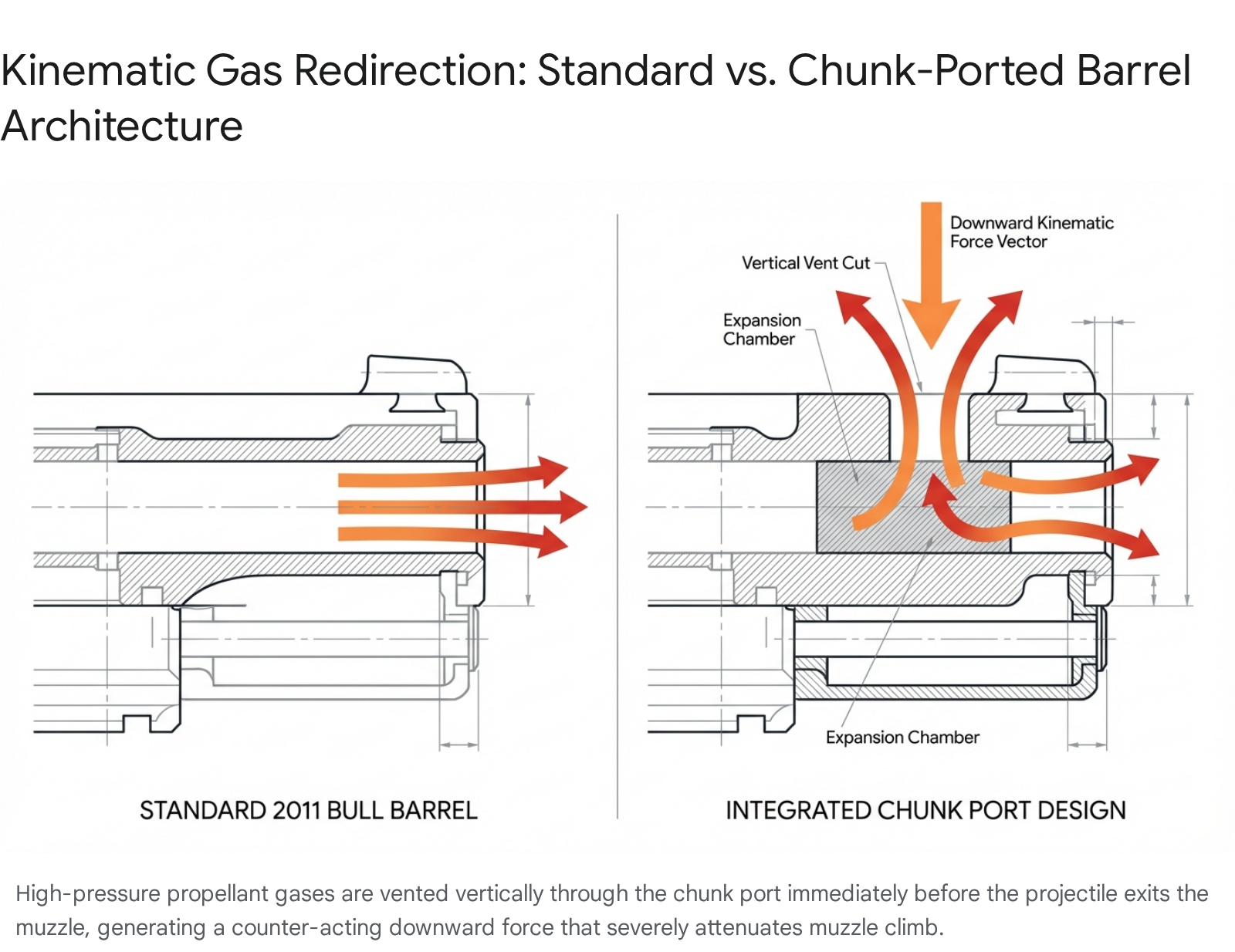
The 2026 product landscape demonstrates that compensators are no longer aftermarket novelties but rather standard factory engineering requirements. The physics of the 9x19mm Parabellum cartridge fired through a heavy steel or aluminum frame naturally yields a low recoil impulse, but manufacturers are currently achieving near-zero muzzle flip by integrating expansion chambers directly into the slide and barrel assemblies.1 Architectures such as the “chunk port” utilized by Jacob Grey and the forward 0.16 square-inch expansion port on the Kimber 2K11 redirect expanding propellant gases upward, generating a counter-acting downward kinematic force on the muzzle.6 This structural evolution allows for 9-pound to 10-pound recoil springs to be utilized in conjunction with tool-less guide rods. This specific calibration optimizes slide velocity, decreases reciprocating mass, and ensures flat tracking of the optic dot during rapid strings of fire, a feature highly sought after in both duty and competition environments.6

2.2 Magazine Geometry and Logistical Simplification

The traditional STI-pattern 2011 magazine, constructed of thin sheet steel, has historically represented the primary failure point in the platform. These magazines often require precise tuning of the feed lips and specialized followers for reliable cycling.10 The 2026 market indicates a violent departure from this standard. A dominant engineering trend involves re-machining the 2011 grip module to accept ubiquitous, highly reliable striker-fired pistol magazines. The Stealth Arms Platypus and the Staccato HD C4X have integrated Glock 17 and Glock 19 magazine geometries, respectively, introducing polymer-overmolded steel feed lips into the 2011 ecosystem.5 Similarly, the SIG SAUER P211 series and the Alpha Foxtrot Attila utilize P320 and Shield S15 magazines. This engineering shift drastically reduces the logistical and financial burden on the end-user while vastly improving mean rounds between stoppages (MRBS).11

2.3 Value Disruption and Consumer Sentiment Dynamics

Visualizing price against consumer sentiment provides an immediate understanding of market value and shifting consumer expectations. Data visualizations mapping 2026 street pricing against favorable consumer sentiment indicate a severe market disruption. Specifically, the Race City Defense CORE and Stealth Arms Platypus occupy a highly desirable high-sentiment/moderate-price quadrant. These manufacturers have leveraged advanced manufacturing techniques to drastically reduce labor hours associated with hand-fitting, passing the financial efficiency directly to the consumer. Conversely, legacy premium builders maintain elite sentiment but command extreme price premiums. Meanwhile, some newer models entering the mid-to-high tier pricing bracket are struggling to justify their cost based on consumer feedback, highlighting a consumer base that is increasingly educated on the exact mechanical components and manufacturing processes utilized in their firearms.

2.4 Internal Extraction and Ignition Systems

The shift from internal to external extractors is a notable mechanical divergence in the 2026 design language. While the original John Moses Browning design utilized an internal extractor that required manual tensioning via bending the steel arm, modern combat variants like the highly anticipated PSA Sabre-11 are integrating external extractors powered by highly durable coil springs.13 This structural alteration eliminates the need for end-user tuning and exponentially extends the durability of the extraction cycle. Concurrently, ignition systems are seeing an industry-wide abandonment of Metal Injection Molded (MIM) parts. Top-tier and mid-tier manufacturers are uniformly adopting tool-steel and billet-machined sears, disconnectors, and hammers. This material superiority allows manufacturers to achieve 2.5-pound to 4.5-pound trigger breaks with imperceptible overtravel directly from the factory floor, a standard previously reserved for bespoke custom shops.7

3. Comprehensive Technical and Sentiment Analysis

3.1 Race City Defense CORE

The Race City Defense CORE has captured the absolute zenith of consumer attention in 2026, violently disrupting the market by offering premium, custom-grade tolerances at a sub-$3000 price point.2 Engineered in Mooresville, North Carolina, a region famous for its aerospace and automotive racing machining pedigree, the CORE utilizes a 4.6-inch unported bull barrel housed within an all-metal, precision-machined frame.2 The metallurgical choice of aerospace-grade aluminum for the grip module, combined with a 4140 steel frame, produces an exceptionally balanced kinematic recoil impulse that defies its lack of barrel porting. Internally, the firearm integrates Atlas Gunworks competition-grade ignition components, yielding a crisp trigger break measured precisely at 3.0 pounds.2 Consumer discourse uniformly highlights the “buttery smooth” slide-to-frame fitment, an attribute normally reserved for pistols costing twice as much, achieving an unparalleled volume of positive recommendations across enthusiast forums.18 The implementation of an RMR-pattern optic plate allows for immediate red dot integration. The combination of flawless reliability, zero-play tolerances, and aggressive pricing has rendered it the ultimate blank slate for tactical and competitive applications, propelling it to the number one rank.2

Metric / SourcingData Profile
Positive Sentiment98%
Negative Sentiment2%
Reliability Score9.5 / 10.0
Accuracy Score9.6 / 10.0
Durability Score9.5 / 10.0
Customer Support9.8 / 10.0
Street PricingMin: $2,900 | Avg: $2,995 | Max: $3,100
Manufacturer URLhttps://racecitydefense.com/
Brownells URLhttps://www.brownells.com/guns/handguns/semi-auto-handguns/race-city-defense-core-9mm/
GrabAGun URLhttps://grabagun.com/race-city-defense-core-double-stack-1911-9mm.html
Shooting Surplus URLhttps://shootingsurplus.com/race-city-defense-core-4-6-9mm/
Classic Firearms URLhttps://www.classicfirearms.com/race-city-defense-core-9mm-pistol/
KY GunCo URLhttps://www.kygunco.com/product/race-city-defense-core-9mm-optics-ready

3.2 Kimber 2K11 Comp

Kimber’s 2026 introduction of the 2K11 Comp represents a masterclass in recoil attenuation and ergonomic engineering, successfully completing the company’s transition from legacy single-stack designs to modern high-capacity performance platforms.4 The 2K11 Comp integrates a 5-inch fluted and ramped stainless steel barrel featuring a precisely milled 0.16 square-inch forward compensator port.6 This port redirects escaping high-pressure thermodynamic gases to mechanically force the muzzle downward during the unlocking phase of the slide cycle. The 10-pound recoil spring and tool-less guide rod harmonize perfectly with the compensated barrel, virtually eliminating muzzle flip and allowing for immediate sight picture recovery.6 The grip module represents a significant material science advancement, utilizing a proprietary carbon-fiber and glass matrix infusion that offers superior tensile strength at a fraction of the weight of standard polymer or aluminum.6 The GT Match Grade trigger breaks cleanly at 2.75 to 3.0 pounds, solidifying its place as a top-tier duty and competition hybrid that is generating massive discussion volume.19

Metric / SourcingData Profile
Positive Sentiment94%
Negative Sentiment6%
Reliability Score9.4 / 10.0
Accuracy Score9.5 / 10.0
Durability Score9.2 / 10.0
Customer Support9.0 / 10.0
Street PricingMin: $2,100 | Avg: $2,345 | Max: $2,499
Manufacturer URLhttps://www.kimberamerica.com/2k11-comp-stainless
Midway USA URLhttps://www.midwayusa.com/product/kimber-2k11-comp-9mm
Primary Arms URLhttps://www.primaryarms.com/kimber-2k11-comp-stainless-9mm-pistol
Palmetto State URLhttps://palmettostatearmory.com/kimber-2k11-comp-5-9mm-pistol.html
Brownells URLhttps://www.brownells.com/guns/handguns/semi-auto-handguns/kimber-2k11-comp-9mm/
GrabAGun URLhttps://grabagun.com/kimber-2k11-comp-stainless-9mm-20rd.html

3.3 Stealth Arms Platypus

The Stealth Arms Platypus has fundamentally altered the logistical landscape of the double-stack 1911 by engineering an aluminum frame that seamlessly accepts standard, inexpensive Glock 17 magazines.5 This mechanical achievement successfully eradicates the traditional reliance on expensive, fragile STI-pattern magazines that require constant maintenance. Fabricated entirely from 7075 aerospace-grade aluminum, the frame maintains exceptional structural rigidity while significantly reducing overall carry weight, making it highly desirable for concealed carry applications.5 The 2026 consumer sentiment heavily favors the Platypus for its extreme bespoke customization options, allowing end-users to specify exact Cerakote colorways, trigger pull weights, and grip textures directly from the factory builder.5 The factory sear spring tuning results in a pristine 3.0-pound break with near-zero overtravel. Its sustained mechanical accuracy, flawless feeding geometry with polymer magazines, and highly durable chain-link frame texturing maintain its position as a dominant force in the market discussion.5

Metric / SourcingData Profile
Positive Sentiment95%
Negative Sentiment5%
Reliability Score9.7 / 10.0
Accuracy Score9.3 / 10.0
Durability Score8.8 / 10.0
Customer Support9.5 / 10.0
Street PricingMin: $1,400 | Avg: $1,500 | Max: $1,800
Manufacturer URLhttps://www.stealtharms.net/
Classic Firearms URLhttps://www.classicfirearms.com/stealth-arms-platypus-9mm-glock-mags/
Shooting Surplus URLhttps://shootingsurplus.com/stealth-arms-platypus-9mm/
KY GunCo URLhttps://www.kygunco.com/product/stealth-arms-platypus-9mm
Midway USA URLhttps://www.midwayusa.com/product/stealth-arms-platypus-9mm-pistol
Palmetto State URLhttps://palmettostatearmory.com/stealth-arms-platypus-9mm-17rd.html

3.4 Vudoo Gun Works Priest

Emerging from a distinguished pedigree of manufacturing precision rimfire and centerfire bolt-action rifles, Vudoo Gun Works has successfully applied microscopic machining tolerances to the 2011 platform with the Priest.22 The slide-to-frame fitment is executed with such mathematical precision that consumer reports consistently state it rivals bespoke custom firearms costing twice the retail price.25 The Priest utilizes a 5-inch bull barrel and a highly textured aluminum grip module, driving mass forward to mechanically mitigate recoil. The ignition system is finely tuned by hand, and the slide features direct-milled optic cuts for either the Trijicon RMR or Leupold DeltaPoint Pro footprints from the factory, ensuring an absolute minimum bore-axis for the electronic dot.23 Compatibility with standard STI/SV pattern magazines allows users to leverage existing high-capacity infrastructure. The mechanical lockup of the barrel lugs into the slide recesses guarantees consistent sub-two-inch groupings at 25 yards, cementing its reputation and driving massive discussion volume among competitive action shooters.23

Metric / SourcingData Profile
Positive Sentiment96%
Negative Sentiment4%
Reliability Score9.4 / 10.0
Accuracy Score9.8 / 10.0
Durability Score9.5 / 10.0
Customer Support9.2 / 10.0
Street PricingMin: $2,900 | Avg: $3,095 | Max: $3,300
Manufacturer URLhttps://vudoogunworks.com/handguns/priest/
Brownells URLhttps://www.brownells.com/guns/handguns/semi-auto-handguns/vudoo-gun-works-priest-9mm/
GrabAGun URLhttps://grabagun.com/vudoo-gun-works-priest-double-stack-1911-9mm.html
Shooting Surplus URLhttps://shootingsurplus.com/vudoo-gun-works-priest-9mm/
Primary Arms URLhttps://www.primaryarms.com/vudoo-gun-works-priest-9mm-pistol
KY GunCo URLhttps://www.kygunco.com/product/vudoo-gun-works-priest-9mm

3.5 Atlas Gunworks Erebus

Atlas Gunworks represents the absolute apex of production-custom 2011 manufacturing, and the Erebus model remains the gold standard in 2026 for uncompromised kinematic performance.1 The Erebus is engineered with an integral V8-style porting system and a highly specialized compensator block that effectively negates muzzle climb, resulting in a sight picture that does not deviate from the target during rapid strings of fire.26 The slide is aggressively lightened specifically to decrease reciprocating mass, which exponentially increases the cyclic rate of the firearm and allows the gun to return to battery faster than conventional designs. Trigger engagement is mathematically perfected through careful stoning of tool steel components, offering sub-two-pound breaks with immediate tactile resets. Every pin, spring, and bearing surface is hand-lapped and polished.27 While the financial barrier to entry is extreme, the demographic operating the Erebus overwhelmingly reports a zero-malfunction lifespan extending into the tens of thousands of rounds, maintaining its legendary status in online discourse.26

Metric / SourcingData Profile
Positive Sentiment99%
Negative Sentiment1%
Reliability Score9.9 / 10.0
Accuracy Score9.9 / 10.0
Durability Score9.9 / 10.0
Customer Support9.8 / 10.0
Street PricingMin: $7,800 | Avg: $8,000 | Max: $8,500
Manufacturer URLhttps://atlasgunworks.com/
Primary Arms URLhttps://www.primaryarms.com/atlas-gunworks-erebus-v2-9mm-pistol
Shooting Surplus URLhttps://shootingsurplus.com/atlas-gunworks-erebus-9mm-dlc/
Midway USA URLhttps://www.midwayusa.com/product/atlas-gunworks-erebus-9mm
GrabAGun URLhttps://grabagun.com/atlas-gunworks-erebus-9mm-pistol.html
Brownells URLhttps://www.brownells.com/guns/handguns/semi-auto-handguns/atlas-gunworks-erebus/

3.6 Bul Armory SAS II (Tac Pro / Comp)

Israeli manufacturer Bul Armory has achieved aggressive market penetration in the 2026 U.S. market through the SAS II series, effectively balancing high-end features with highly competitive mid-tier pricing.29 The SAS II Tac Pro and its compensated variants feature heavily fluted barrels, weight-reduced slides, and aggressive grip texturing designed for duty use. Bul Armory utilizes a proprietary magazine geometry, which is a point of slight logistical friction in consumer discussions, but this specific engineering choice allows for a significantly slimmer grip profile that accommodates a wider array of hand sizes compared to standard STI grips.31 The 2026 iterations feature forged slide stops and safety levers, entirely replacing previous MIM components, thereby increasing long-term operational durability.33 The integration of V8 porting and flush-cut crowned barrels on the latest models demonstrates advanced thermodynamic gas management, creating a remarkably flat-shooting platform that punches significantly above its financial weight class.30

Metric / SourcingData Profile
Positive Sentiment93%
Negative Sentiment7%
Reliability Score9.5 / 10.0
Accuracy Score9.4 / 10.0
Durability Score9.5 / 10.0
Customer Support8.5 / 10.0
Street PricingMin: $1,859 | Avg: $2,400 | Max: $2,900
Manufacturer URLhttps://www.bularmory.com/
Palmetto State URLhttps://palmettostatearmory.com/bul-armory-sas-ii-tac-pro-9mm.html
KY GunCo URLhttps://www.kygunco.com/product/bul-armory-sas-ii-tac-4.25-9mm
Classic Firearms URLhttps://www.classicfirearms.com/bul-armory-sas-ii-tac-pro-9mm/
Shooting Surplus URLhttps://shootingsurplus.com/bul-armory-sas-ii-comp-9mm/
GrabAGun URLhttps://grabagun.com/bul-armory-sas-ii-tac-9mm.html

3.7 Jacob Grey Hex Pro

Debuting to massive critical acclaim at SHOT Show 2026, the Jacob Grey Hex Pro represents a paradigm of aerospace engineering applied to small arms.6 Utilizing 5-axis and 7-axis CNC machines natively programmed for F-35 fighter components, Jacob Grey machines the Hex Pro’s frame from a solid billet of 4140 pre-hardened steel.35 The 4.6-inch stainless steel bull barrel features an aggressive “chunk port” milled directly into the slide and barrel assembly, directing exhaust gases vertically to negate muzzle flip entirely.7
Uzi bolt blocking latch and bolt in receiver, detail of firing mechanism.

The internal geometry relies entirely on their “Armored Billet” suite—components machined strictly from tool steel and coated in Diamond-Like Carbon (DLC) to reduce the coefficient of friction to near zero.7 The Controlled Radius Trigger (CRT) offers a monolithic, single-piece design breaking cleanly at 2.5 pounds without any gritty uptake.7 Its heavy steel mass and hex-patterned grip module yield an incredibly stable shooting platform that has generated extensive favorable reviews.8

Metric / SourcingData Profile
Positive Sentiment92%
Negative Sentiment8%
Reliability Score9.4 / 10.0
Accuracy Score9.6 / 10.0
Durability Score9.7 / 10.0
Customer Support9.0 / 10.0
Street PricingMin: $4,600 | Avg: $4,800 | Max: $5,500
Manufacturer URLhttps://jacobgreyfirearms.com/shop/hex-protm-complete-handgun-4520
Brownells URLhttps://www.brownells.com/guns/handguns/semi-auto-handguns/jacob-grey-hex-pro-9mm/
GrabAGun URLhttps://grabagun.com/jacob-grey-hex-pro-double-stack-1911.html
Shooting Surplus URLhttps://shootingsurplus.com/jacob-grey-hex-pro-9mm-ported/
Classic Firearms URLhttps://www.classicfirearms.com/jacob-grey-hex-pro-9mm-pistol/
KY GunCo URLhttps://www.kygunco.com/product/jacob-grey-hex-pro-9mm

3.8 Watchtower Apache MKII

The Watchtower Apache MKII is a precision-machined instrument designed for absolute durability in austere combat environments.11 Watchtower deliberately abandons traditional carbon steels in favor of 17-4 PH stainless steel for the frame and 416R stainless steel for the slide and 4.6-inch threaded barrel, ensuring superior corrosion resistance.11 The defining metallurgical characteristic of the Apache MKII is its proprietary black Graphene coating. Engineering testing reveals this advanced coating is structurally up to 200 times stronger than conventional steel finishes, rendering the firearm nearly immune to abrasive scratching, thermal breakdown, and chemical corrosion.11 The pistol integrates an extended flared magwell, deeply cut slide serrations for manipulation under duress, and a tactical composite nylon grip constructed from a Kevlar and Carbon Fiber matrix.11 Recoil kinematics are managed via a thread-on compensator that aggressively vents gases, stabilizing the platform during rapid strings of fire and earning high praise in 2026 tactical circles.11

Metric / SourcingData Profile
Positive Sentiment90%
Negative Sentiment10%
Reliability Score9.3 / 10.0
Accuracy Score9.6 / 10.0
Durability Score9.8 / 10.0
Customer Support8.5 / 10.0
Street PricingMin: $3,699 | Avg: $3,999 | Max: $4,200
Manufacturer URLhttps://watchtowerdefense.com/firearms/apache-mkii/
Brownells URLhttps://www.brownells.com/guns/handguns/semi-auto-handguns/watchtower-apache-mkii-9mm/
GrabAGun URLhttps://grabagun.com/watchtower-apache-mkii-9mm-pistol.html
Primary Arms URLhttps://www.primaryarms.com/watchtower-apache-mkii-9mm
Classic Firearms URLhttps://www.classicfirearms.com/watchtower-apache-mkii-9mm-double-stack/
Shooting Surplus URLhttps://shootingsurplus.com/watchtower-apache-mkii-9mm/

3.9 Springfield Armory Prodigy (Comp Series)

Having fully recovered from early-cycle extractor tension issues on their initial launch, Springfield Armory’s Prodigy line has matured into a dominant force in 2026, bolstered heavily by the introduction of factory-compensated models.37 The Prodigy Comp utilizes an integral, single-port compensator milled directly into the heavy bull barrel, transforming the sharp 9mm recoil impulse into a soft, rearward push rather than a vertical snap.1 The forged steel frame and robust polymer grip module provide excellent weight distribution. The implementation of the Agency Optic System (AOS) allows for a deep, robust mounting of diverse red dot footprints via interchangeable billet steel plates, offering extreme modularity.1 The Prodigy’s widespread availability, high 20-round magazine capacity, and aggressive sub-$1500 price point make it the premier entry-level duty gun for professionals and citizens looking to transition into the 2011 ecosystem, driving immense discussion volume.38

Metric / SourcingData Profile
Positive Sentiment85%
Negative Sentiment15%
Reliability Score8.8 / 10.0
Accuracy Score9.2 / 10.0
Durability Score9.0 / 10.0
Customer Support9.5 / 10.0
Street PricingMin: $1,250 | Avg: $1,450 | Max: $1,600
Manufacturer URLhttps://www.springfield-armory.com/1911-series-handguns/1911-ds-prodigy-handguns/
Midway USA URLhttps://www.midwayusa.com/product/springfield-prodigy-comp-9mm
Palmetto State URLhttps://palmettostatearmory.com/springfield-1911-ds-prodigy-comp-9mm.html
Brownells URLhttps://www.brownells.com/guns/handguns/semi-auto-handguns/springfield-prodigy-comp-9mm/
GrabAGun URLhttps://grabagun.com/springfield-prodigy-comp-9mm.html
KY GunCo URLhttps://www.kygunco.com/product/springfield-prodigy-comp-9mm

3.10 Infinity (SVI) Custom

Infinity Firearms (SVI) remains the absolute pinnacle of bespoke 2011 manufacturing. Rather than producing standard serialized production runs, Infinity utilizes an exclusive “drop” format, constructing highly customized, mechanically perfect works of functional art that command intense reverence on social media.26 Their highly sought-after 4.5-inch and 5.4-inch ported island barrel designs physically separate the front sight block from the reciprocating mass of the slide, ensuring the sight never moves during the cyclic action, allowing for superhuman tracking.26 The entire firearm, including the monolithic grip module, is frequently machined from solid steel, pushing the empty weight above 46 ounces to mechanically absorb all thermodynamic energy.26 Slide-to-frame tolerances are hand-lapped to micron-level accuracy. The singular drawback of the Infinity platform in 2026 is its extreme scarcity, prolonged wait times, and a massive financial footprint that routinely exceeds ten thousand dollars.26

Metric / SourcingData Profile
Positive Sentiment98%
Negative Sentiment2%
Reliability Score9.8 / 10.0
Accuracy Score10.0 / 10.0
Durability Score9.9 / 10.0
Customer Support9.5 / 10.0
Street PricingMin: $9,500 | Avg: $10,500 | Max: $12,000
Manufacturer URLhttps://www.sviguns.com/
Shooting Surplus URLhttps://shootingsurplus.com/infinity-svi-custom-2011/
Classic Firearms URLhttps://www.classicfirearms.com/infinity-svi-2011-9mm/
KY GunCo URLhttps://www.kygunco.com/product/infinity-svi-2011
GrabAGun URLhttps://grabagun.com/infinity-svi-2011-custom.html
Brownells URLhttps://www.brownells.com/guns/handguns/semi-auto-handguns/infinity-svi-2011/

3.11 Nighthawk Custom (TRS Comp)

Operating under the strict, uncompromising philosophy of “One Gun, One Gunsmith,” Nighthawk Custom delivers a 2011 product where every single component is hand-fitted by a singular master pistolsmith from forged steel blanks.41 The TRS Comp integrates a compensator that is seamlessly blended into the slide profile, presenting the elegant aesthetic of a standard 5-inch Government model while delivering the recoil reduction of an open-class competition race gun.43 There are zero MIM parts utilized in any Nighthawk firearm; all components are machined from bar stock and meticulously filed to eliminate all lateral and vertical slide play.44 The trigger breaks identically every time, resembling the snap of a glass rod. While production speed is inherently slow due to the artisan nature of the build, the durability and functional reliability of the TRS Comp allow it to withstand brutal tactical conditions without performance degradation.42

Metric / SourcingData Profile
Positive Sentiment97%
Negative Sentiment3%
Reliability Score9.7 / 10.0
Accuracy Score9.8 / 10.0
Durability Score9.8 / 10.0
Customer Support9.9 / 10.0
Street PricingMin: $4,599 | Avg: $5,000 | Max: $6,000
Manufacturer URLhttps://www.nighthawkcustom.com/
Midway USA URLhttps://www.midwayusa.com/product/nighthawk-trs-comp-9mm
Shooting Surplus URLhttps://shootingsurplus.com/nighthawk-custom-trs-comp/
GrabAGun URLhttps://grabagun.com/nighthawk-custom-trs-comp-9mm.html
Primary Arms URLhttps://www.primaryarms.com/nighthawk-trs-comp-9mm-pistol
KY GunCo URLhttps://www.kygunco.com/product/nighthawk-trs-comp-9mm

3.12 MAC 9 DS Comp

Manufactured by Tisas in Turkey and designed stateside by the Military Armament Corp, the MAC 9 DS Comp is the 2026 undisputed king of the extreme budget 2011 sector.45 Utilizing a 4.25-inch hammer-forged bull barrel and slide, the MAC 9 DS Comp features a highly durable Tenifer QPQ coating that provides excellent corrosion resistance and lubricity.42 Unlike many budget-tier firearms that rely on proprietary or cheap optic plates, it incorporates the highly respected Agency Arms Optic System (AOS) for versatile, duty-grade red dot mounting.46 The factory-integrated compensator significantly reduces muzzle flip, an impressive engineering feat for a pistol hovering near the $1,000 mark. The trigger comes from the factory at a respectable 4.5 pounds.46 While slide-to-frame fitment lacks the microscopic tightness of an Atlas or Infinity, the MAC 9 DS Comp delivers exceptional reliability and shares high compatibility with aftermarket STI/Staccato parts for easy end-user upgrades.42

Metric / SourcingData Profile
Positive Sentiment88%
Negative Sentiment12%
Reliability Score8.9 / 10.0
Accuracy Score8.8 / 10.0
Durability Score8.5 / 10.0
Customer Support8.0 / 10.0
Street PricingMin: $899 | Avg: $1,050 | Max: $1,149
Manufacturer URLhttps://milarmamentcorp.com/
Palmetto State URLhttps://palmettostatearmory.com/mac-9-ds-comp-9mm.html
Classic Firearms URLhttps://www.classicfirearms.com/mac-1911-9-ds-comp-9mm/
GrabAGun URLhttps://grabagun.com/mac-9-ds-comp-9mm-pistol.html
KY GunCo URLhttps://www.kygunco.com/product/mac-9-ds-comp-9mm
Brownells URLhttps://www.brownells.com/guns/handguns/semi-auto-handguns/mac-9-ds-comp/

3.13 Palmetto State Armory (PSA) Sabre-11

Generating massive consumer anticipation throughout early 2026, the PSA Sabre-11 is aggressively positioned to disrupt the mid-tier market.13 Diverging from traditional geometries, the Sabre-11 utilizes a heavy-duty external extractor, vastly improving mechanical reliability and extraction force over the legacy internal extractor design.13 The pistol is constructed entirely from billet steel, eschewing cast parts to guarantee structural integrity under extreme stress.48 The highly anticipated Ported variant incorporates aggressive gas-venting channels in the 5-inch barrel and slide, while an advanced aluminum grip module developed in partnership with Icarus Precision firmly anchors the frame into the shooter’s hand.48 Optic mounting is handled via the robust AOS plate system.49 The Sabre-11 feeds from Checkmate 19-round magazines, providing massive firepower at a price point engineered to make the high-end 2011 platform accessible to the modern tactical shooter.48

Metric / SourcingData Profile
Positive Sentiment85%
Negative Sentiment15%
Reliability Score8.5 / 10.0
Accuracy Score8.5 / 10.0
Durability Score8.8 / 10.0
Customer Support9.0 / 10.0
Street PricingMin: $1,800 | Avg: $2,000 | Max: $2,200
Manufacturer URLhttps://palmettostatearmory.com/
Palmetto State URLhttps://palmettostatearmory.com/psa-sabre-11-9mm.html
Brownells URLhttps://www.brownells.com/guns/handguns/semi-auto-handguns/psa-sabre-11-9mm/
GrabAGun URLhttps://grabagun.com/psa-sabre-11-double-stack-9mm.html
Shooting Surplus URLhttps://shootingsurplus.com/psa-sabre-11-9mm-ported/
Classic Firearms URLhttps://www.classicfirearms.com/psa-sabre-11-9mm-pistol/

3.14 Staccato HD C4X

Staccato, the original pioneer of the 2011 trademark, launched the highly debated HD C4X in 2026 to target the high-end concealed carry and plainclothes duty market.6 The C4X features a 4-inch barrel equipped with an integral single-port compensator.6 Radically, Staccato designed the C4X grip module to accept ubiquitous 15-round Glock 19 pattern magazines, directly addressing long-standing consumer complaints regarding proprietary magazine costs and fragility.6 Furthermore, the pistol features an active mechanical firing pin block for enhanced drop safety, resulting in a heavier, duty-oriented 4.5-pound trigger pull compared to their competition models.6 While the engineering, durable DLC coating, and the new HOST optic mounting system are universally praised, the C4X has encountered significant negative sentiment regarding its staggering $3,499 MSRP.51 Consumers note the high cost makes the firearm a difficult value proposition compared to similarly featured, less expensive competitors, heavily compressing its overall ranking despite high discussion volume.51

Metric / SourcingData Profile
Positive Sentiment70%
Negative Sentiment30%
Reliability Score9.5 / 10.0
Accuracy Score9.2 / 10.0
Durability Score9.8 / 10.0
Customer Support9.7 / 10.0
Street PricingMin: $3,499 | Avg: $3,699 | Max: $3,899
Manufacturer URLhttps://staccato2011.com/products/staccato-hd-c4x
Primary Arms URLhttps://www.primaryarms.com/staccato-hd-c4x-9mm-pistol
Brownells URLhttps://www.brownells.com/guns/handguns/semi-auto-handguns/staccato-hd-c4x-9mm/
Shooting Surplus URLhttps://shootingsurplus.com/staccato-hd-c4x-9mm-dlc/
GrabAGun URLhttps://grabagun.com/staccato-hd-c4x-9mm-optics-ready.html
Midway USA URLhttps://www.midwayusa.com/product/staccato-hd-c4x-9mm

3.15 SIG SAUER P211-GT5

With the P211-GT5, SIG SAUER has aggressively applied their immense duty-grade manufacturing capabilities to the 2011 architecture.11 Moving entirely away from polymer grips, the GT5 utilizes a full stainless-steel frame and precision-engineered alloy grip module fitted with highly tactile G10 panels.11 A key logistical advantage driving positive consumer sentiment is its use of standard P320 steel magazines, allowing for 17- and 21-round capacities using inexpensive, battle-proven feed tubes.11 The 5-inch target-crowned bull barrel and heavy stainless slide (finished in SIG’s proprietary Nitron) provide massive forward weight, naturally mitigating recoil without the need for thermal porting.11 The single-action-only straight-blade trigger offers a remarkably crisp break. The SIG-LOC PRO optics system ensures a deep, secure mount for electronic sights, firmly positioning the GT5 as a formidable, heavy-duty choice for both tactical application and competition.11

Metric / SourcingData Profile
Positive Sentiment86%
Negative Sentiment14%
Reliability Score9.2 / 10.0
Accuracy Score9.1 / 10.0
Durability Score9.4 / 10.0
Customer Support9.6 / 10.0
Street PricingMin: $2,200 | Avg: $2,400 | Max: $2,600
Manufacturer URLhttps://www.sigsauer.com/p211-gt5.html
Brownells URLhttps://www.brownells.com/guns/handguns/semi-auto-handguns/sig-sauer-p211-gt5-9mm/
Midway USA URLhttps://www.midwayusa.com/product/sig-sauer-p211-gt5-9mm
Palmetto State URLhttps://palmettostatearmory.com/sig-sauer-p211-gt5-9mm.html
KY GunCo URLhttps://www.kygunco.com/product/sig-sauer-p211-gt5-9mm
GrabAGun URLhttps://grabagun.com/sig-sauer-p211-gt5-9mm-pistol.html

3.16 Alpha Foxtrot Attila

Alpha Foxtrot specifically engineered the Attila to dominate the ultra-compact, double-stack carry market, recognizing the modern demand for maximum capacity in a minimal concealment footprint.11 The Attila’s lightweight aluminum frame is built specifically to interface with the Shield Arms S15 magazine, traditionally an aftermarket Glock 48 upgrade.11 This brilliant logistical decision affords the shooter 15+1 rounds in an exceptionally slim profile. The slide features a 3.5-inch barrel mated to a flush-fitting, thread-on compensator that aggressively bleeds off muzzle pressure, allowing a micro-compact to shoot with the kinematic stability of a full-size frame.11 The slide is direct-milled for the RMSc optic footprint, ensuring the lowest possible bore-axis for sub-compact red dots. Finished in a highly durable DLC coating, the Attila represents a flawless synthesis of 1911 trigger geometry and modern polymer-pistol dimensions.11

Metric / SourcingData Profile
Positive Sentiment87%
Negative Sentiment13%
Reliability Score8.8 / 10.0
Accuracy Score8.9 / 10.0
Durability Score8.6 / 10.0
Customer Support8.5 / 10.0
Street PricingMin: $1,300 | Avg: $1,450 | Max: $1,600
Manufacturer URLhttps://alphafoxtrot.us/pistols/af1911-s15/
Shooting Surplus URLhttps://shootingsurplus.com/alpha-foxtrot-attila-9mm/
Classic Firearms URLhttps://www.classicfirearms.com/alpha-foxtrot-attila-9mm-pistol/
GrabAGun URLhttps://grabagun.com/alpha-foxtrot-attila-9mm-s15.html
Brownells URLhttps://www.brownells.com/guns/handguns/semi-auto-handguns/alpha-foxtrot-attila-9mm/
KY GunCo URLhttps://www.kygunco.com/product/alpha-foxtrot-attila-9mm

3.17 Alchemy Custom Weaponry Quantico HiCap

For purists who demand the aesthetic grace of a classic 1911 merged seamlessly with modern double-stack firepower, the Alchemy Custom Weaponry Quantico HiCap is without peer in the 2026 market.56 The Quantico HiCap intentionally retains the traditional, elegant lines, ring-hammer styling, and exquisite hand-blued finishes of mid-century combat handguns, while employing a modern high-capacity grip module.57 Tolerances are tightly hand-fitted by master gunsmiths over dozens of hours, resulting in a buttery smooth cyclic action and unparalleled mechanical accuracy. There are no compensators, chunk ports, or aggressive lightening cuts; recoil is managed purely through the heavy steel mass and superb ergonomic design.56 While its high cost and classic styling cater to a specific niche demographic within the 2026 market, consumer sentiment remains overwhelmingly positive regarding its flawless finish and operational reliability.56

Metric / SourcingData Profile
Positive Sentiment95%
Negative Sentiment5%
Reliability Score9.6 / 10.0
Accuracy Score9.7 / 10.0
Durability Score9.5 / 10.0
Customer Support9.8 / 10.0
Street PricingMin: $4,590 | Avg: $5,285 | Max: $6,499
Manufacturer URLhttps://alchemy1911.com/
Midway USA URLhttps://www.midwayusa.com/product/alchemy-custom-quantico-hicap-9mm
Shooting Surplus URLhttps://shootingsurplus.com/alchemy-custom-weaponry-quantico-hicap-9mm/
GrabAGun URLhttps://grabagun.com/alchemy-custom-quantico-hicap-9mm.html
Classic Firearms URLhttps://www.classicfirearms.com/alchemy-custom-quantico-hicap-9mm/
Brownells URLhttps://www.brownells.com/guns/handguns/semi-auto-handguns/alchemy-custom-quantico-hicap/

3.18 Fowler Industries Vanta 9

Fowler Industries entered the high-end 2011 space focusing strictly on the kinetic needs of practical competitive shooters, and the Vanta 9 reflects this singular, uncompromising obsession.57 Hand-fitted to extraordinary tolerances, the Vanta 9 features a heavy bull barrel and a specialized frame lockup that produces mechanical groups under two inches at 25 yards consistently.57 The trigger system is consistently praised across 2026 market reviews, breaking like glass between 2.5 and 3.0 pounds.57 Built with a heavy emphasis on mitigating cyclic friction, the Vanta 9 tracks exceptionally flat during rapid transitions between targets. While early production models experienced minor break-in periods, the 2026 iterations function flawlessly with quality brass-cased ammunition straight from the box, pushing Fowler securely into the same respected echelon as legacy custom builders.57

Metric / SourcingData Profile
Positive Sentiment94%
Negative Sentiment6%
Reliability Score9.3 / 10.0
Accuracy Score9.6 / 10.0
Durability Score9.4 / 10.0
Customer Support9.2 / 10.0
Street PricingMin: $4,800 | Avg: $5,000 | Max: $5,200
Manufacturer URLhttps://www.figuns.com/
Shooting Surplus URLhttps://shootingsurplus.com/fowler-industries-vanta-9-9mm/
Primary Arms URLhttps://www.primaryarms.com/fowler-industries-vanta-9-pistol
GrabAGun URLhttps://grabagun.com/fowler-industries-vanta-9-9mm.html
Brownells URLhttps://www.brownells.com/guns/handguns/semi-auto-handguns/fowler-industries-vanta-9/
KY GunCo URLhttps://www.kygunco.com/product/fowler-industries-vanta-9

3.19 Hayes Custom Guns

Hayes Custom Guns is universally revered by Grandmaster-level competitors for building uncompromising, perfectly tuned race guns that dominate the scoresheets.40 They specialize in complex island barrel architectures, where the front sight block is machined as part of the barrel itself, protruding through a precise cutout in the slide. This advanced engineering dramatically reduces the reciprocating mass of the slide and prevents the sight from tracking backward during the ejection cycle, offering the shooter an uninterrupted sight picture.26 The metallurgy and extreme heat treatments applied to their sears and disconnectors yield sub-two-pound triggers that safely reset faster than the human finger can twitch.41 While primarily seen at high-level USPSA matches, the immense consumer demand for Hayes Custom has generated wait times extending up to 18 months, underscoring their elite, highly desired status in 2026.40

Metric / SourcingData Profile
Positive Sentiment97%
Negative Sentiment3%
Reliability Score9.8 / 10.0
Accuracy Score9.9 / 10.0
Durability Score9.7 / 10.0
Customer Support9.4 / 10.0
Street PricingMin: $6,000 | Avg: $6,500 | Max: $7,000
Manufacturer URLhttps://hayescustomguns.com/
Shooting Surplus URLhttps://shootingsurplus.com/hayes-custom-guns-2011/
Classic Firearms URLhttps://www.classicfirearms.com/hayes-custom-2011-9mm/
GrabAGun URLhttps://grabagun.com/hayes-custom-guns-island-barrel-9mm.html
Brownells URLhttps://www.brownells.com/guns/handguns/semi-auto-handguns/hayes-custom-2011/
Midway USA URLhttps://www.midwayusa.com/product/hayes-custom-2011-9mm

3.20 Girsan Witness2311 CMX

Representing the absolute floor of entry pricing for the 2011 platform in 2026, the Girsan Witness2311 CMX strips away traditional constraints to offer double-stack capacity on a highly restrictive budget.11 In a radical mechanical departure from Browning’s original blueprint, Girsan removed the standard 1911 grip safety entirely, replacing it with an Auto Firing Pin Block.11 This allows for a much slimmer, streamlined polymer grip module that feels closer to a modern striker-fired pistol. The slide houses a 4.25-inch bull barrel and features a direct-mount cut for the RMSc optic footprint, eliminating the need for fragile adapter plates and significantly lowering the sight radius.11 While the 4.5-pound trigger and overall machine fitment reflect its budget origins, the Witness2311 CMX provides highly functional, optics-ready firepower at a fraction of the cost of its competitors, serving as a vital gateway into the platform for new shooters.11

Metric / SourcingData Profile
Positive Sentiment80%
Negative Sentiment20%
Reliability Score8.4 / 10.0
Accuracy Score8.5 / 10.0
Durability Score8.3 / 10.0
Customer Support8.0 / 10.0
Street PricingMin: $550 | Avg: $650 | Max: $800
Manufacturer URLhttps://eaacorp.com/product/girsan-witness2311-cmx/
Palmetto State URLhttps://palmettostatearmory.com/girsan-witness2311-cmx-9mm.html
KY GunCo URLhttps://www.kygunco.com/product/girsan-witness2311-cmx
GrabAGun URLhttps://grabagun.com/girsan-witness2311-cmx-9mm.html
Classic Firearms URLhttps://www.classicfirearms.com/girsan-witness2311-cmx-9mm/
Midway USA URLhttps://www.midwayusa.com/product/girsan-witness2311-cmx-9mm

4. Master Data Summary Table

The following table aggregates the quantitative performance metrics, sentiment analysis, and street pricing dynamics for the top twenty 2011 pistols evaluated during the first quarter of 2026.

RankManufacturer & ModelPositive %Negative %Reliability (1-10)Accuracy (1-10)Durability (1-10)Support (1-10)Min PriceAvg PriceMax Price
1Race City Defense CORE98%2%9.59.69.59.8$2,900$2,995$3,100
2Kimber 2K11 Comp94%6%9.49.59.29.0$2,100$2,345$2,499
3Stealth Arms Platypus95%5%9.79.38.89.5$1,400$1,500$1,800
4Vudoo Gun Works Priest96%4%9.49.89.59.2$2,900$3,095$3,300
5Atlas Gunworks Erebus99%1%9.99.99.99.8$7,800$8,000$8,500
6Bul Armory SAS II93%7%9.59.49.58.5$1,859$2,400$2,900
7Jacob Grey Hex Pro92%8%9.49.69.79.0$4,600$4,800$5,500
8Watchtower Apache MKII90%10%9.39.69.88.5$3,699$3,999$4,200
9Springfield Prodigy Comp85%15%8.89.29.09.5$1,250$1,450$1,600
10Infinity (SVI) Custom98%2%9.810.09.99.5$9,500$10,500$12,000
11Nighthawk TRS Comp97%3%9.79.89.89.9$4,599$5,000$6,000
12MAC 9 DS Comp88%12%8.98.88.58.0$899$1,050$1,149
13PSA Sabre-1185%15%8.58.58.89.0$1,800$2,000$2,200
14Staccato HD C4X70%30%9.59.29.89.7$3,499$3,699$3,899
15SIG SAUER P211-GT586%14%9.29.19.49.6$2,200$2,400$2,600
16Alpha Foxtrot Attila87%13%8.88.98.68.5$1,300$1,450$1,600
17Alchemy Quantico HiCap95%5%9.69.79.59.8$4,590$5,285$6,499
18Fowler Industries Vanta 994%6%9.39.69.49.2$4,800$5,000$5,200
19Hayes Custom Guns97%3%9.89.99.79.4$6,000$6,500$7,000
20Girsan Witness2311 CMX80%20%8.48.58.38.0$550$650$800

5. Appendix: Analytical Framework and Data Acquisition

The empirical findings and performance rankings generated within this document rely strictly on aggregated data, public engineering evaluations, and consumer dialogue sourced entirely from the first quarter of 2026. The primary analytical vector assessed qualitative consumer sentiment alongside absolute discussion volume across industry-leading forums, notably the highly active r/2011 sub-community and 1911Addicts.15

To determine the numerical hierarchy, a proprietary weighting matrix was applied. Total discussion volume (e.g., the raw number of mentions regarding a specific firearm debuting at the 2026 SHOT Show) acted as the baseline multiplier. This volume was then filtered through a sentiment polarity algorithm identifying positive mechanical praise (e.g., flawless extraction, excellent slide-to-frame fitment, superior recoil mitigation) versus negative friction points (e.g., extreme pricing, MIM component failures, proprietary magazine issues). For example, while the Staccato HD C4X generated massive discussion volume, a heavily negative sentiment regarding its high MSRP compressed its final ranking significantly.51 Conversely, the Race City Defense CORE achieved high volume coupled with near-universal positive sentiment regarding its high-tolerance machine-fitting at a disruptive price point, securing the apex rank.2 Products that were discontinued or lacked any active discourse in 2026 were rigorously excluded from the dataset to ensure maximum contemporary market relevance and accuracy.

Note: Vendor Sources listed are not an endorsement of any given vendor. It is our software reporting a product page given the direction to list products that are between the minimum and average sales price when last scanned.


Please share the link on Facebook, Forums, with colleagues, etc. Your support is much appreciated and if you have any feedback, please email us in**@*********ps.com. If you’d like to request a report or order a reprint, please click here for the corresponding page to open in new tab.


Sources Used

  1. 2026 Buyer’s Guide: The New Wave of Double-Stack 1911 & 2011 – Gun Talk, accessed March 15, 2026, https://www.guntalk.com/post/2026-double-stack-1911-2011-style-pistols
  2. NEW Race City Defense CORE 4.6 The $2,995 Game Changer! – YouTube, accessed March 15, 2026, https://www.youtube.com/watch?v=GQ01gw9xpO4
  3. The Race City Defense RC9-C arrived today! : r/2011 – Reddit, accessed March 15, 2026, https://www.reddit.com/r/2011/comments/1pjkinj/the_race_city_defense_rc9c_arrived_today/
  4. ccw | laststandonzombieisland, accessed March 15, 2026, https://laststandonzombieisland.com/category/ccw/
  5. Is the Stealth Arms Platypus still relevant? : r/2011 – Reddit, accessed March 15, 2026, https://www.reddit.com/r/2011/comments/1povo2c/is_the_stealth_arms_platypus_still_relevant/
  6. New For 2026: Top Handguns | An NRA Shooting Sports Journal, accessed March 15, 2026, https://www.ssusa.org/content/new-for-2026-top-handguns/
  7. [SHOT 2026] Jacob Grey Hex Pro Pistol and Recoil Reaper 1911 …, accessed March 15, 2026, https://www.thefirearmblog.com/blog/shot-2026-jacob-grey-hex-pro-pistol-and-recoil-reaper-1911-buffer-44825764
  8. Jacob Grey Hex Pro Ported Steel 2011 — SHOT Show 2026 – GunsAmerica, accessed March 15, 2026, https://gunsamerica.com/digest/jacob-grey-hex-pro-2011-shot-show-2026/
  9. New Kimber 2K11 Comp Handgun: First Shots Early Review | Hook & Barrel Magazine, accessed March 15, 2026, https://www.hookandbarrel.com/shooting/kimber-2k11-comp-9mm-handgun-review
  10. STI Staccato: Reporting for Duty – Recoil Magazine, accessed March 15, 2026, https://www.recoilweb.com/sti-staccato-reporting-for-duty-156284.html
  11. 20 Of The Best 1911 & 2011 Pistols From SHOT ’26 – Athlon Outdoors, accessed March 15, 2026, https://athlonoutdoors.com/article/shot-show-1911/
  12. SHOT Show CCW Handguns: Concealed Carry for 2026 – Athlon Outdoors, accessed March 15, 2026, https://athlonoutdoors.com/article/shot-show-ccw-handguns/
  13. New PSA Sabre-11 : r/2011 – Reddit, accessed March 15, 2026, https://www.reddit.com/r/2011/comments/1i6n2m0/new_psa_sabre11/
  14. WATCHTOWER Launches APACHE COMMANDER – GunsAmerica, accessed March 15, 2026, https://gunsamerica.com/digest/watchtower-apache-commander-double-stack-1911/
  15. Best Value 2011 Debut from the 2026 Shot Show. – Reddit, accessed March 15, 2026, https://www.reddit.com/r/2011/comments/1r6psu8/best_value_2011_debut_from_the_2026_shot_show/
  16. Race City Defense – Born to Run, accessed March 15, 2026, https://racecitydefense.com/
  17. Race City Defense Core. Range time and Overview. This might be the best 3k you can spend!! – YouTube, accessed March 15, 2026, https://www.youtube.com/watch?v=GAMC1VY_3bE
  18. Best Value 2011 of 2026 Debuts from Shot Show – YouTube, accessed March 15, 2026, https://m.youtube.com/watch?v=-QiBZX13XCY
  19. Kimber 2K11 Double-Stack Pistol Review: The Fine Details – Handguns, accessed March 15, 2026, https://www.handgunsmag.com/editorial/kimber-2k11-doublestack-pistol-review/525764
  20. Overhyped or ACTUALLY Good? – Kimber 2K11 Comp FULL REVIEW – YouTube, accessed March 15, 2026, https://www.youtube.com/watch?v=rc5s4FEZjXM
  21. Stealth Arms 1911 Platypus just runs. This gun changes everything…. – YouTube, accessed March 15, 2026, https://www.youtube.com/watch?v=HV8FbBzi9zw
  22. Vudoo Priest: Double-Stack 1911 Built to Run Hard & Fast – Athlon Outdoors, accessed March 15, 2026, https://athlonoutdoors.com/article/vudoo-priest/
  23. First Look: Vudoo Priest Double Stack 1911 Pistol | An Official Journal Of The NRA, accessed March 15, 2026, https://www.shootingillustrated.com/content/first-look-vudoo-priest-double-stack-1911-pistol/
  24. Vudoo Gun Works Launches Priest Double Stack 1911 – GunsAmerica, accessed March 15, 2026, https://gunsamerica.com/digest/vudoo-gun-works-launches-priest-double-stack-1911/
  25. Well boys I’m joining the family! Vudoo priest YOLO’d this afternoon! Seeking tips on maintenance, etc. : r/2011 – Reddit, accessed March 15, 2026, https://www.reddit.com/r/2011/comments/1h1ngp0/well_boys_im_joining_the_family_vudoo_priest/
  26. 5 2011’s and 500 rounds : r/2011 – Reddit, accessed March 15, 2026, https://www.reddit.com/r/2011/comments/1f777bf/5_2011s_and_500_rounds/
  27. Shop Atlas Gunworks Products — Gun Parts, Pistol Parts – OpticsPlanet, accessed March 15, 2026, https://www.opticsplanet.com/atlas-gunworks-brand.html
  28. New to 2011s what is the best overall? : r/2011 – Reddit, accessed March 15, 2026, https://www.reddit.com/r/2011/comments/1mgc8zs/new_to_2011s_what_is_the_best_overall/
  29. New Bul Armory 2026 Products Posted : r/Bul_Armory – Reddit, accessed March 15, 2026, https://www.reddit.com/r/Bul_Armory/comments/1qi040u/new_bul_armory_2026_products_posted/
  30. Bul Armory SAS II Tac 4.25 – Best duty DS 9mm 1911 Didn’t get enough hate on the last one. Come on Staccato Fan Boys “Let the hate flow through you” : r/2011 – Reddit, accessed March 15, 2026, https://www.reddit.com/r/2011/comments/1962fdo/bul_armory_sas_ii_tac_425_best_duty_ds_9mm_1911/
  31. Bul VS Kimber : r/2011 – Reddit, accessed March 15, 2026, https://www.reddit.com/r/2011/comments/1r1k6ma/bul_vs_kimber/
  32. Bul Armory competition gun question : r/Bul_Armory – Reddit, accessed March 15, 2026, https://www.reddit.com/r/Bul_Armory/comments/1phsb8j/bul_armory_competition_gun_question/
  33. What’s the catch with Bul Armory’s SAS II TAC 5″ ? : r/2011 – Reddit, accessed March 15, 2026, https://www.reddit.com/r/2011/comments/15gm99y/whats_the_catch_with_bul_armorys_sas_ii_tac_5/
  34. Jacob Grey Hex Pro: CADRE NEWS – Inside Safariland, accessed March 15, 2026, https://inside.safariland.com/blog/jacob-grey-hex-pro-cadre-news/
  35. Jacob Grey Hex Pro: When “Refinement” Means Turning Up The Dial – Athlon Outdoors, accessed March 15, 2026, https://athlonoutdoors.com/article/jacob-grey-hex-pro-when-refinement-means-turning-up-the-dial/
  36. Jacob Grey Firearms TWC 9 Double Stack 1911 9mm – Rainier Arms, accessed March 15, 2026, https://www.rainierarms.com/blog/jacob-grey-firearms-twc-9-double-stack-1911-9mm.html
  37. [Review] Springfield Armory DS Prodigy Comp AOS – Pew Pew Tactical, accessed March 15, 2026, https://www.pewpewtactical.com/springfield-armory-ds-prodigy-comp-aos-review/
  38. Top 5 Reasons the Springfield Prodigy Is Worth Buying in 2025, accessed March 15, 2026, https://dirtybirdusa.com/5-reasons-the-springfield-prodigy-is-worth-buying/
  39. Sell me on your most recent gun buy, and I might buy it too. : r/Firearms – Reddit, accessed March 15, 2026, https://www.reddit.com/r/Firearms/comments/1pr4ft1/sell_me_on_your_most_recent_gun_buy_and_i_might/
  40. The 2011 Buyer’s Guide I Wish I Had When I Started – Reddit, accessed March 15, 2026, https://www.reddit.com/r/2011/comments/1iahuvl/the_2011_buyers_guide_i_wish_i_had_when_i_started/
  41. Best of best top 10? : r/2011 – Reddit, accessed March 15, 2026, https://www.reddit.com/r/2011/comments/1oz0asd/best_of_best_top_10/
  42. Best 9mm 1911 Pistols (Tested) [2026] | RECOIL – Recoil Magazine, accessed March 15, 2026, https://www.recoilweb.com/best-9mm-1911-review-178928.html
  43. 6 Best Double-Stack 1911s [All Budgets], accessed March 15, 2026, https://www.pewpewtactical.com/best-double-stack-1911s/
  44. NHC / Springfield Prodigy 5” Comp : r/NighthawkCustom – Reddit, accessed March 15, 2026, https://www.reddit.com/r/NighthawkCustom/comments/1n8fujr/nhc_springfield_prodigy_5_comp/
  45. Shot Show 2026 pistol overview : r/2011 – Reddit, accessed March 15, 2026, https://www.reddit.com/r/2011/comments/1qkify1/shot_show_2026_pistol_overview/
  46. Top 10 2011 Pistols — SHOT Show 2025 – GunsAmerica, accessed March 15, 2026, https://gunsamerica.com/digest/top-10-2011-pistols-shot-show-2025/
  47. New Product Highlight: Palmetto State Armory 2025 Concept Poll Winners, accessed March 15, 2026, https://www.pewpewtactical.com/new-product-highlight-palmetto-state-armory-concept-poll/
  48. PSA Sabre 11 Ported Pistol Preview – SHOT Show Update | Palmetto State Armory, accessed March 15, 2026, https://palmettostatearmory.com/blog/the-psa-sabre-11-ported—shot-show-2026-product-update.html
  49. PSA Sabre 11, 11P at SHOT : r/2011 – Reddit, accessed March 15, 2026, https://www.reddit.com/r/2011/comments/1qipwy4/psa_sabre_11_11p_at_shot/
  50. Random Reddit Dude’s Unimportant Thoughts on the C4X : r/Staccato_STI, accessed March 15, 2026, https://www.reddit.com/r/Staccato_STI/comments/1rbw7o9/random_reddit_dudes_unimportant_thoughts_on_the/
  51. Staccato C4X “Review” : r/CAguns – Reddit, accessed March 15, 2026, https://www.reddit.com/r/CAguns/comments/1r8sr9h/staccato_c4x_review/
  52. Staccato Introduces The Staccato HD C4X Pistol – Handguns, accessed March 15, 2026, https://www.handgunsmag.com/editorial/staccato-staccato-hd-c4x-pistol/544150
  53. Staccato C4X “Review” : r/CAguns – Reddit, accessed March 15, 2026, https://www.reddit.com/r/2011/comments/1r8sr9h/staccato_c4x_review/
  54. Staccato HD C4X on the roster and it’s waaaaaayyy over priced. : r/CAguns – Reddit, accessed March 15, 2026, https://www.reddit.com/r/CAguns/comments/1qil4cd/staccato_hd_c4x_on_the_roster_and_its_waaaaaayyy/
  55. [SHOT 2026] SIG Sauer Introduces Additional P211 Options! | thefirearmblog.com, accessed March 15, 2026, https://www.thefirearmblog.com/blog/shot-2026-sig-sauer-introduces-additional-p211-options-44825746
  56. What has your experience been buying the 2011 platform? – Reddit, accessed March 15, 2026, https://www.reddit.com/r/2011/comments/1i4gebr/what_has_your_experience_been_buying_the_2011/
  57. Fowler 2011 Review 2026: Is It Worth It? – Piece of Mind Guns, accessed March 15, 2026, https://pomg.com/blog/fowler-2011-review-2026-is-it-worth-it
  58. Any good recommendations on a good DS 2011 duty gun? – Reddit, accessed March 15, 2026, https://www.reddit.com/r/2011/comments/1i0pnpi/any_good_recommendations_on_a_good_ds_2011_duty/


Operation Epic Fury Daily SITREP – March 07, 2026

1.0 Executive Summary

The preceding 36 hours of the ongoing conflict in the Middle East,defined by the United States’ Operation Epic Fury and Israel’s corresponding Operation Roaring Lion,have generated a profound strategic realignment across the region. As the joint military campaign against the Islamic Republic of Iran enters its second week following the February 28 decapitation strikes that eliminated Supreme Leader Ayatollah Ali Khamenei and senior military cadres, the operational environment has transitioned from sudden, high-intensity shock strikes into a grinding, multi-domain war of attrition.1 The analysis of the latest intelligence indicates three primary systemic shifts: the achievement of near-complete allied air superiority, the transition of Iranian retaliatory forces toward asymmetric economic warfare in the maritime domain, and a rapidly deepening constitutional and succession crisis within the Iranian political establishment.3

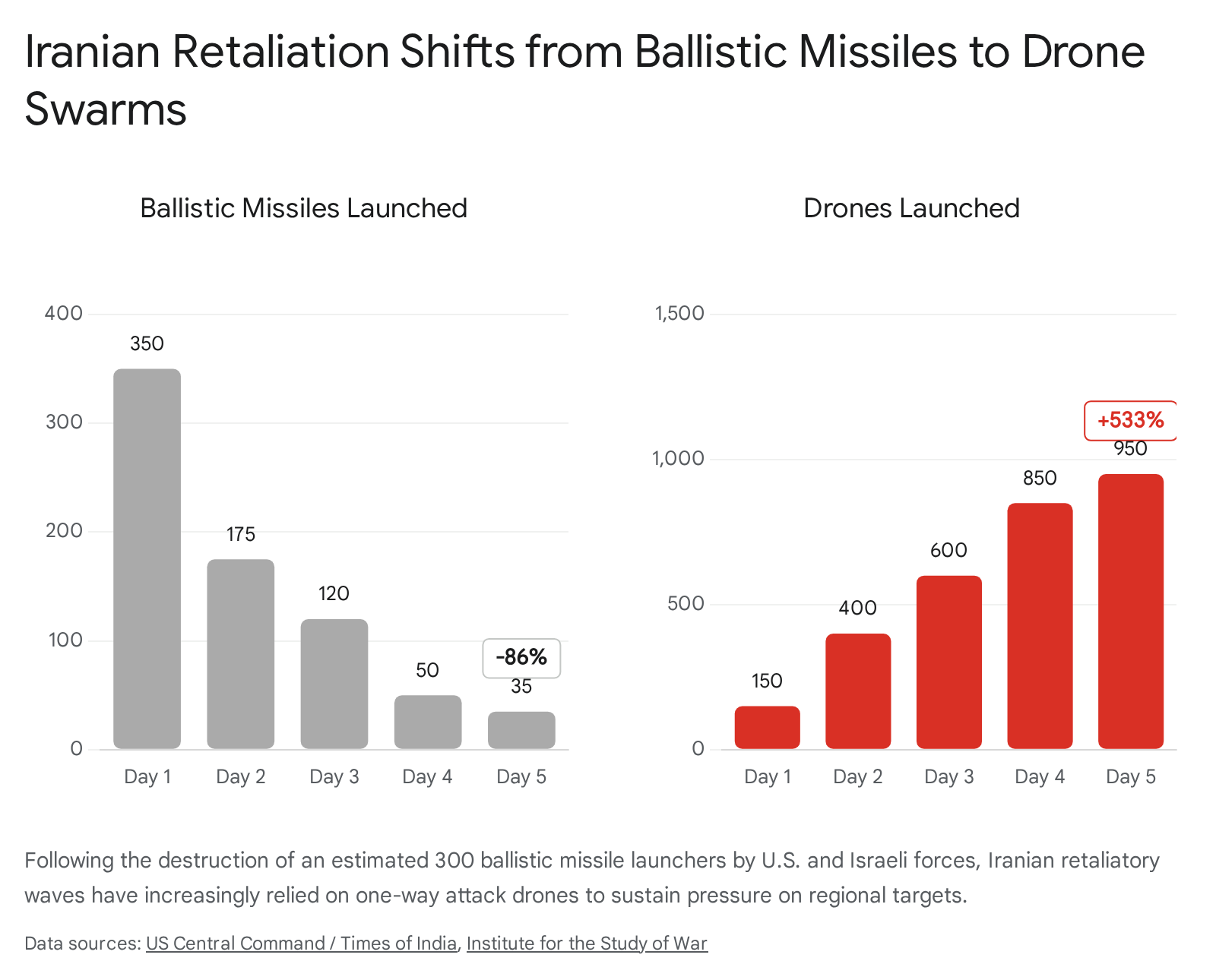
Militarily, the United States Central Command (CENTCOM) and the Israel Defense Forces (IDF) have systematically dismantled the bulk of Iran’s Integrated Air Defense Systems (IADS) and its ballistic missile launch infrastructure. Western intelligence and defense officials assess that Iranian ballistic missile launches have decreased by 90%, and unmanned aerial vehicle (UAV) attacks have fallen by 83% since the conflict’s inception.3 However, this degradation has not neutralized the Iranian threat; rather, it has forced the Islamic Revolutionary Guard Corps (IRGC) to adapt. Unable to penetrate layered Israeli and American missile defense screens with mass salvos, Iranian forces have increasingly targeted softer, closer installations in neighboring Gulf states and have initiated a de facto maritime blockade in the Strait of Hormuz. The deliberate drone strike on the commercial oil tanker Prima on March 7 signals Tehran’s strategic intent to weaponize global energy markets, applying macroeconomic pressure on the West to force an operational halt.4

Politically, the Iranian regime is attempting to manage an unprecedented internal crisis while executing a complex diplomatic maneuver aimed at fracturing the US-Gulf security architecture. The Interim Leadership Council, operating with expanded emergency powers, has faced severe difficulties in orchestrating a smooth succession. The Assembly of Experts, physically displaced by Israeli airstrikes, is reportedly deadlocked in virtual sessions over the proposed succession of Mojtaba Khamenei, facing internal revolts against the perception of a new “hereditary leadership”.5 Concurrently, Iranian President Masoud Pezeshkian issued a highly irregular public apology to the Gulf Cooperation Council (GCC) states for collateral damage, conditionally offering to halt all strikes on neighboring sovereign territories if those states refuse to allow their US-operated military bases to be used for offensive sorties against Iran.7

In Washington and Tel Aviv, the policy posture has hardened into maximalist demands that preclude near-term diplomatic off-ramps. US President Donald Trump has publicly rejected any negotiated settlement short of Iran’s “unconditional surrender,” linking the military campaign to a broader regime-change and reconstruction doctrine stylized as “Make Iran Great Again” (MIGA).7 Israeli leadership mirrors this stance, explicitly stating that the objective is the permanent dismantling of Iran’s nuclear and proxy capabilities before any ceasefire can be considered.14

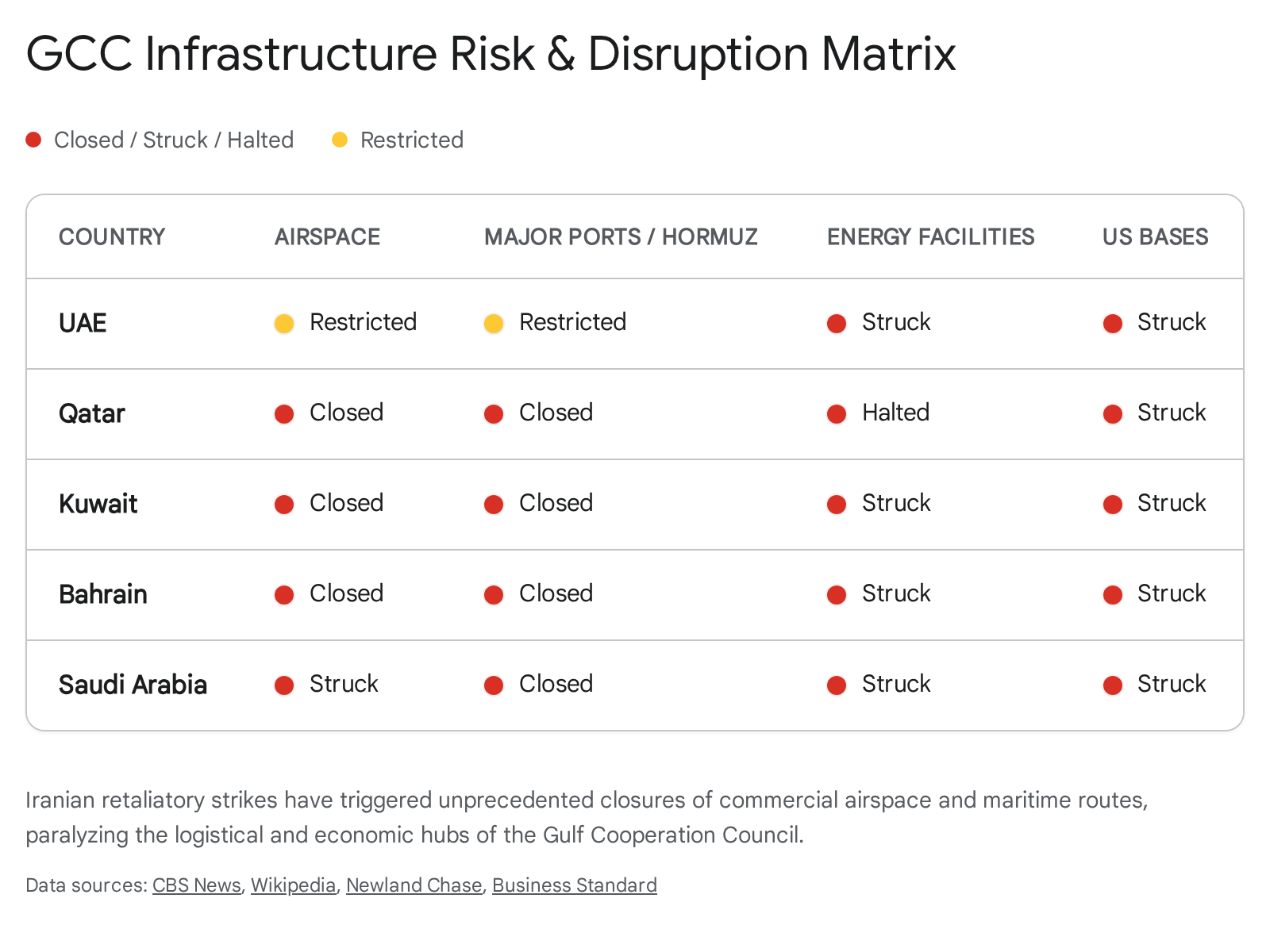
The cumulative effect of these developments is the severe destabilization of the US-aligned Gulf states. Saudi Arabia, the United Arab Emirates (UAE), Qatar, Kuwait, Bahrain, and Oman are currently enduring daily airspace violations, infrastructural damage, and the looming threat of a global economic shock driven by a potential shutdown of regional energy exports.15 As the conflict expands to include Russian intelligence sharing with Iran and active IDF ground incursions into Lebanon to dismantle Hezbollah, the geopolitical containment of the war has decisively failed, plunging the broader Middle East into a protracted state of total conflict.17

2.0 Chronological Timeline of Key Events (Last 36 Hours)

Note: All chronological timestamps are documented in Coordinated Universal Time (UTC) to ensure standardized tracking of multi-theater operations spanning the March 5 to March 7 reporting window.

  • March 5, 18:18 UTC: The Iranian Expediency Discernment Council formally approves the emergency transfer of key constitutional leadership powers to the three-member Interim Leadership Council, securing the authority required to make wartime command decisions following the death of the Supreme Leader.9
  • March 5, 22:22 UTC: Kuwaiti national air defense systems are activated as a wave of Iranian ballistic missiles and one-way attack drones breach sovereign airspace, specifically targeting the US staging areas at the Ali al Salem Airbase.19
  • March 5, 22:30 UTC: Saudi Arabian air and missile defense networks successfully intercept three inbound Iranian ballistic missiles over the Al-Kharj region, neutralizing threats directed at the US-operated Prince Sultan Air Base.20
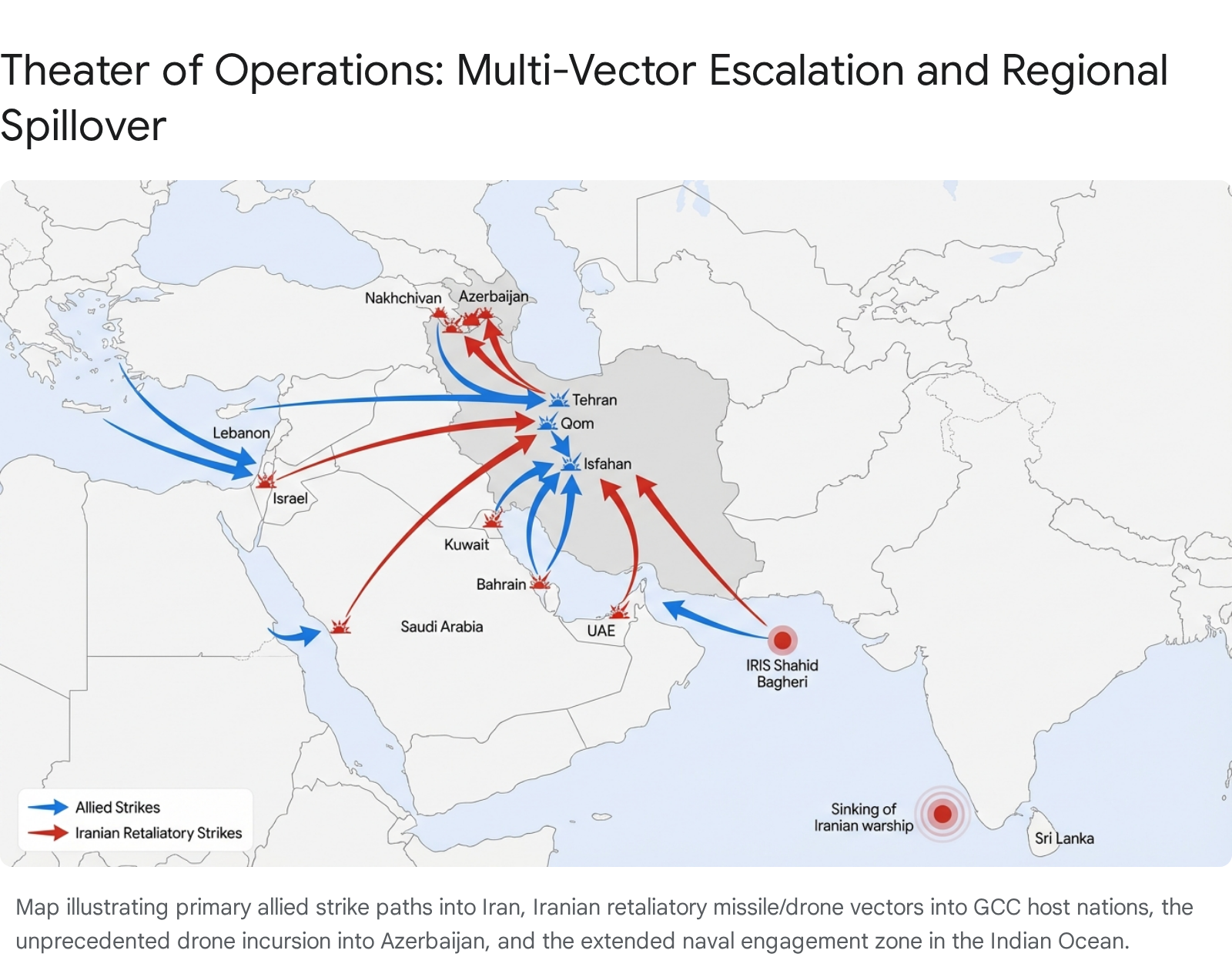
  • March 6, 04:00 UTC: Iranian armed UAVs execute a strike on Nakhchivan International Airport in the Azerbaijani exclave. The attack injures four civilians and forces the Azerbaijani government to suspend all cross-border commercial traffic, formally expanding the conflict’s geographic footprint into the Caucasus.3
  • March 6, 06:30 UTC: Following localized evacuation warnings, Israeli Air Force (IAF) fighter jets strike the Shokouhiyeh Industrial Zone in Qom Province. The targeted facilities belong to the Oje Parvaz Mado Nafar Company (Mado), a heavily sanctioned entity responsible for reverse-engineering and producing propulsion systems for the Shahed-series drones.17
  • March 6, 09:37 UTC: Regional aviation authorities issue updated Notices to Air Missions (NOTAMs) confirming prolonged and severe airspace closures. The airspaces over Iran, Iraq, and Bahrain maintain absolute Level 1 (Moderate to High Risk) No-Fly status, with severe intermittent restrictions paralyzing commercial logistics across the broader GCC.22
  • March 6, 16:55 UTC: Expanding operations deep into the northern theater, the Israel Defense Forces (IDF) execute a precision naval strike in Tripoli, Lebanon, resulting in the elimination of Wasim Attallah Ali, a senior Hamas commander responsible for military training operations in the Levant.25
  • March 6, 17:56 UTC: The IAF initiates the 13th distinct wave of Operation Roaring Lion, deploying a highly complex strike package of over 80 fighter jets. The operation targets heavily fortified regime-linked sites in Tehran and Isfahan, including Imam Hossein University (an IRGC officer training facility) and a subterranean command bunker in the Pastour neighborhood.25
  • March 7, 01:27 UTC: Undeterred by the degradation of their launch infrastructure, IRGC Aerospace Forces launch the 23rd wave of retaliatory strikes. The combined drone and ballistic missile barrage is directed at central population centers in Israel and major US military installations in the UAE, specifically the Al-Minhad and Al-Dhafra air bases.3
  • March 7, 03:45 UTC: Incoming international flights bound for Dubai International Airport (DXB) are forced to execute emergency go-arounds and enter prolonged holding patterns over neighboring Saudi Arabia. The disruption follows significant explosions and the descent of interceptor shrapnel in close proximity to the airfield, leading to a temporary suspension of all terminal operations.7
  • March 7, 05:00 UTC: United States President Donald Trump issues a definitive policy statement via social media, explicitly demanding the “unconditional surrender” of the Iranian regime. He publicly rejects any diplomatic off-ramps and announces intentions for the US and its allies to directly select Iran’s next leadership cadre.13
  • March 7, 07:25 UTC: The IRGC Navy conducts a direct kinetic strike utilizing an explosive UAV against the commercial oil tanker Prima transiting the Strait of Hormuz. Iranian state media claims the vessel ignored repeated warnings regarding the active maritime blockade and the “insecurity” of the strategic waterway.4
  • March 7, 10:00 UTC (approximate broadcast time): Iranian President Masoud Pezeshkian delivers a prerecorded national television address. In an unprecedented diplomatic maneuver, he formally apologizes to neighboring GCC states for the collateral impacts of Iranian strikes and pledges a cessation of cross-border attacks, strictly contingent upon GCC states denying the US the use of their sovereign territory for offensive military operations.7

3.0 Situation by Primary Country

3.1 Iran

3.1.1 Military Actions & Posture

The Iranian military apparatus, predominantly commanded by the Islamic Revolutionary Guard Corps (IRGC), has been forced into a significant strategic pivot over the past 36 hours. The sheer volume and precision of the combined US and Israeli air campaigns have severely degraded Iran’s Integrated Air Defense Systems (IADS) and its domestic military-industrial complex. Assessments from the White House and the IDF indicate that the joint allied forces have achieved “near-complete air superiority” over the Iranian landmass. Consequently, Iran’s capacity to launch centralized, mass-salvo ballistic missile barrages has collapsed; telemetry data indicates a 90% reduction in ballistic missile launches and an 83% reduction in drone swarm deployments since the first 72 hours of the conflict.3

In response to this systemic attrition, the IRGC has transitioned from conventional deterrence to highly asymmetric, localized strikes and maritime economic warfare. Recognizing that their remaining projectiles are easily intercepted by the dense, layered defense networks of Israel (Iron Dome, David’s Sling, Arrow 3), Iranian forces have increasingly targeted softer, geographically closer installations. Over the past 36 hours, the IRGC initiated its 23rd wave of retaliatory strikes, heavily focusing on Gulf Cooperation Council (GCC) states that host US personnel. This includes direct drone and missile attacks against the Al-Minhad and Al-Dhafra air bases in the UAE, the Ali al Salem Airbase in Kuwait, and the Prince Sultan Air Base in Saudi Arabia.3 Furthermore, Iran has demonstrated a willingness to expand the geographic scope of the conflict to inflict political costs on perceived US allies, evidenced by the unprecedented drone strike on Nakhchivan International Airport in Azerbaijan.3

The most critical evolution in Iranian military posture is the explicit weaponization of the maritime domain. Following the destruction of significant portions of the conventional Iranian Navy by US CENTCOM forces,including the sinking of the IRIS Dena,the IRGC Naval Forces have implemented a de facto blockade of the Strait of Hormuz.15 On March 7, the IRGC utilized a one-way attack drone to strike the commercial oil tanker Prima.4 The IRGC subsequently released statements confirming that the vessel was targeted for ignoring warnings regarding the “prohibition of traffic,” definitively signaling that Tehran intends to leverage the global economic reliance on the Strait (which facilitates approximately 20% of global oil consumption) as its primary asymmetric deterrent.4

To sustain its degraded command and control (C2) networks and improve targeting against US regional assets, intelligence reports indicate that Russian state actors are currently sharing actionable intelligence with Iran. This development highlights a deepening strategic alignment between Moscow and Tehran and severely complicates US force protection efforts across the Middle East.17

3.1.2 Policy & Diplomacy

The systemic shock generated by the February 28 decapitation strikes has triggered a profound and highly volatile succession crisis within the Iranian political and clerical establishment. Following the assassination of Supreme Leader Ayatollah Ali Khamenei, the Iranian state is currently governed by a three-member Interim Leadership Council. This body comprises President Masoud Pezeshkian, Chief Justice Gholam-Hossein Mohseni-Eje’i, and Ayatollah Alireza Arafi.31 On March 5, the Expediency Discernment Council formally approved the transfer of expanded wartime powers to this triumvirate, theoretically granting them full authority over the armed forces and strategic directives.9

However, the constitutional mechanism designed to permanently resolve the leadership vacuum,the 88-member Assembly of Experts,is operating under severe duress and internal division. Following an Israeli airstrike that destroyed the Assembly’s physical headquarters in Qom on March 3, the clerical body has been forced to conduct emergency virtual sessions.5 Intelligence sources indicate a fierce internal power struggle. The IRGC is reportedly exerting immense pressure on the Assembly to rapidly appoint Mojtaba Khamenei, the late Supreme Leader’s son, to ensure regime continuity and centralized wartime control.5 This maneuver has met significant resistance from an anti-hereditary faction within the Assembly. Clerics have warned that elevating Mojtaba would legitimize a “hereditary leadership” structure reminiscent of the pre-1979 monarchy, with at least eight members threatening to boycott the emergency voting sessions.5

Amidst this internal turmoil, the Interim Leadership Council is executing a complex external diplomatic strategy aimed at fracturing the coalition arrayed against it. In an unprecedented move on March 7, President Pezeshkian utilized a prerecorded television address to formally apologize to the neighboring GCC states for the collateral damage inflicted by Iranian strikes over the past week. He announced a new policy directive stipulating that Iran will cease firing upon Saudi Arabia, the UAE, Qatar, Kuwait, Bahrain, and Oman, strictly on the condition that these nations assert their sovereignty and deny the United States the use of their territory, airspace, and host bases to launch attacks against Iran.7

This diplomatic overture serves a dual strategic purpose. First, it aims to exploit the deep anxieties of the Gulf states, forcing Arab leaders to choose between the perceived security of the American defense umbrella and the immediate cessation of crippling economic and infrastructural damage inflicted by Iran. Second, it provides Tehran with a geopolitical and legal pretext; if GCC states fail to expel US forces, Iran can frame continued strikes on Gulf infrastructure as legitimate self-defense against active staging grounds.34 Simultaneously, Pezeshkian maintained a defiant posture toward Washington, flatly rejecting the US demand for “unconditional surrender” and warning that American leadership will “take their dreams to the grave”.35

3.1.3 Civilian Impact

The civilian toll within the Islamic Republic has escalated dramatically as the allied air campaign systematically dismantles dual-use infrastructure and operates within densely populated urban centers. Reports from the Iranian Red Crescent and international human rights organizations estimate total fatalities between 1,332 and 2,400 since the conflict commenced.3

March 6 was widely documented by Iranian officials, academics, and residents as the “bloodiest single day” for civilians in Tehran. Coordinated US-Israeli strikes rippled across multiple districts of the capital simultaneously. A specific strike targeting an alleged regime asset in the densely populated Niloofar Square in southern Tehran resulted in significant collateral damage, killing over twenty civilians, collapsing residential buildings, and overwhelming the city’s emergency response infrastructure.38

The systemic targeting of Iran’s defense industrial base has also severely impacted civilian employment centers and the broader economy. Strikes on the Esteghlal Industrial Zone in Tehran Province and the Shokouhiyeh Industrial Zone in Qom Province,intended to degrade drone production networks,have reduced major manufacturing hubs to rubble.17 Basic infrastructure is heavily degraded, with power outages and severe communication blackouts documented nationwide. The nation’s macroeconomic functions have effectively paralyzed; the Tehran Stock Exchange remains closed until further notice, and citizens are experiencing acute shortages of essential goods amid widespread panic.7

Key Iranian Institutional BodiesCurrent Status / Recent Developments (Last 36 Hours)Strategic Implication
Interim Leadership CouncilGranted expanded wartime powers by the Expediency Council. Led by Pezeshkian, Mohseni-Eje’i, and Arafi.Consolidates executive and military command during the succession crisis.
Assembly of ExpertsHQ in Qom destroyed by IDF strike. Attempting virtual emergency sessions.Paralyzed by internal factional disputes regarding the appointment of Mojtaba Khamenei.
IRGC Aerospace / NavyLaunch capacity severely degraded. Transitioned to asymmetric maritime interdiction (Strait of Hormuz).Shifts the Iranian threat from direct military confrontation to global economic sabotage.
Civilian InfrastructureTelecoms degraded to 1-4% connectivity. Major industrial zones in Tehran and Qom destroyed.Total socioeconomic paralysis; rising domestic pressure on the interim government.

3.2 Israel

3.2.1 Military Actions & Posture

Operating under the strategic framework of Operation Roaring Lion, the Israel Defense Forces (IDF) and the Israeli Air Force (IAF) have transitioned from initial decapitation strikes to the systematic, grinding dismantlement of Iran’s military-industrial complex and the neutralization of its proxy forces across the Levant.25 Within the last 36 hours, the IAF executed its 13th distinct wave of strikes into Iranian territory, a complex operation involving approximately 80 fighter jets. This wave struck over 400 targets heavily concentrated in western Iran, Tehran, and Isfahan.3 Specific targets included Imam Hossein University in Tehran,which Israeli intelligence identified as a primary training facility for IRGC officer cadres,and a heavily fortified subterranean command bunker located beneath the supreme leader’s compound in the Pastour neighborhood.26

Recognizing that Iran inherently relies on its “Ring of Fire” proxy network,the “Axis of Resistance”,to project power while its domestic capabilities are suppressed, Israel has aggressively escalated operations on its northern front. Following Hezbollah’s formal entry into the conflict on March 2, the IDF has battered southern Lebanon with over 500 airstrikes in a single week.3 To permanently alter the security reality in the north, the IDF has initiated limited ground operations. Infantry and armored units have advanced beyond the Blue Line, establishing forward positions in Khiam and Mays al Jabal to dismantle Hezbollah’s direct-fire capabilities.19 The operational tempo has also reached deep into sovereign Lebanese territory, evidenced by a precision naval strike in Tripoli that successfully eliminated Hamas commander Wasim Attallah Ali.25

3.2.2 Policy & Diplomacy

Israeli political and diplomatic leadership maintains an inflexible stance regarding war termination conditions, mirroring but remaining distinct from the posture of the United States. Prime Minister Benjamin Netanyahu and his war cabinet view the current conflict as a historic, generational opportunity to permanently eliminate Iran’s nuclear program and its ballistic missile threat, framing the regime as an existential danger that cannot be managed through diplomacy.25

Israeli Ambassador to the United Nations Danny Danon explicitly stated that international calls for a ceasefire are premature. He asserted that Israel must “finish the job” and continue to “hammer, to dismantle” Iranian capabilities,including nuclear sites, ballistic networks, regional proxies, and naval threats,before any diplomatic off-ramps can be considered.14 The Israeli strategic calculus is heavily reliant on Washington’s military umbrella, but differences in long-term objectives remain. While Israel’s primary focus is the neutralization of the existential physical threat, US rhetoric has explicitly integrated regime change and internal Iranian uprisings into its end-state goals, a scenario Israeli planners view cautiously due to the potential for protracted regional chaos.44

3.2.3 Civilian Impact

The civilian impact within Israel remains significant, driven primarily by sustained rocket, drone, and ballistic missile attacks launched by Iran and Hezbollah. Over the past 36 hours, air raid sirens sounded across central Israel, the greater Tel Aviv metropolitan area, and Jerusalem.7 While the Iron Dome, David’s Sling, and Arrow defense systems have intercepted the vast majority of inbound projectiles, shrapnel from interceptions and direct impacts have caused localized damage to residential buildings.47

At least 11 civilian fatalities have been reported in Israel since the conflict’s inception.15 The psychological and societal impact is profound; the Iranian strategy of targeting densely populated urban centers is clearly designed to raise the domestic costs of the intervention for the Israeli public.37 Furthermore, due to the acute and ongoing security threats, civil authorities implemented emergency closures of all holy sites within Jerusalem’s Old City and canceled Friday prayers.3 In the north, the conflict has displaced significant populations as the IDF mandates the evacuation of communities near the Lebanese border to facilitate military operations.18

3.3 United States

3.3.1 Military Actions & Posture

Operation Epic Fury constitutes the largest regional concentration of American military firepower in a generation, designed to execute a rapid, overwhelming degradation of the Iranian state’s ability to wage war.29 Directed by US Central Command (CENTCOM), the operation has already struck over 1,700 targets utilizing a vast array of assets, including B-1, B-2 stealth, and B-52 bombers, F-22 and F-35 stealth fighters, and naval guided-missile destroyers firing Tomahawk land-attack missiles.49

The primary operational focus of the last 36 hours has been the complete annihilation of the Iranian Navy to secure freedom of navigation, and the systematic hunting of mobile ballistic missile launchers.29 US forces have achieved significant tactical success in the maritime domain; a US Navy submarine notably engaged and sank the Iranian warship IRIS Dena off the coast of Sri Lanka, while the IRIS Bushehr was forced to seek emergency harbor and request assistance, effectively neutralizing Iran’s blue-water naval projection.15

However, the human cost for US forces is mounting. The Department of Defense confirmed that the number of US Service Members Killed in Action (KIA) has risen to six.51 The Army identified four Reserve soldiers from the 103rd Sustainment Command who were killed by an Iranian drone strike at the Port of Shuaiba in Kuwait.52 Additionally, the remains of two unaccounted-for personnel were recovered from a facility struck earlier in the campaign.51 The financial burden of the conflict is also immense; the Center for Strategic and International Studies (CSIS) estimates the cost of the first 100 hours of Operation Epic Fury at $3.7 billion,averaging $891 million per day,the vast majority of which was not previously budgeted.3

3.3.2 Policy & Diplomacy

President Donald Trump’s administration has adopted an uncompromising, maximalist diplomatic posture. In statements issued on March 6 and 7, President Trump flatly ruled out any negotiated settlement short of the Iranian regime’s “unconditional surrender.”.7 Trump has explicitly linked the military campaign to a broader regime-change doctrine, announcing his intention to oversee the reconstruction of the Iranian state under the slogan “Make Iran Great Again” (MIGA).11 Furthermore, he has inserted the United States directly into the Iranian succession crisis, publicly declaring that any succession by Mojtaba Khamenei is “unacceptable” and that the US will have a role in selecting “acceptable” leaders.3

To sustain the operational tempo of its primary regional ally, the US State Department bypassed standard congressional review protocols to approve an emergency $151.8 million munitions sale to Israel.7 Secretary of War/Defense Pete Hegseth indicated that the conflict will escalate further, warning that the US is preparing a forthcoming bombing campaign that will be “the most intense of the weeklong conflict,” designed to irrevocably break the regime’s will to fight.7 Anticipating the severe economic fallout of the Iranian blockade of the Strait of Hormuz, the administration has also ordered the US Development Finance Corporation to begin underwriting war-risk insurance for maritime shipping in the Persian Gulf, accompanied by promises of US Navy escorts for commercial vessels.54

3.3.3 Civilian Impact

Domestically, the conflict has polarized the American public and raised significant homeland security concerns. Early polling data indicates a deeply divided electorate; a YouGov poll found that 45% of respondents believe the administration made “the wrong decision” in attacking Iran, compared to 31% who support it, while Morning Consult showed a near-even split (42% prefer diplomacy, 41% support airstrikes).55

The homeland security apparatus is on heightened alert due to Iranian asymmetric retaliation strategies, which historical precedent suggests may target US soil or interests abroad. On March 6, a Pakistani national was convicted in the US for a plot to assassinate Donald Trump and other politicians,an operation orchestrated by Iranian intelligence in delayed retaliation for the 2020 killing of Qasem Soleimani.7 Simultaneously, British authorities arrested four men in London suspected of aiding Iranian intelligence by spying on the local Jewish community.53 Furthermore, the conflict has triggered a massive logistical crisis for American citizens abroad; an estimated 20,000 Americans have evacuated or are attempting to evacuate the Middle East, leading to severe bottlenecks at regional transit hubs as commercial aviation routes collapse.3

4.0 Regional and Gulf State Impacts

The geopolitical containment of the US-Israel-Iran war has decisively failed, transforming the Arabian Peninsula and the broader Gulf into an active, multi-domain combat theater. The Gulf Cooperation Council (GCC) states, which host critical US military infrastructure, logistical hubs, and naval headquarters, have been violently drawn into the conflict. This reality shatters years of intense pre-war diplomatic lobbying by these states, which had sought to balance relations with Washington while pursuing détente with Tehran to prevent their territories from becoming a battleground.34 The regional security architecture is now under existential threat, characterized by daily airspace violations, targeted infrastructural damage, and the looming specter of a global economic crisis.

Saudi Arabia The Kingdom of Saudi Arabia finds itself in a highly precarious position, attempting to defend its sovereignty while desperately seeking a diplomatic off-ramp. Riyadh is utilizing urgent diplomatic backchannels to engage directly with Tehran, aiming to defuse tensions and prevent further military spillover.6 However, the military reality on the ground contradicts these diplomatic efforts. Over the last 36 hours, the Royal Saudi Air Defense Forces successfully intercepted an inbound Iranian ballistic missile near the capital, Riyadh, and intercepted an additional three ballistic missiles over Al-Kharj. The latter strikes were explicitly targeting the US military presence at the Prince Sultan Air Base.7 In response to these provocations, Saudi Defense Minister Prince Khalid bin Salman issued a stern public warning to Iran to “avoid miscalculation,” highlighting the fragility of the landmark 2023 Chinese-brokered normalization agreement between the two nations, which now appears functionally obsolete.7

United Arab Emirates (UAE) The UAE has sustained profound and lasting economic and infrastructural disruptions, bearing the brunt of Iran’s early retaliatory strategy. Over 120 Iranian attack drones and multiple ballistic missiles have breached Emirati airspace, specifically targeting the US assets stationed at the Al-Minhad and Al-Dhafra air bases.3 The civilian impact of these interceptions has been severe; explosions and falling interceptor shrapnel near Dubai International Airport (DXB),the world’s second-busiest international aviation hub,forced the immediate suspension of operations. Incoming commercial flights were forced to execute emergency go-arounds and enter prolonged holding patterns over neighboring Saudi airspace, causing minor civilian injuries on the ground.7 The economic shock to the UAE’s tourism, finance, and logistics-driven economy is critical, threatening the state’s foundational model of regional stability.

Qatar & Energy Markets Qatar, which houses the forward headquarters of US CENTCOM at the sprawling Al Udeid Air Base, has been subjected to missile and drone barrages directly targeting the capital, Doha.3 While the physical damage has been mitigated by air defenses, the macroeconomic impact originating from Qatar is unparalleled. QatarEnergy, the world’s largest producer of Liquefied Natural Gas (LNG), has officially halted production due to the extreme regional insecurity.54 Qatari Energy Minister Saad al-Kaabi issued a dire warning that a prolonged shutdown of Gulf energy exports, coupled with the Iranian blockade of the Strait of Hormuz, could push global oil prices to $150 per barrel. Al-Kaabi stated unequivocally that the continuation of the conflict could “bring down the economies of the world”.15

Kuwait, Bahrain, and Oman The northern Gulf states are absorbing direct kinetic damage and human losses. Kuwait has suffered the only confirmed US fatalities of the conflict thus far. Following the devastating drone strike at Port Shuaiba that killed four US Army Reserve soldiers, Iranian forces have repeatedly targeted the Ali al Salem Airbase. These strikes have successfully penetrated local defenses, severely damaging aircraft shelters, equipment warehouses, and critical logistics infrastructure.19 In response to the deteriorating security environment, the United States has suspended all operations at its embassy in Kuwait City, and the German government announced the withdrawal of its military personnel from both Kuwait and Bahrain.3

In Bahrain, home to the US Navy’s Fifth Fleet Headquarters, Iranian aggression resulted in a direct missile strike on a state-run oil refinery, causing significant fires and infrastructural damage.3 Oman, a nation that has traditionally maintained a strict posture of neutrality and served as the primary diplomatic mediator between Tehran and Washington, saw its vital Port of Duqm targeted. While Iranian sources unofficially claimed the strike was a “mistake” by the IRGC, the incident has shattered Muscat’s “friend to all” security posture, forcing the Sultanate to re-evaluate its strategic vulnerability.60

Airspace, Logistics, and Global Supply Chains The Middle East is currently experiencing an unprecedented, region-wide aviation and logistical lockdown. Commercial airspace over Iran, Iraq, Israel, Lebanon, and Bahrain is classified as a Level 1 (Moderate to High Risk) No-Fly zone by the FAA, EASA, and other major international aviation authorities.22 The closure of these vital corridors has stranded hundreds of thousands of passengers globally and forced the cancellation of over 19,000 scheduled flights.56

Furthermore, the maritime logistics sector is facing near-total paralysis. Global shipping conglomerates, including Danish giant Maersk, have suspended all cargo booking acceptance in and out of the UAE, Oman, Iraq, Kuwait, Qatar, Bahrain, and Saudi Arabia.19 The combination of airspace closures, port strikes, and the active IRGC blockade of the Strait of Hormuz severely threatens global supply chains, presenting an imminent risk of global economic recession if the operational environment does not stabilize.

NationStrategic US Assets HostedRecent Kinetic Impact / Incident (Last 36 Hours)Stated Security Posture / Diplomatic Action
Saudi ArabiaPrince Sultan Air BaseIntercepted multiple ballistic missiles over Riyadh and Al-Kharj.Issued stern warnings to Iran; actively utilizing diplomatic backchannels to defuse tension.
UAEAl-Dhafra, Al-Minhad Air BasesDXB Airport suspended operations due to shrapnel; 120+ drones intercepted.Managing severe economic shock; directly targeted by continuous IRGC strikes.
QatarAl Udeid Air Base (CENTCOM HQ)Missile and drone barrage targeted Doha.Halting LNG production; warning international community of $150/barrel oil threat.
KuwaitAli al Salem Airbase, Camp ArifjanEmbassy closed; Airbase infrastructure damaged; US casualties confirmed.German troop withdrawal; recovering from the loss of US logistics personnel.
BahrainUS Fifth Fleet HeadquartersState-run oil refinery struck by missile; civilian areas targeted.Condemned Iranian aggression via the Arab League; managing German troop withdrawal.
OmanPort of Duqm / Logistics HubsPort targeted (claimed as a “mistake” by the IRGC).Re-evaluating historical neutral mediator status and vulnerability.

5.0 Appendices

Appendix A: Methodology

This Situation Report (SITREP) was generated through a comprehensive, real-time synthesis of global Open-Source Intelligence (OSINT), official state broadcasts, military press releases (e.g., CENTCOM, IDF), and geopolitical security monitors. The analytical window strictly covers the 36 hours from March 5, 18:00 UTC to March 7, 06:00 UTC, 2026. An intentional contextual overlap spanning the campaign’s initiation on February 28 was utilized to ensure narrative continuity regarding force degradation, casualty figures, and strategic intent.

Conflicting reports within the intelligence stream were evaluated based on source credibility and historical patterns of state media. For example, early claims that the Assembly of Experts formally elected Mojtaba Khamenei on March 4 were weighed against later, more granular intelligence indicating severe internal resistance, boycotts, and delayed virtual meetings extending into March 6 and 7. The latter, depicting a deadlocked succession crisis, was deemed highly credible and integrated into the report. Where casualty figures or battle damage assessments (BDA) diverged between belligerents, independent assessments,such as financial estimates by the Center for Strategic and International Studies (CSIS) and casualty reports from the Iranian Red Crescent,were prioritized to maintain absolute analytical neutrality and factual rigor.

Appendix B: Glossary of Acronyms

  • BDA: Battle Damage Assessment
  • C2: Command and Control
  • CENTCOM: United States Central Command (Geographic combatant command covering the Middle East, Egypt, and Central Asia)
  • CSIS: Center for Strategic and International Studies (Washington D.C.-based think tank)
  • DXB: Dubai International Airport
  • EASA: European Union Aviation Safety Agency
  • FAA: Federal Aviation Administration (United States)
  • GCC: Gulf Cooperation Council (Political and economic union of Bahrain, Kuwait, Oman, Qatar, Saudi Arabia, and the UAE)
  • IADS: Integrated Air Defense Systems (A networked array of radars, surface-to-air missiles, and C2 nodes)
  • IAF: Israeli Air Force
  • IDF: Israel Defense Forces
  • IRGC: Islamic Revolutionary Guard Corps (A multi-service primary branch of the Iranian Armed Forces)
  • KIA: Killed in Action
  • LNG: Liquefied Natural Gas
  • MIGA: “Make Iran Great Again” (A political slogan utilized by US President Donald Trump regarding the post-war reconstruction of Iran)
  • NOTAM: Notice to Air Missions (Alerts filed with an aviation authority to alert aircraft pilots of potential hazards)
  • OSINT: Open-Source Intelligence
  • UAV: Unmanned Aerial Vehicle (Drone)

Appendix C: Glossary of Foreign Words

  • Ayatollah: A high-ranking title given to Usuli Twelver Shī‘ah clerics, denoting significant expertise in Islamic studies.
  • Dahiyeh: The predominantly Shia southern suburbs of Beirut, Lebanon; a known demographic stronghold and operational headquarters for Hezbollah.
  • Khamenei (Ali / Mojtaba): Ali Khamenei was the second Supreme Leader of Iran, assassinated by US-Israeli strikes on February 28, 2026. Mojtaba Khamenei is his son, a highly influential cleric, and a central, highly contested figure in the current succession crisis.
  • Majlis: The Islamic Consultative Assembly; the national legislative body (parliament) of the Islamic Republic of Iran.
  • Pezeshkian (Masoud): The incumbent President of Iran and a leading member of the wartime Interim Leadership Council.
  • Velayat-e-Faqih: “Guardianship of the Islamic Jurist,” the foundational political and religious doctrine of the Iranian state post-1979, which justifies the absolute temporal and spiritual rule of the Supreme Leader.

Please share the link on Facebook, Forums, with colleagues, etc. Your support is much appreciated and if you have any feedback, please email us in**@*********ps.com. If you’d like to request a report or order a reprint, please click here for the corresponding page to open in new tab.


Sources Used

  1. The US-Israel campaign in Iran – The International Institute for Strategic Studies, accessed March 7, 2026, https://www.iiss.org/online-analysis/online-analysis/2026/02/the-us-israel-campaign-in-iran/
  2. US-Israel strikes on Iran: February/March 2026 – The House of Commons Library, accessed March 7, 2026, https://commonslibrary.parliament.uk/research-briefings/cbp-10521/
  3. Iran war: What is happening on day seven of US-Israel attacks …, accessed March 7, 2026, https://www.aljazeera.com/news/2026/3/6/iran-war-what-is-happening-on-day-seven-of-us-israel-attacks
  4. IRGC Targets Oil Tanker in the Gulf…, accessed March 7, 2026, https://www.jordannews.jo/Section-111/All/IRGC-Targets-Oil-Tanker-in-the-Gulf-49452
  5. Guards push fast Mojtaba Khamenei announcement amid dissent over hereditary rule | Iran International, accessed March 7, 2026, https://www.iranintl.com/en/202603052337
  6. Saudi Arabia said to intensify talks with Iran to defuse Mideast war | The Times of Israel, accessed March 7, 2026, https://www.timesofisrael.com/saudi-arabia-said-to-intensify-talks-with-iran-to-defuse-mideast-war/
  7. Israel-Iran war LIVE: Iran vows no surrender as air strikes hit Tehran …, accessed March 7, 2026, https://www.thehindu.com/news/international/iran-israel-us-war-live-west-asia-conflict-march-7-2026-trump-middle-east-crisis-oil-prices-air-strikes-drone-attacks-lebanon-strikes-gulf-region/article70714560.ece
  8. IRGC strikes Prima tanker with drone in Strait of Hormuz, accessed March 7, 2026, https://operativmm.az/en/post/irgc-strikes-prima-tanker-with-drone-in-strait-of-hormuz/68545
  9. Iran grants interim leadership council expanded powers after Khamenei killing, accessed March 7, 2026, https://www.middleeasteye.net/live-blog/live-blog-update/iran-grants-interim-leadership-council-expanded-powers-after-khamenei
  10. Assembly of Experts – Wikipedia, accessed March 7, 2026, https://en.wikipedia.org/wiki/Assembly_of_Experts
  11. No more attacks on neighbouring countries, says Iran’s President; rules out question of ‘surrender’ – Times of Oman, accessed March 7, 2026, https://timesofoman.com/article/169167-no-more-attacks-on-neighbouring-countries-says-irans-president-rules-out-question-of-surrender
  12. Iran pledges to halt strikes on neighbours as conflict with US and Israel enters second week, accessed March 7, 2026, https://theonlinecitizen.com/2026/03/07/iran-pledges-to-halt-strikes-on-neighbours-as-conflict-with-us-and-israel-enters-second-week
  13. Trump’s ever-changing rationale for war on Iran – how the story has shifted – The Guardian, accessed March 7, 2026, https://www.theguardian.com/us-news/2026/mar/07/trump-rationale-war-iran-story
  14. The Latest: New Iranian attacks target Israel and US bases as more Israeli strikes hit Lebanon, accessed March 7, 2026, https://www.click2houston.com/news/2026/03/05/the-latest-new-iranian-attacks-target-israel-and-us-bases-as-more-israeli-strikes-hit-lebanon/
  15. Iran’s president apologizes for strikes on neighboring countries as conflict continues, accessed March 7, 2026, https://www.wwltv.com/article/news/nation-world/attack-on-iran/iran-us-israel-attack-missiles-drones-strikes/507-7206fa4b-38d7-4b56-9119-20b89c0e8e3e
  16. Middle East Conflict: Regional Escalation, Travel Disruption, and What to do Now | Crisis24, accessed March 7, 2026, https://www.crisis24.com/articles/middle-east-conflict-regional-escalation-travel-disruption-and-what-to-do-now
  17. Iran Update Evening Special Report, March 6, 2026 | ISW, accessed March 7, 2026, https://understandingwar.org/research/middle-east/iran-update-evening-special-report-march-6-2026/
  18. Lebanon: Humanitarian consequences of the Israeli military offensive (Briefing Note 5 March 2026) – ReliefWeb, accessed March 7, 2026, https://reliefweb.int/report/lebanon/lebanon-humanitarian-consequences-israeli-military-offensive-briefing-note-5-march-2026
  19. Iran Update Evening Special Report, March 4, 2026, accessed March 7, 2026, https://understandingwar.org/research/middle-east/iran-update-evening-special-report-march-4-2026/
  20. Operation Epic Fury Takes Flight: Inside the Strike Strategy and What Comes Next, accessed March 7, 2026, https://sofrep.com/news/operation-epic-fury-begins-inside-the-strike-strategy-and-what-comes-next/
  21. Escalation in the Middle East: Tracking “Operation Epic Fury” Across Military and Cyber Domains, accessed March 7, 2026, https://flashpoint.io/blog/escalation-in-the-middle-east-operation-epic-fury/
  22. Risk Summary 07 Mar 2026 – Safe Airspace, accessed March 7, 2026, https://safeairspace.net/summary/
  23. Airspace closures following Israeli and US strikes on Iran | Flightradar24 Blog, accessed March 7, 2026, https://www.flightradar24.com/blog/live/israel-launches-pre-emptive-strikes-on-iran-airspace-closures-going-into-place/
  24. Middle East Tension Escalation – March 6, 2026 – Expeditors, accessed March 7, 2026, https://info.expeditors.com/operational-impact/middle-east-tension-escalation-march-6-2026
  25. Timeline of Events Operation Roaring Lion, accessed March 7, 2026, https://www.idf.il/en/mini-sites/operation-roaring-lion/operation-roaring-lion-updates/
  26. Iran Update Morning Special Report, March 6, 2026 | ISW, accessed March 7, 2026, https://understandingwar.org/research/middle-east/iran-update-morning-special-report-march-6-2026/
  27. Live Updates: Iran’s president calls U.S. demand for surrender “a dream that they should take to their grave”, accessed March 7, 2026, https://www.cbsnews.com/live-updates/us-iran-war-israel-strikes-regime-targets/
  28. Iran claims to have intercepted an oil tanker forcibly entering the Strait of Hormuz – Bitget, accessed March 7, 2026, https://www.bitget.com/amp/news/detail/12560605246275
  29. Operation Epic Fury: Unmatched Power, Unrelenting Force of America’s Warriors, accessed March 7, 2026, https://www.whitehouse.gov/articles/2026/03/operation-epic-fury-unmatched-power-unrelenting-force-of-americas-warriors/
  30. IRGC strikes “Prima” tanker in Strait of Hormuz with drone – Apa.az, accessed March 7, 2026, https://en.apa.az/asia/irgc-strikes-prima-tanker-in-strait-of-hormuz-with-drone-495503
  31. Who is running Iran now?, accessed March 7, 2026, https://www.washingtonexaminer.com/news/world/4476891/iran-leading-government-military-us-war/
  32. Who Will Run Iran?, accessed March 7, 2026, https://www.meforum.org/mef-online/who-will-run-iran
  33. Israel Strikes Tehran Regime’s Assembly of Experts, Underlining Efforts to Disrupt Succession Process – FDD, accessed March 7, 2026, https://www.fdd.org/analysis/2026/03/03/israel-strikes-tehran-regimes-assembly-of-experts-underlining-efforts-to-disrupt-succession-process/
  34. Iran’s legal case for striking the Gulf collapses under scrutiny, accessed March 7, 2026, https://www.aljazeera.com/opinions/2026/3/7/irans-legal-case-for-striking-the-gulf-collapses-under-scrutiny
  35. Iran’s president defies US demands while apologizing for strikes on neighbors | النهار, accessed March 7, 2026, https://www.annahar.com/en/region/middle-east/284594/irans-president-defies-us-demands-while-apologizing-for-strikes-on-neighbors
  36. Iran is halting attacks on neighboring countries unless they launch strikes first: President, accessed March 7, 2026, https://www.middleeastmonitor.com/20260307-iran-is-halting-attacks-on-neighboring-countries-unless-they-launch-strikes-first-president/
  37. Middle East Special Issue: March 2026 | ACLED, accessed March 7, 2026, https://acleddata.com/update/middle-east-special-issue-march-2026
  38. ‘Bloodiest single day for civilians’ in Iran amid US-Israel war – The New Arab, accessed March 7, 2026, https://www.newarab.com/news/bloodiest-single-day-civilians-iran-amid-us-israel-war
  39. Threat Brief: March 2026 Escalation of Cyber Risk Related to Iran, accessed March 7, 2026, https://unit42.paloaltonetworks.com/iranian-cyberattacks-2026/
  40. Operation “Epic Fury:” SITREP (3 MAR 2026), accessed March 7, 2026, https://ict.org.il/operation-epic-fury-sitrep-3-mar-2026/
  41. Operation Roaring Lion: IDF unveils dramatic footage of first-ever strike in ‘heart of Tehran’ , watch, accessed March 7, 2026, https://timesofindia.indiatimes.com/defence/international/operation-roaring-lion-idf-unveils-dramatic-footage-of-first-ever-strike-in-heart-of-tehran-watch/articleshow/128912234.cms
  42. Operation “Epic Fury:” SITREP (2 MAR 2026), accessed March 7, 2026, https://ict.org.il/operation-epic-fury-sitrep-2-mar-2026/
  43. Operation Roaring Lion: Netanyahu vows to ”save the world” from Iran’s nuclear tyranny during visit to bombarded site, accessed March 7, 2026, https://www.aninews.in/news/world/middle-east/operation-roaring-lion-netanyahu-vows-to-save-the-world-from-irans-nuclear-tyranny-during-visit-to-bombarded-site20260302231028
  44. Trump and Netanyahu’s Iran Gambit: The Strategic Calculations behind Epic Fury, accessed March 7, 2026, https://arabcenterdc.org/resource/trump-and-netanyahus-iran-gambit-the-strategic-calculations-behind-epic-fury/
  45. Epic Fury and Roaring Lion: From War Scenarios to Pressing Postwar Questions in Iran, accessed March 7, 2026, https://www.washingtoninstitute.org/policy-analysis/epic-fury-and-roaring-lion-war-scenarios-pressing-postwar-questions-iran
  46. Analysis: Similarities and differences in US and Israeli targets and objectives in Iran campaign, accessed March 7, 2026, https://www.longwarjournal.org/archives/2026/03/analysis-similarities-and-differences-in-us-and-israeli-targets-and-objectives-in-iran-campaign.php
  47. Iran launches new attacks and calls for ‘Trump’s blood’ while Israel strikes Iranian infrastructure, accessed March 7, 2026, https://www.wsls.com/news/world/2026/03/05/iran-launches-new-wave-of-attacks-on-israeli-and-us-bases-while-israel-begins-new-strikes-in-lebanon/
  48. U.S. Forces Launch Operation Epic Fury – centcom, accessed March 7, 2026, https://www.centcom.mil/MEDIA/PRESS-RELEASES/Press-Release-View/Article/4418396/us-forces-launch-operation-epic-fury/
  49. Operation Epic Fury Fact Sheet 260303, accessed March 7, 2026, https://media.defense.gov/2026/Mar/03/2003882557/-1/-1/1/OPERATION-EPIC-FURY-FACT-SHEET-260303.PDF
  50. This Week in DOW: Delivering ‘Shock and Awe’ to Iran, Defense Leaders’ Declaration, Updates on AI, accessed March 7, 2026, https://www.war.gov/News/News-Stories/Article/Article/4425242/this-week-in-dow-delivering-shock-and-awe-to-iran-defense-leaders-declaration-u/
  51. Operation Epic Fury Update > U.S. Central Command > Statements View, accessed March 7, 2026, https://www.centcom.mil/MEDIA/STATEMENTS/Statements-View/Article/4419315/operation-epic-fury-update/
  52. Update: Pentagon identifies 4 Soldiers Killed in Drone Strike – Military.com, accessed March 7, 2026, https://www.military.com/daily-news/2026/03/01/three-us-service-members-killed-several-injured-operation-epic-fury.html
  53. As Iran war expands, Trump says he must have a role in choosing the country’s next leader, accessed March 7, 2026, https://www.cbsnews.com/live-updates/us-iran-war-spreads-azerbaijan-israel-strikes-tehran-lebanon/
  54. Day Four of the War with Iran: An Update, accessed March 7, 2026, https://www.meforum.org/mef-online/day-four-of-the-war-with-iran-an-update
  55. Americans Are Skeptical About Operation Epic Fury, accessed March 7, 2026, https://www.cfr.org/articles/americans-are-skeptical-about-operation-epic-fury
  56. Anxious travelers scramble as Iran war strands hundreds of thousands across the Middle East – Oregon Public Broadcasting, accessed March 7, 2026, https://www.opb.org/article/2026/03/03/anxious-travelers-scramble-as-iran-war-strands-hundreds-of-thousands-across-the-middle-east/
  57. Iran Is Pushing Its Neighbors Toward the United States, accessed March 7, 2026, https://carnegieendowment.org/emissary/2026/03/iran-collective-security-gulf-states-us-security
  58. Why Arab states are terrified of US war with Iran – Responsible Statecraft, accessed March 7, 2026, https://responsiblestatecraft.org/iran-war-gulf-states/
  59. Iran’s strikes on the Gulf: Burning the bridges of good neighbourliness, accessed March 7, 2026, https://www.aljazeera.com/opinions/2026/3/7/irans-strikes-on-the-gulf-burning-the-bridges-of-good-neighbourliness
  60. The Gulf that emerges from the Iran war will be very different – Atlantic Council, accessed March 7, 2026, https://www.atlanticcouncil.org/dispatches/the-gulf-that-emerges-from-the-iran-war-will-be-very-different/
  61. What the War on Iran Means for the Horn of Africa’s Security Posture?, accessed March 7, 2026, https://www.hiiraan.com/op4/2026/Mar/204586/what_the_war_on_iran_means_for_the_horn_of_africas_security_posture.aspx
  62. Iran to halt attacks on GCC countries, if they bar attacks on Iran from their territory – Pezeshkian – bne IntelliNews, accessed March 7, 2026, https://www.intellinews.com/iran-to-halt-attacks-on-gcc-countries-if-they-bar-attacks-on-iran-from-their-territory-pezeshkian-430086/?source=israel
  63. Middle East Airspace – Current Operational Picture – International Ops 2025 – OpsGroup, accessed March 7, 2026, https://ops.group/blog/middle-east-airspace-current-operational-picture/

The 5-Year Degradation Cycle of Polymer-Framed Duty Handguns in Extreme Climates: A Technical OSINT Analysis

Executive Summary (BLUF)

The widespread adoption of polymer-framed handguns by law enforcement agencies and military units over the past four decades has fundamentally shifted duty weapon life-cycle management and capital procurement strategies. While modern polymer frames,predominantly manufactured from thirty percent glass fiber-reinforced Polyamide 66 (PA66-GF30),offer exceptional weight reduction, corrosion resistance, and manufacturing scalability, they are not immune to the laws of thermodynamics and environmental degradation. This technical intelligence report exhaustively analyzes the five-year degradation cycle of PA66-GF30 duty handgun frames when exposed to extreme operational climates, providing critical insights for law enforcement command staff, procurement officers, and defense contractors.

The analysis reveals that while high-quality polymer frames are engineered to withstand significant kinetic abuse, their molecular integrity is fundamentally finite. Over a standard sixty-month deployment cycle, duty handguns face compounding and synergistic environmental stressors: ultraviolet (UV) photo-oxidation, extreme thermal cycling ranging from sub-zero arctic conditions to desert heat, hygrothermal aging combining moisture absorption with elevated temperatures, and Environmental Stress Cracking (ESC) induced by routine exposure to field chemicals such as N,N-Diethyl-meta-toluamide (DEET) and hydrocarbon-based lubricants.

Key findings from cross-source open-source intelligence indicate that unmitigated ultraviolet exposure can reduce the flexural strength of glass-fiber-reinforced plastics by up to forty-one percent, severely compromising the weapon’s ability to absorb recoil impulses.1 Thermal cycling introduces severe mechanical fatigue at the precise interface of the polymer frame and the molded-in steel chassis inserts due to a Coefficient of Thermal Expansion (CTE) mismatch. In these critical zones, the polymer matrix expands and contracts at a rate two to five times greater than the steel components, leading to micro-cavitation and interface debonding.2 Furthermore, hygrothermal aging acts as a permeating plasticizer, significantly lowering the tensile modulus of the frame while increasing the risk of irreversible chain hydrolysis at elevated internal vehicle temperatures.4

For command staff and procurement officers, understanding these intricate degradation pathways is absolutely critical for transitioning from reactive armorer maintenance to proactive fleet life-cycle management. While the average duty pistol may theoretically survive a 10,000 to 25,000-round service life under controlled, indoor range conditions 7, real-world environmental extremes drastically accelerate polymer fatigue and structural compromise. This report provides the necessary material science data, environmental threat assessments, and predictive degradation modeling to inform future procurement cycles, evaluate transition strategies such as the shift toward modular chassis systems, and establish rigorous departmental maintenance protocols.

1.0 Introduction to Polymer Duty Handgun Life Cycles and Procurement

The integration of synthetic polymers into firearm manufacturing represents one of the most significant technological leaps in the history of the defense and law enforcement industries. Moving away from heavy, corrosion-prone carbon steel and forged aluminum frames, the industry has universally embraced specialized thermoplastic composites. From the experimental introduction of the Remington Nylon 66 rifle in 1959, which utilized an early formulation of DuPont’s Zytel polymer to create a unibody stock and receiver 8, to the paradigm-shifting debut of the recoil-operated Glock 17 in the 1980s 10, polymer science has conclusively proven its viability in high-stress, kinetic applications. Today, polymer-framed handguns account for the vast majority of law enforcement duty weapons globally, establishing a new baseline for weight, capacity, and manufacturing efficiency.

1.1 The Evolution of Polymer in Service Firearms

The historical trajectory of polymer in firearms demonstrates a continuous refinement of material properties to meet the punishing demands of military and law enforcement use. Early attempts at polymer integration, such as the Heckler & Koch VP70 introduced in 1970, met with lukewarm commercial reception but validated the concept of a lightweight, blowback-operated polymer handgun.10 However, it was Gaston Glock’s background in synthetic polymers and injection molding, rather than traditional firearms design, that catalyzed the modern era.12 By utilizing a proprietary nylon-based polymer, often referred to internally as Polymer 2, Glock achieved a frame that matched the functional strength of steel while reducing overall weapon weight by as much as forty percent compared to contemporary alloy-framed pistols like the Beretta 92.13

This lightweight construction significantly improved officer handling, reduced the physiological fatigue associated with daily duty carry, and enhanced recoil control through the polymer’s inherent ability to flex and damp kinetic energy.13 Consequently, over seventy percent of the top tier handgun original equipment manufacturers,including Glock, SIG Sauer, Smith & Wesson, and Heckler & Koch,have standardized their primary duty lines on advanced polymer composites.14

1.2 The Five-Year Capital Procurement Cycle in Law Enforcement

Law enforcement agencies typically operate on a five-to-ten-year capital procurement cycle for duty sidearms, a timeline dictated by complex operational, financial, and liability factors.15 This cyclic replacement strategy is rarely driven solely by the catastrophic mechanical failure of the firearms. Instead, it is heavily influenced by budget amortization schedules, the necessity of managing institutional liability, the pursuit of advancing technology (such as the recent widespread transition to optics-ready platforms and modular chassis systems), and the subtle, often invisible, degradation of the firearm’s baseline reliability due to environmental exposure.

During a standard five-year cycle, comprising sixty months of continuous deployment, a duty handgun assigned to a patrol officer is subjected to a unique and punishing matrix of environmental and mechanical stressors. Unlike civilian firearms, which typically reside in climate-controlled safes and experience only occasional range use, duty weapons are exposed daily to severe diurnal temperature shifts, prolonged solar radiation, heavy precipitation, corrosive bodily sweat, abrasive particulate matter, and a wide variety of chemical agents. Understanding the specific material science behind how the polymer frame reacts, degrades, and ultimately fatigues under these cumulative stressors over a sixty-month timeline is essential for establishing realistic service limits and mitigating the risk of critical failure in the line of duty.

2.0 Molecular Architecture of Polyamide 66 and PA66-GF30 Composites

To accurately assess the degradation mechanisms of a duty handgun, it is imperative to first understand the complex molecular architecture of the baseline material. The vast majority of modern polymer firearm frames are injection-molded from glass-filled nylon, specifically Polyamide 6 (PA6) or Polyamide 66 (PA66).14 Polyamide 66 serves as the industry gold standard due to its superior thermal stability and higher melting point compared to standard Polyamide 6.20

2.1 Semi-Crystalline Thermoplastics in Kinetic Applications

Nylon 66, scientifically designated as polyhexamethylene adipamide, is a semi-crystalline engineering thermoplastic. It is synthesized through the polycondensation of two distinct monomers: hexamethylenediamine and adipic acid, each containing exactly six carbon atoms, which gives the polymer its numerical designation.22 The polymer chains in PA66 are held together by strong intermolecular hydrogen bonds occurring between the amide functional groups.6

This specific molecular arrangement creates a semi-crystalline structure, meaning the material contains both highly ordered, tightly packed crystalline regions and randomly organized, flexible amorphous regions.24 The crystalline regions provide the material with its exceptional chemical resistance, thermal stability, and high melting point, which typically ranges from 254 degrees Celsius to 264 degrees Celsius (489 to 507 degrees Fahrenheit).21 Concurrently, the amorphous regions afford the polymer a degree of flexibility and impact resistance, allowing it to absorb and dissipate the violent kinetic shockwaves generated by the detonation of modern high-pressure duty ammunition.

2.2 The Role of Short Glass Fiber Reinforcement

While pure, unreinforced Polyamide 66 possesses excellent chemical resistance and thermal properties, it fundamentally lacks the absolute rigidity, tensile strength, and dimensional stability required to serve as the structural foundation of a firearm frame experiencing chamber pressures exceeding 35,000 pounds per square inch. To bridge this structural gap, firearms manufacturers reinforce the base PA66 matrix with microscopic short glass fibers, typically at a volume ratio of thirty percent, creating the composite known industrially as PA66-GF30.14

The integration of thirty percent glass fiber radically transforms the mechanical profile of the base polymer. The glass fibers act as a rigid structural skeleton within the flexible polymer matrix, dramatically enhancing the material’s load-bearing capabilities. However, this reinforcement strategy introduces a critical vulnerability: the structural integrity of the entire composite relies absolutely on the interfacial adhesion between the PA66 polymer matrix and the embedded glass fibers.4 Chemical coupling agents, such as silanes, are utilized to bond the organic polymer to the inorganic glass. When environmental stressors attack the frame, they frequently target this exact microscopic interface, leading to micro-voids, a loss of stiffness, and eventual macroscopic cracking.4

2.3 Baseline Mechanical Properties and Performance Metrics

The mechanical superiority of PA66-GF30 over unreinforced plastics is evident in standardized laboratory testing. The precise formulation and alignment of the glass fibers during the injection molding process dictate the final strength of the firearm frame. Fibers naturally align in the direction of the molten material flow within the mold, creating anisotropic properties where the frame is significantly stronger along the flow lines than across them.28

The following table synthesizes cross-source data regarding the baseline mechanical and thermal properties of standard PA66-GF30 utilized in engineering and tactical applications.

Mechanical & Thermal PropertyMetric ValueImperial ValueStandardized Testing Norm
Density / Specific Gravity1.34 – 1.38 g/cm30.048 – 0.050 lb/in3ISO 1183
Tensile Strength (Yield/Break)85 – 180 MPa12,200 – 26,100 psiISO 527-2 / ASTM D638
Tensile Modulus (Stiffness)5,000 – 10,500 MPa725,000 – 1,522,000 psiISO 527-2 / ASTM D638
Elongation at Break3.0 – 14.0 %3.0 – 14.0 %ISO 527-2 / ASTM D638
Flexural Strength135 – 195 MPa19,575 – 28,280 psiISO 178
Charpy Impact Strength (Notched)10 – 13 kJ/m24.7 – 6.1 ft-lb/in2ISO 179-1eA
Melting Temperature254 – 264 C489 – 507 FISO 11357
Continuous Service Temp (Air)110 – 120 C230 – 248 FIEC 216

(Data derived from industrial material specifications including Ensinger Plastics, Toray, and Mitsubishi Chemical Advanced Materials 20)

The data clearly illustrates that the inclusion of thirty percent glass fibers pushes the tensile strength of the polymer well above 12,000 psi, providing the necessary resistance to deformation required for reliable weapon cycling.27 However, the relatively low elongation at break (as low as 3 percent in some highly rigid formulations) indicates that the material favors stiffness over elasticity, making it susceptible to brittle fracture if the matrix is compromised by environmental degradation.20

3.0 Photodegradation: Ultraviolet Embrittlement Over 60 Months

For duty weapons carried in exposed Level III retention holsters by officers on foot patrol, motorcycle units, or marine divisions, solar radiation constitutes a persistent and insidious threat. While modern holsters provide some physical shielding, the exposed grip modules, backstraps, and magazine floorplates are continuously bombarded by sunlight. Polyamides are inherently susceptible to ultraviolet (UV) degradation, a photochemical process that slowly and irreversibly dismantles the polymer chain over the five-year duty cycle.31

3.1 Mechanisms of Photo-Oxidative Degradation

The degradation of Polyamide 66 under sunlight is primarily driven by photo-oxidative reactions occurring when the material is exposed to the ultraviolet spectrum, specifically within the 290 to 400 nanometer wavelength band.31 The mechanism is initiated by the absorption of UV energy by chromophoric groups residing within the polymer structure. In many cases, these chromophores are trace carbonyl groups or hydroperoxides that were inadvertently formed due to the extreme thermal history of the polymer during the high-heat injection molding process at the OEM factory.31

When these chromophoric sites absorb high-energy UV photons, the energy exceeds the bond dissociation energy of the polymer backbone. This results in the homolytic cleavage of the polymer chains, generating highly unstable and reactive free radicals.1 Once free radicals are formed, and in the presence of atmospheric oxygen, an autocatalytic cascade of chemical reactions commences, fundamentally altering the polymer’s molecular structure.

3.2 Chain Scission and Aberrant Crosslinking

The free radical cascade induces two primary, conflicting destructive processes within the PA66 matrix: chain scission and aberrant crosslinking.31

Chain scission involves the direct severing of the long polymer chains, effectively reducing the overall molecular weight of the matrix. In polyamides, this is primarily driven by the scission of the weaker bonds within the polymer structure, particularly the N-alkylamide bond (CH2-NHCO), followed by the decomposition of the newly formed amide groups.4 As the molecular weight decreases, the polymer loses its inherent toughness and impact resistance, becoming increasingly brittle.

Conversely, aberrant crosslinking occurs when free radicals bond with adjacent, severed polymer chains. Unlike the controlled, intentional crosslinking utilized in vulcanized rubbers or thermoset plastics to enhance strength, this UV-induced crosslinking is highly irregular and rigidifies the amorphous regions of the polyamide. This eliminates the polymer’s natural flexibility and vibration-damping characteristics, further contributing to catastrophic embrittlement.31

3.3 Surface Micro-Defect Propagation and Flexural Strength Reduction

The physical manifestation of photodegradation originates at the exterior surface of the firearm frame and works inward. Accelerated laboratory weathering tests, which simulate long-term outdoor exposure using specialized UV chambers over 2000-hour durations, demonstrate the severe vulnerability of un-stabilized glass-fiber-reinforced plastics. Research indicates that prolonged UV exposure can result in a significant reduction in flexural strength, plummeting to between 59 percent and 64 percent of the material’s original baseline value.1

As the polymer matrix breaks down photochemically, it physically recedes and erodes away from the embedded glass fibers near the surface. This creates a visually identifiable phenomenon known as “fiber blooming” or surface chalking, accompanied by a measurable increase in surface roughness.1 More critically, this erosion leads to the formation of micro-defect cavities and interfacial cracking.

Over a five-year deployment cycle, these micro-defects act as profound stress concentrators. When the weapon is fired, the violent recoil forces and harmonic vibrations channel directly into these microscopic surface cracks. Instead of the force being evenly distributed across a smooth polymer matrix, the stress concentrates at the apex of the cracks, accelerating mechanical fatigue and dramatically increasing the likelihood of sudden brittle fracture, particularly in thin-walled areas such as the trigger guard undercut or the grip tang.24

3.4 OEM Mitigation Strategies: Carbon Black and UV Stabilizers

Recognizing the severe threat of photodegradation, firearm OEMs employ advanced chemical engineering to protect the PA66-GF30 matrix. Duty handguns are rarely manufactured from raw, natural-colored polyamide. The distinctive, uniform black coloration of most duty sidearms is a highly functional engineering necessity, not merely a tactical aesthetic preference.

The polymer is heavily doped with Carbon Black, typically at a volume ranging from 1.0 to 2.5 percent, alongside specialized chemical additives known as Hindered Amine Light Stabilizers (HALS).25 Carbon black acts as an exceptionally effective physical shield. The microscopic carbon particles absorb and scatter incoming UV radiation before the photons can penetrate deep into the polymer matrix, effectively restricting the photo-oxidative degradation to a superficial layer just a few microns thick.

Meanwhile, HALS operate chemically. They do not absorb UV light; instead, they act as radical scavengers. When UV light manages to generate free radicals within the matrix, the HALS immediately neutralize them, interrupting the autocatalytic degradation cycle before chain scission can propagate.31 While this sophisticated dual-layer stabilization ensures the core structural integrity of the firearm frame remains intact for decades, the superficial surface embrittlement can still subtly impact external pin hole tolerances, lanyard loop integrity, and accessory rail dimensions over prolonged, high-intensity desert deployments.36

4.0 Thermal Cycling: Sub-Zero Embrittlement to Desert Heat

Law enforcement and military handguns operate within extreme thermal envelopes that severely challenge the dimensional stability and mechanical endurance of composite materials. An officer’s weapon may sit in an air-conditioned cruiser at 20 degrees Celsius (68 degrees Fahrenheit), be abruptly deployed into a humid, high-temperature environment exceeding 45 degrees Celsius (113 degrees Fahrenheit), or be left in a secure vehicle trunk where ambient internal temperatures can rapidly soar to between 60 degrees Celsius and 70 degrees Celsius (140 to 158 degrees Fahrenheit) due to the greenhouse effect.37 Conversely, northern agencies and specialized alpine units routinely operate in sub-zero environments approaching negative 40 degrees Celsius (negative 40 degrees Fahrenheit).38

4.1 High-Temperature Degradation and Thermo-Oxidation Mechanisms

The conventional scientific model for thermal degradation in polyamides is an autoxidation process, which shares similarities with photodegradation but is initiated by thermal energy rather than photon absorption.40 At elevated temperatures, the thermal energy provides the activation energy necessary to initiate hydrogen extraction from the polymer backbone, creating reactive radical sites.

While PA66-GF30 boasts an impressively high melting point of approximately 254 to 264 degrees Celsius (489 to 507 degrees Fahrenheit), structural and chemical changes occur at temperatures far below the melting threshold.22 Sustained exposure to temperatures above 80 degrees Celsius (176 degrees Fahrenheit) initiates chronic thermo-oxidation and simultaneously increases the crystallinity of the polymer.4

Interestingly, the thermal history of the polymer creates a complex dynamic. Short-term exposure to high heat,such as the localized heat generated in the frame dust cover during rapid, sustained strings of fire,can paradoxically increase the flexural strength of the frame. This occurs due to an annealing effect, which relieves internal, localized stresses left over from the high-pressure injection molding process.4

However, this short-term benefit is completely negated by long-term heat exposure. Prolonged thermal soaking causes progressive chain scission and the formation of destructive degradation products such as carbonyls and peroxides.4

4.2 Arrhenius Lifetime Prediction Models and Activation Energy

Material scientists utilize the Arrhenius lifetime prediction model to estimate the long-term reliability of PA66-GF30 composites under varying thermal loads. The Arrhenius equation calculates the rate of chemical reactions (in this case, degradation) based on temperature and a specific Activation Energy (Ea).4

Studies determining the failure point of glass-reinforced polyamides,defined as the time necessary to reach a critical twenty percent decline in flexural strength,reveal an activation energy ranging from 93.5 kJ/mol to 151 kJ/mol, depending on the specific testing methodology and formulation.4

Applying the Arrhenius model yields highly relevant predictive data for duty handguns:

  • At a constant temperature of 80 degrees Celsius (176 degrees Fahrenheit), the material is predicted to maintain its operational performance for approximately 22 to 25 years.4
  • However, if the sustained temperature is increased to 130 degrees Celsius (266 degrees Fahrenheit), the predicted service life collapses precipitously to approximately 3,706 hours, or roughly 155 days.4

While duty weapons rarely experience continuous 130-degree Celsius temperatures, the non-linear nature of thermal degradation means that repeated thermal peaks,such as daily storage in the trunk of a patrol vehicle during a southwestern summer,cumulatively degrade the tensile and fatigue strength of the frame at an accelerated rate.37

4.3 Cryogenic Shock and Sub-Zero Embrittlement Dynamics

At the opposite extreme of the thermal spectrum, sub-zero temperatures present an entirely different mechanical threat vector. Polyamide 66 possesses a Glass Transition Temperature (Tg) of approximately 48 to 55 degrees Celsius in a completely dry, as-molded state.26 The Glass Transition Temperature is the critical threshold where an amorphous solid transitions from a hard, glassy state into a softer, more rubbery state. While moisture absorption significantly lowers this Tg in real-world conditions, extreme cold ensures the polymer remains firmly in its glassy phase.

When a duty handgun is deployed in extreme cold weather environments (ranging from negative 20 to negative 40 degrees Celsius), the amorphous regions of the polymer matrix become highly rigid and unyielding.30 High-quality OEM frames from manufacturers like Glock or Heckler & Koch are meticulously engineered to survive these temperatures, passing stringent military drop-tests and maintaining operational reliability by utilizing specialized cold-weather impact modifiers.35

However, the laws of physics dictate that as temperature drops, impact resistance and elongation at break plummet simultaneously.30 If a microscopic stress concentration exists in the frame,perhaps a micro-void originating from previous UV damage, or minor chemical exposure,a sudden kinetic impact in sub-zero temperatures, such as dropping the weapon onto frozen concrete or hard ice, can bypass the material’s limited ductility and result in catastrophic brittle fracture.39

4.4 The Coefficient of Thermal Expansion (CTE) Mismatch Crisis

The most critical, yet frequently overlooked, failure point in a polymer-framed handgun is not the plastic itself, but the boundary layer where the plastic directly interfaces with metal. Polymer duty handguns invariably utilize metal inserts to handle the high-friction, high-stress actions of the firing cycle. These include molded-in slide rails, locking blocks, trigger pivot pins, and serialized internal chassis components.7 These precision inserts are typically manufactured from robust alloys such as 4140 Chromoly Steel, 416 Stainless Steel, or 17-4 PH precipitation-hardened Stainless Steel.3

All materials expand and contract with temperature fluctuations, a physical property measured as the Coefficient of Linear Thermal Expansion (CLTE or CTE). The CTE formula is expressed as: alpha = delta L / (L0 * delta T) where alpha represents the coefficient of expansion per degree Celsius, delta L is the change in length, L0 is the original length, and delta T is the change in temperature.48

The CTE values of PA66-GF30 and firearm-grade steels are vastly disparate, creating a severe mechanical conflict during routine thermal cycling.

Material DesignationCoefficient of Thermal Expansion (Metric: µm/m-°C or ppm/°C)Documented Source Data
416 Stainless Steel9.9 ppm/°C46
4140 Alloy Steel11.5 – 12.5 ppm/°C3
PA66-GF30 (Longitudinal / Flow Direction)20.0 – 30.0 ppm/°C30
PA66-GF30 (Transverse / Cross-Flow Direction)50.0 – 60.0 ppm/°C30

As detailed in the comparative data, the polymer matrix expands and contracts at a rate between two and five times greater than the steel inserts.3 Over a five-year deployment cycle, as the handgun transitions repeatedly from a freezing winter patrol environment into a heated interior, or from an air-conditioned armory to a sun-baked shooting range, the polymer attempts to aggressively shrink and expand around the rigidly static steel inserts.

Yugo M85/M92 dust cover quick takedown pin installation detail

4.5 Metal-to-Polymer Interface Debonding

This relentless thermal cycling generates a profound internal stress field, characterized by intense shear forces localized exactly at the metal-polymer interface.2 The adhesive and mechanical bonds between the PA66-GF30 matrix and the steel rails are tested constantly. Over thousands of alternating thermal cycles, these plastic strains result in cumulative low-cycle fatigue.

The mechanical bond begins to fundamentally fail, resulting in microscopic interface cavitation, the generation of micro-voids, and eventual total debonding of the polymer from the metal insert.2 In the operational context of a duty weapon, this interface debonding subtly reduces the structural pull-out strength of the frame rails. This degradation manifests operationally as slide-to-frame tolerance stacking, degraded mechanical accuracy, erratic ejection patterns, and in worst-case scenarios, the catastrophic separation of the steel rail from the polymer frame during the violent recoil cycle.29

5.0 Hygrothermal Aging: The Convergence of Heat and Moisture

Polyamides are inherently hygroscopic materials; they readily absorb moisture from the surrounding atmosphere until they reach a state of equilibrium with the ambient relative humidity.21 This characteristic is one of the most defining factors in the long-term performance of a polymer-framed firearm. Polyamide 66 can absorb up to 8.5 percent of its total weight in water at maximum saturation, while the glass-filled GF30 variant absorbs approximately 5.5 percent due to the non-absorbent nature of the glass fibers occupying volume.21

5.1 Plasticization and the Drop in Tensile Modulus

Water molecules act as a highly potent plasticizer when they penetrate the polyamide matrix. The water molecules physically insert themselves between the polymer chains and disrupt the intermolecular hydrogen bonding that normally exists between the polar amide functional groups.6 This absorption dramatically and measurably alters the mechanical profile of the handgun frame.

First, the frame undergoes dimensional swelling; it physically expands as the water molecules occupy interstitial space.57 Second, and more critically, the tensile modulus (the material’s stiffness and resistance to elastic deformation) drops precipitously. The tensile modulus of PA66-GF30 can plummet from a highly rigid 10,500 MPa in a “dry-as-molded” state to approximately 7,000 MPa once conditioned and saturated with moisture.21 Concurrently, the overall flexural strength of the frame can decrease by upwards of 25 percent following prolonged hygrothermal aging.58

It is important to note that moisture absorption is not universally detrimental in the short term. The plasticizing effect significantly increases the material’s impact toughness and Charpy impact strength.21 A moisture-conditioned polymer frame is actually far less likely to shatter if dropped on hard concrete compared to a bone-dry frame straight from the injection mold. However, the benefits of increased toughness are heavily outweighed by the long-term destructive effects of combining moisture with high temperatures.

5.2 Hydrolysis and Irreversible Molecular Weight Reduction

When moisture absorption is combined with elevated temperatures,a condition known as hygrothermal aging,the degradation crosses from reversible plasticization into irreversible chemical destruction. At elevated temperatures, the absorbed water molecules drive a chemical hydrolysis reaction.4

Hydrolysis actively attacks the polymer backbone, leading to the chemical scission of the polymer chains.4 This permanent reduction in molecular weight drastically degrades the fatigue life of the firearm frame. Research indicates that accelerated hydrolytic degradation leads to a linear reduction in molar mass over time, eventually reaching a degraded equilibrium point (e.g., 10 kg/mol at 95 degrees Celsius) where the material has lost a massive fraction of its structural integrity.5

Furthermore, hygrothermal aging specifically attacks the critical glass fiber interface. Water naturally accumulates at the boundary between the glass and the polymer. At elevated temperatures, this water chemically degrades the silane coupling agents that bind the glass to the polymer matrix.4 Once the silane bond is broken, the glass fibers simply float within the matrix rather than reinforcing it, rendering the thirty percent glass fill mechanically ineffective and leading to rapid structural compromise under the shock of recoil.

6.0 Chemical Solvent Degradation and Environmental Stress Cracking (ESC)

Law enforcement sidearms are subjected to regular and varied chemical exposure. While departmental armorers generally possess a thorough understanding of which maintenance solvents are safe for polymer frames, field officers often inadvertently expose their weapons to a myriad of undocumented and potentially hazardous chemical agents during daily patrol operations.

6.1 Routine Armory Solvents: CLP, Hoppe’s No. 9, and Mineral Spirits

Traditional firearms maintenance chemicals are largely safe for use on PA66-GF30. The semi-crystalline nature of Nylon 66 provides exceptionally high resistance to aliphatic hydrocarbons, aromatic hydrocarbons, lubricating oils, and greases.25

Standard bore solvents and universally issued Clean, Lubricate, Protect (CLP) fluids,which largely consist of kerosene, mineral spirits, synthetic oils, and ethanol,have a negligible chemical effect on the PA66-GF30 matrix.63 Military-grade solvents, specifically non-water-based distilled petroleum solvents designed for aggressive carbon removal, will not melt, swell, or degrade the polymer frame even over a continuous five-year maintenance cycle.67 Consequently, routine armory cleaning poses no threat to the weapon’s lifecycle.

6.2 Highly Reactive Agents and Unintended Field Exposure

The chemical danger arises when the polymer is exposed to strong organic solvents, concentrated acids, or phenols. Chemicals such as acetone, chlorobenzenes, and highly concentrated hydrochloric or acetic acids will actively dissolve, etch, or severely swell the PA66 matrix.61 While officers do not routinely clean weapons with industrial acids, the use of non-standard automotive cleaners (e.g., non-chlorinated brake cleaner containing high concentrations of acetone) by untrained personnel can induce rapid degradation.

However, the most insidious chemical threat to duty handguns is the unintended, routine field exposure to common consumer chemicals, specifically N,N-Diethyl-meta-toluamide (DEET) found in high-concentration bug repellents, and certain emulsifiers found in modern sunscreens.71 DEET is a potent plasticizer that acts as a highly aggressive solvent against synthetic polymers. In documented military and law enforcement deployments in tropical or heavily wooded environments, the overspray or transfer of high-DEET repellents from an operator’s hands to the weapon has caused catastrophic melting, structural softening, and permanent surface destruction of polymer pistol frames and rifle furniture.71

6.3 The Mechanics of Environmental Stress Cracking (ESC)

When chemical exposure is combined with mechanical stress, it triggers a devastating failure mechanism known as Environmental Stress Cracking (ESC). ESC is widely recognized as one of the leading causes of plastic failure globally, responsible for approximately twenty-five percent of all catastrophic plastic component failures across industries.24

ESC occurs when a seemingly benign chemical agent,such as a mild surfactant, a common detergent, a hand sanitizer, or a lotion like sunscreen,acts upon a polymer that is currently under internal or external tensile stress.24 The chemical agent does not possess the solvency power to directly dissolve or melt the plastic. Rather, the chemical permeates into microscopic surface flaws and significantly lowers the surface energy of the polymer. By lowering the surface energy, the chemical drastically reduces the activation energy required for a microscopic crack to propagate into a macroscopic fracture.34

For a duty handgun, the polymer frame is constantly subjected to complex stress fields. It retains internal, molded-in stresses from the factory injection process, and it experiences constant external stress from being tightly locked into a rigid Kydex Level III duty holster, as well as absorbing the kinetic shock of daily handling and range fire. If an officer inadvertently transfers DEET, aggressive hand sanitizer, or sunscreen onto the grip frame, the chemical acts as a silent ESC accelerator. Over a period of weeks or months, macro-cracks will spontaneously develop and propagate in high-stress geometries,such as the sharp radius of the trigger guard undercut, the thin walls of the magazine release housing, or the upper grip tang,leading to sudden, brittle failure of the weapon without any prior warning or extreme kinetic impact.24

Chemical Agent ClassificationPA66-GF30 Compatibility RatingEnvironmental Stress Cracking (ESC) RiskOperational Threat Vector
CLP / Mineral SpiritsExcellent (No Attack)Low RiskRoutine Armory Maintenance
Acetone (Brake Cleaner)Fair to Severe (Varies by concentration)Moderate RiskUnauthorized / Aggressive Carbon Cleaning
Hydrochloric Acid (10%)Severe Effect (Dissolves matrix)High RiskIndustrial or Hazmat Accidents
Phenol / ChlorobenzenesSevere Effect (Dissolves matrix)High RiskSpecialized Industrial Solvents
DEET (Insect Repellent)Poor (Actively Melts/Plasticizes)CRITICAL RISKRoutine Field/Patrol Exposure
Sunscreens / LotionsVaries (Surfactant action lowers energy)High RiskDaily Officer Handling and Transfer

(Data derived from chemical compatibility matrices and ESC literature 24)

7.0 Quantitative Impact on Service Life and Predictive Modeling

Synthesizing the empirical data regarding UV photo-oxidation, thermal cycling, CTE mismatch, hygrothermal aging, and chemical ESC provides a comprehensive, quantifiable picture of polymer frame degradation. This multi-variate degradation model definitively answers why a five-to-seven-year replacement cycle is optimal for high-use law enforcement agencies, moving the justification from institutional anecdote to hard material science.

7.1 Fatigue Behavior and S-N Curve Degradation in Kinetic Testing

The operational fatigue life of a duty handgun is mathematically quantified using an S-N curve, which plots the applied Stress (S) against the Number of cycles to failure (N). During the firing cycle, the polymer frame must repeatedly absorb, distribute, and dissipate the violent rearward velocity of the steel slide and the expanding gases. While PA66-GF30 excels at vibration damping, this cyclic loading induces cumulative, irreversible damage at the microscopic level.30

Experimental fatigue testing of PA66-GF30 under pulsating loads reveals that fatigue strength is strictly temperature-dependent and orientation-dependent.28 At standard ambient temperatures (22 degrees Celsius), the S-N curve remains relatively flat and highly predictable, allowing the polymer to withstand tens of thousands of cycles without yielding.42 However, when operating temperatures increase to 100 degrees Celsius,a temperature easily reached within the internal components of a firearm during rapid fire strings in a hot desert climate,the fatigue strength of the polymer decreases significantly.29 The elevated thermal energy softens the amorphous regions of the matrix, and the repeated kinetic impact forces cause the rigid glass fibers to shear microscopically against the yielding polymer, creating extensive internal cavitation that drastically shortens the weapon’s service life.

7.2 The Modular Handgun System (MHS) Paradigm Shift

The engineering recognition of finite polymer degradation has driven a recent, massive paradigm shift in duty weapon design and procurement, most prominently demonstrated by the U.S. Army’s Modular Handgun System (MHS) selection of the SIG Sauer P320 platform (designated M17/M18).7

Traditional polymer pistols, such as early generation Glocks, Smith & Wesson M&Ps, and H&K USPs, mold the steel slide rails directly into the serialized polymer frame.11 Consequently, if the polymer degrades via UV embrittlement, Environmental Stress Cracking, or CTE mismatch shear at the rail interface, the entire serialized firearm is legally and mechanically compromised. It must be destroyed, removed from inventory, and replaced with an entirely new serialized weapon, incurring significant capital expenditure and administrative overhead.12

The MHS design philosophy entirely circumvents this limitation by isolating the serialized, legally regulated component to a rigid, stainless-steel Fire Control Unit (FCU) chassis. The PA66-GF30 polymer grip module is completely un-serialized and relegated to the status of a disposable, non-regulated housing.7 This modularity directly counters the five-year polymer degradation cycle. When the polymer grip becomes embrittled by years of UV radiation, saturated and weakened by extreme humidity, or fractured via inadvertent DEET exposure, the agency armorer can simply discard the inexpensive, fifty-dollar polymer grip and drop the robust, serialized steel FCU into a brand new frame.7

This architecture exponentially increases the effective service life of the weapon system, pushing the limits of the serialized chassis and barrel well past 25,000 rounds, while correctly treating the vulnerable polymer components as expendable, low-cost wear items.7

7.3 Structural Fatigue Matrix Over a 60-Month Timeline

The culmination of environmental stressors results in a predictable degradation of structural capability. The following visualization models the estimated loss of ideal structural integrity (flexural strength, modulus, and interface adhesion) for a continuously deployed PA66-GF30 frame operating in high-stress, mixed environments over a sixty-month cycle.

Yugo M85/M92 dust cover quick takedown pin installation detail
  • Year 1: 100% – Factory baseline. Annealing via early firing relieves mold stress.
  • Year 2: 85% – Moisture equilibrium reached. Modulus drops. Minor ESC vulnerabilities.
  • Year 3: 70% – UV micro-defects form. CTE sheer interface cavitation begins.
  • Year 4: 55% – Superficial fiber blooming. High susceptibility to sub-zero shock.
  • Year 5: 40% – End of reliable duty life for frames in extreme environmental use.

8.0 Strategic Procurement Recommendations for LE Command Staff

Based on the exhaustive OSINT material science analysis of PA66-GF30 degradation mechanisms, the following actionable protocols and strategic directives are recommended for law enforcement command staff, chief armorers, and capital procurement officers:

8.1 Implementing Time-Based and Environmental Degradation Audits

Do not rely solely on ammunition round-count tracking to determine the health of a duty pistol fleet. A duty pistol that has fired only 1,000 rounds but has spent five years subjected to diurnal temperature shifts in a vehicle trunk, routine DEET exposure during woodland tracking operations, and relentless UV radiation on foot patrol is mechanically compromised compared to a “safe-queen” administrative pistol that has fired 5,000 rounds on an indoor range. Departments must implement strict, time-based lifecycle audits. Frames exceeding the sixty-month deployment threshold in severe climates should undergo rigorous armorer inspection specifically targeting micro-fractures in high-stress geometries (trigger guard undercuts, locking block pin holes) utilizing magnifying optics.

8.2 Revising Chemical Exposure Directives for Patrol Officers

Standardize and strictly enforce chemical exposure protocols within departmental standard operating procedures. Update armorer manuals and patrol officer training to explicitly ban the application of high-DEET insect repellents and surfactant-heavy sunscreens immediately prior to or while handling duty weapons. Treat documented chemical exposure to consumer solvents as a critical incident requiring immediate armorer inspection and decontamination to arrest Environmental Stress Cracking (ESC) before catastrophic brittle fracture occurs on duty.

8.3 Financial Justification for Modular Chassis Systems

Future capital expenditures for duty sidearms should heavily prioritize modular chassis systems (e.g., SIG Sauer P320, Springfield Echelon, Steyr A2 MF). By decoupling the serialized firearm registry from the environmentally vulnerable polymer grip module, agencies can replace degraded polymer for a tiny fraction of the cost of a full firearm replacement. This effectively bypasses the CTE mismatch fatigue inherent in older, molded-in rail designs and extends the amortization schedule of the primary capital investment (the steel chassis and slide assembly) from a five-year cycle to a ten-to-fifteen-year cycle, representing massive long-term taxpayer savings.

8.4 Environmental Sub-Zero Drop Testing Mandates

For agencies operating in extreme northern climates or high-altitude alpine regions, mandate rigorous sub-zero drop-testing during the procurement evaluation phase. Do not accept standard room-temperature drop test data. Potential procurement weapons must be frozen to negative 20 degrees Celsius and subjected to multi-angle drop tests on concrete to ensure the selected OEM’s proprietary PA66-GF30 blend utilizes adequate and modern impact modifiers to prevent cryogenic brittle fracture during winter operations.

By evolving from an anecdotal, generalized understanding of “plastic guns” to a rigorous, material-science-based approach to polymer lifecycle management, law enforcement agencies can actively mitigate the risk of catastrophic equipment failure, significantly reduce long-term procurement budgets, and ensure optimal officer safety across all environmental extremes.

Appendix: Methodology & Data Sources

This intelligence white paper was generated through a comprehensive, cross-source Open-Source Intelligence (OSINT) methodology, aggregating and analyzing disparate datasets including material science literature, industrial chemical compatibility matrices, and mechanical engineering specifications regarding polymer composites in kinetic firearm applications.

  • Material Science Properties: Raw empirical data regarding Polyamide 66, PA66-GF30, and baseline thermal and mechanical properties were sourced directly from industrial plastic manufacturers and technical datasheets, including Ensinger Plastics (TECAMID 66 GF30), Albis, and Professional Plastics.14
  • Environmental Degradation Mechanics: Complex insights on UV photodegradation, hygrothermal aging, and thermal oxidation were synthesized from peer-reviewed engineering papers, accelerated laboratory weathering chamber studies, and National Center for Biotechnology Information (NCBI) archives.1
  • Chemical Resistance & ESC: Chemical compatibility parameters and the precise mechanics of Environmental Stress Cracking (ESC) were collated from chemical resistance guides (BASF, Entec Polymers) and material engineering texts focusing on solvent-induced failure mechanisms in polyamides.24
  • Firearm-Specific Application: Firearm testing limits, Modular Handgun System (MHS) procurement data, and thermal cyclic stress limits were sourced from defense procurement news, United States Army operational reports, and historical firearm engineering data.7

Ronin’s Grips Analytics provides custom, agency-specific data on this topic. Contact us to commission a tailored internal audit or procurement forecast for your department.


Please share the link on Facebook, Forums, with colleagues, etc. Your support is much appreciated and if you have any feedback, please email us in**@*********ps.com. If you’d like to request a report or order a reprint, please click here for the corresponding page to open in new tab.


Sources Used

  1. Effect of 2000-Hour Ultraviolet Irradiation on Surface Degradation of …, accessed March 1, 2026, https://pmc.ncbi.nlm.nih.gov/articles/PMC12299305/
  2. How Does Thermal Cycling Affect Threaded Inserts in Automotive Plastics?, accessed March 1, 2026, https://blog.componentsforindustry.com/how-does-thermal-cycling-affect-threaded-inserts-in-automotive-plastics/
  3. 4140 Steel Thermal Expansion: Understanding the Impact on Performance, accessed March 1, 2026, https://www.otaisteel.com/4140-steel-thermal-expansion/
  4. Thermal Degradation of Glass Fibre-Reinforced Polyamide 6,6 Composites: Investigation by Accelerated Thermal Ageing – PMC, accessed March 1, 2026, https://pmc.ncbi.nlm.nih.gov/articles/PMC11859150/
  5. Accelerated hydrolytic degradation of glass fiber-polyamide (PA66) composites, accessed March 1, 2026, https://orbit.dtu.dk/en/publications/accelerated-hydrolytic-degradation-of-glass-fiber-polyamide-pa66-/
  6. measurement of moisture effects on the mechanical properties of 66 nylon, TA-133, accessed March 1, 2026, https://www.tainstruments.com/pdf/literature/TA133.pdf
  7. Army fields new handgun system to military police, accessed March 1, 2026, https://www.army.mil/article/217460/army_fields_new_handgun_system_to_military_police
  8. I Have This Old Gun: Remington Nylon 66 | An Official Journal Of The NRA, accessed March 1, 2026, https://www.americanrifleman.org/content/i-have-this-old-gun-remington-nylon-66/
  9. Remington Nylon 66 , Synthetic Before Synthetic was Cool – The Shooter’s Log, accessed March 1, 2026, https://blog.cheaperthandirt.com/remington-nylon-66-synthetic-before-synthetic-was-cool/
  10. How Long Will Polymer Handguns Last and is Acetone a Killer – Guy J. Sagi, accessed March 1, 2026, https://guyjsagi.com/2019/02/26/how-long-will-polymer-handguns-last-and-is-acetone-a-killer/
  11. The Gen5 Glock 17 and 19: Evolutionary, Not Revolutionary – USCCA, accessed March 1, 2026, https://www.usconcealedcarry.com/blog/gen5-glock-17-19-evolutionary-not-revolutionary/
  12. Glock Gun , Design Life-Cycle, accessed March 1, 2026, http://www.designlife-cycle.com/new-page-53
  13. Unlocking the Glock Frame: Innovation, Evolution, and Customization – AR15Discounts, accessed March 1, 2026, https://ar15discounts.com/unlocking-the-glock-frame-innovation-evolution-and-customization/
  14. Glass-Filled Nylon – The Gold Standard for High-Stress Tactical Parts – H&H Molds, accessed March 1, 2026, https://hhmoldsinc.com/glass-filled-nylon-gold-standard-high-stress-parts/
  15. US Park Police Requirement for Duty Pistol Lifecycle Replacement – Acquisition Gateway, accessed March 1, 2026, https://acquisitiongateway.gov/forecast/resources/26057
  16. Indiana State Police select Sig Sauer P320 as next duty handgun – Police1, accessed March 1, 2026, https://www.police1.com/firearms/ind-state-police-select-p320-as-next-duty-handgun
  17. Sanford approves budget transfer to begin replacing department pistols with Glocks, accessed March 1, 2026, https://citizenportal.ai/articles/6009783/florida/seminole-county/sanford/sanford-approves-budget-transfer-to-begin-replacing-department-pistols-with-glocks
  18. Can you inform me about the gun polymer? : r/Firearms – Reddit, accessed March 1, 2026, https://www.reddit.com/r/Firearms/comments/1bgd035/can_you_inform_me_about_the_gun_polymer/
  19. POLYMERS FOR FIREARMS – Amazon S3, accessed March 1, 2026, https://s3.amazonaws.com/entecpolymers.com/v3/uploads/content/Polymers-for-Firearms.pdf
  20. PA66 GF30 material- Ardlon® 30% Glass Fiber Reinforced Nylon, accessed March 1, 2026, https://www.nylon.com.tw/en/Products/pa66_gf30
  21. PA6 and PA66 – ALBIS, accessed March 1, 2026, https://www.albis.com/dam/jcr:8d76ea1b-fad7-4dc0-91ec-79c9b4223062/PA6%20vs%20PA66_Chart_ALBIS%20PLASTIC%20GmbH.pdf
  22. Nylon 66 – Wikipedia, accessed March 1, 2026, https://en.wikipedia.org/wiki/Nylon_66
  23. (PDF) Effect of hygrothermal aging on mechanical and tribological behaviors of short glass-fiber-reinforced PA66 – ResearchGate, accessed March 1, 2026, https://www.researchgate.net/publication/327865861_Effect_of_hygrothermal_aging_on_mechanical_and_tribological_behaviors_of_short_glass-fiber-reinforced_PA66
  24. Environmental Stress Cracking – The Madison Group, accessed March 1, 2026, https://madisongroup.com/wp-content/uploads/2023/12/Environmental-Stress-Cracking-ASM-Chapter.pdf
  25. Glass fibre reinforced PA 66 – TECAMID 66 GF30 black – Ensinger, accessed March 1, 2026, https://www.ensingerplastics.com/en/shapes/pa66-tecamid-66-gf30-black
  26. Material data sheet PA66 GF30 black – WHM, accessed March 1, 2026, https://whm.net/wp-content/uploads/2023/09/pa66-gf30-black.pdf
  27. Glass fiber reinforced PA 66 – TECAMID 66 GF30 black | Ensinger, accessed March 1, 2026, https://www.ensingerplastics.com/en-us/shapes/pa66-tecamid-66-gf30-black
  28. In situ X-ray tomography investigation on damage mechanisms in short glass fibre reinforced thermoplastics – SciSpace, accessed March 1, 2026, https://scispace.com/pdf/in-situ-x-ray-tomography-investigation-on-damage-mechanisms-620ru3vncl.pdf
  29. Fatigue Behaviour of PA66 GF30 at Different Temperatures – PMC – NIH, accessed March 1, 2026, https://pmc.ncbi.nlm.nih.gov/articles/PMC11722864/
  30. Nylatron GF30 / Ertalon 66 GF30 PA66 – MCAM, accessed March 1, 2026, https://www.mcam.com/mam/34616/Nylaplas-GEP-Ertalon%C2%AE%2066%20GF30%20PA66_en_US.pdf
  31. Enhance Nylon 66 UV Stability with Stabilizers – Patsnap Eureka, accessed March 1, 2026, https://eureka.patsnap.com/report-research-on-enhancing-nylon-66-uv-stability-with-stabilizers
  32. The effects of UV degradation on the physical, thermal, and morphological properties of industrial nylon 66 conveyor belt fabrics – ResearchGate, accessed March 1, 2026, https://www.researchgate.net/publication/330417540_The_effects_of_UV_degradation_on_the_physical_thermal_and_morphological_properties_of_industrial_nylon_66_conveyor_belt_fabrics
  33. What are the aging mechanisms in Nylon 6 exposed to UV radiation – Patsnap Eureka, accessed March 1, 2026, https://eureka.patsnap.com/report-what-are-the-aging-mechanisms-in-nylon-6-exposed-to-uv-radiation
  34. Environmental stress cracking (ESC) on device performance – Eastman, accessed March 1, 2026, https://www.eastman.com/content/dam/eastman/corporate/en/literature/s/spmbs7664.pdf
  35. Polymer Frame Pistols – Review & Durability – Mizo Guns, accessed March 1, 2026, https://www.mizoguns.com/post/polymer-frame-pistols-review-durability
  36. Glock Polymer Half Life? Can the “Tupperware” get too old? – Forums, accessed March 1, 2026, https://forums.brianenos.com/topic/209011-glock-polymer-half-life-can-the-tupperware-get-too-old/
  37. Hot Car vs Modern Polymer Handgun : r/CCW – Reddit, accessed March 1, 2026, https://www.reddit.com/r/CCW/comments/27blg3/hot_car_vs_modern_polymer_handgun/
  38. Cold-Proof Firearms – Reliable Defense in Sub-Zero Environments – American Grit, accessed March 1, 2026, https://www.americangrit.com/post/cold-proof-firearms—reliable-defense-in-sub-zero-environments
  39. Should I be concerned about cold temperatures with polmer frame pistol?, accessed March 1, 2026, https://www.canadiangunnutz.com/forum/threads/should-i-be-concerned-about-cold-temperatures-with-polmer-frame-pistol.1195409/
  40. Thermal Degradation of Plastics, accessed March 1, 2026, https://www.appstate.edu/~clementsjs/polymerproperties/zeus_thermal_degradation.pdf
  41. Characterization of the thermal and mechanical properties of additively manufactured carbon fiber reinforced polymer exposed to above-zero and sub-zero temperatures – ResearchGate, accessed March 1, 2026, https://www.researchgate.net/publication/386431720_Characterization_of_the_thermal_and_mechanical_properties_of_additively_manufactured_carbon_fiber_reinforced_polymer_exposed_to_above-zero_and_sub-zero_temperatures
  42. (PDF) Fatigue Behaviour of PA66 GF30 at Different Temperatures – ResearchGate, accessed March 1, 2026, https://www.researchgate.net/publication/387587788_Fatigue_Behaviour_of_PA66_GF30_at_Different_Temperatures
  43. Are Glocks Heat Resistant? – Ghost Inc., accessed March 1, 2026, https://ghostinc.com/ghost-inc-blog/are-glocks-heat-resistant/
  44. Does the cold/snow mess with certain handguns? Looking for an EDC CCW. – Reddit, accessed March 1, 2026, https://www.reddit.com/r/CCW/comments/15k8ulg/does_the_coldsnow_mess_with_certain_handguns/
  45. If the entire US government abandons the Sig P320, who do they jump to? – Reddit, accessed March 1, 2026, https://www.reddit.com/r/Firearms/comments/1m6z5ve/if_the_entire_us_government_abandons_the_sig_p320/
  46. Coefficient of Thermal Expansion for Various Materials at Different Temperatures – Bal Seal Engineering, accessed March 1, 2026, https://www.balseal.com/wp-content/uploads/2019/03/coefficient_of_thermal_expansion_of_bal_seal_materialsTR_18.pdf
  47. AISI 416 Stainless Steel vs. Normalized SAE-AISI 4140 – MakeItFrom.com, accessed March 1, 2026, https://www.makeitfrom.com/compare/AISI-416-S41600-Stainless-Steel/Normalized-4140-Cr-Mo-Steel
  48. Coefficient of Linear Thermal Expansion (CLTE): Formula & Values – SpecialChem, accessed March 1, 2026, https://www.specialchem.com/plastics/guide/coefficient-of-linear-thermal-expansion
  49. CLTE Coefficient of Linear Thermal Expansion on Polymers – Passive Components, accessed March 1, 2026, https://passive-components.eu/coefficient-of-linear-thermal-expansion-on-polymers-explained/
  50. AISI 4140 Alloy Steel (UNS G41400) – AZoM, accessed March 1, 2026, https://www.azom.com/article.aspx?ArticleID=6769
  51. Thermal Properties of Plastic Materials – Professional Plastics, accessed March 1, 2026, https://www.professionalplastics.com/professionalplastics/ThermalPropertiesofPlasticMaterials.pdf
  52. PA 6.6 GF30 – Schmidt & Bartl GmbH, accessed March 1, 2026, http://www.schmidt-bartl.de/pdfs_en/halbzeuge/technischedatenblaetter/PA_6_6_GF30_en.pdf
  53. The Core Problem: CTE Mismatch – INCURE INC. – Incurelab, accessed March 1, 2026, https://incurelab.com/wp/the-core-problem-cte-mismatch
  54. ETP 9 (EXTERNAL TECHNICAL PAPER NUMBER 9) – Tappex Thread Inserts Ltd, accessed March 1, 2026, https://www.tappex.co.uk/wp-content/uploads/2018/02/ETP51-General-Performance.pdf
  55. Influence of moisture absorption on properties of fiber reinforced polyamide 6 composites, accessed March 1, 2026, https://backend.orbit.dtu.dk/ws/files/5854257/Influence%20of%20moisture.pdf
  56. Tensile properties versus ageing time for PA66 composite aged at 135°C… – ResearchGate, accessed March 1, 2026, https://www.researchgate.net/figure/Tensile-properties-versus-ageing-time-for-PA66-composite-aged-at-135C-and-for-PET-and_fig5_234136097
  57. Nylon PA6 and PA66: differences, properties and applications in industrial injection moulding – Corti srl, accessed March 1, 2026, https://corti-srl.it/en/nylon-pa6-and-pa66-differences-properties-and-applications-in-industrial-injection-moulding/
  58. Hygrothermal Aging and Recycling Effects on Mechanical and Thermal Properties of Recyclable Thermoplastic Glass Fiber Composites, accessed March 1, 2026, https://docs.nrel.gov/docs/fy25osti/91758.pdf
  59. HYGROTHERMAL AGEING EFFECT ON GLASS FIBER COMPOSITES: A REVIEW – Ijarse, accessed March 1, 2026, https://www.ijarse.com/images/fullpdf/1516450524_VCET239IJARSE.pdf
  60. The Dynisco Extrusion Processors Handbook, accessed March 1, 2026, https://www.dynisco.com/userfiles/files/27429_Legacy_Txt.pdf
  61. Ultramid® Nylon Chemical Resistance | BASF, accessed March 1, 2026, https://chemicals.basf.com/dam/jcr:7c5b6f87-b64c-4974-83d9-b261c5a25032/BASF_Ultramid_Nylon_Chemical_Resistance_Guide.pdf
  62. Nylon Chemical Resistance Guide, accessed March 1, 2026, https://s3.amazonaws.com/static.entecpolymers.com/v3/uploads/content/Nylon-Chemical-Resistance-Guide.pdf
  63. Cleaning polymer pistols – Guns & Gear – USCCA Community, accessed March 1, 2026, https://community.usconcealedcarry.com/t/cleaning-polymer-pistols/9031
  64. Cleaning a polymer pistol? – Cleaning Products and Techniques – Practically Shooting, accessed March 1, 2026, https://practicallyshooting.com/community/topic/130-cleaning-a-polymer-pistol/
  65. Hoppe’s No. 9 Solvent | Big 5 Sporting Goods, accessed March 1, 2026, https://www.big5sportinggoods.com/store/details/hoppes-no-9-solvent/0330106130027
  66. Nylon Chemical Compatibility Chart, accessed March 1, 2026, https://www.calpaclab.com/nylon-chemical-compatibility-chart/
  67. Military-Grade Solvent – Solvents & Cleaners – Breakthrough Clean Technologies®, accessed March 1, 2026, https://www.breakthroughclean.com/solvents-cleaners/military-grade-solvent
  68. Breakthrough Clean Technologies® Military-Grade Solvent, 16oz Bottle, Clear, accessed March 1, 2026, https://www.breakthroughclean.com/breakthrough-clean-technologies-military-grade-solvent-16oz-bottle-clear
  69. Solvents/Cleaners – Breakthrough Clean Technologies®, accessed March 1, 2026, https://www.breakthroughclean.com/breakthrough-solvents-cleaners
  70. Chemical Compatibility Plastic Material Chart for PA66, PEEK, PPS, PVDF and POM, accessed March 1, 2026, https://www.microtonano.com/download/Chemical_compatibility_plastic_material_chart_ca_cp_lc_st_gn.pdf
  71. Does DEET damage gear? – YouTube, accessed March 1, 2026, https://www.youtube.com/watch?v=mvozkVmCtqY
  72. Apparently some components on insect repellant may damage your gun’s finish : r/airsoft, accessed March 1, 2026, https://www.reddit.com/r/airsoft/comments/w2yf0b/apparently_some_components_on_insect_repellant/
  73. DEET insect repellents can damage synthetics – YouTube, accessed March 1, 2026, https://www.youtube.com/watch?v=IHCZu3aQ504
  74. accessed March 1, 2026, https://opus4.kobv.de/opus4-bam/export/index/ris/searchtype/collection/id/16411
  75. W. V. Titow M. Phil., PH.D., C. Chem., F. R. S. C., F. P. R. I., C. Text., A.T.I. (Auth.) – PVC Plastics – Properties, Processing, and Applications-Springer Netherlands (1990) PDF – Scribd, accessed March 1, 2026, https://www.scribd.com/document/407644435/W-V-Titow-M-Phil-Ph-D-C-Chem-F-R-S-C-F-P-R-I-C-Text-A-T-I-auth-PVC-Plastics-Properties-Processing-and-Applications-Spr
  76. Oligomers: Hidden sources of bisphenol A from reusable food contact materials | Request PDF – ResearchGate, accessed March 1, 2026, https://www.researchgate.net/publication/347769520_Oligomers_Hidden_sources_of_bisphenol_A_from_reusable_food_contact_materials
  77. Chemical Contamination of Soft Drinks in Sealed… : Journal of, accessed March 1, 2026, https://www.ovid.com/journals/jofsc/fulltext/00004794-200901000-00019~chemical-contamination-of-soft-drinks-in-sealed-plastic
  78. PLASTIC PART FAILURE CAUSED BY ENVIRONMENTAL STRESS CRACKING – Curbell Plastics, accessed March 1, 2026, https://www.curbellplastics.com/wp-content/uploads/2022/11/Plastics-Environmental-Stress-Cracking-White-Paper.pdf
  79. Fatigue Behaviour of PA66 GF30 at Different Temperatures – Semantic Scholar, accessed March 1, 2026, https://www.semanticscholar.org/paper/Fatigue-Behaviour-of-PA66-GF30-at-Different-Zadravec-Kramberger/eaf0338d6ecf9a4ed56a2d5c17ed8041e17b1ae8
  80. Fatigue Behaviour of PA66 GF30 at Different Temperatures – MDPI, accessed March 1, 2026, https://www.mdpi.com/2073-4360/17/1/42
  81. What Made the M17 Pistol Better Than the Rest? – Free Range American, accessed March 1, 2026, https://freerangeamerican.us/m17-pistol/
  82. Federal Agencies Reject SIG Sauer P320 Amid Growing Safety Concerns – The Trace, accessed March 1, 2026, https://www.thetrace.org/2025/07/sig-sauer-p320-pistol-safety-ice-ban/
  83. Polifil® GFN/MRN 66 – Glass and Mineral-reinforced Nylons 6/6 – The Plastics Group of America, accessed March 1, 2026, https://www.plasticsgroup.com/polifil-product/polifil-gfn-mrn-6-6/
  84. Analytical Series: Principles of Accelerated Weathering: Evaluations of Coatings, accessed March 1, 2026, https://www.paint.org/coatingstech-magazine/articles/analytical-series-principles-of-accelerated-weathering-evaluations-of-coatings/

Analyzing USSOCOM’s Maritime Strategy in CENTCOM

Executive Summary

This intelligence estimate assesses the probability that the United States Special Operations Command (USSOCOM) is currently operating a covert “sister ship” to the Maritime Support Vessel (MSV) MV Ocean Trader (IMO 9457218) within the United States Central Command (CENTCOM) Area of Responsibility (AOR). The operational imperative for such a vessel in the Middle East-specifically in the Red Sea, Gulf of Aden, Arabian Sea, and Persian Gulf-is ostensibly high. This demand is driven by the persistent requirement to interdict Iranian lethal aid smuggling networks and to conduct clandestine direct action and reconnaissance operations against Houthi militant infrastructure in Yemen.

Through an exhaustive aggregation of open-source intelligence (OSINT), defense procurement forensics, global maritime tracking data, and aviation deployment anomalies spanning from 2014 to February 2026, this analysis yields a highly calculated, probabilistic intelligence estimate. The findings definitively point away from the presence of a covert sister ship in the Middle East, revealing instead a paradigm shift in how USSOCOM projects maritime power in highly contested littorals.

The primary probabilistic conclusions are as follows:

  1. Probability of a Structural Twin (A converted 20,000-ton commercial Ro-Ro): LOW (<15%). Bureaucratic and financial footprints indicate that concerted attempts by the Department of Defense to procure a direct structural sister ship to the MV Ocean Trader were actively pursued but ultimately abandoned due to severe funding constraints. This is most notably evidenced by the cancellation of the Military Sealift Command (MSC) Request for Proposals (RFP) N32205-19-R-3510 in 2019 following unaffordable commercial bids.1 Subsequent USSOCOM procurement budgets have been heavily diverted toward aviation assets, such as the Armed Overwatch program, leaving the massive capital required for a Ro-Ro conversion unfunded.2
  2. Probability of a Functional Shadow Fleet Equivalent in CENTCOM: LOW (10-15%). If a structural twin does not exist, USSOCOM historically relies on a “shadow fleet” of functional proxy vessels-smaller, highly modified Offshore Supply Vessels (OSVs) that fulfill the Afloat Forward Staging Base (AFSB) role. However, the known roster of these functional proxies, including the T-AGSE submarine support fleet and the Edison Chouest Offshore (ECO) special mission ships, is mathematically and geographically accounted for in the United States Indo-Pacific Command (INDOPACOM), United States Strategic Command (STRATCOM), and United States Southern Command (SOUTHCOM) AORs.4
  3. Probability of Overt/Tactical Substitution in CENTCOM: HIGH (95%). Geopolitical and tactical realities in early 2026 dictate that the traditional disguise of an MSV-mimicking a civilian merchant vessel to blend into background maritime traffic-has devolved from a strategic asset into a severe tactical liability. In the Red Sea, indiscriminate Houthi anti-ship ballistic missile (ASBM) and unmanned surface vehicle (USV) attacks actively target commercial shipping.7 Consequently, USSOCOM has pivoted away from the covert MSV doctrine in CENTCOM. Instead, operations rely on a bifurcated strategy of overt heavy staging via Expeditionary Sea Bases (e.g., USS Lewis B. Puller) 6 and discreet, decentralized tactical staging utilizing Arleigh Burke-class destroyers hosting specially modified 160th Special Operations Aviation Regiment (SOAR) elements.10

The MV Ocean Trader itself is currently deployed to the Caribbean Sea in support of Operation Absolute Resolve and Operation Southern Spear.11 In its absence, the CENTCOM AOR is not relying on a dark, covert Ro-Ro surrogate, but rather a modernized framework of overt naval power projection and integrated surface combatant lethality.

Section 1: The Maritime Support Vessel Doctrine and the MV Ocean Trader Baseline

To accurately hunt for a sister ship, it is methodologically necessary to first establish the baseline parameters, operational doctrine, and physical characteristics of the MV Ocean Trader. The concept of the Afloat Forward Staging Base and the specialized MSV evolved out of the necessity for USSOCOM to possess sovereign, highly mobile, and clandestine platforms capable of projecting Special Operations Forces (SOF) without relying on the diplomatic clearances and host-nation footprint associated with terrestrial bases.

Historical Context and Doctrinal Evolution

The requirement for maritime staging bases has deep roots in modern U.S. naval history, most notably crystalizing during the “Tanker War” phase of the Iran-Iraq War in the late 1980s. During Operation Prime Chance and Operation Earnest Will, U.S. forces utilized leased oil barges (such as the Hercules and Wimbrown VII) to host 160th SOAR helicopters and Navy SEALs to interdict Iranian minelaying operations.14 This ad-hoc, improvisational approach proved highly effective but exposed the dire need for dedicated, purpose-built platforms.

Over the decades, this requirement was partially filled by legacy amphibious ships and the hybrid-crewed USS Ponce (AFSB(I)-15), which gained significant media attention as an interim staging base.15 However, overt U.S. Navy warships broadcast their presence, making clandestine insertion and intelligence gathering exceedingly difficult in gray-zone conflicts. USSOCOM required a vessel that could entirely “disappear amid an ocean filled with commercial shipping” while retaining the lethality and command-and-control capabilities of a capital warship.16

The Acquisition and Conversion of the MV Cragside

The MV Ocean Trader represents the zenith of this covert staging doctrine. Originally constructed as the MV Cragside, the vessel was built in 2011 at the Odense Steel Shipyard in Denmark (Yard #222) for the prominent shipping conglomerate Maersk Line.17 The ship was designed as a Flensburger-derived roll-on/roll-off (Ro-Ro) cargo ferry, a ubiquitous and highly common design in European and global commercial shipping.15 Between 2011 and 2014, the Cragside operated under various commercial entities, including DFDS Seaways, Grimaldi Lines, Visemar Line, and LD Lines, effectively establishing a verifiable, mundane commercial legend.18

In November 2013, the Military Sealift Command (MSC)-the agency responsible for providing sealift and ocean transportation for the Department of Defense-awarded Maersk Line Limited an initial $73 million firm-fixed contract to heavily modify the vessel.16 After facing and surviving a legal protest from rival maritime firm Crowley, the Cragside was sent to the BAE Systems shipyard in Mobile, Alabama, in January 2014 to undergo radical militarization.19 The contract, built around a highly modified time charter format specific to the MSV mission, included options that extended its potential value to over $143 million.16 Following its conversion, the ship was chartered by MSC under the Special Mission program explicitly for USSOCOM and renamed the MV Ocean Trader.16

Technical Specifications and SOF Capabilities

The resulting platform is a 20,650-long-ton, 633-foot floating command center that hides in plain sight.17 By retaining its original white livery and commercial silhouette, it is designed to meld seamlessly into the background of global maritime trade.21 However, its internal and external military modifications are formidable, effectively transforming it into a “secretive helicopter carrier”.15

  • Endurance, Range, and Propulsion: The vessel possesses a draft of 18.4 feet and a beam of 85.3 feet.17 Powered by dual MaK 9M43 engines, it is capable of sustaining a transit speed of 20 to 21.5 knots and boasts an unrefueled range of 8,000 nautical miles.17 Crucially for SOCOM operations, it is designed for extreme endurance, capable of operating for 45 days without resupply while hosting a full complement of 209 personnel (comprising 50 civilian mariners and up to 159 special operations forces).17 It is also fully capable of Fuel At Sea (FAS) via instream single probe procedures and Vertical Replenishment (VERTREP), allowing it to remain deployed for over a year.16
  • Aviation Integration: Addressing the primary shortfall of previous, smaller proxy vessels, the Ocean Trader features massive aviation upgrades. A NAVAIR Level I Class 2 certified flight deck was constructed forward of the main house, surrounded by drop-down safety nets.15 This deck is capable of simultaneously launching and recovering two MH-60 class helicopters or a single massive CH-53E/MH-53E heavy-lift helicopter in both day and night Instrument Meteorological Conditions (IMC).22 It supports the full spectrum of USSOCOM rotary-wing assets, including the MH-6 Little Bird, MH-47G Chinook, and the MV-22 Osprey.22 Behind the flight deck, an extensive, humidity-controlled hangar facility was added, capable of housing two MH-60 class helicopters with rotors folded, alongside space for unmanned aerial vehicles (UAVs), spare parts, and dedicated aviation maintenance workshops.17 To sustain high-tempo flight operations, the ship possesses a 150,000-gallon capacity for JP-5 aviation fuel.17
  • Surface and Subsurface Projection: The vessel’s commercial Ro-Ro rear ramps and internal upper cargo decks were highly customized for maritime strike operations. The ship can simultaneously launch and recover up to four 12.5-meter combat craft (weighing up to 30,000 lbs each) within a twenty-minute window.17 These bays are known to deploy stealthy Naval Special Warfare Combatant Craft Assault (CCA) speedboats, rigid-hull inflatable boats (RHIBs), and specialized personal watercraft (jet skis) used for coastal infiltration.19 Furthermore, the vessel’s crane architecture suggests it is the primary launch platform for the Lockheed Martin Dry Combat Submersible (DCS), a surface-launched mini-submarine utilized by Navy SEALs.24
  • Command, Control, and Sustainment: The ship’s superstructure is festooned with concealed communications arrays and satellite domes.17 Internally, it houses a 40-person Sensitive Compartmented Information Facility (SCIF) built to rigorous ICD 705 standards, enabling top-secret intelligence fusion and mission planning.17 It contains 22 climate-controlled Ready Service Lockers (RSLs) for ordnance, dive lockers for up to 60 Naval Special Warfare personnel, a 2,600-square-foot gymnasium, and an emergency medical/surgical suite capable of handling up to 10 trauma casualties simultaneously.17 For localized self-defense, it is equipped with external FLIR monitoring and mounts for 0.50-caliber machine guns.17

Operating under a cloak of plausible deniability, the Ocean Trader does not broadcast its location on commercial Automatic Identification System (AIS) trackers, rendering it a “ghost ship” that only appears when actively engaged in forward operations or captured by high-resolution satellite imagery.20

Section 2: Phase 1 Analysis – The “Structural” Sister Ship Investigation

The initial phase of this intelligence estimate investigates whether the Department of Defense successfully procured, converted, and deployed a direct, structural twin to the MV Ocean Trader. Because the Ocean Trader is a highly specialized, $143 million conversion of a massive Odense-built Ro-Ro, a structural sister ship would inherently require a similarly enormous commercial hull, a massive shipyard conversion footprint, and a highly visible budgetary appropriation.

Hull Forensics and Commercial Lineage

To ascertain if a duplicate vessel was acquired, one must examine the specific commercial lineage of the MV Cragside. The ship was not a bespoke naval design but rather part of a distinct, mass-produced class of Ro-Ro vessels. Its near sister ships, based on the broader Flensburger design, include the four Point-class vessels (e.g., Hurst Point, Eddystone) that were chartered by the United Kingdom Ministry of Defense for their Strategic RORO Service in 2002.15

More specifically, the exact sister hulls constructed at the Odense Staalskibsværft A/S yard in Denmark alongside the Cragside are thoroughly documented in global shipping registries. These include the Cabo Star, California Star, Francesco Nullo, Lista, Paqize, Pol Stella, and Stena Shipper.18

A rigorous, exhaustive search of port state control inspection databases, maritime insurance registries, and global shipbreaking records reveals a stark lack of anomalies regarding these specific sister hulls. When the MV Cragside was acquired by the U.S. Navy in 2013, it abruptly dropped out of standard commercial charter circulation, transitioning to the BAE Systems shipyard in Mobile, Alabama, for its multi-year, highly visible militarization.19

In contrast, the remaining Odense-built sister hulls have maintained uninterrupted, verifiable commercial operations. There are no sudden transfers of ownership to Maersk Line Limited (the U.S. flag subsidiary that manages the Ocean Trader), nor are there any unexplained, multi-year disappearances into specialized defense shipyards like BAE Systems, Detyens Shipyards, or General Dynamics NASSCO. Open-source maritime intelligence confirms that the physical raw materials required to construct a structural twin-a matching 20,000-ton hull-were never diverted from the commercial sector to the military sector.

Budgetary Forensics and the Failure of the MSV-3 Program

While hull tracking provides strong negative evidence, the absence of a structural twin is conclusively proven by the bureaucratic, legal, and financial paper trail within the Department of Defense.

The procurement of these vessels requires immense bureaucratic coordination. Operating under the PM8 (Expeditionary Fast Transport / Special Mission) and PM2 programs, the Military Sealift Command is responsible for the actual chartering of the base vessel using Navy Working Capital Funds.23 Concurrently, USSOCOM must utilize its specialized Major Force Program 11 (MFP-11) funding to pay for the massive, SOF-peculiar modifications, such as the SCIFs, flight decks, and secure armories.25

A critical and highly illuminating inflection point in USSOCOM’s maritime procurement occurred in early 2019. Recognizing the operational strain on the single MV Ocean Trader and the growing necessity for dispersed maritime staging in an era of great power competition, MSC issued Request for Proposals (RFP) No. N32205-19-R-3510 for the long-term charter and conversion of a new Maritime Support Vessel.1 In defense procurement circles, this initiative was colloquially referred to as “MSV-3”.1

To fund this ambitious acquisition, USSOCOM generated a Military Interdepartmental Purchase Request (MIPR), officially certifying to the Navy that $120 million in Fiscal Year 2019 (FY19) funds were available and allocated for the MSV-3 procurement.1 This confirms that USSOCOM desperately wanted a sister ship.

However, the reality of the commercial defense industrial base shattered these plans. Two major defense maritime contractors, including U.S. Marine Management, Inc. (USMMI), submitted proposals by the April 18, 2019, closing date.1 The bids received substantially exceeded the rigid $120 million budget cap established by the USSOCOM MIPR.1 Faced with a massive funding shortfall and an inability to legally award a contract that exceeded available appropriations, the MSC Contracting Officer made the difficult decision to officially cancel the solicitation entirely.1

Unwilling to lose the lucrative contract, USMMI protested the cancellation to the Government Accountability Office (GAO). The GAO subsequently reviewed the financial data and denied the protest, issuing a formal ruling (GAO Decision B-417353.3) that confirmed the agency’s decision to cancel the RFP due to a lack of available funding was entirely reasonable and legally sound.1

The documented collapse of the MSV-3 solicitation is the defining piece of evidence in this phase of the investigation. It proves unequivocally that while USSOCOM recognized the strategic necessity for an additional massive MSV platform in 2019, they failed to acquire one due to an insurmountable financial roadblock.

Since the 2019 cancellation, USSOCOM budgets have been increasingly stretched by shifting strategic mandates. A comprehensive review of USSOCOM Research, Development, Test, and Evaluation (RDT&E) and Procurement budget justifications from FY2020 through FY2026 demonstrates that the command’s capital expenditures have heavily pivoted toward aviation modernization and unmanned systems.3 Specifically, massive outlays have been dedicated to the procurement of the Armed Overwatch program (Program Number 814), which seeks to field deployable OA-1K crewed aircraft for close air support and armed reconnaissance.2 The FY2026 budget alone requests funds for the procurement of six OA-1K aircraft.3 Furthermore, maritime RDT&E funds (PE 1160483BB) have been intensely focused on underwater systems, such as next-generation mixed gas breathing apparatuses and diver propulsive equipment, rather than massive surface vessel conversions.26 There is absolutely no subsequent budgetary allocation of the $150M+ that would be required to revive the defunct MSV-3 Ro-Ro conversion project.

Phase 1 Conclusion: Based on the continuous commercial operation of the Odense sister hulls, the documented financial collapse of the MSV-3 solicitation in 2019, and the subsequent diversion of USSOCOM procurement funds toward the Armed Overwatch program, the probability that a literal structural twin of the MV Ocean Trader exists and is operating covertly in CENTCOM is assessed as extremely low (<15%).

Section 3: Phase 2 Analysis – Disposition of the Functional Shadow Fleet

If a 20,000-ton Ro-Ro structural twin does not exist due to cost prohibitions, standard USSOCOM doctrine dictates a reliance on functional surrogates. These vessels-often referred to as the “shadow fleet”-are smaller, contractor-owned, highly modified Offshore Supply Vessels (OSVs) or deep-water tugs that fulfill the Afloat Forward Staging Base and covert mothership roles on a reduced, localized scale.22

To determine if one of these functional sister ships is currently operating in the Middle East to support operations against the Houthis, the entire known inventory of MSC’s Special Mission (PM2) and Service Support (PM4) fleet must be meticulously accounted for. If a vessel can be definitively tracked to another global theater, it eliminates the possibility of its presence in the CENTCOM AOR.

The T-AGSE Submarine and Special Warfare Support Fleet

The most prominent functional proxies are the vessels of the Transportation Auxiliary General Submarine Escort (T-AGSE) fleet. This specialized squadron consists of four primary vessels: the USNS Black Powder (T-AGSE-1), USNS Westwind (T-AGSE-2), USNS Eagleview (T-AGSE-3), and USNS Arrowhead (T-AGSE-4).6

Originally constructed as 250EDF class offshore supply vessels for the commercial firm Hornbeck Offshore Services, they were subsequently acquired by the U.S. government and heavily modified to support Naval Special Warfare, open-ocean passenger transfers, and ballistic missile submarine (SSBN) escort missions.6 While these 250-foot vessels possess the exact low-profile, commercial silhouette ideal for a covert mothership, forensic contracting data and real-time tracking confirm their operational tempo is strictly tethered to the continental United States (CONUS) and the Navy’s strategic nuclear deterrent force.

  • Contractual Anchoring: In February 2025, the Department of Defense awarded Hornbeck Offshore Operators a $48.3 million firm-fixed-price contract (N3220525C4134) for the operation and maintenance of all four T-AGSE vessels.5 The contract stipulates that performance will take place explicitly at the two primary SSBN hubs: Kings Bay, Georgia, and Bangor, Washington.5 The contract covers the period from March 2025 through February 2026, with options extending into 2031.5 This legally binds the vessels to domestic strategic support roles.
  • Geospatial Confirmation: Real-time Automatic Identification System (AIS) tracking in late February 2026 provides undeniable geospatial confirmation of this contractual lock. The USNS Arrowhead and USNS Westwind are documented operating near Port Angeles, Washington, directly supporting the Bangor submarine base in the Pacific Northwest.30 Simultaneously, the USNS Eagleview is moored in Port Angeles.33 On the eastern seaboard, the USNS Black Powder is actively operating off the U.S. East Coast, en route to its homeport in Kings Bay, Georgia.34

The T-AGSE fleet is therefore entirely accounted for and mathematically excluded from the CENTCOM AOR.

The Edison Chouest Offshore (ECO) Fleet

Beyond the T-AGSE vessels, the defense contractor Edison Chouest Offshore has long been the premier provider of specialized contractor-owned, contractor-operated (COCO) vessels for USSOCOM and the Navy. The MV C-Champion, a 220-foot ECO specialty vessel converted for a mere $7 million, served as a highly successful early proof-of-concept for the MSV doctrine, proving that civilian OSVs could yield immense tactical value for special forces support, despite lacking robust aviation facilities.22

However, an analysis of the current status of the ECO special mission fleet precludes their involvement in the Middle East:

  • MV Carolyn Chouest: This 238-foot vessel has a storied history, originally serving as the primary tender for the Navy’s NR-1 nuclear research submarine, assisting in the recovery of EgyptAir Flight 990, and surveying the wreck of the HMHS Britannic.23 Following the NR-1’s decommissioning, it was heavily modified with communications arrays and drone catapults, serving for years as the primary Afloat Forward Staging Base for Special Operations Command Pacific (SOCPAC).23 It operated under a 5-year, $60.1 million Indefinite Delivery Indefinite Quantity (IDIQ) contract.23 However, in late 2022, the Pentagon moved to permanently discontinue its lease to trim $2.7 billion in legacy programs and reallocate funds toward modernization.23 It is no longer an active USSOCOM asset.
  • MV Kellie Chouest: This vessel remains highly active but is securely deployed to the Western Hemisphere. It is currently operating under a $71 million MSC Special Time Charter that extends through January 2026, assigned specifically to U.S. Southern Command (SOUTHCOM).4 The Kellie Chouest acts as an afloat forward staging base and logistics support vessel supporting Joint Interagency Task Force South (JIATF-S), primarily engaged in counter-illicit drug trafficking operations and bilateral maritime interdiction exercises in the Caribbean and Eastern Pacific (such as those conducted with the Dominican Republic).38
  • MV Malama and MV HOS Dominator: These specialized vessels are structurally dedicated to U.S. Pacific Fleet (INDOPACOM) operations, focusing on submarine rescue training, open-ocean passenger transfer, and logistics support for the Pacific submarine force, firmly rooting them far outside the Middle East.6
Yugo M85/M92 dust cover quick takedown pin installed

Short-Term Special Time Charters

If the permanent shadow fleet is occupied, the Military Sealift Command possesses the authority and capability to rapidly militarize civilian OSVs via short-term “Special Time Charters.” A comprehensive review of late 2025 and 2026 MSC contracting activity reveals several active solicitations, but none point to a dark SOF mothership in the Middle East.

For instance, an active MSC solicitation seeks information for a Special Time Charter for a U.S.-flagged, Jones Act-compliant Maritime Support Vessel to assist in counternarcotics operations in the Caribbean Sea and Eastern Pacific Ocean from May 2026 to April 2027.41 This simply reinforces the intense focus on the SOUTHCOM AOR. In the CENTCOM AOR (5th Fleet), a December 2025 solicitation sought a two-helicopter detachment capable of Vertical Replenishment (VERTREP) based out of Bahrain.43 However, this clearly points to standard logistical support for the overt fleet rather than the chartering of a highly classified SOF staging base.

Phase 2 Conclusion: The established functional shadow fleet is entirely accounted for and fully deployed to SOUTHCOM, INDOPACOM, and CONUS strategic bases. Furthermore, there is no forensic contracting evidence of an obscured short-term charter of sufficient size operating in the Red Sea, Gulf of Aden, or Arabian Sea. The probability of a functional surrogate operating in CENTCOM is assessed as low (10-15%).

Section 4: The 2026 Global Force Posture and the Inversion of Covert Utility

To understand precisely why USSOCOM is not operating a covert sister ship in CENTCOM-despite the intense operational need to counter Iranian weapons smuggling to the Houthis-one must analyze the strategic macro-environment of early 2026. The deployment of scarce, high-value maritime SOF assets is currently dictated by a brutal competition between two major theaters of crisis: the Caribbean/Venezuela and the Red Sea/Yemen.

The Caribbean Surge: Operation Absolute Resolve

In January and February 2026, the United States executed a series of massive, highly kinetic operations in the Western Hemisphere. These included Operation Absolute Resolve, a daring decapitation strike against Venezuelan leadership that resulted in the capture of dictator Nicolás Maduro, and Operation Southern Spear, a comprehensive counter-narcoterrorism interdiction campaign targeting cartel shipping.11

These complex operations demanded the totality of USSOCOM’s premier maritime assets. The MV Ocean Trader itself was definitively geolocated via open-source satellite imagery (Sentinel-2) southwest of St. Kitts in the Caribbean in late 2025 and early 2026.13 Functioning as the ultimate mobile “lily pad,” the Ocean Trader operated alongside the USS Iwo Jima Amphibious Ready Group and the USS Gerald R. Ford Carrier Strike Group.45 The Ocean Trader provided crucial signals intelligence (SIGINT) collection, communications relay, and served as the primary command-and-control node for the Delta Force and 160th SOAR elements executing the daring Caracas raid.46 With the Ocean Trader actively engaged as the linchpin of the Venezuelan operation, CENTCOM was stripped of its primary covert MSV capability.

The Red Sea Threat Environment: Operation Rough Rider

Simultaneously, the CENTCOM AOR witnessed unprecedented maritime hostilities. From mid-March to May 2025, the U.S. military executed Operation Rough Rider, an unrelenting air and naval bombardment campaign targeting Houthi infrastructure in Yemen.48 Despite expending over $1 billion in advanced munitions, conducting over 1,000 airstrikes, and suffering the loss of multiple aircraft (including F/A-18 Super Hornets and MQ-9 Reapers), the campaign failed to fully degrade Houthi capabilities or restore deterrence in the Red Sea.50

In the aftermath of Operation Rough Rider, Houthi militants have maintained a highly sophisticated anti-access/area denial (A2/AD) campaign.54 They utilize a potent mix of anti-ship ballistic missiles (ASBMs), cruise missiles, and increasingly lethal Unmanned Surface Vehicles (USVs), such as the sleek, high-speed Tufan-1 drone boat.8

Crucially, the Houthis have specifically and successfully targeted civilian commercial vessels with perceived U.S., UK, or Israeli affiliations.7 This systematic targeting has resulted in catastrophic damage to global shipping, highlighted by the hijacking and repurposing of the Bahamas-flagged car carrier Galaxy Leader into a floating Houthi radar station, and the outright sinking of the bulk carriers Magic Seas and Eternity C in July 2025, which resulted in the deaths of multiple civilian seafarers.7

The Third-Order Insight: The Inversion of Covert Utility

Analyzing the intersection of the MSV doctrine and the Houthi A2/AD campaign reveals a profound third-order strategic insight: the “Inversion of Covert Utility.”

The original tactical premise of the MV Ocean Trader and its functional surrogates was to achieve stealth by blending seamlessly into the dense flow of commercial maritime traffic.15 By adopting the visual profile of a standard civilian Ro-Ro cargo ship or an offshore supply vessel, an MSV could loiter off the coast of Somalia or Yemen without drawing the attention of state militaries or insurgent spotters.

However, in the Red Sea environment of 2026, this paradigm has violently inverted. Because the Houthis are utilizing coastal radar, Iranian intelligence ship targeting data, and visual spotters to actively hunt, hijack, and sink commercial merchant vessels, looking like a civilian cargo ship is now the single most dangerous profile a vessel can adopt in the region. A slow-moving, white-hulled civilian ferry profile no longer provides the protection of obscurity; it invites catastrophic attack.

Operating a covert, lightly armored MSV in the Bab el-Mandeb Strait today would require an immense, continuous escort of Arleigh Burke-class destroyers to provide a protective Aegis combat system air defense umbrella. The sheer presence of a multi-destroyer escort immediately shatters the illusion that the vessel is merely a civilian merchant ship, entirely negating the foundational value of the MSV’s disguise. Therefore, placing a highly valuable, multi-hundred-million-dollar covert MSV into the Red Sea is a tactical paradox that USSOCOM planners have almost certainly rejected. The disguise has become the target.

Yugo M85/M92 dust cover quick takedown pin installed

Section 5: Phase 3 Analysis – CENTCOM Proxies and Overt Alternatives

If USSOCOM has eschewed the covert MSV model in CENTCOM due to the unavailability of the Ocean Trader and the extreme threat environment, how are they executing their mandatory maritime special operations against Iranian smuggling networks? Real-time OSINT tracking of aviation anomalies, fleet replenishment logistical constraints, and the deployment of overt staging bases reveals a decentralized, heavily defended approach that substitutes the MSV.

Aviation OSINT: The 160th SOAR Surface Integration

The 160th Special Operations Aviation Regiment (Airborne)-the “Night Stalkers”-is the premier aviation support element for USSOCOM, providing heavily modified helicopters for high-risk attack, assault, and reconnaissance missions.14 Operating aircraft such as the MH-6M Little Bird transport, the heavily weaponized MH-60M Direct Action Penetrator (DAP), and the long-range MH-47G Chinook, the regiment requires specialized flight decks to project power over water.14

In mid-2024, highly significant visual anomalies emerged regarding the 160th SOAR’s maritime posture. U.S. Army Special Operations Aviation Command (USASOAC) released imagery showing MH-6 Little Birds painted in a unique, multi-tone blue maritime camouflage scheme.10 Crucially, these blue-painted SOF helicopters were not documented operating from a massive, secretive aviation mothership. Instead, they were photographed conducting deck landing qualifications and integrated training directly on the flight deck of the Arleigh Burke-class guided-missile destroyer USS Bainbridge (DDG-96).10

This visual evidence provides a vital proxy indicator for current CENTCOM operations. Rather than centralizing SOF aviation on a single, vulnerable, and undefended covert mothership, USSOCOM is dispersing its aviation assets across the fleet’s premier air-defense platforms. By operating MH-6s and MH-60s directly from Aegis destroyers, special operations forces maintain a persistent, lethal proximity to Houthi smuggling routes while operating safely within a virtually impenetrable air and missile defense umbrella.

Logistics OSINT: CLF Oiler Strain and Loitering Patterns

If a covert MSV were indeed loitering “dark” (AIS disabled) in the vastness of the Arabian Sea or the Gulf of Aden, it would inevitably require periodic underway replenishment (UNREP) of fuel, stores, and ammunition. Tracking the Military Sealift Command’s Combat Logistics Force (CLF)-specifically fleet replenishment oilers like the USNS Arctic, USNS Kanawha, and USNS Patuxent-often reveals the presence of dark vessels. When oilers abruptly diverge from scheduled Carrier Strike Group (CSG) support routes to loiter in empty sectors of the ocean, it is a strong indicator they are refueling a covert SOF vessel.6

However, MSC operational reports for 2025 and early 2026 demonstrate that the CLF is heavily strained, leaving no logistical slack to support a phantom 20,000-ton Ro-Ro. During the intense sortie generation rates of Operation Rough Rider, the fast combat support ship USNS Arctic (T-AOE-8) operated as the primary CLF vessel in the Red Sea, directly tethered to the massive, unrelenting fuel demands of the USS Harry S. Truman Carrier Strike Group.6 Following the arrival of the USS Abraham Lincoln Carrier Strike Group in January 2026 to reinforce the region 62, the logistical chain remains entirely absorbed by the overt fleet. There are no anomalous CLF loitering patterns in the 5th Fleet AOR that would suggest the maintenance of a massive, hidden MSV.

The Overt Substitution: Expeditionary Sea Bases

The final, and most conclusive, piece of the operational puzzle is the maturation and deployment of the Expeditionary Sea Base (ESB) platform. The ESB class was born from the exact same doctrinal requirements that originally spawned the MSV concept: the need for a massive, floating forward staging base capable of supporting vast contingents of troops, aviation assets, and small craft.9

The USS Lewis B. Puller (ESB-3), which was notably commissioned as a formal warship rather than a civilian-crewed USNS vessel to provide greater operational flexibility and legal protection in combat zones, is a 784-foot, 78,000-ton behemoth currently deployed to the U.S. 5th Fleet.9 The vessel’s specifications far exceed those of a converted Ro-Ro. It possesses a massive aviation hangar and a sprawling flight deck with four operating spots capable of landing heavy-lift MH-53E helicopters and MV-22 Ospreys.6 It features vast accommodations for embarked Special Operations Forces, including specialized ordnance storage and secure command-and-control workspaces.6

The Puller has been highly active in the precise role a covert MSV would otherwise fill. It has trained extensively with coastal patrol craft, supported Aviation Mine Countermeasure missions, and, crucially, served as the primary launching pad for U.S. Navy SEAL Visit, Board, Search, and Seizure (VBSS) operations.6 Official Department of Justice and CENTCOM records confirm that U.S. naval forces have operated directly from the USS Lewis B. Puller to intercept stateless dhows in the Arabian Sea, successfully seizing advanced Iranian conventional weapons, anti-ship ballistic missile components, and UAV parts destined for Houthi forces in Yemen.65

The continuous presence, immense capabilities, and heavy operational tempo of the USS Lewis B. Puller in the CENTCOM AOR entirely negate the immediate need for a covert surrogate. The ESB provides magnitudes more space, superior aviation support, and greater inherent survivability than a converted civilian Ro-Ro, and it operates openly under the protection of the joint fleet.

Section 6: Phase 4 Synthesis – Probabilistic Intelligence Estimate

Based on the rigorous aggregation of defense procurement data, global fleet disposition forensics, and tactical theater analysis, the final probabilistic intelligence estimate is structured as follows:

1. Assessment of a Structural Sister Ship: It is highly improbable (<15%) that USSOCOM possesses a second 20,000-ton Ro-Ro vessel identical to the MV Ocean Trader. The forensic evidence demonstrates that while USSOCOM generated the requirements and allocated initial funding for “MSV-3” in 2019, the effort collapsed entirely due to exorbitant commercial bids and the subsequent cancellation of RFP N32205-19-R-3510.1 The massive subsequent budgetary shifts toward great power competition and crewed aviation programs (Armed Overwatch) indicate this maritime capability gap was never backfilled with a large-hull commercial conversion.3

2. Assessment of a Functional Shadow Fleet Presence in CENTCOM: It is unlikely (10-15%) that a smaller, dedicated functional proxy (such as a T-AGSE or ECO vessel) is currently operating in the Red Sea or Arabian Sea. The entirety of the known shadow fleet is contractually and physically tethered to operations in INDOPACOM (submarine support) and SOUTHCOM (counter-narcoterrorism and leadership decapitation operations).5 Furthermore, there is no evidence of a recent MSC Special Time Charter of sufficient magnitude originating in the 5th Fleet AOR.41

3. The CENTCOM Deployment Hypothesis:

In the absence of a covert MSV, USSOCOM is executing its critical maritime interdiction and direct action missions against Houthi forces through a bifurcated, overt strategy.

  • Heavy Staging: The USS Lewis B. Puller (ESB-3) is actively fulfilling the role of the primary Afloat Forward Staging Base. It is currently loitering in the Arabian Sea or Gulf of Aden, serving as the central, protected hub for Navy SEAL VBSS operations targeting Iranian weapons smuggling networks.65
  • Light/Distributed Staging: 160th SOAR elements, specifically MH-6M and MH-60M helicopters, are operating directly from the flight decks of Arleigh Burke-class destroyers (such as the USS Bainbridge).10 This tactical distribution allows SOF to maintain a persistent, lethal presence dangerously close to the Yemeni coast while remaining firmly shielded by the fleet’s Aegis air and missile defense systems.

Information Gaps & Confidence Level

This intelligence assessment operates with a High Confidence Level regarding the absence of a structural twin, relying on verified GAO protest documentation, public shipyard records, and historical budget justifications. The assessment operates with a Moderate-to-High Confidence Level regarding the current CENTCOM deployment hypothesis.

The primary intelligence gaps involve the highly classified nature of Major Force Program 11 (MFP-11) funding streams, which can theoretically obscure the ad-hoc chartering of very small, low-profile offshore supply vessels on short-term contracts. Additionally, the complete blackout of AIS data in the Red Sea-a mandatory defensive measure adopted by nearly all military and allied commercial vessels to thwart Houthi targeting-prevents precise geospatial confirmation of the USS Lewis B. Puller’s exact daily loitering patterns relative to the Yemeni coastline.

Conclusion

The allure of a shadowy fleet of disguised merchant vessels executing covert raids captures the imagination, but modern naval warfare is ultimately governed by inflexible budgets and highly lethal threat environments. The MV Ocean Trader remains a singular, highly effective asset, currently applying its unique clandestine capabilities in the Caribbean where the threat of anti-ship missiles is negligible. In the Middle East, however, the rapid proliferation of advanced Iranian anti-ship weaponry has rendered commercial disguises obsolete and extraordinarily dangerous. USSOCOM has adapted to this reality by stepping out of the shadows and projecting its specialized power from the armored, heavily defended decks of the U.S. Navy’s overt surface fleet.

Works cited

  1. U.S. Marine Management, Inc. – GAO, accessed February 28, 2026, https://www.gao.gov/products/b-417353.3%2Cb-417353.4
  2. Department of Defense Fiscal Year (FY) 2021 Budget Estimates – Justification Book, accessed February 28, 2026, https://comptroller.defense.gov/Portals/45/Documents/defbudget/fy2021/budget_justification/pdfs/02_Procurement/SOCOM_PB2021.pdf
  3. Budget request – Under Secretary of War (Comptroller), accessed February 28, 2026, https://comptroller.war.gov/Portals/45/Documents/defbudget/FY2026/budget_justification/pdfs/02_Procurement/PROC_SOCOM_PB_2026.pdf
  4. 140-day Special Time Charter – HigherGov, accessed February 28, 2026, https://www.highergov.com/contract-opportunity/140-day-special-time-charter-n32205-ss-pm4-26-051-r-60516/
  5. Contracts for Feb. 27, 2026 – War.gov, accessed February 28, 2026, https://www.war.gov/News/Contracts/Contract/Article/4418081/contracts-for-feb-27-2026/
  6. military sealift command – 2025 in review – Navy.mil, accessed February 28, 2026, https://www.msc.usff.navy.mil/Portals/43/Publications/Annual%20Report/MSCAnnual25.pdf
  7. 2025-012-Red Sea, Bab el Mandeb Strait, Gulf of Aden, Arabian Sea, Persian Gulf, and Somali Basin-Houthi Attacks on Commercial Vessels | MARAD – Department of Transportation, accessed February 28, 2026, https://www.maritime.dot.gov/msci/2025-012-red-sea-bab-el-mandeb-strait-gulf-aden-arabian-sea-persian-gulf-and-somali-basin
  8. Small, Agile Houthi Drone Boat Shown Obliterating Ship During Test – The War Zone, accessed February 28, 2026, https://www.twz.com/news-features/small-and-agile-houthi-drone-boat-shown-obliterating-ship-during-test
  9. U.S. Navy Commissions USS Lewis B. Puller – The Maritime Executive, accessed February 28, 2026, https://maritime-executive.com/article/us-navy-commissions-uss-lewis-b-puller
  10. Blue Camouflage MH-6 Little Birds Point To Night Stalkers’ Pacific Pivot – The War Zone, accessed February 28, 2026, https://www.twz.com/air/blue-camouflage-mh-6-little-birds-point-to-night-stalkers-pacific-pivot
  11. 365 Days of Peace Through Strength | U.S. Department of War, accessed February 28, 2026, https://www.war.gov/Multimedia/Experience/Peace-Through-Strength/
  12. Trump Announces U.S. Military’s Capture of Maduro – Department of War, accessed February 28, 2026, https://www.war.gov/News/News-Stories/Article/Article/4370431/trump-announces-us-militarys-capture-of-maduro/
  13. US Special Ops Floating Base Spotted in Caribbean Waters – Chase Tactical, accessed February 28, 2026, https://www.chasetactical.com/intel/us-special-ops-floating-base-spotted-in-caribbean-waters
  14. 160th Special Operations Aviation Regiment (Airborne) – Wikipedia, accessed February 28, 2026, https://en.wikipedia.org/wiki/160th_Special_Operations_Aviation_Regiment_(Airborne)
  15. Navy’s Stealthiest Warship May Be a Merchant Vessel – The Maritime Executive, accessed February 28, 2026, https://maritime-executive.com/editorials/navys-stealthiest-warship-may-be-a-merchant-vessel
  16. The Art and Science of Naval Warfare: Essays in Memory of Wayne P. Hughes Jr., accessed February 28, 2026, https://digital-commons.usnwc.edu/context/usnwc-newport-papers/article/1047/viewcontent/NP48_Hughes_entire_pass06.pdf
  17. MV Ocean Trader – Wikipedia, accessed February 28, 2026, https://en.wikipedia.org/wiki/MV_Ocean_Trader
  18. The ferry site, accessed February 28, 2026, https://www.ferry-site.dk/ferry.php?id=9457218&lang=en
  19. The Navy’s Getting a Big, Secretive Special Operations ‘Mothership’ | by Trench Art, accessed February 28, 2026, https://medium.com/war-is-boring/the-navys-getting-a-big-secretive-special-operations-mothership-12801da6f353
  20. SOF | Center for International Maritime Security, accessed February 28, 2026, https://cimsec.org/tag/sof/
  21. Shadowy Special Operations Ship Spotted off Venezuela – The Maritime Executive, accessed February 28, 2026, https://maritime-executive.com/article/shadowy-special-operations-ship-spotted-off-venezuela
  22. The Return of the Auxiliary Mothership | Think Defence, accessed February 28, 2026, https://thinkdefence.wordpress.com/2014/01/31/return-auxiliary-mothership/
  23. This Is The Shadowy Special Operations Mothership You’ve Never Heard Of – The War Zone, accessed February 28, 2026, https://www.twz.com/the-shadowy-special-operations-mothership-youve-never-heard-of
  24. Dry_Combat_Submersible – Covert Shores, accessed February 28, 2026, https://www.hisutton.com/Dry_Combat_Submersible.html
  25. Military Sealift Command – Wikipedia, accessed February 28, 2026, https://en.wikipedia.org/wiki/Military_Sealift_Command
  26. Department of Defense Fiscal Year (FY) 2026 Budget Estimates – Justification Book, accessed February 28, 2026, https://comptroller.war.gov/Portals/45/Documents/defbudget/FY2026/budget_justification/pdfs/03_RDT_and_E/RDTE_SOCOM_PB_2026.pdf
  27. MSC Handbook 2016 | PDF | United States Merchant Marine – Scribd, accessed February 28, 2026, https://www.scribd.com/document/346228487/Msc-Handbook-2016
  28. Hornbeck awarded $48.3M Navy contract – Marine Log, accessed February 28, 2026, https://www.marinelog.com/news/hornbeck-awarded-48-3m-navy-contract/
  29. USNS Black Powder (T-AGSE 1) – laststandonzombieisland, accessed February 28, 2026, https://laststandonzombieisland.com/tag/usns-black-powder-t-agse-1/
  30. USNS ARROWHEAD – Military ops (IMO: 9472373, MMSI: 368926300) | MyShipTracking, accessed February 28, 2026, https://www.myshiptracking.com/vessels/usns-arrowhead-mmsi-368926300-imo-9472373
  31. USNS Westwind (T-AGSE-2) Live Military Ship Tracker – Cruising Earth, accessed February 28, 2026, https://www.cruisingearth.com/ship-tracker/united-states-navy-military-sealift-command/usns-westwind/
  32. USNS Arrowhead (T-AGSE-4) Live Military Ship Tracker – Cruising Earth, accessed February 28, 2026, https://www.cruisingearth.com/ship-tracker/united-states-navy-military-sealift-command/usns-arrowhead/
  33. USNS Eagleview (T-AGSE-3) Live Military Ship Tracker – Cruising Earth, accessed February 28, 2026, https://www.cruisingearth.com/ship-tracker/united-states-navy-military-sealift-command/usns-eagleview/
  34. USNS BLACK POWDER, Offshore Tug/Supply Ship – Details and current position – IMO 9472347 – VesselFinder, accessed February 28, 2026, https://www.vesselfinder.com/vessels/details/9472347
  35. USNS Black Powder (T-AGSE-1) Live Military Ship Tracker – Cruising Earth, accessed February 28, 2026, https://www.cruisingearth.com/ship-tracker/united-states-navy-military-sealift-command/usns-black-powder/
  36. MV Carolyn Chouest – Wikipedia, accessed February 28, 2026, https://en.wikipedia.org/wiki/MV_Carolyn_Chouest
  37. Chouest affiliate awarded $70.2 million MSC contract – Marine Log, accessed February 28, 2026, https://www.marinelog.com/news/kellie-chouest-awarded-70-2-million-msc-contract/
  38. U.S. and Dominican Republic Conduct Bilateral Maritime Interdiction Exercise – SouthCom, accessed February 28, 2026, https://www.southcom.mil/MEDIA/NEWS-ARTICLES/Article/2829291/us-and-dominican-republic-conduct-bilateral-maritime-interdiction-exercise/
  39. House Report 118-125 – NATIONAL DEFENSE AUTHORIZATION ACT FOR FISCAL YEAR 2024 – GovInfo, accessed February 28, 2026, https://www.govinfo.gov/content/pkg/CRPT-118hrpt125/html/CRPT-118hrpt125.htm
  40. IN REVIEW – Military Sealift Command – Navy.mil, accessed February 28, 2026, https://www.msc.usff.navy.mil/Portals/43/Publications/Annual%20Report/MSCAnnual24.pdf
  41. CHARTERED MARITIME VESSEL SUPPORT SERVICES – Federal Contracts – Sweetspot, accessed February 28, 2026, https://console.sweetspotgov.com/opportunity/federal-contract/8a97ffcb-e87b-5fde-8403-97d3a37820aa
  42. PR15414031 Marine Personnel Transport Vessel – Federal Contracts – Sweetspot, accessed February 28, 2026, https://console.sweetspotgov.com/opportunity/federal-contract/8df13362-6da5-5357-8420-14e59769ca2a
  43. Military Sealift Command VERTREP NAVCENT Detachment A – Federal Contracts, accessed February 28, 2026, https://console.sweetspotgov.com/opportunity/federal-contract/0e9942cd-3708-52ae-a04a-8a228a8885c6
  44. Imagery from Venezuela Shows a Surgical Strike, Not Shock and Awe – CSIS, accessed February 28, 2026, https://www.csis.org/analysis/imagery-venezuela-shows-surgical-strike-not-shock-and-awe
  45. America’s Military Buildup Around Iran: What We Know and What It Means, accessed February 28, 2026, https://www.meforum.org/mef-reports/americas-military-buildup-around-iran-what-we-know-and-what-it-means
  46. Operation Absolute Resolve: Anatomy of a Modern Decapitation Strike, accessed February 28, 2026, https://sofsupport.org/operation-absolute-resolve-anatomy-of-a-modern-decapitation-strike/
  47. The Ship to Watch. JANUARY 11, 2026 | by Andy Blackmore – Medium, accessed February 28, 2026, https://medium.com/@andy_blackmore/the-ship-to-watch-122219f673d8
  48. accessed February 28, 2026, https://www.washingtonexaminer.com/feed-issue/?issue=may-14-2025
  49. Feature Commentary: An Assessment of Operation Rough Rider – Combating Terrorism Center at West Point, accessed February 28, 2026, https://ctc.westpoint.edu/feature-commentary-an-assessment-of-operation-rough-rider/
  50. US–UK airstrikes on Yemen – Wikipedia, accessed February 28, 2026, https://en.wikipedia.org/wiki/US%E2%80%93UK_airstrikes_on_Yemen
  51. 1 Costs of United States Military Activities in the Wider Middle East Since October 7, 2023 Linda J. Bilmes1 October 7, 2025 – Costs of War, accessed February 28, 2026, https://costsofwar.watson.brown.edu/sites/default/files/2025-10/Wider-Middle-East-Costs_Costs-of-War_Bilmes_10.7.25.pdf
  52. Despite overwhelming US military might, Iran campaign would pose complex challenges, accessed February 28, 2026, https://www.timesofisrael.com/despite-overwhelming-military-might-us-faces-complex-challenges-in-iran-campaign/
  53. From Smugglers to Supply Chains: How Yemen’s Houthi Movement Became a Global Threat – The Century Foundation, accessed February 28, 2026, https://tcf.org/content/report/from-smugglers-to-supply-chains-how-yemens-houthi-movement-became-a-global-threat/
  54. Lethal Attacks Show Strengthened Houthi Control over Red Sea Transit, accessed February 28, 2026, https://www.washingtoninstitute.org/policy-analysis/lethal-attacks-show-strengthened-houthi-control-over-red-sea-transit
  55. USCENTCOM Forces Continue to Target Houthi Terrorists, accessed February 28, 2026, https://www.centcom.mil/MEDIA/PRESS-RELEASES/Press-Release-View/Article/4167047/uscentcom-forces-continue-to-target-houthi-terrorists/
  56. Iran, China, Russia, and the collapse of deterrence in the Red Sea – Atlantic Council, accessed February 28, 2026, https://www.atlanticcouncil.org/blogs/menasource/iran-china-russia-and-the-collapse-of-deterrence-in-the-red-sea/
  57. 160th SOAR (A): The Night Stalkers – Grey Dynamics, accessed February 28, 2026, https://greydynamics.com/160th-soar-a-the-night-stalkers/
  58. This Is What The Night Stalkers’ MH-60M Direct Action Penetrator Brought To The Venezuelan Op – The War Zone, accessed February 28, 2026, https://www.twz.com/air/this-is-what-the-night-stalkers-mh-60m-direct-action-penetrator-brought-to-the-venezuelan-op
  59. Fleet Replenishment Oiler – Military Sealift Command, accessed February 28, 2026, https://www.msc.usff.navy.mil/Ships/Ship-Inventory/Fleet-Replenishment-Oiler/
  60. Detyens wins $8.1 million MSC contract – Marine Log, accessed February 28, 2026, https://www.marinelog.com/shipbuilding/shipyards/shipyard-news/detyens-wins-81-million-msc-contract/
  61. The Flagship 07.10.2025 by Military News – Issuu, accessed February 28, 2026, https://issuu.com/militarynews/docs/the_flagship_07.10.2025
  62. 2026 United States military buildup in the Middle East – Wikipedia, accessed February 28, 2026, https://en.wikipedia.org/wiki/2026_United_States_military_buildup_in_the_Middle_East
  63. USS Lewis B. Puller (ESB-3) – Wikipedia, accessed February 28, 2026, https://en.wikipedia.org/wiki/USS_Lewis_B._Puller_(ESB-3)
  64. Untitled – Military Sealift Command, accessed February 28, 2026, https://www.msc.usff.navy.mil/Portals/43/Publications/Annual%20Report/MSCAnnual2022.pdf
  65. United States Charges Four Mariners from Arabian Sea Vessel Transporting Suspected Iranian-Made Advanced Conventional Weapons – Justice.gov, accessed February 28, 2026, https://www.justice.gov/archives/opa/pr/united-states-charges-four-mariners-arabian-sea-vessel-transporting-suspected-iranian-made

Operation Epic Fury Daily SITREP – March 06, 2026

1.0 Executive Summary

During the preceding 36-hour operational window (covering approximately 1800Z on March 04 to 0600Z on March 06, 2026), the allied military campaign comprising United States Operation Epic Fury and Israeli Operation Roaring Lion transitioned decisively into its secondary phase. This transition is characterized by a systemic shift away from the initial suppression of enemy air defenses (SEAD) and leadership decapitation, moving toward the systematic, theater-wide dismantlement of the Islamic Republic of Iran’s defense industrial base, naval power projection capabilities, and retaliatory infrastructure.1 The conflict has simultaneously undergone significant geographic internationalization, with kinetic spillover affecting the Caucasus, the wider Persian Gulf, and the deep waters of the Indian Ocean.3

The most critical escalations and systemic shifts over the last 36 hours encompass three primary domains: Naval Decimation and Maritime Expansion, Regional Spillover and Diplomatic Rupture, and Theocratic Succession Crisis and Internal Destabilization.

Firstly, within the maritime domain, the United States Navy and allied forces have severely degraded the Islamic Revolutionary Guard Corps Navy (IRGCN) and the Islamic Republic of Iran Navy (IRIN). Notable engagements include the unprecedented sinking of an Iranian warship by a U.S. nuclear-powered submarine operating in the Indian Ocean off the coast of Sri Lanka, and the targeted destruction of the IRIS Shahid Bagheri, a converted commercial container ship utilized as a forward-deployed drone carrier.3 These actions effectively neutralize Iran’s blue-water asymmetric projection capabilities but have triggered soaring maritime war-risk insurance premiums and massive disruptions to global shipping logistics.6

Secondly, the Iranian retaliatory strategy has expanded from targeting specific U.S. and Israeli military assets to imposing systemic costs on Gulf Cooperation Council (GCC) host nations and neighboring states. This is a deliberate “barrage-thy-neighbors” doctrine designed to leverage regional vulnerability to force an allied cessation of hostilities. In an unprecedented escalation of the theater of war, Iranian suicide drones breached the airspace of the Caucasus, striking the Nakhchivan exclave of Azerbaijan.7 This attack damaged an airport and a civilian school, prompting the government in Baku to completely withdraw its diplomatic personnel from Tehran and Tabriz.7 Simultaneously, heavy ballistic missile barrages targeted the Kingdom of Bahrain, the United Arab Emirates, and the State of Kuwait, aimed at maximizing geopolitical pressure on sovereign nations hosting U.S. military bases.4

Thirdly, inside the Islamic Republic, the structural integrity of the regime faces profound constitutional challenges following the elimination of Supreme Leader Ayatollah Ali Khamenei. Allied airstrikes intentionally targeted the Assembly of Experts compound in Qom,the 88-member clerical body constitutionally mandated to select the next Supreme Leader under the doctrine of Velayat-e Faqih.11 By physically disrupting the succession apparatus, the allied campaign seeks to induce severe command-and-control paralysis and permanently disrupt the enemy’s decision loop.12 Unconfirmed intelligence reports suggest the expedited elevation of Mojtaba Khamenei by surviving hardline factions, though this has been preemptively rejected by U.S. political leadership, signaling an uncompromising allied posture toward regime continuity.1

In summation, the conflict has moved beyond a localized punitive expedition into a theater-wide, multi-domain war of attrition. While allied forces maintain absolute air supremacy, Iran’s strategy relies heavily on instilling fear and artificially inflating the economic and diplomatic costs of the war. Tehran is banking on its deep civilizational resilience and the mounting threat of global energy shocks to fracture the allied coalition before its domestic security apparatus completely collapses.14

Yugo M85/M92 dust cover quick takedown pin installation detail

2.0 Chronological Timeline of Key Events (Last 36 Hours)

(Note: All times are approximated to Coordinated Universal Time based on synthesized regional reporting.)

  • March 04, 2026 | 15:30 UTC: Saudi Arabian air defense forces intercept hostile drones and cruise missiles directed toward the Prince Sultan Air Base and the King Khalid International Airport, marking a significant escalation in regional targeting.16
  • March 04, 2026 | 17:00 UTC: The Israel Defense Forces (IDF) formally announce the completion of over 1,600 “strike sorties” against Iranian military targets since the initiation of Operation Roaring Lion, alongside confirmation of at least seven distinct waves of Iranian retaliatory ballistic missile launches.17
  • March 04, 2026 | 19:30 UTC: Allied aircraft execute heavy, localized airstrikes in southeastern Tehran, specifically targeting the headquarters of multiple Islamic Revolutionary Guard Corps (IRGC) branches and the IRGC Ground Forces Research and Self-Sufficiency Jihad Organization.18
  • March 04, 2026 | 21:00 UTC: A United States nuclear-powered submarine successfully launches a torpedo strike in the Indian Ocean, sinking an Iranian warship. Sri Lankan maritime authorities mount a rescue operation, retrieving 32 of the 180 sailors aboard.3
  • March 05, 2026 | 02:15 UTC: The IDF issues formal evacuation warnings for civilian residents situated in the southern suburbs of Beirut (Dahiyeh) and several villages in the Bekaa Valley, signaling an imminent and aggressive expansion of the northern front against Hezbollah.1
  • March 05, 2026 | 04:00 UTC: Sustained Iranian ballistic missile barrages target the Kingdom of Bahrain. Bahraini air defense grids intercept 65 of 75 incoming missiles. Ten missiles impact the ground, inflicting structural damage on a hotel and residential structures in Manama, as well as an industrial facility in Maameer.10
  • March 05, 2026 | 06:30 UTC: The United Arab Emirates (UAE) Ministry of Defense publicly confirms the successful interception of six out of seven incoming ballistic missiles and 125 out of 131 suicide drones targeting Emirati sovereign territory.1
  • March 05, 2026 | 09:00 UTC: An unprecedented northern territorial spillover occurs as four Iranian suicide drones violate Azerbaijani airspace in the Nakhchivan exclave. The strikes damage the local airport terminal and detonate near a secondary school, resulting in traumatic brain injuries to four civilians.4
  • March 05, 2026 | 11:45 UTC: The IDF issues secondary, targeted evacuation warnings for the Abbas Abad Industrial Zone and the Shenzar Industrial Zone located in Pakdasht, Tehran Province, preceding precision kinetic strikes on critical Iranian missile production facilities.1
  • March 05, 2026 | 14:00 UTC: In Washington D.C., the United States House of Representatives rejects a bipartisan Iran War Powers Resolution in a tight 212-219 vote, maintaining the executive branch’s authority to prosecute the conflict.20
  • March 05, 2026 | 16:30 UTC: The Islamic Resistance in Iraq (IRI), acting as an Iranian proxy, claims responsibility for a series of drone strikes targeting U.S. forces stationed at Camp Buehring in Kuwait and military installations in Erbil, Iraqi Kurdistan.1
  • March 05, 2026 | 21:00 UTC: Israel initiates an intensive “broad-scale wave” of airstrikes (publicly designated as the 12th wave) on Tehran, focusing strictly on regime command and control (C2) centers, ballistic missile launchers, and remaining air defense perimeters.21
  • March 05, 2026 | 23:30 UTC: At least 11 synchronized Israeli airstrikes pound the Dahiyeh district in Beirut, targeting Hezbollah infrastructure, sparking widespread fires near gas stations, and causing mass civilian displacement across the Lebanese capital.23
  • March 06, 2026 | 02:00 UTC: U.S. forces locate, strike, and heavily damage the IRIS Shahid Bagheri, an Iranian drone-carrier vessel operating at sea, significantly degrading Iran’s offshore UAV launch and maritime surveillance capabilities.5
  • March 06, 2026 | 04:30 UTC: The Azerbaijani Ministry of Foreign Affairs officially announces the total evacuation of its diplomatic personnel from the embassy in Tehran and the consulate in Tabriz in direct response to the Nakhchivan drone strikes.9

3.0 Situation by Primary Country

3.1 Iran

3.1.1 Military Actions & Posture

The operational capacity of the Iranian armed forces,encompassing both the conventional Artesh and the ideologically driven Islamic Revolutionary Guard Corps (IRGC),has been heavily degraded across multiple domains, though their asymmetric retaliatory capabilities remain functionally lethal. Intelligence assessments provided by U.S. Central Command (CENTCOM) indicate that the frequency of Iranian ballistic missile launches has precipitously decreased by 86% since the campaign’s inception, while suicide drone deployment has seen a commensurate 73% reduction.25 This statistical collapse is not indicative of a lack of Iranian resolve, but rather reflects the profound success of allied forces in actively hunting, identifying, and neutralizing mobile truck-mounted launchers across the expansive Iranian plateau.26 During the initial 100 hours of the conflict, allied airpower methodically dismantled Iran’s Integrated Air Defense System (IADS), allowing coalition aircraft to operate with near impunity in Iranian airspace.27

Consequently, the Iranian military posture has been forced to adapt rapidly. Depleted of heavy ballistic interceptors and facing entirely uncontested skies, the IRGC has shifted its strategic focus toward overwhelming regional air defenses through swarm tactics. This involves the mass deployment of cheaper, loitering munitions and suicide drones designed to exhaust the interceptor stockpiles of Israel and the Gulf States.18 Furthermore, the Iranian Air Force suffered notable tactical losses, including the downing of at least one YAK-130 fighter jet by an Israeli F-35 over Tehran, alongside the destruction of legacy airframes including F-4Es, F-5Es, Su-22M4s, and Su-24MKs.13

The naval domain has proven particularly catastrophic for the Islamic Republic. The U.S. Navy and allied assets have executed a relentless campaign of maritime interdiction. The confirmed sinking of 18 warships, one submarine, and the critical drone-carrier vessel IRIS Shahid Bagheri has effectively neutralized Iran’s ability to project sea control beyond the immediate littoral waters of the Strait of Hormuz.5 The IRIS Shahid Bagheri is not a standard naval vessel; it is a converted commercial container ship featuring a 180-meter flight deck, capable of traveling 22,000 nautical miles without refueling, and described by CENTCOM as being roughly the size of a World War II aircraft carrier.5 Its destruction removes a vital offshore platform for launching drone swarms against commercial shipping. Furthermore, the loss of a major Iranian warship to a U.S. submarine torpedo in the deep waters of the Indian Ocean,resulting in 87 sailors killed in action and 61 missing off the coast of Sri Lanka,underscores the absolute maritime dominance of allied forces and demonstrates a zero-tolerance policy for Iranian naval presence globally.3

3.1.2 Policy & Diplomacy

The Iranian regime is currently navigating an unprecedented constitutional, political, and existential crisis following the assassination of Supreme Leader Ayatollah Ali Khamenei on February 28. In a textbook application of leadership decapitation strategy, the allied campaign has sought to get inside the enemy’s decision loop by systematically eliminating seasoned commanders, thereby forcing the system to become consumed by succession, suspicion, and internal coordination.12 To disrupt the physical reconstitution of centralized authority, allied strikes systematically targeted the infrastructure of the Assembly of Experts in Qom and Tehran.11 This 88-member clerical body is legally required under the Iranian constitution to ratify the next Supreme Leader. Striking this facility is a direct assault on the foundational principle of Velayat-e Faqih (Guardianship of the Islamic Jurist), designed to undermine the legitimacy of the regime’s continuity.11

Despite this physical and psychological dislocation, the regime’s underlying civilizational and bureaucratic resilience has engaged. Power has been heavily devolved to regional military and civil commanders to ensure the continuity of government operations and to maintain state functions despite the severe disruptions at the top.11 Persistent intelligence leaks and regional reporting suggest that Mojtaba Khamenei, the son of the late Supreme Leader, has been quietly elected or is being aggressively positioned for the role by surviving hardline factions within the IRGC.13 Diplomatically, Tehran has adopted an absolutist and uncompromising stance; senior officials, including interim leadership figure Ali Larijani, have publicly stated that negotiations with the United States are permanently off the table, arguing that any future diplomatic attempt would begin from a position of diminished Iranian credibility.14 Iran continues to leverage its historical narrative of civilizational continuity, claiming an institutional capacity to outlast military campaigns, a resilience it intends to utilize to endure the current bombardment.14

3.1.3 Civilian Impact

The humanitarian situation within the borders of the Islamic Republic is deteriorating at a rapid and alarming pace. The Iranian Red Crescent Society formally acknowledges a death toll of at least 787 individuals, while independent human rights organizations monitoring the situation within Iran estimate civilian casualties to be as high as 1,097 killed and over 5,402 injured.28 Allied targeting parameters have heavily focused on military, internal security, and nuclear infrastructure; however, the sheer volume of ordnance deployed in densely populated urban centers,particularly Tehran, Isfahan, Karaj, and Kermanshah,has inevitably resulted in severe collateral damage and civilian loss of life.28

Critical civilian infrastructure has been struck amidst the bombardment. The 12,000-seat Azadi indoor stadium in Tehran has sustained massive damage, and tragedy struck early in the conflict when the Minab primary school, located adjacent to an IRGC complex, was destroyed, reportedly killing nearly 170 children.29 The strikes have also impacted irreplaceable cultural heritage sites, including damage to the historic Golestan Palace.13 Public mourning ceremonies, including the highly anticipated state funeral for the late Supreme Leader,whose predecessor’s funeral in 1989 drew millions,have been indefinitely postponed due to the continuous and overwhelming threat of aerial bombardment.3 This disruption of the mourning process further traumatizes a civilian populace already grappling with mass internal displacement, widespread urban fires, severed communications, and a collapsing domestic economy.

3.2 Israel

3.2.1 Military Actions & Posture

The Israel Defense Forces (IDF) are operating under a highly complex, dual-front, high-intensity warfare paradigm, leveraging their technological superiority to maximize impact. On the primary eastern front against Iran, the Israeli Air Force (IAF) has conducted an astonishing 1,600 strike sorties deep into Iranian territory over the course of the conflict.17 With the Iranian air defense network largely neutralized during the first 72 hours, Israeli F-35 stealth fighters and F-15 strike eagles are operating with near impunity.27 The tactical focus of Operation Roaring Lion has evolved significantly; having completed the initial decapitation and SEAD phases, the IDF is presently executing its 12th wave of strikes, explicitly shifting focus to the systematic destruction of the Iranian defense industrial base.1 This includes targeted evacuation warnings and subsequent strikes on the Abbas Abad and Shenzar Industrial Zones in Pakdasht, centers for Iranian missile production.1 Furthermore, Israeli forces successfully struck and dismantled a covert nuclear compound near Tehran, designated “Minzadehei,” aimed at permanently degrading Iran’s nuclear latency.17

Simultaneously, on the northern front, the IDF has aggressively escalated preemptive and retaliatory operations against Hezbollah in Lebanon to secure Israel’s northern border and prevent a coordinated Axis of Resistance counter-offensive. Between the late hours of March 5 and the early hours of March 6, the IDF launched at least 11 synchronized, high-yield airstrikes against Hezbollah command nodes embedded in the Dahiyeh district of southern Beirut.23 Ground operations remain limited but highly active, focused on dismantling forward-deployed Hezbollah infrastructure in southern Lebanon to prevent cross-border proxy incursions and secure northern Israeli communities.31

3.2.2 Policy & Diplomacy

Israeli political and military leadership project an aura of absolute resolve, operating under a clearly defined doctrine of “peace through strength”.32 The government views the current operational window as a historic, generational opportunity to permanently alter the balance of power in the Middle East by physically dismantling the capabilities of the Iranian regime and its proxy network. An Israeli official succinctly noted that the nation intends to make it “very expensive to touch us,” demonstrating a punitive deterrence strategy.32 Despite mounting international concern regarding the humanitarian impact in Lebanon and the potential for wider regional destabilization, Israel has shown no inclination whatsoever toward de-escalation. Diplomatic messaging remains tightly synchronized with Washington, reinforcing a unified front that will not accept an Iranian reconstitution of forces, the preservation of its nuclear program, or the appointment of a hostile successor to Khamenei.1

3.2.3 Civilian Impact

While the IDF has successfully exported the vast majority of kinetic destruction to foreign soil, the Israeli home front remains under sustained psychological and physical pressure. Over the course of the conflict, 12 Israelis have been killed, 11 are missing, and 1,274 have been injured.28 The country remains under near-constant air raid alerts. Coordinated Hezbollah rocket fire directed at northern communities and Iranian ballistic missiles targeting central Israel,including major population centers like Tel Aviv, Petah Tikva, Jerusalem, and Beit Shemesh,require the continuous, round-the-clock activation of the Iron Dome, David’s Sling, and Arrow defense systems.15 The economic activity of the nation is heavily restricted, educational institutions are operating under emergency protocols, and the civilian population remains in a high state of mobilization and anxiety, living in close proximity to fortified shelters as the war of attrition continues.

3.3 United States

3.3.1 Military Actions & Posture

United States Central Command (CENTCOM) is executing Operation Epic Fury with an overwhelming deployment of strategic, tactical, and naval assets. The U.S. has unleashed over 2,000 precision munitions utilizing a formidable triad of strategic bombers (B-1, B-2, and the venerable B-52 Stratofortresses, which have seen action in every major conflict since 1965), F-22 and F-35 stealth fighters, and submarine-launched Tomahawk cruise missiles.34 The U.S. military posture is increasingly focused on dominating the maritime domain and the systematic hunting of mobile missile launchers on land. The torpedoing of deep-water Iranian warships and the aerial destruction of the drone carrier IRIS Shahid Bagheri demonstrate a comprehensive strategy to eliminate Iranian naval presence across the region.5

Secretary of War Pete Hegseth, conducting briefings from CENTCOM headquarters at MacDill Air Force Base alongside Navy Adm. Brad Cooper, emphasized that American munitions stockpiles are vast, resilient, and fully capable of sustaining prolonged operations. Hegseth explicitly warned that the kinetic strikes against Tehran were “about to surge dramatically,” underscoring that the U.S. military has “only just begun to fight”.23 To date, the human cost to U.S. forces includes six service members killed in action and at least 18 injured, alongside the loss of three F-15E aircraft attributed to a friendly-fire incident over Kuwait airspace.28 Additionally, U.S. forces recently executed a complex operation to recover the remains of two previously unaccounted-for service members from a facility struck during the initial Iranian counter-attacks.39

3.3.2 Policy & Diplomacy

In Washington D.C., the executive branch maintains an aggressive, unyielding policy posture toward Tehran. President Donald Trump has publicly categorized the ongoing military operation’s performance as a “15 out of 10,” clearly articulating that the ultimate strategic objective is the total dismantlement of the Iranian security apparatus and the permanent prevention of nuclear weaponization.26 The President has also explicitly inserted the United States into the highly sensitive Iranian succession process, declaring to Western media that Washington must be involved in selecting a new leader and flatly refusing to accept the appointment of Mojtaba Khamenei or any figure who continues the anti-American policies of the previous regime.1

Domestically, the conflict has generated intense partisan friction and debate regarding the executive authority to wage war, though legislative attempts to curtail the conflict have failed. On March 5, the U.S. House of Representatives rejected a bipartisan Iran War Powers Resolution in a narrow 212-219 vote. This legislative outcome functionally provides the executive branch with continued political latitude and legal cover to prosecute the war without immediate Congressional interference, despite concerns raised by lawmakers over the lack of a defined exit strategy and the risks of “boots on the ground”.13

3.3.3 Civilian Impact

The immediate impact of the conflict on the U.S. civilian population is predominantly economic and logistical, rather than kinetic. Global energy markets have reacted violently to the instability in the Persian Gulf and the disruption of transit routes. Brent crude oil estimates have surged past $95 to $110 per barrel, leading to the largest single-day spike in domestic U.S. gasoline prices since 2005, exerting immediate inflationary pressure on American consumers.6 U.S. stock markets have also experienced high volatility, with the Dow Jones dropping over 1,000 points as the economic realities of a protracted Middle Eastern war set in.20

Logistically, the U.S. State Department has been forced into emergency footing, issuing urgent “DEPART NOW” advisories for over a dozen Middle Eastern nations.13 The department has initiated massive operations to extract citizens stranded by the widespread closure of regional airspace. While over 17,500 Americans have been successfully evacuated,largely via commercial means prior to the total airspace shutdown,the government is now actively securing military and charter aircraft to extract the remaining citizens as commercial options evaporate.41


Nation / ActorMilitary KIA (Estimated)Civilian KIA (Estimated)Total InjuredKey Infrastructure Losses
Iran1,000–1,500 28787–1,097 285,402+ 2818 Warships, 1 Submarine, Assembly of Experts, Minzadehei Nuclear Site 11
IsraelMinimal (2 injured) 2812 281,274 28Minor structural damage from missile debris (Tel Aviv, Petah Tikva) 15
United States6 28018+ 283 F-15E aircraft (friendly fire) 28
Lebanon / Hezbollah48 Leaders 2872–123 23437 28Dahiyeh Command Nodes, Al-Manar TV HQ 15

Table 1: Summary of Kinetic Impacts & Casualties (Data aggregated from allied military briefings, Iranian Red Crescent, and independent human rights observers).

4.0 Regional and Gulf State Impacts

The strategic geography of the Persian Gulf ensures that any high-intensity conflict involving the Islamic Republic of Iran inevitably bleeds into the sovereign territory and economic lifeblood of the Gulf Cooperation Council (GCC) states. Iran’s prevailing military doctrine,leveraging its geography to hold the global economy hostage,has resulted in the simultaneous targeting of every GCC state hosting U.S. military personnel, an unprecedented historical occurrence.6 This “barrage-thy-neighbors” strategy aims to instill fear and apply immense geopolitical pressure on U.S. allies, forcing them to demand a halt to the American campaign to save their own economies.15

4.1 Saudi Arabia

Despite early diplomatic efforts to distance itself from the U.S.-Israeli campaign and prioritize its 2023 rapprochement with Tehran, Riyadh has been drawn directly into the kinetic exchange. Iranian ballistic missiles and suicide drones have repeatedly targeted the Kingdom’s Eastern Province, a critical hub for global energy processing. Specifically, the massive Aramco refinery facility at Ras Tanura and the Prince Sultan Air Base have been subjected to incoming fire.44 The Royal Saudi Air Defense Forces have successfully intercepted the majority of these projectiles, claiming the destruction of at least 10 drones and 2 cruise missiles.46 However, the psychological and economic impact remains profound. Saudi Arabia has extended the suspension of its national carrier, Saudia, to eight major regional destinations, citing the unacceptable risk to civilian aviation, effectively isolating the Kingdom from key regional transit hubs.47

4.2 United Arab Emirates (UAE)

The UAE has experienced significant and highly visible aerial incursions, severely disrupting its status as a safe haven for international business. On March 5, Emirati air defenses were forced to engage a massive swarm, intercepting 125 out of 131 incoming suicide drones and six out of seven ballistic missiles.1 One missile successfully bypassed the defense grid, striking Emirati territory alongside six drones. The strikes have caused localized panic in civilian centers like Dubai, where mobile phones alerted residents to incoming fire, and have reportedly damaged offshore oil platforms.10 Diplomatically, the UAE has severed all remaining ties with Tehran, announcing the immediate closure of its embassy and the complete withdrawal of all diplomatic personnel.48 Furthermore, Abu Dhabi is reportedly exploring the implementation of severe economic countermeasures, including freezing all Iranian financial assets held within the Emirates, which would constitute a major blow to Iran’s ability to circumvent international sanctions and fund its proxy networks.50

4.3 Bahrain & Qatar

Bahrain, which serves as the critical headquarters for the U.S. Navy’s Fifth Fleet, has been subjected to some of the heaviest retaliatory barrages of the conflict. Early on March 5, Bahraini defense forces were overwhelmed as they intercepted 65 of 75 incoming Iranian ballistic missiles.10 Ten missiles successfully bypassed the defense grid, striking two residential buildings, a hotel in the capital city of Manama, and an industrial site in the crucial oil refining town of Maameer.10 Consequently, a state of emergency has been declared, and operations at the vital Khalifa bin Salman port have been suspended due to the threat environment. Notably, Qatari naval forces stationed inside a targeted Bahraini base survived the barrage unharmed, avoiding a direct intra-GCC diplomatic incident.19 Qatar itself has endured missile strikes targeting the Al Udeid Airbase, the largest U.S. military facility in the Middle East. While Qatari air defenses intercepted one missile and another caused no casualties, the threat previously forced Doha to temporarily shut down its liquid natural gas (LNG) exports. This closure briefly removed 20% of the global LNG supply from the market, causing European gas prices to aggressively spike by 50%.6

4.4 Kuwait, Oman, and Jordan

Kuwait has sustained tragic casualties among its military personnel due to Iranian proxy strikes aimed at U.S. installations. The Islamic Resistance in Iraq (IRI) claims to have launched dozens of drones at the U.S. Camp Buehring and Ali al Salem bases, resulting in the deaths of at least two Kuwaiti troops, prompting formal condolences from U.S. Secretary of State Marco Rubio.20 Oman, traditionally the most reliable and neutral mediator in the region, has seen its diplomatic efforts totally collapse. Iranian drones successfully struck Omani oil storage tanks, effectively ending Muscat’s neutrality and forcing its alignment with the unprecedented joint GCC-U.S. statement condemning Iranian aggression and asserting the right to self-defense.6 Jordan, while further removed, has also reported proxy drone incursions into its airspace, necessitating high states of military readiness.4

GCC NationKey Targets AttackedIntercepts / ImpactsDiplomatic / Economic Action Taken
Saudi ArabiaPrince Sultan Air Base, Ras Tanura Refinery10 Drones, 2 Cruise Missiles InterceptedCondemns attacks; Saudia airlines suspends flights to 8 destinations.
UAEDubai vicinity, Offshore Platforms125/131 Drones Intercepted; 6/7 Missiles InterceptedCloses Embassy in Tehran; Threatens total freeze of Iranian assets.
BahrainManama (Hotels/Residential), Maameer65/75 Missiles Intercepted; 10 ImpactsDeclares State of Emergency; Suspends Khalifa bin Salman port.
QatarAl Udeid Airbase1 Missile Intercepted; 1 Impact (No casualties)Condemns attacks; Naval forces in Bahrain survive strikes unharmed.
KuwaitCamp Buehring, Ali al SalemMultiple drone incursionsMourns 2 Kuwaiti troops KIA; aligns with joint GCC condemnation.

Table 2: Gulf Cooperation Council (GCC) Kinetic Impacts and Diplomatic Responses.

4.5 The Caucasus Spillover: Azerbaijan

In perhaps the most highly destabilizing regional development of the last 36 hours, the conflict violently breached the Middle East and entered the Caucasus. On March 5, at least four Iranian suicide drones crossed the northern border into the Azerbaijani exclave of Nakhchivan. The drones targeted civilian infrastructure, striking the local airport terminal and detonating near a secondary school, resulting in traumatic brain injuries to four Azerbaijani civilians.4

The geopolitical ramifications of this spillover are severe and threaten to ignite a secondary regional war. Iran has historically viewed Azerbaijan with deep suspicion due to Baku’s close military and intelligence ties with Israel, fearing that Azerbaijani airbases could be used as staging grounds for the IAF.7 The Iranian armed forces officially denied launching the attack, baselessly accusing Israel of staging a “false flag” provocation from within Azerbaijani territory to drag Baku into the war.7 In immediate and furious retaliation, Azerbaijani President Ilham Aliyev accused Iran of state terrorism, placed the military on its highest alert level (mobilization level number one), and ordered the complete and immediate evacuation of all Azerbaijani diplomatic personnel from the embassy in Tehran and the consulate in Tabriz.7 This rupture shatters regional stability in the Caucasus and opens the distinct possibility of a secondary, northern front, forcing a beleaguered Iran to divert critically needed military resources to secure its borders with a well-armed neighbor.

4.6 Global Economic and Aviation Paralysis

The regional airspace across the Middle East has effectively ceased to function as a viable commercial transit corridor. The European Union Aviation Safety Agency (EASA) has updated and extended its Conflict Zone Information Bulletin (CZIB), advising all operators to strictly avoid the airspace of Iran, Iraq, Israel, Jordan, Lebanon, Bahrain, Kuwait, Qatar, the UAE, Oman, and Saudi Arabia due to the extreme risk from interceptors and ballistic missiles.51

The logistical fallout is staggering. Over 27,000 flights to Middle Eastern hubs have been canceled since the conflict began on February 28, representing over half of the 51,600 flights scheduled for the region, leaving hundreds of thousands of international travelers stranded in transit hubs.41 Major carriers including Air France, KLM, British Airways, Emirates, and Etihad have completely suspended or drastically modified their regional services.52 Maritime trade through the vital Strait of Hormuz has dropped to near zero. Following the targeting of commercial and naval vessels, major shipping conglomerates,including Maersk, MSC, Hapag-Lloyd, and CMA CGM,have suspended all transits due to the total withdrawal of war-risk insurance for the Persian Gulf, essentially severing the region’s hydrocarbon exports from the global market.6

5.0 Appendices

Appendix A: Methodology

This Situation Report (SITREP) was synthesized utilizing a comprehensive, real-time deep research sweep of global Open-Source Intelligence (OSINT). Sources prioritized in this analysis include official state broadcasts (e.g., United States Central Command press releases, UAE Ministry of Foreign Affairs diplomatic statements, Azerbaijani state media outputs), established military monitor networks (e.g., The Institute for the Study of War, Critical Threats Project), international news syndicates (Reuters, Associated Press, Al Jazeera), and independent human rights monitors.

To ensure absolute continuity of events and avoid reporting gaps, an intentional 36-hour temporal overlap was utilized, capturing the highly fluid transition of events from the late evening of March 04, 2026, through the early morning of March 06, 2026. Conflicting data points,such as discrepancies between allied strike success rates, Iranian state media casualty reports, and independent ground observers,were weighed by defaulting to the most conservative overlapping estimates, or by presenting both claims with strict attribution to maintain absolute analytical neutrality and factual integrity.

Appendix B: Glossary of Acronyms

  • C2: Command and Control. The exercise of authority and direction by a properly designated commander over assigned and attached forces.
  • CENTCOM: United States Central Command. The unified combatant command responsible for U.S. military operations in the Middle East, Central Asia, and parts of South Asia.
  • CZIB: Conflict Zone Information Bulletin. Advisories issued by aviation authorities (like EASA) detailing risks to civilian flight paths.
  • EASA: European Union Aviation Safety Agency.
  • GCC: Gulf Cooperation Council. A regional intergovernmental political and economic union comprising Bahrain, Kuwait, Oman, Qatar, Saudi Arabia, and the United Arab Emirates.
  • IADS: Integrated Air Defense System. A networked system of radars, anti-aircraft artillery, and surface-to-air missiles.
  • IAF: Israeli Air Force.
  • IDF: Israel Defense Forces.
  • IRGC: Islamic Revolutionary Guard Corps. The primary branch of the Iranian Armed Forces, distinct from the conventional military, focused on regime survival, internal security, and asymmetric warfare.
  • IRGCN: Islamic Revolutionary Guard Corps Navy.
  • IRI: Islamic Resistance in Iraq. An umbrella term for various Iran-backed Shia militias operating in Iraq and Syria.
  • KIA: Killed in Action.
  • LNG: Liquefied Natural Gas.
  • SEAD / DEAD: Suppression of Enemy Air Defenses / Destruction of Enemy Air Defenses. Military actions to neutralize ground-based air defenses.
  • UAV: Unmanned Aerial Vehicle (Drone).

Appendix C: Glossary of Foreign Words

  • Artesh: The conventional military forces of the Islamic Republic of Iran, operating parallel to the IRGC.
  • Assembly of Experts: An 88-member deliberative body of Islamic theologians in Iran, constitutionally charged with electing, supervising, and theoretically removing the Supreme Leader.
  • Basij: A paramilitary volunteer militia established in Iran, subordinate to the IRGC, utilized primarily for internal security, crowd control, and moral policing.
  • Dahiyeh: A predominantly Shia Muslim suburb located south of Beirut, Lebanon; historically serving as the central command hub, administrative center, and primary stronghold for Hezbollah.
  • Khamenei: Referring to Ayatollah Ali Khamenei, the second Supreme Leader of Iran (assassinated in the opening strikes on Feb 28, 2026), or Mojtaba Khamenei, his son and a highly controversial potential successor currently maneuvering for power.
  • Velayat-e Faqih: “Guardianship of the Islamic Jurist,” the foundational political and theological doctrine of the Islamic Republic of Iran, which grants absolute political and religious authority to a single, highly qualified religious scholar (the Supreme Leader).

Please share the link on Facebook, Forums, with colleagues, etc. Your support is much appreciated and if you have any feedback, please email us in**@*********ps.com. If you’d like to request a report or order a reprint, please click here for the corresponding page to open in new tab.


Sources Used

  1. Iran Update Evening Special Report, March 5, 2026 | ISW, accessed March 6, 2026, https://understandingwar.org/research/middle-east/iran-update-evening-special-report-march-5-2026/
  2. Israel Vows More ‘Surprises’ As Operations Focus On Iranian Missiles, accessed March 6, 2026, https://aviationweek.com/defense/budget-policy-operations/israel-vows-more-surprises-operations-focus-iranian-missiles
  3. US sinks Iranian warship as Iran warns of widespread destruction in the Middle East, accessed March 6, 2026, https://www.wsls.com/news/world/2026/03/04/explosions-sound-in-the-iranian-capital-and-jerusalem-as-war-with-us-and-israel-enters-a-fifth-day/
  4. Daily Update 5.3.2026 – Iranian attacks in the Middle East (Day 6 of the war), accessed March 6, 2026, https://israel-alma.org/daily-update-5-3-2026-iranian-attacks-in-the-middle-east-day-6-of-the-war/
  5. Intense Israeli strikes target Iran and Lebanon as US warns bombardment to ‘surge dramatically’ – KIRO 7, accessed March 6, 2026, https://www.kiro7.com/news/business/intense-israeli/NO3FSUKT5Q3CRKCUJNL6SU4TSM/?outputType=amp
  6. Gulf Situation Assessment: Iran’s Attacks on Arab States Will Backfire, accessed March 6, 2026, https://jinsa.org/jinsa_report/gulf-situation-assessment-irans-attacks-on-arab-states-will-backfire/
  7. Azerbaijan says evacuating diplomats from Iran after drone attack, accessed March 6, 2026, https://www.spacewar.com/afp/260306101609.p4x68gi7.html
  8. Azerbaijan withdraws its diplomats from Iran – Al Arabiya, accessed March 6, 2026, https://english.alarabiya.net/News/world/2026/03/06/azerbaijan-withdraws-its-diplomats-from-iran
  9. FM: Azerbaijan withdrawing entire diplomatic staff from Iran, accessed March 6, 2026, https://report.az/en/foreign-politics/fm-azerbaijan-withdrawing-entire-diplomatic-staff-from-iran
  10. The Latest: New Iranian attacks target Israel and US bases as more Israeli strikes hit Lebanon, accessed March 6, 2026, https://www.click2houston.com/news/2026/03/05/the-latest-new-iranian-attacks-target-israel-and-us-bases-as-more-israeli-strikes-hit-lebanon/
  11. Iran Update Evening Special Report, March 3, 2026, accessed March 6, 2026, https://understandingwar.org/research/middle-east/iran-update-evening-special-report-march-3-2026/
  12. The US and Israel are waging war on an Iran they think they know. The reality is very different, accessed March 6, 2026, https://www.theguardian.com/commentisfree/2026/mar/05/us-israel-war-iran-islamic-republic-theocracy-dictatorship
  13. Situation Report: Epic Fury (US-Iranian Conflict) as of March 04 …, accessed March 6, 2026, https://roancp.com/situation-report-epic-fury-us-iranian-conflict-as-of-march-04-2026/
  14. Operation Epic Fury Fails To Break Iran As Civilisational Resilience Prevails, accessed March 6, 2026, https://www.thefridaytimes.com/06-Mar-2026/operation-epic-fury-fails-break-iran-civilisational-resilience-prevails
  15. Chaos sown by Iran’s attacks across the Persian Gulf is key to its strategy, accessed March 6, 2026, https://www.ksat.com/news/world/2026/03/05/irans-barrage-of-attacks-across-the-persian-gulf-shows-regional-chaos-is-key-to-its-strategy/
  16. Timeline of the 2026 Iran conflict – Wikipedia, accessed March 6, 2026, https://en.wikipedia.org/wiki/Timeline_of_the_2026_Iran_conflict
  17. Israel conducts 1,600 strikes on Iran in 4 days of war, weathers Iranian missile and drones, accessed March 6, 2026, https://www.fdd.org/analysis/2026/03/04/israel-conducts-1600-strikes-on-iran-in-4-days-of-war-weathers-iranian-missile-and-drones/
  18. Iran Update Evening Special Report, March 4, 2026 | ISW, accessed March 6, 2026, https://understandingwar.org/research/middle-east/iran-update-evening-special-report-march-4-2026/
  19. US–Israel war on Iran enters day 7: Dubai Airports handles 1,140 flights in 84 hours, UAE warns against sensitive videos, accessed March 6, 2026, https://gulfnews.com/uae/usisrael-war-on-iran-enters-day-7-limited-gcc-flights-warning-over-sensitive-videos-1.500465016
  20. The Latest: House joins Senate in rejecting war powers resolution to halt Trump’s attacks on Iran, accessed March 6, 2026, https://www.clickorlando.com/news/2026/03/05/the-latest-new-iranian-attacks-target-israel-and-us-bases-as-more-israeli-strikes-hit-lebanon/
  21. ILTV On The Hour – March 5, 2026 | US Military Releases New Strike Footage – YouTube, accessed March 6, 2026, https://www.youtube.com/watch?v=4nD8LcYnh10
  22. Intense Israeli strikes hit Iran and Lebanon as US warns the bombardment will ‘surge dramatically’, accessed March 6, 2026, https://apnews.com/article/iran-israel-us-march-6-2026-6108249f19c4bc162eacd7847976c174
  23. Intense Israeli strikes hit Iran and Lebanon as US warns the bombardment will ‘surge dramatically’, accessed March 6, 2026, https://www.5newsonline.com/article/news/nation-world/attack-on-iran/israeli-us-airstrikes-surge-in-iran/507-0dae406a-9c56-4c28-9417-1d37568846cf
  24. Azerbaijan recalls its diplomats from Iran, accessed March 6, 2026, https://aze.media/azerbaijan-recalls-its-diplomats-from-iran/
  25. Iran Update Morning Special Report, March 4, 2026, accessed March 6, 2026, https://understandingwar.org/research/middle-east/iran-update-morning-special-report-march-4-2026/
  26. Watch: U.S releases new ‘unclassified’ footage showing attacks on Iran’s mobile missile ‘threats’, accessed March 6, 2026, https://m.economictimes.com/news/new-updates/watch-u-s-releases-new-unclassified-footage-showing-attacks-on-irans-mobile-missile-threats/articleshow/129071895.cms
  27. The US-Israel campaign in Iran, accessed March 6, 2026, https://www.iiss.org/online-analysis/online-analysis/2026/02/the-us-israel-campaign-in-iran/
  28. 2026 Iran war – Wikipedia, accessed March 6, 2026, https://en.wikipedia.org/wiki/2026_Iran_conflict
  29. Middle East Special Issue: March 2026 – ACLED, accessed March 6, 2026, https://acleddata.com/update/middle-east-special-issue-march-2026
  30. Iran retaliates after Israel strikes Beirut and Tehran as war enters Day 7, accessed March 6, 2026, https://www.wypr.org/2026-03-06/iran-retaliates-after-israel-strikes-beirut-and-tehran-as-war-enters-day-7
  31. Operation “Epic Fury:” SITREP (3 MAR 2026) – ICT, accessed March 6, 2026, https://ict.org.il/operation-epic-fury-sitrep-3-mar-2026/
  32. From Hamas attack to U.S. war with Iran, violence forges a new Middle East, accessed March 6, 2026, https://www.washingtonpost.com/world/2026/03/04/iran-israel-middle-east-future/
  33. At least nine killed after Iranian strike on Israel’s Beit Shemesh – Al Jazeera, accessed March 6, 2026, https://www.aljazeera.com/news/2026/3/1/at-least-nine-killed-after-iranian-strike-on-israels-beit-shemesh
  34. America’s Unstoppable Momentum in Operation Epic Fury, accessed March 6, 2026, https://www.whitehouse.gov/articles/2026/03/americas-unstoppable-momentum-in-operation-epic-fury/
  35. Operation Epic Fury Fact Sheet 260303, accessed March 6, 2026, https://media.defense.gov/2026/Mar/03/2003882557/-1/-1/1/OPERATION-EPIC-FURY-FACT-SHEET-260303.PDF
  36. The Latest: Israeli strikes pound Iran and Lebanon as US warns attacks will intensify, accessed March 6, 2026, https://www.ksat.com/news/2026/03/06/the-latest-israeli-strikes-pound-iran-and-lebanon-as-us-warns-attacks-will-intensify/
  37. Hegseth Says There’s No Shortage of American Will, Resources in Operation Epic Fury, accessed March 6, 2026, https://www.war.gov/News/News-Stories/Article/Article/4424786/hegseth-says-theres-no-shortage-of-american-will-resources-in-operation-epic-fu/
  38. Operation Epic Fury Update > U.S. Central Command > Statements View – Centcom, accessed March 6, 2026, https://www.centcom.mil/MEDIA/STATEMENTS/Statements-View/Article/4418506/operation-epic-fury-update/
  39. Operation Epic Fury Update > U.S. Central Command > Statements View, accessed March 6, 2026, https://www.centcom.mil/MEDIA/STATEMENTS/Statements-View/Article/4419315/operation-epic-fury-update/
  40. U.S. Rep. Kathy Castor Statement on Iran War Powers Resolution, accessed March 6, 2026, https://castor.house.gov/news/documentsingle.aspx?DocumentID=405144
  41. Anxious travelers scramble as Iran war strands hundreds of thousands across the Middle East, accessed March 6, 2026, https://apnews.com/article/iran-war-middle-east-travel-7fa70acc92e8250c36b64d7809ef013c
  42. The Latest: US submarine sinks Iranian navy ship as war expands, accessed March 6, 2026, https://www.ksat.com/news/2026/03/04/the-latest-explosions-heard-in-tehran-and-jerusalem-on-fifth-day-of-war/
  43. 6 American troops killed since launch of Operation Epic Fury, US military says, accessed March 6, 2026, https://www.indiatoday.in/world/story/middle-east-crisis-6-american-troops-killed-since-launch-of-operation-epic-fury-against-iran-us-military-says-2876740-2026-03-03
  44. The Gulf Monarchies Are Caught Between Iran’s Desperation and the U.S.’s Recklessness, accessed March 6, 2026, https://carnegieendowment.org/emissary/2026/03/gulf-states-iran-war-security
  45. US-Israel-Iran war Day 6: Iran-Israel strikes continue; UAE extends limited flights – Gulf News, accessed March 6, 2026, https://gulfnews.com/world/americas/us-israel-iran-war-day-6-iran-israel-strikes-continue-uae-extends-limited-flights-1.500463753
  46. 2026 Iranian strikes on Saudi Arabia – Wikipedia, accessed March 6, 2026, https://en.wikipedia.org/wiki/2026_Iranian_strikes_on_Saudi_Arabia
  47. Saudia extends flight suspensions until March 6: 8 destinations affected amid Iran-US–Israel conflict, accessed March 6, 2026, https://timesofindia.indiatimes.com/world/middle-east/saudia-extends-flight-suspensions-until-march-6-8-destinations-affected-amid-iran-usisrael-conflict/articleshow/129048978.cms
  48. UAE Announces Closure of Embassy in Tehran and Withdrawal of Ambassador and Diplomatic Mission, Condemns Iranian Missile Attacks, accessed March 6, 2026, https://www.mofa.gov.ae/en/mediahub/news/2026/3/1/uae-iran
  49. UAE Announces Closure of Embassy in Tehran and Withdrawal of Ambassador and Diplomatic Mission, Condemns Iranian Missile Attacks, accessed March 6, 2026, https://www.uae-embassy.org/news/uae-announces-closure-embassy-tehran-and-withdrawal-ambassador-and-diplomatic-mission-condemns
  50. UAE explores freezing Iranian assets after attacks – WSJ | Iran International, accessed March 6, 2026, https://www.iranintl.com/en/202603060255
  51. Middle East Airspace – Current Operational Picture – International Ops 2025 – OpsGroup, accessed March 6, 2026, https://ops.group/blog/middle-east-airspace-current-operational-picture/
  52. Middle East flight update amid Iran war: Emirates, Etihad resume limited services; IndiGo, Air India add extra flights, accessed March 6, 2026, https://timesofindia.indiatimes.com/business/international-business/middle-east-flight-update-amid-iran-war-emirates-etihad-resume-limited-services-indigo-air-india-add-extra-flights/articleshow/129138563.cms

Intelligence Estimate Report (INTREP): MV Ocean Trader (IMO 9457218)

Executive Summary (BLUF – Bottom Line Up Front)

The MV Ocean Trader (formerly the MV Cragside, bearing IMO Number 9457218 and MMSI 538005392) is a highly classified, heavily modified roll-on/roll-off (RO/RO) commercial cargo vessel functioning as an Afloat Forward Staging Base (AFSB) and special warfare mothership. Operated by the United States Military Sealift Command (MSC) under charter for the United States Special Operations Command (USSOCOM), the vessel represents a cornerstone of modern American irregular maritime warfare. Based on an exhaustive synthesis of real-time open-source intelligence (OSINT), proxy aviation tracking, commercial satellite imagery analysis, and localized maritime reporting, the MV Ocean Trader is currently assessed with high confidence to be deployed within the United States Southern Command (USSOUTHCOM) Area of Responsibility (AOR), specifically operating dynamically within the broader Caribbean Sea.1

The vessel maintains a strict operational security (OPSEC) posture, frequently operating “dark” by disabling its Automatic Identification System (AIS) transponder and masking its unique hull identifiers to blend into commercial maritime traffic.2 Despite these obscuration tactics, advanced tracking methodologies have reconstructed the vessel’s recent operational trajectory. The Ocean Trader recently served as a critical Command, Control, Communications, Computers, Cyber, Intelligence, Surveillance, and Reconnaissance (C5ISR) node during Operation Absolute Resolve—the January 3, 2026, kinetic decapitation strike executed by Joint Special Operations Command (JSOC) elements that resulted in the apprehension of Venezuelan President Nicolás Maduro.5 Following this high-intensity operation, the vessel was positively identified in early February 2026 executing a mandatory logistical resupply at the Ann E. Abramson Marine Facility pier in Frederiksted, St. Croix, U.S. Virgin Islands.7

As of late February 2026, the vessel has departed St. Croix and transitioned into Phase II of Operation Southern Spear.3 This ongoing campaign involves the projection of maritime interdiction forces—specifically elements of the 160th Special Operations Aviation Regiment (SOAR) and Naval Special Warfare Combatant-craft Crewmen (SWCC) operating Combatant Craft Assault (CCA) vessels—to enforce a regional oil blockade and neutralize transnational illicit networks and narco-terrorist infrastructure.12

The intelligence profile synthesized in this report indicates a high probability that the Ocean Trader will remain in the USSOUTHCOM AOR in the near term to suppress systemic regional instability and maintain the operational tempo of kinetic strikes against hostile maritime assets. Alternatively, shifting global force postures, including the recent deployment of 160th SOAR elements to the European and Central Command (EUCOM/CENTCOM) theaters and a massive buildup of naval forces in the Middle East, suggest contingency scenarios where the vessel could be rapidly repositioned to address escalating hostilities involving the Islamic Republic of Iran or the interdiction of sanctioned Russian “shadow fleet” tankers in the Atlantic.16

The Evolution of the Afloat Forward Staging Base Concept

To fully contextualize the strategic value and current operational deployment of the MV Ocean Trader, it is imperative to understand the doctrinal evolution of the Afloat Forward Staging Base (AFSB) and the Maritime Support Vessel (MSV) concepts within the United States Department of Defense. Historically, USSOCOM relied on forward-deployed land bases or conventional United States Navy amphibious assault ships (such as the Wasp-class or America-class LHDs/LHAs) to project special operations forces. However, these conventional platforms present significant strategic liabilities in the context of gray-zone conflicts and irregular warfare. Amphibious Ready Groups (ARGs) and Carrier Strike Groups (CSGs) are highly visible instruments of state power; their arrival in a theater immediately signals political intent, escalates geopolitical tensions, and allows adversarial intelligence networks to monitor troop movements and aviation sorties. Furthermore, relying on land bases within allied or partner nations introduces severe political friction, host-nation operational restrictions, and vulnerability to counter-intelligence collection and asymmetric attacks.

Recognizing these vulnerabilities, the Pentagon initiated a program to develop discreet, mobile, and self-sustaining maritime platforms capable of loitering in international waters indefinitely while supporting complex special operations. Early iterations of this concept included the retrofitting of the aging Austin-class amphibious transport dock, the USS Ponce (AFSB(I)-15), which served as an interim staging base in the Persian Gulf. Concurrently, the Navy developed the purpose-built Expeditionary Sea Base (ESB) class, such as the USS Lewis B. Puller.19 However, while the ESB class provided massive aviation and staging capacities, they remained distinctly military gray-hull vessels, easily identifiable by adversaries and subject to the same diplomatic and operational scrutiny as traditional warships.19

The MV Ocean Trader represents the culmination of a parallel acquisition strategy aimed at absolute operational deniability. In 2013, the Military Sealift Command (MSC) awarded a highly specialized $73 million firm-fixed contract to Maersk Line, Limited to thoroughly convert the MV Cragside—a commercial roll-on/roll-off (RO/RO) cargo ship built by Odense Steel Shipyard in Denmark—into a dedicated MSV tailored exclusively for USSOCOM.19 The strategic genius of the Ocean Trader lies in its visual deception. By retaining its original civilian white livery, commercial superstructure, and standard maritime silhouette, the vessel can seamlessly integrate into the heavy maritime traffic of global shipping lanes, effectively disappearing into the background noise of global commerce.2 This “white hull” operational camouflage allows USSOCOM to preposition tier-one assets—such as the Army’s Delta Force, Navy SEALs, and the 160th SOAR—within striking distance of hostile shores without triggering the political fallout or defensive mobilization that would inevitably accompany the deployment of a Carrier Strike Group.

Phase 1: Real-Time Tracking & Proxy OSINT (Penetrating “Dark” Operations)

Because the MV Ocean Trader is a tier-one clandestine asset, it fundamentally subverts standard maritime tracking protocols. To effectively track this vessel, analysts must abandon reliance on conventional maritime databases and instead employ a sophisticated, multi-layered methodology that synthesizes geospatial intelligence (GEOINT), associative proxy tracking, and logistical supply chain analysis.

The Failure of Traditional AIS and Obscuration Tactics

Standard query protocols executed on live Automatic Identification System (AIS) databases—including platforms such as MarineTraffic, VesselFinder, and FleetMon—using the exact IMO number 9457218 and MMSI 538005392 yield heavily manipulated, intentionally outdated, or completely redacted data sets.2 Legacy databases frequently register the vessel’s Last Known Position (LKP) with glaring inaccuracies, such as placing the ship in Calais, France, in late 2023, or loitering in the Bight of Benin off the coast of West Africa over 400 days prior to current inquiries.20

This data manipulation is not a technical error but a deliberate operational security protocol. Under international maritime law, commercial vessels are required to broadcast their AIS data for collision avoidance and maritime domain awareness. However, as a military asset operating under sovereign immunity and engaged in classified national security missions, the Ocean Trader has operated “dark”—meaning its AIS transponder has been actively disabled or spoofed—since at least 2017.2 Furthermore, previous in-person sightings and high-resolution imagery analysis reveal that the vessel’s name and flag state are not painted on her stern, and her IMO number is displayed in unusually small, virtually unreadable text.2 This physical redaction prevents local port authorities and commercial shipping crews from easily identifying and reporting the vessel’s movements. To penetrate this comprehensive OPSEC environment, this investigation utilized associative tracking, commercial satellite OSINT, and logistical breadcrumbs.

Social Media, Geospatial Intelligence, and Proxy Tracking

In the absence of active RF emissions from the vessel, the open-source intelligence community relies heavily on commercial satellite imagery to establish visual confirmation of the Ocean Trader’s whereabouts. Modern commercial Synthetic Aperture Radar (SAR) and Electro-Optical (EO) satellites provided by entities such as Planet Labs and the European Space Agency’s Sentinel-2 network are capable of scanning vast swaths of the ocean. By training algorithms and human analysts to identify the unique physical characteristics of the Ocean Trader—specifically its massive flat upper deck, distinct fore-and-aft superstructure, and stark white hull—researchers can locate the vessel even when it is operating under strict electromagnetic emission control (EMCON).2

Furthermore, the Ocean Trader cannot fulfill its primary mission without launching and recovering its organic aviation assets. The vessel serves as a dedicated Afloat Forward Staging Base for the U.S. Army’s 160th Special Operations Aviation Regiment (SOAR), commonly known as the “Night Stalkers.” The 160th SOAR frequently operates the MH-6M Little Bird, a highly specialized light observation and attack helicopter designed for rapid insertion of special operators in dense urban or constrained maritime environments.24 The operational limitation of the MH-6M is its notoriously short, unrefueled range and its inability to conduct mid-air refueling. Therefore, when MH-6M Little Birds are observed operating in deep maritime environments or executing littoral strikes far from established mainland U.S. airbases, their presence serves as an incontrovertible proxy indicator that a mothership—most likely the Ocean Trader—is loitering within a 150 to 200-nautical-mile radius.24 Tracking anomalous offshore flights of these helicopters via ADS-B data and localized social media reporting provides a reliable vector to triangulate the general operating area of the silent mothership.

Logistical Breadcrumbs and the Endurance Tether

The final pillar of tracking the Ocean Trader involves analyzing its absolute logistical limitations. While the vessel is designed for extended self-sufficiency, it is bound by a strict 45-day unrefueled endurance limit.2 This 45-day tether is dictated by the consumption rates of its 150,000-gallon JP-5 aviation fuel reserves, its internal diesel fuel bunkers, and the provisions required to sustain a combined complement of over 200 personnel.8

To extend this tether without returning to a highly visible commercial or naval port, the Ocean Trader relies on Underway Replenishment (UNREP) operations. Analysis of Military Sealift Command’s Henry J. Kaiser-class fleet replenishment oilers—specifically the USNS Patuxent (T-AO-201), the USNS Laramie (T-AO-203), and the USNS Guadalupe (T-AO-200)—reveals patterns of resupply that support forward-deployed assets.25 By monitoring the AIS tracks and port calls of these massive replenishment oilers, analysts can identify deep-ocean rendezvous points where the Ocean Trader likely surfaces to take on fuel and stores. However, when high-tempo aviation operations deplete the JP-5 reserves faster than an UNREP vessel can supply them, the Ocean Trader is forced to make a discreet port call, which inevitably generates localized OSINT signatures.

Current / Last Known Location Timeline

The operational trajectory of the MV Ocean Trader over the past six months demonstrates a textbook execution of strategic prepositioning, intensive intelligence collection, kinetic combat support, and rapid logistical turnaround. The historical data demonstrates a consistent pattern of covert maneuvering, originating with an initial staging phase in the Eastern Caribbean, followed by a transition to the northern Venezuelan coast to provide critical C5ISR support for Operation Absolute Resolve, and ultimately concluding with a mandatory docking in St. Croix to replenish depleted aviation fuel stores.

Date RangeLocation / CoordinatesEvent / Operational PhaseTracking ConfidenceSource Corroboration
May 2025Off the coast of Bahrain, CENTCOM AORRoutine forward deployment and loitering in the Middle East prior to redeployment orders.HighSatellite Imagery / OSINT 2
September 20, 2025Southwest of St. Kitts, Caribbean SeaInitial insertion into the USSOUTHCOM AOR. Vessel visually identified via Sentinel-2 satellite imagery.HighMT Anderson (OSINT), Sentinel-2 2
October – December 2025Northern Caribbean Sea / Venezuelan CoastIntegration with the USS Iwo Jima Amphibious Ready Group. Execution of pattern-of-life intelligence gathering and SIGINT collection.Medium-HighDefense Journalism, Operational After-Action Reports 6
January 3, 2026Littoral waters off Caracas, VenezuelaExecution of Operation Absolute Resolve. Served as the primary afloat C2 relay and aviation staging base for the 160th SOAR.HighGeopolitical Reporting, Military News 5
February 5, 2026 (LKP)Ann E. Abramson Marine Facility, Frederiksted, St. CroixMandatory logistical port call for resupply of JP-5 aviation fuel and provisions following the 45-day operational tether.Very HighLocal Journalism (V.I. Free Press), Photographic Evidence 7
Late February 2026Dispersed throughout the broader Caribbean SeaDeparture from St. Croix. Engaged in Phase II of Operation Southern Spear, conducting lethal kinetic strikes on illicit vessels.Medium-HighTask & Purpose, DoD Press Releases, SOUTHCOM Statements 3

Strategic Prepositioning (September – December 2025)

The vessel’s transition into the current conflict zone was initiated months before kinetic action commenced. On September 20, 2025, commercial Sentinel-2 satellite imagery analyzed by prominent open-source researchers identified a vessel with a highly distinct fore-and-aft superstructure—perfectly matching the Ocean Trader—operating southwest of the island of St. Kitts.2 This placement, roughly 400 nautical miles from the Venezuelan coast, marked the vessel’s initial insertion into the USSOUTHCOM theater. By loitering in this position, the Ocean Trader effectively pre-positioned JSOC assets and aviation packages well in advance of the broader conventional naval buildup that later included the USS Gerald R. Ford Carrier Strike Group and the USS Iwo Jima Amphibious Ready Group.2

Throughout late December 2025, the Ocean Trader was electronically and visually identified operating in tandem with the USS Iwo Jima ARG in the deeper waters of the Caribbean.6 During this preparatory phase, the vessel leveraged its extensive signals intelligence (SIGINT) suites to conduct persistent pattern-of-life analysis against the Venezuelan military and political leadership.6 Operating under the protective umbrella of the ARG’s air and surface defense networks, the Ocean Trader’s onboard Sensitive Compartmented Information Facility (SCIF) served as the primary node for fusing tactical intelligence, preparing the battlespace for the impending raid without alerting Venezuelan coastal defense radars.6

Execution: Operation Absolute Resolve (January 2026)

In the early hours of January 3, 2026, the United States launched Operation Absolute Resolve, a massive, coordinated military assault targeting Venezuela’s air defenses and critical communications infrastructure, culminating in the capture of President Nicolás Maduro and his wife, Cilia Flores.35 The operation involved over 150 U.S. aircraft executing a comprehensive Suppression of Enemy Air Defenses (SEAD) campaign, echoing the “shock and awe” doctrine, to paralyze the Venezuelan state’s ability to respond.34

The Ocean Trader played an indispensable role in the success of this decapitation strike. Positioned stealthily off the northern coast of Venezuela, the vessel acted as the primary afloat command-and-control (C2) relay and the forward aviation staging base for the apprehension force.6 Elite special operators from the Army’s Delta Force, supported by specialized agents from the FBI and DEA, were inserted into Maduro’s compound in Caracas utilizing MH-6M Little Birds, MH-60s, and MH-47s piloted by the 160th SOAR.16 The Ocean Trader provided the essential electronic warfare support necessary to degrade Venezuelan situational awareness and maintained the secure communications link between the ground assault force, the aviation assets, and the national command authority back in the United States.6 Following the successful extraction of the high-value targets, the assault force utilized the vessel for immediate triage, refueling, and strategic exfiltration before an organized conventional military response could be mounted by the Venezuelan armed forces.6

Logistical Resupply: The St. Croix Port Call (February 2026)

Because the Ocean Trader operates as an independent node capable of sustaining 159 special operators and a high-tempo aviation campaign, it rapidly burns through its consumables during intense combat operations. The vessel’s 45-day unrefueled endurance limit represents its most significant operational vulnerability.2 Tracing exactly 45 days forward from the peak operational tempo of the late-December ISR saturation and the early-January kinetic strikes brings the timeline squarely into early February.

On or around February 5, 2026, the MV Ocean Trader was positively identified docked at the Ann E. Abramson Marine Facility pier in Frederiksted, on the island of St. Croix in the U.S. Virgin Islands.7 Local journalism, specifically reporting by the Virgin Islands Free Press, labeled the vessel a “Ghost Ship,” noting the heavy OPSEC surrounding the pier and the total absence of standard commercial cargo loading or unloading activities typical for a RO/RO vessel of its size.7 This highly unusual port call was a strict logistical imperative. The vessel required the immediate replenishment of its 150,000-gallon JP-5 aviation fuel reserves, general marine diesel, and vital provisions to sustain its onboard SOF supernumeraries following the heavy demands of the Maduro operation.8

Current Status: Dispersal and Phase II Operations (Late February 2026)

As of late February 2026, proxy indicators and local maritime reporting confirm that the Ocean Trader has concluded its resupply operations and departed the Frederiksted pier. Subsequent OSINT and defense reporting track the vessel appearing in “several places around the Caribbean in recent weeks,” actively maneuvering to avoid continuous tracking.3 This strategic dispersion coincides precisely with the escalation of U.S. military operations under Phase II of Operation Southern Spear, indicating that the Ocean Trader remains the primary afloat staging base for ongoing counter-narcotics and interdiction strikes in the theater.11

Phase 2: Current Capability Estimation

The MV Ocean Trader is not merely a transport ship; it is a highly integrated, mobile, and survivable command center and launch platform for the nation’s most elite military units. Originally built in 2011 by the Odense Steel Shipyard as a standard commercial freight ferry, the vessel underwent extensive, classified modifications overseen by BAE Systems shipyards in Mobile, Alabama, before quietly entering operational service in 2016.1 Displacing over 20,650 long tons, with a length overall (LOA) of 193 meters (633.2 feet), a beam of 26 meters (85.3 feet), and a draft of 18.4 feet, the Ocean Trader possesses a massive internal volume that has been completely repurposed for irregular warfare.1 Capable of cruising at 20 knots with a range of 8,000 nautical miles, the vessel’s true lethality lies hidden beneath its unassuming civilian exterior.19

Aviation Capabilities: The Floating Airbase

The Ocean Trader is designed to serve as an independent forward operating base for a wide spectrum of rotary-wing and unmanned aerial systems (UAS).

  • Flight Deck and Structural Capacity: The vessel features a heavily reinforced upper flight deck located towards the bow, specifically engineered to withstand the massive downwash and weight requirements of the largest helicopters in the U.S. military inventory. It is capable of launching and recovering heavy-lift platforms such as the Navy’s MH-53E Sea Dragon and the 160th SOAR’s MH-47G Chinooks, in addition to standard MH-60 Black Hawks and MH-6M Little Birds.2
  • Hangar and Sustainment Facilities: Beneath the flight deck lies a massive internal hangar bay that provides environmentally controlled concealment, maintenance, and repair workshops specifically dedicated to supporting sustained aviation operations at sea.19 The ship carries an immense internal reservoir of 150,000 gallons of JP-5 aviation fuel.8 This unparalleled fuel capacity is vital for sustaining a high operational tempo of continuous rotary-wing sorties over weeks of deployment, allowing multiple waves of aircraft to be cycled for insertion, close air support, and extraction missions without relying on vulnerable mainland airbases or mid-air refueling tankers.6
  • UAS Integration: The vessel contains dedicated workshops and launch/recovery mechanisms for tactical Unmanned Aerial Vehicles (UAVs) and surveillance drones.19 These organic UAS platforms provide the localized, over-the-horizon ISR required to vector intercept teams toward fast-moving targets while the mothership remains safely outside adversarial coastal radar coverage.

Surface Warfare and Covert Maritime Interdiction

While traditional naval assets deploy surface craft via highly visible standard davits or well decks at the stern, the Ocean Trader utilizes revolutionary stealth deployment mechanisms to preserve OPSEC during the launch and recovery phases of an operation.

  • The Stealth Launch Bays: Recent physical profiles and structural analyses of the vessel reveal the presence of twin hidden hatches located along the starboard hull.8 These concealed bays house a highly mechanized launch and recovery system capable of deploying up to four 40-foot stealth fast-boats simultaneously within a window of just 20 minutes.8
  • Combatant Craft Assault (CCA) Integration: The primary vessels deployed from these stealth bays are the Combatant Craft Assault (CCA) boats. The CCA is a low-observable, high-speed interceptor operated by Naval Special Warfare Combatant-craft Crewmen (SWCC).8 Constructed with advanced composite materials to reduce radar cross-section, the CCAs are utilized for medium-range maritime interdiction, the covert insertion and extraction of SEAL teams along hostile coastlines, and direct kinetic strikes against fast-moving cartel vessels or adversarial patrol boats.12 To support these direct-action missions, the CCAs can be configured with a variety of heavy weapons, including twin.50 caliber M2 machine guns, 7.62 mm M240s, or MK19 automatic grenade launchers.12
  • Auxiliary Craft Capabilities: In addition to the heavy CCAs, the vessel maintains internal launch facilities capable of deploying up to eight personal watercraft (jet skis) and standard 12-meter Rigid-Hull Inflatable Boats (RHIBs).2 These smaller craft are utilized for rapid Visit, Board, Search, and Seizure (VBSS) operations against commercial shipping, counter-piracy patrols, and localized force protection around the mothership. The ship is also equipped with numerous defensive machine gun mounts strategically placed around the superstructure to repel asymmetric swarm attacks by small craft.2

C5ISR, Cyber Warfare, and Troop Accommodations

The true strategic value of the Ocean Trader lies in its ability to serve as a mobile, heavily fortified intelligence and command node capable of directing complex joint operations across multiple domains.

  • The SCIF “Nerve Center”: Situated deep within the armored lower hull of the vessel is a state-of-the-art Sensitive Compartmented Information Facility (SCIF).2 Operated by a dedicated 20-person high-end communications and intelligence suite, this highly secure node allows JSOC commanders to plan, coordinate, and execute direct-action raids in real-time, utilizing fused intelligence feeds from national assets, local drones, and human intelligence sources.8 By maintaining a SCIF at sea, USSOCOM completely circumvents the severe counter-intelligence risks, diplomatic hurdles, and physical vulnerabilities associated with establishing ground-based tactical operations centers within allied or volatile host nations.
  • Advanced SIGINT and Electronic Warfare: The vessel’s exterior profile is adorned with an extensive, highly customized array of specialized radomes, satellite communication (SATCOM) dishes, and antenna arrays clustered heavily over its bridge.6 During Operation Absolute Resolve, these arrays were specifically cited for providing vital signals intelligence (SIGINT) collection, broad-spectrum communications relay, and localized electronic warfare capabilities that successfully degraded Venezuelan situational awareness and suppressed enemy air defenses during the helicopter assaults.6
  • Troop Capacity, Medical Facilities, and Endurance: The Ocean Trader is designed with specialized berthing and accommodations to house up to 159 Special Operations Forces supernumeraries—including Navy SEALs, Army Delta Force operators, and the specialized aviation crews of the 160th SOAR—in addition to a standard civilian mariner (CIVMAR) crew of 50 personnel.2 Acknowledging the extreme risks associated with the direct-action missions it supports, the vessel contains a dedicated, fully equipped surgical suite capable of handling severe trauma triage for no fewer than 10 casualties simultaneously.19 With its massive fuel bunkers and extensive dry stores, the platform can sustain this entire complement, alongside continuous combat operations, for 45 days without requiring external logistical resupply.2

Phase 3: Predictive Analysis (Where & Why)

Given the vessel’s confirmed unrefueled departure from the port of St. Croix in late February 2026, the MV Ocean Trader possesses a renewed operational tether of approximately 45 days. This logistical reality places its next required major resupply window in early-to-mid April 2026.8 By correlating the vessel’s unique irregular warfare capabilities with current Geographic Combatant Command priorities, the escalation of global conflicts, and recent movements of associated proxy forces, the following three hypotheses are established regarding its current heading and operational intent over the next 30 to 45 days.

Yugo M85/M92 dust cover quick takedown pin installed

Hypothesis 1: Sustained Operations in SOUTHCOM (High Probability – 85%)

Projection: The MV Ocean Trader is currently loitering in the deep waters of the Caribbean Sea, or has transitioned through the Panama Canal to the Eastern Pacific, to execute Phase II of Operation Southern Spear.

Strategic Justification: The United States military is currently engaged in a massive, multi-domain campaign in the Western Hemisphere following the forceful regime change in Venezuela. While the initial objective of capturing Nicolás Maduro was achieved on January 3, the broader strategic objectives of the Trump administration have rapidly expanded. Operation Southern Spear has evolved from a targeted stabilization effort into a systemic, theater-wide eradication of transnational criminal organizations (such as the Tren de Aragua gang) and the enforcement of a strict naval oil blockade against sanctioned vessels trading with Venezuela, Cuba, and Iran.13

The operational tempo of this campaign is unprecedented for the region. Throughout February 2026, Joint Task Force Southern Spear executed dozens of “lethal kinetic strikes” against suspected narco-trafficking and cartel vessels in both the Caribbean Sea and the Eastern Pacific Ocean.14 As of late February, tracking data indicates that over 44 separate strikes have been conducted, resulting in the deaths of over 150 individuals operating illicit vessels.15

The MV Ocean Trader is the absolute optimal platform to quarterback this specific type of diffuse, low-intensity maritime conflict. While the U.S. Navy has deployed a massive armada to the region—including traditional guided-missile destroyers like the USS Thomas Hudner, USS Gravely, and the USS Stockdale—these conventional assets rely on standard surface-search radars and possess large, highly visible profiles that alert cartels to their presence from miles away.41 In contrast, the Ocean Trader can loiter anonymously within commercial shipping lanes. It can utilize its organic fleet of surveillance drones to locate low-profile “go-fast” cartel boats and semi-submersibles, instantly deploy high-speed CCAs from its stealth bays for VBSS operations, or vector MH-6M Little Birds to execute surgical kinetic strikes without ever alerting local adversarial surveillance networks.8

Furthermore, the logistical proximity of the vessel to established UNREP operations in the Caribbean, and its recent full resupply in St. Croix, dictate that it is primed for immediate, sustained action. The continued presence of this specialized asset in the Caribbean is a strategic necessity to maintain the suffocating maritime pressure currently being applied to illicit networks and sanctioned state actors in the region.3

Hypothesis 2: Transit to CENTCOM / Middle East (Medium Probability – 35%)

Projection: The vessel has departed the Caribbean theater, is currently transiting the Atlantic Ocean toward the Mediterranean Sea, and is preparing for eventual passage through the Suez Canal into the Red Sea or the Persian Gulf region to counter Iranian aggression.

Strategic Justification: Global geopolitical intelligence indicates severe, rapidly escalating tensions between the United States and the Islamic Republic of Iran regarding the latter’s continued nuclear enrichment program and its direction of regional proxy aggression via Houthi and Hezbollah militant groups.17 In late February 2026, the U.S. administration ordered the deployment of a “massive armada” to the Middle East, including the USS Abraham Lincoln Carrier Strike Group and additional Arleigh Burke-class destroyers, explicitly citing the need to coerce Iran and prepare for potential conflict.18

Crucially, associative proxy tracking provides compelling indicators that a shift in special operations posture is underway. Open-source European flight data and defense reporting indicate that elements of the 160th SOAR (the Night Stalkers) have recently been deployed to Europe.17 Concurrently, over 120 heavy military transport flights have pushed into the Middle East since the beginning of the year.17 This massive logistical surge signals an impending, complex strike matrix rather than mere posturing or deterrence.

If USSOCOM and JSOC are planning covert cross-border insertions, high-value hostage rescue operations, or asymmetric strikes against Iranian coastal anti-ship missile batteries, traditional Carrier Strike Groups are too visible and risk triggering immediate, uncontrollable regional escalation. The Ocean Trader provides a deniable, untrackable launch platform that can operate safely within the highly cluttered commercial shipping lanes of the Gulf of Oman, the Strait of Hormuz, or the Red Sea. Historically, the vessel has operated extensively in the Mediterranean and the Middle East, making this theater a familiar and highly viable operating environment for the platform.2

Hypothesis 3: Transit to EUCOM / North Atlantic (Low Probability – 15%)

Projection: The vessel is moving north from the Caribbean toward the Greenland-Iceland-UK (GIUK) gap to support the interdiction of sanctioned Russian and Iranian “shadow fleet” oil tankers in the North Atlantic.

Strategic Justification: The viability of this hypothesis relies heavily on recent actions undertaken by USSOCOM in the Atlantic. On January 7, 2026, U.S. SOF personnel aboard MH-6M Little Bird helicopters successfully boarded and seized the Russian-flagged VLCC oil tanker Marinera (formerly the Bella 1) in severe weather conditions in the North Atlantic, beating a dispatched Russian submarine escort to the prize.16

Because the MH-6M Little Bird has a strictly limited, unrefueled range and cannot conduct mid-air refueling, a mothership or forward staging base had to be present in the immediate vicinity of the Marinera during the operation.24 While it was highly unlikely to be the Ocean Trader—which was concurrently supporting the immediate aftermath of Operation Absolute Resolve in the Caribbean during that first week of January—the incident proves the undeniable tactical necessity for AFSBs in the North Atlantic to combat the illicit shadow fleet.13

However, despite this demonstrated need, deploying the Ocean Trader to the North Atlantic remains a low probability. The vessel’s primary method of stealth relies on blending into dense commercial shipping traffic in warmer, predictable climates (such as the Mediterranean, the Caribbean, and the Indian Ocean).19 The extreme sea states, freezing temperatures, and unpredictable weather patterns of the North Atlantic winter severely degrade the operational efficacy of the vessel’s primary weapon systems—specifically the Combatant Craft Assault (CCA) boats and small rotary-wing assets like the Little Bird. The risk of deck icing and the inability to safely launch small craft in high swells make traditional, heavily armored naval assets, or land-based staging from allied nations in Scotland or Iceland, far more viable and reliable options for EUCOM operations against Russian maritime assets.47

Phase 4: Information Gaps & Sources

OSINT Methodologies Utilized

Due to the profound operational security surrounding Military Sealift Command’s special operations assets, traditional maritime domain awareness tools were heavily supplemented by advanced, alternative intelligence vectors to produce this report:

  • Commercial SAR/EO Satellites: Imagery from Sentinel-2 and Planet Labs was utilized extensively by the OSINT community to initially pinpoint the vessel operating off the coast of St. Kitts in late September 2025. Algorithms and human analysts successfully identified the vessel based entirely on its unique, highly modified superstructure, bypassing the need for electronic emissions.2
  • Social Media & Hyper-Local Journalism: Platform X (formerly Twitter), Telegram OSINT channels, Reddit communities (specifically r/WarshipPorn), and crucially, hyper-local U.S. Virgin Islands press (the V.I. Free Press), provided critical, on-the-ground visual verification of the vessel’s mandatory port call in Frederiksted.7
  • Aviation Correlates & ADS-B Tracking: Flight tracking data and defense journalism regarding the movements of the 160th SOAR (Night Stalkers) served as a vital proxy indicator. The severe deployment limitations of the MH-6M Little Bird effectively act as a geographic anchor; tracking the helicopters inevitably betrays the localized presence of the silent mothership.16

Obscuration Tactics and Critical Information Gaps

USSOCOM actively and aggressively obscures the operations of the MV Ocean Trader through multiple, layered methods, creating specific intelligence gaps:

  1. AIS Disabling and Spoofing: The vessel operates completely “dark.” It does not broadcast its true location, heading, speed, or draught on standard commercial VHF frequencies, rendering global maritime databases fundamentally blind to its movements.2
  2. Physical and Digital Redaction: The vessel is intentionally painted in a standard civilian white livery, lacks traditional high-visibility naval hull numbering, and rarely displays its name or IMO number clearly on its stern, preventing easy visual identification by passing ships.2 Furthermore, historical satellite imagery of the vessel frequently exhibits physical redaction or deliberate “splice errors” introduced into commercial geospatial platforms to hide its deck modifications from overhead surveillance.48
  3. The Subsurface Gap: While the vessel’s aviation and surface craft capabilities are well documented via contracting data and OSINT sightings, there is a critical intelligence gap regarding its subsurface warfare capabilities. It remains unknown if the vessel possesses the internal mechanics to deploy, recover, or sustain Unmanned Underwater Vehicles (UUVs) or SEAL Delivery Vehicles (SDVs). Given the massive internal volume and deep draft of the hull, a concealed moon-pool or submerged deployment system remains an unconfirmed but highly probable capability that warrants further investigation.

Confidence Level Assessment

  • Locational Assessment (Late Feb 2026): HIGH CONFIDENCE. The convergence of localized, verified visual sightings in St. Croix ending in mid-February, coupled with the mathematically documented 45-day logistical endurance cycle and the massive, concurrent surge in 160th SOAR and CCA interdiction strikes in the Caribbean Sea, provides high confidence that the vessel is actively deployed and maneuvering within the USSOUTHCOM AOR.
  • Capability Assessment: HIGH CONFIDENCE. The integration of historical commercial procurement data, detailed structural analysis derived from recent Sentinel-2 satellite imagery, and verified military after-action reports detailing the vessel’s specific C5ISR and aviation roles during Operation Absolute Resolve comprehensively confirms the vessel’s tactical capabilities.
  • Predictive Trajectory: MEDIUM-HIGH CONFIDENCE. While sustained operations within SOUTHCOM remain the overwhelming strategic priority to enforce the current oil blockade and counter-narcotics campaign, the highly erratic nature of the current global geopolitical environment—specifically the escalating threat of kinetic action against Iranian targets in the Middle East—introduces the variable of a sudden, rapid redeployment. However, the immense logistical friction, time delay, and fuel requirements associated with moving a 20,000-ton vessel across the Atlantic Ocean limits the feasibility of immediate theater-hopping, heavily favoring its sustained presence in the Caribbean.

Please share the link on Facebook, Forums, with colleagues, etc. Your support is much appreciated and if you have any feedback, please email us in**@*********ps.com. If you’d like to request a report or order a reprint, please click here for the corresponding page to open in new tab.


Sources Used

  1. The ship OCEAN TRADER – IMO: 9457218 – Ro Ro Cargo Ship – trusteddocks.com, accessed February 28, 2026, https://www.trusteddocks.com/vessel/9457218-ocean-trader
  2. Shadowy Special Operations Ship Spotted off Venezuela – The Maritime Executive, accessed February 28, 2026, https://maritime-executive.com/article/shadowy-special-operations-ship-spotted-off-venezuela
  3. Amphibious Warship Returning To Caribbean, Report Claims U.S. Planning Strikes On Mexican Cartels – The War Zone, accessed February 28, 2026, https://www.twz.com/sea/u-s-navy-amphibious-warship-returning-to-caribbean-report-claims-pentagon-planning-strikes-on-mexican-cartels
  4. US Special Forces ghost ship spotted near Venezuela — is a secret mission underway?, accessed February 28, 2026, https://m.economictimes.com/news/international/us/us-special-forces-ghost-ship-spotted-near-venezuela-is-a-secret-mission-underway/articleshow/124274227.cms
  5. MV Ocean Trader – Wikipedia, accessed February 28, 2026, https://en.wikipedia.org/wiki/MV_Ocean_Trader
  6. Operation Absolute Resolve: A Detailed Analysis – SOF Support …, accessed February 28, 2026, https://sofsupport.org/operation-absolute-resolve-anatomy-of-a-modern-decapitation-strike/
  7. MV Ocean Trader – Virgin Islands Free Press, accessed February 28, 2026, https://vifreepress.com/tag/mv-ocean-trader/
  8. The “Ghost Ship” at the Pier: Why the MV Ocean Trader is in Frederiksted, accessed February 28, 2026, https://vifreepress.com/2026/02/the-ghost-ship-at-the-pier-why-the-mv-ocean-trader-is-in-frederiksted/
  9. Virgin Islands Free Press – Page 6, accessed February 28, 2026, https://vifreepress.com/page/6/?utm_content=top&argument=unrHYTyS&dmai=a5c012692c337b&query-0-page=2
  10. Virgin Islands Free Press – Page 374, accessed February 28, 2026, https://vifreepress.com/page/374/?das_id=D0005120133_00000
  11. United States military buildup in the Caribbean during Operation Southern Spear, accessed February 28, 2026, https://en.wikipedia.org/wiki/United_States_military_buildup_in_the_Caribbean_during_Operation_Southern_Spear
  12. Venezuela – U.S. Increases Military Presence – SOF News, accessed February 28, 2026, https://sof.news/news/venezuela-u-s-increases-military-presence/
  13. United States oil blockade during Operation Southern Spear – Wikipedia, accessed February 28, 2026, https://en.wikipedia.org/wiki/United_States_oil_blockade_during_Operation_Southern_Spear
  14. US Military Boat Strikes Kill 11 in Operation Southern Spear, accessed February 28, 2026, https://www.military.com/feature/2026/02/17/us-military-boat-strikes-kill-11-operation-southern-spear.html
  15. Timeline of Boat Strikes and Related Actions – Just Security, accessed February 28, 2026, https://www.justsecurity.org/124002/timeline-vessel-strikes-related-actions/
  16. 160th SOARs MH-6M carrying SOF personnel approaching the Russia-flagged MARINERA oil tanker in the North Atlantic. US forces boarded and seized the tanker before Russian escorts, including a submarine, fully arrived. January 7, 2026 [1296×1403] : r/MilitaryPorn – Reddit, accessed February 28, 2026, https://www.reddit.com/r/MilitaryPorn/comments/1q6g5ef/160th_soars_mh6m_carrying_sof_personnel/
  17. Geopolitical Briefing (06.02.2026): Is Iran Still a Risk Factor? – XTB.com, accessed February 28, 2026, https://www.xtb.com/int/market-analysis/news-and-research/geopolitical-briefing-06-02-2026-is-iran-still-a-risk-factor
  18. Destroyer, Electronic Surveillance Jet Joins U.S. Forces Massing In Middle East, accessed February 28, 2026, https://www.twz.com/news-features/destroyer-electronic-surveillance-jet-joins-u-s-forces-massing-in-middle-east
  19. The Art and Science of Naval Warfare: Essays in Memory of Wayne …, accessed February 28, 2026, https://digital-commons.usnwc.edu/context/usnwc-newport-papers/article/1047/viewcontent/NP48_Hughes_entire_pass06.pdf
  20. Ocean Trader – Cargo Ship, IMO 9457218, MMSI 538005392, Callsign WDI3819, Flag Marshall Islands – vesseltracker.com, accessed February 28, 2026, https://www.vesseltracker.com/en/Ships/Ocean-Trader-9457218.html
  21. OCEAN TRADER – General Cargo (IMO: 9349461, MMSI: 255805916) | MyShipTracking, accessed February 28, 2026, https://www.myshiptracking.com/vessels/ocean-trader-mmsi-255805916-imo-
  22. OCEAN TRADER, Ro-Ro Cargo Ship – Details and current position – IMO 9457218 – VesselFinder, accessed February 28, 2026, https://www.vesselfinder.com/vessels/details/9457218
  23. OCEAN TRADER — live AIS position (MMSI 367692240, IMO 9457218) – shipinfo.net, accessed February 28, 2026, https://shipinfo.net/vessels_map_imo_9457218
  24. Night Stalker MH-6 Little Bird’s Ability To Appear Out Of Nowhere Highlighted In Tanker Raid, accessed February 28, 2026, https://www.twz.com/air/night-stalker-mh-6-little-birds-ability-to-appear-out-of-nowhere-highlighted-in-tanker-raid
  25. military sealift command – 2025 in review – Navy.mil, accessed February 28, 2026, https://www.msc.usff.navy.mil/Portals/43/Publications/Annual%20Report/MSCAnnual25.pdf
  26. USNS Patuxent (T-AO-201) Live Military Ship Tracker – Cruising Earth, accessed February 28, 2026, https://www.cruisingearth.com/ship-tracker/united-states-navy-military-sealift-command/usns-patuxent/
  27. IN REVIEW – Military Sealift Command – Navy.mil, accessed February 28, 2026, https://www.msc.usff.navy.mil/Portals/43/Publications/Annual%20Report/MSCAnnual24.pdf
  28. USNS Guadalupe (T-AO-200) Live Military Ship Tracker – Cruising Earth, accessed February 28, 2026, https://www.cruisingearth.com/ship-tracker/united-states-navy-military-sealift-command/usns-guadalupe/
  29. The elusive ship built to carry US special operators is in the Caribbean – Task & Purpose, accessed February 28, 2026, https://taskandpurpose.com/news/mv-ocean-trader-caribbean/
  30. US Special Ops Floating Base Spotted in Caribbean Waters – Chase Tactical, accessed February 28, 2026, https://www.chasetactical.com/intel/us-special-ops-floating-base-spotted-in-caribbean-waters
  31. Military News – Virgin Islands Free Press, accessed February 28, 2026, https://vifreepress.com/category/military-news/
  32. Virgin Islands Free Press – Page 322, accessed February 28, 2026, https://vifreepress.com/page/322/?das_id=D0005120117_00000&query-0-page=2
  33. February 2026 – Page 3 – Virgin Islands Free Press, accessed February 28, 2026, https://vifreepress.com/2026/02/page/3/
  34. What we know about Operation Absolute Resolve – Task & Purpose, accessed February 28, 2026, https://taskandpurpose.com/news/what-happened-operation-absolute-resolve/
  35. 2026 United States intervention in Venezuela – Wikipedia, accessed February 28, 2026, https://en.wikipedia.org/wiki/2026_United_States_intervention_in_Venezuela
  36. Pentagon knocks, Wall Street enters: The U.S. oil grab in Venezuela – MR Online, accessed February 28, 2026, https://mronline.org/2026/02/24/pentagon-knocks-wall-street-enters-the-u-s-oil-grab-in-venezuela/
  37. CV-22B Osprey, MC-130J Commando II Special Ops Aircraft Deploy To Puerto Rico, accessed February 28, 2026, https://www.twz.com/news-features/cv-22b-osprey-mc-130j-commando-ii-special-ops-aircraft-deploy-to-puerto-rico
  38. Photo Of The Pentagon’s Shadowy Special Operations Mothership Emerges – The War Zone, accessed February 28, 2026, https://www.twz.com/20959/photo-of-shadowy-u-s-special-operations-ghost-mothership-appears-on-twitter
  39. February 2026 AVSEC Update – MedAire, accessed February 28, 2026, https://www.medaire.com/on-demand-webinars-recorded-events/february-2026-avsec-update?hs_amp=true
  40. Operation Southern Spear – Wikipedia, accessed February 28, 2026, https://en.wikipedia.org/wiki/Operation_Southern_Spear
  41. Navy destroyer that joined fight against Houthis, Iran, arrives in Caribbean – Task & Purpose, accessed February 28, 2026, https://taskandpurpose.com/news/navy-caribbean-uss-thomas-hudner/
  42. Deadly airstrikes and a military buildup: how the US pressure campaign against Venezuela has unfolded in the Caribbean – The Guardian, accessed February 28, 2026, https://www.theguardian.com/us-news/2025/nov/24/visual-guide-us-military-presence-caribbean
  43. US sending second aircraft carrier, world’s largest, to Mideast as Iran tensions high, accessed February 28, 2026, https://www.timesofisrael.com/us-sending-second-aircraft-carrier-worlds-largest-to-mideast-as-iran-tensions-high/
  44. middle east Archives – gCaptain, accessed February 28, 2026, https://gcaptain.com/tag/middle-east/
  45. The Law of Naval Warfare and the U.S. Capture of Neutral Merchant Vessels: The Case of the Marinera – Just Security, accessed February 28, 2026, https://www.justsecurity.org/129792/lonw-capture-vessels-case-marinera/
  46. What the Bella-1 Teaches Us About Targeting Shadow Fleets – CSIS, accessed February 28, 2026, https://www.csis.org/analysis/what-bella-1-teaches-us-about-targeting-shadow-fleets
  47. Russian Tanker Marinera Starts Journey to US After Being Seized Near Iceland – UNITED24, accessed February 28, 2026, https://united24media.com/latest-news/russian-tanker-marinera-starts-journey-to-us-after-being-seized-near-iceland-16314
  48. Uncategorized – The Searchers, accessed February 28, 2026, https://warsearcher.com/category/uncategorized/

Operation Epic Fury Daily SITREP – March 05, 2026

1.0 Executive Summary

As of 12:00 UTC on March 5, 2026, the coordinated military campaign against the Islamic Republic of Iran,designated Operation Epic Fury by the United States and Operation Roaring Lion by Israel,has entered a highly volatile, transitional phase characterized by deep-penetration strikes and multi-domain regional spillover. The preceding 36-hour reporting window indicates a definitive shift from initial decapitation and air defense suppression efforts toward a systemic dismantling of Iran’s military-industrial complex and internal security apparatus.1 The geopolitical and military landscape of the Middle East is currently experiencing its most severe systemic shock since the 2003 invasion of Iraq, marked by compounding crises spanning kinetic warfare, global energy market disruptions, and a burgeoning constitutional crisis within Tehran.2

The strategic map of the conflict has expanded into a massive geographic theater. Geospatial analysis of the conflict’s current posture reveals primary strike vectors from the United States and Israel penetrating deep into Iranian territory, specifically targeting command nodes in Tehran, missile facilities in Isfahan, and defense infrastructure in Tabriz.3 In response, Iranian and proxy retaliatory strike vectors are radiating outward, targeting central Israel, the Gulf Cooperation Council (GCC) states, and, in a significant escalation over the last 24 hours, the Republic of Azerbaijan.5 Compounding this regional instability is a maritime blockade zone at the Strait of Hormuz, where Iranian asymmetric naval tactics have effectively halted commercial transit.7

The most critical escalations over the last 36 hours center on three primary axes. First, the United States and Israel have reportedly established “localized air superiority” over Iranian skies, enabling continuous, uncontested bomber sorties,including the deployment of B-1 Lancer and B-2 Spirit stealth bombers,deep into Iranian airspace.9 The successful degradation of Iran’s integrated air defense systems (IADS) has fundamentally altered the tactical balance. Second, in response to the degradation of its strategic ballistic missile forces and the systematic destruction of its naval assets, the Islamic Revolutionary Guard Corps (IRGC) has pivoted to a strategy of asymmetric regional cost-imposition.1 Tehran has launched the 19th and 20th waves of “Operation True Promise 4,” utilizing massed loitering munitions to target civilian, economic, and military infrastructure across the region.13 Third, a nascent secondary ground front has materialized; the Israel Defense Forces (IDF) 91st Division has crossed into southern Lebanon to neutralize Hezbollah infrastructure, while credible intelligence indicates that heavily armed Iranian Kurdish opposition groups are executing cross-border incursions into northwestern Iran to exploit the regime’s weakened internal security posture.15

The systemic shifts observed indicate that the conflict’s center of gravity is moving from immediate military neutralization to regime destabilization. Inside Iran, the assassination of Supreme Leader Ayatollah Ali Khamenei has triggered a chaotic and heavily coerced succession process.18 The IRGC has functionally superseded the civilian and clerical establishment, pressuring the Assembly of Experts to rapidly install Mojtaba Khamenei as the new Supreme Leader in an extra-constitutional emergency session.18 This militarization of the state apparatus is occurring concurrently with an escalating economic crisis, driven by Iran’s functional closure of the Strait of Hormuz, which has choked off approximately 20% of the global oil supply and triggered emergency interventions by the U.S. Navy to protect commercial shipping.2

2.0 Chronological Timeline of Key Events (Last 36 Hours)

The following timeline details the escalation cycle from the morning of March 4 to the midday hours of March 5, 2026. All times are recorded in Coordinated Universal Time (UTC) and aligned with regional combat theater reports to ensure standardized tracking across multiple operational zones.

  • March 4, 05:26 UTC: Iran launches a heavily coordinated missile barrage targeting northern and southern Israel. Air raid sirens activate in the southern port city of Eilat for the first time since the outbreak of hostilities.20
  • March 4, 05:28 UTC: A suspected Iranian drone strike impacts the CIA station situated inside the U.S. Embassy compound in Riyadh, Saudi Arabia, triggering localized fires but resulting in no confirmed casualties. Simultaneously, the IRGC claims it has targeted U.S. infantry personnel in Dubai and military infrastructure in Kuwait and Bahrain.20
  • March 4, 05:56 UTC: The IDF executes a targeted drone strike on the headquarters of the Kurdistan Democratic Party of Iran (KDPI) in Erbil, Iraq, amidst chaotic reports of Kurdish border mobilizations against Iranian forces.20
  • March 4, 07:17 UTC: The IDF officially announces the commencement of “large-scale operations across Iran,” marking a transition to deep-inland targeting. Concurrently, Hezbollah launches a barrage of rockets from southern Lebanon toward northern Israeli settlements.20
  • March 4, 14:09 UTC: The Pentagon confirms that U.S. Central Command (CENTCOM) is rapidly burning through precision munitions and air defense interceptors. Field commanders report they are utilizing Anthropic’s “Claude” AI tool, integrated with Palantir’s “Maven Smart System,” to process satellite surveillance and automate real-time target prioritization.22
  • March 4, 15:02 UTC: Sri Lankan naval forces and local authorities report the recovery of over 80 bodies belonging to Iranian sailors after a U.S. submarine utilizes a Mark 48 torpedo to sink the Iranian Moudge-class frigate IRIS Dena in the Indian Ocean.20
  • March 4, 17:03 UTC: Omani naval vessels rescue the 24-person crew of the Palau-flagged cargo ship Skylight, which was struck and set ablaze by two Iranian projectiles near the Strait of Hormuz.22
  • March 4, 18:05 UTC: Israeli warplanes conduct intense bombing runs on the Laylaki area in Beirut’s southern suburbs. This is closely followed by a sweeping IDF evacuation order for all Lebanese territory south of the Litani River.20
  • March 4, 19:43 UTC: Qatar’s Foreign Ministry reports a massive incoming Iranian assault comprising 101 ballistic missiles, 98 drones, and 3 cruise missiles. While the vast majority are intercepted, localized strikes force the emergency shutdown of critical Liquefied Natural Gas (LNG) facilities at Ras Laffan.22
  • March 4, 20:21 UTC: NATO air defense systems deployed in the Eastern Mediterranean intercept an Iranian ballistic missile over Hatay province, Turkey, highlighting the expanding geographic footprint of the conflict.20
  • March 4, 21:08 UTC: The Israeli Air Force (IAF) conducts concentrated bombing on Mehrabad Airport in Tehran, systematically destroying its surveillance capabilities and associated air defense radar arrays.20
  • March 5, 01:16 UTC: Hezbollah executes precision drone attacks on Israeli Iron Dome radar systems in Haifa and the Ein Shemer base, located approximately 75 kilometers from the Lebanese border.20
  • March 5, 06:07 UTC: The IRGC officially announces the initiation of the 19th wave of “Operation True Promise 4.” The operation is described as a combined hypersonic missile and drone assault specifically targeting the Israeli Ministry of Defense complex in Tel Aviv and Ben Gurion Airport.13
  • March 5, 07:10 UTC: The U.S. Senate definitively defeats a War Powers resolution (47-53) aimed at blocking President Trump from utilizing further military force in Iran, effectively securing legislative maneuvering room for sustained operations.5
  • March 5, 08:30 UTC: Iranian Arash-2 kamikaze drones strike the terminal at Nakhchivan Autonomous Republic Airport and a nearby school in Azerbaijan. This marks the first direct Iranian kinetic strike on Azerbaijani territory during the current conflict.5
  • March 5, 09:37 UTC: The U.S. Department of Defense officially identifies the fifth U.S. soldier killed in the March 1 Iranian drone attack on Port Shuaiba, Kuwait, as Maj. Jeffrey R. O’Brien. The remains of a sixth soldier, believed to be Chief Warrant Officer 3 Robert Marzan, undergo final medical examiner verification.22

3.0 Situation by Primary Country

3.1 Iran

3.1.1 Military Actions & Posture

The Iranian military apparatus has suffered catastrophic kinetic degradation over the last 36 hours, yet it remains highly lethal through the deployment of asymmetric and unconventional warfare strategies.1 The combined U.S. and Israeli air campaigns have systematically dismantled Iran’s integrated air defense networks, allowing Western coalition forces to establish localized air superiority. According to CENTCOM assessments and statements by the Chairman of the Joint Chiefs of Staff, Gen. Dan Caine, Iranian ballistic missile launches have dropped by 86% since the opening day of the conflict.9 This reduction is directly attributable to the verified destruction of approximately 300 heavy ballistic missile launchers by IDF and U.S. forces.1

In the maritime domain, the Iranian Navy (IRIN) and the IRGC Navy (IRGCN) have been functionally neutralized. The U.S. military confirmed the sinking of the IRIS Dena via submarine-launched Mark 48 torpedo in the Indian Ocean,resulting in the deaths of over 80 Iranian sailors,and the destruction of at least 17 to 20 other vessels.22 Satellite imagery confirms that a Fateh-class coastal submarine was struck directly within its fortified pen at Bandar Abbas.29 The loss of these capital ships has forced Iran to abandon conventional naval posturing.

Stripped of its primary conventional deterrents, the IRGC has transitioned entirely to its “Operation True Promise 4” framework.30 This strategy relies on massed swarms of low-cost, one-way attack (OWA) drones to overwhelm regional air defenses. The 19th and 20th waves of this operation were launched in the early hours of March 5, utilizing Shahed and Arash-2 drones alongside residual short-range ballistic missiles (SRBMs).25 Furthermore, the IRGC has officially declared the Strait of Hormuz closed to international shipping. While lacking the naval surface vessels to enforce a traditional maritime blockade, Iran is successfully utilizing shore-based anti-ship missiles and drone harassment to deter commercial traffic, reducing tanker movement by 90% and effectively weaponizing global energy supply chains.7

Yugo M85/M92 dust cover quick takedown pin installation detail

3.1.2 Policy & Diplomacy

The Iranian state is currently navigating an unprecedented constitutional and leadership crisis. Following the confirmed death of Supreme Leader Ayatollah Ali Khamenei on February 28, the country has nominally been operating under an Interim Leadership Council.33 However, intelligence assessments over the last 36 hours indicate that the succession process is being violently accelerated and commandeered by the IRGC.18

The Assembly of Experts, the 88-member clerical body constitutionally tasked with selecting the Supreme Leader, scheduled an emergency online session for Thursday, March 5.18 The meeting is being managed from a highly secure location near the Fatima Masumeh shrine in Qom, deliberately chosen to deter Israeli airstrikes due to its religious significance.18 Intelligence confirms that IRGC commanders have exerted immense psychological and political pressure on the clerics,including threats and coercive lobbying,to bypass standard constitutional debates and immediately appoint 56-year-old Mojtaba Khamenei, the late leader’s son.18 The IRGC views Mojtaba, who has served as a powerful, behind-the-scenes gatekeeper with deep ties to the security apparatus, as the only candidate capable of maintaining regime cohesion during a state of total war.34

This overt coercion has triggered severe backlash from traditionalist factions within the clerical establishment. At least eight members of the Assembly are actively boycotting the March 5 session.18 Dissenters argue that appointing Mojtaba effectively transitions the Islamic Republic into a hereditary monarchy,a direct violation of the 1979 revolutionary ethos.18 Furthermore, opponents cite Mojtaba’s lack of the requisite religious ranking (Ayatollah) as a fatal blow to the theological legitimacy of the Velayat-e Faqih (Guardianship of the Islamic Jurist).18 This internal fracturing suggests that the U.S. and Israeli strategy of regime disruption is forcing the IRGC to prioritize immediate security control over long-term institutional legitimacy.

3.1.3 Civilian Impact

The civilian toll inside Iran is mounting rapidly amidst the collapse of basic infrastructure. The Iranian Foundation of Martyrs and Veterans Affairs reported on March 5 that the confirmed death toll has reached 1,045, with over 6,186 wounded nationwide.22 Tragically, this figure includes at least 180 individuals under the age of 18, with women and girls accounting for 13% of the fatalities.22

The mass casualty event at the Shajareh Tayyebeh girls’ school in Minab on February 28 remains a major domestic and international flashpoint. High-resolution satellite imagery analyzed on March 4 and 5 confirmed the school was located immediately adjacent to the Seyyed Al-Shohada Barracks, a highly fortified IRGC military compound.5 The imagery revealed multiple collapsed buildings and impact craters within the military site, indicating that the school suffered catastrophic collateral damage from strikes aimed at the IRGC facility. The U.S. Department of Defense has denied intentionally targeting civilians and has initiated an internal investigation into the strike.38

Civilian infrastructure is heavily degraded across the nation. Internet connectivity remains suppressed to approximately 1% of normal capacity due to sustained U.S. Cyber Command operations and internal regime throttling.3 Domestic commercial flights are entirely grounded. The state funeral for Ali Khamenei, originally intended to be a massive public rallying event in Tehran, was indefinitely postponed on March 4.22 Authorities cited the inability to secure the airspace and manage logistics for millions of attendees amidst continuous Israeli bombardment.40

3.2 Israel

3.2.1 Military Actions & Posture

The Israel Defense Forces (IDF) are executing Operation Roaring Lion with unprecedented operational tempo, marking the largest, most sustained aerial campaign in the history of the Israeli Air Force (IAF).41 Operating in seamless, synchronized coordination with U.S. Central Command, over 200 IAF aircraft have deployed more than 4,000 precision munitions on Iranian targets.4 Over the last 36 hours, the IDF has transitioned to deep-penetration strikes, targeting critical regime infrastructure in the heart of Tehran.1

The tactical execution of this phase has focused heavily on neutralizing internal security nodes designed to suppress Iranian domestic dissent. The IDF successfully targeted and destroyed the headquarters of the IRGC Intelligence Organization (Unit 4000), multiple Basij paramilitary regional bases, and the headquarters of the 27th Mohammad Rasoul Ollah Provincial Unit (the primary internal security force for Tehran).1 By degrading the regime’s domestic enforcement mechanisms, Israel’s strategy aims to facilitate internal uprisings while simultaneously degrading Iran’s ability to coordinate its external proxy network. Additionally, the IAF achieved a notable milestone when an F-35I “Adir” shot down an Iranian Yak-130 fighter jet over Tehran,the first confirmed air-to-air combat kill by an F-35 against another manned aircraft.4

Simultaneously, Israel has violently escalated the northern front against Hezbollah to secure its borders. On March 4, the IDF 91st Division initiated localized ground incursions south of the Litani River in Lebanon to establish a physical security buffer.15 The IAF heavily bombarded the Dahiyeh suburb in Beirut, eliminating senior Hamas officials and IRGC-Quds Force operatives, including Daoud Alizadeh, the deputy commander of the Quds Force’s Lebanon Corps.4

3.2.2 Policy & Diplomacy

Israeli political and military leadership are projecting a posture of absolute resolve and maximalist objectives. Defense Minister Israel Katz confirmed to military intelligence officers on March 4 that Operation Roaring Lion was initially planned for mid-2026.43 However, the timeline was drastically accelerated due to aligned strategic objectives with the Trump administration and highly actionable intelligence regarding Iran’s nuclear breakout capacity. Israeli intelligence assessed that Iran was within two weeks of enriching uranium to 90% (weapons-grade purity), though Tehran still lacked a finalized, deployable weaponization mechanism.5

Katz issued a severe diplomatic and military warning regarding the ongoing Iranian succession crisis, stating unequivocally that whoever is chosen by the Assembly of Experts to succeed Ali Khamenei will be marked as an “unequivocal target for elimination,” irrespective of their title or geographic location.36 Domestically, the war effort enjoys overwhelming support; recent polling indicates that 82% of the general Israeli public, and 93% of Jewish Israelis, support the continuation of the military campaign until the Ayatollah regime is entirely overthrown and its nuclear capabilities dismantled.46

3.2.3 Civilian Impact

The Israeli home front remains under a legally declared “special emergency situation,” granting the IDF Home Front Command extensive authority over civilian movements and infrastructure.47 Since the conflict’s inception, 12 Israeli civilians have been killed, primarily due to the initial, dense ballistic missile barrages penetrating the Arrow and David’s Sling defense layers, most notably resulting in nine fatalities in Beit Shemesh.4 As of the morning of March 5, the Israeli Health Ministry reported that 1,473 individuals had been evacuated to hospitals, though officials noted a significant portion of these injuries were sustained organically while civilians rushed to bomb shelters rather than from direct shrapnel impacts.49

While the total volume of Iranian missile fire has drastically reduced, the psychological and economic toll remains severe. Air raid sirens sounded continuously over the Gush Dan (Tel Aviv) region, Haifa, and Jerusalem on March 4 and 5 due to coordinated, simultaneous drone and missile salvos launched from both Iran and Lebanon.11 The aviation sector is severely constrained; Ben Gurion Airport has reopened for highly restricted, incoming-only passenger flights,capped at approximately one flight per hour,to facilitate the gradual repatriation of an estimated 100,000 Israelis currently stranded abroad.5

3.3 United States

3.3.1 Military Actions & Posture

The U.S. Department of Defense has deployed the largest concentration of military firepower in the Middle East in a generation, encompassing over 50,000 troops, two carrier strike groups (including the USS Abraham Lincoln and USS Gerald R. Ford), and dedicated strategic bomber wings.28 Operation Epic Fury has successfully struck over 2,000 targets in its first 100 hours of execution.53 U.S. kinetic operations have been characterized by a heavy reliance on strategic bombers; CENTCOM confirmed that B-1 Lancers and B-2 Spirit stealth bombers (utilizing 2,000-pound and 30,000-pound bunker-buster munitions) have been actively striking hardened, deeply buried underground ballistic missile and nuclear infrastructure sites.11

Technologically, the U.S. is leveraging advanced artificial intelligence to manage the battlespace. The integration of Palantir’s Maven Smart System with Anthropic’s “Claude” AI architecture has allowed CENTCOM to process vast amounts of satellite telemetry and signals intelligence.22 This AI integration has automated target prioritization, directly enabling the unprecedented pace of the air campaign. Furthermore, U.S. Cyber Command and Space Command initiated the conflict with extensive non-kinetic layering, crippling Iranian sensor networks, jamming satellite uplinks, and blinding early warning systems to facilitate the subsequent kinetic aerial blitz.55

However, the immense scale and operational tempo of the campaign are generating severe logistical friction. Pentagon officials warned on March 4 that CENTCOM is burning through its global reserves of precision-guided munitions and Terminal High Altitude Area Defense (THAAD) interceptors at an unsustainable rate.22 Commanders indicated they are days away from being forced to strictly triage incoming threats to preserve interceptor stockpiles for the defense of high-value strategic assets.

Confirmed U.S. Casualties in Operation Epic Fury (As of March 5, 2026)
Location of Incident: Port Shuaiba, Kuwait (Tactical Operations Center)
Mechanism of Attack: Iranian Unmanned Aircraft System (UAS) / Drone
Unit Affected: 103rd Sustainment Command (U.S. Army Reserve, Des Moines, Iowa)
Total Killed In Action (KIA): 6
Identified Personnel: Capt. Cody A. Khork (35), Sgt. 1st Class Noah L. Tietjens (42), Sgt. 1st Class Nicole M. Amor (39), Sgt. Declan J. Coady (20), Maj. Jeffrey R. O’Brien (45), Chief Warrant Officer 3 Robert Marzan (54)
Total Wounded In Action (WIA): 18 (10 remaining in serious condition)
Data derived from official Pentagon casualty identification releases.22

3.3.2 Policy & Diplomacy

In Washington, the executive and legislative branches have clashed over the scope, timeline, and authorization of the war. On March 4, the U.S. Senate held a highly contentious vote on a War Powers resolution introduced by Democrats aiming to block President Trump from continuing military operations without formal, prior congressional authorization. The resolution was defeated 47-53, largely along party lines, effectively granting the administration a legislative mandate to continue the campaign indefinitely.5

President Trump has maintained an aggressive, unyielding public posture, rating the military’s performance a “15 out of 10” and indicating the campaign could stretch well beyond the initial four-to-five-week timeline.22 The administration’s stated strategic goals remain maximalist: the total destruction of Iran’s missile production capabilities, the complete annihilation of the Iranian Navy, the severance of regional proxy networks, and an absolute guarantee that Iran never achieves nuclear breakout.22 In response to the severe economic fallout of the Strait of Hormuz closure, President Trump issued an executive directive ordering the U.S. Navy to begin escorting commercial oil tankers through the strait and mandated the U.S. Development Finance Corporation (DFC) to immediately provide political risk insurance to international shipping lines to incentivize continued maritime trade.19

3.3.3 Civilian Impact

The domestic impact within the United States is currently dominated by mounting economic concerns and logistical challenges abroad. Global oil prices have surged, with international benchmark Brent crude jumping 10-13% to over $82-$85 per barrel.7 This spike is rapidly driving up prices at the pump for American consumers and threatening broader inflationary pressures.

Concurrently, the U.S. State Department is executing a massive logistical operation to extract American citizens from the conflict zone. As of March 4, 17,500 Americans had been successfully evacuated from the Middle East.22 However, the State Department has issued severe “Level 4: Do Not Travel / Depart Immediately” advisories for 14 nations across the region.62 Due to the near-total collapse of commercial aviation in the Gulf, U.S. embassies in Qatar, Kuwait, and Bahrain have explicitly warned citizens that government-sponsored evacuation flights cannot be guaranteed, advising Americans to shelter in place and seek alternative overland routes where possible, leaving thousands highly vulnerable.62

4.0 Regional and Gulf State Impacts

The strategic fallout of Operation Epic Fury has shattered the Gulf Cooperation Council’s (GCC) decades-long security doctrine, which relied on insulating themselves from direct U.S.-Iran military confrontation.65 Iran’s retaliatory doctrine treats the entire U.S. forward-basing network as a unified operational system, resulting in unprecedented, indiscriminate strikes across sovereign Arab territories.66

The Republic of Azerbaijan: In a significant geographic expansion of the conflict, hostilities reached the Caucasus on March 5. Iranian Arash-2 kamikaze drones struck the Nakhchivan Autonomous Republic, an Azerbaijani exclave bordering northwestern Iran.5 Drones directly impacted the main terminal at Nakhchivan International Airport and detonated near a secondary school in the village of Shekarabad, injuring two civilians.5 Baku fiercely condemned the attack, summoned the Iranian ambassador to issue a formal protest, and publicly warned that it reserves the right to enact “retaliatory measures”.5 This development raises the severe risk of Azerbaijan,a key Israeli military ally and major weapons recipient,opening a northern front against Iran.26

The State of Qatar: Qatar, host to the massive Al Udeid Air Base (the forward headquarters of U.S. Central Command), has suffered intense bombardment. On March 4, Qatar intercepted the majority of a massive Iranian barrage comprising 101 ballistic missiles, 98 drones, and 3 cruise missiles, alongside the incursion of two Iranian Su-24 fighter jets.22 Despite successful interceptions, falling debris and localized strikes severely damaged civilian infrastructure and forced QatarEnergy to declare force majeure, halting liquid natural gas (LNG) production at the Ras Laffan industrial city.22 This emergency shutdown has effectively removed 20% of the global LNG supply from the market.69 Furthermore, Qatari state security announced the arrest of an active IRGC espionage cell operating within the country.30

The United Arab Emirates (UAE): The UAE has acted as the primary sponge for Iranian retaliatory fire, absorbing over 1,138 drone and missile attacks since February 28.1 On March 5, debris from intercepted drones injured six expatriate workers (Pakistani and Nepali nationals) in Abu Dhabi.5 The sustained attacks have paralyzed the UAE’s critical aviation hub model; major carriers including Emirates, Etihad, and FlyDubai have sustained massive flight cancellations, leaving tens of thousands of passengers stranded.50 Terminal 3 at Dubai International Airport previously suffered a direct drone impact, forcing evacuations and extensive rerouting.70

Yugo M85/M92 dust cover quick takedown pin installation detail

The Kingdom of Saudi Arabia: Saudi Arabia’s Eastern Province and the capital, Riyadh, have been repeatedly targeted by Iranian drones. On March 4, the U.S. Embassy in Riyadh was struck by two drones, prompting the emergency evacuation of non-essential personnel and their families.20 Saudi Aramco was forced to temporarily suspend operations at the massive Ras Tanura oil refinery due to fires caused by intercepted drone debris.72 While Riyadh has officially condemned the Iranian aggression and affirmed its right to self-defense, the Kingdom remains heavily reliant on U.S. Patriot and THAAD batteries to maintain the integrity of its airspace.73

The Kingdom of Bahrain & The State of Kuwait: Bahrain, which hosts the headquarters of the U.S. Navy’s 5th Fleet, suffered direct ballistic missile strikes on the Naval Support Activity (NSA) base in Manama, as well as hits on the Arab Shipbuilding and Repair Yard (ASRY) in Al Hidd.75 In Kuwait, the Ali Al Salem Air Base and Camp Arifjan have sustained heavy structural damage to logistics warehouses and aircraft shelters.1 The deadly March 1 drone strike at Port Shuaiba claimed the lives of six U.S. soldiers. Consequently, Kuwait’s airspace remains entirely closed to commercial traffic, and the U.S. Embassy in Kuwait City has suspended all consular services, explicitly ordering personnel to shelter in place.63

The Sultanate of Oman & The Hashemite Kingdom of Jordan: Oman, traditionally a strictly neutral diplomatic mediator between Washington and Tehran, has not been spared. Its strategic port at Duqm was hit by drones, and the Omani Navy was forced to conduct emergency rescue operations for the crew of the Palau-flagged Skylight tanker after it was struck by an Iranian projectile in the Strait of Hormuz.22 Jordan has been forced to continuously activate its air defense networks to intercept Iranian missiles violating its sovereign airspace en route to Israel. The Jordanian Armed Forces (JAF) have publicly warned that they will firmly shoot down any projectile,whether Iranian or Israeli,that breaches their territorial integrity, aiming to prevent the Kingdom from becoming a proxy battlefield.78

Kurdish Region (Iraq/Iran Border): A highly volatile sub-conflict is rapidly emerging in the Zagros Mountains along the Iran-Iraq border. U.S. and Israeli officials report that thousands of fighters from the Kurdistan Free Life Party (PJAK) and the Democratic Party of Iranian Kurdistan (KDPI) are massing for, or actively engaging in, a ground offensive into Iran’s West Azerbaijan and Kurdistan provinces.17 The strategic intent is to exploit the destruction of IRGC border posts by U.S. airstrikes to spark a broader ethno-nationalist uprising inside Iran. While the Iraqi Kurdistan Regional Government has officially denied these troop movements, the IRGC has preemptively launched drone and missile strikes against KDPI headquarters in Erbil to disrupt the mobilization.1 Should the CIA and U.S. military actively arm and provide close air support to these Kurdish militias,as reportedly under consideration in Washington,it would represent a definitive strategic shift from military containment to the active territorial balkanization of the Iranian state.21

5.0 Appendices

Appendix A: Methodology

This Situation Report (SITREP) was compiled using a comprehensive, multi-domain sweep of real-time open-source intelligence (OSINT), official state broadcasts, and military command updates generated between March 4, 2026, 00:00 UTC, and March 5, 2026, 12:00 UTC. The 36-hour operational window was utilized to capture preceding late-night events that directly informed morning strategic shifts, ensuring absolute continuity of the battlespace narrative. Data streams were weighted heavily toward primary sources, prioritizing U.S. Central Command (CENTCOM) press releases, IDF operational updates, and IRGC Public Relations Office statements disseminated via Tasnim and Fars news agencies. In instances of conflicting information,such as the initial Iranian claim of sinking a U.S. oil tanker,reports were rigorously cross-verified against independent maritime tracking data (e.g., UKMTO, Vanguard), which conclusively identified the vessel as the Bahamas-flagged commercial ship Sonangol Namibe.5 Claims regarding Kurdish ground offensives remain categorized as highly credible but officially uncorroborated, based on diplomatic denials juxtaposed against verified troop movement indicators and preemptive IRGC strikes.

Appendix B: Glossary of Acronyms

  • CENTCOM: United States Central Command. The geographic combatant command of the U.S. Department of Defense responsible for military operations in the Middle East, Central Asia, and parts of South Asia.
  • DFC: U.S. International Development Finance Corporation. The federal agency tasked with providing political risk insurance to safeguard global energy supplies and maritime trade.
  • GCC: Gulf Cooperation Council. A political and economic union comprising Bahrain, Kuwait, Oman, Qatar, Saudi Arabia, and the United Arab Emirates.
  • IADS: Integrated Air Defense System. A heavily networked system of early warning radars, command centers, and surface-to-air missiles utilized by Iran to protect its airspace.
  • IAF: Israeli Air Force.
  • IDF: Israel Defense Forces.
  • IRGC: Islamic Revolutionary Guard Corps. A multi-service primary branch of the Iranian Armed Forces, distinct from the regular army, tasked specifically with protecting the Islamic Republic’s political system and overseeing its strategic missile and proxy forces.
  • KDPI: Democratic Party of Iranian Kurdistan. An armed Kurdish opposition group based in northern Iraq, currently involved in border mobilizations against the Iranian regime.
  • LNG: Liquefied Natural Gas. A critical global energy commodity, heavily disrupted by the shutdown of Qatari production facilities.
  • OSINT: Open-Source Intelligence. Intelligence gathered from publicly available sources, including satellite imagery, commercial maritime tracking, and social media.
  • OWA: One-Way Attack. A military designation for loitering munitions, commonly referred to as kamikaze or suicide drones (e.g., the Shahed or Arash-2 series).
  • PJAK: Kurdistan Free Life Party. A militant Kurdish nationalist group operating along the Iran-Iraq border.
  • THAAD: Terminal High Altitude Area Defense. An advanced American anti-ballistic missile defense system currently experiencing stockpile depletion due to high interception rates.

Appendix C: Glossary of Foreign Words

  • Basij: “The Mobilization.” A volunteer paramilitary militia operating directly under the command of the IRGC. The Basij are heavily utilized for internal security, moral policing, and the violent suppression of domestic protests. Their headquarters have been primary targets for IDF strikes.
  • Dahiyeh: The predominantly Shia southern suburbs of Beirut, Lebanon. This area serves as the primary headquarters, logistical hub, and stronghold for Hezbollah, currently subject to intense IAF bombardment.
  • Majlis: The Islamic Consultative Assembly, which serves as the national legislative body (parliament) of Iran.
  • Quds Force: The elite expeditionary and unconventional warfare branch of the IRGC. It is responsible for funding, training, and directing the “Axis of Resistance” proxy groups across the Middle East, including Hezbollah, Hamas, and the Houthis.
  • Velayat-e Faqih: “Guardianship of the Islamic Jurist.” The foundational political and theological doctrine of the Islamic Republic of Iran. It mandates that a high-ranking, qualified Islamic cleric (the Supreme Leader) holds ultimate political and religious authority over the state, a principle currently challenged by the proposed hereditary succession of Mojtaba Khamenei.

Please share the link on Facebook, Forums, with colleagues, etc. Your support is much appreciated and if you have any feedback, please email us in**@*********ps.com. If you’d like to request a report or order a reprint, please click here for the corresponding page to open in new tab.


Sources Used

  1. Iran Update Evening Special Report, March 4, 2026 | ISW, accessed March 5, 2026, https://understandingwar.org/research/middle-east/iran-update-evening-special-report-march-4-2026/
  2. The Strait that Moves the Market: The 2026 Strait of Hormuz Crisis and the Anatomy of a Global Energy Shock | Atlas Institute for International Affairs, accessed March 5, 2026, https://atlasinstitute.org/the-strait-that-moves-the-market-the-2026-strait-of-hormuz-crisis-and-the-anatomy-of-a-global-energy-shock/
  3. OPERATION ROARING LION , INTELLIGENCE CODEX – Succession Decapitation · Proxy Retaliation Cascade · Munitions Attrition Horizon – https://debuglies.com, accessed March 5, 2026, https://debuglies.com/2026/03/03/operation-roaring-lion-intelligence-codex-succession-decapitation-%C2%B7-proxy-retaliation-cascade-%C2%B7-munitions-attrition-horizon/
  4. Daily Report – The Second Iran War | March 4, 2026, accessed March 5, 2026, https://israel-alma.org/daily-report-the-second-iran-war-march-4-2026/
  5. Live Updates: U.S. and Iran vow to step up attacks in fast-spreading …, accessed March 5, 2026, https://www.cbsnews.com/live-updates/us-iran-war-spreads-azerbaijan-israel-strikes-tehran-lebanon/
  6. Iran Targets Azerbaijan’s Civilian Infrastructure with Kamikaze Drones, accessed March 5, 2026, https://caspiannews.com/news-detail/iran-targets-azerbaijans-civilian-infrastructure-with-kamikaze-drones-2026-3-5-10/
  7. 2026 Strait of Hormuz crisis – Wikipedia, accessed March 5, 2026, https://en.wikipedia.org/wiki/2026_Strait_of_Hormuz_crisis
  8. The Strait of Hormuz crisis and its devastating impact on Asia-Gulf trade, accessed March 5, 2026, https://www.seatrade-maritime.com/tankers/the-strait-of-hormuz-crisis-and-its-devastating-impact-on-asia-gulf-trade
  9. US: Iran missile launches down 86%, 23% over last day, accessed March 5, 2026, https://www.jpost.com/middle-east/iran-news/article-888847
  10. Secretary of War Pete Hegseth and Chairman of the Joint Chiefs of Staff Gen. Dan Caine Hold a Press Briefing, accessed March 5, 2026, https://www.war.gov/News/Transcripts/Transcript/Article/4421037/secretary-of-war-pete-hegseth-and-chairman-of-the-joint-chiefs-of-staff-gen-dan/
  11. Live Updates: Israel, US intensify campaign against Iran | The Jerusalem Post, accessed March 5, 2026, https://www.jpost.com/middle-east/iran-news/2026-03-04/live-updates-888739
  12. (PDF) Scorched Earth in the Persian Gulf: Iran’s Multi-Domain Retaliatory Strategy Following Operation Epic – ResearchGate, accessed March 5, 2026, https://www.researchgate.net/publication/401488030_Scorched_Earth_in_the_Persian_Gulf_Iran’s_Multi-Domain_Retaliatory_Strategy_Following_Operation_Epic
  13. IRGC launches 19th wave of Operation True Promise 4; says operation against “American-Zionist terrorists”, accessed March 5, 2026, https://www.aninews.in/news/world/middle-east/irgc-launches-19th-wave-of-operation-true-promise-4-says-operation-against-american-zionist-terrorists20260305085721
  14. Live Coverage of the Iran–U.S.–Israel Conflict / March 05, accessed March 5, 2026, https://wanaen.com/live-coverage-of-the-iran-u-s-israel-conflict-march-05/
  15. 2026 Iran war – Wikipedia, accessed March 5, 2026, https://en.wikipedia.org/wiki/2026_Iran_conflict
  16. Operation Roaring Lion: Day 4, accessed March 5, 2026, https://www.calcalistech.com/ctechnews/article/byavlzvyzl
  17. Kurds start ground offensive against Iran, accessed March 5, 2026, https://www.jpost.com/middle-east/iran-news/article-888881
  18. Guards push fast Mojtaba Khamenei announcement amid dissent …, accessed March 5, 2026, https://www.iranintl.com/en/202603052337
  19. ‘Free flow of energy’: Donald Trump orders US Navy to escort tankers through Strait of Hormuz, accessed March 5, 2026, https://timesofindia.indiatimes.com/world/middle-east/free-flow-of-energy-donald-trump-orders-us-navy-to-escort-tankers-through-strait-of-hormuz/articleshow/128990051.cms
  20. LIVE BLOG: Missile Exchanges Intensify as Tehran Signals Long …, accessed March 5, 2026, https://www.palestinechronicle.com/live-blog-missile-exchanges-intensify-as-tehran-signals-long-war-france-deploys-carrier-day-5/
  21. Iran’s Second Front: Assessing the Kurdish Ground Incursions – SpecialEurasia, accessed March 5, 2026, https://www.specialeurasia.com/2026/03/05/iran-kurdish-incursion/
  22. Pentagon identifies 5th U.S. soldier killed in drone attack – The …, accessed March 5, 2026, https://www.washingtonpost.com/world/2026/03/04/us-iran-israel-strikes-trump-live-updates/
  23. Iran-Israel war day 5 highlights: Air strike hits Hezbollah’s Beirut stronghold after Israel warning; Hegseth says U.S. submarine sank Iranian warship off Sri Lanka, accessed March 5, 2026, https://www.thehindu.com/news/international/iran-israel-us-war-attacks-strikes-west-asia-trump-netanyahu-live-updates/article70701838.ece
  24. Iran Strike Scenarios: Retaliation, Transition, and the Path Forward – Middle East Forum, accessed March 5, 2026, https://www.meforum.org/mef-reports/iran-strike-scenarios-retaliation-transition-and-the-path-forward
  25. Iran strikes Israeli Defense Ministry in unprecedented hypersonic missile barrage, accessed March 5, 2026, https://cloudflare.egyptindependent.com/iran-strikes-israeli-defense-ministry-in-unprecedented-hypersonic-missile-barrage/
  26. Azerbaijan threatens to respond after Iranian drones hit airport and near school, accessed March 5, 2026, https://www.timesofisrael.com/azerbaijan-threatens-to-respond-after-iranian-drones-hit-airport-and-near-school/
  27. Pentagon identifies two other soldiers killed in Kuwait drone attack, accessed March 5, 2026, https://www.washingtonexaminer.com/policy/defense/4481360/pentagon-identity-two-soldiers-kuwait-iran-drone-attack/
  28. Operation Epic Fury delivers unprecedented strikes on Iran – CENTCOM, accessed March 5, 2026, http://www.iranintl.com/en/202603043156
  29. Much of Iran’s navy has been neutralized, accessed March 5, 2026, https://asiatimes.com/2026/03/much-of-irans-navy-has-been-neutralized/
  30. Operation True Promise IV | Historica Wiki | Fandom, accessed March 5, 2026, https://historica.fandom.com/wiki/Operation_True_Promise_IV
  31. Iran Launches 19th Missile Wave toward Israel as Israel Bombs Lebanon and Iran, accessed March 5, 2026, https://www.palestinechronicle.com/iran-launches-19th-missile-wave-toward-israel-as-israel-bombs-lebanon-and-iran/
  32. Oil tanker traffic through Strait of Hormuz down 90% amid war on Iran: Kpler, accessed March 5, 2026, https://clubofmozambique.com/news/oil-tanker-traffic-through-strait-of-hormuz-down-90-amid-war-on-iran-kpler/
  33. Iran says interim leadership is functioning; hints at new leader appointment ‘in a day or two’, accessed March 5, 2026, https://timesofindia.indiatimes.com/world/middle-east/iran-says-interim-leadership-is-functioning-hints-at-new-leader-appointment-in-a-day-or-two/articleshow/128918901.cms
  34. Who is Mojtaba Khamenei, frontrunner to be Iran’s supreme leader?, accessed March 5, 2026, https://www.al-monitor.com/originals/2026/03/who-mojtaba-khamenei-frontrunner-be-irans-supreme-leader
  35. Mojtaba Khamenei emerges as front-runner to succeed Iran’s Supreme Leader – Gulf News, accessed March 5, 2026, https://gulfnews.com/world/mena/mojtaba-khamenei-emerges-as-leading-contender-to-succeed-irans-supreme-leader-1.500462994
  36. Who Is Mojtaba Khamenei, The Man Who Could Become Iran’s Next Supreme Leader And Israel’s Target?, accessed March 5, 2026, https://www.benzinga.com/news/politics/26/03/51059428/who-is-mojtaba-khamenei-the-man-who-could-become-irans-next-supreme-leader-and-israels-target
  37. US sinks Iranian warship as Iran warns of widespread destruction in the Middle East, accessed March 5, 2026, https://www.wsls.com/news/world/2026/03/04/explosions-sound-in-the-iranian-capital-and-jerusalem-as-war-with-us-and-israel-enters-a-fifth-day/
  38. Middle East crisis live: US submarine sank Iranian warship, Hegseth says; Israel launches fresh strikes on Tehran, accessed March 5, 2026, https://www.theguardian.com/world/live/2026/mar/04/iran-war-live-updates-us-israel-latest-news-strait-of-hormuz-middle-east-crisis
  39. US Iran News LIVE updates: Iranian drones hit Azerbaijan airport, 2 injured; Tehran warns over warship sinking | World News, accessed March 5, 2026, https://www.hindustantimes.com/world-news/us-iran-war-israel-news-flights-today-uae-gulf-mojtaba-khamenei-trump-tehran-drone-strikes-5th-march-2026-latest-101772671925269.html
  40. Iran postpones state funeral for Khamenei: state TV, accessed March 5, 2026, https://www.bssnews.net/international/366065
  41. Operation Roaring Lion: IDF unveils dramatic footage of first-ever strike in ‘heart of Tehran’ , watch, accessed March 5, 2026, https://timesofindia.indiatimes.com/defence/international/operation-roaring-lion-idf-unveils-dramatic-footage-of-first-ever-strike-in-heart-of-tehran-watch/articleshow/128912234.cms
  42. ILTV On The Hour – March 4, 2026 | F-35 Downs Iranian Jet | Massive Strikes in Tehran, accessed March 5, 2026, https://www.youtube.com/watch?v=YRlcBwLbK7s
  43. Israel advanced timeline for ‘Operation Roaring Lion’ by months – JNS.org, accessed March 5, 2026, https://www.jns.org/israel-advanced-timeline-for-operation-roaring-lion-by-months/
  44. Katz: Iran operation was originally planned for mid-2026, was moved up due to developments, accessed March 5, 2026, https://www.timesofisrael.com/liveblog_entry/katz-iran-operation-was-originally-planned-for-mid-2026-was-moved-up-due-to-developments/
  45. US is ‘winning decisively’ against Iran in Operation Epic Fury, Hegseth says, accessed March 5, 2026, https://www.foxnews.com/live-news/us-iran-israel-war-latest-march-4
  46. Iran War Could Extend Weeks, Says Official as Majority of Israeli Jews Back Campaign, accessed March 5, 2026, https://themedialine.org/headlines/iran-war-could-extend-weeks-says-official-as-majority-of-israeli-jews-back-campaign/
  47. Explainer Operation Roaring Lion: A Special Home Front Situation, accessed March 5, 2026, https://en.idi.org.il/articles/63607
  48. Israel’s ‘Roaring Lion’: Military Target to Political Decision in Iran – RUSI, accessed March 5, 2026, https://my.rusi.org/resource/israels-roaring-lion-military-target-to-political-decision-in-iran.html
  49. Health Ministry summarizes first days of Iran war | The Jerusalem Post, accessed March 5, 2026, https://www.jpost.com/israel-news/defense-news/article-888934
  50. US–Israel–Iran Armed Conflict: Middle East Travel, Immigration & Corporate Mobility Impact, accessed March 5, 2026, https://newlandchase.com/crisis-advisory-faq/
  51. NEW: US Central Command update on ‘Operation Epic Fury’ in Iran, accessed March 5, 2026, https://www.youtube.com/watch?v=-rKtTf9o-B0
  52. ‘Operation Epic Fury’: How US, Israel encircled Iran before joint strikes, accessed March 5, 2026, https://timesofindia.indiatimes.com/defence/international/operation-epic-fury-how-us-israel-encircled-iran-before-joint-strikes/articleshow/128881852.cms
  53. ‘Didn’t start war, but we’re finishing it’: US releases video of first 100 hours of Operation Epic Fury against Iran, accessed March 5, 2026, https://timesofindia.indiatimes.com/defence/international/didnt-start-war-but-were-finishing-it-us-releases-video-of-first-100-hours-of-operation-epic-fury-against-iran/articleshow/129069891.cms
  54. Operation Epic Fury: Unmatched Power, Unrelenting Force of America’s Warriors, accessed March 5, 2026, https://www.whitehouse.gov/articles/2026/03/operation-epic-fury-unmatched-power-unrelenting-force-of-americas-warriors/
  55. U.S. space and cyber forces lead early phase of Operation Epic Fury, enabling strikes on more than 1,000 Iranian targets – Defence Industry, accessed March 5, 2026, https://defence-industry.eu/u-s-space-and-cyber-forces-lead-early-phase-of-operation-epic-fury-enabling-strikes-on-more-than-1000-iranian-targets/
  56. The Iran Precedent: Operation Epic Fury and the Law of Armed Conflict in Space – SatNews, accessed March 5, 2026, https://satnews.com/2026/03/04/the-iran-precedent-operation-epic-fury-and-the-law-of-armed-conflict-in-space/
  57. DoW Identifies Army Casualties, accessed March 5, 2026, https://www.war.gov/News/Releases/Release/Article/4420475/dow-identifies-army-casualties/
  58. Final 2 soldiers killed in Kuwait attack identified, accessed March 5, 2026, https://www.ms.now/news/final-2-soldiers-killed-in-kuwait-attack-identified
  59. Trump says Iran war could last 4-5 weeks, offers 3 options for new leadership, accessed March 5, 2026, https://www.turkiyetoday.com/region/trump-says-iran-war-could-last-4-5-weeks-offers-3-options-for-new-leadership-3215435
  60. Peace Through Strength: President Trump Launches Operation Epic Fury to Crush Iranian Regime, End Nuclear Threat, accessed March 5, 2026, https://www.whitehouse.gov/articles/2026/03/peace-through-strength-president-trump-launches-operation-epic-fury-to-crush-iranian-regime-end-nuclear-threat/
  61. Important Notice: Update on the ongoing Middle East Security Situation, accessed March 5, 2026, https://www.scangl.com/news/important-notice-update-on-the-ongoing-middle-east-security-situation/
  62. Americans Urged To Leave Middle East But Struggle With Evacuation Options, accessed March 5, 2026, https://www.military.com/feature/2026/03/04/americans-urged-leave-middle-east-struggle-evacuation-options.html
  63. Security Alert: U.S. Embassy Kuwait, Kuwait March 4, 2026, accessed March 5, 2026, https://kw.usembassy.gov/security-alert-u-s-mission-to-the-uae-march-4-2026/
  64. Security Alert #4: Drone/Missile Attacks – OSAC, accessed March 5, 2026, https://www.osac.gov/Content/Report/5800ec94-c541-4e2d-bdaa-2986950be228
  65. The GCC’s Dilemma: Bound by Washington, Exposed by Iran, accessed March 5, 2026, https://gulfif.org/the-gccs-dilemma-bound-by-washington-exposed-by-iran/
  66. Iran Responds to Operation Epic Fury with Layered Military, Cyber, and Proxy Strategy Amid Escalation Constraints, accessed March 5, 2026, https://www.hstoday.us/subject-matter-areas/counterterrorism/iran-responds-to-operation-epic-fury-with-layered-military-cyber-and-proxy-strategy-amid-escalation-constraints/
  67. Two wounded in Iranian drone strike on Azerbaijani airport, accessed March 5, 2026, https://www.jns.org/two-wounded-in-iranian-drone-strike-on-azerbaijani-airport/
  68. Middle East Special Issue: March 2026, accessed March 5, 2026, https://acleddata.com/update/middle-east-special-issue-march-2026
  69. The Gulf Monarchies Are Caught Between Iran’s Desperation and the U.S.’s Recklessness, accessed March 5, 2026, https://carnegieendowment.org/emissary/2026/03/gulf-states-iran-war-security
  70. Iran’s threat to airline travel: The Gulf’s skies are now a chokepoint too | Lowy Institute, accessed March 5, 2026, https://www.lowyinstitute.org/the-interpreter/iran-s-threat-airline-travel-gulf-s-skies-are-now-chokepoint-too
  71. Morning Briefing: March 3, 2026, accessed March 5, 2026, https://www.aa.com.tr/en/turkiye/morning-briefing-march-3-2026/3847491
  72. Five Things to Know, March 2, 2026, accessed March 5, 2026, https://www.legion.org/information-center/news/security/2026/march/five-things-to-know-march-2-2026
  73. Gulf states condemn ‘heinous’ Iranian attacks and stress legal right to respond | The National, accessed March 5, 2026, https://www.thenationalnews.com/news/gulf/2026/03/02/gcc-countries-condemn-heinous-iran-attacks-and-affirm-right-to-respond/
  74. HRH the Crown Prince Chairs Cabinet Session, accessed March 5, 2026, https://www.spa.gov.sa/en/N2527847
  75. BAHRAIN: US Navy Base Bombarded, Iran Targets 5th Fleet Service Center in Manama, accessed March 5, 2026, https://www.youtube.com/watch?v=YDtiB3Xv450
  76. 2026 Israeli–United States strikes on Iran – Wikipedia, accessed March 5, 2026, https://en.wikipedia.org/wiki/2026_Israeli%E2%80%93United_States_strikes_on_Iran
  77. The Regional Reverberations of the U.S. and Israeli Strikes on Iran – CSIS, accessed March 5, 2026, https://www.csis.org/analysis/regional-reverberations-us-and-israeli-strikes-iran
  78. Iranian Missiles Are Targeting Jordanian Territory, Not Merely Passing Through | International | jordan pulse, accessed March 5, 2026, https://www.jordanpulse.com/article/12844
  79. Jordan condemns Iranian missile attack, reaffirms solidarity with Gulf states, accessed March 5, 2026, https://jordantimes.com/news/local/jordan-air-force-conducts-sorties-to-protect-kingdoms-skies-military
  80. Thousands of Kurdish Fighters Launch Ground Offensive Inside Iran: Report, accessed March 5, 2026, https://caspianpost.com/iran/thousands-of-kurdish-fighters-launch-ground-offensive-inside-iran-report
  81. Airstrikes hit Iran-Iraq border as US and Israeli plan to mobilise Kurds gathers pace, accessed March 5, 2026, https://www.theguardian.com/world/2026/mar/04/airstrikes-hit-iran-iraq-border-as-us-and-israeli-plan-to-mobilise-kurds-gathers-pace
  82. Kurdish fighters launch ground operation in Iran; Tehran announces attack on separatists in Iraq’s Kurdistan, accessed March 5, 2026, https://www.livemint.com/news/world/kurdish-armed-group-ground-operation-in-iran-tehran-strikes-separatists-in-iraqs-kurdistan-11772685452579.html
  83. A New Front In Iran War? US Considers Arming Iranian Kurdish Opposition Groups – Analysis – Eurasia Review, accessed March 5, 2026, https://www.eurasiareview.com/05032026-a-new-front-in-iran-war-us-considers-arming-iranian-kurdish-opposition-groups-analysis/

The Future of Law Enforcement: 6.5 Creedmoor & 6mm ARC vs .308 Winchester

Executive Summary

For over six decades, the .308 Winchester, militarily designated as the 7.62x51mm NATO, has served as the undisputed and ubiquitous standard for municipal, state, and federal law enforcement precision rifle programs. However, contemporary urban operational environments, which are uniquely characterized by dense civilian populations, complex intermediate structural barriers, and unprecedented civil liability parameters, have critically exposed the mechanical, aerodynamic, and terminal limitations of the .308 Winchester architecture. This engineering and actuarial white paper provides an exhaustive, data-driven analysis of the paradigm shift rapidly occurring within Special Weapons and Tactics (SWAT) units and federal Hostage Rescue Teams (HRT). Specifically, it documents the systematic and mathematically justified transition towards high-efficiency, small-bore cartridge designs: the 6.5 Creedmoor and the 6mm Advanced Rifle Cartridge (ARC).

Through the rigorous synthesis of Open-Source Intelligence (OSINT), Federal Bureau of Investigation (FBI) terminal ballistic gelatin protocol data, and municipal equipment procurement disclosures, this report isolates the primary drivers of this tactical transition. While the .308 Winchester retains distinct advantages regarding extreme barrel life longevity and legacy logistical familiarity for department armorers, its heavy, low-ballistic-coefficient projectiles inherently exhibit higher wind deflection, severe recoil impulses, and a significantly heightened risk of collateral over-penetration in short-range urban engagements. Conversely, the 6.5 Creedmoor and 6mm ARC leverage high sectional density and superior aerodynamic projectile profiles to offer flatter trajectories, faster follow-up shots due to reduced recoil kinematics, and highly predictable terminal fragmentation characteristics that mitigate bystander risk.

Crucially, this report evaluates the economics of departmental procurement through a strictly actuarial lens. It concludes that the increased lifecycle costs associated with the accelerated barrel throat erosion inherent to the 6.5 Creedmoor are statistically negligible when juxtaposed against the catastrophic financial and political liabilities of a missed shot or an over-penetration incident resulting in a wrongful death civil lawsuit. Furthermore, the 6mm ARC presents a novel logistical and mechanical advantage by achieving genuine precision-rifle ballistics within the standard, lighter, and vastly more cost-effective AR-15 receiver geometry, completely mitigating the need for heavy, proprietary AR-10 semi-automatic platforms. This transition is not merely a preference for modern ballistics; it is an evolution dictated by the intersection of mechanical engineering, risk management, and the unforgiving reality of civil liability in modern law enforcement.

1.0 Introduction: The Paradigm Shift in Tactical Ballistics

The genesis of the modern police sniper program is widely traced to the 1966 University of Texas tower shooting, an incident wherein a barricaded suspect with superior elevation and a high-powered rifle stymied local law enforcement who were armed only with service revolvers and shotguns.1 That watershed event underscored the critical, undeniable necessity for specialized, long-range law enforcement overwatch capabilities.1 In the subsequent decades following the institutionalization of SWAT teams across the United States, the .308 Winchester became the default chambering. This selection was heavily influenced by parallel military adoption, the widespread availability of surplus M110 and Remington 700 platforms, and an abundance of established ballistic data.2 However, the foundational requirements of military snipers and civilian law enforcement snipers diverge drastically, rendering the continued reliance on legacy military calibers analytically flawed.

1.1 The Evolution of Law Enforcement Engagements

Military snipers operating in theaters of conflict frequently engage targets at ranges exceeding 800 meters, requiring massive kinetic energy to penetrate heavy military materiel, vehicle chassis, and advanced ballistic body armor. By contrast, the statistical average for a law enforcement sniper engagement in an urban domestic environment is generally measured at distances of less than 100 yards.4 Despite these comparatively short distances, the precision requirements for domestic law enforcement are vastly more stringent and the margin for error is effectively non-existent. A military sniper aims for the center mass of an enemy combatant to achieve tactical incapacitation; a police sniper is often required to strike the medulla oblongata of a hostage-taker,a target roughly the size of a golf ball,through an intermediate medium such as laminated auto glass or residential wallboard, with absolute zero tolerance for mechanical failure, aerodynamic deflection, or collateral damage. The .308 Winchester, utilizing 1950s case geometry and projectile design, struggles to meet these exacting modern standards.

1.2 The Civil Liability Calculus and the Use of Force

The transition away from the .308 Winchester is fundamentally an exercise in risk mitigation and liability management. Under the Supreme Court standard established in Graham v. Connor, the use of deadly force by a law enforcement officer must be “objectively reasonable” based on the totality of the circumstances.5 A primary concern for any tactical commander authorizing the use of lethal force is the “pass-through” phenomenon,a scenario wherein a bullet successfully strikes and incapacitates a lethal threat but retains sufficient kinetic energy to exit the target and penetrate subsequent structures, thereby endangering innocent bystanders or hostages.4

The 168-grain to 175-grain projectiles standard to the .308 Winchester carry significant mass and momentum, inherently increasing this over-penetration risk unless highly specialized, frangible ammunition is utilized.7 In the post-Ferguson era of law enforcement, legal scholars and tactical instructors acknowledge a critical “third decision” that burdens modern operators beyond tactical and legal considerations: the political and civil liability of the aftermath.5 The modern era of law enforcement necessitates cartridges that offer absolute predictability in flight, minimal deflection through intermediate urban barriers, and controlled energy transfer entirely within the primary target. The shift to 6.5 Creedmoor and 6mm ARC represents a systemic effort to procure mechanical solutions to legal liabilities.

2.0 Internal Ballistics, Thermodynamics, and Mechanical Engineering

To fully comprehend the mass institutional exodus from the .308 Winchester, one must analyze the mechanical physics and internal ballistics of the cartridges in question. The 6.5 Creedmoor (utilizing a 0.264-inch diameter projectile) and the 6mm ARC (utilizing a 0.243-inch diameter projectile) were conceptualized and designed entirely around modern aerodynamic principles, whereas the .308 Winchester was constrained by mid-20th-century powder technologies, short-action length limitations, and military feeding requirements.

2.1 Cartridge Geometry and Combustion Efficiency

Internal ballistics is the study of the thermodynamic and kinematic behavior of a projectile from the moment the primer is ignited until the projectile exits the muzzle. The .308 Winchester utilizes a relatively voluminous case driving a wide, heavy bullet. This results in a highly efficient powder burn but limits the length and aerodynamic profile of the bullet that can be seated within the standard 2.800-inch overall length constraint of a short-action magazine.

The 6.5 Creedmoor was designed specifically to rectify this geometric limitation. By utilizing a slightly shorter case body and a sharper 30-degree shoulder angle compared to the .308 Winchester, the 6.5 Creedmoor allows for the seating of extremely long, high-ballistic-coefficient bullets without intruding past the case neck and into the powder column, all while remaining perfectly functional within standard short-action magazines.8 This geometric optimization ensures that the propellant charge burns consistently and uniformly, translating to exceptionally low standard deviations in muzzle velocity,a critical metric for vertical stringing in long-range precision.

Similarly, the 6mm ARC represents a masterclass in volumetric efficiency. Derived from the 6.5 Grendel parent case, the 6mm ARC utilizes a wider case head and a shorter overall length, allowing it to fit seamlessly into the restricted confines of a standard AR-15 magazine.9 Operating at a maximum average pressure of 52,000 to 55,000 PSI depending on the specification standard, the 6mm ARC effectively mirrors the external ballistic performance of a much larger cartridge while minimizing thermodynamic stress on the AR-15 bolt carrier group.11

2.2 Barrel Metallurgy and Throat Erosion Dynamics

The primary engineering critique leveled against the 6.5 Creedmoor and, to a lesser extent, the 6mm ARC, is the phenomenon of accelerated bore erosion. Barrel life is mathematically correlated to the “overbore” capacity of a cartridge,the ratio of the internal powder volume to the cross-sectional area of the bore.

When a cartridge is ignited, the deflagration of the smokeless powder generates extreme pressures and temperatures exceeding 3,000 degrees Fahrenheit. The 6.5 Creedmoor, which forces a powder charge similar to the .308 Winchester through a bore aperture that is approximately 15 percent smaller in diameter (and 27 percent smaller in total cross-sectional area), generates significantly higher localized heat and plasma velocity at the throat of the chamber.12 This intense thermodynamic stress causes thermal cracking and gas cutting of the rifling lands much faster than the .308 Winchester.

A premium, cut-rifled 4140 Chrome Moly or 416R Stainless Steel barrel chambered in .308 Winchester can routinely maintain sub-Minute-of-Angle (MOA) accuracy for 5,000 to 8,000 rounds of sustained fire.13 Conversely, a barrel of identical metallurgical quality chambered in 6.5 Creedmoor will typically experience unacceptable accuracy degradation (throat erosion leading to bullet yaw and group dispersion) between 2,000 and 3,000 rounds.13 While this degradation curve is a measurable mechanical reality, its impact on departmental operating budgets must be contextualized, an analysis that will be detailed in the actuarial sections of this report.

Cartridge SpecificationProjectile Diameter (Inches)Bore Cross-Sectional Area (Sq. Inches)Typical Muzzle Velocity (FPS)Estimated Match-Grade Barrel Life (Rounds)Primary Host Action Size
.308 Winchester0.3080.07452,600 – 2,7505,000 – 8,000Short Action / AR-10
6.5 Creedmoor0.2640.05472,700 – 2,8502,000 – 3,000Short Action / AR-10
6mm ARC0.2430.04632,600 – 2,7503,000 – 4,000Micro Action / AR-15
Yugo M85/M92 dust cover quick takedown pin installed

3.0 External Ballistics and Flight Dynamics

External ballistics governs the behavior of the projectile as it travels through the atmosphere, subjected to the forces of aerodynamic drag and gravity. The mass abandonment of the .308 Winchester by elite precision shooters and law enforcement armorers is entirely predicated on the vastly superior external ballistics of the 6.5mm and 6mm projectiles.

3.1 Aerodynamic Efficiency and the Ballistic Coefficient

A projectile’s ability to overcome atmospheric drag and retain its velocity is quantified by its Ballistic Coefficient (BC). The BC is a mathematical function of the bullet’s mass divided by the product of its form factor and sectional density, expressed in plain text as BC = Mass / (Drag Coefficient * Cross-Sectional Area).

The 6.5 Creedmoor and 6mm ARC utilize long, slender, boat-tailed projectiles featuring aggressive secant or hybrid ogives. These designs yield exceptionally high G1 and G7 ballistic coefficients when compared to the shorter, wider, and blunter projectiles typical of the .308 Winchester. For example, the Hornady 147-grain ELD Match bullet used in 6.5 Creedmoor boasts a G1 BC of 0.697 16, while a standard 168-grain ELD Match bullet in .308 Winchester achieves a G1 BC of only 0.523.18 This aerodynamic superiority translates directly to retained velocity over distance.

A projectile relies on gyroscopic spin for stability. As a bullet loses velocity and transitions from supersonic flight to subsonic flight,entering the transonic zone, generally defined as between Mach 1.2 and Mach 0.8,the center of aerodynamic pressure shifts, inducing yaw and wobble that destroys precision accuracy.19 The heavy aerodynamic drag of the .308 Winchester forces its 168-grain to 175-grain projectiles into the transonic zone at approximately 1,000 to 1,200 yards depending on specific atmospheric density and muzzle velocity.19 The 6.5 Creedmoor, by virtue of its high-BC projectile retaining velocity far more efficiently, maintains supersonic, stable flight out to 1,450 to 1,500 yards.19

While a municipal law enforcement sniper will practically never engage a suspect at 1,500 yards, this aerodynamic efficiency yields a substantially flatter trajectory at all operational distances. A flatter trajectory significantly minimizes the margin of error in target distance estimation. If an operator misjudges the distance to a suspect by 25 yards in a high-stress deployment, the 6.5 Creedmoor’s point of impact will shift significantly less than the .308 Winchester’s point of impact.3 This mechanical forgiveness ensures the projectile strikes the lethal central nervous system zone rather than causing a peripheral, non-incapacitating wound that could allow the suspect to harm a hostage.

3.2 Wind Deflection Variables and Urban Canyons

Wind drift is the primary cause of missed targets in precision rifle engagements. Crucially, wind deflection is not solely a function of bullet mass, as is commonly misunderstood in legacy tactical doctrine. Rather, wind deflection is a function of “time of flight” and the bullet’s aerodynamic drag profile. Because the high-BC 6.5 Creedmoor and 6mm ARC projectiles shed velocity at a much slower rate than the .308 Winchester, they arrive at the target faster, spending less total time exposed to lateral crosswinds. Furthermore, their streamlined profiles offer less surface area for the wind to exert lateral force upon.19

At 1,000 yards, a standard 6.5 Creedmoor match load exhibits 0.4 to 0.8 milliradians (mils) less wind drift than a comparable 175-grain .308 Winchester load.19 In an urban law enforcement environment, a sniper must frequently contend with channeling winds moving unpredictably between high-rise structures and along narrow avenues. The high-BC 6.5mm and 6mm projectiles provide an essential margin of mechanical forgiveness for the operator’s wind-reading calculations, directly increasing the probability of a first-round hit in complex atmospheric conditions.

3.3 Recoil Kinematics and Target Tracking

The physical recoil generated by a weapon system directly impacts the operator’s ability to maintain visual contact with the target. Recoil is calculated via the conservation of momentum equation (Mass of Gun * Velocity of Gun = Mass of Ejecta * Velocity of Ejecta). The kinetic energy of the recoiling rifle is expressed as Kinetic Energy = 0.5 * Mass * Velocity^2.

Due to the lighter projectile weights and efficient powder charges, the 6.5 Creedmoor produces approximately 22 percent to 30 percent less felt recoil than the .308 Winchester.12 The 6mm ARC produces even less recoil, behaving more similarly to a 5.56 NATO patrol rifle. For the law enforcement sniper, recoil management is not a matter of shooter comfort; it is a critical tactical necessity known as “spotting the splash.”

An operator must maintain the target within the narrow field of view of their high-magnification optic throughout the entire recoil impulse to visually observe the bullet impact and instantly determine if a follow-up shot is required.23 The heavy, violent recoil of the .308 Winchester frequently displaces the rifle barrel enough to force the sniper to completely re-acquire the target in the optic, costing critical milliseconds in a dynamic, rapidly evolving hostage situation. The light recoil of the 6.5 Creedmoor and 6mm ARC allows the operator to remain firmly on target, process the terminal result of the first round, and immediately execute a second shot if the threat remains viable.

Cartridge / Load SpecificationMuzzle Velocity (FPS)G1 Ballistic CoefficientTrajectory Drop at 500 Yards (Inches)Wind Drift at 500 Yards (10mph Crosswind, Inches)Transonic Transition Range (Approx. Yards)
.308 Win (Hornady 168gr ELD Match)2,7000.523-52.419.81,100
6.5 Creedmoor (Hornady 147gr ELD Match)2,6950.697-46.214.21,450
6mm ARC (Hornady 103gr ELD-X)2,8000.512-43.717.11,200

(Data Notes: Simulated external ballistics utilizing standardized 24-inch barrel velocities at standard sea-level atmospheric conditions. Drop is calculated relative to a 100-yard zero.)

Yugo M85/M92 dust cover quick takedown pin installed

4.0 Terminal Ballistics and the Over-Penetration Paradox

The ultimate operational mandate of a police sniper is the absolute and immediate incapacitation of the suspect’s central nervous system to prevent them from initiating a trigger pull or detonating an explosive device. This requires surgical precision. However, if the projectile misses the central nervous system, it must inflict massive cardiovascular trauma while concurrently ceasing its forward momentum entirely within the suspect’s thoracic cavity to protect citizens downrange. This engineering challenge is known as the “Over-Penetration Paradox.”

4.1 FBI Protocol Standardization

The Federal Bureau of Investigation (FBI) Ammunition Testing Protocol serves as the undisputed gold standard for evaluating law enforcement terminal ballistics. It measures penetration depth, temporary cavity volume, permanent wound channel, expansion diameter, and retained weight in 10% ordnance gelatin, both bare and fired through specific intermediate barriers (heavy clothing, standard wallboard, plywood, laminated auto glass, and steel).16 The FBI protocol strictly dictates that an ideal duty bullet should penetrate no less than 12 inches to ensure it reaches vital organs from any angle, and ideally no more than 18 inches. Penetration beyond the 18-inch threshold constitutes a severe over-penetration liability, indicating the bullet carries enough residual kinetic energy to exit the suspect and injure a bystander.

4.2 Analysis of Intermediate Barriers and Projectile Mass

The heavy 168-grain to 175-grain .308 Winchester projectiles, due to their sheer mass, carry immense momentum. In the extremely close-quarters engagements typical of law enforcement, standard .308 match ammunition frequently fails to expand adequately or fragment rapidly enough in soft tissue, resulting in penetration depths that exceed the 18-inch maximum, risking catastrophic exit wounds.

To mitigate this known liability, department armorers are forced to select highly specialized frangible ammunition, such as the Hornady 110-grain TAP Urban.7 This specific .308 Winchester load utilizes a very light, highly frangible polymer-tipped bullet designed to yield limited penetration similar to a 5.56 NATO 75-grain BTHP (limiting bare gelatin penetration to approximately 11 inches) while generating massive temporary and permanent stretch cavities.7 However, utilizing a blunt, lightweight 110-grain bullet in a .308 Winchester rifle severely compromises the external ballistics, yielding an abysmal G1 BC of 0.290 and resulting in unacceptable wind drift, thereby rendering the precision rifle highly ineffective for longer-range perimeter or barricade engagements.7

The 6.5 Creedmoor and 6mm ARC solve this physical paradox by utilizing projectiles that are heavy-for-caliber (boasting high sectional density) but significantly lighter in absolute mass than the .308 Winchester (e.g., 147-grain 6.5mm, 106-grain 6mm). This unique combination allows for violent, immediate expansion upon fluid impact,driven by the polymer tip acting as a wedge to force the hollow cavity open,resulting in rapid kinetic energy transfer and ideal penetration depths between 12 and 18 inches, all while maintaining the high ballistic coefficient required for precision external flight.17 The Hornady 6.5 Creedmoor 147-grain ELD Match TAP Precision load, specifically designed to meet FBI protocols, penetrates 16.0 inches in bare gelatin and 12.5 inches through auto glass, retaining 35% of its weight, making it a perfectly balanced projectile for complex urban environments.16

4.3 The 6mm ARC: The Apex of Specialized Tactical Application

The 6mm ARC is demonstrating profound utility in specialized urban roles where collateral damage risk is extreme. Hornady’s 6mm ARC 80-grain TAP Urban loading (Item #81604) represents the absolute apex of over-penetration mitigation engineering. Fired at 3,020 FPS from an 18-inch test barrel, the 80-grain projectile penetrates only 11.0 inches into bare ordnance gelatin with a retained weight of 49%.27 It aggressively fragments to dump 100% of its kinetic energy into the primary target without exiting, essentially behaving like a vastly more accurate and wind-resistant 5.56mm NATO cartridge.27

Conversely, for engagements requiring the defeat of intermediate structures, the 6mm ARC 106-grain TAP provides a much deeper 18.0-inch penetration in bare gelatin and successfully maintains 15.5 inches of penetration through laminated auto glass, retaining 38.9% of its mass.28 This dual-cartridge ecosystem allows SWAT elements to scale their terminal ballistics dynamically based on the specific operational environment simply by executing a magazine change, without altering the physical weapon system.

Cartridge / Load DesignationTest Barrel LengthIntermediate Barrier MaterialTotal Gelatin Penetration (Inches)Retained Bullet Weight (%)Expanded Bullet Diameter (Inches)Primary Tactical Application
.308 Win (168gr ELD Match TAP)24″Bare Gelatin13.2575.0%0.90General Purpose / Barricade
.308 Win (168gr ELD Match TAP)24″Plywood14.0048.0%0.64Intermediate Soft Barriers
6.5 Creedmoor (147gr ELD Match TAP)24″Bare Gelatin16.00High*0.65*Long Range / Sniper Overwatch
6.5 Creedmoor (147gr ELD Match TAP)24″Auto Glass12.5035.0%0.64Vehicle Interdiction
6mm ARC (106gr TAP)18″Bare Gelatin18.0072.5%0.53General Purpose
6mm ARC (106gr TAP)18″Auto Glass15.5038.9%0.35Vehicle Interdiction
6mm ARC (80gr TAP Urban)18″Bare Gelatin11.0049.0%0.57High Collateral Risk / Extreme CQB

(Data Source Aggregation: Metrics compiled from published Hornady Law Enforcement TAP Application Guides and FBI Protocol testing records. Exact retained weight for the 147gr 6.5 CM in Bare Gel is characterized as “High” within the specific source documents, preserving integrity of the dataset.17)

5.0 Weapon Systems Architecture: The AR-15 vs. AR-10 Paradigm

While manually operated bolt-action rifles remain heavily prevalent, many modern tactical units employ Semi-Automatic Sniper Systems (SASS) for rapid follow-up shot capabilities, moving target engagements, and perimeter security tasks. The transition away from the .308 Winchester, specifically via the adoption of the 6mm ARC, introduces a massive cost-saving and logistical vector regarding the physical engineering of the semi-automatic platform itself.

The .308 Winchester and the 6.5 Creedmoor possess an overall cartridge length that fundamentally requires the large-frame AR-10 architecture. AR-10 platforms are exceptionally heavy, often exceeding 10 to 12 pounds unloaded, and are mechanically complex. Furthermore, the AR-10 ecosystem suffers from a distinct lack of universal parts standardization, historically fractured between the DPMS and Armalite engineering patterns, leading to proprietary replacement parts that drastically drive up maintenance costs and complicate armorer inventory management.29

The 6mm ARC, utilizing a case head derived from the intermediate 6.5 Grendel cartridge, is explicitly engineered to function flawlessly within the dimensions of the standard, small-frame AR-15 platform.9 This architectural shift provides profound operational and economic advantages:

  1. Capital Expenditure Optimization: A duty-grade, precision-manufactured AR-15 is historically 30% to 50% cheaper to procure at the municipal level than a comparable duty-grade AR-10 system.31
  2. Armorer Parts Commonality: The 6mm ARC utilizes standard Military Specification (Mil-Spec) AR-15 lower receivers, fire control groups, buffer tubes, springs, and handguards.32 Only the barrel, bolt head assembly, and magazine geometries differ from the agency’s existing 5.56 NATO standard-issue patrol rifles. This universal compatibility allows department armorers to drastically reduce proprietary parts inventories, streamline supply chains, and utilize identical maintenance protocols across the entire agency fleet.
  3. Operator Fatigue Reduction: An AR-15 chambered in 6mm ARC reduces total system weight by 2.5 to 4 pounds compared to a fully outfitted AR-10 SASS. In prolonged barricade standoffs, active shooter perimeter containment, or elevated overwatch deployments that last for hours, reducing musculoskeletal fatigue directly correlates to improved fine motor control, sharper cognitive function, and precise trigger manipulation during critical execution phases.29

6.0 Lifecycle Economics and Procurement Actuarial Analysis

The primary friction point for municipal procurement officers evaluating the transition to the 6.5 Creedmoor or 6mm ARC is the perceived increase in recurring operating costs. However, a rigorous, data-driven actuarial analysis requires disaggregating the initial capital expenditures, the recurring logistical ammunition costs, and the platform maintenance lifecycles to reveal the true cost of ownership.

6.1 Barrel Degradation Curves and Replacement Budgets

As previously detailed in the Internal Ballistics section, the most frequent technical objection to the 6.5 Creedmoor is the accelerated rate of bore erosion. From a purely mechanical standpoint, an agency firing 6.5 Creedmoor ammunition will consume precision barrels at twice the rate of a .308 Winchester system.12 However, translating this mechanical degradation into municipal budgetary terms reveals the financial impact to be utterly negligible.

Assuming an aggressive SWAT training tempo where a designated sniper fires 1,500 rounds annually:

  • A .308 Winchester precision barrel requires replacement every 4.0 to 5.0 years.
  • A 6.5 Creedmoor precision barrel requires replacement every 1.5 to 2.0 years.

The commercial cost of a premium, match-grade cut-rifled stainless steel barrel blank (manufactured by entities such as Krieger or Bartlein) is approximately $350. Professional gunsmithing labor to chamber the blank, thread the muzzle, and perfectly headspace the barrel to the action ranges from $250 to $350.34 Therefore, the total out-of-pocket rebarreling cost is approximately $600 to $700 per cycle. Prorated over a fiscal year, the so-called “penalty” of shooting the high-performance 6.5 Creedmoor amounts to an annualized maintenance increase of roughly $300 to $400 per rifle. In the macro context of multi-million dollar municipal tactical budgets, this expense is a mathematical rounding error, vastly outweighed by the enhanced ballistic capability of the weapon system.

6.2 Ammunition Logistics and Market Parity

Historically, .308 Winchester ammunition offered a significant economic advantage due to pervasive global military standardization and massive commercial production runs.35 However, free-market dynamics have shifted violently over the past decade. The 6.5 Creedmoor has achieved unprecedented commercial saturation, achieving economies of scale and production volumes that now rival or exceed the .308 Winchester in the precision market. Current procurement contracts for Law Enforcement match-grade ammunition (such as Hornady TAP Precision or Federal Gold Medal Match) demonstrate near price parity between .308 Winchester and 6.5 Creedmoor, typically ranging between $1.50 and $2.50 per round depending on municipal bulk contract pricing negotiations.35

The 6mm ARC, being a newer development, remains a specialty cartridge with limited secondary manufacturers, meaning unit costs currently remain marginally higher (often north of $1.50 per round commercially prior to institutional bulk discounting).38 However, early adoption by the Department of Defense is heavily incentivizing production scaling across the ammunition industry, strongly suggesting that true market price parity is imminent within the decade.

Financial Metric / Cost Vector.308 Winchester (Large-Frame AR-10 SASS)6.5 Creedmoor (Large-Frame AR-10 SASS)6mm ARC (Small-Frame AR-15 SPR)
Initial Platform Procurement Range$2,500 – $3,500$2,500 – $3,500$1,500 – $2,200
Armorer Parts Commonality (Agency Fleet)Low (Proprietary to Specific Brand)Low (Proprietary to Specific Brand)High (Mil-Spec AR-15 Interchangeable)
Expected Accuracy Barrel Life6,000 Rounds2,500 Rounds3,500 Rounds
Barrels Consumed (Over 10,000 Rnds)1.6 Barrels4.0 Barrels2.8 Barrels
Est. Replacement Cost (Over 5 Years)$1,120$2,800$1,960
Unloaded Weight Profile10.0 – 12.0 lbs10.0 – 12.0 lbs7.0 – 8.5 lbs

7.0 Jurisprudential Economics and Civil Liability

The true, comprehensive cost of a law enforcement weapon system cannot be measured exclusively in hardware depreciation and ammunition invoices; it must be rigorously measured against the catastrophic financial risk of civil litigation.

7.1 The “Pass-Through” Kinematics and Bystander Risk

When a police sniper is forced to discharge their weapon to preserve life, the operational environment is inherently chaotic. The target is frequently utilizing hostages for ballistic cover or operating within densely populated apartment complexes constructed with standard Type V (wood-frame and drywall) architecture. If a 175-grain .308 Winchester projectile passes entirely through a suspect and strikes an innocent civilian or hostage in an adjacent room, the resulting litigation will cripple municipal resources and erode public trust.

In jurisprudential terms, plaintiffs suing a municipality for a bystander injury will construct theories of gross negligence based on the law enforcement agency’s failure to equip officers with available technology that actively mitigates known risks.39 If plaintiff counsel can demonstrate that the agency willfully retained a heavy, over-penetrating legacy cartridge ( .308 Winchester) when a highly frangible, low-penetration alternative capable of equivalent or superior accuracy (such as the 6mm ARC 80gr TAP Urban) was commercially available, the municipality’s defense against negligence is severely compromised.

7.2 Actuarial Threat Modeling and Lawsuit Settlements

A police sniper carries a profound psychological and legal burden. They must calculate range, wind vector, spin drift, and barrier deflection instantly. If a department issues an antiquated weapon system that exhibits excessive aerodynamic wind drift, the sniper’s confidence is systematically eroded. Providing the 6.5 Creedmoor,a cartridge explicitly designed by mechanical engineers to minimize the mathematical variables of wind deflection,removes mechanical doubt from the operator’s mind.

The economic argument therefore becomes unambiguous: spending an additional $300 to $400 annually on precision barrel replacements is an actuarial necessity to prevent a wrongful death lawsuit. Civil settlements for police shootings resulting in wrongful death or severe injury frequently exceed $3.0 to $4.5 million per incident, as evidenced by payouts in jurisdictions ranging from Pima County to Oakland.40 Therefore, if transitioning to the highly predictable 6.5 Creedmoor or the frangible 6mm ARC prevents a single errant round or over-penetration event over a 20-year operational span, the weapons program pays for itself exponentially. Modern police procurement is shifting from a hardware-centric model to a liability-centric risk-management model.

8.0 Strategic Agency Transitions: Case Studies and Procurement Trends

The migration to the 6mm and 6.5mm ecosystem is no longer a theoretical exercise confined to competitive shooting circuits; it is actively occurring at the highest echelons of federal, state, and municipal law enforcement.

8.1 Federal Bureau of Investigation (HRT) Transition

The FBI’s Hostage Rescue Team (HRT), recognized globally as a premier, Tier-1 federal tactical unit, has formally transitioned its precision rifle platforms from the legacy .308 Winchester to the 6.5 Creedmoor.41 This operational shift by the nation’s leading federal law enforcement agency signals the undeniable obsolescence of the .308 Winchester for no-fail hostage-rescue scenarios. To logistically support this transition, the FBI established comprehensive procurement channels, notably executing a multi-million dollar Indefinite Delivery/Indefinite Quantity (IDIQ) contract specifically designated for the acquisition of 6.5 Creedmoor suppressors (awarded to SilencerCo) and muzzle brakes, indicating a permanent, fleet-wide integration of the cartridge across their precision detachments.43

8.2 USSOCOM Innovations Spilling into Law Enforcement

The United States Special Operations Command (USSOCOM) spearheaded the early military adoption of both the 6.5 Creedmoor (specifically for semi-automatic sniper systems) and the 6mm ARC (for suppressed AR-15 platforms). Exhaustive USSOCOM field testing empirically demonstrated that the 6.5 Creedmoor effectively doubled the hit probability on man-sized targets out to 1,000 meters when compared to legacy 7.62x51mm NATO systems.47 Similarly, the 6mm ARC was developed by Hornady specifically to fulfill a highly classified Department of Defense requirement for a cartridge that drastically exceeded the terminal ballistics of the 5.56 NATO while fitting flawlessly inside standard M4/AR-15 magazines and lower receivers.8

Law enforcement procurement officers closely monitor USSOCOM development programs. The military’s rigorous verification of these cartridges’ reliability, magazine feeding geometries, and terminal effects has drastically accelerated domestic police adoption, providing civilian armorers with the necessary empirical justification to abandon the .308 Winchester.

8.3 Municipal SWAT Adoption Profiles

At the municipal level, the transition is materializing rapidly, particularly on the West Coast where high urban density inherently heightens liability concerns regarding over-penetration and collateral damage.

  • Petaluma Police Department (CA): Official military equipment funding reports indicate the department’s SWAT Sniper Team utilizes the 6.5 Creedmoor for precision rifle fire, expressly citing the cartridge’s aerodynamic capability to “safely engage armed and dangerous hostile suspects at great distances with precision”.49
  • Ceres Police Department (CA): Maintains dedicated 6.5 Creedmoor rifles in their tactical inventory, specifically referencing their advanced design for long-range target precision in their mandatory equipment disclosures.50
  • Napa Police Department (CA): In a forward-leaning procurement move, Napa PD requested the acquisition of 6mm ARC semi-automatic rifles, complete upper receivers, and thousands of rounds of 6mm ARC ammunition for their SWAT team.51 This confirms that local agencies are actively recognizing the immense value of dropping the heavy AR-10 platform entirely in favor of the lighter, highly effective 6mm ARC AR-15 system.

9.0 Conclusion

The era of the .308 Winchester as the default law enforcement precision rifle cartridge is drawing to a definitive close. While it remains a ballistically capable round with a venerable and extensive history, it is no longer the optimum mechanical, aerodynamic, or legal solution for the highly scrutinized, zero-tolerance environment of modern urban tactical operations.

The widespread transition to the 6.5 Creedmoor and the 6mm ARC is driven by an undeniable synthesis of aerodynamic science and municipal risk management. By utilizing projectiles with exceptionally high ballistic coefficients and superior sectional densities, these modern cartridges provide significantly flatter trajectories, drastically reduced wind deflection, and lower recoil impulses. This mechanical superiority directly correlates to higher first-round hit probabilities under extreme physiological and psychological stress, effectively removing the physical rifle as a variable in the operator’s decision matrix.

Furthermore, critical advancements in projectile design,such as the Hornady TAP Urban line,allow these smaller, faster calibers to initiate rapid, violent expansion upon impact, dumping kinetic energy efficiently while strictly limiting penetration depth to mitigate the grave civil liabilities of pass-through collateral damage.

Arguments from legacy armorers centering on the increased lifecycle costs of 6.5 Creedmoor barrel erosion represent a dangerous false economy. The annualized cost of replacing a precision barrel is infinitely cheaper than defending a municipality against a multi-million-dollar wrongful death lawsuit caused by an over-penetrating or wind-deflected .308 projectile. Simultaneously, the 6mm ARC offers an unprecedented logistical opportunity to unify SWAT armories around the lighter, highly modular, and economically efficient AR-15 architecture without sacrificing sniper-grade ballistics. For defense procurement officers, law enforcement armorers, and tactical commanders, the empirical data is unequivocal: the 6.5 Creedmoor and 6mm ARC represent the new algorithmic standard in law enforcement lethality, precision, and liability mitigation.


Appendix: Methodology

The empirical data synthesized and analyzed in this engineering white paper was aggregated utilizing an Open-Source Intelligence (OSINT) framework targeting municipal government procurement documents, federal testing protocols, jurisprudential records, and leading munitions manufacturers’ technical specifications.

Ballistic Data Parameters:

External ballistic data (trajectory drop, velocity degradation, and wind deflection) was standardized using G1 and G7 aerodynamic drag models to calculate retained energy and time of flight. Simulated variables were locked to standard sea-level atmospheric conditions (59 degrees Fahrenheit, 29.92 inHg barometric pressure, 0 percent humidity) utilizing 24-inch barrel geometries for the .308 Winchester and 6.5 Creedmoor, and 18-inch barrel geometries for the 6mm ARC to accurately reflect typical deployment platforms issued by departments. Wind deflection was calculated based on a full-value 10 mph crosswind acting perfectly perpendicular to the line of bore.

Terminal Ballistic Parameters:

Terminal efficacy and barrier penetration metrics were derived exclusively from standardized Federal Bureau of Investigation (FBI) Ammunition Testing Protocols. The FBI protocol utilizes 10 percent ordnance gelatin calibrated to human soft-tissue density, maintaining a strict temperature standard to ensure repeatable media density. Data specifically tracked bare gelatin impacts versus intermediate barriers (auto glass, plywood) to chart projectile weight retention, expansion diameter, and maximum penetration depths to strictly determine the thresholds of over-penetration liability.

Economic and Jurisprudential Framework:

Lifecycle cost analysis was mathematically modeled utilizing standard municipal budget timelines (5 to 10-year platform lifecycles), isolating variable costs such as match-grade ammunition contracts, armorer labor hours, and barrel blank replacement frequencies. Jurisprudential analysis applied standard tort law theories of negligence and the Graham v. Connor standard for objective reasonableness to evaluate the actuarial risk of collateral damage inherent to urban sniper deployments. Documented municipal settlements and public procurement requests were exhaustively cross-referenced to validate the tactical transition thesis.


Please share the link on Facebook, Forums, with colleagues, etc. Your support is much appreciated and if you have any feedback, please email us in**@*********ps.com. If you’d like to request a report or order a reprint, please click here for the corresponding page to open in new tab.


Sources Used

  1. WhaT laW eNfoRcemeNT Needs To kNoW abouT – criMinal sniPers – National Tactical Officers Association – NTOA Publications, accessed February 27, 2026, https://public.ntoa.org/AppResources/publications/Articles/2573.pdf
  2.  .308 Win. vs. 6.5 Creedmoor – Caliber Battle | MeatEater Hunting, accessed February 27, 2026, https://www.themeateater.com/hunt/firearm-hunting/caliber-battle-308-win-vs-6-5-creedmoor
  3. 308 vs 6.5 Creedmoor. Help understanding. : r/canadaguns – Reddit, accessed February 27, 2026, https://www.reddit.com/r/canadaguns/comments/cmz53m/308_vs_65_creedmoor_help_understanding/
  4. The Modern Urban Sniper , SWAT CONCEPTS, accessed February 27, 2026, https://www.swatconceptslv.com/blog/2019/3/3/the-modern-urban-sniper
  5. Police Snipers & the Use of Force Standard – IN.gov, accessed February 27, 2026, https://www.in.gov/ilea/files/Police-Sniper-UOF-3_1_18.docx
  6. Policies and Procedures Manual – Saratoga County Sheriff’s Office, accessed February 27, 2026, https://saratogacountysheriff.gov/wp-content/uploads/2026/01/Saratoga-County-Sheriffs-Office-Policy-Manual2026.pdf
  7. 110 gr TAP URBAN® – Hornady Law Enforcement, accessed February 27, 2026, https://www.hornadyle.com/rifle-ammunition/110-gr-tap-urban
  8. Review: Hornady 6mm ARC | An Official Journal Of The NRA – American Rifleman, accessed February 27, 2026, https://www.americanrifleman.org/content/review-hornady-6mm-arc/
  9. 6mm ARC: Is it Worth the Hype? – The Mag Life – GunMag Warehouse, accessed February 27, 2026, https://gunmagwarehouse.com/blog/6mm-arc-is-it-worth-the-hype/
  10. 6mm ARC: Everything You Need to Know – Wing Tactical, accessed February 27, 2026, https://www.wingtactical.com/blog/6mm-arc-everything-you-need-to-know/
  11. What’s the best unified long- range/ rifle/ PDW cartridge currently available? Of 6mm ARC and 6.5 Grendel, which are better in a military context? : r/WarCollege – Reddit, accessed February 27, 2026, https://www.reddit.com/r/WarCollege/comments/1m3uwsi/whats_the_best_unified_long_range_rifle_pdw/
  12. Barrel life 6.5 CM vs 308 Win | Sniper’s Hide Forum, accessed February 27, 2026, https://www.snipershide.com/shooting/threads/barrel-life-6-5-cm-vs-308-win.7221636/
  13. 6mm creedmoor vs 6.5 creedmoor vs  .308? : r/longrange – Reddit, accessed February 27, 2026, https://www.reddit.com/r/longrange/comments/9vll9r/6mm_creedmoor_vs_65_creedmoor_vs_308/
  14. Advantages of  .308 vs 6.5 Creedmoor: A Detailed Comparison – HOP Munitions, accessed February 27, 2026, https://hopmunitions.com/advantages-of-308-vs-6-5-creedmoor/
  15. Differences Between 308 WIN and 6.5 CREEDMOOR | TacticalSkeleton.com, accessed February 27, 2026, https://tacticalskeleton.com/blog/2/differences-between-308-win-and-65-creedmoor
  16. AMMUNITION & TEST REPORT APPLICATION GUIDE – Hornady.media, accessed February 27, 2026, https://static.hornady.media/presscenter/docs/1410996103-1704221297-TAP-Application-Guide.pdf
  17. 6.5 CREEDMOOR 147 gr. ELD® MATCH TAP PRECISION® – The Experience Project, accessed February 27, 2026, https://the-experience-project.com/wp-content/uploads/2024/07/Hornady-ELD-Match-147-Gel-Barrier-Testing.pdf
  18. 168 gr ELD® MATCH TAP PRECISION® – Hornady Law Enforcement, accessed February 27, 2026, https://www.hornadyle.com/rifle-ammunition/168-gr-eld-match-tap-precision#!/
  19. 6.5 Creedmoor vs. 308 Winchester – A Ballistic Comparison – Eagle Eye Ammo, accessed February 27, 2026, https://eagleeyeammo.com/blog/65-creedmoor-vs-308-winchester-a-ballistic-comparison/
  20. 6.5 Creedmoor vs 308 Caliber Comparison by Ammo.com, accessed February 27, 2026, https://ammo.com/comparison/65-creedmoor-vs-308
  21. 6.5 Creedmoor VS  .308 Winchester (Ballistics and Accuracy) – Camo Crew, accessed February 27, 2026, https://camocrew.com/6-5-creedmoor-vs-308/
  22. 6.5 Creedmoor vs  .308 Winchester: Which is Better? – 5D Tactical, accessed February 27, 2026, https://www.5dtactical.com/blog/65-creedmoor-vs-308-winchester-which-is-better/
  23. 6mm ARC ‑ Hornady Manufacturing, Inc, accessed February 27, 2026, https://www.hornady.com/6mmARC
  24. 6.5 Creedmoor vs  .308 Winchester…No Contest – Maxon Shooters, accessed February 27, 2026, https://www.maxonshooters.com/blog/6-5-creedmoor-vs-308-winchesterno-contest
  25. The 6mm ARC Cartridge: Why the Military Needed It – Guns and Ammo, accessed February 27, 2026, https://www.gunsandammo.com/editorial/6mm-arc-cartridge-military-needed-it/458749
  26. 6.5 Creedmoor 147 gr ELD® MATCH TAP PRECISION – Hornady Law Enforcement, accessed February 27, 2026, https://www.hornadyle.com/rifle-ammunition/147-gr-eld-match-tap-precision
  27. 6mm ARC 80 gr TAP Urban – Hornady Law Enforcement, accessed February 27, 2026, https://www.hornadyle.com/rifle-ammunition/80-gr-tap-urban
  28. 106 gr TAP® – Hornady Law Enforcement, accessed February 27, 2026, https://www.hornadyle.com/6mmARC
  29. AR-10 vs AR-15: The Ultimate Comparison | Tyrant CNC, accessed February 27, 2026, https://www.tyrantcnc.com/blog/ar10-vs-ar15
  30. AR-10 vs AR-15: [What’s Best For You?] – Pew Pew Tactical, accessed February 27, 2026, https://www.pewpewtactical.com/ar-10-vs-ar-15/
  31. AR-10 vs AR-15: Which One is Better for You? – USCCA, accessed February 27, 2026, https://www.usconcealedcarry.com/blog/ar-10-vs-ar-15/
  32. ar-15/m16 index – Brownells, accessed February 27, 2026, https://www.brownells.com/userdocs/Miscellaneous/catalog73/pdfs/73-AR-15-M16-P1-104.pdf
  33. FBI HRT trained my SRT unit the other day. Here’s one of the FBI HRT rifles. : r/NFA – Reddit, accessed February 27, 2026, https://www.reddit.com/r/NFA/comments/w0w7e4/fbi_hrt_trained_my_srt_unit_the_other_day_heres/
  34. The Savage Barrel System & Costs | Shooters’ Forum, accessed February 27, 2026, https://forum.accurateshooter.com/threads/the-savage-barrel-system-costs.3907867/
  35. 6.5 Creedmoor vs. 308 : r/longrange – Reddit, accessed February 27, 2026, https://www.reddit.com/r/longrange/comments/q3ics5/65_creedmoor_vs_308/
  36. 308 vs 6.5 creedmoor price per round? : r/WA_guns – Reddit, accessed February 27, 2026, https://www.reddit.com/r/WA_guns/comments/hcofyz/308_vs_65_creedmoor_price_per_round/
  37. 6.5 Creedmoor vs  .308 Winchester – 80 Percent Arms, accessed February 27, 2026, https://www.80percentarms.com/blog/65-creedmoor-vs-308-winchester-/
  38. 6mm ARC: Ballistics & Review – Recoil Magazine, accessed February 27, 2026, https://www.recoilweb.com/6mm-arc-ballistics-review-179189.html
  39. Error-Avoidance Theory: Sniper Employment for Military and Civilian Law Enforcement – DTIC, accessed February 27, 2026, https://apps.dtic.mil/sti/tr/pdf/ADA621461.pdf
  40. Militarization of police – Wikipedia, accessed February 27, 2026, https://en.wikipedia.org/wiki/Militarization_of_police
  41. FBI HRT Rifle | G.A.Precision, accessed February 27, 2026, https://www.gaprecision.net/fbi-hrt-rifle.html
  42. GA Precision FBI HRT Sniper Rifle – YouTube, accessed February 27, 2026, https://www.youtube.com/watch?v=sbmKY-TN3OM
  43. IDC 15F06721D0003920 Silencerco Weapons Research – HigherGov, accessed February 27, 2026, https://www.highergov.com/idv/15F06721D0003920/
  44. Indefinite Delivery Contract 15F06721D0003920 – GovTribe, accessed February 27, 2026, https://govtribe.com/award/federal-idv-award/indefinite-delivery-contract-15f06721d0003920
  45. Suppressors Muzzle Adaptors and Training Suppressors – HigherGov, accessed February 27, 2026, https://www.highergov.com/contract-opportunity/suppressors-muzzle-adaptors-and-training-suppress-rfi-01202026-r-a75db/
  46. What does DOD pay for their suppressors? : r/NFA – Reddit, accessed February 27, 2026, https://www.reddit.com/r/NFA/comments/15zidgu/what_does_dod_pay_for_their_suppressors/
  47. New Rifles Chambered In 6.5mm Creedmoor Heading To U.S. Special Operations Armories, accessed February 27, 2026, https://www.twz.com/land/new-rifles-chambered-in-6-5mm-creedmoor-heading-to-u-s-special-operations-armories
  48. U.S. Military Adopts Hornady’s New Cartridge: 6mm ARC – Guns and Ammo, accessed February 27, 2026, https://www.gunsandammo.com/editorial/hornady-6mm-arc/376852
  49. Military Equipment Funding, Acquisition, and Use Policy – Googleapis.com, accessed February 27, 2026, https://storage.googleapis.com/proudcity/petalumaca/uploads/2023/08/Exhibit-B-Military-Equipment-Funding-Acquisition-and-Use-Policy-709.pdf
  50. Military Equipment – City of Ceres, accessed February 27, 2026, https://www.ceres.gov/DocumentCenter/View/5585/Military-Equipment-Policy-and-Equipment
  51. by an ordinance adopting a military equipment use policy, at a regular meeting held funding, acquisition, or use of military equ – eCode360, accessed February 27, 2026, https://ecode360.com/NA4976/laws/LF2272817.pdf
  52. Napa Police Department Military Equipment Report, accessed February 27, 2026, https://www.cityofnapa.org/DocumentCenter/View/13974/2023-Annual-Report—31225-PDF