Tag Archives: USA

Operation Epic Fury: Assessing Military Effectiveness Against Iran And Iran’s Potential Next Steps

1. Assessment of Effectiveness (Current State)

As of February 28, 2026, the geopolitical and security environment in the Middle East has entered a period of unprecedented volatility following the commencement of coordinated preemptive military strikes by the United States and Israel against the Islamic Republic of Iran. The joint offensive-designated “Operation Epic Fury” by the United States Department of Defense and “Operation Lion’s Roar” by the Israel Defense Forces (IDF)-marks a paradigm shift from coercive diplomacy to direct, high-intensity kinetic confrontation.1 This section evaluates the current state of military effectiveness regarding both the allied strikes and the immediate Iranian kinetic and non-kinetic responses, situated within the broader strategic context of the collapsed diplomatic negotiations.

1.1 Strategic Context and the Genesis of the Allied Offensive

The immediate catalyst for the allied military campaign was the expiration of a ten-to-fifteen-day ultimatum issued by United States President Donald Trump, which explicitly demanded the total and verifiable dismantlement of Iran’s uranium enrichment capabilities.3 Prior to the initiation of hostilities, diplomatic efforts mediated by Omani Foreign Minister Badr Albusaidi in Geneva, Switzerland, attempted to secure a framework agreement to avert a regional conflagration.4 The United States negotiating delegation, led by Special Envoy Steve Witkoff and Jared Kushner, presented maximalist demands: the total cessation of uranium enrichment, the dismantling of fortified nuclear facilities at Fordow, Natanz, and Isfahan, the transfer of all enriched uranium to United States custody, and a permanent agreement lacking sunset clauses.6

Iranian negotiators, led by Foreign Minister Abbas Araghchi, counter-proposed a framework that would cap enrichment at 1.5 percent for civil research or potentially up to 20 percent for the Tehran Research Reactor, while demanding immediate and comprehensive relief from United States and United Nations sanctions.5 The Iranian delegation fundamentally refused to dismantle physical nuclear infrastructure or export existing fissile material.6 The operational objective of the subsequent military strikes, as stated by the United States administration, is the elimination of imminent threats, the destruction of Iran’s ballistic missile infrastructure, the neutralization of its naval capabilities, and the prevention of nuclear weaponization, ultimately aiming at regime decapitation.1

1.2 The Kinetic Landscape: Allied Preemptive Strikes

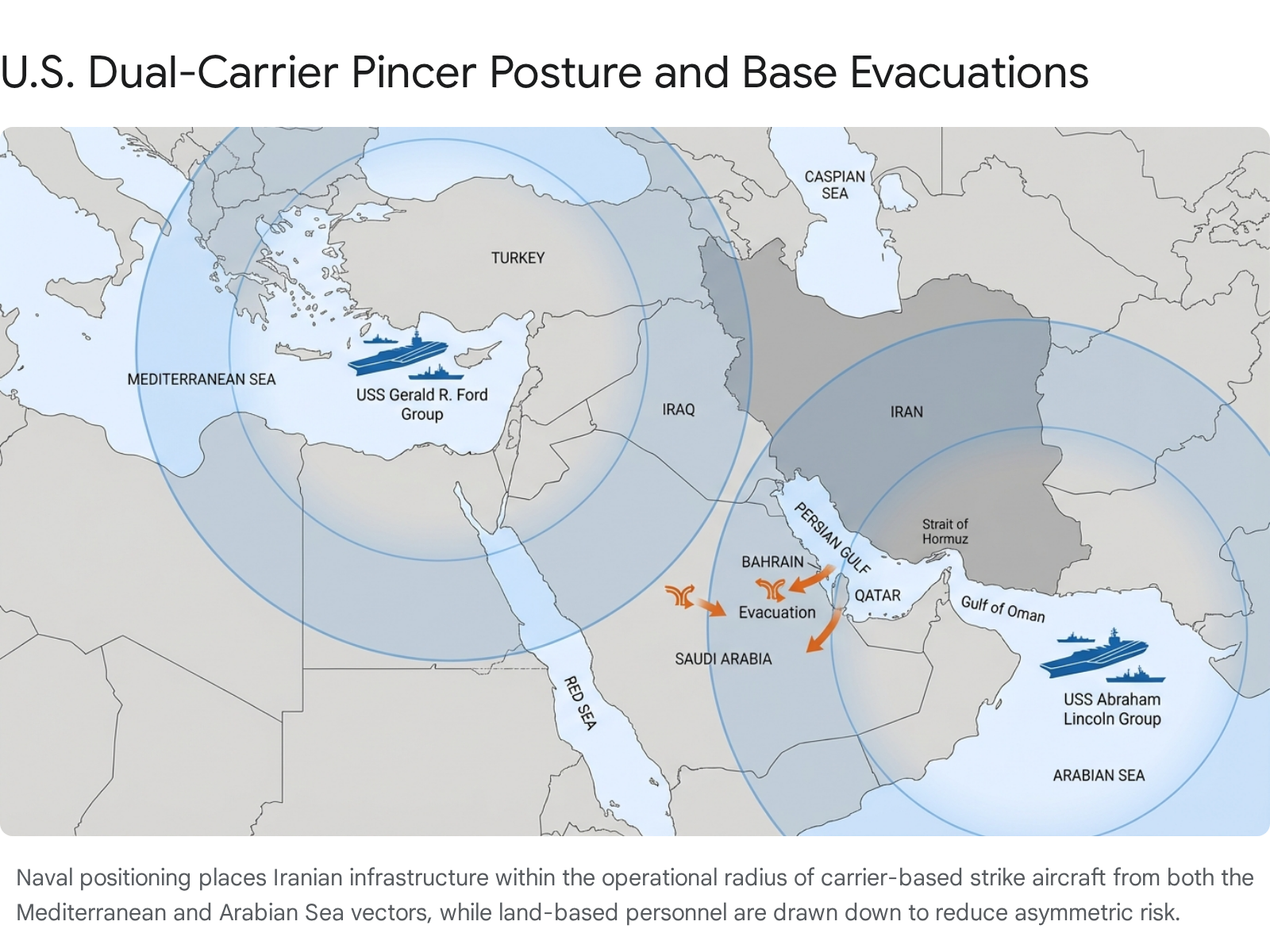
To execute Operation Epic Fury, the United States executed a massive regional force posture realignment. In the weeks preceding the strike, the Pentagon deployed the USS Gerald R. Ford and USS Abraham Lincoln carrier strike groups to the region, introducing over 150 tactical aircraft and hundreds of sea-launched cruise missiles into the theater.3 This naval armada was augmented by a substantial airlift operation, including more than ten C-17 Globemaster III flights from the United Kingdom to Jordan, and heavy transport movements to the strategic bomber base at Diego Garcia in the Indian Ocean.12 Furthermore, the United States deployed twelve F-22 Raptor stealth air-superiority fighters to Israeli air bases, representing a historic shift in forward-positioning offensive American assets directly on Israeli soil.8

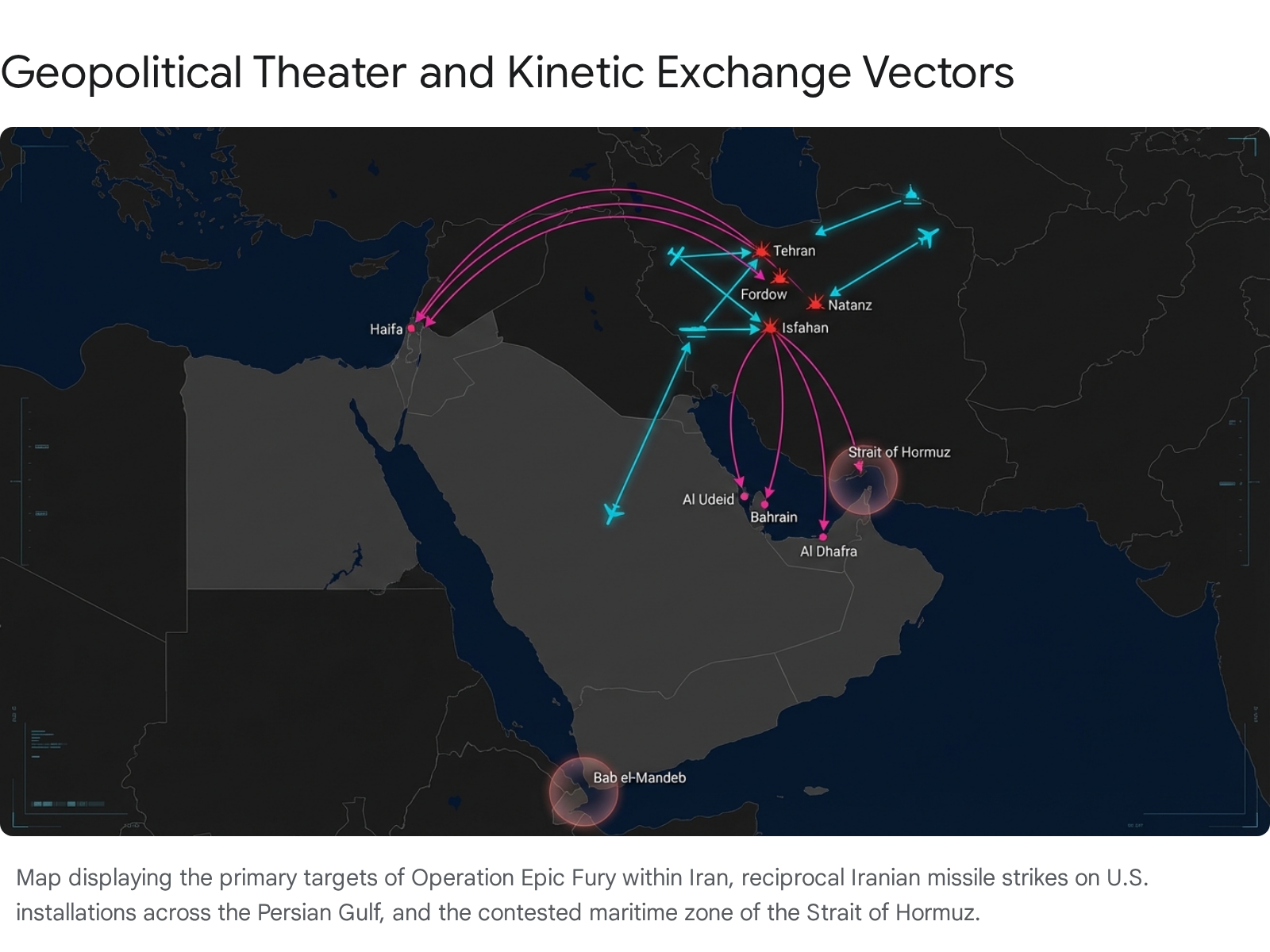
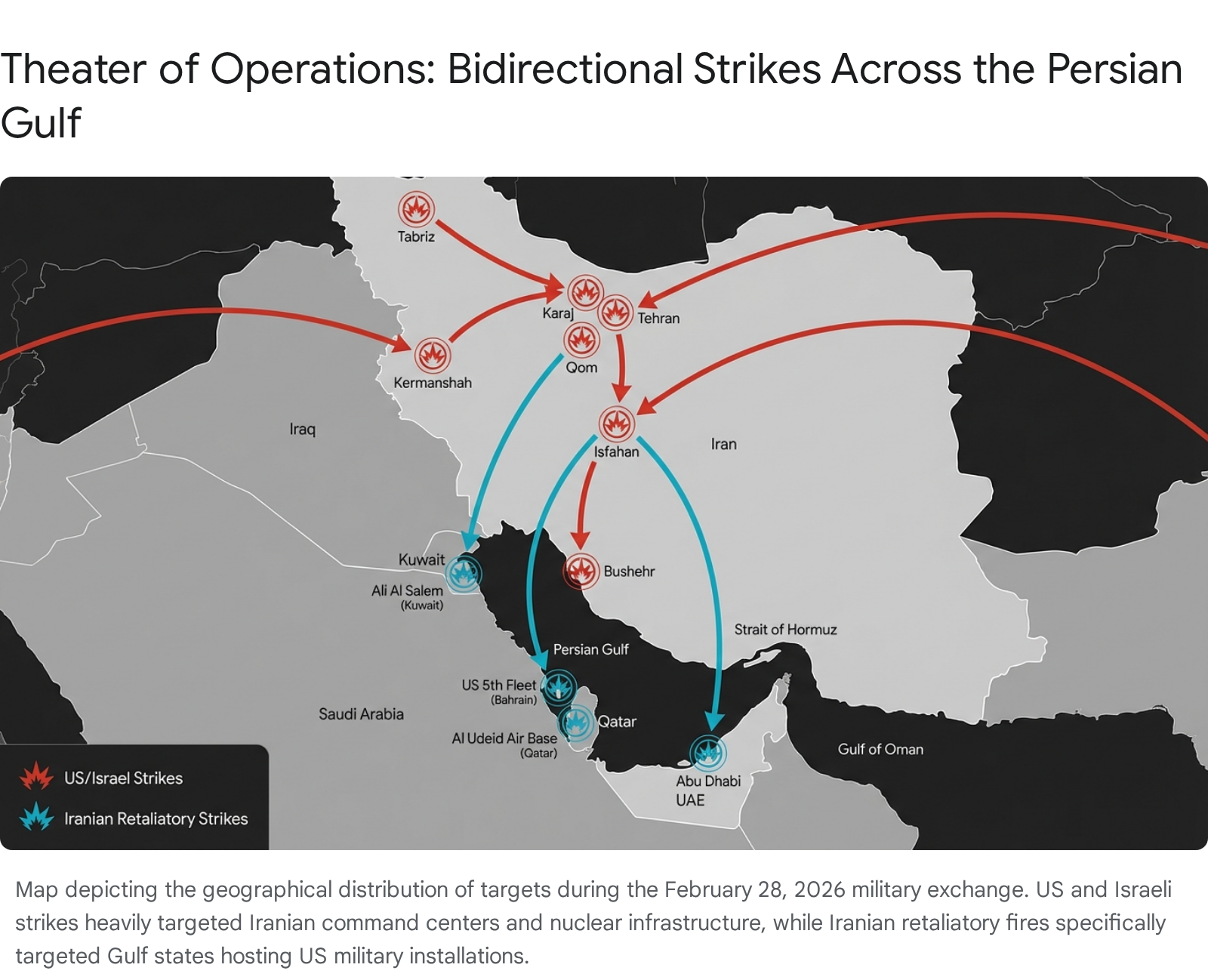
The tactical execution of the allied strikes demonstrated deep penetration into highly defended Iranian airspace during daylight hours-a timing selected specifically to maximize tactical surprise.11 Targets included the residential and administrative complexes of Supreme Leader Ayatollah Ali Khamenei and President Masoud Pezeshkian in central Tehran, as well as critical military and infrastructure nodes in Isfahan, Qom, Karaj, Kermanshah, Tabriz, and the southern port city of Bushehr.1

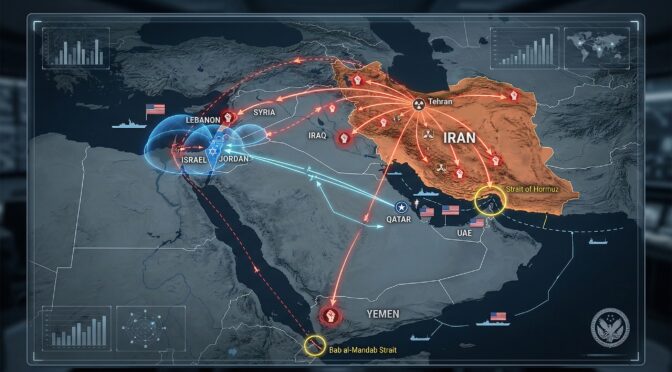
Map of Operation Epic Fury targets in Iran and reciprocal Iranian missile strikes on US installations.

The munitions utilized in the assault indicate a focus on hardened, deeply buried targets. The United States Air Force deployed B-2 Spirit stealth bombers to deliver thirty-thousand-pound GBU-57A/B Massive Ordnance Penetrators (MOPs), which are specialized bunker-buster munitions capable of penetrating subterranean rock formations, specifically targeting the Fordow Uranium Enrichment Plant and the Natanz Nuclear Facility.14 Concurrent naval operations utilized submarine-launched Tomahawk cruise missiles.14 Additionally, the Israel Defense Forces utilized air-launched ballistic missiles to degrade Iranian air defenses and command-and-control centers, preparing the battlespace for manned aircraft operations.2

1.3 Evaluation of Allied Strike Effectiveness

It is assessed with High Confidence that Iran’s Integrated Air Defense System (IADS) failed to repel the allied assault, exposing critical vulnerabilities in the Islamic Republic’s airspace denial capabilities. Iran’s defensive posture had already been severely compromised prior to this operation. During the preceding Israel-Iran War of June 2025, Iran’s domestically produced Bavar-373 ground-based air defense systems systematically failed to intercept United States and Israeli targets.16 Furthermore, targeted Israeli operations in April and October of 2024 successfully destroyed Iran’s advanced Russian-supplied S-300 batteries.16

To compensate for these strategic deficits, the Islamic Revolutionary Guard Corps attempted to implement temporary and extremely suboptimal solutions.16 Intelligence indicates that Iran attached loaded Russian Verba Man-Portable Air-Defense Systems (MANPADS)-which possess a maximum engagement altitude of only 4,500 meters-along with cameras and radios onto domestically produced Shahed drones.16 While this improvisation theoretically increases the altitude at which infrared homing missiles can engage targets, it proved entirely ineffective against high-altitude, low-observable stealth platforms and supersonic cruise missiles utilized in Operation Epic Fury.16 Consequently, allied forces achieved total air superiority, allowing them to prosecute targets at will.17 Open-source intelligence is inconclusive on the precise number of Iranian military casualties, though Iranian state media and regional reporting suggest significant losses within the Islamic Revolutionary Guard Corps, including several senior commanders.1

1.4 Iranian Kinetic Responses: “True Promise 4”

In immediate retaliation to the decapitation strikes, the Islamic Revolutionary Guard Corps launched an operation designated “True Promise 4,” described as a first wave of extensive ballistic missile and drone swarm attacks targeting both Israel and United States assets throughout the Middle East.19 Unlike previous regional escalations where Iran demonstrated calculated restraint to avoid triggering an all-out war, the target selection on February 28 indicated a highly risk-acceptant strategy intended to inflict maximum systemic damage.

Iranian ballistic missiles, likely drawn from its extensive inventory of Sejil, Emad, and Ghadr platforms (which boast ranges up to 2,000 kilometers and are specifically designed to evade conventional radar systems), penetrated Israeli airspace, with confirmed impacts in the northern city of Haifa.2 The Israeli Home Front Command activated nationwide sirens, and civilian medical infrastructure, including hospitals, initiated emergency protocols to transfer patients to underground facilities.23

Simultaneously, Iran broadened the conflict horizontally by targeting the epicenter of United States power projection in the Persian Gulf. Missiles successfully struck the United States Navy’s Fifth Fleet Headquarters in Bahrain, reportedly causing a sizable impact on the facility.2 Additional Iranian strikes targeted Al Udeid Air Base in Qatar, Ali Al Salem Air Base in Kuwait, and Al Dhafra Air Base in the United Arab Emirates.1

The effectiveness of Iran’s retaliatory salvos was significantly blunted by advanced allied air defense networks, though the sheer volume of the attack allowed some munitions to penetrate the shield. The United Arab Emirates Ministry of Defense confirmed the successful interception of multiple incoming missiles, though falling interceptor debris resulted in the death of one civilian in Abu Dhabi.1 Qatari authorities reported successful interceptions utilizing United States-operated Patriot missile defense systems, with no immediate damage reported to Al Udeid.20 The Jordanian military also successfully intercepted two ballistic missiles traversing its sovereign airspace.20 While the exact number of United States and Israeli military casualties remains classified, and open-source intelligence is inconclusive on this point, the psychological and operational disruption across the region was absolute, leading to the uniform closure of civilian airspace across Israel, Iran, Iraq, the United Arab Emirates, and Qatar.26

1.5 Asymmetric, Cyber, and Economic Engagements

The military confrontation on February 28 was heavily augmented by non-kinetic, cyber, and asymmetric warfare. Coinciding with the physical airstrikes, Iran was subjected to a crippling digital offensive. Internet monitor NetBlocks reported that national connectivity plunged to merely four percent of normal levels, inducing a near-total information blackout.28 Western intelligence assessments suggest this cyberattack-likely orchestrated jointly by the United States and Israel-was designed to sever the Islamic Revolutionary Guard Corps’ command-and-control infrastructure, preventing the coordinated launch of additional drones and ballistic missiles by Iranian electronic warfare units.28 Furthermore, state-affiliated media apparatuses, including the Islamic Republic News Agency (IRNA) and the IRGC-aligned Tasnim outlet, were taken offline or hacked to display subversive anti-regime messaging directed against Supreme Leader Khamenei.28 In the domestic sphere, the Tehran Stock Exchange entirely suspended trading, and telecommunications networks experienced severe disruptions.30

The global economic response to the strikes was instantaneous, highlighting Iran’s asymmetric leverage over global energy markets. Anticipation of the strikes drove Brent crude oil prices up significantly to over $72 per barrel, injecting a heavy war premium into global markets as traders assessed the geopolitical risk to maritime energy corridors.31

1.6 Assessment of Overall Effectiveness

The current state of military effectiveness heavily favors the conventional supremacy of the allied forces. It is assessed with High Confidence that the United States and Israel demonstrated overwhelming conventional dominance, achieving air superiority and successfully striking high-value leadership and military targets with impunity. The digital decapitation of Iran’s communication grid was highly effective in the short term, degrading the regime’s ability to coordinate a unified response.28

Conversely, Iran’s military effectiveness is currently limited to its capacity for area denial, economic disruption, and the saturation of regional air defenses. It is assessed with Moderate Confidence that while its indigenous air defense network collapsed entirely, its heavily fortified, underground ballistic missile forces retained sufficient survivability to launch a massive counter-salvo capable of bypassing sophisticated allied interceptors to strike targets as distant as Haifa and Bahrain.2

2. Forecast of Likely Next Steps (Iranian Response Options)

With the collapse of the Geneva nuclear negotiations and the onset of major combat operations, the strategic calculus for the Islamic Republic has fundamentally shifted from maintaining regional deterrence to ensuring absolute regime survival.3 Based on current Iranian military doctrine, recent behavior during the June 2025 conflict, and the unprecedented scale of the February 28 strikes, the following threat matrix forecasts Iran’s most probable next steps in the immediate to medium term.

Threat Matrix: Iranian Response Options

Response OptionDescription of Tactics and VectorsProbability of ExecutionProbability of SuccessAnticipated Allied Countermeasures
Direct Military ConfrontationSustained ballistic and cruise missile salvos, accompanied by Shahed drone swarms, targeting Israeli population centers and U.S. Gulf bases (Qatar, Bahrain, UAE, Kuwait).HighModerateDeployment of U.S. THAAD, Patriot PAC-3, and Israeli Arrow/David’s Sling. Preemptive strikes on Iranian mobile launch sites.
Proxy Utilization (Iraq/Syria)Activation of the Popular Mobilization Forces, Kataib Hezbollah, and Harakat al-Nujaba to strike U.S. bases in Erbil and Baghdad, aiming to force an American withdrawal.HighModerate to HighTargeted assassinations of militia leadership; sustained aerial bombardment of PMF infrastructure and logistics routes.
Proxy Utilization (Levant/Red Sea)Hezbollah rocket barrages on northern Israel; Houthi closure of the Bab el-Mandeb strait and anti-ship missile targeting in the Red Sea.HighModerateIsraeli ground incursions and aerial campaigns in Lebanon; U.S. naval bombardment of Houthi coastal launch facilities in Yemen.
Asymmetric/Maritime WarfareMining operations, GPS jamming, and fast-attack craft harassment of commercial oil tankers in the Strait of Hormuz.Medium-HighHigh (Economic Impact)U.S. 5th Fleet naval escorts; international maritime security coalitions; preemptive strikes on IRGC Navy coastal bases.
Cyber and Global TerrorismWiper malware attacks on Israeli/U.S. critical civilian infrastructure; physical targeting of Jewish or Israeli embassies and diplomatic personnel globally.MediumLow to ModerateDefensive cyber protocols; heightened global intelligence sharing; enhanced embassy security protocols.

2.1 Direct Military Confrontation

It is assessed with High Confidence that Iran will maintain a posture of direct military confrontation. The regime perceives that a failure to respond forcefully to an attack on the Supreme Leader’s compound would fatally undermine its domestic authority and its standing among the Axis of Resistance.1 Iran’s primary operational goal in this domain is not to win a conventional war, but to engage in a war of mathematical attrition.

Iran possesses the largest ballistic missile arsenal in the Middle East, deeply buried in underground missile cities located in Kermanshah, Semnan, and along the Persian Gulf coast, making them highly resilient to preemptive strikes.22 Iran’s strategy relies on volume: launching massive, synchronized swarms designed to mathematically exhaust allied interceptor magazines. While United States and Israeli interceptors are technologically superior, they are constrained by inventory limitations and immense financial costs. For context, during the June 2025 conflict, United States Terminal High Altitude Area Defense (THAAD) batteries expended 92 interceptors defending against Iranian missiles out of a total pre-conflict global inventory of 632.12 Each THAAD battery costs approximately $2.73 billion, with individual interceptors priced at $12.7 million.12 The United States Missile Defense Agency estimates a three-to-eight-year timeline to replenish these stockpiles given current production rates.12 Therefore, the probability of Iranian success in penetrating these defenses increases proportionally with the duration of the conflict.

The anticipated countermeasures by the United States involve relying heavily on destroying Iranian mobile launchers before they can fire, utilizing F-35s and loitering munitions, while selectively utilizing THAAD interceptors only against the most critical inbound threats.12

2.2 Proxy Utilization: The Axis of Resistance (Iraq and Syria)

Iran’s proxy network acts as its strategic depth, allowing Tehran to project power while maintaining a degree of plausible deniability. Despite suffering degradation over the past two years, these groups remain capable of opening multiple geographic fronts.33 It is assessed with High Confidence that Iran will heavily utilize its proxies in Iraq and Syria to target American personnel.

In Iraq, groups operating under the umbrella of the Islamic Resistance in Iraq, including Kataib Hezbollah and Harakat al-Nujaba, possess deep operational experience. Hours after the February 28 strikes began, these militias launched rocket attacks against a United States military base in Erbil, Iraqi Kurdistan.18 The effectiveness of these proxies is high because they force the United States to expend resources defending dispersed, remote outposts. However, the domestic political situation in Iraq presents a severe constraint on Iran’s freedom of action. Major Shiite political blocs comprising the Coordination Framework, including the State of Law Coalition led by Nuri al-Maliki and the Fatah Alliance led by Hadi al-Ameri, view a United States-Iran conflagration on Iraqi soil as an existential threat to their fragile sovereignty and are desperate to stay out of the fight.16 Tehran itself relies on a stable Iraq as an economic lifeline and trade partner to circumvent sanctions.34

Consequently, the United States and Israel are actively preempting proxy mobilization without waiting for Iraqi government permission. Coinciding with the strikes on Tehran, allied aircraft bombed the Popular Mobilization Forces base at Jurf al-Sakhar south of Baghdad, killing at least five Kataib Hezbollah fighters.1 Continuous kinetic suppression of proxy command structures will remain the primary allied countermeasure in this theater.

2.3 Proxy Utilization: The Axis of Resistance (Levant and Red Sea)

It is assessed with High Confidence that Iran will mobilize Hezbollah in Lebanon and the Houthis in Yemen. The Alma Research and Education Center predicts that Hezbollah will play the most significant operational role in retaliation efforts among all proxies, threatening northern Israel with massive rocket barrages.36 Concurrently, the Houthis have already announced their intention to close the Bab el-Mandeb strait, which connects the Red Sea with the Gulf of Aden, threatening a critical node of global maritime trade.2 The anticipated countermeasures will include severe Israeli aerial campaigns in Lebanon and United States naval bombardment of Houthi coastal launch facilities, further expanding the geographical scope of the war.

2.4 Asymmetric and Maritime Warfare: The Strait of Hormuz

As its conventional military options wane under the pressure of allied air superiority, Iran is highly likely to exercise its ultimate asymmetric leverage: disrupting the global economy by choking the Strait of Hormuz. It is assessed with a Medium-High Probability that Iran will escalate maritime hostilities in this sector.

The Strait of Hormuz connects the Persian Gulf to the Indian Ocean and is an essential passage for global oil trade. The waterway is approximately 161 kilometers long and 33 kilometers wide at its narrowest point, with the designated shipping lanes in each direction measuring just two miles wide.37 Approximately twenty percent of the world’s seaborne oil and fifty percent of India’s total crude imports transit through this narrow chokepoint.31

A total physical blockade of the strait is practically difficult and legally complex, as international law mandates the right of transit passage, though Iran has not ratified the 1982 United Nations Convention on the Law of the Sea.37 However, Iran does not need to establish a physical blockade to achieve success; the mere threat of violence drives up commercial maritime insurance premiums and global oil prices. Iran can achieve immense disruption utilizing localized global positioning system (GPS) jamming, deploying naval mines in the shallow shipping lanes, and utilizing Islamic Revolutionary Guard Corps fast-attack patrol boats to harass commercial shipping.37 Current economic modeling suggests that an energy price spike stemming from severe disruption in the Strait of Hormuz could generate additional global inflation pressures of 1.2 to 2.5 percent, with economic recovery timelines extending six to twelve months depending on the duration of the conflict and infrastructure damage assessments.31

Anticipating this move, the United States military has already begun preemptive strikes against major Iranian Navy and IRGC Navy bases in the Persian Gulf and Arabian Sea to preempt mining operations and degrade their capacity to launch fast-attack craft.2

2.5 Cyber Warfare and Global Terrorism

It is assessed with a Medium Probability that Iran will engage in retaliatory cyber warfare and global terrorism. Iran could launch cyberattacks aimed at inflicting economic harm by targeting power grids, financial institutions, and civilian infrastructure within Israel and the United States.36 The historical record demonstrates that following Israel’s military strikes in 2025, there was a 700 percent increase in cyberattacks targeting Israel.39 Furthermore, the Alma Center assesses that Iranian attacks against Israeli and Jewish targets worldwide, including embassies and diplomatic personnel, remain firmly on the table.36 However, the probability of strategic success for these operations is low to moderate, as they are unlikely to alter the fundamental military balance of power, serving primarily as a mechanism to demonstrate reach and undermine the target population’s sense of security.36

3. Assessment of Nuclear Escalation Likelihood

The central justification for Operation Epic Fury was the immediate prevention of Iranian nuclear weaponization following the breakdown of diplomatic negotiations in Geneva.3 The current crisis has brought the possibility of Iran permanently altering its nuclear doctrine to its most acute phase in the history of the Islamic Republic. This section evaluates the technical indicators, the doctrinal shifts, and the threshold for preemptive strikes regarding Iran’s nuclear program.

3.1 Real-Time Indicators and Breakout Time

It is assessed with High Confidence that Iran currently possesses the fissile material necessary for a rapid nuclear breakout. Following the United States’ withdrawal from the Joint Comprehensive Plan of Action (JCPOA) in 2018, Iran systematically breached the agreement’s limitations, which had capped uranium enrichment at 3.67 percent and restricted the total stockpile to 202.8 kilograms using only legacy IR-1 centrifuges.40

By February 2026, Iran’s nuclear advances had entirely eroded these constraints. Prior to the February 28 strikes, the International Atomic Energy Agency (IAEA) reported that Iran maintained vast stockpiles of enriched material. Historical data indicates a severe escalation in highly enriched uranium (HEU) production. The inventory includes 2,595 kilograms of uranium enriched to 5 percent, 840 kilograms enriched to 20 percent, and critically, a stockpile of 440.9 kilograms enriched to 60 percent purity.40 This 60 percent enrichment level has no credible civilian application and represents the most technically challenging hurdle toward achieving weapons-grade (90 percent) material.40

The IAEA assesses that this 60 percent stockpile is theoretically sufficient to construct approximately ten nuclear bombs if enriched further to 90 percent.41 Because the leap from 60 percent to 90 percent requires vastly less time and technical effort than enriching from natural uranium to 20 percent, Iran’s technical breakout time-the time required to produce enough weapons-grade uranium for one nuclear device-is currently measured in a matter of weeks, if not days.7

3.2 Information Gaps and the Loss of Verification

Compounding the threat of a rapid breakout is the fact that international regulatory bodies have been effectively blinded. A confidential IAEA report circulated to member states on February 27, 2026, warned of a total “loss of continuity of knowledge over all previously declared nuclear material at affected facilities” following the June 2025 war.41 The agency explicitly stated it could not verify the current size, composition, or whereabouts of the stockpile of enriched uranium in Iran.41

Specifically, the IAEA pointed to an underground tunnel complex at Isfahan, where Iran had stored its 20 percent and 60 percent enriched uranium, which appeared to have averted destruction during the June 2025 bombings.7 Furthermore, despite strikes on the Natanz facility, Iran had continued construction on the deeply buried Pickaxe Mountain site, which is heavily fortified and capable of housing a new enrichment facility.7 Open-source intelligence is inconclusive on whether the February 28 strikes utilizing GBU-57A/B bunker-buster munitions successfully penetrated and destroyed the Isfahan tunnel complex or the Pickaxe Mountain site, representing a critical intelligence gap regarding the true extent of the damage inflicted on Iran’s nuclear capabilities.

3.3 Doctrine Shift: Rhetoric vs. Actionable Steps

The probability of Iran formally shifting its nuclear doctrine from strategic hedging to active weaponization is now assessed as Moderate to High. Analyzing this probability requires separating diplomatic rhetorical posturing from actionable military imperatives.

In the days preceding the February 28 strikes, Iranian President Masoud Pezeshkian attempted to assure the international community that Iran would not pursue a nuclear bomb, explicitly citing a religious fatwa issued by Supreme Leader Khamenei in the early 2000s forbidding the development of weapons of mass destruction.43 Pezeshkian emphasized that “the religious leader of a society cannot lie like politicians,” attempting to frame the fatwa as an immutable theological constraint.43

However, intelligence analysis dictates that such public political statements are often designed for diplomatic leverage and must be weighed against institutional military imperatives. The Islamic Revolutionary Guard Corps and hardline defense officials operate on a distinct strategic track heavily influenced by historical trauma. Iran’s geopolitical location is conceptualized as a persistent strategic dilemma, deeply shaped by the devastating Iran-Iraq war (1980–1988), during which Saddam Hussein’s systematic use of chemical weapons instilled a profound psychological imperative for military self-reliance and asymmetric defense.45

Following the severe degradation of Iran’s conventional air defense and ballistic missile deterrents in 2024 and 2025, prominent Iranian officials openly began discussing the necessity of a nuclear deterrent to guarantee regime survival.46 Kamal Kharrazi, an advisor to Khamenei, previously stated that if Iran’s existence is threatened, it will have no choice but to change its nuclear doctrine. The threshold for a doctrinal shift is inextricably tied to the perceived threat to the Islamic Republic’s survival. The United States and Israel have crossed a definitive red line by actively targeting Khamenei’s residential complexes and urging the Iranian populace to overthrow the government.1 Under these existential conditions, the religious and political constraints of the anti-nuclear fatwa are highly likely to be overridden by the supreme national security imperative of regime preservation.48

3.4 The Preemptive Strike Threshold

The United States and Israeli calculus for initiating Operation Epic Fury and Lion’s Roar was based precisely on the assessment that Iran was creeping inexorably toward breakout and exploiting diplomatic channels to buy time. During the Geneva negotiations on February 26, the United States presented its maximalist demands.6 While some reports indicated Washington might consider allowing a “token” enrichment of 1 to 1.5 percent, intelligence analysts noted that even 1 percent enrichment represents roughly half the technical effort required to reach weapons-grade uranium.7 When President Trump determined that Iran would not concede to total dismantlement, the threshold for preemptive counter-proliferation strikes was met, prioritizing kinetic disruption over a flawed diplomatic compromise.49

From an intelligence perspective, the critical variable moving forward is whether these strikes successfully eliminated the deeply buried hardware and metallurgic and explosives research-such as operations at the Taleghan 2 facility in Parchin-required to manufacture a workable warhead, or if they merely destroyed surface infrastructure while permanently accelerating Iran’s political resolve to build a device underground.7

4. Executive Summary & Strategic Conclusion

Bottom Line Up Front (BLUF):

The geopolitical paradigm in the Middle East has definitively shifted from proxy attrition and coercive diplomacy to a direct, high-intensity state-on-state conflict. The United States and Israeli preemptive military campaign (Operation Epic Fury and Operation Lion’s Roar) launched on February 28, 2026, aims to permanently dismantle Iran’s nuclear and conventional military infrastructure, neutralize its regional threat, and incite regime change. In immediate response, the Islamic Republic has executed massive retaliatory ballistic missile strikes against Israel and key United States military installations across the Persian Gulf, achieving partial penetrations of allied air defenses and triggering global economic volatility.

The Escalatory Ladder and Immediate Trajectory:

It is assessed with High Confidence that the conflict will not quickly de-escalate. The strategic environment is characterized by the following dynamics:

  1. The Death of Diplomacy: The structural failure of the Geneva negotiations and the onset of heavy kinetic operations have removed all diplomatic off-ramps in the near term. Iran’s leadership perceives the current allied assault as an existential threat aimed at the total eradication of the Islamic Republic, precluding any near-term return to the negotiating table.1
  2. A War of Attrition and Saturation: The immediate trajectory points toward a violent, sustained war of attrition. Iran will utilize its vast, deeply buried ballistic missile reserves and expansive proxy network (including Hezbollah, Iraqi militias, and the Houthis) to saturate United States and Israeli air defenses. The operational goal is to inflict unacceptable military and economic costs on the allies, banking on the mathematical exhaustion of expensive interceptor inventories like THAAD and Patriot systems.12
  3. Global Economic Vulnerability: The global economy faces severe near-term risks due to anticipated Iranian asymmetric operations targeting the Strait of Hormuz. The mere threat of maritime disruptions involving naval mines or GPS jamming has already initiated a spike in crude oil prices, threatening to inject significant inflationary pressure into the global economy.31
  4. Regional Distractions and Phase 2 Collapse: The conflagration with Iran threatens to completely overshadow and derail the United States-brokered Phase 2 of the Gaza ceasefire. The newly inaugurated National Committee for the Administration of Gaza, designed to manage post-war reconstruction under a technocratic framework led by Dr. Ali Shaath, is likely to be marginalized as regional attention and military resources are entirely consumed by the Iranian theater.50
  5. The Nuclear Paradox: Paradoxically, while the allied strikes were specifically designed to neutralize Iran’s nuclear threat, they have validated the arguments of Iranian hardliners who claim that conventional deterrence has failed and that a nuclear weapon is the only guarantor of regime survival. If the allied bunker-buster munitions failed to utterly eradicate Iran’s underground highly enriched uranium stockpiles and weaponization hardware, Iran is highly likely to abandon its previous hedging strategy, discard the religious fatwa against weapons of mass destruction, and officially pursue a nuclear device as rapidly as technically feasible.

The Middle East is currently experiencing its most profound security crisis in decades. The ultimate success of the allied campaign hinges on whether it can rapidly and permanently degrade Iran’s command and control infrastructure before Iran’s asymmetric and conventional retaliation inflicts catastrophic economic and strategic damage on United States regional interests. Open-source intelligence will continue to closely monitor the integrity of the Strait of Hormuz, the operational status of the United States Fifth Fleet in Bahrain, and internal Iranian political stability as the leading indicators of the conflict’s ultimate trajectory.


Please share the link on Facebook, Forums, with colleagues, etc. Your support is much appreciated and if you have any feedback, please email us in**@*********ps.com. If you’d like to request a report or order a reprint, please click here for the corresponding page to open in new tab.


Sources Used

  1. 2026 Israeli–United States strikes on Iran – Wikipedia, accessed February 28, 2026, https://en.wikipedia.org/wiki/2026_Israeli%E2%80%93United_States_strikes_on_Iran
  2. U.S. And Israel At War With Iran (Updated), accessed February 28, 2026, https://www.twz.com/news-features/iran-is-under-attack
  3. Israeli Preemptive Military Attack Against Iran: Intel Brief, accessed February 28, 2026, https://www.specialeurasia.com/2026/02/28/israel-military-attack-iran-feb/
  4. Trump issues ultimatum to Iran, accessed February 28, 2026, https://www.denvergazette.com/2026/02/19/trump-issues-ultimatum-to-iran/
  5. Trump moves toward Iran attack as mediator says nuclear deal is close, accessed February 28, 2026, https://www.washingtonpost.com/national-security/2026/02/27/us-iran-war-israel-embassy-evacuation/
  6. Iran Update, February 26, 2026 | ISW, accessed February 28, 2026, https://understandingwar.org/research/middle-east/iran-update-february-26-2026/
  7. Reported U.S. Demands on Iran Fall Short of Eliminating Tehran’s Threat, accessed February 28, 2026, https://www.fdd.org/analysis/2026/02/26/reported-u-s-demands-on-iran-fall-short-of-eliminating-tehrans-threat/
  8. Israel Update: February 26, 2026 – Jewish Dallas, accessed February 28, 2026, https://www.jewishdallas.org/news/israel-update-february-26-2026/
  9. US launches Operation Epic Fury on Iran as Israel joins and Tehran targets American bases, accessed February 28, 2026, https://m.economictimes.com/news/defence/us-donald-trump-launches-operation-epic-fury-on-iran-as-israel-joins-and-tehran-targets-american-bases/articleshow/128882043.cms
  10. The Latest: US-Iran talks end in Geneva but ‘will resume soon,’ Omani minister says, accessed February 28, 2026, https://www.2news.com/news/world/the-latest-tense-us-iran-talks-in-geneva-as-trump-deploys-warships-and-aircraft-to/article_7ceabc43-68c3-527a-98ef-16e59db0e117.html
  11. Operation Epic Fury: How U.S., Israel strikes targeted Iran’s top brass, accessed February 28, 2026, https://m.economictimes.com/news/defence/operation-epic-fury-how-u-s-israel-strikes-targeted-irans-top-brass/articleshow/128882836.cms
  12. America’s Military Buildup Around Iran: What We Know and What It Means, accessed February 28, 2026, https://www.meforum.org/mef-reports/americas-military-buildup-around-iran-what-we-know-and-what-it-means
  13. Israel, United States strike Islamic Republic, targeting heart of regime, accessed February 28, 2026, https://www.iranintl.com/en/202602289915
  14. United States strikes on Iranian nuclear sites – Wikipedia, accessed February 28, 2026, https://en.wikipedia.org/wiki/United_States_strikes_on_Iranian_nuclear_sites
  15. Preliminary Assessment of Iran’s Nuclear Development and the Attacks on Nuclear-Related Facilities | Satellite Image Analysis Project, accessed February 28, 2026, https://www.spf.org/spf-china-observer/en/eisei/eisei-detail013.html
  16. Iran Update, February 24, 2026, accessed February 28, 2026, https://understandingwar.org/research/middle-east/iran-update-february-24-2026/
  17. Israel and Iran at War: What Comes Next? – CSIS, accessed February 28, 2026, https://www.csis.org/analysis/israel-and-iran-war-what-comes-next
  18. Live – Israel and US launch strikes on Iran as Tehran prepares …, accessed February 28, 2026, https://www.iranintl.com/en/liveblog/202602288143
  19. Sirens sound across Israel amid Iranian ballistic missile attacks; Netanyahu says Israel, US launched strikes to ‘remove existential threat’ posed by Iran, accessed February 28, 2026, https://www.timesofisrael.com/liveblog-february-28-2026/
  20. Explosions reported across Persian Gulf as Iran retaliates US, Israeli attacks, accessed February 28, 2026, https://www.iranintl.com/en/202602285934
  21. Israel’s lonely push for war with Iran – +972 Magazine, accessed February 28, 2026, https://www.972mag.com/israel-iran-escalation-regional-war/
  22. What are Iran’s ballistic missile capabilities?, accessed February 28, 2026, https://www.straitstimes.com/world/middle-east/what-are-irans-ballistic-missile-capabilities
  23. US and Israel launch a major attack on Iran; President Trump urges Iranians to ‘take over your government’ | newswest9.com, accessed February 28, 2026, https://www.newswest9.com/article/news/nation-world/us-israel-launch-attack-on-iran-latest/507-266ecf05-052a-40a1-8f1d-9ffafcfe0467
  24. US and Israel launch an attack on Iran with tensions high over nuclear talks, accessed February 28, 2026, https://www.king5.com/article/news/nation-world/us-israel-launch-attack-on-iran-latest/507-266ecf05-052a-40a1-8f1d-9ffafcfe0467
  25. Iran launches retaliatory strikes after major US-Israel attack – live, accessed February 28, 2026, https://www.theguardian.com/world/live/2026/feb/28/israel-attacks-iran-as-blasts-heard-in-tehran-live-updates
  26. Iran-Israel war: Air India, IndiGo and multiple other airlines suspend flights. Check full list, accessed February 28, 2026, https://m.economictimes.com/nri/latest-updates/iran-israel-war-multiple-airlines-suspend-flights-check-full-list/articleshow/128879934.cms
  27. UAE intercepts several Iranian missiles, state news agency says, accessed February 28, 2026, https://iranintl.com/en/202602283447
  28. Israel performs largest cyberattack in history against Iran | The Jerusalem Post, accessed February 28, 2026, https://www.jpost.com/israel-news/defense-news/article-888271
  29. Iran Plunged Into Digital Darkness as Internet Blocked Amid US, Israeli Air Strikes, accessed February 28, 2026, https://www.rferl.org/a/iran-internet-blackout-us-israel-military-attack/33690399.html
  30. War Coverage: Israel Strikes Iran – IranWire, accessed February 28, 2026, https://iranwire.com/en/news/149630-war-coverage-israel-strikes-iran/
  31. U.S.-Israel Strikes Iran: Energy Market Volatility – Discovery Alert, accessed February 28, 2026, https://discoveryalert.com.au/energy-market-volatility-2026-global-economic-impact/
  32. Oil prices rise amid fears of US strikes on Iran – as it happened | Business | The Guardian, accessed February 28, 2026, https://www.theguardian.com/business/live/2026/feb/19/british-gas-centrica-profit-gen-z-trades-ai-ftse-sterling-pound-stocks-business-live-news
  33. Trump Is Potentially Leading the United States Into an Unnecessary War With Iran, accessed February 28, 2026, https://www.americanprogress.org/article/trump-is-potentially-leading-the-united-states-into-an-unnecessary-war-with-iran/
  34. Why Arab states are terrified of US war with Iran, accessed February 28, 2026, https://responsiblestatecraft.org/iran-war-gulf-states/
  35. Air strike hits Iraqi base hosting pro-Iran militia, sources say, accessed February 28, 2026, https://www.timesofisrael.com/liveblog_entry/air-strike-hits-iraqi-base-hosting-pro-iran-militia-sources-say/
  36. How Iran may respond to US military action | The Jerusalem Post, accessed February 28, 2026, https://www.jpost.com/middle-east/iran-news/article-888175
  37. How strikes on Iran put focus on the Strait of Hormuz – Straitstimes.com, accessed February 28, 2026, https://www.straitstimes.com/world/middle-east/how-strikes-on-iran-put-focus-on-the-strait-of-hormuz
  38. US-Israel strike on Iran: Attack puts 50% of India’s oil imports at risk via Hormuz, accessed February 28, 2026, https://www.businesstoday.in/latest/economy/story/us-israel-strike-on-iran-attack-puts-50-of-indias-oil-imports-at-risk-via-hormuz-518462-2026-02-28
  39. How Would Iran Respond to a U.S. Attack?, accessed February 28, 2026, https://www.csis.org/analysis/how-would-iran-respond-us-attack
  40. The Status of Iran’s Nuclear Program | Arms Control Association, accessed February 28, 2026, https://www.armscontrol.org/factsheets/status-irans-nuclear-program-1
  41. UN nuclear watchdog says it’s unable to verify whether Iran has suspended all uranium enrichment – 95.5 WSB, accessed February 28, 2026, https://www.wsbradio.com/news/world/un-nuclear-watchdog/UDHVK5MXAI4TNHCQJ5XLREFFBY/
  42. IAEA report says Iran must allow inspections, points at Isfahan | 1330 & 101.5 WHBL, accessed February 28, 2026, https://whbl.com/2026/02/27/iaea-report-says-iran-must-allow-inspections-points-at-isfahan/
  43. Khamenei has banned nuclear weapons, Iran president says, accessed February 28, 2026, https://www.iranintl.com/en/202602267062
  44. Iranian president reiterates Tehran’s opposition to building nuclear weapons, accessed February 28, 2026, https://english.alarabiya.net/News/middle-east/2026/02/26/-iran-president-reiterates-iran-s-opposition-to-building-nuclear-weapons
  45. Iran’s Nuclear Aspirations: Security Fears And Strategic Consequences – OpEd, accessed February 28, 2026, https://www.eurasiareview.com/18022026-irans-nuclear-aspirations-security-fears-and-strategic-consequences-oped/
  46. With Its Conventional Deterrence Diminished, Will Iran Go for the Bomb?, accessed February 28, 2026, https://www.washingtoninstitute.org/policy-analysis/its-conventional-deterrence-diminished-will-iran-go-bomb
  47. U.S. launches ‘major combat operations’ in Iran, Trump says, accessed February 28, 2026, https://www.ms.now/news/trump-attack-iran-israel-strikes
  48. Total nuclear dismantlement is Iran’s only option to stop an American attack, accessed February 28, 2026, https://www.fdd.org/analysis/2026/02/26/total-nuclear-dismantlement-is-irans-only-option-to-stop-an-american-attack/
  49. Trump ‘not happy’ with Iran situation and says military force is still an option, accessed February 28, 2026, https://www.theguardian.com/world/2026/feb/27/us-urges-citizens-leave-israel-threat-strike-iran
  50. Gaza Phase 2 – Human Rights & Public Liberties – Al Jazeera, accessed February 28, 2026, https://liberties.aljazeera.com/en/gaza-phase-2/
  51. How Netanyahu is sabotaging phase two of the Gaza ceasefire – +972 Magazine, accessed February 28, 2026, https://www.972mag.com/gaza-ceasefire-netanyahu-sabotage-ncag/

SITREP Iran Including the US & Israeli Strike – Week Ending February 28, 2026

Executive Summary

The week ending February 28, 2026, represents a profound and catastrophic inflection point in the geopolitical and security architecture of the Middle East. Following the complete collapse of high-stakes, Omani-mediated nuclear negotiations in Geneva, the United States and the State of Israel initiated a massive, coordinated, preemptive military campaign against the Islamic Republic of Iran. Designated “Operation Epic Fury” by the United States Department of Defense and “Operation Roaring Lion” by the Israel Defense Forces, this offensive marks the transition from a prolonged strategy of maximalist diplomatic pressure and deterrence into direct, theater-wide, high-intensity armed conflict.1 The kinetic operations, deliberately executed in broad daylight to maximize psychological impact and demonstrate absolute airspace dominance, targeted the deepest echelons of the Iranian command-and-control apparatus, critical subterranean nuclear infrastructure, and ballistic missile production facilities across multiple provinces.1

In immediate response to the US-Israeli offensive, Iran activated its strategic retaliatory framework, initiating “Operation True Promise 4.” Demonstrating a severe horizontal escalation of the conflict, the Islamic Revolutionary Guard Corps (IRGC) launched extensive waves of ballistic missiles, cruise missiles, and unmanned aerial vehicles (UAVs) not only at Israeli territory but directly at sovereign Gulf Arab states hosting United States military installations.4 By explicitly targeting US assets in the United Arab Emirates, Qatar, Bahrain, and Kuwait, Tehran has signaled its intent to fracture the US-led regional security umbrella, imposing unbearable security costs on US allies and transforming a localized dispute into a comprehensive, multi-front regional war.4

This kinetic exchange is simultaneously supported by a devastating non-kinetic cyber offensive. A near-total internet blackout has effectively isolated the Iranian populace from the global digital sphere, crippling state media apparatuses and reducing national internet connectivity to an estimated four percent of its ordinary baseline levels.6 The macroeconomic shockwaves of this sudden outbreak of war are already registering violently across global markets. Brent crude and West Texas Intermediate (WTI) oil prices have spiked amid acute fears of an Iranian blockade of the Strait of Hormuz, while safe-haven assets such as gold have surged to historic, unprecedented highs above $5,230 per ounce.9 Concurrently, commercial aviation across the Middle East has ground to a complete halt as regional airspaces close, severing critical logistical arteries connecting Europe, Asia, and Africa.12

This situation report synthesizes multi-source intelligence across the military, diplomatic, cyber, and economic domains. The analysis indicates that the conflict has irrevocably altered the balance of power in the region. The decapitation strikes aimed at the inner circle of Supreme Leader Ayatollah Ali Khamenei suggest an explicit US and Israeli objective of catalyzing regime change from within, exploiting existing domestic fractures, widespread economic despair, and ongoing anti-government protests.14 As the Iranian proxy network – the Axis of Resistance – mobilizes across Lebanon, Syria, Iraq, and Yemen, the international community faces the immediate threat of a protracted, devastating regional conflict with severe implications for global energy security and great power competition.

1. Strategic Precursors and the Collapse of the Geneva Framework

The military operations executed on February 28 did not occur spontaneously; they represent the explosive culmination of a massive, multi-month force generation effort and a deliberate shift in strategic posture following the inconclusive 12-day war in June 2025.16 The intelligence landscape in the weeks leading up to the strike was dominated by unmistakable indicators of an impending offensive, driven by the United States’ maximalist pressure campaign and the catastrophic failure of last-ditch diplomatic efforts to curb Iran’s advancing nuclear program.

1.1. The Final Diplomatic Push in Geneva

Throughout February 2026, the international community observed a high-stakes, highly volatile diplomatic effort aimed at averting regional war. Indirect negotiations between the United States and Iran were held in Geneva, Switzerland, mediated heavily by Omani Foreign Affairs Minister Badr al Busaidi.18 The US delegation, led by envoys Steve Witkoff and Jared Kushner, engaged with Iranian Foreign Minister Abbas Araghchi in an attempt to forge a comprehensive agreement to replace the defunct 2015 Joint Comprehensive Plan of Action (JCPOA).20

The Omani mediation channel initially reported “significant progress,” suggesting that a diplomatic off-ramp was within reach.18 According to Omani sources, Iran had tentatively agreed to cap its uranium enrichment, blend down existing stockpiles of highly enriched uranium (HEU) to the lowest possible level, and grant inspectors from the International Atomic Energy Agency (IAEA) “full access” to its nuclear sites to verify compliance.19 Iranian officials indicated a willingness to consider an interim deal, floating the possibility of addressing non-nuclear issues in later stages to delay military action and extract economic sanctions relief.15

1.2. Irreconcilable Red Lines

Despite the optimistic framing by regional mediators, the core negotiating positions of Washington and Tehran remained fundamentally irreconcilable. US negotiators presented a rigid set of maximalist demands that Tehran viewed as an unacceptable infringement on its national sovereignty. Specifically, the US demanded the complete and permanent physical dismantlement of Iran’s highly fortified subterranean nuclear facilities at Fordow, Natanz, and Esfahan.18 Furthermore, the US insisted on the total surrender and extraction of all enriched uranium from Iranian territory, a permanent agreement without sunset clauses, and an absolute “zero-enrichment” mandate.18

Iran categorically rejected these conditions. An unspecified Iranian source with intimate knowledge of the discussions stated unequivocally that Iran was not willing to destroy its nuclear infrastructure, ship its enriched uranium out of the country, or accept a zero-enrichment mandate, insisting instead on its sovereign “right” to a peaceful nuclear program.15 In counter-proposals, US negotiators signaled a slight softening, indicating they “could be open” to allowing “token enrichment” at very low levels strictly for medical purposes, provided Iran could credibly prove it lacked the capacity to weaponize the material.18 However, the US offered only “minimal sanctions relief” in exchange for these sweeping concessions, a proposition that directly contradicted Tehran’s absolute prerequisite that all US and United Nations Security Council (UNSC) sanctions be lifted as the foundation of any deal.18

Date (Feb 2026)Event DescriptionStrategic Implication
Mid-FebUS initiates largest military buildup in the Middle East since 2003, moving naval, air, and logistics assets into the theater.23Establishes overwhelming theater supremacy and provides the President with diverse kinetic strike options.
Feb 19US President issues a 10-15 day deadline for Tehran to reach a “meaningful deal,” warning that otherwise “bad things happen”.24Sets a firm, public countdown clock for diplomacy, cornering both US and Iranian leadership into actionable commitments.
Feb 26Geneva talks hit an impasse. US demands dismantlement of Fordow, Natanz, and Esfahan; Iran categorically refuses.18The diplomatic track officially fails as core red lines regarding domestic uranium enrichment prove unbridgeable.
Feb 27US President publicly expresses extreme dissatisfaction, stating he is “not happy” with the talks and that Iran “cannot have nuclear weapons”.19Signals the formal end of the diplomatic window and the imminent authorization of preemptive military force.
Feb 28Operations Epic Fury and Roaring Lion commence; US and Israeli forces launch massive preemptive strikes across Iranian territory.1The transition from deterrence and coercive diplomacy into direct, theater-wide armed conflict.

The timeline of escalation demonstrates a rapid compression of the diplomatic window. The failure to bridge the gap over domestic uranium enrichment directly precipitated the authorization of military force, bringing the months-long military buildup to its intended, kinetic conclusion.

2. Force Posture and Theater Buildup: The Road to War

To execute a campaign of this magnitude, the United States Department of Defense, operating in deep coordination with the Israel Defense Forces, required an unprecedented staging of military assets. Beginning in late January 2026, the United States executed its largest and most comprehensive military deployment to the Middle East since the 2003 invasion of Iraq.23 This force generation was meticulously designed to establish absolute theater supremacy, overwhelm Iran’s integrated air defense systems (IADS), and provide a diverse array of strike vectors to ensure the destruction of deeply buried, hardened targets.

2.1. United States and Allied Force Generation

The maritime component of this buildup was anchored by the deployment of two massive Carrier Strike Groups (CSGs). The USS Abraham Lincoln (CVN-72) and its accompanying strike group assumed operational positions in the Arabian Sea and the Gulf of Oman, providing immediate striking distance to Iran’s southern and eastern provinces.21 Simultaneously, the USS Gerald R. Ford (CVN-78), the newest and most advanced aircraft carrier in the US fleet, was deployed to the eastern Mediterranean Sea, providing an alternative strike vector and deep strategic reserve.20

Complementing the immense naval presence was a historic influx of land-based aerial assets. Intelligence reports tracked more than 100 aerial refueling tankers and over 200 heavy strategic cargo planes moving into regional bases in mid-February to establish the logistical backbone required for sustained combat operations.30 Satellite imagery analysis of the Muwaffaq Salti Air Base in Jordan confirmed the presence of more than 50 combat aircraft massing near the Iraqi border.30

Crucially, the United States relocated 12 F-22 Raptor stealth air superiority fighters to highly secure installations within Israel.30 This specific deployment of fifth-generation stealth fighters, augmented by existing regional deployments of F-15, F-16, and F-35 squadrons previously utilized in other theaters, signaled a high-end combat capability explicitly intended to penetrate heavily defended Iranian airspace and systematically dismantle advanced surface-to-air missile (SAM) networks prior to the arrival of heavier payload bombers.28

Asset TypeDeployment DetailsStrategic Role
Carrier Strike GroupsUSS Abraham Lincoln (Arabian Sea); USS Gerald R. Ford (Eastern Mediterranean).20Massive maritime power projection; diverse launch vectors for strike aircraft and Tomahawk cruise missiles.
Stealth Fighters12 F-22 Raptors deployed to bases in Israel; diverse F-35 squadrons.28Penetration of contested airspace; Suppression/Destruction of Enemy Air Defenses (SEAD/DEAD); escort missions.
Strike/Multirole Aircraft50+ aircraft (F-15s, F-16s) staged at Muwaffaq Salti Air Base in Jordan.28High-volume precision strike capabilities against infrastructure, command nodes, and missile silos.
Logistics Support100+ aerial refueling tankers; 200+ heavy cargo planes deployed across European and Middle Eastern bases.30Essential logistical backbone enabling sustained, high-tempo combat operations over vast geographic distances.

2.2. Iranian Defensive Posture and Critical Vulnerabilities

The Iranian regime and the IRGC were acutely aware of the massing US armada. Intelligence assessments indicate that Iran accurately perceived the high probability of a kinetic strike and initiated emergency, albeit insufficient, defensive preparations.31 Acknowledging critical vulnerabilities within its airspace coverage, Iran sought immediate materiel support from its primary geopolitical partners, the Russian Federation and the People’s Republic of China, to prepare for an asymmetrical war against the United States.31

Tehran specifically requested alternative, advanced air defense components to fortify its IADS.31 However, intelligence indicates that the stopgap measures acquired—such as portable Russian Verba man-portable air-defense systems (MANPADS)—were entirely insufficient to replace or supplement their localized, older S-300 batteries.31 These localized systems lacked the integration and processing power required to repel a coordinated, multi-axis stealth attack utilizing electronic warfare, cyber-blinding, and saturation munitions.

Furthermore, the Iranian regime was operating under immense internal pressure. Renewed anti-regime student protests had spread organically from university campuses to elementary and secondary high schools across the nation, indicating a deep, systemic, and generational disillusionment with the theocratic government.31 The Iranian economy, suffocated by compounding US sanctions and rampant hyperinflation, left the regime with limited domestic capital and severely degraded civilian morale. Analysts assess that this dual vulnerability—a porous, technologically outmatched air defense network and a highly hostile, economically devastated domestic populace—was heavily factored into the US and Israeli calculus as a critical force multiplier for preemptive kinetic action.

3. Execution of Operations Epic Fury and Roaring Lion

On the morning of Saturday, February 28, 2026, the United States and Israel crossed the ultimate threshold from coercive diplomacy to major combat operations. The joint offensive, utilizing dozens of attack aircraft flying from regional bases and carrier decks integrated with stand-off munitions and naval fires, struck deeply into the sovereign territory of the Islamic Republic.22

3.1. Tactical Shifts: The Psychology of the Daylight Offensive

A highly significant tactical anomaly in the February 28 offensive was the operational decision to conduct the initial waves of strikes in broad daylight, commencing at approximately 8:10 AM local time.1 Modern Western air campaigns, including the initial strikes of the 2003 Iraq War and the June 2025 air war against Iran, almost exclusively initiate during predawn hours.1 Operating under the cover of darkness maximizes the asymmetric advantages of superior Western night-vision capabilities, degrades the visual detection capacities of ground-based optical targeting systems, and exploits the circadian rhythms of defending forces.1

The decision to operate in the harsh light of day represents a profound psychological and tactical choice by US and Israeli command. Analytically, a daylight strike serves three primary strategic functions. First, it demonstrates absolute, supreme confidence in the success of the initial Suppression of Enemy Air Defenses (SEAD) campaign. By flying combat sorties in daylight, the US and Israel signaled that Iran’s radar warning receivers and anti-aircraft artillery networks had been thoroughly blinded, jammed, or physically destroyed.

Second, the daylight operation provided immediate, undeniable visual confirmation of the regime’s destruction to the Iranian populace. Large, towering plumes of black smoke dominated the skylines of Tehran, Isfahan, and other major metropolitan areas, making it impossible for the state media to deny or downplay the scale of the attack.1 Third, it served as a direct, humiliating psychological blow to the regime’s carefully cultivated aura of invincibility, essentially executing a punitive, decapitating operation while the civilian populace was fully awake to witness the ultimate vulnerability of the state security apparatus.

3.2. Target Matrix and Decapitation Efforts

The target matrix for Operation Epic Fury and Roaring Lion was extensive, spanning the entirety of the Iranian geography but heavily, deliberately concentrated on the nodes essential for regime preservation, command and control, and strategic deterrence. Strikes were confirmed in the capital city of Tehran, the nuclear hub of Isfahan, the holy city of Qom, as well as critical military and industrial zones in Karaj, Kermanshah, Lorestan, Tabriz, Ilam, Khorramabad, and the southern port city of Bushehr.3

The most strategically significant targeting occurred within the political heart of Tehran. Precision strikes obliterated sections of the Pasteur Street compound in downtown Tehran.1 This highly fortified, multi-block complex houses the operational office of the Iranian President, the headquarters of the Supreme National Security Council, and the central intelligence leadership of the Islamic Revolutionary Guard Corps.1

More critically, the first wave of strikes directly targeted the immediate vicinity of the residential and office complex of Supreme Leader Ayatollah Ali Khamenei—an area long considered the symbolic and operational center of the regime’s absolute authority.34 While state-affiliated media immediately broadcasted reports that the 86-year-old Khamenei was unharmed and had been preemptively transferred to a “secure location” outside of the capital, the kinetic penetration of his inner sanctum is a severe, unprecedented blow to the regime’s prestige.34 Videos circulating on restricted social media networks showed Iranian citizens reacting with shock, and in several verified instances, open celebration, referring to the targeted site as the “leader’s house” and expressing disbelief at the precision of the strikes.34

Beyond leadership decapitation nodes, the strikes prioritized the neutralization of the regime’s strategic military deterrents. Sites in Isfahan, a known hub for Iranian nuclear enrichment and research facilities, were heavily bombarded.3 While exact battle damage assessments regarding the deep subterranean centrifuge cascades remain highly classified, the strikes were intended to permanently degrade Iran’s nuclear breakout capacity.3 Furthermore, President Trump explicitly stated that the operational objective was to completely “annihilate” the Iranian Navy to ensure unimpeded freedom of navigation in the Persian Gulf and to “destroy their missiles and raze their missile industry to the ground,” eliminating the primary delivery mechanisms for any potential unconventional payloads.3

Map: Bidirectional strikes across the Persian Gulf, US/Israeli and Iranian retaliatory strikes, SITREP Iran, February 28, 2026.

4. Operation True Promise 4: Iran’s Retaliatory Framework and Horizontal Escalation

The swiftness, volume, and specific targeting of Iran’s immediate counter-offensive, officially dubbed “Operation True Promise 4” by the IRGC, reveals a profound, highly dangerous shift in Tehran’s strategic military doctrine.5 Following the initial waves of US-Israeli airstrikes, Iran’s Foreign Ministry and the Supreme National Security Council rapidly mobilized, invoking Article 51 of the United Nations Charter to claim the inherent right to self-defense against what they termed “criminal aggression” and “flagrant violations” of international law.4

However, rather than exclusively targeting Israeli territory in a localized, symmetrical response—as witnessed during the April 2024 iteration of “Operation True Promise”—Iran unleashed a massive horizontal escalation.40 Tehran deliberately expanded the theater of war by launching a barrage of strikes targeting the sovereign territory of multiple Gulf Arab states that host critical United States military infrastructure.4

4.1. Targeting the US Gulf Security Architecture

Intelligence confirms that the IRGC Aerospace Force launched extensive waves of ballistic missiles, cruise missiles, and suicide drones directed southward across the Persian Gulf at the United Arab Emirates, Qatar, Bahrain, and Kuwait.4 This target selection is a cold, calculated strategic maneuver designed to test the resilience of the US alliance network. For years, Iran has explicitly threatened that any neighboring nation allowing its airspace, territorial waters, or landmass to be utilized by the US or Israel as a launchpad for an attack on the Islamic Republic would immediately be considered a legitimate, primary military target.4 Operation True Promise 4 is the brutal execution of this longstanding threat, attempting to impose an unbearable, visceral security cost on US allies.

The specific nodes targeted by the IRGC underscore Iran’s intent to decouple the United States from its regional partners:

  • Qatar: Iranian missiles specifically targeted the Al Udeid Air Base, the largest US military installation in the Middle East, which serves as the central node for US Central Command (CENTCOM) air operations.5
  • Bahrain: A barrage of missiles was directed at Juffair in the capital city of Manama, striking facilities directly linked to the headquarters of the US Navy’s Fifth Fleet, the entity responsible for securing the Persian Gulf and the Strait of Hormuz.5
  • United Arab Emirates: Multiple ballistic missiles penetrated Emirati airspace, targeting locations near Abu Dhabi, triggering massive air raid sirens and forcing residents into shelters.5
  • Kuwait: The Kuwaiti military engaged multiple incoming projectiles transiting its airspace, aimed at neutralizing bases such as Ali Al Salem, which hosts thousands of US personnel.4
Targeted Gulf StateSpecific Military Target / LocationIncident Details & Casualties
QatarAl Udeid Air Base (Largest US Base in region) 5Incoming missiles successfully intercepted by US-made Patriot systems; no structural damage reported.5
BahrainUS Navy Fifth Fleet Headquarters (Manama/Juffair) 5Missiles struck facilities linked to the Fifth Fleet; loud explosions and smoke confirmed; casualty data restricted.5
United Arab EmiratesAbu Dhabi and surrounding residential/military zones 5Air defenses engaged; falling missile debris caused material damage and the death of one Asian national civilian.5
KuwaitSovereign Airspace / US troop concentrations 5Multiple explosions reported as military dealt with incoming missiles; no immediate casualties reported.5

4.2. Air Defense Efficacy and the Reality of Civilian Impact

The response of regional, US-supplied air defense networks was robust, yet ultimately imperfect against the volume of the Iranian saturation tactics. In Qatar, government officials confirmed that Patriot missile defense batteries successfully intercepted the incoming ballistic threats targeting Al Udeid, preventing structural damage to the strategic airfield.5 Similarly, the Jordanian military, acting as a buffer state, successfully engaged and shot down at least two ballistic missiles transiting its airspace en route to Israeli population centers.5

However, the sheer density of the IRGC barrage inevitably strained the regional defensive umbrellas. In the United Arab Emirates, while the Ministry of Defense proudly reported that its air defenses responded with “high efficiency” to intercept a number of incoming Iranian ballistic missiles, the physical reality of missile interception resulted in tragedy.41 Heavy, burning debris from the intercepted missiles fell into a densely populated residential area of Abu Dhabi, resulting in significant material damage and, crucially, the death of one Asian national.41

This specific civilian casualty represents a highly volatile inflection point in Gulf geopolitics. The UAE government immediately issued a furious condemnation, labeling the attack a “flagrant violation of national sovereignty and international law” and explicitly reserving the sovereign right to respond militarily.5 The realization of civilian casualties on Emirati soil severely tests the delicate diplomatic tightrope Abu Dhabi has walked over the past year—attempting to maintain ironclad US security guarantees while simultaneously pursuing economic détente and de-escalation with Tehran.

5. The Non-Kinetic Front: Cyber Warfare and Information Dominance

Synchronized perfectly with the physical destruction raining down on Iranian cities, a highly sophisticated, multi-pronged non-kinetic offensive was launched, aimed at severing the Iranian regime’s internal command and control and entirely blacking out its external communications. Analysts assess that this massive cyber campaign was designed to induce overwhelming friction within the IRGC, prevent the state from managing the domestic narrative, and facilitate civilian uprisings by demonstrating the regime’s technological impotence.

5.1. The Severing of Digital Arteries

Beginning concurrently with the first wave of airstrikes, global internet monitors, including the widely cited watchdog NetBlocks, registered a catastrophic, nation-wide drop in Iranian telecommunications infrastructure.6 Within minutes, national internet connectivity plummeted to a mere four percent of its ordinary baseline levels, constituting a near-total digital blackout.6

While the Iranian government routinely restricts internet access and throttles bandwidth during periods of domestic unrest to prevent civilian coordination, the scale, speed, and totality of this specific outage suggest an externally driven, state-sponsored cyberattack targeting core national routing infrastructure and primary internet service providers (ISPs).7 This blackout severely complicates the dissemination of verifiable, on-the-ground intelligence from within Iran. Independent eyewitness accounts, civilian videos of the strikes, and localized battle damage assessments are effectively embargoed within the country, forcing global analysts to rely on highly fragmented reports, satellite telemetry, or state-sanctioned broadcasts that manage to bypass the blockages.6

5.2. Targeting State Media Apparatuses and Psychological Operations

In addition to the broad degradation of civilian internet access, highly precise cyberattacks were directed specifically against the Iranian state’s propaganda and information ministries. Major domestic news agencies that serve as the mouthpieces of the regime, including the Islamic Republic News Agency (IRNA), the Iranian Students’ News Agency (ISNA), Tabnak, and the IRGC-affiliated Fars News Agency, experienced massive disruptions, defacements, and distributed denial-of-service (DDoS) attacks, rendering them entirely inaccessible for extended periods during the height of the crisis.8

By systematically neutralizing these platforms, the cyber offensive stripped the Iranian regime of its ability to project strength, broadcast continuous counter-narratives, issue civil defense instructions, or claim early victories. To aggressively fill this artificially created information vacuum, foreign intelligence services rapidly exploited the blackout to conduct sophisticated psychological operations (PSYOPS). Notably, the Israeli intelligence agency, Mossad, utilized the chaos to launch a dedicated Farsi-language Telegram channel, designed to provide unfiltered news updates, strike footage, and anti-regime messaging directly to the Iranian populace.44 This psychological maneuver aligns perfectly with the explicit, public calls from US and Israeli leadership for the Iranian people to rise up, seize the moment of regime weakness, and overthrow their government.14

6. Activation of the Axis of Resistance: Proxy Mobilization and Regional Spillover

The direct US and Israeli strikes on the sovereign territory of their patron state have triggered a coordinated, albeit stressed, response from the “Axis of Resistance”—Iran’s vast network of regional proxy militias and allied terror groups. These organizations serve as Iran’s forward defense line, designed to bleed adversaries asymmetrically, and are now fully activated to project power across multiple theaters to relieve the immense pressure on Tehran.

6.1. Hezbollah’s Precarious Posture in Lebanon

In Lebanon, Hezbollah represents the absolute crown jewel of Iran’s proxy network, possessing the most sophisticated arsenal of any non-state actor globally. However, intelligence indicates that Hezbollah entered this specific conflict in a state of severe, unprecedented vulnerability. Following devastating Israeli kinetic actions throughout late 2024 and 2025, which included a grueling ground invasion and the highly disruptive assassination of long-time Secretary General Hassan Nasrallah, the group’s operational capacity, command structure, and domestic political standing were significantly degraded.45

Recent reporting highlights that the situation became so dire that senior IRGC officers had effectively “taken over” Hezbollah’s operational command in early 2026 in a frantic, accelerated effort to rebuild its depleted drone and precision-guided missile stockpiles ahead of this exact scenario.15 Despite this extreme vulnerability, Hezbollah is inherently, ideologically bound to its patron in Tehran. The existential threat now posed to the Iranian regime forces Hezbollah to activate. Analysts assess that Hezbollah will prioritize opening a massive, sustained northern front against Israel, attempting to overwhelm the Iron Dome and David’s Sling air defense systems, regardless of the severe domestic political backlash within Lebanon regarding the destruction such a war will bring to the already failing Lebanese state.45

6.2. Houthi Resurgence and the Iraqi Militia Threat

To the south, the Iranian-backed Ansar Allah (Houthi) movement in Yemen has officially declared its absolute solidarity with Tehran and its intent to violently re-enter the conflict. Two senior Houthi officials, speaking anonymously, confirmed the group’s decision to immediately resume widespread, indiscriminate ballistic missile and suicide drone attacks on international commercial shipping routes in the Red Sea and Gulf of Aden, as well as direct, long-range strikes targeting the southern Israeli port city of Eilat.26 The resumption of Houthi maritime interdiction threatens to reignite the severe supply chain disruptions and naval skirmishes witnessed throughout 2024 and 2025, forcing the US Navy to expend further resources on defensive patrols.46

Simultaneously, in Iraq and Syria, Iranian-aligned Shia militias are rapidly mobilizing to strike soft US targets. Kataib Hezbollah, a premier and highly lethal Iraqi militia, issued stark warnings threatening the security and future of Iraqi Kurdistan if the regional government facilitates or ignores US or Israeli air operations transiting their airspace.18 Following the outbreak of hostilities on February 28, the Sabereen news agency reported that US positions southwest of Baghdad were immediately targeted by militia fires, highlighting the omnipresent, 360-degree threat to the approximately 30,000 US military personnel stationed in exposed bases across Iraq, Syria, and the broader Middle East.6 The activation of these proxy networks ensures that the conflict will not remain contained within the borders of Iran and Israel, but will bleed violently into Iraq, Syria, Lebanon, and the critical maritime chokepoints of the global economy.

7. Global Economic Fallout, Market Shocks, and Logistical Paralysis

The rapid transformation of the Middle East—the world’s primary energy producing region—into an active, high-intensity war zone has triggered immediate and profound shockwaves across global commodity markets, international equities, and global logistics networks. The escalation threatens the core nervous system of the global energy supply and has driven panicked institutional capital into safe-haven assets at historic rates.

7.1. Energy Markets and the Threat to the Strait of Hormuz

The primary economic vector for this crisis is the existential threat posed to the Strait of Hormuz. At its narrowest point, the strait is roughly 30 miles wide and no deeper than 200 feet, yet it serves as the irreplaceable maritime corridor for approximately 20 million barrels of crude oil per day, representing roughly 20 percent of the world’s total oil supply, alongside massive volumes of liquefied natural gas (LNG) from Qatar.10 Iran has long threatened to mine or militarily paralyze this chokepoint if its own territory or oil export infrastructure were ever attacked by the United States.20

Anticipating this catastrophic disruption, global energy markets immediately priced in a massive geopolitical risk premium. In the hours following the strikes, trading indices reflected severe, highly reactive volatility. West Texas Intermediate (WTI) crude spiked to $67.02 per barrel, and the global benchmark Brent crude surged to $72.87.10 Analysts at major financial institutions project that if Iran successfully initiates even a partial blockade of the Strait of Hormuz, or if its own 3.1 million barrels per day of production is taken offline by strikes, crude prices could easily and rapidly breach the $90 per barrel threshold in the near term.10 The sheer volume of oil passing through the region means that a disruption will transmit severe inflationary pressure through the global economy, directly impacting consumer prices, manufacturing costs, and forcing central banks to rapidly reassess interest rate policies.11

7.2. Safe Haven Assets and Unprecedented Aviation Chaos

In tandem with the energy shock, global investors, already roiled by inflation fears and technology sector volatility, have fled en masse to safety.9 Gold, the traditional, ultimate hedge against geopolitical catastrophe and runaway inflation, experienced its largest one-month percentage gain since January 2012. In February 2026 alone, gold jumped nearly 11 percent, finishing at an unprecedented $5,230.50 an ounce, the biggest one-month net gain ($516.60) on record.9 This historic surge reflects deep, systemic institutional fear regarding the trajectory of the US-Iran conflict and its potential to trigger a broader global recession.

Economic/Logistical SectorKey Metric / Data PointStrategic Implication
Global Energy SupplyStrait of Hormuz: 20M barrels/day transit (~20% of global supply).10Extreme vulnerability to Iranian mining or naval harassment; risk of severe global energy inflation.11
Commodity Markets (Oil)WTI spiked to $67.02/bbl; Brent spiked to $72.87/bbl.10Markets pricing in high probability of supply disruption; potential to breach $90/bbl if conflict protracts.51
Safe Haven AssetsGold surged 11% in February to $5,230.50/oz.9Largest one-month net gain on record reflects immense institutional panic and flight from risk assets.9

Compounding the severe economic damage is the immediate, near-total paralysis of commercial aviation across the region. The Middle East serves as the vital connective tissue and primary transit hub for air travel between Europe, Asia, and Africa. Following the US strikes and the subsequent Iranian retaliatory ballistic missile barrages, Israel, Iran, Iraq, Kuwait, and Jordan were forced to completely shutter their sovereign airspaces to civilian traffic to prevent the accidental downing of commercial airliners.5

A cascade of major international carriers immediately suspended regional routes, canceled flights outright, and executed emergency mid-air rerouting. Lufthansa suspended flights to Tel Aviv, Beirut, and Amman; Air India and IndiGo canceled all flights to the Middle East; and Qatar Airways aircraft were observed flying in holding patterns over Saudi Arabia, unable to navigate the congested and hostile skies.5 With Russian and Ukrainian airspace already heavily restricted due to ongoing conflicts, the sudden closure of the Middle Eastern corridor poses an astronomical logistical challenge. Airlines are forced to fly significantly longer routes, driving up fuel consumption, increasing operational costs, and severely disrupting global passenger travel and high-value air freight.

8. Domestic Iranian Dynamics and Regime Stability

A crucial, highly volatile, and entirely unpredictable variable in this conflict is the internal stability of the Islamic Republic. The US and Israeli strategic doctrine explicitly attempts to weaponize the profound domestic unpopularity of the Iranian regime, utilizing the shock of external military strikes to catalyze an internal political collapse. In his public address confirming the strikes, US President Donald Trump issued a direct, unambiguous call to the Iranian populace to “take over your government” and warned the Iranian military and IRGC to lay down their weapons to receive “complete immunity,” or otherwise face “certain death”.3

These direct calls for insurrection land on highly fertile, combustible ground. Iran has been convulsed by successive, massive waves of anti-government protests, most recently reignited by widespread student movements across university campuses and high schools in January and February 2026.15 The regime’s brutal, uncompromising crackdowns, which have resulted in thousands of civilian deaths and the ongoing executions of political dissidents, have fundamentally shattered the social contract between the theocracy and the populace.3 The Iranian economy is in shambles, crippled by decades of international sanctions, systemic corruption, and catastrophic mismanagement, leaving the average citizen impoverished.

Intelligence analysis presents a bifurcated outlook on the potential domestic response to the strikes. On one hand, the highly visible destruction of IRGC command nodes, the humiliating penetration of the Supreme Leader’s protective apparatus, and the total failure of the state’s air defenses may shatter the illusion of regime omnipotence. This perceived weakness could embolden furious protesters to launch a decisive, violent uprising while the state security forces are distracted and degraded by external war.

Conversely, foreign military intervention historically triggers a powerful “rally ’round the flag” effect, even among populations deeply hostile to their own government. The Iranian regime, utilizing whatever communication channels remain, will undoubtedly frame the US and Israeli attacks not as strikes against the government, but as an existential, imperialist threat to the Iranian nation, its history, and its people. The state will attempt to use the atmosphere of total war to justify absolute martial law, silence all remaining dissent under the unassailable guise of national security, and unite the fractured populace against a common external enemy.

9. Great Power Dynamics and International Diplomatic Posture

The sudden outbreak of high-intensity war in the Middle East has forced the international community, particularly great power rivals and traditional European allies, into complex, reactive diplomatic postures. The varied reactions across the globe underscore the increasingly multipolar reality of international diplomacy and highlight the profound limitations of unilateral US military action.

9.1. Russia and China: Capitalizing on Chaos

The Russian Federation and the People’s Republic of China are meticulously navigating the conflict, seeking to maximize their strategic advantage while strictly minimizing direct military involvement or exposure.57 Dmitry Medvedev, deputy chairman of Russia’s powerful Security Council, publicly mocked the United States in the aftermath of the strikes, chiding the US President as a false “peacemaker” whose true intention was always violent military action.58 Medvedev stated that “All negotiations with Iran are a cover operation,” and tauntingly questioned the longevity of the 249-year-old United States compared to the 2,500-year-old Persian civilization.58 For Moscow, the conflict is highly advantageous; it rapidly diverts massive US military resources, political capital, and global public attention away from the ongoing war in Ukraine, providing Russia with immense strategic breathing room.

China, conversely, is playing a highly nuanced “long game”.59 Beijing has consistently opposed US military strikes, advocated for diplomatic dialogue, and publicly urged restraint, given its heavy reliance on Middle Eastern energy imports and its formal comprehensive strategic partnership with Iran.59 However, China has pointedly refused to provide direct material military support or sophisticated air defenses to Tehran in its hour of need, repeating its behavior of strict non-intervention from the 2025 conflict.59 Beijing fundamentally opposes a nuclear-armed Iran, which would destabilize its energy supply lines, and may quietly tolerate the degradation of Iran’s nuclear infrastructure by the US, provided the conflict does not escalate into an all-out regional war that permanently disrupts global trade.59 Ultimately, China stands to benefit immensely from a weakened, increasingly economically dependent Iran and a United States bogged down in yet another costly, protracted Middle Eastern quagmire.

9.2. Allied Divergence and the United Nations

The reaction from traditional US allies has been notably fractured, lacking the unified front seen in previous global crises. While Australian Prime Minister Anthony Albanese issued a strong statement of absolute support for the US strikes, arguing they were a necessary and justified action to prevent a radical dictatorship from acquiring a nuclear weapon, European capitals have been far more circumspect and critical.3 In the United Kingdom, prominent political figures, such as Dame Emily Thornberry, openly questioned the fundamental legality of the preemptive US-Israeli strikes under international law, accurately noting that neither nation faced an “imminent threat” of attack at the precise moment the operation commenced.41 This divergence threatens to isolate the United States diplomatically and severely complicates any future efforts to build a unified Western coalition to manage the post-strike geopolitical fallout or enforce new sanctions regimes.

Geopolitical ActorOfficial Stance / ReactionStrategic Assessment
RussiaHighly critical of US; Medvedev mocks US diplomacy as a “cover operation”.58Benefits immensely from US distraction and resource diversion away from the Ukrainian theater.58
ChinaCalls for restraint and dialogue; refuses direct military aid to Tehran.59Plays the “long game.” Tolerates US degrading Iran’s nuclear program but fears long-term energy disruption.59
United Kingdom / EUDeeply skeptical; officials question the international legality of preemptive strikes.41Reflects a fractured Western alliance; extreme reluctance to be drawn into a new Middle Eastern war.41
United NationsIran demands emergency UNSC action, citing Article 2, Paragraph 4 violations.39The UNSC will likely remain paralyzed by US, Russian, and Chinese veto powers, rendering the body ineffective in halting the conflict.

Within the diplomatic halls of the United Nations, the Iranian Foreign Ministry has implored the Security Council to take immediate emergency action, framing the US and Israeli attacks as a “clear armed aggression” and a blatant violation of the UN Charter.39 However, given the veto power held by the United States, alongside the competing interests of Russia and China, the Security Council is guaranteed to remain paralyzed, incapable of passing binding resolutions to halt the violence, leaving the trajectory of the war to be decided entirely on the battlefield.

10. Intelligence Assessment and Strategic Outlook

As the week concludes, the Middle East stands at the precipice of a protracted, highly destructive, and entirely unpredictable conflict. The initial phase of Operations Epic Fury and Roaring Lion undeniably succeeded in delivering massive kinetic payloads onto Iranian soil, successfully penetrating deep into the regime’s protective rings, neutralizing critical infrastructure, and severely humiliating the central leadership. However, Iran’s immediate, aggressive, and highly calculated retaliation via Operation True Promise 4, specifically its horizontal escalation targeting sovereign US host nations in the Gulf, demonstrates that the US strategy of deterrence by punishment has utterly failed, and that Tehran retains significant, highly lethal offensive capabilities.

Analysts assess the following critical vectors will define the immediate future of the conflict:

  1. Nuclear Acceleration and Breakout: The physical destruction of above-ground nuclear facilities will not erase the deep technical knowledge Iran has acquired over decades of research. The IAEA assesses that Iran already possesses enough highly enriched uranium (60 percent purity) to produce multiple nuclear weapons within weeks if the political decision is made.38 Driven into an existential corner by decapitation strikes, and realizing conventional deterrence has failed, the regime may decide that its only absolute guarantee of survival is an immediate, covert sprint to a fully assembled nuclear warhead, fundamentally altering global security.
  2. Fracturing the Gulf Alliance: The true strategic test of this war will be the political resilience of the Gulf Arab states. As Iranian ballistic missiles rain down on US bases in the UAE, Qatar, and Bahrain, these wealthy, stability-focused monarchies face intolerable domestic and security pressures.5 If Iran can inflict sufficient economic and infrastructural pain, or cause further civilian casualties, it may successfully force these states to demand the withdrawal of US forces to save themselves, achieving a massive, long-term strategic victory for Tehran even amidst short-term tactical military defeat.
  3. Regime Survival and Internal Conflict: The coming weeks are absolutely critical for the survival of the Islamic Republic. The regime must simultaneously fight a high-intensity external war against the world’s preeminent superpower while desperately attempting to suppress a furious, economically devastated, and increasingly radicalized domestic population. The confluence of these immense external and internal pressures has created the most severe existential threat the theocracy has faced since its violent inception in 1979.

The transition from coercive diplomacy to major combat operations has unleashed a cascade of variables that neither Washington, Tel Aviv, nor Tehran can fully control. The situation remains highly fluid, with the potential for rapid, unpredictable escalation across all domains of warfare – land, sea, air, and cyber – threatening to drag the global economy and international security into a prolonged state of crisis.


Please share the link on Facebook, Forums, with colleagues, etc. Your support is much appreciated and if you have any feedback, please email us in**@*********ps.com. If you’d like to request a report or order a reprint, please click here for the corresponding page to open in new tab.


Sources Used

  1. US and Israel launch ‘preemptive’ attack against Iran, accessed February 28, 2026, https://www.washingtonexaminer.com/news/world/4475344/iran-preemptive-strikes-israel-us/
  2. What is Operation Epic Fury? US unleashes sweeping strikes against Iranian military days after Trump’s warning, accessed February 28, 2026, https://www.livemint.com/news/us-news/what-is-operation-epic-fury-us-unleashes-sweeping-strikes-against-iranian-military-days-after-trumps-warning-11772271137268.html
  3. Live Updates: U.S. and Israel attack Iran, with Trump confirming “major combat operations”, accessed February 28, 2026, https://www.cbsnews.com/live-updates/israel-us-attack-iran-trump-says-major-combat-operations/
  4. Iran strikes Israel, UAE, Qatar, Bahrain, and Kuwait following US …, accessed February 28, 2026, https://www.middleeasteye.net/news/us-israel-strike-iran-joint-attack
  5. Saudi Arabia slams Iranian attacks on Persian Gulf states | Iran …, accessed February 28, 2026, https://iranintl.com/en/202602281158
  6. Strikes in Iran: Live updates as U.S. and Israel launch joint attack …, accessed February 28, 2026, https://www.washingtonpost.com/world/2026/02/28/israel-strikes-iran-live-updates/
  7. 2026 Internet blackout in Iran – Wikipedia, accessed February 28, 2026, https://en.wikipedia.org/wiki/2026_Internet_blackout_in_Iran
  8. Cyberattacks hit Iranian news sites, including IRNA, amid Israel-US strikes, accessed February 28, 2026, https://www.anews.com.tr/world/2026/02/28/cyberattacks-hit-iranian-news-sites-including-irna-amid-israel-us-strikes
  9. Trump says ‘massive’ strike against Iran underway – bitcoin tumble points to rocky start for markets next week, accessed February 28, 2026, https://www.morningstar.com/news/marketwatch/20260228137/trump-says-massive-strike-against-iran-underway-bitcoin-tumble-points-to-rocky-start-for-markets-next-week
  10. Markets brace for oil shock after US-Israel strikes on Iran, accessed February 28, 2026, https://www.turkiyetoday.com/business/markets-brace-for-oil-shock-after-us-israel-strikes-on-iran-3215288
  11. U.S.-Israel Strikes on Iran Trigger Global Energy Market Upheaval, accessed February 28, 2026, https://discoveryalert.com.au/energy-market-volatility-2026-global-economic-impact/
  12. Major Airlines Cancel Middle East Routes Following Iran Military Strikes – Fine Day Radio, accessed February 28, 2026, https://www.finedayradio.com/news/tv-delmarva-channel-33/major-airlines-cancel-middle-east-routes-following-iran-military-strikes/
  13. Iran-Israel war: Air India, IndiGo and multiple other airlines suspend flights. Check full list, accessed February 28, 2026, https://m.economictimes.com/nri/latest-updates/iran-israel-war-multiple-airlines-suspend-flights-check-full-list/articleshow/128879934.cms
  14. US and Israel launch joint attack on Iran as Trump urges regime change, accessed February 28, 2026, https://www.theguardian.com/world/2026/feb/28/israel-launches-attack-on-iran-as-explosions-heard-in-tehran
  15. Iran Update, February 23, 2026, accessed February 28, 2026, https://understandingwar.org/research/middle-east/iran-update-february-23-2026/
  16. US and Israel attack Iran: What we know so far, accessed February 28, 2026, https://www.aljazeera.com/news/2026/2/28/us-and-israel-attack-iran-what-we-know-so-far
  17. TIMELINE – US-Iran tensions: From 12-day war to current standoff – Anadolu, accessed February 28, 2026, https://www.aa.com.tr/en/energy/general/timeline-us-iran-tensions-from-12-day-war-to-current-standoff/54519
  18. Iran Update, February 26, 2026, accessed February 28, 2026, https://understandingwar.org/research/middle-east/iran-update-february-26-2026/
  19. Trump ‘not happy’ with Iran situation and says military force is still an option – The Guardian, accessed February 28, 2026, https://www.theguardian.com/world/2026/feb/27/us-urges-citizens-leave-israel-threat-strike-iran
  20. Iran’s Conflict With Israel and the United States – Council on Foreign Relations, accessed February 28, 2026, https://www.cfr.org/global-conflict-tracker/conflict/confrontation-between-united-states-and-iran
  21. Timeline: Escalating U.S.-Iran tensions since 2015 – CGTN, accessed February 28, 2026, https://news.cgtn.com/news/2026-02-01/Timeline-Escalating-U-S-Iran-tensions-since-January-2026-1Kpi0sg6o2k/p.html
  22. US launches new strikes on Iran alongside Israel | The Jerusalem Post, accessed February 28, 2026, https://www.jpost.com/middle-east/iran-news/article-888256
  23. 2026 United States military buildup in the Middle East – Wikipedia, accessed February 28, 2026, https://en.wikipedia.org/wiki/2026_United_States_military_buildup_in_the_Middle_East
  24. Oman says US-Iran talks end with ‘significant progress’ but no deal reached – as it happened, accessed February 28, 2026, https://www.theguardian.com/world/live/2026/feb/26/us-iran-nuclear-talks-middle-east-latest-news-updates
  25. Israel Attack Iran Live Updates: Missiles strike US navy headquarters in Bahrain; explosions heard in Abu Dhabi, Doha, accessed February 28, 2026, https://timesofindia.indiatimes.com/world/middle-east/israel-iran-war-news-live-udates-conflict-attack-state-of-emergency-explosions-tehran-us-ali-khamenei/liveblog/128877850.cms
  26. The Latest: US and Israel attack Iran as Trump says US begins ‘major combat operations’, accessed February 28, 2026, https://www.wsls.com/news/world/2026/02/28/the-latest-israel-launches-attack-on-irans-capital/
  27. Israel and U.S. Launch Attack on Iran, accessed February 28, 2026, https://theaviationist.com/2026/02/28/israel-us-attack-iran/
  28. US launches ‘major combat operations’ against Iran, accessed February 28, 2026, https://taskandpurpose.com/news/us-israel-combat-bomb-iran/
  29. Trump declares “major combat operations” underway against Iran, accessed February 28, 2026, https://peoplesdispatch.org/2026/02/28/trump-declares-major-combat-operations-underway-against-iran/
  30. US military builds up the largest force of warships and aircraft in the Middle East in decades, accessed February 28, 2026, https://apnews.com/article/us-military-iran-buildup-nuclear-program-5663a8b0d81c8439adfaa010c59a36f5
  31. Iran Update, February 24, 2026 | ISW, accessed February 28, 2026, https://understandingwar.org/research/middle-east/iran-update-february-24-2026/
  32. Iran Retaliates Against Israel With Missiles and Drones, accessed February 28, 2026, https://uz.kursiv.media/en/2026-02-28/iran-retaliates-against-israel-with-missiles-and-drones/
  33. Israel and the U.S. launch strikes against Iran, accessed February 28, 2026, https://www.nprillinois.org/2026-02-28/israel-and-the-u-s-launch-strikes-against-iran
  34. Israel, United States strike Islamic Republic, targeting heart of regime | Iran International, accessed February 28, 2026, https://www.iranintl.com/en/202602289915
  35. Live updates: Trump announces ‘major combat operations’ in Iran, accessed February 28, 2026, https://apnews.com/live/live-updates-israel-iran-february-28-2026
  36. LIVE: Iran conflict escalates as US, Israel strike, accessed February 28, 2026, https://www.euractiv.com/news/live-iran-conflict-escalates-as-us-israel-strike/
  37. Missiles and sirens: US, Israel rain ‘epic fury’ on Iran, Middle East on edge | World News, accessed February 28, 2026, https://www.hindustantimes.com/world-news/missiles-sirens-shut-airspaces-how-past-hour-unfloded-in-middle-east-amid-us-israels-epic-fury-iran-101772268764624.html
  38. The Status of Iran’s Nuclear Program | Arms Control Association, accessed February 28, 2026, https://www.armscontrol.org/factsheets/status-irans-nuclear-program-1
  39. Iran Demands Emergency United Nations Action Amid ‘Criminal Aggression’ by US, Israel, accessed February 28, 2026, https://www.commondreams.org/news/iran-un-security-council
  40. April 2024 Iranian strikes on Israel – Wikipedia, accessed February 28, 2026, https://en.wikipedia.org/wiki/April_2024_Iranian_strikes_on_Israel
  41. US and Israel attack Iran as Trump says ‘major combat operations’ under way – live, accessed February 28, 2026, https://www.theguardian.com/world/live/2026/feb/28/israel-attacks-iran-as-blasts-heard-in-tehran-live-updates
  42. Bahrain says US Navy’s 5th Fleet headquarters hit in ‘missile attack’, accessed February 28, 2026, https://m.economictimes.com/news/defence/iran-israel-war-bahrain-says-us-navys-5th-fleet-headquarters-hit-in-missile-attack/articleshow/128880732.cms
  43. Iranian media platforms targeted in cyberattacks amid Israel, US …, accessed February 28, 2026, https://www.dailysabah.com/business/tech/iranian-media-platforms-targeted-in-cyberattacks-amid-israel-us-strikes
  44. Internet services disrupted in Iran as Iranians rush to publish footage of US, Israeli strikes, accessed February 28, 2026, https://www.jpost.com/middle-east/iran-news/article-888261
  45. Iran Update, February 20, 2026 | ISW, accessed February 28, 2026, https://understandingwar.org/research/middle-east/iran-update-february-20-2026/
  46. Timeline: Houthi Attacks | Wilson Center, accessed February 28, 2026, https://www.wilsoncenter.org/article/timeline-houthi-attacks
  47. When Commodities Meets War: What a US Strike on Iran Could Mean for Markets, accessed February 28, 2026, https://www.share-talk.com/when-commodities-meets-war-what-a-us-strike-on-iran-could-mean-for-markets-2/
  48. How will US strikes on Iran affect oil markets?, accessed February 28, 2026, https://www.straitstimes.com/world/middle-east/how-will-us-strikes-on-iran-affect-oil-markets
  49. U.S.–Iran Conflict Situation Update – Global Guardian, accessed February 28, 2026, https://www.globalguardian.com/newsroom/u.s.-iran-conflict-situation-update
  50. Crude Oil – Price – Chart – Historical Data – News – Trading Economics, accessed February 28, 2026, https://tradingeconomics.com/commodity/crude-oil
  51. Oil Can Hit $91 a Barrel in Late 2026 on Iran Disruption | BloombergNEF, accessed February 28, 2026, https://about.bnef.com/insights/commodities/oil-can-hit-91-a-barrel-in-late-2026-on-iran-disruption/
  52. Gold Price on 23 February 2026, accessed February 28, 2026, https://goldprice.org/gold-price-today/2026-02-23
  53. US and Israel launch strikes on Iran: what we know so far – The Guardian, accessed February 28, 2026, https://www.theguardian.com/world/2026/feb/28/us-israel-launch-strikes-attack-iran-what-we-know-so-far-latest
  54. US, Israel launch major attack on Iran, accessed February 28, 2026, https://www.argusmedia.com/en/news-and-insights/latest-market-news/2794460-us-israel-launch-major-attack-on-iran
  55. ILTV On The Hour – February 22, 2026 | Tensions with Iran & Middle East Unrest – YouTube, accessed February 28, 2026, https://www.youtube.com/watch?v=77B8z9R6_qE
  56. UN rights chief warns that more Iranians face execution over protests, accessed February 28, 2026, https://www.al-monitor.com/originals/2026/02/un-rights-chief-warns-more-iranians-face-execution-over-protests
  57. How Would Iran Respond to a U.S. Attack?, accessed February 28, 2026, https://www.csis.org/analysis/how-would-iran-respond-us-attack
  58. Russia’s Medvedev chides Trump ‘the peacemaker’ over attack on Iran – Al Arabiya, accessed February 28, 2026, https://english.alarabiya.net/News/middle-east/2026/02/28/russia-s-medvedev-chides-trump-the-peacemaker-over-attack-on-iran
  59. China is playing the long game over Iran, accessed February 28, 2026, https://www.chathamhouse.org/2026/02/china-playing-long-game-over-iran
  60. Israel’s strike raises the real question: How near is Iran to nuclear weapons?, accessed February 28, 2026, https://m.economictimes.com/news/defence/israels-strike-raises-the-real-question-how-near-is-iran-to-nuclear-weapons/articleshow/128877401.cms

SITREP USA – Week Ending February 21, 2026

Executive Summary

During the week ending February 21, 2026, the national security apparatus of the United States navigated a highly volatile and unprecedented convergence of international military escalation, domestic constitutional friction, and complex macroeconomic adjustments. This comprehensive situation report synthesizes multi-source intelligence, diplomatic cables, economic modeling, and cybersecurity telemetry to provide an exhaustive analysis of the geostrategic, domestic, and economic threat landscapes currently shaping and constraining United States national security policy. The operational environment is defined by overlapping crises that require simultaneous management across multiple discrete theaters, stretching the bandwidth of the executive branch as it prepares for the constitutionally mandated State of the Union address.

Internationally, the predominant focus of the national security community is the rapid and massive concentration of United States military assets in the Middle East, representing the largest deployment of American air and naval power in the region since the buildup preceding the 2003 invasion of Iraq.1 Following the apparent collapse of diplomatic negotiations in Geneva regarding Iran’s nuclear program, the executive branch has publicly signaled a ten-to-fourteen day decision window regarding the authorization of kinetic military action against the Islamic Republic of Iran.3 This highly aggressive coercive diplomatic posture is structurally supported by a dual-carrier strike group deployment. The strategic encirclement features the arrival of the USS Gerald R. Ford supercarrier in the Eastern Mediterranean and the operational positioning of the USS Abraham Lincoln in the Arabian Sea.4 Simultaneously, to mitigate asymmetric vulnerabilities to Iranian proxy retaliation, the Department of Defense has initiated a widespread evacuation of non-essential personnel from forward-operating bases across the Middle East, including the critical Al Udeid Air Base in Qatar.7 Compounding the instability in the region, the sudden and accelerated withdrawal of United States forces from northeastern Syria has precipitated the collapse of the Syrian Democratic Forces’ security umbrella, leading directly to the catastrophic failure of the Al-Hol detention facility and the mass release of an estimated 15,000 to 20,000 Islamic State (ISIS) affiliates into the battlespace.3

Domestically, the executive branch suffered a profound and structurally altering legal defeat when the Supreme Court of the United States issued a 6-3 ruling striking down the administration’s sweeping utilization of the International Emergency Economic Powers Act (IEEPA) to impose a global tariff regime.9 This ruling fundamentally alters the trajectory of United States trade policy, instantly injecting massive uncertainty into global supply chains and raising the immediate prospect of the federal government being legally compelled to refund upward of $200 billion to domestic importers for levies collected in 2025 alone.10 This unprecedented judicial rebuke arrives against the backdrop of a visibly cooling domestic economy. Fourth-quarter 2025 Gross Domestic Product (GDP) growth slowed significantly to an annualized rate of 1.4%, heavily dragged down by a six-week federal government shutdown that severely curtailed federal outlays and disrupted aggregate economic activity.12

On the homeland security and interior enforcement front, the administration achieved significant operational milestones that align with its core policy directives. The Department of Homeland Security (DHS) awarded a pivotal, multi-billion dollar oversight contract to Parsons Government Services Inc. to manage the accelerated completion of the southern border wall, funded by the $46.5 billion One Big Beautiful Act.13 Border enforcement metrics remain at historic, unprecedented levels of restriction, with zero interior releases recorded for the ninth consecutive month and a 96% reduction in Southwest border apprehensions compared to the prior administration’s averages.14 However, this total tightening of border security and interior enforcement has visibly constrained the domestic labor market, a dynamic clearly evidenced by the rapid exhaustion of the H-2B supplemental visa cap for returning temporary non-agricultural workers by the first week of February.15

In the cyber domain, sophisticated threat actors continue to demonstrate advanced capabilities, characterized by a 75% year-over-year increase in cloud environment intrusions and the rapid exploitation of artificial intelligence for automated ransomware extortion and identity attacks.16 Significant data breaches at major corporate entities, alongside the active mapping of critical infrastructure control loops by state-sponsored and criminal syndicates, highlight the persistent, systemic vulnerabilities within the United States digital ecosystem.18 Concurrently, the national security community is accelerating its preparation for the post-quantum cryptographic transition, recognizing the existential threat posed by future quantum computing capabilities to current encryption standards.20

As the President prepares to deliver the State of the Union address to a joint session of Congress on February 24, 2026, the administration faces a critical inflection point.22 The convergence of Middle Eastern brinkmanship, constitutional limitations on executive economic authority, a slowing macroeconomic environment, and pervasive digital threats requires immediate, nuanced, and comprehensive strategic recalibration across all instruments of national power.

1. Geostrategic Posture and Military Operations: The Middle East Theater

The most acute and immediate national security development of the reporting period is the rapid, highly visible, and massive concentration of United States military assets across the Middle East. Intelligence, defense, and geopolitical analyses indicate that this unprecedented deployment is designed to maximize coercive diplomatic pressure on the government in Tehran, while simultaneously providing the executive branch with a full spectrum of kinetic military options should current diplomatic ultimatums expire without a comprehensive resolution.3 The scale of this mobilization indicates a posture that extends far beyond routine deterrence, positioning the United States for potential sustained conflict.

1.1 The Architecture of the Dual-Carrier Strike Group Deployment

The physical architecture of the current United States military posture relies heavily on the establishment of overwhelming naval and air superiority, designed to project power from multiple vectors simultaneously. The United States has established a highly irregular dual-carrier presence to effectively box in Iranian strategic operational space and divide its air defense networks. At the center of the eastern deployment is the USS Abraham Lincoln Carrier Strike Group, which is currently operating in the northern Arabian Sea.2 Satellite imagery and open-source intelligence confirm the carrier is operating approximately 240 kilometers off the coast of Oman, placing its full complement of advanced F-35C stealth fighters and F/A-18 strike aircraft within immediate, unrefueled striking range of critical Iranian mainland targets, including command and control nodes and nuclear research facilities.2 The Lincoln went operational in the Fifth Fleet’s area of responsibility in late January, immediately flying combat sorties and conducting maritime surveillance with P-8A Poseidon patrol aircraft.23

Simultaneously, the USS Gerald R. Ford—the United States Navy’s newest, largest, and most technologically advanced supercarrier—has completed its transit through the Strait of Gibraltar and entered the Eastern Mediterranean.5 The presence of the Ford significantly expands the Pentagon’s strike vectors. By positioning a carrier strike group in the Mediterranean, the United States military can launch sustained, high-intensity air operations from the west, traversing allied airspace, without relying entirely on the airspace permissions or base access from Gulf Arab partners who may be hesitant to support offensive operations due to fear of Iranian retaliation.2

This overwhelming naval power is augmented by a massive, corresponding influx of land-based aviation and support assets. The United States has relocated extensive tactical and strategic air assets to the region, including deployments of F-22 Raptors, F-16 fighter jets, and long-range strategic bombers, bolstering the roughly 75 warplanes carried by each of the supercarriers.4 Furthermore, aviation tracking experts have noted the highly significant deployment of six E-3 Sentry Airborne Warning and Control System (AWACS) aircraft, which have been repositioned from installations in the United States and Japan to the Prince Sultan Air Base in the Kingdom of Saudi Arabia.26 These AWACS platforms are absolutely critical for real-time command, control, and complex battlespace management, indicating preparations for a highly coordinated, multi-wave air campaign. In total, military analysts assess that the United States has gathered the largest concentration of air power in the Middle Eastern theater since the buildup that preceded the 2003 invasion of Iraq, creating a force capable of sustaining a punishing bombing campaign for weeks or even months.1

U.S. Dual-Carrier Pincer Posture: USS Ford in the Mediterranean, USS Lincoln in the Arabian Sea, base evacuations.

1.2 Kinetic Options and the Strategic Absence of Ground Forces

Despite the overwhelming naval and aerial buildup, which includes at least 13 United States destroyers and one nuclear submarine operating across the Persian Gulf, Red Sea, and Northern Arabian Sea, the administration has conspicuously avoided deploying large formations of ground combat troops to the immediate theater.2 This deliberate force structure design heavily signals that the administration’s kinetic options are weighted entirely toward localized, punitive precision strikes or a sustained, high-altitude degradation of Iranian infrastructure, rather than a full-scale ground invasion, territorial occupation, or forced regime change through infantry maneuvers.

Military planners have reportedly presented the President with a menu of kinetic options ranging from a limited, “one-and-done” retaliatory strike designed to shock the Iranian leadership and force immediate diplomatic concessions, to a comprehensive, multi-domain air and naval campaign targeting Iran’s nuclear enrichment facilities, integrated air defense systems, and the command nodes of the Islamic Revolutionary Guard Corps (IRGC).2 Analysts assess that the lack of a credible United States ground invasion threat represents a significant variable in the escalatory calculus. Iranian leadership—operating through a highly decentralized, resilient power structure—likely calculates that the regime can survive a purely aerial bombardment campaign, even if it inflicts massive damage on critical infrastructure, thereby potentially emboldening Tehran to absorb the strikes rather than capitulate to maximalist demands.4

1.3 Force Protection and the Mitigation of Asymmetric Vulnerability

Recognizing the exceptionally high probability of Iranian retaliation through its sophisticated regional proxy network—often referred to as the “Axis of Resistance”—the Pentagon has initiated a calculated, highly sensitive withdrawal of vulnerable assets. The Department of Defense is currently executing the systematic evacuation of hundreds of non-essential troops and civilian contractors from major fixed installations across the region.7 This includes drawdowns at the Al Udeid Air Base in Qatar, the cluster of United States bases in Bahrain that house the Navy’s 5th Fleet, and various facilities across Iraq, Syria, Kuwait, Saudi Arabia, Jordan, and the United Arab Emirates.7

With 30,000 to 40,000 United States troops normally stationed across the Middle East, these fixed bases present highly vulnerable, static, target-rich environments for Iranian ballistic missile barrages and coordinated suicide drone swarms.7 The Iranian mission to the United Nations has explicitly and publicly warned that any United States attack would immediately render all American bases, facilities, and assets in the region “legitimate targets” for reprisal.7 Consequently, while evacuating non-essential personnel, the United States is simultaneously deploying and activating advanced air and missile defense systems, including Patriot and THAAD batteries, around remaining operational nodes to protect essential personnel and critical hardware from anticipated asymmetric counter-attacks.7

1.4 Diplomatic Deadlines, Negotiations, and the Iranian Response

The intense military maneuvering is intrinsically tied to a rapidly closing, high-stakes diplomatic window. The President has publicly stated that a final decision regarding whether the United States will conduct a military strike against Iran will be made within a ten-to-fourteen day timeframe, creating an artificial crisis designed to force a breakthrough.4 United States diplomatic officials have presented Tehran with a hardline end-of-February deadline to agree to sweeping, structural concessions.3 These demands reportedly include the complete, verifiable cessation of all uranium enrichment activities, severe, monitored limitations on Iran’s ballistic missile development program, and the total termination of material and financial support for regional proxy militias in Lebanon, Yemen, Iraq, and Syria.3

While there are reports that the administration has floated the possibility of a narrow, “token” nuclear deal that might allow for highly restricted, low-level uranium enrichment as a face-saving measure for Tehran, the overarching posture remains maximalist.6 Intelligence assessments, however, indicate a high likelihood that Iran will reject these demands. Recent diplomatic engagements, including talks held in Geneva on February 17, have failed to produce a viable framework for de-escalation, leaving United States officials highly pessimistic regarding the prospects for a negotiated settlement before the deadline expires.3

In a clear demonstration of defiance, operational readiness, and allied solidarity, Iranian naval forces hosted a highly publicized joint military exercise with the Russian Navy in the Gulf of Oman and the southern tip of the Persian Gulf on February 19.3 The exercise, which heavily involved Iranian Islamic Revolutionary Guard Corps (IRGC) units and a Russian Steregushchiy-class corvette, focused on practicing joint command-and-control protocols, rapid response maneuvers, and defensive operations against maritime security threats.3 This joint drill clearly signals Iran’s readiness to contest the vital Strait of Hormuz—through which a massive percentage of the world’s daily oil supply transits—in the event of United States military action, explicitly leveraging its strategic partnership with Moscow as a deterrent.3

Simultaneously, the Iranian domestic landscape remains highly volatile and unpredictable. On February 19, Iran witnessed the largest single day of anti-regime protests since the major unrest of January 11.3 Intelligence streams tracked five large-scale demonstrations, defined as exceeding 1,000 participants, alongside 14 smaller, localized protests across the country.3 While this domestic unrest exerts undeniable pressure on the regime and highlights profound internal dissatisfaction, historical geopolitical precedent suggests that external military strikes often generate a powerful “rally ’round the flag” effect. Hardline elements within the IRGC may calculate that absorbing a United States strike would provide the necessary pretext to violently suppress internal dissent and consolidate domestic control under the banner of national defense. Additionally, Israeli and Lebanese intelligence officials assess a high probability that Hezbollah, Iran’s most capable proxy, would participate in any future conflict, potentially opening a devastating northern front against Israel and further regionalizing the war.3

1.5 Domestic Political Calculus and Isolationist Pushback

The administration’s rapid escalation toward potential large-scale conflict has triggered notable, albeit currently muted, resistance from its core political base. Prominent conservative influencers, media personalities, and “America First” advocates, including figures such as Charlie Kirk, Tucker Carlson, and Stephen K. Bannon, have previously expressed deep, principled reservations regarding United States entanglement in another protracted Middle Eastern war or efforts aimed at regime change.27 During earlier periods of escalation, such as the lead-up to the strikes in June 2025, these voices loudly warned the administration that the “MAGA base does not want a war, at all, whatsoever” and strongly resisted “the siren song of displacing dictators in lands we do not understand”.27

While public lobbying against the current, massive military buildup is noticeably less vociferous than in the past—partly due to accumulated trust in the administration’s transactional, unpredictable approach to the use of force—the underlying political constraints remain a critical factor in the executive branch’s calculus.27 The administration has not yet formally articulated a comprehensive casus belli to the American public, nor has it sought formal authorization for the use of military force (AUMF) from the United States Congress, or attempted to build a broad international coalition beyond the immediate support of Israel.4 Launching a sustained bombing campaign without these domestic and international legal frameworks risks igniting severe political backlash, particularly if the conflict results in American casualties, a spike in global energy prices, or a prolonged regional quagmire leading into the midterm election cycle.

2. Global Diplomatic Realignments and Secondary Theaters

While the overwhelming focus of the national security apparatus remains fixed on the Persian Gulf, compounding crises and strategic shifts in secondary theaters continue to demand resources and complicate the global operating environment.

2.1 The Syrian Vacuum and the Catastrophic Resurgence of the Islamic State

A secondary, yet highly consequential and immediate security crisis has erupted in northeastern Syria, directly resulting from the broader shift in United States strategic posture and resource allocation. The administration’s decision to rapidly draw down the remaining United States military presence in Syria—a withdrawal publicly scheduled for completion over a compressed two-month timeframe—has drastically and violently altered the local balance of power.3

As United States Special Operations forces and support units retrograde from their forward positions, the United States-backed Syrian Democratic Forces (SDF), who have served as the primary ground component in the fight against the Islamic State, have been thoroughly routed by advancing Syrian government units backed by Russian airpower.8 This total collapse of the SDF security umbrella led directly to the catastrophic failure of security protocols at the Al-Hol detention facility.8 Located in the harsh eastern Syrian desert, Al-Hol was a sprawling, highly volatile encampment holding tens of thousands of individuals, a significant percentage of whom were highly radicalized family members of deceased or captured ISIS fighters.8

United States intelligence agencies have now concluded, with a high degree of confidence, that between 15,000 and 20,000 individuals, including hardcore Islamic State affiliates, trained operatives, and radicalized youths, have escaped the facility and are currently at large in the Syrian battlespace.8 The Pentagon’s Inspector General had previously reported over 23,000 individuals remaining at the camp at the end of 2025.8 Security experts and counter-terrorism analysts have long warned that Al-Hol functioned as a dangerous incubator for the next generation of jihadist militants, effectively operating as a localized caliphate behind razor wire. The sudden, uncontrolled diffusion of these operatives presents an immediate, severe threat of an ISIS resurgence in the Levant, threatening to undo years of grueling counter-terrorism operations.

In response to this rapidly deteriorating situation, the United States Central Command (CENTCOM) accelerated its kinetic counter-terrorism operations, conducting ten precision strikes against over 30 identified ISIS infrastructure targets, including weapons depots and staging areas, between February 3 and 12.3 However, the broader strategic implication is inescapable: the United States withdrawal signals a de facto, reluctant transfer of the counter-ISIS mandate to the government of Bashar al-Assad and its Russian and Iranian military backers, creating a chaotic security vacuum that transnational terrorist organizations are highly likely to exploit to rebuild their operational networks.3

2.2 Transatlantic Drift and the Pivot from European Security Architectures

The administration’s broader foreign policy is increasingly characterized by a deliberate divestment from traditional, multilateral European security architectures, favoring bilateral engagement with ideologically aligned governments. Concurrently with the massive expenditure of resources in the Middle East, the United States drastically reduced its planned participation in the annual NATO “Cold Response” military exercises in Northern Norway.8 The Pentagon opted to withhold thousands of troops and critical F-35 fighter squadrons that were previously committed to the multinational exercise.8

This visible military withdrawal from European collective defense initiatives aligns seamlessly with the diplomatic itinerary of Secretary of State Marco Rubio, who conducted a highly targeted tour of Eastern Europe, specifically visiting Germany, Slovakia, and Hungary from February 13 to 16.28 The deliberate choice to engage heavily with the populist, often euroskeptic governments of Slovakia, led by Prime Minister Robert Fico, and Hungary, suggests a calculated strategy of cultivating bilateral relationships with specific European factions that share the administration’s nationalist priorities, rather than reinforcing the collective, unified mechanisms of NATO defense.28

2.3 The Western Hemisphere Focus and Latin American Flashpoints

Conversely, the United States strategic focus is pivoting sharply toward security threats within the Western Hemisphere. The Council on Foreign Relations (CFR) in its widely cited 2026 Preventive Priorities Survey has, for the first time in the survey’s history, elevated the risk of a military conflict with Venezuela to a Tier 1 threat.29 This alarming assessment is driven by the visible escalation of United States hard power operations targeting transnational criminal groups operating across Latin America and the Caribbean, operations that risk inadvertently or deliberately destabilizing the heavily armed Maduro regime in Caracas.30 This pivot indicates a growing willingness to utilize military force to address localized hemispheric threats, even as the administration attempts to disentangle from legacy conflicts in the Middle East and Europe.

3. Homeland Security, Border Enforcement, and Immigration Policy

The domestic security apparatus, operating primarily through the Department of Homeland Security, continues to execute a highly aggressive, deeply restrictive border enforcement paradigm. Statistical releases for January 2026 confirm that the administration’s suite of policies has fundamentally suppressed irregular migration flows across the United States-Mexico border, achieving unprecedented enforcement milestones while simultaneously generating severe collateral impacts on the domestic labor market.

3.1 Aggressive Enforcement Statistics and the Apprehension Collapse

United States Customs and Border Protection (CBP) recorded a total of 34,631 nationwide encounters (combining both the United States Border Patrol and the Office of Field Operations) in January 2026.14 This figure represents a staggering 91% decrease from the peak encounter levels experienced during the prior administration, and a highly significant 58% year-over-year decrease from January 2025.14

The restriction of movement is most severe in the areas between official ports of entry. United States Border Patrol apprehensions along the entirety of the Southwest border totaled a mere 6,070 individuals for the month.14 This equates to roughly 196 apprehensions per day, a historic operational decline that is 96% lower than the daily averages sustained under the Biden administration.14

Crucially, the administration has entirely eliminated the controversial practices of internal parole and catch-and-release protocols, a core campaign promise. For the ninth consecutive month, the United States Border Patrol recorded absolute zero illegal aliens released into the interior of the United States, effectively establishing a policy of total detention or immediate expulsion.14

3.2 High-Volume Narcotics Interdiction

The dramatic drop in human traffic coincides with sustained, high-volume narcotics interdictions, primarily occurring at official ports of entry. In January alone, CBP seized 816 pounds of highly lethal illicit fentanyl, with 98% of that volume captured along the Southwest border.14 Additionally, interdiction operations yielded 12,241 pounds of methamphetamine, 5,386 pounds of cocaine (a 40% increase from the previous month), and 17,639 pounds of marijuana.32 The sustained high volume of hard narcotics interdictions—even as human encounters plummet to historic lows—strongly suggests that transnational criminal organizations and cartels are aggressively pivoting their business models toward specialized, high-yield, low-volume smuggling operations, utilizing commercial trucking and passenger vehicles through ports of entry managed by the Office of Field Operations, rather than relying on decentralized human smuggling routes.

3.3 Infrastructure Fortification: The Parsons Contract and the Wall

To permanently solidify these temporary enforcement gains, the Department of Homeland Security announced a historic infrastructure advancement on February 17, 2026. Following what was described as an extremely competitive bidding process engaging dozens of private-sector firms, DHS officially awarded the pivotal “owner’s agent” contract to Parsons Government Services Inc. to oversee, manage, and accelerate the completion of the physical border wall system.13

This massive infrastructure project is fully financed by the $46.5 billion appropriation secured under the One Big Beautiful Act.13 This critical piece of legislation uniquely insulates border construction funding from the broader, ongoing DHS budgetary shutdown, providing uninterrupted capital not only for physical steel barriers but also for advanced non-intrusive inspection technology at ports of entry, vehicle fleet modernization, facility improvements, and significantly expanded CBP staffing and specialized training.13 DHS Secretary Kristi Noem has publicly indicated that the integration of high-level private-sector project management expertise through Parsons is designed to streamline bureaucracy and “supercharge” the construction timeline, with the administration’s strategic goal explicitly set to complete the entire contiguous border wall system by early 2028.13

3.4 Immigration Restrictions and Acute Labor Market Squeeze

The collateral economic impact of this regime of total border restriction, coupled with heightened interior deportation operations, is manifesting acutely within the domestic labor market. The agricultural, hospitality, landscaping, and construction sectors—industries historically dependent on a steady flow of immigrant labor—are experiencing severe, highly disruptive labor shortfalls.

In a powerful statistical indicator of this surging demand, United States Citizenship and Immigration Services (USCIS) formally announced that by February 6, 2026, it had already received more than enough petitions to completely exhaust the cap for the 18,490 supplemental H-2B nonimmigrant visas explicitly allocated for returning workers in the first quarter.15 The rapid, almost immediate exhaustion of these temporary worker visas highlights the deep, systemic reliance of the United States economy on foreign labor. This structural reliance is being increasingly squeezed by the administration’s comprehensive immigration clampdown, forcing businesses to attest to suffering “irreparable harm” simply to qualify for the limited visa lottery.15 This labor constraint is expected to feed directly into domestic inflationary pressures, as businesses are forced to dramatically raise wages to attract scarce domestic workers or curtail operations entirely.

Furthermore, the aggressive posture of interior enforcement agencies continues to generate intense domestic friction. The administration’s policies have sparked significant protests, most notably in Minneapolis, following the highly publicized deaths of Renee Good, who was killed by an Immigration and Customs Enforcement (ICE) officer, and Alex Pretti, who was killed by Border Patrol.33 The fact that both individuals were United States citizens engaging in protest activities has drawn severe judicial scrutiny, with a federal judge noting that the executive branch has “extended its violence on its own citizens,” highlighting the volatile intersection of aggressive homeland security operations and domestic civil liberties.33

4. Macroeconomic Intelligence and Constitutional Friction

On February 20, 2026, the administration’s core economic agenda sustained a critical, potentially devastating blow when the Supreme Court of the United States issued a 6-3 ruling striking down the President’s sweeping deployment of tariffs under the International Emergency Economic Powers Act (IEEPA).9 This landmark ruling represents the most significant judicial check on the administration’s expansive view of executive authority to date and radically reshapes the near-term global economic landscape.

The IEEPA, originally enacted in 1977, grants the President broad, highly deferential authority to regulate commerce, freeze assets, and impose sanctions during declared national emergencies stemming from “unusual and extraordinary” foreign threats to the national security, foreign policy, or economy of the United States.10 The current administration had aggressively utilized and interpreted this statute as the foundational legal justification for a comprehensive, multi-billion-dollar global tariff regime, arguing that global trade imbalances constituted such an emergency. The Supreme Court majority definitively ruled that the administration’s specific application of sweeping, generalized tariffs fundamentally exceeded the powers delegated by Congress within the text of the 1977 law, thereby instantly invalidating the centerpiece of the President’s protectionist “America First” trade policy.9

4.2 Fiscal Repercussions, the Refund Crisis, and Trade Destabilization

The immediate fiscal, logistical, and macroeconomic consequences of this ruling are profound and chaotic. In the year 2025 alone, the federal government collected an estimated $200 billion in direct revenue from these specific, now-illegal tariffs.10 The Court notably declined to issue a prescriptive remedy regarding whether, or precisely how, the federal government must provide refunds to the thousands of domestic importers who paid the unconstitutional levies.10

In his sharply worded dissenting opinion, Justice Brett Kavanaugh highlighted the impending logistical and fiscal catastrophe this lack of clarity creates. He noted that the federal government may be legally required to refund billions of dollars to importers, creating a massive sudden liability, even in complex cases where those importers had already passed the tariff costs down to domestic consumers through higher retail prices.10 Furthermore, Kavanaugh explicitly warned that the ruling instantly destabilizes trillions of dollars in established global trade deals—including major, highly complex bilateral agreements with China, Japan, and the United Kingdom.10 These deals were explicitly negotiated under the coercive threat of the now-invalidated tariffs; with the threat removed, the compliance of these foreign nations is highly uncertain.

4.3 Quantitative Assessment of the Tariff Reversal

Sophisticated economic modeling conducted by the Budget Lab at Yale prior to the ruling underscores the immense magnitude of this policy shift. Their analysis quantifies the massive gap between a counterfactual scenario where the IEEPA tariffs are permanently upheld, versus the current reality of abrupt repeal and mandated refunds.

Economic Metric (Projected 2026-2035)Current Policy (IEEPA Repealed, With Refunds)Counterfactual (IEEPA Upheld)Variance
Effective Overall Tariff Rate8.0%14.3%-6.3%
Conventional Revenue (Trillions)$1.2$2.7-$1.5 Trillion
Dynamic Revenue (Trillions)$1.0$2.3-$1.3 Trillion
Change in PCE Price Level (Inflation)0.5%0.9%-0.4%
Average Household Real Income Loss$618$1,253-$635
Change in Long-Run GDP-0.10%-0.31%+0.21%

Data synthesized from macroeconomic projections regarding the fiscal effects of 2026 tariffs through February 20. Values reflect post-substitution estimates. 34

The data clearly demonstrates that the Supreme Court’s decision, while drastically and painfully reducing anticipated federal revenue by over $1.5 trillion over the next decade (a massive blow to the administration’s fiscal planning), simultaneously functions as a powerful disinflationary shock.34 The repeal reduces the projected drag on long-run GDP by 0.21 percentage points and effectively halves the average household real income loss, providing an unexpected, structurally mandated stimulus to the consumer economy.34

4.4 Executive Branch Response and Institutional Friction

The ruling has immediately exacerbated profound friction between the executive branch and the judiciary. In a highly unusual, aggressive public rebuke during a press conference on Friday, the President lambasted the justices, characterizing the decision as “disloyal” and referring to the Court as a “disgrace to our nation”—rhetoric previously reserved for lower-court judges.9

However, despite the rhetorical fury, the administration indicated it would comply with the judicial order while immediately seeking alternative, older statutory authorities to rapidly reimpose the tariffs.9 The White House released a rapid-response fact sheet doubling down on the core policy’s intent, arguing that the tariffs were absolutely essential to “reshape the long-distorted global trading system” and combat “fundamental international payment problems”.35 The administration maintains that the “overall direction of travel… reshoring domestic production and expanding market access abroad” will remain totally unaltered, signaling an impending period of intensive legal maneuvering to bypass the Court’s restrictions.35

4.5 Q4 GDP Deceleration and Structural Economic Fragility

The judicial invalidation of the tariff regime arrives at an exceptionally precarious moment for the United States economy, which demonstrated highly visible, undeniable signs of deceleration at the close of 2025. The Commerce Department officially reported on Friday that United States Gross Domestic Product (GDP) grew at a sluggish annualized rate of just 1.4% in the fourth quarter of 2025.12 This represents a sharp, concerning deceleration from the robust 4.4% growth recorded in the third quarter and the 3.8% growth in the second quarter.12

The primary catalyst for this severe macroeconomic drag was the acute fiscal contraction caused by a brutal six-week shutdown of the federal government. The disruption caused federal government outlays to plunge by nearly 17% during the quarter, directly shaving a full percentage point off the national growth rate.12 Currently, the Department of Homeland Security (DHS) remains the sole federal agency still operating under a localized, highly disruptive shutdown, as Congress continues to painfully negotiate its Fiscal Year 2026 funding levels.22

US GDP growth decelerates: 3.8% (Q2), 4.4% (Q3), 1.4% (Q4) in 2025. Six-week shutdown impact.

Despite the alarming headline GDP contraction, underlying private-sector metrics demonstrated a fragile resilience. Consumer spending rose by a solid 2.4% in the fourth quarter, though this marks a noticeable cooling from the 3.5% gain seen in the third quarter.12 A deeper measure of underlying economic health, tracking strictly consumer and business spending (and explicitly excluding the highly volatile government sector), remained healthy at 2.4%.12

However, systemic risks are compounding rapidly beneath the surface. Consumers are increasingly maintaining their spending levels by deeply depleting pandemic-era savings reserves and absorbing significantly higher credit card debt loads, a trajectory economists warn is structurally unsustainable.12 Furthermore, business investment remains highly concentrated in artificial intelligence equipment and data center infrastructure, masking incredibly sluggish capital expenditure across broader traditional industrial and manufacturing sectors.12 Prior to their invalidation by the Supreme Court, the administration’s tariffs were also contributing directly to a slight elevation in inflationary pressure, increasing production costs for United States manufacturers reliant on imported components and severely suppressing export growth, which crawled at a mere 0.4% throughout 2025.12

5. Cybersecurity, Digital Threat Vectors, and Quantum Readiness

The cyber threat landscape facing the United States remains highly elevated, dynamic, and incredibly dangerous. The reporting period is characterized by a rapid, observable transition from traditional ransomware methodologies to highly advanced, automated AI-driven extortion, alongside persistent, critical vulnerabilities in industrial control systems and cloud infrastructure.

5.1 Operational Technology (OT) and Critical Infrastructure Vulnerabilities

High-level intelligence derived from Dragos’s 2026 OT (Operational Technology) Cybersecurity Report highlights a disturbing and highly sophisticated evolution in adversary behavior. Advanced persistent threat (APT) actors have moved beyond mere digital prepositioning and passive espionage; they are now actively mapping complex control loops within industrial networks.19 This indicates a clear intent to deeply understand, and potentially manipulate or destroy, physical industrial processes—such as municipal water treatment, energy generation, and advanced manufacturing—rather than merely stealing data for financial gain or espionage.

The report identified three entirely new threat groups operating in this space and noted that established groups have expanded their operations globally.19 Furthermore, the report notes that ransomware operations have evolved to cause significant, physical operational disruptions in OT environments. Alarmingly, Dragos assesses that despite this escalating, existential threat, only a small fraction of United States OT networks possess the requisite visibility, sensors, and telemetry to detect these sophisticated intrusions before a kinetic, physical operational impact occurs.19

5.2 The Proliferation of AI-Driven Extortion and Cloud Intrusions

Corporate breaches and financial extortion remain relentless and highly lucrative. In January, the notorious ShinyHunters cybercriminal syndicate executed major, highly damaging breaches against corporate targets. This included a breach against Panera Bread, where the group published a massive 760 MB archive containing the sensitive names, physical addresses, and phone numbers of customers after the corporation refused to meet their ransom demands, sparking immediate class-action lawsuits.18 The syndicate also successfully breached the Match family of dating applications.38

More concerning for national security planners is the profound structural shift in attack vectors. Security analytics reveal a staggering 75% year-over-year increase in cloud environment intrusions, and a 110% increase in cases categorized as “cloud-conscious”.16 Disturbingly, 84% of these complex cloud intrusions were executed by financially motivated eCrime actors rather than state-sponsored entities, indicating a democratization of highly advanced hacking capabilities.16

This threat multiplier is being driven directly by the integration of artificial intelligence into the attack chain. Cybersecurity researchers have identified new variants of AI-powered ransomware and extortion tools—identified in the wild as “LunaLock” and “PromptLock”—which are successfully automating the discovery of zero-day vulnerabilities, the drafting of hyper-personalized, flawless phishing lures, and the rapid, autonomous deployment of encryption protocols.17 Furthermore, telemetry shows that 75% of detected identity attacks in the past year were completely “malware-free,” relying instead on sophisticated AI-enhanced social engineering and the targeted abuse of trusted OAuth tokens (as seen in recent attacks targeting Salesforce integrations by the Scattered Lapsus$ Hunters) to effortlessly bypass traditional perimeter defenses.16

5.3 Strategic Defense: The Post-Quantum Cryptographic Transition

Recognizing the impending, mathematical obsolescence of current global encryption standards, the cybersecurity community and federal agencies are rapidly mobilizing to prepare for “Q-Day”—the theoretical point at which advanced quantum computers can easily break standard public-key cryptography, rendering current digital secrets entirely transparent.

This week, the inaugural “Quantum Security 25” list was published by DigiCert and the Techstrong Group, honoring the top global leaders pioneering the transition to post-quantum cryptography (PQC).21 The initiative, which recognizes key figures from institutions such as NIST (Dustin Moody), IBM Research (Vadim Lyubashevsky), AWS (Matthew Campagna), and major banking institutions like JPMorgan Chase, underscores the absolute critical national security imperative of migrating federal, military, and financial data infrastructure to quantum-resistant algorithms.20 The intelligence community assesses that adversarial nation-states are currently engaging in “harvest now, decrypt later” campaigns, stealing vast amounts of encrypted data today with the explicit intention of decrypting it once quantum supremacy is achieved, making the rapid adoption of PQC a matter of urgent national survival.21

6. Strategic Outlook and the State of the Union

The week ending February 21, 2026, presents a uniquely complex, highly volatile matrix of compounding crises for the United States, straining the bandwidth of the executive branch and the national security apparatus.

The administration’s most immediate, dangerous, and unpredictable variable is the ticking diplomatic and military clock in the Middle East. By establishing a massive, highly visible military armada while publicly issuing explicit, unyielding diplomatic deadlines to Tehran, the executive branch has staked massive geopolitical credibility on its ability to force Iranian concessions. The deliberate lack of deployed ground troops suggests a clear intent to rely on punitive, standoff air and naval strikes. However, if Tehran chooses to absorb the strikes without capitulating—a highly likely scenario given its decentralized command structure, immense proxy network, and history of asymmetric warfare—the United States risks becoming rapidly entangled in an open-ended, escalating regional war, precisely the outcome that isolationist domestic factions and the administration’s own political base have repeatedly warned against.

Simultaneously, the administration must navigate a domestic political and economic landscape severely complicated by the Supreme Court’s unprecedented invalidation of the IEEPA tariff regime. This ruling strips the executive branch of its primary, favored lever for unilateral economic coercion on the global stage. The legal requirement to potentially refund billions in collected tariffs, combined with the ongoing, disruptive DHS budgetary shutdown, threatens to severely exacerbate the already tangible deceleration of United States GDP growth, pushing a fragile economy closer to recessionary territory ahead of the critical 2026 midterm elections.

These intersecting, high-stakes crises will fundamentally define the President’s State of the Union address, scheduled for delivery to a joint session of Congress on Tuesday, February 24.22 The nationally televised address is expected to serve as the critical political platform for the administration to frame the humiliating judicial defeat regarding tariffs as establishment obstructionism, to publicly justify the immense military expenditure and risk in the Middle East to a highly war-weary base, and to highlight the undeniable statistical successes achieved in locking down the Southern border.22 The overarching strategic trajectory for the United States for the remainder of the first quarter of 2026 hinges entirely on whether the highly aggressive, coercive military buildup in the Persian Gulf can yield tangible diplomatic dividends before severe domestic economic friction, constitutional limitations on executive power, and the fatigue of the American electorate force an executive retreat.


Please share the link on Facebook, Forums, with colleagues, etc. Your support is much appreciated and if you have any feedback, please email us in**@*********ps.com. If you’d like to request a report or order a reprint, please click here for the corresponding page to open in new tab.


Sources Used

  1. 2026 United States military buildup in the Middle East – Wikipedia, accessed February 21, 2026, https://en.wikipedia.org/wiki/2026_United_States_military_buildup_in_the_Middle_East
  2. Jets, warships and bombers: Inside Washington’s expanding military squeeze on Iran, accessed February 21, 2026, https://timesofindia.indiatimes.com/defence/news/jets-warships-and-bombers-inside-washingtons-expanding-military-squeeze-on-iran/articleshow/128557433.cms
  3. Iran Update, February 19, 2026, accessed February 21, 2026, https://understandingwar.org/research/middle-east/iran-update-february-19-2026/
  4. With U.S. forces in position, Trump mulls his options for Iran | WUNC …, accessed February 21, 2026, https://www.wunc.org/2026-02-21/with-u-s-forces-in-position-trump-mulls-his-options-for-iran
  5. Supercarrier USS Gerald R. Ford Has Crossed Into The Mediterranean – The War Zone, accessed February 21, 2026, https://www.twz.com/news-features/supercarrier-uss-gerald-r-ford-has-crossed-into-the-mediterranean
  6. Trump to offer Khamenei ‘token’ deal as US continues major military buildup in Middle East, accessed February 21, 2026, https://timesofindia.indiatimes.com/world/us/trump-offers-khamenei-token-deal-as-us-continues-major-military-buildup-in-middle-east/articleshow/128633437.cms
  7. NYT: Pentagon has been evacuating bases in Middle East, accessed February 21, 2026, https://www.jpost.com/middle-east/article-887377
  8. News | 5 Big News Stories Overnight – Saturday, February 21, 2026, accessed February 21, 2026, https://www.golocalprov.com/news/5-big-news-stories-overnight-saturday-february-21-2026
  9. Handing defeats to Trump, Supreme Court signals potential course change, accessed February 21, 2026, https://www.washingtonpost.com/politics/2026/02/21/supreme-court-trump-tariffs-presidential-power/
  10. Supreme Court strikes down tariffs, accessed February 21, 2026, https://www.scotusblog.com/2026/02/supreme-court-strikes-down-tariffs/
  11. Supreme Court Strikes Down IEEPA Tariffs: What Importers Need to Know Now, accessed February 21, 2026, https://www.hklaw.com/en/insights/publications/2026/02/supreme-court-strikes-down-ieepa-tariffs
  12. US economic growth weaker than thought in fourth quarter with government shutdown, consumer pullback, accessed February 21, 2026, https://www.ksat.com/business/2026/02/20/us-economy-grows-at-14-rate-in-the-fourth-quarter-slower-than-economists-expected/
  13. DHS Announces Historic Next Step in Border Wall Project …, accessed February 21, 2026, https://www.dhs.gov/news/2026/02/17/dhs-announces-historic-next-step-border-wall-project
  14. One year of the most secure border in history, accessed February 21, 2026, https://www.cbp.gov/newsroom/national-media-release/one-year-most-secure-border-history
  15. Temporary Increase in H-2B Nonimmigrant Visas for FY 2026 | USCIS, accessed February 21, 2026, https://www.uscis.gov/working-in-the-united-states/temporary-workers/h-2b-non-agricultural-workers/temporary-increase-in-h-2b-nonimmigrant-visas-for-fy-2026
  16. 101 Cybersecurity Statistics and Trends for 2026 | NU – National University, accessed February 21, 2026, https://www.nu.edu/blog/cybersecurity-statistics/
  17. Recent Cyber Attacks In 2026 | The Breach Report – PurpleSec, accessed February 21, 2026, https://purplesec.us/breach-report/
  18. SWK Technologies February 2026 Cybersecurity News Recap, accessed February 21, 2026, https://www.swktech.com/swk-technologies-february-2026-cybersecurity-news-recap/
  19. Dragos 2026 OT Cybersecurity Report: A Year in Review, accessed February 21, 2026, https://www.dragos.com/ot-cybersecurity-year-in-review
  20. Quantum Security 25 winners announced by Techstrong – SourceSecurity.com, accessed February 21, 2026, https://www.sourcesecurity.com/news/quantum-security-25-winners-announced-techstrong-co-1537770532-ga-co-1771583165-ga.1771584109.html
  21. Quantum Security 25 honours leaders in post-quantum era, accessed February 21, 2026, https://securitybrief.co.uk/story/quantum-security-25-honours-leaders-in-post-quantum-era
  22. Healthcare Preview for the Week of: February 17, 2026, accessed February 21, 2026, https://www.jdsupra.com/legalnews/healthcare-preview-for-the-week-of-9597248/
  23. The Gathering Storm: U.S. and Israeli Military Posturing and the Coming Reckoning with Iran, accessed February 21, 2026, https://smallwarsjournal.com/2026/02/19/the-gathering-storm/
  24. What we know about the U.S. military buildup near Iran | CBC Accessibility, accessed February 21, 2026, https://www.cbc.ca/news/world/us-iran-military-buildup-iran-9.7097884
  25. What we know about the massive US military buildup in the Middle East, accessed February 21, 2026, https://www.israelhayom.com/2026/02/17/what-we-know-about-the-massive-us-military-buildup-in-the-middle-east/
  26. Iran deal prospects will be clear within 10 days, Trump says as military buildup grows, accessed February 21, 2026, https://www.theguardian.com/us-news/2026/feb/19/us-military-buildup-in-middle-east-intensifies-but-to-what-end
  27. Trump’s MAGA base raged against Iran strikes last year. This time, it’s quieter., accessed February 21, 2026, https://www.washingtonpost.com/politics/2026/02/21/trump-us-iran-maga-base/
  28. Public Schedule – February 15, 2026 – U.S. Department of State, accessed February 21, 2026, https://www.state.gov/releases/office-of-the-spokesperson/2026/02/public-schedule-february-15-2026
  29. Which Conflicts Will Matter Most in 2026? – YouTube, accessed February 21, 2026, https://www.youtube.com/watch?v=LdTiKOWaoIY
  30. Conflicts to Watch in 2026 – Council on Foreign Relations, accessed February 21, 2026, https://www.cfr.org/reports/conflicts-watch-2026
  31. Conflict Watchlist 2026 – ACLED, accessed February 21, 2026, https://acleddata.com/series/conflict-watchlist-2026
  32. Historic 9th Straight Month of Zero Releases at the Border | Homeland Security, accessed February 21, 2026, https://www.dhs.gov/news/2026/02/04/historic-9th-straight-month-zero-releases-border
  33. Trump news at a glance: president lobs insults at US supreme court for striking down his global tariffs – The Guardian, accessed February 21, 2026, https://www.theguardian.com/us-news/2026/feb/20/trump-administration-news-updates-today
  34. State of U.S. Tariffs: SCOTUS Ruling Update | The Budget Lab at Yale, accessed February 21, 2026, https://budgetlab.yale.edu/research/state-us-tariffs-scotus-ruling-update
  35. Fact Sheet: President Donald J. Trump Imposes a Temporary Import Duty to Address Fundamental International Payment Problems, accessed February 21, 2026, https://www.whitehouse.gov/fact-sheets/2026/02/fact-sheet-president-donald-j-trump-imposes-a-temporary-import-duty-to-address-fundamental-international-payment-problems/
  36. The U.S. economy in 2026: What to watch for | Stanford Institute for Economic Policy Research (SIEPR), accessed February 21, 2026, https://siepr.stanford.edu/publications/policy-brief/us-economy-2026-what-watch
  37. The Budget and Economic Outlook: 2026 to 2036 | Congressional Budget Office – CBO.gov, accessed February 21, 2026, https://www.cbo.gov/publication/62105
  38. 2026 Data Breaches: Cybersecurity Incidents Explained – PKWARE, accessed February 21, 2026, https://www.pkware.com/blog/2026-data-breaches
  39. Cybersecurity News Roundup: Mid-December to Mid-February 2026, accessed February 21, 2026, https://www.ptechpartners.com/2026/02/17/cybersecurity-news-roundup-mid-december-to-mid-february-2026/
  40. Quantum Security 25 honours leaders in post-quantum era – SecurityBrief Asia, accessed February 21, 2026, https://securitybrief.asia/story/quantum-security-25-honours-leaders-in-post-quantum-era
  41. State of the Union BINGO: 2026, accessed February 21, 2026, https://www.lwv.org/blog/state-union-bingo-2026
  42. Trump’s State of the Union set for Feb. 24 – POLITICO Pro, accessed February 21, 2026, https://subscriber.politicopro.com/article/2026/01/trumps-state-of-the-union-set-for-feb-24-00715036

SITREP USA – Week Ending February 14, 2026

Executive Summary

The national security landscape for the week ending February 14, 2026, is characterized by a fundamental restructuring of the United States’ institutional and strategic framework. This period marks a critical inflection point in the administration’s “America First” agenda, most notably signaled by the formal rebranding of the Department of Defense to the Department of War within the newly released 2026 National Defense Strategy (NDS). This shift reflects a broader thematic pivot toward “performative realism,” wherein traditional multilateralism is being systematically dismantled in favor of transactional diplomacy and a prioritized focus on domestic industrial capacity.1 This institutional overhaul coincides with a partial shutdown of the Department of Homeland Security (DHS), triggered by a legislative impasse over the controversial federal operations in Minneapolis, known as Operation Metro Surge.3 The domestic crisis, underscored by the fatal shootings of two U.S. citizens by federal agents, has exposed deep fractures in the national security apparatus and the chain of command.5

In the intelligence domain, the Director of National Intelligence (DNI), Tulsi Gabbard, faces converging crises. A whistleblower complaint alleging the suppression of sensitive National Security Agency (NSA) intelligence has reached a critical stage in the Senate Intelligence Committee, while a high-level security breach involving an encrypted messaging application—dubbed “Signalgate”—has roiled the Cabinet.7 Diplomatically, the 62nd Munich Security Conference (MSC) served as a global stage where the administration’s “bulldozer politics” met significant resistance from European allies, who characterize the current international order as “under destruction”.10 Despite these tensions, a tactical de-escalation with China is underway, evidenced by the pausing of several key tech bans ahead of an April summit with President Xi Jinping.12 This report provides an exhaustive analysis of these developments, their underlying mechanisms, and their implications for U.S. stability and global posture.

Domestic Stability and the Homeland Security Crisis

The DHS Shutdown and the Minneapolis Impasse

At midnight on February 14, 2026, the Department of Homeland Security (DHS) entered a partial shutdown after the United States Senate failed to reconcile differences on a full-year appropriations bill.14 This funding lapse is not a standard fiscal disagreement but a direct response to the escalations of Operation Metro Surge (OMS) in Minneapolis. The operation, which deployed approximately 3,000 federal agents into the metropolitan area, has been marred by allegations of racial profiling, excessive force, and the fatal shootings of Renee Good and Alex Pretti in January 2026.4

The legislative deadlock is rooted in Democratic demands for immediate reforms within Immigration and Customs Enforcement (ICE) and Customs and Border Protection (CBP). These demands include a prohibition on agents wearing masks during operations, a mandate for body cameras, and a requirement for judicial warrants for property entry.14 While Senate Republicans and the White House have signaled openness to body cameras, they have rejected the identification requirements, citing concerns that agents could become targets for “doxing” by activists.19 Consequently, while 95% of the federal government remains funded through September 30, 2026, the specific security functions of DHS are now operating under emergency “essential” status.3

The economic and social costs of Operation Metro Surge have reached a critical mass. In Minneapolis, city leaders estimate the total impact of the surge at over $203 million in a single month.4 This includes lost wages for residents afraid to go to work, substantial losses in small business revenue, and a 50% reduction in mental health client contact as vulnerable populations go “underground” to avoid federal detection.4 The city identifies this as a “protection crisis,” where the aggressive tactics intended to restore “law and order” have instead destabilized the local economy and civil society.4

Economic Impact SectorDescription of Losses/Costs (One Month Snapshot)Estimated Value (USD)
LivelihoodLost wages and small business revenue (restaurants/hotels)$132.7 Million 4
ShelterAdditional rent assistance needed due to income loss$15.7 Million 4
Food SecurityWeekly cost to support 76,200 food-insecure residents$2.4 Million 4
OperationsCity staff payroll, police overtime, and logistics$6.0 Million 4
Total Citywide ImpactAggregated losses to economy and city operations$203.1 Million 4

Despite the shutdown, the White House claims that over 4,000 “criminal illegal aliens” have been removed from Minnesota since the operation began, characterizing the surge as a “landmark achievement” against “open border policies”.21 However, the reality of the shutdown means that while ICE and CBP remain operational due to significant carry-over funding from the 2025 “One Big Beautiful Bill” Act, other essential services are being throttled.3 TSA screeners and Coast Guard personnel are now working without pay, leading to warnings of major travel disruptions over the Presidents’ Day weekend, which is expected to see over 7.4 million domestic departures.15

Operation Metro Surge: Use of Force and Civil Unrest

The fatalities of Renee Good and Alex Pretti have become central to the national debate on federal overreach. Good, a 37-year-old mother, was killed on January 7 while driving away from ICE officers; subsequent evidence suggested that the officer who fired was not in the vehicle’s path, contradicting the initial federal narrative that Good attempted to “run over” agents.5 Alex Pretti, an ICU nurse, was killed on January 24 while filming federal agents; video evidence showed Pretti was pinned to the ground and disarmed of his legally carried firearm before being shot multiple times in the back.5

These incidents have triggered a federal perjury probe into ICE testimonies after video evidence repeatedly contradicted official statements.23 The Hennepin County Sheriff’s office reported at least 42 arrests on February 14 as protesters marked the one-month anniversary of Good’s death.6 Minnesota Attorney General Keith Ellison has testified before the Senate Committee on Homeland Security, calling for an immediate end to the surge and a full accounting of all individuals detained.16 The long-term implications of these events include a profound erosion of trust in federal law enforcement and a potential redesign of how DHS interacts with “Welcoming Cities” that resist federal immigration directives.4

Intelligence Community: Oversight and Communication Failures

The Gabbard Whistleblower Allegations

The Office of the Director of National Intelligence (ODNI) is currently embroiled in a high-stakes oversight battle involving a whistleblower complaint that alleges DNI Tulsi Gabbard intentionally blocked the distribution of a sensitive NSA intelligence report.7 The intelligence in question reportedly stems from an NSA intercept of a phone call between two foreign nationals who discussed a person “close to the Trump White House”.7 The whistleblower claims that instead of allowing the report to be disseminated through routine channels to the broader intelligence community and Congress, Gabbard delivered a physical copy to White House Chief of Staff Susie Wiles and then ordered the NSA to halt further publication.7

The legal and procedural fallout of this event is significant. Senator Mark Warner has characterized the nine-month delay in informing Congress—from May 2025 to February 2026—as a deliberate attempt to “bury the complaint”.25 The ODNI general counsel has countered by warning the whistleblower’s attorney, Andrew Bakaj, that sharing the top-secret details of the complaint with Congress could result in criminal charges, a move seen by critics as an act of intimidation.24

The second-order effects of this rift include a breakdown in the “Gang of Eight” oversight mechanism. Lawmakers have requested the underlying raw intelligence to determine if the intercept contained vital national security information or merely “gossip” intended as disinformation by a foreign power.8 The credibility of the ODNI is further strained by the fact that successive inspectors general did not find the complaint “credible,” yet the procedural anomalies—such as the restriction of report distribution for political purposes—remain a focal point of the Senate Intelligence Committee’s February 11 hearing.7

Signalgate: The Erosion of Communications Security

Parallel to the whistleblower crisis, the “Signalgate” incident has exposed systemic vulnerabilities in how senior national security officials handle pre-decisional communications. A Signal group chat, intended to coordinate air strikes against Houthi rebels in Yemen, inadvertently included Jeffrey Goldberg, the editor-in-chief of The Atlantic.9 The chat featured high-level participants including DNI Gabbard, CIA Director John Ratcliffe, Secretary of War Pete Hegseth, and Vice President JD Vance.9

While the administration has dismissed the breach as a “glitch,” the subsequent publication of the chat transcripts by The Atlantic revealed that officials discussed weapon systems, strike sequences, and specific military targets in a “candid and sensitive” manner.9 Democratic lawmakers, led by Representative Raja Krishnamoorthi, have argued that these messages constitute a leak of classified information that could have been intercepted by Russia or China, potentially allowing the Houthis to reposition assets and endanger U.S. service members.9

Signalgate ParticipantDefense and Testimony Summary (Week of Feb 8-14)
Tulsi Gabbard (DNI)Admitted “mistake” but insisted no “classified” war plans were shared; information was “sensitive” but unclassified.9
John Ratcliffe (CIA)Defended Signal as a secure platform; emphasized the “remarkable success” of the mission over the communication lapse.9
Mike Waltz (NSA)Accepted responsibility for the inadvertent inclusion of the journalist; currently leading the NSC internal review.9
Pete Hegseth (SECWAR)Facing calls for resignation; accused by Democrats of sharing tactical details while potentially “under the influence”.9

This incident reflects a third-order risk: the normalization of “unconventional” and “unstructured” leadership, which, while bypassing bureaucratic gridlock, simultaneously bypasses the stringent security protocols governing military and intelligence operations.30 The ongoing National Security Council investigation will likely determine if this represents a violation of the Arms Export Control Act or the National Security Act of 1947.

National Defense: The Reindustrialization Strategy

Rebranding the “Department of War” and the 2026 NDS

The release of the 2026 National Defense Strategy (NDS) has formally codified the rebranding of the Department of Defense as the Department of War.1 This change is not merely cosmetic; it signals a philosophical return to a strategy of “Peace Through Strength” and “Deterrence by Denial”.1 The NDS identifies four key priorities: defending the homeland, deterring China, increasing burden-sharing with allies, and “supercharging” the U.S. defense industrial base.1

The NDS explicitly notes that the Indo-Pacific will soon comprise half of the global economy, and the administration views Chinese dominance in this region as a “veto” over American economic access.1 To counter this, the strategy calls for bolstering the military capabilities of the “First Island Chain” partners—Japan, the Philippines, and Taiwan—while simultaneously critiquing these allies for not contributing enough to their own defense.1 The strategy operates on the premise that U.S. military power should be used to “incentivize and enable” allies, but it warns that the U.S. will act unilaterally to secure its immediate interests if allies do not meet spending thresholds.1

The America First Arms Transfer Strategy (EO 14383)

The most tangible implementation of the new NDS is the “America First Arms Transfer Strategy,” established via Executive Order 14383 on February 6, 2026.33 This strategy reorders the hierarchy of U.S. arms transfers, prioritizing commercial considerations and the health of the domestic industrial base over traditional high-level strategic statecraft.35

The strategy leverages over $300 billion in annual defense sales to achieve the following:

  • Reindustrialization: Foreign purchases are being used as capital to build U.S. production capacity and expand manufacturing.34
  • Prioritization: A forthcoming “Sales Catalog” will prioritize platforms and systems that support U.S. acquisition goals, essentially turning allies into funding sources for American R&D.33
  • Efficiency Reforms: The EO directs the Department of War to streamline Congressional notifications and “onerous” regulations like Enhanced End-Use Monitoring (EEUM) and Third-Party Transfer (TPT) reviews.35

For industry participants, this represents a significant shift toward a more policy-driven and centralized export environment. A new “Promoting American Military Sales Task Force,” chaired by the National Security Council, will oversee these efforts, aiming to increase the speed of delivery to partners who “demonstrate sustained investment in their own defense capabilities”.33 Critics, however, argue that this “capricious” approach may drive long-term partners to diversify their defense suppliers to avoid dependency on an increasingly unpredictable Washington.35

The Uncrewed Revolution: MQ-9B and Gambit

The technological focus of the Department of War remains fixed on the “uncrewed revolution.” General Atomics’ recent displays at the 2026 World Defense Show in Riyadh highlighted the MQ-9B and the Gambit Series as the foundational elements of future regional air dominance.39 The Gambit series uses a common core to support four distinct uncrewed aerial vehicles (UAVs) tailored for high-risk operations in contested environments.

Gambit VariantPrimary Mission FocusKey Capability/Technical Feature
Gambit 1ISR (Intelligence, Surveillance, Reconnaissance)Long-endurance, high-altitude sensing 39
Gambit 2Air-to-Air CombatOptimized for speed and maneuverability; equipped with air-to-air weapons 39
Gambit 3Adversary Air (Training)Simulates fifth-generation threats for training sorties 39
Gambit 4Stealth Combat ReconnaissanceTail-less, swept-wing design for high-risk contested zones 39

This modular approach allows for rapid scaling of capabilities based on theater-specific threats, particularly in the Indo-Pacific where stealth and endurance are paramount.39 The integration of these uncrewed systems into the “America First” strategy suggests a future where the U.S. exports “autonomous security” packages to allies, further reducing the need for direct U.S. personnel deployment.1

Foreign Affairs and Geopolitical Risk

The Munich Security Conference: A World “Under Destruction”

The 62nd Munich Security Conference (MSC) opened on February 13, 2026, under the ominous theme “Under Destruction”.40 The conference’s flagship report argues that the U.S.-led post-1945 international order is being systematically dismantled by “wrecking-ball politics”.10 Ironically, the report identifies the President of the United States—the architect of the post-war order—as the most prominent of the “demolition men”.10

Secretary of State Marco Rubio attended the conference with the difficult task of reassuring allies while maintaining the administration’s hardline stance on burden-sharing.43 Rubio argued that the “old world is gone” and that the “dangerous delusion” of the “end of history” must be replaced with a realistic assessment of nationhood and borders.43 He emphasized that the U.S. remains “forever tied” to Europe but insisted on a “European-led” NATO where the continent takes primary responsibility for its own defense.43

Key developments from Munich include:

  • German Defense Spending: Chancellor Friedrich Merz highlighted that Germany has doubled its defense spending since 2021, targeting over $150 billion by 2029.46
  • The Greenland Issue: Tensions persisted over the U.S. administration’s threats of sanctions against allies that bolstered Greenland’s defense, a move Rubio described as something the U.S. “feels good about” despite European outrage.1
  • NATO Evolution: Secretary General Mark Rutte noted a “shift in mindset” where all NATO members are now reaching the 2% spending target, with an agreement in The Hague to push toward 5%.46

Sino-American Relations: Tech Ban Pause and the April Summit

In a significant tactical pivot, the administration has paused several planned technology bans against Chinese entities ahead of an April 2026 summit between President Trump and President Xi Jinping.12 This “trade truce” is designed to avoid antagonizing Beijing during a period of intense economic negotiation.12

Paused measures include:

  • Bans on China Telecom’s U.S. operations and sales of Chinese equipment for U.S. data centers.13
  • Bans on domestic sales of routers from TP-Link and restrictions on China Unicom and China Mobile.47
  • Prohibitions on the sale of Chinese electric trucks and buses in the U.S..47

In exchange, China has reportedly pledged to delay export restrictions on rare-earth minerals critical to the U.S. tech sector.12 However, analysts like Matt Pottinger warn that this pause allows Beijing to acquire new areas of leverage over the U.S. economy, particularly as data center construction for AI surges.12 This illustrates the administration’s “transactional realism”—willingness to sacrifice long-term tech decoupling for short-term mineral supply security.

Global Conflict Theaters: Ukraine and the Middle East

The war in Ukraine has entered its fourth year of “protracted war,” with Russia intensifying its hybrid warfare campaign and a “Foreign Fighter Pipeline” that luring thousands of men from the Global South—including India, Nepal, Cuba, and Kenya—to the frontlines.50 Ukraine continues to require approximately $100 billion in annual military and financial aid, but U.S. support has become increasingly conditional and “volatile”.42 NATO Secretary General Rutte characterized the Russian advance as having the “stilted speed of a garden snail,” yet the staggering losses—estimated at 35,000 deaths in December 2025 alone—have not deterrred the Kremlin’s war of attrition.46

In the Middle East, a state of “uneasy peace” persists following the 2025 Israel-Iran kinetic escalation.51 The U.S. is currently engaged in a high-stakes pressure campaign, deploying a second aircraft carrier, the USS Gerald R. Ford, to join the USS Abraham Lincoln in the region.50 This build-up is intended to force Iran into a new nuclear agreement, but experts warn that Tehran’s response could inadvertently trigger a wider regional war.50 Simultaneously, the Red Sea remains a persistent maritime flashpoint, with traffic through the Suez Canal remaining 60% lower than pre-crisis levels despite a reduction in Houthi attacks.52

Space Policy and Technological Infrastructure

Crew-12, Artemis II, and the Moon Race

The week ending February 14 saw the launch and docking of Crew-12 to the International Space Station (ISS).54 This routine mission gained urgency after Crew-11’s early return, leaving the ISS temporarily unattended.54 Concurrently, the Artemis II mission—the first crewed flight around the Moon—has been delayed to early March due to liquid hydrogen leaks during wet dress rehearsals.54

These delays have intensified concerns among space policy experts that China may land “taikonauts” on the Moon before the U.S. returns astronauts.54 Former NASA Administrator Jim Bridenstine, addressing the Maryland Space Business Roundtable, highlighted that the Human Landing Systems (HLS) remain behind schedule, potentially handing Beijing a significant geopolitical and symbolic victory in the “Lunar Race”.54

Satellite and Telecommunications Streamlining Act

Legislative efforts to maintain the U.S. lead in space infrastructure are centered on the Satellite and Telecommunications Streamlining Act (S. 3639).54 The bill seeks to speed up FCC approval for commercial satellite licenses, a critical necessity as companies like SpaceX file plans for “one million satellites” to serve as orbiting data centers.54

Legislative FeatureDescription of Policy ShiftKey Proponent/Opponent
“Deemed Granted” RuleApplications not acted upon within a set period are automatically approved 54Sen. Ted Cruz (Proponent) 54
Ground Segment FocusAmending the bill to apply streamlining only to ground stations, not the satellites themselves 54Sen. Maria Cantwell (Proponent) 54
National Security ReviewEnhanced scrutiny of orbital debris and “mega-constellation” congestion 55Space Summit 2026 (Singapore) 55

The second-order implication of this legislation is the creation of a “permissive” orbital environment that prioritizes commercial speed over long-term orbital safety.54 This mirrors the “America First” deregulation seen in the Arms Transfer Strategy, where bureaucratic “inefficiency” is viewed as the primary threat to national competitiveness.37

Economic and Industrial Outlook

Appropriations and “Regular Order”

On February 12, 2026, the House of Representatives passed H.R. 7006, a major appropriations package covering Fiscal Year 2026.56 The bill achieves a 16% reduction in spending compared to FY25 while realigning investments to support the “Peace Through Strength” mission.56 Key components include:

  • IRS Funding Cuts: Enforcement funding for the IRS is being redirected to “customer service” for the Working Families Tax Cut filing season.56
  • CFIUS Strengthening: Targeted investments in the Committee on Foreign Investment in the United States (CFIUS) to protect American innovation from hostile foreign acquisition.56
  • Border Security: Significant allocations for Customs and Border Protection (CBP) to stem the flow of fentanyl.56

This “regular order” appropriations process is intended to signal fiscal responsibility, yet it has directly contributed to the DHS shutdown by excluding the Department of Homeland Security from the broader bipartisan funding agreement.3 The administration is using this “funding by exclusion” as a tool of political leverage to force Democratic concessions on immigration enforcement.14

Energy Security and Geopolitics

The European energy sector continues to face “persistent uncertainty” due to the ongoing conflict in Ukraine and tensions in the Arctic and North Sea.58 Geopolitical energy risk in 2026 is framed by three structural forces: the fragmentation of global cooperation, interventionism through protectionist policies, and the politicization of climate narratives.58 For the U.S., this has meant a surge in liquefied natural gas (LNG) and crude oil exports to Taiwan and European allies, often tied to broader security agreements where “energy as a foreign policy tool” is becoming the norm.49

Conclusion: Strategic Recommendations and Outlook

The events of the week ending February 14, 2026, suggest that the United States has entered a period of “controlled volatility.” The administration’s willingness to disrupt established institutional norms—from the Signal chats of the Cabinet to the rebranding of the Department of War—is intended to break “institutional inertia” and compel a global realignment.1 However, this strategy carries profound risks. The DHS shutdown and the Minneapolis civil crisis illustrate that domestic instability can paralyze the very agencies tasked with national security.

Second and Third-Order Analytical Inferences:

  1. Deterrence vs. Friction: The “Department of War” branding and aggressive arms transfer policies may successfully deter peer adversaries in the short term, but they are simultaneously creating high-level friction with allies that may lead to the “fragmentation” of Western security architectures.
  2. The Information Integrity Crisis: The combination of “Signalgate” and the Gabbard whistleblower allegations suggests a systemic vulnerability in the IC. If senior leaders prioritize “unconventional” communication over secure protocols, foreign adversaries (Russia/China) will likely exploit these gaps for cognitive warfare and tactical advantage.
  3. The Industrial-Strategic Loop: By linking arms transfers to domestic reindustrialization, the U.S. is creating a self-reinforcing loop where foreign policy is dictated by the needs of the defense industrial base. This may lead to an “over-prioritization” of high-end kinetic platforms at the expense of non-kinetic and diplomatic tools of influence.
  4. Domestic Federalism Strain: The clash between federal agents and “Welcoming Cities” in Minneapolis, resulting in a DHS shutdown, suggests that immigration enforcement has moved from a policy debate to a “federalist crisis” that threatens the basic functionality of the U.S. government.

Recommended Strategic Actions:

  • Institutional Stabilization: The National Security Council must immediately finalize and release the findings of the “Signalgate” review to restore confidence in Cabinet-level communications.
  • Oversight Resolution: The Senate Intelligence Committee should proceed with an unclassified briefing on the Gabbard whistleblower complaint to provide transparency and mitigate the risk of a prolonged “intelligence-oversight deadlock.”
  • DHS Funding De-escalation: A short-term, “clean” funding extension for DHS is necessary to ensure that “essential” personnel (TSA/Coast Guard) are compensated, particularly ahead of the high-volume Presidents’ Day travel period.
  • Sino-American Summit Calibration: The administration should utilize the tech ban pause to secure verifiable commitments from Beijing on the non-weaponization of rare-earth minerals before finalizing any broader “Trade Truce” in April.

The “Under Destruction” world order is not a vacuum but a transition. The United States’ success in 2026 will depend on whether its leaders can effectively “build” a new, more sustainable strategic design while the structures of the old order are dismantled. Failure to do so risks a world that privileges short-term “wrecking-ball” victories over long-term national and global stability.10


Please share the link on Facebook, Forums, with colleagues, etc. Your support is much appreciated and if you have any feedback, please email us in**@*********ps.com. If you’d like to request a report or order a reprint, please click here for the corresponding page to open in new tab.


Sources Used

  1. The 2026 National Defense Strategy Won’t Achieve Foreign Policy …, accessed February 14, 2026, https://www.americansecurityproject.org/the-2026-national-defense-strategy-foreign-policy-goals/
  2. February | 2026 | American Diplomacy Est 1996, accessed February 14, 2026, https://americandiplomacy.web.unc.edu/2026/02/
  3. Beltway Buzz, February 13, 2026, accessed February 14, 2026, https://ogletree.com/insights-resources/blog-posts/beltway-buzz-february-13-2026/
  4. Operation Metro Surge results in $203 million impact on Minneapolis, accessed February 14, 2026, https://www.minneapolismn.gov/news/2026/february/oms-impact/
  5. MN Oversight Report, accessed February 14, 2026, https://oversightdemocrats.house.gov/imo/media/doc/mn_oversight_report.pdf
  6. Police arrest protesters at Minneapolis federal building on 1-month anniversary of woman’s death, accessed February 14, 2026, https://apnews.com/article/renee-good-minnesota-ice-shooting-memorial-8cf815a6c4b20f1f79874d65c9f1361f
  7. NSA detected foreign intelligence phone call about a person close …, accessed February 14, 2026, https://www.theguardian.com/us-news/2026/feb/07/nsa-foreign-intelligence-trump-whistleblower
  8. DNI whistleblower complaint includes details about intercept of call between foreign nationals discussing person close to Trump, sources say, accessed February 14, 2026, https://www.cbsnews.com/news/dni-whistleblower-complaint-nsa-intercept-sources/
  9. WATCH: Gabbard calls Signal chats a ‘mistake’ as Trump officials face House Intelligence Committee | PBS News, accessed February 14, 2026, https://www.pbs.org/newshour/politics/watch-live-trump-officials-testify-in-house-hearing-as-more-details-on-signal-chat-released
  10. Introduction: Under Destruction – Munich Security Conference – Münchner Sicherheitskonferenz, accessed February 14, 2026, https://securityconference.org/en/publications/munich-security-report/2026/introduction/
  11. Munich Security Report 2026 – Münchner Sicherheitskonferenz, accessed February 14, 2026, https://securityconference.org/en/publications/munich-security-report/2026/
  12. Trump pauses China tech bans ahead of Xi summit, accessed February 14, 2026, https://www.japantimes.co.jp/news/2026/02/13/world/trump-pause-china-tech-curbs/
  13. US Suspends Key Tech Restrictions On China Ahead Of Trump-Xi Summit In April: Report, accessed February 14, 2026, https://finviz.com/news/310107/us-suspends-key-tech-restrictions-on-china-ahead-of-trump-xi-summit-in-april-report
  14. Budget impasse shuts down US Department of Homeland Security, but ICE remains operational, accessed February 14, 2026, https://www.timesofisrael.com/liveblog_entry/budget-impasse-shuts-down-us-department-of-homeland-security-but-ice-remains-operational/
  15. Homeland Security Faces Midnight Shutdown After Senate Funding Bill Fails – VisaHQ, accessed February 14, 2026, https://www.visahq.com/news/2026-02-14/us/homeland-security-faces-midnight-shutdown-after-senate-funding-bill-fails/
  16. February 12, 2026 Press Release, accessed February 14, 2026, https://www.ag.state.mn.us/Office/Communications/2026/02/12_SenateCommitteeRemarks.asp
  17. Operation Metro Surge – Wikipedia, accessed February 14, 2026, https://en.wikipedia.org/wiki/Operation_Metro_Surge
  18. US Homeland Security shuts down partially as Democrats, Republicans fail to agree on funding; ICE remains operational, accessed February 14, 2026, https://timesofindia.indiatimes.com/world/us/us-homeland-security-shuts-down-partially-as-democrats-republicans-fail-to-agree-on-funding-ice-remains-operational/articleshow/128335850.cms
  19. Much of DHS runs out of money after ICE negotiations falter, accessed February 14, 2026, https://www.washingtonpost.com/politics/2026/02/13/dhs-shutdown-congress/
  20. Barrett Statement on Democrats’ Reckless Shutdown of Homeland Security Putting Americans at Risk, accessed February 14, 2026, https://barrett.house.gov/media/press-releases/barrett-statement-democrats-reckless-shutdown-homeland-security-putting
  21. New Milestone in Operation Metro Surge: 4000+ Criminal Illegals Removed from Minnesota Streets – The White House, accessed February 14, 2026, https://www.whitehouse.gov/articles/2026/02/new-milestone-in-operation-metro-surge-4000-criminal-illegals-removed-from-minnesota-streets/
  22. 6 Deaths in ICE Custody and 2 Fatal Shootings: A Horrific Start to 2026, accessed February 14, 2026, https://www.americanimmigrationcouncil.org/blog/ice-deaths-shootings-2026/
  23. Perjury probe into ICE testimonies marks latest shooting where evidence contradicts Trump officials, accessed February 14, 2026, https://www.kgw.com/article/syndication/associatedpress/perjury-probe-into-ice-testimonies-marks-latest-shooting-where-evidence-contradicts-trump-officials/616-aca37a56-806b-43ec-b57a-285e8ad1b5c8
  24. Gabbard’s office warns attorney against sharing classified complaint with Congress – KVUE, accessed February 14, 2026, https://www.kvue.com/article/syndication/associatedpress/gabbards-office-warns-attorney-against-sharing-classified-complaint-with-congress/616-eafa0ea5-e6ec-406b-8eb5-691da2ec8a01
  25. Intelligence Panel Grills Gabbard Over Classified Complaint Delay – Legis1, accessed February 14, 2026, https://legis1.com/news/whistleblower-complaint-delay-gabbard/
  26. US intel chief Gabbard calls claim she hid whistleblower complaint a ‘blatant lie’, accessed February 14, 2026, https://www.timesofisrael.com/us-intel-chief-gabbard-says-claim-she-hid-whistleblower-complaint-a-blatant-lie/
  27. WhistleblowerAid.org Client Reveals DNI Director Gabbard Violated the Law by Hiding High-Level Intelligence from Congress for Nearly Eight Months, accessed February 14, 2026, https://whistlebloweraid.org/whistlebloweraid-org-client-reveals-dni-director-gabbard-violated-the-law-by-hiding-high-level-intelligence-from-congress-for-nearly-eight-months/
  28. Gabbard’s office denies wrongdoing amid scrutiny over whistleblower complaint, accessed February 14, 2026, https://www.nextgov.com/people/2026/02/gabbards-office-denies-wrongdoing-amid-scrutiny-over-whistleblower-complaint/411287/
  29. WATCH: Gabbard questioned on participating in Signal chat where war plans allegedly leaked | PBS News, accessed February 14, 2026, https://www.pbs.org/newshour/politics/watch-gabbard-questioned-on-participating-in-signal-chat-where-war-plans-allegedly-leaked
  30. Intel chiefs stand by defense of Signal chat at House hearing after new texts emerge, accessed February 14, 2026, https://www.cbsnews.com/news/house-intelligence-committee-hearing-gabbard-ratcliffe-signal-group-chat-testify/
  31. Intelligence chiefs deny they discussed war plans on Signal in House hearing, accessed February 14, 2026, https://www.theguardian.com/us-news/2025/mar/26/signal-leak-house-committee-hearing
  32. WATCH: Tulsi Gabbard testifies at confirmation hearing for national intelligence director, accessed February 14, 2026, https://www.pbs.org/newshour/politics/watch-live-tulsi-gabbard-testifies-at-confirmation-hearing-for-national-intelligence-director
  33. White House Announces America First Arms Transfer Strategy – Torres Trade Law, accessed February 14, 2026, https://www.torrestradelaw.com/posts/White-House-Announces-America-First-Arms-Transfer-Strategy/428
  34. Fact Sheet: President Donald J. Trump Establishes the America First Arms Transfer Strategy, accessed February 14, 2026, https://www.whitehouse.gov/fact-sheets/2026/02/fact-sheet-president-donald-j-trump-establishes-the-america-first-arms-transfer-strategy/
  35. The “America First Arms Transfer Strategy” Reorders US Arms Transfer Priorities, accessed February 14, 2026, https://www.stimson.org/2026/the-america-first-arms-transfer-strategy-reorders-us-arms-transfer-priorities/
  36. Executive Order Establishes US Arms Transfer Strategy – ExecutiveGov, accessed February 14, 2026, https://www.executivegov.com/articles/executive-order-us-arms-transfer-strategy
  37. Establishing an America First Arms Transfer Strategy – The White House, accessed February 14, 2026, https://www.whitehouse.gov/presidential-actions/2026/02/establishing-an-america-first-arms-transfer-strategy/
  38. “Establishing An America First Arms Transfer Strategy” Executive Order: Key Takeaways and Implications for Defense Companies – Fluet, accessed February 14, 2026, https://fluet.law/establishing-an-america-first-arms-transfer-strategy-executive-order-key-takeaways-and-implications-for-defense-companies/
  39. The uncrewed revolution: MQ-9B and Gambit Series forge a path to regional air dominance, accessed February 14, 2026, https://breakingdefense.com/2026/02/the-uncrewed-revolution-mq-9b-and-gambit-series-forge-a-path-to-regional-air-dominance/
  40. Munich Security Conference 2026: Germany as host in times of geopolitical upheaval, accessed February 14, 2026, https://www.auswaertiges-amt.de/en/aussenpolitik/2755890-2755890
  41. Munich Security Conference 2026 – Münchner Sicherheitskonferenz, accessed February 14, 2026, https://securityconference.org/en/medialibrary/collection/muenchner-sicherheitskonferenz-2026-munich/
  42. Executive Summary of the Munich Security Report 2026 – Münchner Sicherheitskonferenz, accessed February 14, 2026, https://securityconference.org/en/publications/munich-security-report/2026/executive-summary/
  43. Rubio reassures trans-Atlantic ties with Europe at Munich Security Conference, accessed February 14, 2026, https://www.kosu.org/news/2026-02-14/rubio-reassures-trans-atlantic-ties-with-europe-at-munich-security-conference
  44. Munich security conference live: Starmer addresses summit after Rubio warns against west’s ‘dangerous delusion’, accessed February 14, 2026, https://www.theguardian.com/world/live/2026/feb/14/munich-security-conference-live-marco-rubio-keir-starmer-eu-europe-ukraine-russia-latest-news-updates?page=with:block-69902df78f08a3236d0645b0
  45. Secretary of State Marco Rubio Remarks to the Press, accessed February 14, 2026, https://www.state.gov/releases/office-of-the-spokesperson/2026/02/secretary-of-state-marco-rubio-remarks-to-the-press-7
  46. Doorstep statement, accessed February 14, 2026, https://www.nato.int/en/news-and-events/events/transcripts/2026/02/13/doorstep-statement-by-the-nato-secretary-general-at-the-munich-security-conference
  47. Early Edition: February 13, 2026, accessed February 14, 2026, https://www.justsecurity.org/131555/early-edition-february-13-2026/
  48. Trump Pauses China-Focused Tech Controls Ahead of April Beijing Visit – 아시아경제, accessed February 14, 2026, https://cm.asiae.co.kr/en/article/2026021301265640798
  49. U.S. Pauses China Tech Restrictions Before Trump-Xi Meeting, accessed February 14, 2026, https://tradingeconomics.com/united-states/balance-of-trade/news/525537
  50. The Cipher Brief – Daily National Security Brief, accessed February 14, 2026, https://www.thecipherbrief.com/
  51. The world in 2026 | Chatham House – International Affairs Think Tank, accessed February 14, 2026, https://www.chathamhouse.org/publications/the-world-today/2025-12/world-2026
  52. Middle East Geopolitical Risk 2026 – SpecialEurasia, accessed February 14, 2026, https://www.specialeurasia.com/2025/12/28/middle-east-risk-2026/
  53. Analysis of maritime geopolitics on early 2026: The Red Sea Factor, accessed February 14, 2026, https://isdo.ch/analysis-of-maritime-geopolitics-on-early-2026-the-red-sea-factor/
  54. What’s Happening in Space Policy February 8-14, 2026 …, accessed February 14, 2026, https://spacepolicyonline.com/news/whats-happening-in-space-policy-february-8-14-2026/
  55. Global Summits to Watch in 2026: Bracing for a New Global (Dis)order?, accessed February 14, 2026, https://www.cfr.org/articles/global-summits-watch-2026-bracing-new-global-disorder
  56. House Passes H.R. 7006, Strengthening National Security, Protecting Economic Growth, and Restoring Regular Order, accessed February 14, 2026, https://appropriations.house.gov/news/press-releases/house-passes-hr-7006-strengthening-national-security-protecting-economic-growth
  57. FY26 Homeland Security Report – Senate Appropriations Committee, accessed February 14, 2026, https://www.appropriations.senate.gov/download/fy26-homeland-security-report
  58. Geopolitical Outlook – February 2026 – Montel, accessed February 14, 2026, https://montel.energy/resources/reports/geopolitical-outlook-february-2026

Cognitive Warfare: The New Face of Disinformation – How Americans Are Being Polarized by Foreign Nations

The United States enters the mid-2020s facing an unprecedented challenge to its internal stability, characterized by the systematic exploitation of domestic political and social divisions by foreign state and non-state actors. This report, synthesized from the collective perspectives of national security, foreign affairs, and intelligence analysis, identifies a shift from traditional election interference toward a more pervasive doctrine of “cognitive warfare.” The primary objectives of these foreign adversaries—most notably the Russian Federation, the People’s Republic of China, Islamic Republic of Iran and North Korea—are to degrade the social fabric of American life, paralyze the federal government through internal discord, and undermine global confidence in the democratic model.1

The methodology of these actors involves the synchronization of deceptive narratives with significant geopolitical milestones and the weaponization of emerging technologies like generative artificial intelligence. By leveraging the “attention economy” of social media, which prioritizes engagement over accuracy, foreign entities have effectively “outsourced” the distribution of propaganda to unsuspecting American citizens and domestic influencers.4 The result is a fractured information ecosystem where “shared epistemic foundations”—the basic agreement on facts required for governance—are increasingly absent.7

The intent of this report is to provide an analysis of the threat landscape to facilitate civilian awareness. It details the specific actors involved, the psychological and technical tactics they employ, and the resulting impacts on public safety and institutional trust. Crucially, the analysis concludes that technical and governmental solutions alone are insufficient; the primary line of defense is an informed and analytically rigorous public. By adopting strategies such as lateral reading and psychological “pulse checks,” Americans can guard against deception and ensure that their democratic decisions are informed by reality rather than synthetic manipulation.9

The Strategic Environment: Polarization as a Weapon of War

The contemporary threat to the United States homeland is no longer confined to kinetic or traditional cyber-attacks. National security analysis indicates that polarization itself has been operationalized by foreign adversaries as a strategic weapon.7 The intelligence community defines this environment through the lens of Foreign Malign Influence (FMI), encompassing subversive, covert, or coercive activities conducted by foreign governments or their proxies.11 Unlike historical “active measures” that were often limited in scope and speed, modern FMI leverages digital connectivity to achieve global reach at minimal cost.12

The Philosophy of Cognitive Warfare

Foreign affairs analysis suggests that adversaries have shifted their focus to “cognitive warfare,” a doctrine that targets the human mind as the “final domain” of conflict. This approach operates in the psychological and informational spheres, exploiting human cognition to manipulate beliefs, emotions, and decision-making processes.13 The objective is not necessarily to convince the public of a specific lie, but rather to create a state of perpetual confusion and skepticism where “seeing is no longer believing”.5

Tactical ConceptIntelligence DefinitionStrategic Objective
Cognitive WarfareExploitation of human vulnerabilities to induce behavioral and perceptual shifts.Erosion of democratic norms and institutional trust.
Narrative SynchronizationAligning manipulative content with geopolitical events (e.g., NATO summits).Creating “information asymmetry” during high-stakes moments.
Algorithmic TargetingUsing social media data to deliver tailored content to specific demographics.Reinforcing “echo chambers” and accelerating “sorting” of the public.
Active MeasuresCovert operations to influence world events (mimicry, disinformation, agents of influence).Weakening U.S. global standing and internal cohesion.
Source: 13

The Crisis of Democratic Legitimacy

The integration of foreign disinformation into the domestic political discourse has resulted in what scholars term a “crisis of democratic legitimacy”.7 Intelligence assessments from 2024 and 2025 reveal that when citizens are repeatedly exposed to narratives questioning the integrity of electoral processes or the competence of mainstream institutions, they develop “affective polarization”—an intense, emotional hostility toward those with different political views.2 Foreign actors do not “create” these divisions; instead, they act as “force multipliers,” identifying existing societal “fault lines” and driving wedges into them to ensure they remain unbridgeable.2

Principal Actors: Motivations and Strategic Intent

A coordinated “Axis of Autocracy”—consisting of Russia, China, Iran, and North Korea—is increasingly working in concert to challenge the U.S.-led international order.3 While their specific methods vary, their shared goal is to create a more permissive environment for authoritarianism by distracting the United States with internal crises.1

The Russian Federation: The Architect of Disinformation

Russia remains the pre-eminent and most active foreign influence threat to the United States.2 Moscow’s overarching goal is to weaken the United States, undermine Washington’s support for Ukraine, and fracture Western alliances.2 Intelligence analysis shows that the Kremlin views election periods as moments of extreme vulnerability for democracy and seeks to amplify divisive rhetoric that makes the U.S. system look weak.2

The “Doppelgänger” campaign remains one of the most significant Russian operations identified in recent years. This campaign involves the creation of dozens of websites that mimic legitimate U.S. news organizations, such as The Washington Post and Fox News, to publish fabricated articles that align with Russian interests.4 Furthermore, Russia has adopted a “laundered” approach to influence, funneling millions of dollars to domestic companies to pay American influencers to spread Kremlin talking points under the guise of independent commentary.4

The People’s Republic of China: Comprehensive Economic and Cyber Pressure

The People’s Republic of China (PRC) represents the “most comprehensive and robust” strategic competitor to the United States.15 Beijing’s influence operations are often “whole-of-government” campaigns designed to fend off challenges to its legitimacy, gain an edge in economic and military power, and silence criticism from diaspora communities.1

While the PRC has historically been more cautious than Russia in its direct influence of U.S. domestic politics, recent reports indicate a shift toward more assertive tactics. During the 2024 election cycle, the PRC used bot accounts to post negative content about congressional candidates it deemed anti-China.4 Beyond information manipulation, the PRC’s strategy involves “weaponizing supply chain dependencies” and pre-positioning cyber actors on U.S. critical infrastructure to exert coercive pressure in the event of a conflict.15

The Islamic Republic of Iran: Escalation of Malign Activity

Iran has significantly increased its effort to influence the American public and political environment as of 2025.2 Tehran’s strategy is multi-pronged, seeking to stoke social discord, undermine confidence in the electoral process, and retaliate for U.S. and Israeli military actions in the Middle East.2 Iranian operations have evolved from simple social media propaganda to sophisticated cyber-espionage and direct physical threats.

In late 2024, the Department of Justice announced criminal charges against members of Iran’s Revolutionary Guard Corps for hacking into a presidential campaign and leaking stolen documents to the media.4 Perhaps most concerning to the intelligence community is Iran’s orchestration of “murder-for-hire” plots intended to assassinate high-profile U.S. officials, including Donald Trump, representing a dramatic escalation from digital influence to physical violence.4

State ActorPrimary MotivationCore Tactic in 2025Key Impact on US Public
RussiaHalting aid to Ukraine; fracturing NATO.Mimicking news outlets; paying domestic influencers.Deepened partisan hostility; distrust of mainstream news.
ChinaProtecting CCP legitimacy; economic dominance.Cyber pre-positioning; targeting anti-China candidates.Economic anxiety; concerns over infrastructure safety.
IranRetaliation for strikes; ending US presence in ME.Hacking and leaking campaign data; assassination plots.Political chaos; fear for the safety of public leaders.
North KoreaNormalizing nuclear status; financial theft.Cyber theft and money laundering via TCOs.Financial instability; critical infrastructure vulnerability.
Source: 1

Methodologies of Deception: Tactics and Technologies

Adversaries leverage a combination of psychological triggers and advanced technologies to bypass rational scrutiny and ensure their narratives gain traction within the American public.

The Rise of Generative Artificial Intelligence (AI)

The proliferation of generative AI has revolutionized the “manufacture of reality.” Tools that were once in the realm of experimental science are now routine parts of the disinformation toolkit.18

  1. Deepfake Audio and Video: AI can create near-photo-realistic visuals and clone voices with high precision. In 2025, bad actors used a voice clone of Secretary of State Marco Rubio to contact U.S. and foreign officials, attempting to gain access to sensitive accounts.18 Similarly, deepfake videos have been used to show political figures making statements they never said, such as JD Vance criticizing Elon Musk or Barack Obama expressing concerns about Donald Trump’s health.18
  2. Disaster Porn and Clickbait: AI tools like OpenAI’s Sora 2, released in late 2025, have been used to capitalize on natural disasters. During Hurricane Melissa, viral videos depicted sharks swimming in hotel pools and the destruction of Kingston Airport—events that never happened but were shared millions of times because of their sensational nature.6
  3. Chatbot Unreliability: AI chatbots, often viewed as neutral arbiters, frequently repeat information from low-quality social media posts. During a political rally in October 2025, chatbots amplified false claims that genuine news coverage was “old footage,” misleading the public about crowd size.18

Narrative Synchronization: Timing the Attack

Intelligence analysis reveals that adversaries do not release disinformation randomly. Instead, they use “narrative synchronization”—aligning their messaging with real-world geopolitical events to maximize psychological impact.13 For example, Russian narratives regarding nuclear threats or Western “provocations” are often synchronized with NATO summits or announcements of military aid to Ukraine.13 This temporal relevance increases the perceived credibility of the disinformation, as it appears linked to tangible, current events.13

The Psychology of Susceptibility: Targeting the Mind

Foreign influence operations are effective because they exploit fundamental “neutral and normal cognitive processes”.12 Adversaries systematically target specific psychological vulnerabilities:

  • Confirmation Bias and Motivated Reasoning: Individuals are more likely to believe and share information that aligns with their pre-existing beliefs, regardless of its accuracy.5
  • Affective Polarization: When people have strong negative feelings toward an opposing group, they are more susceptible to “politically aligned disinformation” that reinforces their hatred.7
  • The Power of Emotions: Content that triggers awe, amusement, or, most commonly, anger and anxiety is shared much more frequently than neutral, factual content.5
  • Fuzzy-Trace Theory: People often remember the “gist” (the general feeling) of a story rather than the “verbatim” details. Even if a story is later debunked, the negative “gist” remains in the individual’s memory.23

Case Study: Hurricane Melissa and the Chaos of 2025

The landfall of Hurricane Melissa in Jamaica in late October 2025 serves as a primary case study for how foreign-influenced narratives and AI-generated “synthetic slop” can paralyze domestic response systems.6

The Information Surge

Within thirty minutes of the hurricane’s landfall, AI-generated videos began trending on X, TikTok, and Instagram. These videos, often depicting spectacular but entirely fake destruction, racked up millions of views.6 National security analysts note that while many of these videos were created for financial gain (clickbait), they served the strategic interests of foreign actors by “clogging” official communication channels and drowning out safety information.6

Real-World Consequences

The disinformation surge had tangible safety costs:

  • Emergency Response Delays: False videos showing the destruction of Kingston Airport caused an unnecessary rush of citizens toward inland roads, creating traffic jams that delayed medical convoys by almost an hour.25
  • Resource Diversion: Emergency managers were forced to divert valuable time and personnel to debunking rumors—such as the “sharks in the pool” video—rather than tracking storm surge data and coordinating rescues.24
  • Erosion of Trust in Real Data: The prevalence of AI fakes led the public to question the validity of genuine videos, such as those from the U.S. Air Force “Hurricane Hunters”.26

This event highlights the “liar’s dividend”—a state where the presence of many fakes allows individuals to deny the authenticity of real evidence.25

The Shifting Institutional Landscape of Defense

The ability of the United States to defend against foreign malign influence has undergone significant changes in 2025, primarily due to shifts in executive policy and agency mandates.

The Dissolution of the Foreign Influence Task Force (FITF)

Historically, the FBI’s Foreign Influence Task Force (FITF) served as the primary bridge between the intelligence community and social media companies. Its role was to share actionable intelligence about specific foreign-backed accounts so that platforms could use their discretion to remove them.11 However, in February 2025, Attorney General Pam Bondi ordered the dissolution of the FITF, signaling a retreat from the government’s role in investigating foreign disinformation on social media.27

Gutting of Election Security and Global Engagement

Simultaneously, the Cybersecurity and Infrastructure Security Agency (CISA) saw its election security mission significantly curtailed. Operations focused on countering disinformation and protecting voting systems were “paused” for review in early 2025, and many expert staff members were placed on administrative leave.27 At the State Department, the Global Engagement Center (GEC), founded in 2016 to coordinate communications against Russian and Chinese influence, had its budget mandate expire and its activities reduced to a “zero-content-involvement” policy.27

AgencyFormer Role (Pre-2025)Current Status (2026)Operational Impact
FBI (FITF)Real-time identification of foreign accounts; SMC briefings.Dissolved February 2025.Loss of centralized intelligence sharing with tech companies.
DHS (CISA)Securing election infrastructure; debunking fakes.Election security activities “paused”; staff on leave.Vulnerability of local officials to cyber and influence threats.
State (GEC)Global counter-propaganda efforts.Funding expired; “zero-content” policy adopted.Reduced U.S. voice in countering autocratic narratives abroad.
FBI (Election Command Post)24/7 monitoring of threats during voting cycles.Operations limited to criminal acts only.Narrower window for identifying “perception hacking” campaigns.
Source: 4

National security analysts warn that these institutional rollbacks represent a “gift on a silver platter” to adversaries like Russia and China, who are now more active than ever in their interference efforts.28 In the absence of federal coordination, the responsibility for defense has shifted to fragmented civil society actors who lack the intelligence and resources of the federal government.27

Civilian Defense: Guarding Against Deception

In an environment of reduced institutional protection, the individual citizen must act as a primary node of defense. Foreign affairs and intelligence analysts recommend a series of practical, “cognitive-first” strategies to mitigate the impact of disinformation.

The Core Strategy: Lateral Reading

Research from the Stanford History Education Group (SHEG) demonstrates that “lateral reading” is the most effective way to determine the truthfulness of online information.9 Unlike “vertical reading”—scrolling down a single webpage and looking for professional-looking fonts or “About” pages—lateral reading involves leaving the source to see what other trusted sources say about it.9

  1. Open New Tabs: When you encounter a sensational claim, don’t read the article yet. Instead, open three or four new browser tabs.
  2. Search the Source: Search for the name of the organization or the author. Use Wikipedia or specialized news literacy sites to see if the source has a history of bias or spreading misinformation.9
  3. Cross-Reference the Facts: Check if major, reputable news outlets are reporting the same story. If a “massive scandal” or “disaster” is only being reported by one obscure website or social media account, it is likely false.32

Technical Checks for Deepfakes and AI Content

While AI tools are improving, there are still physical and geometric inconsistencies that can be identified with a “gut check” and careful observation.26

Verification AreaDeepfake Indicator (Red Flag)Authentic Indicator
Facial TextureOverly smooth “airbrushed” skin; pores missing; unnatural blinking.Natural asymmetries; visible pores; irregular blinking patterns.
Lighting/ShadowsShadows pointing toward the light source; flickering around the eyes.Consistent lighting based on identifiable light sources.
Geometric PhysicsBuildings with multiple “vanishing points”; garbled text on signs.Consistent architectural perspective; legible signage.
Audio PatternsLack of breathing; robotic inflection; mouth movements out of sync.Natural cadence; rhythmic breathing; synchronized lip movements.
Logic/ContextMagazine-quality beauty in a crisis zone; anachronistic vehicles.Visuals match the setting; historical/weather data matches the claim.
Source: 19

Psychological Resilience: The Emotional “Pulse Check”

Because disinformation is designed to bypass logic and trigger emotion, the most powerful defense is self-awareness.10 Before clicking “share” or forming a hardened opinion, citizens should ask themselves:

  1. Am I having a heightened emotional reaction? Disinformation is often “emotional and arousing,” designed to make the reader feel awe, amusement, anxiety, or anger.12
  2. Does this align too perfectly with my existing beliefs? If a story seems “too good to be true” because it makes your political rivals look bad, it is a prime candidate for disinformation targeting your confirmation bias.7
  3. Would I question this if it came from the “other side”? Applying a neutral standard to all information, regardless of the source, is the foundation of digital citizenship.10

Verification Tools for the Public

Several free tools are available to help civilians perform their own forensic analysis:

  • Reverse Image Search (Google/TinEye): Allows users to find the original source of an image and see if it was taken from a different context or an old event.10
  • TrueMedia.org: A free service that analyzes images, audio, and video for hidden mathematical signatures of AI generation.34
  • RumorGuard / Checkology: Platforms that provide real-world practice in spotting common tactics used to mislead and evaluate sources for credibility.33
  • Metadata Check: By right-clicking an image and selecting “Properties” (PC) or “Get Info” (Mac), users can sometimes see the original creation date and the software used, which may contradict the claimed story.34

Conclusion: Rebuilding the Shared Reality

The analysis conducted by this joint team of analysts indicates that the United States is currently the target of a sustained, multi-front campaign of cognitive warfare. Foreign adversaries—principally Russia, China, and Iran—have moved beyond the era of simple “fake news” into a period of sophisticated “synthetic reality” designed to exacerbate domestic polarization.2 By weaponizing the psychological mechanisms of confirmation bias and moral outrage, and amplifying them through generative AI, these actors have successfully turned the American information ecosystem against itself.7

The institutional shifts of 2025, which have reduced federal oversight of foreign influence operations, have effectively decentralized the defense of the homeland. The stability of the American democratic system now rests more than ever on the “epistemic resilience” of its citizens. The results of the 2025 Hurricane Melissa disinformation crisis serve as a stark warning: in a digital world, information failure leads directly to physical danger.24

For the average American, the path forward is not to stop consuming information, but to change how it is consumed. By prioritizing analytical scrutiny over emotional reaction and adopting the rigorous verification habits of professionals—such as lateral reading and technical cross-referencing—citizens can neutralize the “force multiplier” effect of foreign adversaries.9 The goal of foreign influence is to make the public believe that nothing is true and everything is possible. The civilian defense, therefore, is to insist on a shared reality based on evidence, skepticism of the sensational, and an unwavering commitment to the truth.


Please share the link on Facebook, Forums, with colleagues, etc. Your support is much appreciated and if you have any feedback, please email us in**@*********ps.com. If you’d like to request a report or order a reprint, please click here for the corresponding page to open in new tab.


Sources Used

  1. Annual Threat Assessment of the U.S. Intelligence … – DNI.gov, accessed January 31, 2026, https://www.dni.gov/files/ODNI/documents/assessments/ATA-2025-Unclassified-Report.pdf
  2. Election Security: U.S. Government’s Efforts to Protect the 2024 U.S. Election from Foreign Malign Influence – United States Department of State, accessed January 31, 2026, https://2021-2025.state.gov/briefings-foreign-press-centers/protecting-the-2024-election-from-foreign-malign-influence/
  3. CHAPTER 3: AXIS OF AUTOCRACY: CHINA’S REVISIONIST AMBITIONS WITH RUSSIA, IRAN, AND NORTH KOREA Executive Summary, accessed January 31, 2026, https://www.uscc.gov/sites/default/files/2025-11/Chapter_3–Axis_of_Autocracy.pdf
  4. Interference Interrupted: The US Government’s Strides In Defending …, accessed January 31, 2026, https://www.gmfus.org/news/interference-interrupted-us-governments-strides-defending-against-foreign-threats-2024
  5. How foreign actors are using media to influence opinion before Election Day – AJC.com, accessed January 31, 2026, https://www.ajc.com/news/business/how-foreign-actors-are-using-media-to-influence-opinion-before-the-election/52IZR4P7SFGYXKJIE2WZUC5URE/
  6. The Shark in the Pool: How AI Weaponized the Attention Economy – rbb Communications, accessed January 31, 2026, https://rbbcommunications.com/blog/how-ai-weaponized-the-attention-economy/
  7. Disinformation as a driver of political polarization: A strategic framework for rebuilding civic trust in the U.S, accessed January 31, 2026, https://journalwjarr.com/sites/default/files/fulltext_pdf/WJARR-2025-2564.pdf
  8. Disinformation as a driver of political polarization: A strategic framework for rebuilding civic trust in the U.S – ResearchGate, accessed January 31, 2026, https://www.researchgate.net/publication/393669858_Disinformation_as_a_driver_of_political_polarization_A_strategic_framework_for_rebuilding_civic_trust_in_the_US
  9. Teaching Lateral Reading | Civic Online Reasoning – Digital Inquiry Group, accessed January 31, 2026, https://cor.inquirygroup.org/curriculum/collections/teaching-lateral-reading/
  10. Spotting AI-Generated Disinformation and Deepfakes Online – Anomali, accessed January 31, 2026, https://www.anomali.com/blog/spotting-ai-generated-disinformation-and-deepfakes
  11. Voting | Foreign Malign Influence – Department of Justice, accessed January 31, 2026, https://www.justice.gov/archives/voting/foreign-malign-influence
  12. (U) The Psychology of (Dis)information: A Primer on Key …, accessed January 31, 2026, https://www.cna.org/reports/2021/10/The%20Psychology-of-(Dis)information-A-Primer-on-Key-Psychological-Mechanisms.pdf
  13. Decoding manipulative narratives in cognitive warfare: a case study …, accessed January 31, 2026, https://pmc.ncbi.nlm.nih.gov/articles/PMC12460417/
  14. FBI and CISA Issue Public Service Announcement Warning of …, accessed January 31, 2026, https://www.cisa.gov/news-events/news/fbi-and-cisa-issue-public-service-announcement-warning-tactics-foreign-threat-actors-are-using
  15. ODNI Releases 2025 Threat Assessment: What it Means for CFIUS Reviews – A Fresh Take, accessed January 31, 2026, https://blog.freshfields.us/post/102k8mb/odni-releases-2025-threat-assessment-what-it-means-for-cfius-reviews
  16. Homeland Threat Assessment 2025, accessed January 31, 2026, https://www.dhs.gov/sites/default/files/2024-10/24_0930_ia_24-320-ia-publication-2025-hta-final-30sep24-508.pdf
  17. About the unravelling of Iran’s social contract – Clingendael, accessed January 31, 2026, https://www.clingendael.org/publication/about-unravelling-irans-social-contract
  18. 2025 year in review: AI misinformation – The News Literacy Project, accessed January 31, 2026, https://newslit.org/news-and-research/2025-year-in-review-ai-misinformation/
  19. Don’t Get Fooled: Your Guide to Spotting Deepfakes, accessed January 31, 2026, https://it.ucsb.edu/news/dont-get-fooled-your-guide-spotting-deepfakes
  20. With New AI Resources Fake News Is Challenging Real Events – Like With Hurricane Melissa, accessed January 31, 2026, https://www.klove.com/faith/news/trending/with-new-ai-resources-fake-news-is-challenging-real-events-like-with-hurricane-melissa-56951
  21. Psychological factors contributing to the creation and dissemination of fake news among social media users: a systematic review – NIH, accessed January 31, 2026, https://pmc.ncbi.nlm.nih.gov/articles/PMC11575416/
  22. FAKE NEWS´ COGNITIVE EFFECTS IN COMPLEX DECISION-MAKING AND POLITICAL POLARIZATION – SciELO, accessed January 31, 2026, https://www.scielo.br/j/psoc/a/kpWpjbhsCvfszBp76TyFnDM/
  23. The Psychology of Misinformation Across the Lifespan – Annual Reviews, accessed January 31, 2026, https://www.annualreviews.org/content/journals/10.1146/annurev-devpsych-010923-093547?crawler=true&mimetype=application/pdf
  24. The Impact of AI-Generated Content on Natural Disaster Response: Hurricane Melissa, accessed January 31, 2026, https://catalystmcgill.com/the-impact-of-ai-generated-content-on-natural-disaster-response-hurricane-melissa/
  25. AI Crisis Detection Under Fire: Lessons From Hurricane Melissa – AI CERTs News, accessed January 31, 2026, https://www.aicerts.ai/news/ai-crisis-detection-under-fire-lessons-from-hurricane-melissa/
  26. AI-generated images of Hurricane Melissa bog down social media – The Weather Network, accessed January 31, 2026, https://www.theweathernetwork.com/en/news/weather/severe/melissa-ai-generated-images-of-hurricane-melissa-are-clogging-social-media
  27. The Trump Administration’s Withdrawal from the Fight Against Foreign Interference—Strategic Implications | INSS, accessed January 31, 2026, https://www.inss.org.il/publication/trump-influence/
  28. Issue One criticizes Trump administration’s rollback of safeguards against foreign influence operations, accessed January 31, 2026, https://issueone.org/press/issue-one-criticizes-trump-administrations-rollback-of-safeguards-against-foreign-influence-operations/
  29. Trump Is Gutting Efforts to Combat Foreign Election Interference – Mother Jones, accessed January 31, 2026, https://www.motherjones.com/politics/2025/02/trump-cisa-foreign-election-interference/
  30. Teaching Lateral Reading – No Shhing Here, accessed January 31, 2026, http://noshhinghere.blogspot.com/2022/01/teaching-lateral-reading.html
  31. Intro to Lateral Reading | Civic Online Reasoning, accessed January 31, 2026, https://cor.inquirygroup.org/curriculum/lessons/intro-to-lateral-reading/
  32. Lateral Reading Resources & Practice | Civic Online Reasoning, accessed January 31, 2026, https://cor.inquirygroup.org/curriculum/lessons/lateral-reading-resources-practice/?cuid=teaching-lateral-reading
  33. The Insider: November 2025 – The News Literacy Project, accessed January 31, 2026, https://newslit.org/news-and-research/the-insider-november-2025/
  34. Reporter’s Guide to Detecting AI-Generated Content – Global …, accessed January 31, 2026, https://gijn.org/resource/guide-detecting-ai-generated-content/
  35. Detect DeepFakes: How to counteract misinformation created by AI – MIT Media Lab, accessed January 31, 2026, https://www.media.mit.edu/projects/detect-fakes/overview/
  36. How to detect deepfakes: A practical guide to spotting AI-Generated misinformation – ESET, accessed January 31, 2026, https://www.eset.com/blog/en/home-topics/cybersecurity-protection/how-to-detect-deepfakes/
  37. Insights & Impact: Aug. 2025 – The News Literacy Project, accessed January 31, 2026, https://newslit.org/news-and-research/insights-impact-aug-2025/

SITREP USA – Week Ending February 06, 2026

Executive Summary

The reporting period ending February 06, 2026, marks a watershed moment in the restructuring of the United States’ global strategic posture. The administration has aggressively consolidated its “America First” agenda, characterized by the simultaneous deployment of coercive trade mechanisms and “armed diplomacy” to force a realignment of global energy and security architectures. Domestically, the federal government has emerged from a brief partial shutdown, yet remains in a state of fiscal volatility as the Department of Homeland Security (DHS) operates under a truncated funding window ending February 13, 2026.1

The primary geo-economic development of the week is the formalization of the United States-India Interim Trade Framework. This agreement serves as a strategic wedge designed to decouple New Delhi from the Russian Federation’s energy orbit in exchange for significant tariff concessions and preferential market access.3 Simultaneously, the administration has intensified its “maximum pressure” campaign against the Iranian regime, characterized by a dual-track approach: indirect nuclear negotiations in Oman, attended by senior military leadership to signal kinetic readiness, and the imposition of a sweeping new tariff regime on any nation facilitating Iranian trade.6

National security operations have reached a new tempo under Operation Metro Surge. DHS reporting indicates that law enforcement has surpassed 4,000 arrests in Minnesota alone, targeting criminal illegal aliens and known terrorists.8 This surge is supported by a robust legal reinterpretation of administrative warrants, allowing federal agents to execute residential entries for fugitives—a practice that has sparked significant conflict with “sanctuary” jurisdictions such as New York and California.10

In the cyber domain, intelligence analysts have unveiled the “Shadow Campaigns,” a sophisticated global espionage effort by the state-aligned actor TGR-STA-1030. This actor has compromised critical infrastructure across 37 countries, specifically targeting mining and economic ministries to gain an information advantage in the global competition for rare earth minerals.12 To counter such threats and revitalize domestic capacity, the administration has issued an “America First Arms Transfer Strategy,” intended to leverage foreign military sales (FMS) as a direct engine for American reindustrialization and defense industrial base (DIB) resilience.14

I. Geo-Economic Realignment: The US-India Strategic Compact

The signature achievement of the reporting week is the conclusion of the United States-India Interim Trade Framework, signed on February 6, 2026. This agreement represents a historic pivot in South Asian geopolitics, effectively trading American trade concessions for India’s strategic realignment away from the Russian Federation.4

The Energy-Trade Nexus

The cornerstone of the deal is a unilateral waiver of the 25 percent punitive tariff previously imposed on Indian goods as a penalty for New Delhi’s continued purchase of Russian crude oil.4 The White House asserts that India has committed to a cessation of all direct and indirect Russian oil imports, a claim that would effectively cripple one of the Kremlin’s most critical remaining revenue streams.4 In its place, India has pledged to purchase $500 billion worth of American energy, technology, and defense products over the next five years.16

This agreement utilizes a “Reciprocal Tariff” model, wherein the United States has reduced the effective levy on a wide range of Indian industrial and consumer goods to 18 percent.3 The following table outlines the sectoral impacts of these tariff adjustments:

SectorPrevious Tariff RateNew Interim RateSpecific Product Categories
Reciprocal Industrial Goods50%18%Textiles, apparel, leather, footwear, organic chemicals
Advanced Technology25%0%Generic pharmaceuticals, aircraft parts, gems, diamonds
U.S. Agricultural ExportsVariableReduced/ZeroTree nuts, DDGs, red sorghum, fresh fruit, wine, spirits
AutomotiveProclamation 9888Tariff Rate QuotaPreferential access for Indian-origin automotive parts
National Security Metals25%0%Certain Indian aircraft parts previously under steel/aluminum duties

The implications of this deal extend beyond simple trade balances. By securing India’s intent to purchase American coking coal and energy products, the administration is creating a long-term dependency on American energy infrastructure, further insulating the Indo-Pacific from Eurasian energy influence.4 Moreover, the agreement’s focus on Graphics Processing Units (GPUs) and data center hardware signals a concerted effort to build a secure “tech corridor” that excludes Chinese-origin components.3

Implications for the Global Tariff Environment

The broader US tariff regime continues to exert significant pressure on the global economy. Analysis from the Tax Foundation indicates that the administration’s aggregate tariffs on China, Canada, Mexico, and the EU are projected to generate approximately $2.0 trillion in revenue over the next decade.21 However, this revenue comes at a calculated cost to domestic growth.

The application of these tariffs operates through the International Emergency Economic Powers Act (IEEPA), which treats trade deficits as a national security threat. The administration has effectively used these levies as bargaining chips; for instance, the temporary suspension of a 25 percent tariff on Canadian and Mexican goods was achieved only after those nations agreed to enhanced cooperation on fentanyl and migration issues.22

Economic MetricProjected Impact (2026-2035)Basis
Gross Conventional Revenue$2.06 TrillionFixed 2026 rates 21
Adjusted Revenue (Economic Drag)$1.60 TrillionFactoring in GDP reduction 21
U.S. GDP Impact-0.5%Conventional basis 21
Employment Impact-447,000Full-time equivalent jobs 21
Average Household Cost$1,300Annual tax increase in 2026 21

This “high-tariff, high-leverage” environment has forced traditional partners like the EU and Japan to negotiate sector-specific concessions, such as increased commitments to purchase U.S. Liquefied Natural Gas (LNG) and steel, to maintain access to the American market.22

II. The Oman Summit: Armed Diplomacy with Iran

While trade negotiations dominated the news in South Asia, the Persian Gulf remained a flashpoint of diplomatic and military tension. On February 6, 2026, the United States and Iran concluded two rounds of indirect talks in Muscat, Oman.7 These negotiations were the first significant engagement since the “12-day war” in June 2025, which saw the destruction of key Iranian nuclear and air defense assets.23

The Presence of CENTCOM at the Table

The most notable aspect of the Oman talks was the inclusion of U.S. Navy Admiral Brad Cooper, Commander of U.S. Central Command (CENTCOM), in his dress uniform. Intelligence analysts interpret this as a deliberate signal of “coercive diplomacy”.7 The presence of the carrier USS Abraham Lincoln and a “massive armada” in the Arabian Sea provides the immediate kinetic backdrop for these discussions, reinforcing the administration’s threat of military action should Iran refuse a “comprehensive” deal.6

The negotiating positions remain starkly divided. While regional mediators from Egypt, Turkey, and Qatar have proposed a three-year halt on uranium enrichment and the transfer of highly enriched uranium stocks to Russia, Iran has publicly rejected the removal of its nuclear infrastructure as a “non-starter”.7

IssueU.S./Allied PositionIranian Position
Nuclear EnrichmentCessation of all enrichment; export of stockpiles“Right to enrich” remains; flexibility on purity only
Missile ProgramMust include ballistic/proxy capabilitiesProgram is strictly defensive and non-negotiable
Sanctions ReliefOnly after verifiable dismantling of the programImmediate relief for oil and banking sectors required
Human RightsAccountability for protest crackdownsInternal matter; no relevance to nuclear talks

Iranian Foreign Minister Abbas Araghchi characterized the talks as a “good start” but emphasized that negotiations cannot proceed under a “calm atmosphere” while American military assets remain at Iran’s borders.24 The administration, however, responded by signing an Executive Order the same day, authorizing 25 percent tariffs on any country that “directly or indirectly” purchases goods or services from Iran, effectively expanding the “maximum pressure” envelope to the entire global supply chain.6

Targeting the Shadow Fleet

In tandem with the Oman talks, the Department of State executed a major sanctions sweep against the Iranian “shadow fleet”—a network of vessels and shell companies used to circumvent oil export prohibitions.28 The February 6 action designated 15 entities and 14 vessels that have become the primary revenue lifeline for the Iranian regime following the collapse of its traditional export markets.29

Vessel NameIMO NumberRegistered Manager/LocationStrategic Importance
Vicscene9290775All Win Shipping (Barbados)Transported crude in early 2025 31
Al Safa9222649Manarat Alkhaleej (UAE)Completed 30 shipments in 2025 31
Benlai9312494Qingdao Ocean Kimo (China)Key Chinese intermediary 31
Aqua Live9282792Vicens Marine (Aruba/False Flag)Engaged in “dark” activity/deceptive shipping 29
Yongheng Ocean9234472Shanghai Qizhang (China)Moved petrochemicals 5+ times since 2023 31
Rayyan Gas9133109Mphasis Marine (UAE)Specialized LPG carrier 31
Fortune Gas9471123MHK Shipping (Türkiye)Turkish-based logistical support 31

These sanctions are designed to increase the “risk premium” for any entity dealing with Iranian energy. By targeting the individual directors of these firms—such as Akash Anant Shinde of India-based Elevate Marine Management—the U.S. Treasury is making the personal and professional cost of sanctions evasion untenable.31

III. Homeland Security: Operation Metro Surge and the I-205 Doctrine

On the domestic front, the Department of Homeland Security has initiated a fundamental transformation of immigration enforcement. Operation Metro Surge, focused on the Upper Midwest and specifically Minnesota, has become a test case for a new, aggressive federal enforcement strategy.6

The Expansion of Administrative Warrants

The surge is predicated on a significant legal pivot involving the use of I-205 administrative warrants. Historically, federal agents were restricted from entering private residences to arrest fugitive aliens without a judicial warrant. However, the DHS General Counsel has issued an opinion—supported by the administration’s “law and order” mandate—that administrative warrants are sufficient for residential entry when an alien has a final order of removal from an Immigration Judge.10

DHS argues that under the Eighth Circuit’s “reasonableness” standard, an alien with a final order of removal has a diminished expectation of privacy that is outweighed by the government’s interest in effectuating deportation.10 This doctrine has allowed ICE to bypass “deep-state” subversion within the federal bureaucracy that previously restricted agents to “waiting outside homes” for fugitives to emerge.10

Operational Results and Specific Threats

As of February 4, 2026, Operation Metro Surge has resulted in over 4,000 arrests in Minnesota.8 The wow.dhs.gov database highlights that these are not merely administrative cases, but include individuals with significant criminal records.

NameNationalityCriminal RecordArrest Location
Meng VangLaosAggravated Assault, Terroristic ThreatsSt. Paul, MN 11
Jaime Tirado-HernandezMexicoHomicide, Sureños (Sur-13) Gang MemberLino Lakes, MN 11
Otabek KobilovichUzbekistanKnown Suspected TerroristMinnesota 32
Alexander LevkovichUkraineTerroristic Threats, Domestic AssaultMinnesota 32
Sahal Osman ShidaneSomaliaSexual Conduct with a Minor (13-15 yrs)Minneapolis, MN 11
Mong ChengLaosHomicide, Oriental Boys Gang MemberMinneapolis, MN 11

The administration’s emphasis on these arrests is accompanied by a public information campaign highlighting the dangers faced by law enforcement. DHS reports an unprecedented increase in violence against ICE personnel, including a 1,300 percent increase in assaults and an 8,000 percent increase in death threats.10

Conflict with Local Sovereignty: The Liam Conejo Ramos Case

The enforcement surge has precipitated a deepening rift with sanctuary jurisdictions and local officials. In Columbia Heights, Minnesota, the arrest of five-year-old Liam Conejo Ramos and his father, Adrian Conejo Arias, on January 20, 2026, became an international flashpoint.33 School officials accused ICE of using the child as “bait” to lure the father out of their home.33 In response to the ensuing public outcry and violent protests, the administration announced the withdrawal of 700 immigration agents from Democratic-run cities on February 1, 2026, though DHS continues to seek the expedited deportation of the Ramos family.33

This tension is mirrored in California, where ICE Acting Director Todd Lyons has formally called on Attorney General Rob Bonta to honor detainers for over 33,000 criminal illegal aliens currently in state custody, whom the state intends to release back into the community.11

IV. Intelligence and Cyber Warfare: The Shadow Campaigns

The intelligence community is currently tracking a sophisticated global espionage actor designated as TGR-STA-1030 (also known as UNC6619), which has been conducting the “Shadow Campaigns” since at least January 2024.12 This state-aligned group, operating out of Asia, has successfully compromised government and critical infrastructure organizations in 37 countries.12

Technical Sophistication and eBPF Rootkits

The Shadow Campaigns are distinguished by their use of the “ShadowGuard” rootkit, an Extended Berkeley Packet Filter (eBPF) malware designed for Linux systems.12 This tool is exceptionally difficult to detect because it operates within the trusted kernel space, allowing the actor to conceal up to 32 process IDs (PIDs) and specific files, such as those named swsecret, from standard administrative monitoring tools like ps aux.12

The group utilizes a multi-tiered infrastructure of relays and proxies to obfuscate its command-and-control (C2) activity. Initial access is typically gained through a combination of phishing—using a custom tool called the “Diaoyu Loader”—and the exploitation of N-day vulnerabilities in common software.12

Target SectorRepresentative VictimsStrategic Rationale
Natural ResourcesBrazil Ministry of Mines and EnergyMapping global rare earth mineral reserves 13
Mining InfrastructureBolivian National EntitiesCounter-intelligence on mineral decoupling 13
Finance & TradeThree Global Ministries of FinanceEconomic intelligence on trade agreements 12
Law EnforcementFive National Border Control EntitiesIntelligence on enforcement protocols/surveillance 12
DiplomaticMultiple European GovernmentsMonitoring regional reorganization and strategy 12

A key finding of the investigation is that TGR-STA-1030 prioritizes targets in countries that are exploring or establishing new economic partnerships with the United States. During the 2025-2026 U.S. government shutdown, scanning activity by this group increased across 10 American nations, suggesting a “window of opportunity” strategy to exploit reduced federal cyber-monitoring capacity.12

Parallel research by Unit 42 has identified a shift in how threat actors, including the cybercrime group Muddled Libra and the nation-state group Silk Typhoon, are exploiting cloud environments.36 These actors are increasingly using AI to accelerate their attacks, with some incidents spanning three or more attack surfaces—endpoints, networks, and cloud infrastructure—simultaneously.37

The industry’s primary challenge in 2026 is the “Trojan attack” on AI systems, where adversaries corrupt datasets to manipulate AI reasoning.38 In response, the Federal Trade Commission (FTC) and the National Institute of Standards and Technology (NIST) are conducting workshops to develop safeguards for age verification and AI-based decision-making systems.38

V. Defense Industrial Base: America First Arms Transfer Strategy

On February 6, 2026, the administration released the “America First Arms Transfer Strategy” (AFATS), a foundational document intended to transform Foreign Military Sales (FMS) into a catalyst for domestic reindustrialization.14

The Reindustrialization Mandate

The AFATS dictates that arms transfers must be used as an intentional tool of foreign policy to expand American production capacity.14 Under this strategy, the Department of War (DoW) is directed to prioritize sales that build capacity for platforms deemed “operationally relevant” for the National Security Strategy (NSS).14

The strategy mandates several expedited actions:

  1. Sales Catalog (120 Days): The Secretary of War must identify a prioritized list of systems for allies to acquire that maximize American industrial benefits.14
  2. Task Force (30 Days): The “Promoting American Military Sales Task Force” will be established to coordinate efforts between the Departments of State, War, and Commerce.14
  3. Industry Engagement: A plan must be developed within 60 days to coordinate more closely with domestic manufacturers to reduce backlogs and streamline the Third-Party Transfer (TPT) process.14

Recent contract awards demonstrate the practical application of this strategy. For example, a $198 million order for E-2D Advanced Hawkeye power amplifier modules, awarded to Northrop Grumman, includes significant funding from Japan under a Foreign Military Sales agreement.39 Similarly, a $43 million modification was awarded to General Atomics for the French configuration of the Electromagnetic Aircraft Launch System (EMALS), ensuring that foreign capital directly subsidizes the development of high-end American naval technology.39

Strategic Bypassing of Congressional Review

The administration has also demonstrated an increasing willingness to bypass traditional congressional oversight to meet urgent strategic needs. On February 2, 2026, the State Department announced a $6.5 billion weapons package for Israel, circumventing the standard review by the House Foreign Affairs and Senate Foreign Relations Committees.40 This marks the third time the administration has utilized emergency authorities to accelerate aid to Israel as it continues military operations in Gaza following a breach of the ceasefire in Rafah.40

VI. Fiscal Crises and Federal Administrative Reform

The domestic political landscape is dominated by the aftermath of the January 30 to February 3 partial government shutdown. While a comprehensive appropriations package has funded the majority of the federal government through the end of the fiscal year, a critical gap remains in the funding for the Department of Homeland Security.1

The DHS Funding Cliff

As of February 6, 2026, DHS is operating under a continuing resolution that expires on February 13.2 The deadlock stems from Democratic opposition to the administration’s immigration enforcement tactics in Minnesota and other sanctuary jurisdictions.1 Failure to reach a deal by the deadline will result in a full shutdown of the department, impacting Customs and Border Protection (CBP) and Immigration and Customs Enforcement (ICE), though border personnel would be required to work without pay as “essential” workers.2

The administration’s “One Big Beautiful Bill Act” of 2025 attempted to address this by transitioning border security funding to a mandatory status, but the legislation has yet to achieve full bipartisan support.41

AgencyFunding StatusCurrent Deadline
Dept. of Health & Human ServicesFully Funded ($116.8B)Sept 30, 2026 1
Dept. of DefensePartially Shutdown/C.R.Ongoing 41
Dept. of StatePartially Shutdown/C.R.Ongoing 41
Dept. of Homeland SecurityShort-Term ExtensionFeb 13, 2026 2
Veterans AffairsFully FundedSept 30, 2026 42

Reorganization of the Administrative State

Beyond the budget, the administration is moving forward with significant structural changes to federal healthcare. The planned reorganization of the Veterans Health Administration (VHA)—the largest since the 1990s—aims to realign staff and resources toward medical facility investment and private-sector “community care” contracts.25

Furthermore, the White House has launched the “TrumpRx” website, a direct-to-consumer platform intended to achieve the President’s goal of lowering prescription drug costs by removing intermediaries from the procurement process.1 These actions reflect a broader strategy of “de-layering” federal bureaucracies to increase efficiency and direct presidential oversight.10

VII. Infrastructure and Disaster Recovery: Winter Storm 2026

The week ending February 6, 2026, also saw significant federal engagement in disaster recovery following a severe multi-state winter storm. President Trump approved major disaster declarations for Mississippi, Tennessee, and Louisiana on February 6, following record-breaking snowfall and life-threatening wind chills.43

Under a “reformed” FEMA model, the administration has expedited upfront funding and cut “red tape” to support state-led recovery efforts.43 The primary focus of federal partners is power restoration and the installation of large-scale generators for critical facilities. DHS Secretary Kristi Noem has been highly active in coordinating these responses, utilizing the National Response Framework to integrate voluntary organizations like the American Red Cross into the federal effort.43

VIII. Strategic Outlook and Future Considerations

The current SITREP suggests three primary trajectories for the United States in the coming quarter:

  1. Consolidation of the Bilateral Trade Bloc: The India deal will likely serve as a model for upcoming negotiations with other non-aligned powers. The administration is signaling that countries that align with American energy and security objectives can expect substantial tariff relief, while those that remain in the orbit of Russia or Iran will face a global trade blockade.
  2. High-Stakes Diplomatic “Brinkmanship”: The Oman talks are unlikely to yield a quick resolution. The presence of senior military leadership suggests that the administration is prepared to escalate to kinetic strikes if the “starting point” in Muscat does not move toward significant Iranian concessions. The “risk premium” on global energy markets will remain elevated as long as these carrier-based negotiations continue.
  3. Domestic Enforcement Intensification: As the DHS funding deadline of February 13 approaches, the administration will likely increase the visibility of its immigration enforcement actions to build public pressure on Congress. The use of administrative warrants (I-205) will likely face supreme court review, but until then, Operation Metro Surge will continue to expand into other jurisdictions.

The intersection of cyberespionage, particularly the targeting of rare earth minerals by actors like TGR-STA-1030, and the “America First” reindustrialization strategy suggests that the next phase of the “Great Power Competition” will be fought in the technical details of the defense industrial base and the integrity of the Linux-based critical infrastructure.

The administration has successfully bifurcated its global strategy into a high-leverage trade offensive and a high-readiness military posture, placing the United States in a position of maximum tactical flexibility as it navigates the volatile geopolitical landscape of 2026.


Please share the link on Facebook, Forums, with colleagues, etc. Your support is much appreciated and if you have any feedback, please email us in**@*********ps.com. If you’d like to request a report or order a reprint, please click here for the corresponding page to open in new tab.


Sources Used

  1. February 6, 2026, accessed February 7, 2026, http://www.mcdermottplus.com/blog/weekly-check-up/mcdermott-check-up-february-6-2026/
  2. Beltway Buzz, February 6, 2026, accessed February 7, 2026, https://ogletree.com/insights-resources/blog-posts/beltway-buzz-february-6-2026/
  3. United States-India Joint Statement – The White House, accessed February 7, 2026, https://www.whitehouse.gov/briefings-statements/2026/02/united-states-india-joint-statement/
  4. No mention of Russian oil in India-US trade framework, White House issues ‘unilateral statement’, accessed February 7, 2026, https://www.livemint.com/economy/indiaus-trade-deal-new-delhi-not-buying-russian-oil-as-trump-claimed-what-interim-framework-says-11770425942761.html
  5. Trump signs order waiving 25% tariff penalty, says India ‘has committed’ to stop importing Russian oil, accessed February 7, 2026, https://indianexpress.com/article/india/trump-order-on-india-russia-stop-buying-oil-10518578/
  6. Fact Sheet: President Donald J. Trump Addresses Threats to the …, accessed February 7, 2026, https://www.whitehouse.gov/fact-sheets/2026/02/fact-sheet-president-donald-j-trump-addresses-threats-to-the-united-states-by-the-government-of-iran/
  7. US-Iran nuclear talks conclude in Oman, with another round said planned for coming days, accessed February 7, 2026, https://www.timesofisrael.com/us-iran-nuclear-talks-conclude-in-oman-with-another-round-said-planned-for-coming-days/
  8. DHS Reaches More than 4,000 Arrests of Illegal Aliens Including Murderers, Sex Offenders, Gang Members, and Terrorists in Minnesota Since Operation Metro Surge Began, accessed February 7, 2026, https://www.dhs.gov/news/2026/02/04/dhs-reaches-more-4000-arrests-illegal-aliens-including-murderers-sex-offenders-gang
  9. New Milestone in Operation Metro Surge: 4,000+ Criminal Illegals Removed from Minnesota Streets, accessed February 7, 2026, https://www.whitehouse.gov/articles/2026/02/new-milestone-in-operation-metro-surge-4000-criminal-illegals-removed-from-minnesota-streets/
  10. DHS Sets the Record Straight on Administrative Warrants and …, accessed February 7, 2026, https://www.dhs.gov/news/2026/02/04/dhs-sets-record-straight-administrative-warrants-and-american-public-support
  11. Press Releases | Homeland Security, accessed February 7, 2026, https://www.dhs.gov/news-releases/press-releases
  12. The Shadow Campaigns: Uncovering Global Espionage – Unit 42, accessed February 7, 2026, https://unit42.paloaltonetworks.com/shadow-campaigns-uncovering-global-espionage/
  13. Unit 42 – All Articles – Unit 42 – Palo Alto Networks Unit 42, accessed February 7, 2026, https://unit42.paloaltonetworks.com/unit-42-all-articles/
  14. Establishing an America First Arms Transfer Strategy – The White …, accessed February 7, 2026, https://www.whitehouse.gov/presidential-actions/2026/02/establishing-an-america-first-arms-transfer-strategy/
  15. U.S. to remove additional 25% duty on Indian goods from February 7, accessed February 7, 2026, https://www.thehindu.com/news/national/us-to-remove-additional-25-duty-on-indian-goods-from-february-7/article70602826.ece
  16. India, US agree on interim trade pact framework with 18% tariff on India, accessed February 7, 2026, https://m.economictimes.com/news/economy/foreign-trade/india-us-trade-deal-india-us-agree-on-interim-trade-pact-framework-with-18-tariff-on-india/articleshow/128018658.cms
  17. India-US trade deal: Reduced tariffs, preferential market access, purchase commitments — Here’s 10 key terms agreed upon, accessed February 7, 2026, https://www.livemint.com/economy/india-us-trade-agreement-reduced-18-pc-trump-tariffs-preferential-market-access-500-bn-purchase-commitment-10-key-terms-11770429235847.html
  18. India-US trade deal: America has stopped short of Indian red lines – The Economic Times, accessed February 7, 2026, https://m.economictimes.com/news/economy/foreign-trade/india-us-trade-deal-america-has-stopped-short-of-indian-red-lines/articleshow/128024443.cms
  19. U.S.–India Interim Trade Framework – Joint Statement – TaxGuru, accessed February 7, 2026, https://taxguru.in/finance/u-s-india-interim-trade-framework-joint-statement.html
  20. US–India $500 billion interim trade framework: Read the full formal text, accessed February 7, 2026, https://m.economictimes.com/news/economy/foreign-trade/usindia-500-billion-interim-trade-framework-read-the-full-formal-text/articleshow/128019535.cms
  21. Trump Tariffs: Tracking the Economic Impact of the Trump Trade War – Tax Foundation, accessed February 7, 2026, https://taxfoundation.org/research/all/federal/trump-tariffs-trade-war/
  22. Oil & Gas in 2026: Trade Policy | Akin Gump Strauss Hauer & Feld LLP – JDSupra, accessed February 7, 2026, https://www.jdsupra.com/legalnews/oil-gas-in-2026-trade-policy-8567694/
  23. Iran, U.S. set for talks in Oman over nuclear programme after Tehran shaken by nationwide protests, accessed February 7, 2026, https://www.thehindu.com/news/international/iran-us-nuclear-programme-talks-in-oman/article70598554.ece
  24. Iran says talks with U.S. to continue, but adds mistrust to be addressed as Trump’s threats linger, accessed February 7, 2026, https://www.cbsnews.com/news/iran-us-talks-nuclear-negotiations-to-continue-despite-mistrust/
  25. Five Things to Know, Feb. 2, 2026 | The American Legion, accessed February 7, 2026, https://www.legion.org/information-center/news/security/2026/february/five-things-to-know-feb-2-2026
  26. Iran’s foreign minister says talks with US were ‘ a very good start’ but are ‘over for now’ – as it happened, accessed February 7, 2026, https://www.theguardian.com/world/live/2026/feb/06/us-iran-nuclear-talks-oman-live-updates
  27. Iran says ‘good start’ made in talks with US over nuclear programme, accessed February 7, 2026, https://indianexpress.com/article/world/us-news/iran-says-good-start-made-in-talks-with-us-over-nuclear-programme-10518315/
  28. Sanctions to Combat Illicit Traders of Iranian Oil and the Shadow Fleet, accessed February 7, 2026, https://ir.usembassy.gov/sanctions-to-combat-illicit-traders-of-iranian-oil-and-the-shadow-fleet/
  29. Sanctions to Combat Illicit Traders of Iranian Oil and the Shadow Fleet – State Department, accessed February 7, 2026, https://www.state.gov/releases/office-of-the-spokesperson/2026/02/sanctions-to-combat-illicit-traders-of-iranian-oil-and-the-shadow-fleet
  30. Sanctions to Combat Illicit Traders of Iranian Oil and the Shadow Fleet – State Department, accessed February 7, 2026, https://www.state.gov/releases/office-of-the-spokesperson/2026/02/sanctions-to-combat-illicit-traders-of-iranian-oil-and-the-shadow-fleet-2
  31. Remarks and Releases – Bureau of Economic, Energy, and …, accessed February 7, 2026, https://www.state.gov/remarks-and-releases-bureau-of-economic-energy-and-business-affairs
  32. DHS Arrests More Criminal Illegal Aliens in Minnesota Including a Terrorist, Child Abusers, Thieves, and Drug Traffickers, accessed February 7, 2026, https://www.dhs.gov/news/2026/02/03/dhs-arrests-more-criminal-illegal-aliens-minnesota-including-terrorist-child
  33. ‘Nothing retaliatory’: US seeks deportation of 5-year-old Liam Conejo Ramos – Al Jazeera, accessed February 7, 2026, https://www.aljazeera.com/news/2026/2/6/nothing-retaliatory-us-seeks-deportation-of-5-year-old-liam-conejo-ramos
  34. DHS Files Request to Terminate Asylum Cases of Family of Liam Conejo Ramos | Truthout, accessed February 7, 2026, https://truthout.org/articles/dhs-files-request-to-terminate-asylum-cases-of-family-of-liam-conejo-ramos/
  35. The Shadow Campaigns: Uncovering Global Espionage – Palo Alto Networks Unit 42, accessed February 7, 2026, https://unit42.paloaltonetworks.com/shadow-campaigns-uncovering-global-espionage/?pdf=download&lg=en&_wpnonce=b5f05dffea
  36. Novel Technique to Detect Cloud Threat Actor Operations – Unit 42, accessed February 7, 2026, https://unit42.paloaltonetworks.com/tracking-threat-groups-through-cloud-logging/
  37. Unit 42 – Latest Cybersecurity Research | Palo Alto Networks, accessed February 7, 2026, https://unit42.paloaltonetworks.com/
  38. The BR Privacy & Security Download: February 2026 | Blank Rome LLP – JDSupra, accessed February 7, 2026, https://www.jdsupra.com/legalnews/the-br-privacy-security-download-5782801/
  39. Contracts for Feb. 6, 2026 – Department of War, accessed February 7, 2026, https://www.war.gov/News/Contracts/Contract/Article/4399519/contracts-for-feb-6-2026/
  40. Early Edition: February 2, 2026, accessed February 7, 2026, https://www.justsecurity.org/130387/early-edition-february-2-2026/
  41. Government Shutdowns Q&A: Everything You Should Know, accessed February 7, 2026, https://www.crfb.org/papers/government-shutdowns-qa-everything-you-should-know
  42. Federal Government Shutdown: What It Means for States and Programs, accessed February 7, 2026, https://www.ncsl.org/legislative-staff/in-dc/federal-government-shutdown-what-it-means-for-states-and-programs
  43. 2026 Winter Storm | FEMA.gov, accessed February 7, 2026, https://www.fema.gov/disaster/2026-winter-storm

U.S. Military Small Arms Modernization for 2026

Executive Summary

The United States military enters 2026 in the midst of its most significant small arms overhaul since the conclusion of the Vietnam War. This transition is not merely a replacement of hardware but a fundamental shift in tactical philosophy, driven by the requirement for “overmatch” in potential conflicts with peer and near-peer adversaries, specifically the People’s Republic of China and the Russian Federation.1 The cornerstone of this modernization is the U.S. Army’s Next Generation Squad Weapon (NGSW) program, which has successfully transitioned the M7 rifle and M250 automatic rifle into active service, chambered in the high-pressure 6.8×51mm Common Cartridge.4 This move effectively ends the sixty-year reign of the 5.56×45mm NATO round as the primary caliber for close combat forces, addressing identified lethality gaps against modern ballistic protection.3

Simultaneously, the U.S. Marine Corps has completed the standardization of the M27 Infantry Automatic Rifle (IAR) across its rifle squads, moving away from volume-based suppression toward a doctrine of high-precision individual fire.9 The U.S. Navy and Coast Guard have streamlined their sidearm inventories, with the Coast Guard finalizing a multi-year transition to the 9mm Glock 19 Gen5 to align with Department of Homeland Security (DHS) partners.11 The U.S. Air Force has unified its personal defense weapon inventory under the M18 Modular Handgun System while maintaining specialized survival platforms like the GAU-5A for aircrew defense in contested environments.13

By 2026, the joint force has largely standardized its sniper and precision systems around the Mk22 Advanced Sniper Rifle (ASR), a multi-caliber platform that allows operators to tailor their ballistic profiles to specific mission requirements.15 This report details the technical specifications, procurement status, and strategic implications of these weapon systems across all six branches of the U.S. military.

U.S. Army: The Next Generation Squad Weapon and Lethality Overmatch

The U.S. Army’s small arms strategy for 2026 is defined by the successful fielding of the Next Generation Squad Weapon (NGSW) suite. This program was initiated in 2017 following a realization that the legacy 5.56mm ammunition lacked the terminal energy to defeat evolving threat body armor at ranges common in modern combat.3 The Army awarded a ten-year contract to SIG Sauer in April 2022 to produce the M7 rifle (formerly the XM7/XM5) and the M250 automatic rifle (formerly the XM250).4

The M7 Rifle and the 6.8mm Revolution

The M7 is a gas-operated, short-stroke piston-driven assault rifle based on the SIG MCX-SPEAR architecture.4 Its adoption marks a departure from the direct impingement system of the M4 carbine, offering improved reliability and cleanliness under sustained fire.4 The primary innovation of the M7 is its chambering in 6.8×51mm. Unlike traditional brass-cased ammunition, this “Common Cartridge” utilizes a hybrid design: a stainless steel base mated to a brass body with an aluminum washer.8 This configuration allows the round to withstand significantly higher chamber pressures—reportedly up to 80,000 psi—compared to the 60,000 psi limit of standard 5.56mm rounds.8

As of January 2026, the M7 has begun widespread fielding, with the 1st Battalion, 506th Infantry Regiment of the 101st Airborne Division being the first to receive the system in March 2024, followed by the 25th Infantry Division in early 2026.4 However, the program has faced scrutiny regarding the weapon’s weight and magazine capacity. The standard M7 initially weighed 8.38 lbs unsuppressed, compared to the 6.34 lbs of the M4 carbine.4 In response to feedback from Soldiers and criticism from analysts like Captain Braden Trent, SIG Sauer developed the Product Improvement Effort (PIE) M7.19

Table 1: U.S. Army Primary Infantry Small Arms (2026 Status)

Weapon SystemTypeCaliberWeight (Unsuppressed)2026 Deployment Status
M7 RifleAssault Rifle6.8×51mm7.6 lbs (PIE version)Primary issue for Close Combat Forces 4
M250Automatic Rifle6.8×51mm13.0 lbsReplacing M249 SAW in CCF units 6
M4A1Carbine5.56×45mm6.34 lbsRetained for support and non-combat units 4
M17 / M18Handgun9×19mm1.8 lbs / 1.6 lbsStandardized service pistol 22
Mk22 PSRSniper RifleMulti (.338 NM, .300 NM, 7.62mm)15.2 lbsReplacing M2010 and M107 15

The PIE M7, showcased at the AUSA conference in October 2025, reduced the weight to 7.6 lbs by optimizing the receiver design and thinning the barrel profile.4 Furthermore, a “carbine” version with a 10-inch barrel was introduced, weighing only 7.3 lbs, which aligns more closely with the weight of the legacy M4.19 Despite these improvements, the M7 carries a lower basic load of 140 rounds (seven 20-round magazines) compared to the 210 rounds carried for the M4, a doctrinal trade-off favoring individual lethality over volume.4

The M250 Automatic Rifle and Suppressive Fire Evolution

The M250 automatic rifle replaces the M249 Squad Automatic Weapon (SAW) in Close Combat Forces.4 It is a belt-fed, lightweight machine gun that provides a substantial weight reduction—nearly 5 lbs lighter than the M249 while offering superior range and terminal effects.6 Army officials and Soldiers from the 75th Ranger Regiment have praised the M250 for its ergonomics and recoil management, which are reportedly superior to the M249, allowing for more accurate suppressive fire.25 The M250 also features increased M1913 rail space and quick-detach magazines, facilitating its use in both offensive and defensive postures.6

U.S. Marine Corps: Force Design 2030 and Precision Lethality

The U.S. Marine Corps (USMC) has taken a different path than the Army, focusing on the refinement of the 5.56mm platform and the integration of precision systems to support its decentralized “Force Design 2030” concept.10

The M27 Infantry Automatic Rifle (IAR)

The M27 IAR is the standard-issue rifle for all infantrymen in the Marine Corps in 2026, marking the end of the M4/M16 era for frontline Marines.9 Developed from the HK416, the M27 utilizes a short-stroke gas piston system that enhances reliability, particularly in the humid, sandy, or maritime environments common to the Indo-Pacific theater.9 The weapon was originally intended to replace the M249 SAW for automatic riflemen, but the Corps expanded its fielding to every member of the squad to provide universal fully automatic capability combined with match-grade accuracy.9

The Marine Corps’ doctrine focuses on precision-based suppression. Instead of the high-volume, low-accuracy fire of a belt-fed machine gun, the M27 allows every Marine to engage targets with pinpoint accuracy out to 550 meters while retaining the ability to provide suppressive fire when necessary.9 This commonality also makes it difficult for enemy snipers to identify the automatic rifleman in a squad, as the M27 blends in with the profile of a standard rifle.9

Table 2: U.S. Marine Corps Infantry Small Arms (2026 Status)

Weapon SystemTypeCaliberOptics2026 Deployment Status
M27 IARAssault Rifle5.56×45mmSquad Common Optic (SCO)Standard infantry service rifle 9
M38 SDMRMarksman Rifle5.56×45mmLeupold Mark 4 2.5-8x36mmIssued one per squad 9
M27 RWKCarbine5.56×45mmVaries (Red Dot / Magnifier)Shorter 11″ barrel for Recon units 9
Mk22 ASRSniper RifleMulti-CaliberM317 Precision Day OpticReached Full Operational Capability (FOC) 16
M18Handgun9×19mmStandard Iron SightsReplacing Beretta M9 and M45A1 23

The Corps has also introduced the M27 Reconnaissance Weapons Kit (RWK), which features an 11-inch barrel upper receiver.9 This kit is primarily issued to Recon Marines and members of the Maritime Special Purpose Force (MSPF), providing a more maneuverable package for close-quarters combat (CQB) during maritime interdiction operations.29 For precision engagements, the M38 Squad Designated Marksman Rifle (SDMR) remains in service, utilizing a standard M27 platform paired with a variable power Leupold scope to engage targets out to 600 meters.9

U.S. Navy and Special Warfare: Shipboard Security and the SEAL Arsenal

The U.S. Navy’s small arms inventory is split between conventional shipboard security forces and the elite Naval Special Warfare (NSW) community. Shipboard security relies on standardized, rugged platforms for force protection, while NSW utilizes a vast array of specialized weapons designated with “Mk” (Mark) numbers.30

Conventional Navy Small Arms and Force Protection

For sailors involved in Visit, Board, Search, and Seizure (VBSS) operations or shipboard security details, the M4A1 carbine remains the primary weapon.32 However, the Navy still utilizes the M14 rifle for specialized roles, such as line-throwing and as a standoff weapon for security watches.27 For close-range security, the Mossberg 590A1 is the standard shotgun, favored for its durability in saltwater environments and its heavy-walled barrel that resists bending during rigorous maritime use.35

The M2HB heavy machine gun and the M240B medium machine gun are the primary crew-served weapons on Navy vessels, providing defense against small surface craft and suicide boat threats.32 The M2HB, or “Ma Deuce,” remains a critical asset due to its ability to disable light vessels and its significant range.38

Naval Special Warfare (SEALs) and the Mk Series

Navy SEALs and Special Warfare Combatant-craft Crewmen (SWCC) utilize a highly specialized inventory. In 2026, the Mk 27 (Glock 19) is the primary sidearm for most SEAL teams, having largely replaced the venerable SIG Sauer Mk 25 (P226).31 The Mk 27 is favored for its reliability, ease of maintenance, and compatibility with the optics-ready MOS system.31

For clandestine and specialized roles, NSW utilizes several other handguns:

  • Mk 26 (Glock 26): A subcompact pistol for concealed carry in covert operations.31
  • Mk 24 Mod 0 (HK45 Compact Tactical): A .45 ACP pistol with a threaded barrel for suppressed use, favored by specialized units like SEAL Team Six.31
  • Mk 23 Mod 0 (Heckler & Koch): A massive, offensive .45 ACP handgun system designed for extreme environmental conditions.31

For primary weapons, the Mk 18 Mod 0 (Close Quarters Battle Receiver or CQBR) remains the “gold standard” for maritime boarding operations.27 Its 10.3-inch barrel makes it exceptionally maneuverable inside the narrow corridors of ships and submarines.40 NSW also utilizes the FN SCAR-H (Mk 17) for long-range engagements and the Mk 20 Sniper Support Rifle (SSR) for precision work.27

Table 3: U.S. Navy and Naval Special Warfare Small Arms (2026 Status)

Weapon SystemUser GroupTypeCaliberRole / Status
Mk 27 (Glock 19)NSW / SEALsPistol9×19mmPrimary favorite SEAL sidearm 31
Mk 18 Mod 0NSW / SEALsCarbine5.56×45mmPrimary for boarding and CQB 27
M590A1FleetShotgun12 GaugeStandard shipboard security shotgun 36
M4A1Fleet / NSWCarbine5.56×45mmGeneral purpose service rifle 32
Mk 48NSWMachine Gun7.62×51mmLightweight medium machine gun 27

A key doctrinal difference for the Navy SEALs is their approach to marksmanship. Unlike conventional infantry, SEAL training focuses on “judgment under pressure” and “shot accountability” over suppressive volume.30 This philosophy is reflected in their weapon configurations, which prioritize precision optics and suppressors to maintain stealth and control in confined spaces.30

U.S. Air Force and Space Force: Airbase Defense and Space Resilience

The Department of the Air Force (DAF), comprising both the Air Force and the newly matured Space Force, has focused its 2026 small arms strategy on base defense and aircrew protection.2

Aircrew Survival and the GAU-5A

One of the most specialized small arms in the Air Force inventory is the GAU-5A Aircrew Self-Defense Weapon.14 Designed to fit inside the standard ACES II ejection seat survival kit, the GAU-5A is a 5.56mm carbine that can be broken down into two components without tools.14 It features a 12.5-inch barrel and a folding stock, allowing it to fit into a 16x14x3.5 inch compartment alongside four 30-round magazines.14 This provides a downed pilot with significantly more firepower than a standard handgun, which is critical for survival in the contested environments of the Indo-Pacific or Eastern Europe.14

Security Forces and the M18 Handgun

The Air Force Security Forces finalized the fielding of the M18 Modular Handgun System (MHS) to all units by late 2020, replacing the Beretta M9.13 The M18’s modular design is a significant advantage for the Air Force, as it allows armorers to customize the grip size for individual Airmen, improving ergonomics and accuracy across a diverse force.13 The M18 is also the sidearm of choice for the Air Force Office of Special Investigations (AFOSI) and Special Warfare Airmen (Pararescue, TACP).13

Space Force: Ground Security in 2026

As the Space Force transitions to “full-spectrum warfighting” in 2026, its ground security needs are met by Air Force Security Forces and Guardians trained in air base ground defense.1 While the Space Force prioritizes space-based interceptors and electronic warfare, the physical security of ground-based GPS stations, mission control facilities, and launch sites remains a priority.1 Guardians and their security counterparts utilize the M4A1 and M18, with the FY2026 budget allocating approximately $26.3 million for “Small Arms” to sustain these capabilities.44

Table 4: Air Force and Space Force Small Arms (2026 Status)

Weapon SystemTypeCaliberPrimary UserRole
GAU-5ASurvival Rifle5.56×45mmCombat AircrewSelf-defense for downed pilots 14
M18Handgun9×19mmAll UnitsStandardized MHS platform 13
M4A1Carbine5.56×45mmSecurity ForcesPrimary base defense weapon 21
M240B / LMachine Gun7.62×51mmSecurity ForcesMedium support fire for airfields 47
M107 (M82)Sniper Rifle.50 BMGSecurity ForcesAnti-materiel / Standoff defense 46

The Air Force FY2026 budget also emphasizes the replacement of “condemned items” and the procurement of advanced optics and laser designators to enhance the effectiveness of Security Forces during night operations.44 This ensures that even as the service focuses on high-technology space assets, the “last line of defense” on the ground remains lethally equipped.1

U.S. Coast Guard: The Glock Transition and Maritime Law Enforcement

The U.S. Coast Guard (USCG) maintains a unique small arms inventory, balancing its role as a military service with its responsibilities as the lead federal maritime law enforcement agency.51

The Move to the Glock 19 Gen5 MOS

The most significant change for the Coast Guard in 2026 is the completion of the transition from the SIG Sauer P229 DAK to the Glock 19 Gen5 MOS.11 The Coast Guard officially began this multi-phased transition in August 2023.11 The decision was guided by several factors:

  1. Interoperability: The Glock 19 aligns the Coast Guard with other DHS agencies like U.S. Customs and Border Protection (CBP), which conducted exhaustive testing on the platform.12
  2. Performance: Feedback from early fielding in Districts 8 and 9 showed higher qualification rates and better shooter comfort.11
  3. Maintenance: The Glock 19 is simpler to maintain and repair than the legacy SIG platform.11

The Glock 19 Gen5 MOS is “Optics Ready,” allowing Coast Guardsmen to mount red-dot collimator sights directly to the slide.54 This is a critical advantage for maritime boarding parties, where split-second target acquisition in low-light environments (such as ship holds) can be a life-saving capability.30

Specialized Law Enforcement and Boarding Tactics

The Coast Guard’s Maritime Security Response Teams (MSRT) and Maritime Safety and Security Teams (MSST) utilize more specialized small arms for high-risk interdictions.55 These units frequently employ the Mk 18 carbine and the HK416, often modified with suppressors and advanced optics for CQB.29 For anti-smuggling operations, the Coast Guard also employs the M1014 semi-automatic shotgun, which provides rapid, reliable fire for engine disabling or shipboard clearing.27

Table 5: U.S. Coast Guard Primary Small Arms (2026 Status)

Weapon SystemTypeCaliberPrimary Role2026 Status
Glock 19 Gen5Pistol9×19mmStandard PDWTransition finalized in FY24-26 11
M4 / M4A1Carbine5.56×45mmBoarding / SecurityStandard service carbine 57
M590A1Shotgun12 GaugeBreaching / SecurityStandard USCG service shotgun 36
Mk 18Carbine5.56×45mmMSRT / SpecializedUsed for high-risk boardings 40
M240BMachine Gun7.62×51mmCutter MountedGeneral purpose support 47

The Coast Guard has also acquired SIG AIR Pro Force P229 airsoft pistols for training purposes, allowing Cadets and Guardsmen to practice gun handling and force-on-force scenarios in a realistic, low-cost environment.58 This training emphasizes the service’s commitment to marksmanship proficiency even as it transitions to a new firearm platform.58

Sniper and Precision Systems: The Modular Future

By 2026, the “Sniper Gap” with peer adversaries has been addressed through the standardization of the Mk22 Precision Sniper Rifle (PSR) across almost all branches of the military.15

The Barrett Mk22 MRAD Platform

The Mk22 is a multi-role, bolt-action sniper rifle based on the Barrett MRAD (Multi-Role Adaptive Design).16 Its defining feature is its modularity; a sniper team can change the rifle’s caliber by swapping the barrel and bolt face in under two minutes.59 This allows the same platform to fire three different rounds:

  • 7.62×51mm NATO: For training and short-range engagements.24
  • .300 Norma Magnum: Offering an effective range of 1,200 meters with superior ballistics compared to the legacy .300 Win Mag.15
  • .338 Norma Magnum: Providing extreme long-range capability out to 1,500 meters, effectively replacing the M107 .50 caliber rifle for many personnel-engagement missions.15

The Mk22 reached Full Operational Capability (FOC) with the Marine Corps in late 2024, replacing the long-serving M40A6 and the Mk13 Mod 7.16 The Army is similarly replacing its M2010 and M107 systems with the Mk22.15 This standardization saves on logistics, as armorers only need to support one platform instead of three.16

Table 6: Comparison of Precision Sniper System Performance

SystemCaliberEffective RangeWeight (Suppressed)2026 Primary User
Mk22 (PSR/ASR).338 NM1,500 m16.8 lbsArmy, USMC, SOCOM 15
Mk22 (PSR/ASR).300 NM1,500 m16.7 lbsArmy, USMC, SOCOM 15
Mk22 (PSR/ASR)7.62mm1,000 m15.5 lbsArmy, USMC, SOCOM 15
M110A1 SDMR7.62mm800 m12.8 lbsArmy (Marksman role) 16
M38 (M27)5.56mm600 m9.8 lbsUSMC (Squad level) 9

The inclusion of the Leupold Mk5 7-35x56mm scope as the standard Precision Day Optic (PDO) for the Mk22 ensures that snipers can take full advantage of the .338 Norma Magnum’s flat trajectory.15 This level of precision is essential for modern snipers, who must operate with greater dispersion and at longer ranges to survive against adversaries with sophisticated counter-sniper capabilities.10

Foreign Intelligence Perspective and Geopolitical Implications

From a foreign intelligence standpoint, the U.S. small arms modernization of 2026 is a reactive response to the “pacing threat” posed by China’s People’s Liberation Army (PLA).

Countering PLA Body Armor and Technology

Intelligence assessments from 2025 indicated that China had successfully mass-produced high-quality Level IV ceramic body armor, which could effectively neutralize standard 5.56mm NATO and even some 7.62mm NATO armor-piercing rounds at common combat distances.3 The U.S. Army’s NGSW program and the 6.8mm cartridge were specifically designed to defeat this armor at ranges exceeding 600 meters.3 This “armor-piercing overmatch” is a critical deterrent, as it ensures that U.S. infantry units retain the ability to engage PLA ground forces effectively in a potential conflict over Taiwan or the Second Island Chain.2

The Indo-Pacific “Race to Resilience”

The Space Force and Air Force focus on 2026 as a “critical near-term goal” to stay ahead of China’s rapid orbital expansion and anti-satellite (ASAT) capabilities.1 Small arms plays a subtle but vital role in this “Race to Resilience.” The protection of ground-based Command, Control, and Communications (C3) infrastructure is essential to maintaining space superiority.1 Any disruption of these ground sites by Chinese or Russian special operations forces (SOF) could impair the entire joint force’s ability to navigate or communicate.1 Thus, the modernization of Security Forces weapons (M4A1, M18, M240L) is viewed by analysts as a necessary component of high-end deterrence.2

Foreign Military Sales and Middle Eastern Stability

U.S. small arms doctrine also heavily influences Middle Eastern allies. In late 2025 and January 2026, the U.S. approved massive arms sales to Israel and Saudi Arabia.61 While these sales focused on high-ticket items like Patriot missiles and Apache helicopters, they also included over 3,250 light tactical vehicles and related infantry equipment for Israel to “extend lines of communication” and enhance logistics for the IDF.62 The standardization of small arms calibers and platforms across NATO and major non-NATO allies ensures that the U.S. defense industrial base remains the “world standard” for heavy machine guns and sniper systems, such as the M2HB and the Mk22.38

Doctrinal Controversy: The Capt. Braden Trent Report

The transition to the M7 and M250 has not been without significant internal pushback. In April 2025, Captain Braden Trent presented a 52-page report at the Modern Day Marine exhibition, asserting that the XM7 (now M7) was “unfit for use as a modern service rifle”.20 His research, which involved ballistic testing and Soldier feedback, raised three primary concerns:

  1. Ammunition Capacity: The reduction from a 30-round magazine to a 20-round magazine was found to cause Soldiers to run out of ammunition significantly faster during high-intensity live-fire exercises.20
  2. Weight and Maneuverability: The weight of the weapon system, especially when suppressed, makes it difficult for Soldiers to maneuver in urban environments compared to the M4A1.6
  3. Mechanical Reliability: Trent reported “gouges and scratches” forming in the barrels of some rifles after as few as 2,000 rounds, questioning the platform’s long-term durability in sustained combat.20

SIG Sauer and the Army’s Program Executive Office (PEO) Soldier countered these claims, highlighting that the NGSW has undergone over 1.5 million rounds of testing and thousands of hours of Soldier touchpoints.20 They argue that the M7 is a “mechanically sound design” and that the lethality benefits of the 6.8mm round far outweigh the logistical challenges of a heavier weapon.20 This debate highlights the tension in 2026 military procurement between “legacy” tactical speed and “future” kinetic lethality.

Conclusion: Small Arms as a Strategic Asset

In 2026, the small arms inventory of the United States military is more diverse and technically advanced than at any point in its history. The divergence in caliber between the Army (6.8mm) and the other branches (5.56mm) suggests a specialized approach to lethality, where close combat forces are equipped for “peer overmatch” while support and naval forces maintain the logistical efficiency of NATO-standard calibers.4

The move toward modularity—exemplified by the M18 pistol and the Mk22 sniper rifle—allows for a more adaptable force, while the integration of fire control optics like the M157 represents a paradigm shift in how individual Soldiers engage targets.6 As the military shifts its focus to the “Race to Resilience” in the Pacific, these small arms are not merely tools of the trade; they are critical components of a broader strategic architecture designed to deter aggression and, if necessary, prevail in a high-end conventional conflict.1 The success of these systems over the next decade will depend on the military’s ability to balance the weight of technology with the physical and logistical realities of the individual warfighter.


Please share the link on Facebook, Forums, with colleagues, etc. Your support is much appreciated and if you have any feedback, please email us in**@*********ps.com. If you’d like to request a report or order a reprint, please click here for the corresponding page to open in new tab.


Sources Used

  1. Space warfare in 2026: A pivotal year for US readiness – Defense News, accessed January 31, 2026, https://www.defensenews.com/space/2026/01/05/space-warfare-in-2026-a-pivotal-year-for-us-readiness/
  2. Department of the Air Force Posture Statement Fiscal Year 2026 – U.S. Senate Committee on Armed Services, accessed January 31, 2026, https://www.armed-services.senate.gov/imo/media/doc/meink_opening_statement.pdf
  3. Small Arms Market – Industry Research & Share | 2025 – 2031 – Mordor Intelligence, accessed January 31, 2026, https://www.mordorintelligence.com/industry-reports/small-arms-market
  4. M7 rifle – Wikipedia, accessed January 31, 2026, https://en.wikipedia.org/wiki/M7_rifle
  5. US Army Designates Type Classification Milestone for the NGS – ASDNews, accessed January 31, 2026, https://www.asdnews.com/news/defense/2025/05/20/us-army-designates-type-classification-milestone-ngsw-lethality-programngsw-type-classified
  6. The Army Has Finally Fielded Its Next Generation Squad Weapons | Military.com, accessed January 31, 2026, https://www.military.com/daily-news/2024/03/29/army-has-finally-fielded-its-next-generation-squad-weapons.html
  7. NGSW (Next Generation Squad Weapon) – Sig Sauer, accessed January 31, 2026, https://www.sigsauer.com/glossary/ngsw-next-generation-squad-weapon/
  8. U.S. Special Forces Can’t Get Enough of these Next Generation Squad Weapons, accessed January 31, 2026, https://nationalinterest.org/blog/reboot/us-special-forces-cant-get-enough-these-next-generation-squad-weapons-189143/
  9. M27 Infantry Automatic Rifle – Wikipedia, accessed January 31, 2026, https://en.wikipedia.org/wiki/M27_Infantry_Automatic_Rifle
  10. Marines to receive more M27s, accessed January 31, 2026, https://www.marcorsyscom.marines.mil/News/News-Article-Display/Article/1505738/marines-to-receive-more-m27s/
  11. After 20 years the Coast Guard is changing their Personal Defense …, accessed January 31, 2026, https://www.mycg.uscg.mil/News/Article/3607044/after-20-years-the-coast-guard-is-changing-their-personal-defense-weapon/
  12. The Coast Guard is officially going Glock – Task & Purpose, accessed January 31, 2026, https://taskandpurpose.com/news/coast-guard-glock-pistol-contract/
  13. AFSFC begins delivery of new Air Force-wide handgun, accessed January 31, 2026, https://www.af.mil/News/Article-Display/Article/1773597/afsfc-begins-delivery-of-new-air-force-wide-handgun/
  14. The GAU-5A – Why Air Force’s mini rifle works – Sandboxx, accessed January 31, 2026, https://www.sandboxx.us/news/the-gau-5a-the-air-forces-mini-rifle/
  15. Portfolio – PM SL – MK22 Precision Sniper Rifle (PSR) – PEO Soldier, accessed January 31, 2026, https://www.peosoldier.army.mil/Equipment/Equipment-Portfolio/Project-Manager-Soldier-Lethality-Portfolio/MK22-Precision-Sniper-Rifle/
  16. New Marine Sniper Rifle Reaches Full Operational Capability Ahead of Schedule, accessed January 31, 2026, https://www.military.com/daily-news/2024/11/22/marine-corps-new-sniper-rifle-officially-ready-fight.html
  17. Marines’ New Sniper Rifle Declared Fully Operational A Year Early – The War Zone, accessed January 31, 2026, https://www.twz.com/land/marines-new-sniper-rifle-declared-fully-operational-a-year-early
  18. Project Manager Soldier Lethality Announces Type Classification Approval for Next Generation Squad Weapons (NGSW) | Article | The United States Army, accessed January 31, 2026, https://www.army.mil/article/285678/project_manager_soldier_lethality_announces_type_classification_approval_for_next_generation_squad_weapons_ngsw
  19. Sig Sauer’s M7 Rifle For The Army Is Now Lighter After Controversy – The War Zone, accessed January 31, 2026, https://www.twz.com/land/sig-sauers-m7-rifle-for-the-army-is-now-lighter-after-controversy
  20. Army infantry officer calls new XM7 ‘unfit for use as a modern service rifle’ – Task & Purpose, accessed January 31, 2026, https://taskandpurpose.com/news/army-sig-sauer-xm7/
  21. Equipment | US Air Force Security Forces | Virtual Museum | Memorial | Military Police | USAF | SP | AP | SF – USAF Police Alumni Association, accessed January 31, 2026, https://www.usafpolice.org/equipment.html
  22. SIG SAUER M17 Full Size & M18 Carry | Modular Handgun System, accessed January 31, 2026, https://www.sigsauer.com/firearms/pistols/m17.html
  23. US Marine Corps Adoption of M18 Underscores Success of SIG SAUER Modular Handgun System Program, accessed January 31, 2026, https://soldiersystems.net/2019/06/17/us-marine-corps-adoption-of-m18-underscores-success-of-sig-sauer-modular-handgun-system-program/
  24. MK 22 – Barrett Firearms, accessed January 31, 2026, https://barrett.net/products/firearms/mrad-mk22/
  25. Army moving forward with Next Generation Squad Weapon program | Article, accessed January 31, 2026, https://www.army.mil/article/264799/army_moving_forward_with_next_generation_squad_weapon_program
  26. The M27 IAR: Revolutionizing the U.S. Marine Corps’ Infantry Firepower – Oreate AI Blog, accessed January 31, 2026, https://www.oreateai.com/blog/the-m27-iar-revolutionizing-the-us-marine-corps-infantry-firepower/9685a23eb6f3337f3a5520596d8d3170
  27. US Special Operations | Weapons – American Special Ops, accessed January 31, 2026, https://www.americanspecialops.com/special-ops-weapons/
  28. This is My Rifle: Episode 13 – M27 Infantry Automatic Rifle – YouTube, accessed January 31, 2026, https://www.youtube.com/watch?v=5Jksc6zTGhA
  29. Marines Show off Shorty HK416s, M18s in Underway Small Arms Drills – Guns.com, accessed January 31, 2026, https://www.guns.com/news/2023/08/08/marines-show-off-shorty-hk416s-m18s-in-underway-small-arms-drills
  30. Why Navy SEAL Weapons Training Breaks All the Rules, accessed January 31, 2026, https://247wallst.com/special-report/2026/01/26/why-navy-seal-weapons-training-breaks-all-the-rules/
  31. The MK Series of Navy Handguns – Inside Safariland, accessed January 31, 2026, https://inside.safariland.com/blog/the-mk-series-of-navy-handguns/
  32. List of equipment of the United States Navy – Wikipedia, accessed January 31, 2026, https://en.wikipedia.org/wiki/List_of_equipment_of_the_United_States_Navy
  33. The 30 Guns and Other Small Arms Used by the US Navy – 24/7 Wall St., accessed January 31, 2026, https://247wallst.com/special-report/2023/09/04/the-30-guns-and-other-small-arms-used-by-the-us-navy/2/
  34. SMALL ARMS, accessed January 31, 2026, https://media.defense.gov/2014/Feb/21/2002655449/-1/-1/1/140221-N-ZZ182-5358.pdf
  35. Mossberg 500 vs. 590: Which Is Better? (& Best Models), accessed January 31, 2026, https://www.pewpewtactical.com/mossberg-500-vs-590/
  36. U.S. Army Awards Mossberg Contract for Additional 590A1 Shotguns – Guns and Ammo, accessed January 31, 2026, https://www.gunsandammo.com/editorial/army-mossberg-contract-590a1/541240
  37. U.S. Army Purchasing Additional Mossberg 590A1 Pump-Action Shotguns | An Official Journal Of The NRA – Shooting Illustrated, accessed January 31, 2026, https://www.shootingillustrated.com/content/u-s-army-purchasing-additional-mossberg-590a1-pump-action-shotguns/
  38. M2HB | Weapons – US Ordnance, accessed January 31, 2026, http://www.usord.com/weapons/m2hb
  39. USA 0.50″/90 (12.7 mm) M2 Browning MG – NavWeaps, accessed January 31, 2026, http://www.navweaps.com/Weapons/WNUS_50cal-M2_MG.php
  40. US Coast Guard MSRT members armed with MK18 Mod 0 carbines, January 2024 [3015 x 5359] : r/MilitaryPorn – Reddit, accessed January 31, 2026, https://www.reddit.com/r/MilitaryPorn/comments/1bpmitq/us_coast_guard_msrt_members_armed_with_mk18_mod_0/
  41. U.S. Army Re-Ups With Mossberg: More 590A1 Pump Shotguns – Athlon Outdoors, accessed January 31, 2026, https://athlonoutdoors.com/article/us-army-re-ups-mossberg-590a1/
  42. Every Gun Currently Used by the US Military – 24/7 Wall St., accessed January 31, 2026, https://247wallst.com/special-report/2023/09/12/every-gun-currently-used-by-the-us-military/
  43. Department of the Air Force President’s Budget Request FY26, accessed January 31, 2026, https://www.saffm.hq.af.mil/FM-Resources/Budget/Air-Force-Presidents-Budget-FY26/
  44. Small Arms 2026 Budget – HigherGov, accessed January 31, 2026, https://www.highergov.com/budget/small-arms-02d944b/
  45. Race To Resilience – Space Systems Command, accessed January 31, 2026, https://www.ssc.spaceforce.mil/about-us/race-to-resilience
  46. List of equipment of the United States Air Force – Wikipedia, accessed January 31, 2026, https://en.wikipedia.org/wiki/List_of_equipment_of_the_United_States_Air_Force
  47. M240B | Military.com, accessed January 31, 2026, https://www.military.com/equipment/m240b-machine-gun
  48. Portfolio – PM SL – M240B/L/H 7.62mm Medium Machine Gun – PEO Soldier, accessed January 31, 2026, https://www.peosoldier.army.mil/Equipment/Equipment-Portfolio/Project-Manager-Soldier-Lethality-Portfolio/M240B-L-H-Medium-Machine-Gun/
  49. Weapons | Military.com, accessed January 31, 2026, https://www.military.com/equipment/weapons
  50. ISOF Range 2026 – SAM.gov, accessed January 31, 2026, https://sam.gov/workspace/contract/opp/8dcaceb2be1f4ef7ac4e22ffd91564e7/view
  51. U.S. Coast Guard Fact Sheet FY 2026 President’s Budget, accessed January 31, 2026, https://media.defense.gov/2025/Jun/11/2003737161/-1/-1/0/FY%202026%20PRESIDENT’S%20BUDGET%20FACT%20SHEET_6.3.25%20508%20COMPLIANT%2006112025.PDF
  52. Maritime Law Enforcement Program – MyCG.uscg.mil – Coast Guard, accessed January 31, 2026, https://www.mycg.uscg.mil/Missions/maritime_law/
  53. U. S. Coast Guard Selects GLOCK Pistols, accessed January 31, 2026, https://us.glock.com/press-release/news-page/coast-guard
  54. US Coast Guard purchases Glock 19 pistols | WMASG – Airsoft & Guns, accessed January 31, 2026, https://wmasg.com/en/news/view/20693
  55. MEDIA ADVISORY: Subcommittee Chairman Gimenez Announces Hearing on U.S. Coast Guard’s Deployable Specialized Forces – Homeland Security Committee, accessed January 31, 2026, https://homeland.house.gov/2026/01/30/media-advisory-subcommittee-chairman-gimenez-announces-hearing-on-u-s-coast-guards-deployable-specialized-forces/
  56. List of individual weapons of the U.S. Armed Forces – Military Wiki, accessed January 31, 2026, https://military-history.fandom.com/wiki/List_of_individual_weapons_of_the_U.S._Armed_Forces
  57. List of equipment of the United States Coast Guard – Wikipedia, accessed January 31, 2026, https://en.wikipedia.org/wiki/List_of_equipment_of_the_United_States_Coast_Guard
  58. U.S. Coast Guard to Acquire SIG AIR Pro Force P229 Airsoft Pistol for Training, accessed January 31, 2026, https://www.sigsauer.com/blog/u-s-coast-guard-to-acquire-sig-air-pro-force-p229-airsoft-pistol-for-training
  59. MK22 Multi-Caliber Sniper Rifle – The New Standard for U.S. Military Snipers – YouTube, accessed January 31, 2026, https://www.youtube.com/watch?v=Ntz_Jg7DmhU
  60. Department of the Air Force Posture Statement Fiscal Year 2026 – Congress.gov, accessed January 31, 2026, https://www.congress.gov/119/meeting/house/118187/documents/HHRG-119-AP02-20250506-SD001.pdf
  61. Major Arms Sales – Defense Security Cooperation Agency (DSCA), accessed January 31, 2026, https://www.dsca.mil/Press-Media/Major-Arms-Sales
  62. US Approves Major New Arms Sales to Israel Worth $6.67 Billion and to Saudi Arabia Worth $9 Billion | Military.com, accessed January 31, 2026, https://www.military.com/daily-news/2026/01/31/us-approves-major-new-arms-sales-israel-worth-667-billion-and-saudi-arabia-worth-9-billion.html

WWI 4.7-inch Gun Number 395 At The VFW Post 1137 in Watervliet, Michigan

One day when we were driving around, a WWI-era cannon caught my eye. It was positioned in front of VFW post 1137 in Watervliet, MI. Artillery of that era has a number of distinct markings – notably wooden wheels! So, I stopped and took photos – two times actually. One time in the Winter of 2019 and again in July of 2020.

Well, age and the elements are taking their toll but you can still see the 4.7″ M1906 and get a pretty good idea of what it looked like in its prime. Kudos to someone for making a stand to take the load off the old wooden wheels that could never handle it at this point.

Getting The Clues I Needed To Research The Cannon

In most artillery of this age, you can find what you need to start digging on the muzzle and the carriage. With this in mind, I made sure to get some photos as best I could of the info at those points.

The markings were hard to make out with the naked eye due to paint but with some digital photo editing, I could pull out the details. Northwestern Ordnance Co. 2665 Pounds. No. 395.
Getting in even closer and seriously tweaking the photo to enhance clarity, you can see that it says Northwestern Ordnance Co. 1918. The weight is definitely 2665. The initials in the lower right I am not sure of. I wonder if they were the inspector’s initials or some code. I can make out the letter H but not what is before it. You can see the bore area near muzzle still has its rifling.
It looks like there were three initials to the right of the gun’s number – “NO. 395”. The first two initials are too worn for me to make out but the last one looks like an “H”. I’m guessing but “R.B.H” maybe?
The emblem on the carriage was far easier to read and also our single best clue as to where to start digging. It was carriage number 702 for the Model 1906 4.7 inch gun. The carriage was made by Studebaker in 1918.

Doing The Research

From the carriage, I knew to start my Internet searching on M1906 4.7″ guns and Google immediately returned images, books and blog posts that confirmed that.

Here it back in the day! This is from the Handbook of Artillery: Including Mobile, Anti-Aircraft and Trench Materiel, May 1920.

Wikipedia gave me some info but then thanks to the Internet Archive Project, I found two scanned copies of US Army books that had lots of old pictures, diagrams and really comprehensive information about the 4.7″ gun. There is so much detail in these books that I am just going to give a quick overview in this post and you can learn more from these books:

Source: Handbook of Artillery: Including Mobile, Anti-Aircraft and Trench Materiel, May 1920.

More Details

The 4.7 inch (120mm) field gun was designed and issued by the US Ordinance department beginning in 1906 with the first units being delivered in 1911. It was manufactured by the Northwest Ordinance Co and carriages were made by three firms groups: Rock Island Arsenal, Walter Scott Co and Studebaker Co.

Apparently there were logistical problems with the unique ammunition it used resulting in limited numbers being built. Despite larger orders being placed, only 209 guns and 470 carriages were produced. 64 of the units were sent to France. 994,852 of the 4.7 inch shells it used were produced. Most of the units were used for training and the guns stayed in reserve storage until 1932. [Source – Wikipedia]. Note, that Wikipedia link is pretty cool for a quick high-level summary of the 4.7″ gun.

More Photos of Number 395

The photos below were taken on the two different visits mentioned above. If you click on one, you can see the full-size photo and navigate around as well.

Summary

I’ve heard from guys who grew up in this area and they tell me the gun moved around some over the years before landing at its current location in front of the VFW post. If anyone has more information, I’d sure be curious to hear it.

With that said, I now know a little bit more and hope you found this post interesting.


Please share the link on Facebook, Forums, with colleagues, etc. Your support is much appreciated and if you have any feedback, please email us in**@*********ps.com. If you’d like to request a report or order a reprint, please click here for the corresponding page to open in new tab.