Tag Archives: Russia

SITREP Russia-Ukraine – Week Ending February 06, 2026

Executive Summary

The reporting period ending February 6, 2026, marks a critical inflection point in the Russo-Ukrainian conflict as the war enters its fifth year of high-intensity operations. This week was defined by a profound disconnect between high-level diplomatic efforts in Abu Dhabi and a violent escalation of kinetic strikes on the ground, manifesting in the most significant aerial bombardment of the Ukrainian energy sector to date. While trilateral negotiations involving the United States, Russia, and Ukraine yielded a substantive prisoner exchange and the re-establishment of high-level military communication channels, the collapse of a purported “energy truce” suggests that the Kremlin continues to utilize humanitarian coercion as a primary tool of negotiation.

On the frontlines, Russian forces achieved a tactical breakthrough with the seizure of Hulyaipole after a prolonged three-month siege, signaling a shift in operational focus toward the Zaporizhzhia and Dnipropetrovsk administrative boundaries. However, this gain is offset by the increasing “de-mechanization” of the Russian army, which is now heavily reliant on motorized infantry and small-unit probing attacks due to the critical depletion of armored vehicle stocks. The intelligence landscape was further destabilized by a sophisticated assassination attempt in Moscow against Lieutenant General Vladimir Alekseyev, the First Deputy Head of the GRU, an event the Kremlin has characterized as a Ukrainian “terrorist act” designed to derail the peace process.

Strategic stability remains precarious following the expiration of the New Strategic Arms Reduction Treaty (New START) on February 5. Although informal discussions suggest a potential six-month extension, the Kremlin appears to be leveraging nuclear uncertainty to pressure the United States for concessions regarding the Ukrainian theater. Concurrently, the European Union has reinforced its commitment through a landmark €90 billion support package for 2026–2027, highlighting a widening gap between the long-term industrial endurance of the West and the immediate tactical pressures exerted by the Russian Federation.

Strategic Theater Assessment: The Attrition Paradigm

The conflict has evolved into a war of attrition where the traditional definitions of battlefield momentum are being challenged by the sheer scale of personnel and equipment losses. As of early February 2026, the data indicates that Russia is paying an extraordinary price for minimal territorial gains, suggesting a declining trajectory as a major global power.1 Since February 24, 2022, Russian forces have suffered nearly 1.2 million total casualties, including killed, wounded, and missing personnel.1 This represents a higher loss rate than any major power in any conflict since the end of the Second World War.1 At the current rates of engagement, combined casualties for both combatants could reach 2 million by the spring of 2026.1

Despite maintaining the initiative throughout 2024 and 2025, Russian advances have been characterized as glacial, averaging between 15 and 70 meters per day in the most active sectors.1 This pace is notably slower than almost any major offensive campaign in the last century.1 The Russian military command is reportedly planning a significant summer 2026 offensive aimed at seizing the remaining unoccupied parts of Donetsk and Zaporizhzhia oblasts.3 However, intelligence suggests that Moscow lacks the strategic reserves to both prepare for such a large-scale operation and sustain its ongoing tactical objectives.3

CategoryEstimated Russian TotalsEstimated Ukrainian Totals
Total Military Casualties1,200,000500,000–600,000
Fatalities (Military)325,000100,000–140,000
Total Equipment Losses24,02211,290
Tanks and Armored Vehicles Lost13,8555,571
Aircraft Lost361194
Naval Vessels Lost2942
Civilian Fatalities7,24515,954

Comparative Casualty and Equipment Data as of February 2026.1

The “de-mechanization” of the Russian force has become a defining feature of the theater. Over 22,000 Russian vehicles have been destroyed, damaged, or captured, including more than 4,000 tanks and 9,000 armored personnel carriers.5 This has forced a transition from organized armored maneuver to a motorized infantry and motorcycle-based force.5 The reliance on “turtle tanks”—field-modified armored vehicles designed to withstand drone strikes—highlights the tactical desperation of Russian units, with one such vehicle reportedly requiring 60 FPV drone hits before being disabled.5

Frontline Dynamics: Sector Analysis

Southern Axis: The Fall of Hulyaipole

The most significant ground development of the week was the Russian seizure of Hulyaipole, a strategic town in the Zaporizhzhia region.3 The capture of this settlement, which had a pre-war population of approximately 13,000, came after three months of intensive fighting.3 Geolocated footage from February 6 indicates that Russian forces have advanced beyond the town into northern Zaliznychne, suggesting that Ukrainian forces have established new defensive lines further west.4

The fall of Hulyaipole is viewed as a foundational step for future Russian offensive operations in the Orikhiv-Zaporizhzhia City direction.3 However, analysts assess that Russian forces are unlikely to make rapid advances beyond this point without deprioritizing other active fronts, such as Pokrovsk, due to the limited availability of high-readiness operational reserves.3 Ukrainian forces continue to conduct mid-range strikes against Russian rear assets to disrupt the consolidation of these new positions.6

Central Donetsk: The Pokrovsk Main Effort

The Pokrovsk front remains the primary focus of the Russian military command, where an average of 170 attacks are mounted daily.5 These assaults typically involve small groups of five or fewer infantrymen attempting to seize lodgments in treelines.5 This tactic leverages an seemingly inexhaustible supply of volunteer recruits (kontrakniki) to conduct repeated probing attacks regardless of the casualty rate.5

In the Kostyantynivka-Druzhkivka tactical area, Russian forces have made marginal advances, while Ukrainian defenses remain largely intact despite the sustained pressure.3 The use of motorbikes and e-scooters by Russian units has increased as a means to evade Ukrainian drone surveillance and targeting through high speed and maneuverability.5 Despite these innovations, the lack of coordinated air support continues to hinder Russian efforts to achieve a decisive breakthrough.5

Northern Sector: Kupiansk and Kharkiv

In the northern Kharkiv Oblast and the Kupyansk-Lyman directions, the frontline has remained relatively stable despite continued Russian offensive operations.4 Ukrainian forces have successfully conducted clearing operations in the center of Kupiansk, neutralizing a small number of surrounded Russian assault troops and fully securing the southern part of the town.7

The operational environment in the north has been significantly impacted by environmental factors and technological constraints. SpaceX’s decision to block unregistered Starlink terminal operations has reportedly hindered Russian ground operations and tactical strikes, although the blocking is affecting both combatants to varying degrees.3 Ukrainian forces recently achieved localized advances near Borova, demonstrating a capacity for tactical counter-offensives even while maintaining a general defensive posture.3

Diplomatic Maneuvering: The Abu Dhabi Channel

Trilateral Talks and the Prisoner Exchange

A second round of US-brokered trilateral talks concluded in Abu Dhabi on February 5, 2026, marking the most substantive engagement between senior Ukrainian and Russian delegations in months.8 The negotiations, mediated by US Special Envoy Steve Witkoff and Jared Kushner, included high-ranking military and intelligence officials such as Kyrylo Budanov (Ukraine) and Igor Kostyukov (Russia).8

The most concrete outcome was a reciprocal prisoner exchange involving 157 personnel from each side, totaling 314 individuals.8 This included Russian soldiers captured during the Kursk incursion and several civilians.10 While the exchange provided a tangible humanitarian success, negotiators cautioned that significant work remains to address the core territorial and security issues of the conflict.8

Negotiation ComponentStatus/ResultImplications
Prisoner Exchange157 for 157 (Completed)Rare concrete outcome; maintains diplomatic momentum.
Military HotlineRe-established (Feb 5)Channel for consistent contact; intended to avoid collisions.
20-Point ProposalUnder DiscussionRefined from 28 points; focuses on a ceasefire and “neutrality.”
Territorial DemandsDisputedMoscow demands all of Donbas; Kyiv rejects concessions.
Security GuaranteesUnresolvedKyiv demands European presence; Moscow rejects any guarantees.

Outcomes of the Abu Dhabi Trilateral Talks, February 4–5, 2026.8

Re-establishment of Military-to-Military Dialogue

A pivotal development on the sidelines of the Abu Dhabi talks was the agreement between the United States and Russia to re-establish high-level military-to-military dialogue for the first time since 2021.9 This agreement followed meetings between US EUCOM Commander Gen. Alexus Grynkewich and senior Russian and Ukrainian military officials.12 The channel is intended to provide a consistent point of contact as the parties work toward a lasting peace, aiming to reduce the risk of accidental escalation between Russian and Allied forces.9

Strategic Stability and Nuclear Arms Control

The expiration of the New START treaty on February 5, 2026, has introduced a new layer of complexity to the international security environment.12 The treaty, which represents the last standing bilateral nuclear arms control agreement between the US and Russia, had limited strategic warheads and launchers for over a decade.15 On the sidelines of the peace talks, delegations discussed an informal deal to continue observing the treaty’s quantitative limits for an additional six months while negotiating a new permanent agreement.12

However, the Russian Ministry of Foreign Affairs (MFA) has issued contradictory signals, claiming that Russia is no longer bound by any obligations and is “free to choose its next steps,” including “decisive” countermeasures.12 Analysts assess that the Kremlin is utilizing the treaty’s expiration to pressure the US into making concessions regarding Ukraine, effectively linking strategic nuclear stability to the outcome of the war.12 Concurrently, Russia has backed the PRC’s refusal to enter trilateral strategic arms control talks, likely as a means to secure ongoing Chinese support for the invasion.12

Energy Warfare: The Winter Campaign

The Collapse of the “Energy Truce”

The reporting week began with the dramatic collapse of a brief and disputed “energy truce” between Moscow and Kyiv. President Donald Trump announced on February 2 that he had personally convinced Vladimir Putin to pause strikes on Ukrainian energy infrastructure for one week to build momentum for peace talks.16 However, the terms and duration of this moratorium were immediately contested. The Kremlin asserted that Putin had only committed to refrain from striking Kyiv for a week until February 1, while Kyiv understood the truce to extend through the Abu Dhabi talks.16

On the night of February 2–3, 2026, Russia launched the largest aerial assault of the year, involving 450 drones and 71 missiles, including a record number of ballistic weapons.2 This attack targeted electricity generation and distribution infrastructure across eight regions, dealing a “powerful blow” to the energy sector just as temperatures in Kyiv dropped to -20°C (-4°F).2

Humanitarian Impact and Grid Degradation

The bombardment has left the Ukrainian energy system in a state of crisis. In Kyiv, more than 1,170 high-rise buildings lost heating, and residents are currently limited to only 4–6 hours of electricity per day.2 In Kharkiv, a major power plant was damaged beyond repair, leaving 300,000 residents without electricity.2 The cumulative damage has reduced Ukraine’s available generation capacity from 33.7 GW pre-invasion to approximately 14 GW by January 2026.2

Infrastructure MetricPre-2022 StatusCurrent Status (Feb 2026)
Power Generation Capacity33.7 GW~14 GW
Grid FunctionalityFull~33% of Pre-invasion Capacity
Thermal Capacity Loss0%70%–80%
CHP Plants Damaged/Destroyed018
Large Substations Damaged0~50%

Status of the Ukrainian Energy System as of February 6, 2026.2

The strikes on critical nodes like the Vinnytsia 550 and Kyivska 750 substations have caused cascading failures across the backbone power grid, affecting not only Ukraine but also the interconnected energy systems of Moldova and Romania.21 This strategic targeting of infrastructure reflects a Kremlin policy of psychological and economic attrition, aimed at forcing a political capitulation through the weaponization of winter.21

Intelligence and the Shadow War

Assassination Attempt on Lt. Gen. Vladimir Alekseyev

A major intelligence-related event occurred on February 6 in Moscow, when Lieutenant General Vladimir Alekseyev, the First Deputy Head of the GRU, was shot and wounded in an assassination attempt.3 Alekseyev, who has been instrumental in providing intelligence support for the invasion and was a key negotiator during the 2023 Wagner mutiny, was shot multiple times in his apartment building by an unidentified assailant posing as a food delivery courier.25

The general remains in critical condition and a coma following surgery.26 Russian Foreign Minister Sergei Lavrov immediately characterized the shooting as a Ukrainian “terrorist act” intended to disrupt the Abu Dhabi negotiations.27 This incident follows a series of high-profile assassinations of Russian military officials, including car bomb attacks on Lt. Gen. Fanil Sarvarov and Lt. Gen. Igor Kirillov in late 2025.27 The inability of Russian security services to protect senior military personnel in the capital highlights significant vulnerabilities in domestic counter-intelligence.25

Cyber Operations: Operation Neusploit

In the cyber domain, the Russia-linked state-sponsored threat actor APT28 (also known as UAC-0001) has launched a campaign codenamed “Operation Neusploit”.31 The operation exploits a newly disclosed high-severity vulnerability in Microsoft Office (CVE-2026-21509) to target Ukrainian government agencies, Slovakian entities, and European Union institutions.31

Phishing emails, disguised as meteorological bulletins from the Ukrainian Hydrometeorological Center, deliver weaponized documents that trigger a multi-stage infection process.31 This includes the deployment of custom malware payloads such as “MiniDoor,” an Outlook email stealer, and “BEARDSHELL,” a C++ implant.32 The attackers have been observed weaponizing the vulnerability within 24 hours of its public disclosure, demonstrating a high degree of technical agility.31

Economic Endurance and External Support

EU Financial Package: 2026–2027

To bolster Ukrainian resilience, the European Commission proposed a €90 billion financial support package for 2026 and 2027.34 This package is structured into two primary components: €60 billion (two-thirds) for military assistance and €30 billion (one-third) for general budget support.34 The support is intended to help Ukraine strengthen its defense capabilities and ensure the continued functioning of the state as the conflict moves toward its fifth year.34

The package will be financed through common EU borrowing and is expected to cover approximately two-thirds of Ukraine’s overall financing needs for the next two years.34 This commitment underscores Europe’s strategy of providing stable and predictable funding to ensure Ukraine enters negotiations from a “position of strength”.34

Oil Market Dynamics and Russian Revenues

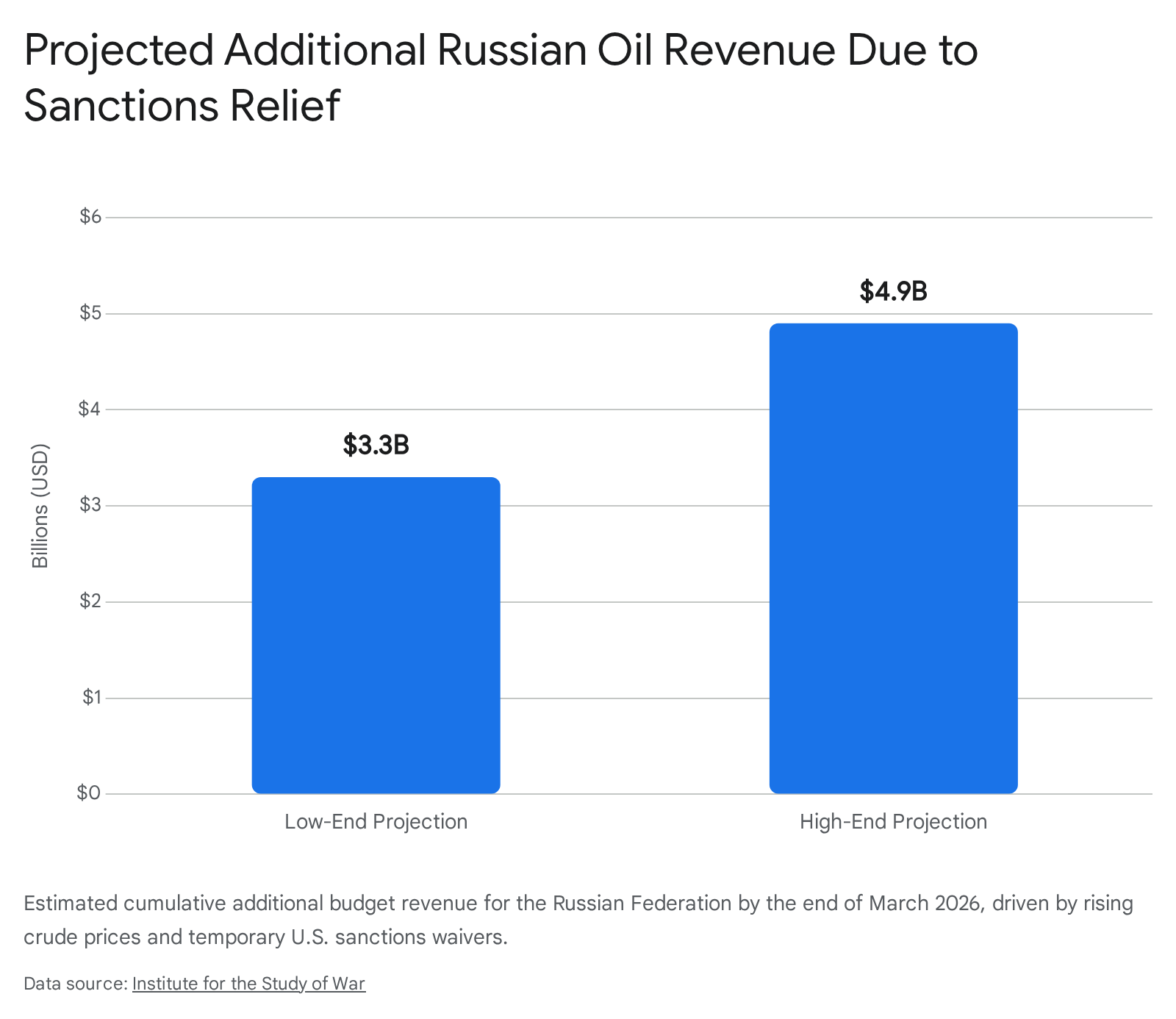
The Russian economy remains heavily reliant on fossil fuel export revenues, which accounted for approximately 30% of total federal revenues in 2025.36 Currently, Russian Urals crude is trading between $62 and $65 per barrel, which is above the original G7 $60 price cap but significantly higher than the new EU floating cap of $47.60 introduced in September 2025.37 To bypass Western sanctions, Russia continues to utilize a “shadow fleet” of tankers, allowing it to maintain export volumes to major buyers like China and India.37

However, falling global oil prices—driven by demand uncertainty and increased OPEC supply—pose a significant risk to the Russian budget.36 The 2026 Russian budget assumes an average export price of $66 per barrel; if the current downward trend continues, Russia could face a budget deficit of up to 5 trillion rubles (2.3% of GDP), potentially forcing a reduction in military spending or increased domestic taxation.36

Oil IndicatorBenchmark/ValueImpact/Context
Brent Crude Price$67.89/bblGlobal benchmark; down 9% YoY.
Urals Crude Price$63.42/bblRussian blend; trading above $60 cap.
Urals-Brent Discount~$4.50Smallest discount since start of war.
EU Floating Price Cap$47.60Aimed at reducing Russian bargaining power.
Russian Budget Target$66.00Price needed to sustain 2026 budget goals.

Oil Market Indicators as of February 6, 2026.36

Regional and Global Geopolitics

The Sino-Russian Alliance

On February 4, 2026, Presidents Xi Jinping and Vladimir Putin held a video call to reaffirm their strategic partnership.40 Both leaders hailed their countries’ “stabilizing” role in a “turbulent” global environment and committed to deepening coordination within multilateral frameworks like BRICS and the Shanghai Cooperation Organization (SCO).40

While China has not officially denounced the war, it has become Russia’s most critical economic lifeline, absorbing redirected energy exports and providing high-tech components.40 The call highlighted a shared vision for an “equal and orderly multipolar world,” contrasting their partnership against what they characterize as “unpredictable” US initiatives like the “Board of Peace”.40 Putin has accepted an invitation to visit China in the first half of 2026, signaling that the relationship will continue to break “new ground” despite Western pressure.40

NATO’s Northern Flank: The Finland Border

In response to Finland and Sweden joining NATO, Russia has begun a long-term military buildup near the Finnish border.6 Satellite imagery reveals new military infrastructure, including expanded helicopter bases near Murmansk and increased concentrations of Tu-22 long-range bombers at the Olenya air base.43 At a restored Cold War-era base in Kamenka, over 130 troop tents and dozens of new buildings have appeared to house military vehicles.43

Finland has responded by indefinitely closing land border crossings to counter Russia’s weaponization of migration and is hosting a forward NATO land force of 4,000–5,000 troops.44 Norwegian defense officials have also warned of a “formidable nuclear fleet” amassing on the Kola Peninsula, signaling that Russia is prioritizing its Northern Fleet and Arctic capabilities even as ground forces are consumed by the war in Ukraine.45

Russian “informational war” strategies have intensified, utilizing the “Gerasimov doctrine” to shape global narratives and demoralize Ukrainian civilians.46 The Russian bot network “Matryoshka” has recently launched a campaign exploiting the release of US Justice Department files related to Jeffrey Epstein to smear European leaders and the Ukrainian government.47 This includes fabricated reports claiming French President Emmanuel Macron visited Epstein’s island 18 times and false suggestions that President Zelenskyy had knowledge of child involvement in the network.47

These operations are designed to create “hybrid confusion,” blending cyberattacks with deepfake audio and video to transform minor technical outages into public safety crises.48 For example, AI-generated disinformation was recently used to manufacture safety threats ahead of the 2026 Winter Olympics, aiming to deter spectators and delegitimize host nations.49 In Ukraine, the Russian military continues to use electronic warfare systems like the Orlan-10 drone to send threatening text messages to the mobile phones of Ukrainian soldiers and their families to spread panic.46

Conclusions and Strategic Forecast

The situation as of February 6, 2026, indicates a high-stakes transition toward a fifth year of conflict, characterized by tactical deadlock and strategic competition. The capture of Hulyaipole represents a marginal Russian success, but the systemic “de-mechanization” of the Russian army suggests that Moscow lacks the armored capacity for a decisive offensive breakthrough in 2026. Conversely, Ukraine’s resilience is increasingly tied to the functionality of its energy grid; the record-breaking strikes this week demonstrate that Russia remains capable of inflicting severe humanitarian and economic costs that could eventually undermine domestic stability.

The “Abu Dhabi channel” has emerged as a vital de-escalation mechanism, facilitating the return of POWs and the re-opening of military hotlines. However, as long as Moscow maintains its maximalist demands for the entirety of the Donbas and Ukrainian neutrality, a comprehensive settlement remains unlikely. The expiration of New START and the subsequent linkage of nuclear arms control to the Ukrainian theater suggests that the Kremlin will continue to utilize strategic uncertainty to leverage concessions from the West.

In the near term, the conflict will likely remain focused on the “energy war” as both sides attempt to endure a particularly harsh winter. Ukraine’s ability to repair and defend its grid, supported by European financial aid and advanced air defenses, will be the decisive factor in preventing a humanitarian catastrophe. Simultaneously, the assassination attempt on Lt. Gen. Alekseyev and the discovery of “Operation Neusploit” indicate that the shadow war of intelligence and cyber operations will continue to escalate, potentially leading to increased paranoia and instability within the Russian military command.


Please share the link on Facebook, Forums, with colleagues, etc. Your support is much appreciated and if you have any feedback, please email us in**@*********ps.com. If you’d like to request a report or order a reprint, please click here for the corresponding page to open in new tab.


Sources Used

  1. Russia’s Grinding War in Ukraine – CSIS, accessed February 7, 2026, https://www.csis.org/analysis/russias-grinding-war-ukraine
  2. The Russia-Ukraine War Report Card, Feb. 4, 2026 | Russia Matters, accessed February 7, 2026, https://www.russiamatters.org/news/russia-ukraine-war-report-card/russia-ukraine-war-report-card-feb-4-2026
  3. ISW Russian Offensive Campaign Assessment, February 6, 2026 – Kyiv Post, accessed February 7, 2026, https://www.kyivpost.com/post/69606
  4. Russian Offensive Campaign Assessment, February 6, 2026 | ISW, accessed February 7, 2026, https://understandingwar.org/research/russia-ukraine/russian-offensive-campaign-assessment-february-6-2026/
  5. How the Russian Army Fights – Wavell Room, accessed February 7, 2026, https://wavellroom.com/2026/02/04/how-the-russian-army-fights/
  6. Russian Offensive Campaign Assessment, February 1, 2026 | ISW, accessed February 7, 2026, https://understandingwar.org/research/russia-ukraine/russian-offensive-campaign-assessment-february-1-2026/
  7. Conflict Intelligence Team — Teletype, accessed February 7, 2026, https://notes.citeam.org/
  8. Second day of Ukraine-Russia peace talks in UAE end without …, accessed February 7, 2026, https://www.theguardian.com/world/2026/feb/05/second-day-of-ukraine-russia-peace-talks-in-uae-end-without-breakthrough
  9. Russia-Ukraine talks conclude without breakthrough on ending war, accessed February 7, 2026, https://www.aljazeera.com/news/2026/2/5/russia-ukraine-talks-end-with-agreement-on-prisoner-swap
  10. US and Russia agree to re-establish military dialogue after Ukraine peace talks in Abu Dhabi – Yahoo News Singapore, accessed February 7, 2026, https://sg.news.yahoo.com/us-russia-agree-establish-military-044518957.html
  11. Russia and Ukraine Conduct First Prisoner Swap in Five Months After Abu Dhabi Talks, accessed February 7, 2026, https://caspiannews.com/news-detail/russia-and-ukraine-conduct-first-prisoner-swap-in-five-months-after-abu-dhabi-talks-2026-2-7-0/
  12. Russian Offensive Campaign Assessment, February 5, 2026 | ISW, accessed February 7, 2026, https://understandingwar.org/research/russia-ukraine/russian-offensive-campaign-assessment-february-5-2026/
  13. US and Russia agree to reestablish military-to-military dialogue after Ukraine talks, accessed February 7, 2026, https://www.coastreporter.net/the-mix/us-and-russia-agree-to-reestablish-military-to-military-dialogue-after-ukraine-talks-11839589
  14. U.S. and Russia agree to reestablish military dialogue after Ukraine talks | PBS News, accessed February 7, 2026, https://www.pbs.org/newshour/world/u-s-and-russia-agree-to-reestablish-military-dialogue-after-ukraine-talks
  15. Strategic Prudence and Extending New START – Quincy Institute for Responsible Statecraft, accessed February 7, 2026, https://quincyinst.org/research/strategic-prudence-and-extending-new-start/
  16. Russia Bombards Ukraine Ahead of Peace Talks, Ending Brief Energy Truce Amid Freezing Weather, accessed February 7, 2026, https://www.fdd.org/analysis/2026/02/03/russia-bombards-ukraine-ahead-of-peace-talks-ending-brief-energy-truce-amid-freezing-weather/
  17. Trump insists Putin ‘kept his word’ on energy truce, contradicting Zelenskyy, accessed February 7, 2026, https://english.nv.ua/russian-war/trump-insists-putin-kept-his-word-on-energy-truce-50580787.html
  18. Trump on ‘energy truce’: Putin kept his word – Hromadske, accessed February 7, 2026, https://hromadske.ua/en/world/258894-tramp-pro-enerhetychne-peremyria-putin-dotrymav-svoho-slova
  19. Russia hammers Ukraine after halt announced by Trump, plunging thousands into frigid dark on eve of talks, accessed February 7, 2026, https://www.cbsnews.com/news/russia-ukraine-war-energy-truce-over-massive-strikes-before-peace-talks/
  20. Ukraine ‘ready to play ball’ on peace deal but Russia ‘creating chaos’ with its attacks, says Nato chief – as it happened, accessed February 7, 2026, https://www.theguardian.com/world/live/2026/feb/03/russia-ukraine-europe-live-eu-us-military-plan-response-latest-news
  21. Russia hit Ukraine’s energy for 257 times this cold season. What makes latest damage different could take months or years to repair, accessed February 7, 2026, https://euromaidanpress.com/2026/02/04/russia-hit-ukraines-energy-for-257-times-this-cold-season-what-makes-latest-damage-different-could-take-months-or-years-to-repair/
  22. A sham “energy truce”. Day 1441 of the war | OSW Centre for Eastern Studies, accessed February 7, 2026, https://www.osw.waw.pl/en/publikacje/analyses/2026-02-03/a-sham-energy-truce-day-1441-war
  23. Ukraine’s energy system under attack – IEA, accessed February 7, 2026, https://www.iea.org/reports/ukraines-energy-security-and-the-coming-winter/ukraines-energy-system-under-attack
  24. The Drone Paradox and Institutional Decay in Modern Conflict, accessed February 7, 2026, https://debuglies.com/2026/02/06/the-drone-paradox-and-institutional-decay-in-modern-conflict/
  25. A deputy chief of Russia’s military intelligence service is shot and wounded in Moscow, accessed February 7, 2026, https://www.courthousenews.com/a-deputy-chief-of-russias-military-intelligence-service-is-shot-and-wounded-in-moscow/
  26. Officials: Top Russian Intelligence General Shot, Wounded In Attempted Assassination, accessed February 7, 2026, https://www.rferl.org/a/russia-general-gru-shooting-assassination-attempt/33671131.html
  27. Senior Russian general wounded in apparent assassination attempt in Moscow, accessed February 7, 2026, https://www.aninews.in/news/world/asia/senior-russian-general-wounded-in-apparent-assassination-attempt-in-moscow20260206210713
  28. Deputy head of Russian military intelligence hospitalised after assassination attempt in Moscow, accessed February 7, 2026, https://novayagazeta.eu/amp/articles/2026/02/06/deputy-head-of-russian-military-intelligence-hospitalised-after-assassination-attempt-in-moscow-en-news
  29. Vladimir Alekseyev (general) – Wikipedia, accessed February 7, 2026, https://en.wikipedia.org/wiki/Vladimir_Alekseyev_(general)
  30. Russian army general shot in Moscow as foreign minister blames Ukraine for “terrorist act”, accessed February 7, 2026, https://www.cbsnews.com/news/russian-army-general-shot-in-moscow-as-foreign-minister-blames-ukraine-for-terrorist-act/
  31. Hackers Actively Exploit Microsoft Office Zero-Day to Deliver Malware – Cyber Press, accessed February 7, 2026, https://cyberpress.org/microsoft-office-zero-day-to-deliver-malware/
  32. APT28 Uses Microsoft Office CVE-2026-21509 in Espionage-Focused Malware Attacks, accessed February 7, 2026, https://thehackernews.com/2026/02/apt28-uses-microsoft-office-cve-2026.html
  33. CVE-2026-21509: APT28 Actively Exploits Microsoft Office Vulnerability in Ukraine, accessed February 7, 2026, https://socradar.io/blog/cve-2026-21509-apt28-microsoft-office-ukraine/
  34. Commission presents a financial support package for Ukraine for 2026–2027, accessed February 7, 2026, https://ec.europa.eu/commission/presscorner/detail/en/ip_26_90
  35. EU to split Ukraine financial support with 30 billion euros for budget, 60 billion for military, accessed February 7, 2026, https://www.globalbankingandfinance.com/eu-split-ukraine-financial-support-30-billion-euros-budget/
  36. Falling oil prices reduce Russia’s budget revenues – Bank of Finland Bulletin, accessed February 7, 2026, https://www.bofbulletin.fi/en/blogs/2025/falling-oil-prices-reduce-russia-s-budget-revenues/
  37. Urals Oil – Price – Chart – Historical Data – News – Trading Economics, accessed February 7, 2026, https://tradingeconomics.com/commodity/urals-oil
  38. New oil price cap adds to Russia’s economic distress – Bank of Finland Bulletin, accessed February 7, 2026, https://www.bofbulletin.fi/en/blogs/2025/new-oil-price-cap-adds-to-russia-s-economic-distress/
  39. Stiffening European sanctions against the Russian oil trade – Brookings Institution, accessed February 7, 2026, https://www.brookings.edu/articles/stiffening-european-sanctions-against-the-russian-oil-trade/
  40. Xi, Putin hail ‘stabilising’ China-Russia alliance – International – World – Ahram Online, accessed February 7, 2026, https://english.ahram.org.eg/News/561784.aspx
  41. Xi and Putin deepen China-Russia coordination, vow broader global cooperation, accessed February 7, 2026, https://biz.chosun.com/en/en-international/2026/02/04/MO4WXLYNNFDWDNRR57VKQ2BGJU/
  42. Xi, Putin hail ‘stabilising’ China-Russia alliance – CNA, accessed February 7, 2026, https://www.channelnewsasia.com/east-asia/xi-jinping-putin-call-china-russia-ties-5907211
  43. Satellite Images Show Russian Military Buildup Near Finland – NYT – The Moscow Times, accessed February 7, 2026, https://www.themoscowtimes.com/2025/05/19/satellite-images-show-russian-military-buildup-near-finland-nyt-a89129
  44. Fortress Finland: Nordic deterrence against Russia – GIS Reports, accessed February 7, 2026, https://www.gisreportsonline.com/r/fortress-finland-nordic-deterrence/
  45. Putin Masses Nuclear Fleet Near NATO Arctic Border – Evrim Ağacı, accessed February 7, 2026, https://evrimagaci.org/gpt/putin-masses-nuclear-fleet-near-nato-arctic-border-513552
  46. Russian information war against Ukraine – Wikipedia, accessed February 7, 2026, https://en.wikipedia.org/wiki/Russian_information_war_against_Ukraine
  47. Russia Turns Epstein Files Into a Disinformation Weapon Against Macron and Ukraine, accessed February 7, 2026, https://united24media.com/latest-news/russia-turns-epstein-files-into-a-disinformation-weapon-against-macron-and-ukraine-15638
  48. Cyber Insights 2026: Cyberwar and Rising Nation State Threats, accessed February 7, 2026, https://www.securityweek.com/cyber-insights-2026-cyberwar-and-rising-nation-state-threats/
  49. Understanding the Russian Cyberthreat to the 2026 Winter Olympics – Unit 42, accessed February 7, 2026, https://unit42.paloaltonetworks.com/russian-cyberthreat-2026-winter-olympics/
  50. Cyber News Roundup – February 6th 2026 – Integrity360, accessed February 7, 2026, https://www.integrity360.com/cyber-news-roundup-february-6th-2026

SITREP Russia – Week Ending February 06, 2026

Executive Summary

The reporting period ending February 06, 2026, represents a transformative week for the Russian Federation, characterized by the formal dissolution of the final pillars of the post-Cold War strategic architecture and a decisive pivot toward a permanent war economy. The headline event of this period is the official expiration of the New Strategic Arms Reduction Treaty (New START) on February 5, 2026, which has left the world’s two largest nuclear powers without verifiable constraints for the first time in over half a century.1 While negotiators in Abu Dhabi attempted to facilitate a short-term “handshake” extension, the rejection of this proposal by the United States administration has signaled a new era of strategic volatility, with the Russian Ministry of Foreign Affairs (MFA) declaring that Moscow is no longer bound by quantitative limits or data-sharing obligations.1

The kinetic theater witnessed a significant escalation following the collapse of a brief “energy truce” mediated by the United States.4 On the night of February 2–3, Russian Aerospace Forces (VKS) and drone units launched the most devastating aerial assault of the year, deploying a strike package of 450 drones and 71 missiles.4 This operation, which targeted critical heat and power infrastructure in Kyiv, Kharkiv, and Odesa, was timed to exploit a severe cold snap with temperatures dropping to .4 Concurrently, ground forces have continued their “grinding” attrition strategy, capturing the settlement of Degtyarne in Kharkiv Oblast and advancing near Dronivka and Kleban-Byk at high personnel costs.4

Domestically, the Kremlin has faced a crisis of internal cohesion following the attempted assassination of Lieutenant General Vladimir Alekseyev, the first deputy head of the GRU, who was shot and critically wounded in Moscow on February 6.7 This attack, occurring while his superior, Admiral Igor Kostyukov, was engaged in trilateral talks in Abu Dhabi, has ignited intense speculation regarding institutional infighting within the siloviki.8 To counter perceived internal and external threats, the State Duma has advanced legislation granting the FSB total control over communications and increasing personal income taxes for “foreign agents” to a punitive 30%.10 Economically, the Federation faces mounting fiscal pressure; January 2026 budget data reveals a deficit of 1.718 trillion rubles, nearly half of the annual target, driven by a 50% collapse in energy revenues and the rising costs of the military-industrial complex.13

Strategic Nuclear Stability and the Post-New START Era

The expiration of the 2010 New Strategic Arms Reduction Treaty (New START) on February 5, 2026, marks the end of the last legally binding bilateral agreement limiting the strategic nuclear forces of the United States and the Russian Federation.1 This development is not merely a technical lapse but the culmination of a multi-year erosion of arms control norms that began with Russia’s formal suspension of the treaty in February 2023.1 Moscow’s official stance, articulated by the Ministry of Foreign Affairs, maintains that the suspension was a “compelled measure” in response to the “extremely hostile” policies of the previous Biden administration and the fundamental change in the security situation following the 2022 invasion of Ukraine.1

In the months leading up to the expiration, President Vladimir Putin had publicly proposed a one-year voluntary adherence to the treaty’s central quantitative limits.1 However, as of February 6, the Kremlin has confirmed that no formal response was received from Washington, leading to a declaration that Russia now considers itself free to choose its next steps based on a thorough analysis of U.S. military policy.1 The immediate consequence of the lapse is the cessation of all 18 annual on-site inspections and the “Type One” and “Type Two” monitoring of strategic delivery systems, which provided the United States with a vital window into Russian nuclear operations.2

New START Central Quantitative Limits (Expired Feb 5, 2026)Agreed LimitRussian Status (Estimated)
Deployed Strategic Warheads1,5501,550+
Deployed ICBMs, SLBMs, and Heavy Bombers700700+
Deployed and Non-Deployed Launchers800~800
Notification ProceduresRequiredSuspended
On-Site Inspections18 per yearTerminated

Sources: 2

The Russian military-technical response to the treaty’s end is expected to focus on the “uploading” of warheads onto existing delivery platforms. Russia is currently assessed as capable of rapidly increasing the number of warheads on its deployed ICBM and SLBM forces, a move that would fundamentally alter the strategic balance of deterrence.3 Particular concern surrounds the deployment of novel systems such as the Sarmat ICBM and the Avangard hypersonic glide vehicle, as well as exotic platforms like the Poseidon nuclear-powered underwater vehicle and the Burevestnik cruise missile.2 These systems are explicitly designed to defeat the U.S. “Golden Dome” missile defense initiatives, which the Kremlin views as an attempt to undermine Russia’s second-strike capability.14

The diplomatic fallout of the New START expiration was a central theme of a February 4 video call between Vladimir Putin and Chinese leader Xi Jinping.17 Both leaders noted the “negative consequences” of the treaty’s end, with Putin expressing respect for Beijing’s position that any future trilateral arms control deal must account for the rapid modernization of China’s own ICBM forces.3 This alignment suggests a deepening “axis of resistance” against Western strategic dominance, where Russia leverages its nuclear legacy to provide a shield for Chinese regional expansion while demanding that the nuclear arsenals of France and the United Kingdom also be brought into any successor framework.3

Tactical Military Assessment: The Winter 2026 Campaign

The military situation during the week ending February 6 was defined by a shift from the short-lived “energy truce” to a high-intensity aerial campaign designed to break Ukrainian civilian resilience.4 Following the January 23–24 trilateral talks in Abu Dhabi, Russian forces briefly shifted their targeting from energy infrastructure to logistics and railroads.5 However, this moratorium ended abruptly on the night of February 2–3 with a strike package that was 1.5 times larger than previous engagements in 2026.4

The strike utilized a sophisticated mix of assets, including 300 Shahed drones and newer Gerbera and Italmas types launched from Bryansk, Kursk, Oryol, and Primorsko-Akhtarsk.5 These were integrated with 32 Iskander-M and S-300 missiles to penetrate the dense air defenses of Kyiv and Kharkiv.5 The Ukrainian Air Force reported that while they intercepted 412 of the 450 drones, the sheer volume of ballistic and cruise missiles ensured that 27 locations were hit, causing cascading blackouts that affected not only Kyiv and Kharkiv but also Dnipropetrovsk, Vinnytsia, and Odesa oblasts.4 DTEK, Ukraine’s largest energy provider, described the attack as the most devastating of 2026, noting that the destruction of combined heat and power plants (CHPP) during weather constitutes a systematic attempt to weaponize the climate.4

Russian Aerial Strike Assets (Feb 2-3, 2026 Operation)QuantityPerformance/Outcome
Shahed, Gerbera, Italmas Drones450412 Intercepted; Debris fell in 17 locations
Iskander-M / S-300 Ballistic Missiles3211 Intercepted; Multiple CHPP hits
Zirkon / Onyx Missiles44 Intercepted (Claimed)
Kh-101 / Iskander-K Cruise Missiles2020 Intercepted (Claimed)
Kh-22 / Kh-32 Missiles30 Intercepted

Sources: 4

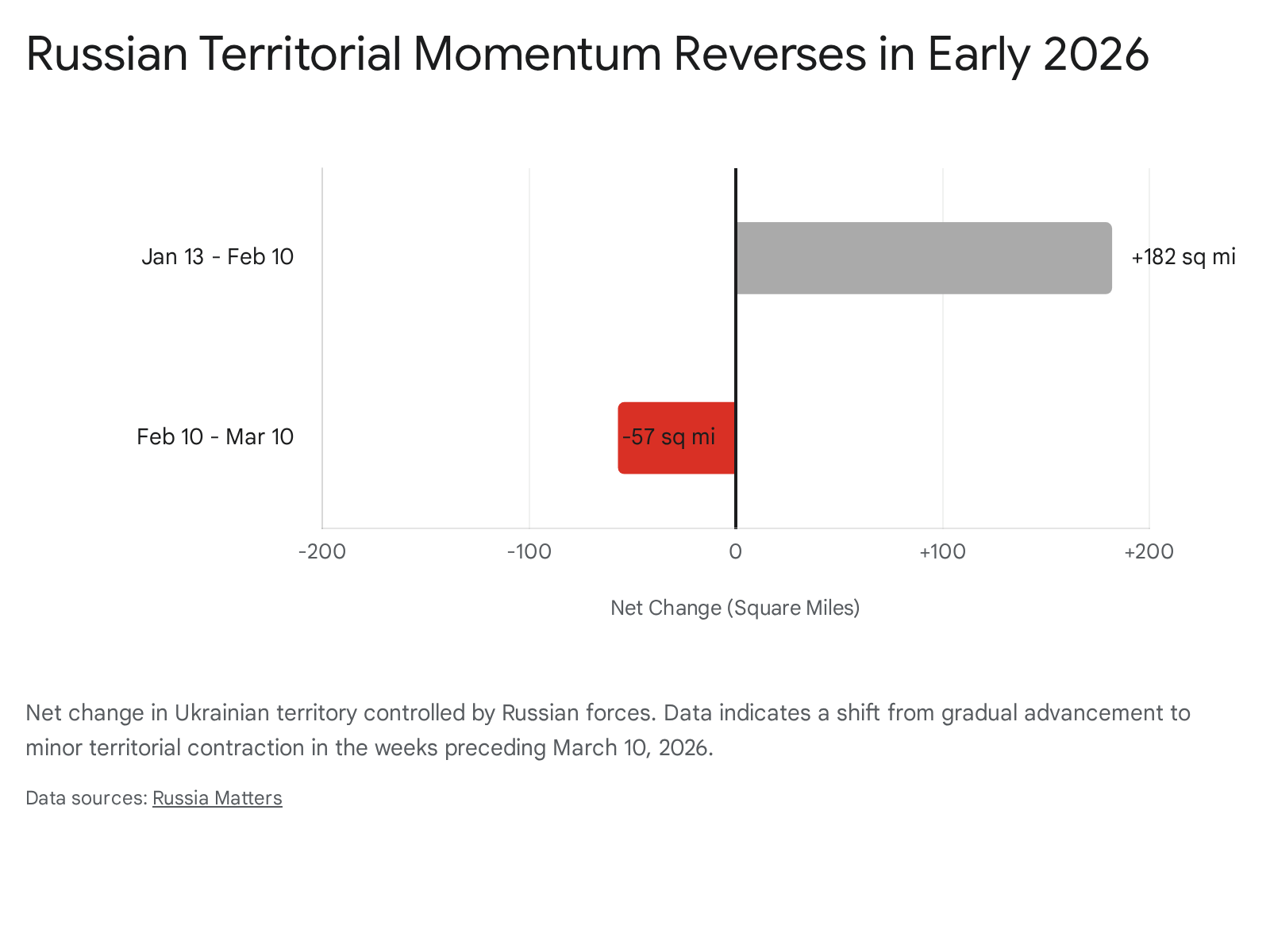
On the ground, the Russian offensive remains a series of high-cost, low-yield engagements. For the week of January 27 to February 3, Russia gained approximately 29 square miles of territory, roughly the size of Manhattan.4 The primary tactical success was the occupation of Degtyarne in the Kharkiv Oblast, while additional advances were reported near Pryluky, Zelene, and the heights around Toretsk.4 This “grinding” pace—averaging 15 to 70 meters per day in the most active sectors—reflects a military that has prioritized attrition over maneuver.19 Casualty rates remain extreme; CSIS estimates that total Russian military losses reached 1.2 million by the end of 2025, with fatalities between 275,000 and 325,000.6 Despite these numbers, the Kremlin continues to reject Western estimates, with Spokesman Dmitry Peskov insisting that only Ministry of Defense figures are reliable.6

The deployment of North Korean personnel has evolved during this period. Intelligence reports from the week indicate that these troops have moved beyond “expendable infantry” roles.4 They are now integrated into specialized units operating surveillance drones, performing mine clearance, and manning North Korean-supplied artillery and MLRS systems in the Kursk and Donetsk sectors.4 This suggests a deeper level of operational integration that allows Russian commanders to preserve their remaining elite formations for offensive breakthroughs while utilizing North Korean personnel for high-risk technical and support roles.4

Intelligence and Internal Security: The Siloviki Crisis

The attempted assassination of Lieutenant General Vladimir Alekseyev on February 6, 2026, has exposed deep fissures within the Russian security apparatus.7 Alekseyev, the first deputy head of the GRU, was shot multiple times in his Moscow apartment building by a gunman disguised as a food delivery courier.20 Alekseyev is a pivotal figure in the GRU’s “active measures” and irregular warfare campaigns, having been sanctioned for his alleged role in the 2018 Salisbury Novichok attack and the hacking of the 2016 U.S. elections.20 Furthermore, he was instrumental in negotiating the end of the 2023 Wagner Group mutiny, famously appearing in a video with Yevgeny Prigozhin in Rostov-on-Don.8

The Investigative Committee has opened a criminal probe, but the political fallout is already evident.22 Foreign Minister Sergei Lavrov immediately attributed the attack to the “Zelenskyy regime,” claiming it was a terrorist act designed to derail the Abu Dhabi peace talks.8 However, Western intelligence analysts and Russian opposition media suggest the motive may be domestic, linked to the general’s role in suppressing the Wagner uprising or the ongoing competition for control over the GRU’s lucrative African and Middle Eastern operations.8 The timing is particularly conspicuous, as Alekseyev’s superior, Admiral Kostyukov, was in the UAE at the time, leaving the GRU’s domestic command structure vulnerable.8

Internal Security Incidents (Military Leadership 2024-2026)TargetOutcome
Feb 6, 2026 (Moscow)Lt. Gen. Vladimir Alekseyev (GRU)Shot multiple times; Coma/Critical
Dec 22, 2025 (Moscow)Lt. Gen. Fanil Sarvarov (Army Training)Killed by car bomb
Late 2024 (Moscow)Lt. Gen. Igor Kirillov (NBC Defense)Killed by scooter explosion
Dec 2025 (Chernihiv)Border Guard ExecutionsSenezh Spetsnaz linked to war crimes

Sources: 4

The Alekseyev shooting highlights what Andrei Soldatov and other experts describe as “incredible sloppiness” within the security services tasked with protecting the high command.9 This security failure occurs as the GRU is being formally integrated into the Ministry of Defense’s chain of command to streamline irregular warfare, combining military support with AI-driven disinformation to exploit security gaps in Mali, Libya, and Sudan.23 The inability to secure the capital against targeted hits on top-tier intelligence officials suggests that either the FSB’s protective capabilities are degraded or that internal “cleansing” is taking place under the guise of Ukrainian sabotage.8

The Abu Dhabi Diplomatic Framework

The trilateral talks in Abu Dhabi on February 4–5, 2026, represent the most significant diplomatic engagement since the early months of the war.4 Mediated by the United Arab Emirates and involving senior U.S. envoy Steve Witkoff and Russian Direct Investment Fund head Kirill Dmitriev, the talks were aimed at establishing a roadmap for de-escalation.4 While the meetings did not produce a breakthrough on territorial issues—Russia continues to demand the full surrender of Donetsk and Luhansk while Kyiv refuses any land-for-peace swap—they did yield “limited but concrete” humanitarian and military outcomes.4

The primary success was a 314-person prisoner exchange, the first in five months, which returned 157 soldiers to each side.4 Additionally, the U.S. European Command (EUCOM) announced that General Alexus Grynkewich and General Valery Gerasimov had agreed to resume high-level military-to-military dialogue to avoid miscalculation and support de-escalation.4 This channel, suspended since late 2021, is intended to provide a “de-confliction” mechanism as both sides continue to work toward a lasting peace.4

Abu Dhabi Trilateral Talks – Strategic OutcomesResultImplications
Prisoner Exchange157 for 157 (314 total)Restores rare channel of trust
Military-to-Military DialogueRe-establishedDirect Gerasimov-Grynkewich link
Territorial SovereigntyDeadlockRussia demands Donbas; Kyiv refuses
New START “Handshake”Rejected by U.S. AdministrationStrategic ambiguity post-Feb 5
Iranian Uranium Proposal“On the table”Russia offers to remove Iranian uranium

Sources: 4

Russian Foreign Minister Sergei Lavrov has remained publicly dismissive of Western security guarantees for Ukraine, labeling them “unacceptable” and stating that any foreign troop deployments would be legitimate targets.5 During a February 4 interview, Lavrov implied that Russia’s demand for “neutrality” is intended to transform Ukraine into a pro-Russian proxy state similar to Belarus.17 This sentiment is echoed by Kremlin officials who have exploited the lack of clarity from the 2025 Alaska Summit to claim that the U.S. had already agreed to end the war on Russian terms.5

Macroeconomic Resilience and Fiscal Deterioration

The Russian economy is currently navigating a “precarious” position, as the wartime boom of 2023–2024 gives way to stagnation and fiscal distress.26 Finance Ministry data for January 2026 revealed a deficit of 1.718 trillion rubles ($22.3 billion), which is nearly half of the government’s projected 3.8 trillion ruble deficit for the entire year.13 This fiscal gap is largely driven by a 50% year-on-year collapse in oil and gas revenues, which fell to a five-year low of 393 billion rubles in January.13

To mitigate these losses, the Kremlin has implemented a series of aggressive tax hikes. On January 1, the Value-Added Tax (VAT) was increased from 20% to 22%, and most tax exemptions for small and medium-sized enterprises (SMEs) were abolished.12 This reform generated a 25% jump in VAT receipts in January, totaling 1.13 trillion rubles, but even this surge was insufficient to offset the decline in energy income.13 The IMF has downgraded Russia’s growth forecast for 2026 to just 0.8%, warning that the distortion of the economy by the defense sector is becoming “unsustainable”.26

Russian Federation Economic Indicators (January 2026)ValueImpact/Trend
Monthly Budget Deficit1.718 Trillion Rubles45% of annual target reached in 1 month
Oil and Gas Revenue393 Billion Rubles-50% YoY; Lowest since July 2020
VAT Revenue1.13 Trillion Rubles+25% following 22% rate hike
Interest Rate16%Aimed at curbing 6% inflation
GDP Growth (Forecast)0.8%Stagnation vs. 4.3% in 2024

Sources: 13

Russia is also aggressively pursuing import substitution and financial sovereignty. A decree signed by Putin mandates that by January 1, 2026, all military equipment and clothing must be produced by Russian organizations located within the territory of the Federation.29 By 2027, this will extend to all materials, including fabrics and knitwear.29 To maintain capital flow, the Kremlin is pushing for expanded mutual payments in national currencies and the creation of an independent payment infrastructure, particularly in its dealings with Brazil and India.30 However, the Adani Group’s decision to ban Russian oil imports at 14 Indian ports and the new EU sanctions targeting the “shadow fleet” of 600 tankers suggest that Moscow’s ability to bypass the oil price cap is being significantly narrowed.27

Internal Governance and the Legislative Iron Fist

The week ending February 6 saw the formalization of several repressive legislative measures designed to suppress dissent and mobilize the population for a prolonged conflict. The State Duma has moved to grant the FSB total control over communications shutdowns, while the personal income tax rate for those designated as “foreign agents” has been raised to 30%.10 This punitive tax regime, combined with the loss of all deductions and benefits, is intended to financially cripple activists and journalists both inside Russia and in exile.11

New Repressive Legislation (Effective Q1 2026)MeasureStrategic Objective
Communications LawFSB power to shut down internet/mobileCounter-drone telemetry; Prevent unrest
Tax Code Amendment30% Tax on “Foreign Agents”Financial attrition of political dissent
Conscription DecreeYear-round call-up (Jan 1 – Dec 31)Continuous troop replenishment
FSB Pretrial CentersFSB control of Lefortovo & othersDirect oversight of “Treason” suspects
Asset Freeze LawFreeze accounts of those convicted in absentiaRetribution against exiles

Sources: 10

The transition to year-round conscription, effective January 1, 2026, allows the military to maintain a constant stream of 261,000 draftees for compulsory service.12 This “creeping mobilization” is supported by a new digital registry that imposes automatic travel bans and property freezes on those who ignore summonses.12 Furthermore, a December 2025 decree has authorized the use of reservists to protect “critical infrastructure” against drone attacks, granting them the legal status of active-duty servicemembers and allowing their deployment across at least 19 Russian regions.33

Socially, the Kremlin is struggling with the humanitarian fallout of the war within its own borders. The government has allocated 1.27 billion rubles to cover housing for 21,000 families displaced by the Ukrainian incursion in the Kursk region.4 Reports from iStories indicate that missing-person cases in Kursk are now eight times the national average, highlighting the ongoing civilian cost of the conflict even as state media focuses on the “liberation” of Ukrainian territory.4 To maintain public morale, the “Year of Unity of the Peoples of Russia” was opened on February 5, emphasizing national cohesion while the state simultaneously scraps annual asset declarations for officials to hide wartime corruption.12

Geopolitical Alignments: The Axis of Resale

Faced with Western isolation, Russia is solidifying its alliances with pariah states and regional partners. On February 3, 2026, Sergei Shoigu signed a five-year military cooperation agreement with the Myanmar junta, ensuring that Russian-made jets and munitions continue to support the junta’s grip on power until 2030.35 In return, analysts suggest Myanmar has become a link in the scheme to provide Russia with “dual-use” components from North Korea and China, circumventing sanctions via intermediaries.36

The Kremlin’s regional influence has suffered setbacks, however, including the capture of Venezuelan leader Nicolas Maduro by U.S. forces in early 2026 and the collapse of the Assad regime in late 2024.38 These events have forced Moscow into a “deal-making diplomacy” stance. In the Middle East, Putin has positioned himself as an intermediary between Iran and Israel, offering to facilitate the removal of uranium from Iran to appease Washington while seeking a role in President Trump’s “Board of Peace”.38 This adaptive approach—providing minimal military support while maintaining diplomatic relevance—highlights the limits of Russia’s role as a security provider as the war in Ukraine drains its resources.38

Hybrid Warfare and the Belarus-Kremlin Balloon Campaign

A notable escalation in “Grey Zone” activity occurred throughout the reporting week, characterized by the “Minsk-Kremlin Balloon Campaign”.39 For three consecutive nights ending February 3, 2026, high-altitude balloons (HABs) launched from Belarus violated the sovereign airspace of Poland and Lithuania.39 While the Kremlin has ostensibly linked these balloons to illicit cigarette smuggling, intelligence analysts categorize this as a “Phase Zero” offensive.39

The technical execution of the campaign indicates a multi-domain operation. As NATO activated SIGINT assets and TRS-15 Odra radar systems to track these low-radar-cross-section targets, Russian GRU electronic intelligence units stationed in Brest and Grodno recorded the resultant activation latencies and frequency-hopping patterns.39 This data is invaluable for the Russian Federation in preparing A2/AD (Anti-Access/Area Denial) envelopes for the Suwalki Gap.39 The “cognitive objective” of the campaign is the normalization of airspace violations, lowering the detection threshold for more aggressive actions, such as loitering munitions or special operations infiltration disguised as civilian smuggling objects.39

Conclusion and Future Outlook

The week ending February 6, 2026, illustrates a Russia that is increasingly isolated but remains highly dangerous. The expiration of New START and the subsequent shift to a policy of “military-technical measures” suggest that a new nuclear arms race is not only possible but likely underway. The massive aerial assault of February 2-3 confirms that the Kremlin will continue to target civilian infrastructure to achieve political ends, even as its ground forces achieve only marginal success.

Internally, the attempted assassination of General Alekseyev and the passage of draconian communication laws point toward a state that is deeply fearful of internal instability and information leakage. The fiscal data from January 2026 serves as a warning that Russia’s “defiance of economic gravity” is reaching its limit; the 50% drop in energy revenue is a structural threat that even a 22% VAT rate cannot fully resolve. In the coming weeks, the international community should anticipate a continued reliance on hybrid tactics like the HAB campaign and a further hardening of Russia’s stance in Abu Dhabi as the Kremlin gambles that its “grinding” strategy will eventually outlast Western support for Ukraine. The re-establishment of the military-to-military channel between Gerasimov and Grynkewich remains the only significant guardrail against an accidental escalation into a broader conflict.


Please share the link on Facebook, Forums, with colleagues, etc. Your support is much appreciated and if you have any feedback, please email us in**@*********ps.com. If you’d like to request a report or order a reprint, please click here for the corresponding page to open in new tab.


Sources Used

  1. Statement of the Ministry of Foreign Affairs of Russia Concerning the …, accessed February 7, 2026, https://mid.ru/en/foreign_policy/international_safety/regprla/2076815/
  2. New START Treaty – United States Department of State, accessed February 7, 2026, https://www.state.gov/new-start-treaty
  3. A Half-Century of US-Russian Arms Control Ends With the Expiration of the New START Nuclear Pact | Military.com, accessed February 7, 2026, https://www.military.com/daily-news/2026/02/05/half-century-of-us-russian-arms-control-ends-expiration-of-new-start-nuclear-pact.html
  4. Russia in Review, Jan. 30–Feb. 6, 2026, accessed February 7, 2026, https://www.russiamatters.org/news/russia-review/russia-review-jan-30-feb-6-2026
  5. Russian Offensive Campaign Assessment, February 3, 2026 | ISW, accessed February 7, 2026, https://understandingwar.org/research/russia-ukraine/russian-offensive-campaign-assessment-february-3-2026/
  6. Russia in Review, Jan. 23–30, 2026, accessed February 7, 2026, https://www.russiamatters.org/news/russia-review/russia-review-jan-23-30-2026
  7. Russian General Hospitalized After Attempted Assassination in Moscow, accessed February 7, 2026, https://www.themoscowtimes.com/2026/02/06/russian-general-hospitalized-after-attempted-assassination-in-moscow-a91877
  8. Top Russian general shot in Moscow as talks stall on Ukraine ceasefire, accessed February 7, 2026, https://www.washingtonpost.com/world/2026/02/06/russia-general-assassination-attempt-moscow/
  9. Russian general Vladimir Alekseyev in critical condition after Moscow shooting, accessed February 7, 2026, https://www.theguardian.com/world/2026/feb/06/russia-military-general-vladimir-alekseyev
  10. Russia is set to grant the FSB total control over communications shutdowns and ban citizens from suing for outages – Meduza, accessed February 7, 2026, https://meduza.io/en/feature/2026/02/02/russia-is-set-to-grant-the-fsb-total-control-over-communications-shutdowns-and-ban-citizens-from-suing-for-outages
  11. Lawmakers pass bill raising taxes for Russians branded as ‘foreign agents’ – TaxTMI, accessed February 7, 2026, https://www.taxtmi.com/news?id=62298
  12. What’s changing in Russia in 2026? Year-round conscription, higher taxes, rising utility costs, and AI surveillance – Meduza, accessed February 7, 2026, https://meduza.io/en/slides/what-s-changing-in-russia-in-2026
  13. Russia’s January Budget Deficit Hits Nearly Half of Annual Target …, accessed February 7, 2026, https://www.themoscowtimes.com/2026/02/06/russias-january-budget-deficit-hits-nearly-half-of-annual-target-a91885
  14. Cost constraints on the US–Russia strategic nuclear balance after New START, accessed February 7, 2026, https://www.iiss.org/online-analysis/online-analysis/2026/02/cost-constraints-on-the-us-russia-strategic-nuclear-balance-after-new-start/
  15. New START expires: Will a new US-Russia nuclear arms race follow? – Breaking Defense, accessed February 7, 2026, https://breakingdefense.com/2026/02/new-start-expires-will-a-new-us-russia-nuclear-arms-race-follow/
  16. Three Truths About the End of New START and What It Means for Strategic Competition, accessed February 7, 2026, https://www.csis.org/analysis/three-truths-about-end-new-start-and-what-it-means-strategic-competition
  17. Russian Offensive Campaign Assessment, February 5, 2026 | ISW, accessed February 7, 2026, https://understandingwar.org/research/russia-ukraine/russian-offensive-campaign-assessment-february-5-2026/
  18. Strategic Prudence and Extending New START – Quincy Institute for Responsible Statecraft, accessed February 7, 2026, https://quincyinst.org/research/strategic-prudence-and-extending-new-start/
  19. Russia’s Grinding War in Ukraine – CSIS, accessed February 7, 2026, https://www.csis.org/analysis/russias-grinding-war-ukraine
  20. Senior Russian general wounded in apparent assassination attempt in Moscow, accessed February 7, 2026, https://www.aninews.in/news/world/asia/senior-russian-general-wounded-in-apparent-assassination-attempt-in-moscow20260206210713
  21. Officials: Top Russian Intelligence General Shot, Wounded In Attempted Assassination, accessed February 7, 2026, https://www.rferl.org/a/russia-general-gru-shooting-assassination-attempt/33671131.html
  22. Russian lieutenant general hospitalized after assassination attempt in Moscow, accessed February 7, 2026, http://www.xinhuanet.com/english/europe/20260206/0444338400214e3183f6bb2b812059ac/c.html
  23. Publications – Joint Special Operations University, accessed February 7, 2026, https://jsou.edu/Press/Publications
  24. Second day of Ukraine-Russia peace talks in UAE end without breakthrough, accessed February 7, 2026, https://www.theguardian.com/world/2026/feb/05/second-day-of-ukraine-russia-peace-talks-in-uae-end-without-breakthrough
  25. Ukraine-Russia talks fail on territory but deliver rare prisoner exchange, accessed February 7, 2026, https://english.nv.ua/nation/no-breakthrough-on-territory-in-abu-dhabi-peace-talks-wsj-reports-50581572.html
  26. The Russian economy is finally stagnating. What does it mean for the war – and for Putin? | Russia | The Guardian, accessed February 7, 2026, https://www.theguardian.com/world/ng-interactive/2026/feb/06/the-russian-economy-is-finally-stagnating-what-does-it-mean-for-the-war-and-for-putin
  27. Sanctions having ‘significant impact’ on Russian economy, says EU special envoy | Russia, accessed February 7, 2026, https://www.theguardian.com/world/2026/feb/05/sanctions-significant-impact-russian-economy-interview-eu-special-envoy-david-osullivan
  28. Russia’s 2026 budget: mounting financial challenges and economic stagnation, accessed February 7, 2026, https://www.osw.waw.pl/en/publikacje/osw-commentary/2025-12-09/russias-2026-budget-mounting-financial-challenges-and-economic
  29. Vladimir Putin signed a decree banning the purchase of foreign-made military uniforms, accessed February 7, 2026, https://goszakupki.tatarstan.ru/eng/index.htm/news/2440542.htm
  30. Eighth meeting of Russian-Brazilian High-Level Commission on Cooperation – News – The Russian Government, accessed February 7, 2026, http://government.ru/en/news/57760/
  31. EU proposes new Russia sanctions targeting energy, banking, trade …, accessed February 7, 2026, https://www.courthousenews.com/eu-proposes-new-russia-sanctions-targeting-energy-banking-trade/
  32. Russian laws coming into effect in 2026: detention centers for security services, 30-percent income tax for “foreign agents” – The Insider, accessed February 7, 2026, https://theins.ru/en/news/288153
  33. Putin Signs Decree to Call Up Reservists for 2026 Training – Kyiv Post, accessed February 7, 2026, https://www.kyivpost.com/post/65859
  34. President of Russia, accessed February 7, 2026, http://en.kremlin.ru/
  35. Russia and Myanmar Sign Military Cooperation Agreement – The Moscow Times, accessed February 7, 2026, https://www.themoscowtimes.com/2026/02/03/russia-and-myanmar-sign-military-cooperation-agreement-a91847
  36. Belarusian MAZ Established a Supply of Parts from North Korea, accessed February 7, 2026, https://militarnyi.com/en/news/belarusian-maz-established-a-supply-of-parts-from-north-korea/
  37. Myanmar and Russia sign new military alliance pact | The Star, accessed February 7, 2026, https://www.thestar.com.my/aseanplus/aseanplus-news/2026/02/04/myanmar-and-russia-sign-new-military-alliance-pact
  38. Russia’s Silence as the US Dominates the Iran Crisis – Caspianpost.com, accessed February 7, 2026, https://caspianpost.com/analytics/russia-s-silence-as-the-us-dominates-the-iran-crisis
  39. The Belarus-Kremlin Balloon Campaign – Sovereign Security & Financial Forensics 2026 – https://debuglies.com, accessed February 7, 2026, https://debuglies.com/2026/02/03/the-belarus-kremlin-balloon-campaign-sovereign-security-financial-forensics-2026/

Modernization of Russian Military Small Arms: Key Trends and Challenges

Executive Summary

The modernization of small arms within the Russian Federation’s military branches represents a fundamental shift from Soviet-era mass-production standards to specialized, modular, and network-centric systems designed for the contemporary high-intensity battlefield. Under the umbrella of the Ratnik program, and transitioning into the fourth-generation Sotnik initiative slated for 2025, the Russian Ministry of Defense (MoD) has sought to integrate individual weaponry into a holistic “soldier as a system” framework.1 As of early 2026, this evolution is characterized by the widespread adoption of the Kalashnikov AK-12 series across the Ground Forces (SV), the development of shortened “K” variants for the Airborne Forces (VDV), and the integration of highly compact submachine guns like the PP-2000 into the survival kits of the Aerospace Forces (VKS).3

While the defense industrial base (DIB) has successfully transitioned to a “war economy” posture—with production of small arms and ammunition increasing manifold since 2022—it faces systemic challenges, including a 21% interest rate on independent production initiatives and a reliance on legacy Soviet designs to mitigate innovation stagnation caused by international sanctions.6 Furthermore, elite units such as the Special Operations Command (KSSO) continue to augment domestic inventories with Western-made high-precision systems to maintain tactical superiority and operational deniability.9 This report provides an exhaustive technical and strategic assessment of small arms across all Russian military branches, detailing the shifts in procurement, technical specifications, and the doctrinal implications of new infantry technologies.

The Russian Defense Industrial Base and the Small Arms Paradigm

The current state of Russian small arms is inextricably linked to the performance and constraints of its military-industrial complex (OPK). Under the leadership of state conglomerate Rostec and its subsidiaries, such as Kalashnikov Concern and TsNIITochMash, the industry has prioritized the rapid scaling of proven platforms while attempting to manage a “degraded science” environment.2 Despite record spending, which is projected to exceed 6% of GDP in 2025, the industry struggles with bureaucratic bottlenecks and a lack of long-term contracts that often prevent manufacturers from scaling up production until orders are officially finalized.6

A critical second-order insight into this landscape is the “innovation stagnation” identified in recent strategic assessments. Rather than evolving toward fundamentally new kinetic mechanisms, the Russian DIB is focusing on the “Ratnik” and “Sotnik” modularity—applying modern ergonomics and electronic integration to the reliable foundations of the past.6 This has resulted in a proliferation of AK-pattern derivatives that, while technologically iterative, are optimized for the specific environmental and tactical requirements of each service branch.

ManufacturerKey Subsidiaries / OfficesPrimary Small Arms Focus
RostecKalashnikov Concern, TsNIITochMash, KBP TulaStandard Assault Rifles, Sniper Systems, SMGs, Future Infantry Kits 1
Tula Arms Plant (TOZ)Tula Design BureauSpecialized Underwater Arms, Legacy Survival Guns, Suppressed Weapons 12
TsNIITochMashKlimovsk Research CenterRatnik/Sotnik R&D, Armor-Piercing Ammunition, Specialist Sidearms 1
KBP Instrument DesignTulaPP-2000 SMG, GSh-18 Pistol, ADS Amphibious Rifle 5
Orsis (Promtekhnologiya)MoscowHigh-Precision Bolt Action Rifles, Licensed Glock Assembly 9

Russian Ground Forces (SV): The Evolution of Mass-Issue Weaponry

The Russian Ground Forces (SV) remain the primary beneficiary of the Ratnik program, which seeks to modernize nearly 90% of a soldier’s equipment.1 The standardization effort is centered on the AK-12 assault rifle, though the transition from the legacy AK-74M remains a multi-stage process hindered by the vast existing stockpiles of older rifles.3

The AK-12 Iterations and Combat Feedback

The 5.45x39mm AK-12 is the definitive standard-issue rifle of the modern Russian infantry. Since its initial fielding in 2018, the rifle has undergone three major design iterations to address deficiencies noted during large-scale combat operations.3 The early “Type 1” models were criticized for ergonomic flaws and a diopter sight that was difficult to use in low-light conditions. The subsequent “Type 2” (Army-2020) and “Type 3” (2023) upgrades have transformed the platform into a more resilient tool.3

A significant technical shift in the 2023 AK-12 (designated 6P70M) was the removal of the two-round burst mode. Military practitioners found the mode provided negligible increase in hit probability while complicating the trigger mechanism.3 Furthermore, the introduction of a non-removable muzzle device with a three-prong flash hider, designed to accept quick-detach suppressors, indicates a doctrinal move toward universal suppression in assault operations.3

Support Weapons: Machine Guns and Precision Fire

The SV has also modernized its squad-level support weapons. The PKP Pecheneg has largely replaced the PKM as the standard general-purpose machine gun. Its forced-air cooling system allows for sustained fire without the rapid barrel degradation typical of earlier designs.17 For light support, the RPK-74M is being supplemented by the RPK-16, which introduces a detachable barrel and high-capacity 95-round drum magazines, offering a level of versatility previously unavailable to the squad automatic rifleman.3

In the precision role, the SVDM represents the final iteration of the iconic Dragunov sniper rifle, featuring a heavier barrel and integrated Picatinny rails.9 However, the SV is preparing for the transition to the Chukavin SVCh, which moves toward an “upper/lower” receiver construction, improving modularity and allowing for the easier integration of modern thermal optics.9

Summary Table: Russian Ground Forces (SV) Small Arms Inventory

TypeModelCaliberTechnical DetailStrategic Role
Assault RifleAK-12 (6P70M)5.45x39mmFree-float handguard, 700 RPM, QD suppressor 3Primary Standard Issue for infantry and motorized units 11
Assault RifleAK-74M5.45x39mmChrome-lined barrel, folding stock 17Legacy standard; still widely used by non-elite and reserve units 17
Assault RifleAK-157.62x39mmAK-12 ergonomics in 7.62mm caliber 11Issued for higher penetration requirements in urban or dense foliage 11
Machine GunPKP Pecheneg7.62x54mmRFixed barrel, air-cooled jacket, 5.5 kg 17Standard General-Purpose Machine Gun (GPMG) 17
Machine GunRPK-165.45x39mmDetachable barrel, 95-rd drum option 3Modern Squad Automatic Weapon (SAW) / Light Support 19
Sniper RifleSVDM / SVCh7.62x54mmRFolding stock, Picatinny-integrated 9Standard Designated Marksman Rifle (DMR) 9
SidearmMP-443 Grach9x19mm18-round capacity, double-action 9Primary service pistol for officers and support crews 19
SidearmPLK (Lebedev)9x19mmStriker-fired, modular aluminum frame 11Modern replacement for the Makarov and Grach 15

Russian Airborne Forces (VDV): Specialized Mobility and Firepower

The VDV (Vozdushno-desantnye voyska) has undergone a “mission retooling” since 2022, transitioning from light air-assault troops into heavy assault units specialized in trench-sweeping and high-intensity urban combat.4 This has necessitated a unique small arms profile that prioritizes compactness and suppressed fire.

The AK-12K and the Requirement for Compactness

The VDV has emerged as the primary user of the AK-12K, a shortened carbine variant of the 2023 AK-12 upgrades. With a barrel length of roughly 290mm (compared to the standard 415mm), the AK-12K is optimized for maneuverability within the tight confines of armored vehicles like the BMD-4 and the narrow dimensions of trench networks.3 A distinctive feature of the VDV’s procurement is that every AK-12K arrives from the factory with a specialized camouflage paint job and a 1.7-pound suppressor as standard kit.4

The reliance on suppressors is not merely a stealth measure but an occupational health and communication necessity in close-quarters battle. However, operational feedback has indicated that the back-pressure from the suppressors can cause significant gas blowback and fouling, leading to rapid overheating during intensive fire.4 Despite these drawbacks, the VDV views the AK-12K as a “big step forward” in equipping assault units.4

Specialized Airborne Support Weapons

The VDV is also the launch customer for the RPL-20, a 5.45mm belt-fed light machine gun.11 Unlike the magazine-fed RPK series, the RPL-20 provides the high-volume suppressive fire required for “heavy assault” tactics while maintaining a weight of only 5.5 kg, which is significantly lighter than the 7.62mm PKM.11 For clandestine operations, the VDV continues to rely on the AS Val and VSS Vintorez (9x39mm), which are valued for their near-silent operation and ability to defeat NATO body armor at ranges up to 400 meters.23

Summary Table: Russian Airborne Forces (VDV) Small Arms Inventory

CategoryModelCaliberFeatures / ImprovementsStrategic Role
Assault CarbineAK-12K5.45x39mm290mm barrel, factory camo, standard suppressor 4Primary weapon for trench-sweeping and assault groups 4
Light Machine GunRPL-205.45x39mmBelt-fed, 800m sighting range, lightweight 11Squad-level high-volume suppressive fire 11
Suppressed RifleAS Val / ASM9x39mmIntegral suppressor, subsonic heavy bullet 19Specialized recon and clandestine assault 23
Suppressed SniperVSS Vintorez9x39mmIntegrally suppressed, 10/20-rd magazines 23Silent precision engagement 23
Sniper RifleSV-98M7.62x54mmRBolt-action, 1000m range, suppressor-ready 9Dedicated precision sniper rifle 9
Submachine GunPPK-209x19mmCompact AK-12 aesthetics, folding stock 11Personal Defense Weapon (PDW) for crews and officers 11

Special Operations Forces (KSSO and GRU Spetsnaz)

The Special Operations Command (KSSO) and GRU Spetsnaz occupy a unique position in the Russian hierarchy, operating with a high degree of procurement flexibility that allows for the integration of foreign weapon systems.9 This non-standardization is a deliberate strategy to achieve “deniability” and to provide operators with the highest performance metrics available globally.9

The Integration of Western Platforms

A defining characteristic of KSSO loadouts is the extensive use of Austrian Glock-17 and Glock-19 pistols.9 Russian analysts note that the Glock’s service life—exceeding 300,000 rounds—dramatically outperforms domestic counterparts like the Makarov, which is often rated for only 5,000 rounds.10 These weapons are frequently assembled locally by the Orsis factory to bypass import restrictions.9

Furthermore, for high-precision engagements, the KSSO utilizes Western rifles such as the Accuracy International L115 and the Steyr SSG 69.10 The use of the 7.62x51mm NATO and.338 Lapua Magnum cartridges provides a ballistic consistency that is highly sought after by tier-one operators.9

Specialist Domestic Small Arms

In addition to foreign arms, the Spetsnaz utilize specialized domestic systems like the ShAK-12 (12.7x55mm). This bullpup rifle is designed for short-range, hard-hitting firepower capable of instantly neutralizing targets through heavy cover or advanced body armor.15 For extreme-range sniping, the Lobaev Sumrak (.408 CheyTac) is available, offering engagement ranges that far exceed standard military cartridges.15

Summary Table: Special Operations (KSSO / Spetsnaz) Inventory

TypeModelCaliberOriginStrategic Rationale
Assault RifleAK-105 / AK-125.45x39mmRussiaCompact standard for high-intensity raids 9
Assault RifleHK416 / MR5565.56x45mmGermanyHigh reliability, Western emulation 9
Sniper RifleAI L115.338 LapuaUKLong-range precision and anti-personnel 19
Sniper RifleOrsis T-5000.338 / 7.62mmRussiaModern domestic high-precision bolt-action 9
Bullpup RifleShAK-1212.7x55mmRussiaSuppressed, ultra-high stopping power for CQB 15
SMGHK MP5 / MP79mm / 4.6mmGermanyReliable close-quarters and PDW solutions 9
PistolGlock-17 / 199x19mmAustriaExceptional durability and ergonomics 9
PistolSR-1M Vektor9x21mmRussiaArmor-piercing sidearm for special units 15

Russian Navy (VMF): Naval Infantry and Underwater Defense

The Russian Navy (VMF) inventory is split between the Naval Infantry, who increasingly mirror the equipment of the SV, and specialized naval spetsnaz (PDSS) who require weapons capable of functioning in aquatic environments.20

Supercavitation and Underwater Ballistics

The VMF utilizes specialized firearms like the APS underwater assault rifle and the SPP-1M pistol.12 These weapons do not fire standard bullets; instead, they utilize long, slender steel darts (flechettes).12 The physics of these rounds relies on supercavitation—creating a bubble of gas around the projectile to reduce hydrodynamic drag.13 The APS, while effective underwater (lethal up to 30m at 5m depth), is notoriously inaccurate on land as the smoothbore barrel cannot stabilize the darts in the air.27

A second-order insight into naval small arms modernization is the adoption of the ADS amphibious rifle. The ADS utilizes a unique 5.45x39mm PSP cartridge that allows the weapon to fire effectively both submerged and on land, using standard AK-74 magazines.14 This solves a critical logistical hurdle for amphibious reconnaissance units who previously had to carry two separate primary weapons.28

Summary Table: Russian Navy (VMF) Small Arms Inventory

CategoryModelCaliberEnvironmentTechnical Insight
Underwater RifleAPS5.66x120mm DartSubmergedSmoothbore, drag-stabilized flechettes 27
Amphibious RifleADS5.45x39mmDual-MediumFires standard and PSP underwater ammo 19
Underwater PistolSPP-1M4.5x115mm DartSubmergedFour-barrel cluster, 17-round lethality 12
Assault RifleAK-12 / AK-155.45 / 7.62mmLandStandard Naval Infantry assault rifles 20
Submachine GunSR-2 Veresk9x21mmLand / ShipHigh-power PDW for boarding teams 26
ShotgunSaiga-1212 GaugeClose QuartersUsed for shipboard security and boarding 14

Russian Aerospace Forces (VKS): Survival and Pilot Self-Defense

The requirement for the VKS is characterized by the extreme spatial constraints of ejection seats and the necessity for survival weaponry in diverse geographic conditions.29

The Shift in Pilot Survival Kits (NAZ)

Since 2023, the VKS has actively sought to replace the AKS-74U in pilot survival kits with the more compact PP-2000 submachine gun.5 The PP-2000’s primary advantage is its size—555mm with the stock extended, fitting comfortably within the NAZ-7 survival containers stored under the ejection seat.5 Furthermore, the PP-2000 can utilize a spare 44-round magazine as a wire-stock, enhancing stability in high-stress survival scenarios.5

The adoption of the PLK (Lebedev Compact) pistol also marks a departure from the Makarov.16 The PLK is designed with modern ergonomics and a low bore axis, making it significantly easier to shoot accurately for pilots who may have suffered injuries during ejection.11 In 2025, Rostec launched mass production of a new survival waistcoat that incorporates these firearms into a ballistic-rated vest, ensuring the pilot retains the weapon even if the ejection seat kit is lost.31

Summary Table: Russian Aerospace Forces (VKS) Small Arms

ComponentModelCaliberStrategic RoleTechnical Note
Primary PDWPP-20009x19mmSurvival / Self-DefenseFits inside NAZ-7 seat kits 5
Standard SidearmPLK (Lebedev)9x19mmGeneral Aircrew SidearmErgonomic striker-fired modern pistol 11
Compact CarbineAKS-74U5.45x39mmLegacy PDWBeing phased out for more compact SMGs 32
Specialized SidearmStechkin APS9x18mmPilot combat sidearmSelective-fire; favored for higher capacity 15
Survival GunTP-8212.5mm / 5.45mmLegacy Wildlife DefenseTriple-barrel combination gun; out of service 29

Strategic Rocket Forces (RVSN) and Internal Security Units

The Strategic Rocket Forces (RVSN) utilize small arms primarily for the physical security of nuclear assets and the deterrence of specialized sabotage units.33 The security protocol is overseen by the 12th Main Directorate (GUMO), which employs a three-tier protection system.34

Anti-Sabotage Technology and Small Arms Integration

The RVSN has pioneered the use of the Typhoon-M anti-sabotage vehicle, which integrates a BTR-82 chassis with extensive sensor arrays and hand-launched ZALA drones.35 The primary small arms used by these security details are the AK-12 and the Kord heavy machine gun (12.7mm), the latter of which is increasingly utilized in a counter-UAV role.17 The Typhoon-PVO variant, modernized in 2025, specifically carries teams equipped with Verba MANPADS and Kord machine guns to protect mobile ICBM columns from aerial threats.37

Summary Table: Strategic Rocket Forces (RVSN) Security Inventory

CategoryModelCaliberTechnical DetailStrategic Role
Patrol RifleAK-125.45x39mm2023 Mod improvementsStandard asset protection rifle 18
Heavy Machine GunKord12.7x108mmMuzzle brake, low recoilVehicle-mounted anti-sabotage/anti-drone 37
General Purpose MGPKP Pecheneg7.62x54mmRFixed air-cooled barrelPerimeter and post defense 17
Submachine GunPP-20009x19mmCompact profilePersonal defense for vehicle and missile crews 5
SidearmMP-443 Grach9x19mm18-rd steel magazineStandard sidearm for security officers 19

The Future: Sotnik and Fourth-Generation Infantry Systems

Looking toward 2026, the Russian MoD is pivoting from the third-generation Ratnik to the “Sotnik” (Centurion) system.1 This program aims to introduce revolutionary capabilities that extend beyond traditional small arms.

Technological Goals of Sotnik (2025-2026)

  1. Exoskeletons: Passive and active titanium exoskeletons designed to increase the soldier’s endurance and allow for the carriage of up to 80 kg of equipment without restricting movement.39
  2. Advanced Protection: Claims have been made regarding ultra-high molecular weight polyethylene armor capable of stopping.50 caliber M2 Browning rounds, though many Western analysts view this as propaganda rather than a functional field reality.39
  3. Networked Lethality: Integration of micro-UAVs and robotic systems that project target data directly onto the soldier’s goggles.2
  4. Ammunition Development: Introduction of the 7N39 “Igolnik” and 7N40 cartridges, designed to provide the 5.45x39mm round with significantly increased density of fire and armor penetration.1

Conclusion

The Russian small arms ecosystem in 2025-2026 is a study in pragmatic adaptation. While the Ground Forces continue the massive, albeit slow, transition to the AK-12, specialized branches like the VDV and VMF have successfully optimized their inventories with niche weapons such as the AK-12K and the ADS amphibious rifle.4 The Aerospace Forces have made logical strides in pilot survival by adopting compact submachine guns, while the KSSO remains a sophisticated hybrid of Russian and Western technology.9

The primary risk to this modernization remains the economic and industrial friction identified in 2025: high interest rates, innovation stagnation, and a reliance on iterative rather than revolutionary breakthroughs.6 However, the Russian military has proven adept at refining existing platforms—such as the three generations of the AK-12—into weapons that are “good enough” to sustain its strategic objectives on the modern multi-domain battlefield.3 As the Sotnik program begins its phased introduction, the focus will likely remain on integrating these kinetic tools into an increasingly digital and roboticized infantry framework.


Please share the link on Facebook, Forums, with colleagues, etc. Your support is much appreciated and if you have any feedback, please email us in**@*********ps.com. If you’d like to request a report or order a reprint, please click here for the corresponding page to open in new tab.


Sources Used

  1. Ratnik (program) – Wikipedia, accessed January 31, 2026, https://en.wikipedia.org/wiki/Ratnik_(program)
  2. Ratnik: Russia’s Modern Warrior Program – Grey Dynamics, accessed January 31, 2026, https://greydynamics.com/ratnik-russias-modern-warrior-program/
  3. AK-12 – Wikipedia, accessed January 31, 2026, https://en.wikipedia.org/wiki/AK-12
  4. The VDV’s Newest Rifle for the Trenches – The “Type 3” AK-12K – Safar Publishing, accessed January 31, 2026, https://www.safar-publishing.com/post/the-vdv-s-newest-rifle-for-the-trenches-the-type-3-ak-12k
  5. PP-2000 – Wikipedia, accessed January 31, 2026, https://en.wikipedia.org/wiki/PP-2000
  6. Russia’s struggle to modernize its military industry – Chatham House, accessed January 31, 2026, https://www.chathamhouse.org/2025/07/russias-struggle-modernize-its-military-industry
  7. Russian Force Generation and Technological Adaptations Update May 30, 2025 | ISW, accessed January 31, 2026, https://understandingwar.org/research/russia-ukraine/russian-force-generation-and-technological-adaptations-update-may-30-2025/
  8. Arms industry of Russia – Wikipedia, accessed January 31, 2026, https://en.wikipedia.org/wiki/Arms_industry_of_Russia
  9. The KSSO: Russia’s Special Operations Command – Grey Dynamics, accessed January 31, 2026, https://greydynamics.com/the-ksso-russias-special-operations-command/
  10. 3 NATO weapons favored by Russian Special Forces – We Are The Mighty, accessed January 31, 2026, https://www.wearethemighty.com/articles/3-nato-weapons-favored-by-russian-special-forces/
  11. Defense products || Kalashnikov Group, accessed January 31, 2026, https://en.kalashnikovgroup.ru/catalog/boevoe-strelkovoe-oruzhie
  12. SPP-1 underwater pistol – Wikipedia, accessed January 31, 2026, https://en.wikipedia.org/wiki/SPP-1_underwater_pistol
  13. The Soviet SPP-1 underwater pistol – Guns.com, accessed January 31, 2026, https://www.guns.com/news/2013/07/05/spp-1-the-soviet-water-gun
  14. Precision at Distance: The Longest-Range Weapons in the Spetsnaz Arsenal – 24/7 Wall St., accessed January 31, 2026, https://247wallst.com/military/2025/09/25/precision-at-distance-the-longest-range-weapons-in-the-spetsnaz-arsenal/
  15. Weapons of the Russian Special Forces | Navy SEALs, accessed January 31, 2026, https://navyseals.com/5283/weapons-of-the-russian-special-forces/
  16. Russian Pilots Fielding PP-2000s & PLK Pistols – The Armourers …, accessed January 31, 2026, https://armourersbench.com/2023/10/08/russian-pilots-fielding-pp-2000s-plk-pistols/
  17. List of equipment of the Russian Ground Forces – Wikipedia, accessed January 31, 2026, https://en.wikipedia.org/wiki/List_of_equipment_of_the_Russian_Ground_Forces
  18. AK-12 – Kalashnikov Group, accessed January 31, 2026, https://en.kalashnikovgroup.ru/catalog/boevoe-strelkovoe-oruzhie/avtomaty/avtomat-kalashnikova-ak-12
  19. These Are the Small Arms Used by Russian Special Forces – 24/7 Wall St., accessed January 31, 2026, https://247wallst.com/special-report/2024/04/10/these-are-the-small-arms-used-by-russian-special-forces/
  20. Kalashnikov AK-12 and AK-15 assault rifles officially approved by Russian MoD, accessed January 31, 2026, https://en.kalashnikovgroup.ru/media/ak-12/ak-12-i-ak-15-prinyaty-na-vooruzhenie-minoborony-rossii
  21. The VDV’s Newest Rifle for the Trenches – The “Type 3” AK-12K, accessed January 31, 2026, https://safar-publishing.com/post/the-vdv-s-newest-rifle-for-the-trenches-the-type-3-ak-12k
  22. How Russian weapons were improved in 2025 – ВПК.name, accessed January 31, 2026, https://vpk.name/en/1088737_how-russian-weapons-were-improved-in-2025.html
  23. AS Val and VSS Vintorez – Wikipedia, accessed January 31, 2026, https://en.wikipedia.org/wiki/AS_Val_and_VSS_Vintorez
  24. Captured russian VSSM Vintorez and AS Val. [2160×1116] : r/MilitaryPorn – Reddit, accessed January 31, 2026, https://www.reddit.com/r/MilitaryPorn/comments/168wbbx/captured_russian_vssm_vintorez_and_as_val_21601116/
  25. Russian Pilots Are Getting New Kalashnikov ‘Survival’ Submachine Guns – The National Interest, accessed January 31, 2026, https://nationalinterest.org/blog/buzz/russian-pilots-are-getting-new-kalashnikov-survival-submachine-guns-207310
  26. List of modern Russian small arms and light weapons – Wikipedia, accessed January 31, 2026, https://en.wikipedia.org/wiki/List_of_modern_Russian_small_arms_and_light_weapons
  27. Russian Underwater Guns – Small Arms Defense Journal, accessed January 31, 2026, https://sadefensejournal.com/russian-underwater-guns/
  28. Russian APS Underwater Assault Rifle – Forgotten Weapons, accessed January 31, 2026, https://www.forgottenweapons.com/rifles/aps-underwater-rifle/
  29. TP-82 – Wikipedia, accessed January 31, 2026, https://en.wikipedia.org/wiki/TP-82
  30. The TP-82 – Russian Space Gun – Athlon Outdoors, accessed January 31, 2026, https://athlonoutdoors.com/article/the-tp-82/
  31. A new NAZ waistcoat will help pilots survive in extreme conditions during ejection, accessed January 31, 2026, https://ruavia.su/a-new-naz-waistcoat-will-help-pilots-survive-in-extreme-conditions-during-ejection/
  32. PP-2000 Submachine Guns To Replace Kalashnikov Rifles In Russian Pilots’ Survival Kits, accessed January 31, 2026, https://defensemirror.com/news/25302/PP_2000_Submachine_Guns_To_Replace_Kalashnikov_Rifles_In_Russian_Pilots____Survival_Kits
  33. Strategic Rocket Forces – Wikipedia, accessed January 31, 2026, https://en.wikipedia.org/wiki/Strategic_Rocket_Forces
  34. RVSN – Strategic Missile Troops – Russian and Soviet Nuclear Forces – Nuke, accessed January 31, 2026, https://nuke.fas.org/guide/russia/agency/rvsn.htm
  35. Russia’s Strategic Rocket Forces get Typhoon-M “anti-sabotage vehicles”: do they know something we don’t? | In Moscow’s Shadows, accessed January 31, 2026, https://inmoscowsshadows.wordpress.com/2013/12/17/russias-strategic-rocket-forces-get-typhoon-m-anti-sabotage-vehicles-do-they-know-something-we-dont/
  36. Russian Strategic Rocket Forces receive 70 new combat anti-sabotage vehicles, accessed January 31, 2026, https://defence-blog.com/russian-strategic-rocket-forces-receive-70-new-combat-anti-sabotage-vehicles/
  37. Missiles, Machine Guns, and Panic: Russia Builds Typhoon-PVO to Guard What’s Left, accessed January 31, 2026, https://united24media.com/latest-news/missiles-machine-guns-and-panic-russia-builds-typhoon-pvo-to-guard-whats-left-10506
  38. Russia slated to field Sotnik soldier gear in 2025 – DIMDEX, accessed January 31, 2026, https://dimdex.com/News/russia-slated-to-field-sotnik-soldier-gear-in-2025/
  39. Russia is building a futuristic combat suit it claims can stop .50 caliber bullets – Task & Purpose, accessed January 31, 2026, https://taskandpurpose.com/news/russia-sotnik-combat-armor-development/
  40. Russia unveiled concept of new combat gear for “soldier of the future” – Defence Blog, accessed January 31, 2026, https://defence-blog.com/russia-unveiled-concept-of-new-combat-gear-for-soldier-of-the-future/
  41. No, Russia’s futuristic Sotnik armor isn’t real – Sandboxx, accessed January 31, 2026, https://www.sandboxx.us/news/no-russias-futuristic-sotnik-armor-isnt-real/

Understanding the Xi-Putin Alliance Dynamics

Executive Summary

The geopolitical convergence of the Russian Federation and the People’s Republic of China (PRC) represents the single most significant restructuring of the international order since the collapse of the Soviet Union. This report, synthesized by a fusion of national security, intelligence, and foreign affairs analysis, provides an exhaustive and nuanced examination of the relationship between Vladimir Putin and Xi Jinping. It is designed to serve as a foundational document for understanding the structural mechanics, psychological underpinnings, and strategic vulnerabilities of this authoritarian partnership.

Our assessment moves beyond the superficial “no limits” rhetoric to expose a relationship defined by a complex interplay of mutual necessity and deepening asymmetry. While the alliance is currently resilient—cemented by a shared existential threat perception of the United States—it is fundamentally unbalanced. Russia is rapidly devolving into a junior partner, economically and technologically tethered to Beijing. However, this dependency is managed through a highly personalized dynamic between two leaders whose pathways to power and psychological profiles are both complementary and contradictory.

This report details the historical trajectories of both leaders, dissects their mutual intelligence and military cooperation, analyzes friction points in Central Asia and the Arctic, and forecasts the durability of their axis through the next decade.

Section I: Pathways to Power and Comparative Biographies

To understand the trajectory of the Sino-Russian relationship, one must first dissect the architects behind it. Vladimir Putin and Xi Jinping are often grouped as parallel authoritarians, yet their origins, rise to power, and cognitive operational codes differ significantly. These differences shape not only their domestic rule but also the manner in which they negotiate with one another.

1.1 Vladimir Putin: The Reactive Chekist

Vladimir Putin’s worldview is defined by trauma, loss, and the sudden collapse of state power. His leadership style is not that of a strategic architect building a new system from the ground up, but of a tactical disruptor and restorer, shaped fundamentally by his service in the KGB (Committee for State Security) and the chaos of the 1990s.

1.1.1 Origins: The Shadow of Leningrad

Born in Leningrad in 1952, Putin grew up in the post-war ruins of a city that had been besieged and starved. This environment instilled a street-fighter mentality where the first strike is crucial for survival. His entry into the KGB was driven by a desire to belong to the “vanguard” of the Soviet state, the only institution he viewed as competent and pure. His posting to Dresden, East Germany, was pivotal. There, he did not witness the Soviet collapse from the center in Moscow, but from the periphery, watching as the Berlin Wall fell and crowds stormed the Stasi headquarters. His calls to Moscow for instructions went unanswered—a silence he would later describe as the state “paralysis” he vowed never to repeat.

1.1.2 The Rise: From Grey Cardinal to Sovereign Restorer

Putin did not ascend through a rigid party hierarchy in the traditional sense. His rise was catalyzed by the disintegration of the very system he served. Following his return to Russia, he reinvented himself as a bureaucrat in St. Petersburg under Anatoly Sobchak, learning the mechanics of capitalism and municipal governance while maintaining his security connections. His transfer to Moscow and rapid promotion to head the FSB (Federal Security Service) and then Prime Minister in 1999 was less a product of public popularity than elite maneuvering by the “Family” surrounding Boris Yeltsin, who sought a loyal protector.

However, Putin quickly shed the role of a puppet. His rise to the presidency was cemented by crisis—specifically the 1999 apartment bombings and the Second Chechen War. He positioned himself not as a politician, but as a “sovereign restorer,” the guarantor of order against the chaos and humiliation of the Yeltsin years. He leveraged his security credentials to consolidate authority, rapidly curtailing the influence of the oligarchs who had thrived in the vacuum of the 1990s.1

1.1.3 Psychological Profile: The Risk-Acceptant Tactician

Intelligence assessments classify Putin as a “reactive” and “risk-acceptant” leader. His operational code is characterized by a high need for power and a belief that the political universe is inherently hostile. Unlike leaders who seek to reshape the world through ideology, Putin seeks to control it through the manipulation of instability.

  • Crisis Exploitation: Putin thrives on instability. His decision-making often involves creating a crisis (e.g., Georgia 2008, Crimea 2014, Ukraine 2022) to force adversaries to the negotiating table on his terms. This reflects a “reactive” leadership style where he assesses the possibilities within a situation and acts to maximize immediate leverage.2
  • Accommodative vs. Combative: While he can be accommodative in face-to-face negotiations to build consensus—a trait observed in his interactions with non-Western leaders—his underlying mistrust of others’ motives drives him toward unilateral action. He views compromise as a temporary tactical pause rather than a strategic end state.2
  • Historical Grievance: His narrative is retrospective, focused on correcting historical wrongs and restoring Soviet-era prestige. This makes his foreign policy revanchist and often emotional, driven by a desire to reverse the “greatest geopolitical catastrophe of the 20th century.”

1.2 Xi Jinping: The Disciplined Ideologue

In stark contrast, Xi Jinping is a “princeling,” the son of revolutionary veteran Xi Zhongxun. His rise was not an accident of chaos but a calculated, decades-long ascent through the intricate bureaucracy of the Chinese Communist Party (CCP). If Putin is the survivor of a collapsed empire, Xi is the heir determined to prevent his own empire’s collapse.

1.2.1 Origins: The Crucible of the Yellow Earth

Born on June 15, 1953, Xi’s formative experience was not the halls of power, but the chaos of the Cultural Revolution.3 Unlike Putin, who was part of the security apparatus, Xi was a victim of the state’s ideological purity spirals. His father was purged, and Xi was sent to the countryside in Shaanxi province to live in a cave and perform manual labor for seven years. Rather than rejecting the Party that persecuted his family, Xi doubled down, determining that the only way to be safe was to become the Party itself.1 This experience instilled a deep resilience and a conviction that chaos (luan) is the ultimate enemy of the state.

1.2.2 The Ascent: A Calculated Climb

Xi’s career advanced through provincial governance (Fujian, Zhejiang, Shanghai), where he cultivated a reputation for pragmatism, economic management, and a low profile that threatened no one. This allowed him to emerge as the consensus candidate in 2012. However, upon ascending to the role of General Secretary, he revealed his true ambition. Inheriting a system designed by Deng Xiaoping to prevent personalistic rule, Xi systematically dismantled collective leadership norms. He launched a sweeping anti-corruption campaign that doubled as a political purge, eliminating rivals like Bo Xilai and Zhou Yongkang, and centralized authority under his status as the “core leader”.1

1.2.3 Psychological Profile: The Strategic Controller

Xi exhibits a “dominant-conscientious” personality composite. Unlike Putin’s reactive tactical maneuvering, Xi is a strategic planner obsessed with control, ideology, and legacy.

  • Systemic Control: Xi believes in the absolute centrality of the Party. His “deliberative style” is evident in his long-term projects like the Belt and Road Initiative (BRI) and his ruthless, methodical restructuring of the PLA. He prioritizes ideological conformity and party discipline over individual freedoms or short-term economic gains.1
  • Ideological Rejuvenation: Xi’s mandate is framed around the “Great Rejuvenation of the Chinese Nation.” He is future-oriented, focused on displacing the U.S. order not through chaos, but through the sheer gravity of China’s comprehensive national power. His rhetoric emphasizes global cooperation and a “community of common destiny,” masking a Sino-centric worldview.4
  • Confidence: Xi displays high self-confidence and a belief in the historical inevitability of China’s rise, viewing the West as being in terminal decline. This confidence contrasts with Putin’s insecurity; Xi operates from a position of rising strength, while Putin operates from a position of managed decline.4

1.3 Convergence of Divergent Paths

Despite their different origins—one a KGB case officer, the other a Party aristocrat—their paths have converged on a shared method of governance: the exploitation of institutional weakness to restore national dignity. Both tapped into public disillusionment: Putin with the chaos of the 1990s, and Xi with the corruption and ideological drift of the Hu Jintao era. They both frame themselves as indispensable saviors of their respective nations.1

However, the nature of their authority differs fundamentally. Putin’s power is personalistic, fragile, and tied to his physical survival. Xi’s power is systemic, embedded in the revitalized machinery of the CCP. This distinction is critical for forecasting the durability of their respective regimes and the alliance itself.

Ronin's Grips polymer samples showing heat resistance at different temperatures.

Section II: The “No Limits” Dynamic: Mutual Perceptions and Personal Chemistry

The relationship between Moscow and Beijing has evolved from the ideological hostility of the Sino-Soviet split to a “comprehensive strategic partnership.” This transformation is not merely geopolitical but deeply personal, anchored in the rapport between Xi and Putin. Understanding how they view each other requires peeling back the layers of diplomatic niceties to reveal the calculations of power.

2.1 The “Best Friend” Narrative

Since Xi’s ascension in 2012, the two leaders have met more than 40 times—a frequency unmatched by their interactions with any other world leader.6 Their public displays of affection are well-documented and choreographed to signal unity to the West. This personal diplomacy serves as the ballast for the broader state-to-state relationship.

  • Birthday Diplomacy: In 2019, Putin presented Xi with a box of Russian ice cream for his 66th birthday, and they toasted with champagne. Xi has publicly called Putin his “best friend and colleague,” a designation he has not bestowed upon any other leader. Putin reciprocates with similar language, often emphasizing their shared values.7
  • Shared Grievances: Their bond is cemented by a shared “P-1 Belief” (beliefs about the political universe): the view that the U.S. hegemony is a threat to their regime survival and that the global order must be multipolar. Research utilizing operational code analysis indicates that while their strategies differ, their fundamental diagnosis of the world’s problems is identical: American containment.9

2.2 Private Mistrust and the “Junior Partner” Anxiety

Beneath the toasts and ice cream lies a bedrock of historical suspicion and widening asymmetry. The “No Limits” partnership is, in reality, a partnership with carefully managed boundaries.

2.2.1 The Russian View: Fear of Vassalization

Putin is acutely aware of the shifting power balance. Russia’s economy is a fraction of China’s, and its reliance on Beijing for trade and technology is deepening. This creates a palpable anxiety within the Kremlin about becoming a resource appendage to the PRC.

  • Sovereignty Concerns: Putin’s assertion that “there is no leader or follower” in the relationship is analyzed by intelligence agencies not as a statement of fact, but as an indirect rebuke to the growing perception that Russia has become China’s “little brother.” Prominent commentators like Deng Yuwen have noted that Putin acts to remind China that it cannot manipulate Russia at will.10
  • Managing the Optic: The Kremlin carefully manages domestic propaganda to portray the relationship as a partnership of equals, suppressing narratives that highlight Russia’s economic subservience. However, elite surveys and leaked reports suggest a lingering racial and civilisational mistrust of China among the Russian security establishment, rooted in fears of demographic encroachment in the Far East.11

2.2.2 The Chinese View: Strategic Utility vs. Liability

For Xi, Putin is a useful but volatile asset. Russia serves as a “battering ram” against the Western security order, drawing U.S. resources to Europe and away from the Indo-Pacific. However, Beijing views Moscow’s decision-making as erratic and occasionally dangerous to Chinese interests.

  • The Ukraine Shock: Intelligence indicates that Putin likely misled Xi regarding the scale and duration of the Ukraine invasion during their meeting at the 2022 Winter Olympics. The subsequent failure of the Russian military to secure a quick victory was viewed in Beijing as a miscalculation that exposed China to secondary sanctions risks and unified the West—an outcome Xi sought to avoid.13
  • Arrogance and Decline: Chinese elites and the public have historically viewed Russia with a mix of admiration for its defiance and disdain for its economic decline. Recent sentiments suggest a shift where Chinese nationalists view the U.S. and West as arrogant, leading to sympathy for Russia. However, elite discourse increasingly regards Russia’s actions as reckless and sees the country’s long-term trajectory as one of inevitable decline, fueling a sense of Chinese superiority.5

2.3 The Qin Gang Incident: A Case Study in Transactional Trust

A defining moment in the personal trust dynamic occurred in 2023, highlighting the shadowy intelligence-sharing aspect of their bond. This incident underscores that their “friendship” is maintained through high-stakes exchanges of regime-security information.

  • The Leak: According to intelligence reports, Putin personally tipped off Xi Jinping that Xi’s protégé and Foreign Minister, Qin Gang, had allegedly leaked secrets to the United States. This intelligence likely came from Russian penetration of Western communication networks or human sources.13
  • The Purge: Following this tip-off, Qin Gang was swiftly removed and vanished from public view. This incident demonstrates that Putin possesses deep intelligence assets capable of monitoring the periphery of the CCP’s inner circle and is willing to share this “kompromat” to buy Xi’s trust. It was a strategic move to eliminate pro-Western factions within the Chinese Foreign Ministry that were advocating for a more neutral stance on Ukraine.13
  • Strategic Impact: This move likely saved the “no limits” partnership at a fragile moment when Beijing was flirting with genuine neutrality in the Ukraine war. By exposing a “traitor,” Putin solidified the position of the pro-Russian faction in Beijing, led by figures who view the U.S. as the primary antagonist.
Ronin's Grips polymer samples showing heat resistance at different temperatures.

Section III: The Mechanics of the Axis: Military and Intelligence Integration

While the West often fears a unified Sino-Russian military bloc, analysis reveals a relationship that is broad but shallow. It is characterized by high-level political signaling and technical interdependence but lacks the command-and-control interoperability of an alliance like NATO. The two militaries are not training to fight together so much as they are training to fight alongside each other against a common foe.

3.1 Military Cooperation: Drills without Integration

China and Russia have significantly increased the frequency and complexity of their joint military exercises, conducting naval drills in the Pacific and joint bomber patrols over the Sea of Japan and the East China Sea.16

  • Political Signaling: The primary function of these exercises is diplomatic—signaling to the U.S. and its allies (Japan, South Korea) that the two powers can project force jointly. They serve as a deterrent, demonstrating that a war with one could potentially draw in the other.18
  • Interoperability Limits: Despite years of joint drills, true interoperability remains elusive.
  • Language Barriers: Tactical communication is hampered by significant language differences. Unlike NATO’s standardized English, Russian and Chinese troops struggle to communicate effectively in real-time combat scenarios. Joint commands often rely on translators, introducing latency that would be fatal in modern kinetic warfare.19
  • Command Structures: There is no integrated command structure. Exercises are often scripted events rather than dynamic war-games that test joint responses to unplanned contingencies. The two militaries maintain distinct operational cultures and planning processes.19
  • Trust Deficit: Both militaries are secretive. Russia has historically been wary of sharing its most sensitive electronic warfare and submarine protocols, fearing Chinese reverse-engineering. This limits the depth of their integration to “de-confliction” and basic coordination rather than full fusion.18

3.2 The Defense-Industrial Symbiosis

The most substantive aspect of their military relationship is industrial. The flow of technology has reversed: historically, Russia supplied China with finished weapon systems (Su-27s, S-300s). Now, China supplies Russia with the components necessary to sustain its war machine, creating a dependency that fundamentally alters the strategic balance.

  • The Drone Nexus: Chinese entities are deeply embedded in Russia’s drone warfare capabilities. Russian drone manufacturers like Rustakt have received direct investment from Chinese business magnates such as Wang Dinghua. Leaked data indicates that up to 80% of foreign components in Russian military technology are now of Chinese origin.21
  • Dual-Use Goods: China supplies Russia with machine tools, turbojet engines (e.g., for the Geran-3), and optics. This support is crucial for Russia to bypass Western sanctions and maintain high-intensity operations in Ukraine. Without this “non-lethal” aid, Russia’s military-industrial complex would likely face severe bottlenecks.21
  • Space and Intelligence: Cooperation has extended to the space domain, a sensitive area previously guarded by Moscow. Reports indicate China provides Russia with satellite imagery (via the Yaogan constellation) to aid in targeting for missile strikes in Ukraine.21 This “intelligence-as-a-service” model allows China to support Russia’s war effort without crossing the red line of providing lethal aid directly from state stocks, maintaining a veil of plausible deniability.
Ronin's Grips polymer samples showing heat resistance at different temperatures.

Section IV: Economic and Technological Asymmetry

The economic dimension of the relationship is characterized by the rapid “Yuanization” of the Russian economy and the encroachment of Chinese digital infrastructure. This is not a merger of equals; it is the absorption of a resource colony by an industrial superpower. The data presents a picture of Russia moving from a diversified trading partner of Europe to a captive market for China.

4.1 Trade and Energy: The Buyer’s Market

Since the invasion of Ukraine and the subsequent Western sanctions, Russia’s trade has pivoted violently toward China.

  • Trade Volume: Bilateral trade reached $240 billion in 2023, with China replacing the EU as Russia’s primary partner. China now accounts for roughly 30-38% of Russia’s exports and 35-40% of its imports. This is a staggering shift from the pre-war era, where the EU accounted for nearly half of Russia’s exports.23
  • The Power of Siberia 2 Standoff: The negotiations over the Power of Siberia 2 gas pipeline exemplify the power imbalance. Despite Russia’s desperation to replace the lost European market, Beijing has stalled the deal.
  • Price Dispute: China is demanding domestic Russian gas prices, effectively seeking subsidized energy. Beijing knows Russia has few other options and is leveraging this monopsony power.
  • Strategic Hesitation: Beijing is wary of over-dependence on a single supplier. The pipeline delay is a calculated message: Russia needs China more than China needs Russia. Negotiations are bogged down in discussions over price and flexibility, with Beijing showing no urgency to conclude the deal.25

4.2 Yuanization of the Russian Financial System

The sanctions on Russia’s central bank and exclusion from SWIFT have forced the Kremlin to adopt the Chinese Yuan (RMB) as its primary reserve and settlement currency. This phenomenon, termed “Yuanization,” represents a significant loss of monetary sovereignty for Moscow.

Table 1: The Yuanization of Russian Trade Settlements

MetricPre-War (Jan 2022)Mid-War (2024-2025)Implication
Export Settlement Share (CNY)0.4%>34%High dependency on Beijing’s monetary policy.
MOEX Trading Volume (RUB/CNY)~1%~50% (Peak)The Yuan replaced the Dollar as the benchmark.
“Unfriendly” Currency Share>85%<20%Successful decoupling from the West, but at the cost of diversification.
Financial LiquidityHigh (Global Access)Constrained (Yuan Shortages)Periodic liquidity crunches when Chinese banks restrict flow.

Data synthesized from Central Bank of Russia and USCC reports.28

  • Currency Composition: As shown in Table 1, the share of export settlements in Yuan exploded from virtually zero to over a third of all trade. Trading of the Ruble-Yuan pair on the Moscow Exchange (MOEX) dominated the market before sanctions forced trading over-the-counter.28
  • Risks: This “Yuanization” subordinates Russia’s monetary policy to Beijing. During liquidity stress events, the cost of borrowing Yuan in Russia spikes, and the Russian Central Bank cannot print Yuan to alleviate the crunch. Russia has effectively outsourced its financial stability to the People’s Bank of China.28

4.3 The Digital Panopticon: Tech Stack Integration

A less visible but highly strategic trend is the integration of Russian and Chinese surveillance states. This “technological authoritarianism” creates a shared digital ecosystem that is difficult to disentangle.

  • SORM vs. Digital Silk Road: Russia’s SORM (System for Operative Investigative Activities) relies on deep packet inspection (DPI) hardware to monitor communications. Historically, this was supported by domestic or Western tech. Now, Chinese firms like Huawei are building the data centers and cloud infrastructure in Russia and its sphere of influence (Central Asia).
  • Surveillance Exports: In Central Asia, a hybrid model is emerging where Russian legal frameworks (SORM requirements) are implemented using Chinese hardware (Safe City cameras, facial recognition). This creates a “tech stack” that binds the region to both Moscow and Beijing, though the hardware dependence favors China in the long run. The integration of Chinese “Golden Shield” style censorship tools with Russian SORM protocols creates a robust authoritarian control grid.29
  • Tech Transfer: China is Russia’s only source for high-tech semiconductors and 5G equipment, giving Beijing a potential “kill switch” over Russia’s future modernization. Russia is struggling to produce its own microchips and is increasingly reliant on smuggled or gray-market Chinese imports.23

Section V: Geopolitical Friction: Central Asia and the Arctic

While the leaders project unity, their geopolitical interests collide in the “seams” of their empires. Central Asia and the Arctic are the primary theaters where the “No Limits” partnership meets the hard reality of competing national interests.

5.1 Central Asia: The Silent Struggle

Central Asia is the traditional sphere of Russian influence, often referred to as Russia’s “soft underbelly.” However, China is rapidly usurping this role through economic gravity, challenging the tacit agreement where Russia provided security and China provided economic investment.

  • Infrastructure Bypass: China is pushing the China-Kyrgyzstan-Uzbekistan (CKU) railway, a project that bypasses Russian territory entirely. This undermines Russia’s control over transit routes between Asia and Europe and reduces the leverage Moscow holds over the Central Asian republics.30
  • Security Encroachment: Historically, the division of labor was “Russian guns, Chinese money.” This is eroding. China is increasing its security footprint through the sale of surveillance tech and bilateral military drills with Central Asian states, subtly challenging Russia’s role as the region’s sole security guarantor.30
  • Diplomatic Erosion: Russia’s inability to project soft power—due to its war and diminished resources—has forced Central Asian leaders to pursue “multi-vector” foreign policies. They are increasingly looking to Beijing, and even the West, to balance against a revanchist Moscow. The EU’s Global Gateway program is also finding receptive partners in the region, further diluting Russia’s monopoly.30

5.2 The Arctic: A Wary Welcome

Russia has historically been protective of the Arctic, viewing the Northern Sea Route (NSR) as an internal waterway and a strategic bastion for its nuclear deterrent. However, isolation and financial necessity have forced a pragmatic, albeit reluctant, opening to China.

  • The Polar Silk Road: China views itself as a “near-Arctic state” and seeks access to the NSR for shipping to reduce travel time to Europe. Russia, starved of capital for icebreakers and port infrastructure, has reluctantly accepted Chinese investment. This acceptance is driven by necessity, not strategic alignment.32
  • Sovereignty Friction: Tensions remain palpable. Russia has previously blocked Chinese research vessels and remains suspicious of China’s long-term intentions in the region. Cooperation is transactional: Russia allows access because it has no choice, but it continues to view China’s presence as a potential encroachment on its sovereignty. The Kremlin is careful to maintain legal control over the route, even as it invites Chinese capital.33
Ronin&#039;s Grips polymer samples showing heat resistance at different temperatures.

Section VI: Durability Assessment and Future Scenarios

Will the alliance last? The consensus among intelligence and foreign affairs analysts is that the partnership is durable in the medium term (5-10 years) but structurally unsound in the long term. It is an axis of convenience that will likely persist as long as the current leaderships remain in place and the external threat environment remains constant.

6.1 The Glue: Shared Adversaries

The single strongest bonding agent is the United States. As long as both regimes view Washington as an existential threat actively seeking their overthrow (via “color revolutions” or “peaceful evolution”), they will suppress their bilateral frictions.

  • Mutual Buffer: China needs a friendly Russia to secure its northern border and energy supply in the event of a naval blockade in the Taiwan Strait. Russia needs China as an economic lifeline and diplomatic shield against Western isolation. This mutual vulnerability creates a powerful incentive to maintain the partnership despite internal disagreements.35
  • Triangle Diplomacy: Chinese strategic thought still relies on the “strategic triangle” concept (US-China-Russia). Beijing believes that maintaining good relations with Moscow is essential to prevent the US from focusing all its resources on containment of China. As long as the US is seen as the primary antagonist, the Sino-Russian bond will hold.37

6.2 The Fracture Points

However, several stressors could fracture the axis over the longer term:

  1. Post-Putin Succession: The alliance is heavily personalized around the Putin-Xi connection. If Putin were to die or be incapacitated, the succession crisis could lead to instability. A nationalist successor might resent Chinese dominance, or a pragmatist might seek rapprochement with the West to rebuild the economy. China fears a chaotic Russia or a pro-Western Russia more than anything, and may intervene in a succession crisis to ensure a favorable outcome.38
  2. Economic Cannibalization: As Chinese companies aggressively capture Russian market share (autos, electronics), Russian domestic industry may eventually push back against “colonization.” The resentment of the Russian elite, who are watching their country’s sovereignty erode, could eventually boil over into political opposition to the China tilt.12
  3. Military Escalation: If China were to invade Taiwan, it would expect Russian support. Russia’s ability or willingness to open a second front or provide material aid while bogged down in Ukraine is questionable. Conversely, if Russia uses a tactical nuclear weapon in Ukraine, China would likely distance itself immediately to preserve its global standing and avoid total economic warfare with the West. China has consistently signaled its opposition to nuclear escalation.40

6.3 Endgame Scenarios (2025-2030)

ScenarioProbabilityDescriptionImplications for the West
The Vasal StateHighThe status quo continues. Russia becomes an economic resource appendage of China. Putin accepts junior status in exchange for regime survival and protection from Western pressure.Russia remains a rogue actor fueled by Chinese money. The West faces a two-front challenge where Moscow acts as a spoiler for Beijing.
The Silent DivorceMediumChina pivots to repair relations with the EU/US to salvage its own slowing economy. Support for Russia becomes purely symbolic. Friction in Central Asia intensifies.Russia is isolated and may become more desperate/volatile. Opportunities for the West to peel Beijing away from Moscow through diplomatic incentives.
The Military PactLowFormal mutual defense treaty signed. Full integration of command structures. Likely only triggered by a direct US war with one party.Global bifurcation into two rigid blocs. High risk of World War III. This is unlikely due to China’s desire to avoid “entangling alliances.”

Conclusion

The Putin-Xi relationship is not a marriage of love, nor merely one of convenience—it is a “marriage of necessity.” They are two authoritarian survivors huddled back-to-back against a perceived Western siege.

Vladimir Putin, the reactive tactician, has mortgaged Russia’s future to Beijing to secure his present survival. He has traded strategic autonomy for tactical endurance. Xi Jinping, the strategic planner, has accepted the burden of a declining, volatile Russia because it serves as a necessary geopolitical distraction for his primary rival, the United States. He views Russia as a flawed but essential instrument in his grand strategy of national rejuvenation.

While they view each other with a mix of camaraderie and deep, historical suspicion, their fates are now inextricably linked. The alliance will likely endure as long as Putin remains in power and the United States remains the hegemon. However, the seeds of its dissolution—arrogance, asymmetry, and historical grievance—are already sown in the soil of their cooperation. For Western policymakers, the strategy should not be to wait for a breakup, but to exploit the friction points in Central Asia and the Arctic, and to prepare for the inevitable instability that will arise when the junior partner in this axis eventually chafes against its chains.


Please share the link on Facebook, Forums, with colleagues, etc. Your support is much appreciated and if you have any feedback, please email us in**@*********ps.com. If you’d like to request a report or order a reprint, please click here for the corresponding page to open in new tab.


Sources Used

  1. Comparative Analysis of Vladimir Putin and Xi Jinping: Pathways to …, accessed January 30, 2026, https://www.faf.ae/home/2025/3/1/comparative-analysis-of-vladimir-putin-and-xi-jinping-pathways-to-power-and-leadership-dynamics
  2. Vladimir Putin’s Leadership Trait Analysis in Russia’s Responses towards China’s One Belt One Road (OBOR) Initiative – SciTePress, accessed January 30, 2026, https://www.scitepress.org/Papers/2018/102744/102744.pdf
  3. Putin presents China’s Xi with giant box of birthday ice creams – The Times of Israel, accessed January 30, 2026, https://www.timesofisrael.com/putin-presents-chinas-xi-with-giant-box-of-birthday-ice-creams/
  4. (PDF) STRATEGIC DISCOURSES: A CONTENT ANALYSIS OF XI JINPING’S AND VLADIMIR PUTIN’S SPEECHES ON CENTRAL ASIA – ResearchGate, accessed January 30, 2026, https://www.researchgate.net/publication/393428908_STRATEGIC_DISCOURSES_A_CONTENT_ANALYSIS_OF_XI_JINPING’S_AND_VLADIMIR_PUTIN’S_SPEECHES_ON_CENTRAL_ASIA
  5. Why do Chinese people sympathise with Russia? – ThinkChina.sg, accessed January 30, 2026, https://www.thinkchina.sg/politics/why-do-chinese-people-sympathise-russia
  6. China and Russia: Exploring Ties Between Two Authoritarian Powers | Council on Foreign Relations, accessed January 30, 2026, https://www.cfr.org/backgrounders/china-russia-relationship-xi-putin-taiwan-ukraine
  7. Putin and Xi: Ice Cream Buddies and Tandem Strongmen – PONARS Eurasia, accessed January 30, 2026, https://www.ponarseurasia.org/putin-and-xi-ice-cream-buddies-and-tandem-strongmen/
  8. Vladimir Putin wished Xi Jinping a happy birthday – President of Russia, accessed January 30, 2026, http://en.kremlin.ru/events/president/news/60757
  9. The Xi-Putin dynamic: Belief differences and the future of Sino …, accessed January 30, 2026, https://blogs.griffith.edu.au/asiainsights/the-xi-putin-dynamic-belief-differences-and-the-future-of-sino-russian-relations/
  10. Explainer: Where Moscow and Beijing do not see eye-to-eye – BBC Monitoring, accessed January 30, 2026, https://monitoring.bbc.co.uk/product/c204o35y
  11. Anti-Chinese sentiment – Wikipedia, accessed January 30, 2026, https://en.wikipedia.org/wiki/Anti-Chinese_sentiment
  12. Racism Against Chinese in Russia | PDF | Xenophobia … – Scribd, accessed January 30, 2026, https://www.scribd.com/document/875574004/Racism-Against-Chinese-in-Russia
  13. China-Russia alignment and military cooperation is bad news, accessed January 30, 2026, https://www.gisreportsonline.com/r/china-russia-alignment-cooperation-ukraine-war-military-supplies-putin-xi-jinpin/
  14. Turning point? Putin, Xi, and the Russian invasion of Ukraine – Lowy Institute, accessed January 30, 2026, https://www.lowyinstitute.org/publications/turning-point-putin-xi-russian-invasion-ukraine
  15. Putin’s arrogance hurting Russia’s interests, growing China ties a strategic risk: Polish Deputy PM at JLF – The Hans India, accessed January 30, 2026, https://www.thehansindia.com/news/international/putins-arrogance-hurting-russias-interests-growing-china-ties-a-strategic-risk-polish-deputy-pm-at-jlf-1040263
  16. Annual Report to Congress: Military and Security Developments Involving the People’s Republic of China 2025 – DoD, accessed January 30, 2026, https://media.defense.gov/2025/Dec/23/2003849070/-1/-1/1/ANNUAL-REPORT-TO-CONGRESS-MILITARY-AND-SECURITY-DEVELOPMENTS-INVOLVING-THE-PEOPLES-REPUBLIC-OF-CHINA-2025.PDF
  17. China and Russia challenge the Arctic order | DIIS, accessed January 30, 2026, https://www.diis.dk/en/research/china-and-russia-challenge-the-arctic-order
  18. China-Russia Military-to-Military Relations: Moving Toward a Higher Level of Cooperation – U.S.-China Economic and Security Review Commission, accessed January 30, 2026, https://www.uscc.gov/sites/default/files/Research/China-Russia%20Mil-Mil%20Relations%20Moving%20Toward%20Higher%20Level%20of%20Cooperation.pdf
  19. An Emerging Strategic Partnership: Trends in Russia-China Military Cooperation, accessed January 30, 2026, https://www.marshallcenter.org/en/publications/security-insights/emerging-strategic-partnership-trends-russia-china-military-cooperation-0
  20. Russia and China Military Cooperation: Just Short of an Alliance …, accessed January 30, 2026, https://cepa.org/comprehensive-reports/partnership-short-of-alliance-military-cooperation-between-russia-and-china/
  21. The US Must Beware the Deepening China-Russia Axis – CEPA, accessed January 30, 2026, https://cepa.org/article/the-us-must-beware-the-deepening-china-russia-axis/
  22. The Limits of the China–Russia Strategic Partnership in Military Space Cooperation, accessed January 30, 2026, https://smallwarsjournal.com/2026/01/30/the-limits-of-space-cooperation/
  23. Russia is shifting its foreign trade massively towards China (news article), accessed January 30, 2026, https://wiiw.ac.at/russia-is-shifting-its-foreign-trade-massively-towards-china-n-695.html
  24. China-Russia Dashboard: Facts and figures on a special relationship | Merics, accessed January 30, 2026, https://merics.org/en/china-russia-dashboard-facts-and-figures-special-relationship
  25. Why Can’t Russia and China Agree on the Power of Siberia 2 Gas Pipeline?, accessed January 30, 2026, https://carnegieendowment.org/russia-eurasia/politika/2025/09/russia-china-gas-deals
  26. Russia, China Slow to Progress Power of Siberia 2 Natural Gas Negotiations, accessed January 30, 2026, https://naturalgasintel.com/news/russia-china-slow-to-progress-power-of-siberia-2-natural-gas-negotiations/
  27. Why China and Russia are unlikely to move the Power of Siberia-2 pipeline forward, accessed January 30, 2026, https://www.atlanticcouncil.org/blogs/new-atlanticist/why-china-and-russia-are-unlikely-to-move-the-power-of-siberia-2-pipeline-forward/
  28. Elina Ribakova | US-China Economic and Security Review Commission | February 20, 2025 Export Controls and Technology Transfer: Lessons from Russia, accessed January 30, 2026, https://www.uscc.gov/sites/default/files/2025-02/Elina_Ribakova_Testimony.pdf
  29. Russia and China in Central Asia’s Technology Stack – German …, accessed January 30, 2026, https://www.gmfus.org/sites/default/files/2025-06/Russia%20and%20China%20in%20Central%20Asia%E2%80%99s%20Technology%20Stack.pdf
  30. Russia, China, and the Race to Rebuild the Silk Road, accessed January 30, 2026, https://www.youngausint.org.au/post/russia-china-and-the-race-to-rebuild-the-silk-road
  31. Sino-Russian Relations in Central Asia – CEPA, accessed January 30, 2026, https://cepa.org/commentary/sino-russian-relations-in-central-asia/
  32. A Pragmatic Approach to Conceptual Divergences in Russia-China Relations: the Case of the Northern Sea Route | The Arctic Institute – Center for Circumpolar Security Studies, accessed January 30, 2026, https://www.thearcticinstitute.org/pragmatic-approach-conceptual-divergences-russia-china-relations-case-northern-sea-route/
  33. Friction Points in the Sino-Russian Arctic Partnership – NDU Press, accessed January 30, 2026, https://ndupress.ndu.edu/Joint-Force-Quarterly/Joint-Force-Quarterly-111/Article/Article/3571034/friction-points-in-the-sino-russian-arctic-partnership/
  34. Sino-Russian Cooperation in the Arctic – CEPA, accessed January 30, 2026, https://cepa.org/comprehensive-reports/sino-russian-cooperation-in-the-arctic/
  35. The limits of authoritarian compatibility: Xi’s China and Putin’s Russia – Brookings Institution, accessed January 30, 2026, https://www.brookings.edu/wp-content/uploads/2020/06/FP_20200615_the_limits_of_authoritarian_compatibility_xis_china_and_putins_russia.pdf
  36. Three years of war in Ukraine: the Chinese-Russian alliance passes the test – OSW, accessed January 30, 2026, https://www.osw.waw.pl/en/publikacje/osw-commentary/2025-01-20/three-years-war-ukraine-chinese-russian-alliance-passes-test
  37. Country Report: China (June 2025) – The Asan Forum, accessed January 30, 2026, https://theasanforum.org/country-report-china-june-2025/
  38. Future Scenarios of Russia-China Relations: Not Great, Not Terrible? – SCEEUS, accessed January 30, 2026, https://sceeus.se/en/publications/future-scenarios-of-russia-china-relations-not-great-not-terrible/
  39. Scenarios | After Putin, the deluge? – Clingendael, accessed January 30, 2026, https://www.clingendael.org/pub/2023/after-putin-the-deluge/scenarios/
  40. China-Russia alignment: a threat to Europe’s security | Merics, accessed January 30, 2026, https://merics.org/en/report/china-russia-alignment-threat-europes-security

Putin’s Power Struggle: The 2026 Dilemma

Executive Summary

The current geopolitical and domestic standing of Vladimir Vladimirovich Putin represents the culmination of a twenty-five-year project to institutionalize personalist autocracy within the Russian Federation. This report, synthesized by a multi-disciplinary team of national security, foreign affairs, and intelligence analysts, provides an exhaustive biographical and strategic evaluation of Putin as he enters a critical “window of maximum danger” in 2026.1 Born in the post-war ruins of Leningrad, Putin’s formative experiences in the KGB and the turbulent politics of the 1990s forged a leadership style characterized by an obsession with state stability, a profound distrust of Western liberal interventionism, and a reliance on a tight-knit circle of “siloviki” (security men) and personal proxies.4

As of early 2026, Putin’s international posture is anchored in a “no limits” partnership with China’s Xi Jinping and a burgeoning “Global Majority” narrative designed to insulate Russia from Western isolation.8 However, the regime faces intensifying structural pressures. The Russian economy is currently characterized by “military Keynesianism,” with defense spending exceeding 9% of GDP—a level that historical parallels suggest is unsustainable—and an overheating domestic market forced to endure 21% interest rates to curb inflation.1 Furthermore, the depletion of Soviet-era conventional military reserves suggests a transition toward a “hybrid escalation” strategy in 2026, involving intensified sabotage and subversion across Europe and North America.1

Domestically, Putin has initiated a “transition without a successor,” restructuring the state to favor a younger generation of “princelings”—the children of his closest allies—while strengthening the State Council as a vehicle for his own continued strategic oversight.14 While figures like Alexei Dyumin and Dmitry Patrushev are frequently cited as potential heirs, the system is designed to keep elites in a state of perpetual competition, ensuring that the ultimate arbiter remains Putin himself.

The Crucible of Leningrad: Early Life and Formative Influences

Vladimir Putin’s worldview is inextricably linked to the environment of his birth on October 7, 1952, in Leningrad (now Saint Petersburg). Growing up in a communal apartment in a city that had survived one of the most brutal sieges in human history, Putin was raised by parents who had endured extreme hardship; his mother, Maria Ivanovna Putina, was a factory worker, and his father, Vladimir Spiridonovich Putin, was a veteran of the NKVD’s destruction battalions who had served in the submarine fleet during the early 1930s. A significant but often overlooked biographical detail is that his grandfather, Spiridon Putin, served as a personal cook to both Vladimir Lenin and Joseph Stalin, establishing a generational, if peripheral, proximity to the absolute center of Soviet power.

Putin’s childhood was spent in the “podvorotnya” (back alleys) of Leningrad, a rough social environment where he learned that the only way to avoid victimization was through physical strength and preemptive action. At age 12, he began practicing sambo and judo, martial arts that would provide a physical outlet and a lifelong philosophical framework emphasizing the exploitation of an opponent’s weaknesses.

Table 1: Formative Biographical Milestones (1952–1990)

YearEventStrategic & Biographical Significance
1952Birth in LeningradBorn into post-war hardship; grandson of the Kremlin’s personal cook.
1960Schooling BeginsEarly interest in humanities and the German language; described as a “bully, not a pioneer”.
1964Martial Arts TrainingStarts Sambo/Judo; develops “strike first” philosophy and disciplined aggression.
1970University EnrollmentStudies Law at Leningrad State University; mentored by Anatoly Sobchak.
1975KGB RecruitmentGraduates with thesis on international law; begins foreign intelligence training.
1975-85Early KGB CareerWorks in counterintelligence (2nd Chief Directorate) and monitoring foreigners.
1985-90Posting to DresdenServed in East Germany during the collapse of the Berlin Wall; experienced the “Moscow is silent” trauma.
1990Return to LeningradRetires from active KGB service as Lieutenant Colonel; returns as university prorector.

The Rise to Power: 1991–1999

Putin’s political career began as an assistant to Anatoly Sobchak, his former law professor who had become the first democratically elected mayor of St. Petersburg. Throughout the early 1990s, Putin rose to become the first deputy mayor, managing the city’s external relations and international investments.

Table 2: The Rapid Ascent to Federal Power (1991–2000)

PositionPeriodCore Responsibility & Impact
First Deputy Mayor (St. Petersburg)1991–1996Managed external relations and foreign investment; oversaw the “Oil-for-Food” program.
Deputy Chief, Presidential Property1996–1997Managed assets of the former Soviet state and Communist Party abroad; moved to Moscow.
Main Control Directorate Chief1997–1998Acted as the Kremlin’s internal auditor; gained leverage over regional governors.
Director of the FSB1998–1999Reorganized the domestic security service; focused on re-establishing agency effectiveness.
Security Council Secretary1999Coordinated national security strategy during the early phase of the Chechen conflict.
Prime Minister / Acting President1999–2000Launched Second Chechen War; anointed as Yeltsin’s successor on Dec 31, 1999.

The Inner Circle: Personal Bonds and “The President’s Wallet”

Putin’s power base is a network of personal, often transactional, relationships.17 Intelligence and investigative reports highlight a group of “proxies”—individuals who hold enormous wealth registered in their names but are not publicly active businessmen.

Table 3: Key Members of the Inner Circle and Proxies

IndividualCategoryConnection & Economic/Political Role
Arkady RotenbergChildhood FriendBillionaire contractor (SGM Group); built Crimea Bridge; Chairman of Hockey Federation.5
Sergei RolduginPersonal ProxyProfessional cellist and godfather to Putin’s daughter; controlled offshore firms moving $2B.
Nikolai PatrushevSiloviki (KGB)Long-time security chief; now Presidential Aide on Shipbuilding; father of Dmitry Patrushev.14
Igor SechinSiloviki (Aide)CEO of Rosneft; leader of the “force” faction; primary energy sector dominant.
Yuri KovalchukOzero AssociateMajority owner of Bank Rossiya; “The President’s Banker”; media conglomerate owner.5
Gennady TimchenkoOzero AssociateEnergy trader (Volga Group); under US sanctions; major figure in Night Hockey League.5
Anna TsivilevaFamily (Cousin)Deputy Defense Minister; arguably the most powerful woman in contemporary Russian politics.23
Katerina TikhonovaFamily (Daughter)Heads Innopraktika; becoming a major center of power in the business and tech world.
Mikhail ShelomovFamily (Relative)Distant relative; amassed $573M fortune despite modest official state salary.

International Relations: Respect and Historical Revisionism

Putin views world leaders through a hierarchy of respect based on sovereignty and centralized power.8 He also finds legitimacy in historical imperial figures who modernization through “unwavering firmness”.

Table 4: Key World Leader Relationships and Historical Influences (2026)

Leader / FigureRole / ImpactNature of Putin’s Respect & Strategic Alignment
Xi Jinping (China)Contemporary PeerViewed as his “best friend” and most significant peer; shared goal of dismantling U.S. order.8
Narendra Modi (India)Contemporary PartnerViewed as a critical “balancer” against China; Putin respects India’s hedging and strategic autonomy.
Viktor Orbán / Robert FicoEuropean PartnersRespected for prioritizing national sovereignty and challenging EU consensus on energy/migration.
Donald Trump (USA)Tactical WildcardRespected for populist strength; viewed as a figure whose “America First” policies weaken Western alliances.
Alexander IIIHistorical IconPrimary role model for protecting the nation from turmoil through conservative domestic policies.
Peter the GreatHistorical IconRole model for “returning” and “strengthening” Russian territories via imperial conquest.
Prince VladimirSpiritual IconCited as the foundation for the “historical unity” of Russia, Ukraine, and Belarus.

Security of Position: Stability and Internal Vulnerabilities

As of early 2026, Putin’s position enters a period of structural fragility characterized by the “Anchorage formula” negotiations and military exhaustion.

Table 5: Economic and Military Constraints in 2026

MetricStatus (Early 2026)Strategic Implication for Regime Stability
Military Spend>9% of GDPApproaching unsustainable late-Soviet levels; crowds out civilian development.1
Interest Rates16.5% – 21%Managed cooling has turned to stagnation; severe drag on non-military business.11
Oil/Gas RevenueDown 34% YoYSanctions and discount pricing erode the primary state revenue source.1
VAT RateIncreased to 22%Designed to refill war coffers but erodes domestic purchasing power and real income.11
Casualties~1.1 to 1.2 MillionHigh costs exploited by Western intelligence to generate internal disaffection.
Territorial Seizure~2% total groundGrind-down rate of 50m per day highlights conventional military exhaustion.

The Succession Landscape: Candidates and “Princelings”

The current strategy is “Institutionalized Putinism,” favoring a generation of younger loyalists who can preserve the system under Putin’s strategic oversight.

Table 6: The Succession Matrix (2026 Candidates)

CandidateCurrent RoleSuccession Profile & Clan Affiliation
Alexei DyuminState Council SecretaryDe facto “vice-president”; former bodyguard; belongs to no established clan; total personal trust.
Dmitry PatrushevDeputy Prime MinisterGroomed successor; son of Nikolai Patrushev; credentialed via high-level meetings with PM Modi.
Mikhail MishustinPrime MinisterConstitutional heir; technocratic skill; lacks a personal “force” (siloviki) base.
Boris KovalchukAccounts Chamber HeadSon of Yuri Kovalchuk; central figure in redistributing assets to the second generation.
Andrey TurchakGovernor (Pskov)St. Petersburg “prince”; war hawk; leader of the United Russia apparatus.10
Anna TsivilevaDeputy Defense MinisterRelative of Putin; rising star in social and defense administration; most powerful woman in politics.23
The DaughtersBusiness/Science PowerMaria Vorontsova and Katerina Tikhonova; influential centers of business power; ready for public roles.

Conclusion and Strategic Outlook for 2026

The political biography of Vladimir Putin in 2026 reveals a leader whose “Security of Position” remains high due to the lack of organized internal opposition, but whose state is reaching a critical inflection point. The predicted 2026 “window of maximum danger” suggests that the regime will increasingly rely on hybrid escalation—sabotage, subversion, and nuclear rhetoric—to maintain the illusion of being a resurgent great power as conventional military options diminish.1 The managed transition currently underway aims to cement a feudal elite of younger loyalists whose primary qualification is their personal connection to the Sovereign Arbiter.


Please share the link on Facebook, Forums, with colleagues, etc. Your support is much appreciated and if you have any feedback, please email us in**@*********ps.com. If you’d like to request a report or order a reprint, please click here for the corresponding page to open in new tab.


Sources Used

  1. Russia is Losing – Time for Putin’s 2026 Hybrid Escalation | Royal …, accessed January 31, 2026, https://my.rusi.org/resource/russia-is-losing-time-for-putins-2026-hybrid-escalation.html
  2. Bankers convicted over Swiss account of Putin’s childhood friend – TRT World, accessed January 31, 2026, https://www.trtworld.com/article/12798245
  3. Putin’s rich friends – Panama Papers – Süddeutsche Zeitung, accessed January 31, 2026, https://panamapapers.sueddeutsche.de/articles/56fec05fa1bb8d3c3495adf8/
  4. How did Putin go from a KGB agent to the undisputable leader of Russia, the biggest country on the planet? : r/AskHistorians – Reddit, accessed January 31, 2026, https://www.reddit.com/r/AskHistorians/comments/lb5un1/how_did_putin_go_from_a_kgb_agent_to_the/
  5. Report: Putin’s ‘Inner Circle’ Worth Nearly $24 Billion, accessed January 31, 2026, https://www.rferl.org/a/putin-opccrp-report-inner-circle-wealth/28814462.html
  6. Trump, Xi, Putin, and the axis of disorder – Brookings Institution, accessed January 31, 2026, https://www.brookings.edu/articles/trump-xi-putin-and-the-axis-of-disorder/
  7. Vladimir Putin – Wikipedia, accessed January 31, 2026, https://en.wikipedia.org/wiki/Vladimir_Putin
  8. No Limits? The China-Russia Relationship and U.S. Foreign Policy, accessed January 31, 2026, https://www.cfr.org/reports/no-limits-china-russia-relationship-and-us-foreign-policy
  9. Putin Courts a ‘Global Majority’ From Russia | Council on Foreign Relations, accessed January 31, 2026, https://www.cfr.org/articles/putin-courts-global-majority-russia
  10. Putin’s princelings waiting in the wings – Riddle Russia, accessed January 31, 2026, https://ridl.io/putin-s-princelings-waiting-in-the-wings/
  11. The Russian economy in 2025: Between stagnation and militarization – Atlantic Council, accessed January 31, 2026, https://www.atlanticcouncil.org/in-depth-research-reports/report/the-russian-economy-in-2025-between-stagnation-and-militarization/
  12. Russia’s Economy in 2026: More War, Slower Growth and Higher Taxes, accessed January 31, 2026, https://www.themoscowtimes.com/2026/01/02/russias-economy-in-2026-more-war-slower-growth-and-higher-taxes-a91579
  13. Russia’s National Security Concept – Arms Control Association, accessed January 31, 2026, https://www.armscontrol.org/act/2000-01/features/russias-national-security-concept
  14. Transition without a successor: The transformation of Putin’s regime, accessed January 31, 2026, https://nestcentre.org/transition-without-a-successor/
  15. Political career of Vladimir Putin – Wikipedia, accessed January 31, 2026, https://en.wikipedia.org/wiki/Political_career_of_Vladimir_Putin
  16. The Siloviki: Putin’s Inner Circle – (Patreon Exclusive) – The Red Line Podcast, accessed January 31, 2026, https://www.theredlinepodcast.com/post/the-siloviki-putin-s-inner-circle-patreon-exclusive
  17. Political groups under Vladimir Putin’s presidency – Wikipedia, accessed January 31, 2026, https://en.wikipedia.org/wiki/Political_groups_under_Vladimir_Putin%27s_presidency
  18. (PDF) The Siloviki in Russian Politics – ResearchGate, accessed January 31, 2026, https://www.researchgate.net/publication/329671889_The_Siloviki_in_Russian_Politics
  19. Deepening Understanding of Russia’s Security Sector: Dynamics of Formal and Informal Structures in the Putin Era, accessed January 31, 2026, https://www.graduateinstitute.ch/sites/internet/files/2024-01/ARP_01_05_Final%20-%20Erin%20Elisabeth%20Winslow.pdf
  20. He shoots, he scores! Putin’s hockey passion shapes Russian elite | Pulse Kenya, accessed January 31, 2026, https://www.pulse.co.ke/story/he-shoots-he-scores-putins-hockey-passion-shapes-russian-elite-2024081916110743785
  21. Vladimir Putin | Biography, KGB, Political Career, & Facts – Britannica, accessed January 31, 2026, https://www.britannica.com/biography/Vladimir-Putin
  22. Triangulation – With These Friends: China, India and Russia in BRICS | Toda Peace Institute, accessed January 31, 2026, https://toda.org/policy-briefs-and-resources/policy-briefs/report-202-full-text.html
  23. The next generation: Russia’s future rulers – Atlantic Council, accessed January 31, 2026, https://www.atlanticcouncil.org/content-series/russia-tomorrow/the-next-generation-russias-future-rulers/
  24. Address by President of the Russian Federation, accessed January 31, 2026, http://en.kremlin.ru/events/president/news/20603
  25. Putin’s Revolution and War at a “Historical Crossroads” – German Marshall Fund, accessed January 31, 2026, https://www.gmfus.org/news/putins-revolution-and-war-historical-crossroads
  26. The Intelligence and Security Services and Strategic Decision-Making, accessed January 31, 2026, https://www.marshallcenter.org/en/publications/security-insights/intelligence-and-security-services-and-strategic-decision-making-0
  27. The price of stability: What awaits Russia’s economy in 2026?, accessed January 31, 2026, https://nestcentre.org/the-price-of-stability-what-awaits-russias-economy-in-2026/
  28. Spotlight on a Potential Putin Successor – Davis Center for Russian and Eurasian Studies, accessed January 31, 2026, https://daviscenter.fas.harvard.edu/insights/spotlight-potential-putin-successor
  29. Putin’s Musings on Immortality Highlight His Glaring Succession Dilemma – The Moscow Times, accessed January 31, 2026, https://www.themoscowtimes.com/2025/09/13/putins-musings-on-immortality-highlight-his-glaring-succession-dilemma-a90508/pdf

Russia SITREP – Week Ending January 31, 2026

Executive Summary

The strategic situation of the Russian Federation for the week ending January 31, 2026, is characterized by a deliberate transition from short-term military surges into a permanent state of strategic continuum, where diplomatic activity and kinetic operations are leveraged as complementary instruments of a single policy objective.1 Following the high-profile meeting between Ukrainian President Volodymyr Zelensky and U.S. President Donald Trump in Florida in late December 2025, the Kremlin has recalibrated its narrative to emphasize its own persistence against what it views as cyclical Western political maneuvers.1 This week, Russian diplomacy has intensified its focus on the “Great Eurasian Partnership” while simultaneously managing the fallout from unprecedented geopolitical developments in the Western Hemisphere, specifically the U.S.-led intervention in Venezuela.2

On the kinetic front, the Russian military continues a grinding war of attrition in Ukraine, prioritizing incremental gains in the Donetsk and Zaporizhia sectors.4 Despite immense casualty rates reaching nearly 1.2 million personnel since the full-scale invasion began, the Russian command maintains a posture of “grinding down” the opposition, betting on the eventual exhaustion of Western support.5 A significant development this week is the Kremlin’s acknowledgement of a temporary, week-long moratorium on strikes against Ukrainian energy infrastructure in Kyiv, ostensibly at the personal request of President Trump.4 However, intelligence suggests this is a tactical pause designed to allow for the replenishment of missile stockpiles and to serve as a cognitive warfare tool rather than a move toward a durable ceasefire.6

Economically, the Federation is entering a period of significant contraction. The International Monetary Fund has slashed Russia’s 2026 growth forecast to a mere 0.8 percent, as the “sugar rush” of 2024’s military spending fades.8 The private sector has begun adopting “tactical poverty” measures, including wage freezes and bonus cuts, to manage the combined pressure of rising taxes, high interest rates, and a 46 percent projected decline in oil and gas receipts for January 2026.8 Domestically, the state has further consolidated control through a new “Digital Sovereignty Doctrine,” which moves beyond cybersecurity into a model of total digital isolation and state oversight of artificial intelligence and personal devices.12

Strategic IndicatorCurrent Metric (Jan 2026)Historical Context (2025)Directional Trend
GDP Growth Forecast0.8%1.0%Declining 8
Value-Added Tax (VAT)22%20%Increasing 11
Oil/Gas Revenue Change-46% (Jan projection)-24% (Annual 2025)Sharply Declining 8
Central Bank Interest Rate16%21% (Peak)Stabilizing/High 11
Conscription Target261,000 (Year-round)Seasonal CampaignsStructural Shift 13

Diplomatic and Foreign Affairs Analysis

The Russian Ministry of Foreign Affairs (MFA), under Sergey Lavrov, has spent the final week of January 2026 attempting to define a post-“rules-based” international order.2 The primary theme in Moscow’s rhetoric is the failure of Western efforts to isolate Russia, citing the successful 80th-anniversary celebrations of Victory Day in 2025 and the expanding reach of the BRICS association as evidence of a multipolar reality.2

The Venezuela Crisis and Global Narrative Competition

The capture and removal of Venezuelan President Nicolas Maduro by United States forces in early January 2026 has provided the Kremlin with a powerful rhetorical weapon.2 Moscow has characterized this intervention as a “blatant armed intervention” and a return to the “might is right” principle of international relations.2 By framing the U.S. actions in Venezuela as a violation of sovereign equality, Russia aims to consolidate its standing among Global South nations that are wary of Western interventionism. The MFA’s emphasis on “universal norms of international law” in the context of Venezuela is a calculated attempt to highlight perceived Western hypocrisy, particularly as Russia continues its own operations in Ukraine.2

Russia’s diplomatic reaction to the Venezuela crisis is not merely about solidarity with a fallen ally; it is a defensive maneuver intended to signal to other partners in the Latin American and Caribbean regions—specifically Cuba—that Moscow remains a vocal, if not physically capable, defender of their sovereignty against “external interference”.15 This narrative is further bolstered by China’s rejection of U.S. tariffs on Cuba and continued oil shipments from Mexico, suggesting a growing non-Western consensus against U.S. regional policy.15

Strategic Realignment in the Middle East: The UAE Nexus

The arrival of UAE President Sheikh Mohammed bin Zayed Al Nahyan in Moscow on January 29, 2026, marks a critical inflection point in Russia’s Middle Eastern strategy.17 The relationship has evolved into a “multi-vector power broker” dynamic, where the UAE serves as a vital economic and diplomatic conduit for the Russian state.18

Russia-UAE Economic CooperationMetric (Jan 2026 Data)Strategic Significance
Annual Trade Volume>$12 BillionRecord growth despite sanctions 19
Registered Russian Companies~4,000Hub for sanctions circumvention 20
Russian Capital in UAE Economy>$30 BillionDiversification of sovereign assets 20
EAEU-UAE Trade Status97% Duty-FreeFacilitates non-commodity exports 20

The UAE is now recognized as Russia’s primary “economic lung,” providing the financial infrastructure necessary to bypass G7 sanctions and the Magnitsky Act.18 The “Iranian track” within this relationship is particularly notable; Moscow and Abu Dhabi are increasingly utilizing Hawala networks and cryptocurrency mixers to facilitate transactions that avoid the SWIFT messaging system, involving actors as varied as the Quds Force and the Central Bank of Russia.18 Beyond finance, the UAE has institutionalized its role as a mediator in the Ukraine conflict, facilitating high-stakes prisoner exchanges and serving as a “neutral ground” for trilateral dialogues involving the United States.18

The Sino-Russian Comprehensive Partnership

As 2026 begins, the Russia-China relationship is described by both Moscow and Beijing as having reached “unprecedented” levels of depth.2 This year marks the 30th anniversary of their strategic partnership and the 25th anniversary of the Treaty of Good-Neighborliness and Friendly Cooperation.22 The military-to-military cooperation has become a cornerstone of regional stability from the Kremlin’s perspective, with defense ministers conducting regular high-level video talks to enhance strategic coordination on “core interests”.22

Chinese President Xi Jinping’s New Year messages to President Putin emphasized a “concrete step” in the partnership, citing reciprocal visa-free policies and the steady progress of the energy corridor.24 For Russia, the alignment with China is not just a secondary option to the West; it is the material base for the “Great Eurasian Partnership,” a project designed to create an “equal and indivisible security” architecture across the continent that excludes NATO influence.2

Mediation and Power Projection in the Levant and Iran

Russian diplomacy in the Levant and the Gulf is characterized by a “conservative force” approach, aiming to contain centrifugal processes and maintain the territorial integrity of established states like Syria and Iraq.17 In Syria, Russia is performing a delicate balancing act, withdrawing forces from Qamishli airport to build goodwill with the Damascus government while planning the expansion of its Hmeimim air base and Tartous naval facility.17 This move signals to the Syrian government that Russia will not be drawn into localized fighting with Kurdish forces as Damascus seeks to reassert central authority.27

Regarding Iran, Russia has positioned itself as the only major power capable of mediating between Tehran and Washington.28 The Comprehensive Strategic Partnership Treaty signed in January 2025 has granted Moscow significant leverage, including a proposed role in monitoring the Iranian nuclear enrichment cycle.26 By advocating for the temporary removal of enriched uranium to Russian territory, Moscow seeks to prevent a military solution by the U.S. or Israel while securing its own position as an indispensable regional security actor.26

Intelligence and National Security Assessment

The intelligence picture for the week ending January 31, 2026, reveals a Russian military that is structurally committed to a long-war logic, despite clear evidence of tactical stagnation and internal command friction.1

Frontline Dynamics and Command Investigations

Russian offensive operations during this period have remained focused on the Donetsk and Zaporizhia sectors, with confirmed advances noted near Lyman and the Kostyantynivka-Druzhkivka tactical area.4 However, the pace of these advances remains historically slow, with troops progressing at rates as low as 15 to 70 meters per day.5

Combat SectorStatus/ObservationIntelligence Implication
Vovchansk DirectionInvestigation into lack of progressPotential relief of command for Northern Grouping 4
Kupyansk SectorExaggerated claims of successDisconnect between Gerasimov’s reports and ground reality 4
Lyman AxisRecent geolocated advancesSustained pressure on Ukrainian logistics 4
Western ZaporizhiaSeizure of LukyanivskeAttempt to widen the Orikhiv salient 4

The Russian General Staff continues to project an image of confident advancement, with Valery Gerasimov claiming significant successes near Kupyansk-Vuzlovyi.29 However, field reports indicate a more complicated reality, including the presence of “forgotten” Russian units in northern Kupyansk who are reportedly being misled by their own command about terrain control to prevent their surrender.4 In the Vovchansk direction, the appointment of a commission to evaluate the lack of progress suggests that the Russian Northern Grouping of Forces is under significant pressure to deliver results after months of static engagement.4

Infrastructure Strike Moratorium as Cognitive Warfare

The reported week-long moratorium on strikes against Kyiv’s energy infrastructure is a significant tactical development with deep strategic implications.4 While framed by the U.S. administration as a gesture of goodwill following a personal request from President Trump, intelligence analysts view the pause as a “cognitive warfare” maneuver.6

The mechanism of this moratorium serves three primary Russian interests:

  1. Stockpile Replenishment: The pause allows Russian forces to amass drone and missile inventories for future combined strikes, effectively resetting their operational tempo.6
  2. Political Signaling: It portrays the Kremlin as a “reasonable” actor capable of honoring requests from the U.S. presidency, thereby driving a wedge between various Western factions regarding the necessity of continued military support.6
  3. Strategic Denial: By limiting the moratorium to a very short duration (until February 1) and rejecting any long-term ceasefire, the Kremlin ensures it maintains the ability to use energy strikes as a coercive tool during the harshest winter months.4

The Russian military’s rapid adoption of Molniya fixed-wing FPV drones represents a critical technological shift.6 These low-cost systems, now being equipped with Starlink satellite terminals, are being used for “battlefield air interdiction” (BAI).6 By targeting vehicles on Ukrainian highways at operational depths of 25 to 100 kilometers—specifically the E-50 Pokrovsk-Pavlohrad highway—Russia is attempting to paralyze Ukrainian logistics and troop rotations far behind the immediate contact line.6

This technological evolution is paired with a strategic recruitment drive. The Ministry of Defense is actively recruiting for its Unmanned Systems Forces (USF) at top Russian universities, offering massive salaries of up to 5.5 million rubles per year to students.6 This program targets both male and female students, indicating a desperate need to professionalize the drone operator corps and move away from reliance on poorly trained volunteers.6

Iskander Deployments and Escalation Capability

Satellite imagery from January 2026 has confirmed the establishment of at least nine new launch sites for Iskander missile systems near the Ukrainian border and in occupied Crimea.30 These locations, including Klintsy and Molykino, feature fortified shelters and camouflaged hardware positions.30

Iskander Launch Site LocationStatus (Jan 2026)Strategic Purpose
Shumakovo (Kursk)Former base, unverified activityProximity to Sumy axis 30
Klintsy (Bryansk)Fortified shelters identifiedThreatening northern Ukrainian corridors 30
MolykinoExtensive permanent sheltersPrimary deployment hub 30
Novoselivske (Crimea)Active launch pointsStrikes against southern logistics 30

The intelligence indicates that Russia conducted approximately 492 Iskander launches in 2025, and the current buildup suggests an intention to exceed this rate in 2026.30 The flexibility of the Iskander-M and Iskander-K systems, capable of carrying at least seven different missile types, provides the Kremlin with a persistent “escalation ladder” that can be used to respond to any Western shifts in security guarantees.6

Economic Status and Fiscal Sustainability

The Russian economy in 2026 is described by analysts as moving from a “sugar rush” into “outright stagnation”.9 The fiscal deficit for 2025 reached $72 billion—five times the original forecast—forcing the Kremlin into a series of unpopular and restrictive economic measures.11

The Emergence of “Tactical Poverty”

In the private sector, the term “tactical poverty” has become a shorthand for the survival strategies of Russian firms.8 As the government prioritizes defense spending (allocating 38% of the 2026 budget to security), civilian businesses are facing a severe credit crunch and falling demand.8

The primary mechanisms of “tactical poverty” include:

  • Wage Indexation Freezes: Companies are no longer adjusting salaries for inflation, which remains high despite Central Bank efforts.8
  • Bonus Reductions: Performance-based pay has been slashed across most sectors to preserve liquid capital.8
  • Delayed Public Payments: In regional budgets dependent on federal transfers, wage payments to public sector workers are increasingly being deferred.8

This microeconomic contraction is a direct result of the Kremlin’s decision to maintain high interest rates (16%) to combat inflation, a policy that Finance Minister Anton Siluanov has acknowledged will hinder business activity throughout 2026.11

Oil Revenue Collapse and Sanctions Efficacy

The week ending January 31, 2026, marks a critical low point for Russia’s energy sector. Oil and gas revenues for January are projected to decline by 46 percent year-on-year.8 This follows a 24 percent drop across 2025.8 The decline is attributed to a combination of falling global crude prices and the increased efficacy of U.S. sanctions targeting major entities like Rosneft and Lukoil.8

Energy Sector Metric2024 Actual2025 EstimatedJan 2026 Forecast
Annual Oil/Gas Revenue8.5 – 8.7 Trillion RUB46% YoY Decline 8
Budget Deficit (% of GDP)2.6%Increasing 8
Planned Domestic Borrowing$70.7 Billion (2026) 11

The widening discount on Russian crude—driven by the fact that nearly 70 percent of Russian exports are now under direct sanction—has severely limited the Kremlin’s ability to refill its “war coffers”.8 Consequently, the government has turned to the domestic population, raising the VAT to 22 percent as of January 1, 2026, and increasing minimum prices for alcohol (vodka reaching 409 rubles per bottle) to capture additional revenue from the lower and middle classes.9

BRICS Payment Rails and De-dollarization

To counter financial isolation, Russia is spearheading the development of a new BRICS payment system.31 The “blockchain-based architecture,” modeled after the BIS mBridge initiative, aims to link the digital ruble, yuan, and rupee.31

The strategic objective is to create a multilateral hub where “earned currencies” can circulate freely within the bloc, avoiding the “rupee trap” where Russian exporters were left with unusable balances of Indian currency.32 While legal harmonization and technical standards remain unresolved, the successful implementation of this system would provide a permanent alternative to the dollar-centric SWIFT network, potentially neutralizing one of the West’s most potent economic weapons.31

Domestic Policy and Internal Stability

The Kremlin’s domestic policy in late January 2026 is focused on total information control and the institutionalization of the war effort into everyday Russian life.12

The Digital Sovereignty Doctrine

The new version of the Information Security Doctrine, discussed at “InfoForum-2026,” represents a move toward total digital autarky.12 Under this doctrine, Western IT technologies—including Starlink, mobile smartphones, and email services—are classified as instruments of “destructive influence”.12

The state now plans to exercise oversight over the creation and operation of all digital systems and AI “at all stages”.12 This includes:

  1. Legalized Preemptive Surveillance: The state can now justify the seizure of devices and data on “information security” grounds before any crime is committed.12
  2. IT Sector Transformation: Independent IT development is effectively ending, as all code must be overseen by commissions from the FSB or the Security Council.12 This is expected to accelerate the “brain drain” of Russia’s most talented programmers.12
  3. Whitelisting the Internet: By 2028, the Kremlin envisions a “white list” system where Russian citizens can only access government-approved websites, mirroring the digital isolation models of North Korea or Turkmenistan.12

Mobilization and Social Control

The transition to year-round conscription, which began on January 1, 2026, allows the Russian military to maintain a constant pressure on the manpower pool.13 The military plans to conscript 261,000 men this year through a digital system that makes ignoring a summons nearly impossible.13 To manage the social fallout of this continuous mobilization, the Kremlin has also scrapped annual asset declarations for officials, a move that prevents the public from seeing how the elite are profiting from the war while the general population faces VAT hikes and rising utility costs.13

The Role of the Hawks: Ramzan Kadyrov

Chechen leader Ramzan Kadyrov has emerged as a key signal of domestic pressure on the Kremlin.34 By publicly urging Russia to reject peace talks and “fight to the finish,” Kadyrov serves to narrow the political space for any potential concessions during the high-stakes talks in the UAE.34 His rhetoric reminds both the Russian public and foreign negotiators that any leader attempting to compromise faces resistance from powerful internal constituencies who frame the war as existential.6 Kadyrov’s stance is a calculated move to ensure that if negotiations do proceed, they do so under the shadow of a domestic demand for total victory.34

Hybrid Warfare and Regional Destabilization

Russia’s “Phase Zero” operations—informational and psychological condition-setting for future conflict—have intensified across Europe in late January 2026.6

Baltic Vulnerabilities and Cyber Sabotage

The Latvian Constitution Protection Bureau (SAB) reported that 2025 saw an all-time high in Russian cyber threats, with Moscow now viewing Latvia through a lens “eerily reminiscent” of its attitude toward Ukraine before 2022.35

Baltic Hybrid Threat ProfileMechanismStrategic Goal
Election InterferencePropaganda and AI-generated contentFracturing Western unity during 2026 elections 35
Operational Technology (OT) AttacksTargeting energy and water systemsProving vulnerability of NATO infrastructure 35
“Phase Zero” BalloonsAirspace violations in Lithuania/PolandTesting NATO air defense response times 6
Cognitive WarfareDiscrediting pro-EU referendumsUndermining democratic legitimacy 35

The intelligence identifies a surge in Russian preparations for cyber-attacks targeting Industrial Control Systems (ICS) across Western Europe.35 The Norwegian dam incident in April 2025, where hackers manipulated water pass-through levels, is cited as a template for future Russian-linked sabotage aimed at intimidating populations that support Ukraine.35

The 2026 Winter Olympics Threat Model

As the Milano Cortina Games approach, the exclusion of Russia from the global stage has removed the traditional guardrails that once protected such events.38 Intelligence suggests the Kremlin views the IOC not as a sports regulator, but as a political actor within a wider geopolitical framework.38

Predicted hybrid scenarios for the 2026 Games include:

  • Kinetic Cyber Effects: Malware targeting power grids in the Dolomites and snow-making equipment to cause physical disruption.38
  • VMS Hijacking: Taking control of variable message signs on transit routes to weaponize traffic patterns and cause gridlock.38
  • Weaponized Transparency: Strategic “hack-and-leak” operations targeting the private emails of anti-doping officials and high-profile attendees to manufacture scandals.38

Defense Diplomacy and the Sarma MLRS

In a calculated geopolitical signaling maneuver, the Kremlin and Rostec have scheduled the debut of the Sarma MLRS at the World Defense Show in Riyadh in February 2026.39 The Sarma is a high-mobility, precision-guided system designed specifically for the “transparent battlefields” of the 21st century.39

The debut in Saudi Arabia serves multiple Russian interests:

  1. Commercial Lifeline: Capturing a portion of the $12.3 billion global MLRS market to fund the defense industrial base.39
  2. Sanctions Bypass: Establishing new procurement fronts that avoid SWIFT by operating on “neutral ground”.39
  3. Technological Signaling: Demonstrating the integration of drone swarms via encrypted mesh networks for real-time targeting, challenging current NATO hybrid response frameworks.39

Conclusion and Strategic Forecast

The Russian Federation at the end of January 2026 is a state fully reoriented toward a permanent state of high-intensity competition with the West. The “strategic continuum” identified in the Florida talks suggests that the Kremlin no longer expects a quick resolution to the war, but rather a long-term grinding down of Western resolve through a combination of military attrition, economic diversification via the UAE and China, and aggressive hybrid warfare.1

The economic stressors—specifically the 46 percent collapse in energy revenue and the emergence of “tactical poverty”—are significant but currently insufficient to force a change in the Kremlin’s fundamental strategic logic.8 Instead, these pressures are being managed through increased domestic repression, year-round mobilization, and the creation of a “digital iron curtain”.12

In the coming weeks, the most critical indicators will be:

  • The Termination of the Energy Strike Moratorium: On February 1, the resumption or extension of strikes against Kyiv will signal the Kremlin’s current assessment of its relationship with the U.S. administration.4
  • The Vovchansk Command Investigation: Any relief of commanders in the Northern Grouping will provide insight into the level of internal desperation for a battlefield breakthrough.4
  • The Evolution of the BRICS Payment System: Any concrete progress in the digital ruble-yuan settlement infrastructure will represent a major strategic victory for Moscow’s long-term financial resilience.31

For the professional peer group, the analytical priority remains the distinction between Russian diplomatic “theatre” and structural strategic change. While meetings in Florida, the UAE, and Riyadh proliferate, the underlying structure of the conflict remains stubbornly fixed on Moscow’s maximalist objectives.1


Please share the link on Facebook, Forums, with colleagues, etc. Your support is much appreciated and if you have any feedback, please email us in**@*********ps.com. If you’d like to request a report or order a reprint, please click here for the corresponding page to open in new tab.


Sources Used

  1. Diplomacy Without a Breakthrough: Ukraine, Russia’s Negotiating Logic, and the Road into 2026 – Fundacja im. Kazimierza Pułaskiego, accessed January 31, 2026, https://pulaski.pl/en/negotiating-the-same-war-russias-continuum-americas-cycles-and-why-momentum-still-isnt-change/
  2. Foreign Minister Sergey Lavrov’s remarks and answers to media questions during a news conference on the performance of Russian diplomacy in 2025, Moscow, January 20, 2026, accessed January 31, 2026, https://mid.ru/en/maps/us/2073858/
  3. Speech and answers to media questions by Sergey Lavrov, Minister of Foreign Affairs of the Russian Federation, during a press conference on the results of Russian diplomacy in 2025, Moscow, January 20, 2026 – embassylife.ru, accessed January 31, 2026, https://embassylife.ru/en/2026/01/20/80695/
  4. Russian Offensive Campaign Assessment, January 30, 2026 …, accessed January 31, 2026, https://www.criticalthreats.org/analysis/russian-offensive-campaign-assessment-january-30-2026
  5. Russia’s Grinding War in Ukraine – CSIS, accessed January 31, 2026, https://www.csis.org/analysis/russias-grinding-war-ukraine
  6. Russian Offensive Campaign Assessment, January 29, 2026 | ISW, accessed January 31, 2026, https://understandingwar.org/research/russia-ukraine/russian-offensive-campaign-assessment-january-29-2026/
  7. Russian Offensive Campaign Assessment, January 29, 2026 | Critical Threats, accessed January 31, 2026, https://www.criticalthreats.org/analysis/russian-offensive-campaign-assessment-january-29-2026
  8. Russian Businesses Adopt ‘Tactical Poverty’ Measures, Signaling …, accessed January 31, 2026, https://www.fdd.org/analysis/2026/01/23/russian-businesses-adopt-tactical-poverty-measures-signaling-growing-economic-stress/
  9. Russia’s Economy in 2026: More War, Slower Growth and Higher Taxes, accessed January 31, 2026, https://www.themoscowtimes.com/2026/01/02/russias-economy-in-2026-more-war-slower-growth-and-higher-taxes-a91579
  10. Russia in Review, Jan. 16–23, 2026, accessed January 31, 2026, https://www.russiamatters.org/news/russia-review/russia-review-jan-16-23-2026
  11. The facts show Russia’s victory in Ukraine is far from inevitable: UK statement to the OSCE, accessed January 31, 2026, https://www.gov.uk/government/speeches/the-facts-show-russias-victory-in-ukraine-is-far-from-inevitable-uk-statement-to-the-osce
  12. Russia’s Digital Sovereignty Doctrine: From Cybersecurity to Total …, accessed January 31, 2026, https://lansinginstitute.org/2026/01/29/russias-digital-sovereignty-doctrine-from-cybersecurity-to-total-control/
  13. What’s changing in Russia in 2026? Year-round conscription, higher taxes, rising utility costs, and AI surveillance – Meduza, accessed January 31, 2026, https://meduza.io/en/slides/what-s-changing-in-russia-in-2026
  14. The price of stability: What awaits Russia’s economy in 2026?, accessed January 31, 2026, https://nestcentre.org/the-price-of-stability-what-awaits-russias-economy-in-2026/
  15. Weekly crude prices edge 5% higher amid geopolitical risks, US supply disruptions, accessed January 31, 2026, https://www.aa.com.tr/en/energy/oil/weekly-crude-prices-edge-5-higher-amid-geopolitical-risks-us-supply-disruptions/54400
  16. Official statements – The Ministry of Foreign Affairs of the Russian Federation, accessed January 31, 2026, https://mid.ru/en/press_service/spokesman/official_statement/
  17. Putin Seeks to Bolster Russia–Arab Strategic Ties in Kremlin Talks – Modern Diplomacy, accessed January 31, 2026, https://moderndiplomacy.eu/2026/01/30/putin-seeks-to-bolster-russia-arab-strategic-ties-in-kremlin-talks/
  18. The Russia-UAE-USA Triad and the Strategic Realignment of Middle Eastern Power Dynamics (2026) – https://debuglies.com, accessed January 31, 2026, https://debuglies.com/2026/01/29/the-russia-uae-usa-triad-and-the-strategic-realignment-of-middle-eastern-power-dynamics-2026/
  19. Russia–UAE trade surpasses US$12 billion as economic partnership gains momentum, accessed January 31, 2026, https://tvbrics.com/en/news/russia-uae-trade-surpasses-us-12-billion-as-economic-partnership-gains-momentum/
  20. Putin calls UAE one of Russia’s key trade partners in Arab world during Kremlin talks with Al Nahyan, accessed January 31, 2026, https://tvbrics.com/en/news/putin-calls-uae-one-of-russia-s-key-trade-partners-in-arab-world-during-kremlin-talks-with-al-nahyan/
  21. Russia-China ties reach unprecedented level, says Lavrov | Algérie Presse Service, accessed January 31, 2026, https://www.aps.dz/en/world/world/mko3kdzq-russia-china-ties-reach-unprecedented-level-says-lavrov
  22. Military spokesperson: China to enhance strategic coordination with Russia – CGTN, accessed January 31, 2026, https://news.cgtn.com/news/2026-01-29/China-to-enhance-strategic-coordination-with-Russia-1KkxhP2Yp56/share_amp.html
  23. China says to enhance strategic coordination with Russia, accessed January 31, 2026, https://www.chinadailyhk.com/hk/article/628055
  24. Xi leads China’s diplomacy to usher in new chapter in turbulent world – China.org.cn, accessed January 31, 2026, http://www.china.org.cn/2026-01/25/content_118298689.shtml
  25. Chinese and Russian Heads of State Exchange Messages of New Year Greetings_Ministry of Foreign Affairs of the People’s Republic of China, accessed January 31, 2026, https://www.fmprc.gov.cn/eng/xw/zyxw/202512/t20251231_11795974.html
  26. № 4 (13), 2026. The Middle East: Regional Security and the Role of Russia – PIR Center, accessed January 31, 2026, https://pircenter.org/en/editions/%E2%84%96-4-13-2026-the-middle-east-regional-security-and-the-role-of-russia/
  27. Putin hosts Sharaa as Kremlin eyes deal on military bases – Newspaper – DAWN.COM, accessed January 31, 2026, https://www.dawn.com/news/1969630
  28. Russia urges US-Iran talks, warns against use of force, accessed January 31, 2026, https://english.alarabiya.net/News/middle-east/2026/01/29/kremlin-urges-usiran-talks-warns-against-use-of-force-
  29. Russian Offensive Campaign Assessment, January 27, 2026, accessed January 31, 2026, https://understandingwar.org/research/russia-ukraine/russian-offensive-campaign-assessment-january-27-2026/
  30. Russia Appears to Prepare Escalation Near Ukraine. What Satellite Images Reveal, accessed January 31, 2026, https://united24media.com/latest-news/russia-appears-to-prepare-escalation-near-ukraine-what-satellite-images-reveal-15519
  31. BRICS Payment Settlement: The Quest and Implications – Modern Diplomacy, accessed January 31, 2026, https://moderndiplomacy.eu/2026/01/29/brics-payment-settlement-the-quest-and-implications/
  32. BRICS to Lay First Tracks for New Global Payment System – Angel One, accessed January 31, 2026, https://www.angelone.in/news/global-market/brics-to-lay-first-tracks-for-new-global-payment-system
  33. BRICS laying first tracks for new global payment system, accessed January 31, 2026, https://asiatimes.com/2026/01/brics-laying-first-tracks-for-new-global-payment-system/
  34. Kadyrov Urges Russia to Reject Ukraine Talks and Fight to the …, accessed January 31, 2026, https://waryatv.com/2026/01/31/kadyrov-urges-russia-to-reject-ukraine-talks-and-fight-to-the-finish/
  35. Latvia Faces Rising Russian Hybrid Threats In 2026 – Grand Pinnacle Tribune, accessed January 31, 2026, https://evrimagaci.org/gpt/latvia-faces-rising-russian-hybrid-threats-in-2026-525893
  36. Latvia says Russia remains its top cyber threat as attacks hit record high, accessed January 31, 2026, https://therecord.media/latvia-says-russia-remains-top-cyber-threat-record-attacks
  37. How Russia’s Hybrid Warfare Will Escalate in 2026 and What Europe Must Do? | GLOBSEC, accessed January 31, 2026, https://www.globsec.org/what-we-do/commentaries/how-russias-hybrid-warfare-will-escalate-2026-and-what-europe-must-do
  38. Understanding the Russian Cyber Threat to the 2026 Winter Olympics – Unit 42, accessed January 31, 2026, https://unit42.paloaltonetworks.com/russian-cyberthreat-2026-winter-olympics/
  39. Strategic Proliferation of the Sarma MLRS and Russian Kinetic-Cyber Hybrid Operations at World Defense Show 2026 – https://debuglies.com, accessed January 31, 2026, https://debuglies.com/2026/01/30/strategic-proliferation-of-the-sarma-mlrs-and-russian-kinetic-cyber-hybrid-operations-at-world-defense-show-2026/

The Russia-Ukraine Conflict SITREP – Week Ending January 31, 2026

Executive Summary

The strategic situation for the week ending January 31, 2026, is characterized by a high-stakes convergence of attritional warfare, sophisticated psychological operations, and a nascent, albeit fragile, diplomatic process. The kinetic theater continues to witness an unprecedented human and material cost, with the Russian Federation maintaining its offensive posture despite casualty figures that have now surpassed 1.2 million personnel since the commencement of the full-scale invasion.1 While the Kremlin asserts that the strategic initiative remains firmly in its hands, geolocated evidence and operational data suggest that territorial gains are increasingly marginal, achieved through a “grinding” strategy that prioritizes the piecemeal destruction of Ukrainian units over rapid maneuvering.1

The diplomatic landscape has been dominated by the Abu Dhabi trilateral talks, involving the United States, Ukraine, and Russia. These negotiations have produced a temporary, tactical moratorium on long-range strikes against Ukrainian energy infrastructure, a move reportedly mediated by the Trump administration to provide humanitarian relief during a period of extreme climatic distress.4 However, the underlying strategic intentions of this pause remain suspect, with intelligence assessments suggesting it may serve as a window for Russian forces to reconstitute missile stockpiles and manage leverage ahead of a February 1st bilateral meeting.2

Strategically, the deployment of the Oreshnik intermediate-range ballistic missile (IRBM) earlier in the month has fundamentally altered European security perceptions. By striking targets in Lviv near the Polish border, Moscow has demonstrated a willingness to probe NATO’s escalation thresholds while employing hypersonic technologies that currently lack viable Western countermeasures.6 Domestically, both belligerents face severe internal pressures: Ukraine is navigating a constitutional crisis regarding the feasibility of wartime elections amidst a catastrophic energy deficit, while Russia’s war economy is reaching a point of diminishing returns, characterized by unanchored inflation expectations and a critical labor shortage in the manufacturing sector.1

Kinetic Operations and Frontline Tactical Dynamics

The operational environment during the final week of January 2026 has been defined by a shift from large-scale mechanized maneuvers toward small-unit infiltration and high-intensity drone interdiction. Russian forces have intensified assaults in the Pokrovsk and Huliaipole sectors, aiming to exploit gaps in Ukrainian defensive lines caused by acute personnel shortages.2

Attrition Metrics and Personnel Sustainability

The human cost of the conflict has reached a historic inflection point, with combined casualties for both sides projected to reach 2 million by the spring of 2026.1 Russian forces, in particular, are suffering losses at a rate that exceeds any major power’s experience since 1945. Intelligence estimates indicate that since February 24, 2022, total Russian combat losses have reached approximately 1,239,590 personnel, including over 880 losses in the last 24-hour reporting period alone.2

CombatantTotal Estimated Casualties (Killed/Wounded/Missing)Estimated FatalitiesPrimary Information Source
Russian Federation1,239,590275,000 – 325,0001
Ukraine500,000 – 600,000100,000 – 140,0002
Combined Theater~1,800,000+~415,000 – 465,0001

These fatality rates represent a catastrophic demographic drain. Russian fatalities in Ukraine are more than seventeen times the Soviet losses in Afghanistan and five times the combined losses of all Russian and Soviet wars since World War II.1 Despite these numbers, the Russian military command continues to rely on “reconnaissance by fire” tactics, often deploying poorly trained small squads to identify Ukrainian positions, resulting in a casualty ratio often favoring Ukrainian defenders by 11:1 in localized engagements.1

Territorial Fluctuations and Rate of Advance

Geospatial analysis of the front line reveals a decelerating Russian offensive. Between December 30, 2025, and January 27, 2026, Russian forces gained approximately 106 square miles of Ukrainian territory.2 This marks a decrease from the 117 square miles gained in the previous four-week period, suggesting that the Russian military is struggling to maintain even its modest 2025 average monthly gain of 171 square miles.2

In the most active sectors, such as the push toward Pokrovsk, Russian advances are measured at a “snail’s pace” of 15 to 70 meters per day.1 This rate of advance is historically anomalous, being slower than the progress made during the Battle of the Somme in 1916.1 The efficacy of Ukrainian “defense-in-depth”—characterized by dense minefields, extensive trench systems, and pervasive drone surveillance—has effectively saturated the front lines, making vehicle movement nearly impossible within 15 kilometers of the contact line.1

Sectoral Analysis: Donbas and Dnipropetrovsk

The focus of Russian offensive operations remains the capture of the remaining 10% of Donetsk Oblast still under Kyiv’s control.2 This week, Russian units successfully captured Orikhovo-Vasylivka in Donetsk and Zlahoda in Dnipropetrovsk Oblast.2 These tactical successes are largely attributed to the Russian 10:1 numerical superiority in specific sectors, allowing them to overwhelm exhausted Ukrainian battalions that are often operating at 20% of their authorized strength.2

In the Slovyansk direction, Russian forces have increased the tempo of operations near Dronivka.16 Intelligence indicates that the Russian Western Grouping of Forces is accumulating personnel and materiel in the Serebryanske Forest and Siversk with the intent of establishing fire control over Ukrainian positions in rear areas and consolidating positions on local heights along the Siverskyi Donets River.16 Ukrainian brigades in this sector have reported a heightened use of fiber-optic FPV drones by Russian units to conduct ambushes on ground lines of communication (GLOCs).16

Sectoral Analysis: Kharkiv and the Oskil River

Operations in northern Kharkiv Oblast have stalled significantly. The Russian Northern Grouping of Forces, under the command of Colonel General Yevgeny Nikiforov, has reportedly established a commission to investigate the lack of progress toward Vovchansk.4 Despite the heavy application of KAB guided glide bombs and a high volume of tactical UAVs, Russian forces have failed to make confirmed advances in the Vovchanski Khutory and Tykhe areas.4

Along the Oskil River axis, Russian forces are attempting to infiltrate westward toward northern Donetsk. While Russian milbloggers claim the seizure of Kupyansk-Vuzlovyi, geolocated footage and Ukrainian military reports indicate that Russian presence in the area is limited to small infiltration groups that have not yet established firm control of the terrain.3 Specifically, in Petropavlivka and central Kupyansk, Russian servicemen are operating in isolation, reliant on drone-delivered supplies as Ukrainian forces maintain fire control over the primary logistical routes.4

Equipment Attrition and Technological Evolution

The material cost of the war continues to escalate, with Russian losses in tanks and armored vehicles reaching unsustainable levels for long-term conventional warfare.1

Equipment CategoryCumulative Losses (Jan 31, 2026)Weekly Trend / Notable Change
Tanks11,619Continued attrition in Donetsk
Armored Combat Vehicles23,977High losses during “meat assaults”
Artillery Systems36,768Primary target of Ukrainian FPVs
Multiple Launch Rocket Systems1,632Increased targeting of rear logistics
Tactical-level UAVs119,928~700 downed daily 13

A significant technological development this week is the increased Russian use of “Molniya” fixed-wing FPV drones equipped with Starlink satellite terminals.5 These systems are being utilized for battlefield air interdiction (BAI) against Ukrainian highways at depths of 25 to 100 kilometers.5 This adaptation allows Russian forces to bypass traditional electronic warfare (EW) bubbles that are localized to the immediate front line, creating a pervasive threat to Ukrainian logistics and civilian movement.5

Strategic Weaponry and the Oreshnik Escalation

The strategic architecture of the conflict underwent a fundamental transition following the Russian Federation’s combat deployment of the Oreshnik intermediate-range ballistic missile (IRBM) on January 9, 2026. This strike, which targeted a strategic underground gas storage facility in Lviv within 60 kilometers of the Polish border, represents the most aggressive proximity-based signaling toward NATO since the beginning of the full-scale invasion.6

Technical Analysis of the Oreshnik System

The Oreshnik is a road-mobile, solid-fueled system likely derived from the discontinued RS-26 Rubezh intercontinental ballistic missile (ICBM) program.6 It is characterized by its use of a Multiple Independently-targetable Reentry Vehicle (MIRV) bus, which dispersed 36 sub-munitions during the Lviv strike.6 Traveling at speeds exceeding Mach 10 (approximately 12,300 km/h), the Oreshnik is designed specifically to penetrate modern air defenses, including the newly deployed Arrow 3 system in Germany and David’s Sling in Israel.6

The weapon’s impact profile is particularly significant for subterranean targets. The kinetic energy of the warheads entering the atmosphere at hypersonic speeds allows them to destroy reinforced underground bunkers without the need for a massive explosive payload, utilizing the sheer force of the shock to collapse structures.8 While Russian claims about the missile penetrating “dozens of meters” into the ground have been dismissed by experts as unrealistic, visual evidence confirms the system’s ability to pierce multi-story structures and reach basement levels.8

Psychological Operations and “Reflexive Control”

Intelligence analysts identify the Oreshnik deployment as a manifestation of the Kremlin’s “reflexive control” campaign. The objective is to deter Western support for Ukraine by demonstrating that Moscow possesses strategic assets for which the West has no current technical or military-technical means to block.7 By striking near the EU and NATO border, Russia is probing escalation thresholds and testing the transatlantic community’s collective response.8

Head of Russia’s Foreign Intelligence Service (SVR), Sergey Naryshkin, has characterized the effect on Western defense planners as “staggering,” claiming it serves as a warning against direct involvement of Western personnel in the hostilities.7 This sentiment has been echoed by Russian ambassadors, who suggest that the demonstration of Oreshnik has successfully reined in the hostility of certain European capitals.7

The exploitation of commercial satellite technology remains a critical factor in Russia’s long-range strike capability. Ukrainian officials have reported “hundreds of confirmed cases” of Starlink terminals being attached to Russian long-range strike drones, such as the BM-35.18

SystemReported RangeTechnological EnhancementStrategic Implication
BM-35 Drone500 KilometersStarlink-equipped trackingTargets rear infrastructure
Molniya FPV25 – 100 KilometersStarlink/Fiber-optic linkBAI/Logistics disruption
Oreshnik IRBMUp to 6,000 KilometersHypersonic glide vehiclesStrategic signaling/MIRV

The 500-kilometer range of Starlink-equipped BM-35 drones places most of Ukraine, all of Moldova, and parts of Poland, Romania, and Lithuania within strike distance.18 These drones are being used to target civilian infrastructure and have been linked to an attack on a Ukrainian passenger train.18 Kyiv is currently working with SpaceX to implement geofencing measures to prevent Russian forces from utilizing Starlink connectivity for guidance, though the issue has evolved from isolated incidents to a recurring operational problem.18

Diplomatic Maneuvering: The Abu Dhabi Process

The week ending January 31, 2026, has seen the conclusion of the second round of trilateral talks in Abu Dhabi, United Arab Emirates, involving delegations from the United States, Ukraine, and Russia.2 These negotiations are taking place against the backdrop of a significant shift in U.S. foreign policy and increasing pressure on Kyiv to reach a political settlement.

The Energy Strike Moratorium

A key outcome of the recent diplomatic engagement is a reported week-long moratorium on Russian strikes against Ukrainian energy infrastructure and the city of Kyiv.4 U.S. President Donald Trump reportedly persuaded Vladimir Putin to agree to this pause, which is scheduled to run from 0700 on January 29 through February 3, 2026.2

While President Zelenskyy has expressed gratitude for the pause during a period of extreme winter cold, the strategic consensus among analysts is that the moratorium is a tactical maneuver by Moscow.5 The Kremlin has notably refused to comment on the agreement, and Foreign Minister Sergey Lavrov has emphasized that any long-term ceasefire (60+ days) is “unacceptable,” as it would allow Ukraine to “rest, rearm, and reconstitute its military”.5 Intelligence suggests that Russia may use this period to amass drone and missile stockpiles for a large, combined strike once the moratorium expires.5

Security Guarantees and the “Anchorage Formula”

Central to the Abu Dhabi negotiations is the debate over future security guarantees for Ukraine. President Zelenskyy has stated that a bilateral document with the United States is “100 percent ready” and is awaiting a formal signing ceremony.2 These guarantees reportedly mirror NATO’s Article 5 and include promises of a coordinated military response in the event of a sustained Russian attack against post-war Ukraine.3

However, the Trump administration has signaled that these guarantees are contingent on Ukraine agreeing to a peace settlement that would likely involve ceding all territory currently occupied by Russia, including the remainder of Donetsk Oblast.3 This aligns with the so-called “Anchorage formula,” a term frequently used by Kremlin officials to refer to an alleged agreement reached during the August 2025 US-Russian summit in Alaska.3 The Kremlin continues to exploit the lack of clarity surrounding this summit to claim that a joint US-Russian understanding to end the war already exists on terms favorable to Moscow.9

The Role of the “Coalition of the Willing”

Ukraine is also seeking a second layer of security through a “Coalition of the Willing,” which would include guarantees from European partners and eventual EU membership.9 Zelenskyy has set a target for Ukraine to join the EU in 2027, characterizing membership as an “economic security guarantee”.9 Nevertheless, internal U.S. military assessments suggest that the U.S. is no longer a permanent backstop for all European conventional defense, prioritizing Homeland Defense and the Indo-Pacific while demanding that Europe assume “primary responsibility” for its own theater security.6

Ukrainian Internal Politics and the Election Crisis

As the conflict approaches its fifth year, Ukraine is facing a profound internal crisis regarding the maintenance of democratic processes under the constraints of martial law. The confluence of a corruption scandal, U.S. pressure for a vote, and the physical impossibility of organizing an election during wartime has created a significant political challenge for the Zelenskyy administration.10

The Conflict Over Wartime Elections

U.S. President Donald Trump has publicly called for Ukraine to hold elections “as soon as possible,” criticizing the delay as an attempt by Zelenskyy to “cling to power”.10 In response, Zelenskyy has shifted his stance, asking the Ukrainian parliament to draft legislation that would allow for a presidential election during martial law.21 He has stated that Ukraine could be ready to hold a vote within 60 to 90 days, provided that allies help ensure the security of the polling stations and that legal frameworks are updated.21

However, the logistical and security challenges are immense:

  1. Security Risks: Continuous Russian missile and drone strikes pose a direct threat to voters at polling sites.21
  2. Displacement: Millions of Ukrainians are displaced abroad, and roughly one-fifth of the country is under occupation, making a nationwide ballot nearly impossible.21
  3. Military Voting: Finding a way for soldiers on the front line to cast their votes safely is an unresolved challenge.21
  4. Social Unity: There is a broad consensus across the Ukrainian political spectrum that a competitive election during a war of survival would sow division and weaken the national defense.21

Political Rivalries and the Yermak Resignation

Despite the suspension of formal politics, rivalries are intensifying. A survey conducted at the end of last year showed that if a vote were held, former army chief Valerii Zaluzhnyi (currently the ambassador to Britain) would receive nearly 21% support, while Kyrylo Budanov would receive 6%.10 Zelenskyy remains in the lead but by a narrowing margin.10

The administration has also been rocked by a major corruption scandal involving the misuse of funds earmarked for energy infrastructure defense.10 This led to the resignation of Zelenskyy’s influential top aide, Andriy Yermak, and has forced the President to reach out to potential political rivals—such as former Deputy Prime Minister Oleksandr Kubrakov—to maintain political stability.10

Morale and the Manpower Shortage

The internal stability of Ukraine is further strained by an acute manpower crisis. Reports indicate that approximately 2 million Ukrainians are dodging the draft, and over 200,000 have deserted—roughly one-fifth of the total armed forces.2 This has led to critical shortages on the front line, with some battalions fielding only 100 soldiers instead of the required 500.2 This personnel deficit is the primary factor allowing for recent Russian tactical gains in Donetsk and Zaporizhzhia.2

The Russian War Economy and Domestic Stability

While the Russian Federation appears stable on the surface, the “war economy” is showing signs of structural fatigue. The Kremlin has prioritized the defense industrial base (DIB) at the expense of civilian sectors, leading to significant economic distortions that are increasingly felt by the Russian populace.1

Inflation and the VAT Increase

On January 1, 2026, a new law increased the value-added tax (VAT) from 20% to 22%, aimed at funding the massive increase in military spending.9 This has led to an immediate rise in the prices of almost all essential goods and services.9 Official inflation in early January was recorded at 1.91% for the first three weeks of the month, with annual inflation reaching 6.43%.24

Economic IndicatorValue / Status (Jan 2026)Source / Context
Household Inflation Expectations13.7% (Unchanged from Dec)11
Observed Inflation (Public)14.5%11
VAT Rate22% (Effective Jan 1, 2026)9
GDP Growth (2025 Estimate)0.6% – 0.9%1
3-Year Bond Yield14.6%14

Inflation expectations among the population remain “unanchored” at 13.7%, a factor that the Central Bank of Russia (CBR) considers critical for its upcoming February rate-setting meeting.11 Businesses have reported their highest price expectations since April 2022, largely attributed to the increased tax burden and rising labor costs.11

The Industrial Development Fund and Labor Shortages

To maintain the production of military hardware, the Russian government’s Industrial Development Fund has provided trillions of rubles in low-interest loans to manufacturers.27 The DIB now employs 3.8 million people, having added 800,000 workers over the last three years.27 However, this expansion has created a “labor crunch” in the civilian sector, forcing major manufacturers to introduce four-day work weeks or announce layoffs in late 2025.1

The competition for labor has inflated wages, fueling a wage-price spiral that complicates the Central Bank’s efforts to curb inflation.9 Furthermore, the lack of globally competitive technology firms—Russia has zero companies in the world’s top 100 by market capitalization—suggests that the current military-led growth is not sustainable in the long term.1

Internal Disaffection and Recruitment Challenges

Intelligence assessments indicate that the unexpectedly high cost of the war—both in terms of casualties and economic strain—has generated internal disaffection within Russia.28 Western intelligence agencies have reportedly been able to exploit this discontent for recruitment purposes.28

The Russian Ministry of Defense has also faced challenges with its new recruitment efforts for “special contracts.” Reports indicate that recruiters are using “bait and switch” tactics, promising students and university graduates safe positions as drone operators 20 kilometers behind the front line with salaries of up to 5.5 million rubles ($73,000) per year.5 However, many of these recruits are reportedly being diverted into frontline infantry units with no guarantee of their promised assignments.5

Hybrid Warfare and Regional Security Impacts

The conflict continues to spill over into the cyber and hybrid domains, with Russia targeting NATO infrastructure and utilizing unconventional methods to disrupt regional stability.

The Attack on the Polish Power Grid

In late January 2026, Russian state-sponsored threat actors, identified as the Sandworm (or Electrum) group, conducted a sophisticated cyberattack on the Polish power grid.29 The operation targeted communication and control systems at approximately 30 sites, including combined heat and power plants and wind/solar dispatch centers.29

Target CategoryNumber of SitesSpecific Equipment Affected
Combined Heat and Power (CHP)~10Grid safety/stability systems
Renewable Dispatch (Wind/Solar)~20Remote Terminal Units (RTUs)
Communication InfrastructureGlobal to gridWindows-based devices (wiped)

Unlike previous attacks in Ukraine, this strike did not result in immediate outages but instead focused on “bricking” (irreparably damaging) industrial control system (ICS) hardware.29 Cybersecurity firm Dragos described the attack as “rushed and opportunistic,” suggesting it was intended to cause hardware damage and reset configurations rather than execute a precisely planned blackout.29 This incident marks the first major operation specifically targeting distributed energy resources (DER) within a NATO country.29

Sanctions Enforcement and the “Shadow Fleet”

The 19th EU sanctions package, adopted on October 23, 2025, is now moving into its critical implementation phases. Key measures targeting the energy sector include a prohibition on the purchase or transfer of Russian liquefied natural gas (LNG), effective April 25, 2026, for new contracts.2 The package also removes previous exemptions that allowed imports of oil and gas from Rosneft and Gazprom Neft into the EU.31

Sanction MeasureEffective DateTarget / Objective
LNG Import BanApr 25, 2026Decoupling EU energy from RU
Mir/SBP Payment BanJan 25, 2026Financial isolation 31
UK Oil Price Cap ($44.10)Jan 31, 2026Reducing RU oil revenue 32
Space/AI Service BanJan 2026Technological degradation 30

A major escalation in enforcement occurred this week with the UK government identifying a legal basis to board and detain Russian-sanctioned vessels in the “shadow fleet”.32 The UK intends to use the Sanctions and Anti-Money Laundering Act 2018 to authorize the use of military force for these operations, representing a significant shift in the effort to disrupt Russia’s ability to bypass oil price caps.32

The humanitarian crisis in Ukraine has entered a new, more dangerous phase as the war enters its fifth winter. Russian attacks have cost Ukraine’s energy sector over $714 million in damage and reduced the country’s generating capacity from 33.7 GW to approximately 14 GW.2

The Energy Crisis and Winter Displacement

In Kyiv, the Jan 24 combined strike left nearly 6,000 high-rise buildings without heat, forcing some 500,000 residents to evacuate the city.2 Nationwide, approximately 1.2 million customers were left without power during the coldest week of the year.2 The damage to critical infrastructure has heightened protection risks for the most vulnerable, particularly the 3.7 million internally displaced persons (IDPs) who have already depleted their resources over four years of war.33

Humanitarian Metric2026 EstimatePrimary Driver
People in Need (PIN)10.8 MillionInfrastructure destruction
Internally Displaced (IDP)3.7 MillionFrontline shifts / Blackouts
International Refugees3.7 MillionSustained hostilities
Shelter Deficit2.5 Million FamiliesAerial bombardment 33

The European Union has allocated an additional €145 million in emergency humanitarian aid for Ukraine to address these winter-specific needs, alongside €8 million for Moldova.2 Nevertheless, the UN and its partners face a $2 billion funding gap for 4.1 million people prioritized for assistance in 2026.35

War Crimes and Executions

The week has seen a disturbing increase in reported war crimes. Ukraine’s Prosecutor General is investigating the deliberate killing of an elderly couple attempting to evacuate from Hrabovske in Sumy Oblast by Russian FPV drones.2 Furthermore, there are systemic reports of Russian forces executing Ukrainian prisoners-of-war (POW) on the battlefield in violation of international law.4 To date, Russia has taken at least 13,500 Ukrainian soldiers prisoner, with widespread reports of torture and starvation being used as tools of interrogation and psychological pressure.2

Conclusion and Strategic Outlook

The Russia-Ukraine conflict, as of the end of January 2026, remains a war of grinding attrition with no clear path to a decisive military victory for either side. Russia possesses the numerical superiority and the “war economy” structure to sustain its offensive for the foreseeable future, albeit at the cost of long-term economic and demographic decline.1 The deployment of the Oreshnik IRBM and the cyber-strikes against Poland indicate that Moscow is increasingly willing to risk direct confrontation with NATO to achieve its maximalist war aims.6

For Ukraine, the primary challenge is the preservation of its statehood and democratic identity in the face of catastrophic energy losses and a widening manpower gap.2 The Abu Dhabi trilateral talks provide a tenuous diplomatic opening, but the “Anchorage formula” and the pressure for wartime elections create significant internal political risks for the Zelenskyy administration.3

The strategic outlook for the first quarter of 2026 is one of continued high-intensity localized fighting, punctuated by tactical pauses for diplomatic signaling. The expiration of the New START treaty on February 5th will be a critical indicator of the future of US-Russian strategic stability.9 In the absence of a breakthrough in Abu Dhabi, the conflict is likely to remain focused on the “grinding” destruction of personnel and infrastructure, with both sides preparing for a renewed escalation once the current winter moratorium expires.5


Please share the link on Facebook, Forums, with colleagues, etc. Your support is much appreciated and if you have any feedback, please email us in**@*********ps.com. If you’d like to request a report or order a reprint, please click here for the corresponding page to open in new tab.


Sources Used

  1. Russia’s Grinding War in Ukraine – CSIS, accessed January 31, 2026, https://www.csis.org/analysis/russias-grinding-war-ukraine
  2. Russia in Review, Jan. 23–30, 2026, accessed January 31, 2026, https://www.russiamatters.org/news/russia-review/russia-review-jan-23-30-2026
  3. Russian Offensive Campaign Assessment, January 27, 2026 | ISW, accessed January 31, 2026, https://understandingwar.org/research/russia-ukraine/russian-offensive-campaign-assessment-january-27-2026/
  4. Russian Offensive Campaign Assessment, January 30, 2026 | ISW, accessed January 31, 2026, https://understandingwar.org/research/russia-ukraine/russian-offensive-campaign-assessment-january-30-2026/
  5. Russian Offensive Campaign Assessment, January 29, 2026 | ISW, accessed January 31, 2026, https://understandingwar.org/research/russia-ukraine/russian-offensive-campaign-assessment-january-29-2026/
  6. STRATEGIC ANALYSIS OF THE “ORESHNIK” DEPLOYMENT AND THE EVOLUTION OF NORDIC-BALTIC NUCLEAR DETERRENCE – https://debuglies.com, accessed January 31, 2026, https://debuglies.com/2026/01/26/strategic-analysis-of-the-oreshnik-deployment-and-the-evolution-of-nordic-baltic-nuclear-deterrence/
  7. Russia’s Oreshnik Missile Demonstration Had a ‘Staggering’ Effect on Western Defence Planners – Intel Chief – Military Watch Magazine, accessed January 31, 2026, https://militarywatchmagazine.com/article/russia-oreshnik-demonstration-staggering-effect
  8. The Oreshnik ballistic missile: Almost impossible to intercept and designed by Russia for an atomic war – El Pais in English, accessed January 31, 2026, https://english.elpais.com/international/2026-01-09/the-oreshnik-ballistic-missile-almost-impossible-to-intercept-and-designed-by-russia-for-an-atomic-war.html
  9. Russian Offensive Campaign Assessment, January 26, 2026 | ISW, accessed January 31, 2026, https://understandingwar.org/research/russia-ukraine/russian-offensive-campaign-assessment-january-26-2026/
  10. Zelenskyy courts potential challengers as U.S. calls for election – The Japan Times, accessed January 31, 2026, https://www.japantimes.co.jp/news/2026/01/17/world/politics/zelenskyy-political-challengers/
  11. Russian household inflation expectations in Jan remain at previous month’s level of 13.7% – CBR survey – Interfax, accessed January 31, 2026, https://interfax.com/newsroom/top-stories/115796/
  12. The price of stability: What awaits Russia’s economy in 2026?, accessed January 31, 2026, https://nestcentre.org/the-price-of-stability-what-awaits-russias-economy-in-2026/
  13. Russian army loses another 880 soldiers and one air defense …, accessed January 31, 2026, https://www.ukrinform.net/rubric-ato/4086258-russian-army-loses-another-880-soldiers-and-one-air-defense-system-in-war-against-ukraine.html
  14. The Russia-Ukraine War Report Card, Jan. 28, 2026, accessed January 31, 2026, https://www.russiamatters.org/news/russia-ukraine-war-report-card/russia-ukraine-war-report-card-jan-28-2026
  15. Russian Offensive Campaign Assessment, January 22, 2026, accessed January 31, 2026, https://understandingwar.org/research/russia-ukraine/russian-offensive-campaign-assessment-january-22-2026/
  16. Russian Offensive Campaign Assessment, January 28, 2026, accessed January 31, 2026, https://understandingwar.org/research/russia-ukraine/russian-offensive-campaign-assessment-january-28-2026/
  17. Russian Offensive Campaign Assessment, January 29, 2026 – Critical Threats, accessed January 31, 2026, https://www.criticalthreats.org/analysis/russian-offensive-campaign-assessment-january-29-2026
  18. Ukraine is working with SpaceX and Elon Musk to prevent Russia from using Starlink connectivity to guide its drones – Resilience Media, accessed January 31, 2026, https://resiliencemedia.co/ukraine-is-working-with-spacex-and-elon-musk-to-prevent-russia-from-using-starlink-connectivity-to-guide-its-drones/
  19. Russian Offensive Campaign Assessment, January 9, 2026 | ISW, accessed January 31, 2026, https://understandingwar.org/research/russia-ukraine/russian-offensive-campaign-assessment-january-9-2026/
  20. Russian Offensive Campaign Assessment, January 24, 2026, accessed January 31, 2026, https://understandingwar.org/research/russia-ukraine/russian-offensive-campaign-assessment-january-24-2026/
  21. Ukraine Hasn’t Held Elections Since Russia’s Full-Scale Invasion. Here’s Why., accessed January 31, 2026, https://www.mississippifreepress.org/ukraine-hasnt-held-elections-since-russias-full-scale-invasion-heres-why/
  22. Ukraine Considers Legal Path To Elections Under Martial Law As US Pushes For Vote, accessed January 31, 2026, https://www.rferl.org/a/ukraine-elections-martial-law-us-coalition-peace/33619987.html
  23. New year, new deal? Why peace still feels elusive for Ukraine – The Guardian, accessed January 31, 2026, https://www.theguardian.com/world/2026/jan/03/ukraine-2026-peace-deal-elusive
  24. Inflation in the Russian Federation since the beginning of January has been 1.91% – AK&M, accessed January 31, 2026, https://www.akm.ru/eng/news/inflation-in-the-russian-federation-since-the-beginning-of-january-has-been-1-91/
  25. Inflation expectations of Russians do not change in January – Uzbekistan Newsline, accessed January 31, 2026, https://newslineuz.com/article/1231164/
  26. The Russia-Ukraine War Report Card, Jan. 14, 2026, accessed January 31, 2026, https://www.russiamatters.org/news/russia-ukraine-war-report-card/russia-ukraine-war-report-card-jan-14-2026
  27. Russian Offensive Campaign Assessment, January 12, 2026 | ISW, accessed January 31, 2026, https://understandingwar.org/research/russia-ukraine/russian-offensive-campaign-assessment-january-12-2026/
  28. Russia Analytical Report, Jan. 5–12, 2026, accessed January 31, 2026, https://www.russiamatters.org/news/russia-analytical-report/russia-analytical-report-jan-5-12-2026
  29. ICS Devices Bricked Following Russia-Linked Intrusion Into Polish …, accessed January 31, 2026, https://www.securityweek.com/ics-devices-bricked-in-russia-linked-strike-on-polish-power-grid/
  30. European Union Adopts 19th Sanctions Package – Cassidy Levy Kent, accessed January 31, 2026, https://www.cassidylevy.com/news/the-eu-adopts-19th-sanctions-package/
  31. ECONOMIC SANCTIONS AGAINST RUSSIA – www.becp.eu, accessed January 31, 2026, https://www.becp.eu/economic-sanctions-against-russia-13/
  32. UK, EU and US sanctions on Russia – Fieldfisher, accessed January 31, 2026, https://www.fieldfisher.com/en/services/international-trade/trade-sanctions-blog/uk-eu-and-us-sanctions-on-russia
  33. UNHCR Ukraine: 2026 Programme Summary (January 2026) [EN …, accessed January 31, 2026, https://reliefweb.int/report/ukraine/unhcr-ukraine-2026-programme-summary-january-2026-enuk
  34. Ukraine – European Civil Protection and Humanitarian Aid Operations, accessed January 31, 2026, https://civil-protection-humanitarian-aid.ec.europa.eu/where/europe/ukraine_en
  35. Ukraine – OCHA, accessed January 31, 2026, https://www.unocha.org/ukraine
  36. Ukraine | Global Humanitarian Overview 2026, accessed January 31, 2026, https://humanitarianaction.info/document/global-humanitarian-overview-2026/article/ukraine-4

Russia-Ukraine Conflict SITREP – Week Ending January 24, 2026

DATES: January 17 – 24th, 2026

1. STRATEGIC OVERVIEW

The reporting period ending January 24, 2026, marks a pivotal and highly volatile juncture in the nearly four-year Russia-Ukraine conflict. The strategic landscape is currently defined by a “fight-and-talk” dynamic, where intensified kinetic operations are being leveraged to shape the parameters of nascent, high-stakes diplomatic engagements. This week witnessed the convergence of three critical vectors: the commencement of unprecedented trilateral peace negotiations in Abu Dhabi, a massive Russian escalation in the strategic air campaign targeting Ukraine’s crumbling energy infrastructure, and a grinding intensification of positional warfare in the Donbas.

For the first time since the onset of full-scale hostilities in February 2022, senior representatives from the United States, Russia, and Ukraine convened simultaneously, signaling a potential shift from indirect signaling to direct, albeit contentious, dialogue.1 However, the synchronization of these talks with Russia’s largest missile barrage of the year against Kyiv and Kharkiv underscores a Kremlin strategy of “coercive diplomacy”—utilizing terror and infrastructure degradation to force capitulation on territorial demands before any ceasefire can be formalized.3

Strategically, the conflict has moved beyond a stalemate into a phase of acute attritional pressure. Russia is exploiting its material advantages to push for maximalist aims encapsulated in the “Anchorage Formula,” demanding the cession of the entire Donbas region.5 Conversely, Ukraine, fortified by a renewed US diplomatic push under the “20-Point Peace Plan,” remains steadfast in its refusal to trade sovereignty for a pause in fighting, even as its energy generation capacity plummets to critical levels.6 The operational tempo has not slackened; rather, it has adapted, with both sides institutionalizing drone warfare and electronic contestation to a degree that fundamentally alters the doctrine of modern combat.

The following report provides an exhaustive analysis of these developments, integrating intelligence on diplomatic maneuvering, kinetic operations, force generation, and economic warfare to provide a holistic assessment of the conflict’s trajectory.

2. DIPLOMATIC DYNAMICS: THE ABU DHABI PROCESS & COMPETING FRAMEWORKS

The diplomatic domain this week was characterized by a flurry of high-level activity moving from the World Economic Forum in Davos to bilateral meetings in Moscow, culminating in the trilateral summit in Abu Dhabi. This sequence of events represents the most significant diplomatic intervention by the United States since the war’s inception, driven by the Trump administration’s accelerated timeline for conflict resolution.

2.1 The Trilateral Engagement in Abu Dhabi

On January 23 and 24, 2026, delegations from the United States, Russia, and Ukraine met in the United Arab Emirates. The choice of venue—Abu Dhabi—highlights the rising prominence of Gulf states as mediators capable of maintaining dialogue with all belligerents.1

Delegation Composition and Strategic Signaling

The composition of the respective delegations offers deep insight into the substantive focus of the negotiations. Unlike traditional diplomatic summits led by Foreign Ministers, this engagement was dominated by security, intelligence, and “special envoy” figures, indicating a focus on “hard” security parameters—ceasefire lines, demilitarized zones, and enforcement mechanisms—rather than broad political normalization.

  • United States Delegation: The US team was led by Special Envoy to the Middle East Steve Witkoff and former Senior Advisor Jared Kushner, accompanied by Josh Gruenbaum, a senior advisor to the newly formed “Board of Peace”.7 The reliance on Kushner and Witkoff, rather than career diplomats from the State Department, underscores the personalized nature of the Trump administration’s foreign policy and a desire to bypass traditional bureaucratic channels to achieve a rapid deal. Their presence signals that Washington views this not merely as a regional security issue but as a component of a broader geopolitical realignment.9
  • Russian Delegation: Moscow dispatched a highly militarized delegation led by Admiral Igor Kostyukov, head of the Main Directorate of the General Staff (GRU).2 The decision to send the GRU chief—responsible for military intelligence and special operations—rather than a diplomat like Sergey Lavrov represents a clear signal: Russia views these talks through a strictly military-strategic lens. The presence of Kirill Dmitriev, CEO of the Russian Direct Investment Fund (RDIF), indicates that sanctions relief and the unfreezing of assets are Russia’s primary non-military objectives.9
  • Ukrainian Delegation: Kyiv matched the securitized nature of the talks. The delegation was headed by Defense Minister Rustem Umerov and included Intelligence Chief Kyrylo Budanov (HUR), Chief of the General Staff Major General Andriy Hnatov, and SBU First Deputy Head Oleksandr Poklad.7 This lineup confirms that Ukraine is prioritizing the immediate survival of its state and armed forces, focusing discussions on security guarantees and the mechanics of any potential armistice.
Ronin&#039;s Grips polymer samples showing heat resistance at different temperatures.

Outcomes and Assessments While US officials characterized the initial rounds as “productive,” no concrete breakthrough was achieved regarding the core territorial disputes.11 The talks extended into a second day on January 24, even as Russian missiles struck Kyiv, a dichotomy that Ukrainian officials labeled as cynical sabotage.1 The primary friction point remains Russia’s demand for total control over the Donbas, a condition Kyiv views as existential capitulation.

2.2 The “Anchorage Formula” vs. The “20-Point Plan”

The negotiations are currently deadlocked between two competing frameworks. Understanding the nuance of these frameworks is critical to assessing the probability of a ceasefire.

The Russian “Anchorage Formula” Throughout the week, Kremlin aides Yuri Ushakov and Dmitry Peskov repeatedly referenced the “Anchorage Formula,” a set of demands allegedly derived from a summit between Donald Trump and Vladimir Putin in Alaska in August 2025.5

  • Core Demand: The surrender of the entirety of the Donbas (Donetsk and Luhansk oblasts) to Russia.
  • Territorial Implications: This would require Ukrainian forces to voluntarily withdraw from key industrial strongholds they currently hold, including Kramatorsk, Slovyansk, and Pokrovsk. These areas represent approximately 10.6% of the Donbas (roughly 2,187 square miles or 5,000 sq km) that Russia has failed to capture militarily after four years of high-intensity warfare.5
  • Strategic Rationale: Moscow frames this as a prerequisite for “demilitarization” and establishing a defensible line of control. By labeling it the “Anchorage Formula,” the Kremlin is attempting a psychological operation to lock the US administration into a perceived prior agreement, effectively pressuring Washington to force Kyiv’s compliance or risk collapsing the peace process.12
  • Assessment: This is a maximalist demand. Surrendering the industrial heart of the unoccupied Donbas without a fight would be politically fatal for the Zelenskyy administration and would strip Ukraine of its most fortified defensive belts, opening the path to Dnipro.5

The “20-Point Peace Plan” (US/Ukraine) In contrast, the “20-point plan,” an evolution of a previous 28-point draft, represents the framework supported by Ukraine and the US administration.12

  • Status: President Zelenskyy described the plan as “90% ready” during his appearance at Davos.14
  • Key Elements:
  • Territorial Freeze: The plan likely proposes freezing the lines in situ (along the current Line of Contact) rather than demanding Ukrainian withdrawals, creating a de facto partition similar to the Korean scenario.15
  • Security Guarantees: Discussion has centered on a 15-year security guarantee from the United States, which would require ratification by the US Congress, providing a binding commitment short of full NATO Article 5 membership.16
  • Demilitarized Zones (DMZ): The creation of buffer zones monitored by international peacekeepers. However, Russia has preemptively rejected the presence of European NATO troops.17
  • Economic Incentives: The plan includes provisions for a “tariff-free zone” for Ukraine to boost its post-war economic recovery.18
  • Implementation Body: Oversight would be managed by a “Board of Peace,” a controversial new international mechanism.14
Ronin&#039;s Grips polymer samples showing heat resistance at different temperatures.

2.3 The “Board of Peace” Initiative: Structure and Controversy

The “Board of Peace,” championed by the Trump administration, has emerged as a controversial mechanism intended to oversee the implementation of peace deals, not just in Ukraine but globally (including Gaza).

  • Structure: The Board is chaired by Donald Trump (designated as a “member for life”), with an Executive Board that includes high-profile figures such as Jared Kushner, Steve Witkoff, former UK Prime Minister Tony Blair, Apollo Global Management CEO Marc Rowan, and World Bank President Ajay Banga.19
  • Membership Model: Reports indicate a transactional “pay-to-play” model where permanent seats on the board require a $1 billion contribution, ostensibly to fund reconstruction efforts.21
  • Global Reaction: The initiative has received a polarized reception. European allies, notably France and Norway, have rejected joining, viewing the Board as a parallel structure designed to undermine the United Nations Security Council and G7.22 Conversely, over 20 nations, including Israel, Egypt, and Hungary, have reportedly agreed to join.22
  • Russian Manipulation: President Putin has expressed interest in Russia joining the Board, cynically proposing to pay the $1 billion fee using frozen Russian assets currently held in the United States.18 This maneuver presents a strategic trap: accepting this payment would implicitly legitimize the use of frozen assets for Russian-directed projects (potentially rebuilding Russian-occupied Donbas) rather than Ukrainian reparations, effectively releasing the funds back into the Russian economic sphere.18

3. OPERATIONAL ASSESSMENT: KINETIC ACTIVITY

While diplomats convened in air-conditioned suites in Abu Dhabi, the operational reality on the ground and in the air over Ukraine degraded significantly. The reporting period saw a marked escalation in Russia’s strategic air campaign and a grinding, relentless pressure on the eastern front.

3.1 Strategic Air Campaign: The “Negotiation” Strikes

The air domain has seen an escalation directly linked to the diplomatic timeline. Russia is executing a campaign of “maximum pressure” on Ukraine’s energy grid to erode civilian morale and leverage negotiating power.

The January 24 Combined Strike Coinciding with the second day of the Abu Dhabi talks, Russia launched one of its most complex strike packages of the year targeting Kyiv and Kharkiv.1

  • Scale and Composition: The attack involved approximately 396 aerial targets, a mix of missiles and drones designed to overwhelm air defenses.24 This included a high volume of Shahed-136/131 loitering munitions, Kh-22 anti-ship missiles (launched from Tu-22M3 bombers and known for their devastating inaccuracy against ground targets), and at least two 3M22 Zircon hypersonic cruise missiles.4
  • Tactical Significance of Zircon Usage: The deployment of the Zircon, Russia’s premier conventional hypersonic weapon, against Kyiv signifies a high-priority effort to penetrate the Patriot and SAMP-T shields protecting the capital. These missiles are scarce and expensive; their use suggests an intent to guarantee destruction of high-value hardened targets or to send an uninterceptable message to the negotiators.4
  • Targeting and Impact: The primary targets were critical energy generation nodes, specifically CHP-5 and CHP-6 (Combined Heat and Power plants) in Kyiv, and the Darnytsia CHP.4 The strikes resulted in one fatality and 18 injuries in Kyiv.1 More critically, they severed power to 800,000 consumers and cut heating to 6,000 apartment blocks in temperatures plummeting to -13°C.4
  • Strategic Signal: This “diplomacy by fire” demonstrates that the Kremlin feels no pressure to de-escalate during negotiations. By targeting heating infrastructure in the dead of winter, Moscow is attempting to create a humanitarian catastrophe that forces the Ukrainian government to accept the “Anchorage” terms to save its population.
Ronin&#039;s Grips polymer samples showing heat resistance at different temperatures.

3.2 Ground Domain: Eastern Theater (Donbas)

The Donbas remains the primary theater of operations, where Russia is employing an “optimized positional warfare” doctrine. This involves the use of small, dispersed infantry groups supported by massive artillery and drone superiority to achieve incremental gains.

Pokrovsk and Kurakhove Sectors The Pokrovsk axis remains the focal point of the Russian offensive. Russian forces are utilizing “infiltration tactics,” sending small teams disguised in captured uniforms or civilian vehicles to bypass Ukrainian strongpoints before larger assault waves follow.26 This sector has seen the highest intensity of combat engagements, with Russian forces advancing near Shevchenko (northwest of Pokrovsk).18

Velyka Novosilka and the Capture of Vremivka A significant tactical shift occurred on January 17 with the Russian capture of Vremivka.27

  • Operational Context: Vremivka is located on the southern flank of Velyka Novosilka, a key logistics hub for Ukrainian forces in the southern Donetsk region.
  • Implication: The seizure of this village allows Russian forces to threaten the envelopment of Velyka Novosilka from the south, potentially forcing a Ukrainian withdrawal without the need for a costly frontal assault. This aligns with the broader Russian objective of securing the administrative borders of Donetsk Oblast to fulfill the “Anchorage” criteria militarily if diplomacy fails.

3.3 Northern & Southern Fronts

Northeastern Front (Kharkiv/Sumy)

Russia continues to conduct shaping operations along the northern border to pin Ukrainian reserves and stretch air defenses.

  • Kupyansk: The battle for Kupyansk has intensified, with Russian sources claiming to be engaged in street fighting in Kupyansk-Vuzhlovyi.29 However, Ukrainian reports indicate that while infiltration attempts are frequent, the city remains under Ukrainian control, though it is being systematically leveled by glide bombs.26
  • Sumy Border Incursions: The Russian Ministry of Defense claimed the capture of border villages Hrabovske and Komarivka in Sumy Oblast.30 Intelligence assessment suggests these are likely temporary incursions by Reconnaissance-Sabotage Groups (DRGs) rather than a consolidated occupation. The primary goal is psychological—to create the perception of a widening front and force Ukraine to divert critical units from the Donbas to defend the extensive Sumy border region.29

The Kursk Salient

The Ukrainian incursion into Russia’s Kursk Oblast remains a strategic thorn in the Kremlin’s side.

  • Status: Ukraine continues to hold an estimated 600-800 square kilometers of Russian territory.
  • Foreign Fighter Involvement: North Korean troops have been heavily committed to the counter-offensive in this sector. Reports estimate 4,000 DPRK casualties in Kursk, indicating distinct command-and-control issues and a reliance on “human wave” tactics to clear entrenched Ukrainian positions.27
  • Strategic Value: Kyiv intends to hold this territory as a bargaining chip for the ongoing negotiations—offering to withdraw from Kursk only in exchange for reciprocal Russian withdrawals from occupied Ukrainian lands.

Southern Axis (Kherson) In Kherson, the Dnipro River remains the line of contact. Russia has escalated its terror tactics against the civilian population in Ukrainian-controlled Kherson city. Known as “human safari” tactics, Russian FPV drone operators are actively hunting individual civilians and private vehicles, aiming to depopulate the near-rear areas and disrupt logistics through sheer terror.7

4. FORCE GENERATION AND TECHNOLOGICAL ADAPTATION

Both belligerents are racing to adapt their force structures to the realities of a “transparent battlefield,” where persistent drone surveillance makes massed formations suicidal.

4.1 Ukrainian Defense Reforms and Drone Doctrine

Ministry of Defense Leadership Purge On January 22, Ukrainian Defense Minister Mykhailo Fedorov executed a significant leadership overhaul, dismissing five deputy defense ministers, including Anatoliy Klochko and Oleksandr Kozenko.18

  • Analysis: Fedorov, widely recognized for his background in digital transformation, is clearing the “old guard” to streamline procurement and accelerate innovation. The explicit goal stated by the ministry is to strengthen “asymmetric and cyber strikes” capabilities.33 This signals a decisive shift away from Soviet-legacy heavy mechanized warfare doctrine toward a more agile, technology-centric approach that prioritizes unmanned systems and precision strikes.

Institutionalizing Drone Warfare Ukraine has formally established specialized Unmanned Systems Brigades, upgrading units like the 20th Separate Drone Brigade and “Madyar’s Birds” from battalion to brigade status.34

  • Doctrine: These units are no longer merely support elements but are now primary maneuver forces. They are capable of denying terrain, halting armored advances, and conducting deep strikes at a fraction of the cost of traditional artillery. The 20th Brigade alone reportedly neutralized over 350 enemy personnel in January using the latest K-2 drone systems.35

4.2 Russian Force Adaptation and Manpower

Light Mobility Tactics Intelligence indicates a shift in Russian tactical mobility. The Russian command is prioritizing the procurement of light motorized vehicles (buggies, ATVs, motorcycles) over heavy Infantry Fighting Vehicles (IFVs) for transporting infantry to the front.18

  • Tactical Logic: In a drone-saturated environment, heavy armor is easily spotted and destroyed. Small, fast, dispersed teams on motorcycles have a higher survival rate when closing the “last mile” to Ukrainian trenches. This “Mad Max” style of logistics and assault is a direct adaptation to Ukrainian FPV dominance.

AI and Situational Awareness Reports suggest the Russian military is deploying an AI-enabled “tactical situational awareness system” to the front.18

  • Purpose: This system is designed to compensate for the severe degradation in the quality of junior officers (lieutenants and captains). High casualties have decimated the professional officer corps; AI decision-support tools are being introduced to help inexperienced replacements manage complex battlefield geometry and coordinate fire support, attempting to bridge the “competence gap” with technology.

Drone Networking Russian forces are increasingly equipping their drones (specifically Shaheds and FPVs) with Chinese-manufactured mesh networking modules.36 This technology allows swarms of drones to communicate and relay signals to one another, effectively extending their range and allowing them to overcome Ukrainian Electronic Warfare (EW) jamming bubbles by maintaining a signal link through the swarm network rather than a direct line to the operator.

5. ECONOMIC AND MARITIME DOMAINS

The economic war has opened a new front in the Mediterranean, highlighting the West’s belated but escalating enforcement of energy sanctions.

5.1 The Shadow Fleet and Maritime Sanctions

Seizure of the Grinch On January 22, the French Navy intercepted and seized the Russian tanker Grinch in the Mediterranean Sea.37

  • Precedent: This operation marks a major escalation in sanctions enforcement. Previously, Western naval powers monitored but rarely physically interdicted “shadow fleet” vessels—aging, uninsured tankers used by Russia to bypass the G7 oil price cap.
  • Legal Basis: The seizure was predicated on the vessel flying a “false flag” (claiming Comoros registration improperly) and violating safety regulations.37 This provides a legal veneer for what is effectively a blockade action.
  • Strategic Impact: The interception was supported by US and UK intelligence, signaling a coordinated NATO effort to crack down on Russia’s primary revenue stream. If this becomes a pattern, it could significantly raise insurance premiums for Russian cargoes and deter “grey market” shipping operators from carrying Russian oil, constricting the financial lifeline of the war effort.

5.2 Energy Infrastructure and Economic Resilience

Grid Capacity Crisis The cumulative effect of Russian strikes has been devastating. As of late January 2026, Ukraine’s available power generation capacity has plummeted to approximately 14 GW, down from a pre-war capacity of 33.7 GW.6

  • Human Impact: The destruction of substations and distribution nodes has made the grid extremely fragile. The targeting of CHPs (heating) rather than just electricity is a calculated move to make major cities uninhabitable.
  • Economic Impact: With capacity halved, industrial output is severely curtailed. The “20-point plan” proposal for a tariff-free zone is an attempt to provide an economic lifeline, but without reliable power, industrial production and reconstruction efforts remain theoretical.
Ronin&#039;s Grips polymer samples showing heat resistance at different temperatures.

6. GEOPOLITICAL RAMIFICATIONS

6.1 The Axis of Evasion: Russia-Iran-North Korea

Russia continues to deepen its alliances with rogue states to sustain its war machine, though limits are emerging.

  • Iran: A “Comprehensive Strategic Partnership” was signed between Vladimir Putin and Iranian President Masoud Pezeshkian on January 17.28 Crucially, intelligence analysis reveals that the agreement lacks a mutual defense clause. This indicates that while military-technical cooperation (drone supply, missile technology transfer) will continue, Tehran is wary of a formal defense pact that could drag it into a direct war with NATO, and Russia currently lacks the bandwidth to guarantee Iran’s security.39
  • North Korea: Pyongyang remains Russia’s most reliable source of external manpower. However, the cost is high. With an estimated 4,000 casualties among North Korean troops in the Kursk sector alone, the sustainability of this force is questionable.27 A new deployment of DPRK personnel is expected by mid-March 2026 to backfill these losses and maintain the tempo of infantry assaults.27

6.2 Western Unity and Divergence

The “Board of Peace” initiative has exposed fissures within the Western alliance. While the US administration pushes for this new mechanism, traditional European powers like France and Norway have refused to join, citing its potential to undermine the UN system.22 This divergence complicates the formation of a unified front in negotiations, as Russia can exploit these cracks to drive wedges between Washington and Brussels. The seizure of the Grinch by France, however, demonstrates that on the operational level—sanctions enforcement and military support—European resolve remains hardened.

7. STRATEGIC FORECAST AND INTELLIGENCE OUTLOOK

Near-Term Outlook (1-2 Weeks):

  • Diplomatic Stagnation: The Abu Dhabi talks are unlikely to yield a comprehensive ceasefire agreement in the immediate term. The gap between the “Anchorage Formula” (territorial cession) and Ukraine’s sovereignty is currently too wide to bridge. We anticipate a joint statement may be issued focusing on humanitarian corridors or POW exchanges as a “face-saving” measure, but the core conflict will continue unabated.
  • Military Intensification: Russia will likely intensify its offensive in the Donbas (Pokrovsk/Velyka Novosilka) to maximize territorial control before the spring thaw (Rasputitsa) hampers mobility. The capture of Vremivka suggests a dangerous enveloping maneuver is developing in the south that could destabilize the Ukrainian defense in Donetsk.
  • Strategic Air War: We assess a high probability of follow-on strikes against the Ukrainian energy grid. Russia aims to cause a systemic collapse of the grid during the peak winter freeze (late January/early February) to force the Zelenskyy administration to reconsider the “Anchorage” terms under duress.

Strategic Warning:

The combination of the energy crisis in Ukraine, the “fight-and-talk” diplomatic pressure, and the shifting US political landscape creates a window of extreme vulnerability for Kyiv. The coming weeks will likely determine whether the conflict enters a frozen state along the current line of contact—leaving millions of Ukrainians under occupation—or escalates into a potentially decisive and even more destructive spring campaign.


End of Report


Please share the link on Facebook, Forums, with colleagues, etc. Your support is much appreciated and if you have any feedback, please email us in**@*********ps.com. If you’d like to request a report or order a reprint, please click here for the corresponding page to open in new tab.


Sources Used

  1. Russian attacks on Ukraine kill 1 and wound 18 ahead of second day of peace talks, accessed January 24, 2026, https://www.wboc.com/news/international/russian-attacks-on-ukraine-kill-1-and-wound-18-ahead-of-second-day-of-peace/article_ee4092b6-8365-53a8-ad42-a23f73a5181e.html
  2. Russia keeps up demand for Ukrainian land as three-way talks begin in UAE – The Guardian, accessed January 24, 2026, https://www.theguardian.com/world/2026/jan/23/us-ukraine-russia-abu-dhabi-talks-putin-witkoff-kushner
  3. Russia-Ukraine war live: Kyiv, Kharkiv come under attack amid peace talks, accessed January 24, 2026, https://www.aljazeera.com/news/liveblog/2026/1/24/live-kyiv-kharkiv-come-under-attack-amid-russia-ukraine-peace-talks
  4. 88,000 Homes in Kyiv Cut Off as Russia Launches Massive Strikes …, accessed January 24, 2026, https://www.kyivpost.com/post/68693
  5. Russia in Review, Jan. 16–23, 2026, accessed January 24, 2026, https://www.russiamatters.org/news/russia-review/russia-review-jan-16-23-2026
  6. The Russia-Ukraine War Report Card, Jan. 21, 2026, accessed January 24, 2026, https://www.russiamatters.org/news/russia-ukraine-war-report-card/russia-ukraine-war-report-card-jan-21-2026
  7. Russian Offensive Campaign Assessment, January 23, 2026 | ISW, accessed January 24, 2026, https://understandingwar.org/research/russia-ukraine/russian-offensive-campaign-assessment-january-23-2026/
  8. Putin meets US envoys in Moscow ahead of trilateral talks on Ukraine peace plan, accessed January 24, 2026, https://www.indiatoday.in/world/story/putin-holds-talks-with-trump-envoys-witkoff-kushner-possible-ukraine-peace-plan-2856453-2026-01-23
  9. Russian Offensive Campaign Assessment, January 21, 2026, accessed January 24, 2026, https://www.criticalthreats.org/analysis/russian-offensive-campaign-assessment-january-21-2026
  10. Ahead of Russia-Ukraine-US talks: Kremlin lays down ‘very important condition’ — what is it, accessed January 24, 2026, https://timesofindia.indiatimes.com/world/europe/ahead-of-russia-ukraine-us-talks-kremlin-lays-down-very-important-condition-what-is-it-donbas/articleshow/127270861.cms
  11. Rare US-backed Ukraine-Russia talks open amid deep territorial rifts, accessed January 24, 2026, https://www.indiatoday.in/world/story/ukraine-russia-us-talks-open-in-abu-dhabi-territory-still-a-hurdle-2857040-2026-01-24
  12. Kremlin uses Alaska summit to pressure Trump on Ukraine – ISW, accessed January 24, 2026, https://english.nv.ua/nation/isw-russia-pressures-trump-to-abandon-ukraine-peace-talks-50578172.html
  13. No deal on territory as Ukraine–Russia peace talks begin in Abu Dhabi, accessed January 24, 2026, https://english.nv.ua/nation/peregovori-v-oae-23-sichnya-zakinchilisya-bez-kompromisu-shchodo-donbasu-50578176.html
  14. Trump team considers creating Board of Peace for Ukraine modelled on Gaza – FT, accessed January 24, 2026, https://www.pravda.com.ua/eng/news/2026/01/17/8016596/
  15. Behind the contact line, accessed January 24, 2026, https://meduza.io/en/feature/2026/01/09/behind-the-contact-line
  16. U.S. offers Ukraine 15-year security guarantee as part of peace plan, Zelenskyy says, accessed January 24, 2026, https://www.pbs.org/newshour/politics/u-s-offers-ukraine-15-year-security-guarantee-as-part-of-peace-plan-zelenskyy-says
  17. Putin cannot accept any peace deal that secures Ukrainian statehood, accessed January 24, 2026, https://www.atlanticcouncil.org/blogs/ukrainealert/putin-cannot-accept-any-peace-deal-that-secures-ukrainian-statehood/
  18. Russian Offensive Campaign Assessment, January 22, 2026 – Institute for the Study of War, accessed January 24, 2026, https://understandingwar.org/research/russia-ukraine/russian-offensive-campaign-assessment-january-22-2026/
  19. Board of Peace – Wikipedia, accessed January 24, 2026, https://en.wikipedia.org/wiki/Board_of_Peace
  20. Statement on President Trump’s Comprehensive Plan to End the Gaza Conflict – The White House, accessed January 24, 2026, https://www.whitehouse.gov/briefings-statements/2026/01/statement-on-president-trumps-comprehensive-plan-to-end-the-gaza-conflict/
  21. ‘Imperial’ agenda: What’s Trump’s Gaza development plan, unveiled in Davos?, accessed January 24, 2026, https://www.aljazeera.com/news/2026/1/23/imperial-agenda-whats-trumps-gaza-development-plan-unveiled-in-davos
  22. Trump Overrides Israeli Objections to Advance Gaza Peace Plan, accessed January 24, 2026, https://thesoufancenter.org/intelbrief-2026-january-22/
  23. What to know about Trump’s “Board of Peace” as world leaders sign founding charter in Davos – CBS News, accessed January 24, 2026, https://www.cbsnews.com/news/trump-board-of-peace-what-to-know/
  24. Russia Launches Large-Scale Ballistic Missile and Drone Attack on Kyiv as Peace Talks Take Place in the UAE, accessed January 24, 2026, https://united24media.com/latest-news/russia-launches-large-scale-ballistic-missile-and-drone-attack-on-kyiv-as-peace-talks-take-place-in-the-uae-15297
  25. ‘Massive’ Russian strikes on Ukraine hit negotiation table as well as people, Kyiv says – Europe live – The Guardian, accessed January 24, 2026, https://www.theguardian.com/world/live/2026/jan/24/ukraine-russia-war-us-talks-uae-europe-live-latest-news-updates
  26. Ukrainian battlefield success denies Russia a key city as a bargaining chip, accessed January 24, 2026, https://www.washingtonpost.com/world/2026/01/19/ukraine-kupyansk-russia-war-drones/
  27. Russia in Review, Jan. 17-24, 2025, accessed January 24, 2026, https://www.russiamatters.org/news/russia-review/russia-review-jan-17-24-2025
  28. Russian Offensive Campaign Assessment, January 17, 2025 | ISW, accessed January 24, 2026, https://understandingwar.org/research/russia-ukraine/russian-offensive-campaign-assessment-january-17-2025/
  29. Russian Offensive Campaign Assessment, January 15, 2026 – Critical Threats, accessed January 24, 2026, https://www.criticalthreats.org/analysis/russian-offensive-campaign-assessment-january-15-2026
  30. Russia Reports Control of New Village in Northeast Ukraine, Shoots Down 356 Drones, accessed January 24, 2026, https://qna.org.qa/en/News-Area/News/2026-1/5/russia-reports-control-of-new-village-in-northeast-ukraine-shoots-down-356-drones
  31. Russia claims to have captured another settlement in eastern Ukraine – Anadolu Ajansı, accessed January 24, 2026, https://www.aa.com.tr/en/russia-ukraine-war/russia-claims-to-have-captured-another-settlement-in-eastern-ukraine/3798995
  32. Ukraine dismisses five deputy defense ministers – Xinhua, accessed January 24, 2026, https://english.news.cn/europe/20260123/e2c0b68f188645c0872cb35ca9335c4e/c.html
  33. Government dismisses 5 dpty ministers of defense – Fedorov, accessed January 24, 2026, https://interfax.com.ua/news/general/1138576-amp.html
  34. Russia’s War in Ukraine: Drone-Centric Warfare – International Centre for Defence and Security, accessed January 24, 2026, https://icds.ee/en/russias-war-in-ukraine-drone-centric-warfare/
  35. Ginko Supports Strategic Defense as Drones Halt Russian Attack on Key Frontline – weareiowa.com, accessed January 24, 2026, https://www.weareiowa.com/article/news/local/plea-agreement-reached-in-des-moines-murder-trial/524-3069d9d4-6f9b-4039-b884-1d2146bd744f?y-news-28238163-2026-01-16-ginko-supports-strategic-defense-drones-halt-russian-attack
  36. Russian Offensive Campaign Assessment, January 17, 2026 | Critical Threats, accessed January 24, 2026, https://www.criticalthreats.org/analysis/russian-offensive-campaign-assessment-january-17-2026
  37. French navy intercepts suspected Russian ‘shadow fleet’ tanker in Mediterranean, accessed January 24, 2026, https://www.theguardian.com/world/2026/jan/22/french-navy-intercepts-suspected-russian-shadow-fleet-tanker-mediterranean
  38. French Navy Seizes Russian Shadow Fleet Tanker in Western Mediterranean – Naval News, accessed January 24, 2026, https://www.navalnews.com/naval-news/2026/01/french-navy-seizes-russian-shadow-fleet-tanker-in-western-mediterranean/
  39. Russian Offensive Campaign Assessment, January 17, 2025 | Critical Threats, accessed January 24, 2026, https://www.criticalthreats.org/analysis/russian-offensive-campaign-assessment-january-17-2025-678b0d4c6edca