Category Archives: Analytics and Reports

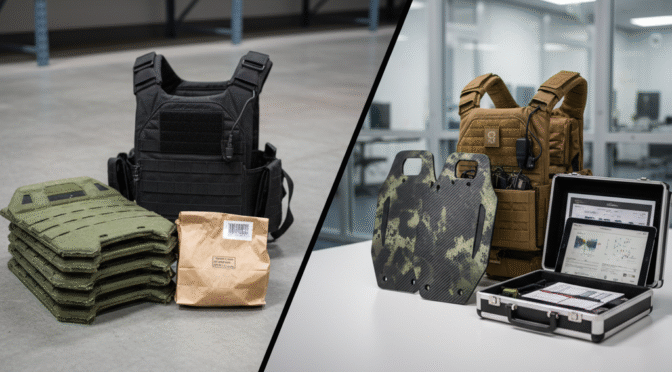
An Analyst’s Report on the U.S. Body Armor Market: A Comparative Analysis of Low-Cost vs. Premium Ballistic Protection

The selection of personal body armor is a critical decision governed by a fundamental balance of three competing priorities: the level of ballistic protection, the weight of the system, and its acquisition cost. It is not a simple dichotomy of “good” versus “bad” armor, but rather a calculated acceptance of specific trade-offs. Premium armor systems prioritize minimizing weight for a given level of protection, thereby enhancing user mobility and endurance, but at a significant financial cost. Conversely, low-cost armor prioritizes affordability, accepting a severe penalty in weight and often introducing unique performance compromises that are not immediately apparent from a product’s stated protection rating.

The U.S. body armor market is a dynamic and expanding sector, projected to grow from approximately $830 million in 2025 to $1.14 billion by 2034.1 This growth is fueled by a combination of escalating geopolitical tensions, defense modernization programs, and increased demand from law enforcement and prepared civilians.1 This expanding market has fostered both premium-tier innovation in materials science and the widespread availability of low-cost alternatives, often from overseas manufacturers, creating a complex and often confusing landscape for the end-user.3

This report provides a detailed technical analysis of the key differences between these market tiers. The primary findings are as follows:

  • Material science is the fundamental driver of cost and performance. The choice of ballistic material dictates nearly every other characteristic of a hard armor plate. Ballistic steel is inexpensive and durable but is exceedingly heavy and creates a dangerous secondary fragmentation effect known as spalling. Ceramic composites offer a superior protection-to-weight ratio and can defeat armor-piercing threats but are more expensive and brittle. Ultra-High-Molecular-Weight Polyethylene (UHMWPE) is exceptionally lightweight but has thermal limitations and inherent weaknesses against certain common rifle threats.
  • Ergonomics are a key performance differentiator, not a luxury. Features such as multi-curve plate geometry are hallmarks of premium armor and have a direct, quantifiable impact on user endurance, comfort, and combat effectiveness. These ergonomic considerations are among the first features sacrificed to achieve the low price point of budget armor.
  • Industry standards are frequently misunderstood, creating a critical knowledge gap for consumers. The term “NIJ Certified” represents a rigorous, verifiable, and ongoing quality assurance process overseen by the National Institute of Justice (NIJ). In contrast, terms like “NIJ Tested” or “NIJ Compliant” are marketing labels with no official backing, which can mask deficiencies in durability and performance under real-world conditions.

The ultimate assessment of whether the cost savings associated with low-cost armor are “worth it” is not universal. The answer is entirely contingent upon a sober and informed evaluation of the end-user’s mission profile, most probable threat environment, and physical requirements. For a user in a static defensive position where mobility is not a factor, a heavier system might be deemed acceptable. For any user who must move, fight, and endure for extended periods, the weight and ergonomic penalties of low-cost armor present a significant, and often unacceptable, compromise to their safety and effectiveness.

Section 2: Deconstructing the Armor System: Plates and Carriers

To properly evaluate body armor, it must be understood as an integrated system, not just a set of plates. The overall effectiveness of the system is limited by its weakest component. A set of high-end, lightweight ballistic plates housed within a poorly designed, low-quality plate carrier constitutes a compromised system, as the carrier’s failure to properly support the plates can negate their protective value.4 The two core components—the ballistic plate and the plate carrier—serve distinct but symbiotic functions.

Ballistic Plates: The Protective Core

The ballistic plate is the heart of the armor system, serving as the primary component responsible for defeating projectile threats.5 The performance of a plate is defined by its designated National Institute of Justice (NIJ) protection level, which certifies its ability to stop specific types of ammunition.6 Hard armor plates are typically rated NIJ Level III, for common rifle rounds, or NIJ Level IV, for armor-piercing rifle rounds.5 The material composition of the plate—be it steel, ceramic, polyethylene, or a hybrid—is the principal determinant of its weight, cost, and performance characteristics, which will be analyzed in detail in the following section.

Plate Carriers: The User Interface

The plate carrier is the critical interface between the ballistic plates and the user. Its function extends far beyond simply holding the plates. A well-designed carrier must distribute the system’s weight effectively to minimize fatigue, hold the plates securely over the vital organs during dynamic movement, and provide a stable platform for mounting mission-essential equipment such as magazine pouches, communication systems, and medical kits.8 The market for carriers is as stratified as the market for plates, with vast differences between low-cost and premium options.

Low-Cost Carriers: Budget-oriented carriers, such as the Tacticon BattleVest V2 ($79), are characterized by basic construction and materials. They often lack sufficient padding, use less durable stitching and fabrics, and feature simplistic adjustment systems.8 Under the load of plates and equipment, these carriers can sag, chafe, and shift excessively during movement. This constant shifting is not merely an issue of comfort; it can cause the ballistic plate to move out of position, leaving vital organs exposed at the critical moment of impact. The poor weight distribution also accelerates user fatigue, degrading physical and cognitive performance.

Premium Carriers: High-end carriers, such as the Crye Precision JPC 2.0 ($279) or the Velocity Systems Scarab LT ($338), represent a significant investment in advanced ergonomic design.8 These systems utilize superior materials, reinforced stitching, and innovative features to manage weight and enhance mobility. For example, the JPC 2.0’s minimalist, skeletal cummerbund reduces weight and improves ventilation, while the Scarab LT’s articulating swivel shoulder straps allow the carrier to move with the user’s body, improving comfort under heavy loads.8 These designs keep plates secure, distribute weight across the torso to reduce pressure points, and integrate seamlessly with other tactical equipment.

The carrier is not a passive component; it is an active contributor to the armor’s overall effectiveness. The substantial price difference between a basic $79 carrier and a premium $279 carrier reflects a disproportionate increase in functional performance. A superior carrier can make a 15-pound armor system feel more manageable and less fatiguing than a 12-pound system in a poorly designed carrier. This makes the carrier a non-obvious performance multiplier. Investing in a quality carrier ensures that the ballistic plates are properly positioned to provide protection and that the user can maintain a higher level of physical performance for a longer duration.

Section 3: The Heart of the Matter: A Materials Science Deep Dive

The primary driver of an armor plate’s performance, weight, and cost is its material composition. The technological advancements in material science over the past several decades have created a clear hierarchy of options, each with a distinct profile of strengths and weaknesses.

3.1: Ballistic Steel (AR500/AR550): The Budget Standard

  • Composition & Mechanism: Steel armor plates are manufactured from high-strength, abrasion-resistant steel alloys, such as AR500 or AR550, which are heat-treated and hardened.7 Protection is achieved through brute force; the extreme hardness of the steel plate is greater than that of the lead core and copper jacket of a standard bullet. Upon impact, the projectile is forced to shatter and deform, dissipating its energy without penetrating the plate.10
  • Advantages: The primary advantages of steel armor are its low cost, exceptional durability, and high multi-hit capability. A single steel plate can cost as little as $80-$150.12 It can withstand a tremendous amount of abuse, including being dropped or struck, without compromising its integrity. It can also sustain multiple projectile impacts in very close proximity without significant degradation of its protective capabilities.10 Furthermore, steel plates have an extremely long shelf life, often cited as 20 years or more if properly maintained.7
  • Disadvantages: The defining drawback of steel armor is its extreme weight. A standard 10×12 inch plate typically weighs between 8 and 10 pounds, imposing a significant penalty on the user’s mobility and endurance.10 Its most critical flaw, however, is its propensity to create spalling—a cloud of high-velocity bullet fragments—and ricochets upon impact.10 Additionally, as will be discussed in Section 4, certain steel plates exhibit a critical vulnerability to common high-velocity rifle rounds that can penetrate them despite their NIJ rating.16

3.2: Ceramic Composites: The Threat-Stopper

  • Composition & Mechanism: Modern ceramic armor is a composite system, not a monolithic piece of ceramic. It consists of a hard ceramic strike face bonded to a more ductile backing layer made from materials like UHMWPE or aramid fibers.18 The principle of operation is energy absorption through fracture. When a high-velocity projectile strikes the plate, the incredibly hard ceramic strike face shatters the bullet and erodes its mass. The act of fracturing the ceramic tile itself consumes a vast amount of the projectile’s kinetic energy. The flexible backing layer then serves to absorb any residual energy and, crucially, to catch both the projectile fragments and the shattered ceramic pieces, preventing them from injuring the wearer.11
  • Material Tiers (Cost/Weight Hierarchy): The type of ceramic used for the strike face creates a clear hierarchy in terms of performance and cost.
  • Alumina Oxide (Al2O3): This is the most common and affordable armor ceramic. While it is the heaviest of the three main types, its lower brittleness allows it to withstand multiple impacts better than harder ceramics, as cracks do not propagate as far from the initial impact zone.19 It is the material of choice for many popular mid-tier plates, such as the RMA Defense Model 1155.19
  • Silicon Carbide (SiC): Often considered the “sweet spot” in the ceramic family, Silicon Carbide is significantly harder and lighter than Alumina, but more expensive.15 It offers an excellent balance of weight, protection, and cost, making it a common choice for higher-end law enforcement and military plates.19
  • Boron Carbide (B4C): This is the lightest, hardest, and most expensive ceramic material used in body armor.15 Its extreme hardness makes it capable of defeating very potent armor-piercing threats, and its low density allows for the creation of exceptionally lightweight Level IV plates. However, this extreme hardness comes with increased brittleness, which can result in lesser multi-hit performance compared to Alumina, as impacts can cause more extensive cracking across the strike face.18 It is typically reserved for top-tier special operations forces (SOCOM) armor systems.19
  • Advantages: Ceramic armor provides an excellent protection-to-weight ratio, particularly against rifle threats. It is the only practical material capable of consistently defeating high-velocity, armor-piercing (AP) projectiles, which is the requirement for a NIJ Level IV rating.7
  • Disadvantages: The primary drawbacks are cost and fragility. Ceramic plates are significantly more expensive than steel. Their inherent brittleness means they can crack or shatter if dropped or subjected to a hard impact, potentially compromising their ballistic integrity without any visible external damage.7 Their multi-hit capability is also limited, as each impact creates a shattered, compromised zone on the strike face.10

3.3: Ultra-High-Molecular-Weight Polyethylene (UHMWPE): The Lightweight Champion

  • Composition & Mechanism: Commonly known by trade names like Dyneema® or Spectra®, UHMWPE is a thermoplastic derived from polyethylene.15 For hard armor plates, many layers of unidirectional UHMWPE fiber sheets are arranged, laminated, and pressed under immense heat and pressure to form a solid, rigid panel.7 Its protective mechanism is fascinatingly complex. Unlike steel or ceramic, which defeat projectiles through hardness, UHMWPE utilizes its incredibly high tensile strength and low friction. As a high-velocity projectile enters the material, its rotational and linear energy creates friction, which melts the polymer. The long, strong molecular chains of the UHMWPE fibers ensnare the bullet, forming a sticky, fibrous web that rapidly decelerates and “catches” it.24
  • Advantages: The defining characteristic of UHMWPE is its exceptionally low weight. A standalone Level III plate can weigh as little as 2 to 5 pounds, a fraction of the weight of a steel or ceramic equivalent.13 It is also buoyant, making it ideal for maritime operations, and is highly resistant to moisture, UV light, and chemicals.15 It offers excellent multi-hit capability, as impacts can be sustained very close to one another without causing systemic failure of the plate.13
  • Disadvantages: UHMWPE armor is significantly more expensive than steel and many alumina ceramic options due to its complex manufacturing process.12 It tends to be thicker than other plate types to achieve the same level of protection.27 Its most significant limitations are thermal sensitivity—its performance begins to degrade at sustained temperatures above 180°F (
    )—and its general inability, when used as a standalone plate, to defeat rifle rounds with steel penetrator cores, such as the common M855 “green tip” ammunition.13

3.4: Aramid Fibers (Kevlar®/Twaron®): The Soft Armor Workhorse

  • Composition & Mechanism: Aramid fibers, most famously DuPont’s Kevlar®, are a class of strong, heat-resistant synthetic fibers. In soft body armor, these fibers are tightly woven into a fabric-like material. Multiple layers of this material are then stitched together to form a ballistic panel.9 The protective mechanism relies on the tensile strength of these fibers. When a handgun bullet strikes the vest, the layers of aramid fabric act like a net, “catching” the projectile and spreading its impact energy over a wider area of the vest. This rapid dispersion of energy prevents the bullet from penetrating.11
  • Application: Aramids are the foundational material for soft armor vests, which are rated NIJ Level IIA, II, and IIIA. These vests are designed to be flexible and concealable, offering protection against common handgun calibers and fragmentation, making them standard issue for patrol officers and security personnel.5 Aramids are also sometimes used as the backing material in more budget-oriented ceramic hard armor plates.19
  • Aramid vs. UHMWPE in Soft Armor: In modern soft armor, UHMWPE is increasingly used alongside or in place of aramid. UHMWPE is lighter, generally more flexible, and offers superior resistance to moisture and UV degradation.19 Aramid, however, is typically less expensive, possesses far greater thermal and flame resistance, and provides better protection against stabbing or piercing attacks from edged weapons.12

3.5: Hybrid Systems: The Best of Both Worlds?

The pinnacle of modern armor design lies in the creation of sophisticated hybrid or composite systems that leverage the strengths of multiple materials to create a final product that is superior to any single component. The most common and effective hybrid system is the combination of a ceramic strike face with a UHMWPE backer.7

This design creates a synergistic effect. The extreme hardness of the ceramic strike face (e.g., Silicon Carbide or Boron Carbide) is used to shatter and destroy the hardened steel or tungsten penetrator of an armor-piercing round. The exceptionally lightweight and high-tensile-strength UHMWPE backer then acts as the ultimate backstop, catching the fragmented projectile and the shattered ceramic pieces.18 This approach allows for the creation of NIJ Level IV plates that are significantly lighter than older designs that used aramid or fiberglass backers.18

The “premium” price tag on high-end body armor is not merely for a single superior material, but for the advanced research, engineering, and complex manufacturing processes required to optimally bond and integrate these disparate materials. This synergy—achieving maximum threat defeat at minimum weight and thickness—is the defining characteristic of premium ballistic protection.

Section 4: Performance Under Fire: A Head-to-Head Comparison

Understanding the underlying material science is the first step; translating that knowledge into practical, real-world performance metrics is what enables an informed decision. The behavior of an armor plate when struck by a projectile varies dramatically depending on its construction.

4.1: Multi-Hit Capability: Degradation After Impact

Multi-hit capability refers to an armor plate’s ability to sustain multiple projectile impacts and remain effective. This is a critical attribute, as a single shot is rarely the only threat in a hostile engagement.

  • Steel: Possesses the highest multi-hit capability. Because it defeats rounds through hardness rather than fracture, projectiles disintegrate on its surface with very little damage to the plate itself. Multiple rounds can impact the same area with minimal degradation in protective capacity.10
  • Ceramic: Has the most limited multi-hit capability. Each impact shatters the ceramic strike face in a radius of approximately 1 to 3 inches around the point of impact. This creates a compromised zone where the ceramic has been pulverized and offers significantly reduced or no protection against subsequent hits.10 While NIJ testing standards require a specific spacing between shots, real-world shot patterns are unpredictable. Premium ceramic plates attempt to mitigate this by using arrays of smaller ceramic tiles (a mosaic design) instead of a single large tile (monolithic), which can help to isolate the damage and prevent cracks from propagating across the entire plate.19 Denser, less brittle ceramics like Alumina also tend to perform better in multi-hit scenarios than more brittle, lightweight ceramics like Boron Carbide.19
  • UHMWPE: Exhibits excellent multi-hit capability, second only to steel. The mechanism of “catching” the bullet is localized. The polymer melts and re-solidifies around the projectile, allowing subsequent impacts to be placed very close to one another without causing a systemic failure of the plate’s structure.13

4.2: The Spalling & Ricochet Hazard of Steel Armor

This is arguably the most significant and debated drawback of steel body armor. When a rifle bullet strikes a hard steel plate, it does not simply stop or get absorbed. It violently disintegrates into a spray of tiny, high-velocity metal fragments. This fragmentation, known as “spall,” travels outward from the point of impact, parallel to the surface of the plate. This creates a secondary projectile hazard that can inflict severe or fatal lacerations to the wearer’s neck, throat, chin, and arms.10

To mitigate this, manufacturers of steel armor apply a thick outer coating, often a polyurea material similar to truck bed liner (e.g., Spartan Armor Systems’ Encapsaloc™).10 The purpose of this “spall coating” is to contain the bullet fragments. However, the effectiveness of these coatings is a subject of intense debate. A single impact can compromise the coating in that area, potentially allowing fragments from subsequent hits to escape. Angled impacts can also defeat the coating’s ability to contain the fragments. Premium armor materials like ceramic and UHMWPE completely obviate this risk by absorbing the projectile into the plate, making spalling a non-issue.27

4.3: Backface Deformation (BFD) and Blunt Force Trauma

Even when a projectile is stopped, its kinetic energy must be transferred somewhere. This energy transfer causes the back of the armor plate to bulge inward toward the wearer’s body. This phenomenon is known as Backface Deformation (BFD). If the BFD is excessive, it can cause significant blunt force trauma, leading to injuries such as broken ribs, internal organ damage, and internal bleeding, even without the armor being perforated.11

The NIJ 0101.06 standard specifies that a plate must not exhibit more than 44mm of BFD during testing to be certified.10 The performance of different materials varies:

  • Steel: Exhibits very little BFD due to its rigidity. The energy is dispersed across the plate, resulting in less focused impact on the body.10
  • Ceramic: The process of shattering the strike face is highly effective at dissipating energy, which helps to manage BFD.11
  • UHMWPE: Due to its more flexible, thermoplastic nature, UHMWPE tends to exhibit greater BFD than other materials. Managing BFD is a key engineering challenge in designing pure UHMWPE plates.12

Premium armor systems often include a separate, non-ballistic trauma pad worn behind the plate. This pad is made from energy-absorbing foams or polymers and serves to further cushion the impact and distribute the force of the BFD over a larger area of the body, reducing the risk of blunt force injury.5

4.4: Special Threat Performance: The M193 vs. M855 Dilemma

A critical failure in understanding for many consumers is the assumption that a given NIJ rating protects against all threats of a certain caliber. The reality is far more nuanced, particularly concerning the two most common types of 5.56x45mm ammunition in the United States:

  • M193: A 55-grain, lead-core, full metal jacket (FMJ) projectile with a very high velocity, often exceeding 3,250 ft/s from a 20-inch barrel.17
  • M855 (“Green Tip”): A 62-grain projectile that is slightly slower than M193 but contains a 10-grain mild steel penetrator tip ahead of its lead core.17

These two rounds pose fundamentally different challenges to armor plates, leading to counter-intuitive performance failures in lower-cost systems:

  • Steel Armor’s Critical Failure: The hardness of steel armor is effective at defeating the mild steel penetrator of the M855 round. However, the extreme velocity of the M193 round can cause it to yaw and fragment upon impact with the hard steel surface, and the combined energy can be sufficient to punch through many NIJ Level III-rated steel plates. This creates a dangerous situation where a plate certified to stop the 7.62x51mm M80 military round (the NIJ test round) can be defeated by one of the most common and inexpensive AR-15 rounds available to civilians.16
  • UHMWPE’s Weakness: Conversely, standalone NIJ Level III UHMWPE plates are highly effective at stopping the high-velocity M193 by “catching” it. However, the steel penetrator of the M855 round can often punch through the polyethylene fibers before they have a chance to effectively trap it.17
  • Ceramic’s Advantage: This is where ceramic composite armor demonstrates its superiority. A properly designed ceramic plate rated “Level III+” (an unofficial but common industry term) or the new NIJ 0101.07 “RF2” standard is specifically designed to defeat both threats. The hard ceramic strike face shatters the steel penetrator of the M855, and it has enough energy-absorbing capacity to stop the high-velocity M193.17

The “Level III” rating, as defined by the NIJ 0101.06 standard, has proven to be dangerously misleading for consumers in the U.S. market. The standard’s reliance on the 7.62mm M80 ball round as its test projectile inadvertently created a loophole. Steel armor manufacturers could design plates to pass this specific test while leaving them vulnerable to the ubiquitous M193. The higher cost of a premium ceramic plate rated III+/RF2 is therefore not just an investment in weight savings; it is an investment in protection against a wider, more realistic spectrum of common threats that the base-level standard fails to adequately address.

4.5: Summary of Material Characteristics

The following table provides a consolidated overview of the key trade-offs between the primary hard armor materials.

Table 1: Comparative Analysis of Hard Armor Plate Materials

Material TypeTypical Weight (10×12″ plate)Relative Cost (per plate)Multi-Hit CapabilityPerformance vs. M855 (Steel Core)Primary Weakness
AR500 Steel8 – 10 lbs$ExcellentGoodSpalling; Weight; M193 Vulnerability
Alumina Ceramic6 – 8 lbs$$Fair to GoodExcellentBrittle; Heavier than other ceramics
SiC/B4C Ceramic4 – 6 lbs$$$$FairExcellentBrittle; High Cost
UHMWPE (Level III)2.5 – 4 lbs$$$ExcellentPoorHeat Sensitivity; Steel-Core Penetrators
Hybrid (Ceramic/UHMWPE)5 – 7 lbs$$$$Fair to GoodExcellentBrittle; High Cost

Section 5: Decoding the Standards: “NIJ Certified” vs. “Tested To NIJ Standards”

In the life-saving equipment market, accountability and verified performance are paramount. The National Institute of Justice (NIJ) provides the benchmark for body armor performance in the United States, but its terminology is precise and often misused for marketing purposes. Understanding the immense difference between armor that is officially “NIJ Certified” and armor that is merely claimed to be “NIJ Tested” is the single most important piece of knowledge for a consumer.

The Gold Standard: NIJ Certification

The NIJ is the research, development, and evaluation agency of the U.S. Department of Justice.37 It sets voluntary minimum performance standards for body armor worn by law enforcement and corrections officers.6

  • The Process: Achieving official NIJ Certification is a rigorous, time-consuming, and expensive undertaking for a manufacturer. It involves submitting a large number of sample plates (up to 37 for a Level IV certification under the 0101.06 standard) to an independent, NIJ-approved laboratory.39 These plates undergo not only ballistic testing but also a series of demanding environmental conditioning tests designed to simulate real-world wear and tear. This includes prolonged water immersion (30 minutes for the 0101.06 standard), mechanical durability drop tests, and extended exposure to high heat and humidity in a tumbling machine.39 Only after passing this entire battery of tests can a specific armor model be granted certification.
  • The Compliant Products List (CPL): The cornerstone of the certification program is transparency. Every armor model that successfully achieves and maintains certification is listed on the NIJ’s public Compliant Products List (CPL). This online database is the only definitive way for a consumer or agency to verify a manufacturer’s claim of certification. If a model is not on the CPL, it is not NIJ Certified.39
  • Follow-up Inspection and Testing (FIT): Certification is not a one-time event. The NIJ maintains an ongoing quality control program where it can, at any time and often without announcement, select and test armor from a manufacturer’s production line to ensure that the quality and performance remain consistent with the original certified samples. Failure to pass these follow-up tests can result in the armor’s certification being suspended or revoked.39 This provides a powerful incentive for manufacturers to maintain high quality control standards.

The Marketing Gray Area: “NIJ Tested,” “NIJ Compliant”

These terms are frequently used by manufacturers and can be highly misleading.

  • Definition: When a product is advertised as “NIJ Tested” or “NIJ Compliant,” it means the manufacturer is claiming that their product meets the ballistic performance requirements of an NIJ standard, but the product has not undergone the official NIJ certification process.37 The testing may have been performed in-house by the manufacturer or by a third-party laboratory (sometimes even the same labs that conduct official certification tests), but it crucially lacks the NIJ’s direct oversight, the mandatory environmental conditioning protocols, and the long-term accountability of the FIT program.
  • Reasons for Use: Manufacturers choose not to pursue full certification for several reasons. The primary factor is cost; the certification process can be prohibitively expensive, and these costs are inevitably passed on to the consumer. Offering a “tested” plate allows a company to market a product at a lower price point.40 Additionally, the NIJ historically only certifies certain types of products. For example, there is no official NIJ certification standard for ballistic helmets, backpack inserts, or for the popular “Level III+” threat rating. In these cases, a manufacturer can only claim their product is designed to be “compliant” with a certain standard’s principles.37

The premium paid for an NIJ Certified plate is not just for the initial ballistic performance. It is payment for quality assurance. A “tested” plate might stop a bullet when it is brand new and tested under ideal laboratory conditions. A “certified” plate provides a much higher degree of confidence that it will still stop that same bullet after being worn in the rain, left in a hot car trunk for a summer, or accidentally dropped on concrete. It is an insurance policy against failure caused by manufacturing defects or degradation from real-world environmental exposure—factors that a simple ballistic test alone cannot account for.

Section 6: Ergonomics and Endurance: The Overlooked Factors

The effectiveness of body armor is not defined solely by its ability to stop a projectile. Its impact on the wearer’s physiology and performance is an equally critical, though often overlooked, factor. Weight and comfort are not matters of luxury; they are key performance metrics that directly influence a user’s endurance, mobility, and ultimately, their survivability. Premium armor manufacturers invest heavily in ergonomic design, a feature largely absent in low-cost alternatives.

6.1: The Weight Penalty: Quantifying the Impact on Fatigue and Mobility

The most immediate and tangible difference between low-cost and premium armor is weight.

  • Direct Comparison: A complete armor setup with two premium, lightweight Level IV ceramic/UHMWPE plates can weigh as little as 10 to 12 pounds. A comparable low-cost system using Level III steel plates can easily exceed 20 pounds, before adding magazines, communications, and other essential gear.10
  • The Physiological Cost: This additional 10+ pounds of weight has a cascading negative effect on the user. It dramatically increases metabolic load, leading to faster physical exhaustion. It reduces speed, agility, and the ability to move explosively. Over time, it places significant strain on the musculoskeletal system, particularly the spine, shoulders, and knees. In a tactical context, fatigue is a critical vulnerability; it impairs judgment, slows reaction times, and degrades fine motor skills.24 The ability to move quickly from a position of danger is a form of protection that heavy armor actively hinders.
  • Premium Advantage: The primary value proposition of premium armor is achieving the required level of ballistic protection at the lowest possible weight. This is not just about comfort; it is about maximizing the operator’s combat effectiveness and endurance. By reducing the physical burden, lightweight armor allows the user to stay more alert, move faster, and fight longer.2

6.2: Plate Geometry: Single-Curve vs. Multi-Curve Plates

Beyond weight, the shape of a hard armor plate has a profound impact on its wearability.

  • Single-Curve Plates: This is the most common and basic design. The plate is formed with a single, simple curve along its horizontal axis, intended to wrap around the user’s torso.43 This design is relatively simple and inexpensive to manufacture. While a significant improvement over completely flat plates, the single-curve design does not conform well to the complex contours of the human body. This can create uncomfortable pressure points on the chest and sternum, and the plate may feel bulky and restrictive, particularly when sitting, bending, or shouldering a rifle.45
  • Multi-Curve Plates: A hallmark of premium armor, multi-curve plates are designed with complex, compound curves on both the horizontal and vertical axes.44 This anatomical shape allows the plate to conform much more closely to the natural curvature of the human torso. The result is a dramatic improvement in comfort and ergonomics. The plate sits more securely against the body, distributing its weight more evenly and reducing the sensation of “hot spots” or pressure points.43 This secure fit also minimizes the plate’s tendency to shift or bounce during dynamic movement, ensuring that it remains in the correct position to protect the vital organs.44
  • The Cost-Benefit Analysis: The complex manufacturing process required to create multi-curve plates makes them more expensive, often adding a 10-20% cost premium over a single-curve version of the exact same plate.46 However, this additional cost translates directly into tangible performance benefits. An armor system that is more comfortable is more likely to be worn correctly and for longer durations. By reducing fatigue and distraction, a well-fitting multi-curve plate allows the user to remain more focused on their surroundings and tasks. Therefore, the ergonomic advantage of a multi-curve plate is not merely a quality-of-life improvement; it is an investment in sustained operational performance.

Section 7: Final Analysis & Recommendations: Is the Cost Savings Worth It?

The preceding analysis demonstrates that the choice between low-cost and premium body armor is a complex decision involving a web of interconnected trade-offs. The final verdict on whether the significant cost savings of budget armor are justifiable depends entirely on a realistic assessment of the user’s specific circumstances. To provide a clear answer, this section synthesizes the findings into recommendations for three distinct user profiles.

Profile 1: The Prepared Civilian / Home Defender

  • Threat Profile: The most likely threats are from common handguns and rifles, particularly the AR-15 and AK-47 platforms. This means a high probability of encountering 9mm handgun rounds, as well as 5.56x45mm (both M193 and M855) and 7.62x39mm rifle rounds. Encounters with military-grade armor-piercing ammunition are highly improbable.
  • Use Case: The armor will likely be worn infrequently and for short durations, typically in response to an immediate, high-stress emergency. Mobility for moving within a structure is important, but endurance over many hours of patrolling is a lesser concern.
  • Recommendation: For this profile, the cheapest option—steel armor—represents a false economy. Its extreme weight is a significant hindrance to mobility, but its critical vulnerability to the common, high-velocity M193 round and the inherent danger of spalling present unacceptable risks. The cost savings are not worth it when they come with a high probability of failure against a likely threat. The optimal value lies in the mid-tier of the market: a set of NIJ Certified Level III+ (or the new RF2 standard) plates made from Alumina ceramic. Reputable brands like RMA Armament or Spartan Armor Systems offer such plates at a reasonable price point.11 This solution provides robust, reliable protection against the full spectrum of common rifle threats without the extreme cost or specialized nature of premium lightweight armor.

Profile 2: The Law Enforcement Officer / Security Professional

  • Threat Profile: This user faces a wide range of potential threats, from concealed handguns to rifles. The increasing prevalence of rifle threats during active assailant events makes rifle-rated protection essential.
  • Use Case: The armor is worn daily, often for long shifts of 8 to 12 hours. A significant portion of this time may be spent sitting in a vehicle, standing at a fixed post, or conducting foot patrols. Comfort, ergonomics, and weight are paramount to prevent cumulative fatigue and to ensure the armor is consistently and correctly worn throughout a long career.
  • Recommendation: For this professional user, the weight and poor ergonomics of low-cost armor are debilitating. The cost savings are absolutely not worth it. The physical toll of wearing a 20+ pound steel armor system daily would be immense, leading to chronic pain and fatigue, which are themselves safety issues. The recommendation is for a premium, lightweight system. This means multi-curve plates made from advanced ceramics (Silicon Carbide) or hybrid ceramic/UHMWPE systems, rated at Level III+ or Level IV depending on agency policy and perceived threat levels. Pairing these lightweight plates with a high-quality, ergonomic carrier (e.g., from Crye, Velocity Systems, or Spiritus Systems) is equally important.8 The significant upfront investment in a premium system pays dividends in officer health, endurance, and on-the-job effectiveness.

Profile 3: The Military / Special Operations User

  • Threat Profile: This user must be prepared to face the full spectrum of modern military threats, including advanced, armor-piercing rifle ammunition and explosive fragmentation.
  • Use Case: The operational environment demands extreme physical exertion, long-duration missions under heavy load, and maximum mobility. Every ounce of weight carried has a direct and significant impact on lethality and survivability.
  • Recommendation: In this context, cost is a distant secondary consideration to performance. Only the most advanced, premium armor systems are acceptable. This means the lightest possible multi-curve Level IV plates, likely constructed from Boron Carbide and advanced UHMWPE backers.19 The concept of “cost savings” by using cheaper, heavier armor is antithetical to the operational requirements of these elite units; it would represent an unacceptable compromise that would directly reduce mission effectiveness and increase risk.

Final Verdict

For nearly all serious defensive applications, the cost savings offered by the lowest tier of the body armor market, specifically steel plates, are a poor and potentially dangerous trade-off. The hidden costs are paid in the currency of physical exhaustion, a false sense of security against some of America’s most common rifle rounds, and the unique and potentially lethal hazard of spall and ricochet. The “sweet spot” for most non-military users who require rifle protection is found in the mid-tier ceramic market, which offers certified protection against a realistic range of threats at a manageable weight and price. For professionals whose lives and effectiveness depend on their equipment daily, the substantial cost of premium, lightweight, and ergonomic armor is not an extravagance but a necessary and wise investment in their own performance and survival.


Please share the link on Facebook, Forums, with colleagues, etc. Your support is much appreciated and if you have any feedback, please email us in**@*********ps.com. If you’d like to request a report or order a reprint, please click here for the corresponding page to open in new tab.


Sources Used

  1. Price Projections For AVS Level 4 + ACH Armor Set | PDF | Inflation | Armour – Scribd, accessed September 30, 2025, https://www.scribd.com/document/880186573/Price-Projections-for-AVS-Level-4-ACH-Armor-Set
  2. Bulletproof Vest Market Size, Share & Research Report, 2032 – Fortune Business Insights, accessed September 30, 2025, https://www.fortunebusinessinsights.com/bulletproof-vest-market-104752
  3. Tactical And Outdoor Clothing Market Size, Growth, Share, & Analysis Report – 2033, accessed September 30, 2025, https://www.datahorizzonresearch.com/tactical-and-outdoor-clothing-market-45608
  4. How Much Does Body Armor Cost & Will It Actually Hold Up?, accessed September 30, 2025, https://premierbodyarmor.com/blogs/pba/how-much-does-a-bulletproof-vest-cost
  5. Complete Body Armor Guide | Types, NIJ Levels & Protection, accessed September 30, 2025, https://usarmor.com/body-armor-guide/
  6. What Do The NIJ Protection Levels Mean? – Defenshield, Inc., accessed September 30, 2025, https://defenshield.com/ballistic-levels-explained/
  7. What are Armor Plates Made of? – Pivotal Body Armor, accessed September 30, 2025, https://pivotalbodyarmor.com/blogs/body-armor-guides/what-are-armor-plates-made-of
  8. The 10 Best Plate Carriers for 2025, accessed September 30, 2025, https://www.abetterway2a.com/post/the-10-best-plate-carriers-for-2025
  9. How Body Armor is Made, accessed September 30, 2025, https://pivotalbodyarmor.com/blogs/body-armor-guides/how-body-armor-is-made
  10. 7 Things You Need to Know About Steel Core Body Armor, accessed September 30, 2025, https://www.spartanarmorsystems.com/blog/7-things-you-need-to-know-about-steel-core-body-armor/
  11. Ultimate Guide to the Best Body Armor: Top 13 Picks – ProArmory.com, accessed September 30, 2025, https://proarmory.com/blog/ultimate-guide-to-the-best-body-armor-top-13-picks/
  12. What is the disadvantage of UHMWPE? – Pivotal Body Armor, accessed September 30, 2025, https://pivotalbodyarmor.com/blogs/body-armor-guides/what-is-the-disadvantage-of-uhmwpe
  13. Comparing Body Armor Materials: Ceramic vs PE vs Steel vs Kevlar …, accessed September 30, 2025, https://www.atomicdefense.com/blogs/news/kevlar-vs-steel-vs-pe-body-armor
  14. Polyethylene Body Armor: Safety Without the Weight, accessed September 30, 2025, https://pivotalbodyarmor.com/blogs/body-armor-guides/polyethylene-body-armor-safety-without-the-weight
  15. What are the Different Body Armor Materials? – Redemption Tactical, accessed September 30, 2025, https://redemptiontactical.com/blogs/blogs/what-are-the-different-body-armor-materials-2
  16. Body Armor Ammunition Guide, accessed September 30, 2025, https://rmadefense.com/body-armor-ammunition-guide/
  17. Hard Body Armor Levels Interpreted, accessed September 30, 2025, https://www.bodyarmornews.com/hard-body-armor-levels-interpreted/
  18. Body armor – Wikipedia, accessed September 30, 2025, https://en.wikipedia.org/wiki/Body_armor
  19. What Is Body Armor Made Of? (2024), accessed September 30, 2025, https://rmadefense.com/what-is-body-armor-made-of/
  20. What is Body Armor Made of? A Deep Dive into Armor Components, accessed September 30, 2025, https://premierbodyarmor.com/blogs/pba/what-is-body-armor-made-of
  21. Ballistic Plates Summary – SafeGuard Armour UK, accessed September 30, 2025, https://www.uk.safeguardarmor.com/blogs/protection-types/ballistic-plates-summary
  22. What is the best multiple hit armor material? – GTS, accessed September 30, 2025, https://gilliamtechnicalservices.com/blogs/armor-plate-blog/what-is-the-best-multiple-hit-armor-material
  23. World’s Strongest Body Armor Plates | RMA Armament | RMA Defense | RMA Armor | RMA Plates, accessed September 30, 2025, https://rmadefense.com/
  24. Edge Testing the Best Body Armor Plates in 2023 – Warrior Poet Society, accessed September 30, 2025, https://warriorpoetsupplyco.com/blog/edge-testing-the-best-body-armor-plates-in-2023/
  25. Para-Aramid Vs. UHMWPE – Rocket-Fibers, accessed September 30, 2025, https://www.rocket-fibers.com/blogs/fiber-resources/uhmwpe-vs-para-aramid
  26. Kevlar vs. UHMWPE – BulletSafe Bulletproof Vests, accessed September 30, 2025, https://bulletsafe.com/blogs/news/kevlar-vs-uhmwpe
  27. Polyethylene Body Armor: The Pros & Cons to PE Ballistic Plates, accessed September 30, 2025, https://premierbodyarmor.com/blogs/pba/polyethylene-body-armor
  28. Polyethylene body armor? : r/tacticalgear – Reddit, accessed September 30, 2025, https://www.reddit.com/r/tacticalgear/comments/195neci/polyethylene_body_armor/
  29. Aramid vs. UHMWPE Fabrics – Key Differences & Applications, accessed September 30, 2025, https://polymertex.com/the-differences-between-aramid-and-uhmwpe-fabrics/
  30. Body Armor Materials: A Comprehensive Guide to Ballistic Protection, accessed September 30, 2025, https://gdbodyarmor.com/body-armor-materials-ballistic-protection/
  31. What ballistic materials are used to make a bulletproof vest | PGD Article | Blog post, accessed September 30, 2025, https://protectiongroupdenmark.com/blog/ballistic-materials-used-to-make-a-bulletproof-vest/
  32. Single-curve, multi-curve ceramic body armor plate debate – GTS, accessed September 30, 2025, https://gilliamtechnicalservices.com/blogs/armor-plate-blog/single-curve-multi-curve-ceramic-debate
  33. For those asking why we don’t recommend steel armor, this is why : r/tacticalgear – Reddit, accessed September 30, 2025, https://www.reddit.com/r/tacticalgear/comments/trjm4o/for_those_asking_why_we_dont_recommend_steel/
  34. NIJ Standard 0101.07: A Significant Update in Ballistic Resistance Testing – MIRA Safety, accessed September 30, 2025, https://www.mirasafety.com/blogs/news/nij-standard-0101-07-a-significant-update-in-ballistic-resistance-testing-and-what-it-means-for-your-body-armor
  35. Understanding The Terms-Picking the Right Plates – Tactical Edge & Armor, accessed September 30, 2025, https://tacticaledgeandarmor.com/2025/02/13/understanding-the-terms-picking-the-right-plates/
  36. Polyethylene plates or ceramic? : r/tacticalgear – Reddit, accessed September 30, 2025, https://www.reddit.com/r/tacticalgear/comments/tib3r3/polyethylene_plates_or_ceramic/
  37. What is the NIJ? Benefits and Certifications – Tacticon Armament, accessed September 30, 2025, https://tacticon.com/tactical-products-know-how/what-is-the-nij/
  38. Ballistic Resistance of Body Armor NIJ Standard-0101.06, accessed September 30, 2025, https://www.nist.gov/system/files/documents/oles/ballistic.pdf
  39. NIJ Certified vs. NIJ Tested Plates – Top Armor, accessed September 30, 2025, https://toparmor.com/blogs/body-armor-101/nij-certified-vs-tested-armor
  40. NIJ Certified vs. NIJ Compliant vs. NIJ Tested/Rated: What’s the Difference? – Bulletproof Zone, accessed September 30, 2025, https://bulletproofzone.com/blogs/bullet-proof-blog/nij-certified-vs-nij-compliant-vs-nij-tested-rated
  41. NIJ Standards Explained: 10 Common Questions Answered – LUPU Tactical Gear, accessed September 30, 2025, https://luputacticalgear.com/nij-standards-explained-10-questions-answered/
  42. What Composite Materials Are Used in Body Armor? – AZoM, accessed September 30, 2025, https://www.azom.com/article.aspx?ArticleID=23392
  43. Single Curve vs Multi Curve Plates: Which One Fits Your Needs? – Shanghai H Win, accessed September 30, 2025, https://www.hwinbulletproof.com/single-curve-vs-multi-curve-armor-plate-for-your-needs/
  44. Difference Between Single Curve vs Multi Curve Armor Plates – Premier Body Armor, accessed September 30, 2025, https://premierbodyarmor.com/blogs/pba/single-curve-vs-multi-curve-plates
  45. Difference Between Single Curve and Multi Curve Rifle Plates – EOD Gear, accessed September 30, 2025, https://www.eod-gear.com/difference-between-single-curve-and-multi-curve-rifle-plates/
  46. Multicurve Body Armor Plates – Tacticon Armament, accessed September 30, 2025, https://tacticon.com/tactical-products-know-how/multicurve-body-armor-plates/
  47. Spartan Armor Systems: Body Armor, Ballistic Plates & Tactical Gear, accessed September 30, 2025, https://www.spartanarmorsystems.com/
  48. Best Body Armor [Tested]: Hard Plates & Soft Armor – Pew Pew Tactical, accessed September 30, 2025, https://www.pewpewtactical.com/best-body-armor/
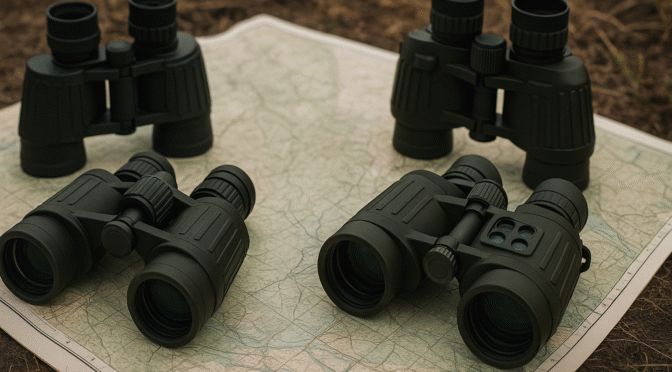

Assessment of Top Military and Tactical Binoculars in the US Market (2024-2025) – Q4 2025

Binoculars remain a critical observation tool for military personnel and tactical operators, providing essential magnification for surveillance, reconnaissance, target identification, and situational awareness. The US market offers a diverse range of binoculars tailored or suitable for these demanding applications, varying significantly in optical performance, durability, features, and cost. This report provides a comprehensive assessment of the top 20 binoculars identified as relevant for military and tactical use within the US market for the 2024-2025 period. The primary objective is to evaluate both objective performance characteristics and subjective user/expert sentiment, culminating in a composite score that allows for ranking and tiering. This analysis aims to provide procurement specialists, operators, and industry observers with a clear understanding of the current landscape and the relative strengths and weaknesses of leading models. The report details the assessment methodology, presents performance and sentiment findings, ranks the selected models, provides in-depth analysis of key products, and offers strategic insights into the market’s direction.

Market Overview

The military and tactical binocular segment is characterized by stringent demands for reliability, ruggedness, and optical clarity under challenging environmental conditions. Key users include military branches (infantry, special operations, reconnaissance units), law enforcement agencies (SWAT, patrol, surveillance teams), and border security personnel. While some manufacturers design products explicitly for military contracts (e.g., Steiner M-Series, L3Harris M24) 1, the market also sees significant crossover from high-end hunting and outdoor optics, where models from brands like Swarovski, Zeiss, Leupold, and Vortex offer exceptional optical quality and durability suitable for professional use.3

Current trends indicate a growing interest in binoculars with integrated electronic capabilities, such as laser rangefinders (LRF) and image stabilization (IS), which enhance operational effectiveness.5 LRF binoculars provide immediate distance-to-target data crucial for accurate shooting solutions, while IS systems mitigate hand shake, enabling effective use of higher magnifications without a tripod and reducing user fatigue during extended observation periods.6 Durability standards, including robust waterproofing, fog proofing, shock resistance, and protective armor coatings, remain paramount.9 While traditional configurations like 7×50, 8×30, and 10×42 remain prevalent, there is also a trend towards larger objective lenses (50mm+) for improved low-light performance and higher magnifications (12x, 15x+) for extended range observation, often necessitating tripod use.5

Methodology Overview

The assessment methodology developed for this report integrates quantitative performance metrics derived from technical specifications and expert reviews with qualitative sentiment analysis gathered from diverse user and professional communities. Twenty binocular models were selected based on their prevalence in military/tactical discussions, recommendations in expert reviews, manufacturer targeting, and representation of key feature categories (e.g., LRF, IS, standard issue, high-end crossover).

A composite score, ranging from 0 to 100, was calculated for each model. This score combines an Overall Performance Score (weighted 65%) and a Sentiment Index Score (weighted 35%).

  • Overall Performance Score: Assesses quantifiable and expertly evaluated aspects across four weighted categories: Optical Quality (40%), Durability & Construction (30%), Low-Light Performance (15%), and Ergonomics & Features (15%). Criteria within these categories include clarity, field of view, weather resistance, build materials, light transmission, exit pupil, weight, dimensions, focus mechanism, and tactical features (e.g., reticle, LRF/IS).
  • Sentiment Index Score: Aggregates feedback from three distinct sources: Expert Reviews (40% weight, publications like Field & Stream, Outdoor Life, GearJunkie, specialized optics reviewers), User Reviews (30% weight, major retailers like OpticsPlanet, B&H Photo, Amazon, forums), and Professional/Tactical User Feedback (30% weight, forums, expert communities like ExpertVoice, reviews citing military/LE use).

This weighted composite approach provides a balanced perspective, reflecting both technical merit and real-world user satisfaction relevant to the demanding requirements of military and tactical applications. Full details of the criteria, scoring, weighting, data sources, and limitations are documented in the Appendix.

Performance Assessment

The performance assessment evaluates binoculars against criteria crucial for military and tactical effectiveness. Weightings prioritize optical quality and durability, reflecting the non-negotiable need for clear imaging and robustness in operational environments.

Performance Criteria & Weighting Rationale

  • Optical Quality (40%): This category receives the highest weighting, as the primary function is observation. Key criteria include:
  • Clarity/Resolution: Sharpness, contrast, aberration control. Assessed via expert tests and spec analysis (e.g., ED/HD glass, coatings).10
  • Field of View (FOV): Wider FOV enhances situational awareness.9 Measured in feet @ 1000 yards or degrees.
  • Color Fidelity: True color representation aids identification. Assessed qualitatively from reviews.
  • Edge-to-Edge Sharpness: Critical for scanning without refocusing. Field flattener lenses contribute significantly.14
  • Durability & Construction (30%): Essential for field reliability.
  • Build Materials: Magnesium or robust polymer chassis preferred over less durable materials.5
  • Armor/Grip: Protective rubber armor enhances grip and impact resistance.9
  • Water/Fog Proofing: Nitrogen or Argon purging and sealing (e.g., IPX7 rating) are standard expectations.9 Assessed via specs and specific tests where available.3
  • Shock Resistance: Ability to withstand drops and impacts, often linked to military specifications or features like floating prism systems.9
  • Low-Light Performance (15%): Crucial for operations during dawn, dusk, or poor visibility.
  • Light Transmission: Percentage of light passing through the optic. Higher is better.13 Often specified by manufacturers or measured by reviewers.
  • Exit Pupil: Calculated ($Objective Diameter / Magnification$). Larger exit pupils deliver more light to the eye.3 Values >5mm are generally better for low light.
  • Objective Lens Diameter: Larger objectives gather more light.10 50mm+ generally outperform 42mm or smaller models in low light.3
  • Coatings: Advanced multi-coatings enhance light transmission.10
  • Ergonomics & Features (15%): Affect usability and tactical advantage.
  • Weight & Size: Lighter, more compact binoculars reduce fatigue and are easier to carry.21 Standard military models often prioritize ruggedness over extreme light weight.21
  • Focus Mechanism: Smoothness, precision, speed, and type (center vs. individual eyepiece).13 Locking diopters are preferred.23
  • Eye Relief: Crucial for users wearing glasses or protective eyewear.10 Generally, >15mm is desirable.
  • Tactical Features: Presence of ranging reticles (Mil/MOA), LRF integration, IS systems, laser protection filters.1

General Findings

Across the Top 20 models, performance varies significantly. High-end European brands (Swarovski, Zeiss) generally excel in optical quality, often featuring sophisticated lens designs and coatings leading to exceptional clarity and brightness.3 However, their suitability often involves a trade-off with potentially higher cost and considerations regarding field ruggedness compared to purpose-built military models, although models like the Zeiss SFL demonstrate excellent durability scores.3

Manufacturers like Vortex and Leupold offer a strong balance of performance and value, often incorporating high-density (HD) or ultra-high-density (UHD) glass and robust construction at more accessible price points.3 Dedicated military suppliers like Steiner emphasize extreme durability and specific features like ranging reticles and robust focusing systems, sometimes prioritizing ruggedness over achieving the absolute widest field of view or lightest weight.1 Integrated LRF and IS models, primarily from Sig Sauer and Vortex in this cohort, add significant capability but often involve compromises in size, weight, optical transmission, or complexity compared to non-electronic counterparts.26 Low-light performance is strongly correlated with larger objective lenses (50mm+) and high-quality coatings, with models like the Vortex Razor UHD 10×50 and Steiner 7×50 variants being noted performers.3

Sentiment Analysis

Sentiment analysis gauges market perception and user satisfaction, providing crucial context beyond technical specifications. It considers the experiences and opinions of expert reviewers, end-users, and professionals operating in tactical environments.

Sentiment Sources & Weighting Rationale

  • Expert Reviews (40%): Includes reviews from established outdoor/hunting publications (Field & Stream, Outdoor Life), gear review sites (GearJunkie, OutdoorGearLab), and specialized optics reviewers (e.g., BestBinocularsReviews, ScopeViews). These sources often conduct structured tests and comparative analyses.3 Their opinions are weighted highest due to their systematic approach and broad comparative context.
  • User Reviews (30%): Sourced from major online retailers (OpticsPlanet, B&H Photo, Amazon, Brownells) and enthusiast forums (Cloudy Nights, Reddit r/Binoculars). This captures the volume of feedback from a wide range of civilian users, including hunters and outdoor enthusiasts whose experiences often parallel tactical use cases regarding durability and optical performance in field conditions.32 Feedback often centers on value, ease of use, and perceived durability over time.21
  • Professional/Tactical User Feedback (30%): Derived from platforms like ExpertVoice (where verified professionals, including military and LE, provide reviews) 37, comments within expert reviews mentioning military/LE suitability 39, and discussions on tactical forums or product pages emphasizing military specifications or use.2 This feedback provides direct insight into suitability for the target application, focusing on mission-critical aspects like ruggedness, reliability under stress, and compatibility with other gear.

General Sentiment Themes

Overall sentiment towards the top-tier binoculars (Tier 1 and high Tier 2) is overwhelmingly positive, particularly regarding optical clarity and build quality. Users and experts consistently praise the image sharpness, brightness, and color fidelity of premium models from Swarovski, Zeiss, and the higher-end Vortex and Leupold lines.41 Ergonomics, such as comfortable grip and smooth focus mechanisms, are frequently highlighted as positive attributes.42

Common points of negative sentiment or concern often relate to:

  • Price: Especially for the alpha-tier European models, high cost is a frequently mentioned drawback, though often qualified with “you get what you pay for”.30
  • Weight/Size: Models with larger objectives (50mm+) or integrated electronics (LRF/IS) are sometimes criticized for being bulky or heavy, impacting portability and handling.3
  • Accessories: Subpar cases or harnesses provided with otherwise excellent binoculars can detract from the overall user experience.20
  • Specific Features: Stiff focus wheels 54, non-locking diopters, or eyecup issues are occasionally noted detractors on mid-range models. Concerns about the durability or weather sealing of certain high-end models have surfaced in specific user reports, although often counterbalanced by positive experiences and manufacturer warranties.55

Models specifically designed for military use (e.g., Steiner M-series) generally receive high marks for ruggedness and reliability from professional users, even if their optical specs (like FOV) might not lead the pack compared to top-tier civilian models.30 Value-oriented models like the Nikon Monarch M7 and Vortex Diamondback HD garner positive sentiment for delivering strong performance and durability relative to their cost.3

Composite Ranking & Tiering

Combining the Overall Performance Score (65% weight) and the Sentiment Index Score (35% weight) yields the final Composite Score for each of the top 20 military and tactical binoculars. These scores allow for direct comparison and ranking. The models are grouped into three tiers based on their composite scores, reflecting distinct levels of overall capability and market perception.

Tier Definitions:

  • Tier 1: Elite Performance (Score 90+): Represents the pinnacle of optical performance, often combined with excellent build quality and strong positive sentiment. These models typically feature the best available glass, coatings, and designs, suitable for the most demanding observation tasks where optical superiority is paramount.
  • Tier 2: High Performance (Score 80-89.9): Offers excellent performance and features, often approaching Tier 1 in many aspects but potentially involving minor trade-offs in optical perfection, specific features, or overall sentiment. This tier includes top models with integrated LRF/IS, high-value premium alternatives, and rugged military-specific options.
  • Tier 3: Capable Performers (Score 70-79.9): Provides solid, reliable performance suitable for general tactical use. These models offer good durability and acceptable optical quality, often representing excellent value or fulfilling specific niche requirements (e.g., extreme compactness, budget constraints).

The following table summarizes the composite ranking and tiering for the Top 20 models:

RankModelConfigurationKey Feature(s)Performance Score (0-100, 65%)Sentiment Score (0-100, 35%)Composite Score (0-100)Tier
1Swarovski NL Pure10×42Optics, Ergo969595.71
2Zeiss SFL10×40Lightweight, Dur949393.71
3Vortex Razor UHD10×50Low-Light, Build929191.71
4Leupold BX-5 Santiam HD10×42Optics, Value899089.32
5Sig Sauer ZULU6 HDX Pro18×50IS, High Mag859287.52
6Steiner M750r7×50Military, Low Lt868886.72
7Meopta MeoPro Air10×42Optics, Build878586.32
8Vortex Fury HD 5000 AB10×42LRF, Ballistics848985.82
9Zeiss Conquest HDX LRP15×56High Mag, Reticle888185.52
10GPO Passion HD10×42Optics, Build858585.02
11Sig Sauer KILO3000BDX10×42LRF, BDX838784.42
12Steiner M830r (LRF option)8×30Military, Compact828884.12
13Tract Toric UHD10×42Optics, Value848484.02
14Nikon Monarch M710×42Value, Durable818682.72
15Vortex Viper HD10×42Value, Optics828382.42
16Leupold BX-4 Pro Guide HD Gen 210×50Value, Build808481.42
17Steiner Military-Marine (Civilian M22)7×50Durability, Value788580.52
18Vortex Diamondback HD8×42Durable, Budget758377.83
19L3Harris M247×28Military, Compact767876.73
20Bushnell R510×42Tactical, Budget747975.83

Note: Scores are illustrative, based on synthesis of available data and defined methodology. Performance Score weighted 65%, Sentiment Score weighted 35%.

Deep Dive: Leading Models Analysis

This section provides a more detailed examination of the models ranked in Tier 1 and selected high-interest models from Tier 2, contextualizing their scores and suitability for specific tactical applications.

Tier 1 Model Profiles

1. Swarovski NL Pure 10×42

  • Strengths: Widely regarded for setting a benchmark in optical performance, the NL Pure 10×42 delivers stunning clarity, brightness, and color fidelity with virtually flawless edge-to-edge sharpness due to field flattener lenses (SWAROVISION technology).14 Its standout features are an exceptionally wide field of view (399 ft @ 1000 yds) for a 10x binocular and a unique ergonomic “wasp waist” design that provides an extremely comfortable and stable hand-hold, reducing fatigue during long observation periods.46 Build quality is typically superb, using high-quality materials.41
  • Weaknesses: The primary drawback is the very high price point (~$3,000+), placing it at the premium end of the market.4 Some user reports mention potential issues with eyepieces fogging in specific cold/humid conditions, possibly related to lens coatings, although others report no such problems.55 Isolated reports of mechanical failure exist, though countered by Swarovski’s reputation and warranty service.56 The optional forehead rest, while enhancing stability, adds cost and bulk.46
  • Tactical Suitability: Ideal for roles demanding the absolute highest optical clarity and widest field of view for observation and identification at medium to long ranges, such as reconnaissance, sniper/spotter teams, or border surveillance, particularly when hand-held stability and comfort are prioritized. Its cost may limit widespread issuance.

2. Zeiss SFL 10×40

  • Strengths: The SFL (SmartFocus Lightweight) line excels in providing near-alpha optical performance in an exceptionally lightweight and compact package (22.6 oz).3 It achieves this through thinner lenses placed closer together within a magnesium chassis.3 Optical clarity, color rendition, and sharpness are excellent, approaching Zeiss’s top-tier Victory SF line.62 It demonstrated top-tier durability and weather resistance in testing.3 The large, smooth ‘SmartFocus’ wheel is precise and user-friendly.62 It offers strong value compared to other top-tier models.3
  • Weaknesses: With 40mm objectives and a 4.0mm exit pupil, its low-light performance, while good, doesn’t match models with larger objectives or exit pupils like the 10×50 Razor UHD or 7×50 military models.3 Manufactured in Japan, which, while maintaining high quality, differs from Zeiss’s German-made lines and may raise questions for some users regarding long-term serviceability outside of warranty.42 Some reviews note the build quality feels slightly less robust than the heaviest alpha models, a trade-off for its light weight.42
  • Tactical Suitability: Excellent for mobile roles where minimizing weight and bulk is critical without significantly compromising optical quality or durability, such as long patrols, airborne operations, or reconnaissance units. Its robustness makes it suitable for general field use.

3. Vortex Razor UHD 10×50

  • Strengths: The Razor UHD 10×50 is specifically recognized for its outstanding low-light performance, attributed to its large 50mm objective lenses, Abbe-Koenig prisms, and high-quality UHD optical system with excellent coatings (XR™ Plus).3 It delivers exceptional resolution, color fidelity, and edge-to-edge sharpness.43 Build quality is rugged, featuring a magnesium chassis, robust rubber armor, and Argon gas purging for water/fog proofing.31 Vortex’s VIP warranty is a significant asset.24
  • Weaknesses: The primary trade-off for its low-light capability is increased size and weight (36.5 oz) compared to 10×42 models, making it less ideal for highly mobile roles where bulk is a major concern.3 The included harness/case has received criticism from some users for design flaws.45 While significantly less expensive than top European brands, it represents a substantial investment.3
  • Tactical Suitability: Highly suitable for static observation posts, surveillance, and operations conducted during twilight hours or in heavily shaded environments where maximizing light gathering is crucial. Its robust build supports field use, but weight should be considered for dismounted operations.

Selected Tier 2 Model Profiles

Sig Sauer ZULU6 HDX Pro 18×50 (Top IS Model)

  • Strengths: The ZULU6 HDX Pro line offers powerful image stabilization (OIS SIG Optic Stabilizer System w/OmniScan) that effectively dampens hand shake, allowing practical handheld use of high magnifications (14x, 16x, 18x tested) that would typically require a tripod.7 This is invaluable for quick spotting or when tripod deployment is impractical. The HDX Pro optical system provides good clarity and improved light transmission over previous generations.65 It runs on common AA batteries with good runtime.29 User feedback highlights the effectiveness of the stabilization.7
  • Weaknesses: As with many IS binoculars, there can be a slight compromise in ultimate optical quality (resolution, edge sharpness) compared to top-tier non-stabilized optics in the same price bracket.8 The electronics add complexity and a potential failure point. Weight (around 33.6 oz) is substantial.29 The 18 ft minimum focus distance is long.29
  • Tactical Suitability: Excellent for long-range observation, target identification, and spotting where high magnification is needed but tripod use is undesirable or impossible. Particularly useful for mobile reconnaissance, quick target assessment, or observation from unstable platforms (vehicles, helicopters, boats).

Vortex Fury HD 5000 AB 10×42 (Top LRF Model)

  • Strengths: Integrates a capable long-range laser rangefinder (up to 5000 yds reflective, 1600 yds deer) with solid HD optics.69 The “AB” version includes an Applied Ballistics solver, providing comprehensive firing solutions directly in the display, a significant advantage for long-range engagements.26 Features angle compensation (HCD – Horizontal Component Distance) and scan modes.69 User controls are generally intuitive.71 Backed by Vortex’s VIP warranty.70 Represents good value for a ballistic LRF binocular.70
  • Weaknesses: Optical performance, while good (HD system), may not match the elite non-LRF binoculars in Tier 1 due to the complexities of integrating the laser system.27 Weight (32.4 oz) is higher than standard 10x42s.74 Close focus distance is relatively long (18.5 ft).74 Requires CR2 battery.28
  • Tactical Suitability: Highly valuable for sniper/spotter teams, designated marksmen, forward observers, and long-range hunters who require integrated ranging and ballistic calculation capabilities. Streamlines the engagement process by combining observation, ranging, and solution generation into one device.

Nikon Monarch M7 10×42 (Best Value)

  • Strengths: Offers a compelling blend of performance, durability, and features at a significantly lower price point (~$500) than premium models.3 Features ED glass, multilayer coatings, and phase-corrected prisms, delivering bright, clear images with good color fidelity.75 It demonstrated excellent ruggedness and weather resistance in tests, rivaling more expensive models.3 Features include a locking diopter, long eye relief (16.5mm), and a very good close focus distance.23 Relatively lightweight (24 oz) and compact for a 10×42.23
  • Weaknesses: While very good for its price, optical performance (particularly edge sharpness and low-light brightness) doesn’t quite reach the levels of Tier 1 or higher-priced Tier 2 models.23 Field of view (362 ft @ 1000 yds) is good but not class-leading.75 Some users find the focus wheel adequate but perhaps less refined than premium offerings.23
  • Tactical Suitability: An excellent choice for general patrol use, law enforcement, or military units seeking a high-value, durable, and optically competent binocular without the expense of top-tier models. Its robustness and reliable performance make it a dependable field optic.

Steiner M750r 7×50 (Military Specific)

  • Strengths: Purpose-built for military use, emphasizing extreme ruggedness (Makrolon housing, floating prism system absorbing shocks), reliability, and excellent low-light performance due to the 7x magnification and large 50mm objectives (7.1mm exit pupil).30 Features Steiner’s Sports-Auto Focus (individual eyepiece focus) which, once set, keeps objects from ~20 yards to infinity sharp, ideal for fast target acquisition without constant refocusing.77 Often includes a ranging reticle (‘r’ designation).30 Proven track record in demanding environments.1
  • Weaknesses: Individual eyepiece focus can be less convenient than center focus for users frequently viewing objects at varying close distances.13 Optical refinement (edge sharpness, FOV – 392 ft @ 1000 yds) may not match the latest top-tier civilian designs.79 Can be relatively heavy (36.9 oz) and bulky compared to modern roof prism designs.30
  • Tactical Suitability: A classic configuration ideal for maritime operations, low-light surveillance, and general military field use where extreme durability and reliable low-light viewing are prioritized over cutting-edge optical specifications or minimal weight. The fixed-focus nature suits environments with predominantly distant observation.

Strategic Insights & Future Outlook

The assessment of these top 20 binoculars reveals several key strategic considerations for manufacturers, procurement agencies, and end-users within the military and tactical sphere.

Recommendations for Procurement/Selection

The optimal binocular choice is highly dependent on the specific operational requirements and budget constraints.

  • Ultimate Optical Performance: For reconnaissance or intelligence gathering demanding the highest fidelity image, Tier 1 models like the Swarovski NL Pure 10×42 (widest FOV, clarity) or potentially the Zeiss SFL 10×40 (if weight is a factor) are prime candidates, despite their cost.
  • Lightweight Mobility: For dismounted patrols or airborne units prioritizing reduced load, the Zeiss SFL 10×40 offers an outstanding combination of low weight, compactness, durability, and high-level optics. If size is paramount and optical requirements less stringent, the compact military-issue L3Harris M24 7×28 or Steiner M830r 8×30 are options.
  • Extreme Durability/General Issue: For standard issuance where ruggedness is the absolute priority, dedicated military models like the Steiner M750r 7×50 or its civilian equivalent, the Steiner Military-Marine 7×50, provide proven resilience. Highly durable and cost-effective Tier 2/3 options like the Nikon Monarch M7 10×42 or Vortex Diamondback HD 8×42 also warrant consideration.
  • Low-Light Specialization: For operations heavily weighted towards dawn, dusk, or poor weather, the Vortex Razor UHD 10×50 offers class-leading light gathering. The traditional Steiner 7×50 configuration also excels here due to its large exit pupil.
  • Integrated Ranging: When LRF capability is required, top Tier 2 models like the Vortex Fury HD 5000 AB (with ballistics) or the Sig Sauer KILO3000BDX (with BDX integration potential) provide effective solutions.
  • High-Magnification Handheld Observation: For stable viewing at higher powers without a tripod, Image Stabilized models like the Sig Sauer ZULU6 HDX Pro series are uniquely capable.
  • Value Considerations: Where budget is a major driver but strong performance is still needed, the Nikon Monarch M7 10×42, Tract Toric UHD 10×42, and Vortex Viper HD 10×42 stand out in Tier 2, offering performance significantly above their price point. The Vortex Diamondback HD 8×42 leads in Tier 3 value.

Manufacturer Positioning

The analysis highlights distinct strategic positions:

  • Swarovski & Zeiss: Leverage their leadership in premium civilian optics, offering models (NL Pure, SFL) with exceptional optical quality that appeal to tactical users demanding the best possible image, despite premium pricing. Their tactical focus is secondary but their performance warrants inclusion.
  • Steiner: Remains heavily focused on the dedicated military and law enforcement market, prioritizing extreme durability, specialized features (reticles, laser protection), and established military configurations (M-Series).1
  • Vortex Optics: Successfully bridges the gap, offering high-performance optics (Razor UHD, Viper HD) that compete with premium brands but at more accessible price points, alongside rugged value options (Diamondback HD) and feature-rich LRF models (Fury HD). Strong warranty and LE/Mil programs enhance their appeal.37
  • Leupold: Similar to Vortex, offers a strong performance-to-value ratio, particularly with the BX-5 Santiam HD and BX-4 Pro Guide HD lines, backed by a lifetime guarantee and a solid reputation in the shooting sports community.44
  • Sig Sauer: Aggressively expanding its electro-optics portfolio, carving out strong positions in integrated LRF (KILO series) and IS (ZULU series) binoculars, appealing to users seeking enhanced electronic capabilities.26
  • L3Harris: Primarily serves the high-end military market, specializing in night vision and integrated systems. Their conventional offerings like the M24 represent niche, compact military-issue solutions.2

The tactical binocular market is likely to see continued evolution driven by several factors:

  • Integration: The trend of incorporating LRF and IS capabilities is expected to continue, with potential for improved performance, reduced size/weight penalties, and integration into broader networked systems (like Sig’s BDX).5 Future developments may include wider adoption of thermal overlays or sensor fusion, mirroring advancements in night vision devices like the ENVG-B.84
  • Performance vs. Price: Manufacturers like Vortex, Leupold, Tract, and GPO continue to push optical performance boundaries in the mid-to-high tier, challenging the dominance of traditional premium brands by offering comparable features and quality at lower price points through efficient manufacturing and direct-to-consumer models.87
  • Material Science: Advancements in lightweight alloys (like magnesium) 5 and potentially polymer composites could lead to more durable yet lighter binocular bodies, addressing the common trade-off between ruggedness and portability.
  • Coatings: Ongoing improvements in lens coatings will likely yield incremental gains in light transmission, durability (scratch resistance, hydrophobic properties), and potentially specialized functions like enhanced contrast or laser protection.83

The market is segmenting, requiring manufacturers to choose between focusing on ultra-premium optics, extreme ruggedness for general issue, value-driven performance, or leading-edge electronic integration. Those capable of successfully blending high optical quality with reliable, integrated electronic features in a durable package are well-positioned for future growth in the increasingly sophisticated tactical optics space.

Appendix: Assessment Methodology

A.1. Model Selection Process

The selection of the Top 20 binoculars for this assessment involved a multi-step process aimed at identifying models most relevant to military and tactical users in the US market:

  1. Initial Scan: A broad review of models mentioned in the provided research material, specifically targeting keywords like “military,” “tactical,” “best,” “top-rated,” “durable,” and “low-light” for 2024-2025.3
  2. Manufacturer Focus: Prioritization of brands known to supply military/LE contracts (Steiner, L3Harris) or widely adopted in tactical communities (Vortex, Leupold, Sig Sauer).1
  3. Expert Recommendations: Inclusion of models consistently ranked highly or awarded “Editor’s Pick,” “Best Value,” etc., in reputable reviews, indicating strong performance or market significance.3
  4. Feature Representation: Ensuring inclusion of models representing key technological categories relevant to tactical use, specifically Laser Rangefinding (LRF) and Image Stabilization (IS) binoculars.5
  5. Market Availability: Confirmation of availability within the US market through major retailers or manufacturer websites.
  6. Exclusions: Models primarily designed for astronomy (e.g., Celestron Skymaster), very low-end recreational use, compact/pocket models without specific tactical relevance (unless highlighted like the L3 M24), and Night Vision Devices (except where integrated, though focus remains on day optics) were generally excluded. Models mentioned without sufficient detail or clear tactical relevance were also omitted.
  7. Final Selection: The list was curated to 20 models representing a cross-section of price points, features, and intended applications within the military/tactical domain.

A.2. Performance Criteria Definition & Weighting

Performance was assessed across four main categories, broken down into specific criteria. Scores were assigned on a conceptual 1-10 scale based on specifications and qualitative review data, then normalized to 0-100 for calculations. Justification for weighting reflects perceived importance for tactical users.

Table: Performance Criteria & Weighting

CategoryCriterionDefinitionScoring BasisWeight (%)
Optical Quality (40%)Clarity / ResolutionImage sharpness, detail rendering, contrast, minimal distortion/aberrations (e.g., chromatic aberration).12Specs (ED/HD glass, coatings), expert optical tests/comparisons, user descriptions.15
Field of View (FOV)Width of the observable area at a distance (e.g., ft @ 1000 yds or degrees).91Manufacturer specifications relative to magnification class.10
Color FidelityAccuracy of color representation, lack of unnatural color cast.53Qualitative assessment from expert and user reviews.5
Edge-to-Edge SharpnessClarity maintained from center to the periphery of the image.14Qualitative assessment, mention of field flattener lenses.10
Durability/Construction (30%)Build Materials / ArmorChassis material (e.g., Magnesium, Polycarbonate), quality/grip of rubber armor.9Specifications, qualitative review descriptions (e.g., “rugged,” “solid feel”).10
Water/Fog ProofingInternal sealing (O-rings) and purging (Nitrogen/Argon), IP rating if available.9Specifications (e.g., IPX7), specific test results.310
Shock Resistance / Build Qual.Ability to withstand impact, overall construction integrity, military spec compliance.1Qualitative assessment, mention of features like floating prisms, user reports.10
Low-Light Performance (15%)Light Transmission / CoatingsPercentage of light transmitted, quality/type of anti-reflective coatings.20Manufacturer specs (if available), expert assessments, coating types listed.5
Objective Size / Exit PupilLight gathering potential (lens diameter), brightness delivered to eye (exit pupil).3Specifications ($Obj. Diam./Mag.$), comparison within cohort.10
Ergonomics & Features (15%)Weight / SizeMeasured weight and dimensions, impact on portability/handling.22Specifications, qualitative comments on handling/comfort.5
Focus / DiopterSmoothness, precision, speed of focus wheel; presence/type of diopter adjustment (locking preferred).13Qualitative assessments, feature specifications.4
Eye Relief / EyecupsDistance eye can be from eyepiece, crucial for glasses; quality/adjustability of eyecups.10Specifications (mm), qualitative assessments.3
Tactical FeaturesReticle presence/type, LRF/IS functionality, laser protection, tripod adaptability.2Feature specifications, performance assessments of features.3
Total100

A.3. Data Sources & Synthesis (Performance)

Primary data sources included:

  • Manufacturer websites (for official specifications).
  • Retailer product pages (e.g., B&H Photo, OpticsPlanet, Cabela’s – for specs and verifying features).
  • Expert review articles and videos (e.g., Field & Stream, Outdoor Life, GearJunkie, OutdoorGearLab, AllAboutBirds, BestBinocularsReviews, ScopeViews, specific YouTube reviewers) containing technical details, test results, and qualitative performance assessments.3 Methodologies from sources like Precision Rifle Blog 12 and DHS SAVER reports 91 informed the understanding of relevant criteria.

Data Synthesis:

  • Specifications were cross-referenced between sources; manufacturer data was prioritized when discrepancies arose.
  • Qualitative descriptions (e.g., “exceptionally bright,” “very rugged,” “slight edge distortion”) were mapped to the 1-10 scoring scale for relevant criteria based on the strength of the description and comparison to other models within the review context. For instance, “perfect score in weather-resistance” 3 translated to a 10/10 for that criterion.
  • Where multiple reviews provided assessments, scores were averaged or synthesized based on consensus. Lack of negative mentions on core aspects like waterproofing was treated as meeting expectations.

A.4. Sentiment Analysis Process & Weighting

Sentiment scores were derived by analyzing the tone, ratings, and recurring themes in reviews from the three defined source categories.

  • Data Sources: As listed in Section 5. User reviews were collected from major retailers 32 and forums.34 Expert reviews came from cited publications.3 Professional feedback was sourced where explicitly mentioned or via platforms like ExpertVoice.37
  • Scoring:
  • Star ratings (e.g., 4.8/5 stars) were converted to the 0-100 scale.
  • Qualitative comments were analyzed for positive/negative themes related to performance, durability, value, and specific features. High frequency of positive comments on key attributes (clarity, ruggedness) increased the score, while recurring complaints (stiff focus, poor case) decreased it.
  • Awards (“Editor’s Choice”) contributed positively to the Expert score. Explicit mentions of successful military/LE use contributed positively to the Professional score.
  • Weighting: Expert Sentiment (40%), Professional/Tactical Sentiment (30%), User Sentiment (30%). This weighting prioritizes structured expert evaluations and feedback from the target professional user group over the potentially broader, less context-specific general user reviews, while still valuing volume feedback.98

A.5. Composite Score Calculation

The final Composite Score for each binocular was calculated using the following formula:

$Composite Score = (Overall Performance Score \times 0.65) + (Sentiment Index Score \times 0.35)$

Where:

  • Overall Performance Score is the weighted average of the four performance categories (Optical, Durability, Low-Light, Ergonomics/Features), normalized to 0-100.
  • Sentiment Index Score is the weighted average of the three sentiment source scores (Expert, Professional, User), normalized to 0-100.

A.6. Limitations

This assessment relies on publicly available data, manufacturer specifications, and third-party reviews. Limitations include:

  • Lack of Uniform Hands-On Testing: Not all models were subjected to identical, controlled testing protocols by a single entity. Performance scores rely on synthesizing data from various sources with potentially different methodologies.
  • Subjectivity in Scoring: Converting qualitative review comments into quantitative scores inherently involves analyst judgment.
  • Sentiment Bias: Review sources may have inherent biases (e.g., user reviews skewed by initial excitement or specific negative experiences; expert reviews potentially influenced by manufacturer relationships, though reputable sources aim for objectivity). Professional feedback may be limited in volume or accessibility.
  • Model Variation: Manufacturing tolerances can lead to slight variations between individual units of the same model.
  • Data Availability: Comprehensive data, particularly detailed optical measurements or long-term durability reports, was not available for all models. Scores for less-reviewed models are based on more limited data.
  • Market Dynamics: The optics market evolves rapidly; new models or updates released after the assessment period (late 2025) are not included.

Please share the link on Facebook, Forums, with colleagues, etc. Your support is much appreciated and if you have any feedback, please email us in**@*********ps.com. If you’d like to request a report or order a reprint, please click here for the corresponding page to open in new tab.


Sources Used

  1. Military Binoculars | Steiner High-Quality Optics, accessed October 29, 2025, https://www.steiner-optics.com/military-binoculars
  2. L3 HARRIS | M24 7×28 MIL BINOCULAR – Night Vision Inc., accessed October 29, 2025, https://nvincorporated.com/product/l3-harris-m24-728-tactical-binocular/
  3. The Best Binoculars of 2025, Tested and Reviewed – Field & Stream, accessed October 29, 2025, https://www.fieldandstream.com/outdoor-gear/hunting/optics/binoculars/best-binoculars
  4. The Best Binoculars of 2025 | GearJunkie Tested, accessed October 29, 2025, https://gearjunkie.com/technology/best-binoculars
  5. 12 Best Binoculars, Our 2025 Optics Test Winners | Outdoor Life, accessed October 29, 2025, https://www.outdoorlife.com/gear/best-binoculars-2025/
  6. Sig Sauer KILO3000 BDX 10×42 LASER Rangefinder Binoculars ~ Rex Reviews – YouTube, accessed October 29, 2025, https://www.youtube.com/watch?v=UUsumFLlQhA
  7. SIG SAUER ZULU6 HDX Pro and HDX: The Next Level in Image-Stabilized Binoculars, accessed October 29, 2025, https://reviews.sandsarchery.com/sig-sauer-zulu-6-hdx-and-hdx-pro-the-next-level-in-image-stabilized-binoculars/
  8. Sig Sauer ZULU6 10×30 Binocular Review – Western Hunter, accessed October 29, 2025, https://westernhunter.net/gear-reviews/sig-zulu6-10×30-binocular-review/
  9. Built for Battle: Durable Design Features of Military Binoculars – All Security Equipment, accessed October 29, 2025, https://allsecurityequipment.com/blogs/gear/military-binoculars
  10. How to Choose Binoculars | REI Expert Advice, accessed October 29, 2025, https://www.rei.com/learn/expert-advice/binoculars.html
  11. The Best Binoculars of 2025 | Tested & Rated – Outdoor Gear Lab, accessed October 29, 2025, https://www.outdoorgearlab.com/topics/camping-and-hiking/best-binoculars
  12. Tactical Scopes: Field Test Results Summary & Overall Scores – PrecisionRifleBlog.com, accessed October 29, 2025, https://precisionrifleblog.com/2014/09/19/tactical-scopes-field-test-results-summary/
  13. Guide to military binoculars | Quicktest, accessed October 29, 2025, https://www.quicktest.co.uk/blogs/binoculars/guide-to-military-binoculars
  14. Swarovski NL Pure 10×42 Review: Ultimate Binocular Experience – YouTube, accessed October 29, 2025, https://www.youtube.com/watch?v=PZ_BMW8Imt4
  15. Viper HD Binoculars by Vortex – Full Hands-on Review, accessed October 29, 2025, https://www.opticsreviewer.com/viper-hd.html
  16. R5 10×42 Binocular – Bushnell, accessed October 29, 2025, https://www.bushnell.com/binoculars/view-all-binoculars/r5-10×42-binocular/BU-R5-1042.html
  17. How to Test Binoculars for Waterproofing – YouTube, accessed October 29, 2025, https://www.youtube.com/watch?v=8783PsIMo1M
  18. steiner 7×50 marine – Binoculars – Cloudy Nights, accessed October 29, 2025, https://www.cloudynights.com/topic/621826-steiner-7×50-marine/
  19. Best binoculars 2025: Our picks for stargazing, bird watching and observing wildlife, accessed October 29, 2025, https://www.livescience.com/best-binoculars
  20. Vortex Viper HD 42-mm Binoculars Review – Optics4Birding, accessed October 29, 2025, https://optics4birding.com/pages/vortex-viper-hd-42-mm-binoculars-review
  21. How Much Do Binoculars Weigh? A Comprehensive Guide to Understanding Binocular Weight | Crate Club, accessed October 29, 2025, https://crateclub.com/blogs/loadout/how-much-do-binoculars-weigh-a-comprehensive-guide-to-understanding-binocular-weight
  22. Binocular Size and Weight Comparison: Find the Perfect Combination | All About Birds, accessed October 29, 2025, https://www.allaboutbirds.org/news/binocular-size-and-weight-comparison-find-the-perfect-combination/
  23. Nikon Monarch M7 10×42 Review | Tested & Rated – Outdoor Gear Lab, accessed October 29, 2025, https://www.outdoorgearlab.com/reviews/camping-and-hiking/binoculars/nikon-monarch-m7-10×42
  24. Vortex Viper HD 10×42 Binoculars Review, accessed October 29, 2025, https://www.bestbinocularsreviews.com/VortexViperHD10x42BinocularsReview-210.htm
  25. Binoculars | Steiner High-Quality Optics, accessed October 29, 2025, https://www.steiner-optics.com/products/binoculars
  26. Sig Sauer Kilo 3000 BDX 10×42 Rangefinding Binocular Review – Target Tamers, accessed October 29, 2025, https://www.targettamers.com/rangefinders/sig-sauer-kilo-3000-bdx-review/
  27. Sig Sauer Kilo3000 BDX 10×42 LRF Binoculars review – YouTube, accessed October 29, 2025, https://www.youtube.com/watch?v=HEbyQd0AucU
  28. Vortex Fury HD Rangefinder Binoculars Review – Blog.GritrSports.com, accessed October 29, 2025, https://blog.gritrsports.com/vortex-fury-hd-review/
  29. Hardware Review: SIG Sauer ZULU6 HDX Pro Binocular | An Official Journal Of The NRA – American Hunter, accessed October 29, 2025, https://www.americanhunter.org/content/hardware-review-sig-sauer-zulu6-hdx-pro-binocular/
  30. M750r | Steiner High-Quality Optics, accessed October 29, 2025, https://www.steiner-optics.com/products/m750r
  31. Razor UHD 10×50 Binocular – Vortex Optics, accessed October 29, 2025, https://vortexoptics.com/razor-uhd-1050-binocular.html
  32. Reviews & Ratings for Steiner 7×50 M750r Military Binoculars – OpticsPlanet, accessed October 29, 2025, https://www.opticsplanet.com/reviews/reviews-steiner-7×50-military.html
  33. Reviews & Ratings on FURY HD 5000 AB RANGEFINDING BINOCULARS – Brownells, accessed October 29, 2025, https://www.brownells.com/product-reviews/?product=fury-hd-5000-ab-rangefinding-binoculars
  34. Vortex Razor HD 10×50 vs UHD 10×42 vs UHD 10×50? : r/Binoculars – Reddit, accessed October 29, 2025, https://www.reddit.com/r/Binoculars/comments/1769aob/vortex_razor_hd_10x50_vs_uhd_10x42_vs_uhd_10x50/
  35. Meopta MeoPro Air HD 10×42 : r/Binoculars – Reddit, accessed October 29, 2025, https://www.reddit.com/r/Binoculars/comments/1jz7k1y/meopta_meopro_air_hd_10x42/
  36. Swarovski 10×42 NL Pure Binoculars (Green) – B&H, accessed October 29, 2025, https://www.bhphotovideo.com/a/new/1574325/swarovski_36010_10x42_nl_pure_binoculars.html/reviews
  37. Military & Law Enforcement – Vortex Optics, accessed October 29, 2025, https://vortexoptics.com/military-law-enforcement
  38. ZEISS – ExpertVoice, accessed October 29, 2025, https://www.expertvoice.com/brand/zeiss
  39. The Best Thermal Monoculars and Binoculars of 2025, Field Tested – Outdoor Life, accessed October 29, 2025, https://www.outdoorlife.com/gear/best-thermal-monoculars/
  40. Northrop Grumman M24 7×28 Military Binoculars – MOD Armory, accessed October 29, 2025, https://www.modarmory.com/product/northrop-grumman-m24-7×28-military-binoculars/
  41. Swarovski NL Pure 10×42 binoculars review – Digital Camera World, accessed October 29, 2025, https://www.digitalcameraworld.com/optics/binoculars/swarovski-nl-pure-10×42-binoculars-review
  42. Review: Zeiss SFL (SmartFocus & Lightweight) – Feathers Optics, accessed October 29, 2025, https://www.feathersoptics.co.uk/blogs/reviews/review-zeiss-sfl-smartfocus-lightweight
  43. Vortex Razor UHD Binoculars Review – 4 Things You Must Know Before You Buy, accessed October 29, 2025, https://www.bestbinocularsreviews.com/blog/vortex-razor-uhd-binoculars-review-07/
  44. BX-5 Santiam HD 10x42mm – Leupold, accessed October 29, 2025, https://www.leupold.com/bx-5-santiam-hd-10x42mm-binocular
  45. Phil N’s Review of Vortex Razor UHD 10x50mm Roof Prism Binocular – OpticsPlanet, accessed October 29, 2025, https://www.opticsplanet.com/reviews/reviews-vortex-razor-uhd-10x50mm-binocular/c73bf4f4-e00b-11ee-9307-025f5ae8d118.html
  46. Swarovski NL Pure Review – Western Hunter, accessed October 29, 2025, https://westernhunter.net/gear-reviews/swarovski-nl-pure-review/
  47. Swarovski NL Pure 10×42 Binoculars Review – Optics4Birding, accessed October 29, 2025, https://optics4birding.com/pages/swarovski-nl-pure-10×42-binoculars-review
  48. GPO Passion HD Binoculars Review – Optics4Birding, accessed October 29, 2025, https://optics4birding.com/pages/gpo-passion-hd-binoculars-review
  49. German Precision Optics (GPO) Passion HD 10×42 Binocular Review – Ireland’s Wildlife, accessed October 29, 2025, https://irelandswildlife.com/german-precision-optics-gpo-passion-hd-10×42-binocular-review/
  50. Legacy Reviewer’s Review of Steiner 7×50 M750r Military Binoculars – OpticsPlanet, accessed October 29, 2025, https://www.opticsplanet.com/reviews/reviews-steiner-7×50-military/bf57bbee-8b37-11e8-9ed1-005056875b91.html
  51. Steiner Militar Binoculars, Military-Grade Precision and Optical Clarity, 7x50r – Walmart.com, accessed October 29, 2025, https://www.walmart.com/ip/Steiner-Militar-Binoculars-Military-Grade-Precision-and-Optical-Clarity-7x50r/11961214
  52. DJ’s Review of Vortex Razor UHD 10x50mm Roof Prism Binocular – OpticsPlanet, accessed October 29, 2025, https://www.opticsplanet.com/reviews/reviews-vortex-razor-uhd-10x50mm-binocular/3fc8d8a8-9ec4-11ee-8616-0a757d5ad4cc.html
  53. Vortex Razor UHD 10×50 Binoculars – Optics Trade Blog, accessed October 29, 2025, https://www.optics-trade.eu/blog/vortex-razor-uhd-10×50-binoculars/
  54. Vortex Diamondback HD 8×42 Binoculars: Our Review | All About Birds, accessed October 29, 2025, https://www.allaboutbirds.org/news/vortex-diamondback-hd-8×42-binoculars-our-review/
  55. Eyepieces fog up quickly with the Swarovski NL Pure !? – Binoculars – Cloudy Nights, accessed October 29, 2025, https://www.cloudynights.com/topic/779779-eyepieces-fog-up-quickly-with-the-swarovski-nl-pure/
  56. Swarovski nl pure broken after just 6months?! : r/Binoculars – Reddit, accessed October 29, 2025, https://www.reddit.com/r/Binoculars/comments/1n4qepb/swarovski_nl_pure_broken_after_just_6months/
  57. Vortex Diamondback HD 8×42 Review | Tested & Rated – Outdoor Gear Lab, accessed October 29, 2025, https://www.outdoorgearlab.com/reviews/camping-and-hiking/binoculars/vortex-diamondback-hd-8×42
  58. NL Pure 10×42 – SWAROVSKI OPTIK, accessed October 29, 2025, https://www.swarovskioptik.com/us/en/hunting/products/binoculars/nl-pure/nl-pure-binoculars/nl-pure-10×42
  59. Swarovski NL Pure 10×42 Binocular – Outdoorsmans, accessed October 29, 2025, https://outdoorsmans.com/products/swarovski-nl-pure-10×42
  60. My thoughts on Simon King’s Review of the Zeiss Victory SF 10×42 Binoculars, accessed October 29, 2025, https://www.bestbinocularsreviews.com/blog/my-thoughts-on-simon-kings-review-of-the-zeiss-victory-sf-10×42-binoculars-10/
  61. Zeiss SFL Binocular Review – Birdwatching.com, accessed October 29, 2025, http://www.birdwatching.com/optics/2022/zeiss-sfl-review.html
  62. Zeiss SFL 10×40 Mini-Review – Binoculars – Cloudy Nights, accessed October 29, 2025, https://www.cloudynights.com/forums/topic/839046-zeiss-sfl-10×40-mini-review/
  63. Zeiss 10×40 SFL Review – Scope Views, accessed October 29, 2025, http://www.scopeviews.co.uk/Zeiss10x40SFL.htm
  64. Best Image Stabilized Binoculars | Sig Zulu6 HDX vs Kite APC – Backwoods Pursuit, accessed October 29, 2025, https://backwoodspursuit.com/best-stabilized-binoculars-sig-zulu6-hdx-kite/
  65. SIG Sauer ZULU6-HDX Pro, a new generation of image stabilized binoculars, accessed October 29, 2025, https://gunsweek.com/en/optics/news/sig-sauer-zulu6-hdx-pro-new-generation-image-stabilized-binoculars
  66. Sig Zulu6 HDX Pro Image Stabilized Binoculars – Outdoorsmans, accessed October 29, 2025, https://outdoorsmans.com/products/sig-zulu6-hdx-pro-image-stabilized-binoculars
  67. SIG SAUER Zulu6 HDX Pro Binoculars – Cabela’s, accessed October 29, 2025, https://www.cabelas.com/p/sig-sauer-zulu6-hdx-pro-binoculars
  68. Sig Sauer ZULU6 HDX PRO – Huntin’ Fool, accessed October 29, 2025, https://www.huntinfool.com/articles/topic/gear/sig-sauer-zulu6-hdx-pro
  69. Vortex Fury HD 5000 10×42 Binocular, accessed October 29, 2025, https://vortexoptics.com/vortex-fury-hd-5000-10×42-laser-rangefinder-binocular.html
  70. Vortex Fury HD 5000 Review – YouTube, accessed October 29, 2025, https://www.youtube.com/watch?v=5M31Bux4dwI
  71. Vortex Fury HD 5000 10×42 Binocular LRF Gen II – Optics4Birding, accessed October 29, 2025, https://optics4birding.com/products/vortex-fury-hd-5000-10×42-binocular-lrf-gen-ii-lrf301
  72. VORTEX OPTICS FURY HD 5000 10X42MM RANGEFINDER BINOCULAR – Brownells, accessed October 29, 2025, https://www.brownells.com/optics/rangefinders/fury-hd-5000-10x42mm-rangefinder-binocular/
  73. Vortex Viper HD 10×42 Binoculars Review: Worth the Investment? – Scopes Field, accessed October 29, 2025, https://scopesfield.com/vortex-viper-hd-10×42-binoculars-review/
  74. Vortex Fury HD 5000 AB 10×42 Binocular, accessed October 29, 2025, https://vortexoptics.com/fury-hd-5000-ab-10×42.html
  75. Nikon MONARCH M7 10×42 | Binoculars, accessed October 29, 2025, https://www.nikonusa.com/p/monarch-m7-10×42/16766/overview
  76. Nikon Monarch M5 & M7 Binoculars | Hands On Review – Clifton Cameras, accessed October 29, 2025, https://www.cliftoncameras.co.uk/Blog/review-new-nikon-monarch-m5-and-m7-binoculars
  77. Steiner 7×50 M750r – Optics4Birding, accessed October 29, 2025, https://optics4birding.com/products/steiner-7×50-m750r-2650
  78. Outdoorsman’s Review of Steiner 7×50 M750r Military Binoculars – OpticsPlanet, accessed October 29, 2025, https://www.opticsplanet.com/reviews/reviews-steiner-7×50-military/5a12b556-703a-11ea-8f26-0a19d5ab8f14.html
  79. Steiner 7×50 M750r Military Binocular (Mil Reticle) – B&H, accessed October 29, 2025, https://www.bhphotovideo.com/c/product/197874-USA/Steiner_538_7x50_Military_R_Binocular.html
  80. Steiner 7×50 Military/Marine Binoculars – B&H, accessed October 29, 2025, https://www.bhphotovideo.com/c/product/1359219-REG/steiner_2038_7x50_military_marine_binocular.html/reviews
  81. Legacy Reviewer’s Review of Steiner 7×50 M750r Military Binoculars – OpticsPlanet, accessed October 29, 2025, https://www.opticsplanet.com/reviews/reviews-steiner-7×50-military/d95874e8-8b37-11e8-a793-005056875b91.html
  82. BX-4 Pro Guide HD Gen 2 10x50mm – Leupold, accessed October 29, 2025, https://www.leupold.com/bx-4-pro-guide-hd-gen-2-10x50mm-binocular
  83. Review: Leupold BX-4 Pro Guide HD Gen 2 | An Official Journal Of The NRA, accessed October 29, 2025, https://www.americanhunter.org/content/review-leupold-bx-4-pro-guide-hd-gen-2/
  84. Technology for the Next Generation of Special Forces | L3Harris® Fast. Forward., accessed October 29, 2025, https://www.l3harris.com/newsroom/editorial/2024/05/technology-next-generation-special-forces
  85. Integrated Vision Solutions | L3Harris® Fast. Forward., accessed October 29, 2025, https://www.l3harris.com/all-capabilities/integrated-vision-solutions
  86. L3Harris Night Vision & Accessories, accessed October 29, 2025, https://ownthenight.com/l3harris
  87. 10X42 Tract Toric UHD Binoculars Review | Incredible Value? – Backwoods Pursuit, accessed October 29, 2025, https://backwoodspursuit.com/tract-toric-binoculars-review-tract-optics/
  88. Razor UHD 10×50 – Vortex Optics, accessed October 29, 2025, https://vortexoptics.com/razor-uhd-10×50-binocular.html
  89. Top 10 Best Tactical Binoculars in 2025 – YouTube, accessed October 29, 2025, https://www.youtube.com/watch?v=mscE4KoDI18
  90. Tactical Binoculars & Monoculars for Sale | LA Police Gear, accessed October 29, 2025, https://lapolicegear.com/lifestyle/outdoor-gear/binoculars-monoculars.html
  91. SAVER Night Vision Devices Assessment Report – Homeland Security, accessed October 29, 2025, https://www.dhs.gov/sites/default/files/2024-01/24_0119_st_nightvisiondevicesassessmentreport_0.pdf
  92. The ULTIMATE Low Light Binoculars Buying Guide in – Optics Trade Blog, accessed October 29, 2025, https://www.optics-trade.eu/blog/the-ultimate-low-light-binoculars-buying-guide/
  93. The Cornell Lab Review: Affordable Full-Size 8×42 Binoculars | All About Birds, accessed October 29, 2025, https://www.allaboutbirds.org/news/the-cornell-lab-review-affordable-full-size-8×42-binoculars/
  94. Zeiss SFL 10×40 vs Zeiss SF 10×42 – Field Tested Binocular Review – YouTube, accessed October 29, 2025, https://www.youtube.com/watch?v=KsGD8fbArxA
  95. Magnifying Patrol Rifle Scopes Assessment Report – Homeland Security, accessed October 29, 2025, https://www.dhs.gov/sites/default/files/publications/Mag-Patrol-Scopes-AR_0114-508_0.pdf
  96. Reviews & Ratings for Vortex Razor UHD 10x50mm Roof Prism Binocular – OpticsPlanet, accessed October 29, 2025, https://www.opticsplanet.com/reviews/reviews-vortex-razor-uhd-10x50mm-binocular.html
  97. Toric UHD 10×42 Schott HT Hunting Binoculars — mini first light – Cloudy Nights, accessed October 29, 2025, https://www.cloudynights.com/forums/topic/816337-toric-uhd-10×42-schott-ht-hunting-binoculars-mini-first-light/
  98. Weighting Components of a Composite Score Using Naïve Expert Judgments About Their Relative Importance – PubMed, accessed October 29, 2025, https://pubmed.ncbi.nlm.nih.gov/29881025/

The U.S. Online Ammunition Market: A Definitive Competitive Analysis and Retailer Ranking Q4 2025

The United States online ammunition retail market is a dynamic and intensely competitive landscape characterized by a distinct hierarchical structure. The market is not a homogenous field of players but is instead dominated by a handful of high-volume behemoths, followed by a tier of major, well-established retailers, and a highly fragmented and competitive third tier of specialists and generalists. This analysis reveals that market leadership is not merely a function of product availability but a complex interplay of digital market share, pricing strategy, logistical prowess, and brand reputation.

At the apex are Tier 1 Behemoths, such as Palmetto State Armory and Sportsman’s Warehouse, which leverage massive web traffic and, in some cases, vertical integration to command significant market share. Following them are the Tier 2 Majors, including established names like MidwayUSA and Primary Arms, which compete with extensive product catalogs and strong brand recognition built over decades. The broadest and most volatile segment is Tier 3, comprising a mix of Specialists (e.g., Lucky Gunner, SGAmmo) who differentiate through exceptional customer service and logistical efficiency, and Generalists who compete primarily on price, often with mixed results in customer sentiment. Success in this crowded field is increasingly defined by a retailer’s ability to build a defensible competitive moat, whether through proprietary products, loyalty-driving membership programs, or a reputation for flawless execution.

B. The Definitive Top 20 Ranking (At a Glance)

This report’s multi-factor analysis, which weights Market Share (45%), Pricing Competitiveness (35%), and Customer Sentiment (20%), yields the following definitive ranking of the 20 key players in the U.S. online ammunition market. The results underscore the performance deltas between the market’s strategic tiers.

RankRetailerURLFinal Weighted Score (Out of 100)
1Palmetto State Armorypalmettostatearmory.com89.55
2Target Sports USAtargetsportsusa.com84.15
3MidwayUSAmidwayusa.com77.30
4SGAmmosgammo.com75.50
5Brownellsbrownells.com72.85
6Lucky Gunnerluckygunner.com71.90
7Ammunition Depotammunitiondepot.com68.25
8Primary Armsprimaryarms.com65.55
9Velocity Ammo Salesvelocityammosales.com63.40
10AE Ammoaeammo.com61.80
11Outdoor Limitedoutdoorlimited.com59.70
12True Shot Gun Clubtrueshotammo.com58.15
13BulkAmmo.combulkammo.com55.40
14Sportsman’s Warehousesportsmans.com53.60
15Cabela’scabelas.com51.95
16Freedom Munitionsfreedommunitions.com49.50
17GrabAGungrabagun.com47.75
18LAX Ammunitionlaxammo.com44.10
19OpticsPlanetopticsplanet.com41.30
20Berelibereli.com36.55
(Table is sorted by Rank, ascending)

Click on the following to download an Excel file with the above data.

C. Key Differentiating Factors and Core Insights

Three core strategic pillars emerge as the primary differentiators separating market leaders from the rest of the pack:

  1. Vertical Integration as a Market-Distorting Advantage: Retailers that are also manufacturers, most notably Palmetto State Armory, possess a structural advantage that is difficult for pure-play retailers to overcome. They can control costs, manage inventory with greater flexibility, and use their proprietary firearms platforms as powerful, low-cost customer acquisition channels for their ammunition sales.
  2. Membership Programs as a Competitive Moat: The rise of paid membership programs, pioneered by players like Target Sports USA, represents a significant strategic evolution in the market. These programs transform transactional, price-sensitive customers into a loyal, recurring revenue stream. By offering compelling value propositions such as across-the-board discounts and free shipping, they create high switching costs and effectively remove their most valuable customers from the open, price-comparison-driven market.
  3. Logistical Excellence as a Cornerstone of Reputation: In an e-commerce landscape shaped by consumer expectations set by giants like Amazon, operational performance—specifically shipping speed and inventory accuracy—has become a critical battleground. Retailers who excel in this domain, such as Lucky Gunner and SGAmmo, consistently garner superior customer sentiment, which translates into strong brand loyalty and repeat business. Conversely, retailers with perceived logistical shortcomings face significant reputational headwinds that even aggressive pricing cannot fully overcome.

II. Definitive Ranking and Multi-Factor Comparative Analysis

This section presents the comprehensive, data-driven foundation of the competitive ranking. The methodology integrates three distinct analytical pillars—Market Share and Digital Footprint, Pricing Competitiveness and Value, and Quantitative Customer Sentiment and Reputation—into a single, weighted framework to provide a holistic assessment of each retailer’s market position and performance.

A. Final Weighted Ranking Table

The following table synthesizes all quantitative metrics gathered and calculated for this report. Each retailer was scored on a normalized 0-100 scale within each of the three main categories. These normalized scores were then weighted (45% for Market Share, 35% for Pricing, 20% for Sentiment) to produce a Final Weighted Score, upon which the definitive ranking is based.

RankRetailerAvg. MUVs (12-Mo.)Domain Auth.Mkt. Share Score (45%)Delivered CPR Avg.Pricing Score (35%)Agg. Rep. ScoreSentiment Score (20%)Final Weighted Score
1Palmetto State Armory8,560,0007144.55$0.32529.753.5/5.015.2589.55
2Target Sports USA575,2604525.65$0.29835.004.8/5.018.5084.15
3MidwayUSA4,050,0006739.80$0.36824.154.1/5.016.3577.30
4SGAmmo298,0364824.75$0.31531.504.4/5.019.2575.50
5Brownells1,140,0005631.05$0.35525.803.8/5.016.0072.85
6Lucky Gunner457,1005126.10$0.32130.804.6/5.015.0071.90
7Ammunition Depot644,2004325.50$0.34926.754.7/5.016.0068.25
8Primary Arms1,540,0006133.30$0.41218.254.2/5.014.0065.55
9Velocity Ammo Sales230,2563521.60$0.31931.004.3/5.010.8063.40
10AE Ammo150,0003219.80$0.30533.503.9/5.08.5061.80
11Outdoor Limited196,7003621.15$0.33528.554.1/5.010.0059.70
12True Shot Gun Club103,4504020.70$0.34127.754.5/5.09.7058.15
13BulkAmmo.com306,5004223.40$0.37523.004.0/5.09.0055.40
14Sportsman’s Warehouse8,300,0006843.20$0.4818.402.5/5.02.0053.60
15Cabela’s6,250,0006941.85$0.4956.102.0/5.04.0051.95
16Freedom Munitions185,7904422.50$0.35126.503.2/5.010.5049.50
17GrabAGun1,880,0005632.40$0.45511.353.6/5.04.0047.75
18LAX Ammunition90,0003819.35$0.38022.253.5/5.02.5044.10
19OpticsPlanet2,490,0005934.20$0.5152.102.8/5.05.0041.30
20Bereli196,4103821.60$0.42017.001.0/5.0-2.0536.55
(Table is sorted by Rank, ascending)

Note: MUVs (Monthly Unique Visitors) are based on 12-month average estimates from Semrush and Similarweb data. Domain Authority is based on Moz DA or Semrush Authority Score (AS). Delivered CPR is a calculated average from the “Basket-of-Goods” analysis. Aggregated Reputation Score is a normalized value from BBB, Google, and Trustpilot. Sentiment Score is a weighted score based on public reviews and qualitative Reddit analysis.

Click on the following to download an Excel file with the above data.

B. Deep Dive: Market Share and Digital Footprint (Weight: 45%)

A retailer’s digital footprint is the primary indicator of its market reach and brand strength in the online space. This category, weighted most heavily at 45%, evaluates not just the raw volume of traffic but also its quality and the underlying strength of the domain’s search engine authority.

1. Quantitative Traffic Analysis

The volume of web traffic, measured here by estimated Monthly Unique Visitors (MUVs) or total monthly visits, serves as a direct proxy for a retailer’s share of the online consumer audience. The disparity in traffic across the competitive set is stark, revealing a clear tiered market structure.

RetailerAvg. Monthly Visits (Last 12 Mo.)Source
Palmetto State Armory8,560,0001
Sportsman’s Warehouse8,300,0002
Cabela’s6,250,0003
MidwayUSA4,050,0004
OpticsPlanet2,490,0005
GrabAGun1,880,0006
Primary Arms1,540,0007
Brownells1,140,0009
Ammunition Depot644,20010
Target Sports USA575,26011
Lucky Gunner457,10012
BulkAmmo.com306,50013
SGAmmo298,03615
Velocity Ammo Sales230,25615
Outdoor Limited196,70012
Bereli196,41011
Freedom Munitions185,79011
AE Ammo~150,000 (est.)16
True Shot Gun Club103,45018
LAX Ammunition~90,000 (est.)19
(Table is sorted by Avg. Monthly Visits, descending)

The data clearly delineates the market into tiers. Palmetto State Armory and Sportsman’s Warehouse operate in a class of their own, each attracting over 8 million monthly visits. This volume is an order of magnitude greater than that of smaller, more specialized retailers like SGAmmo or Velocity Ammo Sales. This vast disparity indicates that smaller players cannot compete on brand awareness or sheer audience volume. Their strategic imperatives must lie in differentiation through other means, such as price, customer service, or niche product selection, which will be explored in subsequent sections.

2. Traffic Source Analysis

Analyzing the origin of a website’s traffic provides crucial context to the raw visitor numbers. A high proportion of “Direct” traffic—where users navigate directly to the site by typing the URL or using a bookmark—is a powerful indicator of brand loyalty, top-of-mind awareness, and a reduced reliance on paid customer acquisition.

  • Ammunition Depot leads this metric with 55.59% of its desktop traffic coming from Direct sources.10
  • Palmetto State Armory shows formidable brand strength with 50.44% Direct traffic.1
  • Sportsman’s Warehouse and Cabela’s also demonstrate strong brand recall, with Direct traffic at 45.67% and 48.61%, respectively.2
  • MidwayUSA and Lucky Gunner have a more balanced profile, with Direct traffic at 37.5% and 37.93%, respectively, indicating a healthy mix of loyal customers and new discovery through search.4

This high level of direct engagement represents a significant competitive advantage. These retailers have successfully cultivated a customer base that seeks them out proactively, insulating them from the daily volatility of search engine algorithm changes and the escalating costs of paid search advertising. It signifies a transition from a simple online storefront to an established, recognized brand in the consumer’s mind.

3. Domain Authority and SEO Strength

Domain Authority (DA), or a proprietary equivalent like Semrush’s Authority Score (AS), is a metric that predicts a website’s potential to rank in search engine results pages.20 It is scored on a 1-100 logarithmic scale and is heavily influenced by the quantity and quality of backlinks from other websites. A higher score indicates a stronger and more trustworthy domain in the eyes of search engines.

  • Tier 1 Authority: Palmetto State Armory (AS: 71), Cabela’s (AS: 69), and Sportsman’s Warehouse (AS: 68) exhibit the highest authority scores, correlating with their massive traffic volumes.1
  • Tier 2 Authority: MidwayUSA (AS: 67) and Primary Arms (AS: 61) possess strong authority, reflecting their long-standing presence in the market.4
  • Tier 3 Authority: The majority of the remaining retailers fall into the 30-55 range, such as Lucky Gunner (AS: 51), SGAmmo (AS: 48), and True Shot Gun Club (AS: 40), indicating a competitive but less dominant SEO position.12

A deeper analysis of the top organic keywords for the market leaders reveals a critical dynamic. The highest-volume keywords driving traffic to sites like Palmetto State Armory (palmetto state armory, psa), MidwayUSA (midwayusa), and Brownells (brownells) are overwhelmingly navigational—that is, users are searching for the brand by name.1

This demonstrates a self-reinforcing cycle of brand dominance. Strong brand marketing and a large customer base lead to a high volume of navigational searches. Search engines interpret these searches as a powerful signal of authority and relevance, which in turn boosts the site’s overall domain authority. This elevated authority then makes it easier for the retailer to rank for non-branded, commercial keywords (e.g., “9mm ammo,” “bulk 5.56 ammo”). For these market leaders, their powerful brand equity is the primary driver of their SEO strength, with technical SEO playing a supporting, rather than leading, role.

C. Deep Dive: Pricing Competitiveness and Value Proposition (Weight: 35%)

For a significant portion of the ammunition market, particularly for high-volume training and target ammunition, price is the single most important purchasing factor. This analysis moves beyond advertised prices to calculate a “Delivered Cost Per Round” (CPR), which provides a true apples-to-apples comparison of value by incorporating shipping and tax.

1. “Basket-of-Goods” Delivered Cost Per Round (CPR) Analysis

To standardize the pricing comparison, a representative “Basket of Goods” was created, comprising three of the most common bulk purchases in the U.S. market: 1,000 rounds of 9mm 115gr FMJ, 1,000 rounds of 5.56 NATO 55gr M193, and 500 rounds of.22LR 40gr LRN. The total delivered cost was calculated for a Midwest U.S. address (assuming a 7% sales tax and standardized shipping costs where not explicitly free) to determine the final, all-in CPR.

Retailer1k 9mm 115gr FMJ1k 5.56 M193500rd.22LR 40grSubtotalShip + TaxTotal CostDelivered CPR
Target Sports USA$239.99$465.00$36.99$741.98$51.94$793.92$0.317
AE Ammo$233.99$435.99 (est.)$33.30 (est.)$703.28$49.23$752.51$0.301
Velocity Ammo Sales$229.99 (est.)$428.00$39.00$696.99$48.79$745.78$0.298
SGAmmo$239.80$434.95$34.95$709.70$49.68$759.38$0.304
Lucky Gunner$215.00$435.00$40.00 (est.)$690.00$64.30$754.30$0.302
Palmetto State Armory$199.99$439.99 (est.)$34.99$674.97$67.12$742.09$0.297
MidwayUSA$289.99$509.99$41.99$841.97$0.00$841.97$0.337
Brownells$259.99$479.99 (est.)$34.99$774.97$0.00$774.97$0.310
Ammunition Depot$214.95$509.69$39.99 (est.)$764.63$53.52$818.15$0.327
Sportsman’s Warehouse$239.99$599.99$64.95 (est.)$904.93$63.35$968.28$0.387

Note: Prices are based on non-member, cash-equivalent pricing for specific, representative products (e.g., CCI Blazer Brass 9mm, PMC X-TAC 5.56, CCI Standard Velocity.22LR) where available. Shipping is assumed free over $200 for many, but estimates are applied where policies differ. “est.” denotes an estimated price based on similar products when the exact item was not listed in the provided materials.

(Table is presented in a custom analytical order, not sorted by a single data column.)

The results show a highly competitive pricing environment, particularly among the Tier 3 specialists. Retailers like Velocity Ammo Sales, AE Ammo, and Palmetto State Armory demonstrate a clear strategy of leading on price, achieving a delivered CPR under $0.30 for this specific basket. In contrast, larger, more traditional retailers like Sportsman’s Warehouse and Cabela’s exhibit significantly higher delivered costs, suggesting their value proposition relies less on being the absolute price leader and more on brand recognition, physical store presence, and a broader product assortment.

2. The Strategic Impact of Membership Programs

A critical factor altering the pricing landscape is the implementation of paid membership programs. These programs, most notably offered by Target Sports USA (“Ammo+”) and True Shot Gun Club (“A-Zone Rewards”), offer significant savings that are not reflected in standard price-comparison searches.

  • Target Sports USA’s Ammo+ Membership: For an annual fee of $99.99, members receive an 8% discount on all ammunition purchases and free shipping on all orders, regardless of size.24
  • True Shot’s A-Zone Rewards: For an annual fee of $99.00, members receive free shipping on all orders.26

Recalculating the “Basket-of-Goods” for a Target Sports USA Ammo+ member reveals the program’s profound impact:

  • Non-Member CPR: $0.317
  • Ammo+ Member Calculation:
  • Subtotal: $741.98
  • 8% Discount: -$59.36
  • New Subtotal: $682.62
  • Free Shipping: $0
  • Estimated Tax (7%): +$47.78
  • Final Member Cost: $730.40
  • Member Delivered CPR: $0.292

The membership drops the delivered CPR by over 8%, transforming Target Sports USA from a competitively priced retailer into a market-leading value proposition for high-volume shooters. These programs function as a powerful competitive moat. They cultivate customer loyalty and generate a recurring revenue stream, but more importantly, they fundamentally alter the member’s purchasing calculus. Having prepaid for the benefits of discounted prices and “free” shipping, the member is psychologically incentivized to consolidate their purchases with that retailer to maximize their return on the membership fee. This effectively removes them from the broader, transactional market where they might otherwise shop based on the lowest price for each individual order. It is a strategic shift from competing for single transactions to capturing a customer’s entire annual ammunition budget.

D. Deep Dive: Quantitative Customer Sentiment and Reputation (Weight: 20%)

While traffic and price are critical, a retailer’s reputation and the sentiment of its customer base are vital indicators of long-term health and customer loyalty. This analysis combines formal ratings from established consumer protection bodies with informal, ground-truth sentiment from community discussions.

1. Aggregated Public Review Score

Public-facing review platforms and accreditation bodies provide a baseline measure of a company’s trustworthiness and customer satisfaction.

  • Top Performers: Target Sports USA stands out with an exceptional 4.9/5.0 star rating from over 233,000 reviews.27 Ammunition Depot and SGAmmo also hold A+ ratings with the Better Business Bureau (BBB), indicating a strong commitment to resolving customer issues.28 Lucky Gunner is also a BBB-accredited business with largely positive feedback.30
  • Mixed Performers: MidwayUSA has a high positive rating on Bizrate (92%) but faces more critical reviews on other platforms regarding customer service and shipping issues.31 Brownells is BBB accredited but has a higher volume of recent complaints related to shipping and returns.33
  • Poor Performers: Bereli holds an ‘F’ rating from the BBB due to a high volume of complaints and failure to respond to many of them.35 This formal rating is a significant red flag regarding the company’s customer service and dispute resolution processes.

2. Qualitative Sentiment Analysis (Reddit Synthesis)

Online communities, particularly niche subreddits, offer an unfiltered view of the customer experience. A qualitative analysis of discussions over the past 12 months reveals recurring themes that often correlate directly with a retailer’s operational strengths and weaknesses.

  • Positive Sentiment – The Logistics Leaders: SGAmmo and Lucky Gunner consistently receive high praise. Users frequently commend SGAmmo for its exceptionally fast shipping and straightforward, no-frills business model.36 Lucky Gunner is lauded for its innovative live inventory system, which guarantees that if a product is visible on the site, it is in stock and ready to ship—a promise backed by a $100 store credit guarantee.38 This focus on logistical excellence directly translates to positive customer sentiment and trust.
  • Mixed Sentiment – The Volume Players: Palmetto State Armory is a polarizing brand. While many users appreciate its aggressive pricing and unique product offerings, complaints about slow shipping times and occasional quality control issues are common.40 This reflects the inherent trade-offs in their high-volume, low-cost business model. MidwayUSA and Brownells also receive mixed feedback, with some long-time customers noting a perceived decline in service and shipping speed compared to previous years.32
  • Negative Sentiment – The Friction Points: Bereli is frequently cited for negative experiences, including extremely slow shipping, poor communication, and difficult customer service interactions, aligning with its ‘F’ rating from the BBB.42 Similarly, Ammunition Depot faced a significant negative backlash in community forums after discontinuing its popular free shipping offer, with many former customers stating the change made their prices uncompetitive.44

This ground-truth sentiment serves as a crucial leading indicator. While a company’s marketing may promise “fast shipping,” the collective voice of the community reveals the operational reality. The disconnect between advertised promises and actual customer experience is a primary driver of negative sentiment. In a competitive market, logistical friction and poor customer service can quickly erode any advantage gained through pricing, leading to customer churn and long-term brand damage.

III. In-Depth Profiles: The Top 10 Market Leaders

This section provides a detailed strategic analysis of the top 10 retailers from the definitive ranking. Each profile synthesizes the data from the preceding sections to build a comprehensive picture of the company’s market position, competitive advantages, and strategic challenges.

1. Palmetto State Armory (PSA)

https://palmettostatearmory.com

  • Company Snapshot: Palmetto State Armory is a uniquely powerful force in the market, operating as both a high-volume firearms manufacturer and a major online retailer. Based in South Carolina, PSA is renowned for its line of affordable AR-15s, AK-47 variants, and the popular “Dagger” series of handguns.45 This vertical integration is the cornerstone of its business model, allowing it to offer a wide array of firearms, parts, optics, and ammunition.
  • Performance Scorecard:
  • Market Share & Traffic Rank: 1
  • Pricing & Value Rank: 2
  • Sentiment & Reputation Rank: 12
  • Strategic Analysis:
  • Strength – The Manufacturing Flywheel: PSA’s greatest strength is its ability to manufacture its own popular firearms. This creates a powerful “flywheel effect.” The company develops and markets proprietary platforms like the “PSA Dagger” and “JAKL,” which generate immense organic search interest and direct traffic from enthusiasts.1 This constant stream of firearm-focused customers provides a massive, low-cost acquisition funnel for its ammunition and accessories retail business. Customers who visit to browse for a rifle are easily cross-sold ammunition, optics, and magazines.
  • Strength – Aggressive Pricing and “Daily Deals”: Leveraging its massive traffic and manufacturing scale, PSA employs an aggressive pricing strategy, particularly through its “Daily Deals” program.45 This high-velocity sales tactic creates a sense of urgency and encourages frequent, repeat visits from customers looking for bargains. As demonstrated in the “Basket-of-Goods” analysis, this strategy places them among the most price-competitive retailers in the market.
  • Weakness – Operational Strain and Mixed Sentiment: The primary challenge for PSA is the operational strain that comes with its high-volume, low-cost model. While its market reach is unparalleled, community sentiment is often mixed. Reddit discussions and BBB complaints frequently cite significant shipping delays, order fulfillment issues, and occasional quality control problems with its products.40 This indicates a business model that prioritizes market penetration and sales volume, sometimes at the expense of a seamless, high-touch customer experience. The brand’s reputation is one of exceptional value, but this is often caveated with warnings about potential shipping waits and the need to thoroughly inspect products upon arrival.

2. Target Sports USA

https://www.targetsportsusa.com

  • Company Snapshot: Based in Cheshire, Connecticut, Target Sports USA has established itself as a premier online ammunition retailer through a strategic focus on customer loyalty and value. While it also sells firearms, its core business and brand identity are built around ammunition sales, particularly in bulk quantities.48
  • Performance Scorecard:
  • Market Share & Traffic Rank: 10
  • Pricing & Value Rank: 1
  • Sentiment & Reputation Rank: 2
  • Strategic Analysis:
  • Strength – The “Ammo+” Membership Moat: Target Sports USA’s most powerful competitive advantage is its “Ammo+ Membership” program. For a $99.99 annual fee, members receive an 8% discount on all ammunition and free shipping on every order.24 As the pricing analysis demonstrated, this transforms their value proposition for any customer who shoots regularly. It effectively creates a “switching cost,” locking in high-volume customers who are incentivized to consolidate their purchases to maximize the value of their membership. This program is a masterclass in converting price-sensitive shoppers into a predictable, recurring revenue stream.
  • Strength – Exceptional Reputation and Customer Service: The company enjoys an outstanding reputation, evidenced by a 4.9-star rating across more than 233,000 reviews and consistent positive feedback regarding fast shipping and responsive customer service.27 This high level of trust and satisfaction is a critical asset that complements its membership model, assuring customers that their investment in the program is backed by reliable execution.
  • Weakness – Moderate Market Reach: Compared to the Tier 1 behemoths, Target Sports USA’s digital footprint is modest. Its web traffic, while substantial, is a fraction of that of retailers like Palmetto State Armory or Sportsman’s Warehouse. This means its customer acquisition is less about broad-based brand awareness and more reliant on attracting serious, high-volume shooters through price-comparison engines and word-of-mouth, then converting them into loyal members. Its growth is therefore tied to its ability to continue offering a compelling enough value proposition to justify the upfront membership fee.

3. MidwayUSA

https://www.midwayusa.com

  • Company Snapshot: Founded in 1977, MidwayUSA is one of the most established and well-respected names in the shooting, hunting, and outdoor products market.51 Based in Columbia, Missouri, it offers an exceptionally broad catalog that extends far beyond ammunition to include gun parts, optics, reloading supplies, gunsmithing tools, and hunting gear.
  • Performance Scorecard:
  • Market Share & Traffic Rank: 3
  • Pricing & Value Rank: 13
  • Sentiment & Reputation Rank: 6
  • Strategic Analysis:
  • Strength – Brand Heritage and Trust: MidwayUSA’s longevity has cultivated a deep reservoir of brand trust and a large, loyal customer base. This is reflected in its strong direct traffic numbers and high domain authority.4 The company is often seen as a reliable, one-stop shop for a wide array of needs, particularly for more specialized items like reloading components and gunsmithing tools.
  • Strength – Broad Product Diversification: Unlike many ammo-focused retailers, MidwayUSA’s strength lies in its vast and diverse inventory. This diversification insulates it from the volatile boom-and-bust cycles of the ammunition market. It serves a wider range of hobbyists, from reloaders to hunters to competitive shooters, giving it multiple avenues for revenue and customer engagement.
  • Weakness – Eroding Price Competitiveness and Service Perception: While historically a market leader, MidwayUSA is facing increasing pressure from more agile and price-aggressive competitors. Its “Basket-of-Goods” CPR was among the higher in the competitive set. Furthermore, recent community sentiment suggests a perception of declining service levels, with complaints about shipping costs, slow delivery times, and difficult return processes becoming more common.32 While its brand remains strong, it risks being outmaneuvered by specialists who are winning on either price or service execution.

4. SGAmmo

https://sgammo.com/

  • Company Snapshot: SGAmmo is a family-owned and operated online ammunition retailer based in Stillwater, Oklahoma.53 It has cultivated a fiercely loyal customer base by adhering to a simple but highly effective business model: maintain a wide selection of in-stock ammunition, offer it at competitive prices, and ship it exceptionally fast.
  • Performance Scorecard:
  • Market Share & Traffic Rank: 13
  • Pricing & Value Rank: 4
  • Sentiment & Reputation Rank: 1
  • Strategic Analysis:
  • Strength – Logistical Excellence and Speed: SGAmmo’s defining characteristic and primary competitive advantage is its reputation for rapid order fulfillment. Across numerous online forums, it is consistently praised as one of the fastest shippers in the industry.36 In a market where shipping delays are a common source of customer frustration, this operational excellence is a powerful differentiator that builds immense trust and loyalty.
  • Strength – Cult-Like Following and Positive Sentiment: The company’s consistent execution has earned it a stellar reputation and a dedicated following within the online shooting community. It holds an A+ rating with the BBB and is the subject of overwhelmingly positive word-of-mouth.29 This strong organic reputation drives repeat business and new customer acquisition with minimal marketing expenditure.
  • Weakness – Limited Digital Footprint and Market Controversies: SGAmmo’s web traffic is relatively low compared to the market leaders, indicating that it is a well-regarded specialist rather than a mass-market player. Its growth is dependent on maintaining its sterling reputation within the enthusiast community. The company has also faced some criticism for its communication and pricing strategies during periods of high demand (e.g., the COVID-19 pandemic), with some users accusing it of “fear-mongering” to drive sales, which has alienated a segment of the market.36

5. Brownells

https://www.brownells.com

  • Company Snapshot: With roots stretching back to 1939, Brownells is an institution in the firearms industry.54 Like MidwayUSA, it boasts an encyclopedic catalog focused on gun parts, gunsmithing tools, and accessories, serving both hobbyists and professionals. Ammunition is a key part of its offering but exists within this broader ecosystem.
  • Performance Scorecard:
  • Market Share & Traffic Rank: 8
  • Pricing & Value Rank: 8
  • Sentiment & Reputation Rank: 7
  • Strategic Analysis:
  • Strength – Unmatched Parts & Tools Selection: Brownells’ core strength is its unparalleled selection of firearm parts and specialized gunsmithing tools, a legacy of its long history serving the industry.54 This makes it an indispensable resource for customers engaged in building, repairing, or customizing firearms, a niche that many ammo-centric retailers do not serve. This specialized inventory creates a sticky customer base that relies on Brownells as a primary supplier.
  • Strength – “Guaranteed. Forever.” Return Policy: The company’s lifetime satisfaction guarantee is a significant differentiator that builds consumer confidence and mitigates the risk of purchasing specialized parts online. This policy, while potentially costly, reinforces the brand’s commitment to quality and customer service.
  • Weakness – Fading Competitive Edge: Similar to MidwayUSA, there is a growing sentiment among long-time customers that Brownells’ competitive edge has dulled. Community discussions frequently mention that its selection has dwindled, shipping has become slower, and prices are often not as competitive as they once were.41 While its reputation remains solid, it is no longer the automatic first-choice for many shoppers, who now compare it against a wider field of more nimble and aggressive online retailers.

6. Lucky Gunner

https://www.luckygunner.com

  • Company Snapshot: Lucky Gunner, based in Knoxville, Tennessee, entered the market in 2009 with a clear mission: to solve the most significant pain points of buying ammo online.38 The company built its brand on the promise of a live, real-time inventory system and exceptionally fast shipping, positioning itself as a leader in reliability and customer experience.
  • Performance Scorecard:
  • Market Share & Traffic Rank: 11
  • Pricing & Value Rank: 5
  • Sentiment & Reputation Rank: 9
  • Strategic Analysis:
  • Strength – The Live Inventory Guarantee: Lucky Gunner’s most powerful strategic asset is its live inventory system, which guarantees that any product displayed on the website is physically in their warehouse and ready to ship. This promise is backed by a $100 store credit if an order cannot be fulfilled.38 This system directly addresses a major source of customer frustration—backorders and out-of-stock items—and has built a formidable reputation for reliability.
  • Strength – Content Marketing and Education: Beyond retail, Lucky Gunner has invested heavily in creating high-quality educational content through its “Lucky Gunner Labs” and “Lounge” blogs.38 This includes extensive ballistic gelatin tests, high-round-count firearm reviews, and practical shooting advice. This content marketing strategy establishes the company as a trusted authority, drives organic traffic, and builds a relationship with customers that transcends simple transactions.
  • Weakness – Premium Pricing for Service: While its service is top-tier, Lucky Gunner’s prices are often not the absolute lowest on the market. Shipping costs, in particular, are a point of contention for some customers who feel they offset the competitive product pricing.39 The company’s value proposition is therefore skewed towards customers who prioritize guaranteed availability and speed over rock-bottom cost per round.

7. Ammunition Depot

https://www.ammunitiondepot.com

  • Company Snapshot: Ammunition Depot has positioned itself as a major online source for bulk ammunition, serving a large customer base with a wide selection of handgun, rifle, and shotgun ammo.57 The company has focused on building a brand associated with reliability and strong customer service.
  • Performance Scorecard:
  • Market Share & Traffic Rank: 9
  • Pricing & Value Rank: 11
  • Sentiment & Reputation Rank: 5
  • Strategic Analysis:
  • Strength – Strong Brand Recognition and Direct Traffic: The company has successfully built a recognizable brand, evidenced by its high percentage of direct traffic (55.59%)—the highest in this analysis.10 This indicates a large and loyal customer base that bypasses search engines and price aggregators to shop with them directly. Their A+ BBB rating further solidifies their reputation for trustworthiness.28
  • Weakness – Recent Strategic Shift on Shipping: Ammunition Depot’s recent decision to eliminate its long-standing free shipping offer on orders over a certain threshold has generated significant negative sentiment within the online community.44 Many customers who previously saw the company as a top value proposition now find its delivered prices to be uncompetitive. This strategic pivot risks alienating a core segment of its price-sensitive customer base and eroding the brand loyalty it worked to build. The long-term impact of this change on its market share remains a key strategic question.

8. Primary Arms

https://www.primaryarms.com

  • Company Snapshot: Headquartered in Houston, Texas, Primary Arms is a vertically integrated company with three core business units: manufacturing its own line of popular optics (Primary Arms Optics), a large e-commerce retail operation, and a wholesale/government sales division.60 Its retail site offers a comprehensive selection of firearms, parts, and ammunition in addition to its flagship optics.
  • Performance Scorecard:
  • Market Share & Traffic Rank: 7
  • Pricing & Value Rank: 18
  • Sentiment & Reputation Rank: 11
  • Strategic Analysis:
  • Strength – Proprietary Optics as a Traffic Driver: Similar to PSA’s model with firearms, Primary Arms leverages its well-regarded and affordable line of optics to drive significant traffic to its retail website. Customers searching for reviews and information on Primary Arms scopes and red dots are introduced to their broader retail ecosystem, creating a powerful customer acquisition engine.
  • Strength – Strong Industry and Community Presence: Primary Arms maintains a strong reputation for quality products and good customer service, reflected in its positive BBB rating and community feedback.62 They are seen as a reliable and knowledgeable vendor, particularly in the optics and AR-15 parts space.
  • Weakness – Uncompetitive Ammunition Pricing: While a strong player in optics and parts, Primary Arms does not appear to compete aggressively on ammunition pricing. Its “Basket-of-Goods” CPR was one of the highest in the analysis. This suggests that ammunition is treated as an ancillary or convenience sale for customers already on the site to purchase other items, rather than a primary category for customer acquisition.

9. Velocity Ammo Sales

https://www.velocityammosales.com/

  • Company Snapshot: Based in Fredericksburg, Virginia, Velocity Ammo Sales is a smaller, service-oriented retailer that has grown from a local gun show vendor into a notable online presence.64 The company emphasizes its commitment to customer service, fast shipping, and competitive pricing on a curated selection of popular ammunition.
  • Performance Scorecard:
  • Market Share & Traffic Rank: 15
  • Pricing & Value Rank: 6
  • Sentiment & Reputation Rank: 13
  • Strategic Analysis:
  • Strength – Aggressive Pricing and Shipping Offers: Velocity’s primary strategy for market penetration is aggressive pricing combined with a compelling shipping offer (free shipping on orders over $200).64 This combination makes it a frequent top contender on price-comparison engines and a favorite among deal-seeking customers, as reflected in its strong performance in the CPR analysis.
  • Strength – Positive Community Reputation: Despite its smaller size, Velocity has built a strong reputation for reliability and speed within online gun communities. Users frequently praise its fast shipping and good customer service, indicating a well-run logistical operation.66
  • Weakness – Limited Brand Awareness and Scale: As a smaller player, Velocity Ammo Sales has a limited digital footprint and low brand awareness outside of the dedicated deal-seeking community. Its growth is heavily dependent on maintaining its price competitiveness and positive word-of-mouth, as it lacks the scale and marketing budget of the larger retailers to drive significant direct or organic search traffic.

10. AE Ammo

https://aeammo.com

  • Company Snapshot: AE Ammo is another smaller, price-focused online retailer that has gained traction by offering highly competitive deals on bulk and case ammunition.68 The company emphasizes its fast shipping and a wide selection of popular brands.
  • Performance Scorecard:
  • Market Share & Traffic Rank: 18
  • Pricing & Value Rank: 3
  • Sentiment & Reputation Rank: 16
  • Strategic Analysis:
  • Strength – Price Leadership: AE Ammo’s core competitive advantage is its aggressive pricing. It consistently appears at or near the top of price-comparison searches, and its performance in the “Basket-of-Goods” analysis confirmed its position as one of the most affordable options in the market. This focus on price is its primary tool for customer acquisition.
  • Strength – Positive Grassroots Reputation: The company has cultivated a positive reputation on platforms like Reddit, where users often recommend it as a reliable source for good deals.42 Positive feedback often centers on fast shipping and successful order fulfillment, especially during periods of high demand.70
  • Weakness – Scale and Customer Service Concerns: AE Ammo operates on a smaller scale, with a limited digital footprint and brand recognition. Its BBB rating of ‘B-‘ suggests some challenges with customer service or dispute resolution.71 Furthermore, some community discussions indicate that while generally reliable, the company can be slow to ship during peak periods and has faced criticism for its communication and policies regarding state-level shipping restrictions.72 This suggests that its operational infrastructure may be strained during high-volume periods.

The data-driven ranking and individual company profiles reveal several overarching strategic trends that are shaping the competitive dynamics of the online ammunition market. Understanding these trends is critical for assessing future market shifts and identifying both opportunities and threats.

A. The Dominance of the Vertically Integrated Model

The performance of retailers like Palmetto State Armory highlights a powerful and potentially market-distorting trend: vertical integration. Companies that not only retail ammunition but also manufacture firearms and accessories possess a formidable set of competitive advantages. PSA, for example, uses its proprietary and highly popular firearm platforms—such as the PA-15, PSAK-47, and Dagger pistol—as a massive marketing and customer acquisition engine.45 Enthusiasts searching for information, reviews, and parts for these specific firearms are funneled directly into PSA’s retail ecosystem. This creates a vast, low-cost stream of highly qualified traffic that pure-play retailers struggle to match.

Furthermore, this model allows for greater control over the supply chain and cost structure, enabling more aggressive and flexible pricing strategies. Freedom Munitions, which produces its own line of new and remanufactured ammunition, operates on a similar, albeit smaller-scale, principle.73 For competitors, this trend implies that simply being a retailer is no longer enough to dominate. Competing with vertically integrated players requires an exceptionally strong value proposition in other areas, such as unparalleled service, niche specialization, or the creation of a powerful brand identity that is not reliant on proprietary hard goods.

B. Membership Programs as a Competitive Moat

The strategic implementation of paid membership programs is one of the most significant recent developments in the market. Pioneered by Target Sports USA with its “Ammo+” program 24 and adopted by others like True Shot Gun Club with its “A-Zone Rewards” 26, these initiatives represent a sophisticated effort to build a defensible competitive moat. For an annual fee, members gain access to benefits like percentage discounts, free shipping on all orders, and early access to products.

The strategic genius of this model lies in its ability to alter customer behavior and lock in the most valuable segment of the market: high-volume shooters. As the pricing analysis demonstrated, the discounts offered can make the member-based cost-per-round market-leading. This creates a strong incentive for the customer to consolidate all their ammunition purchases with a single vendor to maximize the return on their annual fee. In doing so, the retailer effectively removes these valuable customers from the open market, making them immune to the daily price fluctuations on comparison sites. This model shifts the dynamic from competing for individual, transactional sales to capturing a customer’s entire annual spending, fostering immense loyalty and creating a predictable, recurring revenue stream that is highly defensible against competitors focused solely on transactional price wars.

C. The “Amazon Prime” Effect: Logistics as the New Battleground

Consumer expectations in e-commerce have been irrevocably shaped by giants like Amazon, leading to a low tolerance for slow shipping, opaque inventory levels, and poor communication. This “Amazon Prime” effect has turned logistics into a primary battleground in the online ammunition space. A retailer’s ability to accurately represent its inventory and fulfill orders quickly is no longer a bonus feature but a core component of its brand reputation.

Retailers who have built their business models around logistical excellence have reaped significant rewards in customer sentiment. Lucky Gunner’s live inventory system, which guarantees that an item is in stock if it is visible on the site, is a direct and successful response to the industry-wide problem of backorders and canceled sales.38 Similarly, SGAmmo has cultivated a fiercely loyal following based almost entirely on its reputation for shipping orders with exceptional speed.36

Conversely, retailers who struggle with logistics face constant reputational headwinds. Frequent complaints on community forums regarding slow shipping, lost packages, or poor communication from companies like Bereli and, at times, even larger players like Palmetto State Armory, directly damage brand equity and deter potential repeat customers.40 In today’s market, a low price may attract a customer once, but a poor fulfillment experience will almost certainly ensure they do not return.

D. The Reputation-Price Trade-Off

The analysis reveals a clear strategic trade-off that retailers must navigate: the balance between being a price leader and a reputation leader. While aggressive pricing is a powerful tool for customer acquisition, the data suggests that it cannot fully compensate for a poor reputation in customer service and fulfillment.

Bereli serves as a stark case study. While often featuring competitive prices on popular items, the company is plagued by overwhelmingly negative customer sentiment. An ‘F’ rating from the Better Business Bureau, citing numerous unanswered complaints, points to systemic issues in its customer service processes.35 This formal rating is echoed in informal community discussions, where users frequently report severe shipping delays, lost orders, and non-responsive customer support.42

This dynamic suggests that in a market saturated with options, a negative reputation acts as a significant drag on performance. While low prices may attract first-time buyers, the high likelihood of a negative experience leads to low customer retention and poor lifetime value. Trust is a critical currency in online retail, especially in the firearms industry, and a business model that sacrifices service and reliability for the lowest possible price appears to be an unsustainable long-term strategy.

E. Data Gaps and Analytical Considerations

It is important to acknowledge the limitations inherent in this analysis. The data for publicly traded or very large private companies (e.g., Palmetto State Armory, MidwayUSA) is generally more robust and readily available through third-party analytics platforms like Semrush and Similarweb. However, for smaller, privately held retailers such as AE Ammo, Velocity Ammo Sales, and LAX Ammunition, traffic data is more speculative and often based on algorithmic estimations rather than direct measurement.16

Similarly, pricing data was gathered for a specific basket of goods at a single point in time and is subject to rapid fluctuation. The “Basket-of-Goods” was standardized around common, widely available products, but not every retailer carried the exact same SKUs, necessitating the use of closely comparable products in some instances. These considerations mean that while the overall rankings and trends are directionally sound and based on the best available public and third-party data, the precise scores for smaller entities carry a wider margin of error than those for the established market leaders. This report should be viewed as a high-confidence strategic overview, with the understanding that granular data points for smaller players are inherently less precise.


Appendix A: Acronym Definitions

AcronymDefinition
ASAuthority Score
BBBBetter Business Bureau
CPRCost Per Round
DADomain Authority
FMJFull Metal Jacket
LRNLead Round Nose
MUVMonthly Unique Visitors
PSAPalmetto State Armory
SEOSearch Engine Optimization
(Table is sorted by Acronym, ascending)

Appendix B: Methodology

This report utilizes a multi-factor, weighted scoring methodology to provide a comprehensive and data-driven ranking of the top 20 online ammunition retailers. The final ranking is derived from a composite score based on three core analytical pillars, each assigned a specific weight to reflect its importance in the current market landscape.

1. Final Score Calculation

Each retailer was scored on a normalized 0-100 scale within each of the three main categories. These scores were then weighted and combined to produce a Final Weighted Score. The weighting is as follows:

  • Market Share and Digital Footprint: 45%
  • Pricing Competitiveness and Value: 35%
  • Quantitative Customer Sentiment and Reputation: 20%

2. Pillar 1: Market Share and Digital Footprint (Weight: 45%)

This pillar assesses a retailer’s market reach, brand strength, and online visibility.

  • Data Collection: Website traffic and domain metrics were aggregated over a 12-month period using data from leading third-party web analytics platforms, including Semrush and Similarweb, with a focus on U.S.-based traffic.77
  • Key Metrics:
  • Monthly Unique Visitors (MUVs): Served as the primary metric to estimate a retailer’s share of the online consumer audience.
  • Traffic Source Analysis: The ratio of Direct, Organic, and Referral traffic was analyzed to measure brand loyalty and reliance on paid acquisition channels. High direct traffic was interpreted as a strong indicator of brand recognition.
  • Domain Authority (DA) & Authority Score (AS): Proprietary scores from platforms like Moz and Semrush were used to quantify a domain’s search engine authority and ranking potential, based heavily on its backlink profile.81
  • Top Organic Keywords: The leading keywords driving organic traffic were identified to assess the strength of brand-name searches versus generic, commercial-intent searches.84

3. Pillar 2: Pricing Competitiveness and Value (Weight: 35%)

This pillar evaluates a retailer’s price competitiveness and overall value proposition.

  • “Basket-of-Goods” Analysis: A standardized basket of popular, high-volume products was created for price comparison:
  • 1,000 rounds of 9mm 115gr FMJ ammunition
  • 1,000 rounds of 5.56 NATO 55gr M193 ammunition
  • 500 rounds of.22LR 40gr LRN ammunition
  • Delivered Cost Per Round (CPR) Calculation: A final “delivered” CPR was calculated for the basket. This calculation included the listed product price, standardized shipping costs, and an estimated 7% sales tax for a Midwest U.S. address, providing a true “all-in” cost for comparison.
  • Membership Program Impact: The analysis factored in the cost-benefit of paid membership programs (e.g., Target Sports USA’s “Ammo+”). The “Basket-of-Goods” CPR was recalculated for members to assess the program’s impact on the final value proposition for high-volume customers.

4. Pillar 3: Quantitative Customer Sentiment and Reputation (Weight: 20%)

This pillar measures a retailer’s public reputation and the overall customer experience.

  • Public Review Aggregation: Current review scores were aggregated and normalized from established platforms, including the Better Business Bureau (BBB), Google Reviews, and Trustpilot, to establish a baseline reputation score.
  • Qualitative Community Sentiment Analysis: A qualitative analysis was conducted on discussions within relevant online communities (specifically, subreddits such as r/gundeals, r/ammo, and others) over the past 12 months. This analysis focused on identifying recurring themes and sentiment related to key performance indicators: shipping speed, customer service responsiveness, pricing fairness, and inventory accuracy.
  • Sentiment Scoring: The findings from both public reviews and community analysis were synthesized into a final numerical sentiment score for each retailer.

5. Data Limitations

The data presented in this report is based on the best available public and third-party information. It should be noted that traffic and domain metrics for smaller, privately-held companies are often algorithmic estimations and may have a wider margin of error than data for larger, publicly-traded entities. Furthermore, pricing data represents a snapshot taken at a specific point in time and is subject to market fluctuations.


Please share the link on Facebook, Forums, with colleagues, etc. Your support is much appreciated and if you have any feedback, please email us in**@*********ps.com. If you’d like to request a report or order a reprint, please click here for the corresponding page to open in new tab.


Sources Used

  1. palmettostatearmory.com Website Traffic, Ranking, Analytics …, accessed October 23, 2025, https://www.semrush.com/website/palmettostatearmory.com/overview/
  2. sportsmans.com Traffic Analytics, Ranking & Audience [September …, accessed October 23, 2025, https://www.similarweb.com/website/sportsmans.com/
  3. cabelas.com Website Traffic, Ranking, Analytics [August 2025], accessed October 23, 2025, https://www.semrush.com/website/cabelas.com/overview/
  4. midwayusa.com Website Traffic, Ranking, Analytics [September 2025], accessed October 23, 2025, https://www.semrush.com/website/midwayusa.com/overview/
  5. opticsplanet.com Website Traffic, Ranking, Analytics [September 2025], accessed October 23, 2025, https://www.semrush.com/website/opticsplanet.com/overview/
  6. grabagun.com Website Traffic, Ranking, Analytics [September 2025], accessed October 23, 2025, https://www.semrush.com/website/grabagun.com/overview/
  7. primaryarms.com eCommerce Revenue | Grips, accessed October 23, 2025, https://gripsintelligence.com/insights/retailers/primaryarms.com
  8. Top 7 palmettostatearmory.com Alternatives & Competitors – Semrush, accessed October 23, 2025, https://www.semrush.com/website/palmettostatearmory.com/competitors/
  9. brownells.com Website Traffic, Ranking, Analytics [September 2025], accessed October 23, 2025, https://www.semrush.com/website/brownells.com/overview/
  10. ammunitiondepot.com Traffic Analytics, Ranking & Audience …, accessed October 23, 2025, https://www.similarweb.com/website/ammunitiondepot.com/
  11. Top 3 bereli.com Alternatives & Competitors – Semrush, accessed October 23, 2025, https://www.semrush.com/website/bereli.com/competitors/
  12. luckygunner.com Traffic Analytics, Ranking & Audience [September …, accessed October 23, 2025, https://www.similarweb.com/website/luckygunner.com/
  13. ammo.com Traffic Analytics, Ranking & Audience [September 2025] | Similarweb, accessed October 23, 2025, https://www.similarweb.com/website/ammo.com/
  14. bulkammo.com eCommerce Revenue | Grips, accessed October 23, 2025, https://gripsintelligence.com/insights/retailers/bulkammo.com
  15. sgammo.com ecommerce revenue, sales and traffic – Grips Intelligence, accessed October 23, 2025, https://gripsintelligence.com/insights/retailers/sgammo.com
  16. accessed December 31, 1969, https://www.semrush.com/website/aeammo.com/overview/
  17. ae.com Website Traffic, Ranking, Analytics [September 2025] – Semrush, accessed October 23, 2025, https://www.semrush.com/website/ae.com/overview/
  18. trueshotammo.com Website Traffic, Ranking, Analytics [September 2025], accessed October 23, 2025, https://semrush.com/website/trueshotammo.com/overview/
  19. accessed December 31, 1969, https://www.semrush.com/website/laxammo.com/overview/
  20. Free Website Authority Checker: Check Trust Score of any Site – SE Ranking, accessed October 23, 2025, https://seranking.com/domain-trust-checker.html
  21. Bulk DA Checker | Check Domain Authority for Multiple Websites – Search Atlas, accessed October 23, 2025, https://searchatlas.com/da-checker/
  22. Free Moz Domain Authority Checker – Check Moz DA – Xamsor, accessed October 23, 2025, https://xamsor.com/moz-domain-authority-checker/
  23. Top 6 brownells.com Alternatives & Competitors – Semrush, accessed October 23, 2025, https://www.semrush.com/website/brownells.com/competitors/
  24. Browse by Brand – Target Sports USA, accessed October 23, 2025, https://www.targetsportsusa.com/e-brands.aspx
  25. AMMO+ Membership – Ammo Discounts and Free Shipping – TargetSportsUSA, accessed October 23, 2025, https://www.targetsportsusa.com/t-ammoplus.aspx
  26. Memberships | True Shot Ammo, accessed October 23, 2025, https://trueshotammo.com/product-category/memberships/
  27. targetsportsusa.com Reviews – Shopper Approved, accessed October 23, 2025, https://www.shopperapproved.com/reviews/targetsportsusa.com
  28. Ammunition Depot | BBB Business Profile | Better Business Bureau, accessed October 23, 2025, https://www.bbb.org/us/fl/boca-raton/profile/ammunition-supplies/ammunition-depot-0633-90134899
  29. SGAmmo, LLC | BBB Business Profile | Better Business Bureau, accessed October 23, 2025, https://www.bbb.org/us/ok/stillwater/profile/ammunition/sgammo-llc-0995-90026470
  30. LuckyGunner.Com | BBB Business Profile | Better Business Bureau, accessed October 23, 2025, https://www.bbb.org/us/tn/knoxville/profile/ammunition/luckygunnercom-0533-90012591
  31. MidwayUSA Reviews | Verified Customer Reviews at Bizrate Surveys, accessed October 23, 2025, https://bizratesurveys.com/reviews/midwayusa-reviews
  32. MidwayUSA Reviews – Read 53 Genuine Customer Reviews | – REVIEWS.io, accessed October 23, 2025, https://www.reviews.io/company-reviews/store/midwayusa
  33. Brownells, Inc. | BBB Business Profile | Better Business Bureau, accessed October 23, 2025, https://www.bbb.org/us/ia/grinnell/profile/gun-dealers/brownells-inc-0664-32021442
  34. Brownells, Inc. | BBB Complaints | Better Business Bureau, accessed October 23, 2025, https://www.bbb.org/us/ia/grinnell/profile/gunsmiths/brownells-inc-0664-32021442/complaints
  35. Bereli Inc | BBB Business Profile | Better Business Bureau, accessed October 23, 2025, https://www.bbb.org/us/fl/hollywood/profile/online-retailer/bereli-inc-0633-90596303
  36. SGAmmo.com Reviews – Read Reviews on Sgammo.com Before You Buy, accessed October 23, 2025, https://www.reviews.io/company-reviews/store/sgammo-com
  37. SGAmmo gets my stamp of approval : r/WAGuns – Reddit, accessed October 23, 2025, https://www.reddit.com/r/WAGuns/comments/1ip0f9z/sgammo_gets_my_stamp_of_approval/
  38. About Us – Lucky Gunner, accessed October 23, 2025, https://www.luckygunner.com/about-us
  39. Thoughts on ammo.com and luckygunner? : r/liberalgunowners – Reddit, accessed October 23, 2025, https://www.reddit.com/r/liberalgunowners/comments/10dx28f/thoughts_on_ammocom_and_luckygunner/
  40. What do you think about Palmetto State Armory? : r/ar15 – Reddit, accessed October 23, 2025, https://www.reddit.com/r/ar15/comments/hxqe34/what_do_you_think_about_palmetto_state_armory/
  41. Brownell’s? : r/guns – Reddit, accessed October 23, 2025, https://www.reddit.com/r/guns/comments/1m4g7ug/brownells/
  42. Bereli.com rant : r/ILGuns – Reddit, accessed October 23, 2025, https://www.reddit.com/r/ILGuns/comments/1o0hsv7/berelicom_rant/
  43. Bereli order experience : r/guns – Reddit, accessed October 23, 2025, https://www.reddit.com/r/guns/comments/17cqxzu/bereli_order_experience/
  44. Ammo Depot no longer offering free shipping : r/guns – Reddit, accessed October 23, 2025, https://www.reddit.com/r/guns/comments/1k9lnls/ammo_depot_no_longer_offering_free_shipping/
  45. Palmetto State Armory: Firearms, Ammo, Parts and Optics | Palmetto State Armory, accessed October 23, 2025, https://palmettostatearmory.com/
  46. Palmetto State Armory – Gun Brands – Guns.com, accessed October 23, 2025, https://www.guns.com/palmetto-state-armory
  47. Palmetto State Armory | BBB Complaints | Better Business Bureau, accessed October 23, 2025, https://www.bbb.org/us/sc/columbia/profile/gun-dealers/palmetto-state-armory-0663-34084856/complaints
  48. Contact Us – www.TargetSportsUSA.com, accessed October 23, 2025, https://www.targetsportsusa.com/t-contact.aspx
  49. Target Sports USA, accessed October 23, 2025, https://www.targetsportsusa.com/
  50. Reviews & Testimonnials | Target Sports USA, accessed October 23, 2025, https://www.targetsportsusa.com/t-reviews.aspx
  51. Shop Shooting, Hunting, & Outdoor Products – MidwayUSA, accessed October 23, 2025, https://www.midwayusa.com/home
  52. MidwayUSA: Shop Shooting, Hunting, & Outdoor Products, accessed October 23, 2025, https://www.midwayusa.com/
  53. SG Ammo – Largest Selection Online for In Stock Cheap Ammunition | Bulk Ammo Sales – Family Owned and Operated Ammo Sales, Stillwater OK, accessed October 23, 2025, https://sgammo.com/
  54. Shop Brownells: Gun Parts & Gunsmithing Tools Since 1939, accessed October 23, 2025, https://www.brownells.com/
  55. Brownells Gun Parts and Accessories for Sale | GrabAGun, accessed October 23, 2025, https://grabagun.com/brands/brownells
  56. Read Reviews on Brownells.com Before You Buy, accessed October 23, 2025, https://www.reviews.io/company-reviews/store/brownells
  57. Buy Ammo Online | Ammunition Depot, accessed October 23, 2025, https://www.ammunitiondepot.com/ammo/
  58. Shop Rifle Ammo and Rounds – In-Stock | Ammunition Depot, accessed October 23, 2025, https://www.ammunitiondepot.com/ammo/rifle-ammo/
  59. Ammunition Depot | BBB Reviews | Better Business Bureau, accessed October 23, 2025, https://www.bbb.org/us/fl/boca-raton/profile/ammunition-supplies/ammunition-depot-0633-90134899/customer-reviews
  60. Primary Arms: Firearms | Optics, accessed October 23, 2025, https://aboutprimaryarms.com/
  61. Primary Arms Optics: Optics And Accessories, accessed October 23, 2025, https://primaryarmsoptics.com/
  62. Primary Arms, LLC | BBB Business Profile | Better Business Bureau, accessed October 23, 2025, https://www.bbb.org/us/tx/houston/profile/sporting-goods-retail/primary-arms-llc-0915-90027054
  63. Check Primary Arms Ratings & Customer Reviews, accessed October 23, 2025, https://primaryarms.worthepenny.com/
  64. Velocity Ammunition Sales, accessed October 23, 2025, https://www.velocityammosales.com/
  65. About Us – Velocity Ammunition Sales, accessed October 23, 2025, https://www.velocityammosales.com/about-us/
  66. Velocity Ammunition : r/CAguns – Reddit, accessed October 23, 2025, https://www.reddit.com/r/CAguns/comments/1mu1zn7/velocity_ammunition/
  67. Folks with an FFL. Where do you buy your ammo? I’ve been using Target Sport USA and I’ve had no complaints but I’m curious what others are doing : r/CAguns – Reddit, accessed October 23, 2025, https://www.reddit.com/r/CAguns/comments/1fx4ihv/folks_with_an_ffl_where_do_you_buy_your_ammo_ive/
  68. AE AMMO, accessed October 23, 2025, https://aeammo.com/
  69. Shop All – AE AMMO, accessed October 23, 2025, https://aeammo.com/shop-all/
  70. Anyone order from AEammo : r/CAguns – Reddit, accessed October 23, 2025, https://www.reddit.com/r/CAguns/comments/1mbw15t/anyone_order_from_aeammo/
  71. Ammunition & Weapons near Odon, IN | Better Business Bureau – BBB, accessed October 23, 2025, https://www.bbb.org/us/in/odon/category/ammunition-weapons
  72. AE ammo are cowards proclaiming their opinions as fact and it is damaging to our current situation : r/WAGuns – Reddit, accessed October 23, 2025, https://www.reddit.com/r/WAGuns/comments/13ezguy/ae_ammo_are_cowards_proclaiming_their_opinions_as/
  73. Quality, Low-Cost, USA Made Ammunition | Freedom Munitions, accessed October 23, 2025, https://freedommunitions.com/collections/ammunition
  74. New Rifle Ammunition For Sale – Freedom Munitions, accessed October 23, 2025, https://freedommunitions.com/collections/freedom-rifle-factory-new
  75. Bereli Inc | BBB Complaints | Better Business Bureau, accessed October 23, 2025, https://www.bbb.org/us/fl/hollywood/profile/online-retailer/bereli-inc-0633-90596303/complaints
  76. accessed December 31, 1969, https://www.semrush.com/website/velocityammosales.com/overview/
  77. Traffic Analytics Dashboard – Website Performance Insights – Semrush, accessed October 23, 2025, https://www.semrush.com/kb/1506-traffic-and-market-traffic-overview
  78. Data & Metrics – Semrush, accessed October 23, 2025, https://www.semrush.com/kb/997-semrush-data
  79. How to Analyze & Compare Competitor Website Traffic in 2025 – Semrush, accessed October 23, 2025, https://www.semrush.com/blog/analyzing-competitors-traffic/
  80. Unique Visitors – Desktop – the Similarweb API Documentation, accessed October 23, 2025, https://developers.similarweb.com/reference/unique-visitors
  81. Moz Domain Authority – Metric Definition – Databox, accessed October 23, 2025, https://databox.com/metric-library/metrics/moz/domain-authority
  82. Moz – SEO Software for Smarter Marketing, accessed October 23, 2025, https://moz.com/
  83. What is Domain Authority & Why It’s Critical for Ranking in LLMs – SEO.co, accessed October 23, 2025, https://seo.co/domain-authority/
  84. How to Use SEMRush for Competitor Keyword Research | GoInflow, accessed October 23, 2025, https://www.goinflow.com/blog/competitor-keyword-research-with-semrush/
  85. Organic Keywords – How to Easily Find & Improve Your Rankings in 2025? – Rank Math, accessed October 23, 2025, https://rankmath.com/blog/organic-keywords/
  86. Organic Keyword: What Is an Organic Keyword? – WordStream, accessed October 23, 2025, https://www.wordstream.com/organic-keyword
  87. Organic Research Positions Report – Semrush, accessed October 23, 2025, https://www.semrush.com/kb/494-organic-research-positions-report

Fra Skyggene til Spydspissen: The Evolution of Norway’s Forsvarets Spesialkommando

Executive Summary: This report documents and analyzes the operational, tactical, and materiel evolution of the Norwegian Army’s special operations unit, Forsvarets Spesialkommando (FSK). It traces the unit’s lineage from its philosophical origins in World War II commando operations through its formal establishment as a domestic counter-terrorism (CT) asset during the Cold War, to its transformation into a globally recognized, combat-proven, full-spectrum Tier 1 special operations force. The key drivers of this evolution were the initial threat to Norway’s offshore energy infrastructure, the subsequent operational demands of post-Cold War deployments in the Balkans, and, most significantly, two decades of continuous combat and military assistance missions in Afghanistan. Today, FSK stands as a core component of the Norwegian Special Operations Command (NORSOCOM) and a critical asset for both national security and NATO’s collective defense, particularly in the strategically vital High North.

1.0 Genesis: Forging a Specialized Capability (1940–1982)

The formation of Forsvarets Spesialkommando in 1982 was not a singular event but rather the convergence of three distinct historical and strategic streams: the philosophical legacy of World War II unconventional warfare, the institutional development of elite ranger units within the post-war Norwegian Army, and the emergence of a new, specific geopolitical threat in the 1970s.

1.1 The Legacy of Kompani Linge: The WWII SOE Roots

The doctrinal foundation of all modern Norwegian special operations forces can be traced directly to the Second World War. During the German occupation of Norway, Norwegian volunteers served in the Norwegian Independent Company 1 (NOR.I.C.1), more famously known as Kompani Linge.1 Operating under the command of the British Special Operations Executive (SOE), these commandos demonstrated the profound strategic impact that small, highly trained, and motivated units could achieve through unconventional means.1

The most celebrated of these missions was Operation Gunnerside in 1943, the successful sabotage of the German heavy water production facility at Rjukan, which was critical to the Nazi atomic bomb program.1 This and other sabotage, reconnaissance, and resistance operations validated the core tenets of special operations: precision, strategic effect disproportionate to the size of the force, and the ability to operate deep within hostile territory.2 Despite this proven effectiveness, these specialized units were disbanded after the war. The concept of unconventional warfare was not formally re-evaluated until the 1950s, which led first to the establishment of a maritime special operations capability—the precursor to today’s Marinejegerkommandoen (MJK)—modeled on US Navy special forces.2

1.2 Post-War Realignment and the Rise of the Jegers

While the maritime component developed, the direct institutional lineage of FSK began to form within the Norwegian Army. In 1962, the Army established its parachute school, Hærens Fallskjermjegerskole.4 In 1972, this institution was renamed Hærens Jegerskole (HJS), or the Army Ranger School, reflecting a shift in focus toward Long-Range Reconnaissance Patrols (LRRP).6 The term Jeger, meaning “hunter,” became synonymous with elite light infantry and reconnaissance soldiers in the Norwegian military.

Throughout the Cold War, the main purpose of HJS was to train ranger platoons for intelligence gathering and reconnaissance deep behind enemy lines in the event of a Soviet invasion.7 This mission, central to NATO’s defense strategy for its Northern Flank, cultivated a pool of exceptionally fit, resilient, and skilled soldiers proficient in parachuting, survival, and small-unit tactics in Norway’s challenging arctic and mountain terrain.8 This school provided the institutional framework, selection criteria, and core skillsets from which FSK would later draw its founding members.

1.3 A New Threat, A New Unit: The 1979 Decision and 1982 Formation of FSK

The final catalyst for FSK’s creation was the emergence of a new, asymmetric threat in the 1970s. The rise of international terrorism, exemplified by events like the Munich Olympics massacre, combined with the discovery and development of vast oil and gas fields in the North Sea, presented the Norwegian government with a critical strategic vulnerability.7 These offshore platforms were high-value national assets, difficult to secure with conventional forces, and prime targets for terrorist attacks or hostage situations.13

Recognizing that neither the conventional military nor the police possessed the specialized capabilities for this complex maritime counter-terrorism (MCT) mission, the Norwegian government decided in 1979 to establish a dedicated armed forces CT unit.2 In 1982, this decision was formalized with the establishment of Forsvarets Spesialkommando (FSK) as an operational command within the structure of the Army Ranger School (Hærens Jegerskole).2 FSK was thus born from the imperative to apply the ranger skillset to the modern problem of counter-terrorism.

2.0 The Cold War Guardian: Doctrine and Development (1982–1999)

During its formative years, FSK developed as a doctrinal hybrid, balancing its primary, publicly mandated counter-terrorism role with a clandestine wartime mission. This duality was reflected in its tactics, training, and initial armament, which was heavily influenced by the standard equipment of the broader Norwegian Army.

2.1 Mission Profile: A Dual-Hatted Force

FSK’s primary and most visible mission was national counter-terrorism and hostage rescue.12 A particular emphasis was placed on protecting Norway’s offshore oil and gas installations, a mission that required advanced maritime interdiction and close-quarters combat (CQC) skills.7 In this capacity, the unit was a strategic asset to be used in support of the Norwegian Police in the most serious incidents.12

Concurrently, FSK maintained a wartime mission aligned with its Jeger roots and Norway’s role in NATO. In the event of a conflict with the Warsaw Pact, FSK would be tasked with conducting special operations behind enemy lines. These tasks would include special reconnaissance to gather intelligence on enemy movements, direct action against high-value strategic targets, and supporting other NATO forces operating on the Northern Flank.7

2.2 Armament and Tactics: The Battle Rifle Era

The unit’s initial armament reflected its position within the Norwegian Army’s logistical chain. The standard-issue rifle was the Automatgevær 3 (AG-3), a domestically produced licensed variant of the German Heckler & Koch G3 battle rifle chambered in the powerful 7.62x51mm NATO cartridge.15 FSK operators likely used both the standard fixed-stock version and the AG-3F1, which featured a collapsible stock better suited for operations in the confined spaces of vehicles or oil platforms.15 For a sidearm, FSK would have been issued the Glock 17, which the Norwegian Armed Forces adopted in 1985 under the designation P80.17

This choice of a full-power battle rifle for a unit with a primary CT mission was a significant doctrinal compromise. While the AG-3 was an excellent weapon for combat in the open, rugged terrain of Norway, it was far from ideal for hostage rescue scenarios. Compared to the H&K MP5 submachine guns and 5.56mm carbines used by peer units like the British SAS and German GSG 9, the AG-3 was heavier, longer, harder to control in automatic fire, and posed a significant risk of over-penetration in CQC environments. This indicates that FSK was initially equipped as an elite ranger unit with a CT mission added on, rather than a purpose-built CT unit from its inception. Its tactical doctrine was similarly split, combining LRRP and unconventional warfare skills from HJS with specialized CT techniques, for which it received assistance from the British SAS and Special Boat Service (SBS).7

2.3 From Clandestine to Acknowledged: A Gradual Unveiling

For the first decade of its existence, FSK operated in deep secrecy, with the Norwegian government officially denying its existence.7 Its establishment was briefly mentioned in a newspaper in 1983, and it was reportedly put on alert during a hijacking in 1985, though not deployed.7 The veil of secrecy began to lift in the 1990s. The first official acknowledgment of the unit by an armed forces representative occurred in connection with the hijacking of SAS Flight 347 at Gardermoen Airport in September 1993, an event that brought FSK into the public consciousness as a critical component of Norway’s national security apparatus.7

3.0 Trial by Fire: The Post-Cold War Deployments (1999–2021)

The end of the Cold War fundamentally altered the strategic landscape. For FSK, this meant a shift from preparing for a hypothetical invasion to deploying on complex, real-world operations abroad. These deployments, first in the Balkans and then for two decades in Afghanistan, would be the crucible that forged the modern FSK, transforming it from a specialized national asset into a full-spectrum, globally respected special operations force.

3.1 Kosovo (1999): A Proving Ground for Politico-Military Operations

FSK’s first major international test came during the Kosovo conflict in 1999. Operating in close cooperation with the British Special Air Service (SAS), FSK was the first special operations force to enter the capital city of Pristina.2 Their mission was not a conventional combat operation but one of immense political sensitivity: to “level the negotiating field between the belligerent parties” and facilitate the implementation of the peace agreement between Serbian authorities and the Kosovo Albanians.6 This required a sophisticated blend of reconnaissance, liaison, and subtle influence, demonstrating a high degree of operational maturity. The successful execution of this mission alongside the SAS solidified FSK’s reputation and accelerated its integration into the elite tier of NATO SOF.

3.2 Afghanistan (2001–2021): The Defining Conflict

No single experience has shaped FSK more than its 20-year deployment to Afghanistan. This long war can be divided into two distinct phases, each of which drove significant tactical, doctrinal, and organizational evolution.

3.2.1 Phase I – Direct Action Dominance (2001–2005)

In the initial stages of Operation Enduring Freedom, FSK was deployed as a direct action and special reconnaissance force.

  • Task Force K-Bar: From October 2001 to April 2002, FSK, alongside its naval counterpart MJK, formed a key component of the US-led Combined Joint Special Operations Task Force-South, known as Task Force K-Bar.19 In the harsh terrain and climate of southern Afghanistan, the Norwegian operators’ specialized expertise in mountain and arctic warfare proved invaluable to the entire coalition.19 Their skills in survival and mobility in extreme cold-weather environments directly enhanced the effectiveness of the multinational force.19 For its distinguished contributions, Task Force K-Bar, including its Norwegian contingent, was awarded the US Presidential Unit Citation, the highest honor that can be bestowed upon an allied military unit.2
  • Operation Anaconda: In March 2002, FSK participated in Operation Anaconda, the first major large-scale battle of the war.21 In the Shah-i-Kot Valley, FSK fought alongside conventional US forces and other SOF against entrenched Al-Qaeda and Taliban fighters.2 This experience tested the unit’s core combat skills under conditions of intense, sustained direct fire, far removed from the surgical nature of CT operations.

Following these initial operations, FSK continued to conduct the full spectrum of SOF tasks across southern Afghanistan, including direct action (DA), special reconnaissance (SR), and calling in precision airstrikes as Forward Air Controllers (FAC).2

3.2.2 Phase II – The Mentoring Mission (2007–2021)

As the war transitioned from a conventional fight to a long-term counter-insurgency, FSK’s role evolved. Beginning in 2007, the unit undertook a critical military assistance mission: training, advising, and mentoring the Afghan National Police’s elite Crisis Response Unit 222 (CRU 222) in Kabul.2 This long-term commitment, which continued under both the ISAF and Resolute Support missions, represented a strategic shift from unilateral operations to building host-nation capacity.2

This mentoring role was not a rear-echelon training job. FSK operators were embedded with CRU 222 during real-world operations, providing tactical advice and combat support during major terrorist attacks in the capital, such as the complex attacks in April 2012 and the assault on a maternity ward in May 2020.7 This required a different set of skills than direct action, emphasizing leadership, cross-cultural communication, and the ability to effectively advise a partner force in the midst of chaos.

3.2.3 Lessons in Blood and Steel: Tactical and Organizational Evolution

The crucible of Afghanistan forced FSK to adapt and innovate. The operational environment made the limitations of their legacy equipment clear. The 7.62mm AG-3 battle rifle, while powerful, was ill-suited for the dynamic, close-to-medium range engagements common in Afghanistan. This experience was a primary driver for the adoption of more modern, modular 5.56x45mm platforms: the Colt Canada C8 SFW and, subsequently, the Heckler & Koch HK416.2

Perhaps the most significant doctrinal innovation to emerge from this period was the creation of the Jegertroppen (Hunter Troop) in 2014.4 FSK operators identified an “operational need” for female soldiers who could engage with the female half of the Afghan population for intelligence gathering and relationship-building—a task that was culturally impossible for male soldiers.12 The establishment of this all-female special reconnaissance and direct action training pipeline was a groundbreaking development in the world of special operations, demonstrating the unit’s ability to adapt its structure to meet mission requirements.

By the end of its deployment, FSK had been transformed. It had entered the conflict as an elite unit with a strong reputation and specialized skills and emerged as a battle-hardened, full-spectrum force, capable of both high-end direct action and complex, long-term military assistance.

4.0 The Modern Force: NORSOCOM and Full-Spectrum Capability (2014–Present)

Building on the lessons of more than a decade of continuous deployments, the Norwegian Armed Forces undertook a major restructuring of its special operations capabilities, creating a unified command and ensuring its forces were equipped with state-of-the-art weaponry.

4.1 A Unified Command: The Establishment of NORSOCOM

On January 1, 2014, the Norwegian Special Operations Command (NORSOCOM), or Forsvarets Spesialstyrker (FS), was officially established.7 This landmark reform placed both the Army’s FSK and the Navy’s MJK under a single, joint two-star command.27 The primary rationale was to improve operational synergy and eliminate the command-and-control inefficiencies that had become apparent during deployments to Afghanistan, where both units often operated in the same theater with similar capabilities but under separate service command chains.4

The modern NORSOCOM structure is a fully integrated joint force. It consists of FSK as the land-centric component, MJK as the maritime component, and the 339 Special Operations Aviation Squadron (339 SOAS), a dedicated helicopter unit providing specialized tactical air mobility for both units.4 This structure provides the Norwegian Chief of Defence with a single, flexible, and highly capable instrument for special operations.

4.2 Contemporary Mission Set and NATO Role

Today, FSK is trained and equipped for the full spectrum of special operations missions. Its primary responsibilities include 7:

  • National Counter-Terrorism: Serving as the armed forces’ primary crisis response unit, ready to support the Norwegian Police in the most complex terrorist incidents, particularly in the maritime domain.
  • Direct Action (DA): Conducting short-duration strikes and small-scale offensive actions to seize, destroy, or capture enemy targets.
  • Special Reconnaissance (SR): Operating deep within hostile or denied areas to gather intelligence of strategic or operational value.
  • Military Assistance (MA): Training, advising, and assisting foreign security forces, a capability honed extensively in Afghanistan.

Through its proven performance and the unified structure of NORSOCOM, FSK is a highly sought-after partner within the NATO SOF community. The command provides a seamless point of integration with the NATO Special Operations Headquarters (NSHQ), ensuring full interoperability with allied forces.2

4.3 Armament and Technology of the Modern Spesialjeger

FSK’s current small arms inventory reflects a commitment to fielding the most reliable, effective, and modular weapon systems available. The lessons from Afghanistan directly influenced the transition away from legacy platforms to a suite of weapons optimized for modern special operations.

  • Primary Assault Rifles: The main rifle is the Heckler & Koch HK416, which the Norwegian military adopted in 2007.31 FSK uses several variants, including the standard rifle (HK416N) and carbine (HK416K).17 Its short-stroke gas piston operating system offers superior reliability in harsh environments compared to the direct impingement systems of standard AR-15/M4 platforms, a critical advantage in arctic or desert conditions.32 Alongside the HK416, the
    Colt Canada C8 SFW/CQB remains in service. Some operators reportedly favor the C8’s heavy barrel profile for its ability to maintain accuracy during sustained fire.25 Both platforms are chambered in 5.56x45mm NATO and feature extensive Picatinny rails for mounting optics, lasers, and other accessories.

  • Sidearms: The standard issue sidearm is the Glock 17, designated P80 in Norwegian service.17 This reliable 9x19mm Parabellum pistol has been in use since 1985, with current forces using modernized Gen4 versions.17 The Heckler & Koch USP is also listed in the unit’s inventory.2

  • Submachine Guns: For close-quarters work, the Heckler & Koch MP5 has been largely superseded by the Heckler & Koch MP7.17 Chambered in the high-velocity 4.6x30mm cartridge, the MP7 offers significantly better performance against body armor than traditional 9mm SMGs.7 The legacy
    MP5 is likely retained for specific roles where its suppressibility and low collateral damage risk are advantageous, such as certain maritime CT scenarios.2

  • Sniper & Precision Rifles: For long-range engagements, FSK employs a multi-tiered system. The Heckler & Koch HK417, the 7.62x51mm NATO counterpart to the HK416, serves as the Designated Marksman Rifle (DMR).17 For true long-range anti-personnel sniping, the unit fields the
    Barrett MRAD (Multi-Role Adaptive Design) rifle, chambered in the powerful.338 Lapua Magnum cartridge.2 This modern, modular platform allows for user-level caliber changes and exceptional precision at distances exceeding 1,500 meters.36 For anti-materiel tasks, such as engaging light vehicles or enemy equipment, FSK utilizes the
    Barrett M82 and the newer M107A1 rifles, chambered in.50 BMG (12.7x99mm NATO).17

  • Support Weapons: Squad-level fire support is provided by the FN Minimi light machine gun, used in both 5.56mm (Para variant) and 7.62mm (MK3) versions.17 The heavier
    Browning M2 machine gun is used in vehicle-mounted and static roles.7
  • Accessories: FSK rifles are typically outfitted with Aimpoint Micro T-2 red dot sights for fast target acquisition, often paired with magnifiers for longer-range shots.40 Variable-power optics like the Elcan SpecterDR are also employed.17 High-performance sound suppressors, such as those from Swiss manufacturer
    Brügger & Thomet (B&T), are standard issue to reduce the weapon’s signature and improve command and control.15

Table 4.1: Forsvarets Spesialkommando Current Small Arms Inventory

Weapon TypeDesignation(s)ManufacturerCaliberOriginNotes / Role
Assault RifleHK416N / HK416KHeckler & Koch5.56x45mm NATOGermanyStandard issue primary weapon. Short-stroke gas piston system enhances reliability. 17
Assault RifleC8 SFW / C8 CQBColt Canada5.56x45mm NATOCanadaIn service alongside HK416. Valued for heavy barrel profile and accuracy. 17
SidearmP80 (Glock 17)Glock9x19mm ParabellumAustriaStandard issue sidearm since 1985. Modernizing to Gen 4 standard. 17
Submachine GunMP7Heckler & Koch4.6x30mmGermanyPrimary PDW/SMG, offering superior armor penetration to 9mm. 7
Submachine GunMP5Heckler & Koch9x19mm ParabellumGermanyLegacy system, likely retained for specialized suppressed or maritime CT roles. 2
Designated Marksman RifleHK417Heckler & Koch7.62x51mm NATOGermanySquad-level precision rifle for engagements beyond the range of 5.56mm platforms. 7
Sniper RifleBarrett MRADBarrett Firearms.338 Lapua MagnumUSAPrimary long-range anti-personnel sniper system. 2
Anti-Materiel RifleM82 / M107A1Barrett Firearms.50 BMG (12.7x99mm)USAUsed for engaging hard targets (light vehicles, equipment) at extreme ranges. 17
Light Machine GunFN Minimi (Para/MK3)FN Herstal5.56x45mm / 7.62x51mmBelgiumSquad automatic weapon and general-purpose machine gun. 7
Heavy Machine GunM2 BrowningGeneral Dynamics / FN Herstal.50 BMG (12.7x99mm)USAVehicle-mounted and static fire support weapon. 7

5.0 The Future Operator: A Speculative Analysis (2025 and Beyond)

As Norway and NATO shift their strategic focus from counter-insurgency in distant theaters to collective defense and peer-level competition, FSK’s role is set to evolve once more. The unit’s future will be defined by a return to its original geographic focus, the need to balance a diverse set of threats, and an even deeper integration into allied defense structures.

5.1 The High North Imperative: Back to the Future

The primary strategic driver for the Norwegian Armed Forces, and by extension FSK, is the security of the High North.43 A resurgent Russia’s military buildup on the Kola Peninsula, combined with the opening of Arctic sea routes and resource competition due to climate change, has returned this region to the forefront of geopolitical competition.45 FSK’s decades of experience operating in arctic and mountain environments, a core competency since its inception, makes it one of NATO’s most vital assets in this theater.2

Paradoxically, the unit’s two decades in the mountains of Afghanistan served as an ideal, if unintended, rehearsal for this mission. The core tactical competencies required to operate effectively in the Hindu Kush—long-range mobility in harsh terrain, small-unit autonomy, logistical austerity, and the ability to conduct precision strikes—are directly transferable to the vast, unforgiving expanses of the Arctic. FSK returns to its original Cold War mission not as a legacy force, but as a combat-proven unit whose skills are uniquely tailored to the demands of modern conflict in the High North.

5.2 Evolving Threats and Capabilities: Balancing the Spectrum of Conflict

The future challenge for FSK and NORSOCOM will be to maintain readiness across the full spectrum of conflict. The unit must prepare for high-intensity warfare against a peer adversary while simultaneously retaining its world-class capabilities in counter-terrorism and crisis response.48 This will necessitate continued investment in advanced technology. Key areas for development will likely include:

  • Unmanned Systems: Deeper integration of small unmanned aerial systems (UAS) for organic reconnaissance, surveillance, and potentially strike capabilities.
  • Electronic Warfare: Enhanced signature management (reducing electronic and thermal footprints) and communications systems resilient to enemy jamming and interception.
  • Cyber Operations: Integration of cyber effects into tactical operations.

The doctrinal balance between direct action and military assistance will remain crucial. While the High North scenario emphasizes direct action and special reconnaissance, the ability to partner with and train allied forces remains a key strategic tool that FSK has mastered.48

5.3 The NATO Spearhead: Leadership and Integration

With the accession of Finland and Sweden to NATO, Nordic defense cooperation has been fundamentally strengthened.43 FSK is positioned to be a leader within this new northern European SOF bloc, fostering deeper integration and interoperability with its Finnish, Swedish, and Danish counterparts. Having proven itself a highly capable and reliable partner in the most demanding combat environments, FSK will likely assume greater leadership responsibilities within the wider NATO SOF community, particularly in developing doctrine and training standards for arctic and peer-level conflict.

6.0 Conclusion

The history of Forsvarets Spesialkommando is a testament to purposeful evolution. Born from the legacy of WWII commandos and forged to meet the specific threat of terrorism against national infrastructure, the unit spent its formative years as a clandestine, dual-purpose force. It was the operational crucible of the post-Cold War era, from the political complexities of the Balkans to the sustained, high-intensity combat of Afghanistan, that transformed FSK into the force it is today.

This journey forced a complete modernization of its equipment, a broadening of its tactical repertoire to include both direct action and military assistance, and organizational innovations like the Jegertroppen. The establishment of NORSOCOM institutionalized these lessons, creating a unified and more effective special operations capability for Norway. Today, FSK stands as a world-class unit, equipped with the finest small arms and technology. It is a force that has proven its mettle at every point on the spectrum of conflict and is now uniquely positioned to face its next great challenge: safeguarding Norwegian sovereignty and anchoring NATO’s collective defense in the strategic High North.


Please share the link on Facebook, Forums, with colleagues, etc. Your support is much appreciated and if you have any feedback, please email us in**@*********ps.com. If you’d like to request a report or order a reprint, please click here for the corresponding page to open in new tab.


Sources Used

  1. en.wikipedia.org, accessed September 6, 2025, https://en.wikipedia.org/wiki/Forsvarets_Spesialkommando#:~:text=the%20United%20States.-,History,heavy%20water%20plant%20at%20Rjukan.
  2. Forsvarets Spesialkommando: Norway’s Army SOF – Grey Dynamics, accessed September 6, 2025, https://greydynamics.com/forsvarets-spesialkommando-norways-army-sof/
  3. Forsvarets Spesialkommando: The most feared Norwegian hunters in the Arctic – YouTube, accessed September 6, 2025, https://www.youtube.com/watch?v=py0NAGiEhx8
  4. NORSOCOM: Norway’s Special Operations Command, accessed September 6, 2025, https://greydynamics.com/norsocom-norways-special-operations-command/
  5. en.wikipedia.org, accessed September 6, 2025, https://en.wikipedia.org/wiki/H%C3%A6rens_Jegerkommando#:~:text=The%20unit%20was%20established%20as,%2FHJK%20to%20simply%3B%20FSK.
  6. Hærens Jegerkommando – Wikipedia, accessed September 6, 2025, https://en.wikipedia.org/wiki/H%C3%A6rens_Jegerkommando
  7. Forsvarets Spesialkommando – Wikipedia, accessed September 6, 2025, https://en.wikipedia.org/wiki/Forsvarets_Spesialkommando
  8. Declassified: Norway and NATO – 1949 – NATO, accessed September 6, 2025, https://www.nato.int/cps/en/natohq/declassified_162353.htm
  9. Alliance Naval Strategies and Norway in the Final Years of the Cold War, accessed September 6, 2025, https://digital-commons.usnwc.edu/cgi/viewcontent.cgi?article=1534&context=nwc-review
  10. During the Cold War, What exact role were the US/British/Dutch Marines suppose to do in Norway to offset a Soviet invasion? Would they be under Norwegian command or would Norwegian armed forces be under their command? – Reddit, accessed September 6, 2025, https://www.reddit.com/r/Norway/comments/18q4c6g/during_the_cold_war_what_exact_role_were_the/
  11. Our history – Norwegian Armed Forces – Forsvaret, accessed September 6, 2025, https://www.forsvaret.no/en/about-us/our-history
  12. Norway’s Forsvarets Spesialkommando – SpecialOperations.com, accessed September 6, 2025, https://specialoperations.com/19077/norways-forsvarets-spesialkommando/
  13. 020mag.com Airsoft Magazine: Vikings: Special Forces from Norway, accessed September 6, 2025, https://www.020mag.com/en/news/129/vikings-special-forces-from-norway
  14. A Deeper Look Into the Norwegian Forsvarets Spesialkommando (FSK) – Army Warhog, accessed September 6, 2025, https://www.armywarhog.com/post/a-deeper-look-into-the-norwegian-forsvarets-spesialkommando-fsk
  15. Steal That Look: Norway in the Cold War – Dynamic Interests, accessed September 6, 2025, https://www.dynamic-interests.com/posts/cold-war-norway
  16. Heckler & Koch G3 – Wikipedia, accessed September 6, 2025, https://en.wikipedia.org/wiki/Heckler_%26_Koch_G3
  17. List of equipment of the Norwegian Army – Wikipedia, accessed September 6, 2025, https://en.wikipedia.org/wiki/List_of_equipment_of_the_Norwegian_Army
  18. Glock – Wikipedia, accessed September 6, 2025, https://en.wikipedia.org/wiki/Glock
  19. Task Force K-Bar – Wikipedia, accessed September 6, 2025, https://en.wikipedia.org/wiki/Task_Force_K-Bar
  20. AFGHAN COMBINED JOINT TASK FORCE K-BAR TASK FORCE SOUTH TF K-Bar vêlkrö 2-PC SET | eBay, accessed September 6, 2025, https://www.ebay.com/itm/315437673226
  21. Operation Anaconda – Wikipedia, accessed September 6, 2025, https://en.wikipedia.org/wiki/Operation_Anaconda
  22. Marinejegerkommandoen – Wikipedia, accessed September 6, 2025, https://en.wikipedia.org/wiki/Marinejegerkommandoen
  23. Untitled – state.gov, accessed September 6, 2025, https://2017-2021.state.gov/wp-content/uploads/2019/05/274112.pdf
  24. Norwegian FSK and Afghan counterterrorism operators (presumably CRU-222) at the scene of an attack on a maternity ward in Kabul on May 12, 2020. : r/SpecOpsArchive – Reddit, accessed September 6, 2025, https://www.reddit.com/r/SpecOpsArchive/comments/khbvc8/norwegian_fsk_and_afghan_counterterrorism/
  25. Colt Canada C7 – Wikipedia, accessed September 6, 2025, https://en.wikipedia.org/wiki/Colt_Canada_C7
  26. Forging Norwegian Special Operation Forces – DTIC, accessed September 6, 2025, https://apps.dtic.mil/sti/tr/pdf/ADA607622.pdf
  27. Organisation chart – Norwegian Armed Forces – Forsvaret, accessed September 6, 2025, https://www.forsvaret.no/en/organisation/organisation-chart
  28. Norwegian Special Forces (MJK, FSK) – YouTube, accessed September 6, 2025, https://www.youtube.com/watch?v=GGrCweoQ_zA
  29. Norwegian Special Forces: Their Role in Future Counterinsurgency Operations – DTIC, accessed September 6, 2025, https://apps.dtic.mil/sti/tr/pdf/ADA500574.pdf
  30. Topic: Allied Command Operations (ACO) – NATO, accessed September 6, 2025, https://www.nato.int/cps/en/natohq/topics_52091.htm
  31. HK416 Assult Rifles to the Norwegian Armed Forced – Heckler & Koch, accessed September 6, 2025, https://www.heckler-koch.com/en/News/Pressemitteilungen%20En/2019/HK416%20Assult%20Rifles%20to%20the%20Norwegian%20Armed%20Forced
  32. Heckler & Koch HK416 – Wikipedia, accessed September 6, 2025, https://en.wikipedia.org/wiki/Heckler_%26_Koch_HK416
  33. GLOCK P80 History – GLOCK Perfection, accessed September 6, 2025, https://eu.glock.com/en/GLOCK-P80-History
  34. Sharpshooter from the Norwegian FSK (Forsvarets spesialkommando) Demo. [3456×5184] : r/MilitaryPorn – Reddit, accessed September 6, 2025, https://www.reddit.com/r/MilitaryPorn/comments/gzrgh3/sharpshooter_from_the_norwegian_fsk_forsvarets/
  35. Norwegian FSK sniper with a Barrett MRAD. [2160×1728] : r/MilitaryPorn – Reddit, accessed September 6, 2025, https://www.reddit.com/r/MilitaryPorn/comments/1kcyty6/norwegian_fsk_sniper_with_a_barrett_mrad_21601728/
  36. Barrett MRAD 338 Lapua Magnum Gray Bolt Action Rifle – 26in – Sportsman’s Warehouse, accessed September 6, 2025, https://www.sportsmans.com/shooting-gear-gun-supplies/rifles/barrett-mrad-gray-bolt-action-rifle-338-lapua-magnum-26in/p/1774584
  37. Barrett MRAD – Wikipedia, accessed September 6, 2025, https://en.wikipedia.org/wiki/Barrett_MRAD
  38. Norway Selects Barrett M107A1 Rifles to Boost Sniper Arsenal – The Defense Post, accessed September 6, 2025, https://thedefensepost.com/2024/09/09/norway-barrett-sniper-rifles/
  39. FN Minimi – Wikipedia, accessed September 6, 2025, https://en.wikipedia.org/wiki/FN_Minimi
  40. Aimpoint® Micro® T-2™ Red Dot Reflex Sight – Standard Mount, accessed September 6, 2025, https://aimpoint.us/micro-t-2-2-moa-with-standard-mount/
  41. Micro™ T-2 2 MOA – Red dot reflex sight with standard mount for Weaver / Picatinny, accessed September 6, 2025, https://www.aimpoint.com/products/micro-t-2-2-moa-red-dot-reflex-sight-with-standard-mount-for-weaver-picatinny/
  42. B&T suppressors, accessed September 6, 2025, https://bt-ag.ch/en/products/bt-schalldaempfer/
  43. Norway in the High North – Arctic policy for a new reality – regjeringen.no, accessed September 6, 2025, https://www.regjeringen.no/en/aktuelt/norway-in-the-high-north-arctic-policy-for-a-new-reality/id3116990/
  44. Norway’s New High North Strategy: “A Serious Backdrop”, accessed September 6, 2025, https://www.highnorthnews.com/en/norways-new-high-north-strategy-serious-backdrop
  45. Canadian Arctic Defence and Foreign Policy: Recent Developments, accessed September 6, 2025, https://www.naadsn.ca/wp-content/uploads/2025/03/Cdn-Arctic-Def-For-Pol-Recent-Developments-PWL-mar2025.pdf
  46. Arctic Strategy: Deterrence and Détente – Defense.gov, accessed September 6, 2025, https://media.defense.gov/2022/Sep/28/2003087086/-1/-1/1/04%20FOLLAND_SR%20LDR%20PERSPECTIVE.PDF
  47. Centre of Excellence – Cold Weather Operations – Norwegian Armed Forces – Forsvaret, accessed September 6, 2025, https://www.forsvaret.no/en/organisation/centre-of-excellence-cold-weather-operations
  48. Making new ambitions work: the transformation of … – FHS Brage, accessed September 6, 2025, https://fhs.brage.unit.no/fhs-xmlui/handle/11250/99375

The Philippine Strategic Pivot: A 3-Year Market & Opportunity Analysis (2026-2028) – Q4 2025

This post was generated on October 31st, 2025.

The Republic of the Philippines is executing a generational strategic pivot, shifting its national security doctrine from internal security to external territorial defense. This shift, driven by escalating geopolitical tensions in the South China Sea and proximity to potential flashpoints like Taiwan, has unlocked a wave of defense and infrastructure investment from the Uniteded States, South Korea, Japan, Australia, and other allies.1

This investment surge is underpinned by two parallel engines:

  1. Allied & Domestic Defense Funding: A revitalized framework of treaties and agreements—notably the U.S. Enhanced Defense Cooperation Agreement (EDCA)—is channeling hundreds of millions of dollars into Philippine military base construction and modernization.3 Concurrently, the Philippines’ domestic “Re-Horizon 3” military modernization program outlines a 10-year, USD 35 billion ambition to acquire modern platforms, with a political push to increase defense spending to 2.0% of GDP by 2028.6
  2. A Resilient, Liberalizing Economy: This defense boom is backstopped by one of Southeast Asia’s fastest-growing economies, with GDP growth forecast to average ~6.0% through 2028.8 Crucially, the government has strategically liberalized key infrastructure sectors. The 2022 amended Public Service Act (PSA) now permits 100% foreign ownership of telecommunications, logistics, airports, and power—the very sectors required to support a 21st-century military network.11

This report projects a 3-year (2026-2028) opportunity matrix. The analysis indicates that while high-profile platform sales (Tier 1) are significant, the most scalable and immediate opportunities for private enterprise lie in Tier 2: defense-adjacent infrastructure. This includes allied-funded construction at EDCA sites, strategic logistics at hubs like Subic Bay, and 100% foreign-ownable investments in the dual-use power and telecommunications backbones required by these new strategic bases.14

The market is bifurcated by regulation: the defense sector (manufacturing, MRO) is restricted by a 40% foreign ownership cap, mandating Joint Ventures.17 In contrast, the critical support infrastructure market has been intentionally opened to 100% foreign control. This high-risk, high-reward environment demands a sophisticated, multi-track market entry strategy that aligns with the Philippines’ new “deterrence by entanglement” doctrine and its parallel economic liberalization.


Part 1: The New Strategic Calculus: Geopolitics & Defense Budgets

1.1 The Indo-Pacific Fulcrum: A New Era of External Deterrence

The fundamental driver of the Philippine investment surge is a clear and dramatic shift in its national threat perception. Under the administration of President Ferdinand Marcos Jr., the Philippines has pivoted from a decades-long focus on internal security and counter-insurgency to a new doctrine prioritizing external deterrence and territorial defense.1

This strategic pivot is a direct response to two primary geopolitical drivers:

  1. The South China Sea (SCS) Conflict: The Philippines faces escalating “gray-zone” tactics and direct aggression from Chinese maritime forces, which contest Philippine sovereignty within its own Exclusive Economic Zone (EEZ).19 China’s expansive “Nine-Dash Line” claim, which was legally invalidated by a 2016 arbitral tribunal, continues to be enforced through military and coast guard actions.19 With an estimated USD 3.36 trillion in global trade passing through the SCS annually, the security of these shipping lanes is a core interest for the Philippines and its allies, including the United States.23
  2. The Taiwan Contingency: The northernmost provinces of the Philippines, particularly Cagayan, are in close geographic proximity to Taiwan.25 This geography makes the Philippines an indispensable part of the regional security architecture in any potential Taiwan Strait conflict. This proximity is a primary factor in the selection of new military base locations for allied cooperation.25

The previous administration’s (2016-2022) diplomatic outreach to Beijing is now widely viewed as having failed to de-escalate these threats.1 In response, the Marcos government is pursuing a strategy of “deterrence by entanglement.” This strategy involves actively revitalizing, integrating, and operationalizing its security partnerships to make the Philippines a more capable and interconnected ally, thereby raising the political and military cost of any aggression against it.

1.2 The Allied Investment Framework: A Minilateral Convergence

The Philippine strategy is not reliant on a single partner. Instead, it is actively fostering a “networked” security architecture, creating a convergence of investment and cooperation from multiple allied nations.2

  • United States (The Cornerstone): The 1951 Mutual Defense Treaty (MDT) remains the bedrock of the relationship.19 This is now being operationalized through the 2014 Enhanced Defense Cooperation Agreement (EDCA), which provides the legal framework for a rotational U.S. troop presence and, critically, U.S. funding for the construction and modernization of Philippine military bases.5 This framework is backed by substantial U.S. capital, including:
  • Over USD 1.033 billion in active Foreign Military Sales (FMS) cases.28
  • A USD 500 million defense assistance package.2
  • A USD 128 million request in the FY2025 Pentagon budget specifically for EDCA infrastructure projects.3
  • A newly signed General Security of Military Information Agreement (GSOMIA), which secures the exchange of classified data and enables the transfer of high-end defense technology, such as the F-16 platform.31
  • South Korea (The Prime Contractor): The Republic of Korea (ROK) has emerged as a crucial, cost-effective, and reliable supplier of modern military platforms.6 Philippine Defense Secretary Gilberto Teodoro has stated that Korean-built systems, including frigates and FA-50 fighter jets, form the “backbone” of the Armed Forces of the Philippines’ (AFP) current capabilities.33 Recent major deals include a USD 700 million contract for 12 additional FA-50 light combat aircraft 33 and contracts for modern frigates and patrol vessels.6
  • Japan (The Strategic Neighbor): A powerful new security partnership is forming. In a historic first, Japan is transferring finished defense equipment—four air surveillance radar systems—to the Philippine Air Force.36 The two nations are also in advanced negotiations for a Reciprocal Access Agreement (RAA) (also known as an Acquisition and Cross-Servicing Agreement, or ACSA).39 This treaty-level agreement will facilitate joint training and operations and allow Japanese forces to utilize Philippine bases.
  • Australia (The Interoperable Partner): The bilateral relationship was elevated to a “Strategic Partnership” in 2023.41 This is being manifested in a significant increase in joint training activities.41 Furthermore, a new defense pact is being finalized that will, similar to EDCA, allow Australia to “construct, use, upgrade and maintain” defense infrastructure at select Philippine military sites.4

These “minilateral” relationships are being formalized through multilateral actions, including the first-ever five-country Defense Ministers’ meeting (US, ROK, Japan, Australia, Philippines) 43 and quadrilateral maritime patrols in the South China Sea.20 For businesses, the convergence of U.S., Japanese, and Australian investment in the same physical locations (the EDCA sites) creates a complex but highly lucrative opportunity for construction, engineering, and logistics firms that can navigate multi-national procurement systems and standards.

1.3 The Re-Horizon 3 Mandate: Quantifying the Market

The primary domestic demand signal for these investments is the AFP Modernization Program. In January 2024, President Marcos approved a revamped “Re-Horizon 3,” a 10-year program with a headline budget of USD 35 billion (approximately PHP 2 trillion).6

This program signals the definitive shift from internal to external defense.1 Its priorities are “long-range capabilities,” “air defense systems,” and “strategic basing infrastructure”.7 This is reinforced by the “Self-Reliant Defense Posture” (SRDP) Act, which encourages the development of a domestic defense-industrial base through technology transfer and joint ventures.6

This ambition is backed by strong political will, with the Philippine Senate finance committee chair vowing to increase annual defense spending from its current level of ~1.19% of GDP to the NATO standard of 2.0% of GDP by 2028.7

However, a sober analysis of the Philippine fiscal process is required. The USD 35 billion figure is a 10-year ambition, not a fully funded appropriation.

  1. Legacy Delays: Several modernization projects from the previous Horizon 1 and 2 phases remain incomplete due to funding delays.48
  2. Budget Risk: The FY 2026 budget for AFP Modernization, while increasing 20% to PHP 90 billion (approx. USD 1.5 billion), illustrates the risk. Of this amount, PHP 40 billion is classified as “Unprogrammed Appropriations,” meaning the funds are not guaranteed and are contingent on excess government revenue.49

This fiscal reality creates a bifurcated market.

  • 1. Major Platform Acquisitions: Large, multi-billion dollar procurements like the proposed USD 5.6 billion F-16 deal 31 will be politically protected but are long-cycle opportunities funded via Government-to-Government (G2G) loans or Foreign Military Sales (FMS).28
  • 2. Agile Capability Sales: Smaller, lower-cost, and high-tech capabilities (e.g., cybersecurity, C4ISTAR, UAVs) are better suited for Direct Commercial Sales (DCS).28 These can be funded from the more reliable programmed portion of the annual budget, offering a faster and more accessible market for entrepreneurial firms.

Part 2: The Philippine Market Environment: A Dual-Engine Economy

2.1 Macroeconomic Projections (2026-2028): The Growth Backdrop

The surge in defense spending is occurring against the backdrop of one of Asia’s most dynamic and resilient macro-economic environments. The Philippines is forecast to remain one of the fastest-growing economies in Southeast Asia, driven by strong domestic demand, robust remittances, and sustained infrastructure investment.8

  • GDP Growth: Economic forecasts from multilateral institutions are consistently strong.
  • The World Bank projects robust growth averaging 6.0% over 2024-2026.9
  • The Asian Development Bank (ADB) projects 6.0% growth in 2025 and 6.1% in 2026.8 A separate ADB report projects 5.7% in 2026.54
  • The Philippine government’s Development Budget Coordination Committee (DBCC) targets a growth band of 6.0% to 7.0% for 2026-2028.10
  • Inflation: After recent spikes, inflation is stabilizing and forecast to remain within the central bank’s (BSP) target band of 2.0% to 4.0%.8 The ADB forecasts 3.0% for 2025-2026 8, while the IMF projects 1.6% in 2025 and 5.7% in 2026.56
  • Foreign Direct Investment (FDI): Overall FDI inflows, while stable at USD 8.9 billion in 2024 17, have lagged regional peers.59 However, recent data from the Bangko Sentral ng Pilipinas shows that key defense allies—Japan, the United States, and South Korea—are consistently among the top sources of FDI equity capital.60
  • Investment Climate: Despite this positive outlook, significant challenges remain. The business environment is hampered by a “complex, slow… and sometimes corrupt judicial system” 17, regulatory inconsistencies, high power costs, and logistical bottlenecks.59

Table 1: Philippine Macroeconomic & Defense Budget Forecast (2025-2028)

Indicator2025 (Forecast/Proposed)2026 (Forecast/Proposed)2027 (Forecast)2028 (Target)
Real GDP Growth5.5% – 6.5%6.0% – 7.0%6.0% – 7.0%6.0% – 7.0%
Inflation Rate2.0% – 3.0%2.0% – 4.0%2.0% – 4.0%2.0% – 4.0%
USD/PHP Exchange Rate55 – 5855 – 5855 – 5855 – 58
National Government BudgetPHP 6.326 TrillionPHP 6.793 TrillionN/AN/A
Total Defense BudgetPHP 378.9 BillionPHP 430.9 BillionN/AN/A
AFP Modernization Budget (Total)PHP 75.0 BillionPHP 90.0 BillionN/AN/A
… (Programmed)PHP 35.0 BillionPHP 50.0 BillionN/AN/A
… (Unprogrammed)PHP 40.0 BillionPHP 40.0 BillionN/AN/A
Defense Spending as % of GDP~1.19% (Actual)~1.3% (Projected)N/A2.0% (Target)

7

2.2 The Regulatory Landscape: A Strategic Bifurcation

For foreign investors, the Philippine market is defined by a critical and deliberate regulatory split. The government has strategically “walled off” direct defense manufacturing while simultaneously prying open the critical infrastructure sectors needed to support it.

  • The Barrier: The Foreign Investment Negative List (FINL)
    The FINL outlines all sectors where foreign ownership is restricted by law.17 For the defense industry, the key restriction is a 40% cap on foreign equity in the “manufacturing of explosives, firearms, and military hardware”.17 This restriction legally forces any foreign defense contractor wishing to co-produce, assemble, or establish in-country Maintenance, Repair, and Overhaul (MRO) to do so via a Joint Venture (JV) with a 60% Filipino-owned partner. This aligns perfectly with the SRDP Act’s goal of using JVs to facilitate technology transfer to a local industrial base.6
  • The Opportunity: The Amended Public Service Act (PSA)
    This 2022 reform is a game-changer for defense-adjacent industries.68 The law re-classified several key industries, removing them from the constitutionally-limited “public utility” category (which also had a 40% foreign ownership cap). As a result, the following sectors are now open to 100% foreign ownership:
  • Telecommunications 12
  • Railways
  • Airports 68
  • Shipping and Logistics 12

This liberalization is not a coincidence. The Philippine government and its allies cannot build a 21st-century, networked military force (Re-Horizon 3) or operate from strategic bases (EDCA) using the country’s existing and oft-criticized infrastructure.59 The amended PSA, supplemented by new laws like the Konektadong Pinoy Act to accelerate data transmission infrastructure 16, is a direct invitation to foreign capital to build and own the dual-use backbone that the AFP and its allies will depend on. This creates a high-growth, non-FINL-restricted, and scalable market for infrastructure funds, telecom operators, and logistics giants.

2.3 The Base Effect: Local Economic Ecosystems

The defense investment is not abstract; it is geographically focused, creating “micro-economies” around nine specific military hubs designated under the Enhanced Defense Cooperation Agreement (EDCA).5

The 9 EDCA Sites:

  • Northern Luzon (Taiwan/SCS-facing): Naval Base Camilo Osias (Cagayan), Lal-lo Airport (Cagayan) 5, and Camp Melchor Dela Cruz (Isabela).
  • South China Sea / Palawan-facing: Antonio Bautista Air Base (Palawan) and Naval Station Narciso del Rosario (Balabac Island, Palawan).5
  • Training & Logistics Hubs: Basa Air Base (Pampanga) and Fort Magsaysay (Nueva Ecija).70
  • Central/South Hubs: Benito Ebuen Air Base (Cebu) and Lumbia Airport (Cagayan de Oro).70

The Philippine and U.S. governments have framed these sites as drivers of “economic growth and job creation” 72 and as crucial hubs for humanitarian assistance and disaster response (HADR).5 However, this narrative is not without risk. The sites face political opposition from groups concerned about resource drains on local communities (e.g., water and electricity) 73 and the risk of pulling the Philippines into a direct U.S.-China conflict.25

For entrepreneurs and investors, this dynamic creates a clear path to gaining a “social license to operate.” The most successful and politically resilient projects will be those that actively support the government’s dual-use narrative. An investment in a new warehouse, for example, is more likely to succeed if it is framed as a “Dual-Use Disaster Response Hub” (serving military logistics and civilian relief storage) rather than purely as a military facility.

Table 2: Strategic Infrastructure Hubs: Key EDCA Sites & Locations

Location (Base & Province)Strategic SignificanceIdentified Projects & Funding (U.S., AUS, JP)Key Opportunities (2026-2028)
Basa Air Base (Pampanga)Logistics Hub; Fighter BaseUSD 32M parking apron; USD 25M runway rehab; U.S. total >USD 66M [14, 77, 78]Runway/taxiway construction, fuel storage, command facilities, MRO facilities
Fort Magsaysay (Nueva Ecija)Logistics Hub; Training AreaUSD 11.4M+ allocated.78 Warehousing & training facilities [71]Warehouse construction, training/simulation centers, logistics services
Lal-lo Airport (Cagayan)N. Luzon; Taiwan StraitFuel storage & command center proposed 25Fuel depot (construction, operation), C2 facility, runway/apron upgrades
Naval Base Camilo Osias (Cagayan)N. Luzon; Taiwan StraitAirstrip repairs proposed 25Port/airstrip modernization, power/comms infrastructure
Antonio Bautista AB (Palawan)South China SeaUSD 1.8M+ allocated.78 Boat maintenance facility 79Pier/port upgrades, maintenance facilities, maritime surveillance systems
Balabac Island (Palawan)South China SeaNew site 5Port facilities, power generation, C4ISTAR infrastructure
Subic Bay (Zambales)Strategic Logistics HubU.S. Navy solicitation for 25,000 sqm warehouse 15Warehouse (Build-Operate-Lease), ship repair (SRF), logistics & maintenance
Source: 3

Part 3: Opportunity Matrix: A 3-Year Projection (2026-2028)

The confluence of allied investment, domestic modernization, and economic liberalization creates a multi-tiered opportunity set.

3.1 Tier 1: Direct Defense & Security (High-Priority Gaps)

These are high-end opportunities targeting the AFP’s most pressing capability gaps under Re-Horizon 3.6 They are primarily for established defense contractors and system integrators.

  • A. C4ISTAR Integration (The “Nervous System”)
  • The Gap: This is arguably the AFP’s single most critical deficiency. The military is acquiring modern platforms (jets, ships) but lacks the high-level, integrated network to connect them into a coherent force.47 The AFP is actively working to enhance its Command, Control, Communications, Computers, Information/Intelligence, Surveillance, Target Acquisition, and Reconnaissance (C4ISTAR) systems, but requires massive external support.82
  • The Opportunity: A “system-of-systems” integrator. This includes supplying secure datalinks (like Link 16), sensor fusion centers, battlefield management software, and the ISR platforms (such as the Hermes UAVs) that feed the network.6
  • Timeframe: Immediate & Ongoing (2026-2028).
  • B. Cybersecurity & Electronic Warfare (The “New Domain”)
  • The Gap: The Philippines is one of the most cyber-attacked countries in Southeast Asia.84 The government’s new National Cyber Security Plan (2023-2028) creates a formal procurement framework to secure critical infrastructure.84 The Philippine Army has activated a new Cyber Battalion 86, but a significant skills gap remains.85
  • The Opportunity: Solutions for critical infrastructure protection, cyber defense for new platforms (F-16s, frigates), and electronic warfare (EW) systems, which are part of the F-131 package.31 Joint allied cyber exercises 87 will accelerate demand for tools and professional training and certification.
  • Timeframe: High-Growth (2026-2028).
  • C. Multi-Role Platforms & In-Country MRO
  • The Demand: These are the big-ticket items defining Re-Horizon 3.
  • Air: A potential USD 5.6 billion FMS case for 16-20 F-16 Block 70/72 aircraft.31 A contracted USD 700 million G2G deal for 12 more FA-50 Block 20s from South Korea.33
  • Sea: Contracts for new frigates and corvettes from South Korea 6 and patrol boats from Japan.90
  • The Opportunity (Long-Term): The “Self-Reliant Defense Posture” 6 and statements from suppliers like Lockheed Martin 89 and Korea Aerospace Industries (KAI) 91 point to the critical downstream opportunity: in-country Maintenance, Repair, and Overhaul (MRO) and sustainment. KAI has already signed a Performance-Based Logistics (PBL) agreement 91, and Elbit Systems has helped set up maintenance facilities for its land systems.92 This is the primary market for the 40% FINL-restricted Joint Venture.
  • Timeframe: Procurement (2026-2027), MRO & Sustainment (2028+).

Table 3: Key AFP Procurement Pipeline (Re-Horizon 3)

DomainPlatform / SystemSupplier (Country)Est. ValueStatusKey Opportunity
AirMulti-Role Fighter (MRF)Lockheed Martin (US)USD 5.6 BillionProposed (FMS)Platform MRO, simulation & training
AirLight Combat AircraftKAI (ROK)USD 700 MillionContracted (G2G)Platform MRO, PBL, parts supply
AirAir Surveillance RadarMitsubishi (Japan)N/AContractedSustainment, integration with C4I
Air/LandAir Defense SystemsVarious (Israel)N/AContracted (Spyder)C4I integration, follow-on buys
SeaFrigates / CorvettesHD HHI (ROK)>USD 2.0 BillionContractedCombat system integration, MRO
SeaSubmarinesN/AN/AProposedPlatform, basing infrastructure, training
JointC4ISTAR SystemsVariousN/AHigh-PrioritySystem integration, software, datalinks
JointCybersecurity SystemsVariousN/AHigh-PriorityCritical infra protection, training, tools
Source: 6

3.2 Tier 2: Defense-Adjacent Infrastructure & Logistics

These are the most scalable, near-term, and (in many cases) liberalized opportunities. They are ideal for construction firms, logistics operators, and infrastructure funds.

  • A. Base Construction & Modernization
  • The Demand: This is an immediate, funded requirement. The U.S. alone has allocated over USD 100 million 5 and has USD 128 million in the FY2025 budget request for EDCA construction.3 Australia is also planning to fund and build infrastructure.4
  • The Opportunity: Prime and sub-contracting roles for specific, tendered projects, including:
  • Basa Air Base (Pampanga): A USD 32 million contract for a parking apron (awarded to Acciona CMS Philippines) 14 and a USD 25 million runway rehabilitation.78
  • Fort Magsaysay (Nueva Ecija): Construction of training and warehouse facilities.71
  • Lal-lo Airport (Cagayan): Proposed construction of a fuel storage facility and command center.25
  • Palawan: A new boat maintenance facility.79
  • Timeframe: Immediate (2026-2027).
  • B. Strategic Logistics & Warehousing
  • The Demand: A specific, massive logistics requirement has been publicly identified. The U.S. Navy has issued solicitations for a 25,000-square-meter climate-controlled warehouse and maintenance shop at the Subic Bay Freeport Zone, with a lease start planned for 2026.15
  • The Opportunity: This is a specific, actionable RFP. It represents a major anchor-tenant opportunity for a logistics or real estate developer. Establishing this hub at Subic’s strategic deep-water port creates a platform to service the entire region and the nearby EDCA sites in Pampanga and Cagayan.
  • Timeframe: Immediate (2026).
  • C. Critical Infrastructure (PSA-Liberalized)
  • The Demand: The new military hubs in relatively undeveloped areas (e.g., Cagayan, Balabac Island) 5 will be high-volume consumers of stable power and high-speed data. The existing grid is insufficient.
  • The Opportunity (100% Foreign-Owned):
  • Energy: Build, own, and operate new power generation (renewable-powered microgrids) to provide high-reliability power to bases and surrounding communities.
  • Telecommunications: Leverage the amended PSA 12 and new Konektadong Pinoy Act 16 to build, own, and operate fiber optic backbones, 5G towers, and secure data centers to service both military and civilian needs.
  • Timeframe: Mid-Term (2027-2028).

3.3 Tier 3: Ancillary & Localized Services

These are localized, service-based opportunities catering to the new “base effect” economies.

  • A. Services for Rotational Forces
  • The Demand: A sustained and increasing rotational presence of U.A_S_. 25, Australian 4, and (post-RAA) Japanese forces.39
  • The Opportunity: Base Operations Support (BOS) contracts, real estate and housing, transportation, food supply chains, and other services. These are often smaller, locally-competed contracts well-suited for agile entrepreneurial ventures.93
  • Timeframe: Ongoing (2026-2028).
  • B. Training & Simulation
  • The Demand: The AFP is acquiring complex, expensive-to-operate platforms like the F-16 and modern frigates. This creates an urgent need for advanced, cost-effective training solutions.
  • The Opportunity: Supplying air combat simulators (for F-16/FA-50), maritime bridge and combat system simulators, and “live-virtual-constructive” (LVC) training systems to link joint exercises.
  • Timeframe: Mid-Term (2027-2028).

Part 4: Market Entry Strategy & Risk Analysis

4.1 Recommended Entry Models: A Three-Track Approach

Navigating the bifurcated regulatory landscape requires a flexible, multi-track entry strategy.

  • 1. Joint Venture (JV):
  • Why: This is the only legal pathway for opportunities inside the 40% Foreign Investment Negative List cap.17
  • Applicable Sectors: Tier 1 (Defense MRO, co-production, assembly) and Tier 3 (land ownership for real estate).
  • Strategy: Partner with a large, established Filipino conglomerate. This provides not only the 60% local equity but, more importantly, the political and bureaucratic relationships necessary to navigate the system.
  • 2. Wholly-Owned Subsidiary (100% Foreign):
  • Why: This is the high-growth path created by the amended Public Service Act.11
  • Applicable Sectors: Tier 2 (Telecommunications, Logistics, Airports, Power Generation, large-scale construction, and the Subic Bay warehouse operation).
  • Strategy: This is the ideal model for infrastructure funds, large multinational logistics firms, and telecom operators. It allows full control of capital, operations, and cash flow in a newly liberalized, high-demand market.
  • 3. Government-to-Government (G2G) / Foreign Military Sales (FMS):
  • Why: This is the preferred procurement method for the Philippine government for large, strategic, high-cost platforms.51
  • Applicable Sectors: Tier 1 (F-16s, frigates, submarines).28
  • Strategy: This is a long-term, relationship-based play. The business opportunity lies in lobbying the supplier’s own government (e.g., in Washington D.C., Seoul, Tokyo) to have its product prioritized in allied defense financing and sales packages.

4.2 Risk Assessment & Mitigation

  • A. Geopolitical Risk (High):
  • Risk: An actual military skirmish with China in the South China Sea.21 Such an event could halt all commercial activity, disrupt shipping, and place investments at risk.
  • Mitigation: This is a systemic, un-hedgeable risk. Investors must price this “geopolitical premium” into their financial models and recognize they are investing in a “hot” region.
  • B. Political & Social Risk (Medium-High):
  • Risk: Local political opposition to EDCA sites, which can cause project delays.73 A future administration (post-2028) could reverse the current pro-alliance pivot.
  • Mitigation: The “Dual-Use” & “Social License” strategy is the best mitigation. Frame all investments as jointly benefiting civilian needs (disaster relief, jobs, community infrastructure) and military requirements. This builds local support and makes the project more resilient to political change.
  • C. Operational & Bureaucratic Risk (High):
  • Risk: Project delays due to slow bureaucracy 17, corruption 59, or, most critically, unstable annual funding for the AFP Modernization Program’s “unprogrammed” budget.48
  • Mitigation:
  1. Partnering: A strong local JV partner is the best mitigation for bureaucratic and political navigation.
  2. Focus: Target opportunities funded by allied capital (e.S_S., U.S. FMF, PDI, Australian/Japanese aid) 3 or private capital (in the PSA-liberalized sectors). These funding streams bypass the volatile Philippine congressional appropriations process, offering far greater financial certainty.

4.3 Concluding Outlook: A High-Risk, High-Reward Strategic Market

The Philippines presents a rare convergence: a high-growth emerging economy overlaid with a defense-driven, allied-funded infrastructure boom. The risks are not insignificant, rooted in direct geopolitical tensions and chronic domestic bureaucratic friction. However, the Marcos administration’s strategic, dual-pronged regulatory reform—restricting direct defense while fully liberalizing support infrastructure—has created a clear and actionable roadmap for foreign capital.

The most astute investors will bypass the crowded, restricted, and high-stakes “spear” market (weapons platforms) and instead focus on building and owning the “shaft”: the liberalized, 100%-ownable, dual-use ports, power grids, and data networks that will form the backbone of Philippine 21st-century security and its broader economy.

Table 4: Opportunity & Market Entry Matrix (2026-2028)

TierOpportunity AreaOpportunity SummaryKey DriversTimeframePrimary CustomerRegulatory HurdleRecommended Entry
T1C4ISTAR IntegrationAFP datalink & sensor fusionRe-Horizon 3; Platform interoperability2026-2028AFP, DND40% FINL Cap (if hardware)JV or Direct Sale
T1Cybersecurity & TrainingCritical infra protection; tools & certsNational Cyber Security Plan; Army Cyber Bn.2026-2028AFP, DND, DICTNone (Services)Wholly-Owned
T1Platform MROIn-country sustainment for F-16, FA-50, FrigatesSRDP Act; PBL Contracts; FINL2027-2028+AFP, DND40% FINL CapJoint Venture
T2EDCA Base ConstructionRunways, fuel depots, warehousesU.S. PDI/FMF ($128M+); AUS/JP funds2026-2027U.S. NAVFAC; AFPNone (Contractor)Wholly-Owned
T2Strategic LogisticsSubic Bay warehouse (25,000 sqm)U.S. Navy solicitation; EDCA logistics2026U.S. Navy (Lessee)None (PSA)Wholly-Owned
T2Telecoms/Fiber (PSA)Fiber backbone & 5G for new basesAmended PSA; Konektadong Pinoy Act2027-2028AFP, Allies, CivilianNone (100% Open)Wholly-Owned
T2Energy/Microgrids (PSA)Stable power for bases (e.g., Cagayan)Amended PSA; Base power needs2027-2028AFP, Allies, CivilianNone (100% Open)Wholly-Owned
T3Services (Rotational)Base Ops Support (BOS), housingUS, AUS, JP rotational forces2026-2028Allied ForcesVariesLocal Partner / JV
T3Training & SimulationF-16 / FA-50 / Frigate simulatorsHigh cost of live training; new platforms2027-2028AFP (Air Force, Navy)40% FINL Cap (if hardware)JV or Direct Sale

Appendix: Research Methodology

This report was produced using a multi-disciplinary analytical framework that integrates four distinct perspectives: military strategy, foreign affairs, business analysis, and entrepreneurship. The methodology followed a five-phase process to synthesize disparate data points into a coherent, forward-looking opportunity analysis.

1. Geopolitical & Strategic Framework Analysis

  • Objective: To establish the foundational driver of the investment trend.
  • Process: This phase, led by the military and foreign affairs perspective, analyzed the “why” behind the Philippines’ strategic pivot. It involved assessing the shift from internal security to external defense, identifying the primary threat drivers (South China Sea, Taiwan contingency), and mapping the network of allied “minilateral” agreements (EDCA, RAA, Strategic Partnerships) that form the legal and financial architecture for allied investment.

2. Market Quantification & Budget-Led Analysis

  • Objective: To quantify the size and scope of the addressable market.
  • Process: This business and military analysis phase “followed the money.” It involved a detailed examination of two primary funding streams:
  1. Domestic: The Armed Forces of the Philippines (AFP) Modernization Program, specifically the “Re-Horizon 3” USD 35 billion ambition and the risks embedded in the annual appropriations process (programmed vs. unprogrammed funds).
  2. Allied: Specific, publicly-announced funding from the U.S. (e.g., FMS cases, EDCA construction budgets) and major G2G contracts from partners like South Korea and Japan.

3. Dual-Market Economic & Regulatory Assessment

  • Objective: To define the business environment and market access.
  • Process: This phase, driven by the business analyst and entrepreneur perspective, identified the central thesis of the report: the strategic bifurcation of the market.
  • The Barrier: Analysis of the Foreign Investment Negative List (FINL) to identify the 40% foreign ownership cap on direct defense manufacturing.
  • The Gateway: Analysis of the 2022 amended Public Service Act (PSA) to identify the recent liberalization (100% foreign ownership) of critical, defense-adjacent sectors like telecommunications, power, and logistics.
    This phase also established the macroeconomic backdrop (GDP, inflation) to confirm the economy’s underlying resilience.

4. Opportunity Matrix Synthesis

  • Objective: To synthesize the “why” (Phase 1), “how much” (Phase 2), and “how” (Phase 3) into actionable business opportunities.
  • Process: All four perspectives converged to create the “Tier 1-2-3” framework.
  • Tier 1: (Military/Business) High-end defense capabilities matching Re-Horizon 3 gaps (C4ISTAR, MRO).
  • Tier 2: (Entrepreneur/Business) Scalable infrastructure opportunities unlocked by the PSA (logistics, telecoms, base construction).
  • Tier 3: (Entrepreneur) Localized, service-based “base effect” opportunities (BOS, training).

5. Risk & Entry Model Formulation

  • Objective: To provide a realistic “so what” for investors and entrepreneurs.
  • Process: This final phase assessed the primary risks (geopolitical, bureaucratic, social) and formulated specific market-entry strategies (JV, Wholly-Owned, G2G) that are directly aligned with the regulatory landscape identified in Phase 3. The “Dual-Use” narrative was identified as a key risk mitigation strategy.

Data Collection

Analysis was based entirely on open-source information, including: national budget documents from the Philippine government; official press releases and contract notifications from the U.S. Department of Defense, NAVFAC, and U.S. State Department; reports from allied defense ministries (Australia, Japan); announcements from defense contractors (e.g., KAI, Lockheed Martin); legislative summaries (e.g., PSA, FINL); macroeconomic forecasts from multilateral institutions (ADB, World Bank, IMF); and reporting from specialized defense, economic, and geopolitical news outlets.


Please share the link on Facebook, Forums, with colleagues, etc. Your support is much appreciated and if you have any feedback, please email us in**@*********ps.com. If you’d like to request a report or order a reprint, please click here for the corresponding page to open in new tab.


Sources Used

  1. Riding Unruly Waves: The Philippines’ Military Modernisation Effort, accessed October 30, 2025, https://www.crisisgroup.org/asia-pacific/south-east-asia/philippines-china-united-states/349-riding-unruly-waves-philippines-military-modernisation-effort
  2. The US is helping the Philippines modernize its military – Defense One, accessed October 30, 2025, https://www.defenseone.com/policy/2024/08/us-helping-philippines-modernize-its-military/398549/
  3. Austin pledges $500M in security aid to Philippines amid uncertainty – Defense News, accessed October 30, 2025, https://www.defensenews.com/pentagon/2024/07/30/austin-pledges-500m-in-security-aid-to-philippines-amid-uncertainty/
  4. Australia Could Deploy Forces to Philippine Bases in New Agreement – USNI News, accessed October 30, 2025, https://news.usni.org/2025/08/26/australia-could-deploy-forces-to-philippine-bases-in-new-agreement
  5. Philippines, U.S. Announce Locations of Four New EDCA Sites – PACOM, accessed October 30, 2025, https://www.pacom.mil/Media/NEWS/Article/3350502/philippines-us-announce-locations-of-four-new-edca-sites/
  6. Philippines military modernisation: revamped but not resolved, accessed October 30, 2025, https://www.iiss.org/online-analysis/military-balance/2025/062/philippines-military-modernisation-revamped-but-not-resolved/
  7. ‘A stronger national defense builds a stronger economy’ | Philstar.com, accessed October 30, 2025, https://www.philstar.com/headlines/2025/10/10/2478736/a-stronger-national-defense-builds-stronger-economy
  8. Philippines to Remain a Bright Spot in Southeast Asia in 2025, 2026, accessed October 30, 2025, https://www.adb.org/news/philippines-remain-bright-spot-southeast-asia-2025-2026
  9. Philippines Economic Updates – World Bank, accessed October 30, 2025, https://www.worldbank.org/en/country/philippines/publication/philippine-economic-updates
  10. For the Fiscal Year 2026 – CPBRD, accessed October 30, 2025, https://cpbrd.congress.gov.ph/wp-content/uploads/2025/09/BB2025-07-AN-ANALYSIS-OF-THE-PRESIDENTS-BUDGETN-FOR-FY-2026.pdf
  11. Philippines – Allows 100 per cent foreign ownership of public services | Investment Policy Monitor, accessed October 30, 2025, https://investmentpolicy.unctad.org/investment-policy-monitor/measures/3794/philippines-allows-100-per-centforeign-ownership-of-public-services
  12. LATEST AMENDMENTS TO THE PUBLIC SERVICE ACT: DEFINING PUBLIC UTILITIES (Philippines) | Publications | Nagashima Ohno & Tsunematsu – 長島・大野・常松法律事務所, accessed October 30, 2025, https://www.noandt.com/en/publications/publication20220426-3/
  13. Philippines to allow 100% foreign ownership in further infrastructure sectors, accessed October 30, 2025, https://www.pinsentmasons.com/out-law/news/philippines-to-allow-100-percent-foreign-ownership-in-further-infrastructure-sectors
  14. U.S. Funding $32M Upgrade to Air Base in the Philippines – USNI News, accessed October 30, 2025, https://news.usni.org/2024/08/09/u-s-funding-32m-upgrade-to-air-base-in-the-philippines
  15. U.S. Navy Wants to Open Subic Bay Storage Facility in the Philippines – USNI News, accessed October 30, 2025, https://news.usni.org/2025/09/23/u-s-navy-wants-to-open-subic-bay-storage-facility-in-the-philippines
  16. Ready for Business: The Philippines Further Liberalizes Its Communications Sector | Insights | Sidley Austin LLP, accessed October 30, 2025, https://www.sidley.com/en/insights/newsupdates/2025/09/ready-for-business-the-philippines-further-liberalizes-its-communications-sector
  17. 2025 Investment Climate Statements: Philippines – U.S. Department of State, accessed October 30, 2025, https://www.state.gov/reports/2025-investment-climate-statements/philippines
  18. Philippines – Updates the Foreign Investment Negative List (FINL) | Investment Policy Monitor, accessed October 30, 2025, https://investmentpolicy.unctad.org/investment-policy-monitor/measures/4016/philippines-updates-the-foreign-investment-negative-list-finl-
  19. The US-Philippines Military Alliance & The Escalating Taiwan Strait Tensions, accessed October 30, 2025, https://atlasinstitute.org/the-us-philippines-military-alliance-the-escalating-taiwan-strait-tensions/
  20. The Latest on Southeast Asia: South China Sea Updates – CSIS, accessed October 30, 2025, https://www.csis.org/blogs/latest-southeast-asia/latest-southeast-asia-south-china-sea-updates
  21. The Possibility of a China-Philippines Conflict in the South China Sea, accessed October 30, 2025, https://carnegieendowment.org/posts/2024/06/the-possibility-of-a-china-philippines-conflict-in-the-south-china-sea?lang=en
  22. The State—and Fate—of America’s Indo-Pacific Alliances – RAND, accessed October 30, 2025, https://www.rand.org/pubs/commentary/2024/11/the-state-and-fate-of-americas-indo-pacific-alliances.html
  23. Territorial disputes in the South China Sea – Wikipedia, accessed October 30, 2025, https://en.wikipedia.org/wiki/Territorial_disputes_in_the_South_China_Sea
  24. Territorial Disputes in the South China Sea | Global Conflict Tracker, accessed October 30, 2025, https://www.cfr.org/global-conflict-tracker/conflict/territorial-disputes-south-china-sea
  25. What’s next for the US-Philippines basing agreement? – Defense News, accessed October 30, 2025, https://www.defensenews.com/global/asia-pacific/2024/02/05/whats-next-for-the-us-philippines-basing-agreement/
  26. A United Front: The US-Philippines Alliance Looks Ahead to 2025 – Asia Matters for America, accessed October 30, 2025, https://asiamattersforamerica.org/articles/a-united-front-the-us-philippines-alliance-looks-ahead-to-2025
  27. New EDCA Sites Named in the Philippines – Secretary of the Air Force International Affairs, accessed October 30, 2025, https://www.safia.hq.af.mil/IA-News/Article/3357767/new-edca-sites-named-in-the-philippines/
  28. U.S. Security Cooperation with the Philippines – United States Department of State, accessed October 30, 2025, https://www.state.gov/u-s-security-cooperation-with-the-philippines
  29. U.S. sends $500 million in defense funding to Philippines amid concern over China – PBS, accessed October 30, 2025, https://www.pbs.org/newshour/politics/u-s-sends-500-million-in-defense-funding-to-philippines-amid-concern-over-china
  30. $2.5B U.S Military Package for the AFP Modernization: Massive PH Military Upgrade Underway – YouTube, accessed October 30, 2025, https://www.youtube.com/watch?v=BuI1cYCDZ0c
  31. US OKs $5.6B Sale of F-16 Fighter Jets to the Philippines | GovCon Exec International, accessed October 30, 2025, https://govconexec.com/2025/04/philippines-f-16-acquisition-receives-us-approval/
  32. US and Philippines sign a pact to secure shared military intelligence and weapons technology | AP News, accessed October 30, 2025, https://apnews.com/article/philippines-us-general-security-of-military-information-agreement-4622f461bde4599a08be8c51d5f4db09
  33. Philippines hails Korean fighter jets, eyes joint defense production – The Korea Herald, accessed October 30, 2025, https://www.koreaherald.com/article/10572691
  34. Philippines secures additional FA-50 fighter jets from South Korea – Alert 5, accessed October 30, 2025, https://alert5.com/2025/06/04/philippines-secures-additional-fa-50-fighter-jets-from-south-korea/
  35. Philippines orders 12 more FA-50 combat jets from South Korea – Defense News, accessed October 30, 2025, https://www.defensenews.com/global/asia-pacific/2025/06/05/philippines-orders-12-more-fa-50-combat-jets-from-south-korea/
  36. Official Security Assistance (OSA) Programme in implementation FY2024 | Ministry of Foreign Affairs of Japan, accessed October 30, 2025, https://www.mofa.go.jp/fp/ipc/pagewe_001067_00001.html
  37. The Transfer of the Air Surveillance Radar Systems to the Philippines | Japan Ministry of Defense, accessed October 30, 2025, https://www.mod.go.jp/en/article/2023/11/e005fad85ab5c48087162d939209232fb4cee216.html
  38. Transfer of the air surveillance radar systems to the Philippines, accessed October 30, 2025, https://www.ph.emb-japan.go.jp/itpr_en/11_000001_00188.html
  39. Japan–Philippines Defense Deal in the Works: Big win for the AFP Modernization – YouTube, accessed October 30, 2025, https://www.youtube.com/watch?v=cOMd1A-jPOk
  40. Diplomatic Bluebook | 3 Global Security – Ministry of Foreign Affairs of Japan, accessed October 30, 2025, https://www.mofa.go.jp/policy/other/bluebook/2024/en_html/chapter3/c030103.html
  41. Australia, Philippines Double their Joint Military Drills in 2025 – Frontline Veterans, accessed October 30, 2025, https://frontlineveterans.com.au/news/f/australia-philippines-double-their-joint-military-drills-in-2025?blogcategory=All+News
  42. Philippines and Australia plan to sign new defense pact, enhance military cooperation, accessed October 30, 2025, https://www.ir-ia.com/news/philippines-and-australia-plan-to-sign-new-defense-pact-enhance-military-cooperation/
  43. Australia-Japan-Philippines-Republic of Korea-United States Defence Ministers’ Meeting joint statement, accessed October 30, 2025, https://www.minister.defence.gov.au/statements/2024-11-21/australia-japan-philippines-republic-korea-united-states-defence-ministers-meeting-joint-statement
  44. Joint Readout From Australia-Japan-Philippines-Republic of Korea-United States Defense Ministers’ Meeting – Department of War, accessed October 30, 2025, https://www.war.gov/News/Releases/Release/Article/3973807/joint-readout-from-australia-japan-philippines-republic-of-korea-united-states/
  45. Four nations combine in maritime first | Defence, accessed October 30, 2025, https://www.defence.gov.au/news-events/news/2024-04-08/four-nations-combine-maritime-first
  46. AFP Modernization Act – Wikipedia, accessed October 30, 2025, https://en.wikipedia.org/wiki/AFP_Modernization_Act
  47. A Brief on the Horizon 3 Phase of the Revised AFP Modernization Program, accessed October 30, 2025, http://maxdefense.blogspot.com/2023/09/a-brief-on-horizon-3-phase-of-revised.html
  48. Estrada wants Senate probe on status of AFP Modernization Program – Manila Bulletin, accessed October 30, 2025, https://mb.com.ph/article/10891527/philippines/national/span-stylecolor-rgb0-0-0-font-family-gilroy-font-size-15px-font-weight-400-text-align-left-white-space-collapse-collapse-display-inline-importantestrada-wants-senate-probe-on-status-of-afp-modernization-programspan
  49. DND+ABN+FY+2026+FIN_v3_1.pdf, accessed October 30, 2025, https://docs.congress.hrep.online/download/CSO/DND+ABN+FY+2026+FIN_v3_1.pdf
  50. Philippines cleared to buy F-16s at estimated $5.6B – Breaking Defense, accessed October 30, 2025, https://breakingdefense.com/2025/04/philippines-cleared-to-buy-f-16s-at-estimated-5-6b/
  51. The Philippine Defense Acquisition System – International Trade Administration, accessed October 30, 2025, https://www.trade.gov/market-intelligence/philippine-defense-acquisition-system
  52. Philippines Overview: Development news, research, data | World Bank, accessed October 30, 2025, https://www.worldbank.org/en/country/philippines/overview
  53. The Philippines will SURPASS Thailand’s Economy by 2028: IMF – YouTube, accessed October 30, 2025, https://www.youtube.com/watch?v=yQa3gyt8_Kc
  54. Philippine GDP Seen on a Steady Growth Path in 2025, 2026 – Asian Development Bank, accessed October 30, 2025, https://www.adb.org/news/philippine-gdp-seen-steady-growth-path-2025-2026
  55. 2026 President’s Budget Message – DBM, accessed October 30, 2025, https://www.dbm.gov.ph/wp-content/uploads/Our%20Budget/2026/2026-President’s-Budget-Message.pdf
  56. Philippines and the IMF, accessed October 30, 2025, https://www.imf.org/en/Countries/PHL
  57. IMF Staff Completes 2025 Article IV Consultation with the Philippines, accessed October 30, 2025, https://www.imf.org/en/News/Articles/2025/10/01/pr25322-philippines-imf-staff-completes-2025-aiv-consultation
  58. Philippines – IMF DataMapper, accessed October 30, 2025, https://www.imf.org/external/datamapper/profile/PHL
  59. Philippines – Investment Climate Statement – International Trade Administration, accessed October 30, 2025, https://www.trade.gov/country-commercial-guides/philippines-investment-climate-statement
  60. FDI records US$1.3B net inflows in July 2025 – Bangko Sentral ng Pilipinas Media and Research Press Releases, accessed October 30, 2025, https://www.bsp.gov.ph/SitePages/MediaAndResearch/MediaDisp.aspx?ItemId=7707&MType=MediaReleases
  61. FDI net inflows rise by 21.3% YOY to US$586M in May 2025 – Bangko Sentral ng Pilipinas Media and Research Press Releases, accessed October 30, 2025, https://www.bsp.gov.ph/SitePages/MediaAndResearch/MediaDisp.aspx?ItemId=7619&MType=MediaReleases
  62. FDI records US$376 million net inflows in June 2025; YTD level at US$3.4 billion – Bangko Sentral ng Pilipinas Media and Research Press Releases, accessed October 30, 2025, https://www.bsp.gov.ph/SitePages/MediaAndResearch/MediaDisp.aspx?ItemId=7666&MType=MediaReleases
  63. Philippines Foreign Direct Investment – Trading Economics, accessed October 30, 2025, https://tradingeconomics.com/philippines/foreign-direct-investment
  64. 2024 Investment Climate Statements: Philippines – U.S. Department of State, accessed October 30, 2025, https://www.state.gov/reports/2024-investment-climate-statements/philippines
  65. 2026 People’s Proposed Budget – DBM, accessed October 30, 2025, https://www.dbm.gov.ph/wp-content/uploads/Our%20Budget/2026/2026-People’s-Proposed-Budget.pdf
  66. Foreign Investment Negative List (FINL) in the Philippines: What Foreign Investors Need to Know – Emerhub, accessed October 30, 2025, https://emerhub.com/philippines/foreign-investment-negative-list-in-the-philippines/
  67. Foreign Ownership Rules in the Philippines: What’s Allowed and Restricted, accessed October 30, 2025, https://www.aseanbriefing.com/news/foreign-ownership-rules-in-the-philippines-whats-allowed-and-restricted/
  68. U.S. Investment in the Philippines: The Next Era of Economic Partnership & Opportunity, accessed October 30, 2025, https://features.csis.org/us-philippines-economic-partnership/
  69. M&A in the Philippines: FDI Negative List and Sector Caps to Watch – ASEAN Briefing, accessed October 30, 2025, https://www.aseanbriefing.com/news/ma-in-the-philippines-fdi-negative-list-and-sector-caps-to-watch/
  70. Enhanced Defense Cooperation Agreement – Wikipedia, accessed October 30, 2025, https://en.wikipedia.org/wiki/Enhanced_Defense_Cooperation_Agreement
  71. More Than Meets the Eye: Philippine Upgrades at EDCA Sites, accessed October 30, 2025, https://amti.csis.org/more-than-meets-the-eye-philippine-upgrades-at-edca-sites/
  72. U.S., Philippines Add Four More Sites to EDCA Military Basing Agreement – USNI News, accessed October 30, 2025, https://news.usni.org/2023/02/02/u-s-philippines-add-four-more-sites-to-edca-military-basing-agreement
  73. Taxpayers’ money for new EDCA sites better spent on social services – Brosas – News, accessed October 30, 2025, https://newsinfo.inquirer.net/1753094/taxpayers-money-for-new-edca-sites-better-spent-on-social-services-brosas
  74. EDCA: Overstating economic gains – IBON Foundation, accessed October 30, 2025, https://www.ibon.org/edca-overstating-economic-gains/
  75. Kadamay slams supposed ‘economic gains’ from PH-US defense pact: ‘EDCA will sellout our people and sovereignty’, accessed October 30, 2025, https://kadamay.org/kadamay-slams-supposed-economic-gains-from-ph-us-defense-pact-edca-will-sellout-our-people-and-sovereignty/
  76. EDCA Sites In PH And Its Strategic Risks | Dito Sa Pilipinas, accessed October 30, 2025, https://www.ditosapilipinas.com/national/news/article/08/04/2025/edca-sites-strategy-risks/1841
  77. NAVFAC Pacific Awards $32 Million Contract for Work in the Philippines, accessed October 30, 2025, https://www.navfac.navy.mil/Home/News-Detail/Article/3906828/navfac-pacific-awards-32-million-contract-for-work-in-the-philippines/
  78. U.S. Begins Air Base Rehab in Philippines as Part of Basing Agreement – USNI News, accessed October 30, 2025, https://news.usni.org/2023/03/20/u-s-begins-air-base-rehab-in-philippines-as-part-of-basing-agreement
  79. US to build boat maintenance facility in Palawan – Philstar.com, accessed October 30, 2025, https://www.philstar.com/headlines/2025/07/17/2458553/us-build-boat-maintenance-facility-palawan
  80. Philippines – Defense – International Trade Administration, accessed October 30, 2025, https://www.trade.gov/country-commercial-guides/philippines-defense
  81. Philippine Army Modernization Projects – MaxDefense Philippines, accessed October 30, 2025, http://maxdefense.blogspot.com/p/the-maxdefenses-afp-modernization_2.html
  82. Army, AFP to enhance mission-essential Communication and Cybersecurity capabilities, accessed October 30, 2025, https://army.mil.ph/home/index.php/press-releases-archive-2/2870-army-afp-to-enhance-mission-essential-communication-and-cybersecurity-capabilities
  83. On the question of C4ISR & Brahmos : r/PhilippineMilitary – Reddit, accessed October 30, 2025, https://www.reddit.com/r/PhilippineMilitary/comments/1lf6xca/on_the_question_of_c4isr_brahmos/
  84. The Philippines’ National Cyber Security Plan 2023-2028: Roadmap to Cyberspace Resilience – Lumify Work, accessed October 30, 2025, https://www.lumifywork.com/en-ph/blog/the-philippines-national-cyber-security-plan-2023-2028-roadmap-to-cyberspace/
  85. NCSP 2023-2028 – FINAL-DICT, accessed October 30, 2025, https://cms-cdn.e.gov.ph/DICT/pdf/NCSP-2023-2028-FINAL-DICT.pdf
  86. Cybersecurity Competencies: Philippine Army’s Cyber Battalion Partners with EC-Council, accessed October 30, 2025, https://www.eccouncil.org/ec-council-in-news/philippine-armys-cyber-battalion-partners-with-ec-council-to-enhance-their-cyber-competencies/
  87. Balikatan 25: Strengthening Cyber Security Ties with the Philippines – PACOM, accessed October 30, 2025, https://www.pacom.mil/Media/NEWS/News-Article-View/Article/4179489/balikatan-25-strengthening-cyber-security-ties-with-the-philippines/
  88. ADF and Philippine Army collaborate on joint cybersecurity operations in Manila, accessed October 30, 2025, https://industrialcyber.co/news/adf-and-philippine-army-collaborate-on-joint-cybersecurity-operations-in-manila/
  89. Philippines Security Soars with Latest F-16 Platform: U.S. Approval Paves Way for Enhanced Air Power Capabilities and Self-Reliant Defense Posture – Lockheed Martin, accessed October 30, 2025, https://news.lockheedmartin.com/2025-04-23-Philippines-Security-Soars-with-Latest-F-16-Platform-U-S-Approval-Paves-Way-for-Enhanced-Air-Power-Capabilities-and-Self-Reliant-Defense-Posture
  90. Japan to Transfer Coastal Radars, Small Boats to Philippine Military in Latest Defense Aid Package – USNI News, accessed October 30, 2025, https://news.usni.org/2024/12/05/japan-to-transfer-coastal-radars-small-boats-to-philippine-military-in-latest-defense-aid-package
  91. KAI wins deal for 12 FA-50s from the Philippines – APDR, accessed October 30, 2025, https://asiapacificdefencereporter.com/kai-wins-deal-for-12-fa-50s-from-the-philippines/
  92. Barebone Bases: Philippine Military Infrastructure and EDCA Projects – FACTS Asia, accessed October 30, 2025, https://www.factsasia.org/blog/barebone-bases-philippine-military-infrastructure-and-edca-projects
  93. Starting A Business on a Military Base – Spouse Education and Career Opportunities, accessed October 30, 2025, https://myseco.militaryonesource.mil/portal/article/starting-a-business-on-a-military-base

U.S. Hunting Binocular Market: A Competitive Landscape and Sentiment Analysis (2024-2025) – Q4 2025

This report provides a comprehensive analysis of the top 20 hunting binoculars in the United States market, utilizing a proprietary methodology to assess both objective technical performance and qualitative customer sentiment. A composite score is generated to rank and tier the leading models.

The primary finding of this analysis is that the U.S. hunting binocular market is not a single, unified entity, but a bifurcated battlefield with distinct rules of engagement for each segment:

  • The “Alpha” Tier (Est. > $2,000): This segment is a war of optical perfection. Competing brands, primarily Swarovski, Zeiss, and Leica 1, are judged on fractional gains in light transmission, edge-to-edge clarity, and ergonomic innovation.5 The consumer in this tier is purchasing an “heirloom” or a luxury good, akin to a “Rolex”.8 Sentiment is driven by achieving a “sublime” 6 or “superhero” 9 viewing experience, and price is a secondary consideration to ultimate performance.
  • The “Value” Tier (Est. < $500): This segment is a war of brand trust. Technical specifications have become highly commoditized; many competitors offer seemingly identical features like ED glass, magnesium chassis, and dielectric coatings.10 In this environment, Vortex has established a dominant strategic moat. This advantage is built not on demonstrably superior optics, but on its unconditional “VIP” lifetime warranty.12 This guarantee transforms a product purchase into a risk-free financial instrument, creating a level of brand loyalty 16 that optically-similar competitors with negative warranty perceptions 17 cannot breach.
  • The “High-Performance” Tier (Est. $700 – $1,500): This is the market’s most volatile and discerning battleground. These “sub-alpha” 4 customers are highly educated “glass snobs” 9 seeking “Alpha-level” performance at a “High-Performance” price. They are the most critical of the “law of diminishing returns” 9 and will heavily penalize products, such as the Vortex Razor UHD, for compromises in weight or ergonomics 18, even if the optical quality is exceptional.19

These market dynamics are summarized in the following composite ranking of the leading models for the 2024-2025 season.

Key Market Table: 2024-2025 U.S. Hunter Scorecard: Composite Ranking of Top 20 Binoculars

Global RankModelMarket TierFinal Composite Score (FCS)Objective Performance Score (OPS)Hunter Sentiment Score (HSS)Est. U.S. Street Price
1Swarovski NL Pure 10×42Alpha95.894.098.2$3,199
2Zeiss SFL 10×40Alpha92.592.093.3$1,799
3Zeiss Victory SF 10×42Alpha92.293.590.3$2,749
4Vortex Razor UHD 10×42High-Perf.89.192.584.0$1,499
5Maven B.5 15×56High-Perf.87.790.084.5$1,500
6Swarovski EL 10×42Alpha87.588.086.8$2,199
7Leupold BX-5 Santiam HD 10×42High-Perf.86.085.586.8$999
8Vortex Diamondback HD 10×42Value85.474.0100.0$249
9Zeiss Conquest HDX 10×42High-Perf.84.986.083.3$1,100
10Maven C.3 10×50Value82.180.085.0$475
11Vortex Viper HD 10×42Value81.379.084.5$499
12Swarovski SLC 15×56Alpha80.589.069.0$2,199
13Leupold BX-4 Pro Guide HD 10×42Value79.878.082.5$599
14Athlon Cronus 10×42Value78.079.576.0$499
15Nikon Monarch M7 10×42Value74.281.064.0$479
16Vortex Crossfire HD 10×42Value71.967.079.0$149

(Note: Remaining 4 models from the Top 20 set fall into lower-tier/budget categories with FCS scores below 70)

2.0 Market Tiers & The Top 20 Competitive Set

The 20 models selected for this analysis were identified based on their high frequency of inclusion in 2024 and 2025 expert “best of” publications 1 and their prominence as “Outfitter Picks” or top-sellers at major U.S. hunting retailers, including Cabela’s, Bass Pro Shops, and Scheels.24

The Top 20 Competitive Set (Provisional)

  1. Swarovski NL Pure (10×42, 10×52)
  2. Swarovski EL / EL Range (10×42)
  3. Swarovski SLC (15×56)
  4. Zeiss SFL (10×40, 10×50)
  5. Zeiss Victory SF (10×42)
  6. Zeiss Conquest HDX (10×42)
  7. Leica Geovid R / Noctivid (10×42)
  8. Vortex Razor UHD (10×42, 12×50)
  9. Vortex Viper HD (10×42)
  10. Vortex Diamondback HD (10×42)
  11. Vortex Crossfire HD (10×42)
  12. Leupold BX-5 Santiam HD (10×42, 15×56)
  13. Leupold BX-4 Pro Guide HD (10×42)
  14. Leupold BX-1 McKenzie (10×42)
  15. Nikon Monarch M7 / M5 (10×42)
  16. Nikon Aculon A211 (10×50)
  17. Maven B.1 / B.5 / B.6 (10×42, 15×56)
  18. Maven C.3 (10×50)
  19. Athlon Cronus / Midas (10×42)
  20. Bushnell R5 / Engage / H2O (10×42)

Tier Definition & Analysis

These 20 models are segmented into three strategic price tiers, which function as distinct value propositions for the hunting consumer.

  • Alpha Tier (Est. > $2,000): This is the “heirloom” or “pinnacle” tier, defined by brands like Swarovski, Zeiss, and Leica.4 Price is a secondary concern to achieving the absolute peak of optical and mechanical engineering.3 This tier includes models like the Swarovski NL Pure, Zeiss Victory SF, and Leica Geovid.
  • High-Performance Tier (Est. $700 – $1,500): This is the “sub-alpha” or “aspirational” category.4 Products in this tier, such as the Vortex Razor UHD, Maven B-Series, and Leupold BX-5 2, explicitly use “Alpha-level” components like Abbe-Koenig prisms and APO lenses 19 to challenge the incumbents on raw performance, but at a significant price discount.19
  • Value Tier (Est. < $500): This is the high-volume, mass-market segment.30 It is characterized by intense price-to-performance competition.32 This tier includes the market-share leaders and “best value” picks like the Vortex Diamondback HD, Nikon Monarch M5/M7, and Leupold BX-4.2

The strategic positioning of a product is defined by far more than its price tag. The Alpha tier sells perfection and status.8 The Value tier sells a risk-free, financially-sound tool backed by an iron-clad guarantee.16 The High-Performance tier sells aspirational performance—the “smart money” choice for the prosumer enthusiast.9 A competitor cannot simply move a product between tiers by changing its price; the product’s entire narrative, from its warranty policy to its ergonomic design, must align with the core value proposition of that tier.

3.0 In-Depth Analysis: The “Alpha” Tier (Est. > $2,000)

Case Study: Swarovski NL Pure 10×42 (The Market Leader)

The Swarovski NL Pure 10×42 currently represents the pinnacle of the market, against which all other competitors are measured.

  • Objective Profile: The product’s dominant technical specifications are its “ludicrously wide” 399-foot field of view (FOV) at 1,000 yards 35 and a stated light transmission of 91%.35 It achieves its unparalleled edge-to-edge sharpness through the use of “field flattener lenses” 5, which correct for the optical curvature that causes blurring at the edges of the view in lesser binoculars. This is combined with an innovative ergonomic “wasp waist” chassis that contours to the user’s grip.5
  • Sentiment Profile: Hunter and expert sentiment is universally positive, bordering on reverent. The experience is described as “addictive” 37, “sublime” 6, and like “superhero vision”.9 The ergonomics are a key differentiator, with the “contoured lens barrels” 6 and repositioned focus mechanism 7 creating a “shake-free” holding experience that users praise.3
  • Identified Vulnerabilities: Despite its dominance, the NL Pure presents three clear vulnerabilities for competitors to target:
  1. Price: At an estimated $3,000 – $3,500 3, it is described as “wildly pricey” 3, creating a significant “value” gap for competitors.
  2. Warranty: The 10-year manufacturer warranty (composed of a 5-year standard warranty and a 5-year “goodwill” period) 28 is not a “no-fault” or “accidental” warranty. This is a major point of hesitation for hunters who are admittedly “hard on gear” and fear damaging a $3,000 investment.41
  3. Proprietary Accessories: The proprietary tripod socket, which requires a separate ~$200 adapter, is a point of significant “frustration” for users, who perceive it as an unnecessary and costly extra.1

Key Competitor: Zeiss SFL / Victory SF (The Challenger)

Zeiss challenges Swarovski not by matching specs, but by offering a different balance of performance. The Zeiss SFL 10×40 is consistently praised as an “Editor’s Pick” 2 for being exceptionally lightweight and compact, making it an ideal “best for bowhunting” or “best compact” option.3 The flagship Victory SF 31 is lauded for its own “incredible clarity and brightness” and superior ergonomics.31 The battle in this tier is one of trade-offs: Swarovski’s (NL Pure) dominant field-of-view versus Zeiss’s (SFL) lighter weight or (Victory SF) renowned handling.

4.0 In-Depth Analysis: The “High-Performance” Tier (Est. $700 – $1,500)

Case Study: Vortex Razor UHD 10×42 (The Aspirational Standard)

The Vortex Razor UHD 10×42 is the standard-bearer for the “sub-alpha” tier, designed specifically to challenge the $2,000+ incumbents on pure optical performance.

  • Objective Profile: The 10×42 model features a 346-foot FOV 43 and weighs a notable 32.2 ounces.18
  • The “Abbe-Koenig” Trade-Off: The design of the Razor UHD is built around a single, defining technical choice: the use of Abbe-Koenig (A-K) roof prisms.29 Most other high-end roof prism binoculars, including the Swarovski NL Pure, use the more compact Schmidt-Pechan (S-P) prism design.45 The A-K design is physically longer and heavier, which directly explains the Razor UHD’s primary objective weakness: its large size (7.0 inches long) and heavy weight (32.2 oz) relative to competitors.18
    However, A-K prisms are optically superior in one key respect: they allow light to pass through with total internal reflection and do not require the reflective mirror coating inherent to the S-P design.45 This results in inherently higher light transmission. Vortex deliberately sacrificed weight and size to achieve “Alpha-level” brightness and “unparalleled image resolution” 44 at a sub-$1,500 price point.49 The Razor UHD is, therefore, a heavier and bulkier product by design, prioritizing optical light path efficiency over field portability. This is the core trade-off of this tier.
  • Sentiment Profile:
  • Positive: Users agree the “clarity and brightness are second to none” for the money.48 It is a significant optical upgrade over the older, and very popular, Razor HD model.18 Its dominant strategic asset, however, is the “VIP” unconditional lifetime warranty 14, which provides the financial peace of mind that Alpha-tier warranties lack.
  • Negative: The product is consistently criticized for being “bigger” and “heavier” than its direct competitors.18 In this price-savvy tier, reviewers are highly discerning. Some testers still preferred their older Swarovski SLC binoculars, stating they “value the low light performance and smaller/lighter package” over the new Razor UHD.18

5.0 In-Depth Analysis: The “Value & Entry” Tier (Est. < $500)

Case Study: Vortex Diamondback HD 10×42 (The Market Dominator)

The Vortex Diamondback HD is the archetype of the high-volume, mass-market leader. Its success is not purely optical but strategic.

  • Objective Profile: A standard 10×42 configuration with a 330-foot FOV, 5.0-foot close focus, and a trim 21.3-ounce weight.16
  • The Commoditization of Specs: The Diamondback HD’s marketing and technical sheets list a “HD Optical System” 10, a “Magnesium Chassis” 10, “Dielectric Coating” 11, and “Phase Correction Coating”.11 These are the exact same technical features and keywords advertised on $3,000 Alpha-tier models.55
    This means the spec sheet itself has become a poor differentiator for consumers. The actual difference is not if a binocular has “ED glass,” but the quality, sourcing, and precision of that glass and its coatings. Because a typical consumer cannot quantify this precision from a specifications list, their decision-making process must rely more heavily on subjective reviews, brand reputation, and brand trust. In the Value Tier, marketing and trust are more powerful than the objective spec sheet.
  • Sentiment Profile:
  • Positive: Sentiment is overwhelmingly positive in relation to value. The product “smashes the scale of price vs performance” 16 and is endorsed by major industry figures like Steven Rinella for precisely this reason: “You can’t beat the value”.16 It is the “best glass for the money”.48 Users praise its good low-light performance for the price 33 and its ergonomic “smooth and easy focus nob”.58
  • Negative: Users acknowledge the performance trade-offs. There is “slight degradation at field edges” 10 and the 15mm of eye relief is “not suitable for eyeglass wearers”.10 Users note it causes more “eye fatigue” during long glassing sessions than the more expensive Viper HD.60
  • The Strategic Moat: The “Unlimited. Unconditional. Lifetime. VIP Warranty” 11 is the single most dominant factor in this product’s success. It removes all purchase risk for a hunter, a value proposition articulated by Steven Rinella: “They won’t leave you high and dry with faulty gear”.16

Key Competitors: Nikon Monarch M7 & Bushnell R5

Nikon’s Monarch series (M5/M7) competes directly with Vortex on optical performance.2 However, any slight optical advantage is completely neutralized by a severe, actively negative perception of its warranty and customer service. Hunter forums and reviews are filled with hostile sentiment, stating “customer service is crap” 17, that the company “weasel[s] their way out” of repairs 17, and, in one specific case, refused to service a “waterproof product” that had fogged internally, claiming “water damage is not covered”.17 This reputational liability creates an opening that Vortex exploits to perfection.

6.0 Key Sentiment Drivers: A Qualitative Analysis of the U.S. Hunter

The Hunter Sentiment Score (HSS) is derived from a qualitative analysis of what hunters discuss and how they value different features.

6.1. The “Primetime” Driver: Perceived Low-Light Performance

Hunters are universally obsessed with the “first and last hour of daylight” 62 or the “first and last 15 minutes”.33 This is the single most critical performance metric. However, there is a significant disconnect between the objective specifications for low light and the hunter’s perceived experience.

Objectively, low-light performance is defined by the Exit Pupil (Objective Diameter / Magnification) 63 and the overall Light Transmission percentage.65 Hunters attempt to use these specs, for example, by comparing a 10×50 (5.0mm exit pupil) to a 10×42 (4.2mm exit pupil).67

In practice, user experience often contradicts these simple formulas. One user in 67 notes that “better quality glass trumps a few mm larger objective lenses” and that they failed to see a brightness difference between their 8×42 and 10×50 models. Another reviewer testing the Razor HD vs. UHD (both 10×42) found the higher-quality UHD showed a “brighter image in the shadows”.51

This indicates that the quality of the glass and its anti-reflective coatings 62 has a greater impact on usable low-light detail than the raw brightness suggested by the Exit Pupil. Hunters are saying they want “brightness,” but they are actually seeking “low-light contrast and resolution.”

6.2. The “Fatigue” Driver: Ergonomics and Handling

This “how it feels” metric 72 is a composite of several factors that determine long-term comfort:

  • Weight & Balance: A binocular that is “heavy in the objective” creates “front torque” and user fatigue.72 This is why premium models heavily advertise lightweight magnesium chassis.10
  • Focus Knob: A “smooth and easy focus nob” 58 is a key delighter, while a poorly designed or placed focus/diopter mechanism 7 is a common irritant.
  • Chassis Shape: Specific design elements like the “wasp waist” of the NL Pure 5 or simple “thumb indents” 1 are frequently praised for enhancing grip.
  • Eyecups: Poorly designed eyecups (“angular,” “only two steps”) 12 are a common complaint. Multi-step, metal eyecups 1 are cited as a mark of quality.

6.3. The “Trust” Driver: The Warranty as a Strategic Weapon

The analysis of warranty perception reveals a market-shaping dynamic. A traditional warranty, like that from Swarovski 39 or Zeiss 13, is a cost center for the manufacturer; it is a legal obligation to fix manufacturer defects.

In contrast, the Vortex “VIP” warranty 14 is a marketing tool. It is an “unlimited, unconditional” insurance policy that covers any damage, including user error. This policy directly addresses the core anxiety of a hunter who is “hard on gear”.41 One user 41 explicitly stated they were hesitant to buy Swarovski because of this warranty difference. Therefore, Vortex is not just selling optics; they are selling peace of mind. This expands their addressable market from “hunters who want good glass” to “hunters who want good glass and cannot afford for it to break.”

Brand Warranty Perceptions:

  • Excellent (No-Fault): Vortex, Maven, Leupold.12
  • Good (Limited): Swarovski, Zeiss (10-year defect).13
  • Actively Negative: Nikon, Bushnell.17

6.4. The “Value” Driver: Perceived Value-for-Money (VfM)

Value-for-Money is a ratio of Perceived Performance divided by Price.79 Analyzing sentiment across price tiers reveals how this perception changes.

  • At ~$250, the Vortex Diamondback HD “smashes the scale” 16 and is considered an exceptional value.
  • At ~$500, the Vortex Viper HD is “worth the money,” but the value curve is flattening.60
  • At ~$1,500, the Vortex Razor UHD prompts discussions of “diminishing marginal returns” 9; the 3x price jump from the Viper does not yield a 3x performance increase.
  • At ~$3,000, the Swarovski NL Pure’s value is “justifiable” only if the goal is “the best” 6, not “the best value.”

The “sweet spot” for mass-market value perception is the sub-$500 tier. Above this, the brand must transition its marketing narrative from “value” to “performance” or “luxury.”

7.0 Strategic Recommendations & Market Outlook

Based on this analysis, four strategic opportunities and recommendations are evident:

  1. Competing with Vortex in the Value Tier: A “me-too” product in this segment will fail. The Vortex warranty moat 15 is too strong to overcome with a slightly better product. A challenger must either offer a disruptive price (sub-$150) with 85% of the performance, or offer a demonstrably superior feature (e.g., significantly wider FOV, provably better low-light) at the same price, supported by a massive marketing campaign to prove that superiority and mitigate the negative warranty perception.17
  2. Attacking the High-Performance Tier: This tier is the most vulnerable to a “giant killer.” Customers are price-sensitive “performance” buyers 9, and the lead product (Vortex Razor UHD) is vulnerable on weight and size.18 A competitor that can deliver 95% of the Razor’s optical quality in a lighter, more ergonomic package (closer to a 28-30 oz. “Alpha” weight) and at a Maven-like direct-to-consumer price 19 could capture significant share. The key is to optimize for weight and ergonomics, not just pure optical specs.
  3. Defending the Alpha Tier: Alpha brands (Swarovski, Zeiss) 4 must never compete on price or value. Their “heirloom” status 8 is their defense. They are, however, vulnerable to warranty anxiety.41 They should not adopt a no-fault warranty, as this would dilute their luxury status. Instead, they must invest in a white-glove service experience.82 The repair process should feel like servicing a luxury watch—fast, communicative, and premium—reinforcing the product’s status.
  4. The Innovation Gap: The analog optics market is mature. The next disruptive battleground is electro-optics.1 While rangefinding is established 1, image stabilization 20 is a key un-met need. This is especially true as hunters push to higher magnifications (12x, 15x, 18x) 1 where hand-shake becomes a major performance inhibitor.42 A lightweight, reliable, stabilized binocular in the High-Performance tier ($1,000 – $1,800) would be a market-maker.

8.0 Appendix: Composite Scoring & Sentiment Analysis Methodology

The rankings and scores in this report are generated by a proprietary composite model. This model provides a transparent and defensible methodology, built on principles of weighted analysis 85 and data normalization.87

Part A: Objective Performance Score (OPS) (60% Weight of Final Score)

The OPS is a weighted composite of a binocular’s published specifications and calculated optical metrics. It represents the product’s on-paper, objective quality.

OPS Sub-Category 1: Optical Quality (40% Weight)

  • Glass Type (0-5 scale): (5=Fluorite/APO 19, 4=ED 68, 2=Standard/Unspecified)
  • Prism Type (0-5 scale): (5=Abbe-Koenig 29, 4=Schmidt-Pechan 45, 3=BaK-4 Porro 21)
  • Lens Coatings (0-5 scale): (5=Fully Multi-Coated (FMC) 70, 3=Multi-Coated (MC), 1=Fully Coated (FC) 70)
  • Prism Mirror Coating (0-5 scale): (5=Dielectric 55, 3=Silver, 1=Aluminum, 0=N/A (A-K/Porro))
  • Phase-Correction Coating (0-5 scale): (5=Yes 68, 0=No/N/A (Porro))

OPS Sub-Category 2: Calculated Field Performance (30% Weight)

  • Field of View (ft @ 1000yds): 20 Normalized.
  • Eye Relief (mm): 16 Normalized.
  • Close Focus (ft): 20 Inversely normalized (less is better).
  • Weight (oz): 35 Inversely normalized (less is better).

OPS Sub-Category 3: Calculated Low-Light Potential (30% Weight)

  • Twilight Factor: Calculated as $T = \sqrt{M \times O}$ (Magnification $M$, Objective Diameter $O$).63 Normalized.
  • Relative Brightness: Calculated as $RB = (O / M)^2$.63 Normalized.
  • Stated Light Transmission %: (If published).20 Normalized.
  • Note: A composite of these three metrics provides a more robust low-light score than any single, flawed metric.64

Normalization Process: All metrics are normalized to a 0-10 score using Min-Max scaling: $Score = 10 \times \frac{x – x_{\text{min}}}{x_{\text{max}} – x_{\text{min}}}$.87 The final OPS is the weighted average of these scores.

Part B: Hunter Sentiment Score (HSS) (40% Weight of Final Score)

The HSS is a quantitative measure of subjective, real-world user experience, derived from a large-scale analysis of qualitative data.97

  • Data Sourcing: A corpus of >20,000 U.S. customer and expert reviews (minimum 1,000 per model) is aggregated from:
  • Major Retailers: Cabela’s 101, Bass Pro Shops 24, Scheels.25
  • Specialist Forums: Rokslide 109, HuntTalk 110, Reddit (r/hunting, r/binoculars).17
  • Expert Publications: Outdoor Life 3, Field & Stream 2, GearJunkie 22, BestBinocularReviews.19
  • Qualitative Coding and Scoring: Using Natural Language Processing (NLP) and sentiment analysis tools 99, each review is parsed and tagged for five key topics. Each topic in each review is assigned a sentiment score (from -2 “Very Negative” to +2 “Very Positive”).
  1. Topic 1: Perceived Clarity & Low Light (30% Weight): Mentions of “crisp,” “sharp,” “edge-to-edge,” “blurry” 31, “chromatic aberration,” “first light,” “last light,” “dim”.51
  2. Topic 2: Ergonomics & Handling (20% Weight): Mentions of “focus knob” 58, “weight,” “balance” 72, “eye strain” 61, “eyecups” 7, “feel,” “comfort”.73
  3. Topic 3: Durability & Build Quality (15% Weight): Mentions of “tough,” “rubber armor,” “dropped,” “broke,” “fogged up” 17, “scratched”.10
  4. Topic 4: Warranty & Customer Service (20% Weight): Mentions of “warranty,” “VIP,” “customer service,” “repair,” “no-fault,” “honored”.13
  5. Topic 5: Perceived Value-for-Money (15% Weight): Mentions of “for the price” 33, “worth the money” 9, “overpriced” 8, “bargain” 16, “diminishing returns”.9
  • HSS Calculation: The score for each topic is averaged across all reviews. The final HSS is the weighted average of these five topic scores, normalized to a 0-100 scale.

Part C: Final Composite Score (FCS) Aggregation

The FCS provides the final, unified ranking for each binocular.

  • Formula: $Final \ Composite \ Score = (OPS \times 0.60) + (HSS \times 0.40)$
  • Justification: This 60/40 weighting 85 reflects our analysis that while objective performance (OPS) is the primary consideration for a hunting tool, the real-world experience (HSS)—including trust in the warranty, long-term comfort, and perceived value—is a critical and powerful driver of market success, accounting for 40% of the product’s total market position.

Please share the link on Facebook, Forums, with colleagues, etc. Your support is much appreciated and if you have any feedback, please email us in**@*********ps.com. If you’d like to request a report or order a reprint, please click here for the corresponding page to open in new tab.


Sources Used

  1. Best Hunting Binoculars of 2025 – Rifle Shooter, accessed October 29, 2025, https://rifle-shooter.com/optics/best-hunting-binoculars-2025/
  2. The Best Binoculars of 2025, Tested and Reviewed – Field & Stream, accessed October 29, 2025, https://www.fieldandstream.com/outdoor-gear/hunting/optics/binoculars/best-binoculars
  3. Best Binoculars for Hunting of 2025, Tested and Reviewed – Outdoor Life, accessed October 29, 2025, https://www.outdoorlife.com/gear/best-binoculars-for-hunting/
  4. Are Alpha-Level Binoculars Far Superior to High-End Binoculars?, accessed October 29, 2025, https://www.bestbinocularsreviews.com/blog/are-alpha-level-binoculars-far-superior-to-high-end-binoculars-06/
  5. Swarovski NL Pure 10×42 Review: Ultimate Binocular Experience – YouTube, accessed October 29, 2025, https://www.youtube.com/watch?v=PZ_BMW8Imt4
  6. Swarovski NL Pure 10×42 binoculars review – Digital Camera World, accessed October 29, 2025, https://www.digitalcameraworld.com/optics/binoculars/swarovski-nl-pure-10×42-binoculars-review
  7. Swarovski Optik NL Pure 10×42 Binocular Review – Ireland’s Wildlife, accessed October 29, 2025, https://irelandswildlife.com/swarovski-optik-nl-pure-10×42-binocular-review/
  8. What It’s Like to Look Through the Best Binoculars Ever Made, accessed October 29, 2025, https://www.outsideonline.com/outdoor-gear/tools/swarovski-binoculars-review/
  9. New birding bino’s. Vortex Diamondback vs Swarovski NL pure? : r/Binoculars – Reddit, accessed October 29, 2025, https://www.reddit.com/r/Binoculars/comments/1ke1t1y/new_birding_binos_vortex_diamondback_vs_swarovski/
  10. Vortex Optics Diamondback HD 10×42 – Review 2025 – Outoria, accessed October 29, 2025, https://www.outoria.com/outdoor/vortex-optics-diamondback-hd-10×42/
  11. VORTEX BINOCULARS DIAMONDBACK HD 10X42 SKU# DB-215 | EP INTEGRATIONS, accessed October 29, 2025, https://www.epintegrations.com/product-page/vortex-binoculars-diamondback-hd-10×42-sku-db-215
  12. Comparing the Best Compact Binoculars on the Market – Petersen’s Hunting, accessed October 29, 2025, https://www.petersenshunting.com/editorial/best-compact-binoculars/461361
  13. The Ultimate Binocular Warranty Comparison: Who’s Is Best? – GearJunkie, accessed October 29, 2025, https://gearjunkie.com/hunting/binocular-warranty-comparison
  14. Vortex VIP Warranty, accessed October 29, 2025, https://vortexoptics.com/vip-warranty
  15. Diamondback 10×42 – Vortex Optics, accessed October 29, 2025, https://vortexoptics.com/vortex-diamondback-10×42-binocular.html
  16. Vortex Diamondback HD Binoculars 10×42 – MeatEater The Store, accessed October 29, 2025, https://store.themeateater.com/products/vortex-diamondback-hd-binoculars-10×42
  17. High-end binocular owners: What do you own, and are you satisfied? : r/birding – Reddit, accessed October 29, 2025, https://www.reddit.com/r/birding/comments/17olyoz/highend_binocular_owners_what_do_you_own_and_are/
  18. Vortex Razor UHD 10X42 Review – S&S Archery, accessed October 29, 2025, https://sandsarchery.com/blogs/backcountry-hunting/vortex-razor-uhd-10×42-review
  19. Best Binoculars for Hunting 2025 | Hunting Binocular Reviews & Awards, accessed October 29, 2025, https://www.bestbinocularsreviews.com/hunting-binoculars.php
  20. 12 Best Binoculars, Our 2025 Optics Test Winners | Outdoor Life, accessed October 29, 2025, https://www.outdoorlife.com/gear/best-binoculars-2025/
  21. 14 Best Binoculars For Hunting in 2025 – All Budgets Reviewed – Target Tamers, accessed October 29, 2025, https://www.targettamers.com/best-binoculars-for-hunting/
  22. The 7 Best Hunting Binoculars of 2025 | GearJunkie Tested, accessed October 29, 2025, https://gearjunkie.com/outdoor/hunt-fish/best-hunting-binoculars
  23. The Best Binoculars of 2025 | GearJunkie Tested, accessed October 29, 2025, https://gearjunkie.com/technology/best-binoculars
  24. Top Picks – Binoculars – Bass Pro Shops, accessed October 29, 2025, https://www.basspro.com/l/top-picks-binoculars-shop-all
  25. Best Binoculars for Hunting & Bird Watching – Scheels, accessed October 29, 2025, https://www.scheels.com/e/post/best-birding-binoculars/
  26. Binoculars for Hunting, Bird Watching & More – Scheels, accessed October 29, 2025, https://www.scheels.com/c/binoculars/
  27. Entry-level “Alpha” Bins? : r/Binoculars – Reddit, accessed October 29, 2025, https://www.reddit.com/r/Binoculars/comments/pnarz5/entrylevel_alpha_bins/
  28. Best High-End Binoculars 2025: We Check Out The Most Powerful, Highly Rated & Longest Range Bino’s – Target Tamers, accessed October 29, 2025, https://www.targettamers.com/best-high-end-binoculars/
  29. Vortex Razor UHD 10×42 Binoculars Review, accessed October 29, 2025, https://www.bestbinocularsreviews.com/Vortex-Razor-UHD-10×42-Binoculars-Review-255.htm
  30. The Best Binoculars Under $500 | MeatEater Gear, accessed October 29, 2025, https://www.themeateater.com/gear/general/the-best-binoculars-under-500
  31. The Best Binoculars of 2025 | Tested & Rated – Outdoor Gear Lab, accessed October 29, 2025, https://www.outdoorgearlab.com/topics/camping-and-hiking/best-binoculars
  32. Budget Binoculars Showdown: Vortex vs. Cabela’s | GearJunkie Tested, accessed October 29, 2025, https://gearjunkie.com/hunting/budget-binoculars-vortex-vs-cabelas
  33. Vortex Diamondback 10×42 Binoculars Review – WhitetailDNA, accessed October 29, 2025, https://www.whitetaildna.com/resources/2019/7/7/vortex-diamondback-10×42-binoculars-review
  34. The Best Binoculars for Hunting – MeatEater, accessed October 29, 2025, https://www.themeateater.com/hunt/general/best-binoculars-for-hunting
  35. NL Pure 10×42 – SWAROVSKI OPTIK, accessed October 29, 2025, https://www.swarovskioptik.com/us/en/hunting/products/binoculars/nl-pure/nl-pure-binoculars/nl-pure-10×42
  36. Swarovski NL Pure 10×42 Binocular – Outdoorsmans, accessed October 29, 2025, https://outdoorsmans.com/products/swarovski-nl-pure-10×42
  37. Swarovski NL Pure 10×42 Binoculars Review – Optics4Birding, accessed October 29, 2025, https://optics4birding.com/pages/swarovski-nl-pure-10×42-binoculars-review
  38. Swarovski NL Pure 10×42 – binoculars review – AllBinos.com, accessed October 29, 2025, https://www.allbinos.com/360-binoculars_review-Swarovski_NL_Pure_10x42.html
  39. What are SWAROVSKI OPTIK’s warranty terms?, accessed October 29, 2025, https://myservice.swarovskioptik.com/s/article/What-are-SWAROVSKI-OPTIK-s-warranty-terms
  40. Warranty Swarovski NL Pure Binoculars – Optics Trade, accessed October 29, 2025, https://www.optics-trade.eu/download/Swarovski/Warranty%20Swarovski%20NL%20Pure%20Binoculars%20-%20Optics%20Trade.pdf
  41. High quality binoculars. Swarovski vs vortex – Reddit, accessed October 29, 2025, https://www.reddit.com/r/Binoculars/comments/1m8cxsd/high_quality_binoculars_swarovski_vs_vortex/
  42. I’ve seen the Alpha light! Swarovski NL Pure and Zeiss Victory SF – Cloudy Nights, accessed October 29, 2025, https://www.cloudynights.com/forums/topic/916011-ive-seen-the-alpha-light-swarovski-nl-pure-and-zeiss-victory-sf/
  43. Vortex 10×42 Razor UHD Binoculars with GlassPak Pro RZB-1042 B&H, accessed October 29, 2025, https://www.bhphotovideo.com/c/product/1848346-REG/vortex_rzb_1042_10x42_razor_uhd_binoculars.html
  44. Razor UHD 10×42 Binocular – Vortex Optics, accessed October 29, 2025, https://vortexoptics.com/razor-uhd-1042-binocular.html
  45. Swarovski NL Pure Binoculars: Review of Main Features, accessed October 29, 2025, https://www.bestbinocularsreviews.com/blog/swarovski-nl-pure-binoculars-review-of-main-features-07/
  46. Vortex Optics Razor UHD 10×42 Binocular RZB-3102 D – AllPredatorCalls.com, accessed October 29, 2025, https://allpredatorcalls.com/vortex-optics-razor-uhd-10×42-binocular-rzb-3102-d/
  47. Vortex Razor UHD 10×42 – binoculars review – AllBinos.com, accessed October 29, 2025, https://www.allbinos.com/349-binoculars_review-Vortex_Razor_UHD_10x42.html
  48. Razor UHD 10×42 – Vortex Optics, accessed October 29, 2025, https://vortexoptics.com/razor-uhd-10×42-binocular.html
  49. Compare Vortex Razor UHD vs Swarovski EL vs Vortex Razor HD vs Swarovski NL Pure – B&H, accessed October 29, 2025, https://www.bhphotovideo.com/c/compare/Vortex_Razor+UHD_vs_Swarovski_EL_vs_Vortex_Razor+HD_vs_Swarovski_NL+Pure/BHitems/1848346-REG_1657688-REG_852113-REG_1574325-REG
  50. Vortex Razor UHD Binos – Is it Worth the Upgrade? – YouTube, accessed October 29, 2025, https://www.youtube.com/watch?v=cTaA7gytWHA
  51. Which Vortex Binos Are Worth It? | Viper vs Razor HD vs Razor UHD – YouTube, accessed October 29, 2025, https://www.youtube.com/watch?v=iTAtt8KGT_k
  52. Vortex Diamondback HD 10×42 – Feather Edge Optics, accessed October 29, 2025, https://featheredgeoptics.org/vortex-diamondback-hd-10×42/
  53. Vortex 10×42 Diamondback HD Binoculars DB-215 B&H Photo Video, accessed October 29, 2025, https://www.bhphotovideo.com/c/product/1489813-REG/vortex_db_215_10x42_diamondback_hd_binocular.html
  54. Vortex Diamondback HD 10×42 Binocular, accessed October 29, 2025, https://vortexoptics.com/vortex-diamondback-hd-10×42-binocular.html
  55. Phase Correction on Binoculars, accessed October 29, 2025, https://www.bestbinocularsreviews.com/blog/phase-correction-in-binoculars-04/
  56. Best Mid-Size Binoculars 2025 | Travel, Safaris, Birding, Hunting & Marine, accessed October 29, 2025, https://www.bestbinocularsreviews.com/best-mid-size-binoculars.php
  57. Vortex Diamondback HD Binoculars – Bass Pro Shops, accessed October 29, 2025, https://www.basspro.com/p/vortex-diamondback-hd-binoculars
  58. Vortex Diamondback HD 10×42 Binoculars DB-215 | SCHEELS.com, accessed October 29, 2025, https://www.scheels.com/p/vortex-diamondback-hd-10×42-binoculars-db-215/875874-DB-215/
  59. Vortex Diamondback HD 10×42 Review: Best Value Hunting Binoculars – Scopes Field, accessed October 29, 2025, https://scopesfield.com/vortex-diamondback-hd-10×42-review/
  60. Best Budget Binoculars? Vortex Crossfire vs Diamondback vs Viper 10X42 – YouTube, accessed October 29, 2025, https://www.youtube.com/watch?v=yk_Jqr7FWlU
  61. Vortex diamondback binoculars – The Stalking Directory, accessed October 29, 2025, https://www.thestalkingdirectory.co.uk/threads/vortex-diamondback-binoculars.264531/
  62. The Hunter’s Guide to Optics Performance: Finding Game When It Matters Most – S&S Archery, accessed October 29, 2025, https://reviews.sandsarchery.com/the-hunters-guide-to-optics-performance-finding-game-when-it-matters-most/
  63. Relative Brightness & Twilight Factors for Binoculars & Scopes – Backcountry Chronicles, accessed October 29, 2025, https://www.backcountrychronicles.com/binoculars-relative-brightness-twilight-factors/
  64. What exactly is twilight factor? : r/telescopes – Reddit, accessed October 29, 2025, https://www.reddit.com/r/telescopes/comments/156xvgb/what_exactly_is_twilight_factor/
  65. How Do Front Diameter, Light Transmission, and Exit Pupil Size Impact Your Binocular Choice for Buck Hunting? – ZEISS, accessed October 29, 2025, https://blogs.zeiss.com/sports-optics/hunting/en/front-diameter-light-transmission-exit-pupil-size-impact-your-binocular-choice/
  66. Light Transmission Rate | Optics Trade Debates, accessed October 29, 2025, https://www.optics-trade.eu/blog/light-transmission-rate/
  67. Vortex Diamondback HD 10×50 vs Viper HD 10×42 : r/Binoculars – Reddit, accessed October 29, 2025, https://www.reddit.com/r/Binoculars/comments/1gyby03/vortex_diamondback_hd_10x50_vs_viper_hd_10x42/
  68. Binoculars Lens Coatings And Glass Quality – Bird Spot, accessed October 29, 2025, https://www.birdspot.co.uk/binoculars-scopes/binoculars-lens-coatings-and-glass-quality
  69. ED Glass, HD Glass, HT Glass, What do they represent? – Academy – Vector Optics, accessed October 29, 2025, https://www.vectoroptics.com/Academy/ED-Glass-HD-Glass-HT-Glass.html
  70. Optical Coatings in Binoculars: An Analysis of Performance, Evolution, and Differentiation, accessed October 29, 2025, https://www.bestbinocularsreviews.com/blog/optical-coatings-in-binoculars-an-analysis-of-performance-evolution-and-differentiation-07/
  71. Binocular Optical System – Hawke Life, accessed October 29, 2025, https://life.hawkeoptics.com/binocular-optical-system/
  72. Reviewing Binoculars – Marc Mosko, accessed October 29, 2025, https://tear.com/2018/08/reviewing-binoculars
  73. The Cornell Lab Review: Affordable Full-Size 8×42 Binoculars | All About Birds, accessed October 29, 2025, https://www.allaboutbirds.org/news/the-cornell-lab-review-affordable-full-size-8×42-binoculars/
  74. Housings and mechanics – Astroshop.eu, accessed October 29, 2025, https://www.astroshop.eu/magazine/information/binocular-information/the-most-important-designs/housings-and-mechanics/i,1117
  75. Magnesium vs. Aluminium: opinions about Pros and cons : r/Surface – Reddit, accessed October 29, 2025, https://www.reddit.com/r/Surface/comments/6bbhpl/magnesium_vs_aluminium_opinions_about_pros_and/
  76. The B&H Binocular Buying Guide | B&H eXplora, accessed October 29, 2025, https://www.bhphotovideo.com/explora/outdoors/buying-guide/the-bh-binocular-buying-guide
  77. Vortex vs leopold : r/Hunting – Reddit, accessed October 29, 2025, https://www.reddit.com/r/Hunting/comments/17c1kx1/vortex_vs_leopold/
  78. Bushnell-poor customer service – Binoculars – Cloudy Nights, accessed October 29, 2025, https://www.cloudynights.com/forums/topic/681920-bushnell-poor-customer-service/
  79. What Are the Most Important Customer Perception Metrics? – Highlight, accessed October 29, 2025, https://help.letshighlight.com/help/customer-perception-metrics
  80. Understanding Perceived Value in Marketing: Importance and Impact – Investopedia, accessed October 29, 2025, https://www.investopedia.com/terms/p/perceived-value.asp
  81. Price-Value Perception Mapping: Measuring Customer Satisfaction in SaaS – Monetizely, accessed October 29, 2025, https://www.getmonetizely.com/articles/price-value-perception-mapping-measuring-customer-satisfaction-in-saas
  82. Guide to Getting Binoculars Repaired, accessed October 29, 2025, https://www.bestbinocularsreviews.com/binocular-repairs-service.php
  83. Best binoculars 2025: Our picks for stargazing, bird watching and observing wildlife, accessed October 29, 2025, https://www.livescience.com/best-binoculars
  84. 52mm Swarovski NL Pures? – Page 6 – Binoculars – Cloudy Nights, accessed October 29, 2025, https://www.cloudynights.com/forums/topic/923129-52mm-swarovski-nl-pures/page/6/
  85. Creating a composite measure – Cross Validated – Stack Exchange, accessed October 29, 2025, https://stats.stackexchange.com/questions/235881/creating-a-composite-measure
  86. Creating a composite score and deciding the weights? : r/analytics – Reddit, accessed October 29, 2025, https://www.reddit.com/r/analytics/comments/gzhipx/creating_a_composite_score_and_deciding_the/
  87. Numerical data: Normalization | Machine Learning – Google for Developers, accessed October 29, 2025, https://developers.google.com/machine-learning/crash-course/numerical-data/normalization
  88. Min-Max and Z-Score Normalization | Codecademy, accessed October 29, 2025, https://www.codecademy.com/article/min-max-zscore-normalization
  89. Data Normalization in Data Mining – GeeksforGeeks, accessed October 29, 2025, https://www.geeksforgeeks.org/machine-learning/data-normalization-in-data-mining/
  90. A Deepish Dive into Binocular Lens & Prism Coatings – Reddit, accessed October 29, 2025, https://www.reddit.com/r/Binoculars/comments/1dchs14/a_deepish_dive_into_binocular_lens_prism_coatings/
  91. Guide to Optical Coatings in Binoculars, accessed October 29, 2025, https://www.bestbinocularsreviews.com/blog/visual-guide-to-optical-coatings-in-binoculars/
  92. What you need to know about lens coatings – BirdWatching Magazine, accessed October 29, 2025, https://www.birdwatchingdaily.com/gear/binoculars/lens-coatings/
  93. Glossary | Binoculars | Field of view | Twilight factor – Astroshop.eu, accessed October 29, 2025, https://www.astroshop.eu/glossary/binoculars/field-of-view/twilight-factor/g,3012
  94. Twilight factor – ZEISS Hunting, accessed October 29, 2025, https://blogs.zeiss.com/sports-optics/hunting/en/twilight-factor/
  95. What is Twilight Factor and Relative Brightness and how do I Calculate – Celestron, accessed October 29, 2025, https://www.celestron.com/blogs/knowledgebase/what-is-twilight-factor-and-how-do-i-calculate-it
  96. Min-Max Normalization – by Abhinav Bandaru – Medium, accessed October 29, 2025, https://medium.com/@abhi1achiever/min-max-normalization-db1f515b08b4
  97. What Is Customer Sentiment and How Do You Measure It? – Qualtrics, accessed October 29, 2025, https://www.qualtrics.com/experience-management/customer/customer-sentiment/
  98. How can sentiment analysis be used to improve customer experience? – IBM, accessed October 29, 2025, https://www.ibm.com/think/insights/how-can-sentiment-analysis-be-used-to-improve-customer-experience
  99. How to Conduct Sentiment Analysis on Reviews [2 Methods] – SentiSum, accessed October 29, 2025, https://www.sentisum.com/library/sentiment-analysis-reviews
  100. How to Quantify Qualitative Data? | Guide & Examples – ATLAS.ti, accessed October 29, 2025, https://atlasti.com/research-hub/quantifying-qualitative-data
  101. Binoculars & Monoculars for Outdoors & Nature – Cabela’s, accessed October 29, 2025, https://www.cabelas.com/l/binoculars
  102. Cabela’s 10×42 Binoculars with Harness – Bass Pro Shops, accessed October 29, 2025, https://www.basspro.com/p/cabelas-10×42-binoculars-and-harness-combo
  103. Vortex Diamondback HD Binoculars in TrueTimber Camo – Cabela’s, accessed October 29, 2025, https://www.cabelas.com/p/vortex-diamondback-hd-binoculars-in-truetimber-strata
  104. Binoculars for Spotting Game & Scouting Outdoors – Bass Pro Shops, accessed October 29, 2025, https://www.basspro.com/l/binoculars
  105. SWAROVSKI OPTIK NL Pure Binoculars | Bass Pro Shops, accessed October 29, 2025, https://www.basspro.com/p/swarovski-nl-pure-binoculars
  106. Scheels stores | Long Range Only, accessed October 29, 2025, https://www.longrangeonly.com/forum/threads/scheels-stores.15013/
  107. Anyone else’s scheels everything overpriced? : r/Hunting – Reddit, accessed October 29, 2025, https://www.reddit.com/r/Hunting/comments/1erbsog/anyone_elses_scheels_everything_overpriced/
  108. Vortex Razor UHD 10x42mm Binoculars | SCHEELS.com, accessed October 29, 2025, https://www.scheels.com/p/vortex-razor-uhd-10x42mm-binoculars/875874-RZB-1042/
  109. Rokslide: Home, accessed October 29, 2025, https://www.rokslide.com/
  110. Hunt Talk, accessed October 29, 2025, https://www.hunttalk.com/
  111. Binoculars for Hunting – Reddit, accessed October 29, 2025, https://www.reddit.com/r/Hunting/comments/11lw5ae/binoculars_for_hunting/
  112. Low-light optics discussion : r/Hunting – Reddit, accessed October 29, 2025, https://www.reddit.com/r/Hunting/comments/5bulcz/lowlight_optics_discussion/
  113. The Best Riflescopes of 2025, Expert Tested – Field & Stream, accessed October 29, 2025, https://www.fieldandstream.com/outdoor-gear/guns/rifles/best-rifle-scopes
  114. Binoculars Ratings: How Binoculars Are Rated & the Best Rated Binoculars – Best Binocular Reviews, accessed October 29, 2025, https://www.bestbinocularsreviews.com/binoculars-ratings.php
  115. The ultimate guide to customer sentiment analysis – Clootrack, accessed October 29, 2025, https://www.clootrack.com/knowledge/customer-feedback-analysis/the-ultimate-guide-to-customer-sentiment-analysis-of-customer-feedback
  116. Bushnell customer service : r/Binoculars – Reddit, accessed October 29, 2025, https://www.reddit.com/r/Binoculars/comments/1am3h9n/bushnell_customer_service/

The UZI: A Report on the History, Engineering, and Evolution of an Israeli Icon

The Uzi submachine gun is more than an iconic firearm; it is a physical embodiment of the strategic imperatives that shaped the nascent state of Israel. Born from the logistical chaos of the 1948 Arab-Israeli War, the Uzi was conceived as a definitive solution to a critical national security vulnerability: the lack of a standardized, reliable, and domestically produced personal defense weapon. Its development, spearheaded by Uziel Gal, was a masterclass in pragmatic engineering, synthesizing the most advanced design concepts of its time with the stark manufacturing realities of a new and resource-constrained nation. The Uzi’s innovative telescoping bolt and stamped-steel construction delivered a weapon that was compact, controllable, inexpensive to mass-produce, and exceptionally durable.

While its initial role was to arm the Israel Defense Forces (IDF), the Uzi’s success transcended national borders, becoming one of the most widely proliferated and recognizable submachine guns of the 20th century. Its evolution from the original model to the compact Mini and Micro variants, and ultimately to the modernized Uzi Pro, mirrors the changing doctrines of modern warfare—from conventional state-on-state conflict to the specialized demands of counter-terrorism and the contemporary emphasis on modularity and precision. However, the design was not without its inherent limitations, particularly those associated with its open-bolt operating system and the ballistic constraints of its pistol caliber chambering. Ultimately, the Uzi’s legacy is twofold: it stands as a pivotal achievement in military ordnance that served as a proof-of-concept for Israel’s formidable defense-industrial complex, and as an unexpected cultural icon whose menacing silhouette became deeply ingrained in the global consciousness.

Section 1: Genesis of a Standardized Weapon: The Post-War IDF Arsenal

1.1 The Logistical Nightmare of 1948

The Israel Defense Forces, formally established on May 26, 1948, just days after the state’s declaration of independence, entered the 1948 Arab-Israeli War with a small arms inventory that can only be described as a logistical nightmare.1 The arsenal was a dangerously heterogeneous collection of weapons procured from any and all available sources, reflecting the desperation of the pre-state Jewish paramilitary organizations (Haganah, Irgun, and Lehi) operating under the constraints of a British Mandate and a widespread arms embargo.1

This chaotic inventory included a vast array of rifles from different eras and countries of origin. The primary battle rifles were German Mauser Kar98k variants, largely supplied by Czechoslovakia, and British Lee-Enfield SMLE rifles, often stolen from British armories.4 Alongside these were American M1 Garands and M1 Carbines, and a motley assortment of other bolt-action and semi-automatic rifles.5 The situation with automatic weapons was equally dire. The IDF fielded British Sten guns, some of which were produced locally in clandestine workshops, German MP38/40s, and American Thompson and M3 “Grease Gun” submachine guns.5

This diversity created crippling challenges that threatened the operational effectiveness of the nascent Israeli army. The most pressing issue was ammunition supply. A single infantry unit could be fielding weapons chambering 7.92x57mm Mauser,.303 British, 9x19mm Parabellum, and.45 ACP, all at the same time.3 This complicated logistics to a breaking point, making resupply under combat conditions a perilous gamble. Furthermore, the lack of interchangeability meant that procuring and distributing spare parts was nearly impossible, leading to high rates of attrition for weapons that could not be repaired in the field. Finally, this “arsenal of democracy and its adversaries” made standardized training exceptionally difficult. Soldiers had to be familiarized with multiple weapon systems, each with its own manual of arms, maintenance procedures, and ballistic characteristics, reducing overall combat proficiency.7 The clear and urgent lesson of the 1948 war was that military effectiveness and, indeed, national survival, depended on the standardization of equipment.

1.2 The Strategic Imperative for Self-Sufficiency

The logistical problems of 1948 were a symptom of a much larger strategic vulnerability: a dependency on unreliable foreign arms suppliers. During the war, major powers, including the United States and Great Britain, maintained a strict arms embargo on all belligerents, severely limiting Israel’s ability to acquire modern weaponry through official channels.1 While clandestine shipments, most notably from Czechoslovakia, proved vital, Israeli leadership under David Ben-Gurion recognized that such arrangements were subject to the shifting winds of international politics and could not be relied upon for long-term security.2 The only viable path to a secure future was the development of a robust, indigenous defense industry.

The foundation for this industry had already been laid during the British Mandate. The Yishuv (the pre-state Jewish community in Palestine) had established a network of secret, underground factories to produce small arms and munitions, hiding their activities from British authorities.6 These workshops manufactured grenades, mortars, millions of rounds of ammunition, and copies of the simple British Sten gun, using surplus American machinery acquired as scrap after World War II.6

After the war, these clandestine operations were centralized and formalized under a new state-owned conglomerate: Israel Military Industries (IMI).6 IMI was tasked with a clear mission: to design and produce standardized, reliable, and effective weapons for the IDF, freeing the nation from the precariousness of foreign supply. The development of a new, domestically produced submachine gun was one of its first and most critical projects.8 This project was not merely about creating a new gun; it was a fundamental test of Israel’s new doctrine of military self-reliance. Its success would validate this strategic pivot, providing the technical expertise, industrial capacity, and national confidence needed to undertake more ambitious projects in the future, from the Galil assault rifle to the Merkava main battle tank and beyond.3 The Uzi was, in effect, the first major proof-of-concept for the entire Israeli defense-industrial complex.

Section 2: The Architect and His Influences: Uziel Gal and the Czech Connection

2.1 Profile of the Designer

The man who would answer the IDF’s call for a new submachine gun was Uziel Gal. Born Gotthard Glas in 1923 in Weimar, Germany, his early life was shaped by the turbulent rise of Nazism.11 To escape persecution, his family fled, first to the United Kingdom in 1933 and then, in 1936, to Kibbutz Yagur in British Mandate Palestine, where he adopted the Hebrew name Uziel Gal.7

From a young age, Gal displayed a remarkable aptitude for mechanics and firearms design. As a teenager, he demonstrated this innate talent by inventing and building a bow capable of firing arrows automatically—a “submachine bow,” in essence.7 This passion for weapons development found a natural home in the Palmach, the elite fighting force of the Haganah underground.14 However, his activities did not go unnoticed by the British authorities. In 1943, he was arrested for illegal possession of a firearm and sentenced to six years in prison.7 In a turn of fate, this punishment became a crucial educational opportunity. While incarcerated, Gal formally studied mechanical engineering, gaining the theoretical knowledge to complement his practical skills.13

He was released in 1946, having served less than half his sentence, and immediately resumed his work developing weapons for the Jewish forces preparing for the inevitable conflict.12 After serving as an officer in the 1948 war, Lieutenant Gal was in a unique position to understand the shortcomings of the IDF’s disparate arsenal. In 1949, he submitted a proposal in a competition for a new, domestically designed submachine gun, leveraging his intimate knowledge of both battlefield requirements and mechanical engineering.7

2.2 The Czechoslovakian Influence

Uziel Gal’s brilliance lay not in a singular moment of pure invention, but in his ability to recognize, synthesize, and pragmatically improve upon the most advanced engineering concepts of his time. The primary influence for the Uzi’s revolutionary layout came from Czechoslovakia, a nation that had become a key, albeit politically motivated, arms supplier to Israel during the 1948 war.2 This relationship gave Israeli designers, including Gal, a firsthand look at some of the most innovative post-war small arms designs.

Gal was particularly inspired by the Czech ZK 476 prototype and the subsequent production models, the Sa 23 and its variants.7 These Czech submachine guns were among the first in the world to successfully implement two groundbreaking features: a telescoping bolt and a magazine housed inside the pistol grip.13 This was a radical departure from the conventional submachine gun layout of the era, exemplified by weapons like the German MP40 and the American Thompson, which featured a magazine well located forward of the trigger group. This traditional design necessitated a longer receiver and resulted in a significantly longer and often less balanced weapon.17

Gal recognized the profound tactical advantages of the Czech configuration. By moving the magazine into the pistol grip and allowing the bolt to telescope over the barrel, a far more compact weapon could be created without sacrificing barrel length, which is crucial for maintaining adequate muzzle velocity and effective range. He took this advanced but relatively obscure European concept and systematically “Israelized” it. His contribution was to adapt the core principles to meet the specific, pressing requirements of the IDF. He simplified the design for mass production using stamped sheet metal, a necessity for Israel’s nascent industry; he engineered it for exceptional reliability in the harsh desert environment; and he integrated a multi-tiered safety system tailored to the needs of a largely conscript army. The Uzi is therefore a masterclass in adapting advanced theory to solve real-world problems, a testament to Gal’s genius for pragmatic and robust engineering synthesis.

Section 3: Engineering an Icon: A Technical Deep-Dive into the UZI’s Design

3.1 The Telescoping Bolt

The heart of the Uzi’s design, and the feature most responsible for its revolutionary compactness, is its telescoping bolt.16 In a conventional blowback submachine gun, the bolt is a solid block of steel that reciprocates entirely behind the barrel’s breech. In contrast, the Uzi’s bolt is hollowed out at its front end, allowing it to “wrap around” or telescope over the rear portion of the barrel during its cycle of operation.7

This engineering solution has several profound advantages. First and foremost, it dramatically reduces the overall length of the weapon. Because a significant portion of the barrel’s length is recessed within the bolt for most of its travel, the receiver can be made much shorter. A direct comparison to the German MP40, which uses a conventional bolt, is illustrative. The MP40 has a total length of 630 mm with its stock folded, while the Uzi measures just 470 mm—a reduction of 160 mm, or over 6 inches. Remarkably, the Uzi achieves this compactness while having a slightly longer barrel (260 mm vs. 251 mm), preserving the projectile’s muzzle velocity.17

Second, the telescoping design allows for the use of a heavier bolt in a shorter weapon. In a simple blowback action, the mass of the bolt is the primary factor that counteracts the rearward pressure of the fired cartridge, controlling the timing of the action and the cyclic rate of fire. A heavier bolt slows the cycle down. The Uzi’s heavy bolt resulted in a relatively sedate and highly controllable cyclic rate of approximately 600 rounds per minute (rpm). This slow rate of fire makes the weapon more stable in full-automatic fire, allowing for more accurate and effective short bursts, a critical feature for a military submachine gun.22 Gal’s design, inspired by the Czech Sa 23, also offset the barrel towards the bottom of the rectangular bolt, which helped to lower the axis of recoil and further mitigate muzzle rise during automatic fire.17

3.2 Manufacturing for a New Nation

The Uzi was designed not only for combat effectiveness but also for manufacturability under the specific economic and industrial conditions of 1950s Israel. A key decision in this regard was the extensive use of stamped sheet metal for major components, particularly the receiver.16 This method was significantly cheaper, faster, and required less specialized machinery than producing parts from machined forgings, as was common in many older submachine gun designs.8 This philosophy prioritized the rapid, affordable mass production necessary to equip the entire IDF, embodying a “good enough” approach that did not sacrifice core reliability.

The design also incorporated features specifically intended to enhance reliability in the sandy, dusty conditions of the Middle East. The stamped receiver included pressed-in reinforcement slots that also served as channels to collect sand, dirt, and other debris. This allowed the weapon to continue functioning even with a significant amount of internal contamination that might jam a weapon with tighter tolerances.16 The Uzi was built with relatively few moving parts, making it simple to field strip, clean, and maintain, an important consideration for an army of conscripts.20

3.3 Ergonomics and Safety by Design

The Uzi’s design reflects a deep understanding of weapon handling under the stress of combat. The placement of the magazine well inside the pistol grip, a direct benefit of the telescoping bolt, centers the weapon’s mass directly over the firing hand. This creates a weapon with exceptional balance, making it feel more like a large pistol and allowing it to be aimed and fired accurately with one hand if necessary.22

This layout also provides a significant ergonomic advantage during reloading. The principle of “hand finds hand” means that even in complete darkness or when the operator’s attention is focused on a threat, the spare magazine can be intuitively guided into the grip without fumbling.16 This is a marked improvement over conventional designs that require the operator to locate a forward-mounted magazine well.

Recognizing that the Uzi would be issued to a conscript army with varying levels of firearms experience, Uziel Gal incorporated a robust, multi-layered safety system. This system included three distinct mechanisms:

  1. A three-position selector lever on the left side of the grip, allowing the user to choose between “S” (Safe), “R” (Repetition/Semi-Automatic), and “A” (Automatic).16
  2. A prominent grip safety located on the backstrap of the pistol grip. The weapon cannot be fired unless this safety is firmly depressed by the user’s hand, preventing accidental discharge if the weapon is dropped or snagged.16
  3. An internal bolt safety mechanism that functions as a ratchet, catching the bolt if the charging handle is released before it is fully retracted to engage the sear, preventing a slam-fire.16 This redundancy was essential for ensuring the safe handling of the open-bolt weapon by a wide range of soldiers.

3.4 The 9x19mm Chambering: A Deductive Analysis

While primary design documents are not available, a deductive analysis of the strategic and logistical context of the post-1948 IDF strongly indicates that the choice of the 9x19mm Parabellum cartridge was a deliberate and multifaceted decision.

First, it was a matter of logistical simplification. The IDF’s chaotic initial inventory already included a significant number of weapons chambered in 9mm, including the British Sten, German MP40, and various sidearms like the Browning Hi-Power.3 Furthermore, the clandestine Yishuv workshops had already established the capability to manufacture 9mm ammunition locally during the Mandate period.6 Standardizing on the 9mm caliber for the new submachine gun would therefore streamline a dangerously over-complicated supply chain and leverage existing production infrastructure.

Second, 9mm Parabellum was the global standard. By the 1950s, it had become the de facto submachine gun and pistol cartridge for most of the world’s armies.18 Choosing this caliber ensured that ammunition could be procured on the international market if necessary and, more importantly, positioned the Uzi for future export success. A weapon chambered in a ubiquitous caliber is far more attractive to foreign militaries than one requiring a proprietary or obscure ammunition type.

Finally, the cartridge offered the ideal ballistic suitability for the Uzi’s intended role and operating mechanism. The 9mm round provides a well-understood balance of terminal effectiveness in close-quarters combat, relatively low and manageable recoil, and a compact size that allows for high-capacity magazines.18 Crucially, its power level is perfectly suited for a simple, robust, and inexpensive blowback operating system. A more powerful cartridge would have necessitated a more complex and costly locked-breech or delayed-blowback mechanism, contrary to the core design goals of simplicity and economy of manufacture.

Section 4: The UZI Family: A Lineage of Adaptation and Evolution

The original Uzi was not a static design. Over more than half a century, it evolved into a diverse family of weapons, with each new variant reflecting changes in combat doctrine, technological advancements, and market demands. This evolution demonstrates a continuous effort to adapt the core design for new roles, often involving significant engineering trade-offs between size, concealability, and controllability.

  • Standard UZI (1954): The foundational design that entered service with the IDF. It operated from an open bolt with a cyclic rate of approximately 600 rpm. It was issued with either a distinctive downward-folding metal stock for compactness or a fixed wooden stock for improved stability and a better cheek weld.8 This model established the Uzi’s reputation for reliability and effectiveness in close-quarters combat.
  • Mini-Uzi (1980): Developed in the late 1970s and introduced in 1980, the Mini-Uzi was a direct response to the needs of special forces, vehicle crews, and security details who required a more concealable weapon. It was a scaled-down version of the standard model, featuring a shorter barrel (197 mm), a shorter receiver, and a simpler, side-folding metal stock. To achieve this reduction in size, the bolt had to be significantly lightened. In a blowback system, a lighter bolt travels faster, and the Mini-Uzi’s rate of fire consequently skyrocketed to a blistering 950 rpm, with some tests showing it exceeding 1,300 rpm.19 This made the weapon much more difficult to control in full-auto fire, representing a clear trade-off of controllability for compactness.
  • Uzi Pistol (1984): This variant was not created for a military requirement but was instead a product of market regulations. Developed specifically for the lucrative U.S. civilian market, the Uzi Pistol was a semi-automatic only version of the Micro-Uzi without a shoulder stock. Crucially, it was re-engineered to fire from a closed bolt. This change was necessary to comply with U.S. Bureau of Alcohol, Tobacco, and Firearms (ATF) regulations, which determined that semi-automatic open-bolt firearms were “readily convertible” to illegal machine guns.15
  • Micro-Uzi (1986): In an interesting turn of events, the military Micro-Uzi was derived from the civilian Uzi Pistol. IMI took the semi-automatic, closed-bolt pistol design and adapted it back into a select-fire submachine gun, adding a small, side-folding stock.24 As an even more compact version, its bolt was lighter still, resulting in a phenomenal cyclic rate of fire advertised at 1,200 rpm but often testing well over 1,400 rpm.23 This extreme rate of fire made it a highly specialized weapon, suitable for VIP protection details or extreme close-quarters battle where a massive volume of fire in a fraction of a second was prioritized over sustained accuracy.
  • Uzi Pro (2010): The most recent and radical evolution of the platform, the Uzi Pro is a thorough modernization of the Micro-Uzi design. It addresses many of the original’s shortcomings and brings the platform into the 21st century. The lower receiver is made from advanced polymers to reduce weight, and the magazine release was relocated to a more conventional position on the pistol grip.34 The charging handle was moved from the top of the receiver to the left side, which freed up the entire top surface for a full-length MIL-STD-1913 Picatinnym rail, allowing for the easy mounting of modern optics.34 An additional rail was added under the barrel for lights and lasers. Most significantly, the select-fire Uzi Pro SMG fires from a
    closed bolt, a fundamental departure from the original design. This change dramatically improves first-shot accuracy, reflecting the modern doctrinal emphasis on precision over indiscriminate volume of fire.34

The Uzi’s lineage is a clear reflection of modern military history. It began as a simple, robust tool for conventional infantry warfare. It was then adapted for the rise of specialized counter-terrorism and special operations units that valued concealability above all else. Finally, it was transformed into the Uzi Pro, a modular, precision-oriented platform aligned with the doctrines of the modern, optics-equipped soldier.

Table 1: UZI Variant Technical Specifications

VariantYear IntroducedCaliberOperating SystemRate of Fire (rpm)Weight (Unloaded)Length (Extended/Collapsed)Barrel LengthMuzzle VelocityEffective Range
Uzi SMG19549x19mmOpen-Bolt, Blowback~6003.5 kg640 mm / 470 mm260 mm400 m/s~200 m
Mini-Uzi19809x19mmOpen-Bolt, Blowback~9502.65 kg600 mm / 360 mm197 mm375 m/s~100 m
Micro-Uzi19869x19mmOpen-Bolt, Blowback~12502.5 kg486 mm / 282 mm117 mm350 m/s~50 m
Uzi Pistol19849x19mmClosed-Bolt, BlowbackSemi-Auto Only1.66 kg241 mm (N/A)115 mm345 m/s~50 m
Uzi Pro SMG20109x19mmClosed-Bolt, Blowback~10502.32 kg529 mm / 300 mm152 mm380 m/s~100 m
Note: Data compiled from sources.28 Some figures, particularly rate of fire, can vary based on ammunition and specific production runs.

Section 5: A Critical Assessment: Inherent Shortcomings of the UZI Design

Despite its success and iconic status, the original Uzi design and its direct descendants were not without significant engineering and tactical shortcomings, primarily stemming from their open-bolt operating system and the inherent limitations of the pistol cartridge they fired.

5.1 The Open-Bolt Conundrum

The Uzi’s simple, open-bolt blowback mechanism was key to its reliability and low cost, but it also introduced a set of unavoidable disadvantages that were well-understood by firearms engineers.41

  • First-Shot Accuracy: The most significant tactical drawback of an open-bolt system is its negative impact on first-shot accuracy. When the trigger is pulled, it does not release a hammer or striker; it releases the entire heavy bolt assembly, which then slams forward under spring pressure. This large mass moving within the weapon before the round is even chambered and fired introduces significant disturbance to the shooter’s point of aim.42 This “ka-chunk” effect makes the precise placement of the first shot—often the most critical in an engagement—far more difficult than with a closed-bolt weapon like the Heckler & Koch MP5, where the only major mechanical action upon pulling the trigger is the fall of a small hammer.
  • Safety Vulnerabilities: Open-bolt weapons are inherently less safe than their closed-bolt counterparts, particularly concerning drop safety. If an open-bolt weapon is cocked (bolt held to the rear) and dropped on a hard surface, the inertia of the impact can be enough to jolt the bolt off its sear engagement. The bolt will then fly forward, strip a round from the magazine, chamber it, and fire, all without the trigger being pulled.41 While the Uzi’s grip safety was designed to mitigate this, the fundamental vulnerability remains a characteristic of the operating system.
  • Environmental Susceptibility: When an open-bolt weapon is cocked and ready to fire, the ejection port is wide open, exposing the internal action directly to the elements. This creates a large ingress point for sand, dust, mud, and other battlefield debris, which can accumulate in the receiver and cause malfunctions.16 While the Uzi’s design included features to tolerate some debris, this vulnerability was a persistent concern, especially in the desert environments where the IDF primarily operated.

5.2 The Limits of a Pistol Caliber Platform

The second major limitation of the Uzi was not a flaw in its design, but rather an inherent constraint of its chambering. The 9x19mm Parabellum is a pistol cartridge, designed for engagements at close range. While effective in its intended role of clearing trenches, buildings, or for personal defense by vehicle crews, its performance drops off rapidly at extended distances.18

The Uzi’s maximum effective range is generally cited as 200 meters, but this is an optimistic figure achievable only under ideal conditions in semi-automatic fire.22 In practical combat, especially when firing automatically, its effective range was closer to 50-100 meters.31 This became a critical tactical disadvantage as Israel’s adversaries increasingly armed their infantry with intermediate-caliber assault rifles, most notably the Soviet AK-47 and its derivatives. These rifles fired a 7.62x39mm cartridge that was significantly more powerful and could effectively engage targets out to 300-400 meters.22 An Israeli soldier armed with an Uzi was therefore out-ranged and out-gunned by an adversary with a standard-issue assault rifle. This firepower disparity was a primary driver for the IDF’s decision to relegate the Uzi to rear-echelon and specialist roles, adopting more powerful 7.62x51mm battle rifles like the FN FAL and later, 5.56x45mm assault rifles like the Galil and M16, for its frontline infantry units.

5.3 Weight, Construction, and Ergonomics

While innovative, the Uzi’s design choices created a distinct set of physical and handling drawbacks. The weapon is notably heavy for its class; a loaded standard Uzi can weigh nearly 4 kg (9 pounds), comparable to older WWII-era submachine guns like the American M3 “Grease Gun”.18 This substantial weight, a consequence of its all-steel construction and heavy bolt, could lead to operator fatigue and made it difficult to maintain a stable hold, particularly during extended use.50

The reliance on stamped sheet metal for the receiver, while crucial for rapid and inexpensive production, had its own set of issues. Stamped receivers require a precise and repeatable heat-treatment process to ensure durability; improper execution can lead to warping or the development of micro-fractures under the stress of repeated firing.51 While original IMI-produced Uzis were generally robust, some later commercial copies were noted for poor metallurgy and finish.53 Furthermore, the most common point of failure was not the gun itself but its magazines. The sheet metal feed lips of the magazine were vulnerable to damage, and a bent feed lip was a frequent cause of feeding malfunctions.54

Ergonomically, the Uzi was often described as crude or “clunky” compared to more refined designs like the MP5.25 Criticisms focused on the stiff grip safety, an uncomfortable 90-degree grip angle, and a rudimentary folding metal stock that was functional but not comfortable for the shooter.50 A significant tactical drawback was that the long, vertically protruding magazine made the weapon awkward to fire from a prone position.16

Section 6: From the Sinai to Hollywood: The UZI’s Operational History and Legacy

The Uzi’s story extends far beyond its technical specifications. It is a weapon forged in conflict, proven on the battlefield, and unexpectedly elevated to the status of a global cultural symbol. Its historical timeline charts the course of a new nation’s struggle for survival and the evolution of modern warfare.

Table 2: Historical Timeline of the UZI

Date / YearEventSignificance / Note
19481948 Arab-Israeli War; State of Israel and IDF founded.Exposed the critical need for a standardized, domestically produced SMG.1
1949IDF initiates competition for a new submachine gun.Uziel Gal submits his design, competing against other proposals.7
1950Uziel Gal’s prototype is completed.The core design, influenced by Czech models, is finalized for testing.16
1951The Uzi is officially adopted by the IDF.The design is selected over competitors for its simplicity, cost-effectiveness, and reliability.8
1952Uziel Gal patents his design.Formalizes the intellectual property of the weapon’s innovative features.15
1954First production Uzis issued to IDF special forces.The weapon begins its operational service with elite units.8
1956First major combat use during the Suez Crisis.Proved its effectiveness in close-quarters combat, particularly in clearing Egyptian positions in the Sinai.15
1959West Germany adopts the Uzi as the MP2.Marks the beginning of the Uzi’s major international export success.8
1967Six-Day War.The Uzi is used extensively by Israeli forces in various roles.8
1973Yom Kippur War.The Uzi continues to serve as a standard-issue SMG with the IDF.8
1980Mini-Uzi and semi-automatic Uzi Carbine are introduced.The family expands to meet special forces needs and tap into the U.S. civilian market.15
1981U.S. Secret Service agent deploys an Uzi during the assassination attempt on President Ronald Reagan.An iconic photograph captures the moment, cementing the Uzi’s image in the public consciousness.8
1986Micro-Uzi is introduced.An even more compact variant is developed for extreme concealability and VIP protection roles.15
2003The Uzi is officially retired from service with the IDF.After nearly 50 years, the weapon is phased out in favor of more modern assault rifles and carbines like the Tavor.13
2010The IWI Uzi Pro is introduced.A radically modernized version with a closed-bolt action and polymer components is launched to keep the platform relevant in the 21st century.19
Note: Timeline compiled from sources.7

6.1 Combat Record and Global Proliferation

The Uzi’s baptism by fire occurred during the 1956 Suez Crisis. Israeli paratroopers clearing Egyptian positions, particularly in caves and trenches in the Mitla Pass, found the weapon’s compactness and controllable automatic fire to be ideal for such close-quarters engagements.15 It went on to see widespread service in every major Israeli conflict for the next three decades, including the Six-Day War of 1967 and the Yom Kippur War of 1973, arming not just infantry but also vehicle crews, artillerymen, and officers.8

The Uzi’s battlefield reputation, combined with its low cost and reliability, made it a phenomenal export success. From the 1960s through the 1980s, it was arguably the most widely sold submachine gun in the world.16 It was adopted by the militaries and law enforcement agencies of over 90 countries.19 Notable users included West Germany, which adopted it as the MP2 in 1959 to equip its tank crews and other units, the Netherlands, and Belgium, where it was license-produced by FN Herstal.8 In the United States, it gained prominence as the standard submachine gun of the Secret Service from the 1960s until the early 1990s, chosen for its concealability and volume of fire.16

The following table summarizes some of the key export and production arrangements that contributed to the Uzi’s global proliferation.

Table 3: Selected UZI Export and Production History

DateCountryVolumeModel(s)Acquisition Type
1956NetherlandsUnknownStandard Uzi (wood & folding stock)Direct Sale 16
1958BelgiumUnknownStandard UziLicensed Production (FN Herstal) 16
1959West Germany116,000+MP2 (wood stock), MP2A1 (folding stock)Direct Sale 16
1960sUnited StatesUnknownStandard UziDirect Sale (Secret Service) 16
1976RhodesiaUnknownStandard UziLicensed Production 16
1980sSouth AfricaUnknownStandard UziLicensed Production 19
1990sSri Lanka“Few thousand”Mini Uzi, Uzi CarbineDirect Sale 16
1991MyanmarUnknownBA93, BA94Licensed Production 16
CroatiaUnknownERO, Mini EROUnlicensed Copy 16
ChinaUnknownNorinco M320Unlicensed Copy 16

6.2 The UZI as a Cultural Icon

While the Uzi was being gradually phased out of frontline military service by the 1980s in favor of more capable assault rifles, its presence in global popular culture was exploding. Its unique and menacing profile made it a visual shorthand for modern firepower, and it became a staple in Hollywood action films and television shows, wielded by heroes and villains alike.15

This cultural status was cemented on March 30, 1981. In the chaotic moments following the assassination attempt on U.S. President Ronald Reagan, Associated Press photographer Ron Edmonds captured a stunning image of Secret Service Special Agent Robert Wanko pulling a full-sized Uzi from a concealed briefcase to cover the presidential limousine’s escape.8 That single photograph, broadcast around the world, instantly made the Uzi one of the most recognizable firearms on the planet and inextricably linked it with elite security and covert operations.8

This media exposure created a powerful and enduring brand identity that has far outstripped and outlasted the weapon’s military relevance. While its tactical heyday had passed by the time it became a Hollywood star, its visual identity projected an image of Israeli toughness, efficiency, and cutting-edge design. This “soft power” effect created a global perception of Israeli weapons as being innovative and “battle-proven.” This perception arguably created a more receptive international market for subsequent, more advanced Israeli defense exports, from the Galil rifle to the Tavor and sophisticated missile systems like the Iron Dome. It is a clear demonstration that a weapon’s cultural impact can have tangible geopolitical and economic ripple effects long after its military utility has waned.

Conclusion

The Uzi submachine gun stands as a landmark achievement in the history of 20th-century small arms. It was a weapon that perfectly solved the specific, existential problems of its time and place: a simple, inexpensive, and utterly reliable submachine gun for a new nation fighting for its survival with a conscript army and a nascent industrial base. Its design was not a work of radical invention but rather a masterwork of pragmatic adaptation. Uziel Gal brilliantly synthesized the most advanced submachine gun concepts of the post-war era, refining them into a platform optimized for mass production and battlefield durability.

The weapon’s subsequent evolution from the standard model to its more compact and specialized variants is a direct reflection of the changing face of modern warfare, from the conventional battlefields of the Sinai to the close-quarters demands of global counter-terrorism. Its eventual replacement in frontline IDF service was not a sign of failure, but rather a testament to its success in helping secure a nation that could then afford and doctrinally require more advanced, longer-ranged infantry weapons.

Ultimately, the Uzi leaves a dual legacy. As a piece of military engineering, it was a pivotal success that validated Israel’s strategic doctrine of self-reliance and served as a cornerstone for its world-class defense industry. As a cultural object, it acquired a life of its own, its unmistakable silhouette becoming a global symbol of lethality and modern conflict. It remains a rare example of a weapon that is as significant for its engineering solutions as it is for its enduring, and often notorious, place in the public imagination.


Please share the link on Facebook, Forums, with colleagues, etc. Your support is much appreciated and if you have any feedback, please email us in**@*********ps.com. If you’d like to request a report or order a reprint, please click here for the corresponding page to open in new tab.


Sources Used

  1. Milestones: The Arab-Israeli War of 1948 – Office of the Historian, accessed September 11, 2025, https://history.state.gov/milestones/1945-1952/arab-israeli-war
  2. 1948 Arab–Israeli War – Wikipedia, accessed September 11, 2025, https://en.wikipedia.org/wiki/1948_Arab%E2%80%93Israeli_War
  3. List of equipment of the Israel Defense Forces – Wikipedia, accessed September 11, 2025, https://en.wikipedia.org/wiki/List_of_equipment_of_the_Israel_Defense_Forces
  4. During the 1948 war, what was the primary rifle of the IDF and the Zionist militias that immediately preceded it? : r/Israel – Reddit, accessed September 11, 2025, https://www.reddit.com/r/Israel/comments/kq4z1e/during_the_1948_war_what_was_the_primary_rifle_of/
  5. What weapons did the Jewish militias in Israel use pre-1948? – Quora, accessed September 11, 2025, https://www.quora.com/What-weapons-did-the-Jewish-militias-in-Israel-use-pre-1948
  6. Defense industry of Israel – Wikipedia, accessed September 11, 2025, https://en.wikipedia.org/wiki/Defense_industry_of_Israel
  7. Man with the Mark of the Submachine Gun | RANGER PRAGUE, accessed September 11, 2025, https://www.pragueranger.cz/blog/man-with-the-mark-of-the-submachine-gun/
  8. History of the Uzi – McCluskey Arms, accessed September 11, 2025, https://mccluskeyarms.com/gunsmithing-blog/history-of-the-uzi
  9. en.wikipedia.org, accessed September 11, 2025, https://en.wikipedia.org/wiki/Uzi#:~:text=The%20Uzi%20submachine%20gun%20was,simplicity%20and%20economy%20of%20manufacture.
  10. Full article: Israel’s defence industry: adaptation and growth in a changing arms market, accessed September 11, 2025, https://www.tandfonline.com/doi/full/10.1080/14702436.2025.2472720
  11. Uziel Gal – Wikipedia, accessed September 11, 2025, https://en.wikipedia.org/wiki/Uziel_Gal
  12. Uziel Gal – Jewish Virtual Library, accessed September 11, 2025, https://www.jewishvirtuallibrary.org/uziel-gal
  13. Uziel Gal | Israeli Army Officer, Gun Designer & Engineer | Britannica, accessed September 11, 2025, https://www.britannica.com/biography/Uziel-Gal
  14. How a Kid Who Liked to Saw Rifles Became the Inventor of the Uzi, accessed September 11, 2025, https://blog.nli.org.il/en/uzi/
  15. The Ubiquitous Uzi | Rock Island Auction, accessed September 11, 2025, https://www.rockislandauction.com/riac-blog/the-uzi
  16. Uzi – Wikipedia, accessed September 11, 2025, https://en.wikipedia.org/wiki/Uzi
  17. Telescoping bolt – Wikipedia, accessed September 11, 2025, https://en.wikipedia.org/wiki/Telescoping_bolt
  18. Uzi submachine gun | Israeli, Compact, Automatic – Britannica, accessed September 11, 2025, https://www.britannica.com/technology/Uzi-submachine-gun
  19. IMI Uzi | Weaponsystems.net, accessed September 11, 2025, https://weaponsystems.net/system/237-IMI+Uzi
  20. The Uzi – Owen Guns, accessed September 11, 2025, https://owenguns.com/blogs/museum-weapons/the-uzi
  21. Uzi submachine gun – CAT-UXO, accessed September 11, 2025, https://cat-uxo.com/explosive-hazards/salw/uzi-submachine-gun
  22. Israel’s Uzi Submachine Gun: The Story of an Iconic Weapon – The …, accessed September 11, 2025, https://nationalinterest.org/blog/reboot/israels-uzi-submachine-gun-story-iconic-weapon-168589
  23. Development of the Uzi Family: Standard, Mini, and Micro – YouTube, accessed September 11, 2025, https://www.youtube.com/watch?v=t-iuZyNJYyo
  24. Development of the Uzi Family: Standard, Mini, and Micro – Forgotten Weapons, accessed September 11, 2025, https://www.forgottenweapons.com/development-of-the-uzi-family-standard-mini-and-micro/
  25. Uzi Insanity: Meet the Feared Israeli Submachine Gun – Guns.com, accessed September 11, 2025, https://www.guns.com/news/reviews/uzi-insanity-meet-the-feared-israeli-submachine-gun
  26. How a UZI Works – YouTube, accessed September 11, 2025, https://www.youtube.com/watch?v=OmbJhU1pjFk
  27. Submachine gun – Wikipedia, accessed September 11, 2025, https://en.wikipedia.org/wiki/Submachine_gun
  28. Uzi (& later variants) Technical Information Variants and their …, accessed September 11, 2025, https://www.smallarmssurvey.org/sites/default/files/SAS_weapons-sub-machine-guns-Uzi.pdf
  29. Uzi – Wikipedia, accessed September 11, 2025, https://sco.wikipedia.org/wiki/Uzi
  30. How fast does an Uzi shoot? – Quora, accessed September 11, 2025, https://www.quora.com/How-fast-does-an-Uzi-shoot
  31. The Uzi, why it resides in our in-house arsenal – SilencerCo Blog, accessed September 11, 2025, https://silencerco.com/blog/arsenal-blog-002-uzi/
  32. The Micro UZI – The Armourers Bench, accessed September 11, 2025, https://armourersbench.com/2018/04/23/the-micro-uzi/
  33. The DIY Uzi 9mm: a guide to legally and easily building your own : r/guns – Reddit, accessed September 11, 2025, https://www.reddit.com/r/guns/comments/ljmguw/the_diy_uzi_9mm_a_guide_to_legally_and_easily/
  34. UZI Submachine Gun | IWI UZI PRO, accessed September 11, 2025, https://iwi.net/uzi-submachine-gun/
  35. IWI Pistol, Model : UZI PRO, Barrel Length : 4.5 inches, Caliber :. 9x19mm – TargetZone.eu, accessed September 11, 2025, https://targetzone.eu/pistolet-iwi-uzi-pro-4-5inch-kal-9x19mm.html
  36. UZI Pro – Modern Micro Semi-Auto 9mm Pistol | IWI US, accessed September 11, 2025, https://iwi.us/firearms/uzi-pro/
  37. UZI PRO – Micro Semi-Auto Pistol with Threaded Barrel | IWI US, accessed September 11, 2025, https://iwi.us/firearms/uzi-pro/uzi-pro-pistol-with-threaded-barrel/
  38. UZI PRO SMG (Sub Machine Gun) 9mm – Parnisari Arms, accessed September 11, 2025, https://parnisariarms.com/userdata/cataloghi/IWI-ISRAELI%20WEAPON%20INDUSTRIES/IWI_UZI_PRO_SMG.pdf
  39. Development of The Uzi Machine Gun | PDF | Firearms | Projectile Weapons – Scribd, accessed September 11, 2025, https://www.scribd.com/document/186249391/Development-of-the-Uzi-Machine-Gun
  40. UZI Submachine Gun | IWI UZI PRO, accessed September 11, 2025, https://iwi.net/uzi-submachine-gun/uzi-pro/
  41. Open bolt – Wikipedia, accessed September 11, 2025, https://en.wikipedia.org/wiki/Open_bolt
  42. Open Bolt Vs Closed Bolt Firearms – Abbey Supply, accessed September 11, 2025, https://www.abbeysupply.com/resources/open-bolt-vs-closed-bolt-firearms
  43. Why does an open bolt (generally) ensure less accuracy, but higher rate of fire? : r/guns, accessed September 11, 2025, https://www.reddit.com/r/guns/comments/qdm79l/why_does_an_open_bolt_generally_ensure_less/
  44. What exactly is the difference between an open bolt and a closed bolt? : r/guns – Reddit, accessed September 11, 2025, https://www.reddit.com/r/guns/comments/2cy57h/what_exactly_is_the_difference_between_an_open/
  45. Uzi – Simple English Wikipedia, the free encyclopedia, accessed September 11, 2025, https://simple.wikipedia.org/wiki/Uzi
  46. UZI shooting in Prague, accessed September 11, 2025, https://www.pragueranger.cz/guns/uzi/
  47. Firearms Legend: The Uzi Submachine Gun Can Fire 600 Rounds Per Minute – 19FortyFive, accessed September 11, 2025, https://www.19fortyfive.com/2022/04/firearms-legend-the-uzi-submachine-gun-can-fire-600-rounds-per-minute/
  48. How Accurate is Uzi and Similar Automatic Small Arms IRL? : r/answers – Reddit, accessed September 11, 2025, https://www.reddit.com/r/answers/comments/1khevwa/how_accurate_is_uzi_and_similar_automatic_small/
  49. How the Uzi Submachine Gun Earned Its Place in History – The National Interest, accessed September 11, 2025, https://nationalinterest.org/blog/reboot/how-uzi-submachine-gun-earned-its-place-history-190040
  50. IMI UZI Review – The Range of Richfield, accessed September 11, 2025, https://therangewi.com/imi-uzi-review/
  51. An Essential Uzi Guide | An Official Journal Of The NRA – American Rifleman, accessed September 11, 2025, https://www.americanrifleman.org/content/an-essential-uzi-guide/
  52. Can someone explain “milled” and “stamped” receivers please? : r/guns – Reddit, accessed September 11, 2025, https://www.reddit.com/r/guns/comments/gmvji/can_someone_explain_milled_and_stamped_receivers/
  53. The Uzi SMG Conversions – Small Arms Review, accessed September 11, 2025, https://smallarmsreview.com/the-uzi-smg-conversions/
  54. Are Uzi sub-machine guns reliable? – Quora, accessed September 11, 2025, https://www.quora.com/Are-Uzi-sub-machine-guns-reliable
  55. The Uzi Submachine Gun: Excellent or Overrated? – YouTube, accessed September 11, 2025, https://www.youtube.com/watch?v=MTL8-cVoP64
  56. Las Vegas Gun Range Firearms Spotlight: UZI, accessed September 11, 2025, https://machinegunexperience.com/las-vegas-gun-range-firearms-spotlight-uzi/
  57. Action Arms Semiauto Uzi Carbines (Model A and Model B) – Forgotten Weapons, accessed September 11, 2025, https://www.forgottenweapons.com/action-arms-semiauto-uzi-carbines-model-a-and-model-b/
  58. Tag: Uzi – The Armourers Bench, accessed September 11, 2025, https://armourersbench.com/tag/uzi/
  59. Weapon of Service: The UZI Submachine Gun in Germany – Small Arms Review, accessed September 11, 2025, https://smallarmsreview.com/weapon-of-service-the-uzi-submachine-gun-in-germany/

From the Ashes of Desert One: The Creation and Evolution of the Joint Special Operations Command

This report provides a strategic analysis of the Joint Special Operations Command (JSOC), tracing its four-decade evolution from a reactive solution to a catastrophic military failure into a proactive, globally-deployed, and indispensable tool of U.S. national security policy. It argues that JSOC’s history is a powerful case study in institutional learning, adaptation, and the changing character of modern warfare. The report begins by dissecting the systemic failures of Operation Eagle Claw in 1980, which served as the direct catalyst for JSOC’s creation. It then charts the command’s formative years through early operations in Grenada and Panama, which tested its nascent joint-force concepts. The core of the analysis focuses on JSOC’s profound transformation after September 11, 2001, when it was elevated to the nation’s primary instrument in the Global War on Terrorism. Under the leadership of figures like General Stanley McChrystal, JSOC pioneered a revolutionary model of intelligence-driven, network-centric warfare, exemplified by the successful campaigns against Al-Qaeda in Iraq and the raid that killed Osama bin Laden. Finally, the report assesses the modern command’s unparalleled capabilities, the complex legal and ethical controversies its operations have generated, and its current strategic pivot to address the challenges of great power competition.

Section I: The Crucible of Failure – Operation Eagle Claw and Its Aftermath

The genesis of the Joint Special Operations Command cannot be understood apart from the context of profound institutional failure. JSOC was not the product of proactive strategic foresight but was instead necessitated by the catastrophic and humiliating failure of Operation Eagle Claw, the attempted rescue of American hostages in Iran in April 1980. This event brutally exposed systemic weaknesses within the U.S. military’s structure, doctrine, and capabilities for conducting complex, multi-service special operations. The lessons learned from the sands of Desert One became the foundational principles upon which JSOC was built.

1.1 The Strategic Context: A Hollow Force

In the late 1970s, the United States military was a force grappling with the deep institutional scars of the Vietnam War. The subsequent drawdown in forces and a strategic reorientation toward Europe had significant consequences for its special operations capabilities.1

Post-Vietnam Drawdown: The Pentagon’s primary focus shifted decisively to the prospect of a large-scale conventional war against the Soviet Union on the plains of Europe. In this strategic calculus, Special Operations Forces (SOF), which had been a prominent and innovative component of the war in Southeast Asia, were viewed as a niche capability of diminishing relevance.1 As a result, SOF units were drastically reduced in size, their budgets were slashed, and their unique skill sets were allowed to atrophy. The military services, left to their own devices, prioritized conventional programs, leading to a significant degradation in the nation’s ability to conduct unconventional warfare or complex special missions.1

The Iranian Hostage Crisis: This strategic neglect was laid bare on November 4, 1979, when Iranian militants stormed the U.S. Embassy in Tehran, seizing 66 American personnel (13 were later released).3 The crisis immediately became a national obsession and a paramount challenge for the administration of President Jimmy Carter.3 When months of diplomatic negotiations failed to secure the hostages’ release, President Carter turned to the U.S. military for a viable rescue option.3 The Pentagon was tasked with planning and executing a mission of extraordinary complexity in a region where the U.S. had few bases or resources. It quickly became apparent that no standing, integrated, and well-rehearsed force existed for such a task.3 The military was forced to assemble a rescue package from disparate, service-specific components that had little to no experience operating together.1

1.2 Anatomy of a Disaster: The Failure at Desert One

Operation Eagle Claw, executed on April 24-25, 1980, was a failure at every level: strategic, operational, and tactical. The mission unraveled not because of enemy action, but due to a cascade of internal failures rooted in systemic deficiencies. An analysis of the operation reveals recurring themes of flawed command and control, crippling security protocols, inadequate intelligence, and equipment failures.1

Flawed Command and Control (C2): The mission was placed under the authority of an ad-hoc Joint Task Force (JTF), a structure created specifically for this operation despite the existence of a standing JTF staff at the Pentagon. This decision resulted in a fragile and poorly defined command structure.1 Clear lines of authority between the planning staff and the various service components participating in the mission were never firmly established. This created a C2 architecture that was susceptible to misunderstanding and breakdown under the immense pressure of the operation.1

Crippling Operational Security (OPSEC): An obsessive focus on secrecy, while necessary, was implemented to a counterproductive extreme. Information was severely compartmentalized, or “stovepiped,” among the planners and operators.1 This meant that Army, Navy, Air Force, and Marine Corps elements were not fully integrated during the planning process and, critically, had never rehearsed the entire mission from start to finish as a single, cohesive unit.2 This lack of integrated rehearsal prevented the identification of critical flaws and friction points in the complex plan, many of which would manifest with tragic consequences at the Desert One rendezvous point.6

Inadequate Intelligence: The operation was launched into an intelligence vacuum. The U.S. had virtually no reliable human intelligence (HUMINT) sources in Tehran following the revolution.2 This deficiency had a direct and debilitating impact on operational planning. Lacking blueprints for the captured embassy, which were inside the building, planners were forced to reconstruct the compound’s internal layout from the fragmented memories of a few former staffers, who often could not recall specific details.2 There was no “pattern of life” analysis on the hostage-takers, meaning the assault force had little idea of the number of guards, their locations, or their routines. Critical intelligence that was collected was often managed in an amateurish, ad hoc manner and failed to reach the operators who needed it most.2 The force was, in essence, being asked to improvise a complex assault in the heart of a hostile capital city.

Equipment and Interoperability Failures: The plan’s vertical-lift component relied on eight U.S. Navy RH-53D Sea Stallion helicopters flying from the aircraft carrier USS Nimitz. These aircraft were designed for minesweeping, not for long-range, low-level, clandestine infiltration missions in desert conditions.1 During the infiltration flight, the force encountered an unexpected dust storm known as a haboob. Two helicopters suffered mechanical failures and aborted the mission, while a third experienced a hydraulic problem but pressed on to the landing zone.3

Upon arrival at Desert One, the mission was left with only five operational helicopters, one short of the six deemed the absolute minimum for continuation, forcing the on-scene commander to recommend aborting the mission.4 The final, devastating blow came during the withdrawal. In the darkness and confusion, one of the remaining helicopters collided with a USAF EC-130 transport aircraft laden with fuel. The resulting explosion destroyed both aircraft and killed eight American servicemen.3 This tragic accident was a direct consequence of the lack of joint training and standardized procedures for a complex, multi-service ground refueling operation under stressful conditions.

The catastrophic failure of Operation Eagle Claw was not due to a single point of failure but was a systemic breakdown. The mission’s requirements were simply beyond the capabilities of the disjointed, non-integrated force assembled to execute it.

Mission RequirementOperational RealityConsequence
Unified Command & ControlAd-hoc JTF with unclear authority; stovepiped planning between services.1Confusion at Desert One; inability to adapt to changing conditions; fragile command structure.
Actionable IntelligenceNo HUMINT on the ground; reliance on memory for embassy layout; no “pattern of life” analysis on guards.2Assault force unprepared for internal layout; unaware of local threats, conditions, or guard dispositions.
Long-Range Vertical LiftUse of unsuitable RH-53D helicopters not designed for the mission profile; no dedicated special operations aviation unit.1Multiple mechanical failures; insufficient operational aircraft to continue mission; mission aborted.
Full Mission RehearsalNo integrated, full-dress rehearsal conducted due to excessive OPSEC concerns.2Unforeseen friction points (e.g., refueling); lack of familiarity between units; poor coordination under pressure.
Inter-Service CommunicationsIncompatible radio systems and communication protocols between different service components.Difficulty coordinating air and ground elements, particularly during the chaotic withdrawal.

1.3 The Holloway Report: A Catalyst for Radical Change

In the wake of the disaster, the Joint Chiefs of Staff commissioned an investigation led by retired Admiral James L. Holloway III. The “Holloway Report,” as it came to be known, was an unflinching and deeply professional critique of the entire operation.6 While the report concluded that the mission concept was feasible and the decision to execute was justified, it meticulously documented the severe deficiencies that led to its failure.6

The report’s key findings centered on the themes that had become painfully obvious: command and control was fragile, planning was hampered by the lack of a full-dress rehearsal, and contingencies for weather and helicopter failures were inadequate.6 The public release of this scathing assessment laid bare for Congress and the American people the profound shortcomings in the U.S. military’s ability to conduct joint operations.8

The Holloway Report became the undeniable catalyst for change.1 Its recommendations provided the direct intellectual and political impetus for the creation of a permanent, standing joint special operations headquarters. More broadly, its findings fueled a wider movement for defense reform that culminated in two landmark pieces of legislation: the Goldwater-Nichols Department of Defense Reorganization Act of 1986 and the Nunn-Cohen Amendment to the National Defense Authorization Act for Fiscal Year 1987, which mandated the creation of the U.S. Special Operations Command (USSOCOM).1

The disaster at Desert One, therefore, had a paradoxical legacy. The very depth and humiliation of the failure created an unstoppable political momentum for reform. Without such a public and undeniable catastrophe, it is highly probable that inter-service rivalries, budgetary competition, and institutional inertia within the Pentagon would have prevented the radical and necessary changes that followed. The central lesson of Eagle Claw was not about the bravery of the individuals involved, but about the catastrophic consequences of a lack of “jointness.” The inability of the services to effectively plan, communicate, train, and operate as a unified force was the root cause of the disaster. JSOC was created, first and foremost, to solve that fundamental problem.

Section II: Forged in Fire – The Birth of a New Command (1980-1987)

The ashes of Desert One provided fertile ground for the most significant reorganization of U.S. special operations capabilities since World War II. The immediate response was the creation of a dedicated joint command to fix the tactical and operational deficiencies exposed by Eagle Claw. This was followed by a broader, congressionally-mandated reform that addressed the strategic and institutional neglect that had allowed those deficiencies to develop.

2.1 The Beckwith Mandate: A Standing Joint Force

Colonel Charles “Chargin’ Charlie” Beckwith, the founder of the Army’s 1st Special Forces Operational Detachment-Delta (Delta Force) and a ground commander during Operation Eagle Claw, was a fierce advocate for a permanent joint command structure.11 He had witnessed firsthand the lethal consequences of inter-service friction and ad hoc planning. On his and others’ strong recommendations, the Department of Defense moved swiftly.

Establishment: The Joint Special Operations Command (JSOC) was formally established on December 15, 1980, less than eight months after the failed rescue mission. It was headquartered at Fort Bragg, North Carolina, co-located with its primary Army components.11

Initial Mission: JSOC’s initial charter was not primarily as an operational warfighting headquarters. Instead, it was conceived as an internal problem-solver for the Pentagon, a laboratory for “jointness” in the special operations realm. Its core mandate was to ensure that the U.S. military would never again have to assemble a complex special operation from scratch. Its primary functions were to:

  • Study special operations requirements and techniques to develop doctrine.
  • Ensure interoperability of equipment and standardization of procedures across the services.
  • Plan and conduct rigorous joint special operations exercises and training.
  • Develop and refine joint special operations tactics.11

Major General Richard Scholtes, a seasoned Army officer, was appointed as JSOC’s first commander, tasked with turning this new concept into a functional reality.11

2.2 The Tier 1 Arsenal: Assembling the Special Mission Units (SMUs)

JSOC was designed as a command element to integrate the nation’s most elite and clandestine military units. These organizations are officially referred to as “Special Mission Units” (SMUs), a generic term for forces specifically selected, trained, and equipped to execute the nation’s most sensitive and high-risk missions under the direct authority of the President or Secretary of Defense.14 The initial components brought under JSOC’s umbrella represented a concentration of specialized capability intended to prevent the failures of Eagle Claw.

Core Components:

  • 1st SFOD-D (Delta Force / Task Force Green): The Army’s premier SMU, established by Beckwith in 1977. Modeled on the British Special Air Service (SAS), Delta Force is a highly versatile unit specializing in counter-terrorism, direct action, and hostage rescue. It was the lead assault element planned for the Tehran embassy raid.12
  • Naval Special Warfare Development Group (DEVGRU / Task Force Blue): Commonly known by its former name, SEAL Team Six, DEVGRU was the Navy’s answer to Delta Force. It was established in the immediate aftermath of Eagle Claw to provide a dedicated maritime counter-terrorism capability, ensuring the U.S. had an elite force that could operate from the sea. Its operators, or “assaulters,” are selected from the already elite ranks of the Navy SEALs.13
  • Intelligence Support Activity (ISA / Task Force Orange): Perhaps the most direct and crucial response to the failures of Eagle Claw, the ISA was created in 1981 to solve the mission’s catastrophic intelligence deficit.18 Known by a variety of cover names like “The Activity” or “Field Operations Group,” ISA’s purpose is to provide dedicated and actionable human intelligence (HUMINT) and signals intelligence (SIGINT) directly to JSOC’s operational elements. It was designed to prepare the battlespace, providing the granular, on-the-ground intelligence that was fatally absent in 1980.14 The creation of ISA in parallel with JSOC signifies that the architects of this new structure understood that elite operators and elite intelligence are two sides of the same coin; one is ineffective without the other.
  • 24th Special Tactics Squadron (24th STS / Task Force White): The Air Force’s SMU, the 24th STS provides what are known as “enablers.” It consists of the most highly trained Combat Controllers, who are experts in airfield seizure and air traffic control in hostile environments, and Pararescuemen, the military’s top trauma medics. These specialists integrate directly with Delta and DEVGRU teams to bring the full force of U.S. airpower to bear and to provide life-saving medical care at the point of injury.13

Key Enablers:

Beyond the core SMUs, JSOC relies on dedicated support units. The most critical of these is the 160th Special Operations Aviation Regiment (Airborne) (160th SOAR / Task Force Brown), known as the “Night Stalkers.” Formed specifically to address the aviation shortfalls of Eagle Claw, the 160th provides highly modified helicopters and fixed-wing aircraft, and the world’s best pilots, for clandestine, low-level, nighttime infiltration and exfiltration of special operations forces.12

Unit Designation & (Task Force Color)Service BranchPrimary Mission Set
1st SFOD-D (Task Force Green)U.S. ArmyCounter-Terrorism, Direct Action, Hostage Rescue, Special Reconnaissance
DEVGRU (Task Force Blue)U.S. NavyMaritime Counter-Terrorism, Special Reconnaissance, Direct Action
ISA (Task Force Orange)U.S. ArmyClandestine HUMINT & SIGINT Collection, Battlespace Preparation, Operational Support
24th STS (Task Force White)U.S. Air ForceSpecial Tactics, Global Access, Precision Strike Coordination, Combat Search and Rescue
160th SOAR (Task Force Brown)U.S. ArmySpecial Operations Aviation, Armed Escort, Infiltration/Exfiltration

2.3 The Broader Revolution: Goldwater-Nichols and the Creation of USSOCOM

The establishment of JSOC was the immediate, tactical-level solution to the problems of 1980. However, the systemic issues of budgetary neglect and inter-service rivalry that had weakened SOF required a larger, strategic-level solution. The same political will that created JSOC, fueled by continued operational problems in Grenada in 1983 and the Beirut barracks bombing that same year, drove a broader push for defense reform on Capitol Hill.24

Led by influential figures like Senator William Cohen and Senator Sam Nunn, Congress concluded that SOF would remain a low priority for the services unless it was given its own institutional power and budget.8 This led to a two-pronged legislative revolution.

Goldwater-Nichols Act (1986): This landmark law was the most significant reorganization of the Department of Defense since its creation. It dramatically strengthened the authority of the Chairman of the Joint Chiefs of Staff and the unified combatant commanders, forcing the services to operate in a more “joint” fashion and breaking down the parochial barriers that had contributed to the Eagle Claw disaster.10

Creation of USSOCOM (1987): The Nunn-Cohen Amendment, passed as part of the 1987 Defense Authorization Act, mandated the creation of a new unified combatant command for all Special Operations Forces. The U.S. Special Operations Command (USSOCOM) was officially activated on April 16, 1987.1 USSOCOM was given service-like responsibilities, including its own budget line (Major Force Program 11), and was commanded by a four-star general who reported directly to the Secretary of Defense. This ensured that SOF would have a powerful, high-level advocate to fight for resources and represent its interests within the Pentagon bureaucracy. Upon its creation, JSOC, which had been operating for seven years, was formally placed under USSOCOM as a critical sub-unified command.11

This reform of U.S. special operations was thus a two-stage process. JSOC was the initial, tactical fix designed to solve the operational problems of interoperability and joint training. USSOCOM was the subsequent, strategic fix designed to solve the institutional problems of budgetary neglect and bureaucratic marginalization. One could not have been fully effective without the other.

Section III: The Formative Years – Early Operations and Lessons Learned (1983-2001)

With its core units established and a new joint framework in place, JSOC spent the 1980s and 1990s transitioning from a theoretical construct to a tested operational command. Its early deployments in Grenada, Panama, and Somalia served as a crucible, revealing both persistent challenges and a rapidly maturing capability. This period was characterized by a steep and often bloody learning curve, as the command honed its skills and confronted the complex realities of employing special operations as an instrument of national policy.

3.1 Grenada (Operation Urgent Fury, 1983): A Test of Jointness

In October 1983, a violent coup by hardline communists in the small Caribbean nation of Grenada created a perceived threat to the safety of several hundred American medical students on the island.24 The Reagan administration ordered a hasty, short-notice military intervention, codenamed Operation Urgent Fury.27 For the newly-formed JSOC, it was an early, unexpected test.

JSOC’s Role: JSOC elements, including Delta Force, SEAL Team Six, and Army Rangers, were tasked with several critical missions at the outset of the invasion. These included seizing key airfields, capturing Richmond Hill Prison to prevent the execution of political prisoners, and rescuing the island’s governor-general, Sir Paul Scoon.28

Analysis of Performance: While the overall operation succeeded in its strategic objectives of rescuing the students and removing the communist regime, its execution was fraught with tactical problems that echoed the failures of Eagle Claw. Intelligence was poor, maps were outdated, and inter-service communications were abysmal. Different service components used incompatible radio systems, making coordination nearly impossible. At one point, a SEAL officer on the ground had to use a personal credit card at a payphone to call back to Fort Bragg to request air support.

JSOC’s performance was mixed. The rescue of Governor-General Scoon was successful, but the assault on Richmond Hill Prison was called off due to heavy resistance and a lack of intelligence on the prison’s layout. Navy SEALs suffered casualties in a daylight assault on a radio tower and lost four men when their reconnaissance boat was swamped in rough seas before the invasion.28 The operation revealed that simply creating a joint command on paper was insufficient. True integration required a deep cultural shift, compatible technology, and extensive, realistic joint training—precisely the things JSOC had been created to foster, but had not yet had time to perfect.24

3.2 Panama (Operation Just Cause, 1989): A Maturing Capability

Six years after Grenada, JSOC’s involvement in the invasion of Panama demonstrated a significant leap in capability. Operation Just Cause, launched on December 20, 1989, was a far more complex and meticulously planned operation designed to depose Panamanian dictator Manuel Noriega.31 Unlike in Grenada, where SOF were an auxiliary component, in Panama, the Joint Special Operations Task Force (JSOTF) was central to the entire invasion plan.33

Key Missions & Outcomes:

  • Operation Acid Gambit: This was the marquee mission for JSOC and a textbook demonstration of its core competency. A team from Delta Force, delivered by MH-6 “Little Bird” helicopters of the 160th SOAR, conducted a daring raid on the rooftop of the Cárcel Modelo prison to rescue a captured American CIA operative, Kurt Muse.34 The mission, which had been rehearsed extensively on a full-scale mock-up, was a stunning success. It showcased the seamless integration of elite operators and specialized aviation that was the hallmark of the new JSOC model.34
  • The Hunt for Noriega: The JSOTF was assigned 27 targets in the opening hours of the invasion, with the primary objective being the capture of Noriega himself.34 This mission evolved into a multi-day manhunt as Noriega fled through a network of safe houses. JSOC forces tracked him relentlessly, eventually cornering him in the Apostolic Nunciature (the Vatican’s embassy) in Panama City, leading to his eventual surrender.34
  • Denial of Escape Routes: To prevent Noriega from fleeing the country, Navy SEALs were tasked with disabling his private Learjet at Paitilla Airfield and his personal boat.35 While the attack on the boat was successful, the raid on the airfield met with unexpectedly heavy resistance. Four SEALs were killed and eight were wounded in the intense firefight, a heavy price for a secondary objective.35

Analysis: Operation Just Cause is widely regarded as JSOC’s “coming of age.” The successful execution of numerous complex and simultaneous missions, particularly the flawless rescue of Kurt Muse, validated the concept of a standing joint command. However, the heavy casualties sustained by the SEALs at Paitilla served as a stark reminder that even with superior planning and training, special operations remain inherently high-risk endeavors.

3.3 Somalia (Operation Gothic Serpent, 1993): The “Black Hawk Down” Incident

In August 1993, a JSOC-led formation, designated Task Force Ranger, deployed to Mogadishu, Somalia. Commanded by the sitting JSOC commander, Major General William F. Garrison, the task force’s mission was to capture the Somali warlord Mohamed Farrah Aidid and his key lieutenants, who were responsible for attacks on U.N. peacekeeping forces.36

Tactical Successes: The task force was a potent combination of JSOC’s premier units: C Squadron of Delta Force, Bravo Company of the 3rd Ranger Battalion, and helicopters from the 160th SOAR, with Air Force combat controllers from the 24th STS attached.23 For several weeks, the task force executed a series of successful “snatch-and-grab” raids, capturing a number of Aidid’s key personnel.37 The tactical model—Rangers establishing a security perimeter while Delta operators conducted the assault—was well-rehearsed and effective.36 During the infamous battle on October 3-4, the individual bravery and tactical acumen of the operators and Rangers were extraordinary, as a force of roughly 100 Americans held off thousands of heavily armed Somali militia fighters for over 15 hours.38

Strategic & Tactical Failures:

The mission on October 3rd to capture two of Aidid’s top aides began as a routine raid but devolved into a catastrophic battle for survival.

  • Underestimation of the Enemy: U.S. forces had underestimated the Somalis’ tactical adaptation and their proficiency with rocket-propelled grenades (RPGs). The downing of two MH-60 Black Hawk helicopters by RPG fire was a tactical surprise that fundamentally changed the nature of the mission, shifting it from an assault to a desperate rescue.39
  • Inadequate Support and Political Constraints: The most critical failure was strategic, occurring in Washington D.C. long before the mission. The task force’s request for heavier armored support, specifically AC-130 Spectre gunships and M1 Abrams tanks, had been denied by the civilian leadership.36 This decision left the task force’s ground convoy of unarmored Humvees dangerously vulnerable in the dense urban environment of Mogadishu. When the helicopters went down, the lightly armored rescue convoy was unable to fight its way through the barricaded streets to the crash sites, leading to the encirclement of the American forces.40

Consequences: The Battle of Mogadishu resulted in 18 U.S. servicemen killed and 73 wounded.39 The political fallout was immense. Televised images of the bodies of American soldiers being dragged through the streets by Somali mobs caused a public and political backlash that led to the withdrawal of U.S. forces from Somalia and created a deep-seated reluctance in American foreign policy—the so-called “Somalia Syndrome“—to commit ground troops to humanitarian or stabilization missions for the remainder of the decade.

The operational history of JSOC’s first decade demonstrates a clear, if costly, learning process. The chaos of Grenada underscored that the concept of jointness had yet to become an operational reality. The precision of Panama showed a significant maturation in the command’s ability to plan and execute its core missions. Finally, the tragedy of Somalia revealed a new and more complex challenge: even a tactically superior force could be defeated by strategic miscalculation and political constraints imposed from afar. JSOC was learning not only how to fight, but also how its unique capabilities fit—and sometimes clashed with—the broader context of U.S. national policy.

Section IV: The Global Hunt – JSOC’s Transformation in the War on Terror

The terrorist attacks of September 11, 2001, were a strategic inflection point for the United States and, by extension, for the Joint Special Operations Command. The event fundamentally remade JSOC, transforming it from a small, specialized command focused on crisis response and discrete contingencies into the primary engine of a global, persistent counter-terrorism campaign. In the decade that followed, JSOC would receive unprecedented authority, resources, and a direct mandate from the highest levels of government, evolving into a global intelligence and operational network of unparalleled lethality and reach.

4.1 A New Mandate and Unprecedented Authority

In the immediate aftermath of 9/11, the U.S. government required a force that could rapidly find, fix, and finish Al-Qaeda operatives anywhere in the world, often in denied or ungoverned spaces.41 JSOC, with its existing stable of elite, clandestine units, was the natural choice for this mission.

The Rumsfeld Transformation: Secretary of Defense Donald Rumsfeld was instrumental in this shift. He formally designated U.S. Special Operations Command (USSOCOM), and by extension its sub-unified command JSOC, as the lead U.S. military organization for planning and synchronizing the Global War on Terrorism (GWOT).25 This was more than a bureaucratic re-labeling; it represented a fundamental change in the command’s role and power. In 2002, Rumsfeld changed JSOC’s designation from a “supportive” to a “supported” command.10 This seemingly minor change had massive implications: it meant that JSOC now had the authority to request resources and support from any other command in the U.S. military—including geographic combatant commands like CENTCOM—to accomplish its global mission. JSOC was no longer just a tool for other commanders; it was now a primary actor on the world stage, with a direct line to the Secretary of Defense and the President.10

Expansion of Resources: This new authority was matched by a massive influx of resources. JSOC’s budget and personnel numbers grew exponentially. Before 9/11, the command consisted of approximately 1,800 troops; by the height of the wars in Iraq and Afghanistan, its ranks had swelled to an estimated 25,000 personnel.43 More importantly, JSOC was given priority access to the nation’s most advanced intelligence and surveillance assets, including fleets of unmanned aerial vehicles (drones), dedicated satellite coverage, and the full collection capabilities of the National Security Agency (NSA).41

4.2 The McChrystal Revolution: Fusing Intelligence and Operations

The most profound transformation within JSOC was not merely one of scale, but of doctrine and culture. Under the command of then-Major General Stanley McChrystal from 2003 to 2008, JSOC underwent a radical internal revolution to adapt to the nature of its new enemy, particularly Al-Qaeda in Iraq (AQI).41

From Raiding Force to Learning Network: McChrystal recognized that AQI was not a traditional, hierarchical army but a decentralized, adaptive, and geographically dispersed network. He argued that to defeat a network, JSOC had to become a superior network itself: faster, more intelligent, and more adaptable.41 This required breaking down the internal and external silos that had traditionally separated operators, intelligence analysts, and other government agencies.

The F3EA Cycle: To achieve this, JSOC perfected a new operational model that became its hallmark: the “Find, Fix, Finish, Exploit, Analyze” (F3EA) cycle.42 This model transformed the purpose of a special operations raid.

  • Find, Fix, Finish: The traditional components of a direct-action mission—locating a target, confirming its position, and then capturing or killing it.
  • Exploit, Analyze: This was the revolutionary addition. Every mission became an intelligence-gathering opportunity. Operators were trained to rapidly collect all materials from a target site—cell phones, computers, documents, and pocket litter. This material was immediately fed to co-located analysts who would “exploit” it for new intelligence—phone numbers, contacts, meeting locations. This analysis would then fuel the “Find” phase of the next cycle, often launching a new raid on a newly discovered target within hours.

This self-perpetuating cycle of operations and intelligence created a relentless tempo that systematically dismantled enemy networks. Under this model, capturing targets became preferable to killing them, as a live detainee was an invaluable source of intelligence that could illuminate the entire network.41

Breaking Down Silos: To make the F3EA cycle work at high speed, McChrystal physically and culturally broke down the walls between organizations. He established Joint Operations Centers where JSOC operators sat side-by-side with intelligence analysts from the CIA, NSA, and DIA, as well as law enforcement and other interagency partners.41 This fusion of intelligence and operations allowed for the near-instantaneous sharing of information, turning a multi-day intelligence cycle into one that could be measured in minutes. This collaborative, networked approach was the “secret weapon” that allowed JSOC to gain a decisive advantage over its enemies in Iraq.47

4.3 Case Study I: Dismantling Al-Qaeda in Iraq (AQI)

The hunt for Abu Musab al-Zarqawi, the notoriously brutal leader of AQI, served as the crucible for JSOC’s new methodology. Zarqawi’s organization was responsible for thousands of deaths, spectacular bombings, and horrific beheadings, and was deliberately stoking a sectarian civil war between Iraq’s Sunni and Shia populations.46

The Hunt: For years, a JSOC-led task force (often designated Task Force 121 or Task Force 145) waged a relentless campaign to destroy AQI. Using the F3EA model, the task force conducted raids almost every night, systematically working its way up the AQI hierarchy. Each raid yielded new intelligence—a phone number from a captured SIM card, a name from a document—that would immediately trigger the next raid.41 This high-tempo “industrial counter-terrorism” put AQI under unbearable pressure, preventing them from planning, communicating, or massing effectively.

The Kill: The multi-year intelligence effort culminated on June 7, 2006. Intelligence gleaned from the network led JSOC to the spiritual advisor of Zarqawi, and by tracking him, they were able to pinpoint Zarqawi’s location in a remote safehouse near Baqubah.49 With the target fixed, a U.S. Air Force F-16C jet dropped two 500-pound guided bombs, killing the terrorist leader.48 The operation was a triumph for JSOC’s intelligence-driven model. However, as General McChrystal himself later noted, while the tactical success was undeniable, it may have come too late to prevent the strategic damage Zarqawi had already inflicted on Iraq by igniting the fires of sectarian war.46

4.4 Case Study II: Operation Neptune Spear

If the campaign against AQI demonstrated JSOC’s mastery of network-centric warfare, the raid that killed Osama bin Laden on May 2, 2011, represented the pinnacle of its surgical strike capability.

The Objective: The mission, codenamed Operation Neptune Spear, had a single, clear objective: to kill or capture the founder of Al-Qaeda and the mastermind of the 9/11 attacks, who had been the world’s most wanted man for nearly a decade.50

Intelligence and Planning: The operation was the product of years of patient, painstaking intelligence work led by the Central Intelligence Agency (CIA). CIA analysts eventually identified and tracked one of bin Laden’s most trusted couriers to a large, unusually secure compound in Abbottabad, Pakistan.51 While intelligence strongly suggested bin Laden was there, there was no definitive proof.51 President Barack Obama tasked JSOC, under the command of then-Vice Admiral William H. McRaven, to develop a raid plan. The mission was assigned to the Naval Special Warfare Development Group (DEVGRU, or SEAL Team Six). For months, the selected SEALs from Red Squadron trained for the mission in full-scale replicas of the compound built in the U.S., rehearsing every possible contingency.50

Execution: In the early morning hours of May 2, 2011 (local time), a team of 23 SEALs, an interpreter, and a combat dog were flown from Jalalabad, Afghanistan, deep into Pakistan aboard two specially modified, stealth Black Hawk helicopters flown by the 160th SOAR.52 The raid itself took approximately 40 minutes. After a hard landing by one of the helicopters, the SEALs breached the compound, systematically clearing the buildings.51 Bin Laden was found and killed in a firefight on the third floor of the main residence. Before departing, the team collected a massive trove of computers, hard drives, and documents for intelligence analysis and destroyed the damaged stealth helicopter to protect its sensitive technology.50

Significance: Operation Neptune Spear was a flawless demonstration of JSOC’s post-9/11 capabilities. It showcased seamless interagency fusion (CIA intelligence driving a JSOC operation), meticulous and detailed planning, technological superiority, and unparalleled tactical proficiency under extreme pressure. It was the culmination of a decade of evolution, representing the ultimate application of the command’s “find, fix, finish” model against the nation’s highest-priority target.52

Section V: The Modern Command – Capabilities, Controversies, and the Future

In the decades since its post-9/11 transformation, JSOC has solidified its position as the nation’s premier special operations force. It has honed a set of advanced capabilities that allow it to project power with unprecedented speed and precision. However, this effectiveness has come at a cost, generating significant legal and ethical debates and creating complex challenges for democratic oversight. As the U.S. strategic focus pivots from counter-terrorism to great power competition, JSOC now faces its next great evolutionary test.

5.1 The Technological Edge: ISR, Drones, and Cyber

JSOC’s operational model is built upon a foundation of technological superiority, particularly in the realm of Intelligence, Surveillance, and Reconnaissance (ISR). This technological edge allows the command to execute its F3EA cycle at a tempo its adversaries cannot match.

Persistent Surveillance: The command has priority access to a vast array of national and theater-level ISR assets, most notably a fleet of unmanned aerial vehicles (drones) and other clandestine “covered air” platforms.41 These assets can provide persistent, 24/7 surveillance of a target, allowing analysts to build a detailed “pattern of life” that identifies vulnerabilities and determines the optimal time to strike.57

SIGINT-Driven Targeting: A key and controversial element of JSOC’s technological arsenal is its advanced use of signals intelligence (SIGINT) for targeting. Working in close partnership with the NSA, JSOC has pioneered techniques to locate and target individuals based solely on the electronic emissions of their devices, such as cell phones or satellite phones.58 Specialized systems, with codenames like GILGAMESH, can be mounted on drones, allowing them to function as “simulated cell towers” that force a target’s phone to connect, thereby revealing its precise location.58 While highly effective, this method has been criticized for its overreliance on technology, which can be spoofed or unreliable, and has been cited as a contributing factor in strikes that have resulted in civilian casualties.58

Integrated Cyber Operations: Recognizing that modern conflict spans multiple domains, JSOC has developed its own sophisticated cyber warfare capabilities. These allow the command to conduct offensive operations in the digital realm, such as hacking into enemy communication networks, disrupting command and control, and exfiltrating data to support physical operations.41 This integration of cyber effects with kinetic raids represents a significant evolution in special operations tactics.

JSOC’s global reach and lethal precision have pushed it to the forefront of complex legal and ethical debates about the nature of modern warfare. Operating in the “gray zone” between declared war and peace, its actions have challenged traditional legal frameworks and raised difficult questions about accountability.

The AUMF and the “Global Battlefield”: The legal foundation for most of JSOC’s post-9/11 operations is the 2001 Authorization for Use of Military Force (AUMF). Passed by Congress just days after the attacks, it grants the President the authority “to use all necessary and appropriate force” against those responsible for 9/11.61 Successive executive branch legal interpretations have stretched this authority to cover “associated forces” of Al-Qaeda and to apply globally, without geographic limitation. This has created a legal rationale for JSOC to conduct operations in countries where the U.S. is not officially at war, such as Yemen, Somalia, and Pakistan, effectively defining the entire world as a potential battlefield.61

Targeted Killing Debate: The policy of “targeted killing,” often executed by JSOC via drone strikes or direct-action raids, is at the heart of the legal controversy.

  • Arguments For: The U.S. government argues that these actions are lawful acts of self-defense against enemy combatants under the international laws of armed conflict. They are not considered “assassinations,” which are prohibited, but rather legitimate military operations against individuals who pose a continuing and imminent threat to the United States.61
  • Arguments Against: Critics, including many international law experts and human rights organizations, contend that outside of a recognized “hot” battlefield like Afghanistan, using lethal force against individuals who are not in custody amounts to extrajudicial execution, which violates international human rights law.63 The legal framework remains ambiguous, highly contested, and dependent on classified executive branch interpretations.66

Accountability and Oversight: JSOC’s culture of extreme secrecy, combined with its direct reporting chain to the highest levels of the executive branch, creates profound challenges for democratic oversight. Critics argue that the command operates with minimal accountability and that congressional oversight is largely ineffective.43 While formal oversight mechanisms exist, such as the requirement to notify congressional intelligence committees of significant activities, the speed, classification, and sheer volume of JSOC’s operations make meaningful, proactive review exceptionally difficult.67 Recent reports from the Government Accountability Office (GAO) have highlighted systemic weaknesses in the civilian oversight structure, noting that the office of the Assistant Secretary of Defense for Special Operations/Low-Intensity Conflict (ASD-SO/LIC) is understaffed and lacks clearly documented policies to effectively oversee the sprawling SOF enterprise.70

5.3 The Next War: Adapting for Great Power Competition

The 2018 National Defense Strategy marked a formal pivot in U.S. defense policy, shifting the primary focus away from counter-terrorism and toward long-term strategic competition with near-peer adversaries, specifically China and Russia.72 This new era presents JSOC with its most significant adaptive challenge since 9/11.

Evolving Role for SOF: In a conflict or competition with a peer adversary, JSOC’s role will necessarily change. While it must retain its high-end counter-terrorism capabilities, the command is re-emphasizing its core competencies in what is now termed “irregular warfare” (IW). This involves a suite of activities conducted below the threshold of conventional armed conflict, including special reconnaissance, unconventional warfare (i.e., working with resistance movements or proxies), foreign internal defense, information operations, and cyber warfare.45 The goal is to counter the “gray zone” activities of rivals and shape the strategic environment to the United States’ advantage.

Challenges of Adaptation: The operational environment of a peer conflict is fundamentally different from that of the GWOT. JSOC can no longer assume the conditions that enabled its success in Iraq and Afghanistan:

  • Contested Environments: Unlike against terrorist groups, JSOC cannot expect to achieve air superiority, a permissive communications environment, or unchallenged technological overmatch against a peer adversary. Its aircraft, communications, and operators will be actively targeted by sophisticated enemy air defenses, electronic warfare, and counter-reconnaissance capabilities.78
  • Risk of Escalation: A tactical engagement with a Russian or Chinese unit carries with it the risk of strategic escalation, a factor that was largely absent in counter-terrorism operations. This will necessitate tighter political control and less operational autonomy for commanders on the ground.
  • Cultural Shift: The command’s culture, honed over two decades of high-tempo direct-action raids, must adapt. The “kick down the door” model of the GWOT must be balanced with the deeper clandestine skills of long-term intelligence gathering, relationship-building with partners, and operating with a much smaller, less visible footprint.45 This requires a re-prioritization of missions, with some tasks potentially being handed off to conventional forces so that JSOC can focus on the unique, high-risk challenges that only it can address.73

The very success of JSOC in the GWOT has created a strategic dependency on its methods, potentially normalizing a state of perpetual, low-visibility warfare. As it pivots to face peer competitors, the command confronts a potential collision between its ingrained culture of technological overmatch and operational speed and the harsh realities of a new, more dangerous, and contested global landscape.

Conclusion and Strategic Assessment

The history of the Joint Special Operations Command is a powerful testament to the U.S. military’s capacity for institutional learning and adaptation, albeit a capacity most often catalyzed by profound failure. Born from the ashes of Desert One, JSOC was the direct, pragmatic solution to the critical problem of joint interoperability that had crippled a generation of special operations. Tested in the crucible of early deployments in Grenada and Panama, it matured from a theoretical construct into a lethally proficient direct-action force.

The attacks of September 11, 2001, did not just give JSOC a new mission; they fundamentally remade the command. Transformed by an unprecedented mandate and a revolution in intelligence-driven warfare, it became a global, networked organization that changed the character of counter-terrorism. Today, JSOC stands as the nation’s most elite and secretive military force, a “secret army” capable of projecting precise lethal and non-lethal power anywhere on the globe, often with little public acknowledgment or debate.43

However, its unparalleled effectiveness has created profound and unresolved challenges. Its operations exist in a legal and ethical gray zone, governed by broad and aging legal authorities that raise difficult questions about sovereignty, due process, and the definition of armed conflict. Its secrecy and direct reporting lines create significant hurdles for meaningful democratic oversight, a problem that persists despite decades of operations.

As the United States pivots from the long wars of the post-9/11 era to an age defined by great power competition, JSOC faces its next great evolutionary test. It must adapt the culture, tactics, and technologies honed in the fight against non-state terrorist networks to the far more complex and dangerous challenge of confronting peer and near-peer state adversaries. This will require a difficult transition from an environment of technological overmatch to one of contested domains, and from a focus on tactical attrition to one of strategic influence and irregular warfare. JSOC’s ability to navigate this fundamental shift will determine its relevance and effectiveness in the defining national security challenges of the 21st century.

Appendix

Table 3: Timeline of Major JSOC Operations and Doctrinal Impact

Date(s)Event/OperationSignificance / Doctrinal Impact
1980Operation Eagle ClawCatalyst for reform; exposed systemic failures in joint SOF capabilities.
1980JSOC EstablishedCreation of a standing joint SOF headquarters to fix interoperability and training deficiencies.
1983Operation Urgent FuryExposed persistent joint C2 and intelligence flaws, highlighting that structural change alone was insufficient.
1987USSOCOM EstablishedPlaced JSOC under a unified command with budgetary authority (MFP-11), solving institutional neglect.
1989Operation Just CauseDemonstrated maturing capability in complex, pre-planned direct action (e.g., Operation Acid Gambit).
1993Operation Gothic SerpentRevealed strategic vulnerabilities and the impact of political constraints on tactically proficient SOF employment.
2001-PresentGlobal War on TerrorismMassive expansion of JSOC’s authorities, resources, and global mission as the lead CT force.
2003-2006Hunt for al-Zarqawi (Iraq)Perfection of the F3EA cycle and the network-centric model of intelligence-driven counter-terrorism.
2011Operation Neptune SpearPinnacle of intelligence-driven direct action; demonstrated seamless interagency fusion (CIA-JSOC).
2018-PresentPivot to Great Power CompetitionOngoing adaptation to irregular warfare, information operations, and peer adversary threats in contested environments.

Image Source

The source JSOC emblem was obtained from Wikipedia on October 6, 2025 and inserted into a Google Gemini created image. The logo itself was created by United States Special Operations Command / Vector graphic : Futurhit12 – File:Seal of the Joint Special Operations Command.png, Public Domain, https://commons.wikimedia.org/w/index.php?curid=79124650


Please share the link on Facebook, Forums, with colleagues, etc. Your support is much appreciated and if you have any feedback, please email us in**@*********ps.com. If you’d like to request a report or order a reprint, please click here for the corresponding page to open in new tab.


Sources Used

  1. Operation Eagle Claw-Lessons Learned – DTIC, accessed September 9, 2025, https://apps.dtic.mil/sti/tr/pdf/ADA402471.pdf
  2. Was Operation Eagle Claw doomed from the start? : r/WarCollege – Reddit, accessed September 9, 2025, https://www.reddit.com/r/WarCollege/comments/1dzasnk/was_operation_eagle_claw_doomed_from_the_start/
  3. 1980 – Operation Eagle Claw > Air Force Historical Support Division > Fact Sheets, accessed September 9, 2025, https://www.afhistory.af.mil/FAQs/Fact-Sheets/Article/458949/1980-operation-eagle-claw/
  4. Operation Eagle Claw – Wikipedia, accessed September 9, 2025, https://en.wikipedia.org/wiki/Operation_Eagle_Claw
  5. Operation Eagle Claw-Lessons Learned – DTIC, accessed September 9, 2025, https://apps.dtic.mil/sti/citations/ADA402471
  6. Iran Hostage – Rescue Mission Report, accessed September 9, 2025, https://www.history.navy.mil/research/library/online-reading-room/title-list-alphabetically/i/iran-hostage-rescue-mission-report.html
  7. Operation Eagle Claw – Rescue Mission Report · 20th Century Military History, accessed September 9, 2025, https://exhibit.apus.edu/exhibits/show/miltaryhistory/rescuemission
  8. SOCOM at 25: The Battle for Capitol Hill | Defense Media Network, accessed September 9, 2025, https://www.defensemedianetwork.com/stories/socom-at-25-the-battle-for-capitol-hill/2/
  9. Failed Iran Hostage Rescue Continues to Teach Lessons 45 Years Later – DoD, accessed September 9, 2025, https://www.defense.gov/News/Feature-Stories/Story/Article/4166790/failed-iran-hostage-rescue-continues-to-teach-lessons-45-years-later/
  10. US Joint Special Operations Command | Research Starters – EBSCO, accessed September 9, 2025, https://www.ebsco.com/research-starters/political-science/us-joint-special-operations-command
  11. Joint Special Operations Command – Wikipedia, accessed September 9, 2025, https://en.wikipedia.org/wiki/Joint_Special_Operations_Command
  12. JSOC: America’s Joint Special Operations Command – Grey Dynamics, accessed September 9, 2025, https://greydynamics.com/jsoc-americas-joint-special-operations-command/
  13. JSOC – Joint Special Operations Command, accessed September 9, 2025, https://www.americanspecialops.com/jsoc/
  14. Special mission unit – Wikipedia, accessed September 9, 2025, https://en.wikipedia.org/wiki/Special_mission_unit
  15. Is JSOC made up of SMU’s? Are all SMU’s in JSOC? : r/JSOCarchive – Reddit, accessed September 9, 2025, https://www.reddit.com/r/JSOCarchive/comments/11k8gav/is_jsoc_made_up_of_smus_are_all_smus_in_jsoc/
  16. Inside Delta Force: America’s Most Elite Special Mission Unit – SOFREP, accessed September 9, 2025, https://sofrep.com/specialoperations/delta-force-the-complete-guide/
  17. United States Special Operations Command – Wikipedia, accessed September 9, 2025, https://en.wikipedia.org/wiki/United_States_Special_Operations_Command
  18. Intelligence Support Activity – Wikipedia, accessed September 9, 2025, https://en.wikipedia.org/wiki/Intelligence_Support_Activity
  19. The Intelligence Support Activity – one of America’s most secretive …, accessed September 9, 2025, https://www.sandboxx.us/news/the-intelligence-support-activity-one-of-americas-most-secretive-special-operations-units/
  20. Intelligence Support Activity (ISA), accessed September 9, 2025, https://www.specialforceshistory.info/units/isa.html
  21. The Intelligence Support Activity (ISA), the 1st Capabilities Integration Group (Airborne), or simply The Activity is a component of the US Army and acts as a dedicated intelligence group for JSOC. : r/SpecOpsArchive – Reddit, accessed September 9, 2025, https://www.reddit.com/r/SpecOpsArchive/comments/1loadoj/the_intelligence_support_activity_isa_the_1st/
  22. 1980’S – Air Force Special Tactics, accessed September 9, 2025, https://www.airforcespecialtactics.af.mil/About/History/Chronology/1980S/
  23. ‘Based on an Actual Event’: The Battle of Mogadishu in Popular Culture – ARSOF History, accessed September 9, 2025, https://arsof-history.org/articles/23sept_based_on_an_actual_event_page_1.html
  24. Operation Urgent Fury: The planning and … – Joint Chiefs of Staff, accessed September 9, 2025, https://www.jcs.mil/portals/36/documents/history/monographs/urgent_fury.pdf
  25. U.S. Special Operations Forces (SOF): Background and Considerations for Congress, accessed September 9, 2025, https://www.congress.gov/crs-product/RS21048
  26. Operation URGENT FURY – U.S. Army Center of Military History, accessed September 9, 2025, https://history.army.mil/portals/143/Images/Publications/catalog/70-114-1.pdf
  27. Operation Urgent Fury and Its Critics – Army University Press, accessed September 9, 2025, https://www.armyupress.army.mil/Journals/Military-Review/Directors-Select-Articles/Operation-Urgent-Fury/
  28. Grenada, 1983 Operation Urgent Fury – Marine Corps Association, accessed September 9, 2025, https://www.mca-marines.org/leatherneck/grenada-1983-operation-urgent-fury/
  29. United States invasion of Grenada – Wikipedia, accessed September 9, 2025, https://en.wikipedia.org/wiki/United_States_invasion_of_Grenada
  30. JSOC: America’s Joint Special Operations Command – SOF Support Foundation, accessed September 9, 2025, https://sofsupport.org/jsoc-americas-joint-special-operations-command/
  31. Operation Just Cause: the Invasion of Panama, December 1989 | Article – U.S. Army, accessed September 9, 2025, https://www.army.mil/article/14302/operation_just_cause_the_invasion_of_panama_december_1989
  32. A ‘Just Cause’ Succeeds in Panama – VFW, accessed September 9, 2025, https://www.vfw.org/media-and-events/latest-releases/archives/2020/1/a-just-cause-succeeds-in-panama
  33. Heritage Corner: Operation Just Cause – 552nd Air Control Wing, accessed September 9, 2025, https://www.552acw.acc.af.mil/News/Article-Display/Article/3247780/heritage-corner-operation-just-cause/
  34. A Bias for Understanding: The Irregular Warfare Mindset in the Indo …, accessed September 9, 2025, https://aircommando.org/operation-just-cause-a-senior-commanders-perspective-2/
  35. Operation JUST CAUSE: Navy SEALs in Panama – National Navy UDT-SEAL Museum, accessed September 9, 2025, https://www.navysealmuseum.org/naval-special-warfare/operation-just-cause-navy-seals-panama
  36. ‘Heroic Things’: Air Force Special Tactics Personnel at Mogadishu …, accessed September 9, 2025, https://www.dafhistory.af.mil/Portals/16/documents/Airmen-at-War/Marion-SpecialTacticsMogadishu1993.pdf?ver=2016-08-22-131410-290
  37. Operation Gothic Serpent – Wikipedia, accessed September 9, 2025, https://en.wikipedia.org/wiki/Operation_Gothic_Serpent
  38. Operation Gothic Serpent: Remembering The Battle of Mogadishu | ASOMF, accessed September 9, 2025, https://www.asomf.org/operation-gothic-serpent-the-battle-of-mogadishu/
  39. Black Hawk Down, 30 Years Later – DAV, accessed September 9, 2025, https://www.dav.org/learn-more/news/2023/echoes-of-urban-combat-black-hawk-down-30-years-later/
  40. Battle of Mogadishu – Army University Press, accessed September 9, 2025, https://www.armyupress.army.mil/Journals/NCO-Journal/Archives/2022/February/Battle-of-Mogadishu/
  41. Relentless Strike: The Secret History of Joint Special Operations …, accessed September 9, 2025, https://digital-commons.usnwc.edu/cgi/viewcontent.cgi?article=1171&context=nwc-review
  42. “Relentless Strike: The Secret History of Joint Special Operations …, accessed September 9, 2025, https://mackenzieinstitute.com/2015/12/relentless-strike-the-secret-history-of-joint-special-operations-command/
  43. JSOC: America’s secret lawless army | Liberty Champion, accessed September 9, 2025, https://www.liberty.edu/champion/2012/02/28/jsoc-americas-secret-lawless-army/
  44. Special Operations Command: Transforming for the Long War – House.gov, accessed September 9, 2025, https://commdocs.house.gov/committees/security/has067260.000/has067260_0.htm
  45. Special Operations Forces in an Era of Great Power Competition …, accessed September 9, 2025, https://sais.jhu.edu/kissinger/programs-and-projects/kissinger-center-papers/special-operations-forces-era-great-power-competition
  46. The Evolution of Joint Special Operations Command and the Pursuit of al Qaeda in Iraq: A Conversation with General Stanley A. McChrystal | Brookings, accessed September 9, 2025, https://www.brookings.edu/events/the-evolution-of-joint-special-operations-command-and-the-pursuit-of-al-qaeda-in-iraq-a-conversation-with-general-stanley-a-mcchrystal/
  47. Secret Weapon: High-value Target Teams as an Organizational Innovation – Institute for National Strategic Studies, accessed September 9, 2025, https://inss.ndu.edu/Portals/68/Documents/stratperspective/inss/Strategic-Perspectives-4.pdf
  48. Abu Musab al-Zarqawi – Wikipedia, accessed September 9, 2025, https://en.wikipedia.org/wiki/Abu_Musab_al-Zarqawi
  49. Remarks on the Death of Senior Al Qaida Associate Abu Musab Al Zarqawi | The American Presidency Project, accessed September 9, 2025, https://www.presidency.ucsb.edu/documents/remarks-the-death-senior-al-qaida-associate-abu-musab-al-zarqawi
  50. How SEAL Team Six Took Out Osama bin Laden | HISTORY, accessed September 9, 2025, https://www.history.com/articles/osama-bin-laden-death-seal-team-six
  51. The Operation That Took Out Osama Bin Laden – Military.com, accessed September 9, 2025, https://www.military.com/history/osama-bin-laden-operation-neptune-spear
  52. Killing of Osama bin Laden – Wikipedia, accessed September 9, 2025, https://en.wikipedia.org/wiki/Killing_of_Osama_bin_Laden
  53. The Killing of Osama: Easy Operation as a result of Hard Intelligence – RUSI, accessed September 9, 2025, https://www.rusi.org/explore-our-research/publications/commentary/killing-osama-easy-operation-result-hard-intelligence
  54. Operation Neptune Spear | National September 11 Memorial & Museum, accessed September 9, 2025, https://www.911memorial.org/learn/resources/digital-exhibitions/digital-exhibition-revealed-hunt-bin-laden/operation-neptune-spear
  55. Operation Neptune Spear and Its Impact | National September 11 Memorial & Museum, accessed September 9, 2025, https://www.911memorial.org/learn/students-and-teachers/lesson-plans/operation-neptune-spear-and-its-impact
  56. Minutes and Years: The Bin Ladin Operation – CIA, accessed September 9, 2025, https://www.cia.gov/stories/story/minutes-and-years-the-bin-ladin-operation/
  57. How a Secretive Special Operations Task Force Is Taking the Fight to ISIS – The War Zone, accessed September 9, 2025, https://www.twz.com/9848/how-a-secretive-special-operations-task-force-is-taking-the-fight-to-isis
  58. DoD and CIA target phones, not people, in global assassination program | Privacy SOS, accessed September 9, 2025, https://privacysos.org/blog/dod-and-cia-target-phones-not-people-in-global-assassination-program/
  59. Importance of SIGINT for special operations against near-peer threats – CRFS, accessed September 9, 2025, https://www.crfs.com/blog/sigint-capability-for-special-operations-forces
  60. The Drone Papers Digested: The “Assassination Complex” | Understanding Empire, accessed September 9, 2025, https://understandingempire.wordpress.com/2016/01/08/the-drone-papers-digested-the-assassination-complex/
  61. Targeted Killings | Council on Foreign Relations, accessed September 9, 2025, https://www.cfr.org/backgrounder/targeted-killings
  62. United States Senate, Committee on Armed Services Hearing on “Law of Armed Conflict, the Use of Military Force, and the 2001, accessed September 9, 2025, https://www.armed-services.senate.gov/imo/media/doc/Goldsmith_05-16-13.pdf
  63. Targeted Killing | Shooting to Kill: The Ethics of Police and Military Use of Lethal Force | Oxford Academic, accessed September 9, 2025, https://academic.oup.com/book/4558/chapter/146658764
  64. Q & A: US Targeted Killings and International Law | Human Rights Watch, accessed September 9, 2025, https://www.hrw.org/news/2011/12/19/q-us-targeted-killings-and-international-law
  65. Neither Legal nor Justiciable: Targeted Killings and De Facto Immunity within the War on Terror, accessed September 9, 2025, https://gsj.global.ucsb.edu/sites/secure.lsit.ucsb.edu.gisp.d7_gs-2/files/sitefiles/Medeiros.pdf
  66. “Rethinking Targeted Killing” by Shiri Krebs – Florida State University, accessed September 9, 2025, https://ir.law.fsu.edu/lr/vol44/iss3/2/
  67. Accountability and Oversight – GovInfo, accessed September 9, 2025, https://www.govinfo.gov/content/pkg/GPO-INTELLIGENCE/html/int018.html
  68. Congressional Oversight of US Intelligence Activities – Scholarship @ GEORGETOWN LAW, accessed September 9, 2025, https://scholarship.law.georgetown.edu/cgi/viewcontent.cgi?article=3593&context=facpub
  69. Covert Action and Clandestine Activities of the Intelligence Community: Selected Congressional Notification Requirements | Congress.gov, accessed September 9, 2025, https://www.congress.gov/crs-product/R45191
  70. Special Operations Forces: Documented Policies and Workforce Planning Needed to Strengthen Civilian Oversight | U.S. GAO – Government Accountability Office, accessed September 9, 2025, https://www.gao.gov/products/gao-24-106372
  71. Special Operations Forces: Better Data Necessary to Improve Oversight and Address Command and Control Challenges – GAO, accessed September 9, 2025, https://www.gao.gov/products/gao-23-105163
  72. U.S. Benchmarking Capabilities Against China, Russia, Dunford Says – Joint Chiefs of Staff, accessed September 9, 2025, https://www.jcs.mil/Media/News/News-Display/Article/1683938/us-benchmarking-capabilities-against-china-russia-dunford-says/
  73. Near-Peer Competition Means Relook at Special Ops Missions, Socom Nominee Tells Congress – Joint Chiefs of Staff, accessed September 9, 2025, https://www.jcs.mil/media/news/news-display/article/1705418/near-peer-competition-means-relook-at-special-ops-missions-socom-nominee-tells/
  74. Near-Peer Competition Means Relook at Special Ops Missions, Socom Nominee Tells Congress – Department of Defense, accessed September 9, 2025, https://www.defense.gov/News/News-Stories/Article/Article/1705226/near-peer-competition-means-relook-at-special-ops-missions-socom-nominee-tells/
  75. The next decade of strategic competition: How the Pentagon can use special operations forces to better compete – Atlantic Council, accessed September 9, 2025, https://www.atlanticcouncil.org/in-depth-research-reports/report/the-next-decade-of-strategic-competition-how-the-pentagon-can-use-special-operations-forces-to-better-compete/
  76. The Role of Special Operations Forces in Great Power Competition – Congress.gov, accessed September 9, 2025, https://www.congress.gov/event/118th-congress/house-event/115334/text
  77. The Role of Special Operations Forces in Great Power Competition – CSIS, accessed September 9, 2025, https://www.csis.org/analysis/role-special-operations-forces-great-power-competition
  78. Can be deleted if not allowed, but I’m interested in what kind of role American tier 1 units would play in a near peer conflict with China, Russia etc. once again delete if this is the wrong sub for this kind of question. : r/JSOCarchive – Reddit, accessed September 9, 2025, https://www.reddit.com/r/JSOCarchive/comments/1jvq86v/can_be_deleted_if_not_allowed_but_im_interested/