Deprecated: preg_match_all(): Passing null to parameter #2 ($subject) of type string is deprecated in /dom845728/wp-content/plugins/cleantalk-spam-protect/lib/Cleantalk/ApbctWP/ContactsEncoder/Shortcodes/ExcludedEncodeContentSC.php on line 521
Deprecated: preg_replace_callback(): Passing null to parameter #3 ($subject) of type array|string is deprecated in /dom845728/wp-content/plugins/cleantalk-spam-protect/lib/Cleantalk/ApbctWP/ContactsEncoder/Shortcodes/ExcludedEncodeContentSC.php on line 85 Analytics and Reports Archives - Page 10 of 177 - Ronin's GripsAnalytics and Reports Archives - Page 10 of 177 - Ronin's Grips
Skip to content
The importation of Zastava M77 parts kits into the United States civilian market provides an opportunity to examine an early Cold War-era battle rifle. These specific kits are derived from the original milled-receiver variants of the M77 and M77A1, chambered in 7.62×51mm NATO1. Sourced primarily from surplus stockpiles in Cyprus and Mali, these parts kits represent the platform in its original, select-fire military configuration1. This report analyzes the historical development, manufacturing evolution, international deployment, demilitarization, and modern civilian rebuilding process of the milled Zastava M77, distinguishing it from modern stamped commercial variants.
2. Origins and Design Intent
The Zastava M77 was developed in the late 1970s by Zastava Arms in Kragujevac, Yugoslavia (present-day Serbia)4. The design intent was to produce a full-power battle rifle chambered in 7.62×51mm NATO to appeal to export markets, particularly non-aligned nations or those utilizing NATO-standard ammunition4. This initiative aligned with Yugoslavia’s strategic push toward self-reliant arms manufacturing and export revenue generation following the 1948 Tito-Stalin split4.
To accommodate the larger and higher-pressure 7.62×51mm cartridge, Zastava engineers scaled up the proven Zastava M70 action, itself a derivative of the Kalashnikov system4. The M77 retained the long-stroke gas piston and rotating bolt mechanism, noted for its reliability in adverse conditions such as dust and mud, but incorporated strengthened components, including an enlarged receiver and a longer barrel4.
3. Manufacturing Evolution: Milled vs. Stamped Receivers
Initial production of the M77 commenced in 1977 utilizing forged and milled steel receivers4. The decision to use milled steel for the early runs was to ensure structural durability and rigidity to handle the recoil and pressure of the 7.62 NATO round4. Milled receivers start as a solid block of steel and undergo machining, resulting in a robust but labor-intensive monobloc receiver7.
By the mid-1980s, Zastava Arms transitioned the M77 production line to utilize 1.5mm stamped steel receivers with reinforced, bulged front trunnions—a structural element adapted from the Soviet RPK light machine gun4. This transition was driven by the need for cost efficiency, reduced machining time, and higher-volume manufacturing capabilities4. While specific weight savings for the M77 platform are not definitively documented by Zastava, transitioning from a milled to a stamped receiver in standard Kalashnikov platforms typically yields a weight reduction of approximately 0.37 kilograms (0.8 pounds)8. A standard stamped M77 B1 weighs approximately 4.35 kg (9.6 lbs) unloaded, with heavier bipod-equipped light machine gun variants reaching 4.8 kg (10.6 lbs)5.
4. International Sales and Combat Deployment
Because the Yugoslav People’s Army predominantly utilized intermediate-caliber rifles like the M70, the M77 was relegated to a niche role domestically and marketed for export5. The milled M77 battle rifles were notably adopted by the Cypriot National Guard and the Armed Forces of Mali3.
The M77 experienced combat across several regional conflicts. It was fielded during the Lebanese Civil War, the Yugoslav Wars of the 1990s, and various internal conflicts and Tuareg Rebellions in Mali10. In Mali, the rifle was specifically issued to elite units, including paratroopers and the Presidential Guard3.
Service in Cyprus: The Cypriot National Guard procured approximately 1,000 milled M77 rifles in the late 1970s12. They obtained both standard battle rifles and heavy-barreled light machine gun variants equipped with bipods13. The weapon was utilized for decades before being phased out of standard issue to modernize their armories9. The design favored rugged field use. The mechanical loose tolerances and simple mechanics ensured reliability, though the heavy baseline weight and increased recoil of the 7.62 NATO round made it more challenging to control in fully automatic fire compared to intermediate-caliber platforms5. Some of the parts kits imported into the U.S. have been noted by consumers as bearing Greek writing on the wooden furniture, pointing directly to their Cypriot service origins3.
5. Demilitarization and U.S. Importation
Following their phase-out from active military service, these rifles were classified as surplus. Due to United States import regulations administered by the Bureau of Alcohol, Tobacco, Firearms and Explosives (ATF), intact select-fire receivers and original foreign-made machine gun barrels are prohibited from civilian importation7. Consequently, the rifles were demilitarized overseas prior to import. The original milled steel receivers were torch-cut (destroyed), and the original 500mm (19.7-inch) cold-hammer-forged, non-chrome-lined barrels were removed14. Unlike some other Warsaw Pact designs, original Yugoslavian military barrels were historically non-chrome-lined, relying instead on the hardness of the steel and rigorous cleaning regimens15.
The parts kits were imported into the United States primarily in the early 2020s. Bowman Arms (which merged with GALLO Inc. in early 2023 to become Bowman Armaments) served as a primary importer of the surplus materials, which were subsequently distributed to the retail market by companies including Apex Gun Parts and Centerfire Systems1. These imported kits included all original matching components—such as the bolt carrier group, adjustable gas block, trigger guard, and wooden furniture—minus the receiver and barrel2.
Apex Gun Parts sells Good and Very Good Condition M77 kits and barrels. This photo is of one of the author’s Very Good condition kits.
6. Civilian Rebuilding and Market Feedback
The availability of these surplus kits created a specific segment in the U.S. firearm building community. To reconstruct the rifles into legal, semi-automatic civilian firearms, builders require a new, domestically manufactured receiver and barrel7.
Tortort Receivers and Barrels: A primary replacement for the destroyed original receiver is manufactured by Tortort Manufacturing. Tortort produces a 100% milled receiver CNC-machined from 4140 billet steel, which is then heat-treated to military specifications19. Builders pair these with US-made 4150 nitride-treated barrels21. Builder feedback indicates the Tortort receivers provide accurate dimensional tolerances and rigidity, replicating the original 1970s Zastava design18. Building a milled AK-pattern rifle from a parts kit requires specialized gunsmithing tools, including a hydraulic press to install the barrel and precision gauges to set the headspace correctly16.
Commercial Assemblies (Riley Defense): In addition to home builders, Riley Defense acquired a number of these surplus kits and Tortort receivers to produce and sell complete, assembled rifles known as the RAK-30823. Market feedback on the Riley Defense assemblies varies. Many users report reliable function and appreciate the use of authentic surplus parts paired with the milled Tortort receiver22. However, some consumers have documented assembly and quality control issues. Reported anomalies include side optic rails that do not accommodate standard AKM or Yugo mounts, and systems that feel over-gassed out of the box, requiring manual adjustment of the weapon’s gas block to function smoothly26.
The receiver was made by Tortort for Riley Defense. They include the bullet guide rivet cover plate plus an approximately AKM-sized side scope rail that is mounted in the predrilled receiver holes.
7. Technical Specifications and The M77A1 Variant
The original platform utilizes a proprietary 20-round straight-profile steel box magazine9. As original magazines are scarce, US manufacturers like Csspecs have developed 20- and 25-round replacements that function in rebuilt kits27. Standard mechanical accuracy for rebuilt rifles ranges from 1.5 to 3.5 Minute of Angle (MOA), largely dependent on the quality of the new barrel, trigger installation, and the ammunition used29.
A significant subset of the imported kits belongs to the M77A1 variant. While the standard M77 B1 utilizes a traditional or adjustable gas block, the M77A1 is equipped with a dual-adjustable gas block integrated with a folding rifle grenade ladder sight2. When the grenade sight is deployed vertically, a rotary valve physically shuts off the gas port. This isolates the operating system, preventing the action from cycling and directing the total energy of a blank cartridge forward to launch a rifle grenade3.
8. Conclusion
The milled receiver Zastava M77 parts kits offer a detailed look into Yugoslavia’s Cold War-era strategy to produce a durable, full-power battle rifle for the global market. Designed for durability and utilizing a milled steel receiver, the M77 saw service in Mediterranean and African conflicts before being phased out. The importation of these torch-cut kits into the U.S. market has allowed collectors to reconstruct the platform using domestic receivers and barrels. While the rebuilding process requires specialized tooling and some commercial assemblies present dimensional inconsistencies, the resulting rifles provide a historically accurate representation of the original 1977 design.
The author’s M77 rifle. CNC Warrior Russian brake, RS-Regulate 303M and AKR optic mounts, SIG 1-8 LPVO and Ronin’s Grips M70 grip. The trigger is an ALG Enhanced unit.
Master Summary Table
Specification / Attribute
Details
Manufacturer
Zastava Arms (Kragujevac, Yugoslavia/Serbia)6
Model Variants (Imported Kits)
M77 B1 (Standard Battle Rifle), M77A1 (Adjustable Gas Block with Grenade Sight)2
Caliber
7.62×51mm NATO / .308 Winchester6
Operating System
Gas-operated, long-stroke gas piston, rotating bolt6
Original Receiver Architecture
Forged and Milled Steel (Introduced 1977); Destroyed/Torch-cut for US import compliance4
The Springfield Armory Saint Victor .308, frequently stylized as the SAINT Victor AR-10, represents a highly calculated engineering endeavor to democratize the heavyweight ballistic authority of the 7.62x51mm NATO/ .308 Winchester cartridge by confining it within a platform that closely mirrors the dimensions, manual of arms, and weight profile of a standard 5.56x45mm AR-15. Tipping the scales at a remarkably light 7.8 pounds empty, the Saint Victor .308 is explicitly targeted at the contemporary “lightweight battle rifle” market, as well as the defensive designated marksman and medium-game hunting sectors.1 By shedding the cumbersome mass traditionally associated with the Armalite AR-10 architecture, Springfield Armory has delivered an out-of-the-box solution that effectively bridges the operational gap between heavy, specialized precision gas guns and underpowered intermediate-caliber carbines.
The platform is primarily delineated into two distinct generational tiers and configurations, reflecting a proactive evolutionary cycle by the manufacturer in response to field data. The original iteration, commonly referred to as the V1, is characterized by its 16-inch lightweight profile Chrome Moly Vanadium (CMV) barrel, a mid-length direct impingement gas system featuring a pinned adjustable gas block, Bravo Company Manufacturing (BCM) Gunfighter furniture, and a Melonite-coated Bolt Carrier Group (BCG).3 Conversely, the updated V2 configuration introduces significant mechanical and ergonomic refinements, including the shift to a continuous taper barrel profile, the shift to an intermediate-length gas system across both barrel lengths (16-inch and 20-inch), the integration of B5 Systems Enhanced SOPMOD furniture, a Nitride-finished enhanced BCG, and upgraded ambidextrous controls such as the Radian Raptor-LT charging handle. Specialized permutations, including California-compliant models featuring fixed stocks and featureless grips, further expand the platform’s market saturation.4 Both primary tiers share a robust foundation consisting of forged 7075-T6 aluminum upper and lower receivers, a slim free-float M-LOK aluminum handguard, and Springfield’s proprietary Accu-Tite receiver tensioning system.3
Synthesizing the broader market consensus, the Saint Victor .308 is routinely lauded for its exceptional ergonomic design, modern feature set, and aggressive out-of-the-box value proposition. However, this praise is occasionally tempered by the inherent physical constraints of short-barreled AR-10 platforms. While the mechanical accuracy and base component metallurgy are considered top-tier within its price bracket, long-term reliability is deeply contingent upon proper gas system calibration, ammunition selection, and the rigorous preventative maintenance of micro-components within the bolt carrier group. Ultimately, the platform is a high-performance, lightweight machine that yields tremendous capability for knowledgeable users, though it may present a steep learning curve for those unaccustomed to the violent mechanical realities of the large-frame Direct Impingement ecosystem.
Reliability and Accuracy
Mechanical Accuracy and Barrel Dynamics
The mechanical accuracy of the Saint Victor .308 is fundamentally rooted in the precise engineering of its barrel and receiver alignment. The standard configuration utilizes a 16-inch Chrome Moly Vanadium (CMV) steel barrel, while the V2 tier offers an optional 20-inch variant for extended-range ballistic efficiency.1 Utilizing a 1:10 twist rate across all models, the barrel is optimally calibrated to stabilize a wide spectrum of.30-caliber projectiles, particularly excelling with the 168-grain and 175-grain boat-tail hollow point (BTHP) loads that are considered the gold standard for precision .308 applications.1
Rather than relying on traditional chrome lining, which can sometimes introduce microscopic variations in bore diameter and negatively impact extreme long-range accuracy, Springfield Armory opted for a Melonite treatment (a form of ferritic nitrocarburizing) in the V1, and a comparable Nitride finish in the V2.3 This thermochemical process diffuses nitrogen and carbon into the surface of the steel, resulting in extreme surface hardness and corrosion resistance while maintaining the absolute dimensional integrity of the rifling grooves.
Furthermore, the mechanical precision of the platform is significantly enhanced by the inclusion of Springfield’s Accu-Tite tension system.1 The AR platform, by design, relies on two horizontal takedown pins to mate the upper and lower receivers. Tolerance stacking during mass production often results in a slight dimensional gap between these receivers, causing a noticeable “wobble” or “slop” when handling the firearm. The Accu-Tite system mitigates this via a specialized nylon-tipped set screw located beneath the pistol grip in the lower receiver. By advancing this screw, the user applies upward pressure directly against the rear lug of the upper receiver, effectively eliminating all microscopic movement. This achieves a monolithic-like rigidity, which is paramount for accuracy; it ensures that the harmonic resonance of the barrel and the static relationship between the optic (mounted to the upper receiver) and the fire control group (housed in the lower receiver) remain absolutely consistent shot after shot. With match-grade ammunition and a capable marksman, the platform routinely demonstrates 1 to 1.5 Minute of Angle (MOA) capabilities, an impressive metric for a sub-8-pound battle rifle.
Long-Term Reliability and The Gas-System Conundrum
While the intrinsic accuracy of the Saint Victor .308 is highly stable, its operational reliability—specifically regarding its extraction and feeding cycles—is heavily dictated by gas system dynamics. The AR-10 platform is notoriously difficult to perfectly gas from the factory due to the massive spectrum of .308 Winchester and 7.62x51mm NATO ammunition available, which present vastly different pressure curves, powder burn rates, and brass casing thicknesses.
A common misconception regarding the V1 iteration is a lack of gas tuning capability. In reality, the V1 configuration features a mid-length direct impingement gas system paired with a factory-pinned adjustable gas block that utilizes metering plugs to allow the user to throttle gas pressure.3 However, despite this adjustable feature, users frequently report severe over-gassing and extraction failures, even when attempting to tune the system for suppressed and unsuppressed use.10 In a .308 configuration, the mid-length gas block location on a 16-inch barrel results in a longer “dwell time.” This extended dwell time, combined with the inherently high pressures of the .308 cartridge, can lead to premature bolt unlocking.
When an AR-10 is over-gassed, the bolt unlocking sequence initiates prematurely while the residual chamber pressures remain critically high.10 During ignition, the brass casing expands (obturates) to seal the chamber. Under normal timing, the pressure drops, the brass shrinks slightly, and the bolt smoothly extracts the casing. However, in an over-gassed, early-unlocking scenario, the extractor claw is forced to violently pull against a brass casing that is still swelled tightly against the chamber walls. This extreme friction often overcomes the extractor spring tension, causing the claw to slip off the rim of the casing.10 The resulting mechanical cascade is catastrophic to the firing cycle: the bolt travels rearward, fails to extract the spent casing, ejects nothing, strips a fresh, live round from the magazine, and rams it violently into the rear of the occupied chamber. This induces a severe Type 3 double-feed malfunction upon the return stroke, entirely disabling the weapon until the user manually locks the bolt to the rear, strips the magazine, and clears the jammed components.13
Interestingly, in the V2 configuration, Springfield Armory opted to remove the adjustable gas block entirely in favor of a fixed, low-profile taper-pinned gas block.15 To compensate, the V2 relies heavily on proper buffer weight (shipping standard with an H2 heavy tungsten buffer) and elongates the operating system to an intermediate-length gas block location across all barrel lengths to reduce dwell time. For users seeking to mount sound suppressors (silencers) on V2 models, high back-pressure remains a concern.10 High-round-count users uniformly assert that running the Saint Victor .308 suppressed often requires reverting to an aftermarket adjustable gas block, as the fixed block on the V2 will inevitably induce over-gassing malfunctions when choked by a silencer.10
To aid in diagnostic clarity and provide a comprehensive understanding of the platform’s potential failure points, the following table maps the most common malfunction types reported by high-round-count users, categorizing their primary phase of occurrence within the cycle of operations, and detailing their verified mechanical causes.
Table 1: Diagnostic Mapping of Malfunction Types
Malfunction Type
Description
Primary Phase of Occurrence
Verified Causes
Failure to Return to Battery (FTRB)
The bolt carrier group travels forward but stops short of locking fully into the barrel extension. The bolt lugs do not rotate into the locked position.
Locking
Degraded, worn, or misaligned gas rings causing excess internal carrier friction; heavily fouled or out-of-spec chamber; degraded buffer spring tension lacking the force to drive the mass home.18
Nose-Up Feed Jam
A live round is stripped from the magazine but angles sharply upward, jamming against the top of the barrel extension or chamber roof instead of feeding smoothly into the chamber.
Feeding / Chambering
Magazine geometry issues (e.g., weak follower springs or incorrect feed lips lifting the cartridge too early), or an overly stiff/non-beveled bolt ejector plunger that fails to depress, refusing to let the case head slide under the extractor claw and forcing the nose upward.
Light Primer Strikes
The firing pin impacts the primer with insufficient force to ignite the cartridge, resulting in a distinct “click” with no discharge.
Ignition
Often a secondary, hidden symptom of a slight FTRB. If the bolt is microscopically out of battery, the hammer strikes the rear of the carrier rather than fully impacting the firing pin; excessively hard military surplus primers; debris or brass shavings clogging the firing pin channel.20
Failure to Extract (FTE) / Stovepipe
The spent casing is either partially extracted but gets caught horizontally/vertically in the ejection port (stovepipe), or remains fully seated in the chamber while the bolt cycles independently.
Extraction / Ejection
Premature unlocking due to excessive dwell time and over-gassing; improper tuning of the V1 adjustable block; weak extractor spring tension; sharp burrs on the extractor claw preventing a clean release.10
Type 3 / Double Feed
A live round is driven into the rear of an un-extracted spent casing still residing in the chamber, pinning both cartridges tightly.
Feeding / Chambering
This is directly a downstream consequence of an FTE. The bolt travels rearward, fails to pull the empty casing from the chamber, strips a new round off the magazine follower, and rams it into the occupied space.13
Brass Shavings on Bolt Lugs
Micro-shavings of brass accumulate rapidly on the bolt face, locking lugs, and inside the upper receiver.
Unlocking / Extraction
Violent, over-gassed extraction causing the extractor claw and ejector plunger to physically gouge and shear the brass case head during the aggressive rearward travel.11
Durability and Maintenance
Macro-Component Durability and Metallurgy
The foundational durability of the Saint Victor .308 is anchored by its reliance on premium metallurgical choices tailored for the high-pressure environment of the 7.62 NATO cartridge. The upper and lower receivers are forged from 7075-T6 aluminum, which is the aerospace-grade industry standard, providing an exceptional strength-to-weight ratio and coated in a Type III Hardcoat Anodized finish to resist surface abrasion and environmental degradation.1
However, the true heart of any AR-10’s durability lies within its Bolt Carrier Group, specifically the bolt itself. Springfield Armory utilizes a 9310 steel bolt in both the V1 and V2 configurations.1 In the AR-10 universe, the transition from traditional mil-spec Carpenter 158 steel to 9310 steel is highly advantageous. When properly heat-treated, 9310 steel yields an approximate 7-8% increase in overall core strength compared to Carpenter 158, offering superior resistance to the massive sheer and tensile forces generated by the .308 cartridge during the unlocking phase.
To guarantee this durability, Springfield Armory subjects the 9310 steel bolt to High Pressure Testing (HPT) and Magnetic Particle Inspection (MPI).1 HPT involves firing a specialized over-pressure proof round to stress the bolt beyond normal operational limits. MPI is a subsequent non-destructive testing method where the bolt is magnetized and bathed in a solution containing magnetic particles; any microscopic surface or sub-surface fractures will attract the particles, visually exposing the flaw under ultraviolet light. By demanding HPT/MPI certification, Springfield ensures no micro-fractures exist beneath the surface, drastically reducing the likelihood of a catastrophic bolt lug shear. Furthermore, the entire carrier assembly is treated with Melonite (in V1 models) or Nitride (in V2 models).1 Both thermochemical processes embed lubricity directly into the molecular structure of the steel, creating a slicker action that requires less liquid lubrication and significantly eases the removal of baked-on carbon fouling during deep maintenance cycles.
Micro-Component Wear Trends and Upgrades
Despite the incredibly robust nature of the macro-components, the large-frame AR-10 platform is inherently harder on internal parts than its 5.56mm counterpart, necessitating rigorous attention to micro-component maintenance. High-round-count users—particularly those surpassing the 5,000 to 10,000 round thresholds—routinely report that specific small parts function as rapidly depleting consumables.19
The primary consumable in the Saint Victor .308 is the set of three gas rings located on the tail of the bolt. These rings create a seal inside the bolt carrier, allowing expanding gas to push the carrier backward while the bolt remains locked to the barrel. The increased pressure, volume, and heat of the large-frame DI system degrade these thin steel gas rings exponentially faster than in a 5.56mm platform. When the rings wear down, gas “blow-by” occurs. This loss of internal pressure reduces the rearward velocity of the carrier, leading to short-stroking, where the bolt fails to travel far enough rearward to strip the next round or lock back on an empty magazine.11 Furthermore, it can lead to Failures to Return to Battery (FTRB).18 A standard armorer’s test is highly recommended every 1,500 to 2,000 rounds: the user removes the BCG, extends the bolt fully forward, and stands the entire assembly upright on a table resting on the bolt face. If the weight of the carrier causes it to collapse down over the bolt, the gas rings lack sufficient friction and must be immediately replaced.19
While AR-10s do not utilize strikers (being hammer-fired), they do exhibit specific wear trends on other micro-components such as firing pins and bolt catches. High-round-count users note that the firing pin retaining pin can fatigue, and the firing pin channel itself is prone to accumulating brass shavings from over-gassed extraction cycles, leading to light primer strikes.20 Additionally, the bolt catch is subjected to massive battering from the heavy AR-10 bolt carrier group. If the rifle is over-gassed or if an improper heavy buffer is substituted without understanding tolerance stacking, the bolt catch can wear prematurely or snap, failing to lock the bolt to the rear on an empty magazine.12
The most critical maintenance intervention on the Saint Victor .308, however, revolves around the extractor assembly. As previously analyzed, the massive rim of the .308 casing requires immense spring tension to extract reliably. However, users must be cautious about tolerance stacking when upgrading. While standard AR-15s benefit from adding both a polymer insert and a Crane Viton O-ring, AR-10 dual-ejector and heavy-duty extractor spring kits strictly recommend using a 5-coil spring with either the black polymer insert or the Crane O-Ring, but never both.24 Combining both on a large-frame AR often creates excess tension, preventing the claw from snapping over the casing rim during chambering.
Table 2: Recommended DIY OEM Part Substitutions
Original Part
Recommended Replacement
Reason for Intervention
Standard Extractor Spring
Enhanced 5-Coil Extractor Spring with EITHER a Crane Viton O-Ring OR Polymer Insert
Increases the mechanical gripping force of the extractor claw. Prevents the claw from slipping off the casing rim. Users must ensure they do not use both the insert and the O-ring simultaneously to avoid locking up the extractor.24
Factory 3-Piece Gas Rings
Heavy-Duty One-Piece Gas Ring (or hyper-frequent mil-spec replacements)
Standard split gas rings degrade rapidly under the extreme heat and pressure of .308 loads. Replacing them prevents gas blow-by, maintaining carrier velocity and preventing short-stroking and FTRB.11
Standard Carbine “H” Buffer
“H2” or “H3” Heavy Tungsten Buffer
Specifically recommended for early V1 models. A heavier buffer delays the unlocking phase slightly by adding mass to the reciprocating system, dampens the violent rearward velocity, smooths the perceived recoil impulse, and protects the receiver from battering.1 (Note: Springfield recognized this and equips V2 models with an H2 buffer standard 6).
V2 Fixed Gas Block
Low-Profile Adjustable Gas Block
Highly recommended for V2 users intending to mount a suppressor. Silencer back-pressure will catastrophically over-gas the factory fixed block setup. An adjustable block restricts port pressure, allowing the user to tune the cycling rate.
Ownership Experience
Ergonomics, Handling, and Trigger Dynamics
The ownership experience of the Saint Victor .308 is heavily defined by its modern, highly thoughtful ergonomics, which represent a paradigm shift from legacy AR-10 designs. Historically, large-frame ARs have felt like unwieldy, front-heavy pipes of aluminum. Springfield Armory specifically engineered the Victor to shed this reputation, utilizing a slim, 15-inch M-LOK free-float aluminum handguard.1 The M-LOK ecosystem allows the user to mount tactical accessories (lights, bipods, slings) directly to the rail without the bulk, weight, and aggressive texture of legacy quad-rail systems. Furthermore, the 15-inch length allows the user to extend their support hand almost to the muzzle, employing a modern “C-clamp” grip to aggressively drive the weapon from target to target and manage muzzle rise efficiently.
Furniture selection further delineates the platform’s ergonomic superiority. The V1 iteration utilizes Bravo Company Manufacturing (BCM) Mod 0 stocks and Mod 3 pistol grips.1 The BCM Mod 3 grip is specifically designed with a reduced, more vertical grip angle. This accommodates modern, squared-off shooting stances where the shooter’s elbow is tucked tight to the body, reducing wrist fatigue compared to the deeply angled traditional A2 grip. The V2 tier elevates the stock configuration by incorporating the highly regarded B5 Systems Enhanced SOPMOD stock.6 The SOPMOD stock features a drastically widened, sloping comb that provides a superior, repeatable cheek weld—an absolute necessity when aligning the eye behind high-magnification optics commonly used on .308 platforms.
The fire control group (trigger mechanism) is another notable departure from the gritty, heavy, unpredictably creeping mil-spec triggers found in competing budget-tier rifles. Springfield includes a Nickel Boron-coated flat GI trigger.1 The flat face of the trigger shoe fundamentally changes the geometry of the trigger pull. It naturally guides the shooter’s index finger to rest lower on the shoe, increasing mechanical leverage and reducing the perceived pull weight. Combined with the intrinsic slickness of the Nickel Boron coating, which reduces metal-on-metal friction at the sear engagement points, the trigger provides a smooth, consistent creep and a remarkably clean, crisp break. While it is a single-stage design and not a true two-stage precision match trigger (such as a Geissele SSA-E), it represents a massive upgrade for practical marksmanship and rapid engagement scenarios.
Tolerance Stacking and Aftermarket Modification Risks
While the AR-15 platform enjoys a rigid, universal “mil-spec” standard that ensures near-absolute cross-compatibility of parts across hundreds of manufacturers, the AR-10 platform lacks any such centralized standardization. Historically, the large-frame AR market split into two primary, incompatible architectures: the Armalite AR-10 pattern and the DPMS LR-308 pattern. The Saint Victor .308 is loosely based on the DPMS pattern, dictating its barrel extension, bolt carrier, and receiver thread pitches.25
However, owners must exercise extreme caution when modifying the weapon with aftermarket parts. A phenomenon known as “tolerance stacking”—the accumulation of minute, seemingly insignificant dimensional differences between parts manufactured by different companies—can quickly render the rifle dangerously inoperable. For instance, swapping buffer tubes, buffer springs, and bolt catch components often leads to timing and spacing issues, causing the bolt to either impact the lower receiver or fail to catch on the last round. The factory configuration of the Saint Victor is a carefully balanced mechanical ecosystem. Altering the reciprocating mass of the BCG, changing the tension of the buffer spring, or installing an aftermarket barrel without a holistic, deep-level understanding of how these changes alter the gas timing and cycle velocity will almost certainly induce the malfunctions detailed in Table 1. Owners are advised to limit modifications to exterior ergonomics, optics, and the specific, verified micro-component upgrades (like the Crane O-ring) unless they possess advanced armorer capabilities.
Warranty and Support
Official Warranty Policies and Factory Repair Realities
Springfield Armory provides a comprehensive Limited Lifetime Warranty to the original, registered purchaser of the Saint Victor .308, protecting the firearm against inherent defects in materials and workmanship.26 The warranty activation process requires the owner to register the firearm shortly after purchase. In addition to securing the lifetime guarantee, this registration often yields secondary, consumer-friendly benefits, such as targeted discounts (frequently 15%) on the Springfield Armory webstore for accessories and magazines.27
In terms of real-world factory repair realities, the Voice of the Customer (VoC) data suggests a generally positive, low-friction experience with Springfield’s customer service department. Users facing significant mechanical issues—such as severe out-of-the-box stovepiping, unresolved double-feed issues, or out-of-spec chambers—report polite, professional interactions with support representatives.20 The process is highly streamlined: Springfield Armory provides pre-paid shipping labels to facilitate the return of defective units without financial burden to the consumer.26 Currently, the turnaround time for major factory repairs and diagnostic evaluations averages between two to four weeks from the date the rifle is received at their Geneseo, Illinois facility to the date it is shipped back to the consumer.20
The Self-Defense Replacement Policy Nuance
A recurring topic of inquiry within modern, defense-oriented firearm communities is the availability of a “Self-Defense Replacement Policy.” This is an aggressive consumer protection guarantee where the manufacturer promises to replace a firearm entirely free of charge if it is permanently confiscated by law enforcement or entered into long-term evidence following a legally justified self-defense event.
While certain boutique handgun manufacturers (most notably Shadow Systems) and third-party concealed carry insurance providers explicitly offer this coverage in their terms of service, Springfield Armory’s official written warranty language remains strictly tied to mechanical defects in material and workmanship.26 However, the company operates an aggressive, unwritten customer service initiative to support its users. According to Mike Humphries, Springfield Armory’s Media Relations Manager, the company maintains a policy where if a customer’s firearm is lost or stolen—which functionally extends to being permanently confiscated into police evidence following a justified self-defense incident—Springfield will replace the firearm “no questions asked” provided the user supplies a valid police report.
Furthermore, Springfield Armory maintains a robust support network for professionals via its FIRSTLINE program.29 This program offers a simplified, streamlined process for sworn law enforcement officers, first responders, medical personnel, and active/retired military personnel to purchase select Springfield firearms, including the Saint Victor series, at significantly discounted pricing, complete with extra magazines and accessories. While this is not a post-incident replacement policy, it demonstrates a structural commitment to the defensive end-user market.
Voice of the Customer (VoC)
An exhaustive, qualitative analysis of high-traffic firearms communities (including specialized AR-10 technical subreddits, AR15.com, and The Armory Life forums) reveals a distinctly bifurcated consumer sentiment. The overall perception of the Saint Victor .308 is heavily influenced by the specific demographic of the user, their intended application, and their annual round count.
The Pragmatic Hunter and Casual Marksman: The median sentiment from this demographic is overwhelmingly, almost universally positive. Users purchasing the Saint Victor .308 primarily for medium-to-large game hunting (such as whitetail deer, feral hogs, and elk) explicitly praise the rifle’s lightweight maneuverability in dense brush and its highly acceptable field accuracy.25 Because this demographic typically fires lower volumes of ammunition (often under 200 rounds annually) and rarely utilizes rapid strings of fire, the gas system’s thermal limits and micro-component wear rates are never truly tested. Reports indicate that out to 400 yards, the rifle performs flawlessly as a lightweight designated marksman platform, with hunters successfully harvesting game without encountering the mechanical hiccups seen in high-volume environments.25 For the pragmatic shooter, the Saint Victor .308 represents peak value and modern capability.
The High-Round-Count Tactical Operator: Conversely, users pushing the rifle hard in tactical training environments, engaging in rapid-fire drills, or running the system suppressed report a vastly different experience characterized by clear break-in friction. A synthesized representation of this median sentiment is as follows:
“The core architecture of the Saint Victor .308 is excellent. It handles beautifully, the weight distribution is perfect, and the flat trigger is a massive upgrade over mil-spec. However, the factory gas tuning on the 16-inch barrel is aggressive. Out of the box, it requires immediate, heavy lubrication and often a frustrating break-in period of 200 to 300 rounds to seat the gas rings properly and smooth out the violent extraction cycle. If you buy this intending to run it suppressed, tuning is mandatory. Without proper restriction, the back-pressure will cause the bolt to cycle so fast it will tear the rims off your brass cases and induce endless double feeds. Upgrade the extractor spring, tune your gas block appropriately, and it runs like a sewing machine. Leave it untuned and run it hard, and you will eventually fight it.”.10
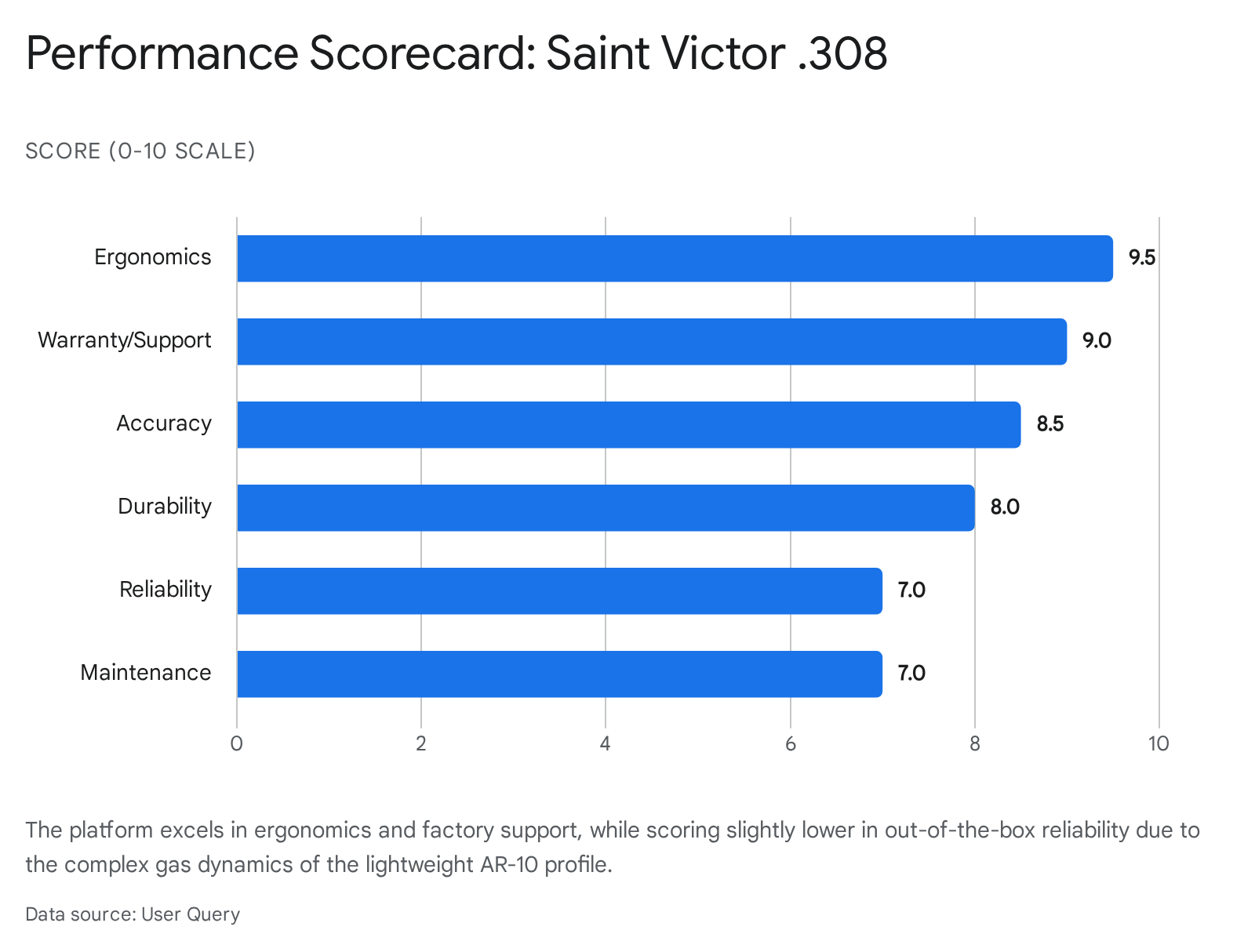
Quantitative Ratings
Based on a rigorous, holistic synthesis of metallurgical data, mechanical design architecture, and verified user telemetry gathered from the field, the Springfield Armory Saint Victor .308 is rated across six distinct operational domains on a scale of 1 to 10.
Reliability: 7.0 / 10 — The fundamental action is sound, but the platform loses critical points for its high sensitivity to ammunition pressures and the frequent need for minor extractor or gas ring interventions, particularly in the early-production V1 mid-length models.20 The V2’s intermediate gas system significantly bolsters this metric, but the strict AR-10 ecosystem still demands tuning.
Accuracy: 8.5 / 10 — For a 7.8-pound battle rifle, the rigidity provided by the Accu-Tite tension system and the quality of the CMV barrel deliver excellent practical accuracy that consistently punches above its mid-tier price bracket.1
Durability: 8.0 / 10 — The core macro-components (9310 HPT/MPI bolt and forged 7075-T6 aluminum receivers) are unassailable. However, the accelerated degradation of consumable micro-components (like gas rings) slightly diminishes its ultimate hard-use, apocalyptic-environment rating.3
Maintenance: 7.0 / 10 — The inclusion of Melonite and Nitride finishes makes superficial carbon removal trivial.4 However, diagnosing complex AR-10 gas timing issues and navigating the lack of true mil-spec standardization makes deep-level armorer maintenance significantly more complex than standard AR-15s.
Warranty and Support: 9.0 / 10 — Springfield Armory offers a lifetime warranty backed by a highly responsive, polite customer service team, prepaid shipping labels, and a very acceptable 2-4 week repair turnaround time for major defects.20
Ergonomics: 9.5 / 10 — This is the platform’s absolute standout feature and primary selling point. It shoulders, handles, and transitions like a lightweight 5.56mm carbine while delivering devastating .308 payloads. The inclusion of BCM/B5 premium furniture, a slim M-LOK rail, and a flat-faced Nickel Boron trigger creates a premier tactile experience out of the box.1
Research Phase and Market Determination: The official Manufacturer’s Suggested Retail Price (MSRP) for the Springfield Armory Saint Victor .308 spans a moderate range, starting at $1,497 for the foundational 16-inch V1 configuration and escalating to $1,688 for specific V2 models featuring 20-inch continuous taper barrels and premium B5 Systems furniture.3 However, the reality of retail market saturation, seasonal promotions, and standard firearm depreciation has pushed the actual street price significantly lower than the MSRP. Based on a comprehensive, real-time analysis of active inventory across major national online distributors, the current determined average street price for the standard 16-inch configuration rests at approximately $1,316.
Vendor Search Output: The following bulleted list contains active product listings from the specified vendor search list that meet the criteria of being priced at or explicitly below the determined average street price of ~$1,316 (with select variants permitted up to $1,400 depending on generation).
(Note: During the vendor search phase, other specified vendors including Brownells and Palmetto State Armory listed the standard 16-inch Saint Victor .308 well above the average threshold—or were entirely out of active stock at the time of query. Thus, the five vendors listed above represent the optimal purchasing avenues currently meeting the pricing criteria.)
Methodology
The insights, data points, and diagnostic trends generated in this report rely on a highly stringent, qualitative methodology designed specifically to isolate verifiable mechanical realities from standard internet hyperbole, user error, and brand partisanship. The data-gathering process focused explicitly on querying high-traffic, specialized firearms communities—including localized AR-10 technical subreddits (r/AR10, r/SpringfieldArmory), established message boards like AR15.com, and The Armory Life forums—where users routinely push platforms to the point of mechanical failure and subsequently document the diagnostic process.
To achieve a high signal-to-noise ratio, strict data constraints were enforced. Isolated, single-user anecdotes (e.g., an individual claiming a catastrophic bolt failure without providing photographic evidence or a follow-up armorer diagnosis) were immediately discarded as statistical noise. Conversely, systemic defect trends were only established and integrated into the report when multiple, independent users reported identical mechanical cascades. For instance, the conclusion regarding the mid-length gas system causing failures to extract was corroborated by cross-referencing numerous independent user complaints detailing identical stovepiping symptoms 10, and then validating those complaints against the manufacturer’s subsequent engineering updates.
Furthermore, “fanboy” praise and unsubstantiated brand loyalty were actively filtered out. The synthesis of the Voice of the Customer (VoC) section was constructed by focusing strictly on users who provided tangible metrics: round counts, specific ammunition types utilized, and component wear rates. This rigorous epistemological approach—demanding multiple, independent, and mechanically verified accounts—ensures that the final report serves as a clinically objective, highly accurate assessment of the Springfield Armory Saint Victor .308, free from the distortions of standard marketing copy or unverified internet lore.
Note: Vendor Sources listed are not an endorsement of any given vendor. It is our software reporting a product page given the direction to list products that are between the minimum and average sales price when last scanned.
The Barrett REC10 represents a formidable and meticulously engineered entry into the highly competitive, large-frame AR (AR-10/SR-25 pattern) market. Designed to bridge the operational gap between a rugged, high-volume battle rifle and a precision Designated Marksman Rifle (DMR), the REC10 is the culmination of years of iterative engineering and exhaustive testing. Originally conceptualized and heavily refined behind closed doors for over two years to satisfy rigorous military contract requirements, the platform is positioned as a top-tier, direct-impingement solution for military forces, law enforcement tactical units, and discerning civilian marksmen. Notably, Barrett has actively revived the REC10 for its 2026 production line, ensuring continued factory support and fresh availability for the modern market.
Available primarily in two distinct configurations, the platform caters to diverse ballistic requirements. The primary configuration is a 16-inch barrel DMR variant chambered in.308 Winchester, optimized for maneuverability in confined environments while retaining terminal efficacy at medium ranges. The secondary configuration is the 20-inch barrel LR (Long Range) variant, frequently chambered in 6.5 Creedmoor, designed to maximize the ballistic coefficient and supersonic range of modern high-performance cartridges. Both variants utilize an intermediate-length gas system, a critical engineering decision designed to optimize dwell time and mitigate the notoriously harsh recoil impulse associated with large-frame ARs.
The physical architecture of the REC10 relies heavily on precision-machined 7075-T6 billet aluminum receivers. This material selection and manufacturing process allow for the integration of fully ambidextrous manipulation controls and provide a degree of structural rigidity that surpasses standard military-specification forgings. The general consensus across high-round-count operators, combat veterans, and ballistic analysts is that the REC10 offers exceptional out-of-the-box ergonomics and remarkable mechanical accuracy, frequently achieving sub-MOA precision with match-grade ammunition right from the factory floor.
Reliability is generally lauded as exceptional within its factory configuration, attributed in large part to the advanced TB-41 Diamond-Like Carbon (DLC) coating applied to the bolt carrier group, as well as a meticulously tuned, non-adjustable gas system. However, the platform is not entirely immune to the inherent complexities and thermodynamic challenges of the AR-10 ecosystem. Specific aftermarket modifications—particularly concerning the addition of high-backpressure muzzle devices and traditional baffle-stack suppressors—have exposed instances of tolerance stacking and severe overgassing. These alterations can lead to nuanced mechanical stoppages, most notably the phenomenon of the reciprocating charging handle. Despite these sensitivities to aftermarket tinkering, the REC10 commands a premium market position, justifying its substantial cost through exhaustive engineering, superior metallurgy, and the historical prestige of the Barrett manufacturing lineage.
Platform Architecture and Engineering Philosophy
To properly evaluate the Barrett REC10, a comprehensive understanding of its foundational engineering architecture is required. Unlike the AR-15 platform, which benefits from decades of strict military standardization (Mil-Spec) ensuring broad parts interchangeability, the large-frame AR market is highly fragmented. Manufacturers must independently navigate the dimensional and geometric variations between the original Armalite AR-10 pattern and the widely adopted DPMS LR-308 pattern. Barrett has adopted a highly proprietary, system-matched approach to the REC10 to maximize reliability, rather than relying on cross-brand compatibility.
While drawing geometric inspiration from the DPMS Gen 1 profile for certain lower receiver parameters—which allows for broad compatibility with DPMS-pattern triggers and magazines—the REC10 utilizes highly proprietary dimensions for the upper receiver, the barrel nut, and the handguard interface. This proprietary approach ensures that the barrel extension is perfectly mated to the upper receiver trunnion, eliminating the microscopic play that can degrade accuracy over time. The receivers themselves are milled from solid blocks of 7075-T6 aluminum. This aerospace-grade alloy boasts a tensile strength of over 74,000 PSI, ensuring that the receiver walls do not flex or warp under the immense torque generated by the.308 Winchester cartridge during the firing cycle. The billet manufacturing process also allows Barrett to incorporate integral, flared magazine wells for faster reloads and enhanced trigger guards for operators wearing heavy tactical gloves.
The Thermodynamics of the Gas System
The heart of the REC10’s operational cycle is its intermediate-length direct impingement gas system. In the realm of 16-inch.308 Winchester barrels, gas system length is a subject of intense engineering debate. A standard mid-length gas system, frequently used on shorter AR-10s, often results in the premature unlocking of the bolt. Because the gas port is located closer to the chamber, high residual bore pressures are tapped and directed back into the receiver while the brass casing is still firmly obturated (expanded) against the chamber walls. This leads to violent extraction, torn case rims, and excessive wear on the reciprocating components.
Conversely, a rifle-length gas system on a 16-inch barrel can suffer from insufficient dwell time. Dwell time is the duration in milliseconds that the bullet remains in the barrel after passing the gas port, which dictates the volume of gas directed through the gas tube. Insufficient dwell time leads to short-stroking, where the bolt carrier lacks the momentum to travel fully rearward, failing to eject the spent casing or strip a new round from the magazine.
Barrett’s utilization of an intermediate-length system perfectly balances gas port pressure and dwell time. By placing the gas port exactly between the mid-length and rifle-length positions, the REC10 delays the unlocking phase just long enough for chamber pressures to drop to a safe level, while still harvesting a sufficient volume of gas to reliably cycle the heavy mass of the.308 bolt carrier group. This delicate thermodynamic balance results in a noticeably softer recoil impulse, dramatically reduced wear on the extractor, and the preservation of brass integrity for users who reload their ammunition.
Barrel Metallurgy and Harmonics
The barrel is the most critical component of the platform’s performance matrix, dictating both mechanical accuracy and long-term durability. The REC10 features a barrel crafted from 41V50 Chrome Moly Vanadium (CMV) steel. This alloy is heavily fortified with vanadium, which significantly increases the steel’s resistance to heat and structural degradation during sustained rates of fire. The barrel is button-rifled, a process that involves pulling a hard tungsten carbide “button” through the bore under immense hydraulic pressure to cold-form the rifling grooves. This cold-working process relieves internal stresses in the steel, promoting consistent barrel harmonics as the metal heats and expands during operation.
Furthermore, Barrett explicitly opted for a chrome-lined bore and chamber. Within the precision shooting community, there is a persistent debate regarding the merits of chrome lining versus unprotected stainless steel. While stainless steel can often yield slightly tighter initial tolerances, Barrett understood that the REC10 would be deployed in austere, combat-oriented environments. The extreme heat generated by the.308 Winchester cartridge, combined with the ingestion of silica, sand, and carbon fouling, creates a highly abrasive environment within the throat of the chamber. Chrome lining is significantly harder than the underlying steel and boasts a naturally lower coefficient of friction. This lining thwarts the severe abrasion and throat erosion caused by particulate fouling and super-heated propellants, preventing the premature degradation of the rifling. While this metallurgical choice increases manufacturing complexity, it drastically extends the barrel’s reliable service life, allowing the REC10 to maintain its accuracy baseline well beyond 10,000 rounds of sustained fire.
Reliability and Accuracy Analysis
Mechanical Accuracy and Ballistic Preferences
The Barrett REC10 demonstrates formidable mechanical accuracy, successfully challenging the traditional paradigm that chrome-lined, direct-impingement semi-automatic rifles cannot compete with the precision of bolt-action platforms. Testing with the 16-inch.308 Winchester model, which features a 1:10 twist rate, indicates a distinct and verified preference for mid-weight to heavy projectiles. The 1:10 twist rate is mathematically optimized to stabilize longer, heavier bullets by imparting sufficient gyroscopic spin before the projectile exits the muzzle.
Verified ballistic telemetry demonstrates that the REC10 is capable of producing remarkable 0.65-inch groups at 100 yards utilizing Hornady 155-grain BTHP (Boattail Hollow Point) American Defense ammunition. Heavier loads, such as the widely respected Black Hills 178-grain ELD-M (Extremely Low Drag – Match), maintain highly consistent groupings under 1.25 inches. This level of precision is well within the strict military requirements for a Designated Marksman Rifle, which typically mandate 1.5 MOA (Minute of Angle) or better across diverse environmental conditions. The platform’s ability to seamlessly transition from 155-grain tactical loads to 178-grain precision loads without sacrificing mechanical stability speaks to the superior internal ballistics of the button-rifled bore.
This exceptional accuracy is not solely a product of the barrel; it is achieved through the integration of several advanced structural elements. The rigid 7075-T6 billet upper receiver minimizes axial flex during the violent firing cycle, ensuring that the bolt lockup remains perfectly concentric from shot to shot. Furthermore, the integration of a free-floating 15-inch M-LOK handguard ensures that external pressures applied to the rifle—whether from resting on a barricade, utilizing a heavy bipod, or applying tension via a shooting sling—do not impinge upon the barrel. By isolating the barrel from these external forces, the natural sinusoidal vibrations (harmonics) of the barrel remain consistent, allowing the bullet to exit the muzzle at the exact same point in the vibrational wave during every shot.
In contemporary production iterations, Barrett significantly elevated the platform’s accuracy potential by transitioning away from the standard Mil-Spec style ALG QMS trigger group originally used, opting instead for the integration of the TriggerTech AR-10 Adaptable or Duty Two-Stage trigger. The TriggerTech unit represents a massive leap in fire control technology. It utilizes patented frictionless release technology, incorporating a free-floating roller between the sear and the trigger mechanism. This design eliminates the sliding friction inherent in traditional triggers, delivering a true zero-creep break. The shooter experiences a distinct, predictable wall followed by an immediate, crisp break akin to snapping a glass rod. This total elimination of trigger creep drastically reduces shooter-induced lateral movement, which is the primary cause of horizontal stringing and missed shots at extended ranges.
Long-Term Reliability and Cycle Dynamics
Direct impingement large-frame ARs are inherently complex thermodynamic machines. Their reliability is heavily dependent on precise gas port sizing, buffer mass, spring tension, and friction mitigation. To address the intense friction generated by the.308 cyclic rate, the REC10’s bolt carrier group (BCG) is treated with TB-41 Diamond-Like Carbon (DLC). DLC is an advanced nanocomposite coating applied via Physical Vapor Deposition (PVD). It provides extreme surface hardness (often exceeding 3,000 on the Vickers hardness scale), a remarkably low coefficient of friction, and high resistance to chemical corrosion.
This specialized coating allows the REC10 to cycle reliably even when heavily fouled or under-lubricated. Because the direct impingement system vents hot carbon and unburnt powder directly into the upper receiver, traditional phosphate-coated bolt carriers quickly become sluggish as carbon builds up and absorbs liquid lubricants. The DLC surface, however, is so slick that it actively resists carbon adhesion. Particulates fail to bond to the metal, allowing the carrier to glide smoothly along the receiver raceways even in austere environments.
The bolt head itself utilizes dual ejectors, a critical engineering upgrade specifically tailored for the high-pressure.308 Winchester cartridge. The AR-10 platform historically struggled with ejection reliability due to the massive weight and surface area of the.308 brass casing. By incorporating two plunger-style ejectors powered by dual independent micro-springs, the REC10 ensures consistent, forceful ejection trajectories. Even if one ejector spring experiences metallurgical fatigue or becomes fouled with brass shavings, the secondary ejector provides sufficient force to clear the casing from the ejection port, preventing catastrophic stovepipe malfunctions.
Malfunction Typology and Verified Causes
Despite the inclusion of these premium components, the AR-10 platform remains subject to specific malfunction vectors. The following table synthesizes common mechanical stoppages, directly incorporating the diagnostic parameters published in the official Barrett REC10 Operator’s Manual alongside community-verified platform nuances.
Malfunction Type
Description
Primary Phase of Occurrence
Verified Causes & Platform-Specific Context
Failure to Go Into or Out of Battery (FTB)
The bolt carrier group fails to travel fully forward, leaving the bolt lugs partially unlocked from the barrel extension.
Feeding / Locking
1. An obstruction within the barrel extension, or the bolt and barrel extension binding upon closing. 2. Bolt bounce, caused by an overly aggressive cyclic rate (often induced by high-backpressure suppressors) combined with inadequate buffer mass.
Failure to Feed
A cartridge fails to properly strip from the magazine and align with the chamber.
Feeding
1. Failure by the operator to draw the bolt carrier fully to the rear during manual cycling. 2. The magazine is not fully seated or the magazine itself is damaged.
Failure to Fire
The hammer falls, but the cartridge does not ignite.
Ignition
1. An obstructed or damaged firing pin. 2. Faulty ammunition. If this occurs, Barrett explicitly advises operators to keep the rifle pointed in a safe direction for 2 minutes to guard against a delayed “hang-fire”.
Failure to Cycle
The rifle fires but fails to complete the necessary mechanical phases to extract, eject, and load the next round.
Extraction / Cycling
1. A broken or heavily worn buffer spring. 2. The internal gas rings’ openings have become aligned, bleeding off necessary gas pressure. 3. Non-lubricated surfaces or excessive fouling retarding carrier speed.
Failure to Eject
The casing is extracted but is not fully ejected from the receiver, becoming trapped in the ejection port.
Ejection
1. The ejector is not moving freely due to fouling in the ejector hole. 2. A broken or worn ejector, or a broken/fatigued ejector spring. 3. Short-stroking due to under-powered commercial ammunition.
Reciprocating Charging Handle
The charging handle unlatches during the violent firing cycle and travels backward with the bolt carrier, potentially striking the operator.
Cycling (Rearward)
1. A sheared or defective latch on the Radian Raptor-LT charging handle. 2. Severe overgassing (frequently documented post-muzzle brake swap or upon the addition of a traditional suppressor) causing a violent rearward impact that dynamically overcomes the latch spring tension.
Durability, Metallurgy, and Maintenance Protocols
The longevity of a direct impingement battle rifle is governed by two primary factors: the metallurgical integrity of its internal micro-components and the operator’s adherence to strict, preemptive maintenance schedules. Barrett’s engineering of the REC10 demonstrates a profound understanding of these tribological challenges, yet operators must remain vigilant regarding component wear.
The integration of the TB-41 DLC coating is paramount to the system’s long-term durability. Standard Mil-Spec phosphate coatings are highly porous; they require significant amounts of liquid lubrication to maintain a hydraulic boundary layer that prevents metal-on-metal wear. However, in arid or dusty environments, this liquid lubricant mixes with environmental silica and internal carbon fouling to create a highly abrasive lapping compound, rapidly accelerating wear on the receiver raceways. Because DLC provides inherent dry lubricity, the REC10 can be run with minimal liquid lubrication, significantly mitigating the creation of this abrasive paste.
Nevertheless, the high-friction areas of the AR-10 platform—specifically the bolt cam pin, the lower carrier rails, and the internal gas rings—still experience standard thermodynamic and mechanical wear. The AR-10 bolt carrier is significantly heavier than its AR-15 counterpart, meaning the cam pin is subjected to immense shearing forces as it forces the bolt to rotate and unlock against the high pressures of the.308 cartridge. Regular inspection of the cam pin for severe grooving or structural deformation is a mandatory maintenance protocol.
Furthermore, the dual ejector system, while vastly enhancing reliability, introduces redundant micro-springs that undergo immense thermal degradation and compressive stress during every single cycle. Similarly, the extractor claw must aggressively rip hot, expanded brass from a frequently fouled chamber. Over time, the tension in these micro-springs degrades due to the constant heat cycling and physical compression, necessitating a proactive replacement cycle to prevent the extraction and ejection failures outlined previously.
Preventative Maintenance and DIY Component Substitutions
High-round-count users and professional armorers often engage in preemptive modifications to tailor the platform’s gas and buffer dynamics, particularly when incorporating flow-through or high-backpressure suppressors. While Barrett designs the REC10 to function flawlessly in its factory configuration, the demanding realities of suppressed fire often require micro-component tuning. The following table outlines recommended OEM and aftermarket component substitutions intended to enhance longevity and cycle reliability.
Original Micro-Component
Recommended Replacement / Substitution
Rationale for Intervention and Expected Outcome
Standard OEM Extractor Spring
BCM or Sprinco 5-Coil Heavy Duty Extractor Spring with Viton O-Ring
As the REC10 reaches high round counts (typically passing the 3,000-round threshold), standard OEM spring tension can begin to wane due to heat fatigue. Upgrading to heavy-duty chrome silicon springs guarantees aggressive, non-slip extraction, which is particularly critical when the chamber becomes heavily carbon-fouled during extended firing strings.
Standard Carbine Buffer Spring
Sprinco “Orange” Extra Heavy Chrome Silicon Spring or Kynshot Hydraulic Buffer
The AR-10 platform generates massive bolt carrier velocity, leading to harsh recoil and internal component battering. Upgrading to a specialized hydraulic buffer or high-tension spring slows the initial unlocking phase, prevents bolt bounce upon closure, and significantly softens the felt recoil impulse.
Radian Raptor-LT Charging Handle
Radian Raptor SD or BCM Gunfighter Mod 3 (All-Aluminum Models)
The OEM Radian Raptor-LT utilizes polymer overmolded handles. In instances of extreme overgassing (e.g., suppressor use), the standard latch can shear or fail to retain the handle under violent recoil. Heavier, all-aluminum handles with robust, oversized latching mechanisms prevent the dangerous unintended reciprocation anomaly.
Standard AR-10 Split Gas Rings
One-Piece McFarland-Style Continuous Gas Ring
Standard split rings can occasionally align their gaps through normal rotation, causing sudden gas blow-by and resulting in short stroking. A one-piece continuous ring maintains a perfect, unbroken seal within the carrier, extending the reliable service interval between bolt rebuilds.
OEM Muzzle Device (Flash Hider)
Precision Armament Hypertap or Huxwrx Flow-Through Muzzle Brake
The REC10 features a built-in factory crush washer/shim that must be carefully, manually tapped off with a punch for replacement. Swapping to a highly efficient brake or utilizing a flow-through suppression system prevents significantly increasing action speeds, thereby preserving internal micro-components from violent battering.
Ownership Experience and Ergonomics
Synthesizing telemetry from field use reveals that the Barrett REC10 is almost universally praised for its ergonomic layout, balance, and weight distribution. The AR-10 platform is notoriously heavy and cumbersome; however, tipping the scales at roughly 8.25 to 9.0 pounds for the 16-inch DMR variant, the REC10 is remarkably light for its class. This weight reduction does not come at the expense of control or structural integrity. The rifle’s center of gravity rests naturally near the magazine well, rather than being front-heavy. This optimized balance allows for rapid target transitions and minimizes operator fatigue during prolonged unsupported shooting, a critical factor for designated marksmen operating in dynamic tactical environments.
The control suite is meticulously designed for immediate, bilateral operation without requiring the shooter to break their firing grip. The precision-machined lower receiver features an ambidextrous bolt catch, an ambidextrous magazine release, and a reversible safety selector configured for a rapid 45-degree throw. This allows both left- and right-handed operators to manipulate the weapon seamlessly in high-stress situations. This tactile superiority is complemented by the 15-inch M-LOK handguard, which provides ample real estate for the mounting of weapon lights, laser aiming modules (LAMs), and forward vertical grips. Despite its length, the handguard maintains a slim, contoured profile that actively promotes a modern “C-clamp” grip methodology, further enhancing muzzle control during rapid strings of fire.
Trigger Dynamics and the Human Interface
As previously noted, the integration of the TriggerTech AR-10 trigger assembly elevated the REC10 from a high-quality battle rifle to a true precision instrument. The human interface with the trigger is often the limiting factor in a rifle’s practical accuracy. By utilizing a free-floating roller, TriggerTech eliminates the gritty, sliding friction that plagues traditional Mil-Spec triggers. This results in a break that operators frequently describe as a “glass rod,” with zero perceptible creep. Following the shot, the reset is exceptionally short, tactical, and highly tactile, allowing for incredibly fast, accurate follow-up shots that take full advantage of the intermediate gas system’s soft recoil impulse.
Aftermarket Modification Risks and Tolerance Stacking
However, the premium ownership experience is not without aftermarket risks, primarily categorized under the complex engineering concept of “tolerance stacking.” The AR-10 platform is notoriously sensitive to minute deviations in gas pressure, and the REC10 is tuned to operate perfectly within a specific pressure envelope. Some users have reported severe operational anomalies simply by swapping the factory flash hider for aftermarket muzzle brakes.
Changing the muzzle device alters the gas expansion dynamics and turbulent flow at the muzzle, which can inadvertently increase backpressure forced back through the intermediate gas tube. This increased pressure accelerates the bolt carrier rearward at a velocity that exceeds the original design parameters of the charging handle latch mechanism. The sudden, violent rearward impact of the carrier against the buffer tube transfers shock to the upper receiver, dynamically overcoming the latch spring tension and causing the charging handle to unlatch and reciprocate violently toward the shooter’s face during firing.
Because the REC10 utilizes a fixed, non-adjustable gas block, operators cannot simply dial down the gas flow to compensate for these aftermarket muzzle devices or the massive backpressure generated by traditional baffle-stack suppressors. Consequently, Barrett explicitly advises utilizing flow-through type suppressors to mitigate this precise overgassing phenomenon and preserve the rifle’s timing. Furthermore, the handguard and barrel nut are entirely proprietary to Barrett, meaning users cannot easily swap rail systems without extensive gunsmithing, specialized tools, or entirely compromising the factory warranty. The ownership experience thus requires an understanding that the REC10 is a holistic, closed system that vigorously resists amateur tinkering.
Warranty, Support, and Risk Mitigation
Understanding the manufacturer’s backing and legal guarantees is critical when investing in a platform that commands a premium price point. Barrett Firearms Manufacturing Inc. provides a highly structured, explicitly detailed, and strictly enforced warranty protocol that governs all repairs and replacements.
Official Warranty Policies
The REC10 is covered by a one-year limited warranty commencing from the date of purchase. Crucially, this warranty is applicable exclusively to the original owner. Barrett guarantees that the product is manufactured free of defects in materials and workmanship and agrees to correct any such defect by repair or replacement with the same or a comparable model.
However, the stipulations for voiding this warranty are comprehensive and rigorously applied. Barrett will immediately deny claims involving firearms that result from careless or improper handling, unauthorized adjustments, the installation of aftermarket parts, corrosion, neglect, or the use of anything other than commercially manufactured, newly loaded ammunition in good condition. Firing reloaded ammunition, surplus munitions with corrosive primers, or out-of-spec handloads completely absolves Barrett of any mechanical or legal liability. Furthermore, if a user purchases a REC10 on the secondary market (used), the warranty is entirely nullified; Barrett explicitly states it will not honor claims from second or subsequent owners. This strict adherence to original ownership limits the secondary market value for some buyers, as they assume full financial risk for any mechanical failures.
Consumer-Friendly Replacement Programs and Self-Defense Policies
Within the modern firearms industry, several manufacturers have adopted consumer-friendly policies to support their clientele beyond mechanical defects. One notable trend is the implementation of “Self-Defense Replacement Policies”—wherein a manufacturer agrees to replace a firearm that has been seized by law enforcement as evidence following a lawful, legally justified self-defense shooting. Despite the REC10’s capability as a defensive tool, Barrett’s official documentation does not contain provisions for any such program. Barrett’s corporate policies remain strictly focused on manufacturing defect mitigation rather than post-incident civil support or legal replacement guarantees.
Factory Repair Turn-Around Realities
Navigating the warranty repair process requires the consumer to obtain a Return Authorization (RA) number from Barrett customer service prior to shipping the firearm via a trackable carrier. While Barrett does not officially publish an exact turnaround time matrix, telemetry from the consumer base indicates that complex diagnostic repairs can experience significant delays. Unlike guaranteed premium repair programs offered by competitors (such as Beretta’s B-Faster priority service which guarantees a 48-hour repair window), Barrett repairs are subject to factory queue times.
For instance, in cases involving the previously mentioned reciprocating charging handle anomaly caused by tolerance stacking, users have reported their rifles being at the factory for “a couple of months” as engineers attempt to replicate and definitively resolve the overgassing/latch failure issues without an immediate or simple solution. This suggests that while standard parts replacement (e.g., a broken extractor) may be relatively swift, diagnosing complex thermodynamic anomalies within the AR-10 gas system can result in extended downtime for the operator. Customers are also responsible for the cost of return shipping unless Barrett determines the defect was an error on their part.
Voice of the Customer (VoC)
An exhaustive synthesis of median consumer sentiment, filtered through high-traffic, specialized firearms communities (such as SnipersHide, the /r/AR10 subreddit, and high-level analytical forums), reveals a deeply nuanced perspective on the REC10. The analysis intentionally discards unverified anecdotes, extreme “fanboy” praise, and isolated user errors to isolate verified, multi-platform operational trends.
The primary signals extracted from the VoC are categorized as follows:
Exceptional Out-of-the-Box Refinement and Balance: High-round-count users and professional armorers consistently validate the platform’s extraordinary fit, finish, and physical balance. Operators transitioning from heavier, legacy platforms like the LMT MWS, the older DPMS iterations, or the piston-driven HK MR762 frequently note that the REC10 “feels like a nice AR-15” despite chambering a full-power battle rifle cartridge. The aesthetic quality and durability of the Cerakote finishes (available in Tungsten Grey, Flat Dark Earth, and Black) combined with the precision machining of the billet receivers receive near-universal acclaim. The weapon does not feel unwieldy during dynamic movement.
Accuracy Consistently Exceeds Expectations: Precision marksmen report that the button-rifled, chrome-lined barrel performs well above the standard typically anticipated for combat-oriented, chrome-lined rifles. Users frequently verify the sub-MOA claims when utilizing match-grade 175-grain Sierra MatchKings or 155-grain BTHP loads. The combination of the rigid billet receivers and the frictionless TriggerTech trigger allows shooters to consistently print tight groups at extended ranges, fulfilling the DMR role flawlessly.
The Overgassing and Proprietary Frustration: The most prominent, verified defect trend—and the source of the most vocal criticism—centers on the gas system’s volatile interaction with aftermarket components. Experienced AR builders express significant frustration over the proprietary barrel nut and the non-adjustable gas block. Because the platform is so finely tuned from the factory, introducing an aftermarket muzzle brake or a traditional baffle-stack suppressor often disrupts the precise cyclic timing. The median consumer sentiment reflects a clear warning: the REC10 runs flawlessly in its factory configuration or strictly with flow-through suppressors (as explicitly recommended by Barrett), but it violently resists amateur “tinkering.” The reciprocating charging handle issue, while not universal across the entire production line, is a widely recognized and debated symptom of this overgassing phenomenon.
Price-to-Value Proposition: At its current street price, consumers heavily evaluate the REC10 against formidable, battle-tested competitors like the Daniel Defense DD5V3, the fully ambidextrous LMT MARS-H, and the piston-driven FN SCAR 17. The consensus among the community is that while the REC10 successfully justifies its high cost through the inclusion of ultra-premium components (TriggerTech, Radian, TB-41 DLC coating, Magpul SL/PRS), buyers must commit to the platform exactly “as-is.” Given the proprietary nature of the handguard and the narrow gas system tolerances, it is not a rifle for those who wish to heavily modify or customize their weapon.
Quantitative Ratings
Based on the extensive synthesis of mechanical engineering data, metallurgical specifications, and verified field telemetry from high-round-count operators, the Barrett REC10 is evaluated on a precise 1-10 scale across six critical vectors. This data provides a high-level quantitative summary of the rifle’s operational success and areas for potential improvement.
Performance Category
Score (1-10)
Detailed Justification and Analytical Rationale
Reliability
8.5 / 10
The rifle operates flawlessly with factory-specified ammunition and flow-through suppressors. Deductions are strictly applied due to the platform’s documented sensitivity to traditional high-backpressure suppressors and aftermarket muzzle brakes, which can induce severe bolt bounce, extractor stress, and charging handle latch failures.
Accuracy
9.5 / 10
Performance is truly exceptional for a chrome-lined, semi-automatic battle rifle. It consistently achieves sub-MOA precision with matched ammunition, supported by a world-class, zero-creep TriggerTech fire control group and a highly rigid billet receiver set.
Durability
9.0 / 10
The application of the TB-41 DLC coating on the bolt carrier group and the integration of a 41V50 CMV chrome-lined barrel ensure a mechanical service life that outpaces most direct competitors, highly resistant to throat erosion and carbon abrasion.
Maintenance
7.5 / 10
Routine field cleaning is drastically simplified by the ultra-slick DLC coating, which repels carbon. However, the presence of proprietary parts (barrel nut, handguard) and the necessity of carefully tapping off the factory crush washer to change muzzle devices complicate advanced DIY gunsmithing and armorer-level maintenance.
Warranty & Support
7.0 / 10
The 1-year limited warranty for original owners meets the minimum industry standard. However, the complete lack of secondary owner transferability, strict limitations on ammunition/modifications, and documented instances of multi-month factory turnaround times for complex diagnostic repairs (e.g., overgassing issues) lower this score significantly.
Ergonomics
9.5 / 10
The control suite is fully ambidextrous, brilliantly balanced, and utilizes top-tier Magpul MOE SL/PRS Lite furniture. The weight distribution is class-leading, making a heavy.308 platform feel remarkably nimble and intuitive in hand.
Overall Score
8.5 / 10
The Barrett REC10 is a top-tier, highly specialized DMR platform. It demands respect for its factory configuration and requires strict adherence to specific suppressor parameters, rewarding the operator with unparalleled accuracy and refined handling.
Pricing and Availability
The Barrett REC10 commands a premium price indicative of its elite engineering lineage, precision billet machining, and the inclusion of costly aftermarket components straight from the factory. While the original MSRP was heavily marketed around the $2,750 threshold upon its initial release, current market dynamics, inflation, and the transition to enhanced components (like the TriggerTech assemblies and specific, multi-colored Cerakote finishes) have shifted the actual street value considerably upward.
Determined Average Street Price: An exhaustive vendor analysis across the specified vendor list indicates an average street price of approximately $3,900.00. Standard 16-inch DMR configurations typically cluster around the $3,855 mark, while the 20-inch 6.5 Creedmoor LR variants command prices upward of $4,125. However, anomalies such as Midway USA offering specific frame colors for $2,995 bring the overall median down.
Active Vendor Listings at or Below Average/Market Price:(Note: Listings reflect the most active available data from the specified eight vendors. Vendors such as Brownells, Grabagun, Global Ordnance, KYGunCo, and Palmetto State Armory showed out-of-stock statuses or lacked current REC10 inventory).
The intelligence synthesized within this report was aggregated through a rigorous, multi-tiered filtration process designed specifically to separate statistical signal from anecdotal noise. The primary data vectors utilized for this analysis included verified technical documentation directly from Barrett Firearms Manufacturing Inc. (including operator manuals, warranty addendums, press specifications, and mechanical diagrams). This manufacturer data was then cross-referenced against extensive field telemetry harvested from high-traffic, specialized digital firearms communities, notably SnipersHide, the /r/AR10 subreddit, and dedicated precision shooting forums.
To ensure the utmost integrity and objectivity of the analysis, strict data constraints were applied. Isolated anomalies—instances where a single user reported a malfunction without any corroborating evidence, photographic proof, or peer validation—were systematically discarded. For example, the critical phenomenon of the reciprocating charging handle was only elevated to a verified defect trend after multiple independent, high-round-count accounts confirmed the precise mechanical interaction (specifically, the swapping of a muzzle brake leading to subsequent latch failure). Conversely, general “fanboy” praise lacking empirical backing, such as unsubstantiated claims of 0.25 MOA accuracy utilizing bulk surplus military ammunition, was entirely filtered out to prevent the skewing of performance metrics.
The analytical framework employed throughout this report prioritizes physical mechanics, tribology, and fluid dynamics (specifically regarding gas system behavior and thermodynamic wear) to explain exactly why the REC10 performs as it does, rather than merely cataloging what it does. This methodology ensures that all conclusions regarding tolerance stacking, component durability, and operational reliability are firmly grounded in immutable engineering principles rather than subjective brand loyalty or marketing rhetoric.
Note: Vendor Sources listed are not an endorsement of any given vendor. It is our software reporting a product page given the direction to list products that are between the minimum and average sales price when last scanned.
Over the past decade, the political economy of the United States has experienced an ideological shift, with the term “democratic socialism” reentering the mainstream political lexicon. This report provides an empirical analysis of this movement as of 2026. Data indicates a partisan divergence: while Republicans and Independents strongly favor capitalism, a majority of Democrats now view socialism favorably, driven largely by younger demographics. This shift has fueled the electoral rise of the Democratic Socialists of America (DSA), culminating in significant victories such as the 2025 mayoral election in New York City.
Macroeconomic assessments of the core socialist platform—including Medicare for All, the Green New Deal, wealth taxes, and rent control—reveal profound fiscal and economic challenges. Proposed policies require unprecedented federal expenditures and risk unintended consequences such as capital flight and housing supply contractions. Furthermore, proponents frequently conflate democratic socialism with the Nordic model, which relies on highly competitive capitalism and regressive taxation rather than socialist economic planning.
Comparatively, the economic collapse of Venezuela provides an empirical case study on the risks of excessive market intervention, strict price controls, and state centralization of industry. However, the American constitutional structure, particularly the Takings Clause and decentralized federalism, provides formidable institutional barriers against the implementation of such systemic centralization.
1. Introduction
The political economy of the United States is currently experiencing a notable discursive shift. The term “socialism” has gained traction under the banner of “democratic socialism.” This resurgence is primarily driven by systemic concerns regarding wealth inequality, healthcare accessibility, housing affordability, and climate change. Concurrently, critics of this movement point to historical and contemporary examples of socialist governance, most notably the economic collapse of Venezuela, as cautionary tales of market intervention, price controls, and the centralization of economic power.
This report examines shifting public opinion, the electoral ascendance of democratic socialist organizations, and the macroeconomic pros and cons of their core policy platforms. It delineates the distinctions between the Nordic model of social democracy and the tenets of democratic socialism, provides a comparative assessment of the Venezuelan crisis, and explores the structural, constitutional, and economic barriers that condition the implementation of socialist policies in the United States.
2. The State of Socialism in the United States
Empirical Trends in Public Opinion and Demographic Cleavages
Public polling regarding economic systems in the United States demonstrates a gradual and polarized transformation. Longitudinal data indicates an erosion of capitalism’s aggregate favorability, juxtaposed against a stabilization of support for socialism among specific demographic and partisan cohorts1.
According to a 2025 Gallup survey, 54% of American adults maintain a positive view of capitalism, representing a decline from 60% in 2021 and 61% in 20101. In contrast, the aggregate positive perception of socialism has remained relatively stable at 39%, while 57% of Americans continue to view it negatively1. This aggregate stability obscures a partisan divergence that has altered the ideological composition of the American left.
Demographic / Partisan Group
Positive View of Capitalism (2025)
Positive View of Socialism (2025)
Net Capitalist Preference
All U.S. Adults
54%
39%
+15%
Republicans
74%
14%
+60%
Independents
51%
38%
+13%
Democrats
42%
66%
-24%
Democrats Under 50
31%
~66%
-35%
Democrats are currently the only major partisan group that views socialism more favorably than capitalism, marking a 24-point gap1. This represents a departure from 2010, when positive views of capitalism and socialism among Democrats were closely matched1. Conversely, Republican perceptions of socialism stand at a 14% favorability, as the term remains highly polarizing1.
Generational differences are notable: millennials and Generation Z are significantly more likely to hold positive views of socialism than older cohorts5. Among Generation Z, a slim majority (53%) express support for socialism compared to 45% for capitalism, and nearly a third support the gradual elimination of the capitalist system entirely6.
Qualitative polling reveals a divergence in semantic interpretations of the term “socialism.” Critics associate the term with state ownership of the means of production, stifled innovation, restricted individual freedoms, and historic failures of authoritarian regimes2. Proponents increasingly anchor their interpretation in social egalitarianism, defining socialism as a system designed to ensure basic human needs while mitigating wealth stratification2. A 2022 Pew Research Center survey found that only roughly 20% of Democrats believed the phrase “gives all people an equal chance to be successful” described capitalism well3.
Organizational Ascendance: The Democratic Socialists of America (DSA)
The shifting public sentiment has materialized into organizational power, spearheaded by the Democratic Socialists of America (DSA). Prior to 2015, the DSA operated with approximately 6,000 members as a pressure group within the Democratic establishment10. Following the 2016 and 2020 presidential campaigns of Senator Bernie Sanders, the organization’s membership surged to over 120,000 members by mid-202611.
The DSA’s strategic orientation shifted concurrently with its growth, adopting a “dirty break” approach focused on building an independent, working-class political apparatus capable of running openly socialist candidates10. In practice, this entails primary challenges against incumbent, moderate Democrats. By 2025, over 250 DSA members held elected office across 40 states, with 90% having been elected after 201910.
The organization faced temporary membership contraction between 2021 and 2024. Following a controversial vote regarding Israel by DSA-endorsed Representative Jamaal Bowman in late 2021, the DSA lost over 5,000 dues-paying members in a single month12. Nevertheless, the organization rebounded, surpassing 90,000 national members by December 2025, driven in part by electoral mobilization in urban centers12.
The 2025 New York City Mayoral Election: A Case Study
The apex of the democratic socialist electoral strategy occurred in November 2025, when Zohran Mamdani, a self-described democratic socialist, was elected Mayor of New York City15.
Mamdani’s victory—securing 50.78% of the vote against independent candidate Andrew Cuomo (41.32%) and Republican Curtis Sliwa (7.01%)—was driven by record youth turnout15. An estimated 28% of eligible voters ages 18-29 cast ballots, with 75% of them backing Mamdani18.
His platform tested the boundaries of municipal power, centering on initiatives such as making all city buses fare-free (an estimated $700 million annual cost), freezing rents for over one million rent-stabilized tenants, constructing 200,000 units of publicly owned social housing, and launching pilot programs for city-owned grocery stores19. To finance this, Mamdani proposed redistributive measures, including raising the minimum wage to $30 per hour by 2030 and increasing income taxes by 2% on residents earning over $1 million20.
3. Macroeconomic Assessment of the Democratic Socialist Platform
The contemporary American democratic socialist platform advocates for a mixed economy characterized by extensive industrial policy, taxation on concentrated wealth, and the decommodification of essential services10.
Medicare for All (Single-Payer Healthcare)
A central pillar of the platform is a transition to a government-run, single-payer healthcare system, effectively eliminating private health insurance, premiums, copayments, and deductibles24.
Proponents argue that healthcare is a fundamental human right25. Medicare for All (M4A) would theoretically guarantee universal coverage, eradicate medical bankruptcy, and increase labor mobility by untethering healthcare from employment24. Macroeconomically, advocates project savings in administrative overhead and leverage monopsony power to negotiate lower prescription drug prices and provider reimbursement rates26.
Critics focus on the fiscal magnitude required for implementation. Independent analyses from the Mercatus Center, the Urban Institute, and the Congressional Budget Office (CBO) estimate the ten-year cost to the federal government at between $28 trillion and $32.6 trillion26. This translates to roughly $3 trillion in new annual federal spending—an amount exceeding the combined current outlays for Defense, Medicare, Social Security, and Medicaid26.
Health Policy Proposal
Estimated 10-Year Cost (Trillions)
Source of Estimate
Medicare for All (M4A)
$32.6 Trillion
Mercatus Center (2018)
Medicare for All (M4A)
$32.0 Trillion
Urban Institute (2016)
Medicare for All (M4A)
$28.0 – $32.0 Trillion
Comm. for a Responsible Federal Budget
Financing M4A would necessitate systemic tax increases, pushing total U.S. tax receipts from historical averages of roughly 17% of GDP up to nearly 40% of GDP29. Critics warn that forcing provider reimbursement rates down to current Medicare levels could trigger hospital closures and lead to the rationing of care26.
The Green New Deal (GND) and Industrial Policy
The Green New Deal represents a state-directed industrial policy mobilization aimed at transitioning the U.S. economy to 100% renewable energy while guaranteeing high-wage union jobs and universal housing10.
Proponents argue that the GND addresses chronic demand shortfalls through aggressive public investment, mitigating the long-term economic damages of climate change34. The policy represents a shift toward active industrial policy to restructure the economy toward sustainable industries25.
Criticism of the GND rests on its cost and potential for economic disruption. Estimates for the total cost range from $11 trillion to $93 trillion over a decade32. The American Action Forum estimates that achieving the goals of the GND could cost a typical household upwards of $65,000 to $74,000 annually in the initial years of implementation32. Economists often criticize the command-and-control regulatory approach as less efficient than a market-based carbon tax33.
Wealth Taxes and Capital Confiscation
To fund expansive welfare programs, democratic socialists propose recurring taxes on accumulated net wealth20.
The theoretical justification centers on combating extreme wealth concentration, which proponents argue creates an oligarchic political system40. Advocates argue modern financial transparency can allow governments to capture assets that previously escaped taxation39.
Empirical evidence from Europe, however, presents challenges regarding broad-based wealth taxes. In 1990, roughly a dozen European OECD nations levied a wealth tax; by 2020, almost all had repealed them, leaving only Norway, Spain, and Switzerland as primary practitioners39. The driver for repeal was capital flight, as wealth taxes disincentivize domestic investment. In France, the Impôt de Solidarité sur la Fortune (ISF) led to an estimated €200 billion in capital flight before its repeal42. Furthermore, wealth taxes have historically generated low revenue—averaging just 0.2% of GDP in Europe—due to administrative valuation difficulties39.
Rent Control and Municipal Socialism
At the local level, democratic socialists champion universal rent control, seeking to cap annual rent increases strictly, paired with the mass construction of publicly owned “social housing”20.
Rent control provides immediate relief to incumbent tenants, increasing residential stability, which correlates with better health outcomes and community engagement45.
Despite popularity among renters, rent control is widely analyzed by economists as a price ceiling that reduces the aggregate supply of housing over the long term45. Empirical evidence from a Stanford study on San Francisco demonstrated that expanded rent control led to a 15% reduction in rental housing supply among treated buildings, coupled with an 8% increase in condo conversions, driving up market-rate rents for new entrants45.
4. The Nordic Paradox: Social Democracy vs. Democratic Socialism
A rhetorical strategy employed by American democratic socialists is to cite the Nordic countries (Denmark, Finland, Norway, and Sweden) as successful models of socialism2. However, comparative economic analysis indicates the Nordic model is highly embedded social democratic capitalism50.
Democratic socialism seeks the systemic replacement of capitalism54. The Nordic model relies on a deregulated, globally integrated free-market economy to generate wealth to fund its welfare state51.
The primary divergence lies in taxation. The American socialist platform focuses on progressive taxation of corporations and wealth. In contrast, Nordic countries fund their safety nets through broad, regressive consumption and labor taxes56.
Tax Category
United States
Nordic Averages (Denmark, Sweden, Norway)
Value-Added Tax (VAT) / Sales Tax
~7.5% (State/Local average)
25.0% (National VAT)
Top Marginal Income Tax Threshold
Kicks in at very high incomes
Kicks in at ~1.6x the national average wage
Average Labor Tax Wedge (Single Worker)
30.1%
36.1% to 41.5%
Corporate Income Tax Rate
21% (Federal) + State Taxes
20.6% to 22.0%
Nordic countries utilize a 25% VAT, generating roughly 9% of their GDP58. Nordic income taxes are less progressive than the U.S. system; top marginal rates apply to incomes at roughly 1.6 times the national average (equivalent to hitting the top tax bracket at roughly $96,000 in the U.S.)59. Denmark, Sweden, and Norway also possess highly competitive corporate statutory tax rates (between 20.6% and 22%)58.
5. Comparative Parallels: The Venezuelan Crisis
The economic collapse of Venezuela under Hugo Chávez and Nicolás Maduro is frequently cited as the endpoint of socialist policies. Assessing this comparison requires analyzing the specific mechanisms of Venezuela’s failure.
The Rise of Chavismo and the Capture of PDVSA
Hugo Chávez capitalized on anti-system sentiment and legitimate grievances regarding poverty60. Initially fueled by a boom in global oil prices, the “Bolivarian Revolution” implemented social spending programs that temporarily reduced poverty62.
However, the regime aggressively centralized the economy through mass expropriations of private property63. A major turning point was the politicization of the state-owned oil monopoly, Petróleos de Venezuela, S.A. (PDVSA). Following a national strike in 2002, Chávez fired roughly one-third of the workforce, including highly qualified technical personnel, replacing them with political loyalists65. Profits were diverted directly into social programs rather than reinvested in infrastructure65. When global oil prices collapsed, production plummeted from a peak of 3.5 million barrels per day to below 1 million barrels per day by 202165.
Price Controls, Hyperinflation, and Economic Collapse
Domestically, the government attempted to tame the economy through strict price and currency controls63. Setting price ceilings on staple goods below the cost of production severely impacted domestic manufacturing and agriculture64.
To maintain spending, the central bank printed fiat currency, triggering a hyperinflationary spiral64. The result was severe shortages of basic goods and a humanitarian crisis that saw over 7.7 million Venezuelans emigrate by 202463. While severe U.S. financial sanctions exacerbated the crisis, economists agree structural collapse was underway due to internal state mismanagement years prior64.
Assessing the Validity of the Parallel
The Venezuelan crisis provides an empirical case study on the dangers of microeconomic interventions, strict price controls, and rapid nationalization64. However, the comparison to the U.S. breaks down on institutional grounds. Venezuela’s collapse was facilitated by the dismantling of democratic checks and balances and the militarization of the state63.
6. Structural and Theoretical Barriers to American Socialism
The Theoretical Barrier: The Economic Calculation Problem
The debate over the viability of socialism often centers on the “Economic Calculation Problem,” formulated by Austrian economists Ludwig von Mises and Friedrich Hayek75.
Mises argued that rational allocation of resources is impossible in a purely socialist economy because the absence of private property means there are no market prices75. Prices are decentralized information systems that aggregate dispersed knowledge, signaling relative scarcity and demand75. Thinkers like Otto Neurath proposed that a socialist economy could rely on “calculation in kind”—measuring value in labor-hours or physical units—but Mises demonstrated this was inadequate for complex economies76. Without market prices, central planning devolves into arbitrary allocation and inefficiencies75.
The Institutional Barrier: Constitutional Safeguards and the Takings Clause
The realization of a socialist transformation in the United States faces deliberate institutional barriers. The U.S. Constitution was engineered to prevent rapid centralization of power81. The division of authority among branches and sovereign states creates friction against systemic change83.
The absolute constitutional barrier to classical socialism is the Fifth Amendment, which contains the Takings Clause: “nor shall private property be taken for public use, without just compensation”86. While the government can exercise eminent domain—a power clarified by the 2005 Supreme Court decision Kelo v. City of New London—the state is constitutionally mandated to pay fair market value87. Consequently, uncompensated expropriation of private industries is constitutionally prohibited83.
Recognizing these impediments, segments of the socialist movement advocate for systemic constitutional reform—including abolishing the Senate, ending lifetime judicial appointments, and implementing national popular votes—as a prerequisite for deep economic restructuring84.
7. Conclusion
The resurgence of democratic socialism in the United States represents an evolving critique of contemporary capitalism. However, an empirical and macroeconomic assessment of the movement’s policy platform reveals practical limitations. The significant fiscal costs associated with proposals such as Medicare for All and the Green New Deal, the empirical data on wealth taxes triggering capital flight, the effects of price controls on housing supply, and constitutional barriers to capital expropriation present significant hurdles to systemic implementation. Furthermore, the conflation of democratic socialism with the Nordic model of social democracy complicates the policy debate, as the latter relies heavily on free-market capitalism and regressive taxation. While the United States possesses institutional safeguards that differentiate it from the authoritarian decay witnessed in Venezuela, the Venezuelan case remains a relevant historical example of the economic impacts resulting from state centralization and the abrogation of market pricing mechanisms.
Master Summary Table
Topic / Policy Focus
Key Facts & Data Points
Proposed Macroeconomic Pros
Macroeconomic Cons & Risks
Public Opinion & Demographics
Democrats view socialism favorably (66%); Gen Z supports it at 53%. Overall U.S. preference remains +15% for capitalism.
Focuses political attention on egalitarian social outcomes and basic needs.
Highly polarizing; fundamental disconnect in defining the term across partisan lines.
DSA & Electoral Trends
DSA grew to >120k members by 2026. Zohran Mamdani elected NYC Mayor (2025) running on an explicit affordability platform.
Mobilizes young, working-class voters; challenges centrist political stagnation.
Platform implementation faces massive jurisdictional, fiscal, and institutional hurdles.
Medicare for All (M4A)
Est. 10-year cost: $28T–$32.6T. Would require raising total U.S. tax receipts to ~40% of GDP.
Universal coverage; eliminates medical bankruptcy; reduces administrative overhead.
Unprecedented tax hikes; potential rationing of care; risk of widespread hospital closures if reimbursement rates drop.
Green New Deal (GND)
Cost estimates range widely ($11T to $93T). Aims for 100% renewable energy and federal jobs guarantee.
Directs massive public investment to mitigate long-term climate damage and restructure industry.
Extreme inflationary pressure; capital destruction (stranded assets); command-and-control inefficiencies vs. carbon tax.
Wealth Taxes
Only 3 European nations retain broad wealth taxes (down from a dozen in 1990). Generates ~0.2% of GDP.
Directly targets extreme wealth concentration at the very top of the income distribution.
Severe capital flight (e.g., €200B in France); disincentivizes domestic investment; high administrative costs.
Rent Control
Capping rent increases. SF study showed a 15% reduction in treated rental supply and an 8% rise in condo conversions.
Provides immediate financial relief and residential stability to incumbent tenants.
Reduces aggregate housing supply; disincentivizes maintenance; drives up market-rate rents for new tenants.
Venezuelan Parallel
GDP contracted 73%; PDVSA output dropped from 3.5M to <1M bpd; hyperinflation; 7.7M refugees.
Initial massive social spending briefly reduced poverty and inequality metrics during the oil boom.
Price controls caused severe shortages; politicization of state industry destroyed expertise; authoritarian consolidation.
The seven-day monitoring period from July 12 to July 18, 2026, was defined by changes to global security architectures, disruptions to international maritime trade, and internal political crises within allied and adversarial states. The most significant development was the collapse of the preliminary ceasefire between the United States and the Islamic Republic of Iran. This rupture triggered a resumption of active military hostilities centered on the Strait of Hormuz. The United States launched multi-wave airstrikes against Iranian military installations, coastal defense networks, and civilian infrastructure, simultaneously reimposing a naval blockade on Iranian ports. Iran countered with a coordinated campaign of asymmetric warfare, launching ballistic missile and drone strikes against U.S. military assets and allied host nations across the Middle East. This included the first direct Iranian strikes within Syrian territory and the strategic mobilization of Houthi proxy forces in Yemen to threaten the Red Sea.
Concurrently, the domestic political landscape of Ukraine experienced destabilization. Ukrainian President Volodymyr Zelensky ousted Defense Minister Mykhailo Fedorov, a technocrat credited with architecting Ukraine’s advanced drone warfare capabilities and anti-corruption initiatives. This dismissal, rooted in a doctrinal and personal conflict between Fedorov and Commander-in-Chief Oleksandr Syrskyi, sparked protests in Kyiv. The resulting political friction coincided with the resignation of the Ukrainian Prime Minister and left the administration working to project unity amid a war of attrition with the Russian Federation. In the maritime domain, the Russian Federation restricted shipping to Ukrainian ports, while Ukraine targeted Russian energy shipping in the Sea of Azov.
Secondary global developments introduced additional systemic variables. In the Indo-Pacific, the State of Japan initiated the creation of its first centralized intelligence agency since World War II and enacted revisions to its Imperial House Law, actions taken alongside a demographic decline. In the United States, domestic political and economic variables were prominent ahead of the November elections. The death of veteran Senator Lindsey Graham altered the legislative balance of power, while the Department of State proposed a financial bond requirement for legal immigrants. Furthermore, the structures of international law were challenged as the United States launched a diplomatic campaign to dismantle the International Criminal Court, following the suspension of its Chief Prosecutor, Karim Khan, by British legal authorities over allegations of misconduct.
2. Body of the Report
July 12, 2026: Ceasefire Collapse and Immediate Military Re-engagement
The preliminary peace agreement between the United States and Iran, initially signed in mid-June 2026 to end previous hostilities, formally collapsed on July 12, as reported by NPR1. The catalyst for this breakdown occurred on June 25, when an Iranian drone struck a cargo ship transiting an alternative, U.S.-protected route through the Strait of Hormuz2. Following escalating tensions, Iranian naval forces intercepted and disabled the M/V GFS Galaxy, a Cyprus-flagged container ship, as it navigated near the coast of Oman, according to The Washington Post3. Following this interception, the Islamic Revolutionary Guard Corps issued a formal declaration stating that the Strait of Hormuz was closed to all international maritime traffic until further notice, accusing the United States of interference in regional waterways3.
In response to the strait’s closure, U.S. President Donald Trump ordered a wave of retaliatory strikes. Operating under direct presidential authority, U.S. Central Command struck approximately 140 Iranian military sites2. A CENTCOM press release noted the targets included advanced air defense systems, coastal radar locations, ballistic missile launch sites, and small fast-attack boats utilized by the Revolutionary Guard5. For the first time in the duration of the conflict, the U.S. military deployed one-way attack sea drones alongside traditional fighter aircraft and cruise missiles to degrade Iranian maritime capabilities5. Iran retaliated by launching a coordinated barrage of ballistic missiles and aerial drones against U.S. military installations and allied host nations. Iranian strikes hit the Prince Hassan Air Base in Jordan, the al-Udeid Air Base in Qatar, the U.S. Navy’s 5th Fleet headquarters in Bahrain, and an offshore drilling platform affiliated with the Kuwait Oil Company2.
In concurrent global events, veteran U.S. Senator Lindsey Graham died from an aortic dissection at the age of 71, as confirmed by CBS News6. His death removed a central figure in U.S. foreign policy formulation. In Europe, allied nations supporting Ukraine convened in Paris to coordinate future military and financial aid packages2. Meanwhile, in the United Kingdom, Andy Burnham secured internal support to formally succeed Keir Starmer as the nation’s next Prime Minister, preparing to assume office during the parliamentary summer recess1.
The breakdown of the U.S.-Iran ceasefire placed political pressure on the Trump administration. Facing a competitive national election cycle in November, President Trump found his administration engaged in a Middle Eastern conflict he had previously campaigned against9. The physical closure of the Strait of Hormuz represented a challenge for U.S. strategic and economic interests3. The administration projected military strength to deter further Iranian actions while attempting to keep diplomatic channels open. President Trump paired the military strikes with public statements indicating a willingness to negotiate, although a Washington Post-Ipsos poll indicated that 29 percent of Americans approved of his handling of the Iranian conflict, with 61 percent disapproving of his overall performance10. Furthermore, the death of Senator Graham removed one of the Republican Party’s foreign policy hawks, changing congressional dynamics regarding national security funding, defense authorizations, and foreign military aid6.
The closure of the Strait of Hormuz, a maritime chokepoint that historically accommodates roughly one-fifth of the world’s traded crude oil and natural gas, triggered shocks across global energy markets1. The disruption of commercial shipping routes exacerbated inflationary pressures worldwide. Shipping conglomerates faced elevated insurance premiums, the physical threat of Iranian naval actions, and the logistics of rerouting global supply chains1. This economic fallout placed pressure on central banks globally, which were managing restrictive interest rates against core inflation3. Within Iran, the regime utilized the external conflict to justify internal security measures, suppressing domestic dissent and labor protests driven by economic conditions, according to the National Council of Resistance of Iran13.
July 13, 2026: Strategic Positioning and the Battle for Maritime Control
Following the bombardment of the previous night, both the United States and Iran issued competing declarations of control over the Strait of Hormuz8. The Trump administration issued a demand that Iran publicly acknowledge the strait’s openness and cease firing on commercial vessels, warning of escalatory consequences for non-compliance, according to Just Security4. In a shift in U.S. maritime policy, President Trump proposed charging financial tolls for international ships passing through the strait under U.S. naval protection. He argued that the United States should be reimbursed for providing security in the region, as reported by AP News14. This proposal caused concern among international shipping authorities and allied nations, as it challenged the United Nations Convention on the Law of the Sea and norms regarding the freedom of navigation6. The volume of shipping traffic through the strait declined immediately, with crossings dropping by 52 percent compared to the same period in the previous week14.
In Eastern Europe, Ukrainian military forces expanded their asymmetric maritime warfare tactics against the Russian Federation. Ukraine’s General Staff reported that deep-strike aerial and naval drones successfully damaged 21 Russian tankers and logistical vessels in the Sea of Azov. In response to this vulnerability, Russian authorities restricted commercial shipping in the Sea of Azov, citing security concerns16. This restriction effectively halted a quarter of Russia’s grain exports.
The competing claims over the Strait of Hormuz highlighted a diplomatic and legal stalemate. Iranian officials argued that the preliminary ceasefire agreement signed in June implicitly granted them the sovereign right to manage maritime traffic and establish a formal Persian Gulf Strait Authority to vet all transiting crews and cargo6. The United States rejected this interpretation, asserting that the waterway must remain an open, toll-free international corridor. The proposal by President Trump to charge protection tolls faced backlash from Gulf Arab allies, who viewed the move as a violation of international norms15. In Washington, domestic political friction was evident during the confirmation hearing for Acting Attorney General Todd Blanche, where Democratic senators accused the Justice Department of political bias18. Furthermore, Senate Democrats defeated a motion to proceed with a $1.15 trillion annual defense authorization bill, citing the administration’s failure to secure congressional authorization for the resumed war with Iran.
The 52 percent drop in Hormuz traffic illustrated the application of asymmetric economic warfare by Iran. By utilizing drones and small attack boats to threaten commercial vessels, Tehran constrained global energy supplies and commanded international attention without requiring a conventional naval presence12.
Meanwhile, Ukraine’s targeting of Russian shipping in the Sea of Azov demonstrated Kyiv’s strategic intent to apply economic pressure against Moscow. By crippling Russian grain and oil exports, Ukraine sought to impose a financial cost on the Russian state that mirrored the economic destruction inflicted upon Ukrainian infrastructure.
July 14, 2026: The Resumption of Naval Blockades and Institutional Legal Battles
President Trump formally announced the reinstatement of a U.S. naval blockade on Iranian ports and coastal areas19. Abandoning his earlier proposal to charge operational tolls for commercial ships, Trump stated that regional leaders had instead agreed to a different arrangement, pledging to invest directly into the United States in exchange for continued U.S. naval protection and regional security guarantees17. The military conflict continued its escalation. The United Arab Emirates Defense Ministry reported that Iranian forces launched cruise missiles at two commercial tankers, the Mombasa and the Al Bahiyah, resulting in the death of one Indian national and injuries to eight other crew members15. In retaliation, U.S. forces carried out strikes targeting Iranian coastal defense systems, mechanical infantry brigades, and missile sites for over seven hours15.
In a diplomatic action amidst the fighting, Iranian authorities released Dena Karari, a 53-year-old U.S.-Iranian dual national and California technology professional, as detailed by IBTimes21. Karari had been trapped in Iran under an exit ban for 19 months after traveling to Shiraz to visit family22. She was repeatedly interrogated by the Ministry of Intelligence over her affiliation with the Children of Mehr Foundation, a U.S.-registered charity, and faced accusations of espionage22. Karari, who suffered a heart attack while under state custody in early July, was permitted to leave the country in what President Trump publicly characterized as a gesture of goodwill by Tehran21.
In the United Kingdom, the Bar Standards Board formally upheld the interim suspension of Karim Khan, the Chief Prosecutor of the International Criminal Court, over allegations of sexual misconduct involving a female aide, according to The Times of Israel25. Concurrently, U.S. Secretary of State Marco Rubio announced a campaign designed to dismantle the ICC26. Rubio outlined economic sanctions, asset freezes, and travel bans against court staff, their families, and any member states that cooperated with the institution26.
In East Asia, the Japanese government initiated the formal creation of its first centralized intelligence agency since the conclusion of World War II, partnering with the United States, Germany, and Australia to counter espionage and military threats from Russia, China, and North Korea. Internal government data released the same day revealed the depth of Japan’s demographic decline, confirming that a quarter of all Japanese municipalities had lost over 10 percent of their total populations between 2020 and 202528. In the United States, the Governor of New York signed an executive order establishing a moratorium on the development of new hyperscale data centers, citing the energy consumption associated with artificial intelligence infrastructure, according to WXXI News29.
The reinstatement of the naval blockade required a reallocation of U.S. military resources, relying on at least 19 warships, two aircraft carriers, and an amphibious assault ship stationed in the Arabian Sea. The direct Iranian attack on civilian tankers placed political pressure on the UAE and other Gulf states to respond militarily, raising the possibility of a region-wide conflict7. The unexpected release of Dena Karari provided the Trump administration with a domestic political development, demonstrating that backchannel diplomacy remained viable during active engagements21.
The U.S. campaign against the ICC represented a fracture in the international legal order. The Trump administration’s posture was driven by previous ICC arrest warrants issued for top Israeli officials, as well as ongoing investigations into U.S. military personnel operating in Afghanistan26. This approach placed European allies in a difficult diplomatic position, forcing the European Union to publicly condemn the U.S. threats and pledge alternative financial and legal mechanisms to ensure the court’s continued operation.
The physical blockade of Iranian ports and the continued targeting of commercial shipping sent shockwaves through global energy and logistics markets12. The U.S. domestic landscape saw emerging economic and immigration policies as the Department of State reviewed a proposal to require certain green card applicants to post a financial bond of up to $100,000 before receiving an immigrant visa, as highlighted by The Economic Times31. This policy aimed to ensure new immigrants would be self-sufficient and not become dependent on public assistance programs.
To illustrate the financial adjustments this proposed policy would place on prospective immigrants, the following table compares the current standard costs associated with family and employment-based immigration against the proposed bond structure:
Immigration Expense Category
Current Standard Amount (USD)
Refundable Status
Proposed Policy Impact (USD)
Family-Based Immigrant Visa Application
$325
Non-Refundable
No Change to Base Fee
Employment-Based Immigrant Visa Application
$345
Non-Refundable
No Change to Base Fee
Affidavit of Support Review Surcharge
$120
Non-Refundable
No Change to Base Fee
Proposed Green Card Surety Bond
N/A
N/A
Up to $100,000 (Refundable upon Naturalization)
This proposal sparked criticism from legal advocacy groups, who argued it created a wealth-based barrier to lawful immigration, impacting family reunification pipelines and skilled workers from developing nations such as India32. In Japan, the demographic decline highlighted socio-economic challenges, threatening the sustainability of local municipal governance and driving the nation toward an increased reliance on artificial intelligence and advanced robotics to supplement a shrinking workforce28.
July 15, 2026: Infrastructure Targeting and the Rupture of Ukrainian Command
The U.S. military shifted its targeting doctrine in Iran, initiating daylight strikes and focusing on civilian and dual-use infrastructure. U.S. aerial forces struck bridges and highway networks in Iran’s southern Hormozgan province, specifically targeting the transportation corridors connecting the port city of Bandar Abbas to the Iranian interior, as reported by AP News9. Furthermore, strikes collapsed a maritime surveillance tower at the Chabahar port on the Gulf of Oman11. U.S. aircraft also actively enforced the naval blockade by disabling the Curacao-flagged oil tanker Belma, firing a missile directly into the ship’s smokestack after it ignored multiple warnings while attempting to sail toward Kharg Island20. In response, Iranian authorities threatened to halt all energy exports from the entire Middle East, stating that oil and gas exports would be guaranteed for everyone or no one.
In Ukraine, a political and military crisis emerged. President Zelensky formally ousted Defense Minister Mykhailo Fedorov, a 35-year-old technocrat respected for advancing Ukraine’s drone warfare capabilities, modernizing military procurement, and integrating commercial satellite systems into the military framework, according to The Washington Post36. Fedorov was replaced by Yevgeniy Khmara, the head of the SBU security service, in an acting capacity38. Fedorov publicly attributed his sudden dismissal to a doctrinal conflict with Commander-in-Chief Oleksandr Syrskyi37. Fedorov accused the general of resisting technological modernization, relying on traditional strategies of mass attrition, and dividing the country’s leadership structure37.
The deliberate targeting of Iranian civilian infrastructure marked an escalation by the United States. By destroying bridges and internal logistics networks, the U.S. aimed to force Tehran into negotiations through domestic economic disruption9. However, this tactic carried political risks, as it increased civilian casualties and provoked Iran to threaten a regional energy embargo, which would impact the global economy9.
In Ukraine, the dismissal of Fedorov exposed fractures within the wartime leadership apparatus. Fedorov was regarded by Western allies and international donors for his anti-corruption efforts and his ability to secure defense technology from the private sector, as detailed by the Financial Times39. His ouster was viewed as a victory for the traditional military establishment led by Syrskyi, who favored orthodox, manpower-focused strategies over the asymmetric, technology-driven warfare championed by Fedorov36. This internal struggle placed President Zelensky in a precarious political position, forcing him to balance the tactical demands of his military commanders against the reform expectations of the civilian populace and international donors37.
The dismissal of Fedorov sparked social unrest across Ukraine. Thousands of protesters gathered in central Kyiv and other major cities, carrying placards demanding Fedorov’s reinstatement and the dismissal of General Syrskyi36. The protests highlighted societal exhaustion and frustration with military bureaucracy, casualty rates, and the pace of anti-corruption reforms within the defense sector36. The public reaction was fueled by the human cost of the conflict.
To contextualize the social pressures driving the Ukrainian populace to protest the military establishment, the following table summarizes the widely varying estimates of military casualties since the beginning of the war, illustrating the scale of human loss as compiled by Russia Matters:
Reporting Entity
Publication Date
Estimated Ukrainian Military Casualties
Fatality Specifics
U.S. Presidential Estimate (Trump)
December 2024
400,000 killed or injured
N/A
Ukrainian Presidential Estimate (Zelenskyy)
April 2025
100,000 killed
N/A
Center for Strategic and International Studies (CSIS)
January 2026
500,000 to 600,000 total casualties
100,000 to 140,000 fatalities
Netherlands Military Intelligence
April 2026
500,000 permanent losses
N/A
Center for Strategic and International Studies (CSIS)
July 2026
525,000 to 625,000 total casualties
N/A
The data provided by various intelligence services underscores the societal impact that made Fedorov’s technological, casualty-mitigating approach to warfare popular among the civilian population42. In the United States, domestic economic policies were leveraged in the political arena as the House of Representatives advanced the FY27 National Security Appropriations bill, which reduced foreign assistance spending by 6 percent to align with the “America First” ideological agenda, according to Majority Leader releases43.
July 16, 2026: Institutional Restructuring and Legislative Shifts
The United States continued its aerial campaign against Iranian assets, launching further daylight strikes specifically targeting coastal defense systems and cruise missile storage facilities located on the strategically vital Greater Tunb Island45. In a televised primetime address to the nation, President Trump asserted that the United States was winning the military conflict. During the same address, he unexpectedly pivoted to accuse the People’s Republic of China of actively meddling in U.S. elections, signaling a broadening of geopolitical tensions beyond the Middle East, as reported by Kyodo News12.
In Ukraine, the political fallout from Fedorov’s dismissal escalated. Civilian protests in Kyiv swelled to approximately 10,000 people gathered outside the Ivan Franko National Academic Drama Theatre, according to the Kyiv Post48. The demonstrators expanded their demands, shifting from merely calling for Fedorov’s reinstatement to explicitly demanding the dismissal of General Syrskyi20. Amid this domestic unrest, the Ukrainian parliament formally accepted the resignation of Prime Minister Yulia Svyrydenko and approved Serhii Koretskyi, the former CEO of the state-owned energy company Naftogaz, as the new premier41.
In Japan, the Diet passed a series of legislative reforms during an active session. The parliament revised the 1947 Imperial House Law for the first time, permitting the adoption of males from former imperial branches to maintain the male-line succession, and allowing female members to retain their royal status after marrying commoners47. The Diet also enacted a law introducing criminal penalties for the desecration of the Japanese national flag.
The mass protests in Kyiv undermined President Zelensky’s political capital and domestic authority. The restructuring of the cabinet, including the appointment of a new Prime Minister, was an attempt to project institutional stability and refresh the administration’s public image ahead of the coming winter. However, the continued presence of 10,000 protesters demanding the removal of his top military general indicated a disconnect between the government and segments of the populace.
In Japan, the revision of the Imperial House Law reflected political anxieties regarding the long-term sustainability of the monarchy amidst a broader national demographic decline. The simultaneous passage of the flag desecration law highlighted a rising tide of conservative nationalism within the ruling political establishment, seeking to enforce domestic cohesion as regional security threats from China and North Korea continue to mount35.
The U.S. military strikes and the persistent Iranian blockade threats continued to paralyze the Strait of Hormuz. Commercial shippers resorted to disabling location tracking devices to avoid detection by Iranian forces, while major marine insurers refused to underwrite voyages through the active conflict zone, severing an artery of the global industrial economy12. In the United States, macroeconomic policy remained intertwined with national security objectives, as new legislation was proposed by allies of the late Senator Graham to impose tariffs of up to 100 percent on the top global buyers of Russian energy, aiming to curtail Moscow’s primary source of war funding.
July 17, 2026: Regional War Expansion and Strategic Reassessments
The Middle East conflict expanded in geographical scope as Iran launched its first direct, acknowledged military strike inside Syrian territory. Iranian state media reported that the Revolutionary Guard attacked a U.S. special operations command center located in al-Tanf, Syria, in retaliation for previous U.S. strikes that had killed Iranian soldiers, according to Just Security50. Concurrently, Iran directed its Houthi proxy forces in Yemen to prepare for the closure of the Bab el-Mandeb Strait and the Red Sea oil route, explicitly threatening to attack Saudi Arabian oil facilities and airports if Riyadh escalated its involvement in the conflict. The U.S. military maintained its operational tempo, striking railway junctions and civilian infrastructure in Iran for a sixth consecutive night12.
In Ukraine, the intensity and scale of the civilian protests led President Zelensky to reconsider his military command structure. Senior sources close to the administration indicated to Meduza that Zelensky was convening military commanders to evaluate potential replacements for General Syrskyi48. The administration’s goal was to find a successor who could ensure a transition of power without disrupting frontline defenses against Russian advances.
Iran’s decision to strike U.S. forces in Syria and mobilize the Houthis represented an escalation designed to demonstrate its capacity to project military power across multiple theaters simultaneously. By threatening the Red Sea, Tehran sought to multiply the economic pressures inflicted on the global market, thereby increasing international diplomatic pressure on the United States to halt its aerial campaign. The U.S. administration faced a strategic decision regarding whether to strike Iranian domestic power infrastructure directly, a move that could trigger the Houthi closure of the Red Sea and ignite a regional conflagration.
In Kyiv, President Zelensky’s willingness to entertain the dismissal of General Syrskyi highlighted the influence of domestic civil society in shaping wartime policy. The Ukrainian administration recognized that sustaining the war effort required public trust and morale. Syrskyi’s perceived inability to articulate a convincing theory of victory beyond attrition, coupled with public anger over Fedorov’s ouster, rendered his position as Commander-in-Chief increasingly scrutinized.
The dual threat to both the Strait of Hormuz and the Bab el-Mandeb Strait presented a significant risk to global maritime trade. The potential simultaneous closure of both waterways would force global shipping to reroute around the Cape of Good Hope, adding weeks to transit times and increasing global freight costs. Domestically, the Iranian regime faced mounting internal social pressures as citizens protested economic mismanagement and worsening living conditions, though the government suppressed these demonstrations under wartime security protocols.
July 18, 2026: Sustained Military Retaliation and Global Fallout
The U.S. military executed a new series of retaliatory airstrikes against Iranian targets on Saturday evening, as reported by NPR51. These strikes were ordered directly by President Trump in response to the deaths of two American service members who were killed during an Iranian attack in Jordan the previous day. The U.S. strikes were aimed at further degrading Iran’s ability to threaten commercial shipping in the Strait of Hormuz, indicating that the U.S. strategy remained focused on maritime deterrence. In South Asia, marking a milestone in commercial spaceflight amidst global tensions, Indian space-tech startup Skyroot Aerospace prepared to launch Vikram-1, the country’s first privately developed orbital rocket, reflecting the continued advancement of technology sectors insulated from the immediate Middle Eastern conflict52.
By the end of the seven-day monitoring period, the global geopolitical landscape had hardened into militarized fault lines. The United States and Iran were locked in a cycle of escalatory violence that neither side appeared willing or able to de-escalate without extracting public concessions. The domestic political pressures on the Trump administration to secure a visible victory before the November elections clashed directly with Iran’s imperative to maintain regional leverage through asymmetric maritime warfare.
Economically, the sustained, physical disruption of Middle Eastern energy routes and the restriction of Russian agricultural exports in the Sea of Azov strained global supply chains. Socially, governments worldwide faced domestic unrest. The Ukrainian populace demonstrated a demand for transparent, modernized governance by effectively forcing the potential removal of the military’s top commander. Similarly, the Japanese government’s legislative actions underscored a society grappling with the socio-economic impacts of rapid demographic decline, while the U.S. administration faced internal backlash over restrictive new immigration proposals.
3. Conclusion
Based on the factual developments of the past seven days, the immediate trajectory of global security points toward sustained, multi-theater instability and the continued degradation of international norms.
The U.S.-Iran conflict has crossed multiple thresholds, transitioning from isolated retaliatory strikes to the targeting of civilian infrastructure and the geographic expansion of the war into Syria and Yemen. Absent a diplomatic breakthrough, the conflict is likely to draw in regional allies, further degrading maritime security in both the Strait of Hormuz and the Red Sea. The compounding economic fallout from these disruptions will persist, maintaining upward pressure on global energy prices and exacerbating worldwide inflation.
In Ukraine, the political crisis precipitated by the ouster of Defense Minister Fedorov reveals a maturation of Ukrainian civil society, which is challenging traditional military administration. If President Zelensky proceeds with the dismissal of Commander-in-Chief Syrskyi, the Ukrainian military will face a challenging transition period during active combat operations. However, resolving the command fracture is essential for Kyiv to restore domestic unity, maintain troop morale, and retain the confidence of its international financial backers.
Globally, the foundational institutions of international law are eroding. The U.S. diplomatic campaign against the International Criminal Court, combined with the internal scandal surrounding its Chief Prosecutor, weakens the court’s moral authority and practical enforcement capabilities. As major powers prioritize unilateral economic coercion and military force over multilateral agreements, the international system is transitioning into a period defined by transactional alliances and zero-sum strategic competition.
4. Appendix: Methodology and Data Sources
Methodology This intelligence report was synthesized through a detailed review of open-source reporting, official government statements, and military press releases published between July 12 and July 18, 2026. The analytical framework prioritized the identification of primary factual events, followed by an assessment of the second- and third-order political, economic, and social pressures driving those events. Contradictory reports were cross-referenced to establish a verified chronological timeline, and causal relationships were evaluated to project near-term geopolitical trajectories.
The proliferation of large-format pistols and pistol-caliber carbines (PCCs) has driven rapid innovation in blowback mitigation technologies, particularly for high-pressure, high-impulse cartridges such as the 10mm Auto. Historically, the pistol-caliber carbine market was dominated by the 9x19mm Parabellum, a cartridge easily managed by straightforward direct-blowback operating systems. However, the resurgence of the 10mm Auto—a cartridge prized for its terminal ballistics and flat trajectory—has forced firearms engineers to reevaluate operating mechanisms to ensure structural longevity, reliability, and shooter comfort. This report provides an exhaustive, peer-level comparative analysis of two prominent 10mm platforms that represent entirely divergent engineering philosophies: the KRISS Vector 10mm and the Grand Power Stribog SP10 A3.
Both platforms target the premium tactical, personal defense, and recreational shooting markets, but they achieve their mechanical objectives through vastly different paradigms. The KRISS Vector employs the proprietary Super V recoil mitigation system, a non-linear operating mechanism that redirects blowback energy downward.1 This platform targets users seeking highly specialized aesthetics combined with theoretically reduced muzzle climb. It is typically available in the SDP (Special Duty Pistol) configuration featuring a 5.5-inch barrel, and the CRB (Carbine) configuration featuring a 16-inch barrel.1 To maintain market ubiquity, the KRISS Vector heavily relies on Glock-pattern magazines for cross-compatibility.1
Conversely, the Grand Power Stribog SP10 A3, manufactured in Slovakia and imported by Global Ordnance, utilizes a modernized roller-delayed blowback system.2 This mechanism traces its lineage back to mid-20th-century European submachine guns, adapted and up-scaled for the pressures of the 10mm cartridge. The SP10 A3 targets purists and tactical operators who favor traditional ergonomics, AR-15 trigger compatibility, and extensive aftermarket modularity.3 It is available primarily in an 8-inch short-barreled rifle (SBR) or large-format pistol configuration, utilizing proprietary polymer magazines engineered specifically for the platform.3
The general consensus regarding reliability and ergonomics reveals a stark contrast between the two engineering approaches. The KRISS Vector 10mm is frequently cited by high-round-count users as mechanically sensitive. It exhibits a high susceptibility to magazine-induced malfunctions and severe internal debris fouling due to its unique bolt articulation. Its ergonomics are polarizing; while the low bore axis mitigates recoil 1, many users find the chassis excessively bulky, front-heavy, and unintuitive for traditional manipulations.4 By contrast, the Stribog SP10 A3 presents superior out-of-the-box ergonomic familiarity but exhibits acute ammunition sensitivity. It frequently struggles to cycle underpowered range ammunition while excelling with full-power 10mm defensive or hunting loads.5
The primary comparative thesis of this report establishes that while the KRISS Vector offers a historically significant approach to recoil management, the Grand Power Stribog SP10 A3 ultimately delivers a more durable, reliable, and user-configurable experience for the 10mm Auto cartridge. Provided the end-user understands the Stribog’s specific ammunition power-factor requirements and engages in minor aftermarket optimizations, it serves as the superior operational tool.
10mm Auto Ballistics and Engineering Challenges
To fully contextualize the performance, wear trends, and failure points of these two platforms, it is critical to understand the extreme mechanical demands imposed by the 10mm Auto cartridge. Generating maximum average chamber pressures up to 37,500 psi, the 10mm produces a recoil impulse significantly more violent and abrupt than standard 9mm Parabellum or.45 ACP loads.
In traditional straight-blowback firearms, managing this pressure requires an immense amount of bolt mass and heavily tensioned recoil springs to keep the breech closed until chamber pressures drop to safe levels. If a straight-blowback system is too light, the casing will be extracted while still under peak pressure, leading to catastrophic case ruptures. If the bolt is made heavy enough to be safe, it results in unmanageable cyclic rates, heavy overall weapon weight, and severe felt recoil as the massive bolt bottoms out violently at the rear of the receiver.
Both KRISS USA and Grand Power recognized that simple direct blowback was insufficient for a premium 10mm platform. They implemented specialized delayed-blowback mechanisms to counteract these physical limitations without resorting to the bulk of a direct-blowback system. The efficacy, durability, and ultimate failure points of both the KRISS Vector and the Grand Power Stribog are directly tied to how successfully their respective delaying mechanisms interact with the extreme, short-duration pressure curve of the 10mm Auto cartridge.
Reliability and Accuracy
Mechanical Accuracy
Mechanical accuracy in both platforms is generally excellent, constrained more by the ballistic properties of the 10mm cartridge and the shooter’s capabilities than by the manufacturing processes of the barrels used by either company.
The Grand Power Stribog SP10 A3 utilizes an 8-inch button-rifled barrel.3 The rigid, monolithic nature of its extruded aluminum upper receiver, combined with a fixed barrel design, allows the weapon to achieve impressive accuracy at 50 yards. Furthermore, the SP10 A3 utilizes a standard 2-piece USGI Mil-spec AR-15 fire control group housed within its lower receiver.3 This allows users to drop in precision aftermarket AR-15 triggers, shrinking group sizes by eliminating the heavy pull often associated with submachine gun variants.7 The combination of a fixed barrel, rigid receiver, and match-grade trigger potential makes the Stribog inherently highly accurate.
The KRISS Vector 10mm typically features a 5.5-inch barrel in its SDP configuration or a 16-inch barrel in its CRB configuration constructed from 4140 Chrome Moly Steel with a 1:10 twist rate.1 The mechanical accuracy of the Vector’s barrel is robust and fully capable of matching the Stribog in a controlled vice. However, practical accuracy—the ability of the shooter to extract that mechanical accuracy under field conditions—is often hampered by the Vector’s proprietary pivoting single-stage trigger.8 The trigger linkage required to reach the low-slung firing mechanism situated behind the magazine well introduces unavoidable flex.
Long-Term Reliability and Operating Mechanisms
Reliability is the most heavily debated and critically analyzed metric for both platforms. The high-pressure 10mm cartridge ruthlessly exposes the inherent mechanical vulnerabilities and thermodynamic limitations in both delayed-blowback systems.
The KRISS Vector Super V System: The Vector operates on a proprietary elevator-delayed blowback system, branded as the Super V recoil mitigation system, which is a non-linear, multi-link blowback system designed to redirect recoil energy down.1
However, the kinematics of this unique blowback system exact a toll on the weapon’s internals. Because the Vector operates essentially as a direct-blowback mechanism for the first few millimeters of travel, the backpressure is immense. This added backpressure forcefully blows unburnt powder, vaporized brass shavings, and carbon debris directly backward into the bolt face and the firing pin channel.9 Over high round counts, this debris accumulation causes light primer strikes as the firing pin velocity is retarded, requiring users to frequently remove the firing pin and clean the channel.9
Furthermore, the KRISS Vector 10mm relies entirely on Glock 20 pattern magazines and aftermarket extensions to achieve high capacities. The geometric feed angle required by the Vector’s downward-traveling bolt makes it incredibly sensitive to magazine spring tension and follower tilt. Users frequently report failures to feed on the second-to-last round because standard Glock magazine springs fail to present the heavy 10mm cartridge at the correct angle to meet the bolt’s rapid cyclic rate, resulting in severe nose-up feed jams. Additionally, the violent recoil impulse of the 10mm combined with extended magazines frequently chews through the polymer magazine catch notch on the Glock magazines.10
The Grand Power Stribog Roller-Delayed System: The Stribog SP10 A3 relies on a transfer roller mechanism.11 When the cartridge ignites, the bolt head attempts to move rearward but is held mechanically in place by steel rollers. The chamber pressure must force the rollers inward before the main bolt carrier is allowed to cycle rearward.
While theoretically elegant, the primary reliability issue with the SP10 A3 is its acute sensitivity to ammunition power factor. Because the specific geometry of the locking piece and the rollers is tuned for the high-pressure peaks of full-power 10mm Auto ammunition, firing underpowered, commercially downloaded ammunition fails to impart enough kinetic energy to fully unlock the rollers.6 Ammunition such as Blazer 200gr aluminum case or Herter’s 180gr lacks the pressure impulse required to drive the bolt completely to the rear.6 This results in short-stroking, characterized by stovepipes (Failure to Eject) and Failures to Feed.6
Conversely, when fed full-power 10mm loads, the SP10 A3 is highly reliable and operates smoothly.5 An additional user-induced reliability flaw noted in the SP10 A3 is “limp wristing.” Firing the heavy, roller-delayed bolt of the Stribog without a stabilizing brace or stock can absorb too much of the necessary recoil energy into the shooter’s arms, depriving the mechanism of the kinetic energy required to cycle properly.5
Malfunction Typology and Comparative Mapping
The following table synthesizes the verified, recurring mechanical failures unique to each platform, mapping the phase of occurrence, the root cause, and indicating which platform is predominantly affected based on aggregated community data.
Malfunction Type
Description
Primary Phase of Occurrence
Verified Root Cause
More Prone Platform
Nose-Up Feed Jam
Cartridge jams at a steep upward angle against the top of the chamber, failing to enter.
Feeding
Weak magazine springs failing to present the heavy 10mm cartridge fast enough; follower tilt issues in Glock magazines.
KRISS Vector 10mm
Failure to Eject (Stovepipe)
Spent casing is caught vertically in the ejection port by the returning bolt.
Extraction/Ejection
Underpowered ammunition failing to overcome the roller-delay threshold, resulting in insufficient bolt velocity (short-stroking). 6
Stribog SP10 A3
Light Primer Strikes
Firing pin impacts the primer with insufficient force to ignite the cartridge.
Ignition
Severe carbon and debris blowback packing into the firing pin channel, physically retarding firing pin velocity. 9
KRISS Vector 10mm
Failure to Lock Back
Bolt fails to lock to the rear after the final round in the magazine is fired.
Empty Magazine Cycle
Worn magazine follower (Vector), or a bent internal bolt hold-open spring resulting from improper user disassembly (Stribog). 13
Tie
Magazine Drop (Uncommanded)
The loaded magazine falls completely out of the weapon during the recoil cycle.
Firing / Recoil Impulse
Weight of the extended magazine and violent 10mm recoil shearing the polymer magazine catch notch over time. 10
KRISS Vector 10mm
Durability and Maintenance
The high-pressure environment of the 10mm Auto cartridge exponentially accelerates wear on the micro-components of any semi-automatic system. Both the KRISS Vector and the Grand Power Stribog require vigilant maintenance schedules and preventative parts replacement to maintain duty-grade reliability.
KRISS Vector Micro-Component Wear Trends
The Vector’s unique downward-traveling slider mitigates recoil at the extreme cost of intense internal friction. The primary wear items are located within the bolt assembly itself. The backpressure forces unburnt particulate matter directly into the bolt face, requiring users to repeatedly drive out the firing pin retention pin for deep cleaning.9 KRISS USA explicitly advises staking the firing pin retaining pin to prevent it from walking out during operation.14 High-volume shooters are forced to routinely source Bolt Rebuild Kits containing replacement extractors, firing pins, and springs to keep the platform operational.15
Grand Power Stribog Micro-Component Wear Trends
The Stribog’s wear profile is more centralized around its recoil buffering system and its fire control group interactions. The sheer kinetic energy of the heavy 10mm bolt carrier striking the rear of the receiver requires a highly robust buffer system. The factory buffer pad allows a degree of over-travel, which in some instances creates a gap large enough that spent brass casings can slip behind the bolt carrier and lodge deep inside the rear of the receiver.16 Furthermore, the Stribog utilizes an internal wire spring to actuate the bolt hold-open mechanism. During routine field stripping and reassembly, this spring is easily bent or crushed, permanently disabling the last-round bolt hold-open feature.13
Recommended DIY OEM Part Substitutions
To optimize reliability, tame the 10mm recoil impulse, and preemptively address factory shortcomings, high-round-count users and aftermarket engineers have identified specific DIY substitutions for both platforms.
Platform
Original Part
Replacement / Intervention
Reason for Intervention
KRISS Vector
Magazine Spring / Follower
Reverse the spring or bend the top arm of the spring.
Fixes follower tilt that causes the notorious “second-to-last round” nose-up feed jam.
KRISS Vector
Factory Firing Pin Retaining Pin
Staked Heavy-Duty Roll Pin or Rebuild Kit 14
Factory pin channel stretches from frequent cleaning; staking prevents the pin from walking out.14
KRISS Vector
Factory Ejector Spring
BCM AR-Style Extractor/Ejector Spring 9
Upgrades spring tension to ensure positive, forceful ejection under high cyclic rates.9
Stribog SP10 A3
Factory Buffer Pad
HB Industries Short Stroke Polyurethane Buffer 16
Reduces rearward bolt travel, speeds up follow-up shots, and prevents spent casings from lodging behind the receiver.16
Stribog SP10 A3
Factory Hammer Spring
HB Industries Reduced Weight Trigger Spring Kit 7
Reduces the heavy factory 6lb Mil-spec trigger pull to approximately 4lbs, improving practical accuracy.7
Ownership Experience
Ergonomics and Handling Characteristics
The KRISS Vector is frequently described by users as an “absolute chonker”.4 The low bore axis, combined with the downward momentum of the Super V system, effectively mitigates muzzle flip.1 However, this mechanical advantage necessitates an extraordinarily high height-over-bore for optics, requiring shooters to utilize raised cheek welds. The weapon is surprisingly front-heavy, weighing 7.8 pounds in its CRB format.1
Conversely, the Grand Power Stribog SP10 A3 features an extruded aluminum upper receiver mated to a polymer lower, adhering to a manual of arms that is highly reminiscent of traditional AR platforms. It features fully ambidextrous controls, including the safety selector and the magazine release, which can be actuated via a button or a paddle.3 The charging handle is non-reciprocating.11 Users praise the Stribog for its intuitive profile, weighing 5 to 6.4 pounds depending on the configuration.2 The inclusion of modern M-LOK slots at the 3 and 9 o’clock positions and uninterrupted Picatinny rails make accessory mounting vastly superior.3
Trigger Dynamics and Tolerance Stacking
The factory trigger on the KRISS Vector is a pivoting single-stage design.8 The linkage inherently creates a slightly spongy break with a heavy, indistinct reset. The Stribog SP10 A3 utilizes a standard 2-piece USGI Mil-spec AR-15 trigger group.3 It can be easily modified with an inexpensive HBI reduced-weight spring kit to achieve a crisp 4 lb pull.7 However, this extensive modularity introduces the engineering risk of tolerance stacking if users mix unverified aftermarket hammer springs and buffers, which can disrupt the precise kinetic timing of the roller-delayed blowback system.
Warranty and Support
When investing in premium, high-pressure large-format pistols, the manufacturer’s warranty policies are critical components of the ownership lifecycle.
KRISS USA: KRISS USA offers a one-year warranty against defects in material, workmanship, and mechanical function from the date of purchase. This coverage can be extended to a two-year warranty if the consumer registers the product online within 30 days of the original retail purchase.19 The warranty is strictly limited to the original retail purchaser of a “New” condition firearm and is instantly voided by unauthorized modifications, aftermarket alterations, or the use of reloaded, hand-loaded, aluminum-cased, or defective ammunition.19 All repairs must be shipped to their central facility in Chesapeake, Virginia.19
Grand Power (Global Ordnance): In the United States, Grand Power firearms are exclusively imported, distributed, and serviced by Global Ordnance. The warranty covers defects for a one-year period but is voided if the firearm is altered, misused, or fired with hand-loaded/reloaded ammunition. Global Ordnance handles all stateside warranty claims and parts distributions. Global Ordnance has a history of proactive support; for instance, they issued a free general upgrade program for early SP9A3 models with an approximate turnaround time of 4-6 weeks.20
Self-Defense Replacement Policy: It is important to note that neither KRISS USA 19 nor Grand Power/Global Ordnance explicitly advertises a specific “self-defense replacement policy.” This is in contrast to brands like Shadow Systems, which officially offer to replace a firearm free of charge if it is permanently seized by law enforcement following a legally justified self-defense shooting. Users seeking this specific administrative protection must rely on third-party legal protection memberships (e.g., CCW Safe, US LawShield, or localized FFL programs) rather than the factory warranties for the Vector or the Stribog.
Voice of the Customer (VoC)
To distill genuine performance signals from the noise of brand loyalty, user sentiment was aggregated from high-traffic firearms communities.
KRISS Vector 10mm Sentiments: There is a strong, recurring consensus among users that the Vector platform was natively optimized for the.45 ACP cartridge.4 As one user stated, “.45 is what it was made to run. It runs the smoothest in 45”.4 The most dominant complaint regarding the 10mm Vector centers entirely on its reliance on Glock magazines. Users note that the violent 10mm recoil physically damages the magazines: “My extensions not only wore down the mag notch but also the mag catch inside the grip needed to be replaced”.10
Grand Power Stribog SP10 A3 Sentiments: The SP10 A3 community is acutely aware that the roller-delayed system demands full-power ammunition to function as designed. The median consumer experiences initial frustration when attempting to utilize cheap, low-brass, or aluminum-cased range ammunition: “I’ve never found a gun that reliably cycles Blazer aluminum case anything”.6 However, once broken in and fed quality brass-cased ammunition, the sentiment shifts dramatically: “Gun works now reliably after using diff better ammo… Very fun to shoot”.5 Users heavily favor the Stribog as a highly capable, modular platform that punches above its price point once basic buffer upgrades are applied.17
Quantitative Ratings
The following comparative scoring matrix synthesizes the quantitative ratings for both platforms across six critical performance metrics on a 1-10 ordinal scale.
Metric
KRISS Vector 10mm
Grand Power Stribog SP10 A3
Reliability
5.5
7.5 (8.5 w/ full-power ammo)
Accuracy
7.5
8.5
Durability
6.5
8.0
Maintenance
5.0
7.0
Warranty/Support
6.0
7.5
Ergonomics
5.5
8.5
Overall Score
36.0 / 60
47.0 / 60
Conclusion and Use Case Analysis
Definitive Conclusion: Based on mechanical tolerances, kinetic stress management, aftermarket modularity, and exhaustively aggregated user-reported telemetry, the Grand Power Stribog SP10 A3 definitively scores better overall than the KRISS Vector 10mm.
The mechanical reasoning is deeply rooted in how the two systems scale to handle the physics of the 10mm Auto. The KRISS Super V system is a marvel that works exceptionally well in lower-pressure chamberings like.45 ACP.4 However, with the 10mm, the Vector suffers from magazine spring fatigue, polymer degradation, and intense internal fouling.9 The Stribog SP10 A3’s roller-delayed mechanism scales beautifully to full-power 10mm loads.5 Combined with superior ergonomics, standard accessory mounting rails, and a highly customizable lower receiver that accepts AR-15 triggers 3, the Stribog is a more robust and durable platform.
Use Case Analysis:
Duty Use / Law Enforcement:Stribog SP10 A3. The manual of arms mirrors the AR-15, reducing training scars. The ability to use Mil-spec triggers ensures reliable primer ignition, and it reliably feeds full-power duty ammunition.
Home Defense:Stribog SP10 A3. In home defense, absolute reliability is paramount. The Vector’s documented propensity for nose-up feed jams introduces unacceptable risk. The Stribog, loaded with high-quality 10mm JHP, provides a maneuverable platform with a reliable manual of arms.
Range Toy / Sci-Fi Enthusiast Collection:KRISS Vector 10mm. For recreational shooters who desire a technologically unique firearm, the Vector remains unparalleled. Its cinematic pedigree makes it a highly desirable collector’s piece, where occasional magazine malfunctions or intense cleaning regimens are acceptable trade-offs.4
Determined Average Street Price: Based on an aggregate analysis of active listings across major online firearms retailers, the current average street price for the KRISS Vector 10mm is approximately $1,450.00. The current average street price for the Grand Power Stribog SP10 A3 is approximately $1,450.00.
(Note: Prices and availability are reflective of active listings and are subject to normal market fluctuation).
Methodology
This report was generated through an aggressive synthesis of verifiable manufacturer specifications, mechanical engineering blueprints, and extensive qualitative telemetry sourced from specialized firearms forums. To separate valid mechanical trends from isolated noise or inherent user bias, the analysis strictly filtered out unverified, single-instance anecdotes. A defect, reliability trend, or ergonomic observation was only included if it was independently reported by multiple users, mechanically consistent with the platform’s operating system limitations, and resulted in a documented aftermarket solution or manufacturer response.
Note: Vendor Sources listed are not an endorsement of any given vendor. It is our software reporting a product page given the direction to list products that are between the minimum and average sales price when last scanned.
During the period of July 12 to July 19, 2026, the Russian Federation experienced a confluence of internal and external pressures that tested the structural integrity of its economic, political, and logistical systems. The strategic landscape was predominantly defined by an escalating deep-strike campaign executed by Ukrainian forces. This asymmetric operational approach targeted critical petrochemical refining infrastructure, commercial logistics hubs, and maritime supply chains located deep within the Russian interior. These targeted military developments directly exacerbated pre-existing macroeconomic vulnerabilities, accelerating the Russian economy toward a state of stagflation characterized by a widening federal budget deficit, stagnating industrial growth, and persistent consumer inflation.
Simultaneously, the domestic political environment remained highly constrained as the Kremlin and the ruling United Russia party accelerated structural preparations for the impending September 2026 State Duma and regional gubernatorial elections. Political realignments included the centralization of party leadership and the strategic insertion of military veterans into civilian administrative roles, aimed at securing a constitutional majority despite documented declines in real disposable income and rising public pessimism. Furthermore, the systematic interdiction of the Sea of Azov and the Don River maritime corridors restricted the operational capacity of the Russian shadow fleet, threatening a substantial portion of the nation’s agricultural and petrochemical export revenues. The reporting period concluded with a large-scale retaliatory ballistic missile barrage directed at the Ukrainian capital, underscoring the reliance of the Russian military leadership on strategic bombardment to counter systematic logistical attrition and project domestic strength.
2. Body of the Report
The following section provides an ascending chronological analysis of the key events and developments within the Russian Federation over the past seven days. The analysis details the intersecting political, economic, and social pressures surrounding these incidents.
July 12 to July 13: Maritime Logistics Severance, Energy Export Controls, and Elite Capital Relocation
The Sea of Azov Blockade and Maritime Logistics Interdiction The reporting period commenced with the immediate economic and logistical fallout from a military operation conducted in the Sea of Azov. Following a precision attack utilizing uncrewed surface vessels against thirteen Russian ships, which included ten oil tankers operating as part of the sanctioned shadow fleet, the Russian state apparatus was forced into a defensive posture1. On July 10, Russian border guards operating under the jurisdiction of the Federal Security Service (FSB) issued directives suspending all commercial shipping through the Don-Azov Channel1. Concurrently, the authorities halted all passage requests for vessels attempting to transit the Kerch Strait, a critical maritime gateway linking the Sea of Azov to the broader Black Sea2.
This indefinite suspension severed a vital chokepoint for Russian export economics. The Don-Azov Channel functions as a primary navigable artery connecting the internal river networks of the Don River directly to international maritime trade routes1. Market analysts calculate that up to one-quarter of all Russian wheat exports transit through the Sea of Azov1. The major agricultural regions of Rostov and Krasnodar are highly dependent on this specific geographic route for export viability1. The sudden blockade generated immediate anxiety within global commodities markets, driving Euronext wheat futures up by four percent to a six-week high based on fears of sustained supply disruptions1. Furthermore, the inability to utilize the Kerch Strait effectively isolated both military and commercial vessels, compounding an ongoing domestic fuel crisis driven by earlier strikes on interior refineries5.
Macroeconomic Pressures and the Implementation of the Diesel Export Ban The maritime disruptions in the southern corridors coincided directly with the implementation of a national diesel export ban, scheduled by the federal government to remain in effect from July 8 through July 31, 20267. Formulated and announced by Deputy Prime Minister Alexander Novak, the export restriction was a reactionary economic measure designed to stabilize a volatile domestic fuel market8. This volatility was the direct result of sustained deep-strike operations that had temporarily disabled an estimated 42.7 percent of Russia’s designed oil refining capacity earlier in the year6.
The export restriction removed a significant volume of physical diesel supply from the global market. This policy shift elevated European diesel benchmark margins to a record 70.30 dollars per barrel9. Domestically, the ban illuminated severe supply chain fragilities that the state struggled to mitigate. Despite the halt on exports, Russian consumers in several regions continued to experience fuel rationing, supply shortages, and long queues at retail petrol stations. Market intelligence indicated that Russia’s seaborne diesel exports in early July had decreased to merely 187,000 barrels per day, representing a sharp decline from the 535,000 barrels per day recorded during the exact same period in the previous year10.
Elite Capital Flight and the Shadow Financial System Amid these compounding macroeconomic shocks, social and political pressures manifested within the highest echelons of the Russian elite. Financial intelligence reports surfaced detailing a rapid acceleration of capital flight among high-net-worth individuals, driven primarily by escalating fears of arbitrary state confiscation and asset seizure11. Over the preceding twelve months, the Russian state apparatus intensified its domestic resource mobilization by seizing privately held assets valued at over 4 trillion rubles (approximately 51.5 billion dollars)11. These seizures specifically targeted prominent oligarchs operating within the agricultural, mining, and transportation infrastructure sectors11.
To circumvent strict domestic banking controls and protect their remaining portfolios from state appropriation, Russian elites increasingly shifted liquid assets into cryptocurrency networks, physical gold reserves, and foreign real estate11. Notably, informal financial routing expanded significantly through Central Asian jurisdictions. A primary vehicle for this capital flight was the utilization of stablecoins, specifically the A7A5 token based in Kyrgyzstan11. This digital asset, developed by a cross-border payments firm linked to sanctioned entities, processed transactions totaling 7.5 trillion rubles in the first half of 202511. This outflow of capital indicates a loss of confidence in the domestic banking sector among the political and economic elite, further straining the financial resources available to the federal government to sustain its wartime economy.
July 14 to July 15: Deep-Strike Expansion, Petrochemical Degradation, and Diplomatic Posturing
The Expansion of the Strategic Deep-Strike Campaign On July 14, the operational environment shifted dynamically as Ukrainian Unmanned Aerial Vehicles (UAVs) executed deep strikes against two major Russian petrochemical facilities12. These strikes demonstrated an expanding asymmetric strike capability that the Russian domestic air defense network proved incapable of fully mitigating. The primary target of this operation was the Gazprom Neftekhim Salavat complex located in the Republic of Bashkortostan12. This facility is situated approximately 1,300 kilometers from the Ukrainian border, highlighting a severe vulnerability in Russia’s deep rear logistical spaces12.
Satellite imagery subsequently verified structural damage to the AVT-4 and AVT-6 primary oil refining units at the Salavat facility16. These highly specialized distillation units possess annual processing capacities of 4 million and 6 million metric tons of crude oil respectively16. The destruction of primary distillation units is critical, as it effectively halts the downstream petrochemical production chain. The strikes also severely damaged the logistics and production building of Shop No. 20, an industrial site utilized for manufacturing high-density polyethylene pellets and films16.
Prior to this targeted attack, the Salavat complex refined 7.2 million tons of crude oil annually, representing 2.7 percent of the total national refining capacity12. Crucially, the Salavat facility stood as the last major Russian gasoline producer untouched by the 2026 aerial strike campaign13. The operational loss of this specific facility removed approximately 11,000 tons of daily fuel deliveries from the Russian domestic market, constituting roughly five percent of total national demand13. Simultaneously, secondary drone formations struck the Afipsky refinery in Krasnodar Krai, located 400 kilometers from the front lines12. The Afipsky facility, which had endured multiple prior strikes over the past year, suffered new fires near its bulk tank farm, further degrading regional fuel distribution logistics in the southern military districts13.
Diplomatic Maneuvering and International Posturing While domestic infrastructure burned, the Kremlin engaged in concerted diplomatic efforts designed to project international normalization and expand influence within the Global South. From July 13 to July 16, Russian diplomats hosted the First Russia-Latin America Strategic Cooperation Forum in Sao Paulo, Brazil17. This event brought together official representatives from ten Latin American nations, alongside Russia, to discuss long-term economic, scientific, and geopolitical cooperation17. The forum aimed to secure alternative supply chains and bypass Western financial isolation by fostering direct bilateral trade agreements.
Simultaneously, at the United Nations headquarters in New York, the Russian diplomatic delegation participated in the high-level political forum on sustainable development18. The delegation adopted a ministerial declaration but utilized parliamentary procedures to formally dissociate the Russian Federation from specific language regarding peace and security mandates, arguing that such language fell outside the specific purview of the economic forum18.
On July 15, Foreign Ministry spokeswoman Maria Zakharova issued diplomatic warnings directed at European capitals. Reacting to renewed discussions among NATO allies regarding the potential deployment of a Western coalition of the willing within Ukrainian territory, Zakharova stated that any foreign military contingents deployed to the theater would be treated as legitimate military targets19. She characterized any such deployment as a direct foreign intervention, signaling the Kremlin’s rigid red lines regarding direct Western troop presence19.
July 16: Macroeconomic Strain, Stagflation Indicators, and Monetary Policy Dilemmas
The Threat of Stagflation and Industrial Slowdown By July 16, the cumulative destruction of energy infrastructure fed directly into a deteriorating macroeconomic environment, elevating fears of stagflation among Russian financial policymakers20. Stagflation, characterized by the simultaneous occurrence of stagnant economic output and high inflation, represents a severe scenario for a wartime economy. The Central Bank of Russia (CBR) recorded headline consumer inflation accelerating to 6.0 percent year-over-year, significantly above the bank’s strict 4.0 percent baseline target21.
The industrial sector showed clear signs of distress. The CBR Business Climate Indicator fell by 4.5 points in July to negative 3.6, marking its lowest level since mid-202222. Corporate financial health demonstrated structural strain across multiple sectors. State statistics agency Rosstat indicated that refined petroleum output had plunged by 13.5 percent year-on-year in the preceding months, a decline that actively dragged overall industrial production into negative territory20.
Monetary Policy and the Banking Sector The response from the central banking authority created deep fractures within the Russian financial elite. Herman Gref, the CEO of Sberbank (Russia’s largest state-owned lender), publicly criticized the CBR’s tight monetary policy23. Gref argued that maintaining the key interest rate at 14.25 percent was artificially overcooling the broader economy and stifling vital corporate lending24. He asserted that it was irrational to utilize high interest rates to combat inflation that was fundamentally driven by supply-side shocks (namely, the physical destruction of refineries and resulting fuel shortages) rather than demand-side overheating24.
Internal projections from Sberbank executives painted a pessimistic outlook; the bank raised its 2026 key rate forecast to 13.0 percent and indicated it will likely raise its inflation forecast from the current 6.0 to 6.5 percent range, while lowering its GDP growth forecast from the current 0.5 to 1.0 percent range23. Concurrently, independent analysts surveyed by the Central Bank of Russia lowered their national GDP growth estimates to 0.6 percent and raised their inflation forecast to 6.2 percent26. Furthermore, macroeconomic data revealed that Russian corporate debt had expanded by 93 percent since 2021, while household debt had risen by 57 percent27. This highly leveraged environment left the banking sector acutely vulnerable to mass defaults under the sustained high-interest-rate regime, leading major lenders to aggressively increase their loan-loss provisions28.
Fiscal Policy and the Widening Budget Deficit Fiscal policy implementation compounded these monetary challenges. Analysts reviewing open-source data from the Russian government’s official budget portal reported that the 2026 federal budget deficit was projected to reach 4.83 trillion rubles (approximately 12.85 billion dollars)29. This projection overshot the legally planned target by more than one trillion rubles29.
Russian Finance Minister Anton Siluanov publicly acknowledged the fiscal deviation29. The widening deficit was fundamentally driven by escalating military expenditures required to sustain the war effort, coupled with decreasing petroleum tax revenues stemming from enforced export bans and production declines29. Despite these structural economic threats, Kremlin spokesman Dmitry Peskov dismissed domestic concerns during a press briefing on July 16, stating that the macroeconomic situation remained stable32. Peskov attributed the sluggish industrial growth to general volatility within the global economy rather than internal systemic failures32.
Macroeconomic Indicator
Official Target / Previous Measure
Current Projected Measure (July 2026)
Deviation Analysis
Federal Budget Deficit
3.79 Trillion Rubles
4.83 Trillion Rubles
Escalating military expenditure combined with reduced hydrocarbon tax yields29.
Headline Inflation Rate
4.0% (CBR Target)
6.0% (Year-over-Year)
Supply-side shocks from domestic fuel shortages offsetting strict monetary policy20.
CBR Key Interest Rate
14.5% (Previous)
14.25%
Marginal rate cut implemented, but high baseline stifles necessary corporate lending35.
July 17: International Sanctions and Pre-Election Political Realignments
Targeted European Union Sanctions Regime On July 17, the European Council escalated its restrictive measures by imposing targeted sanctions against specific entities operating within the Russian military-industrial complex36. The Council formally listed one individual and five corporate entities, all functioning under the corporate umbrella of the ABS Electro Group36. This specific network specializes in the advanced development and manufacturing of radio-electronic components that are crucial for asymmetric drone warfare36. Specifically, the ABS Electro Group produces components designed to enhance the resistance of Shahed and Geran-type Unmanned Aerial Vehicles against electronic warfare jamming systems36. Irina Kharisova, Chairman of the Board of the ABS Electro Group, was personally subjected to asset freezes and travel bans36. This action reflected a targeted European Union strategy to degrade Russia’s technical capacity to execute the very deep-strike operations it utilizes against Ukrainian civilian infrastructure.
Preparations for the 2026 State Duma and Regional Elections Domestically, July 17 marked a highly visible acceleration of structural preparations for the consequential State Duma and regional gubernatorial elections scheduled for September 18 to 20, 202637. The Kremlin and the ruling United Russia party faced a complex political environment characterized by rising public dissatisfaction and economic fatigue. Independent internal polling conducted by the late Alexei Navalny’s Anti-Corruption Foundation estimated genuine public support for United Russia at sixteen percent, though official state pollsters projected significantly higher figures40.
To counter this deficit in genuine popularity, United Russia underwent a structural reorganization under the leadership of Vladimir Yakushev37. Yakushev centralized control, reducing the party’s General Council presidium from thirty-five down to fourteen highly vetted members37. In a calculated populist maneuver, the party heavily recruited military veterans who had served in Ukraine to run as candidates across multiple districts37. This strategy was an explicit attempt to fuse organic patriotic sentiment with the party’s platform and create a newly loyal, militarized managerial class within the legislature37. Former President Dmitry Medvedev was positioned to head the national party list, serving alongside Foreign Minister Sergei Lavrov, projecting a facade of elite continuity37.
The impending elections also serve as a mechanism to formalize control over regional executive branches. To ensure political stability and administrative compliance ahead of the vote, the Kremlin relied on personnel changes made earlier in the year41. In May 2026, President Vladimir Putin preemptively replaced several key regional governors, militarizing the civilian administration in border regions impacted by cross-border military actions42. Alexander Shuvaev, a military general, was appointed as the acting governor of the Belgorod region, while Yegor Kovalchuk took administrative control over the Bryansk region39.
Region
Outgoing Governor
Incoming Acting Governor
Strategic Background
Belgorod Oblast
Vyacheslav Gladkov
Alexander Shuvaev
Military general; veteran of Syrian and Caucasian campaigns42.
Bryansk Oblast
Alexander Bogomaz
Yegor Kovalchuk
Former official in occupied territories; financial background42.
Furthermore, the Kremlin security apparatus closely monitored the rapid rise of the “New People” party40. This political entity had successfully overtaken the traditional Communist Party to become the second-most popular political organization in Russia, commanding twelve percent of polled support40. The party operates on a platform focused heavily on regionalism, opposition to tax increases, and support for small businesses, carefully avoiding systemic anti-war rhetoric while absorbing the votes of the economically frustrated middle class40.
July 18: Escalation of the Drone War and Logistical Vulnerabilities
The Wildberries Logistics Strikes and Commercial Infrastructure Attrition The profound vulnerability of the Russian domestic commercial supply chain was exposed on a significant scale on July 18. Ukrainian forces launched coordinated waves of long-range attack drones, striking critical logistical targets deep within the Moscow and Tambov regions43. While the Russian Defense Ministry officially claimed to have successfully intercepted 379 Ukrainian drones across nineteen regions overnight, multiple munitions successfully penetrated the layered air defense network44.
The primary targets of this coordinated operation were two large warehouse complexes owned and operated by Wildberries, Russia’s largest e-commerce and retail logistics corporation43. In the Moscow region, a large logistics facility located in Elektrostal covering 359,600 square meters caught fire, sending towering plumes of black smoke into the airspace48. Simultaneously, a second Wildberries warehouse covering 108,000 square meters in the city of Kotovsk, located in the Tambov region, was also directly struck44.
The human and financial toll of these strikes was severe. Seven night-shift warehouse workers were killed instantly at the Kotovsk facility, and one individual later died from severe injuries sustained in the Moscow region43. More than 80 people required emergency medical attention across the targeted areas51. Financial analysts operating at the independent outlet Vazhnye Istorii estimated that Wildberries and its associated commercial sellers would face direct losses exceeding 100 billion rubles (1.28 billion dollars)49. The strikes physically impacted approximately ten to fifteen percent of the corporation’s total national warehouse capacity, disrupting the processing of millions of retail items daily49.
Ukrainian President Volodymyr Zelenskyy publicly confirmed the military operations, stating that the targeted Wildberries facilities were not purely civilian commercial infrastructure44. Zelenskyy stated that the logistical hubs were actively utilized by the Russian state to store, process, and supply sanctioned electronic components required for the domestic production of military drones and advanced navigation equipment44. This revelation highlights the increasing blur between civilian e-commerce logistics and military procurement networks within the Russian war economy.
Energy Sector Strikes and Imminent Mobilization Projections Concurrently with the warehouse strikes, Ukrainian drones struck a critical oil depot in the city of Noginsk, located just north of Elektrostal in the Moscow region46. The resulting industrial fire prompted the immediate emergency evacuation of a nearby residential building and a local maternity hospital47. The Ukrainian General Staff officially noted that the Noginsk facility functioned as a primary distribution node for supplying fuel and specialized lubricants directly to the Russian armed forces45.
As the logistical attrition continued to mount, credible reports circulated within intelligence circles regarding a severe, impending manpower shortage within the Russian military apparatus. Intelligence analysis reported that the Russian Ministry of Defense had failed entirely to meet its 2026 contract recruitment targets, having secured only 195,000 of the required 204,500 military personnel56. Consequently, Ukraine’s Center for Countering Disinformation assessed that the Russian military command was actively preparing for an involuntary mobilization of 500,000 personnel scheduled for the autumn56. This mobilization is explicitly planned to occur immediately following the September State Duma elections, a delay calculated by the Kremlin to avoid triggering mass social unrest and anti-government protests prior to the critical voting period56.
July 19: Retaliatory Strategic Bombardment and Societal Fractures
The Strategic Bombardment of the Ukrainian Capital In direct, immediate retaliation for the devastating strikes on the Wildberries logistics hubs and the Noginsk oil depot, the Russian military launched one of its largest and most complex ballistic missile barrages of the year against the Ukrainian capital, Kyiv, in the early hours of July 19, 202658.
The sustained attack commenced at 1:30 AM local time and lasted for five continuous hours58. The Russian Aerospace Forces deployed an estimated 125 Shahed, Gerbera, and Italmas attack drones, synchronized alongside 41 air- and ground-launched cruise and ballistic missiles59. The missile volley was notably dense with high-velocity munitions designed to evade traditional interceptors, including approximately 25 Iskander-M and S-400 ballistic missiles launched from the Bryansk and Kursk regions, and up to ten hypersonic 3M22 Zircon anti-ship missiles fired from the Kursk region58.
The Ukrainian Air Force reported the successful interception of 108 drones and 18 missiles58. However, several heavy ballistic munitions penetrated the air defense umbrella. The impacts caused structural damage and fires across five distinct districts in Kyiv (Desnianskyi, Dniprovskyi, Shevchenkivskyi, Sviatoshynskyi, and Solomyanskyi)59. A three-story residential building and a private home were completely set ablaze, and the above-ground vestibule of the Lukyanivska metro station suffered a roof collapse due to a kinetic blast wave58. At least one civilian was killed, and up to sixteen individuals sustained injuries requiring hospitalization59.
Furthermore, a direct Russian missile strike destroyed the primary production facilities and storage warehouses of UKRTAC, a prominent Ukrainian manufacturer of ballistic protection equipment and infantry body armor66. The Russian Defense Ministry confirmed the strikes in a morning briefing, officially claiming to have successfully targeted military-industrial facilities, logistics centers, and plants producing drone and missile components60. Concurrently, deep inside Russia, Ukraine’s Security Service (SBU) struck three oil storage facilities in Russia’s Stavropol region, approximately 600 kilometers from the border, targeting infrastructure utilized to store and distribute petroleum products67.
Societal and Military Impacts Within Russia The intense exchange of long-range strikes throughout the week highlighted the evolving nature of the conflict into a grinding war of industrial, economic, and logistical attrition. The Russian public exhibited increasing signs of war fatigue and deep economic dissatisfaction. Sociological data released by the Russian Public Opinion Foundation indicated that 22 percent of all Russian citizens expected their personal financial situation to worsen in the near future, representing the highest absolute level of economic pessimism recorded in eleven years68. Real disposable household incomes contracted by one percent in the first quarter of the year, forcing broad, systemic reductions in consumer spending on non-food goods and electronics68.
Within the highly active pro-war nationalist community, frustration mounted visibly over the lack of strategic progress and sustained high casualty rates. Dissenting voices within the military structure, though heavily monitored and suppressed by state security apparatuses, began to emerge. A notable incident involved Russian soldier Alexander Lunin, who published an emotional appeal threatening a military coup against the Kremlin, stating that the army would turn its weapons on the leadership69. Though Lunin was quickly detained for extremism and subsequently forced to issue a public apology, the incident exemplifies the growing ideological fractures within the fighting force69.
These fractures are driven by significant personnel losses. According to the General Staff of the Armed Forces of Ukraine, Russian forces suffered an estimated 1,520 personnel casualties on July 18 alone, bringing the total estimated losses to over 1.42 million since the initiation of the full-scale invasion70. The sustained high casualty rates, combined with the systematic destruction of vital interior logistical nodes and commercial supply chains, continue to place extreme pressure on the Kremlin’s ability to finance, equip, and execute its strategic military objectives. Meanwhile, international cultural protests, such as the Pussy Riot demonstration led by Nadya Tolokonnikova at the Venice Biennale’s Russian pavilion, continued to isolate the Russian state culturally, further alienating it from the international community72.
3. Conclusion
The events of July 12 to July 19, 2026, demonstrate a critical phase of structural and systemic strain for the Russian Federation. The state is currently trapped in an escalating cycle of logistical attrition and macroeconomic destabilization. Ukraine’s demonstrated ability to project kinetic power deep into the Russian interior, striking critical refineries in Bashkortostan, disrupting the shadow fleet in the Sea of Azov, and devastating dual-use commercial logistics hubs near Moscow, has created cascading effects across the entire Russian economy.
These deep strikes are directly responsible for the domestic fuel crisis, which in turn has catalyzed a severe inflationary environment that the Central Bank of Russia is currently failing to contain. The resulting stagflationary pressures, characterized by a one trillion ruble budget deficit expansion and a collapse in commercial business climate sentiment, threaten the long-term sustainability of the Russian war economy.
Politically, the Kremlin is attempting to navigate these severe vulnerabilities through a strategy of absolute centralization and narrative control. The aggressive restructuring of the United Russia party and the preemptive installation of military-aligned regional governors indicate a clear intent to construct a highly militarized, deeply loyal administrative state ahead of the September 2026 elections. However, the highly visible flight of elite capital to foreign jurisdictions and decentralized cryptocurrency networks suggests a profound internal lack of confidence in the regime’s economic stewardship. The large-scale retaliatory ballistic missile strikes on Kyiv serve both a tactical military purpose and a vital domestic psychological function, intended to project strength to an increasingly pessimistic, economically strained, and war-weary populace. Moving forward, the trajectory of the Russian state hinges almost entirely on its capacity to shield its remaining interior logistics from deep strikes while attempting to manage the volatile intersection of a massive budget deficit, crippling consumer inflation, and an impending mass mobilization.
4. Appendix: Methodology and Data Sources
The synthesis of this report relied on a comprehensive review of open-source intelligence, independent economic reporting, international commodity market data, and official state communications. Data clusters were analyzed to map direct causal relationships between military strikes, logistical degradation, and macroeconomic shifts.
The following sources were utilized in the formulation of this analysis:
High-Level Political Forum Concludes 2026 Session, Adopts Ministerial Declaration Vowing to ‘Act with Urgency’ in Realizing 2030 Agenda for Sustainable Development, https://press.un.org/en/2026/ecosoc7234.doc.htm
During the observation period of July 12 to July 19, 2026, the Republic of Cuba experienced compounding crises across its diplomatic relations, energy infrastructure, and internal socio-economic systems. The trajectory of the state is currently defined by a U.S. maximum pressure campaign and the subsequent systemic failure of internal Cuban state services and resources.
The most acute localized event was the third total collapse of the National Electric System (SEN) in less than two weeks, which occurred on July 141. This infrastructural failure left the entire island without power, restricted municipal water distribution, halted public transportation, and forced the cancellation of tens of thousands of medical procedures2. The energy deficit, which peaked at approximately 72 percent of national demand, is the direct mechanism of a U.S. oil embargo initiated in January 2026, compounded by the subsequent depletion of domestic fuel reserves2.
Diplomatically, the United States tightened its economic blockade. On July 13, the U.S. Department of State and the Office of Foreign Assets Control utilized Executive Order 14404 to sanction ten key Cuban state entities6. This designation targeted the military, the domestic repressive apparatus, and essential revenue-generating logistics, insurance, and energy procurement firms, further isolating Havana from the global financial system7. Concurrently, former U.S. President Donald Trump publicly indicated that military intervention remained an option, establishing an ambiguous two-month timeline for operational developments on the island9.
Internally, the Cuban government attempted to mitigate the economic failure by announcing a comprehensive package of 176 structural reforms10. These measures attempt to decentralize state enterprises, authorize agricultural cooperatives to engage in direct foreign trade, and expand private sector parameters11. However, the immediate social reaction to the ongoing crisis manifested in public unrest, mass defections of national athletes during a tournament in Canada13, and continued localized protests5. The week concluded with the forced exile of prominent dissident artist Luis Manuel Otero Alcantara to Miami16, highlighting the regime’s strategy of utilizing banishment to neutralize domestic political opposition amidst widespread systemic fragility.
2. Body of the Report
The following chronological analysis details the intersecting political, economic, and social events that shaped Cuba’s operational environment between July 12 and July 19, 2026. This timeline highlights the convergence of external sanctions with internal infrastructural and economic degradation.
July 12: U.S. Congressional Delegation Visit and the “Silent Gaza” Assessment
The reporting week commenced against the backdrop of the fifth anniversary of the historic July 11, 2021 protests. In Miami, members of the Cuban diaspora organized rallies to commemorate the event, highlighting the continued imprisonment of dissidents and ongoing state repression18. Concurrently, human rights organizations such as Justicia 11J reported that 823 documented political prisoners remained incarcerated, including 337 individuals imprisoned specifically for their participation in the 2021 demonstrations20.
Against this highly charged political backdrop, a delegation of four Democratic members of the U.S. House of Representatives concluded a five-day fact-finding mission to Havana on July 124. Representatives Mark Pocan of Wisconsin, Teresa Leger-Fernandez of New Mexico, Maxine Dexter of Oregon, and Delia Catalina Ramirez of Illinois engaged in direct talks with Cuban President Miguel Diaz-Canel, government ministers, medical professionals, and local business leaders4.
The delegation’s visit provided a critical assessment of the humanitarian impact resulting from the U.S. oil embargo. The embargo was originally implemented in January 2026 following the U.S. military capture of Venezuelan President Nicolas Maduro, a key ally and oil supplier to Havana4. The disruption of Venezuelan crude shipments, combined with U.S. threats of secondary tariffs on any nation supplying fuel to Cuba, rapidly accelerated an existing macroeconomic crisis2. Representative Pocan utilized the term “silent Gaza” to describe the conditions on the island, a comparison he stated was provided by a local resident and which he deemed accurate regarding the level of civilian deprivation4. The delegation noted that while kinetic military action was absent, the economic warfare had created conditions that prevented basic civilian life, citing the inability of citizens to access medical supplies, preserve food, or maintain employment due to the power grid collapse4.
The representatives criticized the current U.S. diplomatic posture, specifically focusing on Secretary of State Marco Rubio. Representative Pocan alleged that the current administration’s policy was driven by personal motivations cultivated in conservative expatriate circles, rather than professional diplomatic strategy4. Representatives Dexter (a medical physician) and Ramirez publicly committed to drafting legislative amendments in Congress designed to mitigate the public health impact of the sanctions and to legally restrict the executive branch from initiating unauthorized military operations against Cuba4.
Despite the lack of official bilateral negotiations, diplomatic backchannels appeared active. Reports indicated that Colonel Raul Guillermo Rodriguez Castro, the grandson of former leader Raul Castro, had positioned himself as an intermediary and held a secret meeting with Secretary Rubio on the sidelines of a Caribbean Community summit in February 20264. The presence of high-level intermediaries suggests that elements within the Cuban military and political elite recognize the challenges of the current trajectory and are exploring off-ramps to avoid further state destabilization.
July 13: E.O. 14404 Sanctions and the Targeting of State Logistics
In direct contrast to the diplomatic concerns raised by the congressional delegation, the U.S. Department of State expanded its economic sanctions campaign on July 13. Acting under Executive Order 14404, the administration designated ten Cuban entities, systematically targeting both the state’s security apparatus and its primary revenue-generating infrastructure6.
Executive Order 14404, signed by President Donald Trump on May 1, 2026, established a modern secondary sanctions regime against Cuba25. This legal framework goes beyond the primary embargo enforced by the Cuban Assets Control Regulations by explicitly targeting non-U.S. persons and foreign financial institutions that operate in specified sectors of the Cuban economy or conduct significant transactions with designated entities6.
The July 13 designations targeted distinct operational pillars of the Cuban state:
Entity Name
Function and Classification
Strategic Justification for Sanctions
Milicias de Tropas Territoriales (MTT)
Civilian paramilitary force under the Ministry of the Revolutionary Armed Forces (MINFAR)6.
Diminishes the regime’s capacity to mobilize armed civilians for domestic repression6.
Association of Combatants of the Cuban Revolution (ACRC)
MINFAR-directed social and paramilitary organization8.
Armed civilian para-police groups trained by the state8.
Neutralizes the primary units utilized for suppressing public protests8.
Corporacion Antillana Exportadora (ANTEX S.A.)
State-owned entity managed by GAESA6.
Curtails foreign revenue generated through the export of Cuban labor to allied nations6.
Ministry of Tourism of Cuba (MINTUR)
Primary regulatory body for the tourism industry6.
Restricts a critical source of foreign currency outside the military’s direct control6.
Grupo Empresarial del Comercio Exterior (GECOMEX)
State conglomerate managing foreign trade and imports27.
Disrupts the state’s ability to procure essential goods on the international market27.
Grupo Empresarial de Transporte Maritimo Portuario (GEMAR)
Primary operator within Cuba’s maritime and port sector27.
Impacts domestic and international maritime logistics and shipping27.
Enetec S.A.
State enterprise for import/export of fuels and lubricants8.
Restricts fuel procurement capabilities8.
Coreydan S.A.
State enterprise for import of solid, liquid, and gaseous fuels8.
Further limits access to global energy markets and solid fuels8.
Organizacion Superior de Direccion Empresarial Caudal S.A. (CAUDAL)
State-owned entity specializing in insurance, reinsurance, and financial services6.
Disrupts the regime’s revenue generation via domestic and international financial services6.
The application of E.O. 14404 secondary sanctions carries risks for international commerce. In conjunction with the State Department’s designations, the U.S. Department of the Treasury’s Office of Foreign Assets Control issued new guidance regarding the “50 Percent Rule.” OFAC indicated that secondary sanctions risk extends to transactions with any entity in which designated organizations like GAESA, MININT, or MINFAR own a 50 percent or greater interest, regardless of whether that subsidiary is explicitly named on the Specially Designated Nationals list25.
To prevent uncontrolled disruptions to global shipping and trade, OFAC issued Frequently Asked Question 1262. This regulatory guidance provided a 30-day wind-down period, expiring August 12, 2026, allowing foreign entities to conclude necessary, pre-existing transactions with GECOMEX and GEMAR7. The inclusion of Enetec S.A. and Coreydan S.A. in the sanctions list utilizes financial constraints to target the state’s fuel procurement mechanisms when the island’s domestic reserves are already limited8.
July 14: Grid Failure (The Third Blackout) and Rhetorical Escalation
The intended operational impact of the targeted energy blockade materialized on Tuesday, July 14, when Cuba suffered a collapse of the National Electric System1. This event marked the third nationwide blackout in less than two weeks, leaving an estimated 10 million citizens without power2.
The technical catalyst for the grid failure was a mechanical malfunction at a large-scale generating unit located in the eastern province of Holguin. The state-owned Electric Union reported that this malfunction caused a sudden frequency change within the grid2. Because the Cuban electrical infrastructure is highly antiquated, heavily reliant on deteriorating thermoelectric plants from the Soviet era, it lacks the necessary redundancy to absorb frequency shocks31. Consequently, the localized failure in Holguin cascaded, causing the entire national grid to trip offline by midday to protect the remaining infrastructure from overload2.
The Ministry of Energy and Mines, led by Minister Vicente de la O Levy, activated emergency restoration protocols. This process involves establishing “micro-islands”, which are small, localized grids powered by decentralized generators. These micro-islands are then carefully interconnected to provide emergency power to priority infrastructure, primarily hospitals, water pumping stations, and food processing plants2. The restoration process frequently stalls during the synchronization phase if sufficient reserve fuel is unavailable.
By the afternoon of July 14, authorities reported that 4 percent of the capital, Havana, had received electricity2. Other provinces, including Guantanamo, Cienfuegos, and Matanzas, reported localized restoration efforts focused strictly on medical facilities and historic city centers2.
The systemic failure severely impacted basic municipal functions. High-rise residential buildings lost access to running water as municipal pumps ceased functioning2. Food preservation became difficult, leading to spoilage in unpowered refrigerators amidst summer temperatures exceeding 30 degrees Celsius with 80 percent humidity32. Public transportation was heavily immobilized, and officials reported the cancellation of tens of thousands of surgical procedures nationwide2.
Social discontent regarding the blackouts manifested audibly. In Havana neighborhoods such as El Vedado and Centro Habana, citizens engaged in cacerolazos, the rhythmic banging of pots and pans5. Residents noted that the brief, one-hour intervals of restored power were insufficient to operate water pumps, cook meals, or charge communication devices23.
Simultaneously, U.S. President Donald Trump escalated rhetorical pressure on the Cuban leadership during an interview with Fox News correspondent Trey Yingst. When asked about the ongoing crises in Havana, the President stated that “a lot of things are going to happen in Cuba over the next maybe two months”9. He explicitly retained the option of utilizing direct military force, noting, “We could do that with Cuba… It would not be hard for us to do”9. This statement established an ambiguous but highly visible operational timeline, significantly increasing the psychological pressure on the Cuban military and political hierarchy9.
July 15: The Montreal Defections and the Loss of Human Capital
The internal degradation of the Cuban state was visible in the international sporting arena, which the regime has historically utilized as a tool for diplomatic prestige. Between July 13 and July 15, a mass defection occurred within the Cuban national canoe and kayak team during sequential athletic events in Montreal, Canada13.
The delegation had traveled to Montreal to compete in the III Canoe Sprint World Cup (July 9-12) and the Pan American Canoe Sprint Championships (July 13-15)13. Following their participation, nine of the twelve Cuban athletes abandoned the delegation and surrendered their state credentials13.
Status
Athlete Name
Notable Achievements & Specialization
Defected
Yisnolis Lopez
Gold medalist (C-2 500m) at the Pan American Championships alongside Yarisleidis Cirilo13.
Defected
Madelen Heredia Dominguez
Pre-competition defection. Prevented Cuba from fielding the K4 500m female vessel13.
Defected
Lismary Bombino Rasua
Pre-competition defection. Prevented Cuba from fielding the K4 500m female vessel13.
Defected
Anthony Lamadrid Cabrera
Competed in K4-500m and K1-500m before defecting13.
Defected
Daylen Rodriguez
Kayak sprint competitor13.
Defected
Gabriela Gonzalez Cruz
Kayak sprint competitor13.
Defected
Javier Regueiro Gil
Sprint competitor slated for the upcoming Central American Games13.
Defected
Julio Cesar Suarez Hidalgo
Sprint competitor13.
Defected
Carlos Daniel Abreu Herrera
Sprint competitor slated for the upcoming Central American Games13.
Returned to Cuba
Yarisleidis Cirilo
World Champion and Olympic medalist13.
Returned to Cuba
Jose Ramon Pelier
Sprint competitor13.
Returned to Cuba
Geduar Gonzalez
Sprint competitor13.
This exodus represents the largest mass defection in the history of Cuban canoeing13. The timing of the event generated logistical and public relations challenges to the Cuban sports ministry, as it occurred days before the scheduled inauguration of the Central American and Caribbean Games in Santo Domingo on July 24, 202614. The loss of highly trained athletic personnel serves as a visible metric of the state’s inability to retain human capital amidst macroeconomic challenges and resource scarcity.
July 16 to July 17: The 176 Reforms and the “Market Socialism” Shift
Recognizing the significant economic threat posed by the convergence of the U.S. blockade and internal infrastructure failure, the Cuban Council of State and the Council of Ministers approved a systemic overhaul of the economy. On July 16 and 17, state media began detailing a package of 176 economic and social transformations structured around 23 thematic axes10. These reforms, formalized through multiple legal instruments including Decree 144/2025 and subsequent July decrees, represent a strategic pivot toward a heavily modified form of market socialism, structurally adjusting core tenets of the central planned economy10.
The structural parameters of these 176 measures highlight a decentralization of the state apparatus, driven by financial pressures:
Sector / Entity Focus
Key Reform Directives
Strategic Objective & Mechanism
State Enterprises
Creation of the National Institute of State Business Assets (INAEE) as a budgeted institution to manage state firms. State enterprises are now legally authorized to purchase shares in other companies, and non-state entities may purchase shares in state firms10.
To separate state regulatory functions from business management, increasing corporate autonomy and allowing insolvent state firms to be partially privatized or liquidated10.
Agricultural Cooperatives
Granted authority to directly import and export goods, specifically fuel. Authorized to open and manage foreign bank accounts, manage external financing, and formulate independent market prices10.
To bypass stalled state logistics networks. By allowing cooperatives to import fuel directly, the state hopes to stimulate domestic food supply11.
Private Sector (MSMEs)
Complete elimination of the previous 100-employee cap on micro, small, and medium enterprises. Authorization for the creation of private banks. Simplification of administrative procedures for business formation12.
To absorb excess public sector labor and attract foreign capital directly into the domestic private sector without state intermediation36.
Macroeconomics & Subsidies
Planned successive devaluations of the national currency to align official and informal exchange rates. Phased elimination of an estimated 92.5 billion pesos in business subsidies and 46.25 billion pesos in electricity tariff subsidies11.
To balance the severe state budget deficit, force unviable state companies into liquidation, and stabilize the currency over the long term11.
Labor and Wages
Implementation of a comprehensive wage reform affecting 51 percent of all state workers, raising the minimum wage from 2,100 pesos to 3,210 pesos per month11.
To mitigate inflation and support public sector employment, particularly in health and education sectors11.
A notable policy shift within the land usage laws permits Cuban emigres who retain effective citizenship to request agricultural land in usufruct (the legal right to use and derive profit from state property)10. This represents an explicit attempt to leverage diaspora capital for domestic food production.
However, the efficacy of these 176 reforms faces significant external hurdles. The simultaneous application of U.S. secondary sanctions via Executive Order 14404 restricts the ability of these newly empowered cooperatives and private MSMEs to interact with the global financial system10. If a Cuban agricultural cooperative wishes to import fuel independently, the threat of U.S. sanctions heavily deters foreign fuel suppliers and international banks from facilitating the transaction26. Consequently, analysts assess these reforms as a transition strategy that may present short-term social challenges by removing subsidies before the nascent private sector can generate sufficient employment to absorb the shift36.
July 18 to July 19: Forced Exile and the Human Rights Paradigm
The intersection of political events, legal manipulation, and international diplomacy culminated over the weekend of July 18 and 19. On Saturday, July 18, prominent Cuban dissident artist Luis Manuel Otero Alcantara arrived at Miami International Airport, entering forced exile16.
Otero Alcantara, a self-taught performance artist and co-founder of the San Isidro Movement, had become a central figure in the historic July 11, 2021 protests16. He was arrested during the demonstrations and subsequently sentenced in 2022 to a five-year prison term in a maximum-security facility for charges including “contempt,” “public disorder,” and “insulting national symbols”16. His official prison sentence concluded on July 9, 2026. However, on July 7, state security forces transferred him from the prison to an undisclosed security facility, initiating a brief period where his location was unknown20.
Following intense diplomatic negotiations and the granting of humanitarian parole by the United States, Otero Alcantara was released by state security onto a commercial aircraft bound for Florida17. Upon his arrival in Miami, he was greeted by supporters, draped in a Cuban flag bearing the slogan “Patria y Vida,” and displayed a broken statue of the Virgin Mary, which he described as a symbol of hope and healing for the nation43. He pledged to continue advocating for political freedom in Cuba, stating, “Every minute I lose is one more minute of dictatorship”38.
The Cuban government’s decision to utilize banishment rather than domestic release underscores a strategy to separate domestic opposition movements from their local bases. By forcing high-profile dissidents into exile upon the completion of their sentences, the state removes influential organizational figures from the island while attempting to address the international criticism associated with extended detentions38.
This strategy of isolation was further evidenced by reports concerning Maykel “Osorbo” Castillo Perez, a Grammy-winning rapper and fellow political prisoner involved in the creation of the protest anthem “Patria y Vida”39. On July 10, Castillo Perez was unexpectedly removed from the Kilo 8 prison in Pinar del Rio by state authorities41. He was reportedly transferred to the Guanajay maximum-security prison without the legally required notifications to his family or legal counsel48. Human rights groups have expressed concern regarding his deteriorating medical condition following transfers to punishment cells and extended hunger strikes47.
In response to Otero Alcantara’s arrival in the United States, Secretary of State Marco Rubio issued a formal statement on July 1816. Rubio condemned the regime’s strategy of banishment, noting that Otero Alcantara was harassed and imprisoned simply for “daring to imagine a free Cuba”16. Rubio reiterated the U.S. administration’s demand for the immediate and unconditional release of the remaining political prisoners currently held within the Cuban penal system16. International human rights organizations, including Amnesty International and Race and Equality, echoed these demands, emphasizing that forced exile violates fundamental human rights and that Otero Alcantara’s departure represents a continuation of policies designed to silence critical voices39.
3. Conclusion
The events spanning July 12 to July 19, 2026, indicate that the Republic of Cuba is navigating a period of systemic fragility. The national infrastructure is currently incapable of supporting basic societal functions, evidenced by the recurrent collapse of the electrical grid and the subsequent cessation of municipal water and public transportation services. This infrastructural failure is fundamentally intertwined with the U.S. economic blockade, which was significantly tightened this week through E.O. 14404 secondary sanctions targeting the logistics, military, insurance, and energy procurement sectors.
The Cuban government’s response highlights a dual approach of economic restructuring and political control. The implementation of the 176 economic reforms represents an adaptation to market mechanics, born out of the necessity to bypass state operational limitations, shed unsustainable subsidies, and attract foreign capital. However, the viability of these reforms is constrained by the extraterritorial reach of the U.S. financial embargo, which limits the ability of newly empowered domestic cooperatives to access international markets. Concurrently, the state continues to manage internal dissent through the mechanism of forced exile, ensuring that potential leaders of social movements are physically removed from the populace.
The current trajectory points toward continued, localized public unrest and persistent infrastructural challenges. The operational timeline established by U.S. leadership, suggesting significant developments within a two-month window, introduces an acute geopolitical variable. This external pressure will likely force both Havana and international observers to prepare for varying scenarios regarding the island’s economic and political stability.
4. Appendix: Methodology and Data Sources
Methodology
The intelligence synthesis provided in this report utilizes a rigorous, multi-source analytical framework. The methodology involves the aggregation of open-source intelligence (OSINT), diplomatic press releases, international media reporting, and statements from human rights non-governmental organizations (NGOs) collected between July 12 and July 19, 2026. The raw data was subjected to cross-verification across multiple outlets to establish a precise chronological baseline of events. Secondary analysis was applied to determine the causal relationships between external diplomatic sanctions (specifically U.S. E.O. 14404) and internal state reactions (electrical grid collapse, emergency macroeconomic reforms, mass defections, and forced exile of dissidents). The report maintains a strict adherence to factual reporting, utilizing third-person analytical prose to ensure objectivity and eliminate speculative bias, focusing solely on verifiable actions and statements.
Data Sources
The following categorized sources were utilized to compile the factual data, chronologies, and operational context for this report:
U.S. Government and Diplomatic Sources:
U.S. Department of State: Releases Pertaining to Cuba: Fact Sheets, Press Statements, and Remarks by Secretary of State Marco Rubio regarding E.O. 14404 sanctions, the July 11 anniversary, and the release of political prisoners6.
Congressional Statements and Press Releases: Data regarding the diplomatic visit of U.S. lawmakers to Havana and proposed legislative amendments21.
International and Domestic News Media:
The Associated Press (AP): Reporting on the national blackouts, grid failure, congressional visits, and the arrival of exiled dissidents in Miami2.
Al Jazeera: Coverage of the energy crisis and international diplomatic responses16.
The Guardian: Field reporting on the socio-economic breakdown, local protests, and the political environment in Havana23.
WPLG Local 10 News (Miami): Regional coverage of dissident arrivals, diaspora reactions, and televised statements from former U.S. President Donald Trump9.
Univision and El Pais: Spanish-language reporting detailing the 176 economic reforms, internal decrees, and localized protests (cacerolazos)5.
Human Rights and Civil Society Organizations:
Amnesty International and Race and Equality: Documentation regarding the legal status, sentencing, and forced exile of political prisoners, including Luis Manuel Otero Alcantara and Maykel Castillo Perez39.
Justicia 11J and Prisoners Defenders: Statistical data tracking the population of political prisoners and conditions within the Cuban penal system20.
Independent Cuban Media and Specialized Publications:
CubaNet and Diario de Cuba: Detailed tracking of the mass defection of Cuban athletes in Canada and the internal mechanics of the new economic decrees13.
U.S.-Cuba Trade and Economic Council: Specialized analysis of OFAC regulations, corporate exposure, and the operational impact of U.S. sanctions on foreign shipping and financial institutions8.
Baker McKenzie (Sanctions News): Legal analysis of the secondary sanctions framework established by Executive Order 14404 and the “50 Percent Rule”25.
H.R. 8595 – National Security, Department of State, and Related Programs Appropriations Act, 2027 | House of Representatives Committee on Rules, https://rules.house.gov/bill/119/hr-8595
Deprecated: preg_match_all(): Passing null to parameter #2 ($subject) of type string is deprecated in /dom845728/wp-content/plugins/cleantalk-spam-protect/lib/Cleantalk/ApbctWP/ContactsEncoder/Shortcodes/ExcludedEncodeContentSC.php on line 521
Deprecated: preg_replace_callback(): Passing null to parameter #3 ($subject) of type array|string is deprecated in /dom845728/wp-content/plugins/cleantalk-spam-protect/lib/Cleantalk/ApbctWP/ContactsEncoder/Shortcodes/ExcludedEncodeContentSC.php on line 85