1.0 Executive Summary
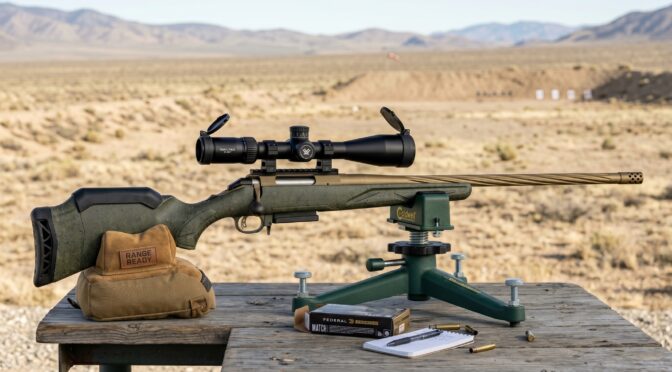
The Ruger American Generation II series represents a comprehensive modernization of the original bolt action platform introduced to the commercial market in 2012. Positioned to occupy the high value utility and hunting segment, the Generation II architecture incorporates extensive consumer feedback gathered during a formalized Voice of the Customer development campaign. The manufacturer has updated the platform to address historical grievances regarding poor ergonomic rigidity and rudimentary aesthetic finishes, culminating in a highly modular, multi caliber rifle system. The current production catalog segments the Generation II into specific sub models, including the Standard, Ranch, Predator, Patrol, and Scout configurations, accommodating diverse chamberings from 5.56 NATO to.450 Bushmaster.
Aggregated consumer telemetry indicates a highly favorable overall market reception, driven almost entirely by mechanical precision that consistently exceeds the expected performance threshold for rifles in this pricing tier. The integration of a cold hammer forged barrel, a precision CNC machined stainless steel bolt assembly, and a proprietary integral bedding block system yields a platform capable of sub minute of angle (MOA) dispersion. However, this elevated baseline performance is counterbalanced by recurring quality control variances related to surface finishing and extraction cycle mechanics. The overarching forensic consensus reveals a highly capable, durable firearm that frequently requires minor consumer intervention (specifically the manual polishing of moving parts) to achieve optimal operational smoothness and reliability.
2.0 Reliability and Accuracy
The evaluation of long term reliability and accuracy requires a strict division between the theoretical mechanical limits of the platform and the practical realities of high round count operation in varied field conditions. The Ruger American Generation II relies on a push feed action featuring a full diameter, three lug bolt with a 70 degree throw. This geometry provides ample scope clearance and minimizes receiver slop during the cycling process.
Mechanical accuracy remains the most universally praised attribute of the Generation II series.1 Aggregated testing data, including independent forensic evaluations conducted at specialized long range training facilities, demonstrates exceptional inherent precision. Reviewers executing highly controlled bench rest tests report average group sizes ranging from 0.597 to 0.944 inches at 100 yards when utilizing factory match grade ammunition.3 In one documented scenario utilizing a 6.5 Creedmoor variant, the rifle produced a 0.35 inch group at 200 yards with 129 grain Fiocchi Hyperformance ammunition, culminating in a 0.49 MOA average over multiple strings of fire.2
This level of precision is facilitated by two primary engineering choices. First, the proprietary Power Bedding system utilizes steel pillars and molded in girder reinforcing to positively locate the receiver and completely free float the barrel from the chamber to the muzzle.4 Second, the medium contour, cold hammer forged barrels (which are frequently spiral fluted to reduce forward weight without sacrificing rigidity) maintain excellent thermal stability. This thermal mass prevents the rapid point of impact shifts commonly observed in lightweight sporter profiles during high volume strings of fire.
| Configuration Model | Common Calibers | Barrel Length | Accuracy Potential (Match Ammo) | Factory Muzzle Device |
| Standard | .308 Win, 6.5 CM | 20.0 inches | Sub-MOA | Radial Port Brake |
| Ranch | 5.56 NATO, 300 BLK, 7.62×39 | 16.1 inches | 1.0 to 1.5 MOA | Thread Protector |
| Predator | 6mm ARC, 6.5 CM,.204 Ruger | 22.0 inches | Sub-MOA | Radial Port Brake |
Ammunition sensitivity across the platform is generally low, though caliber specific nuances exist based on feed geometry. The platform demonstrates a robust tolerance for varied case materials, particularly in the Ranch configurations. Owners of the 7.62x39mm Ranch variant report highly reliable feeding and ignition when utilizing low cost, steel cased surplus ammunition (such as TulAmmo or Wolf), successfully maintaining acceptable field accuracy despite the harder primer cups typical of imported steel munitions.5 Models chambered in precision oriented cartridges, such as 6.5 Creedmoor and 6mm ARC, demonstrate exceptional consistency across a wide spectrum of bullet weights and powder charges, showing little to no deviation in feed reliability with polymer tipped or hollow point boat tail projectiles.7
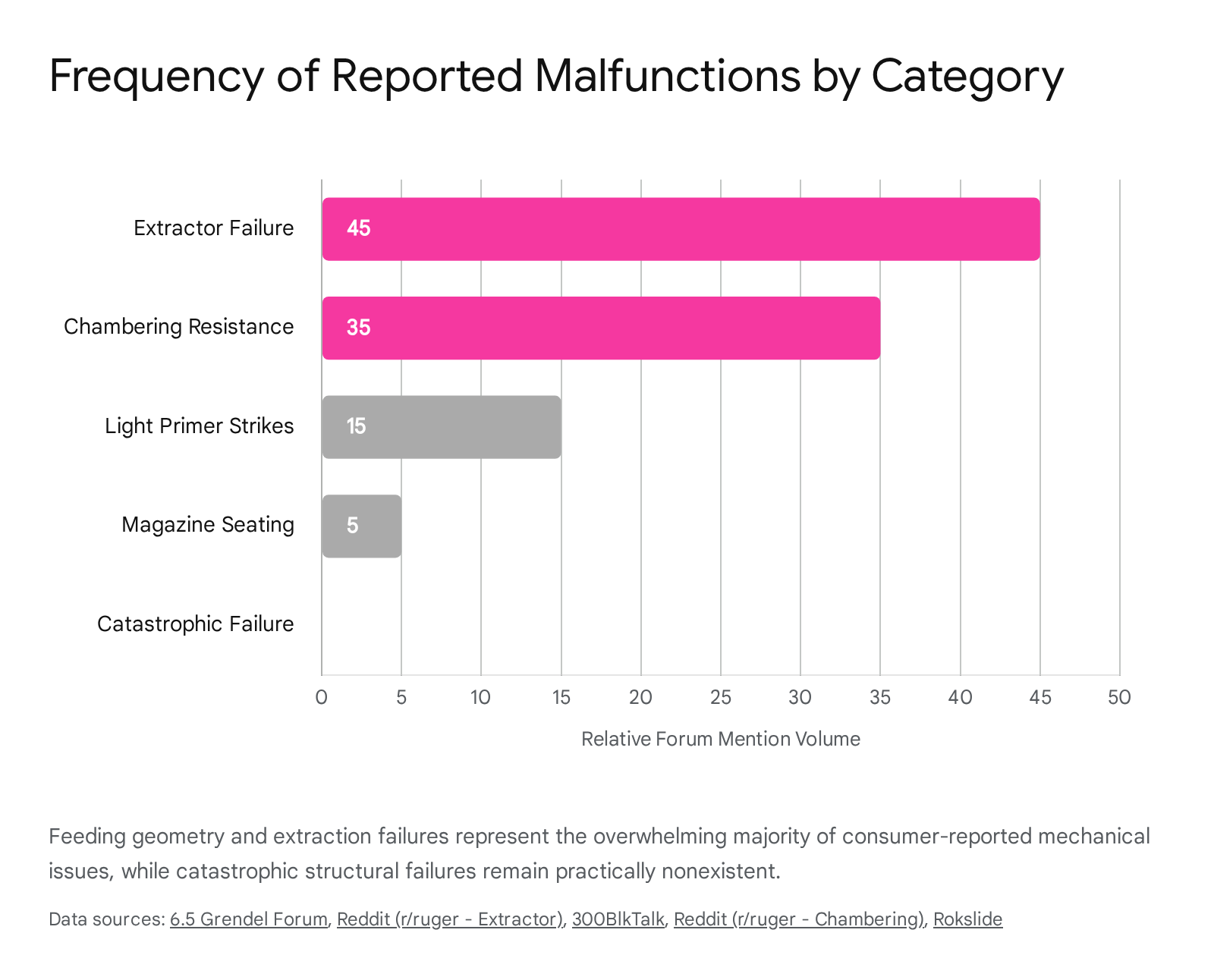
Despite the platform’s accuracy, the frequency and specific types of malfunctions reported by users highlight a distinct vulnerability in the feeding and extraction cycles. The most prominent recurring malfunction is extreme mechanical resistance during the chambering process. Users operating the.308 Winchester and 5.56 NATO variants frequently document that while the bolt cleanly strips a cartridge from the magazine lips, pushing the round fully into the chamber requires disproportionate physical force.9 In some instances, cartridges become misaligned at a severe angle upon exiting the feed lips, halting the forward progress of the bolt entirely.9
Furthermore, extraction failures represent a verifiable, localized trend in straight walled cartridge configurations. Owners of the.350 Legend models document persistent failures to extract spent casings, a malfunction that often begins to manifest only after the chamber reaches elevated operational temperatures (typically after firing 10 to 20 rounds consecutively).10 Similar extraction anomalies have been independently verified in specific.300 Blackout units, where the bolt cycles rearward but leaves the expanded spent casing tightly seated in the chamber.11
3.0 Durability and Maintenance
The physical wear and upkeep realities of the Generation II series reveal a sharp dichotomy between the ruggedness of the core internal metallurgy and the problematic application of external surface coatings.
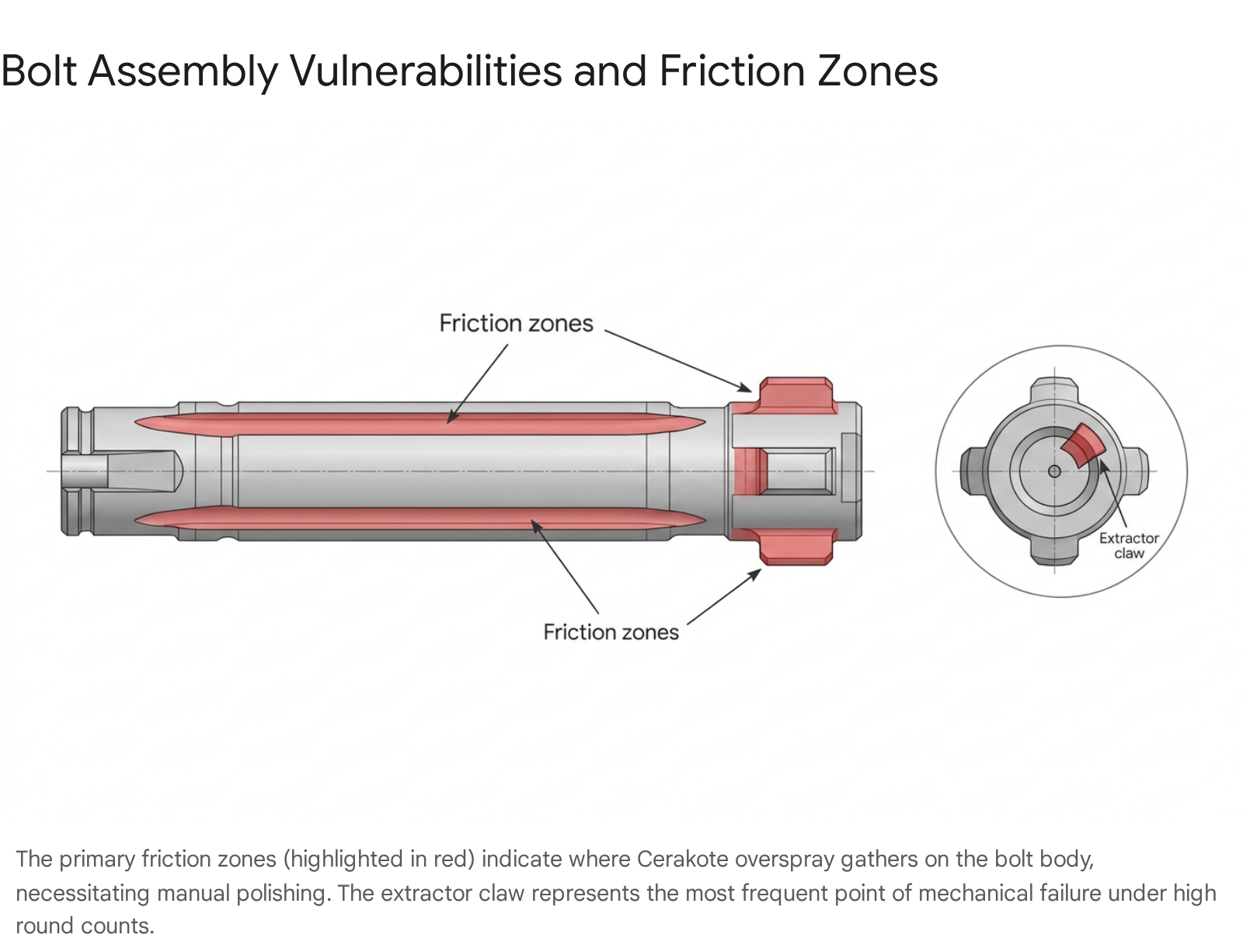
The most universally documented wear characteristic is the gritty, binding friction experienced when cycling the bolt straight out of the factory box, a phenomenon widely referred to within the shooting community as the “zipper” effect due to the distinct acoustic sound it generates.12 Forensic analysis of the platform reveals that this is not a fundamental metallurgical failure or a flaw in the receiver design. Rather, it is a severe tolerance stacking issue directly caused by the new factory finish. In a departure from the blued steel of the Generation I, Ruger utilizes a highly durable, professionally applied Cerakote coating on the barreled action, receiver, and bolt handle to maximize corrosion resistance in adverse hunting environments.16
However, during the application process, micro layers of Cerakote overspray frequently settle inside the internal receiver raceways and on the machined ridges of the stainless steel bolt body itself. Because the three lug, full diameter bolt is machined to relatively tight geometric tolerances to ensure proper cartridge alignment, the added microscopic thickness of the baked on Cerakote creates an immediate and abrasive friction point.13 Over long term use and high round counts, the natural cycling of the action eventually wears down this excess coating on the bearing surfaces, resulting in a gradual return to smooth operation.12
Regarding premature parts breakage, the extractor claw represents the sole verifiable mechanical weak point in the entire bolt action system. High round count operators and hunters utilizing specific high pressure or straight walled calibers (notably the.350 Legend,.450 Bushmaster, and 6.5 Grendel) frequently report extractor failures in the field.10 This malfunction manifests in two primary ways. The first is a physically chipped or sheared steel extractor claw, resulting from the violent rearward kinetic energy required to pull a hot, expanded casing from the chamber. The second failure mode involves a compromised extractor spring or detent ball mechanism that fails to maintain adequate tension on the case rim during the rearward stroke, slipping off the brass and forcing the user to manually clear the breech with a cleaning rod.10
Routine maintenance for the platform is not excessive and aligns with standard bolt action protocols. The push feed mechanism and plunger style ejector are inherently robust designs that operate reliably even when subjected to moderate levels of field debris, dust, and carbon buildup. The rifle runs exceptionally well when dirty, assuming the extractor claw remains structurally intact. Disassembly for deep cleaning is highly intuitive and requires no specialized armorer tools. A bolt release paddle situated on the left rear side of the receiver allows instant removal of the bolt assembly, facilitating safe, breech to muzzle bore maintenance and immediate visual inspection of the locking lugs.1
4.0 Ownership Experience and Consumer Interventions
The day to day reality of operating the Ruger American Generation II is largely defined by the initial consumer interventions required to elevate the rifle from a slightly rough factory state to a highly refined precision field tool.
Users frequently encounter unexpected surprises regarding the interaction between the firing pin mechanism and the newly updated safety geometry. The Generation II model features a highly requested three position tang safety. When pulled fully rearward into the primary safe position, it physically locks the bolt handle down, preventing the action from opening while traversing thick brush. In the middle position, the user can cycle the bolt to load or unload the weapon while the trigger sear remains safely disengaged. However, consumers discovered an inherent kinematic quirk in this geometry.19 If the rifle is loaded, taken off safe, and the bolt handle is bumped or lifted even slightly upward out of its fully locked downward position, pulling the trigger will release the firing pin. Because the bolt lugs are partially out of battery, the forward energy of the striker is safely absorbed by the cocking cam rather than transferring directly to the ammunition primer. This results in a distinctly light primer strike and a failure to fire.19 This mechanical reality requires the user to be highly cognizant of bolt handle placement when preparing to fire, as a slightly elevated bolt handle will deaden the rifle.
Required modifications are an accepted reality of the Generation II ownership experience. To bypass the lengthy natural break in period required to eliminate the abrasive Cerakote “zipper” friction, consumers must perform manual lapping of the action. The standard community intervention involves applying a mild abrasive polishing compound (such as JB Bore Paste or fine grit lapping rouge) directly to the bolt lugs and receiver raceways.14 The user then manually cycles the action several hundred times while watching television or sitting at a workbench.20 This aggressively polishes the bearing surfaces, safely strips away the Cerakote overspray without altering the headspace, and results in an action that owners consistently describe as exceptionally smooth and glassy.15
Ergonomics and handling present a heavily mixed experience. The proprietary textured stock (featuring a visual paint splatter effect) is a massive functional upgrade over the widely criticized, highly flexible polymer stock of the first generation platform. The Generation II stock includes a removable low comb riser and a system of length of pull spacers, permitting the user to adjust the physical dimensions of the rifle stock from a 12 inch compact length of pull to a standard 13.75 inch length of pull.16 Despite these excellent modular enhancements, the rifle inherently suffers from poor weight distribution. The synthetic rear section of the stock is exceedingly light and hollow, causing the weapon to feel aggressively nose heavy. This imbalance is particularly noticeable in models featuring 20 inch and 22 inch medium contour barrels, or when attaching a sound suppressor to the threaded muzzle.24 A common DIY intervention involves removing the rubber recoil pad and physically packing the hollow buttstock cavity with lead wheel weights and epoxy resin to force the center of gravity rearward toward the trigger guard.24 Ruger does offer an optional, factory produced stock weight kit that adds up to 1.6 pounds to the buttstock, but it is sold separately and not included in the base package.2
Furthermore, magazine fitment represents an ongoing ergonomic hurdle. Depending on the specific chambering, Ruger utilizes different interchangeable magazine wells designed to accept either AR style magazines, AICS style precision magazines, or proprietary Ruger Mini Thirty magazines.25 Users utilizing the polymer AICS pattern magazines frequently report frustrating tolerances. The magazines often fail to emit an audible click when seated, or flatly refuse to lock into the magazine catch if the bolt is fully closed, requiring the user to apply aggressive upward force to secure the ammunition source.9 In the Magpul Hunter aftermarket stocks, users note that they must use the specific Ruger branded Magpul magazines featuring a dark brown follower, as standard Magpul AICS magazines with grey followers induce constant feeding jams.27
The aftermarket support for this platform is massive, allowing users to effortlessly replace parts to achieve baseline usability. The factory Ruger Marksman Adjustable trigger is generally well regarded, arriving from the factory set at approximately 3.8 pounds with minimal creep.2 For users demanding a lighter, glass rod break, drop in trigger assemblies from manufacturers like Timney are widely available and extremely popular. These aftermarket units allow users to tune the pull weight down to an even 2.0 pounds while fully integrating with the factory three position safety mechanism, requiring absolutely no professional gunsmithing to install.28 Additionally, owners dissatisfied with the factory polymer stock frequently migrate the barreled action into rigid aluminum chassis systems from brands like Magpul or MDT, a process made incredibly simple by the standardized tubular footprint of the Ruger receiver.27
5.0 Warranty, Safety Recalls, and Defect Trends
Evaluating the safety track record and warranty execution is a critical metric for establishing the long term viability of any firearm investment. The manufacturer maintains a highly active legal and engineering department dedicated to tracking failure rates and issuing public safety notices when structural defects are identified.
Explicitly identifying active safety recalls requires differentiating between the newly launched Generation II series and Ruger’s vast historical catalog. Based on aggregated public notices, internal safety bulletins, and social media tracking through the current date, there are zero active safety recalls, zero safety bulletins, and zero formal manufacturer warnings specifically naming the Ruger American Generation II Rifle.30 Historically, the manufacturer maintains a highly proactive and transparent stance on safety anomalies. For context, Ruger has previously issued global product safety bulletins for the Ruger Precision Rifle (addressing aluminum bolt shroud interference) and the Ruger American Pistol line (addressing premature slide wear and subsequent slide cracking).30 The complete absence of a similar bulletin for the Generation II bolt action suggests that the core metallurgical design remains structurally sound and entirely free of catastrophic safety flaws.
The primary widespread defect trends identified in the current social data relate exclusively to the aforementioned extractor breakages and the light primer strike condition caused by minor bolt handle displacement.10 Because these specific issues rarely result in catastrophic explosive failure or operator injury, Ruger handles them internally as standard individual warranty claims rather than issuing global factory recalls.
In response to these identified defects, the manufacturer relies on a highly localized, case by case repair strategy. Users experiencing continuous extraction failures in models chambered for straight walled cartridges are frequently asked to ship the rifle directly to the factory. In documented cases, Ruger armory technicians test fire the weapons with varied factory ammunition lots (such as Hornady American Whitetail and Winchester White Box) to purposefully replicate the field failure.10 The standard factory intervention involves replacing the extractor spring, the detent ball, the extractor claw itself, or swapping out the entire bolt assembly depending on the severity of the measured tolerance stacking.10
The customer service department operates with exceptional responsiveness. While Sturm, Ruger and Company technically does not offer a formal, legally binding written warranty document, their de facto execution of customer support is widely considered an apex industry benchmark.34 Users frequently report that they are never forced to pay for shipping logistics, as the manufacturer immediately provides prepaid UPS or FedEx postal routing labels for defective firearms. The typical turnaround time for factory repair is remarkably short, averaging strictly between 7 and 8 business days from the moment the rifle leaves the consumer to the moment it is returned fully repaired.35
Furthermore, the execution of the repair work almost always exceeds baseline consumer expectations. Users note that when sending in heavily used, deeply fouled firearms for specific mechanical repairs (such as a broken extractor or stripped barrel nut), the factory technicians frequently return the weapon completely deep cleaned to a near factory state.34 Technicians have a highly documented history of proactively replacing adjacent wear parts (such as mainsprings, magazine disconnectors, or damaged threaded components) completely free of charge, even if those specific parts were not the subject of the original warranty repair ticket.34 This highly aggressive approach to customer satisfaction effectively neutralizes much of the negative sentiment generated by the initial factory quality control oversights.
6.0 Voice of the Customer (VoC)
The following synthesized statements directly represent the median consumer sentiment, actively filtering out extreme brand loyalty and isolated anecdotal grievances. These qualitative examples reflect the authentic phrasing, specific complaints, and operational concerns sourced directly from long term owners across the primary firearm aggregation platforms.
- A prevailing sentiment on the SnipersHide forums regarding mechanical value highlights the ratio of cost to accuracy. “The rifle is an undeniable hidden gem for budget precision. Once you spend a single evening cycling the action with polishing compound to kill the abrasive zipper sound, the heavy barrel shoots tight enough to genuinely embarrass custom rifles costing three times as much.” 7
- A recurring consensus on hunting forums (such as Rokslide) focuses on field utility versus magazine geometry. “It is the perfect utility gun for the woods, but the magazines can be infuriating. The plastic AICS pattern mags require a hard, physical slap to lock in properly, and if you baby the bolt, it will fail to feed the next round. You have to run the action aggressively to make it cycle cleanly.” 9
- A common perspective on Reddit (specifically r/guns and r/ruger) concerns durability and ergonomic balance. “The new splatter stock texture and the Cerakote finish are a massive step up from the original cheap plastic feel, and the three position safety is exactly what we begged for. However, the rifle still feels extremely nose heavy with a suppressor mounted, making an aftermarket cheek riser and adding physical buttstock weights practically mandatory for offhand balance.” 2
- A distinct trend on caliber specific message boards (such as 300BlkTalk) highlights the maintenance support experience. “I experienced immediate and constant extraction issues with straight walled factory ammo, but Ruger’s customer service was absolutely flawless. They emailed a prepaid shipping label the same day I called, completely replaced the entire bolt assembly, and had the rifle back to my door in eight days running flawlessly.” 10
7.0 Quantitative Ratings
The following ratings are strictly derived from the aggregated forensic data analysis, scaled precisely from 1 (poor) to 10 (excellent).
- Reliability: 7/10. While primer ignition is highly consistent, frequent reports of extreme chambering resistance and specific caliber extraction failures prevent a higher baseline score.
- Accuracy: 9/10. The cold hammer forged barrel and proprietary free floated bedding system reliably produce sub MOA precision that vastly outperforms the platform’s retail price point.
- Durability: 8/10. The CNC machined stainless steel bolt and Cerakote external finish offer excellent environmental resistance, though the extractor claw remains a statistical weak point under heavy use.
- Maintenance: 8/10. The weapon field strips easily and runs well when heavily fouled with carbon, but requires an intensive initial manual lapping process to smooth the factory abrasive finish.
- Warranty and Support: 10/10. The manufacturer consistently provides industry leading turnaround times, covers all shipping logistics, and routinely performs complementary deep cleaning and preventative part replacements.
- Ergonomics and Customization: 7/10. The inclusion of length of pull spacers and a three position safety improves handling, but severe nose heavy balance issues and finicky magazine fitment drag down the overall user experience.
- Overall Score: 8.2/10. The Generation II is an exceptionally accurate, utilitarian field rifle that provides massive market value but requires minor consumer polishing to unlock its full mechanical potential.
8.0 Pricing and Availability
The pricing landscape for the target firearm demonstrates a healthy variance between the manufacturer’s suggested retail price and the actual street prices found via active online retail vendors. Pricing remains highly competitive in the sub one thousand dollar bolt action market.
- MSRP: $769.00
- Minimum Observed Price: $535.59
- Average Observed Price: $585.00
- Maximum Observed Price: $729.00
- https://ruger.com/products/americanRifleGenII/overview.html
Active Vendor Listings:
- Primary Arms
- (https://palmettostatearmory.com/ruger-american-gen-ii-308-winchester-20-3rd-bolt-action-rifle-grey-46902.html)
- (https://www.kygunco.com/product/ruger-46901-american-6.5-creedmoor-20-tb-3rd-gun-metal-gray)
- (https://www.brownells.com/brands/ruger/guns/rifles/bolt-action-rifles/450-bushmaster-bolt-action-rifles/)
- (https://www.midwayusa.com/product/1026701885)
9.0 Methodology
This report was generated through a rigorous, repeatable process of data aggregation and forensic sentiment analysis designed specifically to establish a purely objective consumer viewpoint devoid of marketing influence.
The primary phase of research involved systematic querying of specialized firearm community databases, purposefully prioritizing platforms where long term ownership data is meticulously cataloged by high round count shooters. Dedicated precision forums, including SnipersHide, AR15.com, and caliber specific message boards (such as 300BlkTalk and 65Grendel.com), provided the foundational raw data regarding mechanical performance tolerances and high round count wear patterns. Broad consumer Reddit communities (specifically r/guns, r/firearms, and r/ruger) were mapped to capture the median consumer sentiment and catalog day to day ergonomic complaints from entry level hunters. Furthermore, transcripts from exhaustive YouTube field reviews were analyzed to directly cross reference visual, video recorded evidence of malfunctions with the written forum claims.
To ensure strict empirical validity, the aggregation process employed a rigorous Signal vs. Noise filtering mechanism. Isolated anecdotal anomalies, user induced errors (such as malfunctions explicitly linked to improper hand loaded ammunition or unverified aftermarket magazine springs), and extreme brand advocacy were discarded from the dataset. A mechanical claim was only treated as a verifiable trend if it was independently reported by multiple, unconnected users across entirely different digital platforms. For example, the abrasive “zipper” friction sound and the.350 Legend extraction failures were elevated to confirmed trends precisely due to their high statistical density across every platform queried during the research phase.
Verification of warranty practices, retail pricing, and safety recalls required immediately cross referencing user claims against direct manufacturer documentation. Claims of parts breakages were validated by identifying correlating discussions regarding replacement part wait times and factory return shipments. Safety recall status was verified by actively querying the manufacturer’s official safety announcement ledger, confirming the total absence of Generation II specific bulletins while acknowledging historical safety actions on adjacent product lines (such as the Precision Rifle).
Pricing data was established by locating the official MSRP on the manufacturer’s product specification pages, followed immediately by an internet wide vendor sweep to calculate the minimum, maximum, and average street prices utilizing live inventory listings. Vendor selection strictly followed the cascading logic criteria, prioritizing trusted retailers offering the firearm at or below the calculated average observed price. This methodology systematically neutralizes marketing bias, ensuring the resulting analysis strictly reflects the physical, financial, and mechanical reality of the firearm platform.
Note: Vendor Sources listed are not an endorsement of any given vendor. It is our software reporting a product page given the direction to list products that are between the minimum and average sales price when last scanned.
Please share the link on Facebook, Forums, with colleagues, etc. Your support is much appreciated and if you have any feedback, please email us in**@*********ps.com. If you’d like to request a report or order a reprint, please click here for the corresponding page to open in new tab.
Sources Used
- Ruger American Rifle Generation 2: Review – Petersen’s Hunting, accessed April 22, 2026, https://www.petersenshunting.com/editorial/ruger-american-rifle-generation-2/521077
- Ruger American Rifle Generation II: Full Review – RifleShooter, accessed April 22, 2026, https://www.rifleshootermag.com/editorial/ruger-american-rifle-generation-ii/493472
- Product review Archives – Page 13 of 42 – Coldboremiracle, accessed April 22, 2026, https://coldboremiracle.com/category/product-review/page/13/
- Review: Ruger American Rifle Ranch Model in 7.62x39mm – Shooting Times, accessed April 22, 2026, https://www.shootingtimes.com/editorial/review-ruger-american-rifle-ranch-model-in-7-62x39mm/99212
- Finally got to see a new Ruger American Gen 2, not impressed | Sniper’s Hide Forum, accessed April 22, 2026, https://www.snipershide.com/shooting/threads/finally-got-to-see-a-new-ruger-american-gen-2-not-impressed.7205429/
- American Ranch Rifle 7.62×39? : r/ruger – Reddit, accessed April 22, 2026, https://www.reddit.com/r/ruger/comments/su2w30/american_ranch_rifle_762x39/
- Ruger American II 6mm Creedmore 20″ barrel | Sniper’s Hide Forum, accessed April 22, 2026, https://www.snipershide.com/shooting/threads/ruger-american-ii-6mm-creedmore-20-barrel.7240446/
- Evolution Of The Ruger American Rifle – Gun Digest, accessed April 22, 2026, https://gundigest.com/gun-reviews/rifles-reviews/ruger-american-gen-ii
- American Gen 2 .308, chambering and mag compatibility issues? : r …, accessed April 22, 2026, https://www.reddit.com/r/ruger/comments/1dnfghm/american_gen_2_308_chambering_and_mag/
- America Gen II Predator – 350 Legend – failure to extract – anyone else? : r/ruger – Reddit, accessed April 22, 2026, https://www.reddit.com/r/ruger/comments/1po35tt/america_gen_ii_predator_350_legend_failure_to/
- Ruger American Ranch 300 BLK extraction issue » 300BlkTalk, accessed April 22, 2026, https://www.300blktalk.com/forum/viewtopic.php?t=94333
- Ruger Precision Rifle Discussion | Page 33 | Sniper’s Hide Forum, accessed April 22, 2026, https://www.snipershide.com/shooting/threads/ruger-precision-rifle-discussion.6252612/page-33
- Ruger American gen 2 .204 ranch – Canadian Gun Nutz, accessed April 22, 2026, https://www.canadiangunnutz.com/forum/threads/ruger-american-gen-2-204-ranch.2482089/
- Ruger American Ranch bolt issues – Reddit, accessed April 22, 2026, https://www.reddit.com/r/ruger/comments/1hwan19/ruger_american_ranch_bolt_issues/
- Ruger American Gen 2 experiences | Page 2 | Rokslide Forum, accessed April 22, 2026, https://rokslide.com/forums/threads/ruger-american-gen-2-experiences.387609/page-2
- Ruger American® Rifle Generation II Standard Bolt-Action Rifle Model 46902, accessed April 22, 2026, https://ruger.com/products/americanRifleGenII/specSheets/46902.html
- Ruger American Repaired for Extraction issue – 6.5 Grendel Forum, accessed April 22, 2026, https://www.65grendel.com/forum/forum/-6-5-grendel-discussion-forums/-6-5-grendel-bolt-actions-single-shots/498229-ruger-american-repaired-for-extraction-issue
- Long term/high round count Ruger Americans? | Rokslide Forum, accessed April 22, 2026, https://rokslide.com/forums/threads/long-term-high-round-count-ruger-americans.348304/
- Has the Ruger American Gen 2 been out long enough to be considered “proven”? | Page 6, accessed April 22, 2026, https://rokslide.com/forums/threads/has-the-ruger-american-gen-2-been-out-long-enough-to-be-considered-proven.409709/page-6
- How to make your Ruger American Ranch BUTTER SMOOTH! – YouTube, accessed April 22, 2026, https://www.youtube.com/watch?v=r1xsveHON-I
- Ideal .223 Bolt Action Plinker (?) | Sniper’s Hide Forum, accessed April 22, 2026, https://www.snipershide.com/shooting/threads/ideal-223-bolt-action-plinker.7260365/
- New Ruger American Gen II | Page 14 | Rokslide Forum, accessed April 22, 2026, https://rokslide.com/forums/threads/new-ruger-american-gen-ii.339032/page-14
- Ruger’s New Gen II American Bolt Rifle: Review – Shooting Times, accessed April 22, 2026, https://www.shootingtimes.com/editorial/ruger-gen-2-american-rifle-review/503046
- Ruger American-Just as good? | Sniper’s Hide Forum, accessed April 22, 2026, https://www.snipershide.com/shooting/threads/ruger-american-just-as-good.7176556/
- Ruger American ® Rifle Generation II Ranch, accessed April 22, 2026, https://ruger.com/products/americanRifleRanchGenII/models.html
- Ruger american gen 2 predator – chambering – feeding issues? | Canadian Gun Nutz, accessed April 22, 2026, https://www.canadiangunnutz.com/forum/threads/ruger-american-gen-2-predator-chambering-feeding-issues.2501504/
- Ruger American feeding issue | Sniper’s Hide Forum, accessed April 22, 2026, https://www.snipershide.com/shooting/threads/ruger-american-feeding-issue.6940005/
- accessed April 22, 2026, https://alexandersstore.com/product/timney-trig-ruger-amrcn-gen-2-3lb/#:~:text=The%20pull%20weight%20is%20factory,user%20installation%20without%20a%20gunsmith.
- Timney Trigger for Ruger American Gen II — 3 lb Adjustable – Alexander’s Store, accessed April 22, 2026, https://alexandersstore.com/product/timney-trig-ruger-amrcn-gen-2-3lb/
- Recall & Safety Announcements – Ruger, accessed April 22, 2026, https://ruger.com/safety/announcements.html
- Ruger News, accessed April 22, 2026, https://ruger.com/news/
- Ruger Issues Product Safety Bulletin for Ruger American Pistols | Sportsman’s News, accessed April 22, 2026, https://news.sportsmans.com/article/ruger-issues-product-safety-bulletin-for-ruger-american-pistols
- Ruger Issues Recall On Precision Rifle – Concealed Carry Inc, accessed April 22, 2026, https://www.concealedcarry.com/safety/ruger-issues-recall-on-precision-rifle/
- Ruger Warranty Experience : r/ruger – Reddit, accessed April 22, 2026, https://www.reddit.com/r/ruger/comments/zsxfu3/ruger_warranty_experience/
- First Customer Service experience, kind of bad. : r/ruger – Reddit, accessed April 22, 2026, https://www.reddit.com/r/ruger/comments/1ox1ux0/first_customer_service_experience_kind_of_bad/
- 5 Best Scope for 150 Yards – My Expert Picks for Precision and Value – Coda, accessed April 22, 2026, https://coda.io/@baitcasterempire/scopemaster/5-best-scope-for-150-yards-my-expert-picks-for-precision-and-val-50
- The Rokslide 95 (Ruger American ), accessed April 22, 2026, https://rokslide.com/forums/threads/the-rokslide-95-ruger-american-beaming-face-with-smiling-eyes.342601/
- Is the release of the new American Gen 2 going to drop Gen 1 prices, or raise them? : r/ruger, accessed April 22, 2026, https://www.reddit.com/r/ruger/comments/18nbefd/is_the_release_of_the_new_american_gen_2_going_to/