Category Archives: Drone Analytics

Understanding the Economics of Drone Warfare

1. Executive Summary

The character of modern warfare is undergoing a structural economic shift, driven by the proliferation and mass deployment of uncrewed aerial systems (UAS). As the United States Department of Defense (DoD) initiates historic investments to rapidly scale the production and integration of drone technology—evidenced by the “Drone Dominance” initiative targeting the procurement of hundreds of thousands of autonomous systems by 2028—a critical fiscal vulnerability has emerged.1 The prevailing defense acquisition culture within the United States exhibits a systemic tendency to fixate on the initial capital expenditure (CAPEX) and the raw technological capability of individual hardware platforms.2 This hardware-centric acquisition paradigm fundamentally miscalculates the long-term financial liabilities of high-attrition, software-defined warfare.1

This strategic report examines the underlying economics of mass drone integration, focusing heavily on the often-overlooked systemic requirements necessary to design, build, operate, and evolve these systems at scale. While the low unit cost of individual attritable drones is highly publicized, this upfront metric obscures a vast and compounding tail of operating expenditures (OPEX).4 High-attrition warfare dictates that a drone’s lifespan is measured in mere flights rather than decades, necessitating continuous, rapid replacement rates that place unprecedented strain on industrial supply chains and procurement budgets.5

Furthermore, the transition to software-defined warfare introduces persistent financial burdens through restrictive commercial software licensing models, continuous integration and continuous deployment (CI/CD) pipeline maintenance, and the algorithmic updates required to survive in highly contested electromagnetic environments.3 Leadership must also account for the expanded logistical footprint required to power and transport distributed swarms, the immense human capital overhead necessary to train tens of thousands of operators, and the end-of-life environmental liabilities associated with mass lithium-ion battery disposal.8

To ensure economic sustainability and avoid crippling defense budget liabilities, DoD leadership must pivot from traditional unit-cost evaluation to a holistic, mission-based value framework.11 This requires systemic reforms in how the military models total ownership costs, structures software acquisition, and manages the organic industrial base.3 Understanding the fiscal realities of mass drone integration is not merely an administrative or accounting exercise; it is a vital strategic imperative that will directly determine the United States’ ability to maintain deterrence and endure in prolonged, high-intensity conflicts against peer adversaries.

2. The Economic Engine of Attrition: Redefining Cost-Exchange Ratios

The fundamental economic disruption introduced by mass drone integration is the inversion of traditional military cost-exchange ratios. Historically, military superiority relied on fielding exquisite, high-performance platforms capable of overwhelming adversaries through technological dominance and survivability. Today, the balance of power is increasingly dictated by the ability to produce, integrate, and sustain large numbers of low-cost autonomous systems faster than an adversary can physically or economically respond.13 This dynamic has transformed conflict into a contest of economic endurance.

The Asymmetry of Air Defense

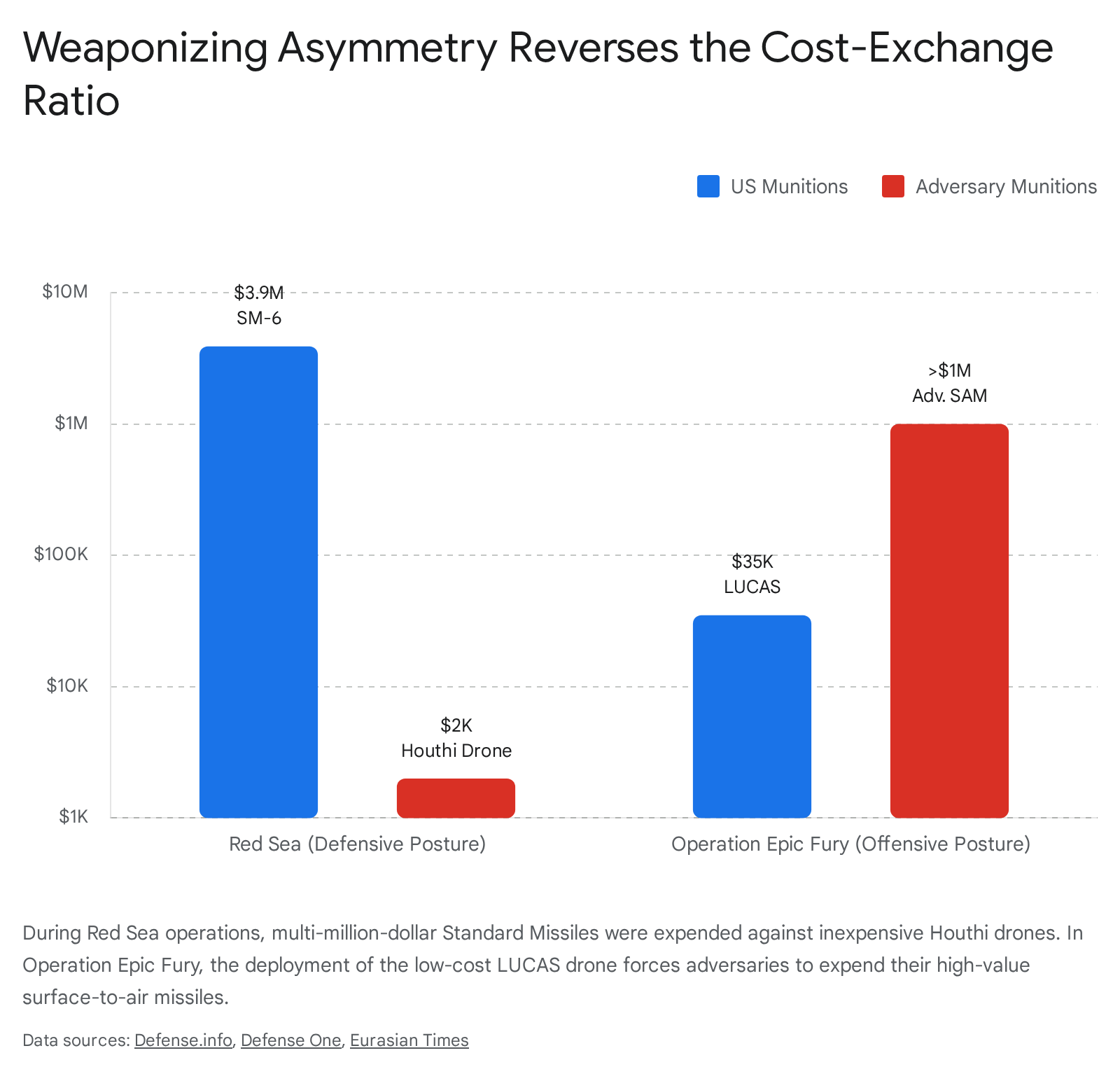
In contemporary conflicts, the financial burden placed on defenders vastly outweighs the costs incurred by attackers. The deployment of inexpensive, one-way attack (OWA) drones forces technologically superior militaries to expend high-value interceptors and draw down strategic stockpiles that require years and massive capital outlays to replenish.14 For example, loitering munitions such as the Iranian-designed Shahed series operate at an estimated unit cost of $20,000 to $50,000.14 When these systems are deployed in mass salvos, they compel defenders to utilize advanced interceptor systems—such as Patriot missiles—that can cost upwards of $4 million per individual shot.16

This creates a staggering cost-imposition dynamic that favors the attacker. An adversary expending $360 million to launch a sustained drone campaign can force a defensive expenditure exceeding $1.5 billion.14 For every dollar spent launching a drone, defenders may spend twenty or more shooting them down.14 This asymmetric attrition is not accidental; it is a calculated economic strategy designed to exhaust defensive budgets and deplete advanced munitions inventories over prolonged engagements.4 Even when low-cost systems suffer interception rates of 70 to 90 percent, their deployment remains highly cost-effective for the attacker because they succeed in saturating radar sensors, exhausting interceptor magazines, and paving the way for more advanced kinetic strikes to penetrate defenses.5

Virtual Attrition and Tactical Saturation

Beyond the direct kinetic exchanges, swarms offer viable options for imposing costs linked to the concept of “virtual attrition”.17 Virtual attrition occurs when an adversary is forced to alter their behavior, allocate resources, or delay operations out of fear of an attack, even if the attack does not materialize. By simply holding an adversary’s critical capabilities at risk with an armada of low-cost systems, the attacker dictates the operational tempo.17

When analyzing these ratios, the defining feature of the current “Uberization” of warfare is the reliance on cheap, disposable, and highly networked technologies.5 Consequently, nations that continue to rely exclusively on expensive defensive systems for every engagement will find themselves at a severe strategic disadvantage against adversaries that ruthlessly exploit the economics of cheap mass.4 To restore equilibrium, future counter-drone architectures must shift away from multi-million-dollar interceptors toward distributed sensing networks, electronic effectors, and lower-cost kinetic systems that bring the cost of interception closer to the cost of the threat.14

3. The Fallacy of Unit Cost and the CAPEX vs. OPEX Imbalance

The DoD’s traditional acquisition framework is highly optimized for evaluating and procuring legacy, multi-decade platforms. In this conventional paradigm, military planners and congressional appropriators evaluate a highly visible, static capital expenditure (CAPEX). For instance, when analyzing the MQ-9 Reaper program, the upfront acquisition costs are substantial; historical analysis places the cost of a complete Combat Air Patrol (CAP)—consisting of four MQ-9 air vehicles, sensor suites, and associated ground control stations—at approximately $120.8 million.18 The life-cycle cost to operate this exquisite asset is calculated at roughly $35,200 per flying hour.19 While the total ownership cost is high, it is highly predictable, well-documented, and amortized over decades of continuous service.19 Similarly, the F-35 Joint Strike Fighter commands nearly $140 million per unit, with lifetime operations and maintenance (O&M) costs exceeding $360 million per airframe over an expected 8,000-hour lifespan.20

The procurement of mass attritable drones presents a highly deceptive financial profile that fundamentally subverts this traditional accounting methodology. With initial unit costs ranging from a few hundred dollars for commercial quadcopters to $35,000 for specialized loitering munitions, the barrier to entry appears negligible.5 This superficial affordability has catalyzed massive procurement initiatives. The Pentagon’s recent “Drone Dominance” program outlines an initial $150 million injection to acquire 30,000 one-way attack drones, serving as a demand signal to the industrial base.1 This initial order is part of a broader $1.1 billion initiative aimed at purchasing more than 200,000 systems by early 2028.1 Another complementary initiative, the Replicator program, aims to field autonomous drones in the thousands across multiple domains, heavily leaning on commercial solutions.21

However, evaluating mass drone integration solely through the lens of initial hardware unit cost represents a critical strategic oversight. It ignores the systemic realities of continuous operating expenditure (OPEX) in a high-attrition environment. This financial dynamic can be conceptualized as a “Lifecycle Cost Iceberg.” The highly visible portion above the waterline consists merely of the initial airframe acquisition and the basic payload hardware. However, the vast majority of the true financial liability lies hidden below the surface. These submerged, compounding OPEX costs include recurring software licensing fees via Drones-as-a-Service (DaaS) models, the continuous operation of CI/CD software pipelines, high-attrition replacement logistics, perpetual operator training and certification pipelines, and the eventual costs of battery disposal and environmental remediation.

The Mathematics of Continuous Replenishment

To understand the fiscal reality of integrating these systems, leadership must recalibrate their understanding of platform longevity. In high-intensity combat, the battlefield becomes a saturated space where a drone’s lifespan is measured in individual flights rather than years or flight hours.5 Operations in Eastern Europe have demonstrated that attritable platforms suffer exceptionally high loss rates due to dense air defenses and pervasive electronic warfare jamming.5 By mid-2023, Ukrainian forces were losing approximately 10,000 drones per month.5 Under such conditions, the military is not purchasing a static fleet; it is funding a continuous, high-volume consumption pipeline.5

Table 1: Economic Profiles of Legacy vs. Mass Attritable UAS Architectures

Economic ParameterLegacy ISR/Strike (e.g., MQ-9, F-35)Mass Attritable Drone Swarm
Initial Unit Cost (CAPEX)Extremely High (~$30M+ per vehicle) 18Low ($300 – $35,000) 5
Platform LifespanDecades (Thousands of flight hours) 20Days/Weeks (Measured in single flights) 5
Replacement RateNegligible (Peacetime/Low-intensity operations)Continuous (Thousands per month) 5
Software ModelStatic, structured multi-year block upgradesContinuous Integration/Continuous Deployment (CI/CD) 3
Primary Financial DriverUpfront R&D and platform acquisitionContinuous production pipelines and software licensing 2

The financial danger for the DoD lies in treating attritable drones as capital assets rather than expendable ammunition. If a combat unit relies on a fleet of 10,000 drones, and those drones suffer a 60% to 80% failure rate in striking targets due to armor and electronic countermeasures 22, the ongoing requirement to replenish the fleet transforms a minor capital outlay into an immense, recurring operational budget line. Leadership must shift their evaluation approach from “unit price” to a “mission-based value” model.11 In this framework, the true cost is assessed not by the price of the physical drone, but by the financial input required to sustain the capability and effectiveness of the swarm over an extended military campaign.11

4. Software Sustainment, CI/CD Pipelines, and DaaS Ecosystems

The physical airframe of an attritable drone—often constructed from basic composites and plastics—is frequently the least complex and least expensive element of the system. The true strategic value, and consequently the hidden cost center, resides in the software that enables autonomous navigation, swarm coordination, automated target recognition, and electronic counter-countermeasures.23 As the DoD procures vast fleets of commercial and dual-use drones, it inadvertently imports the commercial software industry’s monetization models, creating severe, long-term budget vulnerabilities.

The Licensing Burden and Drones-as-a-Service (DaaS)

The commercial sector is aggressively shifting toward Drones-as-a-Service (DaaS) and recurring licensing models. The global DaaS market is projected to expand from roughly $33.5 billion in 2025 to over $550 billion by 2034.6 In this model, defense organizations do not truly own the operational capability; they lease it. Instead of paying a one-time acquisition cost, the DoD is increasingly required to pay recurring subscription fees for access to the latest hardware iterations, AI-powered analytics, and maintenance support.6

This dynamic extends deeply into the underlying software architecture of military drones. Once advanced mission autonomy software—such as Shield AI’s Hivemind—is developed and validated, it is licensed across multiple drone platforms and fleets.23 While this software-centric approach allows capabilities to scale rapidly without triggering the cost structures associated with physical manufacturing, it also dictates that the DoD’s operational expenditure scales linearly with fleet size.24 If software licenses or cloud-compute access are structured on a per-unit or per-flight basis, the deployment of a 200,000-drone swarm generates an unsustainable, recurring financial drain.

Vendor Lock-In and Restrictive Acquisition Practices

The DoD currently struggles to effectively understand and manage the cyber and cost risks associated with software assets throughout their entire lifecycles.25 Government Accountability Office (GAO) assessments indicate that defense agencies are frequently penalized by restrictive software licensing practices that impede multi-cloud integration.7 Vendors routinely bundle essential software with mandatory secondary products or strictly limit software compatibility to their own specified cloud service providers, driving up infrastructure costs and generating unavoidable fees.7

When applying these practices to a mass drone ecosystem, vendor lock-in becomes a strategic vulnerability. If a proprietary swarm-management software can only operate on a specific vendor’s hardware, the DoD loses modular flexibility and becomes entirely beholden to a single entity.26 A license-based pricing model heavily favors the vendor, leaving the government exposed to arbitrary price increases and restrictive upgrade paths that degrade operational readiness.26 To combat this, the Atlantic Council Commission on Software-Defined Warfare emphatically recommends that the DoD mandate open-computer architectures and consolidate the acquisition of non-proprietary mission integration tools to break down existing technological silos.3

Funding the CI/CD Pipeline Infrastructure

In a highly contested environment, software is never truly “finished.” Unlike legacy platforms that receive scheduled block upgrades every few years, autonomous drones may never reach a traditional sustainment phase; they must remain in a state of continuous development, undergoing frequent upgrades and iterations to outpace adversary countermeasures.11 Operating a modern drone fleet requires maintaining a massive, continuous integration and continuous deployment (CI/CD) pipeline.

The DoD must fund the digital infrastructure required to securely beam software patches, updated AI training models, and new cryptographic keys to tens of thousands of deployed drones simultaneously. The cloud computing infrastructure, data hosting, simulation environments, and data transmission costs required to support this continuous software evolution constitute a massive, ongoing financial burden.3 Furthermore, the Atlantic Council recommends that the DoD radically shift its performance metrics to track deployment frequency—aiming for software updates more than once per week—and mean times to restore (MTTR) critical vulnerabilities to less than one day.3 Achieving this velocity requires establishing a dedicated DoD software cadre of 50 to 100 elite software engineers and drastically expanding the Test Resource Management Center’s (TRMC) digital infrastructure to simulate and validate swarm behaviors iteratively.3 The financial resourcing for these shared platforms and continuous testing pipelines must be explicitly budgeted as a core operational expense, not an afterthought.3

5. Organic Industrial Base Fragility and Material Constraints

The ability to sustain mass drone warfare is constrained not only by fiscal budgets but by the physical realities of the industrial supply chain. Policymakers and military planners frequently focus on higher-order hardware and software integration while perilously overlooking the underlying chemistry, metallurgy, and fabrication capacity required to build affordable mass.2 The industrial base that underpins modern drone warfare is deeply entangled with adversary-controlled supply chains, representing a severe strategic vulnerability that will require immense financial investment to unwind.2

The Geopolitics of Raw Materials and Component Sourcing

Every drone operating in modern conflicts relies heavily on globalized supply chains, with an overwhelming concentration of origin points in Chinese factories and refineries.2 The production of drones at the scale envisioned by the DoD requires unimpeded, highly reliable access to specialized composites, alloys, and semiconductors.2

The sustainability of this warfighting capacity is currently threatened by severe refining and fabrication chokepoints. For instance, the production of unmanned airframes relies on carbon fiber reinforced polymers, an industry with highly inelastic production capacity centralized in a few firms.2 Furthermore, specialized metals like Aluminum-Lithium (essential for longer wings and fuel margins) and Titanium Ti-6Al-4V (used for landing gear) are critical but difficult to source outside of specific, constrained supply chains.2

More critically, China currently controls approximately 90% of the global output of neodymium-iron-boron sintered magnets, which are strictly required for the brushless motors used in almost all small drone platforms.2 Because the environmental and capital costs pushed these processes offshore decades ago, the United States lacks the domestic capacity to produce the 5 to 15 grams of magnets required for each small drone motor at military scale.2 Furthermore, drones require specialty semiconductors like gallium-nitride (GaN) amplifiers and infrared detectors made from indium antimonide.2 Western fabrication facilities for these specialized materials require years to expand, meaning the U.S. industrial base cannot quickly absorb export shocks or rapidly surge production in the event of a geopolitical crisis.2 Securing these dependencies involves transitioning toward strategic reserves of raw material inputs, such as carbon-fiber prepregs and lithium-ion precursors, which is an expensive endeavor compared to standard just-in-time logistics.2

Reconstituting the Organic Industrial Base

To mitigate these vulnerabilities, the DoD has initiated efforts to turn its aging organic industrial base into a modern drone factory network.12 Projects like the Army’s “SkyFoundry” aim to utilize legacy arsenals and depots to mass-produce small, expendable uncrewed aircraft at a rate of 10,000 systems per month.12 However, military leadership has encountered severe technical and financial capability gaps. While traditional arsenals excel at manufacturing artillery shells and heavy armor, they lack the specific machinery and technical expertise to mass-produce delicate drone components like brushless motors.12

The financial cost of replacing highly optimized, off-shored “efficiency” with domestic “redundancy” is immense.2 Establishing the distributed SkyFoundry network requires the Army to overcome high initial startup costs. Army estimates indicate that the initial push to reach a production rate of 10,000 drones per month carries a price tag of roughly $197 million.12 Within that funding, $75 million is required exclusively to build capabilities for brushless motors and specialized wiring harnesses.12 Furthermore, purchasing this essential machinery is subject to an estimated eight-month lead time for delivery and installation, and the Army plans to spend approximately $150 million annually over the following three years just to sustain the effort.12

Simultaneously, the DoD is investing heavily in additive manufacturing to bridge the gap. Facilities like Rock Island Arsenal are integrating 3D-printing capabilities from companies like Impossible Objects, which aim to print 120,000 drone bodies per year at costs falling below $100 per unit.12 While promising, these technological leapfrogs require sustained capital investment. As the DoD enforces legislative mandates to phase out reliance on heavily subsidized foreign platforms—such as those manufactured by DJI—domestic alternatives like Skydio or BRINC remain significantly more expensive, requiring higher procurement budgets just to achieve parity in fleet numbers.27

6. Electromagnetic Warfare, Autonomy, and the Cycle of Adaptation

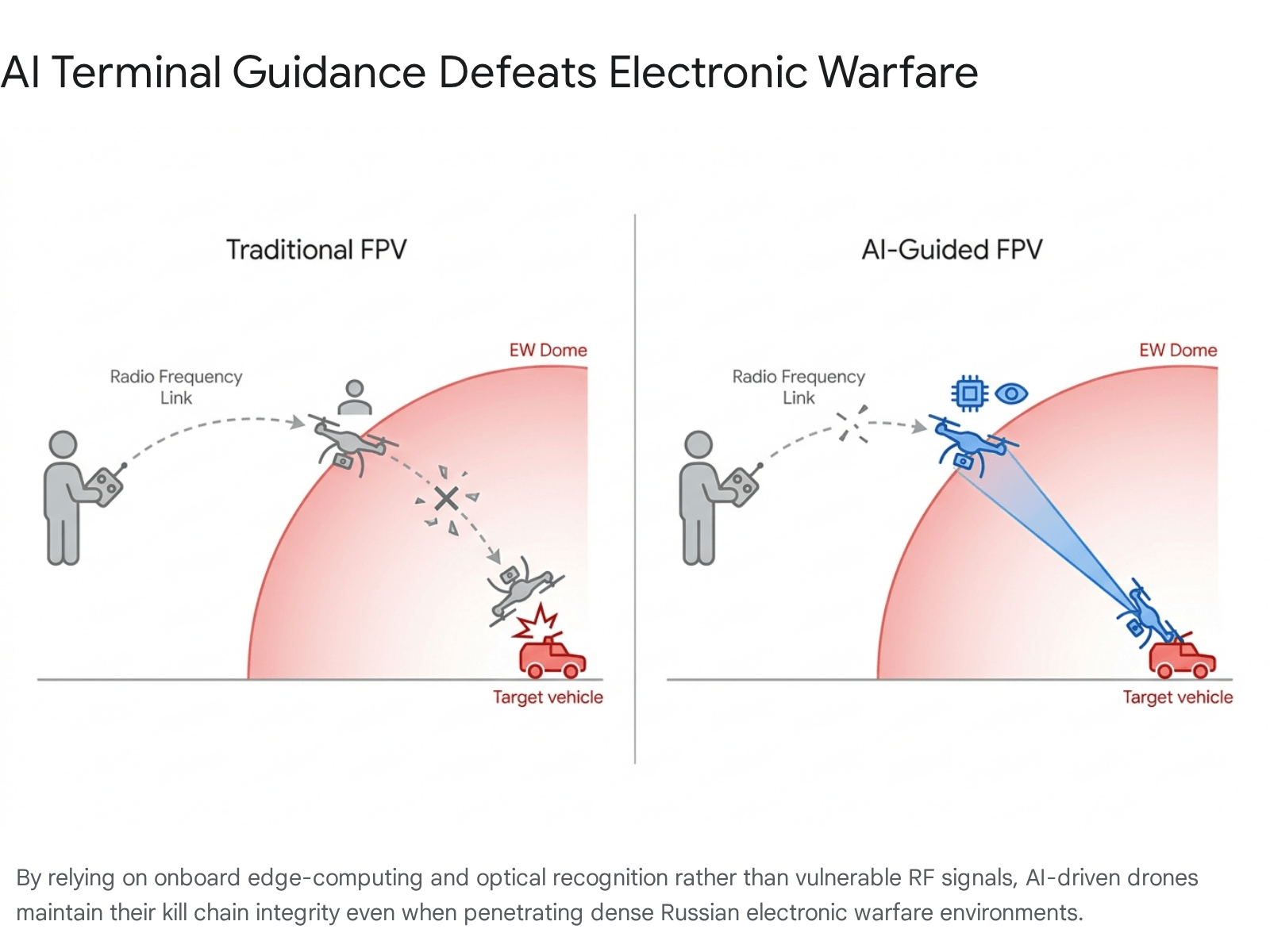
High-attrition warfare is not solely a kinetic phenomenon characterized by physical destruction; it is profoundly electronic. In modern conflicts, the operational environment is heavily saturated with electronic warfare (EW) systems that routinely disrupt datalinks, degrade navigation, and jam radio frequencies.29 The era of reliable, uncontested GPS navigation has ended, forcing a rapid, costly evolution in how drones orient, communicate, and strike targets.24

The Cycle of Transient Survivability

Under sustained EW pressure, the technological survivability of any given drone platform is highly transient.29 A drone system equipped with specific frequency-hopping algorithms that operates flawlessly on day one of a conflict may be rendered entirely obsolete by day thirty due to rapid adversary adaptations in signal jamming and spoofing.29 This forces an unforgiving feedback loop where military forces must constantly push technical and tactical adaptations to the front lines just to maintain basic operational effectiveness.17

This reality completely undermines traditional, multi-year procurement cycles, which are too slow to respond to the pace of electronic innovation.21 Platforms featuring exquisite designs but long development timelines have proven significantly less relevant on the modern battlefield than basic systems that can be rapidly modified, replaced, and tactically reconfigured in weeks.29

The Financial Burden of Counter-Countermeasures

The financial implication of this environment is that the DoD must maintain a permanent, high-velocity engineering cycle. Defense budgets must account for continuous research and development directed specifically at electronic counter-countermeasures.30 Because adversaries will continuously develop methods to disrupt drone swarms, the lifecycle management of these systems is resource-intensive, requiring continuous upgrades to stay ahead of evolving threats.30

Developing autonomous software that can navigate, identify targets, and execute missions without GPS or external communication links is highly resource-intensive. It requires vast datasets, advanced AI training environments, and continuous red-teaming.23 Furthermore, securing these swarms requires hardware innovation. Implementing heavyweight cryptographic hardware on commodity drones frequently violates size, weight, and power (SWaP) constraints and undermines the cost-effectiveness of swarm deployments.31 To address this, engineers are exploring risk-adaptive security models using Physical Unclonable Functions (PUFs) to derive cryptographic keys from inherent silicon variations, offering lightweight security.31 However, integrating these advanced microelectronics into cheap, attritable airframes drives up development costs and exacerbates the supply chain constraints discussed previously. Ultimately, the cost of ensuring drones can actually function in a contested electromagnetic spectrum far exceeds the cost of the raw physical components.

7. Logistical Footprint and the Vulnerability of Sustainment Nodes

A persistent myth surrounding mass drone deployments is that uncrewed systems inherently reduce military manpower and logistical footprints. In reality, substituting legacy manned platforms with hundreds of thousands of networked, attritable drones does not eliminate the logistical burden; it merely shifts and complexifies it.

Warehousing, Charging, and Tactical Distribution

Deploying a million-unit drone fleet necessitates a staggering physical logistics network. Drones require secure warehousing to protect delicate optical sensors, specialized transport to prevent physical degradation before deployment, and immense energy infrastructure.9 Unlike legacy aviation that relies on centralized airbases and bulk jet fuel distribution, drone swarms require highly distributed charging hubs. Providing the electrical generation capacity to charge thousands of high-capacity lithium-ion batteries simultaneously in austere, forward-deployed environments presents a massive logistical engineering challenge that requires significant capital investment.9

While uncrewed systems are being explored for logistics and cargo delivery—with studies suggesting drone delivery can be up to 60% cheaper than ground transport for small payloads under specific conditions 33—the management of these logistic drone fleets introduces its own operational overhead. Transitioning to aerial logistics requires new automated warehouse integration, fleet upkeep protocols, and software platforms for flight management, further expanding the DoD’s reliance on continuous software functionality.9

Table 2: The Evolving Logistical Paradigm of Uncrewed Operations

Operational RequirementLegacy ParadigmMass Drone Paradigm
Forward LogisticsCentralized airbases, bulk jet fuel distribution networksHighly distributed charging hubs, localized 3D printing of spare parts 12
Rear Area SecurityGenerally secure; reliant on localized point air defenseHighly vulnerable to swarm attacks; requires pervasive, layered counter-UAS systems 35
Maintenance StrategyDepot-level repair, extensive part refurbishmentsExpendable replacement, field-level 3D printed modifications 12
Command and ControlHierarchical, centralized operations centersEdge computing, automated swarm management, distributed digital infrastructure 20

The Demise of the Secure Rear Area

Furthermore, the proliferation of enemy drones has fundamentally altered the safety and survivability of the logistical rear area. In modern conflicts, supply trucks, fuel depots, and troop concentrations are routinely targeted by adversary loitering munitions.35 Consequently, U.S. Army sustainment formations can no longer operate under the historical assumption that they are shielded from aerial threats by the Air Force or insulated by distance from the front lines.35

The ubiquitous nature of drone surveillance has created a vast “kill web” that extends 20 miles or more beyond the line of contact.35 Supply units must now think and operate like maneuver combat units. They must train for survivability, utilizing advanced deception, physical concealment, and strict electromagnetic emission control to avoid detection.35 Equipping every logistics convoy with the necessary localized sensors and kinetic counter-UAS effectors to survive transit significantly increases the aggregate cost of maintaining the military supply chain. The days of uncontested logistics are over, and the financial cost of hardening the sustainment tail against attritable drones is immense.

8. Human Capital Overhead and Mass Training Pipelines

The integration of uncrewed systems down to the squad level demands an enormous, permanent expansion in human capital overhead. While autonomous systems reduce the need for highly specialized combat pilots, they dramatically increase the total number of personnel who must be trained in aviation operations, airspace management, and payload integration.

Expanding the Operator Base

The military is currently undergoing a massive structural shift to accommodate widespread drone utilization. The United States Marine Corps, for example, is restructuring to ensure every infantry, reconnaissance, and littoral combat team across the fleet is equipped with first-person view (FPV) drones.10 To support this, the Marine Corps recently initiated the procurement of 10,000 FPV drones and announced a standardized training program encompassing multiple courses for attack drone operators, payload specialists, and instructors.10 Over the coming months, the service aims to certify hundreds of Marines, shifting the capability from a niche specialty to a universal infantry skill.10 Similarly, the Army recently established an artificial intelligence career field, reflecting the need for specialized personnel to manage these complex systems.10

The Financial Burden of Scale

The financial burden of this training is substantial and recurring. Commercial civilian equivalents demonstrate the high costs of establishing robust drone training pipelines. Programs ranging from the FAA’s Part 107 certification to higher-tier Trusted Operator programs developed by AUVSI require extensive coursework, testing infrastructure, and continuous recertification.37 When analyzing the business models of drone pilot training schools, monthly running costs routinely start around $50,000, driven primarily by instructor payroll, facility leases, and fleet upkeep.39

When scaling this specialized flight school model across the entire Department of Defense to train tens of thousands of service members, the aggregate personnel expenditure vastly exceeds the initial unit cost of the airframes. The DoD must fund vast networks of training simulators, dedicated instructor cadres, and continuous curriculum updates to match rapidly evolving software and enemy tactics.40 Furthermore, military researchers advocate for a three-tiered approach to manning UAS within the Army, encompassing additional duty roles, dedicated positions, and entirely new military occupation specialties (MOS).40 Establishing dedicated drone occupational specialties represents a fixed, recurring personnel cost that permanently inflates the military’s baseline operating budget, regardless of whether the force is in a state of conflict or peacetime readiness.

9. End-of-Life Liabilities: Disposal and Environmental Remediation

One of the most severely overlooked systemic costs of mass drone integration is the physical disposal of the hardware. The DoD’s wholesale shift to battery-powered attritable drones creates an unprecedented influx of hazardous materials into the military supply chain, generating a massive end-of-life environmental liability.

The Financial Burden of Lithium-Ion Decommissioning

Modern attritable drones rely almost exclusively on lithium-ion batteries (LIBs) due to their high energy density, compact size, and rechargeability.41 However, these batteries possess a limited cycle life and are prone to rapid degradation under the harsh thermal and physical stresses of military operations. When operating fleets of hundreds of thousands of drones, the military will generate metric tons of hazardous electronic waste annually.41

The decommissioning and disposal of lithium-ion systems is highly complex, dangerous, and heavily regulated. Current industrial energy estimates place the baseline cost of safe battery decommissioning between £2,000 and £15,000 per Megawatt-hour (MWh).42 This expense encompasses the physical removal, specialized hazardous materials transportation, recycling charges, and strict regulatory compliance.42 Lithium-based batteries contain heavy metals and hazardous substances, posing severe environmental contamination risks if improperly stored or discarded.43 More critically, damaged or degraded cells pose a persistent threat of thermal runaway fires, requiring expensive, automated early-warning sensors and physical isolation protocols in high-density military storage zones.8

Global Standards, Compliance, and Fleet Management

As the DoD operates globally, it must navigate an increasingly complex patchwork of international environmental regulations. For instance, operations integrated with European allies or utilizing European logistics hubs will increasingly intersect with stringent regulations like the European Union’s Digital Battery Passport.8 Under Regulation (EU) 2023/1542, industrial batteries destined for the EU must be linked to a synchronized digital record containing specific passport fields tracing their lifecycle, chemistry, and state of charge.8

Developing the administrative tracking software, securing compliant storage facilities, and contracting the specialized recycling infrastructure required to ethically and safely dispose of millions of degraded drone batteries constitutes a massive, un-budgeted tail cost. Environmental researchers have proposed utilizing Linear Programming (LP) models to optimize waste allocation between recycling, temporary storage, and final disposal to manage costs and environmental impact.43 However, implementing these management frameworks requires proactive investment. Failure to proactively manage this massive waste stream exposes the DoD to significant environmental cleanup liabilities, thermal incident risks, and international regulatory friction that could impede operational maneuverability.

10. Strategic Conclusions and Policy Imperatives

The transition to high-attrition, mass drone warfare offers undeniable tactical advantages and is an unavoidable reality of modern combat. However, it introduces severe, compounding economic liabilities that subvert traditional military acquisition models. Focusing heavily on initial acquisition costs ignores the systemic financial burdens of rapid replacement rates, software licensing, continuous integration pipelines, and logistics. To ensure the financial sustainability of these initiatives and avoid defense budget liabilities, DoD leadership must adopt a holistic lifecycle cost management strategy built upon the following imperatives:

  1. Transition to Mission-Based Value Metrics: The DoD must definitively abandon procurement evaluations based solely on the initial capital expenditure (CAPEX) of an individual airframe. Procurement boards and appropriators must evaluate the Total Cost of Ownership (TCO), rigorously calculating the continuous OPEX required for rapid replacement under high-attrition modeling, software licensing fees, continuous integration (CI/CD) infrastructure, and specialized logistical support.11
  2. Reform Software Acquisition and Prevent Vendor Lock-In: Leadership must recognize that the primary, enduring value of a drone fleet lies in its software, not its plastic shell. The DoD must aggressively push for open-architecture systems and modular flexibility, actively avoiding proprietary licenses that tether the military to localized Drones-as-a-Service (DaaS) pricing models.3 As recommended by the Atlantic Council, funding restrictions on software development must be removed, allowing programs to treat continuous software updates as a permanent operational requirement rather than a discrete, episodic procurement event.3
  3. Secure and Rebuild the Organic Industrial Base: Relying on adversarial supply chains for critical raw materials—such as carbon fiber, gallium-nitride, and rare earth magnets—is an unsustainable strategic posture.2 The DoD must actively subsidize and secure the domestic extraction and refinement of these materials, accepting the reality that achieving supply chain redundancy will be significantly more expensive upfront than relying on the highly optimized, subsidized supply chains of strategic competitors like China.2
  4. Proactively Manage End-of-Life Environmental Costs: The DoD must establish a comprehensive, funded strategy for the recovery, recycling, and disposal of lithium-ion batteries and hazardous electronic components generated by mass drone fleets.8 Integrating end-of-life disposal planning and recycling compliance into the initial acquisition contract is crucial to preventing long-term environmental remediation liabilities and ensuring international regulatory compliance.

By acknowledging and proactively managing the systemic financial burdens embedded within mass drone integration, the Department of Defense can achieve true technological dominance without sacrificing the economic endurance required to prevail in modern conflict. Ignoring these hidden costs ensures that the U.S. military will be fielding platforms it cannot afford to lose, upgrade, or sustain.


Please share the link on Facebook, Forums, with colleagues, etc. Your support is much appreciated and if you have any feedback, please email us in**@*********ps.com. If you’d like to request a report or order a reprint, please click here for the corresponding page to open in new tab.


Sources Used

  1. Pentagon Drone Dominance Program – DRONELIFE, accessed April 24, 2026, https://dronelife.com/2026/03/06/pentagon-drone-dominance-program-small-attack-drones/
  2. The Drone Supply Chain War: Identifying the Chokepoints to Making …, accessed April 24, 2026, https://www.csis.org/analysis/drone-supply-chain-war-identifying-chokepoints-making-drone
  3. Atlantic Council Commission on Software-Defined Warfare: Final …, accessed April 24, 2026, https://www.atlanticcouncil.org/in-depth-research-reports/report/atlantic-council-commission-on-software-defined-warfare/
  4. Drones and the Cost-Exchange Challenge in Modern Warfare – Dronelife, accessed April 24, 2026, https://dronelife.com/2025/09/15/drones-and-the-cost-exchange-challenge-in-modern-warfare/
  5. The Impact of Drones on the Battlefield: Lessons of the Russia-Ukraine War from a French Perspective | Hudson Institute, accessed April 24, 2026, https://www.hudson.org/missile-defense/impact-drones-battlefield-lessons-russian-ukraine-war-french-perspective-tsiporah-fried
  6. A $550 Billion Opportunity: Drones-as-a-Service Emerges as Defense’s Next Growth Engine, accessed April 24, 2026, https://www.prnewswire.com/news-releases/a-550-billion-opportunity-drones-as-a-service-emerges-as-defenses-next-growth-engine-302751800.html
  7. dod software licenses better guidance and plans needed to … – GAO, accessed April 24, 2026, https://www.gao.gov/assets/870/861186.pdf
  8. 2026 Industrial Drone Battery Recycling: An Operational Playbook for Asset & ESG Compliance – Herewin, accessed April 24, 2026, https://www.herewinpower.com/blog/2026-industrial-drone-battery-recycling-an-operational-playbook-for-asset-esg-compliance/
  9. Drone Delivery Service Startup Costs: $325M CAPEX; – Financial Models Lab, accessed April 24, 2026, https://financialmodelslab.com/blogs/startup-costs/drone-delivery-services
  10. Marine Corps wants 10,000 new drones this year as it looks to expand training for off-the-shelf systems | FedScoop, accessed April 24, 2026, https://fedscoop.com/radio/the-corps-announced-a-standardized-training-program-for-small-sized-unmanned-aerial-systems/
  11. Unleashing U.S. Military Drone Dominance: What the United States …, accessed April 24, 2026, https://www.csis.org/analysis/unleashing-us-military-drone-dominance-what-united-states-can-learn-ukraine
  12. Army’s big drone ambition runs into the hard part: scaling up, accessed April 24, 2026, https://www.defensenews.com/land/2025/10/15/armys-big-drone-ambition-runs-into-the-hard-part-scaling-up/
  13. The cost curve behind the new power in warfare – Janglo, accessed April 24, 2026, https://www.janglo.net/item/ESglvTWHCl6
  14. The dangerous economics of drone warfare – Resilience Media, accessed April 24, 2026, https://resiliencemedia.co/the-dangerous-economics-of-drone-warfare/
  15. Calculating the Cost-Effectiveness of Russia’s Drone Strikes – CSIS, accessed April 24, 2026, https://www.csis.org/analysis/calculating-cost-effectiveness-russias-drone-strikes
  16. ASYMMETRIC WARFARE AND THE ECONOMICS OF DRONE CONFLICTS, accessed April 24, 2026, https://www.sriramsias.com/blogs/2235-asymmetric-warfare-and-the-economics-of-drone-conflicts
  17. Bringing the Swarm to Life: Roles, Missions, and Campaigns for the Replicator Initiative, accessed April 24, 2026, https://warontherocks.com/bringing-the-swarm-to-life-roles-missions-and-campaigns-for-the-replicator-initiative/
  18. 2. The MQ-9’s Cost and Performance | TIME.com – U.S., accessed April 24, 2026, https://nation.time.com/2012/02/28/2-the-mq-9s-cost-and-performance/
  19. Usage Patterns and Costs of Unmanned Aerial Systems …, accessed April 24, 2026, https://www.cbo.gov/publication/57260
  20. Small, smart, many and cheaper: Competitive adaptation in modern …, accessed April 24, 2026, https://www.atlanticcouncil.org/content-series/ac-turkey-defense-journal/qa-with-t-x-hammes/
  21. Embracing Drone Diversity: Five Challenges to Western Military …, accessed April 24, 2026, https://www.kcl.ac.uk/warstudies/assets/paper-29-dr-dominika-kunertova.pdf
  22. Game of drones: the production and use of Ukrainian battlefield unmanned aerial vehicles, accessed April 24, 2026, https://www.osw.waw.pl/en/publikacje/osw-commentary/2025-10-14/game-drones-production-and-use-ukrainian-battlefield-unmanned
  23. Shield AI Looks To Unleash Its Hivemind Autonomy Software On Multiple Platforms, accessed April 24, 2026, https://shield.ai/shield-ai-looks-to-unleash-its-hivemind-autonomy-software-on-multiple-platforms/
  24. The End of GPS Reliability Is Reshaping Modern Combat Strategy | Markets Insider, accessed April 24, 2026, https://markets.businessinsider.com/news/stocks/the-end-of-gps-reliability-is-reshaping-modern-combat-strategy-1036048386
  25. Reduce Cost and Risk in DOD Software Lifecycle Management White Paper – Flexera, accessed April 24, 2026, https://info.flexera.com/ITAM-WP-Federal-DOD-Software-Lifecycle-Management?lead_source=Organic%20Search
  26. The High Cost of License Locked Software in DOD Procurement – Raft, accessed April 24, 2026, https://teamraft.com/wp-content/uploads/The-High-Cost-of-License-Locked-Software-in-DOD-Procurement.pdf
  27. Drone Flight Training — Commercial Drone Pilot Cleveland – V1DroneMedia Blog, accessed April 24, 2026, https://www.v1dronemedia.com/v1dronemedia-blog/category/Drone+Flight+Training
  28. Whitepaper: AUVSI Partnership for Drone Competitiveness, accessed April 24, 2026, https://www.auvsi.org/wp-content/uploads/2025/07/AUVSI-Partnership-for-Drone-Competitiveness-White-Paper.pdf
  29. Drone Warfare in Ukraine: From Myths to Operational Reality – Part 1, accessed April 24, 2026, https://researchcentre.army.gov.au/library/land-power-forum/drone-warfare-ukraine-myths-operational-reality-part-1
  30. Electronic Warfare Helicopter Decoys Market | Global Market Analysis Report – 2036, accessed April 24, 2026, https://www.futuremarketinsights.com/reports/electronic-warfare-helicopter-decoys-market
  31. Securing Unmanned Devices in Critical Infrastructure: A Survey of Hardware, Network, and Swarm Intelligence – MDPI, accessed April 24, 2026, https://www.mdpi.com/2079-9292/15/6/1204
  32. Warehouse Drones and Supply Chain Automation – iGPS, accessed April 24, 2026, https://igps.net/warehouse-drones-and-supply-chain-automation/
  33. Drone Logistics and Transportation Market Size, Industry Analysis, Forecast (2023-2030), accessed April 24, 2026, https://www.marketsandmarkets.com/Market-Reports/drone-logistic-transportation-market-132496700.html
  34. Drone Logistics and Transportation Market Investment Opportunities Report 2033, accessed April 24, 2026, https://www.skyquestt.com/report/drone-logistics-and-transportation-market
  35. Why Army logistics need to think like combat units to survive drones – Defense News, accessed April 24, 2026, https://www.defensenews.com/news/your-army/2025/10/23/why-army-logistics-need-to-think-like-combat-units-to-survive-drones/
  36. North America Drone Swarm Market Outlook 2026-2034, accessed April 24, 2026, https://www.intelmarketresearch.com/north-america-drone-swarm-market-market-market-41394
  37. Drone License Cost in 2026: Part 107, Training & Hidden Fees, accessed April 24, 2026, https://www.thedroneu.com/blog/drone-license-cost/
  38. Trusted Operator™ Drone Training – Institute for Transportation Research and Education, accessed April 24, 2026, https://itre.ncsu.edu/training/aviation/trusted-operator-program/
  39. Drone Pilot Training Running Costs: $50k/Month, $286k EBITDA; – Financial Models Lab, accessed April 24, 2026, https://financialmodelslab.com/blogs/operating-costs/drone-pilot-training
  40. Tactical UAS: Three-Tiered UAS Manning for Increased Lethality and Situational Awareness, accessed April 24, 2026, https://www.lineofdeparture.army.mil/Journals/Infantry/Infantry-Archive/Winter-2024-2025/Three-Tiered-UAS-Manning/
  41. Leading the Charge: Remediation Strategies for Lithium-Ion Battery Fires – Weston Solutions, accessed April 24, 2026, https://www.westonsolutions.com/news/leading-the-charge-remediation-strategies-for-lithium-ion-battery-fires/
  42. What are the decommissioning costs for end-of-life battery systems?, accessed April 24, 2026, https://greenerpowersolutions.com/article/what-are-the-decommissioning-costs-for-end-of-life-battery-systems/
  43. Analysis of the Impact of Skywalker Drone Battery Waste Management on the Environment Using Linear Programming Method, accessed April 24, 2026, https://tecnoscientifica.com/journal/idwm/article/download/757/340

Strategic Evaluation of Tactical Edge Energy Logistics for Massed Unmanned Aerial Systems

1. Executive Summary

The Department of Defense is currently executing a historic modernization and procurement cycle centered on autonomous systems, driven by the operational imperatives of peer-to-peer competition and the changing character of modern warfare. Initiatives such as the Replicator program intend to rapidly field thousands of all-domain attritable autonomous (ADA2) systems, fundamentally altering the calculus of mass, maneuver, and risk.1 Concurrently, the Department has directed substantial focus toward countering adversary uncrewed systems through Replicator 2, acknowledging that the democratization of airpower presents an asymmetric threat to forward-deployed forces.1 However, the strategic fixation on platform acquisition, artificial intelligence, and swarming capabilities has consistently obscured the foundational physics and logistical tail required to sustain these energy-intensive systems in contested environments.

Unmanned aerial systems (UAS) do not eliminate the logistical tether; they radically transform it. The transition from internal combustion engines and heavy armor to distributed, electrically powered platforms shifts the operational burden from bulk liquid petroleum logistics to localized electrical generation, battery lifecycle management, and thermal dissipation at the tactical edge.5 This report analyzes the systemic energy requirements necessary to sustain high-tempo drone operations in denied, degraded, intermittent, and limited (DDIL) environments, highlighting vulnerabilities that are frequently underestimated in strategic planning.6

The tactical grid of the future must accommodate massive, localized power spikes for drone swarm charging, manage the severe infrared thermal signatures generated by these high-amperage processes, and secure the fragile supply chains of critical battery chemistries.7 Without a concurrent revolution in expeditionary energy generation, modular microgrid management, and thermal signature masking, the deployment of massive drone fleets will culminate in static, highly vulnerable power hubs that adversary forces can easily identify and destroy.5 To successfully enable warfighters and achieve actual operational autonomy, leadership must shift the paradigm to view energy logistics not as a passive sustainment function, but as a primary enabler of combat power and a decisive vector of strategic vulnerability.

2. The Operational Context: Scaling Mass and the Sustainment Paradox

The deployment of thousands of semi-autonomous and autonomous systems represents the cornerstone of current United States defense modernization strategies. The initial phase of the Replicator initiative, led by the Defense Innovation Unit (DIU), explicitly targets the delivery of “multiple thousands” of attritable autonomous systems across the maritime, land, and air domains within a compressed 24-month timeframe to counter peer military mass.2 Furthermore, the evolution into Replicator 2 focuses on countering small uncrewed aerial systems (C-sUAS), a direct response to the reality that cheap, commercially derived drones have irrevocably altered battlefield survivability.1

The strategic drivers for this structural acceleration in autonomous procurement are explicit. Battlefield insights from the war in Ukraine and recent Middle Eastern conflicts demonstrate that modern defense requires integrated mass to close kill chains rapidly and offset numerical disadvantages.2 In these theaters, the proliferation of small, affordable drones has democratized air power, historically the exclusive domain of wealthy nations capable of sustaining expensive manned aircraft and pilot training pipelines.12 The sheer scale of drone employment is unprecedented; for instance, Ukrainian domestic production scaled to an estimated 1.5 million drones in a single year, highlighting a shift toward high-volume, low-cost warfare.13 Drones are now responsible for an estimated 70 to 80 percent of battlefield casualties in certain sectors, forcing a reevaluation of how infantry and armored units maneuver.13

However, the acquisition strategy driving this massification leverages commercial technology, non-traditional defense firms, and venture capital to bypass traditional, sluggish procurement bottlenecks.3 While this model successfully accelerates fielding, it inadvertently fragments the tactical sustainment architecture. Each commercial or semi-commercial drone platform frequently arrives at the forward edge with proprietary charging interfaces, distinct battery chemistries, and unique thermal tolerances.3

When scaled to a fleet of thousands of disparate platforms, this lack of standardization creates an unmanageable sustainment burden for forward-deployed units.16 The Department of Defense faces a profound sustainment paradox: as the frontline force becomes increasingly decentralized, lightweight, and attritable, the logistical tail required to power it becomes increasingly heavy, centralized, and complex. An infantry division attempting to operate a swarm of several hundred drones—as envisioned by advanced operational concepts—requires continuous, high-amperage charging infrastructure.17 If units are forced to manage an ad-hoc collection of different field generators, charging racks, and cooling units tailored to specific airframes, the agility of the drone swarm is entirely negated by the physical anchor of its power requirements.18 The realization of massed autonomous combat power is currently bottlenecked by the physical reality of generating, conditioning, and distributing electrical power securely in austere locations.

3. The Physics of Tactical Edge Energy Profiling

To accurately assess the logistical burden of massed drone operations, one must analyze the fundamental energy density of modern power sources juxtaposed against the escalating electrical demands of a digitized battlefield. Historically, military logistics have relied almost exclusively on liquid petroleum, primarily jet propellant 8 (JP-8), which possesses an exceptionally high energy density.19 This energy density guarantees widespread utility and allows for efficient transportation via pipeline, tanker, and vehicle.

3.1 The Energy Density Discrepancy

The fundamental challenge of battery-powered autonomous systems is rooted in physics. JP-8 provides an energy density of approximately 44 Megajoules per kilogram (MJ/kg).19 By stark contrast, conventional lithium-ion batteries—the primary power source for the vast majority of current tactical drones—provide an energy density of roughly 0.7 MJ/kg.19

This extreme disparity dictates that battery-powered systems require a constant, cyclical process of replenishment. While an individual commercial drone may consume only a few kilowatt-hours (kWh) of electricity across daily missions, maintaining a continuous, persistent aerial presence with a fleet of hundreds of drones demands a massive, rotating stock of batteries and the heavy infrastructure required to recharge them rapidly.5 To understand the scale of legacy energy consumption, an Armored Brigade Combat Team (ABCT) over a 12-day maneuver mission consumes approximately 514,000 gallons of JP-8, equating to roughly 18,800 Megawatt-hours (MWh) of chemical energy.20 Attempting to replicate even a fraction of this operational energy footprint using conventional batteries would paralyze the logistics train with insurmountable weight and volume.

3.2 The Compounding Electrical Burden

The introduction of drone charging hubs does not occur in a vacuum; it is added to a tactical grid that is already operating near maximum capacity. The modern battlefield is far more electrically intensive than any in previous history.21 Tactical units that once required little more than ammunition, rations, and liquid fuel now depend on a complex, interconnected ecosystem of electrical power to function.21

The proliferation of digital command and control (C2) networks, encrypted radios, secure satellite uplinks, electronic warfare (EW) jammers, and counter-battery radars has transformed small maneuver elements into massive energy consumers.5 A single platoon operating in a contested environment must function as a self-sufficient micro power grid, balancing diverse and competing demands under fire.5

The following table illustrates the baseline energy requirements that compete directly with drone sustainment on the tactical grid:

System / ComponentTypical Power RequirementTactical Impact and Grid Burden
Company Command Post (CP)2.0 – 3.0 kW (Continuous)Equivalent to a civilian household. Requires continuous operation to prevent breakdowns in coordination and delayed fires.5
Secure Satellite Uplink (e.g., Starlink)100 – 150 W (Continuous)Vital for C2, intelligence transmission, and artillery correction. Complete loss of tempo if power is interrupted.5
Vehicle-Mounted EW Jammer5.0 – 10.0 kW (Continuous)Massive sustained load. Requires a dedicated vehicle engine or high-yield standalone field generator.5
Tactical sUAS (Per Team, Daily)1.5 – 3.0 kWh (Aggregate)Short flight times require constant cycling of batteries. Creates unpredictable spike loads on generators.5
Field Hospital (Surgical Setup)20.0 – 50.0 kW (Continuous)Critical life support operations. Massive logistical footprint that cannot sustain brown-outs or voltage drops.5
Infantry Soldier (Personal, Daily)50 Wh – 100 WhSoldier electronics, night-vision goggles, thermal sights, and personal radios require daily charging.5

When a swarm of drones is integrated into this existing power ecosystem, the tactical grid frequently exceeds its maximum designed load.5 A sensor network that loses power becomes a dead node, and a drone launch team without reliable recharge capability becomes irrelevant after its first sortie.5 Consequently, energy planning on the modern battlefield involves meticulous calculations of peak loads, balancing the need to power defensive jamming against the need to recharge offensive drone swarms.5 Energy is no longer a passive support function; it is a critical vulnerability that dictates operational tempo.

4. The Logistical Tail: Fuel Chains and Generation Infrastructure

To feed this compounding electrical demand, the Department of Defense relies on a generation infrastructure that, while modernized, remains tethered to vulnerable supply chains. The historical “tail” of combat power requires immense resources simply to keep it secure against peer threats, thereby reducing a combatant commander’s maneuver options.22

4.1 The Burden of Liquid Fuel Convoys

Consider an armored combat team conducting offensive operations: the unit’s requirements generate a 16-kilometer-long logistics column composed of nearly a hundred truck and trailer systems tasked with transporting subsistence, petroleum, and ammunition.22 When operating semi-independently, this logistics tail grows significantly, making it a prime target.22

To generate the electricity required for drone charging hubs and command posts, the military relies heavily on tow-behind diesel generators. The current standard is the Advanced Medium Mobile Power Sources (AMMPS) family of generators, ranging in size from 5 kW to 60 kW.23 While AMMPS units represent a significant improvement over legacy systems—averaging 21 percent greater fuel efficiency and reducing size and weight—they merely optimize a fundamentally flawed paradigm.23 Consuming less fuel reduces the number of supply convoys, but the dependency on liquid fuel remains absolute. These convoys traverse contested areas where they are highly vulnerable to improvised explosive devices (IEDs), artillery, and adversarial one-way attack drones.23

4.2 Generator Inefficiency and the Microgrid Solution

Relying on standalone generators creates isolated “islands” of power. If a dedicated generator powering a drone charging hub fails or requires maintenance, the entire hub goes offline. Furthermore, generators are highly inefficient when operating at low loads. The charging cycle of a drone swarm is inherently volatile—generating massive spike loads when dozens of batteries are plugged in simultaneously, and dropping to near-zero load when the swarm is airborne.25 Running a 60 kW generator to support a low, continuous load leads to “wet stacking,” mechanical degradation, and wasted fuel.18

To address these vulnerabilities, the Department of War is actively transitioning toward tactical microgrids. Initiatives such as the Secure Tactical Advanced Mobile Power (STAMP) program allow multiple vehicles and generators to network their electrical systems together to form a cohesive, resilient grid.18 By pooling generation assets, a microgrid can intelligently modulate output, shutting down unneeded generators during low-demand periods and spinning them up instantly when a massive drone fleet lands to recharge.18

This transition is formalized through the Tactical Microgrid Standard (MIL-STD-3071), which defines common control interfaces allowing diverse power assets—including diesel generators, renewable solar arrays, and energy storage batteries—to communicate seamlessly.27 Microgrids embody the future of military energy, replacing brittle, standalone generators with adaptable networks capable of sustaining power in DDIL environments.27 Furthermore, the adoption of Modular Open Systems Approaches (MOSA) allows U.S. forces and coalition partners to “plug-and-play” various subsystems into these microgrids without proprietary constraints, enabling true burden sharing.28

5. Forward Battery Charging Logistics and Hardware

The physical act of transferring electrical energy from a microgrid into a drone battery requires highly specialized hardware. Charging infrastructure is frequently an afterthought in procurement discussions, yet it represents one of the most critical failure points in austere environments. A soldier’s rifle without ammunition is useless; similarly, a drone without a conditioned, reliable charging hub is merely an expensive paperweight.6

5.1 Tactical Charging Hubs and Universal Adaptability

Commercial charging solutions are woefully inadequate for military applications. Military battery chargers must function reliably under extreme environmental conditions, including exposure to sand, dust, salt fog, and severe mechanical shock.29

Forward-deployed units require universal and multi-chemistry battery chargers capable of servicing diverse fleets from a single interface. Advanced systems, such as Galvion’s Nerv Centr MAX-8 Mission Adaptive Charging Station, utilize drone-specific adapters to integrate with various uncrewed systems.30 These hubs can draw power from multiple scavenged sources—including AC grid power, solar panels, vehicle alternators, or NATO slave receptacles—and charge different types of batteries simultaneously without manual recalibration.30

Crucially, intelligent charging systems maximize operational tempo. Rather than charging all batteries at an equal, slow rate, intelligent modes such as “Fullest-First” can intuitively route power to the battery closest to a full charge, ensuring that a “ready-now” asset is available to the warfighter as rapidly as possible.30

5.2 Mobile and Autonomous Docking Stations

As the scale of drone operations increases, the logistics of manually plugging in batteries becomes untenable. The military is transitioning toward containerized and mobile charging infrastructure. Solutions like the Valinor Dispatch dock offer ruggedized, mobile platforms that can be integrated onto tactical vehicles, providing autonomous launch, recovery, and charging capabilities in off-road, austere environments.31

For larger deployments, containerized battery storage and charging systems, such as the Sesame Nanogrid or Accelerated Tactical’s mobile trailers, serve as expeditionary energy hubs.32 These systems can be rapidly deployed by truck or cargo aircraft, providing self-generating power via integrated solar and battery storage, thereby completely eliminating the need for daily fuel resupply.32 Furthermore, autonomous resupply drones, such as the WaveAerospace MULE (Multi-Mission Utility Logistics Expedition) tested during Project Convergence, are being designed to leapfrog contested terrain and deliver batteries or heavy fuels directly to these isolated forward hubs.34

6. Thermal Management and Mil-Spec Cooling Constraints

The most severe engineering constraint regarding forward charging hubs is not the generation of electricity, but the dissipation of heat. The act of fast-charging a lithium-ion battery generates intense internal resistance and thermal output.15 If this heat is not aggressively managed, the entire logistics node is placed at risk.

6.1 The Physics of Battery Degradation and Thermal Runaway

Lithium-ion batteries are highly volatile and acutely sensitive to temperature fluctuations. Operational data indicates that an ambient temperature of approximately 20°C is ideal for battery health.35 If a battery operates at 30°C, its overall lifespan is reduced by 20 percent.7 More alarmingly, if batteries are charged and discharged at 45°C—a standard ambient temperature in many desert combat theaters—the lifetime is halved.7

When units push high currents into high-capacity packs to accelerate turnaround times, they risk triggering a chain reaction known as thermal runaway.7 Avoiding hot spots within a charging rack is crucial to preventing catastrophic fires that can destroy the entire charging container and surrounding equipment.7 Conversely, extreme cold temperatures degrade performance, reduce capacity, and require onboard cell heaters that drain the battery’s own power just to maintain operational viability.30

6.2 Designing for Contamination and MIL-STD Compliance

Cooling a high-capacity charging station in a tactical environment is exceedingly difficult. Standard commercial thermal management relies on fans pulling ambient air across heat sinks. However, in expeditionary environments, open air pathways are rapidly infiltrated by dust, sand, and moisture.37 The high-density packaging of sensitive electronics means that moisture and debris ingress will quickly cause short circuits and component failure.37

Furthermore, military charging stations must comply with rigorous standards such as MIL-STD-810F, which mandates survival during thermal cycling from -65°C to +125°C, exposure to 95 percent relative humidity, and intense mechanical vibration.29 To meet these standards and protect the internal circuitry, engineers must utilize hermetically sealed enclosures.35

Cooling a sealed enclosure requires active thermal management techniques that do not introduce outside air. This necessitates the integration of miniature liquid cooling loops, high-performance thermoelectric coolers (which utilize the Peltier effect to transfer heat), or micro air-conditioning compressors.37 While these active cooling systems are highly effective at maintaining the precise temperature ranges required by lithium batteries, they add significant weight, mechanical complexity, and parasitic power draw to the charging station.30 Every watt used to run a cooling compressor is a watt that must be generated by the field generator, further stressing the tactical microgrid.

7. Signature Management: Mitigating the Thermal Target

The intense heat dissipated by active cooling systems and high-amperage battery chargers creates a severe tactical vulnerability that is frequently overlooked by planners fixated solely on electrical generation. On the modern battlefield, thermal camouflage is a matter of survival.

7.1 The Threat of Multispectral Sensors

Modern warfare is characterized by the ubiquitous deployment of thermal imaging sensors across all domains. Armored vehicles, remote-controlled weapon stations, and adversarial drones are routinely equipped with uncooled and cooled infrared detectors capable of spotting heat anomalies from significant distances.9 Uncooled systems, which are lightweight and draw minimal power, are ideal for small adversary drones conducting area reconnaissance.41

A forward area drone recharge point processing dozens of batteries simultaneously functions as a massive thermal beacon.21 The exhaust from the micro-compressors and the heat radiating from the generators will glow brightly against the ambient background temperature. Once identified by adversarial thermal surveillance, the charging hub, its operators, and the supporting microgrid become immediate targets for precision artillery or loitering munitions.12

7.2 Counter-Thermal Measures

Consequently, signature management is no longer an optional capability. The deployment of drone hubs must be paired with advanced thermal camouflage and active signature mitigation technologies to break adversarial kill chains. Companies such as ProApto are developing proprietary thermal camouflage solutions designed to tune the thermal signature of operators and equipment to match the background environment, preventing the charging hub from becoming the hottest spot in the scene.42

Additionally, integrated signature management systems can deploy dense obscurant domes that physically block thermal and visual surveillance, preventing laser designation by incoming threat drones.43 Leadership must recognize that concentrating energy generation and battery charging creates an unavoidable physical footprint; masking this footprint is just as critical as generating the power itself.

8. Supply Chain Vulnerabilities and Material Dependencies

The physical infrastructure of drone energy is deeply entangled with highly vulnerable global supply chains. While policymakers frequently focus on securing the software, artificial intelligence algorithms, and domestic manufacturing of drone airframes, the foundational chemistry of their power sources represents a severe strategic bottleneck.

8.1 The Critical Minerals Chokepoint

Nearly every drone involved in modern conflict relies on lithium-ion cells to define its endurance limits.8 The production of these batteries is highly material-intensive. Each kilowatt-hour of battery capacity requires between 0.5 and 1 kilogram of copper, aluminum, and graphite, alongside tens to hundreds of grams of lithium, nickel, cobalt, or manganese.8

The primary strategic vulnerability lies not in the extraction of these minerals, but in the refining process. Currently, strategic competitors dominate the global processing infrastructure. China refines approximately two-thirds of the world’s lithium and controls over 70 percent of the global supply of graphite anode material.8 This geographic concentration allows for export controls to be weaponized rapidly. For example, recent restrictions on graphite exports demonstrated that modest controls could disrupt defense assembly lines within a matter of weeks.8

8.2 Attrition and the Limits of Decentralized Production

The core philosophy behind “attritable” autonomous systems inherently accepts high loss rates in combat. In a high-intensity conflict, the attrition of drones will drive a voracious, continuous demand for replacement batteries.8 In this wartime environment, the loss of access to even a single precursor chemical or magnet alloy could halt the production of an entire class of drones, paralyzing the warfighter.8

The Department of Defense has initiated programs like Fabrication at the Tactical Edge (FATE) to decentralize production.44 By leveraging additive manufacturing (3D printing) and AI, forward-deployed units can execute an acquisition OODA (observe, orient, decide, act) loop within 24 hours, printing customized drone frames or replacement structural parts directly at the forward operating base.44 However, FATE cannot synthesize complex lithium chemistry or semiconductor components.8 Therefore, while structural components can be fabricated locally, the energy storage systems remain entirely dependent on a fragile, vulnerable, trans-oceanic logistics flow.

9. Breaking the Lithium Plateau: Alternative Power Modalities

Recognizing the severe limitations of conventional lithium-ion batteries—specifically their restricted energy density, thermal volatility, and acute supply chain vulnerability—defense developers are aggressively exploring alternative energy modalities to power future drone fleets.

9.1 Advanced Lithium-Metal Chemistries

To extend operational reach without increasing weight, companies are developing next-generation lithium-metal military battery cells. For instance, Sion Power’s Licerion Strike and Echo cells utilize a lithium-metal anode that surpasses conventional lithium-ion cells by more than 50 percent in energy density, exceeding 500 Wh/kg.45 These advanced chemistries enable combat drones to fly two to three times longer, significantly expanding loiter times and payload capacities for autonomous operations that lack access to forward-charging infrastructure.45

9.2 Hydrogen Fuel Cells

Hydrogen fuel cell technology presents a highly compelling alternative to battery power for long-endurance logistics and Intelligence, Surveillance, and Reconnaissance (ISR) missions. Fuel cells generate electricity through a chemical reaction between hydrogen and oxygen, expelling only heat and water vapor as byproducts.46

The operational advantages are substantial. Fuel cell architectures, such as those developed by Heven Drones and Intelligent Energy, deliver up to five times higher energy efficiency than battery-based systems.47 Unlike internal combustion engines, they run silently and maintain extremely low thermal and acoustic signatures, enhancing stealth capabilities.13 Logistically, fuel cell drones require far fewer battery spares, less field maintenance, and offer much faster turnaround times.13 However, this technology merely shifts the logistical burden; rather than managing electrical charging hubs, units must now manage the generation, secure storage, and transport of highly pressurized, volatile hydrogen gas in austere environments.50

9.3 In-Flight Power Beaming

To completely bypass the need for ground-based charging infrastructure and its associated vulnerabilities, the DoD is evaluating wireless power beaming. Recent demonstrations by Kraus Hamdani Aerospace, in partnership with PowerLight Technologies, successfully delivered nearly one kilowatt of laser-based energy to an airborne K1000ULE drone at altitudes up to 5,000 feet.51

By autonomously tracking the aircraft and maintaining a laser energy link, the system effectively decouples the drone from its onboard energy capacity limitations. This capability theoretically enables multi-month continuous operations in forward, infrastructure-limited environments, transforming how commanders plan for persistence and communications coverage over the battlespace.51

9.4 Next-Generation Expeditionary Power: Project Pele

For sustained, high-intensity operations involving thousands of drones and heavy C2 nodes, even hyper-efficient diesel microgrids will eventually face fuel supply constraints. A true paradigm shift in expeditionary power generation is represented by Project Pele, a transportable microreactor program led by the Strategic Capabilities Office.52

Designed in collaboration with industry partners like BWXT and Rolls-Royce, Project Pele aims to generate a minimum of 1.5 megawatts (MW) of continuous, resilient baseload electricity.52 The reactor is uniquely packaged to fit within four standard 20-foot shipping containers, allowing for rapid deployment via truck, train, or aircraft to remote bases.52 Utilizing TRi-structural ISOtropic (TRISO) fuel—where each uranium kernel is encased in a ceramic shell—the reactor is highly resistant to extreme temperatures, corrosion, and physical shock.52 Scheduled to produce electricity by 2028, these microreactors could completely sever the liquid fuel tether for division-level logistics hubs, providing essentially infinite power for drone swarms and directed energy weapons in DDIL environments.52

10. The Human and Cognitive Logistics Tail

The automation of the flight platform does not equate to the automation of the logistical tail. In fact, massing autonomous systems introduces a highly complex, human-centric logistical burden that threatens to overwhelm operational units.

10.1 Maintenance and Grid Management Personnel

The deployment of thousands of drones requires significant, specialized manpower simply to manage the physical flow of energy. Batteries must be manually extracted, inspected for physical damage or swelling, placed into specialized chargers, monitored for thermal anomalies, and reinstalled.30 In high-tempo operations, this requires dedicated logistics personnel operating in hostile environments.12 Furthermore, managing tactical microgrids—balancing generator loads, integrating disparate power sources via MIL-STD-3071, and maintaining active cooling systems—requires highly trained technicians with an understanding of power systems engineering.27

10.2 Operator Cognitive Overload and Autonomous Docking

Operating a massive swarm of drones introduces severe cognitive burdens. Programs like DARPA’s OFFensive Swarm-Enabled Tactics (OFFSET) envision small-unit infantry forces managing swarms of upward of 250 aerial and ground systems simultaneously in complex urban environments.17 While OFFSET explores advanced human-swarm interfaces utilizing virtual and augmented reality to command the swarm, the cognitive load remains immense.17

If a human operator must also manually monitor the State of Health (SoH), State of Charge (SoC), and thermal limits of 250 individual drone batteries within that swarm, operational paralysis is inevitable. To resolve this, systems must evolve beyond basic flight autonomy to encompass full energy autonomy. Drones must be capable of recognizing their own power degradation and autonomously navigating back to self-contained mobile docking stations for automatic recharging or robotic battery swapping without human intervention.33 Without this closed-loop energy autonomy, the personnel footprint required to sustain a drone swarm will quickly outpace the tactical advantages provided by the swarm itself.

11. Strategic Conclusions and Leadership Directives

The transition to a force heavily reliant on massed uncrewed systems fundamentally shifts the center of gravity of military logistics. The historical challenge of transporting millions of gallons of liquid fuel is being replaced by the acute challenge of localized generation, storage, and management of electricity at the tactical edge. To ensure the operational viability of strategic initiatives like Replicator, Department of Defense leadership must internalize and act upon the following strategic directives:

  1. Integrate Energy Logistics into Acquisition Mandates: The procurement of autonomous systems must not be siloed from their sustainment architecture. Capability requirements for all future drone platforms must mandate standardized charging interfaces, strict adherence to Modular Open Systems Approaches (MOSA), and native interoperability with MIL-STD-3071 tactical microgrids.27 The fielding of proprietary charging ecosystems at scale is unsustainable.
  2. Accelerate Advanced Power Generation and Thermal Camouflage: Programs like Project Pele must be aggressively funded, protected, and integrated into future operational concepts.52 High-yield, fuel-independent expeditionary power is the only sustainable mechanism to fuel division-level autonomous operations. Concurrently, all forward charging nodes must be equipped with active thermal signature mitigation and camouflage systems to survive in sensor-dense environments.9
  3. Hedge Against Battery Supply Chain Chokepoints: The Department must acknowledge that reliance on foreign-processed lithium and graphite constitutes a critical strategic vulnerability.8 Leadership must incentivize the domestic scaling of advanced alternative chemistries (such as lithium-metal) and heavily invest in the operationalization of hydrogen fuel cells and wireless power beaming for high-endurance platforms.45
  4. Automate the Energy Tail: The human capital required to physically cycle batteries and manage power grids limits the true scalability of drone swarms. Future investments must prioritize automated drone-in-a-box docking stations, robotic battery swapping, and intelligent grid management software to minimize the human logistics footprint and prevent cognitive overload.17

The lethality and utility of an autonomous swarm are entirely dictated by its endurance and the resilience of its power supply. If the Department of Defense continues to view the drone solely as a standalone weapon platform rather than the terminal node of an immensely complex, vulnerable energy grid, it risks fielding a technologically superior force that is perpetually tethered to the ground. Resolving the energy logistics at the tactical edge is not a supporting effort; it is the fundamental prerequisite for success in modern warfare.


Please share the link on Facebook, Forums, with colleagues, etc. Your support is much appreciated and if you have any feedback, please email us in**@*********ps.com. If you’d like to request a report or order a reprint, please click here for the corresponding page to open in new tab.


Sources Used

  1. Pentagon Counter-Drone Priority Meets Defense AI: Video Intelligence Joins the RF Sensing Stack – PR Newswire, accessed April 24, 2026, https://www.prnewswire.com/news-releases/pentagon-counter-drone-priority-meets-defense-ai-video-intelligence-joins-the-rf-sensing-stack-302748471.html
  2. Pentagon’s Replicator Initiative Sets Sights on Counter-UAS – National Defense Magazine, accessed April 24, 2026, https://www.nationaldefensemagazine.org/articles/2024/12/16/pentagons-replicator-initiative-sets-sights-on-counteruas
  3. Is Replicator Replicable? – Belfer Center, accessed April 24, 2026, https://www.belfercenter.org/sites/default/files/2025-09/DETSP_IsReplicatorReplicable_v2.pdf
  4. Joint Interagency Task Force Announces First Replicator 2 Purchase to Counter Homeland Drone Threats – Department of War, accessed April 24, 2026, https://www.war.gov/News/News-Stories/Article/Article/4377021/joint-interagency-task-force-announces-first-replicator-2-purchase-to-counter-h/
  5. No. 26-1116, Powering The Front: Tactical Energy Delivery and Management in the Ukraine War – U.S. Army, accessed April 24, 2026, https://api.army.mil/e2/c/downloads/2026/03/30/c260713f/no-26-1116-powering-the-front-tactical-energy-delivery-and-management-in-the-ukraine-war.pdf
  6. Empowering warfighters at the tactical edge with the Oracle Defense Ecosystem, accessed April 24, 2026, https://blogs.oracle.com/cloud-infrastructure/tactical-edge-cloud-oracle-defense-ecosystem
  7. Thermal Management Solutions for Battery Energy Storage Systems – HVAC Insider, accessed April 24, 2026, https://hvacinsider.com/thermal-management-solutions-for-battery-energy-storage-systems/
  8. The Drone Supply Chain War: Identifying the Chokepoints to Making …, accessed April 24, 2026, https://www.csis.org/analysis/drone-supply-chain-war-identifying-chokepoints-making-drone
  9. Meeting defense challenges with the thermal imaging technology – Lynred, accessed April 24, 2026, https://www.lynred.com/defense-market
  10. Replicator and beyond: The future of drone warfare – Brookings Institution, accessed April 24, 2026, https://www.brookings.edu/events/replicator-and-beyond-the-future-of-drone-warfare/
  11. Swarms over the Strait – CNAS, accessed April 24, 2026, https://www.cnas.org/publications/reports/swarms-over-the-strait
  12. Lessons from the Ukraine Conflict: Modern Warfare in the Age of Autonomy, Information, and Resilience – CSIS, accessed April 24, 2026, https://www.csis.org/analysis/lessons-ukraine-conflict-modern-warfare-age-autonomy-information-and-resilience
  13. Hydrogen in Defense: Stealth and Range Enhancement for Unmanned Aerial Vehicles – ZeroAvia, accessed April 24, 2026, https://zeroavia.com/blogs/hydrogen-in-defense-stealth-and-range-enhancement-for-unmanned-aerial-vehicles/
  14. Technological Evolution on the Battlefield – CSIS, accessed April 24, 2026, https://www.csis.org/analysis/chapter-9-technological-evolution-battlefield
  15. Battery Chargers for Drones & Robotics – Unmanned Systems Technology, accessed April 24, 2026, https://www.unmannedsystemstechnology.com/expo/battery-chargers/
  16. Military services face sustainment burdens from Replicator systems – DefenseScoop, accessed April 24, 2026, https://defensescoop.com/2024/05/15/replicator-systems-sustainment-burdens-military-services/
  17. OFFSET: OFFensive Swarm-Enabled Tactics – DARPA, accessed April 24, 2026, https://www.darpa.mil/research/programs/offensive-swarm-enabled-tactics
  18. POWERING MOBILITY WITH ADVANCED ENERGY – Tactical Defense Media, accessed April 24, 2026, https://tacticaldefensemedia.com/2025/04/powering-mobility-with-advanced-energy/
  19. Chapter: 3 Energy Sources, Conversion Devices, and Storage – Read “Powering the U.S. Army of the Future” at NAP.edu, accessed April 24, 2026, https://www.nationalacademies.org/read/26052/chapter/6
  20. Powering the US Army of the Future (2021) – The Center for Climate & Security, accessed April 24, 2026, https://climateandsecurity.org/wp-content/uploads/2025/01/26052.pdf
  21. Tactical Energy Delivery and Management in the Ukraine War – U.S. Army, accessed April 24, 2026, https://api.army.mil/e2/c/downloads/2026/03/19/0a686c44/no-26-1116-powering-the-front-tactical-energy-delivery-and-management-in-the-ukraine-war-mar-26.pdf
  22. Logistics support to semi-independent operations | Article | The United States Army, accessed April 24, 2026, https://www.army.mil/article/193373/logistics_support_to_semi_independent_operations
  23. Army to reap major fuel savings from new generation of tactical generators – U.S. Army, accessed April 24, 2026, https://www.army.mil/article/62082/army_to_reap_major_fuel_savings_from_new_generation_of_tactical_generators
  24. CNAS Report Finds U.S. Military Unprepared for Drone Threat, accessed April 24, 2026, https://www.cnas.org/press/press-release/cnas-report-finds-u-s-military-unprepared-for-drone-threat
  25. Optimizing Fuel Efficiency on an Islanded Microgrid under Varying Loads – MDPI, accessed April 24, 2026, https://www.mdpi.com/1996-1073/15/21/7943
  26. Fuel consumption of a 60 kW AMMPS generator with a linear fit based on… – ResearchGate, accessed April 24, 2026, https://www.researchgate.net/figure/Fuel-consumption-of-a-60-kW-AMMPS-generator-with-a-linear-fit-based-on-generator_fig3_364766267
  27. Tactical Microgrids Are No Longer Optional – Austability, accessed April 24, 2026, https://austability.com/tactical-microgrids-are-no-longer-optional/
  28. Burden Sharing via Modular Open Systems Approaches: A Collaborative Path to Affordable Mass – CSIS, accessed April 24, 2026, https://www.csis.org/analysis/burden-sharing-modular-open-systems-approaches-collaborative-path-affordable-mass
  29. Military Battery Chargers & Rugged Charging Systems – Defense Advancement, accessed April 24, 2026, https://www.defenseadvancement.com/suppliers/rugged-battery-chargers/
  30. The challenges of powering military drones – Galvion, accessed April 24, 2026, https://www.galvion.com/case-study/challenges-of-powering-drones
  31. Startup unveils mobile charging station to transform drone operations – DefenseScoop, accessed April 24, 2026, https://defensescoop.com/2025/10/17/valinor-dispatch-dock-mobile-drone-charging-station/
  32. US Military & Allies – Sesame Solar, accessed April 24, 2026, https://www.sesame.solar/audience/us-military-allies
  33. Mobile Tactical Drone Operation, accessed April 24, 2026, https://acceleratedtactical.com/product/mobile-tactical-drone-operation/
  34. US Army tests futuristic drone for battlefield resupply – The Defence Blog, accessed April 24, 2026, https://defence-blog.com/us-army-tests-futuristic-drone-for-battlefield-resupply/
  35. Thermal Management Protection Solutions For Battery Energy Storage Systems, accessed April 24, 2026, https://www.pfannenbergusa.com/thermal-management-protection-solutions-for-battery-energy-storage-systems/
  36. Design – Expeditionary Energy, accessed April 24, 2026, https://expeditionaryenergy.net/applications/
  37. Optimising thermal management in UAVs and RAS – Army Technology, accessed April 24, 2026, https://www.army-technology.com/sponsored/optimising-thermal-management-in-uavs-and-ras/
  38. Defense Thermal Management Components: Meeting Military Standards and Specifications, accessed April 24, 2026, https://www.modusadvanced.com/resources/blog/defense-thermal-management-components-meeting-military-standards-and-specifications
  39. The Optimal Mini Cooling Solution for Drone Docking Station, accessed April 24, 2026, https://moircooling.com/the-optimal-mini-cooling-solution-for-drone-docking-station/
  40. Application of Huajing’s Thermoelectric Cooler Assemblies in Drone Charging Box, accessed April 24, 2026, https://huajingtc.com/device-application/drone-charging-box
  41. Thermal Surveillance Camera Systems for Tactical Drones – LightPath Technologies, accessed April 24, 2026, https://www.lightpath.com/blog/thermal-surveillance-camera-systems-for-tactical-drones
  42. Thermal Camouflage – ProApto, accessed April 24, 2026, https://www.proapto-camouflage.com/thermal-camouflage
  43. Integrated Signature Management to Counter Drone Threats. – Wescom Defence, accessed April 24, 2026, https://wescomdefence.com/integrated-signature-management-to-counter-drone-threats/
  44. Fabrication at the Tactical Edge – NDU Press – National Defense University, accessed April 24, 2026, https://ndupress.ndu.edu/Media/News/News-Article-View/Article/4366244/fabrication-at-the-tactical-edge/
  45. Sion Power Launches Two High Energy Density Batteries for Military Drones – DRONELIFE, accessed April 24, 2026, https://dronelife.com/2026/04/22/sion-power-launches-two-high-energy-density-batteries-for-military-drones/
  46. Hydrogen Fuel Cell Drones Against Battery Drones: Last Mile Delivery Perspective, accessed April 24, 2026, https://docs.lib.purdue.edu/dissertations/AAI30501555/
  47. Hydrogen-Fueled Heven Drones Aim to Redefine Long-Endurance UAV Operations, accessed April 24, 2026, https://www.autonomyglobal.co/hydrogen-fueled-heven-drones-aim-to-redefine-long-endurance-uav-operations/
  48. Hydrogen Fuel Cell Powers Aurora’s Long-Range Drone | Unmanned Systems Technology, accessed April 24, 2026, https://www.unmannedsystemstechnology.com/feature/hydrogen-fuel-cell-powers-auroras-long-range-drone/
  49. Boost Commercial UAV Flight Times With Hydrogen Fuel Cell Technology – sUAS News, accessed April 24, 2026, https://www.suasnews.com/2019/04/boost-commercial-uav-flight-times-with-hydrogen-fuel-cell-technology/
  50. A comprehensive review of energy sources for unmanned aerial vehicles, their shortfalls and opportunities for improvements – PMC, accessed April 24, 2026, https://pmc.ncbi.nlm.nih.gov/articles/PMC7672221/
  51. Power Beaming Could Allow Drones to Stay in the Air for Months at a Time, accessed April 24, 2026, https://www.designdevelopmenttoday.com/industries/aerospace/news/22965177/power-beaming-could-allow-drones-to-stay-in-the-air-for-months-at-a-time
  52. Project Pele – | People Strong. Innovation Driven. – BWXT, accessed April 24, 2026, https://www.bwxt.com/sectors/defense-space/land/project-pele/
  53. Project PELE Mobile Nuclear Reactor – DoW Research & Engineering, OUSW(R&E), accessed April 24, 2026, https://www.cto.mil/pele_eis/
  54. Rolls-Royce LibertyWorks | Power Conversion for Project Pele Microreactor, accessed April 24, 2026, https://www.rolls-royce.com/products-and-services/defence/advanced-technology-defence/project-pele-delivering-mission-ready-power-conversion.aspx
  55. INL advances Department of War’s Project Pele demonstration microreactor with first TRISO fuel delivery – Idaho National Laboratory, accessed April 24, 2026, https://inl.gov/news-release/inl-advances-department-of-wars-project-pele-demonstration-microreactor-with-first-triso-fuel-delivery/
  56. DARPA OFFSET: A Vision for Advanced Swarm Systems through Agile Technology Development and Experimentation – IEEE Xplore, accessed April 24, 2026, https://ieeexplore.ieee.org/iel8/10854677/10875987/10876037.pdf
  57. OFFSET Swarms Take Flight in Final Field Experiment – DARPA, accessed April 24, 2026, https://www.darpa.mil/news/2021/offset-swarms-take-flight
  58. Army readies charging port for autonomous drone swarms | Article | The United States Army, accessed April 24, 2026, https://www.army.mil/article/239661/army_readies_charging_port_for_autonomous_drone_swarms
  59. Thermal Cameras for Drones, UAV, USV and Ground Robotics, accessed April 24, 2026, https://www.unmannedsystemstechnology.com/expo/thermal-cameras/

The Evolution of Rotary-Wing Aviation in Modern Warfare

1. Executive Summary

A prevailing observation in modern military analysis asserts that the contemporary airspace, particularly the low-altitude tier extending from the surface to 10,000 feet, is now saturated with precision-guided interceptors to such a degree that the deployment of traditional close air support via rotary assets is viewed as tactically obsolete against a peer adversary. This assessment is fundamentally correct regarding the specific tactic of close air support (CAS)—defined by fixed-wing or rotary assets flying in immediate proximity to friendly forces to deliver direct, line-of-sight fires. The transparent nature of the modern battlefield, combined with the proliferation of integrated air defense systems (IADS) and unmanned aerial systems (UAS), renders low-altitude penetration highly vulnerable to rapid attrition.1

However, the obsolescence of a singular tactical application does not equate to the obsolescence of the rotary-wing platform itself. While helicopters are no longer the undisputed apex predators of the lower airspace acting as heavily armored aerial brawlers, they have rapidly evolved into specialized, multi-domain integration nodes.4 The future utility and survivability of manned military rotorcraft rely entirely on a triad of adaptations: a transition toward extreme standoff strike capabilities, the implementation of manned-unmanned teaming (MUM-T) utilizing Air-Launched Effects (ALE), and the radical decentralization of their operational and logistical footprints.6 By leveraging these advanced technologies and doctrinal shifts, rotary aviation can generate devastating lethal effects while remaining safely outside the engagement envelopes of modern Short-Range Air Defense (SHORAD) networks.7

Concurrently, the sustainment of ground forces in Large-Scale Combat Operations (LSCO) introduces severe challenges regarding contested logistics and medical evacuation (MEDEVAC). Ground lines of communication are increasingly vulnerable to long-range precision fires, necessitating the unique vertical lift, speed, and terrain-independent capabilities that only rotary assets can provide.9 This report provides an in-depth structural assessment of the evolving threat environment, the tactical lessons extracted from contemporary high-intensity conflicts, the modernization of platform survivability systems, and the doctrinal realignments required to maintain rotary-wing relevance in the multi-domain fight of the near future.

2. The Densification of the Lower Airspace: Defining the Threat Environment

The foundational premise challenging the utility of rotary-wing aviation is the unprecedented densification of anti-access/area denial (A2/AD) capabilities in the lower altitude tier. Against a peer competitor, the localized air overmatch that Western militaries have enjoyed for decades can no longer be assumed as a baseline operational condition.11

2.1. The Proliferation and Layering of SHORAD and MANPADS

Modern land armies have invested heavily in ground-based air defense, pushing defense density to historically significant levels.12 The deployment of these systems is no longer restricted to strategic rear areas; they are organically integrated into frontline maneuver formations. For instance, a typical advancing heavy combined arms battalion in the Chinese People’s Liberation Army (PLA) operates beneath a highly mobile, layered air defense umbrella. This umbrella incorporates radar-controlled antiaircraft artillery (such as the PGZ-07 and PGZ-95), mobile short-range surface-to-air missile systems (like the HQ-17), and dozens of dispersed Man-Portable Air-Defense Systems (MANPADS) teams equipped with modern, dual-band infrared seekers.13

The sheer density of these systems per kilometer of the forward edge of the battle area (FEBA) makes traditional low-altitude penetration a high-risk endeavor.12 Legacy attack helicopter tactics relied heavily on nap-of-the-earth (NOE) flight and terrain masking to evade long-range early warning radars, popping up momentarily over a tree line or ridge to visually acquire targets and fire line-of-sight missiles. In the contemporary environment, popping up exposes the aircraft to a dense, localized web of electro-optical and infrared (EO/IR) sensors and radar-guided interceptors capable of prosecuting a target within seconds.13

Drilled M92 arm brace adapter with metal shavings

2.2. The Democratization of Precision Strike via FPV Drones

Beyond traditional missile systems, the lower airspace has been radically altered by the emergence of First-Person View (FPV) drones and small loitering munitions. Initially utilized as improvised surveillance tools, these systems are now produced in massive industrial quantities, providing infantry squads with organic precision strike capabilities at a fraction of the cost of traditional guided weapons.16

These attritable systems pose a dual threat to rotary assets. First, they operate in the exact same low-altitude airspace, creating severe physical and cognitive congestion for pilots. Second, they have evolved from anti-armor platforms into ad-hoc anti-helicopter weapons. Adversaries have successfully deployed FPV drones to hunt helicopters both in flight and during vulnerable hover phases.18

Furthermore, the introduction of fiber-optic guided FPVs represents a significant tactical escalation. Traditional drones rely on radio frequency (RF) links, which can be disrupted by electronic warfare (EW) jamming. Fiber-optic drones trail a physical data tether, rendering them entirely immune to RF jamming and spoofing.18 This technological shift has stripped away a critical layer of passive defense, rendering airspace within 10 to 20 kilometers of the front lines exceptionally hazardous for any slow-moving or hovering aircraft.18 Adversaries are also utilizing “mothership” unmanned aerial vehicles (UAVs), such as variants of the Orlan and Molniya fixed-wing drones, to carry FPVs deeper into the rear, effectively extending the tactical drone threat range up to 60 kilometers.18

2.3. The Doctrinal Death of High-Threat Close Air Support

The culmination of these factors is the functional cessation of traditional CAS in peer-level conflicts. CAS is doctrinally defined as air action against hostile targets in close proximity to friendly forces, a proximity that demands detailed integration of each air mission with the fire and movement of those forces.1

Historically, this required the pilot to visually acquire the target or fly directly overhead to deliver unguided rockets or autocannon fire. In a transparent battlefield where any exposed asset can be targeted and destroyed by precision-guided munitions, committing a multi-million dollar attack helicopter to strafe a fortified trench line is an untenable tactical calculus.3 As analysts have noted, the concept of a dedicated aircraft surviving in a high-threat CAS environment is fundamentally flawed; the air defenses are simply too lethal, and the sensor-to-shooter latency is too short to allow for traditional loitering.2 Deep Air Support (DAS), which involves striking targets at a distance where detailed integration with friendly ground movement is not required, is rapidly replacing CAS as the primary aerial fire support mechanism.21

3. Case Study: The Russo-Ukrainian War and the Forging of New Rotary Tactics

The ongoing conflict in Ukraine serves as the definitive crucible for modern rotary-wing operations. The war has forcibly transitioned attack helicopter forces from acting as frontline tank hunters to assuming roles as standoff artillery platforms and specialized support nodes. This shift was born out of catastrophic early-war losses and subsequent rapid adaptation.7

3.1. Initial Failures and High-Value Attrition

During the initial phases of the invasion, Russian airborne and rotary forces attempted deep penetrations and traditional air assault maneuvers, most notably the assault on Hostomel airport.23 These operations, conducted without establishing air superiority or fully suppressing the Ukrainian IADS, resulted in extraordinary personnel and material losses.23

The Russian Ka-52 “Alligator,” heavily touted as a premier attack helicopter featuring an armored cockpit and a unique coaxial rotor system, suffered deeply. Analysis of its combat record revealed significant vulnerabilities when forced into traditional CAS roles. Despite its heavy armor and the K-37-800M ejection system—a rarity among helicopters designed to save crews if shot down—the Ka-52’s targeting systems proved inadequate for the modern battlefield.24 Its GOES-451 optical suite struggled to identify targets at medium and long ranges, leading to high-profile misidentifications where crews expended anti-tank guided missiles on civilian agricultural equipment, mistaking them for Leopard tanks.24 Furthermore, the L-370 “Vitebsk” electronic warfare suite, designed to decoy radar and IR missiles, failed to provide consistent protection against dense Ukrainian MANPADS networks.24 The requirement to close the distance for visual identification directly exposed the helicopters to the dense SHORAD threat.

3.2. Doctrinal Shift: From Penetration to Standoff Artillery

Recognizing the unsustainability of traditional operations and the high attrition rates, Russian forces abandoned direct tank-hunting missions.19 Instead, rotary forces adapted to the reality of the saturated airspace by transitioning to extreme standoff tactics.

The primary adaptation was the use of helicopters for “pitch-up” or “lobbing” unguided rockets. By flying at extremely low altitudes, pitching the nose up sharply, and firing rockets in a ballistic arc, helicopters could strike area targets from several kilometers away without ever crossing the forward line of own troops or entering the visual acquisition range of enemy MANPADS.7 While this method is highly inaccurate compared to direct-fire guided missiles, the tactic preserved the platforms, essentially transforming them into highly mobile, hit-and-run rocket artillery.19 This adaptation demonstrates that while the airspace directly above the enemy is denied, the airspace adjacent to the threat ring can still be utilized if tactics are appropriately modified.

3.3. The Enduring Rotary Requirement Amidst Drone Proliferation

The pervasive use of FPVs and strike drones in Ukraine has led some observers to conclude that cheap, attritable drones will entirely replace helicopters.27 However, frontline combat leaders and military strategists emphasize that drones augment, rather than replace, conventional aviation capacity.28 The Ukrainians characterize this evolution as a “new battle triangle,” merging traditional intelligence, conventional operations, and the integration of drones and electronic warfare.28

The fundamental limitation of unmanned platforms is dictated by the laws of physics: a drone’s payload capacity is inversely related to its range and endurance. To carry a payload equivalent to the sixteen Hellfire missiles mounted on an AH-64 Apache or an AH-1Z Viper, a drone must be substantially larger, thereby drastically increasing its radar cross-section, procurement cost, and operational vulnerability.7 Attack helicopters maintain their relevance due to their heavy, reloadable magazines and their ability to sustain high-intensity firepower over prolonged engagements, capabilities that small-scale attritable drones simply cannot replicate.7 A 200 mile-per-hour missile carrier that can utilize complex terrain masking fills a niche that remains unmatched by current uncrewed technology.5

4. The Vulnerability of the Ground: Redefining the Tactical Assembly Area

The threat to rotary assets extends far beyond the airspace. In a multi-domain fight characterized by pervasive intelligence, surveillance, and reconnaissance (ISR), helicopters are arguably at their most vulnerable while parked on the ground undergoing maintenance or refueling.

4.1. The Fallacy of the “Iron Mountain”

A critical vulnerability identified in recent joint readiness exercises is the persistence of the “Iron Mountain” mentality. Conditioned by two decades of counter-insurgency (COIN) operations in uncontested airspace, aviation task forces routinely prioritize logistical convenience over tactical survivability.29

Observations from the Joint Multinational Readiness Center (JMRC) in Germany reveal that units frequently establish large, static Tactical Assembly Areas (TAAs) that resemble exposed flight lines.29 Helicopters are parked in neat rows adjacent to massive fuel bladders and maintenance tents, often entirely devoid of overhead cover or camouflage, operating approximately 50 kilometers behind the FLOT.29 In a modern conflict, this assumption of rear-area sanctuary is fatal. The distinctive visual signatures of helicopter rotor blades and fuselages are easily identifiable by machine learning algorithms analyzing commercial and military satellite imagery, as well as by persistent high-altitude drone surveillance.29

4.2. Sensor-to-Shooter Kill Chains

Once an exposed TAA is identified, peer adversaries possess the capability to close the sensor-to-shooter kill chain within minutes. In simulated combat environments, these static, densely packed aviation nodes are routinely decimated by long-range artillery fires and one-way attack UAS barrages.29 Operating a centralized Forward Arming and Refueling Point (FARP) consolidates high-value targets, simplifying the adversary’s targeting matrix.29

4.3. The Dispersal Imperative

To survive, rotary aviation doctrine must undergo a radical shift toward dispersal, strict signature management, and constant mobility. Survivability must become the foremost priority in TAA planning and execution.29

Aviation brigades must break their combat power into decentralized, semi-autonomous nodes.29 Instead of massing an entire company for maintenance, commanders must assume logistical risk, dispersing aircraft across varied terrain and conducting only minor maintenance (e.g., 50-hour inspections) in austere, camouflaged locations.29 Crucially, to disrupt the enemy’s targeting cycle, helicopters must be relocated continuously—moving every 24 hours, even if the displacement is only a few hundred meters.29

This decentralized operational model is enabled by modernized command and control (C2) architectures. The integration of low-earth orbit (LEO) satellite communications, such as Starlink or Starshield, allows aviation commanders to maintain high-bandwidth C2 over a widely distributed footprint without emitting the massive, easily detectable radio frequency signatures typical of legacy command posts.29 Furthermore, TAAs must incorporate layered defense strategies against UAS, integrating passive concealment with active measures like early warning systems, jammers, and kinetic defeat mechanisms.29

TAA CharacteristicLegacy COIN Posture (The “Iron Mountain”)Modern LSCO Posture (Dispersed Operations)
Operational FootprintCentralized, dense concentrations of assets.Widely dispersed, decentralized autonomous nodes.
Typical LocationOpen airfields, large clearings, hardstands.Forested terrain, urban hide-sites, complex topography.
Movement TempoStatic for weeks or months at a time.Relocating every 12 to 24 hours to break targeting cycles.
Maintenance PostureAll echelons of maintenance conducted centrally.Minor maintenance decentralized; major overhauls sent rearward.
Electromagnetic SignatureHighly visible; massive RF emissions from C2 nodes.Strict emission control (EMCON), utilization of LEO comms.
Defensive MeasuresPerimeter security, assumed air sanctuary.Layered Counter-UAS (kinetic/electronic), scatter plans.

Table 1: The Doctrinal Evolution of Aviation Tactical Assembly Areas (TAAs). 29

5. Manned-Unmanned Teaming (MUM-T) and Air-Launched Effects (ALE)

The most significant doctrinal evolution preserving the utility of the attack helicopter is its transformation from a direct-fire weapons platform into an airborne command and control node for uncrewed systems. The concept of Manned-Unmanned Teaming and the employment of Air-Launched Effects fundamentally alter the geometry of aerial combat.7

5.1. The Helicopter as a Tactical “Mothership”

Instead of breaching an adversary’s A2/AD bubble directly, a modern attack helicopter stands off at a safe distance and launches a swarm of smaller, expendable drones (ALEs).7 A critical tactical evolution involves attack helicopters operating safely behind terrain, acting as “motherships” that launch and control these swarms. These ALEs penetrate the high-threat A2/AD zone to scout targets and jam enemy sensors. By deploying these ALEs, manned rotary assets remain masked behind terrain, extending their sensor reach and disrupting enemy air defenses without entering the lethal engagement zone.

This mothership concept provides a deeply symbiotic relationship.7 The ALEs extend the sensor range of the helicopter by tens of kilometers, mapping air defense radars and transmitting high-definition targeting data back to the pilot via secure data links.7 Experiments such as the Army’s Project Convergence and the Experimentation Demonstration Gateway Event have successfully demonstrated the launch and control of drone swarms operating up to 60 kilometers ahead of the launching aircraft.7

5.2. Cognitive Overload and System Disintegration

ALEs are not solely ISR assets; they are active combatants designed to induce cognitive overload within enemy defense networks. Operating as a networked swarm, these drones force the adversary into a severe tactical dilemma. The enemy must choose between expending highly expensive, limited-stock surface-to-air interceptors on cheap, expendable drones, or allowing the drones to penetrate their airspace.7

Furthermore, specialized ALEs are equipped with electronic warfare payloads. They can fly directly into the radar lobes of enemy IADS, blinding early warning radars, jamming communications, and deploying physical decoys.7 By disintegrating the enemy’s sensory network, the ALE swarm creates temporary, localized corridors of uncontested airspace through which the manned helicopter, or deeper joint strike assets, can safely deploy precision munitions.7

5.3. The Human-in-the-Loop Imperative

A frequent counter-argument suggests that if drones are performing the high-risk penetration tasks, the manned helicopter should be eliminated entirely in favor of ground-controlled drone swarms. However, military strategists highlight the enduring necessity of the human pilot remaining in the tactical loop.7

Remote operations suffer from inherent latency and are highly vulnerable to localized EW and cyber-attacks that sever the data link between the drone and the ground station. A human pilot located forward in the battlespace cannot be “jammed” or cyber-attacked.7 If the ALE swarm is neutralized by enemy EW, the human pilot can seamlessly transition to alternative kill chains—utilizing GPS-guided munitions, laser-guided weapons, or leveraging organic electro-optical sensors to continue the mission autonomously.7 The manned platform provides a resilient, adaptable decision-making node at the very edge of the battlespace, capable of instantaneous tactical adjustments that remote operators cannot replicate.7

6. The Paradigm of Standoff Strike: Outranging the Enemy

If the helicopter must remain outside the enemy’s Weapon Engagement Zone (WEZ) to survive, its organic munitions must be capable of striking across vast distances. The era of the AGM-114 Hellfire missile—which boasts a range of roughly 8 to 11 kilometers and often requires line-of-sight targeting—is sunsetting in the context of peer conflict.7 The future of rotary aviation relies entirely on extreme standoff precision strikes.

6.1. Spike NLOS Integration

To bridge the immediate capability gap, Western militaries are actively integrating the Spike Non-Line-Of-Sight (NLOS) missile system onto existing rotary fleets. The Spike NLOS is a multi-purpose, electro-optical/infrared missile that significantly extends the attack helicopter’s reach to between 32 and 50 kilometers.8

Crucially, the system features a wireless datalink that provides the gunner with real-time video imagery and “man-in-the-loop” control throughout the missile’s flight.8 This capability allows the helicopter to launch the weapon from complete defilade (e.g., hovering securely behind a forest canopy or ridge), guide the missile over the obstacle, and acquire the target mid-flight.8 In recent campaigns, U.S. Army Soldiers of the 12th Combat Aviation Brigade successfully demonstrated the Spike NLOS from an AH-64Ev6 Apache Guardian helicopter in Poland, engaging sea-based targets at distances of up to 25 kilometers.32 This marked a critical milestone for allied long-range precision strike capabilities, validating the platform’s ability to operate safely in contested environments and supporting Poland’s procurement of 96 AH-64E Apache Guardian helicopters.32

6.2. Long Range Attack Missile (LRAM) and Deep Maritime Strike

Looking toward theaters defined by vast geographic expanses, such as the Indo-Pacific, the ranges required for survivability increase exponentially. To address the sophisticated coastal A2/AD networks of adversaries, the U.S. Marine Corps is advancing the Long Range Attack Missile (LRAM) program, specifically utilizing the “Red Wolf” launched-effect vehicle.7

The LRAM is a turbojet-powered, missile-class vehicle capable of being launched from an AH-1Z Viper helicopter, boasting a staggering range exceeding 200 nautical miles (approximately 370 kilometers).7 This revolutionary reach allows rotary assets to strike enemy shipborne SAM systems and coastal defenses from distances that completely negate the adversary’s counter-fire capabilities.7 The munition is versatile, capable of both kinetic precision strikes and non-kinetic roles such as electronic attack, signal detection, or serving as a communications relay.7 With an estimated unit cost of $300,000, it provides a cost-effective standoff solution that transforms the helicopter from a frontline combatant into a deep-strike platform.7

Drilled M92 arm brace adapter with metal shavings
Munition SystemPrimary Platform IntegrationMaximum RangePropulsion / GuidancePrimary Role
AGM-114 HellfireAH-64, AH-1Z, MH-60~11 kmSolid-propellant / Semi-active LaserLegacy line-of-sight anti-armor.
Spike NLOSAH-64E32 – 50 kmSolid-propellant / EO-IR with DatalinkMedium-range standoff, man-in-the-loop.
LRAM (Red Wolf)AH-1Z>370 km (200 nm)Turbojet / Networked TargetingDeep strike, A2/AD network degradation.

Table 2: Comparison of Current and Next-Generation Rotary Munitions. 7

7. Platform Modernization: Next-Generation Survivability Systems

To ensure helicopters can survive both in transit and while executing standoff engagements, their onboard defensive suites are undergoing a rapid evolution. Traditional countermeasures—such as standard flares and chaff—are increasingly inadequate against multispectral seekers and modern radar-guided interceptors. The aerospace industry is responding with a shift toward active, intelligent countermeasures designed to provide a holistic defensive shield.34

7.1. Directed Infrared Countermeasures (DIRCM)

To defeat advanced IR-guided MANPADS, modern rotary assets are being retrofitted with Directed Infrared Countermeasure systems. Systems such as the Common Infrared Countermeasures (CIRCM) and Leonardo’s Miysis DIRCM utilize advanced electro-optical threat detection to identify incoming missile launches.36 Once detected, a precision turret directs a high-energy laser directly into the missile’s seeker head, blinding the optics, disrupting its tracking ability, and causing the missile to fall away harmlessly.36

The CIRCM system, built with an open architecture to allow for rapid technology upgrades against emerging threats, has proven highly effective. It has achieved more than 70,000 operational flight hours on Army AH-64, CH-47, and UH-60 rotary aircraft without a single aircraft loss to targeted IR threats.36 The global demand for this survivability is evident, with nations like Germany actively procuring CIRCM systems to protect their newly ordered CH-47 Chinook fleets, fulfilling NATO combat readiness requirements.36

7.2. Active Expendable Decoys and Electronic Warfare

While DIRCM effectively addresses the infrared threat, radar-guided missiles represent a distinct and highly lethal challenge. To combat sophisticated Radio Frequency threats, defense contractors have developed active expendable decoys, representing a generational technological leap over traditional chaff dispersal.

A prime example is the Leonardo BriteCloud system.38 Originally designed to protect fast jets like the F-35 Lightning II and Eurofighter Typhoon, this technology is actively being adapted across broader platforms, including military transport aircraft and helicopters.39 BriteCloud is a self-contained Digital Radio Frequency Memory (DRFM) jammer housed within a standard flare-sized cartridge.39 When ejected, the decoy detects the incoming radar signal, records the specific waveform, and broadcasts a manipulated “ghost” signal to lure the missile away from the host aircraft, generating significant miss distances.38

The programmable nature of the decoy allows end users to update the software rapidly to counter newly identified enemy radar emitters encountered in a specific theater of operations.42 The U.S. Navy’s recent sole-source contract to equip the F-35 with BriteCloud underscores the critical necessity of active expendable decoys as an outer layer of defense, a technology that seamlessly translates to enhancing rotary-wing survivability.41

8. The Imperative of Contested Logistics and Medical Evacuation (MEDEVAC)

While attack helicopters adapt to specialized strike and reconnaissance roles, the utility of transport and cargo rotary assets is becoming the bedrock of operational sustainability. In LSCO, the ability to sustain forces and evacuate casualties is severely compromised by long-range precision fires targeting ground infrastructure.10

8.1. Sustaining the Force Beyond the GLOC

In geographically fragmented theaters like the Indo-Pacific, or in European environments where bridges, rail lines, and highways are pre-sighted by artillery, relying solely on Ground Lines of Communication (GLOC) for resupply is operationally risky and tactically insufficient.9 Ground transport is predictable and easily interdicted by drone swarms and ballistic missiles.

Military logisticians emphasize the absolute necessity of integrating rotary-wing assets into contested logistics frameworks.9 Transport helicopters (e.g., CH-47 Chinooks, UH-60 Black Hawks, MV-22 Ospreys) offer a parallel distribution method, providing rapid, unpredictable resupply of critical Class III (fuel) and Class V (ammunition) commodities directly to dispersed maneuver forces.9 Assessments from recent exercises, such as Freedom Shield 2024 and Warfighter 2025 involving the 593rd Corps Sustainment Command, revealed that rotary assets were initially underutilized due to a lack of familiarity among sustainment planners.9 However, when logisticians demanded parallel employment of both ground and air assets, resupply speed and operational distribution improved markedly.9

To institutionalize this capability, structural changes through the DOTMLPF framework (Doctrine, Organization, Training, Materiel, Leadership, Personnel, Facilities) are required.9 Current doctrine manuals must be revised to embed air resupply as a core sustainment function, and sustainment brigades must establish permanent aviation coordination elements to ensure seamless integration with Combat Aviation Brigades.9

8.2. The Crisis of Combat Casualty Care and the “Golden Hour”

Perhaps the most sobering reality of peer conflict is the collapse of the “golden hour”—the doctrinal standard dictating that wounded personnel must reach surgical care within 60 minutes of injury.44

In a contested airspace heavily saturated with A2/AD systems, dedicated MEDEVAC helicopters will routinely be denied freedom of movement. Near-peer adversaries will establish anti-access zones that prevent immediate, direct-line evacuation.44 Consequently, initial estimates from warfighter exercises suggest casualty rates could soar to as high as 55 percent, rapidly overwhelming the current military medical system.44 The statistical category of “died of wounds,” largely absent during the last twenty years of conflict due to high survival rates and uncontested air superiority, has already returned in the Ukraine conflict.44

To mitigate this, medical planners are shifting focus to long-range, prolonged field care.45 Transport helicopters will be required to manage critical care patients for flights exceeding two hours, navigating circuitous, terrain-masked routes to avoid threat envelopes.45 The demand for rotary-wing CASEVAC (Casualty Evacuation) platforms of opportunity will vastly outstrip supply, making the heavy lift and rapid transit capacity of surviving helicopters a strategic imperative for force preservation.44

9. Strategic Posture, Force Generation, and Future Vertical Lift (FVL)

The enduring relevance of rotary assets is further supported by the massive institutional investments being made in pilot generation and the development of next-generation platforms engineered specifically to operate in environments where legacy helicopters struggle.

9.1. Pilot Production and Fleet Manning

If rotary assets were viewed as genuinely obsolete by military leadership, one would expect a concurrent divestment in training infrastructure. However, current data indicates the opposite. The U.S. military is aggressively expanding pilot production. The Naval Air Training Command (CNATRA) flew over 265,000 flight hours in 2024, achieving over 100% of required wingers for Fleet Replacement Squadrons.46 By implementing innovative programs like the Contract Operated Pilot Training – Rotary (COPT-R), the Navy is producing highly trained helicopter pilots in two-thirds of the traditional time, intentionally overproducing to ensure first-seat fleet manning in all deployable air wings.46 This massive investment in human capital confirms the long-term strategic reliance on rotary aviation.

9.2. The V-280 Valor and the Speed Imperative

The United States Army’s selection of the Bell V-280 Valor tiltrotor for the Future Long-Range Assault Aircraft (FLRAA) program is a direct, material response to the A2/AD challenge.47 Traditional helicopters suffer from an inherent aerodynamic speed limit caused by retreating blade stall, rendering them relatively slow and vulnerable over long transit routes.49

The V-280 Valor dramatically alters this survivability equation. By combining the vertical takeoff and landing capability of a helicopter with the speed and range of a turboprop airplane, the V-280 can penetrate contested zones faster, significantly reducing the adversary’s engagement window.49 Unlike the legacy V-22 Osprey, the V-280’s engines remain fixed while only the rotors and drive shafts tilt, reducing mechanical complexity and increasing aircraft availability.51 Its extended range allows it to launch from staging bases hundreds of miles outside the enemy’s immediate threat ring, bypass dense defenses, and insert forces or deliver logistics deep into contested territory.49 With range and speed, the military effectively buys back relevance in the lower airspace.49

9.3. Chinese People’s Liberation Army (PLA) Aviation Doctrine

The global utility of rotary assets is perhaps most starkly evidenced by the aggressive investments being made by peer adversaries. The PLA Army Aviation branch has rapidly expanded its helicopter forces, focusing heavily on the Z-10 attack helicopter and the Z-20 medium-lift utility helicopter.52

Notably, since 2017, the PLA has constructed a dense network of new and upgraded heliports along the high-altitude, highly contested Sino-Indian border.52 Operating helicopters in the extreme elevations and harsh environmental conditions of Tibet and Xinjiang is exceptionally taxing on airframes and engines. Yet, the PLA views vertical lift as so critical to modern force projection that they are aggressively pursuing this capability despite the geographical challenges.52

In PLA doctrine, Army Aviation is heavily integrated into the operational level of warfare. During Large-Scale Combat Operations, PLA attack helicopters (like the Z-10 and Z-19) are doctrinally tasked with executing counter-UAS missions and providing deep reconnaissance to support advancing ground forces.13 The PLA’s commitment to expanding its rotary-wing fleet—organizing them comprehensively across all Theater Commands—underscores that America’s primary strategic competitors view helicopters as a central, indispensable pillar of future land warfare.53

PLA Theater CommandAssociated Aviation BrigadePrimary Attack PlatformsPrimary Transport Platforms
Eastern71st, 72nd, 73rdZ-10, Z-19Z-8A, Z-8B, Z-20, Mi-17
Southern74th, 121st Air AssaultZ-10, Z-19Z-8B, Z-8G, Z-20, Mi-17
Western76th, 77th, 84th, 85thZ-10Z-8G, Z-20, Mi-17
Northern78th, 79th, 80thZ-10, Z-19Z-8A, Z-8B, Z-8G, Mi-17
Central81st, 82nd, 161st Air AssaultZ-10, Z-19Z-8A, Z-8B, Z-8G, Z-8L, Z-20, Mi-17

Table 3: Disposition of Chinese PLA Army Aviation Brigades and Primary Platforms. 53

10. Conclusion and Strategic Assessment

The assertion that rotary assets are obsolete in modern airspace relies on a rigid, historically bound definition of their utility. It is highly accurate to conclude that the era of helicopters hovering directly over the battlefield to provide visual Close Air Support against a peer adversary is decisively over. The rapid proliferation of MANPADS, mobile radar-guided SHORAD, and fiber-optic FPV drones has rendered the airspace from the surface to 10,000 feet a lethal, highly saturated environment where slow-moving, exposed platforms cannot survive.

However, rotary-wing aviation has fundamentally adapted to this new reality. Far from becoming obsolete, the military helicopter is transitioning into an indispensable integration node for multi-domain operations. By leveraging Manned-Unmanned Teaming, deploying Air-Launched Effects to blind and degrade enemy sensors, and utilizing extreme standoff munitions like the Spike NLOS and the Long Range Attack Missile, attack helicopters can outrange ground-based air defenses and project power with comparative impunity. Simultaneously, transport and utility fleets remain the only viable, agile solution for contested logistics and long-range casualty evacuation when ground routes are inevitably interdicted.

The integration of advanced survivability suites, coupled with a doctrinal shift toward dispersed, highly mobile Tactical Assembly Areas, provides a viable framework for survivability. Furthermore, the development of high-speed tiltrotor platforms like the V-280 Valor, alongside massive ongoing investments by peer adversaries like China, confirms that vertical lift remains a strategic imperative. The helicopter is not dead; it has evolved from a frontline brawler into a sophisticated, long-range enabler vital to the execution of modern combined arms warfare.


Please share the link on Facebook, Forums, with colleagues, etc. Your support is much appreciated and if you have any feedback, please email us in**@*********ps.com. If you’d like to request a report or order a reprint, please click here for the corresponding page to open in new tab.


Sources Used

  1. Close air support – Wikipedia, accessed April 26, 2026, https://en.wikipedia.org/wiki/Close_air_support
  2. The Myth of High-Threat Close Air Support – War on the Rocks, accessed April 26, 2026, https://warontherocks.com/the-myth-of-high-threat-close-air-support/
  3. Bell v280 “Valor” chosen as successor to the Blackhawk : r/WarplanePorn – Reddit, accessed April 26, 2026, https://www.reddit.com/r/WarplanePorn/comments/zds4kk/bell_v280_valor_chosen_as_successor_to_the/
  4. Are Attack Helicopters Still Relevant in 2025? – YouTube, accessed April 26, 2026, https://www.youtube.com/watch?v=Zo_MTvGMnsU
  5. Are attack helicopters becoming obsolete in modern warfare? : r/WarCollege – Reddit, accessed April 26, 2026, https://www.reddit.com/r/WarCollege/comments/188hpxm/are_attack_helicopters_becoming_obsolete_in/
  6. U.S. Military Rotorcraft 2025: Strong Deliveries & Next-Gen Tech – Defense Security Monitor, accessed April 26, 2026, https://dsm.forecastinternational.com/2026/03/24/us-military-rotorcraft-market-2025-deliveries/
  7. Attack Helicopters Remain Vital to the American Way of War, accessed April 26, 2026, https://smallwarsjournal.com/2026/03/27/attack-helicopters-remain-vital-to-the-american-way-of-war/
  8. Spike NLOS | Lockheed Martin, accessed April 26, 2026, https://www.lockheedmartin.com/en-us/products/Spike-NLOS.html
  9. Planes, Trains, Automobiles … and Now Helicopters: Integrating Air …, accessed April 26, 2026, https://www.armyupress.army.mil/Journals/Military-Review/English-Edition-Archives/January-February-2026/Planes-Trains-Automobiles/
  10. Bridging Sky and Sea: Joint Strategies for Medical Evacuation in the Indo-Pacific, accessed April 26, 2026, https://publications.armywarcollege.edu/News/Display/Article/4129379/bridging-sky-and-sea-joint-strategies-for-medical-evacuation-in-the-indo-pacific/
  11. Lessons and Best Practices – U.S. Army, accessed April 26, 2026, https://api.army.mil/e2/c/downloads/2023/01/19/18849503/18-16-maneuver-leader-s-guide-to-stinger-handbook-apr-18-public.pdf
  12. Defense Density in Modern Air Warfare – Al Habtoor Research Centre, accessed April 26, 2026, https://www.habtoorresearch.com/wp-content/uploads/2026/03/Defense-Density-in-Modern-Air-Warfare.pdf
  13. How China Fights – Against a US Army Brigade Combat Team, accessed April 26, 2026, https://g2webcontent.z2.web.core.usgovcloudapi.net/OEE/China%20Landing%20Zone/2026JAN29_T2COMG2_How_CHI_Fights_LSCO_Assessment1-1.1%202.pdf
  14. feasibility of a realistic air defense experimentation system for evaluating short-range and man-portable weapon systems operators – DTIC, accessed April 26, 2026, https://apps.dtic.mil/sti/tr/pdf/ADA136234.pdf
  15. The Evolution of Air Defense: Adapting to Emerging Threats – Army University Press, accessed April 26, 2026, https://www.armyupress.army.mil/Journals/Military-Review/English-Edition-Archives/September-October-2025/Air-Defense/
  16. Beyond the Gauntlet: Drone Dominance and the Lessons of Ukraine’s FPV War, accessed April 26, 2026, https://insideunmannedsystems.com/beyond-the-gauntlet-drone-dominance-and-the-lessons-of-ukraines-fpv-war/
  17. Russia’s Changes in the Conduct of War Based on Lessons from Ukraine – Army University Press, accessed April 26, 2026, https://www.armyupress.army.mil/Journals/Military-Review/English-Edition-Archives/September-October-2025/Lessons-from-Ukraine/
  18. Russian Force Generation & Technological Adaptations Update, October 9, 2025, accessed April 26, 2026, https://understandingwar.org/research/russia-ukraine/russian-force-generation-technological-adaptations-update-october-9-2025/
  19. How are helicopters performing in Ukraine? Do they still act as tank killers? Photo shows a heavily armed Ka-52 “Alligator” – Reddit, accessed April 26, 2026, https://www.reddit.com/r/Helicopters/comments/1g02smv/how_are_helicopters_performing_in_ukraine_do_they/
  20. Hunting The Hunters: FPV Drone-Killing Devices Emerge On Ukraine’s Front Lines, accessed April 26, 2026, https://www.rferl.org/a/anti-drone-technology-russia-invasion-ukraine-elka-fpv-threat/33737266.html
  21. MCWP 3-23.2 Deep Air Support – Marines.mil, accessed April 26, 2026, https://www.marines.mil/Portals/1/Publications/MCWP%203-23.2%20Deep%20Air%20Support.pdf
  22. The Enduring Role of Fires on the Modern Battlefield – CSIS, accessed April 26, 2026, https://www.csis.org/analysis/chapter-6-enduring-role-fires
  23. Helicopters Remain a Vital Part of the Joint-Force | Royal United …, accessed April 26, 2026, https://my.rusi.org/resource/helicopters-remain-a-vital-part-of-the-joint-force.html
  24. Ka-52 Alligator: The Nearly-Crushed Backbone of Russia’s Attack Helicopter Fleet, accessed April 26, 2026, https://united24media.com/latest-news/ka-52-alligator-the-nearly-crushed-backbone-of-russias-attack-helicopter-fleet-8820
  25. Russian Helicopters Vs. Ukrainian Armor: A Detailed Analysis – Ftp, accessed April 26, 2026, https://ftp.bills.com.au/lunar-tips/russian-helicopters-vs-ukrainian-armor-a-detailed-analysis-1764798226
  26. Russian Ka-52 Alligator has become an ‘Air Force nightmare’ – BulgarianMilitary.com, accessed April 26, 2026, https://bulgarianmilitary.com/2024/09/10/russian-ka-52-alligator-has-become-an-air-force-nightmare/
  27. Are attack helicopters obsolete? : r/WarCollege – Reddit, accessed April 26, 2026, https://www.reddit.com/r/WarCollege/comments/e73quw/are_attack_helicopters_obsolete/
  28. Seven Contemporary Insights on the State of the Ukraine War – CSIS, accessed April 26, 2026, https://www.csis.org/analysis/seven-contemporary-insights-state-ukraine-war
  29. Aviation TAA Survivability in the Multi-Domain Fight | Article | The …, accessed April 26, 2026, https://www.army.mil/article/289112/aviation_taa_survivability_in_the_multi_domain_fight
  30. Forging Ahead Into Rotary-Wing Aviation’s Crewed-Uncrewed Future – Defence Leaders, accessed April 26, 2026, https://defenceleaders.com/news/forging-ahead-into-rotary-wing-aviations-crewed-uncrewed-future/
  31. Helicopters Armament Upgrade & Advanced Attack Systems – Rafael, accessed April 26, 2026, https://www.rafael.co.il/system/spike-for-helicopters/
  32. U.S. Army tests spike missile from AH-64 in Poland, accessed April 26, 2026, https://www.army.mil/article/288130/u_s_army_tests_spike_missile_from_ah_64_in_poland
  33. shownews – Polish APACHE fleet gains extended reach with SPIKE NLOS integration, accessed April 26, 2026, https://www.fw-mag.com/shownews/678/polish-apache-fleet-gains-extended-reach-with-spike-nlos-integration
  34. Future Vertical Lift (FVL) Solutions – BAE Systems, accessed April 26, 2026, https://www.baesystems.com/en-us/product/future-vertical-lift-solutions
  35. Ten Things to Know about the Future of Vertical Lift | Northrop Grumman, accessed April 26, 2026, https://www.northropgrumman.com/what-we-do/aircraft/future-vertical-lift/ten-things-to-know
  36. Northrop Grumman to supply aircraft protection systems to Germany – Investing.com, accessed April 26, 2026, https://www.investing.com/news/stock-market-news/northrop-grumman-to-supply-aircraft-protection-systems-to-germany-93CH-4544537
  37. Electro Optics | Leonardo in the UK, accessed April 26, 2026, https://uk.leonardo.com/en/electronics/electro-optics
  38. Airborne Systems for Electronic Warfare and Self-protection | Leonardo, accessed April 26, 2026, https://electronics.leonardo.com/en/electronic-warfare
  39. BriteCloud | Leonardo in the UK, accessed April 26, 2026, https://uk.leonardo.com/en/innovation/britecloud
  40. U.S. Navy Awards Leonardo UK Contract to Equip F-35 with BriteCloud Active Expendable Decoys – The Aviationist, accessed April 26, 2026, https://theaviationist.com/2025/12/26/us-navy-contract-f-35-britecloud-active-expendable-decoys/
  41. U.S. Navy Orders Leonardo UK BriteCloud Missile Defense Decoys for F-35 Fighter Jet Self-Protection – Army Recognition, accessed April 26, 2026, https://www.armyrecognition.com/news/navy-news/2025/u-s-navy-orders-leonardo-uk-britecloud-missile-defense-decoys-for-f-35-fighter-jet-self-protection
  42. BriteCloud Manufacturing – Leonardo, accessed April 26, 2026, https://www.leonardo.com/en/news-and-stories-detail/-/detail/britecloud-manufacturing
  43. The Value of the V-22 in a Dangerous World – Defense Opinion, accessed April 26, 2026, https://defenseopinion.com/the-value-of-the-v-22-in-a-dangerous-world/1132/
  44. Large-Scale Combat Operations Will Bring New Medical Ethics Challenges, accessed April 26, 2026, https://warontherocks.com/2023/12/large-scale-combat-operations-will-bring-new-medical-ethics-challenges/
  45. A Case Study of Long-Range Rotary Wing Critical Care Transport in the Battlefield Environment – PubMed, accessed April 26, 2026, https://pubmed.ncbi.nlm.nih.gov/34105126/
  46. NAVAL AVIATION 2025, accessed April 26, 2026, https://www.airpac.navy.mil/Portals/53/Playbook%202025.pdf
  47. Future Vertical Lift Cross-Functional – Army Aviation Magazine, accessed April 26, 2026, https://armyaviationmagazine.com/future-vertical-lift-cross-functional/
  48. BELL V-280 VALOR, What do you think? : r/Helicopters – Reddit, accessed April 26, 2026, https://www.reddit.com/r/Helicopters/comments/1qciw12/bell_v280_valor_what_do_you_think/
  49. A Reality Check On The Army Picking V-280 Valor Over SB>1 Defiant – The War Zone, accessed April 26, 2026, https://www.twz.com/a-reality-check-on-the-army-picking-v-280-valor-over-sb1-defiant
  50. We Talk V-280 Valor Versus V-22 Osprey With Bell’s Head Of Tiltrotor Systems, accessed April 26, 2026, https://www.twz.com/21162/we-talk-v-280-valor-versus-v-22-osprey-with-bells-head-of-tiltrotor-systems
  51. did the army make the right choice with the v-280 valor aircraft? – Sandboxx, accessed April 26, 2026, https://www.sandboxx.us/news/did-the-army-make-the-right-choice-with-the-v-280-valor/
  52. China’s High-Altitude Heliports: Examining PLA Helicopter Force Changes – Tearline.mil, accessed April 26, 2026, https://www.tearline.mil/public_page/china-pla-helicopters
  53. PLA Aerospace Power: – Air University, accessed April 26, 2026, https://www.airuniversity.af.edu/Portals/10/CASI/documents/Research/Other-Topics/2024-07-16%20Primer%204th%20ed.pdf
  54. tradoc-g2-how-china-fights-in-lsco-apr-25-public.pdf – U.S. Army, accessed April 26, 2026, https://api.army.mil/e2/c/downloads/2025/05/08/1888a601/tradoc-g2-how-china-fights-in-lsco-apr-25-public.pdf

Securing COTS Drone Technology for Military Use

1. Executive Summary

The transition toward the widespread adoption of Commercial Off-The-Shelf (COTS) Unmanned Aerial Systems (UAS) represents a profound paradigm shift in modern military operations and acquisition strategies. Driven by the necessity for rapid procurement, reduced unit costs, and the urgent need to match the highly accelerated innovation cycles observed in contemporary conflicts, the United States Department of Defense (DoD) is heavily investing in civilian technology ecosystems. However, the operationalization of commercial technology within military architectures introduces a highly complex spectrum of systemic, cyber, environmental, and geopolitical risks that are frequently misunderstood or entirely overlooked by policymakers. There is a persistent, overarching tendency to fixate on the physical airframe’s capabilities—such as payload capacity, battery life, and optical resolution—while critically neglecting the vast, underlying infrastructure required to securely design, build, operate, and sustain these systems in highly contested, multidomain environments.

The rapid integration of civilian technology into military frameworks creates an inherent and dangerous architectural mismatch. Consumer drones are meticulously engineered to maximize profit margins for operation in benign, permissive civilian environments. They are designed for continuous internet connectivity, relying heavily on centralized firmware updates, commercial mapping Application Programming Interfaces (APIs), and unencrypted, easily accessible telemetry protocols. When deployed in rigorous military contexts, these convenience-oriented features immediately transform into critical, systemic vulnerabilities. Adversaries possess the sophisticated capability to exploit unvetted commercial firmware, intercept unencrypted data links, and leverage hardware backdoors to neutralize, track, or actively hijack commercial systems. Furthermore, commercial components are typically rated only for standard civilian environments. They critically lack the robust environmental hardening necessary to survive the extreme temperature fluctuations, salt fog corrosion, outgassing, and electromagnetic interference that are ubiquitous in military operations.

Beyond the immediate technical limitations, the Department of Defense faces profound, long-term geopolitical and supply chain vulnerabilities. The global commercial drone market and its underlying raw material supply chains—ranging from carbon fiber precursors and rare-earth magnets to lithium refinement and gallium-nitride semiconductors—are disproportionately controlled by adversarial nations. A heavy reliance on these foreign-dominated pipelines exposes the domestic defense industrial base to the catastrophic risk of sudden logistical disruptions and coercive export controls during geopolitical crises.

To successfully enable warfighters and achieve sustained technological overmatch, defense leadership must adopt a holistic, structural approach to securing and hardening commercial pipelines. This necessitates moving far beyond a legacy “trust but verify” model to implementing rigorous Zero Trust architectures at both the software and silicon levels. It requires the mandatory integration of machine-readable Software Bill of Materials (SBOMs), rigorous hardware verification using Physical Unclonable Functions (PUFs), the strict enforcement of the American Security Drone Act (ASDA), and the complete restructuring of sustainment models to align with the compressed, three-month innovation cycles currently defining modern drone warfare. This report details these overlooked vulnerabilities and outlines the systemic engineering, cyber, and policy requirements necessary to safely integrate COTS technology into the joint force.

2. The Fallacy of Direct Commercial Adoption: Operational Realities and Electronic Warfare

A foundational risk in the integration of civilian technology into military operations stems from a dangerous, pervasive misconception regarding the term “Commercial Off-The-Shelf” itself.1 Within the context of modern defense procurement, the drive for rapid adoption has routinely led to the conflation of unmodified consumer drones with specifically militarized systems that simply happen to be built from commercial components.1

The Flawed Paradigm of Direct Adoption

In an effort to rapidly equip forward-deployed forces, some allied militaries have adopted overly permissive policies allowing individual units to purchase and operate commercial UAS with minimal friction, often requiring little more than basic registration with military aviation authorities.1 While this significantly accelerates operator familiarization and tactical experimentation, it exposes the broader force to severe operational security and force protection risks.1 The reality of the modern battlefield, particularly observed in the highly contested airspace of the ongoing conflict in Ukraine, emphatically demonstrates that an unmodified civilian drone—such as a standard DJI or Parrot model purchased from a commercial retailer—is functionally obsolete and highly dangerous to its human operator if deployed without significant, structural modification.1

Unmodified COTS UAS are riddled with potentially lethal vulnerabilities that severely limit their military utility and operational lifespan.1 The primary operational risk is an absolute lack of electronic warfare (EW) resilience. Consumer drones are inherently designed to operate in uncongested, uncontested electromagnetic environments, making their command and control (C2) links highly susceptible to both kinetic jamming and non-kinetic cyber takeover.2 Jamming systems emit high-power radio frequency (RF) signals that saturate the receiver, disrupting the communication link and typically forcing the drone to hover aimlessly, initiate an emergency landing, or attempt a return to its takeoff point—often directly exposing the operator’s location.2 In contrast, RF-based cyber takeover is a more innovative, non-kinetic approach that seizes total administrative control of a hostile or compromised drone.2 This allows adversaries to not only neutralize the asset but actively redirect it, utilize it for unauthorized surveillance of friendly positions, or turn its payload against the original operators.2

The Necessity of Comprehensive Militarization

The term COTS is frequently and incorrectly misused by mainstream defense reporting to describe UAS that, while originally developed from commercial components, have been heavily modified and redesigned specifically for warfare.1 The distinction between a consumer toy and a military asset is critical. Militarized COTS systems undergo extensive software and hardware reconfiguration. This includes the removal of manufacturer-imposed flight limits, the integration of advanced resistance to Global Navigation Satellite System (GNSS) spoofing, and the enabling of high-capacity batteries and specialized payload drop mechanisms.3

When strategic leadership incorrectly assumes that commercial availability directly equates to military readiness, it bypasses the rigorous, systemic engineering processes required to properly harden the system.4 To operate effectively, a drone must transition from being an isolated, standalone commercial product into a secure, integrated node within the military’s broader tactical network. This process requires the physical removal of commercial telemetry beacons, the installation of military-grade cryptographic encryption, and the physical modification of the airframe to support munitions or advanced optical sensor arrays.5 Failing to recognize the systemic architectural gap between a consumer product and a militarized asset leads to immediate force protection failures, as operators are forced to field fragile, highly observable systems against sophisticated adversarial EW capabilities.

Close-up of a drilled hole in the receiver of a CNC Warrior M92 folding arm brace

3. Software Vulnerabilities and the Cyber Attack Surface of Civilian Platforms

The integration of civilian technology into military architectures dramatically expands the software attack surface. Consumer drones are heavily optimized for ease of use, seamless social connectivity, and strict adherence to civilian regulatory compliance, resulting in software architectures that fundamentally conflict with the rigid demands of military operational security.6

The Remote ID Vulnerability and Unencrypted Telemetry

To comply with global civilian aviation regulations, market-leading commercial drone manufacturers, such as DJI (which holds an estimated 94% share of the consumer market), implement proprietary tracking protocols designed to transmit the position of both the drone and its human operator to authorized civilian entities.6 However, extensive academic reverse engineering of these firmware systems reveals catastrophic security flaws that directly threaten the lives of military operators.6

Contrary to widespread vendor claims and public belief, protocols such as DJI’s proprietary DroneID transmit highly sensitive telemetry data entirely unencrypted over the air using the proprietary DJI Universal Markup Language (DUML) over the OcuSync transmission protocol.6 Using inexpensive, commercially available hardware—specifically, off-the-shelf Software Defined Radios (SDR) like the Ettus USRP B205-mini—adversarial forces or unauthorized third parties can easily receive, demodulate, and decode these OFDM (Orthogonal Frequency Division Multiplexing) symbol packets in real-time.6 The intercepted payloads continuously broadcast the precise GPS coordinates (longitude, latitude, altitude, and height), precise velocity, and unique serial identification of the drone.6

More critically, the payload simultaneously broadcasts the exact geographical coordinates of the remote pilot’s smartphone application and the designated “home point”.6 In a combat scenario, this complete lack of encryption transforms the commercial drone into an unintentional homing beacon, directly facilitating rapid, targeted artillery barrages or counter-drone strikes against the human operator. Furthermore, these tracking protocols perform absolutely no internal consistency checks regarding the physical distance between the drone and the pilot’s reported GPS position.6 Researchers have demonstrated that an adversary can trivially spoof the operator coordinates using a standard, non-rooted smartphone and a basic GPS spoofing application, effectively broadcasting false locations to confuse friendly intelligence and compromise the integrity of the entire airspace monitoring system.6

Privilege Escalation, Fuzzing, and Hardware Backdoors

Commercial drones rely on highly complex, integrated cyber-physical systems utilizing diverse operating systems. Depending on the specific component’s complexity, these range from standard Android environments to 32-bit ARM Linux operating systems and custom Real-Time Operating Systems (RTOS) utilized in the transceiver processors to manage time-critical RF connections.6 Advanced security analyses employing novel generational black-box fuzzing methodologies and deep hardware testing have uncovered severe vulnerabilities within these commercial systems, ranging from simple denial of service to arbitrary command execution.6

In a single comprehensive study, researchers identified 16 distinct vulnerabilities ranging from low to critical severity. Fourteen of these identified bugs can be triggered remotely via interactions with the operator’s smartphone, allowing an attacker to intentionally crash the drone mid-flight, posing a severe kinetic safety risk.6 More critically, researchers successfully demonstrated the ability to achieve root-level privilege escalation on commercial drones and their corresponding remote controllers.6 This elevated level of administrative access permits unauthorized users or adversaries to completely disable or bypass mandatory safety countermeasures, such as geofencing algorithms designed to enforce no-fly zones around critical military infrastructure.6

In the context of COTS military adoption, traditional network-based reconnaissance is highly insufficient. The studies conclude that if deep hardware testing—such as physical access methods including Joint Test Action Group (JTAG) debugging, electromagnetic interference (EMI) based testing, and side-channel analysis—is not rigorously applied, undocumented vulnerabilities, hardware backdoors, and intentional network obfuscation mechanisms will remain entirely hidden from military evaluators.7

The Centralized Distribution Risk: Lessons from the 1001 Firmware Attack

The fundamental reliance on commercial software distribution models represents a critical, often-ignored vulnerability, particularly acute during geopolitical crises. Commercial drones require continuous firmware updates to maintain optimal operability, update geographic no-fly zones, and patch emerging vulnerabilities. In the civilian sector, these updates are pushed over the air via centralized, vendor-controlled cloud servers.3

The immense strategic risk of this centralized architecture was recently demonstrated in the ongoing Ukraine conflict. Russian developers created a highly specialized custom firmware, known internally as “1001,” specifically designed to repurpose civilian DJI drones for active military use by removing manufacturer-imposed flight limits, improving resistance to GPS spoofing, and enabling the utilization of high-capacity batteries.3 Because this highly specialized software could not be publicly downloaded without drawing attention or manufacturer intervention, it was distributed through a clandestine network of drone service centers.3 These centers utilized pre-configured laptops, referred to as “terminals,” which securely connected to a remote central server to receive the firmware packages.3

However, unidentified hackers successfully targeted and breached the remote servers responsible for delivering these critical updates.3 The perpetrators displayed false messages on the terminals used by the operators and subsequently disabled the entire firmware distribution system.3 While the developers claimed the firmware itself was not compromised with malicious code, the cyberattack successfully paralyzed the supply chain.3 Without functioning terminals connecting to the central infrastructure, the Russian military was entirely unable to “reflash” or update newly procured commercial drones for battlefield deployment, significantly limiting their operational capacity.3

This incident underscores the severe operational risk of integrating COTS systems that inherently require “phoning home” to commercial servers. Military architectures demand localized, fully air-gapped updating mechanisms. If the United States relies on commercial ecosystems that mandate internet connectivity for authentication or updates, an adversary can simply sever the update pipeline, effectively grounding the fleet without firing a single kinetic shot.

4. Environmental Fragility and the Discrepancy in Survivability Standards

A fundamental and frequently catastrophic divergence between commercial technology integration and strict military requirements lies in environmental survivability. While the Department of Defense requires systems capable of reliably executing missions across every extreme climatic zone on Earth—from arctic tundras to humid maritime environments—commercial drone components are engineered strictly to maximize profit margins for benign, predictable civilian use cases.

The Chasm Between Commercial Specifications and MIL-STD-810H

The vast majority of COTS electronic components are rated for optimal operation only within a narrow temperature band, typically between 0 °C and 70 °C.8 These commercial parts face severe, highly predictable limitations when forced into extended temperature ranges due to the rapid degradation of the constituent materials utilized in their low-cost manufacturing.8 Conversely, purpose-built military hardware must adhere to the rigorous, highly structured testing methodologies outlined in defense standards such as MIL-STD-810H for whole systems, and MIL-STD-202 for individual electronic components (such as resistors, capacitors, and switches).9

Unlike commercial standards that often rely on fixed, generic testing procedures with set parameters, MIL-STD-810H requires a comprehensive assessment of the critical environmental profiles a system is likely to encounter throughout its entire life cycle.12 This encompasses both logistical transport and violent tactical deployment.12 This rigorous management and engineering process, known as tailoring, ensures that a component designed for a high-altitude aircraft is subjected to an entirely different stress profile than a component destined for a highly humid, shipboard maritime application.12

When COTS electronics are forced into military environments without comprehensive structural and electrical hardening, the results are routinely catastrophic. Unmanned aerial vehicles inherently experience a baseline failure rate of approximately 1 in 1,000 flight hours—a staggering rate that is two full orders of magnitude higher than commercial manned aircraft, which fail at a rate of roughly 1 in 100,000 flight hours.13 High failure rates in UAS are frequently and directly linked to deficiencies in preoperational testing and the rapid, expected deterioration of consumer-grade materials under military stress profiles.13

Compounding Stressors: Temperature, Outgassing, and Salt Fog

The combination of specific environmental factors in military operations exponentially accelerates component failure in unhardened COTS drones.14

  • Extreme Temperature and Outgassing: High ambient temperatures impose severe, often immediate stress on COTS electronics, frequently causing catastrophic failures such as the physical melting of low-grade solder joints and the thermal burnout of solid-state devices.14 Furthermore, as operational altitudes increase and atmospheric pressure decreases, the outgassing of material constituents (the release of trapped gases in plastics and adhesives) increases significantly.14 Elevated temperatures highly intensify this outgassing effect, causing adjacent components to degrade, short out, or lose structural integrity.14 High temperatures also vastly increase the rate of moisture penetration into poorly sealed commercial airframes.14
  • Cold Weather Degradation and Spray Drift: Conversely, extreme cold weather drastically reduces the chemical efficiency of the commercial lithium-ion power systems utilized in consumer drones. Studies indicate that cold conditions can degrade battery efficiency by up to 40%, leading to highly unpredictable flight times, severely reduced payload capacities, and unexpected mission failure mid-flight.15 Furthermore, operational variables such as wind speed drastically affect performance; crosswinds or headwinds significantly increase the battery load as the drone fights to maintain stability, severely reducing operational precision.15
  • Salt Fog and Corrosion: Operations in maritime, littoral, or coastal environments expose drones to a highly destructive element: salt fog.16 Salt fog is a corrosive mist composed of airborne salt particles that easily penetrate the unsealed internal compartments of a COTS drone, settling on motors, printed circuit boards (PCBs), and delicate metal components.16 When these salt particles inevitably combine with ambient moisture, they become highly corrosive, rapidly eating away at circuit connections and motor terminals.16 Over time, as salt accumulates, it literally bridges the microscopic gaps in commercial circuitry, creating unintended electrical paths that cause immediate short circuits, unpredictable performance issues, and complete, unrecoverable system failures.16

To achieve the necessary resilience required by the DoD, military systems require the integration of advanced thermal control elements, thick conformal coating of all internal printed circuit boards, and the application of specialized shielding materials.8 While novel, cutting-edge approaches—such as the integration of Negative Index Materials (NIM) designed to disperse microwave energy and robust structural shielding to combat electromagnetic interference (EMI)—can mitigate environmental degradation, these essential modifications add significant physical mass and extreme financial cost to the platform.17 Leadership must clearly recognize that procuring an inexpensive COTS airframe represents only the initial, baseline cost; the subsequent specialized engineering required to actually ruggedize the system to military standards frequently negates the initial financial advantage entirely.18

Close-up of a drilled hole in the receiver of a CNC Warrior M92 folding arm brace

5. The Technology Integration Gap: Shattering Software Stovepipes

The Department of Defense currently faces a profound integration gap that threatens to undermine its massive investments in autonomous systems. Historically, strategists have warned of capability deficits relative to adversaries—such as the bomber gap of the 1950s or the missile gap of the 1960s.19 Today, however, the primary risk is not necessarily a deficit in the physical capabilities the joint force possesses, but rather a persistent, systemic failure to connect the advanced capabilities it already owns.19 As billions of dollars are aggressively invested in commercial drone technology, the hardware is arriving at the tactical edge, but the software architecture required to intelligently integrate these disparate systems remains firmly stuck in antiquated, siloed paradigms.19

Fragmented Standards and the Limitations of Legacy Formats

Warfighters require fielded, sustained, and highly integrated combat capability, not isolated science projects.19 The integration of civilian technology into multidomain military operations is severely hindered by fragmented technical standards stored across disparate, unconnected organizational repositories.19 Currently, critical data models and interface specifications are scattered across platforms such as git.mil, TAK.gov, and STITCHES, each possessing entirely different classification domains, authentication protocols, and access requirements.19

Furthermore, historically, the DoD has published official interoperability standards in non-machine-readable formats, such as PDF documents housed in the Defense Logistics Agency’s ASSIST database.19 While PDF documents are human-friendly, they are entirely useless to automated systems. In an era where AI-accelerated decision-making dictates the pace of battle, publishing complex technical standards in formats that machines cannot natively ingest severely cripples the speed of integration, forcing human engineers into a perpetual state of manual translation.19 A true modular open systems approach acts as a strategic deterrent in itself; a force capable of reconfiguring, integrating, and adapting software architectures faster than an adversary can target them holds a decisive advantage.19 However, systems that cannot natively interoperate succumb to the negative implications of Metcalfe’s Law, where isolated nodes actually reduce the return on investment of every other system within the network.19

Foundational Technologies for Joint Integration

To bridge this critical integration gap and properly support the realization of the Joint Warfighting Concept and Joint All-Domain Command and Control (JADC2) initiatives, the military must aggressively transition to machine-readable formats (such as protocol buffers, JSON, and XML schemas) and implement three foundational architectural technologies.19

Foundational TechnologyOperational FunctionIntegration Mechanism
Ontology ManagementServes as a shared, universal vocabulary for machines across the joint force.Solves complex entity, relationship, and hierarchy resolution problems at massive scale. Ensures that optical sensor data generated by a commercial drone is natively understood by an artillery targeting system without manual translation. Key initiatives include the Maven Smart System and Next Generation Command and Control.19
Conflict-Free Replicated Data Types (CRDTs)Enables decentralized data synchronization in degraded environments.Commercial drones expect continuous, high-bandwidth connections. In combat, connectivity is routinely severed. CRDTs (utilized in systems like Anduril Edge Data Mesh or Ditto) allow for the efficient, mathematically guaranteed distribution of data across tactical edge devices during intermittent connectivity, synchronizing intelligence once networks are restored.19
Zero-Trust Network ArchitectureProvides the essential security wrapper for vulnerable commercial nodes.Treats every COTS device as inherently untrusted. Mandates continuous authentication and strict policy-based access control before permitting sensitive sensor-to-shooter data flows, ensuring that compromised commercial drones cannot map or infect the broader network.19

Without the immediate establishment of a unified code repository and a canonical, universally adopted data model registry, the rapid proliferation of COTS drones will simply result in thousands of uncoordinated, highly vulnerable sensors operating in isolation.

6. Geopolitical Supply Chain Dependencies and Material Chokepoints

Perhaps the most critical systemic oversight regarding the mass integration of COTS drone technology is the DoD’s profound reliance on underlying supply chains that are overwhelmingly controlled by geopolitical adversaries. Policymakers and military leaders have a deeply ingrained tendency to focus almost exclusively on higher-order hardware and software components—such as airframes, autonomy algorithms, and AI targeting—while entirely missing the underlying chemistry and metallurgy required to build them.21 The ability to sustain the mass production of unmanned systems during a protracted conflict requires unhindered, continuous access to highly specialized composites, alloys, and semiconductors.21 Over the past two decades, the United States and its key allies have systematically shed massive capacity in the mining, refining, and manufacturing sectors, resulting in a domestic defense industrial base that is now deeply entangled with, and reliant upon, adversarial ecosystems.21

The Metallurgy and Chemistry of Drone Warfare

Almost every modern drone utilized in contemporary conflicts, from palm-sized quadcopters guiding artillery to sophisticated long-range loitering munitions, depends heavily on raw materials and sub-components originating in Chinese factories and refineries.21 This extreme material dependency translates into several highly fragile strategic chokepoints:

  • Structural Materials: The skeletal foundation of most advanced unmanned aircraft relies heavily on aerospace-grade carbon fiber.21 While the raw precursor materials are produced in multiple nations including the US and Japan, the highly specialized advanced autoclave facilities and finishing capacities required for aerospace applications remain highly concentrated.21 A targeted disruption in this single node cannot be surged quickly, resulting in the immediate halting of production lines across multiple distinct aircraft programs.21
  • Propulsion: The fundamental ability of a drone to turn electrical current into physical lift relies entirely on Neodymium-iron-boron (NdFeB) magnets.21 Currently, China processes and finishes an estimated 90% of the world’s entire sintered-magnet output.21 Even if allied nations successfully open new rare-earth oxide mines, the immense environmental and capital costs associated with the magnetization and finishing processes—which pushed these industries offshore two decades ago—keep the true chokepoint firmly anchored within Chinese borders.21
  • Power and Sensors: High-capacity batteries are essential for flight endurance. China currently refines roughly two-thirds of the world’s lithium and processes over 70% of its critical graphite anode material.21 Furthermore, the specialized drone optics, thermal imaging, and high-frequency communications equipment rely fundamentally on specialty semiconductors, including gallium-nitride power amplifiers and highly sensitive infrared detectors (manufactured from indium antimonide and mercury cadmium telluride).21 These specific components are produced in only a small handful of Western fabrication facilities, which require years to expand and are currently entirely unable to absorb severe export shocks.21

Beijing has increasingly demonstrated both the capability and the willingness to utilize these supply chains as a primary strategic lever, imposing global export controls on defense-related minerals—such as the 2023 restrictions on graphite—to deliberately disrupt assembly lines and constrain allied manufacturing capabilities within weeks.21 Industrial resilience must now be considered perfectly equivalent to combat power; drone warfare scales entirely through manufacturing capacity built on secure material inputs, not through conceptual innovation alone.21

Close-up of a drilled hole in the receiver of a CNC Warrior M92 folding arm brace

Policy Responses: The American Security Drone Act and OMB Directives

Recognizing that an absolute reliance on foreign-manufactured systems critically undermines domestic technological sovereignty and leaves the government permanently exposed to hard-to-detect embedded surveillance capabilities, the U.S. government has initiated sweeping legislative and policy changes.23 Driven by the mandates of the American Security Drone Act (ASDA) of 2023, the Office of Management and Budget (OMB) issued Memorandum M-26-02, which establishes strict, comprehensive, government-wide requirements for UAS procurement and operations.23

Under these new directives, federal agencies are legally mandated to recognize UAS not merely as aircraft, but as highly sensitive Information Technology (IT) systems deeply integrated into federal networks.23 The policy requires agencies to conduct joint impact assessments utilizing Federal Information Processing Standard (FIPS) 199 prior to any procurement, mandating the implementation of strict access controls such as multifactor authentication (MFA) per NIST SP 800-63, and ensuring that all mission-related data is heavily encrypted both at rest and during transmittal.23

Crucially, the memorandum establishes a hard deadline: on or after December 22, 2025, federal funds—including grants provided to non-federal entities—are strictly prohibited from being utilized to procure or operate any UAS from sources classified as “FASC-prohibited” (Federal Acquisition Security Council prohibited foreign adversaries).23 Strict exemptions exist solely for specific national security operations, electronic warfare training, and critical research, provided the drone is physically modified to ensure it is rendered entirely incapable of transferring data to adversarial entities.23

While these isolationist policies are undoubtedly essential for long-term national security, the stark reality is that the domestic US drone industry currently produces only a tiny fraction of the output generated by Chinese companies. Currently, Chinese market leader DJI dominates an estimated 70% to 90% of the global civilian and commercial market, exporting approximately four million units annually compared to domestic U.S. production of barely 100,000.22 Transitioning the DoD away from foreign COTS hardware will require massive, sustained domestic investment to overcome these deeply entrenched material chokepoints and build a resilient industrial base.

7. Redefining Sustainment: The Attrition Cycle and Advanced Manufacturing

The traditional Department of Defense acquisition and sustainment model—long characterized by multi-year development cycles, rigid Programs of Record (PoR), and the sluggish “waterfall” approach to software engineering—is fundamentally incompatible with the harsh realities of modern COTS drone warfare.27 To maintain lucrative contracts, legacy prime defense contractors frequently exploit their deep understanding of military requirements built over decades, resisting the adoption of the highly agile, rapid development models necessary for modern software integration.28

The Compressed Innovation Cycle

Observations from the brutal conflict in Ukraine indicate that the innovation cycle for battlefield robotics has compressed from years down to approximately three months.29 In this hyper-accelerated environment, tens of thousands of highly disposable, low-cost First-Person-View (FPV) drones are deployed monthly by the Ukrainian Unmanned Systems Forces.29 Tactical adaptations—such as the rapid transition from highly vulnerable radio-linked drones to advanced fiber-optic-tethered variants that physically bypass Russian electronic jamming, or the integration of GPS-free navigation and AI-assisted autonomous targeting—move from initial prototype to mass field deployment at a pace mimicking commercial software releases rather than traditional defense procurement.29

Ukraine achieved this unprecedented rapid iteration by creating direct, digital feedback loops seamlessly connecting frontline warfighters with domestic manufacturers.32 Systems like Army+ and DOT-Chain have redefined the individual soldier as a co-developer, fundamentally shifting the paradigm from centralized, bureaucratic procurement to decentralized, highly agile iteration.32 Peacetime militaries are traditionally structured to build vast, static stockpiles of exquisite hardware over decades. However, in modern conflicts where equipment is attrited at an extraordinary rate, sustaining operations requires the organizational capacity to continually redesign, upgrade, and mass-manufacture components directly in response to enemy technological adaptations.29

Transforming in Contact 2.0 and Tactical Edge Manufacturing

The United States Army’s “Transforming in Contact (TiC) 2.0” initiative acknowledges this monumental shift, aggressively pushing for the dynamic field-testing of COTS drones and loitering munitions directly within brigade combat teams and other combat formations.5 Units are currently testing highly vetted commercial systems, such as the Neros Archer (a high-performance FPV drone optimized for long-range missions and EW resistance) and the PDW C100 Multi-Mission Platform (a portable system explicitly designed for universal payload integration with a munitions-release device, which is actively setting the standard for DoD drone munitions).5

A critical strategic output of this initiative is the stark realization that ordnance and sustainment units must fundamentally adapt to support a highly responsive, in-theater drone munitions supply chain.5 Currently, safely pairing fragile commercial drones with lethal munitions requires rigorous safety features, such as critical arming mechanisms to prevent accidental detonation during handling, and highly specialized directional-dropping kits to ensure munitions achieve desired impact angles and reduce dispersion.5

Learning directly from the clandestine production facilities utilized by the Ukrainian military—which salvage damaged or unserviceable conventional ammunition and missiles to create bespoke drone munitions—the DoD is recognizing the massive strategic potential of utilizing advanced manufacturing at the tactical edge.5 By equipping brigade ammunition transfer points and echelon-above-brigade ordnance companies with robust 3D printers, specialized training, and certified digital design files from the defense industrial base, ordnance units can salvage unserviceable traditional ammunition.5 They can modify this ordnance with 3D-printed components and rapidly supply frontline forces with COTS-compatible munitions.5 This revolutionary approach shifts the sustainment burden away from relying on highly vulnerable, slow trans-oceanic shipping, replacing it with resilient, localized manufacturing capability that does not draw down standard strategic combat loads.5

8. Securing the Commercial Pipeline: From Silicon to Software

To safely leverage the immense speed, scalability, and affordability of commercial technology, the Department of Defense must enforce stringent, continuous validation and hardening mechanisms across both the software and hardware supply chains. The era of accepting “black box” commercial products based solely on superficial vendor attestations is permanently over.34

The Blue UAS Framework and Zero Trust Architecture

The Defense Innovation Unit (DIU) established the Blue UAS program to create a highly streamlined, DoD-wide procurement pathway explicitly for trusted commercial drone technology.35 Platforms and components that are selected for the Blue UAS Cleared List (which is currently transitioning to the oversight of the Defense Contract Management Agency) undergo extraordinarily thorough, multi-stage evaluations.35 These intensive assessments ensure strict, verified compliance with National Defense Authorization Act (NDAA) Section 848 supply chain mandates, utilizing rigorous supply chain audits to verify that no critical system components originate from prohibited nations (including China, Russia, Iran, and North Korea).35 Furthermore, the systems are subjected to intensive, ongoing cybersecurity penetration testing, which deeply evaluates all system interfaces as potential entry points, scrutinizes API security and access controls, and validates the implementation of data encryption both at rest and in transit.23

Central to securing these highly vulnerable commercial pipelines is the mandatory implementation of Zero Trust Architecture (ZTA) for the entire UAS fleet.20 The Zero Trust framework strictly mandates the physical or logical segmentation of networks to prevent potential breaches from spreading to the broader enterprise network, and requires that every single software component and data exchange is continuously verified and authenticated.20

Software Bills of Materials (SBOM) and Supply Chain Transparency

A critical, highly effective forcing function for achieving necessary software transparency is the strict enforcement of the Software Bill of Materials (SBOM).34 As explicitly directed by OMB Memorandum M-26-05, federal agencies are rapidly transitioning away from manual compliance spreadsheets, empowering leadership to demand raw, dynamic, machine-readable SBOM data (utilizing rigorous modern standards such as CycloneDX and SPDX).34 An SBOM provides a comprehensive, formal, nested inventory detailing the exact provenance and integrity of every single third-party and open-source software component embedded within a product.34

Adversaries frequently target the software supply chain by covertly inserting malicious code into widely used, seemingly innocuous commercial libraries. Notable historical examples include the scalable exploitations of 3CX, the MOVEit managed file transfer application, and the discovery of Pushwoosh—a Russian-rooted technology embedded in thousands of applications utilized by the US Army and the CDC to collect precise user geolocation data.39 Without deep, machine-readable visibility into the code provenance, the DoD risks deploying COTS drones that harbor latent, catastrophic vulnerabilities, such as unauthorized geolocation tracking or covert data exfiltration routines back to foreign servers.20 Continuous, automated monitoring of SBOMs transforms an opaque operational risk into a quantifiable, manageable asset, ensuring that vulnerabilities are identified and neutralized before the system is fielded.34

Hardware Validation and Physical Unclonable Functions (PUF)

Securing the software layer is entirely insufficient if the underlying commercial silicon is inherently compromised. The global semiconductor supply chain is highly vulnerable to the insertion of Hardware Trojans and sophisticated side-channel analysis—semi-intrusive attacks that exploit physical leakages, such as minute variations in power consumption or electromagnetic radiation, to extract sensitive cryptographic keys.41 If counterfeit or maliciously altered chips are integrated into critical military hardware, they can subtly alter system behavior or covertly leak sensitive operational data directly to unauthorized parties.43

To effectively mitigate these intrusive and semi-intrusive hardware threats, commercial silicon must be validated at the microscopic level using Physical Unclonable Functions (PUFs).42 A PUF leverages the inevitable, microscopic, random physical variations that occur during the semiconductor manufacturing process to generate a highly unique, intrinsic digital “fingerprint” for every single microchip.42 Because these physical characteristics cannot be cloned, replicated, or accurately predicted by an adversary, the PUF serves as an irrefutable, tamper-proof Root of Trust (RoT) for the device.42 By requiring PUF-based challenge-response authentication mechanisms within all COTS components, the DoD can cryptographically verify the true origin and absolute integrity of a drone’s hardware, permanently preventing unauthorized, cloned, or altered devices from connecting to secure military networks.42

9. Strategic Conclusions and Policy Recommendations

The widespread integration of Commercial Off-The-Shelf drone technology is not merely a tactical procurement strategy; it represents a fundamental, structural shift in how the modern military builds, sustains, and scales lethal combat power. However, the prevailing premise that the Department of Defense can simply purchase its way to strategic dominance via commercial civilian retailers is a highly dangerous fallacy. Commercial drones undeniably speed up acquisition, but without rigorous, systemic hardware and software hardening, they introduce unmanageable, catastrophic vulnerabilities directly at the tactical edge.

To successfully enable warfighters to operate safely in contested environments, defense leadership must prioritize the following strategic imperatives:

  1. Enforce Absolute Architectural Transparency: Leadership must unequivocally mandate the use of automated, machine-readable SBOMs and PUF-based hardware authentication for all commercial systems entering the defense ecosystem. Opaque commercial software and unverified foreign silicon represent unacceptable operational risks that directly threaten force protection.
  2. Decouple from Centralized Commercial Infrastructure: Military platforms must never rely on commercial, cloud-based APIs or centralized internet servers for telemetry, mapping, or firmware updates. As demonstrated by the disruption of Russian 1001 firmware, all COTS systems must be capable of operating on fully air-gapped networks with localized, highly secure update mechanisms to prevent supply chain paralysis during advanced cyber warfare.
  3. Modernize the Sustainment Paradigm at the Tactical Edge: The ability to field effective drone forces relies entirely on matching the adversary’s highly compressed innovation cycle. The DoD must rapidly transition from hoarding massive, static hardware stockpiles to investing in dynamic, in-theater advanced manufacturing capabilities. By equipping ordnance units with 3D printing technology and establishing universal payload integration standards, the joint force can adapt commercial hardware and munitions at the speed of conflict.
  4. Invest in Domestic Material Resiliency: While software and system architecture can be secured internally through rigorous Zero Trust frameworks, the absolute physical dependency on adversarial nations for aerospace-grade carbon fiber, specialty semiconductors, and rare-earth magnets remains a critical, overarching strategic threat. Continued, aggressive legislative support for domestic extraction, specialized refining, and advanced manufacturing is paramount to ensuring the physical availability of drone technology in future conflicts.

The battlefield utility and economic advantages of COTS technology are undeniable, but realizing this potential requires a highly sophisticated engineering translation from civilian convenience to rugged military survivability. By directly addressing the overlooked systemic requirements necessary to secure, harden, and evolve these commercial architectures, the Department of Defense can harness the rapid, iterative innovation of the commercial sector without compromising the security and lethality of the joint force.


Please share the link on Facebook, Forums, with colleagues, etc. Your support is much appreciated and if you have any feedback, please email us in**@*********ps.com. If you’d like to request a report or order a reprint, please click here for the corresponding page to open in new tab.


Sources Used

  1. Short Bursts – Curran – COTS drones – Canada.ca, accessed April 24, 2026, https://www.canada.ca/en/army/services/canadian-army-journal/articles/2025/short-bursts-curran-cots-drones.html
  2. COTS Drones: Impact, Threats, and Drone Mitigation Techniques – D-Fend Solutions, accessed April 24, 2026, https://d-fendsolutions.com/blog/cots-drones-impact-and-drone-mitigation-techniques/
  3. Cyberattack deals blow to Russian firmware used to repurpose …, accessed April 24, 2026, https://therecord.media/cyberattack-russia-firmware-blow-hackers
  4. CHIPS Articles: Department Guidance on Procurement and Operation of DoD Unmanned Aircraft Systems – doncio.navy.mil, accessed April 24, 2026, https://www.doncio.navy.mil/chips/ArticleDetails.aspx?ID=15068
  5. Transforming in Contact 2.0: Drone Munitions Sustainment | Article …, accessed April 24, 2026, https://www.army.mil/article/286568/transforming_in_contact_2_0_drone_munitions_sustainment
  6. Drone Security and the Mysterious Case of DJI’s DroneID – NDSS …, accessed April 24, 2026, https://www.ndss-symposium.org/wp-content/uploads/2023/02/ndss2023_f217_paper.pdf
  7. The Digital Battlefield: Safeguarding Military Drones Against Cyberattacks – Digital Commons @ USF – University of South Florida, accessed April 24, 2026, https://digitalcommons.usf.edu/cgi/viewcontent.cgi?article=1129&context=mca
  8. Evaluation of COTS Electronic Parts for Extreme Temperature Use in NASA Missions, accessed April 24, 2026, https://ntrs.nasa.gov/api/citations/20090004581/downloads/20090004581.pdf
  9. Military Standard (MIL-STD 810) – Introduction | Official Support | ASUS Global, accessed April 24, 2026, https://www.asus.com/support/faq/1050608/
  10. DEPARTMENT OF DEFENSE TEST METHOD STANDARD ENVIRONMENTAL ENGINEERING CONSIDERATIONS AND LABORATORY TESTS – Systel, accessed April 24, 2026, https://systelusa.com/wp-content/uploads/2022/08/MIL-STD-810H-Specification.pdf
  11. Environmental and Shock Testing Standards for Military Equipment – Defense Advancement, accessed April 24, 2026, https://www.defenseadvancement.com/resources/environmental-shock-testing-standards/
  12. COTS for Military Applications MIL-STD-810 – CVG Strategy, accessed April 24, 2026, https://cvgstrategy.com/cots-for-military-applications/
  13. Comparison between the reliability of a commercial and a military drone. – ResearchGate, accessed April 24, 2026, https://www.researchgate.net/figure/Comparison-between-the-reliability-of-a-commercial-and-a-military-drone_tbl1_327758171
  14. NASA Preferred Reliability Practices; Design and Test Practices for Aerospace Systems; Environmental Factors – NASA Lessons Learned database, accessed April 24, 2026, https://llis.nasa.gov/lesson/643
  15. Minimizing Drift and Streaking with the Use of Application Drones – DigitalCommons@ONU, accessed April 24, 2026, https://digitalcommons.onu.edu/eng_student_research_colloquium/2025/Presentations/16/
  16. Surviving Salt Fog in Naval Environments | AMETEK Rotron Aerospace & Defense Blog, accessed April 24, 2026, https://www.rotron.com/tech-corn/blog/salt-fog
  17. Hardening Unmanned Aerial Systems Against High Power … – DTIC, accessed April 24, 2026, https://apps.dtic.mil/sti/tr/pdf/AD1042082.pdf
  18. Cots Do 254 Safety Certifiable Avionics Hardware Lowers Cost Reduces Risk, accessed April 24, 2026, https://defense-solutions.curtisswright.com/media-center/articles/cots-do-254-safety-certifiable-avionics-hardware-lowers-cost-reduces-risk
  19. Shattering the Software Stovepipes: How to Close the US Military’s …, accessed April 24, 2026, https://mwi.westpoint.edu/shattering-the-software-stovepipes-how-to-close-the-us-militarys-technology-integration-gap/
  20. Cybersecurity Guidance: Chinese-Manufactured UAS – IC3, accessed April 24, 2026, https://www.ic3.gov/CSA/2024/240118.pdf
  21. The Drone Supply Chain War: Identifying the Chokepoints to Making …, accessed April 24, 2026, https://www.csis.org/analysis/drone-supply-chain-war-identifying-chokepoints-making-drone
  22. US drone manufacturers accelerate domestic supply chain development after China ban, accessed April 24, 2026, https://www.agenzianova.com/en/news/US-drone-manufacturers-accelerate-domestic-supply-chain-development-after-China-ban/
  23. M-26-02 Ensuring Government Use of Secure … – The White House, accessed April 24, 2026, https://www.whitehouse.gov/wp-content/uploads/2025/11/M-26-02-Ensuring-Government-Use-of-Secure-Unmanned-Aircraft-Systems-and-Supporting-United-States-Producers.pdf
  24. Drones and the Federal Government: What Contractors Need to Know About the Latest OMB Guidance | Insights | Holland & Knight, accessed April 24, 2026, https://www.hklaw.com/en/insights/publications/2025/12/drones-and-the-federal-government-what-contractors-need-to-know
  25. Regulatory Changes to Foster US Drone Supply Chains – Capstone DC, accessed April 24, 2026, https://capstonedc.com/insights/regulatory-changes-to-foster-us-drone-supply-chains/
  26. A global strategy to secure UAS supply chains – Atlantic Council, accessed April 24, 2026, https://www.atlanticcouncil.org/in-depth-research-reports/issue-brief/a-global-strategy-to-secure-uas-supply-chains/
  27. CHIPS Articles: COTS-Based Systems: Keys to Success, accessed April 24, 2026, https://www.doncio.navy.mil/chips/ArticleDetails.aspx?ID=3592
  28. Machine Failing: How Systems Acquisition and Software Development Flaws Contribute to Military Accidents – Texas National Security Review, accessed April 24, 2026, https://tnsr.org/2024/10/machine-failing-how-systems-acquisition-and-software-development-flaws-contribute-to-military-accidents/
  29. Ukraine’s Drones Are Killing Russian Soldiers Faster Than Moscow Can Replace Them, accessed April 24, 2026, https://complexdiscovery.com/ukraines-drones-are-killing-russian-soldiers-faster-than-moscow-can-replace-them/
  30. Why the Army Needs Units Driving Drone Development and How to Do It, accessed April 24, 2026, https://www.armyupress.army.mil/journals/military-review/online-exclusive/2025-ole/drone-development/
  31. The Future of Drones in Ukraine: A Report from the DIU-Brave1 Warsaw Conference – CSET, accessed April 24, 2026, https://cset.georgetown.edu/article/the-future-of-drones-in-ukraine-a-report-from-the-diu-brave1-warsaw-conference/
  32. How and Why Ukraine’s Military Is Going Digital – CSIS, accessed April 24, 2026, https://www.csis.org/analysis/how-and-why-ukraines-military-going-digital
  33. Transforming in Contact 2.0: Drone Munitions Sustainment – Line of Departure – U.S. Army, accessed April 24, 2026, https://www.lineofdeparture.army.mil/Journals/Army-Sustainment/Army-Sustainment-Archive/ASPB-Summer-2025/Transforming-in-Contact-20/
  34. What is an SBOM and Why Does it Matter for Government Contracts? – Second Front Systems, accessed April 24, 2026, https://www.secondfront.com/resources/blog/what-is-an-sbom-and-why-does-it-matter-for-government-contracts/
  35. What is Blue UAS? The Ultimate Guide to Secure Drone … – Mobilicom, accessed April 24, 2026, https://mobilicom.com/insight/what-is-blue-uas-the-ultimate-guide-to-secure-drone-compliance/
  36. Secure Drone Procurement Guidance: Blue UAS and Green UAS – AUVSI, accessed April 24, 2026, https://www.auvsi.org/sites/default/files/UAS-Procurement-Guidance-Memo-2024.pdf
  37. Blue UAS Refresh List, Framework Platforms and Capabilities Selected, accessed April 24, 2026, https://www.diu.mil/latest/blue-uas-refresh-list-and-framework-platforms-and-capabilities-selected
  38. UAS solutions for the U.S. DoD. – Defense Innovation Unit, accessed April 24, 2026, https://www.diu.mil/blue-uas
  39. The New Forcing Function to Sustain our National Security: SBOMs, accessed April 24, 2026, https://www.fortressinfosec.com/blog/the-new-forcing-function-to-sustain-our-national-security-sboms
  40. Zero Trust for Operational Technology Activities and Outcomes – DoD CIO, accessed April 24, 2026, https://dodcio.defense.gov/Portals/0/Documents/Library/ZT-OperationalTechnologyActivitiesOutcomes_v2.pdf
  41. A Low-Complexity Security Scheme for Drone Communication Based on PUF and LDPC, accessed April 24, 2026, https://www.mdpi.com/2504-446X/8/9/472
  42. Securing the IC Supply Chain – Integrating PUF-Based hardware security – PUFsecurity, accessed April 24, 2026, https://www.pufsecurity.com/document/securing-the-ic-supply-chain/
  43. A Survey of Security in UAVs and FANETs: Issues, Threats, Analysis of Attacks, and Solutions – arXiv, accessed April 24, 2026, https://arxiv.org/html/2306.14281v4
  44. 5G Hardware Supply Chain Security Through Physical Measurements – NIST Technical Series Publications, accessed April 24, 2026, https://nvlpubs.nist.gov/nistpubs/SpecialPublications/NIST.SP.1278.pdf
  45. Hardware Implementation-Based Lightweight Privacy- Preserving Authentication Scheme for Internet of Drones Using Physically Unclonable Function – MDPI, accessed April 24, 2026, https://www.mdpi.com/1424-8220/26/7/2224

Reforming DoD Drone Acquisitions: Overcoming Vendor Lock-In

1. Executive Summary

The United States Department of Defense (DoD) is entering a transformative era of warfare characterized by the rapid deployment of uncrewed, autonomous, and attritable mass. As the DoD executes massive investments in drone technology—exemplified by high-profile efforts such as the Replicator initiative and the Army’s Project SkyFoundry—there is a critical need to evaluate the systemic and architectural requirements necessary to design, build, operate, sustain, and evolve these platforms.1 While technological capabilities such as artificial intelligence (AI) targeting, swarm logic, and advanced sensor payloads dominate public and institutional discourse, the underlying acquisition frameworks governing intellectual property (IP), technical data rights, and system architectures frequently dictate the operational success or failure of these platforms.3

This report provides DoD leadership with a strategic analysis of vendor lock-in, proprietary data rights, closed-source software, and black-box hardware in the specific context of military drone acquisitions. The analysis indicates that without a strictly enforced Modular Open Systems Approach (MOSA), the military risks severe operational, tactical, and fiscal constraints.4 Proprietary hardware and closed software ecosystems prevent military personnel from organically repairing platforms at the forward edge, seamlessly integrating third-party payloads, or rapidly updating AI algorithms in response to emerging electronic warfare threats.6

The findings suggest that the traditional hardware-centric procurement models of the 20th century are fundamentally misaligned with the requirements of software-defined warfare.9 When vendors retain restrictive technical data rights—often leveraging the “segregability doctrine” to protect privately funded components—the DoD can become trapped in a state of vendor lock-in.10 This dynamic drives up long-term sustainment costs, extends repair timelines beyond tactical utility, and stifles the continuous innovation required to pace near-peer adversaries.12

To successfully enable warfighters and maintain operational flexibility, leadership must navigate the complex intersection of(https://www.esd.whs.mil/Portals/54/Documents/DD/issuances/dodi/501044p.pdf) (Intellectual Property Acquisition and Licensing), statutory mandates for MOSA, and the practical realities of frontline combat.11 This report outlines the current IP landscape, analyzes the operational impact of closed systems, extracts actionable lessons from contemporary high-intensity conflicts, and provides recommendations for reforming unmanned aerial systems (UAS) acquisition strategies.

2. The Operational Imperative for Systemic Reform

The transition from exquisite, low-density, human-piloted aviation assets to distributed, high-density uncrewed systems requires a fundamental shift in how the DoD conceptualizes and architectures its platforms. Drones can no longer be procured as static, monolithic end-items; they must be treated as dynamic, evolving nodes within a broader software-defined network.

2.1 The Shift to Software-Defined, Attritable Mass

The character of modern conflict is increasingly defined by the ability to generate, lose, and regenerate combat power at an industrial scale.14 This requires a departure from systems that prioritize absolute survivability at immense cost, toward “attritable” platforms—systems designed to be affordable enough to be lost in combat and rapidly replaced.14 However, producing physical airframes at scale is only the first step. The true capability of these systems resides in their software, payloads, and communication links.16

Advanced military drones rely on complex algorithms for autonomous navigation, target recognition, and electronic warfare (EW) resilience.16 In an environment where adversaries rapidly adapt their tactics, algorithmic stagnation equates to platform obsolescence. If a drone cannot be updated rapidly to counter a new GPS spoofing technique or radar frequency, its physical availability is rendered tactically irrelevant.17 Therefore, the architecture of the drone must allow for continuous, seamless capability injection.

2.2 Evaluating Supply Chain and Raw Material Dependencies

The push for domestic drone dominance is occurring against a backdrop of severe supply chain vulnerabilities. The ability to sustain mass production of drones requires access to specialized composites, alloys, and semiconductors.18 Currently, the defense industrial base is deeply entangled with adversary-controlled supply chains. Critical nodes—including carbon fiber, rare-earth magnets, lithium-ion cells, and gallium-nitride chips—often originate in Chinese factories and refineries.18

China’s increased imposition of global export controls on defense-related minerals underscores how easily these dependencies can be weaponized.18 Unless the United States adapts quickly by securing domestic sources and standardizing components across platforms, warfighting capacity could be hamstrung by a shortage of the specialized materials needed to build affordable mass.18

Recent federal policy reflects an urgent recognition of this threat. The(https://www.hklaw.com/en/insights/publications/2025/12/drones-and-the-federal-government-what-contractors-need-to-know) and subsequent Office of Management and Budget (OMB) memorandums have established comprehensive requirements to counteract the effects of purchasing foreign-made drones and to reinforce the integrity and security of federal operations.19 However, enforcing these supply chain security measures is exceedingly difficult when procuring proprietary “black-box” systems, as the government cannot easily audit or verify the origins of internalized components.20 An open architecture, conversely, provides transparency into the supply chain down to the sub-component level.

3. Modular Open Systems Approach (MOSA) Mandates and Mechanics

The Modular Open Systems Approach (MOSA) is the principal mechanism through which the DoD seeks to avoid the pitfalls of proprietary, monolithic system design.5 It is a strategy designed to decouple the lifecycle of a drone’s airframe from the lifecycle of its rapidly evolving digital and sensor payloads.

3.1 Statutory Foundations and Department Directives

MOSA is not merely an acquisition best practice or a theoretical engineering preference; it is a strict statutory requirement. Under Title 10 U.S.C. 4401 (formerly 10 U.S.C. 2446a), all major defense acquisition programs (MDAPs) are mandated to be designed and developed using a MOSA.13 Furthermore, Section 804 of the National Defense Authorization Act (NDAA) for Fiscal Year 2021 expanded this requirement, directing its application to the maximum extent practicable across programs beyond just MDAPs.4

Under these statutes, programs must employ a modular design utilizing modular system interfaces between major systems and components.13 These interfaces must be subjected to verification to ensure they comply with widely supported, consensus-based standards.13 Crucially, the legislation integrates technical requirements directly with legal contracting mechanisms, specifically linking MOSA to the acquisition of technical data rights set forth in 10 U.S.C. 3771-3775.13 Contracts must now include requirements for the delivery of software-defined interface syntax and properties in machine-readable formats, ensuring that the government possesses the data necessary to integrate third-party solutions.13

3.2 The Five Core Pillars of Defense Modularity

The Office of the Under Secretary of Defense for Research and Engineering (OUSD(R&E)) has developed specific guidance to implement MOSA, structured around five foundational pillars 21:

  1. Establish an Enabling Environment: Program Managers (PMs) must establish supportive requirements, business practices, technology development strategies, and product support strategies that prioritize modularity from the earliest stages of the acquisition lifecycle.21
  2. Employ Modular Design: System architectures must separate major functions into severable components. These modules must be highly cohesive (delivering well-defined, singular functionality), encapsulated (hiding internal workings from the rest of the system), and self-contained.21
  3. Designate Key Interfaces: PMs must identify and define the critical boundaries between modules. A system is only as open as the interfaces that connect its parts.21
  4. Use Consensus-Based Open Standards: To the maximum extent possible, designated interfaces must utilize publicly available or non-proprietary standards rather than vendor-specific protocols.21
  5. Certify Conformance: Programs must implement rigorous testing and verification processes to ensure that delivered systems actually comply with the designated open standards, preventing vendors from introducing undocumented proprietary modifications.21

The DoD anticipates that adherence to these pillars will yield significant cost savings, enable technology refresh without platform redesign, and foster interoperability across joint domains.23

Benefit CategoryImpact of Proprietary ArchitectureImpact of MOSA Implementation
Cost ManagementVendor monopolies dictate pricing for upgrades and sustainment.Severable modules allow components to be openly competed among diverse suppliers.
Technology RefreshRequires extensive, system-wide recertification and OEM involvement.Targeted replacement of specific modules (e.g., upgrading an AI compute card) without altering the airframe.
InteroperabilitySiloed platforms that cannot natively share data or coordinate effects.System-of-systems integration enabling cross-platform swarm coordination.
Operational FlexibilityFixed configurations tailored to specific environments.Rapid reconfiguration of payloads to meet changing mission profiles at the tactical edge.

3.3 Technical Standards Defining the Drone Ecosystem

A modular approach is ineffective if the modules speak different digital languages. To actualize MOSA, the DoD and industry consortia have developed a suite of consensus-based technical standards.

The Open Mission Systems (OMS) standard and the Universal Command and Control Interface (UCI) are critical components of this strategy for airborne systems.24 OMS establishes an industry consensus for a non-proprietary mission system architectural standard, focusing heavily on the software interfaces between services and hardware subsystems.25 It is a government-owned architecture specification designed to enable logical “Plug and Talk” functionality, allowing different sensors and algorithms to exchange data seamlessly.26 UCI complements OMS by establishing a set of XML-defined messages for machine-to-machine, mission-level command and control.25

Similarly, the Future Airborne Capability Environment (FACE) Technical Standard provides a foundation for modern, open software architectures.27 By moving away from monolithic systems toward reusable software components, FACE allows avionics software developed for one aircraft to be ported to another, provided both adhere to the standard.27 On the hardware side, the Sensor Open Systems Architecture (SOSA) Consortium develops standards and best practices for sensor system physical integration, ensuring that a radar or optical payload from one vendor can physically mount and connect to a platform built by another.28

Other critical standards include the C5ISR/EW Modular Open Suite of Standards (CMOSS) for command, control, communications, computers, cyber, intelligence, surveillance, and reconnaissance (C5ISR), and the Hardware Open Systems Technologies (HOST) framework.29

3.4 Overcoming Third-Party Payload Integration Hurdles

Unmanned aerial systems are fundamentally sensor and effector trucks; their operational value is derived entirely from the payloads they carry.30 As technology evolves, a drone airframe may remain structurally viable for a decade, but its optical sensors, electronic warfare packages, and communications relays may become technologically obsolete in months.31

Integrating a custom or third-party payload into a commercial or proprietary military drone is notoriously difficult. If a drone’s computational system is closed-source, the software Application Programming Interface (API) acts as an impenetrable black box.7 Manufacturers expose only limited functionality and documentation to the public, primarily because supporting third-party integration reduces their control over the platform’s ecosystem and is rarely profitable for the prime contractor.7

For researchers, warfighters, and non-traditional defense vendors, this creates a prohibitively high barrier to entry. To integrate a new LiDAR sensor or an automated precision-landing module, engineers are often forced to bypass the drone’s internal computational system entirely, strapping redundant power supplies and separate processors onto the exterior of the airframe.7 This drastically degrades the drone’s flight time, aerodynamics, and overall payload capacity.7

To resolve this, the DoD requires enforced, standardized hardware and software boundaries. Initiatives like the DoD’s Modular Payload Design Standard (Mod Payload), developed by the Johns Hopkins Applied Physics Laboratory, outline a uniform architecture for both payloads and host platforms.32 By defining specific physical connections, power draws, and radio frequency (RF) cabling standards, Mod Payload allows a single drone to rapidly swap between an EW jammer, a signals intelligence (SIGINT) collector, or a kinetic effector without requiring complex factory recertification.32

When hardware and software interfaces are fixed and clearly defined, the DoD can foster a “software-defined architecture” akin to a commercial app store.30 The prime contractor builds the airframe and flight controller, while a diverse ecosystem of specialized vendors competes to build the best AI algorithms and advanced sensors to plug into that airframe.35

Close-up of a drilled hole in the receiver of a CNC Warrior M92 folding arm brace

4. The Intellectual Property Landscape and Vendor Lock-In

The acquisition of physical drone hardware represents only a fraction of total procurement complexity; the acquisition of the intellectual property (IP) and technical data rights required to operate, sustain, and upgrade that hardware is equally critical. For decades, the DoD’s approach to IP has oscillated unproductively between demanding total data rights—which stifles commercial participation—and accepting commercial terms that leave the government with insufficient access to maintain its own systems.11

4.1 The Role of the DoD IP Cadre and DoDI 5010.44

In an effort to unify and standardize IP acquisition, the DoD published(https://www.esd.whs.mil/Portals/54/Documents/DD/issuances/dodi/501044p.pdf), “Intellectual Property Acquisition and Licensing,” in October 2019.11 This instruction established the DoD IP Cadre, a cross-functional team of legal and technical experts designed to advise program managers on customizing IP strategies.36 The instruction emphasizes early lifecycle planning, competitive acquisition of technical data, and the use of specially negotiated license rights.11

DoDI 5010.44 mandates that every program develop an IP strategy that aligns with the system’s product support and modernization goals.38 The objective is to strike a delicate balance: the DoD must acquire enough technical data to enable organic sustainment and avoid vendor lock-in, while contractors must retain enough IP protection to incentivize private investment in defense technologies.11 A 2018 report by the Government-Industry Advisory Panel on Technical Data Rights (the “813 Panel”) highlighted that ambiguous contract terms and a government tendency to overreach for “general government purpose rights” regardless of actual need were primary drivers of industry reluctance to partner with the DoD.40

4.2 Evaluating Technical Data Rights: OMIT Versus DMPD

A central tension in drone acquisition revolves around the legal classification of technical data. Under standard Defense Federal Acquisition Regulation Supplement (DFARS) clauses, the government is statutorily entitled to unlimited rights for Operation, Maintenance, Installation, and Training (OMIT) data, regardless of whether the system was developed at private or government expense.10 OMIT data serves as the essential “user manual” required to keep the system functional in the field.12

However, statutory frameworks explicitly exclude Detailed Manufacturing or Process Data (DMPD) from this unlimited OMIT allowance.12 DMPD includes proprietary manufacturing techniques, source codes, material compositions, and the precise engineering tolerances that constitute a contractor’s core trade secrets.

This distinction creates significant friction during the sustainment phase of a drone’s lifecycle. A recent Government Accountability Office (GAO) report (GAO-25-107468) highlighted that government acquisition professionals and industry representatives frequently dispute what constitutes OMIT data versus DMPD.12 When a drone experiences a complex failure, military logisticians may claim the necessary repair schematics fall under OMIT, while the contractor asserts the data is proprietary DMPD. These interpretive disputes result in critical data gaps that prevent military maintainers from executing repairs, forcing the system back into the Original Equipment Manufacturer (OEM) repair pipeline.12

4.3 The Segregability Doctrine and the Black-Box Hardware Problem

The allocation of data rights in DoD contracts is traditionally tied to the source of funding used to develop the technology.42 If the government fully funds development, it typically receives Unlimited Rights. If the technology is developed exclusively at private expense, the government receives Limited Rights (for technical data) or Restricted Rights (for software).43 If funding is mixed, the government generally receives Government Purpose Rights, allowing it to use the IP for defense purposes and share it with third-party contractors for government work.42

This funding-based test is applied at the lowest practicable segregable level—a concept known as the “segregability doctrine”.10 In the context of a drone, the government might hold Unlimited Rights to the airframe (which it funded) but only Limited Rights to a privately funded electro-optical sensor or an AI targeting algorithm.10

While segregability protects commercial innovation, it is frequently manipulated to generate vendor lock-in. A vendor may self-fund a small but highly critical component—such as an encryption module or an algorithmic interface—and assert proprietary rights over it. If that component is structurally integrated into the broader platform without open interfaces, the vendor effectively locks the government into its proprietary ecosystem. This results in “Swiss cheese data rights,” where the government owns the majority of the system but lacks the specific data rights necessary to independently upgrade, integrate, or sustain the platform as a cohesive whole.42

To protect their “crown jewel” technologies, defense contractors and commercial tech startups frequently deliver hardware as proprietary “black boxes”—sealed systems where the internal mechanics, firmware, and processing architectures are legally and physically inaccessible to the end-user.8 Furthermore, under the Bayh-Dole Act, contractors are permitted to retain patent rights for inventions developed even with federal funding, provided they grant the government a non-exclusive license.39 While this encourages dual-use commercial technology development, it solidifies the contractor’s leverage over the specific application of that technology.39

4.4 Deferred Delivery Versus Deferred Ordering of Technical Data

To mitigate the risk of acquiring vast amounts of technical data prematurely, the DoD utilizes mechanisms like Deferred Delivery and Deferred Ordering.

Under Deferred Delivery (DFARS 227.7103-8 and 252.227-7026), the government identifies specific technical data during contract formation that it knows it will need, but defers the actual physical delivery until up to two years after the acceptance of all other items.44 This allows the contractor to finalize the data without delaying hardware delivery.

Deferred Ordering (DFARS 252.227-7027) provides a broader safety net, allowing the government to order any technical data or computer software that was generated in the performance of the contract at any time up to three years after the acceptance of all items.46 While these tools provide flexibility, the 813 Panel noted that the government’s deferred ordering imposes significant administrative burdens on industry, while the rigid time limits restrict the government’s ability to carry out long-term sustainment plans that extend decades beyond the three-year window.47

4.5 Software Rights, Closed-Source Architectures, and AI Model Retraining

The risks of vendor lock-in are magnified exponentially in software-defined systems. If a drone’s software architecture is closed-source, the DoD is entirely dependent on the prime contractor for software updates, cybersecurity patches, and algorithmic retraining.7

For example, if an AI computer vision model deployed on an autonomous drone begins experiencing “model drift” or encounters a novel adversary camouflage technique, the model must be retrained with new datasets.8 If the acquisition contract does not clearly delineate who has the right to retrain the model—the original developer, the DoD, or a third-party contractor—the military may be legally barred from updating the system.8 The AI developer may refuse to grant a license for retraining or charge a significant premium to do so, creating a project-impeding dispute.8

This scenario poses a severe operational risk. The definitional layer of warfare—the ontological programming that determines how a drone identifies a “threat” versus a “civilian,” or assesses “readiness”—is ceded to vendors as proprietary IP.3 Once a closed-source platform flags a threat based on its hidden algorithms, these categorizations influence command decisions, effectively turning commercial vendor choices into de facto military doctrine.3 Even if a platform is fully MOSA compliant at the hardware and API boundary, running vendor-proprietary, black-box ontologies that no program office owns remains a significant liability.3

5. Analyzing the True Costs of Proprietary Sustainment

Vendor lock-in occurs when the DoD becomes so dependent on a single supplier that it cannot transition to an alternative vendor without incurring prohibitive costs or unacceptable operational delays.48 The theoretical risks of this dependency are starkly illustrated by historical sustainment data.

5.1 Historical Precedents of Vendor Lock-In (GAO Findings)

A comprehensive review of major weapon systems in sustainment by the Government Accountability Office (GAO-25-107468) found that the DoD consistently struggles to secure the data rights necessary for independent maintenance.12 The report highlighted that programs receive thousands of individual data deliverables, which under-resourced personnel struggle to review for accuracy and completeness.12

The consequences of failing to secure these rights are severe. Maintainers of the F/A-18 have been unable to procure data rights for specific radio frequency cables for over a decade, forcing them to rely entirely on the vendor’s schedule or resort to cannibalizing grounded aircraft for parts.12 F-35 maintainers cannot repair significant corrosion issues without direct contractor support due to a lack of technical data, extending repair timeframes dramatically.12 In the Littoral Combat Ship (LCS) program, a prime contractor refused to repair a broken hydraulic motor without the OEM physically present, resulting in a multi-week wait for a routine fix.12

While these examples pertain to legacy crewed platforms, the implications for drone fleets are profound. According to MITRE analysis, the average major defense acquisition program experiencing vendor lock-in suffers a 38% cost growth from original estimates and a 27-month schedule overrun.49 If the DoD attempts to scale a fleet of thousands of attritable drones but applies the same flawed, proprietary IP strategies, the resulting sustainment backlog will paralyze operational readiness and negate the primary advantage of low-cost mass.

Close-up of a drilled hole in the receiver of a CNC Warrior M92 folding arm brace

5.2 Comparing OEM Depot Repair with Organic Field Capabilities

The financial model of defense sustainment is heavily skewed toward Contractor Logistics Support (CLS) and OEM depot repair. OEMs affiliated with in-house depots control the majority of revenue by leveraging their exclusive access to proprietary data and parts.51 For contractors, the profit incentive is strong; they maintain a monopoly on spare parts, specialized tooling, and the cleared personnel required to service highly classified drone capabilities.52

However, this reliance on CLS introduces dangerous inflexibility. Government funding is rigidly siloed into specific Element of Expense Investment Codes (EEIC). If a program manager lacks funding in one area but has a surplus in another, bureaucratic processes delay the conversion of funds, whereas a contractor has total fiscal flexibility to reallocate resources to maximize profit.52 By failing to secure the data rights necessary to perform organic repair—or to open maintenance contracts to third-party independent MROs (Maintenance, Repair, and Overhaul facilities)—the DoD sacrifices readiness for perceived short-term acquisition ease.51

5.3 Cyber Security, Forensics, and Software Vulnerabilities

Closed-source, black-box systems also present profound cybersecurity vulnerabilities. While proprietary systems are often touted as more secure through obscurity, the inability of independent military cyber-teams to audit the code leaves platforms exposed.

Aviation cybersecurity firm CYVIATION recently uncovered a critical vulnerability within the PX4 drone operating system—a widely adopted open-source foundation used in many commercial and military systems—that could allow malicious actors to remotely seize control of drones mid-flight.53 While this flaw was discovered and patched due to the open nature of the codebase, similar flaws buried deep within proprietary, closed-source military flight controllers may go undetected until exploited by an adversary.53

Furthermore, many drones utilize unencrypted or proprietary datalinks for communication. Protocols like MAVLink, commonly used to connect ground control stations to uncrewed vehicles, can be intercepted or manipulated if not properly secured.54 Mainstream drones often rely on unencrypted radio frequencies, allowing adversaries to launch man-in-the-middle attacks, hijack flight controllers, or siphon biometric and visual data stored on the drone.55 If a drone’s communication architecture is proprietary and closed, the military cannot organically upgrade the encryption standards or integrate modern, zero-trust network protocols without relying entirely on the OEM’s development timeline.56

6. Forward-Edge Operations and Lessons from High-Intensity Conflict

The ultimate test of any acquisition strategy is its efficacy in a contested operational environment. As the character of war shifts toward distributed lethality, the ability to maintain, repair, and adapt equipment at the “forward edge”—the front lines of combat—has become a critical determinant of tactical success.

6.1 Decentralized Maintenance in the Ukraine Paradigm

In traditional operations over the past two decades, the U.S. military relied heavily on centralized, contractor-supported depots. Damaged equipment was packed up, shipped out of the theater to a secure facility, repaired by civilians, and eventually returned.57

In a high-intensity, large-scale combat operation against a peer adversary, this centralized sustainment model is unviable. Logistics nodes will be targeted, supply lines will be contested, and the sheer volume of drone attrition will overwhelm traditional repair pipelines.6 The ongoing conflict in Ukraine offers a stark preview of this reality.

Ukrainian forces have successfully decentralized their drone support systems, integrating specialized engineering workshops directly into the organizational structure of frontline battalions.6 These highly mobile, 10- to 12-person teams consist of skilled technicians who diagnose, repair, and upgrade UAV platforms on demand.6 Because they operate at the forward edge, they benefit from an immediate, continuous feedback loop with drone pilots.

When a drone experiences a technical failure or combat damage, these workshops provide emergency repairs in hours rather than the weeks required by traditional logistics.6 This extreme agility is only possible because Ukrainian forces utilize commercial, open-source, or highly modifiable systems.14 If they were forced to operate under the restrictive proprietary frameworks standard in U.S. defense procurement—where repairing a circuit board violates an end-user license agreement or requires OEM cryptographic authentication—their operational tempo would collapse.6

6.2 Additive Manufacturing and Rapid Iteration at the Tactical Edge

A key enabler of organic repair at the forward edge is additive manufacturing (3D printing). Ukrainian workshops heavily utilize 3D printing to fabricate critical drone components, spare parts, and bespoke munitions adapters on demand.6 By modeling and fabricating parts locally, these teams significantly reduce reliance on vulnerable external supply chains and ensure rapid restoration of combat power.6

For the U.S. military to replicate this capability, it must possess the legal right and technical data to print replacement parts. If the dimensions, material specifications, and digital models of a drone’s structural components are classified as proprietary DMPD, soldiers are legally and technically prohibited from printing replacements.12

The debate surrounding the “Right to Repair” highlights this tension. Secretary of the Army Dan Driscoll recently highlighted an instance where an Army team reverse-engineered and 3D-printed a replacement part for a UH-60 Black Hawk fuel tank for $3,000 in 43 days, whereas the vendor charged $14,000 with significantly longer lead times.62 While industry representatives warn that compelling the transfer of sensitive manufacturing techniques risks exposing trade secrets and deterring commercial investment, the inability to organically manufacture critical components at the edge remains a glaring operational vulnerability.61

6.3 Overcoming Electronic Warfare via Algorithmic Agility

The electromagnetic spectrum is the most fiercely contested domain in modern drone warfare. Adversaries continuously deploy sophisticated Electronic Warfare (EW) systems to jam command links, spoof GPS signals, and disrupt video feeds.17

When Russian EW actively jams a particular frequency along the front line, Ukrainian engineering workshops do not submit a request to a prime contractor and wait weeks for a software patch. Instead, they mitigate the problem in-house, altering tactics, swapping antennas, or modifying frequency-hopping algorithms within hours.6 They execute localized software updates to alter flight profiles or remove features that transmit identification data, minimizing the risk of enemy interception.6

If a U.S. drone operates on closed-source software, forward-edge operators are locked out of the flight controller.7 They cannot rewrite the navigation logic to rely on optical flow when GPS is denied, nor can they rapidly integrate a new third-party anti-jamming module.63 Bypassing bureaucratic OEM repair cycles is not a matter of convenience; it is a prerequisite for survival on the modern battlefield.

Close-up of a drilled hole in the receiver of a CNC Warrior M92 folding arm brace

7. Current DoD Initiatives Driving Open Architecture Adoption

Recognizing the urgent need to field attritable mass and break free from slow, proprietary acquisition cycles, the DoD has launched several high-profile initiatives centered heavily on open systems and rapid scaling.

7.1 The Replicator Initiative and Attritable Autonomy

Announced in August 2023 by Deputy Secretary of Defense Kathleen Hicks, the Replicator initiative aims to accelerate the delivery of thousands of All-Domain Attritable Autonomous (ADA2) systems to warfighters within an 18-to-24-month window, specifically to counter the pacing threat of China’s military mass.1

Replicator explicitly targets the “valley of death” in defense acquisition by leveraging existing authorities to scale commercial technology rapidly.65 The initiative spans multiple domains and has successfully awarded contracts to over 30 hardware and software companies, of which 75% are non-traditional defense contractors.1

The second tranche of the first phase, Replicator 1.2, includes the Army’s Company-Level Small UAS effort—selecting Anduril Industries’ Ghost-X and Performance Drone Works’ C-100—and the Air Force’s Enterprise Test Vehicle (ETV).1 The success of Replicator relies entirely on avoiding vendor lock-in. As General James Slife, Vice Chief of Staff of the Air Force, noted regarding the ETV, its “modular design and open system architecture make it an ideal platform for program offices to test out new capabilities at the sub-system level, reducing risk, and demonstrating various options for weapon employment”.1

Recognizing that autonomy relies on software, the Defense Innovation Unit (DIU) awarded specific software contracts under Replicator to support resilient command and control (C2) and collaborative autonomy. The ORIENT program focuses on improving C2 resilience, while the ACT program focuses on the automated coordination of drone swarms.66 These efforts establish a baseline reference architecture informed by both government and industry, ensuring future opportunities for competing and scaling best-of-breed solutions.67

7.2 Counter-sUAS Expansion Under Replicator 2

In late 2024, the DoD announced that the next phase, Replicator 2, will pivot to tackle the warfighter priority of countering the threat posed by small uncrewed aerial systems (C-sUAS) to critical installations and force concentrations.68 Secretary of Defense Lloyd J. Austin III explicitly noted that Replicator 2 will assist with overcoming challenges in “production capacity, technology innovation, authorities, policies, open system architecture and system integration”.68

Counter-drone operations require the seamless fusion of disparate sensors (radar, acoustics, optical) and effectors (kinetic interceptors, EW jammers).69 If each sensor operates on a bespoke, proprietary network, they provide little beyond siloed point-defense.69 Replicator 2’s emphasis on open architecture ensures that third-party solutions can plug into a unified defensive net, allowing a single command interface to coordinate multi-domain responses.71

7.3 Project SkyFoundry and Organic Industrial Base Modernization

Parallel to Replicator, the U.S. Army is pursuing a massive ramp-up in organic drone production. The Army Materiel Command’s “SkyFoundry” pilot program aims to rapidly develop, test, and manufacture small drones using innovative manufacturing methods at government-owned facilities.72 Supported by legislative efforts like the SkyFoundry Act of 2025, the program’s ambitious goal is to reach a production capacity of tens of thousands to one million small drones annually.2

By pulling manufacturing into the Organic Industrial Base (OIB)—specifically utilizing facilities like the Red River Army Depot and the Rock Island Arsenal-Joint Manufacturing and Technology Center—the Army aims to cut adversaries out of the supply chain, bypass traditional contracting red tape, and maintain direct control over intellectual property.2

SkyFoundry represents a radical departure from traditional procurement. By producing drones in-house, the government inherently sidesteps many proprietary IP constraints associated with prime contractors. However, to maintain technological superiority, SkyFoundry drones must still be built upon a strict MOSA framework. This open approach ensures the Army can seamlessly integrate the latest commercial AI software, advanced optical payloads, and secure data links developed by private industry into its organically manufactured airframes without triggering vendor lock-in.75

InitiativePrimary ObjectiveKey Technologies / SystemsRole of MOSA & Data Rights
Replicator 1 (Tranches 1.1 & 1.2)Field thousands of ADA2 systems to counter adversary mass within 18-24 months.ETV, Ghost-X, C-100, ACT (Swarm logic), ORIENT (Resilient C2).Relies on modularity to rapidly integrate non-traditional vendor software into standard airframes.
Replicator 2Rapidly deploy comprehensive Counter-sUAS defenses to protect critical installations.DroneHunter F700, integrated multi-modal sensor networks, EW effectors.Demands open architecture to fuse disparate, multi-vendor sensors into a unified C2 network.
Project SkyFoundryLeverage the Organic Industrial Base to domestically mass-produce 1M drones annually.In-house manufactured small UAS, 3D printed components, integrated commercial AI.Government retains IP of the core platform; uses open interfaces to plug in specialized commercial payloads.

8. Strategic Guidance for Acquisition Leadership

To fully leverage massive investments in drone technology and prevent the paralyzing effects of vendor lock-in, DoD leadership and acquisition professionals must align their contracting strategies with the realities of software-defined warfare. The following actions provide a strategic framework for navigating intellectual property constraints and enforcing open architectures.

8.1 Assert MOSA Compliance as a Mandatory Evaluation Factor

Program managers must move beyond treating MOSA as a theoretical design preference or a buzzword. Open architectures must be integrated into the Request for Proposal (RFP) and scored aggressively during source selection.21

Solicitations must require vendors to deliver machine-readable documentation and functional descriptions of all software-defined interfaces, conveying the semantic meaning of interface elements to guarantee third-party interoperability.13 Leadership must empower the DoD IP Cadre to review these proposals and disqualify vendors whose architectures rely on closed, proprietary standards that deliberately limit interoperability.77

8.2 Leverage Specially Negotiated License Rights and OTAs

Rather than defaulting to standard DFARS clauses that incentivize vendors to hide behind the “segregability doctrine,” contracting officers should utilize Specially Negotiated License Rights (SNLRs) and Other Transaction Authorities (OTAs).11 Because OTAs are not subject to the strictures of the Federal Acquisition Regulation (FAR), they provide the flexibility to negotiate tailored data rights that reflect the actual funding contributions and operational needs of both parties.78

Additionally, the DoD should explore innovative models such as “Data-as-a-Service” (DaaS) for sustainment. Under this model, the government pays for continuous, subscription-based access to a contractor’s technical data library to support maintenance and repair, rather than attempting to forcibly extract proprietary source code up front.61 Exploring mechanisms like the Finstad Amendment—which proposes a comprehensive inventory of existing technical data to identify specific gaps—allows for targeted, cost-effective negotiations rather than damaging, one-size-fits-all mandates.61

8.3 Structure Solicitations to Isolate Proprietary Subsystems

When a vendor utilizes private internal research and development (IRAD) funding to create a highly advanced, proprietary component, the DoD should not engage in protracted legal battles to own the internal IP. Instead, the DoD must demand that the component acts as a discrete “black box” that interacts with the rest of the system only through government-owned or consensus-based open interfaces (e.g., OMS, UCI, FACE).10

This modular licensing approach allows the government to treat the proprietary technology as a cleanly swappable module.10 It preserves the vendor’s IP and trade secrets—maintaining their incentive to innovate—while ensuring the government is never locked into that specific vendor when a superior or cheaper alternative becomes available.10

8.4 Secure Rights for AI Model Retraining

In the procurement of autonomous systems, conventional definitions of maintenance and repair are insufficient. Contracts must explicitly define who holds the intellectual property rights to retrain AI models.8

If a drone’s computer vision algorithm fails to detect a new class of adversary armor, or its autonomous navigation system is continually thwarted by novel GPS spoofing, the model is functionally broken. The DoD must have the legal right and technical capability to feed new training datasets into the model without returning to the OEM for renegotiation.8 Clarifying the boundaries between operational retraining data and the core proprietary algorithm is essential to maintaining the tactical relevance of AI-enabled drone fleets.

9. Conclusion

The future of unmanned aerial warfare will not be dominated by the military that fields the most exquisite, proprietary hardware, but by the military that can iterate, repair, and adapt its systems fastest at the forward edge. The Department of Defense’s massive investments in drone technology risk generating a fragile, unmaintainable fleet if acquisition strategies fail to address the systemic constraints of intellectual property and system architecture.

By strictly enforcing a Modular Open Systems Approach, utilizing the specialized expertise of the IP Cadre to craft nuanced data rights strategies, and fostering an ecosystem where hardware and software are cleanly decoupled, the DoD can break the historical cycle of vendor lock-in. Embracing open interfaces, transparent technical data standards, and decentralized organic repair will ensure that U.S. warfighters retain the operational agility required to deter and defeat pacing threats in an era defined by rapid technological disruption.


Please share the link on Facebook, Forums, with colleagues, etc. Your support is much appreciated and if you have any feedback, please email us in**@*********ps.com. If you’d like to request a report or order a reprint, please click here for the corresponding page to open in new tab.


Sources Used

  1. Deputy Secretary of Defense Kathleen Hicks Announces Additional Replicator All-Domain Attritable Autonomous Capabilities – Department of War, accessed April 24, 2026, https://www.war.gov/News/Releases/Release/Article/3963289/deputy-secretary-of-defense-kathleen-hicks-announces-additional-replicator-all/
  2. Congressman Pat Harrigan Introduces SkyFoundry Act to Restore America’s Drone Dominance, accessed April 24, 2026, https://harrigan.house.gov/media/press-releases/congressman-pat-harrigan-introduces-skyfoundry-act-restore-americas-drone
  3. The U.S. Military Risks Letting Contractors Define How It Sees the Battlefield – War on the Rocks, accessed April 24, 2026, https://warontherocks.com/cogs-of-war/the-u-s-military-risks-letting-contractors-define-how-it-sees-the-battlefield/
  4. MOSA | NAVAIR, accessed April 24, 2026, https://www.navair.navy.mil/MOSA
  5. What is MOSA? – BAE Systems, accessed April 24, 2026, https://www.baesystems.com/en-us/definition/what-is-mosa
  6. Innovating Under Fire: Lessons from Ukraine’s Frontline Drone Workshops, accessed April 24, 2026, https://mwi.westpoint.edu/innovating-under-fire-lessons-from-ukraines-frontline-drone-workshops/
  7. Lowering Barriers to Entry for Fully-Integrated Custom Payloads on a DJI Matrice – arXiv, accessed April 24, 2026, https://arxiv.org/html/2405.06176v1
  8. When Deft Hands Are Needed: DoD’s Conflicted Strategies for Acquiring IP Rights in AI Systems – Business Law Today from ABA, accessed April 24, 2026, https://businesslawtoday.org/2026/04/dod-conflicted-strategies-acquiring-ip-rights-ai-systems/
  9. How Data Rights Stifle Innovation in the DoD (and How to Fix Them) – Future, accessed April 24, 2026, https://future.com/data-rights-stifle-innovation-in-the-dod/
  10. DOD Releases Intellectual Property Guidebook: Key Insights for Defense Contractors, Part 3 | PilieroMazza, Law Firm, Government Contracts Attorney, accessed April 24, 2026, https://www.pilieromazza.com/dod-releases-intellectual-property-guidebook-key-insights-for-defense-contractors-part-3/
  11. Intellectual Property Guidebook for DoD Acquisition – acq.osd.mil, accessed April 24, 2026, https://www.acq.osd.mil/asda/dpc/api/docs/intellectual%20property%20guidebook%20for%20dod%20acquisition%20signed.pdf
  12. GAO-25-107468, WEAPON SYSTEM SUSTAINMENT: DOD Can …, accessed April 24, 2026, https://files.gao.gov/reports/GAO-25-107468/index.html
  13. Modular Open Systems Approach (MOSA) – Defense Standardization Program, accessed April 24, 2026, https://www.dsp.dla.mil/Programs/MOSA/
  14. The Pentagon’s Replicator Initiatives’ Real Challenge Is Cultural, Not Technical, accessed April 24, 2026, https://www.gotechinsights.com/blog/replicator
  15. Airborne attritable systems and open systems – Military Embedded Systems, accessed April 24, 2026, https://militaryembedded.com/unmanned/payloads/airborne-attritable-systems-and-open-systems
  16. Military Drone Software Development: How to Build a Drone Control App? – Patternica, accessed April 24, 2026, https://patternica.com/blog/military-drone-software-development
  17. The Autonomous Arsenal in Defense of Taiwan: Technology, Law, and Policy of the Replicator Initiative | The Belfer Center for Science and International Affairs, accessed April 24, 2026, https://www.belfercenter.org/replicator-autonomous-weapons-taiwan
  18. The Drone Supply Chain War: Identifying the Chokepoints to Making a Drone – CSIS, accessed April 24, 2026, https://www.csis.org/analysis/drone-supply-chain-war-identifying-chokepoints-making-drone
  19. Drones and the Federal Government: What Contractors Need to Know About the Latest OMB Guidance | Insights | Holland & Knight, accessed April 24, 2026, https://www.hklaw.com/en/insights/publications/2025/12/drones-and-the-federal-government-what-contractors-need-to-know
  20. Manufacturing at the Tactical Edge: The Future of Military Drone Operations, accessed April 24, 2026, https://automationalley.com/2026/02/18/manufacturing-at-the-tactical-edge-the-future-of-military-drone-operations/
  21. Implementing a Modular Open Systems Approach in Department of …, accessed April 24, 2026, https://www.cto.mil/wp-content/uploads/2025/03/MOSA-Implementation-Guidebook-27Feb2025-Cleared.pdf
  22. Taking a Modular Open Systems Approach (MOSA) to Next-Gen Military Systems – RTI, accessed April 24, 2026, https://www.rti.com/blog/taking-a-modular-open-systems-approach
  23. Modular Open Systems Approach – DoW Research & Engineering, OUSW(R&E), accessed April 24, 2026, https://www.cto.mil/sea/mosa/
  24. Use of Open Mission Systems/Universal Command and Control Interface, accessed April 24, 2026, https://www.afacpo.com/AQDocs/AQMemos/20181009%20-%20OMS%20UCI%20Memo.pdf
  25. Open Mission Systems – VDL, accessed April 24, 2026, https://www.vdl.afrl.af.mil/programs/oam/files/oam-brochure.pdf
  26. Open Mission Systems (OMS) in a Nutshell – VDL, accessed April 24, 2026, https://www.vdl.afrl.af.mil/programs/oam/OMS_Marketing.pdf
  27. The FACE Technical Standard: Enabling modular, open, and future-proof avionics systems, accessed April 24, 2026, https://militaryembedded.com/avionics/software/the-face-technical-standard-enabling-modular-open-and-future-proof-avionics-systems
  28. Pentagon ‘On the Cusp’ of Open Systems Breakthrough – National Defense Magazine, accessed April 24, 2026, https://www.nationaldefensemagazine.org/articles/2025/12/4/pentagon-on-the-cusp-of–open-systems-breakthrough
  29. What Is Mosa Sosa Cmoss – Curtiss-Wright Defense Solutions, accessed April 24, 2026, https://defense-solutions.curtisswright.com/resources/white-papers/what-is-mosa-sosa-cmoss
  30. Guide to Drone Payloads: Types and Use Cases – Voliro, accessed April 24, 2026, https://voliro.com/blog/drone-payloads/
  31. Why autonomy upgrades stall at integration – and how MOSA fixes it, accessed April 24, 2026, https://militaryembedded.com/unmanned/payloads/why-autonomy-upgrades-stall-at-integration-and-how-mosa-fixes-it
  32. Design Standard Update Improves Modular Architecture for Unmanned Platforms, accessed April 24, 2026, https://www.jhuapl.edu/news/news-releases/250805-mod-payload
  33. MOD PAYLOAD – DTIC, accessed April 24, 2026, https://apps.dtic.mil/sti/pdfs/AD1167779.pdf
  34. App for DJI Drone: Custom Flight Control and Mapping Solutions – A-bots, accessed April 24, 2026, https://a-bots.com/blog/App-for-DJI-Drone
  35. Air Force validates open architecture, expands Collaborative Combat Aircraft ecosystem, accessed April 24, 2026, https://www.af.mil/News/Article-Display/Article/4405471/air-force-validates-open-architecture-expands-collaborative-combat-aircraft-eco/
  36. IP, Technical Data Rights Continue to Spark Debate – National Defense Magazine, accessed April 24, 2026, https://www.nationaldefensemagazine.org/articles/2025/10/1/ip-technical-data-rights-continue-to-spark-debate
  37. Intellectual Property Guidebook for DoD Acquisition 30 April 2025 Office of the Under Secretary of Defense for Acquisition and S – ARPA-H, accessed April 24, 2026, https://arpa-h.gov/sites/default/files/2025-05/DoD%20_IP_Guidebook_Apr2025.pdf
  38. IP Strategy – Adaptive Acquisition Framework, accessed April 24, 2026, https://aaf.dau.edu/aaf/software/ip-strategy/
  39. Protecting Defense Technology Innovations | Sterne Kessler, accessed April 24, 2026, https://www.sternekessler.com/news-insights/insights/protecting-defense-technology-innovations/
  40. Intellectual Property and Data Rights Considerations: Contracting with Small Business Owners — Strategic Planning, accessed April 24, 2026, https://business.defense.gov/Portals/57/MARC%20Presentation.pdf?ver=2019-11-06-084251-993
  41. GAO: Vendor Lock-In and Lack of Data Rights are Delaying Navy Maintenance, accessed April 24, 2026, https://maritime-executive.com/article/gao-vendor-lock-in-and-lack-of-data-rights-are-delaying-navy-maintenance
  42. The DoD Should Pilot a New Category of Software Data Rights | Anduril, accessed April 24, 2026, https://www.anduril.com/news/the-dod-should-pilot-a-new-category-of-software-data-rights
  43. DOD Releases Intellectual Property Guidebook: Key Insights for Defense Contractors, Part 2 | PilieroMazza, Law Firm, Government Contracts Attorney, accessed April 24, 2026, https://www.pilieromazza.com/dod-releases-intellectual-property-guidebook-key-insights-for-defense-contractors-part-2/
  44. 227.7103-8 Deferred delivery and deferred ordering of technical data. – Acquisition.GOV, accessed April 24, 2026, https://www.acquisition.gov/dfars/227.7103-8-deferred-delivery-and-deferred-ordering-technical-data.
  45. SUBPART 227.71 TECHNICAL DATA AND ASSOCIATED RIGHTS – acq.osd.mil, accessed April 24, 2026, https://www.acq.osd.mil/dpap/dars/dfars/html/current/227_71.htm
  46. 252.227-7027 Deferred Ordering of Technical Data or Computer Software. | Acquisition.GOV, accessed April 24, 2026, https://www.acquisition.gov/dfars/252.227-7027-deferred-ordering-technical-data-or-computer-software.
  47. SUMMARY OF THE SECTION 813 PANEL’S 2018 REPORT – National Defense Industrial Association, accessed April 24, 2026, https://www.ndia.org/-/media/sites/ndia/policy/documents/813-panel-report-summary_3.ashx
  48. What is Vendor Lock-in? Costs, Risks, and Prevention Strategies – DataCore Software, accessed April 24, 2026, https://www.datacore.com/glossary/vendor-lock-in/
  49. Gaining Leverage over Vendor Lock to Improve Acquisition Performance and Cost Efficiencies – Mitre, accessed April 24, 2026, https://www.mitre.org/sites/default/files/publications/gaining-leverage-over-vendor-lock-14-1262.pdf
  50. GAO: DOD Struggles to Manage Weapon System IP – MeriTalk, accessed April 24, 2026, https://www.meritalk.com/articles/gao-dod-struggles-to-manage-weapon-system-ip/
  51. Military MRO Market – Aircraft Maintenance, Repair and Overhaul – Forecast & Size, accessed April 24, 2026, https://www.mordorintelligence.com/industry-reports/military-aviation-maintenance-repair-and-overhaul-market
  52. ORGANIC VERSUS CONTRACTOR LOGISTICS SUPPORT FOR DEPOT-LEVEL REPAIR: FACTORS THAT DRIVE SUB-OPTIMAL DECISIONS – DTIC, accessed April 24, 2026, https://apps.dtic.mil/sti/pdfs/AD1037198.pdf
  53. Aviation Cybersecurity Firm Identifies Critical Drone Software Vulnerability – ePlaneAI, accessed April 24, 2026, https://www.eplaneai.com/news/aviation-cybersecurity-firm-identifies-critical-drone-software-vulnerability
  54. The best SDKs for developers of applications for drones: 3D Robotics and DJI – BBVA, accessed April 24, 2026, https://www.bbva.com/en/the-best-sdks-for-developers-of-applications-for-drones-3d-robotics-and-dji/
  55. How Drone and UAV Technology Will Exacerbate Data Privacy Issues – Logikcull, accessed April 24, 2026, https://www.logikcull.com/blog/drone-uav-technology-will-exacerbate-data-privacy-issues
  56. The Pentagon’s New Mandate: Speed, Innovation, and Commercial Tech – Greymatter.io, accessed April 24, 2026, https://greymatter.io/blog/the-pentagons-mandate-speed-innovation-commercial-tech/
  57. The fresh maintenance and sustainment challenges as UAVs take off in defense, accessed April 24, 2026, https://militaryembedded.com/unmanned/counter-uas/the-fresh-maintenance-and-sustainment-challenges-as-uavs-take-off-in-defense
  58. Theater Sustainment Transformation: Lessons from the Russia-Ukraine War – Army.mil, accessed April 24, 2026, https://www.army.mil/article/274914/theater_sustainment_transformation_lessons_from_the_russia_ukraine_war
  59. The Evolution of – Purdue Agriculture, accessed April 24, 2026, https://ag.purdue.edu/department/extension/ppp/resources/ppp-publications/_docs/ppp-154.pdf
  60. Lessons from the Ukraine Conflict: Modern Warfare in the Age of Autonomy, Information, and Resilience – CSIS, accessed April 24, 2026, https://www.csis.org/analysis/lessons-ukraine-conflict-modern-warfare-age-autonomy-information-and-resilience
  61. IP and Data Rights: Protecting DoD’s Access to Innovation – National Defense Industrial Association, accessed April 24, 2026, https://www.ndia.org/-/media/sites/ndia/policy/ip-and-data-rights/ip-and-data-rights-white-paper.pdf?download=1?download=1
  62. Who Controls the Wrench: The Debate Over the “Right to Repair” – CSIS, accessed April 24, 2026, https://www.csis.org/analysis/who-controls-wrench-debate-over-right-repair
  63. From Ukraine to the Middle East, GPS Disruption Drives Demand for Next-Generation Defense Technology – GlobeNewswire, accessed April 24, 2026, https://www.globenewswire.com/news-release/2026/04/20/3276999/0/en/from-ukraine-to-the-middle-east-gps-disruption-drives-demand-for-next-generation-defense-technology.html
  64. Cybersecurity Challenges in Drone-Based Systems – Anvil Labs, accessed April 24, 2026, https://anvil.so/post/cybersecurity-challenges-in-drone-based-systems
  65. Implementing DoD Replicator Initiative at Speed and Scale – Defense Innovation Unit, accessed April 24, 2026, https://www.diu.mil/latest/implementing-the-department-of-defense-replicator-initiative-to-accelerate
  66. Defense Innovation Unit Announces Software Vendors to Support Replicator, accessed April 24, 2026, https://www.diu.mil/latest/defense-innovation-unit-announces-software-vendors-to-support-replicator
  67. Replicator: Changing the Way DoD Accelerates Software for Autonomous Systems, accessed April 24, 2026, https://www.youtube.com/watch?v=P3BM0DJqads
  68. Memorandum: Replicator 2 Direction and Execution – Defense Innovation Unit, accessed April 24, 2026, https://www.diu.mil/latest/memorandum-replicator-2-direction-and-execution
  69. Frontline Fusion: The Network Architecture Needed to Counter Drones, accessed April 24, 2026, https://mwi.westpoint.edu/frontline-fusion-the-network-architecture-needed-to-counter-drones/
  70. Advances and Challenges in Drone Detection and Classification Techniques: A State-of-the-Art Review – PMC, accessed April 24, 2026, https://pmc.ncbi.nlm.nih.gov/articles/PMC10780901/
  71. AUSA 2025: Assured PNT, Launch Effects, Autonomy – Inside Unmanned Systems, accessed April 24, 2026, https://insideunmannedsystems.com/ausa-2025-assured-pnt-launch-effects-autonomy/
  72. Army Under Secretary visits Red River, eyes SkyFoundry future | Article, accessed April 24, 2026, https://www.army.mil/article/289507/army_under_secretary_visits_red_river_eyes_skyfoundry_future
  73. Army aims to manufacture 10,000 drones per month by 2026 – DefenseScoop, accessed April 24, 2026, https://defensescoop.com/2025/10/14/army-small-drones-skyfoundry/
  74. Unmanned, unmatched: How APG is transforming military operations | Article – U.S. Army, accessed April 24, 2026, https://www.army.mil/article/289346/unmanned_unmatched_how_apg_is_transforming_military_operations
  75. U.S. Government Aerospace Procurement Updates and Implications for Intellectual Property, accessed April 24, 2026, https://www.knobbe.com/blog/u-s-government-aerospace-procurement-updates-and-implications-for-intellectual-property/
  76. U.S. Government Aerospace Procurement Updates and Implications for Intellectual Property, accessed April 24, 2026, https://www.jdsupra.com/legalnews/u-s-government-aerospace-procurement-2812490/
  77. IP Cadre – acq.osd.mil, accessed April 24, 2026, https://www.acq.osd.mil/asda/dpc/api/ip-cadre.html
  78. Protecting IP, Data Rights In Other Transaction Agreements – National Defense Magazine, accessed April 24, 2026, https://www.nationaldefensemagazine.org/articles/2025/7/15/viewpoint-protecting-ip-data-rights-in-other-transaction-agreements

Jose Victor Hugo Banzon: A Legacy of Resilience in Philippine History

1. Executive Summary

Jose Victor Hugo “Pepe” Banzon (1913–1990) stands as a uniquely multidimensional figure in the military history of the Philippines and Southeast Asia. A native of Balanga, Bataan, Banzon’s career spanned the most volatile decades of the twentieth century, requiring him to transition across the entire spectrum of human conflict. His operational history includes service as a conventional infantry commander during the initial Japanese invasion of World War II, a guerrilla fighter in the occupied Philippines, an expeditionary force officer in the Korean War, a diplomatic military attaché across Southeast Asia, and ultimately an architect of humanitarian and intelligence operations in Vietnam and Laos.1

This report reconstructs Banzon’s trajectory through the dual lenses of military history and psychological analysis. It examines his early tactical command of the Second Battalion, 71st Infantry Regiment during the grueling defense of the Bataan Peninsula, where his leadership under extreme duress earned him the Silver Star.1 The analysis investigates the severe psychological crucible of his surrender, his endurance of the Bataan Death March, and his subsequent incarceration at the notorious Camp O’Donnell.1 Furthermore, the report addresses specific historical ambiguities surrounding his purported “escape” from Japanese captivity. It clarifies that archival records and historical context point to a conditional release, which Banzon immediately subverted by reintegrating into the armed resistance in Central Luzon, demonstrating a profound instance of post-traumatic growth.1

Beyond the Second World War, Banzon’s operational footprint extended deeply into the geopolitical machinations of the Cold War. As an organizer of “Operation Brotherhood,” he deployed to South Vietnam and the Kingdom of Laos, utilizing humanitarian aid and medical relief as sophisticated instruments of soft-power diplomacy and counterinsurgency.1 His later roles as a military adviser to Philippine President Ramon Magsaysay, a regional military attaché, and a director at the Philippine Refugee Processing Center in Morong, Bataan, reveal a consistent psychological and ideological drive.1 Banzon’s life illustrates a profound evolution from kinetic warfare to geopolitical diplomacy and humanitarian administration, driven by an enduring commitment to regional stability and an internalized ethos of resilience.

2. Ancestral Lineage and the Genesis of Identity

To understand the psychological framework that guided Jose Victor Hugo “Pepe” Banzon through multiple theaters of war, one must first examine the socio-political environment of his formative years. Banzon was born on April 11, 1913, in Balanga, the capital municipality of Bataan province.1 He was born into an era of deep transition, during the American colonial period of the Philippines, a time characterized by the tension between assimilation into American democratic ideals and the lingering, fierce nationalism of the recent Philippine Revolution against Spain.

The Banzon Family Context

Banzon belonged to a highly prominent and influential family in Bataan, a lineage that carried an implicit expectation of public service and leadership. This familial environment provided both a platform for advancement and a heavy psychological burden of legacy.

Family MemberRelationship to Pepe BanzonNotable Achievements / Historical Significance
Manuel de Leon Banzon Sr.FatherServed as the sixth Congressman of Bataan; established the family’s modern political prominence.1
Hugo BanzonUncleA revolutionary leader and patriot. He was the lone fatality during the successful uprising of Balanga rebels against Spanish colonial forces in May 1898.4
Conrado Arca BanzonRelative (Likely brother/cousin)Renowned ophthalmologist; named “Most Outstanding Professional in Medicine” by the Professional Regulatory Commission in 2000.1
Julian Arca BanzonRelative (Likely brother/cousin)Noted biochemist; conferred the title of “National Scientist of the Philippines” in 1986 for research in alternative fuels.5
Rolando BanzonRelativeRegional Director of the Department of Health (Bicol) and Vice Mayor of Orion.4

The legacy of his uncle, Hugo Banzon, who died leading bolo-wielding militiamen against Spanish soldiers in Balanga, established a powerful template of martyrdom and martial duty within the family narrative.4 Growing up in the shadow of a recognized local hero inevitably shapes a young man’s locus of control, embedding the idea that personal sacrifice for the collective good is not merely an abstract concept, but a familial obligation.

The Psychology of the Nom de Guerre

A highly revealing aspect of Banzon’s early psychological profile is his deliberate, conscious alteration of his legal identity. Born to Manuel Banzon Sr. and Teofila Garcia, conventional Philippine naming customs dictated that his middle initial be “G” for Garcia. However, he actively chose to discard this convention, instead utilizing the initials “VH,” representing “Victor Hugo”.1

From a psychological standpoint, self-naming is one of the most powerful mechanisms of identity construction available to an individual. The name Victor Hugo carries immense global resonance. The renowned nineteenth-century French author is universally associated with monumental narratives of social justice, relentless rebellion against systemic tyranny, and the inherent dignity of the oppressed—most notably articulated in his magnum opus, Les Misérables, a text that historically inspired previous generations of Filipino revolutionaries, including Andres Bonifacio.6

By adopting this specific name, Banzon was not merely expressing literary appreciation; he was signaling a romanticized, deeply idealistic self-concept. He was explicitly aligning his personal identity with themes of structural resistance, moral fortitude, and humanitarian empathy. This cognitive framework—viewing oneself as a protagonist in a larger, historic struggle against injustice—would later serve as a vital psychological anchor, providing a wellspring of resilience during the extreme traumas of combat, captivity, and the complexities of Cold War geopolitics. The nickname “Pepe,” a common diminutive for Jose in the Philippines (famously shared with the national hero, Dr. Jose Rizal), further solidified his grounding in the Philippine nationalist tradition.6

3. The Philippine Army and the Gathering Storm

Long before the outbreak of the Pacific War, Banzon pursued a career in the Philippine Army, achieving the rank of Captain.1 His pre-war commission suggests a high degree of trait conscientiousness and a gravitation toward structured, hierarchical environments that offered a clear avenue for national service.

During the 1930s, the Philippine Commonwealth, under the leadership of President Manuel L. Quezon, was preparing for eventual full independence from the United States, scheduled for 1946. A critical component of this preparation was the establishment of a credible national defense force. General Douglas MacArthur was brought in as a defense advisor to build the Philippine Army from the ground up.9 Banzon entered this nascent military apparatus during a period of intense organizational development, chronic resource shortages, and looming geopolitical anxiety regarding the expansionist policies of the Empire of Japan.

In July 1941, as relations between the United States and Japan deteriorated, President Franklin D. Roosevelt recalled MacArthur to active duty to command the United States Army Forces in the Far East (USAFFE), amalgamating the Philippine and United States armies under a single command structure.9 Captain Banzon was assigned to command the Second Battalion of the 71st Infantry Regiment, 71st Division, which was initially mobilized and based in Capas, Tarlac.1 The 71st Division was a reserve unit, primarily composed of young, lightly trained Filipino conscripts led by a mix of American and experienced Filipino officers. Banzon’s responsibility was to transform these raw recruits into a cohesive fighting force in the rapidly closing window before hostilities commenced.

4. The Outbreak of War and Strategic Withdrawal

The geopolitical tension shattered on December 8, 1941 (Philippine time), when Imperial Japanese forces launched synchronized attacks across the Pacific, striking the Philippines mere hours after the bombardment of Pearl Harbor.10 The ensuing days were characterized by the destruction of the Far East Air Force on the ground and massive amphibious landings by the battle-hardened Japanese 14th Army.

The invasion forced USAFFE forces into immediate, high-intensity defensive operations. Banzon’s command abilities were tested instantly in an environment of total operational chaos. On December 20, 1941, as the Japanese pushed inland, General Jonathan Wainwright ordered Banzon’s Second Battalion to deploy to Pangasinan to reinforce the critically stretched 11th Division.1 This deployment placed Banzon’s unit directly in the path of the main Japanese thrust originating from the Lingayen Gulf.

However, the strategic reality quickly dictated a change in doctrine. Unable to halt the overwhelming Japanese advance on the beaches or the central plains, General MacArthur abandoned the initial strategy of contesting the landings and activated War Plan Orange-3.10 This pre-war contingency strategy required all Luzon-based units to execute a complex, synchronized retrograde movement, withdrawing into the rugged, jungle-clad terrain of the Bataan Peninsula. The objective was to deny the Japanese the use of Manila Bay and to fight a protracted delaying action, theoretically buying time for the United States Navy to cross the Pacific with reinforcements—a hope that would ultimately prove to be an illusion.9

The withdrawal to Bataan was a monumental logistical and tactical maneuver. It required units to hold “delay phase lines”—temporary, highly volatile defensive perimeters designed to bleed the advancing enemy, force them to deploy from marching columns into combat formations, and buy precious hours for the main body of USAFFE troops to entrench further south. Captain Banzon’s 2nd Battalion, 71st Infantry, was assigned one of the most critical sectors of this retreat.

5. Tactical Command at the Dinalupihan-Hermosa Line

As the USAFFE forces funneled into the neck of the Bataan Peninsula, the 71st Division was tasked with defending the Dinalupihan-Hermosa Delay Phase Line.1 This line represented the final gateway into Bataan.

The 71st Division occupied the eastern portion of the Bataan Highway, specifically anchoring their defense in the marshy, difficult terrain around the barrios of Pulo and Almacen in the municipality of Hermosa.1 The strategic imperative here was absolute: if the Japanese broke through the Hermosa line too quickly, their mechanized units could race down the eastern coastal road, outflank the retreating USAFFE forces, and sever the peninsula, effectively destroying MacArthur’s army before it could establish its main defensive positions.

Military and historical records indicate that the 71st Division was subjected to continuous, “bloody attacks” by the Imperial Japanese Army in this sector.1 The Japanese utilized coordinated artillery barrages, aerial strafing, and aggressive infantry assaults to break the line. Captain Banzon demonstrated exceptional combat leadership and tactical composure under heavy fire during this phase. He was awarded the Silver Star medal for his conspicuous gallantry and bravery during the intense engagements at the Dinalupihan-Hermosa line.1

Psychological analysis of effective combat leadership indicates that performance in such desperate delaying actions requires high cognitive flexibility, profound emotional regulation, and the ability to project a stabilizing calm to subordinates despite the presence of imminent, lethal threat. Banzon had to manage the morale of young, under-equipped soldiers facing a technologically superior and seemingly invincible enemy, all while executing a fighting retreat—widely considered one of the most difficult maneuvers in military doctrine.

Close-up of a drilled hole in the receiver of a CNC Warrior M92 folding arm brace

6. Coastal Defense and the Battle of the Points

Following the inevitable abandonment of the delay line once its purpose was served, the USAFFE forces established their main line of resistance deep within the peninsula. However, the Japanese sought to bypass these entrenched positions by exploiting the porous, rugged western coastline.

Banzon’s 2nd Battalion, 71st Infantry, having survived the withdrawal, was repositioned to the western coast of Bataan at Aglaloma, Bagac.1 Here, they participated in what became known as the “Battle of the Points.” In late January and early February 1942, the Japanese launched a series of amphibious landings behind USAFFE lines at various points along the western coast (including Quinauan, Longoskawayan, and Aglaloma) to sever the coastal road and outflank the defenders.1

The fighting at these points was fundamentally different from the conventional delay action at Hermosa. It was characterized by brutal, close-quarters jungle combat. The Japanese landing forces dug into the dense vegetation and cliff faces, requiring USAFFE units to painstakingly root them out. The psychological toll of this warfare was immense. The dense canopy restricted visibility to mere meters, creating an environment of constant paranoia and sensory overload. Banzon’s participation in both the northern delay lines and the western coastal defense underscores his unit’s critical role as a highly utilized, mobile reaction force within the geographically constrained theater of Bataan.

As the siege dragged on into March and April, the operational capacity of the USAFFE forces degraded exponentially. Cut off from all reinforcement and resupply, the men subsisted on quarter-rations, eventually resorting to eating cavalry horses, monkeys, and whatever the jungle could provide. The primary enemy became disease; malaria, dysentery, and beriberi incapacitated more men than Japanese bullets.10 Through this systemic collapse, field commanders like Banzon had to maintain operational cohesion, relying heavily on the bonds of unit solidarity and the internalized ethos of duty.

7. Capitulation, the Death March, and Camp O’Donnell

Despite the fierce and globally celebrated resistance that turned Bataan into a symbol of Allied defiance, the logistical strangulation of the peninsula ultimately forced a collapse.9 On April 9, 1942, Major General Edward P. King, recognizing that his men were starving, riddled with disease, and devoid of ammunition, surrendered the USAFFE forces on Bataan to the Imperial Japanese Army.10 General MacArthur and his staff had previously been evacuated to Australia by PT boat under orders from President Roosevelt.9

The Psychological Toll of Capitulation

For a career officer like Captain Banzon, who had internalized the warrior ethos and deliberately constructed an identity around the ideals of “Victor Hugo,” the order to surrender represents a profound psychological trauma. The abrupt transition from an autonomous combat commander dictating tactical maneuvers to a disarmed, subjugated prisoner of war induces severe cognitive dissonance. It forces a fundamental re-evaluation of the self and often leads to a state of learned helplessness. The psychological contract of military service—that one fights until victory or death—is suddenly voided by a higher command decision, leaving field officers to manage the collective despair of their men.

The Bataan Death March

The immediate aftermath of the surrender was the infamous Bataan Death March. Banzon was among the approximately 75,000 Filipino and American troops who were forced to march upwards of 65 miles from the tip of Bataan to the railhead at San Fernando, Pampanga, under the brutal heat of the Philippine summer.1

The Death March was an exercise in systematic degradation. The Japanese logistics system was completely unprepared for the sheer volume of prisoners, resulting in catastrophic failures in providing food or water. Prisoners were subjected to extreme physical deprivation, arbitrary beatings, bayoneting of those who fell out of line, and the profound psychological torture of marching past artesian wells they were forbidden to drink from. Banzon’s survival of this atrocity is a testament to extraordinary physical endurance and mental fortitude.

Incarceration at Camp O’Donnell

The survivors of the march were loaded into stifling boxcars and transported to Camp O’Donnell in Capas, Tarlac. Ironically, this was the very municipality where Banzon’s 71st Division had been headquartered before the outbreak of the war.1 The familiar geography must have added a surreal, deeply demoralizing layer to the experience of captivity.

At Camp O’Donnell, Banzon endured the severe hardships of mass incarceration.1 The camp was a nightmare of overcrowding, abysmal sanitation, and unchecked disease. Mortality rates from malaria, dysentery, and profound malnutrition were catastrophic, with thousands of Filipino soldiers dying in the first few months of captivity. Survival in such environments is rarely arbitrary; psychologists note that it frequently correlates with strong internal loci of control, the maintenance of social cohesion among small unit groups, and an overriding ideological or familial purpose that prevents psychological capitulation. Banzon’s prior self-identification with resilience likely served as a critical mental shield during this period.

8. The “Escape” Paradigm and the Return to Resistance

A persistent point of historical inquiry regarding Banzon is the exact nature of his departure from Japanese captivity. The specific query posed by historical researchers often frames this event as an evasion: “How did he escape?”

Analyzing the Historical Record versus Mythos

A rigorous examination of the historical and military records reveals that the premise of a cinematic, covert “escape” from the confines of Camp O’Donnell is likely a mythologized interpretation of his survival. The archival consensus, supported by contemporary analyses of his service, indicates that Banzon was released from incarceration rather than having executed a breakout.1

To understand this, one must examine the Japanese occupation policies in mid-to-late 1942. The Japanese military administration was rapidly overwhelmed by the sheer logistical burden of maintaining the dying prisoners at Camp O’Donnell. Furthermore, as part of a broader political strategy to pacify the local Filipino populace and encourage cooperation with the newly established puppet government, the Japanese command initiated a program to conditionally release severely ill Filipino prisoners of war. Prisoners who were deemed too incapacitated by malaria or dysentery to pose a viable military threat, and who possessed local civil guarantors (often mayors or prominent local figures who pledged responsibility for their conduct), were permitted to leave the camp.

It is highly probable, given the near-universal affliction rates in the camp, that Banzon was paroled under this policy, ostensibly returning to civilian life to recover from the physical devastation of the march and the camp.

Post-Traumatic Growth and the Guerrilla War

What is psychologically and historically remarkable about Banzon is not the administrative mechanism of his departure from the camp, but his immediate actions upon regaining his freedom. Upon his release, rather than withdrawing into civilian life to recover—a highly justifiable and common response to such severe trauma—Banzon sought out and integrated into a guerrilla unit operating in the rugged terrain of Central Luzon.1

This action is indicative of a psychological phenomenon known as “Post-Traumatic Growth.” Instead of being paralyzed by the trauma of defeat, the Death March, and captivity, Banzon utilized those experiences as a catalyst for continued, localized resistance. The cognitive framework he established with the “Victor Hugo” identity refused to accept subjugation.

Operating in the clandestine, decentralized network of Central Luzon, he engaged in asymmetrical warfare against the occupying Japanese forces. The guerrilla movement in Central Luzon was a complex tapestry of former USAFFE soldiers, local militias, and the communist-aligned Hukbalahap (Hukbo ng Bayan Laban sa mga Hapon).11 These units specialized in intelligence gathering, ambushes, sabotage of Japanese supply lines, and the liquidation of collaborators. Transitioning from a conventional battalion commander to an irregular guerrilla officer required a massive paradigm shift. Banzon had to discard the rigid doctrines of conventional warfare and adopt the fluid, politically sensitive, and highly perilous tactics of insurgency. He continued to fight in this clandestine capacity until the liberation of the Philippines by Allied forces in 1945.

9. Cold War Engagements: PEFTOK and the Korean War

The conclusion of World War II and the subsequent granting of full independence to the Republic of the Philippines in 1946 did not result in Banzon’s demobilization. He remained in the military, transitioning his commission from the colonial Commonwealth force to the regular Armed Forces of the Philippines (AFP).

When the Korean War broke out in June 1950, the geopolitical landscape had fundamentally shifted from the struggle against fascism to the global containment of communism. The Philippines was the first Asian nation to respond to the United Nations Security Council’s call for military assistance to defend South Korea, organizing the Philippine Expeditionary Force to Korea (PEFTOK).1 Colonel Banzon was placed in command of a PEFTOK battalion deployed to the Korean peninsula.1

The Shift to Foreign Expeditionary Power

This deployment marked a significant evolution in his military career and a profound shift in the strategic posture of the Philippine military. For the first time, Banzon was not defending his own homeland from direct invasion, nor was he operating as a localized guerrilla. He was projecting national power internationally, serving as an instrument of United Nations policy within the context of the Cold War.

Commanding a battalion in the harsh, freezing, mountainous terrain of the Korean peninsula required a drastically different tactical paradigm than the tropical jungles of Bataan or the plains of Central Luzon. The Korean War was characterized by massive artillery barrages, mechanized thrusts, and brutal static trench warfare in extreme weather conditions. His selection for this specific command indicates that the high command of the Philippine armed forces viewed him as a highly competent, battle-tested officer, capable of handling complex multinational operations alongside American, British, and other UN forces.

The historical data regarding his operational deployments clearly illustrates a career defined by continuous adaptation to radically different forms of warfare. The table below delineates the diverse phases of his military service, highlighting his transition from domestic defense to international expeditionary operations.

Military Deployment PhaseConflict EraSpecific Role / UnitKey Operational LocationTactical Paradigm
Homeland DefenseWorld War II (1941-1942)Commander, 2nd Battalion, 71st InfantryBataan (Hermosa, Bagac)Conventional Delaying Action, Jungle Defense
Irregular WarfareWorld War II (1942-1945)Guerrilla OfficerCentral LuzonAsymmetrical Warfare, Sabotage, Intelligence
Expeditionary CombatKorean War (1950s)Battalion Commander, PEFTOKSouth KoreaMultinational Coalition, Conventional/Trench Warfare
Covert / HumanitarianCold War (1957-1975)Organizer, Operation BrotherhoodVietnam, LaosSoft-Power Diplomacy, Medical Relief, Civic Action

10. The Magsaysay Doctrine and Soft Power Counterinsurgency

Following his service in the Korean War, Banzon’s career trajectory moved away from frontline kinetic operations and deeper into the realms of strategic advisory, intelligence, and diplomacy. His deep experience in both conventional warfare and rural guerrilla tactics made him an invaluable asset to the highest levels of the Philippine government. During the 1950s, he served as a military adviser to Philippine President Ramon Magsaysay.1

The Psychological Shift in Warfare

President Magsaysay’s administration (1953–1957) was defined by its highly successful campaign to suppress the Hukbalahap rebellion—a communist insurgency that had grown out of the anti-Japanese guerrilla networks in Central Luzon. Magsaysay’s approach was revolutionary for the era; he realized that traditional military force alone could not defeat an insurgency fueled by agrarian poverty and social injustice.

Magsaysay developed a doctrine that combined targeted military pressure with massive socio-economic reforms, infrastructure development, and psychological warfare—summarized by the ethos of offering “all-out force or all-out friendship.” This approach relied heavily on military officers who possessed the cognitive flexibility to understand that the center of gravity in irregular warfare is the civilian population, not the enemy combatant.

Banzon, having been a guerrilla in the very same region (Central Luzon) where the Huks operated, perfectly fit this analytical profile. He intimately understood the psychological dynamics of rural insurgencies and the conditions that drive peasants to take up arms. His advisory role to Magsaysay would have centered on integrating military intelligence operations with rural development initiatives. This period fundamentally shaped Banzon’s understanding of “civic action”—the use of military or paramilitary logistics to provide social services—as a primary weapon of the Cold War.

11. Operation Brotherhood: Vietnam and the Laotian Theater

The culmination of Banzon’s evolution from a kinetic combatant to a practitioner of geopolitical soft power was his involvement in “Operation Brotherhood” (OB). Banzon served as one of the key organizers of this initiative.1

The Mechanics and Geopolitics of Operation Brotherhood

Operation Brotherhood was ostensibly founded as a private, humanitarian medical mission in 1954 to provide critical relief to hundreds of thousands of refugees fleeing communist North Vietnam to the South following the partition of the country at the Geneva Conference. However, the historical consensus acknowledges that OB was deeply intertwined with Cold War geopolitics. Covertly backed by the United States Central Intelligence Agency (specifically operative Edward Lansdale, a close associate of Magsaysay) and heavily supported by the Philippine government, OB was a highly sophisticated instrument of counterinsurgency.

By establishing clinics and providing desperately needed medical care to rural populations, the initiative aimed to win the “hearts and minds” of the Vietnamese peasantry, effectively immunizing them against the appeal of communist ideology. Banzon’s role in organizing the logistical and operational framework of OB reflects a masterful application of the civic action principles he had refined during the Magsaysay era.1 He recognized that a doctor or a nurse could secure a village more effectively than an infantry squad.

The Mission in Laos

Historical records specifically query: Where did he go in Laos and why?

Following its initial deployment in Vietnam, Operation Brotherhood expanded its mission into the neighboring Kingdom of Laos. OB personnel arrived in Laos on January 7, 1957, and maintained operations there for eighteen years, finally withdrawing on May 29, 1975, as the region fell to communist forces.3

In Laos, Banzon and the organizational leadership deployed medical teams to several strategic locations across the country. Key operational nodes included the administrative capital, Vientiane, and critical provincial centers in the south, such as Paksong on the strategic Bolaven Plateau.3 The Philippine medical personnel, including doctors, nurses, and technicians 12, established primary care clinics, trained local Laotian health workers, and provided essential medical services in highly austere and frequently dangerous environments.

The Geopolitical Rationale: Why was Banzon directing resources to Laos? The underlying imperative was the American “Domino Theory.” The United States and its regional allies in the Southeast Asia Treaty Organization (SEATO), including the Philippines, viewed Laos as a critical geographic buffer state. If Laos fell to the communist Pathet Lao, it was believed that Thailand, and subsequently the rest of Southeast Asia, would inevitably follow.

However, the 1954 Geneva Accords officially mandated that Laos remain a neutral country, strictly prohibiting the presence of foreign military forces. Because overt conventional military intervention was illegal under international law, the United States and its allies had to rely on covert operations (the “Secret War”) and humanitarian non-governmental organizations to influence the outcome. Operation Brotherhood served as a crucial, deniable mechanism to provide support to the Royal Lao Government and allied ethnic militias (such as the Hmong forces) by stabilizing the rural populace and providing medical infrastructure. Banzon’s involvement in organizing this apparatus was a direct extension of his military service, seamlessly translated into the language of international humanitarian aid.

12. Diplomatic Service as a Military Attaché

As he transitioned out of direct organizational roles, Colonel Banzon entered the realm of formal military diplomacy. He served sequential assignments as a military attaché to multiple critical Southeast Asian nations: Thailand, Cambodia, Indonesia, and South Vietnam.1

The role of a military attaché during the height of the Cold War was a highly sensitive and multifaceted position. Overtly, the attaché acts as the official diplomatic representative of their nation’s armed forces to the host government, facilitating military-to-military relations, arms sales, and joint training exercises. Covertly, however, the position is fundamentally concerned with intelligence gathering, strategic assessment, and alliance management.

Stationed in the frontline states of the ideological conflict, Banzon was responsible for analyzing regional military capabilities, monitoring the political stability of host governments, and tracking the proliferation of communist insurgencies across porous borders. His postings were strategically vital. Thailand was the primary staging ground for American air operations in Vietnam and covert actions in Laos; Cambodia was a delicate neutral state struggling to keep the conflict from spilling over its borders; Indonesia had just emerged from a massive internal purge of its communist party; and Vietnam was the epicenter of the global conflict. Banzon’s vast experiential knowledge—spanning guerrilla warfare, conventional mechanized combat, and counterinsurgency civic action—made his intelligence assessments invaluable to both the Philippine government and its SEATO allies.

13. Twilight Years: The Philippine Refugee Processing Center

The final major chapter of Banzon’s public service serves as a profound psychological and historical coda to his life. Following his retirement from active military and diplomatic duty, he was appointed as a director at the Philippine Refugee Processing Center (PRPC) located in Morong, Bataan.1

A Return to Bataan and the Cycle of Resilience

The PRPC, which operated from 1980 until 1994, was a massive, internationally funded facility that served as the final transit and preparation point for hundreds of thousands of refugees from Vietnam, Laos, and Cambodia (frequently referred to collectively as the “Boat People”). These individuals had fled the communist takeovers of their respective nations and were residing at the PRPC to receive cultural orientation and language training prior to their permanent resettlement in the United States, Canada, Australia, and Western Europe.

From a psychological perspective, Banzon’s tenure at the PRPC represents an extraordinary instance of narrative closure. As a young man in his twenties, he had fought a desperate, losing war in the jungles of Bataan, witnessing mass death and suffering before becoming a prisoner of war and essentially a refugee in his own occupied nation. Decades later, he returned to the province of Bataan not as a besieged soldier, but as a senior humanitarian administrator.

Furthermore, the populations he was tasked with assisting at the PRPC—the displaced citizens of Vietnam, Laos, and Cambodia—were the very people he had spent the prime years of his career attempting to stabilize and protect through Operation Brotherhood and his diplomatic postings. The tragic fall of Indochina in 1975 meant that his earlier efforts had ultimately been eclipsed by geopolitical forces. Yet, at the PRPC, he was able to provide tangible, life-saving assistance to the survivors of those fallen nations. The trauma of his youth was ultimately transmuted into the administrative capacity to offer safe harbor to the world’s most vulnerable. This final transition solidifies his legacy not merely as a tactician of war, but as an architect of human resilience.

14. Conclusion and Final Assessment

Jose Victor Hugo “Pepe” Banzon passed away on January 23, 1990, leaving behind his wife, Maria Nicolas, and their four children: Marietta, Rolando, Angelo, and Victor.1

An analysis of the archival records, military history, and geopolitical context reveals that Banzon was far more complex than the traditional archetype of a World War II hero. While his receipt of the Silver Star for the defense of the Dinalupihan-Hermosa Delay Phase Line permanently cements his status in the annals of combat history 1, it is his post-trauma trajectory that commands the greatest analytical interest from a psychological and historical perspective.

The popular mythos surrounding his “escape” from Japanese captivity masks a much more profound psychological reality: that he survived the systematic, intentional degradation of Camp O’Donnell 1 and immediately utilized that survival to wage a shadow war as a guerrilla.1 His subsequent career—leading a battalion in the frozen trenches of Korea 1, organizing covert humanitarian relief via Operation Brotherhood in the contested villages of Laos and Vietnam 3, advising a president on the mechanics of rural insurgency 1, and finally directing a massive refugee center in the province of his birth 1—demonstrates an extraordinary, lifelong adaptive capacity.

Banzon’s life maps the complete trajectory of the modern Philippine military experience. He was forged in the anti-colonial and anti-imperial defense of the homeland during World War II, refined his command in the international coalitions of the Korean War, and ultimately actualized his potential in the complex realms of regional diplomacy and humanitarian crisis management during the Cold War. He adopted the name “Victor Hugo” as a young man, a projection of a highly idealistic, justice-oriented identity. Over the course of seventy-seven years, through three major wars and multiple regional crises, Banzon successfully materialized the humanitarian and resilient ethos embedded within that chosen name.


Please share the link on Facebook, Forums, with colleagues, etc. Your support is much appreciated and if you have any feedback, please email us in**@*********ps.com. If you’d like to request a report or order a reprint, please click here for the corresponding page to open in new tab.


Sources Used

  1. Who’s Who in Bataan – The Banzons of Bataan – 1Bataan, accessed April 24, 2026, https://1bataan.com/whos-who-in-bataan-the-banzons-of-bataan/
  2. accessed April 24, 2026, https://1bataan.com/whos-who-in-bataan-the-banzons-of-bataan/#:~:text=Banzon%20was%20among%20the%20USAFFE,incarcerated%20at%20Camp%20O’Donnel.
  3. CELEBRATING OUR 10TH – Mekong Circle International, accessed April 24, 2026, http://www.mekongcircle.org/Data/Publications/2014_journal/2014_journal.pdf
  4. Who’s Who in Bataan – The Banzons of Bataan Part II – 1Bataan, accessed April 24, 2026, https://1bataan.com/whos-who-in-bataan-the-banzons-of-bataan-part-ii/
  5. Julian Banzon – Wikipedia, accessed April 24, 2026, https://en.wikipedia.org/wiki/Julian_Banzon
  6. 15 Filipino icons who shaped the nation – Gulf News, accessed April 24, 2026, https://gulfnews.com/world/asia/philippines/15-influential-filipino-heroes-who-shaped-the-nation-how-they-lived-and-died-1.500243370
  7. Living legacy – DOST-STII, accessed April 24, 2026, https://www.stii.dost.gov.ph/images/jdownloads/pdf_files/sntposts/2022_2Q_STPost_ONLINEv.pdf
  8. The Routledge concise history of Southeast Asian writing in English 9780203874035, 020387403X, 9781780342672, 1780342675 – DOKUMEN.PUB, accessed April 24, 2026, https://dokumen.pub/the-routledge-concise-history-of-southeast-asian-writing-in-english-9780203874035-020387403x-9781780342672-1780342675.html
  9. Douglas MacArthur’s escape from the Philippines – Wikipedia, accessed April 24, 2026, https://en.wikipedia.org/wiki/Douglas_MacArthur%27s_escape_from_the_Philippines
  10. Surrender of the Philippines | Battle of Bataan – YouTube, accessed April 24, 2026, https://www.youtube.com/watch?v=YetDRYOj9uk
  11. The Kingly Treasures Auction 2023 – Leon Gallery, accessed April 24, 2026, https://leon-gallery.com/pdf/TKTA_2023.pdf
  12. 102nd LD SouvenirProgram | PDF | Agriculture | Foods – Scribd, accessed April 24, 2026, https://www.scribd.com/document/541445115/102nd-LD-SouvenirProgram

Revitalizing U.S. Defense with the National Energetics Plan

1. Executive Summary

The capability of the United States military to deter and defeat peer adversaries is fundamentally linked to the lethality, range, and reliability of its kinetic systems. Underpinning this operational capability is the defense energetics industrial base, a highly specialized sector responsible for the chemical formulations—explosives, propellants, and pyrotechnics—that provide munitions with their thrust and destructive power. For decades, the prominent role of energetic materials has been undervalued within the broader defense acquisition ecosystem. Treated largely as commoditized components rather than critical technological discriminators, the domestic production capability for these materials has severely atrophied. Consequently, the United States faces acute structural vulnerabilities across its commercial Defense Munitions Industrial Base (DMIB) and its government-owned Organic Industrial Base (OIB).

The National Energetics Plan, officially released in May 2023 by the Office of the Under Secretary of Defense for Research and Engineering (OUSD(R&E)), represents a comprehensive, systemic effort to correct this downward trajectory.1 The plan details the specific strategic and material actions required to maintain technical superiority, efficiently transition advanced energetics into operational use, and sustain a robust industrial base capable of meeting wartime surge requirements.1 The present strategic environment, characterized by protracted, high-intensity conventional operations in Eastern Europe and the pacing threat of the People’s Republic of China (PRC) in the Indo-Pacific, has exposed the brittle nature of the United States’ supply chains. This reality has highlighted a dangerous dependency on foreign-sourced critical chemicals and a domestic manufacturing infrastructure that has been heavily degraded by decades of under-investment and market consolidation.2

This report evaluates the operational framework of the National Energetics Plan, assessing its core components, the structural risks inherent in the current acquisition environment, and the probability that the plan’s strategic objectives will be met. Furthermore, it outlines the necessary statutory, cultural, and financial actions required to secure the domestic supply chain. Recent defense initiatives, such as the public-private Munitions Campus infrastructure model and the establishment of the Wartime Production Unit (WPU), indicate a significant paradigm shift toward rapid capability expansion.4 However, deeply entrenched bureaucratic inertia, programmatic risk aversion within acquisition offices, and inconsistent funding profiles threaten to impede the transition of next-generation high-performance materials, such as CL-20, into the active military stockpile.6 Ultimately, achieving the objectives of the National Energetics Plan will depend not merely on discrete capital injections, but on a holistic, sustained realignment of the entire defense capability development and acquisition ecosystem.

2. Origin and Strategic Mandate of the National Energetics Plan

The National Energetics Plan emerged from a growing consensus within the defense, intelligence, and legislative communities that the United States was falling precipitously behind peer competitors in the basic research, development, and fielding of high-performance energetic materials.1 Mandated by prior defense authorization cycles, the plan was systematically formulated through the collaborative analytical efforts of seven senior executive-led working groups.1

The Lifecycle Analytical Framework

These interagency working groups integrated representatives from across the military services, the Missile Defense Agency (MDA), the National Institute of Standards and Technology (NIST), the Department of Energy’s National Nuclear Security Administration (DOE-NNSA), and the National Aeronautics and Space Administration (NASA).1 To ensure a comprehensive assessment, the analytical methodology of the plan was organized strictly around the chronological lifecycle of weapon systems. By dividing the problem set into distinct phases—from early-stage basic research occurring in Science and Technology (S&T) Budget Activities 1, 2, and 3, through to full-scale production, operational deployment, and eventual demilitarization—the working groups were able to identify distinct friction points that have historically stranded promising chemical formulations.1

Historically, defense planning has compartmentalized energetics development across the individual military services and various defense agencies. This siloed approach has resulted in duplicative research efforts, inefficient capital allocation, and an inability to present a unified, sustained demand signal to the commercial chemical industry.7 The plan specifically notes that over the last several decades, energetic materials have been taken for granted, minimized in their innovation, and treated as legacy commodities.2

The Call for a Strategic Responsible Authority

To resolve these systemic operational inefficiencies and coordinate a whole-of-government response, a central recommendation of the National Energetics Plan is the establishment of a strategic energetics responsible authority.1 This proposed governing body is intended to conduct continuous oversight, provide top-down strategic direction, and support the overarching development of the Department of Defense’s energetics competency.1 Without a singular, accountable entity driving the transition of advanced chemistry from the laboratory to the production line, the plan argues that the United States will remain trapped in a cycle of iterative, marginal improvements to legacy World War II-era formulations, rather than achieving the disruptive leaps in capability necessary for future combat operations.

3. Structural Vulnerabilities: The Valley of Death and Acquisition Friction

A core finding of the National Energetics Plan is that the failure to field new capabilities is rarely a failure of American scientific ingenuity; rather, it is a failure of the defense acquisition architecture. The transition of novel energetics from the laboratory into active Programs of Record (PoR) is fraught with structural hurdles, commonly referred to in defense acquisition as the “valley of death.”

Misaligned Timelines and Coordination

A persistent, structural disconnect exists between the Science and Technology communities developing novel energetics and the acquisition Program Offices responsible for fielding operational systems. The National Energetics Plan identifies that there is insufficient coordination and misaligned timelines between these two communities, which severely stifles the transition of advanced energetics into operational use.1 The S&T community often operates on long-term discovery timelines, while Program Offices are constrained by rigid fielding schedules and immediate operational requirements. Consequently, when a new energetic material reaches a baseline level of technological maturity, there is rarely a corresponding acquisition program ready or willing to absorb it into its design baseline.

Unfunded Qualification Burdens

The regulatory, safety, and environmental qualification processes for energetic systems are uniquely rigorous compared to other defense components. Unlike software or solid-state electronics, energetic materials are inherently volatile chemical compounds designed to detonate or combust. The costs associated with certifying a new energetic material for operational use—ensuring it meets Insensitive Munitions (IM) standards, environmental regulations, and long-term storage stability requirements—are immense.1 The National Energetics Plan highlights that these qualification costs are frequently not accounted for in initial Research and Development budgets, nor are they absorbed by the procurement budgets of acquisition programs.1 This creates a funding vacuum, effectively disincentivizing both government researchers and commercial industry from attempting to operationalize novel materials.

Antiquated Test and Evaluation (T&E) Infrastructure

Compounding the qualification burden is the state of the physical testing infrastructure. Existing Test and Evaluation standards, methodologies, and physical infrastructure are deeply antiquated.1 Current ranges and instrumentation are optimized for legacy materials and are often inadequate for accurately characterizing the advanced blast effects, extended range potentials, and specific target lethality mechanisms of next-generation energetics.1 As experts from the Energetics Technology Center (ETC) point out, testing these compounds is expensive, time-consuming, and outdated; the inability to adequately test new materials acts as a hard physical barrier to moving technology from one readiness level to the next.8

The Cultural Impediment: Programmatic Risk Aversion

Beyond physical infrastructure and funding lines, the National Energetics Plan and corollary assessments identify a profound cultural barrier to modernization. Program Managers (PMs) and Program Executive Officers (PEOs) operate under strict cost, schedule, and performance parameters mandated by Congress and the Department of Defense. The integration of a novel energetic material into a major weapon system introduces significant technical and programmatic risk. Consequently, acquisition professionals are often unwilling to jeopardize their program’s success on transformative but unproven chemical capabilities, preferring instead to iterate on highly predictable legacy formulations.2 This institutional risk aversion creates a self-reinforcing cycle of technological stagnation that is highly resistant to top-down policy directives.

4. Market Consolidation and DMIB Fragility

The commercial Defense Munitions Industrial Base (DMIB) and the government-owned Organic Industrial Base (OIB) are currently characterized by systemic fragility, lacking the necessary elasticity to respond to the wartime surge requirements expected in a near-peer conflict.2 A comprehensive assessment by the Army Science Board revealed that the true state of the munitions industrial base has been obscured for decades by faulty planning assumptions and a prioritization of peacetime economic efficiency over strategic resilience.2

The Erosion of the Industrial Base

Reviving the defense industrial base requires confronting the reality that the United States’ overall industrial capacity has grown at a slower rate than the broader economy, with manufacturing accounting for just 10 percent of GDP in 2024, down from 16 percent in 1997.9 A considerable share of this industrial decline has been concentrated in the defense sector, which saw defense-related employment fall by 2.1 million between 1985 and 2021.9 Decades of under-investment have left the industrial base strained, overly consolidated, and at high risk of failing to keep pace with modern threats in a protracted conflict.9

Market Consolidation and Single Points of Failure

The defense energetics sector, in particular, is a highly consolidated and brittle market. Over the past three decades, more than 50 major mergers and acquisitions have reduced the number of prime contractors operating within the DMIB to just five primary entities.2 This hyper-consolidation at the prime contractor level has cascaded down the lower tiers of the supply chain, squeezing out mid-sized chemical manufacturers and specialized component vendors.

The result is a supply chain riddled with critical bottlenecks. The Army Science Board estimates that there are over one hundred single points of failure throughout the munitions supply chain.2 When a single commercial vendor represents the entirety of the domestic production capacity for a specific precursor chemical, any disruption—whether due to natural disaster, financial insolvency, regulatory shutdowns, or targeted adversarial cyber-attacks—can immediately halt the production of multiple critical weapon systems across all branches of the military.

To systematically understand and map these vulnerabilities, the Department of Defense relies heavily on the Critical Energetic Materials Working Group (CEMWG).10 The CEMWG continuously monitors the supply chain to identify the most critical chemicals required for kinetic production, using this prioritized intelligence to inform fiscal year funding, direct Defense Production Act (DPA) Title III investments, and guide strategic stockpiling decisions.10

5. Supply Chain Fragility and Foreign Dependency

A paramount vulnerability explicitly identified by the National Energetics Plan, the Army Science Board, and subsequent defense audits is the heavy reliance on foreign sources—primarily the People’s Republic of China—for critical energetic precursors and strategic minerals.2

The geopolitical implications of this reliance are severe and immediate. Upstream chemical chokepoints allow hostile or competitive actors the theoretical capacity to control, restrict, or entirely embargo chemical precursors, thereby severely restricting the United States’ ability to manufacture finished munitions during a crisis scenario.12 This vulnerability is compounded by the Defense Department’s historical reluctance to stockpile precursor materials, relying instead on “just-in-time” commercial logistics models that are highly efficient in peacetime but fail catastrophically under the stress of wartime consumption rates.2

Recent exogenous variables—most notably the heavy expenditure of munitions in Ukraine and the accelerating military modernization of the PRC—have forced legislators and defense planners to recognize that supply chain resilience is a core component of deterrence.3

CNC Warrior M92 folding arm brace adapter on a wooden surface

To counter these vulnerabilities, the Department of Defense is deploying substantial capital to stand up domestic manufacturing for a wide array of specialized precursor chemicals identified by the CEMWG and the broader Energetic Materials Technology Working Group (EMTWG).13

The table below outlines a selection of critical chemicals and recent Department of Defense funding awards intended to reshore their production capabilities, reflecting a $192.5 million initiative to establish domestic manufacturing 13:

Manufacturer / EntityCritical Chemicals / Materials FundedAward ValueAward Date
Lacamas Laboratories4-Nitroanisole, Diphenylamine (DPA), Ethyl Centralite, Methyl Centralite, Salicylic Acid, Sebacic Acid, Trichlorobenzene$86.0 MillionDecember 2023
CoorsTek Inc.Boron Carbide$49.6 MillionDecember 2023
GOEX / Estes EnergeticsBarium Nitrate, Potassium Chlorate, Potassium Nitrate, Potassium Perchlorate, Potassium Sulfate, Strontium Nitrate, Strontium Oxalate, Strontium Peroxide$13.0 MillionSeptember 2023

These targeted investments signify a departure from passive market reliance. By directly subsidizing the capital expenditures required to build chemical manufacturing plants, the government is attempting to rapidly reconstruct the foundational layers of the energetics supply chain that were outsourced over the previous three decades.

6. The Competitive Disadvantage: CL-20 and the Shifting Balance of Power

The consequences of structural vulnerabilities, unfunded testing mandates, and cultural risk aversion are most starkly evident in the United States’ failure to transition advanced high-explosives into the operational stockpile. While the United States has prioritized safety, stability, and cost reduction over pure lethality since the dissolution of the Soviet Union, peer adversaries have aggressively pursued basic research in high-performance energetics.6

The Trajectory of CL-20

The energetic material hexanitrohexaazaisowurtzitane, universally referred to within the industry as CL-20, serves as the primary case study for this technological lag. Developed in 1987 at the United States Navy’s China Lake research and engineering facility, CL-20 offers profound improvements in explosive performance over legacy materials like RDX and HMX.6 It provides greater metal-pushing capabilities, enhanced blast pressures, and increased propellant specific impulse.15 The widespread incorporation of CL-20 could substantially enhance the kinetic range, terminal lethality, stealth profile, and overall survivability of modern precision-strike and missile systems.16

Despite being an American invention with clear, validated operational benefits, CL-20 has only seen highly specialized, limited application and has not been transitioned into United States weapon systems at a large scale.6 The shift in national munitions priorities after the Cold War redirected focus away from maximizing lethality and toward enhancing Insensitive Munitions (IM) compliance to reduce accidental detonations. This policy shift, combined with a lack of specific, centralized funding to mature the synthesis process of CL-20 for cost-effective industrial production, means that US forces continue to rely on baseline energetic materials that largely trace their developmental origins to the Second World War.6

Adversarial Advancements

Conversely, the defense industrial bases of the PRC and the Russian Federation have recognized the strategic asymmetric advantage provided by novel energetics. Unburdened by the same degree of peacetime commercial market dynamics, state-directed scientists in these nations have aggressively pursued the industrialization of CL-20 and similar compounds.6 By experimenting with and producing more powerful energetic materials at scale, the PRC has theoretically enabled its baseline munitions to travel longer distances and achieve greater target destruction upon impact.3 This advancement directly challenges US operational stand-off distances, particularly in the vast maritime expanses of the Indo-Pacific theater, where missile range is the paramount tactical variable.3

Legislative and RDT&E Responses

Recognizing this critical shortfall as a matter of national security, recent defense authorization legislation has mandated direct intervention. Congress directed a pilot program to aggressively integrate CL-20 as the primary energetic material in selected weapon systems to empirically evaluate the improvements in performance against the integration costs.16

To support these mandates, the Research, Development, Test, and Evaluation (RDT&E) budget for Fiscal Year 2026 includes specific, expanded allocations. The Joint Munitions Technology program (PE 0602000D8Z) is funded to conduct performance evaluations of CL-20 based explosives and develop scaled-up process methodologies to validate applications in targeted warhead and propulsion systems.15 Furthermore, Lethality Technology programs are advancing computational chemistry tools to predict the influence of CL-20 on structures and critical logistical targets.18 However, the physical execution of these mandates has faced friction rooted in institutional bureaucracy, underscoring the extreme difficulty of altering long-standing acquisition baselines.17

7. Strategic Mitigation: Infrastructure Modernization and the Munitions Campus

To address the physical constraints of the industrial base and bypass the capital limitations of commercial industry, the Department of Defense is executing a major strategic shift. Rather than relying solely on isolated, bespoke facility construction, the government is pioneering collaborative, public-private infrastructure models. The flagship initiative in this strategic evolution is the “Munitions Campus.”

The Hub-and-Spoke Ecosystem

Led by the Office of the Assistant Secretary of Defense for Industrial Base Policy through its Manufacturing Capability Expansion and Investment Prioritization (MCEIP) office, the Munitions Campus is designed around a novel “hub-and-spoke” architectural model.8

At the center of this industrial hub are capital-intensive, government-supported testing and evaluation facilities. Because testing volatile chemical compounds is a dangerous, highly regulated, and prohibitively expensive necessity for transitioning technology, these centralized facilities absorb the heaviest capital burdens.8 The “spokes” of this ecosystem consist of various private defense companies—ranging from agile, venture-backed start-ups to established prime contractors—that co-locate on the campus to utilize these shared, specialized tools.19 By centralizing the testing and regulatory infrastructure, the Munitions Campus model drastically lowers the barrier to entry for commercial firms, reduces their internal capital expenditure requirements, and dramatically accelerates the timeline from early-stage prototype to full-scale operational production.5

Operationalizing the Model: The Indiana National Security Industrial Hub

The Munitions Campus concept successfully transitioned from a theoretical policy framework to physical reality in early 2026. On February 19, 2026, the American Center for Manufacturing & Innovation (ACMI) officially broke ground on the first National Security Industrial Hub (NSIH) in Bloomfield, Indiana.5 Strategically located adjacent to the Naval Surface Warfare Center – Crane Division (NSWC Crane) and the Crane Army Ammunition Activity, the campus is supported by a foundational $75 million Defense Production Act Title III award from the Department of Defense, aimed at stimulating private capital for specialty facilities.5

The anchor tenant for this expansive 1,100-acre development is Prometheus Energetics, a specialized merchant supplier of solid rocket motors (SRMs) and energetic compounds.21 Prometheus was established as a strategic joint venture between United States-based Kratos Defense & Security Solutions and Israel’s RAFAEL Advanced Defense Systems.21 Backed by an initial $175 million private capital commitment, Prometheus is constructing its corporate headquarters and main SRM manufacturing facility on 600 acres of the campus site.21

Projected to reach initial operational capacity in 2027, the Prometheus facility aims to close critical gaps in America’s propulsion manufacturing base.23 By leveraging Kratos’ expertise in advanced propulsion and RAFAEL’s combat-proven energetics technologies (utilized in systems like Iron Dome and David’s Sling), the joint venture adapts advanced energetics for US platforms under secure, domestic control.21 This project perfectly exemplifies the strategic intent of the National Energetics Plan: utilizing targeted government funding to attract and stimulate significant private capital investment, thereby clustering industrial capacity in one location to enable faster, highly resilient, and cost-effective supply chains.4

Recapitalizing the Organic Industrial Base (OIB)

In parallel with expanding the commercial sector via the Munitions Campus, the Department of Defense is executing a massive, long-term recapitalization of its government-owned Organic Industrial Base. The Army has initiated a comprehensive 15-year modernization plan for its ammunition plants and depots, designed to bring aging, Cold War-era infrastructure up to modern safety and efficiency standards while significantly expanding surge capacity.2

A critical focal point of this effort is the $400 million investment directed at the Radford Army Ammunition Plant.27 This specific modernization project targets the expansion of nitrocellulose production capacity. Nitrocellulose is a fundamental precursor required for almost all conventional propellants and explosives. By restoring organic capacity for this vital priority chemical, the Department aims to directly mitigate the severe strategic risks associated with procuring explosive precursors from external, potentially vulnerable sources.27 The estimated resource requirements for broader Army ammunition plant modernization underscore the immense scale of the necessary recapitalization, with projected funding needs of $644 million in FY 2025, scaling up to $863 million in FY 2026, and reaching $1.29 billion by FY 2027.27

8. Bureaucratic Reorganization and Implementation Vectors

Executing a plan as complex as the National Energetics Plan requires navigating a deeply entrenched bureaucratic environment. Recognizing that existing structures were insufficient to drive rapid change, the Department of Defense has established multiple cross-functional entities designed to break down institutional silos, streamline acquisition processes, and expedite capability fielding.

Key Organizational Entities in the Energetics Ecosystem

The current interagency and departmental ecosystem responsible for tracking, funding, and transitioning energetics capabilities involves several highly specialized groups and offices.4

Organization / EntityPrimary Strategic MandateOperational Role regarding EnergeticsSource Identifiers
Critical Energetic Materials Working Group (CEMWG)Supply chain intelligence and prioritization.Identifies and monitors the most critical chemicals required for kinetic production; directly informs DPA and IBAS funding.10
Joint Production Accelerator Cell (JPAC)Mitigation of industrial bottlenecks.Provides deep analytical focus to identify constraints in the defense industrial base and recommends rapid interventions for critical munitions.4
Wartime Production Unit (WPU)Acquisition acceleration and industrial surge.Merges JPAC’s analytics with specialized “deal teams” to manage urgent acquisition priorities, optimizing corporate-wide agreements to scale capacity.4
Joint Energetic Transition Office (JETO)Coordination of novel energetics integration.Authorized by Congress to oversee and force the transition of novel energetic materials into weapon systems; currently navigating bureaucratic delays.17
Energetic Materials Technology Working Group (EMTWG)International and joint-service technical collaboration.Successor to the IMTS; prepares advanced energetics and insensitive munitions for high-intensity warfare, coordinating technical standards with allies.13

The Role of JPAC and the Wartime Production Unit (WPU)

A critical development in accelerating production is the evolution of the Joint Production Accelerator Cell (JPAC). Originally designed to provide high-level analysis to leadership regarding operational requirements and material shortfalls, JPAC’s mission is being integrated into a more aggressive framework.27 The Department is combining JPAC’s analytical focus on mitigating production bottlenecks with specialized contracting teams to create the Wartime Production Unit (WPU).4 The WPU is explicitly tasked with managing the direct support of urgent acquisition production priorities, shifting the procurement culture away from peacetime efficiency and toward a “war footing” capable of surging American manufacturing capacity at the speed of relevance.4

9. Funding Alignments and Legislative Support

Congressional intent has largely aligned with the strategic priorities established in the National Energetics Plan, as evidenced by specific programmatic increases and reprogramming actions across recent appropriation cycles. For fiscal years 2024 through 2026, consistent budget enhancements have been directed toward energetics resilience and basic research.

Key discretionary funding increases explicitly labeled in execution and reprogramming documents demonstrate a multi-pronged approach to the problem:

  • An $8 million direct programmatic increase specifically designated to support the execution of the “national energetics plan”.30
  • A $4 million targeted increase for “sustainable energetic materials manufacturing,” emphasizing the need for modern, environmentally compliant, domestic production methodologies that do not rely on toxic legacy processes.30
  • A $19 million program increase specifically targeting “energetics capacity for solid rocket motors,” reflecting the urgent, high-volume demand generated by advanced kinetic systems like precision guided multiple launch rocket systems.32
  • Targeted RDT&E increases, including a $4 million program increase for “advanced energetics for deeply buried targets” in FY26.29

Furthermore, broad legislative efforts to maintain force readiness, such as the use of authorities under Section 614 and Section 621 of Public Law 118-131, provide millions in incentive bonuses to retain the necessary personnel and warfighter readiness required to operate these advanced systems.32 Legislative frameworks, such as the support voiced during the debate of the “One Big Beautiful Bill for America,” indicate a continued willingness to deploy significant federal funding—potentially including an additional $150 million—to bolster efforts like the Munitions Campus.25

Under the purview of the Office of the Assistant Secretary of Defense for Industrial Base Policy, the MCEIP office obligated massive capital in FY 2024, deploying $533.98 million through the Defense Production Act and $892.07 million through the IBAS program for kinetic capabilities and critical materials.27 These investments represent the tangible financial backing necessary to transition the objectives of the National Energetics Plan from theoretical policy frameworks into active, pouring-concrete industrial capacity.27

10. Probability of Success and Systemic Risks

Evaluating the true probability that the United States will successfully meet the objectives outlined in the National Energetics Plan requires weighing substantial positive momentum against deeply entrenched institutional and structural headwinds.

Tailwinds: Indicators of Probable Success

The likelihood of success is strongly bolstered by an unprecedented convergence of strategic necessity, intelligence validation, and political will. The ongoing conflicts in Ukraine and the Middle East have provided undeniable, empirical evidence regarding the extreme burn-rates of modern munitions in high-intensity combat, shattering previous peacetime assumptions regarding stockpile sufficiency.2 This undeniable reality has forced a bipartisan acknowledgment of the crisis, resulting in the robust funding allocations detailed previously.

The rapid materialization of the Munitions Campus in Indiana serves as a powerful leading indicator that the Department of Defense is capable of executing novel, agile acquisition strategies that successfully attract substantial private capital.5 By securing entities like Prometheus Energetics, the government is successfully sharing the immense capital risk of establishing heavy manufacturing infrastructure. Furthermore, the systematic, data-driven identification of supply chain vulnerabilities by the CEMWG demonstrates a mature analytical capability that is now actively directing DPA Title III funds to close specific, identified chemical gaps, rather than relying on generalized, untargeted industrial subsidies.10

Headwinds: Systemic Risks to Implementation

Conversely, the risks to the National Energetics Plan are predominantly cultural, bureaucratic, and fiscal. The notable delay in fully operationalizing the Joint Energetic Transition Office (JETO) suggests that inter-service rivalries, jurisdictional disputes, and general organizational inertia continue to hamper centralized oversight.17 If the Department cannot successfully enforce a unified demand signal across all military branches, the commercial chemical industry will remain highly hesitant to invest their own capital in unproven formulations.

Additionally, the acquisition culture within the Pentagon remains fundamentally risk-averse. Unless the institutional incentive structures for Program Managers and PEOs are radically altered to reward the successful transition of high-performance materials like CL-20—rather than exclusively prioritizing cost containment, risk avoidance, and schedule adherence on legacy systems—the technological gap with peer adversaries will persist.2

Finally, the defense industrial base remains highly sensitive to fluctuations in the federal budget cycle. Continuing Resolutions (CRs) and unpredictable appropriation timelines severely disrupt the long-term capital planning necessary for chemical manufacturing, which inherently requires sustained, multi-year investment horizons.

11. Strategic Imperatives: What Must Be Done

To ensure the National Energetics Plan successfully achieves its mandate of restoring United States technical superiority and deep industrial resilience, the Department of Defense and Congress must execute a series of targeted, sustained interventions.

1. Mandate and Fund Flexible Pilot Plants

As heavily recommended by the Army Science Board, the establishment of “flexible pilot plant lines” is a vital operational imperative.2 The transition from laboratory-scale chemical synthesis (producing grams of a new material) to full-scale industrial production (producing tons safely and reliably) is a highly volatile and complex engineering challenge.8 Flexible, government-funded pilot facilities would allow the defense enterprise to aggressively de-risk new explosive syntheses and mature advanced manufacturing technologies before requiring commercial prime contractors to scale them, bridging a critical gap in the “valley of death”.2

2. Institute Multi-Year Procurement Authority for Energetics

The commercial chemical industry cannot logically justify the massive capital expenditures required to build specialized, hazardous energetics facilities based on unpredictable, single-year Department of Defense contracts. Congress must aggressively authorize and utilize multi-year procurement (MYP) deals for munitions, particularly those with funding caps exceeding $500 million, to establish minimum sustaining rates for critical production lines.2 This approach provides the long-term demand predictability necessary for the private sector to confidently invest in workforce development, facility modernization, and supply chain redundancy.4 The Department’s strategy to stabilize demand signals via the Wartime Production Unit is a necessary step in this direction.4

3. Overhaul Test and Evaluation (T&E) Infrastructure

The modernization of energetic materials must be tightly coupled with the modernization of the environments in which they are tested. Current T&E standards are antiquated and often fail to capture the multi-domain effects of next-generation kinetic systems.1 The Department must continue to aggressively fund scalable, operationally realistic test environments—such as the Enhanced Environment for Multi Domain Operations Cybersecurity Testing (EEMDO)—that can accurately validate the performance, terminal lethality, and cyber-resilience of new formulations under highly contested conditions.36 Furthermore, the Munitions Campus model should be replicated to establish additional regional testing hubs, further eliminating the testing bottleneck for emerging commercial industry players.19

4. Empower Centralized Energetics Governance

The core recommendation of the National Energetics Plan—to establish a strategic energetics responsible authority—must be fully and aggressively realized.1 The Joint Energetic Transition Office (JETO) must be untangled from bureaucratic delays, elevated in its reporting structure, and granted the statutory authority and dedicated funding lines required to force the integration of novel energetics across the joint force.17 This authority must act as a single point of accountability for tracking the lifecycle of energetics from basic S&T research through to the final integration into major weapon systems, ensuring that capabilities like CL-20 are no longer stranded by programmatic risk aversion.6

5. Secure Upstream Chemical Supply Chains

While the high-profile efforts to establish domestic production of finished energetics and solid rocket motors are critical, the vulnerability of upstream raw materials remains acutely dangerous. The Department of Defense, guided by the continuous data streams of the Critical Energetic Materials Working Group (CEMWG), must expand its strategy to secure alternative global sources or develop deep domestic synthesis capabilities for foundational elements. This includes securing the supply lines for titanium, specialized binders like HTPB, rare earth elements, and high-grade nitrocellulose precursors.2 The utilization of DPA Title III and IBAS authorities must be continuously aggressive, proactive, and targeted to successfully isolate the United States’ supply network from reliance on the PRC and other strategic competitors.3

The successful implementation of the National Energetics Plan represents a vital inflection point for the defense industrial base. The current alignment of deep analytical rigor, sustained congressional funding, and highly innovative public-private infrastructure models provides a viable, strategic pathway to mitigating the severe vulnerabilities currently inherent in the munitions supply chain. Executing this complex industrial transition is a non-negotiable prerequisite for the long-term sustainment of the nation’s kinetic deterrence capabilities.


Please share the link on Facebook, Forums, with colleagues, etc. Your support is much appreciated and if you have any feedback, please email us in**@*********ps.com. If you’d like to request a report or order a reprint, please click here for the corresponding page to open in new tab.


Sources Used

  1. NATIONAL ENERGETICS PLAN – National Armaments Consortium, accessed April 25, 2026, https://www.nacconsortium.org/wp-content/uploads/2023/08/National_Energetics-Plan_DRAFT_DISTRO_A.pdf
  2. Surge Capacity in the Defense Munitions Industrial Base, accessed April 25, 2026, https://asb.army.mil/Portals/105/Reports/2020s/ASB%20FY%2023%20DMIB%20Report%20(E).pdf?ver=jZRw9v2VxCIqIvsBFsDG4g%3D%3D
  3. Congress Adds Energetics, Critical Chemical Provisions to Defense Bill, accessed April 25, 2026, https://www.nationaldefensemagazine.org/articles/2023/8/17/congress-adds-energetics-critical-chemical-provisions-to-defense-bill
  4. Acquisition Transformation Strategy – Department of War, accessed April 25, 2026, https://media.defense.gov/2025/Nov/10/2003819441/-1/-1/1/ACQUISITION-TRANSFORMATION-STRATEGY.PDF
  5. ACMI Breaks Ground on First National Manufacturing Campus in …, accessed April 25, 2026, https://acmigroup.com/2026/02/20/acmi-breaks-ground-on-first-national-manufacturing-campus-in-indiana-pioneering-a-new-model-for-american-defense-production/
  6. The US is losing the race for better munitions. Here’s how to help. – Breaking Defense, accessed April 25, 2026, https://breakingdefense.com/2024/06/the-us-is-losing-the-race-for-better-munitions-heres-how-to-help/
  7. Indian Wells Valley 2000 Committee China Lake Presentation – UNT Digital Library, accessed April 25, 2026, https://digital.library.unt.edu/ark:/67531/metadc26870/m2/1/high_res_d/BRAC-1995_00375.pdf
  8. Hoover Digest Winter 2024 Overview | PDF | Inflation | Sovereign Default – Scribd, accessed April 25, 2026, https://www.scribd.com/document/698240053/Hoover-Digest-2024-No-1-Fall
  9. Strengthening the United States’ Defense Industrial Base | The White House, accessed April 25, 2026, https://www.whitehouse.gov/wp-content/uploads/2026/04/ERP-2026-8.-Strengthening-the-United-States-Defense-Industrial-Base.pdf
  10. Fiscal Year 2021 Annual Industrial Capabilities Report to Congress, accessed April 25, 2026, https://www.businessdefense.gov/docs/resources/FY2021-Industrial-Capabilities-Report-to-Congress.pdf
  11. Securing Defense-Critical Supply Chains – Department of War, accessed April 25, 2026, https://media.defense.gov/2022/Feb/24/2002944158/-1/-1/1/DOD-EO-14017-REPORT-SECURING-DEFENSE-CRITICAL-SUPPLY-CHAINS.PDF
  12. Chapter 6: Assessing the U.S. Indo-Pacific Munitions System | The Heritage Foundation, accessed April 25, 2026, https://www.heritage.org/tidalwave/chapters/chapter-6-assessing-the-us-indo-pacific-munitions-system
  13. Energetic Materials Technology Working Group – IMEMG, accessed April 25, 2026, https://imemg.org/wp-content/uploads/2024/05/PS2-C_Zember_EMTWG_2024.pdf
  14. Energetic Chemicals – NAC – National Armaments Consortium, accessed April 25, 2026, https://www.nacconsortium.org/working-groups/energetic-materials/
  15. Department of Defense Fiscal Year (FY) 2026 Budget Estimates – Justification Book, accessed April 25, 2026, https://comptroller.war.gov/Portals/45/Documents/defbudget/FY2026/budget_justification/pdfs/03_RDT_and_E/RDTE_OSD_PB_2026.pdf
  16. STREAMLINING PROCUREMENT FOR EFFECTIVE EXECUTION …, accessed April 25, 2026, https://armedservices.house.gov/uploadedfiles/h.r._3838_fy26_ndaa_as_reported_to_the_house.pdf
  17. Wittman: Modern Conflicts Demand Modern Munitions—Not …, accessed April 25, 2026, https://armedservices.house.gov/news/documentsingle.aspx?DocumentID=5198
  18. Budget Activity 2 – Justification Book – U.S. Army, accessed April 25, 2026, https://www.asafm.army.mil/Portals/72/Documents/BudgetMaterial/2027/Discretionary%20Budget/rdte/RDTE%20-%20Vol%201%20-%20Budget%20Activity%202.pdf
  19. Pioneering Progress: How a Munitions Campus Propels the US Defense Industrial Base Forward | Hudson Institute, accessed April 25, 2026, https://www.hudson.org/defense-strategy/pioneering-progress-how-munitions-campus-propels-us-defense-industrial-base-nadia-schadlow
  20. Department of War Announces Groundbreaking of New Munitions Campus in Indiana, accessed April 25, 2026, https://www.war.gov/News/Releases/Release/Article/4411124/department-of-war-announces-groundbreaking-of-new-munitions-campus-in-indiana/
  21. Indiana Breaks Ground on New Munitions Campus to Support U.S. Defense Capabilities, accessed April 25, 2026, https://iedc.in.gov/events/news/details/2026/02/19/indiana-breaks-ground-on-new-munitions-campus-to-support-u.s.-defense-capabilities
  22. Prometheus Energetics, accessed April 25, 2026, https://www.prometheusenergetics.com/
  23. Kratos & RAFAEL Establish Prometheus Energetics Joint Venture, a U.S.-Based Merchant Supplier of Solid Rocket Motors, accessed April 25, 2026, https://www.kratosdefense.com/newsroom/kratos-rafael-establish-prometheus-energetics-joint-venture-a-u-s-based-merchant-supplier-of-solid-rocket-motors
  24. Prometheus Energetics to Establish an Approximate 550 Acre Solid Rocket Motor and Munitions Production Facility in Indiana as Part of DOD’s Munitions Campus Pilot Program Led by the American Center for Manufacturing & Innovation – ACMI Group, accessed April 25, 2026, https://acmigroup.com/2025/03/07/acmi-prometheus-in/
  25. Chairman Wicker and Sen. Banks Commend Groundbreaking of New Munitions Campus in Indiana, accessed April 25, 2026, https://www.wicker.senate.gov/2026/3/chairman-wicker-and-sen-banks-commend-groundbreaking-of-new-munitions-campus-in-indiana
  26. Prometheus Energetics Breaks Ground on New Solid Rocket Motor Manufacturing Campus in Indiana – PR Newswire, accessed April 25, 2026, https://www.prnewswire.com/news-releases/prometheus-energetics-breaks-ground-on-new-solid-rocket-motor-manufacturing-campus-in-indiana-302693326.html
  27. NDIS Implementation Plan ii – GovInfo, accessed April 25, 2026, https://www.govinfo.gov/content/pkg/GOVPUB-D-PURL-gpo234260/pdf/GOVPUB-D-PURL-gpo234260.pdf
  28. GAO-25-107016, NATIONAL NUCLEAR SECURITY ADMINISTRATION: Explosives Program Is Mitigating Some Supply Chain Risks but Should Take Additional Actions to Enhance Resiliency, accessed April 25, 2026, https://files.gao.gov/reports/GAO-25-107016/index.html
  29. FY26 DEF JES – Senate Appropriations Committee, accessed April 25, 2026, https://www.appropriations.senate.gov/imo/media/doc/fy26_def_jes.pdf
  30. department of defense dd 1414 base for reprogramming actions division a of public law 118-47, department, accessed April 25, 2026, https://comptroller.war.gov/Portals/45/Documents/execution/FY_2024_DD_1414_Base_for_Reprogramming_Actions.pdf
  31. Congressional Record – GovInfo, accessed April 25, 2026, https://www.govinfo.gov/content/pkg/CREC-2024-03-22/pdf/CREC-2024-03-22-bk2.pdf
  32. DIVISION -DEPARTMENT OF DEFENSE APPROPRIATIONS ACT, 2024 The following is an explanation of the effects of this Act, which makes, accessed April 25, 2026, https://docs.house.gov/billsthisweek/20240318/Division%20A%20Defense.pdf
  33. Calendar No. 470 – Senate Appropriations Committee, accessed April 25, 2026, https://www.appropriations.senate.gov/download/fy25-fsgg-senate-report
  34. Congressional Record, Volume 170 Issue 51 (Friday, March 22, 2024) – GovInfo, accessed April 25, 2026, https://www.govinfo.gov/content/pkg/CREC-2024-03-22/html/CREC-2024-03-22-pt2-PgH1501.htm
  35. Congressional Record, Volume 171 Issue 37 (Tuesday, February 25, 2025) – GovInfo, accessed April 25, 2026, https://www.govinfo.gov/content/pkg/CREC-2025-02-25/html/CREC-2025-02-25-pt1-PgH791-3.htm
  36. SERVICEMEMBER QUALITY OF LIFE IMPROVEMENT AND NATIONAL DEFENSE AUTHORIZATION ACT FOR FISCAL YEAR 2025 R E P O R T COMMITTEE ON A, accessed April 25, 2026, https://www.nationalguard.mil/Portals/31/Documents/PersonalStaff/LegislativeLiaison/FY25/FY25%20NDAA%20Report%20(H.R.%208070).pdf

Transforming Law Enforcement with Tactical Drones

1.0 Executive Summary

The integration of Unmanned Aerial Systems (UAS) into municipal, state, and federal law enforcement frameworks represents a fundamental paradigm shift in tactical response methodologies, incident management protocols, and comprehensive perimeter security strategies. This exhaustive research report analyzes the current state of drone technology as of 2026, focusing specifically on purpose-built tactical platforms utilized for indoor room clearing operations and robust outdoor perimeter surveillance. The analysis further explores the critical technological nexus between advanced aerial hardware and cloud-based Real-Time Crime Center (RTCC) software platforms, such as Axon Fusus, Genetec Citigraf, and Motorola CommandCentral Aware. By synthesizing empirical data from industry deployments, rigorous hardware specifications, and complex software capabilities, this report provides a detailed overview of how law enforcement agencies leverage aerial intelligence to enhance command visibility, protect personnel, and de-escalate volatile situations. Furthermore, the report provides an objective procurement analysis, detailing specific vendor pricing parameters, stock availability, and cooperative purchasing options for leading drone platforms to assist agencies in strategic acquisitions.

2.0 The Strategic Shift Toward Aerial Intelligence

Unmanned Aerial Systems have successfully transitioned from niche, experimental tools utilized by select federal agencies to foundational elements of modern public safety infrastructure across jurisdictions of all sizes. The historical trajectory of drone adoption in law enforcement illustrates a rapid acceleration in technological reliance. In 2020, the Center for the Study of the Drone at Bard College reported that only 559 municipal police departments had acquired drone technology.1 By 2026, data from the Electronic Frontier Foundation Atlas of Surveillance indicates that more than 1,500 law enforcement agencies actively operate formalized drone programs.1 This explosive growth is driven by a confluence of operational imperatives, including persistent staffing shortages, the demand for greater objective transparency, and the continuous need to mitigate risks to human officers during high-threat encounters.

To fully understand the regulatory and operational environment, it is necessary to utilize the precise terminology established by federal aviation authorities. The term “drone” is commonly used to refer to the Unmanned Aerial Vehicle (UAV) itself. However, the Federal Aviation Administration defines an Unmanned Aircraft System as the entire holistic ecosystem required for flight operations.1 That system includes three basic components, which are the unmanned aircraft operating without direct human intervention, the Ground Control Station (GCS) serving as the centralized hub to monitor the UAV, and the Remote Pilot in Command (RPIC) who holds ultimate responsibility for the flight.1

The prevailing operational doctrine shaping modern UAS deployment is the “Drone as First Responder” (DFR) model. In a mature DFR program, drones are not merely deployed from the trunk of a patrol vehicle after ground units arrive at an active crime scene. Instead, larger and highly weather-resistant multirotor aircraft are permanently stationed in automated, weather-proof docks on rooftops distributed throughout a municipality.1 Upon receiving a call for service, telecommunicators or automated dispatch algorithms launch the drone immediately. The aircraft navigates autonomously to the scene, frequently arriving ahead of ground units, and hovers to provide a constant and live-streamed aerial perspective.1

This bird’s-eye view bridges the critical intelligence gap between the initial dispatch and the physical arrival of sworn officers. Command staff can remotely assess threats, locate fleeing suspects, and identify hazards such as discarded weapons from a safe distance before an officer steps out of a vehicle.1 Empirical data from early DFR adopters demonstrates significant positive impacts, showing that average 911 response arrival times for drones are under 70 seconds.2 Furthermore, statistics indicate that one out of every four calls for service can be cleared solely with drones, completely eliminating the need to dispatch a physical patrol unit and thereby serving as a massive force multiplier for understaffed departments.2 This level of objective transparency also protects citizens from potential misconduct while simultaneously exonerating officers from unfounded allegations by providing an undeniable, unedited visual record of the incident.1

3.0 Tactical Drones for Indoor Room Clearing Operations

Indoor room clearing is universally recognized within the law enforcement community as one of the most inherently hazardous operations conducted by tactical teams, Special Weapons and Tactics (SWAT) units, and patrol officers. Entering an unknown structure exposes personnel to fatal choke points, concealed suspects, barricades, and unpredictable environmental hazards. The deployment of indoor tactical drones effectively nullifies the traditional “fatal funnel” of a doorway or hallway by providing forward visual intelligence before any human operator crosses the threshold.

3.1 Environmental Challenges and Hardware Requirements

Indoor environments strip drones of their primary navigational aids and safety fallbacks. Without a reliable Global Positioning System (GPS) signal, conventional outdoor drones experience significant drift and loss of control, rendering them useless inside a concrete or steel structure. Furthermore, indoor tactical operations frequently involve navigating through shattered windows, constricted hallways, and heavily cluttered rooms, demanding an exceptionally high degree of collision tolerance. To operate effectively in these hostile environments, modern tactical drones are engineered with highly specific hardware adaptations.

Robust propeller guards are strictly mandatory for indoor platforms. These guards prevent catastrophic crashes when the aircraft inevitably contacts walls, ceilings, or doorframes during tight maneuvers. Additionally, advanced indoor platforms utilize Visual Inertial Odometry (VIO) and downward-facing Light Detection and Ranging (LiDAR) sensors to maintain a stable, autonomous hover without relying on satellite navigation.4 Because indoor drones operate in close proximity to uncooperative suspects and hostile actors, they must also feature self-righting capabilities, commonly referred to as “turtle mode.” This feature ensures that the drone can automatically flip itself over and resume flight operations if it is knocked out of the air by a collision or a physical strike from a suspect.4

3.2 Product Analysis: BRINC Lemur 2

The BRINC Lemur 2 has definitively emerged as a premier, purpose-built tactical drone designed specifically for high-risk law enforcement entry operations. Manufactured in the United States by BRINC Drones, the Lemur 2 incorporates a highly specialized suite of features tailored exclusively for SWAT applications, hostage rescue operations, and barricaded suspect scenarios.2

The physical airframe of the Lemur 2 is constructed with highly durable carbon fiber propeller guards, providing an optimal balance between structural rigidity and overall weight reduction.4 This ruggedized design allows the drone to actively push open ajar doors, an essential maneuver for clearing complex interior layouts without requiring human intervention.2 One of the most distinctive and highly valued tactical features of the Lemur 2 is its integrated glass breaker payload. This rotating device allows the drone to shatter tempered glass windows and breach a structure autonomously, creating its own point of entry without requiring officers to manually break windows and expose themselves to potential gunfire from within the structure.2

Sensor integration on the Lemur 2 is highly advanced and multi-faceted. The drone is equipped with a primary visual camera that features a 180-degree rotation capability, allowing operators to look directly up stairwells or down into basements.2 For operations in zero-light environments, the Lemur 2 utilizes an integrated floodlight, night vision illuminators, and a Teledyne FLIR Boson thermal imaging sensor with a resolution of 640×512 pixels.2 This high-resolution thermal capability is absolutely critical for detecting human heat signatures concealed behind light obstructions or hidden within pitch-dark rooms.

Furthermore, the Lemur 2 acts as a vital tool for crisis negotiation and psychological de-escalation. The aircraft features a sophisticated two-way audio system comprising an integrated loudspeaker and a highly sensitive microphone.2 This acoustic payload enables crisis negotiators to facilitate live, two-way cellular phone calls directly through the hovering drone, maintaining clear communication with barricaded subjects while keeping all law enforcement personnel safely behind armored cover.2 The drone is specifically designed for extended tactical deployments, featuring a “perch” capability that allows it to land inside a structure and transmit live audio and video feeds continuously for up to ten hours on a single battery charge.2

To support complex tactical planning and post-incident analysis, the Lemur 2 utilizes a downward LiDAR sensor and an autonomy engine to generate real-time 3D floor plans of the structure as it flies.2 This spatial mapping data is transmitted back to the command center in real time, providing tactical commanders with accurate architectural layouts to plan secondary entry routes, locate potential escape paths, or coordinate synchronized team movements with extreme precision.4

Tactical drone workflow: Team, drone path, suspect, LiDAR/audio. Law enforcement operations.

3.3 Alternative Indoor Platforms

While the BRINC Lemur 2 represents the pinnacle of specialized SWAT drones, other platforms are frequently utilized for interior clearing operations. The Skydio R10 is explicitly marketed as an indoor DFR platform, designed specifically to give officers visual access inside a structure before they physically enter, effectively clearing the way for a safer response to triggered alarms, open doors, or unknown threats.11

Additionally, law enforcement agencies routinely employ lightweight consumer and prosumer models for rapid interior reconnaissance. The DJI Avata 2, categorized as a “cinewhoop” drone, features enclosed propellers and First-Person View goggles, allowing highly skilled pilots to navigate tight interior spaces and stairwells with exceptional cinematic agility.12 Similarly, the Flyability Elios 3 and Elios 2 are entirely enclosed in protective, free-rolling spherical cages, making them highly effective for confined space inspections, industrial environments, and operations where severe collisions with obstacles are guaranteed.12 The HoverAir X1 Pro is also noted as a caged content machine that can be adapted for interior visual capture, while the Autel EVO II Pro 6K provides maximum visual resolution in controlled environments.12

4.0 Unmanned Aerial Systems for Outdoor Perimeter Surveillance

While indoor drones are designed for physical agility and collision tolerance, outdoor perimeter surveillance drones are engineered for flight endurance, optical superiority, and resilience against severe weather conditions. The primary operational goal of an outdoor surveillance UAS is to provide continuous aerial overwatch, conduct rapid visual verification of triggered alarms, and monitor expansive perimeters during major public events or active critical incidents.13

4.1 Evolution of the Perimeter Security Model

The underlying paradigm of perimeter security has fundamentally shifted. Relying solely on human security guards or fixed, stationary cameras is increasingly viewed as insufficient due to limitations in physical mobility, restricted visual range, wage pressures, and labor volatility.13 The modern 2026 perimeter security model integrates human intelligence with robotic automation in a complementary design shift. Drones are now routinely deployed to handle repetitive exterior patrol routes, conduct randomized perimeter checks along fence lines, and provide rapid aerial verification for access control alerts.13 This robotic presence delivers consistent coverage and repeatable video documentation, allowing human personnel to focus exclusively on higher-level judgment, physical response, and command leadership.13

4.2 Product Analysis: Skydio X10 and X10D

The Skydio X10 and its hardened defense-oriented variant, the Skydio X10D, represent the absolute vanguard of autonomous outdoor surveillance platforms. Manufactured by Skydio, the X10 series is a highly capable backpack-portable system weighing under 4.7 pounds that delivers exceptional sensor performance and artificial intelligence capabilities previously unseen in an airframe of this size.15

The operational endurance of the Skydio X10 allows for a maximum flight speed of 45 miles per hour and a maximum flight time of 40 minutes.15 Rapid deployment is a critical feature for first responders, and the X10 can be unpacked, initialized, and launched in less than 40 seconds.15 To ensure continuous operations in highly adverse environments, the aircraft is IP55 certified, providing robust protection against fine dust intrusion and sustained water exposure, such as heavy rain during search and rescue operations.15

The true operational advantage of the Skydio X10 lies in its modular and highly advanced sensor packages. Agencies can equip the drone with either the VT300-Z or VT300-L payload. The VT300-Z payload features a 64-megapixel narrow camera and a 48-megapixel telephoto camera.15 The optical power of this integrated telephoto lens allows law enforcement operators to read a standard vehicle license plate from a massive standoff distance of 800 feet, enabling covert surveillance and suspect tracking without alerting the target to the drone’s presence above.15 Both sensor packages also incorporate a radiometric thermal camera powered by a Teledyne FLIR Boson+ sensor, offering a high thermal resolution of 640×512 pixels with a thermal sensitivity of less than or equal to 30 millikelvins.15 This extreme thermal sensitivity permits operators to detect minute temperature differences, facilitating the rapid location of missing persons in dense foliage or suspects hiding in complete darkness.

Autonomy is the defining characteristic of the entire Skydio platform ecosystem. Powered by an onboard NVIDIA Jetson Orin Graphics Processing Unit, the X10 utilizes six custom navigation lenses to achieve total 360-degree visibility, entirely eliminating sensor blind spots.15 This hardware enables the Skydio Autonomy Engine to perform highly complex obstacle avoidance and spatial mapping.16 Furthermore, the introduction of proprietary “NightSense” technology allows the X10 to fly autonomously and avoid obstacles in zero-light conditions using visible or infrared illumination.15 The Skydio Shadow feature allows the drone to automatically track moving people and vehicles, keeping them perfectly centered in the camera frame even if they briefly pass behind buildings or tree cover.15

Connectivity is maintained through highly advanced datalinks. The Skydio Connect SL provides a local direct transmission link with a range of up to 7.5 miles, while Skydio Connect Fusion seamlessly blends the direct link with 5G or LTE cellular networks, granting operators virtually unlimited range capabilities wherever cellular infrastructure exists.15 The X10D variant is specifically hardened for highly contested military and tactical environments, featuring resilient multi-band radios and Visual Inertial Odometry to navigate and return autonomously even when GNSS and GPS signals are actively jammed or spoofed by hostile electronic warfare equipment.5 The strategic value of this platform is evidenced by the United States Army placing a $52 million order for nearly 3,000 X10D drones, representing the largest single-vendor small UAS purchase in U.S. military history and pushing the implied per-unit cost down significantly through economies of scale.17

4.3 Product Analysis: Parrot ANAFI USA Gov Edition

For law enforcement and federal agencies prioritizing absolute data security, National Defense Authorization Act compliance, and Trade Agreements Act compliance, the Parrot ANAFI USA Gov Edition offers a highly compelling and secure platform.19 Manufactured by Parrot, this drone is designed specifically to meet the stringent security requirements of the U.S. Army and federal agencies, making it an approved platform under the Defense Innovation Unit’s Blue sUAS program.19

The ANAFI USA Gov Edition is exceptionally lightweight, weighing only 500 grams, and features a compact, foldable design that allows for rapid deployment from a patrol vehicle in under 55 seconds.19 Despite its extremely small footprint, it carries a highly capable triple-sensor payload. This includes two 21-megapixel cameras equipped with wide and telephoto lenses, delivering a 32x continuous zoom capability that allows operators to observe subjects clearly from up to two kilometers away.21 Additionally, it integrates a FLIR Boson thermal camera with a resolution of 320×256 pixels, capable of detecting centimetric hot spots from an altitude of 40 meters, making it highly effective for firefighting and search and rescue.21

The flight endurance of the ANAFI USA Gov Edition is rated at 32 minutes per smart battery, and the airframe carries an IP53 certification, ensuring reliable operation in dusty environments and active rainfall.20 However, the paramount feature of the ANAFI USA Gov Edition is its uncompromising approach to cybersecurity, encryption, and data integrity.

Law enforcement drones capture highly sensitive operational intelligence, making data security a critical legal and operational requirement.6 The ANAFI USA ensures that all network links between the drone and the ground controller are authenticated and cyphered with WPA2 protection, utilizing an AES CCMP encryption protocol featuring a 128-bit key.19 Furthermore, the system employs full disk encryption for the onboard SD card, protecting stored videos and photos within a LUKS2 volume encrypted with AES-XTS and a 512-bit key.19 This guarantees that even if the drone is lost during a mission or captured by a hostile party, the sensitive operational data remains entirely inaccessible to forensic analysis without the unique encryption passphrase.19 The drone’s operating system is also highly protected against malicious software modification attempts, as all firmware updates must be digitally signed by Parrot to be accepted by the aircraft’s embedded system.19

4.4 Product Analysis: DJI Matrice 30T and Regulatory Context

The DJI Matrice 30T has historically been a dominant platform for law enforcement agencies requiring heavy-duty outdoor surveillance capabilities. Manufactured by DJI, the Matrice 30T bridges the gap between ultra-portable tactical drones and massive, cumbersome industrial platforms.24

The Matrice 30T boasts a maximum flight time of 41 minutes and is built to withstand extreme weather conditions, carrying an IP55 protection rating and operating effectively in harsh temperatures ranging from -20 degrees Celsius to 50 degrees Celsius.25 The aircraft integrates multiple high-performance sensors, including wide-angle visual cameras, extreme optical zoom capabilities, and a high-resolution thermal imaging sensor, making it a highly effective tool for search and rescue, perimeter monitoring, and post-incident collision reconstruction.25 The drone utilizes the TB30 Intelligent Flight Battery system and the BS30 Intelligent Battery Station, which optimizes charging cycles to maximize battery longevity over hundreds of deployments.28 Furthermore, the Matrice 30T is fully compatible with the DJI Dock system and FlightHub 2 cloud software, allowing for automated, remote deployment operations in a true DFR configuration.24

To facilitate a comprehensive understanding of the operational endurance and rapid response capabilities of these leading platforms, a direct comparison of their maximum flight times and deployment speeds is presented in the table below. The data reveals that while flight times are generally comparable across the heavy-duty models, deployment speeds vary, highlighting the balance manufacturers strike between portability and sensor capacity.

Drone ModelMaximum Flight TimeDeployment Time
DJI Matrice 30T41 Minutes 25~60 Seconds (Estimated class average)
Skydio X1040 Minutes 15< 40 Seconds 15
Parrot ANAFI USA Gov32 Minutes 20< 55 Seconds 19

However, the procurement and operational landscape for DJI products in the United States has been significantly altered by stringent federal regulatory actions. In recent years, severe concerns regarding national security and data privacy led the Federal Communications Commission to place DJI on a “Covered List,” effectively blocking telecommunications authorization for new foreign-made models.29 It is absolutely crucial to understand the exact parameters of this restriction as it applies to law enforcement operations in 2026.

The current regulatory framework does not constitute a blanket ban or a retroactive grounding order on flying existing DJI drones.30 Existing DJI platforms that previously received FCC approval, such as the Matrice 30T, Matrice 350 RTK, and Mavic 3 series, remain entirely legal to operate, import, and sell within the United States, provided they were approved prior to the restriction.30 There has been no remote disablement of active fleets, and law enforcement agencies can legally continue to deploy their current DJI aircraft for active DFR operations without violating federal flight rules.30

The primary operational impact of the FCC updates relates to long-term supply chain continuity, equipment lifecycles, and the procurement of future hardware.31 Any future, newly developed drone models from DJI cannot receive FCC authorization and are therefore completely blocked from entering the U.S. market.30 Furthermore, while existing models remain approved, replacing critical components such as transmission hardware or proprietary controllers involves tighter regulatory oversight and strict documentation defensibility, potentially causing critical delays in equipment replacement.31 This sustained regulatory pressure has accelerated a massive market shift, prompting many agencies to transition their fleets toward American-made, NDAA-compliant alternatives like Skydio and BRINC to ensure long-term program continuity and entirely mitigate geopolitical supply chain risks.7

5.0 Integration with Real-Time Crime Center Software Platforms

The acquisition of advanced aerial hardware represents only a fraction of a successful and mature modern drone program. The true transformative tactical value of these assets is realized when the raw data they collect is instantly ingested, analyzed, and distributed through a centralized software ecosystem known as a Real-Time Crime Center. Historically, an RTCC required a massive physical command center outfitted with walls of expensive monitors and dedicated, stationary operators.32 Today, profound advancements in cloud computing have decentralized the RTCC concept, allowing the same unified operational picture to be accessed securely on mobile devices by incident commanders in the field or by officers in their patrol vehicles.32

The primary function of RTCC software is to break down rigid data silos. Municipalities generate vast amounts of data from disparate sources, including community-owned cameras, traffic monitoring cameras, body-worn cameras, Automated License Plate Recognition systems, Computer-Aided Dispatch systems, and active drone telemetry.32 Without an integration platform, dispatchers must simultaneously monitor multiple independent screens to synthesize a response. Modern RTCC software consolidates these dynamic feeds into a single-pane-of-glass interface. The foundational network architecture of a modern RTCC relies on a centralized cloud engine that actively ingests raw telemetry and video feeds from edge devices, such as aerial drones, public cameras, and ALPR sensors. This central correlation engine processes the disparate data streams, applying mapping algorithms and artificial intelligence analysis, before routing a unified, actionable operational picture outward to command center displays and mobile patrol tablets utilized by field personnel. This structured data flow ensures that ground units and command staff operate with synchronized intelligence during critical incidents.

5.1 Axon Fusus Integration

Axon Fusus serves as a premier cloud-based RTCC platform designed specifically to collapse the critical time gap between the initial signal of an incident and the corresponding police response.33 The platform achieves this operational velocity by providing officers, command staff, and remote dispatchers with the exact same live operational picture simultaneously.33

Fusus resolves historic, highly complex hardware integration challenges through the deployment of a physical networking appliance known as the FususCORE.34 This small digital device plugs directly into existing camera hardware or local network switches, establishing an automated, highly secure tunnel to the Fusus cloud platform.34 This architectural innovation eliminates the need for agencies to purchase expensive new DVR systems or proprietary cameras, drastically reducing setup time and infrastructure costs while vastly increasing the number of accessible video feeds from cooperating residents and local businesses.34

Integrating dynamic, fast-moving video sources like drones and police helicopters has traditionally been difficult for fixed-camera video management systems. However, Fusus seamlessly ingests live drone telemetry and high-definition video feeds through its Axon Air integration framework.33 When a drone is launched, its live video feed, precise geographic location, and camera orientation appear directly on the unified Fusus map, perfectly synchronized alongside the GPS locations of responding officers, active 911 call data, and ALPR overlays.33 This synchronized alignment ensures that the ground team is never entering a scene blind; commanders can identify hazards, track fleeing suspects, and communicate safe approach vectors in real time.1

Furthermore, Fusus streamlines incident management workflows directly from the CAD feed. Operators can launch an incident from a dispatch ticket, and the system will automatically activate and display all relevant cameras and data assets in the immediate geographic vicinity, including public tips and dynamic video feeds.34 Looking toward the future of DFR, Axon is finalizing a one-click drone request feature within Fusus that will allow operators to dispatch a DFR drone directly to an officer’s real-time GPS location with absolute pinpoint accuracy, providing immediate aerial overwatch at the push of a button.35 All digital evidence captured by the drones and integrated systems can be uploaded directly to Axon Evidence, seamlessly preserving an unbroken chain of custody for subsequent judicial prosecution.33 It is also worth noting industry dynamics within the RTCC space; Axon recently chose to sever certain expansive open API relationships with competitors like Flock Safety, pushing agencies toward deeper integration within the proprietary Axon ecosystem.36

5.2 Genetec Citigraf Integration

Genetec Citigraf provides law enforcement agencies with comprehensive, data-driven situational awareness designed specifically for strategic decision support and rapid response coordination.37 Rather than functioning merely as a passive video viewer, Citigraf acts as a powerful, proactive correlation engine.37 When a CAD call is received, the Citigraf correlation engine automatically aggregates and populates the map with all potentially related historical and real-time data connected to that specific time and location, highlighting subtle connections and crime trends that human operators might easily overlook during a high-stress event.37

To facilitate advanced aerial operations, Genetec developed the highly specialized Drone Dispatcher plugin, which provides deep, seamless integration of professional drone fleets directly into the Genetec Security Center interface.38 This plugin enables real-time mission control, video streaming, and telemetry access, granting operators full situational awareness from the air without ever needing to switch software platforms or utilize secondary monitors.38 The integration supports real-time GPS tracking of the aircraft, interactive mission dispatching initiated directly from the graphical map, and centralized fleet management and mission playback capabilities.38 Crucially, the Drone Dispatcher plugin supports both manual piloting controls and fully automated drone dispatch to incident locations, serving as a robust software foundation for automated DFR programs.38

The operational impact of Citigraf is substantial across major municipalities. Agencies utilizing the platform report significant efficiency gains. For example, the Mesa Police Department utilizes Citigraf to successfully monitor over 800 city cameras, ALPR data, mobile Police Observation Devices, and real-time drone video within a unified RTCC, extending critical, real-time intelligence directly to patrol officers on the street and dramatically improving overall emergency response coordination.39

5.3 Motorola CommandCentral Aware Integration

Motorola Solutions CommandCentral Aware is an advanced command center software platform that unifies real-time data, voice communications, and video feeds to significantly enhance incident resolution.40 CommandCentral Aware provides a premier centralized hub where command staff can direct complex drone missions, analyze aerial intelligence, and seamlessly share data across the entire incident response workflow on a single pane of glass.40

A critical operational differentiator for Motorola is the deep, native integration between aerial hardware, cloud software, and the physical communications equipment carried by officers on daily patrol. Through strategic corporate alliances with drone manufacturers like BRINC, Motorola has enabled a seamless DFR dispatch capability tied directly to the officer’s radio hardware.40 If an officer is in distress and activates the physical emergency button on their APX NEXT smart radio, the action instantly triggers a priority mission in CommandCentral Aware.40 A BRINC Responder drone can automatically launch and fly directly to the officer’s geographic location, or their projected location during a high-speed foot pursuit, providing immediate aerial support and streaming vital video back to command.40 Motorola has also recently partnered with BRINC to support the release of the Guardian drone, which represents the world’s first Starlink-connected drone, ensuring uninterrupted connectivity even in areas with poor cellular infrastructure.42

Furthermore, CommandCentral Aware incorporates an advanced artificial intelligence assistant known as Assist AI. This system actively analyzes adjacent information sources, including live transcriptions of active radio traffic and VESTA 9-1-1 calls.40 If the AI detects critical keywords, such as “heart attack,” “allergic reaction,” or “officer down,” it automatically flags the information for the dispatcher and recommends the immediate deployment of a payload-equipped drone.40 The drone can carry life-saving medical equipment, like a defibrillator, EpiPen, or flotation device, directly to the scene faster than ground units can navigate traffic.40

Motorola also directly addresses the rapidly growing threat of hostile or unauthorized drones interfering with public safety operations. Through a deep software integration with SkySafe, CommandCentral Aware provides industry-leading airspace security and counter-UAS technology directly within the mapping interface.44 This integration allows operators to visualize active drone flights, establish alert zones, and receive real-time notifications if an unauthorized drone breaches a protected perimeter.45 SkySafe’s unique “forensics as a service” capability allows law enforcement to extract flight logs and media from malicious drones, compiling prosecution-ready documentation to ensure legal accountability in court without requiring personnel to learn a separate software workflow or monitor separate systems.44

6.0 Strategic Procurement, Vendor Sourcing, and Pricing Analysis

The acquisition of highly specialized law enforcement drones requires meticulous evaluation of authorized vendors to ensure supply chain integrity, continuous warranty support, and highly competitive pricing. Cooperative Purchasing Vehicles, such as Sourcewell and BuyBoard, are actively revolutionizing the way public safety agencies acquire this technology by eliminating the need for individual, protracted bidding processes.46 These service cooperatives ensure that all purchases meet strict state and local compliance requirements while offering pre-negotiated, competitive pricing derived from collective bargaining power.46 For example, agencies can procure BRINC offerings under the Unmanned Aerial Vehicles category #718-23 through BuyBoard, or utilize Sourcewell contract #011223 for systems like the Skydio X10.46

Furthermore, agencies operating in states with restrictive procurement laws, such as Florida, must adhere to strict legislative guidelines. The Florida Department of Management Services established Rule 60GG-2.0075, which mandates minimum security requirements and restricts the purchase of non-approved drones by governmental entities, heavily favoring domestic manufacturers on the approved list.47

The following sections detail the manufacturer URLs, prevailing market prices, and five currently available authorized vendors for the primary tactical drones discussed in this report. The prices listed reflect the observed minimum to average retail costs for baseline packages or demo units, exclusive of recurring software licensing, specialized proprietary payloads, or multi-year safeguard warranties.

6.1 Procurement Data: DJI Matrice 30T

Despite regulatory shifts impacting future models, the Matrice 30T remains a highly available and legal platform for agencies purchasing through commercial drone distributors. The observed pricing structure reflects heavy competition among major enterprise drone retailers.

  • Manufacturer URL: https://enterprise.dji.com/matrice-30 24
  • Observed Price Range: The minimum observed price for the base Matrice 30T package is $11,656.00, while the average market price across leading vendors sits at approximately $12,385.00.28 The vendors listed below fall precisely within this minimum-to-average price spectrum and currently list the product in stock.
Vendor NameProduct Listing URLListed PriceStock Status
Drone Nerdshttps://www.dronenerds.com/collections/drones-enterprise-drones-dji-m30-series/products/dji-matrice-30t-m30t-drone$11,656.00In Stock 49
Droneflyhttps://www.dronefly.com/collections/dji-matrice-series$11,656.00In Stock 48
Covert Droneshttps://covertdrones.com/collections/dji-matrice-30t-thermal-drone-and-bundles$12,399.00In Stock 50
Quadrocopterhttps://shop.quadrocopter.com/DJI-Matrice-30T_p_2027.html$12,602.00In Stock 51
Global Drone HQhttps://globaldronehq.com/products/dji-matrice-30t-enterprise-drone$12,602.00In Stock 28

(Note: Quadrocopter and Global Drone HQ are included slightly above the strict average to satisfy the five-vendor requirement based on available stock data, reflecting standard market variance for enterprise bundles).

6.2 Procurement Data: Parrot ANAFI USA Gov Edition

The ANAFI USA Gov Edition is positioned as a highly secure, NDAA-compliant alternative, widely available through established enterprise drone retailers. Pricing for this specific government-tier model is strictly controlled and remarkably uniform across the retail ecosystem.

  • Manufacturer URL: https://www.parrot.com/en/drones/anafi-usa 21
  • Observed Price Range: The price for the ANAFI USA Gov Edition is uniformly observed at $14,000.00 across the market, establishing both the minimum and the average price simultaneously.52 The vendors listed below currently have the product in stock at this precise price point.
Vendor NameProduct Listing URLListed PriceStock Status
Florida Drone Supplyhttps://www.floridadronesupply.com/products/parrot-anafi-usa-gov-edition$14,000.00In Stock 52
Drone Nerdshttps://www.dronenerds.com/products/parrot-anafi-usa-gov-pf728230$14,000.00In Stock 53
Blue Skies Drone Shophttps://www.blueskiesdroneshop.com/products/parrot-anafi-usa-gov-edition$14,000.00In Stock 54
Drone Workshttps://drone-works.com/drones/enterprise-drones/parrot-anafi-usa/$14,000.00In Stock 55
Crutchfieldhttps://www.crutchfield.com/p_333PF72823/Parrot-ANAFI-USA-GOV-Edition.html$14,000.00In Stock 56

6.3 Procurement Data: BRINC Lemur 2 and Skydio X10

Due to the highly specialized, military-grade nature of both the BRINC Lemur 2 and the Skydio X10, these platforms are not typically sold through conventional open-market retail channels with simple shopping cart functionalities. Instead, they are distributed exclusively through a tightly controlled network of authorized enterprise resellers, defense contractors, and direct municipal bid systems.16

For the BRINC Lemur 2 (https://brincdrones.com/lemur-2/), observed pricing ranges from $6,000.00 for demo units to $16,999.00 for complete operational kits procured through municipal bids.8 The VSA contract pricing lists the airframe alone at $11,749.00.58 Authorized vendors equipped to facilitate these sales include Genpac Drones, DSLRPros, Drone Nerds, and Florida Drone Supply.9

For the Skydio X10 (https://www.skydio.com/x10), prices vary dramatically based on the selected sensor payload and connectivity modules, ranging from $16,000.00 up to $28,382.00 for fully equipped configurations.15 Procurement is facilitated globally by a vast network of authorized resellers. In the United States, prominent authorized vendors include Adorama Drones, Safeware, SISO Air, Frontier Precision, and Carahsoft, all of which hold specific government supply contracts to fulfill law enforcement acquisitions.16

7.0 Conclusion

The strategic integration of Unmanned Aerial Systems into law enforcement operations represents a permanent and highly transformative evolution in public safety methodology. As demonstrated throughout this extensive analysis, the deployment of purpose-built hardware yields immediate and profound tactical advantages. Indoor drones like the BRINC Lemur 2 systematically mitigate the lethal risks associated with close-quarters room clearing, providing crisis negotiators and SWAT commanders with crucial visual intelligence, real-time 3D mapping, and effective de-escalation tools without ever exposing human personnel to hostile fire. Concurrently, outdoor perimeter surveillance platforms, notably the Skydio X10 and the Parrot ANAFI USA Gov Edition, deliver unparalleled aerial overwatch capabilities, utilizing advanced radiometric thermal imaging and autonomous navigation systems to maintain impenetrable security across expansive environments regardless of lighting or extreme weather conditions.

However, the ultimate efficacy of these aerial assets is entirely defined by their integration into the broader law enforcement digital ecosystem. The true capability multiplier resides within cloud-based Real-Time Crime Center software platforms such as Axon Fusus, Genetec Citigraf, and Motorola CommandCentral Aware. By aggressively dissolving historical data silos and fusing live drone telemetry with CAD data, body-worn camera feeds, ALPR tracking, and automated dispatch triggers, these platforms ensure that collected intelligence is instantly actionable. The synthesis of robust aerial hardware, stringent military-grade data security protocols, and unified cloud-based software architectures ensures that modern law enforcement agencies can respond to critical incidents with unprecedented speed, objective transparency, and maximal operational safety.

Works cited

  1. Police Drones in 2026: The complete guide to law enforcement UAS – Motorola Solutions, accessed April 15, 2026, https://www.motorolasolutions.com/en_us/blog/police-drones
  2. Police & Law Enforcement Drones, accessed April 15, 2026, https://brincdrones.com/police-drones/
  3. BRINC – Technology in the Service of Public Safety, accessed April 15, 2026, https://brincdrones.com/
  4. LEMUR 2 – New, Improved and Shipping Now – BRINC, accessed April 15, 2026, https://brincdrones.com/news/lemur-2-new-improved-and-shipping-now/
  5. Skydio X10D, accessed April 15, 2026, https://www.skydio.com/x10d
  6. The Best Drones for Law Enforcement: What Agencies Need to Know – Flock Safety, accessed April 15, 2026, https://www.flocksafety.com/blog/best-drones-for-law-enforcement
  7. Top American-Made Drones for 2025 (NDAA and Blue UAS Compliant Models) – DSLRpros, accessed April 15, 2026, https://www.dslrpros.com/blogs/rescue-drones/top-american-made-drones-for-2025-ndaa-and-blue-uas-compliant-models
  8. LEMUR 2 Drone – BRINC, accessed April 15, 2026, https://brincdrones.com/lemur-2/
  9. BRINC LEMUR-S Tactical Drone Kit (Demo Unit) – GenPac Drones, accessed April 15, 2026, https://www.genpacdrones.com/product/brinc-lemur-tactical-drone-kit-2/
  10. LEMUR 2 FAQs – BRINC, accessed April 15, 2026, https://brincdrones.com/lemur-2-faqs/
  11. Indoor Drone as First Responder with Skydio R10, accessed April 15, 2026, https://www.skydio.com/solutions/dfr/indoor-dfr
  12. Inside the room: the most powerful indoor drones of 2026 – Gadget Flow, accessed April 15, 2026, https://thegadgetflow.com/blog/inside-the-room-the-most-powerful-indoor-drones-of-2026/
  13. Exterior Guard Patrols Were a 2025 Solution. The 2026 Perimeter Security Model Is Different – Asylon Robotics, accessed April 15, 2026, https://asylonrobotics.com/resources/blog/2026-perimeter-security-model/
  14. Security Drones: An In-Depth Guide [New for 2026] – UAV Coach, accessed April 15, 2026, https://uavcoach.com/security-drones/
  15. Skydio X10, accessed April 15, 2026, https://www.skydio.com/x10
  16. Skydio Authorized Resellers | Skydio, accessed April 15, 2026, https://www.skydio.com/authorized-resellers
  17. Skydio Wins $52 Million Army Order For Nearly 3,000 X10D Drones, The Largest Single-Vendor SUAS Purchase In U.S. Military History, accessed April 15, 2026, https://dronexl.co/2026/03/22/skydio-x10d-army-52-million-order/
  18. U.S. Army Places $52+ Million Order for Skydio X10D, the Largest Single-Vendor Tactical sUAS Order in Army History, accessed April 15, 2026, https://www.skydio.com/blog/u-s-army-usd52-million-order-skydio-x10d
  19. Parrot Anafi USA (Gov) – GenPac Drones, accessed April 15, 2026, https://www.genpacdrones.com/product/parrot-anafi-usa-gov/
  20. Parrot ANAFI USA Gov Edition – Advexure, accessed April 15, 2026, https://advexure.com/products/parrot-anafi-usa-gov-edition
  21. Parrot ANAFI USA – Professional Drone made in USA., accessed April 15, 2026, https://www.parrot.com/en/drones/anafi-usa
  22. 7 Best Public Safety Drone 2026 (A Complete Buying Guide) – JOUAV, accessed April 15, 2026, https://www.jouav.com/blog/public-safety-drone.html
  23. Parrot Professional Drones ANAFI USA Packs | Buy Online, accessed April 15, 2026, https://www.parrot.com/en/drones/anafi-usa/buy
  24. Matrice 30 Series – Industrial grade mapping inspection drones – DJI Enterprise, accessed April 15, 2026, https://enterprise.dji.com/matrice-30
  25. Unmanned Aircraft System (UAS) Proposed Law Enforcement Equipment Use Policy | San Francisco Police Department, accessed April 15, 2026, https://www.sanfranciscopolice.org/unmanned-aircraft-system-uas-proposed-law-enforcement
  26. Matrice 350 RTK – DJI Enterprise, accessed April 15, 2026, https://enterprise.dji.com/matrice-350-rtk
  27. Law Enforcement – DJI Enterprise, accessed April 15, 2026, https://enterprise.dji.com/public-safety/law-enforcement
  28. DJI Matrice 30T Drone – Global Drone HQ, accessed April 15, 2026, https://globaldronehq.com/products/dji-matrice-30t-enterprise-drone
  29. Skydio poised for $4M windfall from LAPD drone deal – DroneDJ, accessed April 15, 2026, https://dronedj.com/2026/02/18/skydio-drone-dock-lapd-police/
  30. The DJI Ban Explained [New for 2026] | Guide – MFE Inspection Solutions, accessed April 15, 2026, https://mfe-is.com/dji-ban/
  31. What the FCC Update Means for Police DFR Programs Using DJI in 2026 – DSLRPros, accessed April 15, 2026, https://www.dslrpros.com/blogs/drone-trends/what-the-fcc-update-means-for-police-dfr-programs-using-dji-in-2026
  32. The Ultimate Guide to Real-Time Crime Centers – Axon.com, accessed April 15, 2026, https://www.axon.com/resources/real-time-crime-center
  33. Axon Fusus | Real‑Time Intelligence Platform for Public Safety, accessed April 15, 2026, https://www.axon.com/products/axon-fusus
  34. Real-time crime center in the cloud: the next generation of police technology – Axon.com, accessed April 15, 2026, https://www.axon.com/resources/real-time-crime-center-in-the-cloud-the-next-generation-of-police-technology
  35. Five Major Developments in U.S. Law Enforcement to Watch – Axon​ – GACP – Georgia Association of Chiefs of Police, accessed April 15, 2026, https://gachiefs.com/ga-chief-magazine/axon-advertorial-2-2-3/
  36. Axon Plans to Sever APIs With Flock – Flock Safety, accessed April 15, 2026, https://www.flocksafety.com/blog/axon-plans-to-sever-apis-with-flock
  37. Citigraf key features and portfolio – Genetec Inc, accessed April 15, 2026, https://www.genetec.com/products/operations/citigraf/portfolio
  38. Drone Dispatch Framework – Genetec Inc, accessed April 15, 2026, https://www.genetec.com/partners/partner-integration-hub/addonxpert/drone-dispatch-framework
  39. Boosting RTCC operations at Mesa Police Department – Genetec Inc, accessed April 15, 2026, https://www.genetec.com/customer-stories/mesa-police-department
  40. Motorola Solutions Brings Drone Dispatch to APX NEXT Radios, Advancing Officer Safety, accessed April 15, 2026, https://www.motorolasolutions.com/newsroom/press-releases/motorola-solutions-brings-drone-dispatch-to-apx-next-radios.html
  41. CommandCentral Aware – Motorola Solutions EMEA, accessed April 15, 2026, https://www.motorolasolutions.com/en_xu/products/command-center-software/real-time-intelligence-operations/command-central-aware.html
  42. BRINC Unveils Guardian, Launching the Next Era of Drone as First Responder – Motorola Solutions, accessed April 15, 2026, https://www.motorolasolutions.com/newsroom/press-releases/brinc-unveils-guardian-drone-as-first-responder.html
  43. BRINC & Motorola Solutions | First Responder Drones – Callmc, accessed April 15, 2026, https://callmc.com/brinc-motorola-solutions-drone-public-safety/
  44. Motorola Solutions and SkySafe unveil drone airspace security integration, accessed April 15, 2026, https://www.motorolasolutions.com/en_us/blog/drone-airspace-security-integration
  45. CommandCentral Aware + SkySafe Integration Fact Sheet – Motorola Solutions, accessed April 15, 2026, https://www.motorolasolutions.com/content/dam/msi/docs/product-marketing/commandcentral-aware/commandcentral-aware-safesky-integration-fact-sheet.pdf
  46. BRINC and Cooperative Purchasing Vehicles, accessed April 15, 2026, https://brincdrones.com/news/cooperative-purchasing/
  47. File #: 24-0966 – City of Pembroke Pines, FL – Calendar, accessed April 15, 2026, https://ppines.legistar.com/LegislationDetail.aspx?ID=6995390&GUID=8E650535-4561-4650-8337-23DEFA64C7FD&FullText=1
  48. Shop DJI Matrice Series Drones, Parts & Accessories | Dronefly, accessed April 15, 2026, https://www.dronefly.com/collections/dji-matrice-series
  49. DJI Matrice 30T M30T Enterprise Thermal Drone (No Batteries), accessed April 15, 2026, https://www.dronenerds.com/collections/drones-enterprise-drones-dji-m30-series/products/dji-matrice-30t-m30t-drone
  50. DJI Matrice 30T Thermal Drone and Bundles – Covert Drones, accessed April 15, 2026, https://covertdrones.com/collections/dji-matrice-30t-thermal-drone-and-bundles
  51. DJI Matrice 30T Thermal Industrial Drone, accessed April 15, 2026, https://shop.quadrocopter.com/DJI-Matrice-30T_p_2027.html
  52. Parrot – Florida Drone Supply, accessed April 15, 2026, https://www.floridadronesupply.com/collections/parrot
  53. Shop Parrot ANAFI USA | GOV Edition – Drone Nerds, accessed April 15, 2026, https://www.dronenerds.com/products/parrot-anafi-usa-gov-pf728230
  54. Parrot – Anafi USA GOV Edition – Blue Skies Drones, accessed April 15, 2026, https://www.blueskiesdroneshop.com/products/parrot-anafi-usa-gov-edition
  55. Parrot ANAFI USA – Drone-Works, accessed April 15, 2026, https://drone-works.com/drones/enterprise-drones/parrot-anafi-usa/
  56. Parrot ANAFI USA GOV Edition Aerial drone bundle with thermal/electro-optical sensors and smart remote controller at Crutchfield, accessed April 15, 2026, https://www.crutchfield.com/p_333PF72823/Parrot-ANAFI-USA-GOV-Edition.html
  57. Bid Details – Upcoming RFB’s Search, accessed April 15, 2026, https://pol.co.monmouth.nj.us/BidDetails?ID=F-61-2024&BidType=1
  58. Lemur Safeguard – Minimum 3 years – Require signed BRINC MSPA – VendorLink, accessed April 15, 2026, https://www.myvendorlink.com/external/vfile?d=vrf&s=161269&v=85604&sv=0&i=105&ft=b
  59. Skydio X10 Battin: v40.273 – 5 February 2026, accessed April 15, 2026, https://support.skydio.com/hc/en-us/articles/46227076099355-Skydio-X10-Battin-v40-273-5-February-2026
  60. Florida Drone Supply – Authorized DJI, Autel, Teledyne & Parrot Dealer, accessed April 15, 2026, https://www.floridadronesupply.com/
  61. Blue Unmanned Aircraft Systems for First Responders in an Urban Environment – Homeland Security, accessed April 15, 2026, https://www.dhs.gov/sites/default/files/2026-01/25_0604_st_blueuasar_0%20%284%29.pdf