Next-Generation Patrol Rifle Optics: A Technical and Ergonomic Analysis of LPVOs vs. Red Dot and Magnifier Systems

Executive Summary (BLUF)

The landscape of law enforcement patrol rifle optics has reached a critical inflection point. Driven by evolving threat matrices, active shooter response protocols, and the paramount need for liability mitigation through positive target identification (PID), agencies are increasingly transitioning away from standard non-magnified reflex sights. The current debate dominating department procurement cycles centers on two primary optical architectures: the Low Power Variable Optic (LPVO) and the Red Dot Sight combined with a flip-to-side Magnifier (RDS+Mag).

This exhaustive technical white paper analyzes the biomechanical, optical, and operational trade-offs between these two systems, specifically focusing on engagements under 50 yards—the statistical envelope for the vast majority of law enforcement lethal force encounters. Empirical data indicates that while the RDS+Mag configuration retains a measurable speed advantage in close-quarters target acquisition due to the absence of geometric eye-box constraints, the LPVO offers unparalleled versatility, superior glass clarity, and critical threat-assessment capabilities at extended ranges.

However, the integration of either system introduces complex secondary variables. Procurement officers and command staff must account for the ergonomic impact of mount height over bore (e.g., the industry shift toward 1.93-inch and 2.26-inch optical centerlines), the bio-mechanical realities of parallax shift under stress, and the lifecycle logistics of battery dependence versus etched reticle fail-safes. Furthermore, localized procurement frameworks, such as the Michigan Department of Technology, Management & Budget (DTMB) extended purchasing programs, dictate the fiscal realities of these acquisitions. Ultimately, the selection of a primary optic cannot be generalized; it requires a granular analysis of departmental operational environments, training budgets, and baseline officer proficiency.

1.0 The Evolution of Law Enforcement Patrol Rifle Optics

1.1 Historical Context and the Shift to Advanced Optics

The modern law enforcement patrol rifle has evolved significantly from the early adoptions of surplus military hardware. Historically, the integration of the AR-15 platform into squad cars relied heavily on iron sights or rudimentary, early-generation red dot sights. However, as the law enforcement mission profile has expanded to include lone-officer active shooter interdiction, perimeter security, and complex urban overwatch, the optical requirements have evolved correspondingly. The 2018 International Association of Chiefs of Police (IACP) National Law Enforcement Policy Center Active Shooter Model Policy definitively states that an officer may determine immediate tactical intervention is necessary and reasonable to stop a threat, without waiting for special weapons and tactics (SWAT) teams or backup.1 This doctrinal shift requires the first responding officer to possess precision firepower capabilities that far exceed standard unmagnified sight pictures.

The objective is no longer simply to place rounds on a center-mass silhouette. The contemporary objective is to rapidly acquire a target, definitively identify the presence of a lethal threat versus a non-threat, and deliver surgically precise fire in environments heavily populated by innocent bystanders. Distinguishing between a dark-colored cellular device and a compact semi-automatic firearm at 75 yards is an optical challenge that naked-eye vision and non-magnified red dots cannot reliably solve.2

1.2 The Modern Engagement Envelope

Data surrounding law enforcement rifle deployments indicates a distinct, dual-threat reality that drives optic selection. The vast majority of reactive, sudden-onset lethal force encounters occur at extreme close quarters, frequently under the 50-yard threshold and often inside structures at distances under 15 yards. Conversely, proactive deployments—such as establishing a containment perimeter around a barricaded suspect, providing overwatch during a critical incident, or rural patrolling—frequently require officers to monitor locations from distances of 50 to 300 yards.

This dichotomy creates a profound technological paradox for departmental quartermasters and procurement divisions. An optic must be inherently fast, possessing an extremely forgiving viewing angle for close-quarters battle (CQB) at 5 yards, yet it must simultaneously be capable of providing high-resolution magnification at 100 yards for reconnaissance and precision engagements. The defense and law enforcement industry has answered this paradox with two primary solutions: pairing a fast 1x reflex sight with a mechanical 3x to 5x magnifier, or engineering a variable scope that attempts to bridge the gap from a true 1x magnification up to 6x, 8x, or even 10x within a single unified aluminum tube.4

1.3 Ballistic Considerations and Caliber Integration

Optic selection cannot be decoupled from the ballistic realities of the patrol rifle’s chambering. While the 5.56x45mm NATO cartridge remains the universal standard, maintaining the terminal velocity required to induce hydrostatic shock and secondary cavitation often requires precise shot placement when barrel lengths are reduced to 10.5 or 11.5 inches for vehicle egress and maneuverability. Furthermore, exploratory adoptions of alternative calibers, such as the 6.8mm Remington Special Purpose Cartridge (SPC), highlight the need for optics capable of facilitating longer-range engagements. A 6.8 SPC projectile fired from a 16-inch barrel can maintain supersonic speeds out to approximately 825 yards, offering a flat trajectory that demands a magnified optic to fully exploit.1 Whether utilizing the traditional 5.56mm or adopting intermediate barrier-blind calibers, the optical sighting system must complement the weapon’s maximum effective range while prioritizing immediate short-range survivability.

2.0 Technical Architecture and Optical Physics

To accurately assess the operational capabilities of Low Power Variable Optics compared to Red Dot and Magnifier systems, command staff must first deconstruct the physics that govern their operation. The fundamental differences in how these sights generate an aiming point dictate their respective strengths, limitations, and failure points in the field.

2.1 Low Power Variable Optics (LPVO) Mechanics

An LPVO is a traditional telescopic sight engineered specifically to offer a minimum magnification of true 1x (or a marginal fractional approximation, such as 1.05x). The internal architecture consists of an objective lens that gathers ambient light, a complex erector tube assembly that houses the magnification lenses and the reticle, and an ocular lens assembly equipped with a diopter ring that focuses the image specifically to the biological irregularities of the individual shooter’s eye.7

The reticle within a duty-grade LPVO is physically etched onto a glass element within the erector tube. This structural design provides a critical law enforcement advantage: a mechanical fail-safe aiming point. Even in the event of total catastrophic battery failure, crushed electronic internal circuitry, or severe electromagnetic interference, the black etched reticle remains persistently visible and ballistically accurate during all daylight hours.5 When the optic’s electronic illumination is activated, a centralized dot or the entire reticle structure glows, attempting to mimic the rapid-acquisition capabilities of a traditional red dot sight.

LPVOs are further categorized by the internal placement of their focal planes, a distinction that fundamentally alters how the optic is utilized by an officer:

  • First Focal Plane (FFP): The reticle is located in front of the magnification lenses. As the user rotates the magnification ring to increase zoom, the reticle scales in size proportionally with the target image. This engineering ensures that any Bullet Drop Compensator (BDC) or ranging hash marks remain mathematically accurate at all magnification levels.10 This is critical for officers who may need to take a precision shot at 200 yards using an intermediate magnification setting (e.g., 4x on an 8x scope).
  • Second Focal Plane (SFP): The reticle is located behind the magnification lenses. Consequently, the reticle remains a constant size to the shooter’s eye regardless of the magnification setting chosen. Because the reticle does not scale with the target, the BDC and ranging marks are only ballistically accurate at one specific magnification setting—almost universally the absolute maximum magnification.12 SFP optics are generally preferred by officers who intend to leave the optic at 1x for patrol, only dialing to maximum magnification for specific, calculated distance shots.

2.2 Holographic and Reflex Sights (RDS) Mechanics

The terms “Red Dot Sight” and “Holographic Weapon Sight” are frequently used interchangeably in casual police discourse, but they represent entirely different optical technologies, each with unique logistical and tactical implications.

Reflex (Red Dot) Sights, such as the Aimpoint Micro T2 or the Sig Sauer Romeo series, utilize a high-efficiency Light Emitting Diode (LED) that projects a concentrated beam of light onto a specially coated, slightly angled objective lens. This lens reflects the specific wavelength of the LED back to the shooter’s eye while simultaneously allowing ambient environmental light to pass through. The absolute simplicity of this solid-state design results in exceptional battery life—often measured in years of continuous, always-on operation. The Aimpoint T2, for example, is rated for up to 50,000 continuous hours on a single CR2032 battery.15 This allows the optic to be left in a constant state of readiness in the patrol vehicle rack.

Holographic Weapon Sights (HWS), pioneered by EOTech and represented by models such as the EXPS3-0, do not reflect an LED. Instead, they utilize a sophisticated laser diode to illuminate a holographic film embedded within the viewing window. The reticle is a pre-recorded three-dimensional hologram. This unique technology provides an incredibly clear reticle that appears to float precisely on the target plane, virtually eliminating the optical illusion of parallax error. However, driving a laser architecture requires significantly more electrical power, limiting the battery life to approximately 1,000 continuous hours on a single CR123 battery.15

When a modular magnifier (such as the EOTech G33 3x, G43 3x, or G45 5x) is flipped into place behind an RDS or HWS, it optically enlarges the entire sight picture, including the target and the reticle. Crucially, holographic sights interact uniquely with magnifiers compared to standard reflex sights. While the target is magnified 3x or 5x, the central 1 Minute of Angle (MOA) aiming dot of an EOTech does not appear to increase in size relative to the target, preserving extreme precision.17 Conversely, in a traditional LED red dot, a 2 MOA dot magnified 3x covers roughly 6 inches of the target at 100 yards, which can obscure the fine details necessary for surgical hostage rescue engagements.

2.3 The Physics of Exit Pupil and Eye Box Volume

The fundamental mechanical limitation of the LPVO compared to the RDS is defined by rigid optical physics, specifically the interconnected concepts of exit pupil and eye relief.

Eye relief is defined as the specific, linear distance from the rear ocular lens to the cornea of the shooter’s eye where the full field of view (FOV) is visible. If the eye is positioned too close to or too far from this optimal distance, the visual image shrinks and is surrounded by a thick, obscuring black ring—a phenomenon commonly referred to as scope shadow.19

The exit pupil is the diameter of the cylindrical column of light exiting the rear of the optic. The formula for calculating the exit pupil is standard mathematical division: the Objective Lens Diameter is divided by the Magnification Level. For example, a standard law enforcement 1-6x24mm LPVO set to 6x magnification produces an exit pupil of exactly 4 millimeters (24 divided by 6 equals 4). When the same optic is dialed down to 1x, the mathematical exit pupil expands to 24 millimeters.

In order for the shooter to perceive the image, the biological pupil of the human eye—which dilates between 2 to 3 millimeters in bright sunlight and up to 7 millimeters in near-total darkness—must be physically positioned entirely inside this exit pupil column of light.20 This three-dimensional geometric space—defined longitudinally along the Z-axis by the eye relief and laterally along the X and Y axes by the exit pupil—is known as the “eye box.”

Red dot and holographic sights, lacking internal magnification erector tubes, project light parallel to the shooter’s visual axis. They possess virtually infinite eye relief and no functional exit pupil constraint at 1x magnification. As long as the officer can physically see the glass window from any angle, they can see the dot and effectively engage the target.22

3.0 Ergonomic Trade-Offs and Biomechanical Integration

The physical and architectural characteristics of an optic heavily dictate how an officer interacts with the patrol rifle under stress. During the extreme bio-mechanical stress of a lethal force encounter, sympathetic nervous system arousal degrades fine motor skills, induces auditory exclusion, and severely alters visual processing (often manifesting as tunnel vision). The optical system must compensate for, rather than exacerbate, these physiological realities.

3.1 Eye-Box Constraints and Head Placement Forgiveness

Because LPVOs are constrained by the rigid physical boundaries of the eye box described in the previous section, they require a consistent, highly repeatable cheek-to-stock weld from the shooter. If an officer is forced to return fire from an unconventional, asymmetric position—such as underneath a patrol vehicle engine block, around a tight urban barricade, or while wearing a bulky chemical, biological, radiological, and nuclear (CBRN) gas mask or heavy ballistic helmet—aligning the eye perfectly behind the center axis of the LPVO can be exceptionally challenging. If the eye shifts even slightly outside the 4-millimeter exit pupil column, the sight picture disappears entirely into black scope shadow, rendering the rifle momentarily useless.21

Conversely, the unlimited eye box of an unmagnified red dot sight allows for highly forgiving head placement.21 An officer can have half their face lifted off the stock to clear a gas mask filter, and if the red dot is visible anywhere in the corner of the optic window, the projectile will reliably strike where the dot rests.

When a magnifier is introduced into the RDS system, it suddenly adopts an eye box constraint similar to a traditional scope. For example, the EOTech G33 magnifier features a tight eye relief of 2.2 inches, while the larger G45 5x magnifier offers 2.5 inches of eye relief.25 This requires the officer to carefully establish proper head placement when magnified. However, because the magnifier is mounted on a mechanical flip-to-side hinge, it is primarily engaged during static, deliberate precision shots where the officer has the luxury of time to establish a proper cheek weld. During a dynamic room entry or a sudden, close-range ambush, the magnifier is simply slapped away, instantly reverting the system to an unconstrained, highly forgiving 1x reflex sight.3

3.2 Parallax Deviation and Point of Impact Shift

Parallax error is defined as a displacement in the apparent position of the reticle relative to the target when the shooter’s eye moves off the exact optical centerline of the sight. While reflex sight manufacturers frequently market their duty optics as entirely “parallax-free,” independent technical engineering evaluations reveal this is a physical impossibility.

A rigorous, comparative engineering study of optic parallax conducted by Green Eye Tactical demonstrated that point-of-impact (POI) shifts occur in nearly all optical systems when the shooter’s head is misaligned. According to the data, holographic sights like the EOTech 516 exhibited the lowest overall parallax deviation, though they showed slightly more sensitivity to horizontal head movement than vertical head movement. Traditional LED red dots and variable power LPVOs exhibited varying, and sometimes significant, degrees of POI shift.28

At CQB distances under 50 yards, this parallax deviation is generally measured in small fractions of an inch and is entirely negligible for center-mass engagements. However, at extended distances, severe head misalignment behind certain LPVOs or lower-tier red dots can result in a devastating miss on a precision target. The data indicated that certain LPVO models, specifically noting the Vortex Razor series in the study, exhibited a parallax deviation that more than doubled when the target distance was increased from 25 yards out to 50 yards.28 Training programs must emphasize the vital importance of proper optical centering and structural cheek weld, regardless of the platform chosen, to mitigate this optical phenomenon.

3.3 Mount Height Over Bore: The 1.93 to 2.26-Inch Paradigm

The height at which the primary optic is mounted relative to the rifle’s central bore axis has undergone a radical evolutionary shift in modern tactical and law enforcement doctrine. Historically, optics were mounted at an “absolute co-witness” height (approximately 1.42 inches above the rail) or a “lower third co-witness” height (1.57 inches) to align perfectly with standard folding iron sights.29

In recent years, the industry has widely adopted “heads-up” shooting postures, facilitated by significantly taller mounting systems ranging from 1.93 inches up to 2.26 inches. This trend has been heavily popularized by specialized systems like the Unity Tactical FAST series and Scalarworks LEAP mounts.29

The biomechanical and tactical advantages of these taller mounts for law enforcement are significant:

  1. Cervical Spine Posture: A 2.26-inch or 2.05-inch mount allows the officer to maintain a completely neutral, upright cervical spine posture, bringing the optic up to the eye rather than aggressively crushing the face and neck down to the stock. This preserves vital peripheral vision, enhances oxygen intake, and drastically improves situational awareness in chaotic environments.33
  2. Equipment Clearance: Taller mounts effortlessly clear bulky over-the-ear communication headsets, CBRN gas masks, and the thick, restrictive collars of heavy level IV tactical entry vests.
  3. Night Vision Compatibility: A 2.26-inch centerline is highly conducive to passive aiming through helmet-mounted night vision goggles, allowing the officer to look directly through the optic without the night vision tubes colliding with the rifle stock.35

However, this ergonomic benefit comes with a severe ballistic trade-off that requires intensive training to overcome. Increasing the Height Over Bore (HOB) exacerbates the mechanical offset at close ranges. If an optic is mounted 2.26 inches above the barrel, a shot taken at 5 yards will impact nearly two and a half inches lower than the point of aim. For law enforcement, a failure to account for this mechanical offset during a close-quarters precision shot—such as shooting through a narrow gap in a vehicle window or attempting a precise central nervous system incapacitation on a hostage taker—can result in a catastrophic miss.32 Rigorous departmental training on strict hold-overs is absolutely mandatory when authorizing these modern mount heights.

4.0 Time-on-Target Analysis: Engagements Under 50 Yards

The primary argument against adopting LPVOs for general patrol deployment revolves around the perception of degraded speed during close-quarters battle. To accurately quantify this, we must examine empirical time-trial data comparing a Red Dot + Magnifier system directly against a premium LPVO.

4.1 Empirical Data from Speed Drills (2-2-2 and 1-Reload-1)

Standardized, independent testing conducted by industry analysts at Pro Gun Millennial measured the performance differences between a Red Dot + Magnifier (with the magnifier flipped away for 1x use) and an LPVO dialed to 1x. To balance the requirement of speed against the absolute necessity of accuracy, time penalties (+1 second) were mathematically added to the raw score for any missed shots.24

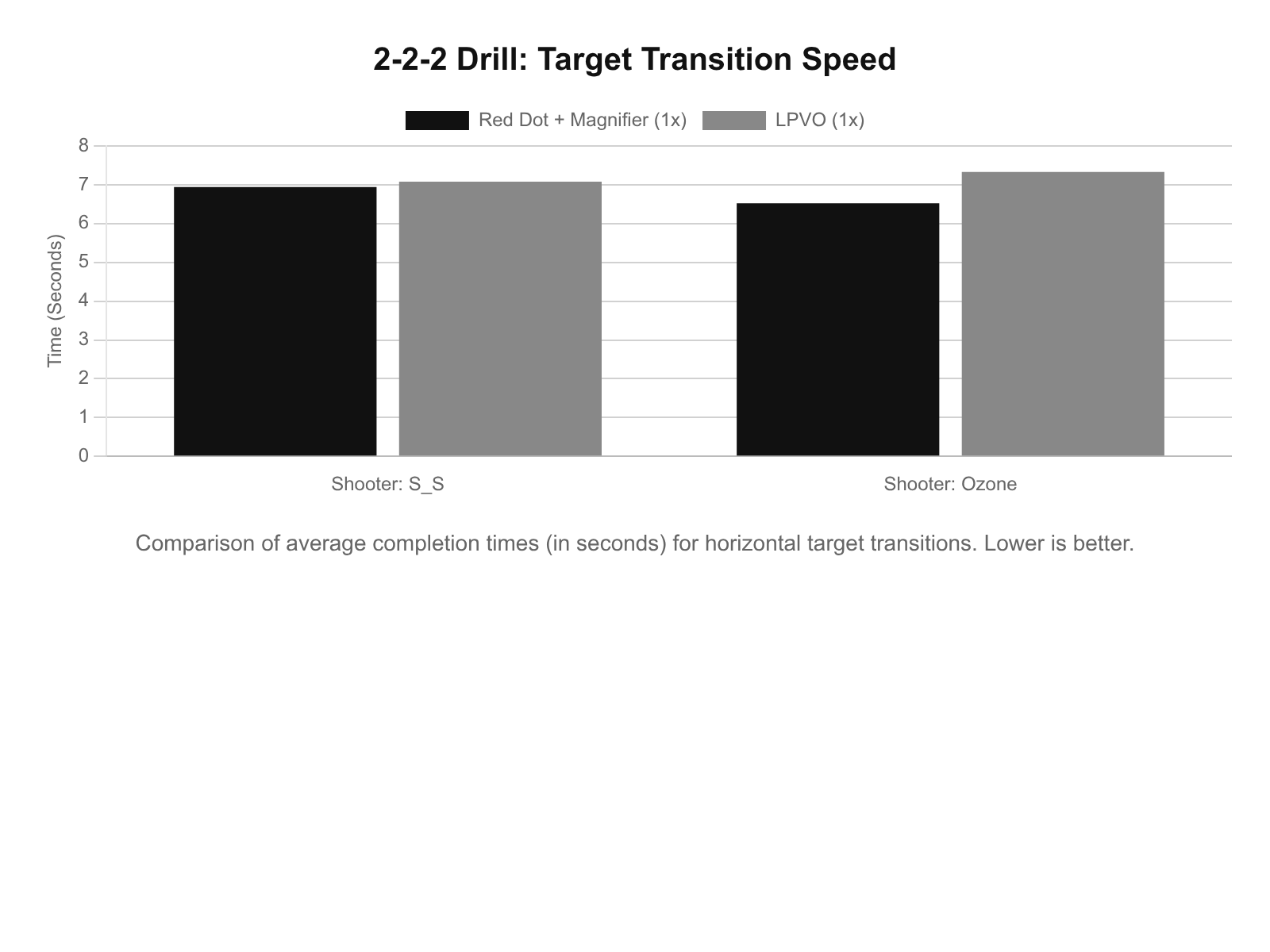
The “2-2-2 Drill” is designed to assess target transition speed across a horizontal plane, requiring the shooter to engage three equally spaced targets with two rounds each from a standing position.
Feeler gauge set used for Uzi top cover adjustment and bolt blocking latch repair

The data above reveals a consistent advantage for the Red Dot system during horizontal target transitions.

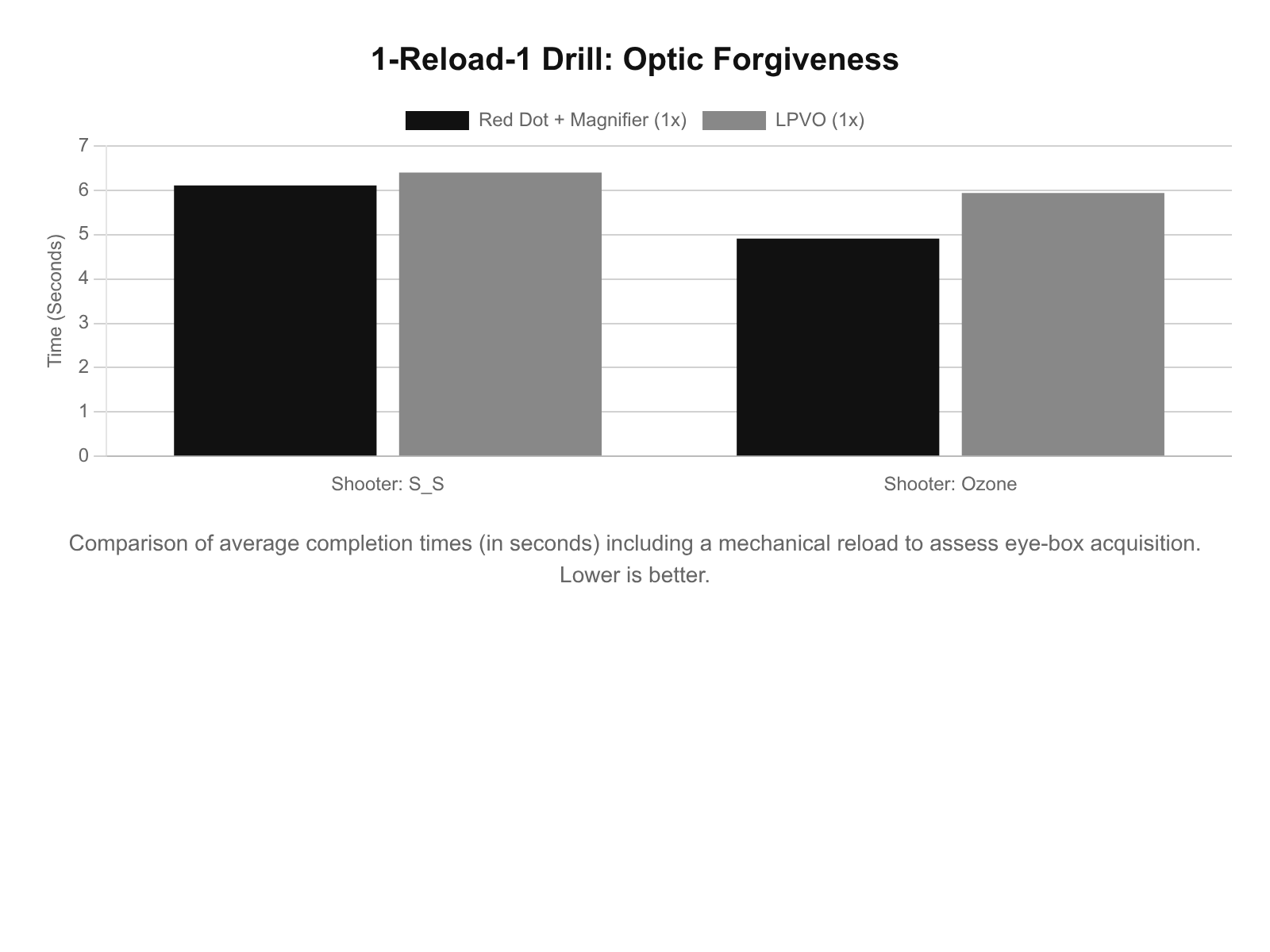
To further isolate the specific ergonomic penalty of the LPVO’s eye box, testers utilized the “1-Reload-1 Drill” at 25 yards. This drill assesses the optic’s dimensional forgiveness. After firing one round, the shooter must completely break their cheek weld to perform a mechanical magazine reload, and then must rapidly re-acquire the eye box under extreme time pressure to fire the second round.
Uzi top cover and bolt blocking latch detail for firing repair

Analysis of this empirical data demonstrates a persistent, quantifiable speed advantage for the Red Dot system across all users. More critically, in the reload drill—which forces the user to rapidly re-establish optical alignment from scratch—the RDS was between 5% and 17% faster.24 This data directly validates the primary ergonomic hypothesis: the complete lack of an exit pupil constraint allows the officer’s visual cortex to process information and command the trigger break fractions of a second sooner. In a sudden, close-quarters gunfight under 50 yards, these fractions of a second represent a distinct and vital tactical advantage.

4.2 Transitional Engagements (Near-Far Metrics)

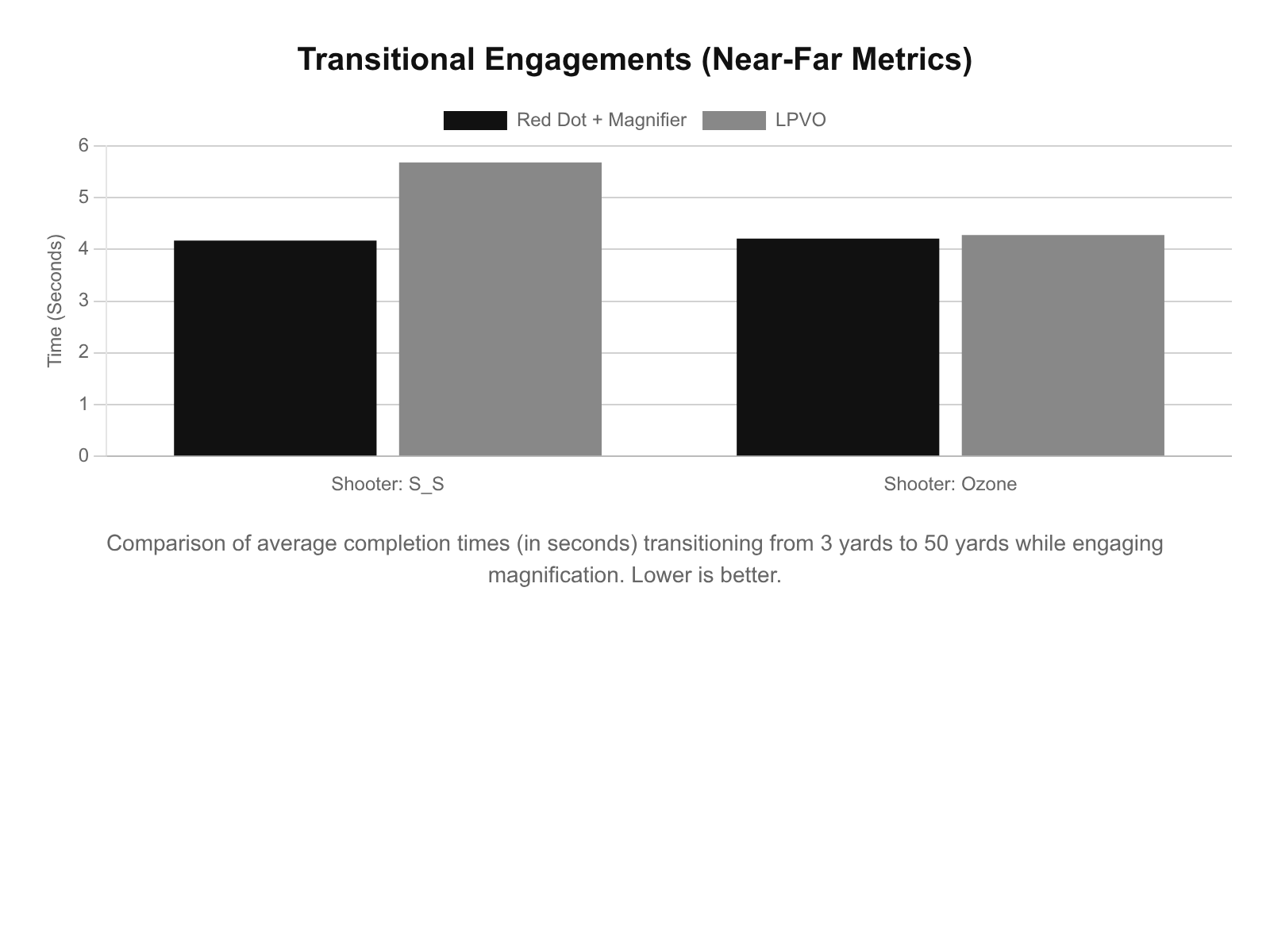
Law enforcement lethal force engagements are rarely static events. An officer may be forced to engage an immediate threat at 3 yards, then instantly pivot to address a secondary, elevated threat at 50 or 100 yards down a street or hallway. The “Near-Far Drill” explicitly tested this capability by requiring the shooter to engage a near target at 3 yards, manually activate their magnification system (by physically flipping the magnifier module or cranking the LPVO magnification throw lever), and then immediately engage a 50-yard target.
Uzi top cover and bolt blocking latch detail for firing repair

The data extracted here heavily favors the modular, macroscopic design of the flip-to-side magnifier system.24 Slapping a spring-loaded magnifier mount into place is an aggressive, gross-motor movement that requires almost zero cognitive bandwidth or fine motor control. In contrast, rotating the magnification ring on an LPVO—even when equipped with an extended, aftermarket “cat tail” throw lever—remains a fine-motor manipulation. Furthermore, because high-quality variable scopes are heavily gas-purged with nitrogen or argon and feature stiff internal o-rings to maintain waterproofing, the rotational throw is inherently resistant and slower, frequently requiring the officer to momentarily alter their firing grip to generate enough torque.8

4.3 Weapon Light Splash and Reticle Bloom Mitigation

At CQB distances, low-light operations introduce a highly complex optical variable: the defeat of photonic barriers. When an officer activates a modern, high-lumen (1,000+ lumen) or high-candela (50,000+ candela) weapon-mounted light inside a dark, confined space, the intense beam violently splashes and reflects against white walls, doors, or vehicle panels.

If a red dot sight’s brightness is not manually adjusted to a high setting prior to entry, the reticle may completely “wash out” against the brightly illuminated background, rendering the sight useless. Conversely, if the red dot is turned up to its maximum setting in anticipation of weapon light splash, the dot may “bloom” or starburst dramatically, obstructing the target entirely. Holographic sights manage this blooming effect exceptionally well due to the laser transmission method.18

However, LPVOs offer a distinct, insurmountable advantage in this specific scenario: the black etched reticle provides persistent, non-electronic contrast. Even if the electronic illumination is washed out entirely by the weapon light, the physical, etched crosshairs remain starkly visible as a black silhouette against the brightly illuminated target, ensuring the officer never loses their precise point of aim regardless of photonic interference.

5.0 Threat Identification and Liability Mitigation

While pure speed under 50 yards is paramount for officer survival, law enforcement agencies face immense civil and criminal liability regarding the legal justification of lethal force. The optic must serve not merely as an aiming device, but as a critical intelligence-gathering tool to satisfy the standard of objective reasonableness.

5.1 Positive Target Identification (PID) Capabilities

The most profound administrative justification for outfitting a patrol rifle with an LPVO is the massive enhancement of Positive Target Identification (PID). At distances of 50 to 75 yards, distinguishing whether a non-compliant suspect is holding a dark-colored cellular device, a wallet, or a compact semi-automatic pistol is virtually impossible with the naked eye or a 1x red dot sight.

An LPVO dialed to 6x or 8x magnification effectively turns the patrol rifle into a high-resolution surveillance platform.2 An officer holding perimeter security can clearly assess the subject’s hands, read vehicle license plates, or identify specific individuals within a chaotic crowd. If the individual is determined to be unarmed, the magnification prevents a catastrophic use-of-force error and subsequent civil litigation. If the individual is armed, the magnification allows the officer to confidently and accurately articulate the nature of the threat in their subsequent use-of-force report.

While a 3x or 5x magnifier placed behind a red dot provides some PID enhancement, the edge-to-edge optical clarity, light transmission, and superior continuous magnification range of a dedicated, multi-coated LPVO are vastly superior for extended reconnaissance and intelligence gathering.7

5.2 Ranging, Bullet Drop Compensation (BDC), and 68 MOA Geometry

When engagements inevitably stretch beyond the 100-yard mark, the physics of intermediate cartridges dictate that the bullet will experience parabolic drop and significant wind drift.

LPVOs handle trajectory compensation through complex, glass-etched BDC reticles. These reticles feature specific, numbered stadia lines corresponding to precise yardages (e.g., 200, 300, 400, 500 yards) that are factory-calibrated for a specific ammunition load (such as a 55-grain M193 or 62-grain M855 5.56mm projectile).11 By placing the appropriate hash mark directly on the target, the officer guarantees a hit without needing to calculate math or manually dial elevation turrets under fire. Furthermore, the horizontal width of these hash marks is often calibrated to precisely correspond to the 18-inch average width of adult human shoulders, allowing the officer to rapidly estimate the range of an unknown target.

Holographic sights, such as the widely issued EOTech EXPS series, utilize a distinct approach to ranging. The standard EOTech “-0” reticle consists of a 1 MOA central aiming dot surrounded by a large 68 MOA ring.16 This is not merely a rapid-acquisition tool designed to draw the eye; it contains embedded, highly practical ranging geometry specifically designed for human-sized targets.

For a standard 5.56mm patrol rifle load, the geometric breakdown is as follows:

  • The center 1 MOA dot serves as the primary zero point (typically utilizing a 50-yard zero, which intersects again at 200 yards).
  • The absolute bottom edge of the 68 MOA ring serves as the exact point of impact for mechanical offset hold-overs at extreme close range (7 yards).
  • The entire 68 MOA ring mathematically equates to the height of an average 5-foot-9-inch male standing at exactly 100 yards.8

If a suspect fills the ring from top to bottom, the officer instantly knows the range is 100 yards. While the EOTech reticle is an ingenious, rapid-processing tool for CQB hold-overs and intermediate ranging, it lacks the surgical, multi-distance precision of an LPVO’s dedicated, numerically scaled BDC array at extended distances.

6.0 Law Enforcement Procurement and Deployment Strategy

Optic selection cannot be driven solely by theoretical range performance or ballistic capability. Procurement officers must rigorously analyze long-term budgetary constraints, logistical burdens, state-level purchasing frameworks, and departmental deployment policies.

6.1 Lifecycle Costs, Durability, and Battery Logistics

The initial capital expenditure for purchasing optics represents only a fraction of the true total cost of ownership. The ongoing logistical burden of battery management is a critical factor for quartermasters.

  • Red Dot Sights: Top-tier RDS platforms, exemplified by the Aimpoint T2, are renowned for their ruggedness and 5-year constant-on battery life. This essentially eliminates battery management from the individual officer’s daily routine; armorers can simply cycle in fresh batteries during annual or bi-annual department qualifications.15
  • Holographic Sights: EOTech HWS units run on high-drain CR123 batteries with a limited 1,000-hour lifespan. To preserve power, they require internal auto-shutoff circuits. This necessitates that the officer manually push a button to activate the optic upon deploying the rifle from the vehicle rack—a critical, fine-motor step that can be forgotten under the extreme stress of a sudden ambush.41
  • LPVOs: Quality LPVOs utilize standard CR2032 coin cells or readily available AA batteries.11 Because the internal LED illumination must be extremely powerful to be “daylight bright,” battery drain is rapid if left activated. However, as previously established, the persistent etched reticle renders a dead battery a tactical inconvenience rather than a catastrophic system failure.9

6.2 The Michigan DTMB Procurement Case Study (Contract 240000002212)

Analyzing the current municipal procurement landscape provides valuable insight into how major law enforcement agencies are sourcing and funding this advanced hardware. The State of Michigan’s Department of Technology, Management & Budget (DTMB) manages massive, multi-million dollar cooperative purchasing agreements that are fully accessible to the Michigan State Police (MSP) and local municipalities via the MiDEAL extended purchasing program.42

Recent contract data illustrates the massive scale of these optical and firearm integrations. Request for Proposal (RFP) #171-240000002212 for “Ammunition, Firearms and Related Law Enforcement Equipment” resulted in highly lucrative dual awards to Vance Outdoors, Inc. (totaling $1,306,966.00) and Kiesler Police Supply, Inc. (totaling $2,092,165.00), with the contracts active through August 2026.44 Through these centralized, state-level contracts, regional agencies within Michigan—such as the Berrien County Sheriff’s Office or the Oakland County Sheriff’s Office—can bypass complex individual bidding processes. Utilizing platforms like the Oakland County MITN Purchasing Group, these departments can leverage the state’s massive buying power to procure advanced optics, magnifiers, and patrol rifles at significant bulk discounts, ranging from 10% to 53.8% off commercial MSRP.45

These sophisticated acquisitions must also align perfectly with strict internal carry policies. For instance, Michigan State Police Official Order 001-016 strictly mandates that patrol rifles are carried in vehicles in a specific, standardized readiness state: chamber empty, bolt closed, dust cover closed, safety on, and a magazine loaded with exactly 28 rounds inserted firmly into the well.50 An optic that requires complex button-pushes to activate (like certain auto-shutoff holographic sights) adds an additional cognitive step to an already multi-stage weapon deployment protocol. A “shake-awake” red dot, an always-on Aimpoint, or a standard unpowered LPVO crosshair removes this potential failure point, aligning the hardware with the operational policy. The integration of advanced equipment is further supported by external funding mechanisms, such as the Spirit of Blue Foundation grant which successfully provided highly advanced LMT CQB10-MARS-LA tactical rifles to the MSP Emergency Support Team.51

6.3 Departmental Policies, NTOA Standards, and Training Integration

The National Tactical Officers Association (NTOA) conducts rigorous, independent testing of law enforcement equipment to guide departmental procurement. To achieve an NTOA “Gold” rating, an optical system must score above a 4.5 average across 13 distinct, grueling criteria, including ease-of-use, durability, and practical design.52 Agencies frequently rely on these NTOA certifications to justify sole-source procurement requests to city councils or to satisfy strict federal grant funding requirements.53

However, successfully equipping a department with LPVOs requires a massive paradigm shift in training doctrine. As noted by field instructors, moving an officer from an RDS to an LPVO is not a seamless transition. Officers must be trained extensively on establishing a consistent eye box, manipulating the magnification throw lever rapidly under stress, and properly utilizing the ocular diopter adjustment to focus the reticle to their individual ocular prescription.7 Many forward-thinking agencies mandate specific, multi-day transition courses before an officer is authorized to carry a magnified optic on duty.55 If a department lacks the budget for extended range time, additional ammunition, and advanced instruction, outfitting standard patrol officers with complex LPVOs may actually yield diminishing returns compared to the intuitive, point-and-shoot simplicity of a standard red dot sight.

7.0 Comparative Market Matrix

To facilitate clear, data-driven procurement decision-making for command staff, the following matrices present comparative technical specifications of the leading, duty-grade optical systems currently dominating the law enforcement market.

7.1 Duty-Grade LPVO Specifications: Trijicon vs. Vortex

The Vortex Razor HD Gen II-E 1-6×24 and the Trijicon VCOG 1-8×28 represent the current apex of commercial, duty-rated law enforcement variable optics.

SpecificationVortex Razor HD Gen II-E 1-6×24Trijicon VCOG 1-8×28
Magnification Range1x to 6x1x to 8x
Objective Lens24mm28mm
Focal PlaneSecond Focal Plane (SFP)First Focal Plane (FFP)
Reticle TypeJM-1 BDC, VMR-2 (Wire/Etched)MRAD / MOA Segmented Circle
Eye Relief4.0 inches4.0 – 3.9 inches
Exit Pupil (at 1x / max)24.0mm / 4.0mm11.8mm / 3.5mm
Field of View (100 yds)115.2 ft (1x) – 20.5 ft (6x)109.2 ft (1x) – 13.1 ft (8x)
Battery TypeCR2032Single AA (Lithium or Alkaline)
Weight21.5 oz (without mount)31.5 oz (with integrated mount)
Adjustment150 MOA Max Elevation/Windage35 MRAD Max Elevation/Windage
Mount Interface30mm Tube (requires separate mount)Integrated Picatinny Thumbscrew/Larue
Source Documentation1211

Analytical Insight: The Vortex Razor is highly lauded by tacticians for its incredibly thin housing that creates a “disappearing bezel” effect at 1x magnification, providing an exceptionally wide 115.2 ft field of view that closely mimics the situational awareness of a red dot sight.13 However, the Trijicon VCOG offers a distinct logistical advantage by integrating the 7075-T6 aluminum mounting hardware directly into the optic’s housing, creating a virtually indestructible, unified platform that runs on readily available AA batteries for up to 633 hours—a significant supply-chain advantage for municipal quartermasters.10

7.2 Duty-Grade CQB Systems: Aimpoint vs. EOTech + Magnifiers

For dedicated close-quarters systems, the Aimpoint Micro T2 and EOTech EXPS3-0 dominate the law enforcement contract space, supported by modular magnifiers.

SpecificationAimpoint Micro T-2EOTech EXPS3-0EOTech G45 Magnifier
TechnologyLED Reflex ProjectionLaser Holographic FilmOptical Prism System
Magnification1x1x5x Fixed
Reticle2 MOA Red Dot1 MOA Dot w/ 68 MOA RingN/A (Magnifies primary optic)
Battery Life50,000 Hours (Constant On)1,000 Hours (Auto-Shutoff)N/A
Power SourceCR2032CR123N/A
Weight4.97 oz (with standard mount)11.2 oz (with integrated mount)12.8 oz (with STS mount)
Eye ReliefUnlimitedUnlimited2.5 inches
Field of ViewTube limitedWindow limited (very wide)7.3 degrees
Dimensions (L x W x H)N/A (Highly Compact)3.8″ x 2.3″ x 2.9″3.9″ x 2.3″ x 3.3″
Source Data151526

Analytical Insight: The EOTech EXPS3-0, when paired directly with the G45 (5x) magnifier, creates a highly potent, adaptable hybrid system. The holographic reticle scales perfectly under the 5x magnification, and the large rectangular window provides unparalleled situational awareness.18 However, this entire system combined weighs exactly 24 ounces (11.2 oz + 12.8 oz)—making it heavier than the Vortex Razor LPVO without a mount. The Aimpoint T2 offers an uncompromising reduction in weight and infinite, reliable battery life but sacrifices the complex ranging geometry of the EOTech’s holographic ring.15

8.0 Strategic Recommendations for Command Staff

The empirical time-trial data, bio-mechanical optical physics, and complex procurement realities evaluated in this comprehensive report indicate that there is no singular “correct” optic for all law enforcement patrol rifles. The optimal optical choice is entirely dictated by the department’s specific operational environment, budget, and resource allocation.

8.1 Urban Density and CQB Dominance (Recommendation: RDS + Magnifier)

For municipal agencies operating primarily in dense urban environments, frequently clearing inside structures, or focusing heavily on high-risk warrant execution, the Red Dot Sight paired with a flip-to-side magnifier remains the optimal solution. The empirical time-on-target data unequivocally demonstrates that the unlimited eye box of a 1x reflex or holographic sight minimizes cognitive load and maximizes absolute speed at distances under 50 yards.24 Furthermore, the ability to physically flip the magnifier away strips away all eye relief constraints, allowing officers to fire rapidly from compromised barricade positions or while wearing heavy structural entry gear.

8.2 Rural Patrolling and Perimeter Security (Recommendation: LPVO)

For county sheriffs, state police agencies (such as the MSP), and departments covering varied topographies or long stretches of highway, the LPVO provides an unmatched, force-multiplying capability upgrade. The ability to dial an optic to 6x or 8x completely transforms the patrol rifle into a critical intelligence-gathering asset.2 The severe liability protection offered by Positive Target Identification (PID) at 100+ yards cannot be overstated in today’s legal climate. While there is a slight, fractional degradation in raw speed at 5 yards compared to an RDS, intensive, structured training can effectively bridge this gap. The physical fail-safe of the etched reticle ensures that an officer will never be left with a dead, un-aimable optic during a critical, life-threatening incident.8

8.3 The Hybrid Piggyback Paradigm

A third, highly specialized paradigm is rapidly emerging among elite units: equipping a premium LPVO with a miniaturized red dot sight (MRDS) mounted at a 45-degree offset or “piggybacked” directly on top of the scope ring.63 Systems utilizing specialized hardware, such as the Unity Tactical FAST LPVO mount equipped with an MRDS Top Ring, place a small red dot directly above the primary optic.31 This setup completely eliminates the LPVO’s CQB speed disadvantage. The officer maintains a heads-up posture to utilize the red dot for immediate 0-25 yard sudden threats, and simply drops their cheek to the stock to utilize the LPVO for distant engagements or high-resolution surveillance.65 While this maximizes capability and solves the paradox of range versus speed, it significantly increases the cost per unit, the training complexity, and the overall physical weight of the weapon system.

Appendix: Methodology & Data Sources

This white paper was synthesized using rigorous Open-Source Intelligence (OSINT) gathering techniques, aggregating technical engineering specifications, empirical field-test data, and departmental procurement frameworks.

Data parameters included:

  • Biomechanical Testing: Comparative time-trial data evaluating optic speed in multi-target and reload scenarios.
  • Optical Engineering: Exit pupil mathematics, parallax deviation studies, and focal plane architecture.
  • Government Procurement: Deep-dive review of the State of Michigan DTMB centralized purchasing structures, specific contract awards (Contract No. 240000002212), and localized law enforcement policy directives.
  • Manufacturer Specifications: Aggregation of proprietary dimensions, weights, and electrical lifespans from Trijicon, Vortex, EOTech, Aimpoint, Unity Tactical, and Scalarworks.

Ronin’s Grips Analytics provides custom, agency-specific data on this topic. Contact us to commission a tailored report for your department.


Please share the link on Facebook, Forums, with colleagues, etc. Your support is much appreciated and if you have any feedback, please email us in**@*********ps.com. If you’d like to request a report or order a reprint, please click here for the corresponding page to open in new tab.


Sources Used

  1. Making your rifle patrol ready: The latest accessories from SHOT Show 2025 – Police1, accessed March 22, 2026, https://www.police1.com/shot-show/making-your-rifle-patrol-ready-the-latest-accessories-from-shot-show-2025
  2. Making Sense of Magnified Optics on a Tactical Carbine Part 1, accessed March 22, 2026, https://vortexoptics.com/blog/making-sense-of-magnified-optics-on-a-tactical-carbine-part-1.html
  3. LPVOs are the next evolution of the patrol rifle – American Police Beat Magazine, accessed March 22, 2026, https://apbweb.com/2025/06/lpvos-are-the-next-evolution-of-the-patrol-rifle/
  4. [Optic Battle] Red Dot with Magnifier vs. Prism vs. LPVO – Pew Pew Tactical, accessed March 22, 2026, https://www.pewpewtactical.com/red-dot-magnifier-prism-lpvo/
  5. Optics Test: LPVO vs Red Dot Sights – AmmoMan School of Guns Blog, accessed March 22, 2026, https://www.ammoman.com/blog/optics-test-lpvo-vs-red-dot-sights/
  6. Guide to LPVOs for Law Enforcement – The Primary Source On PrimaryArms.com, accessed March 22, 2026, https://blog.primaryarms.com/guide/guide-to-lpvo-what-you-need-to-know/
  7. Mastering the LPVO: Part 1 – Low-Power Variable Optic Buyer’s Guide | RECOIL OFFGRID, accessed March 22, 2026, https://www.offgridweb.com/gear/lpvo-buyers-guide/
  8. LPVO vs. Magnifiers: What Works Best? – Recoil Magazine, accessed March 22, 2026, https://www.recoilweb.com/grudge-match-lpvo-vs-magnifiers-163374.html
  9. Red Dot & Magnifier Vs LPVO – The Firearm Blog, accessed March 22, 2026, https://www.thefirearmblog.com/blog/red-dot-magnifier-vs-lpvo-44822308
  10. Crunching a bit on LPVO’s, Razor vs. VCOG | Primary & Secondary Forum, accessed March 22, 2026, https://primaryandsecondary.com/forum/index.php?threads/crunching-a-bit-on-lpvos-razor-vs-vcog.4526/
  11. VCOG® – Trijicon, accessed March 22, 2026, https://www.trijicon.com/uploads/product-uploads/product-downloads/2020_Trijicon_VCOG.pdf
  12. Vortex Razor HD Gen II-E 1-6×24 Riflescope, accessed March 22, 2026, https://vortexoptics.com/razor-hd-gen-2-e-1-6×24-riflescope+reticle-VMR-2~MRAD
  13. Vortex Razor HD Gen II-E 1-6×24 Riflescope, accessed March 22, 2026, https://vortexoptics.com/razor-hd-gen-2-e-1-6×24-riflescope.html
  14. Razor HD Gen II 1-6×24 – Vortex Optics, accessed March 22, 2026, https://vortexoptics.com/razor-hd-gen-ii-1-6×24-jm-1-bdc.html
  15. EOTECH EXPS3-0 vs. Aimpoint T-2 – T.REX ARMS, accessed March 22, 2026, https://help.trex-arms.com/hc/en-us/articles/360048974474-EOTECH-EXPS3-0-vs-Aimpoint-T-2
  16. Model EXPS3™ HWS – EOTECH, accessed March 22, 2026, https://www.eotechinc.com/products/eotech-hws-exps3
  17. What magnifier g45, g33, or g43 : r/ar15 – Reddit, accessed March 22, 2026, https://www.reddit.com/r/ar15/comments/17bg4ss/what_magnifier_g45_g33_or_g43/
  18. Red Dots vs Holographic Sights: What’s Best For You?, accessed March 22, 2026, https://www.pewpewtactical.com/red-dots-vs-holographic-sights/
  19. Ready Room | LPVO vs. Red Dot + Magnifier – YouTube, accessed March 22, 2026, https://www.youtube.com/watch?v=m3L4P0I8VwM
  20. “This Scope Has a Terrible Eye Box.” A Guide to LPVO Setup – Sun and Shadow, accessed March 22, 2026, https://www.sunnshadow.com/post/this-scope-has-a-terrible-eye-box-a-guide-to-lpvo-setup
  21. LPVO eye relief/eye box : r/ar15 – Reddit, accessed March 22, 2026, https://www.reddit.com/r/ar15/comments/nw4qfe/lpvo_eye_reliefeye_box/
  22. LPVO vs. Red Dot: Which is Best? – Warne Scope Mounts, accessed March 22, 2026, https://warnescopemounts.com/blog/lpvo-vs-red-dot-which-is-best/
  23. LPVO vs Holographic Sights for AR – GUNNR Optics, accessed March 22, 2026, https://gogunnr.com/blogs/news/lpvo-vs-holographic-sights-for-ar
  24. Red Dots + Magnifier vs LPVO – Pro-Gun Millennial, accessed March 22, 2026, https://progunmillennial.com/2020/07/10/red-dots-magnifier-vs-lpvo/
  25. Best Red Dot Magnifier: Complete 2026 Guide & Reviews – Scopes Field, accessed March 22, 2026, https://scopesfield.com/best-red-dot-magnifier/
  26. Best EOTech Magnifier: G33 vs G43 vs G45 – Defense Distributors, accessed March 22, 2026, https://defensedistributors.com/blog/best-eotech-magnifier-g33-vs-g43-vs-g45/
  27. Model G45™ Magnifier – EOTECH, accessed March 22, 2026, https://www.eotechinc.com/products/eotech-magnifier-g45
  28. Comparative Study of Red Dot Sight Parallax – Green Eye Tactical, accessed March 22, 2026, https://www.greeneyetactical.com/2017/07/27/comparative-study-of-red-dot-sight-parallax/
  29. Scalarworks LEAP/01 – Aimpoint Micro T-2 Mount, accessed March 22, 2026, https://scalarworks.com/shop/quick-detach-mounts/leap-01/comment-page-201/?attribute_color=BLACK&attribute_height=1.93%22&attribute_package=Aimpoint+CompM5
  30. Honest discussion, are unity mounts too tall or does height over bore not really matter? Just bought one mainly due to neck pain issues but wondering what everyone actually thinks : r/ar15 – Reddit, accessed March 22, 2026, https://www.reddit.com/r/ar15/comments/yk34gp/honest_discussion_are_unity_mounts_too_tall_or/
  31. FAST™ LPVO – UNITY Tactical, accessed March 22, 2026, https://unitytactical.com/product/fast-lpvo/
  32. Height Over Bore Reference : r/ar15 – Reddit, accessed March 22, 2026, https://www.reddit.com/r/ar15/comments/10a8n86/height_over_bore_reference/
  33. Unity Tactical FAST – LPVO Mount – 30mm – 2.05 Centerline – Black – Primary Arms, accessed March 22, 2026, https://www.primaryarms.com/unity-tactical-fast-lpvo-mount-30mm-2-05-centerline-black
  34. Review: Unity FAST LPVO Mount – The Armory Life, accessed March 22, 2026, https://www.thearmorylife.com/unity-fast-lpvo-mount-review/
  35. What Optic Height Should I Go With? – T.REX ARMS, accessed March 22, 2026, https://help.trex-arms.com/hc/en-us/articles/360055726234-What-Optic-Height-Should-I-Go-With
  36. LPVO vs. Holographic Sight for AR-15 Home Defense – CVLIFE, accessed March 22, 2026, https://www.cvlife.com/blogs/news/lpvo-vs-holographic-sight-for-ar-15-home-defense
  37. They’re telling me to zero my LPVO at 50 yards for BDC accuracy right? : r/ar15 – Reddit, accessed March 22, 2026, https://www.reddit.com/r/ar15/comments/1po6k2k/theyre_telling_me_to_zero_my_lpvo_at_50_yards_for/
  38. LPVO or EOTech : r/ar15 – Reddit, accessed March 22, 2026, https://www.reddit.com/r/ar15/comments/swwjfl/lpvo_or_eotech/
  39. POTD: Understanding EOTech’s 68 MOA Ring Reticle | thefirearmblog.com, accessed March 22, 2026, https://www.thefirearmblog.com/blog/2020/02/25/potd-eotech-68-moa-ring-reticle/
  40. What is the preferred Patrol Rifle Optic? : r/AskLE – Reddit, accessed March 22, 2026, https://www.reddit.com/r/AskLE/comments/1rsbze1/what_is_the_preferred_patrol_rifle_optic/
  41. EOTECH EXPS3 vs Aimpoint Micro T2. Please argue down below so I may watch : r/kac – Reddit, accessed March 22, 2026, https://www.reddit.com/r/kac/comments/wvjplo/eotech_exps3_vs_aimpoint_micro_t2_please_argue/
  42. DTMB – Law Enforcement Purchasing – State of Michigan, accessed March 22, 2026, https://www.michigan.gov/dtmb/procurement/mideal-extended-purchasing-program/law-enforcement-purchasing
  43. Contract List – DTMB – State of Michigan, accessed March 22, 2026, https://www.michigan.gov/dtmb/procurement/contractconnect/contract-list
  44. Ammunition and Weapons – DTMB – State of Michigan, accessed March 22, 2026, https://www.michigan.gov/dtmb/procurement/mideal-extended-purchasing-program/mideal-contract-search/categories/folder-1/ammunition
  45. Notice of Intent to Award for RFP #240000002212 – HigherGov, accessed March 22, 2026, https://www.highergov.com/sl/contract-opportunity/mi-notice-of-intent-to-award-for-rfp-24000-31511376/
  46. Award Letter & Synopsis – State of Michigan, accessed March 22, 2026, https://www.michigan.gov/dtmb/-/media/Project/Websites/dtmb/Procurement/Bid-Proposal-Documents/240000002212-Ammunition-Firearms-Related-Law-Enforcement-Supply/Award-Letter-and-Synopsis—RFP-240000002212.pdf?rev=98313a73dd80440ea0b4cc91a34fb977&hash=297DAF26512BB5C0D3C75883AB0F47EB
  47. Purchasing | Berrien County, MI, accessed March 22, 2026, https://www.berriencounty.org/173/Purchasing
  48. Open Bid Solicitations | Oakland County, MI, accessed March 22, 2026, https://www.oakgov.com/government/purchasing/bidder-registration/bid-solicitation-public-search
  49. Bidnet Registration | Oakland County, MI, accessed March 22, 2026, https://www.oakgov.com/government/purchasing/bidder-registration
  50. 001-016, accessed March 22, 2026, https://public.powerdms.com/a2gov/documents/7783
  51. Spirit of Blue Buys LMT Rifles for Michigan State Police | An Official Journal Of The NRA, accessed March 22, 2026, https://www.shootingillustrated.com/content/spirit-of-blue-buys-lmt-rifles-for-michigan-state-police/
  52. NTOA | Primary Arms Recommendations, accessed March 22, 2026, https://www.primaryarms.com/ntoa
  53. Tactical Response and Operations Standard – National Tactical Officers Association, accessed March 22, 2026, https://ntoa.org/pdf/swatstandards.pdf
  54. NTOA TROS 2023, accessed March 22, 2026, https://ntoa.org/pdf/TROS.pdf
  55. Let’s discuss LPVO vs Red dot + Magnifier combo : r/ar15 – Reddit, accessed March 22, 2026, https://www.reddit.com/r/ar15/comments/mmc2o0/lets_discuss_lpvo_vs_red_dot_magnifier_combo/
  56. accessed December 31, 1969, https://vortexoptics.com/vortex-razor-hd-gen-2-e-1-6×24-riflescope.html
  57. Razor HD Gen II-E 1-6×24 – MK Machining, accessed March 22, 2026, https://www.mkmachining.com/product/razor-hd-gen-ii-e-1-6×24/
  58. Trijicon VCOG ® 1-8×28 Riflescope – SCO, accessed March 22, 2026, https://www.trijicon.com/products/details/vc18-c-2400012
  59. Trijicon VCOG® 1-8×28 LED Riflescope- MRAD, accessed March 22, 2026, https://www.trijicon.com/products/details/vc18-c-2400003
  60. VCOG® Riflescope – Trijicon, accessed March 22, 2026, https://www.trijicon.com/uploads/page_content/PML1006-1_Rev(2)_VCOG_Manual_10-23-2018.pdf
  61. r/ar15 on Reddit: VCOG users out there …. Eye-Relief truly the SAME across the magnification range? (ATACR content too ..), accessed March 22, 2026, https://www.reddit.com/r/ar15/comments/1mf2gav/vcog_users_out_there_eyerelief_truly_the_same/
  62. Magnifier Battle – Aimpoint (3xmag-1) vs EOTech (G33/G43/G45) – Thin Line Defense CO, accessed March 22, 2026, https://thinlinedefenseco.com/magnifier-battle-aimpoint-3xmag-1-vs-eotech-g33-g43-g45/
  63. LPVO with side mount irons or Red dot with magnifier ? Trying to decide what to get for my ADM 13.7. : r/ar15 – Reddit, accessed March 22, 2026, https://www.reddit.com/r/ar15/comments/x4hw3y/lpvo_with_side_mount_irons_or_red_dot_with/
  64. Red Dot or LPVO? – Scalarworks Leap and Kick Mounts – GunsAmerica, accessed March 22, 2026, https://gunsamerica.com/digest/scalarworks-leap-and-kick-mounts/
  65. There’s no point to an lpvo with a red dot… change my mind. : r/ar15 – Reddit, accessed March 22, 2026, https://www.reddit.com/r/ar15/comments/1gh7mn7/theres_no_point_to_an_lpvo_with_a_red_dot_change/

Strategic Advantages of Unmanned Swarm Tactics in Modern Warfare

1. Executive Summary

The proliferation of unmanned aerial systems and the continuous integration of artificial intelligence into tactical military platforms have precipitated a fundamental shift in the character of modern warfare. Throughout the latter half of the twentieth century, military dominance was largely defined by the deployment of singular, heavily manned, and technologically exquisite platforms. Fighter aircraft, advanced naval destroyers, and sophisticated radar installations represented the pinnacle of defense acquisition. However, these conventional platforms are increasingly vulnerable to distributed, massed, and autonomous robotic systems. This strategic vulnerability is most acutely realized in the development, refinement, and deployment of military drone swarms. By replacing centralized, one-to-one teleoperation architectures with decentralized, one-to-many command frameworks, defense organizations and non-state actors alike are unlocking tactical capabilities that challenge the foundational assumptions of traditional force projection.1

Drone swarms represent an evolutionary departure from conventional flight formations. While a traditional flight formation relies on human pilots rigidly following a centralized leader or an automated system navigating along pre-programmed, static waypoints, a true swarm functions as a collaborative, autonomous entity. These systems leverage localized interactions, shared sensor data telemetry, and dynamic task allocation to achieve complex mission objectives in highly contested environments.1 The deployment of these autonomous swarms presents a multitude of operational, economic, and tactical benefits that fundamentally alter the balance of power on the battlefield.

From overwhelming legacy air defense systems through localized target saturation and multi-vector attack geometries to inflicting deeply unsustainable economic costs upon defending forces, swarms provide highly asymmetric advantages.3 Furthermore, advancements in peer-to-peer mesh networking, heterogeneous payload integration, and machine-speed decision cycles allow these unmanned networks to operate with a degree of resilience and speed that outpaces human cognitive capacity.5

This report details the top ten benefits of utilizing drone swarm attacks in military operations. It examines the underlying technological mechanisms that enable these benefits and evaluates the strategic implications of swarming systems across various operational domains, including contested urban environments, maritime gray zones, and highly defended airspace.7 The findings indicate that the integration of collaborative autonomy at scale is a paradigm shift that requires a fundamental reassessment of existing defensive architectures, procurement strategies, and modern force structures.

2. Defining the Modern Drone Swarm

Understanding the distinct tactical benefits of a drone swarm attack requires a clear analytical delineation between traditional unmanned aerial vehicles and genuine swarming systems. The deployment of multiple drones simultaneously on a battlefield is a common occurrence, particularly in contemporary conflicts, but scale alone does not constitute a swarm. A swarm is defined by its internal network architecture, operational behavior, and command methodologies rather than mere numerical volume. Various military research institutions characterize a military drone swarm through several distinguishing criteria that separate it from standard unmanned operations.1

For clarity, the United States government’s civilian baseline from the 2017 FAA Order JO 7200.23A defines a swarm simply as multiple aircraft operating in unison to commands from one pilot through a common link.1 However, military doctrine expands this to require complex internal interaction and decentralized execution. Primarily, a military swarm consists of multiple autonomous systems that exhibit continuous internal interaction and coordinated activity. Unlike a standard military flight formation, where individual units adhere to a central leader, swarm agents communicate peer-to-peer.1 They evaluate surrounding threats, share raw sensor data, and allocate operational roles dynamically based on the unfolding tactical situation.2 This decentralized coordination allows the collective to combine individual behaviors to achieve a unified strategic effort without requiring constant direction from an external source.

Furthermore, swarms are defined by a revolutionary span of control. They transition warfare away from the legacy model of teleoperation—where one human operator manually pilots a single drone—to a true one-to-many architecture.1 In a swarm configuration, a single human operator serves as a mission supervisor rather than a pilot. The operator commands dozens or even hundreds of platforms simultaneously by issuing high-level objectives or intent-based commands.1 The swarm’s internal artificial intelligence translates these broad objectives into localized, cooperative actions, navigating space and time constraints that would otherwise limit traditional military forces.1 This definitional baseline is critical for understanding how swarms generate the ten tactical benefits detailed in the subsequent sections of this analysis.

3. Benefit 1: Economic Cost Asymmetry and Attritional Leverage

The most immediate and strategically disruptive benefit of deploying a drone swarm attack is the severe economic cost asymmetry it imposes on the defending force. Modern defense architectures have historically relied on a procurement model focused on producing highly advanced, technologically exquisite interceptors designed to neutralize equally expensive high-value targets, such as ballistic missiles or fifth-generation stealth fighter aircraft.3 Drone swarms directly exploit this legacy procurement model, turning the tactical battlefield into a deeply unfavorable economic environment for the defending force.10

Offensive swarms are primarily composed of low-cost, commercially available materials, or mass-produced attritable components. Systems utilized heavily in recent conflicts, such as the Iranian-designed Shahed-136 one-way attack drones, carry an estimated unit cost ranging from $20,000 to $50,000.3 Conversely, defending against these persistent aerial threats frequently requires the expenditure of advanced surface-to-air missiles. Patriot interceptor missiles, for example, cost approximately $4 million each, while Terminal High Altitude Area Defense (THAAD) interceptors can cost between $12 million and $15 million each.3

This dynamic creates an attritional logic that inherently favors the attacker.11 An adversary can launch a massive salvo of low-cost drones that cost a mere fraction of the defensive munitions required to shoot them down. Even if the defender achieves a flawless interception rate and prevents any kinetic damage to their infrastructure, the economic exchange ratio guarantees long-term strategic depletion. The financial imbalance extends far beyond the munitions to the sensor platforms themselves. In documented instances, drone systems costing roughly $30,000 have successfully targeted and disabled advanced radar support systems, such as the AN/TPY-2, which cost upwards of $1 billion. This represents a profound cost-disabling ratio of more than 30,000 to one in favor of the swarm.3

Beyond direct monetary expenditure, swarms leverage asymmetric supply chains to create logistical exhaustion.3 High-end defensive interceptors require specialized, slow-moving military manufacturing bases and can take years to fully replenish once fired. In stark contrast, an attacking force can quickly mass-produce simple swarm drones utilizing basic manufacturing processes and widely available commercial electronics. By repeatedly launching mixed salvos of inexpensive munitions almost daily, an attacking force physically stretches the defensive network, rapidly consumes the defender’s limited interceptor inventories, and paves the way for follow-on strikes by heavier, more precise conventional weapons.3 Furthermore, the global economic impact is staggering, as seen when asymmetric disruption in critical maritime chokepoints like the Red Sea has cost the global economy hundreds of billions of dollars, making million-dollar interceptors a necessary but painful expenditure to protect high-value assets.12

System TypeSpecific Platform ExampleEstimated Unit CostStrategic Function
Offensive DroneShahed-136 (One-Way Attack)$20,000 – $50,000Attrition, Air Defense Saturation 3
Offensive DroneLOCUST Coyote UAV$15,000Electronic Warfare, Decoy, ISR 13
Defensive InterceptorPatriot Missile~$4,000,000High-Altitude Point Defense 3
Defensive InterceptorTHAAD Interceptor$12,000,000 – $15,000,000Ballistic Missile Defense 3
Defensive SensorAN/TPY-2 Radar System~$1,000,000,000Early Warning, Tracking 3

4. Benefit 2: Target Saturation and Radar Overload

A foundational tactical benefit of an offensive drone swarm is its innate ability to physically and computationally overwhelm legacy air defense sensors and centralized fire control systems. Conventional air defense architectures were engineered specifically to engage a finite number of discrete, high-speed, high-value objects.4 When confronted with a massed, coordinated group of autonomous systems, these legacy defenses experience immediate and often systemic saturation.

The primary mechanism of this saturation is severe data overload within the centralized fire control processors.4 As dozens or hundreds of small airframes enter the airspace simultaneously from distributed geometry, the radar processor struggles to assign distinct tracking files to the individual elements within the cluster.4 The sheer volume of data points generated by the swarm exhausts the computational limits of standard tracking algorithms. This causes the defensive system to drop target locks, misidentify friend-or-foe signatures, or fail completely to distinguish between viable incoming threats and background environmental clutter.4 Ultimately, swarms create “target saturation,” overwhelming defenders’ radar and processing systems with too many data points to be tracked or engaged effectively.14

Furthermore, swarms actively exploit the mechanical and physical limitations of sequential engagement systems.4 Traditional automated close-in weapon systems and missile launchers are constrained by a rigid, linear kill chain: the system must lock onto a target, fire the munition, visually or electronically confirm the destruction of the target, and then physically slew the turret or redirect the radar array toward the next incoming threat.4 This mechanical process introduces critical latency into the defensive cycle. While the fire control system is engaged in neutralizing the first fraction of the swarm, the computational and mechanical delay allows the remaining elements of the swarm to bypass the engagement zone entirely and strike their intended targets.4 In this operational model, the attacker relies on mathematical certainty; the goal is no longer to seamlessly evade the defensive system, but to predictably and reliably overwhelm it with affordable, autonomous mass.6

5. Benefit 3: Multi-Vector and Omni-Directional Attack Geometry

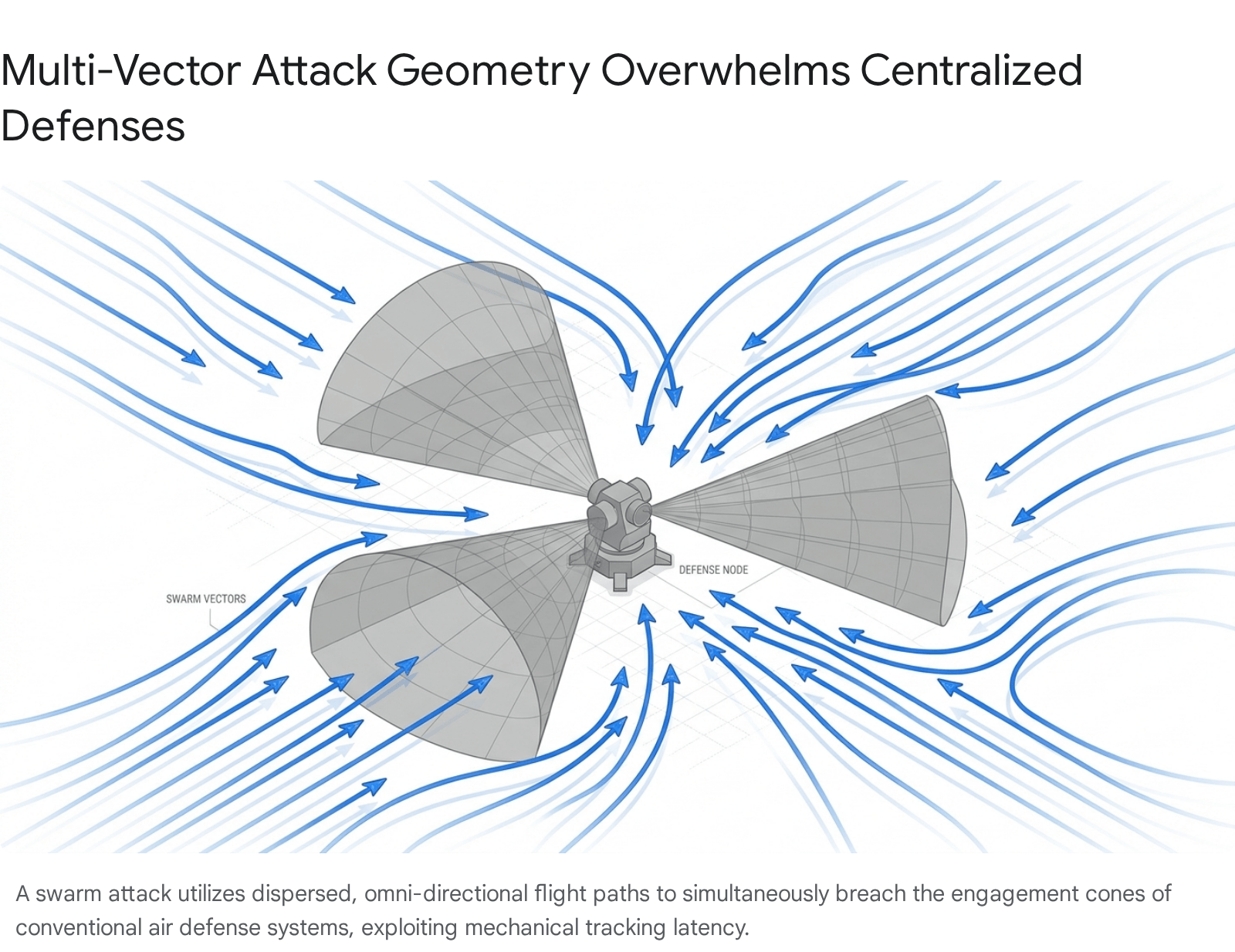
Unlike conventional strike packages—such as bomber formations or cruise missile salvos—that typically approach a target along a predictable, linear flight path, drone swarms execute highly complex, multi-vector attack geometries.14 Upon arriving at the operational area, the swarm can intelligently disperse and surround the objective, converging simultaneously from 360 degrees and across various horizontal and vertical altitudes. Using multiple vectors of attack, swarms can execute coordinated strikes with precision, which overwhelms enemy air defenses and reduces the chance of intercept.16

This multi-axis approach deliberately nullifies the effectiveness of directional air defenses, which inherently feature limited fields of view or specific, forward-facing engagement cones.4 By attacking from multiple bearings at the exact same moment, the swarm forces the defender to divide their attention, radar processing power, and kinetic defensive resources across a vastly wider spatial area.14 This distributed geometry prevents the defender from orienting their primary defensive strength toward a single, manageable axis of advance, allowing the swarm to easily exploit blind spots and inherent gaps in radar coverage.16

diagram of wind turbine with arrows

The geometric distribution also allows for sophisticated applications of parallel warfare tactics.17 Because individual swarm agents continuously share data regarding target locations and local threat environments, they can dynamically coordinate synchronized, synergistic strikes.17 If one peripheral drone detects a heavily fortified sector, it can immediately alert neighboring agents, allowing the collective intelligence to seamlessly re-route the main body around the threat, or alternatively, to concentrate mass on a newly discovered vulnerability. This geometric flexibility drastically compresses the decision-making window for battlefield commanders, who face a threat that is simultaneously everywhere, fluid, and highly coordinated.14

Historical precedents for confusing radar systems exist, such as Israel’s use of early drone systems during the 1973 October War and the 1983 Bekaa Valley conflict to trick Syrian and Egyptian air defenses into wasting ammunition and revealing their locations.18 Modern swarms take this concept further, executing these decoy and multi-vector maneuvers entirely autonomously, compounding the geographic disadvantage placed upon stationary or localized defense platforms.

6. Benefit 4: Resilience Through Decentralized Control Architectures

Traditional unmanned aerial systems, despite their technological sophistication, possess a critical vulnerability: a single point of failure. If the communication link between the drone and the ground control station is severed through electronic warfare jamming, or if the central command node is physically destroyed, the mission inevitably fails. Drone swarms eliminate this vulnerability by operating almost exclusively on decentralized, leaderless mesh networks.5

Within a true, sophisticated military swarm, there is no centralized router, nor is there a single “queen” or commanding drone that dictates orders to the rest.5 Instead, agents communicate continuously peer-to-peer using localized wireless mesh protocols. Good protocol choices for the mesh layer include MAVLink over 802.11s Wi-Fi mesh for civil applications, custom User Datagram Protocol broadcasts over frequency-hopping spread spectrum radios for contested environments, and Data Distribution Service (DDS) protocols for real-time decentralized coordination.5

In practice, each individual drone maintains a dynamic “neighbor table”—a continuous log of peers it can detect, their respective signal strengths, and their last registered heartbeat timestamp.5 This constant, rapid data exchange ensures that every single drone in the formation carries a complete, cryptographically verifiable copy of the overall mission plan and current mission state.5

This heavily decentralized architecture yields immense operational resilience. Swarms are engineered primarily for attrition; they are designed from the ground up with the assumption that a percentage of the individual units will inevitably be lost to enemy fire, mechanical failure, or electronic warfare degradation.14 When a drone is destroyed, the network does not collapse. Instead, the surviving nodes autonomously register the loss of the heartbeat signal, recalculate the operational parameters, and dynamically redistribute the fallen drone’s tasks among the remaining units.14 This profound self-healing capability ensures that the core mission persists under immense pressure, allowing the swarm to absorb significant casualties while continuing to function as a cohesive, lethal entity.

7. Benefit 5: OODA Loop Compression and Machine-Speed Coordination

The strategic concept of the OODA loop—Observe, Orient, Decide, and Act—developed by military strategist John Boyd, remains foundational to modern military decision-making and operational art. The core principle asserts that the force capable of executing this cognitive cycle faster than its adversary will dictate the tempo of operations, generate confusion, and ultimately achieve victory.6 Drone swarms fundamentally alter this dynamic by compressing the OODA loop to machine speeds, effectively removing human cognitive latency from the tactical execution phase.6

In a conventional defensive or offensive scenario, a human operator must continuously observe incoming targets on a radar screen, orient themselves to the complex threat matrix, decide on an allocation of interceptors or strike assets, and act by manually authorizing the launch sequence.4 Even for highly trained, elite personnel, this cognitive process takes crucial seconds, if not minutes, and is subject to fatigue and emotional stress.4 Drone swarms, powered by edge artificial intelligence and low-latency mesh communication, operate in milliseconds.2 The swarm shares sensor data, evaluates threat vectors, and allocates defensive or offensive roles instantaneously.2

The goal is no longer just to evade defenses—it is to overwhelm them through adaptive, automated responses that adjust dynamically to evolving battlefield conditions in real time.15 This acceleration changes the tempo of operations, enabling forces to respond before an adversary understands the developing tactical situation.2

While the ultimate authorization to use lethal force is currently maintained by human commanders in most doctrine, the “Act” phase is frequently executed autonomously by the swarm.19 This compression poses a massive challenge for defenders, who may fall victim to automation bias.19 The International Committee of the Red Cross and various military observers note that operators under extreme time pressure and cognitive load often defer to algorithmic recommendations, committing errors of omission (missing anomalies the system overlooks) and errors of commission (following faulty AI suggestions without considering alternatives).19

Furthermore, the integration of high-speed drone data into command structures can create a new breed of “tactical generals”—senior commanders with unprecedented access to tactical information who are tempted to micro-manage theater operations from afar, increasing uncertainty and compounding the friction of fast-moving combat scenarios.20 By forcing the adversary into a reactive posture where their command structure cannot process information fast enough to mount a coherent defense, the swarm achieves a decisive temporal advantage.

8. Benefit 6: Heterogeneous Platform Integration and Synergistic Payloads

Early conceptualizations of drone swarms often visualized homogenous groups of identical aircraft functioning as a single blunt instrument. However, modern military swarms derive significant power and flexibility from platform heterogeneity.21 A contemporary swarm can seamlessly integrate diverse platforms carrying varying payloads, operating synergistically to achieve compounding tactical effects that a single platform could never accomplish alone.8

In a heterogeneous configuration, the swarm is intelligently subdivided into specialized clusters based on the specific capabilities of the airframes. Swarms typically integrate AI-based decision-making at the edge, mesh networking protocols, and multi-mission payloads that support intelligence, surveillance, reconnaissance (ISR), jamming, or kinetic strikes.16 For instance, ISR operations can utilize an alliance of different sensor platforms working in tandem. A subset of drones designated as Type-1 may carry Synthetic Aperture Radar (SAR) payloads to conduct primary wide-area searches.23 Leveraging the wide-area coverage and signal penetration capabilities of SAR, they can detect potential targets under complex meteorological conditions, such as dense fog or heavy rain, which would blind standard optical cameras.23 Once a potential target is flagged by the Type-1 drone, the swarm autonomously cues Type-2 drones equipped with high-resolution hyperspectral imagers.23 These Type-2 units approach the target to conduct secondary, fine-grained feature extraction, confirming whether the target is a genuine armored vehicle or an enemy decoy before authorizing a strike.23

Beyond advanced surveillance, heterogeneous swarms routinely combine electronic warfare and kinetic effects. For example, in Israel’s 2021 conflict with Gaza, the military deployed a drone swarm in combat; Russia has also deployed the Kalashnikov KUB-BLA and Lancet-3 loitering munitions capable of advanced targeting. Specific units can be deployed as forward decoys, utilizing acoustic spoofing payloads or radar reflectors to trick enemy air defenses into powering up their tracking systems.24 This deliberate provocation reveals the hidden positions of the air defense batteries.18 Concurrently, specialized jamming drones in the swarm degrade the adversary’s communications, while kinetic one-way effectors execute precision kamikaze strikes against the newly identified radar sites.8 This highly synchronized, combined-arms approach within a single networked entity allows the swarm to map terrain, spoof defenses, and destroy targets simultaneously.

Swarm Sub-Group DesignationPrimary Payload / Sensor IntegrationCore Tactical Function within Swarm
Type-1 SearchersSynthetic Aperture Radar (SAR)Wide-area detection, weather and canopy penetration.23
Type-2 IdentifiersHyperspectral / Electro-Optical ImagersHigh-resolution feature extraction, positive target identification.23
Type-3 EffectorsKinetic Warhead (High Explosive)Precision strike, kamikaze tactics, anti-radiation targeting.8
Type-4 SupportAcoustic Spoofers / RF JammersElectronic warfare, decoy generation, communication disruption.24

9. Benefit 7: Sensor Evasion and Low Observability Profiles

A significant, yet often understated, advantage of the individual units comprising a drone swarm is their inherent physical ability to evade traditional detection mechanisms. Unlike conventional fighter jets, attack helicopters, or large bomber aircraft, small unmanned aerial systems inherently possess extremely low observability profiles that complicate the defender’s situational awareness.25

Swarm drones are frequently manufactured utilizing lightweight composite materials, industrial plastics, and carbon fiber elements.4 These materials do not reflect radar waves in the same manner as the metallic hulls and sharp angles of legacy aircraft. Instead, they absorb or scatter the electromagnetic energy, resulting in a drastically reduced Radar Cross-Section.4 Because they are lightweight and portable, Groups 1-2 drones are highly accessible to most nations and non-state actors, presenting a massive challenge to standard detection.26

Furthermore, the physical footprint of the airframes is incredibly small. Systems like the Coyote unmanned aerial vehicle utilized extensively in the United States Navy’s LOCUST (Low-Cost UAV Swarming Technology) program are only three feet long and weigh between 12 and 14 pounds.27 This diminutive size allows them to easily blend into background ground clutter when flying nap-of-the-earth profiles, effectively hiding among the radar returns of local terrain, trees, and even flocks of birds.28

In addition to defeating primary radar tracking, swarm drones present severe challenges to infrared and thermal tracking systems. By relying on small electric motors or highly efficient, low-output propulsion systems, they generate minimal heat signatures, effectively masking their approach from the thermal sensors relied upon by many short-range air defense systems.4 While it is true that a densely formulated swarm can sometimes aggregate a larger combined Radar Cross-Section than a single drone due to the proximity of the units 29, their individual low signatures force defenders to rely on highly sensitive, exquisitely expensive, and specialized radar arrays just to detect them early enough to mount a response. The combination of a small physical profile, slower approach speeds, and a low thermal output allows swarms to slip past early-warning perimeter defenses undetected until they are within lethal striking distance.25

10. Benefit 8: Force Multiplication via One-to-Many Command Structures

Historically, the strategic expansion of air power required a proportional and highly expensive expansion in personnel, rigorous training pipelines, and logistical support. For every aircraft deployed, militaries required highly trained pilots, expansive ground control crews, and massive maintenance staffs. Drone swarms eliminate this legacy requirement, acting as an unprecedented force multiplier by breaking the linear personnel-to-platform ratio.1

Through the rapid advancement of human-swarm interfaces, military operators are transitioning from flying individual drones via direct teleoperation to supervising massive, distributed formations through intent-driven commands.1 The Defense Advanced Research Projects Agency’s OFFensive Swarm-Enabled Tactics (OFFSET) program has demonstrated the viability of this approach in live-action environments.9 The program focuses on providing commanders with immersive situational awareness tools, including virtual reality, augmented reality interfaces, sketch tablets, and voice-gesture controls, to monitor and direct potentially hundreds of unmanned platforms in real time.9 During live field experiments at the Combined Arms Collective Training Facility at Camp Shelby, a single operator successfully demonstrated command and control over 130 autonomous drones simultaneously, isolating buildings and executing complex urban raid scenarios to locate designated items of interest.1

Bar graph showing companies involved in unmanned swarm tactics

Autonomous systems will come in a range of platforms and will rely on an array of enterprise and ground control systems, demanding simple, resilient, and secure communications on multiple channels and bands.31 This one-to-many command structure drastically reduces the cognitive load and sensory exhaustion on the operator.2 Instead of painstakingly managing the flight physics, aerodynamics, and sensor orientation of a single aircraft, the operator sets the broad mission parameters—such as “map this terrain,” or “establish a surveillance perimeter along this border”—and the swarm’s decentralized intelligence handles the micro-navigation, collision avoidance, and tactical execution.2 This capability frees manned aircraft and traditional military personnel to execute other critical tasks, essentially multiplying aggregate combat power across the battlespace at a vastly decreased physical risk to the human warfighter.27

11. Benefit 9: Dynamic Task Allocation and Autonomous Adaptability

The environment of a modern battlefield is highly fluid, characterized by unexpected enemy maneuver, sudden electronic warfare interference, shifting meteorological conditions, and rapidly changing mission priorities. Traditional military planning often struggles to adapt to these sudden changes without experiencing significant delays as new orders are drafted and transmitted down the chain of command. Drone swarms inherently excel in this chaotic environment due to their vast mathematical capacity for dynamic task allocation and autonomous adaptability.2

Powered by advanced distributed machine learning architectures and consensus-based algorithms, the swarm can re-evaluate its immediate objectives in real-time without pinging a central command post.33 For example, by utilizing mathematical models such as dynamic extended consensus-based bundle algorithms (DECBBA) or hedonic game-based self-organizing clustering, the swarm can autonomously divide a massive search area into optimal sub-regions.22 It can then assign specialized drones based on dynamic feasibility, current battery life, and specific payload requirements.22 If a sector is suddenly obscured by heavy smoke or cloud cover, the swarm can autonomously re-task radar-equipped drones to that area to pierce the visual obstruction, while smoothly moving optical sensors to clearer zones, balancing the operational load seamlessly.

This adaptability extends directly to swarm survivability and navigation. When mapping terrain or tracking moving targets, drones utilize decentralized search frameworks based on algorithms like the Grey Wolf optimization method to maximize search efficiency and minimize energy consumption.34 Furthermore, hybrid exploration algorithms combining Correlated Random Walk and Levy Flight methodologies have been demonstrated to significantly reduce error rates in environmental monitoring tasks.35 If a subset of drones encounters heavy anti-aircraft fire, the broader network detects the loss of neighbor heartbeats and immediately updates the group’s decisions. The remaining agents adapt to the evolving conditions, recalculating optimal flight paths to ensure the target area remains fully covered despite the unexpected attrition.2 Furthermore, autonomous swarms can dynamically execute resupply drops of medical equipment or ammunition across GPS-denied zones where manned aircraft cannot safely operate.16 This emergent behavior makes the swarm incredibly difficult for adversaries to predict and neutralize.

12. Benefit 10: Asymmetric Leverage in Gray Zone and Anti-Access Environments

The final critical benefit of drone swarm technology lies in the profound asymmetric leverage it provides, particularly in gray zone conflicts and deeply entrenched Anti-Access/Area-Denial (A2/AD) environments.8 The democratization of precision strike capabilities—driven heavily by the low cost, open-source programming, and widespread availability of commercial drone components—allows smaller militaries, non-state actors, and insurgent networks to field offensive capabilities that previously required the massive defense budgets of superpower nations.7

In gray zone environments, which denote military and political operations that fall deliberately below the threshold of conventional armed conflict, swarms offer a highly deniable, persistent, and frustrating threat. For example, in vital maritime chokepoints like the Malacca Strait or the contested waters of the South China Sea, low-cost drone swarms can be rapidly deployed to harass naval patrols, shadow civilian vessels, or disrupt vital global shipping lanes with incredibly minimal financial investment.7 A handful of automated aerial drones or subsurface unmanned vehicles can effectively blockade an area, forcing commercial shipping insurers to halt traffic, thereby requiring nations to spend millions of dollars and deploy advanced warships daily just to clear the lingering threat.3

Furthermore, against peer adversaries operating with robust A2/AD systems, swarms serve as the ideal primary penetrating force. In scenarios involving highly defended airspace, mass-produced, attritable unmanned vehicles can be utilized to execute kamikaze swarm tactics, intentionally drawing fire to map and subsequently blind enemy radar networks before more exquisite, manned platforms are required to enter the battlespace.18 This rebalance of power suggests that states and non-state actors will increasingly employ small unmanned aerial systems to coerce enemies, extract diplomatic concessions, and achieve national security objectives with minimal financial risk.25

13. Strategic Implications and Defensive Repercussions

The operational realities demonstrated by the deployment of drone swarms indicate clearly that reliance on mere scale, massed infantry, and technologically exquisite platforms is no longer sufficient to guarantee battlefield supremacy. The tactical benefits outlined throughout this report—ranging from multi-vector target saturation and OODA loop compression to extreme economic cost asymmetry—demonstrate that defensive systems engineered for twentieth-century conflicts are increasingly obsolete against networked, autonomous robotic threats.

Initiatives such as the United States Department of Defense’s “Replicator” program, which aims to accelerate the fielding of all-domain expendable autonomous capabilities at scale to counter the rapid expansion of peer adversaries, highlight the urgent strategic pivot currently underway.1 However, to successfully restore deterrence and contest the near-surface battlespace effectively, military organizations must rapidly restructure their defense investments and operational doctrines.3

High-value assets, command posts, and legacy fire control radars can no longer exist in isolation; they must be actively shielded by layered, cost-effective counter-unmanned aerial system capabilities. The U.S. Army and allied forces must assume a greater role in defending air bases and perimeters from the drone swarm threats of the future, utilizing non-kinetic directed energy weapons, cognitive electronic warfare jammers, and localized interceptor drones that can neutralize swarms without bankrupting the defender’s missile stockpiles.3 Furthermore, defense forces must fully embrace distributed operational concepts, aggressively dispersing their sensors, weapons, and command systems across highly networked battlefields to avoid presenting concentrated, easily overwhelmed targets to incoming swarm attacks.3 Ultimately, the integration of autonomous swarms demands a total paradigm shift in military thinking, where the speed of technological adaptation, the utilization of artificial intelligence, and the fundamental economics of warfare dictate strategic success.

Appendix: Methodology and Data Sources

The synthesis of this analytical report relied upon a qualitative and quantitative review of contemporary defense industry intelligence, unclassified military doctrine, and technical research literature regarding unmanned aerial systems. The analytical framework prioritized extracting discrete technological capabilities (e.g., decentralized mesh networks, multi-vector attack geometries, algorithmic task distribution) and mapping them directly to their second- and third-order tactical and economic consequences (e.g., radar processor saturation, supply chain exhaustion, OODA loop compression).

Cost-exchange ratios and attritional logic models were derived from empirical contemporary battlefield data, specifically comparing the estimated unit costs of commercial-off-the-shelf and state-sponsored loitering munitions against legacy surface-to-air missile interceptors and radar support structures.3 Operational metrics, including operator span of control evolutions and machine-speed coordination timelines, were evaluated using empirical data from established Department of Defense initiatives, notably the Defense Advanced Research Projects Agency’s OFFSET program and the United States Navy’s LOCUST capability demonstrations.30 Finally, principles of algorithmic task allocation, swarm heterogeneity, and mesh network resilience were synthesized from peer-reviewed academic engineering documentation and aerospace journals to provide a technically grounded assessment of autonomous capabilities.5


Please share the link on Facebook, Forums, with colleagues, etc. Your support is much appreciated and if you have any feedback, please email us in**@*********ps.com. If you’d like to request a report or order a reprint, please click here for the corresponding page to open in new tab.


Sources Used

  1. Defining Swarm: A Critical Step Toward Harnessing the Power of Autonomous Systems, accessed July 4, 2026, https://www.armyupress.army.mil/journals/military-review/online-exclusive/2025-ole/defining-swarm/
  2. Swarming in Defense: How Autonomous Systems Transform Modern Operations, accessed July 4, 2026, https://orbotix.tech/swarming-in-defense/
  3. The new economics of warfare – European Policy Centre (EPC), accessed July 4, 2026, https://www.epc.eu/publication/the-new-economics-of-warfare/
  4. Global Counter UAS Market Trends and Drone Swarm Defense …, accessed July 4, 2026, https://www.marketsandmarkets.com/ResearchInsight/drone-swarm-defense-next-gen-counter-uas-market-technologies.asp
  5. Designing Resilient Drone Swarms: Leaderless-Tolerant Mesh …, accessed July 4, 2026, https://simplico.net/2026/04/19/designing-resilient-drone-swarms-leaderless-tolerant-mesh-networks-with-secure-communications/
  6. Decision-making at the Speed of Relevance: The OODA Loop in Modern Defense Systems, accessed July 4, 2026, https://www.rti.com/blog/the-ooda-loop-in-modern-defense-systems
  7. The New Economics of War: Cheap Drones, Asymmetric Threats, and the Democratization of Destruction – Global Security Review, accessed July 4, 2026, https://globalsecurityreview.com/the-new-economics-of-war-cheap-drones-asymmetric-threats-and-the-democratization-of-destruction/
  8. Achtung Swarm – Marine Corps University, accessed July 4, 2026, https://www.usmcu.edu/Outreach/Marine-Corps-University-Press/MCU-Journal/JAMS-vol-16-no-2/Achtung-Swarm/
  9. OFFSET: OFFensive Swarm-Enabled Tactics – DARPA, accessed July 4, 2026, https://www.darpa.mil/research/programs/offensive-swarm-enabled-tactics
  10. Latest drones drive down the cost of warfare | Al Majalla, accessed July 4, 2026, https://en.majalla.com/node/331106/business-economy/latest-drones-drive-down-cost-warfare
  11. Calculating the Cost-Effectiveness of Russia’s Drone Strikes – CSIS, accessed July 4, 2026, https://www.csis.org/analysis/calculating-cost-effectiveness-russias-drone-strikes
  12. David vs. Goliath: Cost Asymmetry in Warfare – RAND, accessed July 4, 2026, https://www.rand.org/pubs/commentary/2025/03/david-vs-goliath-cost-asymmetry-in-warfare.html
  13. Watch the Navy’s LOCUST launcher fire a swarm of drones – YouTube, accessed July 4, 2026, https://www.youtube.com/watch?v=qW77hVqux10
  14. Drone Swarm: A Complete Defensive Guide – Skylock, accessed July 4, 2026, https://skylocksys.com/drone-swarm-a-complete-defensive-guide/
  15. Modernizing the OODA Loop for Today’s Threats – Vanguard, accessed July 4, 2026, https://vanguardcanada.com/modernizing-the-ooda-loop-for-todays-threats/
  16. Drone Swarm Tactics: How Coordinated UAVs are Changing the Battlefield – MGI Defence, accessed July 4, 2026, https://mgidefence.co.uk/drone-swarm-tactics-how-coordinated-uavs-are-changing-the-battlefield/
  17. Demonstrating a Swarm Intelligent Algorithm for Parallel Attack – DTIC, accessed July 4, 2026, https://apps.dtic.mil/sti/tr/pdf/AD1071535.pdf
  18. Swarm Talk: Understanding Drone Typology – Modern War Institute, accessed July 4, 2026, https://mwi.westpoint.edu/swarm-talk-understanding-drone-typology/
  19. How AI and Large Language Models Are Reshaping the OODA Loop | by Angi English, accessed July 4, 2026, https://carolinagal14.medium.com/how-ai-and-large-language-models-are-reshaping-the-ooda-loop-76353e5098de
  20. Automating the OODA Loop in the Age of AI – Nuclear Network – CSIS, accessed July 4, 2026, https://nuclearnetwork.csis.org/automating-the-ooda-loop-in-the-age-of-ai/
  21. A Classification of Heterogeneity in Uncrewed Vehicle Swarms and the Effects of Its Inclusion on Overall Swarm Resilience – arXiv, accessed July 4, 2026, https://arxiv.org/html/2603.28831v1
  22. Distributed Task Allocation Method for Scalable Heterogeneous Swarm – 航空学报, accessed July 4, 2026, https://hkxb.buaa.edu.cn/EN/10.7527/S1000-6893.2026.32811
  23. Distributed Task Allocation and Trajectory Planning for Heterogeneous UAV Swarms in Multi-Constraint Environments – MDPI, accessed July 4, 2026, https://www.mdpi.com/2226-4310/13/7/601
  24. OFFSET Swarms Take Flight in Final Field Experiment – DARPA, accessed July 4, 2026, https://www.darpa.mil/news/2021/offset-swarms-take-flight
  25. Countering Swarms: Strategic Considerations and Opportunities in …, accessed July 4, 2026, https://ndupress.ndu.edu/Joint-Force-Quarterly/Joint-Force-Quarterly-107/Article/Article/3197193/countering-swarms-strategic-considerations-and-opportunities-in-drone-warfare/
  26. Navigating the asymmetric economics of drone warfare – Electro Optic Systems, accessed July 4, 2026, https://eos-aus.com/news/navigating-the-asymmetric-economics-of-drone-warfare/
  27. Day of the LOCUST: Navy demonstrates swarming UAVs – Defense One, accessed July 4, 2026, https://www.defenseone.com/defense-systems/2015/04/day-of-the-locust-navy-demonstrates-swarming-uavs/190790/
  28. Micro air vehicle – Wikipedia, accessed July 4, 2026, https://en.wikipedia.org/wiki/Micro_air_vehicle
  29. UAV Swarm Target Identification and Quantification Based on Radar Signal Independency Characterization – MDPI, accessed July 4, 2026, https://www.mdpi.com/2072-4292/16/18/3512
  30. OFFSET Swarm Systems Integrators Demonstrate Tactics to Conduct Urban Raid – DARPA, accessed July 4, 2026, https://www.darpa.mil/news/2020/offset-swarm-urban-raid
  31. Networking the Swarm: Secure Control for Autonomous Drones – ZeroTier, accessed July 4, 2026, https://www.zerotier.com/blog/networking-the-swarm-secure-control-for-autonomous-drones/
  32. LOCUST: Autonomous, swarming UAVs fly into the future – Office of Naval Research – Navy, accessed July 4, 2026, https://www.onr.navy.mil/media-center/news-releases/locust-autonomous-swarming-uavs-fly-future
  33. A Dynamic Task Allocation Algorithm for Heterogeneous UUV Swarms – PMC – NIH, accessed July 4, 2026, https://pmc.ncbi.nlm.nih.gov/articles/PMC8951437/
  34. Autonomous research of drone swarms for collaborative search algorithm design – SPIE Digital Library, accessed July 4, 2026, https://www.spiedigitallibrary.org/conference-proceedings-of-spie/14133/141330G/Autonomous-research-of-drone-swarms-for-collaborative-search-algorithm-design/10.1117/12.3109570.full
  35. AI-Enhanced Swarm Drones: Decentralized Solutions for Sustainable Environmental Monitoring Applications – CEUR-WS.org, accessed July 4, 2026, https://ceur-ws.org/Vol-3940/AISD-2024_Paper_2.pdf
  36. Coyote C-UAS | Raytheon – RTX, accessed July 4, 2026, https://www.rtx.com/raytheon/what-we-do/integrated-air-and-missile-defense/coyote
  37. Countering Swarms: Strategic Considerations and Opportunities in Drone Warfare – NDU Press, accessed July 4, 2026, https://ndupress.ndu.edu/Portals/68/Documents/jfq/jfq-107/jfq-107_4-14_Bell.pdf?ver=mvjNNii9AA2OUQau2KBWTA%3D%3D

Strategic Playbook for Major Event Security: Public Safety Architecture for the 2026 FIFA World Cup

1. Executive Summary

The 2026 FIFA World Cup constitutes a logistical and security operation of historical significance. Spanning 16 host cities across the United States, Canada, and Mexico, the expanded 48-team tournament necessitates a fundamental adaptation in major event security, public order policing, and emergency medical response protocols.1 With 104 matches occurring over a 39-day period—often featuring up to four matches per day during the initial group stages—the operational tempo will severely test the structural limits of municipal, federal, and international law enforcement frameworks.3 Match schedules ranging from group stage fixtures like Algeria versus Austria in Kansas City to Round of 32 elimination games like Brazil versus Japan in Houston demonstrate the vast geographic footprint required to sustain continuous security operations.4

The security architecture required to protect millions of traveling spectators, dignitaries, and critical infrastructure networks relies entirely on a highly integrated, trilateral command structure. In the United States, the designation of all 78 domestically hosted matches as Special Event Assessment Rating (SEAR) Level 1 and 2 events—with some matches potentially elevated to National Special Security Events (NSSE)—initiates a formalized federal command hierarchy. This structure centralizes operational planning under the(https://www.secretservice.gov/protection/events/credentialing) for NSSEs while relying heavily on state and local agencies for tactical execution.5 Parallel frameworks established by Canadian and Mexican authorities mandate seamless cross-border intelligence sharing and synchronized threat mitigation to ensure uniform security standards across the continent.7

This strategic playbook, developed for professional security planners, outlines the foundational blueprint for the tournament’s public safety operations, focusing deeply on three critical domains. First, it analyzes the overlapping command structures and multinational intelligence hubs that dictate resource allocation, interagency communication, and transnational threat assessment. Second, it details the tactical pivot by North American law enforcement toward European-style mounted police operations. This section focuses on the advanced crowd-control formations and equine desensitization programs required to manage the dense, highly passionate supporter demographics inherent to international soccer.8 Third, the analysis examines dynamic threat response models in gridlocked urban environments. Recognizing that traffic congestion neutralizes traditional emergency response, the report emphasizes the critical transition toward Tactical Emergency Medical Support (TEMS), the Rescue Task Force (RTF) model, and two-wheeled rapid response units designed to circumvent systemic urban paralysis.9 The resulting synthesis provides a comprehensive operational framework for navigating the multi-domain threat landscape of the 2026 tournament.

2. Trilateral Command Architecture and Overlapping Jurisdictions

The decentralized geography of the 2026 tournament dictates a security apparatus that transcends traditional municipal and national boundaries. The resulting architecture is a complex composite of federal statutory authority, multinational intelligence cooperatives, and localized tactical execution, designed to function cohesively despite significant jurisdictional overlap.

2.1 The SEAR and NSSE Security Frameworks

In the United States, the overarching security posture is defined by the Department of Homeland Security’s designation of all 78 U.S. matches as Special Event Assessment Rating (SEAR) Level 1 and 2 events, alongside potential National Special Security Event (NSSE) designations for select high-profile gatherings. For events receiving the NSSE designation—originating partially as a legislative response to the security vulnerabilities exposed during the 1996 Atlanta Summer Olympics—a federally mandated command hierarchy is initiated.5 Under Homeland Security Presidential Directive 5 (HSPD-5), the Secretary of Homeland Security authorizes the NSSE designation following assessments by a working group co-chaired by the United States Secret Service (USSS), the Federal Bureau of Investigation (FBI), and the Federal Emergency Management Agency (FEMA).6

Under this statutory framework, routine day-to-day local policing is not usurped; rather, the security perimeters and critical operational zones surrounding stadiums and fan festivals are absorbed into a federal matrix.11 Title 18 USC 3056(e) and Presidential Policy Directive 22 designate the USSS as the lead agency responsible for the design, coordination, and implementation of the operational security plan, including the highly restrictive credentialing processes for all venue participants.6 Simultaneously, the FBI assumes command of intelligence gathering, counter-terrorism operations, and crisis response, while FEMA serves as the federal lead for planning support, consequence management, and operational readiness for mass-casualty emergencies.11

To operationalize this triad, a Multi-Agency Command Center (MACC) is established in each host city to fuse data streams from the FBI’s Joint Operations Center (JOC), the Department of Homeland Security’s National Operations Center (NOC), and local Emergency Operations Centers (EOC).12 This overlapping command structure ensures that local police departments—which supply the vast majority of the tactical manpower—are directed by unified federal intelligence and logistical support. The MACC also integrates specialized cells, including the Joint Information Center (JIC) and the Airspace Security Operations Center (ASOC), creating a unified operational picture.13

2.2 Financial Mobilization and Procurement Timelines

The financial burden of mobilizing tens of thousands of local officers and securing specialized hardware is heavily subsidized by federal grants. U.S. security efforts are supported by a $625 million grant package administered by FEMA, officially designated as the FIFA World Cup Grant Program (FWCGP), distributed across the 11 domestic host cities relative to the number and significance of the matches hosted at each venue. For instance, Florida agencies received the largest single allocation, totaling $73.7 million, directly reflecting Miami’s responsibility for hosting high-profile elimination matches, including the Round of 32, quarterfinals, and the third-place clash.5

However, the procurement cycle for advanced security infrastructure is highly sensitive to political friction. Department of Homeland Security funding was delayed until March 11 due to a partial government shutdown, severely compressing the financial timelines required for host cities to acquire necessary equipment and finalize staffing contracts.5 The impact of these delays was most visible in Foxborough, Massachusetts, where local officials threatened to withdraw Gillette Stadium from the hosting roster due to a $7.8 million shortfall in vital security funding, illustrating that host municipalities cannot sustain the financial weight of an NSSE without uninterrupted federal subsidization.5

2.3 The International Police Cooperation Center (IPCC)

The nerve center for multinational threat assessment and rapid intelligence dissemination during the tournament is the International Police Cooperation Center (IPCC), located at the National Conference Center in Leesburg, Virginia.2 Facilitated in 2025 by the FBI’s Critical Incident Response Group under a mandate from the White House Task Force (Executive Order 14234), the IPCC operates as a secure, 24-hour centralized coordination hub.2

The architectural layout of the IPCC is deliberately designed to reduce bureaucratic friction and foster immediate operational trust. Command desks are arranged to co-locate international liaison officers from participating countries directly with representatives from all 16 host cities.2 This spatial design enables the near-instantaneous transmission of intelligence regarding high-risk individuals, extremist networks, or organized criminal elements entering North America.2 Intelligence sourced from U.S. embassies abroad, state fusion centers, and FIFA’s proprietary risk networks is aggregated within the IPCC, allowing foreign policing intelligence to be rapidly translated into actionable, localized protective measures.2

During pre-tournament operations, officials including White House Task Force Executive Director Andrew Giuliani and FBI Special Agent in Charge Doug Olson highlighted the center’s capacity to actively process upwards of 300 threat assessments and tips in a single day.2 The threats managed range from localized disturbances, such as supporters attempting to smuggle unauthorized pyrotechnics into venues, to highly severe national security concerns including human trafficking rings and coordinated terror plots.2 Throughout the tournament, the IPCC monitors a shared situational awareness dashboard, maintaining a unified operating picture across all stadiums, fan fests, and critical transit nodes to support enterprise-wide decision-making.2

Diagram illustrating the flow of information for

2.4 Cross-Border Synergies and Intelligence Operations

The trilateral nature of the 2026 event necessitates profound integration between United States, Canadian, and Mexican security apparatuses. Through initiatives coordinated by the Organization of American States (OAS) and the((https://unicri.org/News-Coordinating-Security-Across-Borders-Canada-Mexico-United-States-Prepare-for-the-FIFA-World-Cup-2026)) (UNICRI), the three nations are actively aligning their security frameworks, planning timelines, and technological interoperability.7 A key element of this collaboration was the Peer-to-Peer Trilateral Meeting held in Washington, D.C., which gathered delegates from all 16 hosting cities to establish formalized cross-border information sharing protocols and develop strategies to mitigate disinformation, cyber threats, and hooliganism.7

Canada has committed substantial resources to secure matches in Vancouver and Toronto. The federal government allocated an additional $145 million to support local public safety agencies, building upon a baseline $220 million commitment and a separate $100 million budget for federal partners.14 The Royal Canadian Mounted Police (RCMP) leads the federal law enforcement effort, collaborating closely with the Canada Border Services Agency (CBSA) to collect intelligence on high-priority criminal threats, particularly entities exploiting the Nexus trusted traveler program.15 To support these operations, Shared Services Canada (SSC) provides resilient, secure digital networks at FIFA sites, ensuring that the RCMP and local police maintain uninterrupted communications infrastructure.16

Mexico approaches tournament security through an extensive, highly visible militarized deployment, a strategy validated during previous domestic international events. Operations such as “Plan Kukulkan” mobilize nearly 100,000 personnel drawn from the military, the Air Force, the National Guard, and municipal police forces.17 The Mexican security model relies on establishing deep, multi-layered perimeters, extending up to a one-mile radius around venues like the Estadia Azteca.17 This physical perimeter is reinforced by advanced surveillance architecture, including the deployment of robotic dogs, 33 surveillance drones, 24 tactical aircraft, and 188 specialized explosive and narcotic canine detection teams.17 Together, these trilateral efforts form a continental security shield designed to detect and neutralize threats prior to border transit.

3. Threat Landscape and Multi-Domain Risk Analysis

The overarching security apparatus must manage a highly convergent threat environment where physical, digital, and geopolitical risks intersect continuously. The scale and global visibility of the event ensure that localized disruptions possess the inherent potential to cascade into significant international incidents, requiring constant analyst-led assessment to maintain real-time situational awareness.

3.1 Supporter-Related Violence and Hooliganism

Unlike typical North American professional sporting events, international soccer possesses a long, well-documented history of organized supporter violence, commonly referred to as hooliganism.3 Opposing fan bases frequently travel with embedded organizational structures capable of orchestrating pre-planned violence or inciting spontaneous riots. Trilateral intelligence planners have focused heavily on this risk, engaging experts such as Franco Berlin of the Argentine Ministry of National Security to model supporter behavior and crowd control dynamics.7

Threat assessments indicate that because stadium perimeters are highly fortified with rigid access controls, criminal activity and violent confrontation will naturally displace into softer, secondary environments.18 This includes transit hubs, official fan festivals, local hospitality sectors, and team base camps.19 Furthermore, risk intelligence analysts warn that this distributed threat surface increases the likelihood of crimes of opportunity targeting unfamiliar visitors, as well as an escalation in human trafficking and exploitation linked to the massive influx of international travelers and temporary workforces.19 The high concentration of rival factions in dense urban centers requires preemptive intelligence gathering and physical separation tactics to prevent mass-casualty crowd crush events, unmanaged gatherings, or wide-scale rioting in public squares.19

3.2 Geopolitical Activism and Lone-Actor Extremism

The 2026 World Cup provides an unparalleled global platform for geopolitical messaging and targeted activism. Security analysts forecast persistent protest activity driven by international conflicts, domestic political disputes across the host nations, and localized economic disparities.20 While organized activist groups may seek to disrupt transit infrastructure or blockade main stadium access routes to maximize visibility, a more severe kinetic threat profile involves lone-actor extremists.19

Driven by ideological extremism—ranging from Islamist extremism to domestic left- or right-wing militant ideologies in the U.S. and Canada—these individuals typically target the periphery of the event.20 Because host nations maintain highly sophisticated intelligence capabilities to detect and disrupt coordinated, high-casualty terror plots involving multiple operatives, the primary physical threat is derived from isolated actors exploiting the “path of least resistance” in areas with high population density but lower security screening thresholds.18

3.3 The Cyber-Physical Convergence

The modern World Cup relies heavily on deeply interconnected digital infrastructure, creating a massive, highly lucrative attack surface for sophisticated cybercriminals and state-aligned actors. Analysts forecast severe stress tests on global digital infrastructure throughout the tournament.19 The risks extend far beyond data theft; during the 2024 Paris Olympics alone, authorities confirmed over 140 cyber-attacks targeting critical systems.21

For the 2026 tournament, identified cyber risks include widespread ticketing fraud utilizing fake domains that impersonate official FIFA platforms, alongside targeted phishing and social engineering campaigns directed at vendors, event staff, and logistics personnel.19 Most critically, ransomware and Distributed Denial of Service (DDoS) attacks pose a direct physical risk if directed at municipal transit grids, emergency 911 dispatch systems, or stadium access controls.19 A localized digital failure affecting stadium turnstiles or rail schedules could instantly induce dangerous crowd bottlenecks and physical crush risks. To mitigate these logistical vulnerabilities, FIFA relies on enterprise-grade AI command centers, such as the Lenovo technology hub in Miami, to continuously monitor and coordinate team arrivals, stadium resources, and fan transportation networks in real-time.1

4. Adaptation of European Mounted Unit Tactics for Crowd Management

To safely manage the specific behavioral dynamics of massive international soccer crowds, North American law enforcement agencies are undertaking a fundamental overhaul of their public order strategies. A cornerstone of this tactical evolution is the widespread adoption of European and British mounted police methodologies, shifting the role of police cavalry from passive patrol to dynamic crowd manipulation.8

4.1 The Strategic Utility of Police Cavalry in Public Order

The deployment of mounted police units offers an unparalleled mass advantage in civil disorder and crowd management scenarios. Due to the sheer physical dimensions, muscle mass, and weight of a horse, a single mounted officer can safely exert the crowd-displacement force of ten to twelve officers on foot.8 This biological force multiplier allows agencies to push back dense, agitated crowds and physically separate violently opposed fan bases while simultaneously conserving highly valuable ground personnel for targeted arrests or perimeter defense.

Furthermore, mounted units provide critical “vantage point policing” capabilities. Seated approximately ten feet above ground level, mounted officers possess significantly enhanced situational awareness over a packed crowd. This elevated perspective enables the early visual detection of localized fights, medical emergencies, or dangerous crowd surges that would remain entirely invisible to foot patrols submerged within the mass, allowing commanders to intervene and de-escalate situations before they compound.8

4.2 European Methodologies and the “Turnstile” Concept

Historically, U.S. mounted units have been utilized primarily for community engagement or general park patrols.23 To prepare for the World Cup, agencies including the Atlanta Police Department and the Cobb County Sheriff’s Office have partnered with specialized public order consultancies—most notably Survival Edge Tactical Systems.8 Led by instructors with extensive experience in London’s Metropolitan Police and other European forces, these training programs import tactics proven effective against football hooliganism across the United Kingdom and Germany.8

These European doctrines treat the mounted unit as a highly dynamic tool for physical crowd manipulation. A primary tactical application involves utilizing horses as living “turnstiles.” In this capacity, mounted units are positioned strategically at chokepoints to manage and restrict the flow of thousands of supporters moving toward stadium entrances or transit stations, preventing dangerous crushes by regulating the entry velocity of the crowd.8 Additionally, mounted units are designated to secure and escort massive fan marches, flanking the perimeters of the procession to insulate the supporters from vehicular traffic and rival factions.8

Crucially, planners must carefully distinguish between authorized crowd control tactics like “encirclement” and the more controversial European tactic known as “kettling.” While kettling involves police cordons completely containing a large, potentially violent crowd for an extended period—a tactic frequently challenged in human rights contexts—encirclement is a targeted maneuver. Mounted units may use encirclement to isolate a very specific, small section of a crowd to extract a downed officer, separate antagonistic instigators, or execute targeted arrests (snatch squads) without trapping innocent bystanders.

4.3 Dynamic Formations and Tactical Execution

The effectiveness of a mounted unit during civil disorder relies entirely on precise, coordinated geometric formations designed to break the momentum of a mob. These movements must be executed flawlessly amidst extreme acoustic chaos, relying on visual hand signals and standardized auditory commands relayed by the platoon leader.25 The tactical deployment of these formations allows commanders to maneuver the crowd into advantageous positions.

Tactical FormationConfigurationPrimary ObjectiveOperational Risk / Limitation
Line FormationHorses positioned shoulder-to-shoulder in a straight horizontal wall.Broad crowd displacement; pushing mobs straight back across an open area or street.Susceptible to being outflanked by the crowd in wide, unconfined urban spaces.
Wedge FormationConfigured like geese in flight (an inverted ‘V’). Signaled by the commander raising arms in a “V” with clenched fists.Penetration; splitting a dense mob; escorting dismounted “snatch squads” to capture instigators.Exposes the flanks of the lead horse to lateral attacks or projectiles from the crowd.
Echelon FormationOrganized in a staggered diagonal line, sloping either to the left or right.Directional diversion; sweeping crowds away from vulnerable infrastructure or opposing fan zones.Requires highly precise pacing to maintain the staggered diagonal wall without breaking the line.
Diamond FormationA closed geometric modification of the wedge providing cover on all sides.360-degree defense; protecting downed officers or VIPs requiring extraction.Extremely high risk of encirclement and isolation if the unit is vastly outnumbered by the mob.

The application of the wedge formation is particularly critical for targeted interventions. As the wedge drives into the center of a hostile crowd, it parts the mass, allowing a closely following, dismounted arrest team—often referred to as a “snatch squad”—to safely infiltrate the mob, identify ringleaders, and extract them behind the police line without triggering a broader riot.27

4.4 Equine Desensitization, Logistics, and Embedded Medical Support

The success of these close-quarters formations relies inherently on overriding the biological flight instinct of the horse. Extensive desensitization, or “bombproofing,” is currently the focus of daily operations across host city mounted units. Through continuous repetition, positive reinforcement, and specialized obstacle courses, horses are subjected to extreme sensory overload.8 Instructors expose the animals to industrial smoke machines, wailing sirens, exploding firecrackers, waving flags, and the discharge of blank ammunition directly from the saddle, continuing the training until the horses demonstrate absolute neutrality to riot conditions.8

Sustaining this capability during continuous tournament operations requires meticulous logistics and the procurement of advanced riot equipment matching the British Home Office Scientific Development Branch (HOSDB) standards.24 Recognizing the severe physiological toll on the animals, agencies are implementing European logistical models, deploying mobile staging trailers directly to the operational theater. These forward operating bases are equipped with large volumes of water, forage, and electrolyte syringes, allowing units to rotate out of the hot zone frequently.8 Crucially, operations will feature specialized veterinarians embedded directly into the field alongside the officers on match days. This protocol ensures immediate trauma care is available for any mounts injured by projectiles or crowd violence, securing the operational continuity of the unit.8

5. Dynamic Threat Response in Gridlocked Urban Environments

The influx of millions of international visitors will severely degrade the baseline transportation infrastructure of the host cities. The resulting logistical gridlock poses an existential threat to traditional emergency medical and tactical response models, forcing public safety planners to rethink deployment strategies fundamentally.

5.1 The Friction of Traffic Congestion on Emergency Services

Traffic congestion drastically compromises the efficiency and life-saving capabilities of police, fire, and Emergency Medical Services (EMS). Current industry data indicates that nearly 50% of first responder agencies report worsening response times year-over-year, with 41.7% specifically citing traffic gridlock as the primary insurmountable variable.29 During the high-density travel windows surrounding World Cup matches, the sheer volume of pedestrian and vehicular movement creates localized paralysis in the urban core.

If an incident requires mass evacuation—due to a natural disaster, structural fire, or targeted attack—standard traffic flows collapse entirely. Planners rely on advanced geographic information systems (GIS) and Intelligent Transportation Systems (ITS) to simulate traffic flow and establish viable, pre-planned egress corridors.30 However, in these paralyzed environments, the traditional reliance on heavy, motorized ambulances and large armored tactical vehicles to reach the point of injury is fundamentally flawed.

5.2 Tactical Emergency Medical Support (TEMS) and the Rescue Task Force (RTF)

Historically, during active threat scenarios or mass casualty incidents, conventional fire and EMS personnel adhered to strict operational doctrine: stage in a secure “cold zone” safely outside the perimeter, and wait for law enforcement to entirely neutralize the threat before advancing to treat casualties. This paradigm resulted in significant, often fatal delays in point-of-wounding care, a reality starkly exposed during the 1999 Columbine High School incident.9

To adapt to the modern threat landscape, the public safety architecture has shifted heavily toward Tactical Emergency Medical Support (TEMS) and the Rescue Task Force (RTF) model.33 Developed and refined following the Hartford Consensus protocols, the RTF model pairs conventionally trained fire and EMS personnel with a heavily armed law enforcement escort.35 Outfitted in ballistic personal protective equipment, the RTF aggressively pushes into the “warm zone”—areas where a direct threat is not currently active, but the environment is not entirely secure. This integration allows for immediate hemorrhage control, tourniquet application, and airway management at the exact point of injury.9

Successful “warm zone integration” requires meticulous coordination; joint evaluations of LEO-EMS simulated responses demonstrate that failing to maintain a tight, protective LEO-EMS physical formation is one of the most critical operational errors during extraction. During the World Cup, Casualty Collection Points (CCP) will be pre-identified in warm zones within stadiums and fan fests, heavily reliant on the disciplined RTF framework to stabilize victims prior to extraction through the gridlock.34

5.3 Two-Wheeled Rapid Response: Bicycles and Motorcycles

To successfully extract patients or deploy critical medical personnel through impenetrable traffic to reach these warm zones, host cities are drastically expanding their two-wheeled rapid response capabilities.

Bicycle Rapid Response Teams: Bike medics possess an unparalleled capacity to navigate dense pedestrian crowds, access narrow alleyways, traverse difficult terrain, and utilize sidewalks or transit corridors entirely inaccessible to motorized transport.10 Case studies from high-density environments demonstrate their efficacy; the Los Angeles Fire Department maintains a full-time bike medic team at the Los Angeles International Airport that routinely achieves response times of two minutes, drastically outperforming traditional ambulances that require up to fifteen minutes to navigate the notorious local gridlock.10 Across the country, approximately 300 specialized bike medic teams are deployed to provide immediate life-saving interventions in environments where heavy vehicles cannot operate.39

Motorcycle Medic Units: For slightly longer transit distances requiring the bypass of vehicular bottlenecks, motorcycle units provide exceptional rapid response capabilities.40 Agencies in cities like Pittsburgh frequently deploy specialized motorcycle medics during major civic events and fireworks displays to intercept heat casualties or trauma victims before heavy ambulances can penetrate the perimeter.42 The speed, narrow profile, and agility of the police motorcycle allow tactical medical assets to weave between stopped vehicles and penetrate the core of an incident rapidly, applying stabilizing care while extraction logistics are coordinated.40

Bar graph displaying average medical emergency response times

6. Counter-Unmanned Aircraft Systems (C-UAS) and Airspace Interdiction

The rapid proliferation of commercial drone technology presents a highly asymmetrical threat profile to massive open-air venues. Unauthorized Unmanned Aircraft Systems (UAS) pose severe risks, ranging from accidental crashes into packed grandstands causing panic, to the deliberate, malicious deployment of chemical agents or explosive payloads directly over densely populated areas. Securing the airspace requires a robust synthesis of federal regulation and advanced military-grade electronic warfare capabilities.

6.1 Temporary Flight Restrictions (TFR) and Federal Statutes

To establish a sanitized and easily monitored airspace, the Federal Aviation Administration (FAA) will implement strict Temporary Flight Restrictions (TFR) covering all stadiums, official fan festivals, and team encampments throughout the tournament.43 These restrictions dictate precise geographical boundaries, altitude ceilings, and operational timeframes where all civilian drone operations are expressly prohibited. For example, comprehensive TFRs are slated for the airspace surrounding the seven matches hosted at Boston Stadium, as well as the Fan Fest located at Boston City Hall Plaza, establishing a rigid “no-drone zone”.43

Enforcement of these TFRs transitions the airspace from a regulatory concern to an active, zero-tolerance security operation. Unauthorized intrusion into a World Cup TFR is classified as a federal crime, carrying severe penalties that include the permanent seizure of the equipment, up to one year in federal prison, and criminal fines reaching $100,000.43 The FBI maintains explicit statutory authority to deploy counter-UAS mitigation capabilities to detect, track, intercept, and disable unauthorized drones operating within these restricted zones, while simultaneously preserving the hardware for subsequent forensic exploitation and federal prosecution.43

6.2 Civil-Military Integration and the Transfer of Combat Doctrine

The technological requirements for effective C-UAS operations far exceed the baseline capabilities of traditional municipal police departments. Consequently, securing the World Cup airspace requires extensive civil-military integration and the direct transfer of combat-tested methodologies to domestic law enforcement.

To bridge this critical capability gap, the U.S. Army’s Joint Interagency Task Force 401 (JIATF-401), directed by Brig. Gen. Matt Ross, has partnered directly with the FBI.45 Operating through the FBI’s National Counter-UAS Training Center (NCUTC), military instructors are actively transferring Department of Defense drone detection and mitigation practices to state, local, tribal, and territorial law enforcement personnel.45 This exhaustive training curriculum, executed at facilities such as the Yakima Training Center in Washington, encompasses nighttime detection protocols, complex airspace awareness, and coordinated electronic mitigation techniques designed to neutralize drones without causing kinetic fallout or collateral damage over crowded urban areas.45

6.3 Procurement and Implementation of Mitigation Hardware

State agencies are heavily invested in acquiring the necessary hardware to support these advanced operations. Supported by the FEMA FWCGP grant distributions, entities such as the Texas Department of Public Safety have executed multimillion-dollar acquisitions of advanced detection telemetry and mitigation technology, securing $3.2 million specifically for C-UAS hardware. As international stakeholders, including Representative Michael McCaul, raise concerns regarding the potential for state actors or terrorist organizations to utilize drone technology, the implementation of these systems is accelerating.46

During the tournament, a record number of venues will be enveloped in C-UAS mitigation networks. In 2025, only five SEAR-level (Special Event Assessment Rating) events in the United States featured counter-drone coverage; for the 2026 World Cup alone, an unprecedented 326 individual events, matches, and fan gatherings will be protected by active C-UAS mitigation systems, representing a historic escalation in domestic airspace security operations.2

C-UAS Mitigation PhasePrimary Agency InvolvementTactical Objective
Regulatory PerimeterFederal Aviation Administration (FAA)Establish Temporary Flight Restrictions (TFRs); dictate legal boundaries.
Detection & TrackingLocal LE, FBI, State DPSIdentify unauthorized signatures; track telemetry and pinpoint operator location.
Kinetic/Electronic InterdictionFBI, Specialized Military/State UnitsDisable or assume control of the UAS, minimizing ground casualty risk.
Forensic ExploitationFBISeize hardware; extract operational data; pursue federal prosecution.

7. Strategic Conclusions

The public safety architecture designed for the 2026 FIFA World Cup represents a defining evolution in the execution of major event security. The massive scale of a trilateral, 16-city tournament precludes the viability of isolated, municipal-level security planning. Instead, the operational reality demands a deeply fused, overarching federal command structure, exemplified by the SEAR/NSSE framework and the real-time global intelligence synchronization achieved at the International Police Cooperation Center.

Furthermore, the operational environment dictates severe tactical pivots. The integration of robust European mounted police doctrines provides necessary physical leverage for complex crowd management scenarios, while the rapid adoption of the Rescue Task Force model and two-wheeled medical dispatch effectively circumvents the paralyzing reality of urban gridlock. Finally, the militarization of domestic airspace security through expansive C-UAS networks highlights the critical need to adapt continuously to asymmetric technological threats.

Ultimately, the intelligence-sharing frameworks, interagency funding mechanisms, and tactical cross-training protocols established for the 2026 World Cup will forge a permanent legacy. The standard operating procedures developed during this tournament will irrevocably alter the baseline parameters for public order policing, emergency mass casualty response, and multi-agency coordination for all future North American high-density events.

Appendix: Analytical Approach and Source Architecture

The analytical framework governing this report relies on the synthesis of multi-source intelligence, tactical doctrine, and documented federal security directives related to the 2026 FIFA World Cup. The integration of data across disparate operational domains—ranging from high-level command structures to granular tactical field maneuvers—was achieved by analyzing the intersections of specific law enforcement, emergency management, and military source materials.

Information regarding the overarching command architecture, including SEAR/NSSE designations, FEMA funding parameters, and the IPCC infrastructure, was synthesized from federal communications, State Department briefings, and Congressional oversight documents.

Cross-border security integration parameters and regional risk intelligence matrices were evaluated utilizing reports from international cooperatives (such as UNICRI and the OAS), host-nation government declarations, and private sector risk intelligence analysts mapping cyber and physical vulnerabilities.19

Tactical evaluations of European mounted police crowd-control formations and desensitization training were derived from public order training consultancies, active law enforcement periodicals, and historical tactical manuals detailing cavalry integration into modern policing.

Assessments of emergency response models within gridlocked environments, encompassing the transition to TEMS, the RTF model, and rapid-response bicycle/motorcycle integration, were formulated using emergency management planning guidelines, public safety logistics reports, and specific operational case studies from heavily congested municipalities.

Finally, parameters regarding airspace interdiction, FAA Temporary Flight Restrictions, and civil-military counter-UAS training programs were analyzed through joint DoD-FBI public releases, drone industry publications, and state-level public safety procurement documentation.2

Works cited

  1. FIFA’s Best-Kept Secret: The AI Command Center Powering the 2026 World Cup, accessed July 1, 2026, https://www.pcmag.com/news/fifas-best-kept-secret-the-ai-command-center-powering-the-2026-world-cup
  2. Inside the FIFA World Cup 2026™ International Police Cooperation Center, accessed July 1, 2026, https://www.state.gov/briefings-foreign-press-centers/inside-the-world-cup-ipcc
  3. Full article: Conceptualizing FIFA World Cup security – Taylor & Francis, accessed July 1, 2026, https://www.tandfonline.com/doi/full/10.1080/14660970.2026.2640515
  4. Google Sports Data, accessed July 1, 2026, https://support.google.com/knowledgepanel/answer/9787176
  5. Protecting the Goal: Stadium Security Preparations for the 2026 …, accessed July 1, 2026, https://www.kroll.com/en/publications/world-cup-2026-a-security-focused-breakdown
  6. National Special Security Events Credentialing – Secret Service, accessed July 1, 2026, https://www.secretservice.gov/protection/events/credentialing
  7. Coordinating Security Across Borders: Canada, Mexico and the United States Prepare for the FIFA World Cup 2026 | UNICRI :: United Nations Interregional Crime and Justice Research Institute, accessed July 1, 2026, https://unicri.org/News-Coordinating-Security-Across-Borders-Canada-Mexico-United-States-Prepare-for-the-FIFA-World-Cup-2026
  8. How police mounted units are preparing for the World Cup – Police1, accessed July 1, 2026, https://www.police1.com/securing-2026/how-police-mounted-units-are-preparing-for-the-world-cup
  9. Rescue Task Force (RTF), accessed July 1, 2026, https://mi-bcfa.org/images/Trainings/2024-11-02_RTF.pdf
  10. Bike Medics Do It Faster – CampfireCycling.com, accessed July 1, 2026, https://www.campfirecycling.com/blog/2016/06/16/bike-medics-do-it-faster
  11. Pre-NSSE Coordination – FHWA Office of Operations – Department of Transportation, accessed July 1, 2026, https://ops.fhwa.dot.gov/publications/fhwahop11012/nsse5_2.htm
  12. Planning And Managing Security For Major Special Events: – Agency Portal, accessed July 1, 2026, https://portal.cops.usdoj.gov/resourcecenter/content.ashx/cops-w0703-pub.pdf
  13. Full Statement of Timothy J. Koerner – ACLU of Colorado, accessed July 1, 2026, https://www.aclu-co.org/app/uploads/2023/10/Testimony.USSS_.Koerner.pdf
  14. Government of Canada announces up to $145 million to support public safety and security for the FIFA World Cup 2026, accessed July 1, 2026, https://www.canada.ca/en/public-safety-canada/news/2026/04/government-of-canada-announces-up-to-145-million-to-support-public-safety-and-security-for-the-fifa-world-cup-2026.html
  15. Royal Canadian Mounted Police’s 2026–27 Departmental Plan, accessed July 1, 2026, https://rcmp.ca/en/corporate-information/publications-and-manuals/departmental-plans/2026-2027
  16. Government of Canada partners prepare for FIFA World Cup 2026™ with SSC, accessed July 1, 2026, https://www.canada.ca/en/shared-services/campaigns/stories/government-canada-partners-prepare-fifa-world-cup-2026-ssc.html
  17. Security tight in Mexico as World Cup opens – The Watch, accessed July 1, 2026, https://thewatch-journal.com/2026/06/24/security-tight-in-mexico-as-world-cup-opens/
  18. Three security risks shaping the 2026 FIFA World Cup – Securitas, accessed July 1, 2026, https://www.securitas.com/en/newsroom/blog/three-security-risks-shaping-the-2026-fifa-world-cup/
  19. Navigating the Threat Landscape of the 2026 FIFA World Cup – Flashpoint, accessed July 1, 2026, https://flashpoint.io/blog/2026-fifa-world-cup-threat-landscape/
  20. Q&A: What Makes Securing This Year’s World Cup Different? – ASIS International, accessed July 1, 2026, https://www.asisonline.org/security-management-magazine/articles/2026/05/world-cup-security/QA-Geopolitical-hooligans/
  21. The three security threats and risks shaping the 2026 FIFA World Cup – Securitas, accessed July 1, 2026, https://www.securitasinc.com/news-insights/blog/the-three-security-threats-and-risks-shaping-the-2026-fifa-world-cup/
  22. America250 Fourth of July Threat Assessment – Security Boulevard, accessed July 1, 2026, https://securityboulevard.com/2026/06/america250-fourth-of-july-threat-assessment/
  23. Crowd Control and More: Modern Police Mounted Units – The Blue Magazine, accessed July 1, 2026, https://www.thebluemagazine.com/columnist-upload-here/2025/11/10/crowd-control-and-more-modern-police-mounted-units
  24. Public-Order-LEVEL-1 – Survival Edge Tactical Systems, accessed July 1, 2026, https://survivaledgetactical.com/public-order-level-1/
  25. Education & Training Bulletin – ETB 11-02 – Crowd Control Operations – Chicago Cop, accessed July 1, 2026, https://chicagocop.com/wp-content/uploads/Education-Training-Bulletin-ETB-11-02-Crowd-Control-Operations.pdf
  26. Signals for dynamic crowd control tactics – Police1, accessed July 1, 2026, https://www.police1.com/crowd-control/articles/signals-for-dynamic-crowd-control-tactics-hIL2vITDijIyXAq4/
  27. 3 basic formations used for riot control – YouTube, accessed July 1, 2026, https://www.youtube.com/shorts/4_Mrxs9iDrc
  28. Riot control – Wikipedia, accessed July 1, 2026, https://en.wikipedia.org/wiki/Riot_control
  29. The growing challenge of traffic congestion on emergency response times, accessed July 1, 2026, https://www.smartcitiesdive.com/news/archive-acc-the-growing-challenge-of-traffic-congestion-on-emergency-response-times/754760/
  30. Emergency Evacuation Planning: Minimizing Gridlock and Improving Public Safety, accessed July 1, 2026, https://www.anylogic.com/resources/case-studies/emergency-evacuation-planning-minimizing-gridlock-and-improving-public-safety/
  31. Preparedness and Catastrophic Event Management for the Washington, D.C. Metropolitan Area, FTA Report No. 0007 – Federal Transit Administration, accessed July 1, 2026, https://www.transit.dot.gov/sites/fta.dot.gov/files/docs/FTA_Report_No._0007.pdf
  32. USING HIGHWAYS FOR NO-NOTICE EVACUATIONS – ROSA P, accessed July 1, 2026, https://rosap.ntl.bts.gov/view/dot/20674/dot_20674_DS1.pdf
  33. Webinar: (2022) Rescue Task Force: Public Safety’s Current Jedi Mind Trick – Online – National Tactical Officers Association – NTOA Publications, accessed July 1, 2026, https://public.ntoa.org/default.asp?action=viewonline&courseid=20222270
  34. INCIDENT COMMAND SYSTEM PUBLICATION UNIFIED RESPONSE TO VIOLENCE INCIDENTS ICS 701 January 2023 – Firescope, accessed July 1, 2026, https://firescope.caloes.ca.gov/ICS%20Documents/ICS%20701.pdf
  35. Fixing the Rescue Task Force – Police1, accessed July 1, 2026, https://www.police1.com/active-shooter/articles/fixing-the-rescue-task-force-EesmgZQFEk25kTn0/
  36. Integrated ASHER/RTF Program – Gila River Indian Community Public Safety, accessed July 1, 2026, https://www.gricsafety.org/index.php/emergency-medical-services/asherrtf
  37. The Rise, Fall and Rebirth of Bicycle Police by Ross D. Petty Babson College Babson Park, MA 02457 USA – IPMBA, accessed July 1, 2026, https://ipmba.org/images/uploads/Ross_Petty_History_of_Bike_Patrol.pdf
  38. EMS Functions in ICS-Student Manual – National Fire Academy, accessed July 1, 2026, https://apps.usfa.fema.gov/ax/sm/sm_0166.pdf
  39. ipmba news, accessed July 1, 2026, https://ipmba.org/images/uploads/IPMBA_News_Summer_2006_WebR.pdf
  40. Police Motorcycles: The Ultimate Guide To These Iconic Bikes – The Wrasse Gazette, accessed July 1, 2026, https://wrasse.plymouth.ac.uk/ac-news/police-motorcycles-the-ultimate-guide-to-these-iconic-bikes-1764802618
  41. Beyond Police Motorcycle Officer: On Two Wheels For Justice – The Wrasse Gazette, accessed July 1, 2026, https://wrasse.plymouth.ac.uk/ac-news/police-motorcycle-officer-on-two-wheels-for-justice-1764800440
  42. Public Safety – Pittsburgh, PA, accessed July 1, 2026, https://www.pittsburghpa.gov/City-Government/City-Information/City-Press-Release-Archive/Public-Safety
  43. FBI Boston Warns Drone Operators of Temporary Flight Restrictions During FIFA World Cup 2026, accessed July 1, 2026, https://www.fbi.gov/contact-us/field-offices/boston/news/fbi-boston-warns-drone-operators-of-temporary-flight-restrictions-during-fifa-world-cup-2026
  44. FBI, DHS emphasize no-drone zones as World Cup kicks off, accessed July 1, 2026, https://fedscoop.com/dhs-fbi-fifa-world-cup-counter-uas-robodogs/
  45. U.S. Army, FBI expand counter-drone training ahead of 2026 World Cup, accessed July 1, 2026, https://uasmagazine.com/articles/us-army-fbi-expand-counter-drone-training-ahead-of-2026-world-cup
  46. DHS Secretary: U.S. Still Building Counter-Drone Defenses for World Cup, accessed July 1, 2026, https://dronelife.com/2026/06/05/world-cup-counter-drone-defenses-mullin/
  47. Washington National Guard Builds Counter-UAS Partnerships Ahead of World Cup 2026, accessed July 1, 2026, https://www.war.gov/News/News-Stories/Article/Article/4509924/washington-national-guard-builds-counter-uas-partnerships-ahead-of-world-cup-20/
  48. DPS Secures Drone Mitigation Technology Ahead of 2026 FIFA World Cup, accessed July 1, 2026, https://www.dps.texas.gov/news/dps-secures-drone-mitigation-technology-ahead-2026-fifa-world-cup

Transforming Naval Warfare: The Drone Revolution

1. Executive Summary

The character of naval warfare is undergoing a foundational and irreversible transformation, driven by the rapid proliferation of uncrewed systems, artificial intelligence, autonomous navigation, and mesh-networked communications. Traditional naval strategy, which has been dominated for over a century by the deployment of exquisite, high-signature capital ships, is increasingly challenged by the democratization of sea denial capabilities. Small, attritable, and highly lethal uncrewed aerial systems (UAS), uncrewed surface vessels (USVs), and extra-large uncrewed undersea vehicles (XLUUVs) are fundamentally altering the calculus of maritime power projection, forcing a paradigm shift away from platform-centric operations toward payload-centric, distributed maritime architectures.

This research report examines the strategic, operational, and tactical implications of military drones on contemporary naval warfare. It analyzes the collapse of traditional cost-exchange ratios, as evidenced by recent high-intensity engagements in the Red Sea and the Black Sea. In these theaters, non-state actors and states operating without traditional blue-water navies have successfully challenged advanced carrier strike groups, disrupted vital sea lines of communication, and sunk high-value, heavily armed warships. The analysis further explores the resurgence of the historical Jeune École naval theory, updated for the twenty-first century, wherein swarms of inexpensive, autonomous systems neutralize the advantages of centralized, multi-billion-dollar maritime platforms.

Furthermore, this document evaluates emerging operational concepts designed to counter peer adversaries, most notably the U.S. Indo-Pacific Command’s (INDOPACOM) “Hellscape” strategy. This doctrine is designed to leverage massive, multi-domain drone swarms to deter amphibious invasions and complicate adversary decision-making. The report critically assesses the resulting crisis in fleet magazine depth, the severe logistical vulnerabilities of the current fleet architecture regarding at-sea reloading, and the urgent, existential necessity for advanced Counter-UAS (C-UAS) technologies, including Directed Energy Weapons (DEW) and High-Power Microwave (HPM) systems. Strategists must immediately discard outdated assumptions regarding uncontested logistics, the presumed invulnerability of carrier strike groups, and the economic sustainability of kinetic interception. The future of naval warfare requires pivoting urgently toward dispersed, economically viable, and highly attritable force structures capable of operating in saturated, unmanned environments.

2. The Theoretical Underpinnings of Modern Naval Warfare

To understand the magnitude of the disruption caused by uncrewed maritime systems, it is necessary to contextualize the current strategic environment within the historical frameworks of naval theory. The tension between concentrated fleet power and distributed asymmetric threat is not new; however, modern technology has radically altered the balance between the two.

2.1 The Legacy of Mahanian Doctrine and the Capital Ship

For more than a century, global naval strategy has been heavily influenced by the theories of Alfred Thayer Mahan, whose concept of the concentrated battlefleet shaped the naval arms races of the twentieth century. In the Mahanian paradigm, command of the sea is achieved through the decisive engagement and destruction of the enemy’s main fleet by a concentrated force of capital ships.1 This doctrine relies on the assumption that platforms requiring massive capital investment, highly trained crews, and sophisticated, overlapping defensive layers can survive in contested environments long enough to project power ashore or secure vital global chokepoints.

Historically, the strategic value of these capital ship forces has constantly been weighed against the vulnerability of the positions they are ordered to occupy.2 In modern contested environments, specifically those shaped by advanced Anti-Access/Area Denial (A2/AD) networks, the multi-domain threat landscape has expanded exponentially. Precision-guided weapons, hypersonic anti-ship ballistic missiles, and now, autonomous drone swarms, have made the operating environments of the littorals and constrained seas exceptionally hazardous for high-signature vessels.3 The U.S. Navy and other advanced maritime forces are currently plagued by problems inherent to this model, including the high cost of procuring sufficient numbers of capital ships, the slow reform of legacy fleet structures, and the immense logistical pressures of maintaining complex platforms in forward-deployed postures.3

2.2 The Resurgence and Validation of the Jeune École

In the late nineteenth century, a competing strategic framework emerged in France, known as the Jeune École (Young School), championed by theorists such as Admiral Théophile Aube. This doctrine posited that a weaker naval power could defeat a fleet of superior, heavily armored capital ships by utilizing large numbers of small, fast, and heavily armed vessels—specifically, the newly invented torpedo boats.4 The Jeune École sought to deny control of maritime expanses through dispersed, asymmetric attacks, rather than seeking decisive fleet-on-fleet engagements.6 It enabled the mobilization of widely dispersed small shipyards along the coasts, appealing to budget decision-makers as a highly cost-effective solution for generating outsized strategic effects.4

While the original Jeune École was ultimately limited by the technological constraints of the era—primarily the poor sea-keeping, limited operational range, and lack of over-the-horizon targeting capabilities of early torpedo boats—the core philosophy has been violently validated by the advent of modern drone warfare.4 Today’s autonomous systems effectively eliminate the geographical and endurance limitations of their historical predecessors. Uncrewed vessels can now loiter for months at sea, coordinate complex maneuvers via resilient mesh networks, and deliver catastrophic explosive payloads with pinpoint accuracy.8

The contemporary iteration of the Jeune École asserts that massed, inexpensive, and autonomous kinetic effectors can overwhelm the sophisticated radar and kinetic defensive systems of legacy platforms.5 Wargames and classified defense analyses increasingly describe capital ships, including advanced aircraft carriers, as highly vulnerable to multi-domain attacks that combine cyber operations, electronic warfare, and saturated drone swarms.11 Consequently, strategists must recognize that a strategy reliant solely on exquisite, concentrated assets is fundamentally brittle against an adversary capable of producing and deploying attritable uncrewed systems at a massive industrial scale. The legacy of the Jeune École also deeply influenced Soviet naval thought, which envisioned a three-dimensional, composite war utilizing aircraft, surface ships, and submarines in synergy to negate the advantages of Western capital ships.12 Today, the drone serves as the ultimate realization of this asymmetric, multi-dimensional threat.

3. The Democratization of Sea Denial and Asymmetric Economics

The proliferation of uncrewed systems has effectively democratized sea denial. Historically, denying an adversary access to the sea required the maintenance of a sophisticated submarine force, extensive naval aviation, and complex mine-laying operations. Today, non-state actors and smaller nations can exert strategic influence over critical maritime chokepoints using commercial off-the-shelf technology adapted for lethal purposes.

3.1 The Collapse of the Cost-Exchange Ratio

The most urgent crisis facing modern naval strategists is the inversion of the cost-exchange ratio in maritime air and surface defense. Historically, the economic burden of an attack rested heavily on the aggressor, who had to risk expensive aircraft, submarines, or surface combatants to threaten a defending fleet. Today, the proliferation of low-cost manufacturing and accessible guidance technologies has shifted this economic burden entirely to the defender.

Events in the Red Sea and the Bab al-Mandeb strait provide a stark, ongoing operational laboratory for this dynamic. Since October 2023, Houthi forces have launched hundreds of aerial threats, anti-ship ballistic missiles, and uncrewed surface vessels at commercial shipping and U.S. Navy coalition warships.13 Between October 2023 and March 2025 alone, the Houthis targeted U.S. warships more than 170 times and commercial vessels 145 times.15 While the coalition has achieved remarkable tactical success in thwarting these attacks, protecting both commercial shipping and supporting allied air defense networks, the strategic economics of the engagement are deeply unfavorable.13

Graph illustrating the cost of a kite, potentially

The Department of Defense revealed that the U.S. military has expended upwards of $1 billion as part of its efforts to protect vessels in the Red Sea.15 The Navy utilizes advanced kinetic weapons—primarily sophisticated surface-to-air missiles like the Standard Missile 2 (SM-2), the SM-6, and PAC-3 interceptors—to defeat incoming threats.13 The procurement costs for these defensive interceptors are immense. Current U.S. weapons systems are designed to be launched from expensive, fragile platforms, with Long Range Anti-Ship Missiles (LRASMs) costing approximately $3.4 million each, JASSM-ERs costing $3.3 million, and PAC-3 interceptors costing $3.4 million.15 The Navy’s broader air defense missiles range from several hundred thousand dollars to a few million dollars per unit.13

In stark contrast, the highly capable, mass-produced drones utilized by adversaries operate as consumable munitions with near-zero operating costs. Iranian-made drones deployed by the Houthis can cost as little as $50,000, with some variants estimated at just a few thousand dollars.13 This highly asymmetric “cost exchange ratio” lays bare the vulnerability of modern militaries to asymmetric warfare.15 While defense analysts correctly point out that cost exchange ratios are an insufficient measure of the real cost of operational considerations—given that defensive missiles must provide exceptional maneuverability and precision guidance to protect multi-billion dollar assets and human lives—the current paradigm is mathematically unsustainable.13 Firing million-dollar interceptors at mass-produced, expendable drones heavily strains the U.S. defense industrial base, which struggles to replenish the complex interceptor inventory at the pace it is being consumed.

3.2 The Eradication of Maritime Sanctuary

A direct corollary to the democratization of sea denial is the total eradication of maritime sanctuary. Long-range autonomous systems have extended the threat envelope far beyond the traditional contested littorals, transforming formerly secure rear areas and transit lanes into active combat zones. Both Ukraine and Russia have pivoted toward massive reliance on drones for surveillance, electronic warfare, and long-range precision strikes, effectively creating an unmanned “kill zone” extending 15 to 40 kilometers deep where no traditional troops or vehicles can move without facing immediate attack.15

Furthermore, the range of these autonomous systems continues to expand. Nations are planning to produce millions of drones annually, ranging from small quadcopters to fixed-wing assets boasting operational ranges of up to 3,000 kilometers.15 China is currently mass-producing long-range drones, such as the Sunflower—an improved, highly capable iteration of the Iranian Shahed-136—which features a 2,000-kilometer range and vertical launch capabilities.15

Most alarmingly for naval strategists, adversaries have demonstrated the ability to launch long-range drones and cruise missiles directly from standard commercial shipping containers.15 This containerized strike capability renders traditional threat identification algorithms and visual identification methods obsolete. The systems are virtually indistinguishable from normal maritime cargo until the moment of launch. A hostile state or well-funded non-state actor can thereby transport strategic strike assets globally without the need for specialized, easily tracked naval platforms, effectively turning any commercial cargo vessel into a potential node for strategic sea denial or land attack.15

4. The Proliferation and Specialization of Uncrewed Maritime Systems (UMS)

The rapid, wartime iteration of uncrewed systems has led to the development of highly distinct classes of maritime drones tailored for specific operational domains. Strategists must possess a nuanced understanding of the technical capabilities, operational histories, and developmental trajectories of these systems to effectively design future fleet architectures.

4.1 Uncrewed Surface Vessels (USVs): The Vanguard of Asymmetric Strike

The most profound and historically significant impact of Uncrewed Surface Vessels has been demonstrated in the Black Sea theater. Ukraine, a nation operating without a traditional capital-ship navy, has effectively neutralized significant portions of the Russian Black Sea Fleet using domestically produced, highly innovative USVs.8 This operational success has driven a rapid, iterative development cycle in USV technology globally.

4.1.1 The Ukrainian USV Ecosystem

Ukraine’s Defense Intelligence (GUR) and the Security Service of Ukraine (SBU) have fielded a vast, rapidly evolving array of USVs, transitioning quickly from improvised explosive boats to purpose-built, multi-role platforms capable of carrying air defense missiles and deploying smaller tactical drones.8

System NameDimensionsSpeed & RangePayload / ArmamentOperational Characteristics
Magura V5 8Length: 5.5m

Width: 1.5m
42 knots max

450 nm (833 km)
320 kg explosive chargePrimary GUR strike asset. Utilizes mesh radio/SATCOM. Features waterjet propulsion and a low 0.5m profile. Responsible for sinking multiple high-value Russian warships.
Sea Baby 8Length: 6.0m

Width: 2.0m
49 knots max

540 nm (1,000 km)
850 kg payloadOperated by SBU. Famously used in the Kerch Bridge attack. Can be fitted with RPV-16 thermobaric rocket launchers for direct attack or defense suppression during ramming runs.
Magura V7 8Length: 7.5mExtended range2x AIM-9L Sidewinder MissilesConfigured as a “FrankenSAM” air-defense USV. Features a reshaped bow for superior sea-keeping in harsh winter environments.
Katran X1 8Length: 8.0m

Width: 2.3m
56 knots max

650 nm (1,200 km)
4x 10″ FPV drones, ‘Osa’ strike dronesA miniature drone-carrier designed for precision strikes using deployed aerial FPVs against enemy ships and surfaced submarines.
Stalker 5.0 8Length: 5.0m

Width: 1.2m
40 knots max

350-600 km
150 kg payloadA highly cost-effective platform (unit cost ~$60,000). Used for patrol, reconnaissance, and shallow-water logistics transport.
Mamai 8Compact planing hull60 knots max

Long-range
Heavy impact-fuzed warheadOperated by SBU. Features a high-speed hull for deep strikes. Used successfully to inflict severe damage on the landing ship Olenegorsky Gornyak.

The evolution of these systems—from the basic Magura V1, which was essentially a cut-down 6-meter fishing boat, to the Katran X1, which functions as a multi-domain drone-carrier—demonstrates a crucial operational shift from single-use kamikaze tactics to reusable, multi-role platforms.8 The integration of air-defense missiles into these small surface craft is a particularly disruptive development. Systems equipped with the “Sea Dragon” improvised air-defense setup, carrying R-73 or AIM-9L Sidewinder missiles (such as the Magura W6, V6, V7, and Sea Wolf variants), create a self-defending surface threat that significantly complicates adversary interdiction efforts by rotary-wing aircraft and coastal patrol planes.8 Furthermore, Ukraine has pioneered the development of weaponized autonomous underwater vehicles (AUVs) such as the Toloka family (TLK-150 and TLK-1000) and the Marichka. The Marichka, a 6-meter, metal-hulled AUV with an X-form rudder, boasts a range of 1,000 kilometers and costs roughly $433,000, bringing strategic undersea strike capabilities to non-traditional maritime actors.8

4.1.2 Heavy and Medium USVs: The United States and Chinese Approaches

While Ukraine focuses on small, highly attritable systems tailored for the constrained geography of the Black Sea, major naval powers are developing Medium and Large Uncrewed Surface Vessels (MDUSV/LUSV) designed for persistent autonomous presence, anti-submarine warfare (ASW), and distributed lethality across vast oceanic expanses.

The U.S. Navy’s Sea Hunter and Seahawk: Developed originally as part of the Defense Advanced Research Projects Agency (DARPA) Anti-Submarine Warfare Continuous Trail Unmanned Vessel (ACTUV) program, the Sea Hunter is a 132-foot (40-meter) trimaran displacing 145 tons at full load.10 The vessel represents a massive leap in autonomous endurance, capable of operating for 30 to 90 days at sea without human maintenance, resupply, or intervention.10 Powered by twin diesel engines, it possesses a transoceanic cruising range of 10,000 nautical miles at 12 knots, allowing deployments from San Diego to Guam on a single fueling.10 Designed primarily for ASW—specifically the persistent, long-duration tracking of quiet diesel-electric submarines—these platforms act as highly capable, distributed sensor nodes for manned ships. By projecting an operational view far beyond the horizon, they support maritime domain awareness while entirely removing human personnel from high-risk environments.20

China’s JARI USV: In contrast to the U.S. focus on sensor-heavy, unarmed prototypes, the People’s Liberation Army Navy (PLAN) has prioritized multi-mission lethality in a compact uncrewed hull. The JARI USV, developed by the China Shipbuilding Industry Corporation (CSIC), is a 58-meter (190.3 ft), 420-500 ton uncrewed warship capable of reaching sprint speeds of 42 knots via waterjet propulsion, with a formidable endurance range of 4,000 nautical miles.24 Unlike the purely sensor-focused baseline Sea Hunter, the JARI is heavily and diversely armed. It features a 4-to-12 cell Vertical Launching System (VLS), lightweight torpedo tubes, a remote weapon station, and air defense missiles such as the HQ-10 point defense system.25 Its sensor suite is equally robust, incorporating an active phased array radar, electro-optic systems, and sonar.25 Crucially, the JARI’s architecture supports autonomous navigation, swarm operations, cooperative target tracking, and coordinated fire missions.24 The integration of comprehensive air defense, ASW, and anti-surface capabilities into a relatively small, autonomous platform signifies China’s strategic intent to mass-produce heavily armed sensor-shooters capable of saturating contested waters and complicating allied targeting algorithms.26

4.2 Extra-Large Uncrewed Undersea Vehicles (XLUUVs)

The undersea domain, historically the exclusive preserve of highly trained crews operating multi-billion-dollar nuclear-powered submarines, is being fundamentally disrupted by the introduction of XLUUVs. These platforms offer extreme endurance, exceptional stealth, and substantial payload capacity without the complex life-support constraints and safety margins required for crewed submarines.

The Boeing Orca XLUUV (U.S. Navy): The Orca is an 85-foot (26-meter), 85-ton autonomous submarine featuring a hybrid diesel-electric power plant.27 Its defining strategic characteristic is its unprecedented undersea autonomy, delivering extreme endurance that enables month-long, long-range missions covering up to 6,500 nautical miles without resupply.9 Crucially, the Orca requires minimal human intervention and can be launched, operated, and recovered pier-side without the logistical burden of a dedicated manned mother ship.27

The Orca features a transformative, modular 33-foot (10-meter) payload bay capable of carrying up to 8 tons of mission equipment, allowing for rapid role changes across the undersea battlespace.9 The strategic applications for such a vessel are vast:

  • Offensive Mining and Mine Countermeasures (MCM): XLUUVs can clandestinely lay complex, smart minefields deep within adversary A2/AD zones, or autonomously locate and neutralize underwater mines, keeping manned vessels far from harm’s way.27
  • Seabed Warfare: The endurance and stealth of the Orca make it an ideal, cost-effective platform for manipulating, monitoring, or protecting critical subsea infrastructure, such as vital fiber-optic data cables that transmit global financial and strategic communications.27
  • Anti-Submarine Warfare (ASW): Functioning as a persistent, mobile listening post or a forward-deployed launch platform for ASW weapons, the Orca can track adversary submarines over vast distances without risking human crews.28

4.3 Aerial Maritime Drones (UAVs)

Aerial drones have transitioned from being purely overland Intelligence, Surveillance, and Reconnaissance (ISR) assets to becoming integral, networked components of naval strategy, providing persistent overwatch, communications relays, and precision targeting data across the vast maritime domain.

High-Altitude, Long-Endurance (HALE) Systems: The MQ-4C Triton, managed by the Persistent Maritime Unmanned Aircraft Systems Program Office, provides Broad Area Maritime Surveillance (BAMS) for the U.S. and allied forces.30 Operating at high altitudes with an endurance of over 30 hours and a ferry range exceeding 15,000 kilometers, a single Triton is capable of monitoring 40,000 square kilometers of ocean surface a day.32 It serves as a critical node in tracking surface contacts, seamless surveillance, and providing long-range targeting data for distributed fleets, operating as a ‘family of systems’ alongside crewed aircraft like the P-8A Poseidon.31 Similarly, the MQ-9B SeaGuardian offers global reach via satellite communications, carrying advanced maritime sensors and payloads exceeding 2,150 kg to provide real-time search and surveillance of activity both on and below the sea surface.30

Tactical Maritime Rotary UAVs: For localized shipboard deployment, systems like the Schiebel Camcopter S-100 provide immediate, highly flexible tactical ISR. The S-100 is a rotary-wing UAV powered by a 50 HP aviation engine, operating with a 50 kg payload capacity and cruising at 55 knots for over 6 hours (extendable to over 10 hours with external tanks) at ranges up to 130 km.34 These tactical systems integrate directly into a ship’s Combat Management System (CMS), providing real-time data feeds, precise delivery of guided munitions, and target coordinates without the operational footprint or risk associated with manned helicopters.36

Line graph showing the number of different

5. The “Hellscape” Concept: Swarm Dynamics and Conventional Deterrence

The unprecedented proliferation and maturation of these uncrewed systems have directly informed highly aggressive new operational concepts aimed at deterring peer adversaries in contested theaters. The most prominent and widely discussed among these is the “Hellscape” strategy, articulated extensively by Admiral Samuel Paparo, Commander of U.S. Indo-Pacific Command (INDOPACOM), and his predecessor, Admiral John Aquilino.38

5.1 Orchestrating the Unmanned Hellscape in the Indo-Pacific

The primary strategic objective of the Hellscape concept is to decisively deny the People’s Republic of China (PRC) the operational ability to execute a short, sharp amphibious invasion of Taiwan, preventing a geopolitical fait accompli before the international community can formulate a coordinated military response.40 To achieve this formidable goal, INDOPACOM envisions transforming the Taiwan Strait into a saturated, lethally impassable environment using a massive, coordinated deployment of classified, uncrewed capabilities across the air, surface, and subsurface domains.38

Initially, the U.S. Department of Defense’s Replicator Initiative, announced in 2023, served as the primary acquisition engine for this strategy. However, after struggling with persistent technical issues, integration challenges with existing command-and-control structures, and fielding only hundreds of systems rather than the projected thousands, Replicator was dissolved in late 2025. To rectify these systemic procurement failures, the Pentagon absorbed the initiative into the newly established Defense Autonomous Warfare Group (DAWG). Functioning as the central authority for the Hellscape strategy, DAWG represents a monumental shift in institutional priority, receiving an unprecedented $54.6 billion budget request for Fiscal Year 2027. Former CIA Director David Petraeus characterized this 24,000 percent single-year funding surge as the “largest single commitment to autonomous warfare in history”.

This massive screen of autonomous drone swarms is explicitly designed to fulfill multiple overlapping tactical and strategic functions:

  1. Persistent Targeting and Intelligence: Networked drones fill the critical operational gap between high-altitude satellite imagery and vulnerable crewed overflights, providing persistent, real-time targeting data and intelligence, surveillance, and reconnaissance (ISR) functions to allied long-range missile batteries.39
  2. Saturation and Exhaustion of Adversary Defenses: By deploying tens of thousands of platforms simultaneously, the autonomous swarm intentionally exhausts Chinese air defenses and rapidly depletes their limited, expensive interceptor missile stocks, effectively flipping the asymmetric cost curve against the PRC.41
  3. Direct Kinetic Interdiction: Armed autonomous drones act as short-range interceptors and direct-strike platforms, physically interdicting surface warships, troop transports, and amphibious landing craft as they attempt to transit the strait.39

The anticipated scale of this strategy is unprecedented in modern military planning. Previous INDOPACOM leadership established a staggering metric of prosecuting “1,000 targets for 24 hours” to successfully blunt an invasion force of this magnitude.39

5.2 Wargaming the Swarm: Validation Across Theaters

The theoretical efficacy of autonomous swarm defense has been repeatedly validated in advanced, classified, and unclassified wargames. A seminal report by the Center for a New American Security (CNAS), authored by defense experts Stacie Pettyjohn and Molly Campbell, analyzed the defense of Taiwan by layering drone defenses across the entirety of the maritime battlespace.42 The simulation utilized a specialized reconnaissance swarm, networked via mesh communications, for wide-area ISR, passing high-fidelity coordinates to deep-strike Joint force capabilities.44 In the final 5-kilometer run to the contested landing beaches, dense layers of short-range drones directly attacked amphibious ships within visual range, creating a practically impassable kinetic barrier that inflicted severe attrition on the invasion force.42

This paradigm is not limited to the maritime confines of the Indo-Pacific; it is equally applicable to land-based and littoral deterrence in Europe. In the European theater, the German defense software company Helsing conducted wargames focused on the defense of the Baltics. In a baseline scenario lacking allied rapid engagement, simulated Russian forces overran the Lithuanian capital of Vilnius within five days. However, when the defending forces deployed a coordinated swarm of roughly 12,000 HX-2 autonomous attack drones, the dynamic was entirely reversed. The swarm halted the offensive, inflicted massive armor and personnel losses, and delayed the advance by one to two weeks—providing sufficient operational time for NATO’s main forces to mobilize and arrive.11

These rigorous simulations confirm a fundamental shift: massed, AI-enabled drones, operating via resilient mesh networks and decentralized control algorithms, are no longer mere auxiliary assets for reconnaissance or targeted strikes; they represent the primary mechanism for conventional deterrence and area denial in the twenty-first century.41

6. The Crisis of Magazine Depth and Logistical Contestation

While the Hellscape strategy relies enthusiastically on offensive drone swarms to deter adversaries, the U.S. Navy and its allies face a severe, reciprocal threat. If adversaries adopt similar swarm tactics—which China, possessing the world’s largest industrial manufacturing base and fielding advanced systems like the JARI USV, is uniquely positioned to do—defending fleets will confront an immediate and critical crisis in “magazine depth”.13

6.1 The VLS Limitation and the Economics of Exhaustion

Modern naval combatants, particularly cruisers and destroyers, rely almost exclusively on Vertical Launching Systems (VLS) for both offensive strike and layered air defense. A standard U.S. Navy Arleigh Burke-class guided-missile destroyer carries 90 to 96 VLS cells, representing a finite, hard-capped inventory of interceptors.45 In a high-intensity conflict involving massed, coordinated drone swarms and anti-ship cruise missiles, a destroyer could feasibly empty its entire defensive magazine in a matter of hours or even minutes.13

The strategic implications of this are dire. Once perfected, a saturation attack need not physically strike or sink a multi-billion-dollar aircraft carrier to achieve strategic victory; it merely needs to force the group’s escort vessels to deplete their VLS cells in self-defense. A modern warship without interceptors is effectively a mission kill—a defenseless liability that must immediately withdraw from the theater of operations to rearm, thereby ceding sea control to the adversary.13 This vulnerability is especially troubling given the so-called “Davidson Window,” the deadline by which PRC leadership has charged the People’s Liberation Army to be prepared for military action against Taiwan.46

6.2 The Tyranny of At-Sea Reloading

Historically, reloading depleted VLS cells required a warship to abandon its station and return to a secure, deep-water port equipped with specialized crane facilities.13 Given the vast, tyrannical distances of the Pacific theater, this process effectively removes the vessel from the fight for weeks at a time.13 The Navy has correctly recognized this logistical vulnerability as a critical, single point of failure in its Distributed Maritime Operations (DMO) concept.46

To mitigate this existential shortfall, the U.S. Navy has drastically accelerated efforts to develop and deploy at-sea reloading capabilities. In October 2024, the Navy achieved a significant milestone by demonstrating the Transferrable Reload At-sea Method (TRAM) aboard the Ticonderoga-class cruiser USS Chosin.48 Using a hydraulically-powered, articulating device, sailors successfully loaded an empty missile canister into the ship’s MK 41 VLS while underway alongside the dry cargo ship USNS Washington Chambers in the open ocean off the coast of San Diego.48

Despite this highly publicized breakthrough, at-sea reloading remains a deeply cumbersome, slow, and hazardous process heavily restricted by sea state, adverse weather, and operational risk.46 Handling multi-ton, highly explosive ordnance via cranes or hydraulic transfer systems between two moving ships requires relatively calm waters, often forcing vessels to retreat far away from contested zones to rearm safely.46 Therefore, while TRAM is a vital logistical capability, it cannot entirely solve the magazine depth crisis generated by cheap, attritable drone swarms in a protracted conflict. The mathematics of kinetic interception remain fundamentally misaligned with the economics of drone mass.

7. Next-Generation Counter-UAS (C-UAS) and Directed Energy Integration

To permanently resolve both the magazine depth limitation and the economically unsustainable cost-exchange ratio, naval strategists must look beyond traditional kinetic interceptors. The rapid integration and operational fielding of Directed Energy Weapons (DEW)—specifically High-Energy Lasers (HEL) and High-Power Microwave (HPM) systems—constitutes the absolute strategic imperative for future fleet survival in a drone-saturated environment.45

7.1 High-Energy Lasers (HEL): The Infinite Magazine

Laser weapons offer a profoundly disruptive advantage: a virtually infinite magazine depth, limited only by the electrical power generation capacity of the host vessel.51 Crucially, the cost per engagement is reduced from millions of dollars (the cost of an SM-2 or PAC-3) to the marginal cost of the diesel fuel required to generate the electricity for the laser burst—often calculated in single or double digits per shot.14

The U.S. Navy has actively tested and deployed these systems, most notably installing the HELIOS (High Energy Laser with Integrated Optical-dazzler and Surveillance) system aboard the Arleigh Burke-class destroyer USS Preble.52 Known formally as the Counter-Unmanned Air Systems High Energy Laser Weapon System (C-UAS HELWS), it provides highly precise point defense against small aerial drones and fast-attack surface craft.55 While successful in intercepting targets during testing, these systems are largely classified by the Navy as “Non-Program of Record (POR) Research & Development (R&D) assets” rather than being slated for immediate, widespread fleet integration.52 Expanding their deployment is critical, as DEWs represent the only economically viable method for systematically destroying low-end, attritable drones in a protracted, high-intensity conflict, preserving expensive kinetic interceptors for high-end threats like hypersonic glide vehicles.14

7.2 High-Power Microwave (HPM) Defenses: Defeating the Swarm

While High-Energy Lasers burn through targets individually, requiring precise tracking and “dwell time” on a single target, they can still be overwhelmed by sheer numbers. Therefore, High-Power Microwave (HPM) weapons are vital for defeating dense, synchronized swarms. HPM systems project a wide cone of intense electromagnetic energy that disrupts, scrambles, or permanently destroys the unshielded electronics, guidance systems, and flight controllers of multiple drones simultaneously, regardless of their evasive maneuvers.47

Programs such as the Tactical High Power Microwave Operational Responder (Mjölnir), THOR, and the Expeditionary Directed Energy Counter-Swarm (ExDECS) system recently received by the U.S. Marine Corps are currently under rapid development and dynamic testing.53 HPM provides a wide-area, non-kinetic defense capability that both traditional missiles and single-target lasers fundamentally lack, serving as the ultimate, indispensable fail-safe against the mass saturation tactics envisioned in Hellscape-style offensive scenarios.53

Diagram illustrating the layers of a computer's architecture

7.3 The Strategic Warning: Vulnerability in the First Island Chain

The urgency for integrating these systems is highlighted in a recent CNAS report, which starkly concludes that the United States is fundamentally unprepared to defend against present and future drone threats, having decisively lost its decades-long monopoly on precision strike.57

In a simulated wargame focusing on a U.S.-China conflict, Chinese drone swarms were deployed to systematically suppress and destroy U.S. forces operating inside the highly contested First Island Chain.58 The report warned that without deep magazines of substantially enhanced C-UAS capabilities, distributed warfighting strategies would be easily overwhelmed by massed Chinese drone attacks, potentially resulting in the catastrophic loss of a war over Taiwan.57 Consequently, counter-drone capabilities can no longer be siloed solely to dedicated, specialized air defense units; every vessel, logistical transport, and distributed unit must possess autonomous, deep-magazine self-protection capabilities to survive.60

8. Strategic Imperatives for the Future Fleet

The integration of military drones into naval warfare requires a total recalibration of strategic thinking at the highest levels of command. What was true in the twentieth century is often highly dangerous and operationally fatal in the twenty-first.

8.1 Outdated and Dangerous Paradigms

  1. The Invulnerability of the Concentrated Fleet: The deeply entrenched belief that a Carrier Strike Group can operate with impunity inside an adversary’s A2/AD bubble is outdated. The proliferation of stealthy XLUUVs, armed LUSVs like the JARI, and long-range containerized UAVs means that highly concentrated, expensive platforms are lucrative, easily locatable targets that can be continuously tracked and relentlessly harassed by autonomous swarms.3
  2. The Sufficiency of Kinetic Defense: Relying solely on sophisticated, multi-million-dollar interceptors to defend against massed, attritable threats is economic suicide. The fundamental math dictates that an adversary can bankrupt a defending fleet’s budget and exhaust its industrial base long before it successfully destroys the fleet kinetically.14
  3. Assuming Uncontested Logistics: Naval planners can no longer assume that deep-water ports, logistical supply ships, and at-sea reloading facilities will remain secure sanctuaries. The massive expansion of drone ranges and the inherent physical vulnerabilities of at-sea reloading methods (like TRAM) mean that logistics chains will be continuously and violently contested.15 The traditional dichotomy between the front line and the safe rear echelon has been erased.

8.2 What Strategists Must Think About Now

To survive and project power, naval strategists must pivot decisively toward a framework of distributed lethality, payload-centric design, and massed autonomy.

  • Embracing the Economics of Attrition: The fleet must deliberately integrate systems designed specifically to be lost in combat. If a $50,000 uncrewed vessel forces an adversary to reveal a hidden radar position, or expend a $3 million interceptor missile to destroy it, the loss of the drone represents a massive strategic and economic victory for the attacker. The DoD’s Defense Autonomous Warfare Group (DAWG) is a vital entity driving this mindset, moving away from exquisite, irreplaceable platforms toward massed, consumable combat power. The potential elevation of DAWG to a “sub-unified command”—placing autonomous warfare in the same institutional category as the defense of the Korean Peninsula or the conduct of special operations—indicates that the Pentagon is no longer treating attritable mass as a pilot project, but as a durable, permanent branch of military doctrine with a sustained demand signal.
  • Mesh Networks and Autonomous Sensor Webs: Uncrewed systems like the Sea Hunter and MQ-4C Triton must be utilized continuously to create an impenetrable, autonomous sensor web across vast oceanic expanses. This allows manned, high-value vessels to operate in strict “emission control” (EMCON) silence, relying entirely on forward-deployed, expendable drones for targeting data while remaining virtually undetected by adversary sensors.20
  • Accelerating DEW Integration: The notorious “Valley of Death” in defense procurement—the bureaucratic gap between successful research and development and widespread operational fielding—must be bridged immediately for Directed Energy Weapons.14 Without high-energy lasers and high-power microwaves integrated across every surface combatant in the fleet, the magazine depth crisis cannot be mathematically resolved.
  • Asymmetric Mining and Chokepoint Control: XLUUVs like the Orca completely change the calculus of sea denial. Strategists must plan for scenarios where critical maritime chokepoints (e.g., the Strait of Malacca, the Taiwan Strait, the Bab al-Mandeb) are contested not by visible surface fleets, but by autonomous, silent submarines laying smart, self-activating minefields. This severely restricts freedom of navigation without crossing the political escalation threshold of sinking ships with crewed vessels.29

9. Conclusion

Military drones across the aerial, surface, and subsurface domains have irrevocably altered the fundamental character of naval warfare. They have decisively shifted the balance of maritime power away from the concentration of exquisite, highly vulnerable capital ships and toward the massed dispersion of attritable, autonomous systems. The modern realization of the Jeune École is no longer a theoretical wargaming exercise; it is a brutal operational reality currently being demonstrated in the constrained waters of the Black and Red Seas. The collapse of the traditional cost-exchange ratio mathematically dictates that traditional, kinetic-heavy defensive postures are economically and logistically unsustainable against massed swarms.

To maintain maritime superiority in this new era, naval strategists must urgently and permanently discard outdated assumptions regarding uncontested logistical sanctuary and the supremacy of kinetic dominance. The future of naval warfare belongs exclusively to forces that can effectively integrate uncrewed systems into resilient distributed mesh networks, project overwhelming power via autonomous swarm strike, and defend against reciprocal adversary swarms using deep-magazine directed energy weapons. A failure to rapidly adapt to this drone-centric reality risks overwhelming strategic defeat at the hands of adversaries who have already mastered the brutal economics of asymmetric mass.

Appendix: Research Approach and Data Sources

This report was compiled through a rigorous qualitative synthesis and strategic analysis of defense intelligence, open-source military reporting, and peer-reviewed think-tank policy papers. The analytical framework involved categorizing raw intelligence data into core vectors of change: platform technical evolution (USV, UAV, XLUUV capabilities), macroeconomic cost-exchange ratios, logistical constraints (magazine depth and at-sea reloading), and broad doctrinal shifts (the Hellscape strategy and the modern Jeune École). Data points regarding specific system specifications, unit costs, and operational combat histories were extracted, verified, and cross-referenced to identify broader causal relationships and strategic vulnerabilities. The analysis systematically projected these contemporary findings against traditional Mahanian naval theory to isolate outdated paradigms and formulate actionable future strategic imperatives.

Primary Data Sources:

  • Operational Capability and Technical Data: Detailed specifications for advanced Uncrewed Surface Vessels (Magura V5, Sea Baby, Sea Hunter, JARI USV), Extra-Large Uncrewed Undersea Vehicles (Boeing Orca, Marichka), and Uncrewed Aerial Vehicles (MQ-4C Triton, Camcopter S-100) were drawn directly from defense technology trackers, manufacturer data sheets (Boeing, Schiebel, CSIC), and specialized maritime intelligence reports.8
  • Strategic & Policy Reports: In-depth analyses of swarm warfare dynamics, cost-exchange ratios, and defense readiness were synthesized from leading policy institutes, including the Center for a New American Security (CNAS), the Stimson Center, the U.S. Naval Institute (USNI), and the Center for Strategic and International Studies (CSIS).13
  • Doctrinal Statements and Wargaming: Critical information regarding INDOPACOM’s “Hellscape” strategy, the transition from the Replicator Initiative to the Defense Autonomous Warfare Group (DAWG), and specific European and Pacific wargame outcomes (CNAS and Helsing) was sourced from official Department of Defense statements and defense journalism.
  • Counter-UAS & Logistics: Technical and operational data on Directed Energy Weapons (HELIOS, HPM, ExDECS) and at-sea reloading methodologies (TRAM) were gathered from U.S. Navy press releases, NAVSEA documentation, and the National Defense Industrial Association (NDIA).48

Please share the link on Facebook, Forums, with colleagues, etc. Your support is much appreciated and if you have any feedback, please email us in**@*********ps.com. If you’d like to request a report or order a reprint, please click here for the corresponding page to open in new tab.


Sources Used

  1. The Future Faces of Irregular Warfare: Great Power Competition in the 21st Century – GovInfo, accessed July 5, 2026, https://www.govinfo.gov/content/pkg/GOVPUB-D-PURL-gpo240226/pdf/GOVPUB-D-PURL-gpo240226.pdf?ref=irregularwarfare.org
  2. Spring 2023 Full Issue | Naval War College Review, accessed July 5, 2026, https://digital-commons.usnwc.edu/context/nwc-review/article/8342/viewcontent/NWC_Review_Spring_2023_web.pdf
  3. An Analysis of the United States’ Deterrence by Denial Strategy Against China, accessed July 5, 2026, https://csis-website-prod.s3.amazonaws.com/s3fs-public/2023-02/230306_China_Event_Materials.pdf?VersionId=0t.VI41g8tcPtU0X.RbOOyyualaOQzjz
  4. What does the French ‘Jeune Ecole’ theory teach us to help set up a winning Hybrid Navy?, accessed July 5, 2026, https://www.naval-review.com/news-views/what-does-the-french-jeune-ecole-theory-teach-us-to-help-set-up-a-winning-hybrid-navy/
  5. The Drone Revolution? – Naval Gazing, accessed July 5, 2026, https://www.navalgazing.net/The-Drone-Revolution
  6. Sea Control and Foreign Policy – U.S. Naval War College, accessed July 5, 2026, https://usnwc.edu/_images/portals/0/News-and-Events/EMC-Workshops/Sea-Control-and-Foreign-Policy/2017_EMC_working_papers.pdf
  7. UK to buy drone command warships instead of new destroyers – Reddit, accessed July 5, 2026, https://www.reddit.com/r/unitedkingdom/comments/1uilfib/uk_to_buy_drone_command_warships_instead_of_new/
  8. Overview Of Ukrainian Maritime Drones (USVs) Of The Russo …, accessed July 5, 2026, https://www.hisutton.com/Ukrainian-USVs-Russo-Ukraine-War.html
  9. XLUUV – Boeing, accessed July 5, 2026, https://www.boeing.com/defense/autonomous-and-unmanned-systems/xluuv
  10. Sea Hunter – Wikipedia, accessed July 5, 2026, https://en.wikipedia.org/wiki/Sea_Hunter
  11. The HX‑2 drone could prevent the fall of Vilnius, according to conclusions of a wargame organised by Helsing – Meta-Defense, accessed July 5, 2026, https://meta-defense.fr/en/2026/05/29/hx2-drones-vilnius-wargame/
  12. Naval War College Review. Volume 68, Number 3, Summer 2015 – DTIC, accessed July 5, 2026, https://apps.dtic.mil/sti/tr/pdf/ADA616727.pdf
  13. Red Sea’s asymmetrical naval cost | The Australian Naval Institute, accessed July 5, 2026, https://navalinstitute.com.au/red-seas-asymmetrical-naval-cost/
  14. The Coming of Age of Directed Energy Weapons and the Red Sea Crisis, accessed July 5, 2026, https://cimsec.org/the-coming-of-age-of-directed-energy-weapons-and-the-red-sea-crisis/
  15. We Can’t Buy Our Way Out: It’s Time to Think Differently • Stimson …, accessed July 5, 2026, https://www.stimson.org/2025/we-cant-buy-our-way-out-drones-portable-missiles/
  16. Why the Drone Math Is Broken | Scaling Reliable Drone … – Vislink, accessed July 5, 2026, https://www.vislink.com/blog/the-drone-math-is-broken/
  17. MAGURA V5 – Wikipedia, accessed July 5, 2026, https://en.wikipedia.org/wiki/MAGURA_V5
  18. MAGURA V5 – Grokipedia, accessed July 5, 2026, https://grokipedia.com/page/magura_v5
  19. New variants of Ukraine’s SEA BABY Unmanned Surface Vessel – Future Warfare Magazine, accessed July 5, 2026, https://www.fw-mag.com/shownews/777/new-variants-of-ukraine-rsquo-s-sea-baby-unmanned-surface-vessel
  20. Medium Unmanned Surface Vessel (MUSV) > United States Navy > Display-FactFiles, accessed July 5, 2026, https://www.navy.mil/Resources/Fact-Files/Display-FactFiles/Article/4288073/medium-unmanned-surface-vessel-musv/
  21. Tales For the Silent Service – The USN Anti-Submarine Class II Unmanned Surface Vessel USV – Long Island Boating World, accessed July 5, 2026, https://liboatingworld.com/tales-for-the-silent-service-the-usn-anti-submarine-class-ii-unmanned-surface-vessel-usv/
  22. Sea Hunter – Grokipedia, accessed July 5, 2026, https://grokipedia.com/page/Sea_Hunter
  23. World’s Largest Naval Drone, The US Navy’s Sea Hunter sets world record, accessed July 5, 2026, http://www.worldrecordacademy.org/2025/6/worlds-largest-naval-drone-the-us-navy-s-sea-hunter-sets-world-record-425197
  24. JARI USV (Orca) – Janus Marine and Defense, accessed July 5, 2026, https://janusdefense.com/product/jari-usv-orca/
  25. JARI USV – Wikipedia, accessed July 5, 2026, https://en.wikipedia.org/wiki/JARI_USV
  26. China Builds World’s Largest Uncrewed Warship | Covert Shores, accessed July 5, 2026, https://www.hisutton.com/Chinese-JARI-USV-A.html
  27. Boeing Christens Second Extra-Large Orca Submarine Drone – Naval News, accessed July 5, 2026, https://www.navalnews.com/naval-news/2026/03/boeing-christens-second-extra-large-orca-submarine-drone/
  28. Orca XLUUV, United States of America – Naval Technology, accessed July 5, 2026, https://www.naval-technology.com/projects/orca-xluuv/
  29. Large unmanned undersea vehicle – Wikipedia, accessed July 5, 2026, https://en.wikipedia.org/wiki/Large_unmanned_undersea_vehicle
  30. Naval Projects A-Z – Latest Developments & Innovations, accessed July 5, 2026, https://www.naval-technology.com/projects-a-z/
  31. Running head: FUTURE UTILIZATION OF UNMANNED AERIAL – ScholarWorks, accessed July 5, 2026, https://scholarworks.calstate.edu/downloads/m039kb782
  32. Attack & Multirole Drones (UAVs) | TheDefenseWatch.com, accessed July 5, 2026, https://thedefensewatch.com/product-cat/attack-multirole-drones-uavs/
  33. Waves and Wings: A Deeper Look at Maritime UAVs, accessed July 5, 2026, https://www.nationshield.ae/index.php/home/details/research/waveswingsadeeperlookmaritimeuavs/en
  34. CAMCOPTER® S-100 UAS Brochure | Unmanned Systems Technology, accessed July 5, 2026, https://www.unmannedsystemstechnology.com/wp-content/uploads/2018/03/CAMCOPTER-S-100-UAS-Brochure.pdf
  35. UAS Schiebel Camcopter S-100 (unregistered) No & Type of Engines – GOV.UK, accessed July 5, 2026, https://assets.publishing.service.gov.uk/media/591c3891ed915d20fb000028/UAS_Schiebel_Camcopter_S-100_UAS_232_06-17.pdf
  36. Camcopter S-100, accessed July 5, 2026, https://www.deagel.com/Aerospace%20Forces/Camcopter/a002201
  37. CAMCOPTER® S-100 – Schiebel Elektronische Geräte, accessed July 5, 2026, https://schiebel.net/camcopter-s-100/
  38. Exploiting Offensive Use of Small Unmanned Aerial Systems (sUAS): Learning from Our Adversaries > Air University (AU) > Wild Blue Yonder, accessed July 5, 2026, https://www.airuniversity.af.edu/Wild-Blue-Yonder/Articles/Article-Display/Article/3836715/exploiting-offensive-use-of-small-unmanned-aerial-systems-suas-learning-from-ou/
  39. NATO needs a ‘hellscape’ defense at ‘Replicator’ speed – Atlantic Council, accessed July 5, 2026, https://www.atlanticcouncil.org/in-depth-research-reports/report/nato-needs-a-hellscape-defense-at-replicator-speed/
  40. Swarming drone ‘hellscape’ to deter PRC use of force against Taiwan, accessed July 5, 2026, https://ipdefenseforum.com/2024/07/swarming-drone-hellscape-to-deter-prc-use-of-force-against-taiwan/
  41. Rethinking Denial: The People’s Liberation Army’s Laser Systems and the Future Challenges, accessed July 5, 2026, https://innovation.army.mil/News/Article-View/Article/4029077/rethinking-denial-the-peoples-liberation-armys-laser-systems-and-the-future-cha/
  42. Hellscape for Taiwan | CNAS, accessed July 5, 2026, https://www.cnas.org/publications/reports/hellscape-for-taiwan
  43. Countering the Drone Swarm – Oct 7, 2025 – SOF News, accessed July 5, 2026, https://sof.news/drones/20251007/
  44. Achtung Swarm – Marine Corps University, accessed July 5, 2026, https://www.usmcu.edu/Outreach/Marine-Corps-University-Press/MCU-Journal/JAMS-vol-16-no-2/Achtung-Swarm/
  45. Light speed weapons? Directed energy and the future of the Australian Defence Force – AWS, accessed July 5, 2026, https://aspi.s3.ap-southeast-2.amazonaws.com/wp-content/uploads/2026/04/13120842/Light-speed-weapons.pdf
  46. Driving Toward Distributed Maritime Operations: Getting the Navy Out of Its VLS Hole, accessed July 5, 2026, https://cimsec.org/driving-toward-distributed-maritime-operations-getting-the-navy-out-of-its-vls-hole/
  47. The Enduring Role of Fires on the Modern Battlefield – CSIS, accessed July 5, 2026, https://www.csis.org/analysis/chapter-6-enduring-role-fires
  48. Navy Demonstrates First At-sea Reloading of Vertical Launching System, accessed July 5, 2026, https://www.navsea.navy.mil/Media/News/Article/3935575/navy-demonstrates-first-at-sea-reloading-of-vertical-launching-system/
  49. Navy’s Unwanted Sea Base Ship Will Test At-Sea Rearming Of Warships – TWZ, accessed July 5, 2026, https://www.twz.com/sea/navys-unwanted-sea-base-ship-will-test-at-sea-rearming-of-destroyer
  50. 25.4 SBIR Release 1 – NAVSEA Catapult Challenge: At-Sea Reload Technologies – Navy, accessed July 5, 2026, https://www.navysbir.com/n25_41/N254-C02.htm
  51. The Tactical Defense Becomes Dominant Again – NDU Press, accessed July 5, 2026, https://ndupress.ndu.edu/Media/News/News-Article-View/Article/2807244/the-tactical-defense-becomes-dominant-again/
  52. Containerized Variant Of Navy’s Drone-Swatting HELIOS Laser Being Pushed By Congress, accessed July 5, 2026, https://www.twz.com/news-features/containerized-variant-of-navys-drone-swatting-helios-laser-being-pushed-by-congress
  53. Navy HELIOS Laser Aboard USS Preble Zaps Drone In Latest Test – TWZ, accessed July 5, 2026, https://www.twz.com/news-features/navy-helios-laser-aboard-uss-preble-zaps-drone-in-latest-test
  54. Navy Shipboard Laser Development Issues | PDF | United States Navy | Missile – Scribd, accessed July 5, 2026, https://www.scribd.com/document/808679778/Navy-Shipboard-Lasers-Background-and-Issues-for-Congress-12-19-2024
  55. DEPS Newsletter 2021, accessed July 5, 2026, https://www.deps.org/DEPSpages/DEnews21.html
  56. DIRECTED ENERGY WEAPON SUPPLY CHAINS – National Defense Industrial Association, accessed July 5, 2026, https://www.ndia.org/-/media/ndia-eti/reports/directed-energy-weapon-supply-chains/directedenergyweaponsreportdeeti.pdf
  57. CNAS Report Finds U.S. Military Unprepared for Drone Threat, accessed July 5, 2026, https://www.cnas.org/press/press-release/cnas-report-finds-u-s-military-unprepared-for-drone-threat
  58. COUNTERING THE SWARM – Amazon S3, accessed July 5, 2026, https://s3.us-east-1.amazonaws.com/files.cnas.org/documents/Report_CUAS_Defense_Sep-2025_final.pdf
  59. Eyes in the Sky | CNAS, accessed July 5, 2026, https://www.cnas.org/publications/reports/eyes-in-the-sky
  60. Countering the Swarm: Protecting the Joint Force in the Drone Age | CNAS, accessed July 5, 2026, https://smallwarsjournal.com/2026/01/27/countering-drone-swarm-joint-force-drone-age/
  61. Countering Drone Threats in Warfare | PDF | Unmanned Aerial Vehicle | Radar – Scribd, accessed July 5, 2026, https://www.scribd.com/document/918973965/Report-CUAS-Defense-Sep-2025-Final
  62. War game exposed U.S. vulnerability to low-tech warfare | Hacker News, accessed July 5, 2026, https://news.ycombinator.com/item?id=48188506
  63. Aquatic Tiger: How long-range submarine drones could play a role in a Taiwan conflict, accessed July 5, 2026, https://www.atlanticcouncil.org/in-depth-research-reports/issue-brief/aquatic-tiger-how-long-range-submarine-drones-could-play-a-role-in-a-taiwan-conflict/

Top 10 9mm Loads for Heckler & Koch MP5

1. Executive Summary

The Heckler & Koch MP5 and its modern semi-automatic civilian derivatives operate on a roller-delayed blowback mechanism. This system demands specific kinematic and pressure parameters from the 9x19mm Parabellum cartridge to function with optimal reliability. Unlike traditional short-recoil, tilting-barrel designs common in modern duty handguns, the fixed-barrel MP5 relies on exact timing between the decay of chamber pressure and the mechanical unlocking of the bolt assembly. Consequently, ammunition selection for this platform is a fundamental component of the weapon’s physical operating system.

This report provides a systematic engineering analysis of 9x19mm ammunition compatibility within the MP5 platform, focusing specifically on civilian-available variants in the United States market, including the HK SP5, Century Arms AP5, PTR 9CT, and Zenith ZF-5. Based on an aggregation of social media performance data, armorer field reports, and ballistic kinematic principles, this document identifies the ten most reliable 9mm loads for the platform. The analysis details the physics of roller-delayed unlocking, the critical nature of chamber fluting, the geometric constraints of the trunnion feed path, and the aerodynamic and structural challenges presented by hollow-point and flat-nosed projectiles. Furthermore, the report provides a detailed sourcing matrix for each of the ten recommended loads across major U.S. ammunition vendors.

2. Roller-Delayed Kinematics and Chamber Dynamics

To fully understand why certain ammunition performs reliably in the MP5 platform while other loads induce malfunctions, it is necessary to dissect the underlying physics of the roller-delayed blowback system. The system’s reliance on specific ammunition impulse profiles dictates its operational threshold.

2.1 The Mechanical Disadvantage and Unlocking Sequence

Upon the ignition of the cartridge, the rapidly expanding gases exert equal pressure in all directions. While the bullet is propelled forward down the rifled bore, an equal and opposite rearward force is exerted on the interior base of the brass cartridge case, which in turn pushes directly against the bolt head. In a simple straight-blowback system, the sheer mass of the bolt and the tension of the recoil spring keep the breech safely closed until pressures drop. However, scaling a 9x19mm straight-blowback bolt to operate safely would require a bolt mass that is prohibitively heavy.

The MP5 solves this engineering challenge through a two-part bolt group consisting of a relatively light bolt head and a significantly heavier bolt carrier, separated by a precisely angled locking piece. When the bolt is in battery, two cylindrical steel rollers are forced outward by the angled wedge of the locking piece into corresponding semi-circular recesses milled into the barrel extension (the trunnion).

When the cartridge fires and pushes rearward on the bolt head, the bolt head cannot move backward freely. The rollers must squeeze inward to allow the bolt head to clear the trunnion recesses and travel rearward. However, to move inward, the rollers must push the angled locking piece—and consequently, the heavy bolt carrier assembly attached to it—rearward at a highly accelerated rate compared to the bolt head. This dynamic creates a mechanical disadvantage, typically resulting in a 4:1 transmission ratio. This means the heavy carrier is forced to move rearward four times faster than the bolt head. This complex mechanical interaction delays the opening of the breech just long enough to ensure the bullet has exited the muzzle and internal chamber pressures have dropped to safe levels.

Ammunition parameters directly dictate this critical timing sequence. The total kinetic impulse of the round—a product of the projectile’s mass and velocity, driven by the specific pressure curve of the burning propellant—must be precisely sufficient to overcome the mechanical disadvantage and drive the heavy carrier assembly fully rearward. This momentum is required to fully extract the spent casing, strike the ejector with sufficient force, and compress the recoil spring enough to strip and chamber a new round on the return stroke. If the ammunition is underpowered, the system experiences a short-stroke event, resulting in a failure to eject (FTE) or a failure to feed (FTF).1

2.2 Bolt Gap and System Wear

The relationship between the bolt head, the rollers, and the locking piece is measured by a metric known as “bolt gap.” Bolt gap is the physical space between the rear of the bolt head and the front of the bolt carrier when the firearm is fully in battery and the hammer is dropped. In a properly tuned MP5, this gap typically measures between 0.25mm and 0.50mm.

Ammunition choice plays a direct role in the wear of this system over time. Consistently firing ammunition that produces a pressure curve outside the system’s design parameters can accelerate wear on the rollers and the trunnion recesses. If the ammunition produces an insufficient impulse, the system batters itself as it struggles to cycle. If the ammunition produces an excessive impulse, the bolt carrier impacts the rear receiver buffer with greater force, and the rollers are forced into the trunnion recesses with higher energy. This can lead to trunnion wear, causing the bolt gap to shrink over time, which eventually requires the armorer to install larger diameter rollers to restore proper mechanical timing.

3. Chamber Fluting and Gas Float Principles

A secondary, yet equally critical, component of the MP5’s reliability matrix is its specifically engineered fluted chamber. Because the bolt head begins moving rearward incrementally while residual high pressure is still expanding the brass casing outward against the steel chamber walls, a traditional smooth-walled chamber would result in high friction. This friction would cause the extractor to tear the rim off the stuck brass casing, leaving the spent shell lodged in the chamber.

3.1 The Mechanics of Chamber Fluting

To mitigate this friction, Heckler & Koch engineers designed sixteen longitudinal flutes cut directly into the front half of the chamber walls. As the cartridge fires and expands, high-pressure gases bleed backward from the case mouth into these longitudinal flutes. This equalizes the pressure on the inside and the outside of the brass casing.

The brass casing is functionally “floated” on a microscopic layer of high-pressure gas, allowing it to slide rearward even while internal chamber pressures remain elevated. This distinctive system is what gives fired MP5 brass its signature striped burn pattern along the exterior of the case body.

3.2 Propellant Cleanliness and Extractor Spring Fatigue

The efficacy of this chamber fluting relies heavily on the cleanliness and precise burn rate of the propellant used in the ammunition. Ammunition with high volumes of unburnt powder, heavy carbon fouling, or excessive metallic particulates can clog these fine flutes over high round counts.2 When the flutes become fouled, the gas no longer properly floats the case, friction increases against the chamber walls, and extraction failures occur.

Furthermore, this increased friction places strain on the extractor spring. The MP5 uses a specialized copper-colored wire spring to maintain tension on the extractor claw. When the chamber flutes are clogged by dirty ammunition, the bolt head pulls rearward while the casing resists, causing the wire spring to flex excessively. This rapid fatigue is a known weak point in the platform, and running exceptionally dirty ammunition can cause an extractor spring to fail prematurely. Therefore, the most reliable ammunition for the MP5 platform generally utilizes clean-burning propellants that leave minimal residue in the chamber flutes.3

4. Feed Geometry: The Projectile Profile Dilemma

The original MP5 was designed in the mid-1960s, engineered strictly around the 9x19mm NATO military standard. This standard military cartridge features a 124-grain Full Metal Jacket (FMJ) projectile characterized by a smooth, elongated round-nose ogive. Consequently, the weapon was engineered without a traditional feed ramp.

In most modern semi-automatic pistol designs, a steep, polished ramp located on the frame or barrel extension guides the nose of the cartridge upward from the magazine directly into the chamber. The MP5 lacks this transitional geometry. Instead, the cartridge is stripped forcefully forward from the dual-column, dual-feed magazine and must glide at a shallow, upward angle directly across the flat breech face and into the chamber mouth.5

4.1 The Structural Failure of Flat Nose and Jacketed Hollow Points

Because there is no machined feed ramp to correct the angle of approach, projectile profiles that deviate from the smooth curve of the traditional FMJ round nose present a distinct mechanical challenge.6 Flat-nosed projectiles, such as truncated cone subsonics, and wide-cavity Jacketed Hollow Points (JHPs) possess a sharp shoulder or a blunt leading meplat.

As the heavy bolt group strips a flat-nosed or JHP round from the magazine, the blunt forward edge frequently impacts the flat vertical face of the barrel breech beneath the chamber opening.7 This geometric conflict causes the projectile to halt abruptly, resulting in a nose-up or nose-down failure to feed. In severe instances, this abrupt halt drives the projectile backward into its own brass casing (bullet setback), which can cause over-pressure spikes if the damaged round is subsequently fired. Social media data and armorer consensus acknowledge that flat-nose and hollow-point ammunition will inherently induce a higher malfunction rate in the MP5 platform than standard ball ammunition.5

4.2 Magazine Tolerance and Presentation Angle

The reliability of non-standard projectile profiles is heavily dependent on the specific magazine utilized, as the magazine feed lips serve as the sole geometric guide for the cartridge. The OEM German Heckler & Koch magazines are manufactured with highly precise lip geometry that presents the cartridge at the optimal upward angle, maintaining a firm grip on the case body until the projectile has cleared the breech face.

Civilian clones utilizing MKE (Turkish manufacturing on HK tooling) or KCI (South Korean) magazines frequently exhibit slightly different presentation angles or weaker spring tension.6 Field data indicates that while some MP5 clones will successfully feed 147gr flat-nose or 150gr synthetic-jacketed flat-nose rounds using genuine HK magazines, they experience a higher failure-to-feed rate when the same ammunition is run through an MKE or KCI magazine.9

These malfunctions most frequently manifest on the final round in the magazine, where follower spring tension is at its lowest, allowing the cartridge to tilt nose-down as the bolt strikes the case rim.8 Thus, when selecting self-defense ammunition or heavy subsonic loads, armorer best practice dictates the use of genuine HK magazines to mitigate the lack of a feed ramp.

5. Kinematic Break-In Procedures for Civilian Clones

Civilian clones of the MP5, specifically the Century Arms AP5, Zenith ZF-5, and PTR 9CT models, feature heavy recoil springs, tightly coiled extractor springs, and fresh protective finishes on the trunnion lockup surfaces that create initial friction.

To properly seat the mating surfaces of the bolt head, rollers, and locking piece, a mechanical break-in period is recommended. Industry consensus generally dictates the firing of approximately 500 rounds of 124-grain NATO specification ammunition prior to utilizing lighter training loads or specialized subsonics.3

5.1 Pressure Differentials: NATO vs. SAAMI Specifications

The 9mm NATO specification is mechanically distinct from standard commercial 9mm Luger (Parabellum). Standard 9mm Luger ammunition in the United States is loaded to a maximum average pressure of 35,000 psi according to SAAMI specifications. The 9mm NATO standard is loaded to approximately 36,500 psi, placing it roughly equivalent to commercial +P pressures.6

The original MP5 system was timed specifically for this higher-pressure, 124-grain impulse. Firing standard pressure 115-grain commercial ammunition during the break-in period frequently results in insufficient rearward bolt velocity. This lack of energy fails to fully compress the new recoil spring, leading to stovepipes (failure to eject), failures to fully strip the next round, or failures to lock the bolt fully to the rear.14 The 124-grain NATO impulse provides the kinetic energy to cycle the stiff action and ensure that the roller locking mechanism beds properly into the trunnion recesses.3 Once this 500-round threshold is achieved, the system loosens sufficiently to cycle standard 115gr and 124gr SAAMI-spec ammunition reliably.

6. Suppressed Operations and Locking Piece Optimization

The MP5 is widely utilized as a suppressor host due to the delayed nature of the roller-locked action, which keeps the breech securely locked long enough to prevent high-pressure gas blowback from escaping into the shooter’s face via the ejection port. However, attaching a suppressor fundamentally alters the gas dynamics, barrel dwell time, and overall kinematics of the weapon system.

6.1 Backpressure and Bolt Acceleration

A suppressor functions by trapping and slowing expanding gases at the muzzle, which creates backpressure that forces residual gas backward down the bore. In a roller-delayed system, this backpressure increases the rearward thrust exerted on the bolt head while it is attempting to unlock.

When firing standard 115gr or 124gr supersonic ammunition without a suppressor, the cyclic rate of a standard full-size MP5 is approximately 800 rounds per minute (RPM). When a suppressor is attached—particularly highly restrictive models—and especially when heavy 147gr or 150gr subsonic ammunition is utilized, the increased dwell time of the heavy bullet, combined with the suppressor’s backpressure, drastically increases the bolt’s rearward velocity.8

Under these conditions, cyclic rates can increase significantly. In testing environments involving high-pressure hollow points and restrictive silencers, cyclic rates have been measured escalating to 1,400 RPM.17 This high bolt velocity causes the bolt carrier group to strike the rear receiver buffer with higher impact energy. Furthermore, the accelerated unlocking causes the rollers to press outward aggressively against the receiver rails. Over time, this action can peen (dent) the receiver rails, causing damage to the stamped steel receiver.19

6.2 The 80-Degree Locking Piece Solution

To counteract this acceleration, the geometry of the locking piece must be mechanically altered. Standard full-size MP5s and most AP5 clones ship from the factory with a 100-degree locking piece. The shorter “K” models (MP5K, AP5-P) typically ship with a 110-degree or 120-degree locking piece to compensate for the lighter bolt mass and shorter barrel.

When running heavy subsonic ammunition (147gr and above) in conjunction with a traditional baffle suppressor, armorers strongly advise swapping the factory locking piece for an 80-degree locking piece (often denoted as the #28 locking piece).3 The shallower 80-degree angle requires significantly more rearward force to push the rollers inward, effectively delaying the unlocking sequence for a fraction of a millisecond longer. This increased mechanical resistance neutralizes the suppressor backpressure, keeps the cyclic rate manageable, and protects the stamped receiver from roller denting.20

7. Comparative Ballistics of Top Training Loads

Data indicates that the kinematic output varies significantly across major manufacturers, which influences the mechanical unlocking timing of the roller-delayed system.

Brand & LoadBullet StyleMuzzle Velocity (fps)Muzzle Energy (ft-lbs)Primary Application
Winchester NATO 124grFMJ1200396Break-in protocol, high-impulse cycling
Sellier & Bellot 124grFMJ1181382Clean burning, high-impulse training
Federal American Eagle 124grFMJ1150364Standard high-pressure training
Fiocchi Shooting Dynamics 124grFMJ1150364Standard high-pressure training
PMC Bronze 124grFMJ1110339Consistent, moderate-impulse training
Speer Lawman 124grTMJ1090327Soft recoil, encapsulated base
CCI Blazer Brass 124grFMJ1090327Economical, soft-recoil training

Higher energy loads provide superior kinetic impulse for breaking in stiff, factory-new clones, while lower energy loads produce a softer recoil impulse suitable for prolonged training sessions in fully broken-in firearms.

8. The Top 10 Most Reliable 9mm Loads for the MP5 Platform

Based on a systematic synthesis of kinematic suitability, projectile geometry, powder cleanliness, and verified field reports, the following ten 9mm loads are identified as reliable options for the MP5 platform available in the civilian U.S. market.

8.1 Winchester 124gr NATO FMJ (Q4318 / USA9NATO)

Kinematic Profile: This is the baseline specification cartridge for the MP5 platform. Loaded to strict NATO pressure specifications, it provides the exact kinetic impulse the weapon’s heavy recoil springs and 100-degree locking piece were originally designed to manage. It features a traditional round-nose FMJ profile that navigates the flat breech face without a feed ramp.

Analysis: It is frequently recommended by armorers and the enthusiast community as the standard break-in ammunition for newly purchased MP5 clones for the initial 500-round cycle.3 While some recent production lots have received criticism for burning dirtier than European counterparts, it remains the mechanical standard for establishing the platform’s reliability baseline.1

Active Product Listings:

8.2 Sellier & Bellot 124gr FMJ (SB9B)

Kinematic Profile: Sellier & Bellot (S&B) produces this round to European CIP standards, meaning it is loaded slightly hotter than standard U.S. SAAMI commercial ammunition, yielding 1181 fps and 382 ft-lbs of energy.15 It utilizes a highly uniform, rigid round-nose FMJ projectile.

Analysis: S&B 124gr is highly regarded within the MP5 operator community as a top-tier range and training ammunition. It is praised for burning clean, which is a critical necessity for preventing carbon and particulate buildup in the MP5’s longitudinal chamber flutes.3 Users report excellent feeding and extraction, and it is frequently cited as a cleaner alternative to domestic white-box loads.1

Active Product Listings:

8.3 Speer Lawman 124gr TMJ (53651)

Kinematic Profile: The Speer Lawman line mimics the recoil impulse and point of aim of premium self-defense hollow points.31 It utilizes a Total Metal Jacket (TMJ), which fully encapsulates the lead core at the base.

Analysis: Generating 1090 fps and 327 ft-lbs of energy, this load provides a consistent pressure curve that mates well with the MP5’s roller-delayed unlocking timing on fully broken-in firearms. Because the TMJ bullet encapsulates the rear base, high-pressure powder gases cannot scorch or burn lead off the bullet base. This reduces toxic fouling inside the suppressor baffles and the weapon’s chamber flutes. It is respected as a highly reliable, clean training load.4

Active Product Listings:

8.4 CCI Blazer Brass 124gr FMJ (5201)

Kinematic Profile: A standard commercial load producing 1090 fps and 327 ft-lbs of muzzle energy.39 It features a traditional round-nose FMJ profile and reloadable boxer-primed brass cases.

Analysis: Blazer Brass represents a solid standard for economical range training. Its ballistic profile provides a softer recoil impulse that minimizes wear on the MP5’s roller system over thousands of rounds. Field reports indicate that the smooth ogive of the projectile feeds consistently in all MP5 magazine variants, including genuine HK, MKE, and KCI magazines, without catching on the trunnion.3 Fully broken-in MP5 clones cycle it with high reliability.

Active Product Listings:

8.5 Federal American Eagle 124gr FMJ (AE9AP)

Kinematic Profile: Federal’s American Eagle line matches the ballistic performance and recoil impulse of their premium Personal Defense loads. The 124gr variant operates at 1150 fps and 364 ft-lbs of energy, placing it on the higher end of the standard pressure spectrum.44

Analysis: The increased velocity and kinetic energy of the American Eagle 124gr provide a robust recoil impulse that promotes positive ejection, even in slightly dirty chambers or newer MP5 clones.14 The traditional round-nose projectile is deeply seated and rigidly crimped at the factory, which helps resist bullet setback during feeding cycles.

Active Product Listings:

8.6 PMC Bronze 124gr FMJ (9G)

Kinematic Profile: Emitting 1110 fps and yielding 339 ft-lbs of muzzle energy, the PMC Bronze load bridges the kinematic gap between softer range loads and full-power defense loads.49

Analysis: PMC is known for stringent internal quality control. Uniform pressure ensures exact unlocking timing shot after shot, resulting in predictable ejection patterns and highly consistent cyclic rates during rapid fire.5

Active Product Listings:

8.7 Fiocchi Shooting Dynamics 124gr FMJ (9APB)

Kinematic Profile: The Fiocchi load delivers 1150 fps and 364 ft-lbs of energy, matching the Federal American Eagle for a stout recoil impulse that ensures the bolt carrier cycles with authority.56

Analysis: Fiocchi ammunition is frequently praised by submachine gun and Pistol Caliber Carbine (PCC) enthusiasts for its clean-burning propellant and reliable primers.5 The casing, combustion profile, and uniform round-nose bullet geometry ensure it feeds reliably on the MP5’s flat breech face while keeping chamber flutes clear.

Active Product Listings:

8.8 Federal Premium Law Enforcement HST 147gr JHP (P9HST2)

Kinematic Profile: Moving at a subsonic 1000 fps and yielding 326 ft-lbs of energy, the 147-grain HST is a heavy, jacketed hollow point designed strictly for law enforcement duty use, prioritizing maximum terminal expansion and weight retention.61

Analysis: The original MP5 was not inherently designed to feed hollow points.6 However, the Federal HST 147gr is widely recognized as a highly effective defensive load deployed in the platform. The projectile’s exterior jacket curves smoothly toward the cavity opening, closely mimicking the presentation profile of a traditional round-nose bullet. Field reports state that when paired strictly with OEM German HK magazines, the 147gr HST feeds with high reliability. This combination makes it an optimal choice for a suppressed, dedicated home-defense MP5 configuration.13

Active Product Listings:

8.9 Speer Lawman 147gr TMJ (53620)

Kinematic Profile: A subsonic training load traveling at 985 fps with 317 ft-lbs of energy. It utilizes a flat-nosed, truncated cone Total Metal Jacket (TMJ) projectile.68

Analysis: As a 147-grain subsonic load, it effectively mitigates the supersonic “crack” of the projectile breaking the sound barrier, making it desirable for suppressed firing. While it features a flat-nose profile—which typically induces feeding malfunctions in MP5 clones—the geometric design of the Lawman bullet is slightly tapered at the shoulders. This taper allows it to navigate the flat breech face better than most competing flat-nosed designs. Users report that it is more reliable than other 147gr flat-nose target loads on the market, though armorer best practice continues to suggest pairing it exclusively with OEM HK magazines for absolute reliability.11

Active Product Listings:

8.10 Federal Syntech Action Pistol 150gr TSJ (AE9SJAP1)

Kinematic Profile: This is a highly specialized load operating at 890 fps with an output of 264 ft-lbs of energy. It features a bright red Total Synthetic Jacket (TSJ) covering a flat-nosed lead core.71

Analysis: The 150gr Syntech is popular among subsonic ammunition enthusiasts in the suppressed MP5 community.5 Due to its extremely low velocity and the absence of copper-on-steel friction (due to the polymer jacket), it produces a very low acoustic signature when fired through a suppressor.8

However, its engineering profile presents distinct physical challenges. The extreme flat-nose design causes significant feeding geometry issues. Users report a high failure-to-feed rate when using non-OEM magazines, where the soft polymer nose rams directly into the bottom of the barrel breech and deforms.8 Furthermore, because the kinematic impulse is low (264 ft-lbs), it requires a fully broken-in weapon to cycle the bolt carrier group fully. When paired strictly with genuine HK magazines and the proper 80-degree locking piece, it represents a highly effective option for suppressed MP5 acoustic performance.8

Active Product Listings:

9. Magazine Selection & Ammunition Symbiosis

It is an engineering certainty that ammunition reliability in the MP5 platform is linked to magazine tolerance.11

Standard 115gr and 124gr ball (round nose) ammunition will typically feed reliably from almost any magazine currently on the market, including OEM HK, Zenith, MKE, KCI, and AC Unity polymer magazines.6 The round nose provides a substantial margin of geometric error, gracefully deflecting off the breech face and guiding itself into the chamber even if the magazine feed angle is slightly out of specification.

Conversely, defensive hollow points and flat-nosed subsonics expose the slightest geometric variations in magazine feed lips.6 Third-party magazines frequently fail to present these non-standard rounds with an adequate upward angle. This failure is particularly pronounced on the last one or two rounds in the magazine where the internal follower spring tension is at its weakest. Without adequate tension, the cartridge tilts downward slightly as the bolt strikes it, resulting in the flat meplat of the bullet burying itself into the trunnion below the chamber.8 Seasoned operators often conclude that if flat-nose or hollow-point ammunition is to be utilized, genuine German-manufactured HK magazines should be employed.9

10. Engineering Conclusions

The Heckler & Koch MP5 platform, governed by the physics of roller-delayed blowback, is highly sensitive to ammunition kinematics and projectile geometry. Ensuring reliable function requires the operator to understand the interplay between the ammunition’s pressure curve, the weapon’s bolt gap, locking piece angle, and magazine feed presentation.

  1. Break-In Phase: Factory-new clones (AP5, ZF-5, PTR) must undergo a strict break-in protocol of 500 rounds using high-impulse, 124-grain NATO-spec ammunition to overcome initial component friction and correctly mate the roller-delayed locking mechanism to the trunnion.3
  2. General Kinematics: Round-nose FMJ projectiles between 115gr and 124gr represent the safest, most mechanically reliable geometry for the platform due to the inherent absence of a traditional feed ramp.5
  3. Suppressed Physics: The introduction of a suppressor and heavy subsonic loads (147gr – 150gr) drastically increases backpressure and bolt velocity.18 Operators must mitigate this acceleration by installing an 80-degree locking piece to delay the unlocking timing, thereby preventing roller-denting to the receiver rails.3
  4. Defensive Deployment: The Federal HST 147gr represents a highly effective defensive capability in the platform, offering terminal expansion. However, this relies on the strict mandate to utilize genuine OEM HK magazines to ensure the hollow-point cavity clears the breech face.18

By adhering to these mechanical and ballistic parameters, the MP5 platform achieves the uninterrupted cyclic reliability for which it was originally engineered in the 1960s.

Appendix: Methodology and Data Sources

The findings and recommendations contained within this report were derived using a multi-faceted data aggregation methodology:

  1. Community and Social Media Aggregation: Data was scraped and aggregated from primary enthusiast hubs, specifically the Reddit r/MP5 subreddit and the HKPro forums. These platforms provide thousands of hours of real-world, peer-reviewed field testing regarding ammunition reliability, malfunction causes, and clone-specific (AP5, PTR, Zenith) mechanical quirks.
  2. Kinematic and Ballistic Analysis: Manufacturer-provided ballistic data (muzzle velocity, projectile weight, muzzle energy, and bullet profile) was analyzed against the known physical constraints of the HK roller-delayed blowback system, specifically focusing on the 4:1 mechanical disadvantage and the requirement for chamber fluting equalization.
  3. Vendor Sourcing: Active product listings and pricing data were gathered by querying the inventories of eight major civilian firearms retailers in the United States (Brownells, Grabagun, Global Ordnance, Midway USA, KYGunCo, Palmetto State Armory, Primary Arms, and Sportsmans Warehouse) to ensure current market availability for all recommended loads. Prices listed are subject to market fluctuation.

Note: Vendor Sources listed are not an endorsement of any given vendor. It is our software reporting a product page given the direction to list products that are between the minimum and average sales price when last scanned.


Please share the link on Facebook, Forums, with colleagues, etc. Your support is much appreciated and if you have any feedback, please email us in**@*********ps.com. If you’d like to request a report or order a reprint, please click here for the corresponding page to open in new tab.


Sources Used

  1. AP5 FTE 124 NATO : r/MP5 – Reddit, accessed July 6, 2026, https://www.reddit.com/r/MP5/comments/1budyg4/ap5_fte_124_nato/
  2. Recent batch of 124gr Winchester nato sucks : r/MP5 – Reddit, accessed July 6, 2026, https://www.reddit.com/r/MP5/comments/1igf65e/recent_batch_of_124gr_winchester_nato_sucks/
  3. breaking in using 124gr : r/MP5 – Reddit, accessed July 6, 2026, https://www.reddit.com/r/MP5/comments/1q70sq6/breaking_in_using_124gr/
  4. Speer Lawman 9mm Luger 124gr Training Handgun Ammo – 50 Rounds, accessed July 6, 2026, https://www.sportsmans.com/shooting-gear-gun-supplies/ammunition-ammo-for-hunting-shooting-sports/handgun-ammo-hunting-shooting-sports/speer-lawman-9mm-luger-124gr-training-handgun-ammo-50-rounds/p/1223592
  5. 147 grain 9mm. Where do you buy from? : r/MP5 – Reddit, accessed July 6, 2026, https://www.reddit.com/r/MP5/comments/1n2rhh3/147_grain_9mm_where_do_you_buy_from/
  6. New here. Any advice on ammo? Preferred grain? Is cheap stuff okay? : r/MP5 – Reddit, accessed July 6, 2026, https://www.reddit.com/r/MP5/comments/1hhuf14/new_here_any_advice_on_ammo_preferred_grain_is/
  7. 9mm Feeding Issues: Troubleshooting Some Common Ones – Bucking Horse Outpost, accessed July 6, 2026, https://buckinghorseoutpost.com/blog/9mm-feeding-issues-troubleshooting-some-common-ones/
  8. Federal syntech 150 grain : r/MP5 – Reddit, accessed July 6, 2026, https://www.reddit.com/r/MP5/comments/1g6kr7e/federal_syntech_150_grain/
  9. Federal Syntech 150 grain failures : r/MP5 – Reddit, accessed July 6, 2026, https://www.reddit.com/r/MP5/comments/1eq0a8q/federal_syntech_150_grain_failures/
  10. Feeding Flat Nose and Hollow Points in an MP5/Clone – Does Magazine Mfg. Actually Make a Difference? – Reddit, accessed July 6, 2026, https://www.reddit.com/r/MP5/comments/1ukq5ya/feeding_flat_nose_and_hollow_points_in_an/
  11. Feeding Flat Nose and Hollow Points in an MP5/Clone – Does Magazine Mfg. Actually Make a Difference? – YouTube, accessed July 6, 2026, https://www.youtube.com/watch?v=lr1X53FYNCI&vl=en-US
  12. HST 147gr last round issue (MKE) : r/MP5 – Reddit, accessed July 6, 2026, https://www.reddit.com/r/MP5/comments/qvjh63/hst_147gr_last_round_issue_mke/
  13. What ammo should i get? : r/MP5 – Reddit, accessed July 6, 2026, https://www.reddit.com/r/MP5/comments/1gfd5wc/what_ammo_should_i_get/
  14. Anyone use MKE 124gr NATO spec ammo for the AP5-P 500 round break in? – Reddit, accessed July 6, 2026, https://www.reddit.com/r/MP5/comments/vw76sr/anyone_use_mke_124gr_nato_spec_ammo_for_the_ap5p/
  15. Good 124g ammo : r/MP5 – Reddit, accessed July 6, 2026, https://www.reddit.com/r/MP5/comments/1hwsm14/good_124g_ammo/
  16. 9mm NATO recommendations??? : r/MP5 – Reddit, accessed July 6, 2026, https://www.reddit.com/r/MP5/comments/1m4vlta/9mm_nato_recommendations/
  17. Democratization of Cyclic Fire Rate : r/MP5 – Reddit, accessed July 6, 2026, https://www.reddit.com/r/MP5/comments/1msq8aa/democratization_of_cyclic_fire_rate/
  18. God Bless America, and the SSMP5K!!!! : r/MP5 – Reddit, accessed July 6, 2026, https://www.reddit.com/r/MP5/comments/1mrwcdv/god_bless_america_and_the_ssmp5k/
  19. 5,000 Rounds Later…. : r/MP5 – Reddit, accessed July 6, 2026, https://www.reddit.com/r/MP5/comments/1q83i9n/5000_rounds_later/
  20. What defensive loads run the best suppressed? : r/MP5 – Reddit, accessed July 6, 2026, https://www.reddit.com/r/MP5/comments/171a8tx/what_defensive_loads_run_the_best_suppressed/
  21. Winchester USA 9mm Ammo NATO 124gr FMJ Q4318 | Palmetto State Armory, accessed July 6, 2026, https://palmettostatearmory.com/winchester-usa-9mm-nato-124gr-fmj-ammunition-50rds-q4318.html
  22. WINCHESTER USA White Box 9mm NATO 124gr FMJ 50/Box | UPC, accessed July 6, 2026, https://www.brownells.com/ammunition/handgun-ammunition/usa-white-box-9mm-luger-handgun-ammo/?sku=105202501
  23. Winchester Target 9mm Luger 124gr FMJ Handgun Ammo – 50 Rounds, accessed July 6, 2026, https://www.sportsmans.com/shooting-gear-gun-supplies/ammunition-ammo-for-hunting-shooting-sports/handgun-ammo-hunting-shooting-sports/winchester-target-9mm-luger-124gr-fmj-handgun-ammo-50-rounds/p/1251566
  24. Winchester NATO Ammunition 9mm Handgun Ammo 150rd USA9NATOY – GrabAGun, accessed July 6, 2026, https://grabagun.com/winchester-ammunition-nato-ammunition-9mm-150rd-124-gr.html
  25. SELLIER & BELLOT 9mm Luger 124gr Full Metal Jacket 1,000/Case | SKU: 105003902, accessed July 6, 2026, https://www.brownells.com/ammunition/handgun-ammunition/9mm-luger-full-metal-jacket-handgun-ammo/?sku=105003902
  26. How many of you have not used 124gr NATO for your Ap5? : r/MP5 – Reddit, accessed July 6, 2026, https://www.reddit.com/r/MP5/comments/zzhrfy/how_many_of_you_have_not_used_124gr_nato_for_your/
  27. Sellier & Bellot 9mm Luger Ammo 124 Grain Full Metal Jacket Case of – MidwayUSA, accessed July 6, 2026, https://www.midwayusa.com/product/1000483086
  28. Sellier & Bellot 9mm Ammo 124 Grain FMJ 50 rds | Palmetto State Armory, accessed July 6, 2026, https://palmettostatearmory.com/sellier-bellot-9mm-124gr-fmj-ammunition-50rds-sb9b.html
  29. Sellier & Bellot 9mm Luger 124gr FMJ Handgun Ammo – 50 Rounds, accessed July 6, 2026, https://www.sportsmans.com/shooting-gear-gun-supplies/ammunition-ammo-for-hunting-shooting-sports/handgun-ammo-hunting-shooting-sports/sellier-bellot-9mm-luger-124gr-fmj-handgun-ammo-50-rounds/p/1815636
  30. Sellier and Bellot Target Ammo Brass 9mm 124-Grain 50-Rounds FMJ – GrabAGun, accessed July 6, 2026, https://grabagun.com/sellier-and-bellot-target-ammo-brass-9mm-124-grain-50-rounds-fmj.html
  31. Speer Lawman 9mm Luger 124gr TMJ Handgun Ammo – 50 Rounds, accessed July 6, 2026, https://www.sportsmans.com/shooting-gear-gun-supplies/ammunition-ammo-for-hunting-shooting-sports/handgun-ammo-hunting-shooting-sports/speer-lawman-9mm-luger-124gr-tmj-handgun-ammo-50-rounds/p/1629175
  32. SPEER AMMO Lawman 9mm Luger 124 gr Total Metal Jacket Ammunition | 50 Rounds, accessed July 6, 2026, https://www.kygunco.com/product/speer-53651-9mm-luger-124-gr-tmj-lawman-5
  33. Question on ammo use in HK SP5 : r/MP5 – Reddit, accessed July 6, 2026, https://www.reddit.com/r/MP5/comments/eyd0o7/question_on_ammo_use_in_hk_sp5/
  34. Favorite Range Ammo ? : r/MP5 – Reddit, accessed July 6, 2026, https://www.reddit.com/r/MP5/comments/1rtu4nj/favorite_range_ammo/
  35. Speer Lawman Clean-Fire Training 124 gr TMJ 9mm Ammo 53824 | Palmetto State Armory, accessed July 6, 2026, https://palmettostatearmory.com/speer-lawman-clean-fire-training-124-gr-total-metal-jacket-9mm-ammo-50-box-53824.html
  36. Speer Lawman Training 124 gr TMJ 9mm Ammo 53651 | Palmetto State Armory, accessed July 6, 2026, https://palmettostatearmory.com/speer-lawman-training-124-gr-total-metal-jacket-9mm-ammo-50-box-53651.html
  37. Speer Lawman 9mm Handgun Ammo 50rd Brass 53651 076683536518 – GrabAGun, accessed July 6, 2026, https://grabagun.com/speer-53651-9mm-124gr-tmj.html
  38. Speer Lawman Ammo – MidwayUSA, accessed July 6, 2026, https://www.midwayusa.com/interest-hub/speer-lawman-ammo
  39. CCI Blazer Brass 9mm Luger 124gr FMJ Handgun Ammo – 50 Rounds, accessed July 6, 2026, https://www.sportsmans.com/shooting-gear-gun-supplies/ammunition-ammo-for-hunting-shooting-sports/handgun-ammo-hunting-shooting-sports/cci-blazer-brass-9mm-luger-124gr-fmj-handgun-ammo-50-rounds/p/1353141
  40. Blazer Brass 9mm Luger Ammo 124 Grain Full Metal Jacket Box of 50 – MidwayUSA, accessed July 6, 2026, https://www.midwayusa.com/product/1301919355
  41. CCI Blazer Brass 9mm Ammo 124gr FMJ 50rds – Shop Now | Palmetto State Armory, accessed July 6, 2026, https://palmettostatearmory.com/9mm-124gr-fmj-blazer-brass.html
  42. BLAZER AMMO 9mm 124Gr FMJ 50rd – kygunco, accessed July 6, 2026, https://www.kygunco.com/product/blazer-5201-9mm-124gr-fmj-rn-blazer-brass-50rd
  43. CCI Blazer 9mm Luger 124gr Full Metal Jacket 1,000 Case | SKU: 105002704 – Brownells, accessed July 6, 2026, https://www.brownells.com/ammunition/handgun-ammunition/blazer-brass-9mm-luger-handgun-ammo/?sku=105002704
  44. Federal American Eagle 9mm Luger 124gr FMJ Handgun Ammo – 50 Rounds, accessed July 6, 2026, https://www.sportsmans.com/shooting-gear-gun-supplies/ammunition-ammo-for-hunting-shooting-sports/handgun-ammo-hunting-shooting-sports/federal-american-eagle-9mm-luger-124gr-fmj-handgun-ammo-50-rounds/p/306982
  45. Federal American Eagle 9mm Luger Ammo 124 Grain Full Metal Jacket Box – MidwayUSA, accessed July 6, 2026, https://www.midwayusa.com/product/1000171658
  46. Federal American Eagle Brass 9mm 124-Grain 50-Rounds FMJ – GrabAGun, accessed July 6, 2026, https://grabagun.com/fed-am-eagle-9mm-124gr-fmj-50-1000.html
  47. Federal American Eagle 9mm 124 gr Ammo FMJ – 100rds – AE9AP100, accessed July 6, 2026, https://palmettostatearmory.com/federal-american-eagle-9mm-124-gr-ammo-fmj-100rds-ae9ap100.html
  48. FEDERAL 9mm Luger 124gr Full Metal Jacket 1,000/Case | SKU: 105001702 – Brownells, accessed July 6, 2026, https://www.brownells.com/ammunition/handgun-ammunition/american-eagle-9mm-luger-handgun-ammo/?sku=105001702
  49. PMC Bronze 9mm Luger 124gr FMJ Handgun Ammo – 50 Rounds | Sportsman’s Warehouse, accessed July 6, 2026, https://www.sportsmans.com/shooting-gear-gun-supplies/ammunition-ammo-for-hunting-shooting-sports/handgun-ammo-hunting-shooting-sports/pmc-bronze-9mm-luger-124gr-fmj-handgun-ammo-50-rounds/p/1670973
  50. PMC Bronze Ammunition Brass 9mm 124 Grain 50-Rounds FMJ – GrabAGun, accessed July 6, 2026, https://grabagun.com/pmc-ammunition-9g-9mm-tgt-124-fmj-50-20.html
  51. PMC Bronze 9mm Luger 124 gr Full Metal Jacket – Box of 50 – Primary Arms, accessed July 6, 2026, https://www.primaryarms.com/pmc-bronze-9mm-lugar-124gr-fmj-box-of-50
  52. PMC Ammunition Bronze Brass 9mm 147-Grain 50-Rounds FMJ – GrabAGun, accessed July 6, 2026, https://grabagun.com/pmc-ammunition-bronze-brass-9mm-147-grain-50-rounds-fmj.html
  53. PMC Bronze 9mm Luger Ammo 124 Grain Full Metal Jacket Box of 50 – MidwayUSA, accessed July 6, 2026, https://www.midwayusa.com/product/1029535330
  54. PMC AMMUNITION, INC. 9mm Luger 124gr Full Metal Jacket 50/Box | UPC: 741569070300 – Brownells, accessed July 6, 2026, https://www.brownells.com/ammunition/handgun-ammunition/bronze-9mm-luger-handgun-ammo/?sku=105000373
  55. PMC Bronze 9mm 124gr FMJ Ammunition 50rds – 9G – Palmetto State Armory, accessed July 6, 2026, https://palmettostatearmory.com/pmc-9mm-124gr-fmj-50rds-pmc-9g.html
  56. Fiocchi Range Dynamics 9mm Luger 124gr Full Metal Jacket Centerfire Handgun Ammo – 50 Rounds | Sportsman’s Warehouse, accessed July 6, 2026, https://www.sportsmans.com/shooting-gear-gun-supplies/ammunition-ammo-for-hunting-shooting-sports/handgun-ammo-hunting-shooting-sports/fiocchi-range-dynamics-9mm-luger-124gr-full-metal-jacket-centerfire-handgun-ammo-50-rounds/p/1220774
  57. Fiocchi 9mm 124gr Full Metal Jacket Ammo – Box of 50 – Primary Arms, accessed July 6, 2026, https://www.primaryarms.com/fiocchi-9mm-124gr-fmj-ammo-box-of-50
  58. Fiocchi Range Dynamics 9mm Luger Ammo 124 Grain Full Metal Jacket Case – MidwayUSA, accessed July 6, 2026, https://www.midwayusa.com/product/1000267020
  59. Fiocchi 9 Mm Ammunition – GrabAGun, accessed July 6, 2026, https://grabagun.com/shop/fiocchi-9-mm-ammunition.html
  60. Fiocchi 9mm Ammo 124 Grain FMJ 50 rds | Palmetto State Armory, accessed July 6, 2026, https://palmettostatearmory.com/fiocchi-9mm-124gr-fmj-ammunition-50rds-9apb.html
  61. Federal Premium Personal Defense 9mm Luger Ammo 124 Grain Federal HST – MidwayUSA, accessed July 6, 2026, https://www.midwayusa.com/product/100155156
  62. Federal Premium LE Tactical HST 9mm 147gr JHP Ammo, 50rds – P9HST2, accessed July 6, 2026, https://palmettostatearmory.com/federal-premium-le-tactical-hst-9mm-147gr-jhp-ammo-50rds-p9hst2.html
  63. FEDERAL AMMO Premium Law Enforcement 9mm 147Gr HST JHP 50rd – kygunco, accessed July 6, 2026, https://www.kygunco.com/product/federal-ammo-premium-law-enforcement-9mm-147gr-hst-jhp-50rd
  64. FTF with AP5 JHP Federal HST and other JHP’s. Please Need Advice for new HD weapon. : r/MP5 – Reddit, accessed July 6, 2026, https://www.reddit.com/r/MP5/comments/1seauq6/ftf_with_ap5_jhp_federal_hst_and_other_jhps/
  65. What kind of home defense ammo for your mp5? – Reddit, accessed July 6, 2026, https://www.reddit.com/r/MP5/comments/dw4abh/what_kind_of_home_defense_ammo_for_your_mp5/
  66. Federal Personal Defense HST 9mm Luger 147gr HST JHP Handgun Ammo – 20 Rounds, accessed July 6, 2026, https://www.sportsmans.com/shooting-gear-gun-supplies/ammunition-ammo-for-hunting-shooting-sports/handgun-ammo-hunting-shooting-sports/federal-personal-defense-hst-9mm-luger-147gr-hst-jhp-handgun-ammo-20-rounds/p/1561029
  67. FEDERAL 9mm Luger 147gr HST Jacketed Hollow Point 200/Case | SKU: 105002491, accessed July 6, 2026, https://www.brownells.com/ammunition/handgun-ammunition/premium-personal-defense-9mm-luger-ammo-ee06f259/?sku=105002491
  68. Speer Lawman Training 9mm Luger 147gr TMJ Handgun Ammo – 50 Rounds, accessed July 6, 2026, https://www.sportsmans.com/shooting-gear-gun-supplies/ammunition-ammo-for-hunting-shooting-sports/handgun-ammo-hunting-shooting-sports/speer-lawman-training-9mm-luger-147gr-tmj-handgun-ammo-50-rounds/p/1629173
  69. Speer Lawman Brass 9mm 147-Grain 50-Rounds TMJ – GrabAGun, accessed July 6, 2026, https://grabagun.com/spr-lawman-9mm-147gr-tmj-50-1000.html
  70. Speer Lawman Training 147 gr TMJ 9mm Ammo 53620 – Palmetto State Armory, accessed July 6, 2026, https://palmettostatearmory.com/speer-lawman-training-147-gr-total-metal-jacket-9mm-ammo-50-box-53620.html
  71. Federal Syntech 9mm Luger Ammo 150 Grain Total Synthetic Jacket (TSJ) – MidwayUSA, accessed July 6, 2026, https://www.midwayusa.com/product/1018433165
  72. Federal American Eagle Syntech Action Pistol 150 gr Syntech JFN 9mm Ammo AE9SJAP1 | Palmetto State Armory, accessed July 6, 2026, https://palmettostatearmory.com/federal-american-eagle-syntech-action-pistol-150-gr-syntech-jacket-flat-nose-9mm-ammo-50-box-ae9sjap1.html
  73. Federal American Eagle 9mm Luger 150gr SJFN Handgun Ammo – 50 Rounds, accessed July 6, 2026, https://www.sportsmans.com/shooting-gear-gun-supplies/ammunition-ammo-for-hunting-shooting-sports/handgun-ammo-hunting-shooting-sports/federal-american-eagle-9mm-luger-150gr-sjfn-handgun-ammo-50-rounds/p/1629236
  74. Federal Syntech 9mm 150gr Flat Nose Ammo – Ammunition – kygunco, accessed July 6, 2026, https://www.kygunco.com/product/federal-ammo-ae9sjap1-9mm-155gr-tsj-action-pistol-50pk
  75. FEDERAL SYNTECH ACTION PISTOL 9MM LUGER HANDGUN AMMO | UPC – Brownells, accessed July 6, 2026, https://www.brownells.com/ammunition/handgun-ammunition/syntech-action-pistol-9mm-luger-ammo/
  76. Federal Syntech Action Pistol For Sale 9mm AE9SJAP1 … – GrabAGun, accessed July 6, 2026, https://ads.grabagun.com/fed-ae9sjap1-9mm-155-tsj-50-10.html
  77. Feeding Flat Nose and Hollow Points in an MP5/Clone – Does Magazine Mfg. Actually Make a Difference? : r/HecklerKoch – Reddit, accessed July 6, 2026, https://www.reddit.com/r/HecklerKoch/comments/1ukq6jv/feeding_flat_nose_and_hollow_points_in_an/

Diagnosing The Top 10 MP5 & Clone Malfunctions

1. Executive Summary

The roller-delayed blowback operating system, initially fielded in the mid-20th century, represents a highly refined mechanical architecture renowned for its reliability, exceptionally low recoil impulse, and closed-bolt accuracy. The MP5 platform and its modern civilian semi-automatic variants—including those manufactured by Heckler & Koch, MKE (such as the AP5), Zenith, POF, MAC5, and PTR—rely on a precise equilibrium of spring tension, bolt mass, locking piece geometry, and ammunition chamber pressure to function reliably within strict operational tolerances.

Despite the platform’s historical pedigree and widespread adoption across military and law enforcement sectors globally, the contemporary proliferation of civilian clones has revealed distinct patterns of mechanical stoppages within the civilian user base.1 An extensive diagnostic analysis of armorer documentation, field manuals, and user-generated telemetry indicates that these malfunctions are rarely attributable to fundamental design flaws within the roller-delayed architecture itself. Rather, these issues consistently manifest as the product of stacked manufacturing tolerances, inappropriate ancillary equipment integration (specifically aftermarket stabilizing braces), inadequate component metallurgy in certain clone derivatives, and a pervasive lack of user understanding regarding the system’s break-in requirements and maintenance protocols.3

This report provides an in-depth mechanical evaluation of the top ten causes for semi-automatic MP5 variant malfunctions. By dissecting the kinetic interactions within the stamped steel receiver—from the gas dynamics in the chamber flutes to the mechanical disadvantage imposed by the locking rollers—this analysis delivers a structured, engineered approach to diagnosing and correcting failures to feed (FTF), failures to eject (FTE), and system binding. The subsequent sections outline the precise physical mechanisms behind these failures and establish standardized corrective actions designed to restore the platform to optimal operational specifications.

2. Mechanical Architecture of the Roller-Delayed Blowback System

To accurately diagnose a malfunction within the MP5 architecture, it is fundamentally necessary to understand the kinetic chain of events that governs its operation. The system is not a locked breech mechanism in the traditional sense, nor is it a simple direct blowback system; it is a delayed blowback mechanism utilizing mechanical disadvantage.

When a cartridge is fired, the expanding gases exert an equal and opposite rearward force against the base of the cartridge case. This case acts as a piston, pushing directly against the bolt head. In a straight blowback system, this force would immediately drive the bolt rearward, relying solely on the mass of the bolt and the tension of the recoil spring to keep the breech closed until chamber pressures drop to safe levels. However, in the MP5, the bolt head is mechanically impeded by two hardened steel rollers that protrude laterally into recesses milled into the heavy steel barrel trunnion.5

These rollers are pushed outward into the trunnion recesses by the angled nose of the internal “locking piece,” which sits inside the bolt head and is pinned directly to the heavier, massive bolt carrier. When the fired cartridge pushes rearward against the bolt head, the rollers act as a mechanical disadvantage. To allow the bolt head to move backward, the rollers must be squeezed inward toward the center axis of the bolt. Because they are wedged against the angled nose of the locking piece, squeezing them inward forces the locking piece—and the massive bolt carrier attached to it—rearward at a highly accelerated rate compared to the initial movement of the bolt head.

This mechanical delay absorbs significant kinetic energy and keeps the breech closed long enough for the bullet to travel down and exit the barrel, and for chamber pressures to drop to safe, manageable levels.5 Once the rollers clear the trunnion recesses and move onto the flat portion of the locking piece, the entire bolt group travels rearward together as a unified assembly, compressing the recoil spring, extracting the spent casing from the fluted chamber, and impacting the fixed ejector.

Any variable that disrupts this precise mechanical timing—whether it is excessive friction along the receiver rails, altered spring tension, inadequate gas pressure from underpowered ammunition, or dimensional anomalies in aftermarket parts—will immediately manifest as a malfunction.4 The top ten causes identified in the subsequent sections represent specific disruptions to this delicate mechanical equilibrium.

3. The Phenomenon of the Civilian Clone and Tolerance Stacking

The transition of the MP5 design from military-contracted production facilities to the civilian commercial market has introduced significant variables in manufacturing processes. While genuine Heckler & Koch SP5 models are produced in Germany with rigorous quality control and proprietary metallurgical treatments, clone variants such as the MKE AP5 (manufactured in Turkey on licensed HK tooling) and PTR models (manufactured in the United States) often exhibit variations in material hardness, dimensional consistency, and assembly techniques.7

The roller-delayed system is exceptionally sensitive to tolerance stacking. A slight variation in the thickness of the stamped steel receiver, combined with a slightly weak extractor spring and a microscopically out-of-spec locking roller, can compound to create severe reliability issues. While these clones provide accessibility to the platform, they often require a diagnostic “tuning” process to achieve the legendary reliability associated with the original design. The diagnostic framework utilized by armorers involves isolating specific variables, beginning with the ammunition and magazine, before progressing to internal component replacement. The following ten causes represent the highest probability failure modes encountered in this tuning process.

4. Top 10 Root Causes of Semi-Automatic MP5 Malfunctions

4.1. Extractor Spring Deformation (The Yield Point Failure)

The most ubiquitous point of failure in the MP5 kinetic chain is the extractor spring. Unlike modern AR-15 style extractors that utilize a coiled compression spring inserted beneath the tail of an extractor claw, the MP5 utilizes a specialized, semi-circular wire spring that wraps around the exterior of the bolt head to apply inward tension to the extractor claw.7 This design is elegant but highly susceptible to structural deformation under specific malfunction conditions.

During standard operation, the wire spring undergoes minor elastic deformation as the extractor claw snaps over the rim of the cartridge during chambering. However, the primary cause of premature, catastrophic spring failure is a severe Failure to Eject (FTE).1 If the bolt carrier velocity is insufficient to eject the brass cleanly, or if the ejector fails to kick the brass clear of the ejection port, the returning bolt head will violently ram the empty brass casing against the rear face of the barrel trunnion or the edge of the ejection port.9

This “stovepipe” or crushed-case scenario exerts immense, unintended outward leverage on the extractor claw. This outward leverage forces the wire extractor spring to bend outward, past its metallurgical elastic limit—known in materials science as its yield point.9 Once this specific threshold is crossed, the spring suffers permanent plastic deformation. While the spring will often look perfectly intact to the naked eye of the operator, it has completely lost the critical inward tension required to hold a spent casing firmly against the bolt face during the violent rearward extraction stroke.6

Once an extractor spring is bent via a severe malfunction, it cannot be manually bent back into operational specification; the metal has work-hardened in its new shape and is permanently compromised.9 The standard armorer protocol, heavily validated by user telemetry across clone platforms, is to replace factory clone springs with original German Heckler & Koch manufactured springs. These OEM parts are often identifiable by a distinct copper-colored finish, denoting a superior heat treatment process that possesses vastly better metallurgical memory and resistance to yield point failure.7

For operators seeking to permanently bypass this specific architectural vulnerability, the installation of an aftermarket M.A.D. (Maximum Alternatives Design) bolt head is a documented remediation. This component is a premium upgrade that completely replaces the wire spring architecture with a robust, coil-spring-driven HK21-style extractor claw, virtually eliminating tension-related extraction failures. However, operators must verify that the installation of this proprietary bolt head does not inadvertently shift the system’s bolt gap out of specification upon installation, a common side effect that frequently requires the purchase of new rollers to correct.

4.2. Ejector Lever Geometry and Material Deficiencies

The MP5 ejector is a static, non-reciprocating lever housed within the trigger pack assembly (the lower receiver). As the bolt carrier moves rearward during the extraction stroke, a deep groove milled into the underside of the bolt head passes directly over the protruding ejector lever. The spent casing, held firmly against the bolt face by the extractor, is slammed backward into the rigid tip of the ejector lever. This impact pivots the brass outward, breaking its hold on the bolt face and launching it through the ejection port.4

In civilian clones such as the MKE AP5, inconsistencies in the stamping, hardening, or geometric profile of this critical ejector lever are common failure points.7 If the ejector tip is machined too low or is structurally bent, it will fail to strike the rear face of the cartridge casing near its center axis. This results in a weak, glancing ejection impulse where the brass merely trickles out of the port or falls back into the receiver, instantly creating a stovepipe malfunction.7 Furthermore, if the ejector lever spring (the small compression spring located inside the trigger pack that keeps the lever positioned upward) lacks sufficient upward tension, the ejector may be pushed downward by the passing bolt head, entirely missing the cartridge base.10

Diagnosis involves a careful evaluation of the ejection pattern; erratic ejection trajectories, weak ejection, or consistent stovepiping point directly to this assembly.8 The established remediation is entirely component-based: the operator must drift out the ejector retaining pin and replace both the factory ejector lever and its underlying compression spring with factory German HK components. This removes the dimensional variable introduced by third-party manufacturing and ensures the ejector sits at the exact mathematical height required to strike the casing robustly.

4.3. Receiver Deformation and Hammer Strut Interference via Aftermarket Accessories

A critical, yet frequently misunderstood, failure mechanism stems directly from the physical interaction between the MP5’s stamped steel receiver and aftermarket stabilizing braces or stocks.11

The MP5 receiver is formed from 1mm sheet steel and features distinct stamped rails that act as internal tracks to guide the bolt carrier assembly. Many aftermarket components, prominently the popular SB Tactical folding braces, utilize polymer or aluminum endcaps designed to slide over the rear of the receiver. In many instances, the internal dimensions of these aftermarket endcaps are machined slightly undersized.15 When the user forcefully installs the endcap, it acts as a physical vice, compressing the rear walls of the stamped receiver slightly inward.15

Diagram of two connected devices for diagnostic analysis

This inward “pinch” alters the precise internal geometry of the bolt carrier guide rails. When the weapon is fired, the bolt carrier travels rearward into this constricted zone, encountering massive, unintended friction. This friction bleeds off the kinetic energy required to fully cycle the action.4

Furthermore, beyond lateral receiver pinching, a secondary mechanical interference frequently occurs with polymer braces and even some B&T folding stocks: the hammer strut pin on certain variants can make direct physical contact with the lower, central plastic piece of the brace endcap that the push-pin traverses.11 This contact acts as an unintended mechanical buffer, robbing the carrier of momentum and causing failures to feed and eject.

To isolate this variable, the operator must remove the aftermarket brace, reinstall the simple factory-supplied metal endcap, and test-fire the weapon.18 If the stoppages cease entirely, the root cause is confirmed. The brace endcap must then be carefully modified—typically by utilizing a file or a Dremel tool to relieve the internal contact points on the side walls, and milling a specific notch at the bottom to allow unimpeded hammer strut travel.

4.4. Kinetic Deficits During Mechanical Break-In (Underpowered Ammunition)

Firearms manufactured with extremely tight tolerances, particularly newly machined clones, require a mechanical break-in period. During this phase, microscopic surface irregularities on the mating metal parts are physically smoothed through cyclic friction.1 Additionally, brand new recoil springs possess their absolute maximum tension coefficients right out of the box.

During the first 500 rounds of a clone’s lifecycle, the weapon requires significant kinetic energy to overcome these compounded frictional forces.1 Standard commercial 115-grain 9x19mm target ammunition is typically loaded to moderate pressures and frequently fails to generate a sufficient pressure curve to drive the bolt carrier fully to the rear during this high-friction break-in phase.8 This kinetic energy deficit results in the bolt returning forward prematurely before extraction and ejection are complete, inducing severe stoppages.9

Manufacturers and armorers mandate a strict break-in protocol utilizing exclusively 124-grain NATO specification ammunition.3 124-grain NATO rounds are loaded to slightly higher chamber pressures than commercial 115-grain target loads, providing a heavier, sharper recoil impulse.9 This elevated pressure ensures robust bolt carrier velocity while the mechanical surfaces mate and polish themselves.15 Once the 500-round threshold is surpassed, the system typically loosens to its final operational tolerances and will cycle standard, lower-pressure 115-grain loads reliably.3

4.5. Suppressor-Induced Over-Function and Locking Piece Geometry

The locking piece dictates exactly how much rearward force is required to squeeze the locking rollers inward and unlock the breech.4 This angle is a direct mathematical regulator of bolt velocity. Historically, standard full-size MP5s and short-barreled “K” variants both commonly utilized a 100-degree locking piece from the factory.

When a sound suppressor is attached to the muzzle, the operational dynamics change due to increased system backpressure and dwell time.4 While full-size MP5 variants typically retain their stock 100-degree locking piece without issue when suppressed, the short-barreled K-variants (e.g., MP5K, AP5-P) are highly sensitive to this increased pressure. In a K-variant, heightened backpressure can overwhelm the mechanical disadvantage of the standard 100-degree or 110-degree locking piece, causing the bolt to unlock prematurely while the chamber pressure is still dangerously high.

This premature unlocking causes the bolt carrier to violently accelerate rearward at velocities far exceeding original design parameters.4 This over-function manifests in violent extraction (often ripping the rims off casings), rapid accelerated wear of the extractor spring, the breaking of internal trigger pack components, and ultimately, the locking rollers being driven outward into the receiver rails so hard that they cause visible “roller dents,” permanently destroying the receiver.4

When running a K-variant suppressed—particularly with high-pressure heavy subsonic loads (e.g., 147-grain or 150-grain)—the armorer protocol mandates swapping the locking piece to an 80-degree variant. This shallower angle significantly increases the mechanical resistance required to unlock the rollers, purposefully delaying the opening of the breech until the suppressor has safely vented the excess pressure, preserving the receiver.

4.6. Dimensional Inconsistencies and Spring Fatigue in Feed Devices

The presentation of the cartridge from the magazine to the chamber is dictated solely by the magazine’s feed lip geometry, follower angle, and internal spring tension.6 The MP5 operates without a traditional, heavily sloped pistol feed ramp, relying entirely on the magazine to present the cartridge at the exact angle required to slip directly into the chamber.

While clone manufacturers produce functional stamped steel magazines, dimensional variations are prevalent compared to original German specifications.10 Feed lips that are stamped or spread too far apart will release the cartridge prematurely; lips that are too tight will introduce friction that retards the bolt’s forward momentum. Furthermore, weak magazine springs in clones (or fatigued springs in older surplus magazines) fail to push the heavy column of ammunition upward fast enough to meet the rapidly returning bolt face.6

The first diagnostic step for any failure to feed is to isolate the magazine.4 Armorers universally recommend establishing a functional baseline by testing the weapon with brand-new, genuine Heckler & Koch manufactured magazines.3

4.7. Fluted Chamber Obturation and Manufacturing Defects

To prevent a cartridge casing from seizing instantly in the chamber under residual pressure, the MP5 utilizes a specialized fluted chamber—a series of distinct longitudinal grooves milled directly into the chamber walls.6 When fired, high-pressure gas is directed backward through these flutes, effectively floating the brass on a micro-layer of gas to prevent the casing from sealing (obturating) against the walls.6

If these flutes become obstructed via heavy carbon buildup (common during suppressed firing) or baked-on liquid lubrication, the expanding brass obturates violently against the steel chamber walls, causing immediate failures to extract.6 Preventative maintenance dictates that the chamber flutes must be aggressively cleaned utilizing a specialized, oversized stiff-bristled MP5 chamber brush and carbon solvent, ensuring the brush is not pushed deeply past the chamber face.

However, it is critical to note that certain production runs of domestic clones, specifically early PTR variants (frequently noted with “AW” serial number prefixes), were manufactured with improperly machined, shallow chamber flutes. No amount of cleaning will rectify this physical manufacturing defect; if a specific firearm consistently fails to extract despite a verified correct bolt gap and genuine HK extractor components, the flutes may be dimensionally defective, requiring the armorer to send the firearm back to the manufacturer for barrel replacement.

4.8. Extractor Claw Geometric Wear and Hardness Deficits

Distinct from the inward tension provided by the wire extractor spring, the physical geometry and material hardness of the extractor claw itself represent a critical failure point.8 The claw must possess a sharp, precisely angled inner lip to bite deeply into the extractor groove of the casing.

Due to substandard metallurgical hardening in some clone variants, the sharp, biting edge of the extractor claw can become rounded, burred, or chipped prematurely.4 When the bolt carrier accelerates backward, a rounded extractor claw will slip over the brass rim, leaving the spent casing lodged firmly in the chamber.4 Sourcing a genuine German HK extractor ensures proper, sharp geometry and superior edge retention due to correct heat treatment, resolving slip-off extraction failures.8

4.9. Ammunition Profile Incompatibility (Feed Geometry)

The internal feed geometry of the MP5 receiver and barrel trunnion was strictly optimized for standard military 9x19mm full metal jacket (FMJ) ammunition, which features a uniform, rounded ogive (bullet profile).6

When operators attempt to run modern defensive ammunition featuring wide-cavity jacketed hollow points (JHP) or modern flat-nosed subsonic projectiles, the platform often struggles. The truncated or flat geometry of the bullet crashes directly into the flat lower face of the barrel or the steel trunnion below the chamber entrance.6 Because the MP5 lacks a traditional, wide, sloped feed ramp, these flat-nosed profiles act as a physical wedge, instantly halting the forward momentum of the bolt carrier.6 If a specific type of defensive or subsonic ammunition consistently produces failures to feed, the operator must revert to 124-grain or 147-grain round-nose FMJ ammunition to ensure reliable feeding geometry.6

4.10. Bolt Gap Deviation and Timing Disruption

The timing of the entire roller-delayed system is mathematically linked to the “bolt gap.” This is the physical clearance between the rear face of the bolt head and the front face of the bolt carrier when the weapon is fully assembled and in battery.

The acceptable factory operational specification for bolt gap is defined strictly between 0.25mm and 0.50mm (0.010″ to 0.020″), with the ideal measurement for a perfectly timed system sitting between 0.010″ and 0.018″. As the weapon fires thousands of rounds, the locking rollers, the angled nose of the locking piece, and the trunnion recesses undergo microscopic wear. This wear allows the bolt head to sit deeper into the trunnion recesses, shrinking the bolt gap.8 If the bolt gap drops below 0.010″, the altered mechanical unlocking geometry causes the weapon to unlock earlier than designed. This perfectly mimics the symptoms of severe over-gassing: excessive rearward bolt velocity, harsh recoil, accelerated wear on the extractor spring, and potential receiver damage.8

To measure bolt gap accurately, the armorer must ensure the weapon is empty, let the bolt snap forward fully into battery, place the selector on semi-automatic, and drop the hammer. The weapon is then inverted, and an automotive feeler gauge—ideally a 20-piece metric/standard set identical to those utilized in HK armorer courses (such as the Holex brand)—is inserted upward through the magazine well into the gap between the bolt head and carrier. A correct measurement is achieved when the gauge pulls out with a firm, sliding drag.

If the gap is found to be outside of tolerance, the standard procedure is to replace the locking rollers. Standard rollers measure 8.00mm. To increase a shrinking bolt gap, armorers install slightly oversized rollers measuring 8.02mm (marked with a ‘-‘) or 8.04mm (marked with a ‘=’). Conversely, to decrease an excessively large gap, undersized rollers measuring 7.98mm (marked ‘-2’) or 7.96mm (marked ‘-4’) must be installed. This restores the mechanical timing to factory specifications without requiring the replacement of the expensive barrel or trunnion.

5. Standardized Troubleshooting and Remediation Matrix

To assist operators and armorers in quickly navigating the complexities of the MP5 platform, the following matrix categorizes the primary symptoms with their mechanical root causes and the mandated corrective actions.

Primary SymptomObserved Physical BehaviorPrimary Suspect / Root CauseMandated Corrective Action Protocol
Failure to Eject (FTE)Spent casing crushed between bolt and ejection port. Weak brass ejection trajectory.1. Extractor Spring Yield Failure

2. Ejector Lever/Spring Defect

3. Underpowered Ammo (Break-in)
1. Replace with HK copper Extractor Spring or install MAD bolt head.

2. Replace with OEM HK Ejector Lever and Spring.
8

3. Run mandatory 500rds of 124gr NATO.9
Failure to Feed (FTF)Bolt overrides round, or round nose-dives and wedges into the flat trunnion face.1. Magazine Geometry/Fatigue

2. Receiver Pinch / Strut impact

3. Ammo Profile Incompatibility
1. Switch to genuine HK manufactured magazines.4

2. Mill/file polymer brace endcap to relieve lateral pressure and strut path.

3. Switch to round-nose FMJ.
6
Short Stroking / BindingBolt feels sluggish; fails to strip next round; fails to lock back on empty.1. Receiver Deformation via brace

2. Heavy Flute Fouling

3. Shallow Flute Defect (PTR)
1. Relieve brace endcap or revert to factory metal cap.11

2. Clean chamber with dedicated bristle brush.

3. Send to manufacturer for warranty.
Violent Extraction / RecoilRipped rims; roller dents appearing on receiver sides; broken trigger pack components.1. Suppressed K-Model Over-function

2. Bolt Gap Out of Spec (Too small)
1. Install 80-degree locking piece (mandatory for suppressed K-models).

2. Measure bolt gap; install larger rollers (8.02mm or 8.04mm).
Double FeedSpent case remains firmly in chamber while live round is pushed against it from behind.1. Extractor Claw Worn or Chipped

2. Flutes Obstructed (Obturation)
1. Replace Extractor Claw with properly hardened HK part.10

2. Scrub chamber flutes with carbon solvent.

6. Ammunition Selection and Ballistic Variables

The roller-delayed system is dependent on the ballistic characteristics of the ammunition to govern its mechanical timing. The following table delineates performance profiles within the MP5 architecture.

Ammunition TypePressure / Recoil ImpulseMP5 Platform Compatibility and Typical Application
115-grain FMJ (Target)Low to ModerateOften unreliable during the 500-round break-in period due to insufficient kinetic energy. Cycles reliably post break-in.3
124-grain FMJ (NATO / +P)HighThe absolute standard for the MP5 platform. Mandated for the first 500 rounds to overcome stiff factory springs. Provides robust ejection.9
147-grain FMJ (Subsonic)Moderate (Heavy projectile)Excellent for suppressed use, remaining subsonic. In K-models, when paired with a suppressor, requires an 80-degree locking piece.
147-grain / 150-grain (Flat/JHP)ModerateHigh probability of Failure to Feed (FTF). The flat nose geometry crashes into the trunnion due to lack of a sloped feed ramp.6

7. Lifecycle Maintenance and Armorer Protocols

To maintain operational integrity and prevent malfunctions, operators must adhere to strict maintenance schedules. At the operator level, cleaning the fluted chamber is paramount. The MP5 traps massive amounts of carbon directly in the chamber flutes. The operator must utilize a stiff, oversized chamber brush specifically designed for the MP5 with carbon-cutting solvent every 500 to 1,000 rounds, ensuring they do not jam the brush past the chamber face. Furthermore, lubrication must be applied judiciously; oil in the chamber will burn under heat, creating a hard carbon lacquer inside the flutes that guarantees extraction failures.6

At the armorer level, an annual inspection is required to intercept wear. The armorer must measure the bolt gap with feeler gauges to ensure timing remains within the 0.010″ to 0.020″ specification. The extractor spring should be proactively replaced at intervals of roughly 3,500 rounds, as its tension slowly degrades even without a catastrophic stovepipe event. Finally, the locking rollers must be visually inspected for flat spots, and the receiver rails inspected for any signs of lateral compression or roller denting.5

8. Conclusion

The civilian MP5 ecosystem represents a complex collision between mid-20th-century precision engineering and highly variable modern clone manufacturing tolerances. The platform’s roller-delayed blowback system is inherently robust, yet remains critically sensitive to geometrical deviations, friction, and spring tension degradation.

The vast majority of stoppages are not indicative of a fundamentally broken weapon, but rather a disruption of mechanical timing. The data clearly demonstrates that these issues can be systematically resolved by adhering to an engineered methodology: ensuring proper ammunition pressure during break-in, measuring and maintaining bolt gap using specialized rollers, modifying aftermarket braces to prevent structural binding, and systematically replacing critical small parts with verified OEM Heckler & Koch components. By addressing these root causes precisely, armorers and operators can restore the platform to its intended standard of unyielding reliability.

Appendix: Methodology and Data Sources

The technical findings, diagnostic frameworks, and remediation protocols detailed in this report were synthesized by analyzing a curated dataset consisting of technical armorer manuals, official troubleshooting guides, and extensive empirical telemetry gathered from specialized user communities discussing the operation, maintenance, and failure modes of semi-automatic MP5 variants (specifically addressing the AP5, MAC5, and PTR platforms).

The analysis employed a strict root-cause diagnostic framework to correlate anecdotal failure reports with the known mechanical principles of the roller-delayed blowback system. Recent additions to this dataset provided critical clarity on specific manufacturing defects (such as the shallow flute defect in early PTR models), the precise nomenclature and procedures for bolt gap measurement via automotive feeler gauges, the mechanical interference of hammer struts with polymer brace endcaps, and the integration of aftermarket components like the M.A.D. bolt head as long-term fixes. This methodology ensures the recommended corrective actions are field-tested solutions engineered to restore proper mechanical timing.


Please share the link on Facebook, Forums, with colleagues, etc. Your support is much appreciated and if you have any feedback, please email us in**@*********ps.com. If you’d like to request a report or order a reprint, please click here for the corresponding page to open in new tab.


Sources Used

  1. Ap5 questions : r/MP5 – Reddit, accessed July 6, 2026, https://www.reddit.com/r/MP5/comments/18wqyuj/ap5_questions/
  2. Your MP 5 will not extract/eject. Things to look for. – YouTube, accessed July 6, 2026, https://www.youtube.com/watch?v=vvu3xhhE8_s
  3. What is this malfunction called? : r/MP5 – Reddit, accessed July 6, 2026, https://www.reddit.com/r/MP5/comments/1780tks/what_is_this_malfunction_called/
  4. MP5 Assembled – Live Fire Troubleshooting : AS Designs – Freshdesk, accessed July 6, 2026, https://activesafetydesigns.freshdesk.com/support/solutions/articles/158000420537-mp5-assembled-live-fire-troubleshooting
  5. Hk Mp5 ARmorers Manual.pdf – Tiropratico.com, accessed July 6, 2026, https://www.tiropratico.com/manuali-pdf/2015-H/Hk%20Mp5%20ARmorers%20Manual.pdf
  6. r/MP5 Wiki: Troubleshooting Guide – Reddit, accessed July 6, 2026, https://www.reddit.com/r/MP5/wiki/troubleshooting/
  7. What part should I change out of my ap5-p I have heard Extractor spring? : r/MP5 – Reddit, accessed July 6, 2026, https://www.reddit.com/r/MP5/comments/11a2nt4/what_part_should_i_change_out_of_my_ap5p_i_have/
  8. Did tons of reading and just wanted clarification, jams like this consistently. More in comments : r/MP5 – Reddit, accessed July 6, 2026, https://www.reddit.com/r/MP5/comments/13324de/did_tons_of_reading_and_just_wanted_clarification/
  9. My AP5 was feeding and running perfect for first 300 ish rounds. took it home cleaned it and re lubed it and now i cant get through 5 rounds with out a failure to eject and failure to feed. : r/MP5 – Reddit, accessed July 6, 2026, https://www.reddit.com/r/MP5/comments/tppjy3/my_ap5_was_feeding_and_running_perfect_for_first/
  10. Still have FTE with ap5 after replacing extruder and extractor spring with HK been using 115gn ammo should I try replacing extractor or get rid of it? : r/MP5 – Reddit, accessed July 6, 2026, https://www.reddit.com/r/MP5/comments/10i4dsg/still_have_fte_with_ap5_after_replacing_extruder/
  11. Ap5 fail after fail : r/MP5 – Reddit, accessed July 6, 2026, https://www.reddit.com/r/MP5/comments/1hxya4b/ap5_fail_after_fail/
  12. Difference between HK ejector lever and Century arms. : r/MP5 – Reddit, accessed July 6, 2026, https://www.reddit.com/r/MP5/comments/10ayh9k/difference_between_hk_ejector_lever_and_century/
  13. MP5 keeps jamming like this. Any idea why? – Reddit, accessed July 6, 2026, https://www.reddit.com/r/MP5/comments/12wng5c/mp5_keeps_jamming_like_this_any_idea_why/
  14. SB tactical brace doesn’t sit right with push pin : r/MP5 – Reddit, accessed July 6, 2026, https://www.reddit.com/r/MP5/comments/1m5qyzm/sb_tactical_brace_doesnt_sit_right_with_push_pin/
  15. MAC5 bolt won’t stop locking back : r/MP5 – Reddit, accessed July 6, 2026, https://www.reddit.com/r/MP5/comments/1jamxp5/mac5_bolt_wont_stop_locking_back/
  16. Finally got an MP5 due to panic buying : r/MP5 – Reddit, accessed July 6, 2026, https://www.reddit.com/r/MP5/comments/1srfoc0/finally_got_an_mp5_due_to_panic_buying/
  17. Having major issues with the Mac 5 , jamming every 2 rounds : r/MP5 – Reddit, accessed July 6, 2026, https://www.reddit.com/r/MP5/comments/1mvo3ac/having_major_issues_with_the_mac_5_jamming_every/
  18. Normal for PDW stock to chip paint this bad? : r/MP5 – Reddit, accessed July 6, 2026, https://www.reddit.com/r/MP5/comments/1j5fgtc/normal_for_pdw_stock_to_chip_paint_this_bad/
  19. AP5 – Constant failures to feed after over 1000 rounds : r/MP5 – Reddit, accessed July 6, 2026, https://www.reddit.com/r/MP5/comments/14v8532/ap5_constant_failures_to_feed_after_over_1000/

The Dual Architecture of Iranian Military Power: An Analysis of Doctrinal and Training Divergences Between the Artesh and the IRGC

1. Executive Summary

The Islamic Republic of Iran operates a bifurcated military architecture, maintaining two parallel and distinct armed forces: the Islamic Republic of Iran Army (Artesh) and the Islamic Revolutionary Guard Corps (IRGC). This structural duality is a deliberate, foundational mechanism designed to ensure regime survival and project strategic power. The Artesh serves as the traditional guarantor of Iran’s territorial integrity, operating under military doctrines designed for symmetric, conventional warfare. In contrast, the IRGC functions as the ideological vanguard of the clerical regime, prioritizing asymmetric warfare, proxy network cultivation, and the active export of the Islamic Revolution.

This analysis examines the divergences in how these two organizations train, socialize, and prepare their personnel for combat. From the experiences of mandatory conscription to the highest echelons of command and staff education, the Artesh and the IRGC cultivate entirely different institutional cultures and operational capabilities. The Artesh emphasizes strict military discipline, technical proficiency, joint multi-domain operations, and defensive territorial depth. The IRGC, conversely, prioritizes rigorous ideological-political indoctrination, asymmetric tactical flexibility, proxy warfare integration, and a forward-leaning posture.

Recent geopolitical escalations, particularly the conflicts of 2025 and 2026, tested these training models. The IRGC adapted its methodologies by utilizing software-based wargaming simulations, deploying academic instructors to active proxy battlefields across the Middle East, and mobilizing child soldiers into its auxiliary Basij units to address manpower shortages. Meanwhile, the Artesh has focused on domestic technological self-sufficiency, maximizing the utility of aging platforms through engineering curricula, reverse-engineering, and artificial intelligence-assisted operational planning. Through an examination of conscript diaries, officer academy syllabi, ideological textbooks, and operational exercises, this report delineates how Iran’s dual military system trains to execute its strategic mandate, functioning as the shield and the sword of the Iranian state.

2. Strategic Posture and Doctrinal Foundations

The training regimens of the Artesh and the IRGC can be understood through their distinct doctrinal mandates, which have evolved over decades of internal insecurity and external conflict. The Iranian military establishment struggled to modernize in the two centuries prior to the 1979 Revolution, operating under the weakened, Western-dominated Qajar and Pahlavi dynasties.1 Following the 1979 Revolution, the newly established clerical regime harbored suspicions regarding the loyalty of the regular Imperial Army, fearing a potential counter-revolutionary coup led by Western-trained officers.2 To insulate the regime and protect the nascent theocracy, the IRGC was established as an ideologically pure counterweight.1

The protracted Iran-Iraq War (1980–1988) fundamentally cemented this division and shaped the doctrines of both forces. During the conflict, the Artesh relied on classical military training, a doctrine that struggled against the superior conventional firepower and mechanized mobility of the Iraqi military.1 Concurrently, the IRGC developed a doctrine of revolutionary warfare, utilizing human-wave tactics, deep ideological motivation, and highly decentralized command structures to counter Iraqi offensives.3 Major General Yahya Safavi, a senior military advisor, noted in a 2017 address to the Imam Ali Officer’s College that the adoption of this “revolutionary war strategy” to counter Iraq’s “classic war strategy” was the determining factor in Iran’s wartime survival.3 The war cemented Iran’s doctrinal focus around proxy warfare, asymmetric naval defense, and ballistic missiles.1

Today, Iranian military doctrine operationalizes this history into a functional, geographic, and strategic division of labor. The Artesh is designed to act as the “shield.” It positions its ground bases along the international borders of Iran to deter and blunt foreign land invasions, while its naval and air forces are tasked with protecting sovereign waters and airspace.2 Its training is oriented entirely around defensive conventional warfare, prioritizing the survival of the state apparatus against technologically superior adversaries.1

Conversely, the IRGC operates as the “sword”.4 It is an offensive, asymmetric force designed to project power beyond Iran’s borders. Its ground forces establish bases in peripheral regions and urban centers to manage internal dissent and direct extraterritorial proxy operations.2 Its doctrine relies on convincing volunteers that fighting and martyrdom are supreme spiritual experiences, drawing on historical metaphors central to Shia Islam, particularly the legacy of Imam Hussein.4 The IRGC expects and plans to absorb operational losses in the pursuit of its strategic objectives, viewing ideological resilience as a primary force multiplier capable of nullifying the technological advantages of adversaries like the United States and Israel.6

Diagram illustrating shield and sword architecture

3. High Command, Strategic Coordination, and Structural Volatility

Managing the doctrinal and cultural divide between a classical army and an ideological paramilitary force requires a mechanism for deconfliction and strategic coordination at the highest levels of the Iranian state. The Supreme Leader, Ali Khamenei, acts as the ultimate commander-in-chief, wielding absolute authority over the armed forces.7 Khamenei sets Iranian grand strategy, deliberately maintaining parallel structures to prevent any single military entity from consolidating enough power to threaten the regime.7 The Iranian President and the Defense Ministry exist outside the direct military chain of command, with the Defense Ministry largely relegated to managing logistics, the defense industrial base, and arms procurement rather than warfighting.7

Beneath the Supreme Leader, coordination is facilitated by the Armed Forces General Staff (AFGS) and the Khatam al-Anbiya Central Headquarters (KCHQ). The KCHQ functions as the supreme operational headquarters, tasked exclusively with planning and coordinating joint military operations to ensure that the defensive postures of the Artesh and the offensive capabilities of the IRGC complement rather than conflict with one another.8 The KCHQ was separated from the AFGS in 2016 to streamline operational decision-making, direct responses to regional threats, and manage research and procurement across conventional and revolutionary forces.9

The leadership of these coordinating bodies has historically been dominated by IRGC officers, reflecting the regime’s institutional favoritism. However, the military conflicts of 2025 and 2026 introduced significant volatility into the high command. High-ranking officers responsible for national strategic coordination were actively targeted, forcing rapid succession and organizational restructuring.

Command ComponentHistorical Leader (Tenure)Conflict Period Succession
Armed Forces General Staff (AFGS)Hassan Firouzabadi (1989–2016)Mohammad Bagheri (2016–2025, eliminated in conflict). Replaced by Abdolrahim Mousavi (Artesh).10
Khatam al-Anbiya Central Headquarters (KCHQ)Gholam Ali Rashid (2016–June 2025, eliminated in conflict).8Ali Shadmani (June 2025, eliminated in conflict). Replaced by Ali Abdollahi (June 2025–Present).8

This high-level coordination is not purely internal; the KCHQ acts as the unified voice for Iran’s military red lines. For example, during heightened tensions regarding maritime navigation, the KCHQ issued explicit directives mandating that all commercial and oil tankers passing through the Strait of Hormuz strictly follow routes approved by Tehran.11 The headquarters warned that the presence of U.S. manned and unmanned combat aircraft in the region constituted a threat to national sovereignty, and declared that any deviation by international vessels from Iranian protocols would be met with an immediate, decisive response from the combined Iranian Armed Forces.11

4. The Conscription Pipeline: Selection and Basic Training Divergence

The divergence in organizational culture between the Artesh and the IRGC begins at the lowest echelons of recruitment. Iran mandates compulsory military service (sarbazi) for males over the age of 18, requiring 18 to 24 months of service.16 The recruitment and sorting process is arbitrary, shaping the formative military experience of Iranian men through randomized selection rather than aptitude matching.

4.1 The Arbitrary Draft and Institutional Allocation

Conscripts report to regional processing centers, such as the Law Enforcement Department of the Draft in downtown Tehran.18 At these centers, officers representing the Artesh Ground Forces, the Air Force (IRIAF), the IRGC Navy (IRGC-N), and the Law Enforcement Forces select individuals from the gathered crowds to fill their respective operational quotas.19 While the draft is compulsory, the institutional environment into which a conscript is thrust varies significantly depending on this initial selection.

Serving in the Artesh is generally viewed by the Iranian public as physically rigorous and highly disciplined, but administratively straightforward and apolitical.17 Conversely, serving in the IRGC is frequently sought after by certain segments of the population because the physical service is perceived as vastly easier; however, securing an assignment to the IRGC often requires personal connections, ideological vetting, or prior membership in the Basij paramilitary organization.17 An arbitrary assignment to the IRGC carries severe long-term international consequences. Following the 2019 designation of the IRGC as a Foreign Terrorist Organization (FTO) by the U.S. State Department, any Iranian who served in the IRGC—even as an involuntary conscript—is effectively barred from entering the United States, a legal reality that impacts the civilian lives of drafted youth.19

4.2 Basic Training Methodologies: Artesh Discipline vs. IRGC Ideology

The basic training environments of the two branches present a distinct contrast that reflects their broader doctrinal goals. The Artesh operates on a classical, professional military model. Conscript training is strict, physical discipline is rigorously enforced, and military codes (boniane marsus) are applied with professional standardization across training camps.17 Conscripts selected by the Artesh undergo standard physical conditioning, marksmanship fundamentals, and practical combat readiness drills.19 Notably, the Artesh is the least strict of the military branches regarding Islamic grooming codes, allowing conscripts to maintain a degree of personal autonomy, such as the ability to shave their faces.17 Despite this discipline, experts note that since the conclusion of the Iran-Iraq War in 1988, the majority of Artesh conscripts see no actual combat, and their standard military service is often characterized by routine garrison duties devoid of advanced combat training.18

In contrast, IRGC conscript training is characterized by rigorous ideological indoctrination at the deliberate expense of practical military instruction. While physical military training in the IRGC is widely considered the easiest among all branches, the atmosphere is intensely regulated by uncompromising Islamic codes.17

The psychological conditioning begins immediately. Upon arrival, IRGC conscripts are systematically stripped of their individual identities; their heads are shaved, they are issued poorly fitting camouflage uniforms, and they are assigned numerical identifiers by which they are exclusively addressed by the cadre.17 Days commence at 4:30 AM with compulsory prayers and meticulous barracks inspections.17 Actual physical exercise is minimal, frequently limited to thirty minutes, followed by a low-quality breakfast.17 The morning ceremony involves reading the Qur’an and listening to political speeches by the base commander, after which conscripts spend hours on the parade square practicing strenuous drills under harsh weather conditions.17

Weapons training within the IRGC basic pipeline is largely superficial. Conscripts are frequently issued aging, decommissioned AK-47 Kalashnikovs from the 1980s that have had their firing pins removed.17 Conscripts must carry these non-functional weapons everywhere, learning to disassemble and clean them constantly. The weapon serves less as a functional tool of modern war and more as a symbolic representation of ideological honor.17 The vast majority of the training schedule is devoted to political and religious indoctrination rather than tactical instruction. Classes focus heavily on state-sponsored propaganda, denouncing perceived internal enemies of the state—such as the “Fetne 88” (the 2009 Green Movement) and religious minorities like the Baha’is—and reinforcing religious narratives.17 Graduation and fitness for active duty are evaluated not on tactical proficiency or physical endurance, but strictly on three ideological metrics: adherence to religious beliefs, competency in reciting prayers in Arabic, and a rudimentary performance on the shooting range.17

4.3 Post-Training Base Dynamics and Institutional Corruption

Following the completion of basic training, the operational environment for conscripts further highlights the cultural divide between the institutions. Within the IRGC, base life fractures into two distinct realities: a formal period (typically 7:00 AM to 4:00 PM) where strict codes are enforced, and an informal period where regulations collapse entirely once the official officer cadre departs the facility.17

During informal hours, strict bans on items like cellphones, MP3 players, and outside literature are widely ignored through active smuggling networks managed by the conscripts.17 The IRGC conscript system exhibits a susceptibility to transactional relationships and favoritism; stringent military regulations are frequently bypassed for conscripts who utilize personal connections or offer financial favors to their commanders—such as purchasing civilian car insurance for an officer to secure a favorable transfer.17 This environment fosters an institutional culture where ideological devotion is performed outwardly to satisfy official metrics during working hours, while informal, transactional networks govern actual unit cohesion, resource distribution, and survival on the base.17 Unlike the official cadre whose livelihood depends on continuous religious observance, IRGC conscripts in their regular units are generally not forced to participate in daily prayers once basic training concludes.17

5. Officer Academies and Institutional Frameworks

While the conscript draft provides the raw manpower for both organizations, the professional officer corps dictates the actual capabilities, strategies, and operational effectiveness of the forces. To ensure doctrinal purity, the Artesh and the IRGC maintain entirely separate military academies for their ground, naval, and aerospace branches, hardwiring their respective doctrines into leadership from the inception of their careers.

Flow diagram of the Indian military education and training pipeline

5.1 Ground Forces: Tactical Proficiency vs. Proxy Integration

The Artesh trains its conventional ground force officers primarily at the Imam Ali Officers’ Academy in Tehran.20 The academy’s institutional legacy can be traced indirectly to the pre-revolutionary Madrasa Nezam, which trained the Pahlavi elite; though shuttered and purged following the 1979 Revolution, the need for structured military education forced the new regime to adopt adapted versions of its disciplinary models to rebuild the conventional forces.21

Today, the Imam Ali Academy emphasizes classical infantry, armored, and mechanized warfare, alongside specialized commando (Takavar) training, specifically preparing elite units like the 65th Airborne Special Forces Brigade (NOHED), frequently referred to as Iran’s “Green Berets”. The curriculum meticulously blends conventional combat doctrine with localized defensive attrition tactics and human-wave countermeasures learned during the Iran-Iraq War.22 The academy is noted for its adherence to physical discipline and operational readiness; senior trainees are held to exacting Army Physical Fitness Test (APFT) standards, utilizing functional training methods that consistently produce high scores in cardiovascular endurance, anaerobic power, and muscular strength.22 Graduates filter into a highly structured order of battle designed to secure Iran’s borders, staffing units such as the 21st Division in Azerbaijan, the 28th in Kurdistan, the 88th in Zahedan, the 292nd Armored Brigade in Dezful, and the 71st Mechanized Infantry Brigade in Sarpol-e Zahab.24

The IRGC trains its ground leadership at Imam Hossein University (IHU). Established in 1986 by Mohsen Rezaei (who served as the chief commander of the IRGC from 1981 to 1997), IHU serves as the central academic and training hub for IRGC officer development.26 The institution is sanctioned by the United States Department of the Treasury for its role in supporting IRGC military operations and facilitating secret nuclear activities.27

The curriculum at IHU fundamentally differs from the Imam Ali Academy by explicitly orienting around asymmetric tactics and proxy war.27 Furthermore, the IRGC cultivates its own elite units—such as the Saberin special forces—which prioritize ideological warfare, counterinsurgency, and unconventional operations beyond Iran’s borders in support of the Quds Force. IHU educates its commanders across multiple dimensions of conflict, focusing on “hard, semi-hard, and soft wars,” and emphasizing the concept of “strategic depth” to counter modern external threats and internal subversion.27 The university houses specialized colleges covering defense science, cyber science, passive defense engineering, and electronic warfare.27

IHU employs a continuous, hands-on training model that directly integrates academic instruction with active combat operations. Instructors and senior university commanders—such as Brigadier General Hamid Abazari, who heads the university’s “jihadi training” branch—are routinely deployed to active proxy battlefields and resistance fronts in Iraq, Syria, Lebanon, and Yemen.27 These advisory and combat command missions provide faculty with practical, real-time experience in asymmetric warfare, which is immediately fed back into the university’s curriculum.27 To maintain absolute ideological and doctrinal isolation, no students from the regular Artesh or national police forces are permitted to enroll at IHU.27

5.2 Naval Forces: Blue-Water Professionalism vs. Asymmetric Swarming

The maritime domain offers an operationally distinct contrast in Iranian military training and procurement. The Imam Khomeini Naval University of Noshahr serves as the primary academy for the Artesh Navy (IRIN).23 IRIN officers undergo extensive four-year bachelor’s degree programs in technical fields, categorized into five core branches: Naval Operations and Ship Command, Marine Engineering, Naval Infantry, Naval Electronics and Telecommunications, and Naval Management.23

As a conventional, blue-water navy, IRIN practical training relies heavily on annual cadet cruises.23 Young officers embark on naval vessels to distant shores—including the Gulf of Aden, the Mediterranean Sea, and the South China Sea—to gain empirical, hands-on experience in complex ship handling, deep-water navigation, and damage control.23 Artesh naval training prioritizes apolitical professionalism, technical proficiency, and international maritime integration, occasionally hosting international events like the Indian Ocean Naval Symposium (IONS).30 During a 2009 graduation ceremony at Nowshahr, the Supreme Leader declared the IRIN a “strategic force,” elevating its mandate beyond mere coastal defense to international power projection.31

In direct contrast, the IRGC Navy (IRGCN) trains its officers at the(https://www.oni.navy.mil/Portals/12/Intel%20agencies/iran/Iran%20022217SP.pdf) in Ziba Kenar, located on the Caspian coast.23 Established formally in 2013 to centralize operations, the academy reflects the IRGCN’s structure as a guerrilla navy.23 The academy unifies training across five specialized colleges focused on fast-attack vessels, naval commandos (the Sepah Navy Special Force, or SNSF), coastal missiles, naval aviation, and maritime UAVs.26 Rather than long-distance blue-water navigation, training at Ziba Kenar focuses intensely on asymmetric hit-and-run tactics, naval mine deployment, and highly coordinated speedboat swarming designed to overwhelm larger conventional warships.23

Furthermore, the academy acts as an active training hub for the regional Resistance Front. The facility features a dedicated section that provides six-month naval science and technology courses to foreign proxy forces, including Houthi militants.32 These proxy fighters are housed separately from regular Iranian students to prevent intelligence leaks while they are trained in asymmetric maritime interdiction by the IRGC’s Quds Force.32 The IRGCN also utilizes strategic outposts, such as the uninhabited Farur Island in the Persian Gulf, to conduct live-fire training for its mercenaries in contested waters.32

Naval Fleet CharacteristicsArtesh Navy (IRIN)IRGC Navy (IRGCN)
Primary Doctrinal FocusBlue-water patrols, international presence, conventional sea control.Coastal defense, A2/AD in chokepoints (Strait of Hormuz), guerrilla swarming.
Academy LocationNowshahr (Caspian Sea).23Ziba Kenar (Caspian Sea) & Farur Island.23
Representative VesselsLogistic Landing Ships (Hengam), Fleet Supply (Bandar Abbas), Replenishment (Kharg), Submarines (Fateh).23Small fast-attack craft (Tondar, C14, FB40), heavily armed speedboats.23
Tactical TrainingLong-distance navigation, fleet logistics, joint amphibious maneuvers.23High-speed swarm attacks, mine-laying, anti-ship missile deployment.33

5.3 Air and Aerospace Forces: Fleet Sustainment vs. Missile Proliferation

The Artesh Air Force (IRIAF) relies on the(https://www.unirank.org/ir/uni/shahid-sattari-university-of-aeronautical-engineering/), established in 1988 by General Mansour Sattari.37 Constrained heavily by decades of international sanctions and the necessity of operating an aging fleet of Western-origin aircraft (including pre-1979 F-14 Tomcats and F-4 Phantoms), the curriculum at Shahid Sattari is tailored toward maintenance, reverse engineering, and domestic self-sufficiency.38 Additionally, the Artesh operates the(https://en.wikipedia.org/wiki/Khatam_al-Anbia_Air_Defense_Academy), which trains officers in radar, missile operations, and cyber warfare to secure Iran’s integrated air defense system.

Students engage in rigorous applied engineering across specialized faculties, utilizing wind tunnels for aerodynamic testing, radar control labs, and multimedia virtual reality (VR) flight simulators.38 The university also develops its own training equipment, such as an electronic warfare simulator for the MiG-29 fighter jet deployed in 2023.38 Graduates are trained not only as combat pilots but as specialized engineers capable of executing complete aircraft overhauls and developing domestic upgrades—such as the design and modification of the Saeqeh (Lightning) fighter jet, a domestic variant of the Northrop F-5.38 Furthermore, the university serves as Iran’s primary hub for end-to-end UAV education, training cadets in conceptual drone design, assembly, and civilian-military applications like high-speed topographic mapping.38

In contrast, the IRGC Aerospace Force—which controls Iran’s strategic ballistic missile and attack drone arsenal—conducts its specialized training through classified IRGC channels rather than a traditional aviation academy.41 Its training emphasizes the procurement, indigenous production, and rapid deployment of medium-to-long-range missiles and kamikaze drones, prioritizing strategic deterrence and precision strikes over conventional manned aerial combat.2 This includes training on systems like the solid-fuel Quds-1 cruise missile (utilized heavily by regional proxies) and the Shahab-3 ballistic missiles housed at subterranean facilities like the Imam Ali Missile Base.25 The IRGC actively proliferates this technology, training proxy groups not only to operate Iranian-supplied strike drones but to manufacture their own variants locally.42

6. Command and Staff Education: DAFOOS vs. IRGC Wargaming

The divergence between the Artesh and the IRGC continues into advanced professional military education, where mid-to-senior level officers are groomed for high-level command and general staff operations. The approaches taken at this echelon reflect their ultimate strategic uses: managing complex, large-scale conventional defense versus agile, asymmetric regional disruption.

6.1 AJA University of Command and Staff (DAFOOS)

The Artesh operates the(https://en.wikipedia.org/wiki/AJA_University_of_Command_and_Staff), offering highly competitive Master’s and PhD programs in Specialized Defense Management.22 DAFOOS focuses strictly on symmetric, state-on-state conflicts.22 The core curriculum trains field-grade officers in operational planning, joint-service coordination, and the management of complex logistics under heavy enemy pressure.22

Training at DAFOOS emphasizes a pragmatic, empirical approach to decision-making. Officers conduct extensive map-based drills and study historical conflicts—particularly the logistical constraints and defensive maneuvers of the Iran-Iraq War and recent engagements like the 2025 “12-day war”—to anticipate real-world combat dynamics.22 Due to strict international arms embargoes that restrict access to foreign military software, DAFOOS has cultivated deep domestic technological self-sufficiency, utilizing internally developed AI-assisted pathfinding software and computerized simulations for land warfare wargaming.22 Enrollment is cross-branch, bringing together officers from the Ground Forces, Air Force, Navy, and Air Defense to foster a unified operational doctrine and interoperability across the conventional military.22 The academic rigor is significant; comparative studies actively benchmark DAFOOS educational models against foreign equivalents, such as the command colleges of the Chinese People’s Liberation Army, to adapt to new global threats.44 Despite this rigor, internal assessments, such as a study of the 33rd DAFOOS term, indicate ongoing challenges in evaluating student competencies and ensuring training translates to battlefield efficacy.45

6.2 IRGC University of Command and Staff and Simulation Centers

The IRGC’s equivalent command and staff education places a far heavier emphasis on modeling asymmetric scenarios that reflect its broader regional ambitions and reliance on proxy forces. Recognizing the need to modernize its operational planning, the IRGC inaugurated a wargaming and military simulation center at its University of Command and Staff in Tehran.46

Unveiled by IRGC Commander-in-Chief Major General Hossein Salami, the center utilizes high-tech, indigenously developed software to model diverse combat scenarios, specifically blending conventional tactics with asymmetric, irregular operations.46 These advanced simulations are tailored directly to the IRGC’s immediate geopolitical realities. The wargaming centers are designed to boost strategic planning and critical thinking regarding operations involving proxy networks, allowing commanders to assess real-time scenarios related to Resistance movements in Gaza, Lebanon, and the broader Middle East without the immediate risks of live combat.46

Furthermore, recognizing the demographic shift within its officer corps, the military has begun incorporating software-based online war games into the curriculum. As Hossein Valivand-Zamani, commander of the Army Command and Staff College, noted, leveraging the younger generation’s familiarity with gaming environments—such as the domestically produced “Battle in the Gulf of Aden 2″—encourages strategic autonomy and tactical flexibility at the mid-command (O-4 to O-6) level.49

7. Ideological-Political Training (Agyedati-Siyasi)

To fully comprehend the operational mindset, absolute loyalty, and posture of the IRGC, one must examine its formal Ideological-Political Training (Agyedati-Siyasi) program. Unlike the Artesh, which is primarily a nationalist military force with relatively limited internal ideological policing 2, the IRGC operates fundamentally as an armed theological movement. Its military training is inextricably linked to, and often superseded by, its religious indoctrination.

7.1 The 24 Modules of Indoctrination

All IRGC recruits and officers are subjected to a mandatory, top-down indoctrination program consisting of 24 “vertical education” course modules.51 This curriculum is actively managed and signed off directly by the office of Supreme Leader Ayatollah Ali Khamenei. In the preamble to the official textbooks, Khamenei explicitly states that without strong ideological-political training, the IRGC cannot function as the powerful arm of the Islamic Revolution.51 To manage this vast indoctrination apparatus, the IRGC established its own theological seminaries, such as Martyr Mahallati University, which specifically trains the ideological and political commissars tasked with controlling the IRGC internally.2 Published by the Imam Sadeqh Institute in Qom, these manuals are routinely updated and disseminated via e-learning portals to both IRGC personnel and Basij paramilitary members.51

Key Agyedati-Siyasi Textbooks Evaluated
Jihad and Defence in the Quran
The Contemporary Political History of Iran
Jihad and Defence in Islam
The Islamic Defence System
Velayat-e faqih (Volumes 1 & 2)
Family Guidance
Enjoin What is Right and Forbid What is Wrong
The Ways and Customs of Youth

The content of these textbooks reveals a hardline ideological worldview designed to socialize members and their families into the Guard’s specific theocratic mission.51 The curriculum is structured around four core conceptual pillars:

  1. The Grand Vision (Expansion of Velayat-e Faqih): The primary objective instilled in recruits is not the defense of the Iranian nation-state, but the global survival and expansion of velayat-e faqih (clerical rule).51 Recruits are taught that the Supreme Leader holds absolute divine authority equal to the Prophet Muhammad and the Twelve Shia Imams, granting him the sole religious right to utilize state assets, public funds, and military force to export Islam globally.51
  2. Transnational Group Identity: The textbooks notably omit all references to “Iran” or “Iranians”.51 By actively rejecting nationalism, the IRGC frames its mission in pan-Islamic terms, defining its members as “Guardians of Islam” and soldiers of the “Imam Mahdi”.51 This intentional erasure of national borders makes the ideology easily transferable to the non-Iranian Shia proxy militias the IRGC trains across the region.
  3. The Glorification of Armed Jihad: The training materials interpret Islamic scripture to glorify armed conflict and prioritize armed jihad. Recruits are conditioned to view martyrdom not as an unfortunate consequence of war, but as the highest virtue and a necessary sacrifice in correcting global injustices.51
  4. Targeting Internal and External Enemies: The manuals identify a vast global conspiracy against Shiism led by an “Arab-Zionist-Western axis,” claiming that groups like ISIS and al-Qaeda were fabricated by Western and Israeli intelligence to destroy Islam from within.51 The textbooks explicitly justify violence against “People of the Book” (Jews, Christians), commanding recruits to force them to abandon their beliefs.51 Crucially, internal political dissidents are classified not as civil opponents, but as enemies of Islam. Those who protest or revolt against the Supreme Leader are branded as Baaghi (internal conspirers) or Moharabeh (those who wage war against God), providing absolute ideological justification for the IRGC’s frequent suppression of domestic unrest.51

8. The Basij and the Mobilization of Youth

The ideological training apparatus of the IRGC extends deeply into civil society through its auxiliary paramilitary branch, the Basij Resistance Force. Established by Ayatollah Khomeini as a “twenty million man army,” the Basij is heavily involved in internal security, law enforcement, morals policing, and suppressing domestic protests.53 Operating branches in virtually every Iranian city, the Basij is organized into 17 different suborganizations categorizing students, workers, engineers, and government employees.53

Members fall into a hierarchy of regular, active, and special personnel. Active members must pass a rigorous 45-day program of military and intelligence training encompassing asymmetric warfare, anti-riot tactics, and psychological operations.54 This is supplemented by ideological courses such as the Salehin plan, which focuses on Quranic fluency and the concept of Velayat-e Faqih, and the Basirat (Insight) plan, designed to reinforce the religious beliefs of higher-ranking commanders.55

The scale of this ideological mobilization and training pipeline became apparent during the intense military conflicts of 2026. Facing severe pressure and manpower shortages following extensive strikes against IRGC facilities, the IRGC launched the “Homeland-Defending Combatants for Iran” campaign.56 Driven by an operational need for auxiliary security forces, the IRGC, led by figures like Rahim Nadali of the 27th Mohammad Rasulullah Division, initiated the “For Iran” campaign to actively recruit child soldiers as young as 12 years old into the Basij.54

These untrained youths were armed with Uzi sub-machine guns and Kalashnikov rifles and deployed to staff checkpoints, man operational patrols, and conduct intelligence gathering across Tehran.54 Iranian authorities justified the mobilization by claiming the youths were eager to volunteer to defend the revolution, demonstrating the totalizing nature of the IRGC’s ideological training. This approach explicitly prioritizes regime survival and martyrdom over international humanitarian law, utilizing youth as a security buffer.56

9. Operational Exercises and Wargames

The theoretical differences taught in the academies and ideological centers manifest practically in the large-scale military exercises conducted by both branches. The design, execution, and messaging of these drills encapsulate their divergent operational mentalities.

9.1 Artesh: The Zolfaghar Joint Exercises

The Artesh conducts large-scale conventional military drills, most notably the Zolfaghar series (e.g., Zolfaghar 99 and Zolfaghar 1403). These exercises emphasize joint, multi-domain operations, seamlessly integrating the Ground Forces, Navy, Air Force, and Air Defense Forces over vast geographic areas.34 Spanning approximately two million square kilometers across the Gulf of Oman, the eastern Strait of Hormuz, and the northern Indian Ocean, Zolfaghar drills are designed to project conventional territorial defense capabilities and deter foreign invasion.34

Training during Zolfaghar involves highly synchronized logistical and tactical movements. For instance, the 1403 iteration featured complex amphibious “beaching” operations involving the transfer of heavy assets like Karrar tanks and BMP-2 infantry carriers via naval vessels (such as the Tonb) to secure hostile beachheads.36 The drills act as a proving ground for indigenous conventional hardware, showcasing the operational deployment of the Fateh-class submarine and the test-firing of Ghader land-to-sea cruise missiles capable of striking targets over 200 kilometers away.34 Unmanned systems are also heavily integrated into conventional tactics; drones like the Ababil, Karrar, Kaman-12, and Simorgh are utilized for long-range reconnaissance and combat missions, utilizing munitions like the Sadid-345 precision-guided bombs.34 The primary objective of Zolfaghar is to prove the Artesh’s ability to maintain integrated command and control across vast distances in a conventional war scenario.35

9.2 IRGC: The Great Prophet (Payambar-e Azam) Drills

In contrast to the methodical conventionalism of the Artesh, the IRGC conducts the Payambar-e Azam (Great Prophet) exercises. These drills are designed specifically to rehearse and showcase asymmetric, anti-access/area-denial (A2/AD) capabilities, rapid response operations, and psychological warfare.59

Operating in strategic chokepoints like the Strait of Hormuz and western provinces like Kermanshah (utilizing special forces like the Mirza Kuchak Khan brigade), these drills utilize swarm tactics, fast-attack speedboats, and rapid-response commando deployments.60 A defining hallmark of the Great Prophet exercises is the execution of highly publicized maneuvers designed to deter adversaries. A prominent example is the deployment of a full-scale replica of a U.S. aircraft carrier in the Persian Gulf; IRGC forces train by encircling the mock carrier with speedboats, rappelling commandos onto its deck, and launching missiles from helicopters and coastal trucks to simulate its total destruction.59

Exercise ComparisonZolfaghar Series (Artesh)Great Prophet Series (IRGC)
Primary ObjectiveJoint-force conventional deterrence, territorial defense.35Asymmetric disruption, A2/AD, psychological signaling.61
Operational ScopeBroad multi-domain integration (Air, Sea, Land, Defense).34Swarm tactics, rapid commando deployment, targeted strikes.60
Key Assets ShowcasedSubmarines (Fateh), Heavy Armor (Karrar tanks), UCAVs (Simorgh).34Fast-attack boats, Fath semi-ballistic missiles, Dehlaviyeh anti-tank missiles.63
Strategic Messaging“We can defend our borders and sea lanes against invasion.”“We can disrupt global trade and destroy superior technological assets.”

The IRGC drills focus heavily on interdicting maritime corridors. They utilize suppressive artillery fire, the newly introduced Fath semi-ballistic missiles, and armor-piercing anti-tank weapons (such as the Dehlaviyeh) aimed at close-range maritime targets to deny enemy access to sea lanes.63 Ultimately, the Great Prophet exercises are designed less as demonstrations of sustainable, long-term joint operations, and more as signaling mechanisms intended to reassure the IRGC’s domestic base and proxy networks of its disruptive, lethal power.59

10. Conclusion: The Enduring Utility of the Dual System

The dual military architecture of Iran is a deliberate feature of its grand strategy, not an administrative flaw. The differences in how the Artesh and the IRGC recruit, educate, and train their personnel—one rooted in pragmatic, defensive conventionalism, the other in expansionist, asymmetric ideology—allow the Islamic Republic to operate effectively across the entire spectrum of modern conflict.

By structurally isolating its conventional defense forces from its asymmetric power projection capabilities, the regime ensures that it maintains a credible, professional deterrent against territorial invasion (via the Artesh) while simultaneously possessing the freedom to wage unrestricted proxy warfare across the Middle East (via the IRGC). However, this bifurcation breeds deep institutional rivalry, vastly unequal resource allocation, and deeply contrasting military cultures. The IRGC’s significant political and economic influence ensures it remains the favored son of the regime, receiving priority access to advanced technology, political power, and operational funding.2 The Artesh, meanwhile, is forced to rely on high professional standards, engineering ingenuity, and strict discipline to maintain its relevance with limited resources and aging platforms.31

As the geopolitical landscape grows increasingly volatile, the ability of the Khatam al-Anbiya Central Headquarters to synthesize these two disparate forces into a cohesive national strategy will remain the defining challenge of the Iranian security establishment. The recent reliance on youth in the Basij and the continuous, direct integration of foreign proxies into IRGC naval and ground academies strongly indicate that Iran will continue to double down on its asymmetric, ideological capabilities. Moving forward, the Iranian state will continue to utilize the professional Artesh as a fortified shield, behind which the ideological sword of the IRGC can freely maneuver.

Appendix: Analytical Framework and Data Sources

The analysis provided in this report is synthesized from a review of open-source intelligence, Iranian state media reports, opposition documentation, and specialized military assessments. To reconstruct the internal training doctrines, ideological frameworks, and operational structures of the Artesh and the IRGC, data was collated from the following categories of primary and secondary sources:

  • Firsthand Accounts and Conscript Testimonies: Detailed experiential data regarding the arbitrary draft lottery, basic training protocols, discipline enforcement, and internal base culture were extracted from verified diaries and testimonies of former conscripts who navigated the sarbazi system (e.g.17).
  • Ideological-Political Training Textbooks: Insights into the IRGC’s Agyedati-Siyasi (Ideological-Political Training) were derived from analyses of official internal manuals published by the Imam Sadeqh Institute and authorized directly by the Supreme Leader’s office. These documents define the IRGC’s worldview, concept of armed jihad, rejection of nationalism, and threat perceptions regarding internal dissidents (e.g.51).
  • Academic and Institutional Syllabi: The distinct curricula, degree offerings, research capabilities, and training methodologies of higher military education institutions—including the AJA University of Command and Staff (DAFOOS), Imam Hossein University, Shahid Sattari Aeronautical University, the Khatam al-Anbia Air Defense Academy, and the naval academies at Noshahr and Ziba Kenar—were mapped using university records, state media announcements, and international defense analyst reports (e.g.22).
  • Operational Exercise Reports: Tactical and doctrinal differences were evaluated by comparing the stated objectives, utilized assets (such as specific drone and missile models), and scale of publicized military drills. This included the Artesh’s Zolfaghar exercises and the IRGC’s Payambar-e Azam wargames, as documented by both domestic Iranian press and international observers (e.g.34).
  • Command Structure and Human Rights Documentation: Data regarding the evolution of the AFGS and KCHQ, leadership successions, and the mobilization of the Basij—specifically the controversial recruitment and deployment of child soldiers during the 2026 escalations—was sourced from reports by international human rights organizations, historical military tracking, and verified audiovisual evidence (e.g.54).

Please share the link on Facebook, Forums, with colleagues, etc. Your support is much appreciated and if you have any feedback, please email us in**@*********ps.com. If you’d like to request a report or order a reprint, please click here for the corresponding page to open in new tab.


Sources Used

  1. The Strategic Foundations of Iran’s Military Doctrine, accessed July 6, 2026, https://www.iiss.org/globalassets/media-library—content–migration/images/comment/analysis/2017/december/2-mcinnis2125.pdf
  2. Eternal Rivals? The Artesh and the IRGC – Middle East Institute, accessed July 6, 2026, https://mei.edu/publication/eternal-rivals-artesh-and-irgc/
  3. Guarding History – Joint Chiefs of Staff, accessed July 6, 2026, https://www.jcs.mil/Portals/36/Documents/History/Monographs/Iran_study_complete.pdf
  4. What is Iran’s Military Doctrine and how does it differ between their own forces and that of their proxies? – Reddit, accessed July 6, 2026, https://www.reddit.com/r/WarCollege/comments/rrp6hm/what_is_irans_military_doctrine_and_how_does_it/
  5. What is the difference between IRGC and Regular Iran military? – Reddit, accessed July 6, 2026, https://www.reddit.com/r/Military/comments/1c8nld1/what_is_the_difference_between_irgc_and_regular/
  6. Iranian Military Doctrine – The Washington Institute, accessed July 6, 2026, https://www.washingtoninstitute.org/policy-analysis/iranian-military-doctrine
  7. Explainer: the Iranian Armed Forces | ISW, accessed July 6, 2026, https://understandingwar.org/research/middle-east/explainer-the-iranian-armed-forces/
  8. Khatam al-Anbiya Central Headquarters – Wikipedia, accessed July 6, 2026, https://en.wikipedia.org/wiki/Khatam_al-Anbiya_Central_Headquarters
  9. Khatam-al Anbiya Central Headquarters – Grokipedia, accessed July 6, 2026, https://grokipedia.com/page/khatam_al_anbiya_central_headquarters
  10. Armed Forces General Staff and Khatam Al-Anbiya Central Headquarters – United Against Nuclear Iran | UANI, accessed July 6, 2026, https://www.unitedagainstnucleariran.com/government-institution/armed-forces-general-staff-and-khatam-al-anbiya-central-headquarters
  11. Khatam al-Anbiya Headquarters: Any US Intervention in Strait of Hormuz Will Be Met with Decisive Response, accessed July 6, 2026, https://www.saba.ye/en/news3735411.htm
  12. Iran threatens ‘decisive response’ to ships violating Hormuz navigation rules – AzerNews, accessed July 6, 2026, https://www.azernews.az/region/260555.html
  13. Iran’s Khatam HQ Warns US Against Interference in Strait of Hormuz – ISNA News Agency, accessed July 6, 2026, https://en.isna.ir/news/1405041106629/Iran-s-Khatam-HQ-Warns-US-Against-Interference-in-Strait-of-Hormuz
  14. Iran’s Khatam al-Anbiya Headquarters Warns U.S. Interference in Strait of Hormuz With Decisive Response: 23 Sources (West Asian – NewsCord, accessed July 6, 2026, https://newscord.org/article/irans-khatam-al-anbiya-headquarters-warns-us-interference-in-strait-of-hormuz-wi–Story_20260627_Iranwillgiveswiftcrufb0907a1
  15. Iran’s new IRGC Navy chief emerges without formal decree: who is Ali Azmaei?, accessed July 6, 2026, https://www.iranintl.com/en/202607040522
  16. accessed July 6, 2026, https://violencepreventionwales.co.uk/violencepreventionwales-news/irans-army-a-deep-dive-into-its-personnel-1764797579#:~:text=The%20recruitment%20and%20training%20processes,indoctrination%2C%20and%20specialized%20skills%20training.
  17. Drafted: Diary of a Revolutionary Guard Conscript – Tehran Bureau …, accessed July 6, 2026, https://www.pbs.org/wgbh/pages/frontline/tehranbureau/2011/08/eight-months-inside-sepah.html
  18. Country policy and information note: military service, Iran, November 2022 (accessible), accessed July 6, 2026, https://www.gov.uk/government/publications/iran-country-policy-and-information-notes/country-policy-and-information-note-military-service-iran-november-2022-accessible
  19. I was once conscripted into the Iranian armed forces. Here’s why the IRGC designation is punishing conscripts. – Atlantic Council, accessed July 6, 2026, https://www.atlanticcouncil.org/blogs/iransource/i-was-once-conscripted-into-the-iranian-armed-forces-heres-why-the-irgc-designation-is-punishing-conscripts/
  20. Imam Ali Officers’ Academy – Wikipedia, accessed July 6, 2026, https://en.wikipedia.org/wiki/Imam_Ali_Officers%27_Academy
  21. Madrasa Nezam – Grokipedia, accessed July 6, 2026, https://grokipedia.com/page/madrasa_nezam
  22. AJA University of Command and Staff — Grokipedia, accessed July 6, 2026, https://grokipedia.com/page/aja_university_of_command_and_staff
  23. Iran’s Naval Forces – ONI – Navy, accessed July 6, 2026, https://www.oni.navy.mil/Portals/12/Intel%20agencies/iran/Iran%20022217SP.pdf
  24. Imam Ali Officers’ Academy | Military Wiki | Fandom, accessed July 6, 2026, https://military-history.fandom.com/wiki/Imam_Ali_Officers%27_Academy
  25. Order of Battle of the Iranian Artesh Ground Forces – ISW, accessed July 6, 2026, https://understandingwar.org/research/middle-east/order-of-battle-of-the-iranian-artesh-ground-forces/
  26. Islamic Revolutionary Guard Corps – Wikipedia, accessed July 6, 2026, https://en.wikipedia.org/wiki/Islamic_Revolutionary_Guard_Corps
  27. I.R.G.C. University Deploys Trainers to “Resistance Front” for …, accessed July 6, 2026, https://mei.edu/publication/irgc-university-deploys-trainers-resistance-front-asymmetrical-warfare-experience/
  28. Development of Nomogram to Predict the Best Military Category Using Physical Fitness Variables: A Model Development in Navy Trainees – Brieflands, accessed July 6, 2026, https://brieflands.com/journals/jamm/articles/82324
  29. Naval University of Imam Khomeini – Iran Watch, accessed July 6, 2026, https://www.iranwatch.org/iranian-entities/naval-university-imam-khomeini
  30. Imam Khomeini Naval University of Noshahr – Grokipedia, accessed July 6, 2026, https://grokipedia.com/page/imam_khomeini_naval_university_of_noshahr
  31. The Artesh Navy: Iran’s Strategic Force – Middle East Institute, accessed July 6, 2026, https://mei.edu/publication/artesh-navy-irans-strategic-force/
  32. Report: IRGC Held Naval Exercises for Houthis in North Iran, accessed July 6, 2026, https://english.aawsat.com/arab-world/4784376-report-irgc-held-naval-exercises-houthis-north-iran
  33. Islamic Revolutionary Guard Corps Navy – Wikipedia, accessed July 6, 2026, https://en.wikipedia.org/wiki/Islamic_Revolutionary_Guard_Corps_Navy
  34. Joint Exercise Zolfaghar 99 – Wikipedia, accessed July 6, 2026, https://en.wikipedia.org/wiki/Joint_Exercise_Zolfaghar_99
  35. Joint Exercise Zolfaghar 99 – Grokipedia, accessed July 6, 2026, https://grokipedia.com/page/joint_exercise_zolfaghar_99
  36. Iran’s Zulfiqar 1403 Drill Showcases Advanced Amphibious Tactics, accessed July 6, 2026, https://iranpress.com/content/301134/iran-zulfiqar-1403-drill-showcases-advanced-amphibious-tactics
  37. Shahid Sattari Aeronautical University – Wikipedia, accessed July 6, 2026, https://en.wikipedia.org/wiki/Shahid_Sattari_Aeronautical_University
  38. Shahid Sattari Aeronautical University — Grokipedia, accessed July 6, 2026, https://grokipedia.com/page/shahid_sattari_aeronautical_university
  39. accessed July 6, 2026, https://grokipedia.com/page/shahid_sattari_aeronautical_university#:~:text=Students%20undertake%20discipline%2Dspecific%20courses,%2C%20tactics%2C%20and%20defense%20applications.
  40. Shahid Sattari Air Force University | Iran Watch, accessed July 6, 2026, https://www.iranwatch.org/iranian-entities/shahid-sattari-air-force-university
  41. How Iran’s parallel armies and intelligence services protect the regime – YouTube, accessed July 6, 2026, https://www.youtube.com/watch?v=7lFjBEp4fpE
  42. Leveling the Field: Iran’s Asymmetric Use of Conventional Military Capabilities | Iran Watch, accessed July 6, 2026, https://www.iranwatch.org/our-publications/articles-reports/leveling-field-irans-asymmetric-use-conventional-military-capabilities
  43. AJA University of Command and Staff – Wikipedia, accessed July 6, 2026, https://en.wikipedia.org/wiki/AJA_University_of_Command_and_Staff
  44. A Comparative Study of Educational Courses of DAFOS of AJA and People’s Army of China Regarding Future Threats, accessed July 6, 2026, https://www.qjmst.ir/article_697434.html?lang=en
  45. Evaluations in the Command and Staff Course of DAFOOS AJA Abstract – علوم و فنون نظامی, accessed July 6, 2026, http://www.qjmst.ir/article_735656_9c6f51a32aad5624fe1fa561434c03ec.pdf
  46. IRGC opens cutting-edge military simulation center – Tehran Times, accessed July 6, 2026, https://www.tehrantimes.com/news/506384/IRGC-opens-cutting-edge-military-simulation-center
  47. IRGC opens war game simulation center – Mehr News Agency, accessed July 6, 2026, https://en.mehrnews.com/news/224547/IRGC-opens-war-game-simulation-center
  48. IRGC Opens War Game Simulation Facility at Military Academy – – WANA, accessed July 6, 2026, https://wanaen.com/irgc-opens-war-game-simulation-facility-at-military-academy/
  49. Iran Uses Online War Games To Teach Younger Generation Of Officers – T2COM G2, accessed July 6, 2026, https://oe.t2com.army.mil/product/iran-uses-online-war-games-to-teach-younger-generation-of-officers/
  50. Islamic Republic of Iran Army – Wikipedia, accessed July 6, 2026, https://en.wikipedia.org/wiki/Islamic_Republic_of_Iran_Army
  51. Beyond Borders: the Expansionist Ideology of Iran’s Islamic …, accessed July 6, 2026, https://institute.global/insights/geopolitics-and-security/beyond-borders-expansionist-ideology-irans-islamic-revolutionary-guard-corps
  52. Iran’s Revolutionary Guard and the Rising Cult of Mahdism: Missiles and Militias for the Apocalypse – Middle East Institute, accessed July 6, 2026, https://mei.edu/publication/irans-revolutionary-guard-and-rising-cult-mahdism-missiles-and-militias-apocalypse/
  53. The Basij Resistance Force | The Iran Primer, accessed July 6, 2026, https://iranprimer.usip.org/resource/basij-resistance-force
  54. Basij – Wikipedia, accessed July 6, 2026, https://en.wikipedia.org/wiki/Basij
  55. The Ideological-Political Training of Iran’s Basij – Brandeis University, accessed July 6, 2026, https://www.brandeis.edu/crown/publications/middle-east-briefs/pdfs/1-100/meb44.pdf
  56. Iran: Recruitment of child soldiers as young as 12 amounts to a war crime, accessed July 6, 2026, https://www.amnesty.org/en/latest/news/2026/04/iran-recruitment-of-child-soldiers-as-young-as-12-amounts-to-a-war-crime/
  57. Iran: Military Stepping Up Child Recruitment – Human Rights Watch, accessed July 6, 2026, https://www.hrw.org/news/2026/03/30/iran-military-stepping-up-child-recruitment
  58. Iran army uses new tactics, ammunition in Zolfaqar 2025 drill – Mehr News Agency, accessed July 6, 2026, https://en.mehrnews.com/news/228743/Iran-army-uses-new-tactics-ammunition-in-Zolfaqar-2025-drill
  59. Great Prophet IX – Wikipedia, accessed July 6, 2026, https://en.wikipedia.org/wiki/Great_Prophet_IX
  60. Inside Islamic Revolutionary Guard Corps’ Massive Military Exercises – YouTube, accessed July 6, 2026, https://www.youtube.com/watch?v=mCAT92wFVb0
  61. Iran Conducts Military Exercise With Mock U.S. Aircraft Carrier In Persian Gulf, accessed July 6, 2026, https://www.rferl.org/a/iran-launches-exercises-near-key-waterway-for-oil-transport/30753081.html
  62. IRGC Stages War Game In Iran’s West – Eurasia Review, accessed July 6, 2026, https://www.eurasiareview.com/05012025-irgc-stages-war-game-in-irans-west/
  63. IRGC Conducts “Hybrid” Military Drills as Nuclear Talks Teeter | The Washington Institute, accessed July 6, 2026, https://www.washingtoninstitute.org/policy-analysis/irgc-conducts-hybrid-military-drills-nuclear-talks-teeter

Strategic Vulnerabilities in the Global Energetic Materials Supply Chain: Nitrocellulose and Propellant Production

1. Executive Summary

As of mid-2026, the global defense industrial base is constrained by a severe, systemic bottleneck in the upstream supply chain for energetic materials. The resurgence of high-intensity, protracted conventional warfare has exposed the fragility of the munitions architecture across the United States and the European Union. Despite ambitious downstream capacity expansions and pledges to produce millions of artillery shells annually, actual munitions output remains sharply limited by access to nitrocellulose and smokeless propellants.

This vulnerability is rooted in decades of post-Cold War consolidation, persistent underfunding of organic industrial bases, and an over-reliance on imported precursor chemicals. The supply chain relies heavily on cotton linters, an agricultural byproduct overwhelmingly controlled by the People’s Republic of China. As geopolitical tensions escalate, China’s dominance in raw material exports poses a critical risk to Western defense manufacturing. Concurrently, the European propellant industry suffers from extreme monopolization and quasi-linear scaling limits, rendering it unable to meet even half of the continent’s projected nitrocellulose demand.

In the United States, structural deficits are starkly evident. A single government-owned facility, the Radford Army Ammunition Plant, represents the sole domestic source of military-grade nitrocellulose. This fragility has cascaded into the commercial sector, stripping the civilian ammunition market of smokeless powder and initiating aggressive price volatility through 2026. However, innovative disruptions are emerging. Independent commercial entities are investing in closed-loop, single-base propellant facilities to bypass legacy contractors. Meanwhile, the Department of Defense is advancing the qualification of alternative feedstocks, such as wood cellulose, and investing heavily via the Defense Production Act and the newly established Joint Energetics Transition Office. This report maps the mid-2026 energetics supply chain, analyzing the intersections of chemistry, geopolitics, and industrial policy to detail the pathways for domesticating critical propellant manufacturing.

2. The Chemical Foundations of Energetic Materials and the Nitrocellulose Baseline

To fully analyze the structural bottlenecks paralyzing the global munitions industry, it is essential to first detail the fundamental chemical and industrial mechanics of energetic materials. Energetics are chemical compounds synthesized to release stored chemical energy in a rapid, controlled manner.1 They are broadly classified into three categories: explosives, propellants, and pyrotechnics.1 Explosives are engineered to detonate and produce a violent shockwave for terminal lethality; pyrotechnics produce heat, light, and smoke for flares or decoys; and propellants combust to release hot gases in a sustained manner to provide propulsion for artillery, mortars, and small arms.1

The undisputed backbone of modern smokeless propellants is nitrocellulose.2 First produced in 1838, with practical manufacturing difficulties overcome by 1865, nitrocellulose is a nonvolatile, fibrous, white solid polymer.4 It consists of chains of glucoside units in which the hydroxyl groups have reacted to form nitrate esters.4 The molecular weight, and thus the energetic potential, depends heavily on the chain length and the degree of polymerization, which in turn depend entirely on the source of the raw cellulose.4

The synthesis process involves treating natural cellulose with a volatile mixture of nitric and sulfuric acids.5 The sulfuric acid acts as a crucial scavenger for excess water, allowing the maximum number of nitrate radicals to attach to the cellulose molecules, thereby adding the necessary oxygen and energy to the chemical structure.5 Following nitration, the highly unstable raw material must be meticulously washed, boiled, and purified to remove residual acids that could cause spontaneous ignition.3

Manufacturing nitrocellulose and formulating it into smokeless powder is not simply a matter of scaling up standard chemical machining; it is a highly delicate, safety-critical operation requiring specialist equipment and stringent environmental controls.3 Once the nitrocellulose is stabilized, it is treated with a solvent (such as an ether-ethanol mixture) to form a gelatinous paste.3 This paste is then phlegmatized, mixed with stabilizing chemicals, and extruded into specific geometries—such as granules, strips, or tubes.3 The specific geometry and chemical formulation dictate the burning rate, pressure curve, and temperature development required for bespoke weapon systems.3

While nitrocellulose forms the base, the energetics family includes other critical compounds such as nitroglycerin, pentaerythritol tetranitrate (PETN), and various nitramines like RDX and HMX.4 PETN, for example, is highly sensitive to impact and friction, though significantly less toxic and more stable than nitroglycerin, requiring similar medical surveillance for exposure due to its acute effects like hypotension and increased respiratory rate.4 Because modern propellants must balance lethality with stability, the reliance on a highly purified, specific grade of nitrocellulose establishes a rigid dependency at the very base of the supply chain.3

Diagram illustrating nitrocellulose propellant production process steps

3. Geopolitical Fault Lines: Chinese Hegemony in Raw Feedstocks

The global textiles trade, intersecting with chemical regulations and export controls, has resulted in an alarming centralization of raw material origins. Historically, the defense sector has mandated the use of cotton linters as the primary cellulose feedstock for high-grade military nitrocellulose.6 Linters are the fine, short fibers left on the cottonseed after the longer staple cotton is removed during ginning.10 They possess an exceptionally high cellulose content—up to 92%—making them uniquely suited for the highly stable, high-nitrogen nitrocellulose required by stringent military specifications.11

As of 2026, the People’s Republic of China exercises profound dominance over the export of cotton linters. In 2023, China alone produced over 500,000 metric tons of cotton linters, driving the Asia-Pacific region to consume more than 67% of global production.11 Data from the International Trade Centre indicates that China controls nearly half of all cotton linter pulp traded globally.13

For the European and American defense industries, this concentration is a critical strategic liability. Industry executives, including Armin Papperger, chief executive of Rheinmetall, have explicitly warned that Europe relies on China for more than 70 percent of its cotton linter supply.6 Historically, this reliance was treated merely as an economic optimization; over time, parts of the European chemical value chain were reduced, restructured, or shifted abroad to capitalize on lower-cost agricultural inputs and fewer environmental regulations.6 However, the transition from economic globalization to great-power competition has weaponized this dependency.

As Beijing deepens its strategic alignment with the Russian Federation and geopolitical tensions remain high concerning Taiwan and Ukraine, China is viewed as highly unlikely to facilitate Western rearmament efforts.2 Defense analysts note that the dynamic has unequivocally shifted from a cooperative partnership to one of systemic rivalry.14 This is no longer a hypothetical threat; China has actively utilized its regulatory apparatus to restrict critical exports. While China recently suspended some broader export controls on items like gallium, germanium, and antimony for commercial use, it maintained a strict prohibition on exporting dual-use items to U.S. military users and for U.S. military end uses. If China applies this same targeted military embargo to cotton linters, the immediate cessation of raw material flow would abruptly halt downstream Western propellant production.15

While alternative, non-Chinese sources of cellulose exist, a rapid pivot is fraught with technical and temporal challenges. Cotton-based feedstocks are not interchangeable on short notice.6 Furthermore, a significant portion of the remaining global cellulose market is optimized for civilian applications. Approximately 35% of cotton linters are directed toward the paper and pulp industry, while 25% are used in textiles.11 Up to 85% of pharmaceutical-grade cellulose is derived from linters, and many alternative facilities are designed solely to produce cellulose for inks and lacquers.2 These civilian-grade inputs often fail to meet the rigorous purity, nitrogen content, and stability requirements essential for high-explosive pyrotechnic charges.2 Consequently, Western manufacturers are caught in an upstream trap: they cannot readily switch suppliers without compromising strict NATO propellant quality standards, and they cannot maintain their current supply chains without relying on a geopolitical adversary.2

4. The European Defense Industrial Base: Consolidation and Capacity Limits

The European continent serves as a primary case study illustrating the consequences of defense-industrial deregulation and subsequent monopolization. In the decades following the end of the Cold War, virtually every Western European nation possessed at least one state-owned powder factory capable of covering its domestic artillery needs.3 However, the perceived obsolescence of conventional, large-scale kinetic warfare led to extreme market consolidation.3 Governments divested from nationalized production, resulting in the closure of older, smaller national factories and the absorption of remaining capabilities by a handful of multinational corporations—principally Rheinmetall (Germany), Eurenco (France), KNDS, and Nammo (Norway).3

This centralization established a highly fragile oligopoly. As of 2026, Europe’s nitrocellulose supply chain is highly fragmented and critically undersized.2 Collective production capacity across manufacturers in Germany, France, Poland, and Czechia maxes out at approximately 4,500 to 10,000 tonnes annually.2 Against this limited output, the demand generated by the conflict in Ukraine and the urgent necessity of replenishing depleted NATO stockpiles is staggering.

European Demand SourceEstimated Annual Nitrocellulose Requirement (Tonnes)
Supplying Ukrainian Armed Forces> 6,000
Internal European / NATO Stockpile Replenishment> 13,000
Total Estimated European Demand~ 20,000
Maximum Current European Capacity~ 10,000
Projected Annual Shortfall10,000 to 14,000

Table 1: Estimated European Nitrocellulose Supply versus Demand Deficit (mid-2026). 2

This massive shortfall is crippling the European Union’s pledge to produce over one million 155mm artillery shells per year.2 The realization that “no nitrocellulose means no shells” has catalyzed frantic capital investments, supported heavily by the European Commission’s Act in Support of Ammunition Production (ASAP), which allocated €500 million to expand the EU’s production capabilities.14 France’s Eurenco has successfully restarted production lines at its historic Bergerac site.14 In Germany, Rheinmetall is converting the Hagedorn civilian plant in Lingen to produce military-grade nitrocellulose, while the Czechoslovak Group (CSG) significantly expanded its capabilities by completing the acquisition of the Walsrode nitrocellulose plant and industrial park from International Flavors & Fragrances (IFF) in May 2025. Furthermore, Nitrochemie Aschau, a subsidiary of Rheinmetall, has increased production capacity by 60% since 2022, hiring 300 new employees from struggling automotive sectors to run operations 24/7, with plans to add another 40% capacity by mid-2025.17

Despite these massive capital and labor injections, resolving the bottleneck is hindered by what chemical engineers term “quasi-linear scaling limits”.3 The chemical synthesis of highly volatile propellants does not benefit from standard economies of scale; doubling output requires a near-linear doubling of raw materials, energy, labor, and massive physical space.3 Establishing a new powder plant demands a spatial footprint ranging from 50 to 300 hectares to satisfy safety setbacks, capital investments in the hundreds of millions of euros, and a lead time stretching several years.3 Even as Poland builds new manufacturing hubs in partnership with Grupa Azoty, much of this new regional capacity will not achieve full operational maturity until late 2026 or beyond.2

Consequently, sovereign nations lacking organic capacity remain highly vulnerable. Italy and the United Kingdom rely almost entirely on imports, with the UK having no domestic nitrocellulose production whatsoever.2 Major shell producers like Norway’s Nammo remain entirely dependent on foreign suppliers.2 While Switzerland contributes to the European supply through Nitrochemie’s Wimmis facility, the broader European defense posture remains reliant on a severely constrained, slow-to-scale chemical foundation.2

Bar chart showing population distribution or supply chain workforce by

5. The United States Military Munitions Architecture and Single-Point Failures

While the European Union battles fragmentation across national borders, the United States domestic supply chain suffers from an equally perilous consolidation—namely, chronic single-point failure dynamics. Decades of prioritizing irregular warfare and counterinsurgency led the Department of Defense (DoD) to under-invest in the heavy, kinetic aspects of the industrial base.1 Prior to recent DoD investments, the United States possessed only six Government-Owned Contractor-Operated (GOCO) energetics and munitions plants, with each facility tied to highly specific and isolated missions.1

The most critical bottleneck in the U.S. arsenal is the Radford Army Ammunition Plant (RFAAP). Located across 6,901 acres in Montgomery and Pulaski Counties in southwestern Virginia, Radford operates as a GOCO facility managed by BAE Systems Ordnance Systems Inc..1 Radford is the sole domestic producer of military-grade nitrocellulose in the United States.1 Nitrocellulose produced here acts as the irreplaceable energetic base for tank, mortar, and field artillery ammunition.1 The facility also operates under a tenant model, hosting entities like Northrop Grumman’s New River Energetics, which manufactures commercial propellants on-site.65 If upstream nitrocellulose production at RFAAP experiences disruptions, the entirety of the U.S. military-industrial base and its dependent commercial tenants are compromised, as there are no alternative domestic suppliers capable of generating mass quantities of solvent and solventless propellants.1

This single-source dependency is severely exacerbated by aging infrastructure. Authorized under the National Defense program in 1940 and opened in 1941, the facility relied for decades on mid-century chemical processing lines and coal-fired package boilers.1 The inherent dangers of legacy batch nitration were starkly illustrated between 1970 and 1985, when nine major explosions at RFAAP caused multiple fatalities and millions in damage, including a 1974 explosion equivalent to 8,600 pounds of TNT that injured 100 workers.21

To rectify this aging footprint, BAE Systems and the DoD are executing a massive modernization effort, working with contractors like Parsons Corporation and Fluor to update power, infrastructure, and manufacturing capabilities.22 The centerpiece of this effort is the construction and commissioning of a fully automated, environmentally self-contained nitrocellulose manufacturing facility.24 While this facility promises unprecedented capacity and removes the human element from the most dangerous processes, the transition is fraught with the delays inherent in commissioning and rigorous military product qualification.24 Concurrently, other GOCOs face their own modernization hurdles, such as the Holston Army Ammunition Plant expanding its acid and nitration facilities for explosives, and the Lake City plant constructing a Next Generation Squad Weapon 6.8mm production facility.19 Until these modernized facilities are fully validated, the U.S. remains reliant on an aging infrastructure network vulnerable to unexpected downtime.

Downstream of Radford, the conversion of nitrocellulose into finished smokeless propellant is similarly concentrated. St. Marks Powder in Crawfordville, Florida, a subsidiary of General Dynamics Ordnance and Tactical Systems (GDOTS), is the world’s largest producer of spherical ball propellant.26 Founded as a powder plant in 1969, the facility produces approximately 6,000 tons of propellant per year and supplies over 99 percent of the ball powder used in U.S. military small arms ammunition (including 5.56mm, 7.62mm, 9mm, and.50 BMG).26 Recognizing the geopolitical vulnerability and escalating global demand, GDOTS announced a strategic investment in January 2026 to increase output at St. Marks by 20 percent, modernizing key production capabilities and building redundancy into critical processes.27 However, while this mitigates some downstream pressure, it does not alleviate the upstream threat. General Dynamics remains fundamentally reliant on precursor chemicals; if the nitrocellulose tap at Radford runs dry, or if Chinese cotton linters are restricted, expanding ball powder capacity at St. Marks becomes operationally moot.

6. The Contagion Effect: Strangulation of the Civilian Ammunition Market

The extreme fragility of the military energetics supply chain has unleashed severe, cascading effects upon the United States civilian ammunition market. The contemporary ammunition shortage of 2026 is fundamentally different from the panic-buying paradigms observed during the COVID-19 pandemic or previous political election cycles.30 Today’s scarcity is not driven by acute spikes in downstream consumer demand, but by structural, upstream constrictions in chemical availability.30

Because military contracts take absolute priority under global wartime conditions, the limited domestic supply of highly nitrated nitrocellulose and smokeless propellant is diverted away from commercial reloaders and civilian ammunition manufacturers.31 The math of military consumption dictates this reality: a single 155mm artillery shell requires slightly more than 20 pounds of smokeless powder to propel its warhead.35 With the Pentagon aiming to increase 155mm production from 36,000 rounds per month to 100,000 rounds per month by FY2026, the strain on domestic powder facilities is absolute.35

The impact on the civilian market has been profound. Renowned commercial propellant brands, such as Alliant Powder, have seen their products severely allocated or rendered entirely unavailable for the commercial sector.32 Alliant, which traces its history back to the Laflin & Rand powder company of 1872 and operates out of Lewiston, Idaho, relies heavily on upstream nitrocellulose.37 With highly nitrated nitrocellulose diverted to military use, Vista Outdoor (Alliant’s parent company at the time) officially suspended the supply of all Alliant Powder canister products for the commercial reloading market in May 2024 for an unknown period, effectively starving the civilian supply chain. As of early 2026, ammunition types that require vast quantities of propellant have seen commercial availability shrink drastically; early warnings indicated that 5.56 NATO FMJ availability was down to 16%–20% of normal SKU listings, and 300 Blackout FMJ dropped to between 4% and 13%.39

In response to the exorbitant costs of raw materials—specifically copper, lead, zinc, and increasingly scarce propellants—major civilian ammunition manufacturers instituted aggressive, compounded price hikes throughout 2025 and 2026.31 The Kinetic Group (formerly Vista Outdoor Sporting Products), which controls dominant brands such as Federal, CCI, Remington, Speer, and HEVI-Shot, enacted a series of successive price increases to offset these upstream pressures.38 The fragility and consolidation of this market were further underscored in 2024 when The Kinetic Group was acquired by the European defense conglomerate Czechoslovak Group (CSG) for approximately $2.2 billion. This acquisition effectively places a massive share of the American civilian ammunition market under the control of a European entity currently focused heavily on NATO and Ukrainian defense fulfillment.

Effective DateManufacturer / Brand GroupProduct CategoryAnnounced Price Increase
October 2025The Kinetic Group (Federal, CCI, etc.)Handgun Ammunition3% – 12%
Rifle Ammunition5% – 7%
Shotshell Ammunition7% – 10%
April 2026Industry Wide (Federal, Remington, Blazer)Broad Portfolio (Rifle, Handgun, Rimfire)2% – 10%
June 2026Federal, CCI, Remington, Blazer, FiocchiRifle & Handgun Promo Ammo (Bulk/Range)3%

Table 2: Successive Civilian Ammunition Price Increases Driven by Raw Material Constraints (2025-2026). 40

These increases reflect a “new normal” characterized by expensive availability.31 The psychological element of the “shortage loop”—where fear of rising prices induces panic buying, further emptying shelves and justifying subsequent price hikes—has exacerbated the situation, but the root cause remains the structural deficit of nitrocellulose.31 Retailers and consumers alike are forced to absorb the inflationary costs of an upstream chemical supply chain that is fundamentally unable to support both a wartime military and a robust civilian sector simultaneously.34

7. Disrupting the Oligopoly: The D&M / White River Energetics Paradigm

The systemic failures of legacy defense contractors to buffer the commercial and military markets against supply shocks have opened the door for aggressive commercial disruption. Historically, the immense capital requirements, environmental regulations, and technical hurdles associated with energetic materials prevented new market entrants. However, D&M Holding Company and its subsidiary, White River Energetics (WRE), have successfully pioneered a paradigm shift in domestic production capability.46

Leveraging technical expertise gained from designing and building “turnkey” ammunition factories internationally, D&M utilized the generated global cash flow to finance a massive domestic expansion.46 Initially, White River Energetics targeted the domestic “primer crisis” of 2020–2022 by establishing a state-of-the-art primer manufacturing facility from the ground up in Des Arc, Arkansas.46 By supplying primers directly to the market, WRE unlocked production lines for other manufacturers that were stalled by a lack of parts.46

However, in late 2024, the company announced a monumental $70 million capital investment to establish a single-base smokeless propellant factory on the same Arkansas campus, creating 100 new jobs and targeting full operational status by 2026.47 This strategic pivot is revolutionary within the stagnant energetics sector. By producing both the “spark” (primers) and the “fuel” (propellant), D&M transitioned into a fully integrated platform company.46 This dual capability effectively eliminates their reliance on the legacy “Old Guard”—such as General Dynamics at St. Marks and BAE Systems at Radford.46

Furthermore, D&M de-risked this massive capital expenditure through a vertical partnership with Palmetto State Armory (PSA) to establish the American Ammunition Company (AAC).46 This ecosystem represents a fully closed-loop, self-sustaining supply chain: White River Energetics manufactures the energetic components (primers and propellant), AAC handles the loading and assembly of the ammunition, and PSA sells the finished product directly to the consumer.46 This model entirely bypasses traditional military-industrial distribution networks and renders the alliance immune to the raw material allocation games played by the larger prime contractors.46 By demonstrating that greenfield capacity can be achieved commercially without relying on World War II-era GOCO plants, the White River Energetics model provides a vital blueprint for securing America’s secondary munitions industrial base and insulating the commercial market from military supply shocks.46

8. Engineering Innovations: Alternative Cellulose and Continuous Flow Nitration

To structurally decouple Western defense manufacturing from Chinese agricultural dominance and to improve the safety and throughput of legacy facilities, two primary engineering vectors are currently being pursued: the qualification of alternative cellulose feedstocks and the adoption of continuous flow nitration technologies.

Transitioning to Wood Cellulose

Given the acute geopolitical risks associated with cotton linters, the U.S. Army and European developers are aggressively pursuing the qualification of wood pulp as a primary feedstock for military-grade nitrocellulose.51 Wood cellulose is domestically abundant in North America and Scandinavia, heavily utilized in the paper industry, and entirely insulated from Asian export controls.11

However, substituting wood pulp for cotton linters is a complex chemical and mechanical endeavor. The defense sector has historically favored linters due to their specific long fiber structure and lack of lignin.3 Early attempts by the U.S. Army to utilize domestically pressed stock wood pulp resulted in manufacturing failures. The existing shredding and cutting equipment, designed for loose cotton fibers, caused the wood fibers to weld together into dense agglomerates.52 These tight clumps inhibited the homogenous absorption of the acid slurry during nitration, leading to inconsistent nitrogen content and erratic propellant combustion.52

To overcome this, modern qualification programs—governed by stringent standards like NATO AOP-48, NATO STANAG 4170, and the U.S. MIL-DTL-244C—are analyzing the physical crystal structure of wood pulp to modify physical refinement methods.16 At the Radford Army Ammunition Plant, BAE Systems is utilizing new conical and disc refiners to better process sheeted sulfite and kraft wood pulps, comparing fiberization quality, viscosity, and acetone insolubles against legacy cotton linters.12 Furthermore, the U.S. Army Engineer Research and Development Center has investigated the use of nitrocellulose production waste (fines) for energy generation, maximizing the efficiency of the raw material.55 A successful transition to wood pulp would allow the U.S. to source its baseline energetic precursors from vast, secure timber reserves, neutralizing the Chinese raw material monopoly.

Continuous Flow Nitration

The second major engineering shift is the transition from legacy batch processing to continuous flow nitration. Historically, nitrocellulose has been produced in massive, discrete batches using highly volatile mixed-acid solutions (nitric and sulfuric acid).3 Batch processing is inherently hazardous, requires massive physical footprints, and generates copious amounts of toxic, acidic waste.3

Next-generation facilities are implementing continuous flow reactor systems. Utilizing a closed-loop system, often with a nitric acid-magnesium nitrate agent, the cellulose and acid are passed continuously through an attrition mill.56 This allows for precise, real-time analytical monitoring of temperature and the implementation of back-pressure regulation to prevent solvent vaporization in superheated conditions.57 Crucially, the magnesium nitrate process allows the spent nitrating agent to be separated immediately from the nitrocellulose.56 The product is purified via countercurrent water washes and aqueous ammonia, and the wash liquors are treated with an ion-exchange system to recover the magnesium and nitrate values, recycling them back into the production loop.56

This continuous methodology offers profound advantages: it eliminates the conventional mixed-acid waste stream, drastically shrinking the environmental footprint; it generates no waste products to pollute the environment; it requires significantly less physical space; and it increases throughput efficiency.56 The new highly-automated facility commissioned at Radford leverages self-contained waste reprocessing technologies born from these continuous flow principles, yielding an environmentally sustainable and exponentially safer manufacturing environment.24

Diagram of water flow in nitrocellulose and propellant production

9. Federal Policy Interventions: The Defense Production Act and the Joint Energetics Transition Office

Engineering solutions cannot be implemented at scale without aggressive, centralized industrial policy. Recognizing that standard market economics fail to incentivize the capitalization of redundant, surge-ready defense infrastructure, the U.S. Government has deployed broad federal authorities to secure the energetic materials supply chain.3

In a pivotal move, the Department of Defense heavily leveraged Title III of the Defense Production Act (DPA) of 1950.60 Originally enacted during the Korean War, the DPA grants the president broad emergency authority over domestic industries, with Title III specifically authorizing financial incentives—such as loans, direct purchases, and cost-sharing arrangements—to expand productive capacity for materials essential to national defense.60

By 2026, the DoD announced $192.5 million in DPA Investments specifically targeting the establishment of domestic manufacturing capabilities for critical chemicals.62 These investments incentivize companies to produce 22 critical chemicals used in defense systems, covering both energetic and non-energetic precursors.62

Defense Production Act (Title III) AwardeeAward AmountStrategic Purpose
CoorsTek Inc.$49.6 MillionEstablish production of critical materials for ammunition packaging and protection (Golden, CO).
Goex / Estes Energetics$13.0 MillionEstablish domestic production of seven energetic oxidizers (including barium nitrate, potassium chlorate, and potassium perchlorate).
Other Selected Companies~$129.9 MillionEstablish, expand, and modernize capacity for remaining critical defense chemicals.

Table 3: Selected U.S. Department of Defense DPA Title III Chemical Investments (2026). 62

Complementing this financial push is a profound organizational restructuring guided by the National Energetics Plan, released in May 2023 by the Office of the Under Secretary of Defense for Research and Engineering.1 The plan, originally mandated by Section 253 of the FY 2020 National Defense Authorization Act (NDAA), identified a fractured enterprise plagued by misaligned timelines, antiquated test and evaluation infrastructure, fragile supply chains, and unbudgeted qualification costs.1

To rectify this, the Secretary of Defense was mandated to establish the Joint Energetics Transition Office (JETO).1 Reporting directly to the Under Secretary of Defense for Acquisition and Sustainment, JETO serves as a centralized Strategic Energetics Responsible Authority (SERA).1 JETO coordinates research, development, test, and evaluation (RDT&E) across all branches, actively identifying shortfalls in the raw material supply chain and aggressively expediting the qualification process for novel energetics.1 It leads the creation of an Energetic Systems Common Operating Picture (ES-COP) to align science and technology roadmaps with actual acquisition timelines.1

Crucially, the plan recommended amending Section 1.2 of DoD Directive 5000.1 to mandate that all new munitions incorporate advanced energetics at relevant lifecycle milestones.1 Furthermore, starting in the budget justification materials submitted to Congress for fiscal year 2027, the Secretary of Defense is required to include a dedicated budget line item specifically for JETO and its energetic testing programs.1 This guarantees that energetics modernization will no longer fall victim to the cyclic, reactive funding patterns that allowed the infrastructure to decay over the past three decades.

10. Strategic Outlook and Vulnerability Mitigation

The mid-2026 snapshot of the global nitrocellulose and smokeless powder supply chain reveals an ecosystem pushed to the brink of failure by systemic geopolitical, industrial, and economic constraints. The centralization of raw material production in China, combined with the monopolistic consolidation of manufacturing in Europe and the single-point fragility of the United States infrastructure, has created an unsustainable paradigm. The consequences of this fragility are apparent not only in the inability to meet wartime artillery demands but also in the severe shortages and compounding inflation paralyzing the civilian ammunition market.

Compounding these challenges are broader systemic pressures on the U.S. energy grid and supply chain logistics. Research indicates that limited access to critical minerals, combined with surging electricity demand driven by artificial intelligence data centers, threatens to stall heavy manufacturing expansions, raising concerns about the industrial capacity to support new, energy-intensive chemical facilities.63 Without stable energy and secure mineral inputs, the physical expansion of the energetics sector will remain constrained regardless of financial investment.64

However, the trajectory is shifting. A convergence of commercial agility, engineering advancements, and federal intervention presents a viable roadmap for domesticating energetic material production. To ensure long-term stability, stakeholders must prioritize the accelerated qualification of alternative feedstocks like wood cellulose, systematically support the decentralization of domestic production by backing agile commercial entities like White River Energetics, and mandate the adoption of continuous flow nitration technologies in future grants. By fundamentally restructuring how the foundational chemicals of modern warfare are sourced, synthesized, and funded, the United States and its allies can rebuild an energetics supply chain capable of underwriting the demands of modern strategic deterrence.


Please share the link on Facebook, Forums, with colleagues, etc. Your support is much appreciated and if you have any feedback, please email us in**@*********ps.com. If you’d like to request a report or order a reprint, please click here for the corresponding page to open in new tab.


Sources Used

  1. The Energetics Bottleneck Threatening U.S. Munitions Production – Defense Security Monitor, accessed June 28, 2026, https://dsm.forecastinternational.com/2026/06/24/the-energetics-bottleneck-threatening-u-s-munitions-production/
  2. Running on empty: the chemical shortage undermining European defence, accessed June 28, 2026, https://www.epc.eu/publication/running-on-empty-the-chemical-shortage-undermining-european-defence/
  3. Defense-Industrial Bottlenecks: Gunpowder – CSS ETH Zürich, accessed June 28, 2026, https://css.ethz.ch/content/dam/ethz/special-interest/gess/cis/center-for-securities-studies/pdfs/CSSAnalyse344-EN.pdf
  4. Occupational Health: The Soldier and the Industrial Base Chapter 9 Military Energetic Materials: Explosives and Propellants – U.S. Army Medical Center of Excellence, accessed June 28, 2026, https://medcoe.army.mil/pfw-images/borden/occ-health/OHch9.pdf
  5. Firearms Examiner Training | Propellants – National Institute of Justice, accessed June 28, 2026, https://nij.ojp.gov/nij-hosted-online-training-courses/firearms-examiner-training/module-05/propellants
  6. Europe’s gunpowder bottleneck: how cotton supply chains became a defence issue, accessed June 28, 2026, https://defencematters.eu/europes-gunpowder-bottleneck/
  7. Nitrocellulose or Smokeless Powder, accessed June 28, 2026, https://www.aeragon.com/1865-1914/nitrocellulose-smokeless-powder.html
  8. Handbook of Energetic Materials for Weapons Systems Including Ballistic and Cruise Missiles – DTIC, accessed June 28, 2026, https://apps.dtic.mil/sti/tr/pdf/ADA387318.pdf
  9. north atlantic treaty organization manual of data requirements and tests for the qualification of explosive materials for military use, accessed June 28, 2026, https://www.difesa.it/assets/allegati/1675/c7c7e469-8f1f-4de2-b074-3d0449fcbb6f.pdf
  10. Cotton Linters for Ammunition | The Art & Science of Bullet Casting, accessed June 28, 2026, https://www.artfulbullet.com/index.php?threads/cotton-linters-for-ammunition.13124/
  11. Cotton Linters Market Size & Growth [2033] – Market Reports World, accessed June 28, 2026, https://www.marketreportsworld.com/market-reports/cotton-linters-market-14720501
  12. Nitrocellulose fiber comparative characterization – IMEMG, accessed June 28, 2026, https://imemg.org/wp-content/uploads/2019/11/22224-Presentation-Lee-Goetz-Nitrocellulose-Fiber-comparison-FINAL-to-IM-EM.pdf
  13. r/UkrainianConflict – European ammunition production depends on Chinese materials, accessed June 28, 2026, https://www.reddit.com/r/UkrainianConflict/comments/1bzrt42/european_ammunition_production_depends_on_chinese/
  14. EU’s defence chemicals shortage ‘exposes further dependency on China’ – Brussels Signal, accessed June 28, 2026, https://brusselssignal.eu/2025/06/eus-defence-chemicals-shortage-exposes-further-dependency-on-china/
  15. These Materials Could Cripple America’s Defense Industrial Base – War on the Rocks, accessed June 28, 2026, https://warontherocks.com/cogs-of-war/these-materials-could-cripple-americas-defense-industrial-base/
  16. NATO – AOP-48 – EXPLOSIVES, NITROCELLULOSE BASED PROPELLANTS, STABILITY TEST PROCEDURES AND REQUIREMENTS USING STABILIZER DEPLETION – Standards | GlobalSpec, accessed June 28, 2026, https://standards.globalspec.com/std/1182861/aop-48
  17. Europe faces shortage of gunpowder and explosives – Bloomberg – УНН, accessed June 28, 2026, https://unn.ua/en/news/europe-faces-powder-and-explosives-shortage-bloomberg
  18. Europe is short of gunpowder and TNT when it needs them most – The Japan Times, accessed June 28, 2026, https://www.japantimes.co.jp/business/2025/03/22/eu-ukraine-low-munitions-stockpile/
  19. Ordnance Systems Inc., accessed June 28, 2026, https://www.baesystems.com/en-us/product/ordnance-systems-inc
  20. History | Radford Army Ammunition Plant, accessed June 28, 2026, https://www.jmc.army.mil/Radford/History.aspx
  21. Radford Army Ammunition Plant – Wikipedia, accessed June 28, 2026, https://en.wikipedia.org/wiki/Radford_Army_Ammunition_Plant
  22. BAE Radford Army Ammunition Plant – Fluor, accessed June 28, 2026, https://www.fluor.com/projects/bae-radford-army-ammunition-plant
  23. BAE Systems selects Parsons Corporation for modernization project at Radford Army Ammunition Plant, accessed June 28, 2026, https://www.baesystems.com/en-us/article/bae-systems-selects-parsons-corporation-for-modernization-project-at-radford-army-ammunition-plant
  24. Radford moves to commissioning phase of a new nitrocellulose facility, accessed June 28, 2026, https://www.baesystems.com/en/story/radford-moves-to-commissioning-phase-of-a-new-nitrocellulose-facility
  25. ARMY AMMUNITION PLANT MODERNIZATION PLAN – USAASC, accessed June 28, 2026, https://asc.army.mil/web/news-army-ammunition-plant-modernization-plan/
  26. St. Marks Powder – Wikipedia, accessed June 28, 2026, https://en.wikipedia.org/wiki/St._Marks_Powder
  27. GDOTS Expands Ball Powder Propellant Production – General …, accessed June 28, 2026, https://www.gdots.com/general-dynamics-expands-ball-powder-propellant-production-capacity/
  28. Ball Powder® Propellants – General Dynamics Ordnance and Tactical Systems, accessed June 28, 2026, https://www.gdots.com/propellants/ball-powder-propellants/
  29. Ball Powder Propellant: You Are Probably Shooting St. Marks Powder – Guns and Ammo, accessed June 28, 2026, https://www.gunsandammo.com/editorial/ball-powder-st-marks-powder/462658
  30. Ammunition in 2026: Supply Conditions, Price Pressures, and Market Signals, accessed June 28, 2026, https://blog.targetsportsusa.com/2026-ammunition-outlook-supply-pricing-availability/
  31. The Powder Keg Boom: Why Are Ammo Prices Rising Again? – Inside Safariland, accessed June 28, 2026, https://inside.safariland.com/blog/the-powder-keg-boom-why-are-ammo-prices-rising-again/
  32. Where is all the Alliant Powder? | Page 2 – Shooters’ Forum, accessed June 28, 2026, https://forum.accurateshooter.com/threads/where-is-all-the-alliant-powder.4174321/page-2
  33. Alliant Powder Availability : r/reloading – Reddit, accessed June 28, 2026, https://www.reddit.com/r/reloading/comments/1i30hs7/alliant_powder_availability/
  34. Shooting Industry Magazine The Ammunition Squeeze – Shooting …, accessed June 28, 2026, https://shootingindustry.com/discover/the-ammunition-squeeze/
  35. Primer Misinformation and Powder Shortages – Shooting Sportsman, accessed June 28, 2026, https://shootingsportsman.com/primer-misinformation-and-powder-shortages/
  36. 2400 powder discontinued??? | The Art & Science of Bullet Casting, accessed June 28, 2026, https://www.artfulbullet.com/index.php?threads/2400-powder-discontinued.12021/
  37. Alliant Powder | Smokeless Powder Manufacturer in Lewiston, Idaho – Boise Gun Club, accessed June 28, 2026, https://boisegunclub.com/idaho/directory/alliant-powder
  38. About Us – Alliant Powder, accessed June 28, 2026, https://www.alliantpowder.com/general/about_us.aspx
  39. 2026 Ammunition Supply Report – Firehole, accessed June 28, 2026, https://firehole.com/arms/2026-supply/
  40. Ammo Prices going Up Confirmed April 1st #ammoshortage #ammoshortage2026 #ammoPrices – YouTube, accessed June 28, 2026, https://www.youtube.com/watch?v=MPXzCpsbfRY
  41. ANOTHER Ammo Price Increase Coming June 1st (2026) – YouTube, accessed June 28, 2026, https://www.youtube.com/watch?v=5k4tPXehXqw
  42. Vista Outdoor Announces Ammo, Powder, Primers Price Hikes – Accurate Shooter Bulletin, accessed June 28, 2026, https://bulletin.accurateshooter.com/2023/12/vista-outdoor-announces-ammo-powder-primers-price-hikes/
  43. accessed June 28, 2026, https://boisegunclub.com/idaho/directory/alliant-powder#:~:text=division%20in%201912.-,Today%2C%20Alliant%20operates%20from%20their%20facility%20at%202299%20Snake%20River,Speer%2C%20and%20HEVI%2DShot.
  44. Kinetic Group Announces Ammo Price Increase – Effective October 1, 2025, accessed June 28, 2026, https://blog.targetsportsusa.com/kinetic-group-inc-price-increase/
  45. Trump’s Tariffs Are Driving Up Ammo Prices – The Trace, accessed June 28, 2026, https://www.thetrace.org/2026/03/trump-tariffs-ammunition-prices/
  46. D&M Holdings: The Disruptor’s Playbook | Supply Energetics, accessed June 28, 2026, https://www.supplyenergetics.com/insights/case-study-d-and-m
  47. White River Energetics Expands in Des Arc, Creates 100 New Jobs, accessed June 28, 2026, https://www.arkansasedc.com/news-events/newsroom/detail/2024/09/06/white-river-energetics-expands-in-des-arc-creates-100-new-jobs
  48. Where is all the Alliant Powder? | Shooters’ Forum, accessed June 28, 2026, https://forum.accurateshooter.com/threads/where-is-all-the-alliant-powder.4174321/
  49. New Primer and Smokeless Propellant Factory To Open In Arkansas | An Official Journal Of The NRA – American Rifleman, accessed June 28, 2026, https://www.americanrifleman.org/content/new-primer-and-smokeless-propellant-factory-to-open-in-arkansas/
  50. Adding a powder plant to the primer plant in Arkansas… – Shooters’ Forum, accessed June 28, 2026, https://forum.accurateshooter.com/threads/adding-a-powder-plant-to-the-primer-plant-in-arkansas.4133359/
  51. Europe’s gunpowder bottleneck: how cotton supply chains became a defence issue – https://eutoday.net, accessed June 28, 2026, https://eutoday.net/europes-gunpowder-bottleneck/
  52. Army program secures critical component for artillery, mortar ammunition | Article, accessed June 28, 2026, https://www.army.mil/article/118465/army_program_secures_critical_component_for_artillery_mortar_ammunition
  53. DEPARTMENT OF DEFENSE TEST METHOD STANDARD SAFETY AND PERFORMANCE TESTS FOR THE QUALIFICATION OF EXPLOSIVES (HIGH EXPLOSIVES, PR, accessed June 28, 2026, https://quicksearch.dla.mil/WMX/Default.aspx?token=306430
  54. Woodpulp Crystal Structure and Its Effect on Nitrocellulose Physical Properties – DTIC, accessed June 28, 2026, https://apps.dtic.mil/sti/tr/pdf/ADA088412.pdf
  55. The Use of Nitrocellulose Production Waste for Energy Generation – Engineer Research and Development Center, accessed June 28, 2026, https://www.erdc.usace.army.mil/Media/Publication-Notices/Article/4420351/the-use-of-nitrocellulose-production-waste-for-energy-generation/
  56. US3714143A – Continuous process for manufacture of nitrocellulose – Google Patents, accessed June 28, 2026, https://patents.google.com/patent/US3714143A/en
  57. Continuous-flow-enabled intensification in nitration processes: a review of technological developments and practical applications over the past decade – PMC, accessed June 28, 2026, https://pmc.ncbi.nlm.nih.gov/articles/PMC12415922/
  58. Continuous Manufacturing of Nitrocellulose by Magnesium Nitrate Method. Volume 1 – DTIC, accessed June 28, 2026, https://apps.dtic.mil/sti/tr/pdf/ADA073349.pdf
  59. Continuous Manufacturing of Nitrocellulose by Magnesium Nitrate Method. Volume I., accessed June 28, 2026, https://ntrl.ntis.gov/NTRL/dashboard/searchResults/titleDetail/ADA073349.xhtml
  60. The Defense Production Act’s Expanding Role in Energy – Baker Institute, accessed June 28, 2026, https://www.bakerinstitute.org/research/defense-production-acts-expanding-role-energy
  61. New Defense Production Act Presidential Determinations Authorize Department of Energy Action on Energy Infrastructure – Akin Gump, accessed June 28, 2026, https://www.akingump.com/en/insights/alerts/new-defense-production-act-presidential-determinations-authorize-department-of-energy-action-on-energy-infrastructure
  62. DOD Awards $192.5 Million to Establish Domestic Manufacturing Capabilities for Critical Defense Chemicals – War.gov, accessed June 28, 2026, https://www.war.gov/News/Releases/Release/Article/3663086/dod-awards-1925-million-to-establish-domestic-manufacturing-capabilities-for-cr/
  63. U.S. energy supply chains are unlikely to meet anticipated demand – Department of Civil & Systems Engineering, accessed June 28, 2026, https://engineering.jhu.edu/case/news/u-s-energy-supply-chains-are-unlikely-to-meet-anticipated-demand/
  64. Landscape of U.S. Domestic Advanced Nuclear Energy Supply Chain, accessed June 28, 2026, https://www.nuclearscaling.org/wp-content/uploads/2026/03/2026-Landscape-of-U.S.-Domestic-Advanced-Nuclear-Energy-Supply-Chain.pdf
  65. About | Radford Army Ammunition Plant, accessed June 28, 2026, https://www.jmc.army.mil/Radford/About.aspx

When Strength and Quality Matter Most