Executive Summary
Russia’s strategic stance toward NATO and its members is deeply rooted in Russian President Putin’s personal worldview. This perspective isn’t just theoretical; it translates directly into a coordinated campaign of “gray zone” warfare—actions that simmer just below the level of open conflict—and clear, escalatory signals. To truly understand the current path of the war in Ukraine and the broader risks to European security, we need to look beyond simple military movements. As noted in the RGA’s Russia and Ukraine Conflict Situation Reports (SITREPs) this approach requires a multidisciplinary lens that combines intelligence data with insights from behavioral psychology and sociology1.
At the center of this decision-making process is a leadership structure built around one person with a rigid view of global politics. Behavioral profiles suggest Russian President Putin sees the world as a fundamentally hostile place. His foreign policy combines opportunism, a powerful need for control, and a focus on maintaining political dominance. This mental filter often blocks out information that doesn’t fit his narrative, fueling a belief that the West is in terminal decline and that Russian victory in Ukraine is a historical certainty. Within Russia’s security services, this sentiment is echoed by an institutional conviction that the country is under constant, covert attack from the West, making offensive actions feel like a defensive necessity.
Today, this manifests as a two-track strategy. Out of public view, Russian intelligence services have launched a wave of sabotage across Europe. This shadow war exploits social vulnerabilities by using encrypted apps to recruit local criminals or marginalized individuals to carry out arson and vandalism. This model gives the Kremlin a degree of deniability while constantly testing NATO’s nerves. At the same time, Russia uses digital manipulation to widen existing social divides during European elections.
More overtly, the Kremlin uses calculated threats to try and shift Western thinking. A key example is the late 2024 update to Russian nuclear doctrine, which lowered the bar for using nuclear weapons to scare NATO away from providing advanced weapons to Ukraine. Meanwhile, Russia is rapidly growing its military industry through a “tech entente” with Iran, China, and North Korea. Facilities like the Alabuga Special Economic Zone show how an authoritarian supply chain can mass-produce thousands of drones using foreign labor and parts. While this arrangement keeps the war machine running, it is propped up by “war Keynesianism”—massive state spending that hides underlying problems like high inflation and a shrinking workforce.
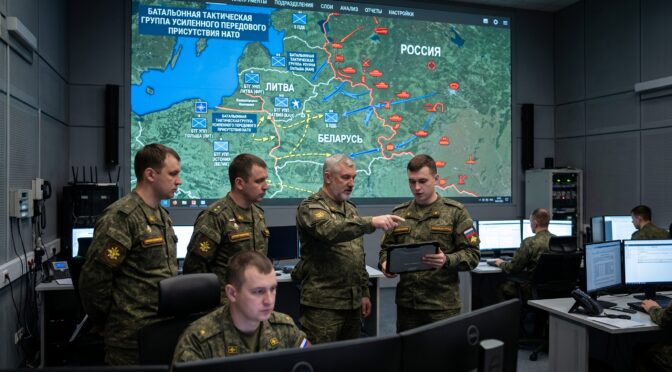
NATO has responded by moving from simple “tripwire” forces to a “deterrence-by-denial” approach. This includes building physical fortifications in the Baltic states and strengthening cyber defenses. As we look toward 2026, the most significant challenge remains predicting the moves of a Russian leadership that views escalation not as a last resort but as a standard tool to exploit Western weaknesses.
1. Psychological Profile and Cognitive Framework of Leadership
To understand the decisions coming out of the Kremlin, we must first map the Russian President’s mindset. Over twenty years, his approach has shifted from pragmatic politics to a rigid, ideological worldview. Experts use behavioral psychology to move past guesswork and build a clearer picture of how he might respond to future events2.
1.1 Operational Code Analysis and Belief Systems
Operational Code Analysis is a tool that helps us quantify how leaders process information and choose their strategies. It separates a leader’s “philosophical beliefs” (how they see the world) from their “instrumental beliefs” (how they think they should act within it)2.
When applied to millions of words spoken by the President, the data shows someone who views global politics as a hostile, “winner-takes-all” competition2. Interestingly, his foreign policy appears more opportunistic than long-term6. He looks for power vacuums—places where he perceives Western resistance to be weak or distracted—and moves to exploit them2. In these calculations, he often casts aside ideological or moral factors in favor of raw geopolitical gain2.
1.2 Leadership Trait Analysis and the 2014 Inflection Point
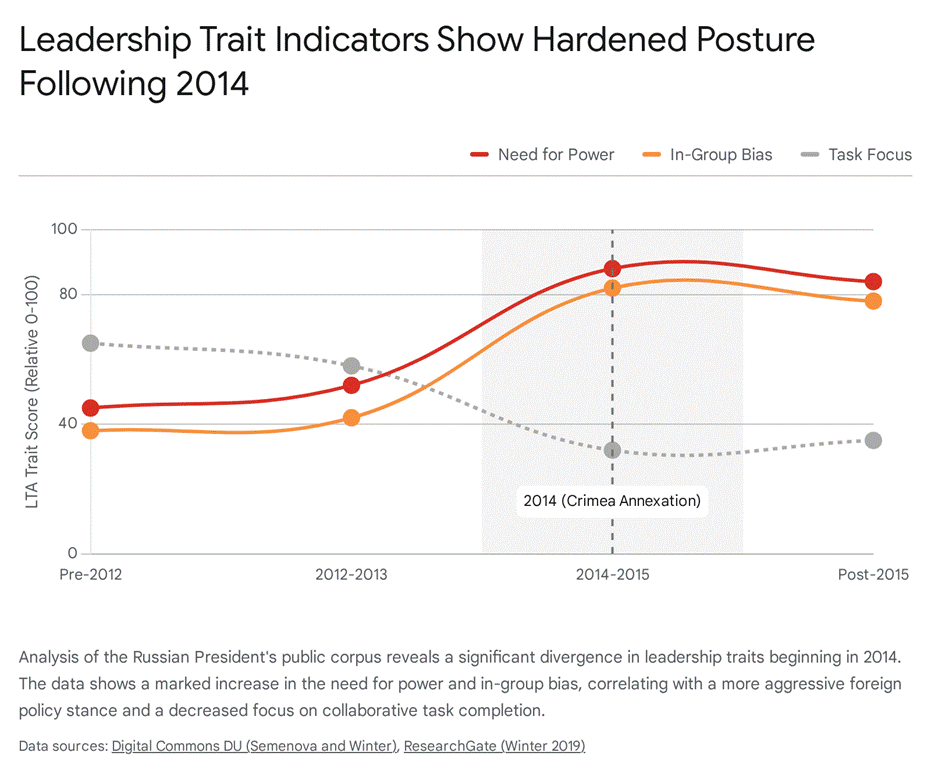
Tracking his traits over time reveals a major psychological shift around 2014, the year Russia annexed Crimea7. Analysis shows that during this period, nearly all of his primary leadership traits moved significantly away from his previous baseline7.
His focus on specific tasks and his belief in his ability to control events actually dropped, while his in-group bias—the “us vs. them” mentality—spiked7. This suggests a leader who has moved away from trying to solve complex global problems through cooperation, focusing instead on managing narrow relationships to maintain his grip on power7.
Motivational studies back this up, showing that his need for power and affiliation has overtaken his desire for achievement4. In the world of political psychology, a high power motive often leads to aggressive, independent actions and a desire to dominate rivals3. When they feel threatened, such leaders can become highly competitive, disregarding international rules and taking extreme risks to win8.
1.3 Cognitive Insulation and the Perception of Western Decay
The way information moves through the Kremlin only makes these biases worse. The system is a series of “silos,” where intelligence is filtered by security services who know the President wants his existing views confirmed. The problem isn’t just a lack of reliable info; it’s that the entire process is dominated by one person’s rigid vision of how the world works6.
This psychological wall filters out any bad news or dissenting voices. Within this bubble, the Russian leadership is convinced the West is falling apart and the U.S. is losing its global influence6.
At the same time, the President sees the Russian economy as a success story, believing it has proven more resilient than Europe’s6. This sense of being “historically right” leaves no room for admitting defeat or offering diplomatic compromises in Ukraine6. To the Kremlin, sanctions and battlefield losses are just temporary annoyances6. Therefore, when things don’t go according to plan, the response isn’t to talk—it’s to escalate6.
2. Sociological Drivers and Institutional Mindsets
It’s not just about one man’s psychology; it’s also about the institutional memory of Russia’s powerful security services. These agencies are the ones carrying out foreign policy, and their shared outlook defines the conflict with NATO.
2.1 The “Subverting the Subverters” Paradigm
Russia’s security apparatus—the Presidential Administration, the Security Council, and the spy agencies—drives a deep, historic fear of foreign interference. For centuries, Russian leaders have assumed that Western subversion constantly threatens the country9. In this view, any domestic protest isn’t real; it’s something created and directed by the West9.
Under the current government, this perspective has become an offensive doctrine. Because the Kremlin believes it is already under attack, it sees its own sabotage and interference operations against NATO as defensive and necessary9. This mindset erases the line between war and peace, making covert attacks a standard tool of statecraft9.
2.2 The Neo-Stalinist Vision of Perpetual War
This surge in intelligence operations is rooted in a vision of “perpetual conflict” with the West10. Spy agencies see themselves as the last line of defense for the Russian state, on a mission to right the perceived wrongs of the post-Cold War era10.
This institutional mindset believes that autocracy is essential for survival and is willing to pay any price to remain a “Great Power”10. By framing the conflict as an existential struggle, these agencies feel completely unconstrained by normal diplomatic rules.
2.3 The Restructuring of Covert Agencies
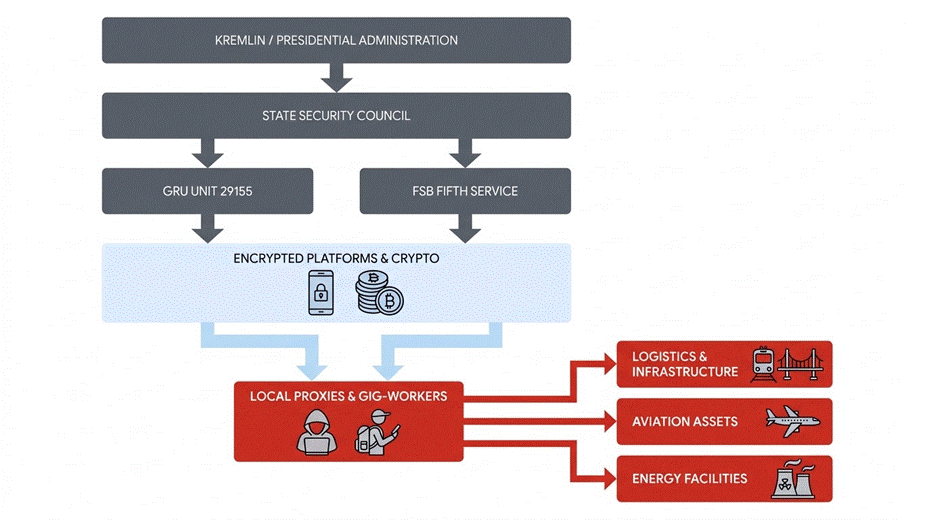
Two main groups lead this “shadow war”: the GRU (military intelligence) and the FSB (the domestic security service).
Since the invasion of Ukraine, the GRU’s sabotage units have grown rapidly. Unit 29155—famous for the poisoning of Sergei Skripal in the UK—is now part of a larger, more aggressive department known as the Special Activities Service (SSD)10. Its job is to carry out sabotage and assassinations across NATO territory10. At the same time, the FSB coordinates complex subversive operations throughout Europe via its network of agents10.
3. Gray Zone Warfare: Sub-Threshold Operations in Europe
Believing that a direct war with NATO would be too costly, Russia has instead intensified its “gray zone” campaign. These are deliberate, deniable acts of violence designed to hurt the West while staying just below the threshold of an actual military response11. Between 2023 and 2024, the number of suspected Russian sabotage incidents in Europe tripled, and the pace has only increased since then12.
3.1 Tactical Shift: The Gig-Economy of Sabotage
A key change in this campaign is how these attacks are carried out. During the Cold War, the Soviets used highly trained officers under diplomatic cover15. Today, the GRU and FSB use a “gig-economy” model of sabotage.
They recruit people on apps like Telegram and pay them in cryptocurrency11. These aren’t professional spies; they are often local criminals or vulnerable youths who need money15. Many have no idea they are working for Russia2. For example, a refugee arrested in Poland was found with incendiary materials meant for an attack in Germany16. In another case, middlemen were discovered connecting GRU handlers to online job seekers15.
This approach helps the Kremlin in three ways. First, it offers plausible deniability; it’s difficult to blame Moscow for a local criminal’s actions11. Second, it is inexpensive; a simple fire can compel European states to spend millions on security11. Finally, it creates social tension. By recruiting migrants or refugees, Russia fuels local anger and division over immigration and border security13.
3.2 Key Vectors of Gray Zone Disruption
This campaign hits Europe on several fronts: logistics, infrastructure, air safety, and public opinion.
Arson and Sabotage: Recent attacks include fires at an IKEA in Lithuania, shopping centers in Poland, and an explosion on a critical railway line helping Ukraine12. Russia has also staged symbolic acts, like placing coffins near the Eiffel Tower, to spread fear and division15.
Air Cargo Threats: In mid-2024, firebombs hidden in parcels went off at DHL hubs in Germany and the UK15. Intelligence agencies believe this was a test run by the GRU to see if they could cause disasters on cargo planes, forcing a global rethink of shipping security15.
GPS Jamming: In the Baltic, Russia systematically jams GPS signals to protect its bases from drones18. This makes life dangerous for commercial ships and planes, serving as a constant reminder of Russia’s power to disrupt daily life in the region12.
Cyber and Disinformation: Poland faces thousands of cyberattacks every day on its power and state servers17. Meanwhile, AI-driven campaigns like “Doppelganger” use bot networks to manipulate public opinion and undermine trust in democracy, especially during key elections20.
4. Overt Military Posturing and Deterrence Strategies
While the shadow war targets society from within, Russia has also updated its public military stance to draw clear “red lines.” Its primary tool for this is its nuclear doctrine.
4.1 Revisions to the Nuclear Doctrine (2024)
In late 2024, the Russian President officially lowered the threshold for using nuclear weapons22. This move was a direct warning to NATO against allowing Ukraine to use long-range missiles for deep strikes into Russia23. To prove he was serious, the update was timed with the combat test of a new, nuclear-capable ballistic missile23.
The 2024 doctrine makes nuclear use more likely on paper. The table below outlines how Russian policy has shifted from its previous stance.
| Doctrinal Parameter | 2010 / 2020 Doctrine | 2024 Updated Doctrine | Strategic Implication |
| Purpose of Arsenal | The arsenal considered nuclear weapons “exclusively as a means of deterrence.”27 | The word “exclusively” has been removed from the general provisions27. | Signals a broader, potentially coercive or war-fighting utility for the nuclear arsenal beyond pure deterrence. |
| Non-Nuclear Adversary | A nuclear response is reserved for states that possess WMDs or engage in massive conventional attacks28. | Aggression by any non-nuclear state, with the participation or support of a nuclear state, is considered a “joint attack”23. | A targeted deterrent aimed at the United States, France, and the UK regarding their materiel support for Ukraine. |
| Conventional Threshold | Allowed nuclear use when the “very existence of the state” was under threat25. | Allows use if conventional aggression creates a “critical threat to Russia’s sovereignty and territorial integrity”23. | Deliberate ambiguity lowers the threshold; a “critical threat” is subjective and could apply to occupied territories or minor border incursions22. |
| Aerospace Triggers | Triggered by reliable data of a launch of ballistic missiles against Russian territory25. | Triggered by receipt of reliable information regarding a massive launch of strategic/tactical aircraft, cruise missiles, or drones crossing the border25. | Lowers the threshold to include large-scale conventional drone or cruise missile barrages, relevant to the Ukraine conflict. |
4.2 The Paradox of Declining Credibility
Despite these official changes, analysts see a problem: Russia’s constant nuclear threats between 2022 and 2024 have begun to lose their sting. By making so many threats without following through, Moscow has seen the impact of its threats fade in Western capitals22.
The new doctrine is an attempt to reclaim that “fear factor” by creating more uncertainty22. By being vague about what a “critical threat” actually is, the Kremlin hopes to divide NATO members over how much risk they are willing to take22. Ultimately, the decision still rests with one person, making the document more of a public signal than a strict rulebook23.
5. Military-Industrial Expansion and the Adversary Entente
To keep the war machine running, Russia has formed a close industrial partnership with Iran, China, and North Korea. This “adversary entente” allows these countries to pool resources and bypass Western sanctions29.
5.1 The Alabuga Drone Complex
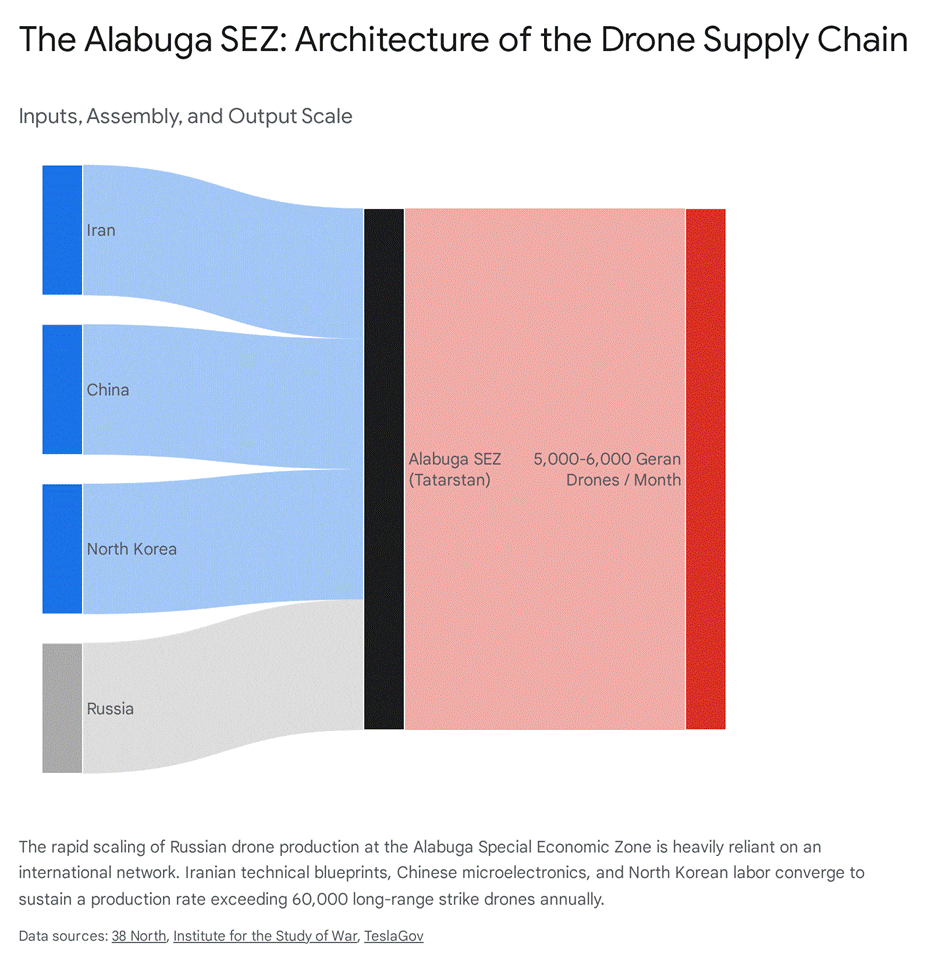
This collaboration is most obvious at the Alabuga Special Economic Zone29. What started as a deal with Iran to assemble drones has turned into a massive, independent production hub29.
By 2026, the facility had grown into a city-sized complex, employing tens of thousands of people31. Current estimates suggest it is pumping out up to 6,000 long-range drones every single month29. This scale allows Russia to launch daily swarms of drones intended to overwhelm Ukraine’s air defenses and strike civilian life31.
5.2 Supply Chain Integration and Foreign Labor
A resilient supply chain protects the Alabuga complex. China provides about 80 percent of the critical electronics and microchips needed for the drones12. A dedicated “logistics airbridge” between the site and China ensures these parts keep arriving without delay29.
To solve its labor shortages, Russia is importing workers on a massive scale. North Korea has sent thousands of people to work on the manufacturing lines29. The facility also targets young women from Africa and South America, recruiting them with promises of “work-study” programs that actually lead to menial factory labor30.
This deal works well for everyone involved but creates long-term risks. In exchange for labor, North Korea gets huge amounts of foreign cash and learns how to build modern drones34. This expertise will eventually show up in North Korea’s own weapons programs30. Furthermore, North Korean troops are getting real-world experience by using drones to guide Russian artillery on the front lines33.
| Platform | Cost per Unit | Estimated Range | Warhead Payload | Monthly Production (Est. 2025/2026) |
| Shahed-131 (Geran-1) | $20,000 – $50,000 | 700 – 900 km | 10 – 20 kg | Integrated into aggregate output |
| Shahed-136 (Geran-2) | $20,000 – $50,000 | 2,000+ km | 50 – 90 kg | 5,000 – 6,000 units (Combined)31 |
6. Economic Foundations and Systemic Vulnerabilities
This military expansion is funded by a strategy known as “war Keynesianism.” This means the government is spending massive amounts of money to keep factories running and people employed during the war.
In 2025, Russia’s military spending jumped to an estimated $172 billion—nearly 8 percent of its GDP36. This has kept the economy growing and wages high, especially in the defense sector36.
But this model is fragile. Sending hundreds of thousands of men to the front lines has created a massive labor shortage at home31. The economy is showing signs of “overheating,” with prices rising quickly across the board36.
While President Putin publicly ignores these issues6, the indicators are worrying. Growth driven only by war spending risks leading to “stagflation”—where the economy stops growing but prices keep rising36. This pressure might actually make the Kremlin more aggressive in the short term, as it feels the need to win before the economic clock runs out.
7. NATO’s Defensive Adaptation and Regional Posture
Knowing that Russia wants to break its political will, NATO has shifted its strategy. Instead of just “tripping” an alarm, it is now focused on making it impossible for Russia to win an attack in the first place.
7.1 Forward Land Forces and Physical Fortification
The Alliance has deployed nine multinational battlegroups across the Eastern Flank37. These units are being scaled up to full brigades, ensuring that well-trained forces are permanently stationed and ready to fight alongside local armies14.
In the Baltic states, defense spending has hit record highs—over 5 percent of their GDP in some cases38. They are building the “Baltic Defensive Line,” a massive system of bunkers, trenches, and tank traps38. This isn’t just about showing resolve; it’s about physically stopping an invasion long enough for NATO reinforcements to arrive38.
7.2 Integrated Air Defense and Cyber Resilience
To counter drone threats, NATO has strengthened its air and missile defenses along the border37. Air policing missions run 24/7, and specialized maritime operations like “Baltic Sentry” protect critical underwater cables from sabotage37.
Finally, the Baltic nations are involving their entire societies in national defense. They work with private cyber firms and international experts in Estonia to train for—and stop—the constant wave of attacks on their power grids and banks38.
8. Conclusion
The security situation in Europe is a test of will between a rigid Russian leadership and a Western alliance trying to stay united. Because the Russian President views the world as a hostile place where the West is failing, he is unlikely to back down. To him, shadow wars, nuclear threats, and sabotage aren’t just steps toward war—they are the new normal.
By using criminal proxies and a global industrial network, Russia has found a way to hurt NATO while keeping its own hands relatively clean. While NATO has built up its physical defenses, the real challenge through 2026 will be staying resilient against constant social disruption while managing the risk of a Russian leadership that feels increasingly cornered by economic pressure.
Master Summary Table: Russian Strategic Calculus
| Domain | Key Mechanisms & Tactics | Underlying Rationale / Driver | Institutional Execution | NATO Response & Vulnerabilities |
| Psychological / Cognitive | Rigid adherence to messianic narratives; filtering of contradictory intelligence. | High power motive, lowered task focus, and belief in historical inevitability and Western decay3. | Centralized Presidential decision-making; compliant security apparatus6. | Extreme difficulty in deterring a leader who discounts economic friction and views escalation as standard3. |
| Covert / Gray Zone Sabotage | Arson, parcel IEDs, infrastructure disruption, GPS jamming, cyberattacks15. | “Subverting the subverters”: belief that active measures are a defensive necessity against the West9. | GRU (Unit 29155 / SSD), FSB Fifth Service: Gig-economy proxy recruits10. | Increased resilience planning, cyber integration, and the vulnerability of open democratic logistical networks11. |
| Information / Societal | Election interference, AI-driven disinformation (e.g., Doppelganger)21. | Exploit domestic polarization and migration fears to undermine political will for supporting Ukraine17. | State media, bot networks, and intelligence cut-outs. | Fragmented European Union responses; challenge of rapid attribution in democratic information spaces20. |
| Nuclear Deterrence | 2024 Doctrine update: lowered threshold, “critical threat” clause, and joint attack designation23. | Compellence: an attempt to paralyze Western decision-making regarding long-range weapon supply to Kyiv22. | Presidential decree; Strategic Rocket Forces signaling23. | Navigating the credibility gap between Russian rhetoric and actual red lines without triggering miscalculation22. |
| Military-Industrial | Alabuga SEZ mass drone production; deep international supply chains29. | Circumvent Western sanctions; sustain high-tempo attrition warfare affordably29. | Joint operations with Iran, PRC (components), and North Korea (labor/troops)11. | Deployment of NATO IAMD; rapid depletion of expensive interceptor stockpiles against cheap drone swarms37. |
| Macroeconomic | “War Keynesianism”: 7.7% GDP defense spending to stimulate the economy36. | Maintain domestic employment and fund the war machine via massive state investment36. | Federal budget prioritization; forced import substitution. | High vulnerability to long-term stagflation, severe labor shortages, and unmanageable inflation36. |
Please share the link on Facebook, Forums, with colleagues, etc. Your support is much appreciated and if you have any feedback, please email us in**@*********ps.com. If you’d like to request a report or order a reprint, please click here for the corresponding page to open in new tab.
Sources Used
- Ronin’s Grips Analytics – Ronin’s Grips, https://blog.roninsgrips.com/
- The operational code approach to profiling political leaders: understanding Vladimir Putin, https://www.researchgate.net/publication/316056472_The_operational_code_approach_to_profiling_political_leaders_understanding_Vladimir_Putin
- Bringing the Leader Back In: The Case for Political Psychology in International Affairs – RUSI, https://my.rusi.org/resource/bringing-the-leader-back-in-the-case-for-political-psychology-in-international-affairs.html
- Drawing policy implications from the ‘Operational Code’ of a ‘new’ political actor: Russian President Vladimir Putin – ResearchGate, https://www.researchgate.net/publication/225886808_Drawing_policy_implications_from_the_’Operational_Code’_of_a_’new’_political_actor_Russian_President_Vladimir_Putin
- Cross‐cultural comparison of political leaders’ operational codes – ResearchGate, https://www.researchgate.net/publication/297586432_Cross-cultural_comparison_of_political_leaders’_operational_codes
- The World According to Putin: No Deal on Ukraine in Sight, https://carnegieendowment.org/russia-eurasia/politika/2026/06/russia-putin-policy-trap
- Vladimir Putin’s Leadership Traits over 11 Years – Digital Commons @ DU, https://digitalcommons.du.edu/cgi/viewcontent.cgi?article=1027&context=undergraduate_theses
- A Motivational Analysis of Russian Presidents, 1994–2018 – ResearchGate, https://www.researchgate.net/publication/339011416_A_Motivational_Analysis_of_Russian_Presidents_1994-2018
- Active Measures: Russia’s Covert Geopolitical Operations | George C. Marshall European Center For Security Studies, https://www.marshallcenter.org/en/publications/security-insights/active-measures-russias-covert-geopolitical-operations-0
- War Without End: Understanding Russia’s Shadow Warfare – CEPA, https://cepa.org/comprehensive-reports/war-without-end-russias-shadow-warfare/
- Gray Zone Attacks Against U.S. Allies and Partners | Council on Foreign Relations, https://www.cfr.org/reports/gray-zone-attacks-against-u-s-allies-and-partners
- Russian sabotage operations in Europe – Wikipedia, https://en.wikipedia.org/wiki/Russian_sabotage_operations_in_Europe
- Responding to Russian Sabotage Financing | Royal United Services Institute – RUSI, https://www.rusi.org/explore-our-research/publications/insights-papers/responding-russian-sabotage-financing
- Russia’s Shadow War Against the West – CSIS, https://www.csis.org/analysis/russias-shadow-war-against-west
- Russian Sabotage Campaign in Europe (2024–2025). Risks for aviation, supply chain and critical infrastructures – HOZINT | Horizon Intelligence, https://www.hozint.com/2025/05/russian-sabotage-campaign-in-europe-2024-2025-risks-for-aviation-supply-chain-and-critical-instrastructures/
- ‘These people are disposable’: how Russia is using online recruits for a campaign of sabotage in Europe – The Guardian, https://www.theguardian.com/world/ng-interactive/2025/may/04/these-people-are-disposable-how-russia-is-using-online-recruits-for-a-campaign-of-sabotage-in-europe
- The New Battlefield: Poland and Europe’s Struggle Against Hybrid Warfare | Epicenter – Harvard University, https://epicenter.wcfia.harvard.edu/articles/new-battlefield-poland-and-europes-struggle-against-hybrid-warfare
- Russian GPS jamming, NATO attack fears raise alarm in Baltic region – Daily Sabah, https://www.dailysabah.com/world/europe/russian-gps-jamming-nato-attack-fears-raise-alarm-in-baltic-region
- Significant Cyber Incidents | Strategic Technologies Program – CSIS, https://www.csis.org/programs/strategic-technologies-program/significant-cyber-incidents
- How Russia’s Hybrid Warfare Will Escalate in 2026 and What Europe Must Do? | GLOBSEC, https://www.globsec.org/what-we-do/commentaries/how-russias-hybrid-warfare-will-escalate-2026-and-what-europe-must-do
- Foreign Information Manipulation in the 2025 German Federal Election – Alliance4Europe, https://alliance4europe.eu/foreign-information-manipulation-2025-german-federal-election
- Full article: Deterrence, Compellence, or Credibility Fatigue? Russian Nuclear Threats in the War on Ukraine – Taylor & Francis, https://www.tandfonline.com/doi/full/10.1080/25751654.2025.2586386
- Russia’s old-new nuclear doctrine – REUNIR, https://reunir-horizon.eu/russias-old-new-nuclear-doctrine/
- The Russia Challenge: Deterring a Revisionist Nuclear Power – Munich Security Conference, https://securityconference.org/en/publications/special-editions/mind-the-deterrence-gap/the-russia-challenge-deterring-a-revisionist-nuclear-power/
- How credible is Russia’s evolving nuclear doctrine? – Brookings Institution, https://www.brookings.edu/articles/how-credible-is-russias-evolving-nuclear-doctrine/
- Why Russia Is Changing Its Nuclear Doctrine Now – CSIS, https://www.csis.org/analysis/why-russia-changing-its-nuclear-doctrine-now
- New Principles of Russia’s Nuclear Deterrence Liberalize Conditions for Use, Unsurprisingly, https://www.russiamatters.org/blog/new-principles-russias-nuclear-deterrence-liberalize-conditions-use-unsurprisingly
- Arms Control and Proliferation Profile: Russia, https://www.armscontrol.org/factsheets/arms-control-and-proliferation-profile-russia
- Adversary Entente Cooperation at Russia’s Shahed Factory Threatens Global Security – ISW, https://understandingwar.org/research/adversary-entente/adversary-entente-cooperation-at-russias-shahed-factory-threatens-global-security/
- Alabuga: The Latest Destination for North Korea’s Drone Ambitions, https://www.38north.org/2025/12/alabuga-the-latest-destination-for-north-koreas-drone-ambitions/
- The Shahed Playbook: How Iranian and Russian Drone Production Will Disrupt Modern Warfare – Tesla Government Inc, https://teslagov.com/the-shahed-playbook-how-iranian-and-russian-drone-production-will-disrupt-modern-warfare/
- Russia Is Expanding Its Long-Range Strike Drone Network, https://www.twz.com/news-features/russia-is-expanding-its-long-range-strike-drone-network
- Hundreds of North Korean Drone Operators Deploying to Russia to Support War Effort, https://militarywatchmagazine.com/article/hundreds-nkorean-drone-operators-russia
- Why North Korea’s Involvement in Russo-Ukrainian war Matters More Than You Think for the Indo-Pacific | List of Articles, https://www.spf.org/iina/en/articles/lee_07.html
- North Korea–Russia Cooperation – Beyond Parallel – CSIS, https://beyondparallel.csis.org/north-korea-russia-cooperation-2/
- WC14 | Europe Convulsed by Multiple Crises of the Capitalist System – Socialist World, https://www.socialistworld.net/2025/08/21/cwi-14th-world-congress-europe-convulsed-by-multiple-crises-of-the-capitalist-system/
- Strengthening NATO’s eastern flank | NATO Topic, https://www.nato.int/en/what-we-do/deterrence-and-defence/strengthening-natos-eastern-flank
- How The Baltic Nations Are Preparing A Multilayered Defence To Russian Aggression, https://tdhj.org/blog/post/baltics-multilayered-defence/
- Russian Threats to NATO’s Eastern Flank: Scenarios, Strategy, and Policy for European Security | The Belfer Center for Science and International Affairs, https://www.belfercenter.org/research-analysis/russia-nato-baltics-scenarios-europe-security