1.0 Executive Summary
The modern sporting arms industry has entered a period of rapid technological evolution, driven heavily by advances in aerospace materials, precision computer numerical control manufacturing, and evolving consumer demands. As of May 2026, the bolt-action rifle market is experiencing a pronounced shift toward premium, ultralight platforms designed specifically for backcountry and mountain hunting applications. This shift has placed hybrid construction techniques, particularly the integration of carbon fiber composites with traditional steel alloys, at the absolute forefront of firearms engineering and design.
This comprehensive report, prepared for the Ronin’s Grips Analytics blog, provides an exhaustive technical and economic analysis of the May 2026 bolt-action rifle landscape. The analysis focuses primarily on the ongoing debate within the materials science community regarding the thermal dissipation and harmonic rigidity of carbon-wrapped barrels compared to traditional fluted steel barrels. By examining independent empirical testing, thermodynamic principles, and mechanical deflection data, this report clarifies long-standing industry misconceptions regarding barrel cooling, heat retention, and absolute stiffness under load. The physics of interior ballistics dictate that barrel harmonics must remain perfectly consistent for a rifle to achieve sub-minute of angle accuracy, and the materials chosen for barrel construction directly impact this harmonic signature.
Furthermore, this report presents a highly detailed technical evaluation of the Bergara Premier Cima Pro, a flagship rifle released for the 2026 market that specifically addresses the historical limitations of carbon fiber barrels. Through its proprietary CURE barrel technology and autoclave-cured carbon fiber stock, the Cima Pro represents a significant leap forward in precision engineering. Bergara has engineered a solution that mitigates the thermal insulator effect of carbon fiber resin matrices while retaining the exceptional weight savings that mountain hunters demand.
The technical assessment is accompanied by a rigorous economic analysis evaluating consumer willingness to pay premium prices for extreme weight reduction. This economic evaluation explores the demographic drivers, the specific cost-to-weight value proposition, and massive external legislative factors, such as the January 2026 elimination of the federal tax stamp for suppressors, which have fundamentally altered consumer purchasing behaviors and firearm configuration preferences. As shooters acquire suppressors in record numbers, the center of gravity and balance point of their rifles have become critical ergonomic concerns.
Finally, the report outlines the strict federal and state logistics governing the shipping, commerce, and transportation of such firearms. With a specific focus on compliance within Berrien County, Michigan, the report details the legal framework required for lawful procurement and transit, before providing validated sourcing data and retail pricing for the Bergara Premier Cima Pro from authorized vendors.
2.0 Industry Trajectory and the 2026 Bolt-Action Rifle Market Landscape
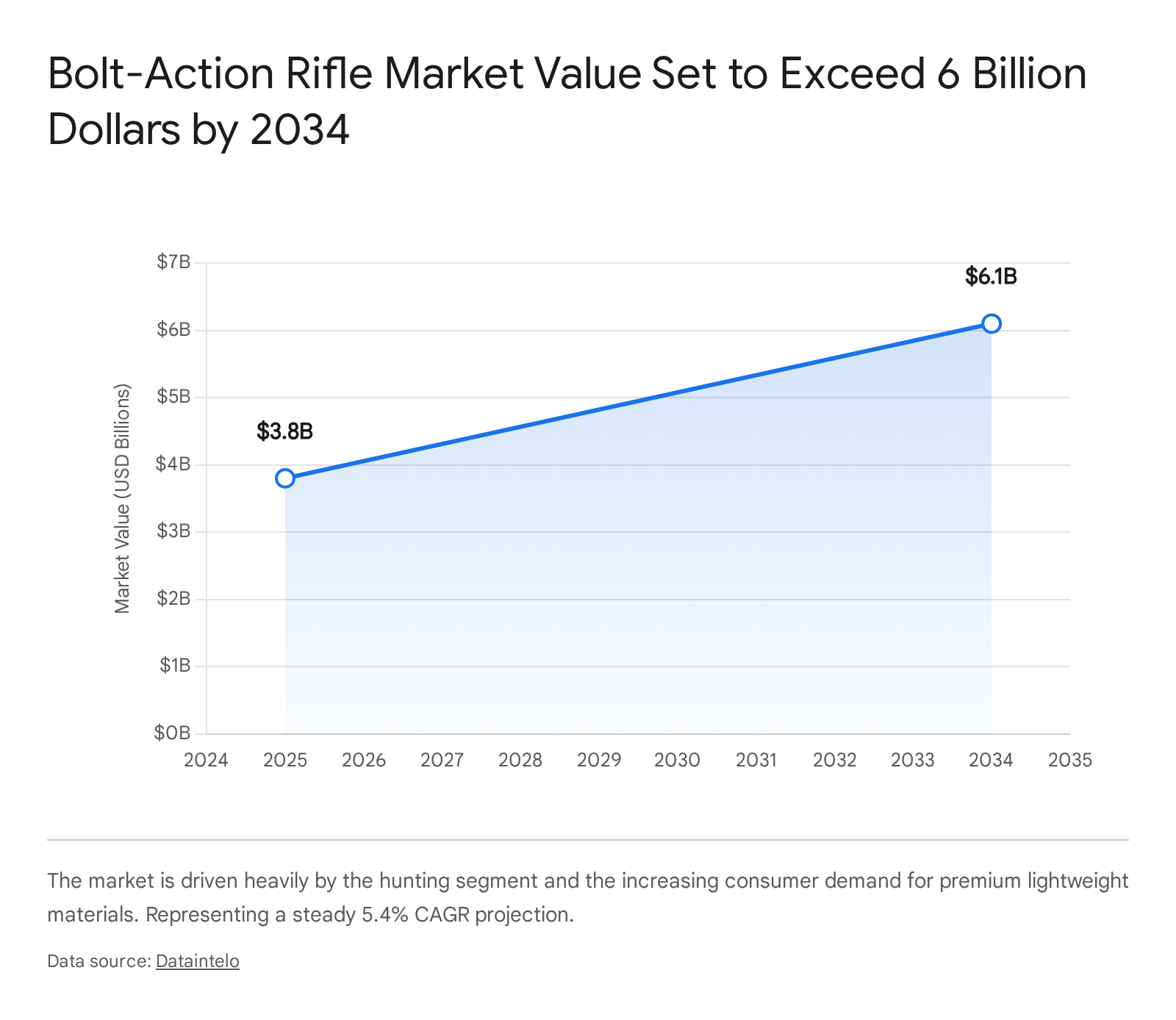
The global bolt-action rifle market has demonstrated remarkable resilience and consistent growth over the past decade. Industry valuations placed the global market at 3.8 billion dollars in 2025, with robust economic projections estimating a massive expansion to 6.1 billion dollars by the year 2034.1 This trajectory represents a steady compound annual growth rate of 5.4 percent across the forecast period.1 North America continues to dominate this commercial sector entirely, holding an estimated 42.7 percent of the global revenue share, driven by a deeply ingrained hunting culture and vast tracts of public land available for recreational shooting.1 Within this expansive market, the hunting rifle segment constitutes the largest product type share at 38.2 percent, outpacing military and target shooting platforms.1
However, the most critical trend defining the May 2026 landscape is the aggressive premiumization of the hunting segment. Consumers are increasingly transitioning away from standard, heavy wooden rifles or basic injection-molded synthetic rifles in favor of highly specialized, lightweight configurations. The traditional hunting rifle, which often weighs between eight and ten pounds when fully scoped and loaded, is rapidly being replaced by high-performance platforms weighing less than six pounds bare.2
This premiumization trend is heavily fueled by the rising popularity of backcountry, alpine, and ultralight backpack hunting. Hunters who traverse steep, rugged terrain over multiple days carrying camp gear, water, and meat place a massive premium on weight reduction. Every ounce carried equates to increased physical exertion and accelerated fatigue. As a result, firearms manufacturers have heavily invested in titanium actions, skeletonized receivers, and carbon fiber-reinforced polymer components.1 Brands that previously reserved these exotic materials for custom benchrest builds or military sniper applications have successfully commercialized them for the mid-tier and high-tier civilian markets, bringing aerospace engineering to the average consumer.
The 2026 SHOT Show served as a major catalyst and exhibition for this trend, showcasing a vast array of carbon-equipped rifles designed to conquer the backcountry.3 Notable entries alongside the Bergara Premier Cima Pro include the Weatherby Mark V Backcountry Capra, the Seekins Precision Element Hunter, and the Christensen Arms Ridgeline FFT.4 These platforms consistently command retail prices ranging from 2,500 dollars to 3,500 dollars, establishing a distinct, high-growth premium niche that vastly outpaces the broader hunting segment in year-over-year revenue expansion.1 Consumers are no longer balking at price tags exceeding three thousand dollars, provided the firearm delivers measurable advantages in weight reduction and ballistic consistency.
3.0 Materials Science Analysis of Carbon-Wrapped Versus Fluted Steel Rifle Barrels
The barrel is arguably the most critical component in the accuracy equation of any precision firearm. Traditionally, achieving extreme long-range accuracy required a heavy, thick-contour steel barrel. A heavy barrel profile mitigates the violent vibrational harmonics generated during the interior ballistic phase of firing, and it possesses enough thermal mass to absorb the immense heat from consecutive shots without warping or shifting the point of impact. However, the severe weight penalty of heavy steel profiles makes them entirely unsuitable for mobile, high-altitude mountain hunting, where extreme physical exertion is required.
To resolve this engineering conflict, the firearms industry introduced two distinct technological solutions, those being fluted steel barrels and carbon fiber-wrapped barrels. The debate regarding which methodology yields superior harmonic rigidity and thermal dissipation has dominated the materials science community for years, often clouded by aggressive marketing claims and anecdotal evidence.
3.1 The Mechanics of Harmonic Rigidity and Deflection
When a cartridge is ignited in the chamber, the rapidly expanding gases propel the projectile down the bore while simultaneously sending high-frequency shockwaves through the crystalline structure of the barrel steel. The barrel behaves dynamically as a cantilevered beam, whipping and vibrating in a complex, multi-directional sine wave pattern. For a rifle to be consistently accurate, the muzzle must be in the exact same position of its vibrational arc every single time a bullet exits the crown.
Rigidity structurally limits the amplitude of this barrel whip. It is a fundamental law of mechanical engineering that the stiffness of a cylindrical tube increases exponentially with its outside diameter. Therefore, a thicker barrel is exponentially stiffer than a thinner barrel, leading to vastly improved harmonic consistency.
Fluted steel barrels attempt to maintain a large outside diameter while reducing weight by milling deep longitudinal or spiral grooves into the exterior surface of the steel. This machining process removes dead weight from the structure while preserving much of the geometric stiffness provided by the outer dimensions. Carbon fiber-wrapped barrels take a vastly different approach. Manufacturers turn a high-grade stainless steel barrel blank down to a very thin pencil profile on a lathe, and then they wrap this thin steel core in layers of aerospace-grade carbon fiber infused with high-strength epoxy resin. Carbon fiber possesses an incredibly high modulus of elasticity, meaning it is extremely stiff relative to its overall mass.
A prevalent marketing claim heavily pushed within the industry suggests that carbon fiber barrels are inherently stiffer than all-steel barrels. However, independent empirical testing reveals a much more nuanced mechanical reality. In a rigorous rigidity test conducted by AllTerra Arms, engineers compared four 7mm barrels, utilizing two carbon fiber variants and two spiral-fluted steel variants.6 To ensure absolute scientific validity and isolate the variable of material composition, the barrels were closely matched in total weight, with less than a three-ounce variance across the entire batch.6
The engineers attached a heavy suppressor to the muzzle of each barrel and utilized a precision dial indicator to measure the mechanical deflection, or the downward physical bending, caused by the added weight at the end of the cantilevered beam. The data revealed that in barrels of equal overall weight, the fluted steel barrels actually exhibited less deflection, indicating greater absolute rigidity.6
While a specific, shorter carbon barrel from Hell’s Canyon Armory did prove to be the most rigid in the overall test group, the broader engineering conclusion remains perfectly clear. Material choice alone does not guarantee superior stiffness.6 A carbon fiber barrel is exceptionally stiff per unit of weight, allowing a manufacturer to build a bull-barrel profile that weighs exactly the same as a thin steel sporter barrel. However, when comparing a carbon barrel and a fluted steel barrel of the exact same weight and length, the steel barrel often matches or slightly exceeds the carbon barrel in absolute mechanical rigidity.7 The true mechanical advantage of carbon fiber is not absolute unbreakable stiffness, but rather its unparalleled stiffness-to-weight ratio, which allows for thick, stable contours without the crushing weight penalty that typically accompanies a heavy steel bull barrel.
3.2 Thermodynamics and the Heat Dissipation Debate
The thermal dynamics of rifle barrels present an even more contested subject within the industry. As consecutive rounds are fired, extreme mechanical friction from the bullet jacket engaging the rifling, combined with the combustion of smokeless powder at thousands of degrees, generates intense heat. As a steel barrel heats up, uneven metallurgical stresses can cause the barrel to warp slightly, leading to a phenomenon known as thermal walking. Thermal walking occurs when the bullet’s point of impact shifts drastically across the target as the internal temperature rises.
Many manufacturers claim that carbon fiber wraps dissipate heat faster than traditional steel, citing the highly conductive properties of raw carbon. However, independent testing again challenges this generalized narrative, exposing a flaw in the application of thermodynamic principles.6
While raw carbon fibers themselves are indeed thermally conductive, the epoxy resins used to bind the fibers together in a solid rifle barrel matrix are notoriously poor conductors. In many standard designs, the resin matrix actually acts as a powerful thermal insulator, trapping the immense heat inside the thin inner steel core rather than letting it escape.7
In advanced thermal efficiency testing, researchers utilized internal thermal probes placed inside the bore and external non-contact thermometers to track heat buildup and cooling rates over ten-minute periods following one-shot, three-shot, and six-shot rapid firing sequences.6
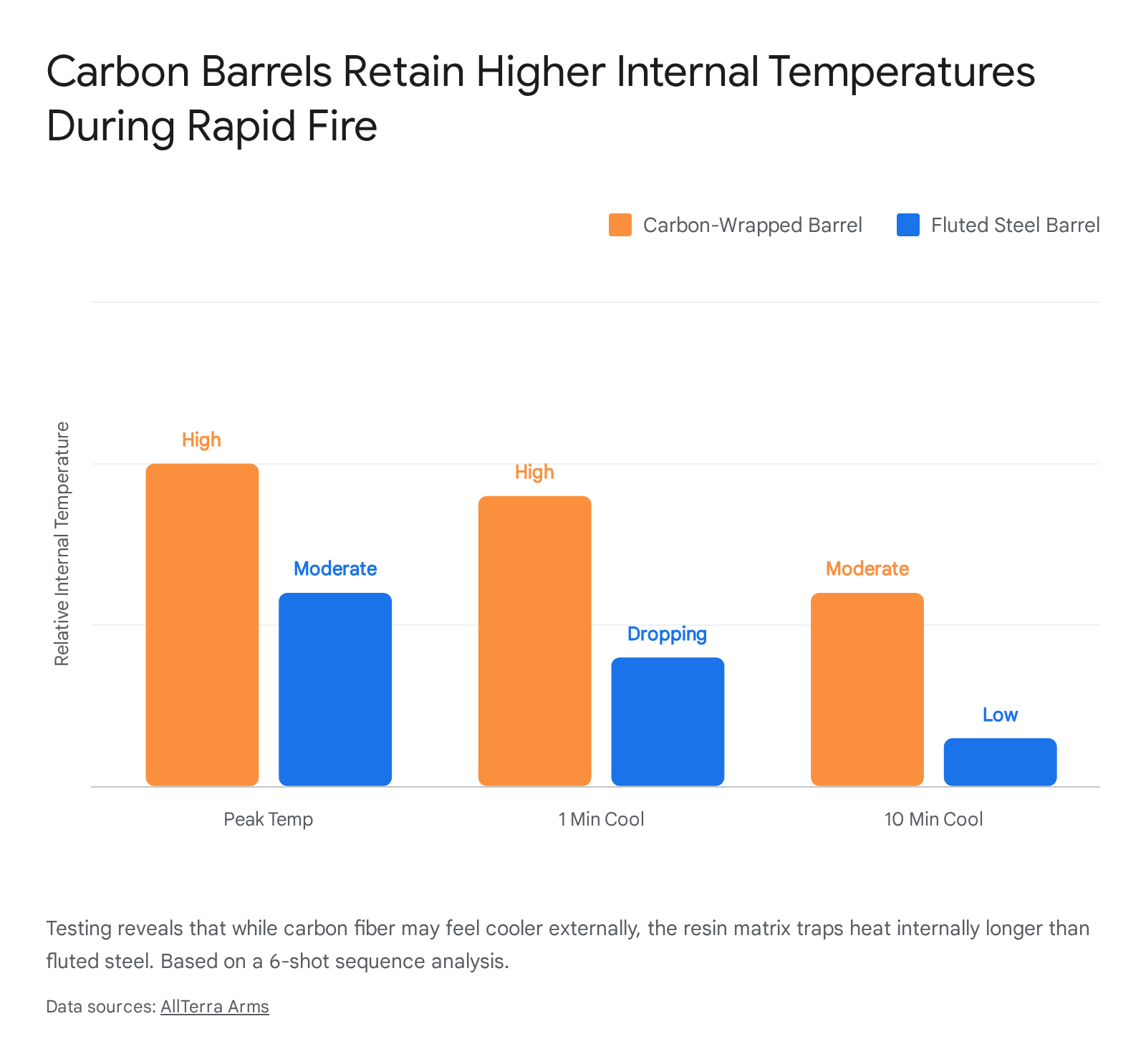
The data from the six-shot sequence provided undeniable scientific clarity. During rapid fire, the internal temperature of the carbon-wrapped barrel spiked significantly higher than the internal temperature of the spiral-fluted steel barrel.6 Furthermore, the fluted steel barrel began to cool rapidly within the very first sixty seconds, shedding heat effectively due to the massive surface area created by the deep fluting cuts, which promote excellent convective air cooling.6 In stark contrast, the carbon barrel’s internal temperature peaked much later in the timeline and held onto the trapped heat for a substantially longer duration.6
At the end of the ten-minute observation window, the fluted steel barrel had reached a much lower temperature both internally and externally.6 The definitive conclusion drawn by materials scientists is that while a carbon fiber barrel might feel physically cooler to the human touch on the outside, this is precisely because the carbon-resin wrap is heavily insulating the heat, preventing it from radiating outward.7 For high-volume shooting applications, such as target competitions, tactical engagements, or prairie dog hunting, heavy fluted steel remains superior for thermal management. However, for backcountry hunting scenarios where a shooter rarely fires more than three rounds in quick succession at a single animal, the heat retention of carbon fiber is entirely negligible, making its extreme weight savings the far more valuable metric for the hunter.7
3.3 The Suppressor Counterbalance Variable and Center of Gravity
An often overlooked mechanical factor in the carbon versus steel materials debate is the profound effect of muzzle devices on the firearm’s center of gravity. With the rapid proliferation of lightweight titanium suppressors in 2026, hunters are routinely attaching an additional eight to sixteen ounces to the very end of their rifle barrels.7
When a heavy suppressor is threaded onto a standard thin-contour steel sporter barrel, it creates a highly unbalanced, front-heavy lever system. This imbalance drastically alters the moment of inertia, making the rifle sluggish to swing onto moving targets and highly fatiguing to carry over long distances either in the hands or on a shoulder sling.7 Carbon-wrapped barrels inherently solve this severe ergonomic issue. Because carbon barrels utilize a much thicker outside diameter while remaining feather-light overall, they shift the balance point of the rifle rearward, much closer to the action and the shooter’s supporting hand. This creates a beautifully neutral center of gravity, allowing the rifle to handle swiftly and counterbalance the added mass of a suppressor perfectly.7 For modern hunters utilizing advanced sound suppression, the structural volume of carbon fiber provides an ergonomic advantage that steel simply cannot replicate without adding pounds of unnecessary weight.
4.0 Technical Evaluation and Engineering of the Bergara Premier Cima Pro
Recognizing the complex physics and thermodynamic limitations of traditional carbon fiber resin wraps, Bergara engineers set out to design a rifle that fully leveraged the extreme weight savings of composite materials while aggressively mitigating the known thermal insulator effect. The resulting firearm is the Bergara Premier Cima Pro, proudly introduced to the commercial market in 2026 as the flagship lightweight offering within their esteemed Premier Series line of rifles.2
Priced at a manufacturer’s suggested retail price of 3,099 dollars, the Cima Pro represents the absolute pinnacle of Bergara’s manufacturing capabilities, combining old-world craftsmanship with modern aerospace technologies.10 By integrating advanced curing techniques and proprietary thermodynamic engineering, the Cima Pro provides guaranteed sub-minute of angle accuracy in a package that weighs as little as 5.5 pounds.10
4.1 The CURE Carbon Barrel Architecture
The defining technical feature of the Cima Pro is its impressive 21.5 millimeter, Number 6 contour CURE carbon fiber barrel.11 Bergara specifically developed the proprietary CURE technology to permanently solve the exact thermal retention issues identified in independent testing of competitor carbon barrels.10
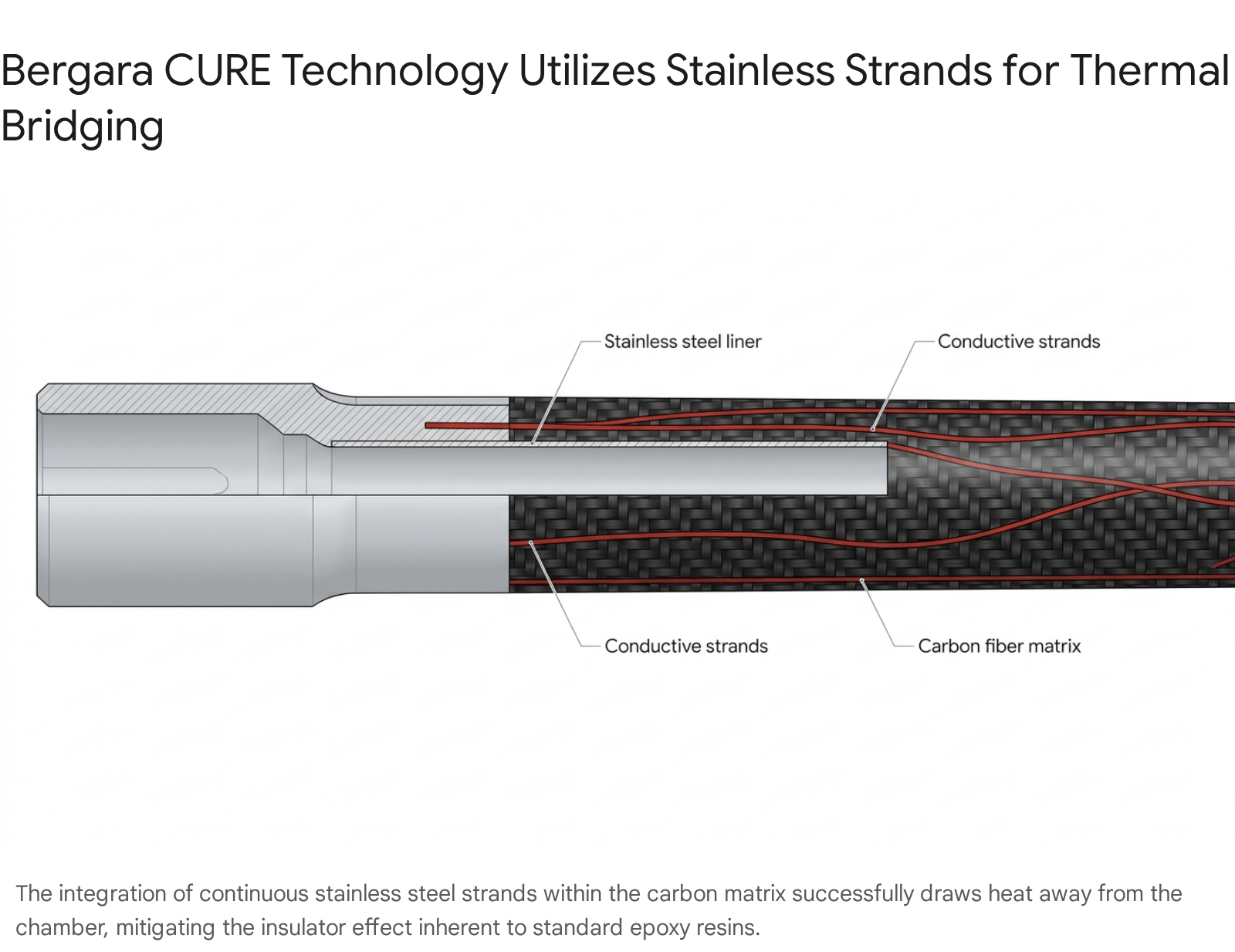
Through an innovative, patent-pending manufacturing process known commercially as ColdBore Technology, Bergara engineers weave continuous strands of highly conductive stainless steel directly into the structural carbon fiber matrix during the wrapping phase.12 Instead of allowing the epoxy resin to act as a thermal barrier trapping heat against the inner steel liner, these embedded stainless steel strands act as highly efficient thermodynamic bridges. They actively conduct extreme heat away from the ignition chamber and aggressively draw it down the entire length of the barrel, allowing it to be dissipated efficiently into the surrounding ambient air.12
This hybrid metallic-carbon weave results in an extraordinary reduction of overall internal barrel temperatures, with Bergara citing an average temperature decrease of fifty degrees compared to standard carbon wraps on the market.12 By actively managing the heat thermodynamically, the CURE barrel drastically reduces the dreaded phenomenon of impact migration as the barrel warms during a string of fire.9
Furthermore, Bergara utilizes a specialized mandrel-wrapped carbon application process that perfectly aligns the weave directionally true to the bore’s exact center, ensuring absolute geometric straightness and consistent mechanical stiffness.12 The resulting barrel sheds over two full pounds of weight compared to a pure steel counterpart of the exact same outer contour, yet it suffers none of the thermal walking issues historically associated with ultralight pencil profiles.12
4.2 Autoclave-Cured Carbon Fiber Stock Technology
To perfectly complement the advanced CURE barrel, Bergara equips the Cima Pro with a highly sophisticated, proprietary carbon fiber stock. Rather than relying on traditional wet-layup fiberglass techniques or basic injection-molded plastics prone to flexing, the Cima Pro stock is manufactured utilizing a rigorous autoclave curing process.10
This specific manufacturing technique is typically reserved for Formula 1 racing components and advanced aerospace engineering.11 Sheets of pre-impregnated carbon fiber, commonly known in the industry as pre-preg, are meticulously laid by hand into a precise mold and then subjected to immense atmospheric pressure and extreme heat within a sealed autoclave chamber.10 This extreme mechanical pressure completely consolidates the multiple carbon layers, violently squeezing out microscopic air voids and achieving the maximum possible fiber-to-resin ratio.10
Because epoxy resin is essentially dead weight that provides virtually no structural tensile strength on its own, minimizing the resin content while maximizing the actual carbon fiber volume results in a stock that is staggeringly lightweight yet incredibly rigid.10 This absolute rigidity is crucial for maintaining a perfectly free-floated barrel channel, ensuring that heavy bipod pressure or aggressive shooting sling tension never causes the forend of the stock to flex upward and contact the barrel, which would instantly ruin barrel harmonics and destroy accuracy. Furthermore, the tightly bonded molecular structure of the autoclave-cured carbon provides superior recoil absorption properties and remains entirely impervious to severe temperature fluctuations, moisture intrusion, and extreme environmental impact.10
4.3 Action Mechanics and TriggerTech Integration
The mechanical foundation of the rifle is the Bergara Premier Gen II action, an evolved and highly refined iteration of the widely respected Remington 700 footprint. Machined to exacting tolerances from premium 416 stainless steel, the action is engineered for uncompromising tensile strength, long-term durability, and exceptional corrosion resistance in harsh field conditions.10
To align perfectly with the ultralight ethos of the Cima Pro, the Premier action features extensive weight-reducing lightening cuts milled along the exterior of the receiver body.11 It utilizes a significantly wider ejection port designed for the reliable clearance of long, heavy magnum spent brass and incorporates a deeply spirally fluted bolt body to reduce friction and clear debris.10 The bolt features a robust two-lug design paired with a floating bolt head, ensuring perfectly square contact with the receiver abutments upon lockup. Furthermore, the action features dual plunger ejectors and a highly robust sliding plate extractor, guaranteeing flawless cycling and positive extraction even under the harshest environmental conditions.11 A premium stainless steel Cerakote ceramic finish is applied over the metalwork, providing an additional protective layer of absolute weatherproofing against rust and abrasion.3
Precision fire control is flawlessly managed by a premium TriggerTech trigger mechanism installed directly from the factory.10 TriggerTech units utilize patented Frictionless Release Technology, employing a free-floating stainless steel roller captured between the sear and the trigger shoe. This design entirely eliminates traditional sliding friction and gritty creep, providing a perfectly crisp, glass-like break that cannot be replicated by traditional friction sears. This high-end trigger system allows the shooter to execute precise, long-range shots perfectly without mechanically disturbing the incredibly light 5.5-pound rifle platform during the crucial moment of ignition.10
4.4 Caliber Matrix and Dimensional Specifications
The Bergara Premier Cima Pro is currently chambered in a highly comprehensive array of modern, high-ballistic-coefficient cartridges, perfectly suited for the intense ballistic demands of long-range precision hunting. The rifle utilizes a standard five-round hinged floorplate capacity for standard short-action calibers and a three-round capacity for the larger magnum chamberings.10
| Cartridge / Caliber | Barrel Length | Muzzle Threading | Unscoped Weight | Magazine Capacity |
| .22 Creedmoor | 20 inches | 5/8×24 (Threaded) | 5.5 lbs | 5 Rounds |
| .25 Creedmoor | 20 inches | 5/8×24 (Threaded) | 5.5 lbs | 5 Rounds |
| 6.5 Creedmoor | 20 inches | 5/8×24 (Threaded) | 5.5 lbs | 5 Rounds |
| .308 Winchester | 20 inches | 5/8×24 (Threaded) | 5.5 lbs | 5 Rounds |
| 6.5 PRC | 20 inches | 5/8×24 (Threaded) | 5.5 lbs | 3 Rounds |
| 7mm PRC | 22 inches | 5/8×24 (Threaded) | 5.75 lbs | 3 Rounds |
| 7mm Rem Mag | 22 inches | 5/8×24 (Threaded) | 5.75 lbs | 3 Rounds |
| .300 Win Mag | 22 inches | 5/8×24 (Threaded) | 5.75 lbs | 3 Rounds |
| .300 PRC | 22 inches | 5/8×24 (Threaded) | 5.75 lbs | 3 Rounds |
Data accurately sourced and verified from Bergara official commercial specifications.10
5.0 Economic Analysis of Consumer Willingness to Pay for Extreme Weight Reduction
The standard financial barrier to entry for a highly capable, mass-produced hunting rifle sits comfortably between 500 dollars and 1,000 dollars in the current market.13 Rifles within this budget category, typically utilizing basic injection-molded synthetic stocks and standard steel barrels, reliably deliver mechanical accuracy perfectly sufficient for harvesting game at ethical distances. Therefore, critically examining a premium rifle like the Bergara Premier Cima Pro, which carries a manufacturer’s suggested retail price of 3,099 dollars, requires a deep analysis of consumer psychology and price elasticity within the specialized sporting goods sector.10
5.1 The Cost-to-Weight Value Proposition
The primary driver of the premium hunting rifle market is the relentless pursuit of extreme weight reduction. A standard steel hunting rifle, utilizing a wooden or basic polymer stock, typically weighs between 7.5 and 9.0 pounds without an optic or ammunition.16 The Cima Pro, remarkably, weighs merely 5.5 pounds bare.10 To strip two to three entire pounds of solid mass from a firearm while simultaneously improving its accuracy, weather resistance, and structural rigidity requires utilizing expensive, exotic materials and highly labor-intensive manufacturing processes, such as autoclave curing and proprietary carbon fiber wrapping.10
In the high-end outdoor equipment market, consumers aggressively calculate value based on a strict price-per-ounce-saved metric.17 In the realm of ultralight backpacking and high-alpine mountain hunting, where individuals hike for days across severe, oxygen-deprived elevation gradients carrying all their survival gear on their backs, removing three pounds of dead weight from a rifle translates directly to decreased physiological fatigue, vastly increased mobility, and tangibly higher success rates in the field.7 The willingness to pay a 2,000-dollar premium over a standard budget rifle is directly correlated to the massive physical relief provided by a 5.5-pound platform during moments of extreme cardiovascular exertion.4
5.2 Market Demographics and the Premiumization Trend
The economic viability of rifles like the Cima Pro is heavily supported by a broader demographic shift toward premiumization across all sporting sectors. Market intelligence indicates a distinct flight to quality, where affluent consumers and highly dedicated enthusiasts view high-performance equipment not merely as utilitarian tools, but as vital investments in their overall outdoor experience.1 The rapidly expanding popularity of guided big-game hunts out West, which themselves often cost tens of thousands of dollars in tag fees and outfitter costs, easily justifies the purchase of specialized equipment like the Cima Pro in potent calibers such as.300 Winchester Magnum or 7mm PRC.4 Consumers embarking on these expensive, once-in-a-lifetime expeditions demand flawless equipment that entirely eliminates mechanical failure points and guarantees sub-minute of angle accuracy under intense physiological duress and extreme weather conditions.7
5.3 The Explosive Impact of Regulatory Shifts on Purchasing Behavior
A massive, newly emerged macroeconomic variable driving the explosive sale of carbon fiber rifles is the January 2026 elimination of the 200-dollar federal tax stamp for suppressors.19 Following the passage of highly favorable federal legislation, the acquisition of National Firearms Act items such as silencers became drastically more accessible and financially viable to the average shooter. This legislative shift led to an unprecedented, historic surge in suppressor ownership across the United States, with daily application volumes skyrocketing overnight from an average of 2,500 forms to over 150,000 forms processed in a single day.20
As practically every serious hunter rapidly shifts toward hunting exclusively with a suppressed rifle to protect their hearing and reduce recoil, the mechanical balance of the firearm becomes a critical ergonomic issue. Attaching an eight to sixteen-ounce suppressor to a lightweight steel sporter barrel completely ruins the balance of the rifle, making it incredibly front-heavy and unwieldy. Consumers are now highly motivated to pay the premium for carbon fiber barrels like the Bergara CURE, as the thick but virtually weightless carbon contour seamlessly counterbalances the added mass of the newly acquired suppressor, restoring the rapid ergonomic handling of the rifle.7 This single legislative change regarding the National Firearms Act has fundamentally accelerated the adoption rate of premium carbon fiber bolt-action platforms across the entire industry.
6.0 Interstate Commerce, Regulatory Compliance, and Transportation Logistics
The procurement, shipment, and physical transportation of premium firearms like the Bergara Premier Cima Pro are heavily governed by strict federal regulations and a complex web of localized state ordinances. Understanding these logistics is absolutely paramount for both retailers fulfilling orders and consumers taking final delivery.
6.1 Federal Firearms License Shipping Protocols
Under the strict regulations set forth by the Bureau of Alcohol, Tobacco, Firearms and Explosives, all modern firearms purchased online or transferred across state lines must be shipped directly to a valid Federal Firearms License holder.21 A consumer cannot, under any circumstances, have a rifle shipped directly to their residential address from an online retailer.
For bolt-action rifles, the United States Postal Service permits non-licensees to mail unloaded rifles and shotguns to an FFL in any state, provided the outer packaging contains absolutely no markings or labels indicating the presence of a firearm within the parcel.21 However, the corporate shipping policies of common private carriers such as UPS and FedEx have become increasingly restrictive in recent years. These private entities often require the sender to hold an active, pre-approved FFL account with the carrier and frequently mandate expensive next-day air service for all firearm transfers, significantly increasing logistical overhead.22 A major regulatory point of contention in 2026 involves a proposal by the United States Postal Service to alter mailing standards regarding concealable firearms, a move that prompted severe pushback and formal opposition from a coalition of state attorneys general, citing concerns over tracing capabilities and public safety.23
6.2 Michigan and Berrien County Transportation Ordinances
For residents taking final delivery of the Cima Pro in specific jurisdictions such as Berrien County, Michigan, strict state compliance must be observed during the transfer and subsequent transportation. Unlike handguns, which require a formalized License to Purchase or a valid Concealed Pistol License for legal acquisition from a private seller, the state of Michigan does not require a specialized purchase permit for standard long guns like rifles or shotguns.24 A consumer of legal age must simply pass the standard federal National Instant Criminal Background Check System query administered by their local FFL dealer to take lawful possession of the bolt-action rifle.24
Once in legal possession of the firearm, the physical transportation of the rifle within the state of Michigan is strictly regulated to ensure public safety. Under the explicit statutes of the Michigan Penal Code, specifically Section 750.227d, it is unlawful to transport a firearm in a motor vehicle unless it is entirely unloaded in both the firing chamber and the magazine.25 Furthermore, the unloaded rifle must be either completely taken down, enclosed securely in a fastened case, or carried in the trunk of the vehicle, remaining completely inaccessible from the passenger compartment at all times during transit.25 Local jurisdictions within Michigan, explicitly including Berrien County, are preempted by overriding state law from enacting their own localized firearm shipping bans or registration requirements that exceed existing state statutes. This preemption, established under Michigan Compiled Laws Section 123.110, ensures a highly uniform legal framework for hunters purchasing and transporting their equipment to the field across county lines.27
7.0 Retail Sourcing, Pricing Analysis, and Vendor Validation
The Bergara Premier Cima Pro commands a premium price point commensurate with its highly advanced materials, proprietary technologies, and intensive manufacturing processes. The official manufacturer’s suggested retail price is firmly set at 3,099 dollars across all available caliber offerings.10
To thoroughly validate market availability and pricing parity across the retail sector, the following authorized vendors have been confirmed to stock the Bergara Premier Cima Pro. These specific retailers currently list the product at a highly competitive minimum advertised price of 2,999.99 dollars, representing a slight but noticeable discount from the factory MSRP.
- Bergara Official Manufacturer Site:Provides comprehensive specifications, exact dimensional data, dealer locator services, and warranty registration portals for the Cima Pro series. URL:https://www.bergara.online/us/rifles/premier/cima-pro/ 10
- Sportsman’s Warehouse:A major national outdoor retailer offering the Cima Pro in various calibers, including the highly popular.308 Winchester configuration, actively priced at the market average of $2,999.99. URL:https://www.sportsmans.com/shooting-gear-gun-supplies/rifles/bergara-premier-cima-pro-308-winchester-stainless-steel-cerakote-bolt-action-rifle-20in/p/1988800 28
- MidwayUSA:A leading online supplier of shooting, hunting, and outdoor products serving the national market. MidwayUSA currently lists the Cima Pro at a reduced, competitive price of $2,999.99, down from the full MSRP. URL:https://www.midwayusa.com/product/1029373620 29
- EuroOptic:A highly specialized premium optics and firearms vendor catering specifically to the precision shooting community, offering the Cima Pro in specialized magnum chamberings such as.300 Winchester Magnum and 7mm PRC for $2,999.99. URL:https://www.eurooptic.com/bergara-cima-pro-300-win-mag-22-carbon-fiber-bbl-omni-muzzlebrake-autoclave-carb 30
While major preferred vendors such as Palmetto State Armory and Brownells feature extensive Bergara rifle inventories, an exhaustive search of their current available stock reveals they heavily favor the lower-priced B-14 series and the standard Cima CF model. The flagship Premier Cima Pro evaluated in this technical report requires sourcing from the specialized vendors validated above to ensure an exact product match.31
8.0 Strategic Conclusions and 2026 Industry Outlook
The May 2026 bolt-action rifle market reflects a highly sophisticated, well-educated consumer base that absolutely demands extreme ballistic performance without the grueling physical burden of traditional steel weight. The technical evaluation of the materials science currently dominating the industry reveals that the heated debate between carbon-wrapped barrels and fluted steel barrels is highly nuanced and often misunderstood. While fluted steel maintains excellent absolute rigidity and undeniably superior high-volume thermal dissipation, carbon fiber provides an unmatched stiffness-to-weight ratio that is absolutely vital for mobile mountain hunting and modern suppressor integration.
The Bergara Premier Cima Pro stands as a masterful engineering solution to the historical drawbacks of composite firearms. By utilizing an autoclave-cured carbon stock for unmatched structural rigidity and developing the proprietary CURE barrel technology to actively combat the thermal insulator effect via embedded stainless steel strands, Bergara has successfully created a platform that delivers heavy-barrel benchrest precision in a remarkably light 5.5-pound package.
Economically, the 3,099-dollar price point is wholly justified by the grueling physical demands of backcountry hunting and the massive demographic shift toward premium equipment investment. Furthermore, the historic 2026 legislative elimination of National Firearms Act suppressor tax stamps has inadvertently catalyzed the sale of ultralight carbon rifles, as consumers desperately seek to counterbalance highly muzzle-heavy suppressed setups. As the global firearms market continues to expand rapidly toward a projected 6.1 billion dollar valuation, platforms that seamlessly integrate advanced aerospace materials with traditional precision gunsmithing, such as the Bergara Premier Cima Pro, will undoubtedly continue to dominate the premium hunting sector for years to come.
Note: Vendor Sources listed are not an endorsement of any given vendor. It is our software reporting a product page given the direction to list products that are between the minimum and average sales price when last scanned.
Please share the link on Facebook, Forums, with colleagues, etc. Your support is much appreciated and if you have any feedback, please email us in**@*********ps.com. If you’d like to request a report or order a reprint, please click here for the corresponding page to open in new tab.
Sources Used
- Bolt Action Rifles Market Research Report 2034 – Dataintelo, accessed May 10, 2026, https://dataintelo.com/report/bolt-action-rifles-market
- Bergara Debuts Cima Pro & Platinum Stalker Rifles at SHOT – Guns.com, accessed May 10, 2026, https://www.guns.com/news/2026/01/28/bergara-debuts-cima-pro-and-platinum-stalker
- New Rifles Coming in 2026 | NSSF SHOT Show 2027, accessed May 10, 2026, https://shotshow.org/new-rifles-coming-in-2026/
- Best Hunting Rifles of 2026: Our Top Picks from SHOT Show – Western Obsession TV, accessed May 10, 2026, https://westernobsessionstv.com/best-hunting-rifles-of-2026-our-top-picks-from-shot-show/
- Best Hunting Rifles of 2026: Top Picks for Every Hunter – Safari Specialists Group, accessed May 10, 2026, https://safarispecialistsgroup.com/best-hunting-rifles-of-2026-top-picks-for-every-hunter/
- Carbon vs. Steel Rifle Barrels: Testing Rigidity & Cooling Efficiency – AllTerra Arms, accessed May 10, 2026, https://www.allterraarms.com/carbon-vs-steel-rifle-barrel-test/
- Carbon Fiber Barrels Vs Steel: Which Is Better For Hunting? – Divide Gun Company, accessed May 10, 2026, https://dividegun.com/carbon-fiber-barrels-vs-steel/
- Carbon Fiber Barrel vs. Steel — Which Is Better? – The Armory Life, accessed May 10, 2026, https://www.thearmorylife.com/carbon-fiber-barrel-vs-steel-which-is-better/
- 2026-Bergara-Catalog_web_INT_v2.pdf, accessed May 10, 2026, https://www.bergara.online/en/wp-content/uploads/sites/5/2026/01/2026-Bergara-Catalog_web_INT_v2.pdf
- Premier Cima Pro – Bergara USA, accessed May 10, 2026, https://www.bergara.online/us/rifles/premier/cima-pro/
- PREMIER CIMA PRO – Bergara, accessed May 10, 2026, https://www.bergara.online/en/rifles/premier/cima-pro/
- Our barrels make the difference – Bergara, accessed May 10, 2026, https://www.bergara.online/us/wp-content/uploads/sites/6/2022/01/Bergara-2022-Low-Res-1.17.22.pdf
- How Much is a Deer Hunting Rifle: A Comprehensive Guide to Pricing and Options | Battlbox, accessed May 10, 2026, https://www.battlbox.com/blogs/hunting/how-much-is-a-deer-hunting-rifle-a-comprehensive-guide-to-pricing-and-options
- The Best Budget Hunting Rifles of 2025, Put to the Test – Outdoor Life, accessed May 10, 2026, https://www.outdoorlife.com/guns/budget-hunting-rifles-tested/
- Hunting Rifles Report 2025: Growth Driven by Government Incentives and Partnerships, accessed May 10, 2026, https://www.marketreportanalytics.com/reports/hunting-rifles-208594
- The Advantages of a Carbon Barrel: Light, Strong, Accurate – Savage Arms, accessed May 10, 2026, https://savagearms.com/blog/post/the-advantages-of-a-carbon-barrel-light-strong-accurate
- BRC Inc. (BRCC) Stock Analysis & Key Metrics – KoalaGains, accessed May 10, 2026, https://koalagains.com/stocks/NYSE/BRCC
- Carbon Market Trends 2026: Prices, Quality, and the Future of Carbon Credits – Sylvera, accessed May 10, 2026, https://www.sylvera.com/blog/carbon-market-trends
- 2026 Sales Trends Already Emerging – Shooting Industry Magazine, accessed May 10, 2026, https://shootingindustry.com/dealer-advantage/2026-sales-trends-already-emerging/
- New Year Buying Surge Shows 2026 Could Be The Year Of Suppressors – NSSF, accessed May 10, 2026, https://www.nssf.org/articles/new-year-buying-surge-shows-2026-could-be-the-year-of-suppressors/
- Firearms Shipping Guide – GunBroker, accessed May 10, 2026, https://support.gunbroker.com/hc/en-us/articles/222836508-Firearms-Shipping-Guide
- Firearms Shipping Compliance Guide for FFL Dealers – Bravo Store Systems, accessed May 10, 2026, https://www.bravostoresystems.com/compliance/firearms-shipping-compliance-ffl
- Michigan Attorney General Dana Nessel Joins Coalition Against Proposed Firearm Related Rule Change By USPS – Thumb Area Headlines | Thumbnet.net, accessed May 10, 2026, https://thumbnet.net/wire/headlines/03189_Michigan_Attorney_General_Dana_Nessel_Joins_Coalition_Against_Proposed_Firearm_Related_Rule_Change_By_USPS_144629.php
- Michigan Gun Laws/Restrictions | Huron Valley Guns, accessed May 10, 2026, https://www.huronvalleyguns.com/state-gun-laws-restrictions/mi-gun-laws-restrictions/
- MCL – Section 750.227d – Michigan Legislature, accessed May 10, 2026, https://www.legislature.mi.gov/Laws/MCL?objectName=mcl-750-227d
- How to Transport Firearms Legally in Michigan – Barone Defense Firm, accessed May 10, 2026, https://www.baronedefensefirm.com/how-to-transport-firearms-in-michigan.html
- Michigan State Gun Laws and Regulations Explained – NRA-ILA, accessed May 10, 2026, https://www.nraila.org/gun-laws/state-gun-laws/michigan/
- Bergara Premier Cima Pro 308 Winchester Stainless Steel Cerakote Bolt Action Rifle – 20in, accessed May 10, 2026, https://www.sportsmans.com/shooting-gear-gun-supplies/rifles/bergara-premier-cima-pro-308-winchester-stainless-steel-cerakote-bolt-action-rifle-20in/p/1988800
- Bergara Premier Cima Pro Bolt Action Rifle 6.5 PRC 20 Titanium – MidwayUSA, accessed May 10, 2026, https://www.midwayusa.com/product/1029373620
- Bergara Premier Cima Pro .300 Win Mag 22″ Carbon Fiber Bbl Omni Muzzlebrake Autoclave Carbon Fiber Stock Rifle BPR38-300WM For Sale – EuroOptic, accessed May 10, 2026, https://www.eurooptic.com/bergara-cima-pro-300-win-mag-22-carbon-fiber-bbl-omni-muzzlebrake-autoclave-carb
- Shop Bergara Rifles – Precision Firearms for Sale Online | Palmetto State Armory, accessed May 10, 2026, https://palmettostatearmory.com/brands/bergara.html
- Shop 43 BERGARA Products – Brownells, accessed May 10, 2026, https://www.brownells.com/brands/bergara/