Category Archives: Trade Show Analytics

IDEB 2026: Transforming Central European Defense

1. Executive Summary

The International Defence Exhibition Bratislava (IDEB) Defence & Security, held from May 12 to May 14, 2026, at the Incheba Exhibition and Congress Centre in Slovakia, served as a definitive barometer for the rapidly maturing defense industrial base of Central and Eastern Europe.1As allied nations across NATO’s Eastern Flank accelerate the modernization of their land forces, the 2026 exhibition underscored a decisive paradigm shift.3Regional defense ministries are moving away from the direct procurement of foreign, off-the-shelf systems, prioritizing instead the development of sovereign, intra-regional joint ventures that retain intellectual property and capital within the local economic bloc.4

The technological reveals at IDEB 2026 demonstrated a clear doctrinal focus on strategic mobility, modular combat architectures, and layered platform survivability. Among the most significant announcements was the global premiere of the CFL-120 Karpat medium tank, representing a strategic partnership between the Czech Republic’s Czechoslovak Group (CSG) and Turkey’s FNSS.5 Concurrently, Poland’s Polska Grupa Zbrojeniowa (PGZ) debuted an export-configured variant of the Borsuk Infantry Fighting Vehicle (IFV), deliberately paired with the Slovak-manufactured Turra 30V9 unmanned turret to capture international market share.7 In the realm of indirect fire support, Konštrukta-Defence introduced the highly mobile EVA M3 6×6 self-propelled howitzer, reflecting a transition toward lighter, automated artillery systems capable of rapid displacement.9

Furthermore, the event highlighted sweeping modernization efforts within the Armed Forces of the Slovak Republic. These domestic initiatives range from the total adoption of AR-15 platform service rifles produced by local manufacturer Grand Power to a fundamental transition toward newly designed combat uniforms and advanced ballistic protection systems.10 The analytical takeaways from the exhibition indicate that the European ground warfare paradigm is adapting to the realities of high-intensity, sensor-rich environments. The historical reliance on raw armored mass is being supplemented by a critical demand for rapid deployment capabilities, active protection systems capable of defeating loitering munitions, and passive electronic warfare networks that shield friendly forces from electromagnetic detection. The industrial alignment witnessed at the exhibition points to a robust, increasingly independent regional supply chain that is highly capable of competing on the global export market.

2. Strategic Context: The Maturation of the Central European Defense Industry

The geopolitical landscape of the mid-2020s has forced a systemic reevaluation of supply chain resilience, force readiness, and technological sovereignty across NATO allied nations.13 The IDEB 2026 exhibition provided a physical manifestation of these shifting strategic policies.14 Historically, Eastern European militaries operated legacy Soviet-era equipment, gradually replacing these platforms with imports from Western European or North American manufacturers. However, the current phase of modernization is characterized by deep domestic production initiatives and bilateral industrial synergies designed to insulate the region from global logistical shocks.

The emphasis at IDEB 2026 was squarely on building competitive, European-developed defense solutions.8 This approach mitigates the risk of supply chain disruptions during extended conflicts and builds critical intellectual property within the local defense sector. By showcasing products developed through joint initiatives—such as the Polish-Slovak Borsuk export variant or the Czech-Turkish-Slovak CFL-120 Karpat—the regional defense industry signaled its intent to not merely supply its own armed forces but to aggressively pursue global defense export markets, with companies citing regions like the Middle East and Southeast Asia as promising avenues for expansion.5

The exhibition also served as an open forum for the Armed Forces of the Slovak Republic, acting under the professional auspices of the Ministry of Defence, the Ministry of Interior, and the Defence and Security Industry Association.16 Elite units, including the Rapid Response Police Unit, conducted live dynamic demonstrations emphasizing the integration of newly procured technologies in realistic intervention scenarios.16 One such event was the highly publicized “NO ESCAPE” demonstration, which simulated a realistic tactical intervention against an armed offender, showcasing the seamless integration of robotics, unmanned systems, and modern small arms.16

The broader regional commitment to integrated security was also highlighted by the introduction of the European SAFE initiative to Slovakia for the first time, signaling deeper alignment with European Union crisis management and civil protection frameworks.16 These strategic alignments indicate that the Eastern Flank is no longer a peripheral consumer of defense technology, but a central node of innovation and manufacturing.

3. Financial and Industrial Underpinnings: The CSG Model

The rapid development of advanced heavy armored platforms and artillery systems requires an industrial base with immense financial liquidity and operational momentum. The Czechoslovak Group (CSG), which maintained the largest presence at IDEB 2026 second only to the Slovak Ministry of Defence, serves as the primary case study for this industrial expansion.17

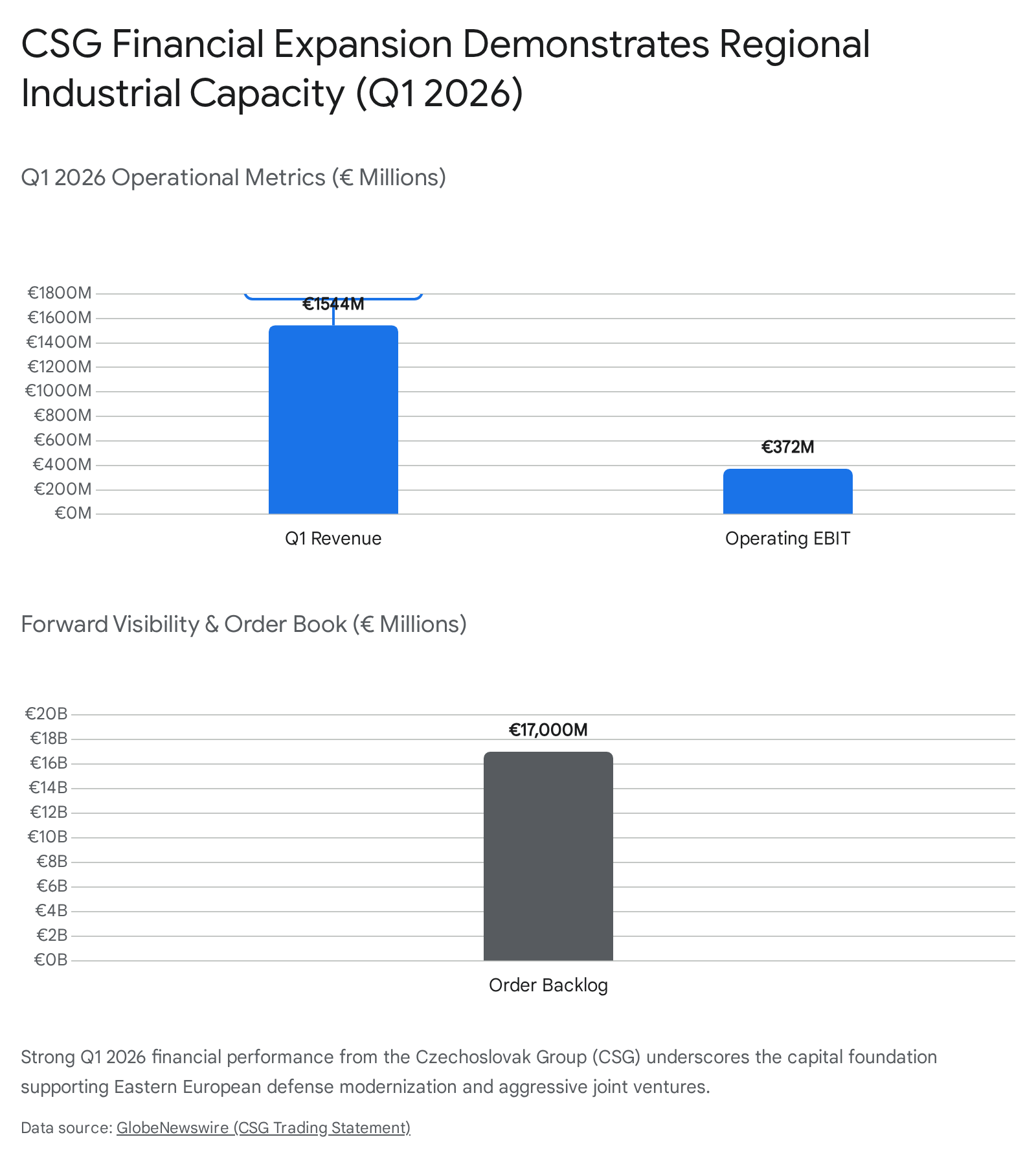
CSG’s strategic roadmap involves aggressive vertical integration and the acquisition of historic defense players across the European continent, including the Tatra truck manufacturing segment and Italian ammunition manufacturer Fiocchi.5 This consolidation strategy provides the capital required to fund complex research and development cycles, such as the CFL-120 Karpat project. According to the company’s Q1 2026 trading statement, CSG generated €1,544 million in revenue during the first three months of the year, representing a 13.8% year-over-year growth trajectory.18 This growth was disproportionately driven by the company’s core Defence Systems businesses, which saw a 26.5% operational increase.18

Bar chart displaying company investments related to IDEB

Perhaps the most critical indicator of future production capacity is CSG’s order backlog, which expanded by 15.1% to reach a staggering €17 billion, largely led by gains in the Land Systems sector.18 This financial security allows the group to execute long-term strategic plans aimed at reducing supply chain vulnerabilities. A primary example showcased alongside IDEB 2026 was the establishment of a new MACS artillery propellant charge facility in Slovakia.18 Formed as a joint venture between ZVS Holding and EURENCO, this facility represents a material step toward in-house propellant production. By deepening vertical integration across its distributed manufacturing network, CSG is scaling its own large-caliber (artillery and tank) ammunition production capacity to exceed 800,000 rounds, fundamentally shifting the company away from simple recommissioning activities toward sovereign, ground-up manufacturing.18 The presence of MSM Group holding companies at IDEB 2026—including ZVS, VOP Nováky, ZVI, and Fábrica de Municiones de Granada—further emphasized this expansive portfolio, displaying medium and large-caliber munitions meeting both NATO and Eastern standards.17

4. Land Mobility and Heavy Platform Evolution

The ongoing reevaluation of ground combat doctrine was highly visible in the armored vehicle segment at IDEB 2026. Military planners are currently balancing the traditional requirement for heavy, densely armored Main Battle Tanks (MBTs) with the urgent need for operational mobility, reduced bridge-weight classifications, and lower logistical footprints. The modern battlefield heavily penalizes slow, logistically demanding formations, pushing designers toward highly mobile, digitally networked platforms.

4.1 The CFL-120 Karpat Medium Tank

One of the most significant unveilings at the exhibition was the CFL-120 Karpat, developed through a strategic partnership between CSG and Turkish defense manufacturer(https://www.fnss.com.tr/en).5 Classified as a medium or light tank, the Karpat is engineered to deliver the striking power of a classic heavy MBT but with vastly superior strategic and tactical flexibility, reducing the immense logistical demands typically associated with armored brigades.11

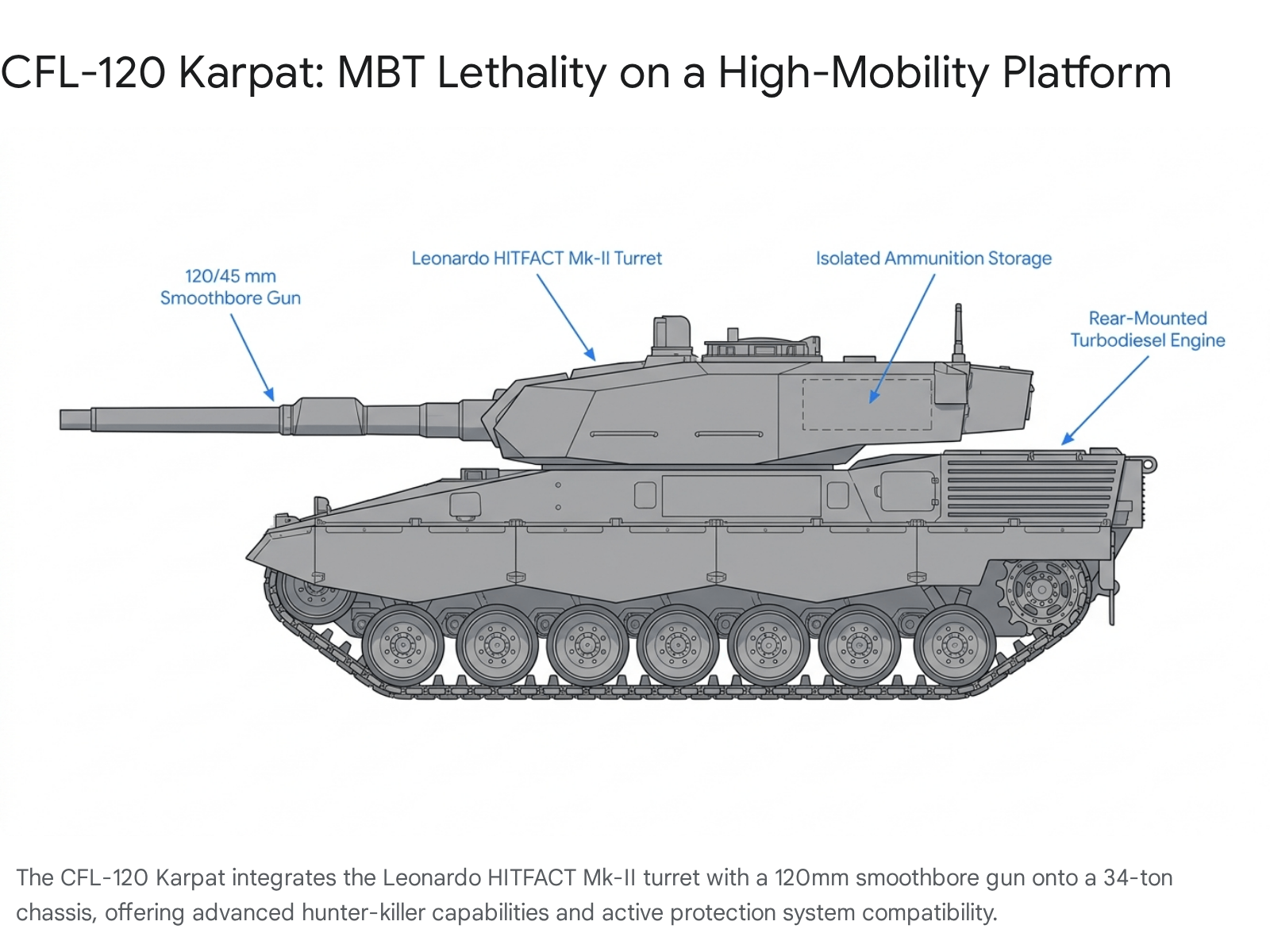
The platform utilizes the combat-proven KAPLAN MT tracked chassis, an architecture originally developed by FNSS to meet the specific geographical and infrastructural constraints of the Indonesian armed forces.5 However, the Karpat significantly upgrades the vehicle’s lethality by integrating the Leonardo HITFACT Mk-II turret. This advanced turret module is armed with a highly capable 120/45 mm smoothbore gun that is fully compatible with all standard NATO 120 mm ammunition.5 This armament choice is critical; it ensures that the 34-ton Karpat can successfully engage and destroy enemy MBTs at extended ranges, matching the firepower of vehicles that weigh twice as much.5 Alternatively, the turret can be fitted with a less powerful but lighter NATO-standard 105/52 mm rifled gun depending on customer requirements.5

The engineering architecture of the CFL-120 Karpat deliberately deviates from standard Infantry Fighting Vehicle (IFV) conversions, which often place the engine in the front to allow for a rear troop ramp. Instead, the Karpat mirrors traditional MBT design by positioning the turbodiesel powerplant at the rear of the hull.5 This configuration allows for optimized frontal glacis protection geometry. Furthermore, the vehicle emphasizes survivability through a turret design that isolates ammunition storage strictly outside the primary crew compartment.5 In the event of an ammunition cook-off resulting from an enemy penetration, blowout panels direct the explosive force outward rather than into the fighting compartment, significantly increasing overall vehicle and crew survivability.5

Diagram of a modern tank with technological specifications

Tactical and operational specifications of the CFL-120 Karpat include an approximate combat weight of 34 tonnes, allowing for safe passage over standard civilian infrastructure and rapid deployment via tactical airlift, which heavier tanks like the M1A2 Abrams or Leopard 2 struggle to achieve.5 The vehicle boasts a top speed of 70 km/h and an operational range of 450 km.5 The fire control suite provides true fire-on-the-move capabilities against moving targets, supported by advanced hunter-killer and killer-killer target engagement protocols enabled by independent day/night, all-weather observation systems for both the commander and the gunner.5 Furthermore, the platform is designed to operate within fully networked modern operational environments, integrating seamlessly with various Battle Management Systems (BMS).5

The Karpat represents a deliberate industrial strategy rather than just a product launch. CSG’s agreement with FNSS focuses on technology transfer processes and the incorporation of the local Slovak supply chain, signaling an intent to establish domestic production lines within Slovakia.5 The Slovak Ministry of Defence is reportedly evaluating the platform to potentially form the backbone of its modernized armored fleet, operating in a complementary role alongside the heavy CV9035 MkIV IFVs recently procured from BAE Systems.11 By combining Turkish platform expertise with Czech and Slovak industrial manufacturing bases, the Karpat aims to offer a highly competitive alternative in the European market.6

4.2 The Borsuk IFV: Export Configuration

Another major development in the armored sector was the debut of the export-configured Borsuk Infantry Fighting Vehicle.7 Developed through a consortium led by Huta Stalowa Wola (a subsidiary of Poland’s state defense group, Polska Grupa Zbrojeniowa – PGZ), the Borsuk is Poland’s next-generation platform designed to replace thousands of aging, highly vulnerable Soviet-era BMP-1 and BWP-1 vehicles currently in Polish Army service.7

At IDEB 2026, PGZ presented the Borsuk integrated not with its standard domestic ZSSW-30 turret, but with the Slovak-manufactured Turra 30V9 unmanned turret from EVPÚ.7 This specific configuration represents Huta Stalowa Wola’s strategy to leverage its Universal Modular Tracked Platform (UMPG) hull into international sales by offering flexible, internationalized weapon and electronic architectures tailored to client specifications.7

The Borsuk chassis is constructed from advanced aluminum alloys layered with modular composite armor, achieving a delicate balance between ballistic protection and buoyancy.7 The vehicle remains fully amphibious without requiring extensive preparation—a critical tactical requirement for navigating the river-dense geography of Eastern Europe and the Baltic states.7 The internal compartment is designed to transport a crew of three and six fully equipped infantry dismounts.7

The presentation of the Borsuk-Turra 30 combination was highly calculated. By utilizing an unmanned turret system that has already been introduced into serial production and operational service within the Armed Forces of the Slovak Republic, PGZ offers potential export clients a technologically mature, low-risk solution with proven reliability.8 Arkadiusz Bąk, First Vice-President of PGZ, emphasized that this joint offering directly addresses the growing global demand for modular combat platforms and reflects a deep industrial partnership based on the exchange of competencies and technologies.4 The Polish Ministry of Defense has previously indicated that it views the Borsuk as a potential export hit, explicitly stating that international promotion of the vehicle is a primary objective for 2026.21

4.3 Wheeled Modular Platforms: Patria AMV XP 8×8

While tracked platforms dominated the heavy vehicle reveals, the wheeled segment was represented by ongoing developments in the Slovak 8×8 program. At IDEB 2026, the Finnish defense group Patria showcased the Patria AMV XP 8×8 armored modular vehicle, which was selected by Slovakia in 2022 to form the core of its mechanized infantry wheeled fleet.1

Patria’s presence highlighted the continued execution of its cooperation agreements with local Slovak industry, ensuring that the manufacturing and lifecycle sustainment of the vehicles generate domestic economic value.1 Alongside the vehicle platform, Patria presented its Sustainment Solutions business area, specifically the Patria OPTIME lifecycle service offering. This system covers comprehensive maintenance support for a wide range of platforms and integrates with the ILIAS Digital Defense Platform to provide data-driven predictive maintenance, ensuring that fleet readiness rates remain high while reducing long-term logistical costs.1

5. Advanced Unmanned Turret Systems and Active Protection

The survivability of armored platforms increasingly relies on keeping crews safe within heavily protected hulls while utilizing external, unmanned systems for target acquisition, situational awareness, and kinetic engagement. The Slovak defense company EVPÚ, headquartered in Nová Dubnica, demonstrated absolute dominance in this sector at IDEB 2026 by showcasing multiple generations of its remote-controlled weapon stations.7

5.1 The Turra 30 V9: Mature Hunter-Killer Architecture

The Turra 30 family of unmanned turrets allows vehicle designers to drastically reduce the overall volume and profile of the vehicle, as no crew members are seated within the turret basket.7 This architectural choice lowers the vehicle’s center of gravity and allows for all crew members to be seated low in the hull, maximizing their protection from direct fire and blast threats.

The Turra 30V9, prominently displayed atop the export Borsuk IFV, features a robust armament package centered around the modernized GTS-30/A automatic cannon. Produced by ZTS Špeciál, this cannon is chambered in the standard Eastern-bloc 30x165mm caliber, ensuring compatibility with existing ammunition stockpiles across the region.7 Secondary armament includes a PKT 7.62mm coaxial machine gun and a dual launcher for Rafael Spike LR2 Anti-Tank Guided Missiles (ATGMs), providing the vehicle with the capability to defeat heavily armored MBTs far beyond the effective range of the main 30mm cannon.7

Crucially, the V9 variant utilizes a sophisticated fire control system featuring a true hunter-killer protocol.7 In combat, the vehicle commander utilizes a highly stabilized, independent panoramic sight (such as the CMS-1) to search the battlefield, identify threats, and lase targets.7 Once a target is designated, the system automatically slews the turret and hands the target off to the gunner, who engages using the CRANE-XLR or CMS-1G targeting optics.7 Simultaneously, the commander returns to searching for the next threat. This parallel processing significantly reduces the engagement cycle time, increasing the vehicle’s lethality in fast-moving combat scenarios against multiple adversaries.7

5.2 The Turra 30 V10: Counter-UAS and Sensor Fusion

While the V9 represents a mature, fielded technology, EVPÚ used IDEB 2026 to push the boundaries of armored warfare even further, winning the GRAND PRIX IDEB 2026 award for its newly unveiled Turra 30 V10 remote-controlled turret.16 The V10 iteration is an aggressive modernization aimed squarely at defending against the proliferation of loitering munitions, anti-tank guided missiles, and First-Person View (FPV) drones that currently dominate the airspace in modern conflicts.22

The V10 upgrade introduces several key capability enhancements designed to create a localized protective dome around the host vehicle. The most significant integration is the Harpia Active Protection System (APS).22 Developed by EVPU Defence, the Harpia is an AI-driven hard-kill system designed to detect and physically defeat incoming ATGMs, rocket-propelled grenades, and hostile UAVs before they impact the vehicle’s armor.22

To augment situational awareness and offensive reach, the V10 incorporates a Multi-Canister Drone Launcher.22 This signals a massive leap in battlefield capabilities, allowing the vehicle crew to deploy their own loitering munitions or intelligence, surveillance, and reconnaissance (ISR) drones directly from the turret.22 By launching organic drones, the crew can extend their sensor reach far beyond the line of sight, inspecting defilades, urban canyons, or reverse slopes without exposing the host vehicle to ambush. For layered close-in defense, the turret also mounts the Gladius TWIN Mini Remote Weapon Station, providing an independent secondary axis of fire against infantry and small drones.22

The effectiveness of these disparate systems is tied together by an advanced tactical situational awareness system. The V10 fuses data from a multi-mission radar, anti-tank firing detectors, and acoustic gunshot locators.22 Advanced AI-based algorithms synthesize this data, providing the crew with optimized engagement solutions and automating defensive responses to incoming threats.24 The main gun armament has also been upgraded, offering the battle-proven 30 mm 2A42 automatic cannon or the Western standard Mk44 Bushmaster II chain gun, delivering 550 rounds per minute fed through a dual-belt system.22 The integrated opto-electronic suite—featuring a cooled thermal camera, TV camera with zoom, and laser rangefinder—ensures targeting precision in all weather conditions.22

Subsystem CapabilityTurra 30 V9 ConfigurationTurra 30 V10 Configuration
Primary Armament30mm GTS-30/A30mm Mk44 Bushmaster II or 2A42
Secondary Armament7.62mm Coaxial MG7.62mm Coaxial MG + Gladius TWIN Mini RCWS
Anti-Tank CapabilityDual Spike LR2 ATGM LauncherIntegrated Dual ATGM Tubes
Active Protection (APS)Modular / Add-on compatibilityIntegrated Harpia AI-based APS
Organic ISR/StrikeNoneMulti-Canister Drone Launcher
Fire Control & SensorsHunter-Killer OptronicsAI-Fused Radar, Acoustic, and Optronic Data

The modularity of the Turra architecture was previously demonstrated at IDET 2025, where Rheinmetall and its partners exhibited a Boxer 8×8 fitted with the Turra 30 V10, proving that the system can be rapidly adapted to both tracked IFVs and heavy wheeled personnel carriers to turn them into multirole assault platforms.23

6. Next-Generation Artillery and Automation

The demand for highly mobile, long-range indirect fire has surged across NATO militaries in response to the static, artillery-heavy attrition warfare observed in recent conflicts. Modern artillery systems must be capable of rapid emplacement, delivering devastating volume of fire, and executing immediate displacement to avoid highly precise counter-battery fire.

6.1 The EVA M3 6×6 Self-Propelled Howitzer

At IDEB 2026, the Slovak defense sector introduced its newest artillery asset: the EVA M3 6×6 self-propelled howitzer, which serves as the new flagship product for(https://kotadef.sk/projekty/eva/?lang=en).9 The system was engineered specifically to provide a lighter, more rapidly deployable alternative to the heavier, fully armored Zuzana 2 8×8 howitzers currently in service with the Slovak Armed Forces.9

The EVA M3 marries the proven lethality of a 155 mm / 52 caliber weapon system with the extreme off-road mobility of the latest generation Tatra Force 3 truck chassis in a 6×6 configuration.9 The platform is designed around a highly automated firing process, enabling the crew of three to operate the system entirely from within a newly designed armored cabin located at the front of the truck.9 This cabin provides necessary protection against small arms fire, shell splinters, and CBRN (Chemical, Biological, Radiological, and Nuclear) threats, ensuring the crew remains safe during high-intensity operations.28

The automation extends deeply into the ammunition handling system. The EVA M3 carries a ready-to-fire combat load of 20 projectiles and 20 propellant charges.9 The autoloader permits a sustained rate of fire of 5 rounds within the first minute, or 13 rounds over three minutes.27 This high initial burst capability is critical for “shoot-and-scoot” tactics. Furthermore, the advanced onboard fire control system supports Multiple Rounds Simultaneous Impact (MRSI) fire missions.28 During an MRSI mission, the onboard ballistic computer calculates varying barrel elevations and propellant charge increments to fire a sequence of shells along different trajectories so that they all arrive on the target at the exact same moment. This maximizes shock, lethality, and surprise before the enemy can seek cover.28

When deploying into a firing position from the march, the vehicle hydraulically lowers heavy anchor spades on each side at the rear of the chassis to stabilize the truck against the intense recoil forces generated by the 155mm gun.27 Firing modern Extended Range Full Bore – Base Bleed (ERFB-BB) ammunition, the EVA M3 can accurately engage targets at a maximum range of 41 kilometers.29 The system’s high strategic mobility, reduced combat weight of approximately 20.2 tonnes, and automated efficiency led the Slovakian armed forces to secure an initial procurement order of 16 units to replace older artillery assets.11

7. Infantry Modernization: Small Arms and Soldier Systems

While heavy armor, autonomous turrets, and automated artillery dictate the operational flow of large-scale combat, the ultimate tactical reality remains grounded in the capabilities, protection, and lethality of the individual infantry soldier. IDEB 2026 provided a detailed view of the Slovak Armed Forces’ comprehensive transition to new small arms ecosystems, ergonomic body armor, and advanced field uniforms.

7.1 Grand Power’s NATO-Standard Transition

For decades, many Eastern Flank militaries relied heavily on modernized variants of the Soviet-era AK platform, chambered in 7.62x39mm or 5.45x39mm. Maintaining non-standard calibers creates significant logistical friction during multinational NATO deployments. Slovakia used IDEB 2026 to publicly confirm its complete, systemic transition to the NATO-standard 5.56x45mm AR-15 architecture.11 The Ministry of Defense strategically selected domestic firearms manufacturer Grand Power to supply the new family of infantry weapons.11 This decision establishes a secure, localized supply chain for spare parts and maintenance, while enabling continuous, iterative development based on immediate, hands-on feedback provided by professional soldiers.11

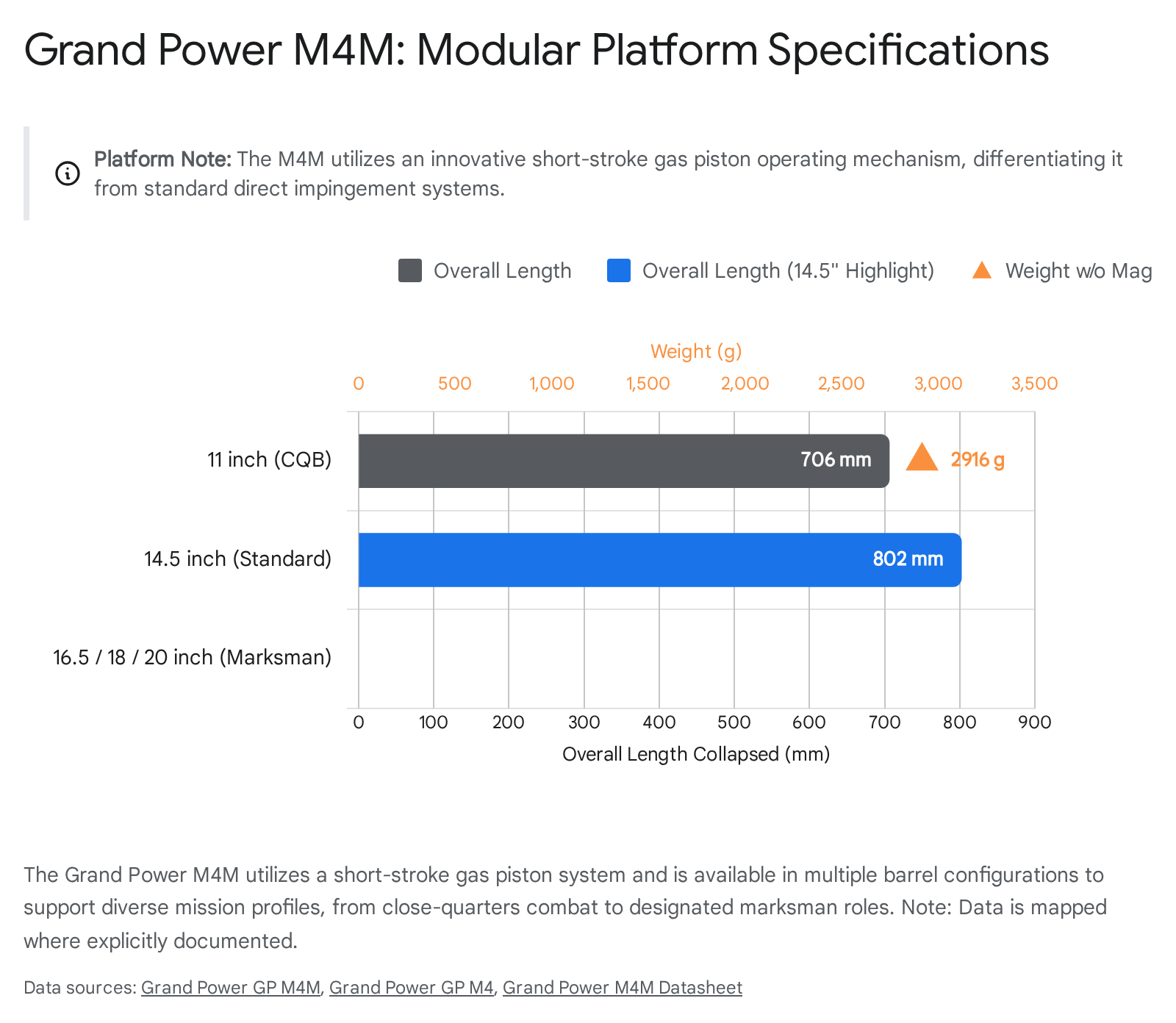
The future standard service rifle of the Slovakian armed forces is the Grand Power M4M assault rifle.11 While Grand Power manufactures a standard direct-impingement M4 model, the M4M variant selected utilizes an innovative short-stroke gas piston operating system.30 In a direct-impingement system, hot expanding gases from the fired cartridge are blown directly back into the receiver to cycle the action, which can lead to rapid carbon fouling and overheating. The M4M’s short-stroke piston system mitigates this by tapping the gas near the front of the barrel to strike an operating rod, which then pushes the bolt carrier group rearward. This keeps the receiver significantly cooler and cleaner, drastically improving reliability, particularly when operating with sound suppressors.32 The M4M also features an adjustable gas block, nitride/QPQ treated barrels for enhanced longevity and corrosion resistance, and fully ambidextrous controls for bilateral operation.31

Graph illustrating Power M4M modular platform specifications for

The procurement strategy involves a tiered deployment of the M4M platform to support diverse tactical requirements. The standard rifle will be issued to regular infantry formations, while a shortened variant—the 11-inch barrel model—is being procured specifically for special operations units requiring compact firepower for close-quarters battle.11

Beyond the primary service rifle, the Grand Power contract encompasses a complete small arms ecosystem:

  • GP R10 Sniper Rifle: Designed to support long-range precision engagements at the squad and platoon levels.11
  • Stribog SP9 A3 Submachine Guns: Chambered in 9x19mm, these highly compact weapons are being issued to military police, special units, and specifically to tank and armored vehicle crews who require potent personal defense weapons within the confined spaces of vehicle interiors.11
  • Grand Power Q1 Pistol: The Q1 will serve as the new standard-issue sidearm.11 It features the company’s signature rotating barrel locking mechanism, which significantly reduces perceived recoil and muzzle flip compared to standard tilting-barrel designs, allowing for faster follow-up shots.34

Deliveries of this comprehensive weapons package are expected to commence in 2026 and continue over a structured two-year rollout program.11

7.2 Next-Generation Camouflage and Ballistic Protection

To complement the lethality of the new weaponry, the Slovak army used IDEB 2026 to reveal a fundamental overhaul of its combat uniforms and individual protection equipment. The military is formally abandoning its legacy VZ07 pixelated digital camouflage pattern, which has served as the standard for years.10 The replacement pattern, officially designated VZOR 25 (VZ25), relies on large, macro-pattern disruptions that closely resemble the classic British Disruptive Pattern Material (DPM).10 This aesthetic shift suggests a tactical refocusing toward effective concealment in the dense, organic woodland environments characteristic of Central and Eastern Europe, moving away from multi-terrain compromise patterns.

The uniform designs themselves have been upgraded to align with premium modern Western standards. The procurement includes two distinct sets designed for different operational profiles.10 The “Field Uniform” is designed for daily garrison service and standard field problems, featuring ergonomic, highly pocket-friendly layouts.10 The “Combat Suit,” conversely, is engineered for direct action. It integrates a breathable combat shirt designed specifically to be worn underneath heavy body armor and plate carriers without causing severe heat stress to the operator.10 The combat pants feature integrated knee protection and dynamic stretch panels, heavily mimicking high-end tactical designs popularized by manufacturers like Crye Precision.10 To balance economic constraints with material quality, the base fabric is sourced from specialized textile mills in Croatia, while the final assembly, cutting, and sewing are conducted domestically within Slovakia.10

In the realm of headborne protection, the Croatian manufacturer Šestan-Busch was awarded the PRIX IDEB 2026 award for its advanced ballistic helmets.16 Modern combat helmets are no longer simple shrapnel deflectors; they are complex platforms that must safely mount heavy night vision goggles (NVGs), communication headsets, strobes, and battery packs without fatiguing the operator’s neck over long patrols. Šestan-Busch’s designs are recognized for utilizing hybridized aramid material solutions that offer high-level ballistic resistance (often meeting NIJ IIIA standards against handgun threats) and blunt trauma protection, while aggressively reducing overall system weight.35 The inclusion of standardized ARC rails and NVG shrouds facilitates seamless integration with modern communication and optical systems, ensuring the infantryman remains a networked node on the battlefield.

8. Combat Engineering and Specialized Logistics

A recurring strategic lesson from contemporary high-intensity conflicts is that offensive maneuver and defensive fortification rely absolutely on robust combat engineering capabilities. Mechanized spearheads require engineers to breach obstacles, while defensive lines require rapid entrenchment to survive artillery barrages. At IDEB 2026, CSM Industries demonstrated its prowess in this vital sector, winning the PRIX IDEB 2026 award for its UDS4 VTV 4×4 exhibit.16

(https://www.uds.sk/), a highly experienced Slovakian firm with a history dating back to 1967 and over 30,000 machines produced, specializes in the Universal Finishing Machine (UDS) series of multi-purpose telescopic excavators.38 These heavy military excavator vehicles are highly specialized assets engineered for rapidly altering battlefield topography under extreme conditions.

During rigorous operational testing conducted by the Armed Forces at the Military Training and Testing area in Lešť, Slovakia, CSM’s platforms demonstrated exceptional performance metrics. The testing evaluated the excavator’s ability to construct infantry trenches, anti-tank obstacles, and massive tank trenches.40 The UDS system demonstrated the ability to construct a complete, precisely dimensioned tank trench—measuring 4.5 meters wide, 7 meters long, and 1.5 meters deep, complete with entry ramps—in just 50 minutes, significantly exceeding standard military engineering time limits.40

The integration of such specialized, high-power engineering equipment onto modern, off-road capable 4×4, 6×6, and 8×8 military truck chassis (often sourced from Tatra) ensures that combat engineering elements can maintain pace with rapid mechanized advances.41 This tactical mobility allows engineers to rapidly deploy anti-tank obstacles to channel enemy armor, dig infantry fortifications ahead of an assault, and clear urban debris under contested conditions without falling behind the main body of the force.

9. Electromagnetic Spectrum Dominance and Counter-UAS

The proliferation of cheap, highly capable unmanned aerial systems (UAS) has rendered traditional physical camouflage and concealment highly vulnerable. Ground forces are under constant, pervasive surveillance from the sky. Furthermore, the use of active radar emissions to detect these drones acts as a brilliant beacon for enemy anti-radiation missiles and electronic intelligence gathering, making the cure almost as dangerous as the disease. Surviving the modern battlefield requires dominating the electromagnetic spectrum without exposing one’s own position.

Addressing this critical vulnerability, the Swedish aerospace and defense company Saab showcased its Sirius Compact L24R at IDEB 2026.4 The Sirius Compact is a highly advanced, passive electronic warfare (EW) sensor designed for both strategic national security applications and tactical situational awareness.4

Unlike traditional air defense radar, which emits strong pulses of electromagnetic energy to illuminate and detect targets, passive sensors like the Sirius Compact emit absolutely zero signals.43 Instead, they act as highly sensitive listening devices across the electromagnetic spectrum. They detect, classify, and accurately geolocate the radio frequency (RF) emissions of enemy drones, data links, communication nodes, and hostile radar systems.13

This passive detection capability allows small tactical units or fixed strategic installations to build a comprehensive, real-time map of the airspace and ground environment without ever revealing their own physical location to enemy electronic intelligence.13 When integrated into broader battle management architectures—such as Saab’s scalable 9Air C4I system—the data gathered by passive sensors can instantly cue kinetic counter-drone engagements, direct precision artillery fire against enemy electronic nodes, or alert friendly units to seek hard cover before an enemy drone swarm arrives.13

10. Strategic Lessons Learned and Future Outlook

The 2026 iteration of the IDEB Defence & Security exhibition clearly articulated the technological, doctrinal, and industrial trajectory of NATO’s Eastern Flank. By analyzing the aggregate data from the exhibitions, product configurations, and executive statements, distinct macro-trends emerge regarding the future of defense procurement and ground combat operations.

First, the vulnerability of globalized supply chains during extended military crises has triggered a sharp, irreversible pivot toward regional industrial autarky. Poland, Slovakia, and the Czech Republic are no longer content to act solely as end-users of imported Western technology. The Borsuk export variant (combining a Polish chassis with a Slovak turret) and the CFL-120 Karpat (integrating Turkish/Czech intellectual property with Slovak production capacity) are prime examples of collaborative risk-sharing.5 By exchanging core competencies, these nations establish redundant, secure manufacturing nodes within European borders. This industrial strategy fulfills domestic political mandates to keep defense spending local while simultaneously creating highly competitive, export-ready products.21

Second, the hardware revealed in Bratislava reflects a highly pragmatic response to the tactical realities of contemporary conflict, characterized by a “light and lethal” paradigm shift. The prominence of the Karpat medium tank and the EVA M3 6×6 howitzer highlights a growing preference for strategic mobility over sheer mass. While heavy 70-ton MBTs and massive tracked self-propelled guns boast unparalleled physical survivability, they severely strain logistical infrastructure, consume immense quantities of fuel, and are notoriously difficult to transport rapidly across crumbling civilian bridges or muddy terrain. The new generation of ground platforms accepts a reduction in raw passive armor mass in exchange for the speed required to maneuver rapidly, strike decisively, and displace before the enemy can coordinate counter-battery fire.

Finally, with the deliberate reduction in passive armor, vehicle survivability is increasingly achieved through technological intervention and autonomy. The evolution from the Turra 30 V9 to the V10 demonstrates the rapid, non-negotiable adoption of Active Protection Systems and organic counter-UAS capabilities.22 The modern armored vehicle is no longer a standalone bunker; it is a digitally networked sensor node. By utilizing unmanned turrets, commanders keep their crews deep within the armored hull while AI-driven optronics, radar, and acoustic sensors identify and neutralize incoming threats automatically.7

Ultimately, IDEB 2026 proved that Central and Eastern European defense conglomerates are actively securing their national supply chains and positioning themselves not just as capable allies, but as primary architects of the next generation of European defense technology.


Please share the link on Facebook, Forums, with colleagues, etc. Your support is much appreciated and if you have any feedback, please email us in**@*********ps.com. If you’d like to request a report or order a reprint, please click here for the corresponding page to open in new tab.


Sources Used

  1. Patria at IDEB Defence & Security 2026, accessed May 20, 2026, https://www.patriagroup.com/newsroom/meet-patria-at-events/patria-at-ideb-defence-security-2026
  2. IDEB Defence & Security – Bratislava – Incheba.sk, accessed May 20, 2026, https://www.incheba.sk/en/fairs-and-exhibitions/ideb-defence-security-2/
  3. Invitation – Saab, accessed May 20, 2026, https://www.saab.com/globalassets/markets/slovakia/saab_invitation_ideb_2026_svk_generic.pdf
  4. PGZ unveils export version of Borsuk infantry fighting vehicle with Turra 30 turret at IDEB 2026 – Defence Industry Europe, accessed May 20, 2026, https://defence-industry.eu/pgz-unveils-export-version-of-borsuk-infantry-fighting-vehicle-with-turra-30-turret-at-ideb-2026/
  5. shownews – IDEB 2026: FNSS … – FW-MAG Future Warfare Magazine, accessed May 20, 2026, https://www.fw-mag.com/shownews/1078/ideb-2026-fnss-unveils-the-cfl-120-karpat-light-tank-and-signs-cooperation-agreement-with-csg
  6. CSG and FNSS Unveil Strategic Cooperation and Introduce the New CFL-120 Karpat Combat Vehicle | ASDNews, accessed May 20, 2026, https://www.asdnews.com/news/defense/2026/05/12/csg-fnss-unveil-strategic-cooperation-introduce-new-cfl120-karpat-combat-vehicle
  7. Poland debuts export Borsuk fighting vehicle at IDEB 2026 – The Defence Blog, accessed May 20, 2026, https://defence-blog.com/poland-debuts-export-borsuk-fighting-vehicle-at-ideb-2026/
  8. Attention! A New Predator in Bratislava – ASDNews, accessed May 20, 2026, https://www.asdnews.com/news/defense/2026/05/12/attention-new-predator-bratislava
  9. News from KONŠTRUKTA – Defence, a.s. | www.incheba.sk, accessed May 20, 2026, https://www.incheba.sk/en/novinky_na_veltrhu/news-from-konstrukta-defence-a-s/
  10. The new Slovak uniform | SPARTANAT, accessed May 20, 2026, https://spartanat.com/en/die-neue-slowakische-uniform
  11. IDEB 2026: Slovakian army presents its new weapons – Militär Aktuell, accessed May 20, 2026, https://militaeraktuell.at/en/ideb-2026-slovakian-army-presents-its-new-weapons/
  12. The new Slovak uniform – SPARTANAT.com, accessed May 20, 2026, https://www.spartanat.com/en/die-neue-slowakische-uniform
  13. Slovakia – Saab, accessed May 20, 2026, https://www.saab.com/markets/slovakia
  14. IDEB Defence &Security | www.incheba.sk, accessed May 20, 2026, https://www.incheba.sk/en/fairs-and-exhibitions/ideb-defence-security/
  15. Eastern Flank Review, 06.05-12.05.2026, accessed May 20, 2026, https://easternflank.org/eastern-flank-review-06-05-12-05-2026/
  16. Final Press Release IDEB Defence & Security 2026 | www.incheba.sk, accessed May 20, 2026, https://www.incheba.sk/en/news/final-press-release-ideb-defence-security-2026/
  17. CSG to Showcase Modern Vehicles and New Projects at the IDEB 2026 Defense Technology Exhibition in Bratislava | DEFENSEMAGAZINE.com, accessed May 20, 2026, https://www.defensemagazine.com/article/csg-to-showcase-modern-vehicles-and-new-projects-at-the-ideb-2026-defense-technology-exhibition-in-bratislava
  18. CSG Q1 2026 Trading Statement: Strong Start to the Year in – GlobeNewswire, accessed May 20, 2026, https://www.globenewswire.com/news-release/2026/05/20/3298164/0/en/CSG-Q1-2026-Trading-Statement-Strong-Start-to-the-Year-in-Q1-FY-2026-Guidance-Reaffirmed.html
  19. CSG and FNSS Unveil Strategic Partnership and CFL-120 Karpat at IDEB 2026, accessed May 20, 2026, https://www.defensemagazine.com/article/csg-and-fnss-unveil-strategic-partnership-and-cfl-120-karpat-at-ideb-2026
  20. Türkiye and Czech Republic Reveal CFL-120 Karpat Medium Tank as New NATO and M1A2 Abrams Alternative – Army Recognition, accessed May 20, 2026, https://www.armyrecognition.com/news/army-news/2026/tuerkiye-and-czech-republic-reveal-cfl-120-karpat-medium-tank-as-new-nato-and-m1a2-abrams-alternative
  21. Polish army receives first Borsuk fighting vehicles – The Defence Blog, accessed May 20, 2026, https://defence-blog.com/polish-army-receives-first-borsuk-fighting-vehicles/
  22. Slovakia’s TURRA 30 V10 Packs Lethal Punch with 30mm Autocannon RCWS ATGMs and Drones – MilitaryLeak.COM, accessed May 20, 2026, https://militaryleak.com/2025/07/14/slovakias-turra-30-v10-packs-lethal-punch-with-30mm-cannon-and-anti-tank-missiles/
  23. Boxer (armoured fighting vehicle) – Wikipedia, accessed May 20, 2026, https://en.wikipedia.org/wiki/Boxer_(armoured_fighting_vehicle)
  24. DSEI 2025 – FFG showcases its Condor future air defence vehicle – EDR Magazine, accessed May 20, 2026, https://www.edrmagazine.eu/dsei-2025-ffg-showcases-its-condor-future-air-defence-vehicle
  25. BOXER 8×8 Highly Protected Wheeled Armored Vehicle | DEFENSEMAGAZINE.com, accessed May 20, 2026, https://www.defensemagazine.com/article/boxer-8×8-highly-protected-wheeled-armored-vehicle
  26. News from Quantum Systems GmbH | www.incheba.sk, accessed May 20, 2026, https://www.incheba.sk/en/novinky_na_veltrhu/news-from-quantum-systems-gmbh/
  27. Konstrukta Defence of Slovakia unveils its EVA a new 6×6 155 mm self-propelled howitzer at IDET 1905155 – Army Recognition, accessed May 20, 2026, https://www.armyrecognition.com/archives/archives-land-defense/land-defense-2015/konstrukta-defence-of-slovakia-unveils-its-eva-a-new-6×6-155-mm-self-propelled-howitzer-at-idet-1905155
  28. EVA – KONŠTRUKTA – Defence, accessed May 20, 2026, https://kotadef.sk/projekty/eva/?lang=en
  29. 155 mm SpGH EVA – Wikipedia, accessed May 20, 2026, https://en.wikipedia.org/wiki/155_mm_SpGH_EVA
  30. GP M4 – GRAND POWER Ltd, accessed May 20, 2026, https://grandpower.eu/products/product-categories/law-enforcement-and-military/gp-m4/
  31. The GP M4M is a robust, reliable, short stroke piston operated, select fire rifle chambered in popular 5,56×45 NATO calibre. M, accessed May 20, 2026, https://grandpower.eu/wp-content/uploads/2024/10/M4M-Datasheet.pdf
  32. GP M4 & GP M4M USER MANUAL Basic Description The GRAND POWER M4 / M4M is a modern semiautomatic rifle chambered in .5.56 NA – Trueaim, accessed May 20, 2026, https://trueaim.fi/kauppa/storage/2023/04/safety-manual-R15-rifles-EN.pdf
  33. GP M4M – GRAND POWER Ltd, accessed May 20, 2026, https://grandpower.eu/products/product-categories/law-enforcement-and-military/gp-m4m/
  34. GRAND POWER: High quality firearms, accessed May 20, 2026, https://grandpower.eu/
  35. Top 5 Ballistic Helmets in 2026 – ActionStreamer, accessed May 20, 2026, https://actionstreamer.com/blog/top-5-ballistic-helmets-in-2026
  36. SESTAN-BUSCH | Company – Enforce Tac, accessed May 20, 2026, https://www.enforcetac.com/en/exhibitors/sestan-busch-2547848
  37. Busch Protective awarded FBI ballistic helmet contract – Police1, accessed May 20, 2026, https://www.police1.com/police-products/duty-gear/helmets/busch-protective-awarded-fbi-ballistic-helmet-contract
  38. CSM Industry s.r.o. – FindIn.sk, accessed May 20, 2026, https://findin.sk/en/company/csm-industry-sro/b18201ec-9bcc-ee11-a854-fa163e0a3f57
  39. Company – CSM Industry s.r.o., accessed May 20, 2026, https://csm.sk/
  40. Rheinmetall UDS Multi-tool Heavy Military Excavator Vehicle – Tank Trench – YouTube, accessed May 20, 2026, https://www.youtube.com/watch?v=Zxm29rDRJwk
  41. CSM Industry Debuts At IDEX With Its Military Exacavator Together With IGG UAE, accessed May 20, 2026, https://www.globaldefensecorp.com/2021/02/25/csm-industry-debuts-at-idex-with-its-military-exacavator-together-with-igg-uae/
  42. Azerbaijan orders 96 Slovak SAM120 mortars in €210 mln deal signed in Riyadh, accessed May 20, 2026, https://defence-industry.eu/azerbaijan-orders-96-slovak-sam120-mortars-in-e210-mln-deal-signed-in-riyadh/
  43. The passive sensor Sirius Compact from Saab – Militär Aktuell, accessed May 20, 2026, https://militaeraktuell.at/en/the-passive-sensor-sirius-compact-from-saab/
  44. Poland signs a record €17.2 billion contract for 1400 Borsuk armoured vehicles, accessed May 20, 2026, https://www.defensemagazine.com/article/poland-signs-a-record-eur172-billion-contract-for-1400-borsuk-armoured-vehicles

Black Sea Defense & Aerospace (BSDA) 2026: Strategic Shifts, Emerging Technologies, and Operational Lessons

1. Executive Summary

The Black Sea Defense & Aerospace exhibition, convened in Bucharest, Romania, from May 13 to May 15, functioned as a critical indicator of the rapidly altering defense posture along the Eastern Flank of the North Atlantic Treaty Organization (NATO). Conducted simultaneously with the Bucharest Nine (B9) Summit—a gathering of Eastern European heads of state—the tenth edition of this biennial event was the largest in its history, assembling more than 550 exhibiting companies from 36 countries and drawing an estimated 30,000 visitors, including senior political and military leadership.1Against the immediate backdrop of protracted high-intensity conflict in neighboring Ukraine, the exhibition delineated a fundamental transition in European defense procurement doctrine. The prevailing paradigm has demonstrably pivoted away from standard, off-the-shelf foreign military sales (FMS) toward the establishment of sovereign industrial capacity, rapid technology transfer, and mandatory localized manufacturing.

Analysis of the capabilities demonstrated, industrial agreements signed, and doctrinal lessons discussed at the Romaero Băneasa complex reveals four primary operational trajectories defining the modernization of regional forces. First, there is a distinct prioritization of localized small arms and tactical vehicle manufacturing. This is evidenced by strategic maneuvers from global defense primes, including SIG SAUER and Otokar, to establish permanent industrial footprints within Romanian borders, thereby securing vital supply chains. Second, the integration of Manned-Unmanned Teaming (MUM-T) has matured from theoretical concepts to deployable, electronic warfare-resilient doctrines, highlighted by the trilateral agreement between Hanwha Aerospace and Milrem Robotics to co-produce autonomous platforms.

Third, the approach to Counter-Unmanned Aerial Systems (C-UAS) has evolved strictly to address the unsustainable cost-exchange ratios of traditional missile-based air defense. Kinetic interceptor drones, such as the Ukrainian-developed P1-SUN, and non-kinetic cyber-takeover systems dominated the air defense discussions. Finally, Black Sea naval dynamics are forcing unprecedented agility in maritime procurement. This was demonstrated by Romania’s expedited acquisition of a Turkish-built Hisar-class corvette, bypassing standard European shipbuilding delays, and the rollout of artificial intelligence-assisted coastal defense networks designed to protect critical energy infrastructure like the Neptun Deep project.

This document synthesizes the technological debuts, industrial frameworks, and doctrinal observations from BSDA 2026, offering a detailed assessment of the systems and strategic calculations that will shape the forward defense architecture of the region over the coming decade.

2. Strategic Context: The Black Sea as the Center of Gravity

To accurately interpret the technological and industrial developments at BSDA 2026, one must evaluate the strategic geography and political directives shaping the region. The Black Sea is no longer viewed as a peripheral area of regional interest; it constitutes the active frontline of European security.4 Sharing a border of over 400 miles with Ukraine, Romania has emerged as one of the Alliance’s most consequential frontline states, necessitating the forward deployment and equipping of combat power that is continually ready for engagement.4

The national response to this heightened threat environment has been characterized by aggressive fiscal commitments to defense. The Romanian government has mandated the allocation of 2.5 percent of its Gross Domestic Product (GDP) to defense expenditures, placing it among the highest proportional spenders within NATO and signaling a commitment to position the nation as an industrial leader within the defense industrial base.5

However, the sheer allocation of capital is recognized as only one facet of the strategic shift. A primary lesson absorbed from the attrition warfare observed in the Ukrainian theater is that financial capital cannot easily or immediately replace industrial capacity during a conflict. Supply chain brittleness, particularly the reliance on overseas manufacturing for basic munitions, infantry equipment, and replacement parts, constitutes a severe strategic vulnerability. Consequently, the Romanian Ministry of National Defence (MApN) and the Ministry of Economy have implemented procurement policies heavily favoring acquisitions that include substantial offset agreements, technology transfers, and localized production mandates.

The presence of the state-owned defense consortium ROMARM and its subsidiaries—including Fabrica de Arme Cugir, Automecanica Moreni, Carfil S.A., and Metrom—at the forefront of international partnerships during BSDA 2026 signifies a deliberate effort to revitalize a domestic industrial base that experienced post-Cold War stagnation.3The convergence of the B9 Summit in Bucharest precisely during the exhibition amplified this strategic gravity, facilitating direct dialogues between heads of state, military chiefs of staff, and defense industry executives regarding the immediate deployment of NATO-interoperable combat power backed by secure, sovereign supply chains.1

3. Small Arms and Dismounted Infantry Systems Modernization

A critical vulnerability within the Romanian Land Forces, and similarly structured Eastern European militaries, has been the fragmented nature of its dismounted infantry weaponry. The legacy arsenal features a mix of Warsaw Pact systems, primarily the 5.45x39mm PA md. 86 and the older 7.62x39mm PM md. 63, alongside limited quantities of 5.56x45mm NATO-standard rifles issued primarily to special operations and deployed elements.8 The logistical burden of supplying three disparate intermediate calibers, along with non-interchangeable magazines and spare parts, to front-line combat formations constitutes a severe operational liability during high-intensity conflict. BSDA 2026 highlighted major initiatives to rectify this through domestic industrial partnerships.

3.1. Sovereign Production and the SIG SAUER Initiative

The most consequential development in the small arms sector surrounding the event was the strategic groundwork laid by SIG SAUER. In April 2026, Ron Cohen, the Chief Executive Officer of SIG SAUER, a major supplier to the U.S. Military and manufacturer of the M8 rifle selected for the Next Generation Squad Weapon (NGSW) program, conducted a highly targeted visit to the historic Cugir industrial platform in Alba County.5

This visit was not a routine sales delegation but an assessment aimed at establishing a long-term industrial commitment to solve Romania’s stalled assault rifle modernization program. SIG SAUER established a direct local footprint by registering SSI Legion SRL in Cugir, positioning the subsidiary as a licensed arms manufacturer within Romanian territory.5 The objective of this maneuver is to map local industrial capabilities at established facilities such as Nova Modul SRL, Fabrica de Arme Cugir, and S. Uzina Mecanica Cugir S.A. to identify capable co-manufacturing partners.5

The proposed industrial package involves a comprehensive transfer of technical know-how. This includes the provision of technical data packages (TDPs), advanced production machinery, specialized workforce training programs, and the alignment of local metallurgical standards to strict NATO specifications.5 By establishing an “industrial platform” rather than merely treating the nation as an export market, SIG SAUER aims to provide the Romanian military with a fully NATO-compliant rifle portfolio manufactured entirely locally.5 This methodology ensures that, in the event of regional hostilities, the production lines for primary infantry weapons and replacement parts remain sovereign and insulated from global supply chain disruptions or political embargoes.

3.2. Turkish Penetration into the NATO Firearms Market

The exhibition also demonstrated the aggressive expansion of Turkish small arms manufacturers into European and NATO markets. SARSILMAZ, a major Turkish defense contractor, utilized BSDA 2026 as a platform to display a comprehensive suite of pistols, assault rifles, and military-grade firearms explicitly tailored for NATO caliber standards.10 The notable presence of Turkish small arms firms at an Eastern European exhibition underscores a broader geopolitical trend: Turkey is actively leveraging its highly integrated, cost-effective defense industrial base to secure market share in regions urgently seeking to rearm. By offering rapidly deployable, cost-competitive alternatives to traditional Western European and American suppliers, Turkish manufacturers are positioning themselves as vital nodes in the broader NATO logistics network.

3.3. Advanced Optics and Sensor Superiority

Modern dismounted combat requires absolute sensor supremacy. The ability to detect, identify, and engage targets before the adversary can react is a primary determinant of infantry survivability. At BSDA 2026, Thales showcased advanced optical solutions designed to enhance dismounted lethality. Central to their display was the XTRAIM Weapon Sight, an innovative sighting system that blends day optics and thermal/night vision capabilities, offering high precision and operational flexibility in dynamic environments.11The tactical advantage of seamlessly transitioning optical modes without requiring the operator to break cheek weld or manually swap optics is immense, particularly in contested urban terrain.

Furthermore, Thales exhibited the NightRise NVG (Night Vision Goggle) range, specifically highlighting the PANORAMIC and HELIE models.11 The PANORAMIC configuration addresses a historical limitation of traditional night vision tubes—severe tunnel vision—by providing an extended field of view. This drastically improves the operator’s peripheral situational awareness, a critical factor in close-quarters battle. The HELIE model focuses heavily on ergonomic endurance, engineered for long-term use in austere conditions to mitigate the cervical strain frequently associated with extended helmet-mounted optic usage.11

Beyond dismounted infantry, Thales also demonstrated the Scorpion system, a helmet-mounted display optimized for fighter pilots, including those operating the F-16 Fighting Falcon.11 The Scorpion system projects essential navigational and tactical data via color symbols and video images directly onto the pilot’s visor for both day and night missions.11 By installing the system directly onto standard pilot helmets, it facilitates rapid target identification in degraded visual environments while reducing the overall footprint of equipment required within the cockpit, optimizing lifecycle maintenance costs.11

4. Armored Vehicle Platforms and Digital Battle Management

The requirement for mobile, survivable, and digitally networked armor remains foundational to territorial defense in Eastern Europe. BSDA 2026 served as a primary showcase for heavy and medium armored platforms, with an explicit emphasis on integrating these vehicles into digital battle management architectures and transitioning their final assembly to local production facilities.

4.1. Localized Assembly and the COBRA II Milestone

A major industrial milestone presented at the exhibition was the debut of the first COBRA II armored vehicle manufactured entirely in Romania.12 Produced by the Turkish defense firm Otokar, the vehicle rolled off the production line at the Mediaș facility, signaling the activation of a mass production schedule set to commence in June 2026.12 This development follows Otokar’s €85 million acquisition of Automecanica S.A., including its extensive manufacturing facility, formally establishing Romania as a strategic hub for managing European defense contracts.12

The local production of the COBRA II fulfills Romania’s stringent offset obligations under the ATBTU (Armored Tactical Vehicles) project and ensures that NATO-standard armored platforms are built, maintained, and repaired domestically.12 The COBRA II platform itself offers high levels of ballistic and mine protection alongside significant modular payload capacity, making it a highly versatile asset for infantry mobility, reconnaissance, border patrol, and internal security operations. Otokar additionally displayed its Next-Generation UGV and the TULPAR Infantry Fighting Vehicle (IFV) at the Romaero complex, signaling intent to compete for heavier armor contracts.12

4.2. Heavy Armor and Modular Weapon Stations

While medium wheeled armor fulfills rapid mobility requirements, heavy tracked armor remains the core of land combat power. German defense manufacturer Rheinmetal presented a commanding display focusing heavily on its integrated land warfare systems.14The centerpiece of their land systems portfolio at BSDA was the Lynx KF41 Infantry Fighting Vehicle.16The platform was showcased equipped with a Lance turret featuring the 30mm MK30-2/ABM (Air Burst Munition) automatic cannon and the Main Sensor Slaved Armament (MSSA) weapon station.15

The Lynx KF41 is designed with a highly modular open-systems architecture, allowing for rapid mission reconfiguration. Rheinmetall explicitly utilized the exhibition to offer customized concepts for local manufacturing capabilities and direct technology transfer to the Romanian defense industry, aligning perfectly with Bucharest’s localized procurement doctrine.15 Romanian acquisition plans indicate a strong interest in procuring up to 232 Lynx vehicles, potentially financed through the European Union’s SAFE defense mechanism, marking it as one of the country’s most significant modernization programs.17

Similarly, Elbit Systems utilized the event to showcase locally produced solutions at the Elmet booth, specifically displaying the 30mm unmanned turret selected for the Romanian Army’s Piranha V armored personnel carriers.18 The presentation of remotely controlled weapon stations and advanced mortar systems like the Iron Sting precision mortar emphasizes the shift toward increasing the lethality and precision of mechanized infantry without exposing crew members to direct enemy fire.18

4.3. Digital Command Architectures for the M1A2 SEPv3

The modernization of Romania’s main battle tank fleet was addressed comprehensively by Leonardo DRS. Following a 2024 contract award through the U.S. Government Foreign Military Sales program to provide Battle Management Systems (BMS) for the Romanian Land Forces’ newly acquired M1A2 SEPv3 Abrams tanks, Leonardo DRS demonstrated its battle command computing backbone at BSDA 2026.4

The transition from legacy Soviet-era armor, which relied on rudimentary voice communications, to a digitally networked force relies entirely on these advanced computing architectures. The Leonardo DRS BMS acts as the central nervous system of the armored brigade combat team. It turns isolated vehicular platforms into a cohesive, decision-ready fighting force by enabling real-time data sharing, precision blue-force tracking, and rapid sensor-to-shooter integration.4 This digital networking ensures that Romanian armored units can operate seamlessly alongside U.S. and allied NATO forces in complex, multi-domain environments.

5. The Maturation of Manned-Unmanned Teaming (MUM-T)

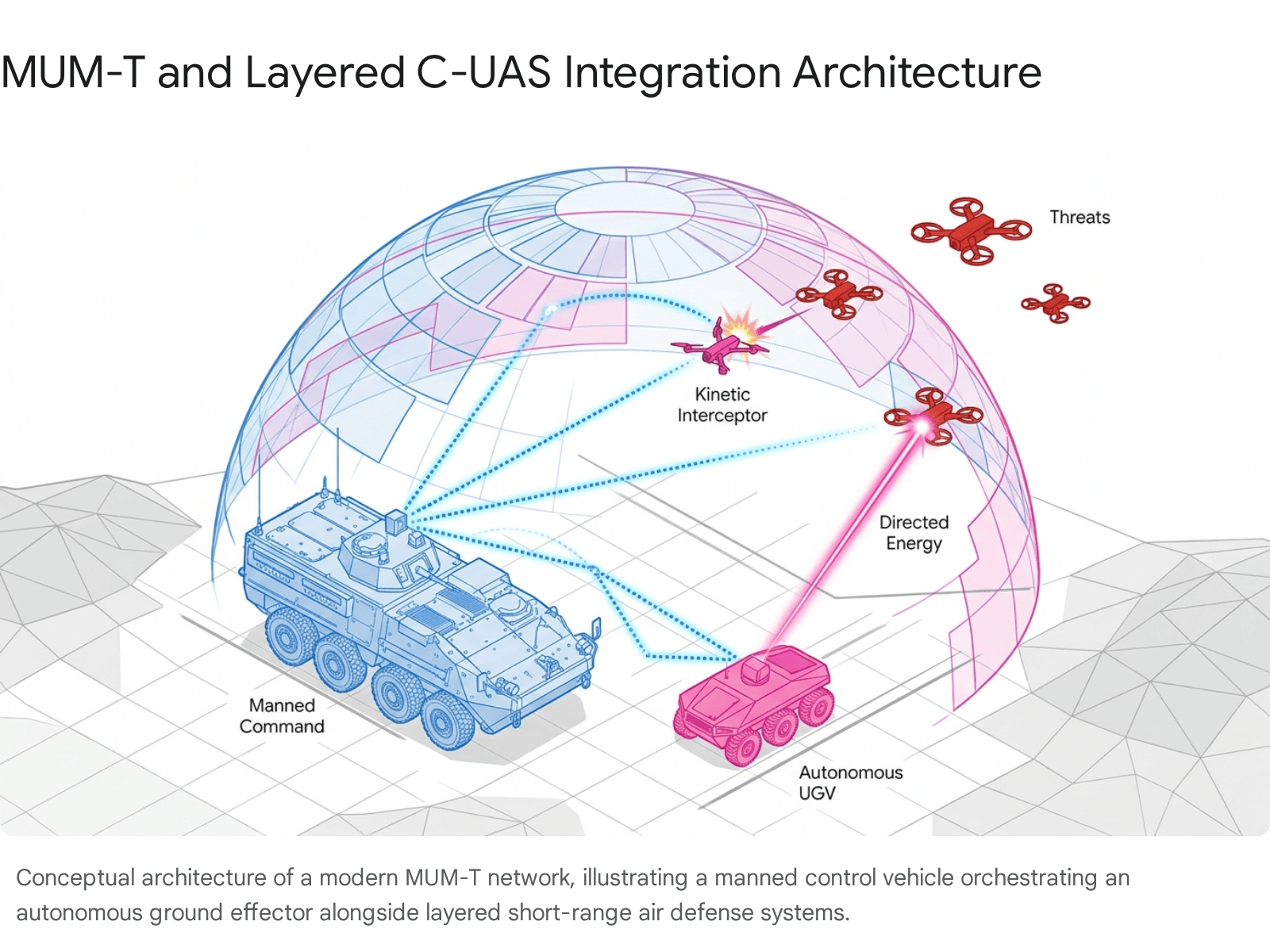
One of the most defining technological maturation points observed at BSDA 2026 was the prominent display and live operational validation of Manned-Unmanned Teaming (MUM-T). The integration of Unmanned Ground Vehicles (UGVs) into infantry and armored formations aims fundamentally to alter tactical geometry, pushing sensors and kinetic effectors forward while reducing human risk during hazardous operations such as lane clearance, reconnaissance, and casualty evacuation under fire.

5.1. The Hanwha-Milrem Trilateral Framework

A cornerstone of the exhibition was the formal teaming agreement signed on the second day of the event between South Korea’s Hanwha Aerospace, its newly formed local subsidiary Hanwha Aerospace Romania (HARO), and Estonia’s Milrem Robotics.19 This trilateral partnership was established to jointly pursue Romania’s national UGV program and establish localized mass production capabilities within the country, serving as a springboard for broader European expansion.19

The strategic logic of this partnership lies in the highly complementary nature of their respective autonomous platforms. Hanwha Aerospace Romania, acting as the prime contractor, provides advanced wheeled UGVs, specifically leveraging the Arion-SMET and its upgraded variant, the GRUNT (GRound UNcrewed Transport).19 The GRUNT is a high-mobility 6×6 platform boasting an operational range of approximately 290 km and a heavy payload capacity exceeding 900 kg.22 Milrem Robotics contributes the THeMIS (Tracked Hybrid Modular Infantry System), a globally recognized, combat-proven tracked UGV featuring hybrid propulsion and exceptional stability in severe off-road terrain, with a payload capacity of up to 1,200 kg.19 By offering a mixed fleet of wheeled vehicles (optimized for endurance and logistics) and tracked vehicles (optimized for tactical mobility and combat support), the consortium presents a full-spectrum solution tailored to the varied geography of the Eastern Flank.

[Image: Comparative matrix detailing the specifications and operational roles of the UGVs]

Table 1: MUM-T Platform Specifications and Operational Roles

PlatformManufacturerPropulsionPayload CapacityOperational RangePrimary Mission Profile
GRUNTHanwha Aerospace6×6 Wheeled900+ kg~290 kmLong-range logistics, casualty evacuation, fast reconnaissance.
THeMISMilrem RoboticsTracked Hybrid1,200 kgVariable (Hybrid)Heavy weapons platform, ATGM carrier, rugged terrain breaching.

5.2. Live Validation Under Electronic Warfare Conditions

Prior to the exhibition floor displays, the Hanwha-Milrem consortium conducted a highly publicized live MUM-T demonstration near Bucharest on May 12, successfully integrating Hanwha’s manned TIGON armored vehicle with the GRUNT and THeMIS Cargo UGV platforms.19 Crucially, this demonstration was executed under simulated Electronic Warfare (EW) conditions to replicate a realistic, high-threat battlefield scenario.19

The Ukrainian theater has conclusively demonstrated that command links for unmanned systems are the primary target of Russian EW assets. Demonstrating UGV operations—including logistics resupply, simulated casualty evacuation, and drone-enabled battlefield monitoring—in a degraded electromagnetic spectrum proves the viability of the platforms’ autonomous navigation and resilient communication architectures.19 A UGV that requires a constant, uninterrupted high-bandwidth telemetry link to a human operator is a severe operational liability; the systems demonstrated rely on advanced edge computing and localized autonomy algorithms to execute waypoint navigation and obstacle avoidance even when command links are jammed or intermittent.

5.3. Payload Integration and Tactical Redefinition

The payloads capable of being integrated into these UGVs drastically alter infantry tactics at the platoon and squad levels. The GRUNT can be equipped with remote-controlled weapon stations (RCWS), counter-battery acoustic detection sensors, and automated target tracking systems.22 The THeMIS has repeatedly demonstrated the ability to carry loitering munitions, anti-tank guided missiles (ATGMs), and tethered drones for persistent overwatch. By pushing the primary sensor suite and the kinetic effector forward on an expendable unmanned chassis, a single dismounted squad can exert the operational footprint and firepower of a much larger conventional mechanized unit, fulfilling the core promise of MUM-T doctrine.

6. Counter-Unmanned Aerial Systems (C-UAS) and the Air Defense Cost-Exchange Paradigm

The proliferation of Group 1-3 unmanned aerial systems, particularly loitering munitions like the Iranian-designed Shahed series utilized extensively by Russian forces against Ukrainian infrastructure, has precipitated a severe air defense crisis. Traditional Surface-to-Air Missiles (SAMs), such as the Patriot or NASAMS, represent a wholly unsustainable cost-exchange ratio when a multimillion-dollar interceptor is expended against a drone costing less than $50,000. Furthermore, the magazine depth of standard SAM batteries is quickly exhausted by drone swarms, leaving critical assets vulnerable to follow-on cruise or ballistic missile strikes. BSDA 2026 featured prominent displays of emerging C-UAS technologies specifically designed to invert this economic and tactical asymmetry.

6.1. Kinetic Interception: The SkyFall P1-SUN Phenomenon

The most heavily scrutinized C-UAS solution at the exhibition was the Bavovna P1-Sun, developed by the Ukrainian defense tech firm SkyFall.17The system was borne directly out of frontline combat necessities and represents a paradigm shift toward dedicated “drone-on-drone” aerial combat.

The P1-SUN is an autonomous or semi-autonomous interceptor UAV designed around a highly modular, 3D-printed airframe, allowing for rapid, scalable production in the thousands per month.24 This exceptional production rate ensures that defending forces possess a deep, attritable magazine capable of matching the volume of incoming threat swarms. The platform boasts formidable kinematics, capable of operating at altitudes up to 5,000 meters and achieving maximum speeds of 450 km/h.24 This represents a 50% increase in propulsion capability over previous iterations, granting the P1-SUN the speed advantage necessary to reliably pursue and physically intercept fast-moving loitering munitions like the Shahed/Geran, as well as rotary-wing assets and FPV-carrying motherships such as the Russian Gerbera UAV.24

According to statements made surrounding the event, the P1-SUN system had reportedly successfully intercepted over 3,000 Shahed-type drones since the beginning of 2026.17 The integration of such systems into broader national air defense frameworks provides a highly cost-effective, high-volume layer of defense that preserves high-tier SAM interceptors for their intended purpose: defeating advanced ballistic and cruise missile threats.

6.2. Cyber-Takeover and Non-Kinetic Defeat Mechanisms

While kinetic interception is necessary for autonomous munitions operating on internal guidance, non-kinetic defeat mechanisms remain crucial, particularly in dense urban environments or near critical industrial facilities where falling debris poses a severe risk. The Romanian company Optoelectronica utilized BSDA 2026 to present advanced C-UAS solutions, including components of its integrated SkyDome system and the D-FEND ENFORCEAIR system.28

Unlike traditional RF jamming, which relies on brute-force electromagnetic interference that can easily disrupt friendly military communications and civilian GPS signals, the ENFORCEAIR system employs highly targeted cyber-takeover methodology.28 It precisely identifies the hostile drone’s communication protocol and asserts control over the UAV without physically destroying it. This allows the defending operator to safely land the hostile asset in a designated safe zone or return it to its point of origin to identify the launch location.28

Optoelectronica also presented the SKYLOCK system, designed specifically to counter Shahed drones and currently utilized in over 20 countries. In a significant win for local industry, over 65% of the SKYLOCK system is slated to be produced locally at Optoelectronica’s main production center in Măgurele under an industrial cooperation agreement.28 These systems were rigorously tested and validated during the Capu Midia NATO exercise in April, where Optoelectronica’s proposed solutions ranked first, successfully taking control of and downing assigned military targets under real operational conditions.28

6.3. Radar Integration and AI Threat Assessment

Detecting the threat is the prerequisite to defeating it. Thales demonstrated the C-UAS EagleShield system, an integrated solution designed for both civil and military environments.11 Tested extensively during the NATOLCI-X exercise at Capu Midia, EagleShield is built around the Gamekeeper radar, which detects all types of UAS (regardless of whether they emit an RF signal) at ranges up to 20 km, ensuring continuous 360-degree coverage.11 Powered by advanced artificial intelligence, the system can simultaneously detect, track, and classify an unlimited number of targets—even very small micro-drones under 2 kg. It provides automatic threat assessment and decision support, drastically minimizing operator cognitive load and reaction times during complex swarm attacks.11

Above the drone threat layer lies the requirement for comprehensive air and missile defense against fixed-wing aircraft and cruise missiles. Thales exhibited the SkyDefender Air Defense Solution, an integrated, multi-layered network designed to merge kinetic and non-kinetic effectors under the SkyView command and control (C2) system.11 The architecture’s primary value lies in its open and modular nature, rendering it fully compatible with existing air defense systems and interoperable with NATO standards. Uniquely, SkyDefender has the capacity to process early warning and monitoring data from SMART-L MM and UHF radars at extreme distances of up to 5,000 km, providing unparalleled operational awareness.11 The integration of the highly mobile GM200 radar, displayed in the outdoor exhibition space, provides the necessary mid-tier tracking capabilities to close the operational kill chain.11

6.4. VSHORAD and Programmable Airburst Munitions

As the economic cost of missile interception continues to rise, the utility of radar-guided autocannons for Very Short Range Air Defense (VSHORAD) has strongly re-emerged as a tactical necessity. Rheinmetall showcased vital elements of its ground-based air defense portfolio, prominently featuring the 35mm Oerlikon Revolver Gun Mk3 integrated into the highly regarded Skynex air defense system.15

Utilizing Advanced Hit Efficiency And Destruction (AHEAD) programmable airburst ammunition, the Skynex system calculates the exact intercept point and programs the 35mm round as it exits the muzzle to detonate at a precise distance, creating a dense cloud of tungsten sub-projectiles directly in the flight path of incoming targets. This provides a highly lethal, cost-effective point-defense mechanism capable of shredding cruise missiles and drone swarms that manage to penetrate outer missile defense layers. The modular and scalable nature of the Skynex system allows it to be mounted on various heavy truck platforms, ensuring it possesses the necessary mobility to accompany and protect advancing armored columns.15

7. Naval Dynamics and Asymmetric Maritime Security

The naval domain in the Black Sea has been fundamentally altered by the ongoing conflict. The denial of sea control through the extensive use of land-based anti-ship cruise missiles and unmanned surface vessels (USVs) has demonstrated the extreme vulnerability of large, conventional surface combatants operating without comprehensive layered defense. Consequently, Romania is aggressively adapting its naval posture toward distributed surveillance, asymmetric defense methodologies, and the rapid acquisition of capable platforms.

7.1. Procurement Agility: The Turkish Hisar-Class Corvette Acquisition

Perhaps the most revealing procurement action discussed extensively among naval analysts at the event was Romania’s recent acquisition of a Turkish-built Hisar-class (Akhisar-class) light corvette.29 The context surrounding this acquisition is highly instructive regarding the new realities of defense procurement. For over three years, Romania had been engaged in protracted discussions with the European shipbuilder Damen for the construction of two OPV 2600 vessels configured for a light corvette role.31 Damen’s proposal, priced at €115 million per naval platform plus an additional €85 million for combat systems supplied by Thales (including the TACTICOS CMS), required an estimated 36 to 42 months for delivery following the finalization of a 300-page technical assessment.31

Facing an acute, immediate security deficit in the Black Sea, the Romanian government effectively bypassed the protracted European procurement process and directly acquired the lead ship of a new class of light corvettes from the Turkish defense company ASFAT.29 The 2,300-ton, 99.5-meter vessel, originally the TCG Akhisar (P-1220), had been constructed for the Turkish Navy but was transferred to Romania prior to entering Turkish service for even a single day.29

This decisive action underscores a paramount lesson: in a pre-war or active-war environment, the speed of delivery supersedes custom domestic build programs or lengthy allied negotiations. As noted by analysts analyzing the transfer, “Türkiye delivered in months what the EU could not deliver in over a decade”.32 The Hisar-class provides immediate, fully functional NATO-interoperable combat capability. It is heavily armed for its displacement, featuring an MKE 76mm naval gun, an Aselsan Gokdeniz close-in weapon system (CIWS), eight Hisar-D surface-to-air missiles, eight Atmaca anti-ship missiles, Roketsan anti-submarine warfare (ASW) rockets, and two Unirobotics Targan remote-controlled weapon stations.33 Powered by a combined diesel-electric propulsion system, it is capable of maximum speeds of 24 knots and an operational range of 4,500 nautical miles, with aviation facilities to support an S-70 Seahawk ASW helicopter or UAVs.29

7.2. AI-Assisted Coastal Defense and Critical Infrastructure Protection

The protection of critical maritime infrastructure, specifically the upcoming Neptun Deep offshore gas extraction project, is a paramount national security priority for Bucharest. Slated to begin operations in 2027, the Neptun Deep project will transform Romania into the European Union’s largest producer of natural gas, inherently making the offshore infrastructure a high-value target for state-sponsored sabotage, cyberattacks, or asymmetric kinetic threats.34

To address this specific vulnerability, an international industrial consortium led by the Romanian state-owned Carfil S.A. (a subsidiary of ROMARM) and including NSE India, Farpoint, Top Metrology, and DxDrones launched “Coastguard X” at BSDA 2026.34Coastguard X is an advanced, AI-assisted maritime security ecosystem operating on C2C’s MAGI-C5ISR architecture.34It fundamentally discards the reliance on a few expensive, highly vulnerable patrol boats in favor of a dense, distributed multi-domain sensor network.

The platform fuses data from autonomous multi-sensor surface buoys, maritime ISR drones, and multi-domain detection arrays (spanning aerial, surface, and underwater environments) into a unified, artificial intelligence-assisted command and control center.34 This ecosystem provides persistent, real-time detection and monitoring of unidentified vessels, low-flying drones, underwater sabotage activities, and other asymmetric maritime threats, providing an early warning and operational response shield around LNG terminals, ports, and strategic maritime borders.34 The launch marks C2C Advanced Systems’ strategic entry into the European defense ecosystem via a NATO-affiliated consortium.35

7.3. Expeditionary Mine Countermeasures (MCM)

The proliferation of drifting and tethered sea mines in the Black Sea represents an ongoing, severe hazard to commercial shipping, agricultural exports, and naval operations. Traditional mine-hunting vessels are slow, highly vulnerable to asymmetric attack, and expensive to operate. The solutions presented at BSDA 2026 focused almost entirely on unmanned, expeditionary capabilities that remove human operators from the minefield.

Thales introduced the Expeditionary Pathmaster, a highly mobile system that can be operated from a portable expeditionary operations center (e-POC) located on shore, on a light craft, or on a vessel of opportunity.11 By utilizing AI-driven mission management systems like M-Cube and the MiMap sonar analysis application, operators can process vast amounts of underwater sonar data four times faster than conventional methods, accurately locating and classifying underwater mines with 99% precision.11 The system integrates seamlessly with third-party autonomous underwater vehicles (AUVs) and remotely operated vehicles (ROVs) to conduct comprehensive mine countermeasure missions anywhere in the world.11 Similarly, Elbit Systems showcased the Seagull Unmanned Surface Vessel (USV), a highly capable multi-mission platform designed specifically to execute extensive mine countermeasures and anti-submarine warfare sweeps autonomously.18

8. Specialized Munitions, Breaching, and CBRN Defense

Beyond primary combat platforms and theater-level air defense networks, enabling technologies in specialized demolitions, urban breaching, and force protection saw significant developments at BSDA 2026, reflecting the tactical demands of complex urban combat and evolving asymmetric threats.

8.1. Advanced Shaped Charges and Urban Breaching

Urban combat operations require precise, reliable explosive breaching tools to create entry points for assault elements without causing catastrophic structural collapse or excessive collateral damage.Alford Technologies, an award-winning leader in explosive engineering and clearance tools, utilized the exhibition to sign a Memorandum of Understanding (MoU) with Romanian state-owned entity Carfil S.A. and defense technology firm MATE-FIN.38This strategic partnership aims to expand specialist manufacturing and Explosive Ordnance Disposal (EOD) capabilities directly within Romania.39

The specialized tools highlighted by Alford include the Gatecrasher series of water-tamped charges, explicitly designed to breach thick concrete and brick walls while mitigating hazardous overpressure.39 Furthermore, Alford showcased the Vulcan and Pluton user-filled shaped charge systems, which are utilized globally for the low-order deflagration of unexploded ordnance (UXO), both on land and in maritime environments.39 By localizing the production and technical expertise surrounding these specialized explosive charges, Romanian EOD and special operations units ensure a steady, uninterrupted supply of high-end tactical breaching and clearance capabilities.

8.2. Active Stand-Off Chemical Detection

The threat of Chemical, Biological, Radiological, and Nuclear (CBRN) incidents—whether arising from the deliberate deployment of chemical warfare agents or accidental collateral damage to industrial facilities releasing Toxic Industrial Chemicals—necessitates highly advanced, reliable detection capabilities. SEC Technologies, a Slovak defense technology manufacturer, in partnership with Romanian firm MATE-FIN, showcased the Falcon 4G active stand-off chemical detector at BSDA 2026.42

The Falcon 4G provides forces with the unique capability to detect, identify, and precisely quantify chemical warfare agents at extreme stand-off distances of up to 6 kilometers.42 The operational advantage of active stand-off detection is profound: it provides vital early warning and identifies the exact location and concentration of toxic clouds long before dismounted troops or unarmored logistics convoys enter the contaminated zone.43 In a volatile geopolitical context where chemical weapon usage or industrial sabotage are realistic scenarios, keeping operators entirely out of the “hot zone” while maintaining absolute environmental situational awareness serves as a critical force protection multiplier, significantly increasing force mobility by allowing units to maneuver around hazardous areas.43

9. Doctrinal Lessons Learned and Strategic Implications

The extensive technological exhibitions, live demonstrations, and high-level industrial agreements finalized at BSDA 2026 do not exist in a vacuum; they are direct, calculated responses to the brutal realities of contemporary high-intensity warfare observed on NATO’s eastern borders. The event functioned as an intellectual and commercial clearinghouse for military professionals to distill these observations into actionable procurement doctrines.

9.1. The Supremacy of Sovereign Supply Chains Over Globalized Logistics

The foremost strategic lesson internalized by Eastern European defense planners is that the era of “just-in-time” globalized defense logistics has definitively ended. The staggering expenditure rates of artillery shells, small arms ammunition, interceptor missiles, and drone platforms in the Ukrainian theater have proven unequivocally that states lacking deep, resilient domestic industrial bases quickly face operational culmination.

The relentless drive observed at BSDA 2026 toward localized manufacturing—from SIG SAUER establishing SSI Legion SRL in Cugir for small arms production 5, to Otokar purchasing Automecanica for armored vehicle assembly in Mediaș 12, and Hanwha’s creation of the localized HARO subsidiary for UGV production 19—demonstrates that technology transfer and domestic production lines are no longer optional. They are now mandatory components of any major defense contract signed by Eastern Flank nations. Sovereign supply chains ensure that a nation can sustain its warfighting capability even when external supply routes are interdicted or political dynamics delay foreign assistance.

9.2. Procurement Velocity as a Strategic Imperative

The acquisition of the Turkish Hisar-class corvette by the Romanian Naval Forces, deliberately executed in lieu of the severely delayed European Damen OPV program, illustrates a harsh but necessary reality: a highly capable, “good enough” asset in the field today is infinitely superior to a “perfect” asset delivered a half-decade from now.31 As the regional threat environment compresses decision-making timelines, defense ministries are actively bypassing standard, bureaucratic multi-year acquisition frameworks. They are prioritizing rapidly available, off-the-shelf, or fully matured systems that can immediately plug into NATO architectures. The rapid scaling and iterative improvement of the 3D-printed P1-SUN interceptor drone 24 further validates this lesson; agile manufacturing and continuous battlefield feedback loops are vastly outperforming legacy aerospace development cycles.

9.3. Operating in Drone-Dense, EW-Heavy Environments

The airspace extending from the surface up to 10,000 feet is now recognized as permanently contested by diverse arrays of unmanned systems. The deployment of AI-driven C-UAS radars (such as the Gamekeeper) 11, high-speed kinetic interceptor drones 24, and cyber-takeover systems (like EnforceAir) 28 reflects the doctrinal understanding that no single weapon system can comprehensively defeat the drone threat. Defeating a swarm requires a networked, multi-layered approach that simultaneously addresses both the physical airframe and its electromagnetic control links, while preserving high-tier SAMs for ballistic threats. Furthermore, the explicit necessity of testing MUM-T platforms like the GRUNT and THeMIS under heavy Electronic Warfare jamming 19 acknowledges a grim reality: future ground combat will occur in a severely degraded electromagnetic spectrum, necessitating autonomous edge-computing capabilities over continuous, vulnerable remote control.

10. Conclusion

The Black Sea Defense & Aerospace (BSDA) 2026 exhibition effectively codified a permanent structural shift in Eastern European defense strategy. For Romania specifically, the event validated its accelerating transition from a passive consumer of foreign military hardware to an emerging, vital hub of localized, NATO-standard defense manufacturing. By aggressively pursuing comprehensive technology transfers in small arms, establishing domestic assembly lines for tactical and heavy armored vehicles, and pioneering the integration of autonomous ground and aerial systems alongside allied partners, the Romanian Armed Forces are systematically addressing the specific tactical and strategic vulnerabilities exposed by recent regional conflicts.

The pervasive themes dominating the exhibition—AI-enabled battle management, the absolute necessity of sovereign supply chains, platform resilience against pervasive electronic warfare, and the relentless optimization of the cost-exchange ratio in air defense—serve as a clear blueprint for modern, conventional deterrence. As the geopolitical center of gravity remains firmly anchored in the Black Sea region, the capabilities demonstrated and the industrial partnerships forged at BSDA 2026 are designed to ensure that frontline NATO forces possess the requisite industrial backing, logistical depth, and technological agility to sustain high-intensity, multi-domain operations into the foreseeable future.


Please share the link on Facebook, Forums, with colleagues, etc. Your support is much appreciated and if you have any feedback, please email us in**@*********ps.com. If you’d like to request a report or order a reprint, please click here for the corresponding page to open in new tab.


Sources Used

  1. Dispatch from Bucharest: NATO’s center of gravity is shifting eastward, accessed May 20, 2026, https://www.atlanticcouncil.org/dispatches/dispatch-from-bucharest-natos-center-of-gravity-is-shifting-eastward/
  2. BSDA 2026 Brings Global Defense Leaders to Bucharest – The Romania Journal, accessed May 20, 2026, https://www.romaniajournal.ro/society-people/bsda-2026-brings-global-defense-leaders-to-bucharest/
  3. BSDA 2026: România a fost pentru o săptămână centru global al industriei de apărare, accessed May 20, 2026, https://adevarul.ro/blogurile-adevarul/bsda-2026-romania-a-fost-pentru-o-saptamana-2530025.html
  4. Commanding the Edge on NATO’s Black Sea Flank – Leonardo DRS, accessed May 20, 2026, https://www.leonardodrs.com/news/feature-stories/commanding-the-edge-on-natos-black-sea-flank/
  5. Sig Sauer CEO Ron Cohen visits Cugir to built partnership, accessed May 20, 2026, https://business-review.eu/business/defence/sig-sauer-ceo-ron-cohen-visits-cugir-to-built-partnership-295498
  6. BSDA 2026 – Ministerul Economiei, Digitalizării, Antreprenoriatului și Turismului, accessed May 20, 2026, https://economie.gov.ro/bsda-2026/
  7. BSDA 2026 Dialog strategic România-Polonia-Ucraina, proiectarea „software-ului” rezilienței regionale în…, accessed May 20, 2026, https://adevarul.ro/blogurile-adevarul/bsda-2026-dialog-strategic-2530535.html
  8. List of equipment of the Romanian Armed Forces – Wikipedia, accessed May 20, 2026, https://en.wikipedia.org/wiki/List_of_equipment_of_the_Romanian_Land_Forces?oldformat=true
  9. List of equipment of the Romanian Armed Forces – Wikipedia, accessed May 20, 2026, https://en.wikipedia.org/wiki/List_of_equipment_of_the_Romanian_Armed_Forces
  10. SARSILMAZ to present weapon systems at BSDA 2026 – Defensehere, accessed May 20, 2026, https://defensehere.com/en/sarsilmaz-to-present-weapon-systems-at-bsda-2026/
  11. Thales participation in the Black Sea Defense, Aerospace and Security (BSDA) 2026 exhibition – Business Review, accessed May 20, 2026, https://business-review.eu/business/defence/thales-participation-in-the-black-sea-defense-aerospace-and-security-bsda-2026-exhibition-296444
  12. First Romanian-Built Otokar COBRA II at BSDA 2026 | Joint Forces …, accessed May 20, 2026, https://www.joint-forces.com/defence-equipment-news/91041-first-romanian-built-otokar-cobra-ii-at-bsda-2026
  13. Defence – Business Review, accessed May 20, 2026, https://business-review.eu/category/business/defence
  14. Rheinmetall Expands European Defense Push With Land, Air, And Naval Systems At BSDA 2026, accessed May 20, 2026, https://thedefensewatch.com/global-news/rheinmetall-showcases-land-air-and-naval-defense-systems-at-bsda-2026/
  15. Rheinmetall to showcase land, air and naval defence systems at BSDA 2026 in Bucharest, accessed May 20, 2026, https://defence-industry.eu/rheinmetall-to-showcase-land-air-and-naval-defence-systems-at-bsda-2026-in-bucharest/
  16. Rheinmetall at the Black Sea Defence & Aerospace, accessed May 20, 2026, https://www.rheinmetall.com/en/media/news-watch/news/2026/05/2026-05-12-rheinmetall-at-the-black-sea-defence-aerospace
  17. BSDA 2026 to open as global defense industry gathers in Bucharest – Defensehere, accessed May 20, 2026, https://defensehere.com/en/bsda-2026-to-open-in-bucharest/
  18. Elbit Systems to Showcase Romanian and Global Defense Innovation at BSDA 2026, accessed May 20, 2026, https://www.elbitsystems.com/news/elbit-systems-showcase-romanian-and-global-defense-innovation-bsda-2026
  19. Hanwha Signs Teaming Agreement with Milrem Robotics for …, accessed May 20, 2026, https://www.asdnews.com/news/defense/2026/05/18/hanwha-signs-teaming-agreement-with-milrem-robotics-romanian-ugv-program
  20. Hanwha Aerospace joins Milrem Robotics for Romania unmanned vehicle program, accessed May 20, 2026, https://www.koreaherald.com/article/10738758
  21. South Korea and Estonia join forces for Romanian ground robot bid – The Defence Blog, accessed May 20, 2026, https://defence-blog.com/south-korea-and-estonia-join-forces-for-romanian-ground-robot-bid/
  22. Hanwha showcases defense solutions at BSDA 2026, accessed May 20, 2026, https://www.hanwha.com/newsroom/news/press-releases/hanwha-showcases-unmanned-and-ai-capabilities-at-bsda-2026-to-advance-european-partnerships.do
  23. Hanwha Aerospace and Milrem Robotics partner on Romanian unmanned ground vehicle programme at BSDA 2026, accessed May 20, 2026, https://defence-industry.eu/hanwha-aerospace-and-milrem-robotics-partner-on-romanian-unmanned-ground-vehicle-programme-at-bsda-2026/
  24. P1-SUN – Bavovna.AI, accessed May 20, 2026, https://bavovna.ai/uav/p1-sun/
  25. SkyFall Unveils P1-Sun Modular Interceptor at Dubai Airshow – TechUkraine, accessed May 20, 2026, https://techukraine.org/2025/11/24/skyfall-unveils-p1-sun-modular-interceptor-at-dubai-airshow/
  26. P1-SUN Drones Down Gerbera UAVs Carrying FPV Drones for the First Time, accessed May 20, 2026, https://militarnyi.com/en/news/p1-sun-drones-down-gerbera-uavs-carrying-fpv-drones-for-the-first-time/
  27. Ukrainian P1-Sun drones intercept more than 3000 Shahed-type drones since start of year, accessed May 20, 2026, https://www.pravda.com.ua/eng/news/2026/04/23/8031503/
  28. Optoelectronica presented anti-drone systems successfully tested in …, accessed May 20, 2026, https://www.caleaeuropeana.ro/optoelectronica-presented-anti-drone-systems-successfully-tested-in-nato-exercises-at-bsda-2026-we-will-produce-them-in-romania-in-a-proportion-of-over-65-interview/
  29. Romania to Buy Ready-Built Hisar-Class Corvette from Turkey, accessed May 20, 2026, https://militarnyi.com/en/news/romania-to-buy-ready-built-hisar-class-corvette-from-turkey/
  30. Romania boosts Black Sea defense with acquisition of light corvette from Türkiye, accessed May 20, 2026, https://www.romania-insider.com/romania-light-corvette-turkie-deal-dec-2025
  31. Romania Justifies Warship Acquisition Through SAFE Over Damen’s Offer, accessed May 20, 2026, https://www.navalnews.com/naval-news/2026/05/romania-justifies-warship-acquisition-through-safe-over-damen-offer/
  32. Why Romania Preferred the Turkish Solution: MILGEM Akhisar – TURDEF, accessed May 20, 2026, https://turdef.com/article/why-romania-preferred-the-turkish-solution-milgem-akhisar
  33. Romania acquires lead ship of new Turkish-built corvette class – Baird Maritime, accessed May 20, 2026, https://www.bairdmaritime.com/security/naval/naval-ships/romania-acquires-lead-ship-of-new-turkish-built-corvette-class
  34. Ecosistem de securitate maritimă, lansat la BSDA 2026 de un consorțiu care are ca lider Carfil Brașov – Go4IT, accessed May 20, 2026, https://www.go4it.ro/content/inteligenta-artificiala/ecosistem-de-securitate-maritima-lansat-la-bsda-2026-de-un-consortiu-care-are-ca-lider-carfil-brasov-19273426/
  35. Date: 18th May 2026 To, The National Stock Exchange of India Limited, Exchange Plaza, Plot No. C/1, G Block, Bandra-Kurla Comple, accessed May 20, 2026, https://nsearchives.nseindia.com/corporate/C2CAS_18052026114653_C2C_MAY_18_2026_.pdf
  36. C2C Advanced Systems Share Price Today Live- NSE/BSE – Choice India, accessed May 20, 2026, https://choiceindia.com/stocks/c2c-advanced-systems-ltd-share-price
  37. MS Daily Brief-en – Maritime Security Forum, accessed May 20, 2026, https://www.forumulsecuritatiimaritime.ro/ms-daily-brief-en-2/
  38. S. Carfil SA, MATE-FIN, and Alford Technologies sign a Memorandum of Understanding to develop specialized capabilities in Romania – Business Review, accessed May 20, 2026, https://business-review.eu/business/defence/s-carfil-sa-mate-fin-and-alford-technologies-sign-a-memorandum-of-understanding-to-develop-specialized-capabilities-in-romania-296319
  39. Tactical Breaching | Alford Technologies, accessed May 20, 2026, https://www.explosives.net/security-and-policing-breaching/
  40. Alford Technologies: Explosive Tools | Training | R&D, accessed May 20, 2026, https://www.explosives.net/
  41. Military UW UXO Clearance – Alford Technologies, accessed May 20, 2026, https://www.explosives.net/maritime-military-uxo-clearance/
  42. SEC Technologies and MATE-FIN are showcasing the Falcon 4G stand-off chemical detector at BSDA 2026 – Business Review, accessed May 20, 2026, https://business-review.eu/business/defence/sec-technologies-and-mate-fin-are-showcasing-the-falcon-4g-stand-off-chemical-detector-at-bsda-2026-296289
  43. Falcon 4G – Cutting-edge CBRN technology comes to Romania – Business-Review.eu., accessed May 20, 2026, https://business-review.eu/tech/falcon-4g-cutting-edge-cbrn-technology-comes-to-romania-286282

Analysis of the May 2026 Finnish-Israeli Defense Industry Seminar

1. Executive Summary

In May 2026, the defense ministries and aerospace industry associations of Finland and Israel convened the second Finnish-Israeli Defence industry Seminar in Helsinki. Set against a backdrop of escalating global military contingencies—ranging from high-intensity conventional warfare in Eastern Europe to complex, multi-domain asymmetric operations in the Middle East—the seminar served as a critical nexus for technological exchange, doctrinal alignment, and defense procurement strategy. Orchestrated by the Israel Ministry of Defense’s International Defense Cooperation Directorate (SIBAT) and the Finnish Defense and Aerospace Industries Association (PIA), the event brought together 32 Israeli defense contractors and approximately 30 Finnish defense and technology firms.1

The seminar yielded significant insights into the trajectory of modern warfare, characterized by the accelerated integration of autonomous systems, the critical necessity of electromagnetic spectrum operations (EMSO), and the structural modernization of infantry small arms and mechanized survivability. Two major technological unveilings dominated the operational landscape during this period. First, Rafael Advanced Defense Systems introduced the “STORM SHIELD” miniature electronic warfare (EW) system, designed to protect attritable unmanned aerial vehicles (UAVs) in anti-access/area denial (A2/AD) environments.3 Second, Finnish manufacturer Sako detailed the rollout of its Arctic Rifle Generation (ARG) family, marking the Finnish Defense Forces’ structural shift from legacy Soviet calibers to NATO-standard munitions.5

Furthermore, the bilateral engagements highlighted profound lessons learned from recent and ongoing combat operations. Israeli defense officials presented combat-proven adaptations derived from urban operations, most notably the integration of organic loitering munitions onto armored vehicles to counter top-attack unmanned aerial threats.7 They also shared the operational validation of high-tier air and missile defense systems during Iranian ballistic missile barrages, which achieved an 86% interception rate.8 For Finland, which recently transitioned from non-alignment to full NATO membership, access to Israel’s combat-tested technologies—including the prior €316 million acquisition of the David’s Sling air defense system—represents a foundational upgrade to its national and regional deterrent capabilities.1

Despite localized political opposition in Helsinki regarding geopolitical events in the Middle East, the strategic imperatives of both nations have cemented a robust industrial partnership.9 This report provides an in-depth technical and operational analysis of the products announced, the technological synergies explored, and the doctrinal lessons learned from the May 2026 seminar.

2. The Geostrategic Imperative for Bilateral Defense Cooperation

The industrial synergy between Helsinki and Tel Aviv is not a product of momentary convenience but is driven by complementary strategic vulnerabilities, shared threat profiles, and mutual strengths in high-technology manufacturing. To understand the gravity of the May 2026 seminar, one must first analyze the structural defense posture of the host nation and the historical procurement pipeline that laid the groundwork for this level of industrial convergence.

2.1. Finland’s Defense Posture and NATO Integration

Finland possesses a vast 1,340-kilometer border with the Russian Federation, a geographic reality that has defined its defense doctrine for a century. To defend this immense, heavily forested, and often austere territory, Finland maintains a highly capable active military force backed by a massive asymmetric mobilization capability. The Finnish Defense Forces can muster 870,000 fully trained reservists from a total population of just 5.6 million.11 This scale of mobilization requires vast stockpiles of reliable, modern small arms, secure and decentralized communications, and distributed anti-armor capabilities that can be operated by light infantry units cut off from central command.

Following the geopolitical shocks of recent years, Finland officially abandoned its long-standing policy of military non-alignment to join the North Atlantic Treaty Organization (NATO). This transition necessitates a rapid and comprehensive overhaul of its military infrastructure to ensure absolute interoperability with allied forces.12 The shift involves standardizing calibers, integrating shared command-and-control (C2) software, and ensuring that Finnish air defense architectures can communicate seamlessly within the broader NATO Integrated Air and Missile Defense (IAMD) network.

2.2. The Historical Procurement Pipeline

Israel’s defense industry operates under a perpetual state of conflict, producing systems that are continually field-tested, refined, and upgraded based on immediate combat feedback. The Israeli Ministry of Defense has explicitly noted that Finland provides a critical gateway into NATO and the broader European market, offering regulatory stability, advanced indigenous tech integration, and substantial, reliable defense budgets.1

The scale of this bilateral cooperation has expanded dramatically over the past decade. While historical trade between the two nations was relatively modest, recent tier-one acquisitions have positioned Israeli defense contractors as a central pillar of Finnish national defense capability. D&T reports indicate that Finnish purchases from Israeli defense industries have surged from mere millions to hundreds of millions of dollars annually.1

This relationship is anchored by three foundational procurements:

  1. Gabriel Anti-Ship Missiles (2018): Finland acquired the Gabriel advanced naval strike missile system from Israel Aerospace Industries (IAI) for €162 million, drastically enhancing the striking range and survivability of the Finnish Navy in the contested waters of the Baltic Sea.1
  2. Spike Anti-Tank Guided Missiles (2022): Valued at €213 million, Rafael Advanced Defense Systems provided the Finnish Army with Spike ATGMs. These fire-and-forget, non-line-of-sight missiles give Finnish infantry and mechanized units parity against heavy armor formations.1
  3. David’s Sling Air Defense System (2023): In a landmark €316 million agreement, Finland purchased the David’s Sling high-altitude air defense system.1 This system, which operates well above the engagement envelope of traditional short-range air defenses, provides a strategic umbrella against theater ballistic missiles and heavy cruise missiles.

The May 2026 seminar sought to build upon these tier-one procurements by fostering subsystem, startup, and component-level integration, moving the relationship from one of a vendor-client dynamic to a co-development partnership.

3. Architecture of the 2026 Helsinki Defense Seminar

The Finnish-Israeli Defense Industry Seminar, held from May 12-13, 2026, functioned as a highly structured business-to-business (B2B) matchmaking event, professional briefing symposium, and technological showcase.1

3.1. Delegation Composition and Integration Mechanics

The delegation from Israel, led by SIBAT Director Brig. Gen. (Res.) Yair Kulas, represented the full spectrum of the nation’s defense-industrial base.1 SIBAT serves as the primary node for facilitating international cooperation, generating government-to-government agreements, establishing joint ventures, and marketing IDF inventory.15 A defense ministry source described the B2B sessions as being “similar to speed dating, but for defense companies,” emphasizing rapid, highly structured technical exchanges designed to bypass traditional bureaucratic procurement delays.1

Finnish participation was equally robust, coordinated by Tuija Karanko, chair of the PIA, alongside the Finnish deputy chief of staff and the head of defense procurement. The event drew dozens of specialized firms primarily from the Helsinki and Tampere industrial regions.1 The interactions focused heavily on identifying local Finnish integrators who could localize Israeli technology, manufacture subsystems, and provide lifecycle sustainment for the systems already deployed by the Finnish military.

3.2. Mapping the Industrial Ecosystem

The integration of these two distinct industrial bases requires a granular understanding of the participating entities and their specific technological domains. The table below categorizes the major players present at the seminar and the specific capabilities they offered.

Entity CategoryNotable Participating Companies & OrganizationsPrimary Technological Domains
Israeli Tier 1 PrimesIsrael Aerospace Industries (IAI), Rafael Advanced Defense Systems, Elbit SystemsAir and missile defense architectures, advanced guided munitions, integrated C4ISR systems, loitering munitions, and strategic aerospace assets.1
Israeli Specialized ContractorsUVision Air, XTEND Systems, Aeronautics, BIRD AeroSystems, BlueBird Aero Systems, CONTROP, DSIT, Orbit, RoboteamTactical Unmanned Aerial Systems (UAS), counter-UAS (C-UAS) effectors, electro-optics, tactical ground robotics, and ruggedized satellite communications.17
Israeli Defense Startups (MFS Program)Kela Technologies, Airis Labs, Axon Vision, Edgy Bees, eyesAtop, Prisma Photonics, Thirdeye VisionArtificial intelligence, drone swarm autonomy, computer vision targeting, cyber intelligence, and distributed border sensor networks.13
Finnish Defense IntegratorsPatria, Sisu Auto, SenopArmored mobility and logistics vehicles, advanced thermal imaging, integrated fire control systems, and automated mortar systems.19
Finnish Technology & ComponentsNDF Autonomy Oy, Xiphera, Kova Labs, Sensofusion, Insta Advance, Exel CompositesMission autonomy software, drone swarm scaling, secure cryptography, advanced carbon composites, and situational awareness software.13

This cross-pollination ensures that future systems procured by Finland will likely feature Finnish hulls, composite materials, and cryptographic software, paired with Israeli artificial intelligence, electro-optics, and active protection systems.

4. NATO Standardization and Small Arms Modernization: The Sako ARG Family

From the perspective of a small arms and infantry tactics analyst, the most operationally significant development showcased by the domestic industry during the seminar period was the(https://maavoimat.fi/en/-/the-finnish-defence-forces-to-shift-to-using-nato-standard-calibres-for-new-small-arms).5 This transition is anchored by the rollout of the Sako Arctic Rifle Generation (ARG) family.

4.1. The Strategic Logic of Caliber Standardization

Historically, Finland relied heavily on the 7.62x39mm cartridge (utilized in the domestic RK 62 and RK 95 TP assault rifles) and the 7.62x53R cartridge for designated marksmen and general-purpose machine guns.23 This was a pragmatic legacy of the Winter and Continuation Wars, driven by the necessity to utilize captured Soviet ammunition and maintain compatibility with the weapon systems of its primary strategic adversary.24

Following its accession to NATO, maintaining unique, non-standard ammunition supply chains became a critical logistical vulnerability. The Finnish Defense Forces have therefore officially mandated the adoption of the 5.56x45mm NATO cartridge for individual assault rifles, the 7.62x51mm NATO for squad support and designated marksman roles, the 9x19mm for sidearms, and the 12.7x99mm (.50 BMG) for heavy machine guns.24

The decision was explicitly driven by several tactical factors analyzed by the Army Command. First, in the dense, heavily forested Finnish environment, infantry firing distances are nearly always less than 200 meters, and typically under 100 meters.23 At these ranges, the 5.56x45mm cartridge offers a flatter trajectory and significantly lower recoil impulse than the legacy 7.62x39mm. This translates to faster target acquisition, quicker follow-up shots, and higher hit probability during dynamic engagements. Furthermore, the lower weight of the 5.56mm cartridge allows the individual soldier to carry a substantially higher combat load of ammunition without increasing physical fatigue.23 For engagements beyond 200 meters, force-specific firearms utilizing the 7.62x51mm NATO cartridge will provide the necessary overmatch capability.23

4.2. Engineering the Sako Arctic Rifle Generation (ARG)

To facilitate this transition, Sako, a premier Finnish firearms manufacturer, developed the Arctic Rifle Generation (ARG) family in close collaboration with the Finnish and Swedish Armed Forces.6 The ARG platform is an AR-15/AR-10 patterned system that has been meticulously re-engineered from the ground up for the extreme, unforgiving environments of Arctic warfare.6 Meeting the highly stringent NATO D14 testing standards, the rifles are designed to operate flawlessly despite severe sub-zero temperatures, coastal saltwater exposure, and deep mud—environments where inferior metallurgy and commercial lubricants typically induce catastrophic malfunctions.26

The ARG family consists of three primary military variants, each optimized for specific tactical roles 6:

  1. Sako ARG 40 GP (Gas Piston): Chambered in 5.56x45mm NATO, this assault rifle utilizes a short-stroke gas piston system. From an engineering standpoint, piston systems run significantly cooler and cleaner in the receiver assembly by venting excess carbon and high-pressure, high-temperature gases forward of the action. In sub-zero Arctic conditions, this is vital; it drastically reduces the likelihood of carbon fouling mixing with freezing condensation, which can lock the bolt carrier group and render direct-impingement weapons inoperable.
  2. Sako ARG 40 DI (Direct Impingement): Also chambered in 5.56x45mm, this variant uses Eugene Stoner’s original direct impingement gas system. By eliminating the heavy piston rod assembly, it offers a lighter overall weapon weight, a more streamlined profile, and a smoother recoil impulse. This variant is highly beneficial for units prioritizing extreme accuracy during rapid target engagement, where the immediate threat of extreme-condition freezing is deemed a lower operational risk.
  3. Sako ARG 50 GP: A battle rifle and designated marksman platform chambered in the heavier 7.62x51mm NATO cartridge. Utilizing a robust gas piston design, it provides precision engagement capabilities at ranges extending beyond 400 meters, effectively overmatching standard infantry rifles and defeating light cover.23

The entire platform incorporates cold-hammer-forged barrels for extended service life, monolithic-style upper construction for rigid optic mounting, and fully ambidextrous controls.26 The ambidexterity is not merely an ergonomic luxury; it is a tactical necessity, allowing operators clad in heavy winter CBRN (Chemical, Biological, Radiological, and Nuclear) gear or thick arctic mittens to manipulate the weapon’s safety, magazine release, and bolt catch effectively.26 Field testing of the new 5.56mm rifles by the Finnish military is slated to commence in 2026, with the aim of progressively fielding the systems at the turn of the decade.23

5. Electromagnetic Spectrum Operations (EMSO) and Airborne Survivability

While small arms provide the kinetic baseline of the infantry, the modern battlefield is increasingly dominated by the invisible battlespace: the electromagnetic spectrum. Coinciding with the defense seminar, the Association of Old Crows (AOC) Electronic Warfare conference in Helsinki witnessed the international debut of Rafael Advanced Defense Systems'(https://www.rafael.co.il/news/rafael-unveils-storm-shield-miniature-electronic-warfare-system-for-aerial-platforms/).3

5.1. The Threat of Anti-Access/Area Denial (A2/AD)

STORM SHIELD is a miniature, software-defined electronic warfare system explicitly engineered for deployment on uncrewed aerial vehicles (UAVs).30 From a tactical and strategic perspective, the introduction of this system addresses a critical, glaring vulnerability in contemporary unmanned operations. As the airspace over modern battlefields becomes increasingly saturated with sophisticated, multi-layered air defense systems—ranging from man-portable air-defense systems (MANPADS) to strategic long-range radar networks—adversaries are effectively establishing anti-access/area denial (A2/AD) bubbles. Within these contested environments, unprotected, relatively slow-moving UAVs suffer unsustainable attrition rates, neutralizing their ISR (Intelligence, Surveillance, and Reconnaissance) and strike capabilities.3

Historically, active electronic attack (EA) and electronic protection (EP) capabilities required heavy, power-intensive, high-drag pods carried almost exclusively by dedicated, expensive manned aircraft (such as the EA-18G Growler). The miniaturization of this capability represents a paradigm shift.

5.2. Technical Mechanisms: DRFM and AESA

STORM SHIELD radically decentralizes electronic warfare. The system features a 360-degree spatial coverage architecture, ensuring that defensive electronic countermeasures can be projected continuously, regardless of the UAV’s flight orientation, pitch, or aggressive maneuvering evasions.4

The system relies on two critical technological pillars that have been downscaled from strategic platforms 29:

  1. Digital Radio Frequency Memory (DRFM): DRFM technology fundamentally alters the radar deception landscape. When a hostile ground-based air defense (GBAD) radar illuminates the UAV, the STORM SHIELD’s DRFM instantly records the incoming coherent radar pulse digitally. It then applies sophisticated algorithms to alter the pulse’s phase, timing, and doppler signature, before transmitting the manipulated signal back to the hostile receiver.4 By doing so, the system can execute advanced electronic counter-countermeasures (ECCM), creating phantom targets, inducing velocity spoofing, and executing range-gate pull-off (RGPO) techniques. This effectively blinds the search radar or causes the fire-control radar to break its tracking lock on the physical UAV, steering interceptor missiles into empty airspace.
  2. Active Electronically Scanned Array (AESA) Transmitters: Utilizing state-of-the-art solid-state transmit/receive modules, the AESA architecture allows the STORM SHIELD to steer its jamming beams electronically and instantaneously. Because there are no mechanical moving parts to slew, the system can simultaneously engage multiple distinct threat emitters across different frequency bands.29

Because the system is heavily software-programmable and physically lightweight, it provides a robust protective envelope without severely degrading the UAV’s fuel efficiency, payload capacity, or mission endurance.31 Rafael has successfully ported combat-proven EW algorithms from its larger platforms into a form factor suitable for tactical drones, fundamentally altering the survivability calculus for unmanned missions in highly contested airspace.29

6. Next-Generation Optronics and Infantry Anti-Armor Systems

While the aerial domain sees advancements in UAV survivability, the ground domain requires infantry to maintain overmatch against increasingly protected mechanized targets. The seminar highlighted Finnish advancements in precision optronics designed to maximize the lethality of individual infantry operators.

A standout development is Finnish firm Senop’s Advanced Fire Control Device Thermal Imager (AFCD TI), developed in close cooperation with Swedish aerospace and defense company Saab.21 The AFCD TI is specifically engineered for the Carl-Gustaf M4 (designated the M3E1 in U.S. service) multi-role recoilless rifle weapon system.21 The unguided nature of traditional anti-tank weapons requires the operator to manually calculate range, lead, and environmental variables, often resulting in misses on the critical first shot.

The AFCD TI is a fully integrated, smart fire control system that provides 24/7 operational capability via thermal imaging. By utilizing an onboard ballistic computer and environmental sensors, the system automatically computes the parameters required to maximize first-round hit probability against both stationary and moving armored targets.21 This system radically reduces the operator’s cognitive load, minimizes the time-to-engage under direct fire, and ensures that limited infantry anti-tank munitions are not wasted. Furthermore, Senop’s growing footprint is evidenced by its recent contracts to supply integrated fire distribution centers for the multi-national NASAMS air defense framework, indicating a deep integration into NATO’s defensive infrastructure.32

7. Armored Mobility and Modular Logistics

In the realm of ground maneuverability, Sisu Auto, a premier Finnish manufacturer of tactical mobility systems, reported unprecedented production growth for its GTP 4×4 light armored vehicle family.33 The GTP 4×4 provides highly protected, mobile troop transport across difficult terrain, a necessity for both the Finnish forests and the mud of Eastern Europe.

Driven by surging export demand—most notably the active deployment and combat validation of the vehicle by the Special Operations Forces of the Armed Forces of Ukraine—Sisu Auto’s order book has expanded to nearly 500 vehicles, representing a total contract value of approximately €400 million.34 The company has aggressively scaled its industrial output, forecasting production of slightly above 100 vehicles in 2025 and targeting an output of over 200 vehicles annually by the end of 2026.20

The success of the GTP lies in its highly modular architecture. Supported by specialized T700 and T750 axles provided by French firm Texelis, the vehicle’s chassis can be rapidly reconfigured from a standard troop transport into specialized variants, including counter-drone platforms, command-and-control nodes, and armored ambulances.20 This modularity simplifies the logistical tail for mechanized units, allowing them to maintain a single chassis type while fielding diverse operational capabilities.

8. Doctrinal Lessons Learned: Armor Survivability and Organic Loitering Munitions

The B2B matchmaking and product showcases in Helsinki were heavily anchored by professional briefings detailing recent combat experiences. Analysts from both nations synthesized raw data from the ongoing, high-intensity wars in Ukraine and the Middle East, leading to immediate shifts in procurement doctrine.

8.1. The FPV Drone Threat and Passive Defenses

The proliferation of first-person view (FPV) drones and loitering munitions has fundamentally challenged the historical survivability models of mechanized forces. Israeli defense officials detailed visceral lessons learned from the ongoing conflict with Hamas in the urban environments of Gaza.7 They noted that the deployment of armed UAVs by asymmetric forces has reached unprecedented levels, with operators capable of locating and destroying multi-million-dollar main battle tanks in seconds using commercially available drones rigged with shaped-charge explosives.7

The immediate, reactive tactical response to top-attack drones dropping munitions on the vulnerable, thinly armored upper surfaces of tank turrets was the emergency fabrication and installation of protective metal nets and slatted armor—colloquially known as “cope cages”—on the IDF’s Merkava main battle tanks.7 However, combat experience quickly demonstrated that passive defense is ultimately insufficient against a determined, swarming threat.

8.2. The Shift to Organic Offensive Drones

The critical doctrinal lesson extracted is the urgent requirement to integrate offensive, counter-unmanned countermeasures directly into armored formations. Consequently, the IDF is expediting a major modernization program to equip its Merkava tank fleets with advanced, vehicle-launched loitering weapon systems.7 Providing tank commanders with organic drones—such as the UVision HERO series or the Rafael FireFly (Maoz)—completely alters armored maneuver tactics.7

The Rafael FireFly, for instance, is highly optimized for the harsh, constrained realities of urban combat. It features a ruggedized airframe capable of withstanding the debris and collisions typical of city fighting, dual electro-optical seekers for day/night target tracking, and autonomous homing algorithms.7 Rapidly deployable in seconds by a single dismounted soldier or from a vehicle hatch via a rugged tablet interface, the FireFly allows infantry and armor units to establish acute situational awareness behind defilades, over rooftops, or deep within urban canyons.7 Most importantly, it allows units to kinetically engage entrenched anti-tank guided missile (ATGM) teams or enemy drone operators without ever exposing the armored vehicle to direct, line-of-sight fire.7

9. Validating High-Tier Interception: Integrated Air and Missile Defense

Briefings at the seminar also covered the strategic validation of integrated air and missile defense (IAMD) systems during recent geopolitical escalations in the Middle East. During “Operation Rising Lion,” the Israeli Ministry of Defense reported an extraordinary 86% interception rate against inbound Iranian ballistic missiles.8 The Ministry noted that these recent upgrades and system validations prevented an estimated $15 billion in infrastructure damage and secured major civilian population centers from catastrophic strikes.8

This live-fire combat validation is of paramount strategic importance to Finland. In 2023, Finland executed its €316 million acquisition of the David’s Sling weapon system, co-developed by Rafael and U.S. defense giant Raytheon.1 Designed to intercept large-caliber rockets, short-range ballistic missiles, and cruise missiles, David’s Sling operates in the critical middle tier of air defense, providing an interception umbrella well above point-defense systems.

The successful operational deployment of these hit-to-kill interceptors by Israel fundamentally validates the Finnish procurement strategy. It provides empirical assurance that Helsinki possesses a reliable, combat-tested shield against the complex aerospace threats prevalent in the Baltic and High North regions, specifically the threat posed by Russian Iskander ballistic missiles and Kalibr cruise missiles.38 Furthermore, the integration of these systems into the broader NATO air defense architecture transforms Finland from a regional security consumer into a formidable deterrent node on the alliance’s eastern flank.

10. AI, Autonomy, and Accelerated Procurement Paradigms

A recurring, systemic theme throughout the seminar was the obsolescence of traditional defense procurement timelines. The speed of technological iteration—particularly in the fields of cyber intelligence, artificial intelligence, and drone warfare—has vastly outpaced the standard multi-year, milestone-heavy acquisition cycles of Western militaries.39 By the time a traditional program of record fields a new software-defined capability, the technology is often already obsolete.

10.1. The “Mafat for Startups” (MFS) Model

To bridge this critical gap, the Israeli Ministry of Defense heavily showcased its Directorate of Defense Research and Development (DDR&D)(https://mod.gov.il/en/press-releases/press-room/israel-mod-s-defense-industry-delegation-gathers-in-helsinki-featuring-combat-proven-technologies-and-defense-startups).17 The MFS program is deliberately designed to integrate agile, commercial, dual-use technology startups directly into the military ecosystem.

By fostering environments where startup founders, end-user warfighters, and procurement officers interact continuously, the defense sector is executing a fundamental shift from a linear acquisition model (where research and development is strictly followed by testing, and then market search) to a parallel development model.39 This approach allows product iteration, market integration, and procurement contracting to occur simultaneously, compressing fielding timelines from decades down to mere years.39

The presence of seven distinct MFS defense startups at the Helsinki seminar underscores a concerted effort to export this rapid-innovation methodology to Finland and the broader NATO alliance.2 Startups such as Kela Technologies, Axon Vision, and Prisma Photonics provide capabilities that prime contractors struggle to develop quickly.17

10.2. The Push for Autonomous Swarming

The evolution of drone warfare necessitates moving beyond remote-piloted, single-unit operations toward true artificial intelligence-driven swarm autonomy. This requirement was represented by specific startups at the seminar, notably Finnish firm NDF Autonomy Oy. NDF Autonomy focuses on building the critical software architecture required for mission autonomy and the scaling of drone swarms.13

By creating a robust, data-driven “autonomy layer,” these systems allow drones to operate effectively in GPS-denied environments and execute coordinated, decentralized attacks or ISR sweeps without requiring constant human-in-the-loop bandwidth.22 This is an absolute necessity in modern theaters where intense electronic warfare severs traditional command and control radio links. The fusion of Israeli loitering munition hardware with Nordic AI autonomy software represents a highly sought-after hybrid capability for European defense integrators aiming to overmatch peer adversaries. In early 2026, the IMOD further centralized these efforts by establishing a dedicated AI and Autonomy Administration under MAFAT to ensure systemic, joint-force dominance in robotic warfare.40

11. Geopolitical Friction and Domestic Defense Pragmatism

The dramatic expansion of bilateral defense trade between Finland and Israel has not occurred in a political vacuum. The May 2026 seminar attracted significant scrutiny and public backlash from various human rights organizations and domestic political factions within Finland.

Amnesty International’s Secretary General, Agnès Callamard, issued sharp public rebukes prior to the event, labeling the invitation of Israeli defense firms to Helsinki for B2B matchmaking as “utterly shameful”.10 Callamard asserted that the cooperation jeopardized Finland’s international standing and legal responsibilities, arguing that it tied the Nordic nation to an arms industry involved in the ongoing war in Gaza.10

This sentiment was amplified by left-leaning opposition parties within the Finnish parliament, who leveled a barrage of criticism at the government for sustaining and expanding ties with defense contractors actively supplying the Israel Defense Forces during a highly controversial conflict.9 Finnish media extensively covered the protests, noting that the defense seminar faced boycott campaigns that mirrored broader cultural boycotts seen during international events like the Eurovision song contest.9

However, despite the intense public pressure, the Finnish government’s commitment to national security and defense procurement remained entirely resolute. Finnish Defense Minister Antti Hakkanen has consistently maintained a doctrine of defense pragmatism. He articulated that while the geopolitical situation in the Middle East is concerning, it will not deter Finland from securing the vital arms, technology, and strategic partnerships necessary to defend its own borders against adjacent, existential threats from the East.16 The sheer scale of the seminar demonstrates that, within the highest echelons of the Ministry of Defense, the mandate for absolute interoperability and technological supremacy heavily outweighs temporary domestic political friction.1

12. Strategic Outlook

The May 2026 Finnish-Israeli Defense Industry Seminar codified a maturing, highly pragmatic alliance between two technologically advanced nations operating on the frontlines of volatile geopolitical fault lines.

For Israel, the engagement represents a highly successful expansion of its defense export portfolio, securing a vital, long-term footprint within the European and NATO procurement ecosystems. The introduction of platforms like the STORM SHIELD EW system, and the proliferation of DDR&D-backed startups, illustrate an industrial base that is uniquely adept at rapidly commercializing brutal, real-time battlefield lessons into highly exportable products.

For Finland, the seminar confirmed a ruthless, clear-eyed dedication to capability enhancement in the post-neutrality era. By absorbing Israeli combat data, transitioning to NATO-standard small arms via the Sako ARG family, and cementing high-tier strategic acquisitions such as David’s Sling, Finland is rapidly hardening its military infrastructure. Moving forward, the fusion of Nordic precision manufacturing, secure cryptography, and advanced composites with Israeli combat-validated autonomous systems, electronic warfare, and guided munitions will likely produce hybrid technologies that will define NATO’s tactical capabilities through the 2030s. The bilateral relationship has decisively evolved beyond transactional hardware purchases into a deeply integrated, multi-domain framework of technological co-development and shared strategic deterrence.


Please share the link on Facebook, Forums, with colleagues, etc. Your support is much appreciated and if you have any feedback, please email us in**@*********ps.com. If you’d like to request a report or order a reprint, please click here for the corresponding page to open in new tab.


Sources Used

  1. Finland hosts large Israeli defense delegation for two-day seminar | The Jerusalem Post, accessed May 20, 2026, https://www.jpost.com/defense-and-tech/article-896225
  2. Israel Ministry of Defence leads 32-company industry delegation to Finnish-Israeli seminar in Helsinki, accessed May 20, 2026, https://defence-industry.eu/israel-ministry-of-defence-leads-32-company-industry-delegation-to-finnish-israeli-seminar-in-helsinki/
  3. Rafael Unveils STORM SHIELD: Miniature Electronic Warfare System for Aerial Platforms, accessed May 20, 2026, https://www.asdnews.com/news/defense/2026/05/14/rafael-unveils-storm-shield-miniature-electronic-warfare-system-aerial-platforms
  4. Rafael Unveils STORM SHIELD™ Miniature Electronic Warfare System for UAVs, accessed May 20, 2026, https://www.israeldefense.co.il/en/node/69028
  5. Search – Maavoimat – The Finnish Army, accessed May 20, 2026, https://maavoimat.fi/en/search?p_p_id=fi_yja_fess_open_search_FessOpenSearchPortlet&p_p_lifecycle=0&p_p_state=normal&p_p_mode=view&_fi_yja_fess_open_search_FessOpenSearchPortlet_navigation=all&_fi_yja_fess_open_search_FessOpenSearchPortlet_keywords=shooting&_fi_yja_fess_open_search_FessOpenSearchPortlet_orderByCol=last_modified&_fi_yja_fess_open_search_FessOpenSearchPortlet_orderByType=asc
  6. Sako ARG – Wikipedia, accessed May 20, 2026, https://en.wikipedia.org/wiki/Sako_ARG
  7. IDF implements lessons learned from war with Hamas – Defence Industry Europe, accessed May 20, 2026, https://defence-industry.eu/idf-implements-lessons-learned-from-war-with-hamas/
  8. Israel’s defence ministry reports success of air defence and weapon systems in Operation Rising Lion, accessed May 20, 2026, https://defence-industry.eu/israels-defence-ministry-reports-success-of-air-defence-and-weapon-systems-in-operation-rising-lion/
  9. Despite Eurovision boycott, Finland hosts massive Israeli defense industry delegation, accessed May 20, 2026, https://ground.news/article/despite-eurovision-boycott-finland-hosts-massive-israeli-defense-industry-delegation
  10. Amnesty chief calls Finland-Israel arms industry meeting ‘utterly shameful’, accessed May 20, 2026, https://www.middleeastmonitor.com/20260515-amnesty-chief-calls-finland-israel-arms-industry-meeting-utterly-shameful/
  11. Northern Approaches: Finland, Sweden, and the Growing Opportunities for Allied Irregular Warfare, accessed May 20, 2026, https://irregularwarfare.org/articles/nato-irregular-warfare-finland-sweden-opportunities/
  12. Search – Maavoimat – The Finnish Army, accessed May 20, 2026, https://maavoimat.fi/search?q=special+forces
  13. Participants | Finnish-Israeli Defence industry Seminar 12th-13th May 2026 – B2B Matchmaking – B2Match, accessed May 20, 2026, https://www.b2match.com/e/finnish-israeli-defence-industry-seminar/components/69822
  14. Event Agenda | Finnish-Israeli Defence industry Seminar 12th-13th May 2026 – B2Match, accessed May 20, 2026, https://www.b2match.com/e/finnish-israeli-defence-industry-seminar/components/69824
  15. SIBAT | Finnish-Israeli Defence industry Seminar 12th-13th May 2026 – B2Match, accessed May 20, 2026, https://www.b2match.com/e/finnish-israeli-defence-industry-seminar/participations/740337
  16. Israeli defense industry event in Finland sparks criticism over Gaza – A News, accessed May 20, 2026, https://www.anews.com.tr/middle-east/2026/05/18/israeli-defense-industry-event-in-finland-sparks-criticism-over-gaza
  17. Israel MOD’s Defense Industry Delegation Gathers in Helsinki, Featuring Combat-Proven Technologies and Defense Startups – משרד הביטחון, accessed May 20, 2026, https://mod.gov.il/en/press-releases/press-room/israel-mod-s-defense-industry-delegation-gathers-in-helsinki-featuring-combat-proven-technologies-and-defense-startups
  18. IMOD – DDR&D\Mafat for Startups | Finnish-Israeli Defence industry Seminar 12th-13th May 2026 – B2B Matchmaking – B2Match, accessed May 20, 2026, https://www.b2match.com/e/finnish-israeli-defence-industry-seminar/participations/743036
  19. Norway and Denmark join Nordic defence pact on military optronics with Senop, accessed May 20, 2026, https://defence-industry.eu/norway-and-denmark-join-nordic-defence-pact-on-military-optronics-with-senop/
  20. Sisu Auto updates major military vehicle agreements as order book reaches an all-time high, accessed May 20, 2026, https://defence-industry.eu/sisu-auto-updates-major-military-vehicle-agreements-as-order-book-reaches-an-all-time-high/
  21. Senop Integrated Advanced Fire Control Device Thermal Imager (AFCD TI) with Carl-Gustaf M4 – MilitaryLeak.COM, accessed May 20, 2026, https://militaryleak.com/2022/01/28/senop-integrated-advanced-fire-control-device-thermal-imager-afcd-ti-with-carl-gustaf-m4/
  22. NDF Autonomy Oy | Finnish-Israeli Defence industry Seminar 12th-13th May 2026 – B2B Matchmaking – B2Match, accessed May 20, 2026, https://www.b2match.com/e/finnish-israeli-defence-industry-seminar/participations/741118
  23. The Finnish Defence Forces to shift to using NATO-standard calibres for new small arms, accessed May 20, 2026, https://maavoimat.fi/en/-/the-finnish-defence-forces-to-shift-to-using-nato-standard-calibres-for-new-small-arms
  24. Abandonment of Soviet Ammunition: Finland Switches to NATO Caliber, accessed May 20, 2026, https://militarnyi.com/en/news/abandonment-of-soviet-ammunition-finland-switches-to-nato-caliber/
  25. Search – Puolustusvoimat – The Finnish Defence Forces, accessed May 20, 2026, https://puolustusvoimat.fi/en/search?p_p_id=fi_yja_fess_open_search_FessOpenSearchPortlet&p_p_lifecycle=0&p_p_state=normal&p_p_mode=view&_fi_yja_fess_open_search_FessOpenSearchPortlet_orderByType=desc&_fi_yja_fess_open_search_FessOpenSearchPortlet_keywords=optics&_fi_yja_fess_open_search_FessOpenSearchPortlet_navigation=all&_fi_yja_fess_open_search_FessOpenSearchPortlet_orderByCol=filename
  26. Sako ARG Rifles for Defence and Law Enforcement Professionals, accessed May 20, 2026, https://www.sako.global/series/sako-arg-b2b
  27. SAKO Launches Arctic Rifle Generation (ARG): A New Era in Military Rifle Systems, accessed May 20, 2026, https://www.berettadefensetechnologies.com/sako-launches-new-arctic-rifle-generation-arg/
  28. Did Sako Just Make the Best AR-15 Ever? | ARG 40 & 50 – YouTube, accessed May 20, 2026, https://www.youtube.com/watch?v=KXjxE1ZRHXw
  29. Rafael Unveils STORM SHIELD™: Miniature Electronic Warfare System for Aerial Platforms, accessed May 20, 2026, https://www.rafael.co.il/news/rafael-unveils-storm-shield-miniature-electronic-warfare-system-for-aerial-platforms/
  30. Rafael introduces miniature EW system for uncrewed aerial platforms – Air Force Technology, accessed May 20, 2026, https://www.airforce-technology.com/news/rafael-ew-system-uav/
  31. Rafael unveils Storm Shield drone protection system – Globes English – גלובס, accessed May 20, 2026, https://en.globes.co.il/en/article-rafael-unveils-storm-shield-drone-protection-system-1001543542
  32. Senop to deliver integrated Fire Distribution Centers for NASAMS systems, accessed May 20, 2026, https://defence-industry.eu/senop-to-deliver-integrated-fire-distribution-centers-for-nasams-systems/
  33. Sisu GTP Archives – EDR Magazine, accessed May 20, 2026, https://www.edrmagazine.eu/tag/sisu-gtp
  34. Ukraine Becomes a User of Finnish Sisu GTP 4×4 Vehicles – MILMAG, accessed May 20, 2026, https://milmag.pl/en/ukraine-becomes-a-user-of-finnish-sisu-gtp-4×4-vehicles/
  35. CONTRACT NEWS IN BRIEF – BATTLESPACE Updates, accessed May 20, 2026, https://battle-updates.com/update/contract-news-in-brief-1130/
  36. Finland Offers New 4×4 Armour Option – European Security & Defence, accessed May 20, 2026, https://euro-sd.com/2026/04/articles/exclusive/50400/finland-offers-new-4×4-armour-option/
  37. Uvision | Finnish-Israeli Defence industry Seminar 12th-13th May 2026 – B2B Matchmaking, accessed May 20, 2026, https://www.b2match.com/e/finnish-israeli-defence-industry-seminar/participations/739824
  38. Finland Buys Israel’s David’s Sling For Huge Air Defense Upgrade – The War Zone, accessed May 20, 2026, https://www.twz.com/finland-buys-israels-davids-sling-for-huge-air-defense-upgrade
  39. Caveret Ventures launches second Israeli defense-tech accelerator in Texas, accessed May 20, 2026, https://www.jpost.com/defense-and-tech/article-890333
  40. Israel launches AI and Autonomy Administration to enhance defence capabilities, accessed May 20, 2026, https://defence-industry.eu/israel-launches-ai-and-autonomy-administration-to-enhance-defence-capabilities/
  41. ‘Utterly shameful’: Amnesty chief on Finland-‘Israel’ arms talks | Al Mayadeen English, accessed May 20, 2026, https://english.almayadeen.net/news/politics/-utterly-shameful—amnesty-chief-on-finland–israel–arms-t

Future Armoured Vehicles Central & Eastern Europe (FAVCEE) 2026: Strategic Modernization, Procurements, and Tactical Lessons Learned

1. Executive Summary

The 12th Annual Future Armoured Vehicles Central & Eastern Europe (FAVCEE) conference, convened on May 18–19, 2026, at the Vienna House Andel’s in Prague, served as the premier strategic forum for military commanders, procurement authorities, and defense industry leaders.1 Organized by(https://www.smgconferences.com), the event occurred at a critical inflection point for European land forces.1 Driven by the escalating demands of securing NATO’s eastern flank and the stark tactical realities illuminated by the ongoing high-intensity conflict in Ukraine, Central and Eastern European (CEE) nations have pivoted from theoretical capability planning to the active execution of large-scale fleet modernizations.1 Data presented at the conference projects the regional armored vehicle market will expand to a minimum of £7.51 billion by 2030, representing one of the most concentrated periods of capital expenditure in regional ground combat platforms since the Cold War.1

As an analyst observing the integration of small arms, remote weapon stations, and heavy maneuver platforms, it is evident that the doctrinal approach to armored warfare has fundamentally shifted. Analysis of the briefings, technological unveilings, and strategic panels at FAVCEE 2026 reveals three dominant macro-trends reshaping the defense landscape. First, survivability architectures are undergoing a generational overhaul; passive composite armor is no longer deemed sufficient, resulting in the mandatory inclusion of layered Active Protection Systems (APS) to defeat asymmetric, top-attack unmanned aerial vehicle (UAV) threats.1 Second, multinational procurement blocs are accelerating, highlighted by the unprecedented Nordic initiative for a cross-border, standardized infantry fighting vehicle (IFV) procurement, aimed at eliminating logistical redundancies and unifying supply chains across the subarctic theater.8 Third, the integration of battlefield digitization, human-machine teaming (MUM-T), and organic uncrewed systems into mechanized infantry formations is radically altering how dismounted troops and vehicles engage targets.9

This comprehensive report details the technical capability requirements, specific national procurement strategies, product announcements, and tactical lessons learned that were disseminated during the May 2026 proceedings in Prague.

2. Macro-Strategic Drivers in the CEE Armored Market

The acceleration of defense modernization across Central and Eastern Europe is primarily dictated by the urgent, structural necessity to bolster NATO’s eastern boundaries against peer and near-peer adversaries.5 For the past three decades, the majority of CEE nations relied on inherited, legacy fleets of Soviet-era T-72 main battle tanks (MBTs) and BMP-series IFVs.11 While these platforms underwent various localized modernization programs (such as the Czech T-72M4 CZ), they suffer from systemic, unresolvable obsolescence.12 The core limitations lie in their lack of modularity, inadequate situational awareness architectures, ergonomic deficiencies, and critically, an inability to natively interface with modern Western command and control (C2) networks.10

The financial commitment required to rectify this generational gap is substantial. The projection that the regional market will reach £7.51 billion by the end of the decade is indicative of multi-year, locked-in budgetary cycles heavily focused on the acquisition of tracked and wheeled combat vehicles.1 This capital injection is not merely replacing aging hulls on a one-to-one basis; it is funding a complete doctrinal transition to digitized, multi-domain capable platforms.9 Consequently, military procurement offices are redefining the traditional “Iron Triangle” of armored vehicle design—balancing mobility, lethality, and protection—by adding a mandatory fourth pillar: network connectivity and battlefield digitization.1

Interoperability remains the overriding operational requirement. As joint exercises and integrated multinational commands—such as the NATO Multinational Brigade Latvia—become standard regional security constructs, allied vehicles must seamlessly share battlefield data in real-time.1 This requires standardized digital architectures, heavily favoring systems compliant with the NATO Generic Vehicle Architecture (NGVA).1 The proceedings in Prague demonstrated that future procurement decisions will heavily penalize isolated, proprietary digital architectures in favor of open-architecture, cross-compatible platforms capable of securely sharing sensor fusion data across national lines.6

Furthermore, transitioning from Soviet-legacy armor to Western platforms requires a fundamental logistical restructuring. Western MBTs, such as the Leopard 2A8, frequently exceed 65 tons, compared to the 45-ton weight class of the T-72 series.14 This increase in mass necessitates parallel investments in heavy equipment transporters (HETs), upgraded armored recovery vehicles (ARVs), modified bridge-laying equipment, and reinforced rail transport infrastructure. The £7.51 billion market projection implicitly encompasses these massive secondary logistical requirements, driving a comprehensive overhaul of regional military infrastructure.5

3. Lessons Learned from the Ukraine-Russia Conflict: Evolving Tactical Doctrine

The operational realities of the ongoing high-intensity conflict in Ukraine served as the analytical and doctrinal foundation for the technical discourse at FAVCEE 2026. Detailed insights provided by active combat commanders, notably Colonel Yevhen Shamataliuk, Deputy Commander of the LITPOLUKR Brigade (a trilateral brigade of Lithuanian, Polish, and Ukrainian forces), illuminated the profound and permanent ways in which drone-saturated environments have altered mechanized warfare.6

3.1 The Obsolescence of Uncontested Armor Maneuver

The primary tactical lesson extracted from the Eastern European theater is the near-impossibility of achieving strategic or tactical surprise when massing armor.6 The proliferation of low-cost, commercial-off-the-shelf (COTS) reconnaissance UAVs, persistently linked to precision artillery batteries and loitering munitions, has created an unprecedentedly transparent battlefield.1 In this environment, static or slowly maneuvering armored columns face rapid detection and catastrophic attrition.

As a direct result of these observations, CEE military planners are shifting doctrinal focus away from massed armored spearheads designed for deep penetration, toward distributed, highly mobile, and dispersed operations.1 Armored vehicles are increasingly tasked with precision direct-fire support, rapid infantry insertion, and immediate repositioning to avoid counter-battery fire or swarm attacks by first-person view (FPV) drones.6 This operational tempo necessitates the procurement of vehicles with superior power-to-weight ratios capable of executing rapid “shoot-and-scoot” tactics. Furthermore, it demands advanced signature management—including multispectral camouflage and thermal exhaust diffusion—to reduce the vehicle’s acoustic, thermal, and radar cross-sections.1

3.2 The Asymmetric Threat of Loitering Munitions

The most disruptive technical challenge discussed throughout the conference was the persistent, lethal threat of UAVs and FPV drones executing top-attack flight profiles.1 Traditional armored vehicle design concentrates the thickest composite armor on the frontal 60-degree arc to defeat direct-fire kinetic energy penetrators (APFSDS) and shaped charges originating from opposing MBTs. Conversely, the top of the turret and the engine deck have historically remained lightly armored.7

The Ukraine conflict has definitively demonstrated that even the most heavily armored legacy vehicles can be immobilized or completely destroyed by inexpensive, payload-bearing munitions striking these vulnerable overhead zones.6 This dynamic has triggered a rapid, urgent reassessment of vehicle survivability requirements across all NATO commands.1 Procuring nations are now demanding immediate, organic counter-UAS (C-UAS) capabilities at the platoon or individual vehicle level, realizing that relying solely on theater-level or divisional air defense networks is grossly insufficient for protecting forward-deployed mechanized units from low-flying, low-radar-cross-section drones.1

4. Next-Generation Survivability: Active Protection and Passive Upgrades

To counter the lethal lessons observed in the current operational environment, FAVCEE 2026 showcased highly advanced survivability solutions that blend millimeter-wave radar, kinetic interception, electronic warfare, and next-generation composite materials.16

[Image: Conceptual diagram of a layered active protection system intercepting a top-attack munition on a modern main battle tank]

Diagram of a tank and its strategic components

4.1 The Dominance of Hard-Kill Active Protection Systems (APS)

The integration of hard-kill APS has decisively transitioned from an optional, high-cost capability enhancement to a strict baseline requirement for all new armored procurements.7 EuroTrophy, a prominent joint venture involving KNDS Deutschland, Rafael Advanced Defense Systems, and General Dynamics European Land Systems, presented significant integration updates regarding the Trophy APS.7 The Trophy system utilizes high-resolution flat-panel radars to detect incoming projectiles, rapidly calculating their trajectory and deploying an explosively formed projectile (EFP) to neutralize the threat before it contacts the vehicle’s armor. Having achieved over 90 percent interception effectiveness in dense urban operations conducted by the Israel Defense Forces, the system is now being rapidly adopted across CEE fleets.18

During the event, defense officials confirmed a multi-nation contract for EuroTrophy to supply the Trophy APS to four new Leopard 2A8 user nations: the Czech Republic, Lithuania, the Netherlands, and Croatia.7 This procurement signifies the standardization of APS across NATO’s MBT fleets. Furthermore, EuroTrophy highlighted successful integration efforts onto wheeled platforms, notably the Boxer 8×8 and the Patria AMV XP 8×8.7

The adaptation of hard-kill APS for lighter, 8×8 wheeled platforms represents a highly critical engineering milestone. Hard-kill systems impose significant size, weight, and power (SWaP) penalties.7 Additionally, the intense kinetic recoil forces generated during an interception can severely stress the structural integrity and suspension of wheeled chassis, which lack the rigidity of tracked MBTs.19 The successful integration on the Boxer demonstrates that CEE forces can now achieve MBT-level survivability on rapidly deployable, medium-weight infantry forces, fundamentally altering the survivability calculus for motorized brigades.7 EuroTrophy specifically emphasized the introduction of software and radar azimuth updates designed to track and intercept high-angle, top-attack threats, providing a direct, material response to the FPV drone crisis observed in current conflicts.7

4.2 Passive Protection and Spall Liners

Despite the heavy emphasis on APS technology, passive protection remains the ultimate fail-safe. When primary armor is overmatched by a kinetic penetrator or when an APS system has exhausted its countermeasures, internal spall liners act to mitigate catastrophic crew loss.20 When armor is struck, even without a full penetration, shockwaves can cause the interior face of the metal armor to fracture, sending a deadly spray of high-velocity fragments (spall) into the crew compartment.20

Turkish advanced materials firm CES Advanced Composite announced a strategic agreement with UAE-based Calidus to provide composite spall liners and pontoon systems for the Wahash 8×8 amphibious armored fighting vehicle.20 This partnership highlights the ongoing necessity of lightweight internal crew protection, particularly in amphibious platforms where heavy metallic armor must be minimized to maintain water buoyancy.20 Advanced composite materials, such as those utilizing Silicon Carbide matrices, allow for a significant reduction in vehicle weight without sacrificing ballistic resistance.21 This directly supports the mobility requirements of rapid reaction forces while providing critical containment against spallation.20

5. Lethality Enhancements: Main Guns, Remote Weapon Stations, and Small Arms

The lethality requirements for future armored vehicles discussed in Prague emphasized scalable firepower, modularity, and the critical need for integrated, mobile air defense to protect the dismount squad.1

5.1 Remote Weapon Stations (RWS) and Scalable Turrets

Leonardo presented a comprehensive overview of its modular turret systems, detailing the capabilities of the HITROLE (small caliber RWS), HITFIST (medium caliber for IFVs), and HITFACT (large caliber up to 120mm for light tanks and tank destroyers) architectures.23 The modularity of these systems allows defense ministries to procure a single baseline vehicle chassis and equip it for varied mission profiles.23 For example, a baseline 8×8 chassis acting as an armored personnel carrier (APC) may only require a 12.7mm HITROLE RWS for self-defense, whereas the identical chassis tasked with direct fire support can be fitted with a HITFACT 105mm or 120mm cannon.23

This modularity drastically reduces the logistical footprint and training burden, a critical factor for CEE nations operating with constrained defense budgets and limited maintenance depots.13 Furthermore, these turrets feature advanced digital architectures capable of rapidly integrating external targeting data.9 This enables “hunter-killer” engagements where the vehicle commander identifies a target on an independent panoramic sight and automatically slues the main gun for the gunner to immediately engage, drastically reducing the sensor-to-shooter timeline.23

5.2 Organic Counter-UAS Integration

The desperate need for organic, vehicle-mounted C-UAS resulted in the integration of specialized air defense turrets onto standard troop carrier chassis.1 The Calidus Wahash 8×8 AFV was prominently featured, integrated with the ASELSAN KORKUT 35mm air defense system (designated KORKUT 141/35 by the UAE).15

The KORKUT system utilizes 35mm airburst ammunition (particulate ammunition) to create a dense, lethal cloud of tungsten sub-munitions precisely in the flight path of incoming UAVs, cruise missiles, or attack helicopters.15 By mounting this heavy system on the highly mobile, amphibious Wahash 8×8, mobile mechanized columns gain a terrain-agnostic air defense umbrella that can keep pace with forward maneuvering elements.15 This negates the historical vulnerability of rapid armored columns outrunning their tracked, specialized air defense support.15

Similarly, Serbia’s Military Technical Institute (MTI) showcased the newest iteration of the Pasars-16 self-propelled anti-aircraft system.12 Upgraded with four Rada radars, a 40mm Bofors cannon, surface-to-air missiles, and anti-tank guided missiles (ATGMs), the Pasars-16 exemplifies the global trend toward heavily armed, multi-role SHORAD (Short-Range Air Defense) vehicles capable of engaging both aerial drone swarms and heavy ground armor simultaneously.12

5.3 Small Arms, Optic Integrations, and Dismount Synergies

While heavy caliber cannons dominate vehicle specifications, the ultimate efficacy of mechanized infantry relies on the seamless tactical transition between the vehicle and the dismounted squad. Small arms, squad-level lethality, and crew-served weapons received targeted analytical attention at FAVCEE 2026.24

The acquisition of a minority stake in the highly regarded Swedish optics mounting manufacturer Spuhr i Dalby AB by the Colt CZ Group (CZG) represents a strategic consolidation in the small arms accessories market directly impacting armored infantry.26 Spuhr is renowned for its ruggedized, highly precise ISMS (Ideal Scope Mount System) optical mounts, which are critical for both individual service rifles and heavier crew-served weapons mounted on external IFV pintles.27 When a 30mm or 40mm autocannon fires from an IFV, the resulting concussive force and vibration can easily shake inferior optical mounts out of zero. Spuhr’s unibody mounts prevent this zero shift, ensuring that dismounts and vehicle commanders maintain repeatable accuracy, directly increasing first-round hit probability in high-stress environments.27

Furthermore, Turkish manufacturer MKE displayed its expansion into advanced infantry systems, highlighting the MKE-300 Blackout rifle.24 Rifles chambered in.300 Blackout (7.62x35mm) provide mechanized infantry with a distinct tactical advantage.24 Traditional 5.56x45mm NATO rounds lose significant velocity and terminal effectiveness when fired from the short barrels required for maneuvering inside the cramped confines of an APC or IFV.25 The.300 Blackout cartridge utilizes heavier projectiles that achieve full powder burn in much shorter barrels, reducing blinding muzzle flash inside the vehicle and improving terminal ballistics.24 When paired with subsonic ammunition and suppressors, it allows dismounted troops to quickly and quietly secure urban environments or trench systems immediately upon exiting the vehicle ramps.24

6. National Procurement Profiles and Fleet Modernization Strategies

The defining feature of FAVCEE 2026 was the detailed, programmatic articulation of specific national procurement strategies. The data indicates a definitive rupture with Soviet-legacy equipment and a decisive, irreversible pivot toward interoperable, Western-designed platforms.5

NationLegacy PlatformFuture Platform ProcurementKey Milestones & Quantities
Czech RepublicT-72M4 CZLeopard 2A4 / Leopard 2A8, CV90Transition active; Leo 2A8 integration underway. 14
SlovakiaT-72Undisclosed MBT, CV90 MkIVProcuring 100+ MBTs (45 for 14 Tank Battalion by 2030). 11
SwedenCV90 / Stv 122Future IFV (Joint), Stv 123Subarctic upgrades active; Joint IFV target 2030-2040. 6
AustriaSteyr-legacyPandur 6×6 (Upgraded)Execution of “Military 2032+” modernization plan. 13
PortugalM113 / LegacyModernized Wheeled/TrackedComprehensive capability enhancements active. 6

6.1 The Czech Republic: The Hub of CEE Modernization

As the host nation, the Czech Republic detailed one of the most comprehensive modernization programs in the region. Major Kamil Balwar, serving as Desk Officer and Project Manager for MBTs in the Armaments and Acquisition Division of the Czech Armed Forces, outlined the strategic phase-out of the locally upgraded T-72M4 CZ.12 The approaching obsolescence of the T-72 platform—exacerbated by a critical lack of spare parts, main gun lethality limitations against modern composite armor, and severe vulnerability to modern top-attack anti-tank systems—necessitated a rapid transition.12

The Czech Army is currently fielding the Leopard 2A4 as an interim capability, a vital step that allows tank crews, logisticians, and maintenance battalions to transition their training pipelines to NATO-standard 120mm smoothbore logistics and heavier recovery operations.14 The ultimate objective, however, is the acquisition and integration of the state-of-the-art Leopard 2A8.14 Equipped with the aforementioned Trophy APS and advanced digitized C2 architectures, the 2A8 will serve as the heavy armored fist of the 7th Mechanized Brigade.7 Parallel to the MBT procurement, the concurrent integration of the CV90 IFV ensures that Czech mechanized infantry can maneuver at the exact same operational tempo and cross-country mobility as the Leopard 2 elements, facilitating true, integrated combined arms operations.14

6.2 Slovakia: Rapid Armored Expansion and Bilateral Procurement

Slovakia utilized the FAVCEE platform to confirm its ambitious intent to procure more than 100 main battle tanks.11 Currently operating a fleet heavily reliant on roughly 30 Soviet-era T-72s, the Slovak Ministry of Defence announced a rapid expansion program: by 2030, the 14 Tank Battalion (a unit of the 2 Mechanized Brigade) will operate 45 modern MBTs.11

This MBT expansion is brilliantly complemented by a strategic bilateral agreement with the Czech Republic for the joint procurement and operation of the CV90 MkIV IFV.29 Signed initially during the SIAF 2022 Air Show by Czechian Defence Minister Jana Černochová and Slovak counterpart Jaroslav Naď, this joint procurement demonstrates an exceptionally high level of regional defense integration.29 By operating the identical IFV platform, Prague and Bratislava can pool spare parts inventory, establish joint heavy maintenance depots, and conduct unified training programs.29 This bilateral strategy dramatically lowers the total lifecycle cost of the vehicle fleets while ensuring absolute, frictionless interoperability along NATO’s eastern frontier.29

6.3 Austria: “Military 2032+” and Engineering Pragmatism

Brigadier General Michael Janisch, Director of the Armaments and Defence Technology Agency (ARWT) for the Austrian Armed Forces, presented the “Military 2032+” plan.1 Austria’s approach to armored modernization is defined by rigorous, independent technical evaluation and bespoke engineering solutions tailored to modernize its current fleets.13

A prime example of this engineering pragmatism is the continuous enhancement of the Pandur wheeled armored vehicle. As wheeled vehicles are progressively up-armored to counter modern kinetic and IED threats, the resultant weight creep places immense, often critical stress on the drivetrain, suspension, and braking systems.19 Brigadier Gen. Janisch detailed how the ARWT, operating out of the Burstyn barracks test workshop and working in close collaboration with scientists from the Vienna University of Technology, successfully developed a custom brake disc system for the Pandur.19 This bespoke system drastically improves heat dissipation and wear resistance, handling the increased kinetic energy of the heavier vehicle.19 This level of sub-component engineering ensures that tactical mobility and safety are not compromised by the addition of heavy modular armor packages.19

6.4 Portugal and Switzerland: Targeted Capability Expansion

Other nations utilized FAVCEE to detail highly targeted upgrades. Switzerland outlined extensive plans for expanding its heavy forces through the integration of new artillery platforms, combat APCs, and specialized reconnaissance vehicles.6 This expansion ensures comprehensive capability across the operational spectrum, allowing Swiss forces to conduct everything from reconnaissance-in-force to heavy indirect fire missions.13 Portugal, represented by Brigadier General Antonio Jose Fernandes de Oliveira (Commander, Mechanised Brigade, Portuguese Army), discussed the modernization of its mechanized brigades, prioritizing enhancements to tactical mobility, situational awareness, and lethality across both legacy M113 replacements and modern wheeled fleets.6

7. The Nordic Bloc: Subarctic Dominance and Joint Procurement

The accession of Sweden and Finland into the NATO alliance has fundamentally and permanently altered the security architecture of Northern Europe and the Baltic Sea region.6 This strategic shift was heavily reflected in presentations by Major General Jonny Lindfors, Commander of the Swedish Army, and Major General Lars Lervik, Chief of Staff of the Norwegian Army.6

7.1 Stridvagn 123 Optimization

Sweden detailed its ongoing engineering efforts to optimize its Stridvagn 123 (Stv 123) MBTs for subarctic conditions.6 Operating heavy armor in extreme cold weather presents unique challenges: hydraulic fluids increase in viscosity, track pads lose adhesion on ice, and battery efficiency for sensitive C2 electronics plummets.6 Sweden’s modernization efforts ensure that extreme weather does not degrade tactical mobility, thermal sensor performance, or crew endurance during extended winter operations.6

[Image: Matrix visualization of the Joint Nordic IFV Procurement cross-border integration framework]

7.2 The Four-Nation Joint IFV Initiative

The most consequential strategic announcement from the Nordic representatives was the confirmation of active, high-level discussions between Denmark, Finland, Norway, and Sweden for the joint procurement of a future IFV covering the 2030–2040 timeframe.8

Currently, all four nations operate highly localized, distinct variants of the BAE Systems Combat Vehicle 90 (CV90).8 While acquiring an advanced variant of the CV90 is a logical progression given the existing training infrastructure, the coalition is explicitly evaluating proposals from multiple manufacturers to ensure competitive capability advantages.8 The strategic doctrine underpinning this initiative, forcefully articulated by Maj. Gen. Lindfors, is the absolute requirement for “cross-development, cross-buying, and cross-use”.8

By strictly rejecting unique “national special requirements” in favor of procuring an identical baseline platform, the Nordic nations aim to create a fully interchangeable, region-wide supply chain.8 Maj. Gen. Lars Lervik highlighted that this will significantly lower procurement costs and ease complex maintenance issues.8 In a potential conflict scenario, a damaged Norwegian IFV could theoretically be repaired using sub-components from a Finnish depot, serviced seamlessly by Swedish mechanics. This level of granular interoperability acts as a massive force multiplier, drastically complicating adversary operational planning in the Baltic Sea and High North regions by presenting a unified, highly resilient logistical front.8

8. Command, Control, Communications, and Battlefield Digitization

Modern armored warfare is heavily and irrevocably reliant on data dominance.10 A vehicle possessing superior physical armor is strategically nullified if it operates in a communications blackout or lacks the digital architecture to share targeting data with adjacent maneuvering units.10

8.1 Software-Defined Radios and EW Resilience

Colonel Martin Hlavacek, Future CIS (Communication and Information Systems) Branch Head for the Czech MoD, emphasized the critical role of agile, highly adaptable communication networks in modernizing the Czech Armed Forces.31 The operational tempo across Europe requires forces capable of rapid movement while maintaining uncompromised command and control.31

The integration of modern, frequency-hopping, encrypted software-defined radios (SDRs) ensures that ground elements can maintain situational awareness even in severely degraded electronic warfare (EW) environments.31 Near-peer adversaries employ robust EW assets to jam traditional VHF/UHF communications. Modern SDRs counteract this by rapidly shifting frequencies and utilizing complex encryption algorithms, securing the C2 link.31 Seamless C2 is the non-negotiable prerequisite for multi-domain operations, allowing armored columns to instantaneously call in joint fires from fast air assets, attack helicopters, or naval surface fire support.6

8.2 Human-Machine Teaming (MUM-T) and Uncrewed Assets

The Prague conference highlighted a rapid doctrinal paradigm shift toward human-machine teaming (MUM-T), whereby manned armored vehicles operate in direct, synchronized concert with unmanned ground vehicles (UGVs) and uncrewed aerial systems (UAS).9

A prime example is Sweden’s defense materiel administration (FMV) purchasing the THeMIS UGV from Milrem Robotics.32 The contract, signed by Brig. Gen. Jonas Lotsne and overseen by Maj. Gen. Lindfors, integrates advanced robotic systems to handle highly hazardous tasks.32 By pushing UGVs like THeMIS ahead of the main armored force, commanders can conduct route clearance, execute casualty evacuation under fire, or utilize the UGV as a forward-deployed sensor node.32 Tactically, this forces adversaries to reveal their concealed defensive positions by engaging the attritable UGV, thereby preserving the highly valuable crewed MBTs.32

Furthermore, the integration of tethered drone systems, such as Elistair’s Khronos Dronebox, directly onto armored platforms was discussed as a mechanism to provide continuous, elevated intelligence, surveillance, and reconnaissance (ISR) without relying on over-tasked satellite or fixed-wing assets.1 A tethered drone provides an IFV with an organic “eye in the sky,” securely transmitting high-definition thermal and optical data via a physical wire.1 This physical data link makes the ISR feed entirely immune to RF jamming and spoofing.1 Concurrently, systems like the UAV Navigation–Grupo Oesía VECTOR-300 represent the ongoing push toward integrating more robust, attritable UAS capabilities directly into the operational maneuver force, providing over-the-horizon targeting data for vehicle-mounted ATGMs.1

9. Industrial Base Capacity and Supply Chain Dependencies

The modernization programs detailed at FAVCEE 2026 are highly ambitious, but their physical execution is entirely contingent upon the resilience, capacity, and security of the European defense industrial base.6

9.1 Artillery Ammunition Production and Chemical Logistics

In the domain of heavy fire support, which must operate in tandem with armored maneuver elements to ensure their survival, the industrial base is receiving critical attention. PGZ (Poland) and Eurenco (Belgium) announced significant advancements in the production of 155mm modular charges, produced in cooperation with Sellier & Bellot (a Colt CZ Group company).26

The establishment of a new production line in Pionki, Poland, with a stated production target of 100,000 units annually, aims to alleviate the severe artillery ammunition bottleneck exposed by the expenditure rates in the Ukraine conflict.26 The chemistry and manufacturing of high-performance propellants and modular charges are incredibly complex, relying on secure supply chains for raw nitrocellulose and specialized energetic materials.25 The availability of reliable, mass-produced 155mm fires is an absolute prerequisite for armored maneuver, providing the sustained suppressive capabilities required to allow IFVs and MBTs to close with the enemy.26 Furthermore, systems like BAE Systems’ 155mm Multi-Domain Artillery Cannon System (MDACS) represent the next iteration of networked indirect fire support, requiring vast quantities of these precisely manufactured modular charges to function optimally.11

9.2 OEM Supply Chain Coordination

The transition to advanced platforms like the Leopard 2A8, CV90 MkIV, and Wahash 8×8 requires vast, synchronized supply chain coordination across multiple borders.14 Sub-tier suppliers providing thermal optics, specialized armor-grade steel, composite spall liners, and radiation-hardened microelectronics must rapidly scale production to meet the simultaneous demands of multiple defense ministries.20

The joint procurement strategies adopted by the Nordic bloc and the Czech-Slovak alliance represent a highly sophisticated administrative and strategic solution to this industrial bottleneck.8 By consolidating orders and standardizing requirements across multiple nations, these blocs provide Original Equipment Manufacturers (OEMs) with the massive, long-term budgetary predictability required to justify investing in expanded manufacturing capacity, tooling, and workforce development.8 Without these joint procurements, fragmented national orders would likely result in prolonged delivery delays and significantly higher per-unit costs.

10. Strategic Conclusions

The 12th Annual Future Armoured Vehicles Central & Eastern Europe 2026 conference definitively demonstrated a region rapidly, and aggressively, adapting to the brutal, technologically dense realities of modern combat.10 The era of extending the life of obsolete Soviet-era armor through incremental upgrades has ended.12

Through the accelerated, multi-billion-pound procurement of NATO-standard fleets, CEE land forces are undergoing a generational capability leap.1 The mandatory integration of hard-kill Active Protection Systems acknowledges that armor alone can no longer defeat the proliferation of top-attack munitions.7 The adoption of organic C-UAS turrets ensures that mechanized infantry can maneuver under a mobile air defense umbrella.15 The doctrinal embrace of battlefield digitization and human-machine teaming ensures that these new vehicles will not fight as isolated units, but as nodes in a highly lethal, resilient network.9

Ultimately, the strategic intent broadcast from Prague is unambiguous: Central and Eastern European nations are fielding a highly mobile, networked, and uniformly interoperable armored deterrent, purpose-built to dominate the complexities of the future multi-domain battlespace.1


Please share the link on Facebook, Forums, with colleagues, etc. Your support is much appreciated and if you have any feedback, please email us in**@*********ps.com. If you’d like to request a report or order a reprint, please click here for the corresponding page to open in new tab.


Sources Used

  1. Future Armoured Vehicles Central & Eastern Europe 2026 | May 18-19, accessed May 20, 2026, https://www.defenseadvancement.com/events/future-armoured-vehicles-central-eastern-europe/
  2. Future Armoured Vehicles: Central and Eastern Europe 2026 – inicop, accessed May 20, 2026, https://www.inicop.org/conferences/item/future-armoured-vehicles-central-and-eastern-europe-2026
  3. Future Armoured Vehicles: Central and Eastern Europe on May 18-19, 2026 in Prague, Czechia – Conference Index, accessed May 20, 2026, https://conferenceindex.org/event/future-armoured-vehicles-central-and-eastern-europe-2026-may-prague-cz
  4. Industry Events – Security – Defence – Jorlio.com, accessed May 20, 2026, https://www.jorlio.com/Events/Category/Industry-Events-Security-Defence
  5. Defence Modernisation Accelerates in CEE: Who Will Shape the Future of Armoured Warfare? – aero-space.eu, accessed May 20, 2026, https://aero-space.eu/2026/02/05/defence-modernisation-accelerates-in-cee-who-will-shape-the-future-of-armoured-warfare/
  6. Insights from the Future Armoured Vehicles Conference 2026 – Defense Advancement, accessed May 20, 2026, https://www.defenseadvancement.com/news/insights-from-the-future-armoured-vehicles-conference-2026/
  7. EuroTrophy – The European hub for TROPHY APS, accessed May 20, 2026, https://euro-trophy.de/
  8. EXCLUSIVE: 4 Nordic nations in talks for joint procurement of infantry fighting vehicles, accessed May 20, 2026, https://breakingdefense.com/2024/10/exclusive-4-nordic-nations-in-talks-for-joint-procurement-of-infantry-fighting-vehicles/
  9. Future Armoured Vehicles Situational Awareness – SAE Media Group, accessed May 20, 2026, https://www.smgconferences.com/defence/uk/conference/Armoured-Vehicles-Situational-Awareness
  10. Future Armoured Vehicles 2026: Shaping the future of armoured warfare technologies, accessed May 20, 2026, https://www.zona-militar.com/en/2026/03/13/future-armoured-vehicles-2026-shaping-the-future-of-armoured-warfare-technologies/
  11. Slovakia intends to procure more than 100 main battle tanks – Defence Industry Europe, accessed May 20, 2026, https://defence-industry.eu/slovakia-intends-to-procure-more-than-100-main-battle-tanks/
  12. Articles by Christopher Petrov | Janes Journalist | Muck Rack, accessed May 20, 2026, https://muckrack.com/christopher-petrov/articles
  13. Future Armoured Vehicles Central and Eastern Europe – SAE Media Group, accessed May 20, 2026, https://www.smgconferences.com/defence/europe/conference/Armoured-Vehicle-Technology-Advancement-Forum
  14. Future Armoured Vehicles Central and Eastern Europe – SAE Media Group, accessed May 20, 2026, https://www.smgconferences.com/defence/archive/5-2025/conference/Armoured-Vehicle-Technology-Advancement-Forum
  15. IDEX 2025: KORKUT Integration on Wahash 8×8 AFV – TURDEF, accessed May 20, 2026, https://turdef.com/article/idex-2025-korkut-integration-on-wahash-8×8-afv
  16. Upcoming Events – Soldier Modernisation, accessed May 20, 2026, https://www.soldiermod.com/events
  17. Future Armoured Vehicles Survivability : Defence & Security : UK – SAE Media Group, accessed May 20, 2026, https://www.smgconferences.com/defence/uk/conference/Future-Armoured-Vehicles-Survivability
  18. Trophy APS: combat-proven system for NATO’s eastern flank forces, accessed May 20, 2026, https://defence-industry.eu/trophy-aps-combat-proven-system-for-natos-eastern-flank-forces/
  19. Amt für Rüstung und Wehrtechnik: The all-rounders – Militär Aktuell, accessed May 20, 2026, https://militaeraktuell.at/en/amt-fuer-ruestung-und-wehrtechnik-the-all-rounders/
  20. CES Advanced Composite Provides Armour Parts for Wahash 8×8 – TURDEF, accessed May 20, 2026, https://turdef.com/article/ces-advanced-composite-provides-armour-parts-for-wahash-8×8
  21. armour News – TURDEF, accessed May 20, 2026, https://www.turdef.com/tag/armour
  22. Wahash News – TURDEF, accessed May 20, 2026, https://turdef.com/tag/wahash
  23. Future Armoured Vehicles Central and Eastern Europe – SAE Media Group, accessed May 20, 2026, https://www.smgconferences.com/defence/archive/5-2024/conference/Armoured-Vehicle-Technology-Advancement-Forum
  24. MKE to unveil next-generation systems at SAHA 2026 – TURDEF, accessed May 20, 2026, https://www.turdef.com/article/mke-to-unveil-next-generation-systems-at-saha-2026
  25. Hybrid Electric Drive: Quietly Moving Closer – European Security & Defence, accessed May 20, 2026, https://euro-sd.com/wp-content/uploads/2026/01/ESD_12_2025_01_2026_WEB.pdf
  26. NOTEBOOK, accessed May 20, 2026, https://www.defense.gouv.fr/sites/default/files/dga/Calepin%20des%20entreprises%20international%202026%20VA.pdf
  27. Security & Defence European, accessed May 20, 2026, https://euro-sd.com/wp-content/uploads/2020/06/ESD_6-20-Eurosatory-lo-res.pdf
  28. Future equipment of the German Army – Wikipedia, accessed May 20, 2026, https://en.wikipedia.org/wiki/Future_equipment_of_the_German_Army
  29. Slovakia and Czech Republic to Procure CV90 – TURDEF, accessed May 20, 2026, https://turdef.com/article/slovakia-and-czech-republic-to-procure-cv90
  30. Future Armoured Vehicles Situational Awareness 2026 | April 22–23 | London, UK, accessed May 20, 2026, https://www.unmannedsystemstechnology.com/events/future-armoured-vehicles-situational-awareness/
  31. Mobile Deployable Communications : Defence & Security – SAE Media Group, accessed May 20, 2026, https://www.smgconferences.com/defence/archive/1-2026/conference/mobile-deployable-communications
  32. FMV Purchases Demonstrator from Milrem Robotics – Nordic Defence Sector, accessed May 20, 2026, https://nordicdefencesector.com/da/article/fmv-purchases-demonstrator-from-milrem-robotics
  33. PUMA, CV90 MKIV, KF41 LYNX and ASCOD to be Discussed at the, accessed May 20, 2026, https://www.openpr.com/news/1539227/puma-cv90-mkiv-kf41-lynx-and-ascod-to-be-discussed-at-the-future-armoured-vehicles-central-and-eastern-europe-conference.html

DSA 2026 in Kuala Lumpur: Shifting Defense Dynamics in the Indo-Pacific

1. Executive Summary

The 19th iteration of the Defense Services Asia (DSA) and National Security (NATSEC) Asia, hosted in Kuala Lumpur in April 2026, functioned as a highly visible barometer for the rapidly evolving defense architecture of the Indo-Pacific region.1The event represented a substantial expansion from its 2024 predecessor, drawing 1,456 exhibiting companies from 63 countries, 37 national pavilions, and over 48,347 trade visitors to the Malaysia International Trade and Exhibition Centre (MITEC).3However, the true significance of the 2026 exhibition extended far beyond its unprecedented scale. The exhibition floor served as a physical manifestation of a profound qualitative shift in military procurement priorities among Association of Southeast Asian Nations (ASEAN) member states and their regional partners.1

Driven by simultaneous global crises in Europe, West Asia, and persistent gray-zone friction in the South China Sea, regional defense ministries are accelerating their transition from traditional, isolated platform accumulation toward integrated, network-centric resilience.1 The procurement focus has definitively shifted. Traditional measures of military power—heavy armor and massed infantry—are being augmented or entirely replaced by capabilities optimized for multi-domain operations, spectrum dominance, and autonomous strike.5

Three defining operational and technological trends emerged from the analysis of the showcased systems. First, the infantry and small arms sector is undergoing a renaissance characterized by ergonomic modularity, specialized calibers, and the integration of digitized optics and artificial intelligence.6 Manufacturers are responding to a doctrinal pivot that prioritizes precision, low signature, and mobility in confined urban spaces over raw volume of fire.6 Second, the proliferation of unmanned systems has moved well beyond standalone intelligence, surveillance, and reconnaissance (ISR) assets. The market is now dominated by highly integrated, networked strike capabilities, exemplified by loitering munition swarms capable of autonomous target allocation in electronically contested environments.5 Third, command, control, communications, computers, intelligence, surveillance, and reconnaissance (C4ISR) architectures have been elevated from secondary support functions to the primary backbone of combat capability.1 Electronic warfare (EW) resistance, secure tactical datalinks, and software-defined radios were universally treated as mission-critical prerequisites for any newly procured kinetic platform.5

Geopolitically, the exhibition mapped a rapidly changing industrial hierarchy. The People’s Republic of China established an overwhelming footprint, deploying 192 defense companies to unambiguously signal its intent to dominate the Asian export market with cost-effective, high-tier combat systems.3 Concurrently, Türkiye solidified its position as an aggressive primary exporter, leveraging 87 companies and high-profile government-to-government offset agreements to embed its aerospace and land systems deeply within Southeast Asian supply chains.7 Against this backdrop of great power and middle power competition, host nation Malaysia utilized the event as an instrument of statecraft, operationalizing its newly minted National Defence Industry Policy (NDIP).1 By securing RM 3.54 billion in contracts while strictly mandating technology transfers and localized manufacturing, Malaysia modeled a template for regional strategic autonomy that other ASEAN states are likely to emulate.8

2. Strategic Posture and the Geopolitics of the Exhibition Floor

The physical layout and participation metrics at DSA 2026 provided an immediate visual representation of evolving geopolitical alignments, alliance structures, and industrial strategies within the global defense sector. The event functioned not merely as a commercial trade fair, but as an arena for strategic signaling.1

The Unprecedented Expansion of the Chinese Defense Sector

China’s participation at DSA 2026 marked a watershed moment in regional defense diplomacy and industrial projection. By deploying 192 companies—the largest single national presence in the history of the exhibition—Beijing signaled a concerted effort to transition from a secondary supplier of legacy equipment to a primary, dominant vendor of advanced, multi-domain combat systems for the Indo-Pacific theater.3 State-owned military-industrial giants such as Poly Technologies and NORINCO occupied massive, highly prominent pavilion spaces.3 Their marketing narratives have noticeably shifted away from pure cost-efficiency toward technological parity with, and in some cases superiority over, Western systems.3

This aggressive industrial posturing is a direct response to the “mosaic order” emerging in global security.10 As geopolitical rivalries intensify, regional actors are increasingly seeking strategic autonomy by diversifying their procurement portfolios to avoid over-reliance on traditional suppliers.10 China’s strategy directly capitalizes on this desire for diversification. The portfolio offered at DSA 2026 ranged from infantry small arms to high-end strategic capabilities, such as a 20,000-ton amphibious assault ship (Landing Platform Dock) presented specifically for the export market.11 Crucially, Chinese equipment is generally offered without the stringent end-user monitoring, operational restrictions, or political conditionalities that typically accompany United States or European foreign military sales (FMS).11 The sheer scale of China’s presence indicates a calculated, heavily state-subsidized effort to leverage defense procurement to deepen diplomatic, economic, and logistical dependencies across ASEAN.

Türkiye’s Aggressive Pivot to Southeast Asia

While China commanded the largest physical footprint, Türkiye emerged as the most dynamically integrated foreign player at the event. Utilizing 87 exhibiting companies, with the Turkish defense giant Aselsan acting as the official corporate sponsor of DSA 2026, the Turkish defense industry executed a highly coordinated, multi-layered market penetration strategy.7 This effort has yielded tangible results; Türkiye is currently established as Malaysia’s third-largest defense exporter, capturing 10.9% of broader sector imports, trailing only the United States.7

The centerpiece of this diplomatic and industrial effort was the prominent display of a full-scale mockup of the Hürjet, developed by Turkish Aerospace Industries (TAI).7 Signed on the exhibition floor by Malaysian Prime Minister Anwar Ibrahim, the Hürjet serves as the primary symbol of Türkiye’s ambition to capture the lucrative market for advanced jet trainers and light combat aircraft.7 Air forces across Asia are currently balancing the need to replace aging fourth-generation fleets with the fiscal realities of constrained defense budgets. The Hürjet’s modularity, its Mach 1.4 capability, and its NATO-standard open architecture make it highly competitive against Korean (FA-50) and European alternatives, allowing air forces to streamline pilot training while retaining a credible close air support and air policing capability.5

Beyond hardware demonstrations, the Turkish strategy relies heavily on collaborative industrial partnerships. The exhibition served as the backdrop for the signing of eight major agreements and multiple high-profile contracts between Turkish and Malaysian entities, with total valuations reaching hundreds of millions of dollars.7 TAI’s leadership publicly articulated a vision of “complementing visions,” suggesting a symbiotic relationship where Türkiye provides advanced aerospace engineering and combat-proven airframes, while systematically leveraging Malaysia’s mature semiconductor, electronics, and assembly industries to complete the supply chain.7

The United States and Traditional Western Suppliers

Traditional Western defense suppliers maintained a significant, albeit proportionally challenged, presence at the exhibition. The United States was represented by 83 exhibiting companies.3 Coordinated largely through Kallman Worldwide and supported by the(https://www.kallman.com/u-s-industry-comes-together-at-dsa-2026-to-showcase-innovation-and-commitment-to-partnership/), the USA Partnership Pavilion featured 28 companies from 16 states.12

The Western offering remained focused on highly advanced, specialized technologies, particularly in the realms of cybersecurity, sensor integration, and high-end aerospace platforms. However, the contrast in strategy between Western firms and their Eastern counterparts was stark. While U.S. and European companies often navigate complex export controls and lengthy FMS approval processes, Chinese and Turkish firms are actively offering rapid delivery timelines accompanied by aggressive technology transfer packages.4 This dynamic illustrates that for regional militaries, procurement decisions are increasingly weighted not just on the technical specifications of a platform, but on the supplier’s willingness to onshore the underlying intellectual property and maintenance infrastructure.

3. Doctrinal Shifts: The Putrajaya Forum and the “Future Forces” Imperative

The physical hardware displayed at DSA 2026 did not exist in a vacuum; it was driven by a rapidly evolving strategic doctrine. Running concurrently with the exhibition, the 8th Putrajaya Forum provided the intellectual and doctrinal framework that contextualized the acquisitions seen on the show floor.13 Under the theme “ASEAN Security at the Edge of Emerging Technologies,” defense ministers, chiefs of armed forces, security experts, and academic leaders dissected the vulnerabilities inherent in modern military architectures.13

Managing the Edge of Emerging Technology

The primary operational lesson extracted from the forum’s proceedings is that the rapid weaponization of emerging technologies has fundamentally compressed the decision-making cycle for military commanders.13 The keynote address by His Royal Highness Sultan Nazrin Muizzuddin Shah, alongside remarks by the Malaysian Minister of Defence, emphasized that strategic preparedness is no longer defined solely by troop numbers or armored vehicle counts.13 While traditional kinetic metrics (“steel and powder”) remain relevant for holding territory, the electromagnetic spectrum and the digital backbone of a force have definitively become the primary domains of contestation.10

Specifically, the forum identified artificial intelligence (AI), quantum computing, and advanced cyber capabilities as disruptive forces that threaten to paralyze traditional command and control structures.13 Quantum computing, while still in its nascent stages, presents an existential threat to current military encryption standards. AI, meanwhile, is already being utilized to process massive arrays of sensor data, automating target identification and shortening the kill chain. The consensus among policymakers is that Southeast Asian militaries cannot address these challenges in isolation.13 Interoperability and multilateral cooperation were heavily emphasized as operational necessities to maintain “ASEAN Centrality” and regional stability.13 For middle powers within ASEAN, maintaining strategic agency requires a transition toward a “system-of-systems” approach. This involves integrating domestic capabilities with multi-source foreign hardware into a unified digital command structure that possesses the redundancy to withstand sophisticated electronic warfare and cyber degradation.15

The “Future Forces” Segment

Mirroring the doctrinal discussions of the Putrajaya Forum, DSA 2026 introduced a dedicated “Future Forces” segment on the exhibition floor.16 This sector represented a deliberate shift in focus away from heavily armored, legacy platforms toward AI-driven data integration, net-centric warfare, and multi-domain operations.16

[Image: Malaysian Army personnel demonstrating hazardous material decontamination protocols within the high-tech Future Forces pavilion.]

The Malaysian Army led specific demonstrations within this segment, highlighting preparedness for non-conventional threats, particularly chemical, biological, radiological, and nuclear (CBRN) detection and decontamination.15 This focus is viewed as a critical step in addressing the evolving spectrum of threats in a post-pandemic, highly contested geopolitical landscape.15 The industrial response to this demand signal was unambiguous: vendors are no longer marketing isolated vehicles or rifles, but rather interconnected nodes within a broader tactical network designed for stealth, precision, and high-level survivability in contaminated or electronically jammed environments.15

4. The National Defence Industry Policy (NDIP): Malaysia’s Localization Mandate

Host nation Malaysia utilized the exhibition as a forcing function to operationalize its newly established National Defence Industry Policy (NDIP), officially launched in January 2026.8 The NDIP represents a comprehensive, long-term strategic plan designed to systematically reduce Malaysia’s reliance on foreign original equipment manufacturers (OEMs) while building a self-sustaining and resilient domestic defense industrial base by 2030.8

Structural Reforms and Procurement Mandates

The NDIP is structured around four main pillars: strengthening governance and institutions, developing technological capabilities, reinforcing the local supply chain ecosystem, and ultimately achieving global competitiveness for export.8 To achieve these goals, the Malaysian government instituted several rigorous procurement mandates that fundamentally altered the nature of negotiations at DSA 2026.

Chief among these is the strict indigenous content requirement, which mandates a minimum of 30% local content in major defense procurements.8 Furthermore, the policy stipulates that once the initial warranty periods from foreign OEMs expire, all subsequent maintenance, repair, and overhaul (MRO) work must be transitioned to and handled by local Malaysian firms.8 This ensures long-term capital retention and skill development within the domestic economy. The implementation of the NDIP was accompanied by a temporary freeze on military and police procurement programs earlier in the year, a move designed to eradicate graft, ensure transparency, and verify that requirements were determined strictly by end-user operational needs rather than vendor pressure.8

Despite this temporary pause, the Malaysian Ministry of Defence successfully capitalized on the exhibition to finalize a substantial portfolio of acquisitions. The government secured 12 contracts, four letters of intent (LOIs), and eight Industrial Collaboration Programme (ICP) agreements, with a cumulative value of RM 3.54 billion.9 The ICP agreements are particularly crucial, as they serve as the legal mechanism to force technology transfer, supply chain integration, and industrial offsets from foreign contractors.9

The Seven Strategic National Defence Projects

The execution of the NDIP is anchored by seven highly specific strategic projects, many of which saw significant movement or formalization during DSA 2026.8 These projects span multiple domains and highlight Malaysia’s drive for full-spectrum technological autonomy.

Strategic ProjectPartner / Lead EntityOperational Objective and Scope
National Defence Satellite ServiceBoustead HoldingsPilot project to establish independent capabilities in satellite software, spectrum management, and secure orbital operations.
Directed Energy Weapon (DEW)Chinese Industry PartnersCo-development of high-energy laser systems designed specifically to counter asymmetric threats and loitering drone swarms.
Wheeled Chassis PlatformBoustead & Otokar (Türkiye)Domestic manufacturing and assembly of standard wheeled chassis to serve as the baseline for future land mobility assets.
Small-Arms Weapon SystemsKomodo Armament (Indonesia)Establishment of localized assembly, repair, and eventual end-to-end manufacturing of standard-issue infantry rifles.
Passive ELINT System (TEDUNG)Mindmatics (Malaysia)Deployment of a locally produced 360-degree passive radar system for undetected tracking of enemy radar and communication emissions.
Kamikaze Drone ProductionTinjau Mahir (Malaysia)Domestic production of loitering munition systems for real-time target verification and rapid, low-cost tactical strikes.
FA-50M Flight SimulatorIkramatic SystemsDevelopment of local expertise in flight simulation to support pilot training for the Royal Malaysian Air Force’s light combat aircraft fleet.

These projects demonstrate a sophisticated understanding of modern defense economics. By partnering with established players like Türkiye’s Otokar and Indonesia’s Komodo Armament, Malaysia is mitigating developmental risk while ensuring the rapid acquisition of necessary manufacturing tooling and engineering knowledge.8

5. Small Arms Innovations and Infantry Modernization

The small arms and infantry tactical gear displays at DSA 2026 demonstrated that close-quarters combat is undergoing a highly specific, technologically driven evolution. While the fundamental physics of ballistics remain unchanged, manufacturers are drastically altering weapon ergonomics, accessory integration architectures, and ammunition parameters.6 The overarching goal is to equip the infantry squad to operate effectively in the realities of modern urban combat and the logistical constraints of peacetime training.

FN Herstal: Modularity and Lethality in Confined Spaces

Belgium’s FN Herstal utilized the exhibition to demonstrate a comprehensive overhaul of its infantry portfolio, tailored explicitly for the requirements of the Asia-Pacific market.6

The most operationally significant announcement was the full qualification and mass production readiness of the FN EVOLYS light machine gun.6 With an annual production capacity now scaled to several thousand units, the EVOLYS is available in both 5.56x45mm and 7.62x51mm NATO calibers.6 The platform has undergone rigorous modifications based on end-user feedback since its 2024 debut, resulting in redesigned internal components and an integrated bipod and buttstock.6 The tactical significance of the EVOLYS lies in its extreme weight reduction and true ambidextrous operability. It allows a single operator to provide sustained suppressive fire with the agility and mobility traditionally associated with a standard assault rifle. With 15 nations currently evaluating the platform, the EVOLYS signals a doctrinal shift away from heavy, static squad automatic weapons toward highly mobile, precision volume-of-fire capabilities.6

FN Herstal also aggressively promoted its 5.7x28mm NATO ammunition ecosystem, showcasing the highly compact P90LV (Laser Visible) Personal Defence Weapon and the FN Five-seveN Mk3 pistol.6 The P90LV modernizes its renowned bullpup profile by integrating an infrared and visible laser pointer directly under the barrel, optimizing it for night-vision operations.6 The Five-seveN Mk3 features improved ergonomics and a slide cut specifically designed for the seamless integration of modern red dot optics.6 The tactical rationale for adopting this ecosystem is compelling: operators require weapon systems capable of defeating Level IIIA soft body armor at engagements up to 200 meters, while simultaneously generating approximately 30% less recoil than standard 9x19mm submachine guns.6 This enables significantly faster and more accurate follow-up shots in tight, urban environments.

Acknowledging the logistical and infrastructure challenges faced by modern militaries, FN introduced the ARIA.50RR, a reduced-range 12.7x99mm cartridge. This innovative round travels a maximum of 3.5 kilometers, half the distance of standard.50 caliber ammunition (7 km).6 This allows armed forces to train effectively on heavy machine gun platforms using existing 7.62mm firing ranges, solving a major bottleneck in crew qualification.6 Furthermore, FN addressed the growing “gray zone” threat of violent protest and civil unrest with the FN303 Less-Lethal Launcher.6 In a stark demonstration of AI integration at the lowest tactical level, the upgraded FN303 features an AI-driven camera that detects human faces, automatically triggering a mechanism to lock the weapon’s sear to prevent unintentional, potentially fatal headshots.6 The system simultaneously records telemetry and video, providing an unbroken chain of evidence for legal accountability in complex riot control scenarios.6

CZ, SIG Sauer, and Handgun Market Dynamics

Ceska zbrojovka (CZ) focused heavily on its heritage and the continued operational relevance of metal-framed handguns, introducing the CZ 75 LEGEND.19 This pistol is an authentic, technically accurate recreation of the 1970s original that birthed the “Wonder Nine” category.19 While polymer-framed, striker-fired pistols—such as the SIG Sauer P320 platform currently in service with the U.S. Army—dominate modern military contracts, the presentation of the CZ 75 Legend indicates persistent market segmentation.19 Industry speculation surrounding future CZ subcompact DA/SA (Double Action / Single Action) designs suggests a continued demand from specialized units for the smooth trigger pull, superior recoil mitigation, and specific manual-of-arms that heavy, internal-rail steel frames provide.19 Concurrently, SIG Sauer and Heckler & Koch maintained strong regional presences, leveraging their history of massive U.S. homeland security and military contracts to validate their platforms for Asian law enforcement and border security agencies.20

Instalaza C90 Reusable: Redefining Infantry Anti-Armor

Spain’s Instalaza presented a fundamental shift in disposable anti-armor doctrine with the introduction of the C90 Reusable system.5 Moving away from traditional single-use disposable tubes, the C90 architecture now centers on an ultra-light (3.9 kg) reusable launcher that accepts a variety of specialized 90mm munitions, including anti-armor, anti-bunker, enhanced-blast, and smoke variants.5

The critical technological upgrade that enables this system is the integration of the e-IVISION electro-optic sight. This battery-powered optic features an electronic display with selectable reticles perfectly matched to the distinct ballistic drop profiles of the various 90mm warheads.5 By shifting the financial cost and technological complexity from a disposable “smart tube” to a reusable “smart sight” firing relatively inexpensive munitions, infantry, airborne, and special operations forces gain enhanced first-round hit probability out to 350 meters on point targets without carrying excessive weight.5

Weapon SystemManufacturerCaliber / MunitionPrimary Tactical Innovation / Feature
FN EVOLYSFN Herstal (Belgium)5.56x45mm / 7.62x51mmExtreme weight reduction; integrated bipod; true ambidextrous operation for highly mobile suppression.
P90LV PDWFN Herstal (Belgium)5.7x28mm NATODefeats Level IIIA armor at 200m; integrated IR/Visible laser; 30% less recoil than 9mm equivalents.
FN303 Less-LethalFN Herstal (Belgium)Proprietary ProjectilesAI-integrated camera system with facial recognition trigger-lock to prevent accidental lethal headshots.
C90 ReusableInstalaza (Spain)90mm (Multi-variant)Ultra-light (3.9kg) reusable launcher unit equipped with a digitized e-IVISION electro-optic sight.

6. Next-Generation Land Mobility and Protected Vehicles

The vehicle displays at DSA 2026 illustrated a clear, unified design philosophy for the ASEAN theater: extreme mobility, modular payloads, and high indigenous sustainment capability. Regional militaries are actively prioritizing operational speed, cross-country maneuverability, and maintainability over the massive, heavily armored MRAP (Mine-Resistant Ambush Protected) designs that characterized counter-insurgency operations over the previous two decades.

MILDEF International Technologies: Leading Malaysia’s Domestic Drive

Malaysia’s MILDEF International Technologies dominated the local land systems presence, unveiling entirely new platforms and updated configurations of its existing 4×4 vehicles aimed squarely at both the domestic market and aggressive export to the Middle East and Africa.5

Making its global debut, the MILDEF Mirsad 4×4 is a lightly protected tactical platform designed specifically for reconnaissance missions, border security patrols, and rapid initial infantry assaults.25 The engineering logic behind the Mirsad deliberately prioritizes speed, maneuverability, and the ability for troops to rapidly dismount over maximum armor plating. The vehicle features essential blast-protection integrated into the chassis and frontal glass, but its true survivability mechanism lies in its agility and the inclusion of advanced run-flat tires, which allow the vehicle to cover up to 50 kilometers and extract itself from the kill zone after sustaining severe tire damage.25 Front and rear weapon mounts (capable of supporting up to 12.7mm heavy machine guns) provide organic firepower for light infantry teams operating in restrictive jungle canopy or tight urban terrain.25 Internal corporate testing is scheduled to conclude by mid-2026, preceding official Malaysian Army evaluation.25

MILDEF also showcased the Ribat Mk II (formerly designated as the HMLTV), featuring a significantly increased gross vehicle mass of 7,500 kg to support enhanced lateral ballistic protection.5 Configured specifically for law enforcement and special operations units, the Ribat Mk II utilizes a flat roof platform designed to allow tactical assault teams to maintain readiness while the vehicle is in motion, facilitating dynamic entry operations.5 Concurrently, the combat-proven Tarantula 4×4 was displayed in a potent anti-armor configuration, integrating a Roketsan remote-controlled weapon station (RCWS) armed with a central machine gun and twin OMTAS medium-range anti-tank missiles.5 This configuration provides mechanized units with a highly mobile, organic anti-armor capability reaching out to 4 kilometers.5 Crucially, both the Ribat and Tarantula rely heavily on widely supported commercial-off-the-shelf (COTS) powertrains. This design choice ensures ease of maintenance in austere regional environments and aligns perfectly with the NDIP’s mandate for sovereign, localized sustainment without reliance on complex foreign OEM supply chains.5

Dongfeng’s Mengshi CSK181E Assault Vehicle

Representing China’s rapid advancement in wheeled armor, Dongfeng presented the ANR 10-person protective assault vehicle (designated the Mengshi CSK181E/EQ2083MCTA).5 This platform represents a highly refined, mature approach to motorized infantry mobility. The vehicle’s architecture is centered around a Dongfeng Cummins ISDE 300 turbocharged and intercooled diesel powerplant.5 Generating 220 kW, the engine maintains a power-to-weight ratio capable of sustaining 120 km/h cruising speeds and a 600 km highway endurance even under full armor load.5

The Mengshi offers exceptional off-road metrics, including a 60-degree approach angle, a 450 mm vertical obstacle clearance, and a 1,200 mm prepared wading depth.5 Crucially, the vehicle provides European B5-level ballistic protection—capable of withstanding standard 53-type 7.62mm steel-core rounds at 100 meters across the sides, rear, and floor—without compromising its dynamic mobility.5 The 10-person capacity (comprising a two-man crew and eight dismounts) allows an entire standard infantry section to be transported under armor. Features such as an onboard central tire inflation system (CTIS), independent double cross-arm suspension on all wheels, and robust internal spall liners demonstrate that Chinese vehicle manufacturers are matching, and in some metrics exceeding, Western standards in vehicular ergonomics and troop survivability, packaged at highly competitive export price points.5

7. Unmanned Systems, Robotics, and Loitering Munitions

The most disruptive technological leaps showcased at DSA 2026 were found in the unmanned sector. The exhibition provided concrete evidence that the operational distinction between artillery shells, reconnaissance drones, and guided missiles is rapidly dissolving, replaced by networked, semi-autonomous effectors.

China’s Feilong-60A “Thinking Swarm”

Norinco fundamentally altered the paradigm of long-range rocket artillery with the unveiling of the Feilong-60A (FL-60A) loitering munition.5 Designed specifically as a modular upgrade kit for the widely exported SR-5 Multiple Launch Rocket System (MLRS), a single launcher vehicle can rapidly fire up to twelve FL-60A rounds in quick succession.5

The munition operates via a sophisticated two-stage hybrid propulsion system. Upon launch, a solid-fuel booster accelerates the compact, rectangular fuselage out of the launch tube to high subsonic or supersonic speeds, rapidly covering the distance to the designated patrol area.5 Once on station, possessing an operational range of approximately 100 km, the booster is jettisoned. A quiet electric motor then drives a two-blade propeller, deploying interlocking twin-panel wings (2.1-meter wingspan) for a low-signature loiter phase.5

The moniker “Thinking Swarm” refers to the system’s unprecedented degree of autonomy. Equipped with an inertial/GNSS navigation core, millimeter-wave radar, and electro-optical sensors, the swarm fans out over a suspected target area to search for electromagnetic emissions or visual signatures.5 Crucially, once in flight, the munitions do not rely on continuous external cueing or a permanent man-in-the-loop uplink.5 This architectural choice makes them highly resistant to radio-frequency jamming and electronic warfare degradation.5 Onboard algorithms allow the individual projectiles to communicate, allocate targets among themselves based on proximity and weapon-target pairing rules to prevent overkill, and conduct coordinated terminal strikes using shaped-charge fragmentation warheads.5 This effectively turns a blind, unguided artillery barrage into a self-organizing, precision strike network capable of dismantling dispersed, time-sensitive objectives.

Domestic and European Unmanned Platforms

Malaysia demonstrated its growing domestic capabilities within the unmanned sector with the introduction of the HDS NSS Low-Cost Strike Drone.11 Designed explicitly for tactical infantry units, this fixed-wing loitering munition carries a 2 kg high-explosive payload, offering a 30-minute endurance window and a 20 km operational radius.11 The system provides a highly localized, cost-effective precision strike option for ground commanders, allowing them to engage defilade targets without requiring coordination with higher-echelon close air support assets.

In the ground domain, Spain’s EM&E exhibited the aunav.BEST, a medium-class, teleoperated multimission combat Unmanned Ground Vehicle (UGV).5 Weighing under 390 kg, it utilizes a sophisticated variable-geometry chassis that allows operators to adjust its ground clearance (from 685 mm to 950 mm) and shift its center of gravity when navigating steep stairs, rubble, or extreme gradients.5 While fully capable of Explosive Ordnance Disposal (EOD) and CBRN reconnaissance tasks, it also provides kinetic effects via an integrated Guardian Aspis RCWS armed with a 7.62mm machine gun.5 Unique to the aunav.BEST system is the integration of a tethered Unmanned Aerial Vehicle (UAV) that deploys from the chassis to act as an elevated electro-optical sensor head.5 This combination creates a localized, low-altitude ISR “bubble,” enabling operators to peer over high walls, inspect rooftops, or clear upper-story windows before committing the UGV or human infantry to an assault.5

8. C4ISR, Electronic Warfare, and the Digital Backbone

Hardware platforms—whether tanks, ships, or drones—are only as lethal as the communication networks connecting them. DSA 2026 highlighted that securing the digital backbone is now the paramount concern for military planners across the Indo-Pacific.5 The proliferation of cheap drone swarms and pervasive, multi-spectral electronic warfare has made reliable command and control a fragile, heavily contested commodity.

Thales and the Localization of Tactical Communications

Reflecting the NDIP’s mandate for supply chain security and self-reliance, Thales announced a major expansion of its tactical communications footprint in Malaysia.5 In partnership with Advanced Defence Systems (ADS), a leading Malaysian defense provider, Thales is establishing a local assembly line in Segamat, Johor, for its new-generation SYNAPS software-defined radios (SDR).5

This agreement is not merely a hardware sales contract; it represents a vital transfer of engineering expertise and technological architecture. By assembling over 1,000 SYNAPS radios locally over the next six years, Malaysia secures total control over the supply chain required for collaborative combat networks.5 Furthermore, Thales is integrating more than 100 advanced radios (including the SYNAPS-H and SquadNet systems) into the Malaysian Army’s Self-Propelled Howitzer program to ensure front-line safety, and providing Battlefield Management Systems (BMS) for the AV4 armored vehicle fleet.5 This comprehensive upgrade ensures that Malaysian artillery and mechanized infantry units can communicate securely, share targeting data seamlessly, and operate effectively despite intense enemy jamming efforts.

KNDS Phorio: Turbocharging Robotic Combat

Addressing the specific communication challenges of the unmanned sector, KNDS unveiled the Phorio tactical radio.5 Phorio is specifically engineered to manage the complex, high-volume data streams of remote-controlled robotic systems and autonomous vehicles operating across land, sea, and air domains.5 As unmanned systems become heavier, operate at longer ranges, and carry lethal kinetic payloads, the datalink connecting them to human operators must be practically infallible.

Phorio operates as a software-defined, multi-purpose communication node capable of simultaneously handling command and control (C2) traffic, high-definition thermal video feeds, voice communications, and critical telemetry data.5 Recognizing that future operating environments will be heavily contested, Phorio utilizes advanced transmission-security features and rapid frequency-hopping techniques.5 These protocols are designed to maintain a high-throughput link even under deliberate electronic attack or attempts at signal interception. Showcased alongside KNDS combat-proven assets like the Caesar self-propelled howitzer and the Centurio UGV, Phorio represents the critical technological glue necessary to bind networked, multi-domain robotic architectures together.5

ASELSAN: Integrated Radar Ecosystems

Türkiye’s ASELSAN dominated the sensor and radar space at the exhibition, presenting a comprehensive suite of Active Electronically Scanned Array (AESA) radars.5 These systems are characterized by the use of solid-state transmit/receive modules, which provide exceptionally high hardware reliability, low maintenance requirements, and rapid beam agility compared to legacy mechanical radars.5

A central highlight was their medium-range air defense radar, specifically designed and tuned to detect and track targets with a very low radar cross-section (RCS), such as stealthy cruise missiles, small UAVs, and loitering munitions.5 Utilizing sophisticated frequency agility and advanced signal processing to defeat electronic jamming, the system feeds precise 3D target data (range, azimuth, and altitude) into ASELSAN’s broader C4ISR architecture.5 Rather than acting as isolated sensors, these radars function as a fused intelligence layer. For example, the radar detection of a low-altitude drone automatically cues electro-optical tracking cameras and triggers engagement protocols within ASELSAN’s “Steel Dome” multi-layered air defense concept.5 Proprietary AI-assisted decision-support tools evaluate and prioritize these threats in real-time, drastically reducing the cognitive load on human air defense commanders.5

AMCOP MSU MK-III Mobile Surveillance

Providing a highly localized, indigenous solution for continuous overwatch, Malaysia introduced the AMCOP MSU MK-III Mobile Surveillance Unit.5 Built on a heavily reinforced commercial-off-the-shelf (COTS) 4×4 chassis optimized for rough laterite tracks and plantation roads, the vehicle utilizes two distinct hydraulic telescopic masts.5 The primary mast raises a 6-foot X-band radar antenna to an elevation of 6 meters, while a secondary mast elevates an electro-optic sensor package to 4 meters.5

The MSU MK-III is optimized specifically for the demanding tropical conditions of Southeast Asia. It utilizes advanced digital signal processing and adaptive clutter maps to effectively filter out the heavy ground vegetation and sea clutter typical of the region, allowing for the reliable detection of drones, fast boats, and low-flying aircraft.5 Its intelligent 8 kWh smart power station operates on a tier-based load priority system, managing thermal output and allowing for extended static missions without continuous engine idling.5 This makes the MSU MK-III an ideal, discreet forward sensor node for border and coastal defense grids, capable of feeding data back to higher-level command posts via VHF/UHF or satellite links.5

Sensor / Comm SystemManufacturerPrimary FunctionKey Technological Advantage
SYNAPS SDRThales (France/Malaysia)Tactical Voice/Data CommsLocalized assembly (Johor); software-defined flexibility ensuring long-term upgradeability for collaborative combat.
Phorio RadioKNDS (Europe)Unmanned Systems DatalinkHigh-throughput, EW-resistant frequency hopping capable of simultaneous C2 and HD video transmission.
AESA Air Defense RadarASELSAN (Türkiye)Low-RCS Threat DetectionSolid-state beam agility; AI-fused cueing of secondary EO/IR sensors within a unified C4ISR architecture.
AMCOP MSU MK-IIIAMCOP (Malaysia)Mobile Border/Coastal ISRTelescopic X-band radar and EO masts; digital signal processing optimized specifically for severe tropical clutter.

9. Naval Strike Power and Layered Air Defense Architectures

While land systems and small arms commanded significant physical floor space, the geopolitical realities of the South China Sea dictated a strong, underlying focus on maritime security, coastal area denial, and layered air defense.1 The exhibition served as a platform for several critical announcements regarding the modernization of regional naval forces.

Malaysia signaled a robust modernization of its naval and coastal capabilities through a series of multi-layer defense deals designed to secure its exclusive economic zone (EEZ). To address critical vulnerabilities in its littoral combat assets, the Royal Malaysian Navy is actively integrating South Korea’s K-SAAM (Korean Surface-to-Air Anti-Missile) and France’s VL MICA systems.30 This combination provides overlapping point defense and localized area air defense for its fleet, protecting against saturation missile attacks.30 Furthermore, the integration of Türkiye’s ROKETSAN ATMACA anti-ship missiles onto the Littoral Mission Ship (LMS) Batch II vessels drastically expands Malaysia’s surface strike reach.30 The ATMACA provides a highly precise, sea-skimming capability that poses a credible deterrent to larger, hostile surface combatants operating within Malaysian waters.30

On land, the air defense and artillery integration was represented by systems like the highly mobile BORAN artillery system from Türkiye’s MKE.11 Weighing approximately 1,700 kilograms, the BORAN is capable of deploying, firing its 105mm payload, and repositioning in under one minute, a crucial capability to avoid devastating counter-battery fire in modern, sensor-heavy conflicts.11 Short-range air defense (SHORAD) was addressed by the integration of the British StarStreak missile system onto highly mobile Vamtac 4×4 vehicles, providing rapid-response protection for mechanized convoys and forward operating bases.11 Highlighting the rapid evolution of close-in defense, China aggressively pushed its mobile laser weapon development with the NI-L3K counter-drone system.26 Utilizing a 3 kW laser output, the vehicle-mounted system is designed to physically track and burn through incoming drone swarms at close range before they can overwhelm traditional kinetic air defenses or impact critical infrastructure.26

10. Strategic Conclusions for Industry and Military Leadership

The 19th edition of Defence Services Asia & NATSEC Asia confirmed that the defense ecosystem in the Indo-Pacific has moved decisively past the mere acquisition of standalone, legacy platforms. The operational environment now demands resilient, multi-domain networks capable of surviving and functioning in highly contested electromagnetic and cyber environments.

For defense planners, procurement officers, and industry analysts, three overarching strategic lessons emerge from the 2026 exhibition. First, the basic infantry squad is being transformed into a highly lethal, networked node. Equipped with variable-yield munitions, ergonomic suppressive firepower like the FN EVOLYS, and digitized optics, the dismounted soldier possesses capabilities previously reserved for heavy weapons platoons. Second, the integration of AI and autonomous swarm logic into affordable, mass-producible delivery systems—such as the Feilong-60A loitering munitions launched from standard MLRS platforms—requires an immediate and fundamental recalculation of force protection and counter-battery doctrines. Traditional armored concentrations are highly vulnerable to these networked, top-attack swarms.

Third, and perhaps most strategically significant from an industrial perspective, middle powers within ASEAN are no longer passive consumers of foreign technology. Through rigorous legislative frameworks like Malaysia’s National Defence Industry Policy (NDIP), these nations are aggressively leveraging the intense great power competition between the West, China, and rising primary exporters like Türkiye. They are utilizing this competition to demand deep industrial offsets, localized manufacturing lines, and sovereign control over their digital combat architectures. Future market penetration and commercial success in the Southeast Asian defense sector will be dictated not solely by the kinetic capability or price of a weapon system, but by the willingness of the vendor to share the intellectual property, engineering expertise, and maintenance infrastructure that sustains it.


Please share the link on Facebook, Forums, with colleagues, etc. Your support is much appreciated and if you have any feedback, please email us in**@*********ps.com. If you’d like to request a report or order a reprint, please click here for the corresponding page to open in new tab.


Sources Used

  1. FW-MAG Future Warfare Magazine – At DSA 2026, tech, tensions and trade merge amid ASEAN rearm, accessed May 18, 2026, https://www.fw-mag.com/shownews/1022/at-dsa-2026-tech-tensions-and-trade-merge-amid-asean-rearm
  2. Holding DSA 2026 amid global challenges reflects the expo’s strength, says Defence Minister, accessed May 18, 2026, https://www.thestar.com.my/news/nation/2026/04/19/holding-dsa-2026-amid-global-challenges-reflects-the-expo039s-strength-says-defence-minister
  3. China Dominates DSA 2026 in Kuala Lumpur: Beijing’s Biggest-Ever Defence Presence Signals Expanding Military Influence Across Asia, accessed May 18, 2026, https://defencesecurityasia.com/en/china-dominates-dsa-2026-kuala-lumpur-biggest-defence-presence-asia/
  4. DSA 2026 draws 48,347 participants, strengthening Malaysia’s regional defence presence, accessed May 18, 2026, https://m.malaysiakini.com/announcement/773537
  5. DSA 2026 – EDR Magazine, accessed May 18, 2026, https://www.edrmagazine.eu/dsa-2026
  6. FN Herstal Showcases Longstanding Expertise – Asian Defence …, accessed May 18, 2026, https://adj.com.my/2026/04/22/fn-herstal-showcases-longstanding-expertise/
  7. Overcoming obstacles in Türkiye-Malaysia relations | Opinion, accessed May 18, 2026, https://www.dailysabah.com/opinion/op-ed/overcoming-obstacles-in-turkiye-malaysia-relations
  8. Malaysia Launches National Defence Industry Policy – Asian …, accessed May 18, 2026, https://adj.com.my/2026/01/22/malaysia-launches-national-defence-industry-policy/
  9. Defence Ministry Seals RM3.54 Billion Contracts At DSA 2026 – BusinessToday Malaysia, accessed May 18, 2026, https://www.businesstoday.com.my/2026/04/23/defence-ministry-seals-rm3-54-billion-contracts-at-dsa-2026/
  10. Five Takeaways from Strategic Trends 2026 – Center for Security Studies – CSS ETH Zürich, accessed May 18, 2026, https://css.ethz.ch/en/center/CSS-news/2026/04/five-takeaways-from-strategic-trends-2026.html
  11. DSA 2026 Official Online Daily News | Army Recognition, accessed May 18, 2026, https://www.armyrecognition.com/archives/archives-defense-exhibitions/2026-archives-news-defense-exhibitions/dsa-2026
  12. U.S. Industry Comes Together at DSA 2026 to Showcase Innovation and Commitment to Partnership – Kallman Worldwide, accessed May 18, 2026, https://www.kallman.com/u-s-industry-comes-together-at-dsa-2026-to-showcase-innovation-and-commitment-to-partnership/
  13. MOD.100-2/1/2 Jld7 ( ) 14/04 8TH PUTRAJAYA FORUM: MALAYSIA …, accessed May 18, 2026, https://docs.publicnow.com/viewDoc.aspx?filename=32349\EXT\B570232AB42D40EF0626616BC195800527825A03_2CF600BA786F143EE8E7ABC8607200ACD0AB9E0D.PDF
  14. THE 8TH PUTRAJAYA FORUM IN CONJUNCTION WITH DSA 2026 AND NATSEC ASIA 2026 – Kementerian Pertahanan, accessed May 18, 2026, https://www.mod.gov.my/index.php/en/media3/news/the-8th-putrajaya-forum-in-conjunction-with-dsa-2026-and-natsec-asia-2026
  15. DSA 2026: Robust Presence of Global Heavyweights – GBP Aerospace & Defence, accessed May 18, 2026, https://gbp.com.sg/stories/dsa-2026-robust-presence-of-global-heavyweights/
  16. Show Features – DSA 2026, accessed May 18, 2026, https://www.dsaexhibition.com/show-features
  17. DSA 2026 | Defence Services Asia Exhibition and Conference | April 20-23, accessed May 18, 2026, https://www.defenseadvancement.com/events/dsa-defence-services-asia/
  18. Thales Communications at DSA and NATSEC | Joint Forces News, accessed May 18, 2026, https://www.joint-forces.com/world-news/defence-news/90654-thales-communications-at-dsa-and-natsec
  19. SHOT SHOW 2026: CZ introduces the CZ 75 LEGEND – Frag Out! Magazine, accessed May 18, 2026, https://fragoutmag.com/shot-show-2026-cz-introduces-the-cz-75-legend/
  20. SIG SAUER Awarded U.S. Army Contract – ProQuest, accessed May 18, 2026, https://www.proquest.com/trade-journals/sig-sauer-awarded-u-s-army-contract/docview/1899392455/se-2
  21. The perennial question: Will CZ ever make a subcompact da/sa? : r/CZFirearms – Reddit, accessed May 18, 2026, https://www.reddit.com/r/CZFirearms/comments/1ob81cu/the_perennial_question_will_cz_ever_make_a/
  22. SIG and HK Pistols Win US DHS Contracts – Defense Industry Daily, accessed May 18, 2026, https://www.defenseindustrydaily.com/sig-and-hk-pistols-win-us-dhs-contracts-01177/
  23. SIGARMS and Heckler & Koch/HK Defense Win Major Pistol Contracts with DHS, accessed May 18, 2026, https://defensereview.com/sigarms-and-heckler-kochhk-defense-win-major-pistol-contracts-with-dhs/
  24. DSA 2026 – MILDEF showcases Tarantula and Ribat 4×4 armoured vehicles in new configurations, ready for export – EDR Magazine, accessed May 18, 2026, https://www.edrmagazine.eu/dsa-2026-mildef-showcases-tarantula-and-ribat-4×4-armoured-vehicles-in-new-configurations-ready-for-export
  25. Mildef Unveils Mirsad 4×4 Military Vehicle At DSA 2026 In Malaysia | TheDefenseWatch.com, accessed May 18, 2026, https://thedefensewatch.com/military-ordnance/mildef-unveils-mirsad-4×4-military-vehicle-at-dsa-2026-in-malaysia/
  26. DSA 2026 Official Online Daily News | Army Recognition – Results from #12, accessed May 18, 2026, https://www.armyrecognition.com/archives/archives-defense-exhibitions/2026-archives-news-defense-exhibitions/dsa-2026?start=12
  27. Thales Expands Tactical Communications for the Malaysian Armed Forces, accessed May 18, 2026, https://www.thalesgroup.com/en/news-centre/press-releases/thales-expands-tactical-communications-malaysian-armed-forces
  28. Thales expands Malaysian Armed Forces’ tactical comms – ADS Advance, accessed May 18, 2026, https://www.adsadvance.co.uk/thales-expands-malaysian-armed-forces-tactical-comms.html
  29. ASELSAN leads with broad portfolio and local partnerships at DSA 2026 – EDR Magazine, accessed May 18, 2026, https://www.edrmagazine.eu/%E2%96%BA-aselsan-leads-with-broad-portfolio-and-local-partnerships-at-dsa-2026
  30. Malaysia Unleashes Multi-Layer Naval Strike Power at DSA 2026: K-SAAM, ATMACA and VL MICA Deals Redefine Indo-Pacific Maritime Balance – Defence Security Asia, accessed May 18, 2026, https://defencesecurityasia.com/en/malaysia-naval-missile-deal-dsa-2026-ksaam-atmaca-vlmica-indo-pacific-power-shift/

Transforming Maritime Defense: Insights from IMDEX Asia in Singapore in May 2026

1. Executive Summary

The International Maritime Defence Exhibition (IMDEX) Asia, convened in Singapore in May 2026, underscored a definitive transition in regional defense architectures, moving systematically away from conventional, crew-heavy platforms toward autonomous, networked, and asymmetric capabilities.1 As geopolitical friction points multiply across the Indo-Pacific—exacerbated by operational data gathered from conflicts in Eastern Europe, the Baltic Sea, and the Red Sea—naval forces and defense contractors are prioritizing systems that offer high survivability, modularity, and force multiplication without requiring proportional increases in personnel.4

This report provides a technical and operational analysis of the defense hardware, small arms, surface combatants, and autonomous systems unveiled and analyzed during the event. The exhibition functioned as a proxy for how Indo-Pacific defense and security are evolving under sustained geopolitical pressure, featuring a dense concentration of unmanned systems, networked land platforms, and integrated security solutions designed to operate in information-saturated, drone-dense environments.6 Key thematic takeaways include the widespread operationalization of Manned-Unmanned Teaming (MUM-T) in the maritime domain, the rapid integration of kinetic and directed-energy Counter-Unmanned Aerial Systems (C-UAS) into existing surface fleets, and the modernization of infantry small arms to meet the demands of mechanized and littoral environments.3

Major procurement announcements, notably the Republic of Singapore Navy’s (RSN) acquisition of two additional Type 218SG submarines and a highly advanced unmanned Mine Countermeasure (MCM) suite, signal a localized arms modernization effort aimed at securing vital chokepoints like the Strait of Malacca.10 Simultaneously, the introduction of next-generation infantry platforms, such as the modular Next-Gen Singapore Assault Rifle (SAR) and the EagleStrike loitering munition, reflects a parallel effort to equip boarding parties, naval infantry, and base security forces with adaptable, lethal, and ergonomically superior weaponry.9 The technologies showcased confirm that future maritime security will be dictated by the speed of algorithmic processing, the resilience of encrypted data networks, and the lethal precision of autonomous effectors.

2. Strategic Context and the Shifting Operational Environment

The operational environment defining the Indo-Pacific requires naval forces to maintain persistent surveillance over vast expanses of open ocean while simultaneously projecting power into congested, shallow littoral zones. The 9th International Maritime Security Conference (IMSC), held concurrently with IMDEX Asia 2026, highlighted these dual requirements, emphasizing that traditional symmetric warfare doctrines are increasingly insufficient against modern asymmetric threats.14 The discussions among senior naval and coast guard leaders, policymakers, and academics established a clear consensus that the maritime domain is entering a phase of heightened vulnerability, necessitating rapid technological adaptation.

2.1. Assimilating Lessons from Recent Theaters of Conflict

Observations from recent maritime engagements have forced a fundamental recalibration in naval procurement and tactical doctrine. The utilization of low-cost aerial and surface drones by non-state actors in the Red Sea, alongside the deployment of sophisticated anti-ship ballistic missiles, has challenged the established cost-exchange ratio of standard air defense interceptors.5 Naval leadership at the exhibition openly acknowledged that the Houthis had made effective use of a variety of low-end and high-end weapons, causing hundreds of billions of dollars in damage to the global economy by disrupting commercial shipping.5

Furthermore, the utilization of novel maritime unmanned capabilities in the Black Sea has demonstrated how a nation without a traditional surface fleet can effectively deny sea control to a vastly superior conventional navy.5 In the Baltic Sea, the deployment of a “shadow fleet” for hybrid warfare—including weapon smuggling and the deliberate sabotage of critical subsea infrastructure—has further complicated the threat matrix.4 The detention of vessels involved in damaging subsea cables highlights a broader pattern of testing coalition resilience through maritime espionage and infrastructure attacks.4 Consequently, defense manufacturers at IMDEX 2026 presented a distinct pivot toward layered, highly localized point-defense systems, kinetic interceptors, and electronic warfare modules capable of defeating swarms and protecting seabed assets without exhausting high-value vertical launch system (VLS) magazines.3

2.2. The Economics of Asymmetric Maritime Warfare

The core challenge identified throughout the exhibition floor is the economic asymmetry of modern naval combat. Firing a multi-million-dollar radar-guided interceptor to defeat a commercially derived drone costing a fraction of that amount is a mathematically unsustainable strategy during a protracted engagement. Navies are seeking technological solutions that restore economic parity to defensive operations. This has driven the development of advanced gun-based air defenses, specialized kinetic interceptor drones, and directed-energy weapons designed to offer a vastly deeper magazine depth and a drastically lower cost-per-kill.3 The strategic imperative is to reserve high-tier interceptors for complex, high-mach threats like anti-ship cruise missiles (ASCMs) and hypersonic glide vehicles, while delegating the neutralization of loitering munitions and micro-UAVs to cheaper, highly automated systems.

2.3. Demographics and the Drive Toward Autonomy

A secondary, yet equally critical, factor driving the technological shifts at IMDEX 2026 is demographic reality. Many allied navies operating in the Indo-Pacific are facing recruitment shortfalls and an aging workforce. The proliferation of unmanned surface vessels (USVs) and autonomous underwater vehicles (AUVs) has moved beyond experimental prototyping into full-scale fleet integration precisely because these systems act as ultimate force multipliers.3 By offloading hazardous, time-intensive duties—such as mine clearance, forward reconnaissance, and continuous hull inspection—to unmanned assets, naval commands can reserve their limited pool of highly trained sailors for complex command, control, and kinetic operations.18 This transition requires highly secure, encrypted data links and artificial intelligence capable of deterministic decision-making, particularly regarding the International Regulations for Preventing Collisions at Sea (COLREGS) in densely trafficked commercial straits.3

2.4. Coalition Interoperability and Regional Security Frameworks

Regional security relies heavily on interoperability between allied nations. Joint operations, such as the US-Singapore Exercise Tiger Balm and the presence of US Navy assets like the USS Dewey (DDG 105) at Changi Naval Base, reinforce the necessity for shared communication protocols and interchangeable logistical chains.20 Exercise Tiger Balm 2026, which featured a Combined Arms Live Firing Exercise supported by sense-strike elements and field artillery units, validated air-land integration processes and enhanced interoperability.22 The hardware showcased at the exhibition heavily prioritized NATO-standard compatibility, from 5.56x45mm ammunition to modular command and control (C2) software architectures, ensuring that regional actors can seamlessly integrate their sensory and kinetic data into broader coalition networks.9

3. Evolution of Small Arms and Naval Infantry Systems

While IMDEX is predominantly a maritime exhibition, the integration of specialized ground forces—including naval boarding parties, marine infantry, and port security detachments—requires continuous small arms modernization. The dense, multi-level environments of commercial cargo ships, offshore oil platforms, and fortified port facilities demand weapon systems that are compact, ergonomically adaptable, and highly lethal. ST Engineering utilized the 2026 defense exhibition cycle to detail the replacement for the legacy SAR 21, introducing a platform designed specifically for the modular requirements of the modern connected battlefield.24

3.1. The Next-Generation Singapore Assault Rifle (Next-Gen SAR / AME-A514)

The Next-Gen SAR (also designated within engineering circles as the AME-A514) represents a complete ergonomic and mechanical overhaul of the standard infantry rifle. ST Engineering has retained the bullpup configuration—where the action and magazine are located behind the trigger group—which is highly favored for mechanized infantry and the close-quarters battle (CQB) profiles common in ship-boarding operations due to its ability to maintain a full-length barrel within a remarkably compact overall footprint.9

The legacy SAR 21, introduced to the Singapore Armed Forces in 1999, possessed inherent limitations regarding ambidexterity.26 Left-handed operators were forced to adapt to a right-side ejection port located perilously close to the face, a significant tactical disadvantage when operators must switch shoulders to fire from cover or navigate tight shipboard corridors. The Next-Gen SAR resolves this architectural flaw via a fully ambidextrous design; all fire controls, bolt catches, and magazine releases are mirrored on both sides of the receiver.9 Furthermore, the extraction direction can be mechanically switched to the left side without the need for specialized armorer tools, allowing individual operators to tailor the weapon to their specific biomechanics in the field.9

3.1.1. Mechanical Architecture and Tactical Modularity

Constructed predominantly from advanced polymer composites to reduce the base weight to approximately 3.8 kg, the weapon operates on a highly reliable long-stroke rotating bolt gas system.9 This mechanical principle provides the necessary kinetic energy to reliably cycle the weapon even when heavily fouled by carbon buildup, sand, or the corrosive saline environment of maritime operations. The cyclic rate of fire is engineered to range between 450 and 650 rounds per minute, ensuring optimal controllability during fully automatic sustained fire.9

The platform is inherently modular, shifting completely away from the fixed-optic approach of its predecessor. It features a continuous flat-top Picatinny rail, allowing operators to scale optics from standard non-magnified reflex sights to advanced electro-optical suites.9 ST Engineering specifically noted that the rifle can be paired with a sophisticated Fire Control System (FCS). This module integrates a laser rangefinder capable of measuring precise target distances and tracking moving targets, thereby increasing the first-round hit probability.9 The manufacturer deems this system suitable for localized anti-drone operations, providing dismounted squads with an organic, kinetic countermeasure against low-flying micro-UAVs.9

The rifle is equipped with a 1-in-7-inch rifling twist rate optimized for the 5.56mm caliber, which is specifically designed to stabilize heavier projectiles (such as 77-grain open-tip match rounds) necessary for extended-range engagements.9 The system is offered with two barrel length options: a 15-inch (381mm) barrel yielding an overall weapon length of approximately 670mm, and a 20-inch (508mm) barrel pushing the overall length to 810mm.9 Field stripping for maintenance can be executed without tools, as the weapon breaks down easily into three main subassemblies: the upper receiver, lower receiver, and a two-stage trigger assembly designed to provide a crisp, predictable break.9

Technical SpecificationNext-Gen SAR (AME-A514)Legacy SAR 21
Operating SystemLong-stroke rotating boltLong-stroke gas piston
ConfigurationBullpupBullpup
Base Weight (Unloaded)~3.8 kg4.0 kg
AmbidexterityFully ambidextrous, reversible ejectionRight-side ejection only
Barrel Options15-inch (381mm) and 20-inch (508mm)Fixed 20-inch
Rifling Twist Rate1-in-7-inch1-in-9-inch (Standard)
Caliber ModularityConvertible between 5.56x45mm and 7.62x51mm5.56x45mm only
Stripping MechanismTool-less, three main subassembliesStandard pin removal

Perhaps the most tactically significant feature of the Next-Gen SAR is its multi-caliber adaptability. By swapping the lower receiver magazine well, bolt assembly, and barrel, the weapon transitions seamlessly from the standard 5.56x45mm NATO cartridge to the heavier, more potent 7.62x51mm NATO round.9 This capability allows naval and ground forces to maintain a single logistical supply chain for parts, training, and muscle memory while fielding both standard assault rifles and designated marksman rifles (DMRs) capable of defeating Level IV body armor and light vehicle plating at extended ranges.9

To supplement the platform’s firepower, ST Engineering also introduced the Next-Gen SAR GL (Grenade Launcher). Attaching directly to the lower Picatinny rail, this module adds roughly 1.2 kg to the weapon’s mass and features an 8.5-inch (216mm) barrel.9 Crucially, the breech rotates both to the left and to the right, enabling ambidextrous loading of 40mm munitions without requiring the operator to break their firing grip or adjust their stance.9

3.2. Advancements in Terminal Ballistics: The 5.56 Ultra Ammunition

Accompanying the new rifle platform is the introduction of a paradigm-shifting cartridge: the 5.56 Ultra round. Traditional 5.56mm NATO ammunition, such as the M855 or SS109, relies on a lead core paired with a mild steel penetrator. While effective against unarmored targets, these legacy rounds frequently struggle against modern ceramic hard-plate body armor at intermediate ranges, leading to a recognized lethality gap in infantry engagements.

The 5.56 Ultra is a proprietary, lead-free, non-toxic projectile engineered specifically to defeat emerging ballistic protections.9 According to engineering data presented at the exhibition, the round is capable of cleanly penetrating a 14mm thick steel plate (rated at RB 55 to RB 70 Rockwell hardness) at a range of 200 yards (183 meters).9 This exponential leap in terminal ballistics provides standard dismounted riflemen with the penetration characteristics previously reserved for heavier, vehicle-mounted, belt-fed machine guns, fundamentally altering the lethality calculus of an infantry squad. Furthermore, the non-toxic nature of the round provides a massive logistical and occupational health benefit; firing traditional lead-core ammunition inside the enclosed, poorly ventilated steel corridors of a ship during CQB training exposes personnel to toxic heavy metals. The 5.56 Ultra mitigates this hazard entirely.9

3.3. Squad-Level Precision Strike: The EagleStrike Loitering Munition

Scaling lethality beyond direct line-of-sight is a critical priority for modern infantry. ST Engineering utilized the 2026 exhibition cycle to detail the EagleStrike, a tactical loitering munition designed to provide infantry squads with organic precision strike capabilities against lightly armored targets.13

Representing the company’s first weapon in this specific category, the EagleStrike is slated for full production in early 2027.13 The beyond-line-of-sight airborne weapon boasts an operational range of 12.4 miles and a loitering endurance of 30 minutes, allowing operators to launch the munition, scan an area of interest, and positively identify high-value targets before committing to a strike.13 Traveling at speeds of 67 miles per hour, the system is equipped with a 7-ounce dual-mode shaped-charge warhead optimized for top-attack trajectories.13 Because the top armor of most armored personnel carriers and fast attack craft is significantly thinner than the frontal or side glacis, the EagleStrike provides dismounted troops with a highly effective anti-armor capability. The munition is launched from a compact canister, and engineering schematics suggest that a pod of 16 such canisters could easily be integrated onto suitable ground vehicles or small patrol boats.13

3.4. Sustainable Training Logistics: Biodegradable Small Arms Targets (BSAT)

A secondary, yet operationally vital, innovation in infantry and naval gunnery training showcased at IMDEX was the Biodegradable Small Arms Target (BSAT), developed by Greentide Target Solutions, an Australian veteran-owned firm.27 Standard live-fire training, particularly in maritime and littoral environments, leaves significant non-degradable debris in the water or along coastlines, creating lasting environmental hazards.

The BSAT was developed in response to operational experience to directly address the environmental impact of conventional targets.27 Constructed entirely from recycled materials, these targets are engineered to degrade naturally over a period ranging from hours to weeks, depending on their specific environmental exposure.27 This completely eliminates the need for post-exercise retrieval operations, which are often impossible or highly impractical in rough seas or dense jungle environments. Lightweight, quick to deploy, and highly versatile, the BSATs are currently utilized by the Singapore Armed Forces, the Singapore Police Coast Guard, and the New Zealand Defence Force, aligning operational readiness with the growing global demand for sustainable defense practices.27

4. Next-Generation Surface Combatants and Mothership Architectures

The exhibition floor revealed a pronounced doctrinal shift in naval architecture. Surface combatants are no longer designed solely as closed, self-contained kinetic systems; they are now engineered as modular “motherships” capable of extending their sensory horizon and strike range via a constellation of unmanned organic assets.

[Image: A structural schematic illustrating the architecture of a modern modular naval mothership, specifically focusing on the integration of unmanned systems, sensor masts, and point-defense weaponry.]

Diagram of a military ship with technical specifications

4.1. The Multi-Role Combat Vessel (MRCV) Doctrine

The clearest physical manifestation of this mothership doctrine is Singapore’s Multi-Role Combat Vessel (MRCV) program, which is designed to comprehensively replace the aging 595-tonne Victory-class missile corvettes currently serving in the RSN.28 Built by ST Engineering with foundational design architecture provided by Sweden’s Saab, the MRCV is a radical departure from traditional corvette or light frigate design methodologies.8

For the first time, highly detailed scale models of the MRCV were publicly displayed, offering valuable insights into the six-ship class optimized as motherships for unmanned systems.8 The hull design features twin superstructures separated by a raised midsection deck.8 This raised area is specifically engineered to host interchangeable mission modules. Depending on the immediate tactical requirement, the vessel can be dynamically reconfigured at port for anti-submarine warfare (ASW), mine countermeasures (MCM), or humanitarian aid and disaster relief (HADR) missions simply by swapping containerized payload modules.

4.2. Composite Masts and Advanced Sensor Integration

A defining structural component of the MRCV is its integrated forward mast, engineered and supplied by Saab Kockums.8 Constructed entirely from advanced carbon fiber composite materials, the mast provides several critical tactical and physical advantages over traditional welded steel structures. From an engineering perspective, carbon fiber is up to 50% lighter than steel.8 This massive reduction in topside weight significantly lowers the vessel’s center of gravity, improving metacentric stability and allowing the ship to operate safely in higher sea states. Furthermore, the composite material is entirely resistant to the corrosive effects of maritime environments, reducing lifetime maintenance costs, and provides excellent thermal and electromagnetic insulation.8

Crucially, the composite nature of the mast inherently reduces the ship’s radar cross-section (RCS), enhancing the vessel’s overall stealth profile. Despite the weight savings, the massive 60-tonne structure integrates four active electronically scanned array (AESA) radar panels—specifically the Thales SeaFire multifunction radar, identical to the system utilized on France’s FDI frigates.8 This radar provides continuous 360-degree volumetric air search, target tracking, and fire control capabilities. Due to its size and complexity, each mast will be shipped from Sweden in a flatpack configuration for final assembly by ST Engineering in Singapore.8

The kinetic loadouts visible on the MRCV models indicate a vessel designed to survive and operate in highly contested airspace. The bow mounts a 76mm Leonardo naval gun in the STRALES configuration.8 Positioned immediately behind the main gun are 4×8-cell vertical launch systems (VLS) intended to house a dense mix of Aster and VL MICA NG surface-to-air missiles provided by MBDA.8 While the models did not explicitly display Blue Spear anti-ship missiles, defense analysts expect them to form the core of the vessel’s offensive arsenal. To counter asymmetric surface threats, two diagonally positioned remote-controlled weapon stations are placed strategically above the hangar, providing overlapping fields of fire.8 The ship’s survivability is further augmented by two multirole acoustic stabilized systems from Sitep Italia for non-lethal defense, while Safran provides the electro-optical/infrared suite and decoy launchers.8

4.3. Expanding Littoral Patrol: The Fassmer OPV90 Mk II

German shipbuilder Fassmer Defence utilized the exhibition to unveil the OPV90 Mk II, a 94.9-meter offshore patrol vessel that represents a significant evolution from the 86-meter Potsdam-class currently utilized by the German Federal Police.17 The OPV90 Mk II highlights a global trend toward the up-arming of traditional coast guard and patrol assets to survive in gray-zone conflicts where the line between law enforcement and military action is increasingly blurred.

With a beam of 15.2 meters and a draft of 4 meters, the vessel displaces comfortably over 2,000 tons.17 Painted in generic coast guard colors for the exhibition, the OPV90 Mk II features a notably heavy gun-based armament suite and comprehensive sensor array.17 Like the MRCV, it features the Leonardo 76mm STRALES gun on the bow, supplemented by two 30mm remote-controlled autocannons positioned port and starboard amidships.17 Fassmer representatives emphasized that this choice of armament is not merely a matter of increasing raw caliber size; the larger ammunition enables increased tactical flexibility for a range of applications, ranging from anti-terror scenarios to enhanced self-defense against drone swarms.17 Distinct hull-bracing on the OPV90 Mk II echoes features found on vessels of the Republic of Singapore Navy, notably the Independence-class Littoral Mission Vessels (LMV), hinting at specific regional design influences.29

4.4. Middle Eastern Export Success: The Falaj 3 Offshore Patrol Vessel

ST Engineering also showcased its continued success in the competitive Middle Eastern defense market through the Falaj 3 class offshore patrol vessel.30 Based on the company’s proprietary, combat-proven Fearless-class hull, the Falaj 3 was originally contracted for the UAE Navy. Building on that foundation, ST Engineering announced a six-year sub-contract valued at approximately $600 million from Abu Dhabi Ship Building (ADSB) to design and supply platform systems for a fleet of eight Missile Gun Boats for the Kuwait Naval Force.30

The design is heavily optimized for the extreme high-temperature, high-salinity environments of the Persian Gulf and features immense internal system redundancy. This engineering philosophy maximizes mission readiness and ensures that critical subsystems remain operational even if the vessel sustains battle damage or experiences mechanical failure during continuous littoral patrols.30 The export success of the Fearless-class derivative underscores ST Engineering’s ability to deliver sophisticated naval platforms that capture the rising global demand for advanced maritime security solutions.30

5. The Autonomous Surface and Subsurface Revolution

The central technological thesis of IMDEX Asia 2026 was the rapid maturation and operationalization of unmanned maritime systems. The transition from remotely piloted drones requiring constant human input to fully autonomous, AI-driven platforms operating seamlessly in complex maritime traffic constitutes a generational leap in naval capability.

5.1. MARSEC Unmanned Surface Vessels (USV) and Autonomous Navigation

The Republic of Singapore Navy, operating in partnership with ST Engineering and the Defence Science & Technology Agency (DSTA), conducted highly publicized live demonstrations of the MARSEC (Maritime Security) USV at the Changi Naval Base.3 These vessels represent a culmination of Singapore’s two-decade history with unmanned platforms, evolving from the early adoption of Rafael’s 9m Protector USVs.18 The MARSEC vessels, measuring 17 meters in length and 5 meters in width, displace 30 tonnes and are currently deployed by the Maritime Security Task Force to conduct autonomous patrols in the Singapore Strait, one of the most densely navigated commercial waterways on earth.3

Propelled by twin diesel engines driving waterjets, the MARSEC USV exceeds speeds of 25 knots and boasts an endurance capability ensuring more than 36 hours of continuous patrol operations.3 The critical innovation driving the platform is its Collision Detection and Avoidance System (CDCA). The onboard artificial intelligence continuously fuses data from a diverse sensor suite—including navigation radar, stereovision cameras for enhanced spatial awareness, and electro-optic sensors complete with a laser range finder.3 This AI interprets the complex international navigation rules (COLREGS) dynamically, making real-time decisions to avoid collisions without direct human intervention.3

According to engineering data provided during the exhibition, the autonomous navigation system has been rigorously tested over 12 million simulated kilometers and has accrued over 1,000 hours of real-world operation without a single incident.3 During the live demonstration, the vessel executed complex maneuvers entirely autonomously. It utilized GPS-based dynamic positioning to “hover” and hold its exact place on the water, maintained a zero-deviation straight course, executed sharp turns within a highly restricted turning circle, and executed heading changes while remaining perfectly stable.3

While supervised remotely by two shore-based operators, the vessel conducts autonomous route planning. For interdiction and deterrence missions, it is equipped with a non-lethal audible and luminous warning system, a Genasys long-range acoustic device (LRAD), a dazzling laser, and a lethal Hitrole 12.7mm remote weapon station.3 By deploying these USVs, the RSN frees up larger, human-crewed vessels to perform more complex and longer-range missions, effectively blanketing the littoral zone with persistent, armed, and autonomous surveillance.18

5.2. Unmanned Mine Countermeasures (MCM) Integration

Mine warfare remains one of the most cost-effective and psychologically devastating area-denial strategies available to adversarial forces. Traditional MCM operations involve sending crewed minesweepers directly into active, suspected minefields—a high-risk proposition that places specialized sailors in extreme jeopardy. Singapore’s Ministry of Defence (MINDEF) has fundamentally altered this operational paradigm, awarding ST Engineering a landmark contract to replace the aging Bedok-class Mine Countermeasure Vessels (MCMVs) with a fully unmanned suite, with progressive deliveries scheduled to commence in 2027.11

This revolutionary MCM suite pairs USVs directly with Autonomous Underwater Vehicles (AUVs), specifically the MERCURY-400 platform.11 The mid-sized, modular MERCURY-400 utilizes advanced payloads to conduct intricate seabed mapping, debris field detection, and the positive identification of moored or bottom-dwelling sea mines.11 Crucially, the raw data gathered by the AUV is relayed to the surface USV, which then transmits the intelligence via a cyber-secured communications network back to a shore-based Command & Control (C2) center.11 The C2 center acts as the operational hub, allowing human operators to remotely monitor and control both the USV and AUV from the safety of the shore or a distant mothership.12 Once a mine is positively identified, the USV can deploy advanced payloads to neutralize the threat, executing the entire kill chain while maintaining human operators at a safe, over-the-horizon distance.12

In tandem with the ST Engineering contract, Thales secured its first export contract for the highly advanced Pathmaster mine warfare system, which will be integrated into Singapore’s defensive architecture.31 The Pathmaster system represents the state-of-the-art in acoustic detection. It includes the T-SAS (Towed Synthetic Aperture Sonar), which features the new compact SAMDIS NG technology.23 Synthetic aperture sonar utilizes the forward motion of the towing platform to synthetically create a much larger acoustic antenna, producing ultra-high-resolution images of the seabed that rival optical photography. This immense volume of raw acoustic data is processed through the MiMap analysis tool and managed via the M-Cube mission management system.23 This software integration drastically reduces the cognitive load on operators and minimizes the time required to detect, classify, and localize underwater explosives in the highly cluttered acoustic environments typical of the Malacca Strait.23

Screenshot of marine systems capabilities discussed at IMDEX

5.3. Subsurface Force Multipliers: TKMS BlueWhale and MEKO S-X

For deep-water operations and strategic reconnaissance, large unmanned underwater vehicles (UUVs) are beginning to offer capabilities that were previously restricted entirely to multi-billion-dollar crewed submarines. The BlueWhale (formally designated ELI-3325), a joint venture between the Israeli defense firm ELTA Systems and Germany’s Atlas Elektronik, made its highly anticipated regional debut at the defense expo.32

Measuring 10.9 meters in length and displacing 5.5 tonnes, the BlueWhale is a massive autonomous platform capable of operating at depths up to 300 meters and reaching submerged speeds of approximately 13 kilometers per hour.4 Its most critical tactical metric, however, is its endurance: the vehicle can remain completely submerged for up to four weeks.4 Equipped with a deployable mast housing radar, signals intelligence (SIGINT) arrays, and advanced communications technologies, alongside hull-mounted acoustic sensors, the BlueWhale acts as a covert intelligence-gathering node.4 It is capable of conducting reconnaissance by detecting both underwater and surface targets, identifying sea mines on the ocean floor, and gathering acoustic data without risking a crewed asset.4 The strategic value of this platform was highlighted by its recent comprehensive operational evaluations with the German Navy in the Baltic Sea—a region increasingly contested by Russian shadow fleets—and a newly signed Memorandum of Understanding (MOU) to offer the system to the Hellenic Navy.4

In the highly specialized realm of Anti-Submarine Warfare (ASW), ThyssenKrupp Marine Systems (TKMS) unveiled a model of the unique MEKO S-X ASW drone.34 The MEKO S-X is designed to operate within a revolutionary “multistatic” tactical doctrine alongside a mothership or the STARGAZER passive receiver system.35 In traditional ASW, a surface ship uses active sonar to find submarines, but emitting that “ping” instantly gives away the ship’s position to every submarine in the area. The multistatic approach utilizes the unmanned MEKO S-X to emit the active sonar pings, illuminating the enemy submarine. The passive receivers (which remain completely silent and undetected) listen for the echoes bouncing off the target, effectively creating a vast acoustic detection net spanning up to 100 nautical miles in width.35 This isolates the active emitter—the most vulnerable and easily targeted node in any ASW operation—onto an expendable, uncrewed surface vehicle, allowing for the persistent monitoring of strategic waterways without exposing crewed vessels to potential torpedo threats.35

5.4. Oceanographic Intelligence: The Seaexplorer 1000-M

To support these advanced underwater systems, precise oceanographic data regarding water temperature, salinity, and acoustic propagation is required. Alseamar presented the Seaexplorer 1000-M, a highly advanced underwater glider designed for both civilian and military intelligence gathering.3

Measuring just 2 meters in length and weighing 59 kg out of water, the Seaexplorer utilizes a silent buoyancy motor rather than a traditional propeller.3 By altering its internal buoyancy to rise and fall, and using its wings to translate that vertical motion into forward glide, the vehicle moves entirely silently at speeds of 0.5 to 1 knot.3 This makes it highly discreet for collecting sensitive acoustic data. Capable of diving to 1,000 meters, the glider boasts an astounding endurance of up to 110 days and a range of up to 1,700 km on a single rechargeable lithium-ion battery.3 It can be fitted with a massive array of sensors, ranging from standard CTD (conductivity, temperature, depth) instruments to passive acoustic recorders featuring up to 8 channels, allowing naval intelligence to map the acoustic characteristics of the ocean battlespace persistently and covertly.3

6. Counter-UAS (C-UAS) and Air Defense Innovations

The rapid weaponization of commercial drones and the targeted development of military-grade loitering munitions pose a severe, continuous threat to both naval vessels and critical, static port infrastructure. Defense contractors at the exhibition presented highly specialized solutions to close the engagement envelope on micro and mini-UAVs, shifting focus from expensive missiles to kinetic drones and advanced gunnery.

6.1. Kinetic Interception: MBDA HTK (Hit-To-Kill)

Developed by European missile consortium MBDA in partnership with the French SME Novadem, the HTK interceptor is a specialized counter-drone system designed specifically to destroy Class 1 and small Class 2 micro and mini-UAVs.3 Integrated seamlessly into MBDA’s overarching Sky Warden C-UAS (Counter-Unmanned Aerial System) modular architecture, the HTK takes a purely kinetic approach to target neutralization.

Weighing between 1 and 2 kg, the interceptor is vertically launched from a tubular canister, a design that allows multiple HTK drones to be stacked densely on a ground vehicle or ship deck.3 Powered by eight potent electric motors driving eight corresponding rotors, the HTK achieves blistering speeds of up to 200 km/h with an effective interception range of up to 5 km.3 Unlike traditional anti-aircraft missiles or exploding drones, the HTK carries absolutely no onboard explosive payload. Instead, it functions as a direct-impact kinetic interceptor. It utilizes an onboard designation module, dynamic real-time flight trajectory calculation, and terminal electro-optical lock-on to physically smash into the target.3 This kinetic kill methodology is highly advantageous and often necessary in dense littoral zones or urban port environments; the absence of a fragmentation warhead drastically minimizes the risk of collateral damage to surrounding civilian infrastructure, commercial shipping, or friendly personnel.3

6.2. Radar Systems and Biological Clutter Filtering

Effective kinetic interception relies entirely on early detection, tracking, and classification. Standard marine radars struggle to differentiate a small quadcopter from a seagull, leading to operator fatigue and false alarms. Saab demonstrated the Giraffe 1X Compact Radar Module to solve this specific issue.27

The Giraffe 1X is a software-defined 3D radar optimized for rapid deployment and complex environments. It employs advanced, AI-powered algorithms to filter out biological clutter, accurately and consistently distinguishing actual drones from birds in high-clutter littoral skies.27 The system has already proven its capability at high-profile, high-security events, including the recent Paris Olympics.27 Crucially for naval applications, the Giraffe 1X possesses a robust “search on the move” capability, maintaining full volumetric air picture integrity and tracking fidelity even when mounted on a heavily maneuvering surface vessel or ground vehicle.27

6.3. The Strales Gun System and DART Guided Projectiles

As noted on the MRCV and OPV90 Mk II platforms, the Leonardo 76mm naval gun paired with the STRALES system is becoming the gold standard for intermediate air defense. Standard unguided naval shells are largely ineffective against highly maneuverable, small-profile drones or sea-skimming missiles. The STRALES configuration upgrades the 76mm gun to fire DART (Driven Ammunition Reduced Time of flight) guided projectiles.8 Utilizing a radio-frequency beam projected by the gun mount, the DART projectile receives guidance commands in mid-air, using its canards to maneuver and intercept highly evasive targets. This provides surface combatants with a highly lethal, cost-effective inner-layer defense that bridges the gap between long-range VLS missiles and last-resort Close-In Weapon Systems (CIWS).

7. Digitalization, Artificial Intelligence, and Specialized Robotics

Beyond kinetic platforms and explosive weaponry, the modernization of naval forces relies heavily on backend data processing, artificial intelligence software, and highly specialized micro-robotics designed to execute maintenance, boarding operations, and secure navigation tasks safely.

7.1. Artificial Intelligence in Video Analytics: Kookree Sensemaker

Port authorities, coastal defense forces, and shipboard security teams ingest thousands of hours of video surveillance daily. This volume creates a massive cognitive overload for human operators, resulting in missed threats and delayed responses. Kookree’s Sensemaker platform, showcased at IMDEX, directly addresses this data paralysis.27

Utilizing a “no-code” visual AI system, Sensemaker allows operators of any technical skill level to query massive databases of recorded footage using plain, natural language commands—functioning much like a standard internet search engine.27 This capability results in a stated 95% reduction in manual review time.27 In a maritime context, the AI dynamically adapts to live camera feeds in seconds, automatically detecting abnormal vessel behavior—such as unauthorized docking, erratic loitering near critical infrastructure, or deviations from standard shipping lanes.27 Operators can set smart alerts in plain language, and the system issues real-time notifications via email or push notification without requiring complex technical setups.27 This technology successfully transforms passive, stored CCTV data into active, predictive, and actionable intelligence networks.

7.2. Hull-Climbing and Intervention Robotics: The ST Engineering XPYDER

Maritime boarding operations, particularly Visit, Board, Search, and Seizure (VBSS) missions conducted by naval special operations forces, are inherently dangerous. The initial phase of throwing manual grappling hooks from a pitching rigid-hull inflatable boat (RHIB) to secure a ladder to a non-compliant vessel exposes operators to extreme physical risk and hostile fire. To mitigate this vulnerability, ST Engineering introduced the XPYDER, a state-of-the-art magnetic crawler robot.3

Measuring 560mm in length and weighing 32 kg (with an additional 10 kg payload capacity), the XPYDER utilizes heavily magnetized tracks to adhere to and scale the vertical steel hulls of mega-ferritic structures, such as commercial oil tankers or military vessels.3 The highly maneuverable crawler can travel vertically at speeds up to 15 meters per minute and is wirelessly controlled from up to 100 meters away.3 To ensure operational security during tactical missions, the data link is encrypted to the AES-256 standard.3

Equipped with sophisticated edge-detection sensors and proximity cameras, the crawler alerts the operator to any changes in material or obstacles, ensuring the robot’s safety while in motion.3 Tactically, its articulated robotic arm can deploy titanium grappling hooks to secure tactical boarding ladders, allowing security forces to initiate boarding operations without the massive risk of the initial manual hook placement.3 Beyond tactical boarding, the XPYDER’s cameras and ability to enter dangerous areas allow it to inspect ship hulls for structural defects, scan for explosive devices placed by saboteurs, and monitor complex industrial environments safely.3

7.3. Navigational Resilience in Denied Environments: SBG Systems Ekinox Micro

The disruption of Global Navigation Satellite Systems (GNSS) through deliberate jamming and spoofing is a well-documented and frequently utilized tactic in modern conflict zones, particularly by sophisticated state actors. To ensure that autonomous systems, drones, and crewed vessels can continue to operate accurately when GPS is denied, SBG Systems showcased the Ekinox Micro high-precision inertial navigation system (INS).3

Weighing a mere 165 grams and enclosed in an exceptionally rugged, IP68-rated housing built to withstand 40g shocks and comply with MIL-STD-810H standards, the Ekinox Micro integrates a tactical-grade MEMS (Micro-Electro-Mechanical Systems) inertial sensor with an advanced dual-antenna GNSS receiver.3 When subjected to electronic warfare environments, the system utilizes advanced jamming and spoofing mitigation algorithms to maintain signal integrity.3 In the event of total GNSS signal loss, the INS activates an automatic regression mode. Utilizing purely internal dead reckoning calculations, it maintains navigation accuracy with profound precision—delivering a Roll/Pitch accuracy of 0.015° and a Speed accuracy of 0.02 m/s.3 This ensures that AUVs navigating underwater, USVs in contested straits, and critical on-board weapon systems maintain their exact spatial orientation and targeting data even in the most hostile electromagnetic environments.

8. Expanding Strategic Submarine Capabilities

Beneath the surface of the Indo-Pacific, the exhibition served as a backdrop for a major strategic procurement announcement that will significantly alter the regional balance of underwater power. Singapore’s Defence Science and Technology Agency (DSTA) officially signed a contract with Germany’s ThyssenKrupp Marine Systems (TKMS) for the construction of two additional Type 218SG (Invincible-class) submarines.10

This massive procurement expands the Republic of Singapore Navy’s advanced underwater fleet to a total of six Type 218SG vessels, following the completion and delivery of the Invincible, Impeccable, Illustrious, and Inimitable.10 Displacing roughly 2,200 tons and measuring 70 meters in length with a beam of 6.3 meters, these diesel-electric attack submarines represent the pinnacle of conventional submarine design.37 They are heavily customized specifically for the unique, shallow, and acoustically complex hydrographic conditions of the South China Sea and the Strait of Malacca.

8.1. Air-Independent Propulsion (AIP) and Acoustic Stealth

The defining technological advantage of the Type 218SG is its integration of a highly advanced Air-Independent Propulsion (AIP) system.37 Traditional diesel-electric boats face a severe tactical limitation: they must surface or snorkel frequently to run their air-breathing diesel engines to recharge their battery banks. This process is noisy and exposes the submarine to radar, thermal imaging, and visual detection by maritime patrol aircraft. The AIP system allows the Invincible-class to generate electrical power internally without requiring atmospheric oxygen, enabling the boats to remain deeply submerged for vastly extended durations.10 This fundamentally alters the calculus for enemy ASW forces, as the submarine can lie silently in wait at strategic chokepoints for weeks at a time.

Furthermore, the vessels feature a distinct X-rudder configuration. Unlike a traditional cruciform tail, the X-rudder provides exceptional maneuverability, allowing the large submarine to operate effectively in the shallow, congested waters of the regional littorals where tight turning radiuses are mandatory. TKMS has also integrated a high degree of digital automation into the combat systems, weapon handling, and engineering spaces, which significantly reduces the required crew complement compared to Singapore’s legacy Challenger-class submarines.37 The meticulous stealth design minimizes the acoustic, magnetic, and visual signatures of the boat, ensuring it remains a highly credible, lethal deterrent against both surface action groups and adversarial submarines operating in the increasingly contested waters of the Indo-Pacific.

Screenshot demonstrating integrated naval defense and multi-layered

9. Future Outlook and Conclusions

The hardware, software, and strategic procurements detailed at the IMDEX Asia 2026 exhibition represent a profound maturation of the Indo-Pacific defense industrial base. The era of relying solely on massive, highly expensive, crew-intensive platforms to project maritime power is decisively yielding to a new operational doctrine characterized by physical modularity, artificial intelligence, and the aggressive utilization of unmanned force multipliers.3

This technological transition is evident across every operational domain. At the tactical infantry level, the Next-Gen SAR and the 5.56 Ultra ammunition provide naval boarding parties and base security forces with multi-caliber lethality and ambidextrous ergonomics previously unavailable in bullpup designs.9 Squad-level precision strike is now a reality with the introduction of the EagleStrike loitering munition.13 On the surface, the advent of motherships like the carbon-fiber-masted MRCV and the operationalization of autonomous vessels like the AI-driven MARSEC USV allow navies to project power and maintain continuous surveillance without placing vast numbers of sailors in harm’s way.18

Beneath the waves, the tactical advantage is shifting toward endurance and stealth. The procurement of two additional Type 218SG AIP submarines, coupled with the introduction of persistent, month-long endurance UUVs like the BlueWhale and multistatic ASW networks like the MEKO S-X, ensures that regional actors maintain a stealthy, asymmetric advantage over potential adversaries.32

Ultimately, the technologies showcased at the exhibition confirm a strategic reality: future maritime security in congested, contested environments like the Strait of Malacca and the broader South China Sea will be dictated not merely by the gross tonnage or hull count of a fleet. Instead, dominance will belong to the forces possessing the fastest algorithmic processing speeds, the most resilient encrypted data networks, the most adaptable modular platforms, and the lethal precision of seamlessly integrated autonomous systems.


Please share the link on Facebook, Forums, with colleagues, etc. Your support is much appreciated and if you have any feedback, please email us in**@*********ps.com. If you’d like to request a report or order a reprint, please click here for the corresponding page to open in new tab.


Sources Used

  1. Imdex Asia 2026 – neventum, accessed May 20, 2026, https://www.neventum.com/tradeshows/imdex-asia
  2. Imdex Asia 2026 – Fairs, accessed May 20, 2026, https://www.ntradeshows.com/imdex-asia/
  3. IMDEX 2025 – EDR Magazine, accessed May 20, 2026, https://www.edrmagazine.eu/imdex-2025
  4. Germany Deploys BlueWhale Unmanned Submarine to Track Russian Baltic Fleet Activity, accessed May 20, 2026, https://united24media.com/latest-news/germany-deploys-bluewhale-unmanned-submarine-to-track-russian-baltic-fleet-activity-16332
  5. Rear Admiral Sean Wat, Chief of Navy, Republic of Singapore Navy – Asian Defence Journal, accessed May 20, 2026, https://adj.com.my/2025/05/11/rear-admiral-sean-wat-chief-of-navy-republic-of-singapore-navy/
  6. FW-MAG Future Warfare Magazine – At DSA 2026, tech, tensions and trade merge amid ASEAN rearm, accessed May 20, 2026, https://www.fw-mag.com/shownews/1022/at-dsa-2026-tech-tensions-and-trade-merge-amid-asean-rearm
  7. IMDEX 2025 – Singapore Navy demonstrates MARSEC unmanned surface vessels with advanced autonomous navigation and collision avoidance systems – EDR Magazine, accessed May 20, 2026, https://www.edrmagazine.eu/imdex-2025-singapore-navy-demonstrates-marsec-unmanned-surface-vessels-with-advanced-autonomous-navigation-and-collision-avoidance-systems
  8. Singapore unveils scale models of next-generation multirole combat vessels at IMDEX 2025, accessed May 20, 2026, https://www.intellinews.com/singapore-unveils-scale-models-of-next-generation-multirole-combat-vessels-at-imdex-2025-381202/
  9. Singapore Airshow – ST Engineering unveils Next-Gen SAR Rifle …, accessed May 20, 2026, https://www.edrmagazine.eu/st-engineering-unveils-next-gen-sar-rifle-system-and-new-ammo
  10. thyssenkrupp Marine Systems receives order extension for two additional submarines from Singapore – EDR Magazine, accessed May 20, 2026, https://www.edrmagazine.eu/thyssenkrupp-marine-systems-receives-order-extension-for-two-additional-submarines-from-singapore
  11. ST Engineering to Deliver a Suite of Mine Countermeasure Unmanned Systems for Singaporean Navy – MILMAG, accessed May 20, 2026, https://milmag.pl/en/st-engineering-to-deliver-a-suite-of-mine-countermeasure-unmanned-systems-for-singaporean-navy/
  12. IMDEX 2025: ST Engineering to Deliver a Suite of MCM Unmanned Systems for Republic of Singapore Navy – Naval News, accessed May 20, 2026, https://www.navalnews.com/event-news/imdex-asia-2025/2025/05/imdex-2025-st-engineering-to-deliver-a-suite-of-mcm-unmanned-systems-for-republic-of-singapore-navy/
  13. ST Engineering unveils new loitering munition, assault rifle family – Defense News, accessed May 20, 2026, https://www.defensenews.com/industry/techwatch/2026/02/05/st-engineering-unveils-new-loitering-munition-assault-rifle-family/
  14. Safe and Secure Seas – International Maritime Security Conference 2025 – RSIS, accessed May 20, 2026, https://rsis.edu.sg/rsis-event-article/rsis/safe-and-secure-seas-international-maritime-security-conference-2025/
  15. About the event | Republic of Singapore Navy, accessed May 20, 2026, https://www.navy.gov.sg/news-events/past-events/imdex-asia-2025/about-the-event/
  16. Maintenance of Peace Demands Sustained Cooperation from Regional and International Stakeholders: Mr Zaqy Mohamad | Ministry of Defence – MINDEF Singapore, accessed May 20, 2026, https://www.mindef.gov.sg/news-and-events/latest-releases/6may25_nr3/
  17. Fassmer New OPV90 Mk II at IMDEX Asia 2025 – YouTube, accessed May 20, 2026, https://www.youtube.com/watch?v=qvHpawMvQbU
  18. Singapore’s MARSEC USV by ST Engineering – YouTube, accessed May 20, 2026, https://www.youtube.com/watch?v=a1wmfhjc5PM
  19. SINGAPORE TECHNOLOGIES ENGINEERING UNSP ADR EACH REPR 10 ORD(SGGKY) Stock Price Today | Quotes & News – Moomoo, accessed May 20, 2026, https://www.moomoo.com/stock/SGGKY-US
  20. U.S. Navy Participates in IMDEX Asia 2025 in Singapore, accessed May 20, 2026, https://www.navy.mil/Press-Office/News-Stories/display-news/Article/4179613/us-navy-participates-in-imdex-asia-2025-in-singapore/
  21. Washington Guard, Singapore Start Exercise Tiger Balm – Commander, Navy Region Japan, accessed May 20, 2026, https://cnrj.cnic.navy.mil/News/News-Detail/Article/4480507/washington-guard-singapore-start-exercise-tiger-balm/
  22. Singapore and US Armies Successfully Conclude Exercise Tiger Balm 2026, accessed May 20, 2026, https://www.mindef.gov.sg/news-and-events/latest-releases/16may26-nr/
  23. Thales to provide a cyber-secured and AI-powered autonomous mine countermeasures system to the Republic of Singapore Navy, accessed May 20, 2026, https://www.thalesgroup.com/en/news-centre/press-releases/thales-provide-cyber-secured-and-ai-powered-autonomous-mine
  24. Singapore Airshow 2026 – ST Engineering presents the AME‑A514 …, accessed May 20, 2026, https://www.edrmagazine.eu/singapore-airshow-2026-next-generation-firepower-st-engineering-presents-the-ame-a514-assault-rifle
  25. Next Generation Singapore Assault Rifle | ST Engineering, accessed May 20, 2026, https://www.stengg.com/en/defence/land/weapons-and-ammunition/next-generation-singapore-assault-rifle-next-gen-sar/
  26. SAR 21 – Wikipedia, accessed May 20, 2026, https://en.wikipedia.org/wiki/SAR_21
  27. IMDEX Asia 2025 underscores rise of maritime innovation and AI …, accessed May 20, 2026, https://www.imdexasia.com/imdex/pop-up-pages/newsbyte/media-releases/2025/imdex-asia-2025-underscores-rise-of-maritime-innovation-and-ai-backed-solutions
  28. Details of Singapore’s MRCV emerge from the shadows – Naval News, accessed May 20, 2026, https://www.navalnews.com/event-news/imdex-asia-2025/2025/05/details-of-singapores-mrcv-emerge-from-the-shadows/
  29. Fassmer OPV90 Mk II Revealed At IMDEX Asia 2025 – Naval News, accessed May 20, 2026, https://www.navalnews.com/event-news/imdex-asia-2025/2025/05/fassmer-opv90-mk-ii-revealed-at-imdex-asia-2025/
  30. ST Engineering Secures ADSB Sub-Contract for Kuwait’s New Missile Gun Boat Fleet, accessed May 20, 2026, https://www.navalnews.com/naval-news/2026/04/st-engineering-secures-adsb-sub-contract-for-kuwaits-new-missile-gun-boat-fleet/
  31. Thales to provide its Pathmaster mine warfare system to Singapore – Naval News, accessed May 20, 2026, https://www.navalnews.com/event-news/imdex-asia-2025/2025/05/thales-to-provide-its-pathmaster-mine-warfare-system-to-singapore/
  32. BlueWhale (UUV) – Wikipedia, accessed May 20, 2026, https://en.wikipedia.org/wiki/BlueWhale_(UUV)
  33. Germany Arms Itself with BlueWhale Unmanned Submarines for Baltic Sea Operations Against russia | Defense Express, accessed May 20, 2026, https://en.defence-ua.com/news/germany_arms_itself_with_bluewhale_unmanned_submarines_for_baltic_sea_operations_against_russia-17643.html
  34. MEKO S-X ASW Drone Shown By TKMS At IMDEX 2025 – Naval News, accessed May 20, 2026, https://www.navalnews.com/event-news/imdex-asia-2025/2025/05/meko-s-x-asw-drone-shown-by-tkms-at-imdex-2025/
  35. shownews – TKMS’ STARGAZER comes with new CONOPS in MCM and ASW missions – FW-MAG Future Warfare Magazine, accessed May 20, 2026, https://www.fw-mag.com/shownews/507/tkms-rsquo-stargazer-comes-with-new-conops-in-mcm-and-asw-missions
  36. IMDEX Asia 2025 – Naval News, accessed May 20, 2026, https://www.navalnews.com/category/event-news/imdex-asia-2025/
  37. The Singapore Navy confirms the purchase of two additional Type 218SG attack submarines from Germany – Zona Militar, accessed May 20, 2026, https://www.zona-militar.com/en/2025/05/08/the-singapore-navy-confirms-the-purchase-of-two-additional-type-218sg-attack-submarines-from-germany/

Milipol TechX 2026 in Singapore: Innovations in AI and Security

1. Executive Summary

The Milipol TechX (MTX) Summit APAC 2026, held from April 28 to 30 at the Sands Expo and Convention Centre in Singapore, represents a critical inflection point in the evolution of regional security, public safety, and infantry operations.1 Jointly organized by Singapore’s Home Team Science and Technology Agency (HTX), France’s Civipol, TechX Ventures, and Comexposium, the summit hosted over 21,000 visitors and 270 curated exhibitors.2 The event firmly positioned itself as the premier nexus for public safety and homeland security technology in the Asia-Pacific (APAC) theater, transitioning from a traditional hardware exhibition into a working environment for evaluating the intersection of technology, policy, and field operations.1

The defining characteristic of the 2026 iteration was the decisive pivot away from purely kinetic solutions—such as traditional small arms and static armor—toward a comprehensive cyber-physical convergence. While the exhibition floor featured significant material advancements in personal protection and lethal enablers, the core narrative focused heavily on how physical defense assets are now subordinate to, or heavily integrated with, overriding digital architectures. Key product announcements in the tactical and hardware space included Mehler Protection’s Modular Universal Scalable Technology (M.U.S.T.) and the ExoM Exoskeleton, alongside ST Engineering’s ARIELE 2nd Generation personal protection suite and Manned-Unmanned Teaming Operations System (MUMTOS).5

However, the paramount strategic lessons learned from MTX 2026 centered on the weaponization, deployment, and defense of artificial intelligence (AI). Recognizing that the modern operational environment is defined by unprecedented speed, complex urbanization, and interconnected risks, regional state actors are urgently pursuing sovereign compute capabilities. Singapore’s announcement of “NGINE,” a sovereign GPU-powered AI infrastructure, and the deployment of the indigenous “Phoenix” Large Language Model (LLM) family underscore a new strategic reality.7 Future tactical superiority will rely as much on proprietary, air-gapped algorithms and secure data pipelines as it does on ballistic superiority and rapid deployment forces.

This comprehensive research report provides a meticulous analysis of the tactical gear, small arms developments, autonomous platforms, directed energy systems, and strategic AI doctrines unveiled at MTX 2026. It evaluates their underlying technological mechanisms and their overarching operational impact on modern military and public safety deployments in the Asia-Pacific region and beyond.

2. The Asia-Pacific Operational Context and Doctrinal Shifts

To accurately contextualize the technological announcements and product launches at MTX 2026, it is necessary to thoroughly examine the specific operational environment of the Asia-Pacific region. Security dynamics in this theater are distinctly defined by vast maritime distances, rapid urban development, high-density critical infrastructure, and deeply digitally integrated civic systems.1

2.1. The Interconnected and Autonomous Risk Environment

During the opening panel of MTX 2026, titled “New Frontlines: Emerging Threats Shaping the Future of Public Safety,” intelligence analysts and operational commanders emphasized that regional threats have become diffuse, decentralized, and exceedingly difficult to predict.8 Singapore’s Immigration & Checkpoints Authority (ICA) Commissioner Lian Ghim Hua articulated that the accelerating pace of technological change serves as both the primary enabler for state security forces and the principal vulnerability against asymmetric actors.8

The digitization of physical security has eroded the traditional border between cyber and kinetic warfare. Threat actors are increasingly utilizing AI not merely to generate sophisticated synthetic media and deepfakes for misinformation campaigns—which jeopardize citizen trust and suppress democratic functions—but to execute rapid, automated cyberattacks against critical national infrastructure.9 Advanced, autonomous AI models are now capable of identifying zero-day vulnerabilities in state networks and chaining them into complex exploits with minimal human oversight.7 This hyper-automation cuts the timeline between vulnerability discovery and exploitation from months to mere hours, leaving human defenders effectively blind and unable to react in time.7

The operational reality of this threat was evidenced by the prolonged “Operation Cyber Guardian” mounted by Singapore to counter a highly sophisticated threat actor, designated UNC3886, which actively targeted the nation’s telecommunications infrastructure in a sustained eleven-month campaign.7 Traditional reactive cybersecurity is no longer sufficient; security operations must become as automated, predictive, and AI-driven as the threats they face.

2.2. Near-Peer Ballistic Parity and Force Dispersal

While the MTX summit focuses heavily on public safety and homeland security, the overarching military balance inherently dictates the tier of technology required by state actors and domestic response units. The proliferation of advanced ballistic systems across the region has fundamentally altered the Anti-Access/Area Denial (A2/AD) calculus. Military analysis concurrently highlights the deployment of platforms such as China’s conventional DF-27 intercontinental ballistic missile, which features both land-attack and anti-ship capabilities at intercontinental ranges.10 Furthermore, the fielding of highly maneuverable hypersonic payloads capable of exploiting gaps in traditional radar and interceptor coverage necessitates a distributed, highly autonomous, and resilient force structure across the Pacific.10

Because large, concentrated force deployments and static command centers are highly vulnerable to these advanced standoff weapons, military and civil defense doctrines are shifting toward dispersed, highly lethal small-unit operations. These dismounted units must carry organic intelligence, surveillance, and reconnaissance (ISR) capabilities, relying heavily on the precise manned-unmanned teaming concepts and localized AI processing that dominated the exhibition halls at MTX 2026.

3. Advancements in Infantry Armor and Load Mitigation

The traditional paradigm of infantry armor has consistently struggled against the inverse relationship between ballistic protection and user mobility. At MTX 2026, leading defense contractors demonstrated a matured approach to material science and biomechanical engineering, seeking to break this historical compromise through modularity, load redistribution, and advanced molecular composites.

3.1. Modular and Scalable Protection Frameworks

Germany-based Mehler Protection utilized MTX 2026 to launch a robust portfolio of scalable armor systems tailored for the diverse operational profiles of the APAC region.5 The centerpiece of their exhibition was the Modular Universal Scalable Technology (M.U.S.T.).5

The M.U.S.T. system deliberately abandons the rigid, one-size-fits-all approach of legacy plate carriers utilized in the early Global War on Terror. Instead, it utilizes an architecture that allows operators to rapidly reconfigure their ballistic baseline depending on immediate mission requirements and evolving threat intelligence.5 For low-visibility operations, such as covert intelligence gathering or close protection details, the system can be stripped to minimal soft-armor configurations. Conversely, it can be scaled up with hard ballistic plates, deltoid (shoulder) protectors, groin guards, and neck collars for high-threat kinetic raids.5

Similarly, Mehler exhibited the MOBAST programme, showcasing their capacity for large-scale, standardized modular vest deployments, alongside the Protec Flex system.5 The Protec Flex is a complete riot gear setup providing comprehensive coverage across the torso, arms, groin, and legs, integrated with specialized gloves, helmets, and shields. It is engineered specifically to maintain joint articulation and operator agility in volatile, high-density public order scenarios.5

3.2. Load Mitigation: The ExoM Exoskeleton and Biomechanical Enhancement

One of the most operationally significant hardware debuts at MTX 2026 was Mehler’s ExoM Exoskeleton.5 The physical burden placed on modern dismounted operators is immense. Combining Level IV ceramic plates, primary and secondary weapon systems, ammunition, water, encrypted radios, and increasingly, drone control units and auxiliary batteries, the typical loadout frequently exceeds 45 kilograms. This weight induces severe musculoskeletal fatigue, which directly degrades cognitive function, situational awareness, and marksmanship during extended patrols.

The ExoM system is designed to passively transfer the load of the operator’s gear directly to the ground, bypassing the spine, hips, and knees entirely.5 By supporting load carriage and reducing physical strain during extended use, the exoskeleton allows infantry and special operations forces to arrive at the objective with a lower resting heart rate and a higher cognitive baseline.5 The integration of such systems indicates a profound strategic shift: rather than merely attempting to lighten the gear, defense manufacturers are now actively enhancing the human platform’s biomechanical capacity to carry it.

[Image: Conceptual rendering of an exoskeleton-equipped operator]

3.3. Next-Generation Armor Materials and Strategic Sovereignty

Singapore’s indigenous defense prime, ST Engineering (Land Systems), utilized MTX 2026 to showcase the second generation of their ARIELE Personal Protection System.6 The ARIELE suite (Army Individual Eco-lightweight Equipment) is engineered with an acute focus on mass reduction without compromising NATO STANAG protection levels.11

The system introduces advanced material sciences, most notably CleArmour transparent ceramic technology. Traditional transparent armor relies on thick, heavy layers of laminated glass and polycarbonate. This legacy approach adds immense top-weight to vehicles and tactical riot shields, negatively impacting the center of gravity, accelerating mechanical wear, and limiting maneuverability. ST Engineering’s transparent ceramic technology slashes this mass, rendering it up to 50% lighter than conventional glass armor while maintaining superior optical clarity even post-impact.12 Furthermore, ARIELE’s proprietary Armour Glass reduces weight by more than 20% across STANAG Levels 1 through 3.12 In the context of dismounted mobility and vehicle endurance in rugged terrain, these margins of weight reduction translate directly to increased fuel efficiency, extended loiter times, and prolonged operational endurance.

Simultaneously, the geopolitical necessity of securing domestic supply chains for these advanced materials was evident. Aksa Akrilik, the world’s largest acrylic fiber producer based in Turkey, presented MITHRA, their first domestically produced high-performance Ultra-High-Molecular-Weight Polyethylene (UHMWPE) fiber.13 Developed with an entirely in-house research and engineering infrastructure, MITHRA represents a fully integrated production process from raw fiber to Unidirectional (UD) fabric.13 The ability to produce UHMWPE—the foundational material for modern body armor, ballistic composite systems, and vehicle spall liners—domestically insulates defense forces from global supply chain shocks and export controls, marking a strategic step toward self-reliance in defense manufacturing.

4. Small Arms, Enablers, and Ammunition Evolution

While MTX 2026 was overwhelmingly oriented toward software, sensors, and platform integration, advancements in the physical delivery of kinetic force remain foundational to homeland security and military operations. Exhibitors showcased a range of evolutionary steps in small arms technology, optics, and ammunition design.

4.1. Polymer-Cased Ammunition Innovations

ST Engineering highlighted continuous innovations within their lethal solutions portfolio, specifically addressing the core logistical and physiological issue of ammunition weight. A standout component is the 5.56mm PluS ammunition.11 By replacing the traditional heavy brass cartridge case with a high-strength polymer, the manufacturer achieves a 30% reduction in weight compared to conventional 5.56x45mm NATO ammunition.11

The operational implications of transitioning to polymer-cased ammunition are profound and multi-faceted. An infantryman carrying a standard combat load of seven 30-round magazines experiences a substantial decrease in physical burden. This weight dividend allows for the carriage of additional medical supplies, communications batteries, or specialized munitions without increasing the total gross weight of the loadout. Furthermore, polymer behaves differently under thermal stress than brass. While brass acts as a thermal conductor, transferring chamber heat into the weapon system during cyclic fire, polymer acts as an insulator. The heat is largely extracted from the weapon along with the ejected casing, keeping the rifle’s chamber significantly cooler during sustained engagements. ST Engineering notes that the 5.56mm PluS is fully compatible with standard 5.56mm rifles and is heavily optimized for urban operations, where mobility and rapid target transition are paramount.11

The international presence at the summit further underscored the demand for premium small-caliber munitions. Germany’s MEN (Metallwerk Elisenhütte) and Hungary’s MFS Defense both exhibited their high-quality infantry ammunition portfolios, emphasizing reliable function across military, law enforcement, and special forces applications globally.13

4.2. Global Context in Optics and Tactical Firearms

The trends observed at MTX 2026 must be analyzed within the broader global context of the small arms industry, particularly the developments concurrently emerging from major international exhibitions like the 2026 SHOT Show in the United States. The global tactical market is currently undergoing a rapid standardizing of enclosed emitter pistol optics, direct-mount solutions, and advanced rangefinding technologies.14

A critical vulnerability of red dot optics on service handguns has historically been the fragility of intermediary mounting plates, which are prone to shearing under the immense reciprocating G-forces of the slide. The industry has moved decisively toward direct-mount solutions, exemplified by Aimpoint’s A-CUT system. This integrated mounting system mechanically locks the optic directly to the slide without plates, offering unprecedented durability and consistency for law enforcement and military end-users.15

Furthermore, electro-optics are becoming highly computational. Devices such as the newly announced Leupold BX-6 Range HD binoculars represent a serious leap forward.14 These systems integrate onboard ballistics processors powered by Hornady, featuring customizable in-glass data displays and extreme long-range performance.14 Operators can switch environmental and ballistic profiles instantaneously via mobile applications, merging the roles of observation and firing solution calculation.14

In the realm of firearms hardware, manufacturers like Rise are introducing tool-less, quick-install trigger systems that reduce installation time to under 60 seconds while providing interchangeable trigger faces and crisp breaks.14 Concurrently, there is an operational shift back toward heavier service weapons for specific tactical roles. The introduction of all-steel, hammer-fired 9mm pistol lineups from manufacturers like SAR highlights this trend.14 By increasing the mass of the firearm, operators experience significantly mitigated recoil impulses, allowing for faster and more accurate follow-up shots in high-stress, close-quarters environments compared to lighter polymer-framed alternatives.14

5. Manned-Unmanned Teaming (MUM-T) and Swarm Integration

The rapid proliferation of unmanned aerial vehicles (UAVs) and unmanned ground vehicles (UGVs) has saturated the modern battlespace and urban operational environments. However, the operational bottleneck has shifted from platform acquisition to cognitive overload; human operators cannot effectively manage multiple disparate drones while simultaneously engaging in kinetic combat, communicating with command, and maintaining situational awareness. MTX 2026 highlighted software architectures and platforms specifically designed to bridge this gap through advanced Manned-Unmanned Teaming (MUM-T).

5.1. Open Architecture and Autonomous Orchestration

ST Engineering unveiled its Manned-Unmanned Teaming Operations System (MUMTOS), an advanced, open-architecture platform designed to orchestrate seamless coordination between manned assets and a wide variety of unmanned systems, including aerial drones, surface vessels, and ground robots.6

MUMTOS leverages AI-driven Command, Control, and Communications (C3) logic to enable sophisticated swarm capabilities.6 Instead of a linear, one-to-one ratio where a human operator must manually pilot a single drone via a remote control, MUMTOS allows a tactical commander to issue macro-level objectives to the system. For instance, a commander can command the swarm to “secure a specific perimeter” or “search a grid coordinate for thermal signatures.” The underlying AI architecture then autonomously delegates flight paths, coordinates search patterns, manages battery life across the swarm, and executes de-confliction protocols to prevent mid-air collisions.

This technological integration transitions traditional tactical vehicles from simple troop transports into highly capable mobile intelligence hubs.12 The TERREX s5 infantry carrier, for example, is envisioned as a forward energy and command hub capable of launching micro UAVs like the ARES platform. The ARES micro drone provides real-time, high-definition imagery directly to dismounted troops, drastically shortening the OODA (Observe, Orient, Decide, Act) loop and granting critical early situational awareness before physical contact is initiated.12

Unmanned Platform / SoftwareManufacturerCore Capability DemonstratedTactical Application
MUMTOS ArchitectureST EngineeringAI-driven C3, open architecture swarm logic.6Orchestrating multi-domain assets (air, land, sea) from a unified interface without overwhelming the human operator.
ARES Micro UAVST EngineeringReal-time aerial imagery, rapid tactical deployment.12Enhancing dismounted infantry situational awareness; shortening engagement decision cycles.
RIPSAW M1 UGVTextron SystemsAdvanced UGV technology demonstrator.16Providing autonomous breaching, fire support, and logistics in advanced littoral and contested environments.
Kazhan UAVReactive DroneMulti-channel communication upgrades.16Ensuring resilient drone operations in electronically contested or jammed environments.
SkyLance PlatformRotronAutonomous long-range OWE platform.16Executing long-range reconnaissance or strike missions autonomously following a firing trial demonstration.

5.2. Navigating Denied Environments and Advanced Sensors

The effectiveness of unmanned systems relies heavily on their ability to navigate when standard signals are degraded or actively jammed. Acknowledging the reality of electronic warfare in modern conflict, UAV Navigation unveiled a new autopilot system specifically engineered for contested and GNSS-denied (Global Navigation Satellite System) environments.16 This allows UAVs to maintain course and execute missions even when adversaries spoof or block GPS signals.

Simultaneously, the sensor payloads attached to these platforms are achieving unprecedented resolution. Advancements such as the Applanix POSPac next-generation hybrid aerial mapping system by Trimble Applanix, the cutting-edge LiDAR solutions presented by YellowScan, and the Eyeonic Vista Ultra-Long-Range 4D Vision System by SiLC Technologies are transforming raw data collection.16 These sensors allow drones to map complex topography, identify camouflaged assets, and provide highly accurate targeting coordinates in real-time. Furthermore, addressing the critical limitation of drone loiter time, Natrion introduced new advanced battery product lines specifically designed for uncrewed systems, significantly increasing energy density and extending operational range.16

6. Counter-UAS (C-UAS) and Directed Energy Systems

The asymmetric advantage provided by low-cost commercial drones utilized for dropping munitions or conducting surveillance has forced a rapid acceleration in Counter-Unmanned Aerial Systems (C-UAS) technology. Traditional kinetic interceptors, such as surface-to-air missiles, present a highly unfavorable cost-per-kill ratio when used against inexpensive quadcopters. MTX 2026 highlighted the shift toward electronic warfare and directed energy as the primary defensive layers.

6.1. Directed Energy and Artificial Intelligence

A prominent showcase at the HTX Pavilion was the BlueHalo LOCUST Laser Weapon System (LWS), also known as the P-HEL system, presented in collaboration with HENSOLDT Singapore.17 The LOCUST system represents the maturation of directed energy weapons for tactical deployment. It combines precision optical and laser hardware with advanced software processing and artificial intelligence.17

The integration of AI is critical for directed energy systems. Tracking a small, highly maneuverable drone at long ranges requires predictive algorithms to calculate lead and maintain the laser’s focal point on a specific, vulnerable component of the target (e.g., the battery or flight controller) long enough to achieve a thermal kill. By utilizing directed energy, the LOCUST system provides defenders with an effectively “infinite magazine,” limited only by the platform’s electrical power generation capabilities, fundamentally altering the economics of drone defense.17

6.2. Spectrum Dominance and Simulation

Securing the airspace begins with dominating the electromagnetic spectrum. Rohde & Schwarz exhibited their comprehensive suite of C-UAS and SIGINT/EW (Signals Intelligence / Electronic Warfare) systems.18 These systems provide real-time spectrum monitoring, allowing operators to detect, localize, and classify the radio frequency signatures of incoming drones or hostile communications before the physical threat is visible.18 Their hardware is designed to be highly scalable, offering stationary, mobile, and transportable configurations ready for deployment across air, land, and sea domains to protect essential frequencies and ensure communications reliability.18

Furthermore, ST Engineering presented the AGIL Counter Drone solution alongside an advanced CUAS Simulation System.6 Recognizing that C-UAS tactics must be constantly refined, the simulation system allows operators to wargame various swarm attack scenarios and test defensive algorithms in a virtual environment before deploying them to the physical AGIL Counter Drone hardware.

7. Tactical Robotics and Autonomous Platforms

The concept of removing the human operator from the immediate line of fire was heavily emphasized in the Robotics Zone at MTX 2026. Agencies are increasingly viewing robotic platforms not just as tools, but as expendable forward extensions of human officers.

7.1. Humanoid Proxies and Whole-Body Control

HTX demonstrated how robotics engineers are developing remote extensions of human officers through advanced telepresence and humanoid whole-body control.19 During live experiential sessions, attendees were able to operate cutting-edge humanoid robots capable of navigating complex, human-centric environments, such as stairwells and standard doorways.20 By utilizing advanced teleoperation, these platforms allow front-line personnel to interact with highly hazardous environments—such as post-blast investigation sites, chemical spills, or active hostage situations. The human operator maintains full situational awareness, tactical judgment, and manual dexterity while remaining physically shielded from harm at a remote command station.19

7.2. Autonomous Mapping and Digital Twins

Autonomous navigation was vividly demonstrated by FieldAI’s quadruped robots, which navigated the MTX exhibition hall in real-time.20 Quadrupedal locomotion offers distinct advantages over tracked or wheeled UGVs in urban environments, allowing the robot to step over debris, climb stairs, and traverse the uneven terrain typical of post-blast or disaster zones. As the FieldAI robot moves, its onboard sensors create a high-fidelity digital twin (a real-time 3D map) of the environment.20 This capability allows command centers to generate highly accurate layouts of contested or disaster-stricken environments autonomously, paving the way for safer, intelligence-led human interventions.

Similarly, the creation of digital twins was explored by Vizzio and Polytron.AI in the Science Zone.20 Their systems utilize 720-degree omnidirectional cameras and autonomous drone swarms to simulate evacuations, calculate blast zones, and analyze crowd flows.20 This data is fused into a unified AI command center, enabling security forces to harden sites and protect major events with a level of predictive modeling previously unavailable.20

These robotic mapping concepts are synthesized in the PINPOINT system developed by HTX. Demonstrated via live operations, PINPOINT is designed for search and rescue operations, highlighting how emergency responders can seamlessly switch between autonomous robotic intelligence and human-guided operations. Utilizing collaborative mapping and advanced human-robot interfaces, PINPOINT promises to revolutionize indoor emergency response by mapping structurally unsound environments before human personnel are committed.20

8. Sovereign AI, Cyber-Physical Security, and Infrastructure

The most critical strategic dialogues at MTX 2026 did not revolve around calibers, armor plating, or hardware, but rather the integrity, speed, and sovereignty of the data networks that control them. As Singapore’s Coordinating Minister for National Security and Minister for Home Affairs K. Shanmugam noted, AI has unequivocally become the most important force multiplier for state security.7

8.1. Sovereign Compute Infrastructure: Project NGINE

A profound lesson articulated at the summit is that serious, national-level AI capability requires sovereign infrastructure.7 Relying on commercial, foreign-hosted cloud environments for defense and public safety AI models introduces unacceptable risks regarding data privacy, model poisoning, and strategic dependency. If a state does not physically control the hardware computing the intelligence, its sovereignty is fundamentally compromised.7

To address this critical vulnerability, Singapore’s HTX established strategic partnerships with ST Engineering, Google, NVIDIA, and Nutanix to construct “NGINE”.7 NGINE is the Ministry of Home Affairs’ first fully sovereign, GPU-powered AI infrastructure.7 Utilizing NVIDIA B200 DGX SuperPODs, this infrastructure securely computes classified and operational data entirely under domestic control.21 The MoU signed with NVIDIA ensures that Singapore remains at the forefront of AI research, talent development, and gains early access to advanced development kits, securing a vital technological advantage in the region.7

8.2. Large Language Models in Tactical Roles: The Phoenix Family

Hardware sovereignty is only half of the equation; security agencies must also control the algorithms. In collaboration with the prominent French AI firm Mistral AI—whose Co-founder and CEO Arthur Mensch delivered a keynote address on advancing strategic AI and safeguarding public trust—HTX has pre-trained an indigenous family of large language models designated “Phoenix”.7

The Phoenix family operates on multiple tiers:

  • Phoenix Small: Already fully operational, this model is designed to assist intelligence officers and analysts in synthesizing vast amounts of complex, unstructured information rapidly within a secure, air-gapped digital sandbox.7
  • Phoenix Medium: Officially unveiled during MTX 2026, this more robust iteration possesses multi-modal capabilities, including the ability to analyze images and complex documents.7

Crucially, Phoenix Medium is engineered to execute advanced agentic tasks.7 Unlike standard generative AI, which merely outputs text in response to a prompt, agentic AI acts autonomously within defined parameters. Agentic systems can continuously monitor intelligence feeds, verify cross-border documents against databases, trigger automated alerts, and orchestrate security protocols based on predefined operational boundaries. This transition from AI as a passive consultant to AI as an active, decision-making agent is poised to redefine public safety workflows.

[Image: Layered architecture diagram of sovereign AI framework]

8.3. Governance, Cybersecurity, and Ecosystem Integration

Deploying AI in mission-critical environments carries profound operational and political risks. When an AI makes a faulty decision in a high-stakes kinetic or intelligence environment, the consequences can be catastrophic. Consequently, MTX highlighted the vital necessity of AI validation and transparency. Through partnerships like the Strategic Partnership for Innovation (SPI) agreement between HTX and Resaro, the assurance and transparency of AI are moving from ad hoc principles to structured, scalable, and mathematically verifiable practices.9 Similarly, companies like CodexScribe were recognized at the Milipol Innovation Awards for redefining AI reliability through formal mathematical verification for critical environments.23 To safely test these systems, governance frameworks such as the AI Verify Sandbox and the GenAI Eval Sandbox have been established to allow enterprises to experiment with AI within controlled legal and operational boundaries.21

The integration of hacker culture into state security apparatuses was another prominent theme. Jeff Moss, the Founder of the renowned Black Hat and DEF CON conferences, conducted a highly anticipated fireside chat titled “AI Agents in Cybersecurity: Redefining the Role of Hackers”.22 Furthermore, the alignment of the DEFCONSG 2026 event alongside MTX illustrates a strategic imperative: public safety agencies must actively collaborate with the cybersecurity research community to defend the very systems they are building.7

This ecosystem approach is further evidenced by NCS, a leading technology services firm, which deepened its collaboration with HTX while simultaneously establishing new partnership milestones with Mistral AI, VAST Data, Lian Xin, AGIBOT, and Huazhi Tiancheng.24 These alliances aim to build mission-critical AI solutions, spanning from Physical AI and autonomous systems to high-level data architecture, ensuring that frontline responses are deployed with absolute trust, security, and intent.24 Additionally, Akidaia showcased the first sovereign, internationally distinguished dynamic authentication system, providing robust identity verification for defense and corporate networks.13

9. Cross-Domain Operations: Space, Maritime, and Border Integration

The technological integration showcased at MTX 2026 extended far beyond terrestrial boundaries, reflecting a modern force modernization doctrine where the traditional dividing lines between military branches, domestic security agencies, and domain operations are entirely dissolved.

9.1. Orbital Infrastructure and Environmental Overwatch

Reflecting this cross-domain trend, HTX and ST Engineering announced a five-year Memorandum of Understanding (MoU) to establish a comprehensive new space technology program.25 The primary objective is to co-develop space-based science and technology capabilities specifically tailored to strengthen domestic public safety operations.25

A critical application of this orbital infrastructure involves utilizing Earth observation satellites for precise environmental monitoring and early-warning systems. Satellite constellations can provide persistent, unblinking overwatch to detect and monitor hazardous gas plumes, chemical spills, or large-scale fires originating from offshore industrial facilities.25 By providing high-fidelity, real-time geospatial telemetry from space, these systems act as an ultimate strategic force multiplier. They grant first responders, Coast Guard units, and civil defense teams crucial lead time to enact evacuation protocols, deploy specialized CBRNE (Chemical, Biological, Radiological, Nuclear, and Explosive) teams, and ultimately mitigate casualty rates effectively.25 This MoU signifies a maturation of homeland security doctrine, demonstrating that domestic public safety is no longer confined to local police forces and localized sensors, but increasingly relies on the macro-level intelligence-gathering capabilities traditionally reserved for national defense intelligence agencies.

9.2. Maritime Security and Frictionless Borders

In the maritime domain, ST Engineering displayed extensive advancements aimed at securing coastlines and territorial waters. Key exhibits included the 2nd Generation Heavy Fire Vessel, engineered for large-scale maritime emergency response, alongside the 5th Generation PT Class Patrol Boat, advanced Unmanned Surface Vessels (USVs), and Autonomous Underwater Vehicles (AUVs).6 These autonomous maritime assets integrate directly into broader command systems like the AGIL Ops Hub and AGIL Cloud Weave, creating a seamless net of maritime awareness capable of detecting smuggling, illegal fishing, or hostile incursions without risking human patrols.6

On land, the concept of border security is being revolutionized by AI. Lightning talks at MTX 2026 explored how a holistic approach to intelligent borders can combine frictionless traveler processing with AI-powered decision-making.20 By integrating digital pre-registration, contactless biometrics, automated vehicle clearance, and advanced document verification, security agencies can enable seamless identity verification throughout the traveler journey.20 Behind these operational innovations, sophisticated AI-powered risk analysis and modern border management systems provide authorities with the continuous intelligence needed to support rapid, risk-based decisions, ensuring that borders remain both highly secure and economically efficient.20

10. Strategic Conclusions

The Milipol TechX Summit APAC 2026 offered a definitive, comprehensive blueprint for the immediate future of combat, law enforcement, and public safety. The era where tactical superiority was determined primarily by the terminal ballistics of a service rifle or the raw thickness of steel vehicle armor has definitively concluded. As demonstrated comprehensively in Singapore, the modern operator—whether a dismounted infantryman or a border security agent—is now merely a single node within a vastly larger, highly integrated cyber-physical network.

Three overarching conclusions dictate the immediate future of the sector based on the announcements and lessons learned at MTX 2026:

First, physical infantry equipment must relentlessly prioritize load mitigation, biomechanical enhancement, and modularity. Innovations such as the Mehler ExoM Exoskeleton, ST Engineering’s polymer-cased 5.56mm PluS ammunition, and CleArmour transparent ceramics are no longer luxury items.5 They are essential operational requirements needed not merely for operator comfort, but to preserve the vital cognitive stamina required to interface with complex battlefield networks, interpret augmented reality data, and manage drone swarms under fire. Furthermore, the domestic production of critical materials, such as Aksa Akrilik’s UHMWPE fiber, is essential to maintain supply chain sovereignty.13

Second, Manned-Unmanned Teaming (MUM-T) is rapidly transitioning from a conceptual, asymmetric advantage to a baseline operational necessity. The deployment of open-architecture orchestration systems like MUMTOS will enable small, highly dispersed units to wield the ISR, electronic warfare, and kinetic capabilities that previously required company-sized elements.6 Human operators will increasingly step back from the direct line of fire, relying on humanoid proxies, quadruped UGVs, and micro UAVs to map, assess, and neutralize threats in high-risk zones.19 Countering adversary deployment of similar systems requires the fielding of directed energy weapons, like the LOCUST system, which alter the cost-exchange ratio of drone defense.17

Finally, the absolute bedrock of all future tactical capability is Sovereign Artificial Intelligence. The speed of autonomous cyber threats and the complexity of modern multi-domain intelligence dictate that security agencies must possess their own localized, heavily secured GPU infrastructure, exemplified by Singapore’s NGINE.7 Indigenous algorithms, such as the Phoenix Medium LLM, will rapidly evolve from passive analytical tools into active, agentic participants in public safety workflows.7 However, this necessitates rigorous, mathematically verifiable validation protocols to ensure the “black box” of artificial intelligence can be explicitly trusted when human lives and national stability are at stake.9 Nations that fail to secure their computational infrastructure, validate their models, and integrate their systems across space, maritime, and cyber domains will find themselves outmaneuvered not on the physical battlefield, but within the neural networks that now control it.


Please share the link on Facebook, Forums, with colleagues, etc. Your support is much appreciated and if you have any feedback, please email us in**@*********ps.com. If you’d like to request a report or order a reprint, please click here for the corresponding page to open in new tab.


Sources Used

  1. MTX (Milipol TechX) 2026: Advancing Public Safety in Asia-Pacific, accessed May 18, 2026, https://www.milipol.com/en/newsroom-milipolparis/milipol-techx
  2. MTX 2026 – HTX, accessed May 18, 2026, https://www.htx.gov.sg/whats-happening/mtx-2026
  3. MTX 2026 closes on a high – HTX, accessed May 18, 2026, https://www.htx.gov.sg/whats-happening/all-news—events/all-news/2026/mtx-2026-closes-on-a-high
  4. Milipol TechX 2026 wraps up in Singapore with strong turnout – Defensehere, accessed May 18, 2026, https://defensehere.com/en/milipol-techx-2026-wraps-up-in-singapore/
  5. DSA and Milipol TechX Recap – Mehler Systems, accessed May 18, 2026, https://mehler-systems.com/company-news/dsa-and-milipol-techx-asia-recap-2026/
  6. MTX 2026 – Singapore – INNOVD – ST Engineering, accessed May 18, 2026, https://innovd.stengg.com/event/mtx-2026/
  7. Opening ceremony of the Milipol Tech X Summit 2026 – Speech by Mr K Shanmugam, Coordinating Minister for National Security and Minister for Home Affairs, accessed May 18, 2026, https://www.mha.gov.sg/media-room/newsroom/opening-ceremony-of-the-milipol-tech-x-summit-2026/
  8. Innovation supercharged: MTX 2026 opens with a roar – HTX, accessed May 18, 2026, https://www.htx.gov.sg/whats-happening/all-news—events/all-news/2026/innovation-supercharged-mtx-2026-opens-with-a-roar
  9. AI for the frontline must be validated, not just deployed – GovInsider, accessed May 18, 2026, https://govinsider.asia/intl-en/article/ai-for-the-frontline-must-be-validated-not-just-deployed
  10. Quoted in Asian Military Review: “Pentagon Outlines the Growing Threat Posed by the PLA”, accessed May 18, 2026, https://www.andrewerickson.com/2026/01/quoted-in-asian-military-review-pentagon-outlines-the-growing-threat-posed-by-the-pla/
  11. ST Engineering – Annual Report 2016 – Singapore Exchange, accessed May 18, 2026, https://links.sgx.com/1.0.0/corporate-announcements/4E6KN92M2OAG7BUI/444494_ST%20Engineering%20-%20Annual%20Report%202016.pdf
  12. Military Systems & Technology Magazine – Edition 1 – 2026 – Issuu, accessed May 18, 2026, https://issuu.com/military-systems/docs/military_systems_technology_magazine_-_edition_1
  13. List of Exhibitors | Milipol Paris, accessed May 18, 2026, https://www.milipol.com/en/catalogue
  14. The HOTTEST New Guns and Gear at SHOT Show 2026 – Opening Day! – YouTube, accessed May 18, 2026, https://www.youtube.com/watch?v=r2BBjVkGi4Q
  15. New Guns and Gear for 2026 – Police and Security News, accessed May 18, 2026, https://policeandsecuritynews.com/2026/03/26/new-guns-and-gear-for-2026/
  16. Milipol TechX Summit 2026 | April 28–30, 2026 | Sands Expo, Singapore, accessed May 18, 2026, https://www.unmannedsystemstechnology.com/events/milipol-techx-summit/
  17. Jajati Mohanty – Drones World Magazine, accessed May 18, 2026, https://www.dronesworldmag.com/wp-content/uploads/2024/05/Drones-World_E-Magazine-May-2024.pdf
  18. MILIPOL TECHX Summit – Rohde & Schwarz, accessed May 18, 2026, https://www.rohde-schwarz.com/us/about/trade-shows/milipol-techx-summit_229402-1601044.html
  19. Must-see tech exhibits across MTX 2026 zones – HTX, accessed May 18, 2026, https://www.htx.gov.sg/whats-happening/all-news—events/all-news/2026/must-see-tech-exhibits-across-mtx-2026-zones
  20. Lightning Talk Agenda – MTX (Milipol TechX) 2026, accessed May 18, 2026, https://www.mtx.sg/lightning-talk-agenda
  21. From 50 People to 5700000 — One AI-native Architecture, Two Scales, accessed May 18, 2026, https://sgai.md/singapore-ai-native-companies-vs-nations/
  22. Home | MTX (Milipol TechX) 2026, accessed May 18, 2026, https://www.mtx.sg/home
  23. Official Newsroom – Milipol Paris, accessed May 18, 2026, https://www.milipol.com/en/newsroom-milipolparis
  24. Milipol TechX 2026 Highlights – YouTube, accessed May 18, 2026, https://www.youtube.com/watch?v=KjdPq4ygstY
  25. HTX and ST Engineering to Partner on New Space Tech Programme to Enhance Public Safety Operations, accessed May 18, 2026, https://www.stengg.com/en/newsroom/news-releases/htx-st-engineering-partner-on-new-space-tech-programme/

Comprehensive Analysis of XPONENTIAL Europe 2026: Strategic and Tactical Deductions in Unmanned Military Systems

1. Executive Summary

The XPONENTIAL Europe 2026 trade fair and conference, convened in Düsseldorf, Germany, from March 24 to 26, 2026, represented a defining inflection point in the trajectory of the global unmanned systems industry.1 Historically dominated by civil and commercial aviation applications, the 2026 iteration of the event was overwhelmingly characterized by a strategic pivot toward defense, national security, and dual-use technologies.1 This realignment is a direct institutional response to the modern Euro-Atlantic threat landscape, which is increasingly defined by hybrid warfare, massed unmanned aerial vehicle (UAV) incursions, and sophisticated cyber operations targeting both military installations and civilian critical infrastructure.1 The strategic integration of the German Armed Forces (Bundeswehr) as an official and active partner, alongside comprehensive presentations from major European defense contractors such as Rheinmetall AG and Diehl Defence, underscored the urgent imperative of transitioning autonomous capabilities from theoretical models to mass-produced, battlefield-ready assets.1

The overarching analytical deduction drawn from the event proceedings is that traditional, hardware-heavy, kinetic air defense paradigms are fiscally and operationally unsustainable against low-cost, mass-produced unmanned systems.3 In direct response to this asymmetric vulnerability, European defense architectures are aggressively pivoting toward the European Drone Defence Initiative (EDDI)—colloquially and strategically framed as the “Drone Wall”—which prioritizes software-centric, Radio Frequency (RF)-cyber disruption layers complemented by localized, low-cost interceptor drones.3

Simultaneously, tactical lessons exported from the Ukrainian theater are forcing a radical restructuring of Western defense procurement methodologies. The accelerated innovation cycles demonstrated by the Ukrainian “Brave1” cluster have provided empirical evidence that battlefield feedback loops must be compressed from traditional multi-year procurement cycles to mere weeks.7 Furthermore, the pervasive presence of hostile Electronic Warfare (EW) has rendered standard Global Navigation Satellite Systems (GNSS) highly vulnerable, catalyzing a rapid industry-wide shift toward visual navigation and fiber-optic tethered systems designed to operate in entirely electromagnetically denied environments.7

Cross-domain logistics have also entered a new era of practical application and doctrinal evaluation. The European Defence Agency’s (EDA) Operational Experimentation (OPEX) campaign, detailed extensively at the Düsseldorf event, provided robust empirical evidence that the theoretical efficiency of unmanned aerial and ground systems frequently diverges from their actual tactical effectiveness in contested environments.8 To support these emerging operational doctrines, the European industrial base is mobilizing an unprecedented mass-manufacturing effort. This industrial mobilization was codified at the event by a landmark twenty-five-company Memorandum of Understanding (MoU) aiming to produce over one hundred thousand drone and counter-drone systems annually by 2027.9 This report provides an exhaustive, granular analysis of these technological leaps, doctrinal shifts, and supply chain realignments.

2. Strategic Reorientation: The Securitization of XPONENTIAL Europe

The execution of XPONENTIAL Europe 2026 clearly demonstrated a fundamental strategic reorientation within the autonomous technologies sector, moving decisively from commercial utility toward military necessity.10 With approximately 360 exhibitors representing 43 distinct nations, the event more than doubled its exhibitor footprint compared to the previous year, reflecting the exponential influx of capital and strategic interest into dual-use applications.2 The opening of the event by Federal Transport Minister Patrick Schnieder highlighted the intersection of civilian mobility infrastructure and strategic sovereignty, illustrating that national security architectures are no longer confined to traditional defense contractors but now encompass the broader technological ecosystem.4

2.1 The Role of the Bundeswehr and Strategic Partnerships

The defining characteristic of the 2026 exhibition was the unprecedented integration of the German Armed Forces (Bundeswehr) as a core strategic partner.4 Moving beyond mere observation, the Bundeswehr actively shaped the discourse by hosting the “German Drone-Defence & Innovation Forum,” powered in collaboration with Diehl Defence.11 This forum established a targeted dialogue focusing explicitly on capability development, the digitization of the battlespace, uncrewed systems autonomy, and the necessary acceleration of military procurement processes.12

Rear Admiral Christian Bock, Head of the Bundeswehr Innovation Center, articulated the strategic necessity of this partnership, noting that unmanned systems are now a central factor in modern security architectures.1 The fundamental military lesson emphasized throughout these sessions is the requirement to closely interlink frontline operational experience, rapid technological development, and agile political framework conditions.1 Without this trilateral alignment, technological superiority cannot be effectively translated into operational dominance.

2.2 Addressing the Euro-Atlantic Threat Landscape

The strategic discussions at XPONENTIAL Europe were firmly anchored in the reality of the contemporary Euro-Atlantic threat environment. Panelists and military analysts consistently highlighted that the operational requirements for defense and the protection of critical infrastructure have been irrevocably altered by hybrid threats.1 The weaponization of commercial technology, combined with state-sponsored cyber operations, demands a responsive defense posture that integrates autonomous systems, artificial intelligence, and robotics directly into the security apparatus.1

The conference explicitly addressed deterrence and defense capabilities through the deployment of unmanned systems across all operational domains: Air, Ground, Maritime, and Space.1 This multi-domain approach acknowledges that isolated technological solutions are insufficient; modern deterrence requires a networked, interconnected web of autonomous sensors and effectors capable of identifying and neutralizing threats before they impact critical civilian and military infrastructure.13

3. The Asymmetric Threat Environment and Fiscal Sustainability

A foundational premise established during the defense symposiums at XPONENTIAL Europe 2026 is the severe cost-exchange asymmetry defining modern air defense.3 The proliferation of low-cost unmanned aerial systems has fundamentally broken the economic models underpinning traditional Western air superiority and defense doctrines.

3.1 The Economic Calculus of Interception

Military analysts and industry leaders at the event presented stark economic realities regarding current interception methodologies. Intercepting attritable, low-cost loitering munitions—which often cost merely a few thousand dollars to manufacture—using high-end combat aircraft or advanced surface-to-air missiles represents a strategic trap engineered by adversarial forces.3 Deploying advanced fighter platforms such as the F-35A or F-16C/D to counter commercial-grade drone incursions entails operating costs ranging from $33,000 to $42,000 per flight hour.3 Furthermore, utilizing sophisticated kinetic interceptors, such as the AIM-120 Advanced Medium-Range Air-to-Air Missile (AMRAAM), incurs a cost of approximately one million dollars per round.3

When adversaries deploy “Shahed-type” loitering munitions en masse, their primary objective is not solely the physical destruction of targets, but rather the economic attrition of the defending force.3 By forcing NATO and allied forces to expend multi-million-dollar interceptors on targets possessing a fraction of that value, adversaries effectively exhaust high-tier interceptor stockpiles and impose an unsustainable financial burden on defense budgets.3 The consensus reached during the “Operational and Innovative Security and Defence Perspectives” sessions was that continuing to rely exclusively on these legacy defense mechanisms is fiscally ruinous and operationally unviable in a protracted conflict.1

3.2 The Imperative for Cost-Proportionate Countermeasures

The recognition of this fiscal vulnerability has catalyzed an intense focus on developing cost-proportionate Counter-Unmanned Aerial Systems (C-UAS). Discussions highlighted the urgent requirement for defense systems that align the cost of the effector with the cost of the threat.5 This strategic imperative is driving rapid investment into non-kinetic neutralization methods, localized directed energy weapons, and attritable interceptor drones.3 The defense industry is actively shifting its developmental focus away from exquisite, multi-role platforms toward single-purpose, low-cost effectors capable of being deployed in massive swarms to match the scale of incoming hostile UAVs.

4. The European Drone Defence Initiative (EDDI) and the “Drone Wall” Architecture

To resolve the asymmetric vulnerability posed by massed drone incursions, European leaders and defense ministries have accelerated the conceptualization and implementation of the European Drone Defence Initiative (EDDI), widely referred to within strategic circles as the “Drone Wall”.3 Proposed initially as a flagship project under the EU Defence Readiness Roadmap 2030, the EDDI is advancing rapidly through the procurement pipeline, with initial operational capabilities expected by the end of 2026 and full system functionality targeted for the 2027 to 2028 timeframe.3

4.1 Conceptual Framework of the Eastern Flank Watch

The Drone Wall explicitly abandons the outdated concept of a static, physical barrier resembling historical fortifications. Instead, it relies on a deep, multi-layered, technologically advanced sensor and effector network extending across the borders and deep into the national territories of participating states.16 Jointly led by Finland and Poland, the closely associated “Eastern Flank Watch” initiative coordinates the integration of physical, air, and maritime defenses across a coalition of nations including Bulgaria, Estonia, Latvia, Lithuania, Romania, Sweden, and Norway.3 This initiative is designed to reinforce the European Union’s eastern borders against hybrid, cyber, maritime, and conventional threats originating from adversarial actors.3

4.2 Software-Centric RF-Cyber Disruption Layers

A critical technological shift presented at XPONENTIAL Europe is the prioritization of software-centric defense layers over purely kinetic solutions. As detailed by specialized C-UAS firms such as D-Fend Solutions during the exhibition, relying solely on hardware-heavy kinetic approaches is insufficient and often dangerous when countering Group 1 and Group 2 commercial and do-it-yourself (DIY) drones, particularly in urban or critical infrastructure environments.5

The primary component of the Drone Wall for managing these specific threat profiles is an advanced Radio Frequency (RF)-cyber layer.6 By utilizing RF-cyber technologies like the EnforceAir system, defending forces can achieve precise, non-kinetic takeovers of hostile drones.6 This capability allows operators to sever the adversary’s command link, assume control of the UAV, and force a safe landing in a designated zone, thereby mitigating the severe collateral damage risks associated with kinetic interceptions over populated areas.6 This non-kinetic first line of defense is essential for maintaining operational safety while neutralizing intelligence-gathering and disruptive drone flights.

EDDI architecture: C2, effector coordination, sensor fusion, threat vectors, and NATO Super RAP.

4.3 Command Interoperability and the “Super RAP”

A highly complex operational challenge debated extensively at XPONENTIAL Europe concerns the aggregation and dissemination of target data across international borders to form a Recognized Air Picture (RAP).3 Currently, national defense forces operate distinct Integrated Air and Missile Defence (IADS) networks, each possessing its own localized Control and Reporting Centres (CRC).3

For the EDDI Drone Wall to function effectively as a cohesive continental shield, the tactical-level RAPs generated by decentralized edge sensors must be rapidly transmitted to higher military echelons.3 This transmission is necessary to formulate a comprehensive “Super RAP” covering the entirety of the EDDI zone of responsibility.3 Furthermore, this Super RAP must be seamlessly shared with NATO’s Allied Air Command headquarters at Ramstein Air Base.17 Achieving this level of data fusion requires overcoming significant hurdles in cybersecurity, data standardization, and international communications protocols, ensuring that coalition forces possess real-time, uncorrupted visibility of low-altitude threats across the European theater.

4.4 National Implementations: Poland’s “East Shield”

While the EDDI provides the overarching software, sensor, and command framework, the physical and kinetic implementation of the Drone Wall relies heavily on proactive national defense programs. Poland’s “East Shield” (Tarcza Wschód), scheduled for full completion by 2028, serves as a primary example of how the Drone Wall is being operationalized on the ground.3

Poland is actively accelerating its System Antydronowy (SAN) program, procuring eighteen batteries to provide robust protection for units deployed along its vulnerable northern and eastern borders.3 The SAN system represents a highly effective hybridization of kinetic and non-kinetic capabilities, specifically designed to engage and destroy threats that manage to bypass the initial RF-cyber disruption layers.

Component CategoryPolish SAN System Technical Capabilities
Heavy Kinetic EffectorsIntegration of 35 mm and 30 mm cannons engineered to fire programmable airburst ammunition.
Light Kinetic EffectorsDeployment of 12.7 mm heavy machine guns capable of cyclic rates up to 3,600 rounds per minute.
Precision Guided MunitionsUtilization of Advanced Precision Kill Weapon System (APKWS) laser-guided rocket launchers.
UAS InterceptorsIntegration of loitering munitions and “hunter” interceptor drones based on the MEROPS system architecture.
Support and C2 ArchitectureInclusion of organic radar stations, mobile command vehicles, and localized electronic warfare (EW) disruption modules.

The rapid acquisition and deployment of these capabilities are partially underwritten by the European Union’s Security Action for Europe (SAFE) funding vehicle.3 This financial mechanism is expressly intended to assist member states in the timely satisfaction of urgent capability requirements, ensuring that individual nations can populate the broader Drone Wall network without facing insurmountable fiscal bottlenecks.3

5. Tactical Shifts: Combat-Proven Doctrines from the Ukrainian Theater

The most profound disruptions to Western military orthodoxy and procurement strategies presented at XPONENTIAL Europe 2026 originated directly from the battlefields of Ukraine. The ongoing conflict has acted as a severe operational crucible, accelerating technological evolution and forcing tactical adaptations at a pace previously unseen in modern, high-intensity warfare.18

5.1 The Brave1 Ecosystem and the Compression of Innovation Cycles

The traditional NATO military procurement cycle—which frequently spans five to ten years from initial requirement generation to final operational capability—has been rendered obsolete by the realities of rapid drone warfare.7 Ukrainian defense representatives detailed the operations of the “Brave1” defense technology cluster, a government-backed initiative functioning as a central platform linking over 2,300 startups and engineers directly with military end-users and state investors.7

The Brave1 model successfully bypasses rigid, peacetime bureaucracies by instituting a continuous, high-velocity battlefield feedback loop. Innovative technologies move from conceptualization and engineering to frontline combat testing in a matter of weeks, rather than years.7 Procurement within this ecosystem is highly decentralized; through the Brave1 digital marketplace, individual military units receive operational credits based on battlefield performance and can directly order the specific technological systems they deem most effective for their immediate tactical needs.7 This demand-driven model ensures that state and allied capital is allocated exclusively to platforms that demonstrate immediate tactical utility, fostering a hyper-Darwinian industrial environment where underperforming systems are immediately identified and discarded.18

5.2 The Rise of the Attritable Interceptor Drone

A direct and highly effective consequence of this rapid iterative process is the evolution of the interceptor drone. Faced with overwhelming barrages of Shahed-type loitering munitions and the aforementioned exorbitant costs of traditional surface-to-air missiles, Ukrainian firms have pioneered the development of low-cost, fixed-wing vertical take-off and landing (VTOL) interceptors.7

General Cherry, a prominent Ukrainian manufacturer presenting at the exhibition, showcased the “Bullet” interceptor.14 Developed from a conceptual stage to combat deployment in under eighteen months, the Bullet platform epitomizes the new economics of air defense.14 Capable of reaching terminal interception speeds of 309 km/h with a tactical operational range of 17 to 20 kilometers, the Bullet carries a modular 0.4 to 0.8 kilogram warhead designed to destroy larger, incoming hostile drones via direct kinetic collision or proximity detonation.14 With a highly optimized unit cost of approximately $2,100, the Bullet reverses the adverse cost-exchange ratio, allowing defending forces to intercept sophisticated threats for a fraction of the cost of the incoming munition.14 However, defense analysts at the event consistently stressed that these localized interceptors cannot operate in isolation; they represent the terminal “effector” end of the kill chain and must be deeply integrated into the overarching radar and command architectures established by macro-initiatives like EDDI.7

5.3 Navigating the Electromagnetically Contested Battlefield

The pervasive proliferation of advanced Electronic Warfare (EW) by hostile forces has fundamentally altered the baseline requirements for drone design. Extensive operational evidence presented by manufacturers at the fair indicated that standard GPS and GNSS navigation systems are now effectively obsolete on the modern, peer-to-peer battlefield.7 Unmanned systems relying solely on unencrypted or easily jammed satellite navigation signals are immediately neutralized by broad-spectrum EW disruption.

To maintain operational effectiveness in these denied environments, tactical designs have decisively shifted toward multi-layered, resilient navigation.7 This shift includes the rapid integration of visual navigation odometry, allowing AI-equipped drones to navigate autonomously by comparing real-time electro-optical camera feeds against pre-loaded topographical terrain maps, entirely without emitting or relying upon vulnerable RF signatures.20

Furthermore, the deployment of fiber-optic First-Person View (FPV) drones has emerged as a dominant tactical solution for close-in engagements.7 By physically tethering the drone to the operator via a highly durable, lightweight fiber-optic cable that rapidly unspools mid-flight, the system achieves complete immunity to radio frequency jamming, electronic spoofing, and signal interception.7 This unbroken, unjammable optical data link ensures high-fidelity video feeds and zero-latency control inputs right up to the point of terminal impact. Demonstrating the extreme asymmetric leverage of these jam-proof systems, General Cherry reported that one of its OPTIX fiber-optic drones recently successfully engaged and destroyed a Russian Ka-52 attack helicopter—an asset valued at approximately $16 million—using a platform costing merely a few thousand dollars.14

5.4 Distributed Manufacturing and Supply Chain Sovereignty

Scaling the production of these attritable systems to meet immense wartime consumption rates introduces severe industrial vulnerabilities. Recognizing the strategic risk of concentrating critical production facilities within the strike range of hostile ballistic missiles, Ukrainian defense firms are aggressively adopting a distributed, transnational manufacturing model.7

General Cherry, for instance, formalized a memorandum of cooperation with the Croatian drone manufacturer Orqa to co-produce interceptor drones within secure EU territory.14 This distributed architecture ensures that European production can scale rapidly to meet allied needs without draining Ukraine’s domestic interceptor supply, while simultaneously shielding the manufacturing base from direct kinetic attacks.14

However, this distributed manufacturing model introduces highly complex legal and compliance challenges. The transfer of defense-related technical data, schematics, and software across international borders engages stringent export controls, including the Wassenaar Arrangement, the EU dual-use regulation, and stringent national export frameworks.21 Legal and compliance experts at the conference drew pertinent parallels to a 2018 enforcement action against FLIR Systems, where inadequate information governance and access controls across a multinational subsidiary led to $30 million in fines for the unauthorized transfer of ITAR-controlled technical data.21 For Ukraine’s nascent defense technology sector to successfully and legally integrate into the broader NATO industrial base, manufacturers must implement rigorous, auditable data access controls to satisfy allied compliance regimes.21 Concurrently, there is an industry-wide mandate to re-engineer platforms to eliminate dependency on Chinese-origin components, prioritizing sovereign, secure supply chains to meet strict NATO procurement and security standards.7

6. Cross-Domain Logistics: Empirical Findings from the EDA OPEX Campaign

While lethal applications and counter-measures dominated much of the strategic discourse, the operationalization of unmanned systems for frontline logistics represented a critical doctrinal advancement showcased at the event. The European Defence Agency (EDA), operating through its Hub for European Defence Innovation (HEDI), presented the comprehensive empirical findings of its first Operational Experimentation (OPEX) campaign.8

6.1 The CEPOLISPE Trials and Methodology

Conducted at the Centro Polifunzionale di Sperimentazione dell’Esercito (CEPOLISPE) proving ground near Rome, Italy, the OPEX campaign decisively shifted the evaluation of unmanned logistics from theoretical modeling and controlled demonstrations to grueling, real-world field tests.8 A specialized coalition of 90 military and technical experts drawn from 14 EU member states, Switzerland, and Ukraine designed and executed 130 distinct operational scenarios.8 These rigorous scenarios simulated high-stress combat logistics, specifically focusing on the autonomous delivery of critical ammunition to forward-deployed frontline positions and the autonomous evacuation of casualties (RasEvac) under simulated hostile conditions.8

6.2 Comparative Platform Analysis

The OPEX campaign systematically evaluated a diverse portfolio of commercially available and near-production autonomous platforms to establish definitive baseline capabilities for cross-domain resupply operations.8 By standardizing the mission parameters across platforms possessing wildly different propulsion systems, navigation software, and payload limits, the EDA generated a precise comparative matrix of current European logistical capabilities.8

Operational DomainManufacturer / OriginSelected Platforms EvaluatedCore Logistical Capabilities & Class
Aerial (UAS)Beyond Vision (Portugal)BVQ418 / VTOneClass 3 fully electric multirotor; 7kg autonomous payload capacity; 90-minute sustained flight endurance.
Aerial (UAS)Schiebel (Austria)CAMCOPTER S-100 / S-301Rotary-wing VTOL systems; designed for heavy-lift cross-domain maritime and land interoperability.
Aerial (UAS)Altus LSA (Greece)(Various tactical models)Rapid deployment platforms optimized for urgent frontline resupply and forward reconnaissance.
Ground (UGV)ARX Robotics (Germany)Modular tracked/wheeled platformsRapidly modifiable chassis systems adaptable for both heavy cargo and casualty transport (MEDEVAC).
Ground (UGV)Alisys Robotics (Spain)Quadrupedal “Robot Dogs”Exceptional mobility in complex, unstructured, and debris-strewn urban or forested terrain.
Ground (UGV)PIAP (Poland)Heavy Tracked/Wheeled systemsHigh-torque systems optimized for heavy-duty logistics and autonomous explosive ordnance disposal.

6.3 The Dichotomy Between Technical Efficiency and Tactical Effectiveness

The most critical doctrinal deduction drawn from the EDA OPEX campaign was the stark divergence observed between theoretical technical efficiency and actual tactical effectiveness.8 In peacetime environments, engineers optimize logistical platforms for maximum payload capacity and maximum speed. However, military evaluators determined during the trials that a highly efficient, heavy-lift platform is operationally useless if its large physical profile, acoustic signature, and thermal emissions immediately attract enemy artillery fire.8

For example, the quadrupedal UGVs (“robot dogs”) supplied by firms like Alisys Robotics possess relatively low individual payload capacities compared to traditional wheeled drones.8 Assessed solely on a cost-per-kilogram transport metric, they appear inefficient. Yet, tactically, they proved immensely valuable. Their low physical profile, highly articulated agility, and minimal acoustic signature allowed them to move discreetly and almost silently between enemy lines, successfully navigating complex debris fields that completely halted larger, more efficient tracked vehicles.8 This finding empirically validates the military utility of distributing critical logistics across a decentralized swarm of smaller, stealthier attritable assets rather than relying upon a few high-value, heavy-lift platforms that present highly visible targets.

6.4 Human-Machine Teaming and Rapid Battlefield Iteration

The OPEX campaign also generated essential human-factors data regarding the cognitive load required for soldiers to operate these complex systems under stress.8 A significant observation was that while the aerial platforms (UAS) frequently required highly trained manufacturer personnel or specialized pilots to operate effectively and navigate airspace regulations, the ground platforms (UGVs) demonstrated a vastly superior human-machine interface for general infantry.8 Frontline soldiers participating in the trials were able to confidently take control of the UGVs and successfully execute logistics missions after only a brief, rudimentary instruction period.8

This direct interaction between end-users and technology developers yielded immediate industrial dividends. The feedback loop established during the trials was so tightly integrated that at least one UGV manufacturer, ARX Robotics, implemented hardware modifications and software updates to its vehicles in real-time based on soldier critiques.8 These troop-mandated refinements were instantly integrated into the production lines for the UGVs currently being shipped to active combat units in Ukraine, demonstrating the profound value of concurrent operational testing and manufacturing.8

7. European Industrial Base Modernization and Sovereign Manufacturing

The ambitious technological architectures outlined by the EDDI Drone Wall and the operational strategies validated by the OPEX trials are entirely dependent on a massive, unprecedented expansion of the European defense industrial base. The transition from producing exquisite, artisan-crafted aerospace assets in low volumes to the mass manufacturing of attritable, autonomous drones requires a fundamental restructuring of continental supply chains.7

7.1 The 100,000 Systems Memorandum of Understanding

To officially codify this industrial mobilization, twenty-five leading companies operating within the drone sector utilized the XPONENTIAL Europe 2026 platform to sign a landmark Memorandum of Understanding (MoU).9 Coordinated by UAV DACH, which serves as Europe’s largest industry association for unmanned aviation, the MoU establishes a binding framework aimed at scaling production to exceed 100,000 units of drones and drone defense systems per year by 2027.9

Achieving this aggressive target necessitates a paradigm shift in defense manufacturing, including the adoption of automotive-style assembly lines, extreme component simplification, and the stringent standardization of parts to eliminate persistent supply chain bottlenecks.7 The accompanying joint report drawn up by UAV DACH aims to align national governments and the European Commission on the necessary regulatory reforms, financial investments, and logistical support required to meet these production quotas.9 This initiative aligns closely with funding instruments such as the European Defence Fund and SAFE loans, which aim to incentivize domestic production and reduce reliance on extra-European suppliers.28

7.2 Overcoming Global Supply Chain Dependencies

A recurring theme across the industrial panels was the necessity of establishing sovereign supply chains. The integration of advanced autonomous systems is highly dependent on microelectronics, specialized materials, and AI-capable processing units.30 The strategic push to eliminate dependence on Chinese-origin components is not merely a political objective but a stringent requirement to align with NATO and allied procurement security standards.7 Defense firms are actively exploring alternative sourcing for rare earth materials and investing heavily in domestic electronic design automation (EDA) workflows and next-generation microelectronics manufacturing (NGMM) to ensure that the European industrial base can sustain high-intensity production independent of geopolitical disruptions.31

8. Next-Generation Autonomous Platforms and Counter-UAS Demonstrations

The exhibition floors at XPONENTIAL Europe provided a comprehensive, tangible view of how prime European defense contractors are evolving their portfolios to meet the demands of the Drone Wall, decentralized warfare, and intelligent mission systems. Germany’s leading defense firms, Rheinmetall AG and Diehl Defence, anchored the technological showcases, presenting mature systems ready for immediate deployment.32

8.1 Rheinmetall AG: Full-Spectrum Autonomous Operations

Rheinmetall positioned itself strategically as a provider of full-spectrum, networked autonomous operations extending across land, air, and space domains, emphasizing seamless interoperability.32

  • Loitering Munitions (FV-014): The FV-014 represents a next-generation portable reconnaissance and strike drone tailored for the modern battlefield. Unlike fully autonomous “fire-and-forget” kill-vehicles, the system is explicitly engineered to ensure the human operator remains actively involved in the decision-making process.32 This human-in-the-loop architecture allows for detailed target observation and analysis before executing a precise strike, thereby minimizing collateral damage and ensuring strict compliance with operational rules of engagement.32
  • Hard-Kill Interception (RV-005 c-UAS): Directly addressing the fiscal unsustainability of relying on expensive missile intercepts, Rheinmetall showcased the RV-005 specialized interceptor.32 This hard-kill effector utilizes onboard artificial intelligence to autonomously track and engage Group 1 and 2 drone threats via direct physical collision or the detonation of a small localized warhead. Crucially, its autonomous targeting algorithms allow it to complete its intercept mission successfully even if its external command link is severed by hostile radio jamming, ensuring effectiveness in high-EW environments.32
  • Space Domain Integration (ICEYE): Recognizing that effective ground operations and C-UAS networks require persistent, high-fidelity intelligence, Rheinmetall highlighted its strategic joint venture with ICEYE to develop a sovereign German constellation of Synthetic Aperture Radar (SAR) satellites.32 These space-based assets provide high-resolution targeting imagery that is entirely impervious to cloud cover or nighttime conditions, generating the strategic data required to feed the EDDI Super RAP.32
  • Teleoperated Mobility and Robotics: Through its subsidiary MIRA GmbH, Rheinmetall demonstrated advanced teleoperation centers. Utilizing 5G mobile networks, these consoles allow operators to safely drive and manage UGVs in complex, hazardous environments using high-resolution, low-latency video feeds.32 Additionally, the robust YARO Cobot was displayed, designed to maintain operational precision via vibration control in extreme battlefield temperatures.32

8.2 Diehl Defence: Mobile Counter-UAS Architectures

Diehl Defence, operating as a key strategic partner and lead sponsor of the “German Drone-Defence & Innovation Forum,” showcased mobile systems specifically tailored for rapid deployment and the close-in protection of advancing forces.33

  • The GARMR System: Presented as a highly mobile, combat-enhanced drone defense system, GARMR is designed to provide immediate, organic C-UAS coverage for advancing mechanized infantry units. This mobile umbrella is critical for preventing the kind of devastating FPV drone attrition currently observed in the Ukrainian theater.33
  • CICADA and Sky Sphere: Diehl displayed the CICADA effector, an integral component of the broader Sky Sphere drone defense architecture. This highlights the industry-wide transition toward modular, open-architecture systems capable of integrating multiple disparate sensor and effector types into a unified defense net.33
  • Ziesel UGV and PLATON: Showcasing advancements in ground autonomy, Diehl presented the Ziesel UGV integrated with the PLATON Autonomy Kit, allowing for autonomous logistics transport and perimeter patrol without requiring constant manual control.33
  • LIBELLE: Representing the company’s anti-armor capabilities, the LIBELLE loitering munition provides infantry units with precision, top-attack capabilities against heavily armored mechanized targets.33

9. Policy, Governance, and NATO Integration

Technological capabilities frequently outpace the development of doctrinal integration and regulatory frameworks. To actively bridge this gap, the German Armed Forces (Bundeswehr) hosted the central “Defense Theater” conference at the event, operating under the title “Operational and Innovative Security and Defence Perspectives of an Unmanned Environment”.1

9.1 The Doctrine of Meaningful Human Control

A prevailing and critical theme of the Bundeswehr conference was the ethical, legal, and operational governance of Artificial Intelligence within weapons systems.1 As autonomy algorithms become more advanced, military commanders face an inherent temptation to remove human operators entirely from the kill chain to exponentially increase reaction speed against hypersonic or swarming threats. However, the conference forcefully reiterated the strict doctrinal necessity of maintaining “meaningful human control”.1 This operational principle mandates that while AI can assist in rapid target detection, classification, and complex flight navigation, the ultimate decision to deploy lethal force must remain vested in a human operator.1 Adherence to this doctrine ensures compliance with international humanitarian law and prevents unpredictable, automated escalation cycles driven by interacting autonomous algorithms.

9.2 NSATU and Institutional Interoperability

The seamless integration of diverse, rapidly evolving unmanned systems into a coherent, multinational NATO framework represents a monumental logistical and institutional challenge. This complex issue was addressed comprehensively during the conference presentation titled “Innovate to Survive,” delivered under the auspices of the NATO Security Assistance and Training for Ukraine (NSATU).12

NSATU, operating from Poland with nearly 700 personnel led by a U.S. three-star general, is currently tasked with coordinating the massive, highly varied influx of military equipment donations to Ukraine.36 The presentation underscored a fundamental reality: surviving modern conflicts requires not just rapid technological innovation, but profound institutional innovation. NATO forces must adopt commercial product- and platform-based operating models, decisively discard legacy procurement bureaucracy, and utilize digital-native tools to align multinational supply chains.38 NSATU’s mandate includes standardizing training and logistics for the myriad of autonomous systems currently in use. By doing so, NSATU is effectively building the institutional muscle memory required for NATO to operate a cohesive, multi-domain unmanned force in future near-peer conflicts.36

Furthermore, the bilateral “Defence meets Wirtschaft” symposium, curated by the British Chamber of Commerce in Germany (BCCG), highlighted the absolute necessity of aligning these procurement strategies across key European allies.1 Ensuring strict interoperability, shared regulatory frameworks, and robust industrial resilience between the United Kingdom, Germany, and broader NATO structures is deemed vital for sustaining European defense capabilities in the face of protracted, high-intensity conflicts.1 Efforts by organizations such as JEDA and ASTM to align European drone operations with global standards further emphasize the requirement for standardized, cross-border operational frameworks.39

10. Conclusion

The proceedings, demonstrations, and strategic dialogues at XPONENTIAL Europe 2026 provide conclusive evidence that unmanned systems, robotics, and artificial intelligence are no longer peripheral or emerging technologies; they now form the absolute bedrock of contemporary military strategy, deterrence, and critical infrastructure protection. The traditional paradigms of high-cost, low-volume kinetic warfare have been permanently disrupted by the rapid proliferation of attritable, software-defined autonomous systems.

To maintain strategic sovereignty and effective deterrence, European defense structures are correctly pivoting toward highly integrated, multi-layered architectures such as the EDDI Drone Wall, which prioritize resilient RF-cyber disruption capabilities and localized, low-cost interceptors. Furthermore, the rapid innovation cycles imported directly from the Ukrainian theater prove unequivocally that defense procurement must be agile, highly responsive, and deeply connected to continuous frontline operator feedback. The binding commitment by twenty-five European companies to scale production beyond 100,000 units annually indicates a robust, serious industrial mobilization. Moving forward, the primary challenge for NATO and EU defense planners will not merely be developing better technology, but ensuring complex institutional interoperability, maintaining secure cross-border data governance, and strictly enforcing the doctrine of meaningful human control as these autonomous swarms increasingly take to the skies, land, and sea.

Appendix A: Methodology

The analysis presented in this report was compiled utilizing a rigorous Open-Source Intelligence (OSINT) framework, drawing exclusively from authoritative, publicly available documents, official press releases, technical briefings, and specialized journalistic coverage of the XPONENTIAL Europe 2026 event.

The analytical process employed a multi-layered synthesis technique designed to extract both tactical and strategic meaning from raw data points. First, discrete technological specifications—such as the payload capacities, range, and navigation systems of specific UAS and UGVs showcased at the event—were isolated. Second, these technical parameters were cross-referenced against the stated operational objectives of European defense institutions, notably the EDA’s OPEX campaign findings and NATO’s NSATU mandate. Finally, macro-level geopolitical and economic constraints—such as the fiscal sustainability of missile defense and the supply chain vulnerabilities inherent in decentralized manufacturing—were mapped onto the technological data to generate holistic insights. This approach ensures the report constructs a cohesive narrative detailing why specific technologies are being procured, how they alter existing military doctrines, and the systemic challenges involved in their large-scale deployment.

Appendix B: Glossary of Acronyms

  • AISS – Autonomous Inland & Short Sea Shipping
  • APKWS – Advanced Precision Kill Weapon System
  • AUVSI – Association for Uncrewed Vehicle Systems International
  • BCCG – British Chamber of Commerce in Germany
  • C2 – Command and Control
  • C-UAS – Counter-Unmanned Aerial Systems
  • CRC – Control and Reporting Centre
  • DIY – Do-It-Yourself
  • EDA – European Defence Agency
  • EDDI – European Drone Defence Initiative
  • EO/IR – Electro-Optical/Infrared
  • EU – European Union
  • EW – Electronic Warfare
  • FPV – First-Person View
  • GNSS – Global Navigation Satellite System
  • GPS – Global Positioning System
  • HEDI – Hub for European Defence Innovation
  • IADS – Integrated Air and Missile Defence
  • ISR – Intelligence, Surveillance, and Reconnaissance
  • ITAR – International Traffic in Arms Regulations
  • MEDEVAC – Medical Evacuation
  • MOSA – Modular Open System Approach
  • MoU – Memorandum of Understanding
  • NATO – North Atlantic Treaty Organization
  • NGMM – Next Generation Microelectronics Manufacturing
  • NSATU – NATO Security Assistance and Training for Ukraine
  • OPEX – Operational Experimentation
  • PURL – Prioritised Ukraine Requirements List
  • RAP – Recognized Air Picture
  • RF – Radio Frequency
  • SAFE – Security Action for Europe
  • SAN – System Antydronowy (Anti-Drone System)
  • SAR – Synthetic Aperture Radar
  • SHORAD – Short-Range Air Defense
  • UAS – Unmanned Aerial Systems
  • UAV – Unmanned Aerial Vehicle
  • UGV – Unmanned Ground Vehicle
  • VSHORAD – Very Short-Range Air Defense
  • VTOL – Vertical Take-Off and Landing

Please share the link on Facebook, Forums, with colleagues, etc. Your support is much appreciated and if you have any feedback, please email us in**@*********ps.com. If you’d like to request a report or order a reprint, please click here for the corresponding page to open in new tab.


Sources Used

  1. XPONENTIAL Europe 2026 focuses on Security and Defence, accessed May 9, 2026, https://www.xponential-europe.com/en/Media_News/Press/Press_Material/Press_Releases/XPONENTIAL_Europe_2026_focuses_on_Security_and_Defence
  2. XPONENTIAL Europe – Europe’s Leading Trade Fair for Autonomy and Robotics, accessed May 9, 2026, https://www.xponential-europe.com/
  3. The Counter-UAS Conundrum – European Security & Defence, accessed May 9, 2026, https://euro-sd.com/wp-content/uploads/2026/02/ESD_03_2026_WEB.pdf
  4. Defense Systems at XPONENTIAL Europe 2026, accessed May 9, 2026, https://www.xponential-europe.com/en/Defense
  5. Europe’s Drone Wall: Software‑Centric RF‑Cyber Core Key to Defeat Commercial and DIY Drone Threats – Autonomy Global, accessed May 9, 2026, https://www.autonomyglobal.co/europes-drone-wall-software-centric-rf-cyber-core-key-to-defeat-commercial-and-diy-drone-threats/
  6. Media Coverage, Anti-Drohne – D-Fend Solutions, accessed May 9, 2026, https://d-fendsolutions.com/de/newsroom/media-coverage/
  7. Ukraine Building Drone Industry Under Fire – Inside Unmanned …, accessed May 9, 2026, https://insideunmannedsystems.com/ukraine-building-drone-industry-under-fire/
  8. EDA launches test campaign for UAS & UGV logistics – XPONENTIAL Europe, accessed May 9, 2026, https://www.xponential-europe.com/en/Media_News/Articles/Cross-Domain_Logistics_European_Defence_Agency_Launches_Test_Campaign_for_UAS_and_UGV
  9. Active Conflicts & News Megathread March 25, 2026 : r/CredibleDefense – Reddit, accessed May 9, 2026, https://www.reddit.com/r/CredibleDefense/comments/1s35z78/active_conflicts_news_megathread_march_25_2026/
  10. Strength through innovation: Around 360 exhibitors present autonomous systems and robotics at XPONENTIAL Europe, accessed May 9, 2026, https://www.xponential-europe.com/en/Media_News/Press/Press_Material/Press_Releases/Strength_through_innovation_Around_360_exhibitors_present_autonomous_systems_and_robotics_at_XPONENTIAL_Europe
  11. Supporting Program – XPONENTIAL Europe 2026, accessed May 9, 2026, https://www.xponential-europe.com/en/Program/Supporting_Program
  12. German Drone-Defence & Innovation Forum 2026 | Bundeswehr at XPONENTIAL Europe, accessed May 9, 2026, https://www.xponential-europe.com/en/Program/Partner_Conferences/Bundeswehr
  13. Defense and National Security – XPONENTIAL Europe, accessed May 9, 2026, https://www.xponential-europe.com/en/Program/Supporting_Program/XPONENTIAL_Europe_Conference/Defense_and_National_Security
  14. General Cherry And Orqa Sign MoU To Build Counter-Drone Systems On European Soil, accessed May 9, 2026, https://dronexl.co/2026/04/07/general-cherry-orqa-counter-drone/
  15. Lockheed Martin to scale laser to 500kW power level, aiming at C-UAS missions inter alia, accessed May 9, 2026, https://www.unmannedairspace.info/counter-uas-systems-and-policies/lockheed-martin-to-scale-laser-to-500kw-power-level-aiming-at-c-uas-missions-inter-alia/
  16. Drone alert over Europe | HENSOLDT, accessed May 9, 2026, https://www.hensoldt.net/insights/Drone-alert-over-Europe
  17. Drone Evolution: Higher, Further, and Deadlier – European Security & Defence, accessed May 9, 2026, https://euro-sd.com/wp-content/uploads/2025/06/ESD_06_2025_WEB.pdf
  18. The development of unmanned systems in Ukraine – European Security & Defence, accessed May 9, 2026, https://euro-sd.com/2025/04/articles/43553/the-development-of-unmanned-systems-in-ukraine/
  19. Ukraine Scales Robotic Ground Assaults To 9,000 Missions A Month As Zelensky Pitches Unmanned Warfare To Europe – Drone News & DJI Rumors, accessed May 9, 2026, https://dronexl.co/2026/04/20/ukraine-ground-robots-9000-missions-zelensky/
  20. All Themes | ESA Space Solutions, accessed May 9, 2026, https://business.esa.int/projects/theme
  21. When Weapons Cross Borders, Data Follows: Ukraine’s Drone Expansion and the Compliance Reckoning to Come – ComplexDiscovery, accessed May 9, 2026, https://complexdiscovery.com/when-weapons-cross-borders-data-follows-ukraines-drone-expansion-and-the-compliance-reckoning-to-come/
  22. Engineers, missile strikes and high technology: can Ukraine produce more weapons in 2026? | Ukrainska Pravda, accessed May 9, 2026, https://www.pravda.com.ua/eng/articles/2026/01/04/8014603/
  23. European Defence Agency: Portugal to host Operational Experimentation Campaign OPEX, accessed May 9, 2026, https://ieu-monitoring.com/editorial/european-defence-agency-portugal-to-host-operational-experimentation-campaign-opex/871916?utm_source=ieu-portal
  24. Öffentliche Sicherheit und Katastrophenschutz – XPONENTIAL Europe, accessed May 9, 2026, https://www.xponential-europe.de/de/Programm/Rahmenprogramm/XPONENTIAL_Europe_Conference/%C3%96ffentliche_Sicherheit_und_Katastrophenschutz
  25. Beyond Vision Demonstrates VTOL & Quadcopter Drones During OPEX 2025, accessed May 9, 2026, https://www.defenseadvancement.com/feature/beyond-vision-demonstrates-vtol-quadcopter-drones-during-opex-2025/
  26. UAS Archives – HeliHub.com, accessed May 9, 2026, https://www.helihub.com/tag/uas/
  27. Shelter from the swarm | European Defence Agency, accessed May 9, 2026, https://eda.europa.eu/docs/default-source/eda-magazine/edm30—european-defence-matters-shelter-from-the-swarm.pdf
  28. Commission presents action plan to counter drone threats – Global Airspace Radar, accessed May 9, 2026, https://globalairspaceradar.com/news/commission-presents-action-plan-to-counter-drone-threats/
  29. XPONENTIAL Europe 2026 | Uncrewed Systems Momentum – ePropelled, accessed May 9, 2026, https://epropelled.com/blogs/blog/europe-s-uncrewed-systems-momentum-germany-the-uk-and-the-path-to-xponential-europe-2026
  30. The digital humanism era triggered by individual creativity | Request PDF – ResearchGate, accessed May 9, 2026, https://www.researchgate.net/publication/368888877_The_digital_humanism_era_triggered_by_individual_creativity
  31. Defense Advanced Research Projects Agency (DARPA) – Justification Book – Department of War, accessed May 9, 2026, https://comptroller.war.gov/Portals/45/Documents/defbudget/FY2027/budget_justification/pdfs/03_RDT_and_E/RDTE_Vol1_DARPA_MasterJustificationBook_PB_2027.pdf
  32. Rheinmetall showcases advanced drones, robotics and satellite …, accessed May 9, 2026, https://defence-industry.eu/rheinmetall-showcases-advanced-drones-robotics-and-satellite-systems-at-xponential-europe-2026-in-dusseldorf/
  33. XPONENTIAL Europe: Diehl Defence showcases its C-UAV …, accessed May 9, 2026, https://new.diehl.com/defence/en/press-media/news/xponential-europe-diehl-defence-showcases-its-c-uav-capabilities
  34. Rheinmetall at XPONENTIAL, accessed May 9, 2026, https://www.rheinmetall.com/en/media/news-watch/news/2026/03/2026-03-20-rheinmetall-at-xponential
  35. German Drone-Defence & Innovation Forum 2026 – Bundeswehr @ XPONENTIAL Europe, accessed May 9, 2026, https://www.xponential-europe.de/de/Programm/Partner-Konferenzen/Bundeswehr
  36. Operation Atlantic Resolve Quarterly Report to Congress, April 1, 2024-June 30, 2024 – Inspector General, accessed May 9, 2026, https://oig.usaid.gov/sites/default/files/2024-09/OAR_Q3_JUN2024_REVISE.pdf
  37. Operation Atlantic Resolve Quarterly Report to Congress, April 1, 2024-June 30, 2024, accessed May 9, 2026, https://oig.usaid.gov/sites/default/files/2024-08/Special_IG_OAR_Q3_Final_508_0.pdf
  38. 2025 AFCEA TechNet Cyber: Conference Schedule, accessed May 9, 2026, https://events.afcea.org/afceacyber25/Public/sessions.aspx?View=Sessions&ID=113469
  39. Ukraine, Germany strengthen cooperation in C-UAS and air defence and drones, accessed May 9, 2026, https://www.unmannedairspace.info/counter-uas-systems-and-policies/ukraine-germany-strengthen-cooperation-in-c-uas-and-air-defence-and-drones/