Bersa Firearms: A Journey from Argentina to American Manufacturing

1. Executive Summary

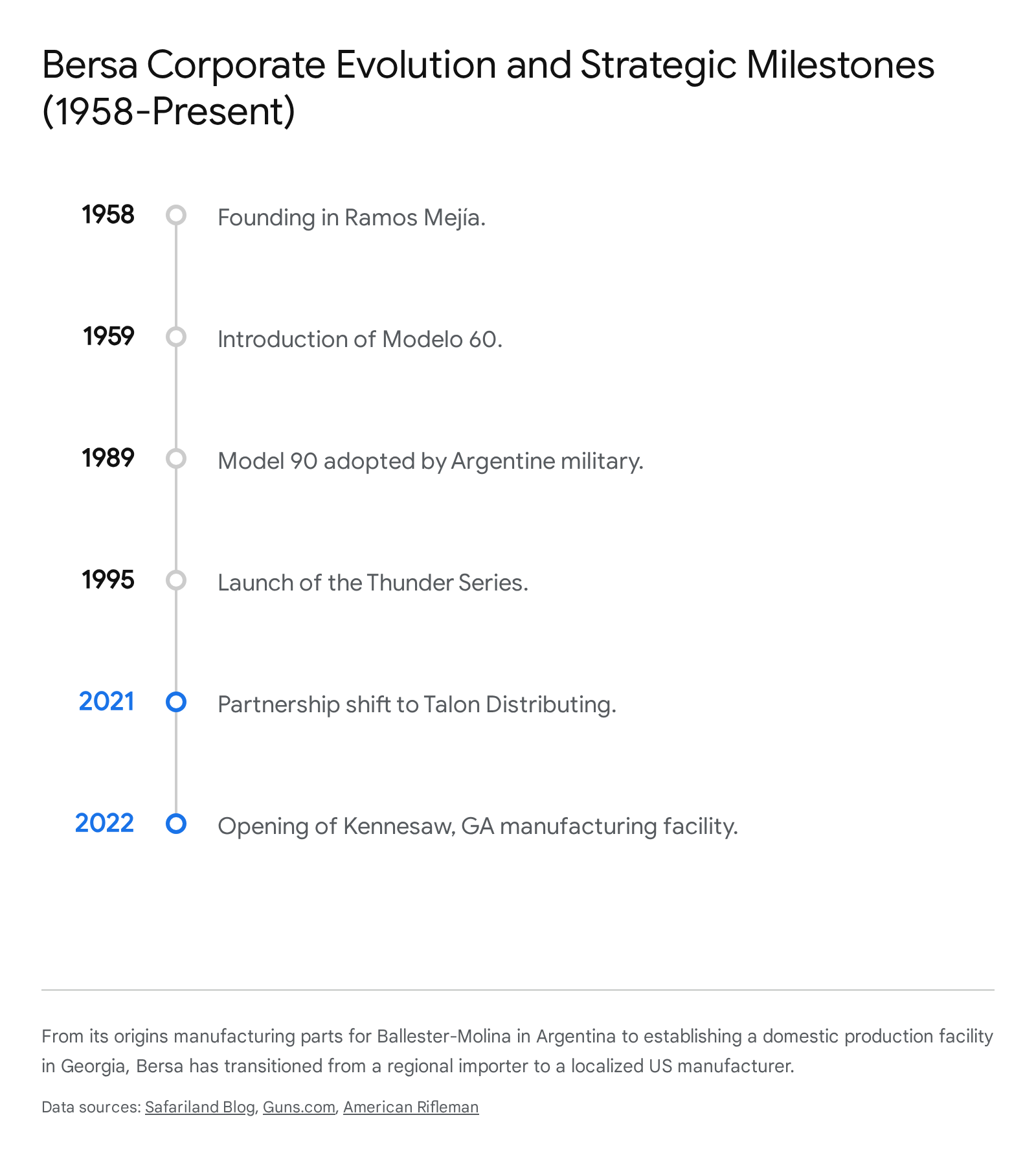
Over the past six decades, the small arms industry has witnessed the evolution of Bersa FIrearms from a regional South American components manufacturer into a globally recognized firearms brand. Founded in 1958 in Ramos Mejía, Argentina, Bersa initially established its reputation by producing affordable, reliable, blowback-operated defensive pistols, most notably the Walther PPK-inspired Thunder 380 series. For decades, the company occupied a distinct market niche, providing budget-conscious consumers with functional, metal-framed concealed carry options that significantly undercut European and American competitors on retail pricing while maintaining acceptable baseline quality standards.1

However, an assessment of Bersa’s current trajectory reveals an ongoing strategic shift. Beginning in 2021 with a transition in its United States import partnership, and culminating in the 2022 opening of a 45,500-square-foot manufacturing facility in Kennesaw and Cartersville, Georgia, Bersa has transitioned from a pure importer of Argentine designs to a localized American manufacturer of modern sporting rifles, double-stack 2011-style competition handguns, and advanced flow-through suppressors.3 This strategic localization allows the company to circumvent complex federal import restrictions, accelerate domestic research and development cycles, and compete directly in higher-margin segments of the U.S. commercial market.4

Today, the Bersa product portfolio is highly diversified. It encompasses the legacy Thunder line, the alloy-framed TPR duty pistols, the polymer striker-fired BP series, the B1911 and M2XI competition platforms, the BAR series of AR-pattern rifles and pistol-caliber carbines, and the newly patented WhisperTech suppressor line.7 Consumer sentiment is generally positive, with contemporary buyers noting the favorable value-to-performance ratio of the newer American-made models. Nevertheless, legacy budget models still occasionally exhibit the variable quality control typical of high-volume, lower-margin imported firearms.10 Furthermore, while Bersa provides a one-year limited warranty that transitions into a lifetime service contract for original owners 14, a reliance on third-party warranty centers for imported models has generated isolated friction regarding customer service policies, particularly concerning consumer modifications to OEM specifications.15

This report provides a detailed examination of Bersa’s corporate history, mechanical engineering shifts, current product catalogs, consumer reception, and strategic direction within the broader geopolitical and macroeconomic context of the global small arms market.

2. Historical Origins and Corporate Maturation (1950s–1990s)

2.1 The Engineering Foundations in Ramos Mejía

To accurately map Bersa’s modern corporate identity, an examination of its mechanical and geographic roots is required. The company was founded in the mid-1950s and officially incorporated in 1958 in Ramos Mejía, a city situated within the Greater Buenos Aires metropolitan area of Argentina.2 The founders were three Italian mechanical engineers who had immigrated to Argentina: Benso Bonadimani (also referred to as Banco Bonadiman in some historical texts 2, who remains the Chief Executive Officer and President), Savino Caselli, and Ercole Montini (sometimes anglicized to Hercules Montini 1).2 The corporate name “Bersa” is a portmanteau derived directly from the first letters of the founders’ given names: Benso, Ercole, and Savino.2 Today, Bersa S.A. remains privately held, with its corporate ownership divided equally among four individual investors.

These founders brought a European-centric understanding of firearms design to South America, particularly influenced by the engineering philosophies of Italian manufacturers such as Beretta.2 During its nascent years, Bersa did not produce complete, serialized firearms. Instead, the company operated as a high-precision machine shop manufacturing component parts for Ballester-Molina (operated by Hispano Argentino Fábrica de Automóviles SA).2 Ballester-Molina was a prominent private Argentine arms manufacturer recognized for producing a licensed clone of the “Sistema Colt Modelo 1927,” which was the Argentine military’s designated copy of the American Colt M1911.2 This early contracting work provided Bersa with working capital, advanced industrial tooling, and practical experience in mass-producing durable, military-grade metallurgical components for the Argentine armed forces and federal police.2

2.2 Proprietary Rimfire Designs

By 1959, Bersa had accrued sufficient capital, machinery, and engineering confidence to release its first proprietary firearm, designated the Modelo 60.2 The Modelo 60 was a semi-automatic pistol chambered in.22 Long Rifle (.22 LR). The architecture of the firearm was heavily inspired by modified Beretta designs, serving as a clear mechanical homage to the founders’ Italian heritage.2 The Modelo 60 was characterized by its simple blowback operation, fixed barrel design, and robust steel construction, which provided dependable durability for a rimfire caliber.

The commercial success of the Modelo 60 allowed the company to establish a permanent footprint in the South American civilian market. Bersa followed up with incremental design improvements in the form of the Modelo 62 and Modelo 64.2 These early models primarily differed in their barrel length configurations—measuring 9 cm, 10.5 cm, and 15 cm respectively—and solidified Bersa’s regional reputation as a reliable manufacturer of small-caliber, short-barreled defensive and recreational weapons.16

2.3 The Transition to Service Calibers and Government Contracts

A notable shift in Bersa’s transition from a civilian rimfire manufacturer to a defense contractor occurred in 1989 with the introduction of the Model 90.2 Chambered in the NATO standard 9x19mm Parabellum, the Model 90 was a full-sized, standard-capacity duty pistol designed for service environments.2 The engineering progression from simple blowback.22 LR pistols to a locked-breech, short-recoil 9mm platform demonstrated a maturation in Bersa’s metallurgical and mechanical design capabilities.

The Model 90, and its subsequent refined iteration, the Thunder 9, achieved widespread institutional adoption in South America. By the late 1990s, Bersa secured major government contracts, officially replacing the aging Ballester-Molina and Sistema Colt Modelo 1927 pistols as the standard-issue sidearm for both the Argentine Armed Forces and the Argentine Federal Police.2 These military and law enforcement contracts guaranteed steady revenue streams and provided the capital necessary for Bersa to look beyond South America and strategically target the United States civilian market.
Line graph illustrating global company count relevant to corporate history

3. The Thunder Series and the Global Import Market (1995–2020)

3.1 Mechanical Architecture of the Thunder 380

In 1995, Bersa introduced what would become its most globally recognized product line: the Thunder Series.2 While the series eventually included larger locked-breech models, the blowback-operated Thunder 380 largely defined Bersa’s market presence and brand identity for the next two decades.2

The Thunder 380 is heavily influenced by the Walther PPK design architecture.2 It utilizes a direct blowback action where the barrel is fixed securely to the frame. This mechanical configuration theoretically enhances inherent mechanical accuracy, as the barrel does not articulate or tilt during the firing cycle, unlike standard Browning-style short-recoil systems.20 The slide is constructed from carbon or 416 stainless steel, while the frame is milled from an aluminum alloy.2 This material combination yields a firearm that weighs approximately 20 ounces unloaded. This mass is sufficient to absorb the recoil impulse of the.380 ACP (Automatic Colt Pistol) cartridge while remaining light enough for daily concealed carry.19

The firing mechanism is a traditional Double-Action/Single-Action (DA/SA) utilizing an external hammer, paired with a slide-mounted combination decocker and manual safety lever.20 This mechanism allows the user to safely carry the firearm with a live round in the chamber and the hammer dropped. The initial trigger pull is long and heavy (double-action), designed to prevent negligent discharges, while the cycling of the slide cocks the hammer, rendering subsequent shots short and light (single-action).20

3.2 Geopolitical Market Positioning

The international adoption of the Thunder 380 was driven by two distinct geographical market dynamics occurring simultaneously.

First, in many South American nations, including Brazil and historically Argentina, civilian ownership of standard “military calibers” (such as 9x19mm Parabellum,.45 ACP, and 5.56 NATO) was heavily restricted or outright banned by federal legislation. Consequently, the.380 ACP (also known as 9x17mm Browning Short) became the most powerful legally obtainable defensive handgun caliber for ordinary citizens.2 Bersa capitalized on this captive market, making the Thunder 380 a common defensive tool across the continent.2

Second, in the United States, Bersa partnered with Eagle Imports (operating from 1988 until 2020) to exclusively distribute the Thunder series.3 During the late 1990s and early 2000s, the U.S. market experienced a surge in concealed carry licensing. Consumers sought reliable, compact firearms, but many were priced out of European models like the authentic Walther PPK or the SIG Sauer P232. Bersa filled this economic void by offering a functionally similar firearm at a lower cost, with retail prices often dipping below the $300 threshold.4

While the Thunder 380 achieved high commercial volume, it received some engineering criticisms from domestic consumers. Traditionalist American tactical shooters noted ergonomic quirks, such as a thin manual safety lever that could be difficult to actuate under stress.2 Furthermore, the inclusion of a magazine disconnect safety—a mechanism that mechanically prevents the firearm from discharging a chambered round if the magazine is removed—was viewed by many defensive instructors as a liability in a tactical scenario, despite being marketed as an administrative safety benefit.2

4. Strategic Pivot: United States Domestic Manufacturing (2020–Present)

4.1 Transition of Importers and Distribution Networks

For over three decades, Eagle Imports served as the exclusive conduit for channeling Bersa firearms into the United States market.24 However, in 2020, amidst global supply chain disruptions precipitated by the COVID-19 pandemic, Eagle Imports ceased operations.24 This closure left Bersa temporarily without a domestic distribution network, causing their firearms, magazines, and critical spare parts to become scarce on American retail shelves.26

In 2021, Bersa executed a strategic shift to stabilize its supply chain by partnering with Talon Distributing.3 Based in Kennesaw, Georgia, Talon Distributing not only resumed the importation of Bersa’s Argentine-made pistols but also offered corporate synergies with its sibling company, Talon Armament, which was already established in manufacturing AR-15 rifle components.26 This partnership laid the groundwork for Bersa’s subsequent corporate evolution. Furthermore, Bersa S.A. actively diversifies its operations by acting as a distributor in Argentina for other defense brands, such as the less-lethal manufacturer Byrna Technologies.

4.2 The Georgia Manufacturing Facility and Regulatory Advantages

Rather than continuing to rely solely on overseas importation—a model vulnerable to international shipping crises and fluctuating tariffs—Bersa made a capital investment in American manufacturing. In October 2022,(https://bersausa.com/) officially announced the opening of a 45,500-square-foot manufacturing facility spanning Kennesaw and Cartersville, Georgia.4

Rafael Del Valle, Bersa’s National Director of Sales and Marketing, characterized this operational shift as the “next logical step” for the brand’s evolution.4 The localization of manufacturing yields several strategic and regulatory advantages:

  • Circumventing the Gun Control Act of 1968 (GCA): The GCA, enforced by the Bureau of Alcohol, Tobacco, Firearms and Explosives (ATF), imposes a points-based system on all imported handguns. This system evaluates a firearm based on size, weight, caliber, and features, often prohibiting the import of sub-compact firearms or models lacking perceived “sporting purposes”.4 By manufacturing in Georgia under an ATF Type 07 Federal Firearms License (Manufacturer of Firearms Other Than Destructive Devices), Bersa can legally produce and sell configurations—such as micro-compact pistols, firearms with threaded barrels, and AR-style pistols—that are legally barred from foreign importation.4
  • Supply Chain Velocity and R&D: Domestic manufacturing reduces the time-to-market for research and development. Bersa can prototype, test, and release a new firearm within the U.S. market without waiting for international shipping logistics or foreign export approvals.4
  • Export Hub Optimization: Operating out of the United States allows Bersa to navigate International Traffic in Arms Regulations (ITAR) more effectively. By leveraging established U.S. trade agreements, Bersa can export firearms globally with greater ease than shipping directly from Argentina.4

5. Current Handgun Portfolio: Legacy and Service Lines

Bersa’s current handgun catalog is segmented, targeting distinct consumer demographics ranging from budget-conscious concealed carriers to law enforcement agencies. The company continues to produce its legacy models while expanding into modern service architectures.7

5.1 The Legacy Concealed Carry Lines

Bersa continues to market the blowback models that built its North American reputation, though manufacturing processes have been updated over the years with modern CNC machinery for improved machining tolerances.25

  • Thunder 380 Family: The standard Thunder 380 features a 3.5-inch micro-polished barrel with deep rifling, an 8+1 magazine capacity, and a total length of 6.6 inches.19 The Concealed Carry (CC) variant is a streamlined, dehorned version designed specifically to prevent snagging on clothing during the draw stroke, featuring a shorter 3.2-inch barrel and an 18.4-ounce unloaded weight.19 The Thunder 380 Plus utilizes a slightly wider grip frame to accommodate a 15-round double-stack magazine, addressing consumer demands for higher capacity without drastically increasing the firearm’s footprint.19
  • Firestorm 380: This is a variant engineered specifically to comply with the restrictive California Department of Justice handgun roster.32 While mechanically identical to the Thunder 380 regarding its DA/SA action and 3.5-inch barrel, the Firestorm features ergonomic differences.33 These include a rounded combat trigger guard (lacking the scalloped serrations of the Thunder), Glock-style U-outline rear sights instead of the traditional 3-dot system, and the addition of oversized rubber wrap-around grips with molded finger grooves.32

Table 1: Comparison of Bersa.380 ACP Legacy Platforms

FeatureThunder 380Firestorm 380Thunder 380 CC
Action TypeDA/SA BlowbackDA/SA BlowbackDA/SA Blowback
Capacity8+1 Rounds7+1 Rounds (CA Compliant)8+1 Rounds
Barrel Length3.5 inches 313.5 inches 363.2 inches 22
Weight20.0 oz 3120.0 oz 3618.4 oz 22
Grip StyleCheckered PolymerRubber Wrapped w/ GroovesTextured Polymer
Sights3-Dot DovetailU-Outline Rear / Dot FrontIntegral Low-Profile

5.2 The TPR Series: Alloy-Framed Service Pistols

The TPR (Thunder Pro) series represents Bersa’s entry into the modern alloy-framed duty pistol market. Comparable in size, weight, and mechanical operation to the Beretta 92 or SIG Sauer P226, the TPR9 is a locked-breech, DA/SA 9mm pistol designed for service and training environments.37

The TPR series is defined by a steel slide, durable Cerakote or Anodized finishes, and completely ambidextrous controls, including the slide stop, magazine release, and safety/decocker levers.37 The standard TPR9 features a 4.25-inch barrel and a 17+1 capacity, weighing approximately 30.7 ounces.37 Accuracy testing of the TPR9 fired from a bench rest at 25 yards has yielded 1.9-inch groups with Federal 147-grain HST ammunition and 2.0-inch groups with Hornady 124-grain XTP.37

While the platform is generally considered durable, independent field testing and consumer reports occasionally note extraction failures. In isolated reports, customer service representatives have advised users to utilize NATO-spec ammunition in the TPR9 series to ensure optimal cycling and reliability.18

The line diversifies with the TPR9C (Compact), which truncates the barrel to 3.25 inches and the capacity to 13 rounds.39 Conversely, the TPR9XT serves as a specialized competition model boasting a 4.96-inch barrel, a hand-tuned trigger, and dovetailed fiber-optic front sights.40

5.3 The BP Series: Modern Striker-Fired Modularity

To compete in the polymer-framed, striker-fired segment, Bersa introduced the BP (Bersa Polymer) series.41

Launched as a single-stack, sub-compact 9mm, the BP9CC measures 0.94 inches in width, prioritizing concealability.41 It holds 8+1 rounds and operates via a short-reset Double-Action-Only (DAO) striker mechanism.41 The BP9CC features a relatively light trigger pull for a striker-fired gun, recorded in independent testing at 3.7 pounds.42 To leverage existing aftermarket support, Bersa designed the BP9CC slide to accept a SIG Sauer #8 front sight and a Glock-style rear sight.43

The BP series has recently expanded with the BP9FS (Full Size). The BP9FS is a duty-oriented 17+1 capacity firearm featuring a 4.25-inch barrel, a hex grip texture, a 4140 steel slide with a QPQ finish, and native RMSc footprint optics mounting for red dot sights.44 Slated to retail at a Manufacturer’s Suggested Retail Price (MSRP) of $450 44, the BP9FS demonstrates Bersa’s focus on the budget-friendly defensive market.44 Furthermore, Bersa has released the BP13, a micro-compact double-stack variant designed to compete with high-capacity micro-nines.47

6. Current Handgun Portfolio: The Premium 1911 and 2011 Platforms

A notable evolution in Bersa’s corporate portfolio is its entry into the 1911 and 2011 markets, manufactured within the Kennesaw, Georgia facility.26 This positions Bersa as a manufacturer producing hand-fitted, higher-tier firearms.

6.1 The B1911 Platform

The B1911 is a traditional, single-stack 1911 platform chambered in the.45 ACP cartridge, utilizing a 70-series firing system devoid of firing pin blocks.49 Bersa constructs its 1911 utilizing 416R brushed stainless steel for both the slide and the frame.49

The B1911 features a 5-inch match-grade stainless barrel, low-profile Novak-style rear sights, a Tritium front night sight, an ambidextrous thumb safety, and textured VZ G10 grips.49 Available in six distinct finishes at launch 48, including Blue Stainless, Onyx, and Flat Dark Earth (FDE), the platform weighs 39.7 ounces.49 Retailing between $1,050 and $1,199, the B1911 competes directly with domestic mid-tier 1911s.50

6.2 The M2XI 2011 Race Gun

The M2XI is Bersa’s flagship competition platform and a notable market offering. It is a competition-ready, double-stack 9mm built on the 2011 architecture (which utilizes a modular frame featuring a steel upper chassis mated to a polymer grip module) originally patented by Virgil Tripp and Sandy Strayer in 1994.4

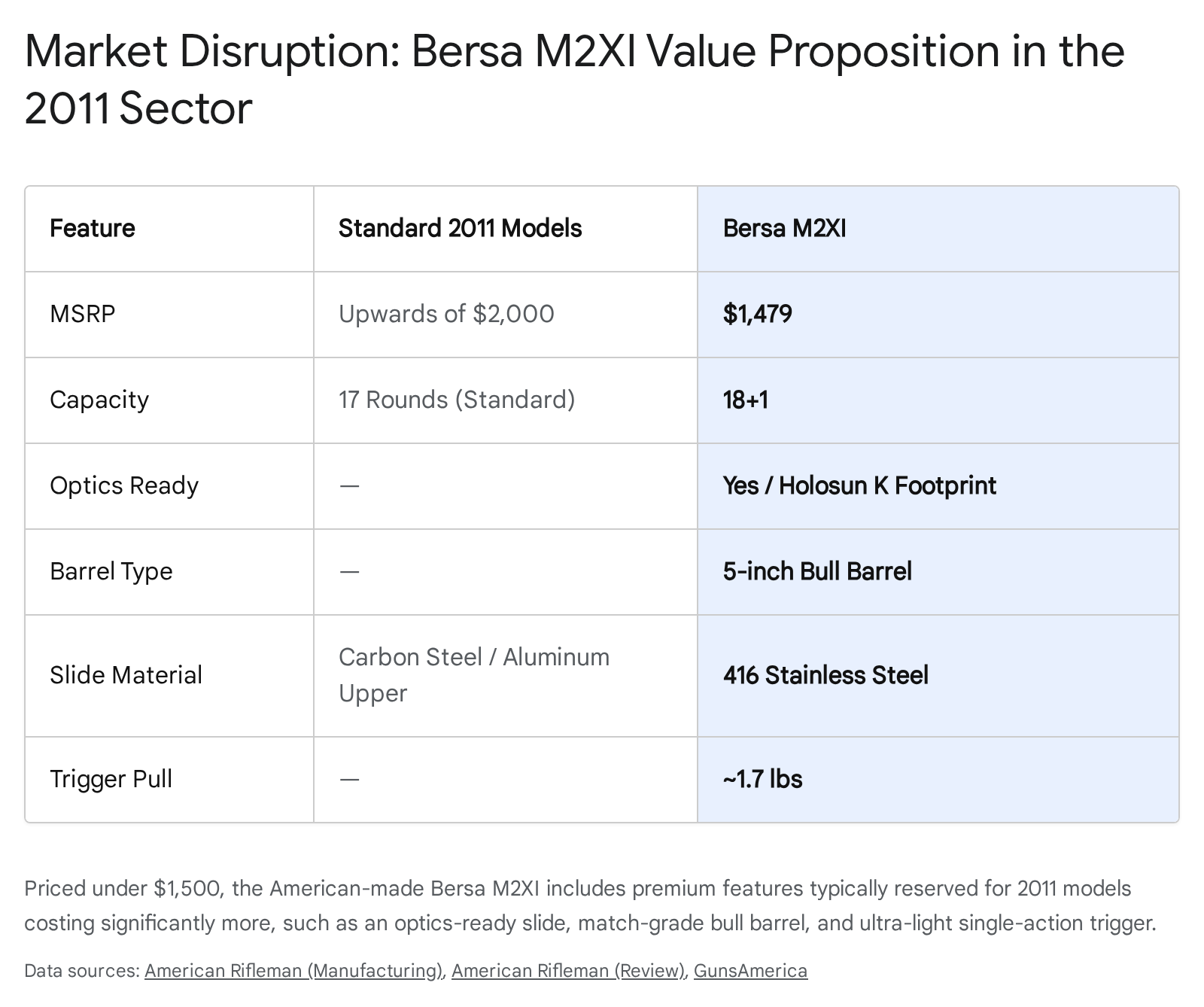
Shipping with 18-round Mec-Gar treated carbon steel magazines, the M2XI features a 5-inch bushingless bull barrel with an inverted target crown.4 The slide is optics-ready, featuring a milled cutout designed to accept optics with the Holosun K footprint directly.4 A frequently highlighted feature of the M2XI is its flat-faced aluminum trigger, which breaks at approximately 1.7 lbs, providing a measurable advantage in speed-shooting competitions.4

Priced at an MSRP of $1,479, the M2XI competes directly within a 2011 market where domestic models frequently retail for well over $2,000 to $3,000.4
Two smartphone pricing sheets on a table

7. Rifle and Pistol-Caliber Carbine Expansion: The BAR Series

Prior to the opening of the Georgia facility, Bersa possessed virtually no commercial footprint in the tactical rifle space. The strategic decision to manufacture AR-pattern rifles—designated the BAR (Bersa AR) series—represents a calculated integration of Talon Armament’s pre-existing AR-15 parts supply chain and Bersa’s domestic manufacturing capacity.3

7.1 The BAR15 (Direct Gas Impingement)

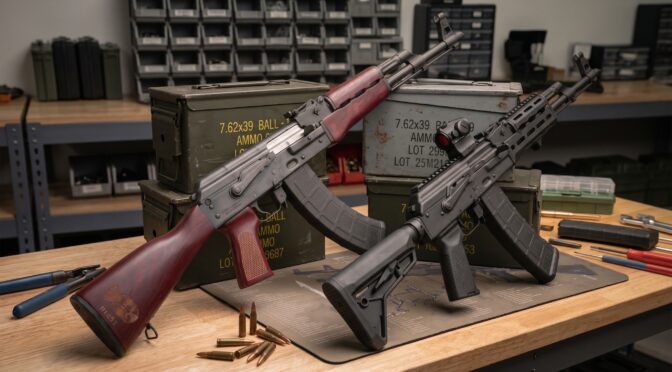
The BAR15 is a mil-spec, direct gas impingement AR-15 available in both 5.56 NATO and.300 Blackout chamberings.4 Bersa focused its engineering efforts on utilizing standard metallurgical components.

The upper and lower receivers are forged from 7075 aluminum alloy and treated with a Type III hard coat anodized finish.3 The barrels are constructed from 4150 Chrome Moly Vanadium (CMV) steel featuring a 1:7 twist rate.3 This alloy and twist rate configuration is standard for ensuring barrel longevity under sustained firing schedules. Bersa also partnered with aftermarket manufacturers, outfitting the rifles with free-floating M-Lok handguards and either Magpul MOE or Mission First Tactical (MFT) polymer grips and stocks.3 Retailing at an MSRP of $880 for the 16-inch rifle variant and $795 for the 7.5-inch pistol variant, the BAR15 positions itself within the mid-tier AR market.4

7.2 The BAR9 (Blowback Pistol Caliber Carbine)

Responding to market demand for Pistol Caliber Carbines (PCCs), Bersa released the BAR9.8 Operating via a straight blowback mechanism, the BAR9 is chambered in 9mm Luger.4

Bersa offers the BAR9 in multiple receiver and magazine configurations. While one model features a billet lower receiver designed to feed from Bersa’s proprietary 17-round TPR9 metal magazines, a second variant features a lower receiver designed to accept Glock double-stack magazines (shipping with a 27-round Magpul Glock magazine).3 Available in pistol configurations with 4-inch or 8-inch barrels and equipped with KAW Valley linear compensators, the MSRP ranges from $850 to $880 depending on the barrel and magazine configuration.4

8. Advanced Technologies: WhisperTech Suppressors

A technologically distinct segment of Bersa USA’s portfolio is the WhisperTech suppressor line.4 Entering the heavily regulated NFA (National Firearms Act) silencer market, Bersa utilized a patented, flow-through internal geometry to differentiate its product.

8.1 The Couvillion Method vs. Traditional Baffles

Most suppressors rely on the traditional Hiram Percy Maxim design, where expanding propellant gases are forced through a sequential stack of tight, cone-shaped baffles.9 Bersa’s WhisperTech line abandons the traditional baffle stack in favor of the patented “Couvillion” method.9

The Couvillion design (detailed in US Patent 10,222,163) utilizes a large initial expansion chamber.55 Instead of emergent gases immediately striking a primary blast baffle, they are vented into this open cylindrical space. At the distal end of the tube, a stainless steel plug containing a small monocore baffle is threaded into the muzzle end.55

This architectural shift yields specific operational advantages:

  1. Reduced Backpressure: By allowing gases to expand freely before encountering a baffle restriction, the suppressor directs less gas and carbon particulate fouling back down the barrel and into the weapon’s action.9
  2. Minimal Point of Impact (POI) Shift: The symmetrical internal pressure dynamics help ensure that attaching the suppressor does not significantly alter the bullet’s trajectory compared to unsuppressed firing.9

Table 2: Bersa WhisperTech Suppressor Lineup and Specifications 4

ModelCaliber RatingPrimary MaterialLengthWeightThread PitchMSRP
B-22.22 LRAluminum/StainlessN/AN/A1/2 x 28$459
B-9X9mm (Full Auto Rated)17-4 HH1150 SS6.37 in.11.7 oz.1/2 x 28$649
B-556X5.56 NATO (Full Auto Rated)17-4 HH1150 SS5.97 in.13.0 oz.1/2 x 28$619
B-65P6.5mm / 6.5 CreedmoorAluminum/StainlessN/AN/A5/8 x 24$659
B-762P7.62 NATO (.30 Caliber)Aluminum/Stainless8.20 in.12.0 oz.5/8 x 24$659

Despite the internal gas dynamics, analysts have noted a mechanical limitation regarding the mounting interface. While the suppressors utilize the industry-standard 1.375-inch HUB outer diameter, the internal thread pitch of the adapter interface is proprietary (not the standard 24 TPI pitch).55 This prevents users from adapting the WhisperTech suppressors to popular aftermarket Quick-Detach (QD) mounting systems (such as SilencerCo ASR or Dead Air KeyMo), requiring reliance on direct-thread mounting solutions.55

Diagram of a heat exchanger, a common industrial component

9. Quality Control, Reliability, and Consumer Sentiment

Consumer sentiment regarding Bersa firearms generally depends on the specific product tier in question, split primarily between the high-volume imported budget tier and the newer, domestic premium tier.

9.1 The Budget Tier: Thunder and TPR Feedback

The legacy Thunder 380 models are frequently cited as reliable introductory defensive handguns that offer functionality similar to the Walther PPK at a lower retail price.23 The heavy DA/SA trigger pull acts as a safety measure, and the metal frame absorbs recoil effectively.10

However, customer reviews on firearms forums occasionally highlight inconsistent quality control across different production runs.10 Common consumer feedback notes:

  • Ammunition Sensitivity: The Thunder 380 is a straight blowback firearm, meaning the cycling of the action relies entirely on the rearward pressure of the cartridge case. Users report that underpowered or steel-cased ammunition occasionally fails to provide enough force to cycle the slide, resulting in ejection malfunctions.10
  • The Magazine Disconnect Mechanism: The internal safety mechanism that disables the trigger when the magazine is removed is cited as a point of mechanical friction. Users report it sometimes requires a break-in period to smooth out the linkage.21
  • Magazine Scarcity: Sourcing factory OEM magazines for the Thunder series has historically been difficult in the United States, driving consumers to purchase aftermarket magazines that can affect reliability.23

The TPR9 series generally receives positive feedback for mechanical reliability, effectively feeding modern Jacketed Hollow Point (JHP) and overpressure (+P) ammunition.37 The primary subjective critique of the TPR9 is its dimensions; the slide geometry is considered thick compared to slimline polymer competitors.18

9.2 The Premium Tier: B1911 and M2XI Feedback

The reception of the newly American-made B1911 and M2XI 2011 platforms has been generally positive among reviewers and early adopters.12

Professional reviewers consistently note the smooth action and bench-rest accuracy of the M2XI.12 Endurance testing has demonstrated reliable feeding across hundreds of rounds, functioning with multiple magazine brands (including OEM Mec-Gar, Staccato, and Checkmate).53 The 1.7-pound trigger pull is highlighted as providing a competitive advantage out of the box.12 Minor critiques have involved a slightly gritty slide feel prior to a break-in period and a slightly low point-of-impact with the factory-installed iron sights.13

10. Customer Service, Warranty Infrastructure, and Legal Friction

A critical component determining the reputation of a firearms manufacturer is its after-sales support network. Bersa provides a one-year limited warranty on material and workmanship defects, which transitions into a Lifetime Service Warranty for the original purchaser for as long as they own the firearm.14 This contract covers defects in material and workmanship but explicitly voids coverage in cases of neglect, abuse, unauthorized adjustments, cosmetic modifications, or the use of improper/overpressure ammunition that does not conform to SAAMI specifications.14

10.1 Warranty Operations Structure

Following the dissolution of Eagle Imports, Bersa reorganized its warranty fulfillment structure in the United States. Bersa USA currently manages warranty claims for its domestically produced BAR, B1911, and M2XI lines directly in-house.14 However, warranty operations for the imported pistol lines (such as the Thunder and TPR series) remain reliant on authorized third-party gunsmiths, primarily American Arsenal and Armory located in Indiana.14

When warranty claims involve recognized manufacturing defects, customers generally report acceptable turnaround times, with the warranty center sometimes issuing complete firearm replacements at minimal cost to the consumer.60

10.2 Consumer Friction and Modification Policies

The reliance on third-party warranty centers enforcing strict OEM compliance for imported lines has generated friction within the consumer base. Detailed consumer reports indicate disputes regarding the interpretation of the “unauthorized modification” clause.15

In a documented consumer dispute, a customer sent a Bersa pistol to the warranty center for repair. The firearm had been modified by the user (aftermarket Cerakote finish, non-OEM grips, and the internal magazine disconnect safety had been removed).15 The warranty center gunsmith deemed the warranty void due to the modifications and allegedly refused to return the firearm as-is, demanding the customer pay for the initial repair and to restore the firearm to exact OEM specifications, citing liability regarding the missing safety mechanism.15 The consumer expressed concerns regarding the potential destruction of serialized components and the resulting legal implications under state registration laws.15

While a manufacturer is legally justified in voiding a warranty on a firearm with a defeated safety mechanism, disputes resulting in a third-party contractor refusing to return personal property can create negative brand sentiment.15 As Bersa expands its domestic footprint, evaluating the consistency of dispute resolution across its outsourced and in-house warranty networks may be necessary to maintain customer satisfaction.61

11. Market Trajectory and Strategic Conclusion

As of 2026, Bersa’s strategic direction involves the localization of core manufacturing capabilities and expansion into the mid-tier and premium performance markets.

The global small arms market includes a high volume of affordable imports from manufacturers based in Turkey and the Philippines.6 Historically, Bersa competed directly in this segment on price. By leveraging the Kennesaw, Georgia facility, Bersa aims to differentiate its products by offering the machining tolerances and logistical reliability associated with domestic manufacturing, while keeping pricing architectures lean enough to undercut legacy domestic brands.13

The introduction of the BP9FS and the BP13 striker-fired pistols demonstrates an intent to capture defensive shooters who demand optics-ready, high-capacity polymer platforms.44 Concurrently, the release of the M2XI and B1911 indicates that Bersa is targeting the higher-tier competition and enthusiast markets.4

If Bersa can maintain quality control across its Georgia-produced lines, market the technological advantages of the WhisperTech suppressors, and manage customer service expectations across its warranty network, the company is positioned to expand its market share and evolve beyond its legacy reputation as a budget importer.

Appendix: Methodology and Data Sources

This intelligence report was synthesized utilizing a qualitative and quantitative analysis of open-source industry data, manufacturer technical documentation, and consumer sentiment aggregates available as of 2026. The methodology involved triangulating historical corporate records (e.g., founding dates, early models, and Argentine government contracts) with contemporary market data regarding product specifications, pricing (MSRP), and domestic manufacturing logistics.1 Technical specifications, including capacities, barrel lengths, material compositions, and ballistic data for the Thunder, TPR, BP, B1911, and BAR series, were extracted directly from the manufacturer’s latest catalog releases and cross-referenced with independent technical reviews for objective validation.4 Assessment of advanced technologies, particularly the WhisperTech suppressors and the Couvillion flow-through patent, was conducted by reviewing patent documentation (US10222163B2) and field test performance reports.9 Finally, qualitative consumer sentiment, mechanical reliability metrics, and customer service efficacy were evaluated by aggregating user reviews from major firearms forums and independent journalistic evaluations to ensure a balanced, objective representation of the brand’s operational performance.6


Please share the link on Facebook, Forums, with colleagues, etc. Your support is much appreciated and if you have any feedback, please email us in**@*********ps.com. If you’d like to request a report or order a reprint, please click here for the corresponding page to open in new tab.


Sources Used

  1. About Us – Bersa You Can Trust, accessed July 6, 2026, https://bersausa.com/purpose/
  2. Bersa Firearms: The Argentine Armorers – Inside Safariland, accessed July 6, 2026, https://inside.safariland.com/blog/bersa-firearms-the-argentine-armorers/
  3. Bersa Now has a Factory in America, Making ARs – Guns.com, accessed July 6, 2026, https://www.guns.com/news/2023/01/25/bersa-now-has-factory-in-america-making-ars
  4. Bersa Opens U.S. Manufacturing Facility | An Official Journal Of The NRA, accessed July 6, 2026, https://www.americanrifleman.org/content/bersa-opens-u-s-manufacturing-facility/
  5. Bersa, 100 INDUSTRIAL DR SUITE 200, CARTERSVILLE, GA | FFLs.com, accessed July 6, 2026, https://www.ffls.com/ffl/158015075e22726/bersa-usa-llc
  6. 2011 Time: M2XI Bersa’s Journey from Argentine Euroclones to American Iron | RECOIL, accessed July 6, 2026, https://www.recoilweb.com/2011-time-m2xi-bersas-journey-from-argentine-euroclones-to-american-iron-190570.html
  7. Bersa Pistols: Reliable Firearms for Every Shooter, accessed July 6, 2026, https://bersausa.com/bersa-pistols/
  8. Bersa Rifles: Precision and Performance Firearms, accessed July 6, 2026, https://bersausa.com/bersa-rifles/
  9. WhisperTech – Bersa You Can Trust, accessed July 6, 2026, https://bersausa.com/whispertech/
  10. Opinions on Bersa Thunder? : r/CCW – Reddit, accessed July 6, 2026, https://www.reddit.com/r/CCW/comments/1n88xyy/opinions_on_bersa_thunder/
  11. I Finally Reviewed the Bersa Thunder 380 – Lucky Gunner Lounge, accessed July 6, 2026, https://www.luckygunner.com/lounge/i-finally-reviewed-the-bersa-thunder-380/
  12. Review: Bersa M2XI Pistol | An Official Journal Of The NRA – American Rifleman, accessed July 6, 2026, https://www.americanrifleman.org/content/review-bersa-m2xi-pistol/
  13. Best Budget 2011? Bersa M2XI 9mm Review – GunsAmerica, accessed July 6, 2026, https://gunsamerica.com/digest/bersa-m2xi-9mm-2011-review/
  14. Warranty – Bersa You Can Trust, accessed July 6, 2026, https://bersausa.com/warranty/
  15. UPDATE 8/5/25: Sent gun in for repair and repair shop is refusing to send gun back. Curious to get opinions. : r/Firearms – Reddit, accessed July 6, 2026, https://www.reddit.com/r/Firearms/comments/1mispvk/update_8525_sent_gun_in_for_repair_and_repair/
  16. Argentinian arms manufacturer Bersa – AmmoTerra, accessed July 6, 2026, https://ammoterra.com/blogs/argentinian-arms-manufacturer-bersa
  17. Bersa – Wikipedia, accessed July 6, 2026, https://en.wikipedia.org/wiki/Bersa
  18. Saw a Bersa tpr9c for 260 OTD , what’s the consensus ? : r/Firearms – Reddit, accessed July 6, 2026, https://www.reddit.com/r/Firearms/comments/1mpbwyq/saw_a_bersa_tpr9c_for_260_otd_whats_the_consensus/
  19. Bersa Thunder 380 – Wikipedia, accessed July 6, 2026, https://en.wikipedia.org/wiki/Bersa_Thunder_380
  20. www.bersa.com – Webflow, accessed July 6, 2026, https://global-uploads.webflow.com/634c2c6c2d6ff759d4ae9699/63b57a897e2c70d5d4020281_Bersa%20Catalogue%20v6_compressed.pdf
  21. Bersa .380 | Shooters’ Forum, accessed July 6, 2026, https://forum.accurateshooter.com/threads/bersa-380.3993297/
  22. Thunder 380 CC – Bersa You Can Trust, accessed July 6, 2026, https://bersausa.com/product/thunder-380-cc/
  23. Bersa Thunder 380 Review: Specification, Performance and Price | Craft Holsters®, accessed July 6, 2026, https://www.craftholsters.com/bersa-thunder-380-review
  24. Eagle Imports: 1988-2020 | An Official Journal Of The NRA – American Rifleman, accessed July 6, 2026, https://www.americanrifleman.org/content/eagle-imports-1988-2020/
  25. What are your thoughts about Bersa and its Thunder series? : r/Firearms – Reddit, accessed July 6, 2026, https://www.reddit.com/r/Firearms/comments/1pw6a2c/what_are_your_thoughts_about_bersa_and_its/
  26. Bersa Follows Trend, Begins American Manufacturing | An Official Journal Of The NRA, accessed July 6, 2026, https://www.americanrifleman.org/content/bersa-follows-trend-begins-american-manufacturing/
  27. New Bersa Importer/Distributor – Reddit, accessed July 6, 2026, https://www.reddit.com/r/Bersa/comments/ogtutt/new_bersa_importerdistributor/
  28. BERSA Announces US Facility and Launches New Website – Laura Burgess Marketing, accessed July 6, 2026, https://lauraburgess.com/bersa-announces-us-facility-and-launches-new-website/
  29. Bersa, 8530 COBB CENTER DRIVE, KENNESAW, GA | FFLs.com, accessed July 6, 2026, https://www.ffls.com/ffl/158067075e22726/bersa-usa-llc
  30. Explore Bersa’s Full Catalog of Firearms | Bersa USA, accessed July 6, 2026, https://bersausa.com/bersa-catalog/
  31. Thunder 380 – Bersa You Can Trust, accessed July 6, 2026, https://bersausa.com/product/thunder-380/
  32. [Review] Bersa Thunder & Firestorm .380: Better 007 PPK? – Pew Pew Tactical, accessed July 6, 2026, https://www.pewpewtactical.com/bersa-thunder-firestorm-380-review/
  33. Bersa Firestorm 380 Semi-Auto Pistol – Cabela’s, accessed July 6, 2026, https://www.cabelas.com/p/bersa-firestorm-380-semi-auto-pistol
  34. Firestorm – Bersa You Can Trust, accessed July 6, 2026, https://bersausa.com/firestorm/
  35. Welcome to Bersa USA | Reliable Firearms for Every Shooter, accessed July 6, 2026, https://bersausa.com/
  36. Firestorm 380 – Bersa You Can Trust, accessed July 6, 2026, https://bersausa.com/product/firestorm-380-2/
  37. TESTED: Bersa TPR 9 Semi-Auto – Shoot On, accessed July 6, 2026, https://shoot-on.com/tested-bersa-tpr-9-semi-auto/
  38. TPR 9 – Bersa You Can Trust, accessed July 6, 2026, https://bersausa.com/product/tpr-9/
  39. TPR 9 Compact – Bersa You Can Trust, accessed July 6, 2026, https://bersausa.com/product/tpr-9-compact/
  40. TPR 9 XT – Bersa You Can Trust, accessed July 6, 2026, https://bersausa.com/product/tpr-9-xt/
  41. Bersa BP9CC Review – Guns Holsters And Gear, accessed July 6, 2026, https://www.gunsholstersandgear.com/gun-reviews/bersa-bp9cc-review/
  42. BP9CC – Bersa You Can Trust, accessed July 6, 2026, https://bersausa.com/product/bp9cc/
  43. A Guide to Bersa BP9CC Handguns – Alien Gear Holsters, accessed July 6, 2026, https://aliengearholsters.com/blogs/news/a-guide-to-bersa-bp9cc
  44. New For 2026: Bersa BP9 FS | An Official Journal Of The NRA – American Rifleman, accessed July 6, 2026, https://www.americanrifleman.org/content/new-for-2026-bersa-bp9-fs/
  45. Bersa BP9FS Full Size Striker Fired Duty Pistol | SHOT Show 2026 – YouTube, accessed July 6, 2026, https://www.youtube.com/watch?v=WXe1dsXWwEs
  46. BP9 FS – Bersa You Can Trust, accessed July 6, 2026, https://bersausa.com/product/bp9fs/
  47. TFB Behind the Gun #214: Rafael Del Valle of Bersa Firearms | thefirearmblog.com, accessed July 6, 2026, https://www.thefirearmblog.com/blog/tfb-behind-the-gun-214-rafael-del-valle-of-bersa-firearms-44827000
  48. SHOT 2024 Coverage – GBGuns Depot, accessed July 6, 2026, https://www.gbgunsdepot.com/post/shot-2024-coverage
  49. B1911 Blue Stainless – Bersa You Can Trust, accessed July 6, 2026, https://bersausa.com/product/b1911-blue-stainless/
  50. Bersa B1911 Pistol Review: A Blue Stainless Beaut – Handguns, accessed July 6, 2026, https://www.handgunsmag.com/editorial/bersa-b1911-pistol-review/516601
  51. Bersa B1911s Series: Precision and Performance Handguns, accessed July 6, 2026, https://bersausa.com/b-19-11s/
  52. BERSA B1911 .45 ACP Semi Auto Pistol B19117050SMBL | 8+1 Rounds, 5″ Barrel, Stainless/Silver, Night Sights – Buds Gun Shop, accessed July 6, 2026, https://www.budsgunshop.com/product_info.php/products_id/163331/bersa+b1911+.45+acp+5+brushed+stainless+steel+night+sights+8rd
  53. A 2011 Out of Left Field: Bersa USA M2XI – Coldboremiracle, accessed July 6, 2026, https://coldboremiracle.com/2026/04/29/a-2011-out-of-left-field-bersa-usa-m2xi/
  54. WhisperTech B-9X – Bersa You Can Trust, accessed July 6, 2026, https://bersausa.com/product/whisper-tech-b-9x/
  55. Bersa Whispertech 6.5 Suppressor: Innovative Tech You Didn’t …, accessed July 6, 2026, https://www.recoilweb.com/bersa-whispertech-6-5-suppressor-innovative-tech-you-didnt-expect-189600.html
  56. SOUND SUPPRESSORS FOR SMALL ARMS WITH AN, accessed July 6, 2026, https://www.researchgate.net/publication/340804148_SOUND_SUPPRESSORS_FOR_SMALL_ARMS_WITH_AN_ADVANCED_EXPANSION_CAMERA
  57. US10222163B2 – Method and apparatus for firearm sound suppression – Google Patents, accessed July 6, 2026, https://patents.google.com/patent/US10222163B2/en
  58. WhisperTech B-762P – Bersa You Can Trust, accessed July 6, 2026, https://bersausa.com/product/whisper-tech-b-762p/
  59. Bersa FAQ: Answers to Your Gun Questions | Bersa USA, accessed July 6, 2026, https://bersausa.com/faq/
  60. Bersa guarantee worked on 10 year old Thunder Plus! – Reddit, accessed July 6, 2026, https://www.reddit.com/r/Bersa/comments/1d3cokc/bersa_guarantee_worked_on_10_year_old_thunder_plus/
  61. Bersa online store – Reddit, accessed July 6, 2026, https://www.reddit.com/r/Bersa/comments/1piszy1/bersa_online_store/
  62. Bersa – Military Wiki | Fandom, accessed July 6, 2026, https://military-history.fandom.com/wiki/Bersa
  63. Bersa B1911: Full Review – Guns and Ammo, accessed July 6, 2026, https://www.gunsandammo.com/editorial/bersa-b1911/503803
  64. Performance Analysis of Different Gun Silencers – MDPI, accessed July 6, 2026, https://www.mdpi.com/2076-3417/13/7/4426
  65. Bersa M2XI Review After 2400 Rounds | Double-Stack 1911 Optics-Ready Performance, accessed July 6, 2026, https://www.youtube.com/watch?v=0c1rbNwagzU
  66. Bersa Warranty : r/Argmas – Reddit, accessed July 6, 2026, https://www.reddit.com/r/Argmas/comments/1n07qco/garantia_bersa/?tl=en

US-Iran Regional Security and OSINT Summary (July 4 – July 10, 2026)

Executive Summary

The reporting period of July 4 to July 10, 2026, witnessed the rapid, violent, and systemic collapse of the June 14 Islamabad Memorandum of Understanding (MoU) ceasefire framework, returning the United States and the Islamic Republic of Iran to a state of active, high-intensity kinetic hostilities. This deterioration was fundamentally precipitated by Tehran’s aggressive attempts to operationalize the newly formed Persian Gulf Strait Authority (PGSA) as an institutionalized toll-collection and sovereign-control mechanism over the Strait of Hormuz, an act that brazenly crossed Washington’s established redlines regarding the freedom of international navigation. The resulting escalation highlights a highly volatile “dual-track” paradigm where both Washington and Tehran are deliberately deploying military force to shape the diplomatic baseline ahead of anticipated technical negotiations.

Diplomatically, the Bürgenstock Architecture in Switzerland has been functionally paralyzed by the renewed violence, although diplomatic channels remain tenuously open. This was evidenced by US President Donald Trump’s July 10 declaration that the formal ceasefire is unequivocally “OVER,” paradoxically paired with a simultaneous agreement to continue backchannel talks facilitated by Qatari mediators. In the Levantine theater, the proposed Iran-Lebanon-US deconfliction cell remains entirely inactive, systematically stalled by a Lebanese government that is highly resistant to formalizing any degree of Iranian influence within its domestic security architecture.

Economically, the US Treasury rapidly and punitively revoked General License X (GL X)—which had temporarily authorized the sale of Iranian hydrocarbons—replacing it with the highly restrictive General License X1 (GL X1). This revocation reinstates severe macroeconomic pressure on Tehran, trapping payments in blocked US accounts and compounding an International Monetary Fund (IMF) projected economic contraction of 6.1%. Kinetically, Iran’s unprovoked strikes on three commercial vessels, including Qatari and Saudi assets, triggered a massive US retaliatory campaign targeting over 80 Iranian air defense and naval nodes, alongside a highly strategic geo-economic strike on the Gorgan-Incheh Borun railway bridge in northern Iran. Iran countered this with an unprecedented wave of horizontal escalation, launching ballistic missiles and drones at US military installations in Jordan, Kuwait, Bahrain, and Qatar. This tit-for-tat violence underscores a highly dangerous phase of “negotiation under fire,” where both adversaries seek to leverage military dominance and proxy warfare to extract maximalist concessions in future diplomatic engagements.

Detailed Operational and Diplomatic Developments

Bilateral Interactions

The diplomatic framework established by the 14-point Islamabad Memorandum of Understanding is currently undergoing a severe, potentially terminal, stress test, exposing the inherent and deep-seated contradictions between United States and Iranian strategic objectives.1 The MoU, officially signed on June 17, 2026, at the Palace of Versailles by US President Donald Trump and Iranian President Masoud Pezeshkian, was explicitly designed as a 60-day interim de-escalation vehicle.1 Its primary utility was to freeze the intense direct and proxy military hostilities that characterized Operation Epic Fury—the joint US-Israeli military campaign initiated on February 28, 2026, which resulted in the assassination of former Supreme Leader Ali Khamenei—while broader, permanent agreements could be brokered.1 However, the agreement’s “constructive ambiguity,” which initially allowed both sides to claim political victory and halt the fighting, has proven fatal in the short term.2

The primary friction point revolves around the strategic control of the Strait of Hormuz. Tehran interpreted the MoU’s mandate to reopen the strait as implicit international permission to administer the waterway via the PGSA, demanding tolls and dictating transit routes under the guise of maritime security, mine clearance, and environmental protection.4 The United States categorically rejected this interpretation, asserting that the waterway must remain an unrestricted international transit corridor.10 US officials demanded that Tehran issue a public, unequivocal statement guaranteeing toll-free, unhindered access to all shipping lanes, threatening severe consequences for non-compliance.12 While US diplomatic sources reported on July 10 that Iran had privately acknowledged its recent attacks on shipping as a “mistake” stemming from an “errant part of their system,” Tehran has publicly doubled down on its sovereign claims, refusing to concede operational control over the chokepoint.10 Consequently, President Trump announced via social media on July 10 that the formal ceasefire is terminated, yet authorized the continuation of talks in Oman and Switzerland, illustrating a deliberate strategy of coercive diplomacy where kinetic pressure runs parallel to diplomatic engagement.5

The broader Bürgenstock Architecture, which facilitates these negotiations, remains highly fragile. Following unprecedented high-level political talks on June 23-24 between US Vice President J.D. Vance and Iranian Parliament Speaker Mohammad Bagher Ghalibaf at the Swiss resort, negotiations were suspended to allow both delegations to consult their respective leaderships.2 The resumption of these talks is highly dependent on the mediation efforts of Pakistan and Qatar.6 Pakistani Prime Minister Shehbaz Sharif continues to engage both Tehran and Doha to keep the process on track, while Qatari negotiators traveled directly to Mashhad, Iran, on July 10—meeting Foreign Minister Abbas Araghchi during Ali Khamenei’s funeral ceremonies—in a desperate bid to stabilize their mediation role and salvage the dialogue process.15

The internal political dynamics within Iran further complicate these negotiations. The new Supreme Leader, Mojtaba Khamenei, who has remained largely out of public view since his father’s death, faces intense pressure from the Islamic Revolutionary Guard Corps (IRGC) and conservative hardliners to project unyielding strength and avenge the casualties of Operation Epic Fury.5 During the massive transnational funeral processions spanning Tehran, Qom, the Iraqi cities of Najaf and Karbala, and finally Mashhad—which drew an estimated 20 to 43 million mourners—anti-US sentiment reached a fever pitch.72 Hardline figures explicitly demanded a harder ideological, nuclear, and security line, framing the US diplomatic engagement as a deceptive tactic used to map Iranian leadership residences for future assassinations.20

In the Levantine theater, the implementation of the June 26 Trilateral Framework Agreement between Israel, Lebanon, and the United States remains completely deadlocked over internal Lebanese political calculations and deep-seated institutional fears.26 A central component of this framework is the establishment of an Iran-Lebanon-US “deconfliction cell,” a mechanism originally proposed by Qatari mediators to monitor, verify, and report on violations of the cessation of military operations across the Israel-Hezbollah front.26 However, the Lebanese government has actively and systematically stalled the operationalization of this cell by refusing to formally appoint official representatives.26 The strategic rationale in Beirut is clear and paramount: the central government views Iranian influence as an existential destabilizer and seeks to avoid any mechanism that legally formalizes Tehran’s role in Lebanese domestic security affairs.26 Allowing the deconfliction cell to function would grant the IRGC direct, internationally recognized leverage to shape the narrative regarding ceasefire violations via its proxy, Hezbollah.26 While Lebanese President Joseph Aoun stated on July 6 that the government is not fundamentally opposed to appointing a representative—and diplomatic sources floated former Ambassador to the US Simon Karam for the role on July 7—no official action has been taken to convene the cell.26

Concurrently, the Lebanese Armed Forces (LAF) have flatly refused to establish designated “pilot zones” north of the Litani River or to initiate the disarmament of Hezbollah until the Israel Defense Forces (IDF) execute a complete and verifiable withdrawal from Lebanese territory, specifically from positions in Zawtar el Gharbiyeh, Ghandouriyeh, and Froun in the Nabatieh Governorate.26 The LAF leadership calculates that initiating an internal confrontation with Hezbollah prior to an Israeli withdrawal would likely fracture the military and ignite a catastrophic civil war, while simultaneously providing Israeli forces with a strategic pretext to maintain their occupation of southern Lebanon indefinitely.26 Instead, Lebanon continues to favor the US-led Military Coordination Group for Lebanon (MGC4L), commanded by US Marine Lieutenant General Joseph Clearfield, as the exclusive mechanism for deconfliction, explicitly to bypass Iranian oversight and maintain bilateral security ties with Washington.26 Despite these profound gridlocks and the failure to meet its own preconditions regarding an IDF withdrawal, the Lebanese government confirmed on July 8 that it will participate in the upcoming tripartite Rome negotiations scheduled for July 15-16, indicating a continued commitment to the diplomatic process despite the deteriorating security environment.22

Economic Statecraft

The focal point of United States economic statecraft during this reporting period was the abrupt, severe, and highly disruptive termination of the sanctions relief that had been conditionally granted under the Islamabad MoU. On July 7, 2026, the US Department of the Treasury’s Office of Foreign Assets Control (OFAC) issued General License X1 (GL X1), completely and immediately revoking General License X (GL X).30 Issued just weeks prior on June 21, GL X had represented a historic and dramatic reversal of US policy, broadly authorizing the production, delivery, and sale of Iranian crude oil, petroleum, and petrochemical products.31 This initial authorization was designed to stabilize global energy markets, ease inflation, and serve as a powerful economic incentive for Iranian compliance with the military ceasefire.1

However, following the IRGC’s attacks on commercial shipping in the Strait of Hormuz, the transition to GL X1 operates not merely as a return to the status quo ante, but as a punitive recalibration designed to rapidly sever Iran’s immediate access to hard currency and inflict maximum liquidity pressure.32 GL X1 provides a highly compressed, 10-day wind-down period expiring precisely at 12:01 a.m. EDT on July 17, 2026.31 Crucially, the directive strictly prohibits any new transactions, including new purchases or loadings of Iranian-origin hydrocarbons; it solely authorizes conduct that is “ordinarily incident and necessary” to wind down previously authorized activities.31

Furthermore, the payment settlement architecture has been aggressively weaponized by the US Treasury. Whereas GL X permitted payments owed to Iran, the Government of Iran, or blocked persons to be settled directly in US dollars, GL X1 fundamentally alters this paradigm.32 Under the new directive, any payments made during the wind-down period must be deposited directly into blocked, interest-bearing accounts located strictly within the jurisdiction of the United States.31 This mechanism ensures that while international buyers can legally fulfill existing contractual obligations and take delivery of oil already in transit, the Iranian regime is entirely deprived of the resulting liquidity, trapping the funds under US jurisdiction where they can only be released pursuant to a specific, and highly unlikely, OFAC license.37

US Treasury policy shifts to financial sentiment

Simultaneous to the GL X revocation, the US Treasury expanded its targeting of Iranian financial networks to choke off alternative revenue streams. OFAC announced new designations pursuant to Executive Orders 13902 and 13876, targeting key Iranian exchange houses and individuals that move billions of dollars annually on behalf of sanctioned Iranian banks.39 A primary target was Dubai-based Iranian national Ali Ansari, a key financier for the Supreme Leader’s office.39 Ansari, the former owner and director of the US-sanctioned and now-defunct Ayandeh Bank, was designated for institutionalizing embezzlement within the Iranian regime, overextending loans backed by the Central Bank of Iran to his own shell companies, and amassing a global network of investment properties on behalf of Mojtaba Khamenei and the IRGC.39 Specifically, Ansari has been linked to the acquisition of luxury apartments in London overlooking the Israeli embassy on behalf of the Supreme Leader’s son.75 This indicates a comprehensive, multi-layered US strategy to systematically dismantle Iran’s shadow banking apparatus and personal enrichment networks while formal energy revenues are choked off.

This rapid whiplash in sanctions policy, combined with the physical destruction of infrastructure, has inflicted severe psychological and structural damage on the Iranian macroeconomy. The International Monetary Fund (IMF) has drastically downgraded Iran’s 2026 economic outlook, projecting a severe contraction of 6.1%—a devastating 7.2 percentage point negative revision from earlier forecasts of 1.1% growth.40 The IMF attributes this collapse directly to the destruction of energy and transport infrastructure, diminished production, and the sustained disruption around the Strait of Hormuz.40 Concurrently, average consumer-price inflation, already exceeding 50% in 2025, is projected to surge to an unsustainable 68.9%, while formal unemployment is forecast to rise to 9.2%.40 In the domestic foreign exchange markets, the temporary optimism and surging stock valuations that immediately followed the MoU’s signing have completely evaporated. On July 11, the Central Bank of Iran listed the official exchange rate at a staggering 1,343,562 rials to the US dollar (up from 1,341,931 rials on July 9), and 1,536,879 rials to the Euro.41 This rapid currency depreciation is devastating household purchasing power, forcing the Iranian population to bear the brunt of the war, sanctions, and years of systemic economic mismanagement through fewer jobs and collapsing incomes.40

Kinetic Escalation

The kinetic environment in the Persian Gulf and broader Middle East deteriorated rapidly and violently beginning on July 7, driven primarily by Iran’s aggressive militarization of the PGSA and its attempt to enforce a maritime toll scheme. Formally established on May 5, 2026, the PGSA was designed by the Iranian government to assert legal and administrative control over a massive 22,000-square-kilometer “supervisory zone” extending from Mount Mobarak to Fujairah and Umm al-Quwain in the United Arab Emirates.8 By forcing shipowners to apply for transit permits and pay tolls via sanctions-resistant cryptocurrency channels—ostensibly to avoid sea mines and military confrontations—the IRGC sought to transform a physical wartime chokepoint into a permanent, revenue-generating regulatory asset.8 The US Treasury countered this by designating the PGSA under counterterrorism authorities on May 27, and expanding FAQ 1249 on May 29 to explicitly prohibit U.S. persons from paying tolls or even receiving guarantees of safe passage from the Iranian government.44

When international shipping largely ignored the PGSA’s mandates, Iran initiated a coordinated campaign to force compliance, targeting three commercial vessels within a narrow 24-hour window between July 6 and July 7.4 The targeted vessels included the Al Rekayyat, a Qatari liquefied natural gas (LNG) carrier owned by the state-owned shipping company Nakilat, which was struck on its port side by a projectile near Oman, causing a fire in the engine room and prompting the crew to abandon ship.18 Additionally, the Wedyan, a Saudi-flagged crude oil supertanker managed by Bahri, was damaged by an Iranian-fired missile off the Omani coast; its owner Bahri confirmed it remained seaworthy with secure cargo, despite likely suffering structural harm.[18, 19, 46, 47, 47] A third vessel, the Liberia-flagged Cyprus Prosperity, was hit by a drone but suffered only minor damage and continued sailing.48 The deliberate targeting of Qatari and Saudi assets is highly significant; Qatar currently serves as a primary mediator in the Bürgenstock peace process, and the strikes indicate that the IRGC is willing to target the economic lifelines of diplomatic intermediaries to maximize leverage and demonstrate the vulnerability of global energy supplies.18

In immediate response to these unprovoked maritime attacks, US Central Command (CENTCOM) launched a massive, multi-wave retaliatory operation overnight on July 7 and 8, explicitly intended to degrade Iran’s capability to threaten freedom of navigation and impose heavy costs for violating the ceasefire.25 The US military struck over 80 discrete targets across Iran using precision munitions.25 The target matrix heavily focused on coastal infrastructure, destroying air defense systems, command and control networks, coastal radar sites, anti-ship missile launchers, airport runways, and more than 60 IRGC small boats operating in and around the strait.25 On July 9, suspected allied forces—highly likely to be Gulf states operating in covert coordination with the United States—executed additional, unspecified strikes on Iranian infrastructure in Chabahar (Sistan and Baluchistan Province), Bandar Abbas and Qeshm Island (Hormozgan Province), and Ahvaz (Khuzestan Province).14

Crucially, the United States expanded its targeting matrix far beyond conventional maritime and coastal infrastructure, initiating a campaign of deep geo-economic strikes. Early on the morning of July 9, US cruise missiles targeted and severely damaged the Aq Tekeh Khan railway bridge near Aqqala in the northern Golestan province.24 This strike represents a profound strategic pivot. The bridge is a vital node on the Gorgan-Incheh Borun railway line, a 900-kilometer corridor inaugurated in 2014 that connects Iran’s national railway network to Turkmenistan and Kazakhstan.24 By severing this logistics chokepoint, the US is directly degrading Iran’s overland, sanctions-resilient trade routes that facilitate access to Central Asian, Russian, and Chinese markets.24 This strike signals a willingness by Washington to disrupt the broader International North-South Transport Corridor (INSTC) and China’s Belt and Road Initiative (BRI) ambitions, demonstrating to Moscow and Beijing that their overland connectivity with Tehran is highly vulnerable to US precision fires.24 While the head of the Islamic Republic of Iran Railways claimed engineers rebuilt one damaged track on the Mashhad route within 15 hours, the structural damage to the Aq Tekeh Khan bridge remains a significant logistical hurdle.56

map showing the location of the US-China

In response to these overwhelming US strikes, Iran initiated a desperate campaign of horizontal escalation aimed at imposing extreme political and security costs on US regional partners. On July 9, the IRGC Aerospace and Naval forces fired large salvos of drones and ballistic missiles at US military installations hosted by Gulf and regional allies, marking the first time since the MoU was signed that Iran extended its attacks into Jordan and Qatar.7 Targets included the Al-Azraq Air Base in Jordan, where the IRGC fired 10 ballistic missiles, though Jordanian air defense systems successfully intercepted and shot down 20 incoming projectiles over Zarqa governorate.59 Additional strikes targeted Camp Arifjan and the Ali Al Salem Air Base in Kuwait, where 13 drones and two ballistic missiles were intercepted, causing shrapnel damage to electricity lines.55 In Bahrain, sirens sounded as defense forces intercepted missile and drone assaults aimed at fuel tanks and the Sheikh Isa and Juffair bases, which host the US Navy’s 5th Fleet headquarters.76 In Qatar, Iran claimed to target an “early warning system” with one-way kamikaze drones, prompting a brief elevated security threat alert.76

Iranian state media justified this massive regional bombardment by accusing the US of striking civilian infrastructure and areas near the perimeter of the Bushehr nuclear power plant—a claim unsupported by independent verification.78 This retaliatory doctrine is explicitly designed to fracture the Gulf Cooperation Council’s (GCC) willingness to host American forces, attempting to demonstrate that providing basing rights for US assets ensures direct, destructive Iranian bombardment.14 Furthermore, internal rhetoric within Iran is shifting dangerously in response to the US strikes. On July 8 and 9, prominent Iranian parliamentarians, including National Security Commission Spokesperson Ebrahim Rezaei and Economic Commission member Hossein Samsami, publicly stated that continuous US attacks and the failure of traditional deterrence mechanisms necessitate a review of Iran’s defense doctrine, implicitly threatening the militarization of its nuclear program as the country engages in an “existential war”.24

Proxy Group Activities

While Hezbollah’s operational tempo remains subdued and deeply intertwined with the stalled Trilateral Framework Agreement negotiations, the Houthi proxy network in Yemen initiated a drastic and highly lethal escalation in the Red Sea, systematically eroding global maritime security while exploiting a bizarre lack of deterrence from regional actors. Over the weekend of July 4-5, Houthi rebels launched massive, coordinated ground assaults on positions held by the internationally recognized Yemeni government in the Hays district, located south of the strategic Red Sea port city of Hodeidah, effectively shattering the fragile de facto ceasefire within Yemen.61 Concurrently, the Houthis drastically escalated their maritime operations. On July 5, a commercial cargo ship was attacked by armed gunmen on a skiff 30 nautical miles southwest of Hodeida, resulting in a firefight with onboard security personnel before the assailants retreated to a larger mothership.62

This initial skirmish was merely a precursor to a series of fatal engagements. Between July 6 and July 9, Houthi forces deployed a sophisticated array of weaponry—including unmanned surface vehicles (USVs), unmanned aerial vehicles (UAVs), rocket-propelled grenades (RPGs), and skiff-borne boarding and demolition parties—to attack two commercial bulk carriers.63 On July 6, the Liberian-flagged, Greek-owned bulk carrier Magic Seas was attacked 51 nautical miles southwest of Hodeidah by eight skiffs and four USVs; fortunately, all 22 crew members were rescued by a UAE merchant vessel and transferred to Djibouti.63

However, the attack on the similarly flagged Eternity C was devastating. Targeted by UAVs and RPGs from four speedboats, the vessel was ultimately sunk on July 9.63 This attack resulted in the tragic deaths of four crew members, while 11 mariners were seized as hostages by Houthi forces.63 Ten survivors were rescued with the coordination of the EU Aspides mission.63 Simultaneously, Iranian-aligned proxy forces in Iraq also mobilized, with pro-Iraqi militia outlets reporting strikes targeting US bases in Iraq, aligning with the broader IRGC horizontal escalation strategy.58 This occurred against the backdrop of the Iraqi Supreme Judicial Council, led by Iran-linked judge Faiq Zaidan, developing legal initiatives with Prime Minister Ali al Zaydi, who is concurrently scheduled to visit Washington to sign agreements promising to curb Iranian influence in exchange for US investment.14

Remarkably, the Saudi-led coalition has failed to respond kinetically to these sinkings and hostage-takings. On July 4, following the unauthorized landing of an Iranian civilian aircraft at Sanaa Airport—the first publicly confirmed Iranian flight there in a decade, which transported a Houthi delegation to Tehran for Ali Khamenei’s funeral—Coalition spokesperson Major-General Turki al-Maliki issued a stern warning, promising “unprecedented determination and force” against four named Houthi installations (Hodeidah port, Ras Isa oil terminal, As-Salif port, and Sanaa International Airport) if the Houthis violated Yemeni sovereignty or targeted the Kingdom.[66, 67, 66] Yet, despite two sinkings, four deaths, and 11 hostages taken in the subsequent six days, the coalition executed zero airstrikes against the identified targets.63 This profound inaction indicates a deep reluctance in Riyadh to reignite the Yemeni conflict and a strategic decoupling from US kinetic efforts, effectively granting the Houthis operational impunity in the Red Sea to apply pressure on the global economy in tandem with Tehran’s operations in the Strait of Hormuz.64

Geopolitical Postures

The violent breakdown of the ceasefire and the rapid expansion of the target matrix have forced regional and global powers to recalibrate their diplomatic and security postures, highlighting deep divisions in the strategic approaches to Iranian containment and the preservation of global trade routes.

ActorPrimary PostureKey Actions (July 4 – July 10, 2026)
ChinaDiplomatic Restraint & Economic PreservationThe Chinese Foreign Ministry forcefully warned both the US and Iran against “reigniting the war,” emphasizing that military means cannot solve fundamental problems.65 Beijing is highly concerned over the US strike on the Aq Tekeh Khan bridge, which directly threatens the physical infrastructure of the China-linked overland transport corridors and the Belt and Road Initiative.52 While aligning with the US in May to declare Hormuz toll-free, China activated its blocking statute to forbid Chinese entities from complying with US secondary sanctions, maintaining its economic lifeline to Tehran.43
GCC / UAEFractured Deterrence & High VulnerabilityThe Gulf states are deeply divided. Oman and Qatar prefer continued diplomatic negotiations, while the UAE, Bahrain, and Kuwait are actively pushing the GCC to establish an international naval coalition to guarantee transit through Hormuz.14 Bahrain and Kuwait absorbed direct, kinetic Iranian missile strikes on bases hosting US forces, highlighting the severe risks of their security partnerships.7 The UAE faces direct, public threats from Iranian MP Esmail Kowsari and regime analysts, who threatened to add the UAE to Iran’s “target bank” and strike Emirati maritime, rail, and air infrastructure over alleged “behind-the-scenes” cooperation with US strikes.10 Saudi Arabia condemned the attacks on the Wedyan but notably refrained from striking Houthi targets, prioritizing domestic stability over regional deterrence.47
Pakistan & QatarActive Mediation under FireBoth nations are desperately attempting to facilitate the survival of the Bürgenstock architecture. Qatari negotiators traveled directly to Iran on July 10 to de-escalate tensions, a remarkable diplomatic effort given that Iran had just struck a Qatari LNG vessel (Al Rekayyat) days prior.15 Pakistani Prime Minister Shehbaz Sharif maintained active dialogue with both Tehran and Doha, insisting on adherence to the MoU commitments.17
Israel / RussiaOpportunistic Maneuvering & Strategic ObservationIsrael: Preparing for Rome negotiations on Lebanon (July 15-16) while maintaining its military occupation of southern Lebanon, indirectly supporting the suspected Gulf state strikes on Iranian infrastructure.14 Israeli public confidence in President Trump has sharply declined following the initial MoU.54 Russia: The Kremlin, via spokesman Dmitry Peskov, stated President Putin is “open to dialogue” with Trump, potentially seeking to leverage US distraction in the Middle East.66 Moscow is acutely monitoring the US strikes on the INSTC railway corridors, which are vital to Russian sanctions-evasion and trade.52

Chronological Timeline

  • July 4: Tensions flare after an unauthorized Iranian aircraft lands at Sanaa Airport (the first such flight in a decade) to transport a Houthi delegation to Tehran.67 This prompts severe condemnation from the Yemeni Presidential Leadership Council and threats of “unprecedented determination and force” from Saudi-led Coalition spokesperson Major-General Turki al-Maliki.67
  • July 4–5: Houthi rebels shatter the local de facto ceasefire, launching massive, coordinated ground assaults on internationally recognized government positions in the Hays district, south of Hodeidah.61
  • July 5: A commercial cargo ship is attacked by armed gunmen on a skiff 30 nautical miles southwest of Hodeida, Yemen; onboard security successfully repels the attack.62
  • July 6: Houthi forces attack the Liberian-flagged bulk carrier Magic Seas southwest of Hodeida using eight skiffs and four USVs; all 22 crew members are rescued by a UAE merchant vessel.63
  • July 6: Lebanese President Joseph Aoun publicly confirms that the government is not fundamentally opposed to appointing a representative to the Iran-Lebanon-US deconfliction cell, though no official appointment is made.26
  • July 7: The US Department of the Treasury (OFAC) officially revokes General License X and issues General License X1, immediately halting all new Iranian hydrocarbon sales and mandating that wind-down payments be directed exclusively to blocked, interest-bearing US accounts.30
  • July 7: In a coordinated campaign to enforce PGSA tolls, Iran attacks three commercial vessels—the Qatari LNG carrier Al Rekayyat, the Saudi crude tanker Wedyan, and the Liberia-flagged Cyprus Prosperity.18
  • July 7: US President Donald Trump declares via social media that the Islamabad MoU ceasefire is “OVER” in response to the shipping attacks.4
  • July 7–8: US CENTCOM launches a massive wave of retaliatory precision strikes overnight hitting over 80 Iranian targets, including air defense systems, coastal radar, and destroying over 60 IRGC small boats.7
  • July 8: Iranian parliamentarians Ebrahim Rezaei and Hossein Samsami publicly state the necessity of altering Iran’s nuclear doctrine in response to continuous US military strikes, citing an “existential war”.51
  • July 8: The Lebanese government officially announces its intention to participate in upcoming tripartite negotiations in Rome (July 15-16), despite the lack of an IDF withdrawal from the designated pilot zones.22
  • July 9: US forces expand targeting parameters, launching cruise missiles in the early morning that severely damage the Aq Tekeh Khan railway bridge on the Gorgan-Incheh Borun line in Golestan province, disrupting Eurasian logistics corridors to Russia and China.55
  • July 9: The Houthi-attacked bulk carrier Eternity C officially sinks in the Red Sea; four crew members are confirmed killed, and 11 are taken hostage by Houthi forces.63
  • July 9: Likely Gulf states, operating in coordination with the US, execute strikes against Iranian targets in Chabahar, Bandar Abbas, Qeshm Island, and Ahvaz.14
  • July 9: Iran executes wide-scale horizontal escalation, launching ballistic missiles and drones at US military bases in Jordan (Al-Azraq), Kuwait (Camp Arifjan, Ali Al Salem), Bahrain (Sheikh Isa, Juffair), and Qatar.51
  • July 9: Iranian state media falsely accuses the US of striking the perimeter of the Bushehr nuclear power plant to justify the regional missile barrages.70
  • July 10: Following backchannel communications, US officials indicate that Iran privately admitted “mistakes” in its maritime targeting, and President Trump agrees to continue negotiations via Qatari mediation while maintaining severe military and economic pressure.12
  • July 10: Iranian Member of Parliament Esmail Kowsari and regime analysts publicly threaten to add the UAE to Iran’s “target bank” and strike its maritime, rail, and air transport infrastructure, accusing the Emirates of facilitating the US and allied strikes.14

Please share the link on Facebook, Forums, with colleagues, etc. Your support is much appreciated and if you have any feedback, please email us in**@*********ps.com. If you’d like to request a report or order a reprint, please click here for the corresponding page to open in new tab.


Sources Used

  1. US – Iran Sign Islamabad MoU and its Implications – Drishti IAS, accessed July 11, 2026, https://www.drishtiias.com/daily-updates/daily-news-analysis/us-iran-sign-islamabad-mou-and-its-implications
  2. From War to Negotiations: Can the Bürgenstock Talks Transform US-Iran Relations?, accessed July 11, 2026, https://rasanah-iiis.org/english/monitoring-and-translation/reports/from-war-to-negotiations-can-the-burgenstock-talks-transform-us-iran-relations/
  3. Islamabad Memorandum – Wikipedia, accessed July 11, 2026, https://en.wikipedia.org/wiki/Islamabad_Memorandum
  4. 2026 Iran war | Deal, Explained, United States, Israel, Strait of Hormuz, Map, & Conflict, accessed July 11, 2026, https://www.britannica.com/event/2026-Iran-war
  5. Trump says U.S. and Iran will keep talking but declares ceasefire ‘OVER!’, accessed July 11, 2026, https://www.washingtonpost.com/world/2026/07/10/trump-says-us-iran-will-keep-talking-declares-ceasefire-over/
  6. The US-Iran Islamabad MoU: Assessing the Prospects for the Bürgenstock Negotiations, accessed July 11, 2026, https://www.specialeurasia.com/2026/06/22/us-iran-burgenstock-negotiations/
  7. Iran Hits Bases in Bahrain, Kuwait After US Strikes Near Strait of Hormuz – Caspian News, accessed July 11, 2026, https://caspiannews.com/news-detail/iran-hits-bases-in-bahrain-kuwait-after-us-strikes-near-strait-of-hormuz-2026-7-9-0/
  8. Persian Gulf Strait Authority – Wikipedia, accessed July 11, 2026, https://en.wikipedia.org/wiki/Persian_Gulf_Strait_Authority
  9. Countering Iran’s Latest “Smart Control” Gambit in the Strait of Hormuz, accessed July 11, 2026, https://www.washingtoninstitute.org/policy-analysis/countering-irans-latest-smart-control-gambit-strait-hormuz
  10. Publicly declare Strait of Hormuz open, won’t attack ships: U.S. demand to Iran, accessed July 11, 2026, https://www.thehindu.com/news/international/publicly-declare-hormuz-open-wont-attack-ships-us-demand-to-iran/article71209260.ece
  11. US demands Iran publicly state that Strait of Hormuz is open and Tehran won’t attack ships anymore, accessed July 11, 2026, https://apnews.com/article/iran-us-israel-war-hormuz-july-10-2026-4bf4fdd1f4d782ff08f60d152909faee
  12. US insists Iran commit to stopping attacks in Hormuz strait, say US officials, accessed July 11, 2026, https://www.straitstimes.com/world/middle-east/us-insists-iran-commit-to-stopping-attacks-in-hormuz-strait-say-us-officials
  13. US Says Iran Acknowledged ‘Mistake’ In Strait Attacks Ahead Of Oman Talks, accessed July 11, 2026, https://www.rferl.org/a/us-says-iran-acknowledged-mistake-in-strait-attacks-ahead-of-oman-talks/33801548.html
  14. Iran Update Special Report, July 10, 2026, accessed July 11, 2026, https://understandingwar.org/research/middle-east/iran-update-special-report-july-10-2026/
  15. Trump says US-Iran talks to continue as ceasefire unravels, accessed July 11, 2026, https://www.chinadailyasia.com/article/636266
  16. Memorandum of Understanding between the USA and Iran, accessed July 11, 2026, https://www.eda.admin.ch/en/memorandum-of-understanding-between-the-usa-and-iran
  17. Sharif speaks to Iran, Qatar leaders to steady stalled US-Iran peace talks, accessed July 11, 2026, https://www.indiatoday.in/world/story/pakistan-pm-shehbaz-sharif-iran-qatar-us-iran-talks-regional-tensions-ptag-2945455-2026-07-11
  18. Qatari LNG Ship Struck in Strait of Hormuz, Testing US Talks – Insurance Journal, accessed July 11, 2026, https://www.insurancejournal.com/news/international/2026/07/07/876415.htm
  19. Live updates: U.S. and Iran to continue talks after tensions escalated …, accessed July 11, 2026, https://www.cbsnews.com/live-updates/us-iran-war-trump-ceasefire-talks-strait-of-hormuz/
  20. Iran War News Highlights: Have launched new strikes against Iran, says US military, accessed July 11, 2026, https://indianexpress.com/article/world/khamenei-funeral-live-updates-us-iran-war-trump-israel-iran-peace-talks-10774701/
  21. Mojtaba Khamenei absent from public view during father’s burial | Iran International, accessed July 11, 2026, https://www.iranintl.com/en/202607100011
  22. West Asia War updates: U.S. strikes Iran after Hormuz tanker attacks …, accessed July 11, 2026, https://www.thehindu.com/news/international/west-asia-war-live-updates-july-7-2026-khamenei-funeral-ceremonies/article71191969.ece
  23. Tanker traffic slows in Strait of Hormuz after US and Iran clashes, accessed July 11, 2026, https://www.al-monitor.com/originals/2026/07/tanker-traffic-slows-strait-hormuz-after-us-and-iran-clashes
  24. Is the Iran-US MoU dead – or are we asking the wrong question?, accessed July 11, 2026, https://www.iranintl.com/en/202607101962
  25. US and Iran exchange intensifying fire across Mideast, threatening ceasefire deal, accessed July 11, 2026, https://apnews.com/article/iran-us-israel-war-oil-july-9-2026-0472764b119d7aa204de4f7f5e44a9bf
  26. Iran Update Special Report, July 6, 2026 | ISW, accessed July 11, 2026, https://understandingwar.org/research/middle-east/iran-update-special-report-july-6-2026/
  27. Lebanon in the Shadow of the U.S.-Iran MOU: Risks and Opportunities – CSIS, accessed July 11, 2026, https://www.csis.org/analysis/lebanon-shadow-us-iran-mou-risks-and-opportunities
  28. Araghchi calls new Lebanon mechanism ‘first test’ of US-Iran understandings, accessed July 11, 2026, https://www.iranintl.com/en/202606228189
  29. US, Iran to form ‘deconflicting cell’ on Lebanon, sidelining Lebanese state – AL-MONITOR, accessed July 11, 2026, https://www.al-monitor.com/originals/2026/06/us-iran-form-deconflicting-cell-lebanon-sidelining-lebanese-state
  30. OFAC Reverses US Sanctions Relaxation Related to US-Iran Memorandum of Understanding, accessed July 11, 2026, https://sanctionsnews.bakermckenzie.com/ofac-reverses-us-sanctions-relaxation-related-to-us-iran-memorandum-of-understanding/
  31. OFAC Rescinds Iranian Sanctions Relaxation Following Renewed Conflict | Foley & Lardner, accessed July 11, 2026, https://www.foley.com/insights/publications/2026/07/ofac-rescinds-iranian-sanctions-relaxation-following-renewed-conflict/
  32. OFAC Revokes Iran General License X: a Stark Reminder That Evolving Sanctions Require Continuous Vigilance | Bracewell LLP, accessed July 11, 2026, https://www.bracewell.com/resources/ofac-revokes-iran-general-license-x-a-stark-reminder-that-evolving-sanctions-require-continuous-vigilance/
  33. Issuance of Amended Iran-related General License | Office of Foreign Assets Control, accessed July 11, 2026, https://ofac.treasury.gov/recent-actions/20260707
  34. U.S. Authorizes Sale of Iranian Oil for 60 Days | Insights – Holland & Knight, accessed July 11, 2026, https://www.hklaw.com/en/insights/publications/2026/06/us-authorizes-sale-of-iranian-oil-for-60-days
  35. Trump Administration Temporarily Eases US Sanctions on Iranian Oil – Freshfields, accessed July 11, 2026, https://www.freshfields.com/en/our-thinking/blogs/a-fresh-take/trump-administration-temporarily-eases-us-sanctions-on-iranian-oil-102n8jk
  36. OFAC General License X1 – Revocation of General License X and Winding Down of Energy Sector Sanctions Relief – Clyde & Co, accessed July 11, 2026, https://www.clydeco.com/en/insights/2026/07/ofac-general-license-x1-revocation-of-general-lice
  37. OFAC Issues General License X1, Withdrawing General License X’s Grant of Broad Sanctions Relief on Iran’s Oil and Petroleum Sector, accessed July 11, 2026, https://natlawreview.com/article/ofac-issues-general-license-x1-withdrawing-general-license-xs-grant-broad-sanctions
  38. The evolving landscape of Iran-related sanctions: impacts of U.S. policy shifts on international business – A&O Shearman, accessed July 11, 2026, https://www.aoshearman.com/en/insights/the-evolving-landscape-of-iran-related-sanctions
  39. Treasury Targets Key Supreme Leader Financier and Iran’s Shadow Exchange Houses, accessed July 11, 2026, https://home.treasury.gov/news/press-releases/sb0558
  40. Iran faces region’s harshest mix of wartime contraction and inflation, accessed July 11, 2026, https://www.iranintl.com/en/202607114644
  41. Rial rebounds and stocks soar, but Iranians still grapple with high prices, accessed July 11, 2026, https://www.aljazeera.com/economy/2026/6/18/rial-rebounds-and-stocks-soar-but-iranians-still-grapple-with-high-prices
  42. Iran releases currency exchange rates for July 11, accessed July 11, 2026, https://www.trend.az/business/4205911.html
  43. Iran’s Negotiating Weapon: The Persian Gulf Strait Authority – SpecialEurasia, accessed July 11, 2026, https://www.specialeurasia.com/2026/06/01/iran-persian-gulf-authority/
  44. 1249. Are “toll” payments to Iran for safe passage through the Strait of Hormuz authorized? Is receiving guarantees or services from Iran for or related to safe passage authorized, even when no payment is made? – Office of Foreign Assets Control, accessed July 11, 2026, https://ofac.treasury.gov/faqs/1249
  45. OFAC Expands Guidance on Strait of Hormuz “Safe Passage” Restrictions, accessed July 11, 2026, https://sanctionsnews.bakermckenzie.com/ofac-expands-guidance-on-strait-of-hormuz-safe-passage-restrictions/
  46. US declares new sanctions on Iran, PGSA condemns efforts in Hormuz | The Jerusalem Post, accessed July 11, 2026, https://www.jpost.com/international/article-897778
  47. U.S. hits dozens of Iranian targets in retaliatory strikes after ship attacks in Strait of Hormuz, accessed July 11, 2026, https://www.cbsnews.com/live-updates/iran-us-war-strait-of-hormuz-trump-nato/
  48. Iran Fires on Kuwait and Bahrain Bases After US Strikes – MiGFlug, accessed July 11, 2026, https://migflug.com/jetflights/sirens-at-dawn-iran-answers-us-strikes-kuwait-bahrain/
  49. Oil gains after vessels attacked near Strait of Hormuz, accessed July 11, 2026, https://virginiabusiness.com/oil-prices-rise-after-vessel-attacks-near-strait-of-hormuz/
  50. US says it destroyed over 60 Iranian boats after commercial ships targeted in Strait of Hormuz, accessed July 11, 2026, https://www.washingtonexaminer.com/policy/defense/4639783/us-strikes-iran-targeted-three-commercial-vessels/
  51. Iran Update Special Report, July 9, 2026, accessed July 11, 2026, https://understandingwar.org/research/middle-east/iran-update-special-report-july-9-2026/
  52. A remote bridge shows how US-Iran war is expanding, accessed July 11, 2026, https://www.iranintl.com/en/202607090077
  53. US Strikes Iran Rail Bridge to China, Russia – Unusual Whales, accessed July 11, 2026, https://unusualwhales.com/news/us-strikes-iran-railway-bridge-china-russia
  54. Live updates: For a third night in a row, US and Iran trade strikes | Israel National News, accessed July 11, 2026, https://www.israelnationalnews.com/news/423124
  55. US Attacks Northern Iran, No Casualties Reported – Islam Times, accessed July 11, 2026, https://www.islamtimes.com/en/news/1291087/us-attacks-northern-iran-no-casualties-reported
  56. U.S. Strikes on Iranian Rail and Coastal Infrastructure Put Central Asia’s Southern Routes Under Pressure, accessed July 11, 2026, https://timesca.com/u-s-strikes-on-iranian-rail-and-coastal-infrastructure-put-central-asias-southern-routes-under-pressure/
  57. Sirens sound in Gulf states following US attack on Iran | The Jerusalem Post, accessed July 11, 2026, https://www.jpost.com/middle-east/iran-news/article-901944
  58. US strikes target Iran’s ability to control Strait of Hormuz after Trump declares MOU ‘over’, accessed July 11, 2026, https://www.washingtonexaminer.com/news/world/4641840/us-strike-iran-strait-of-hormuz/
  59. Iran’s Revolutionary Guard says hit US command center, Jordanian air base with 10 ballistic missiles – Middle East Monitor, accessed July 11, 2026, https://www.middleeastmonitor.com/20260709-irans-revolutionary-guard-says-hit-us-command-center-jordanian-air-base-with-10-ballistic-missiles/
  60. US strikes on Iran trigger missile alerts in Kuwait, Bahrain and Qatar, accessed July 11, 2026, https://www.indiatoday.in/world/story/us-strikes-iran-kuwait-bahrain-qatar-missile-alerts-hormuz-ceasefire-ptag-2943762-2026-07-09
  61. Yemen’s Houthi Rebels Kill 16 Soldiers of Internationally Recognised Government in a Latest Attack, accessed July 11, 2026, https://www.youtube.com/watch?v=oeBYRxAO7Gs
  62. Cargo ship comes under fire off coast of Houthi-controlled Yemen, accessed July 11, 2026, https://www.timesofisrael.com/cargo-ship-comes-under-fire-off-coast-of-houthi-controlled-yemen/
  63. Two Ships Sunk in Red Sea, Zero Coalition Airstrikes, accessed July 11, 2026, https://houseofsaud.com/two-ships-sunk-zero-airstrikes/
  64. Araghchi Called Faisal the Day Iran Struck the Wedyan – House of Saud, accessed July 11, 2026, https://houseofsaud.com/araghchi-called-faisal-the-day-iran-struck-the-wedyan/
  65. US and Iran trade strikes: Trump says ceasefire ‘over’ after attacks on vessels in Hormuz, Bahrain and Kuwait – Gulf News, accessed July 11, 2026, https://gulfnews.com/world/mena/us-hits-iran-with-new-strikes-sanctions-over-commercial-shipping-attacks-1.500600494
  66. Morning Briefing: July 10, 2026 – Anadolu Ajansı, accessed July 11, 2026, https://www.aa.com.tr/en/world/morning-briefing-july-10-2026/3993788
  67. Yemen: Briefing : What’s In Blue, accessed July 11, 2026, https://www.securitycouncilreport.org/whatsinblue/2026/07/yemen-briefing-2.php
  68. Al-Alimi: Houthi Escalation Is a Direct Extension of the Iranian Project and a Threat to Yemen and the Region – Washington Center for Yemeni Studies (WCYS), accessed July 11, 2026, https://wcys.org/al-alimi-houthi-escalation-is-a-direct-extension-of-the-iranian-project-and-a-threat-to-yemen-and-the-region/
  69. Oil tanker hit at Hormuz: US accuses Iran of attacking 2 commercial ships, mulls counter strike, accessed July 11, 2026, https://timesofindia.indiatimes.com/world/middle-east/oil-tanker-hit-at-hormuz-us-accuses-iran-of-attacking-2-commercial-ships-mulls-counter-strike/articleshow/132228226.cms
  70. Iran fires 10 missiles at Jordan after US strikes reported near Bushehr nuclear plant, accessed July 11, 2026, https://www.timesofisrael.com/iran-fires-10-missiles-at-jordan-after-us-strikes-reported-near-bushehr-nuclear-plant/
  71. Iran announced a strike on a US base in Jordan after new US attacks, accessed July 11, 2026, https://unn.ua/en/amp/iran-announced-a-strike-on-a-us-base-in-jordan-after-new-us-attacks
  72. State funeral of Ali Khamenei – Wikipedia, accessed July 11, 2026, https://en.wikipedia.org/wiki/State_funeral_of_Ali_Khamenei
  73. Ali Khamenei buried in Mashhad after days-long funeral | Iran International, accessed July 11, 2026, https://www.iranintl.com/en/202607096397
  74. Khamenei buried after dayslong funeral procession as successor son remains out of sight, accessed July 11, 2026, https://www.timesofisrael.com/khamenei-buried-following-dayslong-funeral-procession-as-successor-remains-out-of-sight/
  75. ‘Blatant corruption’: New US sanctions target Mojtaba Khamenei’s moneyman, accessed July 11, 2026, https://www.timesofisrael.com/blatant-corruption-new-us-sanctions-target-mojtaba-khameneis-moneyman/
  76. Iran says it targeted sites in Kuwait, Qatar, Bahrain in response to US strikes, accessed July 11, 2026, https://www.timesofisrael.com/liveblog_entry/iran-says-it-targeted-sites-in-kuwait-qatar-bahrain-in-response-to-us-strikes/
  77. Ceasefire plunged into greater uncertainty amid fresh US strikes in Iran – as it happened, accessed July 11, 2026, https://www.theguardian.com/world/live/2026/jul/08/us-iran-strikes-trump-nato-summit-live-updates
  78. US and Iran trade escalating strikes as supreme leader is buried after days-long funeral, accessed July 11, 2026, https://www.theguardian.com/world/2026/jul/09/iran-trade-strikes-ceasefire-extended-donald-trump

SITREP: Russia-Ukraine Conflict (July 4 – July 10, 2026)

1. Executive Summary

During the reporting period extending from July 4 through July 10, 2026, the operational environment within the Russia-Ukraine theater was defined by an intensification of asymmetric, multi-domain interdiction campaigns, juxtaposed against a largely culminated conventional ground offensive. The strategic initiative has perceptibly bifurcated into two highly distinct realms. On the terrestrial front, engagements are characterized by grinding, positional attrition where severe casualty rates have forced localized tactical realignments. Conversely, in the airspace and maritime domains, the Ukrainian Armed Forces are executing a highly synchronized, presidency-authorized 40-day deep-strike campaign that is systematically targeting the Russian Federation’s hydrocarbon logistics and economic centers of gravity.

On the diplomatic and macro-strategic front, the North Atlantic Treaty Organization (NATO) Ankara Summit generated a decisive pivot in Western security assistance. Transitioning from reactive, emergency-based materiel provisioning, the Alliance institutionalized a multi-year sustainment architecture, securing a €70 billion military assistance package for Ukraine for 2026, with an explicit commitment for equivalent funding in 2027. Concurrently, a policy shift was articulated by the United States executive branch, granting Ukraine the licensing rights to domestically manufacture Patriot air defense interceptor missiles. This development represents a long-term evolution in Ukraine’s defense industrial base (DIB), aiming to mitigate the chronic shortage of anti-ballistic munitions that has left Ukrainian rear-echelon critical infrastructure acutely vulnerable to Russian Iskander-M ballistic missile strikes.

Operationally, the Russian ground offensive has largely exhausted its forward momentum across multiple axes, yielding a net territorial gain of merely 31 square miles over the preceding four-week observation period. The assessed casualty rates—currently estimated at nearly an 8:1 ratio in favor of Ukraine during the first half of 2026—have forced the Russian military command to modify its tactical approach in priority sectors. In operational areas such as Kramatorsk, Russian forces have largely abandoned massed mechanized and infantry frontal assaults, opting instead for attempted encirclements facilitated by the saturation deployment of thousands of new “Molniya” and “Gerbera” unmanned aerial systems (UAS), alongside a continuous barrage of guided glide bombs.

Simultaneously, the Ukrainian deep-strike “influence operation,” initiated in late June, has disrupted Russian deep-rear logistics. By targeting strategic oil refineries up to 1,500 kilometers into Russian sovereign territory and systemically hunting the Russian “shadow fleet” of civilian fuel tankers in the Sea of Azov and the Black Sea, Ukraine has generated a 35% domestic gasoline deficit within the Russian Federation. This resource strain is directly degrading Russian frontline combat sustainability—forcing infantry units to manually transport munitions across distances of up to 11 kilometers under pervasive drone surveillance—and has triggered rare, measurable declines in Russian domestic political approval ratings, exposing the growing fragility of the Russian war economy.

2. Detailed Operational and Diplomatic Developments

Bilateral Interactions & Diplomatic Posture

The diplomatic posture of the Euro-Atlantic alliance underwent a structural hardening during the NATO Summit in Ankara, Turkey, which concluded on July 8, 2026. The declarations ratified during this summit fundamentally altered the trajectory of Western support, establishing a paradigm of long-term, predictable deterrence architecture.

The centerpiece of the diplomatic developments was the Ankara Summit Declaration, wherein NATO Heads of State formally pledged to provide €70 billion in military equipment, training, and operational assistance to Ukraine for the calendar year 2026.1 Crucially, the alliance codified a sovereign commitment to sustain this baseline into 2027, projecting a cumulative minimum commitment of €140 billion over a two-year horizon.3 This funding mechanism is primarily financed by European allies and Canada, who reported an aggregate increase in core defense investments of over $139 billion in 2025, aligning closely with the “Hague 5% GDP” defense spending targets established to counteract persistent strategic threats.2 To underwrite these financial outlays, NATO members announced over $50 billion in new allied defense procurements designed to rapidly expand collective manufacturing capacity, accelerate technological innovation, and remove transatlantic defense trade barriers.2

In a highly consequential bilateral sideline development, United States President Donald Trump announced that the United States would grant Ukraine a manufacturing license to domestically produce Patriot air defense interceptor missiles.6 This marks a notable moment in advanced technology transfer; historically, such proprietary licensing was strictly reserved for highly integrated allies such as Japan and Germany.8 The strategic intent behind this licensing is to alleviate the severe production bottlenecks within the U.S. industrial base and to afford Ukraine sovereign, localized production capacity for its most critical defensive system.7 However, operational details—including whether the license applies to the highly capable PAC-3 kinetic interceptors or the older PAC-2 explosive fragmentation variants—remain unclarified, and original equipment manufacturers (Lockheed Martin and RTX Corporation) have not yet been formally briefed on the production integration, indicating that immediate localized manufacturing remains highly speculative.6

The Kremlin’s diplomatic response to the Ankara summit and the Patriot licensing agreement demonstrated significant narrative friction. Kremlin Spokesperson Dmitry Peskov attempted to downplay the Patriot announcement, categorizing it as a “misconception” rather than an escalatory action, while Russian Ministry of Foreign Affairs Spokesperson Maria Zakharova reiterated standard informational tropes regarding Western disinterest in European security.10 These muted responses suggest that the Kremlin has not yet formulated a coherent informational counter-strategy to recent U.S. policy shifts.10 This narrative struggle was further compounded when U.S. Secretary of State Marco Rubio publicly denied the existence of any written diplomatic agreements resulting from the August 2025 US-Russia Summit in Alaska, effectively neutralizing Russian attempts to weaponize past negotiations to force an immediate, favorable ceasefire.10 Intelligence assessments indicate that the Kremlin, cognizant of its inability to secure a decisive military victory, is attempting to maintain a false perception of continuous battlefield success to force Ukrainian capitulation, a strategy openly acknowledged by an anonymous Russian general during the reporting period.10

Furthermore, allied diplomatic discourse focused heavily on the rising threat of horizontal escalation across the European continent. Polish Foreign Minister Radoslaw Sikorski, corroborated by French Foreign Minister Jean-Noel Barrot, publicly confirmed that NATO intelligence services possess “credible information” indicating that the Russian Federation is actively planning limited military provocations against unspecified NATO states, with a distinct focus on Poland.12 Intelligence assessments categorize these planned actions as a “Phase Zero” campaign—a series of deniable, sub-threshold hybrid operations designed to test NATO’s Article 5 resolve, establish psychological dominance, and degrade societal resilience across Eastern Europe prior to any potential overt hostilities.2 The Ankara Summit also explicitly integrated the Women, Peace, and Security (WPS) agenda into its strategic framework. Ukrainian parliamentary representatives, including Iryna Nykorak, advocated for gender-responsive defense reform, highlighting the indispensable role of women on the front lines and their contribution to national operational readiness.1

Frontline Combat Updates

The ground war has settled into a state of violent equilibrium, characterized by extreme tactical friction and minimal strategic movement. Russian forces have failed to achieve any operational-level breakthroughs, and their overall rate of advance has degraded significantly. Over the past four weeks (June 9 to July 7, 2026), Russian forces captured a net total of only 31 square miles of Ukrainian territory, an area roughly equivalent to the size of Manhattan Island.13 Ukrainian Commander-in-Chief General Oleksandr Syrskyi confirmed that the rate of Russian advance has been reduced by more than 50% in the first half of 2026, with the ratio of Ukrainian counter-assaults to Russian assaults climbing to an estimated 40:60.12

Northern Axis (Sumy and Kharkiv Oblasts): Russian forces along the northern border maintain a localized offensive posture designed primarily to fix Ukrainian reserves in place rather than to achieve deep operational penetration. In Sumy Oblast, Russian elements recently conducted a cross-border infiltration mission near Kindrativka, located north of Sumy City.7 This physical maneuver was heavily augmented by cognitive warfare efforts. The Russian information apparatus targeted Sumy Oblast residents with deepfake videos falsely depicting local Ukrainian officials and civilians preparing to surrender Sumy City, a psychological operation aimed at degrading civilian resilience while Russian aerospace forces continued striking the city’s civilian infrastructure.7 In Kharkiv Oblast, Russian forces achieved marginal, localized advances north of Kharkiv City, while offensive operations near Velykyi Burluk stalled entirely without any confirmed territorial changes.7 Ukrainian forces executed successful cross-border interdiction strikes against Russian subterranean command bunkers near Zhuravlyovka, Belgorod Oblast, neutralizing cross-border fire support elements.7

Oskil River Direction (Kupyansk and Borova Sectors): In the Kupyansk sector, elements of the Russian 1st Guards Tank Army continued offensive operations but failed to secure verified advances, despite uncorroborated claims by Russian milbloggers of forward movement into Mala Shapkivka and fields south of Kindrashivka.7 Ukrainian forces prioritized the severing of Russian Ground Lines of Communication (GLOCs) in this sector. Precision strikes successfully destroyed critical road bridges near Shelayevo (25 kilometers from the frontline) and Urazovo (20 kilometers from the frontline) in Belgorod Oblast, severely complicating Russian logistical resupply efforts directed toward the Kupyansk front.7 Operations in the Borova direction remained similarly stagnant.7

Eastern Axis (Kramatorsk, Toretsk, and Pokrovsk Sectors): The Donetsk Oblast theater remains the primary locus of Russian offensive mass and the site of the highest daily casualty generation. In the Pokrovsk direction, Russian forces have concentrated substantial reserves, including elements of the 41st Combined Arms Army (CAA), the 51st CAA, and the 76th Airborne (VDV) Division.12 This concentration generated up to 38 localized assaults in a single 24-hour period (July 10) targeting settlements including Hryshyne, Novooleksandrivka, and Vasylivka.14 However, these massed attacks yielded only minimal gains, primarily along the T-0504 Pokrovsk-Kostyantynivka highway near Yablunivka.15 To counter this mass, Ukrainian forces have increased the frequency of intermediate-range strikes against occupied positions by a factor of three over the preceding two months.12

In the Kramatorsk direction, a distinct tactical evolution is underway. Acknowledging the prohibitive attrition rates associated with mechanized frontal assaults, the Russian command structure has pivoted toward a deliberate, wide-scale encirclement strategy.12 This effort is being facilitated by an increase in drone deployments and guided glide bomb strikes designed to systematically sever Ukrainian GLOCs and render the city untenable.12 The Russian military has actively targeted civilian infrastructure in Kramatorsk, including energy facilities operated by DTEK and State Emergency Service (SES) rescue vehicles, employing “double-tap” FPV drone strikes to maximize casualties among first responders.16

In the Siversk and Chasiv Yar directions, positional fighting continued. Elements of the Russian 123rd Motorized Rifle Brigade and the 6th Motorized Rifle Brigade operated north of Vyimka and in western Verkhnokamyanske, while the 98th VDV Division launched localized attacks near Chasiv Yar and Bila Hora without achieving operational success.15 Russian President Vladimir Putin’s July 3 claim regarding the seizure of Kostyantynivka was widely debunked as a fabricated narrative designed to project domestic strength.19

Southern Axis (Zaporizhia and Kherson Sectors): The southern theater remains structurally static. The Russian Dnepr Group of Forces continues to hold highly fortified defensive positions on the left (east) bank of the Dnipro River.7 Ground activity here is negligible; however, the sector is characterized by intense drone engagements and small-watercraft skirmishes in the riverine “gray zone”.7 Ukrainian long-range strikes have degraded Russian Command and Control (C2) nodes and logistics hubs in Kherson.7 Intelligence assessments indicate that this localized degradation in Kherson is generating operational ripple effects, specifically complicating any potential Russian efforts to laterally redeploy elements of the 49th and 58th CAAs to reinforce the highly contested Orikhiv sector in western Zaporizhia Oblast.7

Table 1: Frontline Territorial and Engagement Data (July 2026)

Sector / AxisPrimary Russian Formations EngagedNotable Settlement ActivityAssessed Territorial Change (7 Days)
Sumy / BorderNorthern Grouping of ForcesKindrativka, IvolzhanskeNo confirmed permanent change; minor infiltration.
Kupyansk / Oskil1st Guards Tank ArmyShelayevo, Urazovo, Mala ShapkivkaNo verified advance; GLOC bridges destroyed by UKR strikes.
Kramatorsk7th Reconnaissance & Assault BdeChasiv Yar, Klynove, VirolyubivkaStagnant. Shift to drone/glide bomb siege tactics.
Toretsk / Pokrovsk41st CAA, 51st CAA, 76th VDVHryshyne, Yablunivka, NovooleksandrivkaMarginal RU advance along T-0504 highway.
Kherson / Dnipro49th CAA, 58th CAAOleksandrivka, Krynky (Gray Zone)Static. Heavy UKR interdiction of RU logistics.

The 40-Day Deep-Strike Campaign & Maritime Security

On June 25, 2026, Ukrainian President Volodymyr Zelensky formally authorized a 40-day intensive, intermediate-to-long-range strike campaign explicitly designed to dismantle Russian war-sustaining infrastructure, degrade economic viability, and compel strategic capitulation.21 By the second week of July, this campaign had evolved into a coordinated multi-domain operation, primarily focusing on Russian hydrocarbon logistics, air defense degradation, and maritime supply interdiction. The success of this campaign is largely attributed to Ukraine’s rapid expansion of domestic drone production, increased payload capacities, and sophisticated mapping of Russian air defense gaps.23

Deep Rear Hydrocarbon Interdiction: Ukrainian military intelligence (GUR) and the Security Service of Ukraine (SBU) have systematically dismantled the Russian oil refining industry’s operational capacity through high-frequency, long-range penetrations. The Ukrainian General Staff assessed that by early July 2026, targeted strikes had reduced the total design capacity of the Russian oil refining industry to 42.47%.20 The campaign has recorded an 11-fold increase in successful refinery strikes compared to the same period in the previous year.24 During the reporting period alone, Ukrainian unmanned systems successfully penetrated up to 1,500 kilometers into sovereign Russian airspace to strike vital production and transshipment nodes:

  • TAIF-NK JSC (Nizhnekamsk, Tatarstan): Located 1,115 kilometers from the international border, this facility is one of the largest refineries in Russia, possessing an annual capacity of over 8 million tons. The complex suffered severe fire damage following a coordinated overnight strike.7
  • Saratov Oil Refinery (Saratov Oblast): Located 600 kilometers from the frontline, operations were fully suspended after the facility’s sole CDU-6 primary oil refining unit was critically damaged by an explosive payload.7
  • Cherkasy LVDS (Bashkortostan Republic): Located 1,500 kilometers deep within Russian territory, this critical Transneft-Ural transshipment node—responsible for processing 2 million tons of light petroleum annually from the Ufa Oil Refinery—was successfully struck and set ablaze.7
  • Southern Oil Infrastructure: Simultaneous, coordinated strikes devastated the Ilsky Oil Refinery in Krasnodar Krai, the Kurgannefteprodukt Oil Terminal in Taganrog, and the Azovnefteprodukt Oil Depot in Rostov Oblast.12 Additionally, prior strikes on the Lukoil-NORSI plant and the Omsk refinery have forced prolonged production halts.12

Beyond hydrocarbon infrastructure, Ukrainian forces expanded strikes against military aviation hubs, successfully targeting the Borisoglebsk Military Airfield in Voronezh Oblast (335 kilometers from the frontline), which housed Su-35s and Yak-130 aircraft prior to the strike.7

Map showing location of Ukraine's largest military

Maritime Security and the Crimean Siege: Because preceding Ukrainian interdiction strikes permanently degraded the overland M-14 Rostov-Crimea highway and rendered the Kerch Bridge rail infrastructure highly unreliable, the Russian military logistics apparatus became almost entirely dependent on seaborne fuel transport.7 Recognizing this strategic vulnerability, the Ukrainian Armed Forces decisively shifted the focus of their maritime strike campaign to the Sea of Azov, executing a coordinated hunting operation against the Russian “shadow fleet.” This fleet consists of sanctions-evading civilian tankers that have been repurposed for military logistics and frontline fuel supply.

Over a 72-hour period preceding July 8, Ukrainian naval drones and long-range systems successfully struck 19 Russian fuel tankers, one cargo ship, and a ferry 7 operating out of occupied Mariupol and Berdyansk ports.7 Confirmed casualties of this maritime interdiction campaign include the Suezmax-class tanker Blue—which was struck by a Sea Baby naval drone off the coast of Yalta—and an armada of shadow tankers including the Venera-3, Sanar-1, Sanar-17, Klimena, Teti, Alexei Savrasov, Ivan Cheremisinov, and Penelopa.7 This systemic maritime interdiction effectively severed the primary fuel lifeline to the occupied Crimean peninsula, resulting in widespread civilian rationing, forced power outages mandated by the occupation energy operator Krymenergo, and the formal declaration of a state of emergency by regional occupation authorities.16 Additionally, Ukrainian military intelligence (GUR) confirmed the destruction of two rare Russian Orion strike and reconnaissance drones in Kerch, further degrading Russian aerial surveillance over the region.16 This sophisticated maritime targeting has been heavily enabled by American-made long-range surveillance systems, specifically the “V-BAT” drone manufactured by Shield AI, which has played an increasingly important role in identifying targets and isolating the peninsula.26

Role of Third-Party Countries

The logistical ripple effects generated by Ukraine’s deep-strike campaign have necessitated immediate economic and security interventions by surrounding third-party states, both in support of and in defense against Russian domestic volatility.

Table 2: Third-Party Geopolitical and Material Interventions (July 2026)

State / OrganizationAlignmentMechanism of Support / InterventionStrategic Impact
NATO / EUPro-Ukraine€70B military aid for 2026; €140B multi-year pipeline; Multi-year Ukraine Support Loan.2Transitions Ukrainian defense posture from crisis-response to sustainable, long-term parity.
United StatesPro-UkraineLicensing for localized Patriot interceptor production.7Aims to bypass US DIB bottlenecks and ensure sovereign Ukrainian anti-ballistic capability.
BelarusPro-RussiaEmergency exportation of 6,000 metric tons of gasoline per day to the Russian Federation.12Temporarily mitigates the 35% domestic Russian fuel deficit caused by UKR strikes.
KazakhstanNeutral/DefensiveDeployment of 59 police posts along the RU-KZ border; strict vehicle entry restrictions.12Prevents the illegal smuggling of Kazakh fuel into Russia, isolating the Russian fuel market.

3. Drone Warfare and Unmanned Systems

The current reporting period witnessed a total saturation of the low-to-mid altitude airspace across the entire theater of operations. Both belligerents have achieved high-volume deployments—manufacturing, launching, and intercepting thousands of systems monthly—while rapidly iterating on technical countermeasures to bypass increasingly sophisticated Electronic Warfare (EW) nets.

Tactical & Strategic Deployments

The volume of drone usage has escalated to historical precedents, transforming the tactical geometry of the battlefield. In June 2026 alone, the Russian Federation launched over 7,109 UAS platforms, while Ukrainian air defense and EW units successfully intercepted 6,612.13 This represents a multi-tiered airspace ecosystem where tactical First-Person View (FPV) drones function as localized artillery, and long-range strategic drones function as deep-penetration cruise missiles.

For Ukraine, the strike strategy has rapidly diversified to address both tactical attrition and strategic degradation. The Ukrainian Unmanned Systems Forces (USF), operating under the command of Major Robert “Magyar” Brovdi, utilized indigenous mid-range platforms to strike 45 distinct targets in occupied Crimea on the night of July 8 alone, heavily prioritizing the destruction of early-warning radar installations (including ST-68U and Nebo-U systems) to blind Russian air defense networks.10 On the tactical level, Ukrainian forces executed Phase Two of “Operation Auchan,” an artillery-hunting drone campaign. Utilizing newly developed, specialized munitions designed specifically to defeat Russian artillery, this phase of the operation successfully destroyed 171 Russian artillery pieces, degrading Russian indirect fire capabilities along the line of contact.7 To further expand tactical reach, Ukrainian operators have recently deployed the ‘HORNET VISION Ctrl’ system. This capability enables pilots to control strike drones from hundreds or even thousands of kilometers away—including from abroad—dramatically reducing the risk to drone crews and increasing operational flexibility.27

Conversely, the Russian command structure has increasingly relied on UAS deployments to compensate for heavily degraded mechanized capacity and high infantry attrition. In the Kramatorsk sector, Russian forces received a concentrated operational delivery of 1,000 new “Molniya” drones. These platforms were deployed with explicit directives from the high command to conduct encirclement operations, prioritizing the systematic destruction of Ukrainian resupply vehicles, logistical nodes, and civilian transit arteries to render the city logistically untenable.12

Technical Profile of Systems

The technological evolution of UAS platforms in this conflict is highly accelerated, characterized by a distinct bifurcation into ultra-cheap, mass-produced attritional platforms and highly specialized, payload-heavy systems designed for maximum kinetic effect.

Table 3: Prominent Unmanned Aerial Systems (Deployed July 2026)

System NameOriginEstimated RangePayload CapacityPrimary Role / Technical Notes
Molniya-2Russia30 – 40 km3 – 5 kgFixed-wing FPV loitering munition. Built from basic plywood/aluminum (dubbed the “Kalashnikov of drones”). Crucially retrofitted with fiber-optic tethers to grant total immunity against Ukrainian EW jamming.28
Molniya-13RussiaTacticalHeavy FPVHeavy-class multi-rotor drone unveiled in Minsk. Features four electric motors for redundancy and weather stability; targets fortified positions and light armor.
GerberaRussia300 – 600 kmUndisclosedMulti-role platform utilized for strike, reconnaissance, and primarily as a decoy. Visually mimics the Shahed-136 to deplete UKR interceptor stocks. Operates at speeds up to 160 km/h.30
Wild HornetUkraineTactical Frontline2 kg (~4.4 lbs)High-speed (150 km/h) FPV kamikaze drone. Utilizes EW-resistant frequencies without GPS reliance. Extensively used for anti-armor operations and “last-mile” logistics interdiction.3127
Hornet UAVUkraineUp to 160 km5 kg (11 lbs)Fixed-wing UAV (2.2m wingspan) utilized for deep-rear logistical interdiction operations beyond standard FPV capacity.31
Queen HornetUkraine20 km9 kg (20 lbs)17-inch heavy bomber FPV drone. Designed for multi-drop munition deployment with a reusable operational lifespan of 10 to 30 combat sorties.32
An-196UkraineUp to 1,000 km (50-100 kg) / 2,000 km (Light Warhead) 3350 – 100 kgLong-range, heavy payload drone utilized for mid-range strikes and targets beyond the capacity of lighter platforms.33
Sea BabyUkraine> 500 km (Maritime)Heavy ExplosiveUnmanned Surface Vessel (USV). Used for strategic maritime interdiction of the Russian shadow fleet, notably executing the strike on the Blue tanker off the Crimean coast.7

Targeting Priorities & Countermeasures

The dynamic interplay between offensive targeting strategies and defensive EW countermeasures dictates the daily lethality and logistical flow of the frontline. Ukrainian forces are prioritizing the disruption of the Russian “last-mile” logistics tail. Utilizing Hornet platforms, Ukrainian operators systematically hunt Russian “Bukhanka” supply vans, civilian vehicles disguised as military transports, and fuel tankers along major supply arteries such as the M-18 Melitopol-Novooleksiivka highway.7

In direct response to this logistical attrition, Russian forces have layered their defenses and implemented stringent countermeasures. To protect high-value military assets in southern Zaporizhia, Russian EW battalions have installed approximately 10 “Volna Kupol Garant” jamming systems. These powerful emitters are uniquely tuned to destabilize Starlink satellite communications over expansive 20-square-kilometer areas, effectively blinding Ukrainian drone operators and creating localized sanctuary zones.7 Additionally, Russian fuel convoys are now frequently escorted by trucks armed with heavy machine guns to provide kinetic anti-air defense against loitering munitions.7

However, the most significant tactical adaptation by Russian forces during this reporting period is the physical circumvention of the electromagnetic spectrum entirely. By integrating fiber-optic cables into the Molniya-2 FPV drones, Russian operators have achieved absolute immunity to conventional EW jamming.29 While this physical tether restricts the drone’s maximum operational range and slightly reduces its payload capacity, it guarantees uninterrupted, high-definition video feeds to the operator right up to the point of terminal impact. This ensures extraordinarily high kill probabilities against entrenched Ukrainian armor and fortified positions, even in highly contested EW environments where wireless signals are entirely suppressed. The deployment of these fiber-optic tethers is rapidly expanding across the front; a spokesperson for a Ukrainian brigade operating in the Siversk direction reported that approximately 30 percent of all Russian drones in that sector are now fiber-optic variants.15

4. Resource Utilization, Constraints, and Sustainability

The fundamental capacity to generate, deploy, and sustain combat power is currently the primary determinant of operational tempo. Both belligerents are experiencing profound friction regarding resource sustainability; however, the nature of these constraints differs fundamentally. The Russian Federation is facing acute, systemic domestic resource shortages and high manpower attrition, whereas Ukraine is managing a critical deficit in specific high-tier defensive munitions required to protect its deep rear.

Manpower Dynamics, Logistics, and Industrial Capacity

The human cost of the Russian offensive strategy remains historically high. According to detailed demographic and combat modeling by the Center for Strategic and International Studies (CSIS), total Russian casualties since the invasion began in February 2022 have surpassed 1.4 million, including approximately 450,000 permanent fatalities.34 During the first half of 2026, the widespread Ukrainian adoption of AI-enabled targeting algorithms and heavy air-interdiction campaigns drove the assessed casualty ratio to 8:1 (Russian losses to Ukrainian losses).36 Ukrainian Commander-in-Chief General Syrskyi officially reported that Ukrainian forces inflicted 32,000 Russian casualties in just the first six months of 2026.12 By comparison, overall Ukrainian losses since the commencement of hostilities are estimated by Western intelligence services at between 500,000 and 600,000, while a July 2026 report by CSIS assesses Ukrainian casualties at between 525,000 and 625,000 killed, wounded, or missing.13

Logistically, the Russian rear echelon is experiencing strain under the sustained weight of Ukrainian precision strikes. In the highly contested Dnipropetrovsk and Zaporizhia directions, the systematic destruction of forward ammunition depots, staging areas, and supply vehicles has forced Russian infantry to abandon mechanized transport. Russian troops are now forced to carry heavy ammunition supplies on foot over distances of 10 to 11 kilometers through contested “gray zones” subjected to constant drone surveillance, severely degrading their combat effectiveness and physical endurance prior to even reaching the zero line.7

Table 4: Key Resource Production, Utilization, and Deficit Metrics (July 2026)

Resource CategoryEntityMetric / StatisticStrategic Implication
Ballistic MissilesRussiaProducing 60 – 65 Iskander missiles per month.7Allows for sustained, targeted deep strikes against Ukrainian DIB facilities and command nodes.
Ballistic InterceptorsUkraineCritical shortage; 0% interception rate recorded on July 1-2 and July 5-6.7Leaves Ukrainian rear infrastructure highly vulnerable; necessitates the rapid deployment of the Trump Patriot licensing deal.
Refined Fuel (Gasoline)RussiaDomestic production met only 65% of domestic seasonal demand in June 2026 (a 35% deficit).12Crippling the Russian domestic economy and forcing tactical rationing at the front line.
UAS AttritionBothRU launched 7,109 UAS in June; UKR intercepted 6,612.13Demonstrates the sheer industrial scale and mass required to achieve kinetic effects in the modern battlespace.
Screenshot illustrating Russia's domestic fuel crisis

Strategic Sustainability Projection

The convergence of a 35% domestic fuel deficit, high frontline casualty rates, and a degraded maritime logistics architecture in the Black and Azov Seas places the Russian Federation in a state of severe strategic friction. The domestic political ramifications of these compounding logistical failures are becoming mathematically visible to the regime. The Russian state-owned polling institution, VTsIOM, released highly unusual data on July 10, publicly acknowledging that President Vladimir Putin’s trust rating fell by 1% (to 72.3%) and his overall approval rating fell by 0.9% (to 66%) following weeks of steady decline.12 In a highly controlled autocratic system where domestic polling is closely curated to project unassailable strength, the publication of declining metrics is highly irregular. This indicates a growing societal anxiety—driven by fuel rationing, economic strain, and deeply penetrating drone attacks—that state media apparatuses can no longer entirely obscure.12

Conversely, while Ukraine’s frontline defensive posture remains resilient and its deep-strike capabilities are expanding, the state is heavily dependent on resolving its critical anti-ballistic interception deficit. Russian forces maintain the robust industrial capacity to produce 60 to 65 Iskander ballistic missiles monthly.7 Until the newly announced Patriot licensing agreement yields tangible, localized interceptors on the ground, Ukrainian DIB facilities and rear-area energy grids remain acutely vulnerable to targeted strikes. This dynamic establishes a perilous industrial race between Russian ballistic missile production and Ukrainian decentralized manufacturing capabilities.

5. Chronological Timeline of Key Events

  • July 4, 2026: Russian Su-34 bombers execute strikes on Ukrainian defensive positions near Ulanove utilizing FAB-250 glide bombs equipped with unified planning and correction modules (UMPKs).20 Concurrently, Ukrainian forces maintain their counter-battery operations, successfully striking two Russian command posts near occupied Shakhtarske, disrupting localized C2 networks.20 Deep within occupied territory, Ukrainian forces successfully target and destroy a major Russian ammunition depot near occupied Dovzhansk, approximately 141 kilometers from the frontline.37
  • July 5, 2026: Russian forces launch a comprehensive aerial assault comprising 4 missiles and 125 drones against Ukrainian infrastructure; however, neither belligerent makes any confirmed ground advances across the contact line.37 Continuing the degradation of Crimean infrastructure, Ukrainian forces execute precision strikes on the 220 kV Bakhchisarai and 10/35/10 kV Zymyne electrical substations in occupied Crimea, compounding regional power instability.38
  • July 6, 2026: The cumulative effect of Ukrainian drone strikes triggers massive, peninsula-wide power outages in occupied Crimea, heavily disrupting Russian military logistics.16 In a significant blow to Russian maritime resupply, Ukrainian forces destroy heavy tanks holding petroleum products at the TES-Terminal-1 oil depot in occupied Kerch.16 On the eastern front, a Russian guided glide bomb strike hits the city of Kramatorsk, severely injuring three civilian workers from the DTEK energy company and highlighting the Russian strategy of targeting critical utilities.16
  • July 7, 2026: Ukraine’s deep-strike campaign scores a major strategic victory by successfully striking the Omsk Oil Refinery, forcing a complete halt to refinery operations and exacerbating the Russian domestic fuel crisis.25 In the maritime domain, Ukraine actively targets eight distinct Russian shadow fleet tankers (including the Venera-3 and Sanar-1) in a coordinated effort to permanently sever the maritime fuel bridge supplying the Crimean peninsula.7
  • July 8, 2026: The NATO Summit in Ankara formally concludes, resulting in the Ankara Summit Declaration where Allies pledge €70 billion in military assistance to Ukraine for 2026, solidifying a long-term sustainment pipeline.2 On the diplomatic sidelines, US President Donald Trump formally announces the authorization for Ukraine to domestically manufacture Patriot interceptor missiles, bypassing US DIB bottlenecks.6 Operationally, a Ukrainian Sea Baby naval drone successfully strikes the Suezmax-class Russian tanker Blue off the coast of Yalta, validating Ukraine’s asymmetric maritime denial capabilities.7
  • July 9, 2026: Polish Foreign Minister Radoslaw Sikorski publicly issues warnings regarding credible intelligence indicating impending Russian “Phase Zero” provocations against NATO member states, signaling heightened regional escalation.12 Meanwhile, Ukrainian USF Commander Major Brovdi reports that Ukrainian forces successfully executed strikes on 45 distinct Russian military targets in occupied Crimea overnight, including the Saky Thermal Power Plant, a “Zhitel” jamming station, and three oil depots.10 In response to the stagnant frontline, the Russian military command deploys 1,000 new “Molniya” drones to the Kramatorsk sector to facilitate an operational encirclement of the city.12
  • July 10, 2026: Russian aerospace forces drop seven guided bombs on the Kramatorsk community, killing four civilians, including a 14-year-old child, in an escalation of attacks on civilian centers.17 Furthermore, a Russian FPV drone deliberately targets and damages a State Emergency Service (SES) rescue vehicle in Kramatorsk, executing a “double-tap” strategy.17 Ukraine retaliates by executing a series of deep strikes on the Ilsky Oil Refinery, Kurgannefteprodukt Oil Terminal, and Azovnefteprodukt Oil Depot, further crippling the Russian hydrocarbon economy.12

Please share the link on Facebook, Forums, with colleagues, etc. Your support is much appreciated and if you have any feedback, please email us in**@*********ps.com. If you’d like to request a report or order a reprint, please click here for the corresponding page to open in new tab.


Sources Used

  1. Four Questions on NATO, Resilience, and Ukraine’s Future with Iryna Nykorak, accessed July 11, 2026, https://giwps.georgetown.edu/2026/07/10/four-questions-on-nato-resilience-and-ukraines-future-with-iryna-nykorak/
  2. The Ankara Summit Declaration | NATO Official text, accessed July 11, 2026, https://www.nato.int/en/about-us/official-texts-and-resources/official-texts/2026/07/08/the-ankara-summit-declaration
  3. NATO commits €140 billion in military support for Ukraine, accessed July 11, 2026, https://www.pravda.com.ua/eng/news/2026/07/08/8043074/
  4. NATO Summit in Ankara: $300 million for Patriot missiles for Ukraine and expanded defense cooperation with partners | MoD News, accessed July 11, 2026, https://mod.gov.ua/en/news/nato-summit-in-ankara-300-million-for-patriot-missiles-for-ukraine-and-expanded-defense-cooperation-with-partners
  5. NATO pledges EUR70 bn for Ukraine, announces $50 bn new defence procurements, reaffirms deterrence against Russia, accessed July 11, 2026, https://www.aninews.in/news/world/europe/nato-pledges-eur70-bn-for-ukraine-announces-50-bn-new-defence-procurements-reaffirms-deterrence-against-russia20260708224821
  6. Trump Tells Zelenskyy Ukraine Will Get a Licence to Build Patriot Interceptors — Before Telling Lockheed Martin or RTX – Großwald, accessed July 11, 2026, https://www.grosswald.org/trump-ukraine-patriot-interceptor-production-licence-zelenskyy-ankara/
  7. Russian Offensive Campaign Assessment, July 8, 2026 | ISW, accessed July 11, 2026, https://understandingwar.org/research/russia-ukraine/russian-offensive-campaign-assessment-july-8-2026/
  8. Trump, Ukraine, and the NATO Summit: A Love Story | Council on Foreign Relations, accessed July 11, 2026, https://www.cfr.org/articles/trump-ukraine-and-the-nato-summit-a-love-story
  9. Patriots by license: Trump’s Ukraine offer and the great burden shift – Decode39, accessed July 11, 2026, https://decode39.com/15576/patriots-by-license-trumps-ukraine-offer-and-the-great-burden-shift/
  10. Russian Offensive Campaign Assessment, July 9, 2026 | ISW, accessed July 11, 2026, https://understandingwar.org/research/russia-ukraine/russian-offensive-campaign-assessment-july-9-2026/
  11. ISW Russian Offensive Campaign Assessment, July 9, 2026 – Kyiv Post, accessed July 11, 2026, https://www.kyivpost.com/post/79964
  12. Russian Offensive Campaign Assessment, July 10, 2026 | ISW, accessed July 11, 2026, https://understandingwar.org/research/russia-ukraine/russian-offensive-campaign-assessment-july-10-2026/
  13. The Russia-Ukraine War Report Card, July 8, 2026, accessed July 11, 2026, https://www.russiamatters.org/news/russia-ukraine-war-report-card/russia-ukraine-war-report-card-july-8-2026
  14. 261 clashes in 24 hours: the General Staff has identified the hottest sectors of the front | Censor.NET, accessed July 11, 2026, https://censor.net/en/news/4012924/261-clashes-in-24-hours-the-general-staff-has-identified-the-hottest-sectors-of-the-front
  15. Russian Offensive Campaign Assessment, July 10, 2025 | ISW, accessed July 11, 2026, https://understandingwar.org/research/russia-ukraine/russian-offensive-campaign-assessment-july-10-2025/
  16. Russian Offensive Campaign Assessment, July 6, 2026, accessed July 11, 2026, https://understandingwar.org/research/russia-ukraine/russian-offensive-campaign-assessment-july-6-2026/
  17. Russian FPV drone attacked rescuers in Kramatorsk, accessed July 11, 2026, https://unn.ua/en/news/russian-fpv-drone-attacked-rescuers-in-kramatorsk
  18. Russia Launches Seven Airstrikes on Kramatorsk, Killing Four Including Two Teen Siblings – Kyiv Post, accessed July 11, 2026, https://www.kyivpost.com/post/80030
  19. Russian Offensive Campaign Assessment, July 3, 2026, accessed July 11, 2026, https://understandingwar.org/research/russia-ukraine/russian-offensive-campaign-assessment-july-3-2026/
  20. Russian Offensive Campaign Assessment, July 4, 2026 | ISW, accessed July 11, 2026, https://understandingwar.org/research/russia-ukraine/russian-offensive-campaign-assessment-july-4-2026/
  21. Russian Offensive Campaign Assessment, June 26, 2026, accessed July 11, 2026, https://understandingwar.org/research/russia-ukraine/russian-offensive-campaign-assessment-june-26-2026/
  22. Ukraine war briefing: Zelenskyy declares 40-day Russia blitz to ‘influence the aggressor state’ – The Guardian, accessed July 11, 2026, https://www.theguardian.com/world/2026/jun/26/ukraine-war-briefing-zelenskyy-40-day-russia-blitz
  23. Ukraine’s Strike Campaigns Will Likely Continue to Hurt Russia’s Economy and Military Operations in Ukraine, accessed July 11, 2026, https://understandingwar.org/research/russia-ukraine/ukraines-strike-campaigns-will-likely-continue-to-hurt-russias-economy-and-military-operations-in-ukraine/
  24. Russia Analytical Report, June 29–July 6, 2026, accessed July 11, 2026, https://www.russiamatters.org/news/russia-analytical-report/russia-analytical-report-june-29-july-6-2026
  25. Russian Offensive Campaign Assessment, July 7, 2026 | ISW, accessed July 11, 2026, https://understandingwar.org/research/russia-ukraine/russian-offensive-campaign-assessment-july-7-2026/
  26. American-made technology guiding Ukraine’s strikes into Russia, accessed July 11, 2026, https://www.cbsnews.com/news/american-made-technology-guiding-ukraines-strikes-into-russia/
  27. Wild Hornets: Ukraine’s Tiny Armor-Busting, Trench-Clearing Secret Weapon. [long read], accessed July 11, 2026, https://www.reddit.com/r/ukraine/comments/14u3reu/wild_hornets_ukraines_tiny_armorbusting/
  28. A Russian Drone That Takes Off Every Minute Along Ukraine’s Front. How Do You Stop Molniya? – UNITED24 Media, accessed July 11, 2026, https://united24media.com/defense-tech/a-russian-drone-that-takes-off-every-minute-along-ukraines-front-how-do-you-stop-molniya-19647
  29. Molniya-2 Russian Unmanned Aerial Vehicle (UAV) – ODIN, accessed July 11, 2026, https://odin.t2com.army.mil/WEG/Asset/Molniya-2_Russian_Unmanned_Aerial_Vehicle_(UAV)
  30. Gerbera (drone) – Wikipedia, accessed July 11, 2026, https://en.wikipedia.org/wiki/Gerbera_(drone)
  31. American Hornet: Strike UAV Destroying Russian Logistics, accessed July 11, 2026, https://militarnyi.com/en/articles/american-hornet-destroying-ru-logistics/
  32. Wild Hornets – Wikipedia, accessed July 11, 2026, https://en.wikipedia.org/wiki/Wild_Hornets
  33. Ukraine’s Punishing Mid-Range Drone Bombardment of Russia – The Aircraft – Kyiv Post, accessed July 11, 2026, https://www.kyivpost.com/post/77759
  34. Ukraine War: Research & Analysis – CSIS, accessed July 11, 2026, https://www.csis.org/topics/ukraine-war
  35. Russian Blood and Treasure, accessed July 11, 2026, https://csis-website-prod.s3.amazonaws.com/s3fs-public/2026-07/260701_Jones_Russian_Blood.pdf?VersionId=2ULVLyK7GKhvOEIvSN.IqoHj1Zks9c6Q
  36. Russian Blood and Treasure: The Ballooning Costs of Putin’s War – CSIS, accessed July 11, 2026, https://www.csis.org/analysis/russian-blood-and-treasure-ballooning-costs-putins-war
  37. Russian Offensive Campaign Assessment, July 5, 2026 | ISW, accessed July 11, 2026, https://understandingwar.org/research/russia-ukraine/russian-offensive-campaign-assessment-july-5-2026/
  38. Timeline of the Russo-Ukrainian war (1 June 2026 – present) – Wikipedia, accessed July 11, 2026, https://en.wikipedia.org/wiki/Timeline_of_the_Russo-Ukrainian_war_(1_June_2026_%E2%80%93_present)
  39. Trump should seize upon his NATO-Ukraine moment – Atlantic Council, accessed July 11, 2026, https://www.atlanticcouncil.org/content-series/inflection-points/trump-should-seize-upon-his-nato-ukraine-moment/

SITREP Military Drones – July 4, 2026 to July 11, 2026

1. Executive Summary

The operational period of July 4 through July 11, 2026, represents a critical inflection point in the global institutionalization and tactical deployment of autonomous warfare systems. Across the air, land, sea, and subsea domains, military apparatuses are aggressively transitioning from the experimental fielding of bespoke unmanned platforms to the industrialized mass procurement, algorithmic integration, and doctrinal normalization of autonomous systems. This period is characterized by decisive administrative reorganizations within the United States Department of War, most notably the establishment of a Direct Reporting Portfolio Manager (DRPM-UxS) for unmanned and autonomous systems. This structural realignment, reporting directly to Deputy War Secretary Stephen Feinberg, is designed to synchronize historically fragmented drone initiatives into a unified, high-velocity acquisition pipeline capable of fielding hundreds of thousands of attritable units. This shift signals a systemic acknowledgment that sheer manufacturing mass, commercial marketplace integration, and decentralized production capacity are now primary metrics of strategic deterrence against peer competitors. The transition of the Replicator initiative’s offensive output to the Defense Autonomous Warfare Group (DAWG) under Special Operations Command, and its defensive counterpart to Joint Interagency Task Force (JIATF) 401, underscores the operational maturation of these systems from theoretical concepts to fielded combat architecture.

Concurrently, the European theater has forced rapid, lethal technological adaptation, rendering entire generations of traditional electronic warfare (EW) and localized air defense obsolete. The Russian deployment of a new fiber-optic strike drone—designed as an analog to the “Molniya” and complementing the “VT-40″—represents a brutal but highly effective engineering circumvention of radio frequency (RF) jamming.1 By tethering the platform via an unspooling physical data link, Russian forces have achieved zero-emission lethality, bypassing billion-dollar Western air defense paradigms that rely on EW interception. In direct response to this hyper-contested electromagnetic spectrum, the United Kingdom has enacted a historic doctrinal shift. Allocating £5 billion toward autonomous drone swarms, the UK Ministry of Defence has fundamentally eased “human-in-the-loop” targeting constraints, explicitly authorizing algorithms to make independent kill decisions in jammed environments where continuous human data links are impossible to maintain. Furthermore, Ukraine is leveraging its vast battlefield experience to establish itself as a major exporter of defense technology, signing “drone deals” with six nations—including Latvia, Lithuania, and Middle Eastern states—with a goal of securing agreements with seven NATO countries by the end of the year.

In the maritime and littoral domains, the asymmetric threat posed by Unmanned Surface Vessels (USVs) continues to outpace the defensive evolution of conventional naval architectures. Following a brief operational pause, Houthi forces have resumed intense maritime operations in the Bab el-Mandeb strait and Red Sea, severely damaging multiple commercial vessels using low-observable, explosive-laden drone boats.5 This sustained sea denial operation highlights the extreme engineering difficulty of intercepting wave-skimming, low-radar-cross-section (RCS) targets in cluttered littoral waters using legacy kinetic effectors. In response to these evolving threats, the US Navy is accelerating its Medium Unmanned Surface Vessel (MUSV) program, pivoting toward a commercial marketplace model that shifts research and development risks entirely to commercial shipbuilders. The demand for rapid, at-sea demonstrations of 25-ton containerized payload capacities, augmented by the Defense Innovation Unit’s (DIU) Spectacular MIST Challenge, indicates a naval doctrine shifting toward modular, software-defined electronic attack and distributed lethality.

Ultimately, these combined developments solidify a profound geopolitical and doctrinal paradigm shift. The integration of advanced software architectures—such as Anduril’s Lattice system currently being field-tested by the British Army—demonstrates that hardware is increasingly becoming a commoditized, expendable delivery mechanism for advanced battle-management software. The introduction of Manned-Unmanned Teaming (MUM-T) in the Indo-Pacific, pairing USAF F-15EX battle managers with Australian MQ-28 Ghost Bat Collaborative Combat Aircraft (CCA), further illustrates this trend toward interoperable, allied kill webs. The strategic advantage in modern conflict no longer belongs solely to the force fielding the most exquisite, survivable, and expensive platforms. Instead, victory relies on the force that can iteratively update software at the tactical edge, securely network disparate autonomous nodes across multi-domain environments, and replace attrited assets at a scale and speed that economically exhausts the adversary.

2. Global Situation Log

North American Theater: DoD Policy, Procurement, and Maritime Modernization

Event & Development: Establishment of the DRPM-UxS and Evolution of Replicator War Secretary Pete Hegseth executed a comprehensive, structural consolidation of almost all Unmanned and Autonomous Systems (UxS) under a newly established Direct Reporting Portfolio Manager (DRPM-UxS) position, answering directly to Deputy War Secretary Stephen Feinberg. Colloquially referred to as the “drone czar,” this position will oversee UAS groups 1–3, autonomous ground vehicles, and most unmanned surface vessels, while acting in coordination with the submarine DRPM for underwater vessels. This structural reorganization implements the “Unleashing U.S. Military Drone Dominance” initiative, which established the Drone Dominance Program (DDP) to procure 200,000 domestically manufactured drones by 2027, with 30,000 slated for delivery by July 2026. Concurrently, detailed operational transitions for the “Replicator” initiative were revealed. Replicator 1, following a 24-month effort originally spearheaded by the Defense Innovation Unit (DIU), has transitioned its operational execution to a new division under Special Operations Command known as the Defense Autonomous Warfare Group (DAWG). Simultaneously, Replicator 2 resources, which focus heavily on counter-drone defense, have been consolidated into Joint Interagency Task Force (JIATF) 401.

Diagram illustrating the network structure of military drones

Tactical & Operational Lessons: The fragmentation of military drone programs across the Air Force, Army, Navy, and Marine Corps has historically resulted in siloed data architectures, highly incompatible command and control (C2) interfaces, and massively duplicative supply chains. The establishment of the DRPM-UxS serves to forcibly enforce joint data standards, open-system architectures, and API interoperability across all tactical UxS platforms being procured by the services. The transition of the Replicator initiative highlights the operational hurdles of integrating artificial intelligence into the battlespace. While Replicator 1 was intended to field “multiple thousands” of systems by August 2025, Congressional Research Service reporting indicated that only “hundreds” had materialized by the target date due to persistent technical issues, software glitches, and problems integrating these novel autonomous systems into existing, rigid command structures.6 By transitioning the offensive Replicator 1 portfolio to DAWG under SOCOM, the DoD is tactically acknowledging that the deployment, localized C2, and logistics management of attritable drone swarms currently require highly specialized, agile warfighters. Defensive Counter-UAS (C-UAS) operations, which require integration with theater-wide air defense radars, have been siloed into JIATF 401 to prevent defensive fratricide. Furthermore, to refine C-UAS tactics against Group 1 and 2 drones, the Air Force’s Point Defense Battle Lab at Grand Forks is running live exercises pitting “Red Air” drone operators against new defensive systems to validate actual combat effectiveness.3

Strategic Lessons: Strategically, the explicit directive to procure 200,000 domestically manufactured drones via the DDP represents a systemic, geopolitical acknowledgment that the United States is currently out-produced and economically outmatched in the UxS hardware domain by peer adversaries. The success of the DRPM-UxS will hinge entirely on its ability to bypass traditional, decades-long Defense Acquisition System (DAS) protocols. However, the centralization of procurement introduces severe bureaucratic and structural friction with the individual military branches, which retain the statutory responsibility for organizing, training, manning, and maintaining these systems. Attempting to manage logistics and dictate tactical employment from an external oversight office is deeply problematic. If the DRPM-UxS can successfully navigate Pentagon politics to force standardized protocols without alienating service chiefs, it will enable a unified, cross-domain mesh network.

Event & Development: US Navy MUSV Marketplace and Spectacular MIST Challenge The US Navy formally announced the launch of the next phase of its Medium Unmanned Surface Vessel (MUSV) marketplace, effective August 1. Following the selection of seven companies (Sea Machines, Leidos, Saronic Technologies, Galliano Marine Services, PacMar Technologies, Birdon, and Huntington Ingalls Industries) for at-sea testing, the Navy established strict engineering parameters. Prototypes must demonstrate autonomous navigation over a range of 2,500 nautical miles at a sustained speed of 25 knots in Sea State 4 conditions. Crucially, the vessels must accommodate a 25-metric-ton containerized payload. Simultaneously, the Defense Innovation Unit (DIU), the Navy’s Rapid Capabilities Office, and Naval Information Warfare Center Pacific launched the “Spectacular MIST Challenge”. This competition seeks to expedite the development of specific containerized payloads for these USVs, focusing precisely on threat radar simulators, active electronic attack, and passive electronic surveillance.

MUSV Participating CompanyNoted USV Concept / HullKey Partnerships / Autonomy Software
Saronic TechnologiesMarauder USVIn-house autonomy scaling; built in Franklin, LA.
Huntington Ingalls Industries (HII)Romulus MUSVOdyssey autonomy (via Spatial Integrated Systems/Hydroid).
Sea MachinesSTEAM RACERPartnered with St. Johns Ship Building (Florida).
PacMar TechnologiesN/APartnered with HavocAI for autonomy integration.
Birdon AmericaN/APartnered with Mythos AI for MUSV bid collaboration.
Galliano Marine ServicesTwo distinct conceptsEdison Chouest offshore engineering expertise.
LeidosLegacy DARPA evolutionLeveraging Sea Hawk and Sea Hunter legacy software.

Tactical & Operational Lessons: The tactical shift toward MUSVs heavily mitigates the operational strain on the manned surface fleet. From a naval engineering standpoint, the 25-metric-ton payload requirement establishes a rigid, standardized form factor for rapid mission modularity. The critical engineering bottleneck for these payloads, however, is the stipulated internal reservation of 250 kW of deck power, combined with 30 kW of cooling. This specific power envelope heavily dictates tactical loadouts. While 250 kW comfortably supports the active electronic attack arrays and threat radar simulators sought by the MIST Challenge, accommodating high-energy directed energy weapons (DEWs) or massive mine countermeasures would necessitate dedicated, containerized diesel generator sets. Operationally, if equipped with MIST payloads, a fleet of these MUSVs can act as an advanced electronic warfare screen, blinding the enemy’s kill chain before they can target manned capital ships.

Strategic Lessons: The MUSV program’s acquisition strategy is arguably as radical as its technology. By forcing a “marketplace approach,” the Navy has upended traditional defense procurement, shifting the entirety of the research and development (R&D) financial risk onto the commercial shipbuilders. The government will only pay a $15 million incentive to companies whose prototypes successfully complete the at-sea testing phase, making them eligible for follow-on production. Furthermore, by deliberately exempting the MUSV program from the direct control of the new Pentagon DRPM-UxS, the Navy ensures its critical maritime recapitalization is not delayed by Pentagon-wide bureaucratic friction. Strategically, this aligns with Chief of Naval Operations Adm. Daryl Caudle’s “containerized capability campaign”, allowing the Navy to scale its surface presence exponentially and impose severe operational dilemmas on adversaries.

Event & Development: SSP Next Generation Undersea Security Initiative (NG-USI) The US Navy’s Strategic Systems Programs (SSP) office, responsible for developing and sustaining sea-based nuclear forces, launched the Next Generation Undersea Security Initiative (NG-USI). Issuing a sources-sought notice that spans 22 highly specific focus areas, the initiative prioritizes the development of technologies to detect, track, identify, deny, and defeat unmanned systems across aerial, surface, underwater, and ground domains. Specifically, the SSP is seeking capabilities to counter adversarial AI and machine learning platforms that threaten strategic facilities and ballistic missile submarines (SSBNs) operating in port, harbor, littoral, and open ocean environments, with a deadline for responses set for July 1, 2031.7

Tactical & Operational Lessons: The SSP’s intense focus on protecting strategic submarine bases and assets during transit addresses a highly critical vulnerability in the nuclear triad. As SSBNs operate on the surface or at periscope depth during transit through chokepoints and littorals, they are uniquely susceptible to cheap, asymmetric drone swarms or loitering munitions. Tactically, the NG-USI seeks both kinetic and non-kinetic effectors to sanitize these transit corridors. Implementing this requires advanced, multi-modal sensor fusion—driven by edge-compute AI—to rapidly distinguish between normal civilian maritime traffic and hostile, low-signature autonomous platforms in highly cluttered harbor environments.

Strategic Lessons: The launch of NG-USI represents a strategic admission at the highest levels of the Navy that the proliferation of cheap, autonomous sensors—specifically Unmanned Underwater Vehicles (UUVs) and Unmanned Surface Vessels (USVs)—has severely eroded the traditional stealth advantage of the ocean depths. Adversaries utilizing AI to ingest and process massive, continuous datasets of oceanographic anomalies could theoretically track SSBNs persistently. By actively investing in technologies to “disrupt hostile autonomous systems” and protect against “AI-enabled intelligence, surveillance and reconnaissance activities,” the US Navy is shifting its subsea doctrine from a posture of purely passive stealth to one of active sea-denial, ensuring second-strike survivability in an increasingly transparent ocean.

European Theater: Doctrinal Reversals, Asymmetric Attrition, and AI Targeting

Event & Development: UK £5 Billion Autonomous Investment, Doctrinal Shifts, and Ukrainian Drone Diplomacy The United Kingdom’s Ministry of Defence announced a sweeping Defence Investment Plan, allocating more than £5 billion entirely toward drones and autonomy. Most critically, the plan outlines a fundamental shift in targeting doctrine: the UK explicitly authorized that future autonomous weapons will be designed to make targeting decisions without requiring a human to authorize each individual strike. The plan heavily funds Project NYX, an initiative to field up to 24 armed autonomous drones designed to fly alongside and team with Army Apache helicopters by 2030, and the “Storm Shroud,” an uncrewed electronic-warfare drone. Simultaneously, the British Army has actively field-tested Anduril’s Lattice software, integrating Ghost X drones and ARX Gereon UGVs in terrain mirroring Finland to drastically shorten the kill chain. Regionally, Ukraine has launched a highly active “drone diplomacy” initiative, signing defense deals with six countries—including Latvia, Lithuania, Azerbaijan, and three Middle Eastern states—with a goal of securing agreements with seven NATO countries by the end of the year.

Tactical & Operational Lessons: The tactical integration of Anduril’s Lattice software into a repurposed infantry unit represents the physical realization of software-defined warfare at the squad level. By natively integrating aerial ISR telemetry from Ghost X drones and ground reconnaissance data from Gereon UGVs into a single, AI-driven battle management dashboard, the British Army has condensed the kill chain from hours to a matter of minutes. The introduction of the Storm Shroud drone provides a highly tactical Suppression of Enemy Air Defenses (SEAD) capability. Rather than utilizing expensive kinetic anti-radiation missiles, Storm Shroud is built specifically to jam and blind enemy radar arrays. Furthermore, Project NYX introduces true Manned-Unmanned Teaming (MUM-T) to the tactical rotary-wing environment, offloading the extreme risks of forward scouting to the autonomous Project NYX drone swarm.

Strategic Lessons: The UK’s decision to officially edge away from strict “human-in-the-loop” targeting is one of the most consequential doctrinal shifts in modern Western military history. The strategic calculus driving this shift is rooted in the harsh reality of the modern electromagnetic (EM) spectrum. If an autonomous drone must rely on a continuous, uninterrupted radio data link to a human operator in a ground station to pull the trigger, that drone is functionally useless in a highly contested environment. By authorizing algorithms to manage flight, sensor inputs, and terminal weapon deployment independently, the UK is prioritizing operational tempo and platform survivability over traditional, centralized C2 structures. Meanwhile, Ukraine’s transition from a pure recipient of military aid to a critical supplier of counter-UAS knowledge demonstrates the immense geopolitical capital generated by real-world battlefield innovation, driven heavily by global demand following the spring US-Israeli war with Iran.

Event & Development: Russian Deployment of Fiber-Optic Strike Drones Russian forces operating in Ukraine are actively testing and beginning mass production of a new fiber-optic, fixed-wing strike drone.1 This new platform, designed as a direct analog to the “Molniya” system, boasts an operational range of up to 50 kilometers and carries a heavy 10-kilogram warhead.2 The deployment of this new fixed-wing asset complements the existing use of the shorter-range “VT-40” fiber-optic FPV quadcopters. These systems represent a radical departure from standard drone architecture: they lack radio antennas entirely, relying on a spool of physical fiber-optic cable to maintain a secure, high-bandwidth connection to the operator.1

Diagram showing a radio and a telescope, possibly

Tactical & Operational Lessons: The integration of a fiber-optic tether represents an asymmetric and highly effective engineering solution to the dense EW environment over Ukraine. Traditional FPV drones rely heavily on radio frequencies (RF) for both control inputs and video transmission, which degrade rapidly near localized jamming domes. Because these fiber-optic drones lack control antennas entirely, they are completely immune to RF interference, GPS spoofing, or electromagnetic pulse (EMP) effects.1 Tactically, the massive bandwidth of the physical cable allows for uncompressed, zero-latency, high-definition video feeds to be transmitted back to the operator, enabling the operator to fly at extreme low altitudes—Nap-of-the-Earth (NOE)—utilizing terrain masking to maneuver around obstacles and remain undetected by conventional air defense radars.1 Defending forces are forced to rely exclusively on visual spotting and kinetic interception to defeat the incoming threat.

Strategic Lessons: The rapid development of this 50-kilometer range, fiber-optic fixed-wing drone underscores the relentless, iterative adaptation loop occurring on the Ukrainian battlefield. As Western nations invest billions of dollars into highly sophisticated EW suites, Russian engineers have effectively subverted these capabilities by reverting to wire-guided concepts, updated with cheap commercial fiber optics. Strategically, this proves that highly capitalized, exquisite air defense doctrines can be circumvented by localized, low-cost engineering workarounds.

Event & Development: Ukrainian Long-Range Asymmetric Strikes and Sea Denial Ukrainian forces maintained a high operational tempo in their deep-strike campaign, utilizing long-range UAVs to target critical Russian energy infrastructure, including the major oil-exporting ports of Ust-Luga and Vysotsk in the Leningrad region. More significantly, Ukraine successfully targeted highly sensitive Russian Space Communications Centers in Beloomut and Dubna (Moscow Oblast), which manage the telemetry for the Russian Missile Attack Warning System. Simultaneously, in the maritime domain, Ukrainian USVs initiated a new operational phase aimed at isolating occupied Crimea by systematically targeting Russian seaborne gasoline tankers in the Sea of Azov.

Tactical & Operational Lessons: By shifting maritime strike focus toward seaborne gasoline tankers in the Sea of Azov, Ukraine is systematically dismantling the logistical lifeblood of the Crimean peninsula. The tactical success of these USV strikes is forcing Russian commercial fleets to deploy isolated, poorly armed mobile fire teams directly onto civilian decks to intercept incoming drone boats. NASA Fire Information for Resource Management System (FIRMS) data confirmed heat anomalies in the Sea of Azov north of the Kerch Strait following these strikes, highlighting the effectiveness of the drone boats in interdicting fuel logistics.8 Concurrently, the precision strikes against the Space Communications Centers demonstrate the extreme tactical accuracy of Ukrainian long-range UAVs. By targeting the main technical buildings and parabolic antennas, Ukraine actively disrupted the KROKUS communication channels, which are designed to alert Russian leadership of incoming ballistic missile strikes.

Strategic Lessons: Ukraine’s asymmetric drone strategy achieves two distinct strategic objectives: economic attrition and strategic blinding. Hitting oil infrastructure deep in the Leningrad region inflicts economic friction on the state mechanisms funding the invasion. However, the strikes on the nuclear early-warning infrastructure carry immense geopolitical risk. By intentionally degrading the specific radar and communication networks that comprise the Russian nuclear deterrent apparatus, Ukraine is utilizing cheap, attritable systems to inflict systemic damage on assets that cost billions of rubles to construct.

Event & Development: Royal Navy Airdrop of Kraken K3 Scout USV and European Defense Integration The United Kingdom’s Royal Navy successfully executed the first-ever airdrop of the Kraken K3 Scout Unmanned Surface Vessel from an Airbus A400M Atlas military transport aircraft into the North Sea, operating under the auspices of Project Beehive. The K3 Scout is a high-performance USV measuring 8.4 meters in length, possessing a substantial 600 kg payload capacity, a top speed of 55 knots, and an impressive operational range of 650 nautical miles. Concurrently, the European Commission proposed five new large-scale projects known as the European Defence Projects of Common Interest (EDPCIs), injecting €325 million under the European Defence Industry Programme specifically to develop drones, counter-drone systems, and seabed defense across EU member states and Ukraine.

Initiative / PlatformGoverning BodyPrimary Capability & Focus Area
Kraken K3 Scout USVUK Royal NavyAir-deployable, high-speed maritime strike & surveillance (600kg payload).
Project NYXUK Ministry of Defence24 armed autonomous UAVs teaming with Apache helicopters (MUM-T).
Storm ShroudUK Royal Air ForceUncrewed electronic warfare & SEAD drone for radar blinding.
EDPCIsEuropean Commission€325M integration of drone/C-UAS and seabed defense across the EU.
ARX Gereon UGVBritish Army (Testing)Autonomous ground reconnaissance shortening the tactical kill chain.

Tactical & Operational Lessons: The successful integration of heavy strategic airlift (the A400M Atlas) with autonomous maritime strike assets (the K3 Scout) revolutionizes the speed and unpredictability of expeditionary naval warfare. Tactically, this integration allows a military force to rapidly inject high-speed, autonomous surveillance, force protection, or precision strike capabilities into a maritime theater thousands of miles away within hours. The 600 kg payload capacity of the K3 Scout is highly significant; it is substantial enough to carry advanced dipping sonar for anti-submarine warfare (ASW), heavy loitering munitions for anti-surface strikes, or significant EW suites to act as a forward decoy.

Strategic Lessons: Air-deployable USVs fundamentally alter the geographic and temporal constraints of naval power projection. A single, unassuming cargo aircraft can now covertly deploy a swarm of lethal, autonomous boats directly into contested littorals or critical chokepoints. This allows a force to instantly create an immediate Anti-Access/Area Denial (A2/AD) zone, disrupt critical shipping lanes, or screen an amphibious landing without a single manned warship physically present in the theater. Coupled with the EU’s EDPCI funding, which aims to standardize drone and seabed defense production across 18 member states, Europe is rapidly moving to close the capability gap, leveraging mass production to secure its Eastern Flank and maritime borders.

Middle East and Red Sea Theater: The Enduring USV Threat

Event & Development: Resurgence of Houthi Lethal USV Attacks Following a brief operational pause, Iranian-backed Houthi forces resumed intense maritime operations in the Red Sea and Bab el-Mandeb strait.5 During a highly active recent period, Houthi forces successfully attacked multiple commercial vessels. The Liberian-flagged merchant vessel Magic Seas was struck by at least two bomb-carrying Unmanned Surface Vessels (USVs), forcing the crew to abandon the burning, flooding ship.5 Similarly, the Chios Lion, an oil tanker carrying a full cargo of crude oil, was targeted by a Houthi maritime drone and UAV strike.4 This renewed campaign adds to a historical toll that has seen the Houthis sink at least two vessels and kill four sailors since late 2023.5 US Central Command (CENTCOM) confirmed the escalation, reporting the interception of additional Houthi USVs and complex attacks involving one-way attack UAVs in the region.

Table illustrating three military drone architecture types

Tactical & Operational Lessons: The tactical transition by Houthi forces toward deploying explosive-laden USVs masterfully exploits the physical and engineering limitations of conventional naval defense arrays. The USVs utilized by the Houthis are typically low-profile, fiberglass or composite-hulled boats that skim the surface of the water, producing minimal thermal signatures and virtually zero radar cross-section (RCS). In the highly cluttered, high-wave environments of the Bab el-Mandeb strait, traditional shipboard targeting radars struggle immensely to differentiate these small drone boats from standard wave clutter until they are within visual range. The attack on the Magic Seas was a complex engagement; the vessel was initially distracted by small arms fire and rocket-propelled grenades before being struck at the waterline by at least two USVs.5 Defending against these assets is incredibly difficult for merchant shipping, requiring high-definition electro-optical/infrared (EO/IR) sensors combined with rapid-fire kinetic weapons which commercial vessels do not possess.

Strategic Lessons: The successful targeting and severe damaging of commercial vessels, forcing crew abandonments, demonstrates a severe and systemic failure of the allied coalition’s deterrence posture in the Red Sea. Despite continuous, highly expensive airstrikes targeting Houthi launch sites, radar installations, and command nodes, the highly distributed, low-tech nature of USV assembly allows the Houthis to maintain a persistent, lethal sea denial operation over one of the world’s most critical maritime chokepoints. The strategic lesson is absolute: traditional air supremacy and precision kinetic strikes on land-based infrastructure are entirely insufficient to neutralize a highly motivated, asymmetric non-state actor armed with cheap, easily concealed autonomous systems. Furthermore, the targeting of the Chios Lion highlights the immense environmental leverage the Houthis wield; by threatening a crude oil spill that would devastate regional coastlines, they are effectively weaponizing the environment against the international community.4

Indo-Pacific Theater: MUM-T and Autonomous Logistics

Event & Development: USAF F-15EX and RAAF MQ-28 Ghost Bat Teaming During Exercise Valiant Shield 2026, a massive joint drill spanning the Pacific, the US Pacific Air Forces released a highly significant photograph: an American F-15EX Eagle II fighter from the 85th Test and Evaluation Squadron flying in close operational formation with a Collaborative Combat Aircraft (CCA) over the Philippine Sea. Notably, the unmanned drone acting as the loyal wingman was the Boeing MQ-28 Ghost Bat, the first military aircraft designed and built entirely in Australia in over 50 years. The MQ-28 has already demonstrated mature kinetic capabilities, successfully shooting down targets with missiles on US Navy ranges.

Tactical & Operational Lessons: The F-15EX, heavily upgraded with advanced computing architecture, highly classified electronic warfare suites, and crucially, an additional crew station for a Weapon Systems Officer, serves as the ideal command node and quarterback for Manned-Unmanned Teaming (MUM-T). Tactically, the MQ-28 Ghost Bat acts as a massive force multiplier and a forward-deployed risk sponge. Operating semi-autonomously under the direct oversight of the F-15EX crew, the Ghost Bat can push far ahead into deeply contested airspace. It utilizes its internal sensors to paint targets, jam adversary radars, and use its internal weapons bays to launch munitions. This allows the highly valuable, manned F-15EX to remain safely outside the lethal threat ring of adversary surface-to-air missiles (SAMs) while still projecting immense combat power.

Strategic Lessons: The fact that the US Air Force deliberately chose an Australian-built aircraft to pioneer its first public display of crewed-uncrewed teaming is strategically profound. It signals a deep, structural integration of Allied defense industrial bases and a unified doctrinal approach to the Pacific theater. As the US Air Force continues its own domestic CCA competitions, the operational maturity of the MQ-28 proves that allied nations are no longer just passive consumers of US military technology. Nations like Australia are actively co-developing the foundational, lethal platforms of next-generation air dominance. This deep interoperability ensures that in a hypothetical Pacific conflict, US fighters could seamlessly command Australian, Japanese, or British autonomous assets, creating a deeply resilient, coalition-wide kill web.

Event & Development: RAAF C-130J Launch of “Aladdin” Logistics Drone In a separate but equally critical development in Australia, the Royal Australian Air Force successfully launched the “Aladdin” air delivery drone from the cargo ramp of a C-130J Hercules transport aircraft during Exercise Jericho Dawn in South Australia. This compact, uncrewed aerial system—described as being no larger than a standard wheelie bin—is capable of carrying a 35 kg payload of communication equipment or tactical relief supplies. The system is designed to autonomously navigate and execute pinpoint landings on both austere land environments and moving ships at sea.

Tactical & Operational Lessons: Logistics in the Indo-Pacific theater—characterized by vast, unforgiving ocean expanses and highly dispersed, austere island chains—is arguably the greatest operational vulnerability for allied forces. The Aladdin system provides a highly tactical, autonomous solution to the “last tactical mile” resupply challenge. By dropping a small, autonomous drone directly from the ramp of a C-130J, the massive, highly vulnerable transport aircraft can remain at high altitudes and safe standoff distances, entirely avoiding localized short-range air defenses (SHORAD) or man-portable air-defense systems (MANPADS). Once deployed, the drone stabilizes mid-air, autonomously navigates to the target coordinates, and drops critical payloads with pinpoint accuracy. Furthermore, its capability to autonomously calculate the trajectory and land on moving naval vessels at sea provides a rapid resupply vector for distributed naval surface action groups.

Strategic Lessons: Exercise Jericho Dawn was established with a specific mandate: to rapidly move prototype capabilities out of the laboratory and into realistic, military field conditions to accelerate transition to operational use. Strategically, low-cost autonomous systems like Aladdin are the critical enablers for the Marine Corps’ concept of Expeditionary Advanced Base Operations (EABO) and the Army’s Multi-Domain Task Forces. In these doctrines, small, highly dispersed units operate radar and missile batteries across remote archipelagos. Sustaining these forward units with food, batteries, and repair parts without risking major strategic airlift assets is critical to maintaining a persistent, distributed, and lethal force posture in a heavily contested environment.


Please share the link on Facebook, Forums, with colleagues, etc. Your support is much appreciated and if you have any feedback, please email us in**@*********ps.com. If you’d like to request a report or order a reprint, please click here for the corresponding page to open in new tab.


Sources Used

  1. Russia tests new fiber-optic drone – RBC-Ukraine, accessed July 11, 2026, https://newsukraine.rbc.ua/news/russia-tests-new-fiber-optic-drone-1783534931.html
  2. Russia Secretly Tests Fiber-Optic Drone Capable of Striking Deep Frontline Targets, accessed July 11, 2026, https://united24media.com/war-in-ukraine/russia-secretly-tests-fiber-optic-drone-capable-of-striking-deep-frontline-targets-20593
  3. The Air Force Goes Shopping for New Ways to Kill Drones, accessed July 11, 2026, https://migflug.com/jetflights/air-force-battle-lab-counter-drone-options-2026/
  4. Houthi Maritime Drone and UAV Strike Hits US-linked Oil Tanker in Red Sea, accessed July 11, 2026, https://www.garoweonline.com/en/news/world/houthi-maritime-drone-and-uav-strike-hits-us-linked-oil-tanker-in-red-sea
  5. Houthis resume use of explosive drones in Red Sea attacks – cuashub.com, accessed July 11, 2026, https://cuashub.com/en/content/houthis-resume-use-of-explosive-drones-in-red-sea-attacks/
  6. DoD promised a ‘swarm’ of attack drones. We’re still waiting. – Responsible Statecraft, accessed July 11, 2026, https://responsiblestatecraft.org/replicator/
  7. US Navy Seeks Industry Input for Next Generation Undersea Security Initiative, accessed July 11, 2026, https://www.executivegov.com/articles/navy-strategic-systems-programs-next-gen-undersea-security-ssn
  8. Russian Offensive Campaign Assessment, July 10, 2026 | ISW, accessed July 11, 2026, https://understandingwar.org/research/russia-ukraine/russian-offensive-campaign-assessment-july-10-2026/

Law Enforcement Tactical Operations SITREP: Analysis of SWAT Deployments (July 4 – July 10, 2026)

1. Executive Summary

This Situation Report (SITREP) details a tactical analysis of Special Weapons and Tactics (SWAT) and specialized tactical team deployments across federal, state, and local law enforcement jurisdictions within the United States during the operational period of July 4 through July 10, 2026. The intelligence gathered indicates a sustained, high-tempo operational environment driven primarily by the execution of high-risk warrants, incidents involving armed barricaded subjects, and the severe escalation of domestic violence disputes.

Throughout the observed period, tactical resolutions favored deliberate, technology-assisted containment strategies over dynamic, kinetic entry. The integration of Crisis Negotiation Teams (CNT), Unmanned Aerial Vehicles (UAVs), Unmanned Ground Vehicles (UGVs), and chemical agents demonstrated a consistent, cross-jurisdictional operational doctrine aimed at minimizing lethal force encounters. Despite the inherently high-risk nature of these incidents—many of which involved heavily armed subjects with violent felony warrants or individuals experiencing acute mental health crises—the majority of tactical deployments concluded with peaceful surrenders and the safe apprehension of the target subjects.

Key strategic observations derived from the week include the physical vulnerabilities of indoor UAVs to suspect sabotage, the psychological impact of social media broadcasting during active armed standoffs, and the vital role of cross-jurisdictional intelligence sharing in locating interstate fugitive targets. This document synthesizes the tactical methodologies, asset utilizations, and post-incident lessons learned from twelve distinct tactical operations to inform ongoing training, procurement, and deployment doctrines for modern law enforcement agencies.

2. Operational Environment and Threat Landscape

The tactical landscape for the week of July 4–10, 2026, required law enforcement agencies to frequently transition from routine patrol operations to specialized, high-tier ballistic protection and extraction methodologies. Local and regional tactical teams operated as the primary response elements in municipal disputes, while state and federal task forces executed deliberate, intelligence-driven operations against established criminal targets.

2.1 Macro-Level Trends in Tactical Deployments

Analysis of the week’s tactical deployments reveals three primary drivers for SWAT activation:

  1. Fugitive Apprehension and High-Risk Warrant Service: Operations targeting individuals with outstanding warrants for violent felonies (e.g., armed robbery, aggravated assault, kidnapping, and sexual assault). These operations generally involve subjects who have demonstrated a historical willingness to utilize lethal force.
  2. Domestic Violence Escalations: Incidents that originated as domestic disturbances but rapidly escalated into armed barricades. These situations require specialized extraction and negotiation assets due to the heightened emotional volatility of the subjects and the frequent proximity of hostages or bystanders.
  3. Mental Health Crises and Suicidal Ideation: Encounters involving subjects experiencing acute psychological distress. These individuals are frequently armed and often exhibit behaviors indicative of seeking kinetic confrontations with law enforcement, commonly referred to as “Suicide by Cop” (SbC) scenarios.

2.2 Summary of Analyzed Deployments

The following table categorizes the tactical deployments analyzed within this reporting period, arranged chronologically and geographically to provide a structured overview of the operational tempo.

DateGeographyPrimary Agency/TeamIncident CatalystResolution Methodology
July 7, 2026Arkansas (Texarkana)Miller County SWAT / FBICSAM Warrant ServiceArrested (Dynamic Entry/Secured)
July 7, 2026Massachusetts (Townsend)NEMLEC SWATWarrant Service (Barricaded)Arrested (CNT Negotiation)
July 8, 2026Florida (Clay County)Clay County Sheriff SWATSuicidal Subject (Livestream)Lethal Force (Non-Fatal)
July 8, 2026New York (Upstate)FBI Albany SWATFederal Bank Robbery WarrantsArrested (Perimeter Secured)
July 9, 2026Florida (Clay County)Clay County Sheriff SWATArmed/Barricaded (Vehicle)Arrested (Vehicle Pin/Containment)
July 9, 2026Florida (Clay County)Clay County Sheriff SWATArmed/Barricaded (Church)Arrested (CNT Negotiation)
July 9, 2026Georgia (Atlanta)APD SWAT / DeKalb SheriffRape Warrant (Barricaded)Arrested (Attic Extraction)
July 9, 2026Louisiana (Alexandria)Alexandria PD SWATArmed/Barricaded (Hotel)Attempted Escape / Fall (Injured)
July 9, 2026New Mexico (Rio Arriba)NMSP Tactical TeamKidnapping/Shooting WarrantsArrested (Simultaneous Strikes)
July 10, 2026Texas (Houston)HPD SWATDomestic Assault (Barricaded)Arrested (CS Gas Extraction)
July 10, 2026Wisconsin (Fond du Lac)FDLPD / FDL Sheriff SWATDomestic Violence (Barricaded)Arrested (CNT Negotiation)
July 10, 2026Wisconsin (Brown Deer)Brown Deer PD / MPDWarrant Service (Barricaded)Arrested (Secured)

3. Tactical Operations: July 7, 2026

The initial phase of the reporting period was characterized by planned, high-risk warrant executions that required the integration of specialized technology and regional task forces to mitigate suspect resistance and preserve critical evidence.

3.1 State and Federal Coordination in Cybercrime: Texarkana, Arkansas

On Tuesday, July 7, 2026, the Arkansas State Police (ASP) Internet Crimes Against Children (ICAC) Task Force, operating in direct coordination with the Federal Bureau of Investigation (FBI), ASP Company C, and the Miller County SWAT Team, executed a high-risk search warrant at a residential structure located in the 8000 block of Old Harrison Chapel Road in Texarkana, Arkansas.1

The operational mandate stemmed from an active, intelligence-driven investigation into an IP address confirmed to be sharing Child Sexual Abuse Material (CSAM).2 During the execution of the search warrant, investigators localized their efforts on the bedroom of a 17-year-old male resident, seizing multiple electronic devices and discovering numerous files depicting CSAM.2 The juvenile male was taken into custody and charged with 99 counts of Distributing, Possessing, or Viewing Matter Depicting Sexually Explicit Conduct Involving a Child, with bond set at $100,000.2 For further details on the operation, see the(https://dps.arkansas.gov/news/asp-icac-task-force-arrests-texarkana-teen-on-child-sexual-abuse-material-charges/).

Tactical Asset Analysis and Lessons Learned: While the execution of warrants on juvenile suspects may intuitively present as a lower kinetic risk compared to adult organized crime, the deployment of the Miller County SWAT team alongside state and federal assets reflects a precise, risk-averse tactical doctrine. In ICAC investigations, tactical teams are primarily utilized for two distinct operational reasons.

First, the preservation of digital evidence requires absolute speed and surprise. Dynamic entry methodologies are frequently necessary to rapidly dominate and secure the premises before a suspect can initiate data-wiping protocols, physically encrypt hard drives, or submerge electronic devices in liquids. The “surround and call out” method, which is standard for traditional barricades, is antithetical to cyber warrants, as it provides the suspect with a vital time buffer to destroy the requisite forensic artifacts.

Second, behavioral science unit data indicates that individuals involved in the distribution of CSAM exhibit a high statistical correlation with the possession of firearms and other illicit contraband. The rapid domination of the structure by heavily armed, armored personnel ensures the environment is kinetically neutralized, allowing forensic analysts to operate within the “golden hour” of digital evidence collection without the threat of ambush.

3.2 Regional Task Force Deployment and UAV Vulnerabilities: Townsend, Massachusetts

During the evening hours of July 7, 2026, at approximately 9:15 p.m., officers from the Townsend, Pepperell, and Groton Police Departments approached a residence on Kaneohe Court in Townsend to serve outstanding arrest warrants on Matthew Francis (37) and Deanna Shattuck (40).3 Francis was wanted on nine warrants for charges including larceny and receiving stolen property, while Shattuck faced warrants for drug possession.3 Upon the announcement of police presence, both subjects refused to exit and barricaded themselves inside the home.3

As officers developed reasonable suspicion that Francis had armed himself with a kitchen knife, the tactical geometry shifted from a standard warrant service to an armed barricade, prompting the activation of the Northeastern Massachusetts Law Enforcement Council (NEMLEC) SWAT Team.3 NEMLEC deployed specialized negotiators to de-escalate the situation, which eventually resulted in the successful arrest of both subjects on new charges of Resisting Arrest, in addition to their outstanding warrants.3

Tactical Asset Analysis and Lessons Learned: A critical juncture in this operation occurred prior to the SWAT team’s physical entry. The Pepperell Police Department deployed an Unmanned Aerial Vehicle (UAV) into the residence to locate the suspects and gather interior intelligence.3 While the drone successfully penetrated the initial structural envelope and navigated to the basement, it was intentionally vandalized and disabled by the suspect, Shattuck.3

The active destruction of the UAV highlights a persistent operational vulnerability in current tactical drone deployments: they are physical assets operating in hostile, confined spaces. When a drone is piloted into a close-quarters environment containing uncooperative or erratic suspects, its lack of physical defensive capabilities renders it highly susceptible to being swatted, captured, or destroyed. Tactical units must adjust their doctrine to account for asset attrition. When utilizing UAVs for interior mapping, operators should maintain a standoff distance from the suspect once visual contact is made, utilizing optical zoom rather than physical proximity, to preserve the intelligence feed and prevent the drone from becoming a piece of debris that alerts the suspect to the team’s operational tempo.

4. Tactical Operations: July 8, 2026

Operations on July 8 highlighted the increasing complexity of modern law enforcement, contrasting the rapid, highly volatile nature of socially broadcasted mental health crises with the deliberate, heavily coordinated interdiction of interstate violent felons.

4.1 Social Media Broadcasting and Lethal Force Encounters: Clay County, Florida

On Wednesday, July 8, 2026, the Clay County Sheriff’s Office (CCSO) managed a highly volatile, prolonged mental health crisis that ultimately resulted in a deputy-involved shooting along Blanding Boulevard. The incident began around 1:00 p.m. when deputies responded to the residence of 21-year-old Daniel Siewert following reports that he was broadcasting suicidal threats on the social media platform TikTok.5 During the initial contact, Siewert denied making threats, and deputies observed no immediate criteria to initiate a Baker Act hold, though they did note the presence of what appeared to be a firearm resting on a table.5

Hours later, family members contacted CCSO, reporting that Siewert had threatened to overdose on ibuprofen and explicitly stated he was “ready to take on” law enforcement.5 Siewert, who possessed a documented history of mental health issues, subsequently left his residence. Around 2:30 p.m., reports indicated he was positioned behind a garbage can on Blanding Boulevard, texting about engaging in a shootout with police.5 When deputies located Siewert, they attempted verbal de-escalation; however, Siewert pointed his firearm at a deputy. The lethal threat prompted a secondary deputy to discharge their weapon, neutralizing the threat.5 Siewert was transported to a hospital in non-life-threatening condition, and no deputies were injured.5 The Florida Department of Law Enforcement (FDLE) and the State Attorney’s Office assumed the investigation of the shooting.5 Detailed coverage is available via News4JAX.

Tactical Asset Analysis and Lessons Learned: This incident encapsulates the emerging tactical phenomenon known as the “Performance Barricade.” The utilization of live-streaming platforms during a mental health crisis fundamentally alters the psychological and tactical environment. The presence of a virtual audience acts as an accelerant, frequently incentivizing the subject to perform kinetic fantasies and rapidly shortening the timeline from ideation to violence.

Siewert’s explicit text messages outlining his intent to “take on” law enforcement, followed by pointing a firearm at deputies, are textbook indicators of Suicide by Cop (SbC) dynamics. In these scenarios, the subject seeks to force the tactical element into delivering a lethal outcome. For responding tactical and patrol units, identifying SbC indicators must immediately trigger a shift in geometry. Officers must prioritize maximizing distance and utilizing hard cover (such as engine blocks or ballistic shields) to extend the negotiation window. While the deputies successfully neutralized the threat without sustaining casualties, the incident underscores the difficulty of managing mobile, armed subjects who are actively seeking kinetic engagement in populated areas.

4.2 Interstate Fugitive Interdiction: Upstate New York / FBI Albany

On the night of Wednesday, July 8, 2026, the FBI Albany SWAT team executed a high-risk apprehension operation in Upstate New York, successfully capturing 52-year-old Joseph Sawyer of Townsend, Massachusetts.8 The arrest was the culmination of a multi-agency, interstate intelligence effort.

Sawyer was the primary suspect in two distinct, highly organized armed bank robberies: a June 12 incident at St. Mary’s Bank in Nashua, New Hampshire, and a June 27 incident at a Chase Bank in Boonton, New Jersey, where approximately $12,000 in cash was stolen.8 In both robberies, Sawyer allegedly brandished a black semiautomatic handgun, established immediate physical dominance by ordering occupants to the ground, and demanded the surrender of all civilian cellular phones to delay police response protocols.8 He was noted to flee the scenes in a gray or silver Honda Odyssey.9 For more details, see the(https://www.fbi.gov/contact-us/field-offices/boston/news/massachusetts-man-arrested-for-bank-robbery).

Tactical Asset Analysis and Lessons Learned: The operational success of this interdiction relied heavily on the effective synthesis of intelligence across geographic and jurisdictional boundaries. The FBI Boston field office and the Nashua Police Department acted as the primary intelligence aggregation nodes, synthesizing data from the New Jersey State Police, New York State Police, Warren County Sheriff’s Office, and local departments to pinpoint Sawyer’s location in Upstate New York.8

Block diagram illustrating the state of tactical operations

The decision to utilize the FBI Albany SWAT element for the physical apprehension rather than standard patrol units reflects the necessary tactical patience required for engaging serial offenders. Sawyer’s demonstrated methodology—controlling large spaces, brandishing firearms, and preemptively neutralizing communications—categorized him as a high-tier threat. Deploying a specialized tactical unit mitigates the risk of a chaotic, unstructured kinetic engagement, ensuring the suspect is enveloped by a coordinated tactical presence and allowing for a controlled, zero-casualty arrest.

5. Tactical Operations: July 9, 2026

July 9 presented a high volume of complex barricade scenarios, characterized by mobile threats, hostage risks, and the necessity to clear hazardous architectural environments. The tempo required local agencies to deploy multiple tactical elements simultaneously.

5.1 Mobile Barricades and Evading Suspects: Clay County, Florida (Arora Blvd)

The Clay County Sheriff’s Office experienced an unusually dense operational tempo, managing multiple distinct tactical incidents on this date. In the early morning hours, Jacksonville Sheriff’s Office (JSO) deputies responded to a dispute in the Hillcrest neighborhood on Royce Avenue.10 The suspect fled the scene in a red Dodge Ram pickup truck, traveling into the jurisdiction of Clay County near Blanding Boulevard and I-295.10

CCSO deputies successfully intercepted the vehicle, resulting in a standoff at the intersection of Canis Drive and Arora Boulevard.10 Operating from inside the pickup truck, the suspect initially refused to surrender. Following a coordinated containment effort by law enforcement, the individual was taken into custody.10

Tactical Asset Analysis and Lessons Learned: Mobile barricades present unique challenges compared to structural barricades. The primary threat is the suspect’s ability to re-initiate a high-speed pursuit or utilize the vehicle as a multi-ton kinetic weapon against the perimeter. Tactical resolution requires immediately nullifying the vehicle’s mobility. This is traditionally achieved through the strategic placement of heavy armored vehicles (e.g., BearCats or MRAPs) to physically pin the suspect’s vehicle—often utilizing a V-formation to trap the engine block and prevent forward or reverse egress. Furthermore, heavily tinted windows frequently obscure the suspect’s actions, requiring operators to establish covered angles and utilize specialized glass-break tactics if chemical agents must be introduced into the cab to force compliance.

5.2 High-Density Civilian Risk and Shelter-in-Place Protocols: Clay County, Florida (Oakleaf)

Later that afternoon, CCSO deputies responded to an individual sitting inside a vehicle backed into a roadway near Oakleaf Baptist Church.11 As a deputy approached the vehicle to investigate, the suspect displayed a weapon. Adhering to standard operating procedures for an armed encounter lacking immediate cover, the deputy retreated to a safe distance, and a hard perimeter was established.11

Given the immediate proximity of the church and an active on-site daycare, the tactical priority shifted to civilian preservation. The church and children were placed on an immediate lockdown, sheltering in place rather than attempting an evacuation.11 Oakleaf Plantation Parkway was shut down between Ivory Crossing and Eagle Landing Parkway to control the operational environment.11 SWAT and CNT elements were deployed to the scene. Through sustained communication efforts by the negotiators, the armed individual was eventually persuaded to surrender peacefully, and the lockdown was lifted without injury to any parties.11 Review the local coverage via News4JAX.

Tactical Asset Analysis and Lessons Learned: The critical decision matrix in this incident revolves around the handling of the civilian population. Ordering a shelter-in-place rather than an evacuation is tactically sound when a suspect is contained within a vehicle and the lines of sight to the evacuation routes cannot be definitively secured by ballistic shielding. Moving small children across an open parking lot exposes them to potential crossfire. By hardening the exterior of the church and maintaining the suspect’s focus on the tactical element, commanders successfully isolated the threat geometry, allowing the CNT to work the suspect down from their heightened emotional state.

5.3 Prolonged Containment and Attic Extractions: Atlanta, Georgia

At approximately noon on July 9, 2026, the Atlanta Police Department (APD) SWAT team, with operational assistance from the DeKalb County Sheriff’s Office, arrived at a residence on Brownlee Road in a west Atlanta neighborhood to serve a high-risk warrant.12 The target was 50-year-old Deacon Tyrone Hopkinsbey, wanted for a May 26 incident in Stone Mountain where he allegedly raped a woman while she slept in her home.12

Hopkinsbey refused to surrender, initiating a standoff that lasted approximately six hours.13 APD SWAT maintained a rigid perimeter, preventing egress. After exhausting external communication efforts, tactical elements systematically cleared the interior of the residence. The suspect was ultimately located attempting to evade capture by hiding in the structural attic of the home.14 He was extracted without lethal force and transported to the DeKalb County Jail without bond.13 The original report can be viewed at 11Alive.

Tactical Asset Analysis and Lessons Learned: The extraction of a non-compliant suspect from an attic space represents one of the most hazardous close quarters battle (CQB) operations a SWAT team can undertake. Attic access points—typically narrow scuttle holes or drop-down stairs—serve as significant “fatal funnels.” They severely restrict the mobility, speed, and fields of fire of the ascending operator, while simultaneously granting the suspect a significant tactical advantage and heavy concealment behind insulation, HVAC ductwork, and structural joists. Furthermore, standard K-9 deployment is generally unfeasible in attics due to the risk of the dog falling through the drywall ceiling.

The successful resolution of this incident underscores the doctrine of tactical patience. By maintaining the exterior perimeter for six hours, APD SWAT allowed the physiological and psychological stress of the barricade (compounded by the extreme heat typical of an unventilated Atlanta attic in July) to wear on the suspect. When the physical clearance was initiated, the suspect’s capacity and will to resist had likely been degraded, facilitating a safe, physical extraction without the necessity of exchanging gunfire in a highly disadvantageous structural environment.

5.4 Hospitality Industry Barricades and Desperation Hazards: Alexandria, Louisiana

In the early morning hours of July 9, 2026 (approximately 2:00 a.m.), the Alexandria Police Department responded to reports of an armed individual threatening suicide at the Siegel Select hotel located in the 1000 block of MacArthur Drive.15 Recognizing the acute threat profile of a barricaded, armed subject in a hotel structure, the APD SWAT Team and Crisis Negotiators were immediately dispatched to initiate communication and de-escalate the event.15

During the standoff, the barricaded individual attempted to evade law enforcement by exiting through a fourth-floor window using a bedsheet. The subject subsequently fell approximately three stories, sustaining serious injuries, and was transported to a local hospital for medical treatment. Officers then secured the room and recovered multiple firearms.17

Tactical Asset Analysis and Lessons Learned: Hotel standoffs introduce a unique set of architectural and logistical hazards. Beyond the standard difficulties of high civilian density separated only by commercial drywall, this incident highlights the critical need for a full 360-degree, three-dimensional perimeter. Barricaded subjects experiencing acute crisis frequently engage in unpredictable, high-risk behaviors to avoid apprehension.

When establishing a perimeter on multi-story structures, commanders must immediately position tactical operators or K-9 units at ground-level points of egress beneath the target room’s windows. This prevents the suspect from successfully executing an improvised vertical escape or ambushing perimeter units from above. The attempted escape utilizing a bedsheet underscores that desperation often overrides self-preservation in barricaded individuals, requiring tactical elements to anticipate non-traditional egress methodologies even when CNT dialogue is ongoing.

5.5 Kinetic Apprehension in Violent Felonies: Rio Arriba County, New Mexico

Also on July 9, 2026, the New Mexico State Police (NMSP) Tactical Team executed a complex, multi-node apprehension operation targeting two violent fugitives.18 The investigation began at 2:37 a.m. when NMSP received a report from a male victim who had been shot in the arm during a carjacking.18 The victim and his girlfriend, Jeanette Salazar, had traveled to Danny Trujillo’s residence in Rio Chiquito to collect money.18 Following an altercation, Trujillo fired a weapon at the male victim while he sat in his vehicle.18 After the victim fled the vehicle, an associate, Marcos Romero, forced Salazar into the car, and the group fled the area, effectively kidnapping her.18 The vehicle was later found abandoned in Cordova.18 For incident specifics, refer to the(https://losalamosreporter.com/2026/07/10/nmsp-arrests-two-men-in-shooting-and-kidnapping-investigation-in-rio-arriba-county-kidnapping-victim-jeanette-salazar-remains-missing/).

Given the kinetic risk—Trujillo had already demonstrated a willingness to use lethal force and a hostage was unaccounted for—the NMSP Tactical Team was mobilized to execute dynamic warrants. In a coordinated effort, the team arrested Trujillo at his residence in Cordova without incident, charging him with Aggravated Battery, Kidnapping, and Assault with Intent to Commit a Violent Felony.18 Simultaneously, Romero was located and taken into custody without incident at his residence in Chimayo by the Tactical Team, assisted by the Rio Arriba County Sheriff’s Office.18 Despite the successful apprehensions, the kidnapping victim, Salazar, remained missing at the time of the reporting.18

Tactical Asset Analysis and Lessons Learned: The tactical execution of this operation highlights the necessity of multi-node target neutralization. When dealing with co-conspirators involved in an ongoing felony (kidnapping), law enforcement must strike multiple geographic locations (Cordova and Chimayo) simultaneously. A staggered operational timeline allows one suspect to communicate with the other, leading to the destruction of evidence, the relocation or execution of the hostage, or the establishment of a fortified ambush against incoming SWAT units. The ability of the NMSP Tactical Team to coordinate concurrent, zero-casualty strikes against armed suspects is a testament to rigorous operational planning. However, the ongoing missing status of the hostage underscores that tactical success does not always immediately yield total investigative success, necessitating rapid post-kinetic site exploitation and intelligence gathering.

6. Tactical Operations: July 10, 2026

The concluding days of the reporting period demonstrated extensive technological integration in resolving high-stakes domestic violence barricades, relying heavily on robotics and chemical munitions to force compliance without lethal engagement.

6.1 Technology Escalation and Chemical Agent Deployment: Houston, Texas

On Friday, July 10, 2026, Houston Police responded to a severe family disturbance in the 7700 block of Hornwood in the Sharpstown neighborhood.19 A male suspect in his late 30s engaged in an argument with family members, escalated the confrontation by drawing two knives, and slashed his older brother’s throat.19 The brother survived the laceration and was treated on the scene without requiring hospital transport.19 When patrol officers arrived, they confronted the suspect outside the home; he refused repeated commands to drop the knife and fled back inside the residence.19 The other occupants (the brother’s wife and two children) had evacuated, confirming no hostages remained inside.19 See Click2Houston for the full timeline.

The Patrol Support Team secured the perimeter, and HPD SWAT and the Hostage Negotiation Team were summoned.19 For hours, negotiators attempted to establish a dialogue, which the suspect continually rebuffed.19

Initiating a calculated escalation of force, SWAT operators breached a window and deployed an indoor UAV to locate the suspect and confirm his status.19 Following the drone, a robotic dog (an Unmanned Ground Vehicle or UGV quadruped) was sent into the residence.19 Despite the presence of these advanced technological assets, the suspect remained entrenched and refused to surrender.19 Having exhausted negotiation and technological deterrence, tactical commanders authorized the deployment of CS (o-chlorobenzylidene malononitrile) gas into the structure.19 The physiological effects of the chemical agent forced the suspect to exit the residence, where he was safely taken into custody by SWAT operators without sustaining any injuries.19 The suspect was charged with aggravated assault of a family member, and police recovered a knife from the scene.19

Tactical Asset Analysis and Lessons Learned: This incident serves as a clear example of the modern tactical escalation model: isolate the threat, attempt communication, deploy unmanned intelligence gatherers, and finally, utilize chemical compliance tools.

While drones and robotic dogs provide valuable situational awareness, map interior architecture, and significantly reduce the physical risk to human operators, they possess a strict operational ceiling. They lack the physical capability to force compliance from a highly motivated, mentally disturbed, or deeply entrenched suspect. They are intelligence tools, not enforcement mechanisms.

When psychological deterrence fails, CS gas remains the most reliable non-lethal method for resolving barricades. The agent operates by aggressively irritating the mucous membranes and respiratory tract, causing profound lachrymatory responses (tearing), coughing, and a sensation of asphyxiation. This intense physiological response bypasses the psychological determination of the subject, disrupting their decision-making process and compelling them to seek fresh air, effectively delivering them into the hands of the arrest team without the need for operators to clear corners in a CQB environment.

6.2 Armored Vehicle Deterrence in Domestic Violence: Fond du Lac, Wisconsin

At 1:39 a.m. on July 10, 2026, the City of Fond du Lac Police Department (FDLPD) responded to a domestic violence report at The Press Box Tavern on Forest Avenue.4 The 43-year-old male suspect had fled prior to police arrival.4 During interviews, the 37-year-old female victim disclosed multiple recent, unreported acts of severe domestic violence, significantly elevating the suspect’s threat matrix.4

Officers tracked the suspect to a residence in the 100 block of Hamilton Place.4 He refused to exit or communicate. Given the subject’s violent history and intelligence indicating the potential presence of firearms within the home, patrol units proactively deployed an Armored Rescue Vehicle (ARV) to shield the perimeter and protect nearby residents during initial negotiation attempts.4

As the standoff persisted, FDLPD activated its SWAT and Crisis Negotiations Teams, further requesting mutual aid from the Fond du Lac County Sheriff’s Office SWAT and CNT elements.4 The combined tactical force deployed K-9 units, drones, and robotic resources to gather real-time intelligence while enforcing a neighborhood evacuation and shelter-in-place order.4 At 11:00 a.m., surrounded by specialized assets and facing sustained negotiation, the suspect voluntarily surrendered and was taken into custody without incident.4 Reference KFIZ News for comprehensive details.

Tactical Asset Analysis and Lessons Learned: The Fond du Lac operation highlights the principle of “Visual Deterrence.” The early deployment of heavy armor (such as ARVs or BearCats) and highly visible specialized technology exerts profound psychological pressure on a barricaded subject. In many instances, the realization of a coordinated tactical presence acts as the primary catalyst for peaceful surrender. The suspect calculates that kinetic resistance is futile against armored platforms. The seamless integration of municipal and county SWAT assets, alongside specialized technology response groups, demonstrates a mature, highly effective regional command structure capable of scaling up force presence to de-escalate violence.

6.3 Cross-Jurisdictional High-Risk Warrants: Brown Deer, Wisconsin

On the morning of Friday, July 10, 2026, a 33-year-old man was arrested following a police standoff at an apartment complex located on Deerwood Drive in Brown Deer, Wisconsin.20 The operation was primarily executed by officers from the Milwaukee Police Department (MPD), operating outside their primary municipal jurisdiction.20 The suspect was wanted in connection to a recklessly endangering safety incident that had occurred days prior, on July 4th, near 12th and Fiebrantz in Milwaukee.20 Following the standoff and arrest, a search warrant was executed on the premises, with charges pending review by the Milwaukee County District Attorney’s Office.20

Tactical Asset Analysis and Lessons Learned: Violent offenders frequently migrate across municipal boundaries in an attempt to evade immediate capture, requiring tactical elements to operate in unfamiliar suburban terrain. The execution of high-risk warrants in dense apartment complexes presents severe ballistic challenges. Multi-family dwellings feature shared walls with minimal stopping power. Tactical teams must execute precise perimeter containment and establish strict fields of fire to mitigate crossfire hazards that could endanger residents in adjoining units.

7. Strategic Doctrine and Hardware Utilization Summary

The aggregate data from the reporting period illustrates a shift in modern tactical operations away from the dynamic entries of previous decades, moving heavily toward a doctrine of “Contain, Communicate, and Extract.”

Bar chart showing number of vehicles tested related

As evidenced by the visual data, the most critical asset in the modern tactical inventory is not kinetic, but communicative. The deployment of Crisis Negotiation Teams is ubiquitous, acting as the primary mechanism for resolving armed standoffs. Tactical operators are now largely utilized to create a secure, armored perimeter that buys negotiators the necessary time to de-escalate emotionally volatile subjects.

Table: Tactical Hardware and Methodologies Assessed

Asset/MethodologyPrimary FunctionObserved LimitationsStrategic Recommendation
UAVs (Drones)Interior mapping, suspect location, drawing fire.Highly susceptible to sabotage/destruction by uncooperative subjects.Maintain standoff distance upon visual contact; avoid closing with suspect.
UGVs (Robotic Dogs)Ground-level recon, two-way audio, physical deterrence.Blocked by physical barricades; lacks physical compliance capability.Integrate manipulator arms for door breaching and payload delivery.
CS Gas (Chemical)Physiological disruption, forced egress.Decontamination requirements; potential fire hazard with pyrotechnics.Maintain robust inventory of barricade-penetrating 40mm non-burning rounds.
Armored VehiclesPerimeter shielding, vehicle pinning, psychological deterrence.Low maneuverability in dense urban architecture.Utilize as mobile command posts and direct cover for CNT operators.

8. Conclusions and Forward Outlook

The tactical law enforcement data synthesized from the week of July 4-10, 2026, confirms that SWAT operations across the United States operate on a highly refined continuum of force. This modern doctrine heavily favors technological mediation, containment, and psychological de-escalation over the high-casualty risks associated with dynamic, kinetic entries.

Federal and state tactical assets continue to concentrate their specialized capabilities on multi-jurisdictional fugitives and organized criminal elements—such as cybercrime syndicates and kidnapping networks. These operations rely deeply on robust intelligence fusion centers, demonstrating that the success of a raid is often determined hours before operators leave the staging area. Meanwhile, local and county tactical teams are disproportionately engaged in resolving highly volatile, emotionally driven barricades stemming from domestic violence or severe mental health crises, frequently involving social media performative elements.

The successful resolution of these incidents—which overwhelmingly resulted in zero casualties to officers, hostages, or suspects—validates the effectiveness of current containment doctrines. However, the operational data also illuminates critical areas requiring immediate tactical refinement. The physical vulnerability of drones to active suspect sabotage, alongside the unpredictable vertical escape attempts documented in commercial hotel barricades, dictates a need for more robust 360-degree containment doctrines. Furthermore, as the prevalence of “Suicide by Cop” scenarios and social media-broadcasted standoffs increases, law enforcement agencies must continuously adapt their psychological tactics, ensuring that negotiators and tactical commanders are trained to navigate the unique pressures of the digital audience.

In summary, the modern SWAT team functions less as a blunt instrument of force and more as a highly specialized, technology-driven containment apparatus designed to systematically dismantle the physical and psychological barriers erected by violent offenders.

Appendix: Methodology and Data Sources

Methodology: This SITREP was generated utilizing a rigorous qualitative and quantitative analysis of Open-Source Intelligence (OSINT), authoritative law enforcement press releases, media syndicates, and public statements published during the operational period of July 4 through July 10, 2026.

The analytical framework employed a chronological and geographical sorting mechanism to isolate distinct tactical incidents. Each incident was subjected to a detailed tactical deconstruction, isolating variables such as the inciting criminal offense, the nature of the architectural barricade, the specific specialized assets deployed (including UAVs, UGVs, CNTs, Chemical Agents, and Armored Vehicles), and the ultimate mechanism of resolution.

Second and third-order insights were derived by applying standard tactical doctrines to the observed events. This process involved evaluating the decision-making matrices of tactical commanders—specifically regarding the escalation of force, the integration of robotics, and the deployment of chemical munitions—to extract actionable “lessons learned” and shape forward-looking operational recommendations.

Data Sources: The analysis relied on cross-referenced intelligence from local news organizations, federal press releases, and state department of public safety disclosures. Specific event data, including suspect demographics, locations, geographical geometries, and asset utilizations, were drawn directly from these primary and secondary OSINT feeds to ensure maximum reporting accuracy and contextual fidelity.


Please share the link on Facebook, Forums, with colleagues, etc. Your support is much appreciated and if you have any feedback, please email us in**@*********ps.com. If you’d like to request a report or order a reprint, please click here for the corresponding page to open in new tab.


Sources Used

  1. State Police – Arkansas Department of Public Safety, accessed July 11, 2026, https://dps.arkansas.gov/law-enforcement/arkansas-state-police/
  2. ASP ICAC TASK FORCE ARRESTS TEXARKANA TEEN ON CHILD …, accessed July 11, 2026, https://dps.arkansas.gov/news/asp-icac-task-force-arrests-texarkana-teen-on-child-sexual-abuse-material-charges/
  3. Townsend Police Department Arrests Two On Warrants With …, accessed July 11, 2026, https://news.jgpr.net/2026/07/08/townsend-police-department-arrests-two-on-warrants-with-assistance-from-northeastern-massachusetts-law-enforcement-council-swat/
  4. Fond du Lac man taken into custody after SWAT deployed domestic …, accessed July 11, 2026, https://kfiz.com/fond-du-lac-man-taken-into-custody-after-swat-deployed-domestic-incident/
  5. Man making suicidal threats on livestream shot after standoff with deputies on Blanding Blvd., sheriff says, accessed July 11, 2026, https://www.news4jax.com/news/local/2026/07/08/suspect-taken-to-the-hospital-after-deputy-involved-shooting-near-home-on-blanding-blvd/
  6. Deputy-involved shooting on Blanding Boulevard under investigation; suspect shot after standoff | firstcoastnews.com, accessed July 11, 2026, https://www.firstcoastnews.com/article/news/crime/clay-county-deputy-involved-shooting-blanding-boulevard/77-29e65097-d236-4bc3-ba09-99af4906762c
  7. Clay County sheriff details deputy-involved shooting off Blanding Boulevard, accessed July 11, 2026, https://www.youtube.com/watch?v=bz3EQKYNmNU
  8. Massachusetts Man Arrested for Bank Robbery, accessed July 11, 2026, https://www.fbi.gov/contact-us/field-offices/boston/news/massachusetts-man-arrested-for-bank-robbery
  9. Man arrested in connection with Morris County, New Hampshire armed bank robberies, accessed July 11, 2026, https://wrnjradio.com/man-arrested-in-connection-with-morris-county-new-hampshire-armed-bank-robberies/
  10. Dispute on Westside leads to man being taken into custody in Clay County after standoff in pickup truck, accessed July 11, 2026, https://www.news4jax.com/news/local/2026/07/09/heavy-law-enforcement-presence-near-arora-boulevard-avoid-area-clay-county-sheriffs-office/
  11. Armed barricaded person near Oakleaf Baptist Church taken into …, accessed July 11, 2026, https://www.news4jax.com/news/local/2026/07/09/clay-county-deputies-on-scene-of-armed-barricaded-person-inside-car-near-oakleaf-plantation-pkwy/
  12. Man accused of raping woman as she slept in her Stone Mountain home arrested after SWAT standoff: deputies, accessed July 11, 2026, https://www.11alive.com/article/news/local/swat-situation-underway-atlanta-neighborhood/85-98ce553b-0860-40a4-9579-6ee8a3f4fc2c
  13. DeKalb County rape suspect arrested after hours-long standoff at Atlanta home, deputies say, accessed July 11, 2026, https://www.cbsnews.com/atlanta/news/dekalb-county-rape-suspect-arrested-after-hours-long-standoff-at-atlanta-home-deputies-say/
  14. Atlanta SWAT standoff ends with rape suspect in custody, accessed July 11, 2026, https://www.11alive.com/video/news/crime/atlanta-swat-standoff-ends-with-rape-suspect-in-custody/85-417882a5-25c8-4a16-9797-737414bf0771
  15. Alexandria Police respond to barricaded, armed individual at local hotel, accessed July 11, 2026, https://rapidesparishjournal.com/2026/07/10/alexandria-police-respond-to-barricaded-armed-individual-at-local-hotel/
  16. News – Alexandria, Louisiana Police Department, accessed July 11, 2026, https://alexandrialapolice.org/public-resources/news/
  17. Alexandria Police Respond to Barricaded, Armed Individual at Local …, accessed July 11, 2026, https://alexandrialapolice.org/alexandria-police-respond-to-barricaded-armed-individual-at-local-hotel/
  18. NMSP Arrests Two Men In Shooting And Kidnapping Investigation In …, accessed July 11, 2026, https://losalamosreporter.com/2026/07/10/nmsp-arrests-two-men-in-shooting-and-kidnapping-investigation-in-rio-arriba-county-kidnapping-victim-jeanette-salazar-remains-missing/
  19. Man accused of slashing brother’s throat arrested after SWAT …, accessed July 11, 2026, https://www.click2houston.com/news/local/2026/07/10/man-accused-of-slashing-brothers-throat-with-knife-arrested-after-hourslong-swat-standoff-at-family-home/
  20. Police standoff in Brown Deer, 33-year-old man arrested – FOX6 News Milwaukee, accessed July 11, 2026, https://www.fox6now.com/news/police-standoff-brown-deer-33-year-old-man-arrested
  21. Brown Deer | FOX6 News Milwaukee, accessed July 11, 2026, https://www.fox6now.com/tag/us/wi/milwaukee-county/brown-deer

Intelligence Assessment: The Resilience of the Islamic Republic of Iran and U.S. Policy Miscalculations

1. Executive Summary

In the aftermath of Operation Epic Fury (February–May 2026) and the subsequent signing of the Islamabad Memorandum of Understanding (MoU) on June 17, 2026, the strategic and geopolitical landscape of the Middle East has been fundamentally and permanently altered. Despite facing an unprecedented and overwhelming application of conventional military force by the United States and Israel—an offensive that included the successful decapitation strike against Supreme Leader Ayatollah Ali Khamenei and the decimation of Iran’s conventional military infrastructure—the Islamic Republic of Iran has resolutely refused to capitulate. Consequently, the United States failed to achieve its primary strategic objectives: regime change, the complete dismantlement of the Iranian nuclear program, and the neutralization of Tehran’s regional proxy network known as the Axis of Resistance.

This intelligence assessment leverages open-source intelligence (OSINT) to conduct a deep-dive analysis into the systemic blind spots that plague both U.S. and Western policy regarding Iran, as well as the equally critical blind spots overlooked by the Iranian regime itself. The United States consistently fails to recognize that its vast tactical superiority does not translate to strategic victory against a state architecture explicitly designed to absorb massive infrastructural and leadership losses. Western policymakers fundamentally misunderstand the Iranian calculus, routinely projecting Western rational-actor models onto a regime driven by historical memory, a deep-seated strategic culture of resistance, and an asymmetric tolerance for economic and military pain.

Furthermore, the core drivers of Iranian resistance are shifting, requiring a reassessment of fundamental assumptions. While revolutionary Shiite theology and the traditions of the 1979 revolution provided the foundational rhetoric of the republic, the modern Iranian state is increasingly defined by the pursuit of raw power, the preservation of monopolistic wealth, and the maintenance of national prestige—assets managed almost exclusively by the Islamic Revolutionary Guard Corps (IRGC). For the IRGC, capitulation is viewed not merely as a diplomatic concession or an avenue for economic integration, but as existential death. By operationalizing its “Mosaic Defense” doctrine, Iran has successfully democratized cost asymmetry, trading conventional military attrition for catastrophic geo-economic disruption, particularly through the weaponization of the Strait of Hormuz.

Conversely, the Iranian regime harbors severe blind spots regarding its own domestic longevity. In prioritizing absolute regime survival through militarized coercion, the state has entirely alienated its populace, guaranteeing that future societal crises will be explosive. While the current trajectory indicates an entrenchment of hardline military governance under the newly elevated Supreme Leader Mojtaba Khamenei, the systemic factors driving Iranian resistance are not entirely immutable. Change, however, will not be driven by external conventional military pressure, which only serves to unify the security apparatus. Instead, future shifts in Iran’s strategic posture will likely stem from the internal unsustainability of its coercive domestic governance and the potential fracturing of the IRGC’s monolithic control over a deeply fractured and economically ruined society.

2. The Strategic Landscape of 2026: Operational Review

To understand the current geopolitical stalemate, one must first analyze the scale, scope, and ultimate failure of the military campaigns that defined the first half of 2026. The strategic environment is characterized by the limits of conventional power projection and the triumph of asymmetric deterrence.

2.1 Operation Epic Fury and the Illusion of Decisive Force

The early months of 2026 witnessed an unprecedented escalation in direct, state-on-state hostilities between the United States, Israel, and the Islamic Republic of Iran. Driven by Iran’s advancing nuclear threshold capabilities, its continued regional destabilization efforts, and the unresolved geopolitical legacy of the 2025 Twelve-Day War, the United States and Israel launched Operation Epic Fury on February 28, 2026.1

Operation Epic Fury represented the apex of Western conventional military projection. The opening salvo achieved what many intelligence analysts previously considered the ultimate strategic blow: a historic decapitation strike that killed Supreme Leader Ayatollah Ali Khamenei, alongside his daughter, son-in-law, and granddaughter, within his compound in Tehran.4 The working hypothesis in Washington and Tel Aviv was that the sudden removal of the absolute apex of the Iranian leadership structure, combined with overwhelming kinetic pressure, would fracture the regime’s command and control, leading to rapid capitulation or internal collapse.2

Over the subsequent weeks, U.S. Central Command (CENTCOM) executed a relentless and highly sophisticated air campaign. The sheer volume of munitions deployed was intended to fundamentally erase Iran’s capacity to function as a regional military power.

Metric / Asset CategoryQuantitative Impact / Assets DeployedStrategic Objective
Total Air SortiesOver 10,200 sorties flown 6Establish total air supremacy and sustained kinetic pressure.
Total Targets StruckOver 13,000 targets 6Systemic dismantlement of the regime’s security apparatus.
Command & Control2,000+ targets struck 6Sever communication between leadership and operational units.
Air Defense Systems1,500+ targets struck 6Blind Iranian radar and neutralize surface-to-air capabilities.
Naval Assets155+ vessels damaged/destroyed, 600+ naval targets 7Eliminate the Iranian blue-water navy and coastal defense.
Strategic BombersB-1, B-2 Stealth, B-52 Bombers 7Penetrate fortified, deeply buried nuclear and missile sites.
Fighter AircraftF-15, F-16, F-18, F-22, F-35 Stealth 7Precision strike, electronic warfare, and dynamic targeting.
Ballistic Missile Infrastructure450+ ballistic missile targets 6Degrade Iran’s primary long-range deterrent capability.

The stated objectives of the U.S. administration were decidedly maximalist. The United States sought to enforce complete regime change, achieve the total dismantling of Iran’s nuclear enrichment capabilities, eradicate its ballistic missile and drone manufacturing programs, and terminate Iranian financial and military support for non-state armed groups in the Levant, Iraq, and the Arabian Peninsula.5 Yet, after more than two months of the most intense bombardment seen in the twenty-first century, the United States failed to achieve a single one of these overarching strategic goals.5 Iran absorbed the punishment and retaliated with hundreds of missiles and thousands of drones across the Middle East, striking U.S. embassies, military installations, and critical oil infrastructure.1

2.2 The Islamabad Memorandum of Understanding (MoU)

Facing a rapidly escalating global economic crisis triggered by Iranian asymmetric retaliation—specifically the interdiction of commercial shipping in the Strait of Hormuz—the United States was forced to abandon its maximalist military objectives and enter into diplomatic negotiations. Mediated by Pakistan, these negotiations culminated in the signing of a 14-point agreement officially titled the Islamabad Memorandum of Understanding (MoU) on June 17, 2026.8

The optics of the signing were historically laden. U.S. President Donald Trump signed the document at the Palace of Versailles in France, flanked by French President Emmanuel Macron and Foreign Minister Jean-Noël Barrot.8 Meanwhile, Iranian President Masoud Pezeshkian signed the document remotely from Tehran, alongside the Prime Minister of Pakistan who signed as the official mediator.9 This followed an earlier digital signing of the same framework by Vice President JD Vance and Iranian Parliamentary Speaker Mohammad Bagher Ghalibaf.10 The MoU established a 60-day ceasefire timeline designed to facilitate the negotiation of a final, permanent peace deal, offering prospective sanctions waivers on Iranian oil and financial reconstruction mechanisms in exchange for a temporary halt to Iranian hostilities.10

However, the MoU is widely viewed within the intelligence community as a de facto capitulation by the West. By explicitly excluding Iran’s ballistic missile program and its Axis of Resistance proxy network from the core disarmament agenda, the memorandum effectively left Tehran’s primary asymmetric deterrents completely intact.11 The Iranian parliament and the IRGC rapidly seized upon this, framing the MoU not as a pragmatic compromise, but as a historic strategic defeat for the United States. Parliamentary Speaker Mohammad Bagher Ghalibaf publicly characterized the agreement as a victory, declaring that the U.S. and Israel were “forced to practically recognise Iran’s allies in the Axis of Resistance” by agreeing to the terms.12

Furthermore, the document contains vague and highly contested language. Paragraph 5 of the agreement, for instance, requires Iran to “make arrangements using its best efforts” to discuss the future administration of the Strait of Hormuz.13 This ambiguity has allowed Iran to continue asserting practical control over the strait post-ceasefire, testing the limits of the agreement and continuing to strike commercial vessels to exact economic tolls.14

3. The Western Blind Spot: Flawed Assumptions in Strategic Culture

The operational failure of Epic Fury and the subsequent diplomatic concessions of the Islamabad MoU highlight a severe and systemic intelligence blind spot in Washington and allied Western capitals. U.S. policy operates on a foundational, yet fatally flawed, assumption: that extreme conventional pressure will inevitably force a rational adversary to capitulate in order to preserve its state infrastructure, civilian economy, and standard of living. This approach fundamentally ignores the unique tenets of Iranian strategic culture.

3.1 Asymmetry of Commitment and Divergent Pain Thresholds

A critical oversight by Western military planners is the profound asymmetry of commitment between the belligerents. For the United States, the conflict with Iran remains, fundamentally, a “war of choice.” U.S. strategic decision-making is heavily governed by short-term domestic political timelines, specifically the impending 2026 midterm elections, and an acute sensitivity to global energy prices and domestic inflation.5

For the Islamic Republic of Iran, however, the conflict is not a matter of geopolitical positioning; it is an existential war for absolute survival.5 Because the United States and Israel openly signaled their intent to physically overthrow the regime and assassinate its leadership, Tehran’s threshold for absorbing pain expanded exponentially.5 Operating on the belief that capitulation meant execution, the Iranian leadership demonstrated a willingness to absorb massive infrastructural damage, the systemic destruction of its conventional military, the loss of its Supreme Leader, and severe civilian casualties rather than surrender.5

The U.S. intelligence apparatus vastly overestimated its ability to compel Tehran to overturn four decades of established security doctrine through high-altitude bombing alone.5 As the war progressed, it became a contest not of military hardware, but of societal pain tolerance. As civilian casualties mounted across the region and the global economic fallout from maritime disruptions spiked energy prices, it was the United States—highly sensitive to political pressure and economic instability—that blinked first, rushing to the negotiating table from a position of eroding leverage.5

3.2 The Geopolitics of Geography and the Power of Spoiling

The West routinely overlooks or underestimates the inherent, immutable strategic advantages provided by Iran’s physical geography. Iran commands the entire northern shore of the Persian Gulf and the Strait of Hormuz, a maritime chokepoint through which approximately one-third of the world’s energy resources and critical fertilizer shipments transit daily.5 The highly mountainous, rugged terrain of southern Iran, particularly the Zagros range, magnifies this geographic advantage. It allows the IRGC to conceal highly decentralized, highly mobile missile and drone launch sites deep within subterranean tunnel networks, creating a permanent threat architecture that cannot be eliminated by conventional airstrikes, only temporarily managed.5

Furthermore, U.S. military assessments suffer from a reliance on metrics of conventional destruction, such as counting destroyed launchers, blinded radar stations, or bombed depots.16 In a conventional war against a peer adversary, these metrics define victory. However, to maintain strategic leverage against the United States, Iran did not need to preserve its entire arsenal; it only needed to preserve a small fraction of its asymmetric capabilities to act as a regional “spoiler”.5 By maintaining just enough capacity to disrupt commercial shipping and intermittently strike neighboring Gulf states, Iran retained its primary economic weapon.5 The U.S. military’s inability to fully eradicate this spoiling capacity rendered Western tactical successes strategically moot.

3.3 Historical Memory vs. Rational Actor Models

Western analysts frequently project Western rational-actor models onto the Iranian leadership. In this paradigm, if the costs of conflict outweigh the benefits, a state should logically seek peace. However, Iranian strategic culture views the international system as deeply anarchic, hypocritical, and inherently hostile to Iranian sovereignty.17 This perspective is not merely a cynical theoretical construct; it is forged by deep historical memory.

The Iranian worldview is heavily influenced by foreign interventions, ranging from the 1953 coup that overthrew Mohammad Mosaddegh, to the devastating eight-year Iran-Iraq War (where the West supported Saddam Hussein), to decades of crippling modern economic sanctions, and the post-9/11 U.S. invasions of neighboring Iraq and Afghanistan.17 Consequently, Iran does not trust international law, global institutions, or the diplomatic guarantees offered by the West.17

When the United States offers ceasefire terms or memorandums of understanding, Tehran inevitably views them through a lens of profound suspicion.18 Iranian strategists suspect that any Western diplomatic overture is merely a tactical ruse designed to lull the Republic into complacency, dismantle its deterrents, and pave the way for renewed military action and regime change.18 Therefore, Iran evaluates any negotiation not by the immediate economic relief it might bring, but strictly by how it impacts the regime’s long-term capacity to resist foreign hegemony. In this calculus, maintaining a hardened, resistant posture is viewed as the only rational choice for long-term survival.

3.4 Supply Chain Blind Spots and Proxy Resiliency

A secondary, yet highly consequential Western blind spot is the failure to comprehensively map and sever the complex financial and material supply chains that sustain the Axis of Resistance. The network remains highly adaptable. Intelligence indicates that U.S. and UK allies sometimes participate—unknowingly—in these illicit supply chains, contributing to the proxy network’s adaptability across both formal and informal economies.19 A narrow focus on kinetic military strikes fails to address the underlying economic architecture that allows these proxy groups to repeatedly regenerate capabilities.

4. The Iranian Blind Spot: The Illusion of Permanent Coercion

While the West fails to understand Iranian resilience, the Iranian regime is entirely blind to its own internal fragility. The Islamic Republic has survived the 2026 war, but it has done so by mortgaging its domestic future. The Iranian leadership operates under the illusion that permanent, absolute coercion can substitute for political legitimacy and social cohesion.

4.1 The Hubris of Regional Overextension

Prior to the outbreak of the 2026 war, Iran suffered from a severe strategic blind spot regarding the limits of its regional proxy network. In 2023, Iranian strategists developed the hubristic “Unity of the Arenas” strategy, operating on the assumption that all non-state allies across the Middle East could seamlessly intervene together militarily against Israel or the United States.20 This grand strategy heavily influenced Hamas leader Yahya Sinwar to launch the October 7, 2023 attacks, believing the entire Axis of Resistance would overwhelm Israel and achieve ultimate victory.20

Instead, this miscalculation initiated a multi-year cascade of conflicts that led to the severe degradation of Hezbollah—putting the group near collapse15—the heavy bombardment of Iranian infrastructure, and the eventual death of the Supreme Leader.15 Iran failed to realize that its non-state allies, while functioning as force multipliers, are heavily constrained by the political and social realities of their host countries. Following the 2023 attacks and the subsequent Gaza war, the Axis of Resistance suffered severe and repeated military setbacks.21 Consequently, the network eroded significantly and failed to provide the expected deterrence or play a major role in the direct defense of Iranian territory during the 2026 conflict.5

4.2 Economic Ruin and the Alienation of Society

Domestically, the regime has entirely blinded itself to the catastrophic economic reality faced by its citizens. By prioritizing regional adventurism, military prestige, and proxy warfare over pragmatic governance and public welfare, the state has driven the Iranian economy into the abyss.22

While economic conditions preceding the 2026 war were already dire, they have become catastrophic in its aftermath.22 In December 2025 and January 2026, the national currency, the rial, collapsed entirely, plunging to an unprecedented 1.4 million to the U.S. dollar.23 Inflation spiraled beyond 40 percent, and the cost of basic food staples surged by an average of 72 percent.23 The government’s decision to alter fuel subsidy tiers in the midst of this crisis effectively triggered nationwide economic protests. These demonstrations originally began on December 28, 2025, with shopkeepers shuttering Tehran’s Grand Bazaar, but rapidly evolved into intense, nationwide political revolts aimed directly at the clerical establishment, with some factions even chanting in support of the exiled Reza Pahlavi.23

For the post-revolutionary generation—where 67 percent of the population is under forty—the destruction of multi-billion-dollar military investments during Epic Fury, while the state failed to provide basic economic security or public services, severed the last remaining threads of the social contract.22

4.3 The Unseen Cost of Mass Repression

Rather than addressing the underlying economic grievances or attempting to politically reintegrate society, the Iranian regime has chosen to manage its populace entirely through force, fear, and exhaustion.23 During the January 2026 uprisings, the state enacted total internet blackouts and deployed security forces to brutally suppress dissent. Human rights organizations documented extensive evidence of coordinated mass killings beginning on January 8, 2026, noting that security forces specifically targeted protesters and bystanders with lethal shots to the head and torso.23

The regime utilizes a “dual reality” tactic: it selectively eases the day-to-day enforcement of minor social restrictions (such as the mandatory hijab) to serve as a superficial pressure valve, while simultaneously intensifying political executions, arbitrary detentions, and militarized urban control to crush any organized opposition.23 While this extreme brutality ensures the regime’s short-term survival, it constitutes a massive strategic blind spot. The leadership fails to realize that each application of mass lethal force deepens societal alienation, ensuring that future crises will be increasingly violent and harder to contain. The regime retains coercive capacity, but it rules a population waiting for an opportunity to revolt.

5. Deconstructing the Drivers of Non-Capitulation

To answer why Iran will not surrender, intelligence analysis must deconstruct the specific ideological, material, and psychological drivers of the regime. The West frequently and erroneously attributes Iranian intransigence solely to religious fanaticism. While theology plays a role, OSINT analysis indicates that the actual drivers of state behavior are deeply rooted in power preservation, economic monopolization, and the maintenance of national prestige.

5.1 Religion and Tradition: Fading yet Foundational Lexicons

In the immediate aftermath of the 1979 Islamic Revolution, ideological export and Shiite religious zealotry heavily dictated Iranian foreign and domestic policy. Today, however, religion functions less as the primary driver of strategic decision-making and more as the mandatory lexicon through which state actions must be justified.24

The tradition of the revolution was explicitly anti-monarchical and anti-dynastic.26 Yet, the events of early 2026 highlight a profound contradiction. The rapid elevation of Mojtaba Khamenei, the 56-year-old second son of the late Ali Khamenei, to the position of Supreme Leader signals the introduction of a quasi-hereditary, dynastic logic into the heart of the Republic.26 Mojtaba lacks the deep theological erudition and revolutionary prestige of his predecessors; he has maintained a low public profile, never holding elected office, and is largely unknown to the general public.26 Compounding this lack of organic legitimacy is the fact that Mojtaba has not appeared in public since the February 28 decapitation strike. Intelligence suggests he may have been seriously injured in the bombing, forcing Iranian state media to rely on artificial intelligence-augmented videos splicing past footage to project his active leadership.26

His succession was heavily orchestrated and forced through by the IRGC and hardline power centers, which pressured the Assembly of Experts during the chaos of the war.3 This transition fundamentally damages the regime’s founding revolutionary claims against hereditary rule.26 It proves that the tradition of clerical republicanism has been subjugated by the immediate need for regime survival.23 The regime will not capitulate because doing so would require admitting that the divine mandate they claim has failed; they must maintain the facade of religious tradition to legitimize their authoritarian control.

5.2 Power and Wealth: The IRGC Conglomerate

The refusal to surrender is inextricably linked to the raw material interests, power, and wealth of the Islamic Revolutionary Guard Corps (IRGC). Over the past two decades, the IRGC has mutated from a purely ideological military organization into an expansive, monopolistic economic and political conglomerate.23 The IRGC commands between 150,000 and 190,000 active soldiers, oversees roughly 1 million Basij militiamen, and controls vast, lucrative sectors of the Iranian economy, including construction, energy, telecommunications, and illicit smuggling networks.27

For the IRGC, capitulation to U.S. demands and subsequent Western economic integration is viewed as an existential economic threat. Opening the Iranian economy to foreign investment and international banking transparency would directly threaten the IRGC’s monopolistic control over national wealth. The IRGC requires a state of perpetual, managed geopolitical conflict and heavy sanctions to justify its outsized military budgets, its extralegal domestic authority, and its dominance over the civilian government.23 Surrender does not mean peace for the IRGC elite; it means the systematic dismantling of their power structure and the loss of their vast wealth. Consequently, they will force the nation to endure any level of hardship to maintain their hegemony.

5.3 Prestige and Image: The Mythos of Resistance

Prestige and national image are critical, frequently underestimated elements in Iran’s decision-making calculus. The regime’s entire internal justification relies on projecting an image of invulnerability, divine favor, and steadfast resistance to Western imperialism.22 Surrendering to the United States would shatter the foundational mythos of the Islamic Republic: that it is the successful vanguard of anti-imperial resistance in the Middle East.

This was vividly demonstrated following the assassination of Ali Khamenei. Rather than hiding in fear, the state orchestrated a massive, six-day funeral procession that traveled across multiple cities in Iraq and Iran, culminating in his burial at the holiest Shia shrine in Mashhad.4 Iranian state media reported that between 41 and 43 million people participated in the ceremonies, which spanned five cities across Iraq and Iran.4 The crowds carried red placards demanding revenge, waved banners reading “Kill Trump,” and participated in a highly choreographed assertion of national prestige and social cohesion.4

This funeral was not merely an act of mourning; it was a psychological mobilization designed to broadcast the regime’s unbroken ideological fire and physical resilience to the world.29 Conceding defeat or capitulating to U.S. demands shortly after such a monumental display of nationalistic fervor would permanently fracture the regime’s internal credibility and destroy its image among its remaining regional proxies.

6. Operationalizing Survival: The “Mosaic Defense” Doctrine

Iran’s ability to survive the massive kinetic onslaught of Operation Epic Fury was not a matter of luck or accidental resilience; it was the direct result of a deliberate, long-term military doctrine designed over two decades. Recognizing that it could never quantitatively or qualitatively match the conventional blue-water naval power or air superiority of the United States or Israel, Iran developed the “Mosaic Defense” doctrine, reportedly incorporating it into its strategy as early as 2005 in response to the threat of a U.S. invasion.30 This doctrine functions as a comprehensive political-military framework that operationalizes guerrilla warfare logic on a state-wide scale.30

6.1 Trading Time for Space and Prioritizing Endurance

Western strategic thought heavily relies on conventional metrics of success—rapid maneuvers, decapitation strikes, and advanced technological platforms driven by artificial intelligence.16 The Mosaic Defense doctrine fundamentally rejects this paradigm. It is built on the guerrilla premise that a weaker party cannot prevail by fighting on a stronger party’s terms.

Instead of seeking a decisive conventional victory, the doctrine prioritizes absolute survival and endurance.16 By regulating the tempo of violence, absorbing initial strikes, and extending the conflict’s timeline, Iran effectively converted the material superiority of the U.S. and Israel into a massive logistical and political liability.16 The strategic goal was to sustain asymmetric pressure globally until the domestic political willingness of its adversaries to continue the war eroded faster than Iran’s physical capacity to fight.16 This strategy successfully outlasted the Trump administration’s patience, leaving the U.S. with no option but to settle for the Islamabad MoU to reopen shipping lanes.16

6.2 Decentralization and “Mosquito Fleets”

When the U.S. military degraded and destroyed most of Iran’s centralized conventional navy, air defense, and command structures, the Mosaic doctrine adapted seamlessly through rapid decentralization.16 The doctrine relies on highly autonomous local commands that are empowered to continue military operations even when central communications to Tehran are severed.5

In the maritime domain, rather than relying on a vulnerable, concentrated blue-water navy, the IRGC deployed highly dispersed formations of armed speedboats, colloquially referred to by analysts as “mosquito fleets”.16 These fleets asserted practical control over the Strait of Hormuz without presenting a concentrated, high-value target for Western bombers to strike.16 They effectively implemented a “coastal inspection corridor,” routing westbound commercial tankers north around Larak Island under strict Iranian supervision.16 This allowed Tehran to dominate the waterway without initiating formal, heavy-handed military interdictions that would provide clear targets for the U.S. Navy.

6.3 Democratized Cost Asymmetry

Perhaps the most devastating element of the Mosaic Defense, and the one most thoroughly overlooked by Western military planners, is its exploitation of severe economic cost imbalances. Iran successfully democratized precision strike capabilities using low-tech innovations, creating a completely unsustainable financial dynamic for the United States and Israel.16

Graph illustrating the cost of asymmetric warfare strategies

During the conflict, U.S. and allied forces were forced to expend highly sophisticated, immensely expensive munitions against swarms of cheap, expendable projectiles. To illustrate this disparity:

Munition TypeEstimated Unit CostStrategic Application
Iranian Shahed Drone$20,000 – $35,000Mass offensive deployment, overwhelming radar systems.
Iranian 3D-Printed Drone$300 – $400Penetrating advanced active protection systems (e.g., Merkava Trophy).
Israeli Arrow Interceptor$3,500,000Defensive interception of incoming ballistic and drone threats.

This dynamic resulted in an operational reality where “hundreds of dollars defeated millions of dollars”.16 The United States suffered a staggering financial burn rate of approximately $2 billion per day during the campaign, raising serious logistical alarms within the Pentagon regarding the rapid depletion of critical interceptor stockpiles.16 Furthermore, by effectively shutting down 90% of commercial transit in the Strait of Hormuz, Iran successfully exported the financial burden of the war globally, devastating Asian fuel supplies and the international shipping insurance industry.16 Iran did not defeat the U.S. military on the battlefield; it bypassed it entirely, forcing an economic capitulation from the West before its own capacity to resist was exhausted.

7. Geopolitical Leverage: Lebanon, the Gulf, and Strategic Wedges

Iran’s refusal to capitulate is significantly bolstered by its ability to leverage its regional assets at the negotiating table. The United States frequently fails to realize how masterfully Iran intertwines disparate geopolitical theaters to subjugate U.S. war aims and fracture allied coalitions.

7.1 The Lebanon Equation and Strategic Containment

Despite the severe casualties and degradation suffered by Hezbollah during the prolonged Israel-Lebanon conflict, Iran continues to utilize the Lebanese theater as a primary diplomatic bargaining chip and a critical element of its wartime deterrence.15 During the Pakistani-mediated negotiations leading to the Islamabad MoU, Tehran explicitly tied the status of the Lebanese conflict to any permanent peace deal with the United States.15

Tehran established a diplomatic red line: all fronts of the war, including Lebanon, must be halted before it will make any concessions regarding the demilitarization of the Strait of Hormuz or the release of its highly enriched uranium stockpiles.15 Hezbollah, despite being near collapse, serves as the ultimate shield for the Iranian regime.15 By maintaining a continuous barrage of projectile attacks against northern Israel utilizing expanding fiber-optic and first-person view (FPV) drone capabilities, Hezbollah forces the IDF to divert substantial military resources away from the Gulf theater, providing Tehran with critical strategic breathing room.15

7.2 Driving a Wedge in the U.S.-Israeli Alliance

By successfully linking the Israel-Hezbollah conflict—a theater in which the United States is not directly involved militarily—to the broader MoU regarding maritime security, Iran has brilliantly exploited the strategic friction between Washington and Jerusalem.15

The grand strategic priorities of the two allies have starkly diverged. The United States is primarily focused on preserving global macroeconomic stability by reopening the Strait of Hormuz ahead of the 2026 midterm elections.15 Israel, conversely, views the elimination of the Hezbollah threat on its northern border as an immediate existential imperative, and is reluctant to forego an opportunity to permanently eliminate Iran’s regional position.11 Because the Trump administration prioritized energy markets, it demonstrated a willingness to accommodate Iran’s demands regarding a ceasefire in Lebanon, deeply angering the Israeli government.15 This dynamic effectively subjugates Israeli national security policy to U.S. economic imperatives, and Iran calculates that maintaining this alliance friction severely limits the possibility of unified, future military action against the Republic.

7.3 The Alienation and Coercion of the Arab Gulf States

The 2026 war also thoroughly exposed the vulnerabilities of the U.S. security umbrella in the Persian Gulf, leading to a profound realignment among Arab states. Prior to the conflict, several Gulf nations privately favored a decisive U.S. military strike against Iran. However, once Operation Epic Fury commenced, Gulf states hosting U.S. military bases immediately became targets for Iranian retaliatory missile and drone strikes.31

The inability of the U.S. military to deter these attacks or fully intercept the incursions shattered Gulf confidence in American protection.31 Consequently, a deep aversion to prolonged war settled over the region.

Gulf State / EntityPre-War StancePost-War PostureStrategic Motivation
United Arab Emirates (UAE)Favored military approach to neutralize Iranian threat.Rallied behind the MoU ceasefire agreement.Protect vulnerable economic infrastructure from retaliatory strikes.32
Saudi Arabia (GCC Majority)Cautiously supportive of U.S. containment.Instructed ships to avoid Iranian confrontation; backs MoU.Loss of confidence in U.S. reliability; prioritization of Vision 2030 economic goals.32
QatarDiplomatic mediator.Softened stance on Iran collecting temporary transit fees in Hormuz.Maintaining independent foreign policy and avoiding direct crossfire.32

Recognizing this fear, Iranian President Pezeshkian issued a calculated public apology to the Gulf states, cleverly framing the United States as the aggressive occupying force while highlighting the Gulf’s accommodation of U.S. military interests.31 Iran has continued to capitalize on this Gulf anxiety post-ceasefire, threatening further strikes on civilian vessels and Gulf state infrastructure to cement its demand for permanent control over the Strait of Hormuz.14 The Gulf states are now acutely aware that they possess insufficient leverage to shape the final regional security order, and that in any future conflict, they will bear the highest economic risks.32

7.4 Covert Retaliation and the “Mukhtar” Unit

Even as Iran negotiates diplomatic settlements, its security apparatus continues to operationalize covert offensive capabilities, proving that capitulation is not within its strategic framework. Recent Israeli intelligence reports indicate that the IRGC Quds Force has established a new covert unit named “Mukhtar.”12 This unit is reportedly tasked with planning assassination operations against high-ranking U.S. officials, including President Donald Trump, and is actively seeking cooperation with Mexican cartels to facilitate these attacks.12 This development underscores that the regime views the MoU as a tactical pause in conventional hostilities, while simultaneously expanding its asymmetric and covert warfare capabilities globally.

8. Catalysts for Change: Can the Underlying Factors Evolve?

The intelligence assessment indicates that Iran’s current strategic posture—characterized by unyielding resistance, asymmetric warfare doctrine, and absolute IRGC dominance—is rigid and highly entrenched. However, the factors driving this posture are not entirely immune to change. Crucially, the United States must realize that if change occurs, it will not manifest through external capitulation driven by bombing campaigns; rather, it will emerge through internal systemic evolution, elite fragmentation, or state fracture.

8.1 The Consolidation and Potential Fracturing of the IRGC

The most significant internal dynamic is the total consolidation of power by the IRGC. The IRGC has transitioned from protecting the system to actively organizing it, tightening its grip over all wartime decision-making.23 Following the death of Ali Khamenei, the regime rapidly purged moderate elements. The Israeli assassination of security chief Ali Larijani on March 17, 2026—who had been tasked with creating the regime’s continuity of government plan—further accelerated this trend. This precise strike also eliminated Gholamreza Soleimani, the commander of the paramilitary Basij Resistance Force, removing key figures and centralizing power even further into the remaining hardline core.23 The subsequent appointment of hardliner Mohammad Bagher Zolghadr to head the Supreme National Security Council confirms the narrowing of the decision-making core.23

However, this consolidation is inherently unstable. The succession of Mojtaba Khamenei lacks deep, organic legitimacy, particularly as he remains unseen by the public following the February strikes.26 His rule is highly dependent on constantly balancing competing factions and patronage networks within the IRGC.27 Should Mojtaba fail to adequately distribute the diminishing economic spoils of the state, or should the IRGC suffer a catastrophic intelligence or operational failure, the organization could fracture. A genuine shift in Iran’s strategic culture would only become possible if a pragmatic, economically focused faction within the military apparatus calculates that the total isolation caused by perpetual resistance is a greater threat to their wealth and survival than negotiated integration.

8.2 The Unsustainability of Coercive Governance

The long-term viability of the Islamic Republic is severely threatened by its own domestic policies. The decision to abandon any attempt at social reconciliation in favor of absolute coercion carries a terminal cost.23 The economic devastation wrought by hyperinflation, currency collapse, and constant war mobilization ensures a perpetual state of latent domestic insurgency.23

If the central control of the IRGC were to buckle under the weight of future, inevitably explosive popular uprisings, the result would not be a peaceful transition to a democratic, Western-aligned government. Rather, intelligence modeling suggests the outcome would be state fragmentation and mass civil strife.33 A collapse of central control in Tehran would effectively open Iran’s eastern borders with Afghanistan and its western borders with Iraq.33 This would create a contiguous, uncontrolled corridor for terrorism, organized crime, arms trafficking, and sectarian violence stretching from the Af-Pak region all the way to the Levant, profoundly destabilizing global security.33

Currently, the overwhelming application of external military force by the United States has suppressed any latent pragmatism within the Iranian elite. The kinetic pressure of Operation Epic Fury has convinced the Iranian leadership that their physical survival is inextricably linked to maintaining their asymmetric defenses and refusing capitulation at all costs. Change is possible, but it requires the West to step back and allow the profound internal contradictions of Iran’s military dictatorship to run their course.

9. Conclusion

The United States continues to fail in its strategic objectives regarding the Islamic Republic of Iran because it views the geopolitical struggle through a lens of conventional compellence and rational economic trade-offs. The United States fails to realize that the Iranian leadership views the conflict in absolute, existential terms, where survival supersedes all economic and infrastructural costs. Western policy blind spots—specifically the overestimation of conventional military destruction, the unwitting participation in proxy supply chains, and the profound misunderstanding of Iran’s decentralized, guerrilla-style “Mosaic Defense” doctrine—have repeatedly led to strategic stalemates despite overwhelming American tactical superiority.

Iran will not capitulate because the regime, now fully organized and dominated by the IRGC, equates surrender with political annihilation and the loss of its vast domestic wealth and regional prestige. By effectively democratizing the cost of conflict with cheap drone technology and globalizing the economic pain via the interdiction of the Strait of Hormuz, Iran has forged a highly resilient survival strategy. While this strategy successfully repels external regime change and fractures U.S.-allied coalitions in the Gulf and the Levant, it comes at the catastrophic cost of intense domestic repression and total economic ruin. Meaningful change in Iran’s strategic posture will never be bombed into existence; it will only arise when the internal contradictions of the IRGC’s military dictatorship and its alienated society can no longer be contained by state violence.

10. Appendix: Methodology

This intelligence assessment was compiled utilizing advanced Open-Source Intelligence (OSINT) analytical frameworks. The analysis synthesizes a diverse and comprehensive array of publicly available data streams, including think-tank geopolitical reports, military doctrine evaluations (such as those analyzing Mosaic Defense), human rights organization documentation regarding domestic unrest, and international news media syndications covering the 2026 conflict and diplomatic negotiations.

The synthesis process prioritized the identification of second and third-order strategic effects, specifically examining the complex cause-and-effect relationships between Western military applications and Iranian domestic, operational, and diplomatic responses. Adversarial intent was modeled by evaluating historical behavioral patterns against current strategic capabilities, prioritizing structural realities and economic leverage points over stated diplomatic rhetoric. Data points regarding military assets, economic indicators, and force structures were cross-referenced to build a holistic assessment of state resilience and vulnerability.

Works cited

  1. 2026 Iran war | Deal, Explained, United States, Israel, Strait of Hormuz, Map, & Conflict, accessed July 10, 2026, https://www.britannica.com/event/2026-Iran-war
  2. Operation Epic Fury and International Law – United States Department of State, accessed July 10, 2026, https://www.state.gov/releases/office-of-the-legal-adviser/2026/04/operation-epic-fury-and-international-law
  3. 2026 Iranian supreme leader election – Wikipedia, accessed July 10, 2026, https://en.wikipedia.org/wiki/2026_Iranian_supreme_leader_election
  4. Iran’s late supreme leader Khamenei buried in Mashhad after week-long funeral, accessed July 10, 2026, https://www.middleeasteye.net/news/irans-late-supreme-leader-khamenei-buried-after-week-long-funeral
  5. Why the US Failed to Defeat Iran and What it Means for the Axis of …, accessed July 10, 2026, https://sanaacenter.org/publications/perspectives-and-analyses/27637
  6. Peace Through Strength: Operation Epic Fury Crushes Iranian Threat as Ceasefire Takes Hold – The White House, accessed July 10, 2026, https://www.whitehouse.gov/releases/2026/04/peace-through-strength-operation-epic-fury-crushes-iranian-threat-as-ceasefire-takes-hold/
  7. Operation Epic Fury Fact Sheet: April 6, 2026, accessed July 10, 2026, https://media.defense.gov/2026/Apr/06/2003907108/-1/-1/1/OPERATION-EPIC-FURY-FACT-SHEET-APRIL-6-2026.PDF
  8. Islamabad Memorandum – Wikipedia, accessed July 10, 2026, https://en.wikipedia.org/wiki/Islamabad_Memorandum
  9. Read the full text of Trump’s preliminary U.S.-Iran agreement to end the war – WFAE, accessed July 10, 2026, https://www.wfae.org/world/2026-06-18/read-the-full-text-of-trumps-preliminary-u-s-iran-agreement-to-end-the-war
  10. Trump and Iran’s President Pezeshkian sign memorandum aimed to end war – CNBC Africa, accessed July 10, 2026, https://www.cnbcafrica.com/2026/trump-and-irans-president-pezeshkian-sign-memorandum-aimed-to-end-war
  11. 60-Day Countdown to U.S.-Iran Cease-Fire, accessed July 10, 2026, https://www.chinausfocus.com/peace-security/60-day-countdown-to-us-iran-cease-fire
  12. Ghalibaf calls US MoU a victory for Iran’s ‘axis of resistance’, accessed July 10, 2026, https://www.iranintl.com/en/202607060956
  13. Does Trump have a Plan C for Iran? – The Irish Times, accessed July 10, 2026, https://www.irishtimes.com/world/us/2026/07/10/does-trump-have-a-plan-c-for-iran/
  14. Iran Update Special Report, July 9, 2026 | ISW, accessed July 10, 2026, https://understandingwar.org/research/middle-east/iran-update-special-report-july-9-2026/
  15. Lebanon as the Centrepiece of Iran’s Diplomatic Strategy, accessed July 10, 2026, https://manaramagazine.org/2026/07/lebanon-irans-diplomatic-strategy/
  16. Iran Didn’t Need to Win the War. It Needed to Outlast It, accessed July 10, 2026, https://smallwarsjournal.com/2026/07/08/iran-didnt-need-to-win-the-war-it-needed-to-outlast-it/
  17. No Conquest, No Defeat: Iran’s National Security Strategy 9780197554586, 019755458X, 9780197566916, 019756691X, 9780197566923, 0197566928 – DOKUMEN.PUB, accessed July 10, 2026, https://dokumen.pub/no-conquest-no-defeat-irans-national-security-strategy-9780197554586-019755458x-9780197566916-019756691x-9780197566923-0197566928.html
  18. Geopolitical Tensions Rise as Iran Views U.S. Ceasefire Terms with Suspicion, Expert Warns of Potential Ruse – Earnings Revision Report – Market Intelligence, accessed July 10, 2026, https://denuncias.uta.edu.ec/first-dry/Geopolitical-Tensions-Rise-as-Iran-Views-US-Ceasefire-Terms-with-Suspicion-Expert-Warns-of-Potential-Ruse-24-2904
  19. The shape-shifting ‘axis of resistance’ | Chatham House – International Affairs Think Tank, accessed July 10, 2026, https://www.chathamhouse.org/2025/03/shape-shifting-axis-resistance
  20. Axis of Resistance or Suicide? | Carnegie Endowment for International Peace, accessed July 10, 2026, https://carnegieendowment.org/middle-east/diwan/2026/03/an-existential-war-or-one-preparing-negotiations
  21. Axis of Resistance – Wikipedia, accessed July 10, 2026, https://en.wikipedia.org/wiki/Axis_of_Resistance
  22. Iran at a Strategic Breaking Point – The Cairo Review of Global Affairs, accessed July 10, 2026, https://www.thecairoreview.com/essays/iran-at-a-strategic-breaking-point/
  23. Mojtaba Khamenei’s Iran and the Politics of Succession – Gulf …, accessed July 10, 2026, https://gulfif.org/mojtaba-khameneis-iran-and-the-politics-of-succession/
  24. DIA Iran Military Power – Defense Intelligence Agency, accessed July 10, 2026, https://www.dia.mil/portals/110/images/news/military_powers_publications/iran_military_power_lr.pdf
  25. From Ideological Animosity to Strategic Rivalry: The Evolution of Iran’s Perception of Israel, accessed July 10, 2026, https://www.inss.org.il/strategic_assessment/evolution-of-irans-perception-of-israel/
  26. How Will Mojtaba Khamenei Rule Iran — and for How Long …, accessed July 10, 2026, https://www.stimson.org/2026/how-will-mojtaba-khamenei-rule-iran-and-for-how-long/
  27. Iran’s fragmented decision-making structure – GIS Reports, accessed July 10, 2026, https://www.gisreportsonline.com/r/iran-decision-making-structure/
  28. journal of advanced military studies – jams – Marine Corps University, accessed July 10, 2026, https://www.usmcu.edu/Portals/218/JAMS_SpecialIssue_StrategicCulture_web.pdf?ver=59lms7WJtPVlGLLGUTO3BA%3D%3D
  29. ‘People here all seek revenge’: Crowds mass for Khamenei’s burial, banners call to kill Trump, accessed July 10, 2026, https://www.timesofisrael.com/people-here-all-seek-revenge-crowds-mass-for-khameneis-burial-banners-call-to-kill-trump/
  30. Iran’s Path Dependent Military Doctrine – CSS/ETH Zürich, accessed July 10, 2026, https://css.ethz.ch/content/dam/ethz/special-interest/gess/cis/center-for-securities-studies/resources/docs/Olson.pdf
  31. Gulf States Caught in the Crossfire of War with Iran – The Soufan Center, accessed July 10, 2026, https://thesoufancenter.org/intelbrief-2026-march-7/
  32. A bad peace: the Arab Gulf states and the US–Iran memorandum of …, accessed July 10, 2026, https://www.iiss.org/online-analysis/online-analysis/2026/06/a-bad-peace-the-arab-gulf-states-and-the-usiran-memorandum-of-understanding/
  33. War on Iran: Tactical Success, Strategic Risk? – Egmont Institute, accessed July 10, 2026, https://egmontinstitute.be/war-on-iran-tactical-success-strategic-risk/

Mojtaba Khamenei: The Phantom Supreme Leader of Iran

1. Executive Summary

The assassination of Supreme Leader Ayatollah Ali Khamenei on February 28, 2026, during the opening phases of the 2026 Iran War, triggered an unprecedented succession crisis within the Islamic Republic of Iran. The subsequent elevation of his second son, Mojtaba Khamenei, to the position of Supreme Leader by the Assembly of Experts on March 8, 2026, was engineered under intense pressure from the Islamic Revolutionary Guard Corps (IRGC). Since his appointment, Mojtaba Khamenei has not made a single verified public appearance, nor has he released any verifiable audio or video recordings. The regime has relied exclusively on written statements attributed to him and artificial intelligence-manipulated imagery to assert his ongoing governance.

This report evaluates the current status of Supreme Leader Mojtaba Khamenei and assesses the operational dynamics of the Iranian state apparatus. Based on an exhaustive analysis of open-source intelligence (OSINT), intercepted communications, inner-circle disclosures, and historical authoritarian succession precedents, the analysis concludes with high confidence that Mojtaba Khamenei is alive but severely incapacitated due to injuries sustained in the February 28 decapitation strike. He is highly likely suffering from debilitating physical trauma, including severe facial burns and the amputation or severe disfigurement of lower extremities.

Consequently, the office of the Supreme Leader—the ultimate arbiter of the Iranian state under the constitutional doctrine of Velayat-e Faqih (Guardianship of the Islamic Jurist)—has been fundamentally hollowed out. The analysis indicates that the IRGC, led by figures such as Commander Ahmad Vahidi and Supreme National Security Council (SNSC) Secretary Mohammad Baqer Zolqadr, has orchestrated a silent, structural coup. The IRGC is currently operating the Iranian state as a “phantom franchise,” utilizing the nominal, inherited authority of the incapacitated Mojtaba Khamenei to legitimize a de facto military junta. This diffusion of power has resulted in a headless and highly factionalized regime, driving erratic strategic decision-making, stalling the implementation of the Islamabad Memorandum of Understanding (MOU), and perpetuating a volatile “no war, no peace” equilibrium in the Middle East.

2. Strategic Context: The Escalation to the 2026 Iran War and the Decapitation Strike

The fundamental architecture of the Islamic Republic of Iran was destabilized in early 2026 following years of escalating tensions, economic stagnation, and regional proxy conflicts that ultimately culminated in a direct military confrontation between Iran, Israel, and the United States.

2.1. The Prelude to War and Regime Vulnerability

Prior to the outbreak of full-scale hostilities in early 2026, the Iranian regime was already facing severe internal and external pressures. Years of international sanctions, diplomatic isolation, and economic mismanagement had severely degraded the state’s social contract with its citizenry.1 This friction peaked in January 2026, when mass anti-regime protests swept across the nation.1 The state’s response was a brutal crackdown engineered by the hardline security apparatus and the judiciary. Under the leadership of Judiciary Chief Gholam-Hossein Mohseni Ejei—a figure long sanctioned by the US Treasury, the EU, and the UK for human rights abuses—the state utilized the Revolutionary Courts to execute a campaign of mass repression.4 Executions surged from 333 in 2021 to 582 in 2022, 834 in 2023, 975 in 2024, and an estimated projection of 1,639 to 2,159 in 2025, demonstrating the regime’s increasing reliance on lethal force to maintain domestic compliance.4

Simultaneously, the geopolitical environment deteriorated following the failure of the 2025–2026 Iran–United States negotiations. Despite indirect talks held in Muscat, Oman, mediated by Foreign Minister Badr bin Hamad Al Busaidi, hardliners in Tehran criticized the diplomatic efforts, and a 60-day deadline imposed by US President Donald Trump expired without a nuclear agreement.5 This failure directly precipitated the Twelve-Day War in June 2025, during which Israeli and US forces struck Iranian underground bunkers, forcing the already ailing 86-year-old Ali Khamenei into prolonged seclusion.5 The advanced capabilities of the adversary forces were highlighted by the deployment of the Israeli Tzayad digital army program, which detected an unprecedented 850,000 targets in real-time across multiple theaters between October 2023 and the end of 2025, overwhelming Iran’s traditional defensive postures.9

2.2. The February 28 Strike and the Eradication of the Old Guard

The fragile detente following the Twelve-Day War shattered in early 2026. On February 28, 2026, the first day of the renewed US-Israeli war with Iran (frequently referred to as Operation Epic Fury), a coordinated precision airstrike targeted a residential compound in Tehran.3 The strike achieved catastrophic success from the perspective of the allied forces, eliminating Supreme Leader Ali Khamenei and severely degrading the regime’s central nervous system.6 Director of National Intelligence (DNI) Tulsi Gabbard recently testified that US and Israeli objectives during these operations diverged: while Israel focused on disabling Iranian leadership, the US aimed to destroy Iran’s ballistic missile launching capability, their ballistic missile production capability, and their navy.

The collateral damage within the leadership’s inner circle was profound. The bombardment killed multiple members of the Khamenei family, including his eldest daughter, a 14-month-old granddaughter, a son-in-law, and the wife of his second son, Mojtaba Khamenei.12 The initial decapitation strike was followed by subsequent targeted assassinations that further eroded the old guard. Most notably, on March 17, 2026, an Israeli strike eliminated Ali Larijani, a veteran political mastermind and the incumbent Secretary of the Supreme National Security Council, further compounding the leadership vacuum.15

This event marked the most significant systemic shock to the Iranian state since the 1979 Islamic Revolution. The elimination of Ali Khamenei removed the central pillar of the Iranian political system. For 37 years, Ali Khamenei had functioned as the ultimate arbiter of the state, meticulously balancing the competing factions of the clergy, the regular military (Artesh), the Islamic Revolutionary Guard Corps (IRGC), the judiciary, and the civilian political apparatus.10 Identified as a pragmatic hardliner, he had successfully sidelined leftist factions and moderate clerics while occasionally easing restrictions to preserve the regime’s stability.16 His sudden violent removal created an instantaneous, highly volatile power vacuum at the exact moment the state was under maximal external military assault.

3. The Succession Crisis and the Engineered Assembly of Experts Vote

The mechanisms for leadership succession in the Islamic Republic are constitutionally defined but inherently opaque. The sudden decapitation of the state forced an immediate test of these institutions, revealing the extent to which raw military power had eclipsed clerical authority.

3.1. Ali Khamenei’s Preparations and Alternative Candidates

Intelligence assessments indicate that Ali Khamenei was acutely aware of his mortality and the escalating threat matrix. Shortly before the Twelve-Day War in 2025, he had formally requested that the 88-member Assembly of Experts—the clerical body constitutionally tasked with selecting the Supreme Leader under Article 107 of the 1979 Constitution—prepare for the selection of his successor.6 Following the June 2025 strikes, he reportedly nominated three senior clerics to be considered in the event of his assassination: Judiciary Chief Gholam-Hossein Mohseni-Eje’i, Asghar Hijazi, and Hassan Khomeini, the grandson of the Islamic Republic’s founder.6

Notably, Ali Khamenei’s own will reportedly opposed the transfer of power to his son, Mojtaba.11 To hand the supreme office to his son would constitute a hereditary succession, a move that directly contradicts the foundational anti-monarchical ideology of the 1979 revolution that ousted the Shah.10 Furthermore, prior to his death, Ali Khamenei had publicly stated that the selection must be made without regard for expediency, but rather based on “truth, the need of the country and God”.6

3.2. The IRGC Intimidation Campaign and the March 9 Vote

Despite the late Supreme Leader’s purported reservations, the constitutional process was rapidly subverted by the state’s military apparatus. According to intelligence disclosures, immediately following the February 28 assassination, the Islamic Revolutionary Guard Corps attempted to bypass the formal electoral process entirely to rapidly install a new leader and project stability during the war.6 When this proved procedurally impossible, the IRGC Intelligence Organization pivoted to a campaign of intense psychological and political pressure.6

Beginning on March 3, IRGC commanders initiated repeated contacts and intimidation tactics against hesitant members of the Assembly of Experts, effectively forcing an online emergency session.6 The IRGC’s overwhelming preference for Mojtaba Khamenei was not rooted in his theological scholarship—which is widely considered modest and inferior to traditional candidates—but in his profound political utility.20 Mojtaba had spent years acting as the powerful, behind-the-scenes gatekeeper to his father’s office.10 Crucially, he is deeply embedded within the IRGC’s hardline factions, specifically the “Habib Circle” forged during the Iran-Iraq War, and was instrumental in engineering previous hardliner victories, such as the suppression of the 2009 Green Movement.21

On March 8, 2026, the Assembly of Experts held an emergency session and appointed Mojtaba Khamenei as the third Supreme Leader, officially announcing the decision early on March 9 and claiming a unanimous vote.22 However, independent reporting from outlets such as The New York Times revealed that Mojtaba received only 59 out of 88 votes.22 While this cleared the two-thirds majority required, the fact that 29 senior clerics abstained or voted against him—despite explicit IRGC intimidation—highlights the deep ideological resistance to his appointment and the fragile nature of his foundational legitimacy.11 By installing a politically dependent and theologically modest figurehead, the IRGC preserved the constitutional facade of the regime while effectively nakedly asserting themselves as the primary political actors in post-Ali Khamenei Iran.10

4. Evaluating the Status of Mojtaba Khamenei: The Proof of Life Deficit

The defining and most strategically significant characteristic of the post-Khamenei transition has been the absolute lack of verifiable proof of life regarding the new Supreme Leader. In a modern, highly digitized nation of 90 million people, the complete visual and auditory concealment of an authoritarian head of state during a wartime crisis is a profound anomaly. This absolute blackout strongly indicates severe physical incapacitation.23

4.1. Analytical Probabilities: Assessing Survivability

In intelligence analysis, the evaluation of a closed regime’s leadership status requires balancing official state narratives against historical precedents, intercepted communications, OSINT, and the behavioral mechanics of the state apparatus.

The probability that Mojtaba Khamenei is deceased is assessed to be low. Historically, authoritarian regimes are highly effective at masking terminal illness or incapacitation for extended periods (e.g., the Soviet Union’s concealment of Yuri Andropov’s half-year absence in 1983-84, or the masking of Konstantin Chernenko’s declining health). However, the actual death of a supreme leader is exceedingly difficult to conceal beyond a few days (two to three days at most, as seen with Leonid Brezhnev or Kim Il-sung), even in tightly controlled information environments.23 Once death occurs, the internal power vacuum necessitates immediate elite realignment, which inevitably leaks into the public domain.23 If Mojtaba Khamenei had succumbed to the injuries sustained on February 28, the internal power vacuum would almost certainly have triggered visible, kinetic factional infighting among the oligarchic clans and IRGC factions vying to install a successor, or necessitated another emergency session of the Assembly of Experts.24 The current operational continuity, albeit highly dysfunctional and militarized, suggests that a living figurehead remains in place to serve as the constitutional anchor.

The probability that Mojtaba Khamenei is alive but severely incapacitated is assessed to be highly likely. Multiple converging streams of intelligence, including disclosures from the United States Intelligence Community (USIC), Israeli intelligence, and independent sourcing from within the Iranian inner circle, confirm that Mojtaba was present during the February 28 strike and sustained massive trauma.17 Testifying before the Senate Foreign Relations Committee in June 2026, US Secretary of State Marco Rubio confirmed that intelligence indicates Mojtaba is alive and “increasingly engaging at some level,” but noted crucially that “all of his communications have been in writing and through intermediaries”. This aligns with DNI Gabbard’s testimony that his exact condition is not fully known, but he was “injured very severely”.

Adding to the complexity, an intelligence assessment summarized in a leaked US-Israeli diplomatic memo revealed preparations to build a large mausoleum in Qom designed for “more than one grave.” This has sparked speculation that the regime is laying the groundwork for Mojtaba’s potential demise alongside his father.

4.2. Conflicting Medical Narratives and Physical Disfigurement

The Iranian state apparatus has engaged in a protracted, multi-layered deception campaign regarding the extent of the Supreme Leader’s injuries, setting up a sharp conflict between domestic propaganda and international intelligence collection.

The official narrative, propagated by the Iranian Health Ministry shortly after his appointment in March 2026, sought to project invulnerability. The state claimed that Mojtaba suffered only “superficial” cuts to the face, head, and legs, requiring minor suturing (described as “two or three stitches”), and explicitly stated that the injuries did not “deface his features and appearance”.27 This statement was designed to preempt rumors of critical injury and reassure the domestic populace, but it has not been updated, amended, or withdrawn since its issuance, despite overwhelming contradictory evidence.27

This state narrative directly contradicts exhaustive intelligence gathering. On-record confirmation of Mojtaba’s severe injuries first emerged from foreign governments in March 2026, when US Defense Secretary Pete Hegseth publicly stated that Mojtaba was “wounded and likely disfigured”.14 Further validation emerged from DNI Gabbard, who testified that he was severely wounded, while concurrent reports highlighted facial injuries and a broken foot.23

Crucially, corroboration also emerged from within the Iranian regime’s own diplomatic and political networks. In an interview conducted at the Iranian embassy compound in Nicosia, Alireza Salarian, Tehran’s ambassador to Cyprus, broke with the Health Ministry’s minimization strategy, confirming that Mojtaba was in the hospital with severe injuries to his legs, hand, and arm, admitting he was “lucky to survive”.17 Similarly, Yousef Pezeshkian, a top government adviser and son of Iran’s President, acknowledged the injuries on his Telegram channel, though he attempted to reassure followers that the leader was “safe and sound”.17

The most granular and clinically specific intelligence regarding his condition stems from deep-cover sourcing within the Iranian inner circle, subsequently reported by independent outlets between April and July 2026.27 These sources confirm that the Supreme Leader’s face was severely disfigured by burns, requiring extensive, ongoing plastic surgery.27 Furthermore, he suffered catastrophic injuries to his lower extremities; he has undergone at least three surgeries on his leg and is currently awaiting a prosthetic limb, with some sources suggesting total amputation of at least one leg and significant internal organ damage.14 The timeline of these assessments tracks a patient who was “critically ill and unconscious” in Qom in early April to a state of being physically impaired but “mentally sharp and engaged” by late April.27

The regime’s refusal to project his image stems directly from the theological and political implications of this disfigurement. In the highly symbolic political culture of the Islamic Republic, the Supreme Leader must project an aura of divine protection and absolute, unyielding strength.14 Projecting an image of a physically shattered leader—missing limbs and bearing severe facial burns inflicted directly by an adversary’s airstrike—would fatally undermine the foundational mythology required to sustain the Velayat-e Faqih during a period of intense domestic instability and international warfare.14

4.3. The Strategic Absence: Missing the State Funeral

The ultimate and most damaging manifestation of the Supreme Leader’s physical incapacitation occurred during the marathon state funeral ceremonies for his father, Ali Khamenei, which culminated in a burial in Mashhad on July 9, 2026. Due to the exigencies of the ongoing war, the burial was delayed for four months.29 When the uneasy truce allowed the ceremonies to proceed, they were designed as a massive, highly choreographed mechanism to project regime resilience, display social cohesion, and channel public anger into unyielding defiance against the United States.3 The funeral prayers were held at the Imam Khomeini Grand Mosalla in Tehran and led by 97-year-old Shiite cleric Ayatollah Jafar Sobhani, before the procession moved slowly through the crammed streets of Tehran, Qom, and finally Mashhad, drawing millions of mourners demanding revenge. During the ceremony, state-sanctioned emcees, including poet Mohammad Rasouli, actively stoked the crowds by calling for the direct assassination of US President Donald Trump.30

Key political and military figures were prominently featured to demonstrate unity. Parliament Speaker Mohammad Bagher Ghalibaf, President Masoud Pezeshkian, Judiciary Chief Ejei, and IRGC Quds Force Commander Esmail Qaani were all highly visible, walking in full view of the public—an act that would have been inconceivable during the kinetic phases of the war earlier in the year.12

Crucially, three of Ali Khamenei’s sons—Mostafa, Meysam, and Masoud—were broadcast repeatedly by state television praying behind their father’s coffin and attending the burial.9 However, Mojtaba Khamenei, the sitting Supreme Leader of the nation, was entirely absent from the week-long events.

The Iranian security apparatus preemptively claimed his absence was necessitated by “security concerns” and the persistent threat of Israeli assassination.9 While the threat matrix in Tehran remains undeniably elevated, intelligence analysis assesses this justification to be a convenient cover for his physical inability to participate. Inner-circle reporting indicates that Mojtaba explicitly requested to attend his father’s burial in Mashhad, but Iranian security officials denied the request.27 The prohibition of his attendance was driven by the operational reality that his severe physical disfigurement and reliance on mobility aids could not be concealed in a dynamic, public environment.14 The state security services actively limited his exposure to avoid projecting an image of vulnerability.14

This absence inflicted profound collateral damage upon his already fragile political legitimacy. To many Iranians, the failure to publicly mourn his father visibly left the transfer of personal, spiritual authority incomplete.19 As noted by regional analysts, Mojtaba may have inherited the office, but his physical inability to perform the most basic public duties of a Shia religious leader during a time of national mourning proves he has not inherited his father’s authority.19

5. The Information War: AI Manipulation and the Disinformation Campaign

To mask the Supreme Leader’s incapacitation and project an illusion of normalcy, the Iranian regime has deployed a sophisticated, yet ultimately transparent, information operations campaign. This campaign has heavily utilized emerging technologies, inadvertently exposing the regime to severe credibility losses.

5.1. The Facade of Written Governance

Since his appointment on March 8, 2026, the regime’s communication strategy regarding Mojtaba has relied exclusively on written statements.23 The Supreme Leader has not delivered a single televised address, appeared on camera, or released an authenticated audio recording.19 Instead, the state issues written decrees in his name, which are subsequently read aloud by state television anchors or, in the case of his latest diatribe against the “malicious enemy,” read aloud by Tehran’s Friday prayer leader, Mohammad Javad Haj Ali Akbari.10 To supplement this, the regime has erected giant billboards around Tehran showing a triple image of Ruhollah Khomeini, Ali Khamenei, and Mojtaba Khamenei, visually enforcing a narrative of continuity that the physical reality contradicts.10 State media has also routinely broadcasted old, archived video footage of Mojtaba, attempting to pass it off as newly filmed material.23

5.2. Weaponized Artificial Intelligence and the “Liar’s Dividend”

When international and domestic pressure mounted to provide verifiable visual proof of the Supreme Leader’s survival and governance, state-affiliated media released photographs purporting to show Mojtaba engaged in official duties. However, forensic visual investigations conducted by independent open-source intelligence (OSINT) entities, most notably the BBC Verify team, conclusively determined that these images were manipulated using artificial intelligence tools.23

BBC Verify’s senior journalist, Shayan Sardarizadeh, along with OSINT researcher Tal Hagin, tracked a tidal wave of “AI slop” engulfing coverage of the Iran war.36 The identification of digital artifacts exposed the regime’s fabrications. For example, widely circulated images of the aftermath of the bunker strike contained telltale signs of AI generation, such as rescue workers with duplicate limbs.36 Open-source researcher Brady Africk similarly noted an increase in manipulated satellite imagery used by state-aligned actors, pointing out subtle visual giveaways such as cars parked in identical positions across both authentic and manipulated imagery.38 The verification environment has been further muddied by Western AI models; tools such as Grok and Gemini have been documented falsely authenticating AI-generated wartime images as genuine. For instance, regarding a bird’s-eye view photograph of a mass burial of victims of the 2026 Minab school attack, Gemini falsely described it as depicting the burial of victims of the 2023 Turkey–Syria earthquakes in Kahramanmaraş, Turkey, whilst Grok claimed it showed a mass burial of COVID-19 victims at Rorotan Cemetery in Jakarta, Indonesia.

Recognizing that their AI fabrications were being systematically debunked, the regime attempted to weaponize AI detection against legitimate, independent reporting. On March 9, 2026, The New York Times published an authentic photograph documenting crowds gathering in Tehran following Mojtaba’s announcement. In response, a coordinated discrediting effort was launched. An X account linked to the “Empirical Research and Forecasting Institute” (ERFI)—operating as a proxy to launder disinformation—falsely claimed the Times image showed signs of digital manipulation and was manufactured.37 State-affiliated photojournalists, such as Erfan Kouchari, also engaged in sharing doctored “original” and “edited” versions of photos to muddy the waters before deleting the posts when challenged.37

The weaponization of AI content generation by the Iranian state represents a critical strategic vulnerability. While designed to reassure the domestic populace and deter foreign adversaries, the exposure of these fabricated images has yielded a “liar’s dividend.” When audiences cannot distinguish authentic evidence from manipulated propaganda, trust in all state communications evaporates.37 This has accelerated the erosion of the regime’s institutional credibility and confirmed the profound extent of the leadership vacuum to international intelligence services.37

6. The IRGC’s Silent Coup: Operating the Phantom Franchise

The incapacitation of Mojtaba Khamenei has catalyzed a profound structural inversion within the Islamic Republic. The regime is no longer governed by a centralized, absolute cleric acting as the final arbiter of factional disputes. Instead, the analysis reveals the crystallization of a de facto military dictatorship led by the Islamic Revolutionary Guard Corps (IRGC), operating securely behind the veil of the Supreme Leader’s office.

6.1. The Hollowing Out of Velayat-e Faqih

The fundamental operating logic of the current Iranian regime is best characterized as a “phantom franchise”.23 The ideological foundation of the state, Velayat-e Faqih, dictates that ultimate authority rests with a highly qualified Islamic jurist. Because Mojtaba Khamenei lacks the requisite theological scholarship—having been chosen for political expediency—and is now physically removed from the levers of power, the regime is effectively headless.19 Dr. Evaleila Pesaran, a specialist in modern Iranian power politics at the University of Cambridge, notes that the constitution theoretically entrenches the Supreme Leader’s power, but in reality, deep capillaries of power spread widely into Iranian society, propping up the Supreme Leader rather than him holding them tightly.39

With the central pillar shattered, those capillaries have become autonomous. The IRGC—originally established in 1979 as an ideological praetorian guard designed to protect the revolution from a regular military coup—has systematically evolved into a vast military-industrial-political conglomerate.10 Under Ali Khamenei, the IRGC amassed massive economic empires and exerted immense influence over foreign policy, but Ali Khamenei retained the ultimate authority to act as the “balancer-in-chief” and check their power.8

With Mojtaba severely compromised, the IRGC no longer faces a balancing authority.10 Intelligence sources confirm that the balance of power has definitively shifted, and the IRGC is now controlling the Supreme Leader rather than the inverse.26 The Guards are actively utilizing the inherited legitimacy of Mojtaba’s title to issue directives, set domestic crackdowns in motion, and dictate terms of war, all insulated from public accountability by the opaque walls of the Supreme Leader’s compound.34 A written statement read by a news anchor in Mojtaba’s name carries the constitutional weight of divine law, providing the IRGC with the ultimate asymmetric advantage over civilian politicians who might attempt to negotiate moderation.25 The regime has transitioned from a system where the Supreme Leader ruled over institutions, to one where the IRGC rules through the institution of the Supreme Leader.10

6.2. Key Power Brokers in the Post-Khamenei Junta

The exercise of power in Tehran is now highly diffuse, residing in an informal committee of senior IRGC commanders, security officials, and co-opted civilian politicians.10 Because highly visible targets are vulnerable to decapitation strikes, the real wartime decision-makers likely remain hidden, allowing public figures to signal continuity while possessing limited actual authority.34 The analysis identifies three critical nodes of power orchestrating the state’s trajectory:

1. General Ahmad Vahidi and the IRGC Command: Despite absorbing severe leadership decapitations, including the loss of Commander-in-Chief Hossein Salami in the Twelve-Day War and Mohammad Pakpour in subsequent US-Israeli strikes, the IRGC remains highly resilient and in a state of constant activity.10 General Ahmad Vahidi, a former interior minister, has consolidated control and is viewed as the de facto chief of the Guards..10 He is heavily influenced by Office Counselor Mohsen Rezaee, a staunch hardliner and former IRGC commander-in-chief (1981–1997) who currently acts as the closest mentor to Vahidi and a highly influential adviser to Mojtaba. Vahidi’s faction is responsible for maintaining the operational tempo of the war, enforcing the de facto blockade of the Strait of Hormuz, and managing the brutal domestic security environment.10 The IRGC command operates with the understanding that a militarized state serves their ideological and economic interests, and they view any diplomatic concessions as an existential threat to their supremacy.34

2. Mohammad Baqer Zolqadr and the Supreme National Security Council (SNSC): The appointment of Mohammad Baqer Zolqadr to replace the assassinated Ali Larijani as the Secretary of the Supreme National Security Council represents a major strategic victory for the hardline military faction.15 Zolqadr is a foundational member of the IRGC’s old guard, tied to the pre-revolutionary ‘Mansourun’ guerrilla network, and previously served as the Deputy Commander-in-Chief of the IRGC and the Secretary of the Expediency Discernment Council.15 Unlike his predecessor Larijani, Zolqadr possesses virtually no diplomatic experience; he views national security strictly through a militarized, ideological, and jihadi lens.15 His elevation to the head of the SNSC—the body theoretically responsible for shaping strategic foreign policy—ensures that the IRGC maintains absolute veto power over any negotiations with the United States.15

3. Mohammad Bagher Ghalibaf: The Civilian Interlocutor: Operating at the intersection of the military and civilian spheres is Mohammad Bagher Ghalibaf. A former IRGC aerospace commander, former mayor of Tehran, and the current Speaker of the Parliament, Ghalibaf has emerged as the most visible public face of the post-Khamenei regime and its chief diplomat.10 Ghalibaf is known to be fiercely ambitious, opportunistic, and a pragmatic bargainer, maintaining a high profile on social media.10 He recently led the Iranian delegation in indirect talks with the US in Oman, and direct talks with US Vice President JD Vance in Islamabad.5 US intelligence implies that officials view Ghalibaf as a possible interlocutor, reportedly instructing Israeli partners not to target him in decapitation strikes to preserve a diplomatic channel.21

However, Ghalibaf’s authority is highly conditional. He acts as the outward-facing liaison for the regime but remains entirely subordinate to the structural dictates of the IRGC and the “red lines” established in the name of Mojtaba Khamenei.10 Ghalibaf is forced to execute a precarious balancing act: attempting to negotiate an end to a war that is economically devastating Iran, while constantly signaling his loyalty to the hardline factions—such as warning adversaries to “Bring it on”—to avoid being purged.10

7. Oligarchic Factionalism and Economic Interests

While the state apparatus attempts to project unity against foreign adversaries, deep factional rifts are expanding beneath the surface. Analysis by Iran specialists Saeid Golkar and Kasra Aarabi indicates that the current internal struggle is not primarily driven by ideological differences regarding the future direction of the Islamic Republic.24 All the major oligarchic clans are Islamist and committed to the survival of the regime.25 Rather, the confrontation is a fierce struggle to protect and advance their vast economic interests and consolidate power in the vacuum left by Ali Khamenei, who had long balanced these competing groups.24

This factional friction occasionally breaches the public domain. Recently, a statement issued in the name of Mojtaba Khamenei criticized the SNSC over its conduct in negotiations with Washington, declaring that “no official may act contrary” to the definitive view of the Supreme Leader.25 In response, Vice President for Executive Affairs Mohammad-Jafar Ghaempanah boldly argued that the Supreme Leader’s views were subject to institutional review rather than automatic implementation.46 Ultra-hardliners immediately accused Ghaempanah of attacking the core doctrine of Velayat-e Faqih, demonstrating the volatility of interpreting edicts from an incapacitated leader.46

The financial logistics of the new regime also remain a critical battleground. The United States has actively targeted the economic lifelines supporting Mojtaba Khamenei’s faction. Recent sanctions targeted 13 individuals and entities, most notably Mojtaba’s key financier, Ali Ansari.47 Ansari, the former owner of the bankrupt and shuttered Ayandeh Bank, was identified by the US Treasury as using numerous shell companies and bank accounts across multiple jurisdictions to accumulate millions of dollars in holdings.47 Operating under the Saint Kitts and Nevis-based Smart Global Limited, established in 2011, Ansari invested heavily in real estate and commercial properties in Europe and the Gulf to bypass international sanctions and fund the supreme office’s operations.47 Disrupting these financial networks is a primary mechanism by which adversarial intelligence services seek to constrain the IRGC’s operational reach.

8. Geopolitical Implications: The Islamabad MOU and Strategic Paralysis

The structural realities of the Iranian regime—a paralyzed figurehead and an ascendant, uncompromising IRGC—have directly dictated the erratic and stalling trajectory of international diplomacy, specifically regarding the ongoing 2026 Iran War.

8.1. The Fracture Over the Islamabad Memorandum of Understanding

On June 12, 2026, the United States and Iran reached a final agreed-upon text for a peace deal to end the war.48 Subsequently, on June 17, 2026, the United States and Iran, through remote signatures by President Donald Trump and Iranian President Masoud Pezeshkian, executed the Islamabad Memorandum of Understanding (MOU).48 The signing, which featured French President Emmanuel Macron and French Minister for Europe and Foreign Affairs Jean-Noël Barrot in attendance at the Palace of Versailles, was designed to establish a 60-day extension of a fragile ceasefire and provide a framework to negotiate a comprehensive peace accord.48

The handling of the MOU within Tehran perfectly illustrates the dysfunction of the “phantom franchise.” President Pezeshkian and Parliament Speaker Ghalibaf actively pursued the agreement to alleviate the crushing economic and military pressure on the state.50 However, the IRGC hardline faction, vehemently opposed to any concessions regarding nuclear development or sovereign control of the Strait of Hormuz, sought to sabotage the framework.3 Economic stakeholders within the regime also pressured the administration; Mohammad Mokhber, an adviser to the Supreme Leader, warned that the US “understands the language of economics and cost-benefit better” and threatened to halt energy flows if the deal failed to yield material relief, a stance echoed by Hamid Bovard, Deputy Oil Minister and CEO of the National Iranian Oil Company (NIOC).

To navigate this internal blockade, the civilian apparatus obtained a written statement, ostensibly from Mojtaba Khamenei, authorizing the signing of the MOU.1 Crucially, however, the statement was drafted to simultaneously distance the Supreme Leader from the agreement. The statement claimed Mojtaba held a “different view” and opposed it “in principle,” but permitted it based solely on the assurances of the SNSC that it would protect the rights of the Iranian nation.1 Subsequent statements issued in Mojtaba’s name warned against creating “pessimism” about the negotiations—an apparent rebuke to extreme critics—yet simultaneously set rigid red lines demanding US acquiescence.50

This contradictory messaging is a symptom of severe internal factionalization.24 By issuing ambiguous directives through the incapacitated leader, the competing oligarchic clans avoid a direct, violent confrontation. However, it renders the Iranian state fundamentally incapable of executing definitive strategic shifts. A regime that cannot agree on the interpretation of its own leader’s edicts cannot reliably commit to an international security treaty.41 As noted by the Washington Institute, the regime’s central assumption is that the United States seeks de-escalation more urgently than Iran does, leading Tehran to believe that uncompromising patience will eventually force American concessions.52

8.2. The Collapse into “No War, No Peace”

The ambiguity of the MOU and the IRGC’s refusal to surrender control of critical maritime choke points led to the rapid deterioration of the ceasefire. Yoel Guzansky, a senior researcher at the Institute for National Security Studies, noted that the loosely written MOU was so vague that both sides interpreted it differently, leading to a “negotiation under fire” where both sides attempted to pressure the other.49 The IRGC, operating under the stated directive that “the lever of blocking the Strait of Hormuz must definitely continue to be used,” resumed attacks on oil tankers and commercial shipping in the strait.47

In response to these strikes, the United States military targeted approximately 90 Iranian assets to degrade their ability to threaten freedom of navigation.43 The IRGC responded by launching drones and missiles at US bases in Kuwait and Bahrain.43 On July 8, 2026, President Trump publicly declared at a NATO summit in Ankara that the ceasefire was “OVER,” citing Iranian attacks and accusing Tehran of violating the terms of the MOU, while simultaneously threatening to reimpose a total naval blockade on Iranian ports.43

The current geopolitical environment has devolved into a mutually hurting, “no war, no peace” stalemate.3 The IRGC requires external conflict to justify its expansive domestic control and brutal suppression of dissent.7 Furthermore, analysis suggests the IRGC may decide that Iran must move quickly to obtain nuclear weapons to forestall future US and Israeli attacks.20 Conversely, the civilian government recognizes the existential threat posed by a protracted war. This dynamic contrasts sharply with neighboring developments, where the US is attempting to back the Lebanese government in pursuing security arrangements with Israel to reclaim sovereignty from Hezbollah—a move Iran views as a direct threat to its regional security architecture.55 Without a functioning Supreme Leader capable of acting as the final arbiter and forcing a domestic consensus, Iran will likely continue to pursue a strategy of asymmetric escalation, testing American red lines while avoiding conventional military capitulation.10

9. Evaluative Probabilities and Most Likely Scenarios

Based on the intelligence synthesis, the future trajectory of the Iranian regime will be defined by the permanence of Mojtaba Khamenei’s incapacitation and the IRGC’s ability to maintain the facade of his rule.

Scenario 1: The Permanent Figurehead (High Probability) The most likely scenario is the perpetuation of the current status quo. Mojtaba Khamenei remains alive but sequestered in a heavily guarded medical facility, potentially in Qom or a secure bunker in Tehran, undergoing continuous reconstructive surgeries and rehabilitation.27 He will never resume the public, charismatic role required of a traditional Supreme Leader. The IRGC will continue to manage the state via the “phantom franchise,” issuing edicts in his name to legitimize their military and economic dominance.23 This allows the regime to avoid the destabilizing shock of convening another Assembly of Experts vote during a war. Consequently, Iran will remain highly aggressive regionally, internally repressive, and diplomatically paralyzed, as the IRGC views de-escalation as detrimental to its internal power consolidation.20

Scenario 2: Regime Fragmentation and Oligarchic Conflict (Medium Probability) If Mojtaba Khamenei’s health catastrophically fails, or if the civilian factions (aligned with Ghalibaf and Pezeshkian) ascertain that the economic toll of the IRGC’s perpetual war strategy threatens the complete collapse of the state, the informal junta could fracture. The competing oligarchic clans within the military, clerical, and political spheres are united only by self-preservation.24 The removal of the Mojtaba figurehead would eliminate the mechanism for resolving their disputes, potentially leading to open, violent confrontation between IRGC factions and elements of the conventional military (Artesh) or civilian security apparatus.7 If the regime collapses entirely, hardliners would likely attempt to work with remaining loyalist IRGC and Basij elements to wage an insurgency and foil efforts to rebuild a democratic state.20

Scenario 3: Civilian Resurgence and Diplomatic Breakthrough (Low Probability) A scenario wherein the civilian government manages to outmaneuver the IRGC, sideline Zolqadr and Vahidi, and secure a lasting peace agreement with the United States is assessed to be highly improbable in the near to medium term. The IRGC has systematically hollowed out all rival power centers and holds a monopoly on the application of domestic force.10 Former US officials, such as Richard Nephew, argue that Washington should let Iran defeat itself rather than bailing out the new hardline leaders with a premature peace deal.56 However, finding indigenous Iranians who can lead a unified opposition is extremely difficult given decades of state-sponsored assassination and imprisonment of dissidents.2 Any attempt by the civilian leadership to force capitulation without the explicit, verifiable backing of a healthy Supreme Leader would likely result in their immediate purging or assassination by IRGC hardliners.

10. Conclusion

The Islamic Republic of Iran has fundamentally altered its character in the aftermath of the February 28 decapitation strike. Supreme Leader Mojtaba Khamenei is assessed with high confidence to be alive but profoundly physically incapacitated and disfigured. He is incapable of exercising the absolute, centralized authority demanded by the doctrine of Velayat-e Faqih.

Consequently, the Iranian state has been quietly subsumed by the Islamic Revolutionary Guard Corps. By operating a “phantom franchise” utilizing Mojtaba’s name, the IRGC has executed a structural coup, avoiding the optics of a military takeover while securing total dominance over state policy. This diffusion of power into a hardline military junta ensures that Tehran will remain a highly volatile, uncompromising, and dangerous actor on the world stage. The regime’s reliance on AI-manipulated imagery and forged written statements highlights deep institutional rot. The inability of the regime to produce a verifiable, functional leader guarantees that diplomatic efforts, such as the Islamabad MOU, will continue to be frustrated by an opaque, factionalized security apparatus that views perpetual conflict as the ultimate guarantor of its survival.

11. Appendix: Intelligence Methodology

The assessments within this report were derived using a multi-disciplinary intelligence synthesis approach, prioritizing the Analysis of Competing Hypotheses (ACH) to mitigate cognitive bias when evaluating the closed information environment of the Iranian regime.

  1. Open-Source Intelligence (OSINT): Exhaustive monitoring of Iranian state media outputs, official pronouncements by the Assembly of Experts, the Ministry of Health, and the Supreme National Security Council provided the baseline regime narrative. This was contrasted against independent media reporting and regional diplomatic disclosures.
  2. Imagery Intelligence (IMINT) and Forensic Analysis: Evaluation of visual media released by the regime was cross-referenced with independent forensic analyses (such as those conducted by BBC Verify). The identification of digital artifacts, duplicate geometries, and AI manipulation in purported “proof of life” imagery was highly weighted as a primary indicator of deception and physical incapacitation. Satellite imagery analysis of regime infrastructure and mass gatherings (such as funerals) was utilized to gauge state organizational capacity and public response.
  3. Human Intelligence (HUMINT) Leakage Analysis: Reporting from independent journalistic entities citing anonymous inner-circle Iranian officials was evaluated for consistency, clinical specificity (e.g., details of prosthetics, burn treatments, and surgical interventions), and chronological alignment with known operational events (the Feb 28 strike). The transition of intelligence assessments over time (e.g., from “unconscious” to “mentally sharp but physically impaired”) provided a credible trajectory of recovery from severe trauma.
  4. Historical Authoritarian Precedent: The behavioral patterns of the Iranian state were benchmarked against established historical models of authoritarian succession and crisis management. The understanding that closed regimes can mask chronic illness but struggle to conceal actual death beyond a few days formed the baseline for the probability assessment of the Supreme Leader’s survival.

The synthesis of these disciplines indicates that while the state claims nominal continuity, the structural indicators point definitively to leadership incapacitation and a subsequent, silent military ascendancy.

12. Glossary

  • Artesh: The conventional military forces of the Islamic Republic of Iran, operating in parallel to, but often subordinate to, the IRGC.
  • Assembly of Experts: An 88-member deliberative body of Islamic scholars constitutionally tasked with electing, supervising, and theoretically removing the Supreme Leader of Iran. Currently highly influenced by the IRGC.
  • Basij: A paramilitary volunteer militia established in 1979 by order of Ayatollah Khomeini, subordinate to the IRGC, utilized primarily for internal security, moral policing, and suppressing domestic dissent.
  • DNI (Director of National Intelligence): The United States government official serving as the head of the United States Intelligence Community.
  • IRGC (Islamic Revolutionary Guard Corps): The ideological branch of the Iranian Armed Forces, founded after the 1979 Revolution. It has evolved into a massive military, political, and economic conglomerate that currently dominates the Iranian state.
  • MOU (Memorandum of Understanding): Specifically referencing the Islamabad Memorandum of Understanding signed remotely on June 17, 2026, aimed at establishing a 60-day ceasefire extension between the US and Iran.
  • OSINT (Open-Source Intelligence): Intelligence collected from publicly available sources, including news media, social media, independent forensic analysis, and commercial data.
  • Quds Force: The elite branch of the IRGC specializing in unconventional warfare and military intelligence operations, primarily responsible for extraterritorial operations and managing proxy networks (e.g., Hezbollah, Hamas).
  • SNSC (Supreme National Security Council): The highest national security body in Iran, responsible for determining defense and national security policies within the framework of general policies determined by the Supreme Leader.
  • USIC (United States Intelligence Community): The federation of executive branch agencies and organizations that conduct intelligence activities necessary for the conduct of US foreign relations and national security.
  • Velayat-e Faqih (Guardianship of the Islamic Jurist): The foundational political and theological doctrine of the Islamic Republic of Iran, which grants absolute political and religious authority to a highly qualified Shia cleric (the Supreme Leader) during the occultation of the Mahdi.

Please share the link on Facebook, Forums, with colleagues, etc. Your support is much appreciated and if you have any feedback, please email us in**@*********ps.com. If you’d like to request a report or order a reprint, please click here for the corresponding page to open in new tab.


Sources Used

  1. Iran’s new order takes shape after Khamenei burial, accessed July 10, 2026, https://www.ft.com/content/fee898fa-1888-4131-9e63-f3868cd3f176?syn-25a6b1a6=1
  2. An Achievable Goal in Iran | The Washington Institute, accessed July 10, 2026, https://www.washingtoninstitute.org/policy-analysis/achievable-goal-iran
  3. Minefields Obstruct the Road to U.S.-Iran Peace – The Soufan Center, accessed July 10, 2026, https://thesoufancenter.org/intelbrief-2026-july-7/
  4. Pick To Run Iran’s Judiciary Shows Repression Will Live on Long After Ali Khamenei’s Death, accessed July 10, 2026, https://www.fdd.org/analysis/2026/07/10/pick-to-run-irans-judiciary-shows-repression-will-live-on-long-after-ali-khameneis-death/
  5. 2025–2026 Iran–United States negotiations – Wikipedia, accessed July 10, 2026, https://en.wikipedia.org/wiki/2025%E2%80%932026_Iran%E2%80%93United_States_negotiations
  6. 2026 Iranian supreme leader election – Wikipedia, accessed July 10, 2026, https://en.wikipedia.org/wiki/2026_Iranian_supreme_leader_election
  7. After Khamenei: Planning for Iran’s Leadership Transition | Council on Foreign Relations, accessed July 10, 2026, https://www.cfr.org/reports/leadership-transition-in-iran
  8. Khamenei’s Eclipse: Absolute Rule Crumbles into Paralysis and Infighting in Iran, accessed July 10, 2026, https://www.stimson.org/2025/khameneis-eclipse-absolute-rule-crumbles-into-paralysis-and-infighting-in-iran/
  9. Middle East crisis: Funeral procession for supreme leader Ali Khamenei begins in Iran – as it happened, accessed July 10, 2026, https://www.theguardian.com/world/live/2026/jul/06/iran-middle-east-crisis-funeral-supreme-leader-ali-khamenei-tehran-latest-news-updates
  10. Mojtaba Khamenei absence signals shifting role for Iran leader, accessed July 10, 2026, https://www.al-monitor.com/originals/2026/07/mojtaba-khamenei-absence-signals-shifting-role-iran-leader
  11. The son who never appears: Iran buries a Supreme Leader — and inherits a ghost, accessed July 10, 2026, https://timesofindia.indiatimes.com/world/middle-east/the-son-who-never-appears-iran-buries-a-supreme-leader-and-inherits-a-ghost/articleshow/132220312.cms
  12. First Thing: Iran begins long farewell to former supreme leader with calls for Trump’s death, accessed July 10, 2026, https://www.theguardian.com/us-news/2026/jul/06/first-thing-iran-supreme-leader-ali-khamenei-funeral-trump
  13. Iran prepares for dayslong funeral for late Supreme Leader Ayatollah Ali Khamenei, killed in war, accessed July 10, 2026, https://apnews.com/article/ali-khamenei-funeral-supreme-leader-iran-us-war-july-3-2026-554d4f05f43ebbb86f81821eb18c0927
  14. Khamenei’s Funeral Is Meant to Project Strength. But Iran’s New Leader Has Yet to Appear, accessed July 10, 2026, https://time.com/article/2026/07/05/khamenei-s-funeral-is-meant-to-project-strength-but-iran-s-new-leader-has-yet-to-appear/
  15. Iran Israel War | Mohammad Baqer Zolqadr appointed Iran’s new security chief – The Hindu, accessed July 10, 2026, https://www.thehindu.com/news/international/mohammad-baqer-zolqadr-iran-new-security-chief/article70779680.ece
  16. Ali Khamenei – Wikipedia, accessed July 10, 2026, https://en.wikipedia.org/wiki/Ali_Khamenei
  17. Mojtaba Khamenei was hurt in strike that killed his father, Iran’s Cyprus ambassador confirms – The Guardian, accessed July 10, 2026, https://www.theguardian.com/world/2026/mar/11/mojtaba-khamenei-was-hurt-in-strike-that-killed-his-father-irans-cyprus-ambassador-confirms
  18. After Khamenei – Verfassungsblog, accessed July 10, 2026, https://verfassungsblog.de/after-khamenei/
  19. What Mojtaba Khamenei’s Absence From Father’s Funeral Reveals …, accessed July 10, 2026, https://www.rferl.org/a/iran-mojtaba-khamenei-irgc-funeral/33800891.html
  20. What Kind of Supreme Leader Would Mojtaba Khamenei Be? – The Washington Institute, accessed July 10, 2026, https://www.washingtoninstitute.org/policy-analysis/what-kind-supreme-leader-would-mojtaba-khamenei-be
  21. Iran’s Power Structure Adapts to War – The Soufan Center, accessed July 10, 2026, https://thesoufancenter.org/intelbrief-2026-march-26/
  22. accessed July 10, 2026, https://en.wikipedia.org/wiki/2026_Iranian_supreme_leader_election#:~:text=Early%20on%209%20March%2C%20the,roughly%2050%20or%20more%22%20votes.
  23. The Blogs: Flattering Iran: The Biggest Mistake Israel Can Make …, accessed July 10, 2026, https://blogs.timesofisrael.com/flattering-iran-the-biggest-mistake-israel-can-make/
  24. Israel’s plan for a new Iran war, accessed July 10, 2026, https://www.spectator.com.au/2026/07/israels-plan-for-a-new-iran-war/
  25. Iran’s elite locked in power struggle after Khamenei, analysis says, accessed July 10, 2026, https://middle-east-online.com/en/irans-elite-locked-power-struggle-after-khamenei-analysis-says
  26. Mojtaba Khamenei alive but IRGC takes control of Iranian regime | The Jerusalem Post, accessed July 10, 2026, https://www.jpost.com/israel-news/article-890716
  27. Mojtaba Khamenei’s Injuries and the MOU Authority Gap, accessed July 10, 2026, https://houseofsaud.com/mojtaba-khamenei-physical-incapacitation-mou/
  28. Hiding, in Coma or Dead? Mystery Deepens Over Mojtaba Khamenei After Injury Claim; Trump Hints… |4K – YouTube, accessed July 10, 2026, https://www.youtube.com/watch?v=CE_GuzBP_wY
  29. Iran uses Khamenei funeral to project regime strength – BICOM, accessed July 10, 2026, https://www.bicom.org.uk/iran-uses-khamenei-funeral-to-project-regime-strength/
  30. Successor in hiding? Three of Ali Khamenei’s sons attend funeral, Mojtaba skips, accessed July 10, 2026, https://timesofindia.indiatimes.com/world/middle-east/where-is-mojtaba-irans-new-supreme-leader-skips-father-ali-khameneis-funeral/articleshow/132193516.cms
  31. Where is Mojtaba Khamenei? Iran’s Supreme Leader still missing ahead of father’s burial, accessed July 10, 2026, https://www.hindustantimes.com/world-news/where-is-mojtaba-khamenei-iran-supreme-leader-missing-ahead-of-father-ayatollah-ali-khamenei-burial-mashhad-july-9-101783316015280.html
  32. Mojtaba Khamenei – Wikipedia, accessed July 10, 2026, https://en.wikipedia.org/wiki/Mojtaba_Khamenei
  33. Body of slain Iranian supreme leader arrives at Shi’ite shrine for burial, accessed July 10, 2026, https://www.spokesman.com/stories/2026/jul/09/body-of-slain-iranian-supreme-leader-arrives-at-sh/
  34. If Mojtaba Khamenei Is Injured, the Islamic Revolutionary Guard Corps Is Running Iran, accessed July 10, 2026, https://www.meforum.org/mef-observer/if-mojtaba-khamenei-is-injured-the-islamic-revolutionary-guard-corps-is-running-iran
  35. Iran Supreme Leader Mojtaba Khamenei Missing – House of Saud, accessed July 10, 2026, https://houseofsaud.com/iran-supreme-leader-mojtaba-khamenei-missing-trump-dead/
  36. A photo of Iran’s bombed schoolgirl graveyard went viral. Why did AI say it wasn’t real?, accessed July 10, 2026, https://www.theguardian.com/global-development/2026/mar/17/atrocity-ai-slop-verify-facts-iran-minab-graves
  37. How AI Content Detection is Being Weaponized in the Iran War | TechPolicy.Press, accessed July 10, 2026, https://www.techpolicy.press/how-ai-content-detection-is-being-weaponized-in-the-iran-war/
  38. US-Iran war: Fake AI satellite imagery spurs disinformation – Global News, accessed July 10, 2026, https://globalnation.inquirer.net/313115/us-iran-war-fake-ai-satellite-imagery-spurs-disinformation
  39. Extra Edition: Iran mourns Khamenei united against Trump – and uncertain of its future, accessed July 10, 2026, https://www.theguardian.com/world/2026/jul/09/iran-mourns-khamenei-united-against-trump-and-uncertain-of-its-future
  40. Where Is Mojtaba Khamenei? Three Sons of Iran’s Late Ayatollah Appeared at His Funeral, but the Successor Was Missing – Reddit, accessed July 10, 2026, https://www.reddit.com/r/geopolitics/comments/1uohkc6/where_is_mojtaba_khamenei_three_sons_of_irans/
  41. The Iranian Regime Is Fracturing; Open Conflict Could Be Next, accessed July 10, 2026, https://www.meforum.org/mef-online/the-iranian-regime-is-fracturing-open-conflict-could-be-next
  42. The Islamic Republic 3.0: Who Holds Power In Iran? – Radio Free Europe, accessed July 10, 2026, https://www.rferl.org/a/iran-irgc-khamenei-qalibaf/33756085.html
  43. U.S., Iran trade dozens more strikes in dangerous cycle, accessed July 10, 2026, https://www.washingtonpost.com/world/2026/07/08/trump-declares-ceasefire-with-iran-has-ended/
  44. Iran’s Post-Conflict Political Structure – Analysis – Eurasia Review, accessed July 10, 2026, https://www.eurasiareview.com/15062026-irans-post-conflict-political-structure-analysis/
  45. Iran negotiator Ghalibaf says it’s ready for ‘all-out defense,’ won’t surrender, accessed July 10, 2026, https://www.timesofisrael.com/liveblog_entry/iran-negotiator-ghalibaf-says-its-ready-for-all-out-defense-wont-surrender/
  46. The end of one-man rule? Iran tests life after Khamenei, accessed July 10, 2026, https://www.iranintl.com/en/202607070775
  47. ‘Blatant corruption’: New US sanctions target Mojtaba Khamenei’s moneyman, accessed July 10, 2026, https://www.timesofisrael.com/liveblog_entry/blatant-corruption-new-us-sanctions-target-mojtaba-khameneis-moneyman/
  48. Islamabad Memorandum – Wikipedia, accessed July 10, 2026, https://en.wikipedia.org/wiki/Islamabad_Memorandum
  49. Trump says U.S. and Iran will keep talking but declares ceasefire ‘OVER!’, accessed July 10, 2026, https://www.washingtonpost.com/world/2026/07/10/trump-says-us-iran-will-keep-talking-declares-ceasefire-over/
  50. Tehran divided over what Khamenei MoU message really meant | Iran International, accessed July 10, 2026, https://www.iranintl.com/en/202606195968
  51. Fact check – CyberPeace Foundation, accessed July 10, 2026, https://cyberpeace.org/resources/fact-check?99fd07b9_page=6
  52. Shifting from Diplomatic Urgency to Strategic Patience on Iran | The Washington Institute, accessed July 10, 2026, https://www.washingtoninstitute.org/policy-analysis/shifting-diplomatic-urgency-strategic-patience-iran
  53. No signs of life from new Iranian leader Mojtaba Khamenei | The Jerusalem Post, accessed July 10, 2026, https://www.jpost.com/middle-east/iran-news/article-889759
  54. Tehran launches more strikes as Israel warns it is ready to strike Iran again ‘with even greater force’ – as it happened, accessed July 10, 2026, https://www.theguardian.com/world/live/2026/jul/09/iran-us-middle-east-strikes-centcom-bahrain-kuwait-qatar-strait-of-hormuz-latest-news-updates
  55. Iran-US MoU draws praise and backlash across Tehran’s political spectrum, accessed July 10, 2026, https://www.iranintl.com/en/202606155980
  56. Let Iran Defeat Itself | The Washington Institute, accessed July 10, 2026, https://www.washingtoninstitute.org/policy-analysis/let-iran-defeat-itself
  57. Election of Ayatollah Mojtaba Khamenei as the new Leader of Islamic Republic of Iran, accessed July 10, 2026, https://colombo.mfa.gov.ir/en/newsview/785539/election-of-ayatollah-mojtaba-khamenei-as-the-new-leader-of-islamic-republic-of-iran

Comparative Firearm Reliability and Performance Analysis: Zastava ZPAPM70 vs. PSA Sabre AK-47 GF5

Executive Summary

The Kalashnikov platform has historically been defined by its Eastern European military origins, characterized by loose manufacturing tolerances, rudimentary ergonomics, and unparalleled operational reliability in adverse environments. However, the modern American commercial firearms market has progressively bifurcated the AK-47 landscape into two distinct, highly competitive tiers: traditional military-pedigree imports and heavily modernized, hybridized domestic assemblies. This comprehensive report provides an exhaustive, data-driven comparative analysis of two flagship platforms representing this technological and philosophical divergence: the Zastava ZPAPM70 and the Palmetto State Armory (PSA) Sabre AK-47 GF5.

The Zastava ZPAPM70, manufactured in the historic Kragujevac factory in Serbia (formerly Yugoslavia), represents the zenith of traditional Combloc military production currently available to the civilian market.1 Rooted deeply in the lineage of the military M70 automatic rifle, the ZPAPM70 is engineered for extreme, multi-generational durability.2 It utilizes a 1.5mm thick stamped steel receiver paired with a bulged front trunnion—design elements originally intended for the RPK light machine gun to withstand sustained fully automatic fire and dissipate immense thermal loads.1 Its target market comprises traditionalists, purists, and practical users prioritizing monolithic mechanical ruggedness and apocalyptic reliability over weight savings, modularity, or modern ergonomic interfaces.5

Conversely, the Palmetto State Armory Sabre AK-47 GF5 represents a highly modernized, direct-to-consumer domestic assembly that attempts to bridge the gap between historical cyclic reliability and contemporary tactical demands.7 The Sabre line specifically addresses the historical shortcomings of early American-made AKs (which frequently utilized brittle cast trunnions) by utilizing premium imported Romanian hammer-forged components—namely the front trunnion, bolt, and bolt carrier sourced from vintage parts kits.10 These imported core components are mated to a domestic 1.0mm stamped, dimpled steel receiver secured with robust swell neck rivets.7 Augmented with a proprietary FN Herstal Cold Hammer Forged Chrome Moly Vanadium (CMV) barrel, a competition-grade ALG AKT Enhanced trigger, and modern B5 Systems furniture, the Sabre targets the modern tactical shooter who demands AR-15 equivalent ergonomics and modular accuracy out of the box.7

The general consensus within the high-round-count firearms community indicates that the Zastava ZPAPM70 achieves superior raw durability and absolute cyclic reliability, though this comes at the cost of excessive weight and proprietary, non-standard ergonomic interfaces.5 The PSA Sabre GF5, on the other hand, achieves superior mechanical accuracy and immediate ergonomic familiarity but introduces the mechanical risk of tolerance stacking and localized component wear due to the integration of disparate domestic and imported parts.7 The primary comparative thesis of this report evaluates whether the modernized, feature-rich domestic assembly of the Sabre GF5 can mechanically eclipse the monolithic, battle-proven metallurgy of the imported ZPAPM70 in practical applications.

Reliability and Accuracy

The mechanical accuracy and long-term reliability of a Kalashnikov-pattern rifle are dictated by a complex interplay of barrel metallurgy, trunnion lockup geometry, bolt carrier velocity, and the volumetric consistency of its long-stroke gas piston operating system.

Operating System and Gas Dynamics

Both platforms operate on the venerable Kalashnikov long-stroke gas piston system, but their tuning philosophies differ significantly. The Zastava ZPAPM70 is intentionally over-gassed at the factory.14 By drilling a slightly oversized gas port in the barrel, Zastava ensures that an excess volume of high-pressure gas is bled from the bore into the gas block. This excess pressure guarantees that the bolt carrier is driven rearward with enough kinetic energy to cycle the action under any circumstance, even if the receiver is heavily fouled with carbon, mud, or unburned powder.16 While this guarantees cyclic reliability, the over-gassing results in a violently high carrier velocity, which induces sharper felt recoil for the shooter and accelerates wear on the rear trunnion as the carrier slams into it over tens of thousands of rounds.17

The PSA Sabre GF5 relies on a more balanced gas system. Because it utilizes a modernized, domestically manufactured FN Herstal barrel mated to an imported Romanian gas block, the gas port dimensions are optimized for standard commercial brass and steel-cased ammunition.7 The Sabre platform generally exhibits a smoother, flatter recoil impulse out of the box, mitigating the severe rear trunnion battering seen in over-gassed imports. However, this finer tuning renders the system slightly more susceptible to short-stroking if fed chronically underpowered ammunition or if the gas system becomes severely obstructed.

Barrel Metallurgy and Harmonic Whip

The Zastava ZPAPM70 utilizes a proprietary cold hammer-forged, chrome-lined barrel.3 The European cold hammer-forging process compresses the steel around a mandrel, creating a dense, highly aligned grain structure that is incredibly resistant to heat degradation and throat erosion.1 The chrome lining further protects against the corrosive salts found in surplus military ammunition. Under rigorous testing with standard 122-grain to 124-grain 7.62x39mm steel-cased ammunition, the ZPAPM70 generally yields mechanical accuracy in the range of 2.5 to 3.5 Minute of Angle (MOA) at 100 yards.7 This is standard, acceptable precision for military-grade AK rifles, limited primarily by the loose tolerances required for extreme reliability and the inherent harmonic whip of the relatively thin AK barrel profile.

The PSA Sabre AK-47 GF5 sharply deviates from traditional Combloc barrel manufacturing by integrating a proprietary Cold Hammer Forged, Chrome Moly Vanadium (CMV) steel barrel manufactured by FN Herstal in Columbia, South Carolina.7 FN America’s proprietary CMV blend, colloquially referred to as “Machine Gun Steel” due to its pedigree in the M249 and M240 weapon systems, provides exceptional bore uniformity, internal smoothness, and heat dissipation.7 Featuring a 1 in 9.5-inch twist rate specifically calibrated to stabilize 7.62x39mm projectiles, the Sabre GF5 consistently out-performs the ZPAPM70 in mechanical accuracy.9 The Sabre frequently yields 1.5 to 2.0 MOA at 100 yards with high-quality brass ammunition, pushing the ballistic capabilities of the Kalashnikov platform to its mechanical limit.7

Documented Malfunction Profiles

While both platforms are inherently reliable designs, extensive data sets from high-round-count users and technical forums reveal distinct, platform-specific malfunction trends. The ZPAPM70’s issues are largely relegated to historical import anomalies, whereas the broader GF5 ecosystem has historically suffered from localized metallurgical failures in small components.

Early iterations of the ZPAPM70 (specifically Generation 1 imports featuring four-digit serial numbers) suffered from severe feeding issues. Because they were originally imported as single-stack firearms to comply with federal sporting purposes regulations, third-party companies cut the magazine wells to accept double-stack magazines but frequently failed to swap the single-stack bolt or properly machine the bullet guide.15 This resulted in chronic nose-up feeding jams where the cartridge would dive into the barrel face rather than riding the feed ramp into the chamber.15 However, current production ZPAPM70s feature factory-correct double-stack bolts and flawless feed geometry, completely eradicating this historical defect.15 Additionally, some users note that early break-in with certain aftermarket polymer magazines requires repeated insertion to naturally shave excess polymer for a smooth fitment.

Conversely, while the Sabre GF5 mitigates many domestic manufacturing concerns by utilizing a vintage Romanian bolt and carrier group, the broader PSA GF5 architecture has historically struggled with cyclic reliability issues linked to domestic small parts, specifically primer piercing.10

Below is an exhaustive comparative table mapping documented malfunction types across both platforms:

Malfunction TypeDescription of Failure ModePrimary Phase of OccurrenceVerified Mechanical CausesHistorically Prone Platform
Nose-Up Feed Jam (Failure to Feed)The cartridge nose strikes the flat upper chamber face or lower barrel trunnion, failing to enter the bore and jamming the action open.Break-in period (First 500 rounds)Absence of a proper bullet guide; improper magazine well geometry causing the magazine to sit too low relative to the bolt face.ZPAPM70 (Isolated strictly to early Gen-1 Century imports with aftermarket cut magwells. Resolved in current production).15
Primer Piercing & Internal JammingThe firing pin punctures the soft metal cup of the ammunition primer. High-pressure gas blows a microscopic disk of sheared primer metal backward into the firing pin channel, wedging the pin in place and causing dead triggers.Early lifecycle (First 1,000 rounds)Incorrect firing pin tip geometry (too sharp), poor metallurgical integrity of domestic pins, or excessive protrusion depth past the bolt face.PSA GF5 Ecosystem (Widespread defect trend in domestic firing pin batches, mitigated in Sabre models utilizing original Romanian bolts, but closely monitored by the community).7
Recoil Spring BindingThe action artificially locks open midway through the cycling process, requiring the operator to manually strike the charging handle forward to return to battery.Break-in period (First 200 rounds)Rough internal machining marks or burrs inside the tubular channel of the bolt carrier catching the compressed coils of the recoil spring.PSA Sabre GF5.7
Failure to Extract (FTE)The spent brass or steel casing remains stuck in the chamber while the bolt cycles rearward, stripping a fresh round and causing a catastrophic double-feed malfunction.Mid-to-Late lifecycle (5,000+ rounds)Weak extractor spring tension due to thermal cycling, or premature wear on the extractor claw’s engagement geometry.Platform Neutral (Occurs equally on both platforms as spring tension naturally degrades over high round counts).

Durability and Maintenance

The structural durability of an AK-pattern rifle is primarily determined by the hardness of its internal locking surfaces, the structural integrity of its trunnions, and the torsional flex of its receiver under the immense percussive pressure of the 7.62x39mm cartridge.

Receiver Rigidity and Trunnion Metallurgy

The Zastava ZPAPM70 is functionally over-built, adopting a metallurgical philosophy that favors immense mass over lightweight efficiency. By utilizing a 1.5mm sheet steel receiver—which is 50% thicker than the standard 1.0mm AKM specification utilized by Russian, Romanian, and American manufacturers—the ZPAPM70 exhibits functionally zero receiver warp or torsional twist during rapid fire.1 Furthermore, it features a bulged front trunnion.1 This widened, reinforced block of forged steel was originally engineered for the Yugoslavian RPK squad automatic weapon.4 The bulged trunnion increases the thermal mass of the rifle, allowing it to absorb and dissipate heat much more effectively during sustained firing schedules, preventing headspace loss or trunnion cracking over decades of heavy use.1 Consequently, there are virtually no reports of receiver rivet shear or catastrophic structural failure in modern ZPAPM70s.11

The PSA Sabre GF5 approaches durability through the integration of premium foreign components into a domestic chassis. The rifle is built on a standard 1.0mm stamped steel receiver, featuring proprietary dimples above the magazine well to stabilize the magazine during feeding.9 Critical to its structural integrity is the use of swell neck rivets.7 Swell neck rivets expand fully into the countersunk holes of the trunnion and receiver during the pressing process, creating a vastly stronger mechanical bond than standard flat rivets. Inside this receiver, the Sabre GF5 relies on premium imported Romanian hammer-forged front trunnions, bolts, and bolt carriers sourced from vintage parts kits.10 This eliminates the brittle cast-steel components that plagued early American AK manufacturing.7

The ‘PSA Wear’ Trunnion Phenomenon

While the Romanian forged components in the Sabre GF5 are structurally sound, the precise domestic integration process occasionally results in a well-documented phenomenon colloquially known as “PSA Wear”.7 Early in the rifle’s lifespan, users frequently observe visible metal peening and deformation on the left side of the front trunnion locking lug, specifically where the bolt rotates to lock into battery.7 Metallurgical tracking indicates that this is a self-machining, self-limiting process.7 Because the tolerances between the imported bolt and the domestic receiver alignment may be infinitesimally tight, the bolt carrier group creates its own micro-clearance via cyclic impact.7 Once the components mate perfectly, the percussive work-hardening process completes, the metal deformation halts entirely, and the headspace parameters remain safe and within specification.7 While visually alarming to new users who perceive it as premature failure, technical consensus confirms it rarely compromises the operational safety of the firearm.

Micro-Component Wear Trends

The ZPAPM70 experiences a specific wear trend regarding its bolt carrier tail. Zastava bolt carriers are traditionally left “in the white” (an uncoated, unblued, bare steel finish).21 When consumers install aftermarket American trigger groups—specifically the ubiquitous ALG AKT trigger, which features a highly acute, hardened steel hammer face—the repeated cyclic impact of the hard hammer against the softer, untreated carrier tail causes the metal to “mushroom” or peen outward.11 While this deformation is eventually self-limiting as the steel work-hardens, it is unsightly and can eventually cause the carrier to drag on the trigger group.

To mitigate these long-term micro-component wear trends, the following DIY OEM part substitutions are heavily recommended by high-round-count users and professional armorers:

Firearm PlatformOriginal OEM PartRecommended DIY ReplacementReason for Technical Intervention
Zastava ZPAPM70Factory Fixed Gas PistonKNS Precision Adjustable Gas PistonZPAP models are heavily over-gassed from the factory. The KNS piston bleeds excess gas, reducing felt recoil and extending the lifespan of the rear trunnion. Users must ensure they purchase the exact AGP-A-20L model, as incorrect sizing or tight factory gas tube tolerances can cause the piston to bind and induce short-stroking.
Zastava ZPAPM70Un-profiled ALG AKT HammerReprofiled ALG AKT Hammer or Surplus Combloc TriggerThe sharp geometric angles of standard American aftermarket hammers chisel and mushroom the softer, untreated Zastava bolt carrier tail. Manually reprofiling and polishing the hammer face prevents this plastic deformation.11
PSA Sabre GF5Domestic Firing Pin (If equipped)Romanian or Surplus Combloc Firing PinWhile the Sabre utilizes a Romanian bolt, standard domestic GF5 firing pins exhibit documented poor metallurgical integrity, leading to primer piercing. A surplus Combloc pin resolves this catastrophic failure point if encountered.7
PSA Sabre GF5Factory Retaining PinStandard AK Retaining PlateDuring factory assembly, technicians occasionally mash the horizontal firing pin retaining pin, permanently riveting it into the bolt body and making standard field maintenance nearly impossible. A standard retaining plate ensures ease of disassembly.7

Ownership Experience

The subjective ownership, handling, and shooting experience between the two platforms is sharply divided by their respective geometric footprints, weight distribution, and ergonomic philosophies.

The Yugo Pattern vs. AKM Standardization Conflict

The Zastava ZPAPM70 is a Yugo-pattern rifle, which is a critical and defining distinction within the Kalashnikov ecosystem.5 A Yugo-pattern rifle does not share standard dimensional geometry with Russian, Romanian, or American AKM rifles.5 It will not accept standard AKM handguards, standard AKM dust covers, standard optic mounts, or standard AKM rear stocks.5 The handguard is physically longer, featuring three distinct cooling slots rather than the standard two.1 The rear stock attaches via a single long heavy bolt driven longitudinally through the receiver, rather than utilizing standard top and bottom tang screws.1

Consequently, the aftermarket ecosystem for the ZPAP is highly specialized, fragmented, and somewhat limited compared to the ubiquitous standard AKM.6 Out of the box, the ZPAPM70 feels like a monolithic, heavy block of ordnance steel and traditional dark walnut (or Serbian Red wood).1 Weighing a staggering 7.9 pounds unloaded, it absorbs its own recoil effectively due to its sheer mass, but becomes highly fatiguing during protracted tactical manipulations, dynamic transition drills, or unsupported off-hand shooting.1 The factory trigger feel is adequately utilitarian—a standard two-stage military creep with a predictable, slightly gritty break that smooths out after several hundred rounds.1

Ergonomic Footprint and Center of Gravity

The PSA Sabre AK-47 GF5 is explicitly designed from the ground up to cater to the modern American shooter’s ergonomic preferences and modular demands. By utilizing standard AKM and Romanian geometry, it unlocks the most massive aftermarket ecosystem available for the AK platform.7 However, out of the box, the Sabre rarely requires modification. It ships highly optimized, featuring a B5 Systems P-Grip and a Soviet Arms 11.5-inch MLOK rail system integrated with a railed gas tube.10 This architecture allows for the immediate, rigid attachment of modern tactical lights, laser designators, vertical foregrips, and red dot optics without the need for custom gunsmithing or specialized adapters.7

The inclusion of the ALG AKT Enhanced Trigger—featuring a distinctive flat “Lightning Bow” profile—fundamentally alters the shooting experience.7 This competition-grade trigger provides a remarkably light, crisp single-stage pull with minimal over-travel, enabling rapid, precise follow-up shots that are physically difficult to achieve with a standard Combloc military trigger.7 The Sabre’s weight distribution is also more balanced toward the center of the receiver compared to the front-heavy ZPAP, making it highly maneuverable in close quarters.

However, the blending of domestic receivers with Romanian kits introduces the constant risk of tolerance stacking.7 While the Sabre line is PSA’s premium offering, GF5 architectures occasionally exhibit overly tight magazine well geometries. Standard polymer Magpul PMAGs often fail to lock into the receiver out of the box, requiring users to manually file down the polymer material above the rear locking lug to achieve a positive, reliable seating.7 Furthermore, the side walls of the rear sight base are sometimes machined marginally thicker than standard Russian AKM specifications, preventing direct-fit aftermarket dust cover rails (such as the Texas Weapon Systems Dogleg Rail) from fully seating without custom hand filing.7

Warranty and Support

The philosophical approach to consumer liability and customer support highlights the stark difference between an overseas military conglomerate importing civilian models and a domestic American commercial manufacturer operating direct-to-consumer.

Official Policies and Legal Frameworks

Zastava Arms USA provides a highly reliable, though strictly bounded, warranty policy.25 Depending on the specific documentation provided at the time of purchase and the date of import, the ZPAPM70 is covered by either a 1-year limited parts replacement warranty or a Limited Lifetime Warranty strictly covering defects in material and workmanship.40 Crucially, this warranty applies only to the original retail purchaser and explicitly voids if the firearm is altered, rebuilt, or subjected to unauthorized aftermarket modifications.47 Zastava’s support is highly regarded within digital firearms communities; their customer service representatives frequently interact directly with consumers on platforms like Reddit to expedite Return Merchandise Authorizations (RMAs) for minor issues like canted sights or cosmetic rust blemishes.22 Because the rifles are imported complete from a military assembly line, catastrophic structural defects are exceedingly rare, meaning warranty claims are usually relegated to minor fit-and-finish corrections with rapid turnaround times (often resolving within 7 to 14 days).

Palmetto State Armory offers a sweeping Full Lifetime Warranty that covers the serviceable lifetime of the firearm, explicitly obligating the company to repair, replace, or refund defective products.36 Notably, this warranty is fully transferable to subsequent owners, adding significant secondary market value.36 While this policy is incredibly generous on paper, the practical execution frequently frustrates high-round-count users.13 Due to the sheer volume of domestic production, PSA’s QA/QC protocols occasionally allow out-of-spec rifles to reach consumers.13 Users have heavily documented a “warranty loop” phenomenon: a rifle returned for a broken firing pin is repaired using a replacement pin sourced from the exact same out-of-spec metallurgical batch, resulting in an identical catastrophic failure shortly after the rifle is returned to the user.7 Factory repair turnaround times can occasionally stretch into several weeks, and communication can be sparse during the repair window.13

Self-Defense Protection Programs

Palmetto State Armory operates an innovative, consumer-friendly self-defense program through a strategic partnership with Right to Bear.37 This program provides legal and financial coverage for users forced to discharge a weapon in legitimate self-defense, specifically covering 100% of criminal and civil defense attorney fees—a highly unique, modern benefit rarely offered by foreign importers.37 Zastava offers no equivalent program, standardizing their liability strictly to mechanical defects.14

Voice of the Customer (VoC)

Aggregating and filtering median consumer sentiment from high-traffic, high-round-count technical forums (such as the AKFiles, r/ak47, and the official Palmetto State Armory community) reveals distinct reputational profiles for both firearms, entirely stripped of brand-loyalty hyperbole and marketing rhetoric.

Median Sentiment regarding the Zastava ZPAPM70: The communal consensus defines the ZPAPM70 as a “heavy-duty heirloom”.5 Users overwhelmingly praise its tank-like construction, with frequent testaments to its ability to absorb physical abuse, drops, and extreme firing schedules that would warp or dent standard 1.0mm receivers.5 The primary debates and criticisms surrounding the platform center strictly on weight management and aftermarket compatibility.5 Users frequently warn prospective buyers that upgrading a Yugo-pattern rifle is a frustrating, expensive endeavor due to proprietary rail lengths and stock mounts.5 The most synthesized user statement reflects this exact sentiment: “The ZPAP is the rifle you buy if you want it to survive a structural collapse and outlast your grandchildren, but its oppressive weight and proprietary furniture make it a poor candidate for a highly modernized, lightweight tactical build.”.5

Median Sentiment regarding the PSA Sabre AK-47 GF5: The technical consensus defines the Sabre GF5 as a “high-performance lottery”.7 Users universally praise the extraordinary feature-to-price ratio, noting that acquiring an FN CHF barrel, a competition ALG trigger, and vintage Romanian forged trunnions in a single, cosmetically cohesive package represents immense market value.10 Ergonomics, flat recoil impulse, and mechanical accuracy receive top-tier accolades.6 However, the digital footprint is heavily scarred by QA/QC complaints, specifically regarding the broader GF5 ecosystem’s firing pin metallurgy, excessively tight magazine wells, and the unsettling appearance of “PSA Wear” on the trunnion lugs.7 The most synthesized user statement reflects this stark dichotomy: “When a PSA Sabre runs, it shoots flatter, faster, and more accurately than any Combloc import on the market. But you must be prepared to utilize the lifetime warranty or proactively replace small internal components yourself to reach that absolute state of reliability.”.13

Quantitative Ratings

The following quantitative ratings (scaled 1-10) objectively evaluate the platforms based on verified metallurgical data, mechanical tolerances, historical defect tracking, and consumer consensus.

Performance MetricZastava ZPAPM70PSA Sabre AK-47 GF5Justification of Variance and Technical Reasoning
Reliability (Cyclic)9.57.0The ZPAP’s traditional military factory assembly and heavily over-gassed system ensure absolutely flawless cyclic operation in adverse conditions. The broader GF5 architecture has historically suffered from documented firing pin failures, primer piercing, and break-in malfunctions.7
Accuracy (Mechanical)7.59.0The GF5’s integration of the FN Herstal Cold Hammer Forged CMV barrel and the ALG AKT Enhanced trigger combination yields superior, modern-standard MOA groupings that the ZPAP’s thicker, standard-twist barrel and military trigger cannot match.7
Durability (Structural)9.58.0The ZPAP’s 1.5mm stamped receiver and heavy bulged trunnion provide vastly superior torsional rigidity and thermal mass compared to the GF5’s standard 1.0mm receiver, despite the GF5’s excellent Romanian forged components.1
Maintenance & Upgrades7.08.5The ZPAP’s Yugo-pattern parts are highly proprietary, making sourcing replacement parts and modern furniture difficult. The GF5 accepts ubiquitous standard AKM/Romanian replacement parts, drastically easing DIY repairs and modular upgrades.6
Warranty & Support8.08.5Zastava provides rapid, highly communicative service, but limits warranties strictly to the original purchaser. PSA offers a fully transferable lifetime warranty and highly innovative self-defense liability perks, though RMA turnarounds can be slow.25
Ergonomics & Handling6.09.0The ZPAP is exceptionally heavy (7.9 lbs), front-heavy, and lacks modern modularity out of the box. The Sabre features optimal weight distribution, integrated MLOK rails, and premium B5 ergonomic furniture.10
OVERALL COMPOSITE7.9 / 108.3 / 10While the ZPAP wins decisively on raw survival and durability metrics, the Sabre provides a vastly superior modern shooting experience, provided the user addresses minor QC risks.

Data indicates a notable divergence in design philosophy: the ZPAPM70 exhibits a dominant profile in structural metrics (Reliability, Durability), whereas the Sabre GF5’s performance footprint stretches heavily toward operational metrics (Accuracy, Ergonomics).

Conclusion and Use Case Analysis

Drawing a definitive conclusion requires contextualizing the mechanical data against the end-user’s primary objective and environmental constraints. Overall, the Palmetto State Armory Sabre AK-47 GF5 scores nominally higher (8.3 vs 7.9) due to its vast superiority in accuracy, out-of-the-box modularity, and ergonomic comfort. The mechanical reasoning is straightforward: by utilizing a premium FN CHF barrel and a competition-grade ALG trigger housed within standard AKM geometry, PSA has successfully modernized the Kalashnikov platform to compete directly with contemporary AR-15 platforms in terms of usability and optical integration.7

However, this higher overall composite score comes with a critical, undeniable caveat regarding internal metallurgical consistency. The Sabre is unequivocally the better shooter’s rifle, but it demands an operator willing to monitor micro-components (specifically firing pin integrity), troubleshoot magazine fitment, and engage with warranty services if tolerance-stacking issues arise during the initial break-in period.7

The Zastava ZPAPM70, while scoring nominally lower due to its oppressive weight and proprietary, archaic ergonomics, remains the undisputed champion of raw, apocalyptic reliability. Its 1.5mm receiver, bulged trunnion, and forged components ensure that the weapon will simply outlast its operator, regardless of environmental abuse, thermal stress, or lack of standard maintenance.1

Specific Use Case Recommendations:

  • Home Defense and SHTF (Duty Use): The Zastava ZPAPM70 is the definitive, unequivocal choice. In austere scenarios where parts availability is nonexistent, maintenance is impossible, and absolute life-saving cyclic reliability is required without question, the ZPAP’s monolithic military construction is non-negotiable.6 It will cycle through heavy fouling, mud, and physical impacts that would compromise lighter, finely-tuned civilian platforms.
  • Competition and Range Shooting: The PSA Sabre AK-47 GF5 clearly excels. The ALG trigger permits lightning-fast split times, the FN CMV barrel guarantees consistent, accurate hits on steel targets at 200+ yards, and the rigid MLOK rail allows for the immediate, zero-retaining mounting of necessary competition optics and barricade stops.7
  • Concealed Carry: Neither platform is suitable for concealed carry due to their 16.3-inch barrels, 35-inch overall lengths, and significant footprint (spanning 7.5 to 8+ lbs unloaded).3

Pricing and Availability

Official Manufacturer Portals:

Current Average Street Price (Research Phase):

Based on real-time market indexing across eight major tactical vendors, the pricing dynamics reflect import constraints versus direct-to-consumer models.

  • Zastava ZPAPM70 Average Street Price: $1,250.00 (Prices fluctuate slightly based on furniture options, ranging from $1,239 to $1,329).
  • PSA Sabre AK-47 GF5 Average Street Price: $1,099.99 (PSA exercises exclusive retail distribution over the Sabre line, strictly standardizing the MSRP).9

Active Vendor Listings at or Below Average Price:

Zastava ZPAPM70:

PSA Sabre AK-47 GF5:

(Note: As a direct-to-consumer manufacturer, Palmetto State Armory exercises exclusive retail distribution over the Sabre line; therefore, all active retail listings are secured directly through their proprietary vendor portal).

Methodology

To maintain absolute neutrality and empirical accuracy, the data-gathering process utilized a strict signal-versus-noise filtering protocol. Research was isolated to heavily moderated, high-traffic technical firearms communities (including the AKFiles, specific Reddit Kalashnikov communities, and verifiable high-round-count documentation). Fanboy praise, marketing rhetoric, unverified anecdotal claims of “perfect reliability,” and isolated catastrophic failures without photographic or metallurgical proof were entirely discarded. A defect trend (such as the ZPAP’s carrier tail mushrooming or the GF5’s primer piercing) was only included in this report if it was independently verified by multiple, unconnected users experiencing the exact same mechanical failure mode across different production batches. This rigorous filtering ensures the analysis reflects systemic manufacturing realities, metallurgical facts, and true geometric dimensions rather than statistical outliers or brand bias.


Note: Vendor Sources listed are not an endorsement of any given vendor. It is our software reporting a product page given the direction to list products that are between the minimum and average sales price when last scanned.


Please share the link on Facebook, Forums, with colleagues, etc. Your support is much appreciated and if you have any feedback, please email us in**@*********ps.com. If you’d like to request a report or order a reprint, please click here for the corresponding page to open in new tab.


Sources Used

  1. ZPAPM70 ZR7762WM Semi-automatic Sporting Rifle – Zastava Arms USA, accessed July 4, 2026, https://zastavaarmsusa.com/product/zpapm70-zr7762w-semi-automatic-sporting-rifle/
  2. Zastava USA ZPAPM70 AK47 Walnut 7.62 X 39 16.3″ Barrel 30-Rounds Adjustable Sights, accessed July 4, 2026, https://grabagun.com/zastava-usa-zpapm70-walnut-7-62-x-39-16-3-barrel-30-rounds-adjustable-sights.html
  3. ZPAPM70UF Semi-automatic Sporting Rifle – Zastava Arms USA, accessed July 4, 2026, https://zastavaarmsusa.com/product/zpapm70uf-semi-automatic-sporting-rifle/
  4. Zastava Arms ZPAPM70 7.62x39mm 16.3in Blued/Dark Walnut Semi Automatic Modern Sporting Rifle – 30+1 Rounds | Sportsman’s Warehouse, accessed July 4, 2026, https://www.sportsmans.com/shooting-gear-gun-supplies/modern-sporting-rifles/zastava-arms-zpapm70-762mm-nato-163in-blueddark-walnut-semi-automatic-modern-sporting-rifle-301-rounds/p/1650030
  5. ZPAP M70 vs PSAK-47 GF5 – AK-47 / AK-74 – Palmetto State Armory | Forum, accessed July 4, 2026, https://palmettostatearmory.com/forum/t/zpap-m70-vs-psak-47-gf5/18096
  6. Zastava VS PSAK GF5 : r/ak47 – Reddit, accessed July 4, 2026, https://www.reddit.com/r/ak47/comments/18v28xg/zastava_vs_psak_gf5/
  7. Firearm Reliability and Performance Analysis: PSA GF5 – Ronin’s …, accessed July 4, 2026, https://blog.roninsgrips.com/firearm-reliability-and-performance-analysis-psa-gf5/
  8. Sabre AK | Premium AK Firearms by PSA – Palmetto State Armory, accessed July 4, 2026, https://palmettostatearmory.com/sabre/ak.html
  9. Palmetto State Armory SABRE AK-47 GF5: Modernized American AK – Recoil Magazine, accessed July 4, 2026, https://www.recoilweb.com/palmetto-state-armory-sabre-ak-47-gf5-review-191146.html
  10. Sabre AK-47 GF5 Rifle w/ Plan B Mount – Moss Green/Burnt Bronze | Palmetto State Armory, accessed July 4, 2026, https://palmettostatearmory.com/sabre-ak-47-gf5-rifle-w-plan-b-mount-moss-green-burnt-bronze.html
  11. Has anyone seen any metal issues cracked receiver gas block? Deformed carrier tails?Curious. : r/zastavaarms101 – Reddit, accessed July 4, 2026, https://www.reddit.com/r/zastavaarms101/comments/yj8p6o/has_anyone_seen_any_metal_issues_cracked_receiver/
  12. Gf5 excessive wear? – AK-47 / AK-74 – Palmetto State Armory | Forum, accessed July 4, 2026, https://palmettostatearmory.com/forum/t/gf5-excessive-wear/6327
  13. I cant believe I have to say this. PSA gf5 back from repair, still broken. : r/ak47 – Reddit, accessed July 4, 2026, https://www.reddit.com/r/ak47/comments/ngm0nh/i_cant_believe_i_have_to_say_this_psa_gf5_back/
  14. ZPAPM70-manual-ZA-USA.pdf – Zastava Arms, accessed July 4, 2026, https://zastavaarmsusa.com/wp-content/uploads/2019/06/ZPAPM70-manual-ZA-USA.pdf
  15. Gen 1 Zastava PAP M70 Major Feeeding Issues : r/ak47 – Reddit, accessed July 4, 2026, https://www.reddit.com/r/ak47/comments/jijcy5/gen_1_zastava_pap_m70_major_feeeding_issues/
  16. Which Is The Right Choice?: AR-15 vs. AK-47 | Sportsman’s Warehouse, accessed July 4, 2026, https://www.sportsmans.com/learn/shooting/ar15-vs-ak47
  17. Best recoil spring for m70 : r/ak47 – Reddit, accessed July 4, 2026, https://www.reddit.com/r/ak47/comments/1hdmk72/best_recoil_spring_for_m70/
  18. Feeding (?) issue with Zastava M70 : r/ak47 – Reddit, accessed July 4, 2026, https://www.reddit.com/r/ak47/comments/wpirta/feeding_issue_with_zastava_m70/
  19. ZPAPM70 ZR7762SR Semi-automatic Sporting Rifle – Zastava Arms USA, accessed July 4, 2026, https://zastavaarmsusa.com/product/zpapm70-zr7762sr-semi-automatic-sporting-rifle/
  20. Zastava ZPAPM70 7.62x39mm 16.5″ 30rd Rifle – ZR7762QR – Palmetto State Armory, accessed July 4, 2026, https://palmettostatearmory.com/zastava-zpapm70-7-62x39mm-16-5-30rd-rifle-zr7762qr.html
  21. My theory on the why the Zastava Carriers are having issues snapping off when using ALG tiggers. Notice how much thinner they are machined (circled in red in 1st image) : r/ak47 – Reddit, accessed July 4, 2026, https://www.reddit.com/r/ak47/comments/tyhaai/my_theory_on_the_why_the_zastava_carriers_are/
  22. Yugo M70 Mushroomed bolt carrier? : r/ak47 – Reddit, accessed July 4, 2026, https://www.reddit.com/r/ak47/comments/pkggfw/yugo_m70_mushroomed_bolt_carrier/
  23. Zastava M70 Scope Mount – Primary Arms, accessed July 4, 2026, https://www.primaryarms.com/zastava-m70-scope-mount
  24. Zastava USA ZPAPM70 Red Wood 7.62 X 39 16.3″ Barrel 30-Rounds Adjustable Sights – GrabAGun, accessed July 4, 2026, https://grabagun.com/zastava-usa-zpapm70-7-62×39-16-5-barrel-30-rounds.html
  25. Zastava Warranty Policy | Zastava Arms USA, accessed July 4, 2026, https://zastavaarmsusa.com/warranty/
  26. How good is the Zastava warranty? : r/ak47 – Reddit, accessed July 4, 2026, https://www.reddit.com/r/ak47/comments/1tuf1ps/how_good_is_the_zastava_warranty/
  27. Warranty clarification : r/zastavaarms101 – Reddit, accessed July 4, 2026, https://www.reddit.com/r/zastavaarms101/comments/twy8y7/warranty_clarification/
  28. PSA about PSA : r/PalmettoStateArms – Reddit, accessed July 4, 2026, https://www.reddit.com/r/PalmettoStateArms/comments/1ito23e/psa_about_psa/
  29. Bought a PSA Dagger – Constant FTEs, Warranty Refuses Refund. Just Looking for Advice from the Community. – Reddit, accessed July 4, 2026, https://www.reddit.com/r/PalmettoStateArms/comments/1l461i3/bought_a_psa_dagger_constant_ftes_warranty/
  30. OWNER’S MANUAL AND SAFETY INSTRUCTIONS – Zastava Arms, accessed July 4, 2026, https://zastavaarmsusa.com/wp-content/uploads/2019/06/ZPAP92-ZPAP85-manuals-ZA-USA.pdf
  31. Bought a zastava m70 over a palmetto gf5 my buddy says I’m a dumb? : r/ak47 – Reddit, accessed July 4, 2026, https://www.reddit.com/r/ak47/comments/l0mmy7/bought_a_zastava_m70_over_a_palmetto_gf5_my_buddy/
  32. PSA GF5 : r/ak47 – Reddit, accessed July 4, 2026, https://www.reddit.com/r/ak47/comments/1s9ttnv/psa_gf5/
  33. Did some work on the Sabre AK – AK-47 / AK-74 – Palmetto State Armory | Forum, accessed July 4, 2026, https://palmettostatearmory.com/forum/t/did-some-work-on-the-sabre-ak/43073
  34. My experience with my PSAK-47 GF5 after 1250ish rounds: It’s Good …, accessed July 4, 2026, https://www.reddit.com/r/PalmettoStateArms/comments/1li5xgz/my_experience_with_my_psak47_gf5_after_1250ish/
  35. AK Sabre line – Page 2 – AK-47 / AK-74 – Palmetto State Armory | Forum, accessed July 4, 2026, https://palmettostatearmory.com/forum/t/ak-sabre-line/42458?page=2
  36. Full Lifetime Warranty | Palmetto State Armory, accessed July 4, 2026, https://palmettostatearmory.com/full-lifetime-warranty.html
  37. RIGHT TO BEAR Self-Defense Coverage – Palmetto State Armory, accessed July 4, 2026, https://palmettostatearmory.com/right-to-bear
  38. Limited Lifetime Warranty | Zastava Arms, accessed July 4, 2026, https://zastavaarmsusa.com/wp-content/uploads/2020/04/Zastava-Arms-USA-Limited-Lifetime-Warranty-1.pdf
  39. OWNER’S MANUAL AND SAFETY INSTRUCTION – Zastava Arms, accessed July 4, 2026, https://zastavaarmsusa.com/wp-content/uploads/2019/06/M57A-M70AA-manuals-ZA-USA.pdf

When Strength and Quality Matter Most