Tag Archives: Philippines

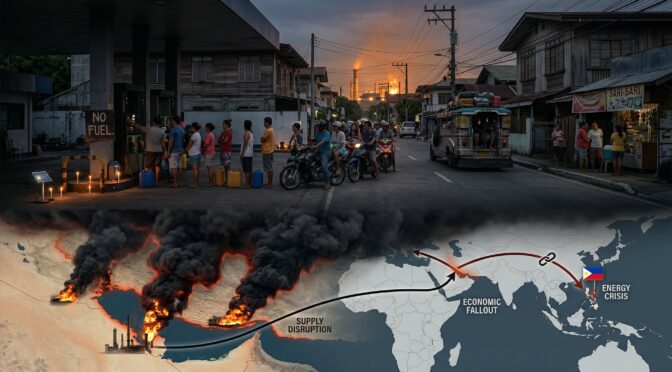
Philippines Faces Energy Crisis Amid Iran War Fallout

1. Executive Summary

The eruption of the 2026 Iran War and the subsequent asymmetrical weaponization of the Strait of Hormuz have generated a systemic shock to the global energy architecture, representing the most severe macroeconomic and geopolitical crisis since the oil shocks of the 1970s. Triggered by Operation Epic Fury—a joint military campaign initiated by the United States and Israel on February 28, 2026, which resulted in the death of Iranian Supreme Leader Ali Khamenei—the conflict has rapidly metastasized from a localized kinetic exchange into a multi-theater conflagration.1 Iran’s retaliatory doctrine has heavily prioritized the disruption of global maritime commons, resulting in the functional closure of the Strait of Hormuz to international commercial shipping.1 This blockade has effectively stranded approximately 15.8 million barrels per day (bpd) of crude oil, representing roughly 15% of the global supply, alongside 20% of the world’s liquefied natural gas (LNG) export capacity.4

For the Republic of the Philippines, a rapidly developing archipelagic nation heavily dependent on imported hydrocarbons and entirely devoid of a meaningful Strategic Petroleum Reserve (SPR), this geopolitical rupture constitutes an acute, multi-dimensional national emergency.7 As of late March 2026, the Philippine government is fighting a complex crisis characterized by rapidly depleting energy reserves, severe macroeconomic destabilization, an impending humanitarian logistics nightmare, and opportunistic territorial coercion in its immediate maritime periphery. In response, President Ferdinand Marcos Jr. has issued Executive Order (EO) 110, formally declaring a State of National Energy Emergency and activating the Unified Package for Livelihoods, Industry, Food, and Transport (UPLIFT) framework to execute a whole-of-government survival strategy.9

This intelligence report provides an exhaustive, systemic analysis of the conflict’s cascading impacts on the Philippines, focusing specifically on power generation, transportation, and national security. The analysis reveals a deeply vulnerable national architecture across all assessed domains. In the realm of power generation, the country is currently operating on a highly precarious 45-day fuel buffer.8 The crisis has derailed the nation’s strategic transition to Liquefied Natural Gas, forcing emergency procurements of sanctioned Russian ESPO crude and a reversion to high-emission coal and Euro II fuels to avert an imminent grid collapse.8

Within the transportation and logistics sector, draconian demand destruction protocols have been activated. This includes the mandated implementation of four-day workweeks for government agencies and local government units, alongside severe reductions in commercial aviation volumes.14 The domestic logistics sector is facing an existential pricing crisis, prompting the Philippine legislature to pursue a PHP 52.8 billion supplemental budget to distribute emergency subsidies and prevent widespread labor strikes and supply chain paralysis.17

In the domain of national security, the administration is bracing for the unprecedented logistical and financial nightmare of repatriating a fraction of the 2.4 million Overseas Filipino Workers (OFWs) currently residing in the Middle East.19 Senate simulations indicate that a worst-case mass evacuation scenario could cost the state up to PHP 406 billion while simultaneously erasing billions of dollars in vital remittances, threatening the sovereign credit profile.20 Concurrently, the People’s Republic of China (PRC) is leveraging the diversion of United States military focus to the Middle Eastern theater to radically escalate gray-zone coercion in the South China Sea, placing immense operational strain on the U.S.-Philippines mutual defense posture and testing the credibility of regional deterrence.22

The predictive intelligence forecasts for the next 30, 60, and 90 days indicate a critical window of compounding vulnerability. Even if the current five-day diplomatic pause initiated by the United States yields a temporary de-escalation framework, the structural damage inflicted upon global energy supply chains and regional confidence guarantees a prolonged period of severe economic and strategic friction for the Philippine state.25

2. The Global Threat Matrix: Operation Epic Fury and the Strait of Hormuz

To fully comprehend the localized impacts on the Philippine archipelago, the macro-geopolitical environment must first be meticulously contextualized. The 2026 Iran War represents a fundamental rupture in the balance of power in the Middle East, triggering immediate, severe, and sustained disruptions across the global economic commons.2

2.1 The Kinetic Campaign and Asymmetrical Iranian Retaliation

Following the ultimate collapse of attempts to renegotiate the Joint Comprehensive Plan of Action (JCPOA) in 2025, and amid escalating tensions over Iran’s advancing nuclear and ballistic missile programs, the United States and Israel initiated Operation Epic Fury on February 28, 2026.2 Intelligence assessments indicate that in the first twelve hours alone, the combined allied forces executed nearly 900 precision strikes.2 These initial waves specifically targeted Iranian leadership, integrated air defense systems, and ballistic missile infrastructure, succeeding in the strategic objective of eliminating Supreme Leader Ali Khamenei before he could be relocated to a hardened subterranean bunker.2 U.S. Central Command (CENTCOM) reports that the military campaign has since expanded massively, encompassing over 9,000 targets across the region.25 The combined forces have severely degraded the conventional capabilities of the Iranian Navy, damaging or destroying more than 140 naval vessels to limit Tehran’s ability to project conventional force in the Persian Gulf.3

However, the defining characteristic of this conflict has been the sophisticated application of electronic warfare preceding the kinetic strikes. Before the first munitions impacted, the electromagnetic environment over Iran was systematically dismantled; radars were blinded, command-and-control links were severed, and communications networks were taken offline, demonstrating a convergence of electronic warfare, cyber operations, and information dominance.28 Despite this profound systemic degradation, the Iranian Revolutionary Guard Corps (IRGC) and the broader Axis of Resistance have demonstrated highly resilient asymmetrical capabilities. Iran launched hundreds of retaliatory ballistic missiles and thousands of loitering munitions (drones) across the region, heavily targeting Israel and Gulf state energy infrastructure, while Hezbollah initiated dozens of attacks against northern Israel from southern Lebanon.2 The civilian toll has been heavy, with more than 2,700 reported dead across the theater, alongside immense infrastructural devastation in Iran, Lebanon, and Israel.2

2.2 The Weaponization of Maritime Chokepoints

The most globally consequential element of the Iranian counter-strategy has been the weaponization of the maritime domain, specifically the functional closure of the Strait of Hormuz. Within hours of the initial allied strikes, the IRGC broadcasted VHF warnings to all commercial shipping in the vicinity, declaring the strait indefinitely closed.1 This declaration was initially universal but was later amended to specifically target vessels associated with the United States, Israel, and their Western allies.1 Iran backed this rhetorical blockade with immediate physical enforcement, deploying naval mines—estimated by intelligence agencies at fewer than ten, but highly effective as psychological and financial deterrents—and initiating direct projectile attacks on commercial vessels.1 A tragic early example was the strike on the oil tanker Skylight north of Khasab, Oman, which resulted in the deaths of two Indian crew members.1 As of mid-March 2026, Iran had conducted at least 21 confirmed attacks on merchant shipping navigating the Gulf.1

This asymmetrical blockade has forced the global energy industry into a state of paralysis. Major multinational energy corporations, including QatarEnergy, Shell, and the Kuwait Petroleum Corporation, have been forced to invoke force majeure across Gulf Cooperation Council (GCC) countries.4 Iraq, the world’s sixth-largest oil producer, has been forced to slash production in the Basra region by 70%, stranding millions of barrels as its primary export route is severed.4 Regional powers like Saudi Arabia and the United Arab Emirates have been forced to shut down major refining operations (such as the massive Ras Tanura facility) and frantically reroute crude through alternative, lower-capacity pipelines to the Red Sea.4 The International Energy Agency (IEA) has labeled this cascading failure “the greatest global energy and food security challenge in history,” projecting an unprecedented 8 million bpd plunge in global oil supply for the month of March.30

2.3 Energy Price Volatility and Diplomatic Interventions

The immediate reaction of the global spot markets mirrored the most severe historical energy shocks. Brent crude spiked violently from roughly $80 per barrel prior to the conflict to an intraday high of $119 per barrel, approaching the all-time nominal peak of $147 per barrel recorded during the 2008 financial crisis.31 Rigorous financial modeling from institutions such as Goldman Sachs and Oxford Economics suggests that if the Strait of Hormuz remains functionally closed for an extended duration, prices could experience a convex rise, testing upper bounds of $185 to $190 per barrel.5 This extreme projection is based on the sheer volume of stranded assets; 15.8 million bpd are currently disrupted, compared to a mere 4.3 million bpd during the 1990 Gulf War.5

By late March 2026, a fragile and unpredictable diplomatic window emerged. United States President Donald Trump announced a five-day pause on threatened, devastating strikes against Iranian power generation and water desalination infrastructure.25 The U.S. administration cited the existence of indirect, back-channel negotiations mediated by Oman in Geneva, aimed at securing a comprehensive settlement that would allegedly prevent Iran from acquiring a nuclear weapon and reopen the strait.25 While Iranian state media and parliamentary officials publicly denied these negotiations—framing the U.S. pause as a retreat in the face of Iranian deterrence—global markets responded rapidly to the potential for de-escalation.25 Brent crude temporarily softened to approximately $92 per barrel.27 However, energy analysts and market watchers project that even with a formalized ceasefire, the structural damage to regional infrastructure and a newly established “Cape of Good Hope rerouting cost floor” will likely keep global energy prices structurally elevated near $130 per barrel for the medium term, offering little relief to import-dependent nations.5

3. Macroeconomic Contagion: Transmission Vectors into the Philippine Economy

The Republic of the Philippines is systemically and structurally vulnerable to external energy shocks. As a rapidly developing archipelago without a functional Strategic Petroleum Reserve (SPR) and possessing no meaningful capacity to domesticate its hydrocarbon supply chain, the country operates entirely at the mercy of global spot markets.7 The macroeconomic fallout from the 2026 Iran War is currently manifesting through three interconnected, highly destructive vectors: inflationary spirals, currency depreciation, and rapid fiscal hemorrhaging.

3.1 Inflationary Spirals and the Contraction of Economic Growth

Prior to the outbreak of the conflict, the Bangko Sentral ng Pilipinas (BSP) had successfully navigated a complex and delicate monetary easing cycle. The central bank had lowered the key policy rate by a cumulative 225 basis points to stimulate a domestic economy that had recorded its weakest non-pandemic growth pace (3%) in the final quarter of 2025.37 The eruption of the Middle East crisis has effectively obliterated this carefully constructed monetary maneuvering space.

The transmission mechanism of the global energy shock into the Philippine domestic economy is ruthlessly efficient. Analysts and economists estimate a strict correlation: every $10 increase in the global price of crude oil pushes Philippine headline inflation upward by 0.5 percentage points.38 With crude prices having jumped over $40 per barrel at the peak of the market panic, the inflationary impact is profound. The Department of Economy, Planning, and Development (DEPDev) has been forced to drastically revise its baseline economic scenarios. Headline inflation, which stood at a manageable 2.4% in February 2026, is now projected to surge to between 4.5% and 5.1% in March, and is expected to remain highly elevated between 4.5% and 4.8% throughout April.20

This trajectory definitively breaches the BSP’s target maximum threshold of 4%, guaranteeing a severe erosion of consumer purchasing power and a contraction in domestic consumption.20 Furthermore, the conflict is expected to trim between 0.2% and 0.3% directly off the Philippines’ Gross Domestic Product (GDP) growth for the current year.20 The BSP, which had previously signaled the end of its easing cycle, is now cornered in a classic stagflationary trap; it cannot cut rates to stimulate faltering economic growth without exacerbating imported inflation and triggering massive capital flight, nor can it easily hike rates without crushing domestic investment.37

3.2 The Peso Depreciation Feedback Loop

The macroeconomic damage is severely amplified by the rapid depreciation of the Philippine Peso (PHP). As risk-off sentiment dominated global emerging markets in the wake of the strikes, the local currency weakened significantly, trading past the PHP 57.60 mark against the U.S. Dollar in late March.36 For a net energy importer, a depreciating currency creates a devastating, self-reinforcing feedback loop. Because global oil is priced universally in U.S. dollars, the Philippines must expend an increasing amount of its weakening domestic currency to purchase the exact same volume of fuel. This dynamic further drives up domestic inflation, which subsequently weakens the currency’s real yield, accelerating further capital flight and deeper depreciation.

Philippine Finance Secretary Frederick Go and the BSP have been forced into defensive, highly reactive interventions in the foreign exchange markets as the Peso nears the critical psychological threshold of PHP 60 to the U.S. Dollar.40 The central bank’s ability to defend the currency is constrained by the necessity of maintaining adequate foreign exchange reserves, which are themselves threatened by the potential collapse of overseas remittances.
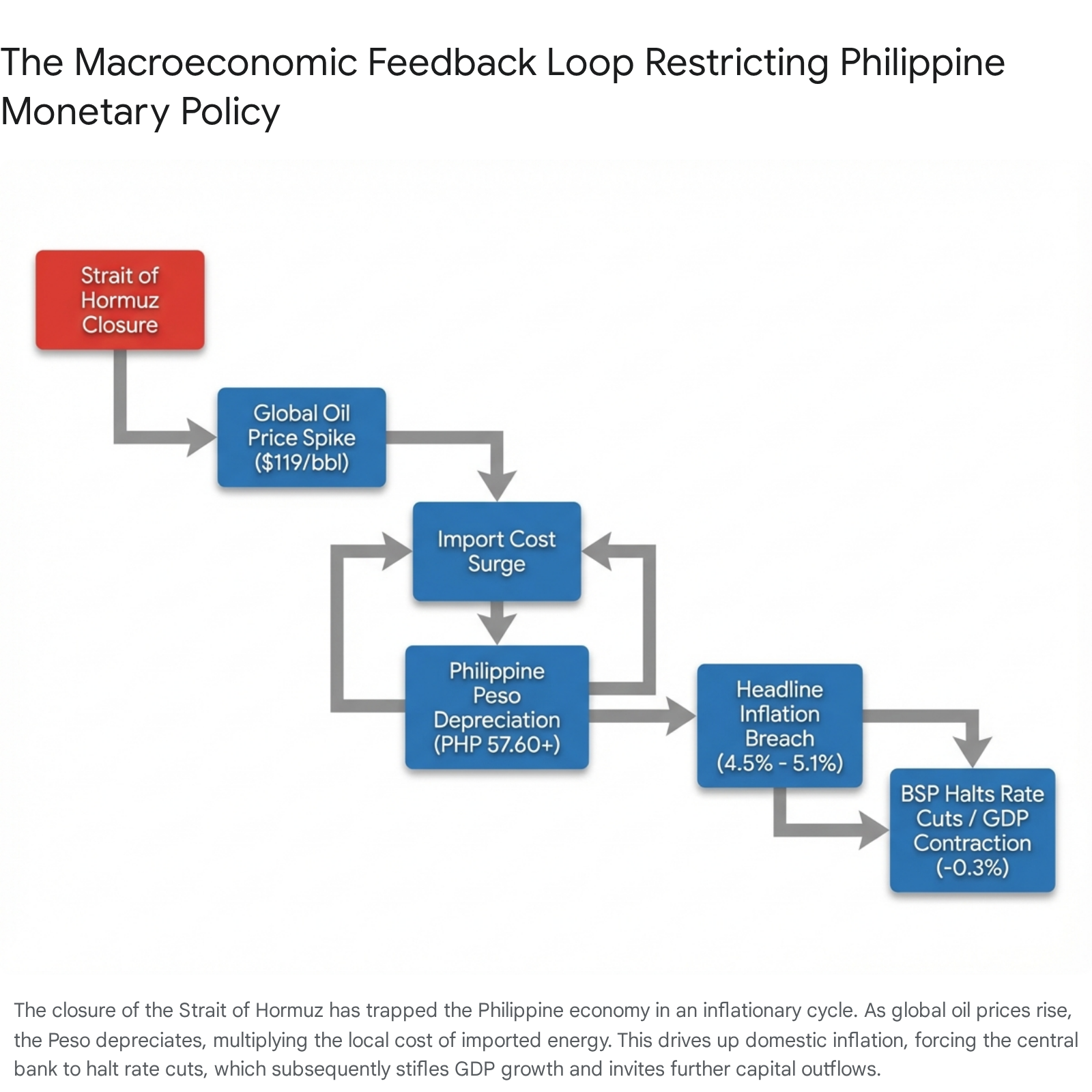
Macroeconomic feedback loop showing how a Strait of Hormuz closure impacts the Philippines, causing inflation and GDP contraction.

3.3 Systemic Vulnerability to Supply Chain Disruptions

Beyond the direct cost of energy, the closure of the Strait of Hormuz has severely disrupted broader global supply chains, heavily impacting consumer goods essential to the Philippine economy. Four of the world’s largest container shipping lines suspended transits through the region within hours of the closure, leading to massive congestion, soaring war risk premiums on hull insurance (up to 1.5% of hull value), and exorbitant rerouting costs.6

The disruption affects critical inputs for the Philippine manufacturing and agricultural sectors. The export of fertilizer inputs, petrochemicals, and materials like aluminum from the Middle East has been severely curtailed, with polypropylene prices jumping 24% and aluminum increasing by 10% globally.41 For a nation highly dependent on imported agricultural inputs to ensure domestic food security, the disruption of fertilizer shipments poses a secondary, potentially more devastating threat to domestic price stability in the medium term.41

4. Power Generation and Energy Security: The Collapse of the Transition Paradigm

The Philippine electrical grid is confronting an existential threat. The architecture of the country’s power generation is heavily indexed to external supply chains, making it highly susceptible to the disruptions emanating from the Persian Gulf. The crisis has not only threatened immediate baseload power but has structurally derailed the nation’s long-term energy transition strategy.

4.1 The Declaration of a National Energy Emergency (EO 110)

Recognizing the imminent threat of grid failure and supply chain collapse, President Marcos Jr. signed Executive Order (EO) 110 on March 24, 2026, officially declaring a State of National Energy Emergency.8 This extraordinary executive measure, valid for up to one year, authorizes the executive branch to bypass standard bureaucratic inertia to secure the nation’s energy lifelines.9

The EO activates the UPLIFT committee (Unified Package for Livelihoods, Industry, Food, and Transport)—an inter-agency body integrating the departments of energy, transport, finance, agriculture, and social welfare—to execute a coordinated, whole-of-government crisis response.9 Crucially, EO 110 grants the Department of Energy (DOE) unprecedented regulatory authority. The DOE is now mandated to take direct action against hoarding and profiteering, streamline the issuance of permits, and, most importantly, authorize advance payments of over 15% of contract amounts to secure forward fuel deliveries from hesitant international suppliers.8

Furthermore, the mandate allows for drastic interventions in the domestic electricity market. The DOE is authorized to request the Energy Regulatory Commission to initiate the “suspension of market operations or the declaration of a temporary market failure” if extraordinary price volatility threatens grid reliability or consumer solvency.43 The EO also dictates a “resource conservation and prioritisation mechanism,” prioritizing grid reliability and the dispatch of cheaper generating technologies to prolong the overall energy supply.9

4.2 The 45-Day Supply Cliff and Desperate Sourcing

The fundamental catalyst for the issuance of EO 110 is the critically low inventory of domestic fuel. In a stark briefing to the Senate PROTECT (Proactive Response and Oversight for Timely and Effective Crisis Strategy) Committee, Energy Secretary Sharon Garin reported that the country possesses approximately 45 days of aggregate fuel supply remaining, based on current consumption rates.8 Specifically, this breaks down to 53 days of gasoline and a mere 46 days of diesel.12

While the state-run Philippine National Oil Co. (PNOC) and private players have scrambled to contract an additional 11 days of gasoline and 8 days of diesel from abroad, the overarching mathematical reality is grim.12 Secretary Garin bluntly warned lawmakers that the “worst-case scenario is we run dry,” indicating that if backup suppliers are not secured within a month and a half, the nation will face physical fuel exhaustion and a total economic standstill.12 The PNOC’s stated goal of purchasing two million barrels of petroleum as a strategic buffer only covers roughly 10 days of national consumption, exposing the severe, historic lack of strategic storage infrastructure in the Philippines.44

4.3 Navigating Sanctions: The Russian Pivot

In a desperate bid to replace the massive volumes of Middle Eastern crude erased from the market, Manila has initiated highly sensitive geopolitical maneuvering. On March 24, 2026, the Philippines received its first shipment of Russian crude oil in five years.13 The Sierra Leone-flagged tanker Sara Sky successfully moored at the Limay anchorage in Bataan, delivering 100,000 tonnes (roughly 750,000 barrels) of Siberian ESPO Blend crude destined for the Petron refinery—the country’s sole remaining crude processing facility.13

This transaction was legally permissible only through a temporary 30-day sanctions waiver issued by the U.S. State Department, which allowed allied and partner countries to purchase Russian cargo that was already in transit to ease the crippling global energy crunch.13 However, this represents a precarious short-term stopgap rather than a sustainable energy policy. Philippine Ambassador to the U.S. Jose Manuel Romualdez confirmed that Manila is actively lobbying Washington for broader, sustained waivers to import oil from heavily sanctioned states, explicitly stating that “all options are being considered,” including crude from both Iran and Venezuela.8 This places the Philippines in an incredibly delicate diplomatic position, highly dependent on the goodwill and strategic forbearance of the United States to keep its domestic economy functioning while navigating a complex global sanctions minefield.

4.4 The Implosion of the Liquefied Natural Gas (LNG) Strategy

Perhaps the most severe long-term casualty of the 2026 Iran War for the Philippines is the systematic collapse of its transition to Liquefied Natural Gas (LNG). Over the preceding years, the Philippine government, backed by major conglomerates like Prime Energy and Meralco PowerGen, heavily promoted LNG as the ultimate “bridge fuel”. This strategy was designed to move the electrical grid away from highly polluting coal while simultaneously compensating for the rapid depletion of the domestic Malampaya gas field, which historically supplied 20% of the country’s power requirements.49

Billions of dollars were invested in new, state-of-the-art import infrastructure in the Batangas region. This included the Atlantic, Gulf & Pacific (AG&P) onshore terminal and First Gen Corporation’s Floating Storage Regasification Unit (FSRU), the BW Batangas, which began receiving commissioning cargoes in 2023.50 The strategic logic of the LNG pivot was sound until the Middle East erupted.

Following Israeli retaliatory strikes on Qatar’s massive Ras Laffan complex—which sidelined an estimated 17% of Qatar’s export capacity for up to five years—and the subsequent closure of the Strait of Hormuz, 19% of global LNG exports (amounting to 1.5 million tonnes per week) vanished from the international market.32 The resulting supply shock has devastated the economics of gas-fired power in Northeast and Southeast Asia. According to Wood Mackenzie analysis, LNG spot prices in Asia surged 30% to $24/MMBtu (€70/MWh) as desperate Asian buyers found themselves in a cutthroat bidding war against European states for whatever uncommitted cargoes remained from non-Middle Eastern suppliers like Australia and the United States.54

At these exorbitant spot prices, the cost of LNG-fired electricity generation skyrockets to $80-$120/MWh.55 This makes LNG generation economically unviable for Philippine utilities, especially when compared to the rapidly falling costs of solar and battery generation ($30-$40/MWh) or legacy coal plants.55 Consequently, the Department of Energy has been forced into a humiliating strategic retreat. The government announced plans to boost the output of highly polluting coal-fired power plants to keep electricity costs down and maintain baseload stability, completely undermining its climate commitments.8 The country will also temporarily allow the use of cheaper, dirtier Euro II fuel.48 While pragmatic for immediate survival, this reversion shatters the country’s near-term decarbonization targets and highlights the profound inherent risks of relying on imported LNG for national energy security.56

5. Transportation, Logistics, and Domestic Demand Destruction

The transportation and logistics sector is the immediate transmission mechanism through which the global energy crisis infects the broader Philippine economy. Without domestic oil production, every drop of diesel required to move agricultural goods, manufactured products, and human capital across the archipelago must be imported at a massive premium.

5.1 Draconian Demand Destruction and Conservation Mandates

To artificially extend the precariously thin 45-day fuel buffer, the Marcos administration has initiated aggressive demand destruction protocols. The Office of the President issued Memorandum Circular No. 114, an urgent directive mandating all national government agencies and government-owned or controlled corporations (GOCCs) to adopt flexible work arrangements, specifically a four-day workweek or comprehensive work-from-home protocols.15

Local Government Units (LGUs) across the densely populated Metro Manila region, including the financial hub of Makati, as well as Marikina and the City of Manila, immediately followed suit. These LGUs shifted tens of thousands of public employees to Monday-Thursday schedules (typically 7:00 AM to 7:00 PM) to drastically slash commuting fuel consumption and reduce the operational electricity footprint of public buildings.16 Agencies such as the Government Service Insurance System (GSIS) reported that remaining Friday operations would be powered entirely by existing solar arrays to achieve zero net grid draw on those days.58

Furthermore, the private sector has been heavily pressured by the executive branch to adopt similar measures. However, business groups and chambers of commerce warn that such compressed schedules severely burden micro, small, and medium enterprises (MSMEs) that rely on continuous operational output.59 In the commercial aviation sector, the crisis is already forcing operational contraction. Budget carrier Cebu Pacific has preemptively begun cutting international flight volumes to conserve high-priced aviation fuel, a move that directly impacts the tourism sector and reduces the logistical bandwidth for international travel and cargo.14

5.2 Supply Chain Economics, Fuel Rationing, and Emergency Subsidies

For the domestic logistics networks and public utility vehicle (PUV) operators, the exponential surge in pump prices is catastrophic. Unlike neighboring Southeast Asian states such as Malaysia or Indonesia, the Philippines does not maintain broad, systemic consumer fuel subsidies, leaving both commercial drivers and everyday consumers fully exposed to international spot market volatility.60

The threat of widespread social unrest and economic paralysis is tangible. Transport workers, commuters, and consumer advocacy groups mobilized for a two-day nationwide strike in late March to protest the administration’s perceived failure to shield them from price gouging and unchecked inflation.48 To mitigate this impending civil disruption, the legislature has fast-tracked the formulation of a massive PHP 52.8 billion supplemental budget, encapsulated in House Bill 8495 and Senate Bill 1986.17 This emergency legislative fund is earmarked specifically to expand direct cash subsidies for public utility vehicle (PUV) drivers, ride-hailing operators, farmers, and fisherfolk, attempting to insulate the foundation of the economy from the energy shock.18

Proposed Supplemental Budget Allocation (HB 8495 / SB 1986)Proposed Funding (PHP Billions)Strategic Objective
Emergency Repatriation (OFWs)18.0Immediate extraction, charter flights, and transport of workers from the Middle East theater.63
OFW Reintegration Program20.0Provision of seed capital, skills training, and livelihood support for returning workers.63
Transport Sector Subsidies12.0Direct cash relief for PUV drivers and logistics operators to prevent cascading fare hikes.64
Agricultural Subsidies2.8Subsidized fuel for farmers and fisherfolk to protect domestic food security and mitigate food inflation.64
Total Proposed Emergency Budget52.8Comprehensive crisis mitigation and social stabilization.17

Additionally, the Department of Energy is exploring aggressive fuel rationing and compositional mandates. The DOE is currently consulting with oil industry stakeholders regarding the feasibility of significantly raising the required ethanol blend in gasoline to 10% and the biodiesel content to 3%.65 This policy aims to dilute the nation’s reliance on pure imported petroleum with domestically produced biofuels, a maneuver that industry analysts estimate could marginally reduce pump prices by PHP 0.50 for diesel and up to PHP 5.00 per liter for gasoline.65 Furthermore, the DOE is mandating strict labeling for the temporary reintroduction of Euro II specification fuels, ensuring consumers verify vehicle compatibility before use, highlighting the desperation to secure affordable liquid fuels regardless of environmental standards.66

6. The Humanitarian and Fiscal Crises: The OFW Repatriation Nightmare

The 2026 Iran War is not merely an abstract economic crisis for the Philippines; it represents a profound and immediate national security and humanitarian stress test. The conflict is directly threatening the lives of millions of Filipino citizens residing abroad, presenting the state with a logistical challenge of unprecedented scale.

6.1 The Demographic Vulnerability in the Middle East

The Middle East is home to an estimated 2.4 million Overseas Filipino Workers (OFWs), forming one of the largest expatriate labor forces in the region.19 These workers are heavily concentrated in states directly adjacent to the conflict zone or highly vulnerable to Iranian retaliatory strikes, including Saudi Arabia, the United Arab Emirates, Qatar, Kuwait, Israel (approx. 31,000), and Iran itself (approx. 800).14 These citizens are not only the primary concern of state protection apparatuses but are also the foundational economic lifeblood of the Philippine economy, remitting over $38 billion annually in hard currency back to the archipelago.67

As the kinetic conflict expands and the economic fallout from the Strait of Hormuz closure prompts regional energy companies to declare force majeure and initiate mass layoffs, the Department of Migrant Workers (DMW) and the Department of Foreign Affairs (DFA) have been forced into a massive logistical scramble.4 By the third week of March 2026, over 1,262 formal repatriation requests had already been filed with embassies.19 The government has activated rapid response teams and chartered multiple commercial flights, utilizing the United Arab Emirates as a relatively safe, open-airspace transit hub, to bring home initial batches of vulnerable workers from Bahrain, Kuwait, Qatar, and Saudi Arabia.19

6.2 The Fiscal Abyss: Simulating the Worst-Case Scenario

However, the financial and macroeconomic implications of a mass exodus are staggering, threatening to bankrupt state emergency reserves. The Senate Committee on Finance, led by Senator Sherwin Gatchalian, has conducted extensive “tabletop computations” and simulations revealing the terrifying fiscal reality of the crisis.21

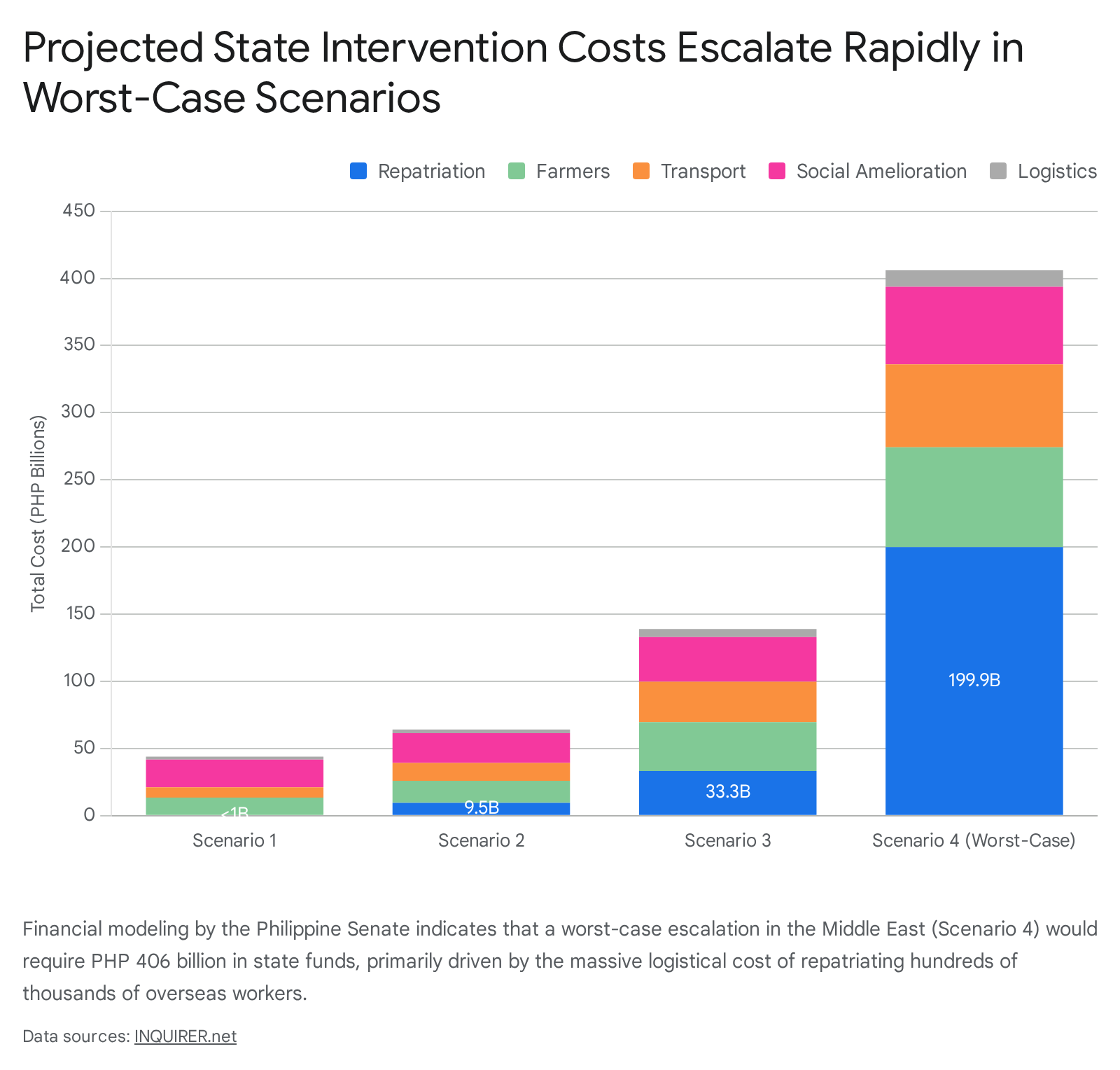
These simulations indicate that in a worst-case scenario—defined as a widespread, uncontrolled regional war necessitating the mass evacuation of hundreds of thousands of Filipinos and the total collapse of Middle Eastern supply chains—the Philippine government would require a staggering PHP 406 billion in total intervention funds.21

Senate Finance Committee Crisis SimulationsTotal Required Funds (PHP Billions)Repatriation CostAgricultural SubsidyTransport SubsidySocial AmeliorationLogistics Support
Scenario 1 (Low Impact)~44.4< 1.013.07.720.52.2
Scenario 2 (Moderate Impact)64.19.516.413.422.12.7
Scenario 3 (Severe Escalation)139.033.336.330.133.36.0
Scenario 4 (Worst-Case / Mass War)406.0199.974.361.857.712.3
(Data compiled from Senate simulations regarding the Middle East crisis fallout 21)
Projected state intervention costs in the Philippines escalate rapidly in worst-case scenarios, reaching 199.9B PHP.

In Scenario 4, nearly half of the required PHP 406 billion budget (PHP 199.9 billion) would be consumed purely by the logistical costs of aviation charters and border extraction.21 Furthermore, DEPDev Secretary Arsenio M. Balisacan explicitly warned that if a deployment ban is imposed and a mere 550,000 OFWs are repatriated, the domestic economy would instantly lose between PHP 226.6 billion and PHP 232 billion in anticipated remittances.20 This dual blow—massive emergency capital expenditure coupled with the sudden, permanent loss of foreign currency inflows—would critically endanger the sovereign credit rating, obliterate the central bank’s foreign exchange reserves, and drastically accelerate the unravelling of the Philippine Peso.

7. National Security and Geopolitical Realignment in the Indo-Pacific

While the immediate economic and humanitarian impacts of the Iran War are severe, the secondary geopolitical effects occurring in the Indo-Pacific present an arguably greater long-term threat to Philippine sovereignty. The Middle East crisis has created a dangerous strategic vacuum, diverting United States military assets, diplomatic bandwidth, and global media attention away from Asia, a situation which the People’s Republic of China (PRC) is aggressively exploiting.

7.1 Exploitation of the Strategic Vacuum: South China Sea Gray Zone Escalation

Knowing that the U.S. military—particularly CENTCOM and vital naval carrier strike groups—is heavily occupied with managing the fallout of Operation Epic Fury and securing maritime traffic in the Indian Ocean, Beijing has intensified its “gray zone” coercion tactics against both Taiwan and the Philippines.22

China’s overarching strategy relies on calibrated, coercive maritime actions that fall deliberately just below the threshold of an “armed attack.” This precise operational calculus is designed to alter facts on the ground while avoiding the invocation of the 1951 U.S.-Philippines Mutual Defense Treaty (MDT) or a direct kinetic response from U.S. Indo-Pacific Command (INDOPACOM).23 Throughout early 2026, the PRC executed “Justice Mission 2025,” an unprecedented, highly provocative military exercise involving over 130 aircraft and naval vessels that simulated a full blockade of Taiwan, establishing temporary danger zones that disrupted over 100,000 international passengers.22

Simultaneously, the People’s Liberation Army Navy (PLAN) and the Chinese Coast Guard (CCG) have radically escalated physical, hull-to-hull confrontations in the South China Sea, focusing intensely on Second Thomas Shoal.23 Where Chinese forces previously relied on non-lethal deterrents such as high-pressure water cannons and military-grade laser dazzlers, intelligence reports confirm they have now transitioned to highly aggressive, deliberate ramming and physical boarding of Philippine rotation and resupply (RORE) vessels attempting to reach the rusting World War II-era landing ship, the BRP Sierra Madre.23

7.2 The Trilateral Deterrence Response and Hard Balancing

In response to this severe, multi-theater pressure, Manila is attempting to execute a strategy of hard-balancing against Beijing by rapidly deepening its network of security alliances. Under the Marcos administration, the Philippines has accelerated its military modernization program, seeking to shift its strategic posture fundamentally from internal counter-insurgency operations to external territorial defense.73

Crucially, Manila has expanded its multilateral operations, conducting high-profile Maritime Cooperative Activities (MMCA) within its Exclusive Economic Zone (EEZ). In February 2026, the Philippine Navy, alongside the U.S. Navy and the Royal Australian Navy, conducted highly visible replenishment-at-sea and freedom of navigation drills near contested features, explicitly to signal deterrence to the shadowing Chinese naval ships.74 Trilateral diplomatic and military coordination between the United States, Japan, and the Philippines has become the absolute cornerstone of Manila’s strategy to oppose PRC coercion.75

However, defense analysts note a highly dangerous threshold is approaching: if the United States remains bogged down in a protracted, resource-intensive Middle Eastern conflict, the PRC leadership may calculate that it possesses the operational freedom and temporal window to secure a quick tactical victory—such as the forced removal of the Sierra Madre—before U.S. forces can adequately mobilize a Quick Reaction Force (QRF) to the First Island Chain.24

8. Predictive Intelligence: 30, 60, and 90-Day Strategic Forecasts

Based on current operational tempos, severe logistical constraints, and rapidly degrading macroeconomic trajectories, the following projections outline the expected cascading effects on the Republic of the Philippines over the next 90 days.

8.1 Immediate Term (0 – 30 Days): The Buffer Depletion Phase

  • Energy Operations: The Philippines will exhaust the first half of its 45-day domestic fuel inventory. The Department of Energy will desperately attempt to finalize advance-payment supply contracts utilizing the emergency powers granted under EO 110.8 Manila will lean heavily on the newly established Russian ESPO crude pipeline, resulting in intense diplomatic friction, and will aggressively push the U.S. State Department to formalize 180-day sanctions waivers regarding Iranian and Venezuelan crude.13 The U.S. bureaucratic decision on these waivers will dictate Manila’s immediate survival strategy.
  • Macroeconomics: March and April inflation figures will solidify between 4.8% and 5.1%, confirming a severe breach of central bank targets and eroding civilian purchasing power.20 The BSP will be forced to maintain highly hawkish rhetoric but will hold interest rates steady, intervening aggressively in FX markets to prevent the Peso from sliding past the PHP 58/USD mark.36
  • Transportation & Civil Unrest: The P52.8 billion supplemental budget will pass during an emergency legislative session, allowing the immediate disbursement of targeted cash subsidies to the transport and agricultural sectors.18 While this will temporarily pacify unionized transport groups and avert mass, paralyzing strikes, localized supply chain bottlenecks will emerge across the archipelago as independent truckers reduce operations to cut financial losses.
  • Geopolitics: The outcome of the Trump administration’s 5-day negotiation window with Iran will become definitively clear.25 If strikes resume on Iranian power infrastructure, Brent crude will permanently break the $100/bbl threshold. Concurrently, the PRC will maintain high-intensity CCG patrols around Second Thomas Shoal, testing the response times and resolve of U.S. INDOPACOM assets.23

8.2 Near Term (31 – 60 Days): The Supply Cliff and Physical Rationing Phase

  • Energy Operations: If the Strait of Hormuz remains functionally closed and alternative sourcing (such as Russian crude or sanctioned waivers) proves insufficient to replace the 15.8 million bpd global deficit, the Philippines will hit its mathematical “supply cliff.” The 45-day buffer will be exhausted.12 The DOE will likely be forced to invoke the most extreme emergency powers granted in EO 110, mandating strict civilian fuel rationing (e.g., nationwide odd-even license plate bans for private vehicles) and prioritizing diesel distribution exclusively to agriculture, logistics, and critical power generation facilities.8
  • Power Generation: Rolling brownouts (rotational load shedding) may occur in areas heavily reliant on liquid fuels. The First Gen and AG&P LNG terminals in Batangas will operate significantly below capacity due to prohibitive spot prices ($24+ MMBtu), forcing the grid to maximize the utilization of legacy coal plants and Euro II fuels, resulting in severe local air quality degradation.8
  • OFW Repatriation: As the Middle Eastern conflict solidifies into a grinding war of attrition, construction and service companies in the GCC states will continue declaring force majeure, leading to mass layoffs of migrant labor.4 Formal repatriation requests to the DMW will surge past 50,000. The government will begin rapidly burning through the proposed P18 billion emergency repatriation fund, chartering daily extraction flights from the UAE transit hub.19

8.3 Medium Term (61 – 90 Days): Structural Shifts and Geopolitical Flashpoints

  • Macroeconomics: The delayed, compounding effects of the energy shock will manifest in severe second-round inflation. The cost of basic food staples will rise sharply across the archipelago as agricultural fuel subsidies prove mathematically insufficient to offset transport costs. Annual GDP growth forecasts for 2026 will be revised downward by a full 0.5% to 1.0%. The loss of initial OFW remittances from displaced workers will begin to reflect in current account deficits, applying massive, sustained downward pressure on the Peso, potentially testing the catastrophic PHP 60/USD threshold and forcing the BSP into emergency rate hikes.20
  • Geopolitics & Security: With global diplomatic attention and military resources entirely exhausted by a protracted Middle East conflict, the risk of a severe miscalculation in the South China Sea reaches its absolute zenith. China may attempt a definitive, irreversible gray-zone operation—such as the forced boarding and towing of the BRP Sierra Madre or the rapid establishment of a permanent, militarized structure on a contested Philippine shoal.23 Manila will be forced into an impossible strategic dilemma: choose between yielding sovereign territory and accepting a new status quo, or initiating a kinetic military response that legally forces Washington’s hand under the Mutual Defense Treaty, risking a two-front global war.

Please share the link on Facebook, Forums, with colleagues, etc. Your support is much appreciated and if you have any feedback, please email us in**@*********ps.com. If you’d like to request a report or order a reprint, please click here for the corresponding page to open in new tab.


Sources Used

  1. 2026 Strait of Hormuz crisis – Wikipedia, accessed March 25, 2026, https://en.wikipedia.org/wiki/2026_Strait_of_Hormuz_crisis
  2. 2026 Iran War | Explained, United States, Israel, Strait of Hormuz, Map, & Conflict, accessed March 25, 2026, https://www.britannica.com/event/2026-Iran-War
  3. Iran Update Morning Special Report, March 11, 2026 | ISW, accessed March 25, 2026, https://understandingwar.org/research/middle-east/iran-update-morning-special-report-march-11-2026/
  4. Iran’s closure of the Strait of Hormuz is an international crisis, accessed March 25, 2026, https://www.aljazeera.com/opinions/2026/3/25/irans-closure-of-the-strait-of-hormuz-is-an-international-crisis
  5. Gulf Crisis 2026: The Daily Cost of the Closure of the Strait of Hormuz | SolAbility, accessed March 25, 2026, https://solability.com/news-insights/iran-war-marginal-cost
  6. The Strait of Hormuz Blockade Is Affecting More Than Just Oil Prices. Here Are 4 Stocks That Could Get Hit in 2026., accessed March 25, 2026, https://www.fool.com/investing/2026/03/25/strait-hormuz-blockade-affect-oil-price-stocks/
  7. MidEast crisis to cap Philippine growth through ’28 – Inquirer Business, accessed March 25, 2026, https://business.inquirer.net/581092/mideast-crisis-to-cap-ph-growth-through-28
  8. Philippines declares ‘national energy emergency’ and boosts coal power as Iran war grinds on, accessed March 25, 2026, https://www.theguardian.com/world/2026/mar/25/philippines-declares-national-energy-emergency-iran-war
  9. Why the Philippines declared a national energy emergency, accessed March 25, 2026, https://gulfnews.com/world/asia/philippines/why-the-philippines-declared-a-national-energy-emergency-1.500485749
  10. President Marcos declares State of National Energy Emergency …, accessed March 25, 2026, https://pia.gov.ph/news/president-marcos-declares-state-of-national-energy-emergency-activates-uplift-as-whole-of-government-response-framework/
  11. Philippines declares energy emergency amid Middle East war fallout, accessed March 25, 2026, https://en.yenisafak.com/world/philippines-declares-energy-emergency-amid-middle-east-war-fallout-3716229
  12. DOE: Month and a half left to seek supply before PH ‘runs dry’ of fuel – News, accessed March 25, 2026, https://newsinfo.inquirer.net/2200465/doe-month-and-a-half-left-before-ph-runs-dry-of-fuel
  13. Philippines receives first Russian oil shipment in five years, accessed March 25, 2026, https://en.vietnamplus.vn/philippines-receives-first-russian-oil-shipment-in-five-years-post339898.vnp
  14. Philippines Declares State of National Energy Emergency Amid Middle East Crisis, accessed March 25, 2026, https://thedeepdive.ca/philippines-declares-state-of-national-energy-emergency-amid-middle-east-crisis/
  15. Philippine government adopts 4-day work week amid fuel price hike, accessed March 25, 2026, https://www.hcamag.com/asia/specialisation/benefits/philippine-government-adopts-4-day-work-week-amid-fuel-price-hike/567878
  16. Metro Manila LGUs adopt 4-day workweek to conserve energy – News – Inquirer.net, accessed March 25, 2026, https://newsinfo.inquirer.net/2193038/metro-lgus-adopt-4-day-work-week-to-conserve-energy
  17. Solon asks PBBM to fast-track P53-B aid for crisis-affected sectors, accessed March 25, 2026, https://www.pna.gov.ph/articles/1271667
  18. Senate may hold special session to pass P52.8B subsidy budget: Hontiveros, accessed March 25, 2026, https://tribune.net.ph/2026/03/23/senate-may-hold-special-session-to-pass-p528b-subsidy-budget-hontiveros
  19. Philippines plans repatriation of 1,200 more OFWs from Middle East, accessed March 25, 2026, https://www.bworldonline.com/the-nation/2026/03/23/738174/philippines-plans-repatriation-of-1200-more-ofws-from-middle-east/
  20. Oil shock to bring inflation above 4% | Metrobank Wealth Insights, accessed March 25, 2026, https://wealthinsights.metrobank.com.ph/bworldonline/oil-shock-to-bring-inflation-above-4/
  21. Gatchalian projects P406B support fund in worst-case Middle East crisis, accessed March 25, 2026, https://newsinfo.inquirer.net/2200583/gatchalian-projects-p406b-support-fund-in-worst-case-of-mideast-crisis
  22. China remains undeterred in the grey zone | East Asia Forum, accessed March 25, 2026, https://eastasiaforum.org/2026/02/14/china-remains-undeterred-in-the-grey-zone/
  23. China’s Gray-Zone Escalation and the U.S.–Philippines Alliance at Second Thomas Shoal, accessed March 25, 2026, https://jhufar.com/2026/02/03/chinas-gray-zone-escalation-and-the-u-s-philippines-alliance-at-second-thomas-shoal/
  24. A Calm Before the Storm: South China Sea Powder Keg, accessed March 25, 2026, https://saisreview.sais.jhu.edu/a-calm-before-the-storm-south-china-sea-powder-keg/
  25. Trump announces Iran talks with U.S, 5-day pause on strikes on power plants, accessed March 25, 2026, https://www.ms.now/liveblog/iran-us-war-trump-israel-news-3-23
  26. U.S. won’t strike Iran’s power plants for 5 days, Trump says in turnaround on Strait of Hormuz deadline, accessed March 25, 2026, https://www.pbs.org/newshour/world/u-s-wont-strike-irans-power-plants-for-5-days-trump-says-in-turnaround-on-strait-of-hormuz-deadline
  27. Trump calls off Strait of Hormuz ultimatum as Iran receives U.S. message from mediators, accessed March 25, 2026, https://www.cbsnews.com/live-updates/iran-war-us-israel-trump-ultimatum-strait-of-hormuz/
  28. Signals Before Strikes: Electronic Warfare in the Iran War – Observer Research Foundation, accessed March 25, 2026, https://www.orfonline.org/expert-speak/signals-before-strikes-electronic-warfare-in-the-iran-war
  29. Iran Update Special Report, March 24, 2026 | ISW, accessed March 25, 2026, https://understandingwar.org/research/middle-east/iran-update-special-report-march-24-2026/
  30. Economic impact of the 2026 Iran war – Wikipedia, accessed March 25, 2026, https://en.wikipedia.org/wiki/Economic_impact_of_the_2026_Iran_war
  31. Oil Market Report – March 2026 – Analysis – IEA, accessed March 25, 2026, https://www.iea.org/reports/oil-market-report-march-2026
  32. Discover this week’s must-read finance stories, accessed March 25, 2026, https://www.weforum.org/stories/2026/03/energy-shock-shakes-markets/
  33. Why the oil and gas price shock from the Iran war won’t just fade away, accessed March 25, 2026, https://www.aljazeera.com/opinions/2026/3/23/why-the-oil-and-gas-price-shock-from-the-iran-war-wont-just-fade-away
  34. Drawn-out Iran conflict prompts broad-based forecast revisions …, accessed March 25, 2026, https://www.oxfordeconomics.com/resource/drawn-out-iran-conflict-prompts-broad-based-forecast-revisions/
  35. Iran-Israel war Highlights: Trump says Iran ‘wants to make a deal’, but Islamic Republic denies any talks, accessed March 25, 2026, https://www.thehindu.com/news/international/iran-israel-war-usa-strait-of-hormuz-donald-trump-iran-israel-west-asia-highlights-march-23-2026/article70774180.ece
  36. Peso weakens anew before US-Iran negotiations – Metrobank Wealth Insights, accessed March 25, 2026, https://wealthinsights.metrobank.com.ph/bworldonline/peso-weakens-anew-before-us-iran-negotiations/
  37. Philippine Inflation Quickens, Seen Continuing On Iran War, accessed March 25, 2026, https://www.businesstoday.com.my/2026/03/05/philippine-inflation-quickens-seen-continuing-on-iran-war/
  38. Iran war: Philippine fallout | Inquirer Opinion, accessed March 25, 2026, https://opinion.inquirer.net/190471/iran-war-philippine-fallout
  39. Asia FX Talk – What if oil prices spike further? implications of Iran conflict – MUFG Research, accessed March 25, 2026, https://www.mufgresearch.com/fx/asia-fx-talk-what-if-oil-prices-spike-further-implications-of-iran-conflict-2-march-2026/
  40. Oil Shock and Peso Volatility Hit Philippines Amid Iran War | Insight with Haslinda Amin 03/17/2026 – YouTube, accessed March 25, 2026, https://www.youtube.com/watch?v=y15fe65R7Hg
  41. Manufacturers brace for price increases from Strait of Hormuz closure, accessed March 25, 2026, https://www.manufacturingdive.com/news/manufacturers-brace-price-increases-strait-of-hormuz-closure-oil-petrochemicals/815661/
  42. Philippine President declares energy emergency over West Asia conflict risks – The Hindu, accessed March 25, 2026, https://www.thehindu.com/news/international/philippine-president-declares-energy-emergency-over-west-asia-conflict-risks/article70779722.ece
  43. Philippines Eyes Russian Oil as Marcos Declares Emergency, accessed March 25, 2026, https://www.rigzone.com/news/philippines_eyes_russian_oil_as_marcos_declares_emergency-25-mar-2026-183291-article/?rss=true
  44. In the midst of price shocks, will fuel run dry? – Manila Bulletin, accessed March 25, 2026, https://mb.com.ph/2026/03/23/in-the-midst-of-price-shocks-will-fuel-run-dry
  45. Russian crude oil arrives, accessed March 25, 2026, https://www.philstar.com/headlines/2026/03/26/2516884/russian-crude-oil-arrives
  46. Tanker Reportedly Carrying Russian Oil Arrives in Crisis-Struck Philippines, accessed March 25, 2026, https://www.themoscowtimes.com/2026/03/24/tanker-reportedly-carrying-russian-oil-arrives-in-crisis-struck-philippines-a92325
  47. Philippines receives first Russian oil shipment in five years – PortNews IAA, accessed March 25, 2026, https://en.portnews.ru/news/389468/
  48. Philippines says working with Washington to obtain oil from U.S.-sanctioned countries, accessed March 25, 2026, https://wkzo.com/2026/03/25/philippines-says-working-with-washington-to-obtain-oil-from-u-s-sanctioned-countries/
  49. Wikborg Rein advising AG&P on the Philippines’ first LNG import terminal, accessed March 25, 2026, https://www.wr.no/en/news/wikborg-rein-advising-ag-p-on-philippines-first-lng-import-terminal
  50. First Gen seeks new LNG cargo for Batangas FSRU terminal – LNGPrime, accessed March 25, 2026, https://lngprime.com/contracts-and-tenders/first-gen-seeks-new-lng-cargo-for-batangas-fsru-terminal/105256/
  51. Two Philippines LNG Terminals to Begin Operations Early 2023 – Industrial Info, accessed March 25, 2026, https://www.industrialinfo.com/iirenergy/industry-news/article/two-philippines-lng-terminals-to-begin-operations-early-2023–315102
  52. Philippines’ Department of Energy (DOE) Issues AG&P Notice to Proceed for the Philippines LNG (PLNG) Import Terminal in Batangas Bay, accessed March 25, 2026, https://agpglobal.com/philippines-department-of-energy-doe-issues-agp-notice-to-proceed-for-the-philippines-lng-plng-import-terminal-in-batangas-bay/
  53. The Strait of Hormuz closure pressures LNG spot prices, threatens Northeast Asia demand, accessed March 25, 2026, https://www.woodmac.com/press-releases/me-conflicts-impact-on-nea-gas-market/
  54. The energy crisis is coming to the boil – Wood Mackenzie, accessed March 25, 2026, https://www.woodmac.com/blogs/the-edge/the-energy-crisis-is-coming-to-the-boil/
  55. Global LNG Outlook 2026-2035 – SolAbility, accessed March 25, 2026, https://solability.com/pdfs/LNG_Market_Outlook_2026-2035.pdf
  56. It is unclear if LNG imports can guarantee Southeast Asia’s energy security, accessed March 25, 2026, https://zerocarbon-analytics.org/insights/briefings/it-is-unclear-if-lng-imports-can-guarantee-southeast-asias-energy-security/
  57. Marikina, Makati implement 4-day workweek to conserve energy, accessed March 25, 2026, https://www.pna.gov.ph/articles/1270697
  58. GSIS adopts 4-day on-site workweek to support energy conservation; frontline services remain open Monday to Friday – Philippine Information Agency, accessed March 25, 2026, https://pia.gov.ph/press-release/gsis-adopts-4-day-on-site-workweek-to-support-energy-conservation-frontline-services-remain-open-monday-to-friday/
  59. Some gov’t offices begin implementation of 4-day workweek amid oil price surge, accessed March 25, 2026, https://www.youtube.com/watch?v=fjRVu1GYHUo
  60. Iran war impact: Philippines declares energy emergency with only 40 days of fuel remaining, accessed March 25, 2026, https://timesofindia.indiatimes.com/world/rest-of-world/iran-war-impact-philippines-declares-energy-emergency-with-only-40-days-of-fuel-remaining/articleshow/129793128.cms
  61. Philippines declares energy emergency over Middle East conflict risks, accessed March 25, 2026, https://interaksyon.philstar.com/politics-issues/2026/03/25/311015/philippines-declares-energy-emergency-over-middle-east-conflict-risks/
  62. Hontiveros asks Congress to pass P53-B oil crisis aid bill – SunStar, accessed March 25, 2026, https://www.sunstar.com.ph/manila/hontiveros-asks-congress-to-pass-p53-b-oil-crisis-aid-bill
  63. What assistance does government provide to repatriated OFWs?, accessed March 25, 2026, https://www.abs-cbn.com/news/nation/2026/3/21/what-assistance-does-government-provide-to-repatriated-ofws-1253
  64. DBM: P230-billion funds available to address effects of ongoing crisis, accessed March 25, 2026, https://newsinfo.inquirer.net/2200402/dbm-p230-billion-funds-available-to-address-effects-of-ongoing-crisis
  65. Fuel rationing not needed yet – DOE | ABS-CBN News, accessed March 25, 2026, https://www.abs-cbn.com/news/business/2026/3/17/fuel-rationing-not-needed-yet-doe-1811
  66. DOE adopt interim fuel measure to protect energy security, accessed March 25, 2026, https://doe.gov.ph/articles/3373428–doe-adopt-interim-fuel-measure-to-protect-energy-security?title=DOE%20adopt%20interim%20fuel%20measure%20to%20protect%20energy%20security
  67. Another repatriation flight readied for OFWs in Middle East | Philstar.com, accessed March 25, 2026, https://www.philstar.com/headlines/2026/03/19/2515356/another-repatriation-flight-readied-ofws-middle-east
  68. More OFWs return on 4th chartered flight from Middle East, accessed March 25, 2026, https://www.philstar.com/headlines/2026/03/24/2516418/more-ofws-return-4th-chartered-flight-middle-east
  69. LIVE UPDATES: Conflict in the Middle East (March 23, 2026), accessed March 25, 2026, https://www.gmanetwork.com/news/topstories/nation/980993/live-updates-conflict-in-the-middle-east-march-23-2026/story/
  70. Conflict in the Strait of Hormuz is spilling into the Indian Ocean | Chatham House, accessed March 25, 2026, https://www.chathamhouse.org/2026/03/conflict-strait-hormuz-spilling-indian-ocean
  71. Paint it black: An asymmetric approach to China’s gray zone coercion of Taiwan | Brookings, accessed March 25, 2026, https://www.brookings.edu/articles/paint-it-black-an-asymmetric-approach-to-chinas-gray-zone-coercion-of-taiwan/
  72. Escalation Without War: China’s New Strategy in the Indo-Pacific – Modern Diplomacy, accessed March 25, 2026, https://moderndiplomacy.eu/2026/03/21/escalation-without-war-chinas-new-strategy-in-the-indo-pacific/
  73. Riding Unruly Waves: The Philippines’ Military Modernisation Effort, accessed March 25, 2026, https://www.crisisgroup.org/rpt/asia-pacific/south-east-asia/philippines-china-united-states/349-riding-unruly-waves-philippines-military-modernisation-effort
  74. Manila strengthens naval posture through expanded multilateral operations, accessed March 25, 2026, https://ipdefenseforum.com/2026/03/manila-strengthens-naval-posture-through-expanded-multilateral-operations/
  75. U.S.-Japan-Philippines Trilateral Cooperation, accessed March 25, 2026, https://www.cnas.org/publications/reports/u-s-japan-philippines-trilateral-cooperation

The Strategic Evolution of U.S.-Philippine Defense Relations in the Trump 2.0 Era (2025–2026)

Executive Summary

The geopolitical landscape of Southeast Asia has undergone a fundamental transformation since the re-election of Donald Trump, characterized by a rapid institutionalization of the U.S.-Philippine defense alliance and a pivot toward an aggressive “Strong Denial Defense” posture.1 Guided by the 2025 National Security Strategy (NSS) and the 2026 National Defense Strategy (NDS), the United States has shifted its focus from labeling China a “pacing challenge” to a more nuanced framework of “Realistic Diplomacy” backed by devastating force projection capabilities.1 At the heart of this shift is the establishment of Task Force Philippines in October 2025, a dedicated 60-person joint command based in Manila designed to synchronize bilateral operations, enhance intelligence sharing, and re-establish deterrence in the South China Sea.2

This report examines the multi-domain buildup that has occurred over the past year, including the expansion of the Enhanced Defense Cooperation Agreement (EDCA) to nine strategic locations, the deployment of MQ-9A Reaper drones for persistent surveillance, and the integration of long-range fires such as the Typhon missile system.5 Furthermore, the financial underpinning of this alliance has reached unprecedented levels, with the 2026 National Defense Authorization Act (NDAA) authorizing $2.5 billion in security assistance through the Philippine Enhanced Resilience Act (PERA).8 The results of these initiatives are evidenced by the massive scale of Exercise Balikatan 2025 and more frequent Maritime Cooperative Activities (MCAs) that challenge China’s maritime claims.10 Beijing’s response has been an escalatory pattern of at-sea attrition, doubling its coast guard presence at flashpoints like Scarborough Shoal and conducting high-profile military maneuvers as the region approaches the critical “2027 Window” for potential conflict.13

The Strategic Framework: Realistic Diplomacy and the Strong Denial Doctrine

The return of the Trump administration has introduced a distinct strategic philosophy known as “Realistic Diplomacy,” codified in the 2026 National Defense Strategy.1 This doctrine seeks to de-escalate tensions with the People’s Republic of China (PRC) through “hardnosed realism” while simultaneously building the military capacity to deny China the ability to dominate the First Island Chain.1 Unlike the previous administration’s rhetoric, which emphasized a persistent “pacing challenge,” the 2026 NDS acknowledges that a “decent peace” is possible if the United States maintains a “strong denial defense” that makes the cost of aggression prohibitive.1

The Trump Corollary and Hemispheric Strategic Realignment

A pivotal element of the new strategy is the “Trump Corollary to the Monroe Doctrine,” which aims to restore American preeminence in the Western Hemisphere.16 While primarily focused on securing the U.S. “strategic backyard” and denying regional access to competitors like China and Russia, the corollary has profound implications for the Philippines.16 The strategy posits that a secure Western Hemisphere allows the United States to concentrate its overseas military power more effectively in the Indo-Pacific.16 The January 2026 intervention in Venezuela to capture Nicolás Maduro serves as a demonstration of the administration’s willingness to use overt military force to secure regional interests, a precedent that informs the U.S. approach to contested maritime borders in Asia.16 For the Philippines, this indicates a U.S. that is more transactional and focused on “burden-sharing,” but also more decisive in its regional interventions.16

The Fiscal Foundation: The $1.5 Trillion Defense Budget Goal

The administration’s vision for “peace through strength” is supported by a proposed defense budget topline of $1.5 trillion for fiscal 2027, an increase of more than $500 billion above 2026 levels.1 This massive influx of capital is intended to “supercharge” the defense industrial base and accelerate the production of the next generation of air and sea power.1 In the context of the Philippines, this budget provides the resources necessary to fund the “acquisition bow-wave” required for Re-Horizon 3, the Philippines’ primary military modernization initiative.1

Budget ComponentFY 2026 ProjectedFY 2027 Proposed (Trump Goal)Implications for Pacific Operations
Defense Topline~$850 Billion$1.5 TrillionAccelerated fleet renewal and base hardening 1
Air Force Share (20%)~$170 Billion$300 BillionProcurement of B-21s, F-35As, and E-7s 1
Space Force Share~$30 Billion$45 BillionDevelopment of the “Golden Dome” missile defense 1
Philippine Security Aid$500 Million (PERA)$500 Million (PERA Baseline)Persistent infrastructure and ISR support 8

Institutionalizing Command: The Birth of Task Force Philippines

In one of the most consequential organizational shifts in the history of the alliance, Secretary of War Pete Hegseth announced the establishment of “Task Force Philippines” on October 31, 2025.2 This joint task force represents a transition from episodic support to a “year-round commitment” of staff and resources designed to manage the complexity of a multi-domain theater.4

Structure, Leadership, and Mandate

Based at Camp Aguinaldo in Manila, Task Force Philippines is led by a U.S. Marine Corps one-star general or flag officer.3 The force comprises approximately 60 dedicated personnel from all branches of the U.S. military, working in lockstep with the Armed Forces of the Philippines (AFP).3 The task force’s mandate is broad, covering the entire archipelago and its maritime borders, with a focus on:

  • Operational Interoperability: Improving combined planning and executing joint maritime exercises.2
  • Crisis Response: Enhancing the ability to respond decisively to aggression or natural disasters.3
  • Information Sharing: Facilitating the flow of classified military information and intelligence to counter “gray zone” activities.3
  • Coordination of Activities: Converging all bilateral activities under a single command-and-control umbrella.20

The establishment of this unit signals that the U.S. presence is no longer merely rotational but has an “institutionalized” core that persists between major exercises like Balikatan.3 Critics and analysts suggest that China may test the cohesion of this task force through increased at-sea pressure to see if it truly enhances the Philippine defensive umbrella.3

Evolution from Task Force Ayungin

Task Force Philippines is an expansion of the more narrowly focused “Task Force Ayungin,” which was established in 2024 to support resupply missions to the BRP Sierra Madre at Second Thomas Shoal.4 While Task Force Ayungin was limited to providing intelligence, surveillance, and training support for these specific missions, the new Task Force Philippines is designed to address “all domains of warfare” across the entire Philippine Exclusive Economic Zone (EEZ).20 This change reflects a realization that the Chinese threat is not confined to a single shoal but is a systemic effort to erode Philippine sovereignty across the West Philippine Sea (WPS).6

The EDCA Architecture: Expanding the Strategic Footprint

The Enhanced Defense Cooperation Agreement (EDCA) serves as the primary legal and logistical framework for the U.S. military buildup.5 Since 2023, the number of agreed locations has expanded to nine, with four new sites strategically positioned to face Taiwan and the South China Sea.5

The Nine Strategic Hubs

The nine EDCA sites are distributed to provide a comprehensive defensive net across the First Island Chain.22 The four sites added in 2023—Naval Base Camilo Osias, Camp Melchor Dela Cruz, Lal-lo Airport, and Balabac Island—have been the focus of rapid modernization efforts throughout 2025 and early 2026.5

EDCA SiteLocationStrategic PurposeRecent Developments (2025-2026)
Naval Base Camilo OsiasSanta Ana, CagayanFacing Taiwan; Monitor Bashi ChannelInfrastructure upgrades for joint naval ops 5
Camp Melchor Dela CruzGamu, IsabelaNorthern Luzon defensePrepositioning of ground-based fires 5
Lal-lo AirportLal-lo, CagayanLogistics and Air support hubMultipurpose disaster/military facility 22
Balabac IslandPalawanSouthern flank of South China SeaCoastal defense and radar stationing 5
Basa Air BasePampangaCentral air operations hubMQ-9A Reaper deployment; Runway expansion 6
Fort MagsaysayNueva EcijaLarge-scale troop trainingEnhanced logistics and storage 27
Antonio Bautista ABPalawanProximity to SpratlysMaritime patrol and ISR hub 22
Benito Ebuen ABCebuCentral logistics nexusHumanitarian assistance/disaster hub 5
Lumbia AirportCagayan de OroSouthern surveillanceCounter-terrorism and ISR coordination 5

These locations allow the U.S. to rotate troops for extended stays and build facilities such as warehouses, runways, and fuel storage.5 Under President Ferdinand Marcos Jr., the Philippines has gravitated toward the U.S., allowing for this expansion despite domestic political sensitivities.5

The Taiwan Funding Proposal and Allied Burden-Sharing

In a novel development, the U.S.-China Economic and Security Review Commission recommended in late 2025 that Taiwan help finance upgrades to EDCA sites in the Philippines.22 This proposal aims to strengthen the U.S. ability to defend Taiwan by using the Foreign Military Sales (FMS) program as a mechanism for Taiwan to pay for infrastructure and support services—but not weaponry—at Philippine bases.24 This would provide “political cover” for both nations while enhancing the deterrence capacity of the First Island Chain.24 This recommendation is part of a broader set of 28 proposals to help Manila counter Chinese “malign influence,” including investments in shipbuilding and cyber defense.24

Advanced Capability Deployment: Drones, Missiles, and ACE

The physical presence of U.S. troops is augmented by the deployment of high-end capabilities that significantly alter the tactical balance of the South China Sea.

The MQ-9A Reaper and Persistent Surveillance

In mid-November 2025, the U.S. Marine Corps temporarily deployed MQ-9A Reaper drones to Basa Air Base.6 Belonging to Marine Unmanned Aerial Vehicle Squadron (VMU)-1, these unarmed drones are designed to reinforce the Philippines’ Intelligence, Surveillance, and Reconnaissance (ISR) capabilities.6 The Reaper’s ability to remain airborne for over 27 consecutive hours makes it ideal for monitoring the vast waters of the South China Sea, documenting Chinese maritime coercion in real-time.6 This deployment aligns with the “distributed operations” concept of Force Design 2030, allowing the alliance to provide verified evidence of Chinese actions to the global community.6

The Typhon Missile System and the Strike Range Dilemma

The Typhon missile system, a land-based medium-range launcher capable of firing Tomahawk and SM-6 missiles, remains a critical and controversial fixture in the Philippines.7 First deployed to northern Luzon in April 2024, the system has a strike range of 500 to 2,000 kilometers, sufficient to cover China’s southeastern coast.31 Beijing has repeatedly warned that the prolonged deployment of this “offensive weapon” puts regional security at risk and urges Manila to withdraw it.32

Despite these warnings, the Philippine military has welcomed the system’s presence, with spokesperson Colonel Francel Margaret Padilla stating that “the more [assets] the merrier” for training purposes.34 The U.S. Army’s Third Multi-Domain Task Force is reportedly preparing a second Typhon battery for potential deployment in the Pacific theater, suggesting that land-based fires will be a permanent pillar of the “Strong Denial Defense”.31

Agile Combat Employment (ACE) and Passive Defense

To survive an “opening salvo” attack, the 2026 NDS emphasizes Agile Combat Employment (ACE).1 This concept involves small teams of airmen setting up ad-hoc airfields in remote locations to disperse airpower, making it more difficult for the PLA to mount accurate strikes.1 Experts such as retired Air Force Lt. Gen. David Deptula emphasize that these dispersed sites must be pre-positioned with weapons, fuel, and command systems.1 Passive defense measures, including robust reinforced hangars and hardened shelters, are also prioritized to ensure that U.S. and Philippine assets can withstand a surprise attack.1

High-Intensity Training: Balikatan and Maritime Cooperation

The operational readiness of the alliance is tested through increasingly complex military exercises that simulate real-world regional contingencies.

Exercise Balikatan 2025: All-Domain Readiness

Balikatan 2025 was the largest annual combined military exercise between the U.S. and the Philippines, involving over 14,000 service members from four nations (Philippines, U.S., Australia, and Japan).10 The exercise focused on air and missile defense, maritime security, and counter-landing operations.10 A key event was the sea denial training in the Luzon Strait, which included the deployment of the NMESIS (Navy/Marine Expeditionary Ship Interdiction System) to Batan Island.10 These drills are no longer symbolic; they are “real-world rehearsals” for scenarios involving the defense of Philippine territory and potential spillover from a Taiwan conflict.22

Maritime Cooperative Activities (MCAs) and the Scarborough Flashpoint

Since November 2023, the U.S. and the Philippines have conducted 11 Maritime Cooperative Activities (MCAs) in the South China Sea.37 The first MCA of 2026 took place on January 25-26 near Scarborough Shoal, involving the USS John Finn, the frigate BRP Antonio Luna, and Philippine Air Force FA-50 fighters.11 These activities emphasize interoperability through maneuver exercises and shared maritime domain awareness.12 During the January drill, U.S. carrier strike groups maintained a persistent presence off Western Luzon to provide a protective buffer for the joint maneuvers.11

Exercise/ActivityParticipating AssetsPrimary Mission Focus
Balikatan 202514,000+ troops; NMESIS; B-1 bombersAll-domain defense; Sea denial; Counter-landing 3
Salaknib 2025U.S. & Philippine Army unitsBilateral land-power interoperability; Urban/Jungle ops 27
MCA (Jan 2026)USS John Finn; BRP Antonio Luna; FA-50sFreedom of navigation near Scarborough Shoal 11
ALON 2025Philippine and U.S. MarinesCoastal defense and drone-integrated patrolling 26

Modernizing the AFP: The Re-Horizon 3 Initiative

The Armed Forces of the Philippines are currently undergoing a strategic shift from internal security to territorial defense, a process known as Re-Horizon 3.18 This program, approved by President Marcos Jr. in January 2024, allocates $35 billion over 10 years to procure advanced platforms.28

Procurement Priorities and U.S. Financial Support

The 2026 NDAA provides $2.5 billion in security assistance over five years through the PERA framework, including $500 million in direct grants and $1 billion in loan guarantees.8 This funding is prioritized for:

  • Coastal Defense and Long-Range Fires: Procurement of the Mid-Range Capability (Tomahawk) and HIMARS.8
  • Air Defense: Developing a credible umbrella against aerial incursions.8
  • Maritime Domain Awareness: Strengthening the ability to sense and share data across the archipelago.9

The AFP is also seeking multi-role fighters (likely F-16 C/D Block 70/72) and diesel-electric submarines to establish a sub-surface deterrent.18 The Philippine Navy has recently commissioned its first modern corvettes from South Korea and is integrating the BrahMos supersonic cruise missile into its coastal defense batteries.28

Performance of the TA-50 / FA-50 Light Attack Fleet

The Philippine Air Force (PAF) has focused on the South Korean-built TA-50 and FA-50 aircraft as the backbone of its current fleet. These aircraft are frequently used in MCAs and joint patrols with U.S. forces.11

Manila plans to potentially acquire up to 100 TA-50/FA-50 variants to achieve a high-volume, cost-effective air presence.8

The Adversary Perspective: China’s Escalatory Counter-Strategy

Beijing has viewed the U.S. buildup as a direct threat to its sovereignty and regional stability, leading to a “downward spiral” in bilateral ties.41

Doubling Down at Scarborough Shoal

In 2025, China more than doubled its patrol resources at Scarborough Shoal (Bajo de Masinloc).13 Automatic identification system (AIS) data shows that the China Coast Guard (CCG) recorded 1,099 ship-days at the shoal in 2025, up from 516 in 2024.13 This represents a nearly constant presence of at least three hulls on an average day.13

Feature2024 Ship-Days2025 Ship-DaysStrategic Intent
Scarborough Shoal5161,099Consolidation of control; Nature reserve claim 11
Sabina Shoal~200405Monitor Second Thomas Shoal resupply 13
Second Thomas Shoal288131Reduction due to blockade shift to Sabina 14
Thitu (Pag-asa) Island28151Strategic shift of resources elsewhere 14

In August 2025, a Chinese navy destroyer collided with a CCG vessel while pursuing a Philippine boat near Scarborough, the most severe maritime incident of the year.13 Furthermore, China has declared plans to turn the shoal into a “national nature reserve,” a move seen as a precursor to permanent reclamation.11

Retaliatory PLA Maneuvers and Cognitive Warfare

The PLA Southern Theater Command has begun conducting its own “combat readiness patrols” in direct response to U.S.-Philippine MCAs.11 These patrols involve H-6K bombers armed with anti-ship missiles flying over the shoal area, often crossing into Manila’s designated exercise zones.38 Beijing’s cognitive operations portray the U.S. as a source of instability and the Philippines as a “pawn” in Washington’s Indo-Pacific strategy.19 The MFA urges the Philippines to “take effective measures to undo the egregious impact” of their defense ties or bear the “consequences for their despicable moves”.41

Intelligence Forecast: The “2027 Window” and Alliance Risks

Intelligence analysts widely regard 2027 as a critical point of departure for regional security.15 This date marks the target year for the PLA to achieve the capability to forcibly unify Taiwan with the mainland, a directive allegedly issued by Xi Jinping.15

The Convergence of “Clocks”

The assessment that China may take military action by 2027 is driven by several “clocks” synchronizing for the first time:

  • The Modernization Clock: The PLA’s centenary goal of basic modernization and regional war-winning capability by 2027.15
  • The Political Clock: The end of Xi Jinping’s third term and the January 2028 presidential election in Taiwan, which may signal the end of peaceful unification prospects.15
  • The Deterrence Clock: The U.S. shift toward land-based forces and base hardening (the “Davidson Window”) which Beijing may feel a need to preempt before the U.S. posture becomes impregnable.42

The Stability-Instability Paradox

The alliance faces a stability-instability paradox. While the “Strong Denial Defense” and Task Force Philippines create macro-level stability by deterring a full-scale invasion, they simultaneously encourage China to increase “gray zone” provocations—such as water-cannoning and maritime swarming—to challenge the alliance without crossing the threshold of the Mutual Defense Treaty.3 The risk of a tactical miscalculation resulting in a broader conflict is currently higher than at any time since the 1950s.31

Conclusion: Strategic Resilience and Future Outlook

The U.S. military presence in the Philippines has entered a new phase of permanence and high-intensity integration. The combination of Task Force Philippines, the nine EDCA sites, and the $2.5 billion PERA funding framework provides the Philippines with the tools to transition into a credible regional defender. However, this buildup has also triggered a reciprocal escalation from Beijing, doubling its maritime presence and increasing the lethality of its maneuvers.

As the alliance navigates the “2027 Window,” its success will depend on:

  1. Institutional Continuity: Ensuring Task Force Philippines remains operational and staffed regardless of domestic political shifts in either country.3
  2. Infrastructure Hardening: Accelerating the construction of passive defenses at EDCA sites to survive a potential “opening salvo”.1
  3. Multilateral Expansion: Effectively integrating Japan and Australia into the “Quad Plus” or “SQUAD” frameworks to share the burden of regional security.20
  4. Managing Gray Zone Escalation: Utilizing advanced ISR, such as the MQ-9A Reaper, to document and expose Chinese actions while maintaining “Realistic Diplomacy” to prevent tactical skirmishes from becoming theater-wide wars.1

The U.S.-Philippine alliance is no longer a relationship of convenience but a central pillar of the First Island Chain’s defense architecture, poised at the front line of the most significant strategic competition of the era.


Please share the link on Facebook, Forums, with colleagues, etc. Your support is much appreciated and if you have any feedback, please email us in**@*********ps.com. If you’d like to request a report or order a reprint, please click here for the corresponding page to open in new tab.


Sources Used

  1. National Defense Strategy Prioritizes Western Hemisphere. Where …, accessed January 31, 2026, https://www.airandspaceforces.com/experts-dissect-u-s-resolve-in-pacific-in-new-defense-strategy/
  2. Readout of Secretary of War Pete Hegseth’s Meeting With Philippine Secretary of National Defense – Department of War, accessed January 31, 2026, https://www.war.gov/News/Releases/Release/Article/4333084/readout-of-secretary-of-war-pete-hegseths-meeting-with-philippine-secretary-of/
  3. US-Philippine task force to reestablish South China Sea ‘deterrence’ – Defense News, accessed January 31, 2026, https://www.defensenews.com/global/asia-pacific/2025/11/21/us-philippine-task-force-to-reestablish-south-china-sea-deterrence/
  4. U.S. Unveils Philippine Task Force to Deter Chinese Coercion – USNI News, accessed January 31, 2026, https://news.usni.org/2025/10/31/u-s-unveils-philippine-task-force-to-deter-chinese-coercion
  5. Enhanced Defense Cooperation Agreement – Wikipedia, accessed January 31, 2026, https://en.wikipedia.org/wiki/Enhanced_Defense_Cooperation_Agreement
  6. U.S. Deploys MQ-9A Reaper Drones to the Philippines as South China Sea Tensions Reach New High – Defence Security Asia, accessed January 31, 2026, https://defencesecurityasia.com/en/us-mq9a-reaper-drones-philippines-south-china-sea-tensions/
  7. Dangerous move by the US and Japan heightens the risk of regional confrontation, accessed January 31, 2026, https://www.globaltimes.cn/page/202509/1343663.shtml
  8. Philippines Could Receive $2.5 Billion in Security Aid from U.S. Defense Bill – USNI News, accessed January 31, 2026, https://news.usni.org/2025/12/18/philippines-could-receive-2-5-billion-in-security-aid-from-u-s-defense-bill
  9. NDAA2026 makes available $1.5 billion for the Philippines – Pacific Island Times, accessed January 31, 2026, https://www.pacificislandtimes.com/post/ndaa2026-makes-available-1-5-billion-for-the-philippines
  10. Philippines, U.S. conclude Exercise Balikatan 25 – PACOM, accessed January 31, 2026, https://www.pacom.mil/Media/NEWS/News-Article-View/Article/4180743/philippines-us-conclude-exercise-balikatan-25/
  11. U.S. Destroyer Drills with Philippine Forces Near Scarborough Shoal, accessed January 31, 2026, https://news.usni.org/2026/01/28/u-s-destroyer-drills-with-philippine-forces-near-scarborough-shoal
  12. Philippines, U.S. conduct bilateral Maritime Cooperative Activity – Navy.mil, accessed January 31, 2026, https://www.navy.mil/Press-Office/News-Stories/display-news/Article/4390339/philippines-us-conduct-bilateral-maritime-cooperative-activity/
  13. AMTI: China Coast Guard Focuses its Patrols on Scarborough Shoal, accessed January 31, 2026, https://maritime-executive.com/article/amti-china-coast-guard-focuses-its-patrols-on-scarborough-shoal
  14. China doubled patrols at Scarborough Shoal in 2025, new data shows, accessed January 31, 2026, https://www.philstar.com/headlines/2026/01/30/2504571/china-doubled-patrols-scarborough-shoal-2025-new-data-shows
  15. The Dragon and the Clock—2027 as the Turning Point Year Between China and Taiwan, accessed January 31, 2026, https://www.inss.org.il/publication/china-taiwan-2027/
  16. Trump 2.0 National Security Strategy, Venezuela, And The …, accessed January 31, 2026, https://www.eurasiareview.com/11012026-trump-2-0-national-security-strategy-venezuela-and-the-philippines-analysis/
  17. America’s Military Buildup Around Iran: What We Know and What It Means, accessed January 31, 2026, https://www.meforum.org/mef-reports/americas-military-buildup-around-iran-what-we-know-and-what-it-means
  18. Philippines military modernisation: revamped but not resolved, accessed January 31, 2026, https://www.iiss.org/online-analysis/military-balance/2025/062/philippines-military-modernisation-revamped-but-not-resolved/
  19. China & Taiwan Update, November 7, 2025 | ISW, accessed January 31, 2026, https://understandingwar.org/research/china-taiwan/china-taiwan-update-november-7-2025/
  20. New U.S.-Philippine military task force could evolve into multinational unit, accessed January 31, 2026, https://www.japantimes.co.jp/news/2025/11/28/world/politics/us-philippine-military-task-force/
  21. US media unveils composition of US military task force in Philippines; Chinese experts say it merely ‘placates’ Manila – Global Times, accessed January 31, 2026, https://www.globaltimes.cn/page/202511/1349399.shtml
  22. U.S. report urges Taiwan to fund bases upgrades in the Philippines – Naval News, accessed January 31, 2026, https://www.navalnews.com/naval-news/2025/11/u-s-report-urges-taiwan-to-fund-bases-upgrades-in-the-philippines/
  23. New EDCA Sites Named in the Philippines – Secretary of the Air Force International Affairs, accessed January 31, 2026, https://www.safia.hq.af.mil/IA-News/Article/3357767/new-edca-sites-named-in-the-philippines/
  24. US body wants Taiwan to quietly fund EDCA upgrades in …, accessed January 31, 2026, https://www.philstar.com/headlines/2025/11/21/2488700/us-congressional-panel-taiwan-could-fund-edca-upgrades-philippines
  25. Balikatan 2025 builds Philippine resilience, multinational military capacity, accessed January 31, 2026, https://ipdefenseforum.com/2025/10/balikatan-2025-builds-philippine-resilience-multinational-military-capacity/
  26. US Marines boosts Philippine maritime patrols with drones – Manila Standard, accessed January 31, 2026, https://manilastandard.net/news/314668144/us-marines-boosts-philippine-maritime-patrols-with-drones.html
  27. Philippine and US Army Soldiers commence Salaknib 25, accessed January 31, 2026, https://www.usarpac.army.mil/Our-Story/Our-News/Article-Display/Article/4137299/philippine-and-us-army-soldiers-commence-salaknib-25/
  28. AFP Modernization Act – Wikipedia, accessed January 31, 2026, https://en.wikipedia.org/wiki/AFP_Modernization_Act
  29. New EDCA Sites Named in the Philippines – Department of War, accessed January 31, 2026, https://www.war.gov/News/News-Stories/Article/article/3350297/new-edca-sites-named-in-the-philippines/
  30. The U.S. Marines deployed their MQ-9A drones in support of surveillance tasks in the South China Sea – Zona Militar, accessed January 31, 2026, https://www.zona-militar.com/en/2025/11/21/the-u-s-marines-deployed-their-mq-9a-drones-in-support-of-surveillance-tasks-in-the-south-china-sea/
  31. US expands deployment of Typhon system, stoking up tensions in Northeast Asia, accessed January 31, 2026, http://eng.chinamil.com.cn/2025xb/O_251451/16410639.html
  32. China warns Philippines of dangers of prolonged US missile system deployment, accessed January 31, 2026, http://english.scio.gov.cn/pressroom/2025-02/13/content_117710535.html
  33. US Typhon missile system in Philippines is a subtle headache for China – Defense News, accessed January 31, 2026, https://www.defensenews.com/global/asia-pacific/2025/05/14/us-typhon-missile-system-in-philippines-is-a-subtle-headache-for-china/
  34. Why the deployment of American Typhon System in the Philippines is unsettling news for China ? – YouTube, accessed January 31, 2026, https://www.youtube.com/watch?v=D7bOy8f8D5Y
  35. Philippines, U.S. conclude Exercise Balikatan 25 > U.S. Pacific Fleet > News, accessed January 31, 2026, https://www.cpf.navy.mil/Newsroom/News/Article/4181821/philippines-us-conclude-exercise-balikatan-25/
  36. The steady march of the AFP modernization | Inquirer Opinion, accessed January 31, 2026, https://opinion.inquirer.net/183717/the-steady-march-of-the-afp-modernization
  37. China conducts naval, air patrols around disputed South China Sea shoal, accessed January 31, 2026, https://whtc.com/2026/01/30/china-conducts-naval-air-patrols-around-disputed-south-china-sea-shoal/
  38. China conducts patrols around Scarborough Shoal, days after US-Philippine drills, accessed January 31, 2026, https://www.scmp.com/news/china/military/article/3341949/chinese-military-patrols-scarborough-shoal-5-days-after-us-philippine-drills-area
  39. U.S. Navy Destroyer Joins Philippine Navy Near Contested S. China Sea Shoal, accessed January 31, 2026, https://maritime-executive.com/article/u-s-navy-destroyer-joins-philippine-navy-near-contested-s-china-sea-shoal
  40. Riding Unruly Waves: The Philippines’ Military Modernisation Effort – International Crisis Group, accessed January 31, 2026, https://www.crisisgroup.org/sites/default/files/2025-08/349-philippines-military-modernisation.pdf
  41. Foreign Ministry Spokesperson Guo Jiakun’s Regular Press Conference on January 29, 2026_Ministry of Foreign Affairs of the People’s Republic of China, accessed January 31, 2026, https://www.fmprc.gov.cn/mfa_eng/xw/fyrbt/202601/t20260129_11847373.html
  42. House Select Committee Warns: “The Window to Deter War with China is Closing Fast”, accessed January 31, 2026, https://chinaselectcommittee.house.gov/media/press-releases/house-select-committee-warns-window-deter-war-china-closing-fast
  43. President’s Commentary: Two Countdowns to 2027: Cybersecurity and Indo-Pacific Readiness | AFCEA International, accessed January 31, 2026, https://www.afcea.org/signal-media/test-signal-landing-page-format/presidents-commentary-two-countdowns-2027
  44. The Next Taiwan Crisis Won’t Be Like the Last | Council on Foreign Relations, accessed January 31, 2026, https://www.cfr.org/reports/next-taiwan-crisis-wont-be-last

The Strategic Void: US Military Withdrawal from the Philippines and the Genesis of the South China Sea Power Vacuum

Executive Summary

The closure of United States military facilities in the Philippines in 1991–1992 represents a pivotal structural shift in the security architecture of Southeast Asia. For nearly a century, the presence of major US installations—specifically Clark Air Base and Naval Base Subic Bay—functioned as the primary deterrent against regional hegemony and served as the logistical backbone for American power projection across the Pacific and Indian Oceans.1 The withdrawal, precipitated by a combination of rising Filipino nationalism, the end of the Cold War, and the cataclysmic eruption of Mount Pinatubo, ended the era of permanent US basing and introduced a profound power vacuum in the South China Sea.1

Intelligence and national security analysis from the early 1990s indicates that the removal of this “security umbrella” fundamentally altered the risk calculus for the People’s Republic of China (PRC). Within months of the final US departure, Beijing enacted the 1992 Law of Territorial Waters, codified its expansive maritime claims, and began a “salami-slicing” strategy that culminated in the 1995 occupation of Mischief Reef.3 This report provides a comprehensive historical analysis of the US military presence, the socio-political and geological factors that led to its termination, and the subsequent strategic vulnerabilities that allowed for the contestation of Philippine territorial waters. It argues that the failure to replace the US deterrent with a credible Philippine external defense capability or a cohesive regional security framework directly facilitated the current maritime standoff in the West Philippine Sea.4

The Strategic Anchor: Historical Foundations of US Presence (1898–1946)

The genesis of the American military presence in the Philippines was rooted in the strategic imperatives of the late 19th century. Following the 1898 Treaty of Paris, which concluded the Spanish-American War, the United States acquired the archipelago as its primary colonial outpost in the Western Pacific.1 From a naval perspective, the crown jewel of this acquisition was Subic Bay. Spanish explorers and military authorities had long recognized the bay’s unique properties, including its deep-water harbor and sheltered anchorage, which made it far superior to the shallow and exposed facilities at Cavite.7 Under American administration, Subic Bay was transformed into a massive ship-repair and supply facility, eventually becoming the largest overseas military installation of the United States.1

Simultaneously, the development of Clark Air Base—initially established as Fort Stotsenburg in 1903—provided a land-based counterpart to the naval power centered at Subic.6 Located in the province of Pampanga, Clark benefited from its elevation and proximity to major transport hubs, evolving into the premier logistical and communications nexus for the US Air Force in Asia.2 These two facilities were geographically and operationally synergistic; an aviation fuel pipeline linked Subic and Clark, allowing the two bases to function as a singular, self-contained military ecosystem capable of sustaining theater-wide operations.1

PeriodKey Strategic MilestoneOperational Impact
1898Treaty of Paris 1US acquires Philippines; Subic Bay becomes primary naval repair station.7
1903Establishment of Fort Stotsenburg 6Genesis of Clark Air Base as a cavalry post and later a premier air facility.8
1941–1945Japanese Occupation 1Bases fall to Japan; their subsequent liberation reinforces the strategic necessity of forward basing.7
1946Philippine Independence 6Sovereignty granted; US retains basing rights via the 1947 Military Bases Agreement.2

The post-World War II era saw the formalization of this presence through the 1947 Military Bases Agreement (MBA). This treaty, signed just one week after a mutual assistance accord, granted the United States a 99-year lease on 16 “active” bases and the right to use seven others as military necessity dictated.2 While the agreement was framed as a collective security measure, it was fundamentally asymmetrical. The US enjoyed full discretionary use of the facilities “rent-free,” providing instead varying levels of military and economic assistance that the Philippine government frequently critiqued as insufficient for the perceived loss of sovereignty.2

The Cold War Pillar: Regional Stability and Logistical Dominance

During the Cold War, the Philippine bases served as the “heart” of the US military position in the Pacific.1 The strategic role of these installations was defined by three primary objectives: the protection of the Philippine archipelago, the maintenance of a forward defense perimeter for the United States, and the provision of a logistical bridge to the Indian Ocean and the Persian Gulf.2

Subic Bay and the Seventh Fleet

Naval Base Subic Bay was indispensable for the readiness of the US Seventh Fleet. At its peak, the facility handled approximately 60 percent of all servicing and repair for the fleet, providing a capability equivalent to the major naval yards on the US East Coast.1 The base featured four floating drydocks capable of servicing all naval vessels except aircraft carriers, though the harbor itself was deep enough for carriers to maneuver and turn around.1

The logistical capacity of Subic was staggering. The Naval Supply Depot managed the largest volume of fuel oil of any navy facility in the world, while the Naval Magazine offered nearly 4 million cubic feet of ammunition storage.2 Furthermore, Subic’s water filtration system was so advanced that it not only supplied the base and the fleet but also provided potable water for the austere facilities at Diego Garcia in the Indian Ocean.1

Clark Air Base and the Thirteenth Air Force

Clark Air Base functioned as a massive logistical and communications hub for the Thirteenth Air Force. Its 8,000-foot runway was capable of accommodating any aircraft in the US inventory, supported by 3 million square feet of storage containing over 100,000 unique line items.2 In the event of a general conflict, Clark was tasked with supporting the Fifth Air Force in Japan, providing escorts for long-range bombers from Guam, and resupplying forward positions across Southeast Asia.2

The economic and social impact of these bases was equally profound. The installations were among the largest employers in the Philippines, providing high-paying jobs for over 140,000 skilled Filipino workmen and contributing an estimated 7 to 8 percent of the national GNP through direct spending and aid.1 However, this economic dependency was a double-edged sword, as the presence of a “suburban American community” and the associated sex work industry fueled nationalist resentment and social friction.1

The Crisis of Legitimacy: Marcos, Nationalism, and the 1987 Constitution

The decline of the US-Philippine basing relationship was inextricably linked to the domestic political turmoil of the Ferdinand Marcos era. Marcos had successfully leveraged the bases as a tool for political survival, extracting hundreds of millions of dollars in “compensation” that critics argued was used to sustain his dictatorship rather than modernize the nation’s infrastructure.1 By the mid-1980s, the US military presence was viewed by many Filipinos not as a security guarantee, but as a “vestige of colonialism” that provided a lifeline to a corrupt regime.1

The 1986 People Power Revolution and the subsequent administration of Corazon Aquino marked a radical shift in the legal and political landscape. The 1987 “Freedom Constitution” reflected the prevailing nationalist sentiment, specifically Article XVIII, Section 25, which stated that after the 1947 MBA expired in 1991, foreign military bases, troops, or facilities would not be allowed in the Philippines except under a treaty duly concurred in by the Senate and, if necessary, ratified by a national referendum.11

This constitutional hurdle set the stage for a period of intense and often acrimonious negotiations. The Philippine side, led by Foreign Secretary Raul Manglapus, sought significantly higher compensation—up to $825 million annually—while the US negotiators, led by Richard Armitage, were constrained by post-Cold War budget cuts and a growing perception in Washington that the strategic value of the bases was diminishing.11 The negotiations were further complicated by the perceived “arrogance” of the American team, which pushed even moderate Filipino politicians toward a more hardline anti-base stance.11

EntityPrimary Motivation in 1991 NegotiationsStated Goal
US GovernmentRegional stability and logistical continuity 210-year lease at $360 million/year 13
Aquino AdministrationEconomic stability and preservation of alliance 3High compensation to justify presence to nationalists 11
Nationalist MovementGenuine sovereignty and end of colonial ties 10Complete withdrawal of all foreign troops 11
Philippine SenateConstitutional mandate and domestic political optics 11Rejection of any treaty viewed as “unequal” 10

The Geological Mandate: Mount Pinatubo and Operation Fiery Vigil

While political negotiations were at a stalemate, nature intervened to fundamentally alter the strategic calculus. In early June 1991, Mount Pinatubo, a volcano just 10 miles from Clark and 25 miles from Subic that had been dormant for over 500 years, began a series of massive eruptions.8 The disaster was the second-largest terrestrial eruption of the 20th century, ejecting 11 cubic kilometers of tephra and creating a cloud of ash hundreds of miles across.8

The impact on the US bases was catastrophic. On June 10, 1991, the evacuation of 15,000 personnel from Clark Air Base began, moving them to the relative (but temporary) safety of Subic Bay.8 The subsequent major eruption on June 15, combined with the arrival of Typhoon Yunya, created a “rain of mud” that caused the collapse of dozens of buildings across both installations.3 Clark was rendered completely inoperable, covered in a foot of volcanic ash.8

In the aftermath, US Secretary of the Air Force Donald Rice announced on July 12, 1991, that the Air Force would leave the Philippines for good.8 The cost of repairing the facility, combined with geological reports indicating the volcano could remain active for 25 years, made rebuilding untenable.13 Subic Bay, though less damaged and quickly resumed operations, lost its synergy with Clark and became a standalone outpost in an increasingly hostile political environment.1

The Legislative Rupture: The Vote of September 16, 1991

The final blow to the US military presence was delivered by the Philippine Senate. On September 16, 1991, despite intense personal lobbying from President Corazon Aquino—who led a rally of 100,000 people to support the bases—the Senate voted to reject the “Treaty of Friendship, Cooperation, and Security”.10 The vote was a narrow 12-11 rejection, led by a group of senators who would later be known as the “Magnificent 12”.11

The anti-base senators, including Jovito Salonga, Wigberto Tañada, and Joseph Estrada, argued that the treaty was a continuation of an “unequal relationship” and that the country’s soul could only be found by declaring an end to foreign military presence.10 Pro-base officials, such as Vice President Salvador Laurel, warned that the rejection would create a “dangerous security vacuum in Asia” and lead to economic collapse, but these concerns were outweighed by the fervor of the nationalist movement.11

The rejection ended nearly a century of US military service in the Philippines. On December 6, 1991, the Philippine government officially gave the US one year to complete its withdrawal from Subic Bay.14 On November 24, 1992, the American flag was lowered for the last time at Subic, and the final 1,400 US Marines departed, leaving behind only 28 members of the Joint Military Assistance Group attached to the US Embassy.3

The Emergent Power Vacuum and the 1992 China Pivot

The departure of US forces created an immediate and profound power vacuum in the South China Sea. During the Cold War, the US presence had effectively “frozen” maritime disputes, as the Seventh Fleet’s dominance made large-scale territorial expansion by any claimant state risky.2 However, as the US exited, the regional security architecture shifted from a US-anchored perimeter to a contested and anarchic maritime environment.3

Intelligence analysis from the period indicates that the PRC was uniquely prepared to exploit this withdrawal. In February 1992, less than three months after the US withdrawal notification, Beijing enacted the “Law on the Territorial Sea and the Contiguous Zone”.3 This law codified the PRC’s claim to the entire Spratly and Paracel island chains and authorized the use of military force to defend these claims against “intruders”.3

The Structural Vulnerability of the Philippines

The vacuum was most acutely felt by the Philippines, which had transitioned to a state of extreme vulnerability. For six decades, the Armed Forces of the Philippines (AFP) had been a “dependency” of the US military, receiving technical training and hardware specifically designed for internal counter-insurgency operations against Communist and Moro rebels.4 Consequently, the AFP in 1992 possessed almost no external defense capability.16

Military BranchExternal Defense Status (1992–1995)Critical Deficiencies
Philippine NavyMostly 1940s-era LSTs and small patrol craft.18No modern frigates, corvettes, or submarines; no anti-ship missile capability.18
Philippine Air ForceAging F-5 fleet; many aircraft grounded for parts.20No modern radar systems; lacks maritime patrol and interceptor aircraft.20
Philippine ArmyOptimized for jungle warfare and counter-insurgency.4Lacks coastal defense systems and amphibious assault capability.5

This imbalance was exacerbated by the Philippine government’s decision to keep military budgets at a minimum following the US exit. Leaders in Manila operated under the assumption that no external enemy would menace the country until at least the end of the decade, a miscalculation that left the country’s maritime borders virtually undefended.5

The Mischief Reef Crisis: China’s First Major Move (1995)

The most significant consequence of the US withdrawal was the 1995 Mischief Reef incident. In January 1995, Filipino fishermen reported that they had been detained by PRC forces at Mischief Reef (known as Panganiban Reef in the Philippines), a feature located just 240km west of Palawan—deep within the Philippine Exclusive Economic Zone (EEZ).22

Philippine military reconnaissance flights subsequently confirmed that the PRC had constructed four structures on stilts above the reef, which were guarded by several armed naval vessels.22 This occupation was a “shock” to the capitals of Southeast Asia, as it marked the first time the PRC had directly confronted an ASEAN member state other than Vietnam and represented a significant “westward expansion” of Chinese installations toward the Philippine home islands.22

The Deception of “Shelters”

The PRC’s initial response to the crisis was a classic example of “gray zone” tactics. Beijing claimed the structures were merely “shelters for fishermen” and had been built by “low-level personnel acting without the knowledge and consent of the Chinese government”.22 However, intelligence reports indicated that the structures were actually the first stage of a long-term “leapfrogging” strategy designed to test the resolve of regional claimants and the United States.24

The Alliance Paralysis

The Mischief Reef crisis also highlighted the ambiguity of the 1951 US-Philippines Mutual Defense Treaty (MDT). At the time, the US Department of State maintained a policy of “no position” on the legal merits of the competing sovereignty claims in the South China Sea.25 US officials argued that the MDT only applied to “metropolitan territory” and “island territories under [Philippine] jurisdiction,” a definition that the US did not believe necessarily included the disputed Spratly Islands.26

This perceived lack of a US security guarantee emboldened Beijing and left President Fidel Ramos with no feasible military option.22 The Philippines responded by destroying Chinese survey markers on nearby reefs and detaining Chinese fishermen, but these actions could not reverse the fait accompli on Mischief Reef.22

The Failed Modernization and the 1997 Economic Collapse

In a desperate attempt to rectify its strategic weakness, the Philippine Congress passed the “AFP Modernization Act” (Republic Act 7898) in February 1995.16 The law authorized a 15-year program with an approved budget of 331 billion pesos (approx. $6.6 billion) to upgrade the military’s technology and equipment for territorial defense.5

However, the program was stillborn. The 1997 Asian Financial Crisis devastated the Philippine economy, forcing the government to divert funds away from military modernization to maintain social services and economic stability.4 Furthermore, a resurgence of internal threats—including the Abu Sayyaf Group and escalated conflicts with Moro insurgents—caused the army to once again pull resources away from the Navy and Air Force.4 By the time the modernization law expired in 2011, almost no significant progress had been made, leaving the Philippines as “Southeast Asia’s military laggard” at a time when Chinese aggression was reaching new heights.5

Diplomatic Stalemate: ASEAN and the DOC (1992–2002)

Throughout the 1990s, the Philippines sought to internationalize the South China Sea issue through the Association of Southeast Asian Nations (ASEAN). The 1992 Manila Declaration on the South China Sea was the organization’s first attempt to establish a norm-based framework for the dispute, calling for peaceful resolution and the exercise of restraint.29

However, ASEAN solidarity proved fragile. China consistently preferred bilateral negotiations, where its economic and military weight could be more effectively applied, and it successfully exploited the divergent interests of ASEAN member states.15 While a non-binding “Declaration on the Conduct of Parties” (DOC) was eventually signed in 2002, it fell far short of the legally binding “Code of Conduct” (COC) that Manila had sought.15 The DOC essentially “frozen” the diplomatic situation while allowing the PRC to continue its quiet expansion and militarization of the features it already occupied.29

Strategic Insights: The Cost of Disengagement

The historical data surrounding the US withdrawal from the Philippines and the subsequent Chinese encroachment suggests several high-order conclusions for national security and foreign policy analysts:

  1. Deterrence is Location-Dependent: The “Places, Not Bases” doctrine that followed the US exit from Subic Bay was insufficient to deter Chinese expansion.3 The permanent presence of the Seventh Fleet provided localized intelligence and a “ready-response” capability that could not be replicated by rotational visits or the “socialization” of China through diplomatic forums.30
  2. The “Internal Security Trap”: The Philippines’ inability to transition its military focus from counter-insurgency to territorial defense created a permanent state of vulnerability.4 The diversion of resources to fight domestic threats allowed external actors to solidify their maritime claims without significant cost.5
  3. Ambiguity Invites Contestation: The lack of clarity in the 1951 MDT regarding the Spratly Islands was a primary factor in the PRC’s decision to occupy Mischief Reef.24 Beijing’s “salami-slicing” strategy was specifically designed to operate below the threshold that would trigger a decisive US military response.24
  4. Economic Co-dependency as a Geopolitical Tool: The PRC’s use of its emergent economic power to disrupt ASEAN unity during the 1990s and 2000s demonstrated that diplomatic solutions are easily undermined when claimant states prioritize short-term trade benefits over long-term regional security norms.15

Conclusion: The Legacy of the 1991 Rupture

The US military withdrawal from the Philippines in 1992 was a watershed moment that ended nearly a century of strategic stability and initiated a multi-decade era of maritime contestation. The removal of the “security umbrella” anchored by Subic Bay and Clark Air Base exposed the profound internal weaknesses of the Philippine state and provided the People’s Republic of China with the opportunity to assert its expansive maritime claims.3

The Mischief Reef crisis of 1995 was the definitive signal that the “power vacuum” was no longer a theoretical concern but a geopolitical reality.3 The subsequent failure of Philippine modernization efforts and the fragmentation of the regional diplomatic response ensured that Beijing’s “westward expansion” would continue largely unchecked for years to come.5 For the national security community, the history of this transition serves as a stark reminder that strategic voids in contested regions are rarely left unfilled, and the cost of re-engaging to restore a lost balance of power is invariably higher than the cost of maintaining a credible presence.


Please share the link on Facebook, Forums, with colleagues, etc. Your support is much appreciated and if you have any feedback, please email us in**@*********ps.com. If you’d like to request a report or order a reprint, please click here for the corresponding page to open in new tab.


Sources Used

  1. Politics, Pinatubo and the Pentagon: The Closure of Subic Bay – ADST.org, accessed January 31, 2026, https://adst.org/2016/05/politics-pinatubo-pentagon-closure-subic-bay-philippines/
  2. The Key Role of U.S. Bases in the Philippines | The Heritage …, accessed January 31, 2026, https://www.heritage.org/report/the-key-role-us-bases-the-philippines
  3. There and Back and There Again: U.S. Military Bases in the …, accessed January 31, 2026, https://www.usni.org/magazines/proceedings/2024/may/there-and-back-and-there-again-us-military-bases-philippines
  4. Riding Unruly Waves: The Philippines’ Military Modernisation Effort …, accessed January 31, 2026, https://www.crisisgroup.org/rpt/asia-pacific/south-east-asia/philippines-china-united-states/349-riding-unruly-waves-philippines-military-modernisation-effort
  5. Defence Reform and Military Modernization in the Philippines in the perspective of the South China Sea Conflict, accessed January 31, 2026, https://www.press.uni.lodz.pl/index.php/wul/pl/catalog/download/1079/5569/3215?inline=1
  6. Who Holds Development Expertise and Who Development Serves: Examining Clark Air Base through Local Memory, accessed January 31, 2026, https://utsynergyjournal.org/2026/01/04/who-holds-development-expertise-and-who-development-serves-examining-clark-air-base-through-local-memory/
  7. U.S. Naval Base Subic Bay – Wikipedia, accessed January 31, 2026, https://en.wikipedia.org/wiki/U.S._Naval_Base_Subic_Bay
  8. AIR FORCE HISTORY: The Evacuation of Clark Air Force Base, accessed January 31, 2026, https://www.tinker.af.mil/News/Article-Display/Article/1218915/air-force-history-the-evacuation-of-clark-air-force-base/
  9. The Republic of the Philippines and U.S. Interests – EveryCRSReport.com, accessed January 31, 2026, https://www.everycrsreport.com/reports/RL33233.html
  10. The Historic Senate Vote of 16 September 1991: Looking Back and Looking Forward Twenty-Five Years After – Archīum Ateneo, accessed January 31, 2026, https://archium.ateneo.edu/cgi/viewcontent.cgi?article=4270&context=phstudies
  11. Bulatlat.com, accessed January 31, 2026, https://www.bulatlat.com/news/2-32/2-32-bases.html
  12. Opposition to EDCA goes to SC today – VERA Files, accessed January 31, 2026, https://verafiles.org/articles/opposition-to-edca-goes-to-sc-today
  13. US Military Told To Leave Philippines – CQ Almanac Online Edition, accessed January 31, 2026, https://library.cqpress.com/cqalmanac/cqal91-1111026
  14. Background Notes: Philippines 7/98 – State Department, accessed January 31, 2026, https://1997-2001.state.gov/background_notes/philippines_0798_bgn.html
  15. ASEAN, the Declaration on Conduct, and the South China Sea, accessed January 31, 2026, https://berkas.dpr.go.id/perpustakaan/sipinter/files/sipinter–733-20200729154528.pdf
  16. Assessment of the Armed Forces of the Philippines Modernization Program., accessed January 31, 2026, https://ntrl.ntis.gov/NTRL/dashboard/searchResults/titleDetail/ADA494077.xhtml
  17. An Assessment of the Armed Forces of the Philippines Modernization Program – DTIC, accessed January 31, 2026, https://apps.dtic.mil/sti/tr/pdf/ADA494077.pdf
  18. The Amphibious Warfare Capabilities of the Philippine Navy – Past, Present and Future, accessed January 31, 2026, http://maxdefense.blogspot.com/2015/02/the-amphibious-warfare-capabilities-of.html
  19. Naval News Report #2 – Philippine Navy, accessed January 31, 2026, https://philippinenavy.tripod.com/navy3.html
  20. Getting the Philippines Air Force Flying Again – The Heritage Foundation, accessed January 31, 2026, http://static.heritage.org/2012/pdf/bg2733.pdf
  21. List of equipment of the Philippine Air Force – Wikipedia, accessed January 31, 2026, https://en.wikipedia.org/wiki/List_of_equipment_of_the_Philippine_Air_Force
  22. China Occupies Mischief Reef In Latest Spratly Gambit – Durham University, accessed January 31, 2026, https://www.durham.ac.uk/media/durham-university/research-/research-centres/ibru-centre-for-borders-research/maps-and-databases/publications-database/boundary-amp-security-bulletins/bsb3-1_dzurek.pdf
  23. Incident at Mischief Reef: Implications for the Philippines, China, and the United States, accessed January 31, 2026, https://www.hsdl.org/c/view?docid=451792
  24. Once forgotten reefs… historical images in the scramble for the south China sea – OpenEdition Journals, accessed January 31, 2026, https://journals.openedition.org/cybergeo/5782
  25. Does the Revised U.S. South China Sea Policy Go Far Enough?, accessed January 31, 2026, https://digital-commons.usnwc.edu/cgi/viewcontent.cgi?article=2997&context=ils
  26. 353. Memorandum From the President’s Assistant for National Security Affairs (Scowcroft) to President Ford, Washington, undated. – Historical Documents – Office of the Historian, accessed January 31, 2026, https://history.state.gov/historicaldocuments/frus1969-76ve12/d353
  27. Mutual Defense Treaty Between the United States and the Republic of the Philippines; August 30, 1951 – Avalon Project, accessed January 31, 2026, https://avalon.law.yale.edu/20th_century/phil001.asp
  28. The Philippine military performs on array of traditional (internal security and external defense) and non-traditional – Brill, accessed January 31, 2026, https://brill.com/downloadpdf/journals/ppsj/25/1/article-p107_5.pdf
  29. Twenty Years of the Declaration on the Conduct of Parties in the South China Sea – World Scientific Publishing, accessed January 31, 2026, https://www.worldscientific.com/doi/pdf/10.1142/9789811296031_0001
  30. The South China Sea Dispute in Philippine Foreign Policy, accessed January 31, 2026, https://rsis.edu.sg/wp-content/uploads/2023/02/MN05-The-South-China-Sea-Dispute-in-Philippine-Foreign-Policy.pdf
  31. ASEAN’s ineffective Response to The South China Sea Disputes – Huskie Commons, accessed January 31, 2026, https://huskiecommons.lib.niu.edu/cgi/viewcontent.cgi?article=8650&context=allgraduate-thesesdissertations
  32. DECLARATION ON THE CONDUCT OF PARTIES IN THE SOUTH CHINA SEA – Asean, accessed January 31, 2026, https://asean.org/declaration-on-the-conduct-of-parties-in-the-south-china-sea-2/
  33. China-ASEAN RELATIONS: PERSPECTIVES, PROSPECTS AND IMPLICATIONS FOR US INTERESTS – The Web site cannot be found, accessed January 31, 2026, https://www.files.ethz.ch/isn/47068/China_ASEAN_Relations.pdf

The Gray Dragon and the Archipelago: Five Scenarios for an Unconventional Conflict in the South China Sea

The strategic competition between the United States and the People’s Republic of China (PRC) is increasingly centered on the South China Sea, with the U.S.-Philippines alliance emerging as a critical focal point. While the prospect of conventional, high-intensity warfare often dominates strategic planning, the most probable form of conflict will be unconventional, waged across a spectrum of non-military domains. This report posits that an unconventional war between the U.S.-Philippines alliance and China will not be a singular, decisive event but a protracted, integrated campaign of coercion designed to test the alliance’s resilience, political will, and legal foundations. China’s strategy is calibrated to achieve strategic objectives below the threshold of what would traditionally constitute an “armed attack,” thereby complicating the invocation of the 1951 Mutual Defense Treaty (MDT) and placing the onus of escalation on Washington and Manila.

This analysis presents five plausible scenarios for such a conflict, each rooted in a different primary domain: maritime lawfare, cyber warfare, economic coercion, information warfare, and proxy conflict. These scenarios are not mutually exclusive; rather, they represent distinct but interconnected fronts in a single, cohesive strategy of integrated coercion. From a legally ambiguous “quarantine” of a Philippine outpost to a crippling cyberattack on critical infrastructure and an AI-driven disinformation blitz aimed at fracturing the alliance from within, these scenarios illustrate the multifaceted nature of the threat.

Key findings indicate a fundamental asymmetry in strategic philosophy. China pursues a patient, indirect strategy of accumulating advantages over time, akin to the game of Go, aimed at creating a new status quo. The U.S.-Philippines alliance, conversely, is postured to respond to discrete, escalatory events, a more reactive model. China deliberately exploits this doctrinal gap, employing gray-zone tactics to create strategic dilemmas that force the alliance into a perpetual state of reactive uncertainty, caught between the risks of overreaction and the erosion of credibility.

The report concludes with strategic recommendations for the alliance. These include bolstering integrated deterrence through multi-domain exercises, enhancing Philippine national resilience with a focus on cyber defense and societal immunity to disinformation, and, most critically, clarifying alliance commitments to address severe non-kinetic attacks. To prevail in this unconventional arena, the alliance must shift from a posture of event-based response to one of proactive, persistent, and integrated resistance across all domains of national power.

I. The Arena: Doctrines and Capabilities in the South China Sea

Understanding the nature of a potential unconventional conflict requires a foundational assessment of the competing doctrines, capabilities, and strategic philosophies of the primary actors. The South China Sea is not merely a geographic theater; it is an arena where fundamentally different approaches to statecraft and coercion collide. China’s actions are guided by a holistic doctrine of integrated coercion, while the U.S.-Philippines alliance is adapting a more traditional defense posture to confront these 21st-century challenges.

A. China’s Doctrine of Integrated Coercion

Beijing’s strategy is not predicated on winning a conventional military battle but on achieving its objectives—namely, the assertion of sovereignty over the South China Sea and the displacement of U.S. influence—without firing a shot. This is accomplished through a sophisticated, multi-layered approach that blurs the lines between war and peace.

The Gray Zone as the Primary Battlefield

The central feature of China’s strategy is its mastery of the “gray zone,” an operational space where actions are coercive and aggressive but deliberately calibrated to remain below the threshold of conventional armed conflict. This approach is designed to paralyze an adversary’s decision-making cycle. By using paramilitary and civilian assets, such as the China Coast Guard (CCG) and its vast maritime militia, Beijing creates a deliberate ambiguity that complicates a response under international law and the terms of existing defense treaties. Actions like ramming, the use of water cannons, and deploying military-grade lasers against Philippine vessels are designed to intimidate and assert control without constituting a clear “armed attack” that would automatically trigger a U.S. military response under the MDT. This strategy of “salami-slicing” allows China to gradually erode the sovereignty of other claimants and establish a new status quo, one incident at a time.

The “Three Warfares” in Practice

Underpinning China’s gray-zone operations is the People’s Liberation Army (PLA) doctrine of the “Three Warfares”: Public Opinion (Media) Warfare, Psychological Warfare, and Legal Warfare (“Lawfare”). This doctrine provides the intellectual framework for integrating non-kinetic efforts into a cohesive campaign.

  • Legal Warfare (Lawfare) involves using and manipulating domestic and international law to assert the legitimacy of China’s actions. Declaring vast swathes of the South China Sea as subject to Chinese domestic law and then using CCG vessels to “enforce” those laws against foreign vessels is a textbook example. This tactic seeks to reframe acts of coercion as legitimate law enforcement, putting the burden of challenge on other nations.
  • Public Opinion Warfare aims to shape domestic and international narratives to support China’s objectives. This involves a constant stream of state-sponsored media content that portrays China as a peaceful and constructive regional actor, while casting the United States as an external provocateur and the Philippines as an illegitimate claimant.
  • Psychological Warfare seeks to erode an adversary’s will to resist. This is achieved through demonstrations of overwhelming force, such as swarming disputed features with hundreds of militia vessels, or conducting provocative military exercises intended to signal inevitability and intimidate regional states into accommodation.

Key Actors and Their Tools

China employs a diverse set of state and parastatal actors to execute this strategy:

  • China Coast Guard (CCG) & Maritime Militia: These are the frontline forces in the gray zone. The CCG, now under the command of the Central Military Commission, is the world’s largest coast guard and acts as the primary enforcer of China’s maritime claims. It is supported by a state-subsidized maritime militia, comprised of fishing vessels trained and equipped by the military, which provides a deniable force for swarming, blockading, and harassing foreign ships. These forces operate from a well-established playbook of 18 core tactics, including bow-crossing, blocking, ramming, and using sonic and optical weapons.
  • PLA Strategic Support Force (SSF): Established in 2015, the SSF is the nerve center of China’s information-centric warfare. It integrates the PLA’s space, cyber, electronic, and psychological warfare capabilities into a single, unified command. The SSF is responsible for conducting sophisticated cyber operations against foreign military and civilian targets, as well as executing the disinformation campaigns that form the backbone of China’s Public Opinion Warfare.

Asymmetric Philosophy: “Warfare of Non-Matching Facets”

The Chinese approach is deeply rooted in an ancient strategic tradition that emphasizes asymmetry. Often translated as “warfare of non-matching facets,” this philosophy seeks to leverage a weaker party’s strengths against a stronger adversary’s vulnerabilities. Rather than attempting to match the U.S. military ship-for-ship or plane-for-plane, Chinese doctrine, influenced by strategists from Sun Tzu to Mao Zedong, focuses on “overcoming the superior with the inferior”. This explains the heavy investment in asymmetric capabilities like anti-ship ballistic missiles, cyber warfare, and gray-zone tactics. These tools are designed to counter America’s comprehensive power by targeting specific “pockets of excellence” and vulnerabilities, such as its reliance on digital networks and its legalistic, alliance-based approach to conflict.

B. The Alliance’s Evolving Defense Posture

In response to China’s integrated coercion, the U.S.-Philippines alliance is undergoing a significant modernization and recalibration, shifting its focus from decades of internal security operations to the pressing challenge of external territorial defense.

The MDT as Bedrock and Ambiguity

The 1951 Mutual Defense Treaty remains the “ironclad” foundation of the bilateral relationship, obligating both nations to defend each other against an external armed attack. For decades, the precise conditions for the treaty’s invocation remained ambiguous. However, facing escalating Chinese gray-zone aggression, both sides have worked to add clarity. The May 2023 Bilateral Defense Guidelines explicitly state that an armed attack in the Pacific, “including anywhere in the South China Sea,” on either nation’s armed forces, public vessels, or aircraft—including those of their Coast Guards—would invoke mutual defense commitments. This clarification was a crucial act of strategic signaling, intended to deter China from escalating its harassment of Philippine Coast Guard vessels, which are often on the front lines of encounters with the CCG.

Operationalizing the Alliance: EDCA and Joint Exercises

The alliance is being operationalized through tangible agreements and activities. The 2014 Enhanced Defense Cooperation Agreement (EDCA) grants U.S. forces rotational access to nine strategic locations within the Philippines. These sites are critical for prepositioning equipment for humanitarian assistance and disaster relief, and they also serve as vital forward staging points for U.S. forces, enhancing joint operational readiness and responsiveness in a crisis. This presence is complemented by increasingly complex and large-scale joint military exercises. Annual drills like Balikatan and KAMANDAG now involve thousands of U.S. and Philippine personnel, often joined by partners like Japan and Australia, training in amphibious operations, maritime security, and counterterrorism. These exercises are not merely for training; they are a powerful form of strategic messaging, demonstrating the alliance’s growing interoperability and collective resolve.

The AFP’s Strategic Pivot: From Internal to External Defense

For the Armed Forces of the Philippines (AFP), the current era represents the most significant strategic shift in its modern history. After decades of being primarily focused on internal counter-insurgency campaigns, the AFP is now reorienting toward external and territorial defense. This pivot is backed by the ambitious “Re-Horizon 3” modernization program, a decade-long, $35 billion initiative to acquire a credible deterrent capability. Key acquisitions include multi-role fighter jets like the FA-50, modern missile-capable frigates, offshore patrol vessels, and land-based anti-ship missile systems like the BrahMos. This effort aims to remedy decades of neglect and build a force capable of defending Philippine sovereignty in the maritime and air domains, moving beyond a reliance on decommissioned U.S. vessels for patrols.

U.S. Unconventional Warfare (UW) Doctrine

The U.S. military’s role in an unconventional conflict would be guided by its doctrine of Unconventional Warfare (UW). This doctrine is not about direct U.S. combat but focuses on enabling a partner force to “coerce, disrupt or overthrow an occupying power or government”. In the context of a conflict with China, U.S. Special Operations Forces (SOF) would apply this doctrine by advising, assisting, training, and equipping their AFP counterparts to counter Chinese gray-zone tactics, resist cyber intrusions, and combat disinformation. The U.S. role would be that of a force multiplier, supplementing and substituting for conventional forces in politically sensitive or denied areas, and working “through, with, and by” the AFP to build its capacity to resist Chinese coercion independently.

This doctrinal landscape reveals a fundamental mismatch. China’s strategy is holistic, patient, and indirect, seeking to win by accumulating small, non-military advantages over time to change the strategic environment—a philosophy comparable to the board game Go. The alliance, with its focus on the MDT, EDCA sites, and conventional modernization, is structured to deter and respond to discrete, escalatory events—a more direct, force-on-force approach reminiscent of Chess. China’s entire gray-zone playbook is designed to operate within this doctrinal gap, to probe and coerce in ways that fall just short of the “armed attack” that would trigger the alliance’s primary response mechanism. This creates a dangerous “MDT Trap”: if the U.S. responds to a non-military provocation (like a CCG water cannon) with a military asset (a U.S. Navy destroyer), it risks falling into China’s narrative of U.S. militarization and escalating the conflict on Beijing’s terms. If it fails to respond, it risks undermining the credibility of its “ironclad” security guarantee. The central challenge for the alliance is to adapt its event-response model to counter China’s process-oriented strategy of coercion.

II. Five Scenarios of Unconventional War

The following scenarios illustrate how an unconventional conflict between the U.S.-Philippines alliance and China could unfold. These narratives are designed to be plausible, grounded in current doctrines and capabilities, and representative of the multi-domain nature of modern coercion. They explore how conflict could be initiated and contested across the maritime, cyber, economic, information, and proxy domains.

Table 1: Scenario Summary Matrix

Scenario TitlePrimary Domain of ConflictTrigger EventKey Chinese ActorsKey Alliance RespondersPrimary Escalation Risk
1. The Quarantine of Second Thomas ShoalMaritime / LegalAFP completes major reinforcement of the BRP Sierra Madre, signaling permanence.China Coast Guard (CCG), Maritime Militia, Ministry of Foreign AffairsPhilippine Coast Guard (PCG), AFP, U.S. INDOPACOM, Dept. of State, Allied Navies (Japan, Australia)Miscalculation during enforcement leads to a kinetic clash between coast guard vessels.
2. The Cyber Pearl HarborCyberHeightened regional tension (e.g., major U.S. arms sale to Taiwan, start of Balikatan exercises).PLA Strategic Support Force (SSF), Ministry of State Security (MSS), APT groups (e.g., Volt Typhoon)DICT/CICC, AFP Cyber Group, U.S. Cyber Command, CISA, NSACascading failure of critical infrastructure leading to civil unrest; debate over MDT invocation.
3. The Economic Strangulation GambitEconomicPhilippines wins a new international tribunal ruling against China (e.g., on fishing rights).Ministry of Commerce, General Administration of Customs, CCG, Maritime MilitiaDept. of Trade and Industry, Dept. of Agriculture, Dept. of Foreign Affairs, U.S. Trade Representative, USAIDSevere economic pain creates domestic political instability in the Philippines, pressuring a policy change.
4. The Disinformation BlitzInformation / CognitiveLead-up to a Philippine national election with a pro-alliance candidate favored to win.PLA SSF, MSS, United Front Work Dept., State-controlled media, “Spamouflage” networksDICT/CICC, Presidential Comms Office, U.S. State Dept. (GEC), U.S. Intelligence CommunityErosion of public trust in democratic institutions and the U.S. alliance, regardless of the election outcome.
5. The Proxy IgnitionAsymmetric / ProxyA new EDCA site in a strategic northern province becomes fully operational.Ministry of State Security (MSS), PLA intelligence assetsArmed Forces of the Philippines (AFP), Philippine National Police (PNP), U.S. Special Operations ForcesAFP resources are diverted from external to internal defense, achieving a key Chinese objective without direct confrontation.

Scenario 1: The Quarantine of Second Thomas Shoal

Trigger: After months of escalating harassment during resupply missions, the Philippines, with covert U.S. Navy Seabee technical assistance and materials delivered in small, successive batches, successfully completes a major reinforcement of the BRP Sierra Madre. The operation reinforces the ship’s hull and living quarters, signaling to Beijing that Manila intends to maintain a permanent physical outpost on the shoal indefinitely.

China’s Move (Lawfare & Maritime Coercion): In response to what it calls an “illegal and provocative” alteration of the status quo, Beijing initiates a novel coercive measure. It avoids a military blockade, which is an unambiguous act of war under international law. Instead, it announces the establishment of a “temporary maritime traffic control and customs supervision zone” around Second Thomas Shoal, citing its domestic laws on maritime safety and customs enforcement. This is a carefully constructed “quarantine,” a law enforcement-led operation designed to control traffic rather than seal off the area completely, thereby creating legal and operational ambiguity.

Within hours, a flotilla of over a dozen CCG cutters and three dozen maritime militia vessels establish a persistent presence, forming a tight cordon around the shoal. They do not fire upon approaching vessels. Instead, they use their physical mass to block access, hailing all ships—including Philippine Coast Guard (PCG) patrols—on marine radio channels, informing them they have entered a “Chinese law enforcement zone” and must submit to “on-site safety and customs inspections” before proceeding. Any Philippine vessel that refuses to comply is subjected to escalating non-lethal harassment: aggressive bow-crossing, shadowing, and sustained high-pressure water cannon attacks.

Alliance Counter-Move (Diplomacy & Assertive Presence): The alliance, anticipating this move, refrains from sending a U.S. Navy warship to directly breach the quarantine line, thereby avoiding the “MDT Trap” of a military-on-civilian confrontation. Instead, the response is multi-layered and multilateral. The Philippines immediately launches a campaign of “assertive transparency,” embedding journalists from international news agencies onto its PCG vessels and live-streaming the CCG’s coercive actions to a global audience.

Diplomatically, the U.S. and the Philippines convene an emergency session of the UN Security Council and issue a joint statement with G7 partners condemning China’s actions as a violation of UNCLOS and a threat to freedom of navigation. Operationally, the U.S. organizes a multinational “maritime security patrol” consisting of a Philippine Coast Guard cutter, an Australian frigate, and a Japanese destroyer. The U.S. contribution is a Coast Guard cutter, emphasizing the law enforcement nature of the mission, while a U.S. Navy Arleigh Burke-class destroyer provides over-the-horizon intelligence, surveillance, and reconnaissance (ISR) support but remains outside the immediate area. This multinational flotilla escorts a Philippine supply ship toward the shoal, publicly declaring its mission is to ensure the “safe passage of humanitarian supplies consistent with international law.”

Strategic Implications: This scenario transforms the standoff from a simple maritime dispute into a high-stakes test of political will and legal narratives. China’s objective is to demonstrate it can control access to disputed features at will, using civilian means that make a military response from the U.S. appear disproportionate and aggressive. The alliance’s counter-move aims to internationalize the crisis, framing it as a defense of the global maritime order rather than a bilateral U.S.-China confrontation. The outcome hinges on the critical moment when the multinational escort flotilla approaches the Chinese quarantine line. If the CCG backs down, its lawfare gambit fails. If it uses force against the ships of multiple nations, it risks a significant diplomatic and potentially military escalation that it may not be prepared for.

Scenario 2: The Cyber Pearl Harbor

Trigger: Tensions in the region are at a peak following the announcement of a landmark U.S. arms sale to Taiwan. In the South China Sea, the annual U.S.-Philippines Balikatan exercises are underway, featuring live-fire drills and simulated retaking of islands, which Beijing publicly denounces as a “provocation.”

China’s Move (Cyber Warfare): The PLA’s Strategic Support Force, operating through a known advanced persistent threat (APT) group like Volt Typhoon, activates malware that has been covertly pre-positioned for months, or even years, within Philippine critical infrastructure networks. The attack is not a single event but a coordinated, cascading series of disruptions designed to induce panic and paralyze the country’s ability to respond to an external crisis.

The multi-vectored assault unfolds over 48 hours:

  • Maritime Logistics: The terminal operating systems at the Port of Manila and the strategic port of Subic Bay are targeted. Malware disrupts the software that manages container movements, causing cranes to freeze and creating massive backlogs that halt both commercial shipping and the logistical support for the ongoing Balikatan exercises.
  • Financial System: Several of the Philippines’ largest banks are hit with what appears to be a massive ransomware attack. Online banking portals go down, and ATMs cease to function. The attackers, using criminal fronts to maintain deniability, demand exorbitant ransoms, but their true goal is to shatter public confidence in the financial system and create widespread economic anxiety.
  • Military Command and Control (C2): Simultaneously, a massive distributed denial-of-service (DDoS) attack is launched against the AFP’s primary command-and-control networks and the Department of National Defense. Communications between military headquarters in Manila and naval and air units participating in the exercises become severely degraded, hampering operational coordination. The attack exploits known vulnerabilities in the Philippines’ underdeveloped and fragmented cybersecurity infrastructure.

Alliance Counter-Move (Cyber Defense & Attribution): The Philippine government activates its National Cybersecurity Plan 2023-2028 and its National Computer Emergency Response Team (NCERT). However, the scale and sophistication of the coordinated attack quickly overwhelm the nascent capabilities of these institutions.

Manila formally requests emergency cybersecurity assistance from the United States under the 2023 Bilateral Defense Guidelines, which specifically mandate cooperation to “secure critical infrastructure and build protection against attacks emanating from state and non-state actors”. In response, U.S. Cyber Command, in coordination with the Cybersecurity and Infrastructure Security Agency (CISA), deploys “hunt forward” teams. These elite cyber defense experts work alongside their Philippine counterparts inside compromised networks to identify the malware, eject the intruders, and restore services.

Crucially, the U.S. intelligence community rapidly analyzes the malware’s code, tactics, and infrastructure, attributing the attack with high confidence to the Chinese state. The White House, in a coordinated action with the Philippines and other “Five Eyes” partners, publicly exposes China’s role, releasing detailed technical indicators of compromise and imposing a new round of economic and diplomatic sanctions against entities linked to the PLA’s SSF.

Strategic Implications: The “Cyber Pearl Harbor” exposes the extreme vulnerability of a key U.S. ally to modern, multi-domain warfare. It demonstrates that an adversary can inflict strategic-level damage and chaos comparable to a military strike without firing a single missile. The attack forces a critical and difficult debate within the alliance: does a state-sponsored cyberattack that cripples a nation’s economy and critical infrastructure constitute an “armed attack” under the MDT? The U.S. response—providing defensive assistance and leading a campaign of public attribution and sanctions—tests whether non-military countermeasures can effectively deter future cyber aggression.

Scenario 3: The Economic Strangulation Gambit

Trigger: The Philippines, building on its 2016 legal victory, wins another significant ruling at the Permanent Court of Arbitration. The new ruling holds China financially liable for causing massive environmental damage through its island-building activities and for systematically violating the traditional fishing rights of Filipinos around Scarborough Shoal. Manila announces its intention to enforce the ruling through all available diplomatic and legal channels.

China’s Move (Economic & Gray-Zone Coercion): Beijing, which rejects the tribunal’s authority, retaliates with a campaign of calibrated economic coercion designed to inflict maximum pain on key sectors of the Philippine economy and foment domestic opposition to the government’s foreign policy. The Ministry of Commerce announces an immediate and indefinite ban on all imports of Philippine bananas, mangoes, and other agricultural products, citing fabricated “phytosanitary concerns” and a sudden outbreak of “pests”. This move targets a politically sensitive industry and a major source of export revenue.

Simultaneously, the CCG and maritime militia escalate their gray-zone operations across the South China Sea. They shift from harassment to interdiction, systematically detaining Filipino fishing vessels in disputed waters. Boats are impounded, catches are confiscated, and crews are held for weeks at Chinese-controlled outposts in the Spratly Islands before being released. This campaign effectively paralyzes the Philippine fishing industry in the region, threatening the livelihoods of tens of thousands.

This economic pressure is amplified by a coordinated information campaign. Chinese state-controlled media and affiliated social media accounts run stories highlighting the plight of struggling Filipino farmers and fishermen, blaming their suffering directly on the Marcos administration’s “provocative” and “pro-American” policies. The narrative suggests that prosperity can only return if Manila abandons its legal challenges and adopts a more “cooperative” stance with Beijing.

Alliance Counter-Move (Economic Resilience & Diplomatic Pressure): The Philippine government immediately seeks emergency economic support. The Department of Trade and Industry works with diplomats from the U.S., Japan, South Korea, and the European Union to secure temporary alternative markets for its agricultural exports. The government also rolls out a program of direct subsidies to the thousands of farmers and fishermen affected by the Chinese actions, using emergency funds supported by U.S. development aid.

The United States leads a diplomatic counter-offensive. The U.S. Trade Representative, in concert with the G7, formally condemns China’s actions at the World Trade Organization as a blatant act of economic coercion and a violation of international trade norms. Washington provides the Philippines with a substantial economic support package, including grants and loan guarantees, explicitly designed to bolster its economic resilience against foreign pressure. To counter the maritime pressure, the U.S. Navy and Coast Guard significantly increase ISR patrols throughout the South China Sea. They use drones and patrol aircraft to meticulously document every instance of a Filipino fishing vessel being illegally detained, sharing the imagery and tracking data with international media to expose and publicize China’s actions, providing a steady stream of evidence for future legal challenges.

Strategic Implications: This scenario shifts the primary battlefield from the sea to the economy, testing the domestic political resilience of the Philippines. China’s objective is to create a pincer movement of economic pain and information pressure to generate a powerful domestic lobby within the Philippines that advocates for accommodation with Beijing. The goal is to demonstrate to the Philippines—and all other regional states—that closer alignment with the United States comes at an unacceptably high economic price. The success of the alliance’s response depends entirely on its speed and effectiveness in mitigating the economic damage and sustaining Manila’s political will to resist the coercion.

Scenario 4: The Disinformation Blitz and Leadership Crisis

Trigger: The Philippines is in the final, heated weeks of a presidential election campaign. The leading candidate is a staunch advocate for the U.S. alliance and has pledged to accelerate the AFP’s modernization and expand U.S. access to EDCA sites. Polling indicates a likely victory, which would solidify the pro-U.S. strategic alignment for another six years.

China’s Move (Information Warfare & Cognitive Manipulation): Beijing launches its most sophisticated and daring information operation to date, aiming to directly interfere in the democratic process and fracture the alliance from within. The operation is a multi-pronged “disinformation blitz” that leverages cutting-edge technology and a deep understanding of Philippine societal fissures.

The centerpiece is a series of hyper-realistic deepfake audio and video clips, generated using advanced AI. The first is an audio clip, “leaked” online, that appears to be a wiretapped phone call in which the pro-alliance candidate is heard promising a lucrative construction contract for a new EDCA facility to a family member. A week later, a deepfake video is released showing a high-ranking U.S. military official meeting with the candidate’s brother at a hotel bar, seemingly exchanging documents. The content is meticulously crafted to exploit long-standing Filipino sensitivities regarding corruption and national sovereignty vis-à-vis the U.S. military presence.

These deepfakes are not simply posted online; they are strategically disseminated. The initial release is on obscure forums to avoid immediate detection, then laundered through a vast network of thousands of automated and human-managed fake social media accounts—part of the “Spamouflage” network—that have been dormant for months. These accounts amplify the content, which is then picked up and promoted by pro-Beijing political influencers and alternative news websites in the Philippines. The narrative quickly spreads: the leading candidate is corrupt, selling out Philippine sovereignty to the Americans for personal gain.

Alliance Counter-Move (Rapid Debunking & Pre-bunking): The alliance, having war-gamed this exact scenario, executes a pre-planned counter-disinformation strategy. The Philippine Department of Information and Communications Technology (DICT) and its Cybercrime Investigation and Coordinating Center (CICC) immediately activate their rapid-response channel with Google, Meta, and X (formerly Twitter), flagging the deepfake content for immediate takedown based on violations of platform policies against manipulated media.

Simultaneously, the U.S. government provides critical support. The National Security Agency and FBI’s forensic analysis units work around the clock to analyze the digital artifacts of the video and audio files, producing a technical report within 24 hours that proves they are AI-generated fakes. This unclassified report is shared with the Philippine government and released to major international news organizations.

Both governments launch a joint public information campaign. The Philippine government holds a high-profile press conference, with the U.S. ambassador present, to present the forensic evidence and denounce the operation as foreign election interference. This is supported by a “pre-bunking” campaign, using social media and public service announcements to educate the public on how to spot deepfakes and reminding them of China’s documented history of using such tactics against Taiwan and other democracies.

Strategic Implications: This scenario represents a direct assault on the cognitive domain and the integrity of a democratic process. It is a test of a society’s resilience to sophisticated information manipulation. The primary challenge is the “liar’s dividend”—even after the content is definitively debunked, a significant portion of the population may continue to believe the fake narrative or become so cynical that they distrust all information. China’s goal is not necessarily to swing the election, but to sow chaos, erode public trust in democratic institutions, and poison the perception of the U.S. alliance for years to come, regardless of who wins. The success of the counter-operation is measured not just in how quickly the fakes are removed, but in how effectively the public can be inoculated against the lingering effects of the disinformation.

Scenario 5: The Proxy Ignition

Trigger: A new EDCA site in Cagayan, a province in the northern Philippines, becomes fully operational. Its strategic location, just 400 kilometers from Taiwan, allows the U.S. to position long-range precision missile batteries and an advanced air and missile defense radar system, giving the alliance a commanding view of the critical Bashi Channel, the waterway between the Philippines and Taiwan. Beijing views this as a direct threat and a key node in a U.S. strategy to intervene in a future Taiwan contingency.

China’s Move (Covert & Asymmetric Warfare): Recognizing that its past support for communist insurgencies in the Philippines is a defunct and counterproductive strategy from a bygone era , China adopts a modern, deniable proxy approach. Agents from the Ministry of State Security (MSS) make covert contact not with ideological rebels, but with a local, non-ideological grievance group—a radical environmental movement protesting the destruction of ancestral lands for the base construction, combined with a local political clan that lost influence due to the base’s establishment.

The support provided is carefully non-attributable. The MSS does not provide weapons or direct training. Instead, it supplies the group with advanced encrypted communication devices, funding laundered through a series of offshore shell corporations and charitable foundations, and critical intelligence, such as AFP patrol schedules and schematics of the local power grid, obtained via cyber espionage.

Empowered by this support, the proxy group launches an escalating campaign of sabotage and disruption. It begins with large-scale protests that block access roads to the EDCA site. This escalates to the sabotage of key infrastructure—blowing up a crucial bridge, toppling power transmission towers that supply the base, and contaminating a local water source used by AFP personnel. The campaign is designed to create a severe and persistent internal security crisis, making the EDCA site a logistical and political nightmare for both Manila and Washington.

Alliance Counter-Move (Partner-led Counter-Insurgency): The alliance response is deliberately calibrated to avoid validating the proxy group’s anti-American narrative. The AFP, leveraging its decades of hard-won counter-insurgency experience, takes the public lead in all security operations. The focus is on classic counter-insurgency tactics: winning the support of the local population to isolate the radical elements, conducting patient intelligence-gathering to uncover the network of external support, and using police action rather than overt military force where possible.

The U.S. role is strictly in the background, guided by its UW doctrine of enabling a partner force. Small, specialized U.S. Special Operations Forces teams are co-located with their AFP counterparts far from the crisis zone. They provide crucial, non-combat support: advanced training in intelligence analysis, signals intelligence (SIGINT) capabilities to help trace the encrypted communications back to their source, and ISR support from unmanned aerial vehicles to monitor the remote, mountainous terrain used by the saboteurs. No U.S. soldier engages in direct action.

Strategic Implications: This scenario achieves a key Chinese strategic objective without a single PLA soldier crossing a border. It forces the AFP to divert significant resources, attention, and political capital away from its primary mission of external territorial defense and back toward internal security, effectively bogging down a key U.S. ally. It creates a major political headache for the Marcos administration and tests the maturity of the alliance, requiring the United States to demonstrate strategic patience, trust its partner to lead the direct fight, and resist the temptation to intervene overtly. The ultimate goal for China is to make the strategic cost of hosting U.S. forces so high that future Philippine governments will reconsider the value of the alliance.

III. Cross-Domain Escalation and Alliance Red Lines

The five scenarios demonstrate that an unconventional conflict will not be confined to a single domain. China’s doctrine of integrated coercion ensures that actions in one sphere are designed to create effects in others. A successful cyberattack (Scenario 2) could degrade the AFP’s command and control, emboldening the CCG to be more aggressive at sea (Scenario 1). A U.S. diplomatic response to economic coercion (Scenario 3) could be met with a targeted disinformation campaign (Scenario 4) to undermine the U.S. position. This interconnectedness creates complex escalation pathways and forces the alliance to confront the fundamental, and dangerously ambiguous, question of what constitutes an “armed attack” in the 21st century.

A. The Escalation Ladder: From Gray Zone to Open Conflict

The primary risk in this environment is unintended escalation born from miscalculation. Each move and counter-move carries the potential to climb the escalation ladder. A confrontation between a PCG cutter and a CCG vessel over a “quarantine” could result in a collision and loss of life, pushing both sides toward a kinetic response. A RAND Corporation analysis on the nature of a potential U.S.-China conflict highlights that such wars could become protracted, with the opening unconventional phase setting the conditions for a much longer and more costly struggle than traditional force planning envisions.

The normalization of high-intensity military signaling, such as large-scale exercises and freedom of navigation operations, also contributes to escalation risk. While intended to deter, these actions can inflate both sides’ tolerance for risk over time, requiring ever-stronger signals to achieve the same effect and narrowing the space for de-escalation once a crisis begins. China’s strategy is to control this ladder, using non-military actions to force a military response from the alliance, thereby framing the U.S. as the escalator.

B. Defining an “Armed Attack” in the 21st Century

The central challenge for the U.S.-Philippines alliance is that the MDT was written for a different era of warfare. China’s unconventional tactics are deliberately designed to exploit the treaty’s 20th-century definition of an “armed attack.” The scenarios presented raise critical questions that the alliance must answer to maintain credible deterrence:

  • Maritime Coercion: Does a CCG-enforced “quarantine” that denies the Philippines access to its own territory and causes severe economic harm, but results in no casualties, meet the threshold for an armed attack? The 2023 Bilateral Defense Guidelines’ inclusion of the Coast Guard was a significant step, but the line between harassment and an “armed attack” remains dangerously blurry.
  • Cyber Warfare: Can a massive, state-sponsored cyber operation that cripples a nation’s financial system, disrupts its power grid, and paralyzes its transportation networks be considered an armed attack? Such an event could cause more damage, death, and chaos than a limited kinetic strike. The alliance guidelines call for cooperation on cyber defense, but do not specify where the red line for a collective defense response lies.
  • Information Warfare: At what point does a foreign-directed disinformation campaign that incites widespread civil unrest, paralyzes government function, and fundamentally subverts a democratic election constitute an attack on the sovereignty and political independence of the state?

Without clear, privately agreed-upon, and publicly signaled red lines for these non-kinetic actions, the deterrent power of the MDT is weakened. China is incentivized to continue pushing the boundaries, confident that its actions will not trigger a decisive response.

C. The Role of Third Parties and Off-Ramps

De-escalation in any of these scenarios will depend heavily on the actions of third parties. China’s diplomatic strategy consistently seeks to frame disputes as bilateral issues to be resolved between it and the other claimant, resisting external “interference”. This approach allows Beijing to leverage its immense comprehensive power against a smaller neighbor.

Conversely, the U.S. and Philippine strategy is to multilateralize the conflict, framing China’s actions as a threat to the entire rules-based international order. The active participation of allies like Japan, Australia, and partners in the EU and ASEAN is critical. By forming multinational maritime patrols, issuing joint diplomatic condemnations, and providing coordinated economic support, the alliance can amplify the costs of Chinese aggression and build a broader coalition to defend international law. The success of any de-escalation effort will hinge on which side more effectively shapes the international environment and isolates its adversary diplomatically.

IV. Strategic Recommendations for a Resilient Alliance

The challenges posed by China’s unconventional warfare strategy require the U.S.-Philippines alliance to move beyond traditional defense planning. Deterrence and defense in the 21st century demand a resilient, integrated, and proactive posture that spans all domains of statecraft. The following recommendations are designed to address the specific vulnerabilities identified in the preceding scenarios.

A. Bolstering Integrated Deterrence

The alliance’s current approach, while strengthening, often addresses threats in domain-specific silos. To counter a strategy of integrated coercion, the alliance must adopt a posture of integrated deterrence.

  • Recommendation 1: Conduct Integrated Alliance Exercises. The alliance should move beyond conventional, domain-specific exercises. It must design and regularly conduct complex, integrated exercises that simulate a multi-domain crisis. A future Balikatan or KAMANDAG should feature a scenario that combines a maritime standoff (Scenario 1) with a simultaneous cyberattack on critical infrastructure (Scenario 2) and a coordinated disinformation campaign (Scenario 4). This would force a whole-of-government response, training personnel from the AFP, PCG, DICT, Department of Foreign Affairs, and their U.S. counterparts to work together under pressure.
  • Recommendation 2: Establish a Joint Alliance Fusion Center. To break down intelligence and operational stovepipes, the U.S. and the Philippines should establish a joint “Alliance Fusion Center for Gray-Zone Threats.” This center would co-locate personnel from the AFP, PCG, DICT, U.S. INDOPACOM, NSA, and CISA to share and analyze real-time intelligence on maritime movements, cyber intrusions, and information operations. This would enable a common operating picture and facilitate a rapid, coordinated response to ambiguous threats before they escalate into a full-blown crisis.

B. Enhancing Philippine National Resilience

The primary target of China’s unconventional strategy is often not the AFP, but the stability and resilience of the Philippine state itself. Therefore, strengthening Philippine national resilience is a core component of collective defense.

  • Recommendation 1: Prioritize Cyber and C4ISR Modernization. While conventional platforms like jets and frigates are important, the scenarios reveal that the Philippines’ most immediate vulnerabilities lie in the cyber and command, control, communications, computers, intelligence, surveillance, and reconnaissance (C4ISR) domains. The U.S. should prioritize Foreign Military Financing, Foreign Military Sales, and technical assistance toward hardening the Philippines’ critical infrastructure, securing military and government networks, and building a robust national cyber defense capability. This is the most likely “first front” in any future conflict.
  • Recommendation 2: Co-Invest in Societal Resilience to Disinformation. The alliance should jointly fund and support a nationwide media literacy and critical thinking program in the Philippines. Modeled on successful initiatives in states that have long faced information warfare, such as Taiwan and the Baltic nations, this program should be integrated into the national education curriculum and public information campaigns. Building societal “cognitive immunity” is the most effective long-term defense against information warfare and is essential for preserving democratic integrity and the political viability of the alliance itself.

C. Clarifying Alliance Commitments for the Gray Zone

Ambiguity is the currency of gray-zone warfare. To re-establish deterrence, the alliance must reduce the ambiguity surrounding its most solemn commitment.

  • Recommendation 1: Issue a Joint Supplementary Statement to the MDT. The 2023 Bilateral Defense Guidelines were a positive step, but further clarity is needed. The U.S. and the Philippines should negotiate and issue a formal joint supplementary statement to the Mutual Defense Treaty. This statement should not alter the treaty’s text but should explicitly clarify the alliance’s shared understanding that certain severe, non-kinetic actions could be considered tantamount to an armed attack. This could include, for example, a state-sponsored cyberattack that results in the sustained disruption of critical infrastructure leading to widespread societal harm. Such a declaration would reduce China’s perceived freedom of action in the gray zone and strengthen the deterrent power of the alliance for the unconventional challenges of the 21st century.

Please share the link on Facebook, Forums, with colleagues, etc. Your support is much appreciated and if you have any feedback, please email us in**@*********ps.com. If you’d like to request a report or order a reprint, please click here for the corresponding page to open in new tab.


Sources Used

  1. Military Confrontation in the South China Sea | Council on Foreign Relations, accessed October 3, 2025, https://www.cfr.org/report/military-confrontation-south-china-sea
  2. GREY ZONE WARFARE IN CHINA’S STALLED SOUTH CHINA SEA AMBITIONS, accessed October 3, 2025, https://www.cyfirma.com/research/grey-zone-warfare-in-chinas-stalled-south-china-sea-ambitions/
  3. Combating the Gray Zone: Examining Chinese Threats to the Maritime Domain, accessed October 3, 2025, https://carnegieendowment.org/posts/2024/06/combating-the-gray-zone-examining-chinese-threats-to-the-maritime-domain?lang=en
  4. China’s Evolving Risk Tolerance and Gray-Zone Operations: From the East China Sea to the South Pacific | The Heritage Foundation, accessed October 3, 2025, https://www.heritage.org/defense/report/chinas-evolving-risk-tolerance-and-gray-zone-operations-the-east-china-sea-the-south
  5. How to Respond to China’s Tactics in the South China Sea | RAND, accessed October 3, 2025, https://www.rand.org/pubs/commentary/2024/06/how-to-respond-to-chinas-tactics-in-the-south-china.html
  6. Expect More U.S. Military in South China Sea – Du Lan, accessed October 3, 2025, https://www.chinausfocus.com/foreign-policy/expect-more-us-military-in-south-china-sea
  7. China’s Gray War on America – The Cipher Brief, accessed October 3, 2025, https://www.thecipherbrief.com/china-gray-zone-war
  8. Decoding Beijing’s Gray Zone Tactics: China Coast Guard Activities and the Redefinition of Conflict in the Taiwan Strait, accessed October 3, 2025, https://globaltaiwan.org/2024/03/decoding-beijings-gray-zone-tactics-china-coast-guard-activities-and-the-redefinition-of-conflict-in-the-taiwan-strait/
  9. APRSA 2024 | Chapter 5: Driving Wedges: China’s Disinformation Campaigns in the Asia-Pacific – The International Institute for Strategic Studies, accessed October 3, 2025, https://www.iiss.org/publications/strategic-dossiers/asia-pacific-regional-security-assessment-2024/chapter-5/
  10. driving wedges: china’s disinformation campaigns in the asia-pacific – The International Institute for Strategic Studies, accessed October 3, 2025, https://www.iiss.org/globalassets/media-library—content–migration/files/publications—free-files/aprsa-2024/aprsa24-chapter-5.pdf
  11. Introducing China’s Maritime Gray Zone Tactics Playbook – SeaLight, accessed October 3, 2025, https://www.sealight.live/posts/introducing-china-s-maritime-gray-zone-tactics-playbook
  12. China’s Cyber Playbook for the Indo-Pacific – Foreign Policy Research Institute, accessed October 3, 2025, https://www.fpri.org/article/2025/08/chinas-cyber-playbook-for-the-indo-pacific/
  13. WINNING THE HUNDRED BATTLES: CHINA AND ASYMMETRIC WARFARE A thesis presented to the Faculty of the US Army Command and General S, accessed October 3, 2025, https://cgsc.contentdm.oclc.org/digital/api/collection/p4013coll2/id/104/download
  14. Asymmetric War? Implications for China’s Information Warfare Strategies – UR Scholarship Repository, accessed October 3, 2025, https://scholarship.richmond.edu/polisci-faculty-publications/55/
  15. China’s Development of Asymmetric Warfare and the Security of Taiwan, Republic of China – DTIC, accessed October 3, 2025, https://apps.dtic.mil/sti/tr/pdf/ADA429889.pdf
  16. Contrasting Chinese and American Approaches to Irregular Warfare …, accessed October 3, 2025, https://irregularwarfarecenter.org/publications/insights/contrasting-chinese-and-american-approaches-to-irregular-warfare/
  17. The Philippines | Congress.gov, accessed October 3, 2025, https://www.congress.gov/crs-product/IF10250
  18. U.S. Security Cooperation with the Philippines – United States Department of State, accessed October 3, 2025, https://www.state.gov/u-s-security-cooperation-with-the-philippines
  19. The United States and the Republic of the Philippines … – DoD, accessed October 3, 2025, https://media.defense.gov/2023/May/03/2003214357/-1/-1/0/THE-UNITED-STATES-AND-THE-REPUBLIC-OF-THE-PHILIPPINES-BILATERAL-DEFENSE-GUIDELINES.PDF
  20. The United States-Philippine Security Cooperation – CRDF Global, accessed October 3, 2025, https://www.crdfglobal.org/news/the-united-states-philippine-security-cooperation/
  21. Riding Unruly Waves: The Philippines’ Military Modernisation Effort, accessed October 3, 2025, https://www.crisisgroup.org/asia-pacific/south-east-asia/philippines-china-united-states/349-riding-unruly-waves-philippines-military-modernisation-effort
  22. AFP Modernization Act – Wikipedia, accessed October 3, 2025, https://en.wikipedia.org/wiki/AFP_Modernization_Act
  23. The Philippines’ Horizon 3 Military Modernisation Programme – MP-IDSA, accessed October 3, 2025, https://www.idsa.in/publisher/issuebrief/the-philippines-horizon-3-military-modernisation-programme
  24. Unconventional warfare (United States) – Wikipedia, accessed October 3, 2025, https://en.wikipedia.org/wiki/Unconventional_warfare_(United_States)
  25. Unconventional warfare – Wikipedia, accessed October 3, 2025, https://en.wikipedia.org/wiki/Unconventional_warfare
  26. Unconventional Warfare on the Conventional Battlefield – Army University Press, accessed October 3, 2025, https://www.armyupress.army.mil/Journals/Military-Review/English-Edition-Archives/Nov-Dec-2024/Unconventional-Warfare/
  27. South China Sea | International Crisis Group, accessed October 3, 2025, https://www.crisisgroup.org/asia-pacific/south-east-asia/south-china-sea
  28. BLOCKADE TO QUARANTINE IN INTERNATIONAL LAW – HeinOnline, accessed October 3, 2025, https://heinonline.org/hol-cgi-bin/get_pdf.cgi?handle=hein.journals/naval17§ion=32
  29. Blockade – Wikipedia, accessed October 3, 2025, https://en.wikipedia.org/wiki/Blockade
  30. How China Could Quarantine Taiwan – CSIS, accessed October 3, 2025, https://features.csis.org/chinapower/china-quarantine-taiwan/
  31. Imposing a Maritime Quarantine to Enforce the Houthi Arms Embargo – Lieber Institute, accessed October 3, 2025, https://lieber.westpoint.edu/imposing-maritime-quarantine-enforce-houthi-arms-embargo/
  32. Navigating the South China Sea: Key Developments in 2024 and What to Expect in 2025, accessed October 3, 2025, https://chinaus-icas.org/research/navigating-the-south-china-sea-key-developments-in-2024-and-what-to-expect-in-2025/
  33. Three ideas for countering China in the gray zone – Defense One, accessed October 3, 2025, https://www.defenseone.com/ideas/2024/03/how-can-deterrence-seize-initiative-three-approaches-countering-china-gray-zone/394748/
  34. U.S. Position on Maritime Claims in the South China Sea – state.gov, accessed October 3, 2025, https://2017-2021.state.gov/u-s-position-on-maritime-claims-in-the-south-china-sea/
  35. China-Linked Cyber Operations Targeting US Critical Infrastructure – NJCCIC – NJ.gov, accessed October 3, 2025, https://www.cyber.nj.gov/threat-landscape/nation-state-threat-analysis-reports/china-linked-cyber-operations-targeting-us-critical-infrastructure
  36. Chinese Government Poses ‘Broad and Unrelenting’ Threat to US Critical Infrastructure, FBI Director Says, accessed October 3, 2025, https://www.fbi.gov/news/stories/chinese-government-poses-broad-and-unrelenting-threat-to-u-s-critical-infrastructure-fbi-director-says
  37. PHILIPPINES THREAT OVERVIEW – CYFIRMA, accessed October 3, 2025, https://www.cyfirma.com/research/philippines-threat-overview/
  38. Cybersecurity in the Philippines: Global Context and Local Challenges – The Asia Foundation, accessed October 3, 2025, https://asiafoundation.org/wp-content/uploads/2022/03/Cybersecurity-in-the-Philippines-Global-Context-and-Local-Challenges-.pdf
  39. The Philippines’ National Cyber Security Plan 2023-2028: Roadmap to Cyberspace Resilience – Lumify Work, accessed October 3, 2025, https://www.lumifywork.com/en-ph/blog/the-philippines-national-cyber-security-plan-2023-2028-roadmap-to-cyberspace/
  40. Data Breaches Plague Philippines as Country Scrambles to Bolster Cyber Defences, accessed October 3, 2025, https://www.asiapacific.ca/publication/data-breaches-plague-philippines-country-scrambles-bolster
  41. Cyber Security in Philippine Organizations, accessed October 3, 2025, https://securityquotient.io/cyber-security-and-grc-use-cases/cyber-security-for-philippines
  42. Philippines’ National Cybersecurity Plan (NCSP) 2023-2028 | Digital Watch Observatory, accessed October 3, 2025, https://dig.watch/resource/philippines-national-cybersecurity-plan-ncsp-2023-2028
  43. National Cybersecurity Plan – Department of Information and Communications Technology, accessed October 3, 2025, https://dict.gov.ph/national-cyber-security-plan?utm
  44. NCSP 2023-2028 – FINAL-DICT, accessed October 3, 2025, https://cms-cdn.e.gov.ph/DICT/pdf/NCSP-2023-2028-FINAL-DICT.pdf
  45. Cybersecurity in the Philippines: Advancing a Cyber Defense Posture – FACTS Asia, accessed October 3, 2025, https://www.factsasia.org/blog/cybersecurity-in-the-philippines-advancing-a-cyber-defense-posture
  46. Cybersecurity features prominently in new US-Philippines bilateral defense guidelines, accessed October 3, 2025, https://defensescoop.com/2023/05/03/cybersecurity-features-prominently-in-new-us-philippines-bilateral-defense-guidelines/
  47. Shutdown guts U.S. cybersecurity agency at perilous time, accessed October 3, 2025, https://www.washingtonpost.com/technology/2025/10/02/cisa-shutdown-cybersecurity/
  48. People’s Republic of China Threat Overview and Advisories – CISA, accessed October 3, 2025, https://www.cisa.gov/topics/cyber-threats-and-advisories/nation-state-cyber-actors/china
  49. China and the South China Sea Territorial Disputes – Dr Jorge’s World, accessed October 3, 2025, https://drjorge.world/2025/04/10/china-and-the-south-china-sea-territorial-disputes/
  50. AI-Generated Deepfake News Anchors Used in Pro-China Disinformation Campaigns, accessed October 3, 2025, https://oecd.ai/en/incidents/2023-02-07-addb
  51. Making Deepfakes With Chinese AI – China Media Project, accessed October 3, 2025, https://chinamediaproject.org/2024/10/16/making-deepfakes-with-chinese-ai/
  52. The Red Wave: How China Weaponizes Disinformation | ASP American Security Project, accessed October 3, 2025, https://www.americansecurityproject.org/the-red-wave-how-china-weaponizes-disinformation/
  53. Democracy disconnected: Social media’s caustic influence on Southeast Asia’s fragile republics – Brookings Institution, accessed October 3, 2025, https://www.brookings.edu/articles/democracy-disconnected-social-medias-caustic-influence-on-southeast-asias-fragile-republics/
  54. China’s AI-Powered Disinformation Tactics: Threats and Implications, accessed October 3, 2025, https://nspcbatten.org/chinas-ai-powered-disinformation-tactics-threats-and-implications/
  55. DICT, Google Unite to Fight Fake News; Expand Digital Bayanihan Nationwide, accessed October 3, 2025, https://dict.gov.ph/news-and-updates/19733
  56. How campaigns can protect themselves from deepfakes, disinformation, and social media manipulation – Brookings Institution, accessed October 3, 2025, https://www.brookings.edu/articles/how-campaigns-can-protect-themselves-from-deepfakes-disinformation-and-social-media-manipulation/
  57. NSA, U.S. Federal Agencies Advise on Deepfake Threats, accessed October 3, 2025, https://www.nsa.gov/Press-Room/Press-Releases-Statements/Press-Release-View/Article/3523329/nsa-us-federal-agencies-advise-on-deepfake-threats/
  58. How to Protect Yourself Against Deepfakes – National Cybersecurity Alliance, accessed October 3, 2025, https://www.staysafeonline.org/articles/how-to-protect-yourself-against-deepfakes
  59. 4 ways to future-proof against deepfakes in 2024 and beyond | World Economic Forum, accessed October 3, 2025, https://www.weforum.org/stories/2024/02/4-ways-to-future-proof-against-deepfakes-in-2024-and-beyond/
  60. The Weaponization of Deepfakes: Digital Deception on the Far-Right, accessed October 3, 2025, https://icct.nl/publication/weaponization-deepfakes-digital-deception-far-right
  61. Chinese Support for Communist Insurgencies in Southeast Asia during the Cold War+ – Institute of China Studies, accessed October 3, 2025, https://ics.um.edu.my/img/files/stanislav(1).pdf
  62. Philippine Communist Rebels Grow New Aid Sources as China Steps Away – VOA, accessed October 3, 2025, https://www.voanews.com/a/philippine-communists/4866210.html
  63. Don’t Bring a Knife to a Gunfight with China – The Strategy Bridge, accessed October 3, 2025, https://thestrategybridge.org/the-bridge/2020/6/2/dont-bring-a-knife-to-a-gunfight-with-china

Thinking Through Protracted War with China: Nine Scenarios – RAND, accessed October 3, 2025, https://www.rand.org/pubs/research_reports/RRA1475-1.html

The Strategic Acceleration of U.S.-Philippine Defense Cooperation in 2025

The year 2025 has marked a historic and unprecedented acceleration in the U.S.-Philippine defense alliance, transforming a partnership historically focused on counter-terrorism and legacy obligations into a forward-looking, integrated defense architecture aimed at establishing credible deterrence against state-level coercion. This strategic deepening is not a unilateral U.S. initiative but a symbiotic response to a rapidly evolving regional security environment, characterized by persistent “gray zone” aggression in the West Philippine Sea, and a fundamental doctrinal shift within the Armed Forces of the Philippines (AFP). The confluence of these factors has created the political will and strategic imperative for a series of landmark cooperative actions.

Key vectors of this transformation in 2025 include: the operationalization of the Enhanced Defense Cooperation Agreement (EDCA) sites as a distributed network of strategic support and power projection hubs; a qualitative leap in the complexity and strategic messaging of joint military exercises, most notably Balikatan 25; the approval of major Foreign Military Sales, including F-16 multi-role fighter aircraft, that promise to modernize the AFP’s conventional capabilities; and the establishment of foundational agreements for defense industrial and classified intelligence cooperation.

Collectively, these year-to-date activities represent the most significant enhancement of the alliance in decades. They signal a shared commitment to uphold international law and defend Philippine sovereignty through a posture of “Peace through Strength.” The United States has moved decisively to equip, train, and posture alongside a Philippine ally that has, in turn, demonstrated a clear-eyed resolve to pivot its defense strategy from internal security to external, archipelagic defense. The result is a more resilient, capable, and interoperable alliance, better positioned to deter conflict and maintain stability in a critical corridor of the Indo-Pacific. This report details and analyzes the specific actions undertaken since January 2025 that constitute this strategic acceleration.

I. The Strategic Imperative: Context for an Alliance Reinvigorated

The rapid deepening of the U.S.-Philippine defense partnership in 2025 did not occur in a vacuum. It is a direct and necessary response to a strategic environment defined by escalating coercion and a corresponding realignment of defense priorities in Manila. U.S. actions throughout the year are best understood as a calculated effort to reinforce an ally facing sustained pressure, while capitalizing on a window of strategic alignment to modernize the alliance for the challenges of the 21st century.

The Evolving Threat Landscape: China’s Coercive “Gray Zone” Campaign

Throughout 2025, the People’s Republic of China (PRC) has continued and intensified its campaign of coercion against the Philippines in the West Philippine Sea (WPS), the portion of the South China Sea within the Philippines’ Exclusive Economic Zone (EEZ). This campaign deliberately operates in the “gray zone”—below the threshold of conventional armed conflict—utilizing maritime law enforcement and paramilitary assets to assert unlawful territorial claims and harass Philippine vessels. This pattern of behavior, building on incidents from previous years, has been a primary catalyst for Manila’s strategic reorientation.1

Incidents in 2025 have demonstrated a consistent and dangerous pattern. Both the China Coast Guard (CCG) and the People’s Liberation Army Navy (PLAN) have been implicated in a long list of offenses against Philippine sovereignty, including routine harassment of Filipino fishermen and dangerous altercations with Philippine servicemembers conducting resupply missions.1 In January, China deployed the 165-meter CCG vessel 5901, colloquially known as the “monster ship,” to Scarborough Shoal, a traditional Filipino fishing ground well within the Philippine EEZ, in a clear act of intimidation.3

The behavior of Chinese vessels has grown increasingly reckless. In one notable incident, a PLAN warship collided with a CCG ship while aggressively pursuing a Philippine vessel, highlighting the dangerous and unprofessional seamanship employed by Chinese forces.1 In another, CCG vessels shadowed a multilateral naval exercise involving the Philippines, U.S., Australia, and Canada, with a Type 052 destroyer and a Type 054 frigate maneuvering within 40 nautical miles of the allied flotilla near Scarborough Shoal.4 These actions are not random encounters but part of a calculated strategy to normalize a Chinese presence, challenge Philippine sovereignty, and test the resolve of the U.S.-Philippine alliance. Compounding this physical intimidation is a persistent disinformation campaign, in which Beijing consistently and bizarrely blames the Philippines for instigating these incidents, signaling a clear intent to continue its coercive activities without de-escalation.1

Manila’s Doctrinal Shift: The Comprehensive Archipelagic Defense Concept (CADC)

In response to this sustained pressure, the administration of President Ferdinand Marcos Jr. has initiated a fundamental rewriting of Philippine national defense strategy. For decades, the Armed Forces of the Philippines (AFP) was structured and postured primarily for internal security operations, focusing on counter-insurgency and counter-terrorism. Recognizing that the principal threat to national sovereignty had shifted from internal actors to an external state aggressor, Philippine policymakers developed the Comprehensive Archipelagic Defense Concept (CADC).1

The CADC represents a historic pivot for the AFP. It refocuses the military’s procurement, training, and force posture on external threats and the defense of the nation’s maritime territory.1 The core tenets of the new strategy emphasize the development of capabilities in littoral combat operations, maritime security, air defense, and asymmetric warfare, all designed to protect the full extent of the Philippine archipelago.1 This doctrinal shift is not merely theoretical; it is being backed by tangible investments. In 2025, the Philippines accepted the delivery of two new guided-missile corvettes from South Korea, a clear move to bolster its maritime operational capabilities in line with the CADC’s priorities.1 The CADC provides the U.S. with a clear strategic framework for its security assistance, ensuring that American support is aligned with a coherent, Philippine-led vision for its own defense. This has created a fertile ground for deeper cooperation, as Manila’s strategic priorities are now fully synchronized with U.S. regional objectives of upholding a free and open Indo-Pacific.

Washington’s Response: Reaffirming the Mutual Defense Treaty and “Peace through Strength”

The United States has responded to both China’s coercion and the Philippines’ strategic resolve with a series of high-level policy affirmations designed to add clarity and credibility to its alliance commitments. The inaugural visit of U.S. Secretary of Defense Pete Hegseth to the Philippines on March 27-28, 2025, was a landmark event in this regard. In a joint statement with Philippine Secretary of National Defense Gilberto Teodoro Jr., the two leaders set a robust agenda for the alliance, framed by the guiding principle of achieving “Peace through Strength”.5

The most significant outcome of this visit was the explicit and public reaffirmation that the 1951 U.S.-Philippines Mutual Defense Treaty (MDT) extends to armed attacks on either country’s armed forces, public vessels, and aircraft—including those of their coast guards—anywhere in the South China Sea.5 This clarification was a critical strategic move. China has overwhelmingly relied on its “white hull” CCG vessels to harass the Philippines, operating under the assumption that such actions would not trigger a military response covered by the MDT. By explicitly including the coast guard under the treaty’s umbrella, the U.S. has removed this calculated ambiguity. An armed attack on a Philippine Coast Guard vessel is now publicly defined as a potential trigger for a U.S. military response, forcing Beijing to recalculate the risks of its primary tool of coercion. This extends the U.S. security guarantee directly to the front lines of the gray zone conflict, a powerful deterrent message delivered without the deployment of a single new asset.

This combination of factors has created a unique dynamic in 2025. Each aggressive act by Beijing, intended to intimidate Manila, has instead provided the Marcos administration with the political capital and strategic justification to deepen its security relationship with Washington.1 This, in turn, allows the U.S. to accelerate its support for a willing and strategically aligned partner. In effect, China’s coercive strategy has become a catalyst for the very outcome it seeks to prevent: a more robust, capable, and integrated U.S. military partnership with the Philippines, postured to defend the archipelago and uphold the rules-based order in the South China Sea.

II. Enhancing Interoperability: From “Shoulder-to-Shoulder” to a Combined Force

The renewed strategic alignment between Washington and Manila has been translated into tangible operational capability through a series of increasingly complex and realistic joint military exercises and patrols in 2025. These activities have moved beyond foundational interoperability drills to rehearse specific, high-end warfighting scenarios directly relevant to the defense of the Philippine archipelago. The scale, scope, and multilateral nature of these engagements underscore a clear intent to build a truly combined force capable of deterring and, if necessary, defeating external aggression.

Balikatan 25: A Deep Dive into the Alliance’s Most Complex Exercise

The 40th iteration of Exercise Balikatan (Tagalog for “shoulder-to-shoulder”), held from April 21 to May 9, was the largest and most complex to date. The exercise involved more than 14,000 service members, including 10,000 U.S. troops and 6,000 from the Philippines, with significant participation from the Australian Defence Force and the Japan Self-Defense Force.7 This year’s exercise was distinguished by several key innovations that signal a profound shift in its strategic purpose.

The centerpiece of Balikatan 25 was the introduction of a “Full Battle Test,” a novel concept that incorporated real-world forces into a virtual and constructive exercise scenario.9 This test simulated a full-scale defense of Philippine sovereignty, moving beyond traditional field training to stress high-level command and control (C2), bilateral planning, and joint decision-making processes in a contested environment.9 The exercise spanned all five operational domains—air, land, sea, space, and cyber—reflecting the alliance’s commitment to preparing for the complexities of modern, multi-domain warfare.9

A powerful demonstration of the exercise’s new focus was the deployment of the U.S. Navy-Marine Expeditionary Ship Interdiction System (NMESIS) to Batan Island.5 NMESIS is a mobile, ground-based anti-ship missile system. Its deployment to a key island in the Luzon Strait, a critical maritime chokepoint, was not a generic training event but a practical rehearsal for denying access to a strategic sea lane to a hostile navy. This deployment, along with six other Combined Joint All-Domain Operations (CJADO) events, enhanced capabilities in air and missile defense, counter-landing, and maritime security and strike.8

The exercise was structured around four primary components to ensure comprehensive training 9:

  1. Command-and-Control Exercise (C2X): U.S. and AFP forces operated parallel Joint Task Forces, synchronizing actions through a Combined Coordination Center to refine high-level C2.
  2. Field Training Exercise (FTX): This component included the CJADO live-fire events focused on maritime security and coastal defense across Luzon and Palawan.
  3. Multilateral Maritime Exercise (MME): The U.S. Navy, Philippine Navy, and Japan Maritime Self-Defense Force conducted joint naval drills in the Philippines’ EEZ along the coast of Luzon.
  4. Combined Joint Logistics Over-the-Shore (CJLOTS): This operation enhanced the combined force’s ability to deliver heavy equipment and supplies to shore without relying on fixed port facilities, a critical capability for archipelagic operations.

Maintaining Presence and Asserting Rights: A Year of Joint Patrols

Complementing the capstone Balikatan exercise, 2025 has seen a sustained tempo of joint patrols designed to maintain presence, uphold freedom of navigation, and build operational familiarity in the South China Sea. These Maritime Cooperative Activities (MCAs) have grown in both scale and multilateral participation.

The year began with a significant show of force from January 17-18, when the U.S. and the Philippines conducted their first MCA of 2025. Unprecedentedly, the exercise involved the entire U.S. Navy Carl Vinson Carrier Strike Group (CSG-1), including the aircraft carrier, its air wing, a guided-missile cruiser, and multiple destroyers. They operated alongside the Philippine Navy’s BRP Andres Bonifacio and BRP Antonio Luna.12 The inclusion of a full carrier strike group represented a major escalation in the scale and visibility of these patrols, sending an unambiguous message of U.S. commitment.

This was followed by a joint air patrol in February over the South China Sea near Scarborough Shoal. This patrol featured Philippine Air Force FA-50 fighter jets flying in formation with U.S. Air Force B-1B Lancer strategic bombers, explicitly demonstrating the allies’ commitment to freedom of overflight in international airspace.15

The trend toward multilateralism was further solidified during the September 12-13 Multilateral MCA. This activity brought together the U.S. Navy’s Arleigh Burke-class destroyer USS John Finn, the Japan Maritime Self-Defense Force’s tank landing ship JS Osumi, and the Philippine Navy’s frigate BRP Jose Rizal.16 The inclusion of Japan, along with Australia’s participation in exercises like ALON 2025—their largest-ever joint exercise with the Philippines, held in Palawan—demonstrates a deliberate strategy to build a “networked security architecture”.6 By involving other like-minded regional partners, the U.S. and the Philippines are internationalizing the issue of freedom of navigation and demonstrating a broad, unified front in support of the rules-based order. This approach complicates Beijing’s strategic calculus, transforming what it attempts to frame as a bilateral dispute into a wider test of regional stability and international law.


Table 1: Major U.S.-Philippine Joint Military Exercises and Patrols (2025)

Exercise/Activity NameDatesKey U.S. AssetsKey AFP AssetsKey Partner NationsStrategic Objectives / Key “Firsts”
Maritime Cooperative Activity (MCA)Jan 17-18USS Carl Vinson Carrier Strike Group (CSG-1), P-8A PoseidonBRP Andres Bonifacio, BRP Antonio Luna, FA-50 FightersN/AFirst full U.S. Carrier Strike Group inclusion in a bilateral MCA; reinforced deterrence and freedom of navigation.12
Joint Air PatrolFebruaryB-1B Lancer Strategic BombersFA-50 Fighter JetsN/AUnderscored freedom of navigation and overflight near Scarborough Shoal; enhanced air domain awareness and interoperability.15
Exercise Balikatan 25Apr 21 – May 910,000 troops, NMESIS, F-16s, F/A-18s, Apaches, Ospreys6,000 troops, various naval and air assetsAustralia, Japan40th iteration; first-ever “Full Battle Test” scenario; first deployment of NMESIS to the Luzon Strait; comprehensive multi-domain operations.7
Exercise ALON 2025AugustU.S. Forces (unspecified)AFP Forces (unspecified)AustraliaLargest-ever joint exercise between the Philippines and Australia, focused on forcible entry operations in Palawan.6
Multilateral Maritime Cooperative Activity (MMCA)Sep 3-4U.S. Naval AssetsBRP Jose RizalAustralia, CanadaQuadrilateral exercise inside the Philippine EEZ; shadowed by Chinese warships, demonstrating real-world operational context.4
Multilateral Maritime Cooperative Activity (MMCA)Sep 12-13USS John Finn (DDG-113), P-8A PoseidonBRP Jose Rizal (FF-150), FA-50s, C-208BJapanTrilateral exercise focused on anti-submarine warfare, interdiction, and combined maneuvers in the West Philippine Sea.16

III. Building a Credible Defense: U.S. Materiel Support and Capability Development

Parallel to enhancing operational interoperability, the United States has made substantial commitments in 2025 to the material modernization of the Armed Forces of the Philippines. This support, channeled through Foreign Military Sales (FMS) and a new framework for industrial cooperation, is directly tailored to address the capability requirements outlined in the Philippines’ Comprehensive Archipelagic Defense Concept (CADC). The year’s initiatives signal a strategic evolution from a simple FMS relationship to a more integrated partnership aimed at building a credible, self-reliant Philippine defense posture for the long term.

Modernizing the Philippine Air Force: The F-16 and TH-73A Foreign Military Sales

The year 2025 witnessed two landmark FMS approvals that promise to transform the capabilities of the Philippine Air Force (PAF). These sales represent a significant U.S. investment in the Philippines’ ability to defend its own airspace and maritime territory.

On April 1, 2025, the U.S. State Department approved a possible Foreign Military Sale to the Philippines of a squadron of F-16 fighter jets for an estimated cost of $5.58 billion.20 The proposed package includes sixteen F-16C Block 70/72 single-seat aircraft and four F-16D Block 70/72 two-seat aircraft, along with advanced engines, radars, and a comprehensive suite of munitions.22 This sale, if finalized, would be the Philippines’ largest-ever arms purchase and would provide the PAF with a modern, fourth-generation multi-role fighter capability for the first time in decades.23 According to the Defense Security Cooperation Agency (DSCA), the F-16s will enhance the PAF’s ability to conduct maritime domain awareness, air defense, and suppression of enemy air defenses, while also expanding interoperability with U.S. forces.22 This is more than a simple hardware transfer; it represents a multi-decade strategic commitment that will bind the two air forces through integrated training, maintenance, and operational planning.

Just two weeks later, on April 15, 2025, the State Department approved a possible sale of TH-73A training helicopters and associated support for an estimated $120 million.24 While smaller in value, this sale is a critical enabler for the AFP’s overall modernization. The DSCA noted that the TH-73A platform will serve as the primary method for improving pilot training and skills, helping to ensure the development of a proficient rotary-wing aviator corps.25 This foundational investment is essential for the AFP to effectively operate its current and future helicopter fleet.


Table 2: Proposed U.S. Foreign Military Sales to the Philippines (2025)

Platform/SystemDSCA Notification DateEstimated CostKey ComponentsStated Capability Enhancement for AFP
F-16 C/D Block 70/72 AircraftApril 1, 2025$5.58 billion16 F-16C & 4 F-16D aircraft, F110-GE-129D or F100-PW-229 engines, APG-83 SABR AESA radars, Viper Shield EW systems, advanced missiles and bombs.22Enhance maritime domain awareness, close air support, suppression of enemy air defenses (SEAD), and aerial interdiction capabilities; expand interoperability with U.S. forces.22
TH-73A Training HelicoptersApril 15, 2025$120 millionTH-73A helicopters, aircraft simulator, spare engines, fuel tanks, commercial avionics, and support services.25Improve pilot training and skills to ensure the development of a proficient rotary-wing aviator corps capable of meeting current and future threats.25

Investing in Asymmetric Advantage: Unmanned Systems and Advanced Sensors

Recognizing the economic constraints facing the Philippines and the asymmetric nature of the threat in the West Philippine Sea, a major focus of U.S. support in 2025 has been on providing cost-effective unmanned systems.1 Unmanned platforms were identified as a priority area during Secretary Hegseth’s March visit and in the subsequent Joint Vision Statement.5

This effort is being operationalized through the U.S. Department of Defense’s Maritime Security (MARSEC) Consortium, a public-private initiative designed to rapidly deliver asymmetric and autonomous capabilities to partners in Southeast Asia.28 The Philippines is a key recipient of this program, which is providing unmanned surface vessels (USVs) and other autonomous systems to enhance maritime domain awareness and surveillance capabilities within its EEZ.3 These systems offer a persistent, low-cost means of monitoring vast maritime areas, directly supporting the CADC’s emphasis on asymmetric capabilities to deter aggression.1

Defense Industrial Cooperation: From Purchaser to Partner

Perhaps the most strategically significant development in 2025 was the shift toward deeper defense industrial cooperation, aimed at transforming the Philippines from a passive recipient of U.S. hardware into an active partner in the regional defense industrial base. This policy was formalized in the Joint Vision Statement on U.S.-Philippine Defense Industrial Cooperation, released on March 28.27

This foundational document outlines a shared interest in strengthening defense industrial resilience to advance mutual security and prosperity. It identifies several priority areas for near-term cooperation, including:

  • Unmanned systems (co-production and logistics)
  • Ammunition components and energetics
  • Critical minerals refinement
  • Logistics support, including ship and aircraft maintenance and repair
  • Additive manufacturing (3-D printing) 27

The stated goal is to support the Philippines as it develops its own defense industrial base, in line with its Self-Reliant Defense Posture (SRDP) Revitalization Act, while also contributing to the resilience of the broader U.S. and allied supply chain.27 This vision was put into action in August, when the US-ASEAN Business Council led its largest-ever Aerospace, Defense, and Security (ADS) Mission to the Philippines. The mission brought 26 leading U.S. companies, including Boeing and Lockheed Martin, to Manila to explore concrete opportunities for co-production, joint development, and technology transfers with Philippine counterparts.29 This initiative represents a strategic evolution from a patron-client FMS relationship to a more sustainable and integrated partnership. By fostering a local defense industry, the U.S. helps make the AFP’s modernization more affordable and resilient, while also creating a distributed industrial network in a critical region, providing a strategic hedge against supply chain disruptions in a crisis.

IV. Fortifying the Archipelago: The Acceleration of EDCA

The physical manifestation of the revitalized U.S.-Philippine alliance is most evident in the accelerated implementation of the Enhanced Defense Cooperation Agreement (EDCA). Signed in 2014, the agreement allows for the rotational presence of U.S. forces and the prepositioning of defense materiel at agreed-upon locations within Philippine military bases.31 After years of slow progress, 2025 has seen a concerted effort to develop these sites, transforming them from notional locations into functional hubs for combined operations, logistics, and humanitarian response.

Strategic Basing and Access: The Nine EDCA Sites

The EDCA framework currently encompasses nine sites, strategically distributed throughout the archipelago to address a range of contingencies.31 These include the five original locations agreed upon in 2016 and four additional sites announced in 2023:

  • Original Sites: Cesar Basa Air Base (Pampanga), Fort Magsaysay (Nueva Ecija), Antonio Bautista Air Base (Palawan), Mactan-Benito Ebuen Air Base (Cebu), and Lumbia Air Base (Cagayan de Oro).31
  • New Sites: Naval Base Camilo Osias (Santa Ana, Cagayan), Lal-lo Airport (Lal-lo, Cagayan), Camp Melchor Dela Cruz (Gamu, Isabela), and Balabac Island (Palawan).31

The geographic placement of these sites is deliberate and strategically significant. The three new sites in Northern Luzon (Camilo Osias, Lal-lo, and Dela Cruz) provide critical access to the Luzon Strait, a vital chokepoint for any potential conflict involving Taiwan.31 The sites in Palawan (Antonio Bautista and Balabac Island) are directly oriented toward the South China Sea, serving as forward staging areas for maritime security and domain awareness operations.3

2025 Infrastructure Developments

The year 2025 has been marked by an acceleration of infrastructure projects at these sites, backed by increased U.S. funding. The U.S. has committed to expanding its investment on top of the initial $82 million allocated for the first five sites, with the President’s FY2025 budget request including an additional $128 million for EDCA projects.33 This funding is being translated into tangible construction designed to support the specific operational needs of the alliance.

In Palawan, the U.S. announced plans in July to fund and construct a new fast boat base on the province’s western coast in the municipality of Quezon.3 This facility, strategically located just 160 miles from the contested Second Thomas Shoal, is designed to support rigid-hulled inflatable boats (RHIBs) and assault boats, enabling rapid deployment into the Spratly Islands.3 This directly addresses the CADC’s requirement for enhanced littoral combat capabilities. Additionally, upgrades are underway at Naval Detachment Oyster Bay, including a new boat repair facility equipped to service both manned and unmanned surface vessels.3

In Northern Luzon, the Philippines is seeking U.S. assistance for critical upgrades at the new sites. Planned projects include the construction of a new pier and repairs to the airstrip at Naval Base Camilo Osias, as well as the construction of a fuel storage facility and a command center at Lal-lo Airport.36 These improvements will enhance the ability of U.S. and Philippine forces to conduct sustained air and maritime operations in and around the Luzon Strait.

From Logistics Hubs to Power Projection Platforms

The function of the EDCA sites has demonstrably evolved in 2025. While their official purpose remains to support rotational access and prepositioning of equipment, their practical application has expanded, proving their value in both peacetime and as a foundation for contingency operations.

A prime example of this was the activation of all nine EDCA sites in July 2025 to serve as hubs for Humanitarian Assistance and Disaster Response (HADR) efforts during severe monsoon rains and flooding.32 This was not a theoretical exercise but a real-world operation. Prepositioned supplies funded by the U.S., such as 2,500 tarps stored at Fort Magsaysay, were distributed to affected communities, and fuel stored at Lal-lo Airport was used to support U.S. Marine Corps MV-22B Ospreys flying relief missions to the remote Batanes islands.39

This HADR activation served a crucial dual purpose. First, it provided tangible, life-saving benefits to the Filipino people, generating significant domestic goodwill and creating a powerful positive narrative that counters criticism of the U.S. presence.38 Second, it served as a real-world stress test of the logistical network underpinning the EDCA concept. The process of coordinating U.S. and Philippine assets and moving supplies from these strategic locations exercised the exact same command, control, and logistical functions that would be essential in a military conflict. The HADR mission was, in effect, a full-scale “dress rehearsal” for conflict logistics, conducted under a politically palatable and humanitarian justification, which enhanced both alliance readiness and public acceptance.

Furthermore, the specific infrastructure projects initiated in 2025 are not generic but are precisely tailored to support the Philippines’ CADC. The fast boat base in Palawan and the pier and airfield upgrades in Northern Luzon directly enable the AFP to better project power into its own maritime zones, demonstrating a highly responsive and integrated approach to alliance planning and investment.3


Table 3: Status of Enhanced Defense Cooperation Agreement (EDCA) Sites (2025)

Site NameLocation (Province)Strategic SignificanceKey 2025 U.S.-Funded Projects / Activities
Cesar Basa Air BasePampangaMain fighter base for PAF; hub for air defense operations over Luzon and SCS.Continued upgrades to runway and facilities; largest recipient of initial EDCA funding.42
Fort MagsaysayNueva EcijaAFP’s largest military reservation; primary site for large-scale joint training like Balikatan.Activated as HADR hub; 2,500 prepositioned tarps distributed during July monsoon relief.39
Antonio Bautista Air BasePalawanKey AFP base for air and maritime patrols over the West Philippine Sea.Serves as a staging point for operations in the Spratly Islands.31
Mactan-Benito Ebuen Air BaseCebuStrategic logistics and mobility hub in the central Philippines.Ongoing projects from previous funding allocations.31
Lumbia Air BaseCagayan de OroLogistics and air mobility hub for Mindanao and the Sulu Sea.Ongoing projects from previous funding allocations.31
Naval Base Camilo OsiasCagayanNorthernmost EDCA site; provides access for maritime control of the Luzon Strait.Proposed projects include pier construction and airstrip repairs.36
Lal-lo AirportCagayanAirfield in Northern Luzon, crucial for air operations and logistics in a Taiwan contingency.Activated as HADR hub; prepositioned fuel used for U.S. Osprey relief flights to Batanes.41
Camp Melchor Dela CruzIsabelaMajor army base in Northern Luzon; staging area for ground forces.Designated for future development projects.31
Balabac IslandPalawanSouthernmost Palawan site; enhances monitoring and response capabilities in the southern SCS.New fast boat base to be constructed on Palawan’s western coast nearby; new boat repair facility at Oyster Bay.3

V. Securing the Digital and Intelligence Domains

Beyond the visible enhancements in hardware and infrastructure, 2025 has been a pivotal year for strengthening the less tangible, yet critically important, foundations of the U.S.-Philippine alliance: intelligence sharing and cybersecurity. The initiatives launched this year are creating an integrated “nervous system” for the alliance, enabling the secure, rapid exchange of information necessary for true combined operations in the modern era.

Operationalizing GSOMIA: The Transformation of U.S.-Philippine Intelligence Sharing

A cornerstone of this transformation is the operationalization of the General Security of Military Information Agreement (GSOMIA). Signed in late 2024, this legally binding accord came into effect in 2025, establishing a standardized framework for the two countries to handle and protect classified military information.44

Prior to GSOMIA, the exchange of sensitive intelligence was often ad-hoc, slow, and procedurally complex. The agreement provides a robust legal and procedural backbone that allows for a smoother, more frequent, and more secure flow of classified data.44 The impact of this is profound. It is the essential prerequisite that enables the U.S. to share higher-level intelligence, such as real-time data from satellite and unmanned surveillance platforms, which is critical for building maritime domain awareness in the West Philippine Sea.45 Furthermore, GSOMIA is a key enabler for the transfer of advanced U.S. weapons systems, like the F-16, which involve sensitive, proprietary technology that requires stringent security protocols.45 Without the assurances provided by GSOMIA, the level of materiel and operational cooperation seen in 2025 would not be possible.

The New Frontier: The Bilateral Cybersecurity Campaign

Recognizing that any future conflict will be fought across all domains, Secretary Hegseth and Secretary Teodoro announced the launch of a new bilateral cybersecurity campaign during their March meeting.5 This initiative acknowledges that digital infrastructure is both a critical enabler and a key vulnerability. The campaign is structured around three primary lines of effort:

  1. Establishing a secure defense network for reliable communication.
  2. Developing a capable and skilled cybersecurity workforce within the AFP.
  3. Enabling advanced operational cooperation in the cyber domain.5

This campaign was immediately put into practice during Exercise Balikatan 25, which for the first time featured a comprehensive Cyber Defense Exercise (CYDEX).48 Held at Camp Aguinaldo, the CYDEX challenged joint U.S.-Philippine teams to defend simulated critical national infrastructure, such as telecommunications and healthcare systems, against realistic cyberattacks launched from remote locations.48 This hands-on training allowed participants to exchange tactics, techniques, and procedures, building not only technical skills but also the trust and procedural interoperability needed to jointly respond to a major cyber incident—which could very well be the first shot fired in a future crisis.48

Building a Common Operating Picture

To translate shared intelligence into coordinated action, the alliance requires a physical nexus for planning and operations. To this end, U.S. and Philippine officials broke ground on a new Combined Coordination Center (CCC) at Camp Aguinaldo in Manila.44 Scheduled to open in the fall of 2025, the CCC will provide a dedicated, secure facility where U.S. and Philippine military personnel can work side-by-side.44 The center will be equipped with both classified and unclassified information feeds, allowing planners to fuse intelligence from multiple sources, develop a shared common operating picture, and coordinate responses to regional challenges, particularly in the South China Sea.44

These advanced initiatives build upon a foundation of continued cooperation in the law enforcement and counter-terrorism spheres. The U.S. continues to provide support to the FBI-assisted Anti-Terrorism Task Force in the Philippines.49 In March 2025, the U.S. Defense Threat Reduction Agency (DTRA) conducted a joint maritime security training workshop in Manila focused on countering the trafficking of chemical, biological, radiological, and nuclear (CBRN) materials through seaports, involving a wide range of Philippine agencies including the Coast Guard, Navy, and Bureau of Customs.50

Together, these three pillars—the GSOMIA legal framework, the cybersecurity campaign, and the physical CCC—form a cohesive architecture. GSOMIA allows the data to flow, the cyber initiatives protect the digital pathways, and the CCC provides the human-machine interface to analyze that data and direct a coordinated response. This represents a quantum leap in the alliance’s C2 capabilities, a force multiplier more significant than any single weapons platform.

VI. Strategic Assessment and Forward Outlook

The year-to-date activities in 2025 have fundamentally reshaped the U.S.-Philippine alliance, accelerating its modernization at a pace not seen in decades. The confluence of policy affirmations, advanced military exercises, significant materiel support, infrastructure development, and foundational intelligence agreements has substantially enhanced the alliance’s posture. This final section provides a strategic assessment of this progress and identifies key challenges and recommendations for sustaining this momentum.

Gauging Success: Progress in Establishing Credible Deterrence

The cumulative effect of the initiatives undertaken in 2025 has been a marked increase in the credibility of the U.S.-Philippine alliance and its collective deterrent posture. The strategic ambiguity that once clouded the application of the Mutual Defense Treaty has been significantly reduced, particularly with its explicit extension to the Philippine Coast Guard.5 This policy clarity, backed by tangible capability enhancements, presents a more complicated and costly proposition for any potential aggressor.

The alliance is clearly shifting toward a strategy of “deterrence by denial.” This approach seeks not to match an adversary symmetrically but to field capabilities that can deny an aggressor its objectives or make the cost of achieving them prohibitively high. The deployment of the mobile, land-based NMESIS anti-ship missile system during Balikatan is a textbook example of this strategy in action.8 By distributing such systems across the Philippine archipelago, enabled by the network of EDCA sites, the alliance can threaten to contest key sea lanes and littoral areas, thereby deterring an attack by making its success uncertain and its potential losses unacceptable. The proposed F-16 sale, the focus on unmanned systems, and the hardening of the EDCA sites are all mutually reinforcing components of this denial-focused defense posture.

Challenges and Vulnerabilities

Despite the significant progress, several challenges must be managed to ensure the long-term success and sustainability of this strategic acceleration.

  1. Pacing and Absorption Capacity: The AFP is being asked to absorb a tremendous amount of new technology, doctrine, and training in a very short period. High-end platforms like the F-16 require a massive, multi-year investment in pilot training, maintenance infrastructure, and logistical support.22 The United States must carefully pace its provision of advanced capabilities to align with the AFP’s ability to effectively operate, maintain, and integrate them. Rushing this process could lead to “hollow” capabilities that look impressive on paper but lack the human capital and logistical tail to be effective in a crisis.
  2. Political Sustainability: The current alignment between the Marcos administration and Washington is exceptionally strong. However, U.S. policy must be insulated from the vagaries of domestic Philippine politics to ensure the durability of these initiatives. Building broad-based institutional and public support for the alliance is critical. The successful use of EDCA sites for HADR missions is a powerful tool in this regard, as it demonstrates the alliance’s direct benefit to the Filipino people beyond abstract security concerns.38
  3. Economic Constraints: While the Philippines has committed to a significant military modernization budget, its economic realities differ from those of other key U.S. allies in the region, such as Japan or Australia.1 The long-term lifecycle costs of operating and sustaining sophisticated systems like the F-16 fleet will be a persistent challenge. Without a sustainable funding model, these new assets risk becoming an operational and financial burden. This underscores the strategic importance of the defense industrial cooperation initiative, which aims to lower long-term costs and build a more self-reliant defense posture.27

Recommendations for Sustaining Momentum into 2026

To build upon the successes of 2025 and mitigate the identified challenges, the United States should pursue the following lines of effort:

  • Prioritize and Expedite EDCA Execution: The nine EDCA sites are the physical bedrock of the alliance’s modernized posture. The U.S. Department of Defense should work with Congress to ensure consistent and accelerated funding for infrastructure projects at all sites. The timely completion of key projects, such as the fast boat base in Palawan and the airfield and port upgrades in Northern Luzon, should be a top priority, with a goal of having them substantially complete by the end of 2026.1
  • Deepen Defense Industrial Cooperation: The alliance must move swiftly from the Joint Vision Statement to tangible pilot projects. The U.S. should facilitate partnerships between American and Philippine firms for the co-production of high-priority, lower-complexity items such as unmanned systems, ammunition, or small watercraft. Success in this area is essential for the long-term sustainability of AFP modernization and for building deeper political and economic buy-in for the alliance within the Philippines.
  • Institutionalize Multilateral Security Cooperation: The participation of Japan and Australia in major exercises and maritime patrols should become the rule, not the exception. The U.S. should work to regularize trilateral and quadrilateral activities, creating a persistent, combined presence in the South China Sea. This normalizes a broader international commitment to the rule of law and distributes the burden of presence patrols.
  • Expand Professional Military Education (PME): Hardware is only as good as the personnel who operate it. The U.S. should significantly increase the number of training slots for AFP officers at U.S. PME institutions, such as war colleges and command and staff schools.1 This investment in human capital is crucial for developing the next generation of Filipino strategic thinkers and alliance managers who can effectively employ the new capabilities being acquired.
  • Plan for the 2026 Mutual Defense Board-Security Engagement Board (MDB-SEB): The annual MDB-SEB meetings are the primary venue for planning future alliance activities.2 Planning for the 2026 iteration should begin now, with an emphasis on building upon the complexity of Balikatan 25 and introducing even more integrated, multi-domain scenarios to ensure the strategic acceleration of the alliance continues unabated.

Image Source

Poto by U.S. Air Force Senior Airman Madelyn Keech. Image obtained from Wikimedia on 9/21/2025. Description: Secretary of Defense Pete Hegseth signs the Filipino Department of National Defense guest book at Camp Aguinaldo, Philippines, March 28, 2025. (DOD photo). Note, that is Filipino Secretary of National Defense Gilbert Teodoro watching SecDef Hegseth sign.


Please share the link on Facebook, Forums, with colleagues, etc. Your support is much appreciated and if you have any feedback, please email us in**@*********ps.com. If you’d like to request a report or order a reprint, please click here for the corresponding page to open in new tab.


Sources cited

  1. Next Steps for the U.S.–Philippine Alliance | The Heritage Foundation, accessed September 21, 2025, https://www.heritage.org/global-politics/report/next-steps-the-us-philippine-alliance
  2. U.S., Philippine Forces to Hold 500 Military Exercises in 2026 – USNI News, accessed September 21, 2025, https://news.usni.org/2025/08/22/u-s-philippine-forces-to-hold-500-military-exercises-in-2026
  3. U.S.-Philippines Military Cooperation: Fast Boat Bases and Unmanned Systems Contribute to South China Sea Strategy – Second Line of Defense – SLDinfo.com, accessed September 21, 2025, https://sldinfo.com/2025/07/u-s-philippines-military-cooperation-fast-boat-bases-and-unmanned-systems-contribute-to-south-china-sea-strategy/
  4. Chinese Warships Shadow US and Allies in South China Sea: Official – Newsweek, accessed September 21, 2025, https://www.newsweek.com/china-warships-shadow-us-allies-navy-exercise-south-china-sea-2124260
  5. United States–Philippines Joint Statement on Secretary Hegseth’s …, accessed September 21, 2025, https://www.war.gov/News/Releases/Release/Article/4137869/united-statesphilippines-joint-statement-on-secretary-hegseths-inaugural-visit/
  6. Strategic De-Escalation in the South China Sea – Richard Javad Heydarian, accessed September 21, 2025, https://www.chinausfocus.com/peace-security/strategic-de-escalation-in-the-south-china-sea
  7. Balikatan Exercise 2025: A Full Battle Test | Taiwan Talks – YouTube, accessed September 21, 2025, https://www.youtube.com/watch?v=MuujJg9Tu80
  8. Philippines, U.S. conclude Exercise Balikatan 25 – PACOM, accessed September 21, 2025, https://www.pacom.mil/Media/NEWS/News-Article-View/Article/4180743/philippines-us-conclude-exercise-balikatan-25/
  9. Philippine, U.S. Troops Kick off Exercise Balikatan 2025 > United …, accessed September 21, 2025, https://www.marines.mil/News/News-Display/Article/4156181/philippine-us-troops-kick-off-exercise-balikatan-2025/
  10. About Balikatan Exercise between United States and Philippines, accessed September 21, 2025, https://www.iasgyan.in/daily-current-affairs/exercise-balikatan-2025
  11. Philippines, U.S. conclude Exercise Balikatan 25 – U.S. Pacific Fleet, accessed September 21, 2025, https://www.cpf.navy.mil/Newsroom/News/Article/4181821/philippines-us-conclude-exercise-balikatan-25/
  12. Philippine, U.S. Hold First 2025 Joint Patrol in South China Sea – Naval News, accessed September 21, 2025, https://www.navalnews.com/naval-news/2025/01/philippine-u-s-hold-first-2025-joint-patrol-in-south-china-sea/
  13. Philippines First Joint Maritime Patrol as China Continues its Intrusion in West PH Sea, accessed September 21, 2025, https://www.youtube.com/watch?v=va3zsGJO8ps
  14. Philippines, U.S. Partner in Maritime Cooperative Activity in South China Sea – Navy.mil, accessed September 21, 2025, https://www.navy.mil/Press-Office/News-Stories/Article/4033900/philippines-us-partner-in-maritime-cooperative-activity-in-south-china-sea/
  15. Philippines, U.S. highlight freedom of navigation with South China Sea joint air patrol, accessed September 21, 2025, https://ipdefenseforum.com/2025/03/philippines-u-s-highlight-freedom-of-navigation-with-south-china-sea-joint-air-patrol/
  16. Japan, the Philippines and the U.S. Conduct Maritime Cooperative …, accessed September 21, 2025, https://www.navy.mil/Press-Office/News-Stories/display-news/Article/4303807/japan-the-philippines-and-the-us-conduct-maritime-cooperative-activity/
  17. PH, US, Japan hold fresh naval drills in West Philippine Sea, accessed September 21, 2025, https://www.pna.gov.ph/articles/1258670
  18. China holds drills as Philippines, US conduct exercise in South China Sea – Radio Free Asia, accessed September 21, 2025, https://www.rfa.org/english/southchinasea/2025/01/20/china-philippines-us-exercises/
  19. LOOK: MAJOR US WEAPONS ARRIVE IN PHILIPPINES FOR BALIKATAN 2025! – YouTube, accessed September 21, 2025, https://www.youtube.com/watch?v=DvEATIs_E4M
  20. Major Arms Sales – Defense Security Cooperation Agency, accessed September 21, 2025, https://www.dsca.mil/Press-Media/Major-Arms-Sales?Category=24979&Page=2
  21. F-16 aircraft – Major Arms Sales | Defense Security Cooperation Agency, accessed September 21, 2025, https://www.dsca.mil/Press-Media/Major-Arms-Sales/Tag/229718/f-16-aircraft
  22. Philippines – F-16 Aircraft – Defense Security Cooperation Agency, accessed September 21, 2025, https://www.dsca.mil/Press-Media/Major-Arms-Sales/Article-Display/Article/4142323/philippines-f-16-aircraft
  23. Philippines set to augment burgeoning arsenal with 20 F-16 fighter jets, accessed September 21, 2025, https://ipdefenseforum.com/2025/04/philippines-set-to-augment-burgeoning-arsenal-with-20-f-16-fighter-jets/
  24. Philippines – Major Arms Sales | Defense Security Cooperation Agency, accessed September 21, 2025, https://www.dsca.mil/Press-Media/Major-Arms-Sales/Tag/45735/philippines
  25. Philippines – TH-73A Training Helicopters and Support, accessed September 21, 2025, https://www.dsca.mil/Press-Media/Major-Arms-Sales/Article-Display/Article/4155316/philippines-th-73a-training-helicopters-and-support
  26. Philippines – TH-73A Training Helicopters and Support, accessed September 21, 2025, https://media.defense.gov/2025/Apr/15/2003689492/-1/-1/1/PRESS%20RELEASE%20-%20PHILIPPINES%2025-20%20CN.PDF
  27. Joint Vision Statement on U.S.-Philippine Defense Industrial Cooperation – DoD, accessed September 21, 2025, https://media.defense.gov/2025/Mar/28/2003677420/-1/-1/1/JOINT-VISION-STATEMENT-ON-U.S.-PHILIPPINE-DEFENSE-INDUSTRIAL-COOPERATION.PDF
  28. Aerospace, Defense, and Security (ADS) Mission to the Philippines August 14-15, 2025 in Manila – International Trade Administration, accessed September 21, 2025, https://www.trade.gov/sites/default/files/2025-06/Philippines%20ADS%20Mission%20Invitation.pdf
  29. US-ASEAN Business Council Concludes Largest-Ever Aerospace, Defense, & Security Mission to the Philippines, accessed September 21, 2025, https://press.usasean.org/us-asean-business-council-concludes-largest-ever-aerospace-defense–security-mission-to-the-philippines
  30. US defense, security firms exploring business prospects in PH – Philippine News Agency, accessed September 21, 2025, https://www.pna.gov.ph/articles/1256731
  31. Enhanced Defense Cooperation Agreement – Wikipedia, accessed September 21, 2025, https://en.wikipedia.org/wiki/Enhanced_Defense_Cooperation_Agreement
  32. EDCA sites to be used for disaster relief – AFP chief – Philippine News Agency, accessed September 21, 2025, https://www.pna.gov.ph/articles/1254818
  33. Philippines, U.S. Announce Locations of Four New EDCA Sites – PACOM, accessed September 21, 2025, https://www.pacom.mil/Media/NEWS/Article/3350502/philippines-us-announce-locations-of-four-new-edca-sites/
  34. Joint Statement on the Philippines-United States Fourth 2+2 Ministerial Dialogue, accessed September 21, 2025, https://2021-2025.state.gov/joint-statement-on-the-philippines-united-states-fourth-22-ministerial-dialogue/
  35. Accelerated US preparations to use the Philippines as base for imperialist war – PRWC, accessed September 21, 2025, https://philippinerevolution.nu/2025/07/21/accelerated-us-preparations-to-use-the-philippines-as-base-for-imperialist-war/
  36. More Than Meets the Eye: Philippine Upgrades at EDCA Sites | Asia …, accessed September 21, 2025, https://amti.csis.org/more-than-meets-the-eye-philippine-upgrades-at-edca-sites/
  37. What’s next for the US-Philippines basing agreement? – Defense News, accessed September 21, 2025, https://www.defensenews.com/global/asia-pacific/2024/02/05/whats-next-for-the-us-philippines-basing-agreement/
  38. All EDCA sites ‘activated’ for use in relief efforts amid monsoon rains | Philstar.com, accessed September 21, 2025, https://www.philstar.com/headlines/2025/07/22/2459861/all-edca-sites-activated-use-relief-efforts-amid-monsoon-rains
  39. EDCA sites activated for delivery of relief goods—US envoy – Manila Bulletin, accessed September 21, 2025, https://mb.com.ph/2025/08/03/edca-sites-used-for-delivery-of-relief-goods-to-flood-typhoon-victims
  40. EDCA sites activated as relief hubs amid Crising, Habagat | GMA News Online, accessed September 21, 2025, https://www.gmanetwork.com/news/topstories/nation/953372/edca-sites-activated-as-relief-hubs-amid-crising-habagat/story/
  41. Philippine, U.S. armed forces jointly aid thousands affected by severe weather, accessed September 21, 2025, https://ipdefenseforum.com/2025/08/philippine-u-s-armed-forces-jointly-aid-thousands-affected-by-severe-weather/
  42. U.S., Philippines Complete Largest EDCA Project to Date – USNI News, accessed September 21, 2025, https://news.usni.org/2023/11/06/u-s-philippines-complete-largest-edca-project-to-date
  43. PBBM transforms, reinvigorates PH-US alliance through EDCA, accessed September 21, 2025, https://pia.gov.ph/pbbm-transforms-reinvigorates-ph-us-alliance-through-edca/
  44. US, Philippines expand classified intel-sharing | DefenseScoop, accessed September 21, 2025, https://defensescoop.com/2024/11/18/us-philippines-expand-tech-cooperation-classified-intel-sharing/
  45. Philippines, U.S. sign pact to secure shared military intelligence and weapons technology, accessed September 21, 2025, https://sentry-magazine.com/philippines-u-s-sign-pact-to-secure-shared-military-intelligence-and-weapons-technology/
  46. PH, US armed forces agree to secure military intel sharing – Philippine Information Agency, accessed September 21, 2025, https://pia.gov.ph/ph-us-armed-forces-agree-to-secure-military-intel-sharing/
  47. US signs long-sought intelligence sharing deal with the Philippines – Defense News, accessed September 21, 2025, https://www.defensenews.com/pentagon/2024/11/18/us-signs-long-sought-intelligence-sharing-deal-with-the-philippines/
  48. Balikatan 25: Strengthening Cyber Security Ties with the Philippines …, accessed September 21, 2025, https://www.pacom.mil/Media/NEWS/News-Article-View/Article/4179489/balikatan-25-strengthening-cyber-security-ties-with-the-philippines/
  49. Criminal Division | Asia and the Pacific Region – Department of Justice, accessed September 21, 2025, https://www.justice.gov/criminal/criminal-opdat/worldwide-activities/asia
  50. U.S., Philippines Conduct Joint Training on Anti-Trafficking of …, accessed September 21, 2025, https://ph.usembassy.gov/u-s-philippines-conduct-joint-training-on-anti-trafficking-of-hazardous-materials-in-seaports/

A Japanese Type 89B I-Go Otsu Medium Tank Is On Display at Villa Escudero in Quezon, Philippines

On July 16th, 2017, I had the opportunity to visit the Villa Escudero Plantation and Resort during a trip to the Philippines. Villa Escudero (VE) is a working coconut plantation about two hours drive from Manila near Quezon and was founded in the 1880s by Don Placidio Escuderio and his wife Dona Claudia Marasigan. It was opened to the public in 1981 and is definitely worth visiting either as a day trip or overnight.

The reason I am writing this is that outside their museum they have a number of interesting WWII Japanese artifacts on display. What caught my eye immediately was the aging hulk of a Japanese Type 89 I-Go Otsu Medium Tank. I vaguely knew the Japanese had some tanks in WWII but this was my first time actually seeing one in person.

Quick History of the Type 89

The Type 89 was designed in 1928 and fielded by the Imperial Japanese Army from 1932-1942. The light tank version waas based on the 10-ton French Renault FT tank and the 2o-ton design was based on the Vickers medium tank and so underpowered that it was redesigned to 10 tons based on the Vickers Medium C.

It had a crew of four, a 57mm Type 90 gun with 100 rounds of ammo and two type 91 machine guns on the hull and rear of the turret with 2,745 rounds of ammo.

Given the 1920s design, it was intended to support infantry and lacked the armor of allied tanks. The Type 89 was consideredd a poor match for the American M4 Sherman for example. The Type 89 was regarded as obsolete by 1939 but was fielded in the Philippines.

The Japanese produced a Type89A I-Go Ko with a gas engine and a machine gun on the right side of the hull. It could only hit 15.5 Km/h and 113 were produced.

The second variety was the Type89B I-Go Otsu. Production started on these in 1934 and they had an air-cooled Mitsubishi A6120VD 120HP diesel engine. The machine gun was on the left side of the hull, the front hull was a single plate. The diesel engine was preferred because they had better fuel economy, more torque at lower RPM and diesel is less explosive than gasoline during a fire. 291 Otsus were produced.

Given some digging, I found the following Imperal Japanese Army units with Type 89 tanks were in the Philippines:

  • 7th Tank Regiment led by Colonel Seinosuke Sonoda from 1941 to 1942. The 3rd company of the 7th tank regiment advanced south along Route 5 towards Manila.
  • The 1st Tank Corps also had Type 89s
  • The 3rd Regiment had 26 Type 89s
  • The 4th Regiment had four Type 89s

Villa Escudero’s Type 89B

I am unsure of where VE obtained the Type 89B Otsu, if it was retrieved locally or just what. We can definitely say it is an Otsu because the machine gun is located on the left side of the hull (Ieft from the vantage of the crew looking forward).

Also, note the camo paint. I have seen black and white WWII-vintage photos of Type 89s with camo paint. I just can’t confirm the pattern or exact colors match.

Japanese Type 89B I-Go Otsu Medium Tank driving over terrain.
This photo is from Wikipedia and is of a Type 89B Otsu during field trials. Note the camo pattern but we can’t tell the colors.
Japanese Type 89B I-Go Otsu medium tank on display at Villa Escudero in Quezon, Philippines
This fellow climbed on the track and it gives you an idea of the Otsu’s size. The Otsu is 18′ 10″ long, 7′ 1″ wide and 8′ 5″ tall. The weight is 14.09 tons (12.79 metric tons).
Japanese Type 89B I-Go Otsu tank on display at Villa Escudero in Quezon, Philippines
The main gun was a 57mm Type 90 that was lower-velocity and no match for the US M3 Lee’s 37mm cannon not to mention it couldn’t penetrate the Lee’s armor. The main gun could have helped with machine gun nests and vehicles lacking armor. It’s interesting the gun appears to be there but the machine gun is lonmg gone.
Type 89B I-Go Otsu tank track detail at Villa Escudero, Quezon, Philippines. Camouflage paint and weathering are visible.
Closer view of the front. The ring is off the tow point. There’s a closed hatch on the hull. I didn’t see any welds to lock up the track. I’ve seen static displays in other countries where the goverment welded parts so there would be no moving the vehicle. Front hull is a single plate riveted on.
Japanese Type 89B I-Go Otsu medium tank on display at Villa Escudero, Quezon, Philippines.
Closer view of the front
Japanese Type 89B I-Go Otsu medium tank on display at Villa Escudero, Philippines.
Notice the rear mounted machine gun cupola on the turret and the heat shield on the exhaust. Now look at that wierd attachment on the back. My best guess is it was added in to enable the tank to better back up without getting stuck or maybe even to handle barriers – going up ror down.
Wrecked Japanese Type 89B I-Go Otsu tank on display at Villa Escudero.
Here’s a better look at that rear assembly. Clearly there are rounded skid plates. I see them in some historical photos and the video below but I didn’t find details on why they are ther. In some photos, there were supplies/boxes on top of it. I did find one very informative website that called this “unditching gear” that was added around 1937.
Japanese Type 89B I-Go Otsu tank track detail at Villa Escudero.
A view of the rear drive wheels and that rear skid assembly. Rust is taking its toll. Kudos to Villa Escudero for maintaining it as best they can. The heat, humidity and being surrounded by the ocean takes its toll on anything made of steel over time.
Japanese Type 89B I-Go Otsu medium tank with camouflage paint on display at Villa Escudero, Philippines.
One last photo – I found the tread pattern very interesting.

Original Video

When I see something like this, I wonder what it looked like. Here’s a black and while video with sound from Youtube that shows the Otsus and you can see they have a camo pattern and also the rear skid assembly is present.

Conclusion

If you want to see some Philippine history, great views, and have some great food then visit Villa Escudero. I’d like to thank them for trying to preserve some unique history and make it accessible to visitors.

To learn more about the Type 89 Otsu tanks, see:


Please share the link on Facebook, Forums, with colleagues, etc. Your support is much appreciated and if you have any feedback, please email us in**@*********ps.com. If you’d like to request a report or order a reprint, please click here for the corresponding page to open in new tab.