Tag Archives: Israel

Iran and US-Israel Military Escalation: Key Insights & Scenarios

1. Executive Summary

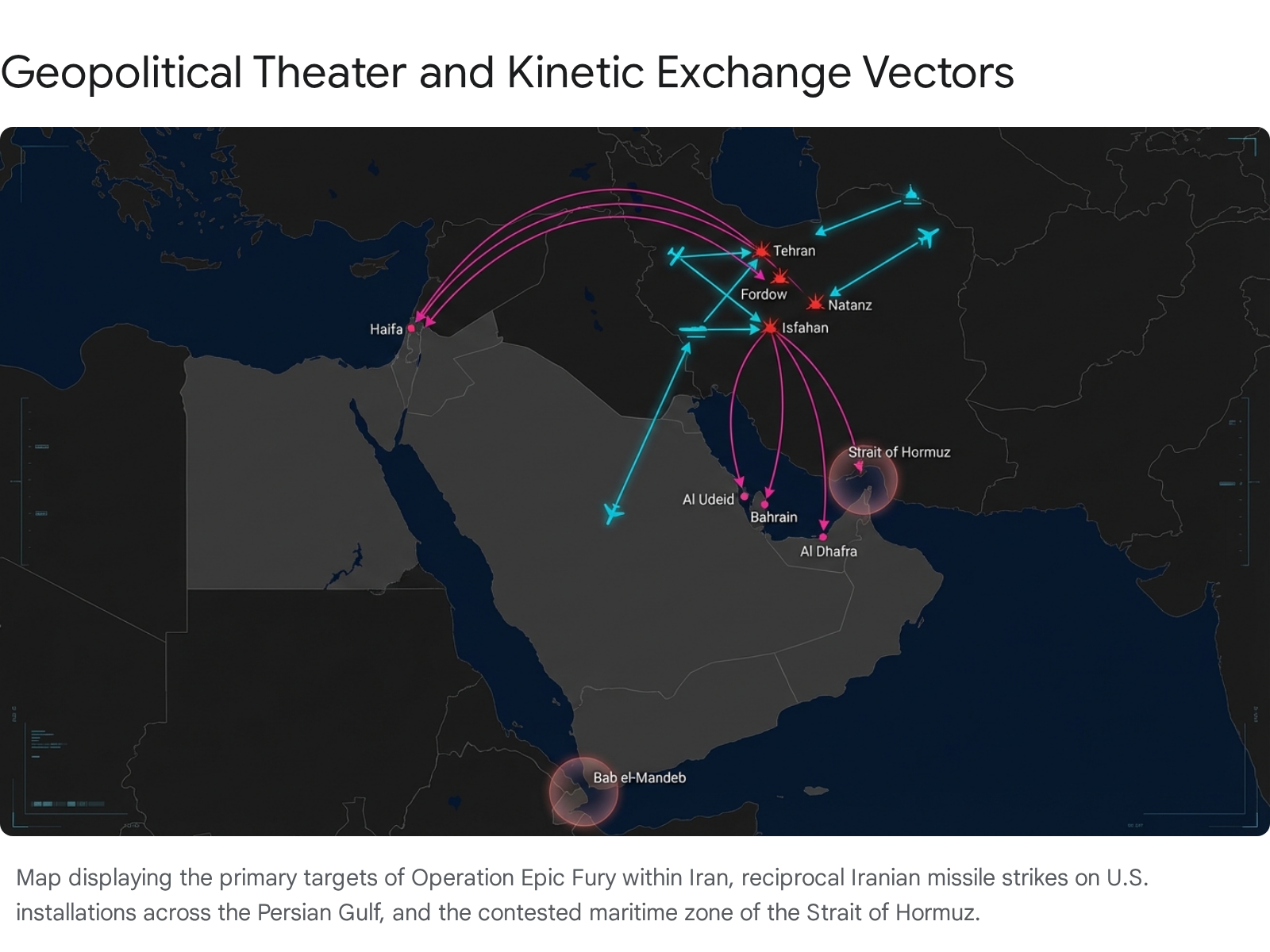
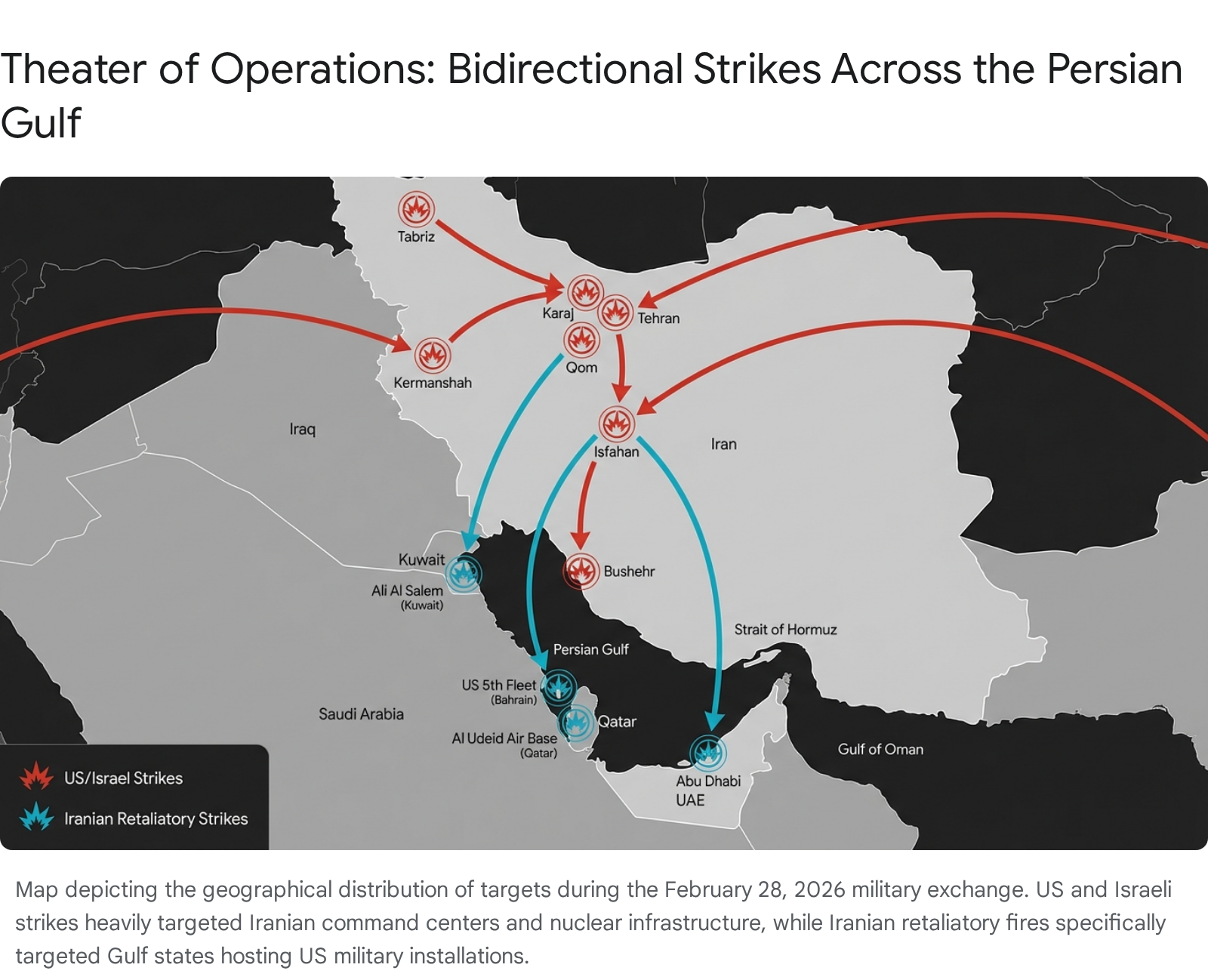
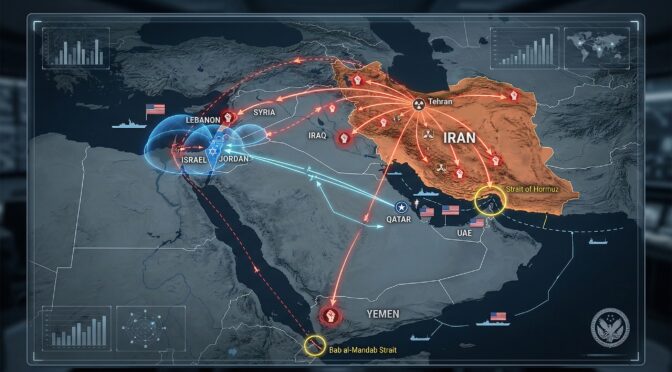
As of late February 2026, the strategic landscape in the Middle East has crossed a critical threshold, transitioning from high-intensity coercive diplomacy into direct, multi-front military confrontation. The launch of the joint United States–Israeli preemptive offensive,designated “Operation Epic Fury” by the US and “Operation Roaring Lion” by Israel,on February 28, 2026, has fundamentally altered the regional security architecture.1 This campaign, targeting Iranian nuclear infrastructure, ballistic missile production facilities, and senior leadership compounds in Tehran, Isfahan, and Qom, represents the most significant escalation since the June 2025 “12-Day War”.2 The Islamic Republic of Iran has immediately activated its regional retaliatory doctrine, initiating “Operation True Promise 4,” which has already struck US military assets, including the 5th Fleet headquarters in Bahrain and an FP-132 radar installation in Qatar, alongside widespread barrages against Israeli territory and Gulf Cooperation Council (GCC) airspace.1

The overall strategic balance is currently characterized by a profound and highly volatile asymmetry. The United States and Israel possess overwhelming conventional air superiority, precision-strike capabilities, and the most robust concentration of naval power seen in the region since the 2003 invasion of Iraq, anchored by the USS Abraham Lincoln and USS Gerald R. Ford Carrier Strike Groups.6 Conversely, Iran relies on escalation dominance through asymmetric means: a vast, reconstituted stockpile of solid-fuel medium-range ballistic missiles (MRBMs), swarming unmanned aerial vehicles (UAVs), and the capacity to disrupt global energy markets via the Strait of Hormuz.7

Iran’s capacity to sustain a prolonged war effort is severely constrained by advanced macroeconomic exhaustion. Crippling sanctions have reduced Iranian crude oil exports to below 1.39 million barrels per day (mb/d), while floating storage has swelled to over 170 million barrels, consuming approximately 20% of the nation’s oil revenue in logistical and evasion costs.10 Domestically, the regime is grappling with nationwide protests triggered by the total collapse of the rial (1.4 million per US dollar), though the Islamic Revolutionary Guard Corps (IRGC) maintains control through a highly sophisticated strategy of “containment governance”.11 Based on current consumption and attrition rates, Iran faces a critical depletion of pre-positioned solid-fuel MRBMs within 3 months, and a severe degradation of its broader military-industrial base within 6 to 12 months under sustained allied bombardment.8

The most likely trajectory is a period of Sustained Asymmetric Warfare, characterized by an extended war of attrition designed to exploit the mathematical and financial vulnerabilities of the US-Israeli air defense interceptor stockpiles.12 However, the conflict is currently plagued by severe leadership miscalculations on all sides. The United States leadership has overestimated the capacity of the Iranian public to execute regime change in a post-decapitation vacuum, dramatically underestimating the cohesive survival instincts of the 190,000-strong IRGC.14 Israeli leadership faces a mathematical impossibility regarding interceptor replacement rates relative to Iranian ballistic missile saturation tactics, creating a dangerous reliance on offensive preemption.12 Concurrently, Iranian leadership fatally underestimated the risk tolerance of Washington and Jerusalem, leading to the catastrophic failure of its deterrence doctrine and the onset of direct territorial war.7

2. Current Military Asset Comparison

The military confrontation involves fundamentally different force structures and operating philosophies. The US and Israel operate expeditionary, technologically superior, and capital-intensive militaries designed for rapid dominance and precision decapitation. Iran operates a defense-in-depth, asymmetric, and mathematically saturating force designed to offset its conventional inferiority by bankrupting the defensive capabilities of its adversaries.19

2.1 Macro-Level Force Posture and Personnel

The disparity in defense spending dictates the operational realities of the conflict. The United States operates with an annual defense budget approaching $895 billion, allowing for concurrent modernization, global basing, and the deep deployment of precision munitions across multiple theaters.21 Israel relies heavily on rapid mobilization, fielding a highly trained reserve force to augment its standing army.23 Iran, with a defense budget of approximately $15 billion, prioritizes low-cost, high-impact systems that bypass traditional conventional force-on-force engagements.21

MetricUnited StatesIsraelIran
Global Firepower Rank (2026)1st15th16th
Active Military Personnel~1,330,000~169,500~610,000 (inc. IRGC)
Reserve Personnel~799,500~465,000~350,000 (inc. Basij)
Estimated Defense Budget~$895 Billion~$24 Billion~$15 Billion
Strategic DoctrineExpeditionary / Conventional OvermatchPreemptive / Rapid Mobilization / Multi-layer DefenseAsymmetric / Attrition / Proxy Network
Manpower Pool (Population)335 Million9.4 Million88 Million

The Iranian Armed Forces operate a dual-military structure. The Artesh (regular forces) is responsible for traditional border defense, numbering approximately 350,000 ground personnel.24 However, the center of gravity for Iranian power projection is the Islamic Revolutionary Guard Corps (IRGC), which commands an independent ground force (150,000), a naval wing specialized in asymmetric swarm tactics (20,000), an aerospace force overseeing the ballistic missile program (15,000), and the Quds Force for extraterritorial operations.24 This bifurcated structure ensures regime survival while complicating targeting for allied forces.

2.2 Aerospace and Air Defense Capabilities

Iran’s conventional air force is entirely obsolete, relying on an aging fleet of Soviet-era MiG-29s, Su-24s, and reverse-engineered F-5 airframes (such as the domestic Kowsar and Saeqeh), totaling fewer than 250 to 550 combat-capable aircraft.20 Consequently, Iran’s aerospace doctrine is almost entirely reliant on ground-based air defenses (GBAD) and offensive missile forces to contest airspace.20 Israel and the United States command total air superiority, utilizing fifth-generation stealth platforms (F-35, F-22) and strategic bombers (B-2 Spirit) capable of penetrating deep into Iranian territory with massive ordnance penetrators.4

However, the critical vulnerability for the US and Israel lies in the depletion rates of their highly advanced air defense interceptors against Iranian saturation tactics.26

Asset CategoryUnited States (Deployed/Available)IsraelIran
Total Combat Aircraft>13,000 (Global)~600~250-550 (Mostly obsolete)
Fifth-Generation FightersF-35C, F-22 (12 Deployed to Israel)F-35I AdirNone
Long-Range BombersB-2 Spirit, B-52NoneNone
Primary Air Defense SystemsTHAAD, Patriot (MIM-104), Aegis (SM-3/SM-6)Arrow 2/3, David’s Sling, Iron Dome, Iron BeamBavar-373, S-300 (Degraded), Sayyad-3
Air Defense VulnerabilityTHAAD delivery gap (2023-2027); SM-3 depletionHigh cost per intercept; Arrow depletion (52% used in 2025)Heavy losses in 2024/2025; high reliance on MANPADS

The mathematics of interception heavily favors the aggressor in this theater. Israel’s multi-tiered defense system is technologically unparalleled but financially brittle. The Arrow-2 and Arrow-3 systems provide exo-atmospheric interception against long-range ballistic missiles, David’s Sling addresses medium-range threats (100-200 km), and the Iron Dome secures the short-range perimeter.28 The strategic crisis emerges from the cost ratio: a single Arrow interceptor costs upwards of $3 million, while the Iranian offensive munitions they target (such as the Shahed series loitering munitions or older liquid-fueled missiles) range from $20,000 to $300,000.26 During the 2025 conflict, Israel expended 52% of its Arrow interceptor stockpile, requiring rapid domestic production scale-ups and heavy reliance on the US defense industrial base.32 The US is facing parallel constraints, having burned through years of Terminal High Altitude Area Defense (THAAD) and Standard Missile-3 (SM-3) production in recent engagements, with new THAAD deliveries not scheduled until April 2027.13

2.3 Ballistic Missiles, Cruise Missiles, and UAVs

Iran’s deterrence rests on the Middle East’s largest and most diverse missile arsenal.20 Prior to the June 2025 “12-Day War,” Iran possessed over 3,000 ballistic missiles.34 Following significant losses (estimated at 40-60% of its MRBM stockpile destroyed by allied strikes), Iran engaged in a massive reconstitution effort prior to the February 2026 hostilities.7 Tehran prioritized the rapid production of solid-fueled MRBMs, such as the Kheibar (2,000 km range), Sejil (1,500-2,500 km range), and the Haj Qasem (1,400 km range).35 Solid-fueled systems require vastly less launch preparation time compared to older liquid-fueled models, significantly improving their survivability against preemptive allied strikes designed to hunt launchers.7

CapabilityIranIsraelUnited States
Current Usable MRBM Inventory~1,000–1,200 (Reconstituting at 12% MoM pre-Feb 28)Classified (Jericho series, ICBM capable)High (Minuteman III, Trident SLBMs)
Short-Range/Tactical MissilesThousands (Largely undamaged in 2025 conflicts)High (Rampage, LORA)High (HIMARS, ATACMS, PrSM)
Cruise MissilesHigh (Paveh, Hoveyzeh)High (Delilah, Popeye Turbo)High (Tomahawk, JASSM-ER)
UAV/Drone Swarm CapacityExtremely High (Shahed series, thousands active)High (Hermes, Heron – primarily ISR and precision strike)High (MQ-9 Reaper, RQ-170 – stealth ISR and strike)
Production ResilienceHigh reliance on underground “missile cities” and imported Chinese precursorsHighly developed domestic defense industrial base; integrated with USGlobal industrial base; currently straining on high-end interceptor production

In January 2026, the Iranian armed forces claimed to have added 1,000 new drones to their inventories, intended to replace the assets lost during the 2025 conflict.7 Iran maintains a vast network of at least 24 missile sites, including deep underground “missile cities,” hardened silos, and tunnel bunkers in western, central, and southern Iran to protect and disperse these assets from American bunker-buster munitions.7

2.4 Naval and Maritime Asymmetric Assets

The naval theater, particularly the Strait of Hormuz, Persian Gulf, and the Red Sea, presents a distinct asymmetric challenge. The US maintains absolute blue-water naval supremacy, but the IRGC Navy utilizes a doctrine of “Smart Control” and anti-access/area denial (A2/AD).21 This involves swarm tactics utilizing hundreds of fast attack craft (FAC), the deployment of naval mines, and shore-to-sea missile batteries designed to threaten narrow chokepoints and overwhelm the Aegis combat systems of larger US vessels.9

Naval Asset TypeUnited States (Deployed to CENTCOM/6th Fleet)Iran (IRIN & IRGC Navy)
Aircraft Carriers2 (USS Abraham Lincoln, USS Gerald R. Ford)0 (Operates “drone carriers” e.g., Shahid Bagheri)
SubmarinesGuided-missile submarines (SSGN), Attack subs (SSN)3 Kilo-class (aging), multiple domestic Fateh-class (semi-heavy/littoral)
Surface CombatantsArleigh Burke-class Destroyers, Cruisers, LCSLight Frigates, Corvettes, Fast Attack Craft (FAC) swarms
Maritime StrategyFreedom of Navigation, Sea Control, Carrier Strike ProjectionAnti-Access/Area Denial (A2/AD), Swarm Tactics, Mine Warfare, Coastal Defense

The IRGC Navy’s deployment of the “Shahid Bagheri” drone carrier near Bandar Abbas and the testing of the naval “Seyed-3” surface-to-air missile demonstrate a concerted effort to build a “regional air defense umbrella” over its most advanced vessels, challenging US freedom of maneuver within the immediate littoral zones.9

2.5 Deployed United States Regional Assets (February 2026)

In response to the failure of diplomatic negotiations in Geneva and the outbreak of protests in Iran, the US initiated the largest military buildup in the region since 2003, transitioning from a deterrent posture to an active combat posture.6

  • Carrier Strike Groups: Carrier Strike Group 3 (CSG-3), centered on the USS Abraham Lincoln (CVN-72) and Carrier Air Wing Nine, arrived in the Arabian Sea on January 26, 2026.6 The USS Gerald R. Ford (CVN-78), the largest warship ever constructed and utilizing the Electromagnetic Aircraft Launch System (EMALS), joined the theater in late February, creating a highly unusual and potent two-carrier deployment.6
  • Combat Aircraft: The naval deployment includes squadrons of F/A-18E Super Hornets, EA-18G Growlers for electronic warfare, and F-35C Lightning IIs.6 Crucially, 12 F-22 Raptor stealth fighters were deployed directly to Ovda Airbase in southern Israel on February 24, 2026, marking the first US deployment of offensive weaponry directly on Israeli soil.6 Furthermore, F-15E Strike Eagles were relocated from RAF Lakenheath to Muwaffaq Salti Air Base in Jordan, while nine US aerial refueling tankers arrived at Ben Gurion Airport to sustain long-range bombing sorties.6
  • Regional Bases and Vulnerabilities: US forces are staged across a vast network including Al Udeid Air Base (Qatar) and Ali Al Salem (Kuwait).6 However, recognizing the vulnerability of fixed infrastructure, the US Navy withdrew all vessels from its 5th Fleet base in Bahrain on February 26 to reduce vulnerability to preemptive Iranian strikes.6 This precaution proved prescient, as Iran successfully struck the 5th Fleet headquarters compound with ballistic missiles on February 28 during Operation True Promise 4.1

3. Iranian War Sustainability and Resource Depletion

Assessing Iran’s capacity to sustain a prolonged, multi-front conflict requires analyzing its macroeconomic health, the resilience of its logistical supply chains, and the attrition rates of its domestic military production against the backdrop of an intensely reinforced international sanctions regime.

3.1 Macroeconomic Exhaustion and Energy Export Collapse

Iran’s economy functions under a state of severe macroeconomic exhaustion, fundamentally sustained by a complex “shadow fleet” of oil exports designed to evade US sanctions. As of early 2026, the sustainability of this economic lifeline is failing rapidly. Crude oil loadings from Persian Gulf terminals collapsed to below 1.39 mb/d by January 2026,a stark 26% year-over-year drop.10 Deliveries to China, which traditionally purchases over 80% of Iran’s oil exports and acts as its primary geopolitical patron, fell to 1.13 mb/d.10

More critically, unsold Iranian crude stored on floating tankers has nearly tripled over the past year to more than 170 million barrels.10 The financial drain of maintaining this static fleet is catastrophic. Chartering Very Large Crude Carriers (VLCCs) under the extreme legal and insurance risks of sanctions costs upwards of $100,000 per day.10 Analysts estimate that a staggering 20% of Iran’s total oil revenue is currently consumed merely by transport, offshore storage, and evasion costs.10 Furthermore, to secure buyers, Iran is forced to sell its crude at steep discounts of $11 to $12 per barrel below standard benchmarks.10

This export collapse has precipitated massive capital flight. While the nominal value of Iran’s total exports yielded an $11 billion trade surplus in the first half of the 2025 fiscal year, nearly $15 billion in capital fled the country during the same period.38 The Central Bank of Iran holds approximately 320.7 tons of official gold reserves (ranking 20th–25th globally), but this serves only as a temporary buffer against the freefall of the national currency and cannot sustain a wartime economy indefinitely.39 The state is increasingly reliant on a $1.5 billion barter scheme, exchanging oil directly for basic goods, signaling a regression in basic macroeconomic functioning.10

3.2 Supply Chain Vulnerabilities and Munitions Depletion

Iran’s military-industrial base has proven resilient to limited strikes, utilizing deep subterranean “missile cities” to protect production lines from Israeli and US bunker-busting munitions (such as the 30,000-pound GBU-57 MOP used in the June 2025 Operation Midnight Hammer).4 Prior to the February 2026 strikes, Iran was reconstituting its ballistic missile arsenal at a rate of roughly 12% month-over-month (approximately 100 to 300 missiles per month depending on the class), aggressively leveraging domestic reverse-engineering and lighter composite materials.8

However, this production is heavily dependent on vulnerable external supply chains. The shift toward advanced solid-propellant missiles,which are vastly superior tactically because they do not require hours of fueling on vulnerable launch pads,requires the constant importation of Chinese precursors, specifically sodium perchlorate.7 Additionally, Iran has relied on Russian assistance to improve the terminal maneuverability of its reentry vehicles.7 Under a full-scale US naval blockade and secondary sanctions regime triggered by a wider war, the severance of these chemical and technological supply chains will halt advanced missile production.

3.3 Resource Depletion Timelines

Based on the intensity of the February 2026 strikes, observed operational tempo from the 2025 conflicts, and current inventories, the following depletion timelines are projected:

  • 3 Months (May 2026): Depletion of Pre-positioned Strategic Assets. Iran’s currently usable inventory of 1,000–1,200 MRBMs will be rapidly depleted due to a combination of US/Israeli preemptive destruction of launchers (Operation Epic Fury) and high-volume Iranian retaliatory salvos intended to overwhelm allied defenses (Operation True Promise 4).8 Within 90 days, Iran will be forced to transition from strategic deep-strike bombardment to tactical and asymmetric swarm attacks using shorter-range systems and mass-produced UAVs.
  • 6 Months (August 2026): Supply Chain Severance and Interceptor Crisis. US naval blockades and maximum-pressure secondary sanctions will begin severely restricting the influx of Chinese solid-fuel precursors, degrading Iran’s ability to manufacture new MRBMs.8 Concurrently, the US and Israel will face a critical crisis in air defense interceptors. The US is already experiencing a delivery gap for THAAD interceptors that will not be resolved until April 2027, and Israel burned through 52% of its Arrow stockpile in a mere 12 days during 2025.27 A grueling war of attrition will heavily favor Iran’s cheaper, lower-tech munitions at this juncture, forcing the US and Israel to accept higher casualty rates or transition to entirely offensive operations to eliminate launch sites.
  • 12 Months (February 2027): Total Macroeconomic Exhaustion.
    The physical strain on infrastructure, combined with the inability to export oil through a heavily contested Persian Gulf, will collapse the barter-based shadow economy. State revenues will plummet to near zero. The Iranian state will struggle to fund basic internal security operations, logistics for its proxy networks, and municipal services, leading to critical vulnerabilities in regime survival.

4. Domestic Stability and Regime Resilience

The US and Israeli strategy explicitly counts on the internal collapse of the Islamic Republic, with President Trump publicly urging the Iranian people to “take over” their government, framing the military strikes as their “only chance for generations”.16 However, assessing regime resilience requires distinguishing carefully between widespread public grievance and the state’s institutional capacity to violently suppress it.

4.1 Socio-Economic Triggers and Protest Dynamics

Iran entered 2026 facing the most extensive wave of popular protests since the Mahsa Amini “Woman, Life, Freedom” movement of 2022–2023, and the lethal fuel protests of November 2019.11 The primary catalyst for the late 2025/early 2026 unrest was acute economic deterioration, marked by a violent depreciation of the rial (falling from 1.07 million per USD in early November to 1.4 million by late December 2025) and accelerating, hyper-inflationary pressures.11 What began as socio-economic grievances among bazaar merchants, students, and wage earners rapidly morphed into systemic political defiance, with explicit chants targeting the Supreme Leader and questioning the fundamental legitimacy of the theocratic elite.11

Human rights monitors report significant casualties resulting from the state’s response, with thousands arrested and the use of lethal force escalating.44 The state’s governing capacity is deeply strained by macroeconomic exhaustion and “sanction fatigue,” creating a context where the leadership responds with violence because it lacks the financial resources to offer a reformist or economic horizon.11

4.2 The IRGC and “Containment Governance”

Despite the massive scale of the protests, the Iranian public currently lacks cohesive, unified leadership. Because demands from diverse groups,students, labor unions, and merchants,are not aggregated into a shared political platform, collective action remains episodic, transactional, and socially fragmented.11

The state’s internal security apparatus,anchored by the Ministry of Intelligence (MOIS), the 190,000-strong IRGC, and the Basij paramilitary forces,has evolved. Rather than oscillating between purely reformist concessions and total hardline violence, the regime has instituted a system of “containment governance”.11 Drawing lessons from the heavy-handed, internationally condemned disaster of 2019 and the prolonged normalization of defiance in 2022, the state now utilizes a highly calibrated toolkit.11 This involves selective coercion: targeted internet blackouts protecting vital state infrastructure (MOIS target decks), precision arrests, and severe death penalty threats from hardliners like Ali Khamenei, paired symmetrically with conciliatory rhetoric from figures like President Masoud Pezeshkian.11 The goal is to induce “temporal dispersion” and participant fatigue, keeping the protest intensity just below the critical threshold of a systemic rupture.11 Furthermore, the regime has shifted its rhetoric from labeling protesters as “rioters” to “terrorists,” laying the legal and psychological groundwork for unrestricted suppression.47

4.3 Regime Tolerance Under Direct War

Under the extreme physical stress of a direct territorial war (initiated February 28, 2026), public tolerance becomes highly volatile and unpredictable. Historically, external attacks can induce a “rally ’round the flag” effect, consolidating nationalist sentiment behind the government against a foreign aggressor. However, the explicit, precision targeting of leadership compounds, IRGC infrastructure, and government ministries by US and Israeli forces removes the regime’s long-cultivated aura of invincibility.1

If the state cannot provide basic services,water, electricity, fuel,due to systematic infrastructure destruction, the temporal dispersion of protests will end, replaced by desperate, existential, and violent unrest. Nevertheless, unless the allied strikes trigger sustained elite fragmentation or precipitate mass defections within the IRGC, the coercive apparatus remains highly lethal and institutionally intact.11 Supreme Leader Khamenei has prepared for decapitation scenarios, reportedly naming four potential successors for every critical military and government post, demonstrating an extreme level of paranoia and institutional hardening.49 The allied expectation that airstrikes alone will organically manifest a democratic transition represents a significant analytical leap that underestimates the entrenched survival mechanisms of the theocracy.14

5. Scenario Analysis

The outbreak of Operation Epic Fury and the retaliatory True Promise 4 necessitates the rigorous evaluation of ongoing conflict trajectories and their cascading global effects.

Scenario A: Sustained Asymmetric Warfare & Attrition (Current Trajectory)

  • Likelihood: High (80% probability).
  • Triggers: The US and Israel fail to completely decapitate Iranian command and control structures in the opening salvos; Iran recognizes it cannot win a conventional, symmetrical air war and shifts to its historical strength of attrition.
  • Impacts (Military): Iran initiates low-cost, high-volume swarms of Shahed drones and older liquid-fuel missiles. These are intended not necessarily to destroy hardened Israeli or US infrastructure, but to force the continuous launch of billion-dollar US and Israeli interceptor stockpiles (THAAD, Arrow, Patriot), creating a crisis of munition exhaustion.26
  • Impacts (Economic/Geopolitical): Iran activates the “Smart Control” doctrine in the Strait of Hormuz, using naval mines, fast attack craft, and electronic warfare to harass global shipping without fully closing the strait.21 This drives a persistent geopolitical risk premium, pushing Brent crude to $90–$120/bbl, disrupting global supply chains but deliberately stopping short of triggering a total US ground invasion.50 Argus Media reports indicate that Israel’s offshore Karish and Leviathan gas fields, along with the Haifa refinery, have already suspended operations due to the conflict, demonstrating the immediate regional energy vulnerability.52
  • Sustainability Constraint: This scenario favors Iran initially due to the sheer cost asymmetry of the munitions. However, by month 6, the degradation of Iran’s domestic manufacturing base and the total collapse of its oil revenues will severely curtail its ability to fund its proxy network (Hezbollah, Houthis, Iraqi militias), forcing a degradation in operational tempo.

Scenario B: Direct Regional War & Total Infrastructure Targeting

  • Likelihood: Medium (40% probability).
  • Triggers: A mass-casualty event occurs on a US base (e.g., the February 28 strike on the 5th Fleet in Bahrain results in significant American deaths), or an Iranian ballistic missile penetrates Israeli air defenses and hits a major civilian population center in Tel Aviv or Jerusalem.
  • Impacts (Military): The US abandons its doctrine of proportional response and engages in unrestricted targeting of Iran’s energy grid, port facilities, and remaining oil terminals. In response, Iran attempts to completely close the Strait of Hormuz and launches maximum-yield barrages at Saudi, Emirati, and Qatari energy infrastructure to internationalize the economic pain and punish US allies.52
  • Impacts (Economic/Geopolitical): The total closure of the Strait of Hormuz drops Middle East oil output by approximately 65%. Global oil prices spike dramatically (projected at $150–$200/bbl), causing a massive contraction in global GDP (up to 2.4%).50
  • Sustainability Constraint: Iran’s economy would instantly collapse into a localized barter system, accelerating domestic uprisings. The US military, while maintaining absolute air and naval dominance, lacks the logistical capability and domestic political mandate for a ground occupation, leading to a destroyed, deeply radicalized, and ungovernable Iranian landscape.

Scenario C: Limited Proxy Escalation & Strategic De-escalation

  • Likelihood: Low (10% probability, largely nullified by recent events).
  • Triggers: Mutual recognition of mutually assured economic and military exhaustion following the initial intense exchange of strikes on February 28. Oman or Qatar successfully brokers an immediate, face-saving ceasefire.
  • Impacts: A return to the pre-2026 status quo of shadow warfare and cyber sabotage. Iran leverages the pause to accelerate deep-underground nuclear enrichment as the ultimate deterrent against future strikes, convinced that its conventional ballistic missile deterrence failed.
  • Sustainability Constraint: Provides both sides the necessary strategic pause to replenish desperately low munition and interceptor stockpiles, delaying the conflict rather than resolving it.

6. Leadership Assessment: Overestimation and Underestimation

The rapid deterioration of the strategic landscape from intense diplomacy into direct, kinetic warfare across sovereign borders is the result of compounding miscalculations by the political and military leadership of the United States, Israel, and Iran. All three actors have demonstrated a dangerous disconnect between their public strategic doctrines and their actual demonstrated capabilities and constraints.

6.1 United States: The Illusion of Spontaneous Regime Change

President Donald Trump’s administration has explicitly stated that the ultimate objective of “Operation Epic Fury” is regime change, appealing directly to the Iranian people to overthrow their government and framing the strikes as an unprecedented opportunity.14 This reveals a critical overestimation of the Iranian opposition’s capacity and a profound underestimation of the IRGC’s institutional resilience.

Miscalculation: Washington is operating under the doctrinal fallacy that air superiority translates directly to desired domestic political outcomes. US leadership equates public grievance (evidenced by the rial collapse and recent protests) with cohesive, revolutionary capability.14 The Reality: The Iranian public lacks unified leadership, arms, and a cohesive platform. The state’s security apparatus is designed specifically to survive decapitation strikes and suppress internal dissent violently.14 By explicitly targeting the state without committing the necessary ground forces to secure a transition, the US risks destroying the country’s infrastructure while leaving the coercive machinery of the IRGC bloodied but intact. A paranoid, surviving IRGC will declare victory simply by existing, potentially closing the door on organic democratic reform.14 Furthermore, Washington underestimated Iran’s willingness to strike US bases directly, assuming the sheer mass of the US naval armada and the threat of catastrophic economic sanctions would paralyze Tehran’s decision-making.7 The belief that a “short, sharp” campaign could alter the regime without triggering a wider war reflects a failure to learn from the prolonged nature of previous Middle Eastern interventions.

6.2 Israel: The Interceptor Math and Capabilities Doctrine

Prime Minister Benjamin Netanyahu and the Israeli defense establishment operate under a trauma-informed “capabilities-based doctrine”.55 Since the strategic surprises of recent years, Israel assesses threats based not on declared intentions or diplomatic assurances, but strictly on Iran’s demonstrated capacity to produce and deploy ballistic missiles.

Miscalculation: Israel suffers from an over-reliance on technological overmatch while underestimating the raw mathematics of sustained attrition warfare. Israeli leadership believed it could manage the Iranian threat indefinitely through preemptive “mowing the grass” operations, covert sabotage, and an impenetrable, multi-layered defense shield.15 The Reality: The June 2025 war demonstrated unequivocally that Israel’s air defense architecture,while highly effective in short bursts,cannot guarantee absolute protection against sustained, massive saturation attacks.12 Israeli defense planners privately acknowledge that Iran’s rapidly expanding arsenal poses an existential threat precisely because it exhausts interceptor stockpiles.12 Firing a multi-million-dollar interceptor at a high volume of relatively cheap Iranian missiles represents an unsustainable economic and logistical curve.26 Israel overestimated its ability to replenish these interceptors quickly, heavily relying on a US defense industrial base that is currently experiencing severe delivery gaps and competing global priorities.27 This mathematical reality forced Israel’s hand into launching preemptive strikes, recognizing that a defensive posture alone would eventually fail.

6.3 Iran: Deterrence Failure and Misjudged Thresholds

Supreme Leader Ayatollah Ali Khamenei and the IRGC leadership relied on a strategy of “escalation dominance” via their Axis of Resistance proxies and the implicit threat of regional destabilization, particularly the disruption of the Strait of Hormuz and the specter of nuclear breakout.

Miscalculation: Iran systematically underestimated the risk tolerance of the current US and Israeli administrations. Tehran operated on the assumption that the threat of closing the Strait of Hormuz, unleashing Hezbollah, and inflicting US casualties would successfully deter a direct, sustained attack on sovereign Iranian territory. They believed Washington would restrain Israel to prevent a global oil shock that could derail the US domestic economy. The Reality: The February 28 strikes proved that the US and Israel were willing to cross the ultimate red line,direct, massive strikes on leadership compounds in Tehran and strategic nuclear facilities.1 Iran fatally misjudged the threshold for escalation; their continued enrichment activities, reconstitution of ballistic missile sites, and proxy harassment provided the exact justification Washington and Jerusalem needed to bypass containment and execute preventive strikes.18 Iran is now forced into a reactive posture, discovering that its deterrent umbrella was fundamentally hollow against an adversary willing to absorb significant economic and political disruptions to achieve strategic degradation. The regime must now navigate a direct war it sought to avoid, armed with an arsenal that is depleting faster than it can be replaced.

Appendix A: Methodology

This strategic assessment was synthesized using real-time open-source intelligence (OSINT), military procurement data, and geopolitical reporting current as of February 28, 2026.

  • Sustainability Estimation: Economic sustainability was modeled utilizing Kpler tanker-tracking data regarding Iranian crude oil export volumes and floating storage accumulation.10 Military depletion timelines were calculated by juxtaposing known Iranian solid-fuel MRBM reconstitution rates (+12% month-over-month) against publicly disclosed US/Israeli interceptor expenditure rates and procurement delivery gaps (e.g., the CSIS analysis of THAAD and SM-3 backlogs).8
  • Scenario Probability: Scenarios were weighted based on the Analysis of Competing Hypotheses (ACH) framework, factoring in the immediate real-time execution of Operations Epic Fury and True Promise 4, historical Iranian retaliatory patterns (from the 2025 conflict), and global energy market fragility indices (such as the 65% potential drop in Middle East output).8
  • Data Sourcing: Asset inventories were cross-referenced from the 2026 Global Firepower Index, US Defense Intelligence Agency (DIA) assessments, and the International Institute for Strategic Studies (IISS) Military Balance.23

Appendix B: Glossary of Acronyms

  • A2/AD: Anti-Access/Area Denial
  • CENTCOM: United States Central Command
  • CSG: Carrier Strike Group (US Navy)
  • EMALS: Electromagnetic Aircraft Launch System
  • FAC: Fast Attack Craft
  • GBAD: Ground-Based Air Defense
  • GCC: Gulf Cooperation Council
  • IAD: Integrated Air Defense
  • IRGC: Islamic Revolutionary Guard Corps (Sepah-e Pasdaran)
  • IRGC-AF: IRGC Aerospace Force
  • IRIN: Islamic Republic of Iran Navy (Regular Navy)
  • JCPOA: Joint Comprehensive Plan of Action
  • MOIS: Ministry of Intelligence of the Islamic Republic of Iran
  • MRBM: Medium-Range Ballistic Missile
  • OSINT: Open-Source Intelligence
  • THAAD: Terminal High Altitude Area Defense
  • UAV: Unmanned Aerial Vehicle
  • VLCC: Very Large Crude Carrier

Appendix C: Glossary of Foreign Terms

  • Artesh: The conventional military forces of the Islamic Republic of Iran, operating parallel to the IRGC and tasked primarily with defending Iran’s external borders.
  • Basij: A volunteer paramilitary militia established in 1979, operating under the command of the IRGC. Used extensively for internal security, moral policing, and violently suppressing domestic protests.
  • Axis of Resistance: An informal, Iran-led political and military coalition in the Middle East (including Hezbollah in Lebanon, the Houthis in Yemen, Hamas in Gaza, and various Iraqi militias) designed to project Iranian influence and oppose US and Israeli interests through decentralized proxy warfare.
  • Velayat-e Faqih: “Guardianship of the Islamic Jurist.” The foundational political and religious doctrine of the Islamic Republic, which grants absolute and infallible political authority to the Supreme Leader (currently Ayatollah Ali Khamenei).
  • Rial: The official currency of Iran, which has suffered catastrophic depreciation due to sanctions, capital flight, and economic mismanagement, driving widespread domestic unrest.
  • Shahed: “Witness” or “Martyr” in Persian. The designation for a prolific series of Iranian unmanned aerial vehicles, particularly loitering munitions (kamikaze drones) used extensively in asymmetric swarm attacks to exhaust enemy air defenses.
  • Khorramshahr / Kheibar / Haj Qasem: Designations for advanced, increasingly solid-fueled Iranian medium-range ballistic missiles, named after historical battles, locations, or revered military figures (e.g., Qasem Soleimani), representing the core of Iran’s strategic deterrent.

Please share the link on Facebook, Forums, with colleagues, etc. Your support is much appreciated and if you have any feedback, please email us in**@*********ps.com. If you’d like to request a report or order a reprint, please click here for the corresponding page to open in new tab.


Sources Used

  1. Joint US-Israel Military Offensive and Iran Retaliation – SpecialEurasia, accessed February 28, 2026, https://www.specialeurasia.com/2026/02/28/iran-israel-united-states-war/
  2. FACT SHEET: Everything You Need to Know About the US–Israeli …, accessed February 28, 2026, https://www.palestinechronicle.com/fact-sheet-everything-you-need-to-know-about-the-us-israeli-war-on-iran/
  3. № 4 (6), 2025. US Strikes on Iran: Timeline and OSINT Damage Assessment – PIR Center, accessed February 28, 2026, https://pircenter.org/en/editions/%E2%84%96-4-6-2025-us-strikes-on-iran-timeline-and-osint-damage-assessment/
  4. United States strikes on Iranian nuclear sites – Wikipedia, accessed February 28, 2026, https://en.wikipedia.org/wiki/United_States_strikes_on_Iranian_nuclear_sites
  5. Iran Attacks US Navy Base in Bahrain: Fifth Fleet Headquarters Targeted in ‘Operation Epic Fury’; Gulf Capitals on High Alert, accessed February 28, 2026, https://sundayguardianlive.com/world/iran-attacks-us-navy-base-in-bahrain-us-fifth-fleet-headquarters-targeted-in-operation-epic-fury-gulf-capitals-on-high-alert-172914/
  6. 2026 United States military buildup in the Middle East – Wikipedia, accessed February 28, 2026, https://en.wikipedia.org/wiki/2026_United_States_military_buildup_in_the_Middle_East
  7. Iran’s Evolving Missile and Drone Threat | JINSA, accessed February 28, 2026, https://jinsa.org/wp-content/uploads/2026/02/Irans-Evolving-Missile-and-Drone-Threat.pdf
  8. Iran-US-Israel Escalation Dynamics – Nuclear Leverage, Military …, accessed February 28, 2026, https://debuglies.com/2026/02/24/iran-us-israel-escalation-dynamics-nuclear-leverage-military-buildup-and-retaliatory-postures-february-2026/
  9. Iran Update, January 29, 2026, accessed February 28, 2026, https://understandingwar.org/research/middle-east/iran-update-january-29-2026/
  10. Tehran’s oil lifeline shows signs of strain under tightening sanctions …, accessed February 28, 2026, https://www.iranintl.com/en/202602133199
  11. Iran’s 2025-26 protests, resilience and political containment, accessed February 28, 2026, https://www.realinstitutoelcano.org/en/analyses/irans-2025-26-protests-resilience-and-political-containment/
  12. “Israel Admits Missile Shield Limits: Iran’s 5,000-Strong Ballistic Arsenal Could Overwhelm Iron Dome, Arrow and U.S. Gulf Bases”, accessed February 28, 2026, https://defencesecurityasia.com/en/israel-iran-ballistic-missile-threat-5000-missiles-iron-dome-arrow-gulf-bases-2027/
  13. Shallow Ramparts: Air and Missile Defenses in the June 2025 Israel-Iran War, accessed February 28, 2026, https://www.fpri.org/article/2025/10/shallow-ramparts-air-and-missile-defenses-in-the-june-2025-israel-iran-war/
  14. Experts react: The US and Israel just unleashed a major attack on Iran. What’s next?, accessed February 28, 2026, https://www.atlanticcouncil.org/dispatches/experts-react-the-us-and-israel-just-unleashed-a-major-attack-on-iran-whats-next/
  15. US superiority over Iran is obvious, the endgame is not, accessed February 28, 2026, https://www.iranintl.com/en/202602268309
  16. US-Israel strikes target Iranian regime | The Straits Times, accessed February 28, 2026, https://www.straitstimes.com/world/the-surprises-and-the-remaining-questions-looming-over-the-us-israeli-attack-on-iran
  17. How Would Iran Respond to a U.S. Attack? – CSIS, accessed February 28, 2026, https://www.csis.org/analysis/how-would-iran-respond-us-attack
  18. US, Israel bomb Iran: A timeline of talks and threats leading up to attacks, accessed February 28, 2026, https://www.aljazeera.com/news/2026/2/28/us-israel-bomb-iran-a-timeline-of-talks-and-threats-leading-up-to-attacks
  19. Iran vs Israel Military Strength Compared: Which Country is Stronger in Troops, Missiles, Tanks & Naval Power as War Escalates?, accessed February 28, 2026, https://sundayguardianlive.com/world/iran-vs-israel-war-military-strength-compared-which-country-is-stronger-in-troops-missiles-tanks-naval-power-as-war-escalates-172930/
  20. FACTBOX – Iran’s military power: Missiles, drones and deterrence, accessed February 28, 2026, https://www.aa.com.tr/en/middle-east/factbox-iran-s-military-power-missiles-drones-and-deterrence/3822798
  21. U.S. vs. Iran Military 2026 – Challenge Coin Nation, accessed February 28, 2026, https://challengecoinnation.com/blogs/news/u-s-vs-iran-military-2026
  22. US vs Iran: Here is a head-to-head comparison of the military assets of the two countries, accessed February 28, 2026, https://www.livemint.com/news/us-news/us-vs-iran-here-is-a-head-to-head-comparisons-of-the-military-assets-of-the-two-countries-11771570400706.html
  23. Israel–Iran military face-off: Who holds the edge in high-stakes showdown – numbers compared, accessed February 28, 2026, https://timesofindia.indiatimes.com/defence/international/israeliran-military-face-off-who-holds-the-edge-in-high-stakes-showdown-numbers-compared/articleshow/128882672.cms
  24. Iran Military Power – DIA, accessed February 28, 2026, https://www.dia.mil/portals/110/images/news/military_powers_publications/iran_military_power_lr.pdf
  25. Despite overwhelming US military might, Iran campaign would pose complex challenges, accessed February 28, 2026, https://www.timesofisrael.com/despite-overwhelming-military-might-us-faces-complex-challenges-in-iran-campaign/
  26. Israel Shores Up Air Defenses, Expected to Hit Iran Launchers Early …, accessed February 28, 2026, https://www.algemeiner.com/2026/02/27/israel-shores-up-air-defenses-expected-hit-iran-launchers-early-ease-stockpile-strain/
  27. No THAADs ’til 2027: Missile defense experts warn of interceptor ‘gap’, accessed February 28, 2026, https://breakingdefense.com/2025/12/no-thaads-til-2027-missile-defense-experts-warn-of-interceptor-gap/
  28. From Iron Dome to Iron Beam: Israel’s sky shields against Iranian missiles, accessed February 28, 2026, https://m.economictimes.com/news/defence/israels-iron-dome-to-iron-beam-inside-the-multi-layer-sky-shield-defending-against-iranian-missiles/articleshow/128844223.cms
  29. Israel Shores Up Air Defenses, Expected to Hit Iran Launchers Early to Ease Stockpile Strain, accessed February 28, 2026, https://jewishpostandnews.ca/uncategorized/israel-shores-up-air-defenses-expected-to-hit-iran-launchers-early-to-ease-stockpile-strain/
  30. Inside Israel’s Missile Shield: The Multi-Layered Defence Built to Counter Iran, accessed February 28, 2026, https://moderndiplomacy.eu/2026/02/27/inside-israels-missile-shield-the-multi-layered-defence-built-to-counter-iran/
  31. Eyeing future missile threats, Israel successfully completes ‘complex’ David’s Sling tests, accessed February 28, 2026, https://www.timesofisrael.com/eyeing-future-missile-threats-israel-successfully-completes-complex-davids-sling-tests/
  32. Iran Update, December 22, 2025 | ISW, accessed February 28, 2026, https://understandingwar.org/research/middle-east/iran-update-december-22-2025/
  33. The Depleting Missile Defense Interceptor Inventory – CSIS, accessed February 28, 2026, https://www.csis.org/analysis/depleting-missile-defense-interceptor-inventory
  34. Table of Iran’s Missile Arsenal | Iran Watch, accessed February 28, 2026, https://www.iranwatch.org/our-publications/weapon-program-background-report/table-irans-missile-arsenal
  35. Iran’s ballistic missile capabilities and range explained after US strike, accessed February 28, 2026, https://www.the-independent.com/news/world/middle-east/iran-attack-missiles-range-ballistic-b2929395.html
  36. Iran Update, February 24, 2026 | ISW, accessed February 28, 2026, https://understandingwar.org/research/middle-east/iran-update-february-24-2026/
  37. US Navy withdraws all vessels from Bahrain base amid rising tensions with Iran, accessed February 28, 2026, https://www.middleeastmonitor.com/20260226-us-navy-withdraws-all-vessels-from-bahrain-base-amid-rising-tensions-with-iran/
  38. Money is leaving Iran faster as oil income falls and uncertainty mounts, accessed February 28, 2026, https://www.iranintl.com/en/202602189530
  39. Is Iran’s Gold a Buffer Against the Storm? :: nournews, accessed February 28, 2026, https://nournews.ir/en/news/275385/Is-Iran%E2%80%99s-Gold-a-Buffer-Against-the-Storm
  40. Operation Midnight Hammer: How the US conducted surprise strikes on Iran, accessed February 28, 2026, https://breakingdefense.com/2025/06/operation-midnight-hammer-how-the-us-conducted-surprise-strikes-on-iran/
  41. What are Iran’s ballistic missile capabilities?, accessed February 28, 2026, https://www.straitstimes.com/world/middle-east/what-are-irans-ballistic-missile-capabilities?ref=latest
  42. Iran’s Conflict With Israel and the United States – Council on Foreign Relations, accessed February 28, 2026, https://www.cfr.org/global-conflict-tracker/conflict/confrontation-between-united-states-and-iran
  43. 2026 Iranian Protests | Cause, Events, Leaders, Crackdown, 12-Day War, Trump, Islamic Revolution, Reza Pahlavi, Shah, & Israel | Britannica, accessed February 28, 2026, https://www.britannica.com/event/2026-Iranian-Protests
  44. 2025–2026 Iranian protests – Wikipedia, accessed February 28, 2026, https://en.wikipedia.org/wiki/2025%E2%80%932026_Iranian_protests
  45. Iran: What challenges face the country in 2026? – House of Commons Library, accessed February 28, 2026, https://commonslibrary.parliament.uk/research-briefings/cbp-10456/
  46. The Signal in the Silence: Strategic Implications of Iran’s 2026 Internet Blackout for Cyber Threat Intelligence and Narrative Control – FalconFeeds.io, accessed February 28, 2026, https://falconfeeds.io/blogs/the-signal-in-the-silence-irans-2026-internet-blackout-cti-narrative-control
  47. Iran Update, January 10, 2026 | ISW, accessed February 28, 2026, https://understandingwar.org/research/middle-east/iran-update-january-10-2026/
  48. Scenarios for Iran’s Future and Implications for GCC Security – Stimson Center, accessed February 28, 2026, https://www.stimson.org/2026/scenarios-for-irans-future-and-implications-for-gcc-security/
  49. Iran Update, February 25, 2026 | ISW, accessed February 28, 2026, https://understandingwar.org/research/middle-east/iran-update-february-25-2026/
  50. Are the US and Iran on a collision course for war or a surprise deal? | Middle East Eye, accessed February 28, 2026, https://www.middleeasteye.net/opinion/us-iran-collision-course-war-surprise-deal
  51. Limited U.S. Strike on Iran: Energy Market Impact – Discovery Alert, accessed February 28, 2026, https://discoveryalert.com.au/us-strike-iran-2026-market-volatility-geopolitical-tensions/
  52. Israel gas fields, refinery shut after attack on Iran, accessed February 28, 2026, https://www.argusmedia.com/en/news-and-insights/latest-market-news/2794474-israel-gas-fields-refinery-shut-after-attack-on-iran
  53. If Trump Strikes Iran: Mapping the Oil Disruption Scenarios – CSIS, accessed February 28, 2026, https://www.csis.org/analysis/if-trump-strikes-iran-mapping-oil-disruption-scenarios
  54. Insights From Kroll Economics – How Geopolitical Shifts Could Reshape Global Markets, accessed February 28, 2026, https://www.kroll.com/en/publications/valuation/navigating-global-oil-market-2026-risk-scenarios
  55. Israel’s Strategic Consensus on Iran , and Its Risks – Stimson Center, accessed February 28, 2026, https://www.stimson.org/2026/israels-strategic-consensus-on-iran-and-its-risks/
  56. The Military Balance 2026 – The International Institute for Strategic Studies, accessed February 28, 2026, https://www.iiss.org/publications/the-military-balance/
Operation Epic Fury: United States Military Order of Battle and Strike Posture in the CENTCOM AOR

Executive Summary

As of late February 2026, the United States Armed Forces, acting in direct coordination with the Israel Defense Forces (IDF), have initiated major kinetic combat operations against the Islamic Republic of Iran under the Department of Defense operational designation “Operation Epic Fury”.1 This military action, launched in tandem with the Israeli operations codenamed “Lion’s Roar” and “Shield of Judah,” represents the culmination of an unprecedented, multi-domain force buildup across the United States Central Command (CENTCOM) and European Command (EUCOM) Areas of Responsibility (AOR).2 The current deployment and subsequent combat operations mark the most significant concentration of American naval, aerial, and logistical combat power in the Middle Eastern theater since the 2003 invasion of Iraq, effectively dwarfing previous regional deterrence postures and operations.5

The contemporary United States Order of Battle (ORBAT) is strategically anchored by a geographically distributed, highly survivable dual-carrier strike force architecture. Carrier Strike Group Three (CSG-3), operating the Nimitz-class USS Abraham Lincoln, is actively deployed in the Arabian Sea and the Gulf of Oman, projecting sustained combat power directly into Iran’s southern threat vectors and maritime chokepoints.8 Concurrently, Carrier Strike Group Twelve (CSG-12), led by the Ford-class USS Gerald R. Ford, has established a forward operating presence in the Eastern Mediterranean Sea near the coastlines of Israel and Crete.5 This specific geographic positioning deliberately isolates the high-value flagship from Iran’s anti-ship ballistic missile (ASBM) envelopes while utilizing an extensive, trans-continental aerial refueling bridge to project carrier-based strike capabilities deep into Iranian sovereign territory.5

Land-based expeditionary air power has surged to encompass over 330 combat and specialized support aircraft positioned across allied host nations, representing an approximate 10% increase in regional air assets within the final 48 hours prior to the commencement of kinetic strikes.14 Data indicates that combat aircraft constitute approximately 65% of this total deployed force, supported by a dense network of electronic warfare, command and control, and aerial refueling platforms.14 This air armada is characterized by a heavy reliance on fifth-generation low-observable platforms (F-35A/C, F-22), advanced electronic warfare (EW) and suppression of enemy air defenses (SEAD) assets (EA-18G, EA-37B), and an exceptionally robust Intelligence, Surveillance, and Reconnaissance (ISR) architecture (RC-135, MQ-4C, E-3).14

The defensive posture established to protect these offensive assets is equally robust and has already been kinetically validated. Terminal High Altitude Area Defense (THAAD) and Patriot PAC-3 systems are actively engaging retaliatory Iranian ballistic missile launches aimed at forward staging bases.17 This was notably demonstrated by recent successful exo-atmospheric intercepts over Al Dhafra Air Base in the United Arab Emirates (UAE), which safeguarded critical USAF reconnaissance and refueling infrastructure.17 The operational integration of cyber warfare with conventional electronic attack platforms has successfully degraded Iranian integrated air defense systems (IADS), specifically targeting S-300 and S-400 equivalents, facilitating the successful ingress of allied strike packages in the opening salvos of Operation Epic Fury.18

Current Order of Battle (ORBAT)

The following sections detail the verified and assessed dispositions of United States military assets within the CENTCOM and adjacent EUCOM AORs, categorized by domain.

Naval Surface and Subsurface Posture

The maritime component of the current US force posture is engineered to establish multi-axis sea control, provide layered ballistic missile defense (BMD) for regional allies and staging bases, and deliver overwhelming long-range precision fires via BGM-109 Tomahawk Land Attack Missiles (TLAM). The naval ORBAT is strategically distributed across the Eastern Mediterranean Sea, Red Sea, Arabian Sea, and the Persian Gulf, forcing Iranian defense planners to calculate threats from 360 degrees.9

Carrier Strike Groups (CSG)

The deployment of a dual-carrier formation provides combatant commanders with nearly continuous, 24-hour sortie generation capabilities. The geographic separation of the two strike groups maximizes threat axes while complicating Iranian counter-targeting efforts.

Unit DesignationPlatform / ClassCurrent Location AssessedKey Embarked Assets / Composition
Carrier Strike Group 3 (CSG-3)USS Abraham Lincoln (CVN-72) Nimitz-classArabian Sea / Gulf of Oman 8CVW-9: VMFA-314 (F-35C), VFA squadrons (F/A-18E/F), VAQ-133 “Wizards” (EA-18G w/ ALQ-249 NGJ), VAW-117 (E-2D).21
Carrier Strike Group 12 (CSG-12)USS Gerald R. Ford (CVN-78) Ford-classEastern Mediterranean Sea (near Israel/Crete) 11CVW-8: VFA-31, 37, 87, 213 (F/A-18E/F), VAQ-142 (EA-18G), VAW-124 (E-2D).27 Nearing 300-day deployment record.29

Deployed to the Arabian Sea and the Gulf of Oman, CSG-3 provides the primary southern axis of attack against Iranian military infrastructure.5 The presence of Carrier Air Wing Nine (CVW-9) brings critical fifth-generation capabilities to the maritime domain via Marine Fighter Attack Squadron 314 (VMFA-314) operating the F-35C Lightning II.25 Furthermore, the embarkation of Electronic Attack Squadron 133 (VAQ-133), the “Wizards,” is of paramount strategic importance. VAQ-133 is currently the vanguard unit deploying the AN/ALQ-249 Next Generation Jammer (NGJ), an advanced electronic warfare pod that significantly enhances the EA-18G Growler’s ability to blind and suppress sophisticated, multi-frequency Iranian radar networks.21

Originally deployed to the Caribbean Sea for Operation Southern Spear, CSG-12 was rapidly repositioned across the Atlantic, transited the Strait of Gibraltar, and is currently operating in the Eastern Mediterranean Sea near the Israeli coast and Crete.10 This positioning protects the carrier from Iranian anti-ship ballistic missiles while utilizing an aerial refueling bridge to allow its air wing to strike Iranian targets.5 The Ford-class brings advanced Electromagnetic Aircraft Launch Systems (EMALS) and Advanced Arresting Gear (AAG) to the theater, theoretically permitting a higher sortie generation rate than legacy Nimitz-class carriers, though the vessel and its crew are currently being pushed to the limits of operational endurance as they near a 300-day continuous deployment.13

Independent Surface Action Groups and Destroyer Squadrons (DESRON)

To secure vital maritime chokepoints and augment the Tomahawk strike package, a formidable fleet of guided-missile destroyers (DDG) has been forward-deployed. These Arleigh Burke-class vessels are dual-hatted: they serve as the primary Aegis Ballistic Missile Defense (BMD) shield for allied assets while concurrently acting as the principal launch platforms for hundreds of TLAMs. Open-source intelligence analysts estimate that the assembled naval combat power could unleash over 600 Tomahawk missiles in a single coordinated salvo.31

Unit DesignationPlatform / ClassCurrent Location AssessedPrimary Operational Mandate
USS Frank E. Petersen Jr. (DDG-121)Arleigh Burke-class DDGNorth Arabian Sea 32CSG-3 Escort / Air Defense / Strike.32
USS Spruance (DDG-111)Arleigh Burke-class DDGNorth Arabian Sea 32CSG-3 Escort / Air Defense / Strike.32
USS Michael Murphy (DDG-112)Arleigh Burke-class DDGNorth Arabian Sea 32CSG-3 Escort / Air Defense / Strike.32
USS Bainbridge (DDG-96)Arleigh Burke-class DDGEastern Mediterranean Sea 33CSG-12 Escort / Air Defense / Strike.28
USS Mahan (DDG-72)Arleigh Burke-class DDGEastern Mediterranean Sea 33CSG-12 Escort / Air Defense / Strike.28
USS Winston S. Churchill (DDG-81)Arleigh Burke-class DDGEastern Mediterranean Sea 33CSG-12 Escort / Air Defense / Strike.28
USS Bulkeley (DDG-84)Arleigh Burke-class DDGEastern Mediterranean Sea 32Independent Aegis BMD operations / Strike.32
USS Roosevelt (DDG-80)Arleigh Burke-class DDGEastern Mediterranean Sea 32Independent Aegis BMD operations / Strike.32
USS McFaul (DDG-74)Arleigh Burke-class DDGStrait of Hormuz / Persian Gulf 34Chokepoint defense / Coastal strike / Escort.32
USS Mitscher (DDG-57)Arleigh Burke-class DDGStrait of Hormuz / Persian Gulf 34Chokepoint defense / Coastal strike / Escort.32
USS Delbert D. Black (DDG-119)Arleigh Burke-class DDGRed Sea / Bab el-Mandeb 34Chokepoint defense / Anti-Houthi overwatch / Strike.32

The positioning of the USS McFaul and USS Mitscher within the Persian Gulf and near the Strait of Hormuz is particularly high-risk but necessary for securing the critical energy transit corridor.32 These vessels are uniquely positioned to defend US installations in Bahrain and the UAE, escort commercial shipping, and launch close-range cruise missile strikes into Iranian coastal defense networks, despite being well within the range of Iranian shore-based anti-ship cruise missiles (ASCMs) and fast attack craft swarms.34

Subsurface Assets (SSGNs and SSNs)

While the exact locations of nuclear-powered attack (SSN) and guided-missile (SSGN) submarines remain highly classified under strict OPSEC protocols, OSINT and historical deployment patterns indicate a heavy subsurface presence operating in the AOR.

Unit DesignationPlatform / ClassCurrent Location AssessedPrimary Operational Mandate
USS Florida (SSGN-728)Ohio-class SSGNLocation undisclosed but operating in the AOR (Recently observed NSA Souda Bay, Crete) 35Massive conventional strike (154x TLAM capacity) / Special Operations.36
USS Georgia (SSGN-729)Ohio-class SSGNLocation undisclosed but operating in the AOR 38Massive conventional strike (154x TLAM capacity) / Special Operations.38
Multiple UnitsVirginia / Los Angeles-class SSNsLocations undisclosed but operating in the AOR 39Intelligence, Surveillance, Reconnaissance (ISR) / ASW / Strike.40

The Ohio-class submarines, notably the USS Florida and USS Georgia, possess unprecedented conventional strike capabilities. Each SSGN was converted from a strategic nuclear deterrent platform to a conventional cruise missile carrier capable of launching up to 154 BGM-109 Tomahawks from 22 vertical launch tubes.36 Open-source tracking indicates USS Florida has recently utilized the Marathi NATO Pier Facility at NSA Souda Bay, Crete, for logistical support.35 The presence of these vessels in the Mediterranean, Red, or Arabian Seas provides combatant commanders with a massive, stealthy first-strike capability designed to overwhelm Iranian air defenses without exposing surface ships to counter-battery fire.41 Fast attack submarines (SSNs) are concurrently tasked with sanitizing the operational zones of Iranian Kilo-class diesel-electric submarines and providing persistent, undetected ISR along the Iranian littoral.40

Amphibious Ready Groups (Information Gaps & Strategic Indicators)

Notably, the massive US military buildup lacks a dedicated Amphibious Ready Group (ARG) or Marine Expeditionary Unit (MEU) deployed within the immediate CENTCOM AOR.

Unit DesignationPlatform / ClassCurrent Location AssessedStrategic Indicator
USS Iwo Jima ARG / 24th MEUWasp-class LHD / USMC MEUCaribbean Sea 10Continuing operations in SOUTHCOM.10
USS Boxer ARGWasp-class LHDPacific Ocean 10Operating in INDOPACOM.10

The USS Iwo Jima (LHD-7) ARG, carrying the 24th MEU, remains deployed in the Caribbean Sea supporting SOUTHCOM tasking, while the USS Boxer (LHD-4) ARG is currently underway in the Pacific Ocean.10 This specific force structure confirms assessments that the current military objective is purely focused on kinetic, long-range power projection (air and cruise missile strikes) and regime infrastructure degradation, rather than any form of amphibious assault, coastal seizure, or large-scale ground force insertion.39

Land-Based Air Power & Enablers

The United States Air Force (USAF), augmented by naval aviation detachments and allied assets, has executed a staggering logistical and combat surge to deploy more than 330 military aircraft to the Middle East.14 Data indicates that combat aircraft constitute approximately 65% of this total deployed force, supported by a dense network of electronic warfare, command and control, and aerial refueling platforms.14 Specifically, the combat breakdown includes roughly 84 F-18E/F Super Hornets, 54 F-16C/CJ/CM Fighting Falcons, 42 F-35A/C Lightning IIs, 36 F-15E Strike Eagles, and 12 A-10C Thunderbolts.14 The specialist and support tier comprises 18 EA-18G Growlers, 6 E-3 AWACS, and 5 E-11A BACN aircraft, underpinned by a massive fleet of 86 KC-46 and KC-135 refueling tankers either currently in CENTCOM or en route.14 This airpower is deliberately dispersed across multiple allied bases and European staging grounds to complicate Iranian ballistic missile targeting and ensure continuous operational sortie generation.

Combat Aircraft Dispositions

The tactical fighter deployment reveals a clear emphasis on stealth penetration, electronic attack, and heavy ordnance delivery.

Host InstallationWing / Squadron DesignationAircraft TypeAssessed Operational Role
Muwaffaq Salti Air Base (Jordan)Undisclosed Fighter SquadronsF-15E Strike Eagle (36x) 14Deep interdiction / Heavy payload delivery.44
Muwaffaq Salti Air Base (Jordan)Undisclosed Fighter SquadronsF-35A Lightning II (30x) 44Stealth penetration / DEAD operations.45
Muwaffaq Salti Air Base (Jordan)Undisclosed VAQ SquadronEA-18G Growler (6x) 46Electronic Attack / SEAD.46
Prince Sultan Air Base (Saudi Arabia)378th AEW / 555th EFS (“Triple Nickel”)F-16C/CJ Fighting Falcon 47Multi-role / Wild Weasel SEAD.47
Prince Sultan Air Base (Saudi Arabia)378th AEW / 494th EFS (“Mighty Black Panthers”)F-15E Strike Eagle 48Deep interdiction / Heavy payload delivery.48
Al Dhafra Air Base (UAE)380th AEW / 34th EFSF-35A Lightning II 48Stealth penetration / DEAD operations.48
Al Dhafra Air Base (UAE)380th AEW / 79th EFSF-16 Fighting Falcon 48Multi-role strike and defense.48
Ovda Air Base (Israel)Undisclosed Fighter SquadronF-22 Raptor (11x) 44Air dominance / Escort / Stealth penetration.49

Muwaffaq Salti Air Base in Jordan serves as a primary hub for kinetic operations due to its proximity to Syrian and Iraqi airspace, which act as flight corridors into Iran.46 The concentration of 36 F-15E Strike Eagles and 30 F-35A Lightning IIs at this location provides a highly lethal combination of survivable penetrating capability and heavy ordnance delivery.44 Furthermore, six Navy EA-18G Growlers have been land-based here to support complex SEAD packages.46

Prince Sultan Air Base in Saudi Arabia, a heavily defended installation deep within the peninsula, hosts the F-16CJs of the 555th Expeditionary Fighter Squadron and the F-15Es of the 494th Expeditionary Fighter Squadron.47 The F-16CJs are specifically optimized for “Wild Weasel” operations, armed with AGM-88 High-speed Anti-Radiation Missiles (HARM) designed to autonomously home in on and destroy active Iranian radar emissions.46

In an unprecedented display of joint US-Israeli operational integration, the US Air Force has forward-deployed at least 11 F-22 Raptor air dominance fighters to Ovda Air Base in the Negev desert.44 These specialized platforms are tasked with sanitizing the airspace of Iranian interceptors, providing top-cover for slower bomber assets, and protecting allied strike packages as they transition from the Mediterranean into hostile airspace.44

Conversely, Al-Udeid Air Base in Qatar, historically the central nervous system for CENTCOM air operations, has seen a strategic dispersal of its highly valuable, non-stealthy assets due to its acute vulnerability to Iranian missile barrages across the Persian Gulf.50 While it retains a presence of heavy airlift and tiltrotor aircraft, many high-end combat and refueling assets have been relocated to operational depths further west.50

Strategic Bombers and Long-Range Strike

The integration of the Air Force Global Strike Command (AFGSC) is a critical requirement for delivering the massive ordnance payloads necessary to destroy deeply buried Iranian nuclear enrichment facilities, such as the subterranean complexes at Fordow and Natanz.51

Unit DesignationPlatform / ClassCurrent Location AssessedPrimary Operational Mandate
Bomber Task Force (BTF) 25-2B-52H StratofortressRAF Fairford, United Kingdom 53Standoff cruise missile delivery / Force projection.53
Undisclosed Bomb WingsB-2 SpiritAlert status CONUS / Potential staging Diego Garcia 14Penetrating strike / MOP delivery against hardened targets.51

B-52H Stratofortress bombers attached to BTF 25-2 have recently conducted extensive force projection missions across the Middle East, originating from their European staging ground at RAF Fairford.53 Operating from these European sanctuaries, the B-52Hs utilize the extensive tanker bridge to reach launch points where they can deliver standoff munitions (such as the AGM-158 JASSM-ER) without ever crossing into the lethal threat rings of Iranian surface-to-air missiles.

While no B-2 Spirit stealth bombers have been publicly observed forward-deploying to Naval Support Facility Diego Garcia, OSINT monitors have recorded a sharp increase in strategic airlift activity (C-17s, C-5Ms) to the remote Indian Ocean atoll, strongly indicating logistical preparation for bomber staging.14 B-2s remain on high alert in the continental United States (CONUS) and hold a proven operational history of striking Iranian targets, having delivered 30,000-pound GBU-57 Massive Ordnance Penetrators (MOP) during Operation Midnight Hammer in June 2025.51

Electronic Warfare, ISR, and Command and Control (C2)

Modern air campaigns are heavily reliant on dominance of the invisible electromagnetic spectrum. CENTCOM has amassed a formidable array of Intelligence, Surveillance, Reconnaissance (ISR) and Command and Control (C2) platforms to manage the complex battlespace and find targets for the kinetic shooters.

Unit DesignationPlatform / ClassCurrent Location AssessedPrimary Operational Mandate
380th AEW DetachmentsU-2S Dragon Lady / RQ-4 Global HawkAl Dhafra Air Base (UAE) 58High-altitude, long-endurance optical and radar ISR.58
US Navy Patrol SquadronsMQ-4C Triton / P-8A PoseidonAl Dhafra (UAE) / Isa Air Base (Bahrain) 15Maritime surveillance / ASW / Persian Gulf monitoring.60
Undisclosed Recon SquadronsRC-135V/W Rivet JointAl-Udeid (Qatar) / Various AOR 15Signals Intelligence (SIGINT) / Electronic order of battle mapping.61
55th Electronic Combat GroupEA-37B Compass CallRamstein Air Base (Germany) 62Stand-off electronic attack / Communications jamming.63
Undisclosed C2 SquadronsE-3 Sentry (AWACS) / E-11A BACNVarious AOR 14Airborne battle management / Datalink translation and relay.14

High-altitude ISR is managed heavily out of the 380th AEW at Al Dhafra, which operates the U-2S Dragon Lady, RQ-4 Global Hawk, and at least two newly arrived US Navy MQ-4C Triton maritime surveillance drones.15 These platforms provide persistent, high-altitude synthetic aperture radar (SAR) mapping of Iranian military movements and naval deployments in the Gulf of Oman and Strait of Hormuz.60

Signals Intelligence (SIGINT) is gathered by multiple RC-135V/W Rivet Joint aircraft operating throughout the theater, actively vacuuming the electromagnetic spectrum to map the emissions of Iranian IADS and military communications networks.15 To manage the crowded airspace and deconflict the massive strike packages, six E-3 Sentry AWACS and five E-11A Battlefield Airborne Communications Node (BACN) aircraft serve as airborne command posts.14 The E-11A BACN is particularly crucial for translating distinct tactical datalinks, acting as a Wi-Fi node in the sky that bridges legacy Link-16 networks with the proprietary Multifunction Advanced Data Link (MADL) utilized by the F-35 fleet, ensuring seamless situational awareness across fourth and fifth-generation platforms.14

In the realm of Electronic Attack (EA), the USAF has recently deployed the brand-new EA-37B Compass Call to the European theater at Ramstein Air Base.62 This highly classified platform is designed to integrate directly with the RC-135s to execute devastating stand-off electronic attacks against adversary command and control networks, effectively paralyzing the enemy’s ability to coordinate a defense before strike aircraft even cross the border.16

The Strategic “Tanker Bridge”

A regional war campaign of this magnitude, particularly one utilizing aircraft carriers stationed as far away as the Mediterranean and bombers flying from the United Kingdom, requires an unparalleled aerial refueling infrastructure. Open-source flight tracking indicates that the US military has mobilized approximately 127 KC-135 Stratotankers and KC-46A Pegasus aircraft globally for this operation.14 Approximately 86 of these tankers are deployed directly within CENTCOM bases or are actively en route.14 For instance, the 77th Expeditionary Air Refueling Squadron (EARS), operating the modern KC-46A Pegasus, recently established operations at Prince Sultan Air Base under the 378th AEW.67

The strategic tanker bridge spans from Sofia, Bulgaria, and Souda Bay, Greece, across the Mediterranean to staging areas at Ben Gurion Airport in Tel Aviv, Israel, bypassing the political constraints and acute vulnerabilities associated with basing entirely within the Persian Gulf.69 By staging KC-135 and KC-46 tankers at these European and Israeli nodes, the US Air Force has established an unbroken aerial refueling corridor. This logistical bridge enables carrier-based fighters from the USS Gerald R. Ford in the Mediterranean, as well as land-based fighters in Jordan and bombers from the UK, to execute deep-penetration strikes into Iranian territory and return to safe havens without exhausting their fuel reserves.5

Air and Missile Defense (AMD) Architecture

Because US and allied host-nation bases are well within the range of Iran’s vast arsenal of short- and medium-range ballistic missiles, the Pentagon has established a deeply layered, integrated air and missile defense (IAMD) shield across the theater.72 Iran is widely assessed to possess the largest and most diverse ballistic missile force in the Middle East, heavily stockpiling solid-fueled, precision-guided variants.73

Defensive SystemDomain / PlatformAssessed LocationsPrimary Interception Role
THAAD (Terminal High Altitude Area Defense)Land-based Mobile BatteryUAE, Saudi Arabia, Jordan 14Exo-atmospheric ballistic missile intercept (Hit-to-Kill).17
Patriot PAC-3Land-based Mobile BatteryVarious CENTCOM Airbases 14Point defense against short-range ballistic missiles, cruise missiles, and UAVs.72
Aegis BMD (SM-3 / SM-6)Arleigh Burke-class DDGEast Med, Red Sea, Persian Gulf 32Midcourse and terminal ballistic missile defense over maritime and allied airspace.32

Terminal High Altitude Area Defense (THAAD) batteries have been rapidly deployed across the UAE, Saudi Arabia, and Jordan.14 These systems are capable of intercepting incoming ballistic missiles in their terminal phase utilizing kinetic “hit-to-kill” technology—destroying the target through sheer impact velocity rather than an explosive fragmentation warhead.72 While highly effective, these systems rely on a finite inventory of interceptors that cost upwards of $12 million each and take years to procure, creating a critical logistical constraint if Iran employs mass saturation tactics.72 Operating in conjunction with THAAD, Patriot Advanced Capability-3 (PAC-3) batteries provide the inner layer of point defense for critical infrastructure, airfields, and command nodes.14

The efficacy of this network has already been tested in live combat. On February 28, Iranian ballistic missiles targeted Al Dhafra Air Base in the UAE, a critical hub housing the 380th AEW. Preliminary reports indicate that a UAE-deployed THAAD system successfully engaged and intercepted two incoming ballistic missiles over Abu Dhabi, preventing catastrophic damage to the operational hub and safeguarding the highly concentrated reconnaissance and aerial refueling assets stationed on the flight line.17

Reinforcements & Transit Status

The Pentagon continues to surge reinforcements toward the CENTCOM AOR, preparing the logistics and force structure necessary for sustained, multi-day combat operations. The buildup relies heavily on a global pipeline of assets transiting from EUCOM, INDOPACOM, and CONUS.14

Since early January, an estimated 310 strategic airlift flights utilizing C-17 Globemaster III and C-5M Super Galaxy transports have established an air bridge into the Middle East, delivering vital personnel, heavy munitions, and the massive radar and launcher components required for the Patriot and THAAD missile defense systems.14

Simultaneously, a steady stream of tactical fighters continues to arrive via the European staging bridge. Recent flight tracking data confirmed the arrival of an additional 38 fighters—comprising 12 F-22 Raptors, 14 F-15E Strike Eagles, and 12 F-35A Lightning IIs—at RAF Lakenheath in the UK.44 These aircraft, having completed their initial transatlantic transit from bases in Utah, Idaho, and Virginia, are resting and refitting in Europe before making the final flight into the Middle East to replenish and reinforce the strike packages currently engaged in combat operations.44

In the maritime domain, the US Navy is actively preparing to deploy a third aircraft carrier to the theater. The USS George H.W. Bush (CVN-77) Carrier Strike Group, which had been conducting expedited training exercises off the coast of Virginia, is being readied for an emergency deployment within a two-week operational window.5 This aggressive scheduling suggests military planners are anticipating a prolonged, grinding campaign that will require rotational carrier availability to maintain the relentless pace of strike sorties without collapsing the endurance of the Ford or Lincoln crews.

Operational Capabilities & Integration: “The Kill Chain”

The execution of “Operation Epic Fury” relies entirely on the seamless, multi-domain integration of the disparate assets detailed in this ORBAT. The US military does not fight with individual platforms; it employs a sophisticated, interconnected “kill chain” designed to systematically blind, dismantle, and finally destroy Iranian military infrastructure. This methodology is executed in distinct, overlapping phases.

Phase 0: Cyber Infiltration and Spectrum Dominance

Before the first physical munitions are released, the battlespace is prepared through offensive cyber operations and electromagnetic warfare. According to verified intelligence sources, US Cyber Command successfully executed digital strikes against Iranian air defense networks, specifically targeting digital “aim-points”—vulnerable nodes such as routers, servers, and peripheral devices—connected to the command infrastructure of radar systems protecting the heavily fortified nuclear enrichment sites at Fordow, Natanz, and Isfahan.18 By degrading these Russian-equivalent S-300 and S-400 systems digitally from the inside out, cyber operators effectively blinded the Iranian Integrated Air Defense System (IADS) at critical junctures, preventing the launch of surface-to-air missiles against the initial waves of incoming American warplanes.18 This invisible preparation of the battlefield is a prerequisite for survivability in heavily contested airspace.

Phase 1: SEAD and DEAD Operations (Suppression/Destruction of Enemy Air Defenses)

As cyber strikes create localized blind spots and confusion within the Iranian command structure, dedicated electronic and kinetic warfare aircraft exploit these gaps to permanently dismantle the defensive network.

  1. The Sensors (Detection & Geolocation): High-altitude RC-135V/W Rivet Joint aircraft loiter at safe standoff distances over international waters or allied airspace. Utilizing highly sensitive, specialized receiver arrays, these aircraft detect, classify, and precisely geolocate the emissions of active Iranian early-warning and targeting radars.16
  2. The Jammers (Electronic Attack): The targeting data collected by the Rivet Joints is instantly transmitted via secure, low-latency datalinks to EA-37B Compass Call aircraft and carrier-launched EA-18G Growlers operating closer to the threat edge.16 The EA-18Gs, specifically those of VAQ-133 equipped with the new ALQ-249 Next Generation Jammer (NGJ), project focused, high-power electromagnetic energy to overwhelm and scramble the remaining Iranian radar arrays, injecting false targets and noise into their receivers and rendering them incapable of achieving a weapons lock on allied aircraft.22 The recent, historic integration of the RC-135 and EA-37B has significantly refined this electromagnetic kill chain, allowing for rapid, coordinated jamming of pop-up threats in real-time.16
  3. The Hunters (Kinetic Destruction): Under the protective umbrella of this electronic shielding, F-35A and F-35C stealth fighters penetrate deep into Iranian airspace. Utilizing their advanced sensor fusion and the secure Multifunction Advanced Data Link (MADL), F-35s operate as forward quarterbacks. They identify hidden or mobile SAM sites and neutralize them using internal precision-guided munitions like the GBU-39 Small Diameter Bomb (SDB) to maintain their stealth profile, or they pass the precise targeting coordinates back to heavier “bomb trucks” waiting outside the threat ring.80 Furthermore, specialized F-16CJs armed with AGM-88 High-speed Anti-Radiation Missiles (HARM) actively hunt and destroy radar transmitters by riding the enemy’s radar beam directly back to its source.46

Phase 2: Kinetic Execution and Heavy Payload Delivery

Once the IADS is sufficiently degraded and safe air corridors are secured, the heavy kinetic phase initiates to destroy the regime’s strategic capabilities.

  • Standoff Strikes: The USS Florida and USS Georgia (SSGNs), alongside the Arleigh Burke destroyers stationed in the Red Sea and Persian Gulf, launch massive salvos of Tomahawk Land Attack Missiles (TLAM).31 These cruise missiles navigate at low altitudes to avoid radar detection, targeting fixed command and control bunkers, ballistic missile production facilities, and IRGC naval bases.31 Simultaneously, B-52H bombers stationed in Europe launch long-range cruise missiles from well outside Iranian airspace.53
  • Penetrating Strikes: Fourth-generation fighters bearing heavy ordnance payloads, primarily the F-15E Strike Eagles staging from Jordan and Saudi Arabia, ingress through the cleared air corridors.5 Sustained by the massive aerial refueling bridge of KC-135s and KC-46s, these aircraft deliver precision-guided bunker-busters to obliterate hardened Iranian ballistic missile silos and subterranean nuclear enrichment sites that cruise missiles cannot penetrate.5

Phase 3: Battle Damage Assessment (BDA) and Persistent ISR

Following the strike waves, High-Altitude ISR platforms—such as the MQ-4C Triton, U-2S, and RQ-4 Global Hawk—loiter high above the target areas.15 Utilizing synthetic aperture radar and high-resolution electro-optical sensors, these platforms conduct immediate Battle Damage Assessments (BDA), determining the precise level of destruction achieved and relaying this intelligence back to the Combined Air Operations Center (CAOC) to determine if follow-on restrikes are required to fully neutralize the target sets.15

Appendix: Glossary of Acronyms

  • AAG: Advanced Arresting Gear
  • AEW: Air Expeditionary Wing
  • AFGSC: Air Force Global Strike Command
  • AMD: Air and Missile Defense
  • AOR: Area of Responsibility
  • ARG: Amphibious Ready Group
  • ASBM: Anti-Ship Ballistic Missile
  • ASCM: Anti-Ship Cruise Missile
  • ASW: Anti-Submarine Warfare
  • AWACS: Airborne Warning and Control System
  • BACN: Battlefield Airborne Communications Node
  • BDA: Battle Damage Assessment
  • BMD: Ballistic Missile Defense
  • BTF: Bomber Task Force
  • C2: Command and Control
  • CAOC: Combined Air Operations Center
  • CENTCOM: Central Command (United States Central Command)
  • CONUS: Continental United States
  • CSG: Carrier Strike Group
  • CVN: Aircraft Carrier, Nuclear-powered
  • CVW: Carrier Air Wing
  • DDG: Guided-Missile Destroyer
  • DEAD: Destruction of Enemy Air Defenses
  • DESRON: Destroyer Squadron
  • DoD: Department of Defense
  • EA: Electronic Attack
  • EARS: Expeditionary Air Refueling Squadron
  • EFS: Expeditionary Fighter Squadron
  • EMALS: Electromagnetic Aircraft Launch System
  • EUCOM: European Command (United States European Command)
  • EW: Electronic Warfare
  • HARM: High-speed Anti-Radiation Missile
  • IADS: Integrated Air Defense System
  • IAMD: Integrated Air and Missile Defense
  • IDF: Israel Defense Forces
  • INDOPACOM: Indo-Pacific Command (United States Indo-Pacific Command)
  • IRGC: Islamic Revolutionary Guard Corps
  • ISR: Intelligence, Surveillance, and Reconnaissance
  • LHD: Landing Helicopter Dock
  • MADL: Multifunction Advanced Data Link
  • MEU: Marine Expeditionary Unit
  • MOP: Massive Ordnance Penetrator
  • NGJ: Next Generation Jammer
  • NSA: Naval Support Activity
  • OPSEC: Operational Security
  • ORBAT: Order of Battle
  • OSINT: Open-Source Intelligence
  • PAC-3: Patriot Advanced Capability-3
  • RAF: Royal Air Force
  • SAM: Surface-to-Air Missile
  • SAR: Synthetic Aperture Radar
  • SDB: Small Diameter Bomb
  • SEAD: Suppression of Enemy Air Defenses
  • SIGINT: Signals Intelligence
  • SM: Standard Missile
  • SOUTHCOM: Southern Command (United States Southern Command)
  • SSGN: Guided-Missile Submarine, Nuclear-powered
  • SSN: Attack Submarine, Nuclear-powered
  • THAAD: Terminal High Altitude Area Defense
  • TLAM: Tomahawk Land Attack Missile
  • UAE: United Arab Emirates
  • UAV: Unmanned Aerial Vehicle
  • USAF: United States Air Force
  • USMC: United States Marine Corps
  • VAQ: Electronic Attack Squadron
  • VAW: Airborne Command & Control Squadron
  • VFA: Strike Fighter Squadron
  • VMFA: Marine Fighter Attack Squadron

Please share the link on Facebook, Forums, with colleagues, etc. Your support is much appreciated and if you have any feedback, please email us in**@*********ps.com. If you’d like to request a report or order a reprint, please click here for the corresponding page to open in new tab.


Sources Used

  1. Israel, US launch attack on Iran as Trump announces ‘major combat operations’, accessed February 28, 2026, https://www.foxnews.com/live-news/israel-us-launch-attack-on-iran-amid-escalating-protests
  2. 2026 Israeli–United States strikes on Iran – Wikipedia, accessed February 28, 2026, https://en.wikipedia.org/wiki/2026_Israeli%E2%80%93United_States_strikes_on_Iran
  3. Israel, United States strike Islamic Republic, targeting heart of regime | Iran International, accessed February 28, 2026, https://www.iranintl.com/en/202602289915
  4. The Night the Axis Broke, accessed February 28, 2026, https://www.meforum.org/mef-online/the-night-the-axis-broke
  5. 2026 United States military buildup in the Middle East – Wikipedia, accessed February 28, 2026, https://en.wikipedia.org/wiki/2026_United_States_military_buildup_in_the_Middle_East
  6. Q&A: Iran and the US are back on the edge of war. What’s coming?, accessed February 28, 2026, https://acleddata.com/qa/qa-iran-and-us-are-back-edge-war-whats-coming
  7. Daily Memo: US Deployments to the Middle East – Geopolitical Futures, accessed February 28, 2026, https://geopoliticalfutures.com/daily-memo-us-deployments-to-the-middle-east/
  8. US launches ‘major combat operations’ against Iran – Task & Purpose, accessed February 28, 2026, https://taskandpurpose.com/news/us-israel-combat-bomb-iran/
  9. US Conducts Military Buildup Near Iran, Including 2 Aircraft Carriers, accessed February 28, 2026, https://www.visiontimes.com/2026/02/17/us-conducts-unprecedented-dual-carrier-military-buildup-near-iran.html
  10. U.S. Naval Update Map: Feb. 26, 2026, accessed February 28, 2026, https://worldview.stratfor.com/article/us-naval-update-map-feb-26-2026
  11. US-Israel strikes mark latest chapter in Iran conflict, accessed February 28, 2026, https://www.euractiv.com/news/us-israel-strikes-mark-latest-chapter-in-iran-conflict/
  12. Live Updates: U.S. and Israel attack Iran, with Trump confirming “major combat operations”, accessed February 28, 2026, https://www.cbsnews.com/live-updates/israel-us-attack-iran-trump-says-major-combat-operations/
  13. ‘Ford’ Nears Record Deployment as Navy Signals Readiness | Military.com, accessed February 28, 2026, https://www.military.com/daily-news/headlines/2026/02/27/ford-nears-record-deployment-navy-signals-readiness.html
  14. US ramps up deployments to CENTCOM despite ongoing talks with Iran – Anadolu Ajansı, accessed February 28, 2026, https://www.aa.com.tr/en/americas/us-ramps-up-deployments-to-centcom-despite-ongoing-talks-with-iran/3842362
  15. US monitor Persian Gulf after considerable military build-up – Naval Technology, accessed February 28, 2026, https://www.naval-technology.com/features/us-monitor-persian-gulf-after-considerable-military-build-up/
  16. RC-135 Rivet Joint, EA-37B Compass Call conduct historic sorties – Air Combat Command, accessed February 28, 2026, https://www.acc.af.mil/News/Article-Display/Article/4355138/rc-135-rivet-joint-ea-37b-compass-call-conduct-historic-sorties/
  17. Iran fires ballistic missiles at U.S. Al Dhafra Air Base in UAE as THAAD system intercepts incoming threats – Defence Industry Europe, accessed February 28, 2026, https://defence-industry.eu/iran-fires-ballistic-missiles-at-u-s-al-dhafra-air-base-in-uae-as-thaad-system-intercepts-incoming-threats/
  18. Exclusive: US used cyber weapons to disrupt Iranian air defenses during 2025 strikes, accessed February 28, 2026, https://therecord.media/iran-nuclear-cyber-strikes-us
  19. Officials: Cyber strikes wielded by US against Iranian air defenses | SC Media, accessed February 28, 2026, https://www.scworld.com/brief/officials-cyber-strikes-wielded-by-us-against-iranian-air-defenses
  20. More carriers, wider theatre: US buildup around Iran dwarfs …, accessed February 28, 2026, https://www.indiatoday.in/world/story/us-military-buildup-iran-vs-venezuela-carrier-strike-group-tehran-strike-analysis-2871134-2026-02-19
  21. VAQ-133 – Wikipedia, accessed February 28, 2026, https://en.wikipedia.org/wiki/VAQ-133
  22. AN/ALQ-249 Next Generation Jammer completes historic first deployment – AGN, accessed February 28, 2026, https://aerospaceglobalnews.com/news/an-alq-249-next-generation-jammer-completes-historic-first-deployment/
  23. USS Abraham Lincoln Conducts Routine Flight Operations – Centcom, accessed February 28, 2026, https://www.centcom.mil/MEDIA/igphoto/2003878638/
  24. USS Abraham Lincoln (CVN-72) – Wikipedia, accessed February 28, 2026, https://en.wikipedia.org/wiki/USS_Abraham_Lincoln_(CVN-72)
  25. Carrier Air Wing 9 Returns from Indo-Pacific Deployment – PACOM, accessed February 28, 2026, https://www.pacom.mil/Media/News/Article/3123707/carrier-air-wing-9-returns-from-indo-pacific-deployment/
  26. Supercarrier USS Gerald R. Ford Has Crossed Into The Mediterranean – The War Zone, accessed February 28, 2026, https://www.twz.com/news-features/supercarrier-uss-gerald-r-ford-has-crossed-into-the-mediterranean
  27. The U.S. Navy’s New Nuclear Aircraft Carrier Looks Powerful – But It Has Major Problems, accessed February 28, 2026, https://www.19fortyfive.com/2026/02/the-u-s-navys-new-nuclear-aircraft-carrier-looks-powerful-but-it-has-major-problems/
  28. Gerald R. Ford Carrier Strike Group Enters U.S. Fourth Fleet, accessed February 28, 2026, https://www.fourthfleet.navy.mil/Press-Room/News/Article/4329586/gerald-r-ford-carrier-strike-group-enters-us-fourth-fleet/
  29. 300-Day U.S. Navy Gamble: Nuclear Aircraft Carrier USS Gerald R. Ford’s Record Deployment Summed Up in 2 Words, accessed February 28, 2026, https://nationalsecurityjournal.org/300-day-u-s-navy-gamble-nuclear-aircraft-carrier-uss-gerald-r-fords-record-deployment-summed-up-in-2-words/
  30. The EA-18G Growler’s First Strike: How the U.S. Plans to Blind Iran’s New Russian Air Defenses, accessed February 28, 2026, https://www.19fortyfive.com/2026/02/the-ea-18g-growlers-first-strike-how-the-u-s-plans-to-blind-irans-new-russian-air-defenses/
  31. Iran in crosshairs: US Navy makes staggering force buildup, with one-third of deployed fleet aimed at Tehran, accessed February 28, 2026, https://gulfnews.com/world/mena/us-navy-makes-staggering-mideast-force-buildup-one-third-of-deployed-fleet-now-aimed-at-iran-1.500445245
  32. The U.S. Navy Has a Fleet of Arleigh Burke-Class Missile Destroyers ‘Waiting for Orders’ In Iran’s Backyard, accessed February 28, 2026, https://www.19fortyfive.com/2026/02/the-u-s-navy-has-a-fleet-of-arleigh-burke-class-missile-destroyers-waiting-for-orders-in-irans-backyard/
  33. Report: United States is Deploying USS Ford CSG to the Middle East, accessed February 28, 2026, https://maritime-executive.com/article/report-united-states-is-deploying-uss-ford-csg-to-the-middle-east
  34. Eight U.S. Navy Destroyers Forward Positioned For Operations Against Iran – Military Watch Magazine, accessed February 28, 2026, https://militarywatchmagazine.com/article/eight-destroyers-forward-positioned-iran
  35. USS Florida (SSGN 728) – CurrentOps.com, accessed February 28, 2026, https://currentops.com/unit/us/usn/uss-florida/ssgn-728
  36. USS Florida (SSGN-728) – Wikipedia, accessed February 28, 2026, https://en.wikipedia.org/wiki/USS_Florida_(SSGN-728)
  37. The Navy’s Ohio-Class SSGNs Have ‘Unprecedented Strike Capability’, accessed February 28, 2026, https://nationalinterest.org/blog/buzz/navys-ohio-class-ssgns-have-unprecedented-strike-capability-212134
  38. USS Georgia (SSBN 729) – Nuclear Companion: A nuclear guide to the cold war, accessed February 28, 2026, https://nuclearcompanion.com/data/uss-georgia-ssbn-729/
  39. U.S. Military in the Middle East: Numbers Behind Trump’s Threats Against Iran – CSIS, accessed February 28, 2026, https://www.csis.org/analysis/us-military-middle-east-numbers-behind-trumps-threats-against-iran
  40. The U.S. Navy’s New Stealth SSN(X) Submarine Summed in 2 Words, accessed February 28, 2026, https://nationalsecurityjournal.org/the-u-s-navys-new-stealth-ssnx-submarine-summed-in-2-words/
  41. America’s Military Buildup Around Iran: What We Know and What It Means, accessed February 28, 2026, https://www.meforum.org/mef-reports/americas-military-buildup-around-iran-what-we-know-and-what-it-means
  42. Gerald R. Ford Carrier Strike Group Enters Caribbean Sea – Navy.mil, accessed February 28, 2026, https://www.navy.mil/Press-Office/News-Stories/display-news/Article/4332628/gerald-r-ford-carrier-strike-group-enters-caribbean-sea/
  43. 24th Marine Expeditionary Unit Composites as MAGTF-Next, accessed February 28, 2026, https://www.iimef.marines.mil/News/Article/4384868/24th-marine-expeditionary-unit-composites-as-magtf-next/
  44. US deploys new stealth fighter squadron to UK – Ahead of Middle East transfer, accessed February 28, 2026, https://caliber.az/en/post/us-deploys-new-stealth-fighter-squadron-to-uk
  45. US deploys additional F-35A fighters to Europe, accessed February 28, 2026, https://report.az/en/other-countries/us-deploys-additional-f-35a-fighters-to-europe
  46. U.S. EA-18G Electronic Attack Jets Forward Deployed in Jordan: Can They Tackle Iran’s Revitalised Air Defences? – Military Watch Magazine, accessed February 28, 2026, https://militarywatchmagazine.com/article/us-ea18g-electronic-attack-jordan-iran
  47. USAF, Royal Saudi Air Force strengthen interoperability during Spears of Victory [Image 5 of 8] – DVIDS, accessed February 28, 2026, https://www.dvidshub.net/image/9530569/usaf-royal-saudi-air-force-strengthen-interoperability-during-spears-victory
  48. Here are the fighter squadrons currently in the Middle East – Air Force Times, accessed February 28, 2026, https://www.airforcetimes.com/news/your-air-force/2020/02/04/here-are-the-fighter-squadrons-currently-in-the-middle-east/
  49. Additional F-15s, F-22s and F-35s are Arriving to Reinforce U.S. Buildup in Middle East, accessed February 28, 2026, https://theaviationist.com/2026/02/26/additional-fighters-reinforce-us-buildup/
  50. The military buildup map behind Trump’s Iran decision, accessed February 28, 2026, https://www.israelhayom.com/2026/02/27/the-military-buildup-map-behind-trumps-iran-decision/
  51. Hegseth says Pentagon providing military options as Trump weighs US involvement in Middle East | The American Legion, accessed February 28, 2026, https://www.legion.org/information-center/news/security/2025/june/hegseth-says-pentagon-providing-military-options-as-trump-weighs-us-involvement-in-middle-east
  52. USS Gerald R. Ford’s Imminent Arrival Off Israel Comes As Negotiations Grind On, accessed February 28, 2026, https://www.twz.com/news-features/uss-gerald-r-fords-imminent-arrival-off-israel-comes-as-negotiations-grind-on
  53. B-52s Fly Across Middle East, Drop Live Munitions – Air & Space Forces Magazine, accessed February 28, 2026, https://www.airandspaceforces.com/b-52s-fly-middle-east-live-munitions/
  54. U.S. Conducts Bomber Task Force Mission as Iran Threat Looms – FDD, accessed February 28, 2026, https://www.fdd.org/analysis/2025/03/06/u-s-conducts-bomber-task-force-mission-as-iran-threat-looms/
  55. Calculations behind US military buildup in Middle East, accessed February 28, 2026, http://eng.chinamil.com.cn/2025xb/O_251451/16444899.html
  56. US Bombers Step Up Combat Operations as Demand Grows – Air Force Magazine, accessed February 28, 2026, https://www.airandspaceforces.com/us-bombers-step-up-combat-operations-as-demand-grows/
  57. F-35s Deploy Closer to Middle East After US Talks with Iran – Air & Space Forces Magazine, accessed February 28, 2026, https://www.airandspaceforces.com/f-35s-deploy-middle-east-us-talks-iran/
  58. These are the 3 most pressing questions about a military strike against Iran – Bluewin (CH), accessed February 28, 2026, https://www.bluewin.ch/en/news/international/these-are-the-3-most-pressing-questions-about-a-military-strike-against-iran-3115175.html
  59. 380th Air Expeditionary Wing – Wikipedia, accessed February 28, 2026, https://en.wikipedia.org/wiki/380th_Air_Expeditionary_Wing
  60. US surveillance aircraft operate near Iranian border amid tensions – Middle East Monitor, accessed February 28, 2026, https://www.middleeastmonitor.com/20260212-us-surveillance-aircraft-operate-near-iranian-border-amid-tensions/
  61. US Ups Intel Flights for Border Mission With RC-135 Spy Plane – Air & Space Forces Magazine, accessed February 28, 2026, https://www.airandspaceforces.com/us-intelligence-flights-border-mission-rc-135/
  62. EA-37B Compass Call visits Ramstein AB in first stop of European roadshow, accessed February 28, 2026, https://www.dm.af.mil/Media/Article/4396078/ea-37b-compass-call-visits-ramstein-ab-in-first-stop-of-european-roadshow/
  63. New EA-37B Compass Call Electronic Warfare Jet Makes Maiden Voyage To Europe, accessed February 28, 2026, https://www.twz.com/air/new-ea-37b-compass-call-electronic-warfare-jet-makes-maiden-voyage-to-europe
  64. RC-135 Rivet Joint, EA-37B Compass Call Start Integrated Sorties, accessed February 28, 2026, https://www.jedonline.com/2026/01/20/rc-135-rivet-joint-ea-37b-compass-call-start-integrated-sorties/
  65. USAF Deploys EA-37B Compass Call II to Ramstein Air Base as Middle East Tensions Drive Surge in Electromagnetic Warfare Readiness – Defence Security Asia, accessed February 28, 2026, https://defencesecurityasia.com/en/usaf-ea37b-compass-call-ii-ramstein-middle-east-electronic-warfare/
  66. U.S. Air Force launches first sustained integration of RC-135 and EA-37B Compass Call to strengthen spectrum warfare – Defence Industry Europe, accessed February 28, 2026, https://defence-industry.eu/u-s-air-force-launches-first-sustained-integration-of-rc-135-and-ea-37b-compass-call-to-strengthen-spectrum-warfare/
  67. Next-generation air tankers arrive in CENTCOM AOR – Air Combat Command, accessed February 28, 2026, https://www.acc.af.mil/News/Article-Display/Article/4400254/next-generation-air-tankers-arrive-in-centcom-aor/
  68. Next-generation air tankers arrive in CENTCOM AOR – DVIDS, accessed February 28, 2026, https://www.dvidshub.net/news/557685/next-generation-air-tankers-arrive-centcom-aor
  69. The largest US military build-up in the Middle East in decades fuels uncertainty in Tehran, accessed February 28, 2026, https://monocle.com/affairs/the-largest-us-military-build-up-in-the-middle-east-in-decades-fuels-uncertainty-in-tehran/
  70. Massive US Air Force warplane movements in Bulgaria raise stakes for Iran talks, accessed February 28, 2026, https://www.defensenews.com/global/europe/2026/02/23/massive-us-air-force-warplane-movements-in-bulgaria-raise-stakes-for-iran-talks/
  71. Massive US Air Force Build Up in Europe Sparks Iran Strike Speculation – Aviation A2Z, accessed February 28, 2026, https://aviationa2z.com/index.php/2026/02/23/massive-us-air-force-build-up-in-europe-sparks-iran-strike-speculation/
  72. Where Iran’s ballistic missiles can reach — and how close they are to the US – WFMD, accessed February 28, 2026, https://www.wfmd.com/2026/02/27/where-irans-ballistic-missiles-can-reach-and-how-close-they-are-to-the-us/
  73. All the US Military assets involved in the massive strike on Iran, accessed February 28, 2026, https://theaviationgeekclub.com/all-the-us-military-assets-involved-in-the-massive-strike-on-iran/
  74. 300 US Military Aircrafts Deployed to CENTCOM – Politics Today, accessed February 28, 2026, https://politicstoday.org/300-us-military-aircraft-deployed-to-centcom/
  75. Strategic Adversaries – Global Security Review, accessed February 28, 2026, https://globalsecurityreview.com/strategic-adversaries/
  76. US military assets flock to Middle East amid Iran standoff, accessed February 28, 2026, https://www.militarytimes.com/news/pentagon-congress/2026/02/19/us-military-assets-flock-to-middle-east-amid-iran-standoff/
  77. US sends F-22s, F-35s, F-16s in major 50-jet deployment to Middle East, accessed February 28, 2026, https://www.indiatoday.in/world/story/us-sends-f-22s-f-35s-f-16s-in-major-50-jet-deployment-to-middle-east-as-iran-nuclear-talks-continue-2869998-2026-02-18
  78. Pentagon preparing second aircraft carrier to deploy to Middle East: Report, accessed February 28, 2026, https://www.aa.com.tr/en/americas/pentagon-preparing-second-aircraft-carrier-to-deploy-to-middle-east-report/3827514
  79. U.S. and Britain Concentrate Surveillance Flights Around Russian Targets in Crimea, accessed February 28, 2026, https://militarywatchmagazine.com/article/us-britain-concentrate-surveillance-crimea
  80. How the F-35 Connects the Battlespace – Lockheed Martin, accessed February 28, 2026, https://www.lockheedmartin.com/en-us/news/features/2025/how-the-f35-connects-the-battlespace.html
  81. USA Moving F-35s, F-22s, and AWACS Aircraft to the Middle East, accessed February 28, 2026, https://militarnyi.com/en/news/usa-f-35s-f-22s-awacs-aircraft-middle-east/
  82. US Amasses More Airpower in Middle East with Dozens of Fighters, accessed February 28, 2026, https://www.airandspaceforces.com/us-amasses-more-airpower-middle-east-iran/

Operation Epic Fury: Assessing Military Effectiveness Against Iran And Iran’s Potential Next Steps

1. Assessment of Effectiveness (Current State)

As of February 28, 2026, the geopolitical and security environment in the Middle East has entered a period of unprecedented volatility following the commencement of coordinated preemptive military strikes by the United States and Israel against the Islamic Republic of Iran. The joint offensive-designated “Operation Epic Fury” by the United States Department of Defense and “Operation Lion’s Roar” by the Israel Defense Forces (IDF)-marks a paradigm shift from coercive diplomacy to direct, high-intensity kinetic confrontation.1 This section evaluates the current state of military effectiveness regarding both the allied strikes and the immediate Iranian kinetic and non-kinetic responses, situated within the broader strategic context of the collapsed diplomatic negotiations.

1.1 Strategic Context and the Genesis of the Allied Offensive

The immediate catalyst for the allied military campaign was the expiration of a ten-to-fifteen-day ultimatum issued by United States President Donald Trump, which explicitly demanded the total and verifiable dismantlement of Iran’s uranium enrichment capabilities.3 Prior to the initiation of hostilities, diplomatic efforts mediated by Omani Foreign Minister Badr Albusaidi in Geneva, Switzerland, attempted to secure a framework agreement to avert a regional conflagration.4 The United States negotiating delegation, led by Special Envoy Steve Witkoff and Jared Kushner, presented maximalist demands: the total cessation of uranium enrichment, the dismantling of fortified nuclear facilities at Fordow, Natanz, and Isfahan, the transfer of all enriched uranium to United States custody, and a permanent agreement lacking sunset clauses.6

Iranian negotiators, led by Foreign Minister Abbas Araghchi, counter-proposed a framework that would cap enrichment at 1.5 percent for civil research or potentially up to 20 percent for the Tehran Research Reactor, while demanding immediate and comprehensive relief from United States and United Nations sanctions.5 The Iranian delegation fundamentally refused to dismantle physical nuclear infrastructure or export existing fissile material.6 The operational objective of the subsequent military strikes, as stated by the United States administration, is the elimination of imminent threats, the destruction of Iran’s ballistic missile infrastructure, the neutralization of its naval capabilities, and the prevention of nuclear weaponization, ultimately aiming at regime decapitation.1

1.2 The Kinetic Landscape: Allied Preemptive Strikes

To execute Operation Epic Fury, the United States executed a massive regional force posture realignment. In the weeks preceding the strike, the Pentagon deployed the USS Gerald R. Ford and USS Abraham Lincoln carrier strike groups to the region, introducing over 150 tactical aircraft and hundreds of sea-launched cruise missiles into the theater.3 This naval armada was augmented by a substantial airlift operation, including more than ten C-17 Globemaster III flights from the United Kingdom to Jordan, and heavy transport movements to the strategic bomber base at Diego Garcia in the Indian Ocean.12 Furthermore, the United States deployed twelve F-22 Raptor stealth air-superiority fighters to Israeli air bases, representing a historic shift in forward-positioning offensive American assets directly on Israeli soil.8

The tactical execution of the allied strikes demonstrated deep penetration into highly defended Iranian airspace during daylight hours-a timing selected specifically to maximize tactical surprise.11 Targets included the residential and administrative complexes of Supreme Leader Ayatollah Ali Khamenei and President Masoud Pezeshkian in central Tehran, as well as critical military and infrastructure nodes in Isfahan, Qom, Karaj, Kermanshah, Tabriz, and the southern port city of Bushehr.1

Yugo M85/M92 dust cover quick takedown pin installed

The munitions utilized in the assault indicate a focus on hardened, deeply buried targets. The United States Air Force deployed B-2 Spirit stealth bombers to deliver thirty-thousand-pound GBU-57A/B Massive Ordnance Penetrators (MOPs), which are specialized bunker-buster munitions capable of penetrating subterranean rock formations, specifically targeting the Fordow Uranium Enrichment Plant and the Natanz Nuclear Facility.14 Concurrent naval operations utilized submarine-launched Tomahawk cruise missiles.14 Additionally, the Israel Defense Forces utilized air-launched ballistic missiles to degrade Iranian air defenses and command-and-control centers, preparing the battlespace for manned aircraft operations.2

1.3 Evaluation of Allied Strike Effectiveness

It is assessed with High Confidence that Iran’s Integrated Air Defense System (IADS) failed to repel the allied assault, exposing critical vulnerabilities in the Islamic Republic’s airspace denial capabilities. Iran’s defensive posture had already been severely compromised prior to this operation. During the preceding Israel-Iran War of June 2025, Iran’s domestically produced Bavar-373 ground-based air defense systems systematically failed to intercept United States and Israeli targets.16 Furthermore, targeted Israeli operations in April and October of 2024 successfully destroyed Iran’s advanced Russian-supplied S-300 batteries.16

To compensate for these strategic deficits, the Islamic Revolutionary Guard Corps attempted to implement temporary and extremely suboptimal solutions.16 Intelligence indicates that Iran attached loaded Russian Verba Man-Portable Air-Defense Systems (MANPADS)-which possess a maximum engagement altitude of only 4,500 meters-along with cameras and radios onto domestically produced Shahed drones.16 While this improvisation theoretically increases the altitude at which infrared homing missiles can engage targets, it proved entirely ineffective against high-altitude, low-observable stealth platforms and supersonic cruise missiles utilized in Operation Epic Fury.16 Consequently, allied forces achieved total air superiority, allowing them to prosecute targets at will.17 Open-source intelligence is inconclusive on the precise number of Iranian military casualties, though Iranian state media and regional reporting suggest significant losses within the Islamic Revolutionary Guard Corps, including several senior commanders.1

1.4 Iranian Kinetic Responses: “True Promise 4”

In immediate retaliation to the decapitation strikes, the Islamic Revolutionary Guard Corps launched an operation designated “True Promise 4,” described as a first wave of extensive ballistic missile and drone swarm attacks targeting both Israel and United States assets throughout the Middle East.19 Unlike previous regional escalations where Iran demonstrated calculated restraint to avoid triggering an all-out war, the target selection on February 28 indicated a highly risk-acceptant strategy intended to inflict maximum systemic damage.

Iranian ballistic missiles, likely drawn from its extensive inventory of Sejil, Emad, and Ghadr platforms (which boast ranges up to 2,000 kilometers and are specifically designed to evade conventional radar systems), penetrated Israeli airspace, with confirmed impacts in the northern city of Haifa.2 The Israeli Home Front Command activated nationwide sirens, and civilian medical infrastructure, including hospitals, initiated emergency protocols to transfer patients to underground facilities.23

Simultaneously, Iran broadened the conflict horizontally by targeting the epicenter of United States power projection in the Persian Gulf. Missiles successfully struck the United States Navy’s Fifth Fleet Headquarters in Bahrain, reportedly causing a sizable impact on the facility.2 Additional Iranian strikes targeted Al Udeid Air Base in Qatar, Ali Al Salem Air Base in Kuwait, and Al Dhafra Air Base in the United Arab Emirates.1

The effectiveness of Iran’s retaliatory salvos was significantly blunted by advanced allied air defense networks, though the sheer volume of the attack allowed some munitions to penetrate the shield. The United Arab Emirates Ministry of Defense confirmed the successful interception of multiple incoming missiles, though falling interceptor debris resulted in the death of one civilian in Abu Dhabi.1 Qatari authorities reported successful interceptions utilizing United States-operated Patriot missile defense systems, with no immediate damage reported to Al Udeid.20 The Jordanian military also successfully intercepted two ballistic missiles traversing its sovereign airspace.20 While the exact number of United States and Israeli military casualties remains classified, and open-source intelligence is inconclusive on this point, the psychological and operational disruption across the region was absolute, leading to the uniform closure of civilian airspace across Israel, Iran, Iraq, the United Arab Emirates, and Qatar.26

1.5 Asymmetric, Cyber, and Economic Engagements

The military confrontation on February 28 was heavily augmented by non-kinetic, cyber, and asymmetric warfare. Coinciding with the physical airstrikes, Iran was subjected to a crippling digital offensive. Internet monitor NetBlocks reported that national connectivity plunged to merely four percent of normal levels, inducing a near-total information blackout.28 Western intelligence assessments suggest this cyberattack-likely orchestrated jointly by the United States and Israel-was designed to sever the Islamic Revolutionary Guard Corps’ command-and-control infrastructure, preventing the coordinated launch of additional drones and ballistic missiles by Iranian electronic warfare units.28 Furthermore, state-affiliated media apparatuses, including the Islamic Republic News Agency (IRNA) and the IRGC-aligned Tasnim outlet, were taken offline or hacked to display subversive anti-regime messaging directed against Supreme Leader Khamenei.28 In the domestic sphere, the Tehran Stock Exchange entirely suspended trading, and telecommunications networks experienced severe disruptions.30

The global economic response to the strikes was instantaneous, highlighting Iran’s asymmetric leverage over global energy markets. Anticipation of the strikes drove Brent crude oil prices up significantly to over $72 per barrel, injecting a heavy war premium into global markets as traders assessed the geopolitical risk to maritime energy corridors.31

1.6 Assessment of Overall Effectiveness

The current state of military effectiveness heavily favors the conventional supremacy of the allied forces. It is assessed with High Confidence that the United States and Israel demonstrated overwhelming conventional dominance, achieving air superiority and successfully striking high-value leadership and military targets with impunity. The digital decapitation of Iran’s communication grid was highly effective in the short term, degrading the regime’s ability to coordinate a unified response.28

Conversely, Iran’s military effectiveness is currently limited to its capacity for area denial, economic disruption, and the saturation of regional air defenses. It is assessed with Moderate Confidence that while its indigenous air defense network collapsed entirely, its heavily fortified, underground ballistic missile forces retained sufficient survivability to launch a massive counter-salvo capable of bypassing sophisticated allied interceptors to strike targets as distant as Haifa and Bahrain.2

2. Forecast of Likely Next Steps (Iranian Response Options)

With the collapse of the Geneva nuclear negotiations and the onset of major combat operations, the strategic calculus for the Islamic Republic has fundamentally shifted from maintaining regional deterrence to ensuring absolute regime survival.3 Based on current Iranian military doctrine, recent behavior during the June 2025 conflict, and the unprecedented scale of the February 28 strikes, the following threat matrix forecasts Iran’s most probable next steps in the immediate to medium term.

Threat Matrix: Iranian Response Options

Response OptionDescription of Tactics and VectorsProbability of ExecutionProbability of SuccessAnticipated Allied Countermeasures
Direct Military ConfrontationSustained ballistic and cruise missile salvos, accompanied by Shahed drone swarms, targeting Israeli population centers and U.S. Gulf bases (Qatar, Bahrain, UAE, Kuwait).HighModerateDeployment of U.S. THAAD, Patriot PAC-3, and Israeli Arrow/David’s Sling. Preemptive strikes on Iranian mobile launch sites.
Proxy Utilization (Iraq/Syria)Activation of the Popular Mobilization Forces, Kataib Hezbollah, and Harakat al-Nujaba to strike U.S. bases in Erbil and Baghdad, aiming to force an American withdrawal.HighModerate to HighTargeted assassinations of militia leadership; sustained aerial bombardment of PMF infrastructure and logistics routes.
Proxy Utilization (Levant/Red Sea)Hezbollah rocket barrages on northern Israel; Houthi closure of the Bab el-Mandeb strait and anti-ship missile targeting in the Red Sea.HighModerateIsraeli ground incursions and aerial campaigns in Lebanon; U.S. naval bombardment of Houthi coastal launch facilities in Yemen.
Asymmetric/Maritime WarfareMining operations, GPS jamming, and fast-attack craft harassment of commercial oil tankers in the Strait of Hormuz.Medium-HighHigh (Economic Impact)U.S. 5th Fleet naval escorts; international maritime security coalitions; preemptive strikes on IRGC Navy coastal bases.
Cyber and Global TerrorismWiper malware attacks on Israeli/U.S. critical civilian infrastructure; physical targeting of Jewish or Israeli embassies and diplomatic personnel globally.MediumLow to ModerateDefensive cyber protocols; heightened global intelligence sharing; enhanced embassy security protocols.

2.1 Direct Military Confrontation

It is assessed with High Confidence that Iran will maintain a posture of direct military confrontation. The regime perceives that a failure to respond forcefully to an attack on the Supreme Leader’s compound would fatally undermine its domestic authority and its standing among the Axis of Resistance.1 Iran’s primary operational goal in this domain is not to win a conventional war, but to engage in a war of mathematical attrition.

Iran possesses the largest ballistic missile arsenal in the Middle East, deeply buried in underground missile cities located in Kermanshah, Semnan, and along the Persian Gulf coast, making them highly resilient to preemptive strikes.22 Iran’s strategy relies on volume: launching massive, synchronized swarms designed to mathematically exhaust allied interceptor magazines. While United States and Israeli interceptors are technologically superior, they are constrained by inventory limitations and immense financial costs. For context, during the June 2025 conflict, United States Terminal High Altitude Area Defense (THAAD) batteries expended 92 interceptors defending against Iranian missiles out of a total pre-conflict global inventory of 632.12 Each THAAD battery costs approximately $2.73 billion, with individual interceptors priced at $12.7 million.12 The United States Missile Defense Agency estimates a three-to-eight-year timeline to replenish these stockpiles given current production rates.12 Therefore, the probability of Iranian success in penetrating these defenses increases proportionally with the duration of the conflict.

The anticipated countermeasures by the United States involve relying heavily on destroying Iranian mobile launchers before they can fire, utilizing F-35s and loitering munitions, while selectively utilizing THAAD interceptors only against the most critical inbound threats.12

2.2 Proxy Utilization: The Axis of Resistance (Iraq and Syria)

Iran’s proxy network acts as its strategic depth, allowing Tehran to project power while maintaining a degree of plausible deniability. Despite suffering degradation over the past two years, these groups remain capable of opening multiple geographic fronts.33 It is assessed with High Confidence that Iran will heavily utilize its proxies in Iraq and Syria to target American personnel.

In Iraq, groups operating under the umbrella of the Islamic Resistance in Iraq, including Kataib Hezbollah and Harakat al-Nujaba, possess deep operational experience. Hours after the February 28 strikes began, these militias launched rocket attacks against a United States military base in Erbil, Iraqi Kurdistan.18 The effectiveness of these proxies is high because they force the United States to expend resources defending dispersed, remote outposts. However, the domestic political situation in Iraq presents a severe constraint on Iran’s freedom of action. Major Shiite political blocs comprising the Coordination Framework, including the State of Law Coalition led by Nuri al-Maliki and the Fatah Alliance led by Hadi al-Ameri, view a United States-Iran conflagration on Iraqi soil as an existential threat to their fragile sovereignty and are desperate to stay out of the fight.16 Tehran itself relies on a stable Iraq as an economic lifeline and trade partner to circumvent sanctions.34

Consequently, the United States and Israel are actively preempting proxy mobilization without waiting for Iraqi government permission. Coinciding with the strikes on Tehran, allied aircraft bombed the Popular Mobilization Forces base at Jurf al-Sakhar south of Baghdad, killing at least five Kataib Hezbollah fighters.1 Continuous kinetic suppression of proxy command structures will remain the primary allied countermeasure in this theater.

2.3 Proxy Utilization: The Axis of Resistance (Levant and Red Sea)

It is assessed with High Confidence that Iran will mobilize Hezbollah in Lebanon and the Houthis in Yemen. The Alma Research and Education Center predicts that Hezbollah will play the most significant operational role in retaliation efforts among all proxies, threatening northern Israel with massive rocket barrages.36 Concurrently, the Houthis have already announced their intention to close the Bab el-Mandeb strait, which connects the Red Sea with the Gulf of Aden, threatening a critical node of global maritime trade.2 The anticipated countermeasures will include severe Israeli aerial campaigns in Lebanon and United States naval bombardment of Houthi coastal launch facilities, further expanding the geographical scope of the war.

2.4 Asymmetric and Maritime Warfare: The Strait of Hormuz

As its conventional military options wane under the pressure of allied air superiority, Iran is highly likely to exercise its ultimate asymmetric leverage: disrupting the global economy by choking the Strait of Hormuz. It is assessed with a Medium-High Probability that Iran will escalate maritime hostilities in this sector.

The Strait of Hormuz connects the Persian Gulf to the Indian Ocean and is an essential passage for global oil trade. The waterway is approximately 161 kilometers long and 33 kilometers wide at its narrowest point, with the designated shipping lanes in each direction measuring just two miles wide.37 Approximately twenty percent of the world’s seaborne oil and fifty percent of India’s total crude imports transit through this narrow chokepoint.31

A total physical blockade of the strait is practically difficult and legally complex, as international law mandates the right of transit passage, though Iran has not ratified the 1982 United Nations Convention on the Law of the Sea.37 However, Iran does not need to establish a physical blockade to achieve success; the mere threat of violence drives up commercial maritime insurance premiums and global oil prices. Iran can achieve immense disruption utilizing localized global positioning system (GPS) jamming, deploying naval mines in the shallow shipping lanes, and utilizing Islamic Revolutionary Guard Corps fast-attack patrol boats to harass commercial shipping.37 Current economic modeling suggests that an energy price spike stemming from severe disruption in the Strait of Hormuz could generate additional global inflation pressures of 1.2 to 2.5 percent, with economic recovery timelines extending six to twelve months depending on the duration of the conflict and infrastructure damage assessments.31

Anticipating this move, the United States military has already begun preemptive strikes against major Iranian Navy and IRGC Navy bases in the Persian Gulf and Arabian Sea to preempt mining operations and degrade their capacity to launch fast-attack craft.2

2.5 Cyber Warfare and Global Terrorism

It is assessed with a Medium Probability that Iran will engage in retaliatory cyber warfare and global terrorism. Iran could launch cyberattacks aimed at inflicting economic harm by targeting power grids, financial institutions, and civilian infrastructure within Israel and the United States.36 The historical record demonstrates that following Israel’s military strikes in 2025, there was a 700 percent increase in cyberattacks targeting Israel.39 Furthermore, the Alma Center assesses that Iranian attacks against Israeli and Jewish targets worldwide, including embassies and diplomatic personnel, remain firmly on the table.36 However, the probability of strategic success for these operations is low to moderate, as they are unlikely to alter the fundamental military balance of power, serving primarily as a mechanism to demonstrate reach and undermine the target population’s sense of security.36

3. Assessment of Nuclear Escalation Likelihood

The central justification for Operation Epic Fury was the immediate prevention of Iranian nuclear weaponization following the breakdown of diplomatic negotiations in Geneva.3 The current crisis has brought the possibility of Iran permanently altering its nuclear doctrine to its most acute phase in the history of the Islamic Republic. This section evaluates the technical indicators, the doctrinal shifts, and the threshold for preemptive strikes regarding Iran’s nuclear program.

3.1 Real-Time Indicators and Breakout Time

It is assessed with High Confidence that Iran currently possesses the fissile material necessary for a rapid nuclear breakout. Following the United States’ withdrawal from the Joint Comprehensive Plan of Action (JCPOA) in 2018, Iran systematically breached the agreement’s limitations, which had capped uranium enrichment at 3.67 percent and restricted the total stockpile to 202.8 kilograms using only legacy IR-1 centrifuges.40

By February 2026, Iran’s nuclear advances had entirely eroded these constraints. Prior to the February 28 strikes, the International Atomic Energy Agency (IAEA) reported that Iran maintained vast stockpiles of enriched material. Historical data indicates a severe escalation in highly enriched uranium (HEU) production. The inventory includes 2,595 kilograms of uranium enriched to 5 percent, 840 kilograms enriched to 20 percent, and critically, a stockpile of 440.9 kilograms enriched to 60 percent purity.40 This 60 percent enrichment level has no credible civilian application and represents the most technically challenging hurdle toward achieving weapons-grade (90 percent) material.40

The IAEA assesses that this 60 percent stockpile is theoretically sufficient to construct approximately ten nuclear bombs if enriched further to 90 percent.41 Because the leap from 60 percent to 90 percent requires vastly less time and technical effort than enriching from natural uranium to 20 percent, Iran’s technical breakout time-the time required to produce enough weapons-grade uranium for one nuclear device-is currently measured in a matter of weeks, if not days.7

3.2 Information Gaps and the Loss of Verification

Compounding the threat of a rapid breakout is the fact that international regulatory bodies have been effectively blinded. A confidential IAEA report circulated to member states on February 27, 2026, warned of a total “loss of continuity of knowledge over all previously declared nuclear material at affected facilities” following the June 2025 war.41 The agency explicitly stated it could not verify the current size, composition, or whereabouts of the stockpile of enriched uranium in Iran.41

Specifically, the IAEA pointed to an underground tunnel complex at Isfahan, where Iran had stored its 20 percent and 60 percent enriched uranium, which appeared to have averted destruction during the June 2025 bombings.7 Furthermore, despite strikes on the Natanz facility, Iran had continued construction on the deeply buried Pickaxe Mountain site, which is heavily fortified and capable of housing a new enrichment facility.7 Open-source intelligence is inconclusive on whether the February 28 strikes utilizing GBU-57A/B bunker-buster munitions successfully penetrated and destroyed the Isfahan tunnel complex or the Pickaxe Mountain site, representing a critical intelligence gap regarding the true extent of the damage inflicted on Iran’s nuclear capabilities.

3.3 Doctrine Shift: Rhetoric vs. Actionable Steps

The probability of Iran formally shifting its nuclear doctrine from strategic hedging to active weaponization is now assessed as Moderate to High. Analyzing this probability requires separating diplomatic rhetorical posturing from actionable military imperatives.

In the days preceding the February 28 strikes, Iranian President Masoud Pezeshkian attempted to assure the international community that Iran would not pursue a nuclear bomb, explicitly citing a religious fatwa issued by Supreme Leader Khamenei in the early 2000s forbidding the development of weapons of mass destruction.43 Pezeshkian emphasized that “the religious leader of a society cannot lie like politicians,” attempting to frame the fatwa as an immutable theological constraint.43

However, intelligence analysis dictates that such public political statements are often designed for diplomatic leverage and must be weighed against institutional military imperatives. The Islamic Revolutionary Guard Corps and hardline defense officials operate on a distinct strategic track heavily influenced by historical trauma. Iran’s geopolitical location is conceptualized as a persistent strategic dilemma, deeply shaped by the devastating Iran-Iraq war (1980–1988), during which Saddam Hussein’s systematic use of chemical weapons instilled a profound psychological imperative for military self-reliance and asymmetric defense.45

Following the severe degradation of Iran’s conventional air defense and ballistic missile deterrents in 2024 and 2025, prominent Iranian officials openly began discussing the necessity of a nuclear deterrent to guarantee regime survival.46 Kamal Kharrazi, an advisor to Khamenei, previously stated that if Iran’s existence is threatened, it will have no choice but to change its nuclear doctrine. The threshold for a doctrinal shift is inextricably tied to the perceived threat to the Islamic Republic’s survival. The United States and Israel have crossed a definitive red line by actively targeting Khamenei’s residential complexes and urging the Iranian populace to overthrow the government.1 Under these existential conditions, the religious and political constraints of the anti-nuclear fatwa are highly likely to be overridden by the supreme national security imperative of regime preservation.48

3.4 The Preemptive Strike Threshold

The United States and Israeli calculus for initiating Operation Epic Fury and Lion’s Roar was based precisely on the assessment that Iran was creeping inexorably toward breakout and exploiting diplomatic channels to buy time. During the Geneva negotiations on February 26, the United States presented its maximalist demands.6 While some reports indicated Washington might consider allowing a “token” enrichment of 1 to 1.5 percent, intelligence analysts noted that even 1 percent enrichment represents roughly half the technical effort required to reach weapons-grade uranium.7 When President Trump determined that Iran would not concede to total dismantlement, the threshold for preemptive counter-proliferation strikes was met, prioritizing kinetic disruption over a flawed diplomatic compromise.49

From an intelligence perspective, the critical variable moving forward is whether these strikes successfully eliminated the deeply buried hardware and metallurgic and explosives research-such as operations at the Taleghan 2 facility in Parchin-required to manufacture a workable warhead, or if they merely destroyed surface infrastructure while permanently accelerating Iran’s political resolve to build a device underground.7

4. Executive Summary & Strategic Conclusion

Bottom Line Up Front (BLUF):

The geopolitical paradigm in the Middle East has definitively shifted from proxy attrition and coercive diplomacy to a direct, high-intensity state-on-state conflict. The United States and Israeli preemptive military campaign (Operation Epic Fury and Operation Lion’s Roar) launched on February 28, 2026, aims to permanently dismantle Iran’s nuclear and conventional military infrastructure, neutralize its regional threat, and incite regime change. In immediate response, the Islamic Republic has executed massive retaliatory ballistic missile strikes against Israel and key United States military installations across the Persian Gulf, achieving partial penetrations of allied air defenses and triggering global economic volatility.

The Escalatory Ladder and Immediate Trajectory:

It is assessed with High Confidence that the conflict will not quickly de-escalate. The strategic environment is characterized by the following dynamics:

  1. The Death of Diplomacy: The structural failure of the Geneva negotiations and the onset of heavy kinetic operations have removed all diplomatic off-ramps in the near term. Iran’s leadership perceives the current allied assault as an existential threat aimed at the total eradication of the Islamic Republic, precluding any near-term return to the negotiating table.1
  2. A War of Attrition and Saturation: The immediate trajectory points toward a violent, sustained war of attrition. Iran will utilize its vast, deeply buried ballistic missile reserves and expansive proxy network (including Hezbollah, Iraqi militias, and the Houthis) to saturate United States and Israeli air defenses. The operational goal is to inflict unacceptable military and economic costs on the allies, banking on the mathematical exhaustion of expensive interceptor inventories like THAAD and Patriot systems.12
  3. Global Economic Vulnerability: The global economy faces severe near-term risks due to anticipated Iranian asymmetric operations targeting the Strait of Hormuz. The mere threat of maritime disruptions involving naval mines or GPS jamming has already initiated a spike in crude oil prices, threatening to inject significant inflationary pressure into the global economy.31
  4. Regional Distractions and Phase 2 Collapse: The conflagration with Iran threatens to completely overshadow and derail the United States-brokered Phase 2 of the Gaza ceasefire. The newly inaugurated National Committee for the Administration of Gaza, designed to manage post-war reconstruction under a technocratic framework led by Dr. Ali Shaath, is likely to be marginalized as regional attention and military resources are entirely consumed by the Iranian theater.50
  5. The Nuclear Paradox: Paradoxically, while the allied strikes were specifically designed to neutralize Iran’s nuclear threat, they have validated the arguments of Iranian hardliners who claim that conventional deterrence has failed and that a nuclear weapon is the only guarantor of regime survival. If the allied bunker-buster munitions failed to utterly eradicate Iran’s underground highly enriched uranium stockpiles and weaponization hardware, Iran is highly likely to abandon its previous hedging strategy, discard the religious fatwa against weapons of mass destruction, and officially pursue a nuclear device as rapidly as technically feasible.

The Middle East is currently experiencing its most profound security crisis in decades. The ultimate success of the allied campaign hinges on whether it can rapidly and permanently degrade Iran’s command and control infrastructure before Iran’s asymmetric and conventional retaliation inflicts catastrophic economic and strategic damage on United States regional interests. Open-source intelligence will continue to closely monitor the integrity of the Strait of Hormuz, the operational status of the United States Fifth Fleet in Bahrain, and internal Iranian political stability as the leading indicators of the conflict’s ultimate trajectory.


Please share the link on Facebook, Forums, with colleagues, etc. Your support is much appreciated and if you have any feedback, please email us in**@*********ps.com. If you’d like to request a report or order a reprint, please click here for the corresponding page to open in new tab.


Sources Used

  1. 2026 Israeli–United States strikes on Iran – Wikipedia, accessed February 28, 2026, https://en.wikipedia.org/wiki/2026_Israeli%E2%80%93United_States_strikes_on_Iran
  2. U.S. And Israel At War With Iran (Updated), accessed February 28, 2026, https://www.twz.com/news-features/iran-is-under-attack
  3. Israeli Preemptive Military Attack Against Iran: Intel Brief, accessed February 28, 2026, https://www.specialeurasia.com/2026/02/28/israel-military-attack-iran-feb/
  4. Trump issues ultimatum to Iran, accessed February 28, 2026, https://www.denvergazette.com/2026/02/19/trump-issues-ultimatum-to-iran/
  5. Trump moves toward Iran attack as mediator says nuclear deal is close, accessed February 28, 2026, https://www.washingtonpost.com/national-security/2026/02/27/us-iran-war-israel-embassy-evacuation/
  6. Iran Update, February 26, 2026 | ISW, accessed February 28, 2026, https://understandingwar.org/research/middle-east/iran-update-february-26-2026/
  7. Reported U.S. Demands on Iran Fall Short of Eliminating Tehran’s Threat, accessed February 28, 2026, https://www.fdd.org/analysis/2026/02/26/reported-u-s-demands-on-iran-fall-short-of-eliminating-tehrans-threat/
  8. Israel Update: February 26, 2026 – Jewish Dallas, accessed February 28, 2026, https://www.jewishdallas.org/news/israel-update-february-26-2026/
  9. US launches Operation Epic Fury on Iran as Israel joins and Tehran targets American bases, accessed February 28, 2026, https://m.economictimes.com/news/defence/us-donald-trump-launches-operation-epic-fury-on-iran-as-israel-joins-and-tehran-targets-american-bases/articleshow/128882043.cms
  10. The Latest: US-Iran talks end in Geneva but ‘will resume soon,’ Omani minister says, accessed February 28, 2026, https://www.2news.com/news/world/the-latest-tense-us-iran-talks-in-geneva-as-trump-deploys-warships-and-aircraft-to/article_7ceabc43-68c3-527a-98ef-16e59db0e117.html
  11. Operation Epic Fury: How U.S., Israel strikes targeted Iran’s top brass, accessed February 28, 2026, https://m.economictimes.com/news/defence/operation-epic-fury-how-u-s-israel-strikes-targeted-irans-top-brass/articleshow/128882836.cms
  12. America’s Military Buildup Around Iran: What We Know and What It Means, accessed February 28, 2026, https://www.meforum.org/mef-reports/americas-military-buildup-around-iran-what-we-know-and-what-it-means
  13. Israel, United States strike Islamic Republic, targeting heart of regime, accessed February 28, 2026, https://www.iranintl.com/en/202602289915
  14. United States strikes on Iranian nuclear sites – Wikipedia, accessed February 28, 2026, https://en.wikipedia.org/wiki/United_States_strikes_on_Iranian_nuclear_sites
  15. Preliminary Assessment of Iran’s Nuclear Development and the Attacks on Nuclear-Related Facilities | Satellite Image Analysis Project, accessed February 28, 2026, https://www.spf.org/spf-china-observer/en/eisei/eisei-detail013.html
  16. Iran Update, February 24, 2026, accessed February 28, 2026, https://understandingwar.org/research/middle-east/iran-update-february-24-2026/
  17. Israel and Iran at War: What Comes Next? – CSIS, accessed February 28, 2026, https://www.csis.org/analysis/israel-and-iran-war-what-comes-next
  18. Live – Israel and US launch strikes on Iran as Tehran prepares …, accessed February 28, 2026, https://www.iranintl.com/en/liveblog/202602288143
  19. Sirens sound across Israel amid Iranian ballistic missile attacks; Netanyahu says Israel, US launched strikes to ‘remove existential threat’ posed by Iran, accessed February 28, 2026, https://www.timesofisrael.com/liveblog-february-28-2026/
  20. Explosions reported across Persian Gulf as Iran retaliates US, Israeli attacks, accessed February 28, 2026, https://www.iranintl.com/en/202602285934
  21. Israel’s lonely push for war with Iran – +972 Magazine, accessed February 28, 2026, https://www.972mag.com/israel-iran-escalation-regional-war/
  22. What are Iran’s ballistic missile capabilities?, accessed February 28, 2026, https://www.straitstimes.com/world/middle-east/what-are-irans-ballistic-missile-capabilities
  23. US and Israel launch a major attack on Iran; President Trump urges Iranians to ‘take over your government’ | newswest9.com, accessed February 28, 2026, https://www.newswest9.com/article/news/nation-world/us-israel-launch-attack-on-iran-latest/507-266ecf05-052a-40a1-8f1d-9ffafcfe0467
  24. US and Israel launch an attack on Iran with tensions high over nuclear talks, accessed February 28, 2026, https://www.king5.com/article/news/nation-world/us-israel-launch-attack-on-iran-latest/507-266ecf05-052a-40a1-8f1d-9ffafcfe0467
  25. Iran launches retaliatory strikes after major US-Israel attack – live, accessed February 28, 2026, https://www.theguardian.com/world/live/2026/feb/28/israel-attacks-iran-as-blasts-heard-in-tehran-live-updates
  26. Iran-Israel war: Air India, IndiGo and multiple other airlines suspend flights. Check full list, accessed February 28, 2026, https://m.economictimes.com/nri/latest-updates/iran-israel-war-multiple-airlines-suspend-flights-check-full-list/articleshow/128879934.cms
  27. UAE intercepts several Iranian missiles, state news agency says, accessed February 28, 2026, https://iranintl.com/en/202602283447
  28. Israel performs largest cyberattack in history against Iran | The Jerusalem Post, accessed February 28, 2026, https://www.jpost.com/israel-news/defense-news/article-888271
  29. Iran Plunged Into Digital Darkness as Internet Blocked Amid US, Israeli Air Strikes, accessed February 28, 2026, https://www.rferl.org/a/iran-internet-blackout-us-israel-military-attack/33690399.html
  30. War Coverage: Israel Strikes Iran – IranWire, accessed February 28, 2026, https://iranwire.com/en/news/149630-war-coverage-israel-strikes-iran/
  31. U.S.-Israel Strikes Iran: Energy Market Volatility – Discovery Alert, accessed February 28, 2026, https://discoveryalert.com.au/energy-market-volatility-2026-global-economic-impact/
  32. Oil prices rise amid fears of US strikes on Iran – as it happened | Business | The Guardian, accessed February 28, 2026, https://www.theguardian.com/business/live/2026/feb/19/british-gas-centrica-profit-gen-z-trades-ai-ftse-sterling-pound-stocks-business-live-news
  33. Trump Is Potentially Leading the United States Into an Unnecessary War With Iran, accessed February 28, 2026, https://www.americanprogress.org/article/trump-is-potentially-leading-the-united-states-into-an-unnecessary-war-with-iran/
  34. Why Arab states are terrified of US war with Iran, accessed February 28, 2026, https://responsiblestatecraft.org/iran-war-gulf-states/
  35. Air strike hits Iraqi base hosting pro-Iran militia, sources say, accessed February 28, 2026, https://www.timesofisrael.com/liveblog_entry/air-strike-hits-iraqi-base-hosting-pro-iran-militia-sources-say/
  36. How Iran may respond to US military action | The Jerusalem Post, accessed February 28, 2026, https://www.jpost.com/middle-east/iran-news/article-888175
  37. How strikes on Iran put focus on the Strait of Hormuz – Straitstimes.com, accessed February 28, 2026, https://www.straitstimes.com/world/middle-east/how-strikes-on-iran-put-focus-on-the-strait-of-hormuz
  38. US-Israel strike on Iran: Attack puts 50% of India’s oil imports at risk via Hormuz, accessed February 28, 2026, https://www.businesstoday.in/latest/economy/story/us-israel-strike-on-iran-attack-puts-50-of-indias-oil-imports-at-risk-via-hormuz-518462-2026-02-28
  39. How Would Iran Respond to a U.S. Attack?, accessed February 28, 2026, https://www.csis.org/analysis/how-would-iran-respond-us-attack
  40. The Status of Iran’s Nuclear Program | Arms Control Association, accessed February 28, 2026, https://www.armscontrol.org/factsheets/status-irans-nuclear-program-1
  41. UN nuclear watchdog says it’s unable to verify whether Iran has suspended all uranium enrichment – 95.5 WSB, accessed February 28, 2026, https://www.wsbradio.com/news/world/un-nuclear-watchdog/UDHVK5MXAI4TNHCQJ5XLREFFBY/
  42. IAEA report says Iran must allow inspections, points at Isfahan | 1330 & 101.5 WHBL, accessed February 28, 2026, https://whbl.com/2026/02/27/iaea-report-says-iran-must-allow-inspections-points-at-isfahan/
  43. Khamenei has banned nuclear weapons, Iran president says, accessed February 28, 2026, https://www.iranintl.com/en/202602267062
  44. Iranian president reiterates Tehran’s opposition to building nuclear weapons, accessed February 28, 2026, https://english.alarabiya.net/News/middle-east/2026/02/26/-iran-president-reiterates-iran-s-opposition-to-building-nuclear-weapons
  45. Iran’s Nuclear Aspirations: Security Fears And Strategic Consequences – OpEd, accessed February 28, 2026, https://www.eurasiareview.com/18022026-irans-nuclear-aspirations-security-fears-and-strategic-consequences-oped/
  46. With Its Conventional Deterrence Diminished, Will Iran Go for the Bomb?, accessed February 28, 2026, https://www.washingtoninstitute.org/policy-analysis/its-conventional-deterrence-diminished-will-iran-go-bomb
  47. U.S. launches ‘major combat operations’ in Iran, Trump says, accessed February 28, 2026, https://www.ms.now/news/trump-attack-iran-israel-strikes
  48. Total nuclear dismantlement is Iran’s only option to stop an American attack, accessed February 28, 2026, https://www.fdd.org/analysis/2026/02/26/total-nuclear-dismantlement-is-irans-only-option-to-stop-an-american-attack/
  49. Trump ‘not happy’ with Iran situation and says military force is still an option, accessed February 28, 2026, https://www.theguardian.com/world/2026/feb/27/us-urges-citizens-leave-israel-threat-strike-iran
  50. Gaza Phase 2 – Human Rights & Public Liberties – Al Jazeera, accessed February 28, 2026, https://liberties.aljazeera.com/en/gaza-phase-2/
  51. How Netanyahu is sabotaging phase two of the Gaza ceasefire – +972 Magazine, accessed February 28, 2026, https://www.972mag.com/gaza-ceasefire-netanyahu-sabotage-ncag/

SITREP Iran Including the US & Israeli Strike – Week Ending February 28, 2026

Executive Summary

The week ending February 28, 2026, represents a profound and catastrophic inflection point in the geopolitical and security architecture of the Middle East. Following the complete collapse of high-stakes, Omani-mediated nuclear negotiations in Geneva, the United States and the State of Israel initiated a massive, coordinated, preemptive military campaign against the Islamic Republic of Iran. Designated “Operation Epic Fury” by the United States Department of Defense and “Operation Roaring Lion” by the Israel Defense Forces, this offensive marks the transition from a prolonged strategy of maximalist diplomatic pressure and deterrence into direct, theater-wide, high-intensity armed conflict.1 The kinetic operations, deliberately executed in broad daylight to maximize psychological impact and demonstrate absolute airspace dominance, targeted the deepest echelons of the Iranian command-and-control apparatus, critical subterranean nuclear infrastructure, and ballistic missile production facilities across multiple provinces.1

In immediate response to the US-Israeli offensive, Iran activated its strategic retaliatory framework, initiating “Operation True Promise 4.” Demonstrating a severe horizontal escalation of the conflict, the Islamic Revolutionary Guard Corps (IRGC) launched extensive waves of ballistic missiles, cruise missiles, and unmanned aerial vehicles (UAVs) not only at Israeli territory but directly at sovereign Gulf Arab states hosting United States military installations.4 By explicitly targeting US assets in the United Arab Emirates, Qatar, Bahrain, and Kuwait, Tehran has signaled its intent to fracture the US-led regional security umbrella, imposing unbearable security costs on US allies and transforming a localized dispute into a comprehensive, multi-front regional war.4

This kinetic exchange is simultaneously supported by a devastating non-kinetic cyber offensive. A near-total internet blackout has effectively isolated the Iranian populace from the global digital sphere, crippling state media apparatuses and reducing national internet connectivity to an estimated four percent of its ordinary baseline levels.6 The macroeconomic shockwaves of this sudden outbreak of war are already registering violently across global markets. Brent crude and West Texas Intermediate (WTI) oil prices have spiked amid acute fears of an Iranian blockade of the Strait of Hormuz, while safe-haven assets such as gold have surged to historic, unprecedented highs above $5,230 per ounce.9 Concurrently, commercial aviation across the Middle East has ground to a complete halt as regional airspaces close, severing critical logistical arteries connecting Europe, Asia, and Africa.12

This situation report synthesizes multi-source intelligence across the military, diplomatic, cyber, and economic domains. The analysis indicates that the conflict has irrevocably altered the balance of power in the region. The decapitation strikes aimed at the inner circle of Supreme Leader Ayatollah Ali Khamenei suggest an explicit US and Israeli objective of catalyzing regime change from within, exploiting existing domestic fractures, widespread economic despair, and ongoing anti-government protests.14 As the Iranian proxy network – the Axis of Resistance – mobilizes across Lebanon, Syria, Iraq, and Yemen, the international community faces the immediate threat of a protracted, devastating regional conflict with severe implications for global energy security and great power competition.

1. Strategic Precursors and the Collapse of the Geneva Framework

The military operations executed on February 28 did not occur spontaneously; they represent the explosive culmination of a massive, multi-month force generation effort and a deliberate shift in strategic posture following the inconclusive 12-day war in June 2025.16 The intelligence landscape in the weeks leading up to the strike was dominated by unmistakable indicators of an impending offensive, driven by the United States’ maximalist pressure campaign and the catastrophic failure of last-ditch diplomatic efforts to curb Iran’s advancing nuclear program.

1.1. The Final Diplomatic Push in Geneva

Throughout February 2026, the international community observed a high-stakes, highly volatile diplomatic effort aimed at averting regional war. Indirect negotiations between the United States and Iran were held in Geneva, Switzerland, mediated heavily by Omani Foreign Affairs Minister Badr al Busaidi.18 The US delegation, led by envoys Steve Witkoff and Jared Kushner, engaged with Iranian Foreign Minister Abbas Araghchi in an attempt to forge a comprehensive agreement to replace the defunct 2015 Joint Comprehensive Plan of Action (JCPOA).20

The Omani mediation channel initially reported “significant progress,” suggesting that a diplomatic off-ramp was within reach.18 According to Omani sources, Iran had tentatively agreed to cap its uranium enrichment, blend down existing stockpiles of highly enriched uranium (HEU) to the lowest possible level, and grant inspectors from the International Atomic Energy Agency (IAEA) “full access” to its nuclear sites to verify compliance.19 Iranian officials indicated a willingness to consider an interim deal, floating the possibility of addressing non-nuclear issues in later stages to delay military action and extract economic sanctions relief.15

1.2. Irreconcilable Red Lines

Despite the optimistic framing by regional mediators, the core negotiating positions of Washington and Tehran remained fundamentally irreconcilable. US negotiators presented a rigid set of maximalist demands that Tehran viewed as an unacceptable infringement on its national sovereignty. Specifically, the US demanded the complete and permanent physical dismantlement of Iran’s highly fortified subterranean nuclear facilities at Fordow, Natanz, and Esfahan.18 Furthermore, the US insisted on the total surrender and extraction of all enriched uranium from Iranian territory, a permanent agreement without sunset clauses, and an absolute “zero-enrichment” mandate.18

Iran categorically rejected these conditions. An unspecified Iranian source with intimate knowledge of the discussions stated unequivocally that Iran was not willing to destroy its nuclear infrastructure, ship its enriched uranium out of the country, or accept a zero-enrichment mandate, insisting instead on its sovereign “right” to a peaceful nuclear program.15 In counter-proposals, US negotiators signaled a slight softening, indicating they “could be open” to allowing “token enrichment” at very low levels strictly for medical purposes, provided Iran could credibly prove it lacked the capacity to weaponize the material.18 However, the US offered only “minimal sanctions relief” in exchange for these sweeping concessions, a proposition that directly contradicted Tehran’s absolute prerequisite that all US and United Nations Security Council (UNSC) sanctions be lifted as the foundation of any deal.18

Date (Feb 2026)Event DescriptionStrategic Implication
Mid-FebUS initiates largest military buildup in the Middle East since 2003, moving naval, air, and logistics assets into the theater.23Establishes overwhelming theater supremacy and provides the President with diverse kinetic strike options.
Feb 19US President issues a 10-15 day deadline for Tehran to reach a “meaningful deal,” warning that otherwise “bad things happen”.24Sets a firm, public countdown clock for diplomacy, cornering both US and Iranian leadership into actionable commitments.
Feb 26Geneva talks hit an impasse. US demands dismantlement of Fordow, Natanz, and Esfahan; Iran categorically refuses.18The diplomatic track officially fails as core red lines regarding domestic uranium enrichment prove unbridgeable.
Feb 27US President publicly expresses extreme dissatisfaction, stating he is “not happy” with the talks and that Iran “cannot have nuclear weapons”.19Signals the formal end of the diplomatic window and the imminent authorization of preemptive military force.
Feb 28Operations Epic Fury and Roaring Lion commence; US and Israeli forces launch massive preemptive strikes across Iranian territory.1The transition from deterrence and coercive diplomacy into direct, theater-wide armed conflict.

The timeline of escalation demonstrates a rapid compression of the diplomatic window. The failure to bridge the gap over domestic uranium enrichment directly precipitated the authorization of military force, bringing the months-long military buildup to its intended, kinetic conclusion.

2. Force Posture and Theater Buildup: The Road to War

To execute a campaign of this magnitude, the United States Department of Defense, operating in deep coordination with the Israel Defense Forces, required an unprecedented staging of military assets. Beginning in late January 2026, the United States executed its largest and most comprehensive military deployment to the Middle East since the 2003 invasion of Iraq.23 This force generation was meticulously designed to establish absolute theater supremacy, overwhelm Iran’s integrated air defense systems (IADS), and provide a diverse array of strike vectors to ensure the destruction of deeply buried, hardened targets.

2.1. United States and Allied Force Generation

The maritime component of this buildup was anchored by the deployment of two massive Carrier Strike Groups (CSGs). The USS Abraham Lincoln (CVN-72) and its accompanying strike group assumed operational positions in the Arabian Sea and the Gulf of Oman, providing immediate striking distance to Iran’s southern and eastern provinces.21 Simultaneously, the USS Gerald R. Ford (CVN-78), the newest and most advanced aircraft carrier in the US fleet, was deployed to the eastern Mediterranean Sea, providing an alternative strike vector and deep strategic reserve.20

Complementing the immense naval presence was a historic influx of land-based aerial assets. Intelligence reports tracked more than 100 aerial refueling tankers and over 200 heavy strategic cargo planes moving into regional bases in mid-February to establish the logistical backbone required for sustained combat operations.30 Satellite imagery analysis of the Muwaffaq Salti Air Base in Jordan confirmed the presence of more than 50 combat aircraft massing near the Iraqi border.30

Crucially, the United States relocated 12 F-22 Raptor stealth air superiority fighters to highly secure installations within Israel.30 This specific deployment of fifth-generation stealth fighters, augmented by existing regional deployments of F-15, F-16, and F-35 squadrons previously utilized in other theaters, signaled a high-end combat capability explicitly intended to penetrate heavily defended Iranian airspace and systematically dismantle advanced surface-to-air missile (SAM) networks prior to the arrival of heavier payload bombers.28

Asset TypeDeployment DetailsStrategic Role
Carrier Strike GroupsUSS Abraham Lincoln (Arabian Sea); USS Gerald R. Ford (Eastern Mediterranean).20Massive maritime power projection; diverse launch vectors for strike aircraft and Tomahawk cruise missiles.
Stealth Fighters12 F-22 Raptors deployed to bases in Israel; diverse F-35 squadrons.28Penetration of contested airspace; Suppression/Destruction of Enemy Air Defenses (SEAD/DEAD); escort missions.
Strike/Multirole Aircraft50+ aircraft (F-15s, F-16s) staged at Muwaffaq Salti Air Base in Jordan.28High-volume precision strike capabilities against infrastructure, command nodes, and missile silos.
Logistics Support100+ aerial refueling tankers; 200+ heavy cargo planes deployed across European and Middle Eastern bases.30Essential logistical backbone enabling sustained, high-tempo combat operations over vast geographic distances.

2.2. Iranian Defensive Posture and Critical Vulnerabilities

The Iranian regime and the IRGC were acutely aware of the massing US armada. Intelligence assessments indicate that Iran accurately perceived the high probability of a kinetic strike and initiated emergency, albeit insufficient, defensive preparations.31 Acknowledging critical vulnerabilities within its airspace coverage, Iran sought immediate materiel support from its primary geopolitical partners, the Russian Federation and the People’s Republic of China, to prepare for an asymmetrical war against the United States.31

Tehran specifically requested alternative, advanced air defense components to fortify its IADS.31 However, intelligence indicates that the stopgap measures acquired—such as portable Russian Verba man-portable air-defense systems (MANPADS)—were entirely insufficient to replace or supplement their localized, older S-300 batteries.31 These localized systems lacked the integration and processing power required to repel a coordinated, multi-axis stealth attack utilizing electronic warfare, cyber-blinding, and saturation munitions.

Furthermore, the Iranian regime was operating under immense internal pressure. Renewed anti-regime student protests had spread organically from university campuses to elementary and secondary high schools across the nation, indicating a deep, systemic, and generational disillusionment with the theocratic government.31 The Iranian economy, suffocated by compounding US sanctions and rampant hyperinflation, left the regime with limited domestic capital and severely degraded civilian morale. Analysts assess that this dual vulnerability—a porous, technologically outmatched air defense network and a highly hostile, economically devastated domestic populace—was heavily factored into the US and Israeli calculus as a critical force multiplier for preemptive kinetic action.

3. Execution of Operations Epic Fury and Roaring Lion

On the morning of Saturday, February 28, 2026, the United States and Israel crossed the ultimate threshold from coercive diplomacy to major combat operations. The joint offensive, utilizing dozens of attack aircraft flying from regional bases and carrier decks integrated with stand-off munitions and naval fires, struck deeply into the sovereign territory of the Islamic Republic.22

3.1. Tactical Shifts: The Psychology of the Daylight Offensive

A highly significant tactical anomaly in the February 28 offensive was the operational decision to conduct the initial waves of strikes in broad daylight, commencing at approximately 8:10 AM local time.1 Modern Western air campaigns, including the initial strikes of the 2003 Iraq War and the June 2025 air war against Iran, almost exclusively initiate during predawn hours.1 Operating under the cover of darkness maximizes the asymmetric advantages of superior Western night-vision capabilities, degrades the visual detection capacities of ground-based optical targeting systems, and exploits the circadian rhythms of defending forces.1

The decision to operate in the harsh light of day represents a profound psychological and tactical choice by US and Israeli command. Analytically, a daylight strike serves three primary strategic functions. First, it demonstrates absolute, supreme confidence in the success of the initial Suppression of Enemy Air Defenses (SEAD) campaign. By flying combat sorties in daylight, the US and Israel signaled that Iran’s radar warning receivers and anti-aircraft artillery networks had been thoroughly blinded, jammed, or physically destroyed.

Second, the daylight operation provided immediate, undeniable visual confirmation of the regime’s destruction to the Iranian populace. Large, towering plumes of black smoke dominated the skylines of Tehran, Isfahan, and other major metropolitan areas, making it impossible for the state media to deny or downplay the scale of the attack.1 Third, it served as a direct, humiliating psychological blow to the regime’s carefully cultivated aura of invincibility, essentially executing a punitive, decapitating operation while the civilian populace was fully awake to witness the ultimate vulnerability of the state security apparatus.

3.2. Target Matrix and Decapitation Efforts

The target matrix for Operation Epic Fury and Roaring Lion was extensive, spanning the entirety of the Iranian geography but heavily, deliberately concentrated on the nodes essential for regime preservation, command and control, and strategic deterrence. Strikes were confirmed in the capital city of Tehran, the nuclear hub of Isfahan, the holy city of Qom, as well as critical military and industrial zones in Karaj, Kermanshah, Lorestan, Tabriz, Ilam, Khorramabad, and the southern port city of Bushehr.3

The most strategically significant targeting occurred within the political heart of Tehran. Precision strikes obliterated sections of the Pasteur Street compound in downtown Tehran.1 This highly fortified, multi-block complex houses the operational office of the Iranian President, the headquarters of the Supreme National Security Council, and the central intelligence leadership of the Islamic Revolutionary Guard Corps.1

More critically, the first wave of strikes directly targeted the immediate vicinity of the residential and office complex of Supreme Leader Ayatollah Ali Khamenei—an area long considered the symbolic and operational center of the regime’s absolute authority.34 While state-affiliated media immediately broadcasted reports that the 86-year-old Khamenei was unharmed and had been preemptively transferred to a “secure location” outside of the capital, the kinetic penetration of his inner sanctum is a severe, unprecedented blow to the regime’s prestige.34 Videos circulating on restricted social media networks showed Iranian citizens reacting with shock, and in several verified instances, open celebration, referring to the targeted site as the “leader’s house” and expressing disbelief at the precision of the strikes.34

Beyond leadership decapitation nodes, the strikes prioritized the neutralization of the regime’s strategic military deterrents. Sites in Isfahan, a known hub for Iranian nuclear enrichment and research facilities, were heavily bombarded.3 While exact battle damage assessments regarding the deep subterranean centrifuge cascades remain highly classified, the strikes were intended to permanently degrade Iran’s nuclear breakout capacity.3 Furthermore, President Trump explicitly stated that the operational objective was to completely “annihilate” the Iranian Navy to ensure unimpeded freedom of navigation in the Persian Gulf and to “destroy their missiles and raze their missile industry to the ground,” eliminating the primary delivery mechanisms for any potential unconventional payloads.3

Yugo M85/M92 dust cover quick takedown pin installed

4. Operation True Promise 4: Iran’s Retaliatory Framework and Horizontal Escalation

The swiftness, volume, and specific targeting of Iran’s immediate counter-offensive, officially dubbed “Operation True Promise 4” by the IRGC, reveals a profound, highly dangerous shift in Tehran’s strategic military doctrine.5 Following the initial waves of US-Israeli airstrikes, Iran’s Foreign Ministry and the Supreme National Security Council rapidly mobilized, invoking Article 51 of the United Nations Charter to claim the inherent right to self-defense against what they termed “criminal aggression” and “flagrant violations” of international law.4

However, rather than exclusively targeting Israeli territory in a localized, symmetrical response—as witnessed during the April 2024 iteration of “Operation True Promise”—Iran unleashed a massive horizontal escalation.40 Tehran deliberately expanded the theater of war by launching a barrage of strikes targeting the sovereign territory of multiple Gulf Arab states that host critical United States military infrastructure.4

4.1. Targeting the US Gulf Security Architecture

Intelligence confirms that the IRGC Aerospace Force launched extensive waves of ballistic missiles, cruise missiles, and suicide drones directed southward across the Persian Gulf at the United Arab Emirates, Qatar, Bahrain, and Kuwait.4 This target selection is a cold, calculated strategic maneuver designed to test the resilience of the US alliance network. For years, Iran has explicitly threatened that any neighboring nation allowing its airspace, territorial waters, or landmass to be utilized by the US or Israel as a launchpad for an attack on the Islamic Republic would immediately be considered a legitimate, primary military target.4 Operation True Promise 4 is the brutal execution of this longstanding threat, attempting to impose an unbearable, visceral security cost on US allies.

The specific nodes targeted by the IRGC underscore Iran’s intent to decouple the United States from its regional partners:

  • Qatar: Iranian missiles specifically targeted the Al Udeid Air Base, the largest US military installation in the Middle East, which serves as the central node for US Central Command (CENTCOM) air operations.5
  • Bahrain: A barrage of missiles was directed at Juffair in the capital city of Manama, striking facilities directly linked to the headquarters of the US Navy’s Fifth Fleet, the entity responsible for securing the Persian Gulf and the Strait of Hormuz.5
  • United Arab Emirates: Multiple ballistic missiles penetrated Emirati airspace, targeting locations near Abu Dhabi, triggering massive air raid sirens and forcing residents into shelters.5
  • Kuwait: The Kuwaiti military engaged multiple incoming projectiles transiting its airspace, aimed at neutralizing bases such as Ali Al Salem, which hosts thousands of US personnel.4
Targeted Gulf StateSpecific Military Target / LocationIncident Details & Casualties
QatarAl Udeid Air Base (Largest US Base in region) 5Incoming missiles successfully intercepted by US-made Patriot systems; no structural damage reported.5
BahrainUS Navy Fifth Fleet Headquarters (Manama/Juffair) 5Missiles struck facilities linked to the Fifth Fleet; loud explosions and smoke confirmed; casualty data restricted.5
United Arab EmiratesAbu Dhabi and surrounding residential/military zones 5Air defenses engaged; falling missile debris caused material damage and the death of one Asian national civilian.5
KuwaitSovereign Airspace / US troop concentrations 5Multiple explosions reported as military dealt with incoming missiles; no immediate casualties reported.5

4.2. Air Defense Efficacy and the Reality of Civilian Impact

The response of regional, US-supplied air defense networks was robust, yet ultimately imperfect against the volume of the Iranian saturation tactics. In Qatar, government officials confirmed that Patriot missile defense batteries successfully intercepted the incoming ballistic threats targeting Al Udeid, preventing structural damage to the strategic airfield.5 Similarly, the Jordanian military, acting as a buffer state, successfully engaged and shot down at least two ballistic missiles transiting its airspace en route to Israeli population centers.5

However, the sheer density of the IRGC barrage inevitably strained the regional defensive umbrellas. In the United Arab Emirates, while the Ministry of Defense proudly reported that its air defenses responded with “high efficiency” to intercept a number of incoming Iranian ballistic missiles, the physical reality of missile interception resulted in tragedy.41 Heavy, burning debris from the intercepted missiles fell into a densely populated residential area of Abu Dhabi, resulting in significant material damage and, crucially, the death of one Asian national.41

This specific civilian casualty represents a highly volatile inflection point in Gulf geopolitics. The UAE government immediately issued a furious condemnation, labeling the attack a “flagrant violation of national sovereignty and international law” and explicitly reserving the sovereign right to respond militarily.5 The realization of civilian casualties on Emirati soil severely tests the delicate diplomatic tightrope Abu Dhabi has walked over the past year—attempting to maintain ironclad US security guarantees while simultaneously pursuing economic détente and de-escalation with Tehran.

5. The Non-Kinetic Front: Cyber Warfare and Information Dominance

Synchronized perfectly with the physical destruction raining down on Iranian cities, a highly sophisticated, multi-pronged non-kinetic offensive was launched, aimed at severing the Iranian regime’s internal command and control and entirely blacking out its external communications. Analysts assess that this massive cyber campaign was designed to induce overwhelming friction within the IRGC, prevent the state from managing the domestic narrative, and facilitate civilian uprisings by demonstrating the regime’s technological impotence.

5.1. The Severing of Digital Arteries

Beginning concurrently with the first wave of airstrikes, global internet monitors, including the widely cited watchdog NetBlocks, registered a catastrophic, nation-wide drop in Iranian telecommunications infrastructure.6 Within minutes, national internet connectivity plummeted to a mere four percent of its ordinary baseline levels, constituting a near-total digital blackout.6

While the Iranian government routinely restricts internet access and throttles bandwidth during periods of domestic unrest to prevent civilian coordination, the scale, speed, and totality of this specific outage suggest an externally driven, state-sponsored cyberattack targeting core national routing infrastructure and primary internet service providers (ISPs).7 This blackout severely complicates the dissemination of verifiable, on-the-ground intelligence from within Iran. Independent eyewitness accounts, civilian videos of the strikes, and localized battle damage assessments are effectively embargoed within the country, forcing global analysts to rely on highly fragmented reports, satellite telemetry, or state-sanctioned broadcasts that manage to bypass the blockages.6

5.2. Targeting State Media Apparatuses and Psychological Operations

In addition to the broad degradation of civilian internet access, highly precise cyberattacks were directed specifically against the Iranian state’s propaganda and information ministries. Major domestic news agencies that serve as the mouthpieces of the regime, including the Islamic Republic News Agency (IRNA), the Iranian Students’ News Agency (ISNA), Tabnak, and the IRGC-affiliated Fars News Agency, experienced massive disruptions, defacements, and distributed denial-of-service (DDoS) attacks, rendering them entirely inaccessible for extended periods during the height of the crisis.8

By systematically neutralizing these platforms, the cyber offensive stripped the Iranian regime of its ability to project strength, broadcast continuous counter-narratives, issue civil defense instructions, or claim early victories. To aggressively fill this artificially created information vacuum, foreign intelligence services rapidly exploited the blackout to conduct sophisticated psychological operations (PSYOPS). Notably, the Israeli intelligence agency, Mossad, utilized the chaos to launch a dedicated Farsi-language Telegram channel, designed to provide unfiltered news updates, strike footage, and anti-regime messaging directly to the Iranian populace.44 This psychological maneuver aligns perfectly with the explicit, public calls from US and Israeli leadership for the Iranian people to rise up, seize the moment of regime weakness, and overthrow their government.14

6. Activation of the Axis of Resistance: Proxy Mobilization and Regional Spillover

The direct US and Israeli strikes on the sovereign territory of their patron state have triggered a coordinated, albeit stressed, response from the “Axis of Resistance”—Iran’s vast network of regional proxy militias and allied terror groups. These organizations serve as Iran’s forward defense line, designed to bleed adversaries asymmetrically, and are now fully activated to project power across multiple theaters to relieve the immense pressure on Tehran.

6.1. Hezbollah’s Precarious Posture in Lebanon

In Lebanon, Hezbollah represents the absolute crown jewel of Iran’s proxy network, possessing the most sophisticated arsenal of any non-state actor globally. However, intelligence indicates that Hezbollah entered this specific conflict in a state of severe, unprecedented vulnerability. Following devastating Israeli kinetic actions throughout late 2024 and 2025, which included a grueling ground invasion and the highly disruptive assassination of long-time Secretary General Hassan Nasrallah, the group’s operational capacity, command structure, and domestic political standing were significantly degraded.45

Recent reporting highlights that the situation became so dire that senior IRGC officers had effectively “taken over” Hezbollah’s operational command in early 2026 in a frantic, accelerated effort to rebuild its depleted drone and precision-guided missile stockpiles ahead of this exact scenario.15 Despite this extreme vulnerability, Hezbollah is inherently, ideologically bound to its patron in Tehran. The existential threat now posed to the Iranian regime forces Hezbollah to activate. Analysts assess that Hezbollah will prioritize opening a massive, sustained northern front against Israel, attempting to overwhelm the Iron Dome and David’s Sling air defense systems, regardless of the severe domestic political backlash within Lebanon regarding the destruction such a war will bring to the already failing Lebanese state.45

6.2. Houthi Resurgence and the Iraqi Militia Threat

To the south, the Iranian-backed Ansar Allah (Houthi) movement in Yemen has officially declared its absolute solidarity with Tehran and its intent to violently re-enter the conflict. Two senior Houthi officials, speaking anonymously, confirmed the group’s decision to immediately resume widespread, indiscriminate ballistic missile and suicide drone attacks on international commercial shipping routes in the Red Sea and Gulf of Aden, as well as direct, long-range strikes targeting the southern Israeli port city of Eilat.26 The resumption of Houthi maritime interdiction threatens to reignite the severe supply chain disruptions and naval skirmishes witnessed throughout 2024 and 2025, forcing the US Navy to expend further resources on defensive patrols.46

Simultaneously, in Iraq and Syria, Iranian-aligned Shia militias are rapidly mobilizing to strike soft US targets. Kataib Hezbollah, a premier and highly lethal Iraqi militia, issued stark warnings threatening the security and future of Iraqi Kurdistan if the regional government facilitates or ignores US or Israeli air operations transiting their airspace.18 Following the outbreak of hostilities on February 28, the Sabereen news agency reported that US positions southwest of Baghdad were immediately targeted by militia fires, highlighting the omnipresent, 360-degree threat to the approximately 30,000 US military personnel stationed in exposed bases across Iraq, Syria, and the broader Middle East.6 The activation of these proxy networks ensures that the conflict will not remain contained within the borders of Iran and Israel, but will bleed violently into Iraq, Syria, Lebanon, and the critical maritime chokepoints of the global economy.

7. Global Economic Fallout, Market Shocks, and Logistical Paralysis

The rapid transformation of the Middle East—the world’s primary energy producing region—into an active, high-intensity war zone has triggered immediate and profound shockwaves across global commodity markets, international equities, and global logistics networks. The escalation threatens the core nervous system of the global energy supply and has driven panicked institutional capital into safe-haven assets at historic rates.

7.1. Energy Markets and the Threat to the Strait of Hormuz

The primary economic vector for this crisis is the existential threat posed to the Strait of Hormuz. At its narrowest point, the strait is roughly 30 miles wide and no deeper than 200 feet, yet it serves as the irreplaceable maritime corridor for approximately 20 million barrels of crude oil per day, representing roughly 20 percent of the world’s total oil supply, alongside massive volumes of liquefied natural gas (LNG) from Qatar.10 Iran has long threatened to mine or militarily paralyze this chokepoint if its own territory or oil export infrastructure were ever attacked by the United States.20

Anticipating this catastrophic disruption, global energy markets immediately priced in a massive geopolitical risk premium. In the hours following the strikes, trading indices reflected severe, highly reactive volatility. West Texas Intermediate (WTI) crude spiked to $67.02 per barrel, and the global benchmark Brent crude surged to $72.87.10 Analysts at major financial institutions project that if Iran successfully initiates even a partial blockade of the Strait of Hormuz, or if its own 3.1 million barrels per day of production is taken offline by strikes, crude prices could easily and rapidly breach the $90 per barrel threshold in the near term.10 The sheer volume of oil passing through the region means that a disruption will transmit severe inflationary pressure through the global economy, directly impacting consumer prices, manufacturing costs, and forcing central banks to rapidly reassess interest rate policies.11

7.2. Safe Haven Assets and Unprecedented Aviation Chaos

In tandem with the energy shock, global investors, already roiled by inflation fears and technology sector volatility, have fled en masse to safety.9 Gold, the traditional, ultimate hedge against geopolitical catastrophe and runaway inflation, experienced its largest one-month percentage gain since January 2012. In February 2026 alone, gold jumped nearly 11 percent, finishing at an unprecedented $5,230.50 an ounce, the biggest one-month net gain ($516.60) on record.9 This historic surge reflects deep, systemic institutional fear regarding the trajectory of the US-Iran conflict and its potential to trigger a broader global recession.

Economic/Logistical SectorKey Metric / Data PointStrategic Implication
Global Energy SupplyStrait of Hormuz: 20M barrels/day transit (~20% of global supply).10Extreme vulnerability to Iranian mining or naval harassment; risk of severe global energy inflation.11
Commodity Markets (Oil)WTI spiked to $67.02/bbl; Brent spiked to $72.87/bbl.10Markets pricing in high probability of supply disruption; potential to breach $90/bbl if conflict protracts.51
Safe Haven AssetsGold surged 11% in February to $5,230.50/oz.9Largest one-month net gain on record reflects immense institutional panic and flight from risk assets.9

Compounding the severe economic damage is the immediate, near-total paralysis of commercial aviation across the region. The Middle East serves as the vital connective tissue and primary transit hub for air travel between Europe, Asia, and Africa. Following the US strikes and the subsequent Iranian retaliatory ballistic missile barrages, Israel, Iran, Iraq, Kuwait, and Jordan were forced to completely shutter their sovereign airspaces to civilian traffic to prevent the accidental downing of commercial airliners.5

A cascade of major international carriers immediately suspended regional routes, canceled flights outright, and executed emergency mid-air rerouting. Lufthansa suspended flights to Tel Aviv, Beirut, and Amman; Air India and IndiGo canceled all flights to the Middle East; and Qatar Airways aircraft were observed flying in holding patterns over Saudi Arabia, unable to navigate the congested and hostile skies.5 With Russian and Ukrainian airspace already heavily restricted due to ongoing conflicts, the sudden closure of the Middle Eastern corridor poses an astronomical logistical challenge. Airlines are forced to fly significantly longer routes, driving up fuel consumption, increasing operational costs, and severely disrupting global passenger travel and high-value air freight.

8. Domestic Iranian Dynamics and Regime Stability

A crucial, highly volatile, and entirely unpredictable variable in this conflict is the internal stability of the Islamic Republic. The US and Israeli strategic doctrine explicitly attempts to weaponize the profound domestic unpopularity of the Iranian regime, utilizing the shock of external military strikes to catalyze an internal political collapse. In his public address confirming the strikes, US President Donald Trump issued a direct, unambiguous call to the Iranian populace to “take over your government” and warned the Iranian military and IRGC to lay down their weapons to receive “complete immunity,” or otherwise face “certain death”.3

These direct calls for insurrection land on highly fertile, combustible ground. Iran has been convulsed by successive, massive waves of anti-government protests, most recently reignited by widespread student movements across university campuses and high schools in January and February 2026.15 The regime’s brutal, uncompromising crackdowns, which have resulted in thousands of civilian deaths and the ongoing executions of political dissidents, have fundamentally shattered the social contract between the theocracy and the populace.3 The Iranian economy is in shambles, crippled by decades of international sanctions, systemic corruption, and catastrophic mismanagement, leaving the average citizen impoverished.

Intelligence analysis presents a bifurcated outlook on the potential domestic response to the strikes. On one hand, the highly visible destruction of IRGC command nodes, the humiliating penetration of the Supreme Leader’s protective apparatus, and the total failure of the state’s air defenses may shatter the illusion of regime omnipotence. This perceived weakness could embolden furious protesters to launch a decisive, violent uprising while the state security forces are distracted and degraded by external war.

Conversely, foreign military intervention historically triggers a powerful “rally ’round the flag” effect, even among populations deeply hostile to their own government. The Iranian regime, utilizing whatever communication channels remain, will undoubtedly frame the US and Israeli attacks not as strikes against the government, but as an existential, imperialist threat to the Iranian nation, its history, and its people. The state will attempt to use the atmosphere of total war to justify absolute martial law, silence all remaining dissent under the unassailable guise of national security, and unite the fractured populace against a common external enemy.

9. Great Power Dynamics and International Diplomatic Posture

The sudden outbreak of high-intensity war in the Middle East has forced the international community, particularly great power rivals and traditional European allies, into complex, reactive diplomatic postures. The varied reactions across the globe underscore the increasingly multipolar reality of international diplomacy and highlight the profound limitations of unilateral US military action.

9.1. Russia and China: Capitalizing on Chaos

The Russian Federation and the People’s Republic of China are meticulously navigating the conflict, seeking to maximize their strategic advantage while strictly minimizing direct military involvement or exposure.57 Dmitry Medvedev, deputy chairman of Russia’s powerful Security Council, publicly mocked the United States in the aftermath of the strikes, chiding the US President as a false “peacemaker” whose true intention was always violent military action.58 Medvedev stated that “All negotiations with Iran are a cover operation,” and tauntingly questioned the longevity of the 249-year-old United States compared to the 2,500-year-old Persian civilization.58 For Moscow, the conflict is highly advantageous; it rapidly diverts massive US military resources, political capital, and global public attention away from the ongoing war in Ukraine, providing Russia with immense strategic breathing room.

China, conversely, is playing a highly nuanced “long game”.59 Beijing has consistently opposed US military strikes, advocated for diplomatic dialogue, and publicly urged restraint, given its heavy reliance on Middle Eastern energy imports and its formal comprehensive strategic partnership with Iran.59 However, China has pointedly refused to provide direct material military support or sophisticated air defenses to Tehran in its hour of need, repeating its behavior of strict non-intervention from the 2025 conflict.59 Beijing fundamentally opposes a nuclear-armed Iran, which would destabilize its energy supply lines, and may quietly tolerate the degradation of Iran’s nuclear infrastructure by the US, provided the conflict does not escalate into an all-out regional war that permanently disrupts global trade.59 Ultimately, China stands to benefit immensely from a weakened, increasingly economically dependent Iran and a United States bogged down in yet another costly, protracted Middle Eastern quagmire.

9.2. Allied Divergence and the United Nations

The reaction from traditional US allies has been notably fractured, lacking the unified front seen in previous global crises. While Australian Prime Minister Anthony Albanese issued a strong statement of absolute support for the US strikes, arguing they were a necessary and justified action to prevent a radical dictatorship from acquiring a nuclear weapon, European capitals have been far more circumspect and critical.3 In the United Kingdom, prominent political figures, such as Dame Emily Thornberry, openly questioned the fundamental legality of the preemptive US-Israeli strikes under international law, accurately noting that neither nation faced an “imminent threat” of attack at the precise moment the operation commenced.41 This divergence threatens to isolate the United States diplomatically and severely complicates any future efforts to build a unified Western coalition to manage the post-strike geopolitical fallout or enforce new sanctions regimes.

Geopolitical ActorOfficial Stance / ReactionStrategic Assessment
RussiaHighly critical of US; Medvedev mocks US diplomacy as a “cover operation”.58Benefits immensely from US distraction and resource diversion away from the Ukrainian theater.58
ChinaCalls for restraint and dialogue; refuses direct military aid to Tehran.59Plays the “long game.” Tolerates US degrading Iran’s nuclear program but fears long-term energy disruption.59
United Kingdom / EUDeeply skeptical; officials question the international legality of preemptive strikes.41Reflects a fractured Western alliance; extreme reluctance to be drawn into a new Middle Eastern war.41
United NationsIran demands emergency UNSC action, citing Article 2, Paragraph 4 violations.39The UNSC will likely remain paralyzed by US, Russian, and Chinese veto powers, rendering the body ineffective in halting the conflict.

Within the diplomatic halls of the United Nations, the Iranian Foreign Ministry has implored the Security Council to take immediate emergency action, framing the US and Israeli attacks as a “clear armed aggression” and a blatant violation of the UN Charter.39 However, given the veto power held by the United States, alongside the competing interests of Russia and China, the Security Council is guaranteed to remain paralyzed, incapable of passing binding resolutions to halt the violence, leaving the trajectory of the war to be decided entirely on the battlefield.

10. Intelligence Assessment and Strategic Outlook

As the week concludes, the Middle East stands at the precipice of a protracted, highly destructive, and entirely unpredictable conflict. The initial phase of Operations Epic Fury and Roaring Lion undeniably succeeded in delivering massive kinetic payloads onto Iranian soil, successfully penetrating deep into the regime’s protective rings, neutralizing critical infrastructure, and severely humiliating the central leadership. However, Iran’s immediate, aggressive, and highly calculated retaliation via Operation True Promise 4, specifically its horizontal escalation targeting sovereign US host nations in the Gulf, demonstrates that the US strategy of deterrence by punishment has utterly failed, and that Tehran retains significant, highly lethal offensive capabilities.

Analysts assess the following critical vectors will define the immediate future of the conflict:

  1. Nuclear Acceleration and Breakout: The physical destruction of above-ground nuclear facilities will not erase the deep technical knowledge Iran has acquired over decades of research. The IAEA assesses that Iran already possesses enough highly enriched uranium (60 percent purity) to produce multiple nuclear weapons within weeks if the political decision is made.38 Driven into an existential corner by decapitation strikes, and realizing conventional deterrence has failed, the regime may decide that its only absolute guarantee of survival is an immediate, covert sprint to a fully assembled nuclear warhead, fundamentally altering global security.
  2. Fracturing the Gulf Alliance: The true strategic test of this war will be the political resilience of the Gulf Arab states. As Iranian ballistic missiles rain down on US bases in the UAE, Qatar, and Bahrain, these wealthy, stability-focused monarchies face intolerable domestic and security pressures.5 If Iran can inflict sufficient economic and infrastructural pain, or cause further civilian casualties, it may successfully force these states to demand the withdrawal of US forces to save themselves, achieving a massive, long-term strategic victory for Tehran even amidst short-term tactical military defeat.
  3. Regime Survival and Internal Conflict: The coming weeks are absolutely critical for the survival of the Islamic Republic. The regime must simultaneously fight a high-intensity external war against the world’s preeminent superpower while desperately attempting to suppress a furious, economically devastated, and increasingly radicalized domestic population. The confluence of these immense external and internal pressures has created the most severe existential threat the theocracy has faced since its violent inception in 1979.

The transition from coercive diplomacy to major combat operations has unleashed a cascade of variables that neither Washington, Tel Aviv, nor Tehran can fully control. The situation remains highly fluid, with the potential for rapid, unpredictable escalation across all domains of warfare – land, sea, air, and cyber – threatening to drag the global economy and international security into a prolonged state of crisis.


Please share the link on Facebook, Forums, with colleagues, etc. Your support is much appreciated and if you have any feedback, please email us in**@*********ps.com. If you’d like to request a report or order a reprint, please click here for the corresponding page to open in new tab.


Sources Used

  1. US and Israel launch ‘preemptive’ attack against Iran, accessed February 28, 2026, https://www.washingtonexaminer.com/news/world/4475344/iran-preemptive-strikes-israel-us/
  2. What is Operation Epic Fury? US unleashes sweeping strikes against Iranian military days after Trump’s warning, accessed February 28, 2026, https://www.livemint.com/news/us-news/what-is-operation-epic-fury-us-unleashes-sweeping-strikes-against-iranian-military-days-after-trumps-warning-11772271137268.html
  3. Live Updates: U.S. and Israel attack Iran, with Trump confirming “major combat operations”, accessed February 28, 2026, https://www.cbsnews.com/live-updates/israel-us-attack-iran-trump-says-major-combat-operations/
  4. Iran strikes Israel, UAE, Qatar, Bahrain, and Kuwait following US …, accessed February 28, 2026, https://www.middleeasteye.net/news/us-israel-strike-iran-joint-attack
  5. Saudi Arabia slams Iranian attacks on Persian Gulf states | Iran …, accessed February 28, 2026, https://iranintl.com/en/202602281158
  6. Strikes in Iran: Live updates as U.S. and Israel launch joint attack …, accessed February 28, 2026, https://www.washingtonpost.com/world/2026/02/28/israel-strikes-iran-live-updates/
  7. 2026 Internet blackout in Iran – Wikipedia, accessed February 28, 2026, https://en.wikipedia.org/wiki/2026_Internet_blackout_in_Iran
  8. Cyberattacks hit Iranian news sites, including IRNA, amid Israel-US strikes, accessed February 28, 2026, https://www.anews.com.tr/world/2026/02/28/cyberattacks-hit-iranian-news-sites-including-irna-amid-israel-us-strikes
  9. Trump says ‘massive’ strike against Iran underway – bitcoin tumble points to rocky start for markets next week, accessed February 28, 2026, https://www.morningstar.com/news/marketwatch/20260228137/trump-says-massive-strike-against-iran-underway-bitcoin-tumble-points-to-rocky-start-for-markets-next-week
  10. Markets brace for oil shock after US-Israel strikes on Iran, accessed February 28, 2026, https://www.turkiyetoday.com/business/markets-brace-for-oil-shock-after-us-israel-strikes-on-iran-3215288
  11. U.S.-Israel Strikes on Iran Trigger Global Energy Market Upheaval, accessed February 28, 2026, https://discoveryalert.com.au/energy-market-volatility-2026-global-economic-impact/
  12. Major Airlines Cancel Middle East Routes Following Iran Military Strikes – Fine Day Radio, accessed February 28, 2026, https://www.finedayradio.com/news/tv-delmarva-channel-33/major-airlines-cancel-middle-east-routes-following-iran-military-strikes/
  13. Iran-Israel war: Air India, IndiGo and multiple other airlines suspend flights. Check full list, accessed February 28, 2026, https://m.economictimes.com/nri/latest-updates/iran-israel-war-multiple-airlines-suspend-flights-check-full-list/articleshow/128879934.cms
  14. US and Israel launch joint attack on Iran as Trump urges regime change, accessed February 28, 2026, https://www.theguardian.com/world/2026/feb/28/israel-launches-attack-on-iran-as-explosions-heard-in-tehran
  15. Iran Update, February 23, 2026, accessed February 28, 2026, https://understandingwar.org/research/middle-east/iran-update-february-23-2026/
  16. US and Israel attack Iran: What we know so far, accessed February 28, 2026, https://www.aljazeera.com/news/2026/2/28/us-and-israel-attack-iran-what-we-know-so-far
  17. TIMELINE – US-Iran tensions: From 12-day war to current standoff – Anadolu, accessed February 28, 2026, https://www.aa.com.tr/en/energy/general/timeline-us-iran-tensions-from-12-day-war-to-current-standoff/54519
  18. Iran Update, February 26, 2026, accessed February 28, 2026, https://understandingwar.org/research/middle-east/iran-update-february-26-2026/
  19. Trump ‘not happy’ with Iran situation and says military force is still an option – The Guardian, accessed February 28, 2026, https://www.theguardian.com/world/2026/feb/27/us-urges-citizens-leave-israel-threat-strike-iran
  20. Iran’s Conflict With Israel and the United States – Council on Foreign Relations, accessed February 28, 2026, https://www.cfr.org/global-conflict-tracker/conflict/confrontation-between-united-states-and-iran
  21. Timeline: Escalating U.S.-Iran tensions since 2015 – CGTN, accessed February 28, 2026, https://news.cgtn.com/news/2026-02-01/Timeline-Escalating-U-S-Iran-tensions-since-January-2026-1Kpi0sg6o2k/p.html
  22. US launches new strikes on Iran alongside Israel | The Jerusalem Post, accessed February 28, 2026, https://www.jpost.com/middle-east/iran-news/article-888256
  23. 2026 United States military buildup in the Middle East – Wikipedia, accessed February 28, 2026, https://en.wikipedia.org/wiki/2026_United_States_military_buildup_in_the_Middle_East
  24. Oman says US-Iran talks end with ‘significant progress’ but no deal reached – as it happened, accessed February 28, 2026, https://www.theguardian.com/world/live/2026/feb/26/us-iran-nuclear-talks-middle-east-latest-news-updates
  25. Israel Attack Iran Live Updates: Missiles strike US navy headquarters in Bahrain; explosions heard in Abu Dhabi, Doha, accessed February 28, 2026, https://timesofindia.indiatimes.com/world/middle-east/israel-iran-war-news-live-udates-conflict-attack-state-of-emergency-explosions-tehran-us-ali-khamenei/liveblog/128877850.cms
  26. The Latest: US and Israel attack Iran as Trump says US begins ‘major combat operations’, accessed February 28, 2026, https://www.wsls.com/news/world/2026/02/28/the-latest-israel-launches-attack-on-irans-capital/
  27. Israel and U.S. Launch Attack on Iran, accessed February 28, 2026, https://theaviationist.com/2026/02/28/israel-us-attack-iran/
  28. US launches ‘major combat operations’ against Iran, accessed February 28, 2026, https://taskandpurpose.com/news/us-israel-combat-bomb-iran/
  29. Trump declares “major combat operations” underway against Iran, accessed February 28, 2026, https://peoplesdispatch.org/2026/02/28/trump-declares-major-combat-operations-underway-against-iran/
  30. US military builds up the largest force of warships and aircraft in the Middle East in decades, accessed February 28, 2026, https://apnews.com/article/us-military-iran-buildup-nuclear-program-5663a8b0d81c8439adfaa010c59a36f5
  31. Iran Update, February 24, 2026 | ISW, accessed February 28, 2026, https://understandingwar.org/research/middle-east/iran-update-february-24-2026/
  32. Iran Retaliates Against Israel With Missiles and Drones, accessed February 28, 2026, https://uz.kursiv.media/en/2026-02-28/iran-retaliates-against-israel-with-missiles-and-drones/
  33. Israel and the U.S. launch strikes against Iran, accessed February 28, 2026, https://www.nprillinois.org/2026-02-28/israel-and-the-u-s-launch-strikes-against-iran
  34. Israel, United States strike Islamic Republic, targeting heart of regime | Iran International, accessed February 28, 2026, https://www.iranintl.com/en/202602289915
  35. Live updates: Trump announces ‘major combat operations’ in Iran, accessed February 28, 2026, https://apnews.com/live/live-updates-israel-iran-february-28-2026
  36. LIVE: Iran conflict escalates as US, Israel strike, accessed February 28, 2026, https://www.euractiv.com/news/live-iran-conflict-escalates-as-us-israel-strike/
  37. Missiles and sirens: US, Israel rain ‘epic fury’ on Iran, Middle East on edge | World News, accessed February 28, 2026, https://www.hindustantimes.com/world-news/missiles-sirens-shut-airspaces-how-past-hour-unfloded-in-middle-east-amid-us-israels-epic-fury-iran-101772268764624.html
  38. The Status of Iran’s Nuclear Program | Arms Control Association, accessed February 28, 2026, https://www.armscontrol.org/factsheets/status-irans-nuclear-program-1
  39. Iran Demands Emergency United Nations Action Amid ‘Criminal Aggression’ by US, Israel, accessed February 28, 2026, https://www.commondreams.org/news/iran-un-security-council
  40. April 2024 Iranian strikes on Israel – Wikipedia, accessed February 28, 2026, https://en.wikipedia.org/wiki/April_2024_Iranian_strikes_on_Israel
  41. US and Israel attack Iran as Trump says ‘major combat operations’ under way – live, accessed February 28, 2026, https://www.theguardian.com/world/live/2026/feb/28/israel-attacks-iran-as-blasts-heard-in-tehran-live-updates
  42. Bahrain says US Navy’s 5th Fleet headquarters hit in ‘missile attack’, accessed February 28, 2026, https://m.economictimes.com/news/defence/iran-israel-war-bahrain-says-us-navys-5th-fleet-headquarters-hit-in-missile-attack/articleshow/128880732.cms
  43. Iranian media platforms targeted in cyberattacks amid Israel, US …, accessed February 28, 2026, https://www.dailysabah.com/business/tech/iranian-media-platforms-targeted-in-cyberattacks-amid-israel-us-strikes
  44. Internet services disrupted in Iran as Iranians rush to publish footage of US, Israeli strikes, accessed February 28, 2026, https://www.jpost.com/middle-east/iran-news/article-888261
  45. Iran Update, February 20, 2026 | ISW, accessed February 28, 2026, https://understandingwar.org/research/middle-east/iran-update-february-20-2026/
  46. Timeline: Houthi Attacks | Wilson Center, accessed February 28, 2026, https://www.wilsoncenter.org/article/timeline-houthi-attacks
  47. When Commodities Meets War: What a US Strike on Iran Could Mean for Markets, accessed February 28, 2026, https://www.share-talk.com/when-commodities-meets-war-what-a-us-strike-on-iran-could-mean-for-markets-2/
  48. How will US strikes on Iran affect oil markets?, accessed February 28, 2026, https://www.straitstimes.com/world/middle-east/how-will-us-strikes-on-iran-affect-oil-markets
  49. U.S.–Iran Conflict Situation Update – Global Guardian, accessed February 28, 2026, https://www.globalguardian.com/newsroom/u.s.-iran-conflict-situation-update
  50. Crude Oil – Price – Chart – Historical Data – News – Trading Economics, accessed February 28, 2026, https://tradingeconomics.com/commodity/crude-oil
  51. Oil Can Hit $91 a Barrel in Late 2026 on Iran Disruption | BloombergNEF, accessed February 28, 2026, https://about.bnef.com/insights/commodities/oil-can-hit-91-a-barrel-in-late-2026-on-iran-disruption/
  52. Gold Price on 23 February 2026, accessed February 28, 2026, https://goldprice.org/gold-price-today/2026-02-23
  53. US and Israel launch strikes on Iran: what we know so far – The Guardian, accessed February 28, 2026, https://www.theguardian.com/world/2026/feb/28/us-israel-launch-strikes-attack-iran-what-we-know-so-far-latest
  54. US, Israel launch major attack on Iran, accessed February 28, 2026, https://www.argusmedia.com/en/news-and-insights/latest-market-news/2794460-us-israel-launch-major-attack-on-iran
  55. ILTV On The Hour – February 22, 2026 | Tensions with Iran & Middle East Unrest – YouTube, accessed February 28, 2026, https://www.youtube.com/watch?v=77B8z9R6_qE
  56. UN rights chief warns that more Iranians face execution over protests, accessed February 28, 2026, https://www.al-monitor.com/originals/2026/02/un-rights-chief-warns-more-iranians-face-execution-over-protests
  57. How Would Iran Respond to a U.S. Attack?, accessed February 28, 2026, https://www.csis.org/analysis/how-would-iran-respond-us-attack
  58. Russia’s Medvedev chides Trump ‘the peacemaker’ over attack on Iran – Al Arabiya, accessed February 28, 2026, https://english.alarabiya.net/News/middle-east/2026/02/28/russia-s-medvedev-chides-trump-the-peacemaker-over-attack-on-iran
  59. China is playing the long game over Iran, accessed February 28, 2026, https://www.chathamhouse.org/2026/02/china-playing-long-game-over-iran
  60. Israel’s strike raises the real question: How near is Iran to nuclear weapons?, accessed February 28, 2026, https://m.economictimes.com/news/defence/israels-strike-raises-the-real-question-how-near-is-iran-to-nuclear-weapons/articleshow/128877401.cms

Modernizing the IDF: Transition to Next-Gen Small Arms

Executive Summary

The Israel Defense Forces (IDF) are currently navigating a pivotal era of small arms doctrine, shifting from a decades-long focus on specialized bullpup platforms toward a unified, high-precision AR-15 architecture for its primary infantry and special operations components.1 This transition is anchored by the historical 2024 procurement of the ARI Arms OR-4, a domestically designed assault rifle slated to replace the IWI Tavor and X95 series in frontline brigades.1 This shift is not merely ergonomic but strategic, aiming to close the training and maintenance gap between active duty and reserve units while reducing reliance on foreign-produced small arms through a “Blue and White” (domestic) procurement policy.2

Across the three branches—the Ground Forces, the Navy, and the Air Force—small arms selection is driven by diverse operational requirements. The Ground Forces are prioritizing “tactical overmatch” through the integration of the Sig Sauer M250 light machine gun and the MMG 338 in.338 Norma Magnum, providing long-range suppression and terminal lethality.4 The Israeli Navy continues to maintain highly specialized arsenals for its elite Shayetet 13 commandos, who utilize unique platforms for maritime and underwater warfare, while its Snapir security units focus on port defense.6 The Israeli Air Force’s small arms inventory is concentrated within the Shaldag special operations unit and ground defense forces, which protect high-value aerial and missile defense assets.8

This report provides an exhaustive technical and strategic overview of the IDF’s small arms ecosystem, detailing the transition from legacy systems to next-generation platforms, the industrial base supporting these developments, and the branch-specific nuances of deployment. Through a synthesis of procurement data, technical specifications, and operational history, the following analysis articulates the trajectory of Israeli tactical weaponry in the mid-2020s.

The Industrial Foundation: IMI, IWI, and the Emergence of Domestic Competition

The history of Israeli small arms is inextricably linked to the nation’s survival and its drive for self-reliance. The industrial base began in 1933 with Israel Military Industries (IMI) Ltd., established during the British Mandate to provide a clandestine manufacturing capability for Jewish defense forces.10 Over decades, IMI produced iconic platforms such as the Uzi submachine gun and the Galil assault rifle, which defined the IDF’s tactical profile through the late 20th century.10 The 2005 privatization of IMI’s Small Arms Division into Israel Weapon Industries (IWI) marked a new era of global commercial success and specialized research and development.11

However, the dominance of IWI is currently being challenged by a growing ecosystem of domestic competitors, most notably ARI Arms and Emtan. These companies have leveraged the IDF’s move away from bullpup designs to secure historic contracts.1 The Ministry of Defense (IMOD) has increasingly favored a multi-source procurement strategy to ensure supply chain resilience and foster technical innovation within the “SK Group” and beyond.1

Table 1: Primary Israeli Small Arms Manufacturers and Strategic Roles

ManufacturerCore CompetenciesKey Platforms in IDF ServiceStrategic Role
IWI (Israel Weapon Industries)Bullpup design, LMGs, PistolsTavor X95, Negev NG5/NG7, Arad, Jericho 941, MasadaPrimary supplier of LMGs and legacy infantry rifles.11
ARI ArmsAR-15 Platform variantsOR-4 Assault Rifle, OR-300New standard for unified infantry weaponry.1
EmtanAR-15 and Piston platformsMZ-4, MZ-4P, MZ-15 DMRSupplier of specialized AR variants to police and security forces.14
Rafael Advanced Defense SystemsRemote weapon stationsTyphoon, Samson RCWSIntegration of small arms into naval and armored platforms.6
Elbit SystemsElectro-optics and munitionsMeprolight sights, 5.56mm/7.62mm ammoProviding the “intelligent” layer to standard small arms.10

The IMOD’s International Defense Cooperation Directorate (SIBAT) plays a crucial role in this industrial cycle by managing the marketing and sales of surplus IDF systems.19 As the Ground Forces transition to the OR-4, SIBAT facilitates the sale of retired Tavor TAR-21s and older M16/M4 carbines to international clients, thereby recycling capital into new procurement programs.11

The Israeli Ground Forces: Doctrine of Unification and Maneuver

The Israeli Ground Forces (IGF) represent the primary echelon of small arms deployment. For much of the 2000s and 2010s, the IGF utilized a split-tier system: elite infantry brigades (Golani, Givati, Nahal) were equipped with the IWI Tavor and later the Micro-Tavor (X95), while other infantry units and the reserves utilized American-supplied M4A1s.2 This divergence created significant logistical and training challenges, particularly during the rapid mobilization of reservists who were often unfamiliar with the bullpup’s manual of arms.3

The Shift from Bullpup to Unified AR-Pattern

The decision to phase out the Tavor in favor of the ARI OR-4 and other AR-15 variants stems from detailed operational feedback from recent conflicts in Gaza and Lebanon.1 While the Tavor was praised for its compactness and reliability—utilizing a long-stroke piston system similar to the AK-47—the bullpup configuration presented ergonomic disadvantages in high-intensity urban combat.2 Senior IDF officers noted that the AR-15’s center of gravity and more intuitive magazine release allowed for faster transitions and more effective handling in “closed spaces”.2

Table 2: Ground Forces Infantry Standard Individual Weapons

Weapon ModelTypeCaliberStatusOperational Context
ARI OR-4Assault Rifle5.56x45mm NATOEntering Service (2025)New standard unified rifle for all infantry brigades.1
IWI Tavor X95Bullpup Carbine5.56x45mm NATOBeing Phased OutFormer standard for elite brigades; noted for CQB performance.2
M4A1 CarbineCarbine5.56x45mm NATOStandard IssueWidespread use across active and reserve units; highly modular.6
IWI AradAssault Rifle5.56x45mm /.300 BLKSF / SpecializedShort-stroke piston AR used by Border Police and special units.15
CAR-15 / M16A1Carbine5.56x45mm NATOReserves / TrainingShortened legacy rifles used by rear-echelon and training units.6

The procurement of the OR-4 is a strategic move to create an “all-arms” weapon system.1 The OR-4, based on the AR-15 platform, incorporates modern adaptations to meet current requirements, such as enhanced accuracy for extended-range engagements and modular rail systems for advanced optics.1 This shift also allows the IDF to leverage domestic production for its primary rifle, reducing the “on-again/off-again” uncertainty of foreign military funding (FMF) relationships.20

Machine Gun Modernization: From Negev to Sig Sauer

The IDF’s light machine gun (LMG) doctrine is undergoing a parallel transformation. Since 1997, the IWI Negev has been the standard squad automatic weapon, unique for its dual-feed system that accepts both disintegrating belts and standard assault rifle magazines.23 The Negev’s performance in desert environments was found to be superior to the Belgian Minimi, leading to its widespread adoption.26

However, the need for lighter platforms with greater range has led to the acquisition of Sig Sauer systems. The Sig Sauer M250, chambered in 7.62x51mm NATO, represents a massive leap in weight efficiency.4 Weighing only 13 pounds empty—significantly less than the 17.5-pound Negev NG7—the M250 allows machine gunners to maintain pace with maneuvering infantry while providing the superior terminal effects of the 7.62mm round.4

Table 3: Ground Forces Machine Gun Inventory

Weapon ModelCaliberWeight (Empty)Rate of FireRole
IWI Negev NG55.56x45mm16.5 lbs (approx)850-1150 RPMSquad Automatic Weapon (SAW).27
IWI Negev NG77.62x51mm17.5 lbs600-750 RPMGeneral Purpose / Light Support.27
Sig Sauer M2507.62x51mm13.0 lbsVariableNext-generation lightweight LMG.4
Sig MMG 338.338 Norma Mag21.4 lbs600 RPMOvermatch medium machine gun.5
FN MAG 587.62x51mm26.0 lbs650-1000 RPMStandard General Purpose MG (GPMG).30
M2 Browning.50 BMG84 lbs450-600 RPMHeavy Machine Gun (HMG) / Anti-material.12

The integration of the Sig Sauer MMG 338 is particularly noteworthy for its “overmatch” capabilities. By utilizing the.338 Norma Magnum cartridge, the IDF can engage targets at ranges up to 1,700 meters—nearly twice the effective range of the 7.62mm NATO—with terminal ballistics that can penetrate Level III armor at 1,000 meters.5 This weapon provides the infantry platoon with anti-material capabilities previously reserved for heavy vehicle-mounted weapons.5

The Israeli Navy: Maritime Security and Elite Commando Requirements

The Israeli Navy (IN) operates in a high-threat maritime environment, ranging from the littoral waters of the Gaza Strip to deep-water missions in the Red Sea and Persian Gulf.31 Its small arms requirements are split between the elite Shayetet 13 commando unit and the Snapir naval security units.

Shayetet 13: The Naval Commando Arsenal

Shayetet 13 is one of the world’s most secretive and elite special operations units, often compared to the US Navy SEALs.7 Their weapon selection is dictated by the need for multi-domain reliability—transitioning seamlessly from underwater to land operations.7 This has led to the retention of the AK-47 and AKM assault rifles, which are valued for their extreme tolerance to saltwater and sand ingestion.6

For clandestine maritime operations, the unit utilizes the Heckler & Koch P11 underwater pistol.6 This specialized weapon uses a five-round barrel cluster to fire 7.62x36mm steel darts, allowing operators to engage sentries or harbor security underwater.6 Additionally, the unit has been documented using suppressed MAC-10 machine pistols and suppressed X95 submachine guns for “Visit, Board, Search, and Seizure” (VBSS) operations.6

Table 4: Israeli Navy Small Arms and Boarding Equipment

Weapon ModelTypeCaliberNote
AK-47 / AKMAssault Rifle7.62x39mmPreferred by Shayetet 13 for extreme reliability.6
IWI X95 SMGSubmachine Gun9x19mmCompact bullpup, often suppressed for boarding.6
HK P11Underwater Pistol7.62x36mmDart-firing; specialized for combat divers.6
Glock 19Sidearm9x19mmStandard issue for Snapir and S13.35
Sig Sauer P226Sidearm9x19mmSpecialized SF use.6
M4A1 CarbineCarbine5.56x45mm NATOStandard for Snapir and general naval security.6

Snapir and Port Defense

The Snapir units are responsible for the security of Israeli ports and the inspection of incoming vessels.7 Their role requires a blend of high firepower and compact handling. Operators are typically equipped with the M4A1 or shortened M16 variants, augmented by advanced multi-optic reflex sights that combine visible and infrared lasers.35 These optics allow for rapid target acquisition in the complex, low-light environments of a ship’s interior.35

On patrol boats like the Shaldag and Super Dvora classes, the small arms inventory is supplemented by 12.7mm M2 Browning machine guns and 7.62mm FN MAGs, often mounted on stabilized Typhoon weapon stations that allow for remote operation from within the cabin.17

The Israeli Air Force: Asset Protection and Shaldag Specialization

Small arms in the Israeli Air Force (IAF) are primarily focused on the protection of high-value platforms—such as the F-35I Lightning II and the Arrow missile defense batteries—and the missions of the Shaldag special operations unit.9

Shaldag: Air Force Special Operations

Shaldag is tasked with specialized reconnaissance, laser designation of targets, and combat search and rescue (CSAR).18 Their requirements for precision at range have led to the adoption of the Barrett REC10.38 The REC10 is a semi-automatic, direct-impingement rifle chambered in 7.62x51mm, providing a “battle rifle” capability in a platform that shares the ergonomics of the standard M4 carbine.40 This allows Shaldag operators to maintain high accuracy at mid-to-long ranges without the bulk of a dedicated sniper system.39

Table 5: Israeli Air Force Ground Component Small Arms

UnitPrimary WeaponSecondary WeaponTactical Role
ShaldagBarrett REC10Glock 17/19Special reconnaissance and precision strike.38
Airbase SecurityM4 Carbine / M16A2Glock 19Protection of F-35 and strategic assets.9
Air Defense UnitsCAR-15 / M16Security for Iron Dome/Arrow batteries.6
669 (SAR)IWI X95 / M4A1Glock 19Rescue in hostile environments.23

The IAF’s ground defense units rely on the “M16 Katzar” (short M16) or M4 carbine for perimeter security.6 Given the small strategic depth of Israel, the rapid achievement of air superiority is paramount, and the security of airbases from ground-based threats is a critical component of IAF doctrine.9 These units are increasingly utilizing the IWI Masada pistol as their standard-issue sidearm, benefiting from its modular striker-fired design.10

Advanced Marksmanship and Sniper Systems: Range and Precision

The IDF maintains a sophisticated sniper hierarchy that bridges the gap between the individual infantryman and the specialized long-range operative. This system is increasingly reliant on designated marksman rifles (DMRs) to provide organic precision fire at the squad level.30

The DMR and Semi-Automatic Hierarchy

The Barrett REC10 and the Arad 7 DMR are the flagship platforms for modern Israeli marksmen.15 These rifles provide semi-automatic fire in 7.62x51mm, allowing for rapid follow-up shots that are critical in urban environments.39 The Arad 7 DMR, in particular, offers accuracy of less than 1 MOA and features a quick-change barrel system that allows for rapid transition between 7.62mm and 6.5mm Creedmoor calibers.15

Table 6: IDF Sniper and Designated Marksman Platforms

PlatformCaliberEffective RangeOperating ActionStatus
IWI Galatz7.62x51mm800m – 1,000mSemi-AutomaticStandard Infantry Sniper.11
Barrett REC107.62x51mm600m – 800mSemi-AutomaticSpecialized SF DMR.38
IWI DAN.338.338 Lapua Mag1,200m+Bolt-ActionLong-range precision.11
Barrett MRADMulti-Caliber1,000m – 1,500mBolt-ActionModular elite sniper system.23
McMillan TAC-5012.7x99mm2,000m+Bolt-ActionAnti-material / Extreme range.12
M89SR7.62x51mm800m – 1,000mSemi-AutomaticBullpup sniper (limited use).6

The McMillan TAC-50 serves as the IDF’s primary anti-material rifle, capable of defeating light armor and fortifications from distances exceeding 2,000 meters.12 For “soft” targets at extreme ranges, the IWI DAN.338 and the Barrett MRAD provide the necessary ballistic coefficient to overcome wind and environmental factors that would negate the effectiveness of standard 7.62mm rounds.5

Technical Deep Dive: The Evolution of the Israeli AR-15

The decision to adopt the ARI Arms OR-4 and the IWI Arad represents a significant technical pivot. Unlike the traditional M16 or M4, which utilize a direct impingement (DI) system, many of the next-generation Israeli rifles incorporate short-stroke gas piston systems.15

Direct Impingement vs. Piston Systems

The traditional DI system of the M4 vents gas directly into the bolt carrier, which can lead to fouling and heat buildup during sustained fire—an issue particularly pronounced in the dusty environments of the Levant.3 The IWI Arad and the Emtan MZ-4P utilize a short-stroke piston system, where gas pushes a rod to cycle the action, keeping the bolt assembly clean and cool.15 This is especially advantageous for special forces who frequently utilize suppressors, which increase backpressure and fouling in DI systems.16

Table 7: Technical Comparison of Next-Generation Service Rifles

SpecificationARI Arms OR-4IWI Arad 5Emtan MZ-4P
Operating SystemDirect ImpingementShort-Stroke PistonShort-Stroke Piston.16
Caliber5.56x45mm NATO5.56x45mm /.300 BLK5.56x45mm NATO.14
Barrel Lengths10.3″ / 11.5″ / 14.5″11.5″ / 14.5″7.5″ / 11.5″ / 14.5″.45
Weight (Empty)2.92 Kg2.85 Kg3.1 Kg.16
Accuracy~1 MOA1 MOAMil-Spec
AmbidextrousSelective100%Optional.15

The ARI OR-4’s selection as the standard infantry rifle indicates that the IDF still finds value in the DI system for general infantry due to its lighter weight and reduced recoil impulse, provided the platform is manufactured to modern, tight tolerances.1 The OR-4’s barrel is cold hammer-forged and chrome-lined to extend its lifespan in harsh conditions.25

Sidearms: The Transition to Striker-Fired Platforms

The IDF is currently phasing out its remaining stocks of the Jericho 941, the legendary double-action/single-action pistol that served for three decades.11 The new standard is defined by striker-fired, polymer-framed pistols that offer consistent trigger pulls and higher reliability.10

The Glock and Masada Era

The Glock 19 and 17 are the dominant sidearms for Special Forces and infantry officers, valued for their “safe action” system and widespread aftermarket support.6 Simultaneously, IWI’s Masada has been introduced as a domestic alternative, featuring a low bore axis and modular grip frames to accommodate the diverse range of hand sizes in the conscript-based IDF.10

Table 8: IDF Sidearm and Pistol Inventory

ModelCaliberOperating ActionNotes
Glock 199x19mmStriker-FiredCurrent favorite for SF and officers.6
IWI Masada9x19mmStriker-FiredModern domestic polymer pistol.10
Jericho 9419x19mmDA/SALegacy platform; being phased out.11
Browning Hi-Power9x19mmSingle ActionFound in older reserve stocks.6
BUL M-5 / Storm9x19mmSemi-AutomaticUsed by some specialized security units.6
Sig Sauer P2269x19mmDA/SAPreferred by some Shayetet 13 units.6

The transition to 9x19mm as the universal pistol caliber is total, with only rare exceptions for specialized stopping power or underwater utility.23

Specialized Firepower: Submachine Guns and PDWs

While the assault rifle is the primary weapon of the IDF, submachine guns (SMGs) and Personal Defense Weapons (PDWs) maintain a critical role for vehicle crews, tunnel clearing, and VIP protection.23

The Uzi Legacy and the X95 Conversion

The original Uzi submachine gun netted billions for Israel and remains an icon of military hardware.11 Today, this legacy is carried by the Uzi Pro and the SMG variants of the X95.11 The X95 is particularly valuable because it can be converted from a 5.56mm assault rifle to a 9mm SMG in the field using a simple conversion kit.22 This allows units like Yahalom (Combat Engineering) to maintain caliber commonality during subterranean missions where a full-power rifle round might cause excessive over-penetration or noise.34

ModelCaliberOperating ActionNote
IWI Uzi Pro9x19mmBlowbackModern compact version of the Uzi.11
IWI X95 SMG9x19mmBlowback (converted)Modular bullpup SMG.22
Micro Galil5.56x45mmGas-OperatedExtremely compact assault rifle.6
Hezi SM-15.56x45mmSemi-AutoSpecialized PDW variant.6

Operational Lessons from the Gaza Conflict

The ongoing conflict in Gaza has served as a crucible for the IDF’s small arms policy, leading to several rapid procurement adjustments. The “Negev UX” project is a direct result of this, creating a lighter, more mobile LMG specifically for ground maneuvering in complex, built-up areas.48

The “Urban Warfare” Paradigm

Gaza has emphasized the need for “fire-ready” systems. Unlike older designs that required a stock to be unfolded or a manual safety to be navigated, modern Israeli platforms like the OR-4 and X95 are designed to be “always at the ready”.2 The trend toward suppressors has also accelerated; once the exclusive domain of special forces, suppressors are increasingly issued to standard infantry to preserve unit communication and situational awareness during indoor fighting.4

The conflict also reinforced the importance of unified logistics. The IDF found that significant gaps emerged in reserve battalions composed of soldiers from different units, some of whom were trained on the Tavor and others on the M4.2 This friction led to the current mandate for a “unified weapon system” to reduce the reasons for soldiers to transition between active and reserve status without retraining.2

Future Outlook: Caliber Overmatch and AI Integration

The IDF is already looking beyond the current 5.56mm and 7.62mm NATO standards. The acquisition of.338 Norma Magnum machine guns indicates a growing interest in “intermediate” heavy calibers that provide superior range without the weight of.50 BMG platforms.4

AI-Assisted Small Arms

One of the most innovative developments is the modular AI-controlled Negev NG-7, an Indian-Israeli derivative.27 This system is capable of automatic target detection, friend-foe classification, and autonomous target acquisition at ranges up to 600 meters.27 While currently being tested for perimeter security and convoy protection, the integration of AI sensors into the infantryman’s rifle is the likely next step for the IDF’s Technology and Logistics Directorate.27

Table 9: Future Small Arms Technology and Calibration

TechnologyPlatformStatusObjective
.338 Norma MagnumSig MMG 338Frontline AdoptionTactical overmatch vs. 7.62mm.5
AI EngagementNegev NG-7 (BSS)Testing PhaseAutonomous/Assisted targeting.27
6.5mm CreedmoorArad 7 / MRADProcurementSuperior long-range ballistics.15
Integrated OpticsMeprolight / SigStandard IssueMulti-mode (Day/Night/Laser).4

Strategic Synthesis

The modernization of the Israeli Defense Forces’ small arms inventory is a multifaceted effort that balances domestic industrial capability with the tactical lessons of modern urban warfare. The shift to the ARI OR-4 as the primary infantry rifle signifies the end of the “bullpup era” for Israel’s frontline brigades, prioritizing the ergonomic and logistical advantages of the AR-15 platform. Simultaneously, the adoption of advanced machine guns from Sig Sauer and specialized DMRs from Barrett ensures that the IDF maintains a technological edge over regional adversaries.

Whether in the hands of a Shayetet 13 commando deep underwater or a Shaldag operator designating a target from a rooftop, the IDF’s small arms are characterized by extreme specialization and a rapid feedback loop between the battlefield and the factory floor. As the “Blue and White” policy continues to drive domestic manufacturing, the IDF is poised to achieve unprecedented levels of weapon unification and tactical proficiency in the years to come.


Please share the link on Facebook, Forums, with colleagues, etc. Your support is much appreciated and if you have any feedback, please email us in**@*********ps.com. If you’d like to request a report or order a reprint, please click here for the corresponding page to open in new tab.


Sources Used

  1. IDF Picks ARI’s OR-4 as New Rifle – Raksha Anirveda, accessed February 1, 2026, https://raksha-anirveda.com/significant-shift-israel-defence-forces-selects-ari-arms-or-4-assault-rifle-as-new-standard-infantry-rifle/
  2. IDF gears up for arsenal overhaul with homegrown assault rifles – Ynetnews, accessed February 1, 2026, https://www.ynetnews.com/article/hju8hfrat
  3. What are the reason why the IDF phasing out the Tavor rifle : r/WarCollege – Reddit, accessed February 1, 2026, https://www.reddit.com/r/WarCollege/comments/1bvjo5s/what_are_the_reason_why_the_idf_phasing_out_the/
  4. Israel Buys 7.62x51mm Version Of U.S. Army’s New Sig Sauer M250 Light Machine Gun: Report – The War Zone, accessed February 1, 2026, https://www.twz.com/land/israel-buys-7-62x51mm-version-of-u-s-armys-new-sig-sauer-m250-light-machine-gun-report
  5. SIG Sauer MMG 338 – Wikipedia, accessed February 1, 2026, https://en.wikipedia.org/wiki/SIG_Sauer_MMG_338
  6. List of equipment of the Israel Defense Forces – Wikipedia, accessed February 1, 2026, https://en.wikipedia.org/wiki/List_of_equipment_of_the_Israel_Defense_Forces
  7. Shayetet 13 – Wikipedia, accessed February 1, 2026, https://en.wikipedia.org/wiki/Shayetet_13
  8. Shaldag Unit – Wikipedia, accessed February 1, 2026, https://en.wikipedia.org/wiki/Shaldag_Unit
  9. Air Superiority in the Twenty-First Century: Lessons from Iran and Ukraine – CSIS, accessed February 1, 2026, https://www.csis.org/analysis/air-superiority-twenty-first-century-lessons-iran-and-ukraine
  10. Learn More About IWI US – Our Story, accessed February 1, 2026, https://iwi.us/our-story/
  11. Israel Weapon Industries – Wikipedia, accessed February 1, 2026, https://en.wikipedia.org/wiki/Israel_Weapon_Industries
  12. Longest Reach Rifle in Israeli Service: U.S. TAC-50 Hits Targets 6,561 ft Away – 24/7 Wall St., accessed February 1, 2026, https://247wallst.com/military/2025/07/19/longest-reach-rifle-in-israeli-service-u-s-tac-50-hits-targets-6561-ft-away/
  13. The Storied History of IWI, accessed February 1, 2026, https://iwi.us/blog/the-storied-history-of-iwi/
  14. MZ-4 14.5″ – Emtan, accessed February 1, 2026, https://emtan.co.il/products/mz-4-14-5/
  15. IWI ARAD – Wikipedia, accessed February 1, 2026, https://en.wikipedia.org/wiki/IWI_ARAD
  16. MZ-4P 11.5″ – Emtan, accessed February 1, 2026, https://emtan.co.il/products/mz-4p-11-5/
  17. Israeli Navy – Wikipedia, accessed February 1, 2026, https://en.wikipedia.org/wiki/Israeli_Navy
  18. Structure of the Israel Defense Forces – Wikipedia, accessed February 1, 2026, https://en.wikipedia.org/wiki/Structure_of_the_Israel_Defense_Forces
  19. Defense Inventory Unit | Homepage – משרד הביטחון, accessed February 1, 2026, https://mod.gov.il/en/defense-inventory/defense-inventory-unit
  20. IDF phasing out Tavor and M4, in favor of locally made AR15 platform | Canadian Gun Nutz, accessed February 1, 2026, https://www.canadiangunnutz.com/forum/threads/idf-phasing-out-tavor-and-m4-in-favor-of-locally-made-ar15-platform.2439774/
  21. Why the IDF Chose the TAVOR® Over the M4 – IWI US, accessed February 1, 2026, https://iwi.us/blog/why-the-idf-chose-the-tavor-over-the-m4/
  22. IWI Tavor X95 – Wikipedia, accessed February 1, 2026, https://en.wikipedia.org/wiki/IWI_Tavor_X95
  23. Israel Military Guns: A Comprehensive Overview – Nimc, accessed February 1, 2026, https://vault.nimc.gov.ng/blog/israel-military-guns-a-comprehensive-overview-1764799370
  24. IWI ARAD HIGHLY EFFICIENT & RELIABLE MODULAR BATTLE RIFLE, accessed February 1, 2026, https://iwi.net/arad/
  25. or-4 – automatic rifle – ARI Arms, accessed February 1, 2026, https://www.ari-arms.com/images/Products_leaflets_OR%204.pdf
  26. IMI Negev – Gun Wiki | Fandom, accessed February 1, 2026, https://guns.fandom.com/wiki/IMI_Negev
  27. IWI Negev – Wikipedia, accessed February 1, 2026, https://en.wikipedia.org/wiki/IWI_Negev
  28. 5.56X45mm | 7.62X51mm LMG (Light Machine Gun) – IWI, accessed February 1, 2026, https://iwi.net/wp-content/uploads/2021/03/IWI_negev_brochure_2021_EN.pdf
  29. NEGEV NG7 7.62 NATO – Lightweight Machine Gun | IWI US, accessed February 1, 2026, https://iwi.us/firearms/negev/ng7-lmg/
  30. Israeli Armed Forces (Manpower) – Warpower: Israel, accessed February 1, 2026, https://www.warpowerisrael.com/manpower.php
  31. Victory At Sea? The Israeli Navy’s Gains And Gaps Since October 7 – Hoover Institution, accessed February 1, 2026, https://www.hoover.org/research/victory-sea-israeli-navys-gains-and-gaps-october-7
  32. Shayetet 13 | Israeli Navy Seals – Agilite, accessed February 1, 2026, https://agilitegear.com/blogs/news/shayetet-13
  33. Israeli Special Forces: A Comprehensive Guide – Grey Dynamics, accessed February 1, 2026, https://greydynamics.com/the-israeli-special-forces/
  34. The Tavor X95: An Iconic Israeli Modern Weapon of War – SOFREP, accessed February 1, 2026, https://sofrep.com/gear/tavor-x95-iconic-modern-warfare-weapon/
  35. How an Israeli Navy SEAL sets up his Guns & Gear – YouTube, accessed February 1, 2026, https://www.youtube.com/watch?v=5X1QmBjj7mk
  36. Israeli Navy – Warpower: Israel, accessed February 1, 2026, https://www.warpowerisrael.com/navalpower.php
  37. Units – Draft IDF, accessed February 1, 2026, https://draftidf.co.il/units/
  38. POTD: Israeli Defense Forces – The Shaldag Unit | thefirearmblog.com, accessed February 1, 2026, https://www.thefirearmblog.com/blog/potd-israeli-defense-forces-the-shaldag-unit-44817919
  39. SOFREP Pic of the Day: An IDF Soldier Fires a Suppressed Barrett REC10 in Gaza, accessed February 1, 2026, https://sofrep.com/news/sofrep-pic-of-the-day-an-idf-soldier-fires-a-suppressed-barrett-rec10-in-gaza/
  40. REC10® – Barrett Firearms, accessed February 1, 2026, https://barrett.net/products/firearms/rec10/
  41. Here’s an inside look at the new REC10 battle rifle from Barrett – Military Times, accessed February 1, 2026, https://www.militarytimes.com/off-duty/gearscout/irons/2019/01/04/heres-an-inside-look-at-the-new-rec10-battle-rifle-from-barrett/
  42. Israeli Air Force – Wikipedia, accessed February 1, 2026, https://en.wikipedia.org/wiki/Israeli_Air_Force
  43. IWI ARAD 7 7.62x51mm MULTI CALIBER ASSAULT RIFLE, accessed February 1, 2026, https://iwi.net/arad-7/
  44. IWI Arad – Gun Wiki | Fandom, accessed February 1, 2026, https://guns.fandom.com/wiki/IWI_Arad
  45. MZ-4 7.5″ – Emtan, accessed February 1, 2026, https://emtan.co.il/products/mz-4-7-5/
  46. MZ-4P 14.5″ – Emtan, accessed February 1, 2026, https://emtan.co.il/products/mz-4p-14-5/
  47. MZ-4 Assault Rifle Specifications | PDF | Gun Barrel | Cartridge (Firearms) – Scribd, accessed February 1, 2026, https://es.scribd.com/document/587887159/Emtan-MZ4
  48. Israel MOD to Procure Advanced Negev Machine Guns for Ground Forces in Approximately $20M Deal, accessed February 1, 2026, https://mod.gov.il/en/press-releases/press-room/israel-mod-to-procure-advanced-negev-machine-guns-for-ground-forces-in-approximately-20m-deal
  49. Israel Defense Forces – Wikipedia, accessed February 1, 2026, https://en.wikipedia.org/wiki/Israel_Defense_Forces

The Israeli Sayeret Matkal (Unit 269): An Analytical History of Doctrine, Tactics, and Materiel

The formation of Israel’s Sayeret Matkal in 1957 was not a spontaneous creation but a deliberate strategic response to an identified capabilities gap within the Israel Defense Forces (IDF). Its genesis and early doctrine were shaped by the lessons learned from its predecessors, the vision of its founder, and the direct influence of established Western special forces, creating a unique entity that would fundamentally alter Israel’s capacity for strategic operations.

The Post-Unit 101 Void: The Need for a Strategic Reconnaissance Asset

The operational history of Israeli special forces in the 1950s was dominated by Unit 101, an aggressive commando force commanded by Ariel Sharon.1 While highly effective in conducting retaliatory raids, the unit was disbanded in 1954 following international outcry over the Qibya massacre, in which a reprisal mission resulted in significant civilian casualties.1 The subsequent merger of Unit 101’s personnel into the Paratroopers Brigade transformed the latter into a more conventional elite infantry formation.2 This left the IDF without a dedicated small-unit force capable of deep penetration and strategic-level missions, a void that the naval-centric Shayetet 13 could not fully address.1 The political fallout from Unit 101’s operations created the strategic necessity for a new type of unit—one that was equally effective but more disciplined and operated under the tight control of the highest command echelon. Sayeret Matkal was conceived not as a direct replacement for Unit 101, but as a doctrinal evolution designed to avoid its predecessor’s political pitfalls while retaining its operational edge.

Avraham Arnan’s Vision: Hand-Picking the Best and Brightest

In 1957, Major Avraham Arnan, an intelligence officer and former Palmach fighter, petitioned the IDF General Staff with a proposal to fill this strategic gap.3 His vision, which received the crucial backing of senior leaders like David Ben-Gurion and Yitzhak Rabin, was for a unit with a singular mandate: to be dispatched deep into enemy-held territory to conduct top-secret intelligence-gathering missions of strategic importance.1 Central to Arnan’s concept was an exceptionally rigorous and selective recruitment philosophy. The unit was to be composed of not merely physically superior soldiers, but the “best and the brightest” of Israeli youth, hand-picked for their intellectual acuity, mental fortitude, and physical prowess.1

Initially formed within the administrative structure of the Military Intelligence Directorate’s (Aman) Unit 157 (also cited as Unit 504), Sayeret Matkal began to operate as an independent entity directly under the General Staff in 1958.1 Its founding cadre was a blend of experience and ideology, comprising veterans from the pre-state Palmach, the Intelligence Corps, the disbanded Unit 101, and the Paratroopers Brigade, alongside highly motivated young members of the kibbutz movement.3

Forged in the SAS Mold: “Who Dares Wins” and Early Doctrine

Sayeret Matkal was explicitly modeled on the British Army’s Special Air Service (SAS), a unit whose legacy was known in the region from its training bases in Mandatory Palestine during World War II.4 This influence was overt, with Sayeret Matkal adopting the SAS’s structure and its renowned motto, “Who Dares Wins”.1

A defining feature of the new unit’s doctrine was its unique command-and-control arrangement. It was the first unit in the IDF’s history to receive its missions directly from the General Staff (Matkal), bypassing the entire regional command hierarchy.1 This direct line of tasking ensured that the unit’s operations were always aligned with Israel’s highest strategic priorities and subject to stringent oversight, a direct institutional correction to the perceived autonomy of Unit 101. Arnan’s vision extended beyond intelligence collection; the unit was also intended to serve as a testbed for new weapons systems and tactical doctrines that could later be disseminated throughout the IDF.3

Initial Operations: Proving the Concept in the Sinai and Beyond

The concurrent establishment of the IDF’s first helicopter squadron in 1957 was not a coincidence but a symbiotic development that fundamentally altered the potential for deep-penetration operations.1 The existence of a dedicated special reconnaissance unit provided the mission set to drive the development of advanced helicopter infiltration and exfiltration tactics, while the helicopters provided the platform that made Sayeret Matkal’s strategic mandate feasible. This synergy allowed the unit to deploy deeper and for longer durations inside enemy territory than any of its predecessors, establishing Sayeret Matkal as the IDF’s original developer of helicopter infiltration techniques.1

The unit quickly proved its value. Its first successful operational activity was a mission in Lebanon in May 1962, which was followed by another successful operation in Syria five months later.3 Throughout the early 1960s, Sayeret Matkal conducted a series of critical strategic intelligence-gathering operations in the Sinai Peninsula, providing vital information on Egyptian military dispositions.3 However, the very nature of its missions—requiring extensive, meticulous planning and preparation—meant that the unit did not see direct combat action during the Six-Day War in 1967. It was, however, heavily engaged in the subsequent War of Attrition, where its unique capabilities were brought to bear in a sustained, low-intensity conflict.3

Section 2: The Crucible of Terror: The Shift to Counter-Terrorism (1968-1976)

The period following the 1967 Six-Day War witnessed a dramatic shift in the strategic threat landscape facing Israel. The rise of transnational Palestinian militant organizations and their adoption of terrorism as a primary tactic forced Sayeret Matkal to undergo a fundamental evolution. Originally conceived for strategic reconnaissance against conventional armies, the unit was thrust into a new role, becoming a laboratory for the development of modern counter-terrorism and hostage-rescue doctrine. This era, defined by a series of high-stakes operations, forged the unit’s global reputation and established a new paradigm for special operations forces worldwide.

A New Threat Paradigm: The Rise of International Terrorism

After 1967, the proliferation of attacks by groups such as the Palestine Liberation Organization (PLO) presented Israel with an asymmetric threat that its conventional military and existing special operations doctrine were ill-equipped to handle.3 Aircraft hijackings, hostage-takings, and attacks on civilian targets became the new frontline. This reality compelled Sayeret Matkal to expand its charter and begin developing the world’s first dedicated counter-terrorism (CT) and hostage-rescue (HR) techniques from the ground up.3 This was not a gradual shift but a rapid, necessity-driven transformation from a reconnaissance unit into a direct-action counter-terror force.

Pioneering Hostage Rescue: The Tactical Laboratory of Operation Isotope (1972)

The hijacking of Sabena Flight 571 on May 8, 1972, by members of the Black September Organization provided the first major test of the unit’s new capabilities.17 The operation to resolve the crisis, codenamed

Operation Isotope, became a textbook example of tactical innovation. The core of the plan was deception. While negotiators feigned compliance with the terrorists’ demands, a 16-man Sayeret Matkal team, led by Ehud Barak and including a young team leader named Benjamin Netanyahu, prepared to storm the aircraft.5 The operators disguised themselves as aircraft maintenance technicians clad in white coveralls, approaching the Boeing 707 under the pretext of repairing its hydraulic system, which had been discreetly sabotaged the night before.5 This ruse allowed the team to get within feet of the aircraft unchallenged. They then stormed the plane through multiple emergency exits, neutralizing the four hijackers within minutes and rescuing all but one of the 90 passengers.18 The operation’s success was heavily reliant on specialized equipment; operators were armed with Beretta Model 71 pistols chambered in.22LR, a seemingly unconventional choice. The caliber was selected for its low recoil, which aided in precision shooting in the close confines of an aircraft cabin, and its reduced risk of over-penetration that could puncture the fuselage or harm hostages.23

The Beirut Raid: Deception and Audacity in Operation Spring of Youth (1973)

Less than a year later, on the night of April 9, 1973, Sayeret Matkal executed an even more complex mission, Operation Spring of Youth. As a key part of Operation Wrath of God—Israel’s response to the 1972 Munich Olympics massacre—the unit was tasked with assassinating three high-level PLO leaders residing in the heart of Beirut.25 The operation demonstrated a significant scaling-up of the deception tactics used in

Isotope. It was a sophisticated joint operation involving naval insertion via missile boats and Zodiacs, ground transportation provided by pre-positioned Mossad agents with rented cars, and coordinated assaults by Sayeret Matkal and Paratrooper units.25 The mission’s success hinged on meticulous intelligence, which included the precise architectural plans of the targets’ apartment buildings.27 The most audacious element of the plan was the disguise; to avoid suspicion while moving through Beirut’s streets at night, several commandos, including the unit’s commander Ehud Barak, were dressed as women, walking arm-in-arm with their male counterparts as if they were couples on a late-night stroll.5 The teams used suppressed Uzi submachine guns and explosive charges to breach the apartments, eliminating their targets with lethal speed and precision before exfiltrating back to the coast.27

Tragedy and Adaptation: The Lessons of the Ma’alot Massacre (1974)

The unit’s record of success was tragically broken on May 15, 1974, during the Ma’alot school hostage crisis. An attempted rescue of over 100 students and teachers held by terrorists from the Democratic Front for the Liberation of Palestine (DFLP) ended in disaster, with 21 children and several adults killed.4 The failed operation exposed critical deficiencies in the unit’s equipment and specialized training at the time. A key tactical failure occurred when a sniper, tasked with initiating the assault by eliminating a terrorist guarding the hostages, was equipped with a World War II-era Mauser 98 bolt-action rifle. Unsuited for a short-range precision headshot, the sniper only wounded the terrorist, who then began shooting and throwing grenades at the children, triggering the massacre.4

The debacle at Ma’alot was a painful but transformative moment for Israel’s counter-terrorism apparatus. It served as a data point that forced a systemic reform, leading directly to the creation of the Yamam (Special Central Unit), a dedicated civilian CT/HR unit under the authority of the Border Police. The establishment of Yamam to handle domestic hostage situations allowed Sayeret Matkal to divest itself of that responsibility and refocus its doctrine and training on its core competencies: foreign counter-terrorism, hostage rescue beyond Israel’s borders, and strategic intelligence operations.1 This division of labor created a more specialized and effective national counter-terrorism framework.

The Zenith of an Era: Strategic Reach and Deception in Operation Entebbe (1976)

The lessons learned throughout this turbulent period culminated in Sayeret Matkal’s most legendary and audacious operation on July 4, 1976. Codenamed Operation Thunderbolt, the mission was to rescue 102 Israeli and Jewish hostages from an Air France flight that had been hijacked by PFLP and German Revolutionary Cells terrorists and flown to Entebbe, Uganda, over 4,000 kilometers from Israel.30

The operation was a synthesis of all the tactical principles the unit had developed: strategic deception, long-range logistical planning, multi-unit coordination, and decisive, violent action. Four IDF C-130 Hercules transport aircraft flew a circuitous, low-altitude route over Africa to avoid radar detection.31 The centerpiece of the assault plan was a stunning act of deception: the lead C-130 carried a black Mercedes-Benz limousine, an exact replica of Ugandan dictator Idi Amin’s personal vehicle, complete with escort Land Rovers.15 Upon landing at Entebbe, this motorcade drove directly from the aircraft’s cargo bay toward the old terminal building where the hostages were held, momentarily confusing the Ugandan army sentries and allowing the assault team to reach the building with the element of surprise.31 The subsequent assault was swift, freeing the hostages in under an hour. To prevent any pursuit, other teams systematically destroyed 11 of Uganda’s Soviet-made MiG fighter jets on the tarmac.31 The mission was a resounding success, though it came at the cost of the unit’s on-scene commander, Lieutenant Colonel Yonatan Netanyahu (brother of Benjamin Netanyahu), who was killed during the exfiltration, along with three hostages.31 For this operation, operators were armed with a mix of weapons, including the compact Uzi SMG and the more powerful IMI Galil ARM assault rifle, which provided the greater range and firepower needed for engaging Ugandan soldiers in a more conventional firefight.37 The global impact of this operation was immense, cementing Sayeret Matkal’s reputation and demonstrating that direct action was a viable, if risky, alternative to capitulation in the face of international terrorism.

Section 3: The Era of Clandestine Warfare and Targeted Operations (1977-2000s)

Following the high-profile hostage rescues of the 1970s, Sayeret Matkal entered a new phase of its evolution. With its counter-terrorism credentials firmly established and the domestic mission largely transferred to Yamam, the unit refined its focus, concentrating on clandestine foreign operations, targeted assassinations, and serving as a strategic asset in Israel’s regional conflicts. This period was characterized by a deeper integration with the national intelligence apparatus and a persistent doctrinal debate over the unit’s proper role in conventional warfare.

Refined Mission Set: The Focus on Foreign Counter-Terrorism and Strategic Strikes

The formalization of Yamam’s role in handling domestic crises allowed Sayeret Matkal to dedicate its resources and training to the complex challenges of operating in non-permissive foreign environments.1 Its primary responsibilities solidified around three pillars: hostage rescue outside of Israel’s borders, strategic direct-action missions against high-value targets, and its original mandate of deep intelligence gathering. This specialization enabled the unit to cultivate an unparalleled expertise in long-range infiltration, covert action, and joint operations with other elements of Israel’s security establishment.

The Long Reach: The Assassination of Abu Jihad in Tunis (1988)

The targeted killing of PLO second-in-command Khalil al-Wazir, known as Abu Jihad, on April 16, 1988, stands as a quintessential example of the unit’s capabilities during this era.5 The operation was a showcase of the seamless integration between Israel’s intelligence and special operations arms. The long-term intelligence gathering, surveillance, and planning were conducted by the Mossad, which provided the precise details of Abu Jihad’s residence, routine, and security arrangements in Tunis.39 Sayeret Matkal provided the specialized military capability to execute the mission with surgical precision at extreme range.

The tactical execution was a complex, multi-layered affair. A 26-man Sayeret Matkal team was inserted by sea via rubber boats launched from naval vessels offshore.39 An advance reconnaissance team once again employed deception, with one operator disguised as a woman, posing as a vacationing couple to approach the target’s villa. This allowed them to neutralize the first bodyguard with a silenced weapon that was reportedly concealed inside a large box of chocolates.39 With the outer security compromised, the main assault team breached the residence, eliminated Abu Jihad and two other guards, and rapidly exfiltrated.39 The entire operation was supported by an IDF aircraft flying off the coast, which jammed local telecommunications networks to disrupt any potential Tunisian or PLO response.41 The operators were reportedly armed with Uzi submachine guns, some equipped with sound suppressors, which were the ideal weapon for such a close-quarters, clandestine operation.41

Operations in the Shadows: The First and Second Lebanon Wars

The unit’s role during Israel’s major conventional conflicts in Lebanon revealed a persistent doctrinal tension regarding the optimal use of such a high-value strategic asset. During the First Lebanon War in 1982, the unit’s commander at the time, Shay Avital, insisted that Sayeret Matkal be deployed as a front-line infantry force.8 This decision sparked internal debate, as it risked the attrition of uniquely trained operators in missions that could potentially be performed by conventional elite infantry, thereby squandering their specialized capabilities for strategic tasks.

By the Second Lebanon War in 2006, the doctrine appeared to have shifted back towards leveraging the unit’s unique strengths. Sayeret Matkal conducted a series of deep-penetration special operations inside Lebanon. One such mission, codenamed Operation Sharp and Smooth, was designed to disrupt Hezbollah’s weapons smuggling routes.5 In another, more prominent raid, a large force of approximately 200 commandos from Sayeret Matkal and the Shaldag unit fast-roped from helicopters to assault a hospital in the city of Baalbek, 100 kilometers deep inside Lebanon. The hospital was being used by Hezbollah as a command-and-control center and a meeting point with Iranian instructors. While the precise objectives remain classified, the raid resulted in the deaths of several Hezbollah militants and sent a powerful strategic message that no location in Lebanon was beyond the IDF’s reach.15

Doctrinal Maturity and Inter-Unit Cooperation

This period saw the maturation of Sayeret Matkal’s working relationships with Israel’s other Tier 1 special forces units. Joint operations with Shayetet 13 (Naval Commandos) and the Shaldag Unit (Air Force Commandos) became more formalized and frequent, allowing for the integration of land, sea, and air special operations capabilities.13 Sayeret Matkal’s role as an incubator of talent and doctrine for the wider Israeli SF community was further solidified. The Shaldag Unit, for example, was originally formed in 1974 from a Sayeret Matkal reserve company, tasked specifically with improving cooperation with the Air Force—a need identified after the Yom Kippur War.1 This demonstrates Matkal’s foundational influence on the development of the IDF’s entire special operations ecosystem.

Section 4: The Modern Operator: Sayeret Matkal in the 21st Century

In the 21st century, Sayeret Matkal continues to operate at the apex of Israel’s national security apparatus, adapting its missions and tactics to a strategic environment dominated by asymmetric threats, hybrid warfare, and the proliferation of advanced weapons technology. While its core mandate of strategic intelligence gathering remains, the nature of that mission has evolved, positioning the unit as a key instrument in Israel’s proactive defense posture.

Contemporary Roles: Strategic Intelligence in the Modern Asymmetric Battlespace

The unit’s primary function continues to be conducting deep reconnaissance behind enemy lines to obtain strategic intelligence.8 However, the “enemy lines” are no longer the clearly defined borders of conventional state armies. Instead, the unit operates in the ambiguous, complex battlespace of non-state actors, proxy forces, and transnational terror networks. Its official designation as the General Staff Reconnaissance Unit underscores its direct link to the highest levels of IDF command, ensuring its missions are driven by national strategic priorities.9 Today, Sayeret Matkal is often described as the meeting point between Israel’s intelligence community and its special operations forces, uniquely positioned to translate high-level intelligence into direct, kinetic effects.15

Adapting to New Threats: Counter-Proliferation and Hybrid Warfare

A critical contemporary mission for Sayeret Matkal is counter-proliferation—preventing hostile states and non-state actors from acquiring strategic weapons capabilities. This role has moved the unit’s focus from mapping enemy tank formations to identifying and neutralizing threats like nuclear programs and precision missile factories before they become operational. This evolution represents a return to the unit’s original strategic reconnaissance mandate, but adapted for the threats of the modern era. The “reconnaissance” is now often a direct precursor to, or an integral part of, a direct-action mission.

A prime example of this mission set occurred in 2007, ahead of Operation Orchard, the Israeli airstrike that destroyed a clandestine Syrian nuclear reactor. Sayeret Matkal operators were reportedly involved in covert missions inside Syria to gather physical evidence, including soil samples from the vicinity of the site, to confirm the nature of the facility.5 More recently, in September 2024, the unit executed a direct-action counter-proliferation raid against an underground Iranian-built precision missile factory near Masyaf, Syria.3 This operation showcased the full spectrum of the unit’s modern capabilities: helicopter insertion via fast-roping, a direct firefight with Syrian guards, the use of explosives to destroy sophisticated underground machinery, and the crucial exfiltration of documents and equipment for intelligence exploitation.3

These operations are the primary kinetic tool for executing Israel’s “Campaign Between the Wars” (Hebrew: Mabam). This doctrine involves a continuous series of low-signature, often deniable actions designed to systematically degrade enemy capabilities, disrupt arms transfers, and postpone the next full-scale conflict. Sayeret Matkal’s ability to conduct surgical, high-impact strikes deep within enemy territory makes it the ideal instrument for this proactive, preventative strategy.

Analysis of Recent Operations and Evolving Tactical Imperatives

The 2024 Syria raid highlights the tactical imperatives of the modern battlespace: speed, precision, and the integration of direct action with intelligence gathering. The mission was not merely to destroy a facility but to seize valuable intelligence materials that could inform future operations. This dual objective of destruction and exploitation is a hallmark of contemporary special operations.

The unit’s versatility extends beyond high-end kinetic missions. During the initial stages of the COVID-19 pandemic, Sayeret Matkal was tasked with the critical logistical mission of transporting medical test samples from collection points to laboratories.44 While seemingly mundane, this assignment underscores the unit’s reputation within the IDF as the default solution for any complex, no-fail task requiring absolute reliability, discipline, and efficiency, regardless of the context.

Section 5: Small Arms and Technology: The Tools of the Trade

The operational effectiveness of any elite unit is intrinsically linked to its materiel. As a military and small arms analyst, an examination of Sayeret Matkal’s arsenal reveals a clear evolutionary trajectory from pragmatic, often nationally-produced systems to the adoption of the globalized, best-in-class standard for Tier 1 special operations forces. The unit’s choice of weaponry has consistently reflected a focus on reliability, modularity, and tactical suitability for its specific and evolving mission sets.

Historical Armory: From Pragmatism to Specialization

In its formative years, Sayeret Matkal’s armory was characterized by weapons chosen for specific tactical niches, often showcasing Israeli ingenuity and a willingness to adopt unconventional solutions.

  • Beretta Model 71: This compact, Italian-made pistol chambered in.22LR was a highly specialized tool for the unit’s early counter-terrorism and sky marshal roles in the 1960s and 1970s.23 Its selection for high-stakes missions like
    Operation Isotope was driven by a pragmatic assessment of the operational environment. Inside a pressurized aircraft fuselage, the risk of over-penetration from a more powerful cartridge was a significant concern. The.22LR offered sufficient terminal ballistics for close-range engagements while minimizing the danger to hostages and the aircraft’s structural integrity. Its low recoil also enabled rapid, accurate follow-up shots. This choice demonstrates a focus on selecting the optimal tool for a specific task, even if it defied conventional wisdom regarding military calibers.23
  • Uzi Submachine Gun: The iconic Israeli-designed Uzi was a mainstay of the unit for decades. Its compact size, simple blowback operation, and high rate of fire made it an exceptional weapon for the close-quarters battle (CQB) that characterized many of the unit’s hostage-rescue and direct-action missions, including Operation Spring of Youth and the Tunis raid.27 The unit’s extensive operational experience with the weapon led its operators to provide direct feedback to its manufacturer, Israel Military Industries (IMI), resulting in the development of an Uzi variant with a folding metal stock for enhanced stability and accuracy.3
  • IMI Galil: Officially adopted by the IDF in 1972, the Galil assault rifle represented a significant step up in firepower for the unit. Based on the Kalashnikov action for reliability but chambered in the Western 5.56×45mm NATO cartridge, the Galil offered greater range, accuracy, and barrier penetration than the Uzi.37 Its use by Sayeret Matkal operators during
    Operation Entebbe highlights its role as a primary combat rifle, suitable for engaging not just terrorists but also conventional military forces like the Ugandan soldiers at the airport.37

Current-Issue Small Arms Arsenal: The Global SOF Standard

Today, Sayeret Matkal’s arsenal reflects the global convergence of special operations weaponry. The unit prioritizes modular, adaptable platforms that represent the best available technology, regardless of national origin. This shift indicates that the tactical problems faced by elite units worldwide have produced a set of globally recognized “best-in-class” solutions.

Primary Carbines: Colt M4A1 & IWI Arad

The unit’s primary individual weapon is the AR-15 platform carbine, prized for its ergonomics, accuracy, and unparalleled modularity. Operators are known to use both the American-made Colt M4A1 and the newer, Israeli-designed IWI Arad.45

  • Colt M4A1: The M4A1, with its 14.5-inch barrel and full-auto capability, has been the standard for Western SOF for decades. Its direct impingement gas system is lightweight and accurate.
  • IWI Arad: The Arad is a more recent development, representing an evolution of the AR-15 platform. It utilizes a short-stroke gas piston operating system, which is widely considered to offer enhanced reliability over direct impingement, especially when suppressed and in harsh environmental conditions.49 The Arad is fully ambidextrous and features a quick-change barrel system, allowing for potential caliber conversions (e.g., to.300 Blackout for suppressed use) at the operator level.49
  • Configuration: Both platforms are heavily customized to mission requirements. They are equipped with MIL-STD-1913 Picatinny or M-LOK handguards that allow for the mounting of a full suite of accessories, including advanced optics (such as red dot sights with magnifiers), infrared laser aiming modules for use with night vision, tactical lights, and sound suppressors.51

Sidearms: Glock 17 / 19 Series

The standard-issue sidearm for Sayeret Matkal is the Austrian-made Glock pistol, typically the full-size Glock 17 or the compact Glock 19.45 The Glock’s global dominance in military and police circles is due to its simple design, exceptional reliability, high-capacity magazine, and durable polymer frame that is highly resistant to corrosion.54 It serves as a secondary weapon system for operators, used as a backup to their primary carbine or for operations where a rifle would be too conspicuous.

Sniper & Designated Marksman Systems: Barrett MRAD & IWI DAN.338

For precision long-range engagements, the unit employs state-of-the-art, modular sniper systems capable of engaging targets at extreme distances.

  • Barrett MRAD (Mk22): The Barrett Multi-Role Adaptive Design (MRAD) is a bolt-action rifle that was selected by U.S. Special Operations Command (USSOCOM) as its Mk22 Advanced Sniper Rifle.56 Its defining feature is a field-interchangeable barrel system. This allows an operator to switch between calibers—typically
    7.62×51mm NATO,.300 Norma Magnum, and.338 Norma Magnum—by changing the barrel, bolt head, and magazine.56 This modularity provides immense tactical flexibility, enabling the sniper team to configure the rifle for anti-personnel engagements at standard ranges or for anti-materiel or extreme long-range shots with the more powerful magnum calibers.59
  • IWI DAN.338: This is a dedicated extreme long-range precision rifle, developed by IWI in direct collaboration with IDF elite units.60 Chambered in the powerful.338 Lapua Magnum cartridge, the DAN is designed for exceptional accuracy at ranges exceeding 1,200 meters. It features a heavy, free-floating barrel, a fully adjustable chassis, and a two-stage trigger, all contributing to its sub-Minute of Angle (MOA) precision.60

Support Weapons: IWI Negev SF / NG7 & SIG Sauer LMG

To provide suppressive fire for assaulting elements, the unit utilizes light machine guns.

  • IWI Negev SF/NG7: The IWI Negev is the standard IDF light machine gun. Sayeret Matkal employs the Negev SF (Special Forces), a compact version with a shorter barrel chambered in 5.56×45mm.61 For increased range and barrier penetration, the unit also uses the Negev NG7, chambered in the larger
    7.62×51mm NATO cartridge.61
  • SIG Sauer LMG: Recent reports and imagery from late 2024 indicate that the IDF has acquired the new SIG Sauer Light Machine Gun, a variant of the U.S. Army’s XM250, chambered in 7.62×51mm.66 This weapon is significantly lighter than legacy machine guns and features AR-15 style ergonomics. It is highly probable that elite units like Sayeret Matkal are among the first to field and evaluate this next-generation system.66

Summary Table: Current Sayeret Matkal Small Arms

Weapon TypeModel Name(s)Caliber(s)Country of OriginKey Characteristics & Tactical Role
CarbineColt M4A1 / IWI Arad5.56×45mm NATO,.300 BLKUSA / IsraelModular, highly adaptable primary weapon for direct action and CQB.
SidearmGlock 17 / Glock 199×19mm ParabellumAustriaHighly reliable secondary/backup weapon system.
Sniper RifleBarrett MRAD (Mk22)7.62×51mm,.300 NM,.338 NMUSAModular, multi-caliber system for engaging personnel and materiel at variable ranges.
Sniper RifleIWI DAN.338.338 Lapua MagnumIsraelDedicated extreme long-range anti-personnel precision rifle.
Light Machine GunIWI Negev SF / NG75.56×45mm / 7.62×51mmIsraelCompact and lightweight for mobile, suppressive fire support.
Light Machine GunSIG Sauer LMG7.62×51mmUSA/GermanyPotential next-generation, ultra-lightweight support weapon.

Section 6: The Future of ‘The Unit’: Speculative Analysis

The future trajectory of Sayeret Matkal will be defined by the convergence of evolving geopolitical threats, rapid technological advancement, and shifts in Israeli national security doctrine. The unit’s historical capacity for adaptation suggests it will not only absorb these changes but will likely be at the forefront of defining the next generation of special warfare. Its future role will be less that of a standalone direct-action force and more that of the critical human element within a deeply integrated, technologically-driven, multi-domain combat system.

Integration into the Multi-Domain Battlespace: The Role of AI, Cyber, and Unmanned Systems

Modern warfare is increasingly fought across integrated domains of land, air, sea, space, and cyberspace. The IDF is making substantial investments in Artificial Intelligence (AI) for intelligence analysis and targeting, as well as in offensive and defensive cyber capabilities.67 As the special operations unit of the Military Intelligence Directorate, Sayeret Matkal is uniquely positioned at the nexus of human intelligence (HUMINT) and the emerging technological domains of signals intelligence (SIGINT) and cyber operations.71

The proliferation of unmanned systems, particularly drones, is set to fundamentally reshape special operations. The future role of Sayeret Matkal is not to be replaced by this technology, but to become its essential human partner in a man-unmanned teaming paradigm. While drones and AI can collect and process vast quantities of data, they currently lack the judgment, ingenuity, and physical capability to act on that data in a complex, non-permissive environment. Future missions will likely see Matkal operators acting as forward controllers for autonomous systems, covertly deploying swarms of sensor and strike drones, validating AI-generated targets in real-time, and executing the final kinetic or non-kinetic effect that only a human on the ground can achieve.73

Evolving IDF Doctrine: Preemption, Prevention, and the “Campaign Between the Wars”

The primary driver of Sayeret Matkal’s future operational tempo and mission set will be the IDF’s strategic shift toward a proactive doctrine of prevention and preemption.75 This doctrine, known as the “Campaign Between the Wars” (

Mabam), moves away from a reactive, deterrence-based posture to one of continuous, low-intensity operations designed to degrade enemy capabilities and prevent the outbreak of major conflicts.67 A doctrine of prevention requires constant action, which cannot take the form of large-scale invasions. It demands small, precise, sustainable, and often deniable operations. Sayeret Matkal is the ideal military instrument for this strategy. The unit’s ability to conduct surgical strikes deep in enemy territory allows Israel to manage strategic threats on the “seam” between peace and war without triggering a full-scale conflagration. Consequently, the demand for the unit’s unique capabilities is likely to increase, driving its funding, training priorities, and operational tempo for the foreseeable future.

The Future Matkal Operator: Skillsets for the Next Generation of Special Warfare

The operator of the future will need to be a “multi-domain” warrior. The core commando skills of marksmanship, navigation, fieldcraft, and infiltration will remain the bedrock of their training. However, these will be augmented by a new layer of technological proficiency. The future Sayeret Matkal operator will likely require skills in controlling unmanned aerial and ground systems, employing tactical cyber-warfare tools, managing encrypted communications networks, and processing and acting upon AI-driven intelligence feeds delivered directly to them on the battlefield. The unit’s selection process, which has always prioritized superior intellect and cognitive ability, will likely place an even greater emphasis on technological aptitude, problem-solving under immense data loads, and the mental flexibility to operate seamlessly between the physical and digital worlds.1

Concluding Analysis: The Enduring Legacy and Future Trajectory of Sayeret Matkal

Sayeret Matkal’s history is a testament to its remarkable capacity for continuous adaptation. Born from a need for strategic reconnaissance, it was forced by geopolitical necessity to become the world’s pioneering counter-terrorism and hostage-rescue force. Having shaped that field, it has now evolved again into a primary tool for proactive, preventative warfare in the 21st century. Its enduring legacy is not tied to any single mission or weapon system but to an organizational culture that prizes intellectual creativity, operational audacity, and ruthless pragmatism.

The unit’s future trajectory points toward a deeper fusion with technology. It will increasingly serve as the human tip of a technologically-driven spear, integrating with AI, cyber capabilities, and autonomous systems to achieve strategic effects for the State of Israel. Sayeret Matkal will continue to be the force that is sent when the mission is deemed impossible, leveraging the most advanced tools available to ensure that, for them, the motto “Who Dares Wins” remains a statement of operational reality.

Sources Used

  1. SAYERET MATKAL – fight club mk, accessed September 6, 2025, https://fight-club-mk.de/sayeret-matkal
  2. Unit 101 – Wikipedia, accessed September 6, 2025, https://en.wikipedia.org/wiki/Unit_101
  3. Sayeret Matkal – Wikipedia, accessed September 6, 2025, https://en.wikipedia.org/wiki/Sayeret_Matkal
  4. Background & History of Israel’s Special Forces Units, accessed September 6, 2025, https://www.jewishvirtuallibrary.org/background-and-history-of-israel-s-special-forces-units
  5. Sayeret Matkal | Elite Israeli Commando Unit | Britannica, accessed September 6, 2025, https://www.britannica.com/topic/Sayeret-Matkal
  6. Arnan (Herling), Avraham – Honor Israel’s Fallen, accessed September 6, 2025, https://honorisraelsfallen.com/fallen/arnan-herling-avraham/
  7. Review: Sayeret Matkal: The Greatest Operations of Israel’s Elite Commandos by Avner Shur and Ayiram Halevi – CIA, accessed September 6, 2025, https://www.cia.gov/resources/csi/static/ea5be432dbb60c144c21cb63cab2c076/Review-Sayeret-Matkal-Israel-Commandos-Sep-2023.pdf
  8. Sayeret Matkal | IDF, accessed September 6, 2025, https://www.idf.il/en/mini-sites/our-corps-units-brigades/elite-units/sayeret-matkal/
  9. Sayeret Matkal : Israel Operation – Simran IAS Academy, accessed September 6, 2025, https://simranias.com/blog/sayeret-matkal-israel-operation/
  10. 10.06.2023 The British Inspiration for the IDF’s Sayeret Matkal – the SAS., accessed September 6, 2025, https://www.idf.il/en/articles/2023/the-british-inspiration-for-the-idfs-sayeret-matkal-the-sas/
  11. What is Sayeret Matkal Unit? – Vajiram & Ravi, accessed September 6, 2025, https://vajiramandravi.com/current-affairs/what-is-sayeret-matkal-unit/
  12. What Is Sayeret Matkal, Israel’s Special Forces Unit Set For Hostage Rescue Operation In Gaza? – YouTube, accessed September 6, 2025, https://www.youtube.com/watch?v=_CwtKiW3xFo
  13. Israeli Special Forces: A Comprehensive Guide – Grey Dynamics, accessed September 6, 2025, https://greydynamics.com/the-israeli-special-forces/
  14. Sayeret Matkal: the greatest operations of Israel’s elite commandos: by Avner Shur and Aviram Halevi, New York, Skyhorse Publi, accessed September 6, 2025, https://www.tandfonline.com/doi/pdf/10.1080/13537121.2024.2318942
  15. Sayeret Matkal | Best SF Unit On Earth? – Agilite, accessed September 6, 2025, https://agilitegear.com/blogs/news/sayeret-matkal
  16. Sayeret Matkal | Most Elite Special Forces Unit On Earth? – YouTube, accessed September 6, 2025, https://www.youtube.com/watch?v=7NTlT1qRDYM
  17. Sabena Flight 571/Operation Isotope – World Bnei Akiva, accessed September 6, 2025, https://www.worldbneiakiva.org/items/sabena-flight-571%2Foperation-isotope
  18. Sabena Flight 571 – Wikipedia, accessed September 6, 2025, https://en.wikipedia.org/wiki/Sabena_Flight_571
  19. What was Operation Isotope? – CFI-USA, accessed September 6, 2025, https://cfi-usa.org/operation-isotope/
  20. When the prime ministers took down the hijackers | The Times of Israel, accessed September 6, 2025, https://www.timesofisrael.com/when-the-prime-ministers-took-down-the-hijackers/
  21. Israel’s Most Famous Hostage-Rescue Commando Faces His …, accessed September 6, 2025, https://www.newsweek.com/israel-most-famous-hostage-rescue-commando-faces-his-toughest-test-1836656
  22. Sabena Flight 571 Hijacking | IDF, accessed September 6, 2025, https://www.idf.il/en/mini-sites/wars-and-operations/sabena-flight-571-hijacking/
  23. The unassuming Beretta Model 71 was the pistol of choice for some of Israel’s best units, accessed September 6, 2025, https://www.sandboxx.us/news/the-unassuming-beretta-model-71-was-the-pistol-of-choice-for-some-of-israels-best-units/
  24. Israeli Spy/Assassination Pistol – Beretta Model 71/ [ Mad Lads ] Mossad + Sayeret Matkal stories – YouTube, accessed September 6, 2025, https://www.youtube.com/watch?v=OLufq-CA7bM&pp=0gcJCfwAo7VqN5tD
  25. Operation Spring of Youth | IDF, accessed September 6, 2025, https://www.idf.il/en/mini-sites/wars-and-operations/operation-spring-of-youth/
  26. 1973 Israeli raid in Lebanon – Wikipedia, accessed September 6, 2025, https://en.wikipedia.org/wiki/1973_Israeli_raid_in_Lebanon
  27. Operation Spring of Youth (1973) – Jewish Virtual Library, accessed September 6, 2025, https://www.jewishvirtuallibrary.org/operation-spring-of-youth-1973
  28. Israeli Commandos Raid Beirut | CIE – Center for Israel Education, accessed September 6, 2025, https://israeled.org/israeli-commandos-raid-beirut/
  29. On This Day: Operation Spring of Youth – IDSF, accessed September 6, 2025, https://idsf.org.il/en/history-en/operation-spring-of-youth/
  30. Black Ops Special Forces: Operation Thunderbolt – YouTube, accessed September 6, 2025, https://www.youtube.com/watch?v=UzlDX8TaP94&vl=en
  31. Entebbe raid – Wikipedia, accessed September 6, 2025, https://en.wikipedia.org/wiki/Entebbe_raid
  32. Operation Entebbe. On this day in 1976, after Arab terrorists hijacked a plane with 106 passengers, the Israeli special forces unit Sayeret Matkal carried out an unprecedented operation in Entebbe, Uganda. The successful rescue of 102 hostages. – Reddit, accessed September 6, 2025, https://www.reddit.com/r/tjournal_refugees/comments/1lrka00/%D0%BE%D0%BF%D0%B5%D1%80%D0%B0%D1%86%D0%B8%D1%8F_%D1%8D%D0%BD%D1%82%D0%B5%D0%B1%D0%B1%D0%B5_%D0%B2_%D1%8D%D1%82%D0%BE%D1%82_%D0%B4%D0%B5%D0%BD%D1%8C_%D0%B2_1976_%D0%B3%D0%BE%D0%B4%D1%83_%D0%BF%D0%BE%D1%81%D0%BB%D0%B5/?tl=en
  33. This day in 1976, following the hijacking of a plane with 105 passengers by Palestinian terrorists, the IDF Sayeret Matkal special forces conducted a daring raid in Entebbe, Uganda. Saving 102 of the hostages successfully : r/Israel – Reddit, accessed September 6, 2025, https://www.reddit.com/r/Israel/comments/1lrewdv/this_day_in_1976_following_the_hijacking_of_a/
  34. This day in 1976, following the hijacking of a plane with 105 passengers by Palestinian terrorists, the IDF Sayeret Matkal special forces conducted a daring raid in Entebbe, Uganda. Saving 102 of the hostages successfully – Reddit, accessed September 6, 2025, https://www.reddit.com/r/SnapshotHistory/comments/1lrewf1/this_day_in_1976_following_the_hijacking_of_a/
  35. Yonatan Netanyahu – Wikipedia, accessed September 6, 2025, https://en.wikipedia.org/wiki/Yonatan_Netanyahu
  36. Operation Entebbe/Yonatan | World Bnei Akiva, accessed September 6, 2025, https://www.worldbneiakiva.org/items/operation-entebbe%2Fyonatan
  37. Classic Guns: The Israeli Galil | An Official Journal Of The NRA – Shooting Illustrated, accessed September 6, 2025, https://www.shootingillustrated.com/content/classic-guns-the-israeli-galil/
  38. Assassination in Tunis | PLO – Al Jazeera, accessed September 6, 2025, https://www.aljazeera.com/video/al-jazeera-world/2020/4/15/assassination-in-tunis
  39. Israel ‘admits’ killing Arafat’s deputy | News | Al Jazeera, accessed September 6, 2025, https://www.aljazeera.com/news/2012/11/1/israel-admits-killing-arafats-deputy
  40. Khalil al-Wazir: Paving the Way of Armed Struggle – Jadaliyya, accessed September 6, 2025, https://www.jadaliyya.com/Details/25670
  41. Letter dated 19 April 1988 from the Permanent Representative of Tunisia – the United Nations, accessed September 6, 2025, https://main.un.org/securitycouncil/sites/default/files/en/sc/repertoire/85-88/Chapter%208/85-88_08-38-Letter%20dated%2019%20April%201988%20from%20the%20Permanent%20Representative%20of%20Tunisia.pdf
  42. Sayeret Matkal – Jewish Virtual Library, accessed September 6, 2025, https://www.jewishvirtuallibrary.org/sayeret-matkal
  43. The Sayeret Matkal: Israel’s Lethal Warriors – The Melting Thought, accessed September 6, 2025, https://themeltingthought2000.wordpress.com/2016/09/21/the-sayeret-matkal-israels-lethal-warriors/
  44. The Role of the Israel Defense Forces in Israel’s COVID-19 Crisis: Review, Lessons, and Assessment – The Jerusalem Strategic Tribune, accessed September 6, 2025, https://jstribune.com/idf-role-in-israels-covid-19-crisis/
  45. 2 Israeli Tier 1 raiders from shayetet 13 with their new sig mcx rifle , 2023 – Reddit, accessed September 6, 2025, https://www.reddit.com/r/SpecOpsArchive/comments/17efxja/2_israeli_tier_1_raiders_from_shayetet_13_with/
  46. List of equipment of the Israel Defense Forces – Wikipedia, accessed September 6, 2025, https://en.wikipedia.org/wiki/List_of_equipment_of_the_Israel_Defense_Forces
  47. Israeli Special forces tier 1 operator from the Intelligence Corps Holding in his hand the flag of the State of Israel , Oct 2023 : r/SpecOpsArchive – Reddit, accessed September 6, 2025, https://www.reddit.com/r/SpecOpsArchive/comments/177ckeh/israeli_special_forces_tier_1_operator_from_the/
  48. Does Israel use the M4 Carbine still, or have they phased all of them out in favor of the Tavor? – Reddit, accessed September 6, 2025, https://www.reddit.com/r/WarCollege/comments/173xskj/does_israel_use_the_m4_carbine_still_or_have_they/
  49. IWI ARAD – Wikipedia, accessed September 6, 2025, https://en.wikipedia.org/wiki/IWI_ARAD
  50. IWI ARAD HIGHLY EFFICIENT & RELIABLE MODULAR BATTLE RIFLE, accessed September 6, 2025, https://iwi.net/arad/
  51. Rifle Parts, Accessories & Upgrades, accessed September 6, 2025, https://armsunlimited.com/rifle-parts/
  52. AR-15 Accessories | M4 Accessories | GG&G Tactical Accessories, accessed September 6, 2025, https://www.gggaz.com/ar-15-m4-accessories.html
  53. IDF Combat Accessories – zahal, accessed September 6, 2025, https://zahal.org/all-categories/rifle-accessories-parts/idf-combat-accessories/
  54. Why There Is No Gun Like a Glock (And Why the World’s Militaries Love Them), accessed September 6, 2025, https://nationalinterest.org/blog/buzz/why-there-no-gun-glock-why-the-worlds-militaries-love-them-25842/
  55. Top Choice of Elite Military Units: SpecOps Glocks – SWAT Survival | Weapons | Tactics, accessed September 6, 2025, https://www.swatmag.com/article/top-choice-elite-military-units-specops-glocks/
  56. Barrett MRAD – Wikipedia, accessed September 6, 2025, https://en.wikipedia.org/wiki/Barrett_MRAD
  57. MK22 MRAD Sniper Rifle, accessed September 6, 2025, https://www.specialforceshistory.info/weapons/MK22-MRAD.html
  58. MRAD® – Barrett Firearms, accessed September 6, 2025, https://barrett.net/products/mrad/
  59. Barrett MRAD Review [ 2025 ]: Military Grade Sniper Rifle – Gun University, accessed September 6, 2025, https://gununiversity.com/barrett-mrad-review/
  60. IWI DAN .338 Sniper Rifle | Product Info, accessed September 6, 2025, https://iwi.net/iwi-dan-338-sniper-rifle/
  61. IWI Negev – Wikipedia, accessed September 6, 2025, https://en.wikipedia.org/wiki/IWI_Negev
  62. NEGEV NG5 SF – 18″ Lightweight Machine Gun | IWI US, accessed September 6, 2025, https://iwi.us/firearms/negev/ng5-sf-lmg/
  63. negev sf – light machine gun (lmg) – IWI, accessed September 6, 2025, https://iwi.net/iwi-negev-machine-gun/negev-sf/
  64. NEGEV NG7 SF 7.62 NATO – Compact Machine Gun | IWI US, accessed September 6, 2025, https://iwi.us/firearms/negev/ng7-sf-lmg/
  65. IWI Negev Machine Gun | Product Info, accessed September 6, 2025, https://iwi.net/iwi-negev-machine-gun/
  66. Israel Buys 7.62x51mm Version Of U.S. Army’s New Sig Sauer M250 …, accessed September 6, 2025, https://www.twz.com/land/israel-buys-7-62x51mm-version-of-u-s-armys-new-sig-sauer-m250-light-machine-gun-report
  67. Israel Defense Forces Strategy Document | The Belfer Center for …, accessed September 6, 2025, https://www.belfercenter.org/research-analysis/israel-defense-forces-strategy-document
  68. The IDF Introduces Artificial Intelligence to the Battlefield – A New Frontier? – Lieber Institute, accessed September 6, 2025, https://lieber.westpoint.edu/idf-introduces-ai-battlefield-new-frontier/
  69. Israel – Hamas 2024 Symposium – Beyond the Headlines: Combat Deployment of Military AI-Based Systems by the IDF – Lieber Institute, accessed September 6, 2025, https://lieber.westpoint.edu/beyond-headlines-combat-deployment-military-ai-based-systems-idf/
  70. The Impact of Israeli Cyber Operations on Hezbollah – Arab Center Washington DC, accessed September 6, 2025, https://arabcenterdc.org/resource/the-impact-of-israeli-cyber-operations-on-hezbollah/
  71. Military Intelligence Directorate | IDF, accessed September 6, 2025, https://www.idf.il/en/mini-sites/directorates/military-intelligence-directorate/military-intelligence-directorate/
  72. Military Intelligence Directorate (Israel) – Wikipedia, accessed September 6, 2025, https://en.wikipedia.org/wiki/Military_Intelligence_Directorate_(Israel)
  73. Ungentlemanly Robots: Israel’s Operation Rising Lion and the New …, accessed September 6, 2025, https://www.csis.org/analysis/ungentlemanly-robots-israels-operation-rising-lion-and-new-way-war
  74. A Perspective on Israel – Proliferated Drones – CNAS, accessed September 6, 2025, https://drones.cnas.org/reports/a-perspective-on-israel/
  75. Time to Revise Israel’s Military Doctrine – JISS, accessed September 6, 2025, https://jiss.org.il/en/inbar-time-to-revise-israels-military-doctrine/
  76. A new security doctrine is needed, even if the price is perpetual war – Israel Hayom, accessed September 6, 2025, https://www.israelhayom.com/2024/10/24/a-new-security-doctrine-is-needed-even-if-the-price-is-perpetual-war/
  77. Going on the Attack: The Theoretical Foundation of the Israel Defense Forces’ Momentum Plan | IDF, accessed September 6, 2025, https://www.idf.il/en/mini-sites/dado-center/vol-28-30-military-superiority-and-the-momentum-multi-year-plan/going-on-the-attack-the-theoretical-foundation-of-the-israel-defense-forces-momentum-plan-1/

Videos: Three Good Documentaries on The History of the Israeli Uzi – 2024 Edition

2024 edition prologue: I had to revise my list of Uzi videos to reflect one that had been removed from Youtube and two that were added.

As part of my research into the iconic Israeli Uzi, I found these videos that do a very nice job providing background on the political climate driving the need for the Uzi.  For fans of the Uzi, these may give you some appreciation for the forces that shaped it.

The second video is a great one from Ian of Forgotten Weapons:

And one more video:


Please share the link on Facebook, Forums, with colleagues, etc. Your support is much appreciated and if you have any feedback, please email us in**@*********ps.com. If you’d like to request a report or order a reprint, please click here for the corresponding page to open in new tab.


The Best Reference Book On Uzis

The Uzi Submachine Gun examined: David Gaboury book cover

I recently wrapped up building a semi-auto Israeli Uzi in 9mm.  At the start, I researched about this iconic submachine gun and guys kept mentioning that I should get the book “The Uzi Submachine Gun Examined” by David Gaboury.  I ordered a copy from Amazon and must say I was very impressed. [Click here for Amazon’s page for the book].

Mr. Gaboury does an exceptional job giving the reader the historical context of what was going on in Israel with its fight for independence, the plethora of firearms they were using and then search for a new submachine gun.  Of course, this culminated in the creation and evolution of the Uzi design by Uzi Gal.

From there he covers the evolution of the weapon with the Mini Uzi, the Uzi Carbine, Uzi Pistol/Micro Uzi, Ruger MP9 and the Uzi Pro.  The book was published in 2017 and its coverage is very current.

One thing I did not know was how widespread the adoption of the Uzi was and Mr. Gaboury provides coverage of its use in The Netherlands, Germany, Belgium, South Africa, China and other countries.

He then covers a number of other topics in the book that I’ll skip for the sake of brevity.  For me, the last section of the book was very, very helpful where he provides significant detail on the weapon including:

  • Operation, Disassembly and Specifications
  • Parts Identification
  • Magazines
  • Accessories

Being new to Uzis, his coverage of the firing cycle, fire control group and how it all comes together in the grip frame (what some call the “grip stick”) was worth the price of the book all by itself.  For me, it was really the history and this last section the detailing of the operation and assembly that were hugely worthwhile.  I’d recommend this book to anyone wanting to learn more about the iconic Uzi.

Click here for the order page on Amazon to learn more and/or order the book. It has 68 ratings and is 4.8 starts – it’s very good!

Also, click here for a page that links to all of my Uzi posts for easier naviation.


Please share the link on Facebook, Forums, with colleagues, etc. Your support is much appreciated and if you have any feedback, please email us in**@*********ps.com. If you’d like to request a report or order a reprint, please click here for the corresponding page to open in new tab.