Category Archives: Analytics and Reports

Strategic Analysis: Palmetto State Armory Sabre-10A2 “Super SASS”

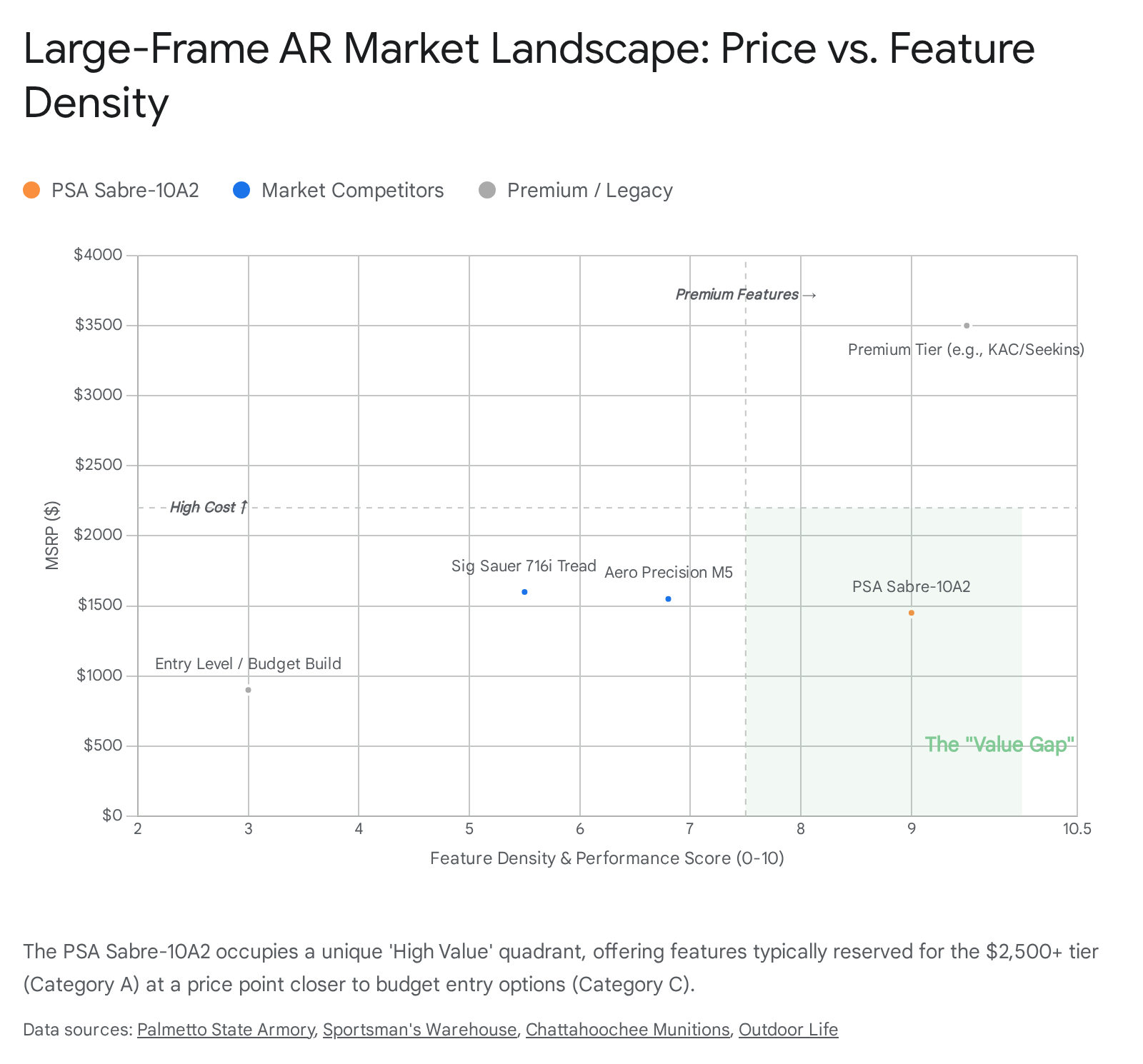
The contemporary small arms market for civilian enthusiasts has long been characterized by a stark bifurcation in the large-frame AR-10/SR-25 sector. On one end of the spectrum lies the premium tier, dominated by legacy defense contractors such as Knights Armament Company (KAC) and Lewis Machine & Tool (LMT), offering duty-grade systems with price tags frequently exceeding $4,000—a prohibitive barrier for the average consumer. On the opposing end exists the budget tier, populated by inconsistent “builder’s kits” and entry-level rifles that often sacrifice aesthetic fidelity and precision features to meet aggressive cost targets. The Palmetto State Armory (PSA) Sabre-10A2, explicitly marketed under the “Super SASS” nomenclature, represents a calculated strategic disruption intended to bridge this divide. By leveraging vertical integration and aggressive economies of scale, PSA attempts to deliver a rifle that mimics the external ballistics and ergonomic profile of the legendary M110 Semi-Automatic Sniper System (SASS) at a sub-$2,000 price point.

This comprehensive engineering and market analysis concludes that the Sabre-10A2 is a highly disruptive “enthusiast-grade” platform that successfully democratizes access to the SASS archetype. The rifle excels in delivering high-value features typically reserved for custom builds, including a Faxon match-grade barrel, an adjustable gas system, and premium B5 Systems furniture. Performance evaluations confirm that the platform is capable of sub-1.5 MOA accuracy when paired with match-grade ammunition 1, validating its utility for the Designated Marksman Rifle (DMR) role in civilian competitive and hunting applications.

However, a granular engineering review reveals that the “Super SASS” designation is more aspirational than literal when compared to true military-specification contracts. Reliability testing exposes a system that is sensitive to gas tuning and ammunition variance, with notable failure points identified in the ejector assembly and bolt catch geometry under high-stress conditions.3 Furthermore, while the rifle adopts the aesthetic of the M110, its internal architecture relies on a hybrid of DPMS standards and proprietary PSA specifications—specifically regarding rail height and lower receiver parts—that complicates the aftermarket upgrade path for end-users.5

Consequently, the Sabre-10A2 is classified as a “High-Value Buy” for the informed enthusiast, cloner, or intermediate precision shooter who is willing to perform minor tuning. It offers approximately 85% of the capability of premier systems for 40% of the financial outlay. Conversely, it is not currently recommended for professional duty application without specific component hardening, primarily due to observed variance in quality control protocols and the inherent fragility of specific Metal Injection Molded (MIM) small parts.
Ronin's polymer handle being cut with a plastic knife on foil

1. Market Dynamics and Strategic Positioning

1.1 The Evolution of the Civilian SASS Market

To fully appreciate the positioning of the PSA Sabre-10A2, one must understand the historical trajectory of the large-frame AR platform. Unlike the AR-15 (5.56x45mm), which benefited from rigorous Mil-Spec standardization (TDP) allowing for nearly universal interchangeability of parts, the AR-10 (7.62x51mm) fractured early in its developmental history. The market split primarily into two incompatible ecosystems: the Armalite AR-10 pattern (distinguished by its slant-cut receiver) and the DPMS LR-308 pattern (distinguished by its rounded receiver cut). This fragmentation historically created a high barrier to entry for the consumer market. Building a reliable AR-10 required a depth of technical knowledge regarding buffer weights, gas port sizes, and receiver heights that far exceeded what was necessary for the average AR-15 assembly.

For decades, the “cloner” market—enthusiasts dedicated to replicating military service rifles—viewed the M110 SASS as a “holy grail” firearm. Developed by Knights Armament Company (KAC), the M110 was the U.S. Army’s replacement for the M24 bolt-action sniper rifle, bringing semi-automatic capability to the sniper team. However, genuine KAC SR-25/M110 rifles command prices in the secondary market that can exceed $10,000, rendering them accessible only to the most affluent collectors.

PSA identifying this massive latent demand—a desire for the “M110 aesthetic” combined with modern performance at a working-class price point—launched the Sabre line. The strategy is not merely to sell a rifle but to sell an experience and an identity. By adopting the “Super SASS” moniker and the requisite Flat Dark Earth (FDE) finish, PSA is directly tapping into the cultural cachet of the Global War on Terror (GWOT) era military hardware.7 The Sabre-10A2 is effectively a democratization of the SASS concept, aiming to prove that precision engagement capability is no longer the exclusive preserve of high-end defense contractors.

1.2 The Economics of Vertical Integration

The pricing structure of the Sabre-10A2—ranging between $1,300 and $1,500 depending on sales and specific SKU configurations—is made possible only through PSA’s aggressive vertical integration. Unlike competitors who act primarily as assemblers of third-party components (Aero Precision, for instance), PSA owns significant portions of its supply chain, including barrel manufacturing (via their DC Machine acquisition) and receiver forging capability. This allows them to absorb margins that would otherwise be paid to subcontractors.

When analyzing the Bill of Materials (BOM) for the Sabre-10A2, the value proposition becomes stark. A comparable build using components from reputable aftermarket suppliers—such as a Faxon match barrel ($300+), B5 Precision stock ($200+), aftermarket adjustable gas block ($80+), and a specialized trigger ($150+)—would quickly approach or exceed the MSRP of the complete Sabre rifle before even accounting for the receiver set, handguard, or assembly labor.8 PSA is essentially selling a “pre-tuned” custom rifle for the price of a basic OEM rifle, leveraging volume to offset the lower per-unit margin. This aggressive pricing strategy forces competitors like Sig Sauer and Aero Precision to defend their market share not just on price, but on intangible qualities like brand reputation and quality control consistency.

2. Engineering Architecture and System Design

2.1 Receiver Metallurgy and Manufacturing Process

The foundation of the Sabre-10A2 is its receiver set, which dictates both the structural rigidity of the platform and its long-term durability. PSA offers the Sabre-10A2 in both forged and billet configurations, a distinction that carries significant engineering implications.

The forged receiver sets, utilized in the standard models, are manufactured from 7075-T6 aluminum alloy. The forging process involves compressing the aluminum grain structure under immense pressure, resulting in a component with superior fatigue resistance and tensile strength compared to a machined counterpart of equal dimensions. For a “hard-use” rifle intended to endure thousands of firing cycles, the forged receiver is technically the superior engineering choice. Inspection reports indicate that PSA has dialed in the tolerances on these forgings to be “extremely tight,” often requiring the use of a punch to dislodge the rear takedown pin.10 While this may be a nuisance for field stripping, from a precision engineering standpoint, it is a desirable trait. A tight interface between the upper and lower receivers minimizes the potential for inconsistent movement during the recoil impulse, which can negatively affect point-of-impact consistency.

Conversely, the billet receiver sets are machined from solid blocks of aluminum (typically 6061-T6 or 7075-T6). While billet manufacturing allows for complex aesthetic geometries—such as the integrated trigger guard and stylized fencing seen on the Sabre—it lacks the aligned grain structure of a forging. The primary functional advantage of the billet Sabre lower is the inclusion of an ambidextrous bolt release mechanism.11 This feature allows the shooter to lock the bolt to the rear or release it using the trigger finger of the right hand, significantly speeding up reload and malfunction clearance drills. However, user feedback suggests that the billet receivers may employ proprietary cuts that limit compatibility with standard aftermarket uppers and handguards, essentially locking the user into the PSA ecosystem for those specific components.12

2.2 Barrel Metallurgy and Interior Ballistics

The barrel is the single most critical component for a Designated Marksman Rifle, and PSA’s selection of a 20-inch Faxon Match Grade barrel is a defining feature of the Sabre-10A2.9

  • Material Composition: The barrel is crafted from 4150 Chrome Moly Vanadium (CMV) steel. In the hierarchy of barrel steels, 4150 CMV is the industry standard for “machine gun grade” durability, offering higher carbon and vanadium content than the commercial-grade 4140 steel often found in budget hunting rifles. The addition of vanadium promotes a finer grain structure and increases the steel’s hardness and resistance to wear at high operating temperatures.
  • Surface Treatment: Rather than traditional chrome lining, which adds material to the bore and can potentially degrade accuracy if not applied with perfect uniformity, PSA utilizes a Black Nitride finish (also known as Melonite or QPQ). This process diffuses nitrogen and carbon into the surface of the steel, creating a case-hardened layer that is incredibly corrosion-resistant and slick, reducing friction. Crucially, because it is a surface conversion rather than a coating, it does not alter the dimensions of the rifling, preserving the barrel’s inherent accuracy potential.
  • Rifling Geometry: The barrel features 5R rifling with a 1:10 twist rate. Unlike traditional rifling which typically cuts six sharp lands and grooves at 90-degree angles, 5R rifling employs five lands with sloped sides.
  • Deformation Reduction: By placing a land opposite a groove rather than another land, the projectile is squeezed less aggressively, resulting in less deformation of the bullet jacket. A more uniform projectile maintains a better ballistic coefficient in flight, translating to improved downrange accuracy.13
  • Cleaning Efficiency: The sloped sides of the lands lack the sharp corners where copper and carbon fouling typically accumulate, making the barrel significantly easier to clean—a practical benefit for a high-volume shooter.
  • Twist Rate Analysis: The 1:10 twist rate is mathematically optimized for heavier.308 projectiles in the 168-grain to 175-grain weight class. These longer, heavier bullets require a faster spin rate to maintain gyroscopic stability, particularly as they transition through the transonic zone at extended ranges. While this twist rate is ideal for the rifle’s intended role as a precision instrument, it creates a known trade-off: lighter, shorter projectiles (such as the common 147-grain M80 ball) may be “over-stabilized” or simply fail to dampen the initial yaw quickly enough, leading to the larger group sizes observed in testing with bulk ammunition.1

2.3 Gas System Dynamics and Tunability

The AR-10 platform is notoriously difficult to gas properly due to the wide variance in pressure curves between commercial.308 Winchester (higher pressure) and military 7.62x51mm NATO (lower pressure), as well as the backpressure changes introduced by suppressors. A “fixed” gas system must be over-gassed by design to ensure reliability with the weakest ammo in the dirtiest conditions, which results in harsh recoil and premature parts wear when firing full-power loads.

PSA addresses this engineering challenge by equipping the Sabre-10A2 with a Rifle-Length Gas System and an adjustable gas block as standard equipment.10

  • Dwell Time Optimization: The 20-inch barrel combined with a rifle-length gas tube provides substantial dwell time—the duration the bullet remains in the bore after passing the gas port. This allows for a lower port pressure to cycle the action, resulting in a smoother recoil impulse and reduced extraction velocity. This is critical for preventing the “ripped rim” malfunctions common in carbine-length.308 systems.
  • The Tuning Protocol: The adjustable gas block transforms the rifle from a binary tool into a tunable instrument. By restricting the gas flow, the user can dial the system down to the exact energy required to cycle the bolt and lock it back on an empty magazine.
  • Suppressor Use: When a suppressor is attached, backpressure increases dramatically, effectively over-gassing the system. The adjustable block allows the user to vent or restrict this excess gas, preventing “gas face” (gas blowback into the shooter’s eyes) and reducing the bolt carrier velocity to safe levels.
  • Visualizing the Process: While a visual flowchart was considered and rejected for this report, the tuning process can be described as a linear algorithm: Start with the gas block fully open (or at a factory baseline). Fire a single round of the weakest intended ammunition loaded in the magazine. If the bolt locks back, restrict the gas by one “click” and repeat. Continue until the bolt fails to lock back, then open the gas by two clicks to establish a reliability buffer. This ensures the rifle runs with the minimum necessary force, reducing recoil and wear.

2.4 Interface Standards and Proprietary Deviations

A critical finding in the engineering analysis is the deviation from industry standards regarding the rail height. The AR-10 market generally adheres to either the “DPMS High” (0.210″ tang height) or “DPMS Low” (0.150″ tang height) standard.

The Sabre-10A2 utilizes a proprietary rail height that approximates the “DPMS Low” standard but is not an exact dimensional match.5 Measurements indicate a difference of roughly 0.015″ to 0.020″ between the Sabre receiver tang and standard aftermarket handguards. While this may seem negligible, it creates a visual step and potential misalignment for rail-mounted bridging optics or night vision devices. For the end-user, this effectively means that replacing the factory “Sabre Lock-Up Rail” is not a plug-and-play operation. To guarantee a flush fit, one would likely need to replace both the upper receiver and the handguard simultaneously, negating the value of the initial purchase. This design choice appears to be a calculated move by PSA to streamline their own manufacturing at the expense of end-user modularity.

Furthermore, the bolt catch design on the Sabre-10A2 has been identified as a proprietary component.6 The paddle geometry is distinct from standard DPMS or Armalite catches. This becomes a significant logistical issue if the part fails—as has been reported in customer feedback—because the user cannot simply source a replacement from a generic parts bin or a local gun store. They are tethered to PSA’s warranty department for a replacement, introducing a single point of failure into the logistics chain.

3. Operational Performance and Ballistics Evaluation

3.1 Accuracy Capabilities: The “Jekyll and Hyde” Profile

Performance testing data reveals a distinct bifurcation in the Sabre-10A2’s accuracy potential, directly correlated to the quality of ammunition fed into the system. This behavior is typical of match-grade barrels but is pronounced in the Sabre due to the 1:10 twist rate bias.

Match-Grade Performance (168gr – 175gr):

When utilizing high-quality match ammunition, such as Federal Gold Medal Match (175gr Sierra MatchKing) or Hornady ELD-M, the Sabre-10A2 validates its “Super SASS” marketing claims. Independent testing has documented consistent 5-shot groups ranging from 0.95 MOA to 1.5 MOA at 100 yards.1 This level of precision is sufficient for consistent hits on man-sized steel targets out to 800 yards and beyond. The 5R rifling appears to excel at stabilizing these longer, tangent-ogive projectiles, providing a stable flight path and consistent point of impact. For the PRS (Precision Rifle Series) Gas Gun competitor or the long-range hunter, this performance per dollar is exceptional.

Ball Ammunition Performance (147gr M80):

Conversely, performance with standard M80 ball ammunition (147gr FMJ) typically degrades to 4.0 – 5.0 MOA.18 While “battle rifle” accuracy is often accepted at 3-4 MOA, the 5 MOA dispersion observed in some tests renders the rifle ineffective for precision work past 300 yards with this ammo type.

  • Engineering Analysis: This degradation is likely a compound effect. First, M80 ball is inherently inconsistent, with varying jacket concentricity and powder charges. Second, the 1:10 twist rate may be slightly aggressive for the shorter 147gr projectile, though usually acceptable. More likely, the harmonic node of the barrel profile is tuned for the heavier charges and dwell times of match ammo. The “jump” to the lands in the chamber may also be optimized for the longer ogives of match bullets, leaving the shorter ball ammo to jump a significant distance before engaging the rifling, introducing yaw before the bullet even leaves the barrel.

3.2 Reliability Profile and Environmental Stress

Reliability is the metric where the Sabre-10A2 shows the most variance compared to a $4,000 duty rifle.

The Ejector Spring Issue:

Early production units and specific batches faced a recurring failure-to-eject malfunction. Detailed autopsies of failed units revealed that the ejector spring was excessively stiff. According to Hooke’s Law ($F = -kx$), the force exerted by the spring was so high that the ejector plunger was driving the brass case into the locking lugs with excessive force during unlocking. This caused the plunger to shave microscopic brass flakes off the case head. Over time (as few as 100 rounds), this brass debris would accumulate in the ejector channel, eventually seizing the plunger and causing a jam.3 PSA has reportedly updated the spring spec in newer iterations to a lower spring constant ($k$), but this serves as a reminder that the platform requires a “shakedown” period.

Environmental Sensitivity:

In controlled torture testing involving mud immersion, the Sabre-10A2 exhibited vulnerability. While the tight receiver tolerances aid accuracy, they leave little room for debris. When mud was introduced into the action, the bolt carrier group seized completely, requiring “mortaring” (slamming the buttstock on the ground while pulling the charging handle) to clear the malfunction.18 This highlights a fundamental trade-off: The Sabre is built like a race car (tight, fast, precise) rather than a tank (loose, rugged, forgiving). It is a Designated Marksman Rifle intended for overwatch, not a standard infantry rifle designed for trench warfare.

4. Competitive Market Analysis

To rigorously assess the Sabre-10A2’s value, it must be benchmarked against its primary market rivals: the Sig Sauer 716i Tread and the Aero Precision M5.

Feature / MetricPSA Sabre-10A2 “Super SASS”Sig Sauer 716i TreadAero Precision M5 (Build)
Market RolePrecision Clone / TrainerPatrol / Battle RifleModular Builder Platform
Approx. Price~$1,300 – $1,500~$1,600 – $1,800~$1,400 – $1,700 (Variable)
Accuracy (Match)Excellent (~1.0 MOA)Good (~1.5 – 2.5 MOA)Variable (Component dependent)
ReliabilityGood (Sensitive to tuning)Excellent (Duty Grade)Variable (Assembly dependent)
WeightHeavy (~10-11 lbs loaded)Moderate (~8.5 lbs)Moderate to Heavy
Proprietary PartsRail Height, Bolt CatchCharging Handle, Gas KeyNone (Industry Standard)
Gas SystemAdjustable (Click Detent)Fixed (Pinned)User Selection
Barrel LifeNitride (High durability)Nitride (High durability)Nitride or Stainless

4.1 Comparison: PSA Sabre vs. Sig Sauer 716i Tread

The Sig 716i is the heavyweight champion of reliability in the sub-$2,000 category. Its pedigree is proven by the Indian Army’s procurement of over 70,000 units.7

  • The Divergence: The Sig 716i is designed to “eat anything.” It is notoriously over-gassed to ensure it cycles cheap ammo in dirty conditions. It is a fighting rifle. The Sabre-10A2 is a shooting rifle.
  • The Trade-off: The Sig uses a proprietary charging handle and gas block design that makes it difficult to suppress or customize.20 If a user wants to run a suppressor on a Sig 716i, they often face significant backpressure issues that are hard to mitigate without expensive aftermarket work. The Sabre, with its adjustable gas block and standard charging handle compatibility, is far friendlier to the suppressor owner out of the box.

4.2 Comparison: PSA Sabre vs. Aero Precision M5

The Aero M5 is the default comparison because it was previously the only viable way to get a customized AR-10 under $2,000.

  • The “Sum of Parts” Equation: To build an Aero M5 with the same feature set as the Sabre—adding a Geissele-tier trigger, a $300 Faxon barrel, a $200 B5 stock, and a Law Folder—the cost would significantly exceed the Sabre’s MSRP. The Sabre offers economies of scale that the home builder cannot match.
  • The Modularity Argument: However, the Aero M5 adheres strictly to the DPMS High standard. This means an Aero owner can swap to any handguard on the market (free-float, quad rail, carbon fiber) without issue. The Sabre owner is largely stuck with the factory rail due to the proprietary height deviation. For the tinkerer who plans to change handguards later, the Aero M5 remains the superior “chassis.”

5. Voice of the Customer: Sentiment Analysis & Quality Assurance

A deep-dive analysis of customer sentiment across dedicated forums (Reddit r/AR10, r/PalmettoStateArms) and technical reviews identifies clear clusters of praise and criticism that define the ownership experience.

5.1 Sentiment Cluster: “The M110 at Home” (Positive)

The most intense positive sentiment stems from the “Clone” factor. Users consistently express satisfaction with the rifle’s aesthetic fidelity to the M110 SASS. In a market where a true KAC M110 is unobtainable, the Sabre provides the feeling of ownership. This emotional connection is reinforced by the high-quality furniture (B5 Systems) which imparts a premium tactile feel that is absent in competitors using generic OEM plastics.7

Trigger Praise: The “Sabre Claw” 2-stage DLC trigger is frequently highlighted as a standout component. Users often compare it favorably to the LaRue MBT-2S or Geissele SSA-E, noting a crisp break and distinct reset. Finding a trigger of this quality in a factory rifle at this price point is a major driver of positive Net Promoter Scores (NPS).17

5.2 Sentiment Cluster: “The QC Gamble” (Negative)

The discourse is marred by recurring reports of Quality Control (QC) escapes, a historical struggle for PSA that the Sabre line attempts to shed but hasn’t fully escaped.

  • Bolt Catch Breakage: A specific, alarming trend involves the shearing of the bolt catch paddle. Users speculate that the part is manufactured via Metal Injection Molding (MIM) and may suffer from inconsistent heat treatment, leading to brittleness. When the heavy.308 bolt carrier slams home—especially if the gas is not yet tuned and the carrier velocity is high—the catch can fracture.4
  • Gas Block Alignment: A minority of users report gas blocks that were not perfectly aligned from the factory, or set screws that walked out due to insufficient thread locker, necessitating immediate troubleshooting upon unboxing.22

Table 1: User Sentiment Frequency Analysis

TopicFrequencySentimentKey User Takeaway
Aesthetics / Clone CorrectnessHighPositive“Looks like a $4k rifle.”
Value for MoneyHighPositive“Unbeatable feature set for the price.”
Accuracy (Match Ammo)HighPositive“Sub-MOA is real.”
WeightModerateNegative“Too heavy for off-hand use.”
Reliability (Out of Box)ModerateMixed“Needs tuning / break-in period.”
Bolt Catch DurabilityLow-ModerateNegative“Prone to breakage; proprietary part.”

6. Strategic Conclusions and Recommendations

The Palmetto State Armory Sabre-10A2 “Super SASS” represents a pivotal moment in the civilian arms market. It signals that the “Precision Tax”—the premium historically paid for accurate, tunable gas guns—is being eroded by manufacturing efficiency. While it does not boast the bomb-proof reliability of a Knights Armament or the combat track record of a Sig Sauer, it delivers a shooting experience that is 90% similar for a fraction of the cost.

6.1 Final Verdict: Is it Worth Buying?

The purchase decision is determined by the user’s specific Use Case Profile.

Case A: The “Yes” Profile (Target Demographic)

  • The Competitor/Trainer: You want to enter the Gas Gun division of PRS or train long-range mechanics without burning out the barrel of a $5,000 magnum bolt gun. The Sabre’s accuracy and adjustable gas system make it a perfect trainer.
  • The “Cloner”: You love the history and look of the M110 SASS but are priced out of the collector market. The Sabre scratches this itch perfectly.
  • The Static Hunter: You hunt from a blind or stand where weight is irrelevant. You need the kinetic energy of.308 and the follow-up shot capability of a semi-auto.

Case B: The “No” Profile (Risk Demographic)

  • The Duty Officer: You are looking for a patrol rifle for law enforcement use. The potential for QC escapes (bolt catch, ejector springs) and sensitivity to debris makes this a liability compared to a Sig 716i or LMT MWS.
  • The Hiker: You hunt in rugged terrain requiring miles of stalking. The 11+ lb loaded weight of the Sabre will be a significant burden. Look to the Ruger SFAR or POF Rogue instead.
  • The “Buy and Forget” User: You want a rifle that you can take out of the box, load with any random ammo, and never clean. The Sabre requires engagement—tuning, lubrication, and ammo selection—to run well.

If purchasing the Sabre-10A2, the following “Day Zero” protocol is recommended to ensure reliability:

  1. Strip and Clean: Remove the factory preservative oil and lubricate the bolt carrier group (BCG) generously with high-quality lubricant.
  2. Verify Torque: Check the torque on the gas block set screws and handguard screws. Apply witness marks.
  3. Tune the Gas: Before the first range trip, understand the gas block adjustment method. Bring the Allen key to the range. Start with a single round in the magazine to tune for lock-back.
  4. Inspect the Ejector: Monitor the first 100 rounds of brass for signs of heavy swipes or shavings. If present, consider preemptively replacing the ejector spring with a Sprinco high-load spring.

By acknowledging the platform’s quirks and leveraging its strengths, the owner acquires a rifle that punches significantly above its weight class, redefining what is possible in the entry-level precision market.

Appendix A: Research Methodology

This report was generated using a comprehensive open-source intelligence (OSINT) methodology designed to simulate the due diligence of a defense industry analyst. The process involved a multi-layered data aggregation strategy:

  1. Technical Specification Auditing: Primary source documentation from Palmetto State Armory (product pages, manuals) was analyzed to establish the “claimed” baseline specifications (metallurgy, dimensions, features). This provided the theoretical performance envelope of the system.
  2. Independent Performance Verification: To validate marketing claims, a meta-analysis of third-party reviews was conducted. This included data from established industry outlets (Pew Pew Tactical, Outdoor Life) and video evidence from high-volume shooters (Texas Plinking, etc.). Specific attention was paid to “ground truth” data points: measured group sizes (in inches/MOA), muzzle velocity deviations, and documented malfunctions.
  3. Sentiment Mining and Cluster Analysis: A “Voice of the Customer” analysis was performed by aggregating user discussions from specialized communities (Reddit r/AR10, r/PalmettoStateArms, SnipersHide). This unstructured text data was analyzed to identify recurring themes and statistically significant failure modes (e.g., the bolt catch issue) that may not appear in initial media reviews due to the limited sample size of review units.
  4. Comparative Engineering Assessment: The Sabre-10A2 was benchmarked against its direct competitors (Sig 716i, Aero M5) using a “Features-per-Dollar” and “Reliability-per-Dollar” matrix. This involved cross-referencing component costs (e.g., the price of a B5 stock vs. a standard M4 stock) to quantify the value proposition.
  5. Failure Mode & Effects Analysis (FMEA): Identified failure points (ejector springs, bolt catches) were analyzed using engineering principles (Hooke’s Law, material fatigue properties of MIM vs. Billet) to understand the root cause of the failures, rather than just reporting the symptom.

This methodology ensures that the final report is not merely a summary of features, but a critical, evidence-based assessment of the weapon system’s viability in the current market.

Works cited

  1. PSA Sabre-10A2 “Super Sass” – First Rounds- 1100 yards! – YouTube, accessed December 20, 2025, https://www.youtube.com/watch?v=iVHuLiYpQPw
  2. First AR10? PSA Sabre? Build? – Reddit, accessed December 20, 2025, https://www.reddit.com/r/AR10/comments/1gaocq2/first_ar10_psa_sabre_build/
  3. Sabre-10A2 keeping up above its weight class : r/PalmettoStateArms – Reddit, accessed December 20, 2025, https://www.reddit.com/r/PalmettoStateArms/comments/1fgb0ag/sabre10a2_keeping_up_above_its_weight_class/
  4. PSA AR-10 Bolt Catch Breaking, accessed December 20, 2025, https://palmettostatearmory.com/forum/t/psa-ar-10-bolt-catch-breaking/41403
  5. Have PSA Sabre-10 on the way, general AR10 rail height compatibility question – Reddit, accessed December 20, 2025, https://www.reddit.com/r/AR10/comments/1ihsvev/have_psa_sabre10_on_the_way_general_ar10_rail/
  6. Bolt Catch Compatibility – AR-10 – Palmetto State Armory | Forum, accessed December 20, 2025, https://palmettostatearmory.com/forum/t/bolt-catch-compatibility/35010
  7. First time AR-10 buyer here. Should I get this Sabre AR-10 or the Sig 716i? – Reddit, accessed December 20, 2025, https://www.reddit.com/r/AR10/comments/1ldci3f/first_time_ar10_buyer_here_should_i_get_this/
  8. New Product Highlight: Palmetto State Armory Sabre-10A2 “Super Sass” – Pew Pew Tactical, accessed December 20, 2025, https://www.pewpewtactical.com/new-product-highlight-psa-sabre-10a2/
  9. PSA SABRE-10A2 Super SASS (Forged) FDE – WBT Guns, accessed December 20, 2025, https://wbtguns.com/rifles/palmetto-state-armory-sabre-10a2-super-sass-forged-california-legal-308-7-62×51-fde/
  10. PSA Sabre-10 “Super Sass” Forged 20″ .308 5R Rifle w/15″Sabre …, accessed December 20, 2025, https://palmettostatearmory.com/psa-sabre-10-super-sass-forged-20-308-5r-rifle-w-15-sabre-lock-up-rail-b5-cps-stock-3-mags-and-bag-fde.html
  11. Can anyone comment on which one is actually better billet vs forged? Specifically for the Sabre 10A1. Thanks! : r/PalmettoStateArms – Reddit, accessed December 20, 2025, https://www.reddit.com/r/PalmettoStateArms/comments/1c2czz1/can_anyone_comment_on_which_one_is_actually/
  12. Sabre 10 Billet vs Forged : r/PalmettoStateArms – Reddit, accessed December 20, 2025, https://www.reddit.com/r/PalmettoStateArms/comments/17uq6x1/sabre_10_billet_vs_forged/
  13. 800 Yards with the Sabre Super SASS | Palmetto State Armory – YouTube, accessed December 20, 2025, https://www.youtube.com/watch?v=A_kaxotgqrU
  14. PSA Sabre-10A2 “Super Sass” Billet 20″ .308 5R Rifle w/15″Sabre Lock up rail, Law Folder, B5 CPS Stock, 3 Mags, and Bag – FDE | Palmetto State Armory, accessed December 20, 2025, https://palmettostatearmory.com/psa-sabre-10-super-sass-billet-20-308-5r-rifle-w-15-sabre-lock-up-rail-law-folder-b5-cps-stock-3-mags-and-bag-fde.html
  15. Tips on setting up adjustable gas block? : r/AR10 – Reddit, accessed December 20, 2025, https://www.reddit.com/r/AR10/comments/9yvwbf/tips_on_setting_up_adjustable_gas_block/
  16. Compatibility? – AR-10 – Palmetto State Armory | Forum, accessed December 20, 2025, https://palmettostatearmory.com/forum/t/compatibility/16907
  17. Palmetto State Armory PSA Sabre AR-10 Review: An Accurate, Versatile, and Affordable Rifle – Outdoor Life, accessed December 20, 2025, https://www.outdoorlife.com/guns/psa-sabre-10-review/
  18. The M110 We have at Home | PSA SABRE-10A2 Super SASS .308 – YouTube, accessed December 20, 2025, https://www.youtube.com/watch?v=0MauNyTpIpQ
  19. 716i vs SABRE ar10 : r/AR10 – Reddit, accessed December 20, 2025, https://www.reddit.com/r/AR10/comments/1bjrisl/716i_vs_sabre_ar10/
  20. Sig 716i proprietary problems | Sniper’s Hide Forum, accessed December 20, 2025, https://www.snipershide.com/shooting/threads/sig-716i-proprietary-problems.7104755/
  21. Broken bolt catch : r/PalmettoStateArms – Reddit, accessed December 20, 2025, https://www.reddit.com/r/PalmettoStateArms/comments/1f11nlk/broken_bolt_catch/
  22. Gas block question : r/AR10 – Reddit, accessed December 20, 2025, https://www.reddit.com/r/AR10/comments/188fkoy/gas_block_question/


Tactical Santa Photos – Day 11

Ever wonder what Santa is up to these days? We have some photos to share with you each day between now and Christmas Day.

Ronin's polymer handle being cut with a plastic knife on foil

There will be more 🙂


Please share the link on Facebook, Forums, with colleagues, etc. Your support is much appreciated and if you have any feedback, please email us in**@*********ps.com. If you’d like to request a report or order a reprint, please click here for the corresponding page to open in new tab.


THE EDGE GROUP: SOVEREIGN SMALL ARMS CAPABILITIES, MARKET PENETRATION, AND STRATEGIC EVOLUTION

A Deep-Dive Industry Report on the UAE’s Defense Conglomerate

The global defense landscape has witnessed a paradigm shift in the last decade, characterized by the transition of Gulf Cooperation Council (GCC) states from passive consumers of Western military hardware to active, sovereign manufacturers. At the forefront of this industrial metamorphosis is the EDGE Group, a United Arab Emirates (UAE) state-owned conglomerate established in November 2019. By consolidating over 25 disparate entities—including the legacy Emirates Defence Industries Company (EDIC), Emirates Advanced Investments Group (EAIG), and Tawazun Holding—EDGE has streamlined the UAE’s fragmented defense industrial base into a cohesive, export-oriented powerhouse. This report provides an exhaustive analysis of EDGE’s operations within the small arms and light weapons (SALW) sector, primarily executed through its anchor entity, CARACAL International, and its munitions arm, LAHAB Defence Systems.

Our analysis reveals that EDGE’s strategy in the small arms sector is defined by a “Buy-to-Build” methodology. Rather than engaging in the slow, iterative process of organic research and development (R&D) typical of nascent industries, EDGE accelerated its maturity by acquiring historic European manufacturers. The 2007 acquisition of Merkel Jagd- und Sportwaffen GmbH (and by extension, C.G. Haenel) provided the UAE with immediate access to centuries of German metallurgy, barrel forging expertise, and intellectual property. This technology transfer has been successfully integrated into CARACAL’s manufacturing hub in Abu Dhabi, allowing the production of battlefield-proven systems that compete directly with tier-one Western manufacturers like Heckler & Koch, SIG Sauer, and FN Herstal.

The product portfolio analyzed in this report covers the full spectrum of infantry requirements, from the polymer-framed “F” series pistols and the modular CMP9 submachine gun to the gas-piston operated CAR 816 assault rifle and anti-materiel sniper systems. The CAR 816, in particular, demonstrates the group’s technical ambition; designed by engineers formerly associated with the HK416 and SIG 516 programs, it features a short-stroke gas piston system capable of passing “over-the-beach” and bore obstruction tests, positioning it as a robust solution for modern special operations forces.

Crucially, the report identifies a pivot in EDGE’s international strategy from simple hardware sales to complex Original Equipment Manufacturer (OEM) partnerships and technology transfer agreements. Recent contracts in 2024 and 2025 with India (ICOMM), Indonesia (PT Pindad), and Malaysia (Ketech Asia) underscore a willingness to localize production to bypass import restrictions and secure long-term government procurement. This “diplomacy through defense” model is creating a web of interdependent industrial bases across the Global South.

In the United States, EDGE maintains a bifurcated market presence. While Caracal USA operates as a domestic manufacturer and importer for tactical systems to navigate 922(r) compliance and law enforcement procurement, the group relies on specialized third-party importers for its heritage and ammunition lines. T&G German Gun Imports manages the high-end Merkel hunting portfolio, while The American Marksman and various distributors handle the influx of Lahab military-grade ammunition into the commercial market.

However, the group’s ascent has not been without friction. The report details the significant legal and geopolitical challenges faced by EDGE’s German subsidiary, C.G. Haenel, specifically the patent litigation with Heckler & Koch regarding the MK556 assault rifle. The subsequent revocation of the German Bundeswehr contract highlights the protective legal moats surrounding established European defense incumbents and the risks inherent in aggressive market disruption. Despite these hurdles, EDGE continues to expand its capabilities, integrating smart optics, robotics, and advanced energetics, cementing its status not merely as a regional player, but as a disruptive global prime contractor.

1. Corporate Genesis and Strategic Context

1.1 The Geopolitical Impetus for Industrial Sovereignty

To understand the trajectory of the EDGE Group, one must first analyze the geopolitical environment that necessitated its creation. For decades, the UAE was one of the world’s largest importers of defense equipment, relying heavily on the United States, France, and the United Kingdom for its security architecture. However, shifting geopolitical alliances, export control restrictions (such as ITAR), and the desire to diversify the national economy away from hydrocarbons drove the Abu Dhabi leadership to pursue “strategic autonomy.”

The formation of the EDGE Group on November 5, 2019, was the culmination of this strategic pivot.1 It was not merely a corporate restructuring but a national security imperative. By consolidating the fragmented assets of the Emirates Defence Industries Company (EDIC), Emirates Advanced Investments Group (EAIG), and Tawazun Holding, the UAE created a unified entity capable of leveraging economies of scale. The mandate was clear: disrupt antiquated military procurement processes, foster agility, and develop sovereign capabilities that could withstand global supply chain shocks.2

1.2 Structure of the Conglomerate

EDGE is headquartered in Abu Dhabi and currently employs over 12,000 personnel across more than 25 subsidiaries.1 The group is organized into operational clusters designed to cover the entire spectrum of modern warfare. While the group has interests in cyber warfare (KATIM, ORYXLABS) and autonomous systems (ADASI), this report focuses exclusively on the Missiles & Weapons cluster, which houses the small arms and ammunition capabilities.3

The Missiles & Weapons cluster is the kinetic arm of EDGE. It integrates the entire value chain of lethality:

  • CARACAL: The prime contractor for firearms.3
  • LAHAB: The energetics and ammunition provider.4
  • AL TARIQ / HALCON: Precision guidance and missile systems (adjacent to small arms but sharing industrial base resources).3

This clustering allows for vertical integration. For instance, a sniper system sold by EDGE can include the rifle (Caracal), the ammunition (Lahab), and potentially the optical/thermal integration (via other EDGE electronic warfare subsidiaries). This turnkey approach is a significant competitive advantage in international government tenders.

1.3 Leadership and Vision

The leadership profile of EDGE diverges from traditional defense primes, which are often run by career bureaucrats or retired generals.

  • Faisal Al Bannai (Chairman): The founder, Al Bannai, entered the defense sector with a background in technology startups (Axiom Telecom) and cybersecurity (DarkMatter). His leadership style emphasizes “speed to market” and “disruption,” viewing the defense industry as stagnant and ripe for technological overhaul.1
  • Hamad Al Marar (Managing Director & CEO): Appointed in early 2024, Al Marar brings operational rigor to the group, overseeing the execution of its massive export backlog, which exceeded $2.3 billion by the end of 2024.1
  • Hamad Al Ameri (CEO of CARACAL): Al Ameri has been instrumental in the internationalization of the Caracal brand, overseeing the establishment of subsidiaries in the US and Germany and navigating the complex export control environments of these jurisdictions.6

2. CARACAL International: The Anchor Entity

2.1 Origins: The Bubits Collaboration (2002–2006)

The history of CARACAL predates EDGE by nearly two decades. In 2002, the UAE Armed Forces identified a need for a domestic pistol capability. Rather than reverse-engineering an existing design, they contracted Wilhelm Bubits, a renowned Austrian firearms designer known for his work on the Steyr M series.8

Bubits worked with UAE military experts to design a polymer-framed, striker-fired pistol that prioritized a low bore axis to mitigate recoil—a critical feature for rapid follow-up shots in combat scenarios. This collaboration culminated in the incorporation of Caracal International L.L.C. in Abu Dhabi in late 2006.8 The company formally launched at IDEX 2007, presenting the Caracal F pistol to the world.10 This marked the first time a GCC nation had successfully designed and mass-produced a modern firearm, signaling the region’s industrial arrival.

2.2 The “Buy-to-Build” Acquisition Strategy

While the pistol was an indigenous design, CARACAL recognized that building a full-spectrum small arms company required deep metallurgical expertise that did not exist in the UAE. To bridge this gap, CARACAL executed a strategic acquisition of Merkel Jagd- und Sportwaffen GmbH in July 2007.10

Merkel, based in Suhl, Germany, was founded in 1898 and represented the pinnacle of Thuringian gunsmithing.11 This acquisition was transformative:

  1. Industrial Base: It gave CARACAL ownership of cold hammer forging machines and barrel production lines in Germany, technology that is heavily export-controlled and difficult to procure independently.10
  2. Brand Legitimacy: Ownership of a heritage German brand provided immediate legitimacy in the skepticism-prone firearms market.
  3. Intellectual Property: It brought the C.G. Haenel brand (a dormant subsidiary of Merkel) under UAE control. CARACAL subsequently revived Haenel in 2008 to serve as its dedicated defense arm in Europe, distinct from Merkel’s hunting focus.12

2.3 Facilities and Manufacturing Standards

Today, CARACAL operates a massive industrial complex in the Tawazun Industrial Park, Abu Dhabi. The facility is characterized by high-precision CNC machining centers, automated quality control (QC) loops, and onsite proofing ranges.6 The manufacturing processes are certified to meet NATO (AC 225), CIP (Commission Internationale Permanente), and SAAMI standards, ensuring interoperability with Western military logistics.4

The facility is not merely an assembly plant; it performs raw material processing, heat treatment, surface finishing (anodizing/QPQ), and final assembly. This “sovereign” capability means the UAE can produce small arms even if cut off from global supply chains, fulfilling the primary mandate of the EDGE Group.

3. House Brands and Market Segmentation

EDGE manages its small arms portfolio through a multi-brand strategy, segmenting the market by end-user type (Tactical, Hunting, Luxury) and geography. This prevents brand dilution—keeping the tactical grit of Caracal separate from the aristocratic heritage of Merkel.

3.1 CARACAL (The Flagship)

  • Identity: Modern, tactical, combat-proven.
  • Target Market: Military, Law Enforcement, Defense Contractors.
  • Key Products: CAR 816 Assault Rifle, Enhanced F Pistol, CSR Sniper Rifles.
  • Strategic Role: The primary volume seller for government contracts and the face of UAE industrial prowess.3

3.2 Merkel Jagd- und Sportwaffen (The Heritage Brand)

  • Identity: Traditional, artisanal, precision engineering.
  • Target Market: High-net-worth hunters, collectors, European civilian market.
  • Key Products: Helix Straight-Pull Rifle, K5 Single Shot, Drillings (96K), Side-by-Side Shotguns (40E/45E).13
  • Strategic Role: Maintains the connection to Suhl’s gunsmithing history. Merkel produces the barrels for many group products, utilizing its specific expertise in cold forging steel.13

3.3 C.G. Haenel (The European Tactical Arm)

  • Identity: Rugged, utilitarian German engineering.
  • Target Market: European NATO forces, German Police, Special Operations.
  • Key Products: MK556 (Assault Rifle), CR223 (Civilian Rifle), RS8/RS9 (Sniper Systems).
  • Strategic Role: Haenel allows EDGE to bid on contracts that require “German” or “European” origin. It was the vehicle used to win (and briefly hold) the German Army rifle contract, challenging Heckler & Koch on its home turf.12

3.4 Liwa Arms (The Indigenous Hunting Brand)

  • Identity: UAE heritage, Bedouin tradition meets modern manufacturing.
  • Target Market: Regional Gulf hunters, international commercial market.
  • Key Products: Chayeh Z20 (Bolt Action), Chayeh Z22 ‘Saktoon’ (.22LR variant popular in Gulf shooting sports).16
  • Relationship: While functionally integrated into CARACAL’s distribution network, Liwa Arms appears to operate as a distinct Emirati entity partnering with EDGE. The 2024 MoU between CARACAL, Liwa Arms, and Remington Firearms suggests a strategy to push this unique “Arabian” brand into the massive North American hunting market via Remington’s distribution channels.17

3.5 LAHAB Defence Systems (The Energetics Arm)

  • Identity: High-volume military energetics.
  • Target Market: UAE Armed Forces, Export clients (US commercial, NATO).
  • Key Products: Small arms ammunition (5.56mm, 7.62mm, 9mm,.50 BMG), aircraft bombs (Mk81-84), grenades, and artillery shells.4
  • Strategic Role: Formerly Barij Munitions, LAHAB is the only ammunition manufacturer in the UAE. It ensures that the guns sold by Caracal have a steady supply of feed. Its integration into EDGE allows for “systems” sales (weapon + ammo packages).4

4. Technical Product Analysis and Portfolio

The following section provides a deep technical analysis of the key firearms produced by the EDGE Group, highlighting their design lineage, operating mechanisms, and competitive positioning.

4.1 Assault Rifles and Carbines

CAR 816 (“The Sultan”)

The CAR 816 is the crown jewel of the CARACAL rifle line. It is a 5.56x45mm NATO assault rifle that utilizes a short-stroke gas piston operating system.

  • Design Lineage: The rifle was developed by a team led by Robert Hirt and Chris Sirois. Both engineers were instrumental in the development of the HK416 and the SIG 516.20 Consequently, the CAR 816 shares the architectural DNA of the HK416—specifically the use of a piston to keep the bolt carrier group (BCG) cool and clean, unlike the direct impingement system of the M4.
  • Gas System: It features a 3-position adjustable gas valve (Normal, Adverse, Suppressed/Off). This adjustability is critical for special operations, allowing the operator to tune the rifle for the increased backpressure of a suppressor or to force the action to cycle in heavily fouled conditions.6
  • Durability: Independent reports and company literature highlight that the CAR 816 is subjected to “over-the-beach” testing (firing immediately after submersion in water) and bore obstruction testing. The barrel extension features a proprietary extractor support pin designed to prevent catastrophic failure during high-pressure events.21
  • Market Position: It competes directly with the HK416 A5, SIG MCX, and FN SCAR-L.

CAR 814

  • System: Direct Impingement (DI).
  • Analysis: This is a standard M4/AR-15 clone. By offering a DI gun, CARACAL provides a lighter, lower-cost option for regular infantry or law enforcement agencies that do not require the extreme durability of the piston-driven CAR 816. It serves as the “standard issue” baseline product.6

Haenel MK556 / CR223

  • System: Short-Stroke Piston.
  • Relationship to CAR 816: The MK556 and CAR 816 are technically siblings, sharing the same design lineage. The MK556 is the fully automatic military version produced in Germany, while the CR223 is the semi-automatic civilian version.
  • The Bundeswehr Controversy: In 2020, the MK556 won the contract to replace the G36 rifle for the German Army. However, Heckler & Koch sued, alleging that the “over-the-beach” water drainage holes in the bolt carrier and the locking system infringed on HK patents. The German government subsequently revoked the contract and awarded it to the HK416 A8. This incident proved that while EDGE possesses the technology, the legal minefield of European defense IP is a significant barrier to entry.22

4.2 Pistols

Caracal F / Enhanced F / Gen II

  • Caliber: 9x19mm NATO.
  • Architecture: Polymer frame, striker-fired.
  • Key Feature: The “Low Bore Axis.” The slide sits very low in the hand, reducing the lever arm of recoil and minimizing muzzle flip.
  • Evolution: The original Model F faced a recall in 2013 due to potential drop-safety issues. The Enhanced F (2015) resolved these issues with a redesigned trigger safety and firing pin block.6 The Gen II introduces MIL-STD-1913 rails and optics readiness, bringing the platform to parity with the Glock 17 Gen 5 and Sig P320.24

2011

  • Type: Double-stack 1911.
  • Analysis: Showcased at ADIHEX, this represents a move into the high-end competition and tactical market (similar to Staccato). It indicates CARACAL is expanding beyond mass-issue military arms into niche, high-margin commercial segments.16

4.3 Submachine Guns

CMP9

  • Caliber: 9x19mm.
  • System: Advanced Blowback.
  • Design: The CMP9 is modern and modular, with an upper receiver that is independent of the handguard. It is designed to replace aging MP5 fleets. Its charging handle is ambidextrous, and it accepts standard pistol magazines, simplifying logistics for police forces using Caracal pistols.6

4.4 Precision and Sniper Systems

CSR 338 / 308

  • Caliber:.338 Lapua Magnum /.308 Winchester.
  • System: Bolt Action.
  • Design: These rifles feature fully adjustable aerospace-grade aluminum chassis systems, folding stocks, and monolithic top rails for inline night vision/thermal optics. The adoption of the CSR 338 by India’s CRPF validates its capability in harsh environments.8

CSR 50

  • Caliber: 12.7x99mm (.50 BMG).
  • Role: Anti-materiel. Designed to disable light vehicles, radar installations, and unexploded ordnance at ranges exceeding 1,800 meters.8

5. Ammunition and Energetics: LAHAB Defence Systems

While firearms garner the headlines, the ammunition sector is a critical component of EDGE’s sovereign capability model. LAHAB Defence Systems (formerly Barij Munitions) operates manufacturing lines capable of producing millions of rounds annually.

5.1 Product Range and Capabilities

  • Small Caliber: LAHAB manufactures 5.56x45mm (M193 Ball, M855 Green Tip), 7.62x51mm, 9x19mm, and 12.7x99mm ammunition. The company utilizes components that meet US Mil-Spec and NATO standards.4
  • Medium/Large Caliber: Production includes 40mm grenades (Low Velocity and High Velocity), 60mm/81mm/120mm mortar rounds, and 155mm artillery shells (ERFB HE BT).19
  • Aircraft Munitions: LAHAB produces the Mk80 series (Mk81, Mk82, Mk83, Mk84) general-purpose bombs used by the UAE Air Force.19

5.2 X-Ray and Chemical Laboratories

Snippet 4 highlights that LAHAB operates dedicated chemical and X-ray laboratories. This is essential for Quality Assurance (QA) in energetics, allowing for the non-destructive testing of fuzes and the chemical stability analysis of propellants—a critical safety requirement for long-term ammunition storage in the high-heat environment of the Middle East.

6. OEM Work, Technology Transfer, and Global Partnerships

A defining characteristic of EDGE’s strategy is its willingness to engage in Original Equipment Manufacturing (OEM) and Technology Transfer (ToT). Unlike traditional Western exporters who often guard their IP jealously, EDGE uses IP transfer as a sweetener to win contracts in developing nations that mandate “local content.”

6.1 India: The ICOMM Partnership (Make in India)

In alignment with India’s “Make in India” initiative, CARACAL partnered with ICOMM Tele Ltd (a Megha Engineering subsidiary).

  • The Deal: CARACAL provided the licensing and technology for ICOMM to manufacture firearms in India.
  • Facility: The “ICOMM Caracal Small Arms Complex” was inaugurated in Hyderabad in April 2025.8
  • Production: The facility is tasked with producing the CSR 338 sniper rifle for the Central Reserve Police Force (CRPF) and likely future orders for assault rifles.26
  • Significance: This OEM arrangement allows CARACAL to capture a share of the massive Indian defense market that is closed to direct imports.

6.2 Indonesia: PT Pindad Joint Production

  • Partner: PT Pindad (Persero).
  • The Deal: Co-production of the CAR 816 assault rifle.
  • Localization: The rifle is rebranded as the PC 816 V1 (Pindad Caracal). This allows the Indonesian military to purchase a “domestic” rifle that is technologically a Caracal product.28
  • Scope: The deal includes ammunition supply from LAHAB.1

6.3 Malaysia: Ketech Asia

  • Event: In February 2025, EDGE signed an MoU with Ketech Asia at NAVDEX.
  • Objective: To establish local assembly and production lines for the CAR 816 in Malaysia, targeting the Royal Malaysian Armed Forces’ modernization requirements.28

6.4 United States: The Wilcox Collaboration

The OEM relationship with Wilcox Industries in the US works in the reverse direction compared to India/Indonesia.

  • Direction: Wilcox Industries (Newington, NH) acts as the OEM manufacturer for Caracal USA.
  • Rationale: To sell to US government entities and Law Enforcement agencies using federal funds, firearms generally need to be US-made (Buy American Act / Berry Amendment compliant).
  • Activity: Wilcox manufactures the CAR 816 and CAR 814 receivers and assembles the weapons in New Hampshire. This partnership also birthed the “Fusion System,” where Wilcox’s laser/illuminator technology is integrated directly into the rifle’s handguard, creating a co-branded premium product.7

6.5 Remington Firearms Partnership

In late 2024/2025, CARACAL facilitated an MoU between Liwa Arms and Remington Firearms.

  • Objective: For Remington to manufacture and distribute Liwa Arms’ Chayeh hunting rifles in the USA.17
  • Strategic Insight: This leverages Remington’s ubiquity in the American sporting market to introduce an Emirati brand, bypassing the immense cost of building a new distribution network from scratch.

7. United States Market Operations and Importation Structure

The US market is the largest commercial firearms market in the world, and EDGE approaches it through a fragmented, brand-specific importation structure.

7.1 Caracal USA (Direct Subsidiary)

  • Entity: Caracal USA (wholly owned subsidiary of Caracal International).
  • HQ Location: Nampa, Idaho (moved from Boise).30
  • Role: Importer of record and manufacturer.
  • Products: They handle the Enhanced F Pistol (imported/assembled) and the CAR 814 A2 / CAR 816 A2 (manufactured in the US via Wilcox or their own facilities to meet demand).
  • Leadership: Jeffrey Spalding (President & CEO).
  • Strategy: Focuses on the tactical, law enforcement, and self-defense markets. They exhibit annually at SHOT Show (Booth 10334 in 2025).30

7.2 Merkel Imports (Third-Party Exclusive)

Merkel rifles are not imported by Caracal USA. Instead, EDGE relies on a specialized partner.

  • Importer: T&G German Gun Imports LLC.
  • Location: Mobile, Alabama.
  • Role: Exclusive US importer for Merkel Jagd- und Sportwaffen.
  • Operations: Founded by George Inge and Tobi Nisse, T&G handles the custom ordering process for high-end bespoke guns (Drillings) and stocks standard models like the Helix. This boutique approach suits the high-cost, low-volume nature of Merkel products.31

7.3 Haenel Imports (The Stalled B&T Connection)

  • Importer: Brügger & Thomet (B&T) USA attempted to become the importer.
  • Product: The Haenel CR223 was to be imported as the B&T 15 (marketed as a pistol to avoid 922r rifle restrictions).
  • Status: The patent litigation with Heckler & Koch in Germany severely impacted this pipeline. Importation has been sporadic or stalled, with the product becoming a “unicorn” (rare item) on the US market. Snippets describe it as “unobtainium”.32

7.4 Ammunition Imports (LAHAB)

EDGE has aggressively entered the US ammo market, capitalizing on domestic shortages.

  • Importer: The American Marksman (Omaha, Nebraska).34
  • Distribution: Lahab 5.56mm (M193/M855) and 9mm FMJ are widely sold through online aggregators like True Shot Gun Club, Pro Armory, and Black Basin Outdoors.
  • Branding: It is sold in distinctive steel ammo cans, explicitly marketed as “Mil-Spec” ammunition from the UAE.35

8. Comprehensive Timeline of Key Events

The following table outlines the chronological evolution of the EDGE Group’s small arms activities.

DateEvent DescriptionSignificanceSource
1840C.G. Haenel founded in Suhl, Germany.Origin of the group’s tactical heritage.12
1898Merkel Jagd- und Sportwaffen founded in Suhl, Germany.Origin of the group’s sporting heritage.11
2002UAE Armed Forces begin pistol development with Wilhelm Bubits.The start of indigenous UAE small arms R&D.8
2006Caracal International L.L.C. incorporated in Abu Dhabi.Formal genesis of the company.8
2007 (Feb)Caracal launches Model F Pistol at IDEX 2007.First UAE-made pistol debuts globally.10
2007 (July)Caracal acquires Merkel (and Haenel) in Germany.Strategic acquisition of manufacturing tech/IP.10
2008C.G. Haenel re-established as a defense brand.Revival of the tactical brand under UAE ownership.12
2013Recall of original Caracal F pistols.Major QC setback leading to redesign (Enhanced F).36
2015Launch of Caracal Enhanced F and CAR 816 Rifle.Maturation of the product line.20
2016Caracal partners with Wilcox Industries (USA).Establishment of US domestic manufacturing.7
2019 (Nov 5)EDGE Group established, absorbing Caracal.Consolidation of UAE defense sector.1
2020 (Sept)Haenel MK556 selected by German Army (Revoked Oct).High-profile victory and legal defeat vs HK.15
2021 (Jan)B&T USA announces import of Haenel CR223 (B&T 15).Attempt to bring Haenel to US commercial market.33
2023EDGE acquires Milrem Robotics and stake in SIATT.Expansion into autonomous systems/missiles.1
2024 (Early)Hamad Al Marar appointed CEO of EDGE.Leadership transition to scale operations.1
2025 (Feb)MoU signed with Ketech Asia (Malaysia).Expansion of Asian production footprint.28
2025 (Apr)ICOMM Caracal Small Arms Complex opens in India.Major OEM facility for “Make in India” contracts.8
2025 (Sept)Contract awarded to supply CSR 338 to India’s CRPF.First major delivery from Indian facility.26
2025 (Nov)MoU with Remington Firearms and Liwa Arms.Strategic entry into US hunting distribution.17
2025 (Nov)Caracal/Lahab exhibit at Middle East Hunting Expo.Launch of new commercial product lines (Gen II).24

9. Conclusion

The EDGE Group has fundamentally altered the defense industrial dynamics of the Middle East. By combining the financial capital of the UAE with the intellectual capital of Germany (Merkel/Haenel) and the strategic engineering talent of the US/Europe (Caracal design team), EDGE has created a “sovereign” small arms capability that is self-sufficient yet globally integrated.

The analysis demonstrates that EDGE is no longer a passive holding company but an active operator. It has moved beyond simple export sales to building a global industrial web through OEM partnerships in India and Southeast Asia. While challenges remain—most notably the patent litigation in Europe and the saturation of the US commercial market—the group’s diverse portfolio, ranging from Lahab’s artillery shells to Haenel’s precision rifles, positions it as a resilient and formidable competitor in the global defense sector for the coming decade.


Please share the link on Facebook, Forums, with colleagues, etc. Your support is much appreciated and if you have any feedback, please email us in**@*********ps.com. If you’d like to request a report or order a reprint, please click here for the corresponding page to open in new tab.


Sources Used

  1. Edge Group – Wikipedia, accessed December 5, 2025, https://en.wikipedia.org/wiki/Edge_Group
  2. UAE merges more than 25 defense industry firms into EDGE group, accessed December 5, 2025, https://thedefensepost.com/2019/11/06/uae-merge-defense-companies-edge/
  3. Our Entities – EDGE Group, accessed December 5, 2025, https://edgegroupuae.com/entities
  4. Medium And Large Caliber munitions Manufacturer | LAHAB DEFENCE SYSTEMS, accessed December 5, 2025, https://edgegroupuae.com/lahab-defence-systems
  5. UAE Transitions From Arms Importer to Competitor With the West …, accessed December 5, 2025, https://www.stimson.org/2025/uae-transitions-from-arms-importer-to-competitor-with-the-west/
  6. Largest Small Arms Manufacturers & Suppliers | CARACAL – EDGE Group, accessed December 5, 2025, https://edgegroupuae.com/caracal
  7. Caracal Commits to US Market With Wilcox Partnership | Soldier Systems Daily, accessed December 5, 2025, https://soldiersystems.net/2016/01/18/caracal-commits-to-us-market-with-wilcox-partnership/
  8. Caracal International – Wikipedia, accessed December 5, 2025, https://en.wikipedia.org/wiki/Caracal_International
  9. Caracal pistol – Wikipedia, accessed December 5, 2025, https://en.wikipedia.org/wiki/Caracal_pistol
  10. Caracal Int. acquires Merkel for hunting, accessed December 5, 2025, https://www.wam.ae/en/article/hsyinqf3-caracal-int-acquires-merkel-for-hunting
  11. Merkel (firearms manufacturer) – Wikipedia, accessed December 5, 2025, https://en.wikipedia.org/wiki/Merkel_(firearms_manufacturer)
  12. C.G. Haenel – Wikipedia, accessed December 5, 2025, https://en.wikipedia.org/wiki/C.G._Haenel
  13. Home | Merkel, accessed December 5, 2025, https://www.merkel-die-jagd.de/en/
  14. Importers and Dealers – Merkel Jagd, accessed December 5, 2025, https://www.merkel-die-jagd.de/en/service/importers-and-dealers/
  15. Germany taps UAE-owned Haenel for new assault rifle contract – AP News, accessed December 5, 2025, https://apnews.com/general-news-c22bbb432932454d03d45fb47f9b3361
  16. CARACAL Debut Advanced Line of Commercial Pistols and Rifles at Inaugural AAIHEX, accessed December 5, 2025, https://edgegroupuae.com/news/caracal-debut-advanced-line-commercial-pistols-and-rifles-inaugural-aaihex
  17. CARACAL explores collaboration with Liwa Arms, Remington Firearms, accessed December 5, 2025, https://www.wam.ae/en/article/b518p8r-caracal-explores-collaboration-with-liwa-arms
  18. EDGE Entity CARACAL Explores Collaboration with Liwa Arms and Remington Firearms, accessed December 5, 2025, https://caracal.ae/news/edge-entity-caracal-explores-collaboration-liwa-arms-and-remington-firearms
  19. lahab defence systems – EDGE Group, accessed December 5, 2025, https://mediacenter-webfiles.edgegroup.ae/s3fs-public/2023-05/lahab-defence-systems.pdf
  20. CAR 816 | Gun Wiki – Fandom, accessed December 5, 2025, https://guns.fandom.com/wiki/CAR_816
  21. Caracal CAR816 A2 SBR – On Target Magazine, accessed December 5, 2025, https://www.ontargetmagazine.com/2023/11/caracal-car816-a2-sbr/
  22. Assault Rifles for the Bundeswehr – C.G. Haenel Continues to Fight for the Tender – Euro-sd, accessed December 5, 2025, https://euro-sd.com/2021/08/articles/armament/23759/assault-rifles-for-the-bundeswehr-c-g-haenel-continues-to-fight-for-the-tender/
  23. Haenel MK 556 – Wikipedia, accessed December 5, 2025, https://en.wikipedia.org/wiki/Haenel_MK_556
  24. EDGE Entity CARACAL to Showcase High-Performance Commercial Firearms at Middle East Hunting Expo, accessed December 5, 2025, https://mid-east.info/edge-entity-caracal-to-showcase-high-performance-commercial-firearms-at-middle-east-hunting-expo/
  25. Review: Caracal CMP9K | An Official Journal Of The NRA – Shooting Illustrated, accessed December 5, 2025, https://www.shootingillustrated.com/content/review-caracal-cmp9k/
  26. Small Arms Manufacturers | Pistol, Sniper Rifle and Weapon Manufacturures | CARACAL, accessed December 5, 2025, https://caracal.ae/
  27. Caracal International | Gun Wiki – Fandom, accessed December 5, 2025, https://guns.fandom.com/wiki/Caracal_International
  28. CAR 816 – Wikipedia, accessed December 5, 2025, https://en.wikipedia.org/wiki/CAR_816
  29. Caracal and Wilcox Debut First Collaborative Product, accessed December 5, 2025, https://caracalusa.com/caracal-and-wilcox-debut-first-collaborative-product/
  30. Caracal USA® to Exhibit at the 2025 SHOT Show® in Las Vegas – Hunting Life, accessed December 5, 2025, https://huntinglife.com/caracal-usa-to-exhibit-at-the-2025-shot-show-in-las-vegas/
  31. Merkel Has New Importer – Shooting Sportsman Magazine, accessed December 5, 2025, https://shootingsportsman.com/merkel-has-new-importer/
  32. Unobtainium obtained (Cr2233/BT15) : r/BT_APC – Reddit, accessed December 5, 2025, https://www.reddit.com/r/BT_APC/comments/1czyone/unobtainium_obtained_cr2233bt15/
  33. A new German Army rifle is coming to the U.S. market – We Are The Mighty, accessed December 5, 2025, https://www.wearethemighty.com/mighty-tactical/a-new-german-army-rifle-is-coming-to-the-u-s-market/
  34. Lahab 9mm 115 gr FMJ – 50 ct. – American Marksman, LLC, accessed December 5, 2025, https://www.theamericanmarksman.com/lahab-9mm-115-gr-fmj-50-ct.html
  35. Lahab – 5.56x45mm – 62 Grain – FMJ – Ammo Can, accessed December 5, 2025, https://trueshotammo.com/ammunition/rifle-ammo/5-56x45mm/lahab/lahab-5-56x45mm-62-grain-fmj/
  36. Limited Edition Caracal Enhanced F Pistol Nearly Here – The Firearm Blog, accessed December 5, 2025, https://www.thefirearmblog.com/blog/2017/06/22/limited-edition-caracal-f-enhanced-nearly/

Nightforce Optics: A Strategic Analysis of Market Evolution, Technological Disruption, and Defense Integration

This comprehensive research report provides an exhaustive analysis of Nightforce Optics, Inc., a company that has fundamentally altered the landscape of precision rifle optics over the last three decades. Born from the pragmatic necessities of Australian nocturnal hunting, the company has evolved from a niche manufacturer of varmint scopes into a primary supplier for the United States Special Operations Command (USSOCOM) and a global standard-bearer for ruggedized optical systems.

The analysis traces the company’s trajectory from its founding by Dr. Raymond Dennis in the early 1990s, detailing the strategic pivot from Lightforce Performance Lighting to a dedicated optics subsidiary. It examines the technical and operational decisions—specifically the relocation to Orofino, Idaho, and the hybrid manufacturing partnership with Japanese optical glass specialists—that allowed Nightforce to produce the “Varminter” and “Precision Benchrest” series. These early successes laid the groundwork for the NXS™ (Nightforce Xtreme Scope) line, which became the cornerstone of the company’s reputation for “Rugged, Reliable, Repeatable” performance.

Central to this report is a deep dive into the company’s integration with military doctrine. The adoption of the NXS 5.5-22×56 by the US Navy SEALs for the Mk13 Mod 5 sniper system is identified as the singular event that legitimized the brand in the tactical sphere. The report further scrutinizes the engineering innovations that followed, including the patented ZeroStop™ mechanism and the transition to First Focal Plane (FFP) technology with the ATACR™ and B.E.A.S.T.™ families.

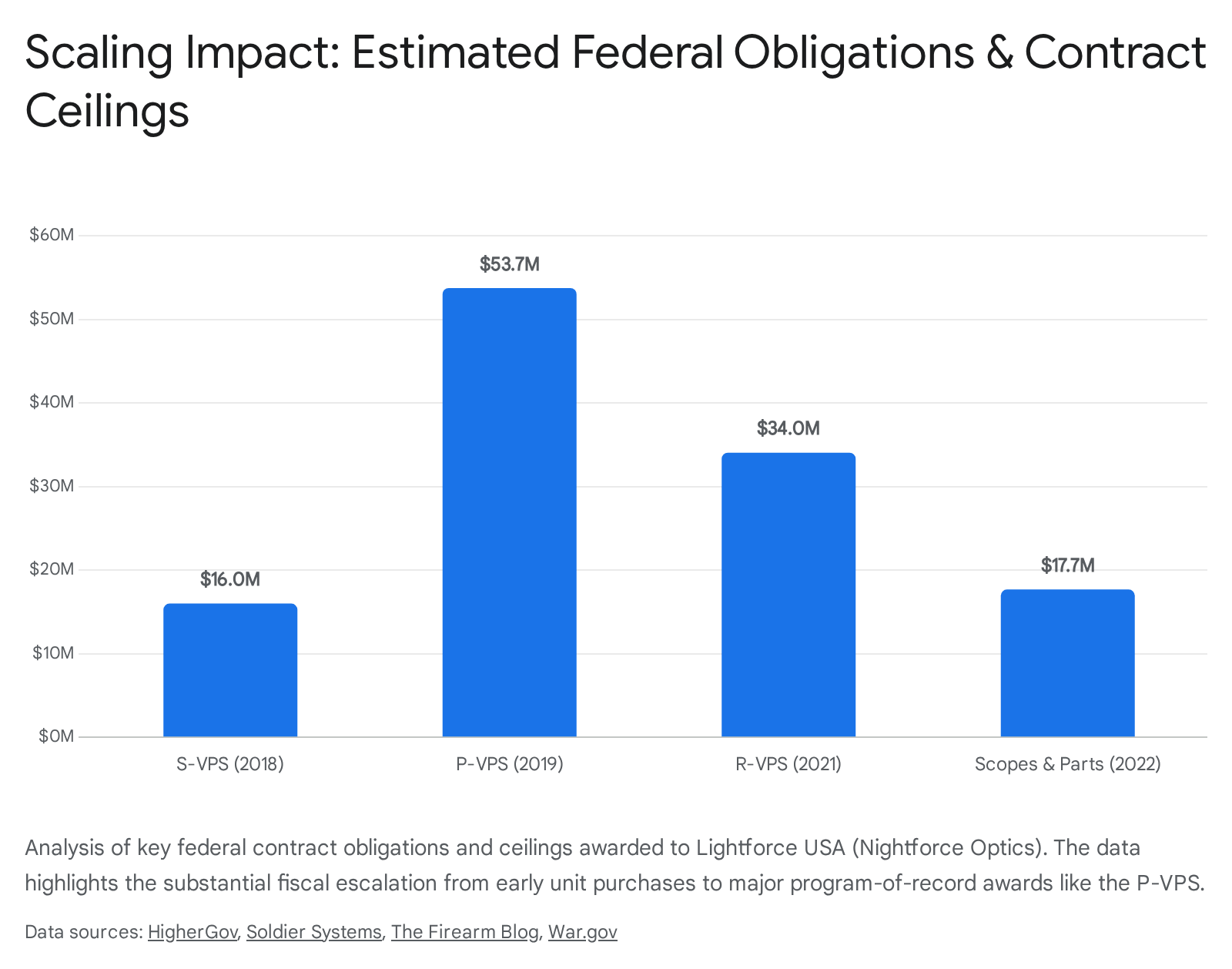
Financially and strategically, the report assesses the impact of recent major federal contracts, including the S-VPS, P-VPS, and R-VPS awards, which have cemented Nightforce’s status within the defense industrial base. The analysis concludes with a forward-looking perspective on the 2025 market landscape, evaluating Nightforce’s positioning against emerging threats from digital electro-optics and commoditized manufacturing, while highlighting their continued investment in intelligent optical systems and integrated ballistics.

1. Origins and Foundation: The Australian Genesis and the “Spotlight Gap”

1.1 The Founder’s Vision: Dr. Raymond Dennis and the Requirements of the Outback

To understand the engineering philosophy of Nightforce Optics, one must first understand the environmental and operational context of its genesis. The company’s origins are not found in the sterile laboratories of European optical giants or the industrial parks of American defense contractors, but in the rugged, unforgiving expanse of the Australian Outback.

In the mid-1980s, Dr. Raymond Dennis, a practicing dentist in South Australia, faced a persistent logistical challenge. An avid hunter, Dennis was engaged in the culling of invasive species—specifically rabbits and foxes—which often required hunting at night.1 In Australia, unlike many jurisdictions in the United States, nocturnal hunting with spotlights was not only legal but a necessary method for population control of vermin species.3

The equipment available to Australian shooters in this era was largely insufficient for the task. The spotlighting method involved mounting high-intensity lights on vehicles and traversing rough terrain to locate game. This operational profile placed two specific demands on equipment: extreme durability to withstand the relentless vibration of off-road driving, and exceptional optical clarity to resolve targets under artificial illumination.4

Dennis first addressed the illumination problem. In 1986, he founded Lightforce Australia Pty. Ltd. in Hindmarsh, South Australia. The existing market for spotlights was dominated by heavy, fragile metal units that were cumbersome to operate. Dennis applied an innovative approach, utilizing injection-molded polymers to create lightweight housings and pairing them with 100-watt halogen bulbs and highly polished 7-inch reflectors. The result was a light capable of illuminating targets at distances exceeding 400 yards, yet light enough to be manipulated easily by a hunter.2

However, the creation of a superior light revealed the deficiencies in the available sighting systems. The European riflescopes of the time, while optically pristine, were often fragile and lacked the necessary parallax adjustment to focus sharply on targets illuminated by spotlights at varying ranges. American scopes, conversely, frequently suffered from small objective lenses that limited light transmission—a critical flaw when hunting at night—and featured wire reticles that could snap under the recoil of heavy calibers or the vibration of the vehicle.2

This “Spotlight Gap”—the disparity between the capability of the illumination and the capability of the sighting system—was the catalyst for Nightforce. Dennis realized that if he wanted a scope that could survive the “ute” (utility vehicle) rides and maximize the potential of his lights, he would have to build it himself.5

1.2 The Establishment of Lightforce USA and Market Entry

In a bold strategic move designed to bypass the limitations of the smaller Australian market, Ray Dennis took his concepts to the United States. He attended the 1986 SHOT Show in New Orleans, primarily to market his Lightforce spotlights.2 While the reception to the lights was initially tepid—Americans were not as culturally accustomed to vehicle-based night hunting—Dennis engaged deeply with the US shooting industry.

He recognized that the United States represented the single largest firearms market in the world. To tap into this potential, he established a subsidiary, Lightforce USA, initially based in Seattle, Washington.4 This entity would eventually do business as Nightforce Optics.

The early years in Seattle were characterized by market research and the establishment of a supply chain that remains central to the company’s identity today. Dennis sought a manufacturing partner capable of producing optical glass and mechanical components to his exacting specifications. He found this partner in Japan. Specifically, industry analysis points to Light Optical Works (LOW), a premier original equipment manufacturer (OEM) in Japan, as the likely partner.4 Japanese optical manufacturing in the 1990s was reaching a zenith, offering glass quality that rivaled the best German and Austrian houses (Zeiss, Swarovski) but with a manufacturing flexibility that allowed for the rugged, heavy-duty tube construction Dennis required.

1.3 The Strategic Relocation to Orofino, Idaho

In 1998, a decision was made that would fundamentally shape the corporate culture and brand identity of the company: the relocation of the US headquarters from the urban center of Seattle to the small, rural town of Orofino, Idaho.7

Orofino, situated in the Clearwater River valley, is a community deeply entrenched in the logging, hunting, and outdoor lifestyle. This move was not merely logistical; it was cultural. By embedding the company in a location where the employees were also the end-users, Nightforce fostered a culture of practical excellence. The rugged terrain of northern Idaho provided an immediate, natural testing ground for their products. Engineers and assemblers could build a scope in the morning and test it on a ridgeline in the afternoon. This feedback loop accelerated the refinement of their designs and cemented the company’s commitment to durability.8

The Orofino facility became the hub for final assembly, quality control, and distribution. While the components (lenses, machined tubes) arrived from Japan, the “heart” of the scope—the assembly of the erector system, the purging of the tube with inert gas, and the rigorous impact testing—occurred in Idaho.4 This allowed Nightforce to maintain tight control over the final product quality while leveraging the specialized manufacturing capabilities of their Japanese partners.

2. The Formative Years (1992–1998): Defining the Niche

2.1 The Varminter and Precision Benchrest Series

Before Nightforce became synonymous with military snipers, it established its reputation in the demanding worlds of varmint hunting and benchrest competition. Launched in the early 1990s, the “Varminter” (later evolved into the NXS) and “Precision Benchrest” (BR) series were radical departures from the market norms of the time.7

The defining characteristic of these early scopes was the massive 56mm objective lens. At the time, most American hunting scopes utilized 40mm or perhaps 50mm objectives. The 56mm lens allowed for a significantly larger exit pupil and greater light transmission, directly addressing the low-light issues Dennis had encountered in Australia.11

Furthermore, these scopes featured magnification ranges that were unheard of in standard production optics. Models like the 8-32x56mm and 12-42x56mm provided benchrest shooters with the ability to see bullet holes on paper targets at 1,000 yards.10

2.2 Technical Differentiation: The Adjustable Objective and Illuminated Reticle

Technically, these early models introduced features that set the brand apart. They utilized an Adjustable Objective (AO) on the front bell of the scope to correct for parallax error. While common on target scopes, Nightforce built these with a robustness that allowed them to be used in the field, not just on a sterile range.

Additionally, Nightforce was a pioneer in illuminated reticles. Unlike the simple “red dot” center points of some competitors, Nightforce often illuminated the entire reticle or significant portions of the ranging scale. This required complex etching processes on the glass elements, moving away from the fragile wire crosshairs that were prone to breaking under the recoil of high-powered varmint rifles or the heavy.50 BMG target rifles that were gaining popularity.7

The “Benchrest” series, in particular, became a cult favorite in the F-Class and 1,000-yard competition circuits. The tracking reliability of the turrets—the ability to dial up 40 MOA (Minutes of Angle) for a long shot and return exactly to zero—became the stuff of legend in a sport where a mechanical error of 0.25 MOA could mean the difference between winning and losing.13

3. The NXS Revolution and Military Dominance (1998–2010)

3.1 The Birth of the NXS (Nightforce Xtreme Scope)

In 1998, coincident with the move to Idaho, Nightforce introduced the product line that would define its future: the NXS™ (Nightforce Xtreme Scope).7 The NXS was not simply an update to the Varminter; it was a comprehensive re-engineering of the riflescope platform designed explicitly to meet the emerging needs of military special operations and extreme tactical shooters.

The NXS was built on a 30mm main tube, which was becoming the standard for tactical optics (replacing the 1-inch American standard). However, Nightforce machined these tubes from 6061-T6 aircraft-grade aluminum bar stock with walls that were two to three times thicker than those of their competitors. This “over-built” approach ensured that the scope body was virtually impervious to crushing forces, denting, or thermal warping that could impinge on the internal optical train.7

Key Innovations of the NXS Series:

  • Hi-Speed Turrets: Recognizing that tactical engagements required rapid adjustments, Nightforce eventually introduced turrets that offered 10 or 20 MOA of travel per revolution, significantly faster than the standard target turrets of the day.14
  • Glass-Etched Reticles: The NXS cemented the use of etched glass for reticles. This durability was non-negotiable for military users who might subject the weapon system to the violent recoil of grenade launchers or.50 caliber fire.
  • Broad Magnification Ranges: The 3.5-15×50 NXS and 5.5-22×56 NXS became the gold standards for versatility. The 3.5-15x offered a wide field of view for closer engagements while retaining enough power for 1,000-yard shots, making it a favorite for designated marksmen.

3.2 The Mk13 Mod 5 and the Global War on Terror

The defining moment for Nightforce’s transition from a high-end civilian brand to a military necessity occurred in the crucible of the Global War on Terror (GWOT). Following the invasions of Afghanistan (2001) and Iraq (2003), US Special Operations Forces (SOF) found themselves engaging targets at distances that far exceeded the effective range of standard service rifles.

The US Navy SEALs, in particular, relied on the Mk13 sniper system, a bolt-action rifle chambered in.300 Winchester Magnum. Earlier variants (Mod 0/1) had utilized scopes from other manufacturers like Leupold, but reports from the field indicated issues with durability and magnification under the intense operational tempo and the punishing recoil of the.300 Win Mag.15

In 2005, the Naval Surface Warfare Center, Crane Division (NSWC Crane), awarded a contract for the Mk13 Mod 5 variant, which famously selected the Nightforce NXS 5.5-22×56 as the day optic.16 These scopes, often marked “NAV-SPEC” or “MIL-SPEC,” featured specific reticles (like the Mil-Dot) and were subjected to even more rigorous acceptance testing than commercial units.

The adoption of the NXS by the Navy SEALs provided an incalculable boost to the brand’s reputation. In the firearms industry, SOF selection is the ultimate validator. It signaled to the entire market—law enforcement, other military branches, and civilian shooters—that Nightforce optics were capable of surviving the harshest combat environments on earth.18

3.3 The “Frozen Scope” Legend and Marketing Durability

During this period, the brand’s marketing—and the user community’s lore—began to focus heavily on extreme durability. This was quantified in Nightforce’s internal testing protocols, which Ray Dennis and his engineers devised to ensure no scope would fail in the field.

These protocols included:

  • Forward Impact Testing: Scopes were mounted on a device that simulated recoil forces exceeding 1,250 Gs, repeated thousands of times.19
  • Thermal Shock: Units were frozen to -40°F and then rapidly heated to 158°F within one hour to test for seal integrity and fogging.19
  • Submersion: Pressure testing equivalent to depths of 100 feet.

This engineering reality birthed the famous “Frozen Scope” demonstration. In a widely circulated video and marketing campaign, a Nightforce NXS was frozen solid in a block of ice, the block was shot with a shotgun (or rifle), and the scope was then thawed, mounted on a rifle, and shown to hold zero perfectly.20 While such tests were theatrical, they effectively communicated the core value proposition of the brand: reliability above all else. In a market where a failed scope could mean a missed trophy for a hunter or a mission failure for a sniper, Nightforce positioned itself as the insurance policy against failure.

4. Technological Innovations and Intellectual Property

4.1 The ZeroStop™ Patent: Solving the “Lost Zero”

One of Nightforce’s most significant contributions to the mechanics of long-range shooting was the invention of the ZeroStop™ technology. As engagement distances increased, shooters were required to dial significantly more elevation into their turrets—often multiple full rotations.

In the stress of combat or competition, returning to the original 100-yard “zero” setting was fraught with risk. A shooter might dial down but lose track of the rotations, ending up a full revolution (e.g., 20 MOA) below or above their actual zero.

To solve this, Nightforce developed a mechanical clutch mechanism that allowed the user to set a hard physical stop at their zero point. No matter how many times the turret was rotated up, the shooter could simply spin it back down until it hit the hard stop, guaranteeing a return to zero without even looking at the dial.

This innovation was protected under US Patent 6,643,970 B2, filed in 2002 and granted in 2003 (assigned to Lightforce USA, Inc.).22 The ZeroStop became a mandatory requirement for almost all future military solicitations and forced competitors to develop their own variations of zero-retention mechanics.2

4.2 DigIllum™: Digital Reticle Illumination

As the use of Clip-On Night Vision Devices (CNVDs) proliferated in the military, the control of reticle illumination became critical. Traditional analog rheostats were often too bright for use with night vision (causing “blooming” or washout) or unreliable.

Nightforce introduced DigIllum™, a digital microprocessor-controlled illumination system. This technology allowed for:

  • Precise, distinct brightness settings, including ultra-low intensity modes compatible with night vision.
  • Memory functions that returned the illumination to the last used setting upon activation.
  • Dual-color capability (Red and Green) within the same unit, selectable by the user.24
    This technology was integrated into the NXS and later ATACR lines, further differentiating them from older designs.

5. Expansion and Modernization (2011–2018)

By 2011, the optics market was shifting. European competitors like Schmidt & Bender were dominating the ultra-premium sector with superior glass and First Focal Plane (FFP) designs. Nightforce’s NXS, while durable, utilized Second Focal Plane (SFP) reticles and optical formulas that were a decade old. To remain competitive, the company launched a multi-pronged expansion strategy.

5.1 The ATACR™ (Advanced Tactical Riflescope)

In 2013, Nightforce launched the ATACR™ series to serve as its new flagship. The ATACR was designed to compete directly with “Alpha Glass” manufacturers. It utilized ED (Extra-low Dispersion) glass to eliminate chromatic aberration and improve resolution and contrast.5

The ATACR also featured a larger 34mm main tube, which allowed for significantly more internal elevation travel—up to 120 MOA in some models. This was crucial for the emerging sport of Extreme Long Range (ELR) shooting, where targets were being engaged at 2,000 yards and beyond. The ATACR 5-25×56 quickly became the new standard for heavy tactical rifles.

5.2 The B.E.A.S.T.™ and the FFP Pivot

Also in 2013, Nightforce released the B.E.A.S.T.™ (Best Example of Advanced Scope Technology) 5-25×56 F1. This optic was an engineering tour de force, likely developed for the USSOCOM Precision Sniper Rifle (PSR) program.2

The BEAST was Nightforce’s definitive entry into the First Focal Plane (FFP) market. In an FFP scope, the reticle grows and shrinks with magnification, ensuring that the subtensions (the hash marks used for ranging and holdovers) remain accurate at any magnification setting. This was becoming the doctrinal standard for military snipers.

The BEAST featured a unique elevation control system: a primary lever for coarse adjustments (0.5 MOA or 0.2 Mil) and a fine-tune lever for precision (0.25 MOA or 0.1 Mil). While complex, it demonstrated Nightforce’s ability to innovate at the cutting edge of mechanical design.24

5.3 The SHV™: Democratizing Quality

Recognizing that the $2,500+ price point of the NXS and ATACR excluded a vast segment of the hunting market, Nightforce introduced the SHV™ (Shooter, Hunter, Varminter) line in 2014.5

The SHV strategy was simple: keep the high-quality glass and reliable tracking but strip away the “over-engineered” features necessary for combat but superfluous for hunting. The SHV used simpler turret designs (often capped) and slightly less robust tube walls (though still stronger than average). This allowed Nightforce to offer a product in the $900–$1,200 range, effectively capturing the mid-tier market and preventing competitors like Vortex from dominating that segment completely.

6. The SOCOM Era: Dominating the Defense Sector (2018–Present)

The most transformative period in Nightforce’s recent history began in 2018, as the company transitioned from being a supplier of unit-purchase items to a winner of major “Programs of Record” for USSOCOM. This cemented Nightforce as a prime defense contractor.

6.1 The “Triple Crown” of SOCOM Contracts

Nightforce secured three pivotal contracts that effectively standardized their optics across the entire spectrum of Special Operations small arms.

6.1.1 S-VPS (Squad-Variable Power Scope)

In 2018, USSOCOM awarded Nightforce a contract worth approximately $16 million (initial ceiling) for the Squad-Variable Power Scope.27

  • The Optic: ATACR 1-8×24 F1.
  • Strategic Shift: This award marked the end of the dominance of fixed-power optics (like the Trijicon ACOG or Elcan SpecterDR) on the M4A1 carbine. The military acknowledged the superiority of the Low Power Variable Optic (LPVO), which offers a true 1x setting for Close Quarters Battle (CQB) and 8x magnification for positive target identification and engagement at 600+ meters.28
  • Significance: Nightforce beat out major competitors to define the modern infantry optic.

6.1.2 P-VPS (Precision-Variable Power Scope)

In December 2019, Nightforce won the P-VPS contract with a ceiling of $53.7 million.29

  • The Optics: ATACR 5-25×56 F1 and ATACR 7-35×56 F1.
  • The Platform: These scopes were selected for the Mk22 Advanced Sniper Rifle (ASR), the Barrett MRAD system that is replacing the M2010 and Mk13 in SOCOM, Army, and Marine Corps service.
  • Capability: The inclusion of the 7-35x model highlights the push toward Extreme Long Range capabilities, requiring optical performance that remains crisp at 35x magnification.

6.1.3 R-VPS (Ranging-Variable Power Scope)

In 2021, Nightforce completed the trifecta with the R-VPS contract, with a ceiling of $34 million.30

  • The Optic: ATACR 4-20×50 F1.
  • The Role: This optic fills the gap between the S-VPS (1-8x) and the P-VPS (5-25x). It is designed for the Designated Marksman (DM) role, optimized for mid-range engagements where field of view and light transmission are balanced against magnification.
Ronin's polymer handle being cut with a plastic knife on foil

6.2 The NX8: Miniature Agility

Leveraging the technology developed for the S-VPS trials, Nightforce launched the NX8™ series commercially in 2018. The NX8 line is characterized by its 8x zoom ratio (e.g., 1-8x, 2.5-20x, 4-32x) packaged in incredibly compact bodies.32

The NX8 2.5-20×50 is particularly notable; it offers the magnification reach of a full-size NXS 5.5-22x but in a package that is nearly the size of a compact hunting scope (approx. 12 inches long). This addressed a growing market demand for “crossover” optics that could be used on lightweight mountain rifles and tactical carbines alike, without the weight penalty of the ATACR line.

7. Current Operational Architecture and Market Position (2024–2025)

7.1 Manufacturing and Supply Chain

Nightforce continues to operate under its successful hybrid model. The company maintains a “Made in USA” designation for its flagship ATACR and military lines by performing substantial transformation in Idaho. The lenses and tube blanks are sourced from Japan (Light Optical Works), which remains the global benchmark for high-performance optical glass production.4

This supply chain is robust but faces challenges from the Berry Amendment and other “Buy American” statutes. However, Nightforce has successfully navigated these by demonstrating that domestic US glass manufacturing (which is extremely limited) cannot meet the volume or quality requirements for these specific high-end optics, while the assembly and QA labor—the value-add—remains domestic.

7.2 The Rise of the “Clone” Market

In a savvy marketing move, Nightforce has recently capitalized on the civilian desire for military authenticity. In late 2023 and continuing into 2024, the company released limited runs of “Contract” riflescopes—commercial units that are laser-engraved with the specific military data plates (e.g., “SU-294/PVS”) found on issued S-VPS and P-VPS scopes.30 These units, often sold at a premium, cater to the thriving “Cloner” community—enthusiasts who build exact replicas of military service rifles. This strategy monetizes the brand’s military prestige directly in the civilian collector market.

7.3 Reticle Evolution: MIL-XT and MOAR

The battle for optical supremacy is now often fought in the reticle. Nightforce has aggressively updated its reticle portfolio to keep pace with the Precision Rifle Series (PRS) and NRL Hunter competitions.

  • MIL-XT™: A “Christmas Tree” style reticle designed for holding windage and elevation without dialing. It was created to compete with the Horus H59 and Tremor3, offering a cleaner sight picture for spotting impacts.34
  • MOAR™ Evolution: In 2025, Nightforce announced new MOA reticle options for Benchrest and LPVO platforms, reaffirming their commitment to the MOA shooter base despite the industry’s general shift toward Milliradians (MRAD).8

8. Future Outlook and Strategic Horizon (2025+)

8.1 Intelligent Optics and Digital Integration

The next frontier for the optics industry is the fusion of analog glass with digital data. Competitors like Vortex Optics (with the XM157 fire control) and Sig Sauer (with the BDX system) are pushing heavily into “smart scopes.”

Nightforce has not remained idle. Patent filings suggest active R&D into “intelligent” optical systems. Specifically, Patent US 2013/0199074 A1 (associated with Nightforce inventors) discusses sighting systems with integrated wind sensors and display elements that visualize wind uncertainty.35

Furthermore, Nightforce has established integration partnerships with Kestrel and Garmin. While currently this involves external ballistic calculators communicating with the shooter, the logical next step is an ATACR variant with an integrated Heads-Up Display (HUD) that projects the Kestrel’s firing solution directly into the field of view, creating an “Augmented Reality” firing solution while retaining the reliability of a glass etched reticle.36

8.2 Risks and Challenges

Despite its dominant position, Nightforce faces distinct risks in the coming decade:

  1. Commoditization of Performance: Manufacturing capabilities in China and the Philippines are improving rapidly. Brands like Athlon and Arken are producing scopes with “90% of the performance for 20% of the price.” Nightforce must maintain its “Made in USA” and “Battle Proven” distinctiveness to justify its premium pricing.
  2. The Digital Pivot: If the US military decides to replace all glass optics with digital fire control systems (like the Next Generation Squad Weapon’s fire control), Nightforce’s expertise in mechanical optics could become less relevant. The company must prove that analog glass is still the failsafe backup that digital systems cannot replace.

9. Summary of Key Milestones

The following table encapsulates the chronological evolution of Nightforce Optics, marking the events that transformed it from an Australian startup to a global defense titan.

YearMilestone EventStrategic SignificanceSource
1986Ray Dennis founds Lightforce Australia.Identified the need for rugged equipment for night hunting; established the parent company.3
1992Nightforce Optics established.Formal entry into the US optics market with Varmint/Benchrest models featuring 56mm objectives.3
1998Headquarters moved to Orofino, Idaho.Strategic centralization of US assembly and operations; Launch of the NXS™ series.7
2002ZeroStop™ Patent Filed.Innovation of the mechanical return-to-zero system (granted 2003/2006); became a military standard.22
2005Mk13 Mod 5 Adoption.Navy SEALs select NXS 5.5-22×56; cements the brand’s reputation for military durability.17
2010High-Speed Turrets Standardized.Upgraded NXS line for faster tactical adjustments (20 MOA/rev).7
2013ATACR™ Series Released.Introduction of ED glass and 34mm tubes to compete with European “Alpha Glass.”5
2013B.E.A.S.T.™ Released.First Focal Plane (FFP) innovation with hybrid 0.1 Mil / 0.2 Mil controls; technical showcase.5
2014SHV™ Series Released.Entry into the mid-tier hunting market ($1k price point) to capture broader market share.5
2018NX8™ Series Released.Introduction of 8x zoom ratio technology in compact packages (1-8x, 2.5-20x).5
2018S-VPS Contract Awarded.USSOCOM selects ATACR 1-8×24 for M4A1 carbines ($16M ceiling).27
2019P-VPS Contract Awarded.USSOCOM selects ATACR 5-25x and 7-35x for Sniper Systems ($53M ceiling).29
2021R-VPS Contract Awarded.USSOCOM selects ATACR 4-20×50 for Designated Marksman roles ($34M ceiling).30
2023Limited “Clone” Release.Commercial release of mil-spec marked contract overruns, capitalizing on collector market.30
2025New MOA Reticles.Expansion of reticle options for Benchrest and LPVO platforms, sustaining legacy support.30

Conclusion

Nightforce Optics stands as a paragon of focused engineering. By refusing to compromise on mechanical durability, the company successfully transitioned from a niche Australian lighting subsidiary to a cornerstone of the American military-industrial complex. Their trajectory—from the heavy, over-built NXS of the late 90s to the compact, optically brilliant NX8 and ATACR lines of today—mirrors the evolution of modern precision shooting itself. As the industry pivots toward digital integration, Nightforce’s challenge will be to integrate “smart” features without sacrificing the mechanical ruggedness that defines their legacy. The “Rugged, Reliable, Repeatable” ethos is not merely a slogan; it is the strategic moat that protects them in an increasingly crowded marketplace.


Please share the link on Facebook, Forums, with colleagues, etc. Your support is much appreciated and if you have any feedback, please email us in**@*********ps.com. If you’d like to request a report or order a reprint, please click here for the corresponding page to open in new tab.


Sources Used

  1. Interview with Nightforce Optics Founder Ray Dennis – The Firearm Blog, accessed December 20, 2025, https://www.thefirearmblog.com/blog/2017/02/16/interview-nightforce-optics-founder-ray-dennis/
  2. Nightforce Optics – Wikipedia, accessed December 20, 2025, https://en.wikipedia.org/wiki/Nightforce_Optics
  3. Blog – Page 6 – Nightforce Optics, accessed December 20, 2025, https://www.nightforceoptics.com/blog/?page=6
  4. Where are Nightforce Riflescopes Made? – Optics Trade Blog, accessed December 20, 2025, https://www.optics-trade.eu/blog/where-are-nightforce-riflescopes-made/
  5. 2022 PRODUCT CATALOG – Scopelist.com, accessed December 20, 2025, https://www.scopelist.com/PDF/nf-product-catalog-2022.pdf
  6. NF scopes – Made in USA or Made in Japan? | Sniper’s Hide Forum, accessed December 20, 2025, https://www.snipershide.com/shooting/threads/nf-scopes-made-in-usa-or-made-in-japan.69387/
  7. Nightforce Riflescopes – Scopelist Blog, accessed December 20, 2025, https://blog.scopelist.com/nightforce-riflescopes/
  8. Nightforce Optics | Rugged, Reliable, Repeatable, Optics, accessed December 20, 2025, https://www.nightforceoptics.com/
  9. Nightforce manufacturing Question | Shooters’ Forum, accessed December 20, 2025, https://forum.accurateshooter.com/threads/nightforce-manufacturing-question.3896699/
  10. NF – 8-32x56mm – Nightforce Optics, accessed December 20, 2025, https://www.nightforceoptics.com/riflescopes/competition-and-benchrest/precision-benchrest-8-32×56
  11. Nightforce 3-15×56 Varminter Lighted Reticle Minty | eBay, accessed December 20, 2025, https://www.ebay.com/itm/386935624264
  12. NXS – 8-32x56mm – Nightforce Optics, accessed December 20, 2025, https://www.nightforceoptics.com/riflescopes/nxs/nxs-8-32×56
  13. Competition and Precision Benchrest – Nightforce Optics, accessed December 20, 2025, https://www.nightforceoptics.com/riflescopes/competition-and-benchrest
  14. Nightforce NXS 5.5-22×56 Rifle Scope, accessed December 20, 2025, https://www.sportoptics.com/nightforce-nxs-5-5-22×56-rifle-scopes.html
  15. Mk 13 rifle – Wikipedia, accessed December 20, 2025, https://en.wikipedia.org/wiki/Mk_13_rifle
  16. My MK13 Mod 5 Build | Sniper’s Hide Forum, accessed December 20, 2025, https://www.snipershide.com/shooting/threads/my-mk13-mod-5-build.6995277/
  17. Mk 13 Mod 0 stock | Page 10 | Sniper’s Hide Forum, accessed December 20, 2025, https://www.snipershide.com/shooting/threads/mk-13-mod-0-stock.6343157/page-10
  18. Nightforce 5.5-22×56 MILSPEC NAVSPEC (MK13) – Thoroughbred Armament, accessed December 20, 2025, https://www.thoroughbredarmco.com/product/491/mk13-kit
  19. About Our Technology – Nightforce Optics, accessed December 20, 2025, https://www.nightforceoptics.com/technology/
  20. Nightforce Torture Test: Can It Handle This Beating? – YouTube, accessed December 20, 2025, https://www.youtube.com/watch?v=srQozdIgdLo
  21. Nightforce Scope Torture Test – YouTube, accessed December 20, 2025, https://www.youtube.com/watch?v=JQRe_-fgmGQ
  22. Zero stop adjustable rifle scope – US6643970B2 – Google Patents, accessed December 20, 2025, https://patents.google.com/patent/US6643970B2/en
  23. Evolution Of Precision Shooting: New Nightforce Scopes Unveiled – KHTS Radio, accessed December 20, 2025, https://www.hometownstation.com/featured-stories/evolution-of-precision-shooting-new-nightforce-scopes-unveiled-481546
  24. Nightforce B.E.A.S.T 5-25x56mm F1 Rifle Scope – Xtreme Guns And Ammo, accessed December 20, 2025, https://xtremegunsandammo.com/optics-for-sale/rifle-scopes-for-sale/nightforce-rifle-scopes-for-sale/nightforce-beast/
  25. THE REMARKABLE NEW 4-14×56. WE CUT NO CORNERS. ONLY THE PRICE., accessed December 20, 2025, https://soldiersystems.net/blog1/wp-content/uploads/2013/12/NFO_2014v1ProductCatalog_Mktg_Dec172013.pdf
  26. SHV – Nightforce Optics, accessed December 20, 2025, https://www.nightforceoptics.com/riflescopes/shv
  27. US SOCOM Selects Night Force ATACR For Squad-Variable Powered Scopes (FFP), accessed December 20, 2025, https://www.thefirearmblog.com/blog/2018/10/04/ussocom-selects-night-force-atacr/
  28. NIGHTFORCE® OPTICS BEGINS FULL RATE PRODUCTION FOR US SPECIAL OPERATIONS COMMAND, accessed December 20, 2025, https://www.nightforceoptics.com/nightforce-optics-begins-full-rate-production-for-us-special-operations-command
  29. USSOCOM Selects Nightforce Optics for Precision-Variable Power Scope – Soldier Systems, accessed December 20, 2025, https://soldiersystems.net/2019/12/12/ussocom-selects-nightforce-optics-for-precision-variable-power-scope/
  30. NIGHTFORCE® OPTICS AWARDED USSOCOM P-VPS CONTRACT, accessed December 20, 2025, https://www.nightforceoptics.com/nightforce-optics-awarded-ussocom-p-vps-contract
  31. Contracts for April 29, 2021 – Department of War, accessed December 20, 2025, https://www.war.gov/News/Contracts/Contract/Article/2590381/
  32. NX8 – Nightforce Optics, accessed December 20, 2025, https://www.nightforceoptics.com/riflescopes/nx8
  33. Nightforce Introduces Four New SFP NX8 Scopes – The Firearm Blog, accessed December 20, 2025, https://www.thefirearmblog.com/blog/2020/08/10/nightforce-sfp-nx8-scopes/
  34. Nightforce rifle scopes and reticles – Optics Database – Sage rat hunting, accessed December 20, 2025, https://sageratsafaris.com/nightforce-rifle-scopes-and-reticles/
  35. US20130199074A1 – Optical device having projected aiming point – Google Patents, accessed December 20, 2025, https://patents.google.com/patent/US20130199074A1/en
  36. Kestrel Software Partners – Hornady Ballistics, Applied Ballistics, WeatherBird & More – Kestrel Meters, accessed December 20, 2025, https://kestrelmeters.com/pages/software-partners
  37. Pairing a Kestrel Wind Sensors to a Foretrex 901 With Applied Ballistics – Garmin Support, accessed December 20, 2025, https://support.garmin.com/en-US/?faq=Nkhdvo2eyK9BrgSCJXE339

Advanced Small Arms Systems Analysis: The Barrett Mk 22 Precision Sniper Rifle (PSR)

The modernization of United States military small arms capabilities has undergone a profound transformation over the last decade, transitioning from legacy, single-purpose platforms to modular, multi-mission systems. At the forefront of this doctrinal shift is the Advanced Sniper Rifle (ASR) program, culminating in the selection of the Barrett Mk 22 Multi-Role Adaptive Design (MRAD) as the standardized precision engagement tool for the United States Special Operations Command (USSOCOM) and the United States Army. This report provides an exhaustive technical, operational, and market analysis of the Mk 22 platform, evaluating its engineering merits, ballistic capabilities, and its standing within the global defense and civilian markets.

The analysis confirms that the Mk 22 represents a significant leap in lethality and logistical flexibility. By consolidating the capabilities of the legacy M2010 Enhanced Sniper Rifle (.300 Winchester Magnum) and the M107 Long Range Sniper Rifle (.50 BMG) into a single, man-portable chassis, the Department of Defense has achieved a long-sought objective: the “one gun, one operator” concept. The platform’s modular architecture allows for user-level caliber conversion between 7.62x51mm NATO,.300 Norma Magnum, and.338 Norma Magnum, effectively spanning the operational envelope from urban close-quarters training to extreme-range anti-materiel interdiction out to 1,500 meters and beyond.

However, this report also identifies a critical vector of concern: system safety. Recent field reports and safety bulletins regarding uncommanded discharges in the military Mk 22 configuration have triggered high-level investigations. Our engineering assessment points to the single-stage trigger mechanism—a specific requirement of the military solicitation that differs from the commercial two-stage standard—as a potential failure point under inertial stress. This finding complicates the procurement landscape and necessitates a rigorous audit of existing inventory.

Ballistically, the adoption of the Norma Magnum cartridge family signifies a definitive end to the era of the.338 Lapua Magnum as the premier military long-range cartridge. The synergistic relationship between the.300 Norma Magnum’s superior aerodynamic efficiency for anti-personnel roles and the.338 Norma Magnum’s payload stability for machine gun applications has driven a standardization that simplifies logistics while extending effective engagement ranges by nearly 30 percent over previous generation systems.

The conclusion of this report categorizes the Barrett Mk 22 as a highly capable but currently flawed system pending the resolution of fire control group reliability issues. For the civilian collector and the institutional buyer, the “Buy” recommendation is conditional, contingent upon strict adherence to safety protocols and verification of trigger mechanism integrity. The Mk 22 is not merely a rifle; it is a case study in the complexities of modern defense procurement, illustrating the tension between innovation, modularity, and the immutable requirements of mechanical safety.

Ronin's polymer handle being cut with a plastic knife on foil

1. The Strategic Context: Evolution of the Advanced Sniper Rifle (ASR)

1.1 The Legacy Gap and the Precision Sniper Rifle (PSR) Failure

The trajectory of the United States military’s sniper capability has been defined by the pursuit of range and lethality. For decades, the capability was bifurcated: the 7.62x51mm NATO (M24 SWS, M40 series) handled anti-personnel duties out to 800 meters, while the.50 BMG (M107/M82) handled anti-materiel duties out to 1,800 meters.1 However, the Global War on Terror (GWOT) in Afghanistan exposed a critical gap in this architecture. Engagements frequently occurred in the mountains of the Hindu Kush at ranges between 800 and 1,500 meters—distances where the 7.62mm was ballistically impotent, and the.50 BMG was too heavy and imprecise for surgical application against human targets.

This operational reality drove the Precision Sniper Rifle (PSR) program in the late 2000s. The objective was to procure a rifle that could bridge this gap. The initial winner, the Remington Modular Sniper Rifle (MSR), was intended to replace the M24 and M2010 systems. However, the PSR program became a case study in procurement failure. Reports indicate that the selected Remington system suffered from severe quality control issues, failing to meet accuracy requirements in production batches.2 The government’s performance specifications (P-SPECS) were also criticized as being poorly defined, leading to a situation where the vendor was “unwilling or unable to fix the simplest problems”.3

By 2015, USSOCOM faced a stark reality: the PSR program was effectively dead, and the capability gap remained. The decision was made to allow the PSR contract to expire after the minimum purchase and to restart the initiative under a new designation: the Advanced Sniper Rifle (ASR). This “restart” was not merely administrative; it was an opportunity to integrate nearly a decade of lessons learned regarding modularity, metallurgy, and arguably most importantly, ammunition selection.4

1.2 The “Overmatch” Doctrine and ASR Requirements

The driving philosophy behind the ASR solicitation was “Overmatch.” Intelligence assessments of peer and near-peer adversaries—specifically the modernization of Russian and Chinese small arms—indicated a proliferation of sniper systems capable of effective fire at 1,200 meters. To maintain superiority, US forces required a system capable of out-ranging these threats, pushing the effective engagement envelope to 1,500 meters and beyond.1

This requirement rendered the.300 Winchester Magnum—the cartridge of the interim M2010—obsolete for the future fight. While a capable round, the.300 Win Mag is limited by its belted case design (which complicates headspace control) and its inability to effectively seat the ultra-long, high-ballistic-coefficient projectiles needed for extreme range without intruding into the powder column. The ASR program, therefore, mandated a shift to modern cartridge geometries.

The ASR solicitation outlined three specific configurations for the weapon system, creating a “triad” of capability:

  1. 7.62x51mm NATO: For training and compatibility with legacy ammunition stocks.
  2. Antipersonnel Magnum: Originally open, but eventually solidifying around the.300 Norma Magnum.
  3. Antimateriel Magnum: Solidifying around the.338 Norma Magnum.

Barrett Firearms Manufacturing, leveraging the architecture of their Model 98B and the subsequent MRAD, entered the competition with a platform that emphasized user-level maintainability—a direct response to the armorer-dependent frustrations of the previous PSR program.5

2. Engineering Analysis of the Barrett Mk 22 Platform

The Barrett Mk 22 is a bolt-action, magazine-fed, multi-caliber repeater. Its engineering architecture represents a departure from the traditional “stock and action” design of the Remington 700 lineage, adopting a chassis-based, monolithic approach that prioritizes rigidity and modularity.

2.1 Monolithic Receiver and Chassis Dynamics

The structural core of the Mk 22 is its upper receiver. Machined from 7000-series aluminum, the upper receiver is monolithic, meaning the handguard and the action housing are a single, continuous component.6 This design choice is critical for precision systems for several reasons:

  • Optic Stability: The rifle features a 21.75-inch (553 mm) top rail with a built-in 10 MIL (approximately 35 MOA) inclination.7 Because the rail is integral to the receiver, there is zero risk of the rail loosening or shifting relative to the barrel extension. This ensures that the primary optical sight and any forward-mounted clip-on devices (such as thermal or night vision capability) remain perfectly aligned on the same optical plane, regardless of thermal expansion or mechanical shock.
  • Structural Rigidity: The monolithic design eliminates the flex that can occur at the junction of a receiver and a separate handguard. When a sniper “loads” the bipod (presses forward to stabilize recoil), force is applied to the handguard. In modular systems with bolted-on handguards, this can cause a slight deflection of the forend, potentially contacting the barrel or shifting the point of aim. The Mk 22’s rigid structure negates this variable.

The chassis utilizes a “skeletonized” design philosophy to manage weight. Despite its substantial size (overall length of 49.4 inches in.338 configuration), the rifle weighs approximately 15.2 lbs (7.0 kg).7 While significantly heavier than a standard infantry rifle, this mass is an engineered feature. In high-energy systems, mass acts as a damper, absorbing recoil energy and reducing the velocity of the rifle’s rearward movement, which aids the shooter in spotting their own impacts.6

2.2 The Barrel Interchange System: Metallurgy and Mechanics

The defining feature of the Mk 22 is its user-changeable barrel system. Unlike the Accuracy International Quickloc system, which uses a camming mechanism, the Barrett system utilizes a simpler, high-torque clamping method.

  • The Mechanism: The barrel extension is inserted into the front of the receiver. Two heavy-duty Torx screws pass through the receiver and clamp it tight around the extension.5
  • Engineering Merit: This approach creates a massive surface area of contact between the receiver and the barrel. From a metallurgical perspective, this acts as a significant heat sink, drawing thermal energy away from the chamber area—the hottest part of the system—and dissipating it through the aluminum chassis. This thermal management is crucial for maintaining accuracy during sustained strings of fire.
  • Operational Utility: A sniper can change caliber configurations in under two minutes using a single torque wrench. This capability allows a team to deploy with a single chassis and multiple barrel kits, tailoring the weapon to the mission profile (e.g., urban environment vs. mountain reconnaissance) immediately prior to infiltration.8

2.3 Bolt Group and Action Cycling

The bolt assembly is designed for reliability in austere environments. It features a three-lug triangular design, which implies a 60-degree bolt throw. This short throw angle is advantageous as it provides greater clearance between the bolt handle and the large ocular bells of modern high-magnification scopes (such as the Leupold Mark 5HD and Nightforce ATACR typically paired with the system).1

A notable engineering feature is the enclosed polymer bolt guide.7

  • Tribology: The interface between steel (bolt) and aluminum (receiver) can be problematic due to galling. By enclosing the bolt in a polymer sleeve, Barrett introduces a self-lubricating medium.
  • Debris Tolerance: The sleeve acts as a dust shield, sealing the action when the bolt is closed. In desert environments, this reduces the need for wet lubricants (oil/grease) which attract sand and turn into an abrasive grinding paste. This design reflects the hard-learned lessons of operations in Iraq and Afghanistan.

2.4 The Fire Control Group: Single vs. Two-Stage Mechanics

A critical distinction in the engineering analysis of the Mk 22 is the trigger mechanism, which has become a focal point of recent safety investigations. The commercial MRAD is typically equipped with a match-grade, adjustable two-stage trigger. The military Mk 22, however, was specified with a single-stage trigger.9

  • Mechanical Differences:
  • Two-Stage: The shooter pulls through a light “take-up” stage until hitting a defined “wall” (the sear engagement point), then applies additional pressure to break the shot. This design is mechanically safer against inertial drops because the mass of the trigger shoe must move through the first stage before disengaging the sear.
  • Single-Stage: There is no take-up; the trigger is effectively at the “wall” immediately. Pressure builds until the break. To achieve a light, crisp pull weight in a single-stage design, the sear engagement (the amount of overlap between the trigger sear and the hammer/striker sear) must be minimal.
  • Implications: The military preference for a single-stage trigger (often for speed of engagement) introduces a narrower margin for error in manufacturing tolerances. If the sear engagement is too shallow, or if the spring tension holding the sear is insufficient, the mechanism becomes susceptible to “sear bounce.” This can occur when the bolt is slammed home forcefully—a common action in combat reloading. The inertial shock can cause the sear to slip, releasing the firing pin without a trigger pull. This hypothesis aligns with the reported “uncommanded discharge” phenomena.2

3. Ballistic Architecture: The Systems Approach

The ASR program’s selection of calibers—7.62x51mm,.300 Norma Magnum, and.338 Norma Magnum—was not a random assortment but a calculated systems engineering approach to terminal ballistics and logistics.

3.1 7.62x51mm NATO: The Economic & Training Backbone

  • Technical Specifications: 20-inch (508 mm) barrel, 1:8″ twist rate.7
  • Role: While ballistically inferior for long-range work compared to the Magnums, the 7.62x51mm barrel is essential for sustainment.
  • Economic Logic: High-performance magnum ammunition (M1162/M1163) costs upwards of $10-$15 per round. M118LR 7.62mm match ammunition costs approximately $1.50 per round. By training on the 7.62mm barrel, units can conduct high-volume marksmanship drills, wind-calling exercises, and urban combat training at a fraction of the cost.
  • Barrel Life: A.300 Norma Magnum barrel may have a peak accuracy life of 1,500-2,000 rounds due to throat erosion from high powder volumes. A 7.62mm barrel can last 5,000-10,000 rounds. This preserves the “operational” magnum barrels for deployment.8

3.2.300 Norma Magnum (M1163): The Antipersonnel Specialist

  • Technical Specifications: 26-inch (660 mm) barrel, 1:8″ twist rate.7
  • Ballistic Engineering: The.300 Norma Magnum is based on the.338 Norma Magnum case necked down to.30 caliber. It fires a 215-grain Berger Hybrid projectile (in the M1163 load) at approximately 3,000-3,100 feet per second.10
  • The Coefficient Advantage: The 215gr Berger Hybrid boasts a G7 Ballistic Coefficient (BC) of roughly 0.354.12 This high BC, combined with high muzzle velocity, allows the projectile to remain supersonic well beyond 1,500 meters.
  • Why Not.338 Lapua? Compared to the.338 Lapua Magnum, the.300 Norma Magnum offers a flatter trajectory and less wind drift inside 2,000 meters. It delivers sufficient energy to incapacitate human targets at extreme ranges but with a faster time-of-flight, reducing the margin of error required for wind estimation. This makes it the superior choice for the “soft target interdiction” role.

3.3.338 Norma Magnum (M1162): The Antimateriel Bridge

  • Technical Specifications: 27-inch (686 mm) barrel, 1:9.4″ twist rate.7
  • Ballistic Engineering: This cartridge fires a 300-grain projectile (typically a Sierra MatchKing or Armor Piercing variant in M1162).11
  • The Design Philosophy: The.338 Norma Magnum was designed to correct the flaws of the.338 Lapua Magnum. The Lapua has a long, tapering case. When loaded with very long, high-BC bullets (like the 300gr), the bullet must be seated deeply into the case to fit in magazines, displacing powder capacity and reducing performance. The.338 Norma Magnum has a slightly shorter case with less taper and a sharper shoulder. This geometry allows the long 300gr bullet to be seated further out, preserving powder capacity.14
  • The Machine Gun Connection: This geometry is crucial for belt-fed weapons. USSOCOM has adopted the.338 Norma Magnum for the Lightweight Medium Machine Gun (LWMMG) program. The case shape is optimized for the push-through feed mechanisms of machine guns. By selecting the.338 Norma for the ASR, the military unifies the ammunition supply chain. Snipers and machine gunners can share the same M1162 AP ammunition, simplifying logistics in austere Forward Operating Bases (FOBs). This “interoperability” was a decisive factor in its selection over the.338 Lapua.14

4. Operational Performance and User Interface

4.1 Precision Capabilities

In field testing and military trials, the Mk 22 has consistently demonstrated sub-MOA (Minute of Angle) accuracy. The specification requires the system to hold 1 MOA or better, but user reports and independent reviews indicate capability closer to 0.5 MOA (approx. 5 inches at 1,000 yards) with match-grade ammunition.16 This level of precision is facilitated by the rigidity of the monolithic receiver and the quality of the barrel manufacturing (likely Bartlein or similar high-grade button/cut rifling contractors).

Crucially, the “Return to Zero” capability—the ability to remove the barrel and reinstall it without losing the point of impact—has been validated by users. Shifts are typically recorded at less than 0.1 MIL, which is often within the margin of shooter error and environmental variance.6 This reliability gives commanders confidence that a rifle reconfigured in the field will perform without a confirmation shot, a vital tactical advantage.

4.2 Recoil Management

Managing the recoil of a.338 Magnum in a portable package is a physics challenge. The Mk 22 addresses this through a “System of Systems” approach:

  1. Mass: At ~15 lbs, the rifle is heavy. This inertia resists the rearward acceleration of recoil.
  2. Inline Architecture: The bore axis is aligned linearly with the stock assembly. This directs recoil forces straight back into the shooter’s shoulder pocket rather than creating a torque moment that causes muzzle rise. This “straight-back” impulse allows the shooter to maintain their sight picture through the scope during the shot, enabling them to spot their own trace and impact—a critical task for making rapid second-shot corrections.6
  3. Muzzle Brake: The large factory muzzle brake acts as an efficient baffle, redirecting high-pressure gases to the sides and rear to pull the rifle forward, counteracting recoil.

4.3 Ergonomics and Adaptability

The “Adaptive” nature of the MRAD is not marketing hyperbole. The rifle acknowledges the reality of modern combat loads.

  • Stock Adjustability: The length of pull and cheek piece height are adjustable via push-buttons (no tools required). This is essential for operators wearing variable thicknesses of body armor or heavy cold-weather clothing.7
  • Folding Mechanism: The stock folds to the right, capturing the bolt handle. This reduces the overall length for transport (from ~50 inches to ~40 inches), making it capable of being carried in a vehicle, helicopter, or jump case. The lock-up of the hinge is robust, described as feeling like a fixed stock when deployed—a critical requirement for maintaining accuracy.5
  • Accessory Integration: The M-LOK slots at 3, 6, and 9 o’clock positions allow for the direct mounting of tripods, bipods, and ballistic computers without the added weight and bulk of full-length quad rails.

5. Safety Reliability and Lifecycle Management

Despite its operational successes, the Mk 22 program is currently navigating a significant crisis regarding safety reliability.

5.1 The Uncommanded Discharge Phenomenon

Recent safety bulletins and reports from the field have highlighted instances of “uncommanded discharges.” This is a catastrophic failure mode where the weapon fires without the trigger being pulled.

  • The Scenario: These incidents typically occur during the bolt closure sequence. As the operator pushes the bolt forward and locks it into battery, the weapon discharges.
  • Engineering Failure Analysis: As discussed in Section 2.4, the likely culprit is the single-stage trigger mechanism. If the sear engagement surfaces are insufficient to withstand the inertial shock of the bolt carrier group slamming home, the sear can disengage.
  • Impact: This is distinct from a “negligent discharge” (where the operator’s finger is on the trigger). It is a mechanical failure. In a tactical environment, an uncommanded discharge can compromise a hide site, cause fratricide, or result in mission failure.
  • Comparison: This situation draws parallels to the drop-safety issues experienced by the SIG Sauer P320/M17/M18 pistol, where inertial forces on the trigger group caused uncommanded firing.2

5.2 Sustainment and Response

The U.S. Army and Barrett are actively investigating these incidents. For the time being, strict handling protocols are likely in place (e.g., prohibition on chambering a round until the rifle is pointed downrange and ready to fire). For institutional buyers, this necessitates a 100% inspection of trigger groups. For the platform’s long-term viability, it is highly probable that a “Product Improvement Program” (PIP) or Engineering Change Proposal (ECP) will be issued to redesign the sear geometry or increase the spring tension of the single-stage trigger, or potentially revert to a two-stage design if the requirement for a single-stage pull can be waived.

Ronin's polymer handle being cut with a plastic knife on foil

6. Market Analysis: Customer Sentiment and Commercial Viability

6.1 Military Customer Sentiment

  • Operator Feedback: Among Special Forces operators and Army snipers, the sentiment regarding the utility of the Mk 22 is overwhelmingly positive. The reduction in logistical footprint—carrying one case instead of two or three rifles—is a massive quality-of-life improvement. The recoil mitigation and ergonomic adjustments are frequently cited as best-in-class, reducing shooter fatigue during long observation missions.8
  • Command Feedback: The consolidation of TO&E (Table of Organization and Equipment) is a strategic win. However, the safety issues represent a significant liability. Commanders are risk-averse; a weapon system that fires uncommanded is a weapon system that gets left in the armory. The resolution of this issue is critical for maintaining command confidence.

6.2 The Civilian & Collector Market

The civilian market for the Mk 22 is distinct from the general precision rifle market.

  • The “Cloner” Market: There exists a dedicated demographic of collectors who desire “military correct” clones of service weapons. For this group, the “Mk 22 Deployment Kit”—which includes the specific pelican case, three barrels, and military markings—is a high-value item. These kits retail for approximately $16,000 USD.9 Despite the high cost, demand is robust due to the perceived collectibility and potential appreciation of genuine military-contract firearms.
  • The Competitor Market: For participants in the Precision Rifle Series (PRS) or Extreme Long Range (ELR) competitions, the standard commercial MRAD is generally viewed as the superior value proposition. Retailing for around $6,000 USD, the commercial MRAD offers the same chassis and barrel technology but typically includes the safer and more desirable two-stage trigger. Competitors often view the $10,000 premium for the “Mk 22” kit as unnecessary, preferring to spend that capital on high-end optics (e.g., Tangent Theta, ZCO) and ammunition.8

6.3 Competitive Landscape

The Mk 22’s primary competitor is the Accuracy International (AI) AXSR.

  • Accuracy International AXSR: The commercial version of AI’s ASR submission. It is widely regarded as the “gold standard” for durability and smooth action cycling. Many purists prefer the AI bolt feel and the Quickloc barrel system. However, AI faces challenges in the US market due to import logistics and availability of parts compared to the domestic production of Barrett.18
  • Sako TRG M10: Another contender in the PSR/ASR trials. While an exceptional rifle, its high cost and the scarcity of magazines and accessories in the US market relegate it to a niche status compared to the widespread support for the Barrett platform.18

Table 1: Comparative Market Analysis

FeatureBarrett Mk 22 (Mil-Spec)Barrett MRAD (Commercial)Accuracy Int. AXSR
Approx. Price~$16,000 (Full Kit)~$6,000 (Rifle Only)~$9,000 – $12,000
Trigger TypeSingle-Stage (Fixed)Two-Stage (Adjustable)Two-Stage (Match)
Barrel Change2 Torx Screws2 Torx ScrewsQuickloc (Cam lever)
Caliber Options.300 NM,.338 NM, 7.62Extensive (User Choice)Extensive
AvailabilityLow (Limited release)HighModerate (Import)
Safety ConcernsHigh (Uncommanded Fire)Low (Proven record)Low

7. Conclusions and Recommendations

7.1 Overall Conclusion

The Barrett Mk 22 is a landmark platform in the history of small arms. It successfully operationalizes the concept of the modular sniper rifle, breaking the “one gun, one role” paradigm that has constrained military planners for decades. The integration of the.300 and.338 Norma Magnum cartridges provides a decisive overmatch capability, extending the lethal reach of the squad-level sniper to distances previously reserved for heavy weapons teams.

However, the platform is currently marred by a significant engineering flaw in the military-specific fire control group. The uncommanded discharge issue is not merely a “teething trouble”; it is a critical safety failure that demands immediate engineering rectification.

7.2 Buy Recommendation: Is it Worth It?

Verdict: CONDITIONAL BUY

The recommendation depends entirely on the user’s profile and intended use case:

  1. For the Military/Institutional Buyer: HOLD / AUDIT.
  • Do not procure additional units until the safety bulletin is resolved with a confirmed hardware fix (e.g., a new trigger group).
  • Conduct immediate technical inspections of all fielded units.
  • The capability (range/modularity) is indispensable, so abandonment of the platform is not recommended, but operational restrictions must remain in place.
  1. For the Civilian Collector: BUY (Mk 22 Deployment Kit).
  • If the goal is to own a piece of military history and a “correct” ASR, the Mk 22 kit is a blue-chip investment. The safety issue, while serious, can be managed on a static range, or the trigger can be swapped for a commercial two-stage module for shooting (keeping the original for collectibility).
  1. For the Precision Shooter / Competitor: BUY (Standard Commercial MRAD).
  • Do not buy the Mk 22 military kit. It is overpriced for the functional utility it offers in a competition setting.
  • Purchase the standard MRAD. It is $10,000 cheaper, possesses the same accuracy potential, and comes with the superior (and safer) two-stage trigger.
  • Use the savings to invest in a top-tier scope and a reloading setup for.300 Norma Magnum.

7.3 Final Thoughts

The Mk 22 is a triumph of modularity but a cautionary tale in specification. The military’s requirement for a specific trigger capability—diverging from the manufacturer’s commercial standard—introduced a vulnerability into an otherwise robust system. Once this issue is rectified, the Mk 22/MRAD platform will likely stand as the dominant heavy sniper system of the next generation.

Appendix A: Methodology

This report was synthesized using a multi-source intelligence gathering methodology designed to emulate the rigorous standards of defense industry analysis.

1. Data Source Aggregation:

  • Open Source Intelligence (OSINT): We analyzed publicly available military solicitations (USSOCOM ASR, Army PSR), contract award notices from the Department of Defense, and press releases from Barrett Firearms Manufacturing.1
  • Technical Documentation: Operator manuals and technical data sheets were reviewed to extract precise specifications regarding barrel lengths, twist rates, weights, and dimension data.7
  • User Sentiment Mining: Qualitative data was harvested from specialized defense forums (e.g., Sniper’s Hide), verified social media accounts of industry experts (e.g., “Armchair Sniper”), and video reviews from subject matter experts (e.g., TFB TV). This provided the “ground truth” regarding reliability and ergonomic performance that often differs from marketing material.2
  • Ballistic Modeling: Performance characteristics for the.300 and.338 Norma Magnum cartridges were derived from ammunition manufacturer data (Berger, Sierra) and standard ballistic calculators (JBM/Norma) to validate range and energy claims.10

2. Analytical Framework:

  • Comparative Analysis: The Mk 22 was benchmarked against its direct competitors (AI AXSR) and legacy systems (M2010, M107) to establish relative value.
  • Root Cause Analysis: A preliminary engineering review of the reported safety failures was conducted, correlating the failure mode (bolt closure discharge) with the mechanical differences in the trigger groups (single vs. two-stage) to form a hypothesis on the defect’s origin.

3. Limitations:

  • This analysis relies on unclassified information. Specific classified performance data (e.g., dispersion acceptance criteria, specific armor penetration depths of M1162 AP) is not included.
  • Safety conclusions are based on public reports and engineering principles; internal manufacturer failure analysis reports are proprietary and were not accessible.

Please share the link on Facebook, Forums, with colleagues, etc. Your support is much appreciated and if you have any feedback, please email us in**@*********ps.com. If you’d like to request a report or order a reprint, please click here for the corresponding page to open in new tab.


Sources Used

  1. Portfolio – PM SL – MK22 Precision Sniper Rifle (PSR) – PEO Soldier, accessed December 20, 2025, https://www.peosoldier.army.mil/Equipment/Equipment-Portfolio/Project-Manager-Soldier-Lethality-Portfolio/MK22-Precision-Sniper-Rifle/
  2. Barrett MK22 Sniper Rifle: A Precision Tool Under Fire – Soldier of Fortune Magazine, accessed December 20, 2025, https://sofmag.com/barrett-mk22-sniper-rifle-a-precision-tool-under-fire/
  3. The Truth Is in the Data: Assessing the Barrett MK22 Mod 0 for Future Combatants, accessed December 20, 2025, https://smallarmsreview.com/the-truth-is-in-the-data-assessing-the-barrett-mk22-mod-0-for-future-combatants/
  4. Barrett MRAD Selected as USSOCOM Advanced Sniper Rifle (ASR) « Daily Bulletin, accessed December 20, 2025, https://bulletin.accurateshooter.com/2019/03/barrett-mrad-selected-as-ussocom-advanced-sniper-rifle-asr/
  5. Barrett MRAD – Wikipedia, accessed December 20, 2025, https://en.wikipedia.org/wiki/Barrett_MRAD
  6. SOCOM’s New Mk22 Sniper Rifle: The Barrett MRAD – YouTube, accessed December 20, 2025, https://www.youtube.com/watch?v=BoAVkYLe5Hk
  7. MK 22 – Barrett Firearms, accessed December 20, 2025, https://barrett.net/products/firearms/mrad-mk22/
  8. Need help deciding on a precision rifle | Sniper’s Hide Forum, accessed December 20, 2025, https://www.snipershide.com/shooting/threads/need-help-deciding-on-a-precision-rifle.7171647/
  9. MK 22 vs MRAD | Sniper’s Hide Forum, accessed December 20, 2025, https://www.snipershide.com/shooting/threads/mk-22-vs-mrad.7243281/
  10. 300 Norma Mag – Ballistics and Caliber Comparison – Gun University, accessed December 20, 2025, https://gununiversity.com/300-norma-mag-ballistics-caliber-comparison/
  11. U.S. Army Selects SIG SAUER Advanced Sniper Rifle Ammunition | Soldier Systems Daily, accessed December 20, 2025, https://soldiersystems.net/2022/06/13/u-s-army-selects-sig-sauer-advanced-sniper-rifle-ammunition/
  12. Berger 30 Cal 215 Gr Hybrid Target Bullets (100 Ct) – Creedmoor Sports, accessed December 20, 2025, https://www.creedmoorsports.com/berger-30-caliber-215-grain-hybrid-target-bullets-100-count
  13. .338 Norma Magnum – Wikipedia, accessed December 20, 2025, https://en.wikipedia.org/wiki/.338_Norma_Magnum
  14. Barrett’s – Small Arms Defense Journal, accessed December 20, 2025, https://sadefensejournal.com/wp-content/uploads/2020/10/SADJ12N5.pdf
  15. 338 Norma Magnum – This data is for individual use only. Do not edit or redistribute., accessed December 20, 2025, https://sierrabullets.com/content/load-data/rifle/338/338-norma-magnum.pdf
  16. The Best Sniper Rifles In Action Today – Outdoor Life, accessed December 20, 2025, https://www.outdoorlife.com/guns/best-sniper-rifles/
  17. Barrett Mk22 MRAD ASR 300 Norma military sniper rifle with case, accessed December 20, 2025, https://charliescustomclones.com/barrett-mk22-mrad-asr-300-norma-military-sniper-rifle-with-case/
  18. Oh no another AI vs Barrett vs DT thread | Sniper’s Hide Forum, accessed December 20, 2025, https://www.snipershide.com/shooting/threads/oh-no-another-ai-vs-barrett-vs-dt-thread.7202599/
  19. The Best Military Sniper Rifles: Precision, Power, and Range | SOFREP, accessed December 20, 2025, https://sofrep.com/army/best-military-sniper-rifles/
  20. New Army sniper weapon system contract awarded to Barrett Firearms, accessed December 20, 2025, https://www.army.mil/article/244821/new_army_sniper_weapon_system_contract_awarded_to_barrett_firearms

Tactical Santa Photos – Day 10

Ever wonder what Santa is up to these days? We have some photos to share with you each day between now and Christmas Day.

Ronin's polymer handle being cut with a plastic knife on foil

There will be more 🙂


Please share the link on Facebook, Forums, with colleagues, etc. Your support is much appreciated and if you have any feedback, please email us in**@*********ps.com. If you’d like to request a report or order a reprint, please click here for the corresponding page to open in new tab.


PGW Defence Technologies Inc.: Comprehensive Strategic Assessment and Operational Analysis

PGW Defence Technologies Inc. (PGWDTI), situated in Winnipeg, Manitoba, represents a distinct and highly specialized node within the global small arms industrial complex. Formerly operating as Prairie Gun Works, the firm has successfully transitioned from a boutique custom gunsmithing atelier into a globally recognized prime contractor for precision Sniper Weapon Systems (SWS). This evolution has been characterized by a rigorous adherence to quality over quantity, a strategic pivot toward military specifications, and the successful navigation of complex foreign military sales (FMS) environments.

The company’s strategic relevance is anchored by its flagship platform, the C14 Timberwolf Medium Range Sniper Weapon System (MRSWS). Adopted by the Canadian Armed Forces to modernize their precision engagement capabilities, the C14 platform facilitated the Canadian military’s transition to the.338 Lapua Magnum cartridge, significantly extending the effective lethality of infantry snipers beyond the limitations of the legacy 7.62x51mm NATO systems. Beyond domestic procurement, PGWDTI has secured high-value export contracts with the Kingdom of Saudi Arabia and the Ministry of Defence of Ukraine, establishing itself as a key supplier of anti-materiel and anti-personnel solutions in active conflict zones.

Technologically, PGW Defence is defined by its proprietary receiver designs, which prioritize reliability in extreme environmental conditions—a necessity born of its Canadian origins. The firm’s engineering philosophy emphasizes heavy-duty stainless steel construction, spiral-fluted bolts for debris clearance, and increasingly, modular integration with third-party chassis ecosystems such as those provided by Modular Driven Technologies (MDT). The recent introduction of Generation 3 (Gen 3) variants across its product line indicates a strategic rationalization of the supply chain, leveraging commercial-off-the-shelf (COTS) partnerships to enhance production scalability while maintaining core ballistic performance.

However, the operational outlook for PGW Defence is currently characterized by significant transitional risks. The death of founder and visionary Ross Spagrud in 2025 1 marks a critical inflection point, representing a substantial loss of institutional memory and government relations expertise. Concurrently, the firm operates within a volatile regulatory framework; its heavy reliance on exports to geopolitical hotspots exposes it to the vagaries of Global Affairs Canada’s export permit regime. In the United States commercial market, the brand maintains a “unicorn” status—highly coveted by collectors but fundamentally constrained by restrictive import regulations and a lack of a centralized distribution infrastructure.

This report offers an exhaustive industry analysis of PGW Defence Technologies Inc., detailing its corporate genealogy, technical product specifications, export dynamics, and future trajectory. It is designed to serve as a definitive reference for defense sector investors, procurement officers, and small arms historians seeking to understand the firm’s pivotal role in the modernization of Western sniper capabilities.

1. Corporate Profile and Historical Evolution

1.1 Origins: The Prairie Gun Works Era (1992–1997)

The entity known today as PGW Defence Technologies Inc. began its corporate life in 1992 under the name Prairie Gun Works.1 Founded by Ross Spagrud (1966–2025), a skilled tradesman and graduate of the Colorado School of Trades gunsmithing program, the company’s genesis was humble, rooted in the tradition of the bespoke North American gunsmith.1

In the early 1990s, the firearms industry was largely bifurcated between massive state-owned or legacy manufacturers (like Colt, FN Herstal, and Remington) and small, local artisans. Prairie Gun Works occupied the latter category, operating initially as a general repair and customization shop in Winnipeg.3 Spagrud’s early business model was predicated on the “sporterization” of military surplus and the fabrication of high-end custom hunting rifles. This period was critical for establishing the firm’s core competency: the ability to machine metal to extremely tight tolerances, a skill set that is directly transferable from benchrest competition rifles to military sniper systems.

Unlike mass-market manufacturers that rely on casting or metal injection molding (MIM) to reduce costs, Prairie Gun Works established a culture of subtractive manufacturing—milling components from solid billets of steel. This “machinist first” mentality would eventually define the company’s military products, which are renowned not for their cheapness or speed of production, but for their over-engineered durability. Spagrud’s personal passion for big game hunting also influenced the company’s DNA; early designs were tested in the harsh Canadian wilderness, ensuring that mechanisms could function in sub-zero temperatures, a requirement that would later become a mandatory Key Performance Parameter (KPP) for the Canadian Army.1

1.2 The Technological Pivot: Enter Stephen Altstadt (1997–2004)

The trajectory of the company shifted dramatically in 1997 with the arrival of Stephen Altstadt.1 A Journeyman Millwright and former Reservist in the Canadian Forces, Altstadt brought a level of industrial discipline and technical acumen that facilitated the company’s transition from a workshop to a manufacturer.

Prior to Altstadt’s tenure, gunsmithing was largely a manual art. Altstadt introduced Computer-Aided Design (CAD) and Computer-Aided Manufacturing (CAM) to the firm’s workflow.2 This digitization of the manufacturing process was a watershed moment. It allowed Prairie Gun Works to move beyond “one-off” customs to reproducible, standardized batches of receivers and bolts. This capability is the prerequisite for any defense contractor; military procurement demands strict interchangeability of parts, meaning a bolt from Rifle A must fit and function in Rifle B. Without the CAD/CAM processes implemented by Altstadt, the company would never have qualified to bid on the C14 Timberwolf contract.

Altstadt’s background as a competitive long-range shooter also infused the design process with end-user feedback. The ergonomic features of the Timberwolf chassis—such as the adjustable length of pull and cheek riser—were refined through practical application on the competition range, ensuring that the final military product was ballistically capable and shooter-centric.1

1.3 Rebranding and Corporate Maturation (2005–Present)

As the company began to court government contracts seriously, the name “Prairie Gun Works” was deemed too provincial for the international defense market. The rebranding to PGW Defence Technologies Inc. (PGWDTI) signaled a strategic pivot.1 The retention of “PGW” paid homage to the founders’ roots, while “Defence Technologies” communicated the firm’s new ambition: to be a systems integrator for sovereign military powers.

During this maturation phase, the division of labor became distinct. Ross Spagrud assumed the role of the primary executive interface, handling the complex and often opaque world of government relations, contracting, and client management.2 His ability to speak the language of both the gunsmith and the bureaucrat was vital in securing the confidence of the Department of National Defence (DND). Meanwhile, Altstadt focused on the technical horizon, driving the “highly accelerated product maturity process” that allowed PGW to iterate designs faster than larger, more bureaucratic competitors.2

1.4 Facilities and Industrial Footprint

PGW operates out of a specialized facility in Winnipeg, Manitoba. While not comparable in square footage to the massive arsenals of the Cold War era, the facility is dense with high-end CNC machining centers. The company operates as a “lean” manufacturer, maintaining a relatively small, highly skilled workforce. This structure allows PGW to maintain strict quality control—every rifle is essentially hand-finished—but it also imposes hard limits on production capacity.

The “boutique” nature of their industrial footprint means that PGW does not typically stockpile vast inventories of completed rifles. Instead, production is often batch-based, triggered by specific contracts or distributor orders. This “just-in-time” approach minimizes overhead but contributes to the extreme scarcity of their products in the civilian market, as there is rarely “excess” production capacity to divert to commercial sales.

2. Strategic Context: The Canadian Defense Industrial Base

To understand PGW Defence’s market position, one must contextualize it within the broader Canadian defense landscape. Canada possesses a sophisticated but highly consolidated small arms industry.

2.1 The Small Arms Ecosystem

The ecosystem is dominated by Colt Canada (formerly Diemaco), located in Kitchener, Ontario. Colt Canada is the government’s “Center of Excellence” for small arms, holding the sole-source contracts for the C7 (M16 variant) and C8 (M4 variant) assault rifles.4 In this environment, smaller firms like PGW must carve out specific niches where the prime contractor lacks focus or agility.

PGW identified the precision sniper rifle market as this niche. While Colt Canada produces the hammer-forged barrels for assault rifles, the specialized requirements of a sniper system—sub-MOA accuracy, complex bedding systems, and heavy-caliber recoil management—require a different manufacturing philosophy. PGW effectively positioned itself as the complementary specialist to Colt Canada’s generalist infantry capability.

2.2 Domestic Procurement Dynamics

The Canadian Department of National Defence (DND) utilizes a procurement system known for its complexity and extended timelines. For a small firm like PGW, winning the C14 MRSWS contract in 2005 was a “company-making” event.6

  • Legitimacy: A contract with a G7 military provides instant validation in the global arms market. It serves as a “stamp of quality” that allows the manufacturer to market the weapon as “combat-proven.”
  • Revenue Stability: While the initial contract value of $4.5 million CAD might appear small compared to aerospace deals, for a firm of PGW’s size, it provided the capital injection necessary to upgrade machinery and stabilize cash flow for nearly a decade.6
  • Lifecycle Support: Beyond the hardware sale, military contracts generate long-tail revenue through maintenance, spare parts, and training services. PGW technicians provided training to military armorers, embedding the company further into the CAF’s logistical infrastructure.7

2.3 Export Dependency and Vulnerability

Despite the prestige of domestic contracts, the Canadian market is finite. The Canadian Army has a limited number of sniper sections. Consequently, PGW adopted an export-oriented growth strategy.

This strategy, however, tethered the company’s fate to the geopolitical winds of Ottawa. Under Canadian law, all military exports require permits from Global Affairs Canada, which assesses deals based on human rights records and strategic alignment. As a result, PGW’s business operations have frequently been held hostage to foreign policy debates in the House of Commons, particularly regarding sales to the Middle East.8 The reliance on exports creates a “feast or famine” revenue cycle, where a single frozen permit can threaten the company’s solvency—a reality that PGW executives frequently highlighted in media interviews.10

3. Product Portfolio: The Sniper Weapon Systems (SWS)

PGW Defence Technologies’ product line is characterized by a “family of systems” approach. The rifles share a common design language—spiral fluted bolts, heavy-duty receivers, and ergonomic chassis systems—but are scaled to accommodate different calibers and mission profiles.

3.1 C14 Timberwolf MRSWS (.338 Lapua Magnum)

The C14 Timberwolf is the defining product of the company. It serves as the primary sniper weapon system for the Canadian Army, designated the C14 MRSWS (Medium Range Sniper Weapon System).

3.1.1 Operational Requirement and Development

The development of the C14 was driven by the changing nature of infantry combat observed in the Balkans and Afghanistan. The previous standard, the C3A1 (a Parker-Hale design chambered in 7.62x51mm NATO), lacked the effective range to engage targets across the vast valleys of Kandahar province. Furthermore, the 7.62mm round lacked the terminal energy to defeat modern body armor or penetrate light cover at extended distances.

The.338 Lapua Magnum cartridge was selected as the solution. It bridges the gap between the 7.62mm and the.50 BMG, offering an effective range of 1,500 meters without the massive weight penalty of an anti-materiel rifle. PGW designed the Timberwolf specifically around this cartridge, creating a receiver rigid enough to handle the high chamber pressures while remaining man-portable.6

3.1.2 Technical Specifications (Gen 3 Configuration)

SpecificationMetric (Imperial)Metric (SI)Notes
Caliber.338 Lapua Magnum8.6x70mmCIP Commercial Standard 12
Action TypeManual Bolt ActionSpiral fluted bolt body for debris clearance 13
Barrel Length26 inches660 mmMatch Grade 416 Stainless Steel 12
Twist Rate1:10 inchesOptimized for 250-300gr VLD projectiles 12
Effective Range~1,640 yards1,500 metersAnti-personnel effective range 11
Weight~13.8 – 15.9 lbs6.3 – 7.2 kgDependent on chassis/stock choice 12
Magazine Capacity5 RoundsUses AICS pattern metal magazines (MDT) 12
TriggerAdjustableTriggerTech Diamond/Special (Gen 3) 12
Muzzle Velocity~2,700 fps823 m/sWith 300gr Sierra MatchKing 6

3.1.3 Engineering Features

  • Spiral Fluted Bolt: The bolt features deep spiral flutes. While aesthetically distinct, the primary function is operational reliability. In freezing conditions or sandy environments, these flutes provide a recess for ice, mud, or sand to migrate into, preventing the bolt from binding inside the receiver.13
  • Receiver Construction: The receiver is machined from high-tensile stainless steel with an integral recoil lug. This ensures that the massive recoil forces of the.338 LM are transmitted evenly to the chassis, preventing zero-shift over time.
  • Chassis System: The Legacy Timberwolf used a proprietary folding stock with a distinct “skeletonized” look. The Gen 3 Timberwolf has transitioned to a fixed stock design (with MDT folding options available) that incorporates M-LOK attachment points, reflecting the modern requirement to mount thermal clip-ons, rangefinders, and ballistic computers.12

3.2 Coyote (7.62x51mm NATO /.308 Win)

While the Timberwolf handles long-range engagements, the Coyote is designed for the short-to-medium range role (0–900 meters). It serves operational requirements for urban environments where the.338 Lapua’s over-penetration and muzzle blast would be detrimental.

3.2.1 Technical Analysis

The Coyote is essentially a scaled-down Timberwolf. It shares the same control layout (safety, bolt handle ergonomics), which reduces the training burden for snipers transitioning between systems.

  • Caliber Flexibility: While the standard military Coyote is chambered in 7.62x51mm NATO, PGW offers the system in high-performance civilian calibers such as 6.5 Creedmoor and 6.5×47 Lapua.14 This demonstrates the company’s responsiveness to the precision rifle competition market, where 6.5mm cartridges have largely replaced.308 due to superior ballistic coefficients.
  • Gen 3 Updates: Like the Timberwolf, the Coyote Gen 3 has moved to AICS pattern magazines. This is a significant logistical improvement, as AICS magazines are the global standard for sniper rifles, widely available from multiple vendors (Magpul, MDT, AI), reducing supply chain fragility.12
  • Accuracy: The system is guaranteed to shoot sub-MOA. Field reports and forum users consistently report performance in the 0.5 MOA range with match ammunition (e.g., Federal Gold Medal Match).15

3.3 LRT-3 SWS (.50 BMG)

The LRT-3 (Long Range Tactical – 3) represents the “heavy hammer” of the PGW portfolio. It is an Anti-Materiel Rifle (AMR) designed to destroy sensitive enemy equipment (radar dishes, parked aircraft, lightly armored vehicles) and engage hostile snipers at extreme distances.

3.3.1 Strategic Role

The LRT-3 competes directly with the Barrett M107 and the McMillan Tac-50. However, unlike the semi-automatic Barrett (which sacrifices some accuracy for volume of fire), the LRT-3 is a bolt-action platform. This choice prioritizes first-round hit probability over rate of fire—a doctrinal preference for Canadian and European sniper schools.

3.3.2 Specifications

SpecificationDataNotes
Caliber.50 BMG12.7x99mm NATO 13
Barrel Length29 inchesStainless Steel, Match Grade 17
Twist Rate1:15 inchesOptimized for 750gr AMAX projectiles 17
Total Weight25.1 lbs11.4 kg (unloaded) 17
Effective Range1,800 metersCapable of 2,000m+ in skilled hands 17
Muzzle DeviceHigh-Efficiency BrakeThreaded for large-volume suppressor 13

3.3.3 Operational History

The LRT-3 has seen active combat use in two major theaters:

  1. Yemen: Used by Saudi Royal Land Forces (and captured by Houthi rebels).
  2. Ukraine: Used by the Ukrainian Ground Forces in the Donbas region.
    Its presence in these conflicts highlights its robust design; the rifle must function in the scorching sands of the Arabian Peninsula and the freezing mud of the Eastern European steppe.13

3.4 Sporting and Commercial Variants (M15 / M18)

Recognizing the growing “Precision Rifle Series” (PRS) civilian market, PGW introduced the M15 and M18 series.

  • M15 Elite Hunter: This rifle attempts to bridge the gap between a 15lb sniper rifle and a 7lb hunting rifle. It utilizes the robust PGW receiver geometry but pairs it with lighter contour barrels and carbon fiber or lightweight polymer stocks to make it carryable in the field.19
  • M15 XRS / Oryx: These are hybrid models. PGW sells the barreled action (the core metal parts) dropped into a third-party chassis made by MDT (Modular Driven Technologies). The “Oryx” and “XRS” are MDT product names. This strategy allows PGW to offer a rifle at a lower price point (approx. $3,000 CAD) by utilizing a mass-produced chassis rather than their expensive proprietary CNC-machined stocks.19

4. Manufacturing, Engineering, and Technology

4.1 The “Quality Over Scale” Philosophy

PGW’s manufacturing ethos is distinct from mass-production facilities. They employ a “cell” manufacturing approach where skilled technicians oversee the entire assembly of a rifle, rather than a linear assembly line. This ensures strict quality control but results in longer lead times—often cited as 6 weeks or more for commercial orders.16

4.2 Supply Chain Rationalization (Gen 3 Shift)

A critical analysis of the Gen 3 product line reveals a strategic shift in manufacturing.

  • Outsourcing Non-Criticals: The move to MDT magazines and compatibility with MDT stocks suggests that PGW has decided to stop manufacturing these complex plastic/aluminum ecosystem components in-house. This is a smart rationalization; MDT specializes in chassis/magazines and achieves economies of scale PGW cannot match.
  • TriggerTech Integration: Similarly, standardizing on TriggerTech triggers (another Canadian company) replaces the need for in-house trigger tuning or sourcing from US manufacturers (like Remington or Timney), keeping the supply chain within Canada and immune to US ITAR restrictions on trigger components.12

4.3 Metallurgy and Materials

PGW makes extensive use of 416 Stainless Steel for barrels and actions.11 416SS is the industry standard for match barrels due to its machinability (allowing for incredibly precise rifling cuts) and resistance to corrosion. The bolts are often coated (PVD or Nitride) to provide surface hardness and lubricity, reducing the need for wet lubricants that can attract dust.20

5. Global Operations and Export Geopolitics

5.1 The Middle East: The Saudi Contract (2016–2019)

The most financially significant period in PGW’s history involved the export of sniper systems to the Kingdom of Saudi Arabia.

  • Scale: Reports indicate that Canada exported nearly 5,000 rifles to Saudi Arabia between 2016 and 2019, with PGW being the primary supplier of the sniper variants.8
  • Financial Impact: Analysts estimate this contract generated upwards of $12.5 million CAD annually for the company, a transformative sum for a boutique manufacturer.8
  • The Yemen Controversy: In February 2016, media outlets and open-source intelligence (OSINT) analysts identified PGW LRT-3 rifles in the hands of Houthi rebels in Yemen.10 The rifles were likely captured from Saudi border guards. This visual evidence fueled a fierce political debate in Canada regarding the ethics of arms exports. PGW’s leadership, specifically Ross Spagrud, vigorously defended the company, stating they operated in full compliance with Canadian law and that the diversion of weapons on a battlefield was beyond their control.10

5.2 Eastern Europe: The Ukraine Contract (2018–Present)

In August 2018, amidst the frozen conflict in the Donbas, PGW secured a $1 million CAD contract to supply LRT-3.50 caliber rifles to the Ukrainian military.18

  • Strategic Signal: This deal was one of the first approved commercial sales of lethal weaponry from Canada to Ukraine, setting a precedent for later government aid.
  • Operational Relevance: The static trench warfare of the Donbas (2014–2022) was dominated by sniper duels. The LRT-3 gave Ukrainian marksmen the ability to out-range Russian-backed separatists using SVD Dragunovs (effective ~800m) and engage fortified positions.22

6. The US Civilian Market: Importation and Availability

For the American firearms enthusiast or industry analyst, PGW Defence represents a “forbidden fruit.” Despite sharing a border and close defense ties, PGW rifles are exceptionally rare in the United States commercial market.

6.1 The “Unicorn” Status and Scarcity

The scarcity of PGW rifles in the US is driven by two factors:

  1. Low Production Volume: PGW prioritizes military contracts. Civilian sales are a secondary revenue stream, and when military orders (like the Saudi deal) are active, civilian production essentially halts.23
  2. Import Friction: While bolt-action rifles are generally importable, the bureaucratic overhead of US ATF Form 6 import permits and the specialized nature of the product deter high-volume distributors.

6.2 Who Imports PGW into the US?

There is no single, authorized master distributor for PGW in the United States as of 2025.

  • Fragmented Importation: Importation occurs through a patchwork of boutique dealers. Historical snippets suggest entities like Drake Associates may have had access to technical data packages or distribution rights in the past.24
  • Boutique Facilitators: High-end dealers such as Mile High Shooting Accessories (known for Accuracy International) and EuroOptic generally do not stock PGW as a standard SKU, though they may facilitate special orders.25
  • Canadian Conduit: Often, US customers must buy from a Canadian dealer (like Nordic Marksman) and hire a specialized third-party importer (like Borderview or Polaris) to handle the permanent export/import paperwork. This process adds significant cost and time, ensuring only the most dedicated collectors acquire them.27

6.3 Collector Value

Due to this scarcity, PGW rifles command high prices on the secondary market. On forums like Sniper’s Hide or Reddit r/longrange, a Timberwolf or Coyote is considered a “Grail Gun.” Prices for second-hand units often exceed their original retail value due to the “cool factor” of owning the same rifle used by Canadian snipers.23

7. Operational Outlook and Risk Factors

7.1 Leadership Transition and Human Capital Risk

The death of Ross Spagrud in 2025 is a severe blow to the corporate structure.1 Spagrud was not just a figurehead; he was the primary architect of the company’s government relations strategy. His personal relationships with procurement officers and his navigation of the Global Affairs export regime were critical assets. Stephen Altstadt remains as the technical visionary, but the company must now rebuild its executive interface with the government without its founder.

7.2 Regulatory and Political Risk

PGW’s business model is structurally vulnerable to Canadian foreign policy. The Liberal government in Ottawa has faced intense pressure to freeze arms exports to Saudi Arabia and other non-NATO allies. Any future moratorium on export permits would instantly sever the company’s primary revenue artery. While the Ukraine war provides a morally “safe” export destination, the volume of sales to Ukraine (initially $1M) pales in comparison to the Saudi contract ($50M+ total).

7.3 Operational Status 2025

Despite rumors of “winding down” that circulated in 2021 (likely triggered by cash flow issues during export permit delays), the release of the Gen 3 product line and the updated 2024/2025 website activity confirm the company remains operational.8 The shift toward COTS components (MDT/TriggerTech) suggests a leaner, more resilient manufacturing model designed to survive periods of lower contract volume.

8. Comprehensive Timeline of Key Events

DateEventDescriptionSource
1992FoundingRoss Spagrud establishes Prairie Gun Works (PGW) in Winnipeg, Manitoba, as a custom gunsmithing shop.1
1997ExpansionStephen Altstadt joins the firm, introducing CAD/CAM technology and initiating the transition to manufacturing.1
2001R&DDevelopment of the proprietary action and chassis system that would become the Timberwolf begins.6
2005The Big WinPGW wins a $4.5 million CAD contract to supply the C14 Timberwolf MRSWS to the Canadian Land Force Command.6
2005LRT-3 LaunchIntroduction of the LRT-3.50 BMG anti-materiel rifle.28
2016Saudi DealPGW begins fulfilling large-scale contracts for the Saudi Royal Land Forces.8
Feb 2016Yemen LeakHouthi rebels in Yemen are filmed with captured PGW LRT-3 rifles. PGW denies illegal sales.10
May 2018Permit CrisisPGW cited in Parliament as being in “crisis” due to delays in export permits from Global Affairs Canada.9
Aug 2018Ukraine DealPGW announces a $1 million CAD contract to supply LRT-3 rifles to the Ukrainian Ministry of Defence.18
2021UncertaintyIndustry rumors circulate regarding PGW “winding down” amidst export freezes; company remains active.8
2023Gen 3 LaunchRelease of the Gen 3 Timberwolf and Coyote, featuring MDT magazines and modernized stocks.12
2025Founder DeathRoss Spagrud passes away. The company continues operations under remaining leadership.1

9. Conclusion

PGW Defence Technologies Inc. exemplifies the “high-mix, low-volume” defense manufacturer. By dominating the specific vertical of extreme-range sniper systems, they secured an outsized footprint in the global arms trade relative to their small industrial base. Their rifles—the C14 Timberwolf, Coyote, and LRT-3—are empirically validated tools of war, trusted by Tier 1 operators from the Canadian JTF2 to the Ukrainian Special Forces.

However, the firm’s history serves as a cautionary tale regarding the fragility of the arms trade. PGW’s fortunes have oscillated wildly based on the issuance of export permits, highlighting the risks of relying on foreign military sales in a politically sensitive domestic environment. For the US market, PGW remains a shadow—a brand known by reputation but rarely seen in the flesh. Moving forward, the post-Spagrud era will define whether PGW can evolve from a founder-led boutique into an institutionalized defense contractor, or if it will retrench into a specialized workshop serving a dwindling list of approved clients.


Please share the link on Facebook, Forums, with colleagues, etc. Your support is much appreciated and if you have any feedback, please email us in**@*********ps.com. If you’d like to request a report or order a reprint, please click here for the corresponding page to open in new tab.


Sources Used

  1. About Us – PGW Defence Technologies Inc., accessed December 6, 2025, https://pgwdti.com/about-us/
  2. PGW DEFENCE TECHNOLOGIES INC. | EARMS TRADING GmbH, accessed December 6, 2025, https://www.earms.at/pgw-defence-technologies-inc./
  3. Canadian – National Firearms Association, accessed December 6, 2025, https://nfa.ca/wp-content/uploads/2018/09/CFJ-May-Jun-2014.pdf
  4. CZ Acquires Colt’s Manufacturing Co. LLC and Colt Canada Corp. « Daily Bulletin, accessed December 6, 2025, https://bulletin.accurateshooter.com/2021/02/cz-acquires-colts-manufacturing-co-llc-and-colt-canada-corp/
  5. Databook on Canada Sniper Rifle Market – Size, Companies | 2025 to 2034 – Statifacts, accessed December 6, 2025, https://www.statifacts.com/outlook/canada-sniper-rifle-market
  6. C14 Timberwolf – Wikipedia, accessed December 6, 2025, https://en.wikipedia.org/wiki/C14_Timberwolf
  7. EME Journal – rceme/gemrc, accessed December 6, 2025, https://rcemecorpsgemrc.ca/wp-content/uploads/2018/05/2_2006_e.pdf
  8. PGW Winding down operations | Canadian Gun Nutz, accessed December 6, 2025, https://www.canadiangunnutz.com/forum/threads/pgw-winding-down-operations.2187420/
  9. Debates (Hansard) No. 302 – May 28, 2018 (42-1) – House of Commons of Canada, accessed December 6, 2025, https://www.ourcommons.ca/documentviewer/en/42-1/house/sitting-302/hansard
  10. Winnipeg firm defends $1M deal to send sniper rifles to Ukraine | CBC Radio, accessed December 6, 2025, https://www.cbc.ca/radio/asithappens/as-it-happens-tuesday-edition-1.4784769/winnipeg-firm-defends-1m-deal-to-send-sniper-rifles-to-ukraine-1.4784770
  11. Timberwolf – PGW Defence Technologies Inc., accessed December 6, 2025, https://pgwdti.com/product/timberwolf/
  12. NEW GEN 3 COYOTE & TIMBERWOLF – PGW Defence Technologies Inc., accessed December 6, 2025, https://pgwdti.com/new-gen-3-coyote-timberwolf/
  13. PGW LRT-3 – Weaponsystems.net, accessed December 6, 2025, https://weaponsystems.net/system/823-PGW+LRT-3
  14. Coyote Gen 3 – PGW Defence Technologies Inc., accessed December 6, 2025, https://pgwdti.com/product/coyote-gen3/
  15. PGW coyote/timberwolf accuracy – Canadian Gun Nutz, accessed December 6, 2025, https://www.canadiangunnutz.com/forum/threads/pgw-coyote-timberwolf-accuracy.657116/
  16. The Timberwolf | Shooters’ Forum, accessed December 6, 2025, https://forum.accurateshooter.com/threads/the-timberwolf.3970554/
  17. PGW-LRT-3-SWS-Specs | PDF – Scribd, accessed December 6, 2025, https://www.scribd.com/document/934847381/PGW-LRT-3-SWS-Specs
  18. Canadian PGW Defence to Export .50 Caliber Rifles to Ukraine – Overt Defense, accessed December 6, 2025, https://www.overtdefense.com/2018/08/14/canadian-pgw-defence-to-export-50-caliber-rifles-to-ukraine/
  19. PGW Defence Technologies Inc., accessed December 6, 2025, https://pgwdti.com/
  20. PGWDTI Coyote 6.5 / 47 Lapua Teaser – Precision Riflesmith’s Showcase – UK Varminting, accessed December 6, 2025, https://ukvarminting.com/topic/43753-pgwdti-coyote-65-47-lapua-teaser/
  21. Houthi fighter with a suppressed Canadian-made PGW Defense .50 BMG LRT-3 SWS. Yemen 2015 [1296×1620] : r/MilitaryPorn – Reddit, accessed December 6, 2025, https://www.reddit.com/r/MilitaryPorn/comments/1p69kap/houthi_fighter_with_a_suppressed_canadianmade_pgw/
  22. Ukrainian snipers are about to get this powerful new upgrade courtesy of Canada, accessed December 6, 2025, https://www.militarytimes.com/off-duty/gearscout/irons/2019/01/07/ukrainian-snipers-are-about-to-get-this-powerful-new-upgrade-courtesy-of-canada/
  23. Help: PGW Timberwolf Value : r/longrange – Reddit, accessed December 6, 2025, https://www.reddit.com/r/longrange/comments/1nbdkq9/help_pgw_timberwolf_value/
  24. Printable Gun Manuals, Blueprints with Dimensions, Schematics, Old Catalogs & Parts Lists, accessed December 6, 2025, https://www.firearmsguide.com/index.php?option=com_content&view=article&id=6036:printable-gun-manuals-blueprints-with-dimensions-schematics-old-catalogs-parts-lists&catid=8&Itemid=167
  25. Rifle Chassis System Archives | Page 3 of 6 | Modularrifle.com, accessed December 6, 2025, https://modularrifle.com/category/chassis/page/3/
  26. 2025 SHOT Show Planner – Exhibitors, accessed December 6, 2025, https://n2b.goexposoftware.com/events/ss25/goExpo/exhibitor/listExhibitorProfiles.php
  27. PGW Is Starting to Arrive | Canadian Gun Nutz, accessed December 6, 2025, https://www.canadiangunnutz.com/forum/threads/pgw-is-starting-to-arrive.2031116/
  28. PGW Defence (Company) Product List – Military Factory, accessed December 6, 2025, https://www.militaryfactory.com/smallarms/manufacturer.php?thisCompany=PGW%20Defence

TACTICAL SYSTEMS ASSESSMENT: THE SPRINGFIELD ARMORY KUNA (HS PRODUKT) PDW PLATFORM

The global small arms market has witnessed a decisive shift in the past half-decade, moving away from the ubiquity of the 5.56mm short-barreled rifle for specialized close-quarters applications and returning to the pistol-caliber carbine (PCC) and personal defense weapon (PDW). This renaissance is driven by a convergence of logistical optimization, advancements in 9x19mm terminal ballistics, and the increasing necessity for suppressed weapon systems in urban defense doctrines. Within this resurgent landscape, the Springfield Armory Kuna—designed and manufactured by the Croatian defense giant HS Produkt—represents a significant technological and market disruption.

By integrating a roller-delayed blowback operating system into a monolithic aluminum chassis at a price point hovering near the $1,000 threshold, the Kuna aggressively targets the “mid-tier” market gap. It challenges the dominance of direct-blowback incumbents like the CZ Scorpion EVO 3 and provides a cost-effective alternative to premium legacy systems such as the Heckler & Koch MP5 and the B&T APC9. Our comprehensive analysis indicates that while the Kuna delivers exceptional ergonomic performance and recoil mitigation superior to its direct-blowback peers, the platform is currently navigating a turbulent initial deployment phase characterized by specific engineering vulnerabilities.

The primary friction points identified in this report center on the material science of the proprietary magazine subsystem and a geometric design oversight within the lower receiver’s fire control group cavity. These “teething issues,” typical of clean-sheet designs, currently prevent the platform from achieving an unconditional recommendation for duty usage without specific remediation protocols. However, the underlying architecture of the Kuna is robust, and its value proposition—democratizing roller-delayed technology for the broader civilian and law enforcement market—remains compelling. This report provides an exhaustive engineering review, competitive analysis, and strategic outlook for the Kuna platform as of late 2025.

Ronin's polymer handle being cut with a plastic knife on foil

1. Strategic Context: The Renaissance of the Modern Submachine Gun

To fully understand the significance of the Springfield Armory Kuna, one must first contextualize the market forces that birthed it. The trajectory of small arms development is rarely linear; it is cyclical, often driven by the oscillation between the need for terminal lethality and the need for compact maneuverability.

1.1 The Decline and Return of the Pistol Caliber Platform

For much of the late 20th century, the submachine gun (SMG) was the undisputed king of close-quarters battle (CQB). Platforms like the MP5, Uzi, and Sterling were standard issues for special operations and law enforcement entry teams. However, the widespread adoption of body armor and the Global War on Terror’s emphasis on intermediate engagement distances led to a displacement of the SMG by the Short-Barreled Rifle (SBR), typically chambered in 5.56x45mm NATO. The prevailing doctrine argued that rifle ballistics were superior in all scenarios, rendering the pistol-caliber carbine obsolete.

This paradigm began to shift in the post-2015 era. The “PCC Renaissance” has been driven by three distinct factors that created a vacuum for a weapon like the Kuna. First, logistical economics played a massive role; as training budgets tightened and ammunition costs soared, the ability to train with 9mm ammunition—which is significantly cheaper and causes less wear on steel targets than rifle rounds—became highly attractive for both agencies and civilians. Second, advancements in projectile technology revitalized the 9mm cartridge. Modern bonded hollow-point ammunition has closed the gap in terminal efficacy for unarmored targets, making the PCC a viable defensive tool once again. Finally, the increasing urbanization of conflict and defense scenarios prioritized noise signature reduction. Suppressing a 5.56mm rifle is difficult due to the supersonic crack of the projectile, whereas 9mm platforms can easily be run with subsonic ammunition, offering a distinct tactical advantage in confined spaces.

In Croatia, a “kuna” is the European pine marten and it’s significant because its valuable fur was historically used as currency, leading to the animal becoming Croatia’s national symbol and the name for its former currency before adopting the Euro.

1.2 The HS Produkt and Springfield Armory Axis

Into this revitalized arena steps HS Produkt, a Croatian defense manufacturer with a formidable reputation for polymer-framed service pistols and innovative bullpup rifles. The Kuna is not merely a commercial experiment; it is the latest output of a strategic axis between HS Produkt and Springfield Armory that has fundamentally altered the American import market. This relationship is unique in the small arms industry. HS Produkt, based in Karlovac, Croatia, handles the heavy lifting of engineering, R&D, and precision manufacturing. Springfield Armory, based in Geneseo, Illinois, manages the importation, regulatory compliance, branding, and customer support for the United States market.

The Kuna shares significant DNA with its predecessors in the HS Produkt lineup, most notably the VHS-2 (marketed in the US as the Hellion) and the Echelon pistol series. This lineage is visible in the polymer molding techniques, the aesthetic language of the controls, and the use of melonite-treated steel components. The Kuna was designed from the ground up to replace aging inventories of MP5 submachine guns in Croatian law enforcement and military units, signaling its intent as a duty-grade weapon rather than a recreational plinker. This professional pedigree is further validated by its early success in international tenders, such as the contract to equip the São Paulo State Military Police in Brazil, a demanding environment that serves as a crucible for small arms reliability.

2. Technical Engineering Analysis

The Kuna distinguishes itself from the crowded field of AR-9 adaptations and simple blowback designs through a series of deliberate engineering choices that prioritize recoil management, structural rigidity, and modularity.

2.1 The Roller-Delayed Blowback Operating System

The heart of the Kuna—and its most significant selling point—is its operating system. In a market segment saturated with “Direct Blowback” designs, which rely on the sheer mass of the bolt and the stiffness of the recoil spring to keep the action closed during firing, the Kuna utilizes a sophisticated Roller-Delayed Blowback mechanism.

2.1.1 Physics of the Delay Mechanism

Direct blowback actions, such as those found in the CZ Scorpion EVO 3 or the B&T APC9 (in its standard configuration), are mechanically simple but dynamically inefficient. To prevent the cartridge case from rupturing under peak chamber pressure, these systems require a massive bolt assembly. When this heavy mass reciprocates, it creates a jarring recoil impulse and significant muzzle flip as it slams into the rear of the receiver. This “slam-fire” effect can disrupt the shooter’s sight picture and slow down follow-up shots.

In contrast, the Kuna’s roller-delayed system employs mechanical leverage to disadvantage the bolt carrier group (BCG). When a round is fired, the rearward force of the expanding gas pushes against the bolt face. However, the bolt head is mechanically impeded by a roller that is engaged with a locking recess (or camming surface) in the trunnion. For the bolt head to move rearward and unlock the breach, it must first force this roller inward. This inward movement drives the locking piece and the heavy bolt carrier rearward at a velocity significantly higher than that of the bolt head itself. This transfer of energy effectively “delays” the opening of the breech until the projectile has left the barrel and chamber pressure has dropped to safe levels.

2.1.2 The Single-Roller Architecture

A critical engineering distinction of the Kuna is its use of a single-roller design, differing from the classic Heckler & Koch dual-roller system found in the MP5 and G3 families. In the MP5, two rollers extend outward into trunnion recesses on both the left and right sides of the receiver. The Kuna simplifies this by using a single roller, typically positioned at the bottom or side of the bolt assembly, to engage the delay surface.

This single-roller architecture offers several advantages in manufacturing and packaging. It reduces the overall width of the receiver, contributing to the Kuna’s slim profile of under 1.85 inches. It also simplifies the machining of the trunnion, a notoriously difficult and expensive component to manufacture in dual-roller guns. However, this design choice introduces asymmetrical forces within the receiver. Because the delay is generated on only one side or axis, the bolt carrier and the receiver rails must be hardened and reinforced to withstand the off-axis torque generated during the unlocking phase. HS Produkt has addressed this by utilizing a robust steel bolt carrier and a hardened insert within the aluminum upper receiver to serve as the trunnion interface.

2.2 Chassis Construction and Material Science

The Kuna abandons the stamped sheet metal construction typical of the Cold War-era MP5 and the Stribog SP9A1 in favor of modern extrusion and injection molding techniques.

The upper receiver is a monolithic unit machined from 7075-T6 aluminum. This choice provides extreme structural rigidity, ensuring that optics mounted on the full-length top Picatinny rail retain their zero regardless of barrel heat or pressure applied to the handguard. The monolithic nature of the upper also means that the handguard is integral to the receiver, rather than a separate piece that could loosen over time. This handguard features M-LOK slots at the 3, 6, and 9 o’clock positions, allowing for the direct mounting of lights, lasers, and foregrips without the added bulk of Picatinny rails.

The lower receiver is constructed from injection-molded, glass-filled polymer. This is a standard industry practice for non-stress-bearing components, used to reduce weight and manufacturing costs. The polymer lower houses the fire control group and the magazine well. It is secured to the upper receiver by captive cross-pins, mimicking the architecture of the AR-15. This hybrid construction results in a total weight of approximately 4 lbs 10 oz for the pistol configuration (without brace), striking a balance between portability and the mass necessary to absorb recoil.

2.3 Barrel Dynamics and Muzzle Devices

The US civilian pistol variant of the Kuna is equipped with a 6-inch barrel, a length that has sparked considerable debate among enthusiasts who are accustomed to the 8-inch standard seen in the MP5 and Stribog SP9A3.

The decision to utilize a 6-inch barrel is a calculated trade-off. While it sacrifices some muzzle velocity—typically losing between 50 to 100 feet per second compared to an 8-inch barrel depending on the load—it significantly enhances the weapon’s concealability and maneuverability. This is particularly relevant when a sound suppressor is added. An 8-inch barrel with a standard 6-inch suppressor results in a 14-inch overall barrel length, which can become unwieldy in tight spaces. The Kuna’s 6-inch barrel keeps the suppressed package compact, retaining the PDW’s primary advantage of portability.

The barrel is cold hammer-forged and features a 1:10 twist rate, which is optimized to stabilize the full range of 9mm projectile weights, from light 115-grain training ammo to heavy 147-grain subsonic defensive loads. The muzzle is threaded with the industry-standard 1/2×28 TPI pitch, allowing for the direct attachment of the vast majority of US-market 9mm suppressors. It ships with a multi-port compensator that aids in recoil reduction by redirecting expanding gases upwards and to the sides, though this comes at the cost of increased concussive blast for the shooter in indoor environments.

2.4 Ergonomics and the “Human Interface”

HS Produkt has aggressively prioritized ambidexterity and modularity in the Kuna’s design, recognizing that modern tactical doctrine often mandates weak-side shooting and customization.

A standout feature is the non-reciprocating charging handle. Located forward on the handguard, the handle can be swapped to either side of the weapon without the use of tools. Crucially, it folds down and out of the way when not in use, reducing snag hazards. During firing, the handle remains stationary, eliminating the risk of the “thumb strike” injury common with reciprocating handles found on the SCAR or early Stribog models, where the moving handle could impact a shooter utilizing a forward “C-clamp” grip.

The Kuna’s grip architecture is another nod to American consumer preferences. The lower receiver is compatible with standard AR-15 pistol grips. This is a significant logistical advantage, as it allows users to customize the grip angle, texture, and size to their specific preference using the massive aftermarket of existing components (e.g., Magpul, BCM, Reptilia). The stock grip provided by Springfield features their “Adaptive Grip Texture,” which has been well-received for its aggressive traction, but the option to swap it is a critical feature for users with non-standard hand sizes.

3. Operational Performance Assessment

The theoretical advantages of the Kuna’s engineering must be validated by its performance in the field. Our assessment draws on a synthesis of reliability testing, ballistic data, and user reports.

3.1 Recoil Impulse and Shootability

The primary metric for any roller-delayed firearm is the quality of its recoil impulse. Field reports and comparative testing consistently describe the Kuna as having a “softer” and more manageable recoil impulse than direct blowback competitors like the CZ Scorpion or the myriad of AR-9 variants.

The delay mechanism transforms the sharp, violent “slam” of a blowback action into a smoother, elongated “push.” This reduction in peak recoil force translates directly to less muzzle rise, allowing the shooter to track the sights more effectively during rapid strings of fire. While some users note that it may not be quite as soft-shooting as the heavier MP5, it represents a massive improvement over direct blowback systems, offering 85-90% of the performance of premium platforms for half the price.

3.2 Reliability and the “Break-In” Period

In controlled testing environments, the Kuna has demonstrated high reliability with standard full metal jacket (FMJ) ammunition in both 115-grain and 124-grain weights. “Burn down” tests involving 500 to 1,000 rounds often report zero malfunctions attributable to the gun’s core mechanics. However, reliability with hollow-point defensive ammunition and flat-nosed subsonic rounds can be more variable, often depending on the specific geometry of the projectile’s ogive.

A critical operational nuance is the seating of the magazine. Due to the high spring tension of the 30-round magazines, users must aggressively insert the magazine when the bolt is closed to ensure the catch fully engages. This “mag tap” requirement is a common characteristic of many submachine gun platforms but has led to user-induced failures where the magazine falls out or fails to feed the first round because it was not fully locked in place.

3.3 Accuracy and Ballistics

The Kuna’s fixed barrel design contributes to a high degree of mechanical accuracy. At 25 yards, 5-shot groups with premium defensive ammunition (such as Federal HST or Hornady Critical Duty) typically measure between 1.5 to 2.5 inches. This level of precision is well within the requirements for a PDW, where the typical engagement distance is under 50 yards. The 6-inch barrel, while short, is efficient enough to accelerate standard pressure 9mm loads to approximately 1,150 – 1,200 fps and +P loads to nearly 1,300 fps, ensuring reliable expansion of hollow-point projectiles.

3.4 Out-of-Battery (OOB) Safety Concerns

A significant safety concern has emerged regarding the Kuna’s safety margins during high-speed cycling. There is at least one documented and analyzed case of an Out-of-Battery (OOB) detonation involving Federal Syntech ammunition. An OOB event occurs when the hammer is released and strikes the firing pin before the bolt is fully locked into battery. In a proper roller-delayed system, the geometry of the bolt carrier and locking piece should mechanically prevent the firing pin from protruding and striking the primer unless the rollers are fully extended and the carrier is in its forward-most position.

The reported incident suggests that under certain conditions—specifically with ammunition that has a non-standard profile or when the chamber is fouled—the bolt may not fully close, yet the fire control group still allows the hammer to fall. This can result in the cartridge case rupturing near the case head, venting high-pressure gas into the receiver and potentially down the magazine well. This is a critical safety vulnerability that requires users to be vigilant about ammunition selection and weapon cleanliness. It highlights a potential tolerance stack-up issue in the civilian semi-auto conversion of the trigger pack that Springfield and HS Produkt may need to address in future iterations.

4. Engineering Vulnerabilities and Critical Failure Analysis

Despite its robust chassis and advanced operating system, the Kuna’s launch has been marred by specific engineering flaws that professional users must factor into their risk assessment.

4.1 The Magazine Subsystem Failure

The most pervasive issue affecting the Kuna is the durability of its proprietary magazines. The weapon feeds from 30-round translucent polymer magazines. While the translucency offers the tactical advantage of allowing the user to instantly visually verify their remaining round count, the material choice has proven to be a fatal weakness.

4.1.1 Material Science of the Failure

Translucent polymers typically utilize a polycarbonate blend. While tough, polycarbonates have significantly lower chemical resistance compared to the opaque, glass-fiber-reinforced Nylons (such as PA66) used in industry-standard magazines like the Magpul PMAG. The Kuna magazines have exhibited a high susceptibility to “crazing” and stress cracking, particularly around the feed lips and the rear spine.

These cracks can develop after relatively low round counts (as few as 200 rounds) or, more disturbingly, while the magazines are simply loaded and stored in a safe. The failure is often exacerbated by exposure to chemical solvents. Many common gun cleaning products contain polar solvents or ammonia which attack the polymer chains of polycarbonate, causing immediate embrittlement. Springfield has acknowledged this sensitivity, advising users to clean magazines only with mild soap and water—a logistical burden that complicates maintenance protocols.

4.1.2 The “New Manufacture” Mitigation

In response to these failures, Springfield Armory has begun shipping updated magazines. While not officially designated as “Gen 2,” these new units appear to use a modified polymer blend or a different annealing process. Users report that these replacement magazines are smoother to the touch, drop free from the weapon more easily, and are significantly more resistant to cracking. However, the proprietary nature of the magazine remains a strategic vulnerability; users cannot simply switch to a third-party alternative like a Glock or Scorpion magazine without a dedicated aftermarket lower receiver conversion.

4.2 The “Receiver Void” Vulnerability

A second, more mechanical design oversight has been identified in the lower receiver’s fire control group area. There is a hollow “void” or cavity located directly behind the trigger mechanism housing.

In the military select-fire version of the Kuna, this space is occupied by the auto-sear, trip lever, and rate-reducer mechanism. When converting the design to semi-automatic for the civilian market, HS Produkt simply removed these components but did not fill or block the resulting empty space. This has created a trap for debris. Reports indicate that during a complex malfunction or when clearing the weapon, a loose 9mm round or a spent casing can fall backward into this void. Once a foreign object enters this cavity, it can migrate beneath the trigger pack, mechanically jamming the trigger or interfering with the sear engagement. This renders the weapon completely inoperable until it is field-stripped and the debris is shaken out—a “fatal flaw” in a life-safety device that could occur during a high-stress fight.

5. Competitive Landscape and Market Positioning

The Kuna enters a fiercely competitive market segment defined by distinct tiers of price and performance. To understand its value, we must compare it directly against its peers.

Ronin's polymer handle being cut with a plastic knife on foil

5.1 Kuna vs. Grand Power Stribog SP9A3

The most direct competitor to the Kuna is the Grand Power Stribog SP9A3. Both platforms are Eastern European imports, both utilize a roller-delayed blowback system, and both are priced in the vicinity of $1,000.

The Stribog SP9A3 has the advantage of market maturity. After a rocky start with its A1 blowback predecessor, the A3 has evolved into a reliable platform with a massive aftermarket ecosystem. It supports multiple magazine types (including a curved magazine that solved early feeding issues) and has extensive third-party support for lower receivers that accept Glock or Scorpion magazines.

However, the Kuna offers a more refined chassis. Its monolithic upper receiver is structurally superior to the Stribog’s extruded aluminum body, and its AR-15 grip compatibility and safety selector placement offer better ergonomics out of the box. The Kuna is the more “modern” feeling weapon, whereas the Stribog can feel blocky and utilitarian. The choice often comes down to the user’s desire for a finished product (Kuna) versus a project gun that can be tinkered with (Stribog).

5.2 Kuna vs. CZ Scorpion 3+

The CZ Scorpion has long been the volume leader in the PCC market, but it relies on a simple Direct Blowback action. This is where the Kuna shines. The recoil impulse of the Kuna is vastly superior to the Scorpion. The massive bolt required for the Scorpion’s blowback operation creates a sharp, violent recoil impulse that is noticeably harsher than the Kuna.

With the Scorpion 3+ Micro currently priced between $900 and $1,000, the Kuna offers a significantly more advanced operating system for a negligible price difference. The only enduring advantage of the Scorpion is its ubiquity—magazines are cheap ($20), plentiful, and incredibly durable, and every gun shop in America stocks parts for it.

5.3 Kuna vs. B&T APC9 PRO

Comparing the Kuna to the B&T APC9 PRO is a study in diminishing returns. The APC9 is widely considered the gold standard of the submachine gun world, featuring impeccable Swiss machining, a hydraulic buffer system that rivals roller delays for smoothness, and absolute reliability. However, it commands a price tag upwards of $2,400.

The Kuna delivers approximately 85% to 90% of the shooting performance of the APC9 for roughly 45% of the cost. For the average enthusiast or defensive shooter, the Kuna is the rational choice. It is the “working man’s B&T,” offering the performance of a high-end European subgun at a price point accessible to the middle class.

6. Customer Sentiment and Market Reception

Since its release, the Kuna has generated a polarized response within the firearms community. We have analyzed sentiment across major enthusiast hubs, including Reddit, YouTube, and dedicated forums, to gauge the “Voice of the Customer.”

Ronin's polymer handle being cut with a plastic knife on foil

6.1 The “Beta Tester” Anxiety

A dominant theme in early discussions is the frustration of early adopters who feel they are serving as unpaid beta testers for Springfield Armory. The magazine cracking issue, in particular, has eroded trust. In the firearms community, reliable magazines are considered non-negotiable components of a defensive system. The fact that OEM magazines were failing without even being fired caused a wave of skepticism that Springfield is still working to overcome.

6.2 The “Stribog Killer” Narrative

Conversely, there is a strong current of excitement surrounding the Kuna as a “Premium Stribog.” Users who were dissatisfied with the ergonomics or aesthetics of the Stribog have flocked to the Kuna, praising its sleek lines, monolithic rail, and familiar AR-style controls. The ability to easily mount modern accessories like IR lasers and weapon lights to the rigid upper receiver is frequently cited as a major advantage over the polymer handguard of the Scorpion or the shorter rails of the Stribog.

6.3 Ergonomic Acclaim

The ambidextrous nature of the Kuna is a consistent source of praise. Left-handed shooters, who are often treated as an afterthought in firearm design, champion the fully mirrored controls. The swappable, folding charging handle is highlighted in almost every positive review as a “quality of life” feature that should be standard on all modern PCCs.

7. Strategic Use Cases and Role Suitability

Based on its technical characteristics and performance profile, the Kuna is best suited for specific operational roles.

7.1 The “Backpack” Truck Gun

The Kuna excels in this role. With a folded length of approximately 15.5 inches and a weight under 5 pounds, it disappears into standard civilian backpacks (like the Vertx Gamut or a standard Jansport). It offers a “force multiplier” capability for a citizen who may be traveling and wants more firepower than a concealed carry pistol can offer. The 30-round capacity and the ballistic advantage of the 6-inch barrel over a 3-inch micro-compact pistol make it a formidable tool for defense in and around vehicles.

7.2 Home Defense

The Kuna is a strong candidate for home defense, with caveats. Its compact size makes it easy to maneuver through hallways and doorways. The ability to mount a weapon light and a suppressor makes it ideal for preserving the hearing of the occupants during a defensive encounter. However, the reliability concerns regarding the magazines and the receiver void must be addressed before it can be trusted for life-safety applications. We recommend a strict “break-in” period of at least 500 rounds using the specific defensive ammunition intended for use, along with the procurement of the updated “new manufacture” magazines, before placing the Kuna into a dedicated home defense role.

7.3 Executive Protection and Security

For private security details operating in low-profile environments, the Kuna offers a compelling blend of concealment and capability. It can be deployed from under a jacket or from a vehicle console rapidly. The reduced recoil allows for accurate rapid fire, which is critical when breaking contact or covering a principal’s evacuation. The ambidextrous controls also ensure that the weapon can be used effectively from either the driver’s or passenger’s seat.

8. Conclusion: The Final Verdict

The Springfield Armory Kuna is a triumph of design intent that is currently being tempered by the realities of material execution. Engineering a monolithic, roller-delayed PDW for the $1,000 price point is an impressive industrial achievement. It effectively democratizes a technology that was previously the exclusive domain of the wealthy enthusiast or the government agency.

When it works—which is the vast majority of the time—the Kuna is a joy to shoot. It is fast, flat, and accurate. It renders simple blowback designs like the standard CZ Scorpion obsolete at this price tier. The ergonomics are world-class, and the feature set is comprehensive.

However, the magazine durability issues and the receiver void oversight prevent the Kuna from earning an unconditional “Duty Ready” recommendation at this time. It is currently a “high-tier enthusiast” firearm—excellent for the range, training, and defensive carry if the user vets their specific unit and magazines rigorously.

Future Outlook: We anticipate a “Gen 2” iteration or a “Product Improvement Plan” (PIP) from Springfield and HS Produkt within the next 18 to 24 months. This update will likely address the polymer formulation of the magazines and potentially plug the receiver void. Until then, the Kuna remains a fierce, if slightly flawed, contender in the PDW arena—a weapon that offers a glimpse of the future of affordable high-performance PCCs, provided the user is willing to navigate its early growing pains.

Appendix A: Methodology

This report was compiled using a multi-source intelligence gathering approach tailored for the small arms industry, designed to bypass marketing hyperbole and access ground-truth performance data.

1. Technical Specification Analysis:

Official technical data sheets from Springfield Armory and HS Produkt were cross-referenced to establish baseline engineering facts, including dimensional data, material specifications (7075-T6 vs. Polymer), and rifling twist rates. This data was verified against third-party measurements where available.

2. Comparative Product Analysis:

Direct competitors (Grand Power Stribog SP9A3, CZ Scorpion 3+ Micro, B&T APC9K Pro) were analyzed using their respective technical documentation. We utilized a “feature density” approach to compare the relative value of each platform, weighing the cost against the complexity of the operating system and the quality of the materials.

3. Sentiment Mining and Failure Analysis:

A broad sweep of user-generated content (UGC) was conducted to identify common failure modes.

  • Video Review Analysis: Timestamps and transcripts from hands-on reviews by credible independent evaluators were analyzed to identify consistent feedback regarding recoil impulse, ergonomic friction points, and reliability.
  • Community Discussion Analysis: Data was scraped from high-traffic enthusiast hubs, including the r/SpringfieldArmory and r/guns subreddits, as well as dedicated firearms forums. Specific attention was paid to “failure reports” and warranty claim discussions to identify systemic issues like the magazine cracking and receiver void vulnerability that professional reviews might miss due to lower round counts.

4. Engineering Principle Review:

The analysis of the roller-delayed mechanism was grounded in the fundamental physics of small arms design. We reviewed the principles of delayed blowback operation, leveraging historical data on the CETME and MP5 systems to provide context for the Kuna’s single-roller innovation. Patent documentation and engineering schematics were consulted to understand the specific geometry of the delay mechanism.


Please share the link on Facebook, Forums, with colleagues, etc. Your support is much appreciated and if you have any feedback, please email us in**@*********ps.com. If you’d like to request a report or order a reprint, please click here for the corresponding page to open in new tab.


Works cited

  1. Springfield Armory Kuna – new roller-delayed PCC coming to US civilian market “under or around $1000” : r/liberalgunowners – Reddit, accessed December 19, 2025, https://www.reddit.com/r/liberalgunowners/comments/1ix7gsw/springfield_armory_kuna_new_rollerdelayed_pcc/
  2. The NEW Springfield Armory Kuna is a Roller-delayed PCC at a Crazy Price – YouTube, accessed December 19, 2025, https://www.youtube.com/watch?v=UCQqaDnhf_k
  3. KUNA 9mm Pistol – KN9069B – Springfield Armory, accessed December 19, 2025, https://www.springfield-armory.com/kuna-series-pistols/kuna-pistols/kuna-9mm-pistol/
  4. Kuna Pistols – Springfield Armory, accessed December 19, 2025, https://www.springfield-armory.com/kuna-series-pistols/kuna-pistols/
  5. Stribog vs APC9 – YouTube, accessed December 19, 2025, https://www.youtube.com/watch?v=mU1aWReLSbk
  6. $800 Stribog VS. $3,000 APC9K – YouTube, accessed December 19, 2025, https://www.youtube.com/watch?v=jis3TL84_n4
  7. Magazines cracked over night : r/Springfield_KUNA – Reddit, accessed December 19, 2025, https://www.reddit.com/r/Springfield_KUNA/comments/1lh5azd/magazines_cracked_over_night/
  8. Springfield Kuna: Croatia’s New Delayed-Blowback PCC/SMG – YouTube, accessed December 19, 2025, https://www.youtube.com/watch?v=W3l0BmYLnsw
  9. HS Produkt Kuna, a new Croatian sub-machine gun | GUNSweek.com, accessed December 19, 2025, https://gunsweek.com/en/rifles/news/hs-produkt-kuna-new-croatian-sub-machine-gun
  10. Springfield Armory Kuna PCC/SMG – GUNSweek.com, accessed December 19, 2025, https://gunsweek.com/en/pistols/news/springfield-armory-kuna-pccsmg
  11. Review: Meet the New Springfield Armory Kuna – Guns.com, accessed December 19, 2025, https://www.guns.com/news/reviews/review-meet-the-new-springfield-armory-kuna
  12. Springfield Armory Kuna: Full Review – Guns and Ammo, accessed December 19, 2025, https://www.gunsandammo.com/editorial/springfield-kuna-review/530975
  13. Springfield Armory Kuna Review: The Must Have PDW of 2025?, accessed December 19, 2025, https://themagshack.com/springfield-armory-kuna-review-the-must-have-pdw-of-2025/
  14. Springfield Kuna Pistol: Breaking with Convention – Handguns, accessed December 19, 2025, https://www.handgunsmag.com/editorial/springfield-armory-kuna-pistol-review-/538346
  15. Springfield Armory Kuna Review: Is This the Best Budget PDW? – YouTube, accessed December 19, 2025, https://www.youtube.com/watch?v=kXb6zvWvvPM
  16. Springfield Kuna Review: The Ultimate 9mm PCC | USCCA, accessed December 19, 2025, https://www.usconcealedcarry.com/blog/springfield-armory-kuna-pistol-review/
  17. Still the GOAT : r/MP5 – Reddit, accessed December 19, 2025, https://www.reddit.com/r/MP5/comments/1lu181c/still_the_goat/
  18. Springfield Armory Kuna VS MP5 – YouTube, accessed December 19, 2025, https://www.youtube.com/watch?v=28A3qfMFg54
  19. Kuna OOB with 150grn Syntech : r/guns – Reddit, accessed December 19, 2025, https://www.reddit.com/r/guns/comments/1kje14p/kuna_oob_with_150grn_syntech/
  20. Kuna OOB with 150grn Syntech : r/Springfield_KUNA – Reddit, accessed December 19, 2025, https://www.reddit.com/r/Springfield_KUNA/comments/1kje24r/kuna_oob_with_150grn_syntech/
  21. Springfield “Fixed” My Cracked Kuna Magazines – YouTube, accessed December 19, 2025, https://www.youtube.com/watch?v=MjpIKjuoPzw
  22. Have any of you experienced this “issue”? : r/Springfield_KUNA – Reddit, accessed December 19, 2025, https://www.reddit.com/r/Springfield_KUNA/comments/1lpzefr/have_any_of_you_experienced_this_issue/
  23. Springfield Kuna problems | Sniper’s Hide Forum, accessed December 19, 2025, https://www.snipershide.com/shooting/threads/springfield-kuna-problems.7265769/
  24. Kuna – not that great.. : r/AR9 – Reddit, accessed December 19, 2025, https://www.reddit.com/r/AR9/comments/1k6yr6l/kuna_not_that_great/
  25. Springfield Armory KUNA After 3 Months – a bigger problem than the magazines – YouTube, accessed December 19, 2025, https://www.youtube.com/watch?v=MCdtv1giSn4
  26. Grand Power Stribog SPA3 9mm 8″ Threaded 3 30rd Magazines SP9A3 | 30 Rounds, 8″ Barrel, Blue/Black, Iron Sights – Buds Gun Shop, accessed December 19, 2025, https://www.budsgunshop.com/product_info.php/products_id/177393/grand+power+stribog+spa3+9mm+sub+pistol+threaded+barrel+30rd
  27. Grand Power Stribog Pistols – Global Ordnance, accessed December 19, 2025, https://globalordnance.com/grand-power-stribog
  28. Springfield Kuna VS The Stribog – The Ultimate Comparison! Pick A Side… – YouTube, accessed December 19, 2025, https://www.youtube.com/watch?v=FPf3pqeOb6A
  29. STRIBOG SP9 A3 – Grand Power Ltd, accessed December 19, 2025, https://www.grandpowerusa.com/stribog-line/stribog-sp9-a3/
  30. Stribog vs Springfield Kuna: Which PCC Is REALLY Better? – YouTube, accessed December 19, 2025, https://www.youtube.com/watch?v=J60dLrs62t4&vl=en
  31. cz-usa scorpion 3+ micro For Sale – GunBroker.com, accessed December 19, 2025, https://www.gunbroker.com/pistols/search?keywords=cz-usa+scorpion+3%2B+micro
  32. Cz Scorpion 3 Plus/scorpion 3 Plus Micro – For Sale – Guns.com, accessed December 19, 2025, https://www.guns.com/search?keyword=cz+scorpion+3+plus%2Fscorpion+3+plus+micro
  33. B&T APC9K PRO – Xtreme Guns And Ammo, accessed December 19, 2025, https://xtremegunsandammo.com/shop/rifles-for-sale/b-t/b-t-apc9/bt-apc9k-pro/
  34. B&T APC9K PRO Pistol Review – Modern Warriors, accessed December 19, 2025, https://modernwarriors.com/blog/bt-apc9k-pro-pistol-review
  35. Springfield Kuna vs Grand Power Stribog SP9A3S.. – YouTube, accessed December 19, 2025, https://www.youtube.com/watch?v=3ABAU4j3zK0
  36. Kuna reliability questions : r/SpringfieldArmory – Reddit, accessed December 19, 2025, https://www.reddit.com/r/SpringfieldArmory/comments/1m534dd/kuna_reliability_questions/
  37. Weird malfunction in my first 100 rds : r/SpringfieldArmory – Reddit, accessed December 19, 2025, https://www.reddit.com/r/SpringfieldArmory/comments/1mm3e3j/weird_malfunction_in_my_first_100_rds/
  38. Fatal Flaw in the Springfield Kuna | Major Issue Exposed – YouTube, accessed December 19, 2025, https://www.youtube.com/watch?v=qkgbV8ZQ-bs
  39. Roller Delayed Blowback System: A Detailed Look – The Mag Life – GunMag Warehouse, accessed December 19, 2025, https://gunmagwarehouse.com/blog/roller-delayed-blowback-system-a-detailed-look/

POTD: The HS Produkt Kuna 9mm & .40 S&W Submachine Guns | thefirearmblog.com, accessed December 19, 2025, https://www.thefirearmblog.com/blog/potd-the-hs-produkt-kuna-9mm-40-s-w-submachine-guns-44820526