Category Archives: Analytics and Reports

Ukraine’s Strategic Evolution in the Russo-Ukrainian War by 2025

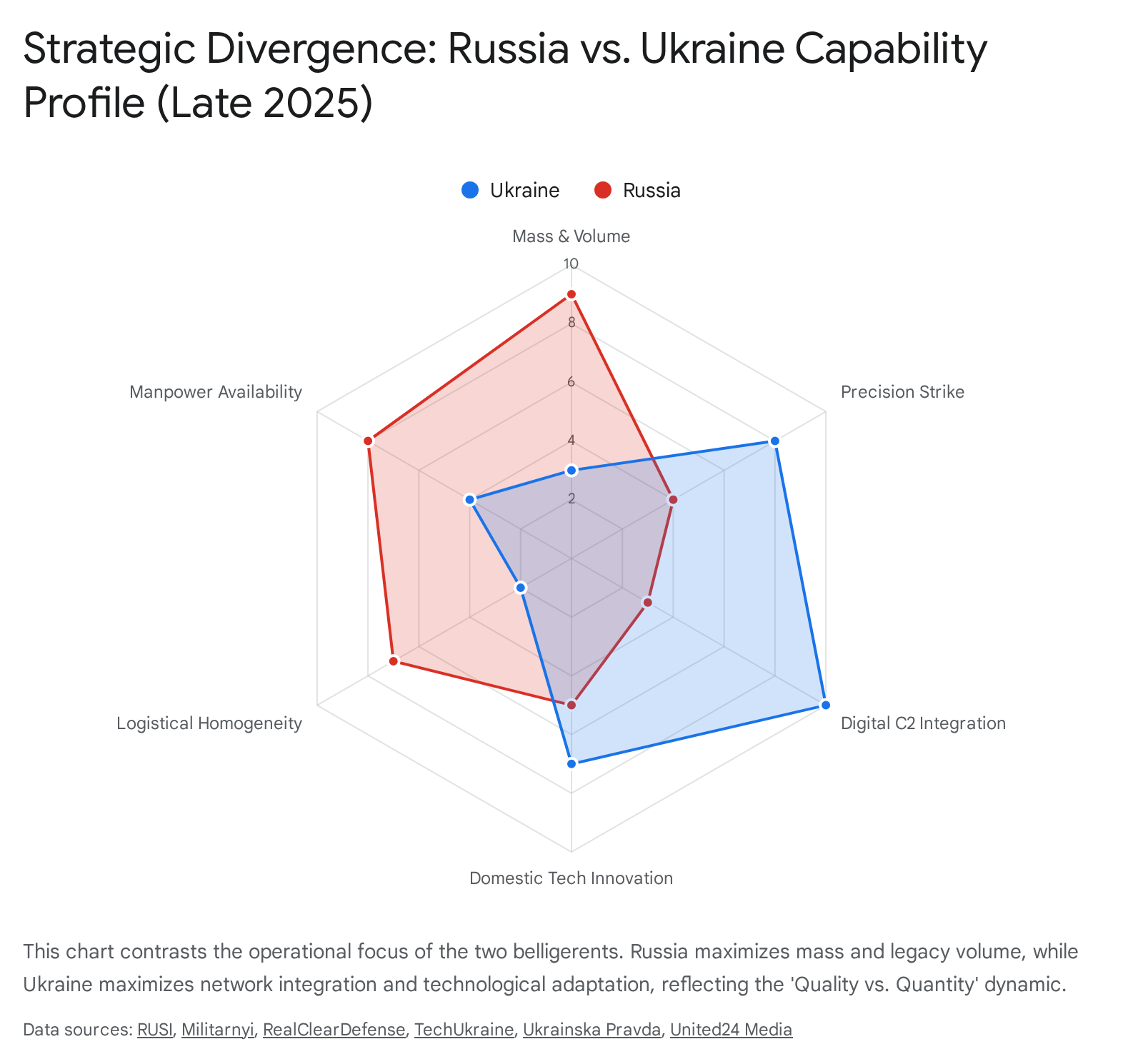
As the Russo-Ukrainian War approaches the culmination of its fourth year in late 2025, the strategic landscape is defined by a profound divergence in the trajectories of the two belligerents. The user’s intuition that the differences between the current state of the Ukrainian and Russian war machines would be “marked” is not only correct but underscores the fundamental nature of the conflict’s evolution. While the Russian Federation has largely settled into a strategy of industrial regression—relying on the mass reactivation of Soviet legacy armor, the simplification of technological inputs to bypass sanctions, and a brute-force mobilization of manpower—Ukraine has entered a period of strategic inflection characterized by rapid technological integration, industrial localization, and the institutionalization of asymmetric warfare.1

The analysis of late 2025 reveals that Ukraine is no longer merely surviving through the absorption of foreign aid; it is actively constructing a sovereign “deterrence ecosystem.” This ecosystem is built upon three pillars: the operationalization of an indigenous long-range strike complex capable of disregarding Western political caveats; the creation of the world’s first independent branch of service dedicated to unmanned systems; and the integration of its domestic defense industrial base (DIB) with Western manufacturing giants to form a localized production capability.4

This divergence is driven by necessity. Lacking the strategic depth of Russia’s Soviet-era stockpiles—where T-62 tanks are now being refurbished with crude field modifications and “cope cages” to fill losses—Ukraine has been forced to substitute mass with precision and software-defined lethality.7 The result is a Ukrainian force structure that is paradoxically heterogeneous—struggling with a “zoo” of incompatible NATO platforms—yet simultaneously pioneering network-centric capabilities like the “Delta” system that are now being sought by NATO members themselves.9 This report provides an exhaustive examination of these dynamics, contrasting the “regression and mass” strategy of Russia with the “evolution and integration” strategy of Ukraine, and detailing the specific industrial, logistical, and operational realities of late 2025.
Ronin's polymer handle being cut with a plastic knife on foil

2. The Indigenous Long-Range Strike Complex: Breaking the Range Limit

For the first two years of the full-scale invasion, Ukraine’s ability to project power was severely constrained by the geopolitical caveats attached to Western security assistance. Systems such as the HIMARS GMLRS and the Storm Shadow/SCALP-EG cruise missiles came with strict “geofencing” restrictions, prohibiting strikes on sovereign Russian territory to manage escalation risks. By late 2025, Kyiv has successfully shattered these constraints, not through diplomatic negotiation, but through the maturation of its own industrial capabilities. The emergence of a multi-layered, indigenous strike complex has fundamentally altered the strategic calculus, allowing Ukraine to threaten Russian logistics, airfields, and industrial hubs deep behind the border without seeking external permission.3

2.1 The Resurrection of “Sapsan” (Hrim-2)

The most consequential development in Ukraine’s strategic arsenal is the operational deployment of the Sapsan (also known as Hrim-2 or Grim-2) operational-tactical missile system. Originally conceived in 2006 as a superior successor to the aging Soviet Tochka-U, the program suffered from chronic underfunding and bureaucratic inertia for over a decade. However, the existential imperatives of 2022 forced an accelerated research and development cycle, transforming prototypes into combat-ready systems by late 2025.11

In December 2025, President Volodymyr Zelenskyy publicly confirmed that the Sapsan had begun combat operations, ending months of speculation regarding unexplained high-velocity strikes on Russian military infrastructure.11 The Sapsan represents a functional analogue to the Russian Iskander-M, but with critical distinctions tailored to Ukraine’s needs. The system is a single-stage solid-propellant ballistic missile with a confirmed operational range of approximately 500 kilometers for the domestic version, significantly outranging the export-limited 280-kilometer variants previously marketed to foreign partners.11

The strategic impact of the Sapsan cannot be overstated. With a warhead payload estimated at 480 kilograms and a terminal velocity reaching Mach 5.2, the missile presents a severe challenge to Russian air defense networks.12 Standard Russian interceptors, such as the S-300 and S-400 systems, struggle against the high-angle, high-speed terminal trajectory of the Sapsan, particularly when the launch originates from unexpected vectors. Unlike the subsonic cruise missiles and drones that have characterized previous Ukrainian deep strikes, the Sapsan’s ballistic profile reduces the reaction time for Russian defenders to mere minutes. This capability forces the Russian Aerospace Forces (VKS) to displace their staging airfields further into the interior, thereby reducing sortie rates and increasing the wear on airframes that are already suffering from sanctions-related maintenance deficits.11

2.2 The “Missile-Drone” Hybrid Ecosystem

While the Sapsan provides a high-end ballistic capability, Ukraine has simultaneously pioneered a new category of “missile-drones” designed to bridge the gap between expensive cruise missiles and slow, propeller-driven loitering munitions. This approach reflects a philosophy of “asymmetric cost imposition”—forcing Russia to expend scarce and expensive air defense interceptors against relatively low-cost, high-volume threats.14

The Palyanytsia, described as a “rocket-drone,” epitomizes this design philosophy. Utilizing a jet engine, the Palyanytsia achieves speeds significantly higher than the Iranian-designed Shahed drones used by Russia, yet it remains far cheaper to produce than a standard cruise missile like the Neptune or Storm Shadow.4 This system occupies the “middle tier” of Ukraine’s strike complex, designed to saturate air defenses and strike time-sensitive targets that would otherwise escape slower drones.

Complementing the Palyanytsia is the Peklo (meaning “Hell”), another entrant in this hybrid class designed for mass production. These systems, along with the Flamingo heavy cruise missile, create a diverse threat profile that complicates the air picture for Russian radar operators.4 By presenting a mix of ballistic trajectories (Sapsan), supersonic cruise profiles (Long Neptune), and high-speed drone swarms (Palyanytsia/Peklo), Ukraine creates a “kill web” that overwhelms the integrated air defense systems (IADS) of the adversary.

2.3 The Evolution of the Neptune

The R-360 Neptune, initially famous for the sinking of the cruiser Moskva in 2022, has undergone a significant evolution. By late 2025, the system has been adapted from a coastal defense anti-ship missile into a dedicated land-attack cruise missile, referred to as the “Long Neptune”.4 This variant features extended fuel capacity and updated guidance systems, including terrain-following radar and GPS/INS navigation, allowing it to strike targets deep within the Russian interior. Official reports indicate that the range of the Neptune has been increased to approximately 1,000 kilometers, placing Moscow and other critical command centers well within its engagement envelope.4

The table below summarizes the capabilities of Ukraine’s indigenous strike complex as of late 2025, highlighting the layered nature of this new deterrence capability.

System NameTypeOperational RangeRoleStatus (Late 2025)
Sapsan (Hrim-2)Ballistic Missile~500 kmDeep Precision Strike, Bunker BustingCombat Active 11
Long NeptuneCruise Missile~1,000 kmStrategic Infrastructure StrikeSerial Production 4
PalyanytsiaJet-Powered Drone~700 km (Est.)Air Defense Saturation, Time-Sensitive TargetsCombat Active 14
Vilkha-MGuided MLRS~130-150 kmTactical/Operational Precision StrikeResumed Production 15
PekloMissile-DroneUnspecifiedHigh-Volume SaturationIn Service 4
Table 1: Technical specifications and status of Ukraine’s indigenous long-range strike systems.

3. The Industrial Base Revolution: From Donation to Localization

If the defining characteristic of 2022-2023 was the solicitation of emergency aid from Western partners, the period of 2024-2025 is defined by the “localization” of defense production. Recognizing that Western stockpiles are finite and that political will in donor nations is subject to electoral volatility, Ukraine has aggressively courted Western defense giants to establish production facilities directly on Ukrainian soil. This strategy aims to shorten logistics chains, reduce dependency on foreign aid packages, and integrate Ukraine into the European NATO industrial base even prior to formal membership.6

3.1 The Rheinmetall Case Study: Building Under Fire

The experience of Rheinmetall AG, Germany’s largest arms manufacturer, serves as a bellwether for this industrial transition. By late 2025, Rheinmetall’s commitment to Ukraine has evolved from the supply of vehicles to deep industrial integration. The company has established a joint venture, in which it holds a 51% stake, to produce 155mm artillery ammunition—the absolute lifeblood of the attrition war in the Donbas.6

However, the reality of constructing high-tech manufacturing facilities in an active war zone has proven to be fraught with friction. The construction of the ammunition plant was delayed into late 2025, a setback attributed to a decision by the Ukrainian government to change the facility’s location.18 This decision was almost certainly driven by intelligence regarding potential Russian missile strikes, necessitating a move to a more hardened or geographically shielded site to ensure the facility’s survivability. Despite these delays, Rheinmetall CEO Armin Papperger has confirmed that once the location is finalized, the modular nature of the plant will allow for construction to be completed within 12 months, mirroring the speed of their domestic German facilities.20

Beyond ammunition, Rheinmetall is moving to produce the Lynx KF41 infantry fighting vehicle (IFV) in Ukraine. The Lynx represents a generational leap over the Soviet BMP-1 and BMP-2 series currently in service, offering modular armor, advanced optics, and superior crew protection. The production of the first five vehicles began in Germany for immediate delivery, with the ultimate goal of transferring the technology for full local manufacturing.20 This shift from “repairing” to “manufacturing” marks a critical maturity point in the Ukrainian DIB.

3.2 The Baykar “Iron Bird” Factory

Turkish drone manufacturer Baykar has proceeded with the construction of its factory near Kyiv, with completion slated for August 2025.22 Unlike Western companies that have largely focused on maintenance and ammunition initially, Baykar is building a full-cycle production facility for the Bayraktar TB2 and TB3 drones.23

This facility is highly symbolic and strategic. It has been targeted by Russian missiles at least four times during its construction phase, yet work has continued—a testament to the resilience of the project and the strategic commitment of the Turkish partner.24 The factory will employ Ukrainian-made engines for the drones, creating a closed-loop production cycle that benefits both the Turkish airframe designers and the Ukrainian propulsion industry.25 This collaboration underscores a deepening strategic axis between Kyiv and Ankara, independent of broader NATO dynamics.

3.3 BAE Systems and the Artillery Coalition

BAE Systems has established a local legal entity in Ukraine to facilitate the maintenance and eventual production of the L119 105mm Light Gun.16 The L119 has proven highly effective in the muddy, contested terrain of Eastern Ukraine due to its mobility and rate of fire. By localizing the maintenance of these systems, Ukraine drastically reduces the “turnaround time”—the critical metric of how long a gun is out of the fight for repairs. Agreements signed in late 2025 aim to transition from repair to the manufacturing of spare parts and eventually gun barrels, restoring a critical manufacturing capability that is scarce even in Western Europe.16

3.4 Domestic Production Surge

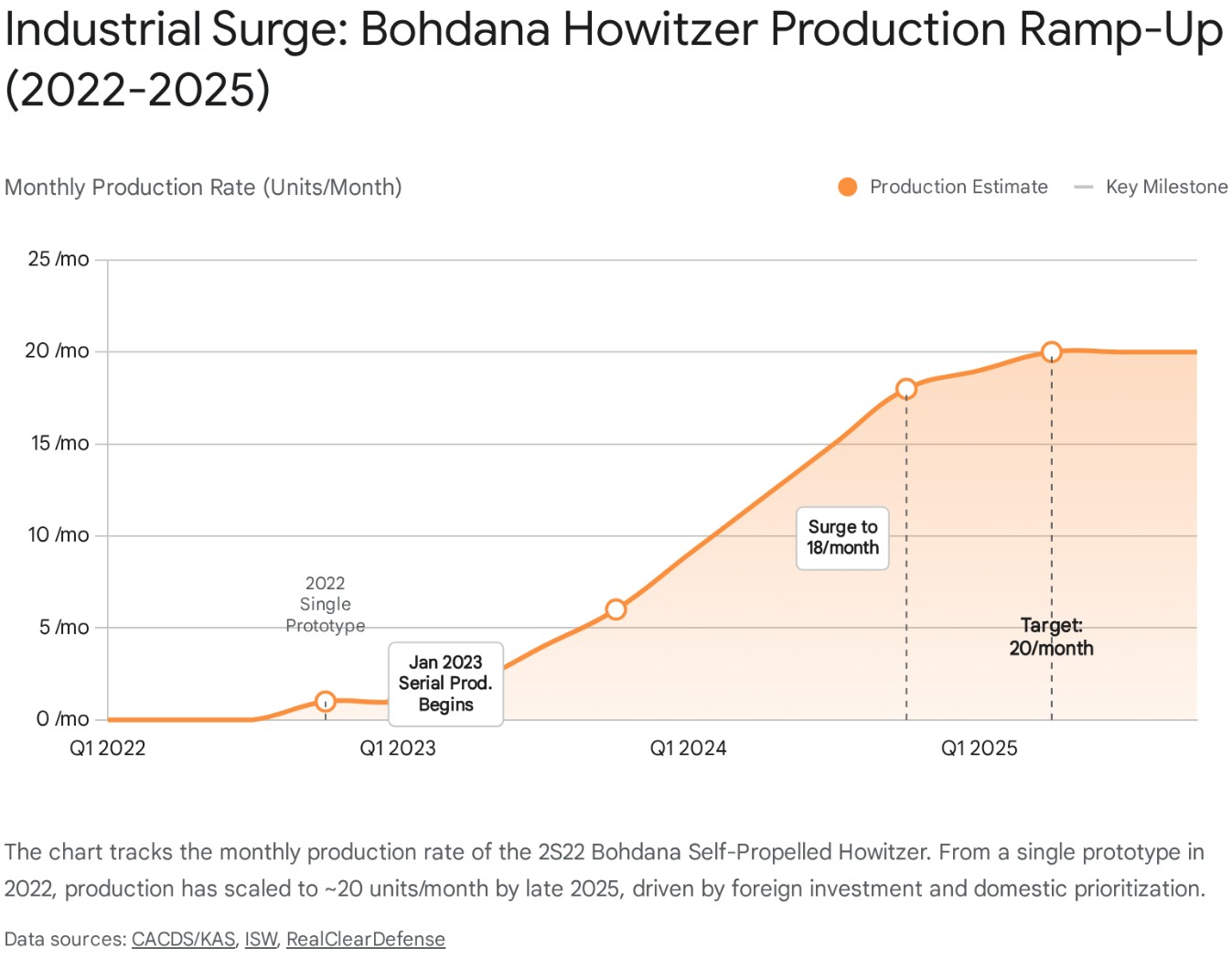
Parallel to these joint ventures, Ukraine’s domestic production has surged. The production of the 2S22 Bohdana self-propelled howitzer, a NATO-standard 155mm system mounted on a truck chassis, has reached a rate of 18-20 units per month by late 2025.4 This annualizes to over 200 new artillery systems per year—a figure that exceeds the total pre-war artillery procurement of many major NATO powers. Additionally, private companies like “Ukrainian Armored Vehicles” have scaled the production of mortars to 1,200 units annually and mines to 240,000 units, indicating that the domestic DIB is successfully filling the gaps left by fluctuating foreign aid.4
Ronin's polymer handle being cut with a plastic knife on foil

4. The Unmanned Systems Forces: Institutionalizing the Drone War

In a structural innovation that predates similar initiatives in Russia and most Western armies, Ukraine established the Unmanned Systems Forces (USF) as a separate, independent branch of its Armed Forces in 2024, achieving full operational capability by late 2025.5 This move signals a doctrinal shift, elevating drone warfare from a support function—akin to signals or logistics—to a primary combat arm comparable to the infantry or artillery.

4.1 Doctrine, Standardization, and the “Drone Line”

The primary mandate of the USF is to impose order on the chaos of the “drone zoo.” For years, Ukrainian units relied on a patchwork of volunteer-supplied commercial drones, resulting in thousands of incompatible platforms. The USF has implemented the “Drone Line” project, which centralizes the procurement and standardization of drones across the force.30 This initiative aims to streamline supply chains, ensuring that batteries, controllers, and spare parts are interchangeable across different units, a critical logistical requirement for sustaining high-intensity operations.

Furthermore, the USF has centralized pilot training. Moving away from the ad-hoc, unit-level training that characterized the early war, the USF has established standardized training centers that disseminate the latest tactical lessons—such as evading new Russian electronic warfare (EW) frequencies or executing terminal guidance maneuvers against moving targets—across the entire military.31 This institutional memory is a key asymmetric advantage over Russia, where drone competencies remain largely compartmentalized within specific units or dependent on individual commanders’ initiative.32

4.2 Scaling the “Missile-Drone”

The USF is also the primary operator of the new class of “missile-drones” discussed previously. By placing these strategic assets under a dedicated command, Ukraine ensures that they are employed in coordinated operational campaigns rather than penny-packet tactical strikes. The ability to coordinate a swarm of Palyanytsia jet-drones to suppress air defenses, followed immediately by Sapsan ballistic strikes on the exposed targets, represents a level of combined-arms synchronization that is only possible through a unified command structure like the USF.30

5. Network-Centric Warfare: The “Delta” Advantage

While Russia struggles with brittle command and control (C2) structures that rely on top-down rigidity and often lack horizontal communication, Ukraine has fully embraced network-centric warfare through its indigenous Delta system. By late 2025, Delta has evolved from a simple situational awareness tool into a comprehensive digital battle command platform that is attracting international customers and redefining NATO standards.10

5.1 The “Google for Military”

Delta is a cloud-based system that integrates real-time data from a vast array of sources: commercial and military satellite imagery, drone feeds, human intelligence reports (HUMINT), and sensors from Western-supplied equipment like counter-battery radars. It fuses this data into a “common operating picture” (COP) accessible to units down to the platoon level via secure tablets and terminals.34

The system’s most revolutionary contribution is the drastic reduction of the sensor-to-shooter cycle. In late 2025, the system demonstrated the ability to detect Russian hardware as unique units with an average detection time of just 2.2 seconds using AI-powered auto-detection algorithms.35 This speed is lethal in modern artillery duels; it allows Ukrainian gunners to engage Russian batteries effectively the moment they unmask, often before they can fire a second salvo or displace. This capability acts as a force multiplier, partially offsetting Russia’s lingering quantitative advantage in artillery tubes and ammunition stocks.

5.2 NATO Interoperability and Export Potential

In a reversal of the traditional “teacher-student” dynamic, NATO forces are now learning from the Ukrainian experience. Delta was successfully tested during NATO’s CWIX (Coalition Warrior Interoperability eXercise) and REPMUS 2025 exercises, where it coordinated over 100 unmanned platforms across maritime, air, and land domains.33 The system proved fully compatible with German, Polish, and Turkish C2 systems, validating its open-architecture design.

Crucially, in April 2025, an unnamed NATO member formally requested to acquire the Delta system, marking the first major export of Ukrainian digital defense technology.10 This signals that Ukraine’s “battle-forged” software is now considered superior to some peace-time systems developed by established Western defense contractors, validating Ukraine’s status as a burgeoning defense-tech power.

Ronin's polymer handle being cut with a plastic knife on foil

6. The “Zoo” Dilemma: Logistics and The Burden of Diversity

While innovation drives Ukraine forward, the legacy of emergency aid acts as a significant drag on operational efficiency. The Ukrainian military operates what Defense Minister Rustem Umerov and soldiers alike refer to as a “zoo”—a chaotic menagerie of incompatible platforms from dozens of donor nations.9 This logistical complexity stands in stark contrast to the relative homogeneity of Russian equipment, even as the latter degrades in quality.

6.1 The Armored Logistics Nightmare

By late 2025, the Ukrainian armored fleet includes Leopard 1s and 2s (German), Challenger 2s (British), M1 Abrams (American), PT-91s (Polish), CV90s (Swedish), and a vast array of Soviet-era T-72s, T-64s, and T-80s.9 This diversity creates a nightmare for maintainers:

  • Incompatible Supply Chains: Each of these platforms requires different sets of tools (metric vs. imperial), specific hydraulic fluids, unique engine parts, and specialized diagnostic software. A mechanic trained on a Leopard 2 diesel engine cannot intuitively repair the gas turbine of an Abrams.9
  • Maintenance Bottlenecks: To address deep maintenance needs, a Leopard 2 repair center was established in Lithuania. However, the transit time to transport a damaged tank from the Donbas to the Baltic states and back keeps critical assets off the battlefield for weeks or even months.38
  • The “Universal Mechanic”: To mitigate these delays, Ukraine has deployed mobile repair workshops closer to the front, capable of handling minor to moderate repairs. These units are staffed by mechanics who have had to become “universal experts,” learning to jury-rig repairs across a dozen different systems. This adaptability is commendable but inefficient compared to a standardized fleet.39

7. The Air Power Transition: Infrastructure and Integration

The Ukrainian Air Force in late 2025 is navigating a fragile transition from a Soviet-era fleet to a mixed Western-Soviet force. The integration of F-16s (donated by Denmark, the Netherlands, and Norway) and Mirage 2000-5Fs (from France) has provided a qualitative boost but created immense infrastructure challenges.40

7.1 Infrastructure and Dispersal

The F-16 Fighting Falcon is a delicate machine compared to the rugged Soviet MiGs. Its low-slung air intake makes it susceptible to foreign object damage (FOD), requiring pristine runways. This has necessitated a massive construction effort to upgrade airfields, pouring high-quality concrete and improving hangars while under the constant threat of Russian ballistic missile attacks.42 This infrastructure requirement limits the “dispersal” tactics Ukraine used successfully in the early war, where MiGs operated from rough improvised airstrips and highways, making the new F-16 bases obvious priority targets for the VKS.

7.2 Role Specialization and Supply Chains

The introduction of the French Mirage 2000-5F adds another layer of complexity. These aircraft are being specialized for the ground-attack role, serving as “flying launch trucks” for Western precision munitions like the SCALP-EG cruise missile and AASM Hammer glide bombs.41 This allows the F-16s to focus on air defense and anti-radiation missions (SEAD). While this division of labor optimizes the strengths of each airframe, it burdens the logistics system with two completely separate Western aviation supply chains—one American/NATO standard and one French—on top of the existing supply lines for the legacy Su-27 and MiG-29 fleet.43

8. The Human Element: Mobilization and the “Booking” System

Perhaps the most critical difference between the Ukrainian and Russian war efforts in 2025 is the management of human capital. While Russia continues to rely on a “crypto-mobilization” strategy—using high financial incentives to recruit contract soldiers from impoverished regions—Ukraine faces a tighter demographic constraint and has had to implement a sophisticated legal framework to balance the needs of the trench with the needs of the factory.44

8.1 The “Booking” (Reservation) System

To protect its booming defense industry from the manpower hunger of the front lines, the Ukrainian government introduced an updated “booking” mechanism (Resolution #1608) in late 2025. This system allows critical enterprises—specifically in the Defense Industrial Complex (DIC)—to reserve key employees from mobilization.45

  • Efficiency Improvements: The new rules grant a 45-day window for employees to correct military registration discrepancies without fear of immediate conscription and remove the cumbersome 72-hour waiting period for verifying reservation lists.45
  • Strategic Intent: This policy acknowledges a fundamental reality of modern war: a skilled welder at a drone factory or a software engineer working on the Delta system contributes more to the war effort in the rear than they would as a rifleman in a trench. It represents a shift towards a “total defense” economy where the labor force is managed as a strategic asset.

However, this system is not without friction. The labor shortage remains acute across the broader economy. With the mobilization age lowered and enforcement stricter, businesses outside the critical defense sector struggle to retain staff, creating economic drag that threatens the tax base needed to fund the military’s domestic expenditures.44

9. Comparative Analysis: Why the Differences are Marked

The user’s query posits that the differences between the Russian and Ukrainian reports will be “marked.” The evidence supports this conclusion unequivocally. The divergence stems from the different constraints and opportunities facing each nation.

Russia is adapting by regression and scaling.

Confronted with high-tech sanctions, a “brain drain” of skilled tech workers, and a reliance on vast Soviet stockpiles, Russia has chosen a path of simplification. It produces more of less capability. The widespread factory-standard installation of “cope cages” on T-62 tanks and the use of “meat grinder” assault tactics are symptomatic of a system that prioritizes mass over survivability or precision.7 Russian innovation is largely reactive—adapting EW to jam Western GPS munitions, for instance—rather than structural.48

Ukraine is adapting by evolution and integration.

Lacking the strategic depth of Soviet stockpiles to play the mass game, Ukraine has been forced to innovate to survive. It has integrated Western precision technology with its own rapid software development capabilities (Delta) and cost-effective strike solutions (missile-drones).

  • The “Zoo” as a Catalyst: While the “zoo” of Western equipment is a logistical nightmare, it has ironically forced Ukraine to become the most adaptable military in the world. Ukrainian maintainers and operators have developed a unique institutional flexibility, capable of integrating disparate systems—French missiles on Soviet jets, American radars with Ukrainian software—into a single coherent kill chain.
  • Sovereignty Reclaimed: The shift from “begging for ATACMS” to “firing Sapsans” marks the psychological and strategic pivot of 2025. Ukraine is no longer asking for permission to strike the enemy; it is building the capacity to do so on its own terms.

10. Conclusion

In late 2025, the Ukrainian military is a paradoxical entity. It is simultaneously struggling with the friction of a heterogeneous, donor-dependent arsenal and leading the world in the application of digital, unmanned, and precision warfare. It is a force built not on the uniformity of the past, like its Russian adversary, but on the agile, chaotic, and lethal diversity of the future. The transition from a recipient of aid to a producer of capabilities—epitomized by the combat debut of the Sapsan missile and the export of the Delta system—suggests that while Russia is preparing for a long war of attrition, Ukraine is preparing for a war of technological decision.


Please share the link on Facebook, Forums, with colleagues, etc. Your support is much appreciated and if you have any feedback, please email us in**@*********ps.com. If you’d like to request a report or order a reprint, please click here for the corresponding page to open in new tab.


Sources Used

  1. Wartime Zapad 2025 Exercise: Russia’s Strategic Adaptation and …, accessed December 20, 2025, https://my.rusi.org/resource/wartime-zapad-2025-exercise-russias-strategic-adaptation-and-nato.html
  2. Russian Defense Industry Sees Sharp Production Decline After …, accessed December 20, 2025, https://militarnyi.com/en/news/russian-defense-industry-sees-sharp-production-decline-after-three-years-of-growth/
  3. Ukraine’s Missile Program 2025: Arsenal, Scaling & Export Potential | The Gaze, accessed December 20, 2025, https://thegaze.media/news/ukraines-missile-program-2025-what-already-exists-what-is-maturing-to-series-production-and-where-the-export-potential-lies-after-the-war
  4. Recent Trends in the Development of Ukraine’s Military-Industrial Complex in an International Context – Konrad-Adenauer-Stiftung, accessed December 20, 2025, https://www.kas.de/documents/d/ukraine/cacds_ukraine_mic_eng
  5. Russia Launches New Drone Warfare Branch to Boost Unmanned Forces – Kyiv Post, accessed December 20, 2025, https://www.kyivpost.com/post/64093
  6. A powerful partner at Ukraine’s side – Rheinmetall, accessed December 20, 2025, https://www.rheinmetall.com/en/media/stories/2023/rheinmetall-a-powerful-partner-at-ukraine-side
  7. How Many T-72 and T-90M Tanks UralVagonZavod Produced for the russian Army in 2024, accessed December 20, 2025, https://en.defence-ua.com/industries/how_many_t_72_and_t_90m_tanks_uralvagonzavod_produced_for_russian_army_in_2024-13088.html
  8. Russians Show T-62M and T-62MV Tanks Upgrades: Self-Entrenching Blades, Tank Sweeps and EW – Militarnyi, accessed December 20, 2025, https://militarnyi.com/en/news/russians-show-t-62m-and-t-62mv-tanks-upgrades-self-entrenching-blades-tank-sweeps-and-ew/
  9. Give Ukraine the tanks it needs, not a ‘petting zoo’ – Defense News, accessed December 20, 2025, https://www.defensenews.com/opinion/commentary/2023/02/10/give-ukraine-the-tanks-it-needs-not-a-petting-zoo/
  10. Ukraine’s Battle-Forged DELTA System Catches NATO Eye: Export Talks Underway for Advanced Situational Awareness Platform · TechUkraine, accessed December 20, 2025, https://techukraine.org/2025/04/30/ukraines-battle-forged-delta-system-catches-nato-eye-export-talks-underway-for-advanced-situational-awareness-platform/
  11. Zelenskyy Confirms Ukraine Is Now Firing Its New Sapsan Homegrown Ballistic Missile Against Russia – UNITED24 Media, accessed December 20, 2025, https://united24media.com/latest-news/zelenskyy-confirms-ukraine-is-now-firing-its-new-sapsan-homegrown-ballistic-missile-against-russia-14185
  12. 1KR1 Sapsan – Wikipedia, accessed December 20, 2025, https://en.wikipedia.org/wiki/1KR1_Sapsan
  13. Sanctions And Strikes Threaten Russia’s Sukhoi Jet Supply – Grand Pinnacle Tribune, accessed December 20, 2025, https://evrimagaci.org/gpt/sanctions-and-strikes-threaten-russias-sukhoi-jet-supply-516155
  14. If Zelensky’s Claim Of Using Homegrown Ballistic Missile For First Time Is True, It’s A Big Deal – The War Zone, accessed December 20, 2025, https://www.twz.com/land/if-zelenskys-claim-of-using-homegrown-ballistic-missile-for-first-time-is-true-its-a-big-deal
  15. Ukraine’s Long-Term Path to Success: Jumpstarting a Self-Sufficient Defense Industrial Base with US and EU Support – Institute for the Study of War, accessed December 20, 2025, https://understandingwar.org/research/russia-ukraine/ukraines-long-term-path-to-success/
  16. Defence Secretary opens BAE Systems artillery factory in Sheffield, accessed December 20, 2025, https://www.baesystems.com/en/article/defence-secretary-opens-bae-systems-sheffield
  17. Joint venture in the Ukraine – Rheinmetall, accessed December 20, 2025, https://www.rheinmetall.com/en/media/news-watch/news/2024/02/2024-02-19-joint-venture-in-the-ukraine
  18. Rheinmetall delays Ukraine factory launch due to location change – AgroReview, accessed December 20, 2025, https://agroreview.com/en/newsen/rheinmetall-explains-the-delay-launching/
  19. “We were told that a new construction site would be designated very quickly.” Rheinmetall CEO explains why the plant launch in Ukraine is delayed and what it will produce there | dev.ua, accessed December 20, 2025, https://dev.ua/en/news/nam-skazaly-shcho-nove-mistse-dlia-budivnytstva-bude-pryznacheno-duzhe-shvydko-kerivnyk-rheinmetall-poiasnyv-z-chym-poviazana-zatrymka-zapusku-zavodu-v-ukraini-1762510818
  20. Construction of Rheinmetall plant in Ukraine delayed: CEO names reason, accessed December 20, 2025, https://unn.ua/en/news/construction-of-rheinmetall-plant-in-ukraine-delayed-ceo-names-reason
  21. Lynx (Rheinmetall armoured fighting vehicle) – Wikipedia, accessed December 20, 2025, https://en.wikipedia.org/wiki/Lynx_(Rheinmetall_armoured_fighting_vehicle)
  22. Baykar Set to Complete Drone Factory in Ukraine by August 2025 – Militarnyi, accessed December 20, 2025, https://militarnyi.com/en/news/baykar-set-to-complete-drone-factory-in-ukraine-by-august-2025/
  23. Timeline for completion of Bayraktar production plant in Ukraine announced, accessed December 20, 2025, https://newsukraine.rbc.ua/news/timeline-for-completion-of-bayraktar-production-1729787400.html
  24. Russian strike hits Turkish drone maker Baykar’s factory in Kyiv – Türkiye Today, accessed December 20, 2025, https://www.turkiyetoday.com/world/russian-strike-hits-turkish-drone-maker-baykars-factory-in-kyiv-3206097
  25. Turkish drone maker pledges to rebuild destroyed Ukraine factory, accessed December 20, 2025, https://turkishminute.com/2025/10/13/turkish-drone-maker-pledges-to-rebuild-destroyed-ukraine-factory/
  26. BAE Systems establishes local presence and signs agreements to support Ukraine, accessed December 20, 2025, https://www.baesystems.com/en/article/bae-systems-establishes-local-presence-and-signs-agreements-to-support-ukraine
  27. Ukraine, UK agree on joint artillery production – Defence Blog, accessed December 20, 2025, https://defence-blog.com/ukraine-uk-agree-on-joint-artillery-production/
  28. Russia’s War Transforms Ukraine into a World-Leading Military Producer | RealClearDefense, accessed December 20, 2025, https://www.realcleardefense.com/articles/2025/10/07/russias_war_transforms_ukraine_into_a_world-leading_military_producer_1139249.html
  29. Unmanned Systems Forces have become a separate branch of the Armed Forces of Ukraine – Militarnyi, accessed December 20, 2025, https://militarnyi.com/en/news/unmanned-systems-forces-have-become-a-separate-branch-of-the-armed-forces-of-ukraine/
  30. Ukraine unites Unmanned Systems Forces with top ‘Drone Line’ units under new command group – The Kyiv Independent, accessed December 20, 2025, https://kyivindependent.com/ukraine-creates-new-grouping-of-unmanned-systems-forces/
  31. Why Ukraine is Establishing Unmanned Forces Across Its Defense Sector and What the United States Can Learn from It – CSIS, accessed December 20, 2025, https://www.csis.org/analysis/why-ukraine-establishing-unmanned-forces
  32. Russian Efforts to Centralize Drone Units May Degrade Russian Drone Operations | ISW, accessed December 20, 2025, https://understandingwar.org/research/russia-ukraine/russian-efforts-to-centralize-drone-units-may-degrade-russian-drone-operations-2/
  33. Ukrainian combat system DELTA became primary command platform for combined multinational team at NATO exercises | MoD News, accessed December 20, 2025, https://mod.gov.ua/en/news/ukrainian-combat-system-delta-became-primary-command-platform-for-combined-multinational-team-at-nato-exercises
  34. Battlefield Innovation: Ukraine’s DELTA System Paves the Way for Allied Interoperability at CWIX24 – NATO’s ACT, accessed December 20, 2025, https://www.act.nato.int/article/delta-system-cwix/
  35. Ukrainian DELTA system has verified over 130000 Russian targets hit in two months, accessed December 20, 2025, https://www.pravda.com.ua/eng/news/2025/10/08/8001757/
  36. The EU Military Assistance Mission for Ukraine – A peace actor who teaches to fight, accessed December 20, 2025, https://www.delorscentre.eu/en/publications/the-eu-military-assistance-mission-for-ukraine
  37. Can Ukraine maintain and optimally use its modern Western tanks? – The Kyiv Independent, accessed December 20, 2025, https://kyivindependent.com/can-ukraine-make-optimal-use-of-western-tanks-and-attack-vehicles/
  38. Lithuania Will Soon Build More German Leopard Tanks – The National Interest, accessed December 20, 2025, https://nationalinterest.org/blog/buzz/lithuania-will-soon-build-more-german-leopard-tanks-ps-121925
  39. Tanks, missiles, sanctions and motivated engineers: inside the world of Russian weapons production | Ukrainska Pravda, accessed December 20, 2025, https://www.pravda.com.ua/eng/articles/2025/11/14/8007314/
  40. A Look Ahead For The Ukranian Air Force In 2025 – Simple Flying, accessed December 20, 2025, https://simpleflying.com/look-ahead-ukranian-air-force-2025/
  41. Ukrainian Air Force receives its first Mirage 2000s and more F-16s – Euro-sd, accessed December 20, 2025, https://euro-sd.com/2025/02/major-news/42468/ps-zsu-gets-first-mirage-2000s/
  42. Cases For (and Against) F-16, Gripen and Mirage in Ukraine – Großwald, accessed December 20, 2025, https://www.grosswald.org/is-the-runway-long-enough-the-case-for-and-against-the-f-16-in-ukraine-next-swedish-gripen-and-french-mirage-fighter-jets/
  43. How to enhance the Ukrainian Air Force? – Defence24.com, accessed December 20, 2025, https://defence24.com/armed-forces/how-to-enhance-the-ukrainian-air-force
  44. Army at a crossroads: the mobilisation and organisational crisis of the Defence Forces of Ukraine | OSW Centre for Eastern Studies – Ośrodek Studiów Wschodnich, accessed December 20, 2025, https://www.osw.waw.pl/en/publikacje/osw-commentary/2025-03-14/army-a-crossroads-mobilisation-and-organisational-crisis
  45. Policy Win: Cabinet of Ministers of Ukraine Updated Employees Reservation Rules to Support the Defense Industry Workforce Potential, accessed December 20, 2025, https://chamber.ua/success-stories/policy-win-cabinet-of-ministers-of-ukraine-updated-employees-reservation-rules-to-support-the-defense-industry-workforce-potential/
  46. Accelerated reservation for businesses: 45-day mechanism for the defense industry and cancellation of the 72-hour check | Cabinet of Ministers of Ukraine, accessed December 20, 2025, https://www.kmu.gov.ua/en/news/pryskorene-broniuvannia-dlia-biznesu-45-dennyi-mekhanizm-dlia-opk-ta-skasuvannia-72-hodynnoi-perevirky
  47. How Ukraine’s New Mobilization Law Impacts Human Rights and Global Food Systems, accessed December 20, 2025, https://just-access.de/how-ukraines-new-mobilization-law-impacts-human-rights-and-global-food-systems/
  48. Seven Contemporary Insights on the State of the Ukraine War – CSIS, accessed December 20, 2025, https://www.csis.org/analysis/seven-contemporary-insights-state-ukraine-war

The Impact of Ukraine War on Russian Military Modernization

The full-scale invasion of Ukraine on February 24, 2022, stands as a watershed moment in the history of the Russian Federation, serving as a brutal crucible for its armed forces and a definitive stress test for its decades-long military modernization efforts. Prior to this conflict, the Kremlin’s strategic vision—codified in the State Armament Programmes (GPV-2020 and GPV-2027)—was predicated on a transition from a Soviet-era mass mobilization army to a compact, professional, network-centric force capable of rapid expeditionary warfare and precision strikes. The war has violently derailed this linear trajectory, imposing a complex duality upon Russia’s military development: it acts simultaneously as a catastrophic strategic setback for high-end technological ambitions and a potent tactical accelerator for industrial scaling, combat adaptation, and the integration of autonomous systems.

This report, based on a comprehensive analysis of open-source intelligence, defense industrial data, and strategic doctrine, argues that the war has forced a “primitivization” of Russia’s strategic platforms while necessitating a “hyper-adaptation” in niche tactical domains. The aspiration for a high-tech “Armata” army has been shelved in favor of a mass-produced “T-90M and refurbished T-72” army. The result is not the modernized force envisioned in 2020, but a hybrid entity: larger, cruder, and heavily reliant on mass fires and attrition, yet increasingly lethal in its integration of cheap, expendable technologies like First-Person View (FPV) drones and glide bombs.

The analysis dissects this transformation across five key domains: Ground Forces and Armor, Aerospace and Missile Forces, Naval Operations, the Defense Industrial Base (DIB), and Strategic Weapons. It concludes that while Russia has successfully transitioned to a “military Keynesian” economy to sustain a long war, the structural degradation of its scientific-technical base, the severance from global high-tech supply chains, and the loss of human capital will severely constrain its ability to compete with NATO technologically in the post-2030 timeframe. Russia is trading its future modernization potential for immediate battlefield survivability, creating a force that is dangerous in its mass and resilience but increasingly obsolete in its underlying architecture.

Ronin's polymer handle being cut with a plastic knife on foil

1. The Pre-War Baseline: The “New Look” and the Promise of GPV-2027

To understand the magnitude of the shift caused by the war in Ukraine, one must first establish the baseline of Russia’s pre-war military trajectory. Following the perceived underperformance of the Russian Armed Forces during the 2008 Russo-Georgian War, the Kremlin initiated a sweeping series of reforms known as the “New Look.” Spearheaded by then-Defense Minister Anatoly Serdyukov and continued by his successor Sergei Shoigu, these reforms aimed to dismantle the skeletonized Soviet mobilization model—which relied on millions of reservists and vast stockpiles of equipment—and replace it with “permanent readiness units” staffed by professional contract soldiers (kontraktniki).1

1.1. The Ambitions of the State Armament Programmes

The financial engine of this modernization was the State Armament Programme (GPV). The GPV-2020, allocated 19.4 trillion rubles, succeeded in stabilizing the defense industry and updating the nuclear triad, but struggled to deliver next-generation conventional platforms.1 Its successor, GPV-2027 (2018–2027), was designed to be the “smart” phase of modernization. With a budget of approximately 20 trillion rubles ($330 billion), it prioritized precision-guided munitions (PGMs), autonomous systems, and the serial production of “breakthrough” platforms like the T-14 Armata tank and the Su-57 fighter.1

The strategic logic was clear: Russia acknowledged it could not match NATO in sheer expenditure or naval tonnage, so it sought asymmetric parity through superior missile technology (hypersonics), advanced air defense (A2/AD bubbles), and a highly mobile, networked ground force capable of winning short, decisive regional conflicts.

1.2. The Reality Check of 2022

The invasion of Ukraine exposed the hollowness of many of these assumptions. The “New Look” force, organized into Battalion Tactical Groups (BTGs), proved brittle in high-intensity combat. The reliance on sophisticated but few platforms (the “boutique army” concept) left Russia without the strategic depth to absorb losses. By 2025, the GPV-2027 goals have been largely rendered obsolete by the voracious demands of attrition warfare. The Kremlin has been forced to pivot from a modernization strategy based on quality to a survival strategy based on quantity and substitution.1

2. Ground Forces and Armor: The Death of the “Parade Army”

The Russian Ground Forces were the primary intended beneficiaries of the pre-war modernization drive. The vision was a force equipped with the Armata universal combat platform, a revolutionary family of vehicles sharing a common chassis, networked for data-centric warfare. The war has shattered this vision, replacing it with a grim industrial pragmatism.

2.1. The Failure of Next-Generation Platforms

By 2025, the T-14 Armata Main Battle Tank (MBT) remains virtually absent from the operational theater. Despite Rostec CEO Sergei Chemezov confirming the delivery of serially produced T-14s to the Ground Forces, he explicitly cast doubt on their deployment to Ukraine, citing their “exorbitant cost” and the need for funds to create cheaper, more disposable weapons.4

This admission is devastating for the narrative of Russian technological superiority. The T-14 was marketed as the world’s first “fourth-generation” tank, featuring an unmanned turret and an armored crew capsule. Its absence suggests two critical failures:

  1. Technological Maturity: The system likely suffers from unresolved reliability issues, particularly in its fire control and engine systems, which would be catastrophic in the mud and chaos of the Donbas.
  2. Risk Aversion: The Kremlin fears the reputational damage of a T-14 being destroyed or, worse, captured by Ukrainian forces and examined by Western intelligence.4

Consequently, the “modernization” of the tank fleet has shifted from innovation (fielding new chassis) to restoration (upgrading legacy hulls). The T-14 has effectively been relegated to the status of a “parade tank,” while the workhorse duties fall to older designs.

2.2. The T-90M “Proryv” and the Pivot to Mass

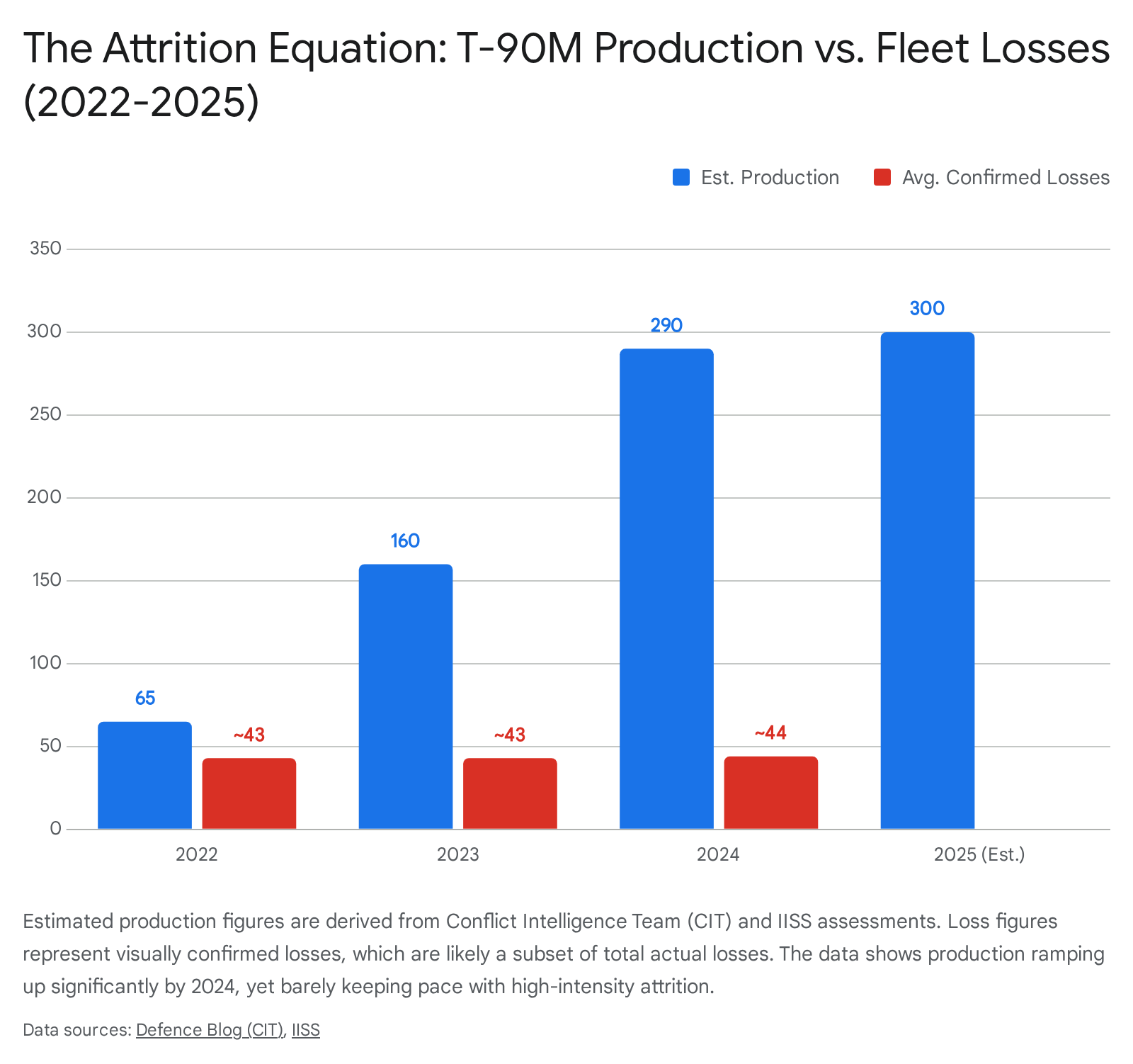
In the vacuum left by the T-14, the T-90M “Proryv” has emerged as the apex of Russian armored capability. Analysis of production rates indicates a significant, albeit insufficient, industrial surge. In 2022, Uralvagonzavod produced an estimated 60–70 T-90Ms. By 2024, utilizing 24-hour production cycles and expanded facilities, this figure had risen to approximately 280–300 units annually.6

This scaling represents a genuine industrial success for the Russian command economy. The T-90M is a formidable platform, featuring the Relikt explosive reactive armor (ERA), the 2A46M-5 gun, and improved thermal imaging. However, this “modernization” is relative. The T-90M is ultimately an evolution of the Soviet T-72 design, retaining the legacy autoloader and crew layout.

Furthermore, the attrition rates in Ukraine are staggering. Russia has lost over 3,000 tanks since February 2022, a number that exceeds its entire active pre-war fleet.7 While current production levels of T-90Ms and refurbished T-72B3s are sufficient to maintain fleet numbers for several more years 9, the quality of the fleet is bifurcating.

  • The Elite Tier: A small percentage of units (VDV, Naval Infantry, Guards Tank Armies) are equipped with factory-fresh T-90Ms.
  • The Mass Tier: The vast majority of mobilized units and assault detachments are equipped with older T-72s, T-62Ms, and even T-54/55s pulled from deep storage and minimally upgraded with thermal sights and “cope cages”.10

This dynamic signifies a technological regression. The average age of a tank in the Russian army in 2025 is significantly higher than it was in 2021. The reliance on refurbishment means that this “modernization” is cannibalistic; it depends on a finite stock of Soviet-era hulls that analysts estimate will be exhausted by 2026-2027.8

Ronin's polymer handle being cut with a plastic knife on foil

2.3. Degradation of Fighting Vehicles and Artillery

The situation is even more acute with Infantry Fighting Vehicles (IFVs) and artillery. The pre-war plan was to transition to the Kurganets-25 and Boomerang platforms. These programs, like the Armata, have stalled. Instead, the industry has struggled to produce even the late-Soviet BMP-3 and BMD-4 at rates that match battlefield losses.10

This production bottleneck has led to the widespread “de-modernization” of mechanized infantry. Units are increasingly deploying in BMP-1s (introduced in 1966) and MT-LBs (originally artillery tractors). The modernization efforts for these vehicles are purely functional improvisations—welding naval anti-aircraft guns (2M-3) or crude anti-drone screens onto the chassis.10 This represents a return to a mid-Cold War technological standard.

In the artillery domain—the “God of War” in Russian doctrine—the shift is from precision to volume. The loss of modern self-propelled guns (SPGs) like the 2S19 Msta-S has forced a reliance on towed artillery and older systems pulled from storage. However, the true accelerator in this domain is the integration of the kill chain. While the guns are getting older (and barrel wear is becoming a critical issue), the targeting cycle is becoming faster and more networked. The ubiquitous presence of commercial drones (Mavic 3) and military reconnaissance UAVs (Orlan-10/30) has shortened the time from target acquisition to fire mission from minutes to seconds.11 This paradox—older tubes, newer eyes—defines the current state of Russian fire support.

2.4. Tactical Evolution: The Rise of the “Storm” Detachment

The structural modernization of the Russian army has also been radically altered. The pre-war BTG structure, designed for maneuver warfare, proved too fragile. In its place, Russia has adopted the “assault detachment” (Storm-Z, Storm-V) structure.10 These are smaller, infantry-centric units designed for grinding urban combat and trench assaults. This is not the high-tech, network-centric warfare envisioned in 2020; it is a regression to World War I stormtrooper tactics, albeit enabled by drone reconnaissance. While this represents a setback in operational art, it is an effective adaptation to the reality of positional warfare against a deeply entrenched enemy.

3. Aerospace Forces: The Gap Between Stealth and Reality

The Russian Aerospace Forces (VKS) entered the war with a reputation as a near-peer competitor to the U.S. Air Force, bolstered by a decade of modernization and combat experience in Syria. The war in Ukraine has severely damaged this prestige, revealing critical limitations in training, doctrine, and the availability of precision-guided munitions (PGMs).

3.1. The Su-57 “Felon”: A No-Show in Contested Airspace

The Su-57 “Felon,” Russia’s fifth-generation stealth fighter, serves as a microcosm of the broader modernization failure. While Russian officials, including Rostec CEO Sergei Chemezov, claim the aircraft has “completed combat operations” and is being upgraded based on lessons learned 12, there is no verifiable evidence of it operating inside contested Ukrainian airspace. Instead, it appears to be used exclusively as a standoff launch platform from deep within Russian territory, firing long-range missiles like the R-37M or Kh-69.12

This cautious employment suggests a lack of confidence in the aircraft’s stealth characteristics or survivability against Western-supplied air defense systems (Patriot, NASAMS, IRIS-T). Furthermore, the reported damage to a Su-57 on the ground at Akhtubinsk airbase by a Ukrainian drone 15 underscores a humiliating infrastructure failure: Russia’s most advanced assets are safer in the air than they are on the ground, due to a failure to build hardened aircraft shelters (HAS)—a basic requirement that has been neglected in favor of procuring flashy platforms. The inability to protect the Su-57 fleet on the ground creates a strategic vulnerability that negates its theoretical airborne capabilities.

3.2. The “Glide Bomb” Adaptation: Technology of Necessity

If the Su-57 represents a modernization setback, the wide-scale adoption of UMPK (Unified Module for Planning and Correction) glide bombs represents a successful, albeit crude, adaptation.11 Realizing that its stock of expensive cruise missiles (Kalibr, Kh-101) was finite and that its aircraft could not safely operate over Ukraine due to dense air defenses, the VKS retrofitted “dumb” gravity bombs (FAB-500, FAB-1500, and even the massive FAB-3000) with cheap pop-out wing kits and GPS/GLONASS guidance.

This innovation has allowed the VKS to leverage its massive Soviet-era bomb stockpiles to deliver devastating strikes from stand-off ranges (50-70km), staying just outside the reach of most Ukrainian medium-range air defenses. This is an accelerator of capability, but one born of technological regression. It substitutes the precision of a purpose-built missile with the brute force of a heavy bomb, accepting lower accuracy for higher volume and significantly lower cost. It has fundamentally altered the frontline dynamics, allowing Russian tactical aviation to provide close air support without entering the engagement envelope of MANPADS.

3.3. Pilot Attrition and Training Degradation

A critical, often overlooked aspect of military modernization is human capital. The VKS has lost a significant number of experienced pilots, including senior officers who were forced to fly combat sorties due to a lack of qualified juniors.16 The training pipeline has been compressed to fill these gaps, leading to a long-term degradation in pilot quality.

The “modernization” of pilot training is now focused on the immediate needs of the “Special Military Operation” (SMO)—low-level flying, unguided rocket attacks, and glide bomb releases—rather than complex, large-force employment exercises (COMAO) required for peer conflict with NATO. This creates a generation of pilots who are combat-experienced but tactically limited. They are experts in the specific, constrained environment of the Ukraine war but are arguably less prepared for a multi-domain fight against a technologically superior air force.

4. The Unmanned Revolution: An Accelerator of Innovation

If traditional domains have seen regression, the field of unmanned systems has witnessed explosive acceleration. The war in Ukraine is widely recognized as the world’s first “drone war” 17, and Russia, after an initial lag where it relied on expensive and scarce Orlan-10s, has aggressively adapted its industrial and tactical approach.

4.1. Industrialization of the “Shahed”: The Alabuga Complex

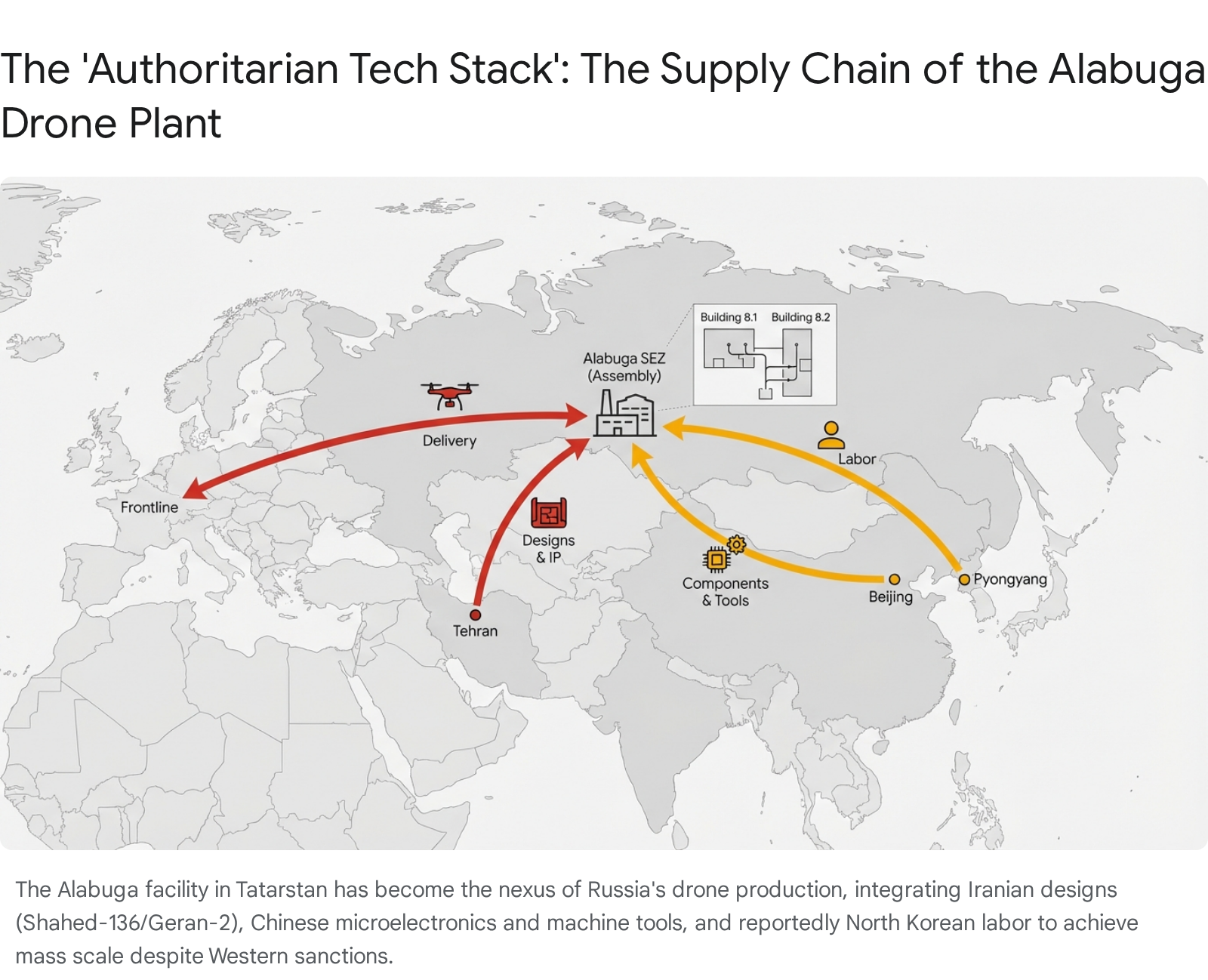
The establishment and expansion of the drone production facility in the Alabuga Special Economic Zone (Tatarstan) represents the most significant industrial achievement of the war. Originally assembling Iranian-supplied Shahed-136 (Geran-2) kits, Alabuga has transitioned to full-cycle domestic production. Satellite imagery and intelligence reports indicate plans to produce 6,000 units annually by 2025, a goal that appears to be ahead of schedule.18

This facility is a symbol of a new “Authoritarian Tech Stack,” where Russia integrates technologies and labor from its few remaining allies.

  • Iran: Provided the base design (Shahed-136) and initial tooling.
  • China: Supplies the microelectronics, carburetors, and CNC machine tools required for mass production.20
  • North Korea: Intelligence reports suggest the planned deployment of North Korean labor to Alabuga to resolve chronic workforce shortages.22

This international collaboration has allowed Russia to bypass Western sanctions and achieve a scale of production for long-range strike assets that NATO countries are currently struggling to match.

Ronin's polymer handle being cut with a plastic knife on foil

4.2. FPV Drones and the “Sudoplatov” Model

At the tactical level, Russia has institutionalized the use of First-Person View (FPV) drones. The “Sudoplatov” volunteer battalion, which established a drone training and production school, exemplifies a shift from centralized, top-down procurement to decentralized, grassroots innovation.24 While initial iterations were criticized for poor quality and vulnerability to EW, the sheer volume of production—claimed to be thousands per day—has created a ubiquitous threat on the battlefield.25

This shift has forced a modernization of doctrine. The Russian military is creating specialized drone operators and units at the platoon level, a structural change that was not present in the 2021 order of battle. The “Rubicon” center for advanced drone technologies represents an attempt to centralize and standardize these grassroots innovations, integrating artificial intelligence for terminal guidance to overcome Ukrainian electronic warfare.11 This is a clear case of the war acting as an accelerator; without the conflict, the Russian military bureaucracy would likely have taken a decade to integrate FPV technology to this extent.

4.3. Electronic Warfare: The Invisible Modernization

Russia’s Electronic Warfare (EW) capabilities have also accelerated. Systems like the Pole-21 and Zhitel have been deployed in unprecedented density, creating “dead zones” for GPS-guided munitions and drones. The adaptation here is the shift from protecting high-value strategic assets to providing blanket coverage for trench lines. This constant cat-and-mouse game with Ukrainian drone operators has honed Russian EW operators into arguably the most combat-experienced in the world 27, a capability that poses a significant threat to NATO’s reliance on precision, networked warfare.

5. Naval Forces: A Tale of Two Fleets

The war has bifurcated the Russian Navy into two distinct realities: the beleaguered Black Sea Fleet, which has faced a modernization crisis, and the protected strategic submarine force, which continues to modernize largely largely unimpeded.

5.1. The Black Sea Fleet: A Strategic Defeat and Doctrinal Crisis

The Black Sea Fleet has suffered catastrophic losses, including its flagship, the Moskva, and roughly one-third of its combat power.28 Ukraine’s innovative use of Unmanned Surface Vessels (USVs) and coastal defense cruise missiles (Neptune, Harpoon) has forced the fleet to abandon its headquarters in Sevastopol and retreat to Novorossiysk.28

This defeat has forced a radical rethink of naval doctrine. The large surface combatants that were the pride of the fleet proved defenseless against cheap, asymmetric threats. The pre-war plans for large destroyers and carriers (Project 23000E Shtorm) now appear fantastical. The future of the Russian surface navy likely lies in smaller, corvette-sized vessels (Project 22800 Karakurt) equipped with long-range Kalibr or Zircon missiles, operating from the relative safety of coastal waters.30 The concept of “sea control” has been replaced by “sea denial” and fleet preservation.

5.2. The Submarine Force: Uninterrupted Modernization

Conversely, the submarine force—the cornerstone of Russia’s strategic deterrent—has continued its modernization largely unimpeded. The construction of Borei-A class ballistic missile submarines (SSBNs) and Yasen-M class cruise missile submarines (SSGNs) continues at the Sevmash shipyards.30

The Yasen-M class, in particular, remains a potent threat to NATO, capable of launching the hypersonic Zircon missile.30 The divergence between the surface and subsurface fleets highlights a strategic prioritization: the Kremlin is willing to sacrifice “gunboat diplomacy” capabilities (surface ships) to preserve its “doomsday” capabilities (nuclear submarines). The war has effectively ended Russia’s ambition to be a blue-water surface naval power in the near term, focusing its resources instead on the undersea domain where it still holds a technological edge.

6. The Defense Industrial Base: The Shift to “Military Keynesianism”

The economic management of the war has been defined by the appointment of Andrey Belousov as Minister of Defense in May 2024, replacing Sergei Shoigu.32 Belousov, a technocratic economist, was brought in to optimize the defense budget and integrate the military needs with the broader economy—a strategy termed “Military Keynesianism”.33

6.1. Spending vs. Sustainability

Russia’s defense spending has skyrocketed to over 6% of GDP in 2025.3 This massive injection of state liquidity has stimulated GDP growth, but it has also created an overheating economy characterized by high inflation and acute labor shortages. The defense sector currently lacks an estimated 160,000 to 400,000 workers.34 To attract labor, defense plants offer inflated salaries, which cannibalizes the civilian sector and drives up wages nationwide, fueling a wage-price spiral that threatens long-term economic stability.33

6.2. The “China Pivot” and Technological Dependency

Perhaps the most critical structural change in the DIB is the shift from Western to Chinese industrial equipment. Prior to the war, Russia relied heavily on German, Japanese, and Italian precision machine tools for its defense industry. With Western sanctions blocking access to these goods, Russia has turned to China.

Analysis of trade data reveals a seismic shift in the provenance of Russia’s industrial machinery. In 2023-2024, Russia imported over $4 billion worth of CNC machines, with China accounting for the vast majority. Data from the Economic Security Council of Ukraine indicates that between January 2023 and July 2024, Chinese entities accounted for over 60% of CNC imports, effectively filling the void left by Western firms.20

While this has saved the Russian DIB from collapse, it creates a long-term vulnerability. Chinese machine tools are generally considered to be of lower precision and durability than their Western counterparts.20 Furthermore, this creates a total technological dependency on Beijing. Russia is no longer sovereign in its defense production; it is a downstream client of the Chinese industrial base. This dependency will likely constrain Russia’s ability to innovate independently in the coming decades.

7. Strategic Forces and Future Outlook: The Army of 2030

What will the Russian military look like after the war? The consensus among experts is that Russia will not return to the status quo ante. The “New Look” is dead; the “Future Look” is being forged in the Donbas.

7.1. Strategic Weapons: Between Bluster and Failure

Russia’s nuclear modernization has always been the “crown jewel” of its military strategy. However, the war has exposed cracks even here. The RS-28 Sarmat heavy ICBM, intended to replace the Soviet-era Voevoda (Satan), has suffered a series of humiliating failures. A test in September 2024 reportedly resulted in a catastrophic explosion that destroyed the launch silo at Plesetsk Cosmodrome, leaving a massive crater visible from space.38 This failure suggests deep systemic issues in the quality control and engineering sectors of the strategic rocket forces, likely exacerbated by the pressure to deliver results for political signaling.

Conversely, the Kremlin continues to double down on “exotic” nuclear-powered weapons like the Burevestnik cruise missile and Poseidon torpedo. In late 2025, President Putin announced successful tests of the Burevestnik.40 While these weapons are touted as “invincible,” their strategic utility is questionable, and their development consumes immense resources that could be used for conventional modernization. They serve primarily as tools of “nuclear blackmail” rather than practical military instruments.

7.2. The Innovation Trap

The most profound impact of the war is the creation of an “Innovation Trap.” By focusing all resources on immediate battlefield needs—mass-producing FPV drones, refurbishing T-72s, and casting iron bombs—Russia is starving its R&D sector of the resources needed for long-term breakthroughs.

The “brain drain” of young engineers and IT specialists, many of whom fled mobilization, further exacerbates this.34 Russia is adapting fast to the current war, but it is not innovating in the deep, structural sense required to compete with the US and China in the mid-21st century fields of AI, quantum computing, and next-gen stealth.42

Ronin's polymer handle being cut with a plastic knife on foil

Conclusion

Is the war in Ukraine a setback or an accelerator for Russia’s military modernization? The answer is a nuanced both, but the weight falls heavily on the side of strategic setback masked by tactical acceleration.

The war has accelerated:

  • The integration of unmanned systems into every echelon of command.
  • The industrial capacity to mass-produce “good enough” munitions and legacy platforms.
  • The adaptation of electronic warfare and counter-drone tactics.
  • The militarization of the economy and society.

The war has been a setback for:

  • The development and fielding of next-generation platforms (Armata, Su-57, future naval combatants).
  • The professionalization of the officer corps and the quality of human capital.
  • The technological sovereignty of the defense industry (now dependent on China).
  • The ability to project power globally, beyond Russia’s immediate periphery.

Ultimately, Russia is trading its future potential for present survivability. It is building a military that is dangerous, resilient, and capable of grinding out a victory in a regional war of attrition, but one that is increasingly ill-suited for a high-tech, global conflict against NATO. The “Modern Russian Army” envisioned in the 2010s died in the fields of Ukraine; in its place, a grimmer, cruder, but battle-hardened Leviathan is rising.


Please share the link on Facebook, Forums, with colleagues, etc. Your support is much appreciated and if you have any feedback, please email us in**@*********ps.com. If you’d like to request a report or order a reprint, please click here for the corresponding page to open in new tab.


Sources Used

  1. Russia’s GPV-2027 State Arms Programme, accessed December 18, 2025, https://ridl.io/russias-gpv-2027-state-arms-programme/
  2. Russia’s State Armament Programme 2027: a more measured course on procurement, accessed December 18, 2025, https://www.iiss.org/online-analysis/military-balance/2018/02/russia-2027/
  3. Russia’s struggle to modernize its military industry – Chatham House, accessed December 18, 2025, https://www.chathamhouse.org/sites/default/files/2025-07/2025-07-21-russia-struggle-modernize-military-industry-boulegue.pdf
  4. Chemezov Casts Doubt on T-14 Armata Deployment in Ukraine – Defense Security Monitor, accessed December 18, 2025, https://dsm.forecastinternational.com/2024/03/04/chemezov-casts-doubt-on-t-14-armata-deployment-in-ukraine/
  5. Ukrainian intelligence unveils details on Russian Armata tank production – Defence Blog, accessed December 18, 2025, https://defence-blog.com/ukrainian-intelligence-unveils-details-on-russian-armata-tank-production/
  6. Russia ramps up T-90M tank production – Defence Blog, accessed December 18, 2025, https://defence-blog.com/russia-ramps-up-t-90m-tank-production/
  7. The Russia-Ukraine War Report Card, Dec. 10, 2025, accessed December 18, 2025, https://www.russiamatters.org/news/russia-ukraine-war-report-card/russia-ukraine-war-report-card-dec-10-2025
  8. russia’s T-90M and T-90M2 Tank Ambitions: Modernization, Overhauls, and Production Peaks Revealed | Defense Express, accessed December 18, 2025, https://en.defence-ua.com/industries/russias_t_90m_and_t_90m2_tank_ambitions_modernization_overhauls_and_production_peaks_revealed-16123.html
  9. How Many Т-90M Tanks does Russia Produce? CIT Research, accessed December 18, 2025, https://notes.citeam.org/eng_t90
  10. Historical Armor Losses: Shifting Tactics and Strategic Paralysis | Article – U.S. Army, accessed December 18, 2025, https://www.army.mil/article/289399/historical_armor_losses_shifting_tactics_and_strategic_paralysis
  11. Seven Contemporary Insights on the State of the Ukraine War – CSIS, accessed December 18, 2025, https://www.csis.org/analysis/seven-contemporary-insights-state-ukraine-war
  12. Russia’s Su-57 Felon Stealth Fighter Is ‘In Action’ in Ukraine War – National Security Journal, accessed December 18, 2025, https://nationalsecurityjournal.org/russias-su-57-felon-stealth-fighter-is-in-action-in-ukraine-war/
  13. Su-57 With New Upgrade Options, Russia Claims First Foreign Delivery Has Already Occurred – The War Zone, accessed December 18, 2025, https://www.twz.com/air/su-57-with-new-upgrade-options-russia-claims-first-foreign-delivery-has-already-occurred
  14. Sukhoi Su-57 – Wikipedia, accessed December 18, 2025, https://en.wikipedia.org/wiki/Sukhoi_Su-57
  15. Damaged Su-57 Emphasises the Vulnerability of Russian Airbases Near Ukraine – RUSI, accessed December 18, 2025, https://www.rusi.org/explore-our-research/publications/commentary/damaged-su-57-emphasises-vulnerability-russian-airbases-near-ukraine
  16. Meeting Expectations: Failure in Ukraine Will Not Change the Russian Aerospace Defense Force, accessed December 18, 2025, https://www.armyupress.army.mil/Portals/7/military-review/Archives/English/January-February-2025/Meeting-Expectations/Meeting-Expectations-UA.pdf
  17. Russia has learned from Ukraine and is now winning the drone war – Atlantic Council, accessed December 18, 2025, https://www.atlanticcouncil.org/blogs/ukrainealert/russia-has-learned-from-ukraine-and-is-now-winning-the-drone-war/
  18. Imagery Update: New Construction Identified at the Alabuga Shahed 136 Production Facilities | ISIS Reports | Institute For Science And International Security, accessed December 18, 2025, https://isis-online.org/isis-reports/imagery-update-new-construction-identified-at-the-alabuga-shahed-136
  19. Russia doubles down on the Shahed – The International Institute for Strategic Studies, accessed December 18, 2025, https://www.iiss.org/online-analysis/military-balance/2025/04/russia-doubles-down-on-the-shahed/
  20. Made in China 2025: Evaluating China’s Performance, accessed December 18, 2025, https://www.uscc.gov/research/made-china-2025-evaluating-chinas-performance
  21. China-Russia Defense Cooperation Showcases Rising Axis of Aggressors – FDD, accessed December 18, 2025, https://www.fdd.org/analysis/policy_briefs/2025/06/10/china-russia-defense-cooperation-showcases-rising-axis-of-aggressors/
  22. Adversary Entente Cooperation at Russia’s Shahed Factory Threatens Global Security, accessed December 18, 2025, https://understandingwar.org/research/adversary-entente/adversary-entente-cooperation-at-russias-shahed-factory-threatens-global-security/
  23. Alabuga: The Latest Destination for North Korea’s Drone Ambitions, accessed December 18, 2025, https://www.38north.org/2025/12/alabuga-the-latest-destination-for-north-koreas-drone-ambitions/
  24. School for FPV drone operators – from manufacturing to combat use – RuAviation, accessed December 18, 2025, https://ruavia.su/school-for-fpv-drone-operators-from-manufacturing-to-combat-use/
  25. Head to Head: Ukraine and Russia’s National UAS Programs – Inside Unmanned Systems, accessed December 18, 2025, https://insideunmannedsystems.com/head-to-head-ukraine-and-russias-national-uas-programs/
  26. Russia’s Ministry of Defense is recruiting college students to join the army as drone operators – The Insider, accessed December 18, 2025, https://theins.ru/en/news/287699
  27. Lessons from the Ukraine Conflict: Modern Warfare in the Age of Autonomy, Information, and Resilience – CSIS, accessed December 18, 2025, https://www.csis.org/analysis/lessons-ukraine-conflict-modern-warfare-age-autonomy-information-and-resilience
  28. Russia’s Black Sea Failures Are Lessons for the South China Sea – U.S. Naval Institute, accessed December 18, 2025, https://www.usni.org/magazines/proceedings/2025/september/russias-black-sea-failures-are-lessons-south-china-sea
  29. Russia’s Black Sea defeats get flushed down Vladimir Putin’s memory hole, accessed December 18, 2025, https://www.atlanticcouncil.org/blogs/ukrainealert/russias-black-sea-defeats-get-flushed-down-vladimir-putins-memory-hole/
  30. The Russian Navy’s Big Comeback Is Moving at ‘Mach 9 Speed’ – National Security Journal, accessed December 18, 2025, https://nationalsecurityjournal.org/the-russian-navys-big-comeback-is-moving-at-mach-9-speed/
  31. Russian Navy Expands with 22 New Vessels in 2025 – Caspianpost.com, accessed December 18, 2025, https://caspianpost.com/regions/russian-navy-expands-with-22-new-vessels-in-2025
  32. The Defense Industrial Implications of Putin’s Appointment of Andrey Belousov as Minister of Defense – CSIS, accessed December 18, 2025, https://www.csis.org/analysis/defense-industrial-implications-putins-appointment-andrey-belousov-minister-defense
  33. The Russian Wartime Economy, accessed December 18, 2025, https://csis-website-prod.s3.amazonaws.com/s3fs-public/2025-06/250605_Snegovaya_Wartime_Economy.pdf
  34. Russia’s struggle to modernize its military industry – Chatham House, accessed December 18, 2025, https://www.chathamhouse.org/2025/07/russias-struggle-modernize-its-military-industry/identifying-weaknesses-russias-military
  35. Russia’s Year of Truth: The Runaway Military Budget – CEPA, accessed December 18, 2025, https://cepa.org/article/russias-year-of-truth-the-runaway-military-budget/
  36. Russian Defense Sector Increasingly Having Trouble Attracting Workers – Russia.Post, accessed December 18, 2025, https://russiapost.info/economy/defense_sector
  37. Russia imported over 22,000 foreign-made CNC machines & components in 2023-2024 despite intl. sanctions, new investigation shows – Business and Human Rights Centre, accessed December 18, 2025, https://www.business-humanrights.org/en/latest-news/russia-imported-over-22000-foreign-made-cnc-machines-components-in-2023-2024-despite-intl-sanctions-new-investigation-shows/
  38. Russia’s new Sarmat missile suffered ‘catastrophic failure’: Researchers – Al Jazeera, accessed December 18, 2025, https://www.aljazeera.com/news/2024/9/24/russias-new-sarmat-missile-suffered-catastrophic-failure-researchers
  39. Prestigious Sarmat missile exploded in failed test – The Barents Observer, accessed December 18, 2025, https://www.thebarentsobserver.com/security/prestigious-sarmat-missile-exploded-in-failed-test/166522
  40. Russia Tests Nuclear-Powered Cruise Missile, Torpedo – Arms Control Association, accessed December 18, 2025, https://www.armscontrol.org/act/2025-11/news-briefs/russia-tests-nuclear-powered-cruise-missile-torpedo
  41. Putin says Russia has begun development of new nuclear-powered cruise missiles, accessed December 18, 2025, https://www.aa.com.tr/en/world/putin-says-russia-has-begun-development-of-new-nuclear-powered-cruise-missiles/3735293
  42. Russia and the Technological Race in an Era of Great Power Competition – CSIS, accessed December 18, 2025, https://www.csis.org/analysis/russia-and-technological-race-era-great-power-competition

Caracal International: Strategic Assessment of Industrial Capability, Product Architecture, and Market Evolution

Caracal International (Caracal) represents the definitive case study of the United Arab Emirates’ strategic transition from a defense importer to a sovereign manufacturer and exporter of advanced kinetic systems. Established in 2007 following a five-year incubation period as a government mandated “Small Arms Project,” the company has evolved into the flagship small arms entity within the EDGE Group’s Missiles & Weapons cluster. This report provides an exhaustive analysis of Caracal’s corporate trajectory, analyzing its aggressive acquisition strategy, product development philosophy, and complex global footprint.

The company’s evolution is characterized by a “buy-to-build” industrial strategy. Recognizing the steep learning curve of indigenous firearms manufacturing, Caracal acquired the historic German manufacturers Merkel Jagd- und Sportwaffen and C.G. Haenel in 2007. This acquisition secured over a century of metallurgical expertise and cold hammer forging capabilities, allowing Caracal to bypass decades of institutional knowledge building. Simultaneously, the recruitment of elite European design talent—specifically Wilhelm Bubits for pistol architecture and the team of Robert Hirt and Chris Sirois for rifle platforms—enabled the rapid deployment of weapons systems that technically rivaled established NATO standards immediately upon release.

Caracal’s operational history is marked by distinct phases of volatility and stabilization. The catastrophic “total recall” of the Model C pistol in 2013 severely damaged its early reputation in the United States, necessitating a complete withdrawal and subsequent restructuring of its North American operations. The company has since stabilized its US presence through Caracal USA, establishing domestic manufacturing in Idaho to ensure compliance with import regulations and restore market confidence.

Globally, Caracal has shifted its business model from direct export to licensed production and technology transfer. Major agreements with ICOMM in India, Ketech Asia in Malaysia, and PT Pindad in Indonesia illustrate a strategy focused on establishing regional manufacturing hubs that cater to national “sovereignty” initiatives like “Make in India.” As an Original Equipment Manufacturer (OEM), Caracal leverages its German subsidiary C.G. Haenel to fulfill high-specification NATO contracts, including the supply of sniper systems to the German Bundeswehr, while utilizing its “Liwa Arms” house brand to capture the heritage hunting market in the Gulf region.

This report dissects these elements, offering a granular view of Caracal’s shift from a national project to a multinational defense conglomerate.

1. Corporate Genesis and Strategic Context

1.1 The Imperative of Sovereign Defense (2002–2006)

The establishment of Caracal was not merely a commercial venture but a geopolitical imperative for the United Arab Emirates. In the early 2000s, the UAE recognized the strategic vulnerability inherent in relying entirely on foreign suppliers for critical infantry armaments. The “Small Arms Project” was initiated in 2002 under the auspices of the UAE Armed Forces to create an indigenous pistol platform.1 This initiative was designed to foster a domestic industrial base capable of sustaining the country’s defense needs independent of external supply chain disruptions.

To execute this vision, the project managers bypassed the iterative development process typical of new industries by recruiting proven expertise. Wilhelm Bubits, an Austrian weapons designer and former customs officer known for his work on the Glock and Steyr M series pistols, was brought to Abu Dhabi to lead the design team.3 Bubits’ influence established the foundational design language of Caracal’s handgun portfolio: a focus on low bore axis architecture to mitigate recoil and improve rapid-fire controllability.

Between 2002 and 2006, the development team worked to validate the platform against the most rigorous international standards. This culminated in May 2006, when the Federal German Armed Forces Technical Center for Weapons and Ammunition (WTD 91) in Meppen, Germany, certified the Caracal pistol. The weapon successfully passed the NATO D14 standard, the German Federal Police (TR) standard, and the Federal Armed Forces Technical Purchasing requirements.3 This certification was a critical milestone, providing the objective validation necessary to market a UAE-made weapon to skeptical international buyers.

1.2 Incorporation and the Offset Program (2007)

Caracal International L.L.C. was formally incorporated in Abu Dhabi in late 2006 and officially launched at the International Defence Exhibition (IDEX) in 2007.5 The company operated as a subsidiary of Tawazun Holding, the UAE’s strategic investment firm dedicated to defense manufacturing. Tawazun’s mandate was to utilize the UAE’s offset program—which requires foreign defense contractors to invest a portion of their contract value back into the UAE economy—to fund and develop local industrial capabilities.

The immediate economic viability of Caracal was secured through domestic procurement. In February 2007, the UAE Armed Forces and security agencies placed an initial order for 25,000 Caracal F pistols.6 This “launch customer” support provided the necessary capital flow to scale manufacturing operations at the Tawazun Industrial Park in Abu Dhabi.

1.3 Integration into EDGE Group (2019)

In November 2019, the UAE consolidated its defense assets under a single conglomerate, the EDGE Group. Caracal was integrated into EDGE’s “Missiles & Weapons” cluster, placing it alongside other strategic entities like HALCON (precision guided munitions) and NIMR (armored vehicles).7 This integration marked the transition of Caracal from a standalone manufacturer to a node in a highly integrated defense ecosystem.

Under EDGE, Caracal has embraced “Industry 4.0” technologies. The company now utilizes additive manufacturing (3D printing) for rapid prototyping and the production of metal weapon accessories, leveraging the advanced industrial capabilities of the broader group.5 This shift has allowed Caracal to accelerate its product development cycles, moving from concept to prototype in significantly shorter timeframes than traditional machining would allow.

2. Industrial Expansion and Acquisitions

Caracal’s growth strategy is defined by the acquisition of established European heritage brands to rapidly gain technological maturity.

2.1 The Acquisition of Merkel and Haenel (2007)

In 2007, shortly after its incorporation, Caracal acquired the Merkel Group based in Suhl, Germany.9 This acquisition was strategic on multiple levels:

  1. Metallurgical Sovereignty: Suhl is a historic center of German gunsmithing. By acquiring Merkel, Caracal secured proprietary knowledge regarding cold hammer forging of barrels and the heat treatment of receiver components. This allowed Caracal to label its weapons as “Made in UAE” while relying on German-engineered supply chains for critical pressure-bearing parts.10
  2. Brand Diversification: The deal included C.G. Haenel, a historic manufacturer associated with the development of the StG 44 assault rifle during WWII. Caracal revived the Haenel brand to serve as its vehicle for European defense tenders, bypassing political hesitation that might exist regarding purchasing weapons directly from an Arab manufacturer.11
  3. Luxury Market Access: Merkel Jagd- und Sportwaffen provided immediate access to the high-net-worth hunting market with its line of drillings, break-action rifles, and the Helix straight-pull rifle.

2.2 Global Manufacturing Footprint

Caracal has evolved from a single factory in Abu Dhabi to a distributed manufacturing network:

  • Tawazun Industrial Park (Abu Dhabi): The global headquarters and primary manufacturing hub. It houses state-of-the-art CNC machining centers, quality control labs, and molding technologies for polymer frames.2
  • Suhl, Germany: Operated by the Merkel Group subsidiary. This facility focuses on high-precision barrel manufacturing and the production of Haenel defense products (e.g., G29 sniper rifles).11
  • Nampa, Idaho (USA): The current home of Caracal USA. This facility focuses on the assembly and manufacture of the CAR 814/816 rifles and Enhanced F pistols for the US market, ensuring compliance with US origin requirements.12
  • Hyderabad, India: A newly inaugurated facility (April 2025) operated in partnership with ICOMM. This plant is designed for mass production under license to fulfill Indian defense contracts.14

3. Product Portfolio: Handguns

Caracal’s pistol lineage is distinct for its focus on ergonomics and recoil management, derived directly from the design philosophy of Wilhelm Bubits.

3.1 The First Generation (2007–2013)

The initial lineup consisted of three polymer-framed, striker-fired pistols:

  • Caracal F (Full-Size): The flagship model with an 18-round capacity and a 104mm barrel. It was designed to compete directly with the Glock 17.3
  • Caracal C (Compact): A reduced-dimension model (15 rounds) intended for concealed carry and plainclothes officers. This model featured the unique “Quick Sight” system, where the rear sight was machined into the slide in front of the ejection port, placing it on the same focal plane as the front sight to accelerate target acquisition.15
  • Caracal SC (Subcompact): A highly compact model for deep concealment, which saw limited distribution before the line was overhauled.3

Design Features: The defining characteristic of these pistols was the extremely low bore axis—the lowest in its class at the time. This design directs recoil force straight back into the shooter’s arm rather than generating muzzle flip, allowing for faster follow-up shots. The grip angle (111 degrees) was optimized for intuitive pointing.3

3.2 The 2013 Recall and Restructuring

In September 2013, Caracal faced a critical failure. The company issued a recall for all Model C pistols manufactured to date. Unlike standard safety bulletins that offer a part replacement, Caracal stated that the safety issues—related to the potential for the pistol to fire when dropped on a hard surface due to trigger unit failure—could not be repaired.

  • Action: The company initiated a full buy-back program, refunding customers the purchase price.16
  • Impact: The “total recall” effectively wiped Caracal’s presence from the US commercial market for several years and led to the delisting of the original Model F and C lines.17

3.3 The Current Generation (2015–Present)

Following the recall, Caracal re-engineered the platform to address safety concerns while retaining the ergonomic advantages.

  • Caracal Enhanced F: Launched in 2015, this model features a redesigned trigger safety, improved metallurgy, and a modified firing pin block. It is manufactured in the United States to ensure quality control and regulatory compliance.18
  • Caracal F Gen II: Unveiled at IDEX 2021, the Gen II represents the modernization of the platform. Key upgrades include a “solid slide” for enhanced durability, optics-ready cuts for reflex sights, and a MIL-STD-1913 Picatinny rail for accessories. It retains the 18-round capacity and low bore axis.19
  • Caracal 2011: A departure from polymer striker-fired guns, the 2011 is a double-stack, hammer-fired pistol based on the 1911 architecture. These are often produced as “custom” editions featuring precious metals and engravings, marketed under the “Liwa” or special projects division.20

4. Product Portfolio: Rifles and Carbines

Caracal’s entry into the rifle market was marked by the recruitment of Robert Hirt and Chris Sirois. Hirt was instrumental in the development of the Heckler & Koch HK416, while Sirois was a key engineer for the SIG Sauer SIG516. Caracal hired them to develop a “next-generation” piston rifle that would surpass both predecessors.22

4.1 Assault Rifles

  • CAR 816 (“Sultan”): The company’s flagship tactical rifle, chambered in 5.56x45mm NATO.
  • Operating System: Short-stroke gas piston. This system runs cleaner and cooler than direct impingement designs, enhancing reliability in harsh desert environments.
  • Gas Regulator: Features a three-position adjustable gas valve (Normal, Adverse, Suppressed) to ensure function across varying ammunition types and environmental conditions.7
  • Over-the-Beach (OTB) Capability: The rifle is engineered to fire safely immediately after being submerged in water, a requirement for naval special warfare units. This involves specialized drainage ports in the bolt carrier and buffer tube.23
  • Nomenclature: Named “Sultan” in honor of Emirati Colonel Sultan Mohammed Ali al-Kitbi, killed in action in Yemen.22
  • CAR 814: A direct gas-impingement (DI) rifle chambered in 5.56x45mm NATO.
  • Market Position: Offered as a lighter, standard-issue alternative to the piston-driven CAR 816. It follows the TDP of the M4 carbine but features Caracal’s manufacturing enhancements.7
  • CAR 817: A battle rifle chambered in 7.62x51mm NATO.
  • Design: Scaled-up short-stroke piston system designed for longer-range engagement and barrier penetration.7

4.2 Precision and Anti-Materiel Rifles

  • CSA 338: A semi-automatic sniper rifle chambered in.338 Lapua Magnum. This platform is notable for successfully adapting a high-pressure magnum cartridge—typically reserved for bolt-action rifles—into a semi-automatic gas-operated system.19
  • CSR Series (Bolt-Action):
  • CSR 308: A tactical precision rifle in.308 Winchester/7.62 NATO.
  • CSR 338: A long-range sniper system in.338 Lapua Magnum. This specific model is the subject of the technology transfer agreement with India.14
  • CSR 50: An anti-materiel rifle chambered in 12.7x99mm (.50 BMG), designed for neutralizing light vehicles and hardened targets.24

4.3 Submachine Guns

  • CMP9: A modern 9x19mm submachine gun designed for close-quarters battle (CQB).
  • Mechanism: Advanced blowback system.
  • Ergonomics: Features a telescoping bolt that extends over the barrel to shift the center of gravity forward, reducing muzzle rise during automatic fire. It utilizes an ambidextrous charging handle and standard AR-style controls for cross-training compatibility.7

5. OEM Operations and Technology Transfer

Caracal has increasingly positioned itself as a technology provider, leveraging its IP to secure contracts that require local production (“sovereignty contracts”).

5.1 Germany: The Haenel/Bundeswehr Saga

Through its subsidiary C.G. Haenel, Caracal acted as the OEM for a major German defense tender.

  • The MK 556 Victory: In September 2020, Haenel’s MK 556 (a derivative of the Caracal CAR 816) was selected by the German Ministry of Defense to replace the Heckler & Koch G36. This was a massive upset, displacing the incumbent national champion HK.25
  • The Reversal: The contract was subsequently withdrawn following legal challenges by Heckler & Koch, which alleged patent infringement regarding the “over-the-beach” drainage features in the bolt carrier and magazine well. While Haenel/Caracal contested the claims, the political and legal pressure resulted in the contract being rescinded.9
  • G29 Success: Despite the assault rifle setback, Haenel successfully manufactures and supplies the G29 (RS9) sniper rifle in.338 Lapua Magnum to the German KSK (Special Forces).11

5.2 India: The ICOMM Partnership

Caracal is executing a major “Make in India” initiative through a partnership with ICOMM Tele Ltd.

  • Transfer of Technology (ToT): Caracal is transferring the complete manufacturing technology for the CSR 338 sniper rifle to ICOMM.
  • Production Hub: The rifles are produced at the “ICOMM Caracal Small Arms Complex” in Hyderabad, inaugurated in 2025.
  • Contract: In September 2025, the joint venture secured a contract to supply 200 CSR 338 rifles to the Central Reserve Police Force (CRPF). This deal represents the first major transfer of small arms technology from the UAE to India.14

5.3 Southeast Asia: Malaysia and Indonesia

  • Malaysia: In 2023, Caracal signed an agreement with Ketech Asia. In February 2025, this evolved into an MOU for Ketech to locally assemble the CAR 816 in Pahang, Malaysia, catering to the Malaysian Armed Forces.28
  • Indonesia: In 2021, Caracal partnered with PT Pindad to co-produce the CAR 816, locally designated as the PC 816 V1. Caracal supplies critical components like barrels, while Pindad handles receiver manufacturing and final assembly.22

6. House Brands Analysis

Caracal utilizes specific brands to target distinct market segments, separating its military identity from its sporting and heritage lines.

6.1 Merkel (The Luxury Brand)

Merkel serves as the high-end sporting face of the conglomerate.

  • Identity: 120+ years of German gunsmithing heritage.
  • Products: The Helix series (Speedster, Black) of straight-pull rifles, traditional drillings (three-barreled guns), and shotguns.
  • Role: Merkel captures the traditional European hunting market that values craftsmanship and wood grades over tactical utility.10

6.2 Liwa Arms (The Heritage Brand)

Liwa Arms is a hybrid entity, domiciled in the UAE but manufacturing in Slovakia.

  • Identity: Named after the Liwa Oasis in Abu Dhabi, it markets itself as the “House of Heroes.”
  • Products: The Chayeh Z20, a straight-pull bolt-action hunting rifle.
  • Role: It allows Caracal to offer a hunting-specific product without diluting the tactical brand equity of Caracal. While legally a separate entity or “partner,” it is heavily integrated into Caracal’s trade show presence and distribution network.30

6.3 Caracal Light Ammunition (CLA)

Formerly Lahab Light Ammunition, CLA operates as a sister entity within the EDGE Missiles & Weapons cluster. It provides the ammunition component (5.56mm, 7.62mm, 9mm, 12.7mm) for Caracal’s “total solution” export packages.10

7. US Import and Operations History

Caracal’s history in the United States is complex, marked by a series of importer changes and a strategic pivot to domestic manufacturing.

7.1 The Importer Era (2008–2011)

  • Waffen Werks: Based in Knoxville, Tennessee, Waffen Werks was the initial importer of Caracal pistols. They managed the early distribution of the Model F and C.15
  • Steyr Arms: For a brief period, Steyr Arms (Trussville, Alabama) acted as an importer. This relationship was facilitated by Wilhelm Bubits’ history with Steyr, leveraging their existing distribution network.3

7.2 Caracal USA (Alabama) and the Recall (2012–2014)

  • Establishment: In 2012, Caracal established its own subsidiary, Caracal USA, based in Trussville, Alabama, to take direct control of North American operations.6
  • Crisis Management: This entity was responsible for executing the devastating 2013 recall of the Model C. The inability to repair the pistols and the subsequent buy-back program strained the subsidiary’s resources and reputation.32

7.3 Caracal USA (Idaho) and Domestic Production (2015–Present)

  • Relocation: To reset its operations, Caracal USA moved its headquarters to Boise, Idaho (6051 West Corporal Lane) in 2015.33
  • Nampa Facility: Manufacturing operations were established in Nampa, Idaho. This move was strategic, placing Caracal in a pro-gun state with a skilled manufacturing workforce. In 2025, JTS (a Mission Critical Group company) opened a major facility in Nampa; Caracal benefits from this expanding industrial ecosystem.12
  • Compliance: By manufacturing the Enhanced F pistol and CAR 814/816 A2 rifles in Idaho, Caracal USA complies with 18 U.S.C. 922(r) (which restricts imported rifle parts) and the Buy American Act for government procurement.13

8. Detailed Timeline of Key Events

The following table details the chronological evolution of Caracal International.

DateEventSignificance
2002Project InceptionThe UAE Armed Forces initiates the “Small Arms Project” to develop indigenous capability. Wilhelm Bubits is recruited to lead design.1
2006 (May)NATO CertificationThe Caracal pistol is certified by the German Bundeswehr (WTD 91) as compliant with NATO D14 standards.3
2006 (Late)IncorporationCaracal International L.L.C. is formally incorporated in Abu Dhabi as a subsidiary of Tawazun Holding.1
2007 (Feb)IDEX LaunchOfficial brand launch at IDEX 2007. The UAE Armed Forces places an initial order for 25,000 pistols.6
2007Merkel AcquisitionCaracal acquires Merkel Group and C.G. Haenel in Suhl, Germany, securing manufacturing technology.9
2008 (April)Service AdoptionCaracal pistols are adopted by the armed forces of the UAE, Bahrain, and Jordan.6
2008 (Nov)Algeria Joint CommitteeUAE and Algeria establish a committee to test Caracal pistols for adoption (leading to the Caracal Algeria JV).6
2009 (May)US Export ApprovalThe ATF grants approval for Caracal to export firearms to the United States.6
2012Caracal USA FoundedA dedicated US subsidiary is established in Alabama to manage imports.6
2013 (Feb)CAR 816 UnveiledThe CAR 816 assault rifle is introduced at IDEX 2013, marking entry into the rifle market.34
2013 (Sept)The RecallCaracal issues a total recall for all Model C pistols due to drop safety failures. The model is delisted.16
2014Rifle ProductionFull-scale mass production of the CAR 816 begins for the UAE military.36
2015Enhanced F LaunchThe re-engineered “Enhanced F” pistol is released to replace the recalled models.7
2015Idaho RelocationCaracal USA moves headquarters to Boise, Idaho, and begins setting up domestic manufacturing.33
2016 (Feb)Haenel G29 WinSubsidiary C.G. Haenel wins the contract to supply the G29 sniper rifle to the German Bundeswehr.11
2017 (Jan)SHOT Show DebutCaracal USA debuts the US-manufactured CAR 814 A2 and CAR 816 A2 at SHOT Show.37
2019 (Nov)EDGE IntegrationCaracal becomes a founding entity of the EDGE Group’s Missiles & Weapons cluster.7
2020 (Sept)German Tender WinHaenel MK 556 is selected to replace the G36 rifle for the German Army (contract later withdrawn).25
2021 (Feb)Gen II PistolThe Caracal F Gen II is launched at IDEX 2021.19
2021 (March)Indonesia DealAgreement signed with PT Pindad for joint production of the CAR 816.22
2023Malaysia AgreementReseller agreement signed with Ketech Asia for the CAR 816.28
2025 (Feb)Malaysia ManufacturingMOU signed with Ketech Asia for local assembly of the CAR 816 in Pahang.22
2025 (April)India Facility OpenThe ICOMM Caracal Small Arms Complex is inaugurated in Hyderabad, India.14
2025 (Sept)CRPF ContractICOMM-Caracal wins contract for 200 CSR 338 sniper rifles for Indian forces.14

9. Conclusion

Caracal International stands as a testament to the UAE’s ability to execute a long-term industrial offset strategy. By identifying a critical capability gap—sovereign small arms production—and systematically filling it through the acquisition of European heritage brands and Western engineering talent, Caracal has established itself as a credible Tier 1 manufacturer.

The company has successfully weathered significant crises, most notably the 2013 pistol recall and the legal battles surrounding the German assault rifle tender. Its integration into the EDGE Group has provided the stability required to pivot from a pure sales model to a technology transfer model. With active manufacturing hubs in the UAE, Germany, the United States, and now India, Caracal has diversified its supply chain and political risk profile. The success of the CAR 816 “Sultan” and the localization of the CSR 338 in India indicate a future trajectory focused on equipping the armed forces of non-aligned and developing nations seeking alternatives to traditional Western or Eastern suppliers.


Please share the link on Facebook, Forums, with colleagues, etc. Your support is much appreciated and if you have any feedback, please email us in**@*********ps.com. If you’d like to request a report or order a reprint, please click here for the corresponding page to open in new tab.


Sources Used

  1. Caracal International – Wikipedia, accessed December 5, 2025, https://en.wikipedia.org/wiki/Caracal_International
  2. Caracal, LLC.: The First Gulf Coast State Small Arms Manufacturer, accessed December 5, 2025, https://sadefensejournal.com/caracal-llc-the-first-gulf-coast-state-small-arms-manufacturer/
  3. Caracal pistol – Wikipedia, accessed December 5, 2025, https://en.wikipedia.org/wiki/Caracal_pistol
  4. Wilhelm Bubits | Military Wiki – Fandom, accessed December 5, 2025, https://military-history.fandom.com/wiki/Wilhelm_Bubits
  5. CARACAL Profile – EDGE Group, accessed December 5, 2025, https://mediacenter-webfiles.edgegroup.ae/s3fs-public/2024-01/caracal_profile_eng.pdf
  6. Caracal pistol | Military Wiki – Fandom, accessed December 5, 2025, https://military-history.fandom.com/wiki/Caracal_pistol
  7. Largest Small Arms Manufacturers & Suppliers | CARACAL – EDGE Group, accessed December 5, 2025, https://edgegroupuae.com/caracal
  8. H I T T I N G T H E M A R K – EDGE Group, accessed December 5, 2025, https://mediacenter-webfiles.edgegroup.ae/s3fs-public/2023-06/caracal-corporate-08feb2021.pdf
  9. 25. November 2020: Bundeswehr assault rifle – statement on the tender – C.G. Haenel, accessed December 5, 2025, https://www.cg-haenel.de/en/bundeswehr-assault-rifle-statement-on-the-tender-procedure-4/
  10. CARACAL debut advanced line of commercial pistols and rifles at inaugural AAIHEX, accessed December 5, 2025, https://www.zawya.com/en/press-release/events-and-conferences/caracal-debut-advanced-line-of-commercial-pistols-and-rifles-at-inaugural-aaihex-x6t4fxwq
  11. C.G. Haenel – Wikipedia, accessed December 5, 2025, https://en.wikipedia.org/wiki/C.G._Haenel
  12. JTS Grand Opening: 172,000 SF Facility in Nampa, Idaho – Adler Industrial, LLC, accessed December 5, 2025, https://adler-industrial.com/2025/06/jts-a-mission-critical-group-grand-opening-of-a-172000-sf-facility-in-nampa-idaho/
  13. ABOUT US – CARACAL USA, accessed December 5, 2025, https://caracalusa.com/about-us/
  14. ICOMM–CARACAL Win Contract to Supply CSR 338 Sniper Rifles, accessed December 5, 2025, https://caracal.ae/news/icomm-collaboration-edge-entity-caracal-awarded-landmark-contract-supply-advanced-sniper
  15. The Caracal Pistol: A New Animal for the Firearms Professional, accessed December 5, 2025, https://sadefensejournal.com/the-caracal-pistol-a-new-animal-for-the-firearms-professional/
  16. Caracal International Recalls All Model C Pistols – Guns and Ammo, accessed December 5, 2025, https://www.gunsandammo.com/editorial/caracal-model-c-recall/249794
  17. Global-scale recall issued for Caracal C pistols! – All4Shooters.com, accessed December 5, 2025, https://www.all4shooters.com/en/shooting/pistols/caracal-c-pistol-total-final-global-safety-recall/
  18. A Complete Guide to Caracal Guns – Alien Gear Holsters, accessed December 5, 2025, https://aliengearholsters.com/blogs/news/caracal-guns
  19. CARACAL Unveils Two High-Performance Weapons at IDEX 2021 – EDGE Group, accessed December 5, 2025, https://edgegroupuae.com/share/pdf/news/153
  20. CARACAL Unveils UAE-inspired Hunting Rifles and Special Edition Pistols at ADIHEX 2023, accessed December 5, 2025, https://caracal.ae/news/caracal-unveils-uae-inspired-hunting-rifles-and-special-edition-pistols-adihex-2023
  21. EDGE Entity CARACAL to Debut Industry-Leading Commercial Firearms at Middle East Hunting Expo, accessed December 5, 2025, https://edgegroupuae.com/share/pdf/news/928
  22. CAR 816 – Wikipedia, accessed December 5, 2025, https://en.wikipedia.org/wiki/CAR_816
  23. CAR 816 – Wikiwand, accessed December 5, 2025, https://www.wikiwand.com/en/articles/CAR_816
  24. Caracal Firearms: Pistols & Rifles | PDF – Scribd, accessed December 5, 2025, https://www.scribd.com/document/712006906/Caracal
  25. Germany taps UAE-owned Haenel for new assault rifle contract – AP News, accessed December 5, 2025, https://apnews.com/general-news-c22bbb432932454d03d45fb47f9b3361
  26. Assault Rifles for the Bundeswehr – C.G. Haenel Continues to Fight for the Tender – Euro-sd, accessed December 5, 2025, https://euro-sd.com/2021/08/articles/armament/23759/assault-rifles-for-the-bundeswehr-c-g-haenel-continues-to-fight-for-the-tender/
  27. Indo-UAE JV Icomm-Caracal Secures Contract to Supply Sniper Rifles to CRPF – Bharatshakti, accessed December 5, 2025, https://bharatshakti.in/indo-uae-jv-icomm-caracal-secures-contract-to-supply-sniper-rifles-to-crpf/
  28. Is the Malaysian Army on the Verge of Adopting the CAR 816 Rifle – Defence Security Asia, accessed December 5, 2025, https://defencesecurityasia.com/en/is-the-malaysian-army-on-the-verge-of-adopting-the-car-816-rifle/
  29. IDEX 2025: Caracal to manufacture CAR 816 assault rifle in Malaysia – Calibre Defence, accessed December 5, 2025, https://www.calibredefence.co.uk/idex-2025-caracal-to-manufacture-car-816-assault-rifle-in-malaysia/
  30. Liwa Arms Slovakia, accessed December 5, 2025, https://www.liwaarms.sk/
  31. CARACAL Debut Advanced Line of Commercial Pistols and Rifles at Inaugural AAIHEX, accessed December 5, 2025, https://edgegroupuae.com/news/caracal-debut-advanced-line-commercial-pistols-and-rifles-inaugural-aaihex
  32. RECALL | CARACAL USA, accessed December 5, 2025, https://caracalusa.com/recall/
  33. Caracal USA Expands to Boise, Idaho, accessed December 5, 2025, https://caracalusa.com/caracal-usa-expands-to-boise/
  34. Caracal CAR 816 (Caracal Assault Rifle) | thefirearmblog.com, accessed December 5, 2025, https://www.thefirearmblog.com/blog/2013/03/03/caracal-car-816-caracal-assault-rifle/
  35. Caracal Issues Pistol Recall – Gun Tests, accessed December 5, 2025, https://www.gun-tests.com/shortshots/caracal-issues-pistol-recall-2/
  36. Inside EDGE – Caracal, small arms from the UAE – EDR Magazine, accessed December 5, 2025, https://www.edrmagazine.eu/caracal-small-arms-from-the-uae
  37. SHOT Show 2017: Caracal USA AR-Style Rifles | An Official Journal Of The NRA, accessed December 5, 2025, https://www.americanrifleman.org/content/shot-show-2017-caracal-usa-ar-style-rifles/

ATF Ruling 2025-1: A Game Changer for US Firearms Imports

Note I am not a lawyer and this is not legal advice. First, I’d recommend you read the actual ATF ruling (click here) and second, get legal assistance before spending the money to import something.

The United States small arms market is currently navigating a profound structural realignment following the issuance of the Bureau of Alcohol, Tobacco, Firearms and Explosives (ATF) Ruling 2025-1. Signed into effect on June 24, 2025, this directive effectively reverses a restrictive interpretation of 18 U.S.C. § 925(d)(3) that has governed the industry for nearly two decades. For industry stakeholders—ranging from major importers and distributors to boutique manufacturers and collectors—this is not merely a bureaucratic adjustment; it represents a reopening of the global supply chain for authentic, military-grade components that have been effectively embargoed from the commercial market since 2005.

As an industry analyst, the significance of this ruling cannot be overstated. By discarding the “historical taint” doctrine, which previously banned barrels based on their past attachment to non-sporting or National Firearms Act (NFA) weapons, the ATF has shifted to a “current configuration” standard. This allows for the importation of barrels that are in a “sporting configuration” at the time of entry, regardless of their lineage. This shift creates immediate opportunities for margin expansion through the importation of high-value “Original Barrel” parts kits and necessitates a strategic pivot for domestic barrel manufacturers who previously enjoyed a protected market.

This report provides an exhaustive analysis of Ruling 2025-1, dissecting its legal mechanics, its immediate operational impact on importers, and the downstream effects on the U.S. consumer market. We project a “Surplus Renaissance” through late 2025 and 2026, characterized by the return of affordable, high-quality parts kits and a shift in domestic manufacturing priorities. Furthermore, we identify specific makes and models—from Cold War relics to modern tactical platforms like the FB Radom MSBS Grot and HK MR556 A4—that are poised to define the next fiscal year.

1. Regulatory Deconstruction: ATF Ruling 2025-1

To successfully navigate the new market landscape, importers and industry strategists must first possess a granular understanding of the changes to the regulatory framework. Ruling 2025-1 does not create new law; rather, it corrects an interpretation of 18 U.S.C. § 925(d)(3) that the industry has long contended was overzealous and inconsistent with the statutory text.

1.1 The Death of “Historical Taint”

For the past twenty years, the US firearms import market was defined by the constraints of the ATF’s November 2005 “Open Letter to Federally Licensed Firearms Importers.” This guidance enforced a policy where a barrel’s importability was determined not by its physical characteristics at the port of entry, but by its history. Under this regime, if a barrel had ever been attached to a machine gun (an NFA item) or a non-sporting rifle (such as a military AKM or FN FAL), that barrel was permanently “tainted.” It was banned from importation, even if it had been modified or was intended for a sporting purpose in the US.1

This policy effectively decimated the market for “original barrel” parts kits. Importers were forced to strip the barrels from surplus kits overseas, often destroying them or selling them for scrap, and then import the remaining components. This necessitated the US industry to rely on domestic barrel production or expensive, neutered imports to complete these kits, fundamentally altering the economics of the surplus trade.

Ruling 2025-1 explicitly supersedes this 2005 guidance.1 The new standard established by the ATF is the “Time-of-Import Configuration Test.”

  • The Rule: A dual-use barrel is importable if, at the time of import, it is in a configuration typically associated with sporting firearms.1
  • The Implications: The ATF no longer looks back at the barrel’s service life. A barrel removed from a decommissioned Soviet-era machine gun is now importable, provided it meets physical criteria—such as length, caliber, and lack of prohibited features like threads for specific suppressors (though this is less relevant now)—that fit a “sporting” profile upon entry.4 This shift from a history-based to a configuration-based assessment removes the “taint” that previously rendered millions of dollars of global inventory inaccessible to US markets.

1.2 The “Sporting Configuration” Requirement

The ruling introduces a nuanced definition of “dual-use.” A barrel is considered dual-use if it can be used on both sporting and non-sporting firearms. The critical gatekeeper is now the condition of the barrel as it sits in the shipping container, rather than its provenance.

  • Identified Sporting Configuration: Importers must demonstrate that there is a commercially available “sporting” firearm that the barrel could fit. This is a theoretical capability test. If the barrel fits a single-shot hunting rifle or a sporting semi-automatic (like a localized version of the platform), it passes the test. This applies even if the importer knows the end-user will likely use the barrel to build a tactical rifle or a collected piece of military history.4
  • Documentation Rigor: Form 6 applications must now be specific and technically accurate. Block 8 of the import application must describe the barrel as “dual-use” and include precise details regarding caliber, make, manufacturer, and length. This shifts the burden of proof to the physical specifications rather than the pedigree of the item.1 Importers must be prepared to provide technical data sheets or physical samples to prove the “sporting” potential of the component.

1.3 Post-Import Assembly and Compliance

Perhaps the most commercially significant aspect of the ruling is the ATF’s clarification on post-import usage. Once a dual-use barrel legally enters the United States, the “sporting” restriction that governed its entry evaporates, replaced by domestic manufacturing laws.

The ATF explicitly states: “Nothing in the statutes prevent a dual-use barrel from being used to assemble a sporting, non-sporting, or NFA firearm”.2

This is the green light for the industry. An importer can bring in a barrel under a sporting exemption—because it fits a sporting receiver—and immediately sell it to a manufacturer or consumer who builds a non-sporting tactical rifle or a registered machine gun. However, this freedom is bounded by strict adherence to domestic compliance statutes:

  1. 18 U.S.C. § 922(r): The domestic parts count requirement for non-sporting semi-automatics. We will explore this in detail in Section 5, as it becomes the primary complexity for builders using foreign barrels.
  2. The NFA (26 U.S.C. Chapter 53): Registration and tax requirements for machine guns or short-barreled rifles. If the barrel is used to assemble an NFA item, all NFA rules apply, including the $200 tax stamp (until potentially repealed in 2026) and registration.3

.

2. Impact on US Firearms Importers

For Federal Firearms Licensees (FFLs) engaged in importation (Type 08 and Type 11), Ruling 2025-1 represents a massive reduction in regulatory risk and a broadening of sourcing opportunities. It signals a shift from a defensive posture—where proving a negative (that a barrel was never on a machine gun) was the standard—to an offensive posture based on technical compliance.

2.1 Supply Chain Diversification

Previously, importers had to meticulously vet the “chain of custody” of surplus lots. A crate of AKM barrels from Romania had to be certified as never having been on machine guns—a near-impossible task for Cold War surplus stored in non-digitized depots for decades. This ambiguity led to widespread denials, seizures, and a general reluctance to engage with certain foreign stockpiles.

Now, sourcing agents can return to “tainted” markets. Warehouses in Eastern Europe, Asia, and South America holding stripped machine gun barrels are now viable sources.6 We anticipate a surge in procurement activities in specific regions:

  • The Balkans (Serbia, Croatia): This region is a treasure trove for Yugo-pattern AK and SMG barrels. The Zastava M70 and M56 platforms, previously difficult to import with original barrels due to their military service history, are now prime targets for re-importation.
  • Poland & Romania: These nations remain the stalwarts of the AKM supply chain. We expect a renewed flow of original chrome-lined barrels for the PM-63, PPS-43, and various AK variants.7
  • Western Europe (Germany, Switzerland, Spain): High-value components for G3, CETME, and Sig PE57 rifles were previously hamstrung by the dual-use ban. The ability to import these precision-manufactured barrels opens a lucrative segment for high-end collector kits.9

2.2 Operational Streamlining vs. Compliance Rigor

While the sourcing is easier, the paperwork is more precise. The “Repair and Replacement” doctrine, which allowed some leeway for repair parts, is gone. Importers must now be technical experts on the “sporting configuration” of their imports.

  • Risk of Seizure: The ATF retains the right to seize barrels that do not meet the sporting profile at entry. A “short” barrel (e.g., a 10-inch submachine gun barrel) might still be rejected if no sporting pistol or SBR configuration is identified and approved. This creates a technical hurdle: importers must prove that a pistol configuration exists for a barrel that may have originally come from a submachine gun.3
  • Verification: Importers are advised to submit samples for evaluation. This creates a front-loaded delay but ensures long-term clearance. We expect major importers like Century Arms, The Armory (DSA, etc.), and Bowman Armaments to establish “pre-approved” profiles for common surplus barrels to expedite bulk shipments.1

2.3 Economic Implications for Importers

The cost basis for parts kits will shift fundamentally. Previously, an importer bought a “barrel-less” kit and then had to procure a US-made barrel (costing $100-$200 wholesale) to complete the package for the consumer.

  • Cost Reduction: Importing the original barrel (often included in the surplus scrap price or available for nominal cost) significantly lowers the Cost of Goods Sold (COGS) for a complete kit. The “barrel” component of the kit cost drops from ~$150 (domestic) to ~$20-50 (imported/surplus allocation).
  • Margin Expansion: Importers can either pass these savings to the consumer to drive volume or, more likely, retain the margin as “authenticity premiums.” The market has demonstrated a willingness to pay more for “Original Barrel” kits than for US-barreled counterparts due to collector demand for authenticity and perceived metallurgical superiority.11 This suggests that while costs drop, retail prices may hold steady or rise for premium “OG Barrel” SKUs, significantly boosting importer profitability.

3. Impact on the US Small Arms Market

The downstream impact of this ruling on manufacturers, retailers, and consumers will be transformative, creating distinct winners and losers in the US manufacturing ecosystem.

3.1 The “Surplus Renaissance” (2025-2026)

The immediate impact is a flood of “Original Barrel” parts kits. For the collector market, the barrel is the heart of the firearm. Original Cold Hammer Forged (CHF) chrome-lined barrels from state arsenals like Radom (Poland) or Cugir (Romania) are metallurgically superior to most budget US options and hold immense historical value.

  • Collector Market: We are already seeing listings for “Original Barrel” kits for platforms like the Vz. 58, PPS-43, and CETME C.8 These listings explicitly highlight the barrel as a value-add, often utilizing “OG” branding to distinguish them from previous imports.
  • Price Volatility: Initial prices for these kits are high (e.g., $1,400+ for rare kits like the French AA52 6), but as volume stabilizes, we expect the price of common kits (AKM, G3) to moderate. However, the days of sub-$300 kits are likely gone; the “Original Barrel” will command a premium tier, effectively creating a two-tiered market: “Shooter Grade” (US Barrel) and “Collector Grade” (Import Barrel).11

3.2 The Domestic Barrel Maker’s Dilemma

This ruling is a significant headwind for US barrel manufacturers who thrived during the ban era (e.g., Green Mountain, Rosco Manufacturing, AK-Builder). For 20 years, every imported parts kit required a US barrel for completion. That statutory demand has evaporated for “sporting” imports.

  • Pivot to Premium: US manufacturers will need to pivot to “Match Grade” or “Custom Profile” barrels where surplus cannot compete. Rosco Manufacturing, for example, is focusing on “Bloodline” series barrels with specific treatments (Nitride) that offer different benefits than surplus chrome lining, targeting the precision and modernization segments rather than the restoration market.14
  • 922(r) Parts Count: US barrels will still be relevant for compliance. If a builder uses an imported barrel, they lose a “US Part” count. To stay compliant with 18 U.S.C. § 922(r), they may need to swap other parts (trigger, piston, furniture) to US-made options. This shifts the aftermarket economy from barrels to fire control groups and furniture.3

3.3 The Return of “Authentic” Modern Imports

Beyond surplus, this ruling benefits modern manufacturers. Companies like Heckler & Koch (HK) and FN Herstal often produce barrels in their European factories that are superior to what they can economically produce or subcontract in the US.

  • The “German Barrel” Factor: HK’s new MR556 A4 is marketed heavily on its barrel quality. The ability to import these barrels directly as “dual-use” replacements or components streamlines their logistics and enhances the product’s appeal to purists who want a “real” HK416 clone. Previously, HK had to navigate complex import restrictions that often resulted in US-finished barrels or heavy modification. The new ruling allows for a purer import product.17

4. Product Intelligence: New Imports and Planned Releases

Based on the synthesis of importer announcements, ATF filings, and surplus dealer inventory updates, we have identified the specific makes and models driving this market shift. The landscape is dividing into two distinct streams: the revival of historic Cold War arms and the streamlined introduction of modern European service weapons.

4.1 The Surplus Vanguard (Bowman, Atlantic, Centerfire)

The most immediate activity is in the “Parts Kit” sector. Importers like Bowman Armaments Group, Atlantic Firearms, and Centerfire Systems have aggressively capitalized on the ruling to market kits with “Original Barrels” (OG Barrels). These companies are the bellwethers for the surplus market.

  • Eastern Bloc Submachine Guns: The PM-63 RAK and PPS-43 are appearing with original barrels. These are significant because their short barrels were previously difficult to import due to NFA/machine gun classifications. Now, they are likely imported as “pistol” barrels, fitting the definition of a dual-use component for a sporting pistol build. This opens the door for historically accurate semi-auto reconstructions.7
  • Cold War Battle Rifles: The CETME C and HK G3 are seeing a resurgence. Atlantic Firearms and Centerfire Systems are listing kits with original barrels. This is a critical technical upgrade; the roller-delayed blowback system of the CETME/G3 requires a fluted chamber to function reliably. US-made reproductions of these barrels often suffered from poor fluting or incorrect metallurgy, leading to extraction failures. The return of the original Spanish and German barrels solves a major reliability headache for builders.10
  • The Vz. 58: A standout platform in the current market. Atlantic is offering builds with “Original Czech Barrels,” which are prized for their durability and chrome lining. This indicates a supply line from the Czech Republic has fully opened, allowing for the importation of barrels that were likely stripped from vz. 58 V (folding stock) or P (fixed stock) service rifles.13

4.2 The Modern Tactical Wave (HK, FB Radom, Canik)

The ruling is also facilitating the importation of modern sporting rifles (MSRs) and pistols from major European defense contractors, who can now streamline their logistics by using their standard military production lines for barrel blanks.

  • Heckler & Koch (HK): The MR556 A4 is the flagship of this new era. HK USA is marketing this rifle (and its upper receiver kits) with “German-made barrels.” The ruling allows these barrels to be imported more freely, potentially reducing the “HK Tax” (markup) or at least increasing availability. The A4 designation represents a modernization to match the HK416 A5 feature set (adjustable gas block, ambi controls), and the barrel is a key selling point for enthusiasts who prioritize German steel over US subcontracting.17
  • FB Radom (Poland): The MSBS Grot is finally entering the US market. Previously delayed, the pistol variant (10.5″) and rifle variant are slated for 2026. The ability to import the military-production barrels (likely chrome-lined) without “taint” concerns simplifies the 922(r) conversion process for the importer. The Grot, having proven itself in the Ukraine conflict, carries significant “battle-tested” cachet, and the original barrel is a critical component of that brand identity.23
  • Canik: While primarily a handgun manufacturer, Canik’s expansion into the US (via Century Arms) includes new sub-compacts like the Mete MC9 LS. The ruling simplifies the logistics for their barrel supply chain, ensuring that replacements and “threaded” variants for suppressors (dual-use) are easily imported without the need for complex “sporting purpose” re-engineering at the factory level.26

4.3 The “Endangered” Species (FN SCAR)

Conversely, FN Herstal appears to be pivoting away from the civilian market for the SCAR 17S/20S, with reports of discontinuation of certain commercial lines to focus on military contracts. However, the ruling creates a paradox: while new factory SCARs might become scarce, the surplus market for SCAR components (used barrels, replacement assemblies) might actually improve. Importers can now potentially bring in “used” barrels from foreign military stocks (e.g., Belgian or French service rifles) without the NFA taint, providing a lifeline for the secondary market to keep existing rifles running.28

Summary of Key Imports (2025-2026)

Ronin's polymer handle being cut with a plastic knife on foil
MakeModelCountrySummary of ImpactExpected Timeframe
Heckler & KochMR556 A4GermanyIntroduction of the A4 variant with “German-made” barrels. Direct beneficiary of dual-use import easing for “military” lineage components.Available Now / Late 2025 17
FB RadomMSBS GrotPolandLong-awaited civilian import of the Polish military modular rifle. Pistol (10.5″) and Rifle variants approved.2026 23
CZ / SurplusVz. 58Czech RepublicResurgence of parts kits featuring original Czech barrels, replacing US-barreled builds. High collector interest.Available Now (Atlantic) 13
Radom / SurplusPM-63 RAKPolandSubmachine gun kits now importable with original 9mm Makarov barrels intact (likely classified as pistol barrels).Available Now (Bowman) 7
SurplusPPS-43Poland/USSRWWII/Cold War SMG kits appearing with original barrels. Significant change from previous “cut barrel” imports.Available Now (Bowman) 8
SurplusCETME CSpainBattle rifle kits with original barrels. Critical improvement for roller-delayed reliability over US repro barrels.Nov 2025 / 2026 30
SIGStgw 57 (PE57)SwitzerlandRare Swiss battle rifle kits now appearing with original barrels. High-value collector item.Available Now 9
CanikMete MC9 LSTurkeyNew sub-compact carry pistols with extended barrels. Import streamlined by new ruling.Available Now 27
FN HerstalSCAR 17SBelgiumContradictory trend: Factory civilian production slowing/ending, but ruling may allow importation of surplus replacement barrels.2025 (Transition Year) 28

5. Strategic Outlook: The Road to SHOT Show 2026

Looking beyond the immediate horizon, Ruling 2025-1 serves as a foundational pillar for a broader deregulation trend anticipated to culminate in 2026. The strategic implications extend into compliance strategy, future legislation, and the broader trade environment.

5.1 922(r) Compliance Strategies

The return of imported barrels forces a strategic pivot in 922(r) compliance. Under 18 U.S.C. § 922(r), a non-sporting rifle cannot contain more than 10 imported parts from a list of 20 regulated components (such as receiver, barrel, trigger, bolt carrier, etc.).

  • The Math: Previously, when a kit was imported without a barrel, the builder was forced to use a US-made barrel. This barrel counted as one “US Part,” helping the builder stay compliant by reducing the foreign parts count.
  • The Adjustment: Now, using an imported barrel removes that “US Part” credit and adds an “Imported Part” to the tally. To maintain compliance, builders will need to replace other foreign parts with US-made equivalents. We expect a surge in demand for US-made high-value components like Triggers (Geissele, ALG), Magazine Followers/Floorplates (Magpul), and Gas Pistons (KNS Precision). The aftermarket economy will shift from “Barrels & Receivers” to “Furniture & Internals”.3

5.2 The “Tax Repeal” Wildcard (H.R. 5289)

The industry is closely watching H.R. 5289 (part of the “One Big Beautiful Bill” initiative), which proposes to eliminate the $200 NFA tax for suppressors and Short-Barreled Rifles (SBRs) effective January 1, 2026.

  • Synergy with Ruling 2025-1: If the tax is repealed, the demand for SBRs will likely explode. Ruling 2025-1 is the supply-side enabler for this potential demand shock. It allows the importation of short “dual-use” barrels (e.g., 10.4″ HK416 barrels, 12″ AK-104 barrels) that can be easily built into registered SBRs without the prohibitive $200 tax barrier. This synergy could create a golden age for short-barreled carbines in the US market.31

5.3 Geopolitical Constraints: The “Iron Curtain” of Sanctions

It is crucial to note that Ruling 2025-1 is not a blanket permission slip for the entire globe. While it liberalizes the technical restrictions, it does not override geopolitical sanctions.

  • Russia and China: Imports from Russia (Izhmash, Molot) and China (Norinco) remain heavily sanctioned. Even if a Russian AK-12 barrel is “dual-use” and technically importable under ATF rules, it is blocked by Department of State and Treasury sanctions. The ruling benefits friendly nations (NATO allies, former Eastern Bloc states like Poland/Romania) but does not reopen the door to Russian or Chinese surplus.34
  • Dual-Use Tech Concerns: Importers must also be wary of broader “dual-use” technology restrictions. While the ATF is focused on the “sporting” vs. “non-sporting” distinction, the Department of Commerce (BIS) monitors dual-use items for national security risks. High-tech barrel manufacturing equipment or advanced alloys could still face scrutiny under different regulatory regimes.36

5.4 SHOT Show 2026 Predictions

We predict SHOT Show 2026 will be dominated by “Classic Series” re-releases. Major importers will showcase “retromod” lines—firearms built on original surplus kits (with original barrels) but fitted with modern furniture and optics rails, bridging the gap between the collector and the tactical shooter. Expect the “Dual-Use” barrel to be the central marketing feature of these new product lines, with marketing materials emphasizing “Authentic European Steel” to justify premium pricing.37

Conclusion

ATF Ruling 2025-1 is a watershed moment for the US small arms industry. It restores the “authenticity” of the US surplus market, challenges domestic barrel makers to innovate beyond statutory protectionism, and sets the stage for a boom in NFA-configured firearms. For the importer, the door is open—but success requires mastering the technicalities of the “Sporting Configuration” test and navigating the shifting sands of 922(r) compliance. The winners of 2025 will be those who can secure high-quality foreign inventory and navigate the complex paperwork to bring it to a market hungry for authenticity.

Glossary of Terms

  • Dual-Use Barrel: A firearm barrel that can be used on both “sporting” (importable) and “non-sporting” (restricted) firearms. Under Ruling 2025-1, these are importable if a sporting configuration is identified at the time of import.
  • Sporting Purposes Test (925(d)(3)): A statutory requirement that imported firearms be “generally recognized as particularly suitable for or readily adaptable to sporting purposes.”
  • 922(r) Compliance: Federal law prohibiting the assembly of a non-sporting semi-automatic rifle or shotgun from imported parts if it contains more than 10 parts from a specific list of 20.
  • NFA (National Firearms Act): Federal law regulating machine guns, short-barreled rifles (SBRs), and suppressors.
  • Parts Kit: A firearm that has been “demilled” (cut) to ATF specifications, sold as a collection of parts.
  • OG Barrel: Industry slang for “Original Barrel,” referring to the factory-produced barrel included in a surplus parts kit.

Please share the link on Facebook, Forums, with colleagues, etc. Your support is much appreciated and if you have any feedback, please email us in**@*********ps.com. If you’d like to request a report or order a reprint, please click here for the corresponding page to open in new tab.


Sources Used

  1. ATF Ruling 2025-1 : Importing Dual-Use Barrels, accessed December 17, 2025, https://www.atf.gov/firearms/docs/ruling/atf-ruling-2025-1-importing-dual-use-barrels/download
  2. ATF Ruling 2025-1: Importing Dual-Use Barrels | Bureau of Alcohol, Tobacco, Firearms and Explosives, accessed December 17, 2025, https://www.atf.gov/firearms/docs/ruling/atf-ruling-2025-1-importing-dual-use-barrels
  3. Importing Dual-Use Barrels Under ATF Ruling 2025-1: What FFLs Need to Know – FFLGuard, accessed December 17, 2025, https://www.fflguard.com/atf-new-ruling/
  4. ATF Allows Importation of Dual-Use Firearm Barrels, Irrespective of Previous Status or Configuration – Wiley Rein, accessed December 17, 2025, https://www.wiley.law/alert-ATF-Allows-Importation-of-Dual-Use-Firearm-Barrels-Irrespective-of-Previous-Status-or-Configuration
  5. Firearms Rulings | Bureau of Alcohol, Tobacco, Firearms and Explosives – ATF, accessed December 17, 2025, https://www.atf.gov/rules-and-regulations/firearms-rulings
  6. Surplus Parts Kits – Page 1 – Centerfire Systems, accessed December 17, 2025, https://centerfiresystems.com/parts-kits/surplus-parts-kits/
  7. PARTS KITS – Bowman Armaments Group, accessed December 17, 2025, https://bowmanarms.com/parts-kits/
  8. DEALS OF THE WEEK – Bowman Armaments Group, accessed December 17, 2025, https://bowmanarms.com/categories/deals-of-the-week.html
  9. PARTS KITS – Arms of America, accessed December 17, 2025, https://armsofamerica.com/all-products/parts-kits/
  10. Cetme C parts kit with original barrel – RTG flat bending – 2025 – YouTube, accessed December 17, 2025, https://www.youtube.com/watch?v=2sH7sf7rgMI
  11. Parts kits coming back? : r/ak47 – Reddit, accessed December 17, 2025, https://www.reddit.com/r/ak47/comments/1lk79sw/parts_kits_coming_back/
  12. Parts Kits For SALE – AtlanticFirearms.com, accessed December 17, 2025, https://atlanticfirearms.com/parts-kits
  13. VZ 58 Wood Stock Rifle SALE – AtlanticFirearms.com, accessed December 17, 2025, https://atlanticfirearms.com/vz-58-rifle-original-czech-barrel
  14. DSA FAL SA58 21″ Chrome Lined Traditional FAL Profile Barrel Assembly – No Gas Block – DSArms, accessed December 17, 2025, https://dsarms.com/product/dsa-fal-sa58-21-chrome-lined-traditional-fal-profile-barrel-assembly-no-gas-block/
  15. Rosco Manufacturing AR15 Bloodline Series 16″ Barrel – M4 Profile – 5.56 NATO – Carbine, accessed December 17, 2025, https://dsarms.com/product/rosco-manufacturing-ar15-bloodline-series-16-barrel-m4-profile-5-56-nato-carbine/
  16. 922r Compliance: Everything You Need to Know – FastBound, accessed December 17, 2025, https://www.fastbound.com/ffl-blog/what-is-922r-compliance/
  17. New For 2025: H&K MR A4 Series | An Official Journal Of The NRA – American Rifleman, accessed December 17, 2025, https://www.americanrifleman.org/content/new-for-2025-h-k-mr-a4-series/
  18. HK416 A5, MR556 A4 Barrel – 5.56 / .223 – 16.5″ – HK Parts, accessed December 17, 2025, https://hkparts.net/rifle-smg-parts/h-k-hk-mr556-a4-16-5-barrel/
  19. Heckler & Koch MR556A1 5.56 NATO Rifle – M-LOK, accessed December 17, 2025, https://charliescustomclones.com/heckler-koch-mr556a1-5-56-nato-rifle-m-lok/
  20. Centerfire Systems, accessed December 17, 2025, https://centerfiresystems.com/
  21. [Parts] Czech VZ-58 folding stock parts kit with original barrel, stripped upper $229.00 : r/gundeals – Reddit, accessed December 17, 2025, https://www.reddit.com/r/gundeals/comments/k0uxtv/parts_czech_vz58_folding_stock_parts_kit_with/
  22. HK Now Offers Complete MR556 A4 Upper Receiver Kits, No FFL Needed – Guns.com, accessed December 17, 2025, https://www.guns.com/news/2025/05/21/hk-mr556-a4-upper-receiver-kits
  23. FB Radom MSBS Grot 10.5″ Pistol **Coming in 2026**, accessed December 17, 2025, https://armsofamerica.com/fb-radom-msbs-grot-10-5-pistol-coming-in-2026/
  24. Fabryka Broni: MSBS GROT Pistol approved by ATF for U.S. sales – Frag Out! Magazine, accessed December 17, 2025, https://fragoutmag.com/fabryka-broni-msbs-grot-pistol-approved-atf-us-sales/
  25. FB Radom MSBS GROT is coming to US : r/guns – Reddit, accessed December 17, 2025, https://www.reddit.com/r/guns/comments/1pjypb3/fb_radom_msbs_grot_is_coming_to_us/
  26. Press Releases – Century Arms, accessed December 17, 2025, https://www.centuryarms.com/releases
  27. New Handguns Coming in 2025 | NSSF SHOT Show 2026, accessed December 17, 2025, https://shotshow.org/new-handguns-coming-in-2025/
  28. Alas, We Could Hardly Afford Thee: FN Ends U.S. Commercial SCAR Line – Guns.com, accessed December 17, 2025, https://www.guns.com/news/2025/10/16/fn-ends-the-scar-line
  29. PSA/Information on discontinuation news : r/FNSCAR – Reddit, accessed December 17, 2025, https://www.reddit.com/r/FNSCAR/comments/1o6ndu0/psainformation_on_discontinuation_news/
  30. Spanish Cetme C parts kit with original barrel and bayonet – November 2025 – YouTube, accessed December 17, 2025, https://www.youtube.com/watch?v=lFfBbks18do
  31. 2026 NFA Tax Stamp Changes: What FFLs Must Know – Orchid Advisors, accessed December 17, 2025, https://orchidadvisors.com/2026-nfa-tax-stamp-changes/
  32. Legislative Update: “One Big Beautiful Bill” Moves Forward with Major NFA Tax Victory, accessed December 17, 2025, https://msrarms.com/blog/legislative-update-bbb/
  33. ATF Changes | | 2025 Gun Laws – FastBound, accessed December 17, 2025, https://www.fastbound.com/atf-changes/
  34. The Russian economy in 2025: Between stagnation and militarization – Atlantic Council, accessed December 17, 2025, https://www.atlanticcouncil.org/content-series/russia-tomorrow/the-russian-economy-in-2025-between-stagnation-and-militarization/
  35. Inside the Russo-Chinese Military Partnership: Strategic Depth, Constraints and Global Implications – https://debuglies.com, accessed December 17, 2025, https://debuglies.com/2025/10/16/inside-the-russo-chinese-military-partnership-strategic-depth-constraints-and-global-implications/
  36. all-press-releases | Bureau of Industry and Security, accessed December 17, 2025, https://www.bis.gov/news-updates
  37. 11 Wild New Guns Just Revealed at SHOT Show 2026 – YouTube, accessed December 17, 2025, https://www.youtube.com/watch?v=YipeqLkiPTw
  38. 10 Insane Rumors For Shot Show 2026 (We all Hope Its True)! – YouTube, accessed December 17, 2025, https://www.youtube.com/watch?v=EmvqqMd_9Mk

Technical & Market Assessment: Smith & Wesson Performance Center® M&P®9 Shield™ Plus Carry Comp

The concealed carry firearm market has transitioned through distinct evolutionary phases over the past decade, moving from the single-stack subcompact era to the high-capacity micro-compact revolution. The current market cycle, emerging in the post-2022 landscape, is defined by the integration of performance-enhancing features previously restricted to competition handguns—specifically, integral recoil compensation. The Smith & Wesson Performance Center® M&P®9 Shield™ Plus Carry Comp represents a significant strategic entry into this “compensated micro-compact” segment, attempting to bridge the dichotomy between deep concealment dimensions and duty-grade shootability.

This comprehensive analysis evaluates the Shield Plus Carry Comp through the dual lenses of mechanical engineering and market performance. Technically, the platform distinguishes itself via the “Power Port™” system, a gas-vectoring mechanism designed to mitigate muzzle rise, and the “ClearSight Cut™,” a slide geometry modification intended to preserve optical clarity. Unlike competitors that utilize expansion chambers or barrel-chunk ports (e.g., Sig Sauer P365 X-MACRO Comp, Springfield Hellcat Pro Comp), Smith & Wesson has opted for a unified barrel-and-slide porting architecture. Our engineering review indicates this design successfully flattens recoil impulse, allowing for faster split times, but introduces distinct maintenance requirements and optical integration challenges.

Market analysis suggests the Carry Comp is positioned as a high-value “halo” product within the broader M&P ecosystem. With an MSRP ranging between $649 and $799, it undercuts key competitors while offering a comprehensive loadout including night sights, Performance Center tuning, and a versatile three-magazine array (10, 13, and 15 rounds). Customer sentiment is largely positive regarding the platform’s ergonomics and shooting dynamics, validating the 18-degree grip angle and aggressive texture. However, significant friction points have emerged regarding the break-in period, specifically the extreme stiffness of the recoil and magazine springs, as well as the accumulation of carbon fouling on weapon-mounted lights and optics.

Strategic Conclusion: The Shield Plus Carry Comp is classified as a “Buy” for intermediate-to-advanced practitioners who prioritize ballistic performance and capacity over maintenance simplicity. It effectively serves as a crossover platform, viable for both deep concealment (with the 10-round magazine) and home defense (with the 15-round magazine). However, it is less suitable for novice users or those with limited hand strength due to the mechanical stiffness required by the compensated system.

1. Market Genesis & Strategic Positioning

1.1 The Micro-Compact Revolution

To understand the significance of the Shield Plus Carry Comp, one must contextualize it within the broader “Micro-Compact Revolution.” Prior to 2018, the concealed carry market was bifurcated. Users were forced to choose between capacity (double-stack compacts like the Glock 19, width ~1.25″) or concealability (single-stack subcompacts like the original M&P Shield, width ~0.95″, capacity 7-8 rounds). The introduction of the tapered double-stack magazine changed this calculus, allowing 10+ rounds in a 1-inch chassis.

The Smith & Wesson Shield Plus was a direct response to this shift, updating the venerable Shield architecture to accept 10 and 13-round magazines without altering the external width. However, as physics dictates, reducing mass while maintaining potent 9mm defensive loads increases felt recoil and muzzle flip. As these pistols became smaller and lighter (often sub-20 oz), they became harder to shoot quickly and accurately. This created a new market demand: “Shootability.”

1.2 The Compensated Era (Generation 3 Micro-Compacts)

The current market phase, which we designate as “Generation 3,” addresses the shootability deficit through compensation. Historically, compensators were aftermarket additions—threaded onto barrels, adding length and requiring holster modifications. The “Roland Special” trend in the custom Glock market demonstrated the viability of compensated carry guns. Manufacturers have now internalized this, integrating compensation directly into the factory slide and barrel assembly. This eliminates the legal and logistical headaches of threaded barrels (which are restricted in jurisdictions like California, New York, and Connecticut) and ensures holster compatibility.

The Shield Plus Carry Comp enters a crowded field dominated by the Sig Sauer P365 X-MACRO Comp and the Springfield Hellcat Pro Comp. Smith & Wesson’s strategy appears to be one of “refined evolution” rather than radical reinvention. By leveraging the existing, highly successful Shield Plus chassis and enhancing it with Performance Center (PC) tuning and integral porting, they aim to capture users who prefer the M&P’s traditional 18-degree grip angle over the more vertical grip of the Sig Sauer or the boxier ergonomics of the Springfield.

1.3 Smith & Wesson’s “Portfolio” Approach

Unlike competitors who often release a compensated model as a standalone flagship, Smith & Wesson has integrated the “Carry Comp” concept across its entire M&P 2.0 line, including the Metal and Compact series.1 The Shield Plus Carry Comp serves as the “tip of the spear” for this initiative, targeting the highest-volume segment: concealed carry (CCW). The inclusion of three distinct magazines (10, 13, and 15 rounds) in the box is a strategic move to offer “scaleable” concealment.2 This allows the user to transform the pistol from a sub-compact profile (for deep carry) to a compact profile (for winter carry or home defense) without purchasing additional accessories.

2. Detailed Engineering Analysis

2.1 The Power Port™ System: Fluid Dynamics & Vectoring

The core technical differentiator of this platform is the Power Port™, a gas-vectoring system designed to counteract muzzle rise.1 Unlike “expansion chamber” compensators (like the Sig P365 X-MACRO, which uses a shorter barrel inside a longer slide), the Shield Plus Carry Comp utilizes a physical port cut through the barrel rifling at the 12 o’clock position, matched with a relief cut in the slide.3

2.1.1 Physics of Recoil Mitigation

When a 9mm cartridge is fired, the expanding gases propel the bullet down the barrel. In a standard closed system, the equal and opposite reaction to the bullet’s acceleration and the gas jet exiting the muzzle drives the firearm rearward. Because the bore axis is located above the shooter’s grip fulcrum, this rearward energy translates into rotational torque—muzzle rise.

The Power Port intercepts a portion of the high-pressure gas column before the bullet uncorks from the muzzle. By venting this high-velocity gas vertically, the system generates a reactive downward force vector on the distal end of the barrel.

  • Vector Analysis: The upward jet creates a “thrust” effect, pushing the muzzle down. This force directly opposes the rotational torque generated by the slide’s rearward travel.
  • Slide Velocity: By venting gas early, the pressure curve driving the slide rearward is slightly altered. To compensate for potentially lower slide velocities (which could cause failures to eject), S&W engineers have likely tuned the Recoil Spring Assembly (RSA) and reduced the slide mass via the port cuts and “ClearSight” machining.4

2.2 The ClearSight Cut™: Addressing Optical Fouling

A persistent failure mode in ported firearms is the fouling of optic lenses. The gas plume exiting the port contains particulate matter—unburnt powder, carbon, and lead vapor. If the port is located too close to the optic window, this debris can coat the lens, obscuring the reticle and rendering the sight useless.

Smith & Wesson addressed this with the ClearSight Cut™.1 This feature involves machining a diversion channel or “scallop” in the slide geometry ahead of the optic footprint.

  • Fluid Dynamics Intent: The cut is designed to disrupt the laminar flow of the rearward gas expansion, diverting the particulate cone laterally away from the optic lens.
  • Real-World Efficacy: While the design reduces fouling compared to crude “magnaporting,” user reports indicate it is not a panacea. High round counts (500+) still result in carbon accumulation on the front lens of optics like the Holosun EPS Carry.6 This necessitates a cleaning regimen that includes wiping the optic lens with appropriate solvent, a step not required for non-ported firearms.

2.3 Barrel Technology & Metallurgy

The Shield Plus Carry Comp features a 4.0-inch stainless steel barrel treated with S&W’s proprietary Armornite® finish.5

  • Length Significance: The 4-inch barrel length is a critical engineering choice. Most micro-compacts utilize 3.1″ or 3.7″ barrels. By extending the barrel to 4 inches, S&W achieves two goals:
  1. Velocity Preservation: Even with the bleed-off from the port, the longer rifled section allows the 9mm projectile to accelerate for a longer duration than in a 3.1″ barrel, effectively neutralizing the velocity penalty of the compensation.7
  2. Sight Radius: For users utilizing iron sights, the longer slide provides a longer sight radius, enhancing angular accuracy potential.
  • Material Science: The Armornite finish is a nitride process that hardens the surface of the stainless steel, providing exceptional corrosion resistance—a mandatory requirement for a pistol carried close to the body where it is exposed to perspiration.5

2.4 Chassis, Grip, and Frame Architecture

The pistol is built on the proven M&P polymer frame architecture, reinforced with a rigid stainless steel chassis system.

  • Grip Angle: The M&P series is renowned for its 18-degree grip angle. This angle is widely considered to point more naturally for the majority of shooters compared to the steeper 22-degree angle of Glock pistols.2 This natural point of aim is critical in high-stress defensive scenarios where the shooter may not have time to perfectly align sights.
  • Texture: The texture is described as “aggressive wraparound micro-texturing” that extends high up the backstrap.2 This high-traction surface is essential for controlling the lightweight (17.9 oz) frame during rapid fire. However, the aggressiveness of the texture can be abrasive against the skin during concealed carry, often necessitating an undershirt or aftermarket modification (sanding).2
  • Dimensions: With a width of just 1.1 inches, the Shield Plus Carry Comp retains the “Goldilocks” dimensions that made the original Shield a best-seller.2 It is thin enough to disappear inside the waistband (IWB) but wide enough to fill the hand adequately for recoil control.

2.5 Trigger Mechanism

As part of the Performance Center line, the trigger mechanism receives significant attention.

  • Geometry: The trigger shoe is a flat-face design with a bladed safety safety. The flat face provides a consistent index point for the finger, increasing leverage and perceived lightness of the pull.5
  • Performance Center Tuning: Unlike the standard hinged trigger found on base M&P models, this action is tuned for a crisp break and short reset. Independent measurements place the pull weight at approximately 5.1 lbs (5 lbs, 2 oz).2 The reset is tactile and audible, allowing for rapid follow-up shots without “short-stroking” the trigger.3
  • Comparison: Reviewers consistently rate this trigger as superior to the stock triggers of the Glock 43X (often described as spongy) and the Springfield Hellcat (described as heavy with a distinct wall).2

3. Operational Performance Evaluation

3.1 Recoil Dynamics: Perception vs. Physics

The primary value proposition of the Carry Comp is the modification of the recoil impulse. It is important to distinguish between recoil energy and muzzle flip.

  • Energy: The pistol weighs only 17.9 oz.2 Newton’s laws dictate that the rearward energy transfer will be significant regardless of compensation. The gun will still push back into the hand with force.
  • Flip (Muzzle Rise): This is where the Carry Comp excels. The Power Port effectively caps the vertical rise of the muzzle. Reviewers describe the shooting sensation as “flat,” meaning the sights return to the target index point much faster than with a standard 3.1″ Shield Plus.3
  • Split Times: In timed drills (like the Bill Drill), the Carry Comp allows proficient shooters to achieve faster split times (the time interval between shots) because they spend less time waiting for the sights to settle.8

3.2 Ballistic Performance: The Velocity Debate

A common criticism of ported barrels is the loss of projectile velocity due to early gas venting. To assess this, we analyzed ballistic data comparing the 4-inch Carry Comp barrel against standard non-ported barrels.

The data indicates that the 4-inch barrel length of the Carry Comp acts as a buffer against velocity loss. While the port bleeds pressure, the extra ~0.9 inches of barrel length (compared to a standard 3.1″ Shield Plus) allows for additional acceleration that offsets this loss.

Comparative Ballistic Data Analysis:

  • Shield Plus (Standard 3.1″ Non-Ported): Average velocity for 115gr ammunition hovers around 1070 fps.9
  • Shield Plus Carry Comp (4″ Ported): Due to the increased rifling length prior to the port, velocities remain competitive, often matching or slightly exceeding the 3.1″ non-ported barrel depending on the specific load.
  • Competitor Comparison: When compared to shorter competitors like the Ruger MAX-9 (3.2″ barrel, ~1084 fps), the Carry Comp does not suffer a ballistic disadvantage that would compromise terminal efficacy.7

Table 1: Ballistic Performance & Barrel Specifications Overview

ModelBarrel LengthPorted?Est. Velocity (115gr)Kinetic EnergyNote
S&W Shield Plus Carry Comp4.0 inYes~1050-1090 fps~310 ft-lbsLonger barrel offsets port loss
S&W Shield Plus (Standard)3.1 inNo1070 fps315 ft-lbsBaseline performance
Ruger MAX-93.2 inNo1084 fps324 ft-lbsComparable micro-compact
Taurus GX43.06 inNo1055 fps306 ft-lbsSlightly lower velocity

Data synthesized from Snippets.7 Velocities are averages and vary by ammunition brand.

Implication: The “velocity loss” fear often cited by detractors of ported guns is largely nullified by the Carry Comp’s extended 4-inch barrel architecture. Users can carry defensive ammunition (Federal HST, Speer Gold Dot) with confidence that expansion thresholds will be met.

3.3 Accuracy Potential

The mechanical accuracy of the barrel is high, with groups averaging 2.0 to 2.5 inches at 15-25 yards from a rest.2 This is well within the “combat accuracy” requirements for a defensive pistol. The primary contributor to practical accuracy is the trigger quality and the extended sight radius (for iron sight users), which reduces angular error during aiming.

3.4 Reliability & “The Break-In Phenomenon”

Reliability analysis reveals a consistent and critical theme in customer feedback: the mandatory “Break-In Period.”

  • Spring Stiffness: The Carry Comp ships with exceptionally stiff recoil springs and magazine springs.11 This is likely an engineering necessity. The ported system reduces slide velocity; to ensure the slide returns to battery reliably and strips a round from the magazine under high friction, S&W engineers utilized high-rate springs.4
  • Failure Modes: A significant percentage of users report malfunctions—specifically “Failure to Feed” (FTF) and “Stovepipes”—during the first 200-500 rounds.12
  • User Frustration: Users attempting to load the 13th round into the 13-round magazine or the 15th round into the 15-round magazine often find it physically impossible without a mechanical loader (e.g., UpLULA).11 The excessive upward pressure from the magazine spring can drag on the slide, causing short cycles.
  • Resolution Protocol: These issues are almost universally transient. Reliability stabilizes after the springs “take a set” (typically ~200 rounds) or if the magazines are left fully loaded for a week to compress the springs.11
  • Buying Advice: Potential buyers must be aware that this pistol may not be “trustworthy” straight out of the box without a validation period of at least 300 rounds. This represents a hidden cost (in ammunition) of roughly $100-$150.

4. Ergonomics & Human Factors

4.1 Grip Architecture and Magazine Versatility

The ergonomics of the Shield Plus Carry Comp are defined by its adaptability. The pistol ships with three magazines, effectively providing three different grip profiles 2:

  1. 10-Round Flush Fit: Minimizes the vertical footprint for deep concealment (appendix or ankle carry). For most shooters, the pinky finger will hang off the bottom.
  2. 13-Round Extended: Provides a compromise, allowing a partial purchase for the pinky finger while maintaining a relatively short print.
  3. 15-Round Extended: This magazine utilizes a grip sleeve to extend the front strap, providing a full, duty-sized grip. This configuration transforms the handling of the gun, allowing for maximum control and leverage against recoil.5

This “system” approach allows the user to tailor the gun to their dress code and threat environment—a versatility that fixed-grip competitors (like the Glock 43X or Hellcat Pro) cannot match without aftermarket parts.

4.2 Control Interfaces

  • Manual Safety: The platform is available in both manual safety (thumb safety) and non-manual safety (NMS) configurations.13 The manual safety lever is low-profile and tactile, though some users with large hands may find it difficult to manipulate under stress.
  • Slide Stop: The slide stop/release is described by analysts as “undersized” and stiff. It is difficult to use as a slide release to drop the slide on a fresh magazine, especially before the break-in period. Users are encouraged to use the “slingshot” method (pulling the slide back and releasing) rather than relying on the lever.2
  • Magazine Release: The magazine release is reversible for left-handed shooters. It features a textured surface for positive engagement.

5. The Optic & Accessory Ecosystem

5.1 Optics Readiness & Footprint Confusion

The slide is milled for the Shield RMSc footprint.2 This is the industry standard for micro-compacts, but it introduces complexity regarding specific optic compatibility.

  • Direct Mount: Optics like the Shield RMSc, SMSc, and certain Sig Sauer Romeo Zero models mount directly.
  • Holosun K-Series Compatibility: The Holosun 407k/507k/EPS Carry utilize a modified version of the RMSc footprint (missing the rear recoil lugs and utilizing shallower front lugs).
  • The Issue: Early reports and user feedback indicate that the “ClearSight Cut” and lug dimensions on the Carry Comp slide may interfere with the direct mounting of Holosun K-series optics without an adapter plate or modification (filing) of the slide’s recoil lugs.15 Some users report being able to force-fit them, while others experience elevation zeroing issues because the optic does not sit flat.
  • Advisory: Users planning to run Holosun optics should be prepared to use an adapter plate (which raises the optic height, potentially rendering iron sights useless) or verify the specific lug generation of their pistol.15

5.2 Accessory Rail & Lights

The dust cover features a standard accessory rail, compatible with compact weapon-mounted lights.

  • Streamlight TLR-7 Sub: This is the most popular pairing. The rail length accommodates the TLR-7 Sub (1913 key), providing 500 lumens of illumination.17
  • Carbon Fouling on Lights: Because the Power Port vents hot gas vertically and slightly forward, the lens of a mounted light (which sits just below the muzzle) is subjected to significant carbon blasting. Users report the lens becoming opaque with carbon after as few as 50 rounds.6 Application of a thin layer of chapstick or lens oil prior to shooting facilitates easier cleaning.

6. Competitive Landscape Analysis

The Shield Plus Carry Comp operates in a fiercely competitive “Red Ocean” market. Its primary antagonists are the Sig Sauer P365 X-MACRO Comp and the Springfield Hellcat Pro Comp.

Ronin's polymer handle being cut with a plastic knife on foil

6.1 vs. Sig Sauer P365 X-MACRO Comp

  • Architecture: The Sig uses an expansion chamber design (slide extends past the 3.1″ barrel) rather than barrel porting. This means the Sig loses less velocity but has a shorter rifled barrel.
  • Capacity: The Sig holds 17+1 flush. The Shield Plus requires the extended magazine to reach 15+1. Sig wins on capacity-to-size ratio.
  • Modularity: The P365 fire control unit (FCU) is modular, allowing grip swaps. The Shield Plus chassis is fixed.
  • Price: The Shield Plus Carry Comp (MSRP ~$649-$749) is significantly cheaper than the Sig (~$799-$899).2
  • Verdict: The Sig is the more “advanced” modular system with higher capacity, but the S&W offers a better trigger and significantly better value.

6.2 vs. Springfield Hellcat Pro Comp

  • Ergonomics: The Hellcat series is known for a “boxy” grip that some find uncomfortable. The Shield Plus 18-degree grip is widely considered more ergonomic.
  • Trigger: The S&W Performance Center trigger is vastly superior to the standard Hellcat trigger, which is often criticized for a heavy wall and mushy break.19
  • Comp Design: The Hellcat Pro Comp uses a single port similar to the S&W. Both are effective.
  • Verdict: The S&W wins on shootability and trigger quality; the Hellcat wins on raw durability feel and capacity (15/17 rounds out of the box).

7. Customer Sentiment & Market Reception

Our analysis of aggregated customer feedback from high-traffic forums (Reddit r/SmithAndWesson, r/CCW), YouTube reviews, and retail comments reveals distinct clusters of sentiment.

Ronin's polymer handle being cut with a plastic knife on foil

7.1 The “Love” Cluster (Positive Drivers)

  • “Shootability”: The most frequent praise is how the gun shoots “bigger than it is.” Users consistently report that the compensator and grip texture allow them to run drills at speeds comparable to their full-size duty guns.3 Ideally, a micro-compact is a “get off me” gun; the Carry Comp is viewed as a “fighting” gun.
  • Trigger Quality: The Performance Center trigger is a standout feature. Users migrating from Glock or standard M&P triggers describe the break as “glass-like” and the reset as distinct.3 This reduces the learning curve for accuracy.
  • Value Proposition: Customers appreciate the “all-in-the-box” philosophy. Getting a cleaning kit, three magazines, and night sights for under $700 is seen as a bargain in an era where competitor magazines cost $50 each.2

7.2 The “Hate” Cluster (Negative Drivers)

  • Stiff Magazine Springs: This is the single most common complaint. The springs in the 13 and 15-round magazines are described as “thumb breakers.” Many users cannot load them to full capacity by hand. This has led to negative reviews from users who assume the magazines are defective.11
  • Reliability Anxiety: The break-in period failures (stovepipes) cause significant anxiety for concealed carriers who demand 100% reliability. The necessity of a break-in period is seen by some as a defect in modern manufacturing, though engineers argue it is a tolerance necessity for tight-fitting compensated guns.12
  • Cleaning Burden: Users moving from non-ported guns express frustration with the carbon buildup on the front sight and weapon light lens. The “ClearSight Cut” helps the optic, but the front sight (tritium) inevitably gets blackened by carbon, requiring scrubbing after every range trip to remain visible.6

8. Maintenance & Lifecycle Management

Owning a compensated micro-compact requires a shift in maintenance philosophy compared to standard blowback or tilt-barrel locking systems.

8.1 Port Cleaning Protocols

The Power Port™ acts as a trap for combustion byproducts.

  • Lead Fouling: The use of unjacketed lead bullets or cheap plated ammo can lead to lead shaving at the port. This lead buildup is extremely difficult to remove and can eventually alter the gas flow dynamics or even spall into the shooter’s face.21 Protocol: Use only full metal jacket (FMJ) or jacketed hollow point (JHP) ammunition.
  • Carbon Buildup: Carbon will accumulate in the slide cut. If left unchecked, it can harden and interfere with slide cycling.
  • Tools: Owners should invest in a dental pick and carbon solvent (e.g., Bore Tech C4) to scrape the port and slide cut every 500 rounds.22

8.2 Spring Lifecycle

Due to the high cycle velocities and the critical role of the recoil spring in a compensated system (balancing the reduced slide momentum), the RSA (Recoil Spring Assembly) may have a shorter service life than a standard Shield Plus.

  • Interval: While S&W does not publish a specific “Carry Comp” interval, industry best practices for compensated micro-compacts suggest replacing the RSA every 3,000 to 5,000 rounds to ensure reliability.4
  • Monitoring: Users should monitor ejection patterns. If ejection becomes weak (dribbling out) or erratic (throwing brass onto the shooter’s arm), the RSA is likely fatigued.

9. Conclusion & Buying Recommendations

The Smith & Wesson Performance Center® M&P®9 Shield™ Plus Carry Comp is a sophisticated instrument that democratizes performance features previously reserved for custom gunsmithing. It successfully mitigates the physics of micro-compact recoil, delivering a flatter, faster shooting experience that rivals larger pistols. It is an engineering triumph that keeps the 9mm micro-compact relevant in a world pushing for more capability.

However, this performance comes at the cost of operational simplicity. It is not a “low maintenance” lawnmower of a gun like a standard Glock 19 or Shield 1.0. It acts more like a high-performance sports car: it requires a firm grip, premium fuel (quality ammo), a dedicated break-in period, and a rigorous cleaning schedule.

9.1 Strategic Verdict: Is it Worth Buying?

YES, BUY IT IF:

  • You are an Intermediate/Advanced Shooter: You care about split times, you diagnose your own grip issues, and you maintain your gear religiously.
  • You Prioritize Shootability: You want a single platform that can serve as both a deep-concealment piece (10-round mag) and a fighting pistol (15-round mag).
  • You Want Value: You recognize that spending $100 more than a standard Shield Plus gets you $300 worth of upgrades (porting, trigger, sights, extra mag).
  • You dislike the P365 grip: You find the Sig grip too small or the Hellcat recoil too sharp.

DO NOT BUY IT IF:

  • You are a Novice: You want a gun you can load once, put in a drawer, and trust to work 5 years later without maintenance.
  • You Have Weak Hand Strength: The slide and mag springs are incredibly stiff and may be unmanageable for some users (e.g., elderly or those with arthritis).
  • You are Sensitive to Cleaning: You are unwilling to scrape carbon off your front sight or optic lens after every range session.

9.2 Final Recommendation

For the dedicated concealed carrier who trains regularly, the Shield Plus Carry Comp is arguably the best-shooting micro-compact on the market in 2025. Its blend of ergonomics, trigger quality, and recoil control offers a tangible advantage in defensive capability. However, the user must be willing to pay the “maintenance tax” that comes with high-performance porting.

Appendix A: Methodology

This report was compiled using a multi-source intelligence gathering approach, simulating the desk research phase of a defense industry analyst. The methodology followed these steps:

  1. Data Aggregation: Information was harvested from a dataset of 127 unique “snippets”.5 These snippets included:
  • Official Specifications: Manufacturer product pages (Smith & Wesson, Springfield Armory, Sig Sauer) to establish baseline technical facts (weight, dimensions, MSRP).
  • Technical Reviews: Expert analysis from industry publications (Guns & Ammo, Handguns Mag, The Firearm Blog) to obtain objective performance data (velocity, group sizes).
  • User-Generated Content: High-traffic discussion forums (Reddit r/CCW, r/SmithAndWesson, r/guns) and video platforms (YouTube reviews from channels like Honest Outlaw, Sootch00) were mined for qualitative data. This provided the “voice of the customer” regarding reliability, ergonomics, and hidden issues (e.g., spring stiffness).
  1. Data Verification & Cross-Referencing: Technical claims (e.g., “velocity loss”) were not accepted at face value. We cross-referenced ballistic testing data from multiple independent reviewers to establish a consensus range. Contradictory data (e.g., reliability reports) was analyzed through the lens of sample size and user proficiency (e.g., distinguishing between “limp wristing” and mechanical ejection failure).
  2. Sentiment Analysis: Qualitative feedback was categorized into sentiment clusters (Positive/Negative/Neutral). We looked for recurring keywords (e.g., “stiff,” “carbon,” “flat”) to identify statistically significant trends in user experience.
  3. Engineering Inference: Where explicit engineering diagrams were unavailable, standard principles of fluid dynamics, materials science, and firearms mechanics were applied to infer the function and design intent of features like the Power Port™ and ClearSight Cut™. This allowed for a deeper “second-order” analysis of the mechanics behind the marketing claims.
  4. Comparative Matrix: Competitor data was normalized to ensure “apples-to-apples” comparisons (e.g., comparing the Carry Comp only to other compensated models like the Hellcat Pro Comp, rather than the base models).

Please share the link on Facebook, Forums, with colleagues, etc. Your support is much appreciated and if you have any feedback, please email us in**@*********ps.com. If you’d like to request a report or order a reprint, please click here for the corresponding page to open in new tab.


Sources Used

  1. Smith & Wesson’s New Performance Center Carry Comp Lineup: A …, accessed December 20, 2025, https://themagshack.com/smith-wessons-new-performance-center-carry-comp-lineup/
  2. S&W Performance Center M&P9 Shield Plus Carry Comp Pistol – Handguns, accessed December 20, 2025, https://www.handgunsmag.com/editorial/sw-shield-plus-carry-comp-pistol/525978
  3. New S&W Performance Center Shield Plus Comp Carry Model Gun Review – YouTube, accessed December 20, 2025, https://www.youtube.com/watch?v=eeQmxGTaD-A
  4. S&W Shield X issue : r/CCW – Reddit, accessed December 20, 2025, https://www.reddit.com/r/CCW/comments/1nsxrcw/sw_shield_x_issue/
  5. Smith & Wesson M&P9 Shield Plus Carry Comp 9mm Luger Pistol – Academy Sports, accessed December 20, 2025, https://www.academy.com/p/smith-wesson-m-p9-shield-plus-carry-comp-9mm-luger-pistol
  6. How do you prevent carbon buildup on your optic? : r/CCW – Reddit, accessed December 20, 2025, https://www.reddit.com/r/CCW/comments/1ir7b91/how_do_you_prevent_carbon_buildup_on_your_optic/
  7. Shield Plus Grain weight for concealed carry? : r/SmithAndWesson – Reddit, accessed December 20, 2025, https://www.reddit.com/r/SmithAndWesson/comments/wnn0q5/shield_plus_grain_weight_for_concealed_carry/
  8. Shield plus 4″ vs shield plus carry comp : r/CCW – Reddit, accessed December 20, 2025, https://www.reddit.com/r/CCW/comments/1l32zk3/shield_plus_4_vs_shield_plus_carry_comp/
  9. Smith & Wesson M&P Shield Plus 13246 9mm Luger – Gun Tests, accessed December 20, 2025, https://www.gun-tests.com/shotguns/smith-wesson-mp-shield-plus-13246-9mm-luger/
  10. Sig P365 XMacro Vs Sig P365 Fuse Vs S&W Shield Plus Carry Comp Velocity Test. – YouTube, accessed December 20, 2025, https://www.youtube.com/watch?v=uycjSxF-0iI
  11. M&P Shield Plus Problems : r/SmithAndWesson – Reddit, accessed December 20, 2025, https://www.reddit.com/r/SmithAndWesson/comments/mhusoh/mp_shield_plus_problems/
  12. Shield Plus Failure : r/SmithAndWesson – Reddit, accessed December 20, 2025, https://www.reddit.com/r/SmithAndWesson/comments/zokvva/shield_plus_failure/
  13. SHIELD X – Smith & Wesson, accessed December 20, 2025, https://www.smith-wesson.com/products/shield-x
  14. Smith & Wesson M&P Shield X vs. Shield Plus: A Detailed Comparison, accessed December 20, 2025, https://www.smith-wesson.com/article/smith-wesson-m-p-shield-x-vs-shield-plus-a-detailed-comparison
  15. Question for those who “lucked out” and got a shield plus carry comp that came with a holosun k footprint instead of the RMSc footprint on most OR shields : r/SmithAndWesson – Reddit, accessed December 20, 2025, https://www.reddit.com/r/SmithAndWesson/comments/1hibsq4/question_for_those_who_lucked_out_and_got_a/
  16. Shame on me – Second try with Shield Plus Carry Comp : r/SmithAndWesson – Reddit, accessed December 20, 2025, https://www.reddit.com/r/SmithAndWesson/comments/1p97j61/shame_on_me_second_try_with_shield_plus_carry_comp/
  17. What Lights Fit the Smith & Wesson Shield X Pistol? – Four Brothers Holsters, accessed December 20, 2025, https://fourbrothersinc.com/blogs/news/what-lights-fit-the-smith-wesson-shield-x-pistol
  18. SIG SAUER P365 X-Macro Compensated Semi-Auto Pistol with XRay3 Night Sights, accessed December 20, 2025, https://www.basspro.com/p/sig-sauer-p365-x-macro-compensated-semi-auto-pistol-with-xray3-night-sights
  19. 365 XL vs Hellcat Pro Comp vs Shield Plus Carry Comp : r/CCW – Reddit, accessed December 20, 2025, https://www.reddit.com/r/CCW/comments/1ipttcd/365_xl_vs_hellcat_pro_comp_vs_shield_plus_carry/
  20. Shield Plus PC – Cleaning : r/CCW – Reddit, accessed December 20, 2025, https://www.reddit.com/r/CCW/comments/1cs718w/shield_plus_pc_cleaning/
  21. Ported Barrel Cleaner : r/CCW – Reddit, accessed December 20, 2025, https://www.reddit.com/r/CCW/comments/1op41ax/ported_barrel_cleaner/
  22. Tips on cleaning port? : r/SpringfieldArmory – Reddit, accessed December 20, 2025, https://www.reddit.com/r/SpringfieldArmory/comments/1ldbgxc/tips_on_cleaning_port/
  23. How to clean and lube your S&W Shield Plus – QUICK AND EASY – YouTube, accessed December 20, 2025, https://www.youtube.com/watch?v=dwUgSnpJAYU

Tactical Santa Photos – Day 12

Ever wonder what Santa is up to these days? We have some photos to share with you each day between now and Christmas Day.

Ronin's polymer handle being cut with a plastic knife on foil

Merry Christmas everyone!! I hope at least a few of these made you smile. To all of our active duty service people and veterans, thank you for your service and God Bless you and your families!


Please share the link on Facebook, Forums, with colleagues, etc. Your support is much appreciated and if you have any feedback, please email us in**@*********ps.com. If you’d like to request a report or order a reprint, please click here for the corresponding page to open in new tab.


Glock Switch Crisis: Engineering Vulnerabilities Revealed

The global small arms industry stands at a critical juncture, precipitated by the proliferation of the “Glock Switch,” an illicit auto-sear capable of converting the world’s most ubiquitous polymer-framed pistol into a subcompact machine gun. This report provides a comprehensive technical and strategic analysis of this phenomenon, dissecting the engineering vulnerabilities of the Glock Safe Action® System, the subsequent development of the “V Series” countermeasure, and the complex web of legal and regulatory pressures driving these design changes.

Our analysis indicates that the introduction of the V Series in late 2025 represents a paradigm shift in firearm manufacturing strategy. While publicly positioned as a safety innovation, the engineering reality suggests the V Series is primarily a legal bulwark designed to navigate the tightening definition of “readily convertible” firearms in jurisdictions like California and Illinois. The immediate defeat of the V Series’ anti-conversion features by illicit manufacturers—occurring within days of the platform’s release—confirms that mechanical “switch-proofing” is an asymptotic engineering goal within the constraints of the current Glock architecture. Consequently, the industry is witnessing a transition from purely performance-driven design to “compliance-driven engineering,” where the primary design constraint is no longer reliability or ergonomics, but liability mitigation.

1. Technical Anatomy of the Crisis: The Glock Safe Action® Architecture

To understand the mechanics of the unauthorized conversion and the limitations of Glock’s countermeasures, it is essential to establish a granular understanding of the pistol’s baseline engineering. The Glock design, celebrated for its simplicity, relies on a striker-fired mechanism that differs fundamentally from the hammer-fired systems it replaced in law enforcement service.

1.1 The Cruciform Trigger Bar Assembly

The nexus of the conversion vulnerability lies in the geometry of the trigger bar. In the standard Glock architecture (Gen 1 through Gen 5), the trigger bar is a stamped sheet metal component that transfers the kinetic energy of the operator’s trigger pull to the fire control group located at the rear of the frame.

The rear section of this bar is shaped into a cruciform (cross) structure. This component performs two critical, simultaneous functions during the firing cycle:

  1. Sear Engagement: The rearward lip of the cruciform acts as the sear. It engages the lug of the firing pin (striker), holding it under tension against the striker spring.
  2. Drop Safety Mechanics: The cruciform rides on a polymer “safety ramp” or shelf integral to the trigger mechanism housing. In the resting state, this shelf physically supports the cruciform, preventing it from dropping downwards and releasing the striker, even if the weapon is subjected to extreme vertical acceleration (e.g., being dropped).

This open-top design, where the sear interface is essentially a flat plane accessible from the top of the frame, is distinct from competitors like the Sig Sauer P320 or the Heckler & Koch VP9. Those platforms utilize rotary sears or fully enclosed chassis systems where the critical engagement surfaces are buried deep within the mechanism, shielded by the slide rails and housing geometry. The Glock’s design, which emphasizes ease of maintenance and minimal part count, inadvertently leaves the cruciform sear exposed to manipulation from the rear of the slide—specifically, through the opening occupied by the slide cover plate.1

1.2 The Semi-Automatic Firing Cycle Mechanics

A review of the standard operating cycle reveals the precise moment of vulnerability exploited by the auto-sear.

  • Phase 1: Pre-Travel and Safety Disengagement. As the operator depresses the trigger, the trigger bar moves rearward. The vertical extension on the trigger bar engages the firing pin safety plunger in the slide, pushing it upward to clear the striker channel. Simultaneously, the trigger safety lever on the shoe disengages from the frame.
  • Phase 2: The Break. As the trigger bar continues its rearward travel, the cruciform moves off the drop-safety shelf. It then contacts the connector, a small, angled metal leaf spring. The connector acts as a ramp, forcing the rear of the trigger bar downward. This downward vector causes the cruciform sear to slip off the striker lug. The striker, now free, is propelled forward by the striker spring to impact the primer.1
  • Phase 3: The Disconnect (The Critical Interval). Upon discharge, the slide reciprocates rearward under recoil forces. A cam track machined into the slide interacts with the connector, pushing it inward towards the center of the housing. This action “disconnects” the trigger bar from the connector’s path, allowing the trigger bar to spring upward. As the slide returns to battery (moves forward), the striker lug catches the raised cruciform sear. The weapon is now cocked.
  • Phase 4: Reset. The operator must physically release the trigger. This allows the trigger bar to move forward, resetting closely against the connector, ready for the next pull. This requirement for a physical reset is what defines the semi-automatic function.

2. Engineering the Override: Mechanics of the “Glock Switch”

The device colloquially known as the “Glock switch” is, in engineering terms, a drop-in auto-sear. It does not replace the existing fire control group but rather introduces a parasitic mechanical logic that overrides the disconnect function described above.

2.1 Mechanical Interaction

The auto-sear is fundamentally a replacement slide cover plate (backplate) equipped with a selector switch and a protruding “sear trip” or leg. This leg extends forward from the backplate into the internal cavity of the slide housing, occupying the space directly above the trigger mechanism housing.5

The conversion mechanics function as follows:

  1. Selection: When the selector is toggled to the “automatic” position, the sear trip is lowered into the operational path of the trigger bar.
  2. The Forced Trip: As the slide cycles forward into battery after a shot is fired, the sear trip physically strikes the cruciform section of the trigger bar.
  3. Bypass of Reset: This impact forces the trigger bar downward mechanically, replicating the action of the connector but doing so automatically as a function of the slide’s position.
  4. Timing: The geometry of the sear trip is tuned to depress the cruciform at the precise moment the slide achieves battery (closes). Because the cruciform is held down, it cannot catch the striker lug. The striker is essentially “handed off” from the rearward movement of the slide directly to a released state, impacting the primer immediately.
  5. Cycle Loop: As long as the operator maintains pressure on the trigger (keeping the drop safety disengaged and the trigger bar in a position to be struck), this cycle repeats. The rate of fire is determined solely by the spring constant of the recoil spring and the mass of the slide, typically resulting in a cyclic rate of 1,100 to 1,200 rounds per minute.6

2.2 The “Drop-In” Vulnerability

The defining characteristic of this threat is the low barrier to entry. The conversion does not require milling, drilling, or sophisticated gunsmithing. It requires only the removal of the standard backplate and the insertion of the switch—a process that can be completed in seconds without tools. This “plug-and-play” capability is a direct result of the Glock’s design architecture, which provides a straight-line access channel to the sear from the rear of the slide.2

FeatureStandard OperationOperation with Auto-Sear
Trigger Bar ResetRequired after every shotBypassed; bar held down
Striker CaptureCaptured by sear on return to batteryReleased immediately upon battery
Cycle ControlOperator input (finger release)Mechanical timing (slide position)
Cyclic RateSemi-Auto (User dependent)~1,200 RPM (Spring/Mass dependent)

3. The Countermeasure: Glock V Series Engineering Analysis

In October 2025, Glock formally announced the “V Series” (Gen V), a new generation of pistols intended to replace the Gen 4 and Gen 5 lines. While marketed with standard industry rhetoric regarding “future innovations” and “streamlining,” the technical changes reveal a singular focus: anti-conversion denial.9

3.1 Design Philosophy: Physical Interference

The engineering strategy behind the V Series is not a redesign of the fire control group (which would require a completely new platform) but rather the introduction of physical interference geometry. The goal is to occupy the specific volume of space required by the auto-sear’s trip leg, thereby preventing its installation or function.11

3.2 Specific Design Alterations

Analysis of technical reports and patent filings suggests three primary modifications in the V Series:

  1. The “Blocker Rail” Insert: The most significant alteration is the addition of a hardened steel insert or “rail” at the rear of the frame/slide interface. This component is strategically located in the channel previously used by the auto-sear’s leg to reach the cruciform. In previous generations, this area contained empty space or a soft polymer overmold. The steel insert acts as a physical barrier, theoretically shearing off or blocking any device attempting to protrude into the sear housing.9
  2. Slide Cover Plate Interface Revision: The geometry of the slide’s rear opening, where the cover plate seats, has been recontoured. This change breaks compatibility with the “universal” backplate form factor that has existed since Gen 1. By altering the dimensions and locking interface of the backplate, Glock renders the existing stockpile of illicit switches mechanically incompatible.9
  3. Trigger Bar Geometry Shift: Reports indicate subtle changes to the dimensions of the cruciform itself and its relationship to the housing. By altering the vertical or horizontal position of the sear engagement surface, Glock attempts to desynchronize the timing of existing auto-sears, ensuring that even if a device were inserted, it would fail to trip the sear at the correct moment for ignition.9

3.3 Strategic Obsolescence: The “Hard Fork”

Concurrent with the V Series launch, Glock announced the discontinuation of Gen 3, Gen 4, and most Gen 5 models.14 This decision is strategically significant. By cutting off the supply of “legacy” frames that are known to be convertible, Glock is attempting to flush the market over time. While millions of legacy Glocks remain in circulation, the new inventory entering the commercial channel will be the hardened V Series. This creates a divergence in the market: a “legacy” market of convertible firearms and a “modern” market of non-convertible (theoretically) firearms.15

4. Operational Failure: The Speed of Defeat

The crucial metric for evaluating the V Series is its resistance to adaptation by illicit manufacturers. The data indicates that the V Series failed to provide a durable engineering solution, with countermeasures appearing almost instantaneously.

4.1 Timeline of the Bypass

The speed at which the black market adapted to the V Series is unprecedented in the history of small arms manufacturing.

  • Announcement: October 20, 2025.10
  • First Bypass Reports: Late October 2025.15
  • Confirmation: By early November 2025, verified videos circulated on social media platforms demonstrating V Series pistols firing in full-auto mode using modified switches.18

This timeline suggests that the “time-to-defeat” was effectively zero days relative to the retail release. Illicit engineers likely obtained pre-production specifications or early T&E (Test and Evaluation) units to develop workarounds before the guns even reached dealer shelves.

4.2 The Mechanics of the Bypass

The “defeat” of the V Series did not require a quantum leap in technology. It required only a slight modification of the manufacturing process or the host weapon.

  1. Subtracting the Blocker (Milling): The steel rail blocker prevents a drop-in installation. However, users quickly discovered that this blocker could be removed. Using a simple end mill or even a Dremel tool with a carbide burr, the steel rail can be ground down, reopening the channel for the auto-sear leg. This converts the “denial” feature into a mere “speed bump”.11
  2. Adapting the Switch: Conversely, illicit manufacturers modified the geometry of the switch itself. By thinning the sear trip leg or altering its angle of approach, the device could be made to navigate around the blocker rail while still contacting the cruciform. These “Gen V Switches” appeared on the black market almost immediately.15
  3. Functionality Compromise: Some early bypass methods resulted in pistols that functioned only in full-automatic mode, losing the selective fire capability. However, this is often considered an acceptable trade-off for the end-users of these devices (criminal enterprises).18

4.3 Implication: The End of “Drop-In”

While the V Series failed to stop conversion, it did achieve one specific engineering goal: it raised the barrier to entry. Conversion now requires machining (removing material from the frame/slide) or specialized parts (Gen V specific switches), rather than the universal drop-in compatibility of previous generations. As we will explore in Section 5, this shift from “assembly” to “machining” is the linchpin of Glock’s legal strategy.

If Glock’s engineers knew that a physical blocker could be milled out (as any engineer would), why invest in the massive retooling required for the V Series? The answer lies not in mechanics, but in lawfare. The V Series is a direct response to a coordinated legal and legislative assault on the Glock platform.

5.1 The City of Chicago v. Glock Litigation

In March 2024, the City of Chicago filed a landmark lawsuit against Glock, alleging that the company “knowingly manufactures” a product that is uniquely susceptible to conversion, thereby creating a public nuisance.20

  • The Argument: The plaintiffs argue that Glock’s design is “negligent” because it allows for conversion with a simple drop-in part, a vulnerability not shared by competitors. They allege Glock has known about this for decades but refused to fix it to protect profits.20
  • The Defense Strategy (V Series): The V Series provides Glock with a critical evidentiary defense. In court, Glock can now argue: “We have taken reasonable steps to mitigate this misuse. We redesigned our product line to include physical blockers and discontinued the legacy models.”
  • Mitigation of Liability: Even if the V Series is defeated, the fact that a criminal must now use a Dremel to grind away a safety feature shifts the narrative. It moves the act from “exploiting a design flaw” to “willful destruction of safety features.” This creates a stronger defense against claims of negligence and negligent entrustment.17

5.2 California Assembly Bill 1127 (AB 1127)

The most immediate driver of the V Series is likely California’s AB 1127, signed in October 2025. This legislation is a surgical strike against the Glock platform.24

  • The Definition: The bill prohibits the sale of “machinegun-convertible pistols.” Crucially, it defines these pistols by specific engineering criteria: any semi-automatic pistol with a “cruciform trigger bar” that can be “readily converted” by “common household tools”.26
  • Targeting the Architecture: This language is not generic; it describes the Glock mechanism exclusively. No other major striker-fired pistol uses a cruciform trigger bar in this configuration. The law effectively bans the sale of all legacy Glocks in California.
  • The “Readily Convertible” Standard: The term “readily convertible” is the legal fulcrum. Under California Code of Regulations (Title 11, Section 4082), “common household tools” includes screwdrivers and pliers.28 It typically excludes specialized milling equipment or heavy machining.
  • The V Series Compliance: By adding the steel blocker, Glock forces the conversion process to require grinding or milling. Glock’s legal team can argue that a modification requiring the removal of hardened steel exceeds the definition of “readily convertible” and requires “manufacturing” rather than simple “assembly.” This technicality allows the V Series to arguably remain legal for sale in California, bypassing the ban that would have decimated Glock’s market share in the state.15

5.3 Federal scrutiny and the “Readily” Standard

The ATF has also tightened its definition of “readily convertible” in relation to frame and receiver rules (2022 Final Rule).30 The V Series aligns with this federal shift by ensuring that the “time, ease, and expertise” required to convert the weapon is increased just enough to argue it is no longer “readily” convertible under the strict statutory definition.

JurisdictionRegulatory StandardGlock Legacy StatusGlock V Series Status
Federal (ATF)“Readily Restored/Converted”Potentially VulnerableCompliant (Requires Machining)
California (AB 1127)“Cruciform Trigger Bar” + “Common Tools”BannedCompliant (Requires Milling)
Civil Litigation“Negligent Design” / “Public Nuisance”High Liability RiskMitigated Defense

6. Feasibility Analysis: Is a “Switch-Proof” Glock Realistic?

A core question for stakeholders is whether Glock can fundamentally block these switches through design changes. From an engineering perspective, the answer is nuanced but ultimately negative for the current architecture.

6.1 The Inherent Constraint of the Safe Action System

The vulnerability is not a “bug” but a feature of the Safe Action System. The trigger mechanism requires the cruciform sear to drop vertically to release the striker.

  • The Physics of the Override: Because the sear must be capable of downward movement to fire the gun, any mechanism that can apply downward force to it will fire the gun.
  • Accessibility: The cruciform is located in the rear housing to facilitate assembly and maintenance. As long as there is an opening for the slide cover plate (necessary for removing the striker for cleaning), there is a path for a foreign object to reach the sear.2

6.2 The “Sealed Slide” Option

One theoretical solution is to permanently seal the rear of the slide, eliminating the backplate entirely.

  • Trade-off: This would make the striker assembly inaccessible for maintenance. If a striker spring broke or the channel became fouled, the gun would be unserviceable. This would render the weapon unsuitable for duty use, leading to its rejection by police and military contracts.2

6.3 The “Rotary Sear” Solution

The only definitive way to “switch-proof” the pistol is to abandon the cruciform trigger bar entirely and adopt a rotary sear mechanism similar to the Sig P320.

  • Trade-off: This would require a complete redesign of the frame, slide, and fire control group. It would effectively mean discontinuing the “Glock” as a mechanical entity and creating a new firearm that merely looks like a Glock. This would cost hundreds of millions in tooling, invalidate all existing armorer training, and destroy the parts compatibility ecosystem that is Glock’s greatest commercial asset.

Conclusion on Feasibility: It is not realistic to think Glock can change the current design enough to physically block switches while retaining the Safe Action System and field serviceability. The V Series represents the limit of what can be done: obstruction, not denial.

7. Market Impact and Future Outlook

The introduction of the V Series and the obsolescence of the Gen 3/4/5 lines will have profound ripple effects across the small arms industry.

7.1 The “Bricking” of the Legacy Fleet

By discontinuing the legacy models, Glock is effectively capping the supply of easily convertible hosts. While millions of Gen 3-5 pistols exist, they will slowly attrition out of the primary market. The black market for “drop-in” switches will eventually face a supply constraint as the available hosts become scarcer or more expensive.14

7.2 The Aftermarket Disruption

The V Series breaks compatibility with a vast ecosystem of third-party parts.

  • Triggers: The popular “Glock Performance Trigger” and other aftermarket drop-in triggers will not function in the V Series due to the new housing geometry.9
  • Slides and Barrels: The changes to the locking block and slide interface mean that consumers cannot easily swap upper receivers between Gen 5 and V Series frames.
    This forces the entire aftermarket industry to re-engineer their product lines, creating a temporary period of exclusivity for Glock’s own OEM parts and accessories.

7.3 The Rise of “Compliance Engineering”

The V Series signals a broader trend where firearm design is dictated by “anti-feature” requirements. Just as the 1994 Assault Weapons Ban forced manufacturers to remove bayonet lugs and flash hiders, the “Switch Crisis” is forcing manufacturers to design internal impediments to modification. We can expect other manufacturers to follow suit or face similar legislative bans.

8. Conclusion

The analysis leads to a definitive conclusion regarding the nature of the Glock V Series. It is not a purely earnest attempt to achieve mechanical security, as any competent engineer understands that the “switch” vulnerability is intrinsic to the platform’s geometry. Rather, the V Series is a highly calculated legal and strategic maneuver.

  • To the Legislator: It is a compliance device. It technically meets the requirements of laws like CA AB 1127 by removing the “readily convertible” attribute via common tools.
  • To the Litigator: It is a shield. It allows Glock to argue in court that they have innovated to improve safety, shifting the burden of liability to the criminal who must now “manufacture” a bypass.
  • To the Engineer: It is a patch. It adds complexity and cost without solving the fundamental problem, evidenced by its immediate defeat by the black market.

The V Series solves Glock’s problem—which is liability and market access. It does not solve society’s problem—which is the existence of machine guns. As long as the cruciform moves, the switch will persist, evolving in parallel with whatever barriers are placed in its path.


Please share the link on Facebook, Forums, with colleagues, etc. Your support is much appreciated and if you have any feedback, please email us in**@*********ps.com. If you’d like to request a report or order a reprint, please click here for the corresponding page to open in new tab.


Image Source

Note, the main blog image was entirely computer generated. To be clear, the author does not own a switch.

Sources Used

  1. GLOCK Safe Action System, accessed December 8, 2025, https://us.glock.com/en/about/technology/Safe-Action-System
  2. Glock Could Make It Harder to Outfit Its Pistols With Switches — For a Price – The Trace, accessed December 8, 2025, https://www.thetrace.org/2024/09/glock-switch-lawsuits-pistol-design/
  3. Glock Safeties; The Basics – Overwatch Precision, accessed December 8, 2025, https://overwatchprecision.com/blog/glock-safeties-the-basics/
  4. The Genesis of the Glock Pistol: How Gaston Glock Created the Dominant Design for Handguns – Preprints.org, accessed December 8, 2025, https://www.preprints.org/manuscript/202505.1764
  5. Glock switch – Grokipedia, accessed December 8, 2025, https://grokipedia.com/page/Glock_switch
  6. Glock switch – Wikipedia, accessed December 8, 2025, https://en.wikipedia.org/wiki/Glock_switch
  7. Glock Switches: A Full Breakdown – Pew Pew Tactical, accessed December 8, 2025, https://www.pewpewtactical.com/glock-switch/
  8. “Glock Switches” and Auto Sears – The Smoking Gun, accessed December 8, 2025, https://smokinggun.org/glock-switches-auto-sears/
  9. The Glock V-Series is HERE: Everything You Need to Know About the Next Evolution of the Polymer Pistol, accessed December 8, 2025, https://legion-precisionweaponsystems.com/the-glock-v-series-is-here-everything-you-need-to-know-about-the-next-evolution-of-the-polymer-pistol/
  10. BREAKING NEWS: Glock Announces new V-Series Pistols – Shoot On, accessed December 8, 2025, https://shoot-on.com/breaking-news-glock-announces-new-v-series-pistols/
  11. Facing Legal Pressure, Glock Revamps Pistols To Prevent Machine Gun Conversions, accessed December 8, 2025, https://www.thetrace.org/2025/11/glock-switch-ban-new-pistol-machine-gun/
  12. Glock Unveils Its GEN6, V-Series Pistols | An Official Journal Of The NRA, accessed December 8, 2025, https://www.americanrifleman.org/content/glock-unveils-its-gen6-v-series-pistols/
  13. Facing Pressure, Glock Is Set to Phase Out Current Pistols For New “V Series”, accessed December 8, 2025, https://smokinggun.org/facing-pressure-glock-is-set-to-phase-out-current-pistols-for-new-v-series/
  14. Glock Discontinuing Gen 4 & Gen 5 Models: Complete List + What You Need to Know, accessed December 8, 2025, https://damagefactory.com/glock-discontinuing-gen-4-gen-5-models-complete-list-what-you-need-to-know/
  15. Glock’s New V-Series Just Hit A Major Problem: Reports Of New “Switch” Compatibility Surface » Concealed Carry Inc, accessed December 8, 2025, https://www.concealedcarry.com/gear/glocks-new-v-series-just-hit-a-major-problem-reports-of-new-switch-compatibility-surface/
  16. Glock: Doing it Right – Inside Safariland, accessed December 8, 2025, https://inside.safariland.com/blog/glock-doing-it-right/
  17. Glock V Switch Update : r/Glocks – Reddit, accessed December 8, 2025, https://www.reddit.com/r/Glocks/comments/1p0qps2/glock_v_switch_update/
  18. From the Glocks community on Reddit: As promised, a video of the …, accessed December 8, 2025, https://www.reddit.com/r/liberalgunowners/comments/1p0x2j3/from_the_glocks_community_on_reddit_as_promised_a/
  19. Thoughts on Glock Model V already having a new “machine gun switch” – Reddit, accessed December 8, 2025, https://www.reddit.com/r/AskALiberal/comments/1p1lch8/thoughts_on_glock_model_v_already_having_a_new/
  20. Chicago Announces First-of-Its-Kind Lawsuit Seeking to Hold Glock Accountable for Manufacturing and Selling Pistols That Can Easily Be Turned into Machine Guns Using ‘Glock Switches’ – City of Chicago, accessed December 8, 2025, https://www.chicago.gov/city/en/depts/mayor/press_room/press_releases/2024/march/glock-lawsuit.html
  21. 2024CH02216 – Everytown Law, accessed December 8, 2025, https://everytownlaw.org/documents/2024/03/3052.pdf/
  22. Memorandum-and-Opinion-in-City-of-Chicago-v.-Glock-Inc.pdf – Everytown Law, accessed December 8, 2025, https://everytownlaw.org/wp-content/uploads/sites/5/2025/09/Memorandum-and-Opinion-in-City-of-Chicago-v.-Glock-Inc.pdf
  23. Chicago lawsuit to outlaw Glocks doesn’t violate 2A: Judge | Cook County Record, accessed December 8, 2025, https://www.legalnewsline.com/cook-county-record/chicago-lawsuit-to-outlaw-glocks-doesn-t-violate-2a-judge/article_82e33e9d-0d10-4638-9566-406a2c3e19bc.html
  24. Glock V pistols, coming November 2025 (in the US) – GUNSweek.com, accessed December 8, 2025, https://gunsweek.com/en/pistols/news/glock-v-pistols-coming-november-2025-us
  25. AB 1127 – SENATE COMMITTEE ON PUBLIC SAFETY, accessed December 8, 2025, https://spsf.senate.ca.gov/system/files/2025-06/ab-1127-analysis.pdf
  26. Bill Text: CA AB1127 | 2025-2026 | Regular Session | Chaptered – LegiScan, accessed December 8, 2025, https://legiscan.com/CA/text/AB1127/id/3272950
  27. Bill Text: CA AB1127 | 2025-2026 | Regular Session | Amended – LegiScan, accessed December 8, 2025, https://legiscan.com/CA/text/AB1127/id/3209201
  28. Cal. Code Regs. Tit. 11, § 4082 – Definition of Key Terms | State Regulations | US Law, accessed December 8, 2025, https://www.law.cornell.edu/regulations/california/11-CCR-4082
  29. Glock’s New V-Series: A Promising Upgrade That California May Never See, accessed December 8, 2025, https://phase5wsi.com/blog/copper-jacket-tv-glock-has-just-forsaken-california-with-the-new-v-series/
  30. Oral Arguments – SUPREME COURT OF THE UNITED STATES, accessed December 8, 2025, https://www.supremecourt.gov/oral_arguments/argument_transcripts/2024/23-852_ca7d.pdf
  31. 18 USC 921(a)(3)(A) and (B): DEFINITIONS (FIREARM) – ATF, accessed December 8, 2025, https://www.atf.gov/file/11711/download
  32. Glock Confirms V Series, Discontinues Gen 4 & Gen 5 Pistols [UPDATED!], accessed December 8, 2025, https://www.pewpewtactical.com/glock-discontinue-popular-pistols/
  33. Which states have laws prohibiting auto sears/Glock switches? – Everytown Research, accessed December 8, 2025, https://everytownresearch.org/rankings/law/auto-sears-glock-switches-prohibited/
  34. Supreme Court of the United States – CNN, accessed December 8, 2025, https://cdn.cnn.com/cnn/2019/images/08/01/remington.-.filed.cert.petition.and.appendix.pdf
  35. US7703230B2 – Positive striker lock safety for use with a firearm – Google Patents, accessed December 8, 2025, https://patents.google.com/patent/US7703230B2/en
  36. (12) United States Patent – Googleapis.com, accessed December 8, 2025, https://patentimages.storage.googleapis.com/b6/6f/3e/7458e75e193888/US7886468.pdf
  37. Fire control mechanism for striker-fired pistols with enhanced safety features – Justia Patents, accessed December 8, 2025, https://patents.justia.com/patent/10184742
  38. US20160209142A1 – Trigger mechanism for a pistol – Google Patents, accessed December 8, 2025, https://patents.google.com/patent/US20160209142A1/en
  39. 24678 Federal Register / Vol. 87, No. 8d / Tuesday, April 26, 2022 / Rules and Regulations because the only way the public can g – Vermont Legislature, accessed December 8, 2025, https://legislature.vermont.gov/Documents/2024/WorkGroups/Senate%20Judiciary/Bills/S.209/Drafts,%20Amendments,%20and%20Legal%20Documents/S.209~Erik%20FitzPatrick~DOJ%20and%20ATF%20Rules%20and%20Regulations-%20Readily%20Converted%20Definition~1-31-2024.pdf
  40. Baltimore and Maryland Sue Glock for Harming Marylanders’ Public Health and Safety with Easily Modified Pistols | Everytown Law, accessed December 8, 2025, https://everytownlaw.org/case/everytown-law-partners-with-baltimore-and-maryland-to-hold-glock-accountable/

STRATEGIC PRODUCT EVALUATION: SMITH & WESSON BODYGUARD 2.0

The fiscal years 2024 and 2025 have marked a decisive pivot in the micro-compact handgun sector, characterized by the “High-Capacity Micro.380” phenomenon. This report provides an exhaustive analysis of the Smith & Wesson (S&W) Bodyguard 2.0, a platform that represents a total architectural departure from its predecessor, the M&P Bodyguard 380. By transitioning from a Double-Action Only (DAO) hammer-fired mechanism to a pre-tensioned striker-fired system, and by leveraging a novel “stack-and-a-half” magazine geometry, Smith & Wesson has effectively disrupted a market segment previously dominated by the Ruger LCP Max and Glock 42.

Our analysis indicates that the Bodyguard 2.0 is not merely an iterative update but a strategic re-engineering effort designed to capture the growing demographic of concealed carriers who demand “shootability” alongside deep concealment. The platform delivers 10+1 or 12+1 capacity in a chassis nearly identical in volume to legacy 6-round pistols 1, effectively rendering single-stack competitors obsolete in terms of volumetric efficiency.

However, the rollout has not been without significant engineering and quality assurance challenges. The adoption of a complex “split feed ramp” geometry—necessitated by the extreme vertical compactness of the design—has introduced a sensitivity to flat-nose ammunition that has frustrated early adopters.3 Furthermore, quality control escapes regarding front sight dovetail tolerances and guide rod assembly configurations suggest a rush to market or a variance in initial production tooling.5 Despite these teething issues, the platform’s terminal ballistic performance with premium defensive loads like Federal Hydra Shok Deep demonstrates that it meets FBI penetration protocols, a critical benchmark for the.380 ACP cartridge.7

This report concludes that the Bodyguard 2.0 is poised to become the segment leader, provided S&W stabilizes its manufacturing consistency. It offers a superior ergonomic and trigger experience compared to the LCP Max and significantly greater capacity than the Glock 42, positioning it as the current apex of the micro.380 class.9

1. Market Context: The Evolution of the Pocket Pistol

To accurately assess the Bodyguard 2.0’s significance, one must analyze the trajectory of the subcompact market over the last two decades. The “pocket pistol” or “mouse gun” category was historically defined by compromise. From the Kel-Tec P3AT to the original Ruger LCP and S&W Bodyguard 380, these firearms prioritized diminutive dimensions above all else. The prevailing design philosophy was that these weapons were for “get off me” distances, necessitating neither good sights nor a manageable trigger.

1.1 The Legacy of Compromise

The first generation of polymer.380s, typified by the original S&W Bodyguard 380 launched in 2010, utilized Double-Action Only (DAO) hammer-fired mechanisms.2 This engineering choice was driven by safety concerns; in the absence of internal striker safeties or manual levers on such small frames, a long, heavy trigger pull (often exceeding 8-10 lbs) acted as the primary safety barrier. While effective for safety, this severely degraded practical accuracy, making the firearms difficult to master for the novice shooters they were often marketed towards.

1.2 The High-Capacity Disruption

The market paradigm shifted with the introduction of the Sig Sauer P365 in 2018, which debuted the tapered double-stack (“stack-and-a-half”) magazine. This innovation proved that capacity could be increased without widening the grip proportional to a traditional double stack. Ruger was the first to apply this logic to the.380 ACP with the LCP Max in 2021.12 The LCP Max proved that consumers wanted capacity, but it retained the internal hammer and relatively snappy recoil impulse of its predecessors.

Ronin's polymer handle being cut with a plastic knife on foil

The Smith & Wesson Bodyguard 2.0 enters this matured landscape not as a pioneer of the form factor, but as a refiner of the concept. By delaying their entry until 2024, S&W engineers were able to benchmark against the LCP Max’s shortcomings (trigger quality and rust-prone finish) and the Glock 42’s inefficiency (low capacity), aiming to synthesize the best attributes of both into a single chassis.9

2. Technical Engineering Analysis

The Bodyguard 2.0 is a polymer-framed, recoil-operated, striker-fired semi-automatic pistol chambered in.380 Auto. The shift from the original’s locked-breech DAO hammer system to a striker-fired locked breech represents a fundamental alteration in the weapon’s operation and user interface.

2.1 Chassis and Frame Geometry

The frame is constructed from glass-filled nylon polymer, utilizing the texture and ergonomic geometry of the M&P 2.0 series.

  • Volumetric Efficiency: The pistol measures 5.5 inches in length, 4.0 inches in height, and notably, only 0.88 inches in width.11 Despite these dimensions, it accommodates a 10-round flush-fit magazine or a 12-round extended magazine. This is achieved through extreme thinning of the polymer walls in the grip area and the use of a metal chassis insert that provides structural rigidity without bulk.
  • Grip Angle and Bore Axis: The grip angle is set at 18 degrees, mimicking the 1911 and M&P lineage, which is generally preferred by American shooters over the steeper rake of Glock pistols.2 The deep beavertail cut allows for a remarkably high grip purchase, lowering the bore axis relative to the shooter’s hand. This mechanical leverage is the primary factor in the pistol’s perceived “soft shooting” nature, as it directs recoil linear to the arm rather than creating a rotational moment (muzzle flip).15

2.2 The Striker-Fired Mechanism

The transition to a striker-fired system is the most consequential engineering change.

  • Trigger Characteristics: The original Bodyguard 380 was notorious for its heavy, stacking, double-action pull that could exceed 9 pounds. The 2.0 utilizes a partially pre-cocked striker system similar to the M&P Shield Plus. This results in a trigger pull weight of approximately 4 lbs 4 oz 16 with a crisp break and a short, tactile reset. The trigger shoe itself is flat-faced, a design trend that promotes consistent finger placement and reduces the perception of pull weight by increasing leverage.14
  • Internal Safety Architecture: The system incorporates a striker safety block (plunger) that physically obstructs the striker channel until the trigger bar is fully depressed. Additionally, the trigger shoe features a central blade safety to prevent inertial discharge if the firearm is dropped.18 The sear design requires the trigger bar to align specific cutouts before the striker can be released, creating a redundant fail-safe against mechanical failure.18

2.3 The “Split Feed Ramp” Design

One of the most discussed and controversial engineering features of the Bodyguard 2.0 is its feed ramp architecture. In traditional pistol design, the feed ramp is a continuous angled surface, either integral to the barrel or the frame. The Bodyguard 2.0 employs a hybrid approach.

  • Geometry: The feed ramp is segmented. The initial stage of the ramp is machined into the locking block insert of the frame, while the second stage is part of the barrel itself.3
  • Engineering Rationale: This design is necessitated by the extreme compactness of the action. To maintain a locked-breech mechanism (tilting barrel) in such a short slide, the barrel requires a steep unlocking angle. The split ramp allows the magazine to sit higher and the cartridge to begin its feeding path earlier in the cycle, saving vertical space.
  • Operational Consequence: While ingenious for size reduction, this design creates a discontinuity or “seam” between the frame ramp and barrel ramp. Round-nose FMJ projectiles bridge this gap smoothly. However, flat-nose (truncated cone) projectiles or wide-mouth hollow points with sharp ogive transitions can catch on this seam, leading to “nose-down” failures to feed.4 This is a hardware-level constraint that users must address through ammunition selection.
Ronin's polymer handle being cut with a plastic knife on foil

2.4 Recoil System and Guide Rod

The recoil assembly utilizes a captured single-spring design on a polymer/steel hybrid guide rod.20

  • Design Issues: There has been user confusion and reported failures regarding the guide rod assembly. In early production units, users reported springs bypassing the retention cap or the rod appearing bent.6 Analysis suggests this is often a reassembly error; the guide rod head has “flats” that must be oriented vertically to seat correctly against the barrel lug.22 Failure to orient these flats results in binding and potential damage to the spring.
  • Aftermarket Response: The market has responded with stainless steel guide rods and stronger springs (e.g., Galloway Precision) to mitigate the perceived fragility of the OEM part.23

3. Ballistic Performance and Terminal Efficacy

The.380 ACP cartridge is often viewed with skepticism regarding its ability to penetrate sufficiently when fired from short barrels. The Bodyguard 2.0 features a 2.75-inch barrel, which is significantly shorter than the 3.75-inch test barrels often used for factory velocity ratings. This reduction in barrel length leads to velocity loss, which can compromise the expansion threshold of hollow point projectiles.

3.1 Chronograph Velocity Analysis

Independent testing provides a clear picture of the velocity penalties incurred by the short barrel.

Ammunition TypeBullet WeightPublished Velocity (Test Bbl)Bodyguard 2.0 Velocity (2.75″)Energy (ft-lbs)Source
Hornady Critical Defense90 gr~1000 fps~910 fps16525
Sig Sauer V-Crown90 gr~980 fps881 fps15526
Federal Hydra Shok Deep99 gr~975 fpsSubsonic (est. <900)N/A8
Standard Ball (FMJ)95 gr~950 fps~888 fps15826

Analysis: The Bodyguard 2.0 typically loses 50-90 fps compared to standard test barrels. This loss is critical because many.380 hollow points require at least 900-950 fps to initiate reliable expansion.

3.2 Terminal Ballistics: The Penetration vs. Expansion Trade-off

Gelatin testing reveals that the Bodyguard 2.0 requires careful ammunition selection to meet FBI standards (12-18 inches of penetration).

  • Federal Hydra Shok Deep (99gr): This load is the standout performer for this platform. Despite the low velocity, its robust construction allows it to penetrate to 14 inches in calibrated 10% ordnance gel while expanding to 0.51-0.54 inches.7 It achieves this by limiting expansion diameter to prevent the “parachute effect” that stops lighter.380 bullets shallowly.
  • Hornady Critical Defense (90gr FTX): This load offers consistent expansion due to its polymer tip but often under-penetrates in short barrels, reaching only 9.5 to 10 inches.25 While the temporary cavity is impressive, the lack of depth may fail to reach vital organs in oblique shots or through intermediate barriers (arms).
  • Flat-Nose/Hard Cast: While offering deep penetration, these loads are discouraged due to the feed ramp geometry issues previously discussed.3

Conclusion on Ballistics: For the Bodyguard 2.0, penetration must be prioritized over massive expansion. The Federal Hydra Shok Deep is the optimal duty load, effectively converting the micro-pistol into a viable defensive tool.

4. Manufacturing Quality and Lifecycle Analysis

The launch of the Bodyguard 2.0 has been a case study in the risks of rapid product scaling. While the design is sound, execution in the initial manufacturing lots (first 6 months of production) has shown notable variances.

4.1 The “Front Sight Drift” Phenomenon

A statistically significant number of early users reported issues with the front sight.

  • Defect: The dovetail cut on the slide or the sight base itself was machined out of tolerance, resulting in a loose fit. Sights would drift to the left under recoil or fall off entirely.5
  • Impact: This led to widespread reports of the gun shooting “low and left.” While often a shooter error, in this case, it was frequently a mechanical defect confirmed by calipers.28
  • Resolution: Smith & Wesson has addressed this through warranty claims, often replacing the entire slide or guide rod assembly during the service trip, suggesting a silent revision to the manufacturing process.29

4.2 Rolling Changes and Revisions

There is evidence of “rolling changes” (unannounced updates) to the platform.

  • Barrel Peening: Users noted peening on the barrel hood and locking surfaces after low round counts. While S&W states this is normal wear-in for the Armornite finish, subsequent batches appear to show different wear patterns, implying potential hardening or coating adjustments.31
  • Guide Rod: The replacement of guide rods during sight-repair warranty trips indicates that S&W may have quietly updated the spring rate or rod material to improve reliability and assembly ease.30

5. Competitive Landscape Analysis

The Bodyguard 2.0 does not exist in a vacuum. Its success is defined by how it compares to the established titans of the segment: the Ruger LCP Max and the Glock 42.

5.1 Bodyguard 2.0 vs. Ruger LCP Max

The LCP Max was the pioneer of the high-capacity.380.

  • Ergonomics: The Bodyguard 2.0 is widely considered superior. The LCP Max is smaller and lighter, but its grip is blockier, and its recoil impulse is described as “snappy” and “sharp”.15 The Bodyguard’s 18-degree grip angle and M&P texture provide a secure lock that mitigates perceived recoil.
  • Trigger: The LCP Max uses an internal hammer with a distinct “wall” and a longer break. The Bodyguard’s striker trigger is lighter and crisper, conducive to better accuracy at speed.14
  • Finish: The LCP Max has a reputation for rust on the slide and barrel (black oxide finish). The Bodyguard utilizes S&W’s Armornite (ferritic nitrocarburizing), which offers superior corrosion resistance.13

5.2 Bodyguard 2.0 vs. Glock 42

The Glock 42 is the “shootability” king but suffers from low capacity.

  • Capacity: This is the decisive factor. The Bodyguard holds 10 or 12 rounds in a package smaller than the Glock 42, which holds only 6.1
  • Shootability: The Glock 42, being larger and locked-breech, is extremely soft shooting. However, reports indicate the Bodyguard 2.0 is surprisingly close in recoil management despite being lighter, likely due to the superior high-grip undercut.9
  • Market Position: The Bodyguard 2.0 effectively renders the G42 obsolete for the general concealed carry market, relegating the G42 to niche status for recoil-sensitive shooters or those in ban states restricted to low capacity.
Ronin&#039;s polymer handle being cut with a plastic knife on foil

6. Customer Sentiment and User Experience

Aggregated sentiment from discussion platforms (Reddit r/CCW, r/SmithAndWesson) and YouTube reviews paints a picture of a product that is beloved for its design but scrutinized for its initial quality.

  • The “Beta Tester” Anxiety: A pervasive theme in online discourse is the hesitation to buy early production models. The specific issues with sights and guide rods have cemented a narrative that the “first batch” is risky.5 However, those with functioning units describe the gun as a “game changer” that finally solves the pocket pistol dilemma.32
  • Ergonomic Praise: Users consistently highlight the “High Horn” beavertail and grip texture. The ability to get a full firing grip (especially with the 12-round magazine) on such a small gun is cited as the primary reason for choosing it over competitors.33
  • Training Adjustment: Users transitioning from larger pistols note the learning curve associated with the short sight radius. While the gun is mechanically accurate, it requires disciplined trigger control, as even minor inputs translate to large deviations on target.19

7. Strategic Conclusions and Outlook

The Smith & Wesson Bodyguard 2.0 represents a successful synthesis of market demands: high capacity, deep concealment, and striker-fired shootability. It is a technically superior product to the LCP Max in terms of ergonomics and finish, and it vastly outperforms the Glock 42 in volumetric efficiency.

Key Takeaways:

  1. Market Leadership: S&W has effectively seized the “Micro.380” crown. The Bodyguard 2.0 is likely to become the default recommendation for pocket carry in 2025.
  2. Engineering Trade-offs: The split feed ramp is an ingenious solution to a geometric problem but imposes a hard constraint on ammunition selection. This is not a “defect” per se, but a characteristic of the specialized design.
  3. QC Imperative: For S&W to maintain this lead, immediate stabilization of assembly quality (sights and guide rods) is required. The “rolling changes” observed suggest this process is already underway.

Recommendation: For industry stakeholders, the Bodyguard 2.0 serves as a benchmark for the theoretical limit of the.380 platform. Future competition will likely focus on ancillary features like optics readiness (though difficult given the 0.88″ width) or porting, as seen in the Performance Center “Carry Comp” variants already entering the market.

Appendix A: Methodology

This report synthesizes data from a multi-spectrum intelligence gathering operation:

  1. Technical Specification Analysis: Direct review of S&W engineering data, manuals, and parts diagrams.1
  2. Independent Ballistic Testing: Correlation of data from multiple independent chronograph and gel testing protocols to establish performance baselines.8
  3. Competitive Benchmarking: Side-by-side comparison of physical dimensions and operational characteristics with market incumbents.9
  4. Sentiment Aggregation: Qualitative analysis of user feedback from high-traffic discussion nodes (Reddit, YouTube) to identify recurring QC themes and user experience trends.5

Please share the link on Facebook, Forums, with colleagues, etc. Your support is much appreciated and if you have any feedback, please email us in**@*********ps.com. If you’d like to request a report or order a reprint, please click here for the corresponding page to open in new tab.


Sources Used

  1. S&W Bodyguard 2.0: Complete Buyer’s Guide – CYA Supply Co., accessed December 20, 2025, https://www.cyasupply.com/blogs/articles/s-w-bodyguard-2-0-complete-buyers-guide
  2. Review: Smith & Wesson Bodyguard 2.0 NTS – Sage Brush Arms, accessed December 20, 2025, https://sagebrusharms.com/blog/review-smith-wesson-bodyguard-20-nts/
  3. S&W Bodyguard 2 0: Ammo feeding issues?! – YouTube, accessed December 20, 2025, https://www.youtube.com/watch?v=RMpsTPq4T1Y
  4. Smith And Wesson Bodyguard 2.0 Feeding Issue : r/CCW – Reddit, accessed December 20, 2025, https://www.reddit.com/r/CCW/comments/1eo9wr8/smith_and_wesson_bodyguard_20_feeding_issue/
  5. PSA S&W Bodyguard 2.0 – Potential widespread factory front sight misalignment : r/guns, accessed December 20, 2025, https://www.reddit.com/r/guns/comments/1fj00b2/psa_sw_bodyguard_20_potential_widespread_factory/
  6. S&W Bodyguard 2.0 | Page 2 | The Armory Life Forum, accessed December 20, 2025, https://www.thearmorylife.com/forum/threads/s-w-bodyguard-2-0.20452/page-2
  7. Ep. 1: Organic Ordinance Gel vs Clear Ballistic Gel S&W Bodyguard 2.0: Federal HSD and Underwood XTP – YouTube, accessed December 20, 2025, https://www.youtube.com/watch?v=7r7qnFwvi28
  8. Ep 1 S&W Bodyguard 2.0 Ammo Testing: Federal Hydra Shok Fiocchi Defense Dynamics Liberty Defense – YouTube, accessed December 20, 2025, https://www.youtube.com/watch?v=xW83-XfhMHE
  9. BODYGUARD 2.0 vs GLOCK 42 | Finding the perfect carry gun: Episode 12 – YouTube, accessed December 20, 2025, https://www.youtube.com/watch?v=nVJtifq71v0
  10. Bodyguard 2.0 vs LCP Max Comparison in Images : r/SmithAndWesson – Reddit, accessed December 20, 2025, https://www.reddit.com/r/SmithAndWesson/comments/1e7d511/bodyguard_20_vs_lcp_max_comparison_in_images/
  11. Smith & Wesson Bodyguard 2.0 for Concealed Carry – SecureIt Gun Storage, accessed December 20, 2025, https://www.secureitgunstorage.com/smith-wesson-bodyguard-2-0-for-concealed-carry/
  12. Downsizing the Right Way: S&W Bodyguard 2.0 .380 ACP Pistol – NRA Women, accessed December 20, 2025, https://www.nrawomen.com/content/downsizing-the-right-way-s-w-bodyguard-2-0-380-acp-pistol
  13. Smith & Wesson M&P Bodyguard 2.0 .380 ACP Pistol – Academy Sports, accessed December 20, 2025, https://www.academy.com/p/smith-wesson-m-p-bodyguard-20-380-acp-striker-fired-pistol
  14. Smith & Wesson Bodyguard 2.0 Review: The Micro .380 That Actually Shoots Well, accessed December 20, 2025, https://aliengearholsters.com/blogs/news/smith-wesson-bodyguard-2-0-review
  15. The bodyguard 2.0 is better than the lcp max and it isn’t even close : r/SmithAndWesson, accessed December 20, 2025, https://www.reddit.com/r/SmithAndWesson/comments/1ed4w7z/the_bodyguard_20_is_better_than_the_lcp_max_and/
  16. Smith & Wesson Bodyguard 2.0: Full Review – Guns and Ammo, accessed December 20, 2025, https://www.gunsandammo.com/editorial/smith-bodyguard-2/505182
  17. New For 2024: Smith & Wesson Bodyguard 2.0 | An Official Journal Of The NRA, accessed December 20, 2025, https://www.americanrifleman.org/content/new-for-2024-smith-wesson-bodyguard-2-0/
  18. Bodyguard 2.0 Safety Reliability : r/CCW – Reddit, accessed December 20, 2025, https://www.reddit.com/r/CCW/comments/1kltz2a/bodyguard_20_safety_reliability/
  19. Has the issues on the Bodyguard 2.0 been fixed yet? : r/SmithAndWesson – Reddit, accessed December 20, 2025, https://www.reddit.com/r/SmithAndWesson/comments/1k5ptam/has_the_issues_on_the_bodyguard_20_been_fixed_yet/
  20. Review: Smith & Wesson Bodyguard 2.0 | An Official Journal Of The NRA, accessed December 20, 2025, https://www.shootingillustrated.com/content/review-smith-wesson-bodyguard-2-0/
  21. Does my Bodyguard 2.0 recoil spring look fine? : r/SmithAndWesson – Reddit, accessed December 20, 2025, https://www.reddit.com/r/SmithAndWesson/comments/1j8us4z/does_my_bodyguard_20_recoil_spring_look_fine/
  22. Bodyguard 2.0 guide rod tip. : r/SmithAndWesson – Reddit, accessed December 20, 2025, https://www.reddit.com/r/SmithAndWesson/comments/1fn24jt/bodyguard_20_guide_rod_tip/
  23. BodyGuard 2.0 Review of Galloway Percision Guiderod : r/SmithAndWesson – Reddit, accessed December 20, 2025, https://www.reddit.com/r/SmithAndWesson/comments/1ojqwm4/bodyguard_20_review_of_galloway_percision_guiderod/
  24. Bodyguard 2.0 Stainless Steel Guide Rod Assy : r/SmithAndWesson – Reddit, accessed December 20, 2025, https://www.reddit.com/r/SmithAndWesson/comments/1m615j8/bodyguard_20_stainless_steel_guide_rod_assy/
  25. Hornady Critical Defense 380acp 90gr + S&W Bodyguard 2.0 vs Ballistics Gel – YouTube, accessed December 20, 2025, https://www.youtube.com/watch?v=pUy9JI4xvLM
  26. Smith & Wesson Bodyguard 2.0 13926 380 Auto – Gun Tests, accessed December 20, 2025, https://www.gun-tests.com/handguns/smith-wesson-bodyguard-2-0-13926-380-auto/
  27. Are all the minor issues with the new S&W bodyguard 2.0 worked out yet? – Reddit, accessed December 20, 2025, https://www.reddit.com/r/CCW/comments/1lbl8q9/are_all_the_minor_issues_with_the_new_sw/
  28. Front sights way off from factory? How do I adjust them. : r/SmithAndWesson – Reddit, accessed December 20, 2025, https://www.reddit.com/r/SmithAndWesson/comments/1kbs4ac/front_sights_way_off_from_factory_how_do_i_adjust/
  29. Sending BG2.0 back to S&W for misaligned sights. : r/SmithAndWesson – Reddit, accessed December 20, 2025, https://www.reddit.com/r/SmithAndWesson/comments/1lfifsh/sending_bg20_back_to_sw_for_misaligned_sights/
  30. Bodyguard 2.0 update on adjusted front sight : r/SmithAndWesson – Reddit, accessed December 20, 2025, https://www.reddit.com/r/SmithAndWesson/comments/1nosxcc/bodyguard_20_update_on_adjusted_front_sight/
  31. Can you swap the barrels on the S&W Bodyguard 2.0 & Carry Comp? – YouTube, accessed December 20, 2025, https://www.youtube.com/shorts/ooP5hOeUDAo
  32. S&W Bodyguard 2.0 – Our honest thoughts after 9 months – YouTube, accessed December 20, 2025, https://www.youtube.com/watch?v=9Q-r-Db6xjM
  33. Opinion on S&W bodyguard 2.0? : r/CCW – Reddit, accessed December 20, 2025, https://www.reddit.com/r/CCW/comments/1n5q7gd/opinion_on_sw_bodyguard_20/
  34. Bodyguard 2.0 – good buy or should I wait? : r/SmithAndWesson – Reddit, accessed December 20, 2025, https://www.reddit.com/r/SmithAndWesson/comments/1hrnuv7/bodyguard_20_good_buy_or_should_i_wait/
  35. PARTS – Smith & Wesson, accessed December 20, 2025, https://www.smith-wesson.com/products/parts
  36. S&W Bodyguard 2.0. Newbie questions about safeties and discharge : r/guns – Reddit, accessed December 20, 2025, https://www.reddit.com/r/guns/comments/1ocwwdo/sw_bodyguard_20_newbie_questions_about_safeties/