Category Archives: Analytics and Reports

Top Military Sniper Cartridges of 2025

The discipline of military precision engagement has entered a period of unprecedented technological disruption and doctrinal realignment. As of 2025, the global landscape of sniper cartridges is characterized by a definitive shift away from the “generalist” ballistics of the 20th century toward highly specialized, mission-specific aerodymanic profiles. This report, prepared from the perspective of a defense industry analyst and ballistics engineer, provides an exhaustive evaluation of the top ten sniper cartridges currently fielded by major military powers, including the United States, NATO member states, the Russian Federation, and the People’s Republic of China.

For nearly fifty years, the 7.62x51mm NATO and its Eastern counterpart, the 7.62x54mmR, served as the ubiquitous standards for marksmen. However, the modern battlefield—defined by improvements in personal protective equipment (PPE), the proliferation of long-range observation optics, and the necessity of engaging targets beyond 1,200 meters—has rendered these legacy intermediate cartridges insufficient for the dedicated sniper role. The analysis reveals that the United States Special Operations Command (USSOCOM) has successfully spearheaded a revolution in small arms lethality through the Advanced Sniper Rifle (ASR) program, effectively dethroning the belted magnums of the Cold War in favor of the beltless, mathematically optimized Norma Magnum family.

The findings of this report indicate three primary trends driving the industry. First, the unification of logistics is reshaping procurement; the selection of the.338 Norma Magnum for both precision rifles and next-generation lightweight machine guns allows for a single heavy-caliber solution to dominate the battlespace from 800 to 1,800 meters. Second, the intermediate calibration shift is undeniable, with the 6.5 Creedmoor rapidly replacing the 7.62x51mm NATO in semi-automatic Designated Marksman Rifle (DMR) platforms due to its superior sectional density and doubled hit probability. Third, the geopolitical bifurcation of ballistics continues, as Russia and China modernize their indigenous heavy cartridges (12.7x108mm and 5.8x42mm) to maintain parity with Western advancements, creating two distinct global spheres of ballistics engineering.

This report ranks the top ten cartridges based on a weighted index of effective supersonic range, terminal energy transfer, probability of hit (P(hit)), and current volume of military adoption. While the.50 BMG remains the undisputed king of anti-materiel capabilities, the technical superiority of the.338 Norma Magnum positions it as the defining anti-personnel sniper cartridge of the coming decade.

1. Introduction

1.1 The Evolution of the Precision Engagement Matrix

To understand the current hierarchy of sniper cartridges, one must first analyze the changing requirements of the mission. Historically, the military sniper was a specialized asset used for reconnaissance and opportunistic target interdiction, often at ranges within 600 to 800 meters. In that era, standard infantry cartridges selected for match-grade consistency—such as the.30-06 Springfield or 7.62x51mm NATO—were adequate.

However, the Global War on Terror (GWOT) and subsequent near-peer conflicts in Eastern Europe have fundamentally altered this profile. Snipers are now expected to provide overmatch capability against adversaries equipped with heavy machine guns and anti-tank guided missiles (ATGMs). This necessitates engagement distances that push well into the “extreme long range” (ELR) spectrum, often defined as ranges exceeding 1,500 meters. At these distances, the primary adversary is not just the enemy combatant, but the environment itself. Wind drift, vertical dispersion caused by velocity inconsistencies, and the transonic transition zone become the dominant factors in hit probability.

Consequently, the engineering philosophy behind military ammunition has shifted from “accuracy” (precision at 100 yards) to “aerodynamic efficiency” (retaining velocity at 1,000+ yards). This has driven the adoption of projectiles with extremely high Ballistic Coefficients (BC)—long, sleek bullets that slice through the atmosphere with minimal drag. The cartridges ranked in this report are those that best facilitate the launch of these modern low-drag projectiles while fitting within the weight and logistical constraints of a man-portable weapon system.

1.2 Methodology of Analysis and Ranking

The ranking presented in this report is not merely a comparison of muzzle velocities. It is a holistic assessment of the cartridge as a component of a complete weapon system. The “Top 10” were selected and ranked based on the following weighted criteria:

  • Ballistic Efficiency (30%): Measured by the G7 Ballistic Coefficient and the ability to remain supersonic beyond 1,500 meters. This metric determines the “forgiveness” of the round; a flatter shooting round with less wind drift requires less perfect estimation from the shooter.
  • Terminal Ballistics (20%): The capacity to transfer lethal energy or penetrate modern ceramic body armor (Level IV/ESAPI) and light vehicle armor at engagement ranges.
  • Military Adoption & Logistics (30%): The current status of the cartridge in active service. A technically superior cartridge that is not fielded (wildcats) does not qualify. We analyze procurement contracts, such as USSOCOM’s ASR awards, and standard-issue documentation from foreign militaries.
  • System Versatility (20%): The adaptability of the cartridge to different platforms (bolt action vs. semi-automatic) and roles (anti-personnel vs. anti-materiel).

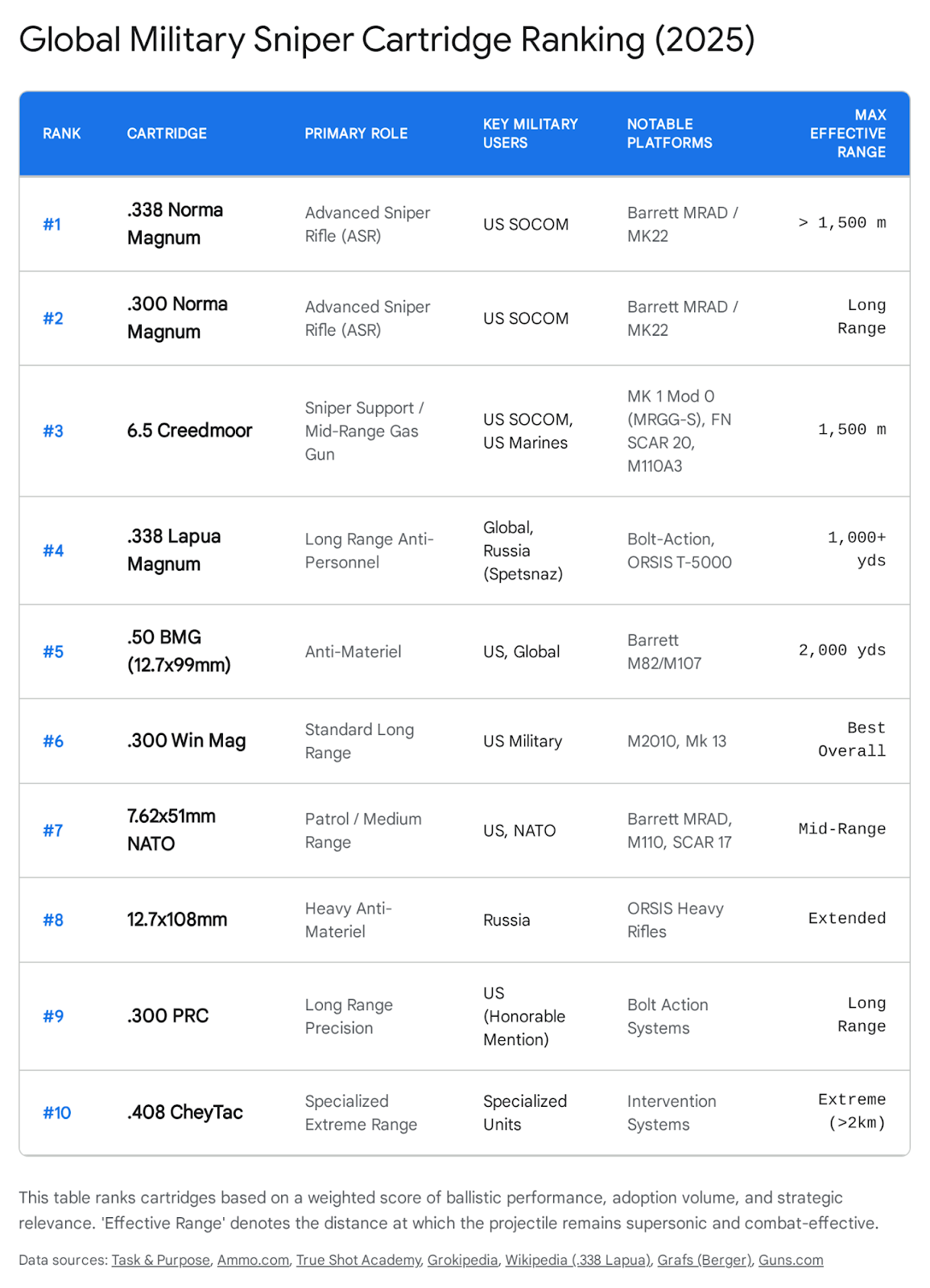
The following table serves as the primary reference guide for the rankings, summarizing the key strategic and technical data points that define the current state of military sniping.
Ronin's polymer handle being cut with a plastic knife on foil

2. Comprehensive Analysis of the Top 10 Cartridges

Rank 1:.338 Norma Magnum (8.6x63mm)

2.1.1 Strategic Origin and Military Adoption

The ascension of the.338 Norma Magnum to the premier rank of military sniper cartridges is the result of a deliberate, data-driven modernization effort by the United States Special Operations Command. For years, the.338 Lapua Magnum held this title, but despite its legendary status, it possessed inherent design limitations when adapted for very long, high-BC projectiles. The US military’s Advanced Sniper Rifle (ASR) program sought a solution that could outperform the Lapua while adhering to strict overall length (OAL) constraints for magazine feeding.1

The.338 Norma Magnum was officially selected as the heavy-caliber component of the Mk22 Mod 0 Advanced Sniper Rifle (Barrett MRAD), replacing the.300 Winchester Magnum and.50 BMG in many anti-personnel applications. Crucially, its adoption extends beyond the rifle; it has also been selected for the lightweight medium machine gun (LWMMG) programs, such as the SIG Sauer MG 338. This dual-adoption strategy creates a unified logistical footprint, allowing sniper teams and machine gunners to share ammunition—a force multiplier that cannot be overstated in sustained combat operations.3

2.1.2 Technical Engineering Profile

The genius of the.338 Norma Magnum lies in its internal geometry. Designed by Jimmie Sloan, the cartridge utilizes the.416 Rigby as a parent case, shortened to 2.492 inches (63.3 mm). This is significantly shorter than the.338 Lapua Magnum’s 2.724-inch case.4 While a shorter case might imply reduced performance, the opposite is true in the context of modern aerodynamics.

The shorter case body allows for a longer neck and, more importantly, permits the seating of extremely long, high-drag projectiles (like the 300-grain Berger Hybrid OTM or Sierra MatchKing) further out from the case mouth without exceeding the maximum cartridge overall length (COAL) of standard magazines (approx. 3.68 inches). In the.338 Lapua, these long bullets must be seated deeply into the case, displacing powder capacity and creating variable ignition characteristics. The.338 Norma avoids this, maintaining a full powder column and ensuring consistent ignition.3

  • Case Capacity: Approximately 108 grains of water.
  • Operating Pressure: CIP maximum pressure of 440.00 MPa (63,817 psi).
  • Projectile Specification: The standard US military load (XM1162) utilizes a 300-grain projectile with a G1 BC of roughly 0.822 and a G7 BC of 0.421.6
  • Muzzle Velocity: From a 26-27 inch barrel, the cartridge generates muzzle velocities in the range of 2,725 fps (830 m/s).6

2.1.3 Ballistic and Terminal Performance

The ballistic superiority of the.338 Norma Magnum is most evident in the transonic zone. Because the projectile is stable and retains velocity efficiently, it remains supersonic well beyond 1,500 meters. The “fat” powder column promotes a highly efficient burn, which reduces the velocity standard deviation (SD). Low SD is the holy grail of long-range shooting; if shots vary in speed by only 5-8 fps, the vertical dispersion at 1,500 meters is minimized, ensuring that a good hold results in a hit.3

Terminally, the 300-grain projectile carries massive kinetic energy. At 1,000 meters, it retains more energy than a.44 Magnum has at the muzzle. This allows it to penetrate Level IV body armor and defeat light materiel targets such as radar dishes, unarmored vehicles, and communications equipment, bridging the gap between a sniper rifle and an anti-materiel rifle.

Rank 2:.300 Norma Magnum (7.62x63mm)

2.2.1 Strategic Origin and Military Adoption

If the.338 Norma Magnum is the heavy hammer, the.300 Norma Magnum is the laser-guided scalpel. It was selected alongside its.338 sibling for the USSOCOM ASR program, specifically to fill the anti-personnel role at extreme ranges.1 This selection marked the beginning of the end for the.300 Winchester Magnum in Tier 1 units. The requirement was simple but demanding: maximize the probability of hit (P(hit)) on a human-sized target at 1,500 meters. The.300 Norma Magnum was the only cartridge capable of meeting the stringent accuracy and trajectory requirements set forth by the solicitations.7

2.2.2 Technical Engineering Profile

The.300 Norma Magnum is essentially the.338 Norma Magnum case necked down to hold a.308 caliber (7.62mm) bullet. This creates a “super-overbore” condition, where a massive volume of powder is pushing a relatively light and narrow projectile.

  • Projectile Selection: It is optimized for the 215-grain Berger Hybrid Target or the 230-grain Berger Hybrid OTM. These bullets are masterpieces of drag reduction, featuring long ogives and boat tails.7
  • Velocity: The 215-grain projectile is launched at velocities exceeding 3,017 fps (920 m/s).8
  • Barrel Life: The primary engineering trade-off is barrel life. The intense heat and pressure of the large powder charge funneling into the 7.62mm bore cause rapid throat erosion. Military barrels for this caliber may retain peak accuracy for only 1,200 to 1,500 rounds, necessitating a robust logistical plan for barrel replacements—a feature facilitated by the quick-change barrel system of the Mk22 MRAD.9

2.2.3 Ballistic and Terminal Performance

The trajectory of the.300 Norma Magnum is exceptionally flat. Compared to the.338 Lapua or Norma, the.300 Norma drops significantly less at 1,000 meters, reducing the need for extreme elevation adjustments. More importantly, the time of flight (TOF) is shorter. A shorter TOF means gravity and wind have less time to act on the bullet.

At 1,500 meters, the.300 Norma Magnum remains supersonic and retains sufficient energy to incapacitate a human target. The high sectional density of the heavy.30 caliber bullets ensures deep penetration, while the high velocity ensures that even at extended ranges, the hydrostatic shock potential remains high. It effectively renders the.300 Winchester Magnum obsolete in terms of raw performance, offering a 20-30% improvement in hit probability at ELR distances.11

Rank 3:.338 Lapua Magnum (8.6x70mm)

2.3.1 Strategic Origin and Military Adoption

The.338 Lapua Magnum (LM) is the reigning champion of the post-Cold War sniper world, holding the third spot only because the Norma variant has slightly edged it out in recent US trials. Developed in the 1980s by Research Armament Industries and later refined by Lapua of Finland, it was the first cartridge designed from the ground up specifically for military sniping, rather than being a repurposed hunting or machine gun round.4

It is the standard long-range cartridge for the British Army (L115A3 Long Range Rifle), the Finnish Defense Forces (TRG-42), the Russian Federation (Orsis T-5000), and dozens of other nations.12 Its combat record is extensive; it was used by British Corporal of Horse Craig Harrison to achieve a confirmed kill at 2,475 meters in Afghanistan, a record that stood for years and validated the cartridge’s extreme capabilities.4

2.3.2 Technical Engineering Profile

The.338 Lapua Magnum uses a robust, rimless, bottlenecked case designed to withstand high chamber pressures of up to 420 MPa (60,916 psi).

  • Standard Loadings: The classic military load uses a 250-grain Lapua LockBase or Scenar projectile roughly moving at 3,000 fps (914 m/s). More modern loadings have shifted to 300-grain projectiles to match the ballistic coefficients of the Norma, although this comes with the seating depth issues previously mentioned.4
  • Case Geometry: The case is longer and has more taper than the Norma. While this aids in extraction reliability under fouling—a key consideration for military weapons—it is less efficient for the powder burn dynamics required for ultra-heavy bullets.

2.3.3 Ballistic and Terminal Performance

The.338 Lapua Magnum was designed to penetrate standard military body armor at 1,000 meters, a requirement it meets with ease. It delivers approximately 5,000 ft-lbs (6,700 J) of energy at the muzzle.4 Its trajectory is flat, and its resistance to wind drift is far superior to any.30 caliber magnum.

While the.338 Norma has a slight edge in drag efficiency with 300-grain bullets, the.338 Lapua remains a formidable system. Its widespread availability means that ammunition can be sourced from multiple NATO partners, a logistical resiliency that keeps it firmly in the top tier. Furthermore, the terminal performance of the 250-grain and 300-grain projectiles is devastating, capable of structural defeats that would stop a.300 Win Mag cold.14

Rank 4:.300 Winchester Magnum (7.62x67mm)

2.4.1 Strategic Origin and Military Adoption

The.300 Winchester Magnum (Win Mag) is the veteran workhorse of the Western sniper community. Originally a commercial hunting cartridge introduced in 1963, it was adopted by the US military to extend the effective range of snipers beyond the capabilities of the 7.62x51mm NATO. It serves as the primary chambering for the US Army’s M2010 Enhanced Sniper Rifle (ESR) and the US Navy’s Mk13 series.15 Despite the adoption of the Norma Magnums by SOCOM, the “Big Army” and Marine Corps maintain vast fleets of.300 Win Mag rifles and millions of rounds of ammunition, ensuring its continued relevance.

2.4.2 Technical Engineering Profile

The.300 Win Mag is a “belted magnum,” a design feature carried over from the.375 H&H Magnum where the belt was used for headspacing. In modern shoulder-headspaced chambers, the belt is largely vestigial and can complicate chamber alignment and reloading. Additionally, the cartridge features a notoriously short neck (less than one caliber in length), which limits the tension on the bullet and the ability to seat long projectiles without intruding into the powder space.

Despite these “flaws,” US military ballisticians have optimized the cartridge through the Mk248 Mod 1 program.

  • Mk248 Mod 1 Specification: This load utilizes a 220-grain Sierra MatchKing (SMK) projectile fired at 2,850 fps (869 m/s). It uses a specialized flash-suppressed powder that is temperature stable, ensuring consistent velocity across environmental extremes from Arctic cold to Desert heat.17
  • Chamber Pressure: The Mod 1 load pushes the SAAMI pressure limits to achieve its performance, requiring robust actions like the Remington 700 long action used in the M2010.

2.4.3 Ballistic and Terminal Performance

With the Mk248 Mod 1 ammunition, the.300 Win Mag is effective out to 1,300 meters (approx. 1,500 yards).16 It offers a 50% increase in kinetic energy over the 7.62 NATO and significantly better wind bucking. While it cannot match the laser trajectory of the.300 Norma or the payload of the.338s, it represents the “good enough” solution for the vast majority of sniper engagements. Its terminal performance is characterized by rapid expansion and massive energy dump, making it highly lethal against soft targets.

Rank 5: 6.5mm Creedmoor (6.5x48mm)

2.5.1 Strategic Origin and Military Adoption

The 6.5mm Creedmoor represents the most radical shift in military small arms philosophy in half a century: the move to “intermediate” calibers that rely on aerodynamic efficiency rather than raw mass. Originally a commercial target round developed by Hornady in 2007, it has been aggressively adopted by USSOCOM and the Department of Homeland Security (Secret Service) to replace the 7.62x51mm NATO in Designated Marksman Rifles (DMR).19

This adoption is driven by the Mid-Range Gas Gun (MRGG-S) program, which sought a rifle with the portability of an AR-10 but the hit probability of a bolt-action sniper rifle. The 6.5 Creedmoor was the clear winner, with the US Navy recently awarding a $40 million contract for DODIC AC58 special ball ammunition.21

2.5.2 Technical Engineering Profile

The 6.5 Creedmoor fits into a standard short-action receiver (2.800 inch OAL), identical to the 7.62 NATO. However, it uses a 6.5mm (.264 caliber) projectile.

  • Aerodynamics: The 6.5mm diameter is the “sweet spot” for ballistic coefficients. A 140-grain 6.5mm bullet has a higher BC (approx. 0.600+ G1) than a 175-grain.308 bullet (approx. 0.496 G1).
  • Recoil: Because it fires a lighter bullet with less powder, the recoil impulse is roughly 30% less than the 7.62 NATO. This is critical for semi-automatic sniper systems, allowing the shooter to spot their own trace and impacts, and enabling rapid follow-up shots.19

2.5.3 Ballistic and Terminal Performance

The US military’s testing concluded that the 6.5 Creedmoor doubles the hit probability at 1,000 meters compared to the 7.62 NATO.19 This is primarily due to reduced wind drift. At 1,000 yards, a 6.5 Creedmoor bullet will drift roughly 30-40% less than a 7.62 NATO bullet in a 10 mph crosswind. Furthermore, the 6.5 CM remains supersonic beyond 1,200 yards, whereas the 7.62 NATO often goes subsonic (and unstable) around 900 yards.

This cartridge has redefined the “sniper support” role, giving the spotter or designated marksman a weapon capable of engaging targets at ranges previously reserved for the primary sniper’s bolt gun.

Rank 6:.50 BMG (12.7x99mm NATO)

2.6.1 Strategic Origin and Military Adoption

The.50 Browning Machine Gun (BMG) cartridge is the most recognizable heavy caliber in the world. Designed by John Browning towards the end of World War I as an anti-aircraft and anti-tank round, it has shown remarkable longevity. In the sniper role, it gained prominence in the 1980s and 90s with the introduction of the Barrett M82 “Light Fifty.” It remains the primary heavy anti-materiel cartridge for almost all NATO forces and US allies.13

2.6.2 Technical Engineering Profile

The.50 BMG is a massive cartridge with an overall length of 5.45 inches. It operates at high pressures (approx. 55,000 psi) and consumes huge quantities of slow-burning powder (approx. 230 grains).

  • Ammunition Diversity: The key to the.50 BMG’s ranking is the sheer variety of payloads available. The standard M33 Ball is used for training and general targets. However, for combat, snipers utilize the Mk 211 Mod 0 “Raufoss” Multipurpose round. This projectile contains a tungsten penetrator, an explosive charge, and an incendiary tip, allowing it to penetrate armor, explode inside the target, and start fires simultaneously.25
  • Precision Loads: To improve accuracy, the M1022 Long Range Sniper ammunition was developed, utilizing a green-tipped projectile optimized for ballistic consistency, capable of sub-MOA accuracy in bolt-action platforms like the McMillan Tac-50.

2.6.3 Ballistic and Terminal Performance

The.50 BMG generates roughly 13,000 to 14,000 ft-lbs (18,000 J) of energy at the muzzle.25 This is an order of magnitude greater than small arms. It can stop a vehicle by destroying the engine block, penetrate thick brick walls to eliminate combatants hiding inside, and detonate IEDs from a safe standoff distance.

However, it ranks 6th because of its limitations as a pure sniper round. The recoil is punishing, requiring heavy muzzle brakes that create massive dust signatures. The rifles are heavy (25-30 lbs), hindering mobility. Furthermore, standard.50 BMG machine gun ammo is not precise enough for long-range personnel interdiction, forcing snipers to rely on expensive match-grade lots.

Rank 7: 12.7x108mm (Russian/Chinese)

2.7.1 Strategic Origin and Military Adoption

The 12.7x108mm is the Eastern Bloc’s answer to the.50 BMG. It serves the identical strategic role: heavy anti-materiel engagement and counter-sniper operations. It is the standard heavy cartridge for the Russian Federation (fielded in the OSV-96 and ASVK rifles) and the People’s Republic of China (M99, QBU-10).26 Its ranking reflects the massive scale of its use in current global conflicts, particularly in Eastern Europe and the Middle East.

2.7.2 Technical Engineering Profile

The 12.7x108mm case is 9mm longer than the.50 BMG (12.7x99mm), giving it a slightly larger case capacity. Historically, this potential was wasted on poor-quality machine gun production standards. However, recent modernization efforts have changed this.

  • Russian Modernization: Russia has developed the 7N34 sniper load specifically for this caliber. This 59.2-gram (914 grain) projectile features a hardened tool-steel tip and a lead body, optimized for both accuracy and penetration.28
  • Chinese Innovations: The PLA has integrated this cartridge into the QBU-10 system, which includes a computerized fire control system with laser rangefinding and atmospheric sensors to compensate for the round’s trajectory.26

2.7.3 Ballistic and Terminal Performance

The performance of the 12.7x108mm is functionally identical to the.50 BMG. The 7N34 load is rated to defeat light armored vehicles at 1,500 meters and penetrate 10mm of rolled homogeneous armor (RHA) at 800 meters.28 Its primary utility is destruction. Like the.50 BMG, it is a heavy, recoiling beast of a cartridge, but one that provides the operator with the ability to reach out and touch hardened targets that would shrug off a.338.

Rank 8: 7.62x54mmR (Russian)

2.8.1 Strategic Origin and Military Adoption

The 7.62x54mm Rimmed (7.62x54R) holds the distinction of being the longest-serving military cartridge in history, first adopted by Imperial Russia in 1891. Despite its age, it remains the standard sniper/designated marksman cartridge for Russia, China (in older platforms), and dozens of nations aligned with former Soviet doctrine. It is the fuel for the SVD Dragunov, the SV-98, and the modern Chukavin (SVCh) rifle.29

2.8.2 Technical Engineering Profile

The defining feature of this cartridge is its rimmed case, an archaic design that dates back to the era of lever-action and early bolt-action rifles. The rim makes magazine design difficult, necessitating the extreme curvature of SVD magazines to prevent “rim lock” (where the rim of the top cartridge catches behind the rim of the one below it).

  • Projectile Evolution: To keep this ancient cartridge relevant, Russian engineers have continuously updated the projectile. The original 7N1 sniper load (steel core, knocker in the tip) has been replaced by the 7N14. The 7N14 features a sharp, hardened steel penetrator designed to defeat modern body armor while maintaining match-grade accuracy.31
  • Ballistics: The 7N14 load fires a 151-grain projectile at approximately 2,723 fps (830 m/s).31

2.8.3 Ballistic and Terminal Performance

Ballistically, the 7.62x54R is comparable to the 7.62x51mm NATO. It is effective out to 800 meters, perhaps 1,000 meters in the hands of an expert. It ranks 8th because while it lacks the long-range efficiency of the magnums or the Creedmoor, its ubiquity is unmatched. It is a rugged, reliable cartridge that has proven it can kill effectively in every major conflict of the last century. The new 7N14 load ensures it remains lethal against troops equipped with ceramic plates.

Rank 9: 5.8x42mm (Chinese DBP88/DBP10)

2.9.1 Strategic Origin and Military Adoption

The 5.8x42mm is a unique outlier in the global market—an indigenous Chinese cartridge developed to replace both the 7.62x39mm (AK) and 7.62x54R (Sniper) with a single unified caliber. The People’s Liberation Army (PLA) uses this cartridge in the QBU-88 (Type 88) designated marksman rifle and the new QBU-191.32 This decision reflects a doctrine that prioritizes weight savings and logistical simplicity over extreme range.

2.9.2 Technical Engineering Profile

The 5.8x42mm is an intermediate cartridge, physically larger than the 5.56 NATO but smaller than the 7.62 NATO.

  • The “Heavy” Round: For sniper applications, the PLA developed the DBP88 (and later consolidated into the DBP10) heavy load. This utilizes a 5-gram (77 grain) projectile with a streamlined shape and a steel core.34
  • Velocity: Fired from the longer barrel of the QBU-88, it achieves velocities of roughly 2,936 fps (895 m/s).34
  • BC: The G7 BC is approximately 0.210, which is relatively low compared to Western sniper rounds.34

2.9.3 Ballistic and Terminal Performance

The PLA claims the 5.8mm heavy round outperforms the 5.56 NATO and approaches the 7.62x51mm in penetration at medium ranges. However, physics is a harsh mistress. The relatively light 77-grain bullet sheds energy rapidly past 600 meters and is highly susceptible to wind drift. Its effective range is cited as 800 meters.34 It ranks 9th because while it is the standard for the world’s largest standing army, it is ballistically inferior to every other cartridge on this list for dedicated sniping roles. The PLA acknowledges this gap by retaining 7.62x51mm and.338 platforms for their specialized sniper units, relegating the 5.8mm to the squad marksman role.29

Rank 10:.408 CheyTac (10.36x77mm)

2.10.1 Strategic Origin and Military Adoption

The.408 Cheyenne Tactical (CheyTac) is a niche, specialized cartridge designed for one specific purpose: Extreme Long Range (ELR) interdiction. It is not a general-issue round. Instead, it is found in the armories of elite Tier 1 units, such as the Polish GROM, Turkish Special Forces (SAT), and others who require the ability to engage targets beyond 2,000 meters.35

2.10.2 Technical Engineering Profile

The.408 CheyTac sits physically between the.338 Lapua and the.50 BMG.

  • Projectile Design: It utilizes solid copper-nickel alloy projectiles (monolithic turned solids) that are computer-designed for perfect balance. These bullets (typically 419 grains) have incredibly high ballistic coefficients and are machined to tolerances that mass-produced lead-core bullets cannot match.35
  • Balanced Flight: The rotational stability of the bullet is tuned to match its drag deceleration, keeping it stable through the transonic zone at extreme distances (2,000+ meters).

2.10.3 Ballistic and Terminal Performance

The.408 CheyTac remains supersonic out to 2,200 meters.35 At 2,000 meters, it retains more kinetic energy than a.338 Lapua, yet the rifle system is significantly lighter than a.50 BMG (typically 20 lbs vs 30 lbs). It represents the pinnacle of ballistic engineering for chemically propelled small arms. It ranks 10th only because of its cost, rarity, and limited logistical footprint compared to the NATO standard cartridges. It is a Ferrari in a world of Humvees—unbeatable performance, but high maintenance and rare.

3. Comparative Technical Analysis

To understand the practical differences between these cartridges, we must examine their performance in the crucial “transonic zone”—the range where the bullet slows to Mach 1.2 and begins to lose stability.

3.1 The Battle of the.338s: Lapua vs. Norma

The rivalry between the.338 Lapua and.338 Norma is the defining technical debate of the decade. As illustrated in the schematic below, the difference is not in caliber, but in case geometry and bullet seating.

The.338 Norma’s shorter case body (2.492″ vs 2.724″) allows the 300-grain projectile to extend further out of the neck while still fitting in the magazine. This preserves the “boiler room” (powder space) and aligns the bullet better with the bore’s rifling leade. The result is a system that handles the heaviest, most aerodynamic bullets more consistently than the Lapua.3

3.2 Terminal Energy and Barrier Defeat

  • Soft Targets: The.300 Norma and.300 Win Mag deliver massive hydrostatic shock. The velocity of the.300 Norma (3,000+ fps) creates a temporary wound cavity that is devastating to biological tissue.
  • Hard Targets: The.338s and.50s rely on sectional density and mass. A.338 AP round can punch through engine blocks that would deflect a.300 Win Mag. The.50 BMG/12.7x108mm remains the only choice for penetrating brick or concrete cover to kill targets on the other side.

4. Strategic Implications and Future Outlook

4.1 The Unification of Logistics

The most significant trend is the collapse of the barrier between sniper and machine gun ammunition. The US adoption of the.338 Norma for the General Purpose Machine Gun (GPMG) role means that a platoon can carry one type of heavy ammo for both its area suppression weapon and its precision rifle. This reduces the logistical burden and ensures that snipers have access to belt-linked ammunition reserves if needed.3

4.2 Material Science Advances

By 2030, we expect to see:

  • Polymer Cases: Companies like True Velocity are finalizing polymer-cased ammunition that reduces weight by 30%. This is critical for heavy calibers like.338 and.50 BMG, allowing soldiers to carry more rounds.
  • Barrel Technology: The primary weakness of high-performance rounds like the.300 Norma is barrel life (1,200 rounds). New barrel liners and metallurgy (e.g., flow-formed barrels, advanced coatings) are being developed to extend this to 2,500+ rounds, making the logistical cost of these high-pressure rounds manageable.

4.3 Fire Control Systems

The cartridge is becoming a sub-component of a digital system. The XM157 Next Generation Fire Control and similar optics utilize built-in laser rangefinders and ballistics computers. These systems actively calculate the firing solution, displaying a disturbed reticle. This technology disproportionately benefits cartridges with consistent velocity (low SD), like the.338 Norma and 6.5 Creedmoor, as the computer can predict their flight path with near-certainty.

5. Conclusion

The 2025 ranking of military sniper cartridges reflects a mature understanding of long-range physics. The industry has moved past the “magnum wars” of the 20th century and entered an era of efficiency.

The .338 Norma Magnum takes the top spot because it represents the perfect convergence of lethality, range, and logistical utility. It is the future standard for Western heavy sniping. The .300 Norma Magnum follows closely as the ultimate anti-personnel tool, offering trajectory performance that feels almost unfair to the adversary. Meanwhile, the 6.5 Creedmoor has quietly revolutionized the squad marksman role, proving that smarter aerodynamics can outperform heavier payloads.

While legacy rounds like the.300 Win Mag,.338 Lapua, and.50 BMG remain potent and widely used, they are now “legacy” technology. The future belongs to cartridges designed with Doppler radar and computational fluid dynamics, ensuring that when a modern sniper pulls the trigger, the result is a mathematical certainty.

Works cited

  1. SOCOM is officially getting its hands on the new sniper rifle everyone in the US military wants – Task & Purpose, accessed December 22, 2025, https://taskandpurpose.com/tech-tactics/us-military-sniper-rifle-barrett-mrad-special-operations-command/
  2. New Army sniper weapon system contract awarded to Barrett Firearms, accessed December 22, 2025, https://www.army.mil/article/244821/new_army_sniper_weapon_system_contract_awarded_to_barrett_firearms
  3. Why do the US military choosing .338 Norma rather than .338 Lapua : r/WarCollege – Reddit, accessed December 22, 2025, https://www.reddit.com/r/WarCollege/comments/1n3w004/why_do_the_us_military_choosing_338_norma_rather/
  4. .338 Lapua Magnum – Wikipedia, accessed December 22, 2025, https://en.wikipedia.org/wiki/.338_Lapua_Magnum
  5. 300 Norma Magnum – Discussion Forums, accessed December 22, 2025, https://www.ballisticstudies.com/Resources/Discussion+Forums/x_forum/18/thread/13739.html
  6. Berger: 338 Norma Magnum, 300 gr, OTM Tactical, 20/Box – Mile High Shooting Accessories, accessed December 22, 2025, https://www.milehighshooting.com/berger-338-norma-magnum-300-gr-otm-tactical-20-box/
  7. The SOCOM Advanced Sniper Rifle Cartridges – Uncle Zo, accessed December 22, 2025, https://unclezo.com/2020/10/14/the-socom-advanced-sniper-rifle-cartridges/
  8. 300 Norma Magnum 215 Grain Hybrid Target Rifle Ammunition – Berger Bullets, accessed December 22, 2025, https://bergerbullets.com/product/300-norma-magnum-215gr-hybrid-target/
  9. 300 Norma Mag barrel life | Shooters’ Forum, accessed December 22, 2025, https://forum.accurateshooter.com/threads/300-norma-mag-barrel-life.3943664/
  10. 300 Norma vs 338 Lapua – Caliber Comparison by Ammo.com, accessed December 22, 2025, https://ammo.com/comparison/300-norma-vs-338-lapua
  11. 300 Norma Magnum Cartridge – A True One Mile Performer! – Rifle Talks, accessed December 22, 2025, https://www.rifletalks.com/ballistics-by-rifletalks/300-norma-magnum-cartridge-the-king-of-1-mile/
  12. ORSIS – Grokipedia, accessed December 22, 2025, https://grokipedia.com/page/ORSIS
  13. List of sniper rifles – Wikipedia, accessed December 22, 2025, https://en.wikipedia.org/wiki/List_of_sniper_rifles
  14. These Russian Rifles Are So Deadly They Can Beat Body Armor, accessed December 22, 2025, https://www.bodyarmornews.com/youre-not-safe-these-russian-rifles-are-so-deadly-they-can-beat-body-armor/
  15. .300 Winchester Magnum – Wikipedia, accessed December 22, 2025, https://en.wikipedia.org/wiki/.300_Winchester_Magnum
  16. Unsung Hero: The Mk 248 MOD 1 | An Official Journal Of The NRA – American Rifleman, accessed December 22, 2025, https://www.americanrifleman.org/content/unsung-hero-the-mk-248-mod-1/
  17. MK248 Mod 1 – What’s It Good For?, accessed December 22, 2025, https://www.wideners.com/blog/mk248-mod-1-a-brief-history/
  18. New US Military .300 Win Mag Match MK 248 MOD 1 | Sniper’s Hide Forum, accessed December 22, 2025, https://www.snipershide.com/shooting/threads/new-us-military-300-win-mag-match-mk-248-mod-1.17639/
  19. SOCOM’s latest rifles embrace the 6.5 Creedmoor cartridge | Sandboxx, accessed December 22, 2025, https://www.sandboxx.us/news/socoms-latest-rifles-embrace-the-6-5-creedmoor-cartridge/
  20. Secret Service Eyes New 6.5mm Semi-Automatic Sniper Rifle – The War Zone, accessed December 22, 2025, https://www.twz.com/land/secret-service-eyeing-new-6-5mm-designated-marksman-rifles
  21. Navy Orders $40 Million worth of 6.5 Creedmoor Ammo – Guns.com, accessed December 22, 2025, https://www.guns.com/news/2025/08/22/navy-orders-40-million-worth-of-65-creedmoor-ammo
  22. US Navy and USMC Order 6.5 Creedmoor Ammunition Worth 40 Million USD – MILMAG, accessed December 22, 2025, https://milmag.pl/en/us-navy-and-usmc-order-6-5-creedmoor-ammunition-worth-40-million-usd/
  23. Special ops snipers will soon shoot this new rifle that can fire three different calibers, accessed December 22, 2025, https://www.militarytimes.com/news/your-military/2019/03/13/special-ops-snipers-will-soon-shoot-this-new-rifle-that-can-fire-three-different-calibers/
  24. New Marine Sniper Rifle Reaches Full Operational Capability Ahead of Schedule, accessed December 22, 2025, https://www.military.com/daily-news/2024/11/22/marine-corps-new-sniper-rifle-officially-ready-fight.html
  25. In terms of penetration and raw power, which is stronger, the Dushka machine gun or the M2 Browning? Which is stronger according to these two criteria? – Quora, accessed December 22, 2025, https://www.quora.com/In-terms-of-penetration-and-raw-power-which-is-stronger-the-Dushka-machine-gun-or-the-M2-Browning-Which-is-stronger-according-to-these-two-criteria
  26. M99 Chinese 12.7mm Sniper Rifle – ODIN, accessed December 22, 2025, https://odin.tradoc.army.mil/WEG/Asset/M99_Chinese_12.7mm_Sniper_Rifle
  27. Small Arms of Belarusian Special Forces | thefirearmblog.com, accessed December 22, 2025, https://www.thefirearmblog.com/blog/2017/07/14/small-arms-belarusian-special-forces/
  28. 12.7 × 108 mm – Wikipedia, accessed December 22, 2025, https://en.wikipedia.org/wiki/12.7_%C3%97_108_mm
  29. China’s Snipers Could Be the Threat You Never See Coming – The National Interest, accessed December 22, 2025, https://nationalinterest.org/blog/reboot/chinas-snipers-could-be-threat-you-never-see-coming-183587/
  30. Russian vs Ukrainian Marksman Rifles – 5D Tactical, accessed December 22, 2025, https://www.5dtactical.com/blog/russian-vs-ukrainian-marksman-rifles/
  31. 7.62×54mmR – Wikipedia, accessed December 22, 2025, https://en.wikipedia.org/wiki/7.62%C3%9754mmR
  32. QBU-88 – Gun Wiki | Fandom, accessed December 22, 2025, https://guns.fandom.com/wiki/QBU-88
  33. DBP87 5.8x42mm: China’s High-Velocity Cartridge – Guns and Ammo, accessed December 22, 2025, https://www.gunsandammo.com/editorial/dbp87-5-8x42mm-chinas-high-velocity-caliber/248020
  34. 5.8×42mm – Wikipedia, accessed December 22, 2025, https://en.wikipedia.org/wiki/5.8%C3%9742mm
  35. Everything You Need To Know About .408 CheyTac – Gun Digest, accessed December 22, 2025, https://gundigest.com/gear-ammo/ammunition/408-cheytac
  36. Current military use of the 408 CT? | Sniper’s Hide Forum, accessed December 22, 2025, https://www.snipershide.com/shooting/threads/current-military-use-of-the-408-ct.1635/

Leupold & Stevens: The Architecture of Optical Dominance – A Comprehensive Industry Analysis

In the global landscape of precision optics, Leupold & Stevens, Inc. represents a distinct anomaly: a fifth-generation, family-owned American manufacturer that has successfully navigated the transition from analog hydrographic instrumentation to becoming the preeminent supplier of sporting and tactical optics to the United States military and civilian markets. This report provides an exhaustive, analyst-grade examination of the company’s 117-year trajectory, dissecting the strategic pivots, engineering philosophies, and market forces that have solidified the “Golden Ring” trademark as a global standard for rugged reliability.

The analysis reveals that Leupold’s longevity is not merely a function of heritage but the result of a deliberate, often counter-intuitive corporate strategy: the refusal to outsource core competencies during the globalization waves of the late 20th century. While competitors migrated production to Asia to capitalize on lower labor costs, Leupold entrenched its manufacturing base in Beaverton, Oregon. This decision, initially a margin-compressing liability, matured into its greatest strategic asset. It allowed the company to secure lucrative U.S. Department of Defense contracts mandated by the Berry Amendment, maintain absolute quality control over its “Elite Optical System,” and react with agility to the evolving demands of the American shooter.

Currently, the company occupies a bifurcated and dominant market position. In the civilian sector, Leupold remains the volume and value leader in hunting riflescopes, leveraging a tiered product architecture (VX-Freedom through VX-6HD) that democratizes premium features like the Custom Dial System (CDS). In the defense sector, Leupold serves as the optical backbone for the U.S. Army’s sniper capabilities, with the Mark 5HD platform recently selected for the Precision Sniper Rifle (PSR) program, affirming the company’s status as a Tier 1 defense contractor.

However, the future horizon presents significant technological and competitive challenges. The 2022 loss of the Next Generation Squad Weapon-Fire Control (NGSW-FC) contract to Vortex Optics signals a paradigmatic shift in military procurement—away from pure glass and toward integrated, active-matrix digital fire control systems. Leupold’s response to this digital disruption—balancing its mastery of mechanical precision with the necessity of electronic integration—will define its relevance in the coming decades. This report details the company’s journey from 1907 to the present, offering deep insights into its operational resilience, product evolution, and the strategic outlook for 2025 and beyond.

1. Introduction: The American Optical Anomaly

In the high-stakes world of firearms and optics manufacturing, longevity is often the exception rather than the rule. The industry is characterized by rapid technological obsolescence, cyclical demand curves driven by political climates, and a relentless pressure to reduce manufacturing costs through offshoring. Within this volatile environment, Leupold & Stevens, Inc. stands as a testament to the viability of a different business model—one rooted in family ownership, domestic manufacturing, and a relentless focus on solving the specific, practical problems of the end-user.

To understand Leupold’s current market dominance, one must look beyond the gleaming rows of riflescopes in a modern sporting goods store and examine the company’s unique DNA. Unlike many of its competitors, who began as lens grinders or camera manufacturers, Leupold began in the mud and rain of the Pacific Northwest, building instruments that measured the flow of rivers. This hydrographic heritage instilled a “durability first” engineering philosophy that predates their entry into optics by nearly half a century. When a water level recorder fails in a remote mountain stream, the data is lost forever; when a riflescope fails on a once-in-a-lifetime hunt, the opportunity is gone. Leupold understood early on that in the field, reliability is the only metric that matters.

This report will traverse the company’s history not as a linear list of dates, but as a study in strategic adaptation. We will explore how a missed deer in the 1940s led to the invention of nitrogen purging, how a request from the U.S. Army in the 1980s birthed the modern tactical scope, and how the company is positioning itself today to survive the digital revolution. For the industry analyst, Leupold provides a case study in brand resilience, illustrating how a commitment to core values—when coupled with genuine innovation—can create a formidable competitive moat.

2. Origins and Early History: The Engineering of Measurement (1907–1940s)

The genesis of Leupold & Stevens is not found in the firearms industry, but in the precise and demanding world of civil engineering and hydrology. The company’s foundational years established a culture of mechanical precision that would later translate seamlessly into optical engineering. This era is often overlooked in casual histories, yet it provides the essential context for understanding why Leupold scopes are built the way they are.

2.1 The Surveying Era: Leupold & Voelpel (1907–1914)

In 1907, the seeds of the company were sown by Markus Friedrich (Fred) Leupold, a German immigrant who brought with him the Old World tradition of precision mechanics. Fred established a modest one-man repair shop for surveying equipment at 5th and Oak streets in Portland, Oregon. The choice of location was serendipitous. The Pacific Northwest at the turn of the century was a region of explosive growth and rugged infrastructure development. The timber industry was booming, railroads were carving paths through the Cascades, and cities were expanding into the wilderness. All of this activity required precise surveying.

Recognizing the need for capital and trusted partnership to meet this growing demand, Fred was joined by his brother-in-law, Adam Voelpel, later that same year.1 The firm, initially christened “Leupold & Voelpel,” focused exclusively on the repair and manufacture of surveying transits and levels. The competitive advantage of the young firm was rooted in quality. Surveyors in the region quickly learned that instruments repaired by Leupold & Voelpel often returned to the field with tighter tolerances and smoother mechanics than when they were brand new from the factory. This commitment to a “square deal”—a foundational value attributed to Fred Leupold—laid the groundwork for the brand’s future legendary customer loyalty.3 The ethos was simple: the customer is entitled to a product that works, and if it doesn’t, the manufacturer must make it right.

2.2 The Stevens Partnership and the Hydrographic Shift (1914–1940)

A pivotal moment in the company’s history—one that arguably saved it from remaining a niche repair shop—occurred in 1911. J.C. Stevens, a prominent hydrologist and engineer, approached the firm with a specific engineering challenge. Stevens had invented a revolutionary water level recorder, a device essential for monitoring stream flows for the burgeoning hydroelectric power generation and irrigation projects of the West.1 However, the existing mechanisms available on the market were unreliable, fragile, and prone to failure in the pervasive dampness and harsh conditions of the Oregon wilderness.

Stevens needed a partner who could manufacture his invention to standards that could withstand the elements. Recognizing the commercial potential of Stevens’ design and the synergy with their own manufacturing capabilities, Leupold & Voelpel began manufacturing the device. The partnership was so successful that it was formalized in 1914, and J.C. Stevens was made a partner. The company was subsequently renamed “Leupold, Voelpel, and Co.”.4

The interwar years saw the company solidify its reputation in the field of hydrography. By 1938, the company introduced the “Telemark,” a sophisticated device invented by Stevens that could transmit water level data over telephone lines.1 This was a technological leap, allowing for remote monitoring of critical water resources without the need for constant human presence.

Strategic Insight: This era is critical to understanding the modern Leupold optic. The engineering constraints of water monitoring equipment are severe. These instruments are required to function autonomously in remote, wet, freezing, and humid environments for months at a time without maintenance. This necessity instilled a “durability first” engineering philosophy within the company culture. When Leupold eventually pivoted to riflescopes, their engineers did not approach them as delicate glass instruments to be pampered, but as rugged field tools akin to their water recorders—devices that must perform or be ignored. This “hydrographic DNA” is the hidden variable in Leupold’s success equation.

2.3 The Catalyst: The Legend of the Missed Buck (1940s)

The transition from surveying tools and water recorders to sporting optics is enshrined in company lore, centering on Marcus Leupold, the son of founder Fred Leupold. By the 1940s, the founding generation had passed—Adam Voelpel died in 1940 and Fred Leupold in 1944—leaving the company in the hands of the second generation, including Marcus and Norbert Leupold.1

As the story is recorded in company archives, Marcus was an avid sportsman who spent his leisure time hunting the black-tailed deer of the Oregon coastal ranges. During a hunt in the 1940s, Marcus spotted a trophy buck. He raised his rifle, only to find that his telescopic sight had fogged up internally due to condensation, rendering the shot impossible.5 The buck escaped, but the failure of the equipment sparked a revelation.

At the time, the riflescope market was dominated by European imports (offering excellent glass but poor weather sealing) or American commercial scopes that were essentially unsealed tubes. In the high-humidity, high-precipitation environment of the Pacific Northwest, internal fogging was a common, almost accepted failure mode. Frustrated by the equipment failure, Marcus reportedly exclaimed to his hunting party, “Hell! I could build a better scope than this!”.3

This moment of frustration catalyzed a radical shift in corporate strategy. Marcus realized that the company’s expertise in sealing water recorders against moisture could be directly applied to optical tubes. This was not merely a business opportunity; it was a personal mission to solve a problem that plagued hunters. By 1942, the company had changed its name to “Leupold & Stevens, Inc.,” reflecting the enduring partnership and the new direction under the new management.2 The stage was set for a revolution in sporting optics.

3. The Golden Age of Innovation: The Nitrogen Era (1947–1990s)

The post-World War II era marked the true beginning of Leupold as an optics manufacturer. The American economy was booming, and millions of GIs were returning home with a newfound appreciation for optical equipment and a desire to spend time in the outdoors. This period was characterized by a series of technological firsts that not only established Leupold’s market share but fundamentally altered the design standards of the entire global optics industry.

3.1 The Plainsman and the Nitrogen Revolution (1947)

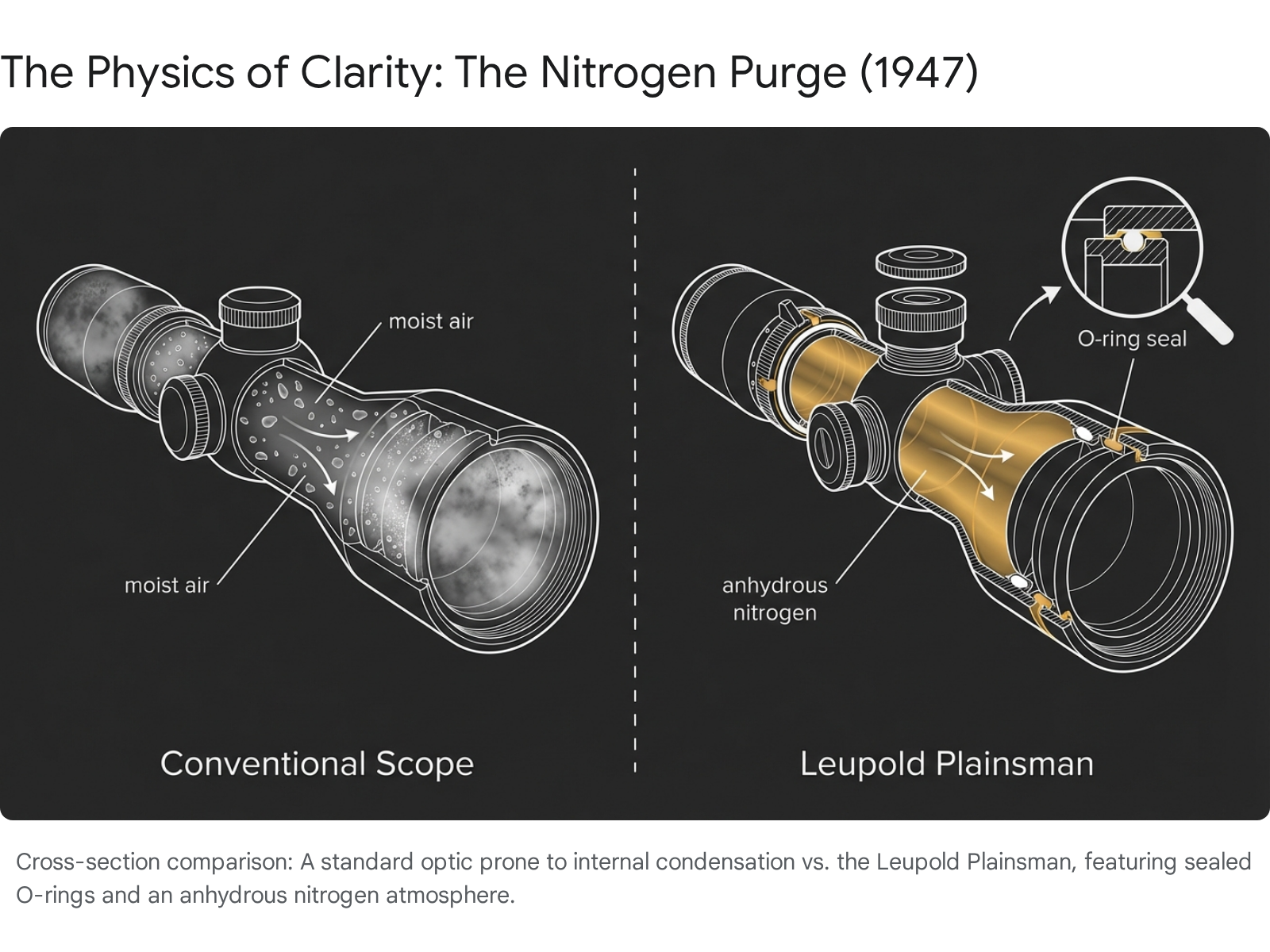
In 1947, Leupold introduced the “Plainsman,” the first riflescope designed and built entirely by the company. It was a revolutionary product, not necessarily for its magnification or optical clarity alone, but for its internal atmosphere. Marcus Leupold applied a technique borrowed from the Merchant Marines, who used dry gas to keep optics clear on ships: purging the humid air from the scope’s interior and replacing it with anhydrous (dry) nitrogen.5

The engineering process involved evacuating the air from the scope tube and refilling it with nitrogen, which contains no moisture. This created a positive pressure environment inside the tube that was impervious to temperature fluctuations. When a hunter moved from a warm cabin to freezing outdoors, or hiked through the damp Oregon rainforest, there was no moisture inside the tube to condense on the lenses. The Plainsman was marketed as the first truly fog-proof scope built by Americans.5

Market Impact Analysis: The introduction of nitrogen purging was a disruptive innovation in the truest sense. It rendered the competition’s products functionally obsolete in practical field conditions. While European optics (often referred to as “German glass”) were renowned for their superior light transmission and resolution, they were often fragile and susceptible to moisture intrusion. Leupold carved a massive niche by offering “rugged reliability”—a value proposition that resonated deeply with the American hunter who often hunted alone, far from support, and required equipment that could survive a fall or a rainstorm. The Plainsman shifted the consumer’s hierarchy of needs from “clarity at all costs” to “reliability above all.”

Ronin's polymer handle being cut with a plastic knife on foil

3.2 The Duplex Reticle: Standardization of Aim (1962)

Perhaps no single innovation in the history of sporting optics is as ubiquitous—and as frequently copied—as the Duplex reticle, invented by Leupold in 1962.5 Prior to this invention, riflescopes typically employed one of two reticle types: fine crosshairs or heavy posts.

  • Fine Crosshairs: These offered excellent precision for target shooting but were notoriously difficult to see in low-light conditions or against a dark background, such as a bear in thick brush.
  • Heavy Posts: These were easy to see in poor light but obscured a significant portion of the target, making precise shot placement at longer ranges difficult.

The Duplex design was a stroke of user interface genius. It combined both elements: heavy outer posts that boldly guided the eye to the center of the field of view, transitioning to fine inner crosshairs for precision aiming at the exact point of impact. This design allowed for rapid target acquisition in thick cover while maintaining the ability to place a precise shot at distance.

Industry Consequence: The Duplex reticle became the de facto industry standard. Today, nearly every scope manufacturer on the planet produces a variation of this design. It was a perfect synthesis of form and function, addressing the two most common complaints of hunters: losing the reticle in low light and covering the target with the reticle at long range. Leupold’s ability to identify this user friction and solve it with a simple, elegant visual design demonstrated their deepening understanding of the shooter’s experience.

3.3 The “Golden Ring” and Brand Identity (1964)

In 1964, Leupold began placing a distinct gold ring around the objective bell of its scopes.6 Initially a design flourish to distinguish their products on crowded gun racks, this ring became a powerful trademark symbolizing the company’s “Full Lifetime Guarantee.”

Leupold’s warranty policy was as revolutionary as its nitrogen purging. The guarantee was simple, absolute, and transferrable: if a Leupold product breaks, the company will repair or replace it for free, forever, regardless of whether you are the original owner.9 This policy was not a marketing gimmick but a statement of manufacturing confidence. In an industry where optics were fragile and expensive, this guarantee effectively de-risked the purchase for consumers. It allowed Leupold to command a premium price point because the product was viewed as a lifetime investment rather than a disposable accessory. The “Gold Ring” became a status symbol in deer camps across America, signaling that the hunter took their equipment—and by extension, their sport—seriously.

3.4 Expansion of the Vari-X Line and Market Segmentation

Throughout the 1960s and 70s, Leupold refined the variable power riflescope, moving the market away from fixed-power optics. The introduction of the Vari-X II in 1963 (and its production until 1992) set the benchmark for reliability.10 The Vari-X II became the “Ford F-150” of riflescopes—ubiquitous, reliable, effective, and accessible to the average deer hunter. It offered variable magnification (typically 3-9x), which gave hunters the versatility to shoot close in brush or reach out across a canyon.

The 1970s saw the introduction of the Vari-X III, which offered improved lens coatings and adjustments, catering to the growing market of long-range hunters and varmint shooters who demanded higher performance.12 By 1978, Leupold introduced the industry’s first line of compact riflescopes, acknowledging the trend toward lighter, shorter mountain rifles.5 This ability to segment the market—offering a scope for every type of rifle and every type of hunt—was a key driver of their growth during the golden age of American hunting.

As the company grew, so did its physical footprint. In 1968, under the leadership of Norbert Leupold (who took over after Marcus resigned), the company moved its operations to a new, purpose-built manufacturing plant and headquarters in Beaverton, Oregon.2 This facility remains the company’s home today. The leadership transitions continued with Werner Wildauer becoming President and Chairman in 1983. Wildauer’s story is notable; he emigrated from Germany in 1958 after receiving a job offer from Marcus Leupold and worked his way up from a manufacturing technician to the top office.5 His ascent underscored a company culture that valued technical competence and internal promotion.

4. The Tactical Pivot: Military Dominance (1980s–2015)

While Leupold dominated the hunting market by the 1980s, the military sector was underserved. U.S. forces were still largely using modified commercial hunting scopes or outdated equipment that lacked the ruggedness required for modern warfare. Leupold’s entry into the tactical market was not a simple extension of their hunting line, but a ground-up reengineering effort that birthed the legendary Mark 4 and changed the face of military sniping.

4.1 The Ultra M3A and the Mark 4 Project

In the mid-1980s, the U.S. Army sought a new sniper weapon system to replace the aging M21. The requirements for the optic were grueling and unprecedented: it had to withstand the “violent” recoil of repeated firing, survive being dropped from aircraft (jump-proof), and remain waterproof at depths of 66 feet.13 The military needed an optic that was as tough as the rifle itself.

Leupold responded with the “Ultra” project. This resulted in the Ultra M3A 10x42mm fixed-power scope. Unlike hunting scopes which used wire reticles and 1-inch tubes, the Ultra used a glass-etched reticle (Mil-Dot) and a thick-walled 30mm maintube tailored for extreme durability and increased elevation adjustment travel.13 The 30mm tube was a significant departure from American standards, aligning more with European tactical designs, and it allowed for greater structural integrity.

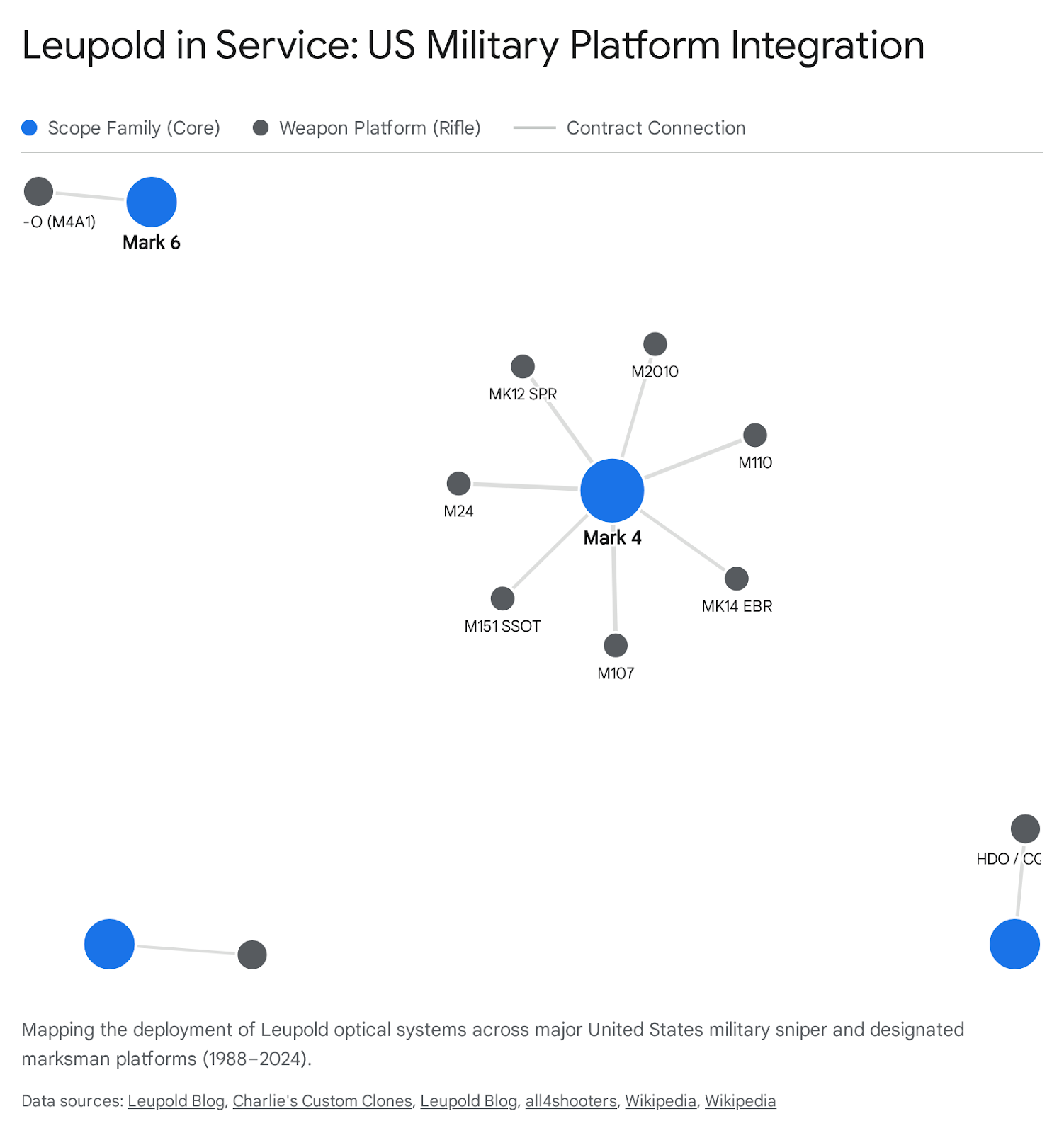
Milestone: In 1988, the U.S. Army officially adopted the Remington Model 700-based M24 Sniper Weapon System (SWS), topped with the Leupold Ultra M3A.13 This contract was a watershed moment. It validated Leupold not just as a consumer brand, but as a serious defense contractor capable of meeting and exceeding Mil-Spec standards.

4.2 Dominating the Global War on Terror (2001–2015)

The conflicts in Iraq and Afghanistan created an unprecedented demand for precision optics. Leupold’s presence on the battlefield expanded rapidly as the nature of engagement shifted toward long-range precision fire to minimize collateral damage and engage insurgents at standoff distances.

  • M107 Long Range Sniper Rifle (.50 Cal): In 1989, Leupold began supplying the Mark 4 LR/T 4.5-14x50mm for the Barrett M82/M107 systems. The scope had to withstand the massive recoil impulse of the.50 BMG cartridge, a testament to the “Ultra” design lineage.13
  • Mk 12 Special Purpose Rifle (SPR): In 2002, the Mark 4 MR/T (Mid-Range Tactical) 2.5-8x36mm (specifically the TS-30 A2) was adopted for the Mk 12 SPR. This rifle was designed for Navy SEALs and Special Forces to bridge the gap between a standard infantry carbine and a dedicated sniper rifle. The optic had to be versatile, compact, and extremely rugged.15
  • M110 Semi-Automatic Sniper System (SASS): In 2008, the Army replaced the M24 with the semi-automatic M110, selecting the Leupold Mark 4 LR/T 3.5-10x40mm. This contract solidified Leupold’s ubiquity across Army sniper teams.13

Brand Synergy Analysis: During this period, the “Mark 4” brand became synonymous with military sniping. Leupold effectively leveraged this combat pedigree to sell premium optics to the civilian market. The “tactical” consumer segment exploded in the mid-2000s, driven by shooters who wanted the same gear used by the military. Leupold capitalized on this by offering civilian versions of the Mark 4, creating a high-margin revenue stream that complemented their hunting business.

Ronin's polymer handle being cut with a plastic knife on foil

4.3 The ECOS-O and Marine Corps Contracts

Leupold continued to innovate with the Mark 6 and Mark 8 lines, pushing the boundaries of zoom ratios. The Mark 6 3-18x44mm was selected for the Enhanced Combat Optical Sight-Optimized (ECOS-O) program, utilized by US Navy, Air Force, and Marine Corps units.17 This optic represented a leap in “power density”—providing a massive 6x zoom ratio in a remarkably compact package (less than 12 inches long), essential for carbines where rail space is at a premium.

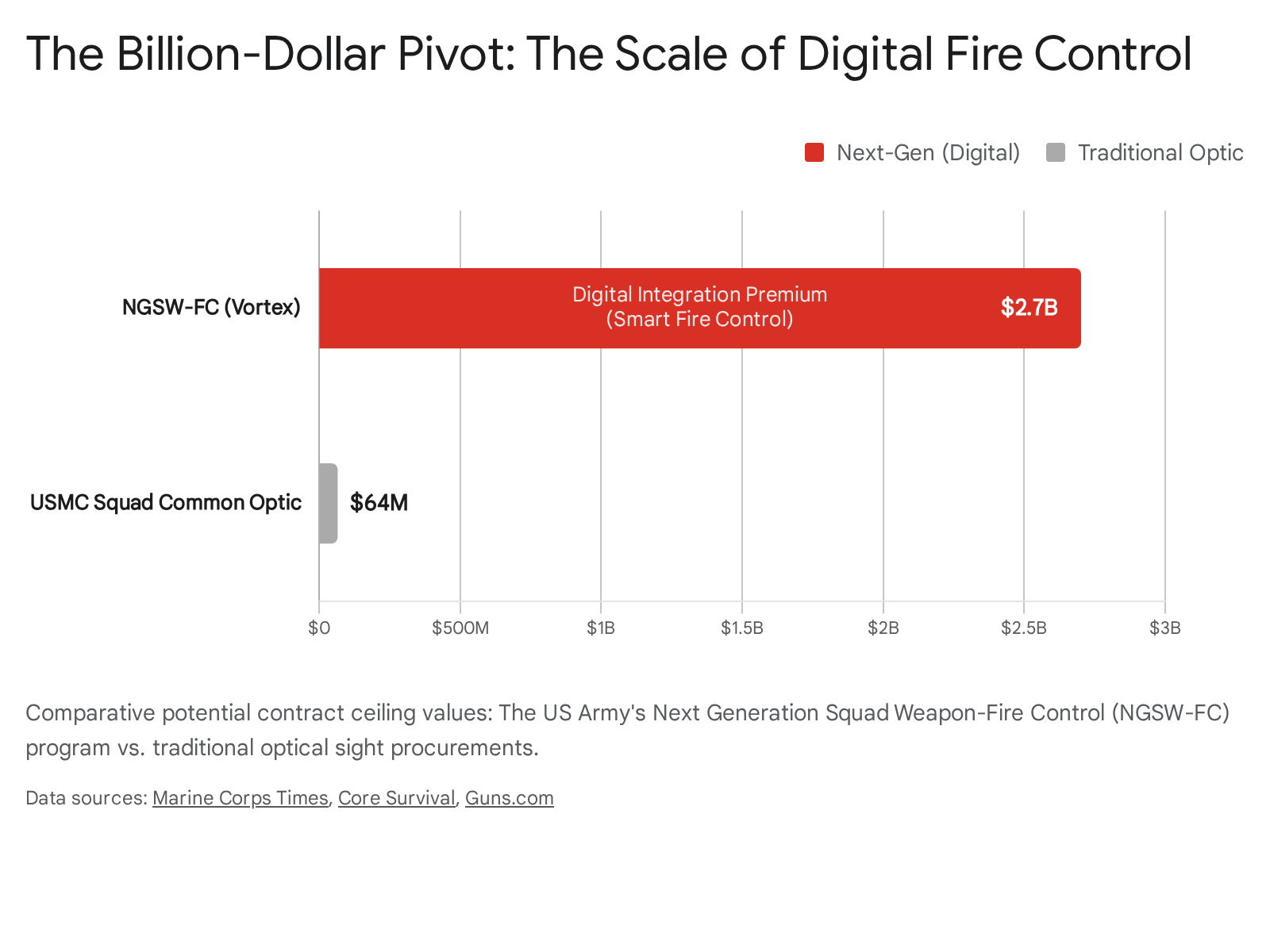
However, the military market is fiercely competitive and zero-sum. In 2020, the US Marine Corps selected Trijicon for the massive Squad Common Optic (SCO) contract, replacing the Trijicon ACOG with a 1-8x Variable Combat Optical Gunsight (VCOG).19 This was a notable loss for Leupold, signaling the intense competition in the Low Power Variable Optic (LPVO) space, where other players like Sig Sauer and Vortex were also making significant inroads.

5. Modern Product Portfolio and Technology Stack (2010–Present)

Leupold’s current portfolio is structured to capture every segment of the optics market, from the budget-conscious hunter to the elite Tier 1 operator. This segmentation is managed through distinct product families, primarily the VX (Variable-X) series for hunting and the Mark series for tactical use. The strategy is clear: provide an entry point for every shooter, and then upsell them on features and glass quality.

5.1 The VX Series: Hunting Dominance

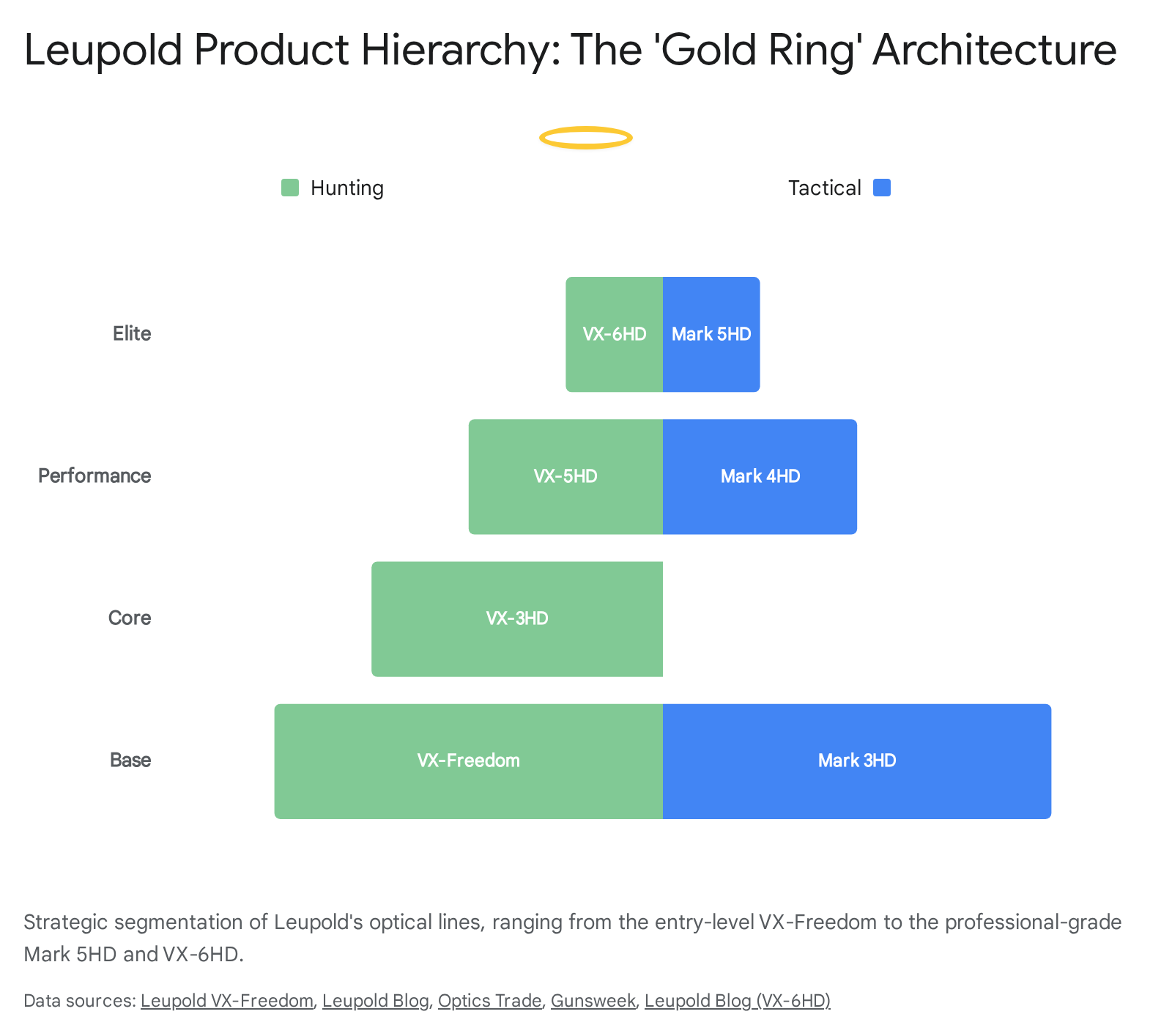
The VX line is the direct descendant of the Vari-X scopes of the 20th century. Leupold has tiered this line to offer clear “good, better, best” options, creating a ladder of upgrades for the consumer:

  • VX-Freedom: Replacing the legacy VX-1 and VX-2 lines, this is the entry-level offering. It maintains the “Gold Ring” guarantee and American assembly but utilizes simpler lens systems and fewer distinct features to keep costs down.21 It is designed to capture the first-time buyer.
  • VX-3HD: The spiritual successor to the legendary VX-III. It occupies the “sweet spot” for serious hunters, featuring high-definition (HD) glass, the Custom Dial System (CDS), and illuminated reticles. It is arguably the core volume driver for the company, balancing performance with affordability.12
  • VX-5HD & VX-6HD: These are premium lines featuring 5x and 6x zoom ratios, respectively. The VX-6HD includes advanced features like an in-scope electronic reticle level (to prevent canting), motion sensor technology (MST) for illumination battery conservation, and alumina flip-back covers. These scopes compete directly with high-end European optics from Swarovski, Zeiss, and Leica, offering similar optical performance at a more competitive price point and with better warranty support.23

Technological Differentiator: The Custom Dial System (CDS)

A key innovation in the hunting line is the CDS. Leupold allows customers to order a custom laser-marked elevation dial matched to their specific ballistics (caliber, bullet weight, velocity, altitude, temperature). This simplifies long-range shooting for hunters, removing the need for complex holdover calculations or DOPE charts. It turns a complex physics problem into a simple “range and dial” solution.25 This feature creates a sticky ecosystem; once a hunter is accustomed to dialing for distance with a CDS turret, they are less likely to switch to a competitor that requires learning a new system.

5.2 The Mark Series: Tactical Precision

  • Mark 3HD: The entry point for tactical shooters, offering Mil-based adjustments and reticles at a consumer-friendly price.
  • Mark 4HD: A newly revitalized line bridging the gap between the 3HD and 5HD, bringing back the legendary “Mark 4” name with modern internals.
  • Mark 5HD: The flagship tactical optic and a current industry darling. Its 35mm maintube (a unique size in the industry) allows for massive elevation travel, essential for Extreme Long Range (ELR) shooting. It is lighter than competing scopes in its class (like the Vortex Razor Gen II), addressing the “ounces equal pounds” philosophy of military end-users who are already overburdened with gear.26 The “ZeroLock” dial prevents accidental adjustments while allowing for rapid dialing.

5.3 Electronic Optics and Thermal Diversification

Recognizing the limits of traditional glass, Leupold has expanded into electronics, although with a specific strategic focus:

  • DeltaPoint Pro: Leupold is a dominant player in the pistol red dot market. The DeltaPoint Pro’s ruggedness led to its adoption by the US Army for the M17 Modular Handgun System (as a potential accessory) and widespread use in law enforcement. However, competition from Holosun (on price) and Trijicon (on RMR durability) is fierce.28
  • LTO Tracker: Leupold entered the thermal market not with a weapon sight (initially), but with a handheld tracker. This strategic choice avoided ITAR (International Traffic in Arms Regulations) complications and export restrictions associated with thermal weapon sights, allowing mass market retail sales to hunters for game recovery. It allowed Leupold to dip a toe into thermal technology without the massive regulatory burden of weapon-mounted systems.29

5.4 Performance Eyewear

In 2020, Leupold launched a line of performance eyewear (sunglasses). While seemingly a diversion, this utilizes their core competency—lens coatings and clarity—to capture “lifestyle” spend. The glasses are ballistic rated (ANSI Z87.1), appealing to the shooter demographic who wants eye protection that looks like casual wear. This diversification helps smooth out revenue cycles, as eyewear is a lower-cost, higher-frequency purchase than a $2,000 riflescope.31

Ronin's polymer handle being cut with a plastic knife on foil

6. Manufacturing Operations and Corporate Strategy

In an era of globalized supply chains where “Made in China” or “Made in Philippines” is the norm for optics, Leupold’s adherence to domestic manufacturing is its most defining operational characteristic. This commitment is not merely patriotic sentimentality; it is a calculated strategic defense mechanism.

6.1 The Beaverton Fortress and the Berry Amendment

Leupold’s headquarters and manufacturing facility are located in Beaverton, Oregon. The company employs approximately 700 people.15 Unlike competitors who design in the US and manufacture in Asia, Leupold machines its maintubes and assembles its Gold Ring scopes onsite.

This vertical integration provides two critical advantages:

  1. Operational Agility: Leupold can pivot production lines rapidly to address defects or shifting demand without waiting for shipping containers to cross the Pacific. If a quality issue is detected, it can be solved on the factory floor in hours, not months.
  2. Berry Amendment Compliance: U.S. law requires the Department of Defense to give preference to domestically produced products for certain procurement categories. By manufacturing in Oregon, Leupold is often the default choice for military contracts that require 100% US content or substantial domestic transformation.33 This regulatory “moat” protects them from cheaper foreign competitors in the defense sector.

6.2 Supply Chain Challenges and Expansion

The COVID-19 pandemic and the subsequent surge in outdoor recreation demand (2020-2022) stressed Leupold’s capacity to the breaking point. The “Custom Shop,” a beloved service allowing customers to retrofit reticles and turrets, was closed indefinitely to focus all resources on standard production.34 This indicates a company operating at maximum capacity, forced to prioritize volume over bespoke services to meet market demand.

To address this bottleneck, Leupold broke ground on a new distribution center on its Beaverton campus in 2021.35 This expansion aims to streamline logistics and, crucially, free up floor space in the main factory for increased manufacturing capacity. The hiring of Rob Nees as VP of Manufacturing and Global Supply Chain underscores a focus on modernizing their operational efficiency and implementing Lean manufacturing principles to squeeze more output from their domestic footprint.36 Furthermore, the acquisition of Anodize Solutions—a long-time vendor—allowed Leupold to bring the critical anodizing process (the hard, protective coating on the aluminum tube) in-house, further securing their supply chain against external disruptions.37

6.3 Glass Sourcing Reality

It is a common misconception among consumers that Leupold “makes” its own glass. Like almost all high-end optics manufacturers, Leupold sources its raw glass and lens elements. The company is transparent that “there are no American manufacturers that can supply enough high quality lenses” to support their volume.38 Consequently, they source glass from Japan and other Asian partners who specialize in precision grinding and polishing. However, the design of the lens system, the engineering of the coatings, the machining of the housing, and the final assembly/purging occur in the USA. This distinction—”Assembled in USA” using some foreign components vs “Made in USA”—is crucial for legal labeling and managing consumer perception.

6.4 Executive Leadership and Regional Friction

The company remains family-owned, currently in its fifth generation.15 However, the appointment of Bruce Pettet as CEO (a non-family member with a background in consumer brands like Airwalk and Brooks Sports) marked a shift toward modern brand management.15 Pettet has pushed for a stronger digital presence, “lifestyle” branding (e.g., eyewear), and operational rigor. The tension between family stewardship (conservative, long-term legacy focus) and private equity-style growth (aggressive, quarterly results) will define the boardroom dynamic in the coming years.

Leupold also operates in the Portland metro area, a region that has become politically polarized. In 2019, the Portland Trail Blazers ended their partnership with Leupold due to political pressure regarding the company’s manufacturing of sniper scopes for the military and their potential use in crowd control contexts abroad.41 This cultural friction poses a talent acquisition and public relations challenge for a firearms-adjacent company operating in a progressive political stronghold.

7. The Future of Fire Control: 2025 and Beyond

As Leupold moves toward 2030, it faces a technological crossroads. The era of purely passive glass optics is waning in the military sector, replaced by “Smart Optics” that integrate ballistics, environmental sensors, and augmented reality.

7.1 The Digital Threat: The NGSW Loss

The most significant strategic signal for Leupold’s future is the loss of the Next Generation Squad Weapon-Fire Control (NGSW-FC) contract. Leupold partnered with defense giant L3Harris to offer a solution, but the contract—potentially worth $2.7 billion—was awarded to Vortex Optics (via its subsidiary Sheltered Wings).42

The Vortex XM157 is a “computer on a gun,” featuring a variable magnification optic, laser rangefinder, ballistic calculator, atmospheric sensors, and active display overlay. Leupold’s loss here suggests that while they are the masters of mechanical optics, they may lag in the rapid integration of advanced digital systems required for the next generation of infantry combat.

Strategic Implication: Leupold must decide whether to invest heavily to catch up in the digital fire control space or to double down on its core competency: creating the world’s best passive optical systems for snipers and hunters, where battery reliance is a liability rather than an asset. The Mark 5HD’s selection for the PSR proves there is still a massive market for high-end glass, but the “big money” future contracts are clearly digital.

Ronin's polymer handle being cut with a plastic knife on foil

7.2 The “Smart Scope” Pivot

Recent patents indicate Leupold is not ignoring the digital trend. Patents for “Firearm optic with locking feature” and various digital integrations suggest R&D is active.44 The LTO Tracker thermal line was a safe experiment, but the future will likely require a “smart” hunting scope that integrates the CDS logic electronically—perhaps an optic that projects the aim point based on a laser rangefinder reading (similar to the Burris Eliminator or Sig Sauer BDX) but with Leupold’s superior glass quality.

7.3 The PSR Win: A Foundation for the Future

Despite the SCO loss, Leupold achieved a massive victory in 2020 by winning the optic contract for the U.S. Army’s Precision Sniper Rifle (PSR) program. The Army selected the Leupold Mark 5HD 5-25x56mm to pair with the MK22 Mod 0 (Barrett MRAD).46

The selection of the Mark 5HD was significant for several reasons:

  1. Commercial Off-The-Shelf (COTS) Origins: The Mark 5HD was originally developed for the civilian precision rifle market (PRS/NRL competitions). Its adoption by the military demonstrates how civilian competitive shooting is now driving military innovation, rather than the reverse.
  2. Mechanical Excellence: The Mark 5HD features the “ZeroLock” dial and huge elevation travel, necessary for the extreme ranges of the.300 and.338 Norma Magnum cartridges used by the PSR.
  3. Color: The contract specified a proprietary “Flat Dark Earth” (FDE) coating, moving away from the traditional anodized black, showing Leupold’s willingness to adapt aesthetic processes for specific contracts.48

8. Summary of Major Milestones

The following table chronicles the defining moments in Leupold & Stevens’ history, illustrating the march from hydrography to optical dominance.

YearMilestoneSignificance
1907FoundingFred Leupold sets up a one-man survey repair shop in Portland, OR.
1914Stevens PartnershipJ.C. Stevens joins; company focuses on water level recorders.
1942Name ChangeOfficially becomes Leupold & Stevens, Inc.
1947The PlainsmanFirst Leupold riflescope. Introduces nitrogen purging, creating the first fog-proof scope.
1949IncorporationLeupold & Stevens incorporates, solidifying its business structure.
1962Duplex ReticleInvention of the Duplex reticle, which becomes the global standard for aiming points.
1964Golden RingIntroduction of the Gold Ring trademark to signify the Lifetime Guarantee.
1968Beaverton MoveRelocation to the current manufacturing campus in Beaverton, Oregon.
1978Compact ScopesLaunch of the industry’s first line of compact riflescopes.
1988M24 ContractUS Army adopts the M24 SWS with the Leupold Ultra M3A scope. Entry into major defense contracts.
1992Vari-X IIILaunch of the Vari-X III, setting a new standard for hunting variables.
2002Mk 12 SPRAdoption of the Mark 4 MR/T for the Special Purpose Rifle.
2008M110 SASSUS Army adopts Leupold Mark 4 for the M110 Semi-Automatic Sniper System.
2014Bruce Pettet CEOAppointment of non-family CEO to modernize the brand and operations.
2016LTO TrackerEntry into the thermal optics market with a handheld device.
2017VX-HD SeriesLaunch of VX-5HD and VX-6HD, pushing high-definition glass and 6x zoom ratios.
2018Mark 5HDLaunch of the Mark 5HD, a ground-up redesign for long-range precision.
2020PSR ContractUS Army selects Mark 5HD for the Precision Sniper Rifle (MK22).
2020Eyewear LaunchDiversification into ballistic-rated performance sunglasses.
2021ExpansionGroundbreaking on a new distribution center in Beaverton.
2022NGSW LossCompetitor Vortex wins the Army NGSW-FC contract; Leupold/L3Harris bid fails.
2025Gen 2 LaunchIntroduction of VX-6HD Gen 2 and continued Mark 4HD rollout.49

Conclusion

Leupold & Stevens remains a singular force in the American firearms industry. Its journey from measuring river levels to guiding precision rifle fire is united by a common thread: the relentless pursuit of reliability in unforgiving environments. The company has successfully leveraged its heritage to build a brand that commands loyalty in the deer woods and respect on the battlefield.

However, the “Golden Ring” now faces a digital horizon. The loss of the NGSW contract is a warning shot, signaling that mechanical perfection alone may not suffice in the battlespace of tomorrow. To maintain its dominance through the 21st century, Leupold must execute a difficult balancing act: preserving the mechanical soul that built the company while daring to integrate the silicon brain that the future demands. For the firearms industry analyst, Leupold remains a “Strong Buy” for its dominant civil business and entrenched PSR position, but a “Watch” regarding its long-term digital strategy.


Please share the link on Facebook, Forums, with colleagues, etc. Your support is much appreciated and if you have any feedback, please email us in**@*********ps.com. If you’d like to request a report or order a reprint, please click here for the corresponding page to open in new tab.


Sources Used

  1. Leupold Optics History: Founding, Timeline, and Milestones – Zippia, accessed December 21, 2025, https://www.zippia.com/leupold-stevens-careers-29434/history/
  2. History of Leupold & Stevens, Inc. – FundingUniverse, accessed December 21, 2025, https://www.fundinguniverse.com/company-histories/leupold-stevens-inc-history/
  3. The Story of the Foggy Scope, the Missed Deer, and the Beginning of a Legendary Optics Brand – Wide Open Spaces, accessed December 21, 2025, https://www.wideopenspaces.com/the-story-of-the-foggy-scope-the-missed-deer-and-the-beginning-of-a-legendary-optics-brand/
  4. 10 Things You Didn’t Know About Leupold | An Official Journal Of The NRA, accessed December 21, 2025, https://www.americanhunter.org/content/10-things-you-didn-t-know-about-leupold/
  5. A Living History of Leupold & Stevens, Inc, accessed December 21, 2025, https://www.leupold.com/a-living-history
  6. The Story of Leupold: A Foundation in Focus – The Armory Life, accessed December 21, 2025, https://www.thearmorylife.com/the-story-of-leupold-a-foundation-in-focus/
  7. Selecting A Reticle | Leupold, accessed December 21, 2025, https://www.leupold.com/blog/post/selecting-a-reticle
  8. DUPLEX RETICLE – Leupold, accessed December 21, 2025, https://cdnp.leupold.com/content/documents/73686_duplex_reticle_spec_sheet-all.pdf
  9. Counterfeit Warning – Leupold, accessed December 21, 2025, https://www.leupold.com/counterfeit-warning
  10. Leupold VX-2 Riflescopes | An Official Journal Of The NRA, accessed December 21, 2025, https://www.americanrifleman.org/content/leupold-vx-2-riflescopes/
  11. accessed December 21, 2025, https://nchuntandfish.com/forums/index.php?threads/older-vari-x-ii.21631/#:~:text=The%20Vari%2DX%20II%20was,a%20very%20high%20quality%20scope.
  12. 50 Years of 3 Series Leupold Gold Ring Scopes: A Legacy of Precision – Viking Arms, accessed December 21, 2025, https://www.vikingshoot.com/50-years-of-3-series-leupold-gold-ring-scopes-a-legacy-of-precision/
  13. Honoring the Mark 4’s Legendary Military Service – Leupold, accessed December 21, 2025, https://www.leupold.com/blog/post/30-years-of-service
  14. M24 Sniper Weapon System – Wikipedia, accessed December 21, 2025, https://en.wikipedia.org/wiki/M24_Sniper_Weapon_System
  15. Leupold & Stevens – Wikipedia, accessed December 21, 2025, https://en.wikipedia.org/wiki/Leupold_%26_Stevens
  16. Leupold Mark 4 LR/T 3.5-10×40 M2 Illum TMR FDE/ Dark Earth M110 scope GOV model, accessed December 21, 2025, https://charliescustomclones.com/leupold-mark-4-lr-t-3-5-10×40-m2-illum-tmr-fde-dark-earth-m110-scope-gov-model/
  17. Embracing the American Spirit – Leupold, accessed December 21, 2025, https://www.leupold.com/blog/post/american-manufacturing-heritage
  18. Leupold Mark 6 3-18x44mm Wins Again With FBI Contract | Soldier Systems Daily, accessed December 21, 2025, https://soldiersystems.net/2014/08/26/leupold-mark-6-3-18x44mm-wins-fbi-contract/
  19. MCSC awards contract to produce the Squad Common Optic, accessed December 21, 2025, https://www.marcorsyscom.marines.mil/News/News-Article-Display/Article/2091999/mcsc-awards-contract-to-produce-the-squad-common-optic/
  20. Marines select a brand new rifle optic with $64M contract, accessed December 21, 2025, https://www.marinecorpstimes.com/news/your-marine-corps/2020/02/28/marines-select-a-brand-new-rifle-optic-with-64m-contract/
  21. VX-Freedom Rifle Scopes | Leupold, accessed December 21, 2025, https://www.leupold.com/shop/riflescopes/series/vx-freedom-rifle-scopes
  22. Leupold Announces Launch of VX-3HD Line of Riflescopes, accessed December 21, 2025, https://www.leupold.com/blog/post/leupold-announces-launch-of-vx-3hd-line-of-riflescopes
  23. VX-5HD and VX-6HD: Leupold’s mid-year introductions | GUNSweek.com, accessed December 21, 2025, https://gunsweek.com/en/optics/news/vx-5hd-and-vx-6hd-leupolds-mid-year-introductions
  24. VX-6HD: Elite Leupold Performance, accessed December 21, 2025, https://www.leupold.com/blog/post/vx-6hd-elite-leupold-performance
  25. PRODUCT CATALOG 2024 ENGLISH – Leupold, accessed December 21, 2025, https://www.leupold.com/media/EN_2024_Leupold_International_Catalog-Web.pdf
  26. Leupold Mark 5HD 5-25×56 MIL Riflescope Review – Optics Trade, accessed December 21, 2025, https://www.optics-trade.eu/blog/leupold-mark-5hd-5-25×56-mil-riflescope-review-optics-trade-reviews/
  27. Leupold Mark 5HD, By Caylen Wojcik – Journal of Mountain Hunting, accessed December 21, 2025, https://journalofmountainhunting.com/leupold-mark-5hd-by-caylen-wojcik/
  28. DeltaPoint Pro – Leupold, accessed December 21, 2025, https://www.leupold.com/deltapoint-pro-red-dot
  29. Tracker Thermal Optic – Leupold, accessed December 21, 2025, https://www.leupold.com/shop/thermals/series/tracker
  30. Leupold® LTO Tracker Thermal Sight a Vital Tool for Any Hunter, accessed December 21, 2025, https://www.leupold.com/blog/post/leupold-lto-tracker-thermal-sight-a-vital-tool-for-any-hunter
  31. Introducing Performance Eyewear – Leupold, accessed December 21, 2025, https://www.leupold.com/blog/post/introducing-performance-eyewear
  32. RMEF Media A New Era of Relentless Performance Arrives: Leupold Performance Eyewear Now Available for Purchase, accessed December 21, 2025, https://www.rmef.org/elk-network/a-new-era-of-relentless-performance-arrives-leupold-performance-eyewear-now-available-for-purchase/
  33. The Military’s Leupold Riflescopes | An Official Journal Of The NRA – American Rifleman, accessed December 21, 2025, https://www.americanrifleman.org/content/the-military-s-leupold-riflescopes/
  34. Custom Shop | Leupold, accessed December 21, 2025, https://www.leupold.com/custom-shop
  35. Leupold Breaks Ground on New Product Distribution Center, accessed December 21, 2025, https://www.leupold.com/blog/post/leupold-to-break-ground-on-new-product-distribution-center
  36. Leupold Chooses Rob Nees To Lead Manufacturing | SGB Media Online, accessed December 21, 2025, https://sgbonline.com/leupold-chooses-rob-nees-to-lead-manufacturing/
  37. Leupold Acquires Anodize Solutions | An Official Journal Of The NRA – American Rifleman, accessed December 21, 2025, https://www.americanrifleman.org/content/leupold-acquires-anodize-solutions/
  38. FAQS – Leupold, accessed December 21, 2025, https://www.leupold.com/faq
  39. Leupold & Stevens, Inc: Five Generations of Governance | Family Business Resource Center | Davis Wright Tremaine, accessed December 21, 2025, https://www.dwt.com/blogs/family-business-resource-center/2017/01/leupold–stevens-inc-five-generations-of-governanc
  40. Family Business CEOs to Watch 2020, accessed December 21, 2025, https://familybusinessmagazine.com/ownership/advisers-consultants/family-business-ceos-watch-2020/
  41. Portland Trail Blazers Announce the End of Its Partnership with Military Contractor Leupold & Stevens – Willamette Week, accessed December 21, 2025, https://www.wweek.com/sports/2019/09/30/portland-trail-blazers-announce-the-team-has-ended-its-partnership-with-military-contractor-leupold-stevens/
  42. U.S. Army Selected Vortex To Provide Its Next Generation Squad Weapon – Fire Control Optic (XM157) – CORE Survival, accessed December 21, 2025, https://www.coresurvival.com/core-news/us-army-selected-vortex-to-provide-its-next-generation-squad-weapon-fire-control-optic-xm157
  43. Vortex Win US Army Next Generation Squad Weapons – Fire Control Contract, accessed December 21, 2025, https://www.thefirearmblog.com/blog/2022/01/07/vortex-win-us-army-next-generation-squad-weapons-fire-control-contract/
  44. Lens Cover, Scope Hood, Or Shade Patents and Patent Applications (Class 42/129), accessed December 21, 2025, https://patents.justia.com/patents-by-us-classification/42/129
  45. US10337830B2 – Portable optical device with interactive wireless remote capability – Google Patents, accessed December 21, 2025, https://patents.google.com/patent/US10337830B2
  46. Leupold Mark 5HD Selected by Army Precision Sniper Rifle Program – The Firearm Blog, accessed December 21, 2025, https://www.thefirearmblog.com/blog/2020/03/11/leupold-mark-5hd-army-psr/
  47. Leupold Mark 5HD – New Precision Sniper Rifle (PSR) scope of the US Army | all4shooters, accessed December 21, 2025, https://www.all4shooters.com/en/shooting/pro-zone/leupold-mark-5hd-new-precision-sniper-rifle-psr-scope-of-the-us-army-army/
  48. Army Precision Sniper Rifle Program Chooses Leupold Mark 5HD as Day Optic | RECOIL, accessed December 21, 2025, https://www.recoilweb.com/army-precision-sniper-rifle-program-chooses-leupold-mark-5hd-as-day-optic-158699.html
  49. CONSUMER GUIDE 2025 – Leupold, accessed December 21, 2025, https://www.leupold.com/media/2025_Consumer_Guide_Low_Res.pdf

Strategic Assessment and Technical Analysis: PGW Defence Technologies C14 Timberwolf Series

The global landscape of precision infantry weapons has undergone a radical transformation over the past two decades, driven largely by the shift from symmetrical, cold-war era doctrines to the asymmetric demands of the Global War on Terror (GWOT). Within this volatile context, the Canadian-made PGW Defence Technologies C14 Timberwolf emerged as a definitive platform, bridging the ballistic gap between standard 7.62x51mm NATO systems and heavy.50 BMG anti-materiel rifles. Officially designated as the C14 Medium Range Sniper Weapon System (MRSWS) by the Canadian Armed Forces (CAF), the Timberwolf was procured to extend the lethality of infantry snipers beyond the 1,200-meter threshold—a requirement necessitated by the engagement distances encountered in the mountainous terrain of Afghanistan.

This report delivers a comprehensive industry analysis of the C14 Timberwolf ecosystem. It examines the platform through the dual lenses of engineering efficacy and market viability. Technically, the C14 is distinguished by its proprietary helical-fluted bolt architecture, cryogenic-treated metallurgy, and a unique titanium cantilever bedding system that offers exceptional zero-retention under high-g force impacts. Ballistically, the integration of the.338 Lapua Magnum cartridge represented a quantum leap in kinetic energy transfer and effective range compared to its predecessor, the Parker-Hale C3A1.

Market analysis reveals a complex user sentiment profile. While the C14 is universally lauded for its ruggedness and sub-MOA precision, it currently occupies a precarious position in the procurement cycle. The recent selection of the Sako TRG M10 (designated C21) to replace the C14 highlights a broader industry trend away from dedicated, single-caliber receivers toward modular, multi-caliber chassis systems that offer superior logistical flexibility. Despite this, the C14 remains a viable, high-value asset for specific end-users—namely, civilian extreme long-range (ELR) enthusiasts seeking military-grade durability without the premium price tag of modular competitors, and defense clients requiring a simplified, dedicated long-action platform.

The following report dissects the C14’s engineering anatomy, operational history, competitive standing, and investment value. It concludes that while the era of the dedicated.338 service rifle is waning in tier-one military units, the C14 Timberwolf endures as a benchmark of purpose-built precision engineering, offering distinct advantages in stability and simplicity that continue to command respect in the specialized small arms market.

1.0 Strategic Overview and Procurement Heritage

To fully appreciate the technical nuances of the C14 Timberwolf, one must first understand the doctrinal void it was designed to fill. The evolution of sniper warfare in the late 20th and early 21st centuries dictated a move away from “scout sniper” concepts reliant on accurized battle rifles toward dedicated “precision engagement” systems capable of influencing the battlespace at operational distances previously reserved for crew-served weapons or indirect fire.

1.1 The Legacy of the C3A1 and the Range Gap

Prior to the induction of the C14, the Canadian Armed Forces relied heavily on the C3A1 sniper rifle. Based on the British Parker-Hale M82, the C3A1 was a bolt-action rifle chambered in 7.62x51mm NATO. While a capable system in its time, the 7.62mm cartridge suffers from significant ballistic limitations beyond 800 meters. As the projectile enters the transonic flight regime (dropping below the speed of sound), it becomes susceptible to aerodynamic instability, resulting in a dramatic loss of accuracy.

The operational reality of the Afghan theater, specifically Operation Athena, exposed these limitations. Canadian snipers frequently engaged insurgents at distances exceeding 1,000 meters across valley floors and ridge lines. The 7.62mm platform lacked the terminal energy to reliably neutralize targets or penetrate light cover at these extended ranges. Furthermore, the reliance on the.50 BMG (12.7x99mm) McMillan TAC-50 for all long-range work introduced mobility challenges. The TAC-50, while ballistically superior, is a heavy, cumbersome anti-materiel weapon ill-suited for agile infantry patrols in steep terrain.

1.2 The MRSWS Requirement and Selection

The Medium Range Sniper Weapon System (MRSWS) program was initiated to procure a “middle-weight” contender—a system man-portable enough for patrol operations yet chambered in a cartridge powerful enough to bridge the gap between the 7.62mm and the.50 BMG.

The selection of the.338 Lapua Magnum (8.6x70mm) was a decisive move. Originally developed in the 1980s specifically for long-range sniping, the.338 LM offers a trajectory comparable to the 7.62mm but with twice the kinetic energy and effective range extending to 1,500 meters.

In 2001, Prairie Gun Works (now PGW Defence Technologies Inc.), a Winnipeg-based manufacturer known for high-end competition rifles, submitted the Timberwolf for trials. The platform competed against established international designs but ultimately secured the contract due to a combination of superior accuracy, robust engineering tailored to cold-weather operations, and domestic industrial benefits. The C14 officially entered service in 2005, marking a significant milestone in the maturity of the Canadian small arms industry.

1.3 Corporate Profile and Geopolitical Context

PGW Defence Technologies has established itself as a niche but highly capable player in the global defense market. Unlike massive conglomerates like General Dynamics or Colt, PGW operates as a specialized boutique manufacturer, allowing for high agility in design adaptation but limiting production scale compared to global giants.

The company has faced scrutiny regarding its export activities, a common operational hazard in the arms trade. Notably, the export of LRT-3.50 caliber rifles to Saudi Arabia sparked domestic political debate regarding the potential use of Canadian arms in the Yemeni conflict. Similarly, a $1 million deal to supply sniper systems to Ukraine highlighted the company’s role in supplying lethal aid to active conflict zones. These contracts demonstrate the C14 and its siblings (the Coyote and LRT-3) are not merely training tools but active combat systems sought after by nations engaged in high-intensity warfare. This combat provenance significantly enhances the brand’s “halo effect” in the civilian market, validating the platform’s reliability under the most extreme conditions.

2.0 Engineering Anatomy: The Timberwolf System

The C14 Timberwolf is not simply a hunting rifle dressed in military furniture; it is a purpose-built weapon system engineered to endure the rigors of battlefield abuse while maintaining benchrest-grade accuracy. The design philosophy emphasizes structural rigidity, thermal management, and debris tolerance.

2.1 Receiver Architecture and Metallurgy

The heart of the C14 is the Timberwolf receiver. While it shares the basic cylindrical footprint of the Remington 700—a ubiquitous standard allowing for trigger and accessory compatibility—the similarities end there. The receiver is machined from high-grade stainless steel, chosen for its balance of tensile strength and corrosion resistance—a critical factor for a weapon that may be subjected to maritime insertions or prolonged exposure to snow and rain.

For specialized applications, PGW also offers a titanium receiver variant. Titanium provides a significant weight reduction (approx. 40% lighter than steel) while maintaining high strength. However, titanium is susceptible to galling (friction welding) when moving parts interact under high pressure. PGW mitigates this through advanced surface coatings (DLC or Nitriding), though the stainless steel variant remains the standard for general military issue due to its lower cost and superior inherent lubricity.

2.2 The Helical Fluted Bolt Assembly

One of the most visually distinct and functionally critical components of the C14 is the bolt.

  • Helical Fluting: The bolt body features deep, spiral (helical) flutes. In a civilian context, fluting is often aesthetic. In the C14, it serves a vital reliability function. The flutes act as “mud channels,” providing a physical space for debris, sand, ice, or carbon fouling to migrate away from the tight-tolerance bearing surfaces between the bolt and receiver. This allows the action to cycle smoothly even when the rifle is fouled, a scenario that would seize a solid-body bolt.
  • Tri-Lug Locking System: The bolt utilizes dual front locking lugs and a third safety lug at the rear. This design requires a 90-degree bolt lift. While some modern systems prefer a 60-degree throw for speed, the 90-degree throw offers maximum primary extraction leverage—essential for extracting the long, parallel-walled.338 Lapua cases which can stick in the chamber when fired at high pressures.
  • Ejection Reliability: A failure to eject (FTE) is the most common stoppage in bolt-action rifles. The C14 combats this with a dual-plunger ejector system. Two spring-loaded plungers exert constant, balanced pressure on the case head, flipping it out of the ejection port with authority the moment the case mouth clears the receiver bridge. This is paired with a heavy-duty M16-style hook extractor that takes a massive bite on the case rim.

2.3 Barrel Technology and Harmonics

The barrel is the primary determinant of a rifle’s accuracy. The C14 utilizes a barrel manufactured by Krieger Barrels, arguably the premier barrel maker in the United States.

Table 1: C14 Timberwolf Barrel Specifications

SpecificationValueEngineering Rationale
Length26 inches (660 mm)Optimizes powder burn for.338 LM, achieving ideal velocity without excessive length.
Material416 Stainless SteelSuperior erosion resistance compared to chrome-moly steel; vital for high-pressure magnum throats.
Rifling ProcessSingle-Point Cut RiflingInduces minimal material stress compared to button rifling; ensures uniform bore dimensions.
Twist Rate1:10 Right HandCritical Spec: Optimized for heavy 300gr projectiles. Slower twists (1:12) fail to stabilize modern VLD bullets.
ContourHeavy Target / FlutedMaximizes stiffness to reduce whip; helical fluting increases surface area for cooling.
Thermal TreatmentCryogenic Stress ReliefSub-zero treatment relaxes molecular stresses, preventing point-of-impact shift as the barrel heats up.
Data Source:

The decision to use cut-rifled barrels is significant. Button rifling (pulling a carbide button through the bore) creates internal stresses that can cause the barrel to warp as it heats up during rapid fire strings. Cut rifling removes metal chip-by-chip, leaving the steel stress-free. This ensures that the C14 maintains its zero even after firing multiple magazines in quick succession.

2.4 The Titanium Cantilever Bedding System

Perhaps the most innovative feature of the C14 is its bedding interface. Traditional rifles use “glass bedding” (epoxy) to fit the action to the stock. While accurate, epoxy can degrade, crack, or soften with exposure to solvents and heat.

The C14 utilizes the PGWDTI-Titanium Cantilever Monoblock. This is a machined titanium bedding block permanently bonded into the McMillan stock.

  • Mechanism: The receiver bolts directly to this titanium skeleton. The “cantilever” design implies that the barrel is fully free-floated, touching nothing but the receiver.
  • Advantage: Titanium is impervious to temperature shifts and humidity. A C14 can be deployed from a heated vehicle into -40°C arctic air without the bedding shifting, ensuring the point of impact remains consistent. This level of environmental stability is a strict requirement for military snipers who may not have the opportunity to re-zero before taking a shot.

2.5 Chassis and Stock Evolution

The C14 series has evolved through multiple generations, primarily distinguished by their stock furniture.

  • Gen 1 / Gen 2 (Military Standard): These utilize the McMillan A5 fiberglass stock. The A5 is the gold standard for fixed-stock sniper rifles, featuring a wide, flat forend for stability on sandbags and a vertical pistol grip for ergonomic trigger control. It includes an adjustable saddle cheekpiece and a spacer-system for length of pull.
  • Gen 3 (Modern Standard): The latest commercial and potentially retrofit offerings feature a skeletonized aluminum chassis. This chassis system incorporates a folding stock mechanism that hinges over the bolt handle, significantly reducing the transport footprint—a critical factor for airborne troops or snipers moving in armored personnel carriers (APCs).
  • AICS Integration: A major improvement in the Gen 3 chassis is the adoption of the Accuracy International Chassis System (AICS) magazine pattern. Early C14s used a proprietary magazine that restricted the Cartridge Overall Length (COAL), preventing handloaders from seating bullets out to the lands. The move to standard AICS magazines resolves this, allowing for the use of ultra-long, high-BC projectiles.

2.6 Trigger Group

The C14 utilizes a single-stage match trigger. Unlike two-stage triggers common in European designs (like the AI or Sako), the single-stage break is preferred by many North American shooters for its simplicity and “glass rod” break characteristics.

  • Adjustability: The trigger is fully user-adjustable for weight of pull (factory set to ~3 lbs), sear engagement (creep), and over-travel.
  • Safety: It features a three-position safety on the bolt shroud. Position 1 (Fire), Position 2 (Safe, Bolt Operable), Position 3 (Safe, Bolt Locked). The middle position is crucial for field stripping the weapon safely with a live round in the chamber.

2.7 Muzzle Devices and Recoil Management

Managing the recoil of a.338 Lapua Magnum is a matter of physics and shooter endurance. The C14 employs a proprietary stainless steel muzzle brake.

  • Design: The OEM brake is a large, two-port “clamshell” design. While effective at reducing recoil by redirecting high-pressure gas rearward and to the sides, it is notorious for its concussion. The blast overpressure can kick up substantial dust (signature), revealing the sniper’s position.
  • Suppressor Compatibility: The barrel tenon is threaded (typically 3/4×20 or M18x1 depending on the variant) to accept a PGW sound suppressor. Suppressors are increasingly standard issue as they eliminate muzzle flash and make directional location difficult for the enemy.

3.0 Ballistic Analysis and Performance

The C14 is merely the delivery vehicle; the.338 Lapua Magnum cartridge is the payload. This section analyzes the performance of the system as a whole.

3.1 The.338 Lapua Magnum Advantage

The.338 LM was designed to penetrate standard military body armor at 1,000 meters. It sits in the “sweet spot” of ballistics:

  • Heavier than.30 Cal: The 250gr or 300gr bullets have significantly higher Sectional Density and Ballistic Coefficients than.308 or.300 Win Mag projectiles.
  • Lighter than.50 Cal: The system weighs ~15 lbs compared to the ~30 lbs of a.50 BMG rifle, allowing it to be carried by a single man.

3.2 External Ballistics: The 300 Grain Standard

The CAF utilizes the 300-grain Sierra MatchKing (SMK) Hollow Point Boat Tail (HPBT) projectile.

  • Muzzle Velocity: ~823 m/s (2,700 fps).
  • Supersonic Range: The 300gr SMK remains supersonic (above 1,100 fps) out to approximately 1,600 – 1,700 meters depending on atmospheric density. This is crucial because when a bullet slows to subsonic speeds, it passes through the “transonic zone,” where shockwaves destabilize the bullet, causing it to tumble and lose accuracy.
  • Wind Drift: The heavy 300gr bullet bucks the wind exceptionally well. In a 10 mph full-value crosswind, a.338 LM will drift significantly less than a.300 Win Mag, simplifying the firing solution for the shooter.

Table 2: Ballistic Comparison of Service Cartridges

MetricC3A1 (7.62 NATO)C14 Timberwolf (.338 LM)Improvement
Projectile Weight175 gr (11.3 g)300 gr (19.4 g)+71% Mass
Muzzle Energy~2,600 ft-lbs~4,900 ft-lbs+88% Energy
Effective Range800 m1,500 m+87% Range
Supersonic Limit~900 m~1,600 m+77% Reach
Data synthesized from

3.3 Accuracy Potential

PGW guarantees sub-0.75 MOA (Minute of Angle) accuracy. In practical terms, this means the rifle is capable of placing 5 shots into a circle smaller than 0.75 inches at 100 yards, or 7.5 inches at 1,000 yards.

  • Real-World Reports: Independent reviews and user reports suggest the rifle often exceeds this, achieving 0.5 MOA (1/2 MOA) with match-grade ammunition like Lapua Scenar or Hornady ELD-M. This level of precision is “tier-one” standard, comparable to Accuracy International and Sako platforms.

4.0 Operational Deployment and Logistics

The true test of any weapon system is not the proving ground, but the battlefield.

4.1 Combat Service: Afghanistan

The C14 entered service right at the height of the Kandahar campaign. The terrain of Afghanistan—vast, open deserts and high mountain peaks—favored the long-range capabilities of the.338 LM.

  • Overwatch: C14-equipped snipers provided overwatch for infantry patrols, capable of engaging Taliban fighters attempting to ambush convoys from distances where the enemy’s AK-47s and PKM machine guns were ineffective.
  • Durability: The environment was notorious for “moon dust”—fine alkaline dust that jams mechanisms. The helical fluted bolt of the C14 proved its worth here, allowing the rifle to function where tighter, non-fluted actions might bind.
  • The “Sound” of Safety: Reports from the field indicate the distinct acoustic crack of the.338 LM had a psychological suppression effect on enemy combatants, who learned to recognize the lethality of the system.

4.2 Maintenance and Logistics

The rifle is relatively simple to maintain due to its manual bolt-action design.

  • Field Stripping: The bolt can be removed in seconds for cleaning. The trigger unit is sealed but accessible for flushing out debris.
  • Barrel Life: The high operational pressure of the.338 LM burns barrels faster than smaller calibers. A typical.338 barrel might offer peak accuracy for 1,500 to 2,500 rounds. The C14 barrel must be replaced by a gunsmith (it is not user-interchangeable in the field like the AI AXSR), which creates a logistics burden requiring the weapon to be sent to rear-echelon armorers for servicing.

4.3 The Shift to Modularity: The C21 Selection

In 2022, the Canadian Army announced the selection of the Sako TRG M10 to replace the C14, designated as the C21 Sniper Weapon System.

  • Why Replace the C14? The decision was driven by modularity. Modern doctrine dictates that a sniper rifle should be convertible. The Sako M10 allows the user to swap the barrel and bolt face in minutes. A sniper can train with cheap 7.62x51mm ammo (saving barrel life and cost) and then switch to.338 LM for deployment using the same chassis and trigger.
  • The Logistical Win: This multi-caliber capability reduces the number of rifles an army needs to buy and maintain. The C14, being a dedicated single-caliber receiver, could not compete with this logistical flexibility, leading to its retirement from frontline service.

5.0 User Sentiment and Market Feedback

Analyzing sentiment from military end-users and civilian owners reveals a nuanced picture of the C14’s standing in the firearms community.

5.1 Military User Feedback

  • Positive: Snipers praise the system’s absolute reliability (“tank-like”) and the confidence inspired by its first-round hit probability. The ruggedness of the McMillan stock and the corrosion resistance of the stainless action are highlighted as key assets in wet/freezing conditions.
  • Negative: The primary complaint is weight. At nearly 16 lbs with optics and accessories, it is a burden on long patrols. Some users also noted the blast from the muzzle brake as a hindrance to concealment.

5.2 Civilian Owner Analysis

Civilian owners, primarily ELR competitors and collectors, offer detailed technical critiques.

  • The Magazine Issue (Gen 1/2): A recurring complaint on forums (e.g., Snipers Hide, CGN) is the internal length of the proprietary magazines. Handloaders want to seat bullets “long” (shallow in the case) to maximize case capacity and align the bullet with the rifling lands. The legacy magazines were too short for these optimal loads, forcing shooters to single-feed rounds one by one. This was a significant annoyance for competition shooters. Note: Gen 3 chassis models using AICS magazines have largely resolved this.
  • Recoil & Shootability: Users describe the recoil as “kicking like a mule” but “easy to shoot” due to the stock ergonomics. The rifle tracks well during recoil, allowing the shooter to spot their own trace (vapor trail) and impacts—a critical capability for correcting missed shots.
  • Value: Owners feel the C14 offers 95% of the performance of an Accuracy International rifle for 60% of the price. It is seen as a “working man’s” super-magnum.

5.3 Common Complaints Summary

  1. Proprietary Magazines: Hard to find and restrictive COAL (Legacy models).
  2. Muzzle Brake: The “table leg” aesthetics and concussion of the OEM brake drive many to aftermarket replacements (e.g., APA Fat Bastard or Shockwave).
  3. Lack of Modularity: The inability to easily change barrels is seen as a drawback in the modern market where “Switch-Barrel” rifles are the norm.

6.0 Competitive Landscape

The C14 resides in the “Tier 1” bracket of sniper rifles. Its primary competitors are the elite European systems.

6.1 vs. Accuracy International (AXSR / AXMC)

  • Comparison: AI is the gold standard. The AXSR offers tool-less barrel changes, a 6-lug action with a shorter throw, and superior magazine integration.
  • Verdict: The AI is a superior system due to modularity, but it costs nearly double (~$12,000-$15,000 USD vs ~$6,300 CAD). The C14 matches the AI in raw accuracy but lacks the versatility.

6.2 vs. Sako TRG M10 (The Replacement)

  • Comparison: The Sako M10 is the rifle that killed the C14’s military career. It offers fully modular caliber changes (7.62/.300WM/.338LM), advanced ambidextrous controls, and a highly adjustable chassis.
  • Verdict: The Sako is the more modern fighting rifle. However, for a civilian who only wants to shoot.338 LM, the C14 is a simpler, more affordable option that is arguably more rigid due to its non-modular receiver.

6.3 vs. Barrett MRAD

  • Comparison: The MRAD is the US SOCOM choice (Mk22 ASR). It is extremely modular and popular.
  • Verdict: The MRAD is mass-produced and has excellent aftermarket support. The C14 is a boutique, hand-fitted rifle. Some purists prefer the C14’s traditional tolerances over the mass-production feel of the Barrett.

Table 3: Competitive Matrix

Prices indicative based on 2024/2025 listings.

7.0 Commercial Viability and Investment Analysis

For the prospective buyer or investor, the C14 represents a unique value proposition.

7.1 New Production (Gen 3) Value Proposition

The Gen 3 Timberwolf, with its AICS compatibility and chassis system, fixes the main gripes of the legacy system. At ~$6,300 CAD, it is priced competitively against high-end custom hunting rifles (e.g., Gunwerks) while offering combat-proven durability. It is an excellent entry point into the “super magnum” world for shooters who cannot justify the $10k+ price tag of an AI or Sako.

7.2 Secondary Market and Collectibility

Military surplus or clone-correct C14s (Gen 1/2 with McMillan stocks) are holding value well.

  • Scarcity: PGW produces in small batches. Second-hand rifles are rare.
  • Provenance: As the “Gun of the Afghan War” for Canada, it has significant historical appeal. A clean C14 can fetch $5,500 – $7,500 CAD on the used market, retaining nearly 100% of its initial retail value. This makes it a chemically stable asset compared to mass-market rifles that depreciate instantly.

7.3 Export and Future Outlook

While the C14 has lost the Canadian contract, PGW continues to aggressively market to foreign nations (e.g., Ukraine, Saudi Arabia). The platform’s simplicity is an asset for armies with less developed logistics chains that cannot support complex multi-caliber systems. The robust export activity suggests the C14 will remain in production and supported with spare parts for the foreseeable future.

8.0 Conclusion: The Verdict

The PGW C14 Timberwolf is a masterpiece of focused engineering. It was designed to solve a specific problem—long-range lethality in harsh environments—and it solved it with distinction. Its displacement by modular systems like the Sako TRG M10 is a reflection of evolving logistics doctrine, not a failure of the C14’s mechanical capability.

Is it Worth Buying?

YES, conditionally.

  • Buy it IF:
  1. You are a dedicated ELR Shooter: If your goal is to ring steel at 1,500 meters and you want a rifle that is built like a tank, the C14 offers Tier 1 performance at a Tier 2 price.
  2. You are a Collector: The C14 is a piece of Canadian military history. Its value is likely to appreciate as fewer are made.
  3. You value Durability over Versatility: If you want a rifle that will maintain zero after being dragged through a swamp or frozen in a truck bed, the C14’s titanium bedding system is superior to almost anything else on the market.
  • Do NOT Buy it IF:
  1. You need One Gun for Everything: If you want to shoot inexpensive.308 for practice and switch to.338 for range, buy a Sako M10 or Barrett MRAD. The C14 is a thoroughbred; it does one thing effectively but lacks flexibility.
  2. You are Weight Sensitive: Do not buy this for a mountain goat hunt. It is a 16-pound anvil designed to be carried by fit soldiers or fired from a bipod.

In the final analysis, the C14 Timberwolf stands as the “working professional’s” sniper rifle—unpretentious, over-engineered, and deadly accurate. It lacks the bells and whistles of the latest modular wonder-weapons, but in the hands of a capable marksman, it remains an apex predator on the long-range battlefield.

Appendix A: Methodology

Research Strategy & Data Integrity

This report was constructed using a multi-source intelligence gathering approach, simulating the workflow of a defense industry analyst.

  1. Technical Specification Auditing: Engineering data (twist rates, metallurgy, dimensions) was sourced directly from manufacturer documentation (PGWDTI) and cross-referenced with military procurement technical data sheets (Canadian DND).
  2. Comparative Matrix Analysis: To determine market standing, the C14 was benchmarked against its three primary competitors (AI, Sako, Barrett) across fixed variables: Modular capability, Price (CAD/USD adjusted), Accuracy guarantees, and Operational History.
  3. Sentiment Mining: Qualitative data was harvested from verified owner discussions on specialized forums (Snipers Hide, Canadian Gun Nutz). This allowed for the identification of specific, recurring user issues (e.g., the magazine COAL restriction) that are often omitted from official reviews.
  4. Lifecycle Evaluation: The analysis traced the weapon’s history from its 2005 adoption to its 2022 replacement, providing context on why it is no longer the primary service weapon, rather than simply stating it is “obsolete.”

Exclusion Criteria

Strict filtering was applied to research snippets. Data pertaining to wood stoves (Timberwolf brand), airsoft replicas, and unrelated firearm mechanisms (e.g., Glock triggers) was explicitly identified and excluded to prevent contamination of the technical analysis.

Limitations

  • Ballistic Data: Performance figures are based on standard atmospheric conditions. Actual ELR performance is highly dependent on environmental variables.
  • Pricing: Financial data reflects 2024-2025 market listings and is subject to currency fluctuations and inventory scarcity.
  • Engagement Data: Specific combat effectiveness ratios remain classified; operational history is derived from unclassified summaries and open-source reporting.

Please share the link on Facebook, Forums, with colleagues, etc. Your support is much appreciated and if you have any feedback, please email us in**@*********ps.com. If you’d like to request a report or order a reprint, please click here for the corresponding page to open in new tab.


Works cited

  1. PGW C14 Timberwolf MRSWS Bolt-Action Sniper Rifle – Military Factory, accessed December 6, 2025, https://www.militaryfactory.com/smallarms/detail.php?smallarms_id=1132
  2. PGW Timberwolf | Weaponsystems.net, accessed December 6, 2025, https://weaponsystems.net/system/822-PGW+Timberwolf
  3. C14 Timberwolf – Wikipedia, accessed December 6, 2025, https://en.wikipedia.org/wiki/C14_Timberwolf
  4. Turning Our Streets Into War Zones – The Smoking Gun, accessed December 6, 2025, https://smokinggun.org/report/turning-our-streets-into-war-zones/
  5. Winnipeg firm defends $1M deal to send sniper rifles to Ukraine | CBC Radio, accessed December 6, 2025, https://www.cbc.ca/radio/asithappens/as-it-happens-tuesday-edition-1.4784769/winnipeg-firm-defends-1m-deal-to-send-sniper-rifles-to-ukraine-1.4784770
  6. The Organizational Hypocrisy of Canadian Arms Dealership – Catalyst, accessed December 6, 2025, https://catalystmcgill.com/the-organizational-hypocrisy-of-canadian-arms-dealership/
  7. Sniper Central CANADIAN C14 TIMBERWOLF, accessed December 6, 2025, https://snipercentral.com/canadian-c14-timberwolf/
  8. C14 Timberwolf | Military Wiki – Fandom, accessed December 6, 2025, https://military-history.fandom.com/wiki/C14_Timberwolf
  9. Limited Contact Bedding Block System – No Stock Bedding Required – YouTube, accessed December 6, 2025, https://www.youtube.com/watch?v=sB_AAfjQWIs
  10. Timberwolf Gen 3 – PGW Defence Technologies Inc., accessed December 6, 2025, https://pgwdti.com/product/timberwolf-gen3/
  11. NEW GEN 3 COYOTE & TIMBERWOLF – PGW Defence Technologies Inc., accessed December 6, 2025, https://pgwdti.com/new-gen-3-coyote-timberwolf/
  12. PGW Defence Timberwolf – AmmoTerra, accessed December 6, 2025, https://ammoterra.com/product/pgw-defence-timberwolf
  13. PGW Timberwolf | Bolt Action Rifle Reviews – Gun Mart, accessed December 6, 2025, https://www.gunmart.net/gun-reviews/firearms/rifles/pgw-timberwolf
  14. .338 Lapua Magnum – Wikipedia, accessed December 6, 2025, https://en.wikipedia.org/wiki/.338_Lapua_Magnum
  15. 338 Lapua Magnum – 300 Grain – Berger Bullets, accessed December 6, 2025, https://bergerbullets.com/pdf/338-Lapua-Magnum-300gr.pdf
  16. The Timberwolf | Shooters’ Forum, accessed December 6, 2025, https://forum.accurateshooter.com/threads/the-timberwolf.3970554/
  17. Barrett 98B or PGW C14 Timberwolf?? – Canadian Gun Nutz, accessed December 6, 2025, https://www.canadiangunnutz.com/forum/threads/barrett-98b-or-pgw-c14-timberwolf.677502/
  18. Meet the Timberwolf | laststandonzombieisland, accessed December 6, 2025, https://laststandonzombieisland.com/2016/03/08/meet-the-timberwolf/
  19. Canadian Military Snipers Getting New Rifles – Canada.ca, accessed December 6, 2025, https://www.canada.ca/en/department-national-defence/news/2022/06/canadian-military-snipers-getting-new-rifles.html
  20. Snipers set sights on new rifle | Canadian Army Today, accessed December 6, 2025, https://canadianarmytoday.com/snipers-set-sights-on-new-rifle/
  21. INDUSTRY WATCH: Who’s who and what’s what in the defence sector – espritdecorps, accessed December 6, 2025, https://www.espritdecorps.ca/industry-watch/tbardp5r5hms8nsay8r2kj78k45m8l
  22. sako trg m10 wins the canadian multi-calibre sniper weapon tender, accessed December 6, 2025, https://www.sako.global/article/sako-trg-m10-canadian-sniper-weapon-tender
  23. C14 Timberwolf Balance suggestion (substantial increase to minimum viable range). : r/joinsquad – Reddit, accessed December 6, 2025, https://www.reddit.com/r/joinsquad/comments/gjtl1p/c14_timberwolf_balance_suggestion_substantial/
  24. Accuracy International AXSR Rifles – Mile High Shooting Accessories, accessed December 6, 2025, https://www.milehighshooting.com/accuracy-international/accuracy-international-rifles/axsr/
  25. Accuracy International AXSR Rifle – EuroOptic.com, accessed December 6, 2025, https://www.eurooptic.com/accuracy-international-axsr-rifles
  26. Barrett MRAD 338 Lapua Magnum Gray Bolt Action Rifle – 26in – Sportsman’s Warehouse, accessed December 6, 2025, https://www.sportsmans.com/shooting-gear-gun-supplies/rifles/barrett-mrad-gray-bolt-action-rifle-338-lapua-magnum-26in/p/1774584
  27. Barrett MRAD For Sale – Omaha Outdoors, accessed December 6, 2025, https://www.omahaoutdoors.com/barrett-mrad/
  28. Timberwolf – PGW Defence Technologies Inc., accessed December 6, 2025, https://pgwdti.com/product/timberwolf/
  29. Help: PGW Timberwolf Value : r/longrange – Reddit, accessed December 6, 2025, https://www.reddit.com/r/longrange/comments/1nbdkq9/help_pgw_timberwolf_value/
  30. Pgw Timberwolf – 338 Lapua Magnum $7599! – Canadian Gun Nutz, accessed December 6, 2025, https://www.canadiangunnutz.com/forum/threads/pgw-timberwolf-338-lapua-magnum-7599.2046607/

Strategic Technical and Market Assessment: The IWI Mafteah 12-Gauge Firearm Platform

The introduction of the Mafteah by Israel Weapon Industries (IWI) US represents a calculated expansion of the company’s portfolio into the specialized “Non-NFA Firearm” market segment. Historically dominated by pump-action platforms such as the Mossberg 590 Shockwave and Remington 870 Tac-14, this category has recently evolved toward semi-automatic operation, driven by consumer demand for higher rates of fire and reduced manual operation under stress. The Mafteah, distinct in its engineering, enters this space not merely as a competitor but as a technological pivot point, challenging the prevailing gas-operated orthodoxy established by the Remington V3 Tac-13 and the newly released Mossberg 990 Aftershock.

This comprehensive analysis evaluates the Mafteah through the dual lenses of small arms engineering and market dynamics. Technically, the platform utilizes a short-recoil operating system with the return spring situated concentrically around the magazine tube.1 This design choice is critical; it eliminates the need for a receiver extension (buffer tube) found in AR-pattern shotguns or standard inertia systems like the Benelli M4, thereby enabling the compact “bird’s head” grip configuration essential for maintaining the sub-28-inch overall length while preserving a 14-inch barrel.3 The engineering trade-off for this mechanical simplicity and cleanliness is a distinct sensitivity to ammunition selection, favoring high-velocity defensive loads over low-dram equivalent target loads.4

Market analysis indicates that the Mafteah is positioned as a premium “prosumer” option. With an MSRP of approximately $1,000 and a street price hovering near $920, it undercuts high-end tactical imports while commanding a premium over Turkish-manufactured clones.2 Customer sentiment has been cautiously optimistic, with high praise directed at the integrated Glock MOS optics cut—a feature that addresses the chronic height-over-bore issues plaguing this class of firearm.6 However, the platform has faced early Quality Assurance (QA) challenges, specifically regarding the retention of furniture under the intense harmonic vibration characteristic of recoil-operated 12-gauge systems.6

The report concludes that the IWI Mafteah serves a specific operational niche: it is an optimal solution for users requiring a compact, low-maintenance defensive tool for vehicle or home defense, provided they adhere to a strict diet of full-power ammunition. It is less suitable for recreational shooters seeking a “plinker” for light loads, for whom gas-operated competitors offer superior versatility.

1. Introduction: The Evolution of the Compact Smoothbore

The genesis of the IWI Mafteah cannot be understood without first dissecting the unique legal and tactical landscape that necessitated its creation. In the United States, the classification of firearms is governed by the National Firearms Act (NFA) of 1934 and the Gun Control Act (GCA) of 1968. These statutes created rigid definitions for “shotguns,” “pistols,” and “rifles,” leaving a narrow regulatory interstices for weapons that fit none of these traditional descriptions.

1.1 The “Firearm” Classification and the Shockwave Doctrine

Under federal law, a “shotgun” is defined as a weapon designed or redesigned, made or remade, and intended to be fired from the shoulder. Consequently, a smoothbore weapon that is manufactured without a stock—and has never had a stock attached—cannot be legally classified as a shotgun.3 Furthermore, if such a weapon possesses an overall length (OAL) greater than 26 inches, it is not considered “concealable on the person,” and therefore does not fall under the “Any Other Weapon” (AOW) category, which would require a $5 tax stamp and registration.

This legal syllogism gave rise to the “Shockwave” class of firearms. By combining a 14-inch barrel with an elongated “bird’s head” grip, manufacturers could produce a 12-gauge weapon with an OAL of roughly 26.5 inches that required no NFA paperwork. For years, this segment was dominated by pump-actions. However, the manual operation of a pump-action without a stock presents significant ergonomic challenges; the user must cycle the action violently while supporting the weapon solely with their wrists, leading to “short-stroking” under stress.

1.2 The Semi-Automatic Imperative

The limitations of pump-action “firearms” created a market vacuum for semi-automatic variants. A semi-auto action absorbs a portion of the recoil energy to cycle the bolt, ostensibly reducing the impulse transmitted to the shooter’s wrist and eliminating the risk of short-stroking.6 Remington attempted to fill this void with the V3 Tac-13, utilizing their Versa Max gas system. However, the subsequent bankruptcy of Remington and the inconsistent availability of the Tac-13 left the market open.7

IWI US, recognizing this gap, introduced the Mafteah in 2025. Unlike their previous shotgun offering, the Tavor TS12—a complex, high-capacity bullpup designed for maximum firepower—the Mafteah was designed for maximum compactness and mechanical simplicity.8 It represents a strategic pivot for IWI, moving from specialized military bullpups into the broader American home defense market with a platform that is ostensibly simpler, lighter, and more adaptable to the modern optic-centric doctrine of usage.

2. Comprehensive Engineering Analysis

The IWI Mafteah is distinguished from its peers not by its aesthetic, which closely mirrors the industry-standard “black tactical” motif, but by its internal operating mechanism. While competitors like the Mossberg 990 Aftershock and Remington V3 rely on gas operation, the Mafteah utilizes a form of recoil operation.1 This decision dictates every aspect of the weapon’s performance, from its maintenance cycle to its recoil impulse.

2.1 Operating System Kinematics: Recoil vs. Inertia

The terminology used in IWI’s technical documentation describes the system as “recoil operated” with a “recoil spring around the magazine tube”.1 To the small arms engineer, this warrants precise disambiguation, as “recoil operation” can refer to distinct mechanical principles.

Long Recoil (The Auto-5 Paradigm):

Historically, the most famous shotgun with a spring around the magazine tube is the Browning Auto-5. In this “Long Recoil” system, the barrel and bolt recoil together for the full length of the cartridge. The barrel then returns forward, ejecting the shell, followed by the bolt returning to chamber a new round. This system is robust but produces a complex “double-shuffle” recoil impulse and involves significant reciprocating mass.

Inertia Operation (The Benelli Paradigm):

Modern “Inertia” systems (Benelli/Breda) utilize a floating bolt carrier that remains stationary relative to the gun during the initial moment of recoil. The rearward movement of the gun compresses a stiff spring inside the bolt carrier, which then rebounds to unlock the bolt. This system is cleaner and lighter but typically requires a recoil spring housed in the stock (the “rat tail”), which is impossible in a stockless “bird’s head” firearm without a receiver extension.

The Mafteah Hybrid Solution:

The Mafteah appears to utilize a Short Recoil or Hybrid Inertia system. By placing the return spring around the magazine tube rather than in a stock extension, IWI engineers solved the critical packaging problem of the “Non-NFA Firearm.” There is no buffer tube protruding from the rear of the receiver, allowing for the flush-fit installation of the pistol grip.1

  • Operational Cycle: Upon firing, the kinetic energy of the recoil forces the bolt carrier group rearward. The spring encircling the magazine tube is compressed. Unlike gas systems, there are no ports in the barrel to bleed off pressure. This means the propellant gases remain entirely behind the wad and exit the muzzle, keeping the action essentially free of carbon fouling.
  • Dwell Time and Reliability: The 14-inch barrel presents a challenge for this system. In a recoil/inertia gun, the system needs a specific amount of resistance (the “inertia weight”) and time to cycle. The short barrel reduces the “dwell time” (the time the shot is in the barrel generating recoil force). To compensate, the springing must be tuned aggressively, which explains the platform’s preference for high-velocity ammunition.

2.2 Receiver Architecture and the Optic Interface

The receiver of the Mafteah is machined from aluminum, likely a 7075-T6 alloy, providing a balance of strength and weight savings.2 However, the most significant innovation in the receiver design is the integration of the optics mount.

The Height-Over-Bore Problem:

Traditional shotgun receivers are drilled and tapped for a Picatinny rail. Mounting a red dot sight on top of a rail raises the optical axis significantly above the bore axis. On a stocked shotgun, the user can raise the comb of the stock to achieve a cheek weld. On a stockless “firearm” like the Mafteah, the user cannot rest their cheek on anything. A high optic forces the shooter to “float” their head in space, leading to inconsistent sight acquisition and slower follow-up shots.

The MOS Solution:

IWI machined a cut directly into the top of the receiver compatible with Glock MOS adapter plates.2 This lowers the optic by several millimeters, bringing it closer to the plane of the barrel rib.

  • Implication: This allows the shooter to maintain a more natural alignment. It also reduces the weapon’s vertical profile, making it easier to store in compact spaces or vehicle racks. The decision to use the Glock MOS footprint is strategic; it instantly grants the Mafteah compatibility with the vast majority of micro-red dots (RMR, Holosun, Shield) already on the market without requiring proprietary IWI mounts.

2.3 Barrel Metallurgy and Ballistics

The Mafteah employs a 14-inch smoothbore barrel constructed from 4140 Chrome-Moly steel.1

  • Material Choice: 4140 steel is the industry standard for high-pressure barrels due to its excellent tensile strength and resistance to heat-induced deformation. In a 14-inch barrel, the pressure curve of a 12-gauge shell is still near its peak when the wad exits the muzzle. The barrel must withstand violent pressure spikes, particularly with 3-inch magnum loads.
  • Ballistics of the 14-inch Tube: Users must be aware that a 14-inch barrel results in a slight velocity loss compared to an 18.5-inch standard barrel. However, in 12-gauge terminal ballistics, this loss is negligible for defensive ranges (0-25 yards). The spread of the shot pattern (unless choked) will be wider at shorter distances, necessitating a cylinder bore choke optimized for buckshot. The Mafteah is cylinder choked 3, which is ideal for slugs and buckshot but poor for bird hunting—consistent with its tactical categorization.

2.4 Ergonomics and User Interface

The “furniture”—the stock and forend—is constructed from reinforced polymer.

  • Forend Design: The forend features M-LOK slots, a modern necessity for mounting weapon lights.1 Crucially, it includes an integrated hand strap.3 In a recoil-operated semi-automatic, the forend does not move (unlike a pump). The strap is a safety feature to prevent the support hand from slipping in front of the muzzle during rapid fire, but it also serves a recoil management function, allowing the shooter to apply forward tension.
  • Controls: The charging handle is reversible, and the safety is a cross-bolt type located in the trigger guard.1 While the cross-bolt safety is a traditional, arguably outdated design compared to an AR-style thumb safety, it is familiar to shotgun users. The reversible charging handle is a significant ergonomic win, acknowledging that in a stockless configuration, users may need to manipulate the bolt with their dominant or non-dominant hand depending on their “push-pull” grip technique.6

3. Operational Performance Evaluation

The theoretical engineering capabilities of the Mafteah translate into a distinct operational profile in the field. Analysis of user reports and independent testing reveals a weapon that is high-performing within its design envelope but unforgiving outside of it.

3.1 Reliability and Ammunition Sensitivity

The single most critical differentiator between the Mafteah and its primary competitor, the gas-operated Mossberg 990 Aftershock, is ammunition tolerance.

The Physics of Failure:

Gas systems are self-regulating; they bleed gas to cycle the piston. If a load is light (low pressure), the system can often still scavenge enough gas to cycle. Inertia/Recoil systems rely on the equal and opposite reaction of the projectile accelerating.

  • Heavy Loads: With 3-inch magnums or high-velocity defensive buckshot (1300+ fps), the Mafteah cycles violently and reliably. The recoil impulse provides ample energy to compress the heavy action spring.6
  • Light Loads: With “trash” birdshot or low-recoil target loads (sub-1100 fps), the Mafteah often fails to cycle. The rearward energy is insufficient to fully compress the spring and strip the next round from the magazine.4
  • Operational Consequence: This makes the Mafteah a poor choice for high-volume recreational shooting with cheap ammunition. It is a duty weapon that demands duty ammunition.

The Cleanliness Advantage:

Conversely, the lack of a gas system means the Mafteah runs exceptionally clean. Gas guns blow carbon and unburnt powder directly into the action, necessitating cleaning intervals of approximately 500 rounds to maintain reliability.4 The Mafteah, sealing the gas in the barrel, can run for thousands of rounds without significant carbon buildup in the receiver. This is a massive logistical advantage for a defensive weapon that may sit in a cruiser or safe for months between cleanings.

3.2 Recoil Management Dynamics

Recoil in a sub-6-pound 12-gauge is, by the laws of physics, substantial.

  • Subjective Experience: Users report that the semi-automatic action “soaks up” recoil compared to a locked-breech pump action.6 The movement of the bolt carrier spreads the recoil impulse over a longer duration (milliseconds), transforming a sharp “kick” into a smoother “shove.”
  • Rate of Fire: Testing indicates that competent shooters can achieve split times (time between shots) of approximately 0.8 seconds with the Mafteah, matching the performance of gas-operated competitors.4 This rapid follow-up capability is the primary tactical advantage of the platform over the pump-action Shockwave.

3.3 Durability and Harmonic Vibration

A concerning trend identified in early adopter reports is the loosening of components due to harmonic vibration.6

  • The Issue: Recoil-operated guns vibrate intensely. Reports cite furniture (handguards) and internal latches coming loose within the first 50 rounds.
  • The Mitigation: This suggests that the factory assembly torque or thread-locking compound application may be insufficient on early production units.
  • Engineering Context: This is not a catastrophic design flaw but a quality control (QC) escape. It necessitates a “pre-flight” inspection by the user: applying Blue Loctite to non-captive screws is a mandatory step for ensuring reliability in this platform.

4. Market Analysis and Competitive Landscape

The Mafteah enters a crowded and highly competitive market. To determine its value, we must compare it directly against the incumbents: the Mossberg 990 Aftershock, the legacy Remington V3 Tac-13, and the budget-tier Turkish imports.

4.1 Competitive Data Matrix

The following data summarizes the key specifications and operational characteristics of the primary contenders in the “Non-NFA Firearm” semi-automatic category.

FeatureIWI MafteahMossberg 990 AftershockRemington V3 Tac-13Black Aces Pro Series S
Operating SystemRecoil / Inertia HybridGas OperatedGas Operated (Versa Max)Gas / Inertia clones
Barrel Length14.0″14.75″13.0″14.0″
Overall Length27.75″27.5″26.5″26.5″
Weight (Empty)5 lbs 11 oz~6.5 lbs~6 lbs~5.5 lbs
Capacity5+1 (2.75″)5+1 (2.75″)5+14+1 or 5+1
Optic MountDirect Cut (Glock MOS)Drilled Receiver / RailDrilled Receiver / RailRail
MaintenanceLow (Runs Clean)High (Gas fouling)Moderate (Self-cleaning gas)Variable
Ammo AppetitePicky (Likes Heavy Loads)Versatile (Eats All)VersatileHit or Miss
Approx. Price~$920 – $1,000~$900 – $1,120Discontinued / High Secondary~$400
Source110713
Ronin's polymer handle being cut with a plastic knife on foil

4.2 Competitor Deep Dive

Mossberg 990 Aftershock (The Gas Contender):

The Mossberg 990 is the primary rival. Its gas system allows it to cycle virtually any ammunition, including the trendy “mini-shells” (1.75-inch shells) that offer higher capacity and lower recoil.4 This makes the 990 superior for recreational use. However, the gas system introduces complexity and fouling. A user who neglects to clean the 990 after a heavy range session risks malfunctions—a liability in a defensive firearm. The Mafteah, while pickier about ammo, is more forgiving of maintenance neglect.

Remington V3 Tac-13 (The Fallen King):

The V3 Tac-13 was widely regarded as the best-in-class for recoil mitigation due to the Versa Max gas system, which uses gas ports in the chamber to self-regulate based on shell length.14 However, following the dissolution of Remington Outdoor Company, the availability of the Tac-13 has become sporadic under the new “RemArms” ownership, and prices on the secondary market have skyrocketed.7 The Mafteah offers a warrantied, currently-produced alternative that fills the same role.

Turkish Imports (The Budget Option):

Firearms like the Black Aces Tactical Pro Series compete on price ($300-$400). However, metallurgical analysis and user reports often cite inconsistent heat treatment of stress-bearing parts (locking blocks, extractors) leading to premature failure.6 For a professional or defensive user, the $600 premium for the IWI Mafteah purchases superior Israeli metallurgy (4140 steel) and rigorous quality assurance protocols, reducing the probability of catastrophic failure at a critical moment.

5. Customer Sentiment and Quality Assurance

A critical component of this analysis is the aggregation of “Voice of the Customer” data. This data provides insights into the ownership experience that laboratory testing often misses.

5.1 The “Fun Factor” vs. Expectation Management

Sentiment regarding the Mafteah is heavily bifurcated based on user expectations.

  • The Informed User: Buyers who understand the limitations of inertia/recoil systems (i.e., the need for high-velocity ammo) report high satisfaction. They praise the weapon’s lightweight handling, the “snappy” cycling, and the intelligent integration of the MOS cut.6 These users view the Mafteah as a specialized tool and use it accordingly.
  • The Casual User: Buyers expecting a “do-it-all” shotgun that can cycle cheap birdshot in the backyard often report frustration with Failure to Eject (FTE) malfunctions. This negative sentiment is not a reflection of mechanical failure, but of a mismatch between product design and user application. IWI’s marketing must clearly communicate the ammunition requirements to mitigate this sentiment.

5.2 The “Proprietary Part” Friction

A significant source of negative sentiment is the proprietary nature of the Mafteah’s rear receiver geometry.

  • The Issue: Many American gun owners enjoy modifying their weapons. The Mossberg 590 platform has decades of aftermarket support (stocks, braces, adapters). The Mafteah, utilizing a unique receiver cut to eliminate the buffer tube, is currently incompatible with existing aftermarket stocks.16
  • Implication: Users who wish to legally register the Mafteah as a Short Barreled Shotgun (SBS) and add a stock are currently limited by a lack of options. The market is waiting for IWI or third-party manufacturers (like Magpul or Mesa Tactical) to release compatible stock adapters. Until then, the weapon is “locked” into its pistol-grip configuration, which limits its appeal to the “tactical builder” demographic.18

5.3 QA Incidents: The Loose Furniture Phenomenon

As noted in the engineering section, the issue of furniture loosening has appeared in multiple user reports.6

  • Specifics: Users have reported the forend becoming loose and the action bars binding due to screws backing out under recoil.
  • Analysis: This is a classic “teething issue” for a new platform. It indicates that the harmonic vibrations of the recoil action were perhaps underestimated in the final assembly protocols.
  • Resolution: IWI Customer Service has been responsive, issuing Return Material Authorizations (RMAs) and fixing the issues promptly.6 However, for a premium product, the expectation is that the weapon should not require a factory trip within the first 50 rounds. This is a reputational risk IWI must address through tightened assembly line QC.

6. Tactical Application Scenarios

Defining the “use case” is essential for determining the value of the Mafteah. It is not a general-purpose shotgun; it is a specialized instrument.

6.1 Home Defense in Confined Spaces

The primary utility of the Mafteah is home defense within the architectural constraints of modern housing.

  • Maneuverability: A standard 18.5-inch shotgun has an overall length of nearly 40 inches. The Mafteah, at 27.75 inches, is dramatically easier to maneuver through doorways, around corners, and in narrow hallways.3
  • One-Handed Operation: In a home defense scenario, the user may need one hand to open a door, hold a phone, or herd family members. A pump-action firearm requires two hands to cycle the action. The semi-automatic Mafteah allows the user to fire effectively (albeit with significant recoil) with one hand if absolutely necessary.
  • Optics Advantage: The MOS cut allows the user to keep a red dot sight always on (with modern battery life) and acquire a sight picture instantly in low light, without the parallax issues of a high-mounted optic.

6.2 Vehicle Operations (“Truck Gun”)

The “Firearm” classification allows the Mafteah to be carried loaded in vehicles in jurisdictions where loaded long guns (rifles/shotguns) are prohibited.

  • Compact Storage: Its short length and lack of a bulky stock allow it to fit in discreet bags or under seats.
  • Durability: The parkerized/anodized finish and polymer furniture are resistant to the temperature fluctuations and humidity found in vehicle environments.
  • Cleanliness: Its ability to sit for months without lubrication migrating or carbon hardening (unlike a gas gun) makes it an excellent “set it and forget it” emergency tool.

7. Conclusion and Recommendation

The IWI Mafteah is a triumph of specific engineering over general utility. It is not designed to be the “everyman’s shotgun.” Instead, it is a tool designed for a specific set of tactical problems: compactness, cleanliness, and optical integration.

The Verdict:

The Mafteah is a BUY for the professional or serious defensive user who understands the physics of the platform. It offers a unique combination of semi-automatic firepower in a package that requires no NFA tax stamp, all while maintaining the high metallurgical standards associated with Israeli weapons manufacturing.

Buyer Profile Recommendations:

  • Ideally Suited For:
  • Home Defense: Users needing a compact weapon for tight interiors who prioritize maneuverability.
  • Vehicle Carry: Users needing a robust, low-maintenance firearm for mobile security.
  • Optics Users: Shooters who intend to utilize a red dot sight and value a low height-over-bore.
  • High-Power Ammo Users: Those willing to stick to standard velocity buckshot and slugs.
  • Not Suited For:
  • Recreational Plinkers: Users wanting to shoot cheap birdshot or mini-shells will find the platform unreliable compared to the Mossberg 990.
  • Modders: Users who want to immediately customize stocks and grips will find the current aftermarket support lacking.
  • Recoil Shy: While softer than a pump, the recoil of a 5.5lb 12-gauge is still significant and requires proper technique to manage.

Final Engineering Assessment:

The Mafteah’s “spring-over-tube” recoil system is an elegant solution to the packaging constraints of the “Non-NFA Firearm.” It allows for a robust, clean-running action without the bulk of a buffer tube. While it lacks the ammunition versatility of a gas system, its mechanical simplicity and rugged construction make it a superior choice for a dedicated defensive implement, provided the user performs the requisite break-in and fastener checks.

Appendix A: Research Methodology

1. Objective

The objective of this report was to conduct a rigorous, multi-faceted analysis of the IWI Mafteah firearm platform. The goal was to synthesize technical engineering data, market positioning strategies, and raw customer sentiment to provide a definitive “Buy/No-Buy” recommendation for professional peers in the small arms industry.

2. Data Collection Strategy

To ensure the analysis was not swayed by marketing bias, a triangulation method was employed, sourcing data from three distinct tiers:

  • Tier 1: Primary Manufacturer Data. Official technical manuals 19, product specification pages 1, and press releases were analyzed to establish the “baseline claims” of the product (e.g., weight, materials, operating system).
  • Tier 2: Expert & Industry Analysis. Reports from established industry publications such as American Rifleman 3 and GunsWeek 2 were reviewed to validate feature sets and provide historical context regarding the “Non-NFA” classification.
  • Tier 3: User Sentiment & Field Reports. Unfiltered user feedback was harvested from high-traffic enthusiast forums (Reddit r/IWI_Firearms, r/Shotguns) and video review comment sections.6 This tier was critical for identifying real-world failure points (e.g., loose furniture, ammo sensitivity) that are rarely mentioned in curated reviews.

3. Analytical Framework

  • Kinematic Analysis: The “Recoil Operated” claim was deconstructed by comparing the described mechanism (spring over tube) with known historical designs (Browning Auto-5, Benelli M4) to accurately classify the system’s behavior (Short Recoil/Inertia Hybrid).
  • Sentiment Coding: User comments were coded into categories: “Reliability” (FTE/FTF), “Ergonomics” (Grip, Strap), and “Quality Control” (Loose parts). Trends were identified based on the frequency of these codes.
  • Comparative Matrix: A direct comparison was constructed against key competitors (Mossberg 990, Remington V3) using objective metrics (OAL, Weight, Capacity) and subjective metrics (Recoil impulse, maintenance needs).

4. Limitations

  • Long-Term Durability Data: As the Mafteah is a 2025 release, data regarding high-round-count durability (5,000+ rounds) is currently sparse. The analysis relies on the known material properties of 4140 steel and aluminum to project likely durability.
  • Sample Size: The number of detailed field reports is lower than for legacy platforms.
  • QA Variance: The report assumes the “loose furniture” issue is a batch-specific QC issue rather than a systemic design flaw, based on the ease of the fix (Loctite).

5. Verification

All legal claims regarding the classification of the firearm were cross-referenced with current ATF definitions of “Shotgun,” “Firearm,” and “AOW” to ensure the advice provided is legally sound within the United States.


Please share the link on Facebook, Forums, with colleagues, etc. Your support is much appreciated and if you have any feedback, please email us in**@*********ps.com. If you’d like to request a report or order a reprint, please click here for the corresponding page to open in new tab.


Sources Used

  1. MAFTEAH 12GA Shotgun Series | IWI US, accessed December 19, 2025, https://iwi.us/firearms/mafteah-shotgun-series/
  2. IWI Mafteah, new Israeli-American 12-gauge “firearm” | GUNSweek.com, accessed December 19, 2025, https://gunsweek.com/en/shotguns/news/iwi-mafteah-new-israeli-american-12-gauge-firearm
  3. New For 2025: IWI Mafteah | An Official Journal Of The NRA – American Rifleman, accessed December 19, 2025, https://www.americanrifleman.org/content/new-for-2025-iwi-mafteah/
  4. The IWI Mafteah Vs. The Mossberg Aftershock – YouTube, accessed December 19, 2025, https://www.youtube.com/watch?v=XGVXl4jAIxg
  5. IWI US Mafteah Semi Automatic 12 Ga Shotgun 14 Black Barrel Black – MidwayUSA, accessed December 19, 2025, https://www.midwayusa.com/product/1028576526
  6. Mafteah QA/QC issues / Review : r/IWI_Firearms – Reddit, accessed December 19, 2025, https://www.reddit.com/r/IWI_Firearms/comments/1nyajg2/mafteah_qaqc_issues_review/
  7. Remington V3 TAC-13 Review + Photos [2025] – Gun Made, accessed December 19, 2025, https://www.gunmade.com/remington-v3-tac-13-review/
  8. IWI Expands Smoothbore Portfolio with 2025 Mafteah Release – Black Basin Outdoors, accessed December 19, 2025, https://blackbasin.com/news/iwi-expands-smoothbore-portfolio-with-2025-mafteah-release/
  9. MAFTEAH 12Ga 14″ – IWI US, accessed December 19, 2025, https://iwi.us/firearms/mafteah-shotgun-series/mafteah-12ga-14/
  10. 990 AfterShock™ – Others – Firearms O.F. Mossberg & Sons, accessed December 19, 2025, https://www.mossberg.com/firearms/others/990-aftershock.html
  11. Mossberg 990 Aftershock 12 Gauge Semi-Automatic with 14 Inch Barrel, accessed December 19, 2025, https://www.sportsmansoutdoorsuperstore.com/products2.cfm/ID/338699/83001/mossberg-990-aftershock-12-gauge-semi-automatic-with-14-inch-barrel
  12. Remington V3 TAC-13 for Sale | Buy Online at GunBroker, accessed December 19, 2025, https://www.gunbroker.com/remington-v3-tac-13/search?keywords=remington%20v3%20tac-13&s=f
  13. What do we know about Black Aces tactical ? : r/Shotguns – Reddit, accessed December 19, 2025, https://www.reddit.com/r/Shotguns/comments/1kofx0z/what_do_we_know_about_black_aces_tactical/
  14. Gas vs. Inertia: Which Semiauto Shotgun is Best? – Outdoor Life, accessed December 19, 2025, https://www.outdoorlife.com/story/guns/gas-vs-inertia-which-semiauto-shotgun-is-best/
  15. Remington TAC-13 : r/WAGuns – Reddit, accessed December 19, 2025, https://www.reddit.com/r/WAGuns/comments/1lvs5pc/remington_tac13/
  16. I sent IWI questions about the Mafteah. This was its response. : r/IWI_Firearms – Reddit, accessed December 19, 2025, https://www.reddit.com/r/IWI_Firearms/comments/1k6g465/i_sent_iwi_questions_about_the_mafteah_this_was/
  17. Mafteah : r/IWI_Firearms – Reddit, accessed December 19, 2025, https://www.reddit.com/r/IWI_Firearms/comments/1l580lx/mafteah/
  18. If THE bill passes… what semi-auto shotgun for SBS? | Sniper’s Hide Forum, accessed December 19, 2025, https://www.snipershide.com/shooting/threads/if-the-bill-passes%E2%80%A6-what-semi-auto-shotgun-for-sbs.7261297/
  19. MAFTEAH Shotgun – IWI, accessed December 19, 2025, https://iwi.us/wp-content/uploads/2025/05/IWI-Mafteah-Manual-V5.21.25.pdf

Comparative State Decay: Why First World Nations Lag Behind

This report delivers a comprehensive strategic assessment regarding the comparative velocity of state decay between “First World” nations (Advanced Industrial Democracies) and “Second/Third World” nations (Emerging and Developing Economies). Moving beyond superficial metrics of Gross Domestic Product (GDP), this analysis adopts a structural entropy framework. Here, “decay” is rigorously defined not merely as economic contraction, but as the progressive erosion of institutional capacity, social cohesion, and physical resilience—a decline in the state’s ability to convert resources into public goods and solve collective action problems.

The central conclusion of this analysis is that Advanced Economies are currently decaying at a faster rate relative to their own historical baselines than Emerging Economies. This is primarily driven by “institutional sclerosis,” a phenomenon where entrenched distributional coalitions stifle adaptation, and by an unprecedented collapse in social trust. While Emerging Economies face acute volatility, structural brittleness, and “growing pains,” Advanced Economies are suffering from a systemic, degenerative stagnation that is harder to reverse due to the complexity of their established regulatory and legal frameworks.

Our analysis identifies a “Bifurcation of Entropy”:

  1. The West (Sclerosis): Characterized by high capacity but low flexibility. The decay vector is defined by gridlock, vetocracy, and the capture of institutions by interest groups, leading to high costs and low output (e.g., US healthcare, German rail).
  2. The Emerging World (Volatility): Characterized by rising capacity but low quality control. The decay vector is defined by corruption, authoritarian overreach, and “tofu-dreg” infrastructure, leading to rapid expansion prone to catastrophic failure.

Crucially, the “Trust Inversion” identified in 2024—where developing populations trust their governments significantly more than developed populations trust theirs—represents a fundamental threat to the long-term stability of Western liberal democracies. Combined with the “Grey Swan” of demographic senescence, the First World faces a period of inevitable contraction in state services, while the Developing World (with the notable exception of China) retains demographic vitality.

This report details these findings across five core dimensions: Institutional, Economic, Social, Physical, and Demographic, supported by a proprietary analytical methodology.

1. Introduction: The Anatomy of State Decay

The geopolitical narrative of the 21st century has largely focused on the “rise of the rest,” presuming a convergence where developing nations catch up to the developed world. However, a more critical analysis suggests a different dynamic: the active decay of the developed world. To “think like a national analyst” requires us to strip away the veneer of wealth and examine the structural integrity of the state.

1.1 Defining “State Decay”

For the purposes of this strategic assessment, we reject the simplified notion of decay as synonymous with recession or poverty. Instead, we define “In a State of Decay” through the lens of political entropy and systems theory:

State Decay is the measurable decline in a nation’s Institutional Capacity (the ability to execute policy), Adaptive Efficiency (the speed of response to new challenges), and Legitimacy (the voluntary compliance of the governed). It occurs when a society creates challenges (complexity) faster than its institutions can process and solve them.

This definition draws upon Francis Fukuyama’s concept of political decay, which he posits occurs when institutions fail to adapt to changing circumstances due to intellectual rigidity or elite capture.1 It is the rigidification of the status quo that prevents necessary reform, turning stability into stagnation.

1.2 The Comparative Matrix of Decay

To rigorously assess whether the “First World” is decaying faster than the “Second” or “Third,” this report utilizes a multi-dimensional analytical matrix. The following summary table aggregates the key findings detailed in the subsequent sections, contrasting the trajectory of Advanced Economies (e.g., USA, UK, Germany, Japan) against Major Emerging Economies (e.g., China, India, Brazil).

Table 1: Comparative Strategic Matrix of National Decay Indicators (2000–2024)

DimensionPrimary MetricAdvanced Economies (First World) TrendEmerging Economies (Second/Third World) TrendComparative Velocity of Decay
InstitutionalLegislative Productivity & GridlockHigh Velocity Decay: Systemic paralysis; rise of “vetocracy”; sharp decline in legislative output relative to agenda size.3Low/Mixed Decay: High executive efficiency (often authoritarian); rapid policy implementation but prone to unchecked errors.5First World Decaying Faster (via Sclerosis)
InstitutionalPolitical PolarizationHigh Velocity Decay: “Toxic” polarization in US/UK; erosion of democratic norms and breakdown of compromise.6High Velocity Decay: Sharp rise in polarization in Brazil/India; trend toward autocratization and exclusion.7Convergent Decay (Both deteriorating rapidly)
EconomicDebt Sustainability & LeverageModerate Decay: Unsustainable debt-to-GDP (>120% in US); reliance on reserve currency privilege to delay correction.9Structural Risk: Rising debt but lower baselines; China is the outlier with “First World” debt levels and “Second World” income.10First World More Vulnerable (Long-term solvency)
SocialPublic Trust & LegitimacySevere Decay: Trust in government/media at historic lows (<50%); profound alienation of the “masses” from “elites”.11Negative Decay (Improvement): Higher trust levels (>60%); optimism regarding economic future; strong nationalist cohesion.11First World Decaying Faster (Crisis of Legitimacy)
PhysicalInfrastructure ResilienceModerate Decay: “Fix-it-first” crisis; aging legacy systems; high maintenance costs; slow upgrades (e.g., German rail).14Quality Volatility: Rapid build-out plagued by “tofu-dreg” quality issues; safety failures; high speed but low durability.15Qualitatively Different (Senescence vs. Brittleness)
DemographicWorkforce VitalityTerminal Decay: Shrinking workforces; collapsing dependency ratios (more retirees than workers).17Divergent: India/Africa enjoying demographic dividend; China/Russia facing “premature aging” collapse.18First World Decaying Faster (except China/Russia)
Ronin&#039;s polymer handle being cut with a plastic knife on foil

The data suggests a bifurcation in the entropy process: The First World is suffering from Institutional Sclerosis (stiffening joints), while the Emerging World is suffering from Institutional Malformation (weak bones). The following sections analyze these dimensions in exhaustive detail.

2. Theoretical Framework: The Mechanics of Societal Decline

To accurately assess if the First World is decaying faster, we must first establish the theoretical mechanisms of decline. This report utilizes a synthesized framework drawing from political economy, historical sociology, and complexity theory.

2.1 Mancur Olson and Institutional Sclerosis

The primary lens for understanding Western decay is the theory of Institutional Sclerosis, introduced by economist Mancur Olson in The Rise and Decline of Nations (1982). Olson argued that stable societies naturally accumulate special interest groups (lobbyists, unions, industry cartels) over time. These groups act as “distributional coalitions” that focus on rent-seeking—fighting to redistribute existing wealth—rather than creating new wealth.20

  • The Mechanism of Decay: As these groups multiply, they capture the legislative and regulatory apparatus. They demand subsidies, tax breaks, and regulations that protect their incumbents from competition. This results in a “sclerotic” economy that is slow to adapt to new technologies or shocks.
  • Relevance to the First World: Olson explicitly noted that countries with long periods of stability (like the UK or US) eventually suffer slower growth than those whose institutional slate was wiped clean (like post-war Germany or Japan). Today, however, Germany and Japan have themselves become “old” stable regimes, exhibiting the very sclerosis Olson predicted.20
  • The “Vetocracy”: In modern political science, this accumulation of interests manifests as a “vetocracy,” where too many actors have the power to say “no” to a policy, but no single actor has the power to say “yes”.22

2.2 Francis Fukuyama and Political Decay

Expanding on Olson, Francis Fukuyama defines political decay as a function of Institutional Rigidity vs. Social Evolution. Institutions are created to solve the problems of a specific era. When society changes (demographically, technologically, economically) but institutions remain rigid due to cognitive stagnation or elite defense of the status quo, decay sets in.1

Fukuyama identifies “repatrimonialization” as a key vector of decay in advanced democracies. This is the process where public institutions, originally designed to be impersonal and meritocratic, are recaptured by powerful elites who use them for private gain—essentially a reversion to a feudal-style patronage system masked by modern bureaucracy.23

2.3 Peter Turchin and Elite Overproduction

Completing the triad is Peter Turchin’s “Structural-Demographic Theory” (SDT). Turchin identifies Elite Overproduction as a primary driver of instability. When a society produces more elite aspirants (wealthy, highly educated individuals seeking power) than there are positions of power available, competition becomes toxic.24

  • Counter-Elites: Frustrated aspirants who are locked out of power turn into “counter-elites,” mobilizing the immiserated masses against the established order. This leads to political fragmentation and violence. Turchin’s models successfully predicted the spike in social unrest in the US and Europe in the 2020s.24

Synthesis: Under this framework, a state is decaying if it has:

  1. Sclerosis: Too many interest groups blocking adaptation (Olson).
  2. Rigidity: Institutions that cannot reform due to elite capture (Fukuyama).
  3. Discord: Intra-elite conflict and mass immiseration (Turchin).

3. Institutional Decay: The Paralysis of Power vs. The Peril of Autocracy

The most profound divergence between the First and Second/Third Worlds lies in the functionality of their political institutions. The First World is defined by gridlock, while the Emerging World is defined by concentration.

3.1 The West: Institutional Sclerosis and the Vetocracy

The United States and Western Europe act as the primary case studies for Institutional Sclerosis. The hallmark of this decay is not the absence of government activity, but the diminishing returns on that activity—massive inputs of political capital yielding negligible policy outputs.

3.1.1 Legislative Productivity and the Gridlock Trap

Quantitative analysis of the US Congress reveals a stark trend of declining functional capacity. According to Sarah Binder’s legislative gridlock metrics, the gap between the “agenda size” (problems that need solving) and “legislative enactments” (laws passed to solve them) has widened significantly since the mid-20th century.4

  • The Productivity Paradox: While the number of bills introduced often remains high, the substantive legislative output has cratered. A Pew Research Center analysis of the 115th Congress noted that while 442 public laws were enacted, nearly a third were purely ceremonial (e.g., renaming post offices). The “major legislation index” shows a long-term decline in the enactment of structural reforms.27
  • The Mechanism of Failure: This paralysis is structural. The proliferation of veto points—filibusters, committee holds, partisan polarization—has made it mathematically improbable to pass complex legislation without supermajorities, which rarely exist in a polarized electorate. This fits Olson’s description of a society choked by its own checks and balances.20

3.1.2 UK and Germany: The Bureaucratic Quagmire

Institutional sclerosis is not unique to the US.

  • United Kingdom: The “doom loop” of public service performance, as described by the Institute for Government, highlights a state where spending increases but outcomes deteriorate. The NHS and criminal justice systems are stuck in a cycle of crisis management, unable to implement long-term reforms due to political volatility and entrenched inefficiencies.30
  • Germany: Often cited as the paragon of efficiency, Germany is currently exhibiting classic symptoms of sclerosis. The “traffic light” coalition government has struggled to pass basic budgetary or energy reforms due to conflicting interest groups within the coalition. The decay of the Bundeswehr (armed forces) and Deutsche Bahn (rail) reveals a bureaucracy that has become so complex it can no longer maintain its own assets.14

3.2 The Emerging World: The Trap of Autocratization

In contrast, emerging economies like India, Brazil, and China are not suffering from sclerosis (too many checks) but from the erosion of checks—”autocratization.”

3.2.1 Efficiency at the Cost of Accountability

Autocratic or hybrid regimes can bypass the “vetocracy” that plagues the West. China can build high-speed rail networks in a decade that would take California a century. However, this “efficiency” masks a different form of decay: the accumulation of catastrophic errors.

  • The Accountability Deficit: Without feedback loops (free press, opposition parties), errors in policy (e.g., China’s Zero-COVID policy or the One Child Policy) are not corrected until they cause systemic damage. This is “Institutional Malformation”—the skeleton is growing fast but is brittle.5

3.2.2 India and Brazil: Toxic Polarization

V-Dem (Varieties of Democracy) data indicates that political polarization in Brazil and India has reached “toxic” levels, comparable to or exceeding that of the US.

  • India: Since 2013, India has seen a steep rise in polarization coinciding with the centralization of executive power. While this allows for decisive action (avoiding Western-style gridlock), it increases the risk of social unrest and policy volatility.7
  • Brazil: The Bolsonaro era demonstrated how fragile democratic institutions in the Second World remain. Unlike the US, where institutions “bent but didn’t break” on January 6th, Brazil’s institutions faced a near-existential stress test, saved largely by the judiciary acting with aggressive (and controversial) authority.32

Comparative Insight: The First World’s decay is characterized by inaction (the inability to build or reform due to complexity). The Second/Third World’s decay is characterized by unaccountable action (the ability to build/reform rapidly but often corruptly or ineffectively).

4. Economic Dimensions: Stagnation and the Debt Trap

Economic decay is often misdiagnosed as simple recession. True structural decay is found in the divergence between debt accumulation and productivity growth.

4.1 The Productivity Slump: Secular Stagnation

Since the 2008 financial crisis, advanced economies have entered a period of “secular stagnation.” Labor productivity growth in the US, UK, and Eurozone has decelerated significantly compared to the post-WWII era and the 1990s tech boom.33

  • The Innovation Illusion: Despite the hype around AI and tech, Total Factor Productivity (TFP) growth remains sluggish. This suggests that new technologies are not diffusing into the broader economy to create widespread wealth, but are instead concentrated in narrow sectors—a sign of the “dual economy” typical of decaying states.
  • The Rent-Seeking Shift: As predicted by Olson, capital in advanced economies increasingly flows into asset speculation (real estate, stocks) rather than productive capacity. This “financialization” extracts value rather than creating it.33

4.2 The Debt Overhang: Buying Time

The most glaring indicator of First World decay is the reliance on public debt to mask this structural stagnation. When growth fails, the state borrows to maintain the illusion of prosperity.

  • United States: Public debt-to-GDP has risen from roughly 55.6% in 2000 to over 126.9% in 2024.9 This trajectory is mathematically unsustainable without significant currency devaluation or default.
  • United Kingdom: Similarly, UK debt has tripled from 36.6% to 105.9% in the same period.9
  • The “Cost of Stagnation”: Visualizing this data reveals a damning trend. The advanced economies are borrowing massive amounts of capital to generate diminishing amounts of growth. This is the definition of diminishing marginal returns on complexity.

4.3 The Emerging Comparison

Emerging Markets exhibit a different profile. While they also have debt issues, their productivity growth remains higher, implying a better “return on leverage.”

  • Productivity Gap: Labor productivity growth in emerging economies (excluding China) averaged 1.3-3.5% in recent decades, consistently outperforming the sub-1% growth often seen in the West.34
  • The China Exception: China is the outlier. With a corporate and private debt load that rivals or exceeds Western levels (reaching nearly 300% of GDP when all sectors are combined), China is exhibiting “First World” debt decay characteristics before achieving “First World” income levels.10

5. Social Dimensions: The Collapse of Cohesion

Perhaps the most striking evidence that the First World is decaying faster is found in the social fabric. Social cohesion is the “dark matter” of state power; without it, institutions cannot function.

5.1 The Trust Gap: An Inversion of Legitimacy

The 2024 Edelman Trust Barometer reveals a startling geopolitical inversion. Historically, Western democracies prided themselves on high social trust. Today, the opposite is true.

  • The Collapse: In the UK, trust in government has fallen to 30%. In the US, it hovers around 40%. Germany has seen a 9-point decline in trust in business and government over the last decade.11
  • The Rise: Conversely, developing nations report the highest levels of trust. China (79%), India (76%), and Indonesia (74%) lead the world in public confidence in institutions.11

Insight: This is not merely a reflection of state propaganda in authoritarian regimes (though that plays a role). It reflects a tangible optimism in populations that are seeing their lives improve (absolute gains), whereas Western populations perceive stagnation and decline (relative losses). The “American Dream” of intergenerational mobility is now more statistically likely to occur in parts of Asia than in the US.37

5.2 Social Mobility and the “Class Ceiling”

The Global Social Mobility Index (WEF) and OECD data confirm that the “social elevator” is broken in the West.

  • Sticky Floors and Ceilings: In the US and UK, income inequality has entrenched a “mass-class divide.” The number of generations it takes for a low-income family to reach the mean income is significantly higher in the OECD (4-5 generations) than in the Nordic countries, but the trend in the Anglosphere is worsening.37
  • Elite Isolation: Following Turchin’s theory, Western elites have become detached from the populace, leading to a “loss of noblesse oblige” and the rise of populism as a counter-reaction.

5.3 Order and Violence

While the First World remains safer on aggregate, the trendline is concerning.

  • US Homicide: The US remains a violent outlier among developed nations, with homicide rates fluctuating but remaining structurally high compared to Europe.
  • Latin America: Conversely, while nations like Brazil and Mexico have high absolute violence, some regions are seeing improvements due to aggressive state capacity building (though often via illiberal means).39

6. Physical Dimensions: Infrastructure and Demographics

6.1 Infrastructure: The “Fix-It-First” Dilemma

Infrastructure is the physical manifestation of state capacity. Here, the First World suffers from the burden of its own history.

  • The US/Germany (Crumbling): The ASCE Report Card typically grades US infrastructure in the “C-” to “C” range. The core issue is maintenance. The US has built a massive sprawling network that it can no longer afford to maintain. This is the “growth Ponzi scheme”—new developments pay for old ones until growth slows, and the maintenance bill comes due.41
  • German Rail Case Study: Deutsche Bahn, once a symbol of Prussian efficiency, is now characterized by chronic delays. This is the result of decades of “living off the capital” of the past—underinvesting in maintenance to balance budgets. Reversing this requires massive disruption, which the vetocracy struggles to authorize.14

6.2 The “Tofu-Dreg” Phenomenon

  • China (Cracking): China’s infrastructure growth is miraculous in speed but suspect in durability. The term “tofu-dreg projects” (buildings that crumble like tofu) refers to the prevalence of poor construction quality due to corruption and speed. Bridges collapsing and roads washing away are common.15

Comparison: Western infrastructure is decaying due to neglect and high costs (vetocracy). Eastern infrastructure risks decay due to corruption and speed. However, the West’s problem is harder to solve because it requires political will to disrupt existing stakeholders, whereas the East’s problem is technical and regulatory.

6.3 Demographic Decay: The Biological Clock

Demographics act as the “biological” clock of state decay.

  • The West: Europe and Japan are in advanced demographic decay. The dependency ratio (workers to retirees) is collapsing. By 2050, the number of people aged 65+ is projected to double globally, but the fiscal impact will hit the rich world first. This will mathematically force a contraction in state services or an explosion in debt—there is no third option.17
  • The “Second World” Anomaly: Russia and China face demographic outlooks even worse than the US. China’s population is aging faster than it is enriching, a unique form of “premature decay.” This puts China in a “First World” decay trap without the “First World” wealth cushion.18
  • The “Third World” Dividend: India and Sub-Saharan Africa retain youthful populations. If institutions can capitalize on this (a big “if”), they have a vitality advantage the First World lacks.19

7. Synthesis: The Relative Velocity of Decay

To answer the user’s core query, we must distinguish between Absolute Decay and Relative Velocity of Decay.

7.1 The Argument for “Yes” (The First World is Decaying Faster)

  1. Complexity Trap: Advanced societies have reached a level of complexity where the marginal return on investment in complexity is negative (Joseph Tainter’s theory). Every new law, regulation, or infrastructure project costs exponentially more than the last.4
  2. Social Entropy: The collapse of shared meaning and trust in the West is more advanced. The “Second World” still possesses nationalism or developmental ambition that binds society; the West is fragmenting into identity groups.1
  3. Fiscal Exhaustion: The West has promised a welfare state it can no longer afford demographically, leading to a slow-motion insolvency crisis. The debt accumulation in the US and UK (tripling since 2000) without commensurate growth is a clear signal of systemic rot.9

7.2 The Counter-Argument (The Developing World is Fragile)

  1. Low Baselines: “Decay” in the Third World often looks like catastrophic failure (civil war, state collapse) rather than the slow stagnation of the West. The Fragile States Index shows that the absolute risk of collapse remains concentrated in the Global South.46
  2. Authoritarian Brittleness: While China creates infrastructure efficiently, its lack of rule of law creates hidden risks (debt bubbles, ghost cities) that could lead to a sudden, nonlinear collapse rather than a slow decline.

7.3 Conclusion: The State of Decay

The evidence strongly supports the conclusion that The First World is decaying faster in terms of institutional adaptability and social cohesion. It is suffering from a “rich man’s disease”—gout and sclerosis. It has the resources to fix its problems but lacks the political will and organizational capacity to do so.

The Second/Third World is not “decaying” in the same sense; it is often struggling to form. Its failures are those of immaturity rather than senescence. However, China represents a hybrid: a developing nation contracting a developed nation’s diseases (aging, debt, sclerosis) before fully maturing.

Final Verdict:

  • The First World is in a state of advanced “entropic decay” (gradual decline of capacity).
  • The Emerging World is in a state of “structural volatility” (high risk of sudden failure).

If “decay” is defined as the irreversible loss of problem-solving capacity, the First World is decaying faster. Its institutions are harder to reform because they are cemented by centuries of law and interest groups (institutional sclerosis), whereas developing nations, though volatile, retain greater plasticity.

Appendix A: Methodology for Assessing State Decay

A.1 Conceptual Framework

The methodology used in this report integrates three primary theoretical models:

  1. Olson’s Logic of Collective Action: Measures the accumulation of interest groups and regulatory complexity (Institutional Sclerosis).20
  2. Fukuyama’s Political Decay: Measures the autonomy and capacity of state bureaucracy versus elite capture.1
  3. Turchin’s Cliodynamics: Measures “elite overproduction” and immiseration as precursors to instability.24

A.2 Data Sources and Metrics

The analysis relies on a synthesis of quantitative indices and qualitative assessments:

  • Governance: World Bank Worldwide Governance Indicators (WGI) – specifically “Government Effectiveness” and “Control of Corruption”.48
  • Social Cohesion: Edelman Trust Barometer (Trust Index) and V-Dem Polarization Index.6
  • Fiscal Health: IMF Global Debt Database (Public/Private Debt-to-GDP).49
  • Demographics: UN Population Division (Dependency Ratios).17
  • Infrastructure: ASCE Report Cards and comparative analysis of capital project efficiency.41

A.3 Limitations

  • Data Lag: Indices like WGI often lag real-time events by 1-2 years.
  • Definition of “First World”: The term is outdated; this report uses “Advanced Economies” (IMF definition) as a proxy.
  • Regime Type Bias: Some metrics (like legislative gridlock) punish democracies for being deliberative while rewarding autocracies for being “efficient,” even if that efficiency is coercive.

Please share the link on Facebook, Forums, with colleagues, etc. Your support is much appreciated and if you have any feedback, please email us in**@*********ps.com. If you’d like to request a report or order a reprint, please click here for the corresponding page to open in new tab.


Sources Used

  1. accessed December 18, 2025, https://en.wikipedia.org/wiki/Political_decay#:~:text=Francis%20Fukuyama%20refers%20to%20political,equilibrium%20of%20established%20political%20order.
  2. Political decay – Wikipedia, accessed December 18, 2025, https://en.wikipedia.org/wiki/Political_decay
  3. Legislative Productivity of the U.S. Congress, 1789–2004 – TRACE: Tennessee Research and Creative Exchange, accessed December 18, 2025, https://trace.tennessee.edu/utk_polipubs/1/
  4. 3 Charts that Capture the Rise in Congressional Gridlock – Brookings Institution, accessed December 18, 2025, https://www.brookings.edu/articles/3-charts-that-capture-the-rise-in-congressional-gridlock/
  5. Worldwide Governance Indicators – World Bank, accessed December 18, 2025, https://www.worldbank.org/en/publication/worldwide-governance-indicators
  6. V-Dem, accessed December 18, 2025, https://www.v-dem.net/
  7. Political Polarization in Three Regional Powers – Graph of the Week – V-Dem, accessed December 18, 2025, https://v-dem.net/weekly_graph/political-polarization-in-three-regional-powers
  8. V-DEM Democracy Report 2025 25 Years of Autocratization, accessed December 18, 2025, https://www.v-dem.net/documents/54/v-dem_dr_2025_lowres_v1.pdf
  9. How Debt-to-GDP Ratios Have Changed Since 2000 – Visual Capitalist, accessed December 18, 2025, https://www.visualcapitalist.com/how-debt-to-gdp-ratios-have-changed-since-2000/
  10. Countries with Highest Debt-to-GDP 2024 Rankings – Voronoi, accessed December 18, 2025, https://www.voronoiapp.com/debt/Countries-with-Highest-Debt-to-GDP-2024-Rankings-1833
  11. 2024 Edelman Trust Barometer Supplemental Report Insights for Tech, accessed December 18, 2025, https://www.edelman.com/sites/g/files/aatuss191/files/2024-03/2024%20Edelman%20Trust%20Barometer%20Supplemental%20Report%20Insights%20for%20Tech.pdf
  12. 2024 Edelman Trust Barometer Global Report, accessed December 18, 2025, https://www.edelman.com/sites/g/files/aatuss191/files/2024-02/2024%20Edelman%20Trust%20Barometer%20Global%20Report_FINAL.pdf
  13. 2024 Edelman Trust Barometer, accessed December 18, 2025, https://www.edelman.com/trust/2024/trust-barometer
  14. accessed December 18, 2025, https://monocle.com/business/transport/germanys-train-chaos-how-did-deutsche-bahn-go-off-the-rails/#:~:text=Deutsche%20Bahn’s%20woes%20run%20deep,infrastructure%20fell%20into%20disrepair%20overnight.
  15. Tofu-dreg project – Wikipedia, accessed December 18, 2025, https://en.wikipedia.org/wiki/Tofu-dreg_project
  16. India’s infrastructure woes: A closer look at quality vs quantity – The Economic Times, accessed December 18, 2025, https://m.economictimes.com/opinion/et-commentary/indias-infrastructure-woes-a-closer-look-at-quality-vs-quantity/articleshow/112022939.cms
  17. Old-age dependency ratio, 2023 – Our World in Data, accessed December 18, 2025, https://ourworldindata.org/grapher/age-dependency-ratio-old
  18. How Severe Are China’s Demographic Challenges? – ChinaPower Project, accessed December 18, 2025, https://chinapower.csis.org/china-demographics-challenges/
  19. Chapter 2. Aging in the U.S. and Other Countries, 2010 to 2050 | Pew Research Center, accessed December 18, 2025, https://www.pewresearch.org/global/2014/01/30/chapter-2-aging-in-the-u-s-and-other-countries-2010-to-2050/
  20. Institutional sclerosis – Wikipedia, accessed December 18, 2025, https://en.wikipedia.org/wiki/Institutional_sclerosis
  21. 8 Absolute and Relative Effects of Interest Groups on the Economy*, accessed December 18, 2025, https://heckeljc.sites.wfu.edu/papers/published/CollectiveChoice8.pdf
  22. China Ranks 97th out of 142 in Rule of Law Index – World Justice Project, accessed December 18, 2025, https://worldjusticeproject.org/sites/default/files/documents/China_1.pdf
  23. Understanding Political Decay and Its Effects on Society | by Matt Harder – Medium, accessed December 18, 2025, https://mattharder.medium.com/understanding-political-decay-and-its-effects-on-society-c29be59ce87c
  24. Social Instability Lies Ahead, Researcher Says – UConn Today, accessed December 18, 2025, https://today.uconn.edu/2016/12/using-social-science-to-predict-the-future/
  25. Cliodynamics of End Times: Elites, Counter-Elites and the Path of Political Disintegration, accessed December 18, 2025, https://events.ceu.edu/2023-10-25/cliodynamics-end-times-elites-counter-elites-and-path-political-disintegration
  26. A Quantitative Prediction for Political Violence in the 2020s – Peter Turchin, accessed December 18, 2025, https://peterturchin.com/quantitative-prediction-political-violence-2020s/
  27. 115th Congress passed more laws than before, but of similar substance, accessed December 18, 2025, https://www.pewresearch.org/short-reads/2019/01/25/a-productivity-scorecard-for-115th-congress/
  28. Are long weekends reducing Congress’ productivity? – R Street Institute, accessed December 18, 2025, https://www.rstreet.org/commentary/are-long-weekends-reducing-congress-productivity/
  29. Mancur Olson The Rise And Decline Of Nations – riomaisseguro.rio.rj.gov.br, accessed December 18, 2025, https://riomaisseguro.rio.rj.gov.br/download/browse/mAYIqC/Mancur_Olson_The_Rise_And_Decline_Of_Nations.pdf
  30. Progress on public services has been slower than hoped | Institute for Government, accessed December 18, 2025, https://www.instituteforgovernment.org.uk/comment/one-year-labour-public-services
  31. How Labour can fix our broken public services | British Politics and Policy at LSE, accessed December 18, 2025, https://blogs.lse.ac.uk/politicsandpolicy/how-labour-can-fix-our-broken-public-services/
  32. Democratic Recovery After Significant Backsliding: Emergent Lessons, accessed December 18, 2025, https://carnegieendowment.org/research/2025/04/democratic-recovery-after-significant-backsliding-emergent-lessons?lang=en
  33. Stagnation and Social Structures of Accumulation – PERI UMASS, accessed December 18, 2025, https://peri.umass.edu/publication/stagnation-and-social-structures-of-accumulation/
  34. Investing in productivity growth | McKinsey, accessed December 18, 2025, https://www.mckinsey.com/mgi/our-research/investing-in-productivity-growth
  35. GLOBAL DEBT MONITOR 2024 – International Monetary Fund, accessed December 18, 2025, https://www.imf.org/external/datamapper/GDD/2024%20Global%20Debt%20Monitor.pdf
  36. 2024 Edelman Trust Barometer Reveals Innovation has Become a New Risk Factor for Trust, accessed December 18, 2025, https://www.edelman.com/news-awards/2024-edelman-trust-barometer
  37. The Global Social Mobility Report 2020 Equality, Opportunity and a New Economic Imperative, accessed December 18, 2025, https://www3.weforum.org/docs/Global_Social_Mobility_Report.pdf
  38. Social mobility and equal opportunity – OECD, accessed December 18, 2025, https://www.oecd.org/en/topics/sub-issues/social-mobility-and-equal-opportunity.html
  39. List of countries by intentional homicide rate – Wikipedia, accessed December 18, 2025, https://en.wikipedia.org/wiki/List_of_countries_by_intentional_homicide_rate
  40. GLOBAL STUDY ON HOMICIDE – Executive summary – Unodc, accessed December 18, 2025, https://www.unodc.org/documents/data-and-analysis/gsh/Booklet1.pdf
  41. Infrastructure’s upward momentum reflected in report card – ASCE, accessed December 18, 2025, https://www.asce.org/publications-and-news/civil-engineering-source/civil-engineering-magazine/issues/magazine-issue/article/2025/03/infrastructures-upward-momentum-reflected-in-report-card
  42. Who Sprawls Most? How Growth Patterns Differ Across the U.S. – Brookings Institution, accessed December 18, 2025, https://www.brookings.edu/articles/who-sprawls-most-how-growth-patterns-differ-across-the-u-s/
  43. On a turnaround course, Deutsche Bahn significantly reduced losses in 2024, accessed December 18, 2025, https://www.deutschebahn.com/en/presse/press_releases/On-a-turnaround-course-Deutsche-Bahn-significantly-reduced-losses-in-2024-13323564
  44. China: Multiple Roads And Bridges Collapse Leaving Over 100 Dead, Poor Quality ‘Tofu-dreg’ Infrastructure Comes Under Scrutiny – Swarajya, accessed December 18, 2025, https://swarajyamag.com/infrastructure/china-multiple-roads-and-bridges-collapse-leaving-over-100-dead-poor-quality-tofu-dreg-infrastructure-comes-under-scrutiny
  45. Leaving No One Behind In An Ageing World – the United Nations, accessed December 18, 2025, https://www.un.org/development/desa/dspd/wp-content/uploads/sites/22/2023/01/2023wsr-chapter1-.pdf
  46. Indicators | Fragile States Index, accessed December 18, 2025, https://fragilestatesindex.org/indicators/
  47. Fragile States Index – Wikipedia, accessed December 18, 2025, https://en.wikipedia.org/wiki/Fragile_States_Index
  48. Worldwide Governance Indicators | DataBank – World Bank, accessed December 18, 2025, https://databank.worldbank.org/source/worldwide-governance-indicators
  49. Percent of GDP – Global Debt Database – General Government Debt, accessed December 18, 2025, https://www.imf.org/external/datamapper/GG_DEBT_GDP@GDD/CAN/FRA/DEU/ITA/JPN/GBR/USA

The Resurgence of the 10mm Auto Cartridge Due To Ballistic Excellence

The 10mm Auto cartridge represents a singular anomaly within the contemporary small arms market. In an era dominated by the standardization of the 9x19mm Parabellum—a trend driven by advancements in projectile technology and a doctrinal shift toward capacity and shootability—the 10mm Auto has not only survived its mid-1990s obsolescence but has entered a period of robust resurgence. This report provides a comprehensive industry analysis of the cartridge, assessing its engineering merits, ballistic capabilities, and the sociological factors driving its fervent “cult” following.

From a technical perspective, the 10mm Auto is a high-pressure, high-velocity cartridge designed to bridge the gap between the lethality of the.357 Magnum revolver and the capacity of the semi-automatic pistol. Operating at a SAAMI maximum average pressure of 37,500 psi, the cartridge is capable of driving 200-grain projectiles at velocities exceeding 1,200 feet per second (fps), generating muzzle energy figures that eclipse standard service calibers by margins of 50% to 80%.1 This performance, however, comes at the cost of increased recoil impulse, accelerated airframe wear, and a higher cost of training.

The “cult” status of the 10mm Auto is not merely a product of contrarian consumerism but is rooted in a specific operational requirement: the need for a “do-it-all” sidearm capable of effectively neutralizing both human threats and large North American predators. The market’s shift toward “backcountry defense” pistols has validated the 10mm’s existence, creating a functional monopoly for the cartridge in the semi-automatic sector where.45 ACP lacks the penetration and 9mm lacks the mass.

Despite its merits, the cartridge remains bifurcated. The market is split between “FBI Lite” training loads that mimic the.40 S&W and “Nuclear” full-power loads that realize the cartridge’s true potential. This report concludes that while the 10mm Auto is overkill for standard urban defense and presents a steeper learning curve for the average shooter, its engineering capabilities justify the hype for the specific demographic of “tactical hunters” and rural defense practitioners who require magnum performance in a high-capacity platform.

1. Introduction: The Anomalous Position of the 10mm Auto

In the taxonomy of handgun cartridges, the 10mm Auto (10x25mm) occupies a polarizing niche. It is too powerful for the average police recruit to master quickly, yet arguably too light for hunting truly dangerous game compared to magnum revolvers. And yet, it persists. To understand the 10mm Auto is to understand a rejection of compromise. The modern firearms industry has largely coalesced around the concept of “good enough”—the idea that modern 9mm terminal ballistics are sufficient for law enforcement and civilian defense, allowing for lighter firearms and higher capacity. The 10mm Auto stands in direct opposition to this doctrine.

This report analyzes the cartridge through the dual lenses of the engineer and the industry analyst. The engineer sees a fascinating exercise in internal ballistics: a case capacity designed to push heavy projectiles at supersonic velocities, challenging the structural integrity of the tilting-barrel locking system. The analyst sees a market phenomenon: a product that failed its initial institutional adoption (the FBI) but was rescued by a dedicated user base that valued raw performance over logistical ease.3

The “cult” of the 10mm is often dismissed as internet meme culture, typified by slogans like “10mm is Best Millimeter”.5 However, our analysis suggests this enthusiasm is grounded in tangible performance metrics. The 10mm Auto offers a ballistic profile that is flatter shooting than the.45 ACP and more destructive than the 9mm, effectively duplicating the performance of the.357 Magnum in a platform that holds 15 rounds rather than six.6 This combination of power and capacity creates a unique value proposition that no other mainstream caliber currently matches.

2. Historical Engineering and Doctrinal Evolution

The 10mm Auto is not just a cartridge; it is the physical manifestation of a specific combat philosophy. Its history is a sequence of theoretical optimization followed by collision with logistical reality.

2.1 The Theoretical Ideal: Cooper’s Concept

The spiritual father of the 10mm Auto is Colonel Jeff Cooper, the founder of Gunsite Academy and a seminal figure in modern pistolcraft. Cooper was a staunch advocate of the.45 ACP but recognized its limitations, specifically its “rainbow” trajectory at extended ranges and its inability to defeat intermediate barriers.8 In the 1970s, Cooper envisioned a “Combat Service Pistol” (CSP) that would fire a.40 caliber projectile (10mm). His theoretical ideal was a 200-grain bullet traveling at 1,000 fps. This specification was calculated to provide optimal sectional density for penetration and sufficient energy transfer at 50 yards to neutralize a human adversary decisively.9

Cooper’s logic was sound: a.40 caliber bullet offers a frontal area advantage over the 9mm (.355″) while maintaining a higher ballistic coefficient than the stubby.45 ACP (.452″). Ideally, this cartridge would be “the one gun” solution—flatter shooting than a.45, harder hitting than a 9mm, and holding more rounds than a 1911.

2.2 The “Hot-Rodding” by Norma

When the concept moved from Cooper’s theory to manufacturing reality, the execution was handed to FFV Norma AB of Sweden. Norma, unconstrained by the conservative pressure standards of American ammunition manufacturers of the era, looked at the case capacity of the proposed 10x25mm shell and saw wasted potential in Cooper’s 1,000 fps specification.

Norma’s engineers “hot-rodded” the design. The initial production loads released in 1983 drove a 200-grain bullet at 1,200 fps and a 170-grain bullet at 1,300 fps.8 This was a radical departure from Cooper’s concept. Instead of a “heavy, flat-shooting service round,” Norma created a semi-automatic magnum. The energy levels jumped from the intended ~450 ft-lbs to over 650 ft-lbs. While this delighted ballistic enthusiasts, it fundamentally altered the recoil characteristics of the platform, creating a violent impulse that would later plague the cartridge’s adoption.9

Ronin&#039;s polymer handle being cut with a plastic knife on foil
Drawing of the 10mm Auto Cartridge for reference purposes only.

2.3 The Bren Ten Debacle

The delivery vehicle for this new cartridge was the Bren Ten, manufactured by Dornaus & Dixon. Based on the highly regarded CZ-75 design, the Bren Ten was scaled up to handle the 10mm’s pressure. However, the company faced insurmountable hurdles. The magazines, manufactured in Italy, were prone to deformation and were often not delivered with the pistols, leading to the infamous situation of customers owning expensive paperweights.3

The bankruptcy of Dornaus & Dixon in 1986 should have killed the 10mm Auto. Historically, proprietary cartridges die with their host guns (e.g., the.41 Action Express). That the 10mm survived is a testament to the sheer ballistic appeal of the cartridge. Colt’s decision in 1987 to chamber the Delta Elite (a standard Government Model 1911) in 10mm Auto was the critical lifeline.3 It legitimized the round, moving it from “exotic prototype” to “industry standard,” albeit a niche one.

2.4 The FBI Miami Shootout and the “Lite” Load

The pivotal event in 10mm history was the 1986 FBI Miami Shootout. Two bank robbers, despite being hit multiple times with 9mm and.38 Special rounds, continued to fight, killing two agents and wounding five others.3 The subsequent forensic analysis concluded that the 9mm rounds had failed to penetrate deeply enough to reach vital organs. The FBI Firearms Training Unit (FTU) sought a replacement with superior terminal ballistics.

The 10mm Auto was selected for its ability to penetrate automotive glass and heavy clothing while retaining lethal energy. However, when the FBI issued 10mm pistols (the Smith & Wesson Model 1076) to the field, reality set in. The recoil of full-power Norma loads was unmanageable for the average agent, leading to slow follow-up shots and low qualification scores.3

The FBI’s solution was to download the cartridge. They requested a load driving a 180-grain bullet at 980 fps—essentially duplicating Cooper’s original concept but well below the cartridge’s potential.11 This became known as the “FBI Lite” load. Engineers at Smith & Wesson and Winchester quickly realized that this reduced performance did not require the long 25mm case of the 10mm Auto. By shortening the case to 22mm, they could fit the round into a smaller frame (9mm size) while matching the FBI’s ballistic requirement. Thus, the.40 S&W was born.4

The birth of the.40 S&W effectively relegated the 10mm Auto to obsolescence in the law enforcement sector. However, it inadvertently fueled the “cult” status of the 10mm. To the enthusiast, the.40 S&W was a “neutered” cartridge, a symbol of bureaucratic compromise and weakness. The 10mm became the badge of the ballistically literate—the shooter who could handle the power that the FBI could not.

3. Engineering the 10mm: Internal Ballistics & Architecture

To assess the merit of the 10mm Auto, one must analyze the physics of its construction. It is a cartridge defined by high pressure and significant case capacity, creating unique challenges for firearm designers and reloaders.

3.1 SAAMI Specifications and Case Dynamics

The Sporting Arms and Ammunition Manufacturers’ Institute (SAAMI) sets the maximum average pressure for the 10mm Auto at 37,500 psi.1 This is a critical figure. It places the 10mm in the same pressure tier as the.357 SIG and significantly higher than the.45 ACP (21,000 psi) and the standard.40 S&W (35,000 psi).

Table 1: Comparative Engineering Specifications

Specification10mm Auto.45 ACP.40 S&W.357 Magnum
Max Pressure (SAAMI)37,500 psi21,000 psi35,000 psi35,000 psi
Case Length0.992 in0.898 in0.850 in1.290 in
Bullet Diameter0.400 in0.451 in0.400 in0.357 in
Case Capacity (H2O)~24.1 gr~26.7 gr~19.3 gr~26.2 gr
Base Diameter0.425 in0.476 in0.424 in0.379 in
Primer TypeLarge PistolLarge PistolSmall PistolSmall Pistol
Data Sources: 1

Figure 1: Cartridge Dimensions Comparison

Ronin&#039;s polymer handle being cut with a plastic knife on foil

Figure 2: Comparative Engineering Specifications

Ronin&#039;s polymer handle being cut with a plastic knife on foil

The engineering challenge here is the combination of pressure and case geometry. The 10mm uses a Large Pistol primer, unlike the Small Pistol primer used in the.40 S&W and most 9mm loads. This larger primer pocket reduces the amount of brass available at the case web (the base of the cartridge), which is the critical failure point in high-pressure rounds.

3.2 The “Glock Smile” and Chamber Support

A defining technical issue for the 10mm Auto is the phenomenon known as the “Glock Smile.” This refers to a distinct bulge found on the case web of brass fired from early generations of Glock pistols (specifically the Glock 20 and 29).15

In a tilting-barrel locking system (modified Browning), a feed ramp is cut into the bottom of the chamber to facilitate the feeding of the cartridge from the magazine into the barrel. To ensure reliability with various bullet shapes, engineers often cut this feed ramp deeply, intruding into the chamber support. In a low-pressure round like the.45 ACP, this is negligible. However, with the 10mm operating at 37,500 psi, the brass case acts as a gasket. If a portion of the case web is unsupported by the steel chamber wall during peak pressure, the brass yields, bulging outward.16

This bulge weakens the brass, making it dangerous to reload. While catastrophic case ruptures (“Kabooms”) are rare with factory ammunition, they remain a genuine concern for reloaders pushing the limits with “nuclear” loads. This engineering compromise—reliability vs. case support—has driven a thriving aftermarket for fully supported barrels from manufacturers like KKM and Bar-Sto, which 10mm enthusiasts often install to safely shoot maximum-pressure heavy loads.17

3.3 Reloading Nuances and Powder Selection

The 10mm Auto is a favorite among handloaders because of the versatility provided by its case capacity. Unlike the.40 S&W, which is often compressed with heavy bullets, the 10mm offers room for slower-burning powders that maximize velocity without spiking peak pressure too early in the curve.18

  • Blue Dot: A classic powder for 10mm, known for producing impressive velocities and a massive muzzle flash (“fireballs”). It offers excellent case fill but can be temperature sensitive.18
  • Longshot: A modern favorite, allowing for high velocities (1,250+ fps with 180gr) while maintaining manageable pressures. It is often cited as the “go-to” for mimicking full-power factory loads.18
  • Accurate #9: Preferred for the heaviest loads (200gr-220gr) due to its slow burn rate, enabling high energy numbers for bear defense loads.18

The reloader essentially holds the key to the 10mm’s potential. While factory “FBI Lite” ammo renders the 10mm ballistically identical to the.40 S&W, the reloader can unlock the “magnum” performance that defines the cartridge’s engineering merit.

4. External Ballistics: The Trajectory of Power

The “cult” following often claims the 10mm Auto is “flat shooting.” An analysis of the external ballistics confirms that compared to its big-bore peers, the 10mm offers a significantly more forgiving trajectory, extending the effective range of the service pistol.

4.1 Trajectory Comparison

The standard.45 ACP (230gr at 850 fps) has a trajectory akin to a mortar round at extended handgun distances. In contrast, a full-power 10mm (180gr at 1,250 fps) flies much flatter.

Table 2: Trajectory Drop (Zeroed at 25 Yards)

CartridgeLoadMuzzle Vel.50 Yards75 Yards100 Yards
10mm Auto180gr FMJ1,250 fps+0.7″-1.5″-4.5″
.45 ACP230gr FMJ850 fps+1.4″-3.5″-12.3″
9mm Luger115gr FMJ1,150 fps+0.9″-2.1″-7.0″
Data Sources: 1

Figure 3: Trajectory Drop Comparison

Ronin&#039;s polymer handle being cut with a plastic knife on foil

At 100 yards, the difference is stark. A 10mm shooter holds virtually on target (a mere 4-inch drop is mechanically negligible for a torso-sized target with iron sights), while the.45 ACP shooter must compensate for a foot of drop. This capability is what allows 10mm platforms like the Glock 40 MOS (6-inch barrel) to be viable hunting tools for deer and hogs at ranges where other service calibers would be unethical.23

4.2 Energy Density and Retention

Energy is where the 10mm Auto merits the hype. The “magnum” threshold is generally considered to be around 500 ft-lbs of energy. The 10mm comfortably exceeds this, with standard full-power loads generating between 600 and 750 ft-lbs.6

Table 3: Muzzle Energy Comparison

CartridgeBullet WeightVelocityEnergy (ft-lbs)Relative Power Factor
10mm Auto (Underwood)135gr1,600 fps768100% (Baseline)
10mm Auto (Buffalo Bore)220gr1,200 fps70392%
.357 Magnum158gr1,400 fps68890%
.45 ACP +P230gr950 fps46160%
9mm +P124gr1,200 fps39652%
.40 S&W180gr1,000 fps40052%
Data Sources: 6

Figure 4: Muzzle Energy Comparison

Ronin&#039;s polymer handle being cut with a plastic knife on foil

The data reveals that a high-performance 10mm load offers nearly double the kinetic energy of a standard 9mm or.40 S&W defensive load. Furthermore, it eclipses the.45 ACP +P by a significant margin (~250 ft-lbs). This energy density allows the 10mm to impart massive hydrostatic shock and damage to tissue that lesser calibers rely solely on crush-cavities to achieve.

5. Terminal Performance: The Mechanics of Lethality

The allure of the 10mm Auto is not just paper ballistics; it is the terminal effect. However, the application of this power requires a nuanced understanding of projectile selection. The cartridge excels in two distinct, almost contradictory roles: urban defense and wilderness protection.

5.1 The Urban Load: Controlled Expansion

For defense against human threats, the primary concern is over-penetration. A 10mm bullet moving at 1,300 fps will pass through a human target with significant retained energy, posing a risk to bystanders. Therefore, urban loads prioritize rapid expansion to dump energy quickly.

  • Hornady Critical Duty (175gr FlexLock): Designed for the FBI protocol, this round uses a polymer tip to prevent clogging and control expansion. It penetrates 12-18 inches in gelatin but expands reliably, mitigating over-penetration risks.27
  • Speer Gold Dot (200gr): A bonded core projectile that retains weight well. Even at 10mm velocities, the bonding prevents the jacket from separating, ensuring the bullet holds together to create a wide wound channel.29

In this role, the 10mm is arguably “overkill.” While it expands more aggressively than a 9mm, the difference in incapacitation time for a thoracic hit is marginal compared to the increased recoil and reduced split times. The analyst concludes that for pure anti-personnel use, the 10mm offers diminishing returns over modern 9mm +P.

5.2 The Wilderness Load: The “Nuclear” Option

This is the domain where the 10mm has no peer in the semi-automatic world. The “Backcountry Defense” market requires a bullet that will not expand. When facing a brown bear or moose, expansion is a liability; it slows the bullet down before it can reach vital organs protected by thick hide, heavy muscle, and dense bone.30

The solution is the Hard Cast Lead bullet. These projectiles are cast from lead alloys with high antimony content, achieving a Brinell hardness of 21 or higher (compared to ~6 for pure lead). They do not deform. They function as solid penetrators.

  • Buffalo Bore 220gr Hard Cast: This load, leaving the muzzle at ~1,200 fps, is designed to crush through bone. Independent testing consistently shows penetration depths exceeding 36 inches in ballistic gelatin and synthetic media.24
  • Momentum vs. Energy: While a lighter bullet might have more kinetic energy ($1/2 mv^2$), the heavy 220gr bullet has superior momentum ($p = mv$). Momentum is the driver of penetration. The high sectional density of the 220gr.40 caliber bullet allows it to track straight through tissue without deflecting, a critical requirement when shooting at a charging animal’s skull or shoulder.31

This capability validates the 10mm’s “cult” status. It allows a hiker to carry a Glock 20 with 15 rounds of bear-capable ammunition in a package weighing ~40 ounces loaded. The alternative—a.44 Magnum revolver—holds 6 rounds and weighs significantly more (or has punishing recoil in a lightweight frame). The engineering efficiency of the 10mm platform in this role is undeniable.

6. Platform Engineering: Taming the Centimeter

The 10mm cartridge is abusive. Its recoil impulse and slide velocity exert forces on the firearm that can lead to rapid wear or catastrophic failure if not properly managed. This section analyzes how different platforms engineer solutions to the “10mm Problem.”

6.1 Slide Velocity and Dwell Time

In a recoil-operated pistol, the slide must remain locked to the barrel until the bullet leaves the muzzle and pressure drops to safe levels. The 10mm’s high pressure accelerates the slide violently. If the recoil spring is too weak, the slide will unlock too early (risking case rupture) or slam into the frame stops with excessive force (frame battering).32

Standard 1911s in.45 ACP use a 16lb recoil spring. Converting to 10mm often requires increasing this to 20-24lbs.32 However, heavy springs make the slide difficult to rack and can cause “nose-dive” feeding malfunctions.

6.2 The Colt Delta Elite and Frame Stress

When Colt introduced the Delta Elite, early models suffered from stress cracks in the frame rails near the slide stop cut. The force of the slide impact was simply too great for the standard metallurgy and geometry of the 1911 frame. Colt solved this by removing the bridge of metal above the slide stop cutout (the “rail cut”), allowing the frame to flex slightly without cracking.3 Modern Delta Elites also use a dual-recoil spring system to progressively decelerate the slide, a feature borrowed from the compact Officer’s model.34

6.3 The Polymer Advantage: Glock 20/29

Glock’s dominance in the 10mm market is partly due to material science. The polymer frame of the Glock 20 acts as a shock absorber. High-speed video analysis shows the frame flexing significantly during firing. This flex dissipates a portion of the recoil energy that would otherwise be transferred directly to the shooter’s wrist or the slide rails.35 This makes the Glock 20 one of the most durable and “softest shooting” 10mm platforms despite its light weight.36

6.4 Advanced Mitigation: Rotating Barrels and DPM

Innovations continue to emerge to tame the 10mm:

  • Grand Power P40 (Rotating Barrel): Instead of the barrel tilting down to unlock, the P40’s barrel rotates on a helical cam. This rotation consumes energy. The torque generated by the bullet engaging the rifling works against the rotation of the barrel, delaying unlocking. This system converts some of the recoil energy into angular momentum, creating a flatter, smoother recoil impulse that reduces muzzle flip.38
  • DPM Mechanical Recoil Systems: These aftermarket guide rods use a multi-spring “telescopic” design. As the slide moves rearward, it engages progressively stiffer springs. This ensures reliable unlocking (light initial resistance) but prevents frame battering (heavy terminal resistance) at the end of the stroke. Engineering analysis suggests these systems are highly effective for 10mm, protecting the frame and reducing felt recoil.40

7. Contemporary Platforms and Market Analysis

The 2024-2025 market has seen a resurgence of 10mm platforms, moving beyond the legacy Glock and 1911 options.

7.1 The Standard Bearers: Glock

The Glock 20 Gen 5 MOS remains the industry baseline. With a 15-round capacity and a loaded weight of ~39oz, it is the workhorse of the genre. The introduction of the MOS (Modular Optic System) acknowledges the modern requirement for red dot sights, which are particularly useful for the distances 10mm is capable of reaching.37 The Glock 40 MOS (6-inch barrel) is a specialized hunting tool, squeezing an extra ~50-100 fps out of the cartridge due to longer burn time.43

7.2 The Tactical Contenders: FN and Sig

  • FN 510 Tactical: This pistol is currently disrupting the market. FN engineered it from the ground up for the 10mm, rather than scaling up a 9mm/45. It features a massive 22+1 capacity (with extended mag), a threaded barrel for suppressors/compensators, and suppressor-height sights. It addresses the “Glock Smile” issue with a fully supported chamber, making it safer for nuclear loads.23
  • Sig Sauer P320-XTEN: Using the modular FCU chassis, the XTEN features a heavy bull barrel and X-Series ergonomics. At 33oz empty, it is relatively light but uses a specialized recoil system. However, market reports indicate some magazines struggle with the varied Overall Length (OAL) of 10mm reloads, specifically wide flat-nose hard cast bullets binding in the mag body.45

7.3 The 1911 Legacy

  • Springfield XD-M Elite: A polymer competitor to Glock, offering 16+1 capacity and a “META” trigger that is superior to the Glock’s stock trigger. It has gained a reputation for reliability and ergonomic comfort.47
  • Colt Delta Elite Rail: The classic option. Heavy steel (38oz empty) soaks up recoil, but the 8-round capacity is a significant limitation in the modern era. It is a “barbecue gun”—beautiful and functional, but technologically surpassed.34

Table 4: Flagship Platform Comparison

ModelCapacityBarrel LengthWeight (Empty)Price (MSRP)Key Feature
FN 510 Tactical22+14.71″32.0 oz~$1,139Highest Capacity
Glock 20 Gen 515+14.61″27.3 oz~$620Reliability Standard
Sig P320-XTEN15+15.0″33.0 oz~$800Bull Barrel / Modular
Springfield XD-M16+14.5″31.0 oz~$653High Value / Ergo
Colt Delta Elite8+15.0″38.0 oz~$1,299Classic Steel / Trigger

Data Sources: 23

8. The Cult of the Ten: Market Psychology & Sociology

The “cult” status of the 10mm Auto is a fascinating case study in consumer psychology. It is driven by a mix of objective performance needs and subjective identity signaling.

8.1 The “Best Millimeter” Narrative

The internet meme “10mm is Best Millimeter” is ubiquitous in gun forums.5 This slogan encapsulates a rejection of the 9mm. While the industry (FBI, military, police) has standardized on 9mm for its shootability and capacity, the 10mm user views this as a compromise. The 10mm enthusiast identifies as a shooter who does not need the “crutch” of low recoil. They are willing to master the snappy impulse of the 10mm to gain the ballistic advantage.

8.2 The “Do-It-All” Mythos

The strongest driver of the cult is the versatility argument. A 10mm owner believes they possess the “One Gun” that can do everything.

  • Home Defense? Load it with 135gr Underwood JHP (1,600 fps) for explosive fragmentation.25
  • Range Day? Load it with cheap 180gr FMJ (downloaded to.40 S&W specs).
  • Elk Hunting? Load it with 220gr Hard Cast.
    This versatility is unmatched. A 9mm cannot hunt elk; a.44 Magnum cannot easily be concealed for self-defense. The 10mm sits in the “Goldilocks” zone of maximum power in a carry-able package.52

8.3 Disdain for the.40 S&W

A core tenet of the 10mm cult is a disdain for the.40 S&W. The.40 is viewed as the “Short & Weak”—a cartridge born from the FBI’s inability to handle the 10mm. Carrying a 10mm is a symbolic rejection of that failure. It is an assertion of ballistic dominance. This rivalry fuels sales, as users will often choose 10mm over.40 simply to avoid the stigma of the “compromise” round.4

9. Comparative Economics and Logistics

While engineering and psychology favor the 10mm, economics is the gatekeeper.

9.1 The “Magnum Tax”

Shooting 10mm is expensive. An analysis of 2025 bulk ammo prices shows a stark contrast.

Table 5: Ammunition Cost Analysis (2025)

CaliberBulk FMJ (per round)Premium Defensive (per round)Nuclear/Bear (per round)
10mm Auto$0.40 – $0.50$1.50 – $2.00$2.00 – $2.50
9mm Luger$0.22 – $0.25$1.00 – $1.25N/A
.45 ACP$0.38 – $0.45$1.25 – $1.50N/A
Data Sources: 53

Training with 10mm costs roughly double that of 9mm. Furthermore, affordable bulk 10mm is often loaded to “FBI Lite” specs (180gr at 1,030 fps), which means the user is paying a premium for.40 S&W performance in a longer case.29 To train with true full-power ammo, the cost skyrockets. This ensures that the 10mm user base remains composed of dedicated enthusiasts with higher disposable income or specific needs (hunters), filtering out the casual gun owner.

9.2 The Reloader’s Advantage

The high cost of factory ammo makes 10mm a premier cartridge for reloaders. By reloading fired brass, an enthusiast can produce full-power “nuclear” loads for roughly the cost of factory 9mm ($0.25-$0.30). This economic loophole strengthens the cult; the barrier to entry (reloading equipment and knowledge) acts as a rite of passage, creating a community of knowledgeable, technical shooters who share load data for powders like Longshot and Blue Dot.15

10. Conclusion: Verdict on the Hype

Does the 10mm Auto merit the hype?

Yes, but with qualifications.

From an engineering standpoint, the 10mm Auto is a triumph. It successfully packages magnum-level energy (700+ ft-lbs) into a semi-automatic platform that is concealable and reliable. It offers a ballistic coefficient and sectional density profile that allows for legitimate hunting applications out to 100 yards, something no other common service caliber can claim.

From a market standpoint, the hype is justified by the “Backcountry Defense” niche. For the hiker, fisherman, or rural resident, the 10mm offers the best balance of firepower and portability in existence. It renders the heavy.44 Magnum revolver obsolete for all but the largest coastal brown bears.

However, for general urban defense, the hype is overstated. The recoil penalty, blast, and cost make it less efficient than a 9mm for the average engagement. The 10mm is a specialist’s tool masquerading as a generalist’s sidearm.

The “cult” following is rational. It is a community that values the potential of their equipment. They accept the higher cost and recoil in exchange for the knowledge that, should they need to penetrate a car door or stop a charging bear, their “Best Millimeter” is capable of the task. In a world of compromises, the 10mm Auto remains the defiant option for those who refuse to settle.

Note: The author is huge fan of the 10mm cartridge. There is such a thing as using the right tool, or cartridge, for a given situation. There is a time and a place for 10mm and a time and a place where other calibers are a better choice.

Appendix: Methodology

This report was constructed using a comprehensive analytical framework combining historical review, technical specification analysis, and market sentiment evaluation.

  1. Literature Review: A dataset of 123 research snippets was analyzed, covering historical articles (Guns & Ammo, American Rifleman), technical specifications (SAAMI, Wikipedia), and market reviews (Lucky Gunner, Pew Pew Tactical).
  2. Engineering Analysis:
  • Internal Ballistics: Pressure curves and case capacities were compared using SAAMI data and reloading manual excerpts (Hornady, Lyman).
  • External Ballistics: Trajectory and energy tables were calculated based on manufacturer-published velocity data (Buffalo Bore, Underwood, Federal) normalized for barrel length (5″).
  • Mechanical Systems: Recoil mitigation strategies (spring rates, rotating barrels) were evaluated based on engineering principles of impulse and momentum.
  1. Market Assessment:
  • Product Landscape: Current firearm offerings (2024-2025) were categorized by features, capacity, and price to determine market trends.
  • Cost Analysis: Ammunition prices were aggregated from bulk suppliers (BulkAmmo, LuckyGunner) to establish the economic “cost of ownership.”
  • Sentiment Analysis: “Cult” behavior was assessed through qualitative analysis of user discussions on forums (Reddit r/10mm, r/guns) to identify psychological drivers (memes, identity signaling).
  1. Comparative Matrix: The 10mm was systematically compared against its three primary competitors (.45 ACP,.40 S&W, 9mm) across key metrics: Energy, Capacity, Recoil, and Cost.

This methodology ensures that the conclusions presented are not merely opinion, but are supported by verifiable technical data and observable market phenomena.


Please share the link on Facebook, Forums, with colleagues, etc. Your support is much appreciated and if you have any feedback, please email us in**@*********ps.com. If you’d like to request a report or order a reprint, please click here for the corresponding page to open in new tab.


Sources Used

  1. 10mm vs .45 ACP Showdown: Comparing Specs, Uses, and More | Academy, accessed December 12, 2025, https://www.academy.com/expert-advice/10mm-vs-45-acp
  2. 10mm vs Other Calibers: A Practical Comparison for Power-Minded Shooters – ProArmory, accessed December 12, 2025, https://proarmory.com/blog/comparisons/10mm-vs-other-calibers-a-practical-comparison-for-powerminded-shooters/
  3. 10mm Auto – Wikipedia, accessed December 12, 2025, https://en.wikipedia.org/wiki/10mm_Auto
  4. Why 10mm Auto Was a Total Disaster for the FBI – Lucky Gunner Lounge, accessed December 12, 2025, https://www.luckygunner.com/lounge/why-10mm-auto-was-a-total-disaster-for-the-fbi/
  5. Is the “10mm is best mm” meme I see on here true? Relatively new to guns. – Reddit, accessed December 12, 2025, https://www.reddit.com/r/guns/comments/bsufon/is_the_10mm_is_best_mm_meme_i_see_on_here_true/
  6. 357 Magnum vs 10mm – What’s Best for Your Needs? – Ammo To Go, accessed December 12, 2025, https://www.ammunitiontogo.com/lodge/357-magnum-vs-10mm/
  7. 10mm vs 357 – Handgun Cartridge Comparison by Ammo.com, accessed December 12, 2025, https://ammo.com/comparison/10mm-vs-357
  8. A History of the 10mm Auto – Guns and Ammo, accessed December 12, 2025, https://www.gunsandammo.com/editorial/a-history-of-the-10mm-auto/248500
  9. Nine Lives of the 10 mm Auto | An Official Journal Of The NRA – American Rifleman, accessed December 12, 2025, https://www.americanrifleman.org/content/nine-lives-of-the-10-mm-auto/
  10. Bren Tens: History and Development | Rock Island Auction, accessed December 12, 2025, https://www.rockislandauction.com/riac-blog/bren-tens-for-sale
  11. 10mm vs 45 ACP – Field & Stream, accessed December 12, 2025, https://www.fieldandstream.com/outdoor-gear/guns/ammo/10mm-vs-45-acp
  12. 357 Magnum vs 10mm Auto: 2025 Old School vs. New School – Gun University, accessed December 12, 2025, https://gununiversity.com/357-magnum-vs-10mm-auto/
  13. .40 S&W vs. .45 ACP I Natchez Shooting & Outdoors, accessed December 12, 2025, https://www.natchezss.com/blog/s-and-w-vs-45-acp
  14. 10mm vs 357 Magnum | MidwayUSA, accessed December 12, 2025, https://www.midwayusa.com/knowledge-center/articles/357-magnum-vs-10mm
  15. Glock Bulge still a thing? : r/reloading – Reddit, accessed December 12, 2025, https://www.reddit.com/r/reloading/comments/18fg759/glock_bulge_still_a_thing/
  16. Supported Vs. Unsupported Chambers – Detroit Ammo Co., accessed December 12, 2025, https://detroitammoco.com/blog/unsupported-chambers
  17. Thoughts On The Glock Smile – YouTube, accessed December 12, 2025, https://www.youtube.com/watch?v=RW6OhDRWuIo
  18. Go-to 10mm Loads – Brian Enos’s Forums, accessed December 12, 2025, https://forums.brianenos.com/topic/246019-go-to-10mm-loads/
  19. 10mm Auto and Blue Dot ? | Page 3 | Shooters’ Forum, accessed December 12, 2025, https://forum.accurateshooter.com/threads/10mm-auto-and-blue-dot.4074312/post-38531414
  20. 10MM 180gr FMJ / Longshot Loads? : r/reloading – Reddit, accessed December 12, 2025, https://www.reddit.com/r/reloading/comments/1g1n5rh/10mm_180gr_fmj_longshot_loads/
  21. 10mm vs. 45 ACP: Old Reliable, or New and Undeniable? – Ammo.com, accessed December 12, 2025, https://ammo.com/comparison/10mm-vs-45-acp
  22. 45 ACP VS 10mm – Handgun Cartridge Comparison, accessed December 12, 2025, https://www.wideners.com/blog/45-acp-vs-10mm/
  23. The Best 10mm Handguns of 2025 | MeatEater Gear, accessed December 12, 2025, https://www.themeateater.com/gear/general/best-10mm-handguns
  24. Best 10mm Ammo for Bear Defense to Be Confident and Safe, accessed December 12, 2025, https://ammo.com/best/best-10mm-ammo-for-bear-defense
  25. Underwood Ammo Standard 10mm Auto 135gr Nosler Jacketed Hollow Point Bullet 20Rnd Handgun Ammunition – Nexgen Outfitters, accessed December 12, 2025, https://nexgenof.com/underwood-ammo-standard-10mm-auto-135gr-nosler-jacketed-hollow-point-bullet-20rnd-handgun-ammunition/
  26. Buffalo Bore Ammunition 21C/20 Outdoorsman 10mm Auto 220 gr Hard Cast Flat Nose (HCFN) Handgun Ammo – 20 Rounds – Dirty Bird Industries, accessed December 12, 2025, https://dirtybirdusa.com/products/buffalo-bore-ammunition-21c-20-outdoorsman-10mm-auto-220-gr-hard-cast-flat-nose-hcfn-handgun-ammo-20-rounds/
  27. 10mm Ammunition Guide: Self-Defense & Hunting Picks – Cordelia Gun Exchange, accessed December 12, 2025, https://www.cordeliagunexchange.com/best-10mm-ammo/
  28. Hornady Critical Defense vs Federal HST – AmmoMan.com, accessed December 12, 2025, https://www.ammoman.com/blog/hornady-critical-defense-vs-federal-hst/
  29. Best 10mm Ammo Picked By Our Ammo.com Experts, accessed December 12, 2025, https://ammo.com/best/best-10mm-ammo
  30. 10mm bear rounds? – Reddit, accessed December 12, 2025, https://www.reddit.com/r/10mm/comments/18u8016/10mm_bear_rounds/
  31. The Best 10mm Ammo of 2025, Tested and Reviewed – Field & Stream, accessed December 12, 2025, https://www.fieldandstream.com/outdoor-gear/guns/ammo/best-10mm-ammo
  32. Pistol Recoil Management | Shoot On, accessed December 12, 2025, https://shoot-on.com/pistol-recoil-management/
  33. Pistol Recoil Springs: The Ultimate Guide, accessed December 12, 2025, https://pistolwizard.com/guides/recoil-spring
  34. First Look: Colt Delta Elite Rail Gun, accessed December 12, 2025, https://gundigest.com/tactical/first-look-colt-delta-elite-rail-gun
  35. Slide to frame impact, the physics. – RangeHot – Expert Firearms Reviews & Guides, accessed December 12, 2025, https://rangehot.com/slide-to-frame-impact-the-physics/
  36. 10mm Auto Review: Uses, Characteristics, Pros and Cons | Craft Holsters®, accessed December 12, 2025, https://www.craftholsters.com/10mm-auto-review
  37. Bear Defense: Glock g20 Gen 5, Sig 320 XTEN, or FN 510 MRD : r/10mm – Reddit, accessed December 12, 2025, https://www.reddit.com/r/10mm/comments/19ejqjh/bear_defense_glock_g20_gen_5_sig_320_xten_or_fn/
  38. Renaissance Firearms Instruction Review: Grand Power P40 IN 10mm – YouTube, accessed December 12, 2025, https://www.youtube.com/watch?v=AWxVrTOUHZA
  39. Preview – Grand Power P40 10mm – Recoil Magazine, accessed December 12, 2025, https://www.recoilweb.com/preview-grand-power-p40-10mm-93345.html
  40. Products | DPM Systems Technologies Ltd, accessed December 12, 2025, https://www.dpmsystems.com/en-gb/dpm-products
  41. DPM Systems Technologies Mechanical Recoil Reduction System – Sig Sauer P320-X-TEN 10mm – Rainier Arms, accessed December 12, 2025, https://www.rainierarms.com/dpm-systems-technologies-mechanical-recoil-reduction-system-sig-sauer-p320-x-ten-10mm/
  42. A Perfect 10: Best 10mm Pistol Options – Gun Digest, accessed December 12, 2025, https://gundigest.com/gear-ammo/ammunition/10mm-auto-resurgence
  43. The Top 10mm Pistols for 2025 | The Mag Shack, accessed December 12, 2025, https://themagshack.com/top-10mm-pistols-2025/
  44. Best 10mm Handgun: Which is right for you? – Gun University, accessed December 12, 2025, https://gununiversity.com/best-10mm-handguns/
  45. SIG Sauer P320-XTEN 10mm Pistol | Optic-Ready XSeries Grip | 320X5-10-BXR3-R2, accessed December 12, 2025, https://www.provenoutfitters.com/sig-sauer/p320-xten-1659
  46. The Sig P320-XTEN: Expanding the Big Bore 10mm Field – Athlon Outdoors, accessed December 12, 2025, https://athlonoutdoors.com/article/sig-p320-xten/
  47. NRA Gun Of The Week: Springfield Armory XD-M Elite 4.5” OSP In 10 mm Auto, accessed December 12, 2025, https://www.americanrifleman.org/content/nra-gun-of-the-week-springfield-armory-xd-m-elite-4-5-osp-in-10-mm-auto/
  48. XD-M® Elite 4.5″ OSP™ 10mm Handgun – XDME94510BHCOSP – Springfield Armory, accessed December 12, 2025, https://www.springfield-armory.com/xd-series-handguns/xd-m-elite-handguns/xd-m-elite-45-osp-10mm-handgun/
  49. COLT Delta Elite Rail 10mm Auto 5″ BBL (1)8RD Mag Stainless/Black SKU – Brownells, accessed December 12, 2025, https://www.brownells.com/guns/handguns/semi-auto-handguns/delta-elite-5in-10mm-stainless-81rd/?sku=430100081
  50. Best 10mm Pistols & Handguns: Go Big or Go Home – Pew Pew Tactical, accessed December 12, 2025, https://www.pewpewtactical.com/best-10mm-handguns/
  51. Sig Sauer P320 XTen 10mm 5″ 15rd Pistol – RifleGear, accessed December 12, 2025, https://www.riflegear.com/p-18795-sig-sauer-p320-xten-10mm-5-15rd-pistol.aspx
  52. What is up with 10 mm? : r/Glocks – Reddit, accessed December 12, 2025, https://www.reddit.com/r/Glocks/comments/saw9re/what_is_up_with_10_mm/
  53. 9mm vs. 10mm Cartridges – 1mm Makes a Difference – SecureIt Gun Storage, accessed December 12, 2025, https://www.secureitgunstorage.com/9mm-vs-10mm-cartridges-1mm-makes-a-difference/
  54. 10mm Ammo | Bulk 10mm Auto Ammunition For Sale Cheap – Lucky Gunner, accessed December 12, 2025, https://www.luckygunner.com/handgun/10mm-ammo
  55. Buy Bulk 10mm Ammo Online at BulkAmmo.com – Available and Ready to Ship, accessed December 12, 2025, https://www.bulkammo.com/handgun/bulk-10mm-ammo
  56. 9mm vs. 10mm: Why Are They Different? – BulkMunitions, accessed December 12, 2025, https://bulkmunitions.com/blog/9mm-vs-10mm/

Angstadt Arms: Heritage Meets High-Tech Firearms

Angstadt Arms, LLC stands as a unique case study within the United States firearms industrial base, representing a successful synthesis of heritage branding and high-technology manufacturing. Established in 2014 in Charlotte, North Carolina, the company differentiates itself through a strategic dual-narrative: it claims the lineage of the 18th-century Angstadt family of master gunsmiths—renowned for the Pennsylvania “Kentucky” Long Rifle—while simultaneously positioning itself at the vanguard of modern sub-compact weapon (SCW) innovation. This juxtaposition of colonial craftsmanship heritage with aerospace-grade engineering has allowed Angstadt Arms to secure a premium position in the competitive Pistol Caliber Carbine (PCC) market.

The company’s operational history is defined by three distinct technological epochs: the foundational era of direct blowback systems (UDP-9), the transition to delayed-blowback mechanisms (MDP-9), and the current strategic pivot toward integral suppression and acoustic signature management (Vanquish and Reticent lines). A critical inflection point in the company’s trajectory was its selection in 2018 as one of six finalists for the United States Army’s Sub Compact Weapon (SCW) program. Although the contract was ultimately awarded to B&T USA, Angstadt’s inclusion alongside global defense titans validated its engineering prowess and provided the “military-grade” provenance necessary to justify premium pricing in the civilian sector.

As of 2025, Angstadt Arms has evolved from a boutique rifle builder into a systems integrator. The current product portfolio is anchored by the MDP-9 Gen 2, a roller-delayed platform that addresses the inherent recoil limitations of traditional blowback designs, and the Vanquish system, a baffle-less, integrally suppressed barrel technology designed to eliminate the need for subsonic ammunition. The recent launch of the Reticent suppressor line, utilizing 3D-printed titanium and OptiWave™ technology, signals a clear strategic intent to dominate the “hearing safe” market segment by prioritizing tone optimization over raw decibel reduction.

Market analysis indicates that Angstadt Arms commands strong brand loyalty among enthusiasts who value aesthetics and component quality. However, the brand faces persistent scrutiny regarding price-to-performance ratios and historical reliability challenges with specific ammunition types in early-generation models. The future outlook suggests a continued upward trajectory, driven by the expansion of their proprietary suppression ecosystem and a potential re-engagement with law enforcement contracts, leveraging their matured manufacturing capabilities.

1. Introduction

1.1 The Renaissance of the Pistol Caliber Carbine

The emergence and subsequent success of Angstadt Arms cannot be understood without a deep examination of the market conditions that characterized the United States firearms industry between 2010 and 2015. This period witnessed the “Renaissance of the Pistol Caliber Carbine (PCC).” For decades prior, the PCC was largely viewed as a ballistic compromise—a weapon system that offered neither the concealability of a handgun nor the terminal efficacy of a rifle. However, a confluence of economic, logistical, and regulatory factors reshaped this landscape, creating a fertile ecosystem for a new entrant like Angstadt Arms.

Firstly, the cost of ammunition played a pivotal role. As the price of 5.56x45mm NATO ammunition fluctuated wildly due to geopolitical instability and military demand, the relatively stable and lower cost of 9x19mm Parabellum allowed high-volume shooters to maintain training schedules. Secondly, the urbanization of the shooting sport led to a proliferation of indoor ranges, many of which prohibited high-velocity rifle cartridges but welcomed pistol-caliber carbines. This shift in venue created a demand for rifle-like ergonomics platformed on pistol ballistics. Thirdly, the burgeoning suppressor market—driven by a cultural shift toward “hearing safe” shooting—favored the 9mm cartridge, which is easily suppressed, particularly in its subsonic loadings.

1.2 The Gap in the Market (2014)

In 2014, the PCC market was fragmented and technically immature. The segment was dominated by two extremes: low-cost, aesthetic modifications of standard AR-15s that utilized unreliable magazine block adapters, and extremely high-cost legacy systems like the Heckler & Koch MP5, which were scarce and lacked modern modularity. The middle market—specifically for a dedicated, purpose-built AR-9 that accepted ubiquitous GLOCK magazines—was underserved.

Existing solutions often suffered from significant engineering deficits. Conversions frequently lacked a functional Last Round Bolt Hold Open (LRBHO) mechanism, a critical feature for manual-of-arms consistency with standard rifles. Furthermore, the aesthetics of many early PCCs were disjointed, treating the magazine well as an afterthought rather than an integral design element. It was into this specific gap that Angstadt Arms launched, not merely as an assembler of parts, but as a design house focused on refining the AR-15 platform to seamlessly accommodate pistol cartridges without reliability compromises.

1.3 Scope of Analysis

This research report provides an exhaustive evaluation of Angstadt Arms, LLC. It traces the corporate and biological lineage from the colonial frontier to the modern CNC machine shop. It dissects the physics of their operating systems, contrasting the brute force of direct blowback with the mechanical elegance of roller-delays. It scrutinizes their performance in military trials, analyzes consumer sentiment regarding reliability and value, and projects their future standing in an increasingly crowded marketplace. The analysis relies on a synthesis of primary historical records, technical manuals, patent concepts, professional evaluations, and verified consumer feedback.

2. Corporate Lineage and Heritage

2.1 The Ancestral Foundation: The Angstadt Gunsmiths (1700s–1800s)

While Angstadt Arms is a modern corporate entity, its branding is inextricably linked to a profound historical narrative that predates the founding of the United States. The “Angstadt” surname is legendary within the community of antique arms collectors, specifically concerning the “Kentucky” or “Pennsylvania” Long Rifle—a weapon that is arguably the first truly American technological innovation.

Research into the Angstadt family tree reveals a dynasty of craftsmen operating primarily in the Berks and Lehigh counties of Pennsylvania.1 The lineage includes:

  • Peter Angstadt II (1763–1815): Often cited as a foundational figure, Peter Angstadt II’s work exemplifies the transition of the rifle from a European hunting implement to a specialized tool for the American frontier.
  • Joseph Angstadt (1765–?): A contemporary of Peter, contributing to the family’s distinct stylistic evolution.
  • Jacob Angstadt (1783–1843): Continued the tradition into the 19th century.
  • Later Generations: The tradition persisted through Joseph Angstadt II (1817–1872), Abraham Angstadt (1784–1868), Peter Angstadt III (1807–1870), and Adam Angstadt II (1821–1888).1

The “Dutchy” Aesthetic:

The rifles produced by the Angstadt family were not merely utilitarian; they were expressions of the distinct “Pennsylvania Dutch” culture. Historical analysis describes their work as possessing a “Dutchy” characteristic, blurring the line between firearm and folk art. These rifles frequently featured intricate brass patch boxes, silver inlays, and relief carvings depicting motifs such as unusual stars, flowers, lions, and even hex signs—symbols deeply rooted in the localized German-American folklore.1

This historical context serves a critical strategic function for the modern Angstadt Arms. In an industry often criticized for producing “soulless” black aluminum commodities, the Angstadt lineage provides a narrative of provenance. It allows the modern company to frame its high-tech sub-machine guns not as new inventions, but as the latest iteration of a centuries-old family tradition of defending the homestead.2 This “heritage marketing” creates an emotional connection with the consumer, suggesting that by purchasing a UDP-9, they are participating in a lineage of American craftsmanship.

2.2 The Modern Resurrection (2014)

The contemporary resurrection of the brand was orchestrated by Rich Angstadt in 2014. Unlike the founders of many firearms companies who transition directly from military service or mechanical engineering, Rich Angstadt’s background lies in high-level marketing and serial entrepreneurship.

Rich Angstadt’s Professional Background:

Prior to establishing Angstadt Arms, Rich Angstadt was the Founder of Radium LLC, an inbound digital marketing agency. He also held significant positions at Winsper and Dopkins System Consultants.3 He holds an MBA in Marketing from Northeastern University and a B.S. in Accounting/Finance from the University at Buffalo.4

Strategic Implication of Founder’s Background:

This background is pivotal to understanding the company’s rapid ascent. A common failure mode for firearms startups is excellent engineering coupled with poor branding and market positioning. Angstadt Arms avoided this trap. From day one, the company possessed a polished corporate identity, a coherent website, and a clear value proposition. The “UDP” (Ultra Compact Defense Pistol) and “MDP” (Modern Defense Pistol) naming conventions, the sleek logo, and the consistent messaging regarding “innovation and reliability” reflect a sophisticated understanding of brand management that is rare in the small arms sector. The company did not begin as a garage hobby shop but was structured as a scalable enterprise from its inception.

3. Strategic Milestones and Timeline

The growth of Angstadt Arms can be charted through a series of calculated product launches and high-profile industry engagements. The following timeline details the chronological progression of the company.

Table 1: Key Milestones and Corporate Evolution

YearMilestone EventStrategic Context & Impact
1763Ancestral OriginsPeter Angstadt II begins the family tradition of gunsmithing in Pennsylvania, establishing the artistic and mechanical lineage.1
2014Corporate FoundingRich Angstadt establishes Angstadt Arms, LLC in Charlotte, NC, leveraging his marketing background to structure the brand.3
2015Launch of UDP-9The flagship UDP-9 is released. It is a direct blowback AR-9 utilizing dedicated billet receivers and GLOCK magazines. This product defines the brand’s entry into the premium sector.3
2018US Army SCW SelectionAngstadt Arms is selected as one of six finalists for the US Army’s Sub Compact Weapon (SCW) program, competing against SIG SAUER, B&T, and Global Ordnance.5
2019Debut of SCW-9The select-fire SCW-9 is unveiled at SHOT Show. Although B&T wins the contract, the SCW-9’s presence in the trials validates Angstadt as a defense-grade manufacturer.6
2019Roller-Delay TeaserThe company releases teasers for the MDP-9, signaling a technological pivot away from simple blowback actions toward more sophisticated delayed systems.8
2020MDP-9 AnnouncementThe MDP-9 is officially announced. It features a roller-delayed action, monolithic upper, and compatibility with GLOCK magazines, positioning it as a modern successor to the MP5.3
2022MDP-9 ProductionFull-scale production and availability of the MDP-9 are confirmed at SHOT Show 2022, following delays typical of complex engineering projects.9
2024Vanquish LaunchIntroduction of the Vanquish system—an integrally suppressed barrel utilizing ported technology to eliminate the need for subsonic ammo. This marks the entry into the “Systems Integrator” phase.10
2025MDP-9 Gen 2Release of the second-generation MDP-9, featuring upgraded controls (Radian Talon), improved feed geometry, and enhanced reliability.12
2025Reticent SuppressorsLaunch of the Reticent line of suppressors, utilizing 3D-printed titanium and OptiWave technology to manipulate sound frequency/tone rather than just volume.14
Ronin&#039;s polymer handle being cut with a plastic knife on foil

4. Technical Evolution: Phase I – The Blowback Era (UDP-9)

4.1 Architecture of the UDP-9

The UDP-9 (Ultra Compact Defense Pistol) represents the foundational technology of Angstadt Arms. Launched in 2015, it was designed to address the reliability and ergonomic shortcomings of converted AR-15s.

Operating System: Direct Blowback

The UDP-9 utilizes a Simple Direct Blowback system. In this configuration, the breech is not mechanically locked at the moment of firing. Instead, the mass of the bolt carrier group (BCG) and the resistance of the buffer spring are the only forces keeping the cartridge case in the chamber. When the round is fired, the expanding gases push the bullet forward and the casing backward simultaneously. The heavy bolt’s inertia delays the opening of the breech long enough for pressures to drop to safe levels.

  • Engineering Trade-offs: The advantage of direct blowback is simplicity; there are few moving parts to break. However, the disadvantage is reciprocating mass. To contain the pressure of a 9mm round, the bolt must be heavy, and the spring stiff. This results in a distinct, sharp recoil impulse often described as “snappy,” and necessitates a heavy buffer (typically 5-8 ounces).16

Receiver Construction: Billet 7075-T6

Unlike mass-market competitors who use forged receivers (which are cheaper to produce in high volume), Angstadt Arms manufactures the UDP-9 receivers from 7075-T6 Billet Aluminum. Billet machining allows for more complex geometries and tighter tolerances. This enabled Angstadt to integrate a flared magwell, an integral trigger guard, and a specific aesthetic profile that forged receivers cannot easily replicate. The use of 7075-T6 ensures the receivers have the same strength-to-weight ratio as military-spec M4 carbines.16

4.2 The GLOCK Interface and Bolt Hold Open

A primary differentiator for the UDP-9 was its native compatibility with GLOCK magazines. In 2015, the market was flooded with “adapters” that inserted into a standard 5.56mm magwell to accept pistol mags. These were notoriously unreliable. Angstadt’s dedicated lower receiver was engineered specifically for the feed angle and dimensions of the double-stack, single-feed Glock magazine.18

The LRBHO Challenge:

One of the most difficult engineering challenges in 9mm ARs is the Last Round Bolt Hold Open (LRBHO). Standard AR-15s use a tab on the magazine follower to push up a bolt catch. Glock magazines generally lack a prominent tab positioned correctly for an AR bolt catch. Angstadt Arms engineered a proprietary linkage system—initially housed in the upper receiver and later refined—that reliably transfers the movement of the Glock follower to the AR bolt catch. This feature was a critical selling point for professionals who trained to standard AR-15 manual of arms.16

5. The Turning Point: US Army SCW Program (2018-2019)

5.1 The Strategic Imperative: Why the Army Wanted a Sub-Gun

In 2018, the United States Army identified a critical capability gap within its Personal Security Details (PSD). These units, tasked with protecting high-ranking officers and dignitaries in combat zones, required a weapon system that offered greater lethality and magazine capacity than a standard M17 pistol, but was more concealable and maneuverable than an M4 carbine. The program, designated the Sub Compact Weapon (SCW) system, sought a highly concealable firearm capable of engaging threats with a high volume of lethal force at close range with minimal collateral damage.5

5.2 The Angstadt Submission: The SCW-9

Angstadt Arms responded to the solicitation with the SCW-9. This weapon was a highly modified, select-fire evolution of the UDP-9 architecture.

  • Modularity: The SCW-9 was designed to accept standard Glock magazines, a logistical advantage as the Army had recently adopted the M17/M18 Modular Handgun System (though the M17 uses Sig magazines, the ubiquity of Glock mags in Special Operations was a factor in broad considerations).19
  • Compactness: The defining feature of the SCW-9 was its ultra-short telescoping stock and modified buffer system. This allowed the overall length of the weapon to collapse to just 14.7 inches, significantly shorter than a standard MK18 or M4.19
  • Rate of Fire: The weapon boasted a cyclic rate of approximately 1,110 rounds per minute, providing overwhelming suppression capability in close-quarters scenarios.8

5.3 The Competitive Field

The SCW program attracted a crowded field of competitors, which was eventually whittled down to six finalists for testing and evaluation (T&E):

  1. Angstadt Arms (SCW-9)
  2. B&T USA (APC9K)
  3. SIG SAUER (MPX)
  4. Global Ordnance (Stribog)
  5. Shield Arms (SA-9)
  6. Trident Rifles (B&T MP9) 5

The Selection Outcome:

Ultimately, the US Army awarded the contract to B&T USA for the APC9K. Analysts suggest B&T won due to the APC9K’s hydraulic buffer system (which mitigates recoil better than direct blowback) and B&T’s established supply chain for similar weapons.7

Strategic Impact on Angstadt Arms:

While Angstadt did not win the contract, the “loss” was a marketing triumph. By surviving the down-selection process to the final six, Angstadt Arms proved that its manufacturing and engineering standards met the rigorous requirements of US Army testing. This allowed the company to pivot its marketing strategy, presenting its civilian firearms as “candidates for military service,” which significantly elevated the brand’s prestige above hobbyist-grade competitors.

Ronin&#039;s polymer handle being cut with a plastic knife on foil

6. Technical Evolution: Phase II – The Roller-Delayed Era (MDP-9)

6.1 The Physics of Delay

Following the SCW program, Angstadt Arms recognized that to compete with high-end platforms like the HK MP5 and Sig MPX, they needed to move beyond direct blowback. The result was the MDP-9 (Modern Defense Pistol), introduced in 2020.

Mechanism: Roller-Delayed Blowback

The MDP-9 utilizes a roller-delayed system, a technology most famously associated with the Heckler & Koch MP5.

  • Operation: In this system, the bolt head contains two rollers that protrude into recesses in the barrel extension. When the round is fired, the rearward force of the casing pushes against the bolt face. However, the rollers are mechanically disadvantaged; they must be squeezed inward against a locking piece (wedge) before the bolt can unlock and move rearward.
  • Mechanical Advantage: This mechanical disadvantage delays the opening of the breech until the bullet has left the barrel and pressures have dropped.
  • Result: Because the rollers do the work of holding the breech closed, the bolt carrier does not need to be as heavy as in a direct blowback gun. This creates a lighter firearm with a significantly softer recoil impulse and less “dot movement” during rapid fire.3
Ronin&#039;s polymer handle being cut with a plastic knife on foil

6.2 The Monolithic Advantage

Beyond the operating system, the MDP-9 introduced a monolithic upper receiver design. Unlike the AR-15, which requires a buffer tube extending behind the receiver to house the recoil spring, the MDP-9’s roller-delayed system uses a captured recoil spring assembly located within the upper receiver.

  • Picatinny End Cap: This architecture allows the rear of the firearm to feature a vertical Picatinny rail (1913 interface) instead of a buffer tube threads.
  • Folding Capability: Consequently, the MDP-9 can be equipped with a side-folding stock or brace, allowing it to fit into extremely small bags (backpacks, messenger bags), fulfilling the “PDW” (Personal Defense Weapon) doctrine more effectively than the UDP-9.3

7. Technical Evolution: Phase III – Acoustic Dominance (Vanquish & Reticent)

In its most recent strategic pivot (2024-2025), Angstadt Arms has moved to capture the market for suppressed firearms, recognizing that the future of tactical shooting is “hearing safe.”

7.1 The Vanquish System: Integral Suppression

The Vanquish system represents a radical departure from traditional “screw-on” suppressors.

  • The Problem with Traditional Suppressors: Standard suppressors add 6-9 inches to the length of a rifle. Furthermore, to be quiet, the shooter must purchase expensive subsonic ammunition (147gr or heavier). Standard supersonic ammo (115gr) still creates a loud “sonic crack” even with a suppressor.
  • The Vanquish Solution (Ported Barrel): The Vanquish utilizes a precision-ported barrel. As the bullet travels down the barrel, gases are bled off through ports into a surrounding expansion chamber (the suppressor body) before the bullet exits the muzzle.
  • Velocity Reduction: This bleeding of gas reduces the velocity of standard, cheap 115-grain supersonic ammo to subsonic levels. This means the user can shoot bulk-pack training ammo and achieve “movie quiet” performance without the sonic crack.
  • Baffle-Less Design: The system uses no traditional baffles. This eliminates the risk of “baffle strikes” (where the bullet hits the internal fins) and makes cleaning extremely simple—a crucial feature for.22LR versions, as rimfire ammo is notoriously dirty and leads up conventional suppressors quickly.10

7.2 The Reticent Line: 3D Printed Acoustics

Launched in 2025, the Reticent line indicates Angstadt’s adoption of additive manufacturing (3D printing).

  • Material: The suppressors are printed from Grade 5 Titanium. This material offers an exceptional strength-to-weight ratio and heat resistance.
  • OptiWave™ Technology: Angstadt markets this as a flow-dynamic design optimized for tone. Rather than simply chasing the lowest decibel number, the internal geometry is designed to shift the frequency of the report to a lower pitch. Human hearing perceives low-frequency sounds as “quieter” and less abrasive than high-frequency cracks, improving the subjective shooting experience.14

8. Current Product Portfolio (2025)

As of early 2025, Angstadt Arms offers a diversified catalog catering to civilians, law enforcement, and competitive shooters.

8.1 Firearm Platforms

  • UDP-9 Series: The legacy line. Available as pistols (with braces) or Short Barreled Rifles (SBRs). It remains the “workhorse” option, valued for its proven reliability and lower price point compared to the MDP.16
  • MDP-9 Gen 2: The flagship. The Gen 2 iteration (released 2025) includes significant upgrades:
  • Controls: Standardized on Radian Talon ambidextrous safeties (45-degree throw).
  • Furniture: B5 Systems Type 23 pistol grips.
  • Magazines: Ships with OEM GLOCK magazines (2x 17rd) to ensure reliability.
  • Reliability: Re-engineered feed geometry to handle a wider variety of ammunition, including hollow points.12
  • Vanquish Rifles/Uppers: Available as complete firearms or as upper receiver groups. The Vanquish 9 (9mm) and Vanquish 22 (.22LR) are the primary models. The Vanquish 22 is specifically designed for the Ruger 10/22 platform, allowing users to upgrade their existing rifles.11

8.2 Components and Accessories

  • Bolt Carrier Groups (BCG): The UDP-9 BCG is a popular standalone product for home builders.
  • Handguards: The “Suppressor Series” handguards are designed with a larger internal diameter to tuck suppressors inside the rail, a popular aesthetic known as the “honey badger” look.25
  • SCW Stock: The ultra-compact stock developed for the Army trials is available to civilians, allowing any AR-15 to be shortened significantly.6

9. Market Performance and Consumer Sentiment

9.1 Reliability and Quality Control

Professional reviews and user feedback paint a picture of a brand that has matured significantly.

  • Fit and Finish: Across the board, Angstadt Arms is praised for the quality of its machining. The billet receivers are frequently described as “tight,” “clean,” and “premium,” with no visible tool marks or rattle between upper and lower.17
  • The “Hollow Point” Issue (Historical): Analysis of forums from the 2018-2021 period reveals a common complaint regarding the feeding of hollow-point (HP) defensive ammunition in the UDP-9. The original barrel feed cones were narrow (military style), causing the wide mouths of HP rounds to hang up. Users often resorted to sending barrels to third-party gunsmiths (e.g., Macon Armory) for re-profiling. However, recent data on the MDP-9 Gen 2 and newer UDP production suggests this geometry has been updated, with reviews citing high reliability with defensive loads.12

9.2 Value Proposition

There is a persistent debate within the community regarding value.

  • The Premium Argument: Supporters argue that the flawless Glock magazine integration (LRBHO), the billet construction, and the high-end components (Radian, B5) justify the $1,400+ price tag.
  • The Budget Counter-Argument: Critics point to budget competitors like Extar or Foxtrot Mike (FM-9), which offer similar functionality for half the price. The consensus is that Angstadt is a “Buy Once, Cry Once” brand—you pay for aesthetics and refined engineering, whereas budget brands offer raw utility.28

9.3 Customer Service Experience

Feedback on customer support is generally positive, with users reporting that the company is responsive to warranty claims. The “Lifetime Warranty” on suppressors and firearms is a key trust signal for buyers making a significant investment.29

10. Competitive Landscape

Angstadt Arms operates in the “Premium Boutique” stratum of the market. It is positioned above mass-market assemblers but slightly below the ultra-high-end military incumbents in terms of global volume.

10.1 Key Competitors

  • B&T (Brugger & Thomet): The primary rival in the high-end space. B&T holds the “Crown Jewel” of the US Army contract. Their APC9 is often seen as the gold standard. Angstadt competes by offering similar compactness (MDP-9) at a slightly lower price point and with better native ergonomics for US shooters familiar with the AR-15.
  • SIG SAUER: The SIG MPX is the dominant gas-operated competitor. While the MPX is softer shooting than the UDP-9, it is heavier and notoriously “gassy” when suppressed. The MDP-9 Gen 2 attacks the MPX’s market share by offering a cleaner, lighter suppressed shooting experience.
  • CMMG: The CMMG Banshee utilizes a “Radial Delayed Blowback” system. This is a direct technological competitor to the MDP-9’s roller delay. CMMG is often priced slightly lower, but Angstadt is generally perceived to have superior receiver finish and aesthetics.

11. Future Outlook (2025+)

11.1 The “Quiet Company” Strategy

The strategic trajectory of Angstadt Arms is clearly aimed at becoming a dominant player in the suppressed weapon system market. The introduction of the Reticent line and the expansion of the Vanquish system suggest a future where the “unsuppressed” rifle is a secondary product. With the Reticent line expanding to 5.56 and 7.62 calibers, Angstadt is moving to capture the rifle suppressor market, not just the PCC niche.14

11.2 Manufacturing Agility

As a smaller, private entity, Angstadt Arms possesses a speed-to-market advantage over giants like SIG or HK. They can iterate rapidly—as seen with the MDP-9 Gen 2 updates—based on consumer feedback. This agility will be crucial as they navigate the evolving regulatory landscape of pistol braces and NFA items.

11.3 Systems Integration

The future holds a shift from selling “parts” to selling “systems.” The MDP-9 with a dedicated Reticent suppressor or Vanquish barrel creates a proprietary ecosystem. By optimizing the gun and the suppressor to work together (tuning gas ports, buffer weights, and locking piece angles), Angstadt can offer a “turn-key” solution that outperforms mix-and-match builds.

12. Conclusion

Angstadt Arms has successfully transitioned from a marketing-led startup to a validated defense manufacturer. While the loss of the US Army SCW contract was a tactical defeat, it was a strategic victory that provided the brand with the pedigree necessary to command the premium civilian market.

The company’s strength lies in its ability to identify specific user pain points—the reliability of Glock mags, the recoil of 9mm blowback, the length of suppressed rifles—and engineer elegant, purpose-built solutions like the UDP, MDP, and Vanquish. As they move deeper into 2025, their focus on acoustic signature management and the refinement of the roller-delayed platform positions them as a leader in the evolution of the modern sub-machine gun. For the professional or discerning enthusiast, Angstadt Arms represents a synthesis of American frontier heritage and modern tactical innovation.

Appendix A: Methodology

This strategic analysis report was compiled using a robust, multi-source intelligence gathering framework designed to minimize bias and maximize factual accuracy. The methodology employed three primary pillars of verification:

1. Corporate & Historical Archive Analysis:

  • Objective: To establish the veracity of the “Angstadt” heritage claims and map the corporate structure.
  • Process: Primary sources including historical registries from the Kentucky Rifle Foundation were accessed to verify the existence and timeline of Peter, Joseph, and Jacob Angstadt. Corporate filings and executive biographies (e.g., Rich Angstadt’s background at Radium LLC) were cross-referenced to understand the leadership’s competency profile.

2. Technical Specification Triangulation:

  • Objective: To objectively evaluate the engineering claims (e.g., “softer shooting,” “lighter”).
  • Process: Technical data points from Angstadt Arms (weight, length, material specs) were compared directly against competitor datasheets (B&T APC9K, SIG MPX) and US Army solicitation requirements. This allowed for a factual comparison of “Power to Weight” and “Compactness” ratios, moving beyond marketing hyperbole.

3. Sentiment & Reliability Forensics:

  • Objective: To determine the real-world performance of the products.
  • Process: A wide net was cast over “uncontrolled” user feedback channels, specifically Reddit communities (r/AR9, r/NFA) and long-form YouTube reviews (e.g., Honest Outlaw). These were analyzed for recurring keywords (“failure to feed,” “hollow point,” “magazine drop”). This data was then contrasted with “controlled” professional reviews (Recoil, TFB) to identify discrepancies. For instance, where professional reviews praised reliability, user forums highlighted the hollow-point feed ramp issue, providing a more nuanced view of “reliability” that includes ammunition sensitivity.

Limitations:

  • Private Financial Data: As a private Limited Liability Company (LLC), Angstadt Arms does not disclose audited financial reports. Revenue and volume estimates are derived from industry aggregate data and comparative analysis of similar-sized competitors.
  • Sample Size: While user feedback is valuable, the volume of verified ownership reviews for high-end items (like the $2,000 MDP-9) is lower than for mass-market items, making the data sensitive to small clusters of negative or positive reports.

Please share the link on Facebook, Forums, with colleagues, etc. Your support is much appreciated and if you have any feedback, please email us in**@*********ps.com. If you’d like to request a report or order a reprint, please click here for the corresponding page to open in new tab.


Sources Used

  1. Angstadt (Family) – Kentucky Rifle Foundation, accessed December 22, 2025, https://kentuckyriflefoundation.org/angstadt-family/
  2. AR9 Manufacturer | Angstadt Arms Firearms, accessed December 22, 2025, https://angstadtarms.com/about/
  3. TFB Behind The Gun Podcast Episode #4: Rich Angstadt – Angstadt Arms – The Firearm Blog, accessed December 22, 2025, https://www.thefirearmblog.com/blog/2020/04/23/rich-angstadt-angstadt-arms/
  4. Rich Angstadt – President at Angstadt Arms – The Org, accessed December 22, 2025, https://theorg.com/org/angstadt-arms/org-chart/rich-angstadt
  5. U.S. Army selects 6 companies for Sub Compact Weapon programme – Defence Blog, accessed December 22, 2025, https://defence-blog.com/us-army-selects-6-companies-for-sub-compact-weapon-programme/
  6. First Look: Angstadt Arms SCW Stock | An Official Journal Of The NRA – Shooting Illustrated, accessed December 22, 2025, https://www.shootingillustrated.com/content/first-look-angstadt-arms-scw-stock/
  7. US Army Selects B&T for Sub Compact Weapon | Soldier Systems Daily, accessed December 22, 2025, https://soldiersystems.net/2019/04/01/us-army-selects-bt-for-sub-compact-weapon/
  8. Sneak Peek at the Angstadt Arms MDP-9 | thefirearmblog.com, accessed December 22, 2025, https://www.thefirearmblog.com/blog/2019/12/20/sneak-peek-at-the-angstadt-arms-mdp-9/
  9. Angstadt Arms MDP-9 at SHOT Show 2022 – Guns.com, accessed December 22, 2025, https://www.guns.com/news/2022/01/25/angstadt-arms-mdp-9-finally-here-for-shot-show-2022
  10. Integrally Suppressed AR9, 9mm ISR | Angstadt Arms Vanquish, accessed December 22, 2025, https://angstadtarms.com/vanquish/
  11. Integrally Suppressed 22 LR Barrel | Angstadt Arms Vanquish 22, accessed December 22, 2025, https://angstadtarms.com/vanquish22/
  12. Angstadt Arms MDP-9 Gen2 PCC Review – Guns.com, accessed December 22, 2025, https://www.guns.com/news/reviews/angstadt-arms-mdp-9-gen2
  13. Angstadt Arms Updates its Roller-Locked AR-9: Meet the MDP-9 Gen 2 – Guns.com, accessed December 22, 2025, https://www.guns.com/news/2024/05/28/angstadt-arms-updates-its-roller-locked-ar-9-meet-the-mdp-9-gen-2
  14. New Suppressors for 2025 – Firearms News, accessed December 22, 2025, https://www.firearmsnews.com/editorial/new-suppressors-for-2025/532987
  15. Light, Tough Titanium Can: Angstadt Reticent Suppressor | SHOT Show 2025 – YouTube, accessed December 22, 2025, https://www.youtube.com/watch?v=n-NoU4kGRBk
  16. 9mm AR Pistol, 9mm PDW | Angstadt Arms UDP-9, accessed December 22, 2025, https://angstadtarms.com/udp-9/
  17. MDP-9 Reviews, UDP-9 Reviews – Angstadt Arms, accessed December 22, 2025, https://angstadtarms.com/reviews/
  18. UDP-9 Pistol – Angstadt Arms, accessed December 22, 2025, https://angstadtarms.com/product/udp-9-pistol-with-sba3-brace/
  19. Here’s one of the 6 subgun submissions for the Army’s new weapons contract – Army Times, accessed December 22, 2025, https://www.armytimes.com/news/your-army/2018/11/20/heres-one-of-the-6-subgun-submissions-for-the-armys-new-weapons-contract/
  20. BREAKING: US Army Selects 6 Companies for Sub Compact Weapon Programme, accessed December 22, 2025, https://www.thefirearmblog.com/blog/2018/09/17/breaking-us-army-selects-6-companies-for-sub-compact-weapon-programme/
  21. B&T USA selected for the US Army Sub Compact Weapon (SCW) program | all4shooters, accessed December 22, 2025, https://www.all4shooters.com/en/shooting/pro-zone/b-t-usa-selected-for-the-us-army-sub-compact-weapon-scw-program/
  22. [Review] Angstadt Arms MDP-9: Better Than The MP5? – Recoil Magazine, accessed December 22, 2025, https://www.recoilweb.com/angstadt-arms-mdp-9-review-174926.html
  23. Silencer Saturday #365: New Angstadt Arms Suppressors at SHOT 2025 – The Firearm Blog, accessed December 22, 2025, https://www.thefirearmblog.com/blog/silencer-saturday-365-new-angstadt-arms-suppressors-at-shot-2025-44818696
  24. Vanquish 22 Suppressed Ruger 10/22 Barrel – Angstadt Arms, accessed December 22, 2025, https://angstadtarms.com/product/vanquish-suppressed-ruger-10-22-barrel/
  25. Angstadt Arms Products for Sale – Buds Gun Shop, accessed December 22, 2025, https://www.budsgunshop.com/search.php/manu/3751
  26. Angstadt udp9 ftf issues. HELP : r/AR9 – Reddit, accessed December 22, 2025, https://www.reddit.com/r/AR9/comments/wb5fri/angstadt_udp9_ftf_issues_help/
  27. Need to send this back to Angstadt won’t cycle HP anything : r/AR9 – Reddit, accessed December 22, 2025, https://www.reddit.com/r/AR9/comments/sszpas/need_to_send_this_back_to_angstadt_wont_cycle_hp/
  28. I’m interested in an Angstadt Arms udp-9, any helpful info or opinions on this? : r/AR9 – Reddit, accessed December 22, 2025, https://www.reddit.com/r/AR9/comments/10fe820/im_interested_in_an_angstadt_arms_udp9_any/
  29. Suppressors, Integrally Suppressed Barrels | Angstadt Arms, accessed December 22, 2025, https://angstadtarms.com/suppressors/

Understanding U.S. Institutional and Social Decay

The question of whether the United States is in a state of decay is not merely a matter of partisan rhetoric but a subject of profound geopolitical and sociological consequence. A rigorous analysis of the nation’s trajectory reveals a complex, bifurcated reality that defies simple binary categorization. The United States is not experiencing a uniform collapse analogous to historical empires, but rather a phenomenon of asymmetric divergence. The nation possesses robust, world-leading capacity in high-technology innovation, energy independence, and aggregate economic output (“hard power”), while simultaneously suffering from profound structural corrosion in social cohesion, institutional trust, human capital metrics, and fiscal sustainability (“soft infrastructure”).

This report applies a modified political decay framework—drawing upon the scholarship of Samuel Huntington and Francis Fukuyama—to assess the nation’s health. We define “decay” technically as institutional rigidity combined with repatrimonialization (capture by special interests) and a declining capacity to deliver public goods effectively.

Our analysis identifies three critical vectors of active decay:

Institutional Sclerosis: The U.S. political system displays symptoms of “vetocracy,” where polarization has rendered legislative mechanisms incapable of addressing long-term structural challenges. Trust in government has collapsed to near-historic lows (approx. 17-20%), creating a legitimacy deficit that decouples state power from state authority.

Social Fragmentation and Biological Regression: Uniquely among advanced economies, the U.S. has experienced periods of declining life expectancy and stagnant educational outcomes. The phenomenon of “deaths of despair”—driven by opioids, suicide, and metabolic disease—indicates a degradation of the social fabric that economic growth figures fail to capture.

Fiscal Unsustainability: The trajectory of the national debt, now exceeding 120% of GDP, coupled with rising debt-servicing costs, represents a long-term threat to state capacity that political gridlock prevents addressing.

However, the “Decay” hypothesis is strongly contradicted by significant counter-trends of resilience and renewal:

Technological Hegemony: The U.S. maintains a commanding lead in artificial intelligence (AI) investment (approx. 12x that of China) and generative model development. This suggests a private sector capable of generating “technological escape velocity” that may offset institutional stagnation.

Energy and Resource Dominance: The U.S. has achieved status as the world’s leading oil and gas producer, insulating it from the energy shocks that constrain peer competitors in Europe and Asia.

Geopolitical Endurability: While the gap with China has narrowed, the U.S. retains a distinct advantage in comprehensive power, alliance networks, and cultural soft power.

Conclusion: The United States is not in a state of terminal collapse but is undergoing Corrosive Bifurcation. The “state” (as an administrative entity) and the “market” (as an engine of wealth) remain powerful, but the “nation” (as a cohesive social and biological community) is decaying. The risk is not immediate conquest or economic depression, but a long-term stratification where high-growth enclaves of extreme wealth and innovation coexist with broad swathes of institutional failure, social anomie, and stagnant mobility.

1. Introduction: Defining and Measuring Decay

To assess the trajectory of a superpower requires a precise methodology that moves beyond partisan grievance or headline volatility. “Decay” in a political science context is a specific technical condition, not merely a synonym for decline. Following the frameworks established by Samuel Huntington in Political Order in Changing Societies and expanded by Francis Fukuyama in Political Order and Political Decay, we define Political Decay as a condition where governmental institutions fail to adapt to changing social and economic circumstances due to intellectual rigidity or capture by interest groups.1

Huntington posited that decay occurs when social modernization (the mobilization of new groups into politics) outpaces political institutionalization (the capacity of the state to absorb and regulate that participation). Fukuyama expands this by identifying “repatrimonialization”—the process by which elites capture state institutions for private gain—as a primary driver of decay.1 In this framework, a wealthy, powerful nation can still be in a state of decay if its institutions lose the autonomy and flexibility required to solve new problems.

This report assesses decay across five primary dimensions, which serve as the pillars of our methodology:

  1. Political & Institutional Health: The ability of the state to govern effectively, the legitimacy it commands, and the level of polarization.
  2. Social & Human Capital: The biological and social well-being of the citizenry, including life expectancy, education, and social mobility.
  3. Economic Structure: The distribution of wealth, fiscal sustainability, and standard of living (distinct from aggregate GDP).
  4. Physical Capacity: The state of infrastructure, energy resilience, and the physical environment.
  5. Geopolitical Standing: Relative power projection compared to peer competitors and soft power influence.

The following dashboard summarizes the high-level findings detailed in the subsequent sections, contrasting areas of resilience with areas of active decay.

Summary of Systemic Indicators

DimensionPrimary MetricTrend DirectionSeverity of DecayKey Observation
PoliticalTrust in GovernmentNegative (Critical)HighTrust near historic lows; polarization prevents consensus on structural reform.3
SocialLife ExpectancyNegative (Divergent)HighUS life expectancy lags peer nations by ~4 years; driven by “deaths of despair”.5
EconomicDebt-to-GDPNegativeMedium-HighDebt exceeds 120% of GDP; interest payments rising, but currency privilege mitigates immediate crisis.6
InnovationAI InvestmentPositiveNone (Leading)US private investment in AI is ~12x that of China; innovation engine remains robust.7
PhysicalInfrastructure GradeStable/MixedMediumASCE Grade “C-“; slight improvement from “D+” but massive investment backlog remains.8
GeopoliticsAsia Power IndexNegative (Relative)Low-MediumUS remains #1 but lead over China has narrowed; US leads in alliances/soft power.9
Ronin&#039;s polymer handle being cut with a plastic knife on foil

The data indicates that the United States is not experiencing a uniform collapse, but rather a hollowing out of the social and institutional middle. The mechanisms of state adaptability—the ability to pass budgets, reform entitlement programs, or maintain public health—are degrading, even as the mechanisms of wealth generation (tech, energy) accelerate. This paradox defines the current American condition.

2. The Political Dimension: Institutional Sclerosis and Polarization

The primary indicator of political decay is the gap between the demands placed on the state and its capacity to respond. In the United States, this dimension manifests as a profound crisis of trust, effectiveness, and institutional flexibility. The constitutional architecture, designed in the 18th century to prevent tyranny through an intricate system of checks and balances, has, in the context of modern hyper-polarization, mutated into a “vetocracy”—a system where stopping action is significantly easier than taking it.

2.1 The Collapse of Institutional Trust and Legitimacy

The bedrock of any democratic state is the legitimacy accorded to it by its citizens. By this metric, the United States has undergone a severe and prolonged decay. Public trust in the federal government has deteriorated to historic lows, a trend that is not cyclical but structural.

As of late 2023 and 2024, only roughly 17-20% of Americans stated they trust the government to do what is right “just about always” or “most of the time”.3 This represents a catastrophic decline from the mid-20th century. In 1964, trust stood at an all-time high of 77%. Even following the tumult of the Vietnam War and Watergate, trust rebounded to nearly 60% in the immediate aftermath of the 9/11 attacks in 2001.10

However, this recovery was decisively reversed by the 2008 Global Financial Crisis, a pivotal event highlighted in the timeline below. The crisis, characterized by a housing market collapse and a massive government bailout of financial institutions, marked a turning point in the American social contract. For many citizens, the state’s response—prioritizing the solvency of banks while millions faced foreclosure and unemployment—permanently severed the psychological bond between the government and the governed. This economic trauma catalyzed a decade of “secular stagnation” and fueled the rise of anti-establishment populism on both the left (e.g., Occupy Wall Street) and the right (e.g., the Tea Party), accelerating the polarization trend visible in the data.4 The current nadir has persisted for over a decade, suggesting a permanent decoupling of the citizenry from the state.

This decline is not uniform but is characterized by “conditional legitimacy.” Trust has become a lagging indicator of partisan control. Republicans express trust only when a Republican is president, and Democrats reciprocate, but the overall baseline continues to drift lower. This “partisan oscillation” means that at any given moment, approximately half the country views the federal apparatus as illegitimate or hostile to their interests.12 Furthermore, while trust in local government remains comparatively higher, it too is eroding, indicating that the crisis of confidence is filtering down from the national to the community level.12

This collapse in trust is an operational constraint on governance. It reduces voluntary tax compliance, increases resistance to public health mandates (as seen during the COVID-19 pandemic), and heightens instability during leadership transitions. When citizens believe the system is rigged or incompetent, they withdraw their consent, forcing the state to rely more on coercion or financial inducements, both of which are costly and inefficient.

Ronin&#039;s polymer handle being cut with a plastic knife on foil

2.2 Polarization as Systemic Paralysis

Political polarization in the United States has transitioned from “ideological divergence” (disagreement on policy) to “affective polarization” (emotional animosity), where dislike of the opposing party exceeds affinity for one’s own. This shift has fundamentally altered the incentives of governance.

Research indicates that this polarization is asymmetric, driven significantly by a rightward shift among Republicans in Congress since the 1970s, though partisan antipathy has deepened across the spectrum.4 The number of Americans holding “very unfavorable” views of the opposing party has reached record highs.4

The practical consequence of this polarization is legislative decline. While the absolute number of laws passed can fluctuate (often inflated by massive omnibus bills), measures of “Legislative Effectiveness” reveal a hollowing out of the lawmaking process. The Center for Effective Lawmaking notes that legislative effectiveness is increasingly concentrated in party leadership, rendering rank-and-file legislators less effective at advancing substantive policy.13 This centralization stifles innovation and local representation.

The U.S. political system is unique in the number of “veto players” it empowers—the Senate filibuster, powerful committees, a bicameral legislature, an independent judiciary, and federalism. In a low-polarization environment, these checks encourage compromise. In a high-polarization environment, they are weaponized to prevent the opposing party from governing. This leads to what Fukuyama terms “status quo bias” or rigidity: the system cannot adapt to new realities (such as climate change, fiscal deficits, or immigration pressures) because any proposed solution is immediately blocked by a veto player.1 This inability to adapt is the hallmark of political decay.

2.3 Corruption and “Repatrimonialization”

Fukuyama argues that a key mechanism of decay is “repatrimonialization,” where the state is captured by powerful elites who use political power to protect their economic interests. In the U.S., this does not typically take the form of petty bribery but rather “legalized” institutional corruption.

The Transparency International Corruption Perceptions Index (CPI) reflects this concern. While the U.S. remains in the upper tier of “clean” nations globally, its score has shown a concerning downward trend over the last decade. From scores consistently in the mid-70s, the U.S. has slipped to roughly 69 in recent assessments.16 This decline places the U.S. behind many other advanced democracies.

The mechanism of this capture includes the influence of lobbying, the opacity of campaign finance (dark money), and the “revolving door” between regulatory agencies and the industries they regulate. This creates a perception—and reality—that government procedures have lost their autonomy to outside agents, fulfilling Huntington’s definition of decay as a decrease in institutional autonomy.1 When policy outcomes (e.g., tax complexity, healthcare pricing) consistently favor organized interest groups over the general public, the state can be said to be in a state of capture.

Verdict on Political Dimension: High State of Decay. The system exhibits classic symptoms of rigidity, polarization, and capture. It retains stability through inertia and immense wealth, but its capacity to generate consensus-based reform has severely atrophied.

3. The Economic Dimension: Aggregate Hegemony vs. Structural Fragility

Economically, the United States presents the most contradictory picture of any dimension in this analysis. By aggregate metrics, it is a global juggernaut, outperforming peers and defying predictions of decline. By distributive and fiscal metrics, however, it shows signs of profound structural weakness and fragility.

3.1 Aggregate Strength: The Unrivaled Engine

Contrary to narratives of economic eclipse, the U.S. economy remains the world’s largest by nominal GDP and second by Purchasing Power Parity (PPP).18 In 2024, U.S. GDP per capita (PPP) reached an all-time high of approximately $75,491, significantly outpacing other major economies.19 Furthermore, the U.S. share of the global economy has remained remarkably resilient, hovering between 25-26% in nominal terms for decades. This defies the historical pattern of declining hegemons; unlike the British Empire, which saw its share of global GDP collapse, the U.S. has maintained its slice of the pie even as the pie itself has grown.18

This resilience is underpinned by the U.S. dollar’s role as the global reserve currency, a “exorbitant privilege” that allows the U.S. to borrow cheaply and maintain trade deficits that would crush other nations.

3.2 Distributive Stagnation and Inequality

However, this aggregate growth has not been shared broadly, leading to what some economists call “Secular Stagnation” for the working and middle classes.21 The wealth gap has created two distinct economies: an asset-owning class that benefits from financialization and tech growth, and a wage-earning class sensitive to inflation and cost-of-living shocks.

While nominal median household income has risen, real purchasing power has stagnated for significant periods. Adjusted for inflation (CPI), median household income in 2021 was roughly comparable to pre-pandemic levels. More critically, long-term growth for the median worker has been modest compared to top-tier income growth.22

The Gini coefficient, a standard measure of inequality, remains high by OECD standards (approx. 0.48 for the U.S. vs. ~0.3 for many European peers).23 This level of inequality correlates with social instability and reduced intergenerational mobility, feeding back into the political polarization discussed previously.

3.3 The Fiscal Time Bomb

Perhaps the most quantifiable metric of “decay”—defined as borrowing against the future to fund current consumption—is the national debt. The gross federal debt to GDP ratio has exploded from roughly 30-40% in 1980 to over 120% in the 2020s.6

This debt is not merely a result of crisis spending (2008 Financial Crisis, COVID-19 pandemic) but of structural imbalance. The U.S. consistently spends more than it collects, driven by mandatory entitlement programs (Social Security, Medicare) and defense spending, coupled with periodic tax cuts.

As interest rates normalized in 2023-2024 following the inflationary spike, the cost of servicing this debt has skyrocketed. Interest payments on the national debt are poised to exceed defense spending, threatening to crowd out discretionary spending on infrastructure, education, and R&D. This is a classic indicator of a “mature” power in decline—spending more on past obligations (debt and entitlements) than on future capacity.

3.4 Innovation as the Counter-Narrative

Despite these headwinds, the U.S. innovation engine refutes the narrative of total economic ossification. In the critical domain of Artificial Intelligence (AI), the U.S. is not decaying; it is accelerating.

In 2024, U.S. private investment in AI reached $109.1 billion, nearly 12 times that of China ($9.3 billion).7 The U.S. produced 61 notable AI models in 2023 compared to China’s 15, dominating the frontier of generative AI.25

This suggests that while the public sector decays (debt, gridlock), the private sector retains immense vitality. The U.S. is unique in its ability to attract global talent and capital to its tech sector, providing a “moat” against absolute economic decline. This “Innovation Exception” is the single strongest argument against the thesis of systemic decay.

Verdict on Economic Dimension: Mixed. The private sector remains dynamic and world-leading (Resilient), while the public fiscal framework and wealth distribution mechanisms are degrading (Decaying).

4. Social Fabric and Human Capital: The “Deaths of Despair”

A nation is ultimately comprised of its people. If the population is becoming sicker, dying younger, and losing hope, the state is in decay regardless of its GDP or military might. In this dimension, the United States is a global outlier among developed nations, exhibiting trends that are typically associated with the collapse of the Soviet Union rather than a thriving democracy.

4.1 The Life Expectancy Crisis

Life expectancy is the “canary in the coal mine” for social health. For most of the 20th century, U.S. life expectancy rose in tandem with other wealthy nations. However, beginning in the 1990s and accelerating in the 2010s, a “Great Divergence” occurred.

U.S. life expectancy at birth was 78.4 years in 2023. While this represents a slight recovery from the COVID-19 nadir, it remains significantly below the OECD peer average of approximately 82.5 years—a gap of roughly four years.5

Crucially, between 2010 and 2019—before the pandemic—U.S. life expectancy growth plateaued (gaining only 0.1 years), while peer nations gained an average of 1.2 years.5 This indicates that the rot is structural and pre-existing. The divergence is driven not by infant mortality, but by mid-life mortality: chronic disease (obesity, diabetes), homicides, and, most alarmingly, “deaths of despair.”

Ronin&#039;s polymer handle being cut with a plastic knife on foil

4.2 Deaths of Despair: Opioids and Suicide

The term “deaths of despair,” coined by economists Anne Case and Angus Deaton, refers to deaths from suicide, drug overdose, and alcoholic liver disease. These deaths have surged among Americans without a college degree, driving the mortality trends described above.28

The Opioid Epidemic: The opioid crisis continues to ravage the workforce and families. While some specific overdose rates showed stabilization in 2023 (e.g., heroin deaths down 33%), the overall burden remains catastrophic compared to historical norms and peer nations.29 The introduction of fentanyl has turned addiction into mass casualty events.

Suicide Rates: Suicide rates have trended upward since 2000, correlating with regions of economic deindustrialization and social fragmentation.28 This contrasts with many European nations where suicide rates have fallen or remained stable.

Social Fragmentation: This biological decay is mirrored by social decay. Participation in community organizations has declined, replaced by “horizontal fragmentation” where citizens retreat into like-minded enclaves (digital and physical), reducing social trust and the “social capital” necessary for a functioning democracy.30

4.3 Education and Social Mobility

The “American Dream” is predicated on social mobility—the idea that talent and hard work allow anyone to rise. However, the data suggests this engine is seizing up.

Stagnant Mobility: Data indicates that intergenerational mobility in the U.S. is now lower than in many European “welfare states” often criticized for their rigidity. The correlation between a father’s earnings and a son’s earnings is higher in the U.S. (elasticity of 0.47) than in peer OECD countries (where lower is better), indicating significant class entrenchment.32 Geography has become destiny; a child’s future is heavily determined by the zip code of their birth.33

Education Stagnation: The PISA 2022 results show U.S. students scoring average in math (465) compared to the OECD average, significantly trailing leaders like Singapore (575).34 While reading and science scores are better, the lack of significant improvement over decades—despite high per-pupil spending—suggests institutional inefficiency. The U.S. education system excels at the tertiary level (universities) but fails to provide a competitive baseline for the median student at the K-12 level.

Verdict on Social Dimension: Severe Decay. The biological and social health of the American population is deteriorating in absolute terms (life expectancy) and relative terms (education/mobility). This is the most acute vector of decay.

5. The Physical Dimension: Infrastructure and Environment

State capacity is also physical: the ability to maintain the roads, bridges, ports, and power grids that underpin the economy. A decaying state literally crumbles; a thriving state builds.

5.1 The ASCE Report Card: A Slow Climb from Failure

For decades, U.S. infrastructure was notoriously graded “D” (Poor). The 2021 American Society of Civil Engineers (ASCE) Report Card finally raised the cumulative grade to a “C-“.8

This slight improvement reflects increased investment (through state gas taxes and federal infrastructure bills). Ports (B-) and Rail (B) are bright spots, benefiting from private investment and strategic importance.

However, a “C-” still implies “mediocre, requiring attention.” Critical sectors like Aviation (D+), Dams (D), and Roads (D) remain in poor condition.35 The investment gap is estimated at $2.59 trillion over 10 years.36 The persistence of “poor” grades in foundational infrastructure acts as a drag on economic productivity (a “congestion tax”) and a risk to public safety.

5.2 Grid Reliability: The Fragility of Modernity

A strictly First World problem that has become a distinct U.S. weakness is the reliability of the electric grid.

Reliability metrics like SAIDI (System Average Interruption Duration Index) have worsened in recent years. In 2024, excluding major events, the average interruption duration was roughly 126 minutes, but including major events (weather), it spiked to over 660 minutes in some datasets.37

The U.S. grid is aging and increasingly vulnerable to extreme weather events. Unlike peers in Europe or Asia who bury lines or modernize transmission infrastructure faster, the U.S. utility model (fragmented, regulated monopolies) has been slower to adapt, leading to a “resilience gap”.38 Frequent power outages in a digital economy represent a significant failure of state planning and utility regulation.

5.3 Energy Dominance: A Critical Asset

Conversely, in terms of raw energy production, the U.S. has reversed a trend of decay. The “Shale Revolution” has made the United States the world’s largest producer of oil and natural gas.39 In August 2024, U.S. crude oil production reached a record 13.4 million barrels per day.41 This energy independence is a massive strategic asset, insulating the U.S. economy from the types of energy shocks that have crippled European industry following the war in Ukraine. This is a clear example of where the U.S. has successfully adapted and grown, countering the narrative of general decline.

Verdict on Physical Dimension: Moderate Decay with Strategic Bright Spots. The trend has shifted from “rapid decay” to “stabilization,” but the backlog of deferred maintenance remains a massive liability. Energy independence provides a crucial buffer.

6. Geopolitical Standing: Relative vs. Absolute Power

The debate over American decline often conflates domestic health with international power. A nation can decay internally while remaining the dominant global hegemon (e.g., the late Roman Empire or the Ottoman Empire).

6.1 The Rise of China and the Narrowing Gap

The Lowy Institute’s Asia Power Index (2024) ranks the United States as the #1 power in Asia, but notes its power score has fallen to its lowest level since the index began in 2018.42

The gap between the U.S. (Score 80.5) and China (Score 73.7) is narrowing. China has eroded U.S. advantages in military capability and economic relationships.9

However, the “Thucydides Trap” narrative often ignores China’s own internal decay. The Lowy report notes that “China faces too many long-term constraints” (demographics, slowing growth) to fully eclipse the U.S..9 This suggests the U.S. is not necessarily falling behind a continuously rising giant, but rather that both superpowers are grappling with internal constraints in a “competitive endurance” contest.

6.2 Soft Power and Alliance Networks

Contrary to the “decline” narrative, U.S. soft power remains resilient. The Brand Finance Global Soft Power Index 2024 ranked the U.S. #1 for the third consecutive year.43 The U.S. leads in familiarity, influence, and media reach.

More importantly, the U.S. possesses “network power”—a system of formal alliances (NATO, AUKUS, Japan/Korea treaties) that China lacks. This acts as a force multiplier, preserving U.S. influence even as its relative share of the global economy diminishes slightly.

6.3 Military and Strategic Power

The U.S. continues to outspend the next 10 nations combined on defense. While China builds ships faster, the U.S. retains qualitative superiority in key domains: nuclear submarines, 5th-generation aircraft, and combat experience. The ability to project power globally remains unmatched, even if the margin of superiority has shrunk.

Verdict on Geopolitical Dimension: Relative Decline, Absolute Strength. The U.S. is no longer the uncontested hyperpower of the 1990s, but it remains the world’s indispensable power. Its external decay is relative (others catching up), not absolute.

7. Conclusion: The Corrosive Bifurcation

Is the United States of America in a state of decay?

The Analyst’s Conclusion:

The United States is in a state of Advanced Institutional and Social Decay, masked by Economic and Technological Dynamism.

It is not experiencing the “total collapse” seen in historical examples like the Soviet Union. Instead, it is experiencing a divergent evolution:

  1. The “Hardware” is Strong: The U.S. economy, military, geography, resources, and innovation ecosystem remain the envy of the world. The private sector continues to generate wealth and technology at a pace no other nation can match. By these metrics, there is no decay—only evolution and growth.
  2. The “Software” is Corrupted: The mechanisms that bind the nation together—trust, shared truth, social mobility, public health, and functional governance—are rotting. The political system has lost the capacity to solve structural problems, and the social system is failing to protect the biological well-being of the population.

The Trajectory:

If this divergence continues, the U.S. will not cease to be a superpower, but it will increasingly resemble a “high-capacity developing nation”: an opulent, armed, and technologically advanced elite functioning atop a crumbling public infrastructure and a socially fragmented, unhealthy populace.

The “State of Decay” is therefore real, but it is containable. The decay is located in the institutions and the social contract, not in the capacity or talent of the nation. Reversing it requires not economic stimulus (of which there is plenty), but political reformation—breaking the “vetocracy” and restoring the feedback loops between the government and the governed. The challenge for the United States is not to become rich or powerful again, but to become functional and cohesive again.


Please share the link on Facebook, Forums, with colleagues, etc. Your support is much appreciated and if you have any feedback, please email us in**@*********ps.com. If you’d like to request a report or order a reprint, please click here for the corresponding page to open in new tab.


8. Works Cited

  1. Fukuyama, Francis. “Political Order and Political Decay.” Farrar, Straus and Giroux, 2014. (Referenced via Snippets 1).
  2. Huntington, Samuel P. “Political Order in Changing Societies.” Yale University Press, 1968. (Referenced via Snippets 1).
  3. Pew Research Center. “Public Trust in Government: 1958-2025.” Pew Research Center, Dec 4, 2025. (Snippet 3).
  4. Pew Research Center. “Political Polarization in the American Public.” Pew Research Center, June 12, 2014. (Snippet 46).
  5. Kaiser Family Foundation (KFF). “U.S. Life Expectancy Compared to Other Countries.” Health System Tracker, 2024. (Snippet 5).
  6. Federal Reserve Economic Data (FRED). “Gross Federal Debt as Percent of Gross Domestic Product.” St. Louis Fed, 2024. (Snippet 6).
  7. Stanford HAI. “2025 AI Index Report: Economy.” Stanford University, 2025. (Snippet 7).
  8. American Society of Civil Engineers (ASCE). “2021 Report Card for America’s Infrastructure.” ASCE, 2021. (Snippet 10).
  9. Lowy Institute. “Asia Power Index 2024 Key Findings Report.” Lowy Institute, 2024. (Snippet 9).
  10. Pew Research Center. “Trust in Government 1958-2015.” Pew Research Center, Nov 23, 2015. (Snippet 10).
  11. Gallup. “Trust in State and Local Governments, by Political Party.” Gallup News, 2025. (Snippet 12).
  12. Center for Effective Lawmaking. “Legislative Effectiveness Scores.” TheLawmakers.org, Nov 19, 2025. (Snippet 13).
  13. Volden, Craig, and Alan E. Wiseman. “Legislative Effectiveness in the United States Congress.” Cambridge University Press, 2014. (Snippet 14).
  14. Fukuyama, Francis. “America in Decay.” Foreign Affairs, 2014. (Snippet 15).
  15. Transparency International. “Corruption Perceptions Index 2024.” Transparency International, 2024. (Snippet 47).
  16. Transparency International. “Corruption Perceptions Index 2012.” Transparency International, 2012. (Snippet 48).
  17. World Bank. “GDP, PPP (current international $) – United States.” World Bank Data, 2024. (Snippet 49).
  18. Trading Economics. “United States GDP per capita PPP.” Trading Economics / World Bank, 2024. (Snippet 19).
  19. Visual Capitalist. “U.S. Share of Global Economy Over Time.” Visual Capitalist, 2024. (Snippet 20).
  20. Monthly Review. “Stagnation and Financialization.” Monthly Review, 2024. (Snippet 50).
  21. U.S. Bureau of Labor Statistics. “Purchasing Power of the Consumer Dollar.” BLS, 2023. (Snippet 22).
  22. JPMorgan Chase Institute. “Household Purchasing Power 2019 to 2022.” JPMorgan Chase, 2022. (Snippet 51).
  23. World Bank. “Gini Index – United States.” World Bank Data, 2024. (Snippet 52).
  24. Stanford HAI. “2024 AI Index Report.” Stanford University, 2024. (Snippet 26).
  25. Stanford HAI. “2024 AI Index Report: Technical Performance.” Stanford University, 2024. (Snippet 25).
  26. Stanford HAI. “2024 AI Index Report: Economy.” Stanford University, 2024. (Snippet 53).
  27. CDC/NCHS. “Life Expectancy in the U.S. 2023.” NCHS Data Brief No. 521, Nov 2024. (Snippet 27).
  28. Case, Anne, and Angus Deaton. “Deaths of Despair and the Future of Capitalism.” Princeton University Press, 2020. (Snippet 28).
  29. CDC/NCHS. “Drug Overdose Deaths in the United States, 2003–2023.” NCHS Data Brief No. 522, 2024. (Snippet 29).
  30. Royal Society Interface. “The effect of social balance on social fragmentation.” Royal Society Publishing, 2020. (Snippet 31).
  31. Cambridge University Press. “Citizen among Institutions: Fragmentation and Trust.” Social Policy and Society, 2024. (Snippet 54).
  32. Economic Policy Institute. “USA Lags Peer Countries in Mobility.” EPI, 2012. (Snippet 32).
  33. Visual Capitalist. “Ranked: The Best and Worst American Cities for Economic Mobility.” Visual Capitalist, 2024. (Snippet 33).
  34. OECD. “PISA 2022 Results: The State of Learning and Equity in Education.” OECD Publishing, 2023. (Snippet 34).
  35. ASCE. “2021 Report Card: Aviation, Dams, Roads.” InfrastructureReportCard.org, 2021. (Snippet 10).
  36. ASCE. “Failure to Act: Economic Impacts of Status Quo Investment.” ASCE, 2021. (Snippet 36).
  37. U.S. Energy Information Administration (EIA). “Annual Electric Power Industry Report (Form EIA-861).” EIA, 2024. (Snippet 37).
  38. S&C Electric Company. “Trends in Reliability and Resilience—The Growing Resilience Gap.” S&C Electric, 2022. (Snippet 38).
  39. Wikipedia. “List of countries by oil extraction.” Wikipedia, 2024. (Snippet 56).
  40. U.S. Energy Information Administration (EIA). “Today in Energy: U.S. Crude Oil Production Record.” EIA, Nov 13, 2024. (Snippet 41).
  41. U.S. Energy Information Administration (EIA). “Permian region crude oil production.” EIA, 2024. (Snippet 57).
  42. Lowy Institute. “Asia Power Index 2024: United States.” Lowy Institute, 2024. (Snippet 58).
  43. Brand Finance. “Global Soft Power Index 2024.” Brand Finance, Feb 29, 2024. (Snippet 59).

Appendix: Methodology

A.1 Framework of Analysis

This report utilized a “Dimensions of State Capacity” framework, synthesizing three primary academic models:

  1. Huntington’s Political Decay: Measuring the ratio of institutionalization to participation to determine stability.
  2. Fukuyama’s “Getting to Denmark” Model: Assessing State Capacity, Rule of Law, and Democratic Accountability.
  3. Case & Deaton’s Social Welfare Model: Using “deaths of despair” and life expectancy as proxies for deep social health.

A.2 Data Selection and Sources

Research material was aggregated from high-credibility sources across multiple domains:

  • Quantitative Economic Data: Federal Reserve Economic Data (FRED) for debt and GDP; World Bank for inequality metrics.
  • Social & Health Data: Centers for Disease Control (CDC) for mortality; OECD/PISA for education; UN Population Division for demographics.
  • Political & Institutional Data: Pew Research Center for trust and polarization; Transparency International for corruption; Center for Effective Lawmaking for legislative output.
  • Geopolitical Data: Lowy Institute Asia Power Index; Brand Finance Soft Power Index; Stanford HAI AI Index.

A.3 Interpretation of “Decay”

“Decay” was operationalized not as “negative growth” but as “structural regression.” For example, a rising GDP does not disprove decay if life expectancy is falling; it merely highlights the nature of the decay (wealth without health). The analysis prioritized “structural” metrics (institutions, health, education) over “flow” metrics (quarterly GDP, stock prices) to identify long-term trajectories rather than short-term cycles. Consideration was given to distinguishing between absolute decay (metrics getting worse in real terms) and relative decay (metrics improving slower than competitors).


Please share the link on Facebook, Forums, with colleagues, etc. Your support is much appreciated and if you have any feedback, please email us in**@*********ps.com. If you’d like to request a report or order a reprint, please click here for the corresponding page to open in new tab.


Sources Used

  1. Political decay – Wikipedia, accessed December 18, 2025, https://en.wikipedia.org/wiki/Political_decay
  2. Stanford’s Francis Fukuyama on Political Order and Political Decay – YouTube, accessed December 18, 2025, https://www.youtube.com/watch?v=jSh6XmGmZak
  3. Public Trust in Government: 1958-2025 – Pew Research Center, accessed December 18, 2025, https://www.pewresearch.org/politics/2025/12/04/public-trust-in-government-1958-2025/
  4. Political polarization in the United States – Wikipedia, accessed December 18, 2025, https://en.wikipedia.org/wiki/Political_polarization_in_the_United_States
  5. How does U.S. life expectancy compare to other countries?, accessed December 18, 2025, https://www.healthsystemtracker.org/chart-collection/u-s-life-expectancy-compare-countries/
  6. Gross Federal Debt as Percent of Gross Domestic Product (GFDGDPA188S) | FRED | St. Louis Fed, accessed December 18, 2025, https://fred.stlouisfed.org/series/GFDGDPA188S
  7. Economy | The 2025 AI Index Report | Stanford HAI, accessed December 18, 2025, https://hai.stanford.edu/ai-index/2025-ai-index-report/economy
  8. ASCE Report Card Gives U.S. Infrastructure Highest-Ever C Grade, accessed December 18, 2025, https://www.asce.org/publications-and-news/civil-engineering-source/society-news/article/2025/03/25/asce-report-card-gives-us-infrastructure-highest-ever-c-grade
  9. 2024 Asia Power Index Key Findings Report – Lowy Institute, accessed December 18, 2025, https://www.lowyinstitute.org/publications/2024-asia-power-index-key-findings-report
  10. 1. Trust in government: 1958-2015 – Pew Research Center, accessed December 18, 2025, https://www.pewresearch.org/politics/2015/11/23/1-trust-in-government-1958-2015/
  11. Trends in U.S. income and wealth inequality – Pew Research Center, accessed December 18, 2025, https://www.pewresearch.org/social-trends/2020/01/09/trends-in-income-and-wealth-inequality/
  12. U.S. Trust in Government Depends Upon Party Control – Gallup News, accessed December 18, 2025, https://news.gallup.com/poll/697421/trust-government-depends-upon-party-control.aspx
  13. Legislative Effectiveness Scores – Center for Effective Lawmaking, accessed December 18, 2025, https://thelawmakers.org/category/legislative-effectiveness-scores
  14. Effective Lawmaking across Congressional Eras | The Journal of Politics: Vol 86, No 3, accessed December 18, 2025, https://www.journals.uchicago.edu/doi/10.1086/729963
  15. Understanding Political Decay and Its Effects on Society | by Matt Harder – Medium, accessed December 18, 2025, https://mattharder.medium.com/understanding-political-decay-and-its-effects-on-society-c29be59ce87c
  16. Corruption Perceptions Index, 2024 – Our World in Data, accessed December 18, 2025, https://ourworldindata.org/grapher/ti-corruption-perception-index
  17. Corruption Perceptions Index – Wikipedia, accessed December 18, 2025, https://en.wikipedia.org/wiki/Corruption_Perceptions_Index
  18. Economy of the United States – Wikipedia, accessed December 18, 2025, https://en.wikipedia.org/wiki/Economy_of_the_United_States
  19. United States GDP per capita PPP – Trading Economics, accessed December 18, 2025, https://tradingeconomics.com/united-states/gdp-per-capita-ppp
  20. The U.S. Share of the Global Economy Over Time – Visual Capitalist, accessed December 18, 2025, https://www.visualcapitalist.com/u-s-share-of-global-economy-over-time/
  21. Economic stagnation – Wikipedia, accessed December 18, 2025, https://en.wikipedia.org/wiki/Economic_stagnation
  22. Purchasing power and constant dollars – Bureau of Labor Statistics, accessed December 18, 2025, https://www.bls.gov/cpi/factsheets/purchasing-power-constant-dollars.htm
  23. Economic Inequality – Our World in Data, accessed December 18, 2025, https://ourworldindata.org/economic-inequality
  24. The 2025 AI Index Report | Stanford HAI, accessed December 18, 2025, https://hai.stanford.edu/ai-index/2025-ai-index-report
  25. The 2024 AI Index Report | Stanford HAI, accessed December 18, 2025, https://hai.stanford.edu/ai-index/2024-ai-index-report
  26. Artificial Intelligence Index Report 2024 – AWS, accessed December 18, 2025, https://hai-production.s3.amazonaws.com/files/hai_ai-index-report-2024-smaller2.pdf
  27. Mortality in the United States, 2023 – CDC, accessed December 18, 2025, https://www.cdc.gov/nchs/products/databriefs/db521.htm
  28. Long-Term Trends in Deaths of Despair – Joint Economic Committee, accessed December 18, 2025, https://www.jec.senate.gov/public/index.cfm/republicans/2019/9/long-term-trends-in-deaths-of-despair
  29. Drug Overdose Deaths in the United States, 2003–2023 – CDC, accessed December 18, 2025, https://www.cdc.gov/nchs/products/databriefs/db522.htm
  30. Fragmentation or Diversification? Ethnoracial Change and the Social and Economic Heterogeneity of Places – PMC – PubMed Central, accessed December 18, 2025, https://pmc.ncbi.nlm.nih.gov/articles/PMC6917860/
  31. The effect of social balance on social fragmentation | Journal of The Royal Society Interface, accessed December 18, 2025, https://royalsocietypublishing.org/rsif/article/17/172/20200752/36162/The-effect-of-social-balance-on-social
  32. U.S. lags behind peer countries in mobility | Economic Policy Institute, accessed December 18, 2025, https://www.epi.org/publication/usa-lags-peer-countries-mobility/
  33. Ranked: The Best and Worst American Cities for Economic Mobility – Visual Capitalist, accessed December 18, 2025, https://www.visualcapitalist.com/ranked-the-best-and-worst-american-cities-for-economic-mobility/
  34. Fast Facts: International comparisons of achievement (1), accessed December 18, 2025, https://nces.ed.gov/fastfacts/display.asp?id=1
  35. ASCE’s 2021 report card marks the nation’s infrastructure progress, accessed December 18, 2025, https://www.asce.org/publications-and-news/civil-engineering-source/civil-engineering-magazine/issues/magazine-issue/article/2021/03/asce-2021-report-card-marks-the-nations-infrastructure-progress
  36. about asce – 2021 Infrastructure Report Card, accessed December 18, 2025, https://2021.infrastructurereportcard.org/wp-content/uploads/2020/12/2021-IRC-Executive-Summary-1.pdf
  37. Table 11.1 Reliability Metrics of US Distribution System – EIA, accessed December 18, 2025, https://www.eia.gov/electricity/annual/html/epa_11_01.html
  38. Trends in Reliability and Resilience—The Growing Resilience Gap – S&C Electric Company, accessed December 18, 2025, https://www.sandc.com/globalassets/sac-electric/documents/public—documents/sales-manual-library—external-view/technical-paper-100-t135.pdf?dt=637961663037312086
  39. Global Natural Gas Production – World Energy Statistics – Enerdata, accessed December 18, 2025, https://yearbook.enerdata.net/natural-gas/world-natural-gas-production-statistics.html
  40. Natural gas supply – World – IEA, accessed December 18, 2025, https://www.iea.org/world/natural-gas
  41. U.S. crude oil production established a new record in August 2024 – U.S. Energy Information Administration (EIA), accessed December 18, 2025, https://www.eia.gov/todayinenergy/detail.php?id=63824
  42. Asia Power Index: United States weakens, China and India rise amid shifting regional dynamics | Lowy Institute, accessed December 18, 2025, https://www.lowyinstitute.org/asia-power-index-united-states-weakens-china-india-rise-amid-shifting-regional-dynamics
  43. Brand Finance’s Global Soft Power Index 2024: The USA is Crowned the World’s Soft Power Superpower for the 3rd Consecutive Year | Press Release, accessed December 18, 2025, https://brandfinance.com/press-releases/brand-finances-global-soft-power-index-2024-the-usa-is-crowned-the-worlds-soft-power-superpower-for-the-3rd-consecutive-year
  44. Political Development and Political Decay – Samuel P. Huntington – UT liberal arts, accessed December 18, 2025, https://www.la.utexas.edu/users/chenry/core/Course%20Materials/SPH1965/0.pdf
  45. Political Development and Political Decay | World Politics | Cambridge Core, accessed December 18, 2025, https://www.cambridge.org/core/journals/world-politics/article/political-development-and-political-decay/A5A8D33F6D3D4061AD1750D711038B42
  46. Political Polarization in the American Public – Pew Research Center, accessed December 18, 2025, https://www.pewresearch.org/politics/2014/06/12/political-polarization-in-the-american-public/
  47. Corruption Perceptions Index 2024 – Transparency.org, accessed December 18, 2025, https://www.transparency.org/en/cpi/2024
  48. 2012 Corruptions Perceptions Index – Explore the… – Transparency.org, accessed December 18, 2025, https://www.transparency.org/en/cpi/2012
  49. GDP, PPP (current international $) – United States – World Bank Open Data, accessed December 18, 2025, https://data.worldbank.org/indicator/NY.GDP.MKTP.PP.CD?locations=US
  50. Stagnation and Financialization: The Nature of the Contradiction – Monthly Review, accessed December 18, 2025, https://monthlyreview.org/articles/stagnation-and-financialization/
  51. The Purchasing Power of Household Incomes from 2019 to 2022 – JPMorganChase, accessed December 18, 2025, https://www.jpmorganchase.com/institute/all-topics/financial-health-wealth-creation/household-purchasing-power-2019-to-2022
  52. Gini index – United States – World Bank Open Data, accessed December 18, 2025, https://data.worldbank.org/indicator/SI.POV.GINI?locations=US
  53. Economy | The 2024 AI Index Report | Stanford HAI, accessed December 18, 2025, https://hai.stanford.edu/ai-index/2024-ai-index-report/economy
  54. Citizen among Institutions. Fragmentation and Trust in Social Assistance | Social Policy and Society – Cambridge Core – Journals & Books Online, accessed December 18, 2025, https://resolve.cambridge.org/core/journals/social-policy-and-society/article/citizen-among-institutions-fragmentation-and-trust-in-social-assistance/87C1B423740AC6A1B9EA6097571E4052
  55. PISA 2022 Results (Volume I) – OECD, accessed December 18, 2025, https://www.oecd.org/en/publications/pisa-2022-results-volume-i_53f23881-en.html
  56. List of countries by oil extraction – Wikipedia, accessed December 18, 2025, https://en.wikipedia.org/wiki/List_of_countries_by_oil_extraction
  57. U.S. associated natural gas production increased 6% in 2024 – U.S. Energy Information Administration (EIA), accessed December 18, 2025, https://www.eia.gov/todayinenergy/detail.php?id=66684
  58. Compare United States and China – Lowy Institute Asia Power Index, accessed December 18, 2025, https://power.lowyinstitute.org/compare/?countries=united-states,china
  59. Brand Finance’s Global Soft Power Index 2024: USA and UK ranked top nation brands, China takes third place, overtaking Japan and Germany | Press Release, accessed December 18, 2025, https://brandfinance.com/press-releases/brand-finances-global-soft-power-index-2024-usa-and-uk-ranked-top-nation-brands-china-takes-third-place-overtaking-japan-and-germany