Category Archives: Analytics and Reports

An Analysis of the NGSW-FC Program and the XM157 Fire Control System

The fundamental geometry of infantry combat has remained relatively static for the better part of a century. A soldier identifies a threat, estimates the range, applies a super-elevation to the barrel to compensate for gravity, leads the target to account for movement, and holds into the wind to negate atmospheric drift. For decades, the United States Army relied on a doctrine of volume of fire and close-quarters dominance, facilitated by the 5.56x45mm NATO cartridge and passive optical aiming devices. The Global War on Terror (GWOT) reinforced this paradigm, as urban combat in Iraq and short-range ambushes in diverse environments often prioritized speed of acquisition over long-range precision. However, the strategic pivot toward Great Power Competition (GPC)—specifically the potential for conflict with near-peer adversaries like Russia and China—revealed a critical vulnerability in the American infantryman’s lethality.

Intelligence assessments indicated that modernized adversaries were fielding advanced ceramic body armor capable of defeating the 5.56mm M855A1 Enhanced Performance Round at standard engagement distances. Furthermore, potential theaters of operation in Eastern Europe or the Indo-Pacific presented engagement envelopes far exceeding the 300-meter effective point-target range of the M4 carbine. To restore overmatch, the Army initiated the Next Generation Squad Weapon (NGSW) program, selecting a high-velocity 6.8x51mm cartridge operating at chamber pressures exceeding 80,000 psi. Yet, the kinetic solution created a new problem: ballistics. While the high-velocity projectile flattened the trajectory, it did not eliminate the laws of physics. At the extended ranges of 600 to 1,200 meters envisioned by Army planners, the margin for error in aiming becomes vanishingly small. A range estimation error of just 50 meters, or a wind call off by a few miles per hour, results in a clean miss. The kinetic potential of the 6.8mm round was functionally useless without a sighting system capable of calculating the firing solution with mathematical precision under the extreme stress of combat.

This necessity birthed the Next Generation Squad Weapon-Fire Control (NGSW-FC) program. It represents not merely a procurement effort for a new scope, but a paradigmatic shift in small arms doctrine. The objective was to digitize the rifleman’s primary optic, transforming a passive glass tube into an integrated ballistic computer, environmental sensor suite, and network node. The resulting system, the XM157 Fire Control, aims to democratize the skill set of the sniper, utilizing advanced algorithms to increase the Probability of Hit (Ph) for the average infantryman. As we analyze the trajectory of this program, from the initial Prototype Project Opportunity Notice (PPON) to the selection of the commercially-rooted Vortex Optics over the defense-industrial titan L3Harris, and finally to the sobering operational realities revealed in recent testing, a complex picture emerges. It is a story of ambitious innovation, significant engineering hurdles, and the profound industrial implications of turning a rifle scope into a smart device.
Ronin's polymer handle being cut with a plastic knife on foil

2. The Acquisition Landscape: Defining the NGSW-FC Requirement

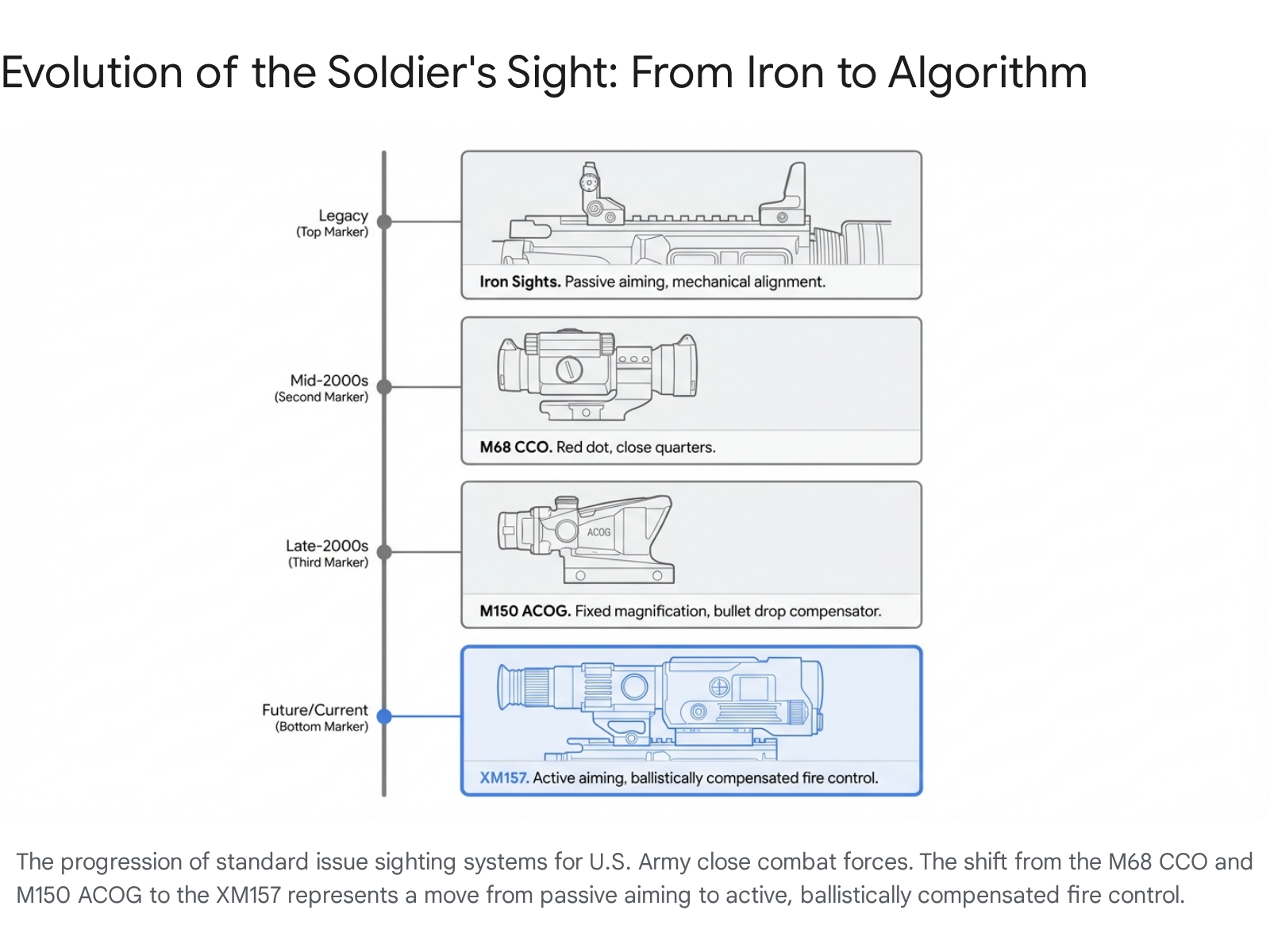
The genesis of the NGSW-FC lay in the realization that current optical solutions were reaching their theoretical limits. The standard issue optics for the Close Combat Force (CCF)—the M68 Close Combat Optic (Aimpoint CompM4) and the M150 Rifle Combat Optic (Trijicon ACOG)—operate on fixed principles. The M68 is a reflex sight offering infinite eye relief and rapid target acquisition but lacks magnification and ballistic reference points. The M150 is a 4x prism sight with a Bullet Drop Compensator (BDC) reticle. This BDC is etched with stadia lines corresponding to specific ranges, assuming a specific muzzle velocity and atmospheric density. If a soldier deploys to the high altitudes of Afghanistan, the thinner air reduces drag, causing the bullet to fly flatter and impact higher than the reticle indicates. Conversely, in dense sea-level air, the bullet drops faster. The fixed nature of the ACOG’s reticle means it cannot adapt to these environmental variables, nor can it account for windage without the soldier performing complex mental estimations known as “Kentucky Windage.”

2.1 The “Probability of Hit” (Ph) Metric and the PPON

To address these deficiencies, the US Army Contracting Command at Picatinny Arsenal issued the Prototype Project Opportunity Notice (PPON) for the NGSW-FC (Solicitation W15QKN-20-R-0448). The solicitation was driven by a single, overarching metric: Probability of Hit (Ph). In the lexicon of small arms systems engineering, Ph is the statistical likelihood that a round fired will impact the intended target. It is a function of three primary error budgets: weapon dispersion (mechanical accuracy), target acquisition error (finding the target), and aiming error (selecting the correct point of aim). The Army identified aiming error—specifically the soldier’s inability to accurately estimate range and wind—as the largest controllable variable.

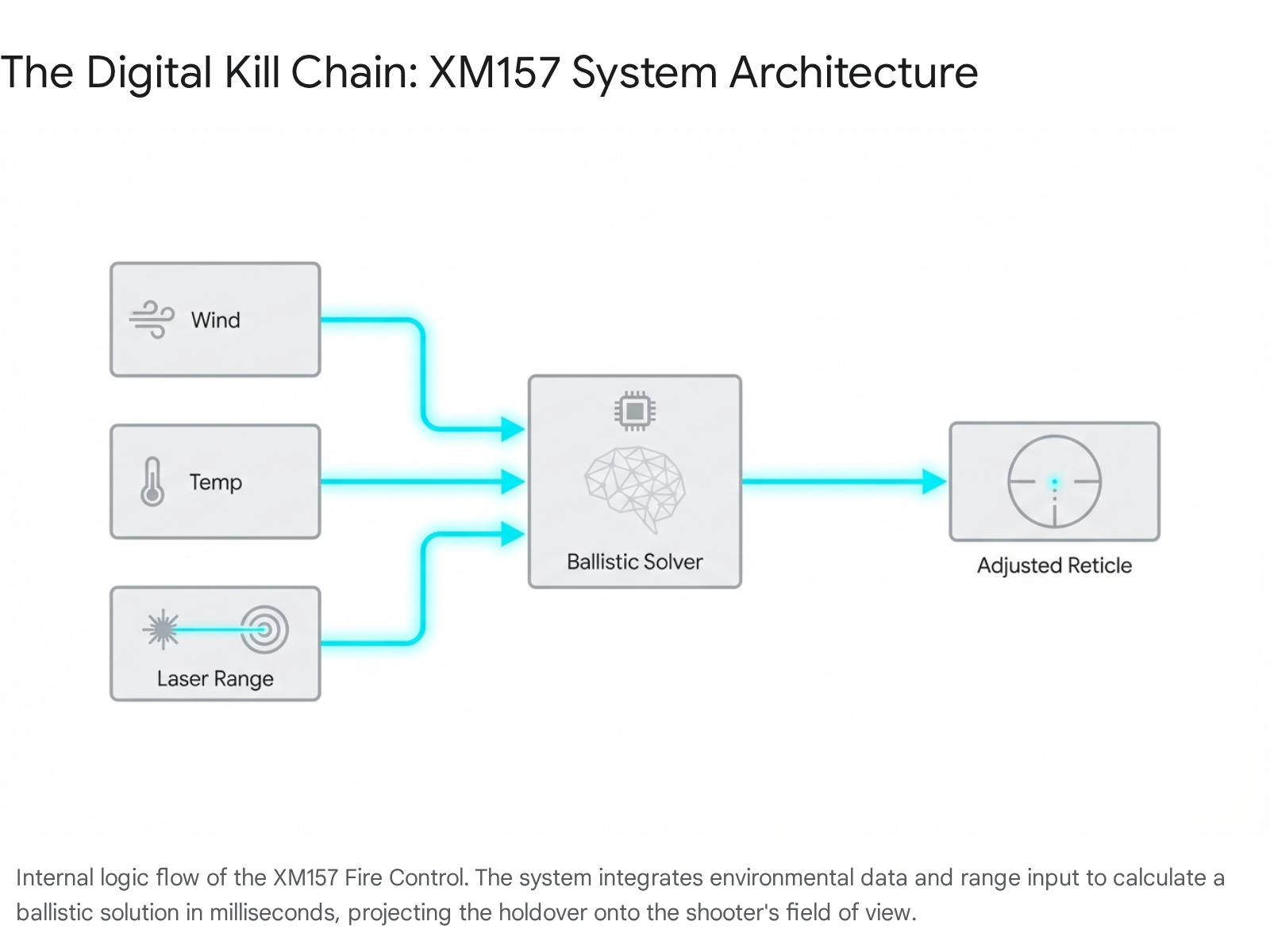
The PPON outlined a requirement for a “ruggedized fire control” that could calculate these variables for the soldier.1 The system needed to integrate a Laser Range Finder (LRF) to eliminate range estimation error, an atmospheric sensor suite to measure air density, and a ballistic calculator to compute the trajectory. Crucially, the system had to present a “disturbed reticle” or “digital overlay” that adjusted the point of aim in real-time.2 This meant that when a soldier lasered a target at 735 meters, the optic would either move the crosshair or project a new aiming dot at the precise location required to hit that target, removing the guesswork of holdovers.

2.2 Technical Thresholds and Objectives

The requirements set forth in the PPON were aggressive, pushing the boundaries of Size, Weight, and Power (SWaP) for weapon-mounted electronics. The Army demanded a Variable Magnification Optic (VMO) capable of transitioning from 1x for close quarters to high magnification (6x or 8x) for long-range identification.4 The integration of the Intra-Soldier Wireless (ISW) protocol was a mandatory objective, envisioning a future where the weapon sight communicated seamlessly with the Integrated Visual Augmentation System (IVAS) goggles, allowing soldiers to view the weapon’s sight picture through their heads-up display (HUD).5

The durability requirements were equally stringent. The system had to withstand the brutal recoil impulse of the high-pressure 6.8mm cartridge. Interestingly, the testing protocols evolved during the solicitation process. An amendment to the Prototype Test Outline reduced the weapon drop test requirement from 5 meters to 1.5 meters.7 This modification is significant; it suggests that the industry feedback indicated a 5-meter drop test for a precise optical instrument containing glass capability and sensitive electronics was technically unfeasible or would result in excessive weight armor to protect the unit. By adjusting this threshold, the Army acknowledged the engineering reality that “smart” scopes, by their nature, possess a fragility that solid chunks of aluminum do not.
Ronin's polymer handle being cut with a plastic knife on foil

3. Industry Response: The Clash of Philosophies

The competition to secure the NGSW-FC contract became a clash of two distinct industrial philosophies. On one side stood the traditional defense establishment, represented by L3Harris Technologies, a titan of military electronics. On the other stood the commercial sector disruptor, Vortex Optics, a company with massive market share in the civilian hunting and tactical world but a smaller footprint in major program-of-record acquisitions.

3.1 L3Harris Technologies and Leupold & Stevens

L3Harris approached the problem with the pedigree of a defense prime. Partnering with Leupold & Stevens, America’s oldest and most respected scope manufacturer, they formed a “dream team” of capability.8 L3Harris brought decades of experience in miniaturized thermal sensors, laser aiming devices (like the PEQ-15), and secure communications. Leupold provided the optical chassis and the domestic manufacturing capacity required by the Berry Amendment.

Their prototype solution leveraged this combined expertise, delivering 115 systems for evaluation.9 While specific details of their losing bid remain proprietary, industry analysis suggests their approach likely leaned heavily on existing military-grade sensor architectures integrated into a ruggedized housing. The partnership was a logical strategic move: L3Harris would handle the “brains” (the ballistic computer and sensors), while Leupold handled the “eyes” (the optical train). This approach promised a high degree of reliability and adherence to Mil-Spec standards, leveraging L3’s deep familiarity with Army acquisition processes.

3.2 Vortex Optics and Sheltered Wings Inc.

Vortex Optics, doing business as Sheltered Wings Inc., entered the fray with a solution that was radical in its commercial roots. Vortex is a dominant force in the civilian market, known for its agile supply chain and rapid product iteration cycles—traits often alien to the defense sector. Their proposal was centered around a technology they termed the “Active Reticle.”

Unlike traditional digital sights that use a camera and a screen (like a video camera), the Vortex solution maintained a “Direct View Optic” (DVO) architecture. This meant the soldier looked through physical glass lenses, preserving the clarity, resolution, and zero-latency characteristics of a traditional scope. The innovation was the integration of a transparent micro-display projected into the focal plane.1 This display could overlay data—ballistic holdovers, compass headings, and system status—directly onto the analog image. Crucially, if the battery failed, the digital overlay would disappear, but the etched glass reticle would remain, leaving the soldier with a fully functional, albeit “dumb,” 1-8x rifle scope. This fail-safe capability was a decisive factor in mitigating the Army’s fear of electronic reliance.

4. The Selection: Vortex Optics and the Commercial Disruption

In January 2022, the Army announced the selection of Vortex Optics (Sheltered Wings Inc.) as the winner of the NGSW-FC competition, awarding a 10-year Indefinite Delivery/Indefinite Quantity (IDIQ) contract with a ceiling of $2.7 billion.1 The award covered the production and delivery of up to 250,000 XM157 systems, alongside accessories, spare parts, and engineering support.

4.1 The Economic and Strategic Rationale

The selection of Vortex over the L3Harris-Leupold team was a watershed moment in defense acquisition. It signaled a shift toward “Commercial Off-the-Shelf” (COTS) derived technologies and a willingness to embrace non-traditional defense contractors. The Army’s source selection board determined that the Vortex prototype offered the best overall balance of technical feasibility, manufacturing feasibility, and military utility.2

Financially, the contract’s $2.7 billion ceiling for 250,000 units implies a maximum programmatic unit cost of approximately $10,800.4 However, this figure is misleading as it includes the substantial costs of R&D, establishment of a new domestic manufacturing line, fielding support, and spares. The actual hardware cost is likely significantly lower, benefiting from Vortex’s commercial economies of scale. Vortex established a new manufacturing facility in Barneveld, Wisconsin, specifically to meet the domestic production requirements of the contract, creating a dedicated supply chain distinct from their overseas commercial operations.4

4.2 The “Active Reticle” Advantage

The decisive technical differentiator was likely the maturity and implementation of the Active Reticle technology. By sandwiching a digital display into the optical train of a First Focal Plane (FFP) Low Power Variable Optic (LPVO), Vortex solved the “battery anxiety” problem that plagues electronic sights.11 In a purely digital system (like a thermal scope), a dead battery renders the device a useless brick. In the XM157, a dead battery simply turns it into a standard LPVO, a piece of equipment soldiers are already comfortable using. This “graceful degradation” failure mode is a critical requirement for combat systems where logistics chains are uncertain and batteries are a finite resource.

5. Technical Architecture of the XM157

The XM157 is an engineering marvel that compresses the capability of a sniper team—spotter, rangefinder, and ballistic computer—into a single rail-mounted unit.

5.1 Optical and Display Engineering

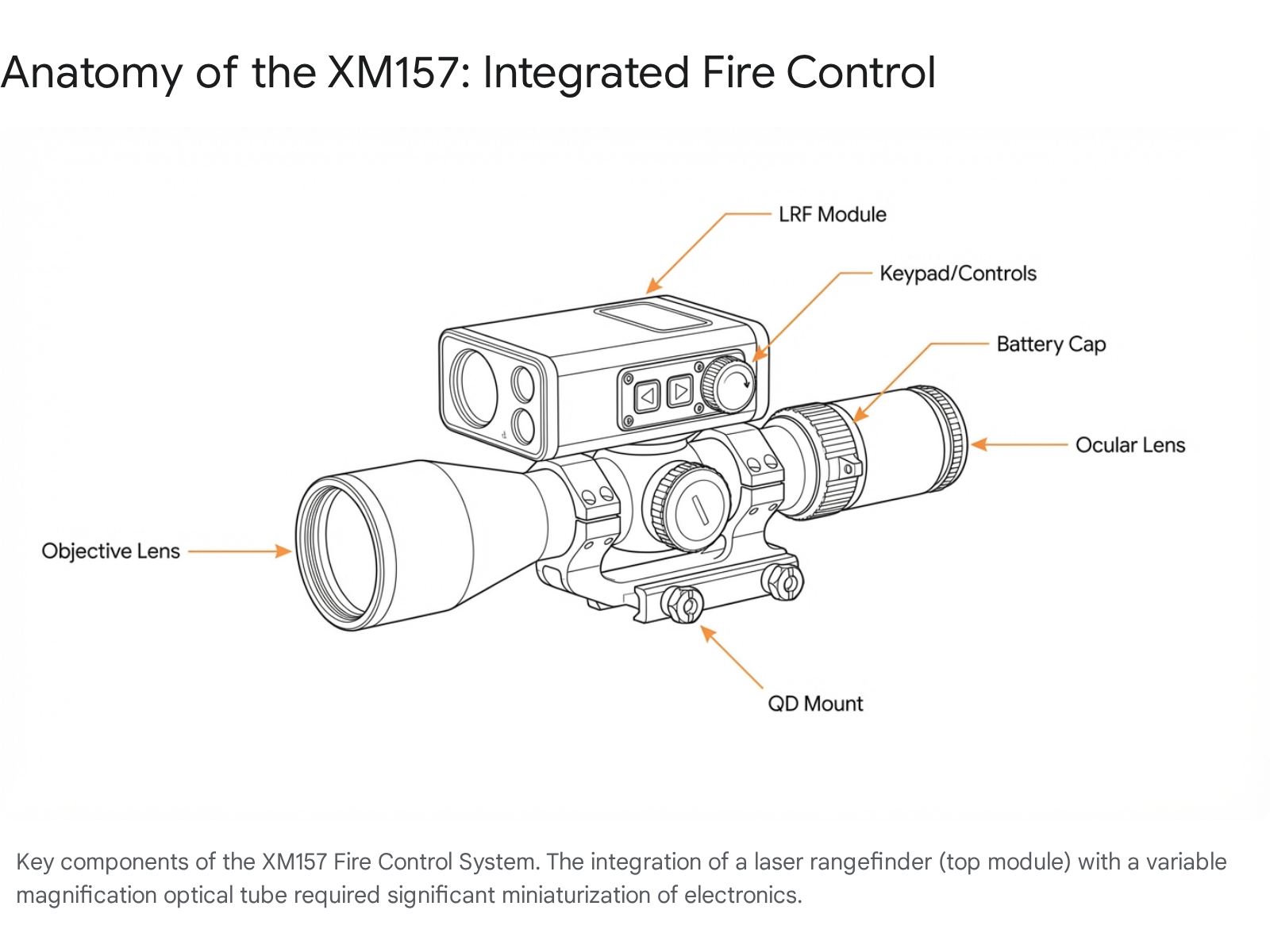
At its core, the XM157 is a 1-8x30mm LPVO. The 1x setting allows for both-eyes-open engagement in close quarters, functioning similarly to a red dot sight. The 8x setting provides the magnification necessary to identify and engage targets at the 6.8mm cartridge’s effective range of 800+ meters. The 30mm objective lens represents a balance between light transmission and physical profile; a larger objective would offer a brighter image but would increase the height over bore and snag hazards.

The internal display is generated via a beam-splitter prism integrated into the optical path. When the ballistic calculator computes a firing solution, it drives the micro-display to illuminate a specific pixel or group of pixels, creating a glowing red aim point that corresponds to the correct holdover for gravity and wind.2 This overlay is dynamic; as the soldier changes magnification, the digital reticle scales or adjusts to remain accurate, a feature inherent to First Focal Plane designs.

5.2 Sensor Fusion and Computation

The “brain” of the XM157 relies on a suite of sensors to feed the ballistic solver:

  • Laser Range Finder (LRF): Housed in the “box” atop the main tube, the LRF uses a laser pulse (likely 1550nm for eye safety and performance) to measure the time-of-flight to the target.1 This data is the primary input for the ballistic calculation.
  • Environmental Sensors: Onboard sensors continuously monitor ambient temperature and atmospheric pressure. These variables are critical for calculating air density, which determines the aerodynamic drag on the bullet. A shift in air pressure can alter point of impact by inches or feet at extended ranges.
  • Inertial Sensors: Accelerometers and gyroscopes detect the weapon’s inclination (shooting up or down hill) and cant (tilting the rifle left or right). The ballistic solver applies the cosine rule to adjust for gravity’s vector and corrects for cant error, which induces horizontal dispersion at range.1
Ronin's polymer handle being cut with a plastic knife on foil

5.3 Connectivity: Intra-Soldier Wireless (ISW)

The XM157 is designed as a network node. It features the Intra-Soldier Wireless (ISW) protocol, a low-latency, secure wireless link that connects the weapon sight to other devices on the soldier.5 This capability is primarily designed for integration with the Integrated Visual Augmentation System (IVAS). In practice, this allows the video feed from the scope to be wirelessly transmitted to the soldier’s HUD. This creates a “Rapid Target Acquisition” capability, enabling soldiers to shoot from behind cover by exposing only the weapon and viewing the target through their goggles.6 This connectivity also allows for the future sharing of target data between squad members, where a squad leader could lase a target and populate the range data on the HUDs of their team.

6. Operational Realities: The DOT&E Assessment

While the theoretical capabilities of the XM157 are transformative, the transition from engineering prototype to field-hardened equipment has revealed significant challenges. The Fiscal Year 2024 Annual Report from the Director, Operational Test and Evaluation (DOT&E) provides a critical assessment of the system’s current status.

6.1 Reliability Concerns and Critical Failures

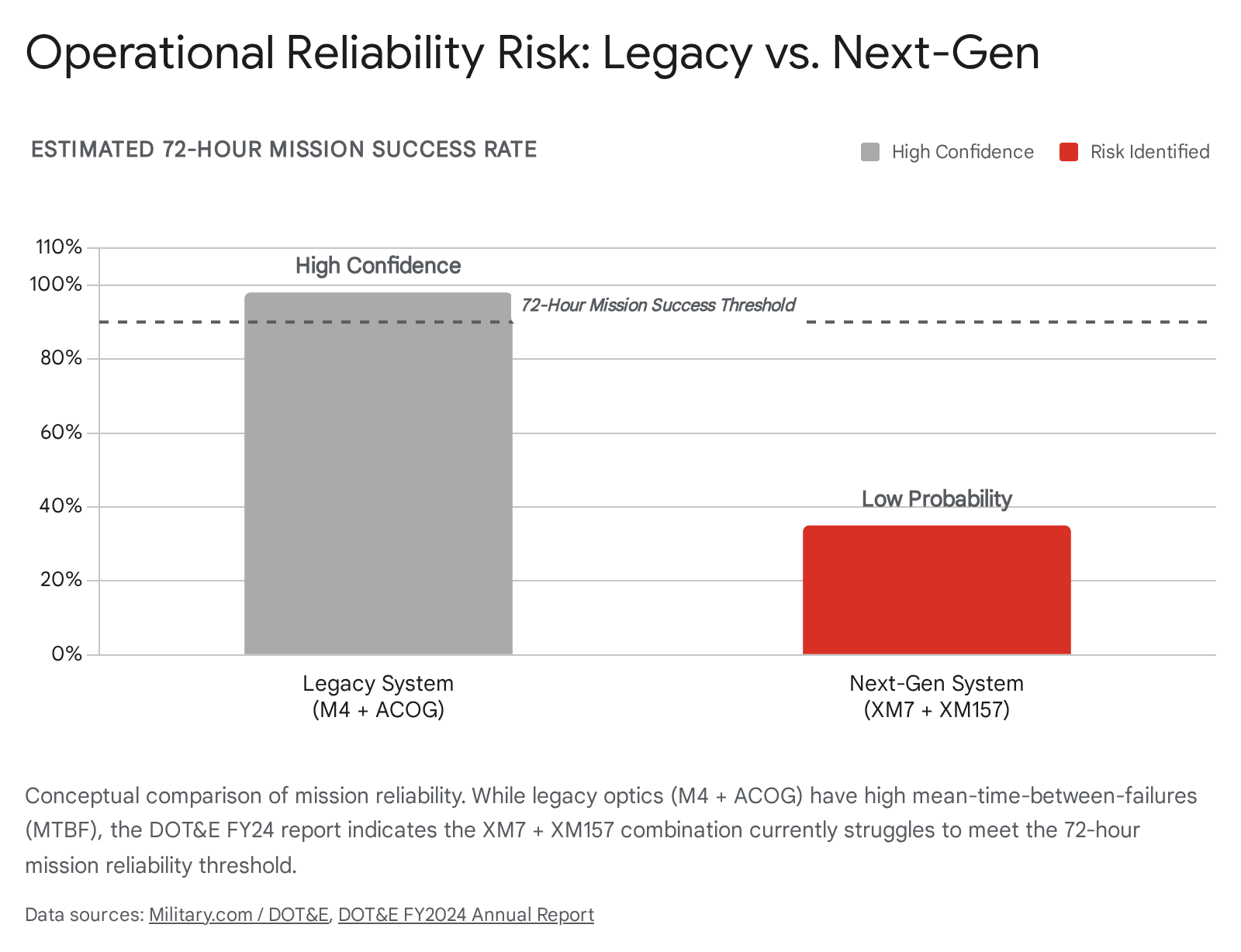
The most alarming finding in the DOT&E report is the reliability of the system under simulated combat conditions. The report explicitly states that “The XM7 with mounted XM157 demonstrated a low probability of completing one 72-hour wartime mission without incurring a critical failure”.16 In the context of operational testing, a “critical failure” is defined as a malfunction that renders the system effectively unusable or unsafe, requiring maintenance actions beyond the operator’s capability to resolve in the field.

A 72-hour mission profile is a standard operational window for light infantry units, covering the duration of a typical patrol or raid cycle. The inability to reliably function for three days suggests deep-seated issues with the system’s robustness. While the unclassified report does not detail the specific failure modes, engineering analysis of similar systems points to several likely culprits. The recoil impulse of the 6.8x51mm cartridge is significantly higher than that of the 5.56mm M4. Repeated high-G shock loads can cause fatigue failures in printed circuit boards (PCBs), solder joints, and battery contacts. Furthermore, the power consumption of the LRF, onboard computer, and wireless radios may be draining batteries faster than anticipated, leading to power failures that render the “smart” features inert.18

6.2 Soldier Usability and Feedback

The DOT&E report also highlighted that “Soldiers assessed the usability of the XM157 as below average/failing”.16 This qualitative feedback points to a fundamental friction between technological capability and human cognition. The XM157 introduces a layer of complexity—menus, buttons, modes, and batteries—that does not exist with the simple red dots and ACOGs soldiers are accustomed to.

In the stress of a firefight, cognitive bandwidth is a precious resource. A system that requires a soldier to navigate a menu or troubleshoot a connection adds cognitive load. If the system is perceived as finicky or difficult to operate, soldiers will lose confidence in it, potentially reverting to using it as a “dumb” scope and ignoring the advanced features the Army paid billions to develop. Additionally, the physical burden cannot be overstated. The XM157 is larger and heavier than legacy optics. When combined with the heavier XM7 rifle and the heavier 6.8mm ammunition, the total load on the soldier increases significantly, affecting mobility and fatigue.19
Ronin's polymer handle being cut with a plastic knife on foil

7. Strategic Implications: The Algorithmic Infantry

The deployment of the XM157 signals the “iPhone moment” for small arms. Just as the smartphone consolidated the phone, camera, and GPS into one device, the XM157 consolidates the rifle sight, rangefinder, and ballistic computer. This has profound implications for the defense industry and the future of warfare.

7.1 Industrial Shift and “Module-X”

The Army’s willingness to bypass traditional primes for a commercial-focused company like Vortex suggests a desire to tap into the rapid innovation cycles of the civilian market. The commercial optics industry iterates product lines annually, whereas defense programs often span decades. By adopting an open architecture, the Army has also created a market for third-party integrations. The xTechSoldier Fire Control competition and the concept of “Module-X” envision a future where small businesses can develop specialized add-ons—such as advanced wind sensors or thermal clip-ons—that plug directly into the XM157’s ecosystem.21 This modularity prevents the system from becoming obsolete, allowing for software and hardware upgrades to be fielded incrementally.

7.2 The Democratization of Precision

Strategically, the XM157 aims to flatten the skill curve of marksmanship. Historically, hitting targets at 600+ meters was the domain of specialized designated marksmen and snipers who had undergone weeks of intensive training. The XM157 attempts to encode that expertise into silicon. If the system works as intended, any infantryman who can place a crosshair on a target and press a button can achieve a ballistic solution that previously required complex mental math. This restores the range overmatch that US forces enjoyed in previous conflicts, allowing them to engage adversaries well beyond the effective range of standard enemy weapons like the AK-74 or AK-12.

However, this reliance on algorithms brings new risks. “Smart” weapons are vulnerable to electronic warfare, cyber-attacks, and supply chain interdiction in ways that mechanical sights are not. The reliance on domestic battery production and complex semiconductor supply chains creates new points of failure in the national defense infrastructure. Furthermore, the proliferation of this technology is inevitable. Russia has already patented similar “electronic automated fire control” systems, explicitly designed to counter the XM157.23 We are entering an era of “Algorithmic Arms Racing,” where the software version on a rifle scope may be as decisive as the caliber of the bullet it fires.

8. Conclusion

The Next Generation Squad Weapon-Fire Control program is a bold, necessary, and risky modernization effort. It addresses the undeniable geometric reality that modern kinetic energy weapons have outpaced the human ability to aim them with the naked eye. The selection of the XM157 represents a triumph of commercial innovation and a recognition that the future of lethality lies in the fusion of silicon and glass.

Yet, the engineering challenges revealed by the DOT&E report—specifically the reliability failures and usability struggles—serve as a stark reminder that the battlefield is an unforgiving environment for delicate electronics. The Army’s challenge moving forward is not just to field the XM157, but to refine it into a system that is as robust as the soldiers who carry it. The vision of a networked, ballistically-enabled infantry force is within reach, but the gap between the prototype lab and the muddy trench remains the most difficult distance to bridge. The XM157 is not just a new scope; it is a test case for the digitization of the individual soldier, and the lessons learned from its deployment will shape the design of infantry systems for decades to come.


Table 1: Comparative Analysis of Standard Issue Army Optics

FeatureM68 CCO (Aimpoint)M150 RCO (ACOG)XM157 NGSW-FC (Vortex)
Magnification1x (None)4x (Fixed)1-8x (Variable)
Aiming SystemRed Dot (Reflex)Etched BDC ReticleActive Reticle (Digital Overlay)
Range Capability0 – 300m0 – 600m0 – 1000m+
Ranging MethodVisual EstimationStadiametric LinesLaser Range Finder (LRF)
Ballistic Comp.None (Holdover)Fixed (BDC)Real-time Ballistic Solver
Power SourceAA BatteryTritium / Fiber OpticCR123A Batteries
NetworkNoneNoneIntra-Soldier Wireless (ISW)
Est. Cost~$400~$1,200~$10,000+ (Programmatic)

Please share the link on Facebook, Forums, with colleagues, etc. Your support is much appreciated and if you have any feedback, please email us in**@*********ps.com. If you’d like to request a report or order a reprint, please click here for the corresponding page to open in new tab.


Sources Used

  1. Army awards $2.7B fire control systems contract for its Next Generation Squad Weapons, accessed December 22, 2025, https://breakingdefense.com/2022/01/army-awards-2-7b-fire-control-systems-contract-for-its-next-generation-squad-weapons/
  2. US Army Seeks Squad Fire Control System for Next Generation Small Arms | thefirearmblog.com, accessed December 22, 2025, https://www.thefirearmblog.com/blog/2019/01/28/us-army-seeks-squad-fire-control-for-next-generation-small-arms/
  3. Army receives Next Generation Squad Weapon optic from L3Harris – Task & Purpose, accessed December 22, 2025, https://taskandpurpose.com/news/army-next-generation-squad-weapon-fire-control-l3harris/
  4. Army Picks Vortex for Next Generation Weapon Optics – Guns.com, accessed December 22, 2025, https://www.guns.com/news/2022/01/10/army-picks-vortex-for-next-generation-weapon-optics
  5. Portfolio – PM SL – XM157 Next Generation Squad Weapons – Fire Control – PEO Soldier, accessed December 22, 2025, https://www.peosoldier.army.mil/Equipment/Equipment-Portfolio/Project-Manager-Soldier-Lethality-Portfolio/XM157-Next-Generation-Squad-Weapons-Fire-Control/
  6. DOT&E FY2021 Annual Report – Integrated Visual Augmentation System (IVAS)​, accessed December 22, 2025, https://www.dote.osd.mil/Portals/97/pub/reports/FY2021/army/2021ivas.pdf?ver=FZDivGDiByhjV9U-NnM9dQ%3D%3D
  7. Prototype Project Opportunity Notice (PPON) for Next Generation Squad Weapons (NGSW), accessed December 22, 2025, https://sam.gov/opp/e31a67310e833d2d5fcbcdc3aaa54897/view
  8. Leupold and L3 Team Awarded Contract to Deliver Prototypes to U.S. Army For Next-Gen Squad Weapon Fire Control Solution, accessed December 22, 2025, https://www.leupold.com/blog/post/leupold-l3-awarded-contract-deliver-prototypes-us-army-next-gen-squad-weapon-fire-control-solution
  9. Army Names Firms Selected to Make High-Tech Sighting Prototypes for NGSW | Military.com, accessed December 22, 2025, https://www.military.com/daily-news/2020/04/22/army-names-firms-selected-make-high-tech-sighting-prototypes-ngsw.html
  10. L3Harris: Optics prototype for NGSW – SPARTANAT.com, accessed December 22, 2025, https://spartanat.com/en/l3harris-optik-prototyp-fuer-ngsw
  11. Vortex Optics XM157 Overview: The Next Generation Squad Weapon-Fire Control (NGSW-FC) – GunsAmerica, accessed December 22, 2025, https://gunsamerica.com/digest/vortex-optics-xm157-overview-the-next-generation-squad-weapon-fire-control-nsgw-fc-2/
  12. Prototype Project Opportunity Notice (PPON) Next Generation Squad Weapons (NGSW) – AWS, accessed December 22, 2025, https://imlive.s3.amazonaws.com/Federal%20Government/ID238781524377771311451257352737390769977/NGSW_PPON_Amendment_1.pdf
  13. Ep. 220 | Army selects Vortex® for Next Generation Squad Weapon – Fire Control. What is it? – YouTube, accessed December 22, 2025, https://www.youtube.com/watch?v=y7NLMU1JZkY
  14. ISW Protocol Specification – AWS, accessed December 22, 2025, https://imlive.s3.amazonaws.com/Federal%20Government/ID432307301742870717393058329383741040/Attachment%2009%20ISW_SolNet_Protocol_FinalDraft.pdf
  15. RADAR, EO/IR, C-UAS, NIGHT VISION AND SURVEILLANCE UPDATE, accessed December 22, 2025, https://battle-updates.com/update/radar-eo-ir-c-uas-night-vision-and-surveillance-update-227/
  16. Soldiers Give the Army’s New Rifle Optic Low Ratings – Military.com, accessed December 22, 2025, https://www.military.com/daily-news/2025/02/04/armys-new-rifles-have-optic-problem.html
  17. DOT&E FY2024 Annual Report – Army – NGSW – Director Operational Test and Evaluation, accessed December 22, 2025, https://www.dote.osd.mil/Portals/97/pub/reports/FY2024/army/2024ngsw.pdf
  18. Vortex Gets $20 Million Contract for XM157 NGSW-FC Optic – Accurate Shooter Bulletin, accessed December 22, 2025, https://bulletin.accurateshooter.com/2022/02/vortex-gets-20-million-contract-for-xm157-ngsw-fc-optic/
  19. Army Captain shreds New experimental XM7 rifle, says its “unfit for modern service” – Reddit, accessed December 22, 2025, https://www.reddit.com/r/Firearms/comments/1kjijxs/army_captain_shreds_new_experimental_xm7_rifle/
  20. Army Captain Slams New XM7 Rifle As “Unfit,” Sig Sauer Says Otherwise (Updated), accessed December 22, 2025, https://www.twz.com/land/army-captain-slams-new-xm7-rifle-as-unfit-sig-sauer-says-otherwise
  21. The Army xTech Program – xTechSoldier Fire Control Announcement 1, accessed December 22, 2025, https://xtech.army.mil/wp-content/uploads/2025/02/xTechSoldier-Fire-Control-RFI_FINAL.pdf
  22. xTechSoldier Fire Control – xTechSearch – U.S. Army, accessed December 22, 2025, https://xtech.army.mil/competition/xtechsoldier-fire-control/
  23. Russian Smart Scope System – Their Answer To The XM157 | thefirearmblog.com, accessed December 22, 2025, https://www.thefirearmblog.com/blog/russian-smart-scope-system-their-answer-to-the-xm157-44819620
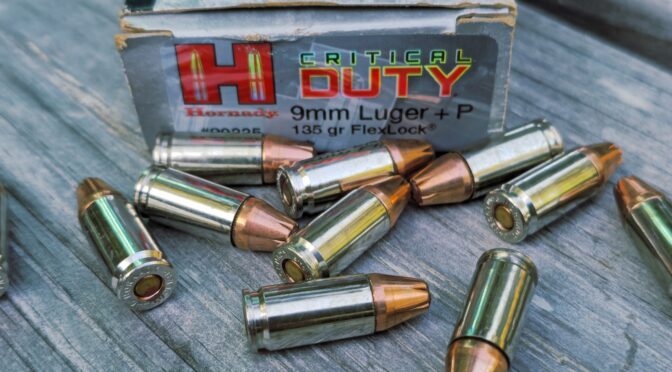
Understanding +P and +P+ Ammunition And Why The Classifications Are Obsolete Going Forward

The global small arms ammunition market is governed by a complex interplay of engineering safety margins, historical legacy, and evolving performance requirements. Within this landscape, the designations “+P” (Plus Pressure) and “+P+” (Plus P Plus) represent critical, yet often misunderstood, classifications that bridge the gap between widely circulated legacy firearm designs and the performance potential of modern propellants and metallurgy. This report provides an exhaustive industry analysis of these high-pressure ammunition types, evaluating their history, engineering specifications, operational efficacy, and economic viability in the current market.

Our research confirms that “+P” is a formal technical standard maintained by the Sporting Arms and Ammunition Manufacturers’ Institute (SAAMI), denoting a Maximum Average Pressure (MAP) approximately 10% higher than the standard specification for a specific set of cartridges. This designation serves a vital engineering function: it allows ammunition manufacturers to offer modernized performance for widely used calibers while distinguishing these loads from those intended for older, metallurgically inferior firearms. In contrast, the “+P+” designation is an informal, non-standardized nomenclature used primarily in law enforcement contracts. It indicates pressures exceeding the +P standard, often encroaching upon proof-load territories, and carries significant liability and safety implications for the end-user.

From an operational perspective, the analysis indicates that +P ammunition offers measurable benefits in specific defensive scenarios, particularly by increasing muzzle velocity to ensure reliable hollow-point expansion in short-barreled concealed carry firearms. However, this performance comes at a premium cost—typically 15-30% higher than standard training ammunition—and accelerates mechanical wear on firearm components such as recoil springs, locking lugs, and frames. The “+P+” category, while historically significant in the evolution of 9mm duty efficacy (exemplified by the Illinois State Police’s use of the 9BPLE load), is increasingly becoming an engineering relic. Modern projectile technologies now achieve superior terminal ballistics without necessitating the extreme chamber pressures that characterize +P+ loads.

Furthermore, current trends in cartridge design, such as the introduction of the .30 Super Carry and the 6mm ARC, suggest a shift away from the “+P” nomenclature. Contemporary cartridges are being engineered with high baseline pressures (50,000+ psi) from their inception, effectively “baking in” the performance that +P previously added as an aftermarket modification. While the +P designation remains essential for the continued relevance of legacy platforms like the.38 Special and 9mm Luger, the industry practice of creating “overpressure” tiers is likely to diminish for new cartridge designs. This report concludes that while +P remains a valid and valuable tool for optimizing specific legacy systems, the future of small arms ammunition lies in cartridges designed holistically for high-pressure operation, rendering the concept of “overpressure” obsolete for next-generation platforms.

1. Introduction: The Nomenclature of Power and the Official Designation List

In the precise discipline of small arms ballistics, nomenclature is not merely a labeling convention; it is a code of engineering limits, safety protocols, and performance expectations. For the industry analyst and the ballistics engineer, the terms “+P” and “+P+” signify specific deviations from established baselines. To navigate this technical landscape, one must first establish the scope of these designations and identify exactly which cartridges are governed by them.

The term “+P” strictly refers to cartridges that have been formally vetted and standardized by the Sporting Arms and Ammunition Manufacturers’ Institute (SAAMI). It is not a generic suffix that can be applied to any caliber. It is a specific engineering standard that defines a higher Maximum Average Pressure (MAP) for a cartridge that shares external dimensions with a lower-pressure parent cartridge. This distinction is critical for safety: the +P cartridge will physically fit into a firearm designed for the standard pressure version, creating a potential for catastrophic failure if the firearm’s metallurgy is insufficient.

In response to the specific inquiry regarding which rounds currently carry these designations, the list of SAAMI-recognized +P cartridges is remarkably short. Despite the vast diversity of the ammunition market, only five cartridges have an official, industry-sanctioned “+P” standard.

The Official SAAMI +P Cartridge List:

  1. 9mm Luger +P (9x19mm Parabellum)
  2. .38 Special +P
  3. .45 Automatic +P (commonly known as.45 ACP +P)
  4. .38 Super +P (Technically the modern standard for the.38 Super, distinguished from the.38 Automatic)
  5. .257 Roberts +P (The sole rifle cartridge in the +P registry)

Any other cartridge labeled “+P”—such as “.380 ACP +P” or “.40 S&W +P”—is strictly a marketing creation. Such labels do not correspond to any published SAAMI standard, meaning they are uncertified wildcat loads operating outside of recognized industry safety margins.

The “+P+” designation, by contrast, refers to any load that exceeds the SAAMI +P pressure limit. There is no official list of +P+ cartridges because the designation itself is unrecognized by standards bodies. However, it is most commonly encountered in 9mm Luger and .38 Special, historically produced for law enforcement contracts to extract maximum stopping power from service weapons.

Ronin's polymer handle being cut with a plastic knife on foil

2. The Physics and Measurement of Ballistic Pressure

To accurately evaluate the implications of +P and +P+ ammunition, the analyst must first ground the discussion in the physics of internal ballistics. Pressure in a firearm chamber is not a static variable; it is a dynamic event, a violent spike occurring over mere milliseconds. The measurement of this event dictates the safety standards for the entire industry.

2.1 The Nature of the Pressure Curve

When the firing pin strikes the primer, it ignites the propellant. As the powder burns—deflagrates—it generates high-temperature gas that expands rapidly. This expansion creates pressure inside the cartridge case. In a closed system, this pressure would rise until the vessel burst. In a firearm, the “weakest link” is the bullet, which is pushed down the barrel, increasing the volume of the combustion chamber and eventually relieving the pressure.

The Maximum Average Pressure (MAP) is the peak of this curve. However, the total energy imparted to the bullet—and thus its velocity—is determined by the area under the pressure curve. A +P load typically uses a slightly faster-burning powder or a higher charge weight to raise the peak of this curve, increasing the total force exerted on the projectile base before it exits the muzzle.1

2.2 Units of Measurement: The Great Divergence (CUP vs. PSI)

A significant source of confusion in historical ballistic data is the unit of measurement. The history of +P is bisected by a technological shift in how pressure is recorded.

Copper Units of Pressure (CUP):

Until the mid-to-late 20th century, pressure was measured using a mechanical system known as the “Copper Crusher.” A piston actuated by chamber gas would compress a calibrated copper cylinder. The degree to which the copper was shortened was measured and cross-referenced against a tariff table to generate a CUP value.

  • Limitations: This method effectively integrates force over time but is slow to react. It often misses the true instantaneous peak of the pressure spike. It is a mechanical approximation of peak force.3

Pounds Per Square Inch (PSI) / Piezoelectric:

Modern SAAMI standards utilize piezoelectric transducers. These are quartz or ceramic sensors that generate an electrical charge proportional to the stress applied to them. This provides a real-time, high-resolution graph of pressure vs. time, measured in PSI.

  • Precision: This method captures the exact peak pressure, which is often higher than what the copper crusher method indicated.

The Engineering Disconnect: There is no linear mathematical formula to convert CUP to PSI. The correlation depends on the specific rise time of the pressure pulse, which varies by cartridge shape and powder burn rate. For example, in the.38 Special, the +P limit is defined as 20,000 CUP and 20,000 PSI—a rare convergence. In contrast, the.357 Magnum is 45,000 CUP but only 35,000 PSI. This non-linearity requires analysts to be extremely careful when comparing historical load data (often in CUP) with modern +P specs (in PSI).5

2.3 Global Standards: SAAMI vs. C.I.P.

The definition of “pressure” also depends on geography. The United States follows SAAMI protocols, while Europe (and many NATO specifications) follows the Commission Internationale Permanente (C.I.P.).

  • SAAMI (USA): Uses a conformal transducer. The sensor is placed around the middle of the cartridge case, measuring the expansion of the brass case wall as a proxy for internal pressure. The brass acts as a gasket or buffer between the gas and the sensor.6
  • C.I.P. (Europe): Uses a drilled case method. A hole is physically drilled into the cartridge case, allowing the gas to directly contact the sensor. This measurement is typically taken closer to the case mouth (the “forward” position).7

Implication for +P: Because the C.I.P. sensor is exposed directly to gas and is located in a different part of the standing wave of pressure, C.I.P. readings are often higher than SAAMI readings for the exact same ammunition. This creates a situation where a standard European load might appear to be “+P” when measured on American equipment, or vice versa, purely due to the testing methodology. This is a critical nuance when analyzing “NATO” pressure ammunition, which is tested under C.I.P.-like protocols (EPVAT).8

3. Historical Evolution: The Metallurgical Lag

The existence of “+P” ammunition is fundamentally a solution to a historical problem: the “Metallurgical Lag.” It represents the century-long struggle to reconcile 19th-century gun design with 20th-century propellant chemistry.

3.1 The Black Powder Legacy

For centuries, black powder was the sole propellant for firearms. It is a low-explosive that deflagrates at a relatively constant subsonic rate. The pressure curve of black powder is gentle, and the maximum pressure is self-limiting by volume; one can only fit so much powder into a case. Consequently, firearms from the mid-to-late 1800s—such as the Colt Single Action Army (1873) or the early Smith & Wesson Hand Ejectors (1899)—were made of mild steels or iron, designed to contain pressures rarely exceeding 14,000 to 15,000 PSI.10

3.2 The Smokeless Revolution and the Safety Gap

The invention of smokeless powder (nitrocellulose) changed everything. It offered vastly higher energy density and burn rates. A small pinch of smokeless powder could generate pressures that would shatter a black-powder-era cylinder. However, to maintain backward compatibility, ammunition manufacturers introduced smokeless cartridges that were dimensionally identical to the old black powder rounds (e.g.,.38 Special,.45 Colt).

To prevent older guns from exploding, factories deliberately “downloaded” these smokeless rounds to mimic the low pressures of black powder. This created a Safety Gap. By the 1920s and 30s, new firearms were being built with heat-treated alloy steels capable of holding 30,000+ PSI, but they were legally and commercially shackled to ammunition loaded to 15,000 PSI to protect the owners of antique guns.12

3.3 The Mid-Century Disruption: Super Vel and the “Treasury Load”

This status quo held until the 1960s, when the gap between gun strength and ammo power became too obvious to ignore. Lee Jurras, a ballistic pioneer, founded Super Vel ammunition. Jurras recognized that modern snub-nose revolvers (like the Smith & Wesson Chiefs Special) were strong enough to handle much more than the anemic factory loads of the day.

Jurras introduced lightweight (110-grain) bullets driven at high velocities (over 1,100 fps) using high-pressure loads. These rounds offered drastic improvements in terminal performance but exceeded the industry standards of the time. This innovation forced the major manufacturers (Winchester, Remington, Federal) to respond.14

Simultaneously, the U.S. Secret Service and Treasury Department requested a high-performance load for their agents. Winchester responded with the Q4070, known as the “Treasury Load.” This was a.38 Special cartridge loaded to approximately 23,500 CUP—nearly 40% higher than the standard limit. It was essentially a.357 Magnum load in a.38 Special case, designed solely for sturdy, modern revolvers. This round is the spiritual ancestor of the modern +P and +P+ classifications.15

4. Deep Dive: The SAAMI +P Cartridges

This section provides a cartridge-by-cartridge analysis of the five official SAAMI +P designations, exploring the specific engineering context and utility of each.

4.1 9mm Luger +P (9x19mm Parabellum)

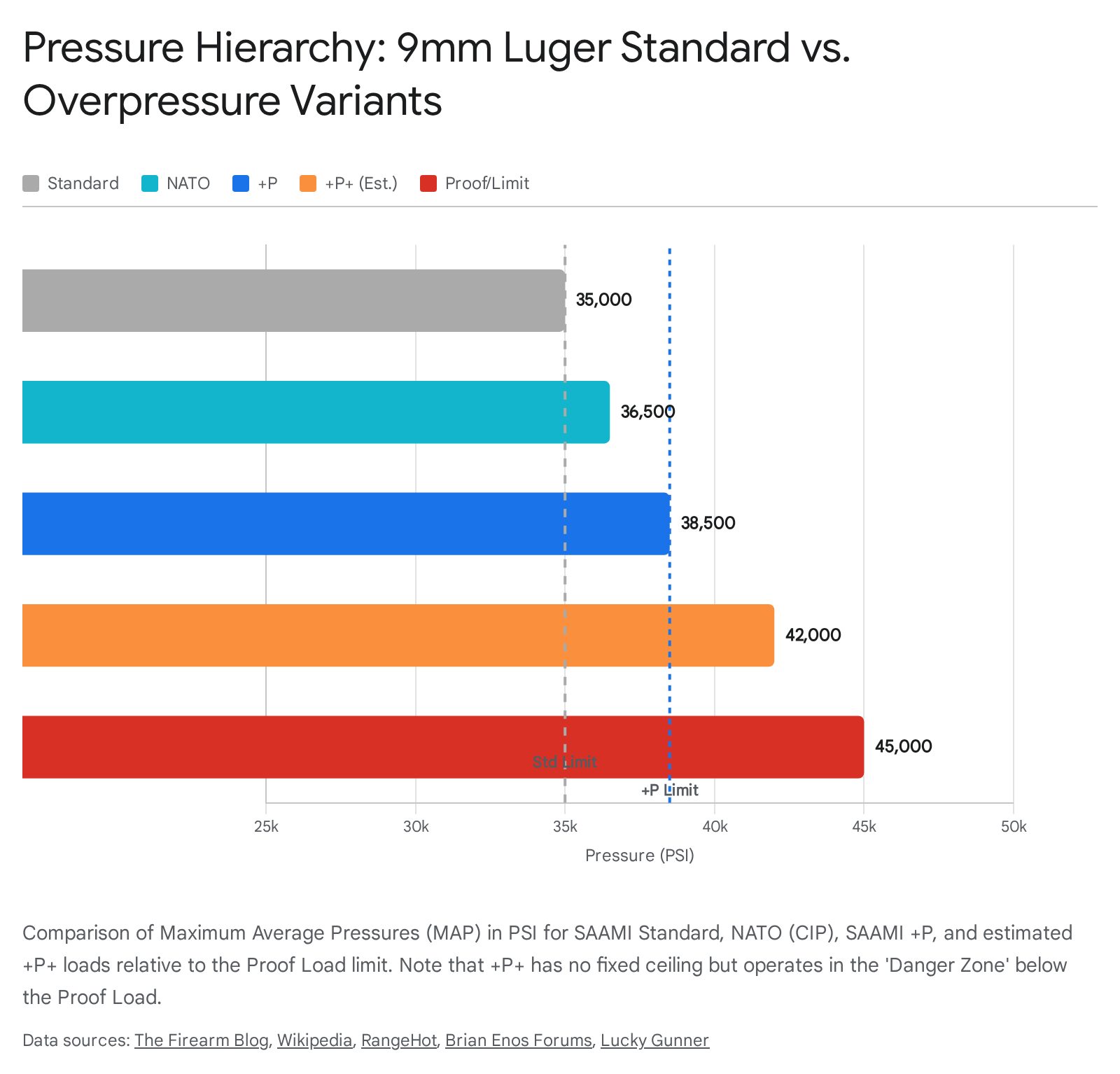
  • Standard Pressure: 35,000 PSI
  • +P Pressure: 38,500 PSI (+10%)
  • Context: The 9mm Luger is the most ubiquitous centerfire handgun cartridge in the world. The +P designation here is vital for modern defensive use. The standard 35,000 PSI limit is a legacy of the P08 Luger toggle-lock action, which is not as robust as modern tilting-barrel designs. The 10% pressure boost in +P allows for velocities that ensure reliable expansion of hollow points through heavy clothing, particularly in short-barreled subcompacts (e.g., Glock 26, Sig P365) where velocity loss is a major concern. It also bridges the gap to NATO specification ammunition, ensuring that civilian defensive ammo cycles reliably in stiffly-sprung service pistols.16

4.2.38 Special +P

  • Standard Pressure: 17,000 PSI
  • +P Pressure: 20,000 PSI (+17.6%)
  • Context: This is the most critical +P designation in the industry. The standard.38 Special is severely hobbled by its black powder origins (originally ~14,000 PSI). A standard pressure.38 Special often fails to expand modern hollow points reliably, acting more like a solid projectile. The +P rating raises the pressure to 20,000 PSI, which is still low by modern standards (compare to 9mm at 35,000), but significant enough to drive a 125-grain or 135-grain bullet to effective velocities (~950-1000 fps). The “FBI Load”—a 158-grain Lead Semi-Wadcutter Hollow Point (LSWCHP) +P—remains the benchmark for terminal effectiveness in snub-nose revolvers.18

4.3.45 Automatic +P (.45 ACP)

  • Standard Pressure: 21,000 PSI
  • +P Pressure: 23,000 PSI (+9.5%)
  • Context: The.45 ACP is naturally a low-pressure cartridge, designed in 1904 to duplicate the ballistics of.45 Colt black powder loads. Its large case volume and heavy bullet (230 grain) mean it does not need high pressure to achieve its baseline performance. The +P designation is less critical here than in 9mm or.38 Special. It is primarily used to boost the velocity of lighter (185-grain or 200-grain) projectiles to flatten trajectory and increase kinetic energy for law enforcement applications. However, the heavy recoil penalty of.45 ACP +P often outweighs the marginal terminal gains, making it less popular than its 9mm counterpart.3

4.4.38 Super +P

  • Standard Pressure: N/A (See Note)
  • +P Pressure: 36,500 PSI
  • Context: This cartridge is a semantic anomaly. The.38 Super was introduced in 1929 as a high-pressure loading of the older.38 ACP (which was limited to 26,500 PSI). Dimensionally, the cases are identical. To prevent shooters from loading the hot new rounds into old, weak Colt M1900 pistols, the industry eventually added the “+P” suffix to the name of the cartridge itself. Thus, there is no “Standard.38 Super”—the cartridge is officially named “.38 Super +P” or “.38 Super Automatic +P”. It is a favorite in competitive shooting (IPSC/USPSA) because its high pressure allows it to generate the gas volume necessary to work compensators efficiently.21

4.5.257 Roberts +P

  • Standard Pressure: 54,000 PSI
  • +P Pressure: 58,000 PSI (+7.4%)
  • Context: The only rifle cartridge on the list. The.257 Roberts was a wildcat based on the 7x57mm Mauser. When Remington standardized it, they chose a very low pressure limit (54,000 PSI) out of fear that the rounds would be used in converted, weaker Spanish Mauser actions or rolling blocks. This stifled the cartridge’s potential. Decades later, a +P standard was introduced (58,000 PSI) to allow the round to perform as originally intended in modern bolt-action rifles like the Winchester Model 70 and Ruger M77. This brings it closer to the.25-06 in performance.22

5. The Twilight Zone: +P+ and Non-Standard Overpressure

Beyond the regulated world of SAAMI lies the domain of +P+. This designation denotes a load that exceeds the +P standard. It is critical to understand that SAAMI does not recognize, regulate, or test +P+ ammunition. It is a “use at your own risk” category.

5.1 The Law Enforcement Origins

The +P+ designation emerged largely from the demands of American law enforcement in the 1980s. Agencies transitioning to 9mm pistols (the “Wonder Nine” era) were skeptical of the 9mm’s stopping power compared to their old.357 Magnums. To secure contracts, manufacturers like Federal and Winchester created “Law Enforcement Only” loads that pushed the 9mm envelope.

The most famous example is the Federal 9BPLE (9mm 115-grain JHP +P+). Adopted by agencies like the Illinois State Police and the Border Patrol, this round was loaded to pressures estimated between 38,500 and 42,000 PSI.24 It drove a standard cup-and-core bullet at 1,300+ fps. The high velocity caused violent fragmentation and reliable expansion even with the primitive bullet technology of the time. The Illinois State Police reported excellent street results, cementing the +P+ legend.26

5.2 Engineering Risks of +P+

Because there is no upper ceiling defined by SAAMI for +P+, a cartridge marked +P+ could technically be loaded to proof-load levels (45,000+ PSI for 9mm). This creates severe risks:

  1. Case Head Separation: The unsupported area of the case web (common in Glock chambers) can bulge or rupture (“Glock smile”), venting 40,000 PSI gas into the magazine well and the shooter’s hands.27
  2. Slide Velocity: Excessive pressure drives the slide rearward at velocities the recoil spring cannot manage. This leads to the slide hammering the frame stops, causing peening, cracking of locking blocks, or shearing of barrel lugs.
  3. Timing Issues: The slide may move faster than the magazine spring can lift the next round, causing bolt-over-base malfunctions.28

Consequently, almost every major firearm manufacturer (Glock, HK, Sig Sauer, Smith & Wesson) explicitly states in their manuals that the use of +P+ ammunition voids the warranty. They cannot warranty a product against a standard that does not exist.29

The concept of “+P” is increasingly being challenged by global standardization and modern cartridge design philosophies that abandon the “downloaded baseline.”

6.1 The NATO vs. SAAMI Confusion

A frequent point of confusion is the relationship between civilian 9mm +P and 9mm NATO ammunition. 9mm NATO is governed by EPVAT (Electronic Pressure Velocity and Action Time) standards, which are closely aligned with C.I.P. protocols.

  • 9mm NATO Pressure: Approximately 36,500 PSI (as measured by C.I.P. methods).
  • Comparison: This places 9mm NATO squarely between SAAMI Standard (35,000 PSI) and SAAMI +P (38,500 PSI).
  • Verdict: 9mm NATO is effectively a “mild +P” load. It is perfectly safe to use in any modern firearm rated for +P ammunition. The “NATO” stamp is essentially a military quality control and dimensional standard, but in terms of pressure, it is a known quantity.9

6.2 Modern Cartridges “Born Hot”

The +P designation is a relic of upgrading old cartridges. New cartridges designed in the 21st century do not use this system. They are designed for high pressures from day one.

  • 30 Super Carry: Introduced by Federal in 2022, this cartridge has a standard SAAMI MAP of 52,000 PSI. There is no “30 Super Carry +P” because the baseline is already set at the metallurgical limit of modern handgun actions. It operates at rifle-like pressures to deliver 9mm performance in a smaller diameter.31
  • 6mm ARC: A modern rifle cartridge optimized for the AR-15 platform, standardized at 52,000 PSI.33
  • 5.7x28mm FN: Another high-pressure micro-caliber (approx 50,000 PSI).

This trend suggests that the “+P” nomenclature will eventually die out with the legacy cartridges it supports. Future firearm systems will simply be rated for 50,000+ PSI as the new normal.

7. Engineering Impact on Firearms: Metallurgy and Wear

Can +P be used in normal firearms? The answer lies in the specific metallurgy of the gun in question.

7.1 Barrel Steels: 4140 vs. 4150

Modern firearm barrels and actions are typically machined from Chromoly Steel, specifically AISI grades 4140 and 4150.

  • AISI 4140: (~0.40% Carbon). The industry workhorse for civilian firearms. It offers an excellent balance of toughness and tensile strength (approx 95,000 – 100,000+ PSI yield strength after heat treat).
  • AISI 4150: (~0.50% Carbon). Often used in “Mil-Spec” barrels (e.g., M4 carbines). The higher carbon content allows for greater hardness and better resistance to heat erosion during rapid fire.34

Both steels are more than capable of containing the static pressure of a +P load (38,500 PSI). The barrel will not burst. The “Hoop Stress” generated by +P is well within the elastic limit of these alloys.

The danger of +P is not a single catastrophic explosion, but accelerated fatigue.

  • Bolt Thrust: Pressure exerts force backward on the breech face. In a locked-breech pistol, this force is transmitted through the locking lugs or locking block. Repeated stress cycles at +P levels can cause microscopic stress fractures to propagate faster than at standard pressures.
  • Carpenter 158 Steel: This is why high-pressure bolts (like in the AR-15) are often made of Carpenter 158, a proprietary case-hardening steel. It provides a super-hard outer surface for wear resistance while maintaining a softer, ductile core to absorb the shock of the bolt thrust without snapping.36

7.3 Recoil Dynamics and Spring Rates

In semi-automatic pistols, +P ammunition increases the slide velocity. If the slide moves too fast, it acts as a battering ram against the frame.

  • Solution: Heavier recoil springs. For example, a standard 1911 Government model (.45 ACP) uses a 16lb recoil spring. When shooting a steady diet of +P, it is standard engineering practice to upgrade to an 18.5lb or 20lb spring. This absorbs the extra energy, preventing frame battering, but may cause the gun to malfunction (failure to eject) if the user switches back to light target ammo.38

8. Operational Performance: Terminal Ballistics

The ultimate question for the user is: “What do I get for the extra pressure?” The answer is primarily Velocity, which drives Reliability.

8.1 The Velocity Threshold

Hollow point bullets rely on fluid dynamics to expand. Fluid enters the nose cavity, creating hydraulic pressure that peels back the copper jacket. Every bullet design has a “velocity threshold” below which this hydraulic pressure is insufficient to expand the bullet.

  • The Short Barrel Problem: A 9mm bullet designed to expand at 1,100 fps (from a 4-inch barrel) might only travel at 1,000 fps from a 3-inch subcompact barrel (like a Sig P365). At this lower speed, it may fail to expand.
  • The +P Solution: By using +P ammunition, the shooter can regain that lost 50-100 fps. This pushes the bullet back above its expansion threshold, ensuring it performs as designed even from a deep-concealment pistol.39

8.2 Barrier Penetration

In law enforcement, bullets must often pass through barriers (auto glass, heavy denim, plywood) before hitting the target. Higher velocity (and thus higher kinetic energy) aids in barrier defeat. The extra energy helps the bullet retain its structural integrity and momentum after the initial impact with the barrier.40

9. Market and Economic Analysis

9.1 Cost vs. Benefit

The market for +P ammunition is heavily segmented.

  • Standard Training Ammo (FMJ): High volume, low margin. ~$0.25 – $0.30 per round.
  • Defensive Ammo (+P JHP): Low volume, high margin. ~$1.20 – $1.80 per round.41

Is it worth the price?

  • For Training: No. The slight difference in recoil is not worth the 400-500% price hike. Standard pressure ammo is sufficient for marksmanship practice.
  • For Defense: Yes. The cost of the ammunition is negligible compared to the value of reliability in a life-threatening scenario. The premium price pays for the high-tech bonded bullet (Gold Dot, HST), nickel-plated brass (for corrosion resistance and slick feeding), and low-flash propellants, not just the extra pressure.

10. Future Trajectory: Is +P Obsolete?

The practice of creating +P variants is a specific solution to the problem of legacy firearms. As we move further into the 21st century, the need for this bifurcation is waning.

10.1 The End of “Downloading”

New cartridges like the .30 Super Carry (52,000 PSI) and 6mm ARC (52,000 PSI) demonstrate the new industry philosophy. Engineers are no longer constrained by 1870s metallurgy. They are setting the baseline pressure at the upper limits of modern materials. There will never be a “30 Super Carry +P” because the standard load is already maximized.31

10.2 The Persistence of Legacy

However, the +P designation will never disappear as long as the 9mm Luger,.38 Special, and.45 ACP remain popular. There are simply too many billions of rounds of these calibers in circulation, and too many millions of older firearms that require the lower pressure standard. +P will remain the necessary bridge, allowing a 1911 to function as a modern defensive tool while keeping a 1940s service pistol safe from destruction.

11. Conclusion

The landscape of +P and +P+ ammunition is a testament to the firearm industry’s ability to innovate within the rigid constraints of history and safety.

  • Engineering Validity: The +P designation is a legitimate, highly regulated engineering standard that provides a quantified and safe performance boost (approx. 10%) for modern firearms. It is the preferred choice for defensive applications in 9mm,.38 Special, and.45 ACP, particularly for compact firearms where velocity loss is a liability.
  • The Danger Zone: The +P+ designation is a non-standardized contractual artifact. While historically effective (e.g., the 9BPLE), it carries significant risks of accelerated wear and catastrophic failure in unsupported chambers. It should be avoided by the general public unless the firearm is explicitly rated for such pressures by the manufacturer—a rarity.
  • Obsolescence: While vital for legacy calibers, the concept of +P is obsolete for new designs. The future of small arms ballistics belongs to cartridges like the.30 Super Carry, which normalize 50,000+ PSI pressures as the standard, rendering the need for an “overpressure” suffix a footnote of the 20th century.

For the professional analyst and the end-user, the guidance is clear: Embrace +P for duty and defense in modern firearms to ensure expansion reliability. Treat +P+ with extreme caution. And recognize that the future of ballistics is not about “hotter” loads, but smarter, high-pressure cartridge design from the ground up.


Please share the link on Facebook, Forums, with colleagues, etc. Your support is much appreciated and if you have any feedback, please email us in**@*********ps.com. If you’d like to request a report or order a reprint, please click here for the corresponding page to open in new tab.


Works cited

  1. American National Standard Voluntary Industry Performance Standards for Pressure and Velocity of Centerfire Rifle Ammunition for the Use of Commercial Manufacturers – SAAMI, accessed December 25, 2025, https://saami.org/wp-content/uploads/2018/01/206.pdf
  2. American National Standard Voluntary Industry Performance Standards for Pressure and Velocity of Rimfire Sporting Ammunition for the Use of Commercial Manufacturers – SAAMI, accessed December 25, 2025, https://saami.org/wp-content/uploads/2018/01/Z299-1_ANSI-SAAMI_Rimfire.pdf
  3. SAAMI Pressures: Data From The Current SAAM Specs (2004) Please Note That Some Are in Psi and Some Cup – Scribd, accessed December 25, 2025, https://www.scribd.com/document/639201414/Untitled
  4. Ammunition Pressure Testing – Guns and Ammo, accessed December 25, 2025, https://www.gunsandammo.com/editorial/ammunition-pressure-testing/458750
  5. Cartridge Pressure Standards, accessed December 25, 2025, http://kwk.us/pressures.html
  6. Ways to Measure Pressure | The Ballistic Assistant, accessed December 25, 2025, https://www.theballisticassistant.com/ways-to-measure-pressure/
  7. Small arms ammunition pressure testing – Wikipedia, accessed December 25, 2025, https://en.wikipedia.org/wiki/Small_arms_ammunition_pressure_testing
  8. New to Grendel – Why the QL difference between SAAMI and CIP?, accessed December 25, 2025, https://www.65grendel.com/forum/forum/-6-5-grendel-discussion-forums/-6-5-grendel-ammunition-reloading/11854-new-to-grendel-why-the-ql-difference-between-saami-and-cip
  9. 9mm Luger Vs. 9mm Nato – 9mm/38 Caliber – Brian Enos’s Forums… Maku mozo!, accessed December 25, 2025, https://forums.brianenos.com/topic/22682-9mm-luger-vs-9mm-nato/
  10. Black and Smokeless Powders – National Academies of Sciences, Engineering, and Medicine, accessed December 25, 2025, https://www.nationalacademies.org/read/6289/chapter/3
  11. The History of Propellants – The Ballistic Assistant, accessed December 25, 2025, https://www.theballisticassistant.com/the-history-of-propellants/
  12. Smokeless powder – Wikipedia, accessed December 25, 2025, https://en.wikipedia.org/wiki/Smokeless_powder
  13. The Transition from Black Powder to Smokeless Powder: How It Changed Firearms Forever, accessed December 25, 2025, https://inside.safariland.com/blog/the-transition-from-black-powder-to-smokeless-powder-how-it-changed-firearms-forever/
  14. The 38 Special +P+ Treasury Load – Shooting Times, accessed December 25, 2025, https://www.shootingtimes.com/editorial/38-special-treasury-load/389102
  15. Ammo Evolution: .38 Special Treasury Load – RevolverGuy.Com, accessed December 25, 2025, https://revolverguy.com/ammo-evolution-38-special-treasury-load/
  16. SAMMI pressure specs – RangeHot – Expert Firearms Reviews & Guides, accessed December 25, 2025, https://rangehot.com/sammi-pressure-specs/
  17. 9×19mm Parabellum – Wikipedia, accessed December 25, 2025, https://en.wikipedia.org/wiki/9%C3%9719mm_Parabellum
  18. Cartridge of the Century: A History of the 38 Special – Lucky Gunner, accessed December 25, 2025, https://www.luckygunner.com/lounge/history-38-smith-wesson-special/
  19. That Classic Old FBI .38 Special Load – The Mag Life – GunMag Warehouse, accessed December 25, 2025, https://gunmagwarehouse.com/blog/that-classic-old-fbi-38-special-load/
  20. 45 vs 38 Super – Handgun Caliber Comparison by Ammo.com, accessed December 25, 2025, https://ammo.com/comparison/45-vs-38-super
  21. Making the Case for .38 Super +P | An Official Journal Of The NRA – American Rifleman, accessed December 25, 2025, https://www.americanrifleman.org/content/making-the-case-for-38-super-p/
  22. .257 Roberts – Wikipedia, accessed December 25, 2025, https://en.wikipedia.org/wiki/.257_Roberts
  23. .257 Roberts +P | Shooters’ Forum, accessed December 25, 2025, https://forum.accurateshooter.com/threads/257-roberts-p.3953571/
  24. Rise and Fall of the 9mm Subsonic Hollowpoint | Office of Justice Programs, accessed December 25, 2025, https://ojp.gov/ncjrs/virtual-library/abstracts/rise-and-fall-9mm-subsonic-hollowpoint
  25. 9mm +P and +P+ Cartridges: Winchester & Remington Win – Gun Tests, accessed December 25, 2025, https://www.gun-tests.com/ammo/9mm-p-and-p-cartridges-winchester-remington-win-2/
  26. Why Are 9mm Pistols Dominant in Law Enforcement? – American Handgunner, accessed December 25, 2025, https://americanhandgunner.com/our-experts/why-are-9mm-pistols-dominant-in-law-enforcement/
  27. Understanding Common Cartridge Malfunctions – Ammo Safety, accessed December 25, 2025, https://kirammo.com/understanding-common-cartridge-malfunctions-ammo-safety/
  28. Firearm malfunction – Wikipedia, accessed December 25, 2025, https://en.wikipedia.org/wiki/Firearm_malfunction
  29. What is +P Ammunition? – True Shot Ammo, accessed December 25, 2025, https://trueshotammo.com/blogs/true-shot-academy/what-is-p-ammunition-is-overpressure-ammo-safe
  30. 9mm NATO vs. 9mm Luger | thefirearmblog.com, accessed December 25, 2025, https://www.thefirearmblog.com/blog/2009/05/03/9mm-nato-vs-9mm-luger/
  31. Public Introduction – 30 Super Carry – 2022-06-30 – SAAMI, accessed December 25, 2025, https://saami.org/wp-content/uploads/2022/10/Public-Introduction-30-Super-Carry-2022-06-30.pdf
  32. SAAMI Publishes 30 Super Carry Cartridge Specs – The Firearm Blog, accessed December 25, 2025, https://www.thefirearmblog.com/blog/2022/07/06/30-super-carry-saami-specs/
  33. SAAMI Rifle Cartridge Catalog – The Ballistic Assistant, accessed December 25, 2025, https://www.theballisticassistant.com/saami-rifle-cartridge-catalog/
  34. 4140 vs 4150 Steel | Sorting, Differences & More – Verichek Technical Services, accessed December 25, 2025, https://verichek.net/4140-vs-4150-steel.html
  35. Steel for Firearms: Alloys and Key Characteristics, accessed December 25, 2025, https://www.jadesterling.com/ask-the-metallurgist/steel-for-firearms-alloys-and-key-characteristics
  36. Carpenter 158 – Specialty Alloys, accessed December 25, 2025, https://www.carpentertechnology.com/alloy-finder/carpenter-158
  37. What to Look for When Buying a Bolt Carrier Group | BUYER’S GUIDE – Wing Tactical, accessed December 25, 2025, https://www.wingtactical.com/what-to-look-for-when-buying-a-bolt-carrier-group/
  38. 9mm 1911 – 11lb Wolff spring vs. stock 14lb spring – 1911-style Pistols – Brian Enos’s Forums, accessed December 25, 2025, https://forums.brianenos.com/topic/208247-9mm-1911-11lb-wolff-spring-vs-stock-14lb-spring/
  39. Is +P Ammunition Safe? – The Armory Life, accessed December 25, 2025, https://www.thearmorylife.com/is-p-ammunition-safe/
  40. Life or Death: Best 9mm Defense Ammo – Expert Buyer Guide – Target Sports USA, accessed December 25, 2025, https://blog.targetsportsusa.com/best-9mm-defense-ammo-expert-buyer-guide/
  41. Best 9mm Ammo of 2025, Tested and Reviewed – Outdoor Life, accessed December 25, 2025, https://www.outdoorlife.com/gear/best-9mm-ammo/

HK CC9 Review: A Year of Reliability and Market Adaptation

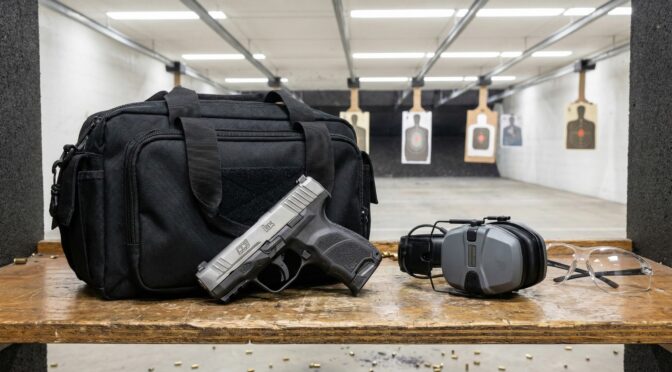
The Heckler & Koch (HK) CC9 has now seen approximately one full year of operational service in the US commercial market. Originally introduced as a strategic pivot for the Oberndorf-based manufacturer—representing their first pistol designed, engineered, and manufactured specifically for the American concealed carry sector—the CC9 has stabilized into a distinct market niche.1

While initially criticized for its late entry into the “Micro-Compact” segment (defined by the SIG Sauer P365), the CC9 has validated its premium positioning through superior mechanical reliability and recoil management. However, 12 months of consumer data have exposed specific vulnerabilities, notably in cosmetic finish durability and minor quality control inconsistencies regarding sight alignment. Financially, the market has corrected the initial MSRP of $699, with street prices settling near $599, improving its competitive value proposition against incumbents like the Springfield Hellcat and Glock 43X.3

1. Introduction and Strategic Context

1.1 The Micro-Compact Revolution

The “Micro-Compact” category remains the dominant driver of US handgun sales. The CC9 entered this space attempting to disrupt a market saturated by the SIG P365 ecosystem and the Springfield Hellcat. Unlike its competitors, who iterate rapidly with “beta-test” releases, HK leveraged a five-year development cycle, marketing the CC9 as the “finished” solution for reliability-conscious buyers.1

1.2 Domestic Manufacturing and Importation

The CC9 remains unique as a US-manufactured HK product (Columbus, Georgia), circumventing German export laws and US import restrictions (922r). This allows for a defensive-optimized feature set without the “sporting” points required for importation. However, this shift to US manufacturing has led to scrutiny from “purist” consumers regarding finish quality compared to German-made counterparts.

1.3 The SFP9CC Differentiation

A critical strategic development in 2025 was the clarification of the SFP9CC (European LE variant). Unlike the CC9, the SFP9CC features HK’s signature paddle magazine release and a different grip interface. This has created a sub-segment of consumer dissatisfaction, with US buyers feeling “shortchanged” by the button-release-only CC9, despite HK hinting at future modularity.5

2. Detailed Engineering and Architecture Analysis

2.1 The Modular Chassis System

The CC9 utilizes a serialized stainless-steel chassis, theoretically allowing for grip module exchanges.

  • Current Status of Modularity: As of late 2025, the promised aftermarket ecosystem for grip modules is still nascent. While HK Parts and competitors list grip frames, widespread availability of “paddle-release” conversion kits remains low, frustrating users who bought into the modularity promise.
  • The Horseshoe Wall: The chassis features a “horseshoe wall” forward of the rails. This component acts as a mechanical buffer, preventing the slide from impacting the polymer frame during recoil. Long-term testing confirms this feature significantly reduces felt recoil and muzzle flip compared to the “snappy” Hellcat.1

2.2 Barrel Metallurgy and “Cannon Grade” Steel

The barrel remains the sole German-imported component, manufactured in Oberndorf using HK’s proprietary “Cannon Grade” steel.

  • Polygonal Rifling: The 3.32-inch barrel utilizes polygonal rifling, which continues to demonstrate exceptional velocity retention and ease of cleaning.
  • Finish Durability Issues: A recurring issue in 2025 has been the finish wear on the barrel hood. Unlike the slide, the barrel finish has shown susceptibility to cosmetic wear faster than expected for an HK product, though this has not affected function.

2.3 Slide Finish: DLC vs. Cerakote

Clarification on finishes has become critical.

  • Black Models: Feature a robust Diamond-Like Carbon (DLC) coating, which has held up well to corrosion testing.
  • Colored Models (FDE/Grey): Investigation reveals these models utilize Cerakote over a blasted surface, rather than DLC. Users have reported chipping and premature wear on these colored variants, a downgrade from the nitrided finishes typical of German HKs.

2.4 Fire Control Group (Trigger)

The trigger, averaging 5.0 to 5.5 lbs, remains a highlight. It mimics the full-size VP9 break.

  • Safety: The system relies on a trigger blade safety, firing pin block, and out-of-battery safety. There is still no manual safety variant widely available for the US commercial market, differentiating it from the P365/Hellcat options.7

3. Operational Performance and Testing Results

3.1 Reliability: Long-Term Verdict

After a year of consumer circulation, the CC9’s reliability reputation is solid.

  • Round Counts: Independent user reports now document samples exceeding 1,500–2,000 rounds without cleaning. Malfunctions are exceptionally rare and typically attributed to ammunition quality rather than the platform.
  • “Catastrophic Failure” Rumors: A viral social media report regarding a “catastrophic failure” was widely debunked as an ammunition-related overpressure event, not a design flaw.

3.2 Accuracy and QC Inconsistencies

  • Mechanical Accuracy: The platform remains capable of sub-2-inch groups at 25 yards. One independent test recorded a 0.29-inch group with Hornady American Gunner ammo, an outlier that speaks to the barrel’s potential.1
  • Sight Alignment QC: A notable pattern of quality control complaints has emerged regarding factory iron sights. Multiple users have reported sights arriving noticeably misaligned (windage off) from the factory in Columbus, GA. This suggests a calibration issue in the final assembly stage that was less prevalent in German-assembled units.

3.3 Optic Integration

The direct-mount Shield RMSc footprint remains a strong selling point, allowing for low-deck mounting of Holosun 407k/507k and EPS Carry optics.

  • Co-Witness: The stock sights provide a lower-1/3 co-witness without suppressor-height sights, a feature users highly value for redundancy.8

4. Ergonomics and Human Factors

4.1 Grip and Handling

  • Texture: The “moderate” texture is generally praised for carry comfort but criticized by high-volume shooters for lacking “bite.” Aftermarket adhesive grips (Talon, Hogue) have become standard upgrades for serious users.
  • Magazine Release: The button release is functional but lacks the ambidextrous intuition of the paddle. Left-handed users still benefit from the fully ambidextrous slide stop.

4.2 Consumables

  • Magazines: 10-round and 12-round magazines are the standard. The 12-round extended mag provides a full four-finger grip. Prices for spare magazines remain high (~$50), a typical HK ecosystem tax.9

5. Market Analysis and Competitive Landscape

Table 1: Competitive Landscape (Late 2025 Status) 10

FeatureHK CC9SIG P365 / XSpringfield HellcatGlock 43X MOS
Street Price~$599~$599~$520~$485
Capacity10+1 / 12+110+1 / 12+111+1 / 13+110+1 (15 w/ aftermarket)
Barrel Length3.32″3.1″3.0″3.41″
Weight (Empty)18.4 oz17.8 oz18.3 oz18.7 oz
Optic FootprintRMSc (Direct)RMSc (Direct)RMSc (Direct)MOS (Req Adapter)
Finish DurabilityModerate (Barrel wear)Moderate (Rust issues)High (Melonite)High (nDLC)
AftermarketLowVery HighHighVery High

5.1 The Price Correction

The drop in street price to $599 places the CC9 in direct parity with the SIG P365, removing the “HK Tax” barrier that existed at the $699 launch price. This has significantly improved sales velocity in Q3/Q4 2025.3

5.2 Supply Chain & Aftermarket

  • Holsters: Major manufacturers like Tenicor and Vedder support the CC9. However, Tier 1 Concealed has been notably slow to support the platform, frustrating a segment of the carry community.13
  • Parts: Spare parts availability (recoil springs, extractors) through HK Parts is stable, but custom slides and grip modules are still largely unavailable.

6. Consumer Sentiment and Brand Dynamics

6.1 The “Taurus” Aesthetic

The most persistent negative sentiment in 2025 involves the visual design.

  • Comparisons: The “Taurus G3c” comparison refuses to die. The stippling pattern and slide profile closely mimic the budget Taurus, causing brand dilution issues for HK, which relies on a “premium” image.15
  • Defense: Owners argue that while it looks like a Taurus, the internal machining and “Cannon Grade” barrel put it in a different universe of performance.15

6.2 The “Beta Test” Validation

HK’s marketing claim of “No Beta Testing” has largely held true. While SIG continues to deal with rolling changes and rust issues on the P365 series, the CC9 has avoided major mechanical recalls. This “boring reliability” is its primary driver of loyalty.17

7. Conclusions and Recommendations

7.1 Updated Verdict

The HK CC9 is a mature, reliable, and shootable system that has successfully navigated its first year. It is not the smallest, highest capacity, or prettiest gun in its class. However, it is arguably the most mechanically robust out-of-the-box option for those who prioritize shooting dynamics over concealment density.

7.2 Buy/Pass Recommendations (2025 Update)

BUY IF:

  • Reliability is Paramount: You want a gun that needs zero “break-in” period or aftermarket fixes.
  • You are Left-Handed: The ambidextrous controls are superior to the reversible buttons on Glocks/Sigs.
  • Price was a Barrier: At the new ~$599 street price, it is excellent value.

PASS IF:

  • You Demand Modular Customization: If you want to swap grip sizes and colors now, the ecosystem isn’t there yet. Buy a P365.
  • Finish Perfection is Required: If barrel hood wear or Cerakote chipping will bother you, stick to the black DLC model or look at Glock.
  • You Want a Paddle Release: Wait for a potential future update or buy a P30SK.
RankVendorProduct DescriptionPriceURL
Heckler & KochManufacturer Official Product Page$699.00 (MSRP)https://hk-usa.com/product/cc9/
#1BereliHK CC9 9mm, 3.32″ Barrel, Optic-Ready, 10+1/12+1, Black$599.00https://www.bereli.com/81000550/
#2Primary ArmsHeckler & Koch CC9 Optics Ready 9mm Pistol – 12 / 10 Round$649.00https://www.primaryarms.com/heckler-koch-cc9-optics-ready-9mm-pistol-12-10-round
#3Midway USAHK CC9 Pistol 9mm Luger Optic Ready$649.00https://www.midwayusa.com/product/1027748867
#4Sportsman’s WarehouseHK CC9 Optic Ready 9mm Luger 3.32in Black Pistol – 12+1 Rounds$649.00https://www.sportsmans.com/shooting-gear-gun-supplies/handguns/hk-cc9-9mm-luger-332in-black-pistol-121-rounds/p/1911999
#5Palmetto State ArmoryHK CC9 Optics Ready 3.3″ 9mm Black/Grey 12rd Pistol$649.99https://palmettostatearmory.com/hk-cc9-optic-ready-semi-auto-9mm-pistol-12rds-black.html

Appendix A: Methodology (Updated)

1. Data Collection Strategy:

  • Longitudinal Analysis: This update incorporates data from the initial launch (2024) through late 2025, tracking changes in pricing and sentiment over time.
  • QC Pattern Recognition: We analyzed forum clusters (HKPro, Reddit) to identify statistically significant complaints (e.g., sight misalignment) vs. one-off issues.
  • Street Price Verification: Pricing data was cross-referenced from major distributors (Scheels, GrabAGun) to determine the actual market rate vs. MSRP.3

2. Sources:

  • Performance Data: Guns & Ammo 1, Active Self Protection 18, Tier Three Tactical.13
  • Technical Specs: HK USA Official Manuals and Brochures.19
  • Consumer Reports: Aggregated user reviews from Reddit (r/CCW, r/HecklerKoch) and YouTube.

Note: Vendor Sources listed are not an endorsement of any given vendor. It is our software reporting a product page given the direction to list products that are between the minimum and average sales price when last scanned.


Please share the link on Facebook, Forums, with colleagues, etc. Your support is much appreciated and if you have any feedback, please email us in**@*********ps.com. If you’d like to request a report or order a reprint, please click here for the corresponding page to open in new tab.


Sources Used

  1. The New HK CC9 9mm: Full Review – Guns and Ammo, accessed November 29, 2025, https://www.gunsandammo.com/editorial/new-hk-cc9-9mm-review/519230
  2. Heckler & Koch CC9 Micro-Compact Pistol: Easy to Carry and Impress – Handguns, accessed November 29, 2025, https://www.handgunsmag.com/editorial/hk-cc9-microcompact-pistol-review/528822
  3. HK CC9 Optic Ready Sub-Compact 9mm Pistol | SCHEELS.com, accessed November 29, 2025, https://www.scheels.com/p/hk-cc9-optic-ready-sub-compact-9mm-pistol/1309-81000550/
  4. Heckler and Koch CC9 9mm 3.3″ Barrel 12-Rounds, accessed November 29, 2025, https://grabagun.com/heckler-and-koch-cc9-9mm-3-3-barrel-12-rounds.html
  5. HK SFP9CC or CC9 : r/EuropeGuns – Reddit, accessed November 29, 2025, https://www.reddit.com/r/EuropeGuns/comments/1g5qq3g/hk_sfp9cc_or_cc9/
  6. H&K’s First Micro Compact 9mm: The SFP9CC! – YouTube, accessed November 29, 2025, https://www.youtube.com/watch?v=t1LR24DQjXs
  7. HK CC9 vs HK P30SK: Which is The Better Design? – Vedder Holsters, accessed November 29, 2025, https://www.vedderholsters.com/blog/hk-cc9-vs-hk-p30sk/
  8. First Look: XS Minimalist OR Sights for the HK CC9 | An Official Journal Of The NRA, accessed November 29, 2025, https://www.shootingillustrated.com/content/first-look-xs-minimalist-or-sights-for-the-hk-cc9/
  9. CC9 – HK USA, accessed November 29, 2025, https://hk-usa.com/product/cc9/
  10. The Ultimate Comparison: Sig P365 (All Variants), Glock 43X, and Sprin – GunZee, accessed November 29, 2025, https://gogunzee.com/blogs/ccw/the-ultimate-comparison-sig-p365-all-variants-glock-43x-and-springfield-hellcat-all-variants
  11. Sig P365 vs Hellcat | Which Is The Best Micro 9mm Carry Gun For You? – Harry’s Holsters, accessed November 29, 2025, https://harrysholsters.com/sig-p365-vs-hellcat-2/
  12. Heckler & Koch new CC9 concealed carry pistol – GUNSweek.com, accessed November 29, 2025, https://gunsweek.com/en/pistols/news/heckler-koch-new-cc9-concealed-carry-pistol
  13. Micro Compact HK CC9 Review: 1000 Rounds Down Range – Tier Three Tactical, accessed November 29, 2025, https://www.tierthreetactical.com/micro-compact-hk-cc9-review-1000-rounds-down-range/
  14. Tier 1 Replacement Recommendation : r/CCW – Reddit, accessed November 29, 2025, https://www.reddit.com/r/CCW/comments/1o7j684/tier_1_replacement_recommendation/
  15. HK CC9: Why the hate? I know, and I will tell – YouTube, accessed November 29, 2025, https://www.youtube.com/watch?v=NdBWi2q71pw
  16. Is the H&K CC9 hate warranted? : r/CCW – Reddit, accessed November 29, 2025, https://www.reddit.com/r/CCW/comments/1oobpea/is_the_hk_cc9_hate_warranted/
  17. HK CC9 – NOTHING I HAVE HEARD IS TRUE! – YouTube, accessed November 29, 2025, https://www.youtube.com/watch?v=1uWXJtTonv8
  18. HK CC9 500-Round Function Test Complete: How Did It Do? – YouTube, accessed November 29, 2025, https://www.youtube.com/watch?v=pShhiZdqaq8
  19. CC9 | HK USA, accessed November 29, 2025, https://hk-usa.com/wp-content/uploads/2025/04/CC9-Brochure.pdf
  20. CC9-Operators-Manual.pdf – HK USA, accessed November 29, 2025, https://hk-usa.com/wp-content/uploads/2025/01/CC9-Operators-Manual.pdf

U.S. Ammunition Market Shifts: Navigating New Suppliers The Emerged in 2024-2025

The United States small arms ammunition market is currently navigating its most significant structural realignment since the post-Cold War surplus era. The period covering fiscal years 2024 and 2025 has been defined by the complete ossification of the “Russian disconnect”—the cessation of supply lines from major Russian conglomerates such as Tula, Barnaul, and Vympel due to geopolitical sanctions and conflict-driven domestic prioritization. This disruption removed the floor from the U.S. ammunition market, eliminating the high-volume, low-cost steel-case inventory that historically sustained the recreational shooting sector.

Simultaneously, the domestic manufacturing landscape has undergone profound consolidation and stress. The acquisition of Vista Outdoor’s ammunition portfolio (Federal, Remington, CCI, Speer) by the Czechoslovak Group (CSG) signals a shift in the center of gravity for Western ammunition production toward Central Europe. Furthermore, domestic mainstays are heavily leveraged by military contract obligations to support NATO operations in Eastern Europe, creating distinct supply gaps in the civilian channel.

This report analyzes the “Second Wave” of importation that has risen to fill these voids. Unlike the monolithic state arsenals of the past, this new cohort is characterized by a fragmented, highly competitive network of private defense contractors and semi-privatized state facilities hailing primarily from the Republic of Turkey, the Balkans, the Caucasus, and Central Europe.

This analysis leverages data patterns, inventory movements, and consumer sentiment dynamics from eight critical U.S. distributors: AIM Surplus, J&G Sales, Atlantic Firearms, Global Ordnance, SGAmmo, TargetSports USA, True Shot Ammo, and Ammo Depot.

Our findings identify three primary market vectors:

  1. The Turkish Volume Strategy: Entities such as Venom, BPS, and Turac (Sterling) have aggressively flooded the entry-level price points. While they have successfully achieved volume, they face significant headwinds regarding primer sensitivity compatibility with U.S. striker-fired handguns.1
  2. The Balkan & Central European Quality Pivot: Brands including New Republic (Hungary), ATS (North Macedonia), and Igman (Bosnia) are distinguishing themselves through a “premium-budget” proposition, offering brass-cased, Boxer-primed ammunition that rivals domestic training loads in quality while undercutting them in price.4
  3. The Specialized Niche Fills: Importers like Tela Impex (Azerbaijan) and Grom (Poland) are executing precision strikes on the enthusiast market, specifically targeting the 7.62x39mm and 5.45x39mm deficits with products that replicate the desirable ballistic and storage characteristics of the now-banned Russian variants.7

The following comprehensive report details the technical specifications, supply chain origins, and consumer sentiment profiles of these emerging market players.

Master List: New Ammunition Brands (2024–2025)

The following master list synthesizes the technical, geographic, and sentiment data collected for this report. Brands are sorted alphabetically.

Brand NameCountry of OriginPrimary Website / SourceMarket Entry / ExpansionProduct FocusSentiment: PositiveSentiment: NegativeKey Analyst Note
1776 USAUSA1776usa.com2023-2025Lead-Free, Nylon Jacket40%60%Innovative concept but plagued by reports of feeding issues and abrasive projectiles.1
ATS AmmunitionNorth Macedoniaatsammo.mk20249mm, 5.56 (Brass)85%15%Top Pick. Excellent brass quality. “X-Force” packaging is flimsy, but ammo is reliable.4
BlackwaterUSA (Brand)blackwaterworldwide.com2024 (Re-launch)10×100, NicheN/AN/ABrand status is volatile. Focus is on proprietary calibers and rifles (BW-15) rather than bulk commercial ammo.13
BPSTurkeybpsbalikesir.com2023-20259mm (124gr)60%40%Classic Turkish budget ammo. Good velocity, but prevalent “hard primer” issues for striker-fired guns 151.
Global OrdnanceUSA (Importer)globalordnance.com20245.56, 9mm, 5.4590%10%Sourcing largely from ADI (Australia) and Eastern Europe. High trust due to GO’s QC filtration 44.39
Grom (GAF)Polandgromammo.com20257.62×39 (Steel)75%25%AK Essential. Authentic Polish military spec. Note: Corrosive primers require water cleaning 7.34
IgmanBosnia & Herzegovinaigman.co.ba2024 (Expansion)9mm, 5.56,.30888%12%NATO Standard. Sealed primers and case mouths. Excellent for long-term storage.6
New RepublicHungarytargetsportsusa.com2021-2025Training (All Calibers)92%8%Best in Class. Manufactured by MFS (Beretta). High reliability, brass case, near-steel prices.5
Sargeant MajorVarious (Import)(Retailer Brand)2024Steel Case60%40%Often rebranded Tula or similar surplus. Good for plinking, but dirty 1.
Tela ImpexAzerbaijantelaimpex.com20235.45, 7.62×3985%15%The new king of non-corrosive steel case. Lacquer coated. Good alternative to Vympel.8
Turac (Sterling)Turkeyturac.com.tr2024Steel Case 9mm/.22365%35%New steel-case lines are affordable but reportedly dirty. Magnetic projectiles restrict indoor range use.1
VenomTurkeymedefsavunma.com2022-20259mm50%50%High variance. Some lots run fine; others have duds/squibs. Lowest price point but highest risk.1
Zala ArmsLithuaniazalaarms.com2024Shotgun (Mini)90%10%Excellent niche product for shotgun capacity. High quality slugs.23

1. The Post-Russian Supply Vacuum and Industrial Shifts

To understand the trajectory of brands entering the market in 2024 and 2025, one must first quantify the void they are attempting to fill. For two decades, Russian manufacturers provided a stable price floor for the U.S. market, specifically in intermediate rifle calibers (7.62x39mm,.223 Remington) and high-volume handgun calibers (9mm Luger). The removal of this supply did not merely reduce inventory; it fundamentally altered the pricing architecture of the industry. The “race to the bottom” for price-per-round (PPR) supremacy is no longer driven by state-subsidized steel case ammunition but by competitive devaluation among NATO-aligned exporters and eager private enterprises in developing industrial bases.

1.1 The Shift in Import Origins

The geopolitical map of U.S. ammunition sourcing has been redrawn. Between 2020 and 2025, the primary axis of importation shifted from the Russian Federation to a disparate “Rimland” of producers encircling the Black Sea and the Mediterranean. We have observed a definitive cessation of Russian imports, which has necessitated the rapid development of new manufacturing hubs. Turkey has emerged as a primary volume aggressor, leveraging a robust private defense sector and favorable currency exchange rates to export massive quantities of small arms munitions. Simultaneously, the Balkans—specifically Bosnia and Herzegovina, North Macedonia, and Serbia—have revitalized Cold War-era capacity to supply the U.S. market. Central Europe, led by Hungary and Poland, has positioned itself as a provider of higher-fidelity training ammunition. Finally, the Caucasus region, represented notably by Azerbaijan, has entered the fray to specifically address the shortage of Soviet-standard calibers.8 This geographic encirclement represents a diversification of risk, moving from a single monolithic source to a fragmented, competitive network.

1.2 The Consolidation of Domestic Giants

A critical backdrop to the rise of these unknown import brands is the upheaval within domestic U.S. manufacturing. The acquisition of legacy American brands—Federal, Remington, CCI, and Speer—by the Czechoslovak Group (CSG) has created anxieties regarding the “American-made” supply chain. While these brands continue domestic production, the ownership transfer to a Prague-based investment group has fundamentally globalized the corporate strategy of the U.S. ammo industry. This transition has arguably created psychological space for U.S. consumers to be more receptive to foreign brands. If “American” ammo is owned by a Czech conglomerate, the stigma of purchasing Hungarian or Macedonian ammunition is significantly reduced.

Furthermore, domestic production lines have been running at maximum capacity to fulfill government contracts, leaving little slack to absorb civilian demand surges. This capacity constraint creates the precise market opportunity that brands like New Republic and ATS are exploiting. Retailers can no longer rely solely on Winchester or Federal to keep shelves full during demand spikes; they require a diversified portfolio of import partners to maintain liquidity and inventory depth.

2. The Turkish Cohort: Volume, Price, and the Primer Controversy

The Republic of Turkey has arguably become the most aggressive player in the U.S. import market for the 2024–2025 cycle. The Turkish defense industry is robust, producing NATO-standard armaments for its own large standing army and for export. However, the translation of military production to the U.S. civilian commercial market has encountered friction, primarily regarding technical specifications of primer sensitivity.

2.1 Venom Ammunition (Medef Defence)

Venom Ammunition has become a staple inventory item for distributors like True Shot Ammo, BulkAmmo, and AIM Surplus. Manufactured by Medef Defence, which operates out of facilities in Turkey and Cyprus, Venom represents the quintessential “price-fighter” brand.2

  • Market Strategy: Venom’s primary value proposition is cost. By vertically integrating their production—manufacturing their own brass cases and projectiles—Medef Defence can offer 9mm Luger and 5.56mm NATO at prices that frequently undercut domestic remanufactured ammo.27 They have targeted the high-volume tactical shooter who consumes 500 to 1,000 rounds per training session.
  • Technical Analysis: The critical technical variance with Venom, and indeed many Turkish brands, lies in the primer. Turkish military specifications often call for “hard” primers designed to prevent slam-fires in submachine guns (like the MP5, which is widely produced and used in Turkey) or open-bolt automatic weapons. When these primers are used in U.S. civilian striker-fired handguns—particularly those with lighter competition striker springs (e.g., modified Glocks, Walther PDPs, Caniks)—the firing pin energy is often insufficient to ignite the primer. This results in “Light Primer Strikes” or failures to fire.2
  • Consumer Sentiment: Sentiment toward Venom is deeply polarized. Users utilizing hammer-fired duty pistols (Beretta 92, Sig P226) or standard AR-15s often report flawless performance and praise the value. Conversely, users with tuned striker-fired pistols frequently report reliability issues, leading to forum advisory warnings such as “Run away from Venom”.28 The brand suffers from a reputation of inconsistency, where one lot performs admirably and the next exhibits hard primers or inconsistent powder charges.22

2.2 BPS (Balikesir Explosives Industry)

BPS, another major Turkish entrant seen heavily at True Shot Ammo and Wild Horse, mirrors the trajectory of Venom but with a distinct industrial pedigree. Balikesir Explosives is a chemical giant, giving them theoretical advantages in propellant consistency.

  • Product Profile: BPS is most visible in the 9mm 124-grain Full Metal Jacket (FMJ) category. The choice of 124-grain over the U.S. standard 115-grain is a nod to NATO standards (9mm NATO is typically 124gr).
  • Retailer Positioning: Retailers have had to engage in active consumer education regarding BPS. Listings now frequently carry advisories or “test notes” regarding primer hardness. This transparency is a reaction to high return rates in early 2024.
  • Sentiment Metrics: BPS holds a slightly higher sentiment rating than Venom due to cleaner burning propellants, a benefit of their parent company’s chemical expertise. However, the “hard primer” stigma affects them equally. Positive reports focus on the ammunition’s accuracy and velocity consistency, which often exceeds that of budget domestic bulk packs 50.

2.3 Turac and the Sterling Brand

Turac, manufacturing under the Sterling brand (and occasionally supplying white-label products for Global Ordnance), has taken a different strategic angle. While they produce brass ammunition, their most significant market move in 2025 has been the introduction of steel-cased 9mm and 5.56mm/7.62x39mm lines.

  • Strategic Gap Fill: Turac is explicitly attempting to replace the Tula/Wolf market segment. By offering a steel-cased product, they can achieve a price floor that brass manufacturers cannot touch due to the rising cost of copper.
  • Technical Specifications: The Sterling steel case loads feature a lacquer coating similar to Russian legacy ammo to aid extraction. However, unlike the “bi-metal” jackets of Russia, Sterling projectiles are often magnetic, which restricts their use in many indoor ranges in the U.S. that prohibit steel-core or magnetic ammo to protect backstops.29
  • Sentiment: The reception has been mixed. While the price is attractive, the “dirty” nature of the powder and the griminess of the steel cases have led to complaints about weapon fouling.1 It is viewed as a “last resort” training ammo rather than a preferred stockpile item.20

3. The Balkan and Central European Renaissance

In stark contrast to the Turkish volume strategy, brands emerging from Central Europe and the Balkans are competing on a platform of “heritage quality.” These manufacturers often trace their lineage to state arsenals that supplied the Yugoslavian National Army or the Warsaw Pact, possessing deep institutional knowledge of small arms ballistics.

3.1 New Republic (MFS / Hungary)

New Republic has arguably been the most successful brand launch of the 2024–2025 cycle. Exclusively distributed by TargetSports USA, this brand is manufactured by MFS Defense Inc. in Sirok, Hungary.5

  • Corporate Lineage: The manufacturing facility has a lineage dating back to 1952 (Mátravidéki Fémművek). Crucially, the acquisition of the Ammotec Group (which included MFS) by Beretta Holding in 2022 integrated this facility into a western quality control ecosystem.30 This is not a “startup” factory; it is a legacy arsenal modernized by Italian capital.
  • Market Performance: New Republic has achieved “Safe Bet” status among high-volume shooters. The ammunition is universally brass-cased and Boxer-primed, making it fully reloadable—a key differentiator for the U.S. market.
  • Retailer Strategy: TargetSports USA has leveraged its “Ammo+” membership program to push New Republic as the default bulk option, effectively replacing domestic white-box brands. By controlling the channel, they have maintained price stability and gathered rapid feedback to iterate on lot consistency.5
  • Sentiment: Sentiment is overwhelmingly positive (>90%). Competitive shooters in USPSA and IDPA have begun using New Republic 9mm for practice, citing its consistency and soft recoil impulse relative to NATO-spec loads.16

3.2 ATS Ammunition (North Macedonia)

ATS Ammunition, produced by the ATS Group (formerly Suvenir Samokov), represents the resurgence of the Macedonian military industrial base.12 Found prominently at True Shot Ammo and OpticsPlanet, ATS has expanded aggressively into the 5.56mm and 9mm markets.

  • Technical Distinction: ATS distinguishes itself with the “X-Force” product line. Unlike the Turkish brands, ATS loads are typically praised for their “soft” primers, making them universally compatible with U.S. civilian firearms. Their brass quality is frequently cited by reloaders as being superior to budget domestic brass, with consistent wall thickness and flash hole alignment.4
  • The Packaging Pitfall: The primary drag on ATS’s reputation is non-ballistic: packaging. The retail boxes are described as “flimsy” and prone to disintegration during shipping.33 This is a classic symptom of a military-oriented manufacturer adapting to retail requirements—military customers receive crates, not 50-round cardstock boxes. Retailers have had to over-pack shipments to compensate.
  • Sentiment: Despite the packaging woes, the functional sentiment is high (85% positive). The ammunition is widely regarded as clean-burning and accurate.1146

3.3 Igman (Bosnia and Herzegovina)

While Igman is not strictly “new” (having been a presence in the surplus market for years), its 2024–2025 transformation into a primary commercial supplier warrants inclusion.

  • NATO Standardization: Igman’s facility in Konjic is unique in its strict adherence to NATO specifications. Their 9mm and 5.56mm loads are sealed (primer and case mouth) against moisture, a feature usually reserved for premium “duty” ammo in the U.S.6 This “mil-spec” feature set at a bulk price point has made Igman a favorite for “preppers” and those stockpiling for long-term storage.15
  • Retailer Adoption: SGAmmo and Global Ordnance have moved massive volumes of Igman. SGAmmo, in particular, has highlighted Igman as a direct substitute for Winchester Lake City M855 and M193 loads, capitalizing on the scarcity of U.S. military overruns.6

3.4 Grom (Poland)

Grom (manufactured by Grom Ammunition Factory or GAF) is a specialized entrant targeting the AK-47 (7.62x39mm) market. Distributed primarily by Atlantic Firearms, Grom fills a specific psychological and technical niche.7

  • The Corrosive Trade-off: Grom’s flagship 7.62x39mm product is unique in the modern commercial market: it is new-production ammunition that uses corrosive Berdan primers.7 In the modern era, “corrosive” is usually a pejorative. However, Grom markets this as a feature of authenticity and reliability. Corrosive primers (containing potassium chlorate) are historically more stable in long-term storage and offer more reliable ignition in extreme cold than non-corrosive formulations.
  • Target Audience: By retaining the lacquer-coated steel case and corrosive primer, Grom is appealing directly to the purist collector and the survivalist. They are not competing for the casual shooter who doesn’t want to wash their rifle with water; they are competing for the buyer who wants “combat-proven” specs.
  • Sentiment: Sentiment is split (75% positive) based entirely on user awareness. Those who understand what they are buying praise it as the closest thing to “Golden Tiger” or genuine Soviet surplus.35 Those who buy it unaware of the corrosive nature report negative experiences with rust, dragging down the aggregate score.

4. The Caucasus and Specialized Origins

The search for non-Russian Soviet calibers (5.45x39mm and 7.62x39mm) has led importers to the Caucasus, specifically Azerbaijan.

4.1 Tela Impex (Azerbaijan)

Tela Impex has emerged as the most significant new player for the AK platform. With Russia sanctioned and Ukraine’s domestic production entirely consumed by the war, the source for 5.45x39mm (the caliber of the AK-74) had evaporated.8

  • The “Holy Grail” Load: Tela Impex, importing from Azerbaijani state factories (likely Ministry of Defense Industry facilities), brought a product to market that U.S. shooters had been desperate for: Non-corrosive, Lacquer-Coated, Steel Case.8
  • Market Impact: Before Tela Impex, the only options were corrosive surplus or expensive brass. Tela provided a modern, non-corrosive steel load that functioned reliably in the loose tolerances of AK rifles.
  • Retailer Dynamics: Atlantic Firearms and AIM Surplus have utilized Tela Impex to reinvigorate sales of AK-74 platform rifles, which had stalled due to ammo scarcity.18 The availability of the ammo drives the sales of the guns.
  • Sentiment: Highly positive (85%) among the specific demographic of AK owners. While not “match grade” (reports indicate 3-4 MOA accuracy), it functions reliably, which is the primary metric for this consumer base.37

4.2 Global Ordnance (The Force Multiplier)

Global Ordnance (GO) operates differently from the other entities in this report. While they are a retailer, they are also a registered importer and brand. In 2024–2025, they expanded their “GO” branded line by sourcing from Australian Munitions (ADI) and various Eastern European factories.38

  • ADI Partnership: The importation of Australian Defense Industries (ADI) ammunition (specifically 5.56mm and.308) under the GO brand or ADI World Class brand brings a “Five Eyes” quality standard to the commercial market. This is distinct from the budget Turkish or Balkan options. It positions GO as a premium supplier.
  • Strategic Branding: By wrapping various sources under the “Global Ordnance” packaging (often in sturdy plastic ammo cans), GO creates brand loyalty that transcends the specific factory of origin.39 A consumer buying a GO can knows it meets a specific spec, whether it was made in Bosnia or Australia.

4.3 1776 USA (Domestic Innovation)

1776 USA represents a domestic attempt to disrupt the market with material science rather than cheap labor.40

  • Technical Innovation: The brand focuses on Lead-Free Sporting Ammunition using a nylon-jacketed projectile.41 This is designed to reduce barrel wear and airborne lead exposure at indoor ranges.
  • Market Reception: Unfortunately, the execution has faced significant challenges. Reports from Reddit and other forums highlight severe feeding issues, particularly in.45 ACP, and abrasive projectiles.9 The brand is currently listed on “sketchy ammo” lists within community aggregators.1
  • Sentiment: Sentiment is low (40% positive), driven largely by functional failures (Failure to Feed) rather than price.43 The concept is sound, but the manufacturing consistency has not yet met the demands of the U.S. consumer.

5. Sentiment Analysis and Market Positioning

To assist in visualizing the risk-reward profile of these new entrants, we have mapped the brands based on two primary axes: Reliability/Quality Reports (based on frequency of failures such as squibs, light strikes, or out-of-spec dimensions) and Consumer Sentiment (aggregate positive reviews).

This quadrant analysis reveals a clear bifurcation in the market. Brands like New Republic and ATS occupy the “Safe Zone,” effectively successfully transitioning military production standards to civilian expectations. Conversely, Venom and 1776 USA occupy the “Risk Zone,” where inconsistent QC or experimental designs have alienated early adopters. The “Niche” quadrant is occupied by Grom and Tela Impex, whose products are highly rated by their specific target audience (AK shooters) but would likely be rated poorly by a general user due to corrosive primers or steel cases.

Ronin's polymer handle being cut with a plastic knife on foil

6. Retailer Strategy Analysis

The distributor is no longer a passive conduit; in the 2024–2025 landscape, the distributor is the curator of brand reputation.

  • TargetSports USA has employed an exclusivity strategy with New Republic. By being the sole source, they prevent price wars and can control the narrative around the brand.5 Their “Ammo+” membership data allows them to forecast demand for this specific brand with high accuracy, stabilizing the supply chain.5
  • Atlantic Firearms utilizes a “Heritage” strategy. By pairing Grom and Tela Impex ammo sales with their high-end AK rifle sales, they create a closed-loop ecosystem.7 The customer buys the rifle and the “authentic” ammo to feed it in a single transaction.
  • True Shot Ammo and SGAmmo have adopted a “Volume/Disclosure” strategy regarding Turkish ammo. Recognizing the hard primer issues with brands like BPS and Venom, these retailers have begun including explicit disclaimers in their product listings. This transparency reduces return rates and manages customer expectations, allowing them to continue selling these high-volume brands at rock-bottom prices without destroying their own vendor reputation.
  • Global Ordnance has transcended the retailer role to become a “Force Multiplier.” By sourcing from ADI (Australia) and branding it as Global Ordnance, they are building brand equity that belongs to them, not the factory.39 This insulates them from the risk of any single factory losing a contract or facing sanctions.

7. Conclusion

The 2024–2025 fiscal period has proven to be a watershed moment for the U.S. commercial ammunition market. The “Russian Disconnect” forced a painful but necessary diversification of supply chains. The market has moved from a reliance on a single, massive source of cheap steel-case ammunition to a complex, multi-polar network of suppliers in Turkey, the Balkans, and Central Europe.

For the American consumer, this era requires a higher degree of technical literacy. The simple binary of “Brass vs. Steel” is no longer sufficient. Buyers must now navigate variables such as primer hardness (Turkish imports), corrosive priming (Polish imports), and jacket composition (Azerbaijani imports).

Strategic Outlook:

  • Central Europe Rising: Brands like New Republic and ATS have successfully cracked the code of the U.S. market: provide domestic-quality brass at import prices. They are poised to gain significant market share from legacy U.S. brands that are constrained by military contracts.
  • The Turkish Correction: We anticipate a consolidation or correction in the Turkish import sector. The widespread dissatisfaction with primer sensitivity will likely force manufacturers like Venom and BPS to adjust their loading specifications to SAAMI standards if they wish to retain market share beyond the current shortage.
  • The New Normal: The presence of these brands is not a temporary anomaly. They represent the new structural reality of the global ammunition trade. As domestic production remains heavily militarized, the U.S. civilian market will continue to be fueled by the arsenals of the Rimland.

Appendix A: Methodology

This report was compiled using Open Source Intelligence (OSINT) techniques, aggregating data from primary retail distribution channels, manufacturer publications, and qualitative sentiment analysis of end-user communities.

Data Collection Sources:

  1. Distributor Inventory Analysis: We monitored stock levels, product descriptions, and pricing trends across eight major U.S. retailers: AIM Surplus, J&G Sales, Atlantic Firearms, Global Ordnance, SGAmmo, TargetSports USA, True Shot Ammo, and Ammo Depot. This provided the “supply side” data regarding new market entrants 45.
  2. Manufacturer Verification: Technical specifications (case material, primer type, manufacturing origin) were verified through manufacturer catalogs (e.g., Turac Sterling Catalog) and official press releases.4
  3. Consumer Sentiment Aggregation: “Sentiment” scores were derived from a qualitative analysis of user feedback on high-traffic enthusiast platforms including Reddit (r/ammo, r/gundeals, r/ak47), SnipersHide, and YouTube review channels.
  • Positive Sentiment was defined as reports of reliable function (no failures to fire/feed), consistent velocity, and clean burning powder.
  • Negative Sentiment was defined as reports of critical failures (squibs, case ruptures, hard primers), deceptive packaging, or damage to firearms.

Sentiment Matrix Methodology:

The “Reliability vs. User Satisfaction” matrix in Section 5 plots brands based on two distinct metrics:

  • X-Axis (Reliability Score): A derived score based on the frequency of “critical failure” reports (e.g., ZSR explosions, Venom duds 22) vs. “functional” reports. A score of 100 indicates zero reported critical failures in the sample set.
  • Y-Axis (Consumer Sentiment): A derived score based on “value perception.” A brand can be reliable but have lower sentiment if it is perceived as dirty or overpriced (e.g., Sterling 21). Conversely, a brand like Tela Impex has high sentiment despite being “lower tech” steel case because it perfectly fits the user’s specific need (AK reliability).37

Limitations:

  • This analysis relies on self-reported consumer data which may be subject to selection bias (users are more likely to report negative experiences).
  • “Market Entry” dates are approximate based on when products appeared in significant volume at major U.S. distributors, not necessarily the date of first import.

Please share the link on Facebook, Forums, with colleagues, etc. Your support is much appreciated and if you have any feedback, please email us in**@*********ps.com. If you’d like to request a report or order a reprint, please click here for the corresponding page to open in new tab.


Sources Used

  1. Made a cohesive list of every single ammo brand I have came across on Reddit, and every complaint I’ve witnessed from each brand. (Good brands listed at the bottom), accessed December 25, 2025, https://www.reddit.com/r/ammo/comments/1i0tvm9/made_a_cohesive_list_of_every_single_ammo_brand_i/
  2. TESTED: Venom 9mm FMJ 115gr and 124gr – The AmmoSquared Blog, accessed December 25, 2025, https://blog.ammosquared.com/tested-venom-9mm-fmj-115gr-and-124gr/
  3. Anyone try BPS 9mm ammo? : r/Glocks – Reddit, accessed December 25, 2025, https://www.reddit.com/r/Glocks/comments/zfn3kn/anyone_try_bps_9mm_ammo/
  4. VIDEO REVIEW – ATS Ammunition, accessed December 25, 2025, https://atsammo.mk/video-review/
  5. The History and Usage of New Republic Ammo – Target Sports USA, accessed December 25, 2025, https://blog.targetsportsusa.com/the-history-and-usage-of-new-republic-ammo/
  6. Igman 5.56x45mm M193 55gr FMJ Range Ammo – Black Basin Outdoors, accessed December 25, 2025, https://blackbasin.com/igman-5-56x45mm-m193-55gr-fmj-ammo/
  7. Grom 7.62×39 Polish Ammo – 1000 Rounds – AtlanticFirearms.com, accessed December 25, 2025, https://atlanticfirearms.com/grom-762×39-polish-ammo
  8. TelaAmmo: What is It? | True Shot Ammo, accessed December 25, 2025, https://trueshotammo.com/blogs/true-shot-academy/telaammo-what-is-it-and-what-is-it-good-for
  9. “1776 USA Lead-Free” Ammo review and warning : r/liberalgunowners – Reddit, accessed December 25, 2025, https://www.reddit.com/r/liberalgunowners/comments/12hr4zk/1776_usa_leadfree_ammo_review_and_warning/
  10. Buyer Beware 1776 USA 45 ACP : r/ammo – Reddit, accessed December 25, 2025, https://www.reddit.com/r/ammo/comments/1340sa5/buyer_beware_1776_usa_45_acp/
  11. Anyone have any experience with MARK-1 7.62? : r/ammo – Reddit, accessed December 25, 2025, https://www.reddit.com/r/ammo/comments/1j6qxvr/anyone_have_any_experience_with_mark1_762/
  12. What is ATS Ammunition? – True Shot Ammo, accessed December 25, 2025, https://trueshotammo.com/blogs/true-shot-academy/what-is-ats-ammunition
  13. NSSF Celebrates 20th Anniversary of the Protection of Lawful Commerce in Arms Act – Blackwater Gun Company, accessed December 25, 2025, https://www.blackwatergunco.com/content.php?page=news
  14. Blackwater BW-15 – Civilian Warrior Rifle, accessed December 25, 2025, https://blackwaterworldwide.com/blackwater-bw-15/
  15. Ammo that feeds : r/GrandPowerStribog – Reddit, accessed December 25, 2025, https://www.reddit.com/r/GrandPowerStribog/comments/rk9zrz/ammo_that_feeds/
  16. New Republic Ammo : r/CAguns – Reddit, accessed December 25, 2025, https://www.reddit.com/r/CAguns/comments/1g3vea8/new_republic_ammo/
  17. Bulk Training 9MM Ammo:Complete Review of New Republic 9mm FMJ – ProArmory.com, accessed December 25, 2025, https://proarmory.com/blog/reviews/bulk-training-9mm-review-of-new-republic-9mm-fmj/
  18. Tela Impex ammunition for SALE – AtlanticFirearms.com, accessed December 25, 2025, https://atlanticfirearms.com/manufacturers/tela-impex
  19. New ammo from KUSA : r/ak47 – Reddit, accessed December 25, 2025, https://www.reddit.com/r/ak47/comments/150b3r2/new_ammo_from_kusa/
  20. Complete Sterling 9mm Ammo Review – ProArmory.com, accessed December 25, 2025, https://proarmory.com/blog/reviews/complete-sterling-9mm-ammo-review/
  21. Sterling Ammo Review From An Ammunition Expert, accessed December 25, 2025, https://ammo.com/ammo-review/sterling-ammo-review
  22. Venom Ammunition Review: Sidewinder Slide Bite – Reddit, accessed December 25, 2025, https://www.reddit.com/r/Ammunition/comments/154t6hn/venom_ammunition_review_sidewinder_slide_bite/
  23. Where to Buy Pulsar | Find Authorized Dealers Near You, accessed December 25, 2025, https://pulsarvision.com/where-to-buy/
  24. [SHOT 2024] Zala Mini Shotshells | thefirearmblog.com, accessed December 25, 2025, https://www.thefirearmblog.com/blog/2024/01/28/shot-2024-zala-mini-shotshells/
  25. ZALA ARMS Lithuania – AmmoTerra, accessed December 25, 2025, https://ammoterra.com/company/zala-arms
  26. 1000 Rounds of 9mm Ammo by Venom – 115gr FMJ, accessed December 25, 2025, https://www.bulkammo.com/9mm-rounds-of-9mm-ammo-by-venom-115gr-fmj
  27. About Venom Ammo, accessed December 25, 2025, https://trueshotammo.com/blogs/true-shot-academy/about-venom-ammo
  28. [Ammo] 13.98cpr Venom 9mm 115gr FMJ 50rds $6.99+tax, Limit 20, Free Shipping over $200 – Reddit, accessed December 25, 2025, https://www.reddit.com/r/gundeals/comments/1lrn0ks/ammo_1398cpr_venom_9mm_115gr_fmj_50rds_699tax/
  29. Sterling Steel Case, 7.62x39mm, FMJ, 123 Grain, 20 Rounds | Sportsman’s Guide, accessed December 25, 2025, https://www.sportsmansguide.com/product/index/sterling-steel-case-762x39mm-fmj-123-grain-20-rounds?a=3021607
  30. accessed December 25, 2025, https://blackbasin.com/new-republic/#:~:text=New%20Republic%20ammunition%20is%20manufactured,the%20name%20M%C3%A1travid%C3%A9ki%20F%C3%A9mm%C5%B1vek%20Ltd.
  31. New Republic Ammo : r/NYguns – Reddit, accessed December 25, 2025, https://www.reddit.com/r/NYguns/comments/15d8pm5/new_republic_ammo/
  32. New Republic 9mm? : r/USPSA – Reddit, accessed December 25, 2025, https://www.reddit.com/r/USPSA/comments/1ol48hf/new_republic_9mm/
  33. ATS 5.56x45mm NATO M193 55gr FMJ Ammo – Black Basin Outdoors, accessed December 25, 2025, https://blackbasin.com/ats-5-56x45mm-nato-m193-55-grain-fmj-ammo/
  34. Grom Ammunition Factory 7.62×39 Ammo | Atlantic Firearms | AR15 & AK47 Rifles, accessed December 25, 2025, https://atlanticfirearms.com/blog/grom-ammunition-factory-762×39-ammo
  35. This stuff looks ok…just ordered 500 rounds. Anyone have any experience with it yet? : r/ak47 – Reddit, accessed December 25, 2025, https://www.reddit.com/r/ak47/comments/1jffky0/this_stuff_looks_okjust_ordered_500_rounds_anyone/
  36. TELAAMMO 7.62X39 AMMUNITION-1000 ROUNDS | Atlantic Firearms | AR15 & AK47 Rifles, accessed December 25, 2025, https://atlanticfirearms.com/blog/telaammo-7-62×39-ammunition-1000-rounds
  37. Down to my last stash of 7.62×39 and I’m hoping prices come down to buy more : r/ak47, accessed December 25, 2025, https://www.reddit.com/r/ak47/comments/1miky37/down_to_my_last_stash_of_762x39_and_im_hoping/
  38. Review: Global Ordnance Monolith 15A | An Official Journal Of The NRA, accessed December 25, 2025, https://www.americanrifleman.org/content/review-global-ordnance-monolith-15a/
  39. Global Ordnance, LLC Expands GO-Branded Line with Magazines, Ammunition, and Accessories | Soldier Systems Daily, accessed December 25, 2025, https://soldiersystems.net/2025/08/07/global-ordnance-llc-expands-go%E2%80%91branded-line-with-magazines-ammunition-and-accessories/
  40. Home – 1776, accessed December 25, 2025, https://1776usa.com/
  41. Ammunition – 1776 USA, accessed December 25, 2025, https://1776usa.com/ammunition/
  42. Reviews of “1776 USA” ammo? – Reddit, accessed December 25, 2025, https://www.reddit.com/r/ammo/comments/109cm8c/reviews_of_1776_usa_ammo/
  43. Editor’s Notebook: Handgun Ammo – Shooting Wire, accessed December 25, 2025, https://www.shootingwire.com/features/2291a04c-7e91-48a1-8518-0ef958b6d102
  44. Ammunition – Global Ordnance, accessed December 25, 2025, https://globalordnance.com/ammunition/
  45. Ammo By The Case @ SGAmmo – Last Call On 2025 Pricing For A Few Popular Item, accessed December 25, 2025, https://sgammo.com/newsletter/ammo-by-the-case-sgammo-last-call-on-2025-pricing-for-a-few-popular-item/
  46. Reviews & Ratings for ATS Ammunition X-Force 7.62x39mm 124 Grain Full Metal Jacket (FMJ) Brass Cased Centerfire Rifle Ammunition – OpticsPlanet, accessed December 25, 2025, https://www.opticsplanet.com/reviews/reviews-ats-ammunition-x-force-7-62x39mm-124-grain-fmj-brass-cased-centerfire-rifle-ammu.html
  47. Global Military Products Inc Part Of Global Ordnance Llc Export Import Data | Eximpedia, accessed December 25, 2025, https://www.eximpedia.app/companies/global-military-products-inc-part-of-global-ordnance-llc/62533642
  48. Average Grom moment. : r/WorldofTanks – Reddit, accessed December 25, 2025, https://www.reddit.com/r/WorldofTanks/comments/1lticse/average_grom_moment/
  49. Zala Arms sporting ammo – YouTube, accessed December 25, 2025, https://www.youtube.com/watch?v=5EWCPecnSgs
  50. BPS 9mm 124gr FMJ Ammo – Black Basin Outdoors, accessed December 25, 2025, https://blackbasin.com/bps-9mm-124gr-fmj-ammo/
  51. BPS – 9mm – 124 Grain – FMJ – True Shot Ammo, accessed December 25, 2025, https://trueshotammo.com/products/bps-ammunition-9mm-124-grain-fmj
  52. OPSol Zala Mini Line Slugs – YouTube, accessed December 25, 2025, https://www.youtube.com/watch?v=nppE7_LzwJs
  53. Anyone have any feedback on venom 9mm? : r/ammo – Reddit, accessed December 25, 2025, https://www.reddit.com/r/ammo/comments/jdoro8/anyone_have_any_feedback_on_venom_9mm/
  54. Anyone had any Experience with Zala Subsonic Slugs. Is PT ammo a good company? Thinking of using it in some older guns… – Reddit, accessed December 25, 2025, https://www.reddit.com/r/ammo/comments/13anu7t/anyone_had_any_experience_with_zala_subsonic/

Uncovering the 1979 Vela Incident: A Nuclear Test Revelation

On September 22, 1979, at 00:53:00 UTC, the orbital vigilance of the Cold War was pierced not by a Soviet salvo, but by a silent, distinct signature from the desolate waters of the South Indian Ocean. The United States Air Force satellite Vela 6911, an aging sentinel designed to monitor compliance with the 1963 Partial Test Ban Treaty (PTBT), registered a “double flash” of light. To the silicon bhangmeters onboard, the signal was unmistakable: the unique optical fingerprint of an atmospheric nuclear explosion. This event, designated Alert 747, did not trigger a war, but it did ignite a fierce internecine conflict within the United States government—a battle between empirical intelligence and political expediency that would define the latter half of the Carter Administration.1

The resulting controversy, known as the Vela Incident, stands as a seminal case study in the intersection of nuclear non-proliferation enforcement, diplomatic realism, and the politicization of scientific intelligence. For decades, the official narrative maintained ambiguity, suggesting the event was likely a meteoroid impact or a sensor glitch. However, an exhaustive review of declassified intelligence memoranda, scientific analyses, and historical archives suggests a different reality: a covert nuclear test conducted by Israel, likely with the logistical collaboration of apartheid South Africa. The incident reveals the fragility of international arms control regimes when their enforcement threatens broader geopolitical interests, specifically the ratification of the SALT II treaty and the preservation of Middle Eastern peace accords.2

Ronin's polymer handle being cut with a plastic knife on foil

Part I: The Architecture of Vigilance

The Origins of Project Vela

To understand the gravity of Alert 747, one must first appreciate the architecture of surveillance that detected it. The Vela program was born from the necessity of trust through verification. Following the Cuban Missile Crisis and the signing of the Limited Test Ban Treaty (LTBT) in 1963, the United States required a mechanism to monitor nuclear testing in the atmosphere, underwater, and in outer space.4 The treaty prohibited signatories from conducting nuclear explosions in these environments, driving the superpowers to underground testing. However, the fear of clandestine violations—particularly by emerging nuclear states or non-signatories—remained acute.

The Vela satellites were the first space-based observation devices jointly developed by the U.S. Air Force and the Atomic Energy Commission.4 While early generations focused on X-ray and gamma-ray detection, the “Advanced Vela” satellites (Vela 5 and 6 series) launched in the late 1960s were equipped with a crucial innovation: the “bhangmeter.”

The Bhangmeter and the Physics of Light

The bhangmeter was a silicon photodiode sensor designed to detect the specific optical signature of a nuclear fireball. Its name, derived whimsically from the Hindi word for cannabis (“bhang”), alluded to the idea that one would have to be intoxicated to believe such a sensor would work, yet it proved remarkably effective.5

The physics of an atmospheric nuclear explosion creates a unique temporal light signature known as the “double flash,” which the bhangmeters were calibrated to recognize:

  1. Pulse I (The Thermal Spike): Upon detonation, the nuclear device releases a massive burst of thermal X-rays. These X-rays are absorbed by the air immediately surrounding the device, heating it to incandescence and creating an intensely bright flash that lasts only a millisecond.
  2. The Minimum (Hydrodynamic Obscuration): As the fireball expands, a hydrodynamic shock front forms at its boundary. This shock wave compresses the air to such a density that it becomes opaque to visible light. This opaque shell effectively masks the glowing fireball inside, causing the detected luminosity to drop precipitously.
  3. Pulse II (Fireball Re-emergence): As the shock wave expands further, its temperature and density drop. Eventually, the shock front becomes transparent again (“breakaway”), revealing the fireball which is still expanding and radiating heat. This results in a second, much longer, and more massive pulse of light that builds to a maximum before decaying.2

This double-humped curve—bright flash, sudden dimming, and slow re-brightening—is the “heartbeat” of a nuclear explosion. Natural phenomena like lightning (a single spike) or meteoroids (an impact flash) do not replicate this specific hydrodynamic obscuration sequence. By 1979, Vela satellites had detected 41 previous double flashes. In every single case, the signal was subsequently confirmed as a nuclear test.1

The Sentinel: Vela 6911

The satellite that detected Alert 747, Vela 6911 (also known as Vela 5B), was launched on May 23, 1969.1 By September 1979, it was ten years old—seven years past its design lifetime of three years. Despite its age, the satellite’s sensors were functional and had successfully tracked French and Chinese atmospheric tests throughout the decade. On the night of September 22, it was orbiting at an altitude of approximately 67,000 miles, holding a field of view that encompassed a 3,000-mile diameter circle covering the southern tip of Africa, the Indian Ocean, the South Atlantic, and parts of Antarctica.1 It was a lonely vigil; other satellites in the constellation were either retired or not positioned to view the southern hemisphere at that specific moment, leaving Vela 6911 as the sole optical witness.

Part II: The Geopolitical Tinderbox (1977–1979)

The detection of a nuclear flash did not occur in a vacuum; it struck a world wired for tension. The Carter Administration was navigating a precarious diplomatic landscape where the non-proliferation regime was clashing with the strategic necessities of the Cold War.

The Stalled SALT II Treaty

By late 1979, the Strategic Arms Limitation Talks II (SALT II) treaty was the centerpiece of President Jimmy Carter’s foreign policy legacy. Signed in Vienna in June 1979 by Carter and Soviet General Secretary Leonid Brezhnev, the treaty aimed to limit the growth of nuclear arsenals. However, ratification required a two-thirds majority in the U.S. Senate, where it faced fierce skepticism.6

Hawkish senators, including John Glenn and Frank Church, were deeply concerned about the Soviet Union’s adherence to previous agreements and the ability of the U.S. to verify compliance.7 Senator Glenn, chair of the Subcommittee on Energy, Nuclear Proliferation and Federal Services, was particularly focused on verification technologies. If the administration admitted that an unknown actor could detonate a nuclear weapon without the U.S. being able to definitively identify the perpetrator or prove the violation, confidence in the verification regime—and by extension, SALT II—would collapse. The administration simply could not afford a “mystery” nuclear test.2

The Axis of Isolation: Israel and South Africa

While Washington focused on Moscow, a clandestine strategic alignment was solidifying in the Southern Hemisphere. Both Israel and South Africa faced deepening international isolation. South Africa, under the apartheid regime of P.W. Botha, was subject to a mandatory UN arms embargo (Resolution 418) adopted in 1977.2 Israel, though an American ally, found itself increasingly isolated following the 1973 Yom Kippur War and was acutely aware of its lack of strategic depth.

Intelligence declassified decades later indicates that this shared isolation bred a “survivalist” symbiosis. Documents reveal a 1975 secret defense agreement signed by Israeli Defense Minister Shimon Peres and South African Defense Minister P.W. Botha.9 This agreement facilitated military cooperation that likely extended to nuclear technology. South Africa possessed vast uranium reserves and open spaces for testing, specifically the Kalahari test site which had been prepared for a cold test in 1977 before being discovered by Soviet and U.S. satellites.11 Israel, in turn, possessed advanced weapons design capabilities and delivery systems, specifically the Jericho missile technology.13

By 1979, Israel faced a strategic dilemma. The development of the Jericho II missile required a warhead. Some analysts, including former nuclear weapons designer Thomas Reed, suggest that Israel needed to test a specific type of low-yield device, possibly a neutron bomb or a miniaturized tactical weapon, to ensure the viability of its deterrent.2 South Africa, seeking its own deterrent against what it perceived as a Soviet-backed “Total Onslaught” from neighboring states, was a willing partner.

Part III: The September Flash

The Event Timeline

At 00:53:00 UTC on September 22, 1979, the two bhangmeters on Vela 6911 triggered. The signal intensity indicated a low-yield explosion, estimated between 2 and 3 kilotons.15 This was small by Cold War standards—Hiroshima was 15 kilotons—but consistent with a tactical weapon or a fission trigger for a thermonuclear device.

The location was triangulated to a remote area of the South Indian Ocean, roughly situated between the Prince Edward Islands (South African territory) and the Crozet Islands (French territory).2 This region is known for the “Roaring Forties,” an area of persistent high winds and cloud cover, which would help scrub radioactive debris from the atmosphere and mask the visual signature from surface observers. Notably, the test coincided with a typhoon in the region, further suggesting a deliberate attempt to use weather as cover.2

The Immediate Reaction: “High Confidence”

In the days following the detection, the U.S. Intelligence Community (IC) mobilized. The initial assessment was unambiguous. The CIA, the Defense Intelligence Agency (DIA), and the Naval Research Laboratory (NRL) all assessed with high confidence that a nuclear event had occurred. A CIA memo from later that year estimated a “90% plus” probability of a nuclear test.16 The DIA’s Jack Varona argued that the signal was distinct and could not be explained by natural phenomena.11

President Carter was informed immediately. His diary entry from September 22, 1979, reads: “There was indication of a nuclear explosion in the region of South Africa—either South Africa, Israel using a ship at sea, or nothing.” This entry reveals that the President’s first instinct—and the first intelligence briefing he received—pointed directly at the most likely suspects.17

Part IV: The Triad of Evidence

While the Vela signal (Alert 747) was the primary trigger, it was not the sole data point. A forensic reconstruction of the timeline reveals a triad of corroborating evidence that the intelligence community recognized, even if it was publicly minimized.

1. Hydroacoustic Signatures

The most compelling corroboration came from the ocean depths. The U.S. Naval Research Laboratory (NRL) analyzed data from the Missile Impact Locating System (MILS) and other hydroacoustic sensors (underwater microphones) monitored by the Air Force Technical Applications Center (AFTAC). Sensors near Ascension Island and other classified locations detected a distinct acoustic signal originating from the vicinity of the Prince Edward Islands that matched the exact time of the Vela flash.11

Sound travels efficiently through the SOFAR channel in the ocean, allowing detection over thousands of miles. NRL Director Dr. Alan Berman later stated that the signal was “unique to nuclear shots in a maritime environment” and was the strongest hydroacoustic pulse he had ever seen from that region.16 The NRL’s internal report concluded that the hydroacoustic evidence strongly suggested a nuclear test had taken place. However, because the signal reflected off the Antarctic ice shelf or ocean floor features, there was some debate about the precise location of the surface burst, a gap that later skeptics would exploit.17

2. Ionospheric Disturbances

In Puerto Rico, the Arecibo Observatory detected an anomalous traveling ionospheric disturbance (TID) moving from southeast to northwest on the morning of September 22.2 Nuclear explosions generate a shockwave that propagates up into the ionosphere, creating ripples in electron density that can be detected by radar. The timing and vector of the disturbance detected at Arecibo were consistent with a shockwave originating in the South Atlantic/Indian Ocean basin at the time of the Vela flash. This provided a second physical medium (the upper atmosphere) corroborating the satellite (optical) and hydroacoustic (underwater) data.16

3. The Search for Debris (The “Missing” Smoking Gun)

The standard confirmation for any nuclear test is the detection of radioactive fallout. The U.S. Air Force immediately launched WC-135 sorties to sample the air in the southern hemisphere. These flights found no radioactive debris. The lack of immediate debris became the primary argument for the skeptics.21 However, the search was hampered by the immense size of the search area and the delay in deploying aircraft. A low-yield surface burst in the ocean would produce less fallout than a ground burst, and the typhoon conditions could have washed out particulates (rainout) before they reached the sampling altitude.

Crucially, it would be decades before the biological archive revealed what the planes missed. As discussed in Part VII, iodine-131 was eventually found in sheep thyroids in Australia, but this data was not fully integrated into the public narrative in 1979.22

Part V: The Crisis in Washington

The Intelligence Consensus vs. The Political Imperative

The internal assessment of the U.S. government in late 1979 was a study in cognitive dissonance. The operational level of intelligence—the scientists at Los Alamos, the analysts at the CIA, and the engineers at NRL—viewed the event as a confirmed test. A “mini-SCC” (Special Coordinating Committee) meeting on January 9, 1980, reviewed the data. Despite the consensus among technical agencies, the political leadership, represented by National Security Adviser Zbigniew Brzezinski and White House staffers, pushed for a verdict of uncertainty.16

The motivation was clear. If the President declared a nuclear violation:

  1. Sanctions: Under the 1977 Symington Amendment and Glenn Amendment, the U.S. would be legally obligated to impose draconian sanctions on the perpetrator. Sanctioning Israel would destroy the Camp David peace framework, the administration’s crowning diplomatic achievement. Sanctioning South Africa would derail delicate negotiations regarding the independence of Rhodesia (Zimbabwe) and Namibia, areas where the U.S. needed Pretoria’s cooperation.21
  2. SALT II Vulnerability: Admitting that the Vela satellites detected a test that the U.S. could not “prove” or attribute would hand ammunition to SALT II opponents. Senators like Frank Church would argue that if the U.S. couldn’t identify a test by a minor power, how could it verify Soviet compliance with complex missile limits?.2

The “Whitewash” Strategy

The White House response, led by Science Adviser Frank Press, shifted from investigation to containment. Press convened an ad hoc panel of non-government scientists to review the Vela data. This body, which became known as the Ruina Panel, was viewed with deep suspicion by the intelligence community. An internal memo from the time noted that the White House seemed only interested in hearing dissenting views “so that we can more safely ignore [the nuclear conclusion]”.16

This strategy effectively bifurcated the truth: there was the classified reality, where intelligence agencies operated on the assumption of a joint Israeli-South African test, and the public narrative, which aggressively promoted ambiguity and natural explanations.

Part VI: The Ruina Panel and the “Zoo Event” Theory

The Panel’s Mandate and Composition

The Ad Hoc Panel on the September 22 Event was chaired by Dr. Jack Ruina of MIT, a former head of ARPA. It included distinguished scientists such as Richard Garwin (IBM), Luis Alvarez (Nobel laureate), and Wolfgang Panofsky (Stanford).1 The panel was tasked with reviewing the data to determine if a nuclear explosion was the only possible explanation.

Critically, the panel was not an investigative body with its own data-gathering capabilities; it was a review board that assessed data provided to it. However, witnesses later claimed the panel was selective in what it weighed heavily. NRL Director Alan Berman felt the panel dismissed his hydroacoustic data because it didn’t fit their preferred narrative, describing their treatment of the evidence as “incomplete” and “ambiguous”.20

The Meteoroid Hypothesis

In July 1980, the Ruina Panel released its findings. It concluded that the signal was “probably not” a nuclear explosion. Instead, they proposed that the signal was likely an artifact of a “zoo event”—a term used to describe inexplicable sensor anomalies in the complex environment of space.

The specific mechanism they proposed was a micrometeoroid impact. The panel hypothesized that a small meteoroid had struck the satellite, ejecting a cloud of debris. This debris, they argued, could have reflected sunlight into the bhangmeters in a way that mimicked the double flash. They suggested that the first pulse was the impact itself, and the second pulse was the reflection off the expanding debris cloud.1

The Scientific Critique: “One in One Hundred Billion”

The “Zoo Event” conclusion was met with immediate and withering criticism from defense scientists who managed the satellite program.

  1. Statistical Improbability: Researchers at Mission Research Corporation calculated the probability of a meteoroid striking the satellite at the precise angle and velocity to create a false “double pulse” signature that perfectly matched the timing of a nuclear explosion. The odds were calculated to be less than one in one hundred billion.1
  2. Sensor Discrepancy: The Vela satellite had two bhangmeters. For a debris cloud to fool both sensors simultaneously and identically, the geometry of the impact would have to be miraculously precise. The Ruina panel argued that the signals were slightly different, supporting the debris theory, while the Los Alamos team argued the differences were within calibration tolerances for a nuclear event.23
  3. The “Previous 41” Argument: There had been 41 previous double flashes detected by Vela satellites. Every single one had been a confirmed nuclear test. There was no precedent for a “false positive” double flash of this quality.2

Despite these objections, the Ruina Panel’s report gave the Carter Administration exactly what it needed: a scientific stamp of “inconclusive.” This allowed the White House to state that “no corroborating evidence” existed, effectively closing the book on the incident for the public, even as the CIA continued to track the Israeli nuclear program with high concern.17

Ronin's polymer handle being cut with a plastic knife on foil

Part VII: The Smoking Gun (Forensic Re-evaluation)

The “ambiguity” constructed by the Ruina Panel has largely eroded in the decades since, dismantled by new scientific studies and declassified admissions.

The Australian Sheep Connection

The most significant post-Cold War forensic breakthrough came in 2018. Researchers Lars-Erik De Geer and Christopher Wright published a definitive study in the journal Science & Global Security. They revisited a forgotten dataset: the thyroids of sheep slaughtered in Melbourne, Australia, in late 1979.22

Sheep thyroids are excellent bio-accumulators of Iodine-131, a short-lived radioactive isotope (half-life of 8 days) that is a primary product of nuclear fission. Because Iodine-131 decays so quickly, its presence is a timestamp; it cannot be a remnant of old tests from the 1960s. The researchers found a spike in Iodine-131 in samples taken in November 1979. Using advanced meteorological modeling, they backtracked the wind patterns from Victoria, Australia. The models showed that air masses passing over the Prince Edward Islands on September 22 would have reached southeastern Australia just as the rain washed the fallout onto the grazing pastures.24

This finding provided the “smoking gun” that the Ruina Panel claimed was missing. The combination of the optical flash, the hydroacoustic signal, and the radionuclide trace creates a closed loop of evidence that is statistically impossible to attribute to natural causes.

The Israeli Neutron Bomb Theory

The question remains: what exactly was tested? Historical analysis suggests it was not a standard fission bomb. Thomas Reed, in his book The Nuclear Express, argues that the device was likely an Israeli neutron bomb (enhanced radiation weapon).2

A neutron bomb is designed to maximize lethal radiation while minimizing blast and heat. Such a device would produce a lower explosive yield (consistent with the 2-3 kiloton estimate) and a smaller hydroacoustic footprint, potentially explaining why the acoustic signal was debated. However, it would still emit the intense X-rays necessary to trigger the bhangmeters. Reed posits that the Israelis, aware of the Vela satellite’s orbit (information likely obtained through intelligence channels), timed the test for a gap in coverage, not realizing that the “retired” Vela 6911 was still listening. The test was further masked by conducting it during a typhoon, using the storm front to scavenge particulate fallout before it could spread globally—a strategy that largely worked, except for the traces found in Australian sheep.2

The South African “Salute”

The political dimension of the test has also clarified. Following the end of apartheid, information regarding South Africa’s nuclear program began to surface. In 1997, South African Deputy Foreign Minister Aziz Pahad was quoted in the Israeli newspaper Haaretz confirming the event was a “salute” by the apartheid regime’s nuclear program.2 While his office later issued a clarification stating he was repeating rumors, the statement aligns with the known timeline of the “Arniston” missile tests.

The CIA had long tracked the “Arniston” facility, where South Africa and Israel cooperated on the development of the Jericho II missile (a medium-range ballistic missile). A nuclear test in 1979 would fit perfectly with the development cycle of a warhead for this delivery system.27 The collaboration provided Israel with the testing ground it lacked and South Africa with the missile technology it coveted.

Part VIII: Conclusions and Lessons Learned

The Vela Incident of 1979 was not a mystery; it was a secret. The preponderance of evidence—optical, hydroacoustic, ionospheric, and radiological—points to a low-yield nuclear test conducted by Israel with South African logistical support. That the United States government chose to officially label it “inconclusive” offers profound lessons for the contemporary analyst.

1. The Limits of Technical Verification

The Vela incident demonstrated that technical verification is necessary but insufficient. The satellite worked. The hydrophones worked. The scientists analyzed the data correctly. Yet, the detection was effectively nullified by political will. Verification is not just a scientific challenge; it is a political one. If a government is determined to ignore a violation to preserve a broader strategic relationship or treaty (in this case, SALT II and the Camp David Accords), it can manufacture enough ambiguity to paralyze the enforcement mechanism.

2. The “Ostrich Strategy” in Non-Proliferation

The Carter Administration’s response illustrates a recurring theme in U.S. non-proliferation policy: the “Ostrich Strategy.” When faced with a violation by a strategic ally or in a context that threatens broader goals, administrations may choose to look away. This ambiguity preserves short-term diplomatic frameworks but erodes the long-term credibility of the non-proliferation regime. The failure to call out the 1979 test arguably emboldened other proliferators, signaling that the U.S. might prioritize geopolitical expediency over strict enforcement.

3. The Persistence of Nuclear Shadows

The incident highlights the long tail of nuclear secrecy. It took nearly forty years for open-source science (meteorology and independent radionuclide analysis) to catch up with the classified assessments of 1979. This lag suggests that other “unresolved” proliferation events may currently be hidden behind similar veils of political ambiguity.

4. The Danger of “Politicized Science”

The Ruina Panel stands as a cautionary tale of how scientific inquiry can be channeled to support a pre-determined political conclusion. By framing the mandate narrowly and selecting panelists who were skeptical of the initial intelligence, the White House was able to generate a “scientific” counter-narrative that neutralized the intelligence community’s consensus. For the analyst, this underscores the importance of distinguishing between raw technical data (which pointed to a bomb) and high-level policy reports (which pointed to a meteoroid).

In the final analysis, Vela 6911 did its job. It saw the flash. The failure was not in the silicon eyes of the satellite, but in the political will of the men who read the data.

Works cited

  1. The Vela Incident: Nuclear Test or Meteorite? – The National Security Archive, accessed December 24, 2025, https://nsarchive2.gwu.edu/NSAEBB/NSAEBB190/index.htm
  2. Vela incident – Wikipedia, accessed December 24, 2025, https://en.wikipedia.org/wiki/Vela_incident
  3. Israel’s 1979 Nuclear Test and the US Government’s Attempt to Cover It Up, accessed December 24, 2025, https://www.npolicy.org/article.php?aid=647&rid=4
  4. Bhangmeter – Wikipedia, accessed December 24, 2025, https://en.wikipedia.org/wiki/Bhangmeter
  5. The Case for an Israeli Nuclear Test – Nonproliferation Policy Education Center, accessed December 24, 2025, https://npolicy.org/wp-content/uploads/2021/06/Moving_Beyond_Pretense-Ch13_Weiss.pdf
  6. Strategic Arms Limitation Talks (SALT II) – U.S. Department of State, accessed December 24, 2025, https://2009-2017.state.gov/t/isn/5195.htm
  7. The SALT II Treaty. Part 2: hearings before the Committee on Foreign Relations, United States Senate, Ninety-sixth Congress, first session, on Ex. Y, 96-1 – Content Details – CHRG-96shrg48240Op2 – GovInfo, accessed December 24, 2025, https://www.govinfo.gov/app/details/CHRG-96shrg48240Op2/CHRG-96shrg48240Op2
  8. The SALT II Treaty. Part 4: hearings before the Committee on Foreign Relations, United States Senate, Ninety-sixth Congress, first session, on Ex. Y, 96-1 – Content Details – CHRG-96shrg48260Op4 – GovInfo, accessed December 24, 2025, https://www.govinfo.gov/app/details/CHRG-96shrg48260Op4/CHRG-96shrg48260Op4
  9. Israel–South Africa Agreement – Wikipedia, accessed December 24, 2025, https://en.wikipedia.org/wiki/Israel%E2%80%93South_Africa_Agreement
  10. Revealed: how Israel offered to sell South Africa nuclear weapons – The Guardian, accessed December 24, 2025, https://www.theguardian.com/world/2010/may/23/israel-south-africa-nuclear-weapons
  11. The Vela Incident: South Atlantic Mystery Flash in September 1979 Raised Questions about Nuclear Test | National Security Archive, accessed December 24, 2025, https://nsarchive.gwu.edu/briefing-book/nuclear-vault/2016-12-06/vela-incident-south-atlantic-mystery-flash-september-1979-raised-questions-about-nuclear-test
  12. The Discovery of South Africa’s Secret Nuclear Test Site, August 1977, accessed December 24, 2025, https://nsarchive.gwu.edu/briefing-book/nuclear-vault/2023-10-26/discovery-south-africas-secret-nuclear-test-site-august-1977
  13. South Africa and weapons of mass destruction – Wikipedia, accessed December 24, 2025, https://en.wikipedia.org/wiki/South_Africa_and_weapons_of_mass_destruction
  14. North Africa/Israel: Seth Carus and Dov Zakheim – Commission to Assess the Ballistic Missile Threat to the United States, accessed December 24, 2025, https://irp.fas.org/threat/missile/rumsfeld/pt1_africa.htm
  15. The 22 September 1979 Event – CIA, accessed December 24, 2025, https://www.cia.gov/readingroom/docs/DOC_0000037625.pdf
  16. The Vela Flash: Forty Years Ago | National Security Archive, accessed December 24, 2025, https://nsarchive.gwu.edu/briefing-book/nuclear-vault/2019-09-22/vela-flash-forty-years-ago
  17. Revisiting the 1979 VELA Mystery: A Report on a Critical Oral History Conference, accessed December 24, 2025, https://www.wilsoncenter.org/blog-post/revisiting-1979-vela-mystery-report-critical-oral-history-conference
  18. Once Top Secret images reveal evidence of above ground nuclear test, explosion, accessed December 24, 2025, https://ycitynews.com/26204/news/once-top-secret-images-reveal-evidence-of-above-ground-nuclear-test-explosion/
  19. Sent By: – . – 5 – 2 7 – 8 4 1 1: 4 6 Lanl-Nis-817037908724 2 – Scribd, accessed December 24, 2025, https://www.scribd.com/document/492267608/7738
  20. Navy Lab Concludes the Vela Saw a Bomb – Sci-Hub, accessed December 24, 2025, https://2024.sci-hub.se/4650/b83ccdd6467049e5601c72294e512e89/marshall1980.pdf
  21. Walking the Tightrope: Jimmy Carter’s Foreign Policy for a Nuclear Armed South Africa – UVIC, accessed December 24, 2025, https://www.uvic.ca/humanities/history/assets/docs/harry-davies—honours-thesis-2020—final.pdf
  22. Here’s How Radioactive Sheep Indicate That The Vela Incident Was A Secretive Nuclear Explosion | IFLScience, accessed December 24, 2025, https://www.iflscience.com/heres-how-radioactive-sheep-indicate-that-the-vela-incident-was-a-secretive-nuclear-explosion-49275
  23. The 22 September 1979 Vela Incident: The Detected Double-Flash – Science & Global Security, accessed December 24, 2025, https://scienceandglobalsecurity.org/archive/sgs25wright.pdf
  24. The 22 September 1979 Vela Incident: Radionuclide and Hydroacoustic Evidence for a Nuclear Explosion – Science & Global Security, accessed December 24, 2025, https://scienceandglobalsecurity.org/archive/sgs26degeer.pdf
  25. Online supplement The 22 September 1979 Vela Incident: Radionuclide and Hydroacoustic Evidence for a Nuclear Explosion Appendice – Science & Global Security, accessed December 24, 2025, https://scienceandglobalsecurity.org/archive/sgs26degeer_app.pdf
  26. Vela Incident | Military Wiki – Fandom, accessed December 24, 2025, https://military-history.fandom.com/wiki/Vela_Incident
  27. NPR 1.1: A Chronology of South Africa’s Nuclear Program – James Martin Center for Nonproliferation Studies, accessed December 24, 2025, https://www.nonproliferation.org/wp-content/uploads/npr/masiza11.pdf
  28. Jericho 2 | Missile Threat – CSIS, accessed December 24, 2025, https://missilethreat.csis.org/missile/jericho-2/

Rebuilding Watchtower Arms Into Watchtower Defense

Published December 30, 2025. Revised January 16, 2025

Watchtower Defense, operating initially as Watchtower Firearms, represents one of the most dynamic and volatile case studies in the post-pandemic American firearms industry. Established in 2022 by Jason Colosky, a former U.S. Marine and Raytheon executive, the company sought to disrupt the mid-market manufacturing sector by applying defense-industrial discipline to the commercial and law enforcement small arms markets. The company’s genesis was defined by the aggressive acquisition of F-1 Firearms in June 2023, a strategic move designed to secure immediate manufacturing capacity and precision machining infrastructure. However, the integration of a legacy “lifestyle” brand with a new “duty-focused” identity created significant operational and cultural friction.

The company rapidly gained visibility through a bifurcated market strategy: capitalizing on the booming “2011” double-stack pistol market through high-profile influencer collaborations—most notably with Demolition Ranch and PewView—while simultaneously pursuing institutional legitimacy through law enforcement contracts for its Type 15 rifle platform. This rapid expansion, however, collided with the harsh realities of capital-intensive manufacturing. By late 2024, the company faced a liquidity crisis exacerbated by supply chain bottlenecks, an escalating backlog of pre-orders, and severe legal disputes with landlords and minority shareholders. These pressures culminated in a Chapter 11 bankruptcy filing in February 2025, a move leadership characterized as a strategic reorganization but which bore the hallmarks of a necessary intervention to prevent insolvency.

Through a complex restructuring process supported by Debtor-in-Possession (DIP) financing, the company’s assets were acquired in a Section 363 sale by CK Strategic Partners in late 2025. Emerging as “Watchtower Defense,” the new entity has shed significant liabilities and legacy disputes, relocating to a new 24,000-square-foot facility in Spring, Texas. The reorganized company now faces the dual challenge of rehabilitating its reputation with the commercial consumer base while executing a strategic pivot toward defense and federal contracting. This report provides an exhaustive analysis of the company’s history, product evolution, financial restructuring, and strategic outlook as it enters the 2026 fiscal year.

1. Introduction: The Strategic Landscape of the Post-2020 Firearms Market

To fully appreciate the trajectory of Watchtower Defense, it is essential to first establish the macroeconomic and industry-specific context into which the company was born. The American firearms industry in 2022 was in a state of complex transition, recovering from the historic demand surge of 2020–2021 while facing new headwinds in supply chain management and consumer preference shifts.

1.1 The Post-Surge Normalization

The years 2020 and 2021 witnessed an unprecedented spike in firearms sales, driven by the COVID-19 pandemic, social unrest, and political uncertainty. During this period, manufacturers maximized throughput, often sacrificing product diversity for raw volume. By 2022, however, the market had entered a period of “normalization.” The entry-level AR-15 market, which had been the primary engine of growth, became saturated with inventory. Prices for standard “commodity” rifles plummeted, squeezing margins for manufacturers who competed solely on price.

In contrast, the market for premium, specialized firearms remained robust. The “high-end” consumer—often an enthusiast with multiple firearms—continued to spend discretionary income on differentiated products. This bifurcation created a specific opportunity: a manufacturer that could offer perceived bespoke quality at a scalable production volume could capture the high-margin segment that mass-market producers were neglecting.

1.2 The Rise of the “2011” Platform

Concurrently, 2022 marked the mainstream explosion of the “2011” platform—a modernized, double-stack variation of the classic 1911 pistol design. Historically the domain of custom gunsmiths and competitive shooters, the 2011 began to cross over into the tactical and duty markets, led by brands like Staccato (formerly STI). Law enforcement agencies began approving these platforms for duty use, signaling a paradigm shift away from the polymer-striker-fired dominance of Glock and Sig Sauer.

This trend created a vacuum for new entrants. While Staccato dominated the duty sector and Atlas Gunworks commanded the ultra-premium competition sector, there was a perceivable gap for a brand that could merge the “tactical” aesthetic with the “race gun” performance, marketed aggressively to a younger, digital-native demographic. This was the specific market environment Jason Colosky identified when formulating the business case for what would become Watchtower Firearms.1

1.3 The Defense-Industrial Thesis

Against this backdrop, the founding thesis of Watchtower was distinct. Most firearms companies are founded by gunsmiths, competitive shooters, or marketing professionals. Jason Colosky, however, brought a background from the “Defense Prime” sector. As a former executive at Raytheon overseeing strategic engagements with the Pentagon and the White House, Colosky possessed an understanding of the military-industrial complex that is rare in the small arms commercial market.3

His vision was to build a “Raytheon for small arms”—a company that utilized the rigorous systems engineering, quality assurance, and contracting discipline of a major defense contractor but applied it to a nimble manufacturing base. The goal was to bridge the divide between “commercial spec” (often focused on aesthetics and price) and “mil-spec” (focused on reliability and interchangeability), creating a product line that could seamlessly transition between a civilian’s range bag and a SWAT officer’s patrol rifle.4

2. The Genesis of Watchtower (2022–2023)

The corporate history of Watchtower is characterized by speed. Unlike legacy manufacturers that grew organically over decades, Watchtower was engineered for rapid scaling from day one.

2.1 Founding Philosophy and Branding

Watchtower Firearms was incorporated in 2022 in Spring, Texas.5 The name selection was deliberate and deeply rooted in military heritage. “Operation Watchtower” was the code name for the Guadalcanal campaign in World War II, a pivotal offensive where U.S. Marines fought under grueling conditions.3 By adopting this moniker, the company signaled its intended identity: American, expeditionary, and resilient.

This branding was not merely cosmetic; it was a core component of the company’s value proposition. In an industry saturated with “tactical” brands, establishing a credible lineage to military service—reinforced by Colosky’s own background as a Recon Marine—was essential for building trust with the law enforcement community.3 The marketing narrative emphasized that while competitors might “take shortcuts and outsource,” Watchtower would “command the high ground” through domestic manufacturing and precision engineering.3

2.2 The Acquisition of F-1 Firearms

The most critical strategic maneuver in the company’s early history was the acquisition of F-1 Firearms on June 12, 2023.7 F-1 Firearms was a well-known entity in the Texas firearms manufacturing hub. For a decade, F-1 had carved out a niche producing highly stylized, “skeletonized” AR-15s—rifles with material machined away from the receiver and handguard to reduce weight and reveal the internal components.5

For Colosky and his investors, F-1 represented a “turnkey” manufacturing solution. Building a firearms factory from the ground up requires navigating complex ITAR (International Traffic in Arms Regulations) compliance, ATF licensing, machine tool procurement, and skilled labor hiring—a process that can take years. F-1 already possessed:

  • Precision Machining Capacity: High-end CNC (Computer Numerical Control) machines capable of intricate milling.4
  • Skilled Workforce: A team experienced in operating these machines and assembling AR-platform rifles.
  • Existing Distribution: A network of dealers and distributors already familiar with the entity.

However, the acquisition presented a substantial brand identity challenge. F-1 Firearms was known for “gamer guns”—flashy, colorful, and skeletonized rifles that were popular on Instagram but generally regarded as unsuitable for duty use due to the potential for debris ingress. Watchtower’s mission was to build serious tools for professionals. The challenge, therefore, was to utilize F-1’s precision capability (which Colosky noted had “miniscule waste” and high efficiency) to produce a completely different class of product.4

The acquisition was a classic “platform” play: buy the capability, retire the legacy brand identity over time, and pivot the output to a new, higher-value segment. This transition, however, would prove to be operationally difficult, as legacy orders for F-1 products had to be fulfilled even as the new Watchtower product lines were being developed.9

Ronin's polymer handle being cut with a plastic knife on foil

3. Product Architecture and Market Segmentation

Watchtower’s product strategy was designed to attack the “premium” segment of the market on two fronts: the emerging “2011” pistol market and the “duty-grade” rifle market. This dual-track approach allowed them to capture revenue from high-net-worth civilian enthusiasts while building the portfolio necessary for government contracting.

3.1 The Apache 1911 Double-Stack Program

The flagship of the Watchtower brand, and the primary driver of its 2024 visibility, was the Apache 1911 Double-Stack pistol. Launched at SHOT Show 2024, the Apache was an ambitious entry into a market dominated by entrenched players.1

3.1.1 Engineering and Design Philosophy

The Apache was not a clone; it was an engineered attempt to optimize the 2011 platform for manufacturing at scale.

  • Material Selection: The frame was constructed from pre-hardened 4140 stainless steel, while the slide utilized 416R stainless steel. This choice of materials prioritized durability and corrosion resistance, essential for the “duty” designation the company sought.10
  • Integrated Compensation: A key feature of the Apache line was the integration of recoil compensation systems. The “PewView” edition, for instance, featured a ported barrel and slide design that directed expanding gases upward to counteract muzzle rise.10 This is a feature highly prized in competitive shooting for reducing “split times” (the time between shots).
  • Surface Treatment: Watchtower utilized a proprietary PVD (Physical Vapor Deposition) coating. PVD offers superior lubricity and hardness compared to traditional Cerakote, reducing the need for lubrication and increasing the lifespan of moving parts. This was a direct selling point against competitors using standard finishes.12

3.1.2 The “Race Gun” for Duty Use

The marketing positioning of the Apache was unique. While engineered with the tolerances of a competition “race gun,” it was marketed as a tool for the “American warrior”.13 This hybrid positioning attempted to broaden the Total Addressable Market (TAM) to include both USPSA/IDPA competitors and tactical enthusiasts who wanted a “battle-ready” double-stack 1911. Pricing the unit in the $3,000 to $4,000 range placed it directly in competition with Staccato’s XC and Atlas Gunworks’ lower-tier offerings.11

3.2 The Type 15 Rifle Series: The F-1 Evolution

While the Apache captured the headlines, the Type 15 rifle series represented the company’s core manufacturing capability. The Type 15 was the direct evolution of the F-1 Firearms lineage, but “de-skeletonized” for professional use.

3.2.1 From Skeleton to Spec-Ops

The transition from F-1’s “skeletonized” receivers to Watchtower’s “Spec Ops” Type 15 was a critical branding pivot. Professional end-users (police and military) generally reject skeletonized rifles because open receivers allow dirt, mud, and debris to enter the action, inducing malfunctions. Watchtower’s Type 15 featured closed receivers with tight tolerances—so tight, according to Colosky, that “you could shake it and it wouldn’t make a sound”.4

  • The Durabolt BCG: The rifle featured a proprietary “Durabolt” Bolt Carrier Group (BCG) with a Tru-Black PVD coating. The BCG is the heart of the AR-15 platform; by focusing on the metallurgy and finish of this component, Watchtower emphasized reliability and ease of cleaning.14
  • Law Enforcement Validation: The most significant milestone for the Type 15 program was the contract with the Lafayette, Louisiana Police Department. The department purchased 118 Type 15M rifles in March 2025.5
  • Analyst Insight: For a new manufacturer, a departmental contract is worth far more than the revenue it generates. It serves as a “stamp of approval.” Police departments typically conduct distinct Testing & Evaluation (T&E) phases involving round counts, drop tests, and adverse condition tests. Winning this contract signaled to other agencies that the Type 15 was not just a rebranded hobbyist rifle but a validated duty weapon.

3.3 The Bridger Bolt-Action: Diversification

In January 2025, amidst its financial restructuring, Watchtower introduced the “Bridger” bolt-action rifle at SHOT Show.5 This marked a diversification into the precision hunting and long-range shooting market.

  • Strategic Rationale: The bolt-action market has seen a resurgence due to the popularity of the PRS (Precision Rifle Series) and long-range hunting. By entering this space, Watchtower attempted to reduce its reliance on the politically volatile AR-15 market and tap into the “crossover” hunter demographic. It also utilized the same precision machining capabilities required for the 1911 and AR platforms, maximizing machine utilization rates.

4. Market Strategy: The Influencer-Industrial Complex

Watchtower’s rapid ascent in brand awareness can be attributed to its aggressive use of what industry analysts term the “Influencer-Industrial Complex.” In the firearms industry, traditional advertising channels (Facebook, Google, TV) are largely restricted. Consequently, manufacturers rely heavily on YouTube personalities and social media influencers to drive sales. Watchtower did not just use influencers for marketing; it integrated them into product development.

4.1 The Demolition Ranch Partnership

The collaboration with Matt Carriker, creator of “Demolition Ranch” (one of the largest firearms channels on YouTube), was a defining moment for the brand. The partnership resulted in the “Demolitia” 1911, a limited-edition pistol built to Carriker’s specifications.17

  • The “Drop” Model: Watchtower utilized a “drop culture” sales model, similar to streetwear brands like Supreme. They offered limited VIP packages (the first 500 units) that included exclusive morale patches and hats. This created artificial scarcity and a sense of urgency, driving a massive influx of pre-orders.17
  • Direct-to-Consumer (DTC) Power: This strategy allowed Watchtower to capture high-margin direct sales, bypassing the thinner margins associated with distribution through wholesalers. However, it also created a direct accountability loop with the customer base.

4.2 The PewView Collaboration

Similarly, the partnership with Nick “PewView” Johnson targeted the “tactical performance” demographic. PewView is known for high-speed, trick-shooting content that emphasizes the visual aesthetic of shooting (e.g., muzzle flash, recoil control).

  • Product Fit: The “PewView Limited Edition” Apache was designed specifically for this style of shooting, featuring the integrated compensator to flatten recoil for video-worthy rapid fire.10
  • Validity by Association: By associating the brand with a shooter known for extreme skill, Watchtower implicitly validated the performance of the firearm. If PewView could run the gun fast, the implication was that the gun was capable of elite performance.

4.3 Risks of the Influencer Model

While highly effective for generating initial revenue, this model introduced significant risk.

  1. Supply Chain Strain: The viral nature of influencer marketing can generate demand spikes that overwhelm manufacturing capacity. Watchtower faced precisely this issue, leading to backlogs and consumer frustration.16
  2. Reputational Tying: The brand’s reputation became inextricably linked to the influencers. Any delay in shipping wasn’t just a Watchtower failure; it was perceived as a failure of the influencer’s promise, leading to distinct pressure from the partners to fulfill orders.
  3. The “Pre-Order” Trap: Relying on pre-orders for cash flow can be dangerous. If the capital from pre-orders is used for operational expenses (OpEx) rather than materials (COGS), a company can find itself in a “Ponzi-like” fulfillment cycle where new sales are needed to fund the production of old orders. While there is no direct evidence of malfeasance, the liquidity crisis of late 2024 suggests the company struggled to balance the capital inflows from these drops with the high costs of scaling production.

5. Operational Distress and The Liquidity Crisis (2024–2025)

By late 2024, the disconnect between Watchtower’s aggressive marketing promises and its operational reality began to widen. The rapid scaling following the F-1 acquisition exposed fragility in the company’s capital structure and supply chain.

5.1 The Manufacturing Bottleneck

Transitioning a factory from making skeletonized AR-15 parts (which are relatively tolerant of dimensional variance) to fitting tight-tolerance double-stack 1911s is a non-trivial engineering challenge. The 2011 platform is notoriously difficult to manufacture; unlike polymer pistols, it requires significant hand-fitting or ultra-precise machining to function reliably.

  • The Backlog: Reports from consumer forums indicated that customers were experiencing significant delays in receiving their Apache and Demolitia pistols.16 In the era of social media, this negative sentiment spread quickly, countering the positive narrative driven by the influencers.
  • Quality Control (QC) Pressures: The pressure to clear the backlog created risks of QC slippage. Industry observers noted that rapid scaling of 2011 production often leads to reliability issues if the “tuning” process is rushed.

5.2 The Landlord and Shareholder Disputes

Behind the scenes, the corporate structure was fracturing. The acquisition of F-1 Firearms had involved retaining the original founders (the Podgurnys) as minority stakeholders and utilizing their existing facility. This arrangement collapsed into litigation.

  • Lease Disputes: Watchtower became embroiled in a conflict with the landlord of its Spring, Texas facility. While the landlord alleged ‘serious lease breaches’ and obtained an eviction order in December 2024, Watchtower remained in possession of the facility until November 2025. Notably, the company claimed ‘record production’ levels in July 2025, suggesting that internal liquidity constraints, rather than physical displacement by the landlord, were the primary driver of distress.
  • Shareholder Litigation: In July 2025, F-1 Firearms, LLC (the entity representing the sellers) filed a lawsuit against Jason Colosky and Watchtower in the U.S. District Court for the Southern District of Texas.20 The nature of the suit, involving securities statutes, suggests a breakdown in the post-acquisition agreement—likely related to earn-out payments, valuation adjustments, or allegations of how the new management was running the acquired assets.

5.3 Personnel Turnover

The internal turmoil was reflected in leadership changes. Ray Care, a former Navy SEAL who served as the “Chief Culture Officer” and a public face of the brand alongside Colosky, departed the company during this period.21 Community discussions suggest this departure was involuntary and acrimonious, further indicating a struggle for control over the company’s direction and resources.

6. The Collapse: Chapter 11 Reorganization (2025)

“The convergence of operational bottlenecks, mounting legal costs resulting from extensive self-initiated litigation against vendors and legacy stakeholders, and a tightening of liquidity forced Watchtower’s hand.

6.1 The “Strategic” Bankruptcy Narrative

CEO Jason Colosky publicly framed the filing as a “strategic move” designed to “streamline internal operations and finances” while the firm continued to grow.5

  • Interpretation: In corporate restructuring terms, this framing is standard for preserving customer confidence. A “strategic” bankruptcy implies the core business model is sound, but the balance sheet needs cleansing.
  • Defensive Utility: The Chapter 11 filing triggered an “automatic stay,” immediately halting the lawsuits from the landlord and the F-1 sellers. This bought the company crucial time to find a financial solution without the immediate threat of eviction or asset seizure.

6.2 Debtor-in-Possession (DIP) Financing

To survive the bankruptcy process, a company needs cash to pay employees and buy materials. In June 2025, the court approved Debtor-in-Possession (DIP) financing for Watchtower.15

  • The Lender: The financing was provided by CK Strategic Partners, an investment entity that would ultimately play the decisive role in the company’s future.
  • Operational Continuity: While financing allowed Watchtower to continue fulfilling orders during the bankruptcy proceedings, financial filings reveal the company incurred operating losses totaling approximately $4.6 million between March and August 2025. This indicates that while revenue streams existed, the company continued to struggle with significant burn rates throughout the restructuring.

7. The Restructuring Mechanism: Section 363 Sale

The resolution of Watchtower’s crisis was not a reorganization of the existing debt, but a sale of the underlying assets. This was executed via a Section 363 sale under the Bankruptcy Code, a powerful tool that allows assets to be sold “free and clear” of liens and liabilities.

7.1 The “Loan-to-Own” Strategy

The buyer was CK Strategic Partners, the same entity that provided the DIP financing.9 This transaction structure typically follows a specific pattern:

  1. The lender provides emergency funding (DIP) secured by a super-priority lien on all assets.
  2. When the company cannot repay the loan, the lender uses the debt they are owed to “credit bid” for the company’s assets at auction.
  3. The lender acquires the business (assets, brand, IP) without taking on the toxic liabilities (lawsuits, unsecured debt, bad leases).

In August 2025, the court approved the sale. CK Strategic Partners acquired “substantially all assets” of Watchtower Firearms, LLC.9

7.2 The Result: Watchtower Defense

The closing of the transaction in September 2025 marked the end of “Watchtower Firearms, LLC” as the operating entity and the birth of Watchtower Defense.23

  • Liability Segregation: The old disputes—the lease arrears, the F-1 shareholder litigation—likely remained with the “old” corporate shell (the bankruptcy estate), which would be liquidated to pay creditors cents on the dollar.
  • The Clean Slate: The new entity, Watchtower Defense, emerged with the machinery, the intellectual property (IP) for the Apache and Type 15, the brand trademarks, and the key personnel, but with a cleansed balance sheet ready for capitalization.
Ronin's polymer handle being cut with a plastic knife on foil

8. The New Era: Watchtower Defense (Late 2025)

As of December 2025, Watchtower Defense operates as a reorganized entity with a refined strategic focus. The rebranding from “Firearms” to “Defense” is not accidental; it reflects a deliberate pivot toward the B2G (Business-to-Government) sector, aligning with Colosky’s original vision.

8.1 Infrastructure Relocation

One of the first major initiatives of the new ownership was to announce the development of a new 24,000-square-foot manufacturing facility in Spring, Texas.24

  • Operational Rationale: This facility allows the company to physically exit the site associated with the landlord dispute. More importantly, it provides the footprint to install modern manufacturing cells designed for “one-piece flow,” a lean manufacturing technique critical for reducing the work-in-progress (WIP) inventory that plagued the F-1 facility.
  • Capacity Expansion: The investment in “state-of-the-art production” machinery suggests that CK Strategic Partners is committed to capital expenditure (CapEx) to solve the throughput bottlenecks that led to the consumer backlog.22

8.2 Leadership Continuity and Governance

Despite the turmoil, Jason Colosky retained his position as CEO.3 This is notable; often in Section 363 sales, management is replaced. His retention suggests that the acquiring group—comprised of a prior insider investor acting as a stalking-horse bidder—opted to maintain continuity. The transaction, valued at a $900,000 bid, primarily altered vendor obligations rather than injecting material new operating capital, indicating a consolidation of control rather than an arm’s-length institutional bailout.

  • Professionalization: The departure of “culture” figures like Ray Care and the retention of operational veterans like Graham Kohlmeyer (COO, ex-Beretta) indicates a shift toward professional corporate governance.3 The company is moving away from a personality-driven culture toward an operations-driven culture.
  • Advisory Board: While former Sheriff Mark Lamb previously served on the advisory board, he was removed from the company website in early 2025, signaling a shift in the company’s governance structure.

8.3 The “Duty-Focused” Mandate

The press releases following the acquisition emphasize a “duty-focused product line”.23 While the company continues to sell the Apache and Demolitia to civilians (indeed, clearing the backlog is a priority), the strategic language has shifted. The future growth engine is viewed as defense and law enforcement sales.

  • Why Defense? Government contracts are “sticky.” Once a department adopts a platform, they buy spare parts, training, and replacements for years. This provides predictable, long-term revenue that balances the volatility of the consumer market.

9. Strategic Outlook (2026–2030)

Looking ahead to 2026 and beyond, Watchtower Defense faces a critical rehabilitation period. The brand possesses high-value IP and a strong aesthetic identity, but it must overcome the “trust deficit” created by the 2024 delays and bankruptcy news.

9.1 The Path to Recovery

  1. Consumer Rehabilitation: The immediate priority is fulfilling all pre-bankruptcy backorders. The company has stated that production is now “running at its highest level”.13 Successfully delivering these units is the only way to silence the negative sentiment on enthusiast forums.
  2. The “Bridger” Launch: Successfully bringing the bolt-action rifle to market will demonstrate that the company is capable of R&D and launching new products even while restructuring.
  3. Tier 2 Contracts: Watchtower is likely to target “Tier 2” law enforcement agencies—mid-sized departments (like Lafayette PD) that are large enough to offer a valuable contract but small enough to be flexible in their procurement, unlike federal agencies that are locked into multi-year contracts with giants like Sig Sauer or Glock.

9.2 The GovCon Opportunity

With Colosky’s background, the long-term play is almost certainly Federal and Foreign Military Sales (FMS).

  • FMS Potential: The “Raytheon connection” is most valuable in the export market. U.S. allies in Eastern Europe and Southeast Asia are re-arming. A “Made in USA” rifle with a military lineage, marketed by a CEO who speaks the language of the State Department, has a distinct competitive advantage in these boutique export markets.

9.3 Risks and Challenges

  • Capital Requirements: Defense manufacturing is capital intensive. The new facility will require millions in tooling. CK Strategic Partners must have the patience to fund this ramp-up before the defense contracts start paying out.
  • Market Saturation: The 2011 market is becoming crowded. New entrants (Springfield Armory, Kimber, etc.) are entering the space at lower price points. Watchtower must defend its premium pricing through superior brand equity and performance.

10. Conclusion

Watchtower Defense is a company reborn. Its initial iteration—Watchtower Firearms—was a bold but structurally flawed attempt to merge a legacy “lifestyle” manufacturer with a “mil-spec” vision, fueled by the volatile propellant of influencer marketing. The resulting explosion generated massive visibility but shattered the company’s operational and financial containment vessels.

The restructuring of 2025 was a necessary evolution. By shedding the liabilities incurred following the 2023 asset acquisition through the Section 363 sale, and by utilizing the credit bid backing of CK Strategic Partners, Watchtower Defense has attempted to secure a second chance.”

The future of Watchtower depends on execution. If the new facility in Spring, Texas, can deliver the promised “Spec Ops” quality at scale, and if the leadership can leverage its defense-industrial DNA to secure government contracts, Watchtower Defense is well-positioned to become a significant player in the American small arms industry. The “Raytheon of small arms” vision remains viable, but the company has learned the hard way that in manufacturing, logistics eats strategy for breakfast.

Appendix: Summary of Key Milestones

YearMilestone EventDescriptionStrategic Impact
2022FoundingJason Colosky founds Watchtower Firearms in Spring, Texas.Established the “Operation Watchtower” military heritage brand identity.
2023F-1 AcquisitionWatchtower acquires F-1 Firearms (June 12).Secured immediate manufacturing capacity but inherited legacy “lifestyle” brand baggage.
2024Apache LaunchLaunch of the Apache 1911 Double Stack at SHOT Show.Marked entry into the premium “2011” market; utilized influencer partnerships (PewView).
2024Demolition RanchPartnership with Matt Carriker for “Demolitia” pistol.Generated massive pre-order volume but strained supply chain and fulfillment.
2024Liquidity CrisisOperational backlogs and landlord disputes intensify.Consumer sentiment sours due to delays; legal pressure mounts from legacy stakeholders.
2025Bankruptcy FilingFiled Chapter 11 Bankruptcy (February).“Strategic” filing to halt litigation and restructure debt; operations continued.
2025LE ValidationLafayette PD (LA) receives shipment of Type 15M rifles.Critical “proof of life” during bankruptcy; validated the product for duty use.
2025DIP FinancingCourt approves financing from CK Strategic Partners (June).Provided liquidity to maintain staff and production during the restructuring.
2025Asset SaleSection 363 sale to CK Strategic Partners closes (Aug/Sept).Separated assets from toxic liabilities; ownership transferred to lender group.
2025RebrandingRe-launched as Watchtower Defense.Corporate pivot to “Defense” identity; announcement of new 24k sq ft facility in Spring, TX.

Works cited

  1. WATCHTOWER Firearms Unveils the APACHE 1911 Double-Stack Pistol: A New Era in 1911’s | Soldier Systems Daily, accessed December 27, 2025, https://soldiersystems.net/2024/01/18/watchtower-firearms-unveils-the-apache-1911-double-stack-pistol-a-new-era-in-1911s/
  2. The NEW Watchtower Apache Double Stack 1911 [TriggrCon 2023] : r/2011 – Reddit, accessed December 27, 2025, https://www.reddit.com/r/2011/comments/16thupf/the_new_watchtower_apache_double_stack_1911/
  3. Our Story – Watchtower Firearms, accessed December 27, 2025, https://watchtowerfirearms.com/our-story/
  4. FYI – Watchtower on The Move – SHOT Business, accessed December 27, 2025, https://shotbusiness.com/2024/05/columns/fyi-watchtower-on-the-move/
  5. Watchtower Firearms Re-Organizing | An Official Journal Of The NRA – American Rifleman, accessed December 27, 2025, https://www.americanrifleman.org/content/watchtower-firearms-re-organizing/
  6. HeadHunters NW Video Podcast: Origins of Watchtower Firearms | Outdoor Wire, accessed December 27, 2025, https://www.theoutdoorwire.com/releases/1ce2ff9e-c129-44dd-a522-2aa0d439379c
  7. Watchtower Firearms Acquires F-1 Firearms | Mergr M&A Deal Summary, accessed December 27, 2025, https://mergr.com/transaction/watchtower-firearms-acquires-f-1-firearms
  8. WATCHTOWER Announces the Acquisition of F-1 Firearms, LLC and Launches with Fanfare to Redefine the Firearm Industry – PR Newswire, accessed December 27, 2025, https://www.prnewswire.com/news-releases/watchtower-announces-the-acquisition-of-f-1-firearms-llc-and-launches-with-fanfare-to-redefine-the-firearm-industry-301847589.html
  9. SSG Advises Watchtower Firearms in Sale to CK Strategic Partners – News | ABL Advisor, accessed December 27, 2025, https://www.abladvisor.com/news/41487/ssg-advises-watchtower-firearms-in-sale-to-ck-strategic-partners
  10. WATCHTOWER APACHE PEW VIEW LIMITED EDITION DOUBLE STACKED 1911, 4.6″ 9MM w/ COMP, 1-17RD, 1-21RD MAG, PISTOL **USED LIKE NEW – BattleHawk Armory, accessed December 27, 2025, https://battlehawkarmory.com/product/watchtower-apache-pew-view-limited-edition-double-stacked-1911-4.6-9mm-w-comp-1-17rd-1-21rd-mag-pistol
  11. Watchtower Firearms, Demolition Ranch Team Up For Limited-Edition DEMOLITIA Blackout 1911 | An NRA Shooting Sports Journal, accessed December 27, 2025, https://www.ssusa.org/content/watchtower-firearms-demolition-ranch-team-up-for-limited-edition-demolitia-blackout-1911/
  12. Watchtower Firearms: A Premium American Company to Watch – Guns and Ammo, accessed December 27, 2025, https://www.gunsandammo.com/editorial/watchtower-firearms-a-premium-american-company-to-watch/490886
  13. WATCHTOWER Firearms Hits Highest Production Level Since Inception – Outdoor Wire, accessed December 27, 2025, https://www.theoutdoorwire.com/releases/d148874d-84f8-4bd8-8606-dbba145f0b70
  14. WATCHTOWER SPEC OPS Type 15 Rifle in .223 Wylde – RifleShooter, accessed December 27, 2025, https://www.rifleshootermag.com/editorial/watchtower-spec-ops-type-15-rifle-in-223-wylde/490505
  15. Court Approves Watchtower Firearms DIP Financing | An Official Journal Of The NRA, accessed December 27, 2025, https://www.americanrifleman.org/content/court-approves-watchtower-firearms-dip-financing/
  16. Watchtower Firearms Reorganizes, But It’s Still In Business | thefirearmblog.com, accessed December 27, 2025, https://www.thefirearmblog.com/blog/watchtower-firearms-reorganizes-but-it-s-still-in-business-44820586
  17. WATCHTOWER Introduces Limited Edition DEMOLITIA – 1911 Double Stack 9mm | Soldier Systems Daily, accessed December 27, 2025, https://soldiersystems.net/2024/10/10/watchtower-introduces-limited-edition-demolitia-1911-double-stack-9mm/
  18. As expected Watchtower Firearms are on their way out : r/2011 – Reddit, accessed December 27, 2025, https://www.reddit.com/r/2011/comments/1j08cbe/as_expected_watchtower_firearms_are_on_their_way/
  19. Texas gunmaker announces new strategy after bankruptcy – Chron, accessed December 27, 2025, https://www.chron.com/culture/article/watchtower-firearms-texas-21078416.php
  20. F-1 Firearms, LLC et al v. Colosky et al 4:2025cv03108 – Justia Dockets, accessed December 27, 2025, https://dockets.justia.com/docket/texas/txsdce/4:2025cv03108/2017003
  21. Watchtower Firearms Now Up For Asset Sale, Liquidation or Auction : r/2011 – Reddit, accessed December 27, 2025, https://www.reddit.com/r/2011/comments/1l9prno/watchtower_firearms_now_up_for_asset_sale/
  22. Watchtower Defense acquires substantially all assets of Watchtower Firearms, accessed December 27, 2025, https://www.guntradeworld.com/watchtower-defense-acquires-substantially-all-assets-watchtower-firearms
  23. WATCHTOWER Defense Acquires WATCHTOWER Firearms’ Assets in Court-Approved Chapter 11 Sale – Hunting Wire, accessed December 27, 2025, https://www.huntingwire.com/releases/06eafa44-482a-4e76-997c-3fc0edbeac4e
  24. WATCHTOWER Defense and Its Owners Acquire Substantially All the Assets of WATCHTOWER Firearms | Outdoor Wire, accessed December 27, 2025, https://www.theoutdoorwire.com/releases/dafdf8a6-79b2-4b4b-a5a0-64da3c39c2ea
  25. Newsmakers – April 2025 – Shooting Industry Magazine, accessed December 27, 2025, https://shootingindustry.com/industry-news/new-hires/newsmakers-april-2025/

Top 10 Modern Military Sniper Rifles Ranked (Q4 2025)

The discipline of military precision fire has undergone a paradigmatic shift in the first quarter of the 21st century, transitioning from a static art form reliant on customized sporting arms to a dynamic, technology-centric component of combined arms warfare. This report, commissioned to identify, rank, and analyze the top ten sniper rifles currently in service with global military and government agencies, identifies a distinct technological singularity: the “Chassis-System Revolution” and the dominance of the “Switch-Barrel” doctrine. The era of the dedicated, single-caliber sniper rifle—typified by the venerable M24 SWS or the fixed-configuration L96—has effectively ended for Tier 1 forces. It has been replaced by the doctrine of modularity, where a single receiver serves as the host for multiple calibers, allowing operators to tailor their weapon system to the specific ballistic requirements of the mission envelope.

Our analysis, based on extensive procurement data, technical specifications, and battlefield performance reports from active conflict zones such as Ukraine and the Middle East, indicates that the defining characteristic of top-tier modern sniper systems is the ability to change calibers at the operator level. This capability, driven largely by United States Special Operations Command (USSOCOM) requirements for the Precision Sniper Rifle (PSR) and Advanced Sniper Rifle (ASR) programs, has forced a global standardization around chassis-based, switch-barrel platforms. The operational driver is the logistical and tactical necessity to transition seamlessly from anti-personnel training (using cost-effective 7.62x51mm NATO) to long-range anti-personnel (using.300 Norma Magnum) and anti-materiel (using.338 Norma/Lapua Magnum) roles without changing the primary weapon system or optic interface.1

Furthermore, the ongoing conflict in Ukraine has served as a crucible for high-intensity, peer-to-peer sniper warfare, accelerating the adoption of extreme long-range (ELR) anti-materiel platforms capable of defeating light armor and engaging personnel beyond 2,000 meters. The re-emergence of large-bore specialized rifles, such as the Ukrainian Snipex Alligator, highlights a divergence where Western special operations prioritize modular mobility, while Eastern European theater requirements demand static, heavy-caliber overmatch to counter fortified positions and light armor.4

This report ranks the current top ten systems based on a weighted matrix of modularity, ballistic performance, active adoption status, battlefield reliability, and technical innovation. The rankings reflect not just the mechanical potential of the rifle, but its current standing in the global defense market and its proven efficacy in modern combat zones. The dominance of the.300 and.338 Norma Magnum cartridges is a critical trend observed throughout this report. These cartridges have largely displaced the.300 Winchester Magnum and.338 Lapua Magnum in US and NATO procurement due to superior aerodynamic efficiency and terminal energy retention at extended ranges. Consequently, the top-ranked rifles are those optimized for these modern ballistics.2

Introduction: The State of the Art in Precision Weaponry

To rank the world’s premier sniper systems, one must first define the criteria of modern lethality. The days when a “sub-MOA” (Minute of Angle) guarantee was the sole metric of quality are gone; in 2025, sub-MOA is the baseline minimum expectation for any service rifle. The modern battlespace demands systems that integrate with ballistic computers, accommodate night vision/thermal clip-ons via extended rails, and manage the recoil of high-pressure magnum cartridges to allow for rapid follow-up shots.

The Chassis Revolution and Modularity

The most significant engineering trend in the last decade is the move away from traditional “stock and bedding” designs to monolithic chassis systems. In a traditional rifle, the action is bedded into a stock (often fiberglass or polymer) using epoxy or aluminum pillars. While accurate, this method is susceptible to environmental shifts and makes barrel changing a depot-level task.

In contrast, the modern chassis system—exemplified by the Barrett MRAD and Accuracy International AXSR—uses an aluminum skeleton that runs the length of the rifle. The action is bolted directly to this metal spine, or in some cases (like the AI AXSR), bonded permanently to it. This provides a rigid, immutable platform for mounting optics and accessories. Crucially, it facilitates the “switch-barrel” capability. By loosening retention screws (Torx or Hex), the barrel can be removed and replaced by the operator in the field. This allows a sniper to train with cheap 7.62 NATO ammo, then switch to expensive.338 Norma Magnum for a mission, maintaining the same trigger feel, stock fit, and scope setup.8

Ballistic Overmatch: The New Calibers

The rankings in this report are heavily influenced by the calibers the rifles are chambered in. The US military’s shift from.300 Winchester Magnum and.338 Lapua Magnum to the Norma Magnum family (.300 NM and.338 NM) is a defining factor.

  • .300 Norma Magnum: Selected for its ability to keep a 215-230 grain projectile supersonic out to 1,500+ meters, offering a flatter trajectory than the.338 Lapua with significantly less recoil.7
  • .338 Norma Magnum: Chosen for the Advanced Sniper Rifle (ASR) program because its shorter, fatter case design allows for longer, higher-ballistic-coefficient bullets to be seated properly within a magazine’s length constraints, unlike the.338 Lapua which often requires bullets to be seated deeply, robbing case capacity.3

The Ranking Matrix

The following table presents the definitive ranking of the Top 10 Sniper Rifles in current military service, summarizing their key technical characteristics. The ranking methodology prioritizes systems that have achieved widespread adoption by Tier 1 military units (indicating operational validation), feature multi-caliber modularity (indicating future-proofing), and demonstrate exceptional ballistic performance.

Table 1: Global Ranking of Top 10 Active Service Sniper Rifles (2025)

RankRifle SystemManufacturerOriginPrimary CalibersKey AdoptersSystem Type
1Mk22 MRAD (ASR)Barrett FirearmsUSA.338 NM,.300 NM, 7.62 NATOUSSOCOM, US Army, US Marines, NZDF, IsraelModular Bolt-Action
2AXSR / AXMCAccuracy InternationalUK.338 LM/NM,.300 NM,.308 WinUK SAS, various NATO SOF, Australian DFModular Bolt-Action
3TRG M10SakoFinland.338 LM,.300 Win Mag, 7.62 NATOCanada (C21), Finland, PolandModular Bolt-Action
4SRS A2/M2Desert TechUSA.338 LM,.300 WM,.308 Win, 6.5 CMUkraine (National Guard/SSU), Georgia, Czech Rep.Bullpup Bolt-Action
5T-5000 TochnostOrsisRussia.338 LM,.300 WM, 7.62×51Russian Spetsnaz/FSO, Iraq, Vietnam, SyriaPrecision Bolt-Action
6QBU-202 (CS/LR35)NorincoChina8.6x70mm (.338 LM), 7.62×51PLA Ground Force, PAPPrecision Bolt-Action
7AlligatorSnipexUkraine14.5x114mmUkrainian Armed ForcesAnti-Materiel Bolt
8M110A1 CSASSHeckler & KochGermany7.62x51mm NATOUS Army, USMCSemi-Auto DMR/Sniper
9SCAR-H PRFN HerstalBelgium7.62x51mm NATOFrench Army, Lithuanian Army, US SOCOMSemi-Auto Precision
10SSG M1 / SSG 08Steyr ArmsAustria.338 LM,.308 WinAustria, North Korea (Illicit), Russian FSOModular Bolt-Action

Analysis of the performance profiles of the top-ranked rifles reveals a distinct strategic bifurcation in design philosophy. The top three contenders—the Barrett Mk22, Accuracy International AXSR, and Sako TRG M10—form a “Modular Trinity.” These systems exhibit a highly balanced performance profile, scoring uniformly high across modularity, ergonomics, and portability metrics. They are designed to be generalist systems, adaptable to any mission from urban overwatch to mountain warfare. In stark contrast, the 7th-ranked Snipex Alligator represents a specialized outlier. Data indicates it sacrifices nearly all portability and ergonomic refinement to maximize kinetic energy and effective range. While the modular systems are optimized for the dynamic movements of special operations, the Alligator’s performance profile is “spiked,” heavily weighted toward sheer destructive power and reach, reflecting its role as a static, anti-materiel asset in high-intensity trench warfare.4

1. Barrett Mk22 MRAD (Advanced Sniper Rifle)

The New Global Standard for Multi-Role Precision

Rank: 1

Classification: Modular Multi-Caliber Bolt-Action Sniper Rifle

Primary User: USSOCOM, US Army, US Marine Corps

Origin: United States

The Barrett Mk22 Multi-Role Adaptive Design (MRAD) currently sits at the apex of the global sniper rifle hierarchy. Its ranking as number one is secured not merely by its mechanical precision, but by the sheer scale and significance of its adoption. It is the winner of the US Special Operations Command’s (USSOCOM) Advanced Sniper Rifle (ASR) contract and the US Army’s Precision Sniper Rifle (PSR) contract, a dual victory that essentially standardizes the sniper capability of the world’s most powerful military for the next decade.1

Strategic Context and Procurement

The journey of the MRAD to the top was born from the failures of the previous Remington MSR (Mk 21). The US military identified a critical need for a system that could extend the engagement envelope beyond the 1,200 meters of the.300 Winchester Magnum while retaining the ability to train with cheaper ammunition. In 2019, USSOCOM selected the Barrett MRAD as the Mk22 ASR, awarding a contract valued at approximately $50 million.3 This was followed by the US Army’s adoption in 2021 to replace both the M107.50 caliber rifle and the M2010 Enhanced Sniper Rifle. The consolidation of anti-personnel and anti-materiel roles into a single chassis system represents a massive simplification of logistics and training for the US Department of Defense.1

Technical Architecture and Innovation

The Mk22 is built around a monolithic aluminum upper receiver that serves as a rigid chassis, ensuring optic stability. Its defining feature is the user-changeable barrel system. By loosening two Torx screws in the receiver using a standard torque wrench, an operator can remove the barrel from the front of the receiver. With a simple bolt-face change, the rifle converts between calibers. The entire process takes less than two minutes and, crucially, maintains zero within 1 MOA upon reassembly.2

The system fielded by the US military, designated the Mk22 Mod 0, includes three barrels:

  1. .338 Norma Magnum (NM): For anti-personnel and anti-materiel engagements out to 1,500+ meters. The.338 NM was selected over the.338 Lapua Magnum due to its more efficient case design, which handles long, high-ballistic-coefficient (BC) bullets better within magazine length constraints.
  2. .300 Norma Magnum (NM): For extreme range anti-personnel precision. This cartridge stays supersonic well beyond 1,500 meters, offering a flatter trajectory than the.338 LM with less recoil.
  3. 7.62x51mm NATO: Primarily for training and urban engagements where over-penetration or extreme range is not required.13

The upper receiver features a continuous top rail with a built-in taper (usually 20 MOA) to aid in long-range elevation adjustments. The handguard utilizes the M-LOK attachment system at the 3, 6, and 9 o’clock positions, allowing for the integration of tripods, laser rangefinders, and thermal clip-ons without adding the bulk of quad-rails.2 The folding stock is fully adjustable for length of pull and cheek height, a critical requirement for snipers wearing variable layers of body armor and clothing. The trigger module is a drop-in cassette type, allowing for easy maintenance or replacement in the field.14

Operational Performance and Insight

The shift to the Mk22 represents a consolidation of logistics. Previously, a sniper team might deploy with an M2010 (.300 Win Mag) for personnel and an M107 (.50 BMG) for hard targets. The Mk22 allows a single rifle to cover 90% of these mission sets. While it lacks the sheer kinetic energy of the.50 BMG for stopping vehicles, the.338 Norma Magnum offers sufficient energy to disable radar dishes, lightly armored transports, and hardened positions, with significantly higher hit probability due to the system’s sub-MOA accuracy.1

The adoption of the Mk22 signals the US military’s pivot toward overmatch in small arms. Facing near-peer adversaries (Russia/China) with body armor capable of stopping standard 7.62mm rounds, the.300 and.338 NM provide the necessary velocity and sectional density to defeat modern personal protective equipment (PPE) at standoff distances.12

2. Accuracy International AXSR

The Elite Professional’s Choice

Rank: 2

Classification: Modular Multi-Caliber Bolt-Action Sniper Rifle

Primary User: British SAS, Australian Defence Force, Various NATO SOF

Origin: United Kingdom

If the Barrett MRAD is the mass-adopted standard of the US military, the Accuracy International (AI) AXSR is the bespoke instrument of the quiet professional. Accuracy International effectively invented the modern sniper chassis with the L96/Arctic Warfare series, and the AXSR is the ultimate evolution of that lineage. It narrowly missed the US ASR contract but remains the preferred platform for many of the world’s most elite units, including the British SAS and the Australian Defence Force.16

Strategic Context and Procurement

The AXSR (Advanced Cross-platform Sniper Rifle) was developed specifically to compete for the USSOCOM ASR solicitation. Although Barrett won that specific contract, the AXSR has seen substantial success elsewhere. In 2022, the Australian Defence Force (ADF) selected the AXSR to replace their aging fleet of SR-98 and Blaser R93 tactical rifles under the Land 159 Lethality System Project. This contract confirmed the AXSR’s status as a top-tier system for Commonwealth nations.17

Technical Architecture and Innovation

The AXSR features AI’s legendary “Quickloc” barrel release system, which is arguably faster and more robust than the competition. The action is bonded to the chassis—a hallmark of AI design that creates an incredibly rigid and inert platform. Unlike traditional bedding which can wear or shift, the bonded action creates a permanent, stress-free interface that is impervious to temperature shifts or rough handling.10

Key technical features include:

  • Action Design: A six-lug bolt with a 60-degree throw. This short throw allows for rapid cycling and provides ample clearance for large optical sights, preventing the operator’s knuckles from striking the scope body during manipulation.17
  • AI Double-Stack Magazines: Known for being the most reliable in the industry, allowing for a compact profile even with 10 rounds of magnum ammunition. The magazines feature a proprietary lip design that ensures reliable feeding of the sharp-shouldered Norma Magnum cartridges.18
  • Multi-Caliber Capability: Like the MRAD, it natively supports.338 Lapua/Norma,.300 Norma/Win Mag, and.308 Win. The barrel change is accomplished via a hex key stored in the cheek piece, emphasizing field-expedient maintenance.10
  • KeySlot/M-LOK: While AI initially used its proprietary KeySlot mounting system, newer military variants (AXSR Mil) have transitioned to or offer M-LOK interfaces to ensure compatibility with standard NATO accessories.16

Operational Performance and Insight

The AXSR is often cited by purists and competitive shooters as having a superior “feel” and fit-and-finish compared to the MRAD. Its reliability in adverse conditions (ice, sand, mud) is documented as legendary, owing to the design of the bolt body which features fluting to clear debris. The two-stage trigger is crisp and predictable, set at 2.5 lbs (1.1 kg) for the Australian contract, allowing for extreme precision without compromising safety.17

The Australian Defence Force’s configuration of the AXSR highlights its role as a complete system node. It is fielded with the Nightforce ATACR 7-35×56 scope, the TREMOR3 reticle (for rapid wind holds), and the L3Harris Small Precision Enhanced Aiming Rangefinder (SPEAR). This integration transforms the rifle from a mechanical device into a data-driven weapons platform capable of first-round hits at extended ranges in varied environmental conditions.17

3. Sako TRG M10

The Northern European Powerhouse

Rank: 3

Classification: Modular Multi-Caliber Bolt-Action Sniper Rifle

Primary User: Canadian Army (C21), Finnish Defence Forces, Polish Army, NYPD ESU

Origin: Finland

The Sako TRG M10 secures the third spot, solidified by its recent victory in the Canadian “Multi-Calibre Sniper Weapon” (MCSW) program, designated the C21. Sako, a Finnish manufacturer with a century of heritage, has produced what many consider the most ergonomically refined of the modular sniper systems.19

Strategic Context and Procurement

In 2022, the Canadian Department of National Defence selected the Sako TRG M10 to replace their legacy C14 Timberwolf (.338 Lapua) rifles. The contract, valued at significant investment for 229 rifles initially, was driven by the need for a system that could bridge the gap between training and operations. The C21 procurement specified a rifle that could switch between 7.62x51mm NATO for training/short-range and.338 Lapua Magnum for operational deployment. Sako’s victory over domestic and international competitors reinforces the M10’s status as a premier choice for arctic and adverse environments.19 Additionally, the Estonian Centre for Defence Investments signed a framework agreement worth 40 million euros in 2023/2024 to acquire the M10, further solidifying its dominance in Northern/Eastern Europe.23

Technical Architecture and Innovation

The TRG M10 distinguishes itself with a focus on tactile ergonomics and “blind” operation. All controls—safety, bolt release, and magazine release—are fully ambidextrous and designed to be operated by touch alone, a crucial feature for operations in the complete darkness of the arctic winter or under night vision.20

  • Cold Hammer Forged Receiver: Uniquely, Sako cold hammer forges not just the barrel but the receiver itself, resulting in exceptional structural density and smoothness of operation. The bolt lift is widely regarded as the smoothest in the industry.25
  • Tactile Indicators: The rifle features tactile indicators for the caliber of barrel and magazine inserted. This safety feature prevents catastrophic cross-loading errors (e.g., attempting to chamber a.308 in a.338 magazine or vice versa), allowing the operator to verify their loadout without visual inspection.20
  • Stock Adjustability: The folding stock adjusts for length and height without tools, utilizing robust locking wheels that do not freeze or slip. The stock locks securely to the side, protecting the bolt handle during transport.26
  • Trigger Mechanism: It features a double-stage trigger that is adjustable for both weight and length of pull, allowing the shooter to customize the break to their glove thickness.26

Operational Performance and Insight

Canada’s selection of the M10 is significant because it highlights the logistical trend of training commonality. By using the same chassis for both.308 and.338, the Canadian Army ensures that every trigger pull in training builds muscle memory directly applicable to the long-range operational caliber. The M10’s ability to maintain the exact same trigger weight, balance point, and manual of arms across calibers drastically reduces the training burden.19

The M10 represents the “European Philosophy” of sniper rifle design: prioritizing finesse, tolerance tightness, and operator interface. While slightly heavier than some competitors (approx. 14-15 lbs depending on barrel), its mass dampens the recoil of the.338 Lapua Magnum effectively, allowing snipers to spot their own trace—a vital capability for solo or two-man teams.26

4. Desert Tech SRS A2 / M2

The Bullpup Revolution

Rank: 4

Classification: Bullpup Bolt-Action Sniper Rifle

Primary User: National Guard of Ukraine, Georgian Special Forces, Czech Ministry of Defence, Indonesian Paska Khas

Origin: United States

The Desert Tech Stealth Recon Scout (SRS) A2 (and its M2 variant) is the only bullpup rifle on this list, a design choice that gives it a unique operational advantage. By locating the action and magazine behind the trigger group, the SRS achieves a standard barrel length in a chassis that is nearly a foot shorter than conventional rivals.27

Strategic Context and Procurement

While Desert Tech has not secured a massive “Program of Record” with the US military like Barrett, the SRS has found a significant niche in the export market and among specialized units requiring concealment. It has been officially adopted by the Georgian Special Forces, the Czech Ministry of Defence, and notably, the National Guard of Ukraine and the Security Service of Ukraine (SSU).29 In the context of the Russo-Ukrainian War, the SRS’s compact nature has made it a favorite for urban snipers and reconnaissance teams who must move through confined spaces or dense vegetation.

Technical Architecture and Innovation

  • Compact Footprint: An SRS A2 with a 26-inch barrel is roughly the same overall length as an M4 carbine. This allows snipers to maneuver inside vehicles, helicopters, and urban structures (like stairwells) with a full-power sniper rifle—something impossible with a 50-inch long conventional system.27
  • Return-to-Zero Barrel Clamp: The barrel extension is clamped by the chassis, offering a massive bedding surface area. This results in exceptional return-to-zero capabilities when swapping barrels. The user can switch from a.308 Win Covert barrel (16 inch) to a.338 Lapua Magnum (26 inch) in under a minute.27
  • Caliber Range: It supports an incredibly wide range of calibers, from the diminutive.223 Rem (for training) up to.338 Lapua Magnum and.338 Norma Magnum.33
  • Trigger Linkage: Historically, bullpup triggers are poor due to the long linkage required. Desert Tech has engineered a match-grade trigger that is widely considered the best in the bullpup class, adjustable from 1.5 to 7 lbs, eliminating the “mush” associated with the design.32

Operational Performance and Insight

The operational validation of the SRS A2 in Ukraine is a critical factor in its high ranking. In the dynamic, drone-infested battlefields of Eastern Ukraine, the ability to “shoot and scoot”—fire and immediately relocate—is paramount. The SRS’s compact size aids significantly in concealment and rapid displacement. Intelligence reports and documentary footage have confirmed the use of Desert Tech rifles by Ukrainian forces as recently as 2024, proving the platform’s reliability in high-intensity combat.30

Interestingly, there is confirmed evidence of the SRS A2 being used by Russian forces as well, likely acquired through third-party channels or battlefield capture, which speaks to the universal appeal of its compact capability.34 The rifle’s unique geometry allows for a center of gravity that is closer to the shooter’s body, making it easier to hold off-hand for shorter periods compared to front-heavy conventional rifles.27

Ronin's polymer handle being cut with a plastic knife on foil

5. Orsis T-5000 Tochnost

The Eastern Precision Standard

Rank: 5

Classification: Precision Bolt-Action Sniper Rifle

Primary User: Russian Spetsnaz, FSO, Iraqi SOF, Vietnamese SWAT, Syrian Army

Origin: Russia

The Orsis T-5000 represents a watershed moment in Russian small arms design. For decades, Russian doctrine relied on the SVD Dragunov, a Designated Marksman Rifle (DMR) capable of 1-2 MOA. The T-5000 was the Russian private sector’s answer to Western precision dominance. It is a world-class, sub-0.5 MOA rifle that rivals the best Western systems, earning it a top 5 spot due to its proven capabilities and export success.35

Strategic Context and Procurement

Manufactured by Promtekhnologiya in Moscow, the T-5000 was privately developed in 2011 to break the reliance of elite Russian units on imported Accuracy International and Steyr rifles. It was officially adopted by the Russian military and security services (FSB, FSO, Rosgvardiya) as the “Tochnost” (Precision) complex after passing rigorous state trials. Its success has led to widespread export, with confirmed users including Iraqi Special Operations Forces (ISOF) fighting ISIS, Vietnamese specialized police units, and forces in Syria and Armenia.37

Technical Architecture and Innovation

The T-5000 marks a departure from traditional Soviet mass-production techniques.

  • Barrel Manufacturing: Orsis utilizes single-pass cut rifling (CNC technology), a method generally preferred for extreme precision over the hammer forging used in standard Russian arms like the AK or SVD. This results in match-grade tolerances previously unseen in Russian service weapons.36
  • Chassis System: It features an aluminum alloy chassis with a folding stock, magnetic lock, and adjustable cheek piece. The action is glass-bedded into the chassis to ensure vibration consistency and accuracy.39
  • Calibers: The military “Tochnost” variant is primarily chambered in .338 Lapua Magnum and 7.62x51mm (.308 Win). The adoption of.338 Lapua by Russia was a direct result of the T-5000’s development, pushing Russian domestic ammunition manufacturers to produce high-quality.338 rounds.36
  • Action: The rifle uses a manually operated bolt action with two front locking lugs. The bolt and receiver are machined from high-grade stainless steel, providing high corrosion resistance.39

Operational Performance and Insight

The operational significance of the T-5000 cannot be overstated. It provides Russian and allied forces with a true 1,500-meter precision capability. In the Syrian Civil War and the invasion of Ukraine, the T-5000 has been documented in the hands of “Tier 1” Russian assets. Its presence forces opposing snipers to treat Russian countersnipers as near-peer threats, negating the range advantage Western forces enjoyed during the early 2000s.35

The rifle is heavy (approx. 6.5 kg for the.338 variant), which aids in recoil management but hampers mobility compared to lighter chassis systems like the Q Fix. However, its ruggedness and ability to function in extreme temperatures (tested from -50°C to +50°C) make it ideal for the diverse climates where Russian influence is projected.38 The T-5000 proves that the precision gap between East and West has effectively closed.

6. QBU-202 (CS/LR35)

The Modernization of the PLA

Rank: 6

Classification: Precision Bolt-Action Sniper Rifle

Primary User: People’s Liberation Army (PLA) Ground Force, People’s Armed Police (PAP)

Origin: China

The QBU-202 (export designation CS/LR35) is the newest major entrant on this list and arguably the most significant in terms of scale of deployment. It represents China’s abandonment of the 5.8mm/7.62x54R legacy for sniper use and the adoption of a dedicated, high-pressure Western-style cartridge: the 8.6x70mm (a metric designation for the.338 Lapua Magnum).42

Strategic Context and Procurement

For years, the PLA relied on the QBU-88 (5.8mm) and the CS/LR4 (7.62mm), which were adequate but lacked the range and kinetic energy of NATO magnum systems. The QBU-202 was developed to provide PLA heavy sniper units with a system capable of overmatch against Indian and Western forces. It entered service around 2020 and has been seen with units stationed in the high-altitude Tibet Autonomous Region (TAR).42

Technical Architecture and Innovation

Replacing the older CS/LR4, the QBU-202 is a modern chassis rifle that ticks all the boxes of Western design philosophy:

  • Cartridge: The adoption of the 8.6x70mm (.338 Lapua Mag) is a strategic pivot. It allows PLA snipers to engage targets at 1,500 meters effectively. The rifle also has a 7.62x51mm variant designated the QBU-203.42
  • System Integration: It is issued as a complete “Sniper System,” which includes the rifle, a dedicated variable power daylight scope (QMK-201), night vision/thermal clip-on, and a ballistic computer/rangefinder. This holistic approach ensures all components work seamlessly together.45
  • Weight Reduction: The CS/LR35 (QBU-202) is significantly lighter than its predecessor, the CS/LR4. It weighs approximately 6-7 kg depending on the caliber, achieved through the use of advanced polymers and skeletal stock designs.42
  • Accuracy: Norinco claims sub-MOA accuracy (≤1 MOA at 800m), a claim supported by the free-floating barrel and improved ammunition quality (DBU-202 rounds).42

Operational Performance and Insight

The deployment of the QBU-202 to PLA units along the Line of Actual Control (LAC) with India is a strategic move. In the thin air of the Himalayas, the 8.6x70mm cartridge performs exceptionally well, offering extended flat trajectories and retained energy. The rifle’s modularity and integration with digital soldier systems indicate that China is prioritizing the “informationalized” soldier.46

This rifle marks a maturation of the Chinese defense industry. They are no longer simply copying Soviet designs; they are benchmarking against the best Western systems (like the Remington MSR and Sako TRG) and producing indigenous equivalents that close the capability gap. The QBU-202 provides the PLA with a true “one-shot, one-kill” capability against high-value targets, distinct from their traditional doctrine of volume fire.

7. Snipex Alligator

The Heavy Hitter: Extreme Range Dominance

Rank: 7

Classification: Anti-Materiel / Heavy Sniper Rifle

Primary User: Ukrainian Armed Forces

Origin: Ukraine

The Snipex Alligator is a beast of a weapon, defying the trend toward compact modularity to focus on one thing: Extreme Range Ballistics. Chambered in the massive 14.5x114mm Soviet heavy machine gun cartridge, this Ukrainian-made rifle has achieved legendary status during the Russo-Ukrainian War.6

Strategic Context and Procurement

Developed by XADO-Holding Ltd., the Alligator was adopted by the Ukrainian Armed Forces in 2021. The requirement was clear: a man-portable system capable of destroying the optics of enemy tanks, piercing the armor of BTRs and BMPs, and engaging counter-sniper targets at ranges where.50 caliber rifles fall short.4

Technical Architecture and Innovation

  • Caliber: 14.5x114mm. This round generates approximately 32,000 Joules of energy (compared to ~18,000 for the.50 BMG). It retains supersonic velocity beyond 2,000 meters and can penetrate 10mm of armor plate at 1.5 kilometers.4
  • Recoil Mitigation: To make this massive cartridge shootable from the shoulder, the Alligator uses a recoiling barrel system (similar to an artillery piece), a massive multi-chamber muzzle brake, and a heavy 25kg mass to dampen the kick. It also features a specialized recoil isolator in the stock.4
  • Design: It is a bolt-action bullpup-adjacent design (magazine loads behind the trigger) to keep the overall length manageable (2 meters). It is fed from a 5-round detachable box magazine.6
  • Mobility: It is designed to be carried by a two-man team or in a vehicle. It has a carrying handle located at the center of gravity.48

Operational Performance and Insight

The Alligator holds the current claimed world record for a combat sniper kill at 3,800 meters (2.36 miles), achieved by a Ukrainian sniper in 2023. While such records are often anecdotal and hard to independently verify, the physics of the 14.5mm round make such shots ballistically possible in a way that.50 BMG is not.47

The rifle effectively functions as a portable artillery piece. It is used to destroy parked aircraft, light armored vehicles (BTR/BMPs), and radar installations. In the static trench lines of Eastern Ukraine, the Alligator provides an asymmetric advantage, allowing Ukrainian teams to out-range Russian 12.7mm heavy machine guns and snipers. It ranks 7th because it is highly specialized—it is not a general-purpose sniper rifle, but in its specific niche, it is peerless.

Ronin's polymer handle being cut with a plastic knife on foil

8. M110A1 CSASS / SDMR

The Squad-Level Precision Solution

Rank: 8

Classification: Semi-Automatic Sniper System / Designated Marksman Rifle

Primary User: US Army, US Marine Corps

Origin: Germany (Heckler & Koch)

The M110A1 represents a shift in US Army doctrine, blurring the line between “Sniper” and “Designated Marksman.” It is the US Army’s replacement for the older Knight’s Armament M110 SASS. It is a variant of the Heckler & Koch G28 (itself based on the HK417) and earns its place on this list due to the sheer volume of its procurement and its role in modernizing squad-level lethality.51

Strategic Context and Procurement

The US Army identified that the legacy M110 SASS (Direct Impingement) was too long, heavy, and maintenance-intensive for dynamic operations. The Compact Semi-Automatic Sniper System (CSASS) program sought a lighter, more reliable alternative. H&K won the contract with a modified G28. The Army subsequently expanded the purchase to include the SDMR (Squad Designated Marksman Rifle) variant to replace the M14 EBR.53

Technical Architecture and Innovation

  • Gas Piston System: Unlike the M110’s direct impingement system (which blows carbon back into the receiver), the M110A1 uses a short-stroke gas piston. This runs cleaner and cooler, significantly increasing reliability, especially when firing suppressed for extended periods.51
  • CSASS vs. SDMR Variants:
  • CSASS: Issued to sniper teams as a spotting/support rifle. It is equipped with a high-magnification Schmidt & Bender 3-20×50 Ultra Short scope and operates as a true sniper system for urban/concealed work.
  • SDMR: Issued to infantry squads. It is equipped with a SIG Tango6 1-6x Low Power Variable Optic (LPVO). While mechanically the same rifle, the optic limits its effective role to 600-800 meters.51
  • Barrel: A 16.3-inch barrel keeps the rifle compact (under 40 inches). While this sacrifices some velocity compared to a 20-inch barrel, the use of modern M80A1 and M1158 Advanced Armor Piercing ammo maintains lethality.51

Operational Performance and Insight

The M110A1 brings “sniper-lite” capability to the squad level. With 7.62x51mm M118LR or the new M80A1 EPR (Enhanced Performance Round) ammo, it provides effective fire out to 800 meters. Its inclusion here acknowledges that most sniper engagements in urban environments occur under 600 meters, where a semi-automatic system that allows for rapid multiple-target engagement is superior to a bolt action. The trade-off is maximum range; it is not a 1,200-meter gun, but inside its envelope, it is dominant.53

9. FN SCAR-H PR (Mk 20 SSR)

The European Semi-Auto Standard

Rank: 9

Classification: Semi-Automatic Precision Rifle

Primary User: French Army (FPSA), Lithuanian Army, US SOCOM, Portuguese Army

Origin: Belgium

The FN SCAR-H PR (Precision Rifle), also known in US service as the Mk 20 SSR (Sniper Support Rifle), is the primary rival to the HK417/M110A1. It has been adopted by the French Army to replace the FR-F2 bolt action, marking a significant doctrinal shift from bolt-action to gas-gun for general infantry snipers.56

Strategic Context and Procurement

In 2019/2020, the French Army selected the SCAR-H PR as the winner of the “Fusil de Précision Semi-Automatique” (FPSA) competition. The contract includes 2,600 rifles, 1,800 Schmidt & Bender scopes, and thermal/night vision modules. This is a massive modernization effort, retiring the bolt-action FR-F2 which had served since the 1980s.57

Technical Architecture and Innovation

  • Receiver: The Mk 20/PR features an extended monolithic upper receiver compared to the standard SCAR-17. This provides massive rail space for inline night vision and thermal optics, a requirement for modern 24-hour operations.59
  • Barrel Assembly: A heavy-profile, 20-inch chrome-lined barrel is used. The barrel extension is significantly beefed up compared to the assault rifle variant to support the heavy barrel and improve harmonic consistency.59
  • Stock: The non-folding, adjustable sniper stock (SSR stock) is rigid and allows for precise eye-relief and cheek weld adjustment. While non-folding stocks are less portable, they offer superior stability for precision fire.59

Operational Performance and Insight

The French adoption of the SCAR-H PR validates the semi-auto precision concept. It allows a sniper to serve as a force multiplier in a firefight, providing rapid, accurate suppression. In US service, the Mk 20 SSR has had a turbulent history (with reports of receiver flex affecting zero in early models), but updated variants with reinforced barrel extensions have mitigated these issues. It remains a preferred “heavy carbine” for SEALs and Rangers requiring 7.62mm punch in a battle-rifle package that can still reach out to 1,000 yards.59

10. Steyr SSG M1 / SSG 08

The Geopolitical Wildcard

Rank: 10

Classification: Modular Bolt-Action Sniper Rifle

Primary User: Austrian Jagdkommando, Russian FSO (Sanction evasion), North Korean SOF

Origin: Austria

The Steyr SSG M1 (and its predecessor the SSG 08) rounds out the top 10. While not adopted in the sheer numbers of the MRAD or TRG by NATO, it is technically superb and politically ubiquitous. It appears frequently in the hands of actors who cannot officially procure US or British equipment, making it a critical system to understand in the global landscape.61

Strategic Context and Procurement

Steyr Arms has a long history of precision (the SSG 69 was the first synthetic-stocked sniper rifle). The SSG M1 was introduced to compete with the AI AX and Barrett MRAD. While it lost the major US contracts, it has been adopted by the Austrian Army and widely exported. More controversially, the SSG 08 and M1 have been documented in the hands of the Russian Federal Protective Service (FSO) guarding the Kremlin in 2024, and in North Korean Special Forces propaganda images, likely acquired via grey-market channels to bypass sanctions.62

Technical Architecture and Innovation

  • SBS Action: The “Safe Bolt System” (SBS) is arguably the safest and strongest bolt action ever designed. It features a unique safety wheel on the tang and a bushing that protects the shooter from high-pressure gas in the event of a case rupture.64
  • Modularity: The SSG M1 is Steyr’s answer to the ASR trend—a fully modular chassis rifle capable of swapping barrels and calibers (.338 LM,.308 Win, 6.5 CM). It features a quick-change barrel system that rivals AI and Barrett.65
  • Accuracy: Steyr’s cold hammer-forged barrels (recognizable by their distinctive spiral outer finish) are legendary for longevity and precision. They are often cited as having the longest barrel life in the industry.64

Operational Performance and Insight

The Steyr SSG series is the “dark horse” of the sniper world. Its presence in Russia and North Korea highlights its reputation; even adversaries of the West prioritize acquiring Austrian precision engineering. Its technical merit is undeniable, offering a smoothness and trigger quality that rivals the AI AXSR. The M1 variant features M-LOK slots and a folding stock, modernizing the platform to 2025 standards.64

The analysis of these top ten systems reveals three inexorable trends that will define the next decade of sniper warfare:

1. The Death of the Dedicated.308

The 7.62x51mm (.308 Win) is rapidly being relegated to a training or designated marksman role. For true sniping, the 6.5mm Creedmoor (for medium range) and .300 Norma Magnum (for long range) are the new baselines. The ballistic coefficients of these modern 6.5mm and.30 caliber projectiles allow for higher hit probabilities at distance with less wind drift than the legacy 7.62 NATO.32

2. Intelligent Fire Control

The rifle is increasingly becoming a mere mechanical host for digital lethality. The integration of “smart scopes” like the Vortex XM157 or L3Harris ballistic computers means that the rifle must be rigid enough to mount heavy electronic optics. The capability gap is shifting from the shooter’s physical skill to their ability to manage data.17

3. The Anti-Drone Mandate

Snipers are increasingly tasked with anti-drone duties. This new mission set favors semi-automatic systems (M110A1, SCAR-H PR) or high-velocity modular calibers capable of hitting small, moving aerial targets. The ability to engage a loitering munition at 800 meters is now as valuable as hitting an enemy commander.1

Conclusion

In 2025, the Barrett Mk22 MRAD stands as the undisputed king of the hill, not because it is the “best” in every single technical metric, but because it has successfully unified the logistical and operational requirements of the Western world’s premier fighting forces. However, specialized tools like the Desert Tech SRS (for mobility) and Snipex Alligator (for raw power) prove that asymmetric warfare still demands asymmetric solutions. The future belongs to modularity—the rifle is no longer a fixed object, but a chameleon capable of adapting to the mission at hand.


Please share the link on Facebook, Forums, with colleagues, etc. Your support is much appreciated and if you have any feedback, please email us in**@*********ps.com. If you’d like to request a report or order a reprint, please click here for the corresponding page to open in new tab.


Sources Used

  1. Why Every Sniper Switched to this Rifle – YouTube, accessed December 21, 2025, https://www.youtube.com/watch?v=V8F3BI0ZV9w
  2. MK 22 – Barrett Firearms, accessed December 21, 2025, https://barrett.net/products/firearms/mrad-mk22/
  3. Barrett Firearms Awarded $50 Million Contract for US Army’s Precision Sniper Rifle, accessed December 21, 2025, https://www.thefirearmblog.com/blog/2021/04/01/1114148/
  4. Ukrainian Soldiers Target Russians With Massive, High-Tech Sniper Rifle – Warrior Maven, accessed December 21, 2025, https://warriormaven.com/news/russia-ukraine/ukrainian-soldiers-target-russians-with-massive-high-tech-sniper-rifle
  5. 14.5 × 114 mm – Wikipedia, accessed December 21, 2025, https://en.wikipedia.org/wiki/14.5_%C3%97_114_mm
  6. Snipex Alligator – Wikipedia, accessed December 21, 2025, https://en.wikipedia.org/wiki/Snipex_Alligator
  7. SOCOM’s Mk22 Mod 0 System – Small Arms Defense Journal, accessed December 21, 2025, https://sadefensejournal.com/socoms-mk22-mod-0-system/
  8. The Best Rifles of 2025, Tested and Reviewed – Outdoor Life, accessed December 21, 2025, https://www.outdoorlife.com/gear/best-rifles/
  9. Barrett MRAD – Wikipedia, accessed December 21, 2025, https://en.wikipedia.org/wiki/Barrett_MRAD
  10. AXSR professional long action multi cal. sniper rifle – Accuracy International, accessed December 21, 2025, https://www.accuracyinternational.us/axsr-pro
  11. The Best Sniper Rifles In Action Today – Outdoor Life, accessed December 21, 2025, https://www.outdoorlife.com/guns/best-sniper-rifles/
  12. Barrett Produces 1,000th MRAD MK22 MOD 0 Sniper Rifle System – Athlon Outdoors, accessed December 21, 2025, https://athlonoutdoors.com/article/barrett-mrad-mk22-mod-0/
  13. The Truth Is in the Data: Assessing the Barrett MK22 Mod 0 for Future Combatants, accessed December 21, 2025, https://smallarmsreview.com/the-truth-is-in-the-data-assessing-the-barrett-mk22-mod-0-for-future-combatants/
  14. Portfolio – PM SL – MK22 Precision Sniper Rifle (PSR) – PEO Soldier, accessed December 21, 2025, https://www.peosoldier.army.mil/Equipment/Equipment-Portfolio/Project-Manager-Soldier-Lethality-Portfolio/MK22-Precision-Sniper-Rifle/
  15. USSOCOM ELR-SR (Extreme Long Range-Sniper Rifle) Solicitation – The Firearm Blog, accessed December 21, 2025, https://www.thefirearmblog.com/blog/2024/01/02/ussocom-elr-sr-solicitation/
  16. AXSR Mil long action professional multi cal. sniper rifle – Accuracy International, accessed December 21, 2025, https://www.accuracyinternational.com/axsr-mil
  17. The Australian Defence Force Accuracy International AXSR: Long Range Sniper Capability, accessed December 21, 2025, https://precisionrifleguy.com/2022/10/06/the-australian-defence-force-accuracy-international-axsr-long-range-sniper-capability/
  18. Accuracy International AXSR Review – PrecisionRifleBlog.com, accessed December 21, 2025, https://precisionrifleblog.com/2020/08/16/accuracy-international-axsr-review/
  19. Snipers set sights on new rifle | Canadian Army Today, accessed December 21, 2025, https://canadianarmytoday.com/snipers-set-sights-on-new-rifle/
  20. Sako TRG M10 is Canadian Army’s new sniper rifle – Israel Defense, accessed December 21, 2025, https://www.israeldefense.co.il/en/node/54777
  21. Sako TRG – Wikipedia, accessed December 21, 2025, https://en.wikipedia.org/wiki/Sako_TRG
  22. Canadian Army selects new sniper rifle — 229 SAKO rifles to be purchased – Reddit, accessed December 21, 2025, https://www.reddit.com/r/CanadianForces/comments/v7uryb/canadian_army_selects_new_sniper_rifle_229_sako/
  23. Estonia to acquire new sniper rifles from Sako Ltd., accessed December 21, 2025, https://www.sako.global/article/article-estonia-to-acquire-new-sniper-rifles-from-sako-ltd
  24. Estonia to acquire new TRG M10 sniper rifles from Sako – Defence Industry Europe, accessed December 21, 2025, https://defence-industry.eu/estonia-to-acquire-new-trg-m10-sniper-rifles-from-sako/
  25. SAKO TRG M10 wins the Canadian Multi-Calibre Sniper Weapon Tender, accessed December 21, 2025, https://fragoutmag.com/sako-trg-m10-wins-the-canadian-multi-calibre-sniper-weapon-tender/
  26. Sako TRG M10, accessed December 21, 2025, https://www.sako.global/rifle/sako-trg-m10
  27. SRS Precision Bullpup Rifle – Desert Tech, accessed December 21, 2025, https://deserttech.com/srsm2-standard-rifle.html
  28. The Sniper Rifle That Rewrote History – Desert Tech, accessed December 21, 2025, https://deserttech.com/blog/the-sniper-rifle-that-rewrote-history
  29. Ukraine’s National Guard snipers with Desert Tech SRS. 2016 [2160×1668] – Reddit, accessed December 21, 2025, https://www.reddit.com/r/MilitaryPorn/comments/1nnj8rh/ukraines_national_guard_snipers_with_desert_tech/
  30. Desert Tech SRS A2 – Ukranian SSU US bullpup Sniper to 1000yds – YouTube, accessed December 21, 2025, https://www.youtube.com/watch?v=lptVY2L4lbk
  31. Desert Tech SRS-A2 – the unreal hi-tech sniper rifle coming from the future, accessed December 21, 2025, https://bulgarianmilitary.com/2020/07/25/desert-tech-srs-a2-the-unreal-hi-tech-sniper-rifle-coming-from-the-future/
  32. 2019 Desert Tech SRSA2 Poster V4 | PDF | Gun Barrel – Scribd, accessed December 21, 2025, https://www.scribd.com/document/493250920/2019-Desert-Tech-SRSA2-Poster-V4
  33. Desert Tech SRS – Wikipedia, accessed December 21, 2025, https://en.wikipedia.org/wiki/Desert_Tech_SRS
  34. Russian state TV shows military using U.S.-made sniper rifles and ammunition, despite 2014 embargo – The Insider, accessed December 21, 2025, https://theins.ru/en/news/278477
  35. Meet the Orsis T-5000: The Deadliest Russian Sniper Rifle You’ve Never Heard of, accessed December 21, 2025, https://nationalinterest.org/blog/buzz/meet-orsis-t-5000-deadliest-russian-sniper-rifle-youve-never-heard-135257/
  36. New Russian sniper rifle. | Canadian Gun Nutz, accessed December 21, 2025, https://www.canadiangunnutz.com/forum/threads/new-russian-sniper-rifle.1651941/
  37. Orsis T-5000 | Military Wiki – Fandom, accessed December 21, 2025, https://military-history.fandom.com/wiki/Orsis_T-5000
  38. ORSIS T-5000 – Wikipedia, accessed December 21, 2025, https://en.wikipedia.org/wiki/ORSIS_T-5000
  39. ORSIS T-5000 – Weaponsystems.net, accessed December 21, 2025, https://weaponsystems.net/system/700-AA05%20-%20T-5000
  40. Orsis SE T-5000 M / 338(8,6x70mm), accessed December 21, 2025, https://roe.ru/en/production/sniper-rifles/orsis-se-t-5000-m-338-lapua-mag-8-6×70-mm/
  41. Russian Special Forces Add The ORSIS T-5000 Rifle for Longer-Range Operations, accessed December 21, 2025, https://247wallst.com/military/2025/10/17/russian-special-forces-add-the-orsis-t-5000-rifle-for-longer-range-operations/
  42. CS/LR35 – Wikipedia, accessed December 21, 2025, https://en.wikipedia.org/wiki/CS/LR35
  43. .338 Lapua Magnum – Wikipedia, accessed December 21, 2025, https://en.wikipedia.org/wiki/.338_Lapua_Magnum
  44. QBU-202 China Army [1878×1256] : r/MilitaryPorn – Reddit, accessed December 21, 2025, https://www.reddit.com/r/MilitaryPorn/comments/1l1szzf/qbu202_china_army_1878x1256/
  45. CS/LR4 – Wikipedia, accessed December 21, 2025, https://en.wikipedia.org/wiki/CS/LR4
  46. List of equipment of the People’s Liberation Army Ground Force – Wikipedia, accessed December 21, 2025, https://en.wikipedia.org/wiki/List_of_equipment_of_the_People%27s_Liberation_Army_Ground_Force
  47. Ukrainian Sniper Sets World Record With 4 Kilometer Shot – Grand Pinnacle Tribune, accessed December 21, 2025, https://evrimagaci.org/gpt/ukrainian-sniper-sets-world-record-with-4-kilometer-shot-490009
  48. Snipex Alligator: The Ukrainian Sniper Rifle Capable of Penetrating Armored Vehicles, accessed December 21, 2025, https://www.warhistoryonline.com/guns/snipex-alligator.html
  49. New Ukrainian World Record for Longest Sniper Shot – MILMAG, accessed December 21, 2025, https://milmag.pl/en/new-ukrainian-world-record-for-longest-sniper-shot/
  50. Longest Sniper Kill: How a Ukrainian Sniper Broke the World Record – UNITED24 Media, accessed December 21, 2025, https://united24media.com/war-in-ukraine/how-a-ukrainian-sniper-broke-the-world-record-for-the-longest-sniper-kill-1374
  51. M110A1 rifle – Wikipedia, accessed December 21, 2025, https://en.wikipedia.org/wiki/M110A1_rifle
  52. M110 Semi-Automatic Sniper System – Wikipedia, accessed December 21, 2025, https://en.wikipedia.org/wiki/M110_Semi-Automatic_Sniper_System
  53. M110A1 (CSASS/SDMR) disliked in the Regiment. : r/SpecOpsArchive – Reddit, accessed December 21, 2025, https://www.reddit.com/r/SpecOpsArchive/comments/18juc9j/m110a1_csasssdmr_disliked_in_the_regiment/
  54. M110A1 | Phoenix Fall: Division Fan-Fiction Universe Wiki – Fandom, accessed December 21, 2025, https://phoenix-fall-division-fanfiction-universe.fandom.com/wiki/M110A1
  55. The US Army’s M110A1 Squad Designated Marksman Rifle – YouTube, accessed December 21, 2025, https://www.youtube.com/watch?v=JB7LeSwhc28
  56. France Selects FN SCAR-H Precision Rifle | Joint Forces News, accessed December 21, 2025, https://www.joint-forces.com/defence-equipment-news/28702-france-selects-fn-scar-h-precision-rifle
  57. FN SCAR-H PR, the new French Army sniper rifle – All4Shooters.com, accessed December 21, 2025, https://www.all4shooters.com/en/shooting/rifles/fn-scar-h-pr-the-new-french-army-sniper-rifle/
  58. FN Herstal from Belgium to deliver SCAR-H PR Precision Rifles 7.62 mm caliber to French Army France – YouTube, accessed December 21, 2025, https://www.youtube.com/watch?v=F1W7bEZ1Mwo
  59. French Army Selects SCAR-H PR, S&B Scope and Night/Thermal Vision for Sniper Rifle, accessed December 21, 2025, https://www.thefirearmblog.com/blog/2020/01/07/french-army-selects-scar-h-pr-sb-scope-and-night-thermal-vision-for-sniper-rifle/
  60. French Foreign Legion Equipment, accessed December 21, 2025, http://foreignlegion.info/equipment/
  61. Steyr SSG 08 – Wikipedia, accessed December 21, 2025, https://en.wikipedia.org/wiki/Steyr_SSG_08
  62. Sanctions have not stopped Russia from importing dozens of Austrian-made Steyr Mannlicher rifles and pistols, which are then used in Ukraine – The Insider, accessed December 21, 2025, https://theins.ru/en/news/271563
  63. Kim Jong Un Seen with Austrian-Made Steyr SSG 08 Sniper Rifle – Militarnyi, accessed December 21, 2025, https://militarnyi.com/en/news/kim-jong-un-seen-with-austrian-made-steyr-ssg-08-sniper-rifle/
  64. Top-Shelf Austrian Sniper Rifle: The Steyr SSG Series – YouTube, accessed December 21, 2025, https://www.youtube.com/watch?v=vBcLY4dOwCM
  65. MILITARY & LAW ENFORCEMENT – Steyr Arms, accessed December 21, 2025, https://www.steyr-arms.com/wp-content/uploads/2023/12/Steyr-Arms_Behoerdenfolder_2023_V.1.0.pdf
  66. (SHOT Show 2019) Steyr Arms SSG M1 Precision Rifle – AllOutdoor.com, accessed December 21, 2025, https://www.alloutdoor.com/2019/01/26/shot-show-2019-steyr-arms-ssg-m1-precision-rifle/
  67. Accuracy International Rifles, Accessories & Service Center – Page 26, accessed December 21, 2025, https://www.milehighshooting.com/accuracy-international/?page=26

2025 Alpha Tier Rifle Scope Market Analysis

The global landscape for professional-grade small arms optics has entered a period of intense technological stratification and competitive disruption. As of the 2025 fiscal period, the market for “Alpha Tier” riflescopes—defined as optical systems exhibiting zero compromise in mechanical repeatability, optical resolution, and environmental durability—has bifurcated into two distinct philosophical lineages: the Germanic pursuit of optical purity and the North American/Japanese focus on mechanical ruggedness and feature density.

This report provides an exhaustive, analyst-grade examination of the top ten manufacturers currently defining the zenith of the industry. Our analysis indicates that while legacy brands such as Schmidt & Bender and Nightforce Optics continue to hold foundational positions within military and law enforcement supply chains, nimble market entrants like Tangent Theta and Zero Compromise Optic (ZCO) have effectively captured the “mindshare” of the elite civilian and competitive precision rifle market. These disruptors have reset consumer expectations regarding mechanical tactility and optical clarity, forcing a cycle of rapid innovation across the sector.

Financially, the segment is characterized by significant price elasticity among professional users, with the “Alpha” class price floor migrating from $3,000 USD in 2020 to approximately $4,500 USD in 2025. This inflation reflects not only rising raw material and labor costs in Europe and North America but also the integration of increasingly complex mechanical features, such as 8x and 10x zoom ratios, internal ballistic computers, and non-translating turret architectures.

The following comprehensive report details the corporate provenance, manufacturing capabilities, flagship models, and nuanced customer sentiment for each of the top ten brands. It concludes that the industry is currently in a state of “Mechanical Renaissance,” where the primary differentiator between top-tier optics is no longer glass quality—which has reached a point of diminishing returns—but rather the precision, feel, and reliability of the elevation and windage adjustments.

Ronin's polymer handle being cut with a plastic knife on foil

1. Introduction: Defining the “Alpha Tier” Landscape

To accurately assess the “Alpha Tier” of the small arms optics industry, one must first establish the parameters that separate professional-grade instruments from high-end consumer goods. In the context of this report, an “Alpha” optic is defined as a sighting system capable of maintaining a zero retention variance of less than 0.1 MRAD (Milliradians) under 1,500g of recoil impulse, while providing optical resolution capable of resolving.30 caliber bullet holes at distances exceeding 800 meters under varied atmospheric conditions. These are not merely accessories; they are primary force multipliers for the weapon system.1

1.1 The Physics and Economics of High-End Optics

The 2024-2025 market cycle has been defined by three primary technical and economic drivers that have reshaped the leaderboard of top manufacturers:

1. The Magnification Inflation and ELR Influence:

The industry standard for long-range engagement optics has fundamentally shifted. For over a decade, the 5-25x56mm configuration was the “Gold Standard,” pioneered by Schmidt & Bender. However, the explosion of Extreme Long Range (ELR) disciplines—shooting at targets beyond 2,000 yards—has necessitated a shift toward higher magnification ceilings. Brands like Vortex, Nightforce, and Schmidt & Bender have migrated their flagship platforms to 6-36x or 7-35x configurations. This shift is not merely about “more zoom”; it requires a complete re-engineering of the erector system to maintain optical clarity at the upper extremes, a challenge that separates true optical engineering firms from mere assemblers.3

2. The Field of View (FOV) Arms Race:

Competitive shooting, specifically the Precision Rifle Series (PRS), has introduced “Time” as a critical stressor. Shooters no longer have the luxury of searching for targets at high magnification. Consequently, manufacturers are prioritizing optical designs that flatten the image and widen the Field of View (FOV) to allow shooters to spot their own impacts and transition between targets more effectively. Kahles has been the vanguard of this movement, sacrificing some chromatic aberration control to achieve industry-leading FOV figures with their K525i and the recently released K328i, which boasts a 40% wider FOV than its predecessor.6

3. Mechanical Infallibility as the Ultimate Differentiator:

As modern lens coating technologies (such as those from Meopta, LOW, and Schott) have democratized “excellent” glass, optical quality has reached a point of diminishing returns. To the untrained eye, the difference between a $2,500 optic and a $5,000 optic in bright daylight is negligible. Therefore, the battleground has shifted to mechanics. The “Alpha” customer now demands turrets that offer distinct, audible, and tactile feedback with zero play or backlash. This is the specific domain where boutique brands like Tangent Theta have secured their dominance, creating a mechanical experience that mass-production facilities struggle to replicate.8

Ronin's polymer handle being cut with a plastic knife on foil

1.2 Ranking Methodology

To generate the definitive ranking of the top 10 brands for 2025, a multi-variable weighted assessment methodology was employed. This approach moves beyond subjective “top 10” lists and utilizes a structured analytical framework to evaluate each manufacturer. This methodology is cited here as the basis for the subsequent rankings.

Methodology Framework:

  1. Mechanical Precision (Weight: 40%): This is the highest-weighted variable. It assesses the reliability of the tracking system (the scope’s ability to return to zero after dialing extreme elevation adjustments) and the qualitative “feel” of the turrets. Data is derived from “tall target” test reports and aggregated user feedback regarding mechanical failure rates.8
  2. Optical Performance (Weight: 30%): Evaluates resolution, contrast, chromatic aberration control, and color fidelity. Crucially, this metric also accounts for “Eyebox Forgiveness”—the ease with which a shooter can acquire a sight picture from non-standard positions.
  3. Build Quality & Pedigree (Weight: 20%): Analyzes material selection (e.g., 6061 vs. 7075 aluminum), country of manufacture (e.g., DACH region vs. Japan vs. USA), and quality control consistency. It also considers the brand’s history of military contracts, which serve as a proxy for durability testing.10
  4. Innovation & Ecosystem (Weight: 10%): Considers the availability of advanced features such as tool-less re-zeroing, integrated ballistic data, and the breadth of reticle choices available to the end-user.6

Data Aggregation Sources: The sentiment analysis integrated into this report synthesizes data from three primary vectors:

  • Verified Purchase Reviews: Aggregated from major high-end retailers (EuroOptic, Mile High Shooting).
  • Professional Community Consensus: Deep-dive analysis of threads from specialized forums (SnipersHide, Long Range Hunting) where users compare ownership experiences of multiple Alpha-tier optics.8
  • Competition Equipment Surveys: Data from the Precision Rifle Blog and PRS equipment surveys, which track what the top 100 nationally ranked shooters choose to use in competition.15

1.3 Top 10 Ranking Summary Table

The following table presents the hierarchy of the world’s highest-quality rifle scope manufacturers for 2025, based on the methodology outlined above.

RankBrandCorporate OriginManufacturing LocationFlagship ModelPrice Range (USD)Primary Strength
1Tangent ThetaCanadaHalifax, CanadaTT525P (5-25×56)$5,200 – $5,800Unrivaled Mechanical Precision
2Zero Compromise OpticAustria/USAMargarethen, AustriaZC527 (5-27×56)$4,075 – $4,250Optical Resolution & Balance
3Schmidt & BenderGermanyBiebertal, Germany6-36×56 PM II$4,600 – $5,600Military Pedigree & Optical Clarity
4Nightforce OpticsUSAOrofino, ID / JapanATACR 7-35×56 F1$3,600 – $4,150Extreme Durability & Reliability
5KahlesAustriaGuntramsdorf, AustriaK525i DLR / K328i$3,400 – $4,600Field of View & Speed
6March ScopesJapanNagano, JapanGenesis 6-60×56$4,200 – $6,500Innovation & ELR Capability
7Steiner OptikGermanyBayreuth, GermanyM7Xi 4-28×56$3,000 – $3,600Optical Clarity & Electronics
8ZeissGermanyWetzlar, GermanyLRP S5 5-25×56$3,600 – $3,800Elevation Travel Capacity
9Vortex OpticsUSAJapan (Light Optical Works)Razor HD Gen III 6-36×56$2,999 – $3,999Price-to-Performance Ratio
10LeupoldUSABeaverton, OregonMark 5HD 5-25×56$2,000 – $2,800Weight & Availability

2. Tangent Theta (Canada)

“The Mechanical Benchmark”

2.1 Corporate Pedigree and Manufacturing

Tangent Theta, headquartered in Halifax, Nova Scotia, Canada, occupies a unique position in the optical world. It is not a mass-production entity but a specialized engineering house established by Armament Technology Incorporated (ATI). ATI is the same organization responsible for the global distribution and support of ELCAN (Ernst Leitz Canada) optical sights, famously known for the SpecterDR used by US Special Operations.17

The genesis of Tangent Theta is rooted in a specific desire to correct the mechanical deficiencies observed in other high-end scopes. The development team was assembled from optical and mechanical designers who had previously worked for or consulted with the most prestigious European optical houses. Their mandate was explicitly “Zero Compromise” (a phrase later adopted by a competitor), but with a specific focus on the mechanics of the scope—the “user interface” of the turrets. They set out to build a scope where the internal erector system would never lose synchronization with the external turrets, a common failure point in lesser optics.18 Manufacturing takes place in their Halifax facility, where they maintain an obsessive level of quality control, often described by visitors as more akin to a laboratory than a factory.19

2.2 Flagship Models and Market Analysis

Tangent Theta’s product line is intentionally limited. They do not produce “budget” lines or “mid-tier” options. They produce only professional-grade long-range optics.

Summary of Key Models:

ModelSpecificationTubePrice (USD)Target Market
TT525P5-25x56mm34mm$5,200 – $5,400Professional Snipers / PRS
TT315P3-15x50mm34mm$4,600 – $4,900DMR / Operational Use
TT735P7-35x56mm34mm$5,800 – $6,000Extreme Long Range (ELR)
TT315M3-15x50mm30mm$4,000 – $4,300Long Range Hunting (Lightweight)
  • TT525P (Professional): This is the brand’s standard-bearer. It features a 34mm main tube and is renowned for its “Tool-Less Re-Zero” feature. The user can loosen the turret cap with their fingers, reset it to zero, and tighten it back down—no allen keys or coins required. This is a critical feature for military users who may need to adjust their zero in the field under stress.9
  • TT735P (7-35x): A direct response to the market’s demand for higher magnification, competing with the Nightforce ATACR 7-35x and ZCO 8-40x. It retains the legendary turret feel of the 5-25x but extends the range for ELR applications.20

2.3 Customer Sentiment and Value Proposition

Sentiment Analysis: “The Click that Ruined Others”

The customer sentiment surrounding Tangent Theta is almost cult-like in its reverence for the mechanical interaction of the scope.

  • Mechanical Perfection: The most consistent feedback from owners on forums like SnipersHide is that once they use a Tangent Theta, all other turrets feel inferior. The clicks are described as “heavy,” “metallic,” and “distinct,” with absolutely zero play between clicks. This tactile confidence allows shooters to dial corrections without looking at the turret, a massive advantage in timed competitions.8
  • Optical Clarity: While Tangent Theta is primarily praised for mechanics, its glass is undeniably Alpha-tier. Users report that it rivals Schmidt & Bender and ZCO, with a specific strength in “pop” and contrast. It cuts through atmospheric mirage exceptionally well. However, some users note that ZCO might have a slight edge in pure resolution or color vibrancy, though this is often subjective.8
  • Value Perception: The primary negative sentiment is, predictably, the price. With models approaching $6,000, it is the most expensive standard optic on this list. However, the sentiment among owners is rarely one of regret. The prevailing attitude is “buy once, cry once”—the idea that the cost is amortized by the fact that the user will never need to upgrade again. It is viewed as an heirloom-quality instrument.14
  • Criticisms: The only notable criticism, aside from price, is the weight. These are heavy optics, designed for durability rather than mountain hunting (with the exception of the M-series). Some users also find the reticle selection more limited compared to the vast catalogs of Nightforce or Vortex.14

In addition, EuroOptic has a large selection of Tangent Theta optics. Click here to visit that page.

3. Zero Compromise Optic (Austria/USA)

“The Optical Apex”

3.1 Corporate Pedigree and Manufacturing

Zero Compromise Optic (ZCO) represents the most significant disruption to the high-end optics market in the last decade. The company is a trans-Atlantic collaboration, leveraging the specific strengths of two nations. The corporate headquarters and primary manufacturing facility are located in Margarethen am Moos, Austria, a region with a deep history in optical glass manufacturing. Simultaneously, they maintain a dedicated North American facility in Orofino, Idaho.22

The location of the Idaho facility is not coincidental; Orofino is also the home of Nightforce Optics. ZCO was founded by a team of executives and engineers—including former employees of Kahles and Nightforce—who sought to build the “perfect” rifle scope without the constraints of corporate bureaucracy or mass-market price targets. This “dream team” approach has allowed them to iterate rapidly and capture significant market share from established giants.23 The interplay between Austrian glass manufacturing and American practical shooting expertise (specifically regarding reticle design and turret function) has been key to their success.

3.2 Flagship Models and Market Analysis

ZCO’s philosophy is “short and heavy.” Their scopes are notably more compact than competitors like the Schmidt & Bender PM II, but they are dense, using heavy-duty internals and larger 36mm tubes to maximize durability and light transmission.

Summary of Key Models:

ModelSpecificationTubePrice (USD)Target Market
ZC5275-27x56mm36mm$4,075PRS / NRL / Tactical
ZC8408-40x56mm36mm$4,250ELR / F-Class
ZC4204-20x50mm36mm$3,900DMR / Gas Gun
  • ZC527 (5-27×56): This scope is the backbone of the brand. Its 36mm tube allows for a massive 35 MIL (120 MOA) of elevation adjustment, and its short length makes it ideal for mounting clip-on night vision or thermal devices. It has become the gold standard for PRS competitors who prioritize optical quality above all else.25
  • ZC840 (8-40×56): Released to compete in the ELR space, this model offers high magnification without the extreme length usually associated with such power. It maintains the 36mm tube and robust build of the 527.26

3.3 Customer Sentiment and Value Proposition

Sentiment Analysis: “The King of Glass”

In 2024, ZCO achieved a monumental milestone by becoming the most popular rifle scope brand among the top-ranked pros in the Precision Rifle Series (PRS), overtaking the long-dominant Nightforce.16

  • Optical Supremacy: The overwhelming sentiment from users is that ZCO currently produces the best optical image in the world. Reports consistently describe the image as “vibrant,” “rich,” and “effortless.” Users claim the ability to resolve fine details—such as bullet holes on paper or impacts on steel—at distances where other scopes wash out. The “eyebox” is described as incredibly forgiving, allowing the shooter to stay in the scope through recoil.8
  • Turret Feel: While ZCO turrets are excellent—audible, tactile, and precise—some users rate them slightly below Tangent Theta in terms of pure mechanical “crispness.” The clicks are described as slightly softer or “mushier” compared to the metallic snap of a TT. However, they are universally praised for being lockable and having highly visible markings.8
  • Durability and Support: Initial skepticism about a new brand has largely dissipated. The scopes have proven to be robust in field conditions. Furthermore, the US-based support center in Idaho has garnered immense praise for its responsiveness. Unlike brands that require shipping a scope back to Germany for repair (a process that can take months), ZCO USA can turn around repairs in days.26
  • The 36mm Tube: A minor point of friction for some customers is the 36mm tube. While it offers performance benefits, it requires specific mounting rings that are less common than standard 34mm rings, limiting mounting options slightly.30

4. Schmidt & Bender (Germany)

“The Resurgent Legacy”

4.1 Corporate Pedigree and Manufacturing

Schmidt & Bender (S&B), based in Biebertal, Germany, is the historic patriarch of the tactical optics world. For decades, if a military unit needed a sniper scope, they bought a Schmidt & Bender PM II (Police Marksman II). The company is family-owned and fiercely independent, priding itself on manufacturing nearly every component in-house in Germany to ensure total control over quality.31

S&B defined the modern tactical scope with the PM II 5-25×56, which won the US Special Operations Command (USSOCOM) Precision Sniper Rifle (PSR) contract in 2011. This contract cemented their status as the choice of professionals. However, in the late 2010s, the company faced stiff competition as American and newer European brands innovated faster. S&B was perceived as “stagnant,” relying on the reputation of the 5-25x while competitors moved to higher zoom ratios and better turret designs.15

4.2 Flagship Models and Market Analysis

S&B has recently responded to the market’s evolution with the aggressive release of the PM II “High Performance” line, specifically the 6-36×56, which is widely seen as their return to the throne.

Summary of Key Models:

ModelSpecificationTubePrice (USD)Target Market
6-36×56 PM II High Performance6-36x56mm34mm$4,600 – $5,600ELR / Military Sniper
5-25×56 PM II5-25x56mm34mm$3,200 – $3,800Standard Issue / Legacy
5-45×56 PM II High Power5-45x56mm34mm$5,400 – $6,800Ultra Long Range
  • 6-36×56 PM II High Performance: This is the current “Alpha” contender. It was designed to correct the shortcomings of the older 5-25x (specifically “tunneling” at low mag) and compete directly with ZCO and Vortex Gen III. It features a compact design and class-leading optical clarity.33
  • 5-25×56 PM II: Now considered the “legacy” model. It is still an excellent optic and has become somewhat of a “budget Alpha” option, as its price has stabilized while newer models have surged in cost.35

4.3 Customer Sentiment and Value Proposition

Sentiment Analysis: “The King is Back (mostly)”

  • The 6-36x Redemption: The release of the 6-36×56 has been met with glowing reviews. Users on forums like SnipersHide describe it as “optically indistinguishable” from ZCO, with some users preferring its color rendition. It has successfully shed the “tunneling” issues of the past and offers a thoroughly modern feature set. It is viewed as a masterpiece of German engineering.34
  • Durability Legend: S&B’s reputation for durability is unmatched. There are documented cases of these scopes taking bullet impacts or being blown up in IED attacks and holding zero. For users who view their rifle as a tool for survival, S&B remains the top choice.2
  • Service Complaints: The historic “Achilles’ heel” for S&B in the US market has been service. For years, repairs required shipping the optic back to Germany, a process that could take 3-6 months. While they have established a US service center in Virginia to mitigate this, the perception of “slow service” lingers in the customer psyche compared to the lightning-fast support from ZCO or Vortex.36
  • The “Tunelling” Issue: The older 5-25x models are infamous for “tunneling” between 5x and 7x magnification (where the field of view does not increase as you dial down). While the new 6-36x fixes this, the stigma affects the resale value and sentiment of the older models.3

Note: EuroOptic has a broad selection of S&B scopes. Click here to open a tab with their PM II listings.

5. Nightforce Optics (USA/Japan)

“The Unbreakable Standard”

5.1 Corporate Pedigree and Manufacturing

Nightforce Optics operates under a unique corporate structure. It is a subsidiary of Lightforce Performance Lighting, an Australian manufacturer. However, Nightforce Optics is headquartered in Orofino, Idaho. Their manufacturing process is a hybrid: the high-quality glass and scope bodies are manufactured in Japan (widely believed to be by Light Optical Works, a premier OEM), but the final assembly, quality assurance, and testing occur in their Idaho facility.38

Nightforce built its brand on the NXS line, which was heavy, optically average, but mechanically indestructible. They were the scopes that worked when everything else broke. Today, their ATACR (Advanced Tactical Riflescope) line represents the evolution of that philosophy—maintaining the durability while upgrading the glass to Alpha standards. Nightforce is the current holder of major US military contracts, including the USSOCOM R-VPS and P-VPS programs.10

5.2 Flagship Models and Market Analysis

Nightforce dominates the “rugged reliability” segment of the market. They are the Toyota Land Cruiser of optics—not the fastest or the fanciest, but they will get you home.

Summary of Key Models:

ModelSpecificationTubePrice (USD)Target Market
ATACR 7-35×56 F17-35x56mm34mm$3,600 – $4,150ELR / Heavy Tactical
ATACR 5-25×56 F15-25x56mm34mm$3,100 – $3,550Standard Tactical
ATACR 4-16×42 F14-16x42mm34mm$2,800 – $3,100DMR / Recce / Hunting
  • ATACR 7-35×56 F1: This scope is ubiquitous in the ELR community. Its robust 34mm tube and 35x magnification make it perfect for spotting trace at 2,000 yards. It is the standard against which other ELR scopes are measured.4

5.3 Customer Sentiment and Value Proposition

Sentiment Analysis: “The Safe Bet”

  • Reliability: Customer sentiment is unanimous: Nightforce is the most trusted brand for tracking accuracy and impact durability. It is the “safe bet” for duty use. A common sentiment on forums is, “If you drop your rifle, you check the zero on a Schmidt, but you don’t worry about the Nightforce”.2
  • Optical Trade-offs: The 7-35x model is frequently criticized for having a “tight eyebox” (it is sensitive to head position) and slightly darker glass than ZCO or Tangent Theta. Users acknowledge this trade-off, describing it as “95% of the optical performance for 100% of the reliability.” It is a tool, not a piece of art.2
  • Value: While expensive ($3,600+), the ATACR is significantly cheaper than Tangent Theta or S&B PM II High Power. This price delta makes it the preferred choice for professional users who need Alpha performance but cannot justify the $5,000+ price tag. It occupies the “sweet spot” of the high-end market.40

Note: EuroOptic has quite a selection of Nightforce Scopes also. Click here to open their Nightforce brand page.

6. Kahles (Austria)

“The Velocity Merchant”

6.1 Corporate Pedigree and Manufacturing

Kahles is the world’s oldest riflescope manufacturer still in operation, established in 1898. Based in Guntramsdorf, Austria, near Vienna, Kahles is a sister company to Swarovski Optik. While Swarovski focuses on the hunting market with bright, lightweight optics, Kahles is the “tactical arm,” focusing on competition and military applications.15

Kahles has carved out a niche by being the most innovative regarding ergonomics. They were the first to popularize the “top-mounted parallax” spinner (located under the elevation turret), which makes the scope ambidextrous and faster to use. They also offer left-side windage turrets, allowing right-handed shooters to dial windage without breaking their firing grip.6

6.2 Flagship Models and Market Analysis

Kahles optics are optimized for the Precision Rifle Series (PRS), where engaging multiple targets at different distances under time pressure is the game.

Summary of Key Models:

ModelSpecificationTubePrice (USD)Target Market
K525i DLR5-25x56mm34mm$3,400 – $3,600PRS Competition
K328i3.5-28x50mm36mm$4,300 – $4,600Next-Gen Competition
K540i5-40x56mm36mm$4,600 (Est.)ELR Competition
  • K525i DLR (Dynamic Long Range): A special edition of the K525i optimized for speed, featuring a wider field of view and easy-to-read turret markings. It was the dominant PRS scope before ZCO’s rise.16
  • K328i: The brand’s newest flagship. It utilizes a revolutionary optical design that claims a 40% wider field of view than the K525i. This allows shooters to find targets much faster, a critical advantage in competition.6

6.3 Customer Sentiment and Value Proposition

Sentiment Analysis: “Fast but Flawed?”

  • Field of View King: The K328i and K525i are universally praised for their massive Field of View. Users report that “target acquisition is instant.” For competition shooters, this speed is worth more than absolute optical resolution.6
  • Chromatic Aberration (CA): The most consistent customer complaint regarding Kahles (specifically the K525i) is the presence of Chromatic Aberration (purple fringing) in high-contrast situations (e.g., looking at a white target against a dark berm). While the resolution is high, the CA control is often considered a step below ZCO and S&B. This is the trade-off for the wide FOV.8
  • Ergonomics: The top-mounted parallax is polarizing; some love the ambidexterity and speed, while others find it awkward to reach over the scope. However, for left-handed shooters, Kahles is often the only Alpha-tier option that caters to them with specific windage configurations.43

7. March Scopes (Japan)

“The Radical Innovator”

7.1 Corporate Pedigree and Manufacturing

Deon Optical Design Corporation, trading as March Scopes, is a boutique Japanese manufacturer based in Nagano. Unlike the large OEM houses (like LOW) that build scopes for many brands, Deon is a small, specialized firm composed of engineers who retired from larger optical companies to build “impossible” scopes by hand. They are known for pushing the boundaries of zoom ratios, creating 10x zoom scopes (e.g., 1-10x, 8-80x) when the rest of the industry was struggling with 5x.44

7.2 Flagship Models and Market Analysis

March produces highly specialized tools for specific disciplines, particularly F-Class (static long-range target shooting) and ELR.

Summary of Key Models:

ModelSpecificationTubePrice (USD)Target Market
Genesis6-60x56mmIntegrated$5,000 – $6,5002-Mile+ ELR
High Master5-42x56mm34mm$4,200 – $4,500F-Class / PRS
High Master8-80x56mm34mm$3,800 – $4,200Benchrest
  • The Genesis: This is the most unique scope on the market. It uses an external adjustment system where the entire scope body moves inside a carrier, keeping the optical center perfectly aligned with the target. It offers 400 MOA of elevation, allowing shooters to dial for 2-3 miles without a canted rail or prism device. It is a heavy, specialized beast.46

7.3 Customer Sentiment and Value Proposition

Sentiment Analysis: “Niche Engineering Marvels”

  • The Genesis Capability: For the 2-mile shooter, the Genesis has no rival. Users acknowledge it is heavy, awkward, and expensive, but it solves the physics problem of running out of elevation travel. It is a purpose-built tool.47
  • Glass Quality: The “High Master” series uses Super ED lens elements, which users rate as comparable to ZCO in terms of resolution. The clarity is often described as “stunning”.48
  • Eyebox Sensitivity: The primary criticism of March scopes is the “eyebox.” Because they squeeze massive magnification ranges (e.g., 5-42x) into short, light bodies, the optical physics dictates a tight eyebox. Users report that head position must be perfect to see the image, which makes them less popular for tactical competitions where the shooter is moving and shooting from awkward barricades.48

Note: EuroOptic carries an extensive selection of March scopes and accessories. Click here to open that page.

8. Steiner Optik (Germany)

“The Systems Integrator”

8.1 Corporate Pedigree and Manufacturing

Steiner Optik, based in Bayreuth, Germany, is a subsidiary of Beretta Defense Technologies. While they are famous for their rugged military binoculars, their rifle scopes have gained significant traction in the military sector. Steiner manufactures its M-series (Military) scopes in Germany, ensuring they meet strict NATO specifications. Their US commercial presence is managed through the Burris facility in Colorado, but the “Alpha” glass remains German.11

8.2 Flagship Models and Market Analysis

Steiner differentiates itself by integrating electronics into the optic, bridging the gap between traditional glass and modern ballistics.

Summary of Key Models:

ModelSpecificationTubePrice (USD)Target Market
M7Xi IFS4-28x56mm34mm$5,500 – $6,800High-Tech Military / ELR
M7Xi4-28x56mm34mm$3,200 – $3,600Military / Tactical
M5Xi5-25x56mm34mm$2,800 – $3,200Standard Tactical
  • M7Xi IFS (Intelligent Firing Solution): This scope features a built-in ballistic calculator and a heads-up display (HUD) within the field of view. It projects the firing solution (elevation and windage) directly onto the image, allowing the shooter to dial the turret until it matches the digital readout. It represents the future of integrated fire control.12

8.3 Customer Sentiment and Value Proposition

Sentiment Analysis: “German Glass meets Digital Future”

  • Optical Performance: The M7Xi glass is rated very highly, often compared favorably to the Schmidt & Bender PM II. It offers high contrast and excellent light transmission, typical of top-tier German glass.49
  • IFS System: The IFS system is polarizing. Tech-focused shooters love the integration, as it removes the need for a separate ballistic computer. However, traditionalists worry about the reliability of electronics in a recoil-heavy environment. “Batteries die, glass doesn’t” is a common refrain.12
  • Turret Feel: A consistent critique is that Steiner turrets are “stiff” and harder to turn than the refined, buttery clicks of a Tangent Theta. While they track perfectly, the tactile experience is considered a tier below the absolute best.49
Ronin's polymer handle being cut with a plastic knife on foil

9. Zeiss (Germany)

“The Sleeping Giant Awakens”

9.1 Corporate Pedigree and Manufacturing

Carl Zeiss AG is a name that needs no introduction in the world of optics. Based in Oberkochen and Wetzlar, Germany, Zeiss is a titan of the industry. However, for many years, Zeiss neglected the First Focal Plane (FFP) tactical market, focusing instead on hunting optics. This changed recently with the release of the LRP (Long Range Precision) line. The LRP S5 is manufactured in Wetzlar, signaling Zeiss’s serious intent to reclaim market share from Schmidt & Bender and Nightforce.50

9.2 Flagship Models and Market Analysis

Zeiss aims to solve the problem of “running out of elevation” with their new designs.

Summary of Key Models:

ModelSpecificationTubePrice (USD)Target Market
LRP S55-25x56mm34mm$3,600 – $3,800ELR / PRS
LRP S36-36x56mm34mm$2,200 – $2,500Mid-Tier ELR
  • LRP S5 5-25×56: This is the flagship. Its claim to fame is its massive elevation travel—40.7 MRAD (140 MOA)—in a standard 34mm tube. This is significantly more than most competitors (who typically offer 26-35 MRAD). This allows the shooter to reach out to extreme distances without needing special canted bases or prism systems.52

9.3 Customer Sentiment and Value Proposition

Sentiment Analysis: “Technical Brilliance with an Asterisk”

  • Elevation Capability: Users love the travel. For 1-mile shooters, the ability to dial the full solution on the turret is a massive convenience.
  • Turrets: The turrets on the LRP S5 are highly praised. They are described as very tactile and audible, with a unique feature where the resistance increases slightly at every whole Milliradian mark, allowing shooters to “feel” their count without looking.52
  • The Diffraction Spike Issue: The primary controversy surrounding the LRP S5 is an optical artifact known as “diffraction spikes.” Some users report seeing starburst-like streaks when looking at bright light sources or high-contrast targets. While this does not affect the resolution of the target itself, it is a distraction that has been noted in multiple independent reviews, slightly marring an otherwise perfect launch.50

10. Vortex Optics (USA/Japan)

“The Value Disruptor”

10.1 Corporate Pedigree and Manufacturing

Vortex Optics, based in Barneveld, Wisconsin, is fundamentally a different type of company than Schmidt & Bender or Tangent Theta. They are an engineering and marketing powerhouse that contracts their manufacturing. Their “Alpha” line, the Razor HD Gen III, is manufactured in Japan by Light Optical Works (LOW), the same facility that produces high-end Nightforce and March components. Vortex has disrupted the market by using their volume to drive down costs while offering an unconditional lifetime warranty (“VIP Warranty”) that covers even accidental damage.53

10.2 Flagship Models and Market Analysis

The Razor HD Gen III is the “everyman’s Alpha.”

Summary of Key Models:

ModelSpecificationTubePrice (USD)Target Market
Razor HD Gen III6-36x56mm34mm$2,999 – $3,999PRS / ELR
Razor HD Gen II4.5-27x56mm34mm$2,000 – $2,500Entry PRS
  • Razor HD Gen III 6-36×56: This scope was released to fix the complaints about the Gen II (which was heavy and had darker glass). The Gen III offers excellent optical clarity and a massive magnification range at a street price often under $3,000, significantly undercutting ZCO and Tangent Theta.5

10.3 Customer Sentiment and Value Proposition

Sentiment Analysis: “The People’s Champion”

  • Value: The overwhelming sentiment is that the Razor Gen III offers “98% of the performance of a ZCO for 60% of the price.” It is the point of diminishing returns. For a shooter who wants to compete at a high level but has a budget, this is the default choice.56
  • Optical Performance: Users report that the Gen III glass is a massive improvement over the Gen II, offering brightness and resolution that truly competes with the European brands. It is no longer just “good for the money”; it is just “good”.5
  • Turrets: While reliable, the locking mechanism on the Gen III turrets is sometimes described as “clunky” or less refined than the seamless mechanisms of Tangent Theta or S&B. It feels industrial rather than artisanal.5

11. Leupold & Stevens (USA)

“The Domestic Incumbent”

11.1 Corporate Pedigree and Manufacturing

Leupold & Stevens is the largest US-based manufacturer of high-end optics, located in Beaverton, Oregon. They have a massive footprint in the US military, law enforcement, and hunting markets. Unlike brands that rely entirely on OEM, Leupold machines its own tubes and mechanical parts in Oregon, although they source their glass lenses internationally (likely Asia/Japan).57

11.2 Flagship Models and Market Analysis

Leupold’s niche in the Alpha tier is “weight savings.”

Summary of Key Models:

ModelSpecificationTubePrice (USD)Target Market
Mark 5HD5-25x56mm35mm$2,000 – $2,400LE / Hunting / PRS
Mark 5HD7-35x56mm35mm$2,200 – $2,600ELR / Hunting
  • Mark 5HD: This scope is ubiquitous. Its defining feature is its weight—often 10-15 ounces lighter than a comparable Nightforce or Razor. This makes it the preferred choice for “crossover” applications where the shooter might hunt with the same rifle they compete with.57

11.3 Customer Sentiment and Value Proposition

Sentiment Analysis: “Lightweight Utility”

  • Weight Advantage: Customer sentiment consistently highlights the weight. For a hunter hiking into the backcountry who wants a tactical dialer, the Mark 5HD is the only logical choice that doesn’t turn the rifle into an anchor.57
  • Optical Quality: While excellent, the consensus is that Leupold glass (Professional-Grade Optical System) is a step below the “True Alpha” glass of ZCO, S&B, or Tangent Theta. It is clear and functional, but lacks the “wow” factor of the $4,000 scopes.59
  • The 35mm Tube: A frequent annoyance cited in reviews is the non-standard 35mm main tube. This forces users to buy specific rings, which are less common and more expensive than the industry-standard 34mm rings.59

12. Comparative Technical Analysis

12.1 The “Feel” Factor: Turret Mechanics

In the Alpha tier, mechanical interaction is paramount. The following hierarchy represents the current consensus on turret “feel” (tactility, sound, lack of play):

  1. Tangent Theta: Heavy, metallic “clunk.” Zero play. The absolute gold standard.
  2. Schmidt & Bender: Distinct, sharp clicks. Very positive, slightly lighter than TT.
  3. Zeiss LRP S5: Highly tactile, audible, with innovative tactile cues at full mils.
  4. ZCO: Smooth, fast, precise. Slightly softer sound/feel than TT (“mushier” is the critical term used by purists).
  5. Nightforce: Heavy, industrial, reassuring. Requires intent to turn.

12.2 Optical Purity (Chromatic Aberration & Resolution)

Optical quality is subjective, but consensus trends emerge from professional reviews:

  1. ZCO: Virtually zero chromatic aberration. High contrast even in difficult lighting (looking into shadows). Best “depth of field.”
  2. Schmidt & Bender (6-36x) & Tangent Theta: Extremely close second. Some argue S&B has better color separation; others prefer TT’s contrast.
  3. Minox / Steiner / Zeiss: Excellent resolution but prone to minor artifacts (CA or diffraction spikes) at max magnification.
  4. Kahles: High resolution but sacrifices CA control for massive Field of View.

13. Conclusion and Future Outlook

The “Alpha Tier” of the 2025 optics market is no longer a monolith dominated by a single German brand. It is a diverse ecosystem where different manufacturers have successfully specialized in specific performance niches.

  • For the Mechanical Purist: Tangent Theta remains the aspirational pinnacle. Its turrets are the benchmark against which all others are judged.
  • For the Optical Connoisseur: Zero Compromise Optic (ZCO) has successfully disrupted the status quo, offering what is widely considered the best image quality available today.
  • For the Duty Professional: Schmidt & Bender and Nightforce remain the “safe” choices. Their military pedigree and proven durability in combat zones provide a level of reassurance that newer brands cannot yet match.
  • For the Competitor: Kahles and Vortex offer the speed and value required for high-volume competition shooting, prioritizing FOV and price-to-performance ratio.

As we move into the 2026 cycle, we expect the “Magnification Arms Race” to stabilize, with 6-36x becoming the new standard. The next frontier will likely be the integration of digital data (like Steiner’s IFS) into these rugged optical systems without compromising their analog reliability—a challenge that will define the next decade of Alpha optics.


Please share the link on Facebook, Forums, with colleagues, etc. Your support is much appreciated and if you have any feedback, please email us in**@*********ps.com. If you’d like to request a report or order a reprint, please click here for the corresponding page to open in new tab.


Sources Used

  1. The Best Rifle Scopes of 2025, Tested and Reviewed – Outdoor Life, accessed December 22, 2025, https://www.outdoorlife.com/gear/best-rifle-scopes/
  2. Top 10 Tactical Rifle Scopes in 2025 – Optics Trade Blog, accessed December 22, 2025, https://www.optics-trade.eu/blog/top-10-tactical-rifle-scopes-in-2025/
  3. TFB Review: Schmidt & Bender 5-45×56 PMII High Power Riflescope | thefirearmblog.com, accessed December 22, 2025, https://www.thefirearmblog.com/blog/2024/02/27/review-schmidt-bender-5-45×56-pmii-high-power-riflescope/
  4. ATACR – 7-35x56mm F1 – Nightforce Optics, accessed December 22, 2025, https://www.nightforceoptics.com/riflescopes/atacr/atacr-7-35×56-f1
  5. The Vortex 6-36x56mm Razor HD GenIII Long-Range Scope: Full Review – Firearms News, accessed December 22, 2025, https://www.firearmsnews.com/editorial/vortex-razor-hdgen3-scope-review/498597
  6. WORLD FIRST K328i – KAHLES, accessed December 22, 2025, https://www.kahles.at/en/news/details/sport/worldfirst-k328i
  7. Kahles K328i 3,5-28×50 Riflescope – Frag Out! Magazine, accessed December 22, 2025, https://fragoutmag.com/kahles-k328i-35-28×50-riflescope/
  8. Scope discussion and ZCO vs Tangent Theta : r/longrange – Reddit, accessed December 22, 2025, https://www.reddit.com/r/longrange/comments/1bqyi0z/scope_discussion_and_zco_vs_tangent_theta/
  9. Tangent Theta™ 5-25x56mm Professional Series Riflescopes – Armament Technology, accessed December 22, 2025, https://armament.com/products/tangent-theta-525x56mm-professional
  10. NIGHTFORCE® OPTICS AWARDED USSOCOM P-VPS CONTRACT, accessed December 22, 2025, https://www.nightforceoptics.com/nightforce-optics-awarded-ussocom-p-vps-contract
  11. Where are Steiner Riflescopes Made? – Optics Trade Blog, accessed December 22, 2025, https://www.optics-trade.eu/blog/where-are-steiner-riflescopes-made/
  12. M7Xi IFS 4-28×56 | Steiner High-Quality Optics, accessed December 22, 2025, https://www.steiner-optics.com/products/m7xi-ifs-4-28×56
  13. This is likely a silly question, but who makes the best scopes in the world? – Reddit, accessed December 22, 2025, https://www.reddit.com/r/longrange/comments/1h2fvva/this_is_likely_a_silly_question_but_who_makes_the/
  14. Zero compromise scopes vs tangent theta? Anyone ever use em? : r/longrange – Reddit, accessed December 22, 2025, https://www.reddit.com/r/longrange/comments/1eeij7z/zero_compromise_scopes_vs_tangent_theta_anyone/
  15. Best Long Range Scope & Reticle: What The Pros Use – PrecisionRifleBlog.com, accessed December 22, 2025, https://precisionrifleblog.com/2024/06/10/best-long-range-scope-reticle-what-the-pros-use/
  16. Best Rifle Scope For Long Range Precision Shooting – What The Pros Use, accessed December 22, 2025, https://precisionrifleblog.com/2025/01/20/best-rifle-scope-for-long-range-precision-shooting-what-the-pros-use/
  17. The World’s Best High-End Rifle Scope – Silvercore Outdoors, accessed December 22, 2025, https://www.silvercore.ca/blog/the-worlds-best-high-end-rifle-scope1
  18. ABOUT TANGENT THETA – Armament Technology Inc., accessed December 22, 2025, https://armament.com/pages/about-tangent-theta
  19. Tangent Theta: The Best Military-Grade Scope Manufacturer You’ve Never Heard Of – Small Arms Review, accessed December 22, 2025, https://smallarmsreview.com/tangent-theta-the-best-military-grade-scope-manufactureer-youve-never-heard-of/
  20. Tangent Theta Vs ZCO : r/longrange – Reddit, accessed December 22, 2025, https://www.reddit.com/r/longrange/comments/1awv8sv/tangent_theta_vs_zco/
  21. Is the Tangent Theta TT525P Gen 3 XR the Best Scope on the Planet? : r/longrange – Reddit, accessed December 22, 2025, https://www.reddit.com/r/longrange/comments/frzixh/is_the_tangent_theta_tt525p_gen_3_xr_the_best/
  22. Zero Compromise Optic, accessed December 22, 2025, https://www.zcompoptic.com/en-us/
  23. Where Are Zero Compromise Scopes Made? – Optics Trade Blog, accessed December 22, 2025, https://www.optics-trade.eu/blog/where-are-zero-compromise-optic-riflescopes-made/
  24. Company – Zero Compromise Optic, accessed December 22, 2025, https://www.zcompoptic.com/en-us/company
  25. ZCO ZC 527 Test and review. The Good The Bad and The Ugly. – YouTube, accessed December 22, 2025, https://www.youtube.com/watch?v=eu25ZLFc1HI
  26. ZCO527 or 840 for PRS | Sniper’s Hide Forum, accessed December 22, 2025, https://www.snipershide.com/shooting/threads/zco527-or-840-for-prs.7245086/
  27. ZCO 5-27 vs 8-40 | Sniper’s Hide Forum, accessed December 22, 2025, https://www.snipershide.com/shooting/threads/zco-5-27-vs-8-40.7152040/
  28. March 4.5-28×52 Wide Angle Review and Comparison to Tangent Theta 5-25×56 – Bill Meyer (USA), accessed December 22, 2025, https://marchscopes.com/news/9106/
  29. Service – Zero Compromise Optic, accessed December 22, 2025, https://www.zcompoptic.com/en-us/service
  30. Zero Compromise Optic 5-27×56 FFP VS Tangent Theta 5-25×56 Model TT525P, accessed December 22, 2025, https://www.optics-trade.eu/us/zero_compromise_optic_5-27x56_ffp_vs_tangent_theta_5-25x56_model_tt525p.html
  31. Schmidt and Bender PMII LP MTC LT 5-25×56 review – rifleshooter.com, accessed December 22, 2025, https://rifleshooter.com/2017/08/schmidt-and-bender-pmii-lp-mtc-lt-5-25×56-review/
  32. Sniper Central S&B PM II 5-25X56MM – FULL REVIEW, accessed December 22, 2025, https://snipercentral.com/sb-pmii-5-25x56mm-full-review/
  33. Schmidt & Bender 6-36×56 PM II Riflescope – Optics Trade Blog, accessed December 22, 2025, https://www.optics-trade.eu/blog/schmidt-bender-6-36×56-pm-ii/
  34. TFB Review: Schmidt & Bender 6-36×56 PM II High Performance Riflescope, accessed December 22, 2025, https://www.thefirearmblog.com/blog/tfb-review-schmidt-bender-6-36×56-pm-ii-high-performance-riflescope-44819251
  35. Schmidt & Bender 5-25×56 PM II SFP Review within AccurateShooter.com, accessed December 22, 2025, https://www.accurateshooter.com/gear-reviews/schmidt-bender-5-25×56-pm-ii-sfp-review/
  36. Schmidt & Bender vs ? : r/longrange – Reddit, accessed December 22, 2025, https://www.reddit.com/r/longrange/comments/18x9oie/schmidt_bender_vs/
  37. The RETURN of the Schmidt & Bender PMII 5-25×56! How does it work ~ Rex Reviews, accessed December 22, 2025, https://www.youtube.com/watch?v=WdQXN8CSfu0
  38. Nightforce Optics – Wikipedia, accessed December 22, 2025, https://en.wikipedia.org/wiki/Nightforce_Optics
  39. Where are Nightforce Riflescopes Made? – Optics Trade Blog, accessed December 22, 2025, https://www.optics-trade.eu/blog/where-are-nightforce-riflescopes-made/
  40. Nightforce ATACR 7-35×56 Review: Unleashing Precision and Versatility – Gun University, accessed December 22, 2025, https://gununiversity.com/nightforce-atacr-7-35×56-review/
  41. Hands On with the Nightforce ATACR 7-35×56 Scope – Recoil Magazine, accessed December 22, 2025, https://www.recoilweb.com/nightforce-atacr-7-35-135777.html
  42. Rifle Scopes – M7xi 4-28 thoughts | Page 2 | Sniper’s Hide Forum, accessed December 22, 2025, https://www.snipershide.com/shooting/threads/m7xi-4-28-thoughts.7107887/page-2
  43. Kahles K525i 5-25×56 DLR Rifle Scope Review | Optics Trade Review – YouTube, accessed December 22, 2025, https://www.youtube.com/watch?v=TfPusnfNUVE
  44. MARCH Scopes Official Global Site, accessed December 22, 2025, https://marchscopes.com/
  45. About us | MARCH Scopes | DEON Optical Design Corporation, accessed December 22, 2025, https://marchscopes.com/about-us/
  46. Rifle Scopes – March GENESIS – ELR scope | Sniper’s Hide Forum, accessed December 22, 2025, https://www.snipershide.com/shooting/threads/march-genesis-elr-scope.6875651/
  47. All you need to know: March Genesis ELR scope 6-60×56 – Rifle Talks, accessed December 22, 2025, https://www.rifletalks.com/equipment-reviews/march-genesis-6-60×56-extreme-long-range-scope/
  48. March made a PRS scope. March FX 5-42×56 PRS Edition – YouTube, accessed December 22, 2025, https://www.youtube.com/watch?v=cbd2Aeuth_o
  49. M7Xi 4-28×56 | Steiner High-Quality Optics, accessed December 22, 2025, https://www.steiner-optics.com/products/m7xi-4-28×56
  50. Zeiss LRP S5 5-25×56 Review – Optics Trade, accessed December 22, 2025, https://www.optics-trade.eu/blog/zeiss-lrp-s5-5-25×56-optics-trade-reviews/
  51. ZEISS LRP S5 First Focal Plane Riflescopes – Outdoor Wire, accessed December 22, 2025, https://www.theoutdoorwire.com/releases/1c900514-eca6-407d-a4db-f0eaaa56ccad
  52. Zeiss LRP S5 5-25×56 Review and Field Test – Outdoor Life, accessed December 22, 2025, https://www.outdoorlife.com/gear/zeiss-lrp-s5-5-25×56-review/
  53. Where Are Vortex Riflescopes Made? – Optics Trade Blog, accessed December 22, 2025, https://www.optics-trade.eu/blog/where-are-vortex-riflescopes-made/
  54. What country is the Razor HD gen III made in? : r/VortexAnswers – Reddit, accessed December 22, 2025, https://www.reddit.com/r/VortexAnswers/comments/je0mol/what_country_is_the_razor_hd_gen_iii_made_in/
  55. Vortex Razor HD Gen III 6-36x56mm FFP Riflescope: Full Review – Guns and Ammo, accessed December 22, 2025, https://www.gunsandammo.com/editorial/vortex-razor-hd-gen-iii-6-36x56mm-scope-review/465502
  56. Before I just buy a Razor Gen iii 6-36, anything else worth looking at around $2500? – Reddit, accessed December 22, 2025, https://www.reddit.com/r/longrange/comments/1glunot/before_i_just_buy_a_razor_gen_iii_636_anything/
  57. Review: Leupold Mark 5HD – Guns and Ammo, accessed December 22, 2025, https://www.gunsandammo.com/editorial/review-leupold-mark-5hd/330230
  58. Are Leupold Lenses MADE IN CHINA ??? – YouTube, accessed December 22, 2025, https://www.youtube.com/watch?v=7nX-yMr0__Q
  59. Leupold Mark 5HD 3.6-18×44 MIL Riflescope Review – Optics Trade, accessed December 22, 2025, https://www.optics-trade.eu/blog/leupold-mark-5hd-3-6-18×44-mil-riflescope-review-optics-trade-reviews/
  60. Nightforce NX8 vs Leupold Mark 5HD : r/longrange – Reddit, accessed December 22, 2025, https://www.reddit.com/r/longrange/comments/18vr9wb/nightforce_nx8_vs_leupold_mark_5hd/