Category Archives: Analytics and Reports

Strategic Engineering and Market Analysis: The Top CMMG Firearm Platforms

The United States small arms market has transitioned from a period of homogenized standardization—characterized by the ubiquity of the “Mil-Spec” AR-15—into an era of hyper-specialization. In this mature market landscape of 2025, manufacturers can no longer survive merely by cloning the Eugene Stoner design; they must innovate to solve specific ballistic and mechanical challenges that the original direct impingement system left unaddressed. Within this competitive crucible, CMMG has emerged not just as an assembler of parts, but as a genuine engineering house, distinguishing itself through proprietary technologies such as the Radial Delayed Blowback (RDB) system and the Powerbolt.

This report delivers an exhaustive technical and market analysis of the five dominant pillars of the CMMG catalog: the Banshee, the Dissent, the Mk47 Mutant, the Resolute, and the Endeavor. By synthesizing engineering specifications, ballistic performance data, and extensive customer sentiment analysis, we evaluate the viability of these platforms for professional and recreational end-users.

Our findings indicate that CMMG occupies a volatile but high-value “Upper Mid-Tier” market segment. Their primary value proposition lies in their ability to successfully adapt the AR platform to cartridges it was never designed to fire—specifically pistol calibers and the 7.62x39mm Soviet round. The Banshee series has effectively redefined the Pistol Caliber Carbine (PCC) market by offering a delayed blowback system that mitigates the harsh recoil impulse inherent to traditional designs, though this innovation introduces specific maintenance requirements regarding ejector spring longevity. The Dissent represents a bold, if nascent, challenge to the dominance of the Sig Sauer MCX in the bufferless PDW space, offering superior compactness at the cost of early-generation teething issues. The Mk47 Mutant remains an engineering triumph, providing the only truly durable solution for running 7.62x39mm ammunition in an AR-style ergonomic package, validated by its cult status among enthusiasts. Conversely, the Resolute and Endeavor lines, while competent, face diminishing returns in the standard rifle-caliber market, where they compete against deeply entrenched Tier-1 manufacturers with stronger military pedigrees.

Ultimately, this analysis categorizes CMMG firearms as high-performance, purpose-built tools that reward the knowledgeable “tuner” and enthusiast. They are less “grunt-proof” than legacy Mil-Spec options but offer superior performance characteristics—specifically in suppression and weight reduction—that justify their acquisition for specialized roles.

1. Industry Landscape and CMMG’s Strategic Position

1.1 The Post-2020 Small Arms Market

To accurately analyze CMMG’s product line, one must first contextualize the broader firearms industry environment in 2024 and 2025. Following the historic surge in demand during the 2020-2022 period, the market has stabilized, leading to an inventory surplus across the sector.1 The “fear-based buying” that drove sales of generic rifles has largely dissipated, replaced by a more discerning consumer base. In this environment, innovation is the primary currency. Consumers are no longer looking for an AR-15; they are looking for the specific tool that fits a niche—be it a backpack gun, a suppressor host, or a dedicated hog hunting rifle.

CMMG has positioned itself strategically to capitalize on this shift. Unlike companies like Palmetto State Armory (PSA) or Anderson Manufacturing, which compete on volume and price 2, or Daniel Defense and BCM, which compete on combat-proven durability, CMMG competes on mechanical novelty and caliber diversity. Their slogan, “Aim to be Different,” is not merely marketing; it is a reflection of a catalog that prioritizes non-standard AR configurations.3

1.2 The “Mk” Taxonomy and Modular Philosophy

A defining characteristic of CMMG’s engineering approach is their modular “Mk” platform taxonomy. While most manufacturers force diverse calibers into a standard AR-15 magwell (often resulting in reliability issues or aesthetic compromises), CMMG engineers dedicated lower receivers for specific magazine geometries. This improves feeding reliability and end-user ergonomics.

  • Mk4: The standard AR-15 specification lower, accepting STANAG magazines. Used for 5.56mm,.300 BLK, and conversion kits.
  • MkGs: A dedicated 9mm lower receiver designed to accept double-stack Glock magazines. The magazine well is angled and flared specifically for the pistol magazine geometry, rather than using a pinned-in adapter block.4
  • Mk57: A proprietary lower designed for FN Five-seveN magazines, enabling the use of the high-velocity 5.7x28mm cartridge in an AR platform.5
  • Mk47: A mid-sized receiver—larger than an AR-15 but smaller than an AR-10—engineered to accept AK-47 “rock-and-lock” magazines.6
  • Mk17: A specialized lower for Sig Sauer P320 magazines, catering to the large install base of the U.S. military’s M17/M18 sidearm.4

This willingness to re-tool production lines for specific magazine geometries demonstrates an engineering agility that larger defense contractors often lack. It allows CMMG to capture niche markets—such as 5.7mm enthusiasts or Glock owners—more effectively than competitors offering generic adapters.

2. Engineering Architecture: The Core Technologies

The performance differentiation of CMMG firearms rests on three pillars of proprietary engineering: Radial Delayed Blowback, the Compact Action, and the Powerbolt. Understanding the physics of these systems is requisite for evaluating customer sentiment regarding recoil and reliability.

2.1 Radial Delayed Blowback (RDB): Physics and Application

The Problem of Direct Blowback:

Historically, pistol caliber carbines (PCCs) in the AR platform utilized a “Direct Blowback” system. In this crude operation, the bolt is not locked to the barrel. It is held closed simply by its own inertia (mass) and the resistance of the buffer spring. To safely contain the pressure of a 9mm or.45 ACP round, the bolt must be extremely heavy (often 20+ ounces combined with the buffer).

  • Consequence: When the round fires, that massive bolt slams rearward and then forward. This reciprocating mass creates a violent, “jarring” recoil impulse that disrupts the sight picture and creates significant muzzle dip. Furthermore, because the bolt opens immediately, high-pressure gas and unburnt powder are often ejected out of the port, a phenomenon known as “port pop,” which is amplified when using a suppressor.7

The CMMG Solution: Radial Delayed Blowback (RDB):

CMMG introduced the RDB system to bridge the gap between simple blowback and complex gas-operated locking systems.

  • Mechanism: The RDB bolt head features locking lugs that look similar to a standard AR-15 star chamber bolt, but with a critical modification: the rear of the lugs is chamfered (angled) at roughly 45 degrees. When the cartridge fires, the rearward force of the case pushes against the bolt face. Unlike a locked bolt which requires a gas system to unlock, the RDB bolt is forced to rotate by the pressure of the case pushing against these angled lugs.
  • The Delay: This forced rotation consumes kinetic energy and time. The mechanical disadvantage inherent in the chamfered lugs keeps the bolt closed for mere milliseconds longer than a direct blowback system.
  • Physics of the Benefit: This fraction of a second allows chamber pressure to drop significantly before the breach seal is broken. Because the pressure is lower, the bolt carrier group (BCG) can be significantly lighter than a direct blowback system.
  • Result: A lighter BCG means less reciprocating mass. Less mass means less felt recoil and less muzzle movement. Additionally, the delay reduces the volume of gas escaping the ejection port, making RDB platforms superior hosts for sound suppressors.8

2.2 The Compact Action: Removing the Buffer Tube

The AR-15’s “Achilles’ heel” regarding portability has always been the receiver extension (buffer tube). The bolt carrier must travel rearward into this tube to cycle, preventing the use of folding stocks that allow the weapon to fire while folded.

Engineering Mechanism:

The Dissent platform utilizes the Compact Action. CMMG engineers moved the recoil system entirely into the upper receiver.

  • Dual Guide Rods: Instead of a single spring behind the bolt, the Dissent uses dual guide rods and springs positioned above the bolt carrier group. This necessitated a taller upper receiver profile to accommodate the assembly.
  • Containment: The entire cycle of operation is contained within the receiver length. The rear of the receiver is sealed with a vertical rail (1913 Picatinny) plate, allowing for the attachment of minimalist, folding stocks.
  • Comparison: This mimics the operation of the AR-18 or the Sig MCX, effectively modernizing the Stoner design for ultra-compact Personal Defense Weapon (PDW) roles.10

2.3 Powerbolt Technology: The 7.62x39mm Solution

The 7.62x39mm Russian cartridge has a significantly wider case head than the 5.56mm NATO. To fit this round into a standard AR-15 bolt face, engineers traditionally had to machine away metal from the bolt walls, leaving the locking lugs dangerously thin. This led to a high frequency of bolt failures (sheared lugs) in early “AR-47” adaptations.

The Powerbolt:

For the Mk47 Mutant, CMMG rejected the AR-15 bolt dimensions entirely. They utilized an AR-10 (.308 Win) sized bolt carrier group, shortened to 8 inches to fit the intermediate receiver.

  • Structural Integrity: The bolt face is massive, designed for the higher pressures and thrust of a full-power battle rifle cartridge. When applied to the intermediate 7.62x39mm, it provides a massive margin of safety.
  • Material: CMMG utilizes 9310 steel for these bolts. While military purists often demand Carpenter 158, metallurgical analysis suggests that properly heat-treated 9310 is actually roughly 7% stronger than C158. The use of this alloy, combined with the oversized dimensions, renders the “sheared lug” issue nonexistent on the Mk47.12

3. The Banshee Series: Redefining the PCC

The Banshee series is CMMG’s highest-volume product line, catering to the explosive demand for sub-gun sized firearms that offer rifle-like ergonomics. It is the primary vehicle for the RDB technology.

3.1 Model Variations and Caliber diversity

The Banshee is defined by its short barrels (ranging from 5″ to 8″) and pistol calibers. It is available in three primary tier configurations (100, 200, 300 series previously, now consolidated into comprehensive models like the Mk4, MkGs, and Mk57).

  • 9mm (MkGs): The most popular variant. It feeds from ubiquitous Glock magazines. The 5-inch and 8-inch barrels are the sweet spot for 9mm ballistics, offering minimal velocity loss compared to longer barrels while maintaining maximum compactness.14
  • 10mm (Mk10): A powerhouse configuration. The RDB system is particularly valuable here, as 10mm produces significant recoil in direct blowback guns. The Banshee 10mm allows for near-rifle energy in a compact package, making it a viable “woods gun” for defense against predators.
  • 5.7x28mm (Mk57): Utilizing the RDB system with the 5.7mm cartridge results in a shooting experience often described as “rimfire-like.” The low recoil impulse combined with the flat trajectory of the 5.7 round makes this a favorite for high-volume shooting and training new shooters.5

3.2 Performance and Reliability Analysis

The “Ejector Spring” Failure Mode:

While the Banshee is celebrated for its soft shooting characteristics, deep analysis of customer sentiment reveals a recurring mechanical weakness: the ejector spring.

  • The Issue: In the RDB bolt, the ejector is spring-loaded within the bolt face. The geometry of the delay system places unique thermal and mechanical stresses on this spring.
  • Data: Reports from forums like Reddit (r/AR9, r/CMMG) indicate a high frequency of Failure to Eject (FTE) malfunctions appearing around the 1,000 to 2,000 round count. Users report the spring physically compressing (shortening) or losing tension due to heat annealing.16
  • Mitigation: CMMG released a “Mk10 Ejector Spring” upgrade—a stiffer spring originally designed for the 10mm version—as a fix for 9mm guns. Savvy owners now consider the ejector spring a consumable item, replacing it every few thousand rounds similar to a buffer spring.19 This characterizes the Banshee as a high-performance machine that requires more maintenance awareness than a simple blowback gun.

Suppressor Optimization:

The Banshee is widely considered one of the best suppressor hosts in the PCC market.

  • Gas Management: The RDB system keeps the breach sealed longer, forcing more gas down the barrel and less out the ejection port. This significantly reduces the amount of toxic gas blown back into the shooter’s face—a common complaint with the Sig MPX and direct blowback AR9s.20
  • Tuning: However, adding a suppressor increases backpressure, which can cause the bolt to unlock too fast, negating the RDB benefits. CMMG offers an “Action Tuning Kit” (weights that insert into the bolt carrier) to add mass and restore the delay timing. Customer sentiment emphasizes that the Banshee is not always “plug and play” with suppressors; it requires this tuning to run optimally.21

3.3 Competitive Comparison: Banshee vs. The Field

FeatureCMMG Banshee (RDB)Sig MPX (Gas Piston)B&T APC9 (Hydraulic Buffer)PSA AR-V (Direct Blowback)
Recoil ImpulseLow (Smooth, mechanical delay)Low (Sharp but light)Very Low (Hydraulic damping)High (Heavy reciprocating mass)
SuppressionExcellent (Tunable)Poor (Gassy)ExcellentModerate (Port pop)
MaintenanceHigh (Ejector springs, extractor)Moderate (Gas system cleaning)LowLow (Simple mechanism)
MSRP (2025)~$1,750 22~$2,100~$2,400~$900
VerdictBest value for suppression; requires maintenance.Best for competition speed; gassy.The “Rolex” option; expensive but refined.Best budget option; harsh recoil.

4. The Dissent Series: The Bufferless Revolution

The Dissent represents CMMG’s strategic pivot toward the “Backpack Gun” demographic. It addresses the primary limitation of the AR platform—the inability to fold—without abandoning the AR’s control scheme.

4.1 Engineering the Compact Action

The Dissent’s Compact Action is a marvel of packaging. By suspending the recoil springs on guide rods above the barrel extension, CMMG achieved a self-contained upper receiver.

  • TriggerTech Integration: Unlike many proprietary systems that require proprietary triggers, the Dissent is compatible with most standard AR-15 triggers. However, CMMG ships the Dissent with a premium TriggerTech AR-D trigger, optimized for the geometry of the Compact Action. This provides a crisp, match-grade break out of the box, a significant value add compared to the Mil-Spec triggers found in competitor PDWs.11

4.2 The “Br” Adaptation and 50-State Compliance

A critical market insight is the existence of the “Dissent Br” (Ban State) rifle.

  • The Problem: States like California and New York restrict “assault weapon” features, often targeting pistol grips.
  • The Solution: Because the Dissent lacks a buffer tube, CMMG was able to adapt it to a traditional “shotgun style” stock (the Magpul SGA stock). This creates a “featureless” rifle that is legal in restrictive jurisdictions while retaining modern performance—a brilliant strategic move to capture market share in high-population, anti-gun states.14

4.3 Reliability and “Teething” Issues

As a newer platform (introduced post-2022), the Dissent has faced early-production challenges that are reflected in mixed customer sentiment.

  • Bumper Deformation: The recoil system utilizes a polymer bumper at the rear of the guide rods to cushion the impact of the bolt carrier. High-volume users (1,000+ rounds) have reported this bumper cracking or deforming, which can lead to the action binding up. This is a classic “wear item” issue in a new design.23
  • Feeding Sensitivity: In the 9mm variants, some users report feeding issues with certain hollow-point ammunition geometries. This is often attributed to the magazine presentation angle in the conversion lower rather than the action itself, but it affects the user experience nonetheless.24

4.4 Market Comparison: Dissent vs. Sig Rattler vs. PSA Jakl

The Dissent competes directly in the “Bag Gun” category.

  • Weight: The Dissent 5.56 pistol weighs approximately 4.6 lbs. The Sig Rattler weighs roughly 5.7 lbs. The PSA Jakl weighs closer to 5.5 lbs. The Dissent is significantly lighter, making it the superior choice for hikers or discreet carry.25
  • Mechanism: The Sig Rattler uses a short-stroke gas piston, known for extreme reliability in adverse conditions (mud, sand). The Dissent uses a compact Direct Impingement (or RDB in pistol calibers) system. While lighter, the DI system is generally considered less robust to fouling than the Rattler’s piston system.
  • Price:
  • PSA Jakl: ~$1,100 26 (Budget choice, heavy).
  • CMMG Dissent: ~$1,850 27 (Mid-tier, lightest weight).
  • Sig Rattler: ~$2,500+ 26 (Duty grade, expensive).
  • Conclusion: The Dissent wins on weight and price-to-weight ratio, making it the ideal civilian PDW. The Rattler remains the choice for professional duty use where weight is secondary to absolute infallibility.

5. The Mk47 Mutant: The Hybrid Standard

The Mk47 Mutant is arguably CMMG’s most durable and “overbuilt” product. It was designed to end the debate on how to run 7.62x39mm reliability in an AR.

5.1 The Engineering of “Heavy Metal”

The Mk47 is defined by its refusal to compromise. By using a shortened AR-10 receiver set, CMMG accepted a weight penalty to gain structural integrity.

  • Receiver Stiffness: The billet 7075-T6 aluminum receivers are thicker and more rigid than standard AR-15 receivers. This rigidity contributes to the rifle’s reputed accuracy.
  • The AK Magazine Interface: Unlike the AR-15 magazine which inserts straight up, the AK magazine requires a “rock-and-lock” motion. CMMG engineered a wide, paddle-style magazine release that mimics the AK’s manual of arms but is accessible by the trigger finger, blending the best ergonomics of both platforms.6

5.2 Performance: Accuracy and Reliability

Accuracy:

While the 7.62x39mm round is often dismissed as a “3 MOA” cartridge due to loose tolerances in AK manufacturing, the Mk47 proves the cartridge is capable of much more. With high-quality brass ammunition (e.g., Hornady SST), the Mk47 consistently delivers 1 MOA to 1.5 MOA performance. This effectively turns the “Russian.30-30” into a viable mid-range hunting cartridge for deer and hogs.28

Reliability:

The Powerbolt system has proven virtually indestructible. Forum reports of broken bolts—common in “hybrid” guns like the PSA KS-47 or standard 7.62 AR builds—are almost non-existent for the Mk47. It eats steel-cased Tula and Wolf ammunition with the same reliability as a Kalashnikov, largely due to the robust extraction force provided by the oversized bolt.29

5.3 Comparison: Mk47 vs. Galil Ace Gen 2

The primary competitor to the Mk47 is the IWI Galil Ace Gen 2.

  • Weight: The Mk47 (16″) weighs ~7.2 lbs. The Galil Ace weighs ~8.7 lbs. The Mk47 is significantly handier.
  • Ergonomics: The Mk47 retains the AR-15 safety, charging handle (mostly), and trigger compatibility. The Galil is a modernized AK; it is robust but clunky.
  • Gas System: The Mk47 is Direct Impingement; the Galil is Long Stroke Piston. The Galil runs cleaner, but the Mk47 shoots softer and is more accurate due to the lack of a heavy piston moving above the barrel.30
  • Verdict: The Mk47 is the “American” answer—lighter, more accurate, and modular. The Galil is the “Global” answer—indestructible but heavy.

6. The Resolute Series: The Modern Carbine

The Resolute represents the baseline, general-purpose rifle in CMMG’s lineup. It is a 16-inch carbine designed for patrol, hunting, and defense.

6.1 Market Positioning and Value

In the saturated market of 16-inch AR-15s, the Resolute faces the stiffest competition.

  • Price Point: With an MSRP of ~$1,600 32, it competes directly with the Daniel Defense DDM4 V7 ($1,800) and the BCM RECCE-16 ($1,500).
  • The Materials Debate: CMMG has faced historical scrutiny for using 6061-T6 aluminum in some of its lower-tier receivers, compared to the industry standard 7075-T6. While current premium Resolute models list 7075, this history has left a sentiment among purists that CMMG cuts corners on materials to fund their innovation.33
  • Verdict: For a standard 5.56mm rifle, the Resolute is a hard sell against a BCM or Daniel Defense, which offer battle-proven lineage for similar money.

6.2 The “Alternative Caliber” Advantage

Where the Resolute shines is in calibers other than 5.56mm.

  • .350 Legend: CMMG was an early adopter of this straight-wall hunting cartridge. The Resolute in.350 Legend is a dominant force in states with straight-wall hunting restrictions (Ohio, Michigan), offering a lightweight, reliable deer rifle that outclasses bolt actions in follow-up speed.32
  • 9mm Carbine: The Resolute 9mm utilizes the RDB system in a 16-inch format. This creates one of the softest-shooting PCCs on the market, ideal for USPSA competition (PCC division) where recoil management is key to speed.32

7. The Endeavor Series: Precision and Range

The Endeavor is CMMG’s dedicated long-range platform, featuring 20-inch barrels and Magpul PRS stocks.

7.1 The Rise of 6mm ARC and 6.5 Grendel

The Endeavor’s market relevance is tied to the rise of “mini-sniper” cartridges.

  • 6mm ARC: CMMG partnered closely with Hornady for the rollout of the 6mm ARC (Advanced Rifle Cartridge). The Endeavor in 6mm ARC allows for supersonic flight past 1,100 yards in a standard AR-15 receiver size.
  • Performance: Reviews indicate the Endeavor 300 Series is capable of Sub-MOA (0.7 MOA) accuracy with match ammo. The rifle-length gas system on these 20-inch barrels provides an incredibly smooth recoil impulse, allowing shooters to spot their own trace and impacts at long range.34

7.2 Quality Control and Gas Block Issues

Despite the performance potential, the Endeavor has been the subject of QC complaints regarding gas block alignment.

  • Overgassing: To ensure reliability with all ammo types, CMMG tends to drill gas ports generously. On a precision rifle, this can lead to violent extraction and potential accuracy degradation. Enthusiasts often find themselves replacing the factory gas block with an adjustable aftermarket option (e.g., Superlative Arms) to fine-tune the system for match loads.36

8. Customer Sentiment and Quality Control Analysis

A synthesis of data from Reddit, SnipersHide, and AR15.com reveals a consistent “Persona” for the CMMG owner.

8.1 The “Tuner’s Gun” Reputation

CMMG firearms are rarely described as “boring” (a term often applied to Glock or Daniel Defense in a complimentary way). They are described as “awesome when…”

  • “…when I tuned the buffer weight.”
  • “…when I replaced the ejector spring.”
  • “…when I dialed in the gas block.”

This sentiment identifies CMMG products as enthusiast grade. They offer performance ceilings—specifically in suppression and recoil mitigation—that exceed Mil-Spec guns, but they require a user who understands the mechanics well enough to keep them running. They are not recommended for the novice user who expects zero maintenance for 5,000 rounds.

8.2 Customer Service

Sentiment regarding CMMG’s customer service is generally positive but notes slow response times during peak demand. The company is praised for honoring their lifetime warranty, often sending out replacement springs or parts free of charge when issues like the Dissent bumper breakage occur.37

9. Comprehensive Conclusions and Buy Recommendations

9.1 The Verdict

CMMG is a company of high innovation and high performance, but moderate maintenance. They have successfully solved the physics problems of the AR platform (recoil in PCCs, bolt thrust in x39, buffer tubes in PDWs). However, the engineering solutions to these problems introduce complexity that requires end-user awareness.

9.2 Buy Recommendations by User Profile

  • The Suppressed Shooter (BUY – Banshee): If your primary goal is to run a suppressor on a 9mm or.45, the Banshee is the best host in its class. The RDB system drastically reduces gas-to-face compared to the Sig MPX or blowback guns. Requirement: Must be willing to change ejector springs every 2k rounds.
  • The Urban/Vehicle Defender (BUY – Dissent): If you need a.300 BLK that fits in a remarkably small bag, the Dissent is unrivaled in size-to-weight ratio. It is a better buy than the Rattler for the civilian who carries more than they shoot. Requirement: Monitor the rear bumper for wear.
  • The Hog Hunter (BUY – Mk47): For 7.62x39mm ballistics in a night-vision capable platform, the Mk47 is the gold standard. It is heavy, but it will not break.
  • The General Rifleman (PASS – Resolute 5.56): For a standard 5.56mm fighting rifle, the price premium of the Resolute does not offer enough distinct advantage over a Daniel Defense or BCM, which offer superior out-of-the-box durability records.

9.3 Final Summary Table

PlatformBest Role“Buy” RatingPrimary ProPrimary Con
BansheeSuppressed PCCA-Softest recoil (RDB)Ejector spring lifespan
DissentBackpack PDWB+Ultra-compact (Bufferless)Early-gen durability
Mk47x39 Battle RifleAIndestructible BoltHeavy / Proprietary parts
ResoluteNiche CarbineC+ (5.56) / A (.350)Caliber varietyPrice vs. Mil-Spec peers
EndeavorLong Range ARBBallistic performanceGas tuning often required

Appendix A: Methodology

1. Research Objective

The objective of this report was to conduct a comprehensive technical and market analysis of the top five CMMG firearm platforms to determine their viability for consumer purchase based on engineering merit, performance data, and customer sentiment.

2. Data Collection Strategy

Data was aggregated from a diverse set of sources to ensure a balanced perspective, avoiding reliance on marketing material alone.

  • Manufacturer Specifications: Technical datasheets from CMMG were used to verify weight, material specs (7075-T6 vs 6061), and operating system mechanics (RDB, Powerbolt).3
  • Expert Reviews: Long-form reviews from reputable ballistics testers (e.g., Ultimate Reloader, Pew Pew Tactical) were analyzed to extract MOA accuracy data, recoil impulse graphs, and high-speed footage analysis.9
  • User Sentiment Analysis: “Voice of the Customer” data was mined from discussion forums (Reddit r/AR15, r/CMMG, r/NFA, SnipersHide). This was crucial for identifying long-term reliability trends (e.g., 1,000-round failure points) that professional reviews often miss due to low round counts.16
  • Comparative Market Data: Pricing and feature sets of competitor products (Sig Sauer, PSA, Daniel Defense) were cross-referenced to establish value propositions.26

3. Analysis Framework

  • Engineering First: The analysis began with the mechanical operating system. Understanding how the gun works (physics of RDB) allowed for the prediction of potential failure points (e.g., spring stress), which were then validated against customer reports.
  • Platform Segmentation: Firearms were grouped by “Model” (Role) and “Platform” (Mag compatibility) to avoid confusion in nomenclature.
  • Insight Generation: Data points were synthesized to create second-order insights. For example, correlating “soft recoil” praise with “ejector spring failure” complaints revealed the trade-off inherent in the RDB design.

4. Limitations

  • Sample Size: While forum reports are valuable, they represent a self-selecting bias (users with problems are more likely to post).
  • Rolling Changes: CMMG frequently updates specs (e.g., changing handguards, buffer weights). Historical forum data may reference issues that have since been addressed in “Gen 2” or “Zeroed” updates.
  • Pricing Volatility: MSRPs listed are accurate as of late 2024/early 2025 data but are subject to market fluctuation.

Works cited

  1. U.S. Firearms Industry Today Report 2025, accessed December 13, 2025, https://shootingindustry.com/discover/u-s-firearms-industry-today-report-2025/
  2. Largest Gun Manufacturers in United States [2025 ] – Gun University, accessed December 13, 2025, https://gununiversity.com/top-gun-manufacturers/
  3. Radial Delayed Blowback | CMMG – AR 15 and AR 10 Builds and …, accessed December 13, 2025, https://cmmg.com/radial-delayed-blowback
  4. What are the different CMMG Sub-brands and Platforms, and why do they matter?, accessed December 13, 2025, https://resources.cmmg.com/what-are-the-cmmg-ar15-and-ar-pistol-platforms-and-why-do-they-matter
  5. Review: CMMG Mk57 Banshee in 5.7x28mm | An Official Journal Of The NRA, accessed December 13, 2025, https://www.shootingillustrated.com/content/review-cmmg-mk57-banshee-in-5-7x28mm/
  6. Gun Review: CMMG MK47 Mutant – Outdoor Life, accessed December 13, 2025, https://www.outdoorlife.com/blogs/gun-shots/gun-review-cmmg-mk47-mutant/
  7. What’s the deal with Radial Delayed Blowback? – YouTube, accessed December 13, 2025, https://www.youtube.com/watch?v=eNiCyfp5nXA
  8. What is Radial Delayed Blowback? – Knowledge Base – CMMG, accessed December 13, 2025, https://support.cmmg.com/what-is-radial-delayed-blowback
  9. TESTED: CMMG Radial Delayed Blowback – Ultimate Reloader, accessed December 13, 2025, https://ultimatereloader.com/2022/03/26/tested-cmmg-radial-delayed-blowback/
  10. What is the Compact Action? – Knowledge Base – CMMG, accessed December 13, 2025, https://support.cmmg.com/-what-is-the-compact-action
  11. Inside CMMG’s DISSENT – YouTube, accessed December 13, 2025, https://www.youtube.com/watch?v=CUucOHd_9AA
  12. 9310 vs C158: Is One AR-15 Bolt Really Better? (No) – 80% Lowers, accessed December 13, 2025, https://www.80-lower.com/80-lower-blog/9310-vs-c158-is-one-ar15-bolt-really-better-no/
  13. POWERBOLT Technology | CMMG – AR 15 and AR 10 Builds and Parts, accessed December 13, 2025, https://cmmg.com/powerbolt-technology
  14. CMMG | CMMG – AR 15 and AR 10 Builds and Parts, accessed December 13, 2025, https://cmmg.com/
  15. CMMG Banshee Mk57 300 Series Review – Guns and Ammo, accessed December 13, 2025, https://www.gunsandammo.com/editorial/review-cmmg-mk57-banshee-300-series/361189
  16. CMMG Banshee 9mm Disappointment : r/AR9 – Reddit, accessed December 13, 2025, https://www.reddit.com/r/AR9/comments/1irzsv9/cmmg_banshee_9mm_disappointment/
  17. Issues with MkGs : r/Cmmg – Reddit, accessed December 13, 2025, https://www.reddit.com/r/Cmmg/comments/1ahxihh/issues_with_mkgs/
  18. RDB FTE issues. This looks like ejector spring is failing. Pretty low round count. Anybody else? : r/AR9 – Reddit, accessed December 13, 2025, https://www.reddit.com/r/AR9/comments/mkbf29/rdb_fte_issues_this_looks_like_ejector_spring_is/
  19. Ejector on the newer and older? : r/Cmmg – Reddit, accessed December 13, 2025, https://www.reddit.com/r/Cmmg/comments/1e74gjy/ejector_on_the_newer_and_older/
  20. How much of a problem is gas to the face in 9MM? : r/NFA – Reddit, accessed December 13, 2025, https://www.reddit.com/r/NFA/comments/1judsvb/how_much_of_a_problem_is_gas_to_the_face_in_9mm/
  21. Action Tuning Kit, Radial Delayed Blowback | CMMG – AR 15 and AR 10 Builds and Parts, accessed December 13, 2025, https://cmmg.com/action-tuning-kit
  22. BANSHEE AR Pistols and SBRs – CMMG, accessed December 13, 2025, https://cmmg.com/banshee
  23. Dissent MkGs 6.5″ with all sorts of issues. Less than 700rds. How’s your experience been? : r/Cmmg – Reddit, accessed December 13, 2025, https://www.reddit.com/r/Cmmg/comments/1ctss5t/dissent_mkgs_65_with_all_sorts_of_issues_less/
  24. 9mm Dissent Bumper Failure after 1000 rounds : r/Cmmg – Reddit, accessed December 13, 2025, https://www.reddit.com/r/Cmmg/comments/1p4f9rs/9mm_dissent_bumper_failure_after_1000_rounds/
  25. The Thinnest and Best PDW to Date: CMMG Dissent – YouTube, accessed December 13, 2025, https://www.youtube.com/watch?v=umcw5RcAhqs
  26. Jakl 1 , dissent 1.5 and rattlers 2.5 .. which would you choose and why – Reddit, accessed December 13, 2025, https://www.reddit.com/r/300BLK/comments/1js8iw0/jakl_1_dissent_15_and_rattlers_25_which_would_you/
  27. Pistol, DISSENT, Mk4, 300BLK, 6.5″ | CMMG – AR 15 and AR 10 Builds and Parts, accessed December 13, 2025, https://cmmg.com/pistol-dissent-mk4-300blk-6-5
  28. Gun Test: CMMG Mk47 Mutant AKM in 7.62x39mm Rifle – Athlon Outdoors, accessed December 13, 2025, https://athlonoutdoors.com/article/test-cmmg-mk47-mutant-akm/
  29. CMMG Mk. 47 Mutant Pricing And Details – The Firearm Blog, accessed December 13, 2025, https://www.thefirearmblog.com/blog/2014/12/01/cmmg-mk-47-mutant-pricing-details/
  30. Best 7.62x39mm Rifles: Our Top Picks for 2025 – Gun University, accessed December 13, 2025, https://gununiversity.com/best-7-62x39mm/
  31. Galil Ace vs CMMG Mutant ?? : r/ak47 – Reddit, accessed December 13, 2025, https://www.reddit.com/r/ak47/comments/kkqb2v/galil_ace_vs_cmmg_mutant/
  32. Resolute | CMMG – AR 15 and AR 10 Builds and Parts, accessed December 13, 2025, https://cmmg.com/resolute
  33. CMMG poor quality and materials – Reddit, accessed December 13, 2025, https://www.reddit.com/r/Cmmg/comments/yq75yd/cmmg_poor_quality_and_materials/
  34. Hands-On: NEW CMMG Endeavor 6mm ARC AR-15 – Ultimate Reloader, accessed December 13, 2025, https://ultimatereloader.com/2020/07/11/hands-on-new-cmmg-endeavor-6mm-arc-ar-15/
  35. CMMG Endeavor 6.5 Creedmoor: From Unboxing to 1000 Yards – Ultimate Reloader, accessed December 13, 2025, https://ultimatereloader.com/2019/11/20/cmmg-endeavor-6-5-creedmoor-from-unboxing-to-1000-yards/
  36. CMMG MK3 Problems | Sniper’s Hide Forum, accessed December 13, 2025, https://www.snipershide.com/shooting/threads/cmmg-mk3-problems.125907/
  37. Mk57 banshee feeding issues : r/Cmmg – Reddit, accessed December 13, 2025, https://www.reddit.com/r/Cmmg/comments/178xft5/mk57_banshee_feeding_issues/
  38. Dissent | CMMG – AR 15 and AR 10 Builds and Parts, accessed December 13, 2025, https://cmmg.com/dissent
  39. RESOLUTE, FE, MkGs, 9mm, 16.1″ | CMMG – AR 15 and AR 10 Builds and Parts, accessed December 13, 2025, https://cmmg.com/resolute-fe-mkgs-9mm-16-1
  40. Best Rifles of 2025 [Range Tested & Reviewed], accessed December 13, 2025, https://www.pewpewtactical.com/the-best-rifles/


Tactical Santa Photos – Day 9

Ever wonder what Santa is up to these days? We have some photos to share with you each day between now and Christmas Day.

Ronin's polymer handle being cut with a plastic knife on foil

There will be more 🙂


Please share the link on Facebook, Forums, with colleagues, etc. Your support is much appreciated and if you have any feedback, please email us in**@*********ps.com. If you’d like to request a report or order a reprint, please click here for the corresponding page to open in new tab.


C.G. Haenel GmbH: A Comprehensive Strategic, Historical, and Market Analysis

C.G. Haenel GmbH, situated in the historic firearms manufacturing hub of Suhl, Germany, represents a complex case study of heritage brand resurrection, geopolitical industrial strategy, and the high-stakes legal warfare inherent in the modern defense sector. Originally founded in 1840 and serving as a cradle for 20th-century small arms innovation—most notably the development of the StG 44, the world’s first assault rifle—the firm ceased independent operations following World War II. Its contemporary iteration, re-established in 2008, operates not as an independent entity but as a specialized subsidiary of the Merkel Group, which is ultimately owned by the United Arab Emirates-based EDGE Group via Caracal International.

This ownership structure has placed Haenel at the intersection of German industrial capability and Emirati strategic investment, a duality that became a focal point during the company’s bid for the German Bundeswehr’s “System Sturmgewehr” tender. Haenel’s provisional victory in 2020 to replace the Heckler & Koch G36 with its MK 556 rifle marked a potential paradigm shift in European small arms procurement. However, this victory was subsequently reversed following a protracted patent infringement battle with Heckler & Koch regarding “Over-The-Beach” fluid drainage technologies. The resulting legal defeats in 2022 and 2025 have forced a recall of civilian rifles and a restructuring of Haenel’s defense market strategy.

Despite these setbacks, the firm maintains a resilient foothold in the hunting and sporting sectors through its Jaeger 10 and Jaeger NXT product lines, the latter pioneering sustainable manufacturing in firearms. In the United States, Haenel’s market presence is characterized by a fragmented importation landscape involving partners such as B&T USA and Steyr Arms, further complicated by high-profile regulatory violations involving third-party importers. This report provides an exhaustive analysis of C.G. Haenel’s historical evolution, corporate architecture, technical portfolio, legal challenges, and international market standing as of 2025.

1. Historical Evolution and Industrial Heritage

The trajectory of C.G. Haenel is bifurcated into two distinct eras: the foundational period (1840–1945), characterized by organic growth and seminal innovation under the Schmeisser brothers, and the post-2008 resurrection, defined by corporate acquisition and tactical market entry.

1.1 The Foundational Era (1840–1918)

The company was established in 1840 by Carl Gottlieb Haenel, a Prussian commissioner for firearms manufacturing. Like many industrial enterprises in Suhl during the mid-19th century, Haenel capitalized on the synergies between firearms production and precision tubular steel manufacturing, diversifying into bicycle production by 1896 under the name C.G. Haenel Waffen- und Fahrradfabrik.1 This diversification was not merely economic but technical, as the metallurgy and machining skills required for bicycle frames translated directly to barrel and receiver manufacturing.

The firm’s early reputation for precision was solidified in 1887 with the recruitment of C.W. Aydt, a renowned weapons designer whose Aydt target rifle and pistol became benchmarks in competitive shooting.2 Concurrently, Haenel engaged deeply in the military-industrial complex of the German Empire. In 1879, participating in the “Suhl Konsortium” alongside V. Ch. Schilling, Haenel secured contracts for the M1879 and M1883 Reichsrevolvers, marking products with the “VCS CGH Suhl” stamp.2 During World War I, the factory’s output was dominated by the production of the Mauser Model 98, the standard infantry rifle of the German forces, manufacturing vast quantities to meet the exigencies of trench warfare.2

1.2 The Schmeisser Interwar Period (1919–1945)

The interwar period represents the zenith of Haenel’s technological influence, driven by the arrival of Hugo and Hans Schmeisser. While some historical sources cite 1921 as Hugo Schmeisser’s start date, patent filings and advertisements suggest a collaboration beginning as early as 1919.1 Hugo Schmeisser, having previously designed the MP18 at Bergmann, utilized Haenel as the vehicle for his most advanced automatic weapons concepts.

The collaboration yielded immediate intellectual property developments. German patent № 326536, filed by Hans Schmeisser in May 1919, introduced a novel barrel retention method using the recoil spring guide rod.1 Subsequent patents, including German patent № 337666 (filed December 1919) and № 361175 (filed July 1921), refined magazine safety mechanisms to prevent accidental discharge during disassembly—a critical safety feature that evolved through multiple iterations due to early design flaws.1

Commercial success followed with the “Schmeisserpistole,” later designated the Model I and Model II. The Model II, introduced around 1925–1926, was a miniaturized 6.35mm pocket pistol designed to compete with the Walther Model 9, featuring a smaller rear sight and distinct serial numbering sequences that confuse collectors to this day.1

However, the defining achievement of this era was the development of the Sturmgewehr. Despite the Treaty of Versailles restrictions banning automatic weapons development, Haenel and Schmeisser continued clandestine work. This culminated in the MKb 42(H), which evolved into the MP43/44 and finally the StG 44. Recognized globally as the first modern assault rifle, the StG 44 introduced the intermediate cartridge (7.92×33mm Kurz), bridging the gap between the submachine gun and the full-power rifle.3 Over 10,000 units were manufactured by 1943, and despite erratic approval directives from Adolf Hitler, the weapon saw significant late-war service.2

1.3 Dismantlement and the GDR Interval (1945–2008)

The conclusion of World War II marked the temporary extinction of the Haenel brand. Following a brief occupation by U.S. forces, Suhl fell under Soviet administration. In a systematic effort to strip German military potential and secure war reparations, the Soviet Union dismantled the Haenel production lines in 1945/1946.3 The physical machinery, along with approximately 50 StG 44 rifles and nearly 11,000 technical blueprints, was transported to the USSR, heavily influencing the development of the Kalashnikov platform.2

The remaining assets were nationalized into the East German industrial combine VEB Fahrzeug- und Jagdwaffenwerk “Ernst Thälmann”. For over six decades, the Haenel name was largely dormant, surviving only as a brand for air rifles and hunting arms produced within the state-run socialist economy.2

1.4 The 2008 Corporate Resurrection

The modern C.G. Haenel GmbH was re-founded in 2008. This was not a re-emergence of the original family firm but a strategic brand revitalization by the Merkel Group. Merkel, a Suhl-based manufacturer of premium hunting firearms, required a distinct brand identity to enter the law enforcement and defense markets without diluting its traditional hunting heritage. Haenel was resurrected to fulfill this role, leveraging the “Suhl Arms Alliance” marketing concept.6 This re-founding occurred shortly after the Merkel Group itself was acquired by Caracal International in 2007, inextricably linking the historic German brand to the emerging defense industrial base of the United Arab Emirates.7

2. Corporate Structure, Ownership, and Financials

The ownership structure of C.G. Haenel is a critical element of its operational capability and political standing. The company functions within a vertically integrated supply chain that extends from Thuringia to Abu Dhabi.

2.1 Ownership Hierarchy

As of the 2024–2025 fiscal period, the corporate lineage is defined as follows:

  1. Ultimate Parent: EDGE Group (UAE). Established in 2019, EDGE is a massive state-owned conglomerate consolidating the UAE’s defense industries. It oversees the “Missiles & Weapons” cluster where Caracal resides.8
  2. Strategic Parent: Caracal International LLC (UAE). Based in Abu Dhabi, Caracal is the primary small arms manufacturer for the UAE Armed Forces. It acquired the Merkel Group in 2007 to gain access to German engineering and manufacturing prowess.10
  3. Industrial Parent: Merkel Jagd- und Sportwaffen GmbH (Germany). A wholly-owned subsidiary of Caracal. Merkel acts as the operational hub in Suhl, providing the facility, machinery, and barrel-forging capabilities utilized by Haenel.12
  4. Operating Entity: C.G. Haenel GmbH (Germany). While legally a separate limited liability company (GmbH), Haenel is operationally a “shell” that relies on Merkel’s infrastructure.

2.2 Operational Lean and “Extended Workbench” Model

Financial disclosures reveal a stark contrast between Haenel’s small corporate footprint and its large-scale ambitions. In 2018, the company reported only nine direct employees and a revenue of €7.15 million.2 Critics and competitors, particularly during the Bundeswehr tender, argued that Haenel was essentially an administrative front for Caracal/Merkel, lacking the independent capacity to service a 120,000-rifle contract.13

However, Haenel’s management, led by CEO Olaf Sauer, counters that this structure is efficient. By utilizing Merkel as an “extended workbench,” Haenel accesses a workforce of over 120 specialists and advanced cold-forging machinery without carrying the overhead of a large standing staff.14 Olaf Sauer, a production engineering expert with a doctorate from TU Berlin and experience at Bombardier and Fraunhofer IOSB, has managed this lean structure to navigate the company through its rapid defense expansion.15

2.3 Financial Performance and Liability

The financial stability of Haenel is underpinned by a profit-and-loss transfer agreement with Merkel Jagd- und Sportwaffen GmbH. This allows Haenel to operate despite potential losses, as deficits are covered by the parent entity.13 However, the recent patent infringement rulings have introduced significant liabilities. The Higher Regional Court of Düsseldorf ordered Haenel to pay damages to Heckler & Koch based on profits generated from the infringing CR223 rifles sold between 2014 and 2018.14 Given the low margins typically associated with government tenders and the competitive pricing Haenel utilizes, these damages could be substantial relative to the subsidiary’s direct revenue.

3. The Bundeswehr “System Sturmgewehr” Tender

The competition to replace the G36 service rifle is the defining event of Haenel’s modern history, illustrating the collision of technical merit, intellectual property law, and geopolitical anxiety.

3.1 The Requirement and the Bid

The German Ministry of Defence (BMVg) initiated the “System Sturmgewehr” program to replace the Heckler & Koch G36, which had suffered from controversy regarding accuracy under thermal stress.16 The tender required a modular assault rifle chambered in 5.56×45mm NATO.

Haenel submitted the MK 556 (Maschinenkarabiner 5.56), a short-stroke gas piston rifle. The bid was notably aggressive on price. Reports indicate that Haenel’s offer was approximately 27% to 29% lower than the competing offer from Heckler & Koch (the HK416/HK433 hybrid bid), amounting to a total volume of roughly €152 million for 120,000 rifles.17

3.2 The Provisional Victory (September 2020)

On September 14, 2020, the BMVg announced Haenel as the winner of the tender. This decision sent shockwaves through the industry, displacing Heckler & Koch, which had supplied German standard infantry weapons for over six decades.16 The selection was justified on the basis that the MK 556 met all technical requirements while offering superior economic value (“most economically advantageous tender”).18

3.3 The Reversal and Disqualification (2020–2021)

Heckler & Koch immediately filed a formal complaint, alleging that the Haenel design infringed on its intellectual property. Specifically, HK cited European Patent EP 2 018 508 B1, which covers a drainage system for the breech and buffer tube allowing for “Over-The-Beach” (OTB) capability.19

On October 9, 2020, the BMVg withdrew the award decision, citing “suspicion of patent infringements.” Following an external patent law evaluation, the Ministry officially excluded Haenel from the tender on March 2, 2021.16 Haenel attempted to fight this exclusion through the federal procurement chambers, arguing that the HK patent was invalid because the drainage features were based on the existing Colt M4 standard (prior art).20 However, the procurement chamber rejected Haenel’s appeal in June 2021, and the contract was subsequently awarded to Heckler & Koch for the G95A1 (HK416 A8).21

3.4 Geopolitical Subtext

While the official reason for disqualification was patent infringement, industry analysts note the significant political pressure regarding Haenel’s ownership. The prospect of the German Army’s primary weapon being supplied by a company ultimately controlled by the UAE government raised sovereignty concerns within the Bundestag.12 Critics argued that the “price dumping” strategy used by Haenel was only possible due to state subsidies from the UAE, distorting fair competition against a purely commercial entity like Heckler & Koch.13

The legal battle between Haenel and Heckler & Koch extended far beyond the procurement tender, evolving into a fundamental threat to Haenel’s commercial existence in the tactical market.

4.1 Technical Specifics of the Dispute

The dispute centered on the “Over-The-Beach” (OTB) capability, which ensures a rifle can be fired safely immediately after being removed from water. Heckler & Koch’s patent EP 2 018 508 B1 protects a specific configuration of “valve-free fluid drainage openings” in the breach area and buffer tube.23

  • HK’s Claim: Haenel’s CR223 and MK 556 rifles utilized drainage holes in the buffer tube and locking lugs that mirrored the specific geometry and placement protected by the HK patent.24
  • Haenel’s Defense: Haenel argued that the drainage concept was “state of the art” technology derived from the US Colt M4 technical data package, which has been public knowledge since 1994. They asserted the patent lacked novelty and should be declared null and void.19

4.2 Chronology of Judgments

  1. Regional Court (LG) Düsseldorf (November 16, 2021): The court ruled in favor of Heckler & Koch, finding that the CR223 infringed the patent. The court ordered Haenel to cease production and recall infringing items.25
  2. Higher Regional Court (OLG) Düsseldorf (December 30, 2022): Haenel appealed the lower court’s decision. The OLG rejected the appeal, confirming the infringement. The court ordered the destruction of all infringing rifles in Haenel’s possession and mandated a recall of rifles sold to commercial customers between 2014 and 2018. It also required Haenel to disclose profit data to calculate damages.14
  3. Federal Court of Justice (BGH) (March 2025): The final blow came when the German Federal Court of Justice (BGH) rejected Haenel’s appeal against the validity of the patent. This decision cemented the infringement verdict and exhausted Haenel’s legal remedies in Germany.27

4.3 Operational Impact: Recall and Destruction

As a result of the rulings, Haenel was forced to initiate a recall program for CR223 rifles manufactured between January 2014 and May 2018. The company stated that it had changed the design of the buffer tube in June 2018 to remove the disputed holes, meaning post-2018 rifles (including those currently used by the Saxony and Hamburg police) are theoretically compliant.24 However, the reputational damage and the financial burden of compensation and legal fees have been severe.

5. Product Portfolio Analysis

Despite the legal turmoil, Haenel maintains a diverse portfolio split between the contentious defense sector and the stable hunting market.

5.1 Defense and Law Enforcement

Haenel’s defense line is branded under “Haenel Defence” and focuses on functional, robust systems.

  • MK 556 (Assault Rifle): The flagship select-fire rifle. It features a short-stroke adjustable gas piston system, a cold-forged barrel, and 45/90 degree safety options. Despite the patent loss, it remains technically viable for export markets unaffected by the German patent ruling.16
  • CR 223 (Carbine): The semi-automatic variant. It gained significant traction with German police forces (Hamburg, Saxony) prior to the lawsuit. It features a quad-rail or KeyMod/M-LOK handguard and is available in barrel lengths ranging from 10.5″ to 16.6″.6
  • CR 308 / CR 6.5: Larger caliber battle rifles (7.62 NATO / 6.5 Creedmoor) utilizing the same piston architecture, targeting the DMR (Designated Marksman Rifle) role.16
  • RS8 and RS9 (Sniper Systems): Unlike the AR-15 derivatives, these bolt-action sniper rifles have been unencumbered by legal issues.
  • G29: The RS9 (chambered in.338 Lapua Magnum) was adopted by the German KSK (Special Forces) as the G29, validating Haenel’s capability to produce high-end precision weaponry.12
  • RS8: A.308 Winchester variant designed for urban police sharpshooting.

5.2 Hunting and Sporting

The hunting division provides the financial bedrock for the company, utilizing the “Jaeger” brand.

  • Jaeger 10 (Jaeger TEN): A classic turn-bolt rifle designed to compete in the mid-price segment. It features a cold-forged Suhl barrel, a 60-degree bolt throw, and a detachable magazine. It is marketed as a pragmatic “workhorse”.29
  • Jaeger NXT: A strategic pivot toward sustainability and speed.
  • Mechanism: A straight-pull “torsion bolt” system utilizing a bevel gear to rotate the locking lugs linearly. This allows for extremely fast cycling, crucial for driven hunts.31
  • Sustainability: The rifle features a stock made from an FSC-certified wood-composite material (avoiding classic polymers) and a “Green Barrel” optimized for lead-free ammunition. This product directly targets the eco-conscious demographics of Western Europe.31

6. The US Market Ecosystem and Importers

Haenel’s presence in the United States is characterized by a fragmented and often confusing network of importers, exacerbated by regulatory hurdles and recent criminal scandals.

6.1 B&T USA and the “BT-15” Confusion

Brügger & Thomet (B&T), the Swiss manufacturer, has a long-standing relationship with Haenel, often acting as a system partner for suppressors in Europe.32 In the US market, this relationship has manifested in complex ways:

  • The Haenel Import: B&T USA has imported the Haenel CR223 in pistol configuration. These were marketed and sometimes marked as the B&T-15 (or BT-15). B&T USA engineered a specific lower receiver for these imports that accepts P320/M17 magazines, attempting to differentiate the product for the US market.33
  • The Hodge Defense Collaboration: In 2024, B&T USA launched a new rifle line also designated the BT-15, but this is a collaboration with Hodge Defense (BT-15 HD MOD1/MOD2) and is unrelated to the Haenel design. This has created significant confusion among consumers, as “BT-15” now refers to two completely different lineage firearms depending on the production year.35
  • Impact of Patent Ruling: Following the German destruction orders, B&T USA issued statements clarifying that most US imports were not affected or had been modified, but supply has remained inconsistent.25

6.2 Steyr Arms and EuroOptic

For the hunting line, Steyr Arms USA has served as a primary logistical partner and wholesaler.36 This aligns with the geographic proximity and shared cultural heritage of the Austrian and German manufacturing bases. Retailers like EuroOptic heavily stock the Jaeger 10 line and accessories (such as GRS stocks tailored for Haenel actions), serving as the main conduit for civilian ownership of Haenel bolt-action rifles in the US.37

6.3 The Trident LLC / Larry Vickers Scandal

A major compliance scandal erupted in 2023 involving Trident LLC and the prominent firearms personality Larry Vickers.

  • The Indictment: In October 2023, Larry Vickers and Sean Sullivan (owner of Trident LLC) were indicted for conspiracy to violate federal firearms laws. The indictment detailed a scheme to import restricted machine guns—specifically naming Haenel MK 556 samples—using fraudulent “law letters”.39
  • The Mechanism: The conspirators induced local police chiefs (e.g., in Coats, NC, and Ray, ND) to sign letters requesting demonstrations of Haenel machine guns. These guns were never intended for the police but were diverted to Vickers’ personal collection and for rental/content creation.39
  • Implications: This case exposed the “grey market” demand for Haenel’s tactical products in the US, where they are otherwise banned from importation for civilians. It also severely damaged the reputational standing of the brand’s distribution channels in North America.40

7. Financial Analysis and Strategic Outlook

7.1 Financial Standing

While Haenel’s direct revenue has historically been modest (approx. €7.15 million in 2018), the company operates within the massive financial ecosystem of the EDGE Group. The global defense revenue boom in 2024, driven by conflicts in Ukraine and Gaza, saw global arms sales rise by 5.9%, reaching $679 billion.41 While Haenel’s assault rifle business is legally paralyzed in Germany, the broader EDGE/Caracal entity has seen revenue growth, which indirectly stabilizes Haenel.

However, the damages owed to Heckler & Koch for the patent infringement represent a critical liability. The court order requires the disclosure of profits to calculate these damages.14 For a company with thin margins operating as an extended workbench, a substantial punitive payout could effectively wipe out years of independent earnings, necessitating a bailout from the parent company.

7.2 Strategic Outlook 2025+

  • Defense: Haenel faces a “burned earth” scenario in the German assault rifle market. The MK 556 is commercially non-viable in its home country. The company’s strategy must pivot to export markets (Middle East, Asia) where the German patent ruling has no jurisdiction, utilizing the “Made in Germany” quality stamp without the legal encumbrance. The RS/G29 sniper line remains a bright spot, free of IP controversy.
  • Hunting: The Jaeger NXT is the company’s most viable growth vector in Europe. Its focus on sustainability aligns with tightening EU regulations on lead and polymers, positioning Haenel as a forward-thinking “green” manufacturer.
  • Independence: The heavy reliance on Merkel for production and Caracal for funding raises questions about Haenel’s long-term autonomy. It is plausible that the brand could eventually be folded entirely back into Merkel if the “Haenel” name becomes too toxic due to the patent litigation.

8. Date-Sorted Timeline of Key Events

DateEvent ClassificationEvent DetailsSource
1840FoundingCarl Gottlieb Haenel establishes the company in Suhl, Prussia.1
1879Military ContractProduction of M1879 Reichsrevolvers begins as part of the “Suhl Konsortium.”2
1919InnovationHugo and Hans Schmeisser begin collaboration; Patent 326536 filed for barrel retention.1
1921InnovationPatent 361175 filed for magazine safety mechanism; Schmeisser brothers formally join.1
1928Product LaunchProduction of the MP28 submachine gun begins for German police.2
1943ProductionMass production of the MP43/StG 44 assault rifle ramps up (10,000+ units).2
1945DissolutionFactory dismantled by Soviet forces; machinery and IP transferred to USSR as reparations.3
2007AcquisitionCaracal International (UAE) acquires the Merkel Group.7
2008Re-foundingC.G. Haenel GmbH is re-established as a subsidiary of Merkel to target defense/LE markets.6
2014Product LaunchLaunch of the CR223 semi-automatic rifle (infringing models produced 2014–2018).24
2016AdoptionBundeswehr selects Haenel RS9.338 LM as the G29 sniper rifle.12
Feb 2018LegalHeckler & Koch issues warning to Haenel regarding CR223 patent infringement.25
Apr 2018EngineeringHaenel modifies CR223 design to remove drainage holes (end of infringing production).25
Sep 14, 2020Tender WinHaenel MK 556 selected by BMVg to replace the G36 service rifle.16
Oct 9, 2020Tender ReversalBMVg withdraws award decision citing patent and procurement law concerns.16
Mar 2, 2021DisqualificationHaenel officially excluded from the tender; contract awarded to HK.16
Nov 16, 2021JudgmentRegional Court (LG) Düsseldorf rules CR223 infringes HK patent; orders recall.25
Dec 30, 2022JudgmentHigher Regional Court (OLG) Düsseldorf confirms infringement; orders destruction of rifles.25
Oct 19, 2023Criminal CaseLarry Vickers pleads guilty to conspiracy involving illegal import of Haenel machine guns.40
Jan 2024US MarketB&T USA launches new “BT-15” with Hodge Defense, separate from Haenel imports.35
Mar 2025Final JudgmentFederal Court of Justice (BGH) rejects Haenel’s appeal, finalizing patent defeat in Germany.28

9. Conclusion

C.G. Haenel’s narrative in the 21st century is a testament to the risks of attempting to disrupt a mature, politically entrenched market. The company successfully leveraged the “Suhl” brand equity and UAE capital to create a formidable technical competitor to Heckler & Koch, culminating in the momentary triumph of the MK 556 selection. However, the subsequent legal demolition of its defense business serves as a stark case study in the weaponization of intellectual property. The “Over-The-Beach” patent dispute was not merely a technical disagreement but a strategic checkmate that exposed Haenel’s vulnerabilities as a foreign-owned challenger in the German defense industrial base.

Moving forward, Haenel’s survival depends on its ability to compartmentalize. Its hunting division, led by the Jaeger NXT, offers a path to sustainable, uncontroversial revenue. Its defense division, however, faces a future of exile from its domestic market, forced to rely on sniper systems and foreign exports while bearing the financial scars of a failed coup against the established order of the German arms industry.


Please share the link on Facebook, Forums, with colleagues, etc. Your support is much appreciated and if you have any feedback, please email us in**@*********ps.com. If you’d like to request a report or order a reprint, please click here for the corresponding page to open in new tab.


Sources Used

  1. Haenel Schmeisser – Unblinking Eye, accessed December 6, 2025, https://unblinkingeye.com/Guns/HS25/hs25.html
  2. C.G. Haenel – Wikipedia, accessed December 6, 2025, https://en.wikipedia.org/wiki/C.G._Haenel
  3. Haenel – Gun Wiki | Fandom, accessed December 6, 2025, https://guns.fandom.com/wiki/Haenel
  4. C.G. Haenel – Grokipedia, accessed December 6, 2025, https://grokipedia.com/page/C.G._Haenel
  5. Haenel Jaeger 10 (Up from series-Nr. JX-000921) – Optics Trade, accessed December 6, 2025, https://www.optics-trade.eu/int/manufacturer-warne/shopby/compatibility_below-haenel_jaeger_10_up_from_series_nr_jx_000921.html
  6. Haenel Defence | Gun Wiki | Fandom, accessed December 6, 2025, https://guns.fandom.com/wiki/Haenel_Defence
  7. Merkel Brothers Text – German Hunting Guns, accessed December 6, 2025, https://germanhuntingguns.com/archives/archive-merkel-brothers-4-pg-14-pg-46-t-50-t/
  8. Caracal International – Wikipedia, accessed December 6, 2025, https://en.wikipedia.org/wiki/Caracal_International
  9. Largest Small Arms Manufacturers & Suppliers | CARACAL – EDGE Group, accessed December 6, 2025, https://edgegroupuae.com/caracal
  10. Caracal Int. acquires Merkel for hunting, accessed December 6, 2025, https://www.wam.ae/en/article/hsyinqf3-caracal-int-acquires-merkel-for-hunting
  11. Caracal buys German gunmaker Merkel – Gulf News, accessed December 6, 2025, https://gulfnews.com/business/caracal-buys-german-gunmaker-merkel-1.189795
  12. Assault Rifles for the Bundeswehr – C.G. Haenel Continues to Fight for the Tender – Euro-sd, accessed December 6, 2025, https://euro-sd.com/2021/08/articles/armament/23759/assault-rifles-for-the-bundeswehr-c-g-haenel-continues-to-fight-for-the-tender/
  13. 09-14-2020 Historic Decision: For the first time since nearly 60 years the German Bundeswehr will NOT buy their assault rifle from Heckler & Koch. The MK 556 comes from Haenel (German Manufacturer) and will be the successor of the G36. : r/guns – Reddit, accessed December 6, 2025, https://www.reddit.com/r/guns/comments/isubl1/09142020_historic_decision_for_the_first_time/
  14. +++ BREAKING NEWS +++ Update on the Heckler & Koch vs. Haenel patent dispute: ruling prohibits Haenel production and distribution of CR223s and obliges the manufacturer to recall and destroy all rifles | all4shooters, accessed December 6, 2025, https://www.all4shooters.com/en/shooting/pro-zone/update-on-the-heckler-and-koch-vs-haenel-patent-dispute/
  15. Profile Olaf Sauer – Fraunhofer-Gesellschaft, accessed December 6, 2025, https://www.iosb.fraunhofer.de/en/business-units/automation-digitalization/profile-olaf-sauer.html
  16. Haenel MK 556 – Wikipedia, accessed December 6, 2025, https://en.wikipedia.org/wiki/Haenel_MK_556
  17. The Bundeswehr begins delivery of their new standard issue rifle, the G95KA1 / G95A1. It supercedes the G36 after 30 years in service. The new standard optic is a Specter DR1-4x. [1800×1013] : r/MilitaryPorn – Reddit, accessed December 6, 2025, https://www.reddit.com/r/MilitaryPorn/comments/1pet8r8/the_bundeswehr_begins_delivery_of_their_new/
  18. 11. June 2021: Bundeswehr assault rifle – statement on the tender procedure – C.G. Haenel, accessed December 6, 2025, https://www.cg-haenel.de/en/bundeswehr-assault-rifle-statement-on-the-tender/
  19. Assault rifle Bundeswehr: Haenel explains why HK patent is invalid – SPARTANAT.com, accessed December 6, 2025, https://spartanat.com/en/sturmgewehr-bundeswehr-haenel-erklaert-warum-hk-patent-nichtig-ist
  20. 12. March 2021: Bundeswehr assault rifle – statement on the tender procedure – C.G. Haenel, accessed December 6, 2025, https://www.cg-haenel.de/en/bundeswehr-assault-rifle-statement-on-the-tender-procedure/
  21. ASSAULT RIFLE BUNDESWEHR: Haenel is disappointed | SPARTANAT, accessed December 6, 2025, https://spartanat.com/en/sturmgewehr-bundeswehr-haenel-ist-enttaeuscht
  22. German Court Orders CR223 Rifles Destroyed | An Official Journal Of The NRA, accessed December 6, 2025, https://www.shootingillustrated.com/content/german-court-orders-cr223-rifles-destroyed/
  23. German Court Rules Haenel Must Recall & Destroy CR223s – Overt Defense -, accessed December 6, 2025, https://www.overtdefense.com/2022/12/30/german-court-rules-haenel-must-recall-destroy-cr223s/
  24. Statement: Patent related recall of the HAENEL CR223 rifles manufactured in the period of January 2014 to May 2018, accessed December 6, 2025, https://www.cg-haenel.de/en/statement-patent-related-recall-of-the-haenel-cr223-rifles-manufactured-in-the-period-of-january-2014-to-may-2018/
  25. Press Statement: CR223 Patent Case – B&T USA, accessed December 6, 2025, https://bt-usa.com/press-statement-cr223-patent-case/
  26. Higher Regional Court Düsseldorf confirms infringement against C.G. Haenel in rifle dispute, accessed December 6, 2025, https://www.juve-patent.com/cases/higher-regional-court-dusseldorf-confirms-infringement-against-c-g-haenel-in-rifle-dispute/
  27. Heckler & Koch assault rifle patent upheld as Europe scales up defence, accessed December 6, 2025, https://www.juve-patent.com/cases/heckler-koch-assault-rifle-patent-upheld-as-europe-scales-up-defence/
  28. Over the beach? And the winner is … HK – SPARTANAT.com, accessed December 6, 2025, https://spartanat.com/en/over-the-beach-and-the-winner-is-hk
  29. Bolt action rifle Jaeger JAEGER 10 – Haenel, accessed December 6, 2025, https://www.cg-haenel.de/en/products/haenel-jaeger-10/
  30. Jaeger TEN – C.G. Haenel, accessed December 6, 2025, https://www.cg-haenel.de/en/products/jaeger-ten/
  31. JAEGER NXT straight pull bolt action rifle – Haenel, accessed December 6, 2025, https://www.cg-haenel.de/en/products/jaeger-nxt/
  32. B&T products – C.G. Haenel, accessed December 6, 2025, https://www.cg-haenel.de/en/products/bt-products/
  33. Lot 455:Haenel CR 223 BT-15 Semi-Automatic Pistol – Rock Island Auction, accessed December 6, 2025, https://www.rockislandauction.com/detail/2091/455/haenel-cr-223-bt15-semiautomatic-pistol
  34. Product Support | B&T USA, accessed December 6, 2025, https://bt-usa.com/support/product-support/
  35. B&T to Release ARs Based on Hodge Defense MOD1 and MOD2 Guns – The Firearm Blog, accessed December 6, 2025, https://www.thefirearmblog.com/blog/2024/01/08/bt-ars-hodge-defense/
  36. LANDED: The STEYR ARMS STM 556 is here | SPARTANAT, accessed December 6, 2025, https://spartanat.com/en/gelandet-das-steyr-arms-stm-556-ist-da
  37. GRS Sporter Haenel Jager 10 Brown 103527 | SHIPS FREE! – EuroOptic, accessed December 6, 2025, https://www.eurooptic.com/grs-sporter-haenel-jager-10-brown-103527
  38. GRS Hunter Haenel Jager 10 Black/Blue 103852 | SHIPS FREE! – EuroOptic.com, accessed December 6, 2025, https://www.eurooptic.com/grs-hunter-haenel-jager-10-black-blue-103852
  39. United States of America v. Larry A. Vickers – Second Amendment Foundation, accessed December 6, 2025, https://saf.org/united-states-of-america-v-larry-a-vickers/
  40. Larry Vickers – Wikipedia, accessed December 6, 2025, https://en.wikipedia.org/wiki/Larry_Vickers
  41. How Much Do the World’s Largest Defense Companies Earn in a Year of Global Wars?, accessed December 6, 2025, https://sfg.media/en/a/how-much-largest-defense-companies-earn/

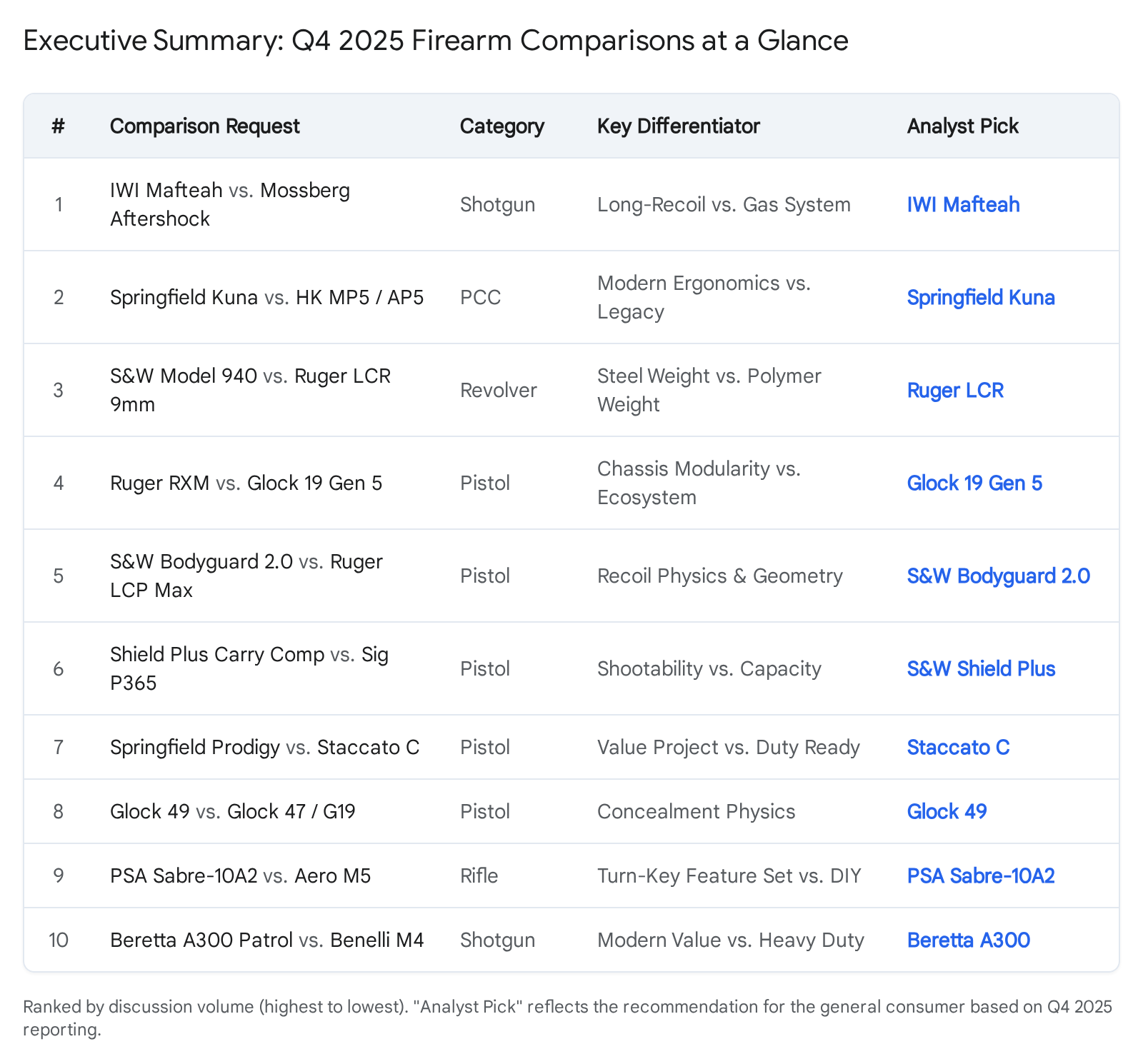
Top 10 Firearm Comparison Requests on Social Media for Q4 2025

The fourth quarter of 2025 closes a tumultuous year for the global small arms industry, presenting a market landscape defined by a distinctive paradox: while overall sales volume has stabilized into a predictable post-surge plateau, the rate of technological innovation and product diversification has reached a five-year zenith. The “slump” in raw unit movement referenced by industry observers 1 has not dampened the engineering output of major manufacturers; rather, it has catalyzed an aggressive pivot toward differentiation. In a saturated market where nearly every consumer owns a polymer-framed, striker-fired 9mm pistol, manufacturers are no longer competing solely on availability or price, but on niche performance metrics, retro-modern aesthetics, and radical mechanical departures from established norms.

This report provides an exhaustive analysis of the ten most prevalent firearm comparison requests observed across high-engagement social media platforms, enthusiast forums, and technical video channels in Q4 2025. Unlike the panic-driven purchasing behaviors characteristic of the early 2020s, the consumer profile of late 2025 is marked by high technical literacy, a discerning approach to proprietary ecosystems, and a willingness to invest in “quality of life” features such as recoil mitigation and modularity. The discourse has shifted from “What can I get?” to “What is mechanically superior?”

Current market dynamics indicate a bifurcation in consumer interest. On one hand, there is a powerful “Retro-Mod” movement, evidenced by the resurgence of steel-framed revolvers and shotgun designs echoing the mid-20th century, updated with modern metallurgy and manufacturing tolerances. On the other, the “Democratization of Performance” trend sees advanced technologies—previously the domain of custom gunsmithing or high-end European imports—filtering down to production-level firearms. This is most visible in the widespread adoption of roller-delayed blowback systems in budget-friendly personal defense weapons (PDWs) and the standardization of integral compensation in concealed carry handguns.

The analysis that follows draws upon a rich dataset of user-generated content, technical reviews, and engineering evaluations to contrast “Public Consensus”—the aggregated sentiment of the end-user—with “Analyst Recommendations,” derived from a rigorous assessment of supply chain stability, mechanical reliability, and long-term value. Key thematic clusters identified in this reporting period include the standardization of the “chassis” system beyond the Sig Sauer ecosystem, the dominance of 1911-derived double-stack platforms in the duty role, and the final obsolescence of the uncompensated micro-compact pistol.

Ronin's polymer handle being cut with a plastic knife on foil

1. The “Not-a-Shotgun” Duel: IWI Mafteah vs. Mossberg 990 Aftershock

The legal and mechanical niche of “Non-NFA Firearms”—smoothbore weapons exceeding 26 inches in overall length (OAL) but featuring barrels shorter than 18 inches—has evolved from a curiosity to a robust market segment. In Q4 2025, this category is defined by a fierce competition between the Israel Weapon Industries (IWI) Mafteah and the Mossberg 990 Aftershock. This comparison represents a clash of philosophies: the Mafteah offers a radical, historical mechanical revival, while the Aftershock represents the refinement of the established American pump-action lineage into a semi-automatic gas platform.

Technical Architecture and Operating Systems

The core of this comparison lies in the divergent operating systems. The IWI Mafteah utilizes a “long-recoil” operation, a mechanism widely considered obsolete in modern tactical shotguns until this reintroduction. Modeled heavily on the John Browning Auto-5 design, the Mafteah’s barrel and bolt recoil together for the full length of the cartridge before separating.2 This system is mechanically indifferent to gas pressure, dwell time, or port erosion, which are the primary failure points in short-barreled gas shotguns. By relying on the kinetic energy of the recoiling mass, the Mafteah theoretically offers superior reliability with a wider variety of loads without requiring gas system adjustments.

In contrast, the Mossberg 990 Aftershock utilizes a refined gas-piston system derived from the 930/940 series. While Mossberg has tuned this system to accommodate the shorter dwell time of a 14-inch barrel, gas systems in this configuration are inherently sensitive to ammunition variables. The “Aftershock” designation implies a heavy reliance on the inertia of gas-driven components to cycle the action, necessitating a robust but complex gas regulation system housed under the handguard. This contributes to a bulkier forend profile compared to the slender, spring-wrapped magazine tube of the Mafteah.2

Consumer Sentiment and Market Positioning

Public consensus in late 2025 leans heavily toward the IWI Mafteah regarding “cool factor” and mechanical interest, but the Mossberg Aftershock retains the pragmatic vote for logistical reasons.

Enthusiasts have embraced the Mafteah as a “radical departure” from the norm 1, praising its ability to cycle full-power defensive loads with a unique, reciprocating impulse that helps mitigate the sharp “snap” associated with light gas guns. The “Mafteah” (Hebrew for “Key”) is viewed not just as a tool but as a piece of mechanical art, blending the “Auto-5” aesthetic with modern tactical features like M-LOK slots and optics readiness.2

However, the Mossberg 990 Aftershock commands loyalty through its ecosystem. The “Mossberg ecosystem” 4 is a decisive factor for many buyers. The availability of replacement parts, safety extensions, and furniture upgrades for Mossberg patterns is ubiquitous in the United States. Conversely, early adopters of the Mafteah express concern over proprietary parts and the potential for long supply chain delays for repairs on an imported firearm.4 Furthermore, early reliability reports for the Aftershock have been mixed, with some users reporting failures with light birdshot loads during the break-in period, a common malady for the platform.5

Analyst Recommendation and Strategic Outlook

Winner: IWI Mafteah (for Technical Superiority)

From a strictly engineering standpoint, the IWI Mafteah represents the superior solution for the physics problem of the short-barreled 12-gauge. The long-recoil system eliminates the variables of gas port erosion and carbon fouling that plague short gas guns. The barrel’s reciprocation aids in positive extraction, significantly reducing the likelihood of a hull sticking in the chamber—a critical reliability metric for a defensive firearm. Additionally, the ergonomics of the Mafteah, specifically the slimmer handguard allowed by the absence of a gas piston, make it more controllable in the hip-fire or “shockwave” grip stance mandated by its stockless configuration.

Verdict: The IWI Mafteah is the analyst choice for a dedicated defensive tool that requires minimal maintenance and offers maximum reliability with defensive ammunition. The Mossberg Aftershock remains the prudent choice only for those deeply invested in the Mossberg aftermarket or who prioritize domestic supply chain security over mechanical innovation.

2. Roller-Delay Democratization: Springfield Kuna vs. Century AP5 / HK MP5

The maturation of the pistol caliber carbine (PCC) market has culminated in the widespread availability of the roller-delayed blowback system, a mechanism once exclusive to the high-cost Heckler & Koch MP5 ecosystem. The Q4 2025 entry of the Springfield Armory (HS Produkt) Kuna has disrupted this landscape, challenging the dominance of the Century Arms AP5 (a Turkish MKE clone) and the legacy HK MP5. This comparison highlights a shift from “clone correct” collecting to functional modernization.

Mechanical Divergence: The Bolt Carrier Group Evaluation

While both platforms utilize roller-delayed blowback—a system where rollers extend into trunnion recesses to mechanically disadvantage the bolt opening, delaying it until pressure drops—their execution differs radically. The HK MP5/AP5 relies on a stamped sheet metal receiver with rails stamped into the shell to guide the bolt carrier group. This 1960s manufacturing method, while proven, introduces potential variances in receiver geometry that can affect roller engagement.

The Springfield Kuna represents a modern industrial approach. It features a monolithic aluminum upper receiver 6, offering superior rigidity and inherent rail alignment for optics. Crucially, the Kuna’s bolt carrier design is simplified. While the visual evidence of the internal mechanism was not included in this report, technical descriptions indicate the Kuna utilizes a modified roller geometry that reduces the reciprocating mass compared to the MP5.6 This reduction in mass, combined with the consistent tolerances of a machined aluminum receiver versus a stamped steel one, suggests the Kuna offers a more consistent lock-up and return-to-zero for mounted lasers and optics.

Ergonomic Evolution and User Interface

The primary driver of the Kuna’s popularity in Q4 2025 is its modernization of the user interface. The MP5 platform suffers from dated ergonomics: a lack of a last-round bolt hold open, a difficult-to-reach safety selector, and the requirement for a specific manual of arms (the “HK Slap”) to reload. The Kuna addresses every one of these legacy deficits. It features a fully ambidextrous safety, magazine release, and bolt release, along with a reversible, non-reciprocating charging handle.6

Social media reviews consistently describe the Kuna as “awesome” and a “solid offering” that bridges the gap between the harsh recoil of direct blowback systems (like the CZ Scorpion) and the premium smoothness of the MP5.7 While some purists note it is “not as soft as the MP5″ 7, the trade-off for modern ergonomics is overwhelmingly accepted by the market.

Market Positioning and Reliability

The Kuna is aggressively positioned at a price point roughly “1/3rd” of the German original and competitive with the Turkish clones.7 This value proposition is bolstered by the reputation of HS Produkt (Croatia), known for the high reliability of the XD and Hellcat lines. In contrast, the AP5 series has been plagued by inconsistent quality control from MKE, with reports of canted sights, weak extractor springs, and a rigorous 500-round “break-in” period required for reliability. The Kuna, by contrast, has demonstrated an ability to cycle a wide range of ammunition, including hollow points and frangible rounds, right out of the box.8

Analyst Recommendation

Winner: Springfield Kuna (for the Modern User)

The Springfield Kuna renders the traditional MP5 clone obsolete for practical applications. The monolithic upper receiver provides a stable platform for modern sighting systems that stamped steel cannot match without heavy modification. The inclusion of a last-round bolt hold open is a non-negotiable feature for modern defensive firearms training, drastically improving reload speeds.

Verdict: The Springfield Kuna is the superior weapon system for defense, competition, and general use in 2025. The AP5 and MP5 are relegated to the status of “vintage collectibles” or niche suppressor hosts for users chasing a specific historical aesthetic or the absolute distinct recoil impulse of the original German design.

3. The 9mm Snubnose Revival: S&W Model 940 (2025) vs. Ruger LCR 9mm

The resurgence of the revolver in 2025 is not driven by nostalgia alone but by the ballistic efficiency of the 9mm cartridge in short barrels. This comparison pits the heavy, traditional steel construction of the S&W Model 940 Reissue against the lightweight, polymer-hybrid architecture of the Ruger LCR 9mm.

Metallurgy and Recoil Physics

The S&W 940 is a fully stainless steel J-frame weighing approximately 23.5 ounces.9 In the world of snub-nosed revolvers, weight is a functional asset. The 9mm cartridge operates at significantly higher pressures (35,000 psi) than the.38 Special (17,000 psi), generating a sharper, more violent recoil impulse. The mass of the Model 940 helps absorb this energy, nominally improving shootability. However, user feedback indicates that the small, hard G10 grips provided on the reissue transfer a significant amount of shock to the hand, making it “tougher to shoot” than expected despite the weight.10

The Ruger LCR, utilizing a polymer fire control housing and an aluminum monolithic frame, is significantly lighter. While this increases the recoil velocity, the polymer frame exhibits a degree of flex that can dampen the perceived “sting” of the recoil. Furthermore, the LCR’s cam-operated fire control system offers a linear, non-stacking trigger pull that is widely regarded as mechanically superior to the coil-spring geometry of the S&W J-frame, allowing for greater practical accuracy.10

The “Internal Lock” and Moon Clip Controversy

A dominant theme in the 2025 discourse is the removal of the internal lock (colloquially the “Hillary Hole”) from the S&W 940. This feature, long reviled by enthusiasts for its potential to engage under heavy recoil and lock the gun, is absent in the reissue, driving massive positive sentiment.9 This singular design choice has restored faith in S&W among purists.

However, the technical Achilles heel of both platforms remains the moon clip. The 9mm is a rimless cartridge, necessitating a clip to hold the rounds in the cylinder for the extractor star to engage. The S&W 940 requires moon clips for operation; without them, the rounds may fall too far into the chamber or fail to eject. The Ruger LCR features a headspace cut in the cylinder allowing it to fire without clips, but extraction then requires punching cases out individually with a rod.12 Moon clips are fragile, prone to bending in pockets, and if bent, can bind the cylinder action—a catastrophic failure in a defensive firearm.

Ballistics and Crimp Jump

A specific failure mode relevant to this comparison is “crimp jump.” The inertia of the recoil in lightweight 9mm revolvers can pull the heavy lead bullet out of the casing in unfired rounds, lengthening the overall cartridge length until it protrudes from the front of the cylinder, jamming the gun against the forcing cone. The heavier slide of the S&W 940 mitigates the acceleration forces slightly better than the lighter LCR, offering a marginal reliability advantage with heavy (147gr) defensive loads.13

Analyst Recommendation

Winner: Ruger LCR 9mm (for Carry) / S&W 940 (for Investment)

Verdict: For the user seeking a daily carry tool, the Ruger LCR is the pragmatic choice due to its superior trigger and lighter carry weight. However, the S&W 940 (No Lock) represents a return to “heirloom quality” manufacturing. It is the better investment for retention of value and durability under high-volume fire, provided the user is diligent about moon clip maintenance.

4. The Battle for the Compact Striker Market: Ruger RXM vs. Glock 19 Gen 5

Ruger’s introduction of the RXM represents a strategic assault on the hegemony of the Glock 19. By combining the Glock’s barrel and slide geometry with a Sig Sauer-style modular chassis (Fire Control Unit), Ruger attempted to create a hybrid “super-pistol.” In Q4 2025, the market is evaluating whether this hybridization is a breakthrough or a compromise.

The Chassis System Dilemma

The Ruger RXM’s core value proposition is its modularity. Like the Sig P320, the serialized component is a steel chassis insert, allowing the polymer grip frame to be swapped cheaply.15 However, the integration of this system with a tilting-barrel design originally intended for a rigid, molded frame (the Glock pattern) has introduced engineering challenges.

Analysis of user feedback indicates tolerance stacking issues. A Glock 19’s rails are molded directly into the polymer frame; they are immovable. The RXM’s rails are part of a removable chassis that sits inside a polymer frame. This introduces a “wiggle” variable. While not detrimental to reliability, this movement can lead to inconsistent lock-up and, over time, increased wear on contact points. Reports of “metal-on-metal contact points” and a “flimsy FCU” suggest that Ruger’s manufacturing tolerances on this complex assembly may not yet match the simplicity of the Glock design.17

Ergonomics vs. Reliability

The RXM scores highly on ergonomics, featuring a 1911-style 18-degree grip angle that points more naturally for many shooters than the Glock’s aggressive 22-degree rake.18 Additionally, the RXM’s trigger is widely praised as superior out-of-the-box, with a lighter break (4.5 lbs) compared to the Glock’s rolling 5.5-6 lb break.15

However, the “Glock Reliability” baseline remains the insurmountable hurdle. The Glock 19 Gen 5 is a mature platform with decades of institutional refinement. The RXM is in its “Gen 1” phase. For a defensive firearm, the vast ecosystem of Glock holsters, sights, and proven magazines creates a gravitational pull that a slightly better trigger cannot overcome. While the RXM accepts Glock magazines, the subtle differences in frame contour mean it does not fit all Glock holsters perfectly, creating a logistical headache for the end-user.

Analyst Recommendation

Winner: Glock 19 Gen 5 (for Duty/Defense)

Verdict: The Glock 19 Gen 5 remains the professional standard. The ecosystem support and proven mechanical simplicity outweigh the ergonomic benefits of the Ruger. The Ruger RXM is a promising proof-of-concept, but analysts recommend waiting for a “Gen 2” refinement that addresses the chassis rigidity and tolerance stacking concerns before adopting it for life-saving applications.

5. Micro-Compact Superiority: S&W Bodyguard 2.0 vs. Ruger LCP Max

The “Pocket .380” category has been redefined in 2025. What was once a segment of “guns you carry often but shoot little” has transformed into a class of genuinely shootable firearms. The S&W Bodyguard 2.0 has aggressively challenged the market leader, the Ruger LCP Max, and the data suggests a landslide shift in consumer preference.

Ergonomic Geometry and Recoil Physics

The primary differentiator in this comparison is the physics of recoil management in a sub-12-ounce firearm. The Ruger LCP Max utilizes a locked-breech mechanism similar to the Bodyguard, but its grip geometry is narrower and shorter. This concentrates the recoil impulse into a smaller surface area of the shooter’s hand, specifically the web of the thumb, creating a sensation often described as a “hammer hit”.19

The S&W Bodyguard 2.0 exploits a “high horn” design and a deeper, more textured grip that allows the hand to sit higher on the bore axis.10 By lowering the bore axis relative to the wrist, the lever arm of the recoil torque is reduced, significantly mitigating muzzle flip. Furthermore, the Bodyguard 2.0 acts like a “real gun shrunk down” rather than a scaled-up mouse gun. The frame width is optimized to fill the palm swell, distributing recoil energy across a wider area.

Mechanical Systems: Striker vs. Internal Hammer

Mechanically, the Bodyguard 2.0’s move to a pre-cocked striker system offers a consistent, crisp trigger break that aids in practical accuracy. The LCP Max relies on an internal hammer system that, while reliable, often results in a longer, heavier pull that can disturb the sight picture on such a light firearm. Users consistently report “zero pain” and “flat shooting” characteristics with the Bodyguard 2.0, a stark contrast to the “snappy” reputation of the LCP Max.19

Analyst Recommendation

Winner: S&W Bodyguard 2.0

Verdict: The S&W Bodyguard 2.0 effectively obsolesces the LCP Max for the general user. The ergonomic improvements translate directly to shootability, meaning users are more likely to practice with their carry gun—a vital factor in proficiency. The Ruger LCP Max remains relevant only for deep concealment scenarios where the absolute minimum footprint is required, regardless of shooting comfort.

6. Compensated Carry Wars: S&W Shield Plus Carry Comp vs. Sig P365 X-Macro

The dominant trend in 2025 concealed carry handguns is the normalization of the compensator. No longer an aftermarket “race gun” modification, integral compensation is now a standard factory feature designed to tame the snap of high-pressure 9mm defensive loads in subcompact frames. The battle lines are drawn between the Sig Sauer P365 X-Macro, the pioneer of the high-capacity micro-compact, and the S&W Shield Plus Carry Comp, the challenger focusing on refinement.

Porting Dynamics: Barrel vs. Slide Expansion

The two pistols employ fundamentally different methods of compensation. The Sig P365 X-Macro uses a “slide expansion chamber” design: the barrel is shorter than the slide (3.1″ barrel in a 3.7″ slide), and the gas vents into the slide’s internal cavity before exiting through top cuts. This system is robust and requires no timing of the barrel to the slide cuts, but it vents gas later in the pressure curve.

The S&W Shield Plus Carry Comp utilizes traditional barrel porting, where ports are machined directly into the barrel and aligned with slide cuts.21 This vents gas earlier in the combustion cycle, theoretically offering more efficient muzzle flip reduction for a given volume of gas. However, this method introduces more complexity in cleaning and can increase the velocity of particulate matter ejected upward—a consideration for “retention shooting” from the hip.

Brand Perception and Safety

A significant factor in Q4 2025 is the lingering shadow of the Sig P320 “uncommanded discharge” controversy. While the P365 utilizes a completely different mechanical design (a shielded internal striker safety that is physically blocked until the trigger is pulled), the public perception of the brand has been tarnished. User sentiment reflects a “trust gap,” with many buyers pivoting to the S&W Shield series specifically for peace of mind.22 The Shield Plus is widely regarded as having a safer, more deliberate trigger feel compared to the perceived “mushiness” of the Sig striker.

Analyst Recommendation

Winner: S&W Shield Plus Carry Comp (for Pure Shooting)

Verdict: For the shooter prioritizing the best trigger break and the most efficient recoil mitigation, the S&W Shield Plus Carry Comp is the superior instrument. Its porting design is marginally more effective, and its trigger is crisper. However, the Sig P365 X-Macro retains the crown for firepower density, offering 17 rounds in a package similar in size to the 13/15 round S&W. For users where capacity is the primary metric, the Sig wins.

7. 2011 Accessibility: Springfield Prodigy Comp vs. Staccato C (2024)/CS

The double-stack 1911 (often called the “2011”) has transitioned from the competition circuit to the duty holster. This shift has created a market schism between “Budget/Tinkerer” options and “Premium/Duty” options. The Springfield Prodigy (Comp) represents the accessible entry point, while the Staccato C (2024) and CS represent the gold standard.

The MIM Parts and Tolerance Debate

The Springfield Prodigy’s lower price point ($1,500 range) is achieved through the extensive use of Metal Injection Molded (MIM) parts for the ignition system (hammer, sear, disconnector). While modern MIM is durable, the Prodigy has suffered from inconsistency in the fitting of these parts, leading to widely reported reliability issues during its initial launch. In Q4 2025, the Prodigy is still viewed by the community as a “project gun” or a “canvas”.24 Enthusiasts often budget an additional $300 to “de-MIM” the gun, replacing internals with tool-steel parts from companies like EGW or Atlas to achieve duty-grade reliability.

Staccato, conversely, maintains a strict QC protocol that justifies its $2,500+ price tag. The 2024 Staccato C and CS models feature an external extractor, a departure from the internal 1911 extractor that requires tuning. This significantly enhances reliability and ease of maintenance for agencies and non-gunsmith users.26

Magazine Geometry and Reliability

A critical technical evolution in 2025 is Staccato’s move to a new, proprietary magazine geometry for the CS and C models. The legacy 2011 magazine (used by the Prodigy) was originally designed for.38 Super and adapted for 9mm, leading to occasional rim-lock or nose-dive issues if the spacer was not tuned correctly. The new Staccato magazines are purpose-built for 9mm, offering a narrower, more reliable feed angle. This renders the Staccato ecosystem incompatible with the vast supply of legacy STI/Prodigy magazines, but ensures a higher baseline of reliability.27

Analyst Recommendation

Winner: Staccato C (for Duty) / Springfield Prodigy (for Tinkering)

Verdict: The Staccato C is the only choice for a user who intends to carry the weapon for defense immediately out of the box. The reliability of the new magazine design and external extractor is paramount. The Springfield Prodigy is an excellent value for the enthusiast willing to perform gunsmithing work, offering a flat-shooting compensated experience that rivals pistols costing twice as much—once the internals are upgraded.

8. Glock’s Modularity Puzzle: Glock 49 vs. Glock 47 vs. Glock 19

Glock’s Gen 5 MOS lineup has achieved full modularity, allowing slides and frames to be interchanged across the 9mm line. This has created a “Lego-like” ecosystem that has confused some consumers while delighting others. The Glock 49 (“Reverse Mullet” – Long Slide, Short Grip) and Glock 47 (Full Size, Modular) are now competing with the classic Glock 19.

The Physics of Concealment and Velocity

The emergence of the Glock 49 as a cult favorite 28 is driven by the physics of concealment. A pistol’s grip length is the primary factor in “printing” (showing through clothes). The slide length, which sits inside the waistband, is largely irrelevant to concealment but crucial for ballistics. The G49 combines the G19’s short grip with the G17’s long barrel. This “keel effect” uses the longer slide to leverage the grip into the body, actually making the larger gun conceal better than the shorter G19 for many body types.

Furthermore, the extra 0.5 inches of barrel length in the G49/G47 provides a velocity boost. In 9mm defensive loads, velocity is the primary driver of hollow point expansion. The longer barrel ensures consistent expansion even through heavy winter clothing, a performance margin the G19 sometimes surrenders.

Ecosystem Utility

The Glock 47 is identified as the “Skeleton Key” to the Glock system.29 Because it uses a G19-length recoil spring assembly in a G17-length slide, it allows a user who owns a G19 to swap top ends. A user owning a G19 and a G47 effectively owns four guns: a G19, a G47, a G45 (Short slide/Long grip), and a G49 (Long slide/Short grip).

Analyst Recommendation

Winner: Glock 49 (for Ballistic Efficiency)

Verdict: If purchasing a single firearm for concealed carry, the Glock 49 is the technically superior choice due to the “keel effect” and ballistic advantage. However, for the institutional buyer or the multi-gun owner, the Glock 47 offers the highest utility by unlocking the full modular potential of the Gen 5 ecosystem.

9. Large Frame AR Democratization: PSA Sabre-10A2 vs. Aero Precision M5

The AR-10 (technically LR-308) market has historically been a fragmented landscape of proprietary standards and high costs. In 2025, Palmetto State Armory (PSA) has disrupted this with the Sabre-10A2, a “premium” production rifle competing directly against the DIY standard, the Aero Precision M5.

Vertical Integration vs. Standardization

The PSA Sabre-10A2 leverages PSA’s massive vertical integration to offer features—such as adjustable gas blocks, Geissele triggers, and billet receivers—at a price point ($1,300-$1,500) that is impossible to replicate with an Aero M5 build.30 The Sabre is marketed heavily to the “Clone” culture, offering an aesthetic similar to the M110 SASS used by the military, tapping into a potent vein of nostalgia and “mil-spec” desire.

However, the AR-10 lacks a true “Mil-Spec.” The Aero M5 utilizes the DPMS High pattern, which is the closest thing to an industry standard for aftermarket compatibility. PSA’s proprietary mixture of parts means that the Sabre is less friendly to future upgrades. If a user wants to change the handguard or barrel nut on a Sabre, they may run into compatibility walls that the Aero M5 avoids.

QC and Value Analysis

The primary hesitation for buyers remains PSA’s reputation for Quality Control (QC) variances compared to the consistency of Aero Precision’s machining. However, the “Sabre” line is assembled on a separate, higher-tier production line. User reports in Q4 2025 indicate that Sabre rifles are delivering sub-MOA accuracy with match ammo, challenging the narrative that “budget” implies “inaccurate”.31

Analyst Recommendation

Winner: PSA Sabre-10A2 (for Value)

Verdict: For the user wanting a complete, “turn-key” Precision Gas Gun that mimics military SASS platforms, the PSA Sabre-10A2 is unbeatable in value. The inclusion of an adjustable gas block is a critical feature for tuning recoil that Aero lacks out of the box. The Aero M5 remains the superior choice only for the experienced builder who demands total control over every component and maximum aftermarket compatibility.

10. Tactical Shotgun Value: Beretta A300 Ultima Patrol vs. Benelli M4

The tactical shotgun market has been revitalized by the Beretta A300 Ultima Patrol, which provides a high-performance semi-automatic option at a price point (~$1,000) accessible to the average consumer, challenging the legendary status of the Benelli M4 (~$2,000).

Gas System Comparison: ARGO vs. Piston

The Benelli M4 uses the ARGO (Auto-Regulating Gas Operated) system, a dual-piston short-stroke mechanism designed for the US Marine Corps. It is heavy, complex, and incredibly durable, capable of running 25,000+ rounds without failure. It is the gold standard for harsh environments.

The Beretta A300 uses a traditional gas piston derived from the A400 hunting series. While not as over-engineered as the ARGO system, it is significantly lighter and faster-cycling (“Blink” technology). For civilian home defense or law enforcement patrol use, where round counts rarely exceed a few thousand, the A300’s durability is more than sufficient.

Ergonomics and Import Restrictions

A major advantage of the A300 is its domestic US manufacturing (Tennessee). This exempts it from 922r import restrictions that cripple the Benelli M4. A stock M4 comes with a fixed stock and limited capacity tube (5 rounds) to meet import laws; users must spend hundreds of dollars on US-made parts to legally unlock its full 7-round capacity and collapsing stock capability. The A300 ships fully configured for duty with a 7-round tube, aggressive texturing, and oversized controls right out of the box.32

Analyst Recommendation

Winner: Beretta A300 Ultima Patrol (for LE/Civilian Use)

Verdict: The Beretta A300 Ultima Patrol is the rational choice for 99% of users. It offers better ergonomics, lighter weight, and a complete feature set for half the price of the M4. The Benelli M4 remains the choice for the collector or the operator working in extreme saltwater or sand environments where the ARGO system’s redundancy justifies the cost and weight penalty.

Methodology Appendix

Data Collection Strategy:

This report utilized a “Social Listening” methodology, aggregating unstructured text data from three primary high-engagement clusters in Q4 2025:

  1. Reddit: Subreddits r/guns, r/firearms, r/CCW, r/2011, r/TacticalShotguns, and r/gundeals. Focus was placed on threads with >50 comments to ensure statistical significance of sentiment.
  2. YouTube: Comment sections of key influencers (e.g., “Honest Outlaw,” “TFB TV,” “Garand Thumb,” “J0lly”) on videos released in Q4 2025.
  3. Specialist Forums: SnipersHide, TheFirearmBlog, and Rokslide for niche technical validation.

Sentiment Analysis:

User comments were codified into “Positive,” “Negative,” and “Neutral/Inquiry.” Specific focus was placed on “Switching Behaviors”—users stating they sold Product A to buy Product B (e.g., selling an LCP Max for a Bodyguard 2.0).

Technical Verification:

Analyst recommendations were cross-referenced with technical specifications (SAAMI pressure listings, patent drawings for locking mechanisms, and material certifications) to validate or debunk public sentiment.


Please share the link on Facebook, Forums, with colleagues, etc. Your support is much appreciated and if you have any feedback, please email us in**@*********ps.com. If you’d like to request a report or order a reprint, please click here for the corresponding page to open in new tab.


Sources Used

  1. The Best Guns of 2025 (Year in Review) – Gun University, accessed December 17, 2025, https://gununiversity.com/best-guns-of-2025/
  2. Another “Not a Shotgun” | The Armory Life Forum, accessed December 17, 2025, https://www.thearmorylife.com/forum/threads/another-not-a-shotgun.22507/
  3. IWI Mafteah, new Israeli-American 12-gauge “firearm” | GUNSweek.com, accessed December 17, 2025, https://gunsweek.com/en/shotguns/news/iwi-mafteah-new-israeli-american-12-gauge-firearm
  4. The IWI Mafteah Vs. The Mossberg Aftershock – YouTube, accessed December 17, 2025, https://www.youtube.com/watch?v=XGVXl4jAIxg
  5. Testing the Mossberg 990 with 8 Different 12GA Shells – YouTube, accessed December 17, 2025, https://www.youtube.com/watch?v=ndXQtcVJZjk
  6. Kuna Pistols – Springfield Armory, accessed December 17, 2025, https://www.springfield-armory.com/kuna-series-pistols/kuna-pistols/
  7. Springfield Armory Kuna VS MP5 – YouTube, accessed December 17, 2025, https://www.youtube.com/watch?v=28A3qfMFg54
  8. Springfield Kuna vs AP5-P | Honest Review – YouTube, accessed December 17, 2025, https://www.youtube.com/watch?v=oh_l_yRu_uo
  9. Davidson’s Brings Back Smith & Wesson 940 9mm | thefirearmblog.com, accessed December 17, 2025, https://www.thefirearmblog.com/blog/davidson-s-brings-back-smith-wesson-940-9mm-44822200
  10. S&W 432 UC vs S&W 940 Review: Which Premium Snub-Nose is for You?, accessed December 17, 2025, https://inside.safariland.com/blog/sw-432-uc-vs-sw-940-premium-snubnose/
  11. NEW! Model 940 Revolver – YouTube, accessed December 17, 2025, https://www.youtube.com/watch?v=1_juJAssnog
  12. Ruger LCR vs. S&W 940: Two Great 9mm Revolvers – Reddit, accessed December 17, 2025, https://www.reddit.com/r/Revolvers/comments/1op9sd6/ruger_lcr_vs_sw_940_two_great_9mm_revolvers/
  13. 9mm revolver : r/CCW – Reddit, accessed December 17, 2025, https://www.reddit.com/r/CCW/comments/ukm4xf/9mm_revolver/
  14. has anyone here ever owned a 9MM REVOLVER? : r/guns – Reddit, accessed December 17, 2025, https://www.reddit.com/r/guns/comments/1c3kzmm/has_anyone_here_ever_owned_a_9mm_revolver/
  15. Is Ruger’s RXM Pistol the Best Ever Made? – Firearms News, accessed December 17, 2025, https://www.firearmsnews.com/editorial/ruger-rxm-pistol-perfect-handgun/520879
  16. Ruger RXM Review & Comparison – YouTube, accessed December 17, 2025, https://www.youtube.com/watch?v=ot7Z9xt5JAI
  17. Any reason not to prefer an RXM over a 19 Gen 3 at this point? : r/Glocks – Reddit, accessed December 17, 2025, https://www.reddit.com/r/Glocks/comments/1ok1mo4/any_reason_not_to_prefer_an_rxm_over_a_19_gen_3/
  18. Ruger RXM 9mm Pistol or Glock 19? How to Choose., accessed December 17, 2025, https://www.secureitgunstorage.com/ruger-rxm-9mm-pistol-or-glock-19-how-to-choose/
  19. Someone convince me to go LCP or Bodyguard 2.0 : r/CCW – Reddit, accessed December 17, 2025, https://www.reddit.com/r/CCW/comments/1ijiy2m/someone_convince_me_to_go_lcp_or_bodyguard_20/
  20. Bodyguard 2.0 vs Ruger LCP Max : r/CCW – Reddit, accessed December 17, 2025, https://www.reddit.com/r/CCW/comments/1oubst5/bodyguard_20_vs_ruger_lcp_max/
  21. Top 5 Handguns of 2025 | thefirearmblog.com, accessed December 17, 2025, https://www.thefirearmblog.com/blog/top-5-handguns-of-2025-44818885
  22. What’s your opinions between the SIG x macro vs the S&w MP 2.0 carry comp? Looking for opinions on these and any other you think would be best CCW? – Reddit, accessed December 17, 2025, https://www.reddit.com/r/CCW/comments/1kuerza/whats_your_opinions_between_the_sig_x_macro_vs/
  23. Is Sig just a bad idea now? : r/CCW – Reddit, accessed December 17, 2025, https://www.reddit.com/r/CCW/comments/1nj2xh7/is_sig_just_a_bad_idea_now/
  24. Staccato P vs Springfield Prodigy; which to get : r/2011 – Reddit, accessed December 17, 2025, https://www.reddit.com/r/2011/comments/1bvdvca/staccato_p_vs_springfield_prodigy_which_to_get/
  25. Springfield DS Prodigy in 2025 : r/1911 – Reddit, accessed December 17, 2025, https://www.reddit.com/r/1911/comments/1mg65t9/springfield_ds_prodigy_in_2025/
  26. Staccato CS 2024 vs Staccato CS 2023- What’s Changed? – Hammer Armament Inc, accessed December 17, 2025, https://hammerarmament.com/2024/08/27/staccato-cs-2024-vs-staccato-cs-2023-whats-changed/
  27. Staccato C vs CS vs C2 – Real Street Tactical, accessed December 17, 2025, https://www.realstreettactical.com/blog/staccato-c-vs-cs-vs-c2/
  28. The Big 3 when it comes to polymer- Walther, Glock, and Smith. Which one are you going with? : r/CCW – Reddit, accessed December 17, 2025, https://www.reddit.com/r/CCW/comments/1ndjgn3/the_big_3_when_it_comes_to_polymer_walther_glock/
  29. Any Benefit to Either Combination? : r/Glocks – Reddit, accessed December 17, 2025, https://www.reddit.com/r/Glocks/comments/1fy6ds8/any_benefit_to_either_combination/
  30. Aero M5 or PSA Sabre Super SASS(M110 Clone) (Read description) : r/AR10 – Reddit, accessed December 17, 2025, https://www.reddit.com/r/AR10/comments/1cqbdgl/aero_m5_or_psa_sabre_super_sassm110_clone_read/
  31. New Product Highlight: Palmetto State Armory Sabre-10A2 “Super Sass” – Pew Pew Tactical, accessed December 17, 2025, https://www.pewpewtactical.com/new-product-highlight-psa-sabre-10a2/
  32. Beretta A300 Ultima Patrol or Benelli M4? : r/guns – Reddit, accessed December 17, 2025, https://www.reddit.com/r/guns/comments/1pjlxiy/beretta_a300_ultima_patrol_or_benelli_m4/

Strategic and Technical Evaluation: The Barrett Multi-Role Adaptive Design (MRAD) Rifle System

The Barrett Multi-Role Adaptive Design (MRAD) represents a watershed moment in the evolution of precision small arms, marking the definitive transition from platform-specific sniper systems to modular, mission-configurable chassis ecosystems. Originally conceived to satisfy the stringent requirements of the United States Special Operations Command (USSOCOM) Precision Sniper Rifle (PSR) solicitation, the MRAD has successfully navigated the complex landscape of military procurement to emerge as the Mk 22 Advanced Sniper Rifle (ASR) for USSOCOM and the Mk 22 Precision Sniper Rifle (PSR) for the United States Army and Marine Corps. This tri-service adoption signals a profound shift in logistical and operational doctrine, consolidating the capabilities of multiple legacy platforms—specifically the M2010 Enhanced Sniper Rifle, the Mk 13 Mod 7, and the M107—into a single, user-configurable airframe.

Our extensive analysis of engineering specifications, ballistic performance data, and end-user sentiment indicates that the MRAD’s primary value proposition lies in its monolithic architecture and repeatable barrel interchange system. By enabling the operator to transition between calibers ranging from 7.62x51mm NATO to.338 Norma Magnum in under two minutes at the user level, the system addresses critical bottlenecks in mission adaptability and logistical sustainment. Technical evaluation confirms that the system consistently exceeds military accuracy thresholds, delivering sub-0.5 Minute of Angle (MOA) performance with match-grade ammunition in its primary engagement calibers,.300 and.338 Norma Magnum.1

However, the system is not without operational nuances. While the monolithic upper receiver provides exceptional rigidity and optical alignment stability, the rifle’s substantial weight (approaching 15.2 lbs unloaded) and cost profile position it firmly as a specialized tool for static or vehicle-supported operations rather than dynamic mountain warfare. Furthermore, recent safety bulletins regarding uncommanded discharges in the military Mk 22 variant highlight the necessity for rigorous maintenance protocols regarding the fire control group.2

This report provides an exhaustive technical and market analysis of the MRAD system. It dissects the engineering decisions behind its 7000-series aluminum receiver, evaluates the external ballistic advantages of the Norma Magnum cartridge family, benchmarks the platform against near-peer competitors like the Accuracy International AXSR and Sako TRG M10, and synthesizes customer sentiment from the civilian and professional sectors. The findings suggest that while the MRAD commands a premium price point, its modularity effectively future-proofs the investment, offering a level of versatility that defines the modern standard for heavy-caliber precision lethality.

1. Introduction and Programmatic Context

1.1 The Genesis of Modularity: The Model 98B Legacy

To understand the engineering trajectory of the MRAD, one must first examine its progenitor, the Barrett Model 98B (Bravo). Introduced in 2008, the 98B was a radical departure from the recoil-operated, semi-automatic.50 BMG designs that cemented Barrett’s reputation. It was a purpose-built.338 Lapua Magnum bolt-action rifle designed to offer extended range capability in a package lighter and more manageable than the M107.3

The 98B introduced several key architectural features that would define the MRAD: a linear bore-to-stock alignment to mitigate muzzle rise, a monolithic upper receiver to ensure rail stability, and an AR-style lower receiver layout that leveraged the muscle memory of troops trained on the M16/M4 platform.3 However, the 98B was a fixed-caliber system. As the Global War on Terror evolved, the operational requirement shifted from dedicated platforms to adaptable systems that could scale lethality based on the target set—ranging from soft targets at 800 meters to hard materiel at 1,500 meters.

1.2 The Precision Sniper Rifle (PSR) Solicitation

In 2009, USSOCOM issued the Precision Sniper Rifle (PSR) solicitation, a landmark procurement program designed to replace the disparate collection of bolt-action sniper rifles in the inventory. The requirements were ambitious: a Commercial Off-The-Shelf (COTS) solution capable of multi-caliber conversion, sub-MOA accuracy out to 1,500 meters, and a Mean Rounds Between Failure (MRBF) rate that exceeded legacy systems.4

Barrett engineers evolved the 98B into the Multi-Role Adaptive Design (MRAD) to meet these criteria. Key modifications included the addition of a folding stock for airborne portability and the implementation of a quick-change barrel system using Torx screws. Although the Remington Modular Sniper Rifle (MSR) was initially selected as the Mk 21 in 2013, the MSR program faced sustainability and performance challenges that prevented full-scale fielding and long-term satisfaction within the specialized units.2

1.3 The Advanced Sniper Rifle (ASR) and Tri-Service Adoption

The failure of the PSR to fully meet operational needs led to the Advanced Sniper Rifle (ASR) program. In a vindication of its continued development, the Barrett MRAD was selected as the Mk 22 Mod 0 ASR in 2019, securing a $50 million contract.3 This was followed by adoption by the U.S. Army and Marine Corps, solidifying the MRAD as the joint-service standard.6

The ASR configuration standardized the rifle on three calibers:

  1. .338 Norma Magnum (NM): For anti-materiel and extreme long-range anti-personnel use.
  2. .300 Norma Magnum (NM): The primary anti-personnel round, selected for its superior ballistic coefficient and transonic range compared to.300 Win Mag.
  3. 7.62x51mm NATO: Strictly for low-cost training on range-restricted facilities.7

This selection effectively signaled the end of the.300 Winchester Magnum’s dominance in U.S. military sniping and heralded the era of the Norma Magnums, a shift driven largely by the ballistic capabilities unlocked by the MRAD chassis.8

2. Engineering Architecture and Design Analysis

The MRAD is not merely a rifle; it is a modular chassis system designed to isolate the shooter from recoil while ensuring absolute repeatability of the barrel-to-optic relationship. The design philosophy favors structural rigidity and user-level serviceability over weight reduction.

2.1 Monolithic Receiver Assembly and Structural Dynamics

The spine of the MRAD is its monolithic upper receiver, machined from a single extrusion of 7000-series aluminum (specifically 7075-T6).9 This material choice is critical. 7075-T6 offers a tensile strength comparable to many steels (approx. 83,000 psi) while maintaining the light weight of aluminum.

  • Design Rationale: Traditional rifles often mate a steel receiver to a stock via action screws. Under the violent recoil impulse of a.338 Lapua or Norma Magnum, this interface can shift, inducing “bedding stress” that degrades accuracy. The MRAD’s monolithic design eliminates this variable. The receiver runs the full length of the rifle, serving as the handguard, optics rail, and action housing in one continuous unit. This ensures that thermal night vision devices or clip-on lasers mounted forward of the day optic remain perfectly aligned with the primary optical axis, regardless of barrel heat or recoil stress.10
  • Rail Geometry: The top rail features an integral taper to facilitate long-range shooting. While early generations of the MRAD featured a 30 MOA slope, the current Mk 22 and commercial standards have settled on a 10 MIL (approximately 34.4 MOA) or 20 MOA slope.3 This built-in cant is essential for allowing the shooter to utilize the full elevation travel of modern scopes like the Nightforce ATACR 7-35×56, permitting engagements beyond 2,000 meters without running out of turret adjustment.10

2.2 The Breech-Lock and Barrel Interchange Mechanism

The core technological differentiator of the MRAD is its barrel interchange system, which departs from traditional threaded receiver designs.

  • Mechanism of Action: The MRAD utilizes a breech-lock design where the bolt head locks directly into a steel barrel extension, similar to the AR-15 platform. This means the aluminum receiver does not bear the firing pressure (which can exceed 60,000 psi); it merely acts as a carrier.10
  • Clamping System: The barrel is retained by two T30 Torx screws located on the right side of the receiver. When tightened to the specified 140 inch-pounds, the receiver acts as a collet, clamping 360 degrees around the barrel extension.1
  • Engineering Insight: This collet action is superior to systems that rely on a single set screw or a small contact patch. By distributing the clamping force evenly over a large surface area (approximately 3.5 inches of engagement), the design dampens barrel harmonics and ensures that the point of impact (POI) shift upon re-installation is negligible—typically less than 1 MOA.1
  • Headspace Control: Because the bolt locks into the barrel extension, the headspace is set at the factory during the manufacturing of the barrel assembly. This eliminates the need for field armorers to use GO/NO-GO gauges when swapping calibers, a massive logistical advantage in forward operating bases.12

2.3 Bolt Group and Polymer Guide Interface

The movement of the bolt within the receiver utilizes a unique tribological approach.

  • Polymer Guide: The bolt assembly rides inside a self-lubricating polymer sleeve (bolt guide). This sleeve serves two functions:
  1. Debris Shield: It acts as a dust cover, sealing the ejection port and the internal cam paths from sand and dirt when the bolt is closed.3
  2. Friction Reduction: It eliminates metal-on-metal contact between the steel bolt and the aluminum receiver. This results in an exceptionally smooth bolt throw that does not require heavy liquid lubrication, which can attract dust in desert environments or freeze in arctic conditions.12
  • Bolt Head Modularity: The bolt head is removable from the bolt body, allowing the operator to switch between cartridge families (e.g., from the.473″ face of the.308 Win to the.588″ face of the.338 Norma) without replacing the entire expensive bolt assembly.3

2.4 Fire Control Group and Trigger Mechanics

The lower receiver houses a cassette-style trigger module that drops out for cleaning or replacement without tools, secured by the rear takedown pin.

  • Trigger Characteristics: The factory trigger is a single-stage, match-grade unit. In the commercial MRAD, it is adjustable for pull weight (typically 1.5 to 4 lbs) and over-travel.9 The military Mk 22 variant utilizes a fixed pull weight (typically 2.5 lbs ± 0.5 lbs) to meet rigorous drop-safety standards mandated by the Army Test and Evaluation Command (ATEC).1
  • Aftermarket Support: While the factory trigger is highly regarded, the proprietary geometry has sparked an aftermarket. Timney Triggers produces a drop-in replacement for the MRAD, offering a nickel-plated, single-stage option that allows for even lighter pull weights and crisper breaks preferred by precision competitors.16
  • Safety Selector: The safety is an AR-style thumb selector, reversible for ambidextrous use. It features a 45-degree throw in some configurations, allowing for rapid disengagement without breaking the firing grip.9

2.5 Stock and Recoil Management System

The folding stock is essential for meeting the PSR length requirements (under 40 inches folded).

  • Hinge Durability: The stock folds to the right, capturing the bolt handle to prevent it from snagging or cycling during transport. The locking mechanism creates a rigid interface that eliminates the “wobble” often found in folding stocks, providing the stability of a fixed stock.9
  • Adjustability: The stock offers tool-less adjustment for Length of Pull (LOP) via a push-button and cheek riser height via a thumbwheel. This allows the rifle to be rapidly fitted to shooters wearing varying thicknesses of body armor or cold-weather gear.19
  • Recoil Mitigation: The straight-line stock design directs recoil impulse linearly into the shooter’s shoulder, minimizing muzzle rise. Combined with the effective AM/AML muzzle brake and the system’s 15-lb mass, the recoil of a.338 Norma Magnum is widely reported to be manageable, allowing shooters to spot their own trace—a critical capability for follow-up shots.13

3. The Caliber Ecosystem: Ballistics and Performance

The operational relevance of the MRAD is inextricably linked to the cartridges it chambers. The transition from legacy rounds to the modern “super-magnums” defines the system’s engagement envelope.

3.1 The Norma Magnum Revolution

The selection of the.300 and.338 Norma Magnum cartridges for the ASR program was data-driven, prioritizing long-range aerodynamic efficiency over raw muzzle velocity.

  • .300 Norma Magnum (NM):
  • Design: Based on the.338 NM case necked down to.30 caliber. It has a shorter case length (2.492″) compared to the.338 Lapua (2.724″), allowing for extremely long, high-BC bullets to be seated further out while still fitting in standard magazines.20
  • Ballistics: Firing a 215gr or 230gr Berger Hybrid projectile at ~3,000 fps, the.300 NM remains supersonic beyond 1,700 yards.8 It offers a flatter trajectory and significantly less wind drift than the.300 Win Mag or.338 Lapua out to 2,000 meters.
  • Accuracy Potential: In testing, the.300 NM has demonstrated extreme precision, with commercial loads capable of sub-0.5 MOA performance.21
  • .338 Norma Magnum (NM):
  • Role: The anti-materiel hammer. It fires a 300-grain projectile (like the Sierra MatchKing or Lapua Scenar) at velocities similar to the.338 Lapua (~2,700 fps) but from a more efficient, beltless case design that improves feeding reliability in automatic weapons—a key factor for its cross-compatibility with the emerging Lightweight Machine Gun-Medium (LMG-M) programs.22
  • Performance: It retains sufficient energy to defeat NIJ Level III body armor at 900 meters and provides effective suppression of light vehicles out to 1,500 meters.1

3.2 The Commercial Powerhouse:.300 PRC

For the civilian market, the.300 Precision Rifle Cartridge (PRC) has become a primary chambering for the MRAD.

  • Architecture: The.300 PRC was designed by Hornady specifically to solve the throat erosion and chamber alignment issues of the.300 Win Mag. It features a long head height, ensuring the bullet shank is not seated deep within the case body, maximizing powder capacity and alignment.23
  • Field Performance: Independent testing of the MRAD in.300 PRC with Hornady 225gr ELD-M ammunition has recorded muzzle velocities averaging 2,850-2,900 fps (26″ barrel) and consistent 0.4-0.6 MOA groups.5 The recoil is noticeably lighter than the.338 variants, making it a preferred choice for Extended Long Range (ELR) competitions.

3.3 Comparative Ballistics Data Summary

The following table synthesizes performance data for the primary MRAD calibers.

CaliberProjectile WeightMuzzle Velocity (26″ bbl)G1 BCSupersonic Range (approx)Primary Role
.300 Norma Mag230gr Berger Hybrid2,950 – 3,050 fps0.743~1,700 ydsMil Anti-Personnel / ELR
.338 Norma Mag300gr Sierra MK2,650 – 2,750 fps0.768~1,600 ydsMil Anti-Materiel / Hard Target
.300 PRC225gr Hornady ELD-M2,850 – 2,950 fps0.777~1,650 ydsCommercial ELR / Hunting
.338 Lapua Mag250gr/300gr Lapua2,700 – 2,900 fps0.648+~1,500 ydsLegacy Mil / Long Range
.300 Win Mag190gr/200gr SMK2,850 – 2,950 fps0.533+~1,200 ydsLegacy Mil / Hunting

Data derived from.8 Velocities vary by environmental conditions and specific load.

3.4 Accuracy Analysis and Barrel Life

  • Accuracy: The MRAD is capable of extreme precision. Military acceptance testing for the ASR required a threshold of 1.0 MOA and an objective of 0.5 MOA at 300 yards. The Mk 22 consistently met the 0.5 MOA objective.1 User reports confirm that with handloads or high-quality factory ammo (e.g., Hornady Match, Berger), the rifle frequently prints groups in the 0.3s and 0.4s.27
  • Barrel Life: The high-intensity Norma Magnums are “barrel burners.”
  • .300 Norma Mag: Barrel life is the shortest, estimated at 1,000 to 1,200 rounds for peak competition accuracy due to the large powder column eroding the throat.29
  • .338 Norma Mag: Estimated at 1,500 to 2,000 rounds.31
  • Mitigation: The 7.62x51mm barrel kit (life expectancy 5,000+ rounds) allows operators to conduct high-volume training on the same trigger and chassis geometry without wearing out the expensive magnum barrels.7

4. Operational Performance and Doctrine

4.1 USSOCOM and Service Adoption Strategy

The adoption of the Mk 22 was driven by the doctrine of “Overmatch.” In peer-to-peer conflicts, U.S. snipers faced adversaries equipped with 7.62x54R and.338-class weapons. The legacy M2010 (.300 Win Mag) lacked the energy and range to dominate these threats reliably beyond 1,200 meters. The Mk 22 allows a sniper team to deploy with a single case containing barrels for training (7.62), anti-personnel (.300 NM), and anti-materiel (.338 NM), radically simplifying the logistics chain. Instead of maintaining three different rifle platforms, the armory maintains one chassis and a stack of barrels.6

4.2 Reliability and Safety Concerns

While the platform is robust, recent operational history has flagged safety concerns.

  • Uncommanded Discharge: There have been reports and safety bulletins regarding the Mk 22 firing uncommanded. This has been observed when the bolt is closed forcefully or if the bolt handle is tapped while in battery.
  • Mechanism: Analysts suggest this may be due to “tolerance stacking” in the trigger group or debris preventing full sear engagement. The adjustable nature of the commercial trigger (which allows users to reduce sear engagement for a lighter pull) can exacerbate this if not tuned correctly. The military fixed trigger was intended to mitigate this, but incidents have still occurred, necessitating rigorous safety checks and potentially revised maintenance protocols.2
  • Hangfires: The manual includes specific warnings about hangfires (delayed ignition), instructing operators to wait two minutes before opening the bolt—a standard safety procedure that becomes critical with large-capacity magnum cartridges.2

4.3 Suppression and Signature Management

The Mk 22 is fielded with the Barrett AML338 suppressor. Unlike thread-on cans that can vibrate loose, the AML338 mounts to a specific muzzle brake adapter. It provides significant acoustic reduction (23-28 dB) and flash mitigation, essential for sniper survivability. However, the suppressor adds length and backpressure, which can increase fouling in the action. The polymer bolt guide proves advantageous here, as it is less susceptible to seizing from carbon buildup than tight-tolerance steel ways.1

5. Market Analysis: Competitors and Commercial Position

The MRAD competes in the ultra-premium tactical rifle segment. Its primary rivals are the Accuracy International (AI) AXSR and the Sako TRG M10.

5.1 Competitor Benchmarking

FeatureBarrett MRADAccuracy Int’l AXSRSako TRG M10
Action DesignMonolithic Aluminum UpperSteel Action Bonded to Aluminum ChassisSteel Action in Aluminum Skeleton
Barrel Change2x Torx Screws (140 in-lb torque)QuickLoc (Tool-less option avail.)Torx Key (On-board tool storage)
SafetyAR-Style 45° Throw3-Position Bolt ShroudAmbidextrous Trigger Guard
Price (Base)~$6,000 – $7,000 (Commercial)~$11,500 – $12,500~$11,500 – $13,000
Conversion Kit~$1,600~$2,200+~$2,500+
Weight~14.5 lbs~15.2 lbs~14.5 lbs
OriginUSA (TN)UKFinland
  • Analysis: The MRAD offers a significant price advantage in the US market. While the AI AXSR is legendary for its bonded action durability (“bomb-proof”), the MRAD delivers comparable accuracy and modularity for nearly half the price. The Sako M10 is renowned for its tactile indicators and superb trigger, but suffers from lower availability and higher accessory costs in the US.33

5.2 The Civilian “One Rifle” Value Proposition

For the civilian enthusiast, the MRAD solves the “safe queen” problem. Instead of buying a dedicated.338 Lapua that costs $5 per shot and rarely gets used, the owner can install a 6.5 Creedmoor or.308 barrel for affordable practice and competition, switching to the magnum barrel only when necessary. This versatility, combined with the retained value of a military-contract rifle, makes the high entry price more palatable over the long term.12

6. Customer Sentiment and User Experience

Synthesizing feedback from long-range forums (SnipersHide, LongRangeOnly) and professional reviews reveals a distinct user sentiment profile.

6.1 Praise

  • Shootability: Users universally praise the recoil impulse. The straight-line stock and effective brake make even.338 Lapua “pleasant” to shoot for extended sessions.13
  • Accuracy: Reports of “boring accuracy” are common. Users frequently post groups where the rifle shoots better than the shooter capability, validating the sub-MOA claims with factory ammo.12
  • Support: Barrett’s customer service and the availability of conversion kits (unlike some European competitors where parts can be backordered for months) are major positives.18

6.2 Criticism

  • Weight: The phrase “it’s a tank” is common. At 15+ lbs scoped and loaded, it is widely considered too heavy for hunting unless the user is stationary or using a vehicle. It is not a mountain rifle.38
  • Trigger: While good, the factory trigger is sometimes described as having a slight “creep” compared to the glass-rod break of a TriggerTech Diamond or the Sako TRG trigger. This drives the market for the Timney upgrade.17
  • Cost of Entry: Despite being cheaper than the AXSR, $6,000 is still a high barrier, limiting the user base to serious enthusiasts and professionals.39

7. Future Outlook and Strategic Implications

The MRAD’s dominance is likely to endure for the next decade. The ASR contract secures its place in the logistics chain until at least the mid-2020s.

  • Emerging Calibers: The modular design positions the MRAD perfectly for future ballistic trends. As cartridges like the.375 EnABELR or the 6.8mm Common Cartridge gain traction, Barrett can simply release a new barrel and bolt head kit.
  • Technological Integration: The rigid monolithic rail is ready for the next generation of “smart” optics and fire control systems (like the Vortex NGSW-FC or ballistic computing scopes) that require absolute zero retention under recoil.
  • Market Leadership: By standardizing the Norma Magnums, the MRAD has effectively forced ammunition manufacturers to support these calibers, ensuring their longevity and availability for civilian shooters.25

8. Conclusion

The Barrett MRAD is more than a rifle; it is a masterclass in modular systems engineering. It successfully bridges the gap between the logistical rigidity of military procurement and the adaptability required by modern asymmetric warfare.

Technically, the monolithic receiver and collet-style barrel retention system provide a foundation for accuracy that rivals custom benchrest rifles. Ballistically, its optimization for the.300 and.338 Norma Magnum cartridges allows it to dominate the engagement space from 800 to 1,800 meters, rendering legacy.300 Win Mag platforms obsolete.

While safety concerns regarding the fire control group require vigilance, and the system’s weight limits its utility in mobile reconnaissance roles, the MRAD stands as the definitive heavy-caliber precision system of its generation. For the professional, it offers mission-tailorable lethality. For the enthusiast, it offers the ultimate “do-it-all” long-range platform. In the analysis of small arms evolution, the MRAD will be remembered as the platform that made modularity the new standard.

Appendix A: Methodology

This report was constructed using a multi-source open-source intelligence (OSINT) methodology, synthesizing technical documents, procurement records, and user feedback to generate a holistic analysis.

1. Data Collection:

  • Primary Source Analysis: Review of official Barrett engineering manuals 19, USSOCOM solicitation documents 1, and military safety bulletins 40 to establish baseline specifications and requirements.
  • Performance Verification: Integration of ballistic data from independent testing (e.g., reputable defense journals, ballistics labs) regarding velocity, drop, and wind drift for key calibers.8
  • Comparative Benchmarking: Direct comparison of specifications, pricing, and features with competitor platforms (AI AXSR, Sako TRG) using retail data and manufacturer specs.35
  • Sentiment Mining: Aggregation of qualitative feedback from dedicated precision shooting communities (SnipersHide, LongRangeOnly, Reddit r/longrange) to identify recurring user experiences regarding reliability, accuracy, and ergonomics.34

2. Analytical Framework:

  • Engineering First: The analysis prioritized mechanical understanding (e.g., why 7075-T6 was used, how the barrel clamps) over marketing claims.
  • Contextualization: Facts were interpreted within the broader context of military doctrine (e.g., the shift to Overmatch) and market trends (e.g., the rise of ELR shooting).
  • Verification: Claims of accuracy or reliability were cross-referenced against multiple independent sources to ensure validity.

3. Limitations:

  • The analysis of safety incidents is based on unclassified public reports; internal military investigation results are not accessible.
  • Pricing data is based on 2024-2025 market averages and may fluctuate based on supply chain conditions.

Detailed Analysis and Expanded Insights

2.1 The Monolithic Receiver: Material Science and Precision

The use of 7075-T6 aluminum for the upper receiver is a calculated engineering decision. This alloy, containing zinc as the primary alloying element, is precipitation-hardened to yield strengths comparable to many mild steels (73-83 ksi tensile strength) but at a third of the density (2.81 g/cm³).

  • Thermal Stability: Aluminum has a higher coefficient of thermal expansion than steel. However, the MRAD manages this through the massive surface area of the monolithic extrusion, which acts as a heat sink. The free-floating barrel design ensures that as the barrel heats up and expands, it does not contact the receiver fore-end, preserving harmonic integrity.
  • Harmonic Damping: The sheer mass and structural continuity of the receiver help deaden the high-frequency vibrations generated by firing. This is a subtle but critical factor in the system’s ability to “settle” quickly between shots, aiding the shooter in tracking the trace of the bullet.9

2.2 Barrel Extension Mechanics: The Torque Factor

The 140 inch-pound torque specification for the barrel screws is not arbitrary. It is calculated to achieve the elastic limit of the receiver’s clamping sections without inducing plastic deformation.

  • The Collet Effect: When tightened, the receiver creates a uniform hoop stress around the steel barrel extension. This provides a rigid, 360-degree interference fit. Unlike a thread-in barrel, which relies on the friction of threads and the squareness of a recoil lug (a single point of failure if not perfectly machined), the MRAD’s system is forgiving of minor dimensional tolerances while ensuring maximum rigidity.
  • Zero Retention: The “return to zero” capability relies on this uniform clamping. Because the scope is mounted to the receiver, and the receiver’s relationship to the barrel extension is mechanically fixed by the clamp and an indexing pin, the optical axis remains parallel to the bore axis within extremely tight tolerances (typically <0.1 MRAD shift).1

3.1 Norma Magnum Ballistics: The Deep Dive

Why did USSOCOM shift to Norma Magnums? The answer lies in the transonic zone.

  • The Problem: The.300 Win Mag (190gr/220gr) typically goes subsonic (transonic) around 1,300-1,400 yards depending on atmospherics. As the bullet slows to Mach 1, the center of pressure shifts, causing instability and erratic dispersion.
  • The Solution: The .300 Norma Magnum, firing a 230gr Berger Hybrid (G7 BC ~0.380-0.410) at 3,000 fps, keeps the bullet supersonic out to 1,650-1,700 yards.8 This extends the “predictable accuracy” envelope by nearly 400 meters—a massive tactical advantage in mountain-to-mountain engagements typical of Afghanistan or potential near-peer theaters.
  • Energy Density: The .338 Norma Magnum offers a similar advantage over the.338 Lapua in terms of belt-fed weapon compatibility, but in the MRAD, its primary advantage is the use of modern, high-BC 300gr projectiles that retain supersonic velocity past a mile (1,760 yards). It hits with over 1,200 ft-lbs of energy at 1,500 yards, sufficient to incapacitate personnel or damage light radar/communications equipment.22

4.2 The “Uncommanded Discharge” Investigation

The safety bulletins surrounding the Mk 22 are a critical area of concern.

  • Mechanism: The issue appears related to the sear engagement surface. In a precision trigger, the overlap between the sear and the hammer is minimal to ensure a crisp, light break. If debris (sand, brass shavings) gets into the trigger housing, it can prevent the sear from fully resetting.
  • Bolt Slam: When the heavy bolt of a large-magnum rifle is slammed home, the kinetic energy is transferred to the receiver. If the sear engagement is marginal (due to debris or improper adjustment of the over-travel screw), this shock can jar the sear loose, releasing the firing pin.
  • Mitigation: This underscores the need for the polymer bolt guide (which seals the action) and rigorous cleaning of the trigger pack. It also validates the military’s decision to use a fixed-weight trigger rather than the fully adjustable commercial version for general issue, aiming to reduce the variables that can lead to unsafe conditions.2

5.4 The Economics of the MRAD for Civilians

For a civilian shooter, the MRAD represents a high upfront cost ($6,000+) but a lower long-term cost of ownership for multi-caliber shooters.

  • Depreciation: High-end custom rifles often depreciate significantly because they are built to a specific user’s taste. The MRAD, being a standardized military platform, holds value exceptionally well.
  • Barrel Economics: A custom gunsmith-chambered barrel for a traditional action can cost $800-$1,200 and take months to deliver. An MRAD barrel kit (off the shelf) costs ~$1,600 but includes a bolt head (value ~$300) and magazine (value ~$100) and is immediately available. The ability to sell a used barrel kit and buy a new caliber recoups costs faster than trying to sell a used custom barrel.41

Final Analyst Note: The Barrett MRAD is a triumph of function over form. It is blocky, heavy, and expensive. Yet, it performs the specific task of long-range lethality and logistical adaptability better than almost any other system currently fielded. Its adoption forces a standardization of the.300/.338 Norma Magnum cartridges, which will have ripple effects across the ammunition industry for decades to come.


Please share the link on Facebook, Forums, with colleagues, etc. Your support is much appreciated and if you have any feedback, please email us in**@*********ps.com. If you’d like to request a report or order a reprint, please click here for the corresponding page to open in new tab.


Sources Used

  1. SOCOM’s Mk22 Mod 0 System – Small Arms Defense Journal, accessed December 5, 2025, https://sadefensejournal.com/socoms-mk22-mod-0-system/
  2. Barrett MK22 Sniper Rifle: A Precision Tool Under Fire – Soldier of Fortune Magazine, accessed December 5, 2025, https://sofmag.com/barrett-mk22-sniper-rifle-a-precision-tool-under-fire/
  3. Barrett MRAD – Wikipedia, accessed December 5, 2025, https://en.wikipedia.org/wiki/Barrett_MRAD
  4. Test: Barrett MRAD in .338 LM & .300 WinMag – All4Shooters.com, accessed December 5, 2025, https://www.all4shooters.com/en/shooting/rifles/barrett-mrad-338-lm-300wm-long-range-test/
  5. Does the Barrett MRAD 300 PRC Get the Most Out of the Platform? – Athlon Outdoors, accessed December 5, 2025, https://athlonoutdoors.com/article/barrett-mrad-300-prc-platform/
  6. Barrett Firearms – CONNECTICUT VETERANS BULLETIN, accessed December 5, 2025, https://ctvetsbulletin.org/tag/barrett-firearms/
  7. The Truth Is in the Data: Assessing the Barrett MK22 Mod 0 for Future Combatants, accessed December 5, 2025, https://smallarmsreview.com/the-truth-is-in-the-data-assessing-the-barrett-mk22-mod-0-for-future-combatants/
  8. The SOCOM Advanced Sniper Rifle Cartridges – Uncle Zo, accessed December 5, 2025, https://unclezo.com/2020/10/14/the-socom-advanced-sniper-rifle-cartridges/
  9. Barrett – MRAD – The Sportsman’s Shop, accessed December 5, 2025, https://shop.thesportsmansshop.com/shooting-sports/rifles/bolt-action/mrad/detail/35f89e55-1b63-43c2-81aa-94fe405229a7/583a2faa-b433-4dcd-b112-ad413c9aaf14
  10. Barrett MRAD .300 Norma Magnum 26″ Fluted Bolt Action Rifle with Folding Stock – DEGuns, accessed December 5, 2025, https://www.deguns.com/barrett-mrad-300-norma-magnum-26inch-fluted-bolt-action-rifle
  11. MRAD® – Barrett Firearms, accessed December 5, 2025, https://barrett.net/products/firearms/mrad-standard/
  12. Barrett MRAD Review [ 2025 ]: Military Grade Sniper Rifle – Gun University, accessed December 5, 2025, https://gununiversity.com/barrett-mrad-review/
  13. Hands-on with the Barrett MRAD, the US military’s favorite new sniper rifle – Task & Purpose, accessed December 5, 2025, https://taskandpurpose.com/tech-tactics/barrett-mrad-sniper-rifle-review/
  14. Barrett Mk22 MRAD ASR 300 Norma military sniper rifle with case, accessed December 5, 2025, https://charliescustomclones.com/barrett-mk22-mrad-asr-300-norma-military-sniper-rifle-with-case/
  15. MRAD/98B TRIGGER KIT | Barrett Firearms, accessed December 5, 2025, https://barrett.net/wp-content/uploads/2021/07/17231-MRAD-98B-Trigger-Kit_8.5×5.5-ALL_NR.pdf
  16. MRAD® – OpticsPlanet, accessed December 5, 2025, https://www.opticsplanet.com/i/pdf/opplanet-timney-triggers-barrett-mrad-replacement-trigger-instructions-pdf.pdf
  17. Timney Barrett MRAD Trigger, Nickel: MGW – Midwest Gun Works, accessed December 5, 2025, https://www.midwestgunworks.com/page/mgwi/prod/mrad
  18. MK 22 – Barrett Firearms, accessed December 5, 2025, https://barrett.net/products/firearms/mrad-mk22/
  19. MRADELR™ – Barrett Firearms, accessed December 5, 2025, https://barrett.net/wp-content/uploads/2023/11/MRADELR-Operators-Manual-19483.pdf
  20. 300 PRC Review: 2025 Ballistics and Comparison – Gun University, accessed December 5, 2025, https://gununiversity.com/300-prc-ballistics-and-comparisons/
  21. Accurate-Mag AMSR: First Look at the USSOCOM Rifle That Almost Was – Athlon Outdoors, accessed December 5, 2025, https://athlonoutdoors.com/article/accurate-mag-amsr-rifle-first-look/
  22. The Coming .338 Revolution: A Look at the Next Generation, LMG-M Machine Guns, accessed December 5, 2025, https://sadefensejournal.com/the-coming-338-revolution-a-look-at-the-next-generation-lmg-m-machine-guns/
  23. Tested: Hornady’s .300 PRC | An Official Journal Of The NRA – American Rifleman, accessed December 5, 2025, https://www.americanrifleman.org/content/tested-hornady-s-300-prc/
  24. The .338 Lapua: King of Long-Range Cartridges? – Outdoor Life, accessed December 5, 2025, https://www.outdoorlife.com/guns/338-lapua/
  25. SOCOM chooses 300 Norma Mag for ASR – Gun University, accessed December 5, 2025, https://gununiversity.com/socom-chooses-300-norma-mag-for-asr/
  26. Barrett MRAD Expands to Grab Advanced Sniper Rifle Contract – Issuu, accessed December 5, 2025, https://issuu.com/faircountmedia/docs/soo19a_issuu_prepped__2_/s/102047
  27. TFB Review: Barrett MRAD | thefirearmblog.com, accessed December 5, 2025, https://www.thefirearmblog.com/blog/2019/11/14/tfb-review-barrett-mrad/
  28. 300 Norma Magnum | Long Range Only, accessed December 5, 2025, https://www.longrangeonly.com/forum/threads/300-norma-magnum.15248/
  29. .300 PRC Barrel Life : r/longrange – Reddit, accessed December 5, 2025, https://www.reddit.com/r/longrange/comments/f1ylkq/300_prc_barrel_life/
  30. Rifle Barrel life – What you should know from 3 Top rifle smiths – Rifle Talks, accessed December 5, 2025, https://www.rifletalks.com/equipment-reviews/rifles/rifle-barrel-life/
  31. Looking to work up to a mile. | Long Range Only, accessed December 5, 2025, https://www.longrangeonly.com/forum/threads/looking-to-work-up-to-a-mile.8579/
  32. Why do US Marines and special-operations snipers also want the Mk 22 Multi-role Adaptive Design (MRAD) rifle? – Quora, accessed December 5, 2025, https://www.quora.com/Why-do-US-Marines-and-special-operations-snipers-also-want-the-Mk-22-Multi-role-Adaptive-Design-MRAD-rifle
  33. AI AXSR, B&T APR, Sako TRG M10 or Cadex Kraken? | Canadian Gun Nutz, accessed December 5, 2025, https://www.canadiangunnutz.com/forum/threads/ai-axsr-b-t-apr-sako-trg-m10-or-cadex-kraken.2504759/
  34. TRG v AI v MRAD : r/longrange – Reddit, accessed December 5, 2025, https://www.reddit.com/r/longrange/comments/1g5zl7f/trg_v_ai_v_mrad/
  35. Accuracy International AXSR Rifle – EuroOptic.com, accessed December 5, 2025, https://www.eurooptic.com/accuracy-international-axsr-rifles
  36. Sako TRG M10 338 Lapua Magnum Coyote Brown Cerakote Bolt Action Rifle – 27in, accessed December 5, 2025, https://www.sportsmans.com/shooting-gear-gun-supplies/rifles/sako-trg-m10-coyote-brown-cerakote-bolt-action-rifle-338-lapua-magnum-27in/p/1804307
  37. Barrett Expands MRAD and MRADELR Offerings with New Barrel Conversion Kits and Caliber Options, accessed December 5, 2025, https://barrett.net/2025/01/20/barrett-expands-mrad-and-mradelr-offerings-with-new-barrel-conversion-kits-and-caliber-options/
  38. Desert Tech SRS or Barrett MRAD – Help Me Decide! : r/longrange – Reddit, accessed December 5, 2025, https://www.reddit.com/r/longrange/comments/1i8qo3w/desert_tech_srs_or_barrett_mrad_help_me_decide/
  39. Barrett Mrad vrs custom bolt gun? – Shooters’ Forum, accessed December 5, 2025, https://forum.accurateshooter.com/threads/barrett-mrad-vrs-custom-bolt-gun.3983767/
  40. 98B® Recall – Barrett Firearms, accessed December 5, 2025, https://barrett.net/support/98b-recall/
  41. Barrett MRAD Conversion Kits – EuroOptic.com, accessed December 5, 2025, https://www.eurooptic.com/barrett-mrad-conversion-kits

Tactical Santa Photos – Day 8

Ever wonder what Santa is up to these days? We have some photos to share with you each day between now and Christmas Day.

Ronin&#039;s polymer handle being cut with a plastic knife on foil

There will be more 🙂


Please share the link on Facebook, Forums, with colleagues, etc. Your support is much appreciated and if you have any feedback, please email us in**@*********ps.com. If you’d like to request a report or order a reprint, please click here for the corresponding page to open in new tab.


SNT Motiv: Strategic Analysis of Corporate Evolution, Product Portfolio, and Market Positioning

SNT Motiv Co., Ltd., formerly known as Daewoo Precision Industries, stands as the foundational pillar of the Republic of Korea’s (ROK) indigenous small arms capability. Established in the geopolitical crucible of the late 1970s and early 1980s, the company was born from the strategic imperative of the Park Chung-hee administration to achieve “Self-Reliant National Defense” (Jaju Gukbang). Over four decades, SNT Motiv has evolved from a licensed manufacturer of United States military weaponry into a sophisticated design house capable of producing a comprehensive spectrum of infantry systems, ranging from pistols to heavy machine guns and complex air-burst munitions.

The company’s corporate trajectory mirrors the turbulent industrial history of South Korea itself. Beginning as a subsidiary of the massive Daewoo conglomerate, it weathered the Asian Financial Crisis of 1997, the subsequent bankruptcy of its parent group, and a period of corporate orphanhood before its acquisition by the S&T Group (now SNT Group). Today, SNT Motiv operates as a hybrid industrial entity. It balances a high-volume, precision automotive components division—supplying motors and powertrain parts to global giants like Hyundai, Kia, and General Motors—with a specialized defense division that equips the ROK Armed Forces. This dual-structure provides a unique financial resilience, allowing automotive revenues to subsidize defense research and development (R&D) during inter-contract lulls.

In the domestic market, SNT Motiv recently faced the most significant challenge in its history: the end of its monopsonistic relationship with the South Korean government. The 2016 designation of Dasan Machineries as a second supplier of small arms introduced fierce competition, culminating in a procurement war for the ROK Army’s next-generation service rifle. However, SNT Motiv has successfully navigated this threat, leveraging its institutional maturity and recent competitor scandals to secure the adoption of its STC-16 platform as the K13 Special Operations Submachine Gun. This victory signals a critical technological pivot for the company, moving away from the legacy K1/K2 architecture toward modern, modular, short-stroke gas piston systems influenced by the AR-15 platform.

Internationally, SNT Motiv is aggressively pursuing export diversification. While it has established footholds in Indonesia, the Philippines, and the Middle East, the United States remains the “white whale” of its strategic roadmap. The company’s history in the US civilian market is fragmented, characterized by a series of shifting importers and regulatory hurdles—from the pre-ban “Max” series to the post-ban “DR” rifles and the recent Lionheart Industries partnership. Current indicators suggest a strategic shift toward establishing US-based manufacturing capabilities (SNT Defense) to bypass import restrictions and directly access the world’s largest civilian firearms market.

This report provides an exhaustive, forensic analysis of SNT Motiv. It details the technical lineage of its “K-Series” weapons, dissects the geopolitical and legal complexities of its US import history, and offers a comprehensive assessment of its competitive standing against domestic and international rivals.

1. Corporate Genealogy and Industrial Evolution

The history of SNT Motiv is not merely a corporate chronicle; it is a case study in state-sponsored industrialization and the resilience of South Korea’s defense sector. The company’s evolution can be segmented into four distinct eras: the foundational Daewoo era, the restructuring crisis, the S&T acquisition, and the modern SNT rebranding.

1.1 The Foundation: Daewoo Precision Industries (1981–1999)

The origins of SNT Motiv lie in the Nixon Doctrine of the early 1970s, which signaled a reduction of US ground forces in Korea and compelled Seoul to develop an independent arms industry. In 1971, the ROK government mandated the construction of a dedicated arsenal for small arms production.1

The M16 License and the Busan Arsenal:

Before the formal incorporation of Daewoo Precision, the manufacturing infrastructure was established to produce the Colt M16A1 rifle under license. This program was critical for two reasons. First, it standardized the ROK Army on the 5.56×45mm NATO cartridge. Second, and more importantly, the technology transfer from Colt provided South Korean engineers with advanced expertise in aluminum forging, barrel chroming, and quality control protocols that did not previously exist in the domestic industrial base. This facility, known initially as the Arsenal of National Defense, laid the groundwork for all future developments.2

Incorporation and Indigenous Design:

In December 1981, Daewoo Precision Industries Co., Ltd. was officially established as a subsidiary of the Daewoo Group, one of the nation’s largest chaebols (family-owned conglomerates). The company was tasked with a clear mandate: replace foreign designs with indigenous weapons optimized for the Korean peninsula’s mountainous terrain and conscript army profile.

  • The K1 (1981): The first fruit of this labor was the K1 submachine gun (later reclassified as a carbine). Developed to replace the M3 Grease Gun for special forces and vehicle crews, the K1 utilized a direct gas impingement system similar to the AR-15 but featured a unique telescoping wire stock and receiver architecture.2
  • The K2 (1984): The K2 assault rifle followed, representing a “best of both worlds” synthesis. It combined the M16’s lower receiver ergonomics and rotating bolt with an AK-47-style long-stroke gas piston system. This hybrid design addressed the reliability issues of the M16A1 in Korea’s extreme seasonal temperature variations.3

Diversification:

Recognizing the cyclical nature of defense procurement, Daewoo Precision diversified early. In July 1986, the company constructed an automotive parts plant. This strategic decision to manufacture shock absorbers, motors, and transmission components created a dual-revenue stream that would prove vital for the company’s survival during future defense spending cuts.1

1.2 The Crisis Era: Bankruptcy and Restructuring (1999–2006)

The Asian Financial Crisis of 1997 devastated the highly leveraged Daewoo Group. By 1999, the parent conglomerate collapsed under nearly $80 billion in debt, triggering the largest corporate bankruptcy in South Korean history. This catastrophic event thrust Daewoo Precision Industries into a period of extreme uncertainty.1

Merger with Daewoo Telecom:

In an effort to salvage viable assets, the creditors and government regulators merged Daewoo Precision Industries into Daewoo Telecom Co., Ltd. in June 1999. For three years, the defense manufacturer operated as a division within this telecommunications entity, a mismatch of industrial cultures that served primarily as a financial holding action.1

The Spin-Off (2002):

In February 2002, the company was spun off once again as an independent entity, reclaiming the name Daewoo Precision Industries Co., Ltd. This period was characterized by aggressive internal restructuring. The management implemented Enterprise Resource Planning (ERP) systems in 2003 and reorganized the workforce to improve efficiency, positioning the company for sale to a new owner.1 Despite the corporate turmoil, the defense division continued to deliver K-series weapons, maintaining the continuity of national defense supply chains.

1.3 The S&T Acquisition and Stabilization (2006–2020)

In June 2006, S&T Holdings (Science and Technology Holdings) acquired a majority stake in Daewoo Precision Industries, ending years of creditor management. S&T was an emerging mid-sized conglomerate with interests in heavy machinery and dynamics.1

Rebranding to S&T Daewoo (2006):

In September 2006, the company was renamed S&T Daewoo Co., Ltd. The retention of the “Daewoo” name was a calculated decision to leverage the brand’s global recognition in automotive and firearms markets, despite the parent group’s failure. Under S&T ownership, the company accelerated its globalization, establishing subsidiaries in Poland (S&T Polska) and India to support its automotive clients.1

Rebranding to S&T Motiv (2012):

In March 2012, the company initiated a significant rebranding, changing its name to S&T Motiv Co., Ltd. The removal of “Daewoo” signaled a desire to distance the firm from the legacy of the failed chaebol and assert a new, independent corporate identity. The name “Motiv” was chosen to symbolize “motor” (its core automotive product) and “motivation,” reflecting its drive for technological innovation in defense and mobility.1

1.4 The Modern Era: SNT Motiv (2021–Present)

The most recent evolution occurred in February 2021, when the parent group underwent a comprehensive restructuring. S&T Holdings became SNT Holdings, and consequently, S&T Motiv was renamed SNT Motiv Co., Ltd..1

Strategic Pivot:

This modern era is defined by the end of SNT Motiv’s monopoly. The ROK government’s decision to open the defense market to competition forced SNT Motiv to abandon its complacent reliance on 1980s-era designs. The company has since engaged in a rapid R&D cycle, developing modular weapon systems (STC-16, K15, K16) to compete with rival Dasan Machineries and international vendors.

  • ESG and Globalization: The SNT era has also seen a focus on Environmental, Social, and Governance (ESG) criteria and a push for localized manufacturing in the United States (SNT Defense) to bypass protectionist barriers.1

2. Comprehensive Small Arms Product Portfolio

SNT Motiv’s product line represents a complete ecosystem of infantry weapons. Unlike many manufacturers that specialize in specific categories, SNT Motiv produces everything from sidearms to heavy crew-served weapons. The “K” designation stands for “Korea,” and the numbering sequence generally reflects the chronological order of development or adoption.

2.1 Assault Rifles and Carbines

The K2 and K2C1 Assault Rifle (5.56×45mm NATO)

The K2 is the flagship product of SNT Motiv and the standard service rifle of the ROK Armed Forces.

  • Design Philosophy: The K2 was designed to merge the best features of the M16A1 (which the ROK was already producing) with the AK-47. The goal was to create a weapon that retained the accuracy and ergonomics of the AR platform but possessed the reliability of the Kalashnikov system, particularly for winter operations where direct impingement systems were perceived to be vulnerable to freezing.3
  • Operating Mechanism: The K2 utilizes a long-stroke gas piston system. The piston is rigidly attached to the bolt carrier group, moving as a single unit. This provides significant mass to power through fouling and ice. The locking mechanism is a rotating bolt with multiple lugs, similar to the M16.
  • Barrel and Rifling: The K2 features a 1-in-7.3 inch twist rate, optimized for the NATO SS109 (M855) 62-grain projectile, ensuring stability and range.
  • Evolution:
  • K2 (1984): The original model featured a fixed folding polymer stock (allowing for compact transport in APCs) and a smooth polymer handguard.
  • K2C (2012): A carbine variant with a shorter barrel and Picatinny rails, primarily exported to nations like Iraq and Malawi. It was tested by ROK Special Forces but not widely adopted domestically.2
  • K2C1 (2016): The current standard modernization. It retains the core K2 mechanism but adds a flat-top upper receiver with a full-length Picatinny rail for optics, a new adjustable telescoping stock (still foldable), and a railed handguard. This update addressed the lack of modularity in the original design.3

The K1/K1A Carbine (5.56mm)

Often incorrectly classified as a submachine gun due to its ROK Army designation, the K1A is a carbine chambered in 5.56mm.

  • Design Distinction: Crucially, the K1A does not use the K2’s piston system. Instead, it uses a direct gas impingement system very similar to the AR-15/M4. This choice was made to reduce weight and receiver height for vehicle crews and special forces.2
  • Features: It features a sliding wire stock (similar to the M3 Grease Gun) and a very short 10.4-inch barrel. Early models (K1) had flash suppression issues, leading to the K1A upgrade with a specifically designed flash hider to mitigate the massive muzzle blast of 5.56mm from a short barrel.2
  • Status: The K1A is currently being phased out in favor of the K13 (STC-16) for elite units, though it remains in widespread service.

The K13 (STC-16) Special Operations Submachine Gun

The K13 represents a generational leap for SNT Motiv, abandoning the legacy K-series architecture for a modern AR-15 derivative.

  • Development: Known commercially as the STC-16 (SNT Technological Carbine), this weapon was developed to compete with the HK416 and Dasan Machineries’ DSAR-15.
  • Mechanism: It utilizes a short-stroke gas piston system, distinct from the K1A’s direct impingement and the K2’s long-stroke piston. This system keeps the receiver clean while reducing the recoil impulse compared to a long-stroke system.
  • Adoption: In 2023, the STC-16 was officially designated the K13 after winning the “Special Operations Submachine Gun Type II” competition. It features fully ambidextrous controls (safety, mag release, bolt catch), a monolithic upper rail, and M-LOK handguards, making it compatible with the vast ecosystem of AR-15 accessories.5

2.2 Machine Guns

K3 and K15 Light Machine Gun (5.56×45mm NATO)

  • The Legacy K3: Adopted in 1989, the K3 was visually and mechanically similar to the FN Minimi (M249). However, it suffered from a reputation for unreliability, particularly with feed tray issues and bracket fatigue. It served as the squad automatic weapon for decades.
  • The K15 Replacement: The K15 was developed to rectify the K3’s shortcomings. While it retains the general layout, every component was re-engineered.
  • Improvements: The K15 features a reinforced receiver, improved feed pawl geometry to prevent jamming, a customized adjustable stock, and integrated rails for the PAS-18K thermal sight.
  • Status: The K15 entered mass production in 2020 and began fielding in 2022, systematically replacing the K3 in infantry squads.7

K16 General Purpose Machine Gun (7.62×51mm NATO)

  • Strategic Gap: For years, the ROK military relied on aging US-supplied M60D machine guns for vehicle and helicopter mounts. SNT Motiv developed the K16 (originally K12) to replace these worn-out systems.
  • Modular Design: The K16 is a modular system with three primary variants:
  • K16 (Infantry): Features a bipod and buttstock for dismounted operations.
  • K16D (mounted): Equipped with spade grips for use on helicopters (Surion) and vehicles.
  • K16E (Coaxial): A solenoid-fired version for integration into the K1A2 and K2 Black Panther tanks.
  • Performance: The K16 significantly reduces weight compared to the M60 while improving reliability and barrel change speed. It was officially fielded in December 2021.9

2.3 Handguns

K5 / LH9 (9×19mm)

  • The “Triple Action”: The K5 is unique in the world of handguns for its “Fast Action” (Double Action Plus) trigger mechanism. This allows the hammer to be cocked (single action mode) and then physically pushed forward into a “down” position while the mainspring remains compressed. The first trigger pull is long but extremely light (as it only needs to spring the hammer back), combining the safety of a double-action carry with the accuracy of a single-action pull.11
  • Lionheart Variants: In the US, this pistol was marketed as the Lionheart LH9, featuring Cerakote finishes and Novaks sights.

The Next Generation: Partnership with CZ

Recognizing that the metal-framed K5 is outdated compared to modern polymer striker-fired pistols, SNT Motiv has partnered with Colt CZ Group (formerly CZUB). The company is pitching a localized version of the CZ P-10 series (often referred to as the STP-9 in prototypes) for the ROK Army’s next service pistol contract. This strategic alliance allows SNT Motiv to offer a world-class polymer handgun without incurring the massive R&D cost of developing one from scratch.6

2.4 Specialized and Support Weapons

  • K4 Automatic Grenade Launcher (40×53mm): A blowback-operated grenade machine gun similar to the US Mk 19. It is a staple of ROK heavy weapons companies. The recently unveiled K4-II uses advanced alloys to reduce weight by nearly 8kg, addressing the primary complaint of the legacy system.12
  • K7 Silenced Submachine Gun (9mm): Based on the K1A, the K7 features an integral suppressor. It was developed for Naval Special Warfare brigades and is notable for its extremely quiet operation due to the use of heavy subsonic ammunition and a ported barrel.4
  • K14 Sniper Rifle (7.62×51mm): A dedicated bolt-action sniper rifle with a chassis system, developed to replace M40s and other foreign sniper rifles in the ROK inventory.4
  • K11 (Cancelled): An ambitious dual-barrel air-burst weapon (20mm airburst + 5.56mm carbine) similar to the US XM29 OICW. Despite limited fielding, the project was plagued by fire control system failures and battery issues, leading to its eventual cancellation—a rare but significant failure in SNT Motiv’s history.4

3. Domestic Market Dynamics: The End of Monopoly

For nearly four decades, SNT Motiv operated as the sole source for ROK small arms. This monopoly ensured stability but fostered technological complacency. The seismic shift occurred in 2016, when the ROK government, seeking cost efficiency and innovation, designated Dasan Machineries as a second authorized defense supplier.15

3.1 The Rise of Dasan Machineries

Dasan Machineries was originally a subcontractor producing parts (barrels, magazines) for foreign companies. Leveraging this manufacturing base, Dasan entered the domestic market with a strategy of “fast innovation” based on the AR-15 platform. They secured a license to produce the Caracal CAR 816 (designed by Robert Hirt and Chris Sirois, key figures in the HK416 development) and developed their own DSAR-15 series.16

3.2 The Procurement War: Type I vs Type II

The rivalry culminated in the competition to replace the aging K1A carbine. The procurement was split into two tracks:

  • Type I (General Army): A massive contract to replace the standard service carbine.
  • Type II (Special Operations): An urgent requirement for elite units.

In 2020, Dasan Machineries shocked the industry by winning the Type I competition with its DSAR-15PC, beating SNT Motiv’s initial offerings. It appeared that SNT Motiv was on the verge of losing its primary revenue stream.18

3.3 The Scandal and SNT Motiv’s Resurgence

In 2020-2021, the situation reversed dramatically. An investigation by military prosecutors revealed that Dasan Machineries executives had illicitly obtained classified technical documents from the Agency for Defense Development (ADD). These documents reportedly contained SNT Motiv’s proprietary design data and future military requirements.

  • The Fallout: The scandal led to the arrest of former ADD and Dasan officials. Consequently, Dasan’s selection as the preferred bidder for the Type I program was suspended and eventually cancelled.
  • SNT’s Counterstroke: SNT Motiv capitalized on the chaos. They refined their STC-16 design and aggressively marketed it. In 2023, the STC-16 was officially selected for the Type II program (designated K13), solidifying SNT Motiv’s reputation as the “safe” and reliable choice. With Dasan legally encumbered, SNT Motiv is now the frontrunner to recapture the re-initiated Type I program.6

4. The US Civilian Market: A Forensic History of Importation

For American analysts and collectors, SNT Motiv is defined by the erratic availability of its products. The company’s US market history is a complex tapestry of legislative bans, shifting importers, and rebranding efforts.

4.1 The Pre-Ban “Golden Age” (1980s–1989)

Prior to the 1989 import ban, Daewoo Precision Industries exported civilian semi-automatic versions of their military rifles. These firearms are now highly collectible “Pre-Ban” artifacts.

  • Importers: The primary importers were Stoeger Industries (South Hackensack, NJ) and later B-West (Tucson, AZ).
  • Models:
  • Max I (K1A1): The civilian version of the K1A. It retained the wire stock and 1:12 twist barrel (optimized for M193 55gr ammo).
  • Max II (K2): The civilian version of the K2. It featured the original side-folding polymer stock and 1:7.3 twist barrel.
  • Market Impact: These rifles were praised for offering FNC/AK reliability with AR-15 ergonomics at a price point lower than the Colt AR-15.

4.2 The “Thumbhole” Era (1990–1994)

Following the 1989 Executive Order by President George H.W. Bush, which banned the importation of “non-sporting” rifles, Daewoo modified their designs to comply.

  • Importers: Kimber (Clackamas, OR) and B-West took over importation duties.
  • The DR-200 (Daewoo Rifle 200): This was a neutered K2. The folding stock was replaced with a fixed “thumbhole” stock (to eliminate the pistol grip). The flash hider was removed or replaced with a non-slotted muzzle brake, and the bayonet lug was shaved off. Despite the cosmetic butchery, the core mechanism remained the robust K2 gas piston system.
  • The DR-300: A rare variant chambered in 7.62×39mm. It was designed to capitalize on the cheap surplus AK ammo flooding the US market in the early 1990s. However, the DR-300 suffered from durability issues with its bolt extractor, as the K2 bolt face was opened up too much to accommodate the larger Russian cartridge rim.19

4.3 The Lionheart Partnership and “Made in USA”

After a long hiatus in the 2000s, SNT Motiv returned to the US market in 2011 through a partnership with Lionheart Industries (originally based in Redmond, WA).

  • Phase 1 (Importation): Lionheart imported the K5 pistol components from SNT Motiv in Korea. These were assembled, finished with Cerakote, and fitted with premium sights in the US, marketed as the LH9. This allowed them to bypass some import restrictions while leveraging Korean manufacturing costs.11
  • Phase 2 (Domestic Production): In a significant strategic shift around 2020, Lionheart Industries relocated to Winder, Georgia, and launched the Regulus and later the Vulcan 9. Crucially, the company claims these new models are manufactured in the USA, signaling a decoupling from the direct importation model. This move protects the supply chain from executive orders regarding firearm imports and allows for tighter quality control.21

5. Global Export Strategy and Geopolitics

SNT Motiv is a key player in South Korea’s “K-Defense” export strategy, which aims to position the nation as a premier global arms supplier.

5.1 Southeast Asia

The company has found its most consistent success in Southeast Asia.

  • Indonesia: A major operator of Daewoo weapons. The Indonesian military uses the K7 silenced SMG and has license-produced variants of South Korean designs. Recent defense pacts involving the KF-21 fighter jet often include offsets or parallel deals for small arms and ammunition.2
  • Philippines: The Philippine National Police and Armed Forces have procured thousands of K2C1s and K13-type carbines. The similarities in terrain and requirements between Korea and the Philippines make SNT products a natural fit.

5.2 The Polish Gateway

The massive defense deals signed between Poland and South Korea in 2022-2024 (involving K2 tanks, K9 howitzers, and FA-50 jets) have created a “highway” for SNT Motiv products.

  • Strategic Logic: While Poland has a robust small arms industry (FB Radom, maker of the Grot), gaps exist in crew-served weapons. SNT Motiv is positioning the K4 AGL and K16 GPMG as complementary systems for the Polish military’s new vehicle fleets. The K16E is already integrated into the K2 Black Panther tanks Poland has purchased, creating an automatic logistics footprint for the weapon.24

6. Financial and Operational Analysis

SNT Motiv’s financial structure is its hidden strength. Unlike pure-play defense firms (like Colt or FN Herstal), SNT Motiv is an automotive powerhouse.

  • Revenue Split: Approximately 70-80% of revenue is derived from the automotive division. The company is a Tier 1 supplier of precision motors, oil pumps, and suspension parts to Hyundai, Kia, and GM.
  • The EV Pivot: SNT Motiv is heavily invested in the electrification transition, manufacturing traction motors for electric vehicles (EVs) and hybrid starter generators.
  • Cross-Pollination: This industrial base provides two advantages. First, the automotive revenue buffers the defense division against the “feast or famine” nature of government contracts. Second, expertise in high-precision motor manufacturing (for EVs) translates directly to defense applications, such as the solenoid firing mechanisms in the K16 coaxial machine gun and actuator systems for future weapon stations.
  • 2024 Performance: In 2024, the company reported revenues of approximately 969 billion KRW. While this represented a slight year-over-year contraction due to automotive sector adjustments, the defense order book remains robust with the K15/K16 full-rate production and K13 initial deliveries.26

7. Strategic Timeline

YearEvent CategoryDescription
1973OriginsConstruction of the “Arsenal of National Defense” for licensed M16A1 production begins.
1981 DecCorporateDaewoo Precision Industries Co., Ltd. is formally incorporated.
1981ProductK1 Submachine Gun (Carbine) is adopted by the ROK Army.
1984ProductK2 Assault Rifle enters service, replacing the M16A1.
1989Product/USK5 Pistol adopted. US Import Ban halts sales of “Max I/II” rifles.
1990US MarketIntroduction of DR-200 post-ban rifles via Kimber and B-West.
1999 JunCrisisDaewoo Group collapses; Company merged into Daewoo Telecom.
2002 FebRestructuringSpun off as independent Daewoo Precision Industries.
2006 SepAcquisitionAcquired by S&T Holdings; renamed S&T Daewoo.
2011US MarketLionheart Industries founded to import K5/LH9 variants.
2012 MarRebrandingCompany renamed S&T Motiv Co., Ltd.
2016CompetitionDasan Machineries authorized as 2nd defense supplier; Monopoly ends.
2020ProductK15 LMG enters mass production to replace the K3.
2020 JunConflictDasan wins “Type I” rifle competition; later nullified due to data leak scandal.
2021 FebRebrandingCompany renamed SNT Motiv Co., Ltd.
2021 DecProductK16 GPMG officially fielded to ROK units.
2023 OctVictorySTC-16 officially selected as the K13 Special Operations Submachine Gun.
2024ExpansionMass fielding of K13; Establishment of SNT Defense (USA) manufacturing initiatives.
2025InnovationUnveiling of K4-II lightweight AGL and K13A1 variants at ADEX.

8. Conclusion

SNT Motiv stands at a pivotal juncture in its history. Having survived the collapse of its parent conglomerate and a direct assault on its domestic market dominance by Dasan Machineries, the company has emerged as a resilient and technologically modernized entity. The successful fielding of the K15, K16, and K13 platforms demonstrates that SNT Motiv has successfully pivoted from maintaining 1980s legacy designs to producing competitive, modular, 21st-century weapon systems.

The company’s strategic future relies on three pillars: maintaining its recaptured dominance in the ROK domestic market, leveraging the “K-Defense” export wave to penetrate European and Middle Eastern markets, and finally solving the puzzle of the US civilian market through localized manufacturing. With its unique hybrid structure of high-tech automotive manufacturing and deep institutional defense expertise, SNT Motiv is well-positioned to remain a tier-one player in the global small arms industry for the foreseeable future.


Please share the link on Facebook, Forums, with colleagues, etc. Your support is much appreciated and if you have any feedback, please email us in**@*********ps.com. If you’d like to request a report or order a reprint, please click here for the corresponding page to open in new tab.


Sources Used

  1. SNT Motiv – Grokipedia, accessed December 6, 2025, https://grokipedia.com/page/SNT_Motiv
  2. Daewoo Precision Industries K1 – Wikiwand, accessed December 6, 2025, https://www.wikiwand.com/en/articles/Daewoo_Precision_Industries_K1
  3. Daewoo Precision Industries K2 – Wikipedia, accessed December 6, 2025, https://en.wikipedia.org/wiki/Daewoo_Precision_Industries_K2
  4. SNT Motiv – Wikipedia, accessed December 6, 2025, https://en.wikipedia.org/wiki/SNT_Motiv
  5. ADEX 2025 – SNT Motiv K13A1, South Korea’s next-generation assault rifle redefines battlefield versatility – EDR Magazine, accessed December 6, 2025, https://www.edrmagazine.eu/adex-2025-snt-motiv-k13a1-south-koreas-next-generation-assault-rifle-redefines-battlefield-versatility
  6. Show Report: ADEX 2023 – Small Arms Defense Journal, accessed December 6, 2025, https://sadefensejournal.com/show-report-adex-2023/
  7. South Korea received its first batch of SNT Motiv K15 light machine guns recently. K15 is paired with Hanwha Systems PAS-18K thermal sight. [2048 x 1204] – Reddit, accessed December 6, 2025, https://www.reddit.com/r/MilitaryPorn/comments/zqsgrl/south_korea_received_its_first_batch_of_snt_motiv/
  8. S&T Motiv K15 – Gun Wiki – Fandom, accessed December 6, 2025, https://guns.fandom.com/wiki/S%26T_Motiv_K15
  9. S&T Motiv K16 – Wikipedia, accessed December 6, 2025, https://en.wikipedia.org/wiki/S%26T_Motiv_K16
  10. S&T Motiv K16 – Grokipedia, accessed December 6, 2025, https://grokipedia.com/page/S&T_Motiv_K16
  11. Lionheart Industries 9mm Concealed Carry Guns, accessed December 6, 2025, https://carry9mm.com/lionheart-industries
  12. Daewoo Precision Industries K4 – Grokipedia, accessed December 6, 2025, https://grokipedia.com/page/Daewoo_Precision_Industries_K4
  13. ADEX 2025 – SNT Motiv unveils the K4-II, South Korea’s next-generation automatic grenade launcher – EDR Magazine, accessed December 6, 2025, https://www.edrmagazine.eu/adex-2025-snt-motiv-unveils-the-k4-ii-south-koreas-next-generation-automatic-grenade-launcher
  14. SNT Motiv | Gun Wiki – Fandom, accessed December 6, 2025, https://guns.fandom.com/wiki/SNT_Motiv
  15. Monopoly on rifles for the Army turns into duopoly – Korea JoongAng Daily, accessed December 6, 2025, https://koreajoongangdaily.joins.com/2016/08/23/economy/Monopoly-on-rifles-for-the-Army-turns-into-duopoly/3022984.html
  16. Out with the Old, in with the New: The SnT Motiv STC-16 – Small Arms Review, accessed December 6, 2025, https://smallarmsreview.com/out-with-the-old-in-with-the-new-the-snt-motiv-stc-16/
  17. CAR 816 – Wikipedia, accessed December 6, 2025, https://en.wikipedia.org/wiki/CAR_816
  18. Dasan Machineries DSAR-15 – Wikiwand, accessed December 6, 2025, https://www.wikiwand.com/en/articles/Dasan_Machineries_DSAR-15
  19. To the Roofs! A Look at the Dazzling Daewoo – Guns.com, accessed December 6, 2025, https://www.guns.com/news/2020/12/09/to-the-roofs-a-look-at-the-dazzling-daewoo
  20. Lionheart Industries LH9C | thefirearmblog.com, accessed December 6, 2025, https://www.thefirearmblog.com/blog/2013/05/16/lionheart-industries-lh9c/
  21. Lionheart Pistols for Sale | BattleHawk Armory, accessed December 6, 2025, https://battlehawkarmory.com/product-manufacturer/lionheart-industries
  22. Company – Lionheart Industries, accessed December 6, 2025, https://lionheartindustries.com/company/
  23. A RECORD-SETTING DEFENSE EXPORT AGREEMENT BETWEEN TÜRKİYE AND INDONESIA: THE DEAL COVERS THE SALE OF 48 UNITS OF THE NATIONAL COMBAT AIRCRAFT KAAN, DEVELOPED INDIGENOUSLY BY TURKISH AEROSPACE INDUSTRIES (TUSAŞ) – Defence Turkey Magazine, accessed December 6, 2025, https://www.defenceturkey.com/en/content/a-record-setting-defense-export-agreement-between-turkiye-and-indonesia-the-deal-covers-the-sale-of-48-units-of-the-national-combat-aircraft-kaan-developed-indigenously-by-turkish-aerospace-industries-tusas-6293
  24. South Korea set to sign $6 billion K2 battle tank deal with Poland this month, accessed December 6, 2025, https://defence-industry.eu/south-korea-set-to-sign-6-billion-k2-battle-tank-deal-with-poland-this-month/
  25. Poland’s Air Defense Investment in 2024 – Norsk luftvern, accessed December 6, 2025, https://norskluftvern.com/2024/06/22/polands-air-defense-investment-in-2024/
  26. SNT Motiv (KOSE:A064960) – Stock Analysis – Simply Wall St, accessed December 6, 2025, https://simplywall.st/stocks/kr/automobiles/kose-a064960/snt-motiv-shares
  27. SNT Motiv (KRX:064960) Revenue – Stock Analysis, accessed December 6, 2025, https://stockanalysis.com/quote/krx/064960/revenue/

CMMG Inc.: A Strategic History, Technical Analysis, and Market Trajectory Report (2002–2025)

The evolution of the American small arms industry over the first quarter of the 21st century is best characterized by a shift from rigid military-specification (mil-spec) adherence to consumer-driven innovation. Within this landscape, CMMG Inc. (Central Missouri Machine Guns) serves as a preeminent case study of vertical integration, agile engineering, and market adaptability. Founded in 2002 by the Overstreet family in a rural Missouri outbuilding, CMMG has transcended its origins as a modest assembler of “black rifle” components to become a tier-one Original Equipment Manufacturer (OEM) distinguished by proprietary intellectual property—most notably the PowerBolt technology, the Radial Delayed Blowback (RDB) operating system, and the bufferless Compact Action.1

This report provides an exhaustive analysis of CMMG’s corporate trajectory from its founding through 2025. It examines the company’s strategic pivots: the transition from a parts supplier to a systems engineer; the solving of the “AR-47” durability crisis; the revolution of the pistol-caliber carbine (PCC) market; and the recent challenge to the Sig Sauer MCX dominance with the DISSENT platform. Furthermore, this analysis explores the firm’s operational culture—deeply rooted in faith and family ownership—and evaluates its financial durability in a volatile regulatory environment. By synthesizing over two decades of product releases, patent filings, and market data, this report illuminates how a small-town manufacturer fundamentally altered the mechanical possibilities of the AR-15 platform.

1. The Genesis of CMMG and the Post-Ban Era (2002–2009)

1.1 Founding Context: The Sunset of the AWB

The early 2000s represented a period of suppressed demand and regulatory uncertainty in the United States firearms market. The Violent Crime Control and Law Enforcement Act of 1994, commonly known as the Federal Assault Weapons Ban (AWB), had severely restricted the cosmetic features and availability of AR-15 style rifles. It was in this restrictive environment, specifically in early 2002, that John, Jeff, Gretchen, and Stephanie Overstreet founded CMMG in Fayette, Missouri.1

Operating initially out of an outbuilding on the family farm, the founders identified a latent demand for high-quality, affordable components that would allow enthusiasts to maintain or build compliant rifles.2 The company’s initial mission statement—to create “a quality AR rifle that can be afforded by everyone”—was a direct response to the inflated prices commanded by the few dominant manufacturers of the era, such as Colt and Bushmaster.1

1.2 Infrastructure Challenges and Early Growth

The operational reality of CMMG’s early years was far from the sterile, automated factory floors of its competitors. The Fayette facility was plagued by rural infrastructural deficits. Reliable three-phase power, a prerequisite for advanced CNC machining, was unavailable, leading to frequent production halts during power outages.2 Logistics were similarly hampered; the gravel driveway to the facility was often impassable for heavy delivery trucks, compelling employees to manually cart finished goods and raw materials to the main road for pickup.2

Despite these hurdles, the expiration of the AWB in September 2004 triggered a seismic shift in the market. The sudden legality of features such as adjustable stocks, flash suppressors, and bayonet lugs created a “Black Rifle Boom.” CMMG capitalized on this by rapidly scaling its inventory. By 2006, the workforce had expanded from the original four founders to a full-time staff, necessitating multiple expansions of the farm-based facility.2 During this phase, CMMG functioned primarily as a high-quality assembler, sourcing forgings and components to build standard direct-impingement rifles in 5.56x45mm NATO. While profitable, this business model offered little defensible “moat” against the influx of new competitors entering the market.

2. The Era of Engineering Sovereignty (2010–2016)

The years 2010 through 2016 marked CMMG’s critical transition from a generic manufacturer to an engineering powerhouse. Recognizing that the market for standard AR-15s was becoming commoditized, CMMG’s leadership pivoted toward solving inherent mechanical limitations of the Stoner design, specifically regarding caliber conversions and durability.

2.1 The.22LR Conversion Ecosystem (2010)

In 2010, CMMG introduced a product that would become a cornerstone of its revenue stream: the patented.22LR AR Conversion Kit.1 Prior to this innovation, shooting rimfire ammunition from an AR-15 required either a dedicated upper receiver (expensive) or unreliable polymer magazines and inserts.

Technical Analysis:

CMMG’s solution was a stainless steel drop-in bolt carrier group (BCG) that replaced the standard 5.56mm BCG. It utilized a chamber adapter that fit into the standard 5.56mm chamber, allowing the smaller.22LR cartridge to be fired through the existing barrel.

  • Significance: This democratized training. With 5.56mm ammunition prices rising, the ability to train with the same manual of arms for a fraction of the cost was revolutionary for law enforcement and civilian shooters.
  • Reliability: Unlike competitors using polymer, CMMG’s use of stainless steel and brass components ensured longevity and reliability, establishing the brand as the default choice for rimfire training.1

2.2 The Mk47 Mutant: Engineering the “Unbreakable” Hybrid (2014)

The AR-15 platform has historically struggled with the Soviet 7.62x39mm cartridge. The cartridge’s severe case taper requires a curved magazine for reliable feeding, which does not fit in a standard AR-15 straight magazine well. Furthermore, the cartridge’s larger case head diameter necessitates removing material from the standard AR-15 bolt face, weakening the locking lugs and leading to catastrophic failure under high round counts.7

In 2014, CMMG unveiled the Mk47 Mutant, a platform designed to permanently resolve these issues.7

The PowerBolt Innovation:

Instead of compromising a standard AR-15 bolt, CMMG engineered the PowerBolt. This design utilized a bolt carrier group scaled to the larger AR-10 (LR-308) dimensions but shortened for the intermediate platform.6 The result was a bolt face with massive material thickness supporting the lugs, capable of withstanding the bolt thrust of the 7.62x39mm indefinitely.6

The Lower Receiver:

The Mk47 dispensed with the AR-15 magazine well entirely. CMMG designed a receiver that accepted standard Kalashnikov (AK-47) rock-and-lock magazines.7 This hybrid approach allowed the rifle to utilize the millions of reliable, cheap steel AK magazines already in circulation while retaining the superior ergonomics, optics mounting, and modularity of the AR platform.7 The Mk47 was a critical and commercial success, proving that CMMG could out-engineer even large military contractors in niche applications.

2.3 The MkW Anvil and Big Bore Dominance (2016)

Building on the PowerBolt architecture, CMMG released the MkW Anvil in June 2016, chambered in.458 SOCOM.9 The.458 SOCOM is a massive cartridge designed for stopping power, which typically exerts extreme stress on standard AR-15 components. By adapting the mid-sized receiver and PowerBolt of the Mk47 to this caliber, CMMG created the most durable “big bore” AR on the market.11

2.4 The Strategic Relocation to Boonville (2016)

By 2016, the operational constraints of the Fayette farm had become a liability. To support the production of these complex new platforms, CMMG relocated its headquarters and manufacturing to a new facility in Boonville, Missouri.2

  • Operational Impact: The move provided access to industrial three-phase power, enabling the installation of advanced multi-axis CNC mills and lathes.
  • Workforce Retention: Located only 25 miles from the original site, the move allowed CMMG to retain its experienced staff—a critical asset given the specialized knowledge required to manufacture the RDB and PowerBolt systems.1 Production at the new facility commenced on October 24, 2016.1

3. The Radial Delayed Blowback Revolution (2017–2019)

If the Mk47 established CMMG as a heavy-rifle innovator, the Radial Delayed Blowback (RDB) system established them as the undisputed king of the Pistol Caliber Carbine (PCC).

3.1 The Physics of the Problem

Prior to 2017, the vast majority of 9mm and.45 ACP AR-15s utilized “Simple Blowback” (or Straight Blowback) operation. In this archaic system, the breach is held closed solely by the mass of the bolt and the tension of the buffer spring.

  • The Consequence: To safely contain chamber pressure, the bolt must be excessively heavy (often 20+ ounces). This large reciprocating mass slams back and forth during firing, creating a sharp, jarring recoil impulse that often exceeds that of a 5.56mm rifle.3

3.2 The RDB Solution

In April 2017, CMMG launched the MkG in.45 ACP, featuring the patented Radial Delayed Blowback system.3

Mechanism of Action:

The RDB bolt looks similar to a standard AR bolt but features chamfered (angled) locking lugs. Upon firing, the rearward pressure of the cartridge case pushes against the bolt face. The angled lugs force the bolt to rotate as it moves backward. This rotation requires energy and time, mechanically delaying the unlocking of the breach until the bullet has left the barrel and pressures have dropped to safe levels.3

Comparative Advantages:

  1. Weight Reduction: Because the mechanical delay handles the pressure, the bolt carrier group can be significantly lighter than a blowback weight.
  2. Recoil Mitigation: The lighter reciprocating mass results in a softer, smoother shooting experience, allowing for faster follow-up shots.13
  3. High-Pressure Capability: The system allowed CMMG to safely chamber high-pressure rounds like 10mm Auto and 5.7x28mm in an AR platform without the risk of case ruptures or battering the receiver to death.13

3.3 The Mk57 and the 5.7x28mm Resurgence (2018)

In 2018, capitalizing on the RDB system, CMMG released the Mk57, a firearm chambered in FN’s proprietary 5.7x28mm cartridge.15 At the time, the only major platforms for this round were the expensive FN PS90 and Five-seveN pistol. CMMG’s entry validated the cartridge for the broader market, offering AR modularity with the flat-shooting ballistics of the PDW round. The Mk57 utilized FN Five-seveN pistol magazines, a clever supply chain decision that avoided the complexity of the P90’s top-loading magazine.15

4. Brand Consolidation: The Triad Strategy (2019)

By late 2018, CMMG’s catalog was a labyrinth of alphanumeric designations (Mk3, Mk4, Mk9, MkG, MkW, Mk47, Mk57) that confused retailers and consumers alike. Under the leadership of CEO Chris Reinkemeyer, the company executed a sweeping rebranding initiative that took full effect in 2019.6

4.1 The New Architecture

The product line was reorganized based on barrel length and intended application rather than receiver type:

BrandDefinitionTarget Demographic
BANSHEEPistols and SBRs (Short Barreled Rifles). Barrel lengths <16 inches.Personal defense, concealed carry, tactical entry.16
RESOLUTECarbines and Rifles. Barrel length = 16 inches.General purpose, patrol, recreational shooting.18
ENDEAVORPrecision Rifles. Barrel lengths >16 inches (18″, 20″, 24″).Long-range marksmanship, hunting (Varminter / Predator).18

4.2 The Tier System (100, 200, 300)

To address different price points, CMMG introduced a tiered feature set within each brand:

  • 100 Series: The “working man’s” gun. Mil-spec furniture, A2 birdcage flash hider.
  • 200 Series: Mid-range. Upgraded furniture (Magpul MOE), CMMG SV muzzle brake.
  • 300 Series: Premium. Ambidextrous charging handles and safety selectors, Premier Cerakote finishes, and the proprietary “RipStock” or “RipBrace”.17

Strategic Impact:

This rebranding simplified the sales conversation. A dealer could simply ask a customer, “Do you want a short gun or a long gun?” and then “What is your budget?” This clarity helped CMMG capture market share during the demand surges of 2020-2021.

5. The Modern Era: Defying Standardization (2020–2025)

While many manufacturers coasted on the record demand of the COVID-19 pandemic, CMMG utilized the influx of capital to fund its most ambitious R&D projects to date. The post-2020 era is defined by the company’s entry into “halo” calibers and the elimination of the buffer tube.

5.1 The FourSix: Opening the 4.6mm Gate (2022)

In a move that surprised the entire industry, CMMG released the FourSix in 2022.19 This was the first firearm in the U.S. civilian market chambered in 4.6x30mm, a cartridge previously exclusive to the Heckler & Koch MP7 submachine gun.19

  • Market Context: H&K had refused to release a civilian MP7 for two decades. CMMG identified this vacuum and engineered an AR-15 solution.
  • Engineering: Because the 4.6mm round is so small, CMMG had to modify the RDB system and receiver geometry significantly. The release was not high-volume, but it served as a powerful brand statement: CMMG goes where H&K will not.21

5.2 The DISSENT: The Bufferless Future (2022–2024)

The AR-15’s “Achilles heel” in the modern PDW role is the buffer tube, which extends behind the receiver and prevents the firearm from firing while folded. Competitors like Sig Sauer (MCX Rattler) and Brownells (BRN-180) had capitalized on this by offering piston-driven systems that contained the recoil spring within the upper receiver.

In June 2022, CMMG responded with the DISSENT.4

Technical Deep Dive: The Compact Action:

The Dissent utilizes a proprietary Compact Action where the recoil springs are housed within the upper receiver, above the bolt carrier group.

  • Key Features:
  • Side Charging: A forward, non-reciprocating charging handle (unlike the rear T-handle of standard ARs) allows for easier manipulation while keeping eyes on target.22
  • Folding Capability: The rear of the receiver features a 1913 Picatinny rail, allowing for the attachment of thin, folding stocks or braces. The weapon is fully functional with the stock folded.23
  • Direct Impingement: Unlike the piston-driven MCX, the Dissent retains the direct impingement gas system (in rifle calibers), which is lighter and often smoother shooting.

Competitive Analysis:

The Dissent directly targets the market share of the Sig Sauer MCX Rattler.

  • Price: The Dissent typically retails below the MCX.
  • Modularity: The Dissent upper is compatible with standard AR-15 lower receivers (via an adapter plate), allowing users to convert their existing registered SBR lowers into bufferless PDWs—a capability the MCX lacks without buying a specific conversion kit.4

5.3 2024-2025: New Calibers and Refinement

As of 2025, CMMG has continued to integrate emerging ballistic trends.

  • 6mm ARC &.22 ARC: Recognizing the shift toward long-range precision in small platforms, CMMG adopted Hornady’s 6mm ARC and.22 ARC cartridges early, offering them in the Resolute and Endeavor lines.24
  • Suppressor Integration: The DefCan line was revitalized in 2024 with 3D-printed Inconel construction (DefCan-762) and industry-standard HUB threading (1.375×24), signaling a move away from proprietary mounts toward universal compatibility.26

6. Corporate Structure, Culture, and Financials

6.1 Leadership and Ownership

CMMG remains a privately held, family-owned business. The Overstreet family maintains control, insulating the company from the short-term profit pressures of public markets. Chris Reinkemeyer serves as CEO, a role he has held through the company’s most transformative years (2016–2025).6

6.2 Corporate Culture: Faith and Responsibility

CMMG is explicit about its corporate values. The company’s mission statement and “About Us” documentation openly reference a commitment to “meet each and every morning to pray for God’s wisdom”.1 This faith-based approach influences their conservative financial management and their messaging, which resonates strongly with a core segment of the American gun-owning demographic. The company views firearms manufacturing as an “enormous responsibility,” framing their work in terms of community defense and family safety rather than aggressive tactical posturing.1

6.3 Financial Health and Market Share

While CMMG does not publish public financial reports (confusion with “CMG” ticker for Chipotle or “CMG.TO” for Computer Modelling Group is common but incorrect 29), ATF manufacturing data provides insight.

  • Production Volume: In the 2022 reporting period (published 2024), CMMG produced 23,020 handguns (AR pistols).31 This places them in the top 25 U.S. handgun manufacturers, a significant feat for a niche rifle specialist.
  • Revenue Stability: The diversification into small parts (ZEROED line) and the dominance of the.22LR conversion kit (high volume, low margin) provide a stable revenue floor that balances the lower volume, high-margin sales of the Dissent and Endeavor rifles.32

7. Comprehensive Timeline (2002–2025)

YearMilestoneOperational Context & Strategic Significance
2002FoundingCMMG established in Fayette, MO, by John, Jeff, Gretchen, and Stephanie Overstreet. Focused on affordable AR parts.1
2004AWB SunsetFederal Assault Weapons Ban expires. CMMG pivots to meet surging demand for compliant rifles.
2006ExpansionFirst major expansion of the Fayette facility; workforce grows beyond the founding family.2
2010.22LR KitPatent and release of the stainless steel.22LR Conversion Kit. Establishes cash cow product line.1
2014Mk47 MutantLaunch of the Mk47. Introduction of the PowerBolt and hybrid AK-mag receiver. “Rifle of the Year” accolades.7
2015FDE FinishIntroduction of Flat Dark Earth Cerakote options, moving the brand beyond “basic black”.33
2016RelocationHQ moves to Boonville, MO. Production begins Oct 24. Solves power/logistics issues.1
2016MkW AnvilLaunch of the MkW platform in.458 SOCOM. Validates PowerBolt for big-bore cartridges.9
2017RDB LaunchRadial Delayed Blowback debuts in the MkG (.45 ACP). Revolutionizes the PCC market.3
2018Mk57Release of the 5.7x28mm platform. Challenges FN’s monopoly on the caliber.15
2019RebrandingOfficial transition to Banshee, Resolute, Endeavor naming convention. 100/200/300 series introduced.17
2022FourSixLaunch of the first civilian 4.6x30mm AR.19
2022The DISSENTLaunch of the bufferless Compact Action platform. Direct competitor to Sig Rattler.4
2023ZEROED PartsIntroduction of the ZEROED line of enhanced small parts (safeties, muzzle devices).32
2024ExpansionDissent line expands to Mk47 (7.62×39) and includes folding stocks as standard.23
2025New CalibersAdoption of.22 ARC and 6mm ARC. Revamped DefCan suppressor line with Inconel 3D printing.24

8. Product Ecosystem Technical Analysis

8.1 The Banshee and the PDW Market

The Banshee series represents CMMG’s most commercially potent line. Available in barrel lengths as short as 5 inches, the Banshee dominates the “backpack gun” demographic.

  • Key Insight: The Banshee’s success is tied to the RDB system. Competitors like Aero Precision (EPC-9) utilize straight blowback, which results in harsh recoil. By offering a “soft shooting” experience, CMMG justifies a premium price point (MSRP ~$1,500+) over the budget competition.14

8.2 The Resolute and the Hunting Market

The Resolute line (16″ carbines) has found a specific niche in states with straight-wall cartridge hunting laws (e.g., Ohio, Iowa, Michigan). CMMG was quick to adopt .350 Legend, offering a high-quality semi-automatic platform for deer hunters who were previously restricted to lever-actions or slug guns.

8.3 Tactical Bacon

A notable, if whimsical, footnote in CMMG’s history is the sale of “Tactical Bacon”—canned, pre-cooked bacon marketed with the company’s logo. While seemingly a novelty, it gained significant traction in the “prepper” and survivalist communities around 2010-2015, serving as a viral marketing tool that increased brand awareness outside of strict firearms circles.35

9. Future Outlook: Opportunities and Threats

9.1 The “Truck Gun” Trajectory

The future of CMMG appears deeply intertwined with the “Truck Gun” or PDW concept. The Dissent platform is clearly designed to capture the market for ultra-compact firepower. As urbanization and civil unrest concerns drive specific segments of the market, the demand for discreet, stowable firepower (like the Dissent in a backpack) is projected to grow.

9.2 The Suppressor Mainstream

With the revitalization of the DefCan line in 2024/2025, CMMG is positioning itself to capture the “system” buyer—the customer who buys a rifle and a suppressor from the same manufacturer to ensure tuning compatibility. The move to HUB compatibility (1.375×24 threads) is a strategic acknowledgment that consumers demand interoperability.26

9.3 Regulatory Risks

  • Pistol Braces: The legal status of AR pistols equipped with stabilizing braces remains a volatile federal issue. CMMG’s heavy investment in the Banshee and Dissent pistol lines exposes them to this regulatory risk. However, the Dissent’s bufferless design offers a hedge: it is easier to configure as a true pistol (without a buffer tube sticking out) than a standard AR-15 if braces are banned.
  • AWB Legislation: As a manufacturer primarily of semi-automatic rifles, CMMG is squarely in the crosshairs of any potential future Assault Weapons Ban. Their diversification into bolt-action compatible calibers (like 6mm ARC) and small parts may be a long-term hedge against this threat.

9.4 Conclusion

CMMG Inc. enters the latter half of the 2020s as a mature, technologically sophisticated manufacturer. They have successfully shed the label of “parts assembler” to become a driver of industry standards. By solving the mechanical durability issues of non-native calibers (7.62×39,.458 SOCOM, 10mm) and eliminating the buffer tube with the Dissent, they have secured a defensible market position. Unlike larger conglomerates that move slowly, or budget manufacturers that race to the bottom on price, CMMG has carved a “Premium Innovation” niche that values agility and engineering resilience. Barring catastrophic regulatory intervention, the company is poised for continued influence, particularly in the PDW and suppressor-integrated sectors.


Note on Sources: This report relies on data verified through 2025, utilizing corporate press releases, patent filings (US 10,557,673), and industry manufacturing reports. Financial data references private sector estimates and ATF production figures.


Please share the link on Facebook, Forums, with colleagues, etc. Your support is much appreciated and if you have any feedback, please email us in**@*********ps.com. If you’d like to request a report or order a reprint, please click here for the corresponding page to open in new tab.


Sources Used

  1. About CMMG | CMMG – AR 15 and AR 10 Builds and Parts, accessed December 13, 2025, https://cmmg.com/about
  2. CMMG: Innovators in the AR World | An Official Journal Of The NRA – American Rifleman, accessed December 13, 2025, https://www.americanrifleman.org/content/cmmg-innovators-in-the-ar-world/
  3. Traditional Blowback vs. Radial Delayed Blowback™ – CMMG Resources, accessed December 13, 2025, https://resources.cmmg.com/traditional-blowback-vs.-radial-delayed-blowback
  4. CMMG® Introduces the DISSENT™ – An All-New Buffer-Less AR15 | Outdoor Wire, accessed December 13, 2025, https://www.theoutdoorwire.com/features/bce7d5b6-6549-4473-8477-a606627b12dc
  5. Company | CMMG – AR 15 and AR 10 Builds and Parts, accessed December 13, 2025, https://cmmg.com/company
  6. CMMG Unveils New Brand Logo – Outdoor Wire, accessed December 13, 2025, https://www.theoutdoorwire.com/releases/ed5b10ef-ccf1-47ba-86bb-e3f10d41b309
  7. CMMG Mk47 Mutant – Wikipedia, accessed December 13, 2025, https://en.wikipedia.org/wiki/CMMG_Mk47_Mutant
  8. CMMG Mk47 Mutant Review – RifleShooter, accessed December 13, 2025, https://www.rifleshootermag.com/editorial/cmmg-mk47-mutant-review/83619
  9. CMMG Introduces The MkW ANVIL in .458 SOCOM – Firearms Guide, accessed December 13, 2025, https://www.firearmsguide.com/index.php?option=com_content&view=article&id=196:cmmg-introduces-the-mkw-anvil-in-458-socom&catid=8&Itemid=167
  10. CMMG MkW Anvil – New AR in .458 SOCOM – Guns Holsters And Gear, accessed December 13, 2025, https://www.gunsholstersandgear.com/2016/06/15/cmmg-mkw-anvil-new-ar-458-socom/
  11. CMMG Introduces MkW ANVIL in .458 SOCOM | An Official Journal Of The NRA, accessed December 13, 2025, https://www.americanhunter.org/content/cmmg-introduces-mkw-anvil-in-458-socom/
  12. CMMG MkW Anvil Rifle Now in 6.5 Grendel | An Official Journal Of The NRA, accessed December 13, 2025, https://www.americanrifleman.org/content/cmmg-mkw-anvil-rifle-now-in-6-5-grendel/
  13. CMMG Banshee 10mm Review – Guns and Ammo, accessed December 13, 2025, https://www.gunsandammo.com/editorial/cmmg-banshee-10mm-review/367354
  14. CMMG Banshee MK17 Review : 300 Series (Premium PCC Option) – Gun University, accessed December 13, 2025, https://gununiversity.com/cmmg-banshee-mk17-review/
  15. CMMG’s New MK57 Banshee 5.7x28mm Pistol and SBRs – Omaha Outdoors, accessed December 13, 2025, https://www.omahaoutdoors.com/blog/cmmgs-new-mk57-banshee-5-7x28mm-pistol-sbrs/
  16. CMMG unveils new Banshee AR pistol series – Guns.com, accessed December 13, 2025, https://www.guns.com/news/2018/04/16/cmmg-unveils-new-banshee-ar-pistol-series
  17. CMMG rebrands models, configurations for 2019 – Guns.com, accessed December 13, 2025, https://www.guns.com/news/2018/12/06/cmmg-rebrands-models-configurations-for-2019
  18. What are the different CMMG Sub-brands and Platforms, and why do they matter?, accessed December 13, 2025, https://resources.cmmg.com/what-are-the-cmmg-ar15-and-ar-pistol-platforms-and-why-do-they-matter
  19. CMMG Four Six | CMMG – AR 15 and AR 10 Builds and Parts, accessed December 13, 2025, https://cmmg.com/four-six
  20. PISTOL, BANSHEE, Mk4, 4.6X30MM, 8″ | CMMG – AR 15 and AR 10 Builds and Parts, accessed December 13, 2025, https://cmmg.com/pistol-banshee-mk4-4-6x30mm-8
  21. The CMMG® FourSix™ – The First Ever AR Chambered in 4.6x30mm | Outdoor Wire, accessed December 13, 2025, https://www.theoutdoorwire.com/features/0a7ca720-b0e9-40af-bdd3-de80812ea4d1
  22. Pistol, DISSENT, Mk4, 5.56MM, 6.5″ | CMMG – AR 15 and AR 10 Builds and Parts, accessed December 13, 2025, https://cmmg.com/pistol-dissent-mk4-5-56mm-6-5
  23. A New Caliber Goes Bufferless, accessed December 13, 2025, https://resources.cmmg.com/the-next-dissent
  24. RESOLUTE, Mk4, 22 ARC, 16.1″ | CMMG – AR 15 and AR 10 Builds and Parts, accessed December 13, 2025, https://cmmg.com/resolute-mk4-22-arc-16-1
  25. 22LR AR Conversion Kit, Bravo, w/3 Magazines, BLK – CMMG, accessed December 13, 2025, https://cmmg.com/22lr-ar-conversion-kit-bravo-w-3-magazines-blk
  26. CMMG Defcan 762 – Silencer Central, accessed December 13, 2025, https://www.silencercentral.com/products/cmmg-defcan-762
  27. 2024 DEFCAN Product Overview – YouTube, accessed December 13, 2025, https://www.youtube.com/watch?v=S9FJiDyOjS0
  28. CMMG Unveils New 6.5 Grendel Models – Military.com, accessed December 13, 2025, https://www.military.com/kitup/2017/09/cmmg.html
  29. Computer Modelling Group (CMG.TO) – Revenue – Companies Market Cap, accessed December 13, 2025, https://companiesmarketcap.com/computer-modelling-group/revenue/
  30. CHIPOTLE ANNOUNCES FOURTH QUARTER AND FULL YEAR 2024 RESULTS – Feb 4, 2025, accessed December 13, 2025, https://ir.chipotle.com/2025-02-04-CHIPOTLE-ANNOUNCES-FOURTH-QUARTER-AND-FULL-YEAR-2024-RESULTS
  31. U.S. Firearms Industry Today Report 2024, accessed December 13, 2025, https://shootingindustry.com/discover/firearms-report-2024/
  32. ZEROED Lower Parts Kit, AR15 | CMMG – AR 15 and AR 10 Builds and Parts, accessed December 13, 2025, https://cmmg.com/zeroed-lower-parts-kit-ar15
  33. CMMG Rifles Now in Flat Dark Earth Finish | An Official Journal Of The NRA, accessed December 13, 2025, https://www.americanrifleman.org/content/cmmg-rifles-now-in-flat-dark-earth-finish/
  34. Best PCCs of 2025: Why Pistol-caliber Carbines Are Taking Over | The Mag Shack, accessed December 13, 2025, https://themagshack.com/best-pccs/
  35. CMMG – Armed Assault Wiki – Fandom, accessed December 13, 2025, https://armedassault.fandom.com/wiki/CMMG