Tag Archives: Magpul

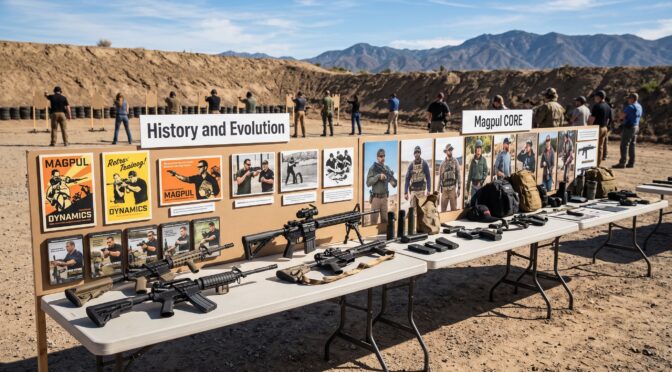
History and Evolution of the Magpul Core Training Group

1. Executive Summary

The transition of Magpul Dynamics into Magpul Core represents a notable shift in the modern tactical training and small arms industry. Founded originally as the instructional division of Magpul Industries, the group altered how military, law enforcement, and civilian personnel approach weapons manipulation. By leveraging high-production-value media and establishing standardized, biomechanically efficient shooting platforms, the organization moved portions of the industry away from static marksmanship toward dynamic, reality-based problem-solving.

This report analyzes the history, doctrinal shifts, and current offerings of the Magpul Core training group. It traces the organization’s roots from the “Art of the Tactical Carbine” era under its initial leadership, through its strategic rebranding to Magpul Core. The rebranding signified a deliberate inward focus, integrating field-tested tactical instruction directly with Magpul’s product research and development cycle. The report details the specific instructional methodologies utilized by the group, such as pushing past the failure point, diagnostic malfunction clearing, and the adoption of the thumb-over-bore grip.

Furthermore, this analysis dissects the current and historical training catalogs, ranging from close-quarters carbine manipulation to specialized backcountry precision hunter courses. It identifies the intended demographics for these curricula, assessing their utility for law enforcement, military operators, and the responsibly armed citizen. Finally, the report evaluates the group’s standing within the broader tactical community through a review of social media engagement, industry reception, and ongoing doctrinal debates, concluding that Magpul Core remains a recommended and foundational entity within the firearms training sector.

2. Historical Context and Origins of Magpul Dynamics (2007–2011)

2.1 The Founding and Initial Objectives

To contextualize the current iteration of Magpul Core, it is necessary to examine its origins as Magpul Dynamics. Magpul Industries was founded in 1999 by Richard M. Fitzpatrick, a former United States Marine Corps Force Reconnaissance sergeant1. The company’s original mission centered on innovation, simplicity, and efficiency, beginning with a simple polymer device designed to aid in the extraction of STANAG rifle magazines from pouches under stress—the eponymous “Magpul”2.

As the company expanded into polymer magazines and other accessories, the need arose to demonstrate the practical application of these products in high-stress environments. In 2006, Magpul initiated the development of the PMAG, a polymer magazine designed to enable increased production and avoid supply problems associated with standard aluminum magazines5. Magpul continues to innovate in this space, recently introducing the translucent TMAG 20 for AR/M4 platforms6. Despite the material advantages, consumer adoption of polymer magazines was initially slow due to negative historical experiences with plastic feed devices5. To validate the equipment and demonstrate its reliability, Magpul Industries formally launched Magpul Dynamics in 2007 as a dedicated firearms training division7. The division focused on the development of advanced firearms manipulation skills, tailored primarily for military and law enforcement personnel requiring reliable techniques for combat environments1.

2.2 The Influence of Early Leadership

The immediate market penetration of Magpul Dynamics was driven by its primary instructors during its formative years: Travis Haley, a former Marine Force Reconnaissance operator and private military contractor, and Chris Costa, a former Coast Guard instructor and private sector contractor9. Both instructors brought extensive real-world combat and instructional experience to the curriculum5.

Under their direction, Magpul Dynamics instructed standard marksmanship while simultaneously promoting a specific tactical mindset. The instructors broke down fundamental mechanics to granular levels, demonstrating how the human body reacts under physiological stress and how to configure weapons and gear to mitigate those reactions11. Their approach emphasized that professional users must understand the “why” behind an action in addition to the “how,” creating a demographic of shooters who sought to understand the mechanics of their firearms and their own physiological responses12.

2.3 Media Distribution and Market Impact

In 2008, Magpul Dynamics released The Art of the Tactical Carbine, a multi-disc instructional DVD set that disrupted the standard model of the firearms training market5. Prior to this release, training videos were frequently highly scripted, static, and filmed in sterile environments. Magpul Dynamics altered this paradigm by filming actual live-fire classes5. The footage captured real students making unscripted mistakes and the instructors diagnosing and correcting those failures in real-time8.

The success of the first series led to subsequent releases, including The Art of the Tactical Carbine Volume II, The Art of the Dynamic Handgun, The Art of the Dynamic Shotgun, and The Art of the Precision Rifle9. These programs covered weapon transitions, partner tactics, shooting on the move, vehicle concealment, and complex urban environments9. By documenting their curriculum in high-definition video with sophisticated post-production, Magpul Dynamics reached a broad civilian and law enforcement audience1. The widespread distribution of these videos spurred a measurable increase in civilian attendance at tactical training courses nationwide13.

The media releases also had secondary effects on the equipment market. For example, during the filming of the carbine series, the instructors utilized the Aimpoint Micro red dot sight. Prior to the videos, the optic faced resistance in the market from users who felt it was too small; following the release of the Magpul Dynamics footage showing rapid barricade transitions with the optic, sales of the Aimpoint Micro increased substantially17. The training also heavily emphasized the proper integration and zeroing of backup iron sights (BUIS), such as the Magpul MBUS series, to ensure a redundant aiming solution if the primary optic failed18. The Magpul MBUS line has continued to evolve into modern iterations like the impact-resistant MBUS 3 polymer chassis and the steel MBUS Pro19. By 2011, both Haley and Costa departed Magpul Dynamics to form their own respective training companies, Haley Strategic Partners and Costa Ludus9. This departure marked the conclusion of the division’s initial era, prompting Magpul to reevaluate the structure and mission of its training group.

3. The Evolution and Transition to Magpul Core (2014–Present)

3.1 Rebranding and Shift in Organizational Philosophy

Following the departure of its founding instructors, Magpul Dynamics underwent a period of internal restructuring. The staff focused inward, dedicating more time to skill development, end-user outreach, and integrating directly with Magpul’s product development processes7. This operational shift culminated in a formal rebranding in 2014 and 2015, transitioning the division from Magpul Dynamics to Magpul Core7.

The transition to Magpul Core was described by the staff as an alignment with the company’s foundational values7. The new mission integrated the training division into the broader corporate ecosystem. The Core staff—which included subject matter experts such as Caylen Wojcik, Cody, Aaron, Jon, Jimmy, Jared, Jake, and Duane—became instrumental in designing and testing new hardware7. In the year leading up to the rebranding announcement, the training staff contributed directly to over 50 new product offerings7. This period also coincided with Magpul’s relocation from Colorado to Wyoming and Texas in response to state-level legislation restricting magazine capacities, a move that the company stated aligned with its core values of personal responsibility and individual liberties23.

3.2 Synergy Between Training and Product Development

The rebranding to Magpul Core highlighted a symbiotic relationship between tactical instruction and mechanical engineering. Magpul utilizes a philosophy of iterative testing, pushing the limits of materials and user interfaces through trial and error3. The Core training staff provided the necessary high-stress testing environments to validate these designs before they were introduced to the retail market. This emphasis on practical mechanics also extends to armorer tools, such as the Magpul BEV Block used for safely torquing AR muzzle devices and barrel nuts24.

The training division’s feedback loop influenced several notable products. The Magpul BAD Lever (Battery Assist Device) was developed to address double-feed malfunctions and speed up out-of-battery reloads. The device extends the bolt catch through the trigger guard, allowing the shooter to manipulate the bolt catch with the trigger finger, a technique emphasized in the curriculum for rapid malfunction clearance25. The Core staff stressed that while the device increased reload speed, its primary mechanical advantage was in safely and rapidly clearing complex stoppages25.

Similarly, the Magpul Pro 700 Rifle Chassis was developed under the guidance of Magpul Core’s precision rifle instructors26. Designed for Remington 700 footprint actions, the chassis features a full billet aluminum skeleton, ambidextrous controls, and extensive adjustability27. The input from Core ensured the chassis met the demands of military, law enforcement, and competitive shooters by incorporating features such as a folding stock designed to capture the bolt handle and an integrated AICS pattern magazine well27. The company has since expanded its offerings for this footprint, including the lightweight Hunter Lite Stock6. The division also actively developed tactical apparel, notably the Magpul Core Technical and Patrol gloves. These items were designed to offer high dexterity and touchscreen capability while providing necessary protection against heat and abrasion during intense weapons manipulation29.

3.3 Expansion of Scope: Fieldcraft, Hunting, and Adventure

While Magpul Dynamics was almost exclusively associated with high-threat tactical environments and close-quarters battle, Magpul Core expanded its mandate. The division began offering instruction and media content covering a wider array of disciplines, including adventure, fieldcraft, fitness, competition, and hunting7. This expansion reflected a recognition that the foundational principles of marksmanship, preparation, and gear selection apply equally to backcountry hunters and competitive athletes as they do to tactical operators32. By diversifying the curriculum, Magpul Core aimed to connect with a broader base of end-users while maintaining the rigorous instructional standards established in previous years.

4. Instructional Methodology and Tactical Doctrine

The tactical doctrine developed and refined by Magpul Core relies on a distinct set of biomechanical and psychological principles. The curriculum is built upon three central tenets: Reality, Consistency, and Efficiency34.

4.1 The “Failure Point” Paradigm

A primary element of the Magpul Core instructional philosophy is the concept of pushing students beyond their operational failure point. Instructors assert that maintaining a state of comfort on the firing line inhibits skill development, working under the premise that professionals must train until they make errors under pressure35.

During live-fire drills, if a student consistently executes a string of fire with perfect accuracy, instructors will systematically increase the cognitive and physical load. This is achieved by reducing the time standard, increasing the round count required within a specific par time, or extending the distance to the target35. For example, through drills like the Balance of Speed and Accuracy (BSA) drill, shooters are forced to fire four rounds in two seconds at close distances of 5 yards, or immediately transition from standing to kneeling or prone positions within tight four-second constraints at greater distances of 75 yards35. The objective is to induce mistakes—such as degraded recoil control or fumbled reloads—so that the student learns to process and correct errors while under simulated physiological stress. The training emphasizes the body’s natural alarm response, forcing students to sprint prior to shooting to elevate heart rates and simulate the effects of adrenaline35. Instructors prioritize observing how students manage weapon malfunctions and problems under stress rather than solely assessing their accuracy when the firearm is working perfectly35.

4.2 Weapons Manipulation and Ergonomics (The C-Clamp Grip)

Magpul instructors are widely credited with popularizing the thumb-over-bore, or “C-clamp,” grip for rifle manipulation within the tactical community35. While variations of the technique existed in competitive shooting circles prior to the formation of Magpul Dynamics, the training group codified its application for combat and law enforcement scenarios38.

The biomechanical rationale for the C-clamp grip involves driving the shooter’s shoulder forward and extending the support arm as far down the handguard as possible16. The support hand grasps the rail with the thumb resting over the top of the bore axis37. This aggressive forward hold maximizes recoil mitigation by applying direct downward pressure across the bore axis, actively fighting the natural muzzle rise associated with the weapon’s recoil impulse35. Furthermore, extending the support hand far down the handguard increases leverage, allowing for rapid and precise target transitions by driving the weapon laterally with greater physical authority35. The curriculum teaches that the upper body’s engagement is more critical for recoil control than the lower body stance35.

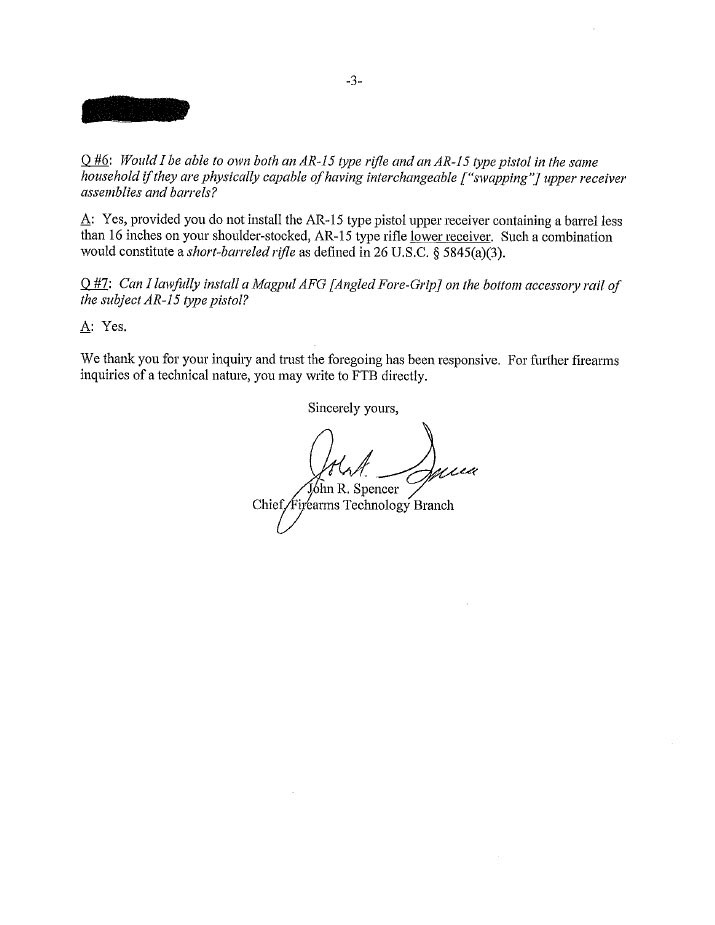
This doctrine contrasts with legacy techniques, such as holding the magazine well or wrapping the entire hand around a vertical foregrip, which Core instructors argue provide inferior control during rapid, multi-target engagements40. This biomechanical preference also influenced product design, popularizing accessories like the Magpul Angled Foregrip (AFG), which facilitates a more ergonomic thumb-break method and is legally permissible on AR pistols41. Instructors note that while a traditional vertical grip is functional for activating weapon-mounted lights via pressure pads, the thumb-break method offers superior mechanical control over the weapon system40.

4.3 Diagnostic Malfunction Clearing and Reloads

Another distinct element of the group’s methodology is the diagnostic approach to weapons malfunctions. Instructors advocate against non-diagnostic or “blind” malfunction clearance drills, such as automatically utilizing the standard “tap-rack-bang” sequence without first assessing the state of the weapon35. Instead, they teach a method of executing a speed reload where the shooter tilts the weapon slightly inward to visually inspect the ejection port35.

This visual check, estimated to take only a tenth of a second, allows the shooter to confirm that the bolt is locked back on an empty magazine, rather than experiencing a complex malfunction such as a double feed or failure to extract35. The instructors emphasize that mistaking a malfunction for an empty weapon—and subsequently attempting to force a fresh magazine into the well—can severely exacerbate the stoppage35. This diagnostic process is particularly critical when operating under physiological stress or while wearing heavy tactical gear that dampens the tactile sensation of the bolt locking to the rear35. The instructors do note, however, that this specific visual check is highly dependent on ambient daylight and cannot be effectively executed if the ejection port is not illuminated or clearly visible35.

5. Review of Magpul Core Training Offerings

The Magpul Core curriculum scales from fundamental weapons operation to advanced environmental problem-solving. The coursework is designed to isolate individual mechanics before combining them into complex, fluid movements, utilizing partnerships and dynamic scenarios.

5.1 Tactical Carbine and Handgun Courses

The foundational courses of the Magpul Core syllabus trace back to the Dynamic Carbine and Dynamic Handgun series. These courses condense material that would typically require weeks of instruction into intensive two- to three-day formats35.

Course TitleDurationCore ConceptsTactical Drills
Dynamic Carbine / Scoped Carbine2-3 DaysRecoil management, mechanical zeroes, alternate shooting positions, diagnostic malfunction clearance.Balance of Speed and Accuracy (BSA) drill, shuttle drills, urban prone and supine firing35.
Dynamic Handgun2-3 DaysThe “Core Three” (stance, grip, sight alignment/trigger control), drawing from concealment, one-handed operation.Speed reloads, shooting on the move, reflexive firing, public perception and legal liability integration12.

The Carbine courses often require students to fire approximately 1,400 rounds over two days, ensuring maximum exposure to recoil management under fatigue35. The curriculum begins with confirming mechanical zeroes at 50 yards and quickly transitions to close-quarters offhand shooting at 5 yards, focusing on a 10-inch primary target zone35. Early Magpul Dynamics instructors like Travis Haley frequently employed sequences such as the “22422 drill” to break down complex firing mechanics into granular segments, which are built back up to cultivate subconscious body control in dynamic scenarios10. A significant portion of the course is dedicated to alternate and reality-based shooting positions. Students are taught to engage targets from kneeling, prone, and “urban prone” positions, simulating shooting beneath vehicles or barricades16. The curriculum also includes the supine position, firing from the back, which instructors note is critical for personnel who may trip while retreating from an armed suspect16.

The handgun curriculum mirrors the carbine philosophy, breaking the fundamental mechanics down into observable parts12. The coursework ladders from basic administrative and tactical reloads to dynamic movement and reflexive firing12. Advanced modules focus on the concealed carry lifestyle, addressing the integration of everyday clothing, holster selection, and the physical constraints of small concealable handguns12.

5.2 Precision Rifle and the Precision Hunter Course

With the transition to Magpul Core, the organization expanded its precision rifle offerings under the direction of Caylen Wojcik, a former USMC Scout Sniper who served as Director of Operations before eventually departing to found the training group Modern Day Sniper22. During his tenure, the division developed courses tailored for both law enforcement snipers and civilian backcountry hunters33.

Course TitleDurationCore ConceptsTactical Drills
Precision Hunter Course2 Days (Optional 4-Day Hunt)Equipment optimization, external ballistics, angular units of measure (MOA/Mils), reading wind.DOPE chart creation via magnetic chronographs, establishing natural point of aim, unknown distance engagements up to 700+ yards43.
Long Range / Precision Rifle3-4 DaysAdvanced ballistics, density altitude data logging, rapid bolt manipulation.100-200 yard barricade supported positions, cold-bore confirmation, barrier ammunition testing15.

Unlike standard tactical sniper courses, the Precision Hunter curriculum is uniquely designed for the civilian rifle hunter, utilizing the equipment they intend to field rather than specialized tactical gear32. Hosted at locations such as the Alazan Ranch in West Texas, the two-day course (historically priced at $1,500) offers an optional four-day free-range Aoudad ram hunt extension43. The primary prerequisites for attendees are simply a basic understanding of firearms safety and a willingness to learn47. The objective is to teach hunters the absolute capabilities and limitations of their specific hardware to ensure ethical harvests32. The syllabus includes telescopic sight theory, understanding ballistic drop-compensated reticles, and measuring the exact velocity of hunting ammunition using chronographs to build a personalized Data of Previous Engagement (DOPE) chart43. Engagements are conducted at unknown distances up to 700 yards utilizing improvised field positions rather than concrete benches32.

5.3 Specialized Curricula and Demographics

Magpul Core has also diversified its offerings to address highly specialized scenarios and specific demographics, maintaining active training engagements in modern operational contexts, with current schedules reflecting courses extending into 2025 and 2026.

Course TitleTarget AudienceCurriculum Focus
Extreme Defensive DrivingLEO, Executive ProtectionHigh-speed tactical driving, vehicle mobility, pursuit, and escape in real-world threat scenarios hosted at The Ranch Texas49.
Shoot Like A Girl (Partnership)Civilian WomenA partnered initiative providing confidence building, safe firearms handling, and introductions to shooting sports and hunting, originating in 200949.
LEO-Only Modules / OutreachActive Law EnforcementAdvanced dynamic assaults, LEO-only weapons skills, and media coverage of external agency training (e.g., Magpul personnel attending Sidewinder Concepts’ LE Sniper Course)5.

6. Demographic Analysis: Intended Attendees

The methodologies developed by Magpul Core are highly scalable, making the training applicable to a broad spectrum of users.

6.1 Military and Law Enforcement Personnel

For professional end-users, the value of Magpul Core training lies in its emphasis on efficiency and reality-based problem-solving. Law enforcement officers benefit from the curriculum’s focus on non-standard shooting positions, such as the urban prone and supine, and the prioritization of cover and concealment when deploying a rifle from inside or around a patrol vehicle16. The training builds resilience against the body alarm response, teaching officers to process information and clear malfunctions while experiencing auditory exclusion and tunnel vision36.

The rigorous documentation of the training has also influenced institutional standard operating procedures. Military personnel returning from combat theaters have noted that exposure to the advanced weapons manipulation techniques taught by private groups like Magpul Core could directly reduce casualties. For example, veterans have recounted instances in combat where standard military flat-range qualification failed them; under fire, they defaulted to slow, administrative reloads—such as attempting to retain an empty magazine in a tight pouch—rather than executing a rapid speed reload and returning fire50. The muscle memory required to properly index fresh magazines and rapidly clear empty chambers is a perishable skill that requires the type of stress-induced repetition offered by the Core curriculum35.

6.2 The Responsible Armed Citizen

Civilian attendees ranging from competitive shooters to individuals focused on home defense form a large segment of the target audience. The courses strip away complex tactical jargon and focus on the physics of shooting and the psychology of violent encounters11. For the armed citizen, the integration of concealed carry constraints—such as drawing from under garments and managing public perception—makes the training applicable to daily life12. Furthermore, the instructional media remains a resource for civilians to practice fundamental drills and dry-fire techniques at home, provided they combine it with actual live-fire instruction9. Instructors emphasize personal safety and situational awareness, teaching civilians how to identify threat indicators before a violent encounter occurs15.

6.3 The Backcountry Hunter

Hunters who wish to maximize the effectiveness of their chosen rifle platform are highly encouraged to attend the precision courses. The training bridges the gap between traditional hunting practices and modern ballistic science. By teaching hunters how to accurately range targets, read wind vectors, and calculate bullet drop based on density altitude, the course significantly increases confidence and the likelihood of a clean, ethical shot at extended ranges32. The curriculum forces hunters to acknowledge their personal limitations, ensuring they understand the maximum effective range of both their equipment and their own physical capabilities32.

7. Industry Reception and Social Media Analysis

When evaluating Magpul Core and its historical iterations across social media and industry publications, the sentiment is highly positive, though it is not without nuanced debate regarding specific tactical applications.

7.1 Legacy Influence on the Firearms Training Industry

Magpul Dynamics altered the trajectory of the civilian firearms training market. By releasing high-definition, aesthetically compelling media, the group demystified tactical training for the general public1. Prior to the late 2000s, taking a carbine class was a niche activity; subsequently, it became a mainstream pursuit for firearm enthusiasts13. The instructors established a baseline standard for gear setup and manipulation that continues to permeate modern digital channels and tactical academies1. The organization’s focus on the “why” behind weapons manipulation has forced other training companies to elevate their instructional standards to remain competitive12.

7.2 Criticisms and Tactical Debates

Despite its popularity, the methodologies championed by the group have faced scrutiny within the community. The most prominent debate surrounds the C-clamp grip. Critics on military and tactical forums frequently point out that while the extended thumb-over-bore grip is highly effective for rapid target transitions on a flat range, it is fatiguing to maintain over extended patrols39. Furthermore, combat veterans note that heavy body armor, communication gear, and environmental constraints often make full arm extension impractical in actual combat scenarios, requiring shooters to adapt to more traditional, compact stances39. Proponents counter that the technique is a fundamental skill meant to be applied when the environment allows, rather than a rigid requirement for every engagement39.

Additionally, the organization has occasionally intersected with industry disputes. A publicized incident involved a former instructor and a negligent discharge video dispute with a media production company. While this incident occurred years after the instructor’s departure from Magpul, it highlights the intense scrutiny placed on the foundational figures of the industry and the ongoing debates regarding safety and instructional validity52.

7.3 Contemporary Social Media Engagement

An analysis of Magpul Core‘s contemporary digital footprint—specifically its dedicated Facebook page—reveals an engaged and professional community. The page actively highlights international and US military personnel, government agencies, and law enforcement utilizing Magpul products7.

Post CategoryContent FocusEngagement Level
Product ShowcasesHighlighting Magpul accessories (e.g., PMAGs, Pro 700 chassis, Technical Gloves) in field environments.High (Often 100-500+ reactions, active comment sections discussing gear setups)7.
Memorial & TributesHonoring fallen military members and veterans.Very High (e.g., an August 2021 post honoring 13 fallen service members received nearly 400 reactions and respectful discourse)7.
Training UpdatesShowcasing live-fire training exercises (e.g., USMC SPMAGTF-CR-CC conducting two-gun drills).Moderate to High (Active discussion regarding techniques and gear applications)7.

Engagement metrics remain strong, indicating that the brand retains a high degree of respect and loyalty among its core demographic. Posts displaying precision rifles or early morning range days routinely generate positive interaction7. Across external forums such as Reddit, former Magpul instructors like Caylen Wojcik are frequently cited as top-tier educators, with users actively recommending the foundational courses they developed due to the quality of instruction and empirical focus7. Based on social media review and industry consensus, the group and its historical offerings are highly recommended for personnel seeking rigorous, reality-based firearms training.

8. Conclusion

The evolution from Magpul Dynamics to Magpul Core represents a maturation of the organization. What began as a highly visible effort to demonstrate the efficacy of polymer rifle accessories grew into a foundational pillar of modern tactical doctrine. By championing principles such as reality-based stress conditioning, biomechanically efficient ergonomics, and diagnostic problem solving, the group established a standardized methodology for modern weapon manipulation.

Today, Magpul Core serves as a critical nexus between the end-user and the engineering team. The empirical data and feedback generated from their rigorous training programs directly influence the design of the physical products manufactured by Magpul Industries, resulting in innovations like the Pro 700 chassis and the BAD Lever. Whether an individual is a law enforcement officer requiring advanced dynamic assault tactics, a civilian seeking concealed carry proficiency, or a backcountry hunter learning the limits of their ballistic profile, the offerings of Magpul Core remain relevant and highly recommended within the industry.

Master Summary Table

CategoryMagpul Dynamics (2007–2011)Magpul Core (2014–Present)
Primary FocusWeapons manipulation, dynamic tactical training, high-visibility media production.Integration of training with product R&D; expansion into fieldcraft, hunting, and precision rifle.
Key PersonnelTravis Haley, Chris Costa.Caylen Wojcik (former), Cody, Aaron, Jon, Jimmy, Jared, Jake, Duane.
Signature MethodologiesC-clamp grip, diagnostic reloads, pushing the failure point, urban prone positions.Precision ballistics (MOA/Mils), DOPE charting, natural point of aim, ethical hunter limitations.
Key Media / OfferingsThe Art of the Tactical Carbine, The Art of the Dynamic Handgun DVD series.Precision Hunter Course, Extreme Defensive Driving, product integration (Pro 700, BAD Lever, Gloves).
Target AudienceMilitary, LEO, armed citizens seeking combat-focused drills.Military, LEO, armed citizens, competitive shooters, backcountry hunters.
Industry ImpactPopularized formal tactical training for civilians; created the modern instructional media market.Refined product development; established advanced precision hunting curriculum for civilians.

Please share the link on Facebook, Forums, with colleagues, etc. Your support is much appreciated and if you have any feedback, please email us in**@*********ps.com. If you’d like to request a report or order a reprint, please click here for the corresponding page to open in new tab.


Sources Used

  1. G&P Magpul FRS | Airsoft Rifle Reviews – Gun Mart, https://www.gunmart.net/gun-reviews/airsoft-guns/bb-guns/gp-magpul-frs
  2. Magpul – Wikipedia, https://en.wikipedia.org/wiki/Magpul
  3. FOUNDATIONS – Magpul Comms, https://comms.magpul.com/foundations/
  4. Magpul FOR SALE (2) – AtlanticFirearms.com, https://atlanticfirearms.com/manufacturers/magpul?page=2
  5. Magpul Catalog 2010 | PDF | Firearms | Projectile Weapons – Scribd, https://www.scribd.com/document/65773601/Magpul-Catalog-2010
  6. SHOT Show 2026: New Product Announcements on January 20, 2026 – Ronin’s Grips, https://blog.roninsgrips.com/shot-show-2026-january-20-2026-product-announcements/
  7. Magpul Dynamics is now Magpul CORE – Recoil Magazine, https://www.recoilweb.com/magpul-dynamics-is-now-magpul-core-56437.html
  8. AimSurplus, LLC | Blog, https://blog.aimsurplus.com/?paged=18
  9. Review of Magpul Dynamics Art of the Tactical Carbine, Vol. I – ThruMyLens, https://thrumylens.org/featured/review-of-magpul-dynamics-art-of-the-tactical-carbine-vol-i/
  10. [Explanation] 22422 Drill: A Guide to Breaking Down Fundamentals and Nighttime Application|OCT STRATEGIC – note, https://note.com/octstrategic/n/nff28eabc16c9?hl=en
  11. U S Cavalry Red Book Buyer S Guide 2012 13 | PDF | Shirt | Clothing – Scribd, https://www.scribd.com/doc/124765250/U-S-Cavalry-Red-Book-Buyer-s-Guide-2012-13
  12. Magpul’s Art of the Dynamic Handgun DVD set: Gear Review – Alpha Koncepts, https://www.alphakoncepts.com/magpuls-art-dynamic-handgun-dvd-set-gear-review/
  13. Looking for the best tactical flashlight — what’s worked well for you? – Reddit, https://www.reddit.com/r/flashlight/comments/1lrdqo3/looking_for_the_best_tactical_flashlight_whats/
  14. Index filme anul 2009, cu litera “T” – CineMagia.ro, https://www.cinemagia.ro/index-filme-2009/litera-T/
  15. 800-741-0015 • brownells.com, https://www.brownells.com/UserDocs/Miscellaneous/brownellsxmas2013.pdf
  16. Magpul Dynamics Firearms Training – Police Magazine, https://www.policemag.com/photo-galleries/magpul-dynamics-firearms-training
  17. Aimpoint’s Micro Red Dot: The World’s Most Popular Optic – Shooting Times, https://www.shootingtimes.com/editorial/aimpoint-micro-red-dot/540309
  18. Do you really have backup iron sights (BUIS) that you can count on? A lot of shooters do not and it’s not just the fault of the hardware – Ronin’s Grips, https://blog.roninsgrips.com/do-you-really-have-backup-iron-sights-buis-that-you-can-count-on-a-lot-of-shooters-do-not-and-its-not-just-the-fault-of-the-hardware/
  19. Top 10 AR-15 Backup Iron Sights (BUIS) for 2026 – Ronin’s Grips, https://blog.roninsgrips.com/top-10-ar-15-backup-iron-sights-buis-for-2026/
  20. Page 40 of 174 – by OpticsPlanet – GearExpert, https://www.gearexpert.com/page/40
  21. MAGPUL CORE Trademark | Trademarkia, https://www.trademarkia.com/magpul-core-86509547
  22. Posts Tagged ‘Caylen Wojcik’ – Soldier Systems, https://soldiersystems.net/tag/caylen-wojcik/
  23. Magpul’s Magnificent Magazines: An Overview – The Mag Life – GunMag Warehouse, https://gunmagwarehouse.com/blog/magpuls-magnificent-magazines-an-overview/
  24. How to Safely Change AR Muzzle Devices and Barrel Nuts Using a Magpul BEV Block, https://blog.roninsgrips.com/how-to-safely-change-ar-muzzle-devices-and-barrel-nuts-using-a-magpul-bev-block/
  25. Magpul BAD vs. Phase 5 EBR – ITS Tactical, https://www.itstactical.com/shooting/magpul-bad-vs-phase-5-ebr/
  26. 15_Magpul_Catalogo.pdf – AASIAS.com, https://www.aasias.com/catalogo/15_Magpul_Catalogo.pdf
  27. Magpul – Pro700 Rifle Chassis | Soldier Systems Daily, https://soldiersystems.net/2018/01/15/magpul-pro700-rifle-chassis/
  28. Magpul Introduces the Pro 700 Rifle Chassis – Recoil Magazine, https://www.recoilweb.com/magpul-introduces-the-pro-700-rifle-chassis-133053.html
  29. Shooting Gloves | The Armory Life Forum, https://www.thearmorylife.com/forum/threads/shooting-gloves.5687/
  30. Catalog | PDF | Clothing | Armed Conflict – Scribd, https://www.scribd.com/document/363956763/Catalog
  31. New Magpul Core Patrol Gloves – Blue Sheepdog, https://www.bluesheepdog.com/2015/11/29/new-magpul-core-patrol-gloves/
  32. Hunter School – Richard Mann, https://empty-cases.com/blog/hunter-school/
  33. Episode 13: Preparation, Precision and Navigation with Caylen Wojcik of Magpul Core, https://journalofmountainhunting.com/episode13/
  34. Wounded Warrior: Magpul Dynamics Carbine 1 – SWAT Survival | Weapons | Tactics, https://www.swatmag.com/article/wounded-warrior-magpul-dynamics-carbine-1/
  35. Pushing Beyond the Failure Point: Magpul Dynamics Carbine 1 – SWAT Survival | Weapons, https://www.swatmag.com/article/pushing-beyond-failure-point-magpul-dynamics-carbine-1/
  36. Train Like You Bleed: Dark Angel Medical Direct Action Response Training – SWAT Survival, https://www.swatmag.com/article/train-like-bleed-dark-angel-medical-direct-action-response-training/
  37. Magpul MAG597-GRY MOE MVG M-LOK Vertical Grip Polymer, https://www.deguns.com/magpul-mag597-gry-moe-mvg-m-lok-vertical-grip-polymer
  38. History of SOPMOD, Part II – SWAT Survival | Weapons | Tactics, https://www.swatmag.com/article/history-of-sopmod-part-ii/
  39. Shooting Stance Old vs New : r/Firearms – Reddit, https://www.reddit.com/r/Firearms/comments/1sg7uzh/shooting_stance_old_vs_new/
  40. Explosive Conclusion: Colt LE6940 Saga Ends After 17600 Rounds – S.W.A.T. Magazine, https://www.swatmag.com/article/explosive-conclusion-colt-le6940-saga-ends-17600-rounds/
  41. ATF letter stating that the Magpul AFG is legal for use on AR pistols – Ronin’s Grips, https://blog.roninsgrips.com/atf-letter-stating-magpul-afg-legal-use-ar-pistols/
  42. “Building Decades of Experience into America’s Rifle” – Windham Weaponry, https://www.windhamweaponry.com/wp-content/uploads/2017/05/windham2017.pdf
  43. A Review of The Amazing Precision Hunter Course with Caylen Wojcik | thefirearmblog.com, https://www.thefirearmblog.com/blog/2016/08/10/review-amazing-precision-hunter-course-caylen-wojcik/
  44. Caylen Wojcik | Modern Day Sniper Instructor – Sniperology, https://www.sniperology.com/instructors/caylen-wojcik
  45. Caylen Wojcik – Modern Day Sniper, https://www.moderndaysniper.com/cadres/caylen-wojcik
  46. Rifle Team – Training Plan And Drills – Guns and Ammo, https://www.gunsandammo.com/editorial/rifle-team-training-plan-drills/248095
  47. Magpul CORE Precision Hunter Course | McGowan Outfitting, https://mcgowanoutfitting.com/wp-content/uploads/2016/05/Magpul-CORE-Precision-Hunter-Course.pdf
  48. Review – MAGPUL DYNAMICS – Precision Rifle – N.A.P.S.I. Training Blog, https://mapsitrainingblog.wordpress.com/2015/10/17/review-magpul-dynamics-precision-rifle/
  49. Training – Magpul Comms, https://comms.magpul.com/category/training/
  50. AL TARMIYAH FIREFIGHT!: Lessons Learned The Hard Way – SWAT Survival | Weapons, https://www.swatmag.com/article/al-tarmiyah-firefight-lessons-learned-hard-way/
  51. Long Range Precision Shooting Classes – Where? Who? Worth It? : r/longrange – Reddit, https://www.reddit.com/r/longrange/comments/e4ao3y/long_range_precision_shooting_classes_where_who/
  52. NDGate – Panteao Productions Responds to Travis Haley’s Allegations – Soldier Systems, https://soldiersystems.net/2016/02/08/ndgate/
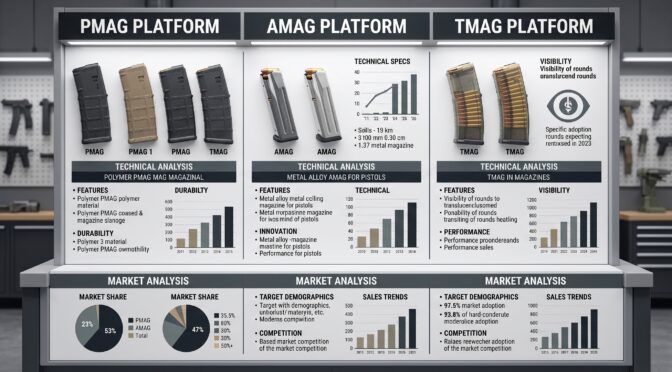
Magpul Magazine Innovations: PMAG, AMAG, and TMAG Analysis

Executive Summary

This report delivers a technical and market analysis of the primary magazine product lines manufactured by Magpul Industries: the PMAG (Polymer Magazine), AMAG (Alloy Magazine), and TMAG (Translucent Magazine). Evaluated from the perspective of small arms engineering and industry analysis, this document breaks down the material sciences, mechanical reliability, durability, and customer sentiment surrounding each platform.

The analysis indicates that the PMAG series remains a baseline for military and civilian STANAG 4179 magazine reliability. Driven by continuous generation improvements from the Gen M2 to the Gen M3, the PMAG utilizes a proprietary glass-reinforced polymer and constant-curve internal geometry to mitigate feed-related malfunctions. Military testing, specifically the Aberdeen Proving Ground evaluations involving the high-pressure M855A1 Enhanced Performance Round, validated the PMAG Gen M3 as functionally sound compared to standard-issue aluminum USGI magazines, particularly in preventing feed ramp degradation.

The AMAG line represents a strategic expansion into the metallic magazine market, specifically targeting the SIG Sauer P320 and P365 modular platforms. Engineered from heat-treated stainless steel, the AMAG navigates the strict dimensional constraints of micro-compact pistol grips. While structural quality and pricing compete directly against Original Equipment Manufacturer (OEM) options, social media sentiment and field reports indicate specific tolerance stacking constraints. Notably, the 17-round AMAG variants have exhibited failures to engage the slide lock on empty when paired with aftermarket frames due to a slightly narrowed polymer follower.

The TMAG series introduces a translucent olive drab polymer to the 5.56x45mm STANAG market. It ports the internal geometry of the PMAG Gen M3 into a transparent body, allowing operators to visually confirm ammunition count and type. While the TMAG fulfills its functional requirements, market sentiment reflects minor concerns regarding the tactile feel and long-term durability of the translucent polymer compared to the traditional opaque PMAG material, with isolated reports of cracking in certain piston-driven rifle platforms. This report synthesizes technical specifications with real-world user feedback to provide a factual comparison of these three product lines, concluding with current pricing metrics and active market availability.

1. Market Context and Introduction to Magpul Architectures

Magpul Industries has influenced the small arms accessory market over the past two decades by pivoting the industry standard away from stamped aluminum and steel magazines toward advanced polymers1. The core engineering philosophy relies on mission-driven requirements, ensuring that material selection and geometric design are dictated strictly by functional necessity rather than legacy manufacturing habits4.

Historically, the standard USGI aluminum magazine for the M16 and M4 platforms suffered from specific mechanical vulnerabilities. The straight-body-to-curve transition caused binding, the aluminum feed lips were prone to permanent deformation upon impact, and standard followers were susceptible to tilt, leading to bolt-over-base malfunctions1. Magpul addressed these engineering constraints with the introduction of the PMAG in 2007, establishing a modern baseline for polymer magazine reliability5.

As firearm platforms have evolved, Magpul’s product catalog has diversified. The expansion into the AMAG (alloy) and TMAG (translucent polymer) lines demonstrates an engineering response to different physical and operational requirements7. Pistol platforms such as the SIG Sauer P365 require exceptionally thin magazine walls to maximize capacity within a micro-compact footprint, necessitating a return to steel9. Conversely, military and law enforcement operators frequently request visual ammunition tracking without sacrificing structural geometry, driving the development of the TMAG11.

2. The PMAG Series: Polymer Evolution and Military Standardization

The PMAG is a primary product of Magpul Industries. Currently in its third generation, referred to as the Gen M3, the PMAG is a 5.56x45mm NATO and .223 Remington STANAG-compatible magazine that serves as a standard ammunition feeding device for multiple branches of the United States Armed Forces, including the Marine Corps and the Air Force, as well as United States Special Operations Command13.

2.1 Material Science and Structural Engineering

The PMAG is constructed from an impact-resistant and crush-resistant polymer14. While the exact chemical composition remains proprietary, it belongs to a family of reinforced nylons designed to offer a distinct mechanical advantage over traditional stamped aluminum2. When aluminum feed lips sustain a drop, they tend to bend and permanently deform. This deformation alters the presentation angle of the cartridge, leading to catastrophic feeding failures15.

In contrast, the PMAG’s polymer exhibits highly tuned elastic deformation properties. Upon impact, the feed lips will either flex and return to their original specified dimensions or fracture entirely. This binary failure mode is preferred in professional settings, as a broken magazine is immediately discarded, whereas a subtly bent metal magazine might be retained in the supply chain and cause a malfunction1.

The material maintains structural integrity in extreme temperature variations. It prevents brittleness in sub-zero conditions and resists warping under prolonged exposure to intense heat and ultraviolet radiation14. A dust cover is included with standard models to protect the feed lips from debris and mitigate impact shock during transport. Magpul clarifies that the dust cover is not required to prevent feed lip creep, as the polymer formulation itself does not warp when stored fully loaded for long periods5.

2.2 Generational Refinements: Gen M2 vs. Gen M3

The transition from the Gen M2 MOE line to the Gen M3 line introduced critical geometric and material upgrades. The Gen M2 established a reputation for toughness and remains widely available at a lower price point, but it was optimized strictly for Colt-spec AR-15 and M4 magazine wells5.

The original STANAG 4179 draft agreement dictated that 5.56mm rifles should accept the AR-15 magazine pattern, but it did not standardize the internal dimensions of the weapon’s magazine well. Consequently, the Gen M2 PMAG experienced fitment issues in platforms like the HK416, the USMC M27 Infantry Automatic Rifle (IAR), the FN SCAR-16, and the British SA-80 due to an early onset of the magazine’s physical curvature5. Magpul consolidated necessary design improvements into the PMAG Gen M35.

Feature ComparisonPMAG Gen M2 MOEPMAG Gen M3
Material BaseStandard impact-resistant polymerNext-generation impact/crush-resistant polymer
Platform CompatibilityColt-spec AR-15, M4AR-15, HK416, M27 IAR, FN SCAR, SA-80
Over-Travel StopNoneIntegrated spine stop to prevent over-insertion
Floorplate DesignStandard widthSlimline flared base for tight pouch compatibility
IdentificationNonePaint-pen dot matrix on bottom panel
Follower DesignAnti-tilt, self-lubricatingAdvanced four-way anti-tilt, self-lubricating

The Gen M3 also features a redesigned bolt catch notch in the rear of the magazine to provide increased clearance, ensuring reliable bolt lock-back across varied weapon tolerances20. This STANAG-compliant modularity allows the PMAG to function across countless modern platforms, including bullpup rifles like the Springfield Armory Hellion22.

2.3 Caliber-Specific Geometries

The .300 AAC Blackout (300 BLK) cartridge presents a specific engineering challenge. Because 300 BLK projectiles are heavier and feature different ogive profiles than 5.56mm projectiles, they can interface poorly with the internal guide ribs of a standard 5.56mm magazine, creating friction and feeding stoppages23. The PMAG 30 AR 300 B Gen M3 features optimized internal ribbing to accommodate the 300 BLK cartridge properly. To mitigate the danger of cross-loading a 300 BLK cartridge into a 5.56mm chamber, the 300 BLK PMAG is engineered with distinct external ribbing and a smoother upper texture, providing immediate tactile and visual differentiation23.

Magpul also produces PMAG variants for the 7.62x51mm NATO (.308 Winchester) utilized in SR25 and M110 pattern rifles2. Furthermore, the AK and AKM platforms are supported by dedicated 7.62x39mm and 5.45x39mm PMAGs. The AK variants require different lockup mechanics than AR-15s, leading Magpul to integrate steel locking lugs into the polymer body of their AK PMAGs to ensure a long-lasting interface with the steel magazine catch2. It is worth noting that while they serve as a common aftermarket option, tight magazine well tolerances in some domestic AK platforms like the PSA GF5 can cause the standard PMAG to fail to lock into the receiver27.

2.4 Military Evaluation: The M855A1 Aberdeen Proving Ground Trials

The performance of the PMAG Gen M3 was quantified during the U.S. Army Aberdeen Test Center’s 2015 evaluation titled “Final Report for the M855A1 Conformance Testing on Commercial Magazines”6.

The U.S. Army’s adoption of the M855A1 Enhanced Performance Round introduced unforeseen mechanical strain on the M4 carbine. The M855A1 operates at a higher chamber pressure (approximately 62,000 PSI) and features an exposed, hardened steel penetrator tip17. When feeding from standard aluminum USGI magazines, the angle of presentation caused the sharp steel penetrator to strike the aluminum feed ramps of the M4 receiver before entering the chamber, resulting in gouging and erosion of the feed ramps17.

During the Aberdeen trials, ten commercial magazines and two government magazines were evaluated. Magpul, designated as “Vendor Foxtrot” in the unclassified summaries, submitted the PMAG Gen M328. The testing data indicated that the PMAG achieved a zero-malfunction rate. The PMAG Gen M3 features a specifically engineered feed lip geometry that presents the nose of the M855A1 cartridge at a higher angle, allowing the steel penetrator to clear the aluminum feed ramps and neutralizing the weapon degradation issue28.

Despite these results, the U.S. Army proceeded with fielding its own Enhanced Performance Magazine (EPM), which later demonstrated high failure rates in United States Marine Corps testing13. Conversely, the Air Force, Marine Corps, and Special Operations Command relied directly on the Aberdeen data to authorize and standardize the PMAG Gen M3 across their formations13.

2.5 Social Media Sentiment and Consumer Feedback Analysis

Sentiment analysis derived from major retailers and social media platforms indicates that the PMAG Gen M3 is considered a reliable standard for AR-15 pattern rifles. Across vendor sites, the PMAG consistently maintains ratings between 4.8 and 5.0 out of 5 stars20.

Data aggregated from Brownells customer reviews highlights specific performance metrics for the PMAG Gen M3:

Review CategoryPositive Sentiment RatingKey Themes Mentioned in Customer Feedback
Product Quality85%Reliable construction; smooth feeding dynamics.
Durability75%Resistance to damage from drops, crushing, and environmental factors.
Pricing and Value70%High perceived value; competitive pricing justifies bulk purchases.
Shipping/Service68%Fast fulfillment from vendors enhances overall satisfaction.
Fit and Compatibility20%Generally praised, though isolated reports note tightness in non-standard billet lowers.

Data sourced from aggregated user reviews16.

Negative sentiment is statistically low. Minor critiques generally revolve around isolated compatibility friction with non-standard commercial lower receivers that deviate from mil-spec tolerances16. For the 300 BLK variants, consumers report a 78% positive sentiment specifically regarding feeding reliability, noting that the dedicated magazine resolves the stoppages commonly experienced when attempting to force heavy subsonic 300 BLK ammunition through standard 5.56mm magazines23.

3. The AMAG Series: Alloy Integration and Micro-Compact Constraints

The AMAG (Alloy Magazine) marks the company’s entry into the metallic pistol magazine market. The AMAG line currently focuses on supporting the SIG Sauer P320 (M17/M18) and the micro-compact SIG Sauer P365 platforms8.

3.1 Mechanical Necessity of Stainless Steel in SIG Platforms

The dimensional realities of modern concealed carry handguns dictate material selection. To achieve capacities of 10, 12, 15, or 17 rounds of 9x19mm ammunition in the confined space of a micro-compact frame, the walls of the magazine must be exceptionally thin37. As Magpul expanded beyond their polymer roots, they recognized that the P365 requires a steel body to maximize internal volume for the tapered 9mm stack; polymer cannot be molded thin enough to fit inside the P365 magazine well while retaining sufficient structural integrity3.

Consequently, Magpul engineered the AMAG series using a heat-treated, corrosion-resistant stainless steel alloy10. The stainless steel provides the necessary tensile strength to maximize internal volume while resisting the friction and wear associated with rapid insertion and extraction8.

3.2 Sub-Component Engineering and Capacity Metrics

While the body is metallic, Magpul integrated their polymer expertise into the subcomponents. The AMAG features a high-visibility, controlled-tilt polymer follower and a flared polymer floorplate10. The floorplate is designed for tool-less removal to facilitate routine cleaning. The spine of the magazine includes numbered witness holes starting at five rounds, increasing in one-round intervals to allow for immediate visual capacity checks35.

The AMAG line supports varied capacities depending on the target frame. For the P320 platform, 15-round, 17-round, and 21-round variants are offered8. For the P365 platform, capacities range from 10-round compliant models to 12-round, 15-round, and 17-round configurations37. Included grip extensions on the P365 models provide compatibility with Macro, X/XL, and standard Micro frames, allowing users to tailor the grip length to their specific configuration37.

3.3 Tolerance Stacking and Aftermarket Incompatibility Analysis

From a static engineering perspective, the AMAG is built to rigid specifications. However, dynamic field testing has revealed specific tolerance stacking issues, particularly regarding the 17-round variant designed for the SIG P365.

A prominent trend in social media sentiment highlights a functional deviation when the AMAG is paired with aftermarket Fire Control Unit (FCU) housings44. Users operating the Flux Defense Raider or Flux 365 chassis systems have reported that the Magpul AMAG 17-round magazine fails to engage the slide lock lever on the last round45. Technical analysis shared within these communities reveals that the AMAG magazine body is dimensionally narrower than the SIG Sauer OEM magazine by a fraction of a millimeter. Because the body is narrower, the internal polymer follower is also correspondingly narrower45. When installed in standard OEM SIG grip modules, the tolerance is tight enough that the follower still catches the internal slide stop tab. However, aftermarket chassis systems like the Flux Defense push the magazine presentation slightly off center by approximately 1 millimeter. This shift causes the narrowed Magpul follower to bypass the slide stop tab inside the FCU, resulting in a failure to lock back on an empty chamber45.

3.4 Social Media Sentiment and Loading Mechanics

Despite the documented tolerance issues with aftermarket chassis systems, general sentiment for the AMAG among standard SIG Sauer users is positive, largely driven by pricing strategy. Magpul introduced the AMAG as a market disruptor against premium OEM pricing at an MSRP of $34.95 for the 17-round variant3.

For the average consumer utilizing a stock SIG P320 or P365, the AMAG provides a reliable alternative to factory magazines. Reviewers praise the corrosion resistance of the stainless steel, contrasting it with complaints of OEM SIG magazines developing rust from daily concealed carry exposure, noting that the AMAG provides superior rust resistance46.

Community feedback indicates that loading the AMAG to its maximum capacity, particularly the 17th round in the P365 variant, requires notable physical force. Users report needing mechanical speed loaders (such as the Maglula UpLULA) to seat the final round, suggesting that the internal spring tension or follower compression height is engineered to the maximum tolerance limit of the steel tube47.

4. The TMAG Series: Translucent Polymer and Visual Utility

The TMAG (Translucent Magazine) is Magpul’s response to a military and civilian request for a reliable, transparent magazine that allows the operator to instantly verify both the remaining round count and the specific type of ammunition loaded7. Following the release of the 30-round variant, Magpul officially launched a compact TMAG 20 variant at SHOT Show 2026, catering to shooters who need a lower profile for bench or prone shooting49.

4.1 The Engineering Challenges of Translucent Polymers

Designing a transparent magazine presents complex chemical and structural challenges. Opaque magazines, such as the standard PMAG, utilize carbon black and long glass fibers mixed into the nylon substrate15. These additives provide high impact resistance, crush strength, and protection against ultraviolet (UV) degradation. Translucent polymers, by their chemical nature, cannot contain these opaque strengthening agents.

Magpul engineered the TMAG using a specialized translucent polymer blended with an olive drab (OD Green / Smoke) hue11. This tinting mitigates the effects of UV degradation that clear plastics typically suffer from, and it maintains a tactical, low-visibility aesthetic suitable for field environments11.

4.2 Internal Geometry and Mechanical Integration

The TMAG directly inherits the internal geometry of the PMAG Gen M311. It utilizes a constant-curve internal channel, a four-way anti-tilt follower, and a USGI-spec stainless steel spring. To maximize the utility of the transparent body, Magpul implemented a painted spring coil. This painted section acts as a highly visible indicator line against the molded capacity markings on the magazine body11.

Externally, the TMAG differs slightly from the PMAG. While it retains the low-profile floorplate and the paint-pen dot matrix for baseplate marking, the sides of the TMAG are left smooth to maximize viewing clarity11. To compensate for the loss of side texturing, Magpul ribbed the front and rear straps of the magazine to ensure a positive grip during reloads11.

4.3 Social Media Sentiment, Tactile Perception, and Reliability Concerns

Customer sentiment regarding the TMAG is generally positive, but with notable caveats regarding tactile perception and durability. The primary praise directed at the TMAG is its functional visibility. Users value the ability to see the exact round count and cartridge type11.

A recurring theme in user reviews is the physical feel of the magazine. Due to the chemical nature of the translucent polymer, some users report that the TMAG feels slicker, lighter, and subjectively less robust than the standard PMAG11. Data aggregated from Brownells customer reviews highlights these mixed perceptions, with 55% positive sentiment regarding build quality, driven by complaints that the translucent material feels inferior to the opaque line11.

Furthermore, isolated user reports have documented stress cracking on TMAG bodies when operated in certain piston-driven platforms, such as the SCAR 1651. Engineering physics dictates that translucent feed lips will be marginally more susceptible to creep or impact cracking in extreme temperatures compared to a glass-filled black PMAG51. For duty use, many operators continue to default to the standard opaque PMAG.

5. Comparative Analysis: Quality, Reliability, and Durability

To properly evaluate these three distinct platforms, they must be compared across the core metrics of quality, reliability, and durability.

5.1 Quality and Manufacturing Tolerances

All three lines exhibit strict manufacturing standards. The PMAG represents a high standard of polymer injection molding, with consistent texturing and a mature feature set (dust covers, dot matrix, over-travel stops)15. The AMAG demonstrates precision metal stamping and laser welding, yielding a seamless stainless steel body39. The TMAG showcases advanced polymer flow mechanics, achieving clarity without introducing structural bubbles or severe molding artifacts11.

5.2 Mechanical Reliability Under Stress

Reliability is defined as the ability to successfully feed a cartridge into the chamber under dynamic firing conditions. The PMAG’s performance in the Aberdeen M855A1 tests proved it highly reliable across multiple weapon platforms, actively preventing weapon wear28. The TMAG inherits this exact internal geometry and matches the PMAG’s baseline feeding reliability under standard conditions, though isolated reports indicate a slightly higher failure rate than the PMAG11. The AMAG is reliable in stock SIG configurations but is intolerant to aftermarket dimensional shifts, specifically the slide lock bypass issue observed in Flux Defense chassis systems45.

5.3 Material Durability and Environmental Resistance

Durability is the capacity to withstand physical abuse, environmental degradation, and long-term mechanical stress.

  • PMAG: Demonstrates maximum durability. The glass-filled polymer absorbs impacts, resists harsh solvents, and resists UV degradation15.
  • AMAG: Demonstrates high durability. Stainless steel provides crush resistance and resists corrosion better than standard OEM magazines8.
  • TMAG: Demonstrates moderate durability. While strong enough for standard use, translucent polymers represent a physical compromise, making them inherently less resistant to severe impacts and chemical exposure than their opaque counterparts11.

6. Pricing and Availability

This section details the current pricing and market availability of the PMAG, AMAG, and TMAG lines.

Vendor Search and Active Listings

The following active product listings reflect pricing at or below the determined average market rate.

Determined Average Market Rates:

  • PMAG 30 AR/M4 GEN M3: $14.20
  • AMAG 17 SG9 (SIG P320/P365): $34.00
  • TMAG 30 AR/M4 GEN M3: $22.75

PMAG 30 AR/M4 GEN M3 (5.56x45mm)

AMAG 17 SG9 (SIG P365 / P320)

TMAG 30 AR/M4 GEN M3 (5.56x45mm)

7. Conclusion and Master Summary Table

Magpul Industries heavily influences the small arms magazine market through calculated material engineering. The PMAG Gen M3 remains a structural standard, effectively neutralizing weapon degradation issues caused by modern high-pressure military ammunition while maintaining a proven reliability record28. The AMAG proves that Magpul can pivot to precision steel manufacturing to satisfy the physical constraints of the modern micro-compact pistol market, delivering financial value, albeit with slight tolerance constraints in heavily modified aftermarket chassis systems8. Finally, the TMAG bridges the gap between tactical utility and polymer science, offering a transparent visual indicator without sacrificing the internal geometric foundations established by the PMAG line, though it faces consumer skepticism regarding long-term duty durability11.

Master Summary Table

MetricPMAG Gen M3AMAG (SG9 Series)TMAG Gen M3
Primary MaterialGlass-reinforced proprietary polymerHeat-treated stainless steel alloyTranslucent OD Green polymer
Primary Platform TargetAR15, M4, HK416, SCAR 16SIG Sauer P320, P365AR15, M4, STANAG 4179
Durability AssessmentHigh (Impact, chemical, and UV resistant)High (Crush resistant and highly corrosion-resistant)Moderate (Slightly less impact resistance than standard PMAG)
Reliability AssessmentHigh (Zero-malfunction rate in Army testing)High in OEM frames (Slide-lock issue in aftermarket chassis)High (Inherits PMAG internal geometry, some user skepticism)
Customer SentimentHighly positive; considered the industry standardPositive on price/value; minor concerns on spring loading stiffnessPositive on visual utility; minor concerns on tactile perception
Key Engineering FeatureAltered feed angle to protect aluminum weapon feed rampsMaximized internal volume via thin stainless steel wallsVisual ammo counting via painted coil spring and clear body
Average Street Price~$13.50~$34.00~$22.75

Note: Vendor Sources listed are not an endorsement of any given vendor. It is our software reporting a product page given the direction to list products that are between the minimum and average sales price when last scanned.


Please share the link on Facebook, Forums, with colleagues, etc. Your support is much appreciated and if you have any feedback, please email us in**@*********ps.com. If you’d like to request a report or order a reprint, please click here for the corresponding page to open in new tab.


Sources Used

  1. Is Magpul a Good Brand? – True Shot Ammo, https://trueshotammo.com/blogs/true-shot-academy/is-magpul-a-good-brand
  2. Magazine Buyers Guide | The Primary Source On PrimaryArms.com, https://blog.primaryarms.com/guide/magazine-buyers-guide/
  3. SHOT Show 2026: New Product Announcements on January 21, 2026 – Ronin’s Grips, https://blog.roninsgrips.com/shot-show-2026-new-product-announcements-on-january-21-2026/
  4. Magpul Military & Law Enforcement – Gov/LE Sales & NSN Products, https://magpul.com/government
  5. Magpul PMAGs – Everything You Wanted To Know – Blog.GritrSports.com, https://blog.gritrsports.com/magpul-pmags-everything-you-wanted-to-know/
  6. How Durable Are Your Magazines? | An Official Journal Of The NRA – Shooting Illustrated, https://www.shootingillustrated.com/content/how-durable-are-your-magazines/
  7. Magpul Magazines and Accessories – PMAG, TMAG, AMAG, https://magpul.com/firearms-accessories/magazines.html
  8. Magpul AMAG Silver 9mm 15-Rounds For Sig P320, https://grabagun.com/magpul-amag-silver-9mm-15-rounds-for-sig-p320.html
  9. Magpul AMAG 17 SG9 9mm Magazine for SIG P365 – GrabAGun, https://grabagun.com/magpul-amag-17-sg9-silver-9mm-17-rounds-for-sig-p365.html
  10. Magpul AMAG 17 SG9 17rd Stainless Steel Magazine for Sig P365 | Palmetto State Armory, https://palmettostatearmory.com/magpul-amag-17-sg9-17rd-stainless-steel-magazine-for-sig-p365.html
  11. MAGPUL TMAG 30 GEN M3 5.56/223 30RD for AR-15 O.D. Translucent | UPC: 840815147626 – Brownells, https://www.brownells.com/gun-parts/magazines/rifle-magazines-parts/tmag-30-gen-m3-rifle-magazine-for-ar-15m4/?sku=430106946
  12. Magpul TMAG 30 Gen M3 5.56/.223 30rd Mag ODT – Shop Now | Palmetto State Armory, https://palmettostatearmory.com/magpul-tmag-30-ar-m4-gen-m3-30rds-223-remington-5-56x45mm-magazine-od-translucent-tactical-mag1417-odt.html
  13. Army Test: PMAG Outperformed Enhanced GI Magazine Fielded in 2016 – Military.com, https://www.military.com/daily-news/2017/09/25/army-test-pmag-outperformed-enhanced-gi-magazine-fielded-2016.html
  14. Magpul Pmag 20-Round Magazine Reliability – GunCreed® – Premium Gun Stands for AR15, AR10, AK47, and Beyond, https://guncreed.com/magpul-pmag-20round-magazine-reliability/
  15. Magpul PMAG AR/M4 Gen M3 30rd 5.56 Review – Defense Distributors, https://defensedistributors.com/blog/magpul-pmag-arm4-gen-m3-30rd-556-review/
  16. MAGPUL PMAG® AR/M4 GEN M3™ 5.56X45 NATO RIFLE MAGAZINE FOR AR-15 – Brownells, https://www.brownells.com/gun-parts/magazines/rifle-magazines-parts/ar-15-30rd-pmag-gen-m3-magazine-2235.56/
  17. M855A1 5.56mm NATO Penetrator Ammo Feed Ramp Issues: Real, Hype or just Overblown? – Defense Review, https://defensereview.com/m855a1-5-56mm-nato-penetrator-ammo-feed-ramp-issues-real-hype-or-just-overblown/
  18. Magpul PMAG Guide – Why PMAGs Are the Most Reliable AR15 Magazine, https://tacticalsurplususa.com/magpul-pmag-guide
  19. Magpul Magazines, What’s The Difference?, https://www.brownells.com/the-trigger-times/tips–tricks/quick-tips/magpul-magazines-whats-the-difference/
  20. MAGPUL PMAG GEN M3 5.56/.223 40RD for AR-15 BLK 1/Pack | UPC: 873750009698 – Brownells, https://www.brownells.com/gun-parts/magazines/rifle-magazines-parts/ar-15-30rd-pmag-gen-m3-magazine-2235.56/?sku=100012633
  21. Magpul PMAG GEN M3 OD Green 5.56 / .223 Rem 30-Rounds – GrabAGun, https://grabagun.com/magpul-pmag-gen-m3-od-green-5-56-223-rem-30-rounds.html
  22. Evaluating the Springfield Hellion’s Battle-Tested Design – Ronin’s Grips, https://blog.roninsgrips.com/evaluating-the-springfield-hellions-battle-tested-design/
  23. MAGPUL PMAG® 30 AR 300 B GEN M3™ 300BLK RIFLE MAGAZINE FOR AR-15 – Brownells, https://www.brownells.com/gun-parts/magazines/rifle-magazines-parts/ar-15-300-blk-pmag-30-gen-m3-magazine/
  24. Magpul PMAG 30 Gen M3 300 Blackout AR-15 Magazine – 30 Round – Primary Arms, https://www.primaryarms.com/magpul-pmag-30-ar300b-gen-m3-300-blackout-magazine-black
  25. Magpul PMAG GEN M3 Window LR/SR-25 .308 / 7.62×51 AR-10 25-Round Magazine, https://gunmagwarehouse.com/magpul-pmag-gen-m3-window-lr-sr-25-308-7-62×51-ar-10-25-round-magazine.html
  26. Magpul PMAG GEN M3 AK-47 7.62×39 30 Round Magazine (10 Pack) | The Mag Shack, https://themagshack.com/shop/bulk-packs-bundles/bulk-packs/ten-pack-magpul-pmag-7-62x39mm-m3-ak-akm-30-rd/
  27. Firearm Reliability and Performance Analysis: PSA GF5 – Ronin’s Grips, https://blog.roninsgrips.com/firearm-reliability-and-performance-analysis-psa-gf5/
  28. Army Test Report Buries Performance of Magpul PMAG – Military.com, https://www.military.com/kitup/2017/09/army-report-buries-magpul-pmag.html
  29. Testing The Army’s M855A1 Standard Ball Cartridge | An Official Journal Of The NRA, https://www.americanrifleman.org/content/testing-the-army-s-m855a1-standard-ball-cartridge/
  30. Test: M855 vs M855A1 is the M855A1 really that good? – YouTube, https://www.youtube.com/watch?v=K1qPBrhmJHI
  31. Don’t throw out your PMAGS out yet. Army’s New Magazine A FAILURE? USMC Test of Enhanced Performance Magazine Shows It Performed Worse Than Predecessor, PMAG : r/ar15 – Reddit, https://www.reddit.com/r/ar15/comments/6ooe8p/dont_throw_out_your_pmags_out_yet_armys_new/
  32. ARMY Tests Show PMag Superior, Led to USAF Adoption, Says Air Force Spokesperson, https://www.thefirearmblog.com/blog/2017/09/14/army-tests-show-pmag-superior-led-usaf-adoption-says-air-force-spokesperson/
  33. Shop 29 MAGPUL Rifle Magazines – Brownells, https://www.brownells.com/brands/magpul/gun-parts/magazines/rifle-magazines-parts/rifle-magazines/
  34. Magpul PMAG GEN M2 MOE .223 Rem/5.56 NATO/.300BLK 30-Rounds – GrabAGun, https://grabagun.com/magpul-industries-pmag-moe-223rem-30rd-blk.html
  35. Magpul AMAG 17 SG9 9mm 17 Round Magazine for SIG P320 – The Mag Shack, https://themagshack.com/shop/pistol-magazines/9mm/magpul-amag-17-sg9-9mm-17-round-magazine-for-sig-p320/
  36. Magpul AMAG 21 SG9 – SIG P320/M17, Stainless – MAG1465-SST | Palmetto State Armory, https://palmettostatearmory.com/magpul-amag-21-sg9-sig-p320-m17-stainless-mag1465-sst.html
  37. Magpul AMAG 10 SG9 Silver 9mm 10-Rounds Fits SIG P365 – GrabAGun, https://grabagun.com/magpul-amag-silver-9mm-10-rounds.html
  38. Magpul AMAG 15 SG9 15rds 9mm, Stainless – MAG1464 | Palmetto State Armory, https://palmettostatearmory.com/magpul-amag-15-sg9-15rds-9mm-stainless.html
  39. Magpul Amag 17 SG9 17rds 9mm Magazine – Silver High-Capacity – MAG1331-SST, https://palmettostatearmory.com/magpul-amag-17-sg9-17rds-9mm-magazine-silver-high-capacity-mag1331-sst.html
  40. Magpul AMAG 17 SG9 Magazine for Sig P320 17-Round Stainless Steel – MidwayUSA, https://www.midwayusa.com/product/1026605868
  41. 21 Rounds Handgun Magazine – GrabAGun, https://grabagun.com/shop/21-rounds-handgun-magazine.html
  42. Magpul Handgun Magazine – GrabAGun, https://grabagun.com/shop/magpul-handgun-magazine.html
  43. Magpul AMAG 9mm 15rd Mag Fits SIG P365 – Magazine – Primary Arms, https://www.primaryarms.com/magpul-amag-9mm-15rd-mag-fits-sig-p365-magazine
  44. Pro tip, Magpul AMAG 17 for the P365 has issues with some frame/slide combinations, https://www.reddit.com/r/P365/comments/1pg5ill/pro_tip_magpul_amag_17_for_the_p365_has_issues/
  45. Magpul AMAG 17rd are incompatible with both Flux 365 frames : r/FluxDefense – Reddit, https://www.reddit.com/r/FluxDefense/comments/1pgajkd/magpul_amag_17rd_are_incompatible_with_both_flux/
  46. Sig’s response to my XMacro mags starting to rust before even a year of ownership. – Reddit, https://www.reddit.com/r/SigSauer/comments/1q0qdv8/sigs_response_to_my_xmacro_mags_starting_to_rust/
  47. [Magazines] Magpul AMAG 17 SG9 for SIG P320/M17 – $26.04 @ Lanbo’s Armory – Reddit, https://www.reddit.com/r/gundeals/comments/1agvpzk/magazines_magpul_amag_17_sg9_for_sig_p320m17_2604/
  48. Magpul AMAG : r/SigSauer – Reddit, https://www.reddit.com/r/SigSauer/comments/19c5dws/magpul_amag/
  49. SHOT Show 2026: New Product Announcements on January 20, 2026 – Ronin’s Grips, https://blog.roninsgrips.com/shot-show-2026-january-20-2026-product-announcements/
  50. Magpul TMAG Translucent OD Green 5.56 30-Rounds, https://grabagun.com/magpul-tmag-translucent-od-green-5-56-30-rounds.html
  51. Magpul TMAG Gen3 AR-15 / M4 .223 / 5.56 30-Round Magazine – GunMag Warehouse, https://gunmagwarehouse.com/magpul-tmag-gen3-ar-15-m4-223-5-56-30-round-magazine.html
  52. Magpul TMAG 30 Translucent 30-Round Magazine – kygunco, https://www.kygunco.com/product/magpul-tmag-30-ar-m4-gen-m3
  53. PMAG® 30 AR/M4 GEN M3™ Window – Magpul, https://magpul.com/pmag-30-ar-m4-gen-m3-window.html

How to Safely Change AR Muzzle Devices and Barrel Nuts Using a Magpul BEV Block

If you like working on AR-type rifles and plan to replace a muzzle device or change a barrel nut to install a free-floating handguard or to swap barrels, you are going to need to apply a lot of torque. Torque and aluminum are not friends and this is certainly the case with the upper receiver for AR rifles and pistols.

What not to do?

I actually want to take a minute and tell you two things not to do. First, do not simply clamp your lower in a vise and go cranking on whatever on the upper. Remember that the upper is connected to the lower by two steel pins going through relatively soft aluminim. Not a good combination.

Number two, there are work fixtures that look like a rectangle that allow you to remove the upper from the lower and then pin the upper to this block that is then held by a vise. I’m not fond of this either because then your two aluminum connection points on the receiver take up all the stress and they weren’t designed to do so.

Please do not do either of those or you may regret it. The odds are that you will regret it. I word it this way because you may get by once or twice but these methods are risky so don’t do them.

So what do I recommend?

I use a Magpul Barrel Extension Vise (BEV) block. It’s a very well designed block that engages via the barrel extension with its own steel lugs that are designed for strength but also to not harm the extension.

Magpul BEV Block and AR-15 bolt carrier group for muzzle device changes
This is the top of the BEV block. You can see the front engagement lugs, the rear protrusion is for the bolt carrier and I would recommend keeping that O-ring oiled. The hole just under the front lugs is for a cross pin to secure it to the upper.

The BEV block uses a bolt carrier with the bolt removed to further secure it in the upper. You could remove the bolt from the bolt you normally use. I have a bolt carrier body that I keep in my toolbox for just this purpose.

AR bolt carrier group and Magpul BEV Block for muzzle device changes

The following photo shows it partially inserted in the upper.

AR-15 upper receiver with BEV block, showing bolt carrier group and dust cover.

This next photo shows it fully forward with the bolt carrier assembly installed. It does not have a cross pin installed at that point. Even without the pin it can handle the rotation stress. The pin just keeps it all in position and is not load bearing.

AR upper receiver with Magpul BEV Block and red dot sight

At this point you are good to go to change muzzle devices, barrel nuts or whatever else you may need to do without risking damage caused by torque. It’s a solid tool and I highly recommend it.


Please share the link on Facebook, Forums, with colleagues, etc. Your support is much appreciated and if you have any feedback, please email us in**@*********ps.com. If you’d like to request a report or order a reprint, please click here for the corresponding page to open in new tab.


A 16″ Palmetto State Armory/PSA 5.56x45mm Tactical AR Build

ARs are a fun, quick build and because they are modular you can take them in a ton of custom directions.  When you build an AR, you need to first ask yourself “what am I going to use this for?” and then plan your components accordingly.  In this case, I wanted a 16″ carbine that was relatively light, chambered in 5.56 and had an optic for short to medium ranges.  In some ways you could say my plan was to build a tactical style rifle.

So, let me explain the components used and why I selected them:

  • At the heart of the AR is the receiver and I tend to use Anderson.  They are Mil-Spec, inexpensive and well finished.  In short, I’ve never had a problem with them and I don’t know anyone else who has either.
  • I like PSA’s lower build kits as a starting point for all the internals.  Sometimes I have left overs depending on what all I upgrade but even their based build kits is solid.
  • The fire control group (FCG) is PSA’s enhanced set meaning the trigger and hammer are Nickel Boron (NiB) coated for lubricity and ease of cleaning.  In general, PSA already has some of the best feeling triggers out there in terms of the Mil-Spec out-of-the-box AR triggers.  The Enhanced set feels a tad slicker but still falls in the 5.5-6.5# pull range.
  • The grip is a Magpul MOE.
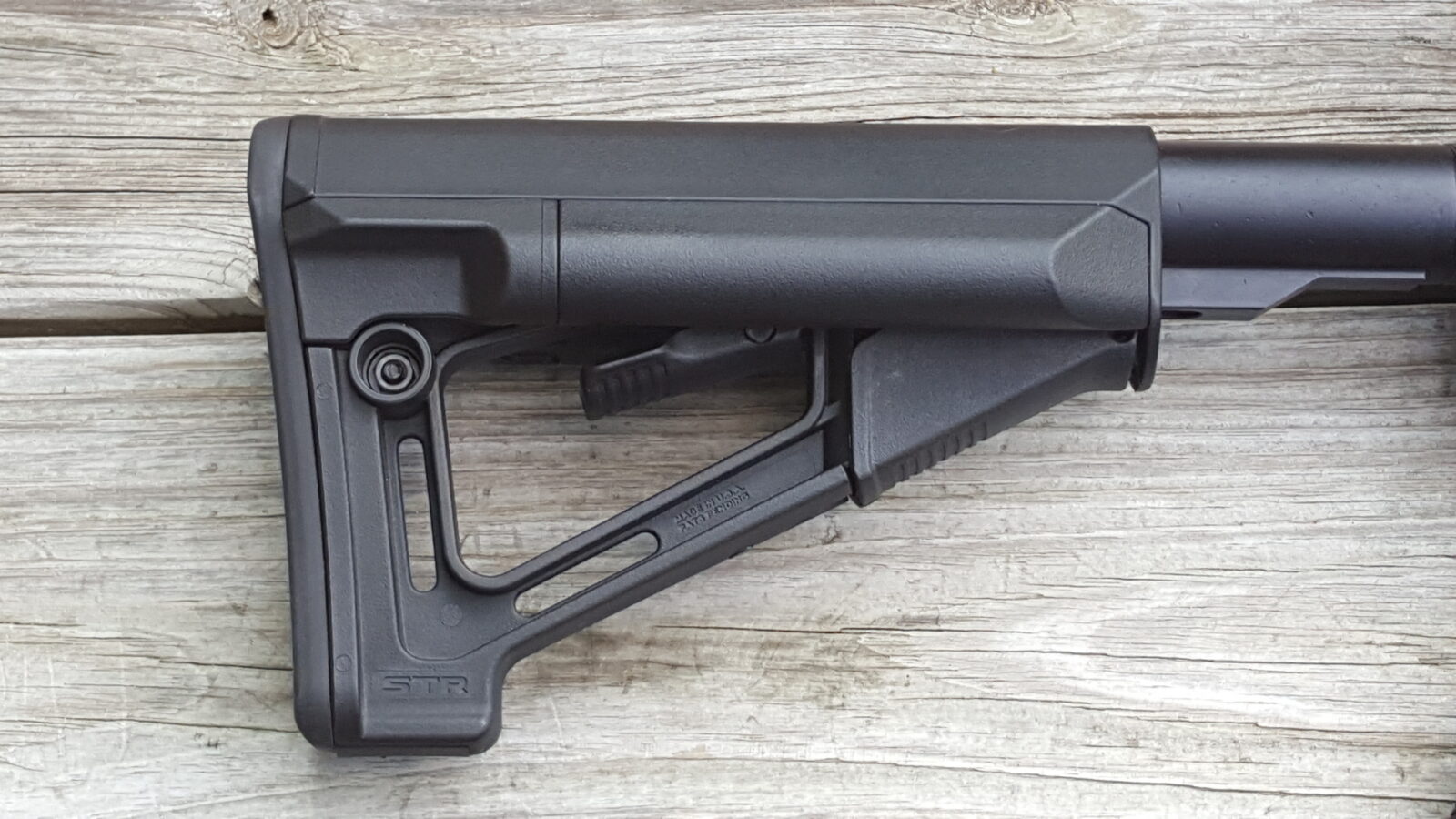
  • The butt stock is a Magpul STR.  I like the Magpul stocks that clamp in place – they are rock solid.  The STR can do this and has a great angled top for a solid cheekweld.
  • It has a Spikes H2 buffer to soften the operation up a bit.
  • I like Yankee Hill Machine’s (YHM’s) oversize pivot and takedown pins and get them from Brownells.
  • The selector lever is PSA’s ambidextrous model.  To be honest, I’m going to stop getting the ambidextrous selectors – the capability sounds great in theory but what I find is that I am so used to the traditional selector lever that I rarely use the operating-side lever.
  • The slide release lever is a GIANT Wilson.  I bought it sight unseen via Brownells and had no idea it was going to be this big.  On the plus side, it sure is easy to find and operate.  On the con side, it is big and kind of fugly if you ask me.  My go to release lever these days are the Strike Industries models.  By the way, if you use the Wilson, be sure to apply Loc-Tite to the set screw that locks the paddle in place or it will loosen up.
  • The upper is a 16″ Palmetto State Armory with a 5.56 M4 profile barrel with a 1:7 twist hidden under their cool slim Keymod handguard.  Honestly, I think PSA makes great uppers.  They are running a budget operation and you may have to wait to hear from their customer service department but I have never actually had an upper from them have a problem.  They’ve missed a part in parts kits before but always moved fast to ship me a replacement part.  By the way, PSA also soures some really barrels, that is one of the big reasons I use their uppers.
  • The bolt carrier group is a Nickel Boron (NiB) coated assembly from Fail Zero.  Boy are they slick.  In general NiB BCGs are cool – you can feel they slide easily without a gritty feeling and clean easily.  With Fail Zero you are buying experience – they know BCGs and they pioneered the very slick polished NiB process they call “EXO Nickel Boron”.  I’ve not had the coating flake on me and it is slick.
  • The charging handle is VLTOR/BCM Mod.3 with the large handle.  I like the oversized handle both for working around optics and it is really easy to find and operate.  This is my preferred charging handle and has never let me down.  Beware of the cheap import ambidextrous knock off handles.  You will get what you pay for.  Stick with name brand.
  • For magazines, I like MagPul.
  • The optic is a Vortex Crossfire II 1-4×24.  In general, Vortex scopes are excellent and they have a no-nonsense “if it breaks we will fix it” warranty that you can’t beat.
  • The offset scope mount is a generic unit sold by TMS.  It’s my third TMS but I now just use Vortex mounts.
  • The offset backup sights are something I do now on my rifles with optics.  If you have any kind of optics failure you rotate the rifle 45 degrees and use the iron sights.  They look awkward but the transition is actually very smooth and fluid.  If you haven’t tried this, I’d recommend giving them a whirl.  These are surprisingly inexpensive ADE brand sights and they’ve held up just fine.  This is my third set from them via Amazon.
  • The light is a test unit.  The light itself is a LiteXpress X-FIRE1 LED unit that is sold on Amazon.  The mount is from them also and is the only part I am not too keen on as it flexes.  They do have a new model now so I am not sure how the mount is.  The light itself has held up just fine.

Here are some photos for you of the rifle:

Close-up of a black AK Galil grip on a Romy G rifle with MI rails.
AK rifle with MI rails and custom Galil grip
Palmetto State Armory (PSA) has an incredible selection of AR-15 kits to meet a wide range of requirements. Click here to go to their main AR-15 kit page.

Summary

You can build an AR-15 in an amazing number of different ways. There are so many options out there. Helping you get started, PSA has a huge variety of kits you can select from. They’ve always worked great for me.


Please share the link on Facebook, Forums, with colleagues, etc. Your support is much appreciated and if you have any feedback, please email us in**@*********ps.com. If you’d like to request a report or order a reprint, please click here for the corresponding page to open in new tab.


ATF letter stating that the Magpul AFG is legal for use on AR pistols

Please treat this as reference material only and not legal advice. The ATF does not always adhere to letters, states and local governments are doing their own thing and it’s hard to say what is acceptable or not just to be perfectly blunt. We live in interesting times unfortunately.

Folks, here is an ATF letter saying that an angled foregrip (AFG), such as Magpul’s models, can be used on an AR pistol.  This is the first time someone shared a definitive letter with me vs. hearsay.

12/14/2014 Update:  Here are scanned images of two different ATF letters saying AFGs can be used on AR pistols because they are not considered vertical grips:

Letter from ATF stating Magpul AFG legal for AR pistols

This is a second letter wherein they answer a number of good questions about AR pistols in general.  On page three is another comment that the AFG is allowed:

ATF letter confirming Magpul AFG legality on AR pistols, referencing GCA and NFA.
ATF letter on Magpul AFG legality for AR pistols
ATF letter confirming Magpul AFG legality on AR pistols

The reason this matters is that a vertical foregrip is not legal without first registering the pistol as an “any other weapon” or AOW.  I recommend people print and keep copies of letters just in case they need to show someone that some aspect of a weapon was “approved” by the ATF at some point.  Just bear in mind that ATF letters are not absolutes but it helps to have them handy if asked.  A state or local government may have their own more restrictive regulations as well so this may not mean AFGs are legal for everyone everywhere.

Legal Disclaimer:  I am not an attorney and am not giving legal advice.  I am just passing this information along and it is up to you to determine what you can/can’t do.


Please share the link on Facebook, Forums, with colleagues, etc. Your support is much appreciated and if you have any feedback, please email us in**@*********ps.com. If you’d like to request a report or order a reprint, please click here for the corresponding page to open in new tab.


Sources For AR Parts

The following are all vendors of AR parts including barrels, handguards, triggers, magaziness and what have you that I use and recommend:

Beware no-name knock off websites selling generic import stuff. Some of the parts are counterfeit and not rated for firearms use.