Tag Archives: ATF

2026 Year-To-Date ATF Regulatory Changes and Compliance Guide

Please note the author is not a lawyer and this is not legal advice.

Executive Summary

Between 2025 and 2026, the regulatory landscape for the small arms industry, federal firearms licensees (FFLs), and consumers underwent a major realignment. Following several judicial defeats and significant legislative tax changes, the Bureau of Alcohol, Tobacco, Firearms and Explosives (ATF) has shifted its enforcement strategy and begun a substantial rewrite of its administrative regulations1.

Federal courts consistently ruled that major agency rulemakings, specifically those regarding pistol stabilizing braces, forced reset triggers, and unfinished frames and receivers, exceeded statutory authority or were unconstitutionally vague5. Simultaneously, the One Big Beautiful Bill Act (P.L. 119-21) eliminated the $200 National Firearms Act (NFA) making and transfer tax for most items as of January 1, 20268. This legislative shift led to a landmark ruling in Silencer Shop Foundation v. ATF, which barred the federal government from enforcing registration requirements for these untaxed items against covered plaintiffs10.

In response, the ATF launched a “New Era of Reform” in early 2026. This package of 34 rules aims to rescind unenforceable regulations, modernize electronic recordkeeping, and authorize non-over-the-counter transfers4. This report analyzes these legal adjustments and provides actionable compliance workflows for FFLs and buyers navigating the 2026 market.

1. The Vacatur of the Stabilizing Brace Rule

1.1 Context and Judicial Defeat

In January 2023, the ATF’s Final Rule 2021R-08F reclassified millions of braced pistols as short-barreled rifles (SBRs) under the NFA1. This change subjected an estimated 40 million owners to potential felony charges unless they registered their firearms, paid a $200 tax, or destroyed the brace5. The rule used a subjective “multi-factor test” to determine if a firearm was intended to be fired from the shoulder1.

By 2024, appellate courts found the rule arbitrary and capricious, noting it lacked objective standards1, 14. A nationwide vacatur was issued in Mock v. Garland, and by July 2025, the DOJ formally ceased its appeal, ending the rule’s enforcement permanently5.

1.2 ATF’s 2026 Regulatory Reversion

The ATF formally rescinded the brace rule in May 2026 through NPRM 1140-AA98. The agency cited the court-identified violations and restored regulatory definitions to align with the original statutory text of the GCA and NFA2.

Despite the rule’s demise, the ATF indicated in court filings, specifically in a March 2026 brief for State of Texas v. ATF, that it retains case-by-case statutory authority under the underlying NFA to classify configurations that appear clearly designed to be fired from the shoulder, even without the 2023 regulatory framework5. This assertion drew immediate pushback from lawmakers, with a group of 13 U.S. senators challenging the agency’s lingering enforcement posture5. However, without the codified factoring criteria, the agency lacks a formalized, broad regulatory mechanism to reclassify standard braced pistols en masse.

1.3 Practical Mechanics and Compliance Example

Compliance has reverted to historical norms. Standard braced pistols are once again classified as pistols, meaning buyers do not need to submit NFA paperwork or payments for standard configurations5, 16.

For example, a buyer purchasing a standard AR-15 style pistol with a brace now processes the transaction via a standard Form 4473 and NICS check. FFLs no longer bear the burden of extended NFA wait times or the risk of subjective classification for these items1.

2. Forced Reset Triggers (FRTs): Rejecting the Machine Gun Classification

2.1 Context and Judicial Defeat

In March 2022, the ATF classified forced reset triggers (FRTs) as “machine guns,” arguing that their mechanical assistance allowed automatic fire with a “single function of the trigger”20. This reclassification overnight criminalized the possession of standard components manufactured after 198621.

The Supreme Court’s 2024 decision in Garland v. Cargill dismantled this logic, ruling that the ATF exceeded its authority by classifying bump stocks as machine guns2. Lower courts applied this to FRTs, noting the trigger must still independently reset for each shot6. By May 2025, the DOJ settled the litigation, returning FRTs to federal legality23.

2.2 Practical Mechanics and Compliance Example

Despite federal legality, FRTs face a patchwork of state-level bans. Compliance requires FFLs to utilize geo-fenced shipping filters to avoid jurisdictions with restrictive “rate-of-fire” or “combination of parts” statutes25, 20.

For an FFL operating an e-commerce platform, selling FRTs requires strict compliance filters. While an FFL in Texas can legally stock and sell FRTs over the counter, shipping that same device to a buyer in New York, New Jersey, or Connecticut poses severe legal risks. These states have clear “combination of parts” laws and constructive possession clauses that ban components designed to assemble a machine gun or increase the rate of fire under state definitions20.

A compliant retailer in 2026 must utilize geo-fenced shipping restrictions, prominently publish their shipping policies regarding trigger-activation devices, and actively decline sales to jurisdictions with locality carve-outs20. Furthermore, industry analysts recommend that buyers and sellers avoid irreversible payment methods, such as wire transfers or cryptocurrency, which are often associated with non-compliant or fraudulent vendors operating in the regulatory gray areas surrounding controversial accessories20.

3. The Frame or Receiver Rule: As-Applied Constitutional Injunctions

3.1 The Supreme Court Facial Ruling (VanDerStok)

The ATF’s 2022 “Ghost Gun” rule redefined “firearm” to include parts kits that “may readily be converted” to expel a projectile25, 27. This allowed the agency to regulate blocks of metal or plastic based on extrinsic factors like marketing or instructions28.

In 2025, the Supreme Court upheld the rule’s facial validity in Bondi v. VanDerStok but noted that some products are too far from finished frames to be regulated27, 7. This allowed for “as-applied” constitutional challenges.

3.2 The District Court Injunction (Defense Distributed v. Blanche)

Following the Supreme Court’s remand, the constitutional challenges proceeded in the Northern District of Texas. On August 17, 2026, Chief Judge Reed O’Connor issued an opinion and order in Defense Distributed v. Blanche (the successor case to VanDerStok), granting summary judgment to the plaintiffs7.

In August 2026, a district court ruled the rule unconstitutionally vague under the Fifth Amendment, finding that the term “readily” lacked a clear threshold7, 29. The court also found the rule violated the Second Amendment by contradicting the historical tradition of personal gunsmithing7.

Furthermore, the court ruled that the regulations violated the Second Amendment. Using the historical tradition test from Bruen, the court looked at the DOJ’s historical analogues, which included colonial barrel-proofing requirements and gunpowder-storage laws7. The court said that these old laws were more about keeping people safe and preventing accidents than about stopping crime or finding missing parts. Concluding that the rule contradicted the actual historical tradition of unregulated personal gunsmithing and self-manufacture of firearms, the court struck down the provisions as applied to the plaintiffs7.

3.3 Practical Mechanics and Compliance Example

The resulting order from Judge O’Connor did not vacate the frame and receiver rule nationwide. Instead, it resulted in a declaratory judgment and permanent injunction protecting only the specific plaintiffs (Defense Distributed and the Second Amendment Foundation) and their current and future members29. The permanent injunction explicitly covered specific Defense Distributed products, such as their M1911 80% Frames, G80 Build Kits, and unfinished receivers7.

This creates a bifurcated compliance environment for FFLs and buyers. If a consumer is an active, verified member of the Second Amendment Foundation (SAF), the ATF cannot enforce the 2022 frame or receiver serialization and background check requirements against them when they acquire a covered Defense Distributed 80% frame29. However, if a non-member attempts to purchase a generic partially complete receiver from a non-plaintiff vendor, the 2022 ATF rule remains in full effect29.

For the non-member, the item is legally a firearm, must bear a serial number applied by a licensed manufacturer, and must be transferred via an FFL utilizing a Form 4473 and a NICS check31. FFLs operating in this space must institute rigorous verification protocols to confirm both the specific membership status of the buyer and the exact product origin before executing any unserialized transfer of an 80% kit, ensuring they fall within the protective bounds of the injunction and do not inadvertently commit a federal firearms violation32.

4. The Elimination of the NFA Tax and the Collapse of Registration

4.1 The One Big Beautiful Bill Act

The One Big Beautiful Bill Act (P.L. 119-21) reduced the NFA transfer tax to $0 for silencers, SBRs, and SBSs, effective January 1, 20268. Initially, the ATF maintained that all registration requirements remained mandatory despite the $0 tax3.

Initially, the industry viewed this legislation purely as a financial reprieve for consumers, removing a barrier to entry that had existed since 19343. In late December 2025, the ATF temporarily shut down its eForms system to reconfigure the software and update tax fields to reflect the $0 balance, while still requiring the entire NFA regulatory process, including Form 1 and Form 4 applications, fingerprint cards, passport photographs, and the waiting period for ATF pre-approval. Form 1, used for making an NFA firearm, was also revised to remove the Chief Law Enforcement Officer (CLEO) notification requirement and expand digital signature capabilities37.

4.2 Silencer Shop Foundation v. ATF and the Constitutional Ruling

Plaintiffs in Silencer Shop Foundation v. ATF successfully argued that because the NFA was enacted under Congress’s power to tax, reducing the tax to $0 stripped the registration scheme of its constitutional basis10, 11. In August 2026, the court enjoined registration requirements for untaxed items for covered parties43.

On August 5, 2026, U.S. District Judge James Wesley Hendrix of the Northern District of Texas agreed. In a 66-page opinion, the court ruled that the NFA’s registration, application, and pre-approval requirements for untaxed items exceeded Congress’s enumerated powers and were unconstitutional11. Judge Hendrix explicitly rejected the DOJ’s attempt to retroactively justify the registry using the Commerce Clause or the Necessary and Proper Clause, noting that the NFA resides entirely within Title 26 (the Internal Revenue Code) and was structured clearly as a tax measure10. The court entered a permanent injunction but stayed its effect for seven days to allow the government to seek appellate relief. The DOJ failed to file a notice of appeal or seek an emergency stay within that window, resulting in the permanent injunction taking full effect on August 13, 202643.

4.3 Practical Mechanics: Suppressors vs. SBRs/SBSs

The application of the Silencer Shop injunction is highly nuanced. It is not a nationwide repeal of the National Firearms Act. The injunction protects only the named plaintiffs, their agencies, political subdivisions, and their current and future members and qualifying customers (e.g., Gun Owners of America members and Silencer Shop customers)10. For any citizen not covered by these specific plaintiff groups, the full NFA Form 4 process and its associated felony penalties remain fully enforceable10.

Furthermore, the injunction creates a clear difference in how suppressors and SBRs or SBSs are transferred, due to overlapping statutes in the Gun Control Act (Title 18).

Flowchart: Standard NFA vs. Injunction Route for Suppressor Transfers Post-August 2026
  • Suppressors: In “Free States,” covered buyers can acquire suppressors as Title I firearms via a standard Form 4473 and NICS check, bypassing NFA registration entirely44.
  • SBRs/SBSs: While registration is enjoined, separate GCA requirements for “Attorney General authorization” lead FFLs to continue using the Form 4 process (at $0 tax) for these items to avoid federal violations32, 44.
  • State Law Conflicts: Historically, fifteen states (including Michigan, Ohio, and Washington) had laws that made lawful possession of a suppressor depend on federal NFA registration, but advocacy groups successfully removed these laws in three of those states in 202610. In these remaining jurisdictions, utilizing the federal injunction to bypass the Form 4 process renders the suppressor illegal under state law, as the state safe harbor requires the physical federal tax stamp or approval paperwork51. FFLs in these remaining states must continue filing Form 4s for all transfers to protect their customers from state-level prosecution.
  • Interstate Transport: The injunction did not strike down 26 U.S.C. § 5861(j), which prohibits the interstate transport, delivery, or receipt of an unregistered NFA firearm10. Therefore, covered owners possessing an unregistered suppressor acquired purely via a 4473 transfer risk federal prosecution if they transport it across state lines, even if traveling to another “Free State,” or if they ship it to a manufacturer for warranty repair44. Additionally, under the Gun Control Act, 18 U.S.C. § 922(a)(4) still requires explicit authorization for the interstate transportation of short-barreled rifles and short-barreled shotguns, meaning buyers cannot move them across state lines without ATF permission, regardless of the injunction50.

5. ATF’s “New Era of Reform”: The 2026 Rulemaking Package

Facing a landscape where multiple high-profile regulations had been vacated and the core of the NFA was fracturing under judicial scrutiny, the ATF altered its posture. In late April and early May 2026, the agency published a major package of 34 regulatory actions, branded the “New Era of Reform,” designed to align with statutory text, reduce administrative burdens, and modernize the industry13. Deputy Attorney General Todd Blanche referred to this as the most comprehensive regulatory reform package in the agency’s history54.

5.1 Redefining “Willfully” and Ending Zero Tolerance (RIN 1140-AA88)

Under previous “Zero Tolerance” policies, FFLs faced license revocation for minor clerical errors55, 4. NPRM 1140-AA88 proposes a more precise definition of “willfully,” requiring proof that an FFL acted with actual knowledge of illegality or deliberate indifference56. This shift protects compliant dealers from losing their livelihoods over simple paperwork mistakes.

Through NPRM 1140-AA88, the ATF proposed defining “willfully” in the civil and administrative context to match the prevailing standard established by federal appellate courts. The proposed definition clarifies that an FFL acts willfully only when they act with “actual knowledge that the person’s conduct is unlawful” and either intentionally engage in the forbidden conduct or act with deliberate indifference to their legal obligations56. This officially ends the practice of revoking licenses for simple transcription errors or isolated administrative oversights that result from inadvertent error, thereby protecting the livelihoods of compliant dealers4.

5.2 Modernization of Retail Operations and Recordkeeping

The “Modernize” and “Reduce Burden” groups of the regulatory package focus heavily on updating the compliance framework to reflect current technology and business practices12.

  • Non-Over-the-Counter (NOTC) Sales (RIN 1140-AB05): A highly significant update for modern retail, this proposed rule formally authorizes FFLs to conduct remote sales to residents of the same state12. Recognizing the advancement of secure digital verification technology, FFLs are permitted to utilize remote platforms for photo identification and residency verification. Provided a NICS background check is completed and documented, FFLs can facilitate online sales, layaway pickups, and direct in-state shipping without requiring the buyer to physically visit the storefront, expanding e-commerce capabilities while maintaining Brady Act safeguards12.
  • Electronic Recordkeeping Defaults (RIN 1140-AA94): The ATF formalized authorization for FFLs to generate, maintain, and store Form 4473s and Acquisition and Disposition (A&D) bound books entirely electronically by default12. This includes the integration of digital document attachments. Previously, FFLs utilizing digital bound books were often required to maintain separate physical files for supporting documents like state permits or supplementary residency proof. This rule standardizes electronic recordkeeping, reducing transcription errors and manual data entry12.
  • Record Retention Limits (RIN 1140-AA95): The ATF proposed eliminating the requirement that FFLs retain Form 4473s and A&D records indefinitely for the life of the license2. Acknowledging the physical storage burden on dealers, the proposal establishes defined retention periods of either 20 or 30 years for primary records. Furthermore, the rule mandates only a 90-day retention period for private-party transfer records and voluntary firearm handler checks and a 5-year retention period for multiple sales reports and incomplete transactions12.

5.3 NFA Burden Reductions and Alignments

The regulatory package also addresses administrative friction points within the NFA framework.

  • NFA Interstate Transport (RIN 1140-AA89): Seeking to reduce delays for lawful owners, this proposal eliminates the requirement for individuals to submit an ATF Form 5320.20 and await approval prior to transporting registered NFA firearms across state lines for short-term trips of 365 days or fewer (e.g., for hunting trips, training courses, or temporary relocations)59. Long-term or permanent relocations still require notification to the ATF to update the registry, but no longer require the owner to wait for pre-approval before moving62.
  • Spousal Joint Registration (RIN 1140-AB00): To reduce the administrative complexity and legal expense of establishing an NFA Gun Trust solely for family possession, this proposal allows married couples to file a joint application as makers or transferees of NFA firearms. Under this joint registration, both spouses can lawfully possess the firearm, and a transfer between the spouses would not constitute a separate NFA transfer requiring additional paperwork59.
  • Rescinding “Engaged in the Business” (RIN 1140-AB01): Following legal challenges and an admission that the expanded definitions failed to produce anticipated enforcement outcomes regarding licensing and civil forfeitures, the ATF proposed rolling back the “rebuttable presumptions” it previously applied to determine who must possess a dealer’s license. The rule reverts to the strict statutory language codified by Congress in the Bipartisan Safer Communities Act (BSCA)2.
  • Machine Gun Definition Revision (RIN 1140-AA60): Acting as a direct consequence of the Supreme Court’s binding legal interpretation in Garland v. Cargill, the ATF issued a proposed rule removing the two sentences from the regulatory definition of a “machine gun” that had unlawfully incorporated non-mechanical bump stocks2.

6. Conclusion

The 2026 landscape reflects a significant contraction of executive power. Courts have rejected subjective “factoring tests” for reclassifying firearms, while legislative tax reforms have undermined the NFA’s registration foundation. The result is a fractured but more modernized compliance environment.

In response, the ATF’s “New Era of Reform” signifies a substantial operational pivot. By adopting the appellate courts’ civil definition of “willfully,” authorizing Non-Over-the-Counter digital sales, and formalizing electronic recordkeeping with defined retention limits, the agency is transitioning from an adversarial enforcement posture to a modernized, compliance-supportive framework aligned strictly with the statutory text provided by Congress.

For FFLs and compliance specialists, the primary challenge in 2026 is no longer adapting to rapidly expanding federal regulations, but rather navigating a highly fragmented legal environment. An FFL must now determine compliance based on a matrix of variables: the buyer’s specific organizational membership, the state of residency, the exact product origin, and the distinct statutory differences between firearms (such as the GCA requirements for SBRs versus suppressors). Navigating these divergent pathways safely requires rigorous, documented verification protocols and a precise understanding of which federal provisions were, and were not, enjoined by the courts.

Master Summary Table: Key 2026 Compliance Shifts

Regulatory SubjectCourt / Legislative Catalyst2026 Status & ATF ActionPractical Impact for FFLs & Buyers
Stabilizing BracesMock v. Bondi (Vacatur)Rescinded. ATF proposed RIN 1140-AA98 to remove factoring criteria from CFR.Braced pistols transfer as standard handguns via Form 4473. No NFA Form 4 or wait times required.
Forced Reset Triggers (FRTs)NAGR v. Garland / CargillLegalized Federally. DOJ settled; machine gun classification dropped.Sold over-the-counter as accessories. FFLs must still restrict shipping to states with “combination of parts” bans.
80% Frames / ReceiversVanDerStok (SCOTUS) & Defense Distributed (N.D. Tex)Enforced with Exceptions. SCOTUS upheld rule facially; Judge O’Connor enjoined it as-applied to specific plaintiffs.Unserialized 80% kits can only be transferred without 4473/NICS to verified members of protected plaintiff groups (e.g., SAF). Others require standard serialized transfer.
Suppressors (Silencers)One Big Beautiful Bill Act & Silencer Shop v. ATF$0 Tax / Registration Enjoined (For Covered Parties). NFA registration unconstitutional for untaxed items.In 27 “Free States”, covered members acquire suppressors via 4473/NICS only (no Form 4). In states that still tie legality to NFA registration, Form 4 is still required to comply with state law.
SBRs / SBSsOne Big Beautiful Bill Act & Silencer Shop v. ATF$0 Tax / Form 4 practically required. Registration enjoined, but GCA § 922(b)(4) remains.Despite the injunction on registration, FFLs must still process via Form 4 to satisfy the separate GCA requirement for “Attorney General authorization” to transfer.
Dealer License RevocationsFederal Appellate Precedent“Zero Tolerance” Ended. ATF proposed RIN 1140-AA88 to define “willfully”.FFLs protected from license revocation for inadvertent clerical errors. ATF must prove actual knowledge of illegality or deliberate indifference.
Remote Firearm SalesATF “New Era of Reform”NOTC Authorized. ATF proposed RIN 1140-AB05 for Non-Over-the-Counter sales.FFLs can verify ID/residency digitally and ship firearms directly to in-state residents following a NICS check, without a physical storefront visit.
Record Retention LimitsATF “New Era of Reform”Indefinite Storage Ended. ATF proposed RIN 1140-AA95.FFLs only required to retain Form 4473s and A&D bound books for 20 or 30 years, rather than for the life of the license.
NFA Interstate TravelATF “New Era of Reform”Prior Approval Removed. ATF proposed RIN 1140-AA89.Owners can transport registered NFA items interstate for up to 365 days without submitting Form 5320.20 for prior ATF approval.

Please share the link on Facebook, Forums, with colleagues, etc. Your support is much appreciated and if you have any feedback, please email us in**@*********ps.com. If you’d like to request a report or order a reprint, please click here for the corresponding page to open in new tab.


Sources Used

  1. Understanding the ATF Pistol Brace Rule: 2025 Update for FFLs, https://www.fflguard.com/atf-pistol-brace-rule/
  2. Repeal | ATF, https://www.atf.gov/rules-and-regulations/atf-launches-new-era-reform/repeal
  3. NFA Tax Stamp (2026 Update) for FFLs – FastBound, https://www.fastbound.com/nfa-tax-stamp/
  4. ATF’s New Era of Reform, https://www.atf.gov/rules-and-regulations/atf-launches-new-era-reform
  5. ATF Pistol Stabilizing Brace Rule 2026: Smart Owner Guide, https://guncarrier.com/atf-pistol-stabilizing-brace-rule-2026/
  6. Garland v. Cargill & FRT Triggers: What the Supreme Court Ruling, https://www.artakedowntool.com/blogs/blogs/garland-v-cargill-frt-trigger
  7. Federal Judge Rules Biden-Era ‘Ghost Gun’ Rule Unconstitutional, https://www.thefirearmblog.com/blog/federal-judge-rules-biden-era-ghost-gun-rule-unconstitutional-44830060
  8. NFA Tax Stamp Removal – FFLGuard, https://www.fflguard.com/nfa-tax-stamp/
  9. One Big Beautiful Bill Act – Wikipedia, https://en.wikipedia.org/wiki/One_Big_Beautiful_Bill_Act
  10. Federal Court Strikes Down NFA Registration for Suppressors, https://suppressor.org/news/federal-court-strikes-down-nfa-registration-for-suppressors
  11. Federal Court Strikes Down Key National Firearms Act Restrictions, https://www.texaspolicyresearch.com/federal-court-strikes-down-key-national-firearms-act-restrictions/
  12. ATF Changes 2026: New Era of Reform Package and 34 New Rules, https://www.fastbound.com/atf-changes/
  13. DOJ/ATF Announce A New Director & Welcome Changes – FFLGuard, https://www.fflguard.com/doj-atf-announce-a-new-director-welcome-changes/
  14. https://www.federalregister.gov/documents/2026/05/06/2026-08930/removing-factoring-criteria-for-firearms-with-attached-stabilizing-braces
  15. U.S. Court of Appeals Issues Limited Temporary Injunction on ATF, https://www.dfwnlaw.com/u-s-court-of-appeals-issues-limited-temporary-injunction-on-atf-final-rule-2021r-08f
  16. Brace Rule Vacated – CAA Gear Up – CAA USA, https://caagearup.com/brace-rule-vacated/
  17. View Rule – Reginfo.gov, https://www.reginfo.gov/public/do/eAgendaViewRule?pubId=202510&RIN=1140-AA98
  18. DOJ Legal Filing Renews Concerns About ATF’s Posture on Braced, https://www.nraila.org/articles/20260320/doj-legal-filing-renews-concerns-about-atf-s-posture-on-braced-pistols
  19. ATF Still Claims Authority Over Braced Pistols, https://rallyforourrights.com/atf-still-claims-authority-over-braced-pistols/
  20. Forced Reset Triggers in 2026: Legality, State-by-State Risk Factors, https://nspecinnovations.com/blog/forced-reset-triggers-in-2026-legality-statebystate-risk-factors-and-what-buyers-should-know/
  21. ATF Open Letter Regarding Forced Reset Triggers (FRTs) Gearfire, https://gogearfire.com/blog/what-you-should-know-atf-open-letter-regarding-forced-reset-triggers-frts/
  22. Are FRT Triggers Legal in Texas? 2026 Complete Guide, https://www.artakedowntool.com/blogs/blogs/frt-trigger-texas-legal
  23. Department of Justice Announces Settlement of Litigation Between, https://www.justice.gov/opa/pr/department-justice-announces-settlement-litigation-between-federal-government-and-rare-breed
  24. Department of Justice Closes Cases Over Forced Reset Triggers, https://www.pewpewtactical.com/rare-breed-atf-frt-15-trigger/
  25. VanDerStok Explained: What the Ruling Does and Doesn’t Do, https://www.80percentarms.com/blog/vanderstok-explained-what-the-ruling-does-and-doesnt-do/
  26. Bondi v. VanDerStok – Ballotpedia, https://ballotpedia.org/Bondi_v._VanDerStok
  27. Bondi v. Vanderstok | 604 U.S. ___ (2025) – Justia Supreme Court, https://supreme.justia.com/cases/federal/us/604/23-852/
  28. VanDerStok et al v. Garland et al, 4:2022cv00691 – Document 330, https://law.justia.com/cases/federal/district-courts/texas/txndce/4:2022cv00691/366145/330/
  29. Federal Judge Rules ATF Frame-and-Receiver Rule, https://community.usconcealedcarry.com/t/federal-judge-rules-atf-frame-and-receiver-rule-unconstitutional-in-defense-distributed-case/132729
  30. ATF Ghost Gun Rule Struck Down: What It Means for 80% Lowers, https://www.rifleconfigurator.com/articles/atf-frame-receiver-rule-struck-down
  31. Federal judge strikes down Biden-era ‘ghost gun’ restrictions, https://signalscv.com/2026/08/federal-judge-strikes-down-biden-era-ghost-gun-restrictions/
  32. Federal Court Enjoins Key NFA Rules for Certain Plaintiffs, Members, https://schwennlaw.com/resources/insights/federal-court-enjoins-key-nfa-rules/
  33. Changes to National Firearms Act Tax Remittance Provisions, https://www.federalregister.gov/documents/2026/05/08/2026-09155/changes-to-national-firearms-act-tax-remittance-provisions
  34. Federal Court Strikes Down NFA Registration for Suppressors, https://americansuppressorassociation.com/news/federal-court-strikes-down-nfa-registration-for-suppressors
  35. ATF eForms Explained: Form 4, Form 1, and NFA Filing, https://www.silencershop.com/understanding-atf-eforms
  36. ATF eForms Submissions are Halted until January 1, 2026, https://www.nationalguntrusts.com/blogs/nfa-gun-trust-atf-information-database-blog/atf-eforms-submissions-are-halted-until-january-1-2026
  37. ATF NFA Form Changes Begin January 1, 2026 – Orchid Advisors, https://orchidadvisors.com/important-reminder-atf-nfa-form-changes-temporary-eforms-blackout/
  38. ATF NFA Form 1 Changes 2026: What You Need to Know – FastBound, https://www.fastbound.com/ffl-blog/atf-nfa-form-1-changes/
  39. $0 Tax Left NFA with No Constitutional Basis – Independent Institute, https://www.independent.org/article/2026/08/11/0-tax-left-nfa-with-no-constitutional-basis/
  40. Analysis: Why Gun Owners of America Says the New $0 National, https://thereload.com/analysis-why-gun-owners-of-america-says-the-new-0-national-firearms-tax-is-unconstitutional/
  41. Federal judge guts provision of National Firearms Act in victory for, https://sentinelksmo.org/judge-guts-provision-national-firearms-act/
  42. A Victory That Ends A Gun Registry | An Official Journal Of The NRA, https://www.americanrifleman.org/content/a-victory-that-ends-a-gun-registry/
  43. NFA Registration Ruled Unconstitutional: What It Means – Gun Talk, https://www.guntalk.com/post/a-federal-judge-just-called-nfa-registration-unconstitutional
  44. NFA Injunction In Effect – Join Now – Be Covered, https://americansuppressorassociation.com/news/nfa-injunction-in-effect-join-now-be-covered
  45. The NFA Injunction Is In Effect ,  Here’s Who It Actually Covers, https://www.thearmories.com/blog/the-nfa-injunction-is-in-effect-heres-who-it-actually-covers
  46. Texas Judge Delivers Major Win Against NFA Registry for, https://www.shastaunfiltered.com/post/texas-judge-delivers-major-win-against-nfa-registry-for-suppressors-and-short-barreled-firearms
  47. ‘Confusing for Everyone.’ Suppressor Sales Boom Even as Many, https://www.outdoorlife.com/guns/suppressor-deregulation-chaos/
  48. What the August 2026 NFA Ruling Decision Means for Suppressor, https://tuna-cans.com/what-the-august-2026-nfa-ruling-decision-means-for-suppressor-buyers/
  49. NFA Ruling Update 2026 | Suppressors, SBRs, SBSs & AOWs, https://texasgunsinc.com/nfa-ruling-update-2026
  50. What Does the Texas NFA Decision Mean for You? – NRA-ILA, https://www.nraila.org/articles/20260812/what-does-the-texas-nfa-decision-mean-for-you
  51. How NFA Deregulation affects your state – Silencer Central, https://www.silencercentral.com/blog/how-nfa-deregulation-affects-your-state-law/
  52. Are Suppressors Legal in Michigan? 2026 Silencer Laws – SilencerCo, https://silencerco.com/blog/michigan-suppressor-laws
  53. NSSF Guidance on NFA Transfers, https://www.nssf.org/articles/nssf-guidance-on-nfa-transfers/
  54. August 4, 2026 – Illinois Attorney General, https://illinoisattorneygeneral.gov/News-Room/Current-News/2026.08.04%20-%20Brady%20Act%20Exception%20Comment.pdf?language_id=1
  55. LET’S END “ZERO TOLERANCE” FOREVER! – GOA, https://www.gunowners.org/na20260708/
  56. 1 August 4, 2026 Via Federal eRulemaking Portal and U.S. Mail The, https://illinoisattorneygeneral.gov/News-Room/Current-News/2026.08.04%20-%20States%20AG%20Comment%20re%20ATF%20NPRM%20–%20Willfully%20Definition%20(file).pdf?language_id=1
  57. Defining “Willfully” for Firearms Violations – Federal Register, https://www.federalregister.gov/documents/2026/05/08/2026-09159/defining-willfully-for-firearms-violations
  58. Modernize – ATF, https://www.atf.gov/rules-and-regulations/atf-launches-new-era-reform/modernize
  59. ATF Poised to Publish Landmark Regulatory Reform Package for, https://firearmsresearchcenter.org/forum/regulatory-update-atf-poised-to-publish-landmark-regulatory-reform-package-for-firearms-and-ammunition-controls/
  60. Revising Non-Over-the-Counter Firearms Transaction Requirements, https://www.atf.gov/rules-and-regulations/rulemaking-notices/revising-non-over-counter-firearms-transaction-requirements-rin-1140-ab05
  61. Regulatory Alert: Deadlines Loom for ATF Proposed Rulemakings, https://firearmsresearchcenter.org/forum/regulatory-alert-deadlines-loom-for-atf-proposed-rulemakings/
  62. ATF Rule Changes [2026]: What Gun Owners Need to Know, https://www.pewpewtactical.com/atf-rule-changes/
  63. View Rule – Reginfo.gov, https://www.reginfo.gov/public/do/eAgendaViewRule?pubId=202510&RIN=1140-AA89
  64. Interstate Transport and Temporary Export of National Firearms Act, https://www.govinfo.gov/app/details/FR-2026-05-08/2026-09161
  65. Rulemaking – ATF, https://www.atf.gov/rules-and-regulations/federal-register-actions/rulemaking

Impacts of the Silencer Shop Ruling on U.S. Gun Laws

Please note the author is not a lawyer and this is not legal advice.

Executive Summary

The federal district court ruling in August 2026—covering the consolidated cases of Silencer Shop Foundation v. ATF and Jensen v. ATF—has caused the most significant disruption to U.S. gun laws since the National Firearms Act (NFA) was first passed in 19341. By declaring that NFA registration and approval requirements are unconstitutional for specific untaxed firearms—mainly suppressors, short-barreled rifles (SBRs), and short-barreled shotguns (SBSs)—the court has fundamentally changed how the firearms industry operates1.

Despite this major shift, the new regulatory landscape is deeply fractured. Because the court issued a party-specific injunction rather than a nationwide mandate, the legality of buying a suppressor without registration depends entirely on which organizations the buyer and seller belong to, as well as where the sale happens5. Additionally, the ruling creates friction between the NFA and the Gun Control Act (GCA) of 1968, leaving short-barreled firearms in a regulatory “no-man’s land”9. This report examines the legal reasons behind the ruling, the specific limits of the injunction, the resulting market surge, the compliance hurdles for dealers, and the legal risks for consumers.

I. The Historical and Constitutional Architecture of the NFA

To understand why Silencer Shop Foundation v. ATF is so impactful, we must look at the National Firearms Act of 1934 and how modern legislation unintentionally began to dismantle it11.

The Original Taxing Power Justification

In 1934, Congress faced constitutional hurdles in directly banning certain firearms3. To bypass these limits, they framed the NFA as a tax law rather than a public safety measure, using their power to “lay and collect Taxes” under Article I of the Constitution1.

The law placed a steep $200 tax on suppressors, SBRs, SBSs, and machine guns3. In 1934, this amount was meant to be so expensive that the average person couldn’t afford them3. To collect this tax, Congress created a complex system of requirements: registration in a federal database, fingerprinting, and the use of specific ATF forms2.

In the 1937 case Sonzinsky v. United States, the Supreme Court ruled that these registration rules were legal because they helped the government collect revenue4. For ninety years, the NFA stood because Congress officially viewed it as a tax law, not a ban1.

The Legislative Catalyst: The One Big Beautiful Bill Act

This structure changed with the “One Big Beautiful Bill Act,” signed on July 4, 20251. Starting in 2026, the tax for suppressors, SBRs, and SBSs was reduced to $016. While the law zeroed out the tax, it didn’t mention removing the registration requirements9. Machine guns kept their $200 tax status4.

By removing the tax revenue, Congress inadvertently took away the only constitutional reason the NFA’s registration system was allowed to exist in the first place1.

The end of the transfer tax led to immediate lawsuits, resulting in the consolidated cases of Silencer Shop Foundation v. ATF and Jensen v. ATF in a Texas federal court2.

The Core Constitutional Ruling

On August 5, 2026, Judge James Wesley Hendrix ruled that because these firearms are no longer taxed, the government can no longer force people to register them2. He noted that for a tax to be constitutional, it must actually collect money4. Since the tax is now $0, the registration requirements no longer have a constitutional basis1. As the judge explained, if the tax is gone, the rules supporting it must also go3.

As Judge Hendrix articulated, by zeroing out the transfer and making taxes, Congress effectively eliminated the constitutional basis for the regulations that had previously supported those taxes3.

The Rejection of Department of Justice Defenses

During litigation, the Department of Justice (DOJ) attempted to salvage the registration requirements by constructing three primary escape routes, all of which were dismantled by the court2.

First, the DOJ argued that registration was still needed for the Special Occupational Tax (SOT) paid by dealers3. Judge Hendrix disagreed, noting that the SOT has its own registration system, which the parties did not challenge. He found it unreasonable to require millions of private citizens to register just to help collect a tax from a small number of businesses4.

Second, the court rejected the “Necessary and Proper” defense. The judge compared it to a hypothetical scenario: if the government taxed grocers $1 a year, it couldn’t use that as an excuse to demand fingerprints from everyone who buys vegetables4.

Finally, the government tried to use the Commerce Clause to justify the rules1. The court ruled that the government cannot swap the constitutional basis of a law decades later1. Since the NFA was written as a tax law (Title 26), it must be judged as one8. If Congress wants to regulate firearms under commerce power, they must pass new legislation3.

Flowchart showing NFA's constitutional foundation collapse after 2026 due to zero tax revenue.

III. Scope of the Injunction: The End of Universal Relief

Although the legal victory is significant, it applies very narrowly. Many consumers mistakenly believe the NFA is completely dead across the country7. This misunderstanding puts many at risk of unintentional criminal charges9.

The Restriction of the Universal Injunction Doctrine

In the past, one court ruling could stop a law nationwide. However, following a 2025 Supreme Court decision, lower courts can now only provide relief to the specific people and groups involved in the lawsuit4. Because of this, Judge Hendrix’s ruling only protects the named plaintiffs and their members22.

The ATF is only barred from enforcing registration against these specific groups and their customers8. For everyone else, the NFA still applies exactly as it did before5.

Defining the Protected Classes

Determining who is legally protected by the injunction requires a precise audit of organizational affiliations and supply chain sourcing. The injunction covers transactions strictly involving the following entities5:

Plaintiff CategoryCovered Entities & OrganizationsExtent of Injunctive Protection
Commercial PlaintiffsSilencer Shop Foundation, B&T USA, Palmetto State Armory (PSA), SilencerCo, and Hot Shots Custom LLC.Protects these corporate entities, their distributor networks, and the downstream retail customers purchasing their suppressors in qualifying transactions5.
Advocacy Group PlaintiffsGun Owners of America (GOA), Gun Owners Foundation (GOF), Firearms Regulatory Accountability Coalition (FRAC), Citizens Committee for the Right to Keep and Bear Arms (CCRKBA), FPC Action Foundation, and the Texas State Rifle Association (TSRA).Protects verified members of these organizations from federal registration enforcement when engaging in the acquisition or manufacturing of covered items. Note: Members of the Jensen plaintiff groups (TSRA, CCRKBA, FPC) do not receive coverage for Any Other Weapons (AOWs)2.
State PlaintiffsAlaska, Georgia, Idaho, Indiana, Kansas, Louisiana, Montana, North Dakota, Oklahoma, South Carolina, South Dakota, Texas, Utah, West Virginia, and Wyoming.Protection extends strictly to state agencies and political subdivisions (e.g., local police departments). It does not grant blanket protection to the civilian populations residing within those states6.

If you aren’t a member of one of these protected groups or buying from a covered company, the injunction doesn’t protect you. For these individuals, they still have to go through the full registration and waiting process. This leads to a strange situation where two people at the same store might have completely different rules to follow based on whether they joined an advocacy group7.

IV. Consumer Market Mechanics: The GCA and the SBR Anomaly

The implementation of the injunction shifts the regulatory burden from the National Firearms Act (Title 26) to the Gun Control Act of 1968 (Title 18), but this transition introduces severe operational inconsistencies between different categories of firearms.

The GCA Form 4473 Transition for Suppressors

For protected individuals, buying a suppressor is now much simpler. Since registration isn’t required, these items fall under standard Gun Control Act (GCA) rules8. Because suppressors are defined as “firearms” under the GCA, they are still subject to background checks, even without the NFA tax8.

Buying a suppressor from a covered dealer is now like buying a standard rifle: the buyer fills out Form 4473 and undergoes a NICS background check9. There’s no federal registry entry, no fingerprints, and no months of waiting17. Once the background check clears, the buyer can take the suppressor home that same day19.

This deregulation is part of the ATF’s broader “New Era of Reform” modernization efforts led by Acting Attorney General Todd Blanche and ATF Director Robert Cekada, which mainly focused on reducing burdens through remote identity verification (NIST SP 800-63-4) and direct-to-door intrastate shipping for standard Title I firearms, rather than dismantling the NFA.

The Short-Barreled Firearm Trap

While the ruling explicitly struck down the NFA registration requirements for suppressors, SBRs, and SBSs, the practical market impact for short-barreled firearms is vastly different because of a strong statutory trap built into the Gun Control Act.

While suppressors have a clear path, short-barreled firearms remain ensnared in a “trap.” A specific part of the GCA makes it illegal for dealers to sell SBRs or SBSs unless the Attorney General specifically authorizes it6.

Currently, the NFA Form 4 is the only way the government provides this authorization9. This creates a circular problem: registration is unconstitutional under the NFA, but mandatory to satisfy the GCA9. Until the ATF creates a new authorization process, SBRs and SBSs remain functionally stuck under the old rules9.

V. State-Level Preemption and Jurisdictional Friction

The federal injunction only stops federal enforcement; it doesn’t change state laws14. States generally fall into three categories regarding how they handle this change6:

Industry analysts categorize the states into three distinct regulatory blocks regarding how the injunction impacts local consumers6:

State-by-state NFA deregulation impact: Free, NFA, and Banned states

In 27 “Free States” (like Texas and Florida), state law doesn’t require federal registration. In these places, immediate transfers are happening for protected buyers17.

In 15 “NFA States” (like Michigan and Pennsylvania), state law explicitly says you must follow federal registration rules to possess a suppressor16. If a resident in these states skips the Form 4 process, they are breaking state law6. The remaining 8 states and D.C. have total bans on suppressors, which haven’t changed17.

The Washington State Conundrum

Washington State is particularly confusing. State law doesn’t explicitly ban suppressors, but it says you can’t use one unless it is “legally registered and possessed in accordance with federal law”27.

This creates a paradox: if federal law no longer requires registration for a covered person, is an unregistered suppressor still “legal” in Washington? State Patrol interprets the law strictly, meaning anyone using an unregistered suppressor still risks prosecution38.

Some analysts argue that because the federal Form 2 (filed by the commercial manufacturer at the time of fabrication) places the item in the NFRTR initially, the suppressor is technically “registered,” and the buyer’s subsequent possession without a Form 4 is lawful under the injunction, thus satisfying both prongs of the Washington statute38. However, the Washington State Patrol has issued guidance stating that nothing changes at the state level; they interpret the statute to mean that any use of a suppressor not explicitly registered to the end-user via a Form 4 remains a state crime27. Until a state appellate court definitively resolves this ambiguity, Washington consumers purchasing suppressors over-the-counter risk state prosecution the moment they attach the device to a host firearm and discharge it38.

VI. Market Impact and Industry Disruption

The commercial response to the combination of the $0 tax stamp and the subsequent federal injunction has been explosive, reshaping market dynamics and straining supply chains.

Suppressor sales were already growing before the ruling40. Registered items jumped from 285,000 in 2010 to over 3.5 million by 202424. When the tax dropped to $0 in early 2026, the ATF saw a record 1.62 million applications42.

After the injunction began on August 13, 2026, demand skyrocketed. Silencer Shop quickly moved to over-the-counter sales in 27 states17. Payment processors saw record-breaking transaction volumes as thousands of customers used the new system across the dealer network29.

The deregulation has had a particularly pronounced effect on niche accessory markets, such as shotgun suppressors, freeing consumers to focus on key selection factors like material science and mounting systems without the friction of tax stamps44. Previously hindered by the $200 tax which often represented 20% to 30% of the suppressor’s actual retail cost, the $0 tax and instant transfer capability have accelerated adoption in the sporting and hunting sectors.

Top Shotgun Suppressors (2026)Market ProfileMSRPForm 4473 Viability (In Free States)
SilencerCo Salvo 12Best overall modularity (6-12 inch configs), 136.8 dB suppression, and widely stocked.$993Eligible for instant transfer via covered dealers45.
Silencer Central BANISH 12Ultra-light titanium (17.6 oz), fixed length, optimized for hunters.$1,218Covered, but currently utilizes Form 4 compliance protocols as policy45.
YHM VICTRA-12Value-priced modular option, quietest published rating (135 dB).$979.95Dependent on dealer plaintiff status45.

Market data indicates that shotgun suppressors, traditionally a low-volume NFA item, are rapidly gaining market share as financial and regulatory barriers evaporate45.

VII. Operational Paralysis for FFLs

While sales are up, dealers are facing a nightmare with record-keeping. The current federal inventory system still ties to the NFA registry (NFRTR)7.

For nearly a century, the FFL regulatory framework has been inextricably tied to the National Firearms Registration and Transfer Record (NFRTR)9. When an FFL receives a suppressor from a distributor, it is logged into their physical A&D book and registered to their specific federal license number in the NFRTR database via a tax-exempt Form 3 transfer7.

If a dealer sells a suppressor over-the-counter, they can log it out of their books, but it stays listed in their name in the federal database7. During an audit, the ATF will expect to see the item. Since the dealer no longer has it, they could face violations. The ATF hasn’t explained how to fix the issue, leaving many dealers worried about their licenses5.

Furthermore, the injunction did not strike down the Special Occupational Tax (SOT) requirement4. Importers, manufacturers, and dealers must continue paying the $500 or $1,000 annual SOT to legally engage in the business of manufacturing or distributing NFA items, even if the end consumer ultimately purchases the item without an NFA transfer4.

To help navigate this liability, advocacy groups have introduced compliance bridges. For example, Gun Owners of America (GOA) established a specific “Corporate Membership” program to extend the court’s injunctive protection to the owners, officers, and employees of participating FFLs, providing an easier way for dealers to prove their covered status5. Additionally, because the court did not block the NFA’s interstate transport restrictions, FFLs must continue to use tax-exempt Form 3s when transferring covered items across state lines between manufacturers, distributors, and dealers48.

VIII. Severe Risk Assessment for Consumers

Assuming the NFA is completely “dead” is a dangerous mistake. Consumers who misinterpret the ruling could face federal or state prosecution9.

Form 1 Manufacturing vs. NFA Marking Requirements

Some think they can now build their own SBR or suppressor without an ATF Form 1. This scenario is a massive risk. While registration is currently blocked for some, marking requirements are a separate issue14.

One group of plaintiffs (the Jensen group) received an injunction against marking requirements4. However, the Silencer Shop group (which includes GOA members) did not receive an injunction against the marking requirements. This means a GOA member who builds a firearm without engraving their information on it is committing a felony23.

However, the Silencer Shop plaintiffs (including GOA and GOF members) did not request or receive an injunction against the marking requirements23. If a GOA member builds an SBR without submitting a Form 1, they are protected from the registration requirement, but if they fail to physically engrave the weapon with their maker information, they have committed a federal felony under the unenjoined sections of the NFA23.

Flowchart comparing home manufacturing firearm regulations for Jensen vs. Silencer Shop plaintiffs.

Enhanced Sentencing and Interstate Commerce Hazards

Additionally, using an unregistered item in self-defense carries extreme risk. Even if a local court clears you of a shooting, the presence of an unregistered NFA item can trigger a 30-year mandatory federal sentence14.

Finally, the injunction doesn’t cover interstate transport. Moving an unregistered suppressor across state lines remains a felony, as the ATF has no system to grant travel exemptions for unregistered items6.

IX. Strategic Outlook and Future Developments

This ruling is just one step in a larger legal battle. The current situation is unstable and difficult for dealers and police to manage22.

The Fifth Circuit Appeal Deadline

The DOJ has until October 5, 2026, to appeal. If a higher court freezes the injunction during the appeal, the market will instantly snap back to the old rules25. This would leave thousands of people who bought suppressors in “legal limbo,” with no word on whether the government would confiscate those items6.

If a stay is granted, the legal status of the thousands of suppressors transferred without registration between August 13 and the date of the stay becomes highly precarious. It is uncertain whether the ATF would demand the retroactive registration of these items or attempt to confiscate them as contraband6.

Parallel Litigation and Congressional Intervention

Meanwhile, other lawsuits are moving through the courts. As more judges agree with this tax-based logic, it becomes more likely that the Supreme Court will eventually have to decide the issue for the entire country8.

Lawmakers are also pressuring the DOJ to drop the appeals and formally adopt these changes as permanent federal policy25. Until then, everyone in the firearms market should be very careful.

Conclusion

The federal district court’s ruling in Silencer Shop Foundation v. ATF exposes the fragile constitutional architecture of the National Firearms Act. By zeroing out the making and transfer taxes in 2026, Congress inadvertently destroyed the Article I Taxing Power foundation that supported the registration of suppressors, SBRs, and SBSs for ninety years.

However, this unprecedented legal victory has yielded acute operational chaos. Because the injunction strictly limits itself to specific plaintiffs and their customers, the industry has fractured into two distinct regulatory realities operating simultaneously. FFLs find themselves trapped between the conflicting mandates of the NFA, the GCA, and state laws, and they operate entirely without clear guidance from an unresponsive ATF. Consumers who misinterpret the scope of this ruling—especially regarding home manufacturing, interstate transport, or state-level preemption—face severe felony exposure and enhanced mandatory minimum sentencing.

The small arms market remains in a state of high-velocity transition. Until the Fifth Circuit rules on the pending DOJ appeal or the ATF provides clear administrative guidance on the GCA transfer process, participants in the suppressor and short-barreled firearm markets must navigate this regulatory vacuum with extreme caution, prioritizing strict legal compliance over the theoretical promise of a deregulated marketplace.


Please share the link on Facebook, Forums, with colleagues, etc. Your support is much appreciated and if you have any feedback, please email us in**@*********ps.com. If you’d like to request a report or order a reprint, please click here for the corresponding page to open in new tab.


Sources Used

  1. No More Judicial Rubber-Stamping of Gun Laws | Cato at Liberty Blog, https://www.cato.org/blog/no-more-judicial-rubber-stamping-gun-laws
  2. Federal Court Strikes Down NFA Registration Requirements for, https://www.nraila.org/articles/20260805/federal-court-strikes-down-nfa-registration-requirements-for-suppressors-short-barreled-rifles-and-short-barreled-shotguns-in-nra-case
  3. Silencer Shop Foundation et al v. Bureau of Alcohol, Tobacco, https://law.justia.com/cases/federal/district-courts/texas/txndce/6:2025cv00056/406278/136/
  4. Federal Court Strikes Down NFA Registration for Suppressors, https://suppressor.org/news/federal-court-strikes-down-nfa-registration-for-suppressors
  5. NFA Victory FAQ: What Gun Owners Need to Know – GOA, https://www.gunowners.org/082426/
  6. NSSF Guidance on NFA Transfers, https://www.nssf.org/articles/nssf-guidance-on-nfa-transfers/
  7. WTF Is Going On with NFA – A Must Read – Orchid Advisors, https://orchidadvisors.com/silencer-shop-atf-ruling/
  8. Federal Court Strikes Down NFA Registration for Suppressors, https://americansuppressorassociation.com/news/federal-court-strikes-down-nfa-registration-for-suppressors
  9. Silencer Shop vs ATF: What the NFA Ruling Means for FFLs, https://rocketffl.com/silencer-shop-vs-atf/
  10. Application to Transfer and Register NFA Firearm (Tax-Paid) – ATF, https://www.atf.gov/media/23251/download
  11. Shot Show 2026 Preview – Suppressors – Ronin’s Grips, https://blog.roninsgrips.com/shot-show-2026-preview-suppressors/
  12. What Is an SOT? FFL SOT License Guide for 2026 – FastBound, https://www.fastbound.com/what-is-a-sot/
  13. How Suppressors Work: A Deep Dive into Sound Suppression, https://blog.roninsgrips.com/how-suppressors-work-a-deep-dive-into-sound-suppression/
  14. The NFA Ruling That Changes Everything—And Changes Nothing, https://www.firearmsnews.com/editorial/nfa-ruling-changes-everything-and-nothing/558456
  15. ATF NFA Form Changes Begin January 1, 2026 – Orchid Advisors, https://orchidadvisors.com/important-reminder-atf-nfa-form-changes-temporary-eforms-blackout/
  16. THIS WEEK: Here’s Where Things Stand! – GOA, https://www.gunowners.org/082126/
  17. The NFA Registration Is Gone: Silencer Shop Foundation v. ATF, https://www.silencershop.com/blog/the-nfa-registration-is-gone-silencer-shop-foundation-v-atf
  18. 2026 NFA Tax Stamp Changes: What FFLs Must Know, https://orchidadvisors.com/2026-nfa-tax-stamp-changes/
  19. How to Buy a Silencer in 3 Easy Steps, https://www.silencershop.com/how-to-buy-a-silencer
  20. SHORT-BARRELED RIFLE, SUPPRESSOR NFA REGISTRATION, https://saf.org/judge-short-barreled-rifle-suppressor-nfa-registration-scheme-unconstitutional/
  21. Federal Court Strikes Down NFA Registration on “untaxed” firearms, https://www.ar15.com/forums/general/Federal-Court-Strikes-Down-NFA-Registration-on-untaxed-firearms/5-2853946/?page=80
  22. The Silencer Shop Ruling Explained: Why The NFA Isn’t Dead And, https://www.concealedcarry.com/court-decisions/silencer-shop-ruling-nfa-not-dead/
  23. The Silencer Shop v. ATF Immunity and How It Affects the Making of, https://www.reddit.com/r/NFA/comments/1vr3vta/the_silencer_shop_v_atf_immunity_and_how_it/
  24. ‘Confusing for Everyone.’ Suppressor Sales Boom Even as Many, https://www.outdoorlife.com/guns/suppressor-deregulation-chaos/
  25. The NFA Injunction Is In Effect — Here’s Who It Actually Covers, https://www.thearmories.com/blog/the-nfa-injunction-is-in-effect-heres-who-it-actually-covers
  26. US PALM and B&T USA Usher in a New Era of Suppressor, https://www.theoutdoorwire.com/releases/2026/08/us-palm-and-bt-usa-usher-in-a-new-era-of-suppressor-ownership-with-eos-suppressor-line-following
  27. Email from WSP on NFA Ruling by 5th Circuit Court of Appeals, https://www.reddit.com/r/WAGuns/comments/1vmgaxw/email_from_wsp_on_nfa_ruling_by_5th_circuit_court/
  28. PSA and GOA // pistol to SBR consideration : r/VAGuns – Reddit, https://www.reddit.com/r/VAGuns/comments/1vo5kh8/psa_and_goa_pistol_to_sbr_consideration/
  29. PSQ Payments Stands With Silencer Shop as Landmark NFA Ruling, https://www.nasdaq.com/press-release/psq-payments-stands-silencer-shop-landmark-nfa-ruling-takes-effect-2026-08-18
  30. Proposed ATF Rule Change May Bring Back Intrastate Mail Orde, https://www.firearmsnews.com/editorial/proposed-atf-rule-change-mail-order-firearms/557079
  31. DOJ and ATF Announce Regulatory Reforms to Reduce Burdens on, https://www.justice.gov/opa/pr/doj-and-atf-announce-regulatory-reforms-reduce-burdens-law-abiding-gun-owners-and-businesses
  32. NFA Ruling FAQ: How Suppressor Purchases Work Now, https://help.silencershop.com/en/articles/16387894-nfa-ruling-faq-how-suppressor-purchases-work-now
  33. What the Ruling Means for Your NFA Order | Capitol Armory, https://www.capitolarmory.com/articles/what-the-ruling-means-for-your-nfa-order
  34. What the Landmark NFA Court Ruling Means for Limitless America, https://limitlessamerica.com/blog/what-the-landmark-nfa-court-ruling-means-for-limitless-america-customers-in-washington-state/
  35. With the injunction, wouldn’t suppressors be legal to own/transfer but, https://www.reddit.com/r/WAGuns/comments/1vnjghk/with_the_injunction_wouldnt_suppressors_be_legal/
  36. Washington Suppressor Laws 2026: Ownership, Use & Hunting, https://www.rifleconfigurator.com/tools/state-legality/suppressors/washington
  37. RCW 9.41.250: – Washington State Government, https://app.leg.wa.gov/rcw/default.aspx?cite=9.41.250
  38. NFA 8/13/2026 : r/WAGuns – Reddit, https://www.reddit.com/r/WAGuns/comments/1vniaaz/nfa_8132026/
  39. Who is actually covered by the NFA injunction? – Northwest Firearms, https://www.northwestfirearms.com/threads/who-is-actually-covered-by-the-nfa-injunction.548844/
  40. Firearm Suppressor Analytics and Reporting – Ronin’s Grips, https://blog.roninsgrips.com/firearm-suppressor-analytics-and-reporting/
  41. If You Haven’t Heard, Suppressor Sales are Booming – NSSF, https://www.nssf.org/articles/if-you-havent-heard-suppressor-sales-are-booming/
  42. ATF NFA Wait Times Plunge as Applications Surge to Record Levels, https://www.nssf.org/articles/atf-nfa-wait-times-plunge-as-applications-surge-to-record-levels/
  43. PSQ Payments Stands With Silencer Shop as Landmark NFA Ruling, https://investors.publicsquare.com/news/news-details/2026/PSQ-Payments-Stands-With-Silencer-Shop-as-Landmark-NFA-Ruling-Takes-Effect/default.aspx
  44. Key Factors for Modern Suppressor Selection – Ronin’s Grips, https://blog.roninsgrips.com/key-factors-for-modern-suppressor-selection/
  45. Best Shotgun Suppressors 2026: 12-Gauge Cans Ranked, https://www.rifleconfigurator.com/guides/best-shotgun-suppressor
  46. Questions and Answers About the Texas NFA Case – NRA-ILA, https://www.nraila.org/articles/20260817/questions-and-answers-about-the-texas-nfa-case
  47. READ THIS** NFA Injunction/Partial Repeal Megathread v2 – Reddit, https://www.reddit.com/r/NFA/comments/1vndfbq/read_this_nfa_injunctionpartial_repeal_megathread/
  48. Regulatory Alert. Has the NFA Gone Away? – University of Wyoming, https://firearmsresearchcenter.org/forum/regulatory-alert-has-the-nfa-gone-away/
  49. NFA declared unconstitutional regarding suppressors, sbrs, and sbs, https://www.reddit.com/r/NFA/comments/1vgdas5/nfa_declared_unconstitutional_regarding/
  50. What the Silencer Shop Foundation v. ATF Win Means for You, https://ssf.org/blogs/news/what-silencer-shop-foundation-v-atf-win-means-for-you
  51. NFA Ruling 2026: Who Can Buy a Suppressor Without a Form 4, https://popularsuppressors.com/nfa-ruling-suppressors/
  52. NFA Items in 2026: What Actually Changed, and Who It Applies To, https://boisegunclub.com/handbook/laws/nfa-items-2026-what-changed
  53. GUNS/RLTD – Federal Judge Rules Suppressors, Short-barreled, https://www.timebomb2000.com/xf/index.php?threads/federal-judge-rules-suppressors-short-barreled-rifles-short-barreled-shotguns-permanently-legal-in-15-states.668692/page-2
  54. Second Amendment | U.S. Representative Andrew S. Clyde, https://clyde.house.gov/news/documentquery.aspx?IssueID=14894

The ATF Conducted a Webinar for FFLs Regarding Stabilizing Braces on 1/31/2023 – Here’s a Copy of the Slides

The ATF conducted a webinar on 1/31/2023 to help FFLs understand the new brace rule that went into effect that same day. That means anyone with a braced pistol needs to decide what course of action they are going to take because they have 120 days to comply.

Unless someone gets a temporary restraining order issued to put a hold on this regulation, people must figure out what they are going to do and when. Please notice I said “and when”. Figure out what option you are going to take and when you must start doing it. For example, if you plan to remove the brace and destroy it, when must you do that by? If you plan to make your pistol into a rifle, when do you need to order parts and do it by? Always remember that a whole bunch of other braced pistol owners will wait to the last minute and then get upset when they can’t find parts, their gunsmith doesn’t have time, etc.

So, if you are looking for a quick summary of what the ATF is thinking, click here to get a PDF file copy of the slides they presented on 1/31.

Click here for the ATF page that links to all of the published guidance they have involving braces including the full text of the new rule and frequently asked questions.


Please share the link on Facebook, Forums, with colleagues, etc. Your support is much appreciated and if you have any feedback, please email us in**@*********ps.com. If you’d like to request a report or order a reprint, please click here for the corresponding page to open in new tab.


ATF Brace Ruling Published Today – 120 Day Compliance Countdown Starts Today

The ATF’s ruling on stabilizing braces was published in the Federal Register and now the 120 day compliance timer starts. Here’s the link: https://www.federalregister.gov/documents/2023/01/31/2023-01001/factoring-criteria-for-firearms-with-attached-stabilizing-braces

We still have to see what the ATF continues to try and clarify. They have said 922r does not apply and they also said the 88 day background check issue still applies so keep tabs on things.

It’s really an unsettling unsettling time for owners of pistols with braces to be in. The four options in my own words:

  1. Remove the brace and go back to having just a pistol. Destroy the brace.
  2. Turn the pistol into a rifle either changing the barrel to over 16″ or adding an extension. Remember the 26″ minimum overall length limit.
  3. Go the SBR route and register your weapon. Bear in mind selling it down the road would require working with an 03 FFL and not a basic FFL.
  4. Turn in your braced pistol to the ATF to destroy it (I hope nobody has to go that route.

Speaking for myself, I’d either go for #1 or #2. If you’ve always wanted a SBR, then go that route.

The ATF has a web page for this whole mess – click here for it.

Now that the timer is running and the ATF had a webinar for FFL dealers today to try and explain what is going on, I guess we will find out more.


Please share the link on Facebook, Forums, with colleagues, etc. Your support is much appreciated and if you have any feedback, please email us in**@*********ps.com. If you’d like to request a report or order a reprint, please click here for the corresponding page to open in new tab.


The Brace Ruling Is a Nightmare

Okay, I wrote about the ruling, barrel options and was working on a post about removing the brace to avoid the whole SBR declaration when I saw a video interview of Steven, a Gun Owners of America attorney attending SHOT explaining how the brace rule and legal gun owners availing of the SBR option will trap a lot of people and potentially get them in major hot water legally. Rather than reinvent what he said, watch this video:

If you aren’t a member of Gun Owners of America (GOA), I recommend them. They actually get things done and don’t just take your money. This rule has a fatal flaw that will trap gun owners and must not be allowed to pass.


Please share the link on Facebook, Forums, with colleagues, etc. Your support is much appreciated and if you have any feedback, please email us in**@*********ps.com. If you’d like to request a report or order a reprint, please click here for the corresponding page to open in new tab.


Trying to figure out what to do with your braced pistol? You could either lengthen the existing barrel by installing a sufficiently long muzzle device or you could install a brand new barrel

Please note that I am not an attorney and this is not legal advise. It is critical that you read the actual final rule and follow it as well as any state or local laws that might apply.

Well, on Friday, January 13th, 2023, the ATF decided to post their final ruling on stabilizing braces. My first blog post was about this rule and options. As folks try to figure out what they are going to do, one option is to do something with the barrel so it will be considered a rifle. This blog post is about that and may be far easier than you think.

Let’s start by looking at the exact text from the final rule located on page 272: “Remove the short barrel and attach a 16-inch or longer rifled barrel to the firearm, thus removing it from the scope of the NFA.” At issue is the barrel length – so let’s pick this apart.

Barrel length is measured by having the bolt closed, inserting a dowel down from the muzzle end of the barrel with any removable devices removed, marking the end of the barrel on the dowel and then measuring the result. The bold italics text is for any barrel with a removable device such as a muzzle brake. They are not taken into account when it comes to barrel length. (Page 18 (printed page 6) of the linked to NFA PDF file on the ATF website states “Barrels are measured by inserting a dowel rod into the barrel until the rod stops against the bolt or breech-face. The rod is then marked at the furthermost end of the barrel or permanently attached muzzle device, withdrawn from the barrel, and measured.”

While the Gun Control Act specifies the barrel must be at least 16″ for a rifle, most manufacturers or folks modifying firearms target a length of 16.5″ to avoid an accidental NFA violation. The penalties for violating the NFA are always severe so always go past the minimums.

In case you are wondering about the barrel swap option and why it exists, it’s been the case for quite a while that a pistol can be turned into a rifle. The following is from the ATF’s website:

Assuming that the firearm was originally a pistol, the resulting firearm, with an attached shoulder stock, is not an NFA firearm if it has a barrel of 16 inches or more in length.

Pursuant to ATF Ruling 2011-4, such rifle may later be unassembled and again configured as a pistol. Such configuration would not be considered a “weapon made from a rifle” as defined by 26 U.S.C. § 5845(a)(4).

With this in mind, that a pistol can be turned into a rifle, which is what we want to do, you have two options – permanently attach a muzzle device or replace the barrel. Let’s explore both options.

Option 1: Permanently Attach A Sufficiently Long Muzzle Device to get 16.5″

The Final Rule on braces says that one option to avoid having the braced pistol be considered a NFA controlled short barreled rifle (SBR) is to replace the barrel with one that is at least 16″. Builders in the AK and AR communities have long used permanently attached extended muzzle brakes or barrel extensions to get the barrel to the length they want (Personally, I go for 16.5″ because I like having a safety margin.

You will notice I am using “extension”, “muzzle device” and “extended muzzle device”. They are related but can be different. There is such a thing as barrel extensions that are a steel tube with male threads on one end and female threads on another. Muzzle devices are the broad category for anything that goes on the muzzle end including brakes. Extended brakes are stretched to purposefully take care of the length required while doing something to quell recoil. You can do any of these or combine them but they must be permanently attached so let’s review that

This next part is critical – the extension must be permanently attached and there is long-standing ATF guidance on this. To be considered permanent per the current ATF guidance (page 18 (printed page 6) of the linked ATF NFA PDF document – be sure to read it), a muzzle device must be attached via one of the following three methods:

  1. Welded all the way round the barrel-to-device circumference (attention old-timers, they now use the term “full fusion gas or electric steel-seam welding”. The use of a fusion welding method half way around the circumference or four equidistant welds may no longer be acceptable)
  2. Blind pinned meaning you drill a hole through the brake, part way into the barrel, a pin is inserted and then welded over. This can be done in such a way that it is practically invisible when done.
  3. High temperature (1100F) silver solder – this is brazing solder to be very. This is not low-temp plumbing silver solder. Do NOT use regular solder.

These are the only three approved methods that you can use. Epoxy, rusting, any form of adhesive – they are not acceptable to the ATF and you will be found in violation of the GCA rifle length of 16″ if you use them. Ignorance of the law is not a defense. You must use one of those three for it to be considered permanent.

This is quick, easy and relatively cheap and I used blind bins because I thought the resulting “looks” were cleaner plus it allowed me to attach an aluminum fake can to a steel barrel (you can’t weld dissimilar metals like those two).

In short, there is clear published ATF guidance that says adding a permanent extension works – it’s not a loophole and perfectly acceptable. If you have any concerns, then have a gunsmith do the work.

AK-47 pistol with extended barrel and muzzle device
This is a fake solid aluminum can that looks like a Soviet PBS-1 suppressor. It was blind pinned and welded over to permanently attach it to compensate for the AMD-65’s short 12.5″ original barrel. The fake can was 7.87″ long so I cleared the 16″ minimum by quite a big and it looked cool.

By the way, let’s talk the math needed to get the correct length of extension or muzzle device for just a minute. Measure your barrel with a dowel with the bolt closed. Let’s say it’s 12.5″ and if you want it to be 16.5″ long the difference is 4″. What length extension do you need? This is where you need to know how long the thread of your barrel is and how far it will go into the muzzle device before it stops. If the device will overlap the barrel by 0.5″ then you are right at 16″ not the desired 16.5″. You must factor in that overlap! So, if we want 16.5″ of barrel length – 12.5″ currently = 4″ + 0.5″ overlap then you need a muzzle device that is 4.5″ long. It never hurts to be a tad over in barrel length but you never want to be short. Read about the fitment before you buy is the bottom line. If the muzzle device requires a backing nut / “jam” nut to secure it, that goes into the planning.

Device length = 16.5″ – current length + overlap device and jam nut if used

I would recommend steel muzzle devices if you have the choice. Steel devices stand up to the heat and muzzle blast better than aluminum. If all you can find is aluminum for your application or you want something that looks like a fake can or whatever then go ahead. Steel does get heavy fast so some larger devices intentionally use aluminum to avoid the weight.

You have lots of options – muzzle devices are attached by the thread so to buy one you look at the thread on your barrel (such as 1/2×28 or 14x1LH, etc.), the caliber (5.56, 9mm, 7.62, etc.) and the length you need. You do not need to buy something special for a 5.56/.223 AR for example – you would search 1/2×28, .223 or 5.56, and then the length. There are tons of weapons that use those.

The caliber is really important because you can have far larger calibers using 1/2×28 that will not fit through a smaller .223 brake. 9mm is one example. Also, you may know a caliber but also need to check the thread because the builder may have picked a different thread pattern.

Interestingly enough, there are tons and tons of muzzle devices on eBay (click here for a search I set up) – I think partly because a lot of small machine shops realize they can crank out a brake plus you have tons of people importing them as well.

In all cases, just remember to confirm the threading, caliber and desired length before you go shopping and certainly before you install and test fire the weapon.

Option 2: Replace the barrel – In some cases it is really easy to do

This is the verbatim guidance from the final brace rule. On some weapons platforms, such as the AR, replacing the barrel is very easy. On others, such as the AK, it can be done but it is far more involved and you wind up paying for quite a bit of labor. There are also ones that are far easier than you may think such as bolt action rifles so it pays to do some research and ask around.

On the plus side you may pick up some velocity with the longer barrel and if you get a higher quality barrel, you may even get some accuracy improvements. I have to word it that way because all things being equal, longer barrels have velocity gains but if they are of equivalent quality, length does not improve accuracy … unless you tell me the short barrel can’t stabilize what you are shooting. Sigh … barrels & ballistics will always start an argument. I’m trying to point out that going with a longer barrel is not always doom and gloom with no gains.

In addition to the barrel, don’t forget about overall length either – a rifle must be at least 26″

The ATF defines overall length as “The overall length of a firearm is the distance between the muzzle of the barrel and the rearmost portion of the weapon measured on a line parallel to the axis of the bore.” — per page 2 (printed page 6) of the NFA PDF linked to at the ATF.

The minimum overall length of a rifle is 26″. Now things get squirrely between state and federal governments as to how overall length is measured when it comes to folding stocks. Is it done with the stock deployed and fully extended or when it is closed? You will need to find out which applies to you.

The ATF’s position is to measure the overall length with the stock folded per a 2019 ATF letter obtained and shared by Prince Law. I never was a huge folder fan –my preference are the M4 style collapsing stocks. They tend to have better ergonomics for the cheek weld, flexible length of pull and are considerably longer than a folded “folder” when the M4 stock is compressed usually making the overall length a non-worry.

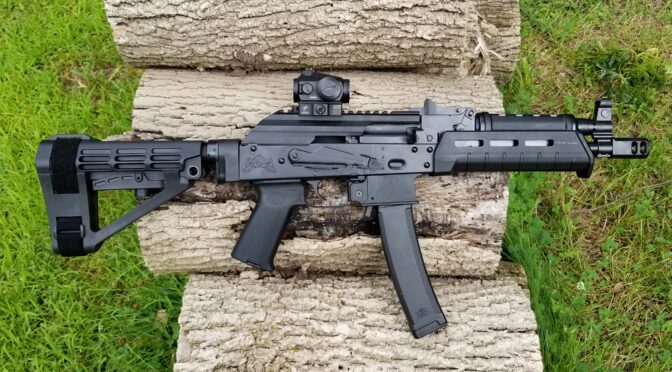
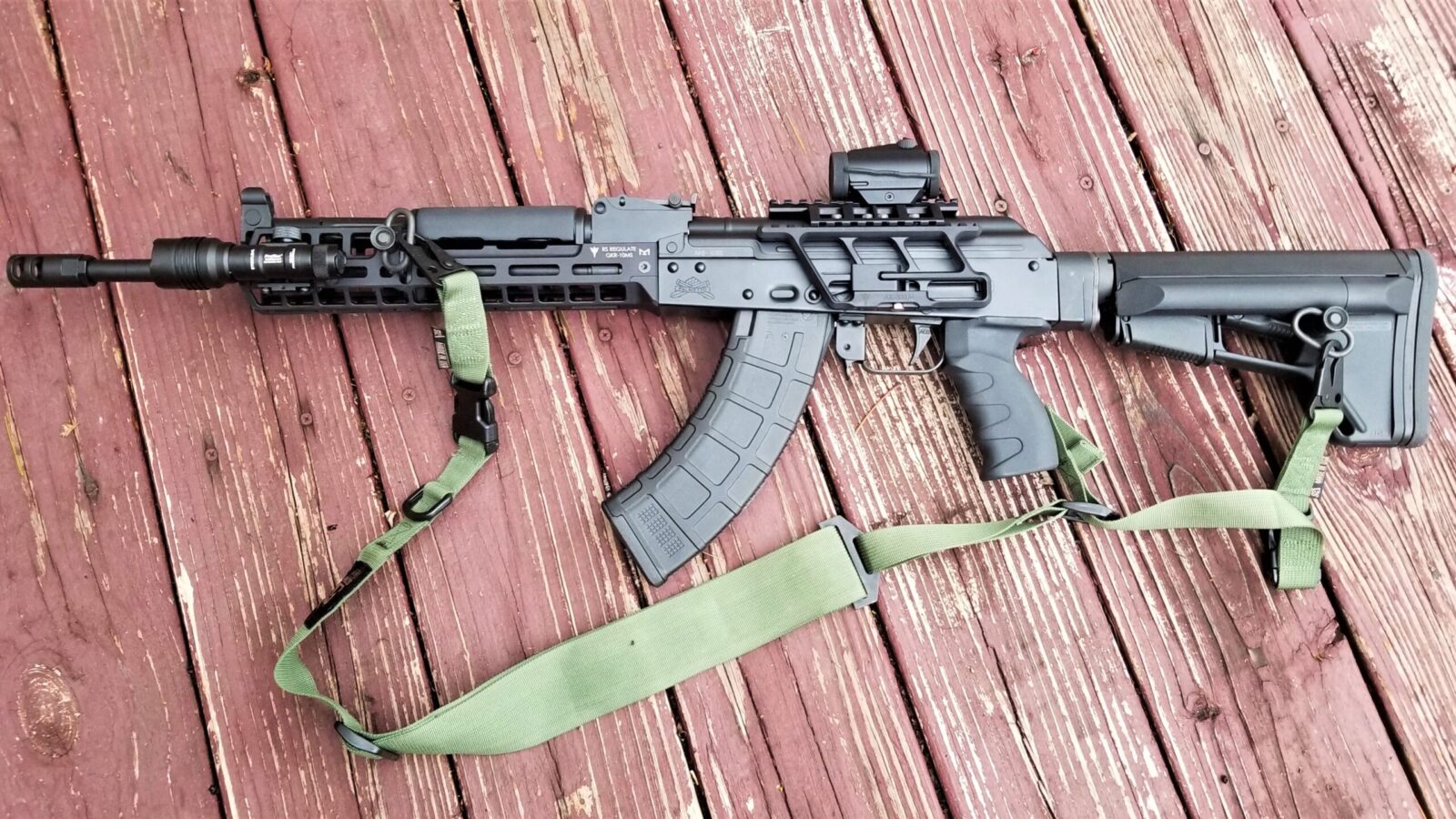
AK pistol with brace, red dot sight, and tactical handguard
This AK is using a Magpul ACS stock and even when fully compressed it’s far longer than 26″

So, overall minimum length needs to be at least 26″. End of the day, it’s your decision about how you meet it but you need to plan for it via some combination of barrel length and stock.

What about 922(r) compliance for foreign rifles?

To begin, let’s look at the law directly from house.gov concerning 922(r):

(r) It shall be unlawful for any person to assemble from imported parts any semiautomatic rifle or any shotgun which is identical to any rifle or shotgun prohibited from importation under section 925(d)(3) of this chapter as not being particularly suitable for or readily adaptable to sporting purposes except that this subsection shall not apply to-

(1) the assembly of any such rifle or shotgun for sale or distribution by a licensed manufacturer to the United States or any department or agency thereof or to any State or any department, agency, or political subdivision thereof; or

(2) the assembly of any such rifle or shotgun for the purposes of testing or experimentation authorized by the Attorney General.

What follows is my opinion and is not legal guidance – because the 922(r) compliance pertains to the assembling of rifles from foreign parts – it does not apply to domestically manufactured weapons using domestic parts – an AR fully made in the US from US parts is not within the scope of 922(r).

What I would tell you is that the any imported pistols were approved for importation and registered with the ATF as pistols. The receivers to be specific were recorded as pistols and still are pistols. In other words, even with the weapons configured as rifles, the receivers are still registered as pistol receivers with the ATF and thus not subject to 922(r). In the eyes of the ATF, the receiver classification is what matters.

To be perfectly clear, this is my opinion, I am not a lawyer and this is not legal advice. What really matters is what we hear from the ATF as this progresses. Don’t hold your breath though as they may never provide additional guidance on this – the ATF frequently leaves things vague and open for interpretation.

1/21/2023 Update: The Final Rule is such a mess that we all need to act and not let it pass. If you aren’t a member of Gun Owners of America (GOA), I recommend them. This rule has a fatal flaw that will trap gun owners and must not pass. Be sure to watch the following video of an interview with Steven – an attorney with GOA – who was at the SHOT show:

Summary

To meet the 16″ minimum barrel requirements you can replace your barrel with one that is at least 16.5″ long or extend your barrel with a permanently attached muzzle device so it is at least 16.5″ long. Find out which works best for you in terms of costs, looks and performance. Also, be sure to consider your overall length as part of your planning and revise your weapon accordingly.

Where to go for parts?

I’ll just list AK and AR websites – for others you will need to do some searching:

First off – parts and tools overall – check out Brownells.

AK parts vendors

AR parts vendors


Please share the link on Facebook, Forums, with colleagues, etc. Your support is much appreciated and if you have any feedback, please email us in**@*********ps.com. If you’d like to request a report or order a reprint, please click here for the corresponding page to open in new tab.


What does the January 2023 ATF Brace Ruling Mean? What you need to know

Well, on Friday, January 13th, 2023, the ATF decided to post their final ruling on stabilizing braces. Technically, the US Attorney General signed off on ATF final rule 2021R-08F “Factoring Criteria for Firearms with Attached ‘Stabilizing Braces'”. I’ve had a dozen guys asking me for my thoughts on this so I decided to write a post. The post will have two parts – how we got here, the ruling itself and will it get struck down?

Please note that I am not an attorney and this is not legal advise. It is critical that you read the actual final rule and follow it as well as any state or local laws that might apply.

How did we get in this mess?

There are a number of elements that make gun control a complex and thorny matter. For the sake of brevity, I am going to highlight some factors that I think are key to understand:

Political Theater

First off, firearms are part of political theater with politicians and parties trying to push their agenda. Democrats want to ban or at least regulate everything. Republicans splinter and want little to no regulation and then you have the independents. It sounds like three groups but really these groups are made up of different people from different regions with different cultures …. it’s really not possible to lump them all into one category. For example, former presidents Gerald Ford, Jimmy Carter and Ronald Regan supported a ban on “semi-automatic assault guns”. Jeff Brooks, a Democratic Representative tried to remove the assault weapons ban from the crime bill. The US Congress passed a 10 year ban in 1994 and President Bill Clinton signed it into law.

Watching the ping pong back and forth on gun control is very frustrating and at the heart of it I always think to myself “the criminals don’t care about the law and all you are doing is penalizing law abiding citizens”.

Not to mention I still don’t get why people can’t understand the Bill of Rights and the Second Amendment “A well regulated Militia, being necessary to the security of a free State, the right of the people to keep and bear Arms, shall not be infringed.” That seems very self-explanatory with strong direct verbs – “shall not be infringed” – yet here we are … again.

What often causes the pressure to enact firearms laws or regulations?

Ok, let’s think about it for a minute – what led to banning braces and a ton of other gun laws? Politicians and bureaucrats are driven by a complex set of factors:

  • People watching TV and movies and most, if not all, they know about firearms comes from there. TVs and movies rarely show anything remotely resembling reality whether it is firearms that never run out of ammo, shooters with no experience making expert shots, impossible scenarios …. all in the name of viewers and money. These people then form opinions and talk to their representatives.
  • Popular media and news freaks out every time there is a shooting demonizing the firearms and sensationalizing the fears. Why? They make money of viewers because the larger the audience then the more advertising and subscriber money they get. Again, people talk to their representatives
  • There is also this desire in some areas of the US to drive risk to zero – to get rid of the boogeyman or the monsters that may lurk in the shadows. Getting rid of risk completely is impossible and the rights of gun owners do not stop where your fears begin. People wanting to commit horrible acts will always find a way whether it is ignoring gun laws and safe zones or move to another weapon.
  • Politicians are driven by needs for power, money and the support, if not worship, of their supporters because they want to be re-elected. Always remember, there is more money and power to be had from stoking division than there is in solving a problem. In many cases the politicians want an us vs. them scenario they can rally people to and get more money and power.
    • Heads of Federal and State agencies wanting more money, power and influence contribute to this as well. Playing to fears, politics and thinking of their next step towards more power, fame, salaries or cushy future roles as consultants or lobbyists.
    • Federal agencies have shifted to being political instruments and are violating their duties. All legislative power rests with the US Congress. The Executive Branch can only issue regulations under the authority of laws enacted by Congress. Article I, Section 1 of the US Constitution states “All legislative Powers herein granted shall be vested in a Congress of the United States, which shall consist of a Senate and House of Representatives.” [Click here to read more]

The above is off the top of my head. So, why does what I just wrote matter?

First off, the ATF is making it’s own laws because Congress can’t pass gun control. Individual congress people don’t want to come down on the wrong side of their supporters and not get re-elected or lose funding so there has traditionally been a big stalemate.

The support for gun control ebbs and flows over time plus it really depends on what part of the country you are from – say a big city with a violent crime problem where politicians blame the guns vs the criminals or from rural America who views things very differently.

Speaking of the NFA and GCA

A fun part of history that shows yet more politics and back door agreements are the National Firearms Act of 1934 (NFA) and the Gun Control Act of 1968 (GCA). The NFA went after the “scary” fully automatic weapons plus rifles and shotguns shorter than 26″ and silencers by imposing a then large tax amount of $200 per weapon.

The length provision for short barreled rifles (SBRs) and short barreled shotguns (SBSes) was to try and close a handgun prohibition that was dropped before the NFA was passed. Yes, the SBR and SBS sections are hold-overs when they didn’t want people to cut down rifles or shotguns to make pistols but when the pistol section was dropped, the SBR and SBS sections remained. Guess what the minimum length of the rifle barrels was? 18″ – they set that minimum for both rifles and shotguns as part of the NFA.

Wait, isn’t it 16″ today for rifles and 18″ for shotguns today? What happened? Let’s set the stage -gun control wasn’t going well and then JFK was assassinated and people felt mail order guns should not be allowed. Then, Dr. Martin Luther King was assassinated in April 1968 and then Robert Kennedy was assassinated in June 1968. Enough was enough and the GCA was pushed through Congress. Section 921 (8) defined as short-barreled rifle as one with a barrel less than 16″. What??

My favorite firearm historian is Ian McCollum of Forgotten Weapons. I find his videos and writing to be exceptionally well researched. He reports that the US government sold about 250,000 M1 carbines to the US public with illegally short barrels. Rather than try and enforce it, Congress changed the barrel length.

Oh Yes, the Braces…

As mentioned on Friday 13th, after receiving tons of comments about stabilizing braces and having waffled repeatedly over about whether braces were legal or not, the ATF issued its final rule.

Now let’s put this in context, in their PDF the ATF states they have been evaluating various designs of braces since 2012. A prototype of the cuff–type stabilizing brace that would later become the SB15 was submitted for review on November 8, 2012. On page 20 of the PDF, the ATF shows pictures and describes the scenario.

It’s important to read the pages. They knew what was going on the whole time. In September 2014 a sample was provided of a Blade AR pistol stabilizer. Page after page documents the drama unfolding.

By page 36, the ATF notes that by July 2018, SB Tactical was marketing braces as ATF compliant. The ATF notified SB Tactical on July 18, 2018 that only 2 of their 20 stabilizing braces did not convert a pistol to a SBR. Let me stress that – only two of 20 passed muster. The ATF was of the opinion that18 of the 20 created SBRs. March 3, 2020 they reviewed two firearms – one with the SBL Mini brace and determined it was still a pistol. The other had the SBA3 and determined it was a SBR.

By the time we get to page 40, the authors of the PDF note that on June 16, 2020, seven members of the House of Representatives wrote to the DOJ and ATF leaders expressing deep concern about the creation of arbitrary non-public standards to create policy.

Now let me comment – Folks, ever since the ATF stopped publishing their opinions letters from the technical branch, we knew this lack of public visibility was going to be a problem and it has come home to roost. People should have been freaking out when the ATF stopped publishing their opinions. As a result a lot of their changes to sharing guidance, policies and direction have become opaque meaning we didn’t know what was going on. You need transparency for a government and regulation to work. This seriously needs to get fixed at some point.

We now have a complete debacle. By late 2020, the ATF concluded they had confused people and there was need for clarity. Yeah, no kidding. Bear in mind that eight years had gone by. Could they move quickly to remedy this? No – of course not. I’ll let you read the document to get the rest of the train wreck in motion. The the ATF and lawmakers (or let’s-not-do-anything-lawmakers) created his mess. SBRs are ridiculous in general and people trying to find a work around to enjoy their firearms was, and is, unavoidable.

The political theater that played out for almost 11 years let well over a million people buy firearms with braces that are now going to be considered SBRs with all the restrictions that owning a NFA weapon brings.

Let’s Get Down To The “Final Rule”

Please note that I am not an attorney and this is not legal advise. It is critical that you read the actual final rule and follow it as well as any state or local laws that might apply.

Let me tell you right up front the factoring guidelines and scoring are gone. If your pistol has a brace it will be a SBR once the final rule is published in the Federal Register and assuming some legal intervention doesn’t happen before its publishing. I’d be surprised if a legal action could happen fast enough but with millions and millions of dollars at stake, it might.

The best thing for you to read is the overall Frequently Asked Questions (FAQ) guide – click here to open that PDF. There is a high level quick reference sheet but I think most people will have questions best answered by the overall FAQ. If you need details then dive into the big Final Rule PDF.

They have assembled all of the documentation on one page on the ATF site where you can read the 293 page final ruling. Click here for the main page.

The quick reference guide shows you your main options if the rule goes into effect. In the main PDF, starting on page 270, there are interesting details that are included about removing the brace, that the firearm must be marked, etc. Let me list the options for current unlicensed possessors (normal gun owners in other words) and add in some comments – the numbers correspond with the options in the final rule and not the summary documents:

  1. Replace the short barrel with a barrel that is 16″ or longer plus the overall length must be at least 26″. They don’t mention the overall length in the ruling but keep that in mind as it still applies. By the way, another option is to install a barrel extension if you have a threaded muzzle but it must be permanently attached via welding, high temperature brazing or a blind pin. (1/17/2023 I wrote a blog post with much more guidance on this – click here for it.)
  2. Submit an E-From 1 within 120 days of the rule being published in the Federal Register to make your pistol a SBR. There is no wording about this being an amnesty situation or that you admit you have done something wrong. The ATF will waive the $200 registration tax during this 120 day period. By the way, if it is a personally made firearm (PMF) then you will need to mark the rifle pursuant to ATF regulations. You can keep the brace on the weapon during this period and must keep proof of submission of the E-Form 1. One would assume that if you go this route you will have a legal SBR and can change to a real stock. The negative is that your pistol would then be NFA weapon and subject to the additional rules that apply. By the way, to play it safe, if you decide to go this route then don’t wait until the last minute in case the E-Form website has problems.
  3. Remove the brace and there are some vague comments. Page 271 of the PDF states “Permanently remove and dispose of, or alter, the “stabilizing brace” such that it cannot be reattached, thereby removing the weapon from regulation as a “firearm” under the NFA.” You have 120 days to do this, but they don’t give you any additional guidance or realize the can of worms they just opened.

    “Permanently remove the brace” probably seemed simple to the authors of the rule for their purposes but this will create quite a burden for many because not all braces are simply bolted on. AR-style weapons will need pistol buffer tubes installed in order to operate. Other firearms, such as the AK now have a bigger problem – what to do with the no longer needed M4 buffer attachment point. Many AK-style pistols were designed with an adapter block that mounts under the rear AKM trunnion for the M4-style buffer tube. That block needs to be replaced or a stub tube – perhaps with a sling swivel installed in it – there can’t be enough area for shouldering.

    There are also AK pistols out there that use a folding rear trunnion like you would see on a “Krinkov” or Galil but with an M4 adapter on it to mount a buffer tube – you could either put in a stub tube or perhaps remove the rear hinge.

    The ATF will, no doubt, point back to the old guidance that pistols must not have a means to attach a stock or a SBR is created but at what point of removal or modification is it considered permanent? Can you use a stub tube mounted with a castle nut enough or does it need to be welded or blind pinned in place? If you grind or mill a M4 attachment point away, that would certainly be permanent. I would be pleasantly surprised if they provide this guidance – it is a guessing game because the ATF stopped publishing their letters.
  4. Forfeit the firearm at your local ATF office. Read this “Give up your pistol with a brace that cost you $500-2,500 of your hard earned money.”
  5. Destroy the firearm — this must be done in accordance with ATF and any state or local regulations about how to “destroy” a firearm because otherwise your name is still legally tied to the receiver and serial number should questions come up. Page 271 of the PDF states “ATF will publish information regarding proper destruction on its website, www.atf.gov. That tells you they haven’t figured out the details for that yet.

When will this get enacted?

A final rule such as this one must be published in the US Government’s Federal Register and that publishing is typically done in three business days but that is an average not a rule. The Federal Register does not set a deadline once they have a final rule because an agency could pull it because it needs revisions, is no longer needed or wants public comment. For further reference, click here for the rule making process.

Per the ATF, the rule goes into effect 120 days after it is published in the Federal Register.

Will this ruling get struck down, delayed or modified?

Certainly everyone is wondering about this. Given recent rulings with the EPA, the bump stock ban being struck down and even the “common use” SCOTUS opinion of 2008, the odds are very good it will be declared unconstitutional at the very least due to the overreach by the ATF creating law but what is less certain is how soon. We may be stuck with this new ruling for a bit until it is. Let’s take a moment and look at why it might get struck down:

The Supreme Court of the US and EPA Overreach

Now let’s bring up another recent court finding — In June 2022, the Supreme Court of the United States (SCOTUS) found that the Environmental Protection Agency (EPA) had committed an “overreach” and created law vs. Congress (remember, only Congress can pass laws) and so SCOTUS smacked down the EPA (here’s a popular article and click here for the actual SCOTUS finding.)

If this brace, bump stock, forced reset triggers or other items are brought before SCOTUS, odds are they will find that they have violated administrative procedure also. This would nullify these rulings.

Bump Stock Ruling Struck Down – Cargill v. Garland

President Biden made promises that things will happen but how? He can’t get Congress to do their jobs. The answer is executive actions and to push agendas with agencies such as the Department of Justice and the ATF. Just remember – President Trump did the same thing with the Bump-stock ban that has since unraveled. In the case of Cargill v. Garland the ruling in the Fifth Circuit Court of Appeals found that the bump stock ban violated the Administrative Procedure Act because the ATF usurped the powers of Congress – which means they took the place of Congress and they are not allowed to do that. (Click here for the actual court ruling)

Congress passed the National Firearms Act and Gun Control Act wherein they defined a machine gun based on how the trigger functioned. Bump stocks were not part of that law and the ATF was trying to bend things around to their own ends by setting criminal prohibitions. Now this is one district court’s opinion but it sets precedent so expect appeals and more legal and political wrangling.

SCOTUS and Firearms in Common Use

In 2008, SCOTUS found that the Second Amendment protects arms in common use at the time in their ruling on District of Columbia v. Heller. These arms are chosen by society and not the government. [For a good summary of common use, read this article at the NRA].

Firearms with braces are in common use. The ATF’s own Final Rule PDF file identifies there are 3,881 manufacturers producing pistols with braces and 1.4 million firearms owners who have pistols with braces. (See page 283 of the PDF) The number of impacted gun owners varies and some put it well into the 5-10 million range. The Congressional Research Service estimates 10-40 million braces in use so you can see there are a lot of firearms out there with braces. With well over a million legal gun owners would seem to show these are in common use.

By the way, if the ATF really had a huge issue with these in terms of public safety or whatever then they have had ample time to shut them down yet they did not and now tons and tons of them are in use.

1/21/2023 Update: The Final Rule is such a mess that we all need to act and not let it pass. If you aren’t a member of Gun Owners of America (GOA), I recommend them. This rule has a fatal flaw that will trap gun owners and must not pass. Be sure to watch the following video of an interview with Steven – an attorney with GOA – who was at the SHOT show:

Summary

In the continued tradition of penalizing law abiding citizens, politicians and the ATF have put this final rule forth. Once published in the Federal Register, millions of owners of braced firearms will need to decide what they are going to do next. It’s hard to say if a gun rights group or lawsuit can move fast enough to counter this rule. With this in mind, think through your options and decide on what you are going to do.

As it stands of my writing this, you will have 120 days to decide from when it is published in the Federal Register to decide and you better not wait until the last minute either. I’d recommend you watch what happens, figure out what you want to do and then make your move within 60-90 days of the rule publishing – that gives you time to see what happens and some buffer to get things done rather than waiting to the last minute and finding out what you want to do is out of stock, your gunsmith doesn’t have any time, etc.

I wish this hadn’t been set forth but at least there are options. Let’s hope that it gets struck down as unconstitutional before people are forced to decide and act. I’m betting a ton of lawsuits are going to get filed over the next couple of weeks so we will all have to wait and see.

Last comment – sorry for the red “I am not at attorney and this is not legal advice” squares in the text. I have concerns that I want to share but do not want anyone taking what I wrote as absolute guidance when the ATF doesn’t even know the details. A lot of this will come to light over time I hope or else this big mess will get even uglier.

Click here for a more detailed blog post about extending or replacing the barrel.

1/21 – while I was writing the follow on blog post about removing the brace, GOA pointed out the extremely flawed logic of the rule and I stopped writing. This bill will be a huge mess. Not only will gun owners with braces spend a lot of money trying to avoid creating a SBR but the whole SBR route is treacherous. Watch the video above. See what your favorite gun rights groups are doing and I very much recommend GOA because they actually get things done and not just suck up all your money with nothing to show for it.

More Reading

Stephen Gutowski is a journalist who tries to be as objective as he can be about firearm laws and regulations. He has a great subscription newsletter called “The Reload” that I highly recommend. He has a piece he authored on 1/13 in response to all of this entitled “ATF Bans Millions of Guns With New Pistol Brace Rule“. He also wrote a very good piece “Bump Stock Ban Struck Down” on January 6th, 2023

Ammoland’s John Crump has a good quick overview entitled “ATF Unveils Pistol Brace Rule … Everything Is An SBR!” dated January 13, 2023.


Please share the link on Facebook, Forums, with colleagues, etc. Your support is much appreciated and if you have any feedback, please email us in**@*********ps.com. If you’d like to request a report or order a reprint, please click here for the corresponding page to open in new tab.


Biden’s Gun Control Actions Announced At The April 8th, 2021, Press Conference

Well, President Biden caved to pressure and decided to do an executive order. While it hasn’t formally been published in the Federal Register yet the way it is supposed to be, I did create a quick summary of his April 8th, 2021, press conference based on a review of second hand articles:

  1. He told the DOJ they have 30 days to rule on “Ghost Guns” meaning firearms made at home. We’ll have to see what they do here because law abiding citizens have been making firearms at home for the entire history of this country. One leak suggested they may require people to get background checks before building a firearm – but to be clear, there is nothing official.
  2. He gave the DOJ 60 days to decide what to do on pistol braces. Unfortunately the mentally ill shooter in Minneapolis used one and the media keeps bringing that up to support the need to deal with them. All kinds of rumors are floating around – pistols in rifle calibers will require NFA registration, pistols in pistol calibers between a certain range of size and weight will be ok … it’s not clear what they will do but there are millions of these devices out there so they better think this through carefully especially when it comes to the existing owners.
  3. They are going to draft some kind of sample/model “red flag law” legislation that states can then optionally adopt. Note how the guidance is at the Federal level but actual adoption will be up to each state. On the surface one would think that getting guns out of the hands of a dangerous person would be a good idea but the problem is in terms of who gets to deem a person dangerous? Will it be any “concerned” citizen calling in and saying someone is unsafe, will it be a judge, a panel? Will they truly be fair and impartial? There are a ton of problems here to sort out.
  4. The Justice Department will issue a report on firearms trafficking. I expect the findings will be tailored to fit their political narratives vs. being impartial.
  5. The administration will make more investments in community violence prevention programs aimed at reducing gun violence.
  6. He announced David Chipman as his pick to head the ATFE. The was an ATF agent but as been a senior advisor to the anti-gun group founded be Gabrielle Giffords. Whether he can pass the Senate nomination process or not is unknown.

His administration promised that there is more to come. You’ll notice he keeps trying to push this toxic topic back to lawmakers who are divided and nothing has been accomplished since the election.

What this does highlight is that despite campaign rhetoric, Biden has limited options when it comes to gun control otherwise he would have made far more dramatic moves. Gun control tends to damage political campaigns of politicians and I think the President needs to carefully thing through where he will spend his political capital.


Whitehouse Logo Image Source: https://commons.wikimedia.org/wiki/White_House#/media/File:US-WhiteHouse-Logo.svg


Please share the link on Facebook, Forums, with colleagues, etc. Your support is much appreciated and if you have any feedback, please email us in**@*********ps.com. If you’d like to request a report or order a reprint, please click here for the corresponding page to open in new tab.