The current geopolitical and domestic standing of Vladimir Vladimirovich Putin represents the culmination of a twenty-five-year project to institutionalize personalist autocracy within the Russian Federation. This report, synthesized by a multi-disciplinary team of national security, foreign affairs, and intelligence analysts, provides an exhaustive biographical and strategic evaluation of Putin as he enters a critical “window of maximum danger” in 2026.1 Born in the post-war ruins of Leningrad, Putin’s formative experiences in the KGB and the turbulent politics of the 1990s forged a leadership style characterized by an obsession with state stability, a profound distrust of Western liberal interventionism, and a reliance on a tight-knit circle of “siloviki” (security men) and personal proxies.4
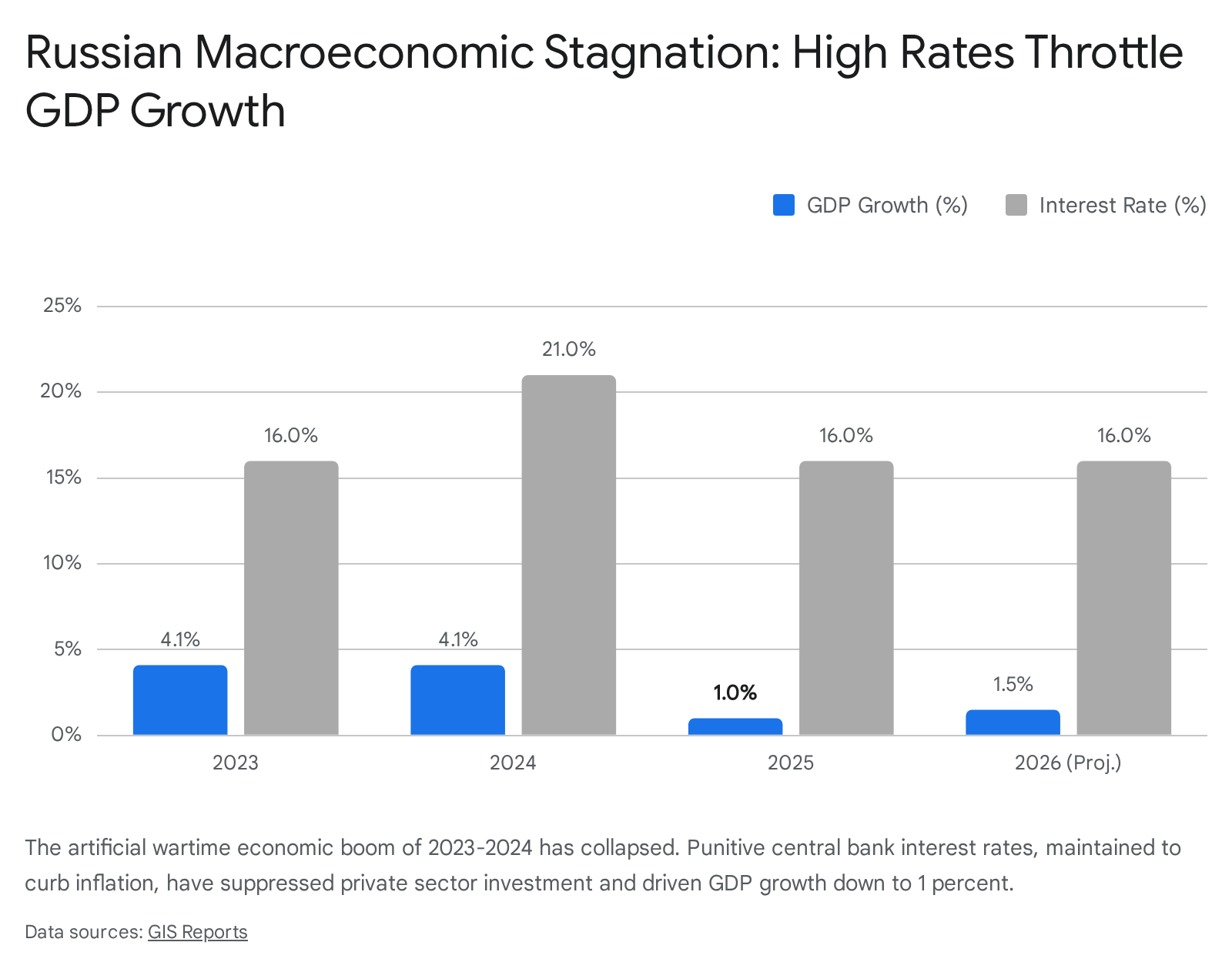
As of early 2026, Putin’s international posture is anchored in a “no limits” partnership with China’s Xi Jinping and a burgeoning “Global Majority” narrative designed to insulate Russia from Western isolation.8 However, the regime faces intensifying structural pressures. The Russian economy is currently characterized by “military Keynesianism,” with defense spending exceeding 9% of GDP—a level that historical parallels suggest is unsustainable—and an overheating domestic market forced to endure 21% interest rates to curb inflation.1 Furthermore, the depletion of Soviet-era conventional military reserves suggests a transition toward a “hybrid escalation” strategy in 2026, involving intensified sabotage and subversion across Europe and North America.1
Domestically, Putin has initiated a “transition without a successor,” restructuring the state to favor a younger generation of “princelings”—the children of his closest allies—while strengthening the State Council as a vehicle for his own continued strategic oversight.14 While figures like Alexei Dyumin and Dmitry Patrushev are frequently cited as potential heirs, the system is designed to keep elites in a state of perpetual competition, ensuring that the ultimate arbiter remains Putin himself.
The Crucible of Leningrad: Early Life and Formative Influences
Vladimir Putin’s worldview is inextricably linked to the environment of his birth on October 7, 1952, in Leningrad (now Saint Petersburg). Growing up in a communal apartment in a city that had survived one of the most brutal sieges in human history, Putin was raised by parents who had endured extreme hardship; his mother, Maria Ivanovna Putina, was a factory worker, and his father, Vladimir Spiridonovich Putin, was a veteran of the NKVD’s destruction battalions who had served in the submarine fleet during the early 1930s. A significant but often overlooked biographical detail is that his grandfather, Spiridon Putin, served as a personal cook to both Vladimir Lenin and Joseph Stalin, establishing a generational, if peripheral, proximity to the absolute center of Soviet power.
Putin’s childhood was spent in the “podvorotnya” (back alleys) of Leningrad, a rough social environment where he learned that the only way to avoid victimization was through physical strength and preemptive action. At age 12, he began practicing sambo and judo, martial arts that would provide a physical outlet and a lifelong philosophical framework emphasizing the exploitation of an opponent’s weaknesses.
Born into post-war hardship; grandson of the Kremlin’s personal cook.
1960
Schooling Begins
Early interest in humanities and the German language; described as a “bully, not a pioneer”.
1964
Martial Arts Training
Starts Sambo/Judo; develops “strike first” philosophy and disciplined aggression.
1970
University Enrollment
Studies Law at Leningrad State University; mentored by Anatoly Sobchak.
1975
KGB Recruitment
Graduates with thesis on international law; begins foreign intelligence training.
1975-85
Early KGB Career
Works in counterintelligence (2nd Chief Directorate) and monitoring foreigners.
1985-90
Posting to Dresden
Served in East Germany during the collapse of the Berlin Wall; experienced the “Moscow is silent” trauma.
1990
Return to Leningrad
Retires from active KGB service as Lieutenant Colonel; returns as university prorector.
The Rise to Power: 1991–1999
Putin’s political career began as an assistant to Anatoly Sobchak, his former law professor who had become the first democratically elected mayor of St. Petersburg. Throughout the early 1990s, Putin rose to become the first deputy mayor, managing the city’s external relations and international investments.
Table 2: The Rapid Ascent to Federal Power (1991–2000)
Position
Period
Core Responsibility & Impact
First Deputy Mayor (St. Petersburg)
1991–1996
Managed external relations and foreign investment; oversaw the “Oil-for-Food” program.
Deputy Chief, Presidential Property
1996–1997
Managed assets of the former Soviet state and Communist Party abroad; moved to Moscow.
Main Control Directorate Chief
1997–1998
Acted as the Kremlin’s internal auditor; gained leverage over regional governors.
Director of the FSB
1998–1999
Reorganized the domestic security service; focused on re-establishing agency effectiveness.
Security Council Secretary
1999
Coordinated national security strategy during the early phase of the Chechen conflict.
Prime Minister / Acting President
1999–2000
Launched Second Chechen War; anointed as Yeltsin’s successor on Dec 31, 1999.
The Inner Circle: Personal Bonds and “The President’s Wallet”
Putin’s power base is a network of personal, often transactional, relationships.17 Intelligence and investigative reports highlight a group of “proxies”—individuals who hold enormous wealth registered in their names but are not publicly active businessmen.
Table 3: Key Members of the Inner Circle and Proxies
Individual
Category
Connection & Economic/Political Role
Arkady Rotenberg
Childhood Friend
Billionaire contractor (SGM Group); built Crimea Bridge; Chairman of Hockey Federation.5
Sergei Roldugin
Personal Proxy
Professional cellist and godfather to Putin’s daughter; controlled offshore firms moving $2B.
Nikolai Patrushev
Siloviki (KGB)
Long-time security chief; now Presidential Aide on Shipbuilding; father of Dmitry Patrushev.14
Igor Sechin
Siloviki (Aide)
CEO of Rosneft; leader of the “force” faction; primary energy sector dominant.
Yuri Kovalchuk
Ozero Associate
Majority owner of Bank Rossiya; “The President’s Banker”; media conglomerate owner.5
Gennady Timchenko
Ozero Associate
Energy trader (Volga Group); under US sanctions; major figure in Night Hockey League.5
Anna Tsivileva
Family (Cousin)
Deputy Defense Minister; arguably the most powerful woman in contemporary Russian politics.23
Katerina Tikhonova
Family (Daughter)
Heads Innopraktika; becoming a major center of power in the business and tech world.
Mikhail Shelomov
Family (Relative)
Distant relative; amassed $573M fortune despite modest official state salary.
International Relations: Respect and Historical Revisionism
Putin views world leaders through a hierarchy of respect based on sovereignty and centralized power.8 He also finds legitimacy in historical imperial figures who modernization through “unwavering firmness”.
Table 4: Key World Leader Relationships and Historical Influences (2026)
Leader / Figure
Role / Impact
Nature of Putin’s Respect & Strategic Alignment
Xi Jinping (China)
Contemporary Peer
Viewed as his “best friend” and most significant peer; shared goal of dismantling U.S. order.8
Narendra Modi (India)
Contemporary Partner
Viewed as a critical “balancer” against China; Putin respects India’s hedging and strategic autonomy.
Viktor Orbán / Robert Fico
European Partners
Respected for prioritizing national sovereignty and challenging EU consensus on energy/migration.
Donald Trump (USA)
Tactical Wildcard
Respected for populist strength; viewed as a figure whose “America First” policies weaken Western alliances.
Alexander III
Historical Icon
Primary role model for protecting the nation from turmoil through conservative domestic policies.
Peter the Great
Historical Icon
Role model for “returning” and “strengthening” Russian territories via imperial conquest.
Prince Vladimir
Spiritual Icon
Cited as the foundation for the “historical unity” of Russia, Ukraine, and Belarus.
Security of Position: Stability and Internal Vulnerabilities
As of early 2026, Putin’s position enters a period of structural fragility characterized by the “Anchorage formula” negotiations and military exhaustion.
Table 5: Economic and Military Constraints in 2026
Metric
Status (Early 2026)
Strategic Implication for Regime Stability
Military Spend
>9% of GDP
Approaching unsustainable late-Soviet levels; crowds out civilian development.1
Interest Rates
16.5% – 21%
Managed cooling has turned to stagnation; severe drag on non-military business.11
Oil/Gas Revenue
Down 34% YoY
Sanctions and discount pricing erode the primary state revenue source.1
VAT Rate
Increased to 22%
Designed to refill war coffers but erodes domestic purchasing power and real income.11
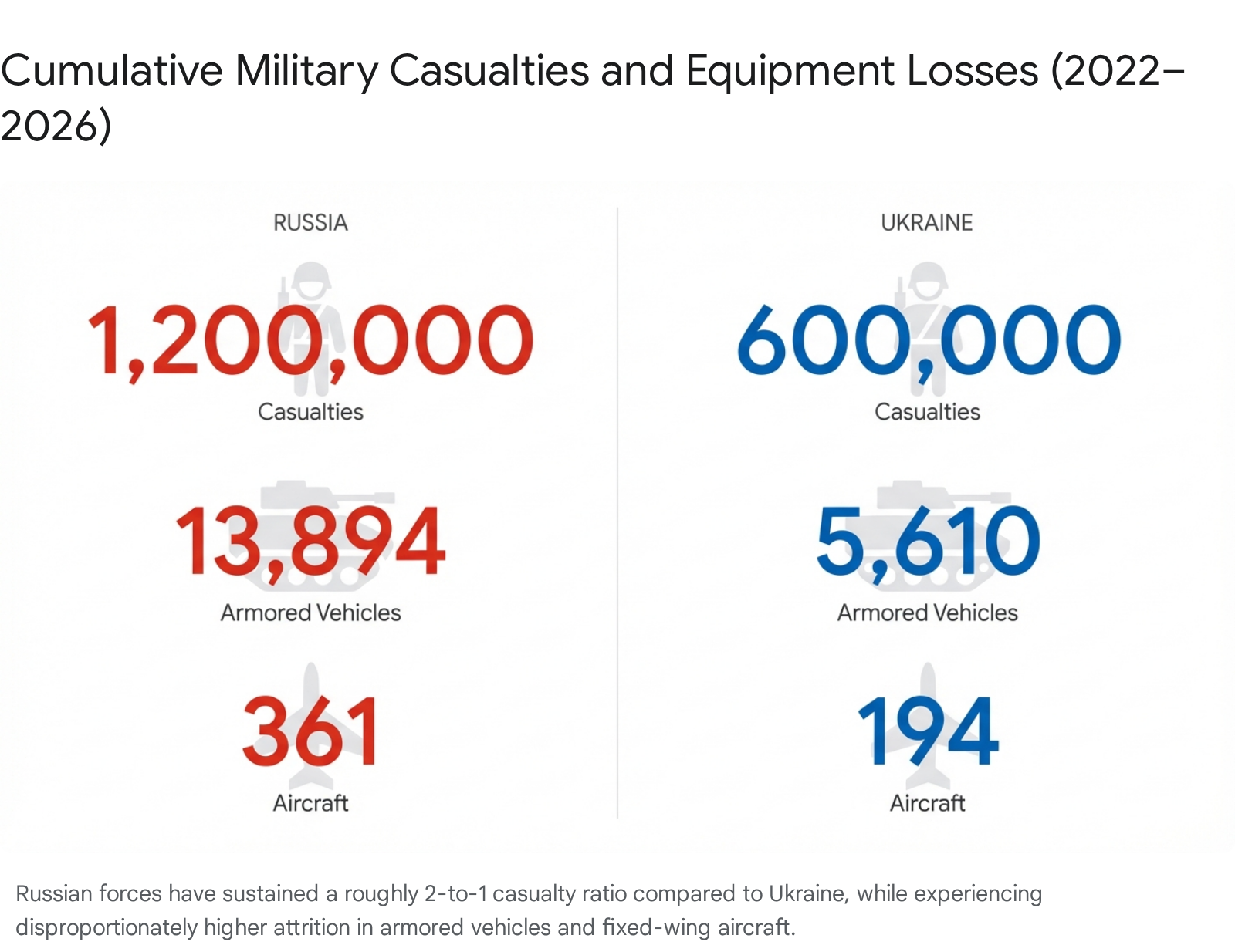
Casualties
~1.1 to 1.2 Million
High costs exploited by Western intelligence to generate internal disaffection.
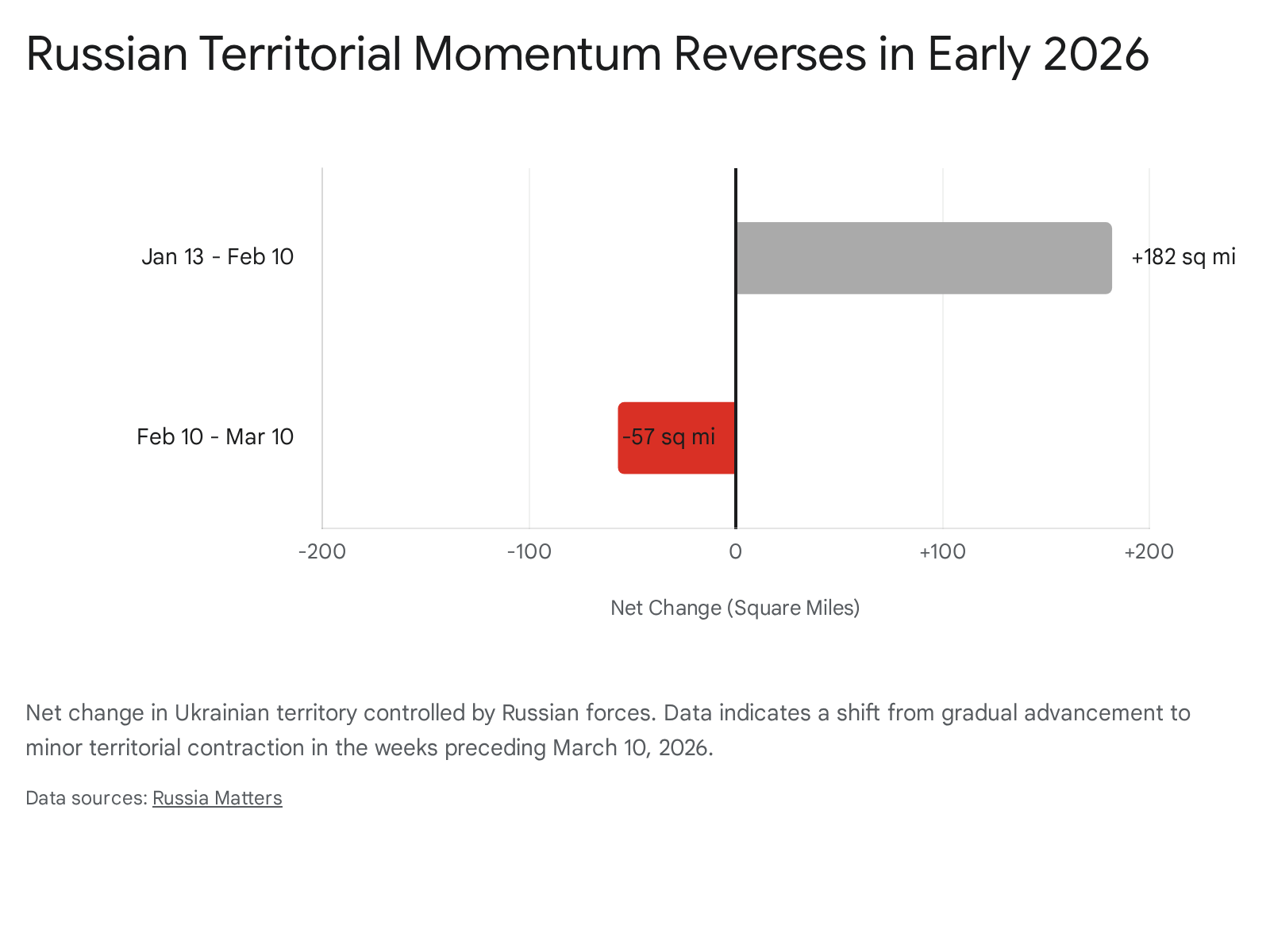
Territorial Seizure
~2% total ground
Grind-down rate of 50m per day highlights conventional military exhaustion.
The Succession Landscape: Candidates and “Princelings”
The current strategy is “Institutionalized Putinism,” favoring a generation of younger loyalists who can preserve the system under Putin’s strategic oversight.
Table 6: The Succession Matrix (2026 Candidates)
Candidate
Current Role
Succession Profile & Clan Affiliation
Alexei Dyumin
State Council Secretary
De facto “vice-president”; former bodyguard; belongs to no established clan; total personal trust.
Dmitry Patrushev
Deputy Prime Minister
Groomed successor; son of Nikolai Patrushev; credentialed via high-level meetings with PM Modi.
Mikhail Mishustin
Prime Minister
Constitutional heir; technocratic skill; lacks a personal “force” (siloviki) base.
Boris Kovalchuk
Accounts Chamber Head
Son of Yuri Kovalchuk; central figure in redistributing assets to the second generation.
Andrey Turchak
Governor (Pskov)
St. Petersburg “prince”; war hawk; leader of the United Russia apparatus.10
Anna Tsivileva
Deputy Defense Minister
Relative of Putin; rising star in social and defense administration; most powerful woman in politics.23
The Daughters
Business/Science Power
Maria Vorontsova and Katerina Tikhonova; influential centers of business power; ready for public roles.
Conclusion and Strategic Outlook for 2026
The political biography of Vladimir Putin in 2026 reveals a leader whose “Security of Position” remains high due to the lack of organized internal opposition, but whose state is reaching a critical inflection point. The predicted 2026 “window of maximum danger” suggests that the regime will increasingly rely on hybrid escalation—sabotage, subversion, and nuclear rhetoric—to maintain the illusion of being a resurgent great power as conventional military options diminish.1 The managed transition currently underway aims to cement a feudal elite of younger loyalists whose primary qualification is their personal connection to the Sovereign Arbiter.
The strategic situation of the Russian Federation for the week ending January 31, 2026, is characterized by a deliberate transition from short-term military surges into a permanent state of strategic continuum, where diplomatic activity and kinetic operations are leveraged as complementary instruments of a single policy objective.1 Following the high-profile meeting between Ukrainian President Volodymyr Zelensky and U.S. President Donald Trump in Florida in late December 2025, the Kremlin has recalibrated its narrative to emphasize its own persistence against what it views as cyclical Western political maneuvers.1 This week, Russian diplomacy has intensified its focus on the “Great Eurasian Partnership” while simultaneously managing the fallout from unprecedented geopolitical developments in the Western Hemisphere, specifically the U.S.-led intervention in Venezuela.2
On the kinetic front, the Russian military continues a grinding war of attrition in Ukraine, prioritizing incremental gains in the Donetsk and Zaporizhia sectors.4 Despite immense casualty rates reaching nearly 1.2 million personnel since the full-scale invasion began, the Russian command maintains a posture of “grinding down” the opposition, betting on the eventual exhaustion of Western support.5 A significant development this week is the Kremlin’s acknowledgement of a temporary, week-long moratorium on strikes against Ukrainian energy infrastructure in Kyiv, ostensibly at the personal request of President Trump.4 However, intelligence suggests this is a tactical pause designed to allow for the replenishment of missile stockpiles and to serve as a cognitive warfare tool rather than a move toward a durable ceasefire.6
Economically, the Federation is entering a period of significant contraction. The International Monetary Fund has slashed Russia’s 2026 growth forecast to a mere 0.8 percent, as the “sugar rush” of 2024’s military spending fades.8 The private sector has begun adopting “tactical poverty” measures, including wage freezes and bonus cuts, to manage the combined pressure of rising taxes, high interest rates, and a 46 percent projected decline in oil and gas receipts for January 2026.8 Domestically, the state has further consolidated control through a new “Digital Sovereignty Doctrine,” which moves beyond cybersecurity into a model of total digital isolation and state oversight of artificial intelligence and personal devices.12
Strategic Indicator
Current Metric (Jan 2026)
Historical Context (2025)
Directional Trend
GDP Growth Forecast
0.8%
1.0%
Declining 8
Value-Added Tax (VAT)
22%
20%
Increasing 11
Oil/Gas Revenue Change
-46% (Jan projection)
-24% (Annual 2025)
Sharply Declining 8
Central Bank Interest Rate
16%
21% (Peak)
Stabilizing/High 11
Conscription Target
261,000 (Year-round)
Seasonal Campaigns
Structural Shift 13
Diplomatic and Foreign Affairs Analysis
The Russian Ministry of Foreign Affairs (MFA), under Sergey Lavrov, has spent the final week of January 2026 attempting to define a post-“rules-based” international order.2 The primary theme in Moscow’s rhetoric is the failure of Western efforts to isolate Russia, citing the successful 80th-anniversary celebrations of Victory Day in 2025 and the expanding reach of the BRICS association as evidence of a multipolar reality.2
The Venezuela Crisis and Global Narrative Competition
The capture and removal of Venezuelan President Nicolas Maduro by United States forces in early January 2026 has provided the Kremlin with a powerful rhetorical weapon.2 Moscow has characterized this intervention as a “blatant armed intervention” and a return to the “might is right” principle of international relations.2 By framing the U.S. actions in Venezuela as a violation of sovereign equality, Russia aims to consolidate its standing among Global South nations that are wary of Western interventionism. The MFA’s emphasis on “universal norms of international law” in the context of Venezuela is a calculated attempt to highlight perceived Western hypocrisy, particularly as Russia continues its own operations in Ukraine.2
Russia’s diplomatic reaction to the Venezuela crisis is not merely about solidarity with a fallen ally; it is a defensive maneuver intended to signal to other partners in the Latin American and Caribbean regions—specifically Cuba—that Moscow remains a vocal, if not physically capable, defender of their sovereignty against “external interference”.15 This narrative is further bolstered by China’s rejection of U.S. tariffs on Cuba and continued oil shipments from Mexico, suggesting a growing non-Western consensus against U.S. regional policy.15
Strategic Realignment in the Middle East: The UAE Nexus
The arrival of UAE President Sheikh Mohammed bin Zayed Al Nahyan in Moscow on January 29, 2026, marks a critical inflection point in Russia’s Middle Eastern strategy.17 The relationship has evolved into a “multi-vector power broker” dynamic, where the UAE serves as a vital economic and diplomatic conduit for the Russian state.18
Russia-UAE Economic Cooperation
Metric (Jan 2026 Data)
Strategic Significance
Annual Trade Volume
>$12 Billion
Record growth despite sanctions 19
Registered Russian Companies
~4,000
Hub for sanctions circumvention 20
Russian Capital in UAE Economy
>$30 Billion
Diversification of sovereign assets 20
EAEU-UAE Trade Status
97% Duty-Free
Facilitates non-commodity exports 20
The UAE is now recognized as Russia’s primary “economic lung,” providing the financial infrastructure necessary to bypass G7 sanctions and the Magnitsky Act.18 The “Iranian track” within this relationship is particularly notable; Moscow and Abu Dhabi are increasingly utilizing Hawala networks and cryptocurrency mixers to facilitate transactions that avoid the SWIFT messaging system, involving actors as varied as the Quds Force and the Central Bank of Russia.18 Beyond finance, the UAE has institutionalized its role as a mediator in the Ukraine conflict, facilitating high-stakes prisoner exchanges and serving as a “neutral ground” for trilateral dialogues involving the United States.18
The Sino-Russian Comprehensive Partnership
As 2026 begins, the Russia-China relationship is described by both Moscow and Beijing as having reached “unprecedented” levels of depth.2 This year marks the 30th anniversary of their strategic partnership and the 25th anniversary of the Treaty of Good-Neighborliness and Friendly Cooperation.22 The military-to-military cooperation has become a cornerstone of regional stability from the Kremlin’s perspective, with defense ministers conducting regular high-level video talks to enhance strategic coordination on “core interests”.22
Chinese President Xi Jinping’s New Year messages to President Putin emphasized a “concrete step” in the partnership, citing reciprocal visa-free policies and the steady progress of the energy corridor.24 For Russia, the alignment with China is not just a secondary option to the West; it is the material base for the “Great Eurasian Partnership,” a project designed to create an “equal and indivisible security” architecture across the continent that excludes NATO influence.2
Mediation and Power Projection in the Levant and Iran
Russian diplomacy in the Levant and the Gulf is characterized by a “conservative force” approach, aiming to contain centrifugal processes and maintain the territorial integrity of established states like Syria and Iraq.17 In Syria, Russia is performing a delicate balancing act, withdrawing forces from Qamishli airport to build goodwill with the Damascus government while planning the expansion of its Hmeimim air base and Tartous naval facility.17 This move signals to the Syrian government that Russia will not be drawn into localized fighting with Kurdish forces as Damascus seeks to reassert central authority.27
Regarding Iran, Russia has positioned itself as the only major power capable of mediating between Tehran and Washington.28 The Comprehensive Strategic Partnership Treaty signed in January 2025 has granted Moscow significant leverage, including a proposed role in monitoring the Iranian nuclear enrichment cycle.26 By advocating for the temporary removal of enriched uranium to Russian territory, Moscow seeks to prevent a military solution by the U.S. or Israel while securing its own position as an indispensable regional security actor.26
Intelligence and National Security Assessment
The intelligence picture for the week ending January 31, 2026, reveals a Russian military that is structurally committed to a long-war logic, despite clear evidence of tactical stagnation and internal command friction.1
Frontline Dynamics and Command Investigations
Russian offensive operations during this period have remained focused on the Donetsk and Zaporizhia sectors, with confirmed advances noted near Lyman and the Kostyantynivka-Druzhkivka tactical area.4 However, the pace of these advances remains historically slow, with troops progressing at rates as low as 15 to 70 meters per day.5
Combat Sector
Status/Observation
Intelligence Implication
Vovchansk Direction
Investigation into lack of progress
Potential relief of command for Northern Grouping 4
Kupyansk Sector
Exaggerated claims of success
Disconnect between Gerasimov’s reports and ground reality 4
Lyman Axis
Recent geolocated advances
Sustained pressure on Ukrainian logistics 4
Western Zaporizhia
Seizure of Lukyanivske
Attempt to widen the Orikhiv salient 4
The Russian General Staff continues to project an image of confident advancement, with Valery Gerasimov claiming significant successes near Kupyansk-Vuzlovyi.29 However, field reports indicate a more complicated reality, including the presence of “forgotten” Russian units in northern Kupyansk who are reportedly being misled by their own command about terrain control to prevent their surrender.4 In the Vovchansk direction, the appointment of a commission to evaluate the lack of progress suggests that the Russian Northern Grouping of Forces is under significant pressure to deliver results after months of static engagement.4
Infrastructure Strike Moratorium as Cognitive Warfare
The reported week-long moratorium on strikes against Kyiv’s energy infrastructure is a significant tactical development with deep strategic implications.4 While framed by the U.S. administration as a gesture of goodwill following a personal request from President Trump, intelligence analysts view the pause as a “cognitive warfare” maneuver.6
The mechanism of this moratorium serves three primary Russian interests:
Stockpile Replenishment: The pause allows Russian forces to amass drone and missile inventories for future combined strikes, effectively resetting their operational tempo.6
Political Signaling: It portrays the Kremlin as a “reasonable” actor capable of honoring requests from the U.S. presidency, thereby driving a wedge between various Western factions regarding the necessity of continued military support.6
Strategic Denial: By limiting the moratorium to a very short duration (until February 1) and rejecting any long-term ceasefire, the Kremlin ensures it maintains the ability to use energy strikes as a coercive tool during the harshest winter months.4
Technological Adaptation: Molniya Drones and Starlink
The Russian military’s rapid adoption of Molniya fixed-wing FPV drones represents a critical technological shift.6 These low-cost systems, now being equipped with Starlink satellite terminals, are being used for “battlefield air interdiction” (BAI).6 By targeting vehicles on Ukrainian highways at operational depths of 25 to 100 kilometers—specifically the E-50 Pokrovsk-Pavlohrad highway—Russia is attempting to paralyze Ukrainian logistics and troop rotations far behind the immediate contact line.6
This technological evolution is paired with a strategic recruitment drive. The Ministry of Defense is actively recruiting for its Unmanned Systems Forces (USF) at top Russian universities, offering massive salaries of up to 5.5 million rubles per year to students.6 This program targets both male and female students, indicating a desperate need to professionalize the drone operator corps and move away from reliance on poorly trained volunteers.6
Iskander Deployments and Escalation Capability
Satellite imagery from January 2026 has confirmed the establishment of at least nine new launch sites for Iskander missile systems near the Ukrainian border and in occupied Crimea.30 These locations, including Klintsy and Molykino, feature fortified shelters and camouflaged hardware positions.30
Iskander Launch Site Location
Status (Jan 2026)
Strategic Purpose
Shumakovo (Kursk)
Former base, unverified activity
Proximity to Sumy axis 30
Klintsy (Bryansk)
Fortified shelters identified
Threatening northern Ukrainian corridors 30
Molykino
Extensive permanent shelters
Primary deployment hub 30
Novoselivske (Crimea)
Active launch points
Strikes against southern logistics 30
The intelligence indicates that Russia conducted approximately 492 Iskander launches in 2025, and the current buildup suggests an intention to exceed this rate in 2026.30 The flexibility of the Iskander-M and Iskander-K systems, capable of carrying at least seven different missile types, provides the Kremlin with a persistent “escalation ladder” that can be used to respond to any Western shifts in security guarantees.6
Economic Status and Fiscal Sustainability
The Russian economy in 2026 is described by analysts as moving from a “sugar rush” into “outright stagnation”.9 The fiscal deficit for 2025 reached $72 billion—five times the original forecast—forcing the Kremlin into a series of unpopular and restrictive economic measures.11
The Emergence of “Tactical Poverty”
In the private sector, the term “tactical poverty” has become a shorthand for the survival strategies of Russian firms.8 As the government prioritizes defense spending (allocating 38% of the 2026 budget to security), civilian businesses are facing a severe credit crunch and falling demand.8
The primary mechanisms of “tactical poverty” include:
Wage Indexation Freezes: Companies are no longer adjusting salaries for inflation, which remains high despite Central Bank efforts.8
Bonus Reductions: Performance-based pay has been slashed across most sectors to preserve liquid capital.8
Delayed Public Payments: In regional budgets dependent on federal transfers, wage payments to public sector workers are increasingly being deferred.8
This microeconomic contraction is a direct result of the Kremlin’s decision to maintain high interest rates (16%) to combat inflation, a policy that Finance Minister Anton Siluanov has acknowledged will hinder business activity throughout 2026.11
Oil Revenue Collapse and Sanctions Efficacy
The week ending January 31, 2026, marks a critical low point for Russia’s energy sector. Oil and gas revenues for January are projected to decline by 46 percent year-on-year.8 This follows a 24 percent drop across 2025.8 The decline is attributed to a combination of falling global crude prices and the increased efficacy of U.S. sanctions targeting major entities like Rosneft and Lukoil.8
Energy Sector Metric
2024 Actual
2025 Estimated
Jan 2026 Forecast
Annual Oil/Gas Revenue
–
8.5 – 8.7 Trillion RUB
46% YoY Decline 8
Budget Deficit (% of GDP)
–
2.6%
Increasing 8
Planned Domestic Borrowing
–
–
$70.7 Billion (2026) 11
The widening discount on Russian crude—driven by the fact that nearly 70 percent of Russian exports are now under direct sanction—has severely limited the Kremlin’s ability to refill its “war coffers”.8 Consequently, the government has turned to the domestic population, raising the VAT to 22 percent as of January 1, 2026, and increasing minimum prices for alcohol (vodka reaching 409 rubles per bottle) to capture additional revenue from the lower and middle classes.9
BRICS Payment Rails and De-dollarization
To counter financial isolation, Russia is spearheading the development of a new BRICS payment system.31 The “blockchain-based architecture,” modeled after the BIS mBridge initiative, aims to link the digital ruble, yuan, and rupee.31
The strategic objective is to create a multilateral hub where “earned currencies” can circulate freely within the bloc, avoiding the “rupee trap” where Russian exporters were left with unusable balances of Indian currency.32 While legal harmonization and technical standards remain unresolved, the successful implementation of this system would provide a permanent alternative to the dollar-centric SWIFT network, potentially neutralizing one of the West’s most potent economic weapons.31
Domestic Policy and Internal Stability
The Kremlin’s domestic policy in late January 2026 is focused on total information control and the institutionalization of the war effort into everyday Russian life.12
The Digital Sovereignty Doctrine
The new version of the Information Security Doctrine, discussed at “InfoForum-2026,” represents a move toward total digital autarky.12 Under this doctrine, Western IT technologies—including Starlink, mobile smartphones, and email services—are classified as instruments of “destructive influence”.12
The state now plans to exercise oversight over the creation and operation of all digital systems and AI “at all stages”.12 This includes:
Legalized Preemptive Surveillance: The state can now justify the seizure of devices and data on “information security” grounds before any crime is committed.12
IT Sector Transformation: Independent IT development is effectively ending, as all code must be overseen by commissions from the FSB or the Security Council.12 This is expected to accelerate the “brain drain” of Russia’s most talented programmers.12
Whitelisting the Internet: By 2028, the Kremlin envisions a “white list” system where Russian citizens can only access government-approved websites, mirroring the digital isolation models of North Korea or Turkmenistan.12
Mobilization and Social Control
The transition to year-round conscription, which began on January 1, 2026, allows the Russian military to maintain a constant pressure on the manpower pool.13 The military plans to conscript 261,000 men this year through a digital system that makes ignoring a summons nearly impossible.13 To manage the social fallout of this continuous mobilization, the Kremlin has also scrapped annual asset declarations for officials, a move that prevents the public from seeing how the elite are profiting from the war while the general population faces VAT hikes and rising utility costs.13
The Role of the Hawks: Ramzan Kadyrov
Chechen leader Ramzan Kadyrov has emerged as a key signal of domestic pressure on the Kremlin.34 By publicly urging Russia to reject peace talks and “fight to the finish,” Kadyrov serves to narrow the political space for any potential concessions during the high-stakes talks in the UAE.34 His rhetoric reminds both the Russian public and foreign negotiators that any leader attempting to compromise faces resistance from powerful internal constituencies who frame the war as existential.6 Kadyrov’s stance is a calculated move to ensure that if negotiations do proceed, they do so under the shadow of a domestic demand for total victory.34
Hybrid Warfare and Regional Destabilization
Russia’s “Phase Zero” operations—informational and psychological condition-setting for future conflict—have intensified across Europe in late January 2026.6
Baltic Vulnerabilities and Cyber Sabotage
The Latvian Constitution Protection Bureau (SAB) reported that 2025 saw an all-time high in Russian cyber threats, with Moscow now viewing Latvia through a lens “eerily reminiscent” of its attitude toward Ukraine before 2022.35
Baltic Hybrid Threat Profile
Mechanism
Strategic Goal
Election Interference
Propaganda and AI-generated content
Fracturing Western unity during 2026 elections 35
Operational Technology (OT) Attacks
Targeting energy and water systems
Proving vulnerability of NATO infrastructure 35
“Phase Zero” Balloons
Airspace violations in Lithuania/Poland
Testing NATO air defense response times 6
Cognitive Warfare
Discrediting pro-EU referendums
Undermining democratic legitimacy 35
The intelligence identifies a surge in Russian preparations for cyber-attacks targeting Industrial Control Systems (ICS) across Western Europe.35 The Norwegian dam incident in April 2025, where hackers manipulated water pass-through levels, is cited as a template for future Russian-linked sabotage aimed at intimidating populations that support Ukraine.35
The 2026 Winter Olympics Threat Model
As the Milano Cortina Games approach, the exclusion of Russia from the global stage has removed the traditional guardrails that once protected such events.38 Intelligence suggests the Kremlin views the IOC not as a sports regulator, but as a political actor within a wider geopolitical framework.38
Predicted hybrid scenarios for the 2026 Games include:
Kinetic Cyber Effects: Malware targeting power grids in the Dolomites and snow-making equipment to cause physical disruption.38
VMS Hijacking: Taking control of variable message signs on transit routes to weaponize traffic patterns and cause gridlock.38
Weaponized Transparency: Strategic “hack-and-leak” operations targeting the private emails of anti-doping officials and high-profile attendees to manufacture scandals.38
Defense Diplomacy and the Sarma MLRS
In a calculated geopolitical signaling maneuver, the Kremlin and Rostec have scheduled the debut of the Sarma MLRS at the World Defense Show in Riyadh in February 2026.39 The Sarma is a high-mobility, precision-guided system designed specifically for the “transparent battlefields” of the 21st century.39
The debut in Saudi Arabia serves multiple Russian interests:
Commercial Lifeline: Capturing a portion of the $12.3 billion global MLRS market to fund the defense industrial base.39
Sanctions Bypass: Establishing new procurement fronts that avoid SWIFT by operating on “neutral ground”.39
Technological Signaling: Demonstrating the integration of drone swarms via encrypted mesh networks for real-time targeting, challenging current NATO hybrid response frameworks.39
Conclusion and Strategic Forecast
The Russian Federation at the end of January 2026 is a state fully reoriented toward a permanent state of high-intensity competition with the West. The “strategic continuum” identified in the Florida talks suggests that the Kremlin no longer expects a quick resolution to the war, but rather a long-term grinding down of Western resolve through a combination of military attrition, economic diversification via the UAE and China, and aggressive hybrid warfare.1
The economic stressors—specifically the 46 percent collapse in energy revenue and the emergence of “tactical poverty”—are significant but currently insufficient to force a change in the Kremlin’s fundamental strategic logic.8 Instead, these pressures are being managed through increased domestic repression, year-round mobilization, and the creation of a “digital iron curtain”.12
In the coming weeks, the most critical indicators will be:
The Termination of the Energy Strike Moratorium: On February 1, the resumption or extension of strikes against Kyiv will signal the Kremlin’s current assessment of its relationship with the U.S. administration.4
The Vovchansk Command Investigation: Any relief of commanders in the Northern Grouping will provide insight into the level of internal desperation for a battlefield breakthrough.4
The Evolution of the BRICS Payment System: Any concrete progress in the digital ruble-yuan settlement infrastructure will represent a major strategic victory for Moscow’s long-term financial resilience.31
For the professional peer group, the analytical priority remains the distinction between Russian diplomatic “theatre” and structural strategic change. While meetings in Florida, the UAE, and Riyadh proliferate, the underlying structure of the conflict remains stubbornly fixed on Moscow’s maximalist objectives.1
Foreign Minister Sergey Lavrov’s remarks and answers to media questions during a news conference on the performance of Russian diplomacy in 2025, Moscow, January 20, 2026, accessed January 31, 2026, https://mid.ru/en/maps/us/2073858/
Speech and answers to media questions by Sergey Lavrov, Minister of Foreign Affairs of the Russian Federation, during a press conference on the results of Russian diplomacy in 2025, Moscow, January 20, 2026 – embassylife.ru, accessed January 31, 2026, https://embassylife.ru/en/2026/01/20/80695/
The reporting period ending January 24, 2026, marks a pivotal and highly volatile juncture in the nearly four-year Russia-Ukraine conflict. The strategic landscape is currently defined by a “fight-and-talk” dynamic, where intensified kinetic operations are being leveraged to shape the parameters of nascent, high-stakes diplomatic engagements. This week witnessed the convergence of three critical vectors: the commencement of unprecedented trilateral peace negotiations in Abu Dhabi, a massive Russian escalation in the strategic air campaign targeting Ukraine’s crumbling energy infrastructure, and a grinding intensification of positional warfare in the Donbas.
For the first time since the onset of full-scale hostilities in February 2022, senior representatives from the United States, Russia, and Ukraine convened simultaneously, signaling a potential shift from indirect signaling to direct, albeit contentious, dialogue.1 However, the synchronization of these talks with Russia’s largest missile barrage of the year against Kyiv and Kharkiv underscores a Kremlin strategy of “coercive diplomacy”—utilizing terror and infrastructure degradation to force capitulation on territorial demands before any ceasefire can be formalized.3
Strategically, the conflict has moved beyond a stalemate into a phase of acute attritional pressure. Russia is exploiting its material advantages to push for maximalist aims encapsulated in the “Anchorage Formula,” demanding the cession of the entire Donbas region.5 Conversely, Ukraine, fortified by a renewed US diplomatic push under the “20-Point Peace Plan,” remains steadfast in its refusal to trade sovereignty for a pause in fighting, even as its energy generation capacity plummets to critical levels.6 The operational tempo has not slackened; rather, it has adapted, with both sides institutionalizing drone warfare and electronic contestation to a degree that fundamentally alters the doctrine of modern combat.
The following report provides an exhaustive analysis of these developments, integrating intelligence on diplomatic maneuvering, kinetic operations, force generation, and economic warfare to provide a holistic assessment of the conflict’s trajectory.
2. DIPLOMATIC DYNAMICS: THE ABU DHABI PROCESS & COMPETING FRAMEWORKS
The diplomatic domain this week was characterized by a flurry of high-level activity moving from the World Economic Forum in Davos to bilateral meetings in Moscow, culminating in the trilateral summit in Abu Dhabi. This sequence of events represents the most significant diplomatic intervention by the United States since the war’s inception, driven by the Trump administration’s accelerated timeline for conflict resolution.
2.1 The Trilateral Engagement in Abu Dhabi
On January 23 and 24, 2026, delegations from the United States, Russia, and Ukraine met in the United Arab Emirates. The choice of venue—Abu Dhabi—highlights the rising prominence of Gulf states as mediators capable of maintaining dialogue with all belligerents.1
Delegation Composition and Strategic Signaling
The composition of the respective delegations offers deep insight into the substantive focus of the negotiations. Unlike traditional diplomatic summits led by Foreign Ministers, this engagement was dominated by security, intelligence, and “special envoy” figures, indicating a focus on “hard” security parameters—ceasefire lines, demilitarized zones, and enforcement mechanisms—rather than broad political normalization.
United States Delegation: The US team was led by Special Envoy to the Middle East Steve Witkoff and former Senior Advisor Jared Kushner, accompanied by Josh Gruenbaum, a senior advisor to the newly formed “Board of Peace”.7 The reliance on Kushner and Witkoff, rather than career diplomats from the State Department, underscores the personalized nature of the Trump administration’s foreign policy and a desire to bypass traditional bureaucratic channels to achieve a rapid deal. Their presence signals that Washington views this not merely as a regional security issue but as a component of a broader geopolitical realignment.9
Russian Delegation: Moscow dispatched a highly militarized delegation led by Admiral Igor Kostyukov, head of the Main Directorate of the General Staff (GRU).2 The decision to send the GRU chief—responsible for military intelligence and special operations—rather than a diplomat like Sergey Lavrov represents a clear signal: Russia views these talks through a strictly military-strategic lens. The presence of Kirill Dmitriev, CEO of the Russian Direct Investment Fund (RDIF), indicates that sanctions relief and the unfreezing of assets are Russia’s primary non-military objectives.9
Ukrainian Delegation: Kyiv matched the securitized nature of the talks. The delegation was headed by Defense Minister Rustem Umerov and included Intelligence Chief Kyrylo Budanov (HUR), Chief of the General Staff Major General Andriy Hnatov, and SBU First Deputy Head Oleksandr Poklad.7 This lineup confirms that Ukraine is prioritizing the immediate survival of its state and armed forces, focusing discussions on security guarantees and the mechanics of any potential armistice.
Outcomes and Assessments While US officials characterized the initial rounds as “productive,” no concrete breakthrough was achieved regarding the core territorial disputes.11 The talks extended into a second day on January 24, even as Russian missiles struck Kyiv, a dichotomy that Ukrainian officials labeled as cynical sabotage.1 The primary friction point remains Russia’s demand for total control over the Donbas, a condition Kyiv views as existential capitulation.
2.2 The “Anchorage Formula” vs. The “20-Point Plan”
The negotiations are currently deadlocked between two competing frameworks. Understanding the nuance of these frameworks is critical to assessing the probability of a ceasefire.
The Russian “Anchorage Formula” Throughout the week, Kremlin aides Yuri Ushakov and Dmitry Peskov repeatedly referenced the “Anchorage Formula,” a set of demands allegedly derived from a summit between Donald Trump and Vladimir Putin in Alaska in August 2025.5
Core Demand: The surrender of the entirety of the Donbas (Donetsk and Luhansk oblasts) to Russia.
Territorial Implications: This would require Ukrainian forces to voluntarily withdraw from key industrial strongholds they currently hold, including Kramatorsk, Slovyansk, and Pokrovsk. These areas represent approximately 10.6% of the Donbas (roughly 2,187 square miles or 5,000 sq km) that Russia has failed to capture militarily after four years of high-intensity warfare.5
Strategic Rationale: Moscow frames this as a prerequisite for “demilitarization” and establishing a defensible line of control. By labeling it the “Anchorage Formula,” the Kremlin is attempting a psychological operation to lock the US administration into a perceived prior agreement, effectively pressuring Washington to force Kyiv’s compliance or risk collapsing the peace process.12
Assessment: This is a maximalist demand. Surrendering the industrial heart of the unoccupied Donbas without a fight would be politically fatal for the Zelenskyy administration and would strip Ukraine of its most fortified defensive belts, opening the path to Dnipro.5
The “20-Point Peace Plan” (US/Ukraine) In contrast, the “20-point plan,” an evolution of a previous 28-point draft, represents the framework supported by Ukraine and the US administration.12
Status: President Zelenskyy described the plan as “90% ready” during his appearance at Davos.14
Key Elements:
Territorial Freeze: The plan likely proposes freezing the lines in situ (along the current Line of Contact) rather than demanding Ukrainian withdrawals, creating a de facto partition similar to the Korean scenario.15
Security Guarantees: Discussion has centered on a 15-year security guarantee from the United States, which would require ratification by the US Congress, providing a binding commitment short of full NATO Article 5 membership.16
Demilitarized Zones (DMZ): The creation of buffer zones monitored by international peacekeepers. However, Russia has preemptively rejected the presence of European NATO troops.17
Economic Incentives: The plan includes provisions for a “tariff-free zone” for Ukraine to boost its post-war economic recovery.18
Implementation Body: Oversight would be managed by a “Board of Peace,” a controversial new international mechanism.14
2.3 The “Board of Peace” Initiative: Structure and Controversy
The “Board of Peace,” championed by the Trump administration, has emerged as a controversial mechanism intended to oversee the implementation of peace deals, not just in Ukraine but globally (including Gaza).
Structure: The Board is chaired by Donald Trump (designated as a “member for life”), with an Executive Board that includes high-profile figures such as Jared Kushner, Steve Witkoff, former UK Prime Minister Tony Blair, Apollo Global Management CEO Marc Rowan, and World Bank President Ajay Banga.19
Membership Model: Reports indicate a transactional “pay-to-play” model where permanent seats on the board require a $1 billion contribution, ostensibly to fund reconstruction efforts.21
Global Reaction: The initiative has received a polarized reception. European allies, notably France and Norway, have rejected joining, viewing the Board as a parallel structure designed to undermine the United Nations Security Council and G7.22 Conversely, over 20 nations, including Israel, Egypt, and Hungary, have reportedly agreed to join.22
Russian Manipulation: President Putin has expressed interest in Russia joining the Board, cynically proposing to pay the $1 billion fee using frozen Russian assets currently held in the United States.18 This maneuver presents a strategic trap: accepting this payment would implicitly legitimize the use of frozen assets for Russian-directed projects (potentially rebuilding Russian-occupied Donbas) rather than Ukrainian reparations, effectively releasing the funds back into the Russian economic sphere.18
3. OPERATIONAL ASSESSMENT: KINETIC ACTIVITY
While diplomats convened in air-conditioned suites in Abu Dhabi, the operational reality on the ground and in the air over Ukraine degraded significantly. The reporting period saw a marked escalation in Russia’s strategic air campaign and a grinding, relentless pressure on the eastern front.
3.1 Strategic Air Campaign: The “Negotiation” Strikes
The air domain has seen an escalation directly linked to the diplomatic timeline. Russia is executing a campaign of “maximum pressure” on Ukraine’s energy grid to erode civilian morale and leverage negotiating power.
The January 24 Combined Strike Coinciding with the second day of the Abu Dhabi talks, Russia launched one of its most complex strike packages of the year targeting Kyiv and Kharkiv.1
Scale and Composition: The attack involved approximately 396 aerial targets, a mix of missiles and drones designed to overwhelm air defenses.24 This included a high volume of Shahed-136/131 loitering munitions, Kh-22 anti-ship missiles (launched from Tu-22M3 bombers and known for their devastating inaccuracy against ground targets), and at least two 3M22 Zircon hypersonic cruise missiles.4
Tactical Significance of Zircon Usage: The deployment of the Zircon, Russia’s premier conventional hypersonic weapon, against Kyiv signifies a high-priority effort to penetrate the Patriot and SAMP-T shields protecting the capital. These missiles are scarce and expensive; their use suggests an intent to guarantee destruction of high-value hardened targets or to send an uninterceptable message to the negotiators.4
Targeting and Impact: The primary targets were critical energy generation nodes, specifically CHP-5 and CHP-6 (Combined Heat and Power plants) in Kyiv, and the Darnytsia CHP.4 The strikes resulted in one fatality and 18 injuries in Kyiv.1 More critically, they severed power to 800,000 consumers and cut heating to 6,000 apartment blocks in temperatures plummeting to -13°C.4
Strategic Signal: This “diplomacy by fire” demonstrates that the Kremlin feels no pressure to de-escalate during negotiations. By targeting heating infrastructure in the dead of winter, Moscow is attempting to create a humanitarian catastrophe that forces the Ukrainian government to accept the “Anchorage” terms to save its population.
3.2 Ground Domain: Eastern Theater (Donbas)
The Donbas remains the primary theater of operations, where Russia is employing an “optimized positional warfare” doctrine. This involves the use of small, dispersed infantry groups supported by massive artillery and drone superiority to achieve incremental gains.
Pokrovsk and Kurakhove Sectors The Pokrovsk axis remains the focal point of the Russian offensive. Russian forces are utilizing “infiltration tactics,” sending small teams disguised in captured uniforms or civilian vehicles to bypass Ukrainian strongpoints before larger assault waves follow.26 This sector has seen the highest intensity of combat engagements, with Russian forces advancing near Shevchenko (northwest of Pokrovsk).18
Velyka Novosilka and the Capture of Vremivka A significant tactical shift occurred on January 17 with the Russian capture of Vremivka.27
Operational Context: Vremivka is located on the southern flank of Velyka Novosilka, a key logistics hub for Ukrainian forces in the southern Donetsk region.
Implication: The seizure of this village allows Russian forces to threaten the envelopment of Velyka Novosilka from the south, potentially forcing a Ukrainian withdrawal without the need for a costly frontal assault. This aligns with the broader Russian objective of securing the administrative borders of Donetsk Oblast to fulfill the “Anchorage” criteria militarily if diplomacy fails.
3.3 Northern & Southern Fronts
Northeastern Front (Kharkiv/Sumy)
Russia continues to conduct shaping operations along the northern border to pin Ukrainian reserves and stretch air defenses.
Kupyansk: The battle for Kupyansk has intensified, with Russian sources claiming to be engaged in street fighting in Kupyansk-Vuzhlovyi.29 However, Ukrainian reports indicate that while infiltration attempts are frequent, the city remains under Ukrainian control, though it is being systematically leveled by glide bombs.26
Sumy Border Incursions: The Russian Ministry of Defense claimed the capture of border villages Hrabovske and Komarivka in Sumy Oblast.30 Intelligence assessment suggests these are likely temporary incursions by Reconnaissance-Sabotage Groups (DRGs) rather than a consolidated occupation. The primary goal is psychological—to create the perception of a widening front and force Ukraine to divert critical units from the Donbas to defend the extensive Sumy border region.29
The Kursk Salient
The Ukrainian incursion into Russia’s Kursk Oblast remains a strategic thorn in the Kremlin’s side.
Status: Ukraine continues to hold an estimated 600-800 square kilometers of Russian territory.
Foreign Fighter Involvement: North Korean troops have been heavily committed to the counter-offensive in this sector. Reports estimate 4,000 DPRK casualties in Kursk, indicating distinct command-and-control issues and a reliance on “human wave” tactics to clear entrenched Ukrainian positions.27
Strategic Value: Kyiv intends to hold this territory as a bargaining chip for the ongoing negotiations—offering to withdraw from Kursk only in exchange for reciprocal Russian withdrawals from occupied Ukrainian lands.
Southern Axis (Kherson) In Kherson, the Dnipro River remains the line of contact. Russia has escalated its terror tactics against the civilian population in Ukrainian-controlled Kherson city. Known as “human safari” tactics, Russian FPV drone operators are actively hunting individual civilians and private vehicles, aiming to depopulate the near-rear areas and disrupt logistics through sheer terror.7
4. FORCE GENERATION AND TECHNOLOGICAL ADAPTATION
Both belligerents are racing to adapt their force structures to the realities of a “transparent battlefield,” where persistent drone surveillance makes massed formations suicidal.
4.1 Ukrainian Defense Reforms and Drone Doctrine
Ministry of Defense Leadership Purge On January 22, Ukrainian Defense Minister Mykhailo Fedorov executed a significant leadership overhaul, dismissing five deputy defense ministers, including Anatoliy Klochko and Oleksandr Kozenko.18
Analysis: Fedorov, widely recognized for his background in digital transformation, is clearing the “old guard” to streamline procurement and accelerate innovation. The explicit goal stated by the ministry is to strengthen “asymmetric and cyber strikes” capabilities.33 This signals a decisive shift away from Soviet-legacy heavy mechanized warfare doctrine toward a more agile, technology-centric approach that prioritizes unmanned systems and precision strikes.
Institutionalizing Drone Warfare Ukraine has formally established specialized Unmanned Systems Brigades, upgrading units like the 20th Separate Drone Brigade and “Madyar’s Birds” from battalion to brigade status.34
Doctrine: These units are no longer merely support elements but are now primary maneuver forces. They are capable of denying terrain, halting armored advances, and conducting deep strikes at a fraction of the cost of traditional artillery. The 20th Brigade alone reportedly neutralized over 350 enemy personnel in January using the latest K-2 drone systems.35
4.2 Russian Force Adaptation and Manpower
Light Mobility Tactics Intelligence indicates a shift in Russian tactical mobility. The Russian command is prioritizing the procurement of light motorized vehicles (buggies, ATVs, motorcycles) over heavy Infantry Fighting Vehicles (IFVs) for transporting infantry to the front.18
Tactical Logic: In a drone-saturated environment, heavy armor is easily spotted and destroyed. Small, fast, dispersed teams on motorcycles have a higher survival rate when closing the “last mile” to Ukrainian trenches. This “Mad Max” style of logistics and assault is a direct adaptation to Ukrainian FPV dominance.
AI and Situational Awareness Reports suggest the Russian military is deploying an AI-enabled “tactical situational awareness system” to the front.18
Purpose: This system is designed to compensate for the severe degradation in the quality of junior officers (lieutenants and captains). High casualties have decimated the professional officer corps; AI decision-support tools are being introduced to help inexperienced replacements manage complex battlefield geometry and coordinate fire support, attempting to bridge the “competence gap” with technology.
Drone Networking Russian forces are increasingly equipping their drones (specifically Shaheds and FPVs) with Chinese-manufactured mesh networking modules.36 This technology allows swarms of drones to communicate and relay signals to one another, effectively extending their range and allowing them to overcome Ukrainian Electronic Warfare (EW) jamming bubbles by maintaining a signal link through the swarm network rather than a direct line to the operator.
5. ECONOMIC AND MARITIME DOMAINS
The economic war has opened a new front in the Mediterranean, highlighting the West’s belated but escalating enforcement of energy sanctions.
5.1 The Shadow Fleet and Maritime Sanctions
Seizure of the Grinch On January 22, the French Navy intercepted and seized the Russian tanker Grinch in the Mediterranean Sea.37
Precedent: This operation marks a major escalation in sanctions enforcement. Previously, Western naval powers monitored but rarely physically interdicted “shadow fleet” vessels—aging, uninsured tankers used by Russia to bypass the G7 oil price cap.
Legal Basis: The seizure was predicated on the vessel flying a “false flag” (claiming Comoros registration improperly) and violating safety regulations.37 This provides a legal veneer for what is effectively a blockade action.
Strategic Impact: The interception was supported by US and UK intelligence, signaling a coordinated NATO effort to crack down on Russia’s primary revenue stream. If this becomes a pattern, it could significantly raise insurance premiums for Russian cargoes and deter “grey market” shipping operators from carrying Russian oil, constricting the financial lifeline of the war effort.
5.2 Energy Infrastructure and Economic Resilience
Grid Capacity Crisis The cumulative effect of Russian strikes has been devastating. As of late January 2026, Ukraine’s available power generation capacity has plummeted to approximately 14 GW, down from a pre-war capacity of 33.7 GW.6
Human Impact: The destruction of substations and distribution nodes has made the grid extremely fragile. The targeting of CHPs (heating) rather than just electricity is a calculated move to make major cities uninhabitable.
Economic Impact: With capacity halved, industrial output is severely curtailed. The “20-point plan” proposal for a tariff-free zone is an attempt to provide an economic lifeline, but without reliable power, industrial production and reconstruction efforts remain theoretical.
6. GEOPOLITICAL RAMIFICATIONS
6.1 The Axis of Evasion: Russia-Iran-North Korea
Russia continues to deepen its alliances with rogue states to sustain its war machine, though limits are emerging.
Iran: A “Comprehensive Strategic Partnership” was signed between Vladimir Putin and Iranian President Masoud Pezeshkian on January 17.28 Crucially, intelligence analysis reveals that the agreement lacks a mutual defense clause. This indicates that while military-technical cooperation (drone supply, missile technology transfer) will continue, Tehran is wary of a formal defense pact that could drag it into a direct war with NATO, and Russia currently lacks the bandwidth to guarantee Iran’s security.39
North Korea: Pyongyang remains Russia’s most reliable source of external manpower. However, the cost is high. With an estimated 4,000 casualties among North Korean troops in the Kursk sector alone, the sustainability of this force is questionable.27 A new deployment of DPRK personnel is expected by mid-March 2026 to backfill these losses and maintain the tempo of infantry assaults.27
6.2 Western Unity and Divergence
The “Board of Peace” initiative has exposed fissures within the Western alliance. While the US administration pushes for this new mechanism, traditional European powers like France and Norway have refused to join, citing its potential to undermine the UN system.22 This divergence complicates the formation of a unified front in negotiations, as Russia can exploit these cracks to drive wedges between Washington and Brussels. The seizure of the Grinch by France, however, demonstrates that on the operational level—sanctions enforcement and military support—European resolve remains hardened.
7. STRATEGIC FORECAST AND INTELLIGENCE OUTLOOK
Near-Term Outlook (1-2 Weeks):
Diplomatic Stagnation: The Abu Dhabi talks are unlikely to yield a comprehensive ceasefire agreement in the immediate term. The gap between the “Anchorage Formula” (territorial cession) and Ukraine’s sovereignty is currently too wide to bridge. We anticipate a joint statement may be issued focusing on humanitarian corridors or POW exchanges as a “face-saving” measure, but the core conflict will continue unabated.
Military Intensification: Russia will likely intensify its offensive in the Donbas (Pokrovsk/Velyka Novosilka) to maximize territorial control before the spring thaw (Rasputitsa) hampers mobility. The capture of Vremivka suggests a dangerous enveloping maneuver is developing in the south that could destabilize the Ukrainian defense in Donetsk.
Strategic Air War: We assess a high probability of follow-on strikes against the Ukrainian energy grid. Russia aims to cause a systemic collapse of the grid during the peak winter freeze (late January/early February) to force the Zelenskyy administration to reconsider the “Anchorage” terms under duress.
Strategic Warning:
The combination of the energy crisis in Ukraine, the “fight-and-talk” diplomatic pressure, and the shifting US political landscape creates a window of extreme vulnerability for Kyiv. The coming weeks will likely determine whether the conflict enters a frozen state along the current line of contact—leaving millions of Ukrainians under occupation—or escalates into a potentially decisive and even more destructive spring campaign.
As the Russian Federation navigates the mid-2020s, the regime of Vladimir Putin has defied initial Western prognostications of imminent collapse. Through a combination of institutional re-engineering, economic adaptation, and intensified repression, the Kremlin has successfully transitioned the state from a hybrid authoritarian model into a fully consolidated personalist dictatorship, specifically calibrated for the demands of a “long war.” This report provides an exhaustive foreign affairs analysis of the machinery of this survival. It argues that Putin’s grip on power is maintained not by a single pillar, but by a complex, interlocking system of “Military Keynesianism,” elite management through predation (“deprivatization”), the construction of a hermetic “sovereign information space,” and the forging of a new, grim social contract with the periphery based on the monetization of war.
The analysis draws upon extensive data from 2024 and 2025 to illustrate that while the regime faces severe long-term structural entropy—manifesting in demographic collapse, economic overheating, and technological degradation—its short-to-medium-term stability is secured. The 2020 constitutional amendments provided the legal scaffolding for an indefinite presidency; the 2024–2025 purges of the Ministry of Defense disciplined the coercive apparatus; and the pivot to a war economy has paradoxically raised living standards for the regime’s core base in the poorer regions. However, this stability is brittle, reliant on the continuous cannibalization of the civilian future to feed the military present.
I. The Institutional Architecture of the “Long State”
The longevity of Vladimir Putin’s tenure is not merely a result of ad-hoc political maneuvering but has been systematically codified into the supreme law of the Russian Federation. The transition to the current configuration of power, often referred to by Kremlin ideologues as the “Long State,” began with the 2020 Constitutional Amendments. These reforms were not cosmetic; they fundamentally dismantled the remaining checks and balances of the post-Soviet system and formalized the “President Writ Large” system, creating a legal bedrock that allows for the indefinite perpetuation of the current leadership.1
1.1 The Nullification of Time: The “Zeroing” Mechanism
The cornerstone of Putin’s current legitimacy is the “zeroing out” (obnuleniye) of his presidential terms, a legal maneuver executed during the 2020 constitutional reform. While Article 81 of the 1993 Constitution previously limited the presidency to two consecutive terms, the amendment championed by Valentina Tereshkova reset the clock, allowing Putin to contest the 2024 and 2030 elections, theoretically remaining in power until 2036.2
This legalistic sleight of hand served a dual strategic purpose essential for regime stability. First, it resolved the “2024 problem”—the risk of Putin becoming a lame duck as his term approached its end. In authoritarian systems, a known end-date for a leader creates a horizon of uncertainty that encourages elites to look for successors, fostering instability and factionalism. By creating the legal possibility of an indefinite presidency, the Kremlin forced the elite to abandon succession planning and refocus their loyalty entirely on the incumbent.3 Second, it signaled to the bureaucracy and the broader population that the current course was not a temporary deviation but a permanent state of affairs. The reforms were immediately followed by a crackdown on the opposition, most notably the Alexei Navalny affair, which signaled that the era of “systemic” tolerance was definitively over.2
The implications of this move extend beyond the person of the president. It effectively suspended the operation of political time in Russia, replacing the cyclical nature of electoral politics with a linear trajectory of “stability” defined solely by the physical longevity of the ruler. This “forever regime” logic now permeates all levels of governance, where long-term planning is substituted by immediate regime preservation.
1.2 The “President Writ Large”: The Destruction of Separation of Powers
The 2020 amendments did more than extend Putin’s tenure; they fundamentally restructured the executive branch to concentrate management power directly in the hands of the President, effectively creating a “super-presidency.” The reforms constitutionalized the President’s dominance over the government, granting him the unilateral authority to remove the Prime Minister and any other ministers.5 This clause is critical: historically, the Prime Minister could act as a potential alternative center of gravity or a designated successor. By making the Premier firing-proof only to the Parliament but instantly dismissible by the President, the constitution reduced the head of government to a high-level administrator.
Furthermore, the reform marginalized the legislative and judicial branches to a degree unseen since the Soviet era. The Constitutional Court, previously a theoretically independent arbiter capable of striking down laws, was reformed to reduce its autonomy. The number of judges was reduced, and the President gained the power to initiate their dismissal, effectively ending judicial independence.6
Perhaps most significantly for the internal structure of the Russian Federation, the concept of a “United System of Public Power” was introduced. This provision effectively abolished the autonomy of local self-government—a right previously guaranteed by the constitution—and integrated municipal authorities directly into the vertical of federal power.6 This centralization ensured that no alternative center of power—regional, municipal, or institutional—could emerge to challenge the Kremlin from below. The mayors of major cities, historically potential independent political figures, were transformed into lower-tier appointees within the presidential vertical.
1.3 The State Council: A Parallel Structure of Control
Another innovation of the constitutional reform was the elevation of the State Council (Gossovet) to a constitutional body.2 Initially, observers speculated this might be a retirement vehicle for Putin, allowing him to rule “from behind the scenes” like Kazakhstan’s Nursultan Nazarbayev. However, with the “zeroing” option exercised, the State Council has instead evolved into a mechanism for enforcing the federal will upon regional governors.
The State Council, which includes regional governors and top federal officials, serves as a forum where collective responsibility is enforced. By implicating all regional leaders in federal decision-making, the Kremlin ensures that blame for unpopular policies can be dispersed, while credit for stability is concentrated at the top. It serves as a mechanism of “mutual hostage-taking,” where regional elites are bound to the federal center not just by budget transfers, but by direct constitutional subordination in decision-making processes regarding “unified public power.” This structure is pivotal in managing the 85+ regions of Russia, preventing the centrifugal forces that tore apart the Soviet Union from re-emerging during the stress of the current war.
II. The Praetorian Guard and the Management of Violence
If the Constitution provides the legal framework, the Siloviki—the “people of force”—provide the tangible muscle that keeps the regime intact. The Russian Federation has evolved into a “hard” authoritarian system shading toward a “soft” dictatorship, where the security services dominate all branches of power.7 However, maintaining control over the men with guns requires a delicate balance of empowerment and repression to prevent any single faction from becoming a threat—a lesson painfully learned during the Prigozhin mutiny of 2023. The events of 2024 and 2025 demonstrate a sophisticated strategy of “purging the loyal” to ensure “super-loyalty.”
2.1 The Ascendancy of the Security State and the FSB
The Siloviki network, comprising alumni of the KGB and its successors (FSB, SVR, FSO), controls virtually all key positions in the Russian government and economy.8 This group, historically led by figures like Nikolai Patrushev, dominates the President’s agenda, fueling anxieties about Western threats and justifying internal repression.9 The Federal Security Service (FSB) has effectively become a “state within a state,” responsible for monitoring the elite as much as the opposition.
Since the beginning of the full-scale invasion of Ukraine, the influence of the Siloviki has expanded into every crevice of Russian life. The FSB has adopted an “all-hands-on-deck” approach, shifting resources from counter-terrorism to counter-intelligence and regime security.10 This shift has transformed the agency into the primary arbiter of political reliability. The FSB’s Second Service (Service for the Protection of the Constitutional System and the Fight against Terrorism) has been instrumental in crushing domestic dissent, while its economic security departments oversee the redistribution of assets, ensuring that the “new nobility” remains dependent on the chekists for their wealth.
By mid-2025, the intensity of this repression was quantifiable: treason prosecutions soared to 760 verdicts, and the national “List of Terrorists and Extremists” surged to over 18,000 names, including more than 150 children. This statistical explosion reflects a system where “national security” laws are weaponized to criminalize any form of dissent, effectively creating a dragnet that ensnares not just activists but ordinary citizens.
Furthermore, the creation of the National Guard (Rosgvardia), a praetorian force answerable directly to Putin, has insulated the President from potential disloyalty within the regular military or police. By taking over functions previously held by the Ministry of Internal Affairs (MVD), Rosgvardia serves as the ultimate guarantee against a palace coup or mass unrest.11 This diversification of the coercive apparatus—balancing the FSB against the MVD, and the Army against Rosgvardia—is a classic autocratic survival strategy to prevent any single security chief from becoming a “kingmaker.”
2.2 The 2024–2025 Ministry of Defense Purge: Disciplinary Terror
A critical mechanism of Putin’s control is the periodic rotation and purging of the elite to prevent the accumulation of independent power bases. This was most visible in the dramatic restructuring of the Ministry of Defense (MoD) starting in April 2024 and continuing into 2025.
Following the dismissal of long-time Defense Minister Sergei Shoigu, the Kremlin launched a sweeping anti-corruption purge against the MoD’s top brass. This was not merely a reaction to the failures in Ukraine, but a calculated political decapitation. High-ranking officials, including Deputy Defense Minister Pavel Popov and others associated with the “Shoigu clan,” were arrested on fraud charges.1 The purge extended deep into the ministry, with six of Shoigu’s deputies fired and three taken into custody.1
This move served multiple strategic ends:
Disruption of Patronage Networks: By dismantling the “Shoigu clan,” Putin prevented the military leadership from becoming an autonomous political force. The legacy of the Prigozhin mutiny was the realization that a charismatic or autonomous military leader poses an existential threat.13 The purge effectively atomized the military elite, reminding them that their positions are revocable at any moment.
Efficiency for the “Long War”: The appointment of Andrei Belousov, an economist and statist technocrat, as Defense Minister signaled a paradigm shift toward “Military Keynesianism” (discussed in Section III). The Kremlin recognized that the rampant corruption of the Shoigu era, while useful for buying loyalty in peace, was a liability in a protracted war of attrition. Belousov’s mandate was to optimize the war economy, ensuring that the trillions of rubles poured into defense actually resulted in hardware rather than yachts.12
Elite Discipline: The arrests shattered the unspoken rule of the Putin era that high-ranking federal ministers were “untouchable” as long as they remained loyal. By targeting the very top of the military hierarchy, the Kremlin sent a chilling message to all elite groups: loyalty alone is no longer sufficient protection; absolute competence and subservience are required. No one is safe, and every official is potentially “on the hook” for past transgressions.1
2.3 Post-Prigozhin Fragmentation of Violence
The aftermath of the Wagner Group rebellion in 2023 necessitated a fundamental restructuring of Russia’s irregular forces. The Kremlin moved to ensure that no private army could ever again challenge the state’s monopoly on violence. The Wagner Group’s assets were fragmented and absorbed by loyalist structures: the National Guard (Rosgvardia), the GRU (military intelligence), and the “Akhmat” special forces loyal to Ramzan Kadyrov.14
This fragmentation ensures that while the state retains the capabilities of irregular warfare—crucial for operations in the “Grey Zone” in Africa or the Sahel—the command and control are firmly reintegrated into the state hierarchy. The “Africa Corps,” formed to replace Wagner in the Sahel, operates under the direct supervision of the Ministry of Defense.15 The GRU, despite suffering significant setbacks and expulsions of spies in Europe, has reasserted control over these foreign operations, replacing the charismatic but dangerous leadership of Prigozhin with faceless bureaucratic oversight.10
This restructuring highlights the regime’s adaptability. It identified a systemic vulnerability—the autonomy of proxy forces—and ruthlessly eliminated it, even at the cost of some operational effectiveness. The priority remains regime security over military efficiency; a loyal, fragmented military is preferable to a highly effective but autonomous one.
III. The Political Economy of Total War: “Military Keynesianism”
Perhaps the most surprising factor in Putin’s survival has been the resilience of the Russian economy. Despite unprecedented Western sanctions, the regime has maintained stability through a specific economic model that analysts have termed “Military Keynesianism.” By flooding the economy with defense spending, the Kremlin has generated artificial growth, reduced unemployment to record lows, and bought social peace, albeit at the cost of long-term overheating and structural imbalance.
3.1 The Stimulus of War
The Russian economy in 2025 is characterized by a massive, government-led wartime spending spree. Government demand, driven by the existential need to produce tanks, shells, drones, and equipment, has pushed economic activity to an unsustainable rate.16 This spending has had a massive multiplier effect across the entire economy:
Defense Sector Boom: The defense industry has become the engine of the economy, now employing approximately 3.8 million people. Between 2023 and mid-2024 alone, the sector absorbed 600,000 workers, sucking talent and labor from the civilian economy.16
The “Wage Race”: To attract workers to 24/7 defense plants, salaries in the sector have spiked by 20–60%. This has forced civilian sectors—retail, construction, logistics—to drastically raise wages to compete for the dwindling pool of workers. This “wage race” has increased the nominal disposable income of the population, effectively shielding many Russians from the inflation caused by sanctions.17 For the average worker, the war has paradoxically led to a period of financial abundance, creating a “war bonus” that secures their support for the regime.
Regional Redistribution: The war has acted as a mechanism for redistributing wealth from the center (Moscow/St. Petersburg) to the poorer industrial periphery. Regions with heavy military-industrial facilities, such as the Urals and the Volga region, have seen explosive growth in retail turnover and investment.16
3.2 The Costs of Overheating: Inflation and Labor Shortages
This economic model faces severe, perhaps terminal, constraints. The economy is “overheating,” meaning demand vastly outstrips the capacity to produce. The primary bottleneck is labor. With an unemployment rate near a record low of 2.4%, Russia faces a “perfect storm” of worker deficits caused by demographic decline (the small generation of the 1990s entering the workforce), the mobilization of hundreds of thousands of men, and the emigration of skilled professionals.16
To combat the resulting inflation (which reached 9% by late 2024 and remains high in 2025), the Central Bank of Russia (CBR), led by the technocratic Elvira Nabiullina, was forced to raise interest rates to a punishing 21% in 2025.16 This creates a classic “guns vs. butter” tension: the high interest rates crush the civilian economy and private business, which cannot afford to borrow at such rates, while the defense sector, subsidized by the state budget and preferential loans, continues to consume resources. The regime is effectively cannibalizing its future civil economy—investment, innovation, small business—to feed the current war effort.16
3.3 Dependence on China and the “Renminbi-zation”
Western sanctions, while failing to collapse the Russian economy, have fundamentally altered its geopolitical orientation. By 2025, sanctions have driven Russia out of the dollar-dominated financial system and into the arms of Beijing. China has become Russia’s largest trading partner and economic lifeline. The two nations now settle the vast majority of their trade in renminbi.16
This relationship is structurally asymmetrical: Russia provides discounted energy and raw materials to China, while China supplies the machinery, electronics, semiconductors, and vehicles necessary to keep the Russian economy running. Chinese brands now hold over 60% of the Russian auto market, replacing Western manufacturers.16 This dependence secures the regime against Western economic strangulation but subordinates Russia’s long-term economic sovereignty to Chinese interests. Russia is becoming a resource appendage of the Chinese economy, but for Putin, this is an acceptable price for survival. The “Pivot to the East” has provided the necessary inputs to keep the factories running and the shops stocked, preventing the shortages that could trigger social unrest.16
3.4 The Digital Leash: The Digital Ruble
To further cement control over the economy and its citizens, the Kremlin is preparing the full government rollout of the Digital Ruble in 2026. Unlike standard currency, this central bank digital currency (CBDC) introduces the concept of “programmable” money. State employees and welfare recipients will receive payments in digital rubles that can be tracked in real-time. This system grants the state unprecedented surveillance capabilities and the power to restrict spending based on “behavioral loyalty,” potentially blocking accounts without a court order if a citizen is deemed “unreliable”. This transition represents a shift from a purely economic survival strategy to a tool of totalitarian social control.
IV. The Redefinition of the Social Contract: “Deathonomics” and Regional Buying Power
The regime’s stability relies not just on the elite, but on the acquiescence of the broader population. The war has reshaped the social contract, particularly for Russia’s poorer regions, transforming the conflict from a burden into a perverse economic opportunity.
4.1 “Deathonomics”: The Monetization of Casualties
In the poorest and most remote regions of Russia, such as the Republic of Tyva and Buryatia, the war has become a primary economic driver. The combination of high federal and regional sign-on bonuses (often exceeding 1 million rubles in some regions) and massive insurance payouts for injuries or death (“KIA payouts”) has led to an explosion in household bank deposits and consumption.16
This phenomenon, grimly termed “Deathonomics,” creates a perverse incentive structure where the war effectively mitigates deep-seated poverty. In Tyva, despite having the highest war death rate per capita in the entire country, the region has experienced a 190% growth in fixed investment and a 74% growth in retail turnover.16 Families of the fallen receive sums equivalent to decades of peacetime earnings, allowing them to buy apartments, cars, and pay off debts.
By monetizing the bodies of its citizens, the Kremlin has transformed the war from a tragedy into an economic lifeline for the most marginalized segments of society. This secures their loyalty—or at least their silence—through financial dependency. The “coffin money” circulating in these regions acts as a potent stimulus, buying complicity from the very populations that are suffering the highest losses. This strategy cynically exploits the economic desperation of the periphery to fuel the imperial ambitions of the center.
4.2 Federal Debt Relief as a Subsidization of War
To sustain this regional spending, the federal government implemented a program in late 2024 allowing lower-income regional governments to write off up to two-thirds of their debt. In exchange, regions must direct the freed-up funds toward social expenditures and “national projects”—which in practice often means funding the war effort, including recruitment bonuses and social support for veterans.16
This creates a fiscal mechanism where Moscow effectively subsidizes the regions’ participation in the war without directly bearing the entire upfront cost on the federal balance sheet. It allows governors to offer competitive bonuses to volunteers without bankrupting their regional budgets immediately. It creates a unified financial front where every level of government is fiscally invested in the continuation of the war.
4.3 The “New Elite”: Veterans and the “Time of Heroes” Program
Putin has explicitly declared the participants of the “Special Military Operation” (SVO) to be the country’s “new elite,” stating they should replace the “so-called elites” of the 1990s whom he views as insufficiently patriotic.20 To operationalize this, the Kremlin launched the “Time of Heroes” program, designed to train and insert war veterans into positions of power within the public administration.21
However, the implementation of this program reveals the limits of Putin’s social engineering. While the rhetoric is soaring, the actual number of veterans appointed to high office remains relatively low compared to the scale of the war—only about 60 had been appointed to federal or regional positions by late 2025, and only 168 were admitted to the program out of 65,000 applicants.21 Most appointees are placed in symbolic roles or middle-management positions where they can serve as “political commissars” rather than effective administrators.
Nevertheless, the political symbolism is potent. United Russia nominated over 1,600 war participants in regional elections, integrating the “war party” directly into the political fabric.23 This militarization of the civil service aims to create a cadre of officials whose primary loyalty is forged in blood and shared complicity in the war, acting as a buffer against the more liberal or technocratic elements of the bureaucracy. It signals to the ambitious youth that the path to upward mobility now runs through the trenches of Ukraine, further militarizing Russian society.
V. The Predatory State: Asset Redistribution and Elite Discipline
To maintain power, an autocrat must constantly reward loyalty and punish dissent. In 2024–2025, Putin fundamentally altered the unwritten social contract with the Russian elite, moving from a model of “enrichment through stability” to “enrichment through predation and redistribution.”
5.1 “Deprivatization”: The Nationalization of Assets
A major trend in 2025 has been the “deprivatization” or nationalization of private assets. The state has actively seized private companies, citing “privatization violations” from the 1990s, corruption, or “ties to unfriendly countries”.24 In 2025 alone, the value of assets transferred to state ownership exceeded 3 trillion rubles, a 4.5-fold increase from the previous year.24
Targeted assets include strategic enterprises in ports, fishing, and mining. Specific cases include the seizure of Metafrax, Russia’s largest methanol producer, from Forbes listee Seyfeddin Rustamov, under the pretext that the original privatization was illegal and the owner had foreign ties.26 Other targets have included major pasta producers (Makfa), automotive dealerships (Rolf), and ferroalloy plants.26
Crucially, these assets rarely remain in state hands. They are quickly resold or transferred to “investors loyal to the Kremlin,” effectively redistributing wealth from the old oligarchs (or those who tried to remain neutral) to a new class of state-aligned cronies and “state-preneurs”.24 This process serves as a powerful disciplinary tool: any asset can be seized if the owner wavers in their support for the war, and immense wealth awaits those who serve the regime’s new priorities. The “statute of limitations” on privatization deals has been effectively abolished by the Constitutional Court, meaning no property right is secure.24
5.2 The End of the Oligarchic Pact
This redistribution marks the end of the post-Soviet oligarchic pact, where wealth was tolerated as long as it did not interfere in politics. Now, wealth is conditional on active participation in the war effort. Oligarchs are forced to walk a “wartime tightrope”: they must contribute to the war effort (through taxes, “voluntary” contributions, or direct support) to avoid nationalization at home, while trying to avoid Western sanctions abroad—a nearly impossible task that traps them in Russia.27 The result is the consolidation of a nationalized elite that has no exit strategy and is therefore inextricably tied to the regime’s survival.
VI. The Cognitive Fortress: Information Sovereignty and Ideology
Control over the information space has shifted from “management” to “isolation” and “indoctrination.” The Kremlin is actively building a “Sovereign Internet” and a new state ideology to immunize the population against Western narratives and create a hermetically sealed cognitive environment.
6.1 The Sovereign Internet and TSPU
Russia is moving toward full digital isolation, building what analysts call a “Digital Iron Curtain.” The legal and technical framework for this is the “Sovereign Internet” law, implemented via “Technical Solutions for Threat Countermeasures” (TSPU)—Deep Packet Inspection (DPI) equipment installed directly on the networks of all telecom operators.28
Key developments in 2024–2025 include:
Throttling and Blocking: The TSPU infrastructure allows Roskomnadzor (the federal censor) to throttle or block traffic centrally, bypassing local providers. This capability was demonstrated in July 2024 when the state artificially degraded YouTube speeds to near-unusable levels to push users toward domestic alternatives like VK Video and Rutube.28
VPN War: The state has engaged in a game of “whack-a-mole” with VPN services, blocking protocols (like OpenVPN and WireGuard) to prevent citizens from accessing independent information. By 2025, users faced increasing difficulties with encrypted calls on WhatsApp and Telegram, signaling a move toward controlling even private communications.29
Cost of Access: The requirements to install data storage (Yarovaya Law) and surveillance equipment have driven up the cost of internet access, further centralizing control in the hands of a few compliant state-linked operators.19
6.2 The “Pentabase” and Engineered Ideology
The regime has moved beyond non-ideological pragmatism to construct a “scientific conservatism” designed to indoctrinate the next generation. This effort is spearheaded by Sergei Kiriyenko, the First Deputy Chief of Staff of the Presidential Administration. The new ideological framework, often referred to as the “Pentabase,” is taught in universities through the mandatory “Fundamentals of Russian Statehood” course.31
The ideology is defined by:
Civilizational Distinctness: Russia is framed not as a nation-state but as a unique “State-Civilization” distinct from, superior to, and historically hostile to the “decaying” West.32 This concept allows the regime to reject universal human rights as Western constructs inapplicable to Russia.
The DNA of Russia: A project overseen by Kremlin political technologists produces content to reinforce these themes. The “Pentabase” of values consists of: Patriotism, Trust (in the state), Tradition, Solidarity, and Creativity.34 These values are presented as the “genetic code” of Russian society, with the implicit message that opposition to the state is a violation of one’s own nature.
Narrative Control: The “DNA of Russia” project has produced over 79 videos framing the war as a defensive struggle against a “satanic” or “corrupt” West.33
This ideological conditioning is not limited to classrooms. The “Movement of the First,” a state-run youth organization, has begun integrating Russian youth into the geopolitical bloc of autocracies. In a grim signal of this alignment, the movement facilitated exchanges with North Korea in 2024–2025, sending Russian schoolchildren to the Songdowon camp to serve as “ambassadors” of the new order. This project aims to create a “new intelligentsia” loyal to the regime, replacing the liberal-leaning educated class that has largely emigrated or been silenced.35
VII. The Rituals of Legitimacy: Elections and the Systemic Opposition
While Russia is a personalist dictatorship, it retains the external rituals of democracy to generate legitimacy and demonstrate the “unity” of the nation. However, the function of these institutions has changed from contestation to acclamation.
7.1 The Neutering of Systemic Opposition
The traditional “systemic opposition”—the Communist Party (CPRF) and the Liberal Democratic Party (LDPR)—has been completely co-opted and neutralized. In the 2024 presidential elections and subsequent 2025 regional votes, these parties offered no real challenge to Putin or United Russia.36
The death of LDPR founder Vladimir Zhirinovsky in 2022 removed a key charismatic figure who, while loyal, could occasionally channel populist anger. His successor, Leonid Slutsky, is a grey functionary who lacks any independent base. Similarly, the CPRF, under the aging Gennady Zyuganov, has been forced to fully endorse the war, stripping it of its traditional role as a venue for protest votes. The crackdown on any deviation from the “patriotic consensus” has turned these parties into mere appendages of the Kremlin, useful only for channeling harmless grievances and signaling a veneer of pluralism.37
Looking ahead to the 2026 State Duma elections, the Kremlin is already tightening electoral legislation to ensure no systemic shocks occur, treating the upcoming vote as a logistical stress test for the regime’s administrative machine rather than a political contest. The authorities are preparing for a scenario where lack of competition is absolute, even at the lowest levels.
7.2 Elections as Administrative Stress Tests
Elections in 2024 and 2025 served not as contests for power but as administrative stress tests for the regional bureaucracy. The “referendum-style” voting confirms the ability of the regional governors to deliver the required numbers and turnout.
United Russia’s dominance in the 2025 regional elections, securing 81% of seats in regional capitals and creating “monoparliaments” in cities like Magadan, demonstrates the total mobilization of administrative resources.38 The extensive use of Remote Electronic Voting (DEG) has made the falsification of results easier and harder to detect, allowing the Kremlin to dial in the exact margins of victory it desires. These “elections” serve to demonstrate the futility of resistance to the population and the efficacy of the administrative machine to the Kremlin.
VIII. Strategic Horizons and Structural Entropy
As of 2026, Vladimir Putin remains in power not through inertia, but through a highly active, multi-layered strategy of regime preservation. He has constructed a “Fortress Russia” designed to withstand a long war. However, this stability is purchased at the cost of the country’s future.
8.1 The Paradox of Stability
The analysis indicates that the immediate threats to Putin’s power—elite coup, popular uprising, or economic collapse—have been effectively neutralized for the near term.
Legally, he is secure until 2036.
Militarily, the “Siloviki” are disciplined and fragmented.
Economically, “Military Keynesianism” has bought social peace.
Socially, the “long war” has been normalized.
8.2 Structural Fragilities
However, the system faces deep structural entropy that threatens its medium-to-long-term viability:
Economic Exhaustion: The “overheating” of the economy cannot be sustained indefinitely. The depletion of the National Welfare Fund (NWF) and the cannibalization of the civilian sector will eventually lead to stagflation or a collapse in living standards once the war spending inevitably slows.16
Demographic Collapse: The war has accelerated Russia’s demographic decline, removing hundreds of thousands of young men from the workforce and discouraging family formation. This creates a labor shortage that no amount of Chinese technology can fix.16
Elite Fatigue: While currently repressed, the elite is acutely aware that their wealth and safety are contingent on the whim of one man. The “deprivatization” campaign has destroyed property rights, creating a latent demand for the rule of law that may resurface during a transition crisis.
In conclusion, Putin remains in power by transforming Russia into a machine solely dedicated to regime preservation and total war. The system is stable only as long as the war continues to justify the repression and fuel the economy; it has likely lost the ability to function in peacetime. Thus, the “long war” is not just a foreign policy goal but a domestic necessity for the regime’s survival. The Kremlin has burned the bridges back to the pre-2022 world, leaving it with only one direction: forward, into a deepening authoritarianism and reliance on the conflict to sustain its legitimacy.
Statistical Appendix: Key Indicators of Regime Stability (2025)
Military Redistribution: Nationalisation of the elite, new rules of loyalty and the chaebolisation of Russia – Re: Russia, accessed January 10, 2026, https://re-russia.net/en/analytics/0267/
This is a time-sensitive special report and is based on information available as of January 5, 2026. Due to the situation being very dynamic the following report should be used to obtain a perspective but not viewed as an absolute.
The decisive execution of Operation Absolute Resolve in January 2026, culminating in the capture of Nicolás Maduro and the assertion of United States administrative control over Venezuela’s energy sector, constitutes a catastrophic strategic reversal for the Russian Federation.1 This event is not merely the displacement of a localized ally; it represents the systematic dismantling of Moscow’s primary forward operating base in the Western Hemisphere and the foreclosure of a multi-decade geopolitical project intended to challenge US hegemony in its “near abroad”.3
The ramifications for Russia are multidimensional and severe. Operationally, the failure of Russian intelligence and military advisors to secure the Maduro regime exposes a critical weakness in the Kremlin’s security guarantees, damaging its reputation among client states globally.3 Financially, the imposition of a US-backed interim administration places billions of dollars in Russian state-backed loans and energy assets—transferred to the state-owned entity Roszarubezhneft to avoid sanctions—at imminent risk of expropriation or devaluation.6
However, the most profound threat lies in the global energy markets. The US seizure of Venezuela’s oil infrastructure threatens to fundamentally reorder the heavy crude supply chain. As US majors move to rehabilitate the dilapidated Venezuelan sector, the reentry of “legitimate” heavy crude—specifically targeting refineries in the US Gulf Coast and eventually Asia—poses a direct competitive threat to Russia’s Urals export blend. The Urals blend, currently Russia’s economic lifeline amidst the war in Ukraine, faces displacement in key markets like India and China, forcing Moscow to deepen discounts and further erode its war chest.8
Furthermore, the operational precedent set by the US naval blockade and the pursuit of the Russian-reflagged tanker Marinera signals a new, aggressive interpretation of maritime law that endangers Russia’s “shadow fleet” globally.11 This report provides an exhaustive analysis of these impacts, mapping the chain of consequences from the loss of the Caribbean bridgehead to the fiscal shocks in Moscow and the likely asymmetric responses available to the Kremlin.
I. The Geopolitical Shockwave: The Revival of the “Don-roe” Doctrine
The extraction of Nicolás Maduro by US forces marks the most significant reassertion of American hard power in the Western Hemisphere since the Cold War era. For Moscow, this intervention is not a peripheral loss but a direct assault on its strategy of “reciprocal pressure.” Since the early 2000s, and accelerating under Hugo Chávez and Nicolás Maduro, Russia has utilized Venezuela as a symmetric counter-weight to US influence in Ukraine and Eastern Europe. The logic was explicit: if Washington could expand NATO into Russia’s “near abroad,” Moscow would cultivate a military and economic foothold in Washington’s “backyard”.4 The sudden and total removal of this lever forces a recalibration of Kremlin foreign policy.
The Collapse of the Forward Operating Base
The speed of Operation Absolute Resolve has inflicted severe reputational and operational damage on the Russian Federation. Moscow had invested heavily in the survival of the Chavista regime, deploying military advisors, S-300 air defense systems, and reportedly Wagner Group personnel to Venezuela to provide regime security.3 These assets were intended to serve as a tripwire against US intervention. Their failure to detect, deter, or repel the US operation exposes a critical weakness in Russian power projection capabilities.
The operational reality revealed by the January 2026 intervention is that Russia lacks the logistical capacity to sustain a high-intensity defense of its allies across the Atlantic while fully committed to the war in Ukraine. Russian military analysts have noted with alarm that the US operation was executed with a speed and decisiveness that contrasts sharply with the protracted nature of Russia’s own “Special Military Operation”.14 This failure resonates beyond Caracas. Client states relying on Russian security guarantees—from Syria to the Sahel—are witnessing a stark demonstration of Moscow’s limitations when confronted by direct US military resolve. The “invincibility” of Russian-backed authoritarian survival strategies has been pierced, potentially encouraging opposition movements in other Russian client states to test the Kremlin’s resolve.
The “Wild West” Precedent and Spheres of Influence
While the loss is acute, Russian strategists are attempting to salvage a diplomatic narrative from the wreckage. By framing the US intervention as a return to 19th-century imperialism—dubbed the “Don-roe Doctrine” by some analysts, a play on the Monroe Doctrine 15—Moscow aims to solidify its own claims to a sphere of influence in Eastern Europe. The Kremlin’s diplomatic messaging has focused on the “illegality” of the US action, arguing that if Washington can claim exclusive rights to manage political outcomes in the Americas, Russia has an identical right to dictate the political future of Ukraine and Belarus.4
However, this rhetorical pivot conceals a grim reality: the global order is shifting toward a raw transactionalist model where “might makes right.” While Russia has long championed this shift away from a rules-based order, it is now on the losing end of the equation in the Caribbean. The Kremlin’s silence and lack of substantive military counter-moves suggest a tacit acknowledgement that it cannot contest the US in the Western Hemisphere.16 The “strategic partnership” signed between Putin and Maduro in May 2025 has been rendered null and void, proving that diplomatic paper is worthless without the force projection to back it.5
II. The Energy War: Displacement of the Urals Blend
The most tangible and damaging impact on Russia will manifest in the global oil markets. The Russian war economy is predicated on the export of medium-sour Urals crude, primarily to India and China, often at a discount to Brent but above the Western price cap. The reentry of Venezuelan heavy crude into the open market, under US administration, poses a direct threat to this market share.
Crude Quality Competition: Heavy vs. Medium Sour
Venezuela possesses the world’s largest proven oil reserves, primarily heavy and extra-heavy crude in the Orinoco Belt.18 Historically, this oil was the ideal feedstock for complex refineries in the US Gulf Coast (USGC), which were specifically engaged to process heavy, high-sulfur barrels.8 Following the imposition of sanctions, this oil was diverted to China, where it competed directly with Russian Urals and Iranian heavy grades for market share among independent “teapot” refiners.9
With the US now controlling the flow, two scenarios emerge, both detrimental to Russia:
The Repatriation of Barrels: The US administration has signaled an intent to direct Venezuelan output back to Gulf Coast refineries to lower domestic gasoline prices and fuel “reindustrialization”.8 This repatriation of barrels accomplishes a strategic dual purpose for the US: it lowers domestic energy costs and, critically, it removes Venezuelan supply from the “dark market.” Every barrel of Venezuelan crude that returns to the USGC is a barrel that is no longer available to Chinese independent refiners at a deep discount. This forces Chinese buyers to look elsewhere, potentially to Russia, but without the leverage of a cheap Venezuelan alternative, or conversely, it forces Russia to compete more aggressively against Iranian barrels for the remaining “dark” market share.
The Asian Displacement: If production is ramped up significantly—Goldman Sachs estimates a potential, though slow, recovery 10—and sanctions are lifted for compliant buyers, Venezuelan oil becomes a legitimate alternative for India and China. Indian refiners, such as Reliance Industries, have historically been significant buyers of Venezuelan crude. They have struggled with payment mechanisms for Russian oil due to sanctions and currency risks.9 If US-controlled Venezuela offers a stable, legal supply of heavy crude, Indian refiners may prefer it over sanctioned Russian barrels, which carry the constant risk of secondary sanctions and logistical disruption.
The “Price Cap” Evasion Squeeze and Revenue Erosion
Russia’s ability to fund its war in Ukraine relies on the “shadow fleet” and the willingness of Asian buyers to skirt Western sanctions to buy oil. If Venezuela returns to the fold of the global energy market, it introduces a massive volume of “legitimate” heavy crude. This increases the supply elasticity for buyers like China and India.
According to market analysis, even a modest increase in Venezuelan output to 2 million barrels per day (bpd) could depress long-term oil prices by approximately $4 per barrel.10 For Russia, which operates on thin margins due to the high cost of transport, insurance, and the “war risk” premiums attached to its sanctioned oil, a $4 drop is magnified. Furthermore, to compete with legitimate Venezuelan barrels that carry no sanctions risk, Russia would be forced to offer even steeper discounts to Chinese and Indian buyers. This dynamic erodes the net revenue entering the Kremlin’s coffers, directly impacting the fiscal stability of the Russian state.9 The discount on Urals crude, which Russia has fought to narrow, would likely widen again as buyers gain leverage.
III. Next Steps for the Venezuelan Oil Industry: A Challenge to Russian Interests
The immediate post-intervention phase for the Venezuelan oil industry will be defined by a US-led reconstruction effort that systematically excludes Russian participation. The path to recovery for PDVSA (Petróleos de Venezuela, S.A.) is fraught with technical and financial challenges, but the direction of travel—toward Western integration—is unambiguous.
Assessment of Infrastructure Decay
The Venezuelan oil sector has suffered from a decade of catastrophic underinvestment, brain drain, and looting. Production capacity has collapsed from over 3 million bpd in the late 1990s to approximately 800,000–900,000 bpd at the time of the intervention.18 The physical infrastructure—pipelines, pumping stations, and the critical “upgraders” in the Orinoco Belt that convert extra-heavy crude into exportable blends—is in a state of advanced disrepair.20
Reports indicate that looting of equipment has been widespread, and the “asset specificity” of the heavy oil infrastructure means that simply throwing money at the problem will not yield immediate results. Restoring production to 2 million bpd is estimated to require tens of billions of dollars and several years of sustained effort.2 However, unlike the Maduro regime, the US administration can leverage the technical expertise and capital of US supermajors.
The Return of the US Majors
The US strategy is explicitly reliant on private enterprise to fund the reconstruction. President Trump has stated that US oil companies will “go in, spend billions of dollars, fix the badly broken infrastructure… and start making money for the country”.20 This points to a rapid return of companies like Chevron, ConocoPhillips, and ExxonMobil, many of whom have outstanding arbitration claims against Venezuela for past expropriations.
Chevron: Already operating under a special license, Chevron is best positioned to lead the immediate stabilization of output.26
ConocoPhillips and Exxon: These companies, which left Venezuela under Chávez, may return under a new legal framework that swaps their debt claims for equity in new Joint Ventures.2
This “debt-for-equity” model is particularly dangerous for Russia. As US companies swap their arbitration awards for control of oil fields, they will likely displace existing operators—including Russian entities—whose contracts may be deemed illegitimate by the new administration.
Production Ramp-Up Scenarios
Analysts are divided on the speed of the recovery, but even a slow ramp-up impacts Russia.
Short Term (0-12 months): Production is likely to remain flat or dip slightly as the chaos of the transition settles and the US assesses the state of the facilities. The immediate focus will be on stabilizing the power grid and stopping the decline.29
Medium Term (1-3 years): With US capital and security, production could rise by 500,000 to 1 million bpd. JPMorgan analysts see a potential rise to 1.3–1.4 million bpd in two years.21
Long Term (3+ years): A return to 2.5–3 million bpd is possible but would require sustained political stability and investment exceeding $80 billion.2
OPEC+ Implications
Venezuela is a founding member of OPEC. Under US control, its relationship with the cartel—and specifically with the OPEC+ format led jointly by Saudi Arabia and Russia—becomes highly uncertain.
Quota Non-Compliance: A US-administered Venezuela is unlikely to adhere to OPEC+ production quotas designed to prop up oil prices. The US priority will be volume maximization to repay debts and lower global prices, directly undermining Russia’s efforts to restrict supply.2
Fracture of the Alliance: If Venezuela exits OPEC or simply ignores its mandates, it weakens the cartel’s cohesion. Russia relies on OPEC+ coordination to maintain the price floor for oil; a rogue producer with massive reserves under US tutelage disrupts this mechanism.
IV. Financial Exposure: The Roszarubezhneft Debacle
The financial linkage between Moscow and Caracas is deep, structural, and now largely toxic. Following the imposition of US sanctions on Rosneft in 2020, the Russian state created Roszarubezhneft, a 100% state-owned entity, to absorb Rosneft’s Venezuelan assets.6 This transfer was designed to protect the publicly traded Rosneft from sanctions, but it effectively concentrated the risk directly onto the Russian state balance sheet.
Asset Expropriation and “Odious Debt”
With the US vowing to “run” Venezuela and rebuild its infrastructure using US oil majors 20, the legal status of Roszarubezhneft’s Joint Ventures (JVs) is in extreme jeopardy. The new US-backed administration is likely to declare contracts signed under the Maduro regime as invalid or subject to renegotiation under terms unfavorable to Moscow.
The Debt Stack: Venezuela owes billions to Russia, consisting of sovereign debt and pre-payments for oil that was never delivered.31 Russian state media has estimated the value of stakes in ventures like Petromonagas, Petroperija, and Boqueron at around $5 billion.31
The Collateral Trap: Rosneft (now Roszarubezhneft) historically held liens on Venezuelan oil cargos and assets (such as the 49.9% stake in CITGO, though this has been the subject of complex litigation).33 With the US blockading exports and controlling the fields, there is no physical way for Russia to collect on these debts via oil shipments.24
Legal Warfare: The US administration has signaled that US oil companies must invest to rebuild the sector before they can recoup their own lost assets.28 In this queue of creditors, Russian state entities will undoubtedly be placed last. Legal scholars anticipate the US may designate Russian loans as “odious debt”—debt incurred by a despotic regime for purposes that did not serve the population—thereby nullifying Russia’s claims entirely.32
The loss of these assets is not just a paper loss; it is a destruction of capital that was intended to serve as a long-term strategic reserve and revenue stream for the Russian state.
V. The “Shadow Fleet” Crisis and Maritime Precedents
Perhaps the most dangerous development for Russia is not taking place on Venezuelan soil, but in the international waters surrounding it. The US pursuit and potential seizure of the tanker Marinera (formerly Bella 1) sets a legal and operational precedent that strikes at the heart of Russia’s ability to export oil globally.11
The Flag-State Immunity Challenge
The Bella 1, a known dark fleet tanker, attempted to evade US interdiction by re-flagging to Russia and renaming itself Marinera mid-voyage.36 Typically, a vessel flying a national flag is considered sovereign territory, and boarding it without the flag state’s consent is a violation of international law. However, the US has proceeded with the pursuit, treating the re-flagging as a fraudulent attempt to evade law enforcement rather than a legitimate sovereign act. US officials have argued that because the vessel was “stateless” or flying a false flag at the time the pursuit began, it does not enjoy retroactive protection from the Russian flag.37
If the US successfully seizes a vessel flying the Russian flag—arguing it is “stateless” due to fraudulent registration or engaged in “criminal” activity (narco-terrorism support via Maduro)—it creates a devastating precedent for Moscow.
Implication: The US could theoretically apply this legal logic to any vessel in Russia’s shadow fleet carrying oil above the price cap. If a vessel is deemed to be using deceptive practices (AIS spoofing, false documents), the US could argue it forfeits sovereign immunity.
Russian Reaction: Moscow has already filed diplomatic protests, viewing this as a test case.38 If they fail to protect the Marinera, the perceived security of the entire Russian shadow fleet will collapse. Insurance premiums for these vessels will skyrocket, and shipowners may refuse to carry Russian cargo if they believe US naval interdiction is a genuine risk.36
The Naval Blockade (Operation Southern Spear)
The implementation of a naval blockade (“quarantine”) on Venezuelan oil 39 demonstrates a US willingness to physically interdict energy flows. For Russia, which relies on narrow maritime chokepoints like the Danish Straits and the Bosporus for its oil exports, the normalization of naval blockades against major oil producers is an existential threat. It signals that the “freedom of navigation” for energy carriers is no longer guaranteed for US adversaries. The “quarantine” concept, famously used during the Cuban Missile Crisis, allows the US to filter traffic based on cargo content, effectively strangling a regime’s economic lifeline without declaring a formal war on the shipping nations.
VI. Second-Order Effects: The China Pivot and Eurasian Unity
The US control of Venezuela forces a difficult choice upon the People’s Republic of China, driving a potential wedge in the Sino-Russian “No Limits” partnership.
China’s Energy Pragmatism
China is the world’s largest importer of oil and has been the primary buyer of sanctioned Venezuelan crude, importing roughly 430,000 bpd in 2025.41 With the US now controlling the spigot, Beijing faces a stark dilemma:
Confrontation: Continue buying “black market” Venezuelan oil (if any can slip the blockade) and risk secondary sanctions, naval interdiction, and a trade war with the US.
Compliance: Accept US control, negotiate with the new administration for legitimate access to Venezuelan oil, and diversify away from “risky” suppliers.9
Evidence suggests China is pragmatic. Chinese refiners have already paused purchases of Venezuelan crude to assess the new reality, fearing US seizures.42 If the US successfully rehabilitates the Venezuelan oil sector and allows exports to China (to stabilize global prices and ensure Chinese neutrality), Beijing may reduce its reliance on Russian Urals. This would reduce Russia’s leverage over its most important economic partner. Russia needs China more than China needs Russia; if Venezuela offers a stable, high-quality heavy crude alternative, the “discount” Russia must offer to Beijing will deepen to maintain market share.18
The Fracture of the “Revisionist Bloc”
Venezuela was a key node in the “Axis of Resistance” (Russia, Iran, Venezuela, Cuba). The fall of Maduro isolates Cuba, which relied on Venezuelan oil subsidies for its economic survival.32 The likely economic collapse of Cuba would force Russia to either subsidize the island nation at a massive cost—something the strained Russian budget can ill afford—or watch another ally fall to US pressure. Furthermore, the perception that Russia could not save Maduro may lead other partners (Iran, North Korea) to question the value of Russian security assurances. They may prioritize their own nuclear deterrence over reliance on Russian diplomatic or conventional military support, leading to a more volatile and less coordinated anti-Western bloc.
VII. Russia’s Asymmetric Response Options
Cornered in the Caribbean and squeezed in the energy markets, Russia lacks the conventional projection capacity to reverse the situation in Venezuela. Direct military intervention is logistically impossible given the distance and the ongoing commitment in Ukraine.43 Therefore, Moscow’s response will be asymmetric, designed to inflict pain on US interests elsewhere and re-establish deterrence.
1. Escalation in Ukraine
The most likely venue for retaliation is Ukraine. Viewing the loss of Venezuela as a US escalation of the global conflict, the Kremlin may justify “total war” tactics in Ukraine. This could involve targeting energy infrastructure, leadership nodes, or logistics hubs with renewed intensity, mirroring the US “decapitation” of the Maduro regime.3 The logic of “reciprocal damage” suggests that if the US can topple a Russian ally, Russia must destroy a US ally.
2. The “Grey Zone” Maritime Campaign
Russia may intensify “grey zone” warfare at sea to challenge the US naval dominance asserted in the Caribbean. This could include:
Cable Cutting: Sabotage of undersea data cables in the Atlantic, claiming “unknown actors” are responsible, as a warning shot regarding US naval dominance and economic stability.
Shadow Fleet Harassment: Retaliatory harassment of Western commercial shipping in the Black Sea or Red Sea (via Houthi proxies), citing the Marinera precedent to justify boarding operations. If the US can board Russian-flagged ships, Russia may argue it can board Western-flagged ships suspected of carrying “contraband” for Ukraine.45
3. Cyber and Hybrid Warfare
The US plan to “run” Venezuela relies on the stability of the interim government and the physical security of the oil infrastructure. Russia retains significant cyber capabilities and human intelligence networks within Venezuela.13 We can expect a sustained campaign of sabotage, disinformation, and cyber-attacks aimed at the new Venezuelan administration and the US oil companies attempting to operate there. The goal will be to make Venezuela ungovernable and the oil unrecoverable, thereby denying the US the fruits of its victory and keeping global oil prices high.
Conclusion
The US assumption of control over Venezuelan oil is a watershed moment that significantly degrades the Russian Federation’s global standing. It strips Moscow of its most important asset in the Western Hemisphere, threatens the financial solvency of its state-owned energy vehicles, and introduces a potent competitor to its oil exports in critical Asian markets.
While the Kremlin projects an image of defiant silence, the strategic reality is one of containment. The “Don-roe Doctrine” has effectively closed the Caribbean to Russian power projection. Russia’s response will likely be defined by increased brutality in its near abroad (Ukraine) and disruptive hybrid warfare globally, but the loss of the Venezuelan bridgehead is irreversible. The era of Russia acting as a global spoiler in the Americas has, for the immediate future, been brought to a close by the realities of energy economics and American naval power.
Analysis: Russia Loses Ally in Venezuela, Sees Opportunity in Trump’s ‘Wild West’ Realpolitik, accessed January 6, 2026, https://www.kyivpost.com/analysis/67523
This is a time-sensitive special report and is based on information available as of January 5, 2026. Due to the situation being very dynamic the following report should be used to obtain a perspective but not viewed as an absolute.
The military intervention in Venezuela, designated operationally as “Operation Absolute Resolve,” marks a definitive inflection point in the geopolitical history of the Western Hemisphere. The seizure of President Nicolás Maduro and the subsequent assertion of a United States-led “trusteeship” over the nation’s energy infrastructure represents more than a regime change operation; it is a fundamental restructuring of the global energy architecture. By placing the world’s largest proven oil reserves under direct US administration, Washington has effectively removed a critical node from the geopolitical “Axis of Resistance”—comprising China, Russia, and Iran—and reoriented Venezuela’s economic gravity back toward the North American energy orbit.
This report, authored by a collaborative team of national security, foreign affairs, and energy market analysts, provides an exhaustive assessment of the cascading impacts of this intervention. Our analysis suggests that the immediate objective extends beyond the removal of a hostile governing clique. The operation serves as a forceful implementation of “Resource Realism,” a doctrine that prioritizes the physical control of strategic assets over traditional diplomatic engagement. The administration’s explicit goal to “reimburse” US intervention costs through Venezuelan oil revenue 1 creates a legal and financial precedent that subordinates sovereign debt obligations to the operational imperatives of the occupying power.
The most acute and immediate impact will be the existential crisis facing Cuba. With Venezuela previously supplying between 40% and 60% of the island’s energy needs through favorable barter arrangements, the abrupt cessation of these flows threatens to precipitate a total collapse of the Cuban electric grid within the current calendar year. This development raises the specter of a humanitarian catastrophe and a mass migration event of a magnitude not seen since the Mariel boatlift. Simultaneously, China faces a “sunk cost” dilemma of historic proportions, with an estimated $10–20 billion in oil-backed loans at risk of nullification under the “Odious Debt” doctrine.
Contrary to the optimistic political rhetoric suggesting a rapid recovery, our forensic analysis of the Venezuelan oil sector indicates a profound “Reality Gap.” The infrastructure of Petróleos de Venezuela, S.A. (PDVSA) suffers from catastrophic degradation. While political leadership suggests a recovery timeline of 18 months, industry consensus points to a requirement of nearly $100 billion in capital investment over a decade to restore production to pre-Chávez levels. Consequently, the “Venezuela Premium” in global oil markets will shift from a risk of supply disruption to a “Reconstruction Lag,” where the anticipated flood of new supply is delayed by technical and legal realities.
This report maps the chain of impacts across the globe, analyzes the legal mechanisms of the takeover, and forecasts the reshaping of the Western Hemisphere’s energy markets, including the displacement of Canadian crude and the nullification of Russian strategic depth in the region.
1. The Strategic Calculus of Operation Absolute Resolve
The transition from a decade-long policy of sanctions and diplomatic isolation to direct kinetic intervention and asset seizure represents a paradigm shift in United States foreign policy. While the operation was framed publicly as a law enforcement action to apprehend indicted “narco-terrorists,” the strategic underpinnings reveal a calculated effort to dismantle the economic lifelines of US adversaries in the Western Hemisphere.
1.1 The Doctrine of “Reimbursement” and Trusteeship
Central to the post-intervention strategy is the concept of “reimbursement,” articulated by President Trump immediately following the operation. The declaration that the US will “run” Venezuela until stability is achieved, and that American oil companies will be “reimbursed” for their investments and the nation’s reconstruction costs through oil revenue 1, introduces a de facto trusteeship model. This approach is distinct from nation-building efforts in Iraq or Afghanistan; it is explicitly transactional, treating the Venezuelan state’s primary asset as collateral for the intervention itself.
The “reimbursement” mechanism implies a rigid hierarchy of revenue distribution that fundamentally alters the sovereign risk profile of the country. Revenue generated from the rehabilitation of fields in the Orinoco Belt or the Lake Maracaibo basin will likely be ring-fenced within US-controlled escrow accounts. The prioritization of claims is expected to follow a specific order:
Operational Expenditures (OpEx): Immediate payments to US operators (e.g., Chevron, Halliburton) to maintain flow assurance.
Capital Recovery (CapEx): Repayment of new infrastructure investments required to resuscitate the grid and pipelines.
Intervention Costs: Direct reimbursement to the US Treasury for the logistical and military costs of Operation Absolute Resolve.
Sovereign Debt and State Budget: Only after these primary tranches are satisfied would residual revenue flow to the Venezuelan central bank or legacy creditors.
This structure explicitly subordinates the claims of existing creditors—most notably China and Russia—and creates a legal and financial firewall around Venezuelan production. It effectively treats PDVSA not as a national oil company (NOC) in the traditional sense, but as a distressed asset under administration.3
1.2 Intent Analysis: Deliberate Choking vs. Secondary Effect
A critical question posed by observers is whether the choking of oil flows—and the consequent starvation of hard currency to the Maduro regime—was a deliberate goal of the US government or a secondary outcome of the “narco-terrorism” operation. Our analysis of the timeline and enforcement mechanisms confirms that the economic strangulation was a deliberate, primary strategic objective.
The evidence for this intent is found in the escalation sequence preceding the kinetic operation. The US administration systematically tightened the blockade on the “shadow fleet”—the network of ghost tankers used by PDVSA to evade sanctions.4 By targeting specific vessels like the Nord Star and Lunar Tide, and sanctioning their registered owners just days before the operation 6, the US effectively severed the financial capillaries that kept the regime solvent.
Furthermore, the immediate post-operation blockade of tankers bound for Cuba and China 7 indicates a pre-planned effort to weaponize energy dominance. The goal was twofold: to degrade the regime’s ability to pay its security services in the final hours, and to deny US adversaries (China and Iran) a secure source of energy and revenue. The operation fulfills the administration’s stated geopolitical ambition that “American dominance in the western hemisphere will never be questioned again”.8 The dismantling of the oil-for-loans infrastructure was not collateral damage; it was the target.
1.3 The “Putinization” of US Foreign Policy?
International observers have noted a convergence in style between the US action and the spheres-of-influence strategies typically associated with Russia. Commentators have termed this the “Putinization of US foreign policy,” characterized by the use of overwhelming force to determine political outcomes in the “near abroad”.9 However, unlike the Russian approach in Ukraine, the US strategy in Venezuela relies heavily on the subsequent mobilization of private capital (US oil majors) to consolidate the gain, blending state military power with corporate industrial capacity.
2. The Asset: Forensic Audit of the Venezuelan Oil Industry
The “prize” secured by US forces—the world’s largest proven oil reserves, estimated at over 300 billion barrels—is, in immediate practical terms, a deeply distressed asset. There is a profound disconnect between the political rhetoric of immediate wealth generation and the industrial reality on the ground.
2.1 The Infrastructure Deficit
Decades of mismanagement, the “brain drain” following the 2002–2003 PDVSA strikes, and stringent sanctions have left the industry in a state of collapse. Production has fallen from a peak of approximately 3.5 million barrels per day (bpd) in the late 1990s to roughly 1 million bpd at the time of the intervention.10
Upstream Decay: The unique geology of Venezuela’s Orinoco Belt requires constant diligence. The extra-heavy crude produced there must be diluted or upgraded immediately to be transportable. Due to the lack of diluents (previously imported from Iran or the US) and the failure of upgraders, thousands of wells have been shut in. Once shut, these wells often suffer from reservoir damage that makes reactivation economically unviable; they do not simply turn back on.12
Downstream Paralysis: The refining sector is in equally dire straits. The Paraguaná Refining Center, once one of the largest in the world with a capacity of 940,000 bpd, is operating at roughly 10% capacity.13 Critical units for producing gasoline and diesel are offline due to a lack of spare parts and catalytic agents. Pipelines crossing Lake Maracaibo are riddled with leaks, creating an ecological disaster that complicates immediate reactivation.14
2.2 The Recovery Timeline and Cost: The Reality Gap
President Trump’s suggestion that oil production could ramp up significantly within “18 months” 15 stands in stark contrast to industry consensus.
Political Forecast: The administration envisions a rapid turnaround where US efficiency quickly restores output, funding the intervention and stabilizing the global market.
Industry Reality: Experts and analysts, including those from Rice University and Rystad Energy, estimate that restoring production to the 3–4 million bpd level will require between $80 billion and $100 billion in capital investment over a period of 7 to 10 years.11
This “Reality Gap” is substantial. Even under the most optimistic scenarios, where US firms assume immediate operational control, output is unlikely to exceed 1.5 million bpd within the first 2–3 years.17 The initial phase of “recovery” will likely consist of stabilizing current decline rates and repairing critical safety infrastructure rather than a boom in new exports.
2.3 The Role of US Majors
While the US President claims American oil companies are “prepared” to enter, the corporate reality is one of extreme caution.
Chevron: As the only US major currently operating in Venezuela (under previous OFAC waivers), Chevron is the linchpin of the immediate stabilization plan. They currently ship approximately 150,000 bpd to the US 18 and have the most up-to-date knowledge of the reservoir conditions.
ExxonMobil & ConocoPhillips: These firms were expropriated by Hugo Chávez and hold outstanding arbitration awards worth billions ($1.6 billion and $12 billion+, respectively).19 Their return is contingent not just on security, but on the settlement of these past debts. It is highly unlikely they will commit new shareholder capital without a “sovereign guarantee” or a mechanism that prioritizes their debt recovery from new production revenues.20
3. The Primary Casualty: Cuba’s Existential Crisis
The most immediate, severe, and potentially destabilizing impact of the US takeover of Venezuelan oil will be felt not in Caracas, but in Havana. For two decades, Venezuela has been the economic guarantor of the Cuban Revolution, a relationship that is now effectively terminated.
3.1 Energy Dependence and the mechanism of Collapse
Cuba relies on Venezuela for between 40% and 60% of its total oil consumption. This oil was not purchased on the open market but provided through favorable cooperation agreements, often involving the exchange of Cuban medical personnel, intelligence agents, and security advisors for crude oil and refined products.21
The mechanics of this trade have already been disrupted. In the months leading up to the intervention, Venezuelan exports to Cuba plummeted from ~80,000 bpd to near zero due to the US blockade and the seizure of tankers like the Liza and Sandino.22 With the US military now controlling the export terminals at Jose and Puerto Miranda, the possibility of resuming these “solidarity shipments” is non-existent.
Grid Failure: The Cuban electric grid is antiquated, fragile, and almost entirely dependent on floating Turkish power ships and obsolete Soviet-era thermoelectric plants that burn Venezuelan heavy fuel oil. The loss of this specific grade of fuel is catastrophic. Without it, the grid cannot function. Reports indicate that blackouts are already extending to 12–18 hours a day.23 A total collapse of the National Electric System (SEN) is projected within months.
3.2 Regime Stability and Mass Migration
The US administration explicitly views the collapse of the Cuban regime as a likely corollary to the Venezuelan operation. President Trump has stated, “I think it’s just going to fall”.24 The logic is cold but sound: without Venezuelan oil, Havana lacks the hard currency to purchase fuel on the open market, especially given its own economic crisis and US sanctions.
Migration Crisis: The inevitable result of a permanent blackout and economic paralysis is a mass migration event. We forecast a surge in maritime migration toward Florida in mid-to-late 2026 that could dwarf the 1980 Mariel boatlift and the 1994 rafter crisis. This poses a significant domestic political challenge for the US administration, which must balance its pressure campaign with the optics of a humanitarian disaster on its shores.
Regional Isolation: Mexico, which briefly provided emergency fuel shipments in late 2025, has signaled it cannot sustain Cuba. Faced with its own production constraints and the risk of antagonizing a belligerent US administration, Mexico has reduced its aid, leaving Cuba with no alternative lifeline.22
4. The Great Power Pivot: China and the Sunk Cost Fallacy
For the People’s Republic of China, the US intervention represents a massive financial loss and a significant strategic setback. Venezuela was one of the largest recipients of Chinese development finance in the world, a relationship built on the “loans-for-oil” model.
4.1 The Financial Blow: $20 Billion at Risk
China is Venezuela’s largest creditor, with outstanding loans estimated between $10 billion and $20 billion.25 These loans were structured to be repaid in oil shipments, a mechanism that functioned reasonably well until the intensification of sanctions.
Under the new US trusteeship, these debts are in jeopardy. The US strategy likely involves classifying these loans not as sovereign obligations of the Venezuelan state, but as distinct liabilities incurred by the Maduro regime to sustain its grip on power. This classification paves the way for the invocation of the “Odious Debt” doctrine (discussed further in Section 9), which would legally subordinate or nullify China’s claims in favor of US reconstruction costs and pre-Chávez creditors.26
4.2 Asset Vulnerability and Supply Chains
Chinese state-owned enterprises (SOEs), specifically China National Petroleum Corporation (CNPC) and Sinopec, hold significant minority stakes in joint ventures such as Petrosinovensa.27
Operational Loss: While CNPC technically owns shares in these fields, their ability to lift oil or influence operations is now zero. The US occupation forces control the physical infrastructure. It is expected that these JVs will be placed under “administrative review,” effectively freezing Chinese equity.
Supply Diversion: Approximately 470,000 bpd of Venezuelan crude flowed to China in 2025, largely to independent “teapot” refiners in Shandong province who thrived on the discounted heavy crude.27 This flow has been severed. China must now replace this volume, likely by increasing imports from Iran or Russia. This tightens the “shadow market” and potentially raises costs for Chinese independent refiners, though the global impact is mitigated by weak demand growth in China.
4.3 Diplomatic Stance
Beijing has publicly condemned the US action, emphasizing the inviolability of sovereignty. However, China’s response is constrained by its own economic slowdown and the desire to avoid a direct military confrontation in the Western Hemisphere. China’s strategy will likely focus on “damage control”—using international courts and diplomatic leverage to try and salvage some financial value from its investments, though expectations of a total write-down are high.26
5. The Russian Retreat and Iranian Disconnect
The operation effectively dismantles the “Axis of Resistance” presence in Latin America, dealing a blow to Russian prestige and Iranian logistical networks.
5.1 Russia: Geopolitical Eviction
For Moscow, Venezuela was a strategic beachhead—a way to project power into the US “near abroad” in reciprocity for US presence in Eastern Europe.
Roszarubezhneft: This state entity was created specifically to take over Rosneft’s Venezuelan assets in 2020 to shield the parent company from sanctions.30 These assets, including stakes in the Petromonagas upgrader, are now under US control. The physical loss of these fields represents a write-off of billions of dollars in investment.12
Strategic Defeat: The intervention serves as a demonstration of Russia’s inability to protect its distant allies. The “Putinization” of US policy essentially beats Russia at its own game, using overwhelming force to secure a sphere of influence and evicting a rival power.9
Market Upside? Ironically, Russia may benefit marginally in the short term. The removal of Venezuelan oil from the “shadow market” reduces competition for Russian Urals crude in India and China, potentially allowing Russia to command a higher price from these buyers.31
5.2 Iran: Loss of a Strategic Node
The relationship between Caracas and Tehran was symbiotic, driven by mutual isolation.
Condensate Swaps: The trade mechanism involved Iran sending condensate (a light oil needed to dilute Venezuela’s sludge-like crude) in exchange for Venezuelan heavy oil.32 This allowed both nations to sustain production. With US control of the import terminals, this swap is impossible, furthering the degradation of whatever Venezuelan production capacity remains in the short term.
Sanctions Evasion Hub: Venezuela served as a “laundromat” for Iranian oil—a place to re-flag vessels, transfer cargoes, and obscure the origin of crude destined for global markets. The loss of PDVSA infrastructure removes a critical node in this network, forcing Iran to restructure its evasion logistics at significant cost.33
Financial Loss: Iran’s documented $2 billion in loans/projects (housing, car manufacturing) and undocumented military cooperation debts are likely unrecoverable.34
6. North American Energy Architecture
The re-integration of Venezuela into the US energy orbit is the most significant structural shift in the North American energy market since the Shale Revolution.
6.1 The US Gulf Coast: The Natural Home for Heavy Crude
The US Gulf Coast (USGC) refining complex is the world’s largest consumer of heavy, sour crude. These refineries (owned by Valero, Marathon, and Citgo) invested billions in “coking” capacity specifically to process Venezuelan oil. Since the sanctions in 2019, they have had to source suboptimal replacements from Russia (before 2022) or compete for limited Canadian barrels.
Refinery Optimization: The return of Venezuelan Merey crude is a massive boon for US refiners. It allows them to optimize their slates, producing higher margins of diesel and jet fuel. Citgo, a US-based subsidiary of PDVSA, is particularly well-positioned to reintegrate this supply chain.35
Citgo’s Fate: The ownership of Citgo is currently entangled in court battles over Venezuela’s defaulted bonds. A US-led “trusteeship” might pause the breakup of Citgo, preserving it as the downstream arm of the reconstructed Venezuelan oil industry to ensure refining capacity for the new production.
6.2 The “Loser”: Canadian Oil Sands
The primary economic casualty of Venezuela’s return, outside of the Axis of Resistance, is Canada.
Competition: Canadian Western Canadian Select (WCS) is a direct competitor to Venezuelan Merey. Both are heavy, sour crudes. Currently, Canada enjoys a near-monopoly on heavy crude imports to the US Midwest and Gulf Coast due to the absence of Venezuelan barrels.
Price Impact: As Venezuelan volumes ramp up (in the medium term), they will displace heavy crude currently imported from Canada via pipeline and rail. This increased supply competition at the Gulf Coast will likely widen the WCS-WTI differential, effectively lowering the price Canadian producers receive for their oil.36
Strategic Imperative: This development makes the Trans Mountain pipeline expansion (shipping Canadian oil to Asia) existentially important for the Canadian energy sector, as the US market becomes saturated with “reimbursed” Venezuelan oil.
7. European Ambivalence and the Atlantic Rift
The reaction from Europe highlights a growing rift in the transatlantic alliance, torn between adherence to international law and energy pragmatism.
7.1 Diplomatic Fracture
European leaders have been visibly uncomfortable with the unilateral nature of the US operation.
Spain: As the former colonial power and a major investor, Spain has led the condemnation. Prime Minister Pedro Sánchez, along with leaders from Mexico and Colombia, issued a joint statement rejecting the military operation as a violation of international law.37 This reflects domestic political pressure from left-wing coalition partners but also genuine concern over the precedent of “gunboat diplomacy.”
United Kingdom: The UK response has been notably cautious. Prime Minister Keir Starmer has distanced London from the operation (“we were not involved”) but stopped short of condemnation, prioritizing the “special relationship” and potential energy security benefits.39
Italy: The Italian government, led by Giorgia Meloni, offered a more supportive stance, framing the action as “legitimate self-defense” against narco-trafficking, likely reflecting Italy’s own hardline stance on organized crime and desire for close ties with the US administration.37
7.2 The Energy Compromise: Repsol and Eni
The key variable for Europe is the fate of its energy majors, Repsol (Spain) and Eni (Italy). Unlike US firms, these companies maintained operations in Venezuela through “oil-for-debt” swaps authorized by the US State Department.
Debt Holdings: Eni is owed approximately $2.3 billion, and Repsol is owed roughly €586 million.40
Future Status: The US administration faces a choice. It can subordinate these claims (lumping them with China/Russia) or offer a “transatlantic compromise” where Repsol and Eni are allowed to remain as junior partners to US operators. Given the need for technical expertise and political cover, it is likely that the US will allow these firms to continue lifting oil, provided they adhere to the strict “trusteeship” revenue rules. This creates a wedge: Spain may condemn the invasion politically, but its flagship company will likely participate in the economic aftermath.
8. Regional Ripple Effects: Latin America
The intervention has shattered the unspoken norms of Latin American sovereignty, forcing regional powers to realign.
8.1 Colombia: The Border Crisis
Colombia faces the most complex fallout.
Short-term Crisis: The immediate aftermath involves a security crisis on the border. Remnants of the Maduro regime, armed “Colectivos,” and ELN guerrillas may flee into the porous border regions, destabilizing Colombian security.41
Long-term Gain: However, if the US-led stabilization succeeds, Colombia stands to gain the most. A recovering Venezuelan economy would reverse the migration flow, alleviating the burden of the 2.8 million Venezuelan refugees currently straining Colombia’s social services. The reopening of trade would also revitalize the Colombian border economy.42
8.2 Guyana: The End of the Essequibo Threat
For Guyana, the US intervention is an unmitigated security guarantee. The Maduro regime had increasingly threatened to annex the oil-rich Essequibo region. With the US military effectively guaranteeing the new Venezuelan government, this territorial threat vanishes. The US will likely broker a diplomatic freeze on the dispute to ensure stability for ExxonMobil, which operates massive offshore fields in both Guyana and Venezuela.
8.3 India: The Forgotten Stakeholder
India remains a silent but significant loser. Indian state companies ONGC Videsh and Indian Oil Corp have entitlements to Venezuelan oil.43 Like China, India invested in Venezuela to diversify its energy security. These assets are now in limbo. However, unlike China, India is a strategic partner of the US. We anticipate a diplomatic workaround where Indian firms may be compensated or allowed to retain passive stakes, provided the oil flows are transparent and do not support “Axis” interests.
9. The Financial Warfare Precedent: Mechanism of Control
The US strategy relies on a novel combination of domestic legal frameworks and raw power to reshape the Venezuelan economy.
9.1 The “Odious Debt” Weapon
To make the economics of rebuilding work, the US cannot service Venezuela’s existing ~$150 billion debt mountain. We anticipate the US will encourage the new transitional government to declare debts incurred by the Maduro regime (especially to China and Russia) as “Odious Debt”.
Legal Theory: The doctrine of Odious Debt holds that debt incurred by a despotic regime for purposes that do not serve the best interests of the nation should not be enforceable against the people of that nation after the regime falls.44
Application: Legal opinions will likely argue that loans from China and Russia sustained an illegitimate “narco-terrorist” regime and are therefore personal liabilities of the Maduro clique.
Impact: This would theoretically clear the balance sheet for US investors. However, it is a “nuclear option” in sovereign finance that would trigger years of litigation in New York and London courts and potentially chill Chinese lending to other developing nations.
Table 1: The Creditor Hierarchy Under US Trusteeship
Creditor Category
Estimated Debt
Likely Status Under Trusteeship
Strategic Rationale
US Majors (Exxon/Conoco)
~$15 Billion
Priority Recovery
“Reimbursement” for expropriation; crucial for technical reentry.
Bondholders (Wall St)
~$60 Billion
Restructured
Likely hair-cut but recognized to maintain access to capital markets.
China (Loans-for-Oil)
~$12-20 Billion
At Risk / “Odious”
Viewed as sustaining the adversary; likely subordinated or voided.
Russia (Rosneft/State)
~$3-5 Billion
Voided
Treated as hostile state financing; total write-down expected.
Commercial Suppliers
~$15 Billion
Case-by-Case
Essential suppliers paid; others written off.
9.2 The Role of OFAC
The Office of Foreign Assets Control (OFAC) will pivot from sanctions enforcement to being the gatekeeper of the Venezuelan economy.
Licensing: Instead of general licenses, OFAC will issue specific licenses to US-aligned firms to enter and operate.
Revenue Escrow: Oil revenues will likely be deposited into US-controlled escrow accounts (similar to the Iraq “Oil-for-Food” mechanism but more restrictive) to ensure funds are used strictly for approved “reimbursement” and humanitarian aid, bypassing any remaining Chavista bureaucracy.45
10. Conclusion and Future Outlook
The US operation in Venezuela signifies the end of the post-Cold War era of “soft power” in the Western Hemisphere and the beginning of an era of Resource Realism.
For the Venezuelan People: This intervention promises a potential end to the humanitarian disaster of the last decade, but at the cost of national sovereignty. The country faces a long, painful economic trusteeship where its primary resource is mortgaged to pay for its own “liberation.”
For Global Energy Markets: The “Venezuela Premium” (risk of supply disruption) is replaced by the “Reconstruction Lag.” The world will not be flooded with Venezuelan oil tomorrow. The technical reality of the degraded fields means supply will return slowly, over a decade. However, by 2030, a US-aligned Venezuela could act as a significant counterweight to OPEC+ discipline, cementing North American energy dominance for the mid-21st century.
For Geopolitics: The message to US adversaries is stark: economic investments in the US “near-abroad” are insecure and subject to forcible liquidation. China and Russia have learned that without the ability to project military force to protect them, their financial assets in the Western Hemisphere are vulnerable to the stroke of a pen—or the arrival of a carrier strike group.
Concerns over damage to investment in Venezuela are being cited as the background of China’s increas.. – MK, accessed January 6, 2026, https://www.mk.co.kr/en/world/11924858
As the Russo-Ukrainian War approaches the culmination of its fourth year in late 2025, the strategic landscape is defined by a profound divergence in the trajectories of the two belligerents. The user’s intuition that the differences between the current state of the Ukrainian and Russian war machines would be “marked” is not only correct but underscores the fundamental nature of the conflict’s evolution. While the Russian Federation has largely settled into a strategy of industrial regression—relying on the mass reactivation of Soviet legacy armor, the simplification of technological inputs to bypass sanctions, and a brute-force mobilization of manpower—Ukraine has entered a period of strategic inflection characterized by rapid technological integration, industrial localization, and the institutionalization of asymmetric warfare.1
The analysis of late 2025 reveals that Ukraine is no longer merely surviving through the absorption of foreign aid; it is actively constructing a sovereign “deterrence ecosystem.” This ecosystem is built upon three pillars: the operationalization of an indigenous long-range strike complex capable of disregarding Western political caveats; the creation of the world’s first independent branch of service dedicated to unmanned systems; and the integration of its domestic defense industrial base (DIB) with Western manufacturing giants to form a localized production capability.4
This divergence is driven by necessity. Lacking the strategic depth of Russia’s Soviet-era stockpiles—where T-62 tanks are now being refurbished with crude field modifications and “cope cages” to fill losses—Ukraine has been forced to substitute mass with precision and software-defined lethality.7 The result is a Ukrainian force structure that is paradoxically heterogeneous—struggling with a “zoo” of incompatible NATO platforms—yet simultaneously pioneering network-centric capabilities like the “Delta” system that are now being sought by NATO members themselves.9 This report provides an exhaustive examination of these dynamics, contrasting the “regression and mass” strategy of Russia with the “evolution and integration” strategy of Ukraine, and detailing the specific industrial, logistical, and operational realities of late 2025.
2. The Indigenous Long-Range Strike Complex: Breaking the Range Limit
For the first two years of the full-scale invasion, Ukraine’s ability to project power was severely constrained by the geopolitical caveats attached to Western security assistance. Systems such as the HIMARS GMLRS and the Storm Shadow/SCALP-EG cruise missiles came with strict “geofencing” restrictions, prohibiting strikes on sovereign Russian territory to manage escalation risks. By late 2025, Kyiv has successfully shattered these constraints, not through diplomatic negotiation, but through the maturation of its own industrial capabilities. The emergence of a multi-layered, indigenous strike complex has fundamentally altered the strategic calculus, allowing Ukraine to threaten Russian logistics, airfields, and industrial hubs deep behind the border without seeking external permission.3
2.1 The Resurrection of “Sapsan” (Hrim-2)
The most consequential development in Ukraine’s strategic arsenal is the operational deployment of the Sapsan (also known as Hrim-2 or Grim-2) operational-tactical missile system. Originally conceived in 2006 as a superior successor to the aging Soviet Tochka-U, the program suffered from chronic underfunding and bureaucratic inertia for over a decade. However, the existential imperatives of 2022 forced an accelerated research and development cycle, transforming prototypes into combat-ready systems by late 2025.11
In December 2025, President Volodymyr Zelenskyy publicly confirmed that the Sapsan had begun combat operations, ending months of speculation regarding unexplained high-velocity strikes on Russian military infrastructure.11 The Sapsan represents a functional analogue to the Russian Iskander-M, but with critical distinctions tailored to Ukraine’s needs. The system is a single-stage solid-propellant ballistic missile with a confirmed operational range of approximately 500 kilometers for the domestic version, significantly outranging the export-limited 280-kilometer variants previously marketed to foreign partners.11
The strategic impact of the Sapsan cannot be overstated. With a warhead payload estimated at 480 kilograms and a terminal velocity reaching Mach 5.2, the missile presents a severe challenge to Russian air defense networks.12 Standard Russian interceptors, such as the S-300 and S-400 systems, struggle against the high-angle, high-speed terminal trajectory of the Sapsan, particularly when the launch originates from unexpected vectors. Unlike the subsonic cruise missiles and drones that have characterized previous Ukrainian deep strikes, the Sapsan’s ballistic profile reduces the reaction time for Russian defenders to mere minutes. This capability forces the Russian Aerospace Forces (VKS) to displace their staging airfields further into the interior, thereby reducing sortie rates and increasing the wear on airframes that are already suffering from sanctions-related maintenance deficits.11
2.2 The “Missile-Drone” Hybrid Ecosystem
While the Sapsan provides a high-end ballistic capability, Ukraine has simultaneously pioneered a new category of “missile-drones” designed to bridge the gap between expensive cruise missiles and slow, propeller-driven loitering munitions. This approach reflects a philosophy of “asymmetric cost imposition”—forcing Russia to expend scarce and expensive air defense interceptors against relatively low-cost, high-volume threats.14
The Palyanytsia, described as a “rocket-drone,” epitomizes this design philosophy. Utilizing a jet engine, the Palyanytsia achieves speeds significantly higher than the Iranian-designed Shahed drones used by Russia, yet it remains far cheaper to produce than a standard cruise missile like the Neptune or Storm Shadow.4 This system occupies the “middle tier” of Ukraine’s strike complex, designed to saturate air defenses and strike time-sensitive targets that would otherwise escape slower drones.
Complementing the Palyanytsia is the Peklo (meaning “Hell”), another entrant in this hybrid class designed for mass production. These systems, along with the Flamingo heavy cruise missile, create a diverse threat profile that complicates the air picture for Russian radar operators.4 By presenting a mix of ballistic trajectories (Sapsan), supersonic cruise profiles (Long Neptune), and high-speed drone swarms (Palyanytsia/Peklo), Ukraine creates a “kill web” that overwhelms the integrated air defense systems (IADS) of the adversary.
2.3 The Evolution of the Neptune
The R-360 Neptune, initially famous for the sinking of the cruiser Moskva in 2022, has undergone a significant evolution. By late 2025, the system has been adapted from a coastal defense anti-ship missile into a dedicated land-attack cruise missile, referred to as the “Long Neptune”.4 This variant features extended fuel capacity and updated guidance systems, including terrain-following radar and GPS/INS navigation, allowing it to strike targets deep within the Russian interior. Official reports indicate that the range of the Neptune has been increased to approximately 1,000 kilometers, placing Moscow and other critical command centers well within its engagement envelope.4
The table below summarizes the capabilities of Ukraine’s indigenous strike complex as of late 2025, highlighting the layered nature of this new deterrence capability.
System Name
Type
Operational Range
Role
Status (Late 2025)
Sapsan (Hrim-2)
Ballistic Missile
~500 km
Deep Precision Strike, Bunker Busting
Combat Active 11
Long Neptune
Cruise Missile
~1,000 km
Strategic Infrastructure Strike
Serial Production 4
Palyanytsia
Jet-Powered Drone
~700 km (Est.)
Air Defense Saturation, Time-Sensitive Targets
Combat Active 14
Vilkha-M
Guided MLRS
~130-150 km
Tactical/Operational Precision Strike
Resumed Production 15
Peklo
Missile-Drone
Unspecified
High-Volume Saturation
In Service 4
Table 1: Technical specifications and status of Ukraine’s indigenous long-range strike systems.
3. The Industrial Base Revolution: From Donation to Localization
If the defining characteristic of 2022-2023 was the solicitation of emergency aid from Western partners, the period of 2024-2025 is defined by the “localization” of defense production. Recognizing that Western stockpiles are finite and that political will in donor nations is subject to electoral volatility, Ukraine has aggressively courted Western defense giants to establish production facilities directly on Ukrainian soil. This strategy aims to shorten logistics chains, reduce dependency on foreign aid packages, and integrate Ukraine into the European NATO industrial base even prior to formal membership.6
3.1 The Rheinmetall Case Study: Building Under Fire
The experience of Rheinmetall AG, Germany’s largest arms manufacturer, serves as a bellwether for this industrial transition. By late 2025, Rheinmetall’s commitment to Ukraine has evolved from the supply of vehicles to deep industrial integration. The company has established a joint venture, in which it holds a 51% stake, to produce 155mm artillery ammunition—the absolute lifeblood of the attrition war in the Donbas.6
However, the reality of constructing high-tech manufacturing facilities in an active war zone has proven to be fraught with friction. The construction of the ammunition plant was delayed into late 2025, a setback attributed to a decision by the Ukrainian government to change the facility’s location.18 This decision was almost certainly driven by intelligence regarding potential Russian missile strikes, necessitating a move to a more hardened or geographically shielded site to ensure the facility’s survivability. Despite these delays, Rheinmetall CEO Armin Papperger has confirmed that once the location is finalized, the modular nature of the plant will allow for construction to be completed within 12 months, mirroring the speed of their domestic German facilities.20
Beyond ammunition, Rheinmetall is moving to produce the Lynx KF41 infantry fighting vehicle (IFV) in Ukraine. The Lynx represents a generational leap over the Soviet BMP-1 and BMP-2 series currently in service, offering modular armor, advanced optics, and superior crew protection. The production of the first five vehicles began in Germany for immediate delivery, with the ultimate goal of transferring the technology for full local manufacturing.20 This shift from “repairing” to “manufacturing” marks a critical maturity point in the Ukrainian DIB.
3.2 The Baykar “Iron Bird” Factory
Turkish drone manufacturer Baykar has proceeded with the construction of its factory near Kyiv, with completion slated for August 2025.22 Unlike Western companies that have largely focused on maintenance and ammunition initially, Baykar is building a full-cycle production facility for the Bayraktar TB2 and TB3 drones.23
This facility is highly symbolic and strategic. It has been targeted by Russian missiles at least four times during its construction phase, yet work has continued—a testament to the resilience of the project and the strategic commitment of the Turkish partner.24 The factory will employ Ukrainian-made engines for the drones, creating a closed-loop production cycle that benefits both the Turkish airframe designers and the Ukrainian propulsion industry.25 This collaboration underscores a deepening strategic axis between Kyiv and Ankara, independent of broader NATO dynamics.
3.3 BAE Systems and the Artillery Coalition
BAE Systems has established a local legal entity in Ukraine to facilitate the maintenance and eventual production of the L119 105mm Light Gun.16 The L119 has proven highly effective in the muddy, contested terrain of Eastern Ukraine due to its mobility and rate of fire. By localizing the maintenance of these systems, Ukraine drastically reduces the “turnaround time”—the critical metric of how long a gun is out of the fight for repairs. Agreements signed in late 2025 aim to transition from repair to the manufacturing of spare parts and eventually gun barrels, restoring a critical manufacturing capability that is scarce even in Western Europe.16
3.4 Domestic Production Surge
Parallel to these joint ventures, Ukraine’s domestic production has surged. The production of the 2S22 Bohdana self-propelled howitzer, a NATO-standard 155mm system mounted on a truck chassis, has reached a rate of 18-20 units per month by late 2025.4 This annualizes to over 200 new artillery systems per year—a figure that exceeds the total pre-war artillery procurement of many major NATO powers. Additionally, private companies like “Ukrainian Armored Vehicles” have scaled the production of mortars to 1,200 units annually and mines to 240,000 units, indicating that the domestic DIB is successfully filling the gaps left by fluctuating foreign aid.4
4. The Unmanned Systems Forces: Institutionalizing the Drone War
In a structural innovation that predates similar initiatives in Russia and most Western armies, Ukraine established the Unmanned Systems Forces (USF) as a separate, independent branch of its Armed Forces in 2024, achieving full operational capability by late 2025.5 This move signals a doctrinal shift, elevating drone warfare from a support function—akin to signals or logistics—to a primary combat arm comparable to the infantry or artillery.
4.1 Doctrine, Standardization, and the “Drone Line”
The primary mandate of the USF is to impose order on the chaos of the “drone zoo.” For years, Ukrainian units relied on a patchwork of volunteer-supplied commercial drones, resulting in thousands of incompatible platforms. The USF has implemented the “Drone Line” project, which centralizes the procurement and standardization of drones across the force.30 This initiative aims to streamline supply chains, ensuring that batteries, controllers, and spare parts are interchangeable across different units, a critical logistical requirement for sustaining high-intensity operations.
Furthermore, the USF has centralized pilot training. Moving away from the ad-hoc, unit-level training that characterized the early war, the USF has established standardized training centers that disseminate the latest tactical lessons—such as evading new Russian electronic warfare (EW) frequencies or executing terminal guidance maneuvers against moving targets—across the entire military.31 This institutional memory is a key asymmetric advantage over Russia, where drone competencies remain largely compartmentalized within specific units or dependent on individual commanders’ initiative.32
4.2 Scaling the “Missile-Drone”
The USF is also the primary operator of the new class of “missile-drones” discussed previously. By placing these strategic assets under a dedicated command, Ukraine ensures that they are employed in coordinated operational campaigns rather than penny-packet tactical strikes. The ability to coordinate a swarm of Palyanytsia jet-drones to suppress air defenses, followed immediately by Sapsan ballistic strikes on the exposed targets, represents a level of combined-arms synchronization that is only possible through a unified command structure like the USF.30
5. Network-Centric Warfare: The “Delta” Advantage
While Russia struggles with brittle command and control (C2) structures that rely on top-down rigidity and often lack horizontal communication, Ukraine has fully embraced network-centric warfare through its indigenous Delta system. By late 2025, Delta has evolved from a simple situational awareness tool into a comprehensive digital battle command platform that is attracting international customers and redefining NATO standards.10
5.1 The “Google for Military”
Delta is a cloud-based system that integrates real-time data from a vast array of sources: commercial and military satellite imagery, drone feeds, human intelligence reports (HUMINT), and sensors from Western-supplied equipment like counter-battery radars. It fuses this data into a “common operating picture” (COP) accessible to units down to the platoon level via secure tablets and terminals.34
The system’s most revolutionary contribution is the drastic reduction of the sensor-to-shooter cycle. In late 2025, the system demonstrated the ability to detect Russian hardware as unique units with an average detection time of just 2.2 seconds using AI-powered auto-detection algorithms.35 This speed is lethal in modern artillery duels; it allows Ukrainian gunners to engage Russian batteries effectively the moment they unmask, often before they can fire a second salvo or displace. This capability acts as a force multiplier, partially offsetting Russia’s lingering quantitative advantage in artillery tubes and ammunition stocks.
5.2 NATO Interoperability and Export Potential
In a reversal of the traditional “teacher-student” dynamic, NATO forces are now learning from the Ukrainian experience. Delta was successfully tested during NATO’s CWIX (Coalition Warrior Interoperability eXercise) and REPMUS 2025 exercises, where it coordinated over 100 unmanned platforms across maritime, air, and land domains.33 The system proved fully compatible with German, Polish, and Turkish C2 systems, validating its open-architecture design.
Crucially, in April 2025, an unnamed NATO member formally requested to acquire the Delta system, marking the first major export of Ukrainian digital defense technology.10 This signals that Ukraine’s “battle-forged” software is now considered superior to some peace-time systems developed by established Western defense contractors, validating Ukraine’s status as a burgeoning defense-tech power.
6. The “Zoo” Dilemma: Logistics and The Burden of Diversity
While innovation drives Ukraine forward, the legacy of emergency aid acts as a significant drag on operational efficiency. The Ukrainian military operates what Defense Minister Rustem Umerov and soldiers alike refer to as a “zoo”—a chaotic menagerie of incompatible platforms from dozens of donor nations.9 This logistical complexity stands in stark contrast to the relative homogeneity of Russian equipment, even as the latter degrades in quality.
6.1 The Armored Logistics Nightmare
By late 2025, the Ukrainian armored fleet includes Leopard 1s and 2s (German), Challenger 2s (British), M1 Abrams (American), PT-91s (Polish), CV90s (Swedish), and a vast array of Soviet-era T-72s, T-64s, and T-80s.9 This diversity creates a nightmare for maintainers:
Incompatible Supply Chains: Each of these platforms requires different sets of tools (metric vs. imperial), specific hydraulic fluids, unique engine parts, and specialized diagnostic software. A mechanic trained on a Leopard 2 diesel engine cannot intuitively repair the gas turbine of an Abrams.9
Maintenance Bottlenecks: To address deep maintenance needs, a Leopard 2 repair center was established in Lithuania. However, the transit time to transport a damaged tank from the Donbas to the Baltic states and back keeps critical assets off the battlefield for weeks or even months.38
The “Universal Mechanic”: To mitigate these delays, Ukraine has deployed mobile repair workshops closer to the front, capable of handling minor to moderate repairs. These units are staffed by mechanics who have had to become “universal experts,” learning to jury-rig repairs across a dozen different systems. This adaptability is commendable but inefficient compared to a standardized fleet.39
7. The Air Power Transition: Infrastructure and Integration
The Ukrainian Air Force in late 2025 is navigating a fragile transition from a Soviet-era fleet to a mixed Western-Soviet force. The integration of F-16s (donated by Denmark, the Netherlands, and Norway) and Mirage 2000-5Fs (from France) has provided a qualitative boost but created immense infrastructure challenges.40
7.1 Infrastructure and Dispersal
The F-16 Fighting Falcon is a delicate machine compared to the rugged Soviet MiGs. Its low-slung air intake makes it susceptible to foreign object damage (FOD), requiring pristine runways. This has necessitated a massive construction effort to upgrade airfields, pouring high-quality concrete and improving hangars while under the constant threat of Russian ballistic missile attacks.42 This infrastructure requirement limits the “dispersal” tactics Ukraine used successfully in the early war, where MiGs operated from rough improvised airstrips and highways, making the new F-16 bases obvious priority targets for the VKS.
7.2 Role Specialization and Supply Chains
The introduction of the French Mirage 2000-5F adds another layer of complexity. These aircraft are being specialized for the ground-attack role, serving as “flying launch trucks” for Western precision munitions like the SCALP-EG cruise missile and AASM Hammer glide bombs.41 This allows the F-16s to focus on air defense and anti-radiation missions (SEAD). While this division of labor optimizes the strengths of each airframe, it burdens the logistics system with two completely separate Western aviation supply chains—one American/NATO standard and one French—on top of the existing supply lines for the legacy Su-27 and MiG-29 fleet.43
8. The Human Element: Mobilization and the “Booking” System
Perhaps the most critical difference between the Ukrainian and Russian war efforts in 2025 is the management of human capital. While Russia continues to rely on a “crypto-mobilization” strategy—using high financial incentives to recruit contract soldiers from impoverished regions—Ukraine faces a tighter demographic constraint and has had to implement a sophisticated legal framework to balance the needs of the trench with the needs of the factory.44
8.1 The “Booking” (Reservation) System
To protect its booming defense industry from the manpower hunger of the front lines, the Ukrainian government introduced an updated “booking” mechanism (Resolution #1608) in late 2025. This system allows critical enterprises—specifically in the Defense Industrial Complex (DIC)—to reserve key employees from mobilization.45
Efficiency Improvements: The new rules grant a 45-day window for employees to correct military registration discrepancies without fear of immediate conscription and remove the cumbersome 72-hour waiting period for verifying reservation lists.45
Strategic Intent: This policy acknowledges a fundamental reality of modern war: a skilled welder at a drone factory or a software engineer working on the Delta system contributes more to the war effort in the rear than they would as a rifleman in a trench. It represents a shift towards a “total defense” economy where the labor force is managed as a strategic asset.
However, this system is not without friction. The labor shortage remains acute across the broader economy. With the mobilization age lowered and enforcement stricter, businesses outside the critical defense sector struggle to retain staff, creating economic drag that threatens the tax base needed to fund the military’s domestic expenditures.44
9. Comparative Analysis: Why the Differences are Marked
The user’s query posits that the differences between the Russian and Ukrainian reports will be “marked.” The evidence supports this conclusion unequivocally. The divergence stems from the different constraints and opportunities facing each nation.
Russia is adapting by regression and scaling.
Confronted with high-tech sanctions, a “brain drain” of skilled tech workers, and a reliance on vast Soviet stockpiles, Russia has chosen a path of simplification. It produces more of less capability. The widespread factory-standard installation of “cope cages” on T-62 tanks and the use of “meat grinder” assault tactics are symptomatic of a system that prioritizes mass over survivability or precision.7 Russian innovation is largely reactive—adapting EW to jam Western GPS munitions, for instance—rather than structural.48
Ukraine is adapting by evolution and integration.
Lacking the strategic depth of Soviet stockpiles to play the mass game, Ukraine has been forced to innovate to survive. It has integrated Western precision technology with its own rapid software development capabilities (Delta) and cost-effective strike solutions (missile-drones).
The “Zoo” as a Catalyst: While the “zoo” of Western equipment is a logistical nightmare, it has ironically forced Ukraine to become the most adaptable military in the world. Ukrainian maintainers and operators have developed a unique institutional flexibility, capable of integrating disparate systems—French missiles on Soviet jets, American radars with Ukrainian software—into a single coherent kill chain.
Sovereignty Reclaimed: The shift from “begging for ATACMS” to “firing Sapsans” marks the psychological and strategic pivot of 2025. Ukraine is no longer asking for permission to strike the enemy; it is building the capacity to do so on its own terms.
10. Conclusion
In late 2025, the Ukrainian military is a paradoxical entity. It is simultaneously struggling with the friction of a heterogeneous, donor-dependent arsenal and leading the world in the application of digital, unmanned, and precision warfare. It is a force built not on the uniformity of the past, like its Russian adversary, but on the agile, chaotic, and lethal diversity of the future. The transition from a recipient of aid to a producer of capabilities—epitomized by the combat debut of the Sapsan missile and the export of the Delta system—suggests that while Russia is preparing for a long war of attrition, Ukraine is preparing for a war of technological decision.
The full-scale invasion of Ukraine on February 24, 2022, stands as a watershed moment in the history of the Russian Federation, serving as a brutal crucible for its armed forces and a definitive stress test for its decades-long military modernization efforts. Prior to this conflict, the Kremlin’s strategic vision—codified in the State Armament Programmes (GPV-2020 and GPV-2027)—was predicated on a transition from a Soviet-era mass mobilization army to a compact, professional, network-centric force capable of rapid expeditionary warfare and precision strikes. The war has violently derailed this linear trajectory, imposing a complex duality upon Russia’s military development: it acts simultaneously as a catastrophic strategic setback for high-end technological ambitions and a potent tactical accelerator for industrial scaling, combat adaptation, and the integration of autonomous systems.
This report, based on a comprehensive analysis of open-source intelligence, defense industrial data, and strategic doctrine, argues that the war has forced a “primitivization” of Russia’s strategic platforms while necessitating a “hyper-adaptation” in niche tactical domains. The aspiration for a high-tech “Armata” army has been shelved in favor of a mass-produced “T-90M and refurbished T-72” army. The result is not the modernized force envisioned in 2020, but a hybrid entity: larger, cruder, and heavily reliant on mass fires and attrition, yet increasingly lethal in its integration of cheap, expendable technologies like First-Person View (FPV) drones and glide bombs.
The analysis dissects this transformation across five key domains: Ground Forces and Armor, Aerospace and Missile Forces, Naval Operations, the Defense Industrial Base (DIB), and Strategic Weapons. It concludes that while Russia has successfully transitioned to a “military Keynesian” economy to sustain a long war, the structural degradation of its scientific-technical base, the severance from global high-tech supply chains, and the loss of human capital will severely constrain its ability to compete with NATO technologically in the post-2030 timeframe. Russia is trading its future modernization potential for immediate battlefield survivability, creating a force that is dangerous in its mass and resilience but increasingly obsolete in its underlying architecture.
1. The Pre-War Baseline: The “New Look” and the Promise of GPV-2027
To understand the magnitude of the shift caused by the war in Ukraine, one must first establish the baseline of Russia’s pre-war military trajectory. Following the perceived underperformance of the Russian Armed Forces during the 2008 Russo-Georgian War, the Kremlin initiated a sweeping series of reforms known as the “New Look.” Spearheaded by then-Defense Minister Anatoly Serdyukov and continued by his successor Sergei Shoigu, these reforms aimed to dismantle the skeletonized Soviet mobilization model—which relied on millions of reservists and vast stockpiles of equipment—and replace it with “permanent readiness units” staffed by professional contract soldiers (kontraktniki).1
1.1. The Ambitions of the State Armament Programmes
The financial engine of this modernization was the State Armament Programme (GPV). The GPV-2020, allocated 19.4 trillion rubles, succeeded in stabilizing the defense industry and updating the nuclear triad, but struggled to deliver next-generation conventional platforms.1 Its successor, GPV-2027 (2018–2027), was designed to be the “smart” phase of modernization. With a budget of approximately 20 trillion rubles ($330 billion), it prioritized precision-guided munitions (PGMs), autonomous systems, and the serial production of “breakthrough” platforms like the T-14 Armata tank and the Su-57 fighter.1
The strategic logic was clear: Russia acknowledged it could not match NATO in sheer expenditure or naval tonnage, so it sought asymmetric parity through superior missile technology (hypersonics), advanced air defense (A2/AD bubbles), and a highly mobile, networked ground force capable of winning short, decisive regional conflicts.
1.2. The Reality Check of 2022
The invasion of Ukraine exposed the hollowness of many of these assumptions. The “New Look” force, organized into Battalion Tactical Groups (BTGs), proved brittle in high-intensity combat. The reliance on sophisticated but few platforms (the “boutique army” concept) left Russia without the strategic depth to absorb losses. By 2025, the GPV-2027 goals have been largely rendered obsolete by the voracious demands of attrition warfare. The Kremlin has been forced to pivot from a modernization strategy based on quality to a survival strategy based on quantity and substitution.1
2. Ground Forces and Armor: The Death of the “Parade Army”
The Russian Ground Forces were the primary intended beneficiaries of the pre-war modernization drive. The vision was a force equipped with the Armata universal combat platform, a revolutionary family of vehicles sharing a common chassis, networked for data-centric warfare. The war has shattered this vision, replacing it with a grim industrial pragmatism.
2.1. The Failure of Next-Generation Platforms
By 2025, the T-14 Armata Main Battle Tank (MBT) remains virtually absent from the operational theater. Despite Rostec CEO Sergei Chemezov confirming the delivery of serially produced T-14s to the Ground Forces, he explicitly cast doubt on their deployment to Ukraine, citing their “exorbitant cost” and the need for funds to create cheaper, more disposable weapons.4
This admission is devastating for the narrative of Russian technological superiority. The T-14 was marketed as the world’s first “fourth-generation” tank, featuring an unmanned turret and an armored crew capsule. Its absence suggests two critical failures:
Technological Maturity: The system likely suffers from unresolved reliability issues, particularly in its fire control and engine systems, which would be catastrophic in the mud and chaos of the Donbas.
Risk Aversion: The Kremlin fears the reputational damage of a T-14 being destroyed or, worse, captured by Ukrainian forces and examined by Western intelligence.4
Consequently, the “modernization” of the tank fleet has shifted from innovation (fielding new chassis) to restoration (upgrading legacy hulls). The T-14 has effectively been relegated to the status of a “parade tank,” while the workhorse duties fall to older designs.
2.2. The T-90M “Proryv” and the Pivot to Mass
In the vacuum left by the T-14, the T-90M “Proryv” has emerged as the apex of Russian armored capability. Analysis of production rates indicates a significant, albeit insufficient, industrial surge. In 2022, Uralvagonzavod produced an estimated 60–70 T-90Ms. By 2024, utilizing 24-hour production cycles and expanded facilities, this figure had risen to approximately 280–300 units annually.6
This scaling represents a genuine industrial success for the Russian command economy. The T-90M is a formidable platform, featuring the Relikt explosive reactive armor (ERA), the 2A46M-5 gun, and improved thermal imaging. However, this “modernization” is relative. The T-90M is ultimately an evolution of the Soviet T-72 design, retaining the legacy autoloader and crew layout.
Furthermore, the attrition rates in Ukraine are staggering. Russia has lost over 3,000 tanks since February 2022, a number that exceeds its entire active pre-war fleet.7 While current production levels of T-90Ms and refurbished T-72B3s are sufficient to maintain fleet numbers for several more years 9, the quality of the fleet is bifurcating.
The Elite Tier: A small percentage of units (VDV, Naval Infantry, Guards Tank Armies) are equipped with factory-fresh T-90Ms.
The Mass Tier: The vast majority of mobilized units and assault detachments are equipped with older T-72s, T-62Ms, and even T-54/55s pulled from deep storage and minimally upgraded with thermal sights and “cope cages”.10
This dynamic signifies a technological regression. The average age of a tank in the Russian army in 2025 is significantly higher than it was in 2021. The reliance on refurbishment means that this “modernization” is cannibalistic; it depends on a finite stock of Soviet-era hulls that analysts estimate will be exhausted by 2026-2027.8
2.3. Degradation of Fighting Vehicles and Artillery
The situation is even more acute with Infantry Fighting Vehicles (IFVs) and artillery. The pre-war plan was to transition to the Kurganets-25 and Boomerang platforms. These programs, like the Armata, have stalled. Instead, the industry has struggled to produce even the late-Soviet BMP-3 and BMD-4 at rates that match battlefield losses.10
This production bottleneck has led to the widespread “de-modernization” of mechanized infantry. Units are increasingly deploying in BMP-1s (introduced in 1966) and MT-LBs (originally artillery tractors). The modernization efforts for these vehicles are purely functional improvisations—welding naval anti-aircraft guns (2M-3) or crude anti-drone screens onto the chassis.10 This represents a return to a mid-Cold War technological standard.
In the artillery domain—the “God of War” in Russian doctrine—the shift is from precision to volume. The loss of modern self-propelled guns (SPGs) like the 2S19 Msta-S has forced a reliance on towed artillery and older systems pulled from storage. However, the true accelerator in this domain is the integration of the kill chain. While the guns are getting older (and barrel wear is becoming a critical issue), the targeting cycle is becoming faster and more networked. The ubiquitous presence of commercial drones (Mavic 3) and military reconnaissance UAVs (Orlan-10/30) has shortened the time from target acquisition to fire mission from minutes to seconds.11 This paradox—older tubes, newer eyes—defines the current state of Russian fire support.
2.4. Tactical Evolution: The Rise of the “Storm” Detachment
The structural modernization of the Russian army has also been radically altered. The pre-war BTG structure, designed for maneuver warfare, proved too fragile. In its place, Russia has adopted the “assault detachment” (Storm-Z, Storm-V) structure.10 These are smaller, infantry-centric units designed for grinding urban combat and trench assaults. This is not the high-tech, network-centric warfare envisioned in 2020; it is a regression to World War I stormtrooper tactics, albeit enabled by drone reconnaissance. While this represents a setback in operational art, it is an effective adaptation to the reality of positional warfare against a deeply entrenched enemy.
3. Aerospace Forces: The Gap Between Stealth and Reality
The Russian Aerospace Forces (VKS) entered the war with a reputation as a near-peer competitor to the U.S. Air Force, bolstered by a decade of modernization and combat experience in Syria. The war in Ukraine has severely damaged this prestige, revealing critical limitations in training, doctrine, and the availability of precision-guided munitions (PGMs).
3.1. The Su-57 “Felon”: A No-Show in Contested Airspace
The Su-57 “Felon,” Russia’s fifth-generation stealth fighter, serves as a microcosm of the broader modernization failure. While Russian officials, including Rostec CEO Sergei Chemezov, claim the aircraft has “completed combat operations” and is being upgraded based on lessons learned 12, there is no verifiable evidence of it operating inside contested Ukrainian airspace. Instead, it appears to be used exclusively as a standoff launch platform from deep within Russian territory, firing long-range missiles like the R-37M or Kh-69.12
This cautious employment suggests a lack of confidence in the aircraft’s stealth characteristics or survivability against Western-supplied air defense systems (Patriot, NASAMS, IRIS-T). Furthermore, the reported damage to a Su-57 on the ground at Akhtubinsk airbase by a Ukrainian drone 15 underscores a humiliating infrastructure failure: Russia’s most advanced assets are safer in the air than they are on the ground, due to a failure to build hardened aircraft shelters (HAS)—a basic requirement that has been neglected in favor of procuring flashy platforms. The inability to protect the Su-57 fleet on the ground creates a strategic vulnerability that negates its theoretical airborne capabilities.
3.2. The “Glide Bomb” Adaptation: Technology of Necessity
If the Su-57 represents a modernization setback, the wide-scale adoption of UMPK (Unified Module for Planning and Correction) glide bombs represents a successful, albeit crude, adaptation.11 Realizing that its stock of expensive cruise missiles (Kalibr, Kh-101) was finite and that its aircraft could not safely operate over Ukraine due to dense air defenses, the VKS retrofitted “dumb” gravity bombs (FAB-500, FAB-1500, and even the massive FAB-3000) with cheap pop-out wing kits and GPS/GLONASS guidance.
This innovation has allowed the VKS to leverage its massive Soviet-era bomb stockpiles to deliver devastating strikes from stand-off ranges (50-70km), staying just outside the reach of most Ukrainian medium-range air defenses. This is an accelerator of capability, but one born of technological regression. It substitutes the precision of a purpose-built missile with the brute force of a heavy bomb, accepting lower accuracy for higher volume and significantly lower cost. It has fundamentally altered the frontline dynamics, allowing Russian tactical aviation to provide close air support without entering the engagement envelope of MANPADS.
3.3. Pilot Attrition and Training Degradation
A critical, often overlooked aspect of military modernization is human capital. The VKS has lost a significant number of experienced pilots, including senior officers who were forced to fly combat sorties due to a lack of qualified juniors.16 The training pipeline has been compressed to fill these gaps, leading to a long-term degradation in pilot quality.
The “modernization” of pilot training is now focused on the immediate needs of the “Special Military Operation” (SMO)—low-level flying, unguided rocket attacks, and glide bomb releases—rather than complex, large-force employment exercises (COMAO) required for peer conflict with NATO. This creates a generation of pilots who are combat-experienced but tactically limited. They are experts in the specific, constrained environment of the Ukraine war but are arguably less prepared for a multi-domain fight against a technologically superior air force.
4. The Unmanned Revolution: An Accelerator of Innovation
If traditional domains have seen regression, the field of unmanned systems has witnessed explosive acceleration. The war in Ukraine is widely recognized as the world’s first “drone war” 17, and Russia, after an initial lag where it relied on expensive and scarce Orlan-10s, has aggressively adapted its industrial and tactical approach.
4.1. Industrialization of the “Shahed”: The Alabuga Complex
The establishment and expansion of the drone production facility in the Alabuga Special Economic Zone (Tatarstan) represents the most significant industrial achievement of the war. Originally assembling Iranian-supplied Shahed-136 (Geran-2) kits, Alabuga has transitioned to full-cycle domestic production. Satellite imagery and intelligence reports indicate plans to produce 6,000 units annually by 2025, a goal that appears to be ahead of schedule.18
This facility is a symbol of a new “Authoritarian Tech Stack,” where Russia integrates technologies and labor from its few remaining allies.
Iran: Provided the base design (Shahed-136) and initial tooling.
China: Supplies the microelectronics, carburetors, and CNC machine tools required for mass production.20
North Korea: Intelligence reports suggest the planned deployment of North Korean labor to Alabuga to resolve chronic workforce shortages.22
This international collaboration has allowed Russia to bypass Western sanctions and achieve a scale of production for long-range strike assets that NATO countries are currently struggling to match.
4.2. FPV Drones and the “Sudoplatov” Model
At the tactical level, Russia has institutionalized the use of First-Person View (FPV) drones. The “Sudoplatov” volunteer battalion, which established a drone training and production school, exemplifies a shift from centralized, top-down procurement to decentralized, grassroots innovation.24 While initial iterations were criticized for poor quality and vulnerability to EW, the sheer volume of production—claimed to be thousands per day—has created a ubiquitous threat on the battlefield.25
This shift has forced a modernization of doctrine. The Russian military is creating specialized drone operators and units at the platoon level, a structural change that was not present in the 2021 order of battle. The “Rubicon” center for advanced drone technologies represents an attempt to centralize and standardize these grassroots innovations, integrating artificial intelligence for terminal guidance to overcome Ukrainian electronic warfare.11 This is a clear case of the war acting as an accelerator; without the conflict, the Russian military bureaucracy would likely have taken a decade to integrate FPV technology to this extent.
4.3. Electronic Warfare: The Invisible Modernization
Russia’s Electronic Warfare (EW) capabilities have also accelerated. Systems like the Pole-21 and Zhitel have been deployed in unprecedented density, creating “dead zones” for GPS-guided munitions and drones. The adaptation here is the shift from protecting high-value strategic assets to providing blanket coverage for trench lines. This constant cat-and-mouse game with Ukrainian drone operators has honed Russian EW operators into arguably the most combat-experienced in the world 27, a capability that poses a significant threat to NATO’s reliance on precision, networked warfare.
5. Naval Forces: A Tale of Two Fleets
The war has bifurcated the Russian Navy into two distinct realities: the beleaguered Black Sea Fleet, which has faced a modernization crisis, and the protected strategic submarine force, which continues to modernize largely largely unimpeded.
5.1. The Black Sea Fleet: A Strategic Defeat and Doctrinal Crisis
The Black Sea Fleet has suffered catastrophic losses, including its flagship, the Moskva, and roughly one-third of its combat power.28 Ukraine’s innovative use of Unmanned Surface Vessels (USVs) and coastal defense cruise missiles (Neptune, Harpoon) has forced the fleet to abandon its headquarters in Sevastopol and retreat to Novorossiysk.28
This defeat has forced a radical rethink of naval doctrine. The large surface combatants that were the pride of the fleet proved defenseless against cheap, asymmetric threats. The pre-war plans for large destroyers and carriers (Project 23000E Shtorm) now appear fantastical. The future of the Russian surface navy likely lies in smaller, corvette-sized vessels (Project 22800 Karakurt) equipped with long-range Kalibr or Zircon missiles, operating from the relative safety of coastal waters.30 The concept of “sea control” has been replaced by “sea denial” and fleet preservation.
5.2. The Submarine Force: Uninterrupted Modernization
Conversely, the submarine force—the cornerstone of Russia’s strategic deterrent—has continued its modernization largely unimpeded. The construction of Borei-A class ballistic missile submarines (SSBNs) and Yasen-M class cruise missile submarines (SSGNs) continues at the Sevmash shipyards.30
The Yasen-M class, in particular, remains a potent threat to NATO, capable of launching the hypersonic Zircon missile.30 The divergence between the surface and subsurface fleets highlights a strategic prioritization: the Kremlin is willing to sacrifice “gunboat diplomacy” capabilities (surface ships) to preserve its “doomsday” capabilities (nuclear submarines). The war has effectively ended Russia’s ambition to be a blue-water surface naval power in the near term, focusing its resources instead on the undersea domain where it still holds a technological edge.
6. The Defense Industrial Base: The Shift to “Military Keynesianism”
The economic management of the war has been defined by the appointment of Andrey Belousov as Minister of Defense in May 2024, replacing Sergei Shoigu.32 Belousov, a technocratic economist, was brought in to optimize the defense budget and integrate the military needs with the broader economy—a strategy termed “Military Keynesianism”.33
6.1. Spending vs. Sustainability
Russia’s defense spending has skyrocketed to over 6% of GDP in 2025.3 This massive injection of state liquidity has stimulated GDP growth, but it has also created an overheating economy characterized by high inflation and acute labor shortages. The defense sector currently lacks an estimated 160,000 to 400,000 workers.34 To attract labor, defense plants offer inflated salaries, which cannibalizes the civilian sector and drives up wages nationwide, fueling a wage-price spiral that threatens long-term economic stability.33
6.2. The “China Pivot” and Technological Dependency
Perhaps the most critical structural change in the DIB is the shift from Western to Chinese industrial equipment. Prior to the war, Russia relied heavily on German, Japanese, and Italian precision machine tools for its defense industry. With Western sanctions blocking access to these goods, Russia has turned to China.
Analysis of trade data reveals a seismic shift in the provenance of Russia’s industrial machinery. In 2023-2024, Russia imported over $4 billion worth of CNC machines, with China accounting for the vast majority. Data from the Economic Security Council of Ukraine indicates that between January 2023 and July 2024, Chinese entities accounted for over 60% of CNC imports, effectively filling the void left by Western firms.20
While this has saved the Russian DIB from collapse, it creates a long-term vulnerability. Chinese machine tools are generally considered to be of lower precision and durability than their Western counterparts.20 Furthermore, this creates a total technological dependency on Beijing. Russia is no longer sovereign in its defense production; it is a downstream client of the Chinese industrial base. This dependency will likely constrain Russia’s ability to innovate independently in the coming decades.
7. Strategic Forces and Future Outlook: The Army of 2030
What will the Russian military look like after the war? The consensus among experts is that Russia will not return to the status quo ante. The “New Look” is dead; the “Future Look” is being forged in the Donbas.
7.1. Strategic Weapons: Between Bluster and Failure
Russia’s nuclear modernization has always been the “crown jewel” of its military strategy. However, the war has exposed cracks even here. The RS-28 Sarmat heavy ICBM, intended to replace the Soviet-era Voevoda (Satan), has suffered a series of humiliating failures. A test in September 2024 reportedly resulted in a catastrophic explosion that destroyed the launch silo at Plesetsk Cosmodrome, leaving a massive crater visible from space.38 This failure suggests deep systemic issues in the quality control and engineering sectors of the strategic rocket forces, likely exacerbated by the pressure to deliver results for political signaling.
Conversely, the Kremlin continues to double down on “exotic” nuclear-powered weapons like the Burevestnik cruise missile and Poseidon torpedo. In late 2025, President Putin announced successful tests of the Burevestnik.40 While these weapons are touted as “invincible,” their strategic utility is questionable, and their development consumes immense resources that could be used for conventional modernization. They serve primarily as tools of “nuclear blackmail” rather than practical military instruments.
7.2. The Innovation Trap
The most profound impact of the war is the creation of an “Innovation Trap.” By focusing all resources on immediate battlefield needs—mass-producing FPV drones, refurbishing T-72s, and casting iron bombs—Russia is starving its R&D sector of the resources needed for long-term breakthroughs.
The “brain drain” of young engineers and IT specialists, many of whom fled mobilization, further exacerbates this.34 Russia is adapting fast to the current war, but it is not innovating in the deep, structural sense required to compete with the US and China in the mid-21st century fields of AI, quantum computing, and next-gen stealth.42
Conclusion
Is the war in Ukraine a setback or an accelerator for Russia’s military modernization? The answer is a nuanced both, but the weight falls heavily on the side of strategic setback masked by tactical acceleration.
The war has accelerated:
The integration of unmanned systems into every echelon of command.
The industrial capacity to mass-produce “good enough” munitions and legacy platforms.
The adaptation of electronic warfare and counter-drone tactics.
The militarization of the economy and society.
The war has been a setback for:
The development and fielding of next-generation platforms (Armata, Su-57, future naval combatants).
The professionalization of the officer corps and the quality of human capital.
The technological sovereignty of the defense industry (now dependent on China).
The ability to project power globally, beyond Russia’s immediate periphery.
Ultimately, Russia is trading its future potential for present survivability. It is building a military that is dangerous, resilient, and capable of grinding out a victory in a regional war of attrition, but one that is increasingly ill-suited for a high-tech, global conflict against NATO. The “Modern Russian Army” envisioned in the 2010s died in the fields of Ukraine; in its place, a grimmer, cruder, but battle-hardened Leviathan is rising.
Russia’s Ministry of Defense is recruiting college students to join the army as drone operators – The Insider, accessed December 18, 2025, https://theins.ru/en/news/287699