Executive Overview
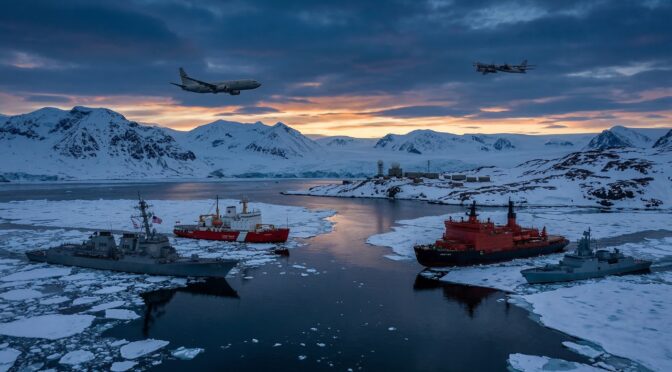
The Arctic region has fundamentally transitioned from a peripheral frontier of scientific exploration and environmental monitoring to the absolute epicenter of great power competition. Driven by the compounding variables of accelerated climate change, rapid technological advancement, and shifting geopolitical alliances, the High North is no longer defined by the post-Cold War diplomatic paradigm of “high north, low tension.” Instead, the region is rapidly militarizing, serving as a critical operational theater for nuclear deterrence, resource extraction, and the strategic control of emergent global supply chains.1
This assessment evaluates the strategic imperatives driving state behavior in the Arctic. It analyzes the aggressive military posturing of the Russian Federation through its Bastion defense strategy and gray-zone hybrid warfare, alongside the People’s Republic of China’s (PRC) calculated polar expansion under the guise of the “Polar Silk Road” and its military-civil fusion doctrine.3 Furthermore, the analysis scrutinizes the physical and economic friction of operating in extreme polar environments, answering the critical strategic question of whether the pursuit of Arctic dominance justifies the massive logistical, engineering, and financial expenditures required.7 Finally, it outlines the coordinated responses of the United States and the North Atlantic Treaty Organization (NATO), highlighting the recent operationalization of the “Arctic Sentry” initiative, the massive recapitalization of the U.S. Coast Guard’s icebreaker fleet, and the systemic realignment of regional governance following the breakdown of the Arctic Council.9
The Geostrategic Imperative: Why the Arctic is Critical
The strategic value of the Arctic is rooted in immutable geography, nascent economic potential, and unique military utility. For national security planners, the Arctic Ocean represents the shortest aerospace trajectory between the Eurasian landmass and the North American continent. This geographic reality makes the region the primary vector for aerospace early warning, ballistic missile defense, and strategic nuclear power projection.12 To control the Arctic is to command the northern approaches to the world’s most powerful nations.
The Topography of Naval Hegemony: The GIUK Gap
At the center of maritime strategic planning in the European High North is the Greenland-Iceland-United Kingdom (GIUK) Gap. During the Cold War, this expanse of the naturally inhospitable North Atlantic served as the definitive maritime choke point; any Soviet submarine attempting to access the open ocean to threaten transatlantic sea lines of communication or position itself for a nuclear strike on the United States had to transit this heavily monitored acoustic corridor.13
Following decades of post-Cold War strategic neglect, the GIUK Gap has re-emerged as a critical vulnerability and a primary focal point for NATO deterrence operations.13 The Russian Northern Fleet relies absolutely on unhindered access through the Norwegian Sea and the GIUK Gap to project power globally and maintain the credibility of its second-strike nuclear deterrent.14 Consequently, controlling or monitoring this corridor is essential for the defense of the North American homeland and European allies.15
The strategic gravity of Greenland, anchored directly within this gap, has triggered renewed geopolitical friction. Greenland’s location makes it a critical node for U.S.-run early warning systems, space-tracking infrastructure, and potential anti-submarine warfare (ASW) operations.14 This strategic utility is punctuated by recurring, disruptive rhetoric from the United States executive branch regarding the acquisition or annexation of Greenlandic territory—rhetoric that peaked again in early 2026.15 While European and Canadian leaders have drawn clear diplomatic red lines emphasizing that territorial annexation within NATO is an unacceptable violation of sovereignty, the friction exposes a deep underlying anxiety over securing the shortest aerospace corridor between Eurasia and North America.15 This tension simultaneously tests NATO alliance cohesion while forcing European states, particularly Denmark, to rapidly expand their Arctic defense spending and intelligence capabilities.15
Strategic operational mapping of the European Arctic reveals a stark geographic reality: the Russian Bastion strategy relies on layered anti-access/area denial (A2/AD) capabilities radiating outward from the Kola Peninsula to protect its Northern Fleet, covering the Barents Sea and rendering Svalbard a highly contested zone. In direct opposition, NATO defense architectures rely heavily on monitoring the precise boundaries of the GIUK Gap to prevent uninhibited Russian submarine transit into the broader North Atlantic. This geographic bottleneck is the defining feature of maritime security in the region.
Emergent Maritime Arteries and Global Supply Chain Anxiety
The accelerated reduction of multi-year Arctic sea ice—thinning by 70 percent since satellite observation began in 1979—is structurally altering global maritime trade dynamics.18 The Northern Sea Route (NSR), hugging the Russian coastline, and the Northwest Passage (NWP), navigating through the Canadian Arctic archipelago, present dramatically shorter alternatives to traditional southern shipping lanes.19 The NSR, in particular, can reduce transit distances between Northeast Asia and Europe by up to 40 percent, cutting voyages by more than 10 days compared to the standard Suez Canal route.18
This geographic advantage has been sharply contextualized by the geopolitical volatility of traditional global choke points. By early 2026, the Red Sea crisis and sustained militant attacks on commercial shipping drastically reduced traffic through the Suez Canal and the Bab el-Mandeb Strait—by up to 60 percent compared to pre-crisis volumes.21 With vessels forced to divert around the Cape of Good Hope, adding 6,000 to 11,000 nautical miles and upwards of $1 million in fuel costs per voyage, the economic allure of a viable alternative transit corridor has intensified.21 Simultaneously, the Panama Canal has faced severe capacity reductions due to climate-driven droughts, prompting renewed multi-billion-dollar proposals for alternative mega-projects like the Nicaragua Canal.22 In this environment of persistent global supply chain fragility, the NSR is no longer viewed merely as a speculative future route, but as a strategic redundancy vital to the economic security of Eurasia.4
Adversarial Posturing: The Russian Federation
Russia maintains the largest and most entrenched military footprint of any Arctic nation. For Moscow, the Arctic is simultaneously its greatest strategic asset and its most profound vulnerability.24 The region is central to the survival of the Russian state, accounting for a massive percentage of its gross domestic product through hydrocarbon and mineral extraction, while also housing the core of its strategic nuclear forces.24
The Kola Peninsula and the Bastion Strategy
Russia’s military posture in the Arctic is heavily concentrated on the Kola Peninsula. Bases such as Gadzhiyevo and Severomorsk host the Russian Northern Fleet, including the Project 955/955A Borei-class ballistic missile submarines (SSBNs).4 The deep, frigid waters of the Barents Sea provide an ideal acoustic environment for these submarines to operate undetected before transitioning toward the North Atlantic. Severomorsk also serves as the home port for Russia’s largest surface combatants, including the nuclear-powered guided-missile cruisers and the aircraft carrier Admiral Kuznetsov.4
To protect this critical second-strike capability, Russia employs a sophisticated “Bastion Strategy.” This involves layering advanced anti-access/area-denial (A2/AD) networks across the High North, incorporating coastal defense cruise missiles, S-400 air defense systems, and highly advanced platforms equipped with the Poliment-Redut and Tsirkon hypersonic missile systems.4 The strategic objective is to create an impenetrable defensive envelope over the Barents and Kara Seas, denying NATO forces the ability to target Russian strategic assets during a conflict.4 Furthermore, with the expiration of the New START Treaty in February 2026—removing the last legally binding caps and inspection regimes on deployed strategic warheads between the U.S. and Russia—the threat matrix emanating from the Kola Peninsula has expanded exponentially. Without these constraints, analysts forecast an unconstrained nuclear arms competition in the High North, with Russia likely accelerating the deployment of strategic warheads to its polar submarine fleet.17
Militarization of the Northern Sea Route
As sea ice recedes, Russia is systematically transforming the NSR from a seasonal navigational challenge into a permanently militarized national transport corridor.4 Moscow views the NSR as an internal, sovereign waterway subject to absolute Kremlin control, a legal interpretation directly opposed by the United States and allied nations, who view the route as an international strait subject to customary freedom of navigation laws as reflected in UNCLOS.26
To enforce its sovereignty claims, Russia has engaged in a massive, decade-long infrastructure build-up. It has reopened and modernized over 50 Soviet-era military installations and airbases along its Arctic coastline, including reinforced runways at remote outposts like Nagurskoye (on Franz Josef Land) and Temp.4 This network forms a continuous A2/AD exclusion zone stretching from the Barents Sea to the Bering Strait, ensuring that no foreign military or commercial vessel can transit the Eurasian Arctic without explicit Russian oversight and the mandatory, highly lucrative use of Russian state-operated nuclear icebreaker escorts.4
Gray-Zone Tactics and Hybrid Warfare
Direct kinetic confrontation with NATO in the Arctic would likely result in an unwinnable escalation for Moscow. Consequently, Russia leverages sophisticated hybrid warfare and “gray-zone” tactics—operations that occur in the ambiguous space between peace and armed conflict—to probe defenses, intimidate regional actors, and unilaterally reshape the geopolitical status quo without triggering Article 5 mutual defense obligations.29
This gray-zone strategy is highly visible around the Svalbard archipelago. Governed by the 1920 Svalbard Treaty, the territory nominally belongs to Norway, but signatory nations—including Russia and China—maintain rights to economic exploitation and scientific research.31 Russia utilizes its century-old coal mining settlements at Barentsburg and Pyramiden not for economic profit, but as strategic geopolitical anchors.31 Tactics include staging militarized Victory Day parades featuring paramilitary symbols, flying aggressive helicopter sorties that deliberately breach Norwegian aviation regulations, and instructing its state-backed fishing fleets to actively ignore Norwegian jurisdictional mandates.25 Furthermore, the Kremlin systematically accuses Norway of militarizing the archipelago, despite Norway’s routine presence being limited to Coast Guard vessels and a single frigate, using these accusations to justify its own potential air defense deployments on Novaya Zemlya.25
More alarmingly, the Arctic seabed has become a front line for infrastructure sabotage. The region is heavily dependent on subsea fiber-optic cables for civilian telecommunications and critical military intelligence, such as the data flowing from SvalSat, the world’s largest commercial ground station located in Svalbard.33 Between 2021 and early 2026, an unprecedented number of subsea cables connecting Svalbard and mainland Norway, as well as critical infrastructure across the Baltic Sea, were severed or damaged.25
Open-source intelligence and maritime tracking data frequently place Russian fishing trawlers and dual-use “research” vessels loitering directly over these cables prior to the outages.25 In a stark escalation in late December 2024 and early January 2026, Finnish forces seized and detained vessels, including a Russia-linked spy ship and the oil tanker Eagle S, suspected of intentionally dragging anchors across subsea internet cables.33 By utilizing nominally civilian assets or covertly contracting foreign-flagged vessels—such as the Chinese-registered container ship Newnew Polar Bear, which deliberately sabotaged a Baltic Sea gas pipeline and telecommunications cables in October 2023—Moscow maintains a veneer of plausible deniability while systemically testing European infrastructure resilience.30
The People’s Republic of China: Dual-Use Hegemony
While lacking sovereign Arctic territory, the People’s Republic of China (PRC) has aggressively positioned itself as a primary stakeholder in the High North. In its 2018 Arctic Policy white paper, Beijing controversially declared itself a “Near-Arctic State,” formally integrating the polar region into its global Belt and Road Initiative under the strategic moniker of the “Polar Silk Road”.3
Military-Civil Fusion and Scientific Encroachment
China’s Arctic ambitions are inextricably linked to its national doctrine of Military-Civil Fusion (MCF). Under MCF, all Chinese civilian, commercial, and scientific endeavors are legally obligated to support the strategic objectives of the People’s Liberation Army (PLA) and the broader state security apparatus.5 Therefore, China’s extensive investments in Arctic scientific research, satellite ground stations, and polar logistics must be viewed through a dual-use intelligence lens.36
Scientific research serves as China’s primary vehicle for securing physical access to the polar region without triggering immediate military escalation. The PRC operates a growing and increasingly capable fleet of polar research vessels, including the heavy icebreakers Xue Long, Xue Long 2, and the Zhong Shan Da Xue Ji Di.38 Ostensibly deployed for climate and oceanographic research, these vessels routinely conduct comprehensive bathymetric mapping of the Arctic seabed, deploy sonar-equipped unmanned underwater vehicles (UUVs), and install complex acoustic buoy networks.6 In 2025, China achieved a significant milestone by conducting its first manned deep-sea dive under the Arctic ice.6
These scientific activities generate the critical intelligence baseline required for future military operations. Detailed knowledge of the ocean floor topography, deep-water salinity gradients, and under-ice acoustic propagation is essential for the future deployment of PLA Navy nuclear submarines into the Arctic theater.30 The dual-use nature of this research was explicitly demonstrated in 2023 when the Canadian Armed Forces intercepted and disabled Chinese monitoring buoys in the Canadian Arctic; military analysts assessed that these devices were deployed not solely for oceanographic data, but to track the acoustic signatures of United States submarines navigating beneath the polar ice cap.30
The scale of this encroachment is accelerating. In the summer of 2025, the U.S. Department of Homeland Security issued warnings regarding an “unprecedented” surge in Chinese military and research vessels in Arctic waters.40 This included a high-profile intercept by a U.S. Coast Guard C-130J Hercules of the Xue Long 2 operating deep within the U.S. Extended Continental Shelf, merely 290 nautical miles north of Utqiagvik, Alaska.40 Furthermore, Chinese universities intricately linked to the defense industry, including the “Seven Sons of National Defence” network overseen by the Ministry of Industry and Information Technology, are conducting Arctic research explicitly aligned with military capability development, including radar and missile tracking research at facilities in the Norwegian Arctic.6
The Sino-Russian Nexus in the High North
The severe geopolitical isolation of Russia following its 2022 invasion of Ukraine has forged an unprecedented, albeit highly transactional, strategic alignment between Moscow and Beijing in the Arctic.41 Historically, Russia was deeply suspicious of Chinese encroachment into its sovereign polar backyard, viewing Beijing as a demographic and economic threat to its far east and northern territories. However, facing crippling Western sanctions and desperate for the capital and technological components required to sustain its wartime economy and vast Arctic infrastructure, Moscow has increasingly opened the door to Chinese investment and operational presence.25
This partnership is manifesting forcefully in both economic and military domains. In 2024 and 2025, Russia and China accelerated joint development of high ice-class container ships, agreed to train Chinese specialists in polar navigation, and restarted joint maritime research missions in the Arctic Ocean after a five-year hiatus.29
Militarily, the alignment is rapidly evolving from rhetorical support to integrated, multi-domain operations. Between 2022 and 2024, Russian and Chinese naval vessels conducted massive joint patrols in the Bering Sea near Alaska, probing U.S. territorial boundaries.35 In July 2024, the two nations executed unprecedented joint bomber flights within the Alaskan Air Defense Identification Zone.35 This growing military interoperability fundamentally complicates the threat landscape for North American Aerospace Defense Command (NORAD) and NATO planners, as they must now allocate resources to deter a coordinated, two-front adversary operating synchronously in the polar approaches.43
The Calculus of Control: Is Arctic Dominance Worth It?
The drive for Arctic hegemony is propelled by the promise of untapped wealth and immense geostrategic leverage. The region contains an estimated 22 percent of the world’s undiscovered, technically recoverable oil and natural gas—amounting to over 412 billion barrels of oil equivalent, with the vast majority located offshore.44 Furthermore, as the global energy transition accelerates, the Arctic shield (spanning parts of Scandinavia, Greenland, and the North American archipelago) is recognized as a massive repository of the rare earth elements (REEs) and critical minerals indispensable for electric vehicle batteries, wind turbines, and advanced military electronics.46
However, the question of whether asserting absolute control over the Arctic is strategically and economically “worth it” requires a sober calculation of the profound environmental friction, logistical impossibilities, and economic volatility inherent to the region. The Arctic remains a domain that actively resists human technological intervention.8
Resource Extraction: The Financial and Engineering Reality
Extracting resources in the Arctic incurs astronomical capital costs and severe engineering hurdles. The physical infrastructure required to withstand the crushing force of moving pack ice and iceberg impacts is staggering. For example, the Hibernia oil rig off the coast of Newfoundland—located well south of the Arctic Circle—required the construction of a concrete ice belt 15 meters thick, surrounded by a 1.5-meter external ice wall fitted with structural “teeth” to absorb impacts.49 Projects located further north in deeper waters, where the majority of prospective Arctic oil and gas reserves lie, will require exponentially more elaborate and costly engineering solutions, including pipelines that must be buried deep beneath the seafloor to avoid destruction by deep ice structures gouging the ocean bottom.49
This massive overhead, coupled with extreme environmental reputational risks, has severely dampened commercial enthusiasm outside of state-subsidized enterprises. This reality was laid bare in March 2026, when the first offshore oil and gas lease sale in Alaska’s Cook Inlet under the new U.S. administration received zero bids from the energy industry, mirroring similar high-profile failures in the Arctic National Wildlife Refuge in previous years.50
Similarly, the pursuit of critical minerals in the Arctic faces intense competition from alternative frontiers, most notably deep-sea mining (DSM). As global demand for cobalt, nickel, and rare earth elements surges, 54 countries convened at the 2026 Critical Minerals Ministerial in Washington D.C. to secure supply chains.51 While Arctic mining involves navigating high wages, short daylight hours, and extreme cold, deep-sea mining proposes sweeping the ocean floor for polymetallic nodules.47 Both options carry severe, potentially irreversible environmental consequences for fragile marine ecosystems.53 However, the economic viability of both Arctic terrestrial mining and DSM remains highly contested, as technological advancements in battery chemistry are already beginning to substitute expensive metals like cobalt and nickel with cheaper alternatives like iron and sodium, potentially altering the long-term profitability calculus before these massive polar projects ever break ground.54
The Permafrost Debt: Russia’s Collapsing Foundation
For Russia, the fundamental cost of asserting control in the Arctic is literal, structural collapse. The infrastructure supporting Russia’s Arctic oil, gas, and military installations is built almost entirely upon permafrost. As climate change accelerates warming in the Arctic at four times the global average, this permafrost is rapidly thawing and degrading.20
The Russian Ministry of Natural Resources estimates that the economic losses resulting from infrastructure failure due to permafrost thaw will reach an astronomical $62.7 billion by 2050.56 Maintaining critical road networks in regions like Yakutia and Chukotka, stabilizing sinking military airfields, and repairing ruptured pipelines requires the continuous diversion of billions of dollars annually.56 Therefore, Russia’s Arctic strategy is engaged in a desperate race against geology; it must secure, extract, and monetize the region’s resources before the ground beneath its military and economic infrastructure completely liquefies.24
The Friction of Polar Operations: Logistical Realities
Operating military forces and commercial fleets in the High North is an exceptionally perilous endeavor. The environment is arguably a more lethal and persistent adversary than opposing kinetic forces.
The Limits of Cold-Weather Warfare
At temperatures plunging to -65 degrees Fahrenheit, the basic laws of physics and material science begin to fail, neutralizing the technological superiority of advanced militaries.8 During recent multi-national NATO exercises in northern Scandinavia and the Canadian Arctic, the severe limitations of standard military hardware were vividly exposed. U.S. all-terrain vehicles specifically designed for polar environments suffered catastrophic engine failures within 30 minutes of deployment because hydraulic fluids solidified.8 High-end electro-optical systems, including $20,000 Swedish night-vision goggles, were rendered useless when their aluminum casings spontaneously cracked at -40°F.8 Standard military-grade PVC wiring fractures like glass under minor stress, and the mere presence of trace moisture creates ice crystals that shred vital fuel pumps.8
Fuel logistics present a unique, mission-critical vulnerability. Aviation and diesel fuels approach their gelling points in extreme cold, requiring specialized additives and heated storage systems.58 Furthermore, refueling operations put logistics personnel at high risk of casualty; because fuel can exist as a super-cooled liquid at deeply negative temperatures, any contact with human skin causes instantaneous, severe frostbite.58 Establishing basic bulk fuel operations, such as the Joint Petroleum Off-the-Shore 600-gallon-per-minute pumps set up by U.S. Marines during Exercise Cold Response 26 in Narvik, Norway, requires exhaustive planning and specialized, insulated protective equipment.60 The massive power requirements needed simply to keep troops alive—heating tents, warming engine blocks, and charging batteries that deplete exponentially faster in the cold—create an immense, heavy logistical tail that severely bogs down rapid maneuver warfare.8
The Illusion of Cheap Arctic Shipping
While the Northern Sea Route offers significant physical distance reductions, its economic viability as a wholesale, profitable replacement for the Suez Canal remains highly speculative. Global shipping relies on “economy-of-scale,” rigid predictability, and “just-in-time” supply chains.18 The NSR currently lacks all three.
Transiting the NSR functions less like standard commercial shipping and more like a highly managed, hazardous expedition.28 Vessels frequently require the escort of costly Russian nuclear icebreakers to maintain schedules, destroying narrow profit margins.28 The transit windows are highly unpredictable, subject to sudden, unseasonal ice flows that can trap unprepared vessels. This danger was highlighted in January 2026 when the commercial cruise ship Scenic Eclipse II became beset in dense pack ice near Antarctica and required a rescue operation by the U.S. Coast Guard Cutter Polar Star—a scenario equally applicable to the High North.61
Furthermore, international regulatory frameworks are actively degrading the route’s cost-competitiveness. The International Maritime Organization (IMO) recently instituted a prohibition on the use of Heavy Fuel Oil (HFO) in Arctic waters. This regulation is designed to prevent catastrophic toxic pollution and reduce black carbon emissions, which settle on the ice and dramatically accelerate surface melting.63
Comprehensive economic modeling demonstrates that because of this mandate, shipping companies must transition to expensive clean fuels (such as LNG or advanced distillates) to legally transit the Arctic. When compared to ships utilizing cheaper, traditional HFO through the Suez Canal, the NSR actually operates at a severe cost disadvantage, effectively neutralizing the financial benefits of the shorter geographic distance.
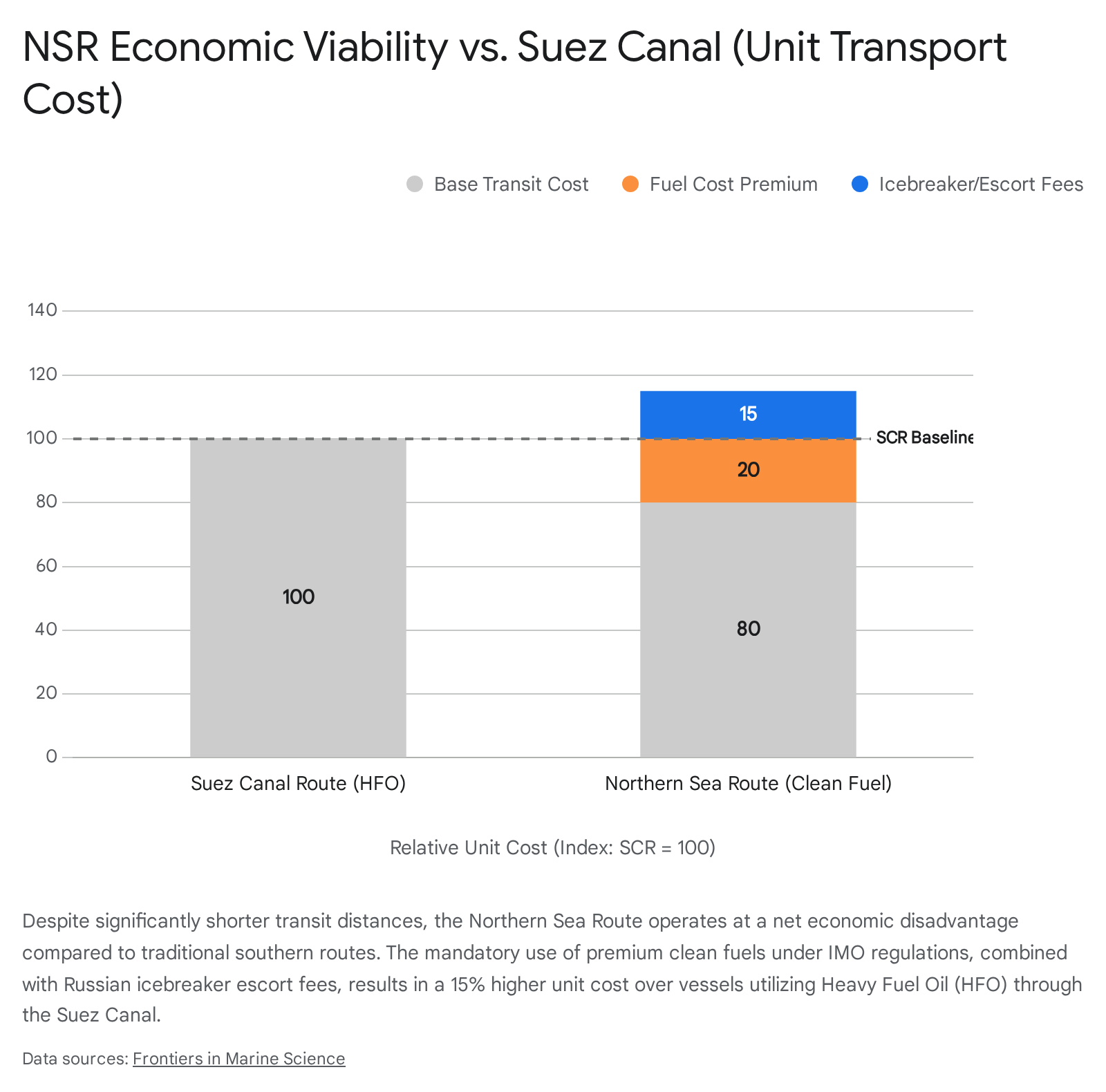
In unilateral carbon tax scenarios, or global energy evolution models consistent with RCP2.6 (stringent emission reductions), the NSR consistently remains less economically viable than southern routes.23 Only under worst-case climate models (RCP8.5), where catastrophic sea ice thickness decline completely eliminates the need for any icebreaker escorts, does the NSR approach true long-term cost-competitiveness.23
The Strategic Response: The United States and NATO
Recognizing the closing window of absolute Western military superiority and the aggressive incursions by revisionist states, the United States and its NATO allies have initiated a comprehensive, multi-domain strategic realignment in the High North.
The United States: Deterrence, Domain Awareness, and Fleet Recapitalization
The United States Department of Defense (DoD) released its updated Arctic Strategy in July 2024, superseding outdated frameworks. The core of this strategy formally abandons the idealistic notions of a demilitarized polar sanctuary. It directly identifies Russia as an “acute threat” leveraging avenues of approach to the U.S. homeland, and designates China as a pacing challenge aggressively seeking to alter the regional balance of power through its expanding fleet and MCF doctrine.12
The 2024 DoD Strategy adopts a highly calibrated “monitor-and-respond” operational posture.27 This approach relies fundamentally on achieving total, persistent domain awareness. The U.S. military is heavily investing in modernized intelligence, surveillance, and reconnaissance (ISR) capabilities, as well as resilient high-latitude communications, ensuring that any Russian submarine deployment from the Kola Peninsula or any dual-use Chinese scientific expedition is tracked continuously across the polar basin.27 Furthermore, the strategy mandates the execution of routine, high-visibility maritime and aerospace exercises to physically assert the right of freedom of navigation in international polar waterways, directly challenging excessive Russian and Chinese maritime sovereignty claims.26
A critical vulnerability in U.S. Arctic power projection has long been its decimated icebreaker fleet. For years, the United States relied almost entirely on a single heavy icebreaker, the USCGC Polar Star, commissioned in 1976. This aging vessel was kept functional only through exhaustive, highly expensive annual drydock refurbishments on the West Coast, severely limiting America’s sovereign presence in the ice.62
To rectify this glaring capability gap, the U.S. government executed a massive, accelerated recapitalization effort. In February 2026, fulfilling aggressive executive directives, the U.S. Coast Guard completed the award of contracts totaling $6.1 billion for the construction of a comprehensive 11-vessel Polar Security Cutter fleet.9 This procurement represents a historic pivot in national security funding, providing the United States with the heavy maritime assets required to ensure year-round, sovereign presence, project military force, and enforce economic exclusivity in heavily contested polar waters.
NATO Expansion and the “Arctic Sentry” Initiative
The geopolitical architecture of the European Arctic was permanently altered by the accession of Finland and Sweden into the NATO alliance. With their entry, NATO now encompasses seven of the eight traditional Arctic states. This expansion functionally encircles Russia’s Northern Fleet, transforming the Baltic Sea and the European High North into a highly integrated, contiguous allied operational space.66
This expanded territorial footprint has enabled deep multinational military integration. In February 2026, recognizing the absolute necessity of an organized, unified command structure for polar operations, NATO officially launched the Arctic Sentry initiative.10 Directed by Joint Force Command (JFC) Norfolk, and intricately coordinated with the U.S.-Canada North American Aerospace Defense Command (NORAD), U.S. Northern Command, and U.S. European Command, Arctic Sentry is designed as a premier multi-domain mission. Its primary objective is to synchronize allied operations, standardize intelligence sharing, and consolidate national capabilities into one coherent operational approach across the polar region.10
| Component | Strategic Capability & Impact | Key Operational Nodes |
| Command & Control | Unified strategic direction for the High North, seamlessly integrating European and North American defense architectures. | JFC Norfolk; New NATO Operations Center in Mikkeli, Finland; Combined Air Operations Centre in Bodø, Norway.10 |
| Military Mobility | Leveraging newly integrated Finnish and Swedish road/rail networks to rapidly project heavy armor and logistics across Scandinavia. | “Cold Response 26” moving 25,000 troops through Lapland and the E10 corridor.70 |
| Infrastructure Defense | Protecting vital undersea fiber-optic cables and pipeline networks from gray-zone sabotage and espionage. | Operations aligned with “Baltic Sentry” and the EU Cable Security Action Plan.71 |
| Technological Innovation | Rapid prototyping of uncrewed sensors, autonomous effectors, and advanced materials for Arctic littoral combat. | HEIMDALL testing in Norwegian fjords; Cold Weather Operations Centre of Excellence.73 |
Table 1: Key pillars of NATO’s integrated defense posture in the High North following the launch of the Arctic Sentry initiative in 2026.
Rather than constructing massive, permanent new military bases in the fragile and logistically hostile Arctic tundra—which would draw resources away from the Eastern Flank—Arctic Sentry utilizes a networked, dynamic force deployment approach.71 It leverages existing, highly capable allied forces, such as the UK Royal Marines operating from Camp Viking near Tromsø, Norway, and orchestrates massive logistical stress-tests like Exercise Cold Response 26.69
During Cold Response 26, initiated in March 2026, over 25,000 NATO personnel (including 7,500 transiting through Finland) tested the absolute limits of European military mobility.70 The exercise focused on moving heavy armor and critical supply convoys across the newly integrated road and rail networks of Finland and Sweden, utilizing routes like the E10 corridor to avoid civilian congestion.70 This demonstrated the alliance’s capacity to rapidly reinforce the Arctic flank from deep within continental Europe in response to a sudden Russian mobilization. The sheer scale of the operation required the Finnish Defence Forces to enact temporary airspace caps and rolling roadblocks, underscoring the vast logistical footprint of polar warfare.70 To support this long-term mobility, the European Union is heavily subsidizing rail and road infrastructure projects across Scandinavia under the Connecting Europe Facility (CEF) military mobility fund.74
Simultaneously, NATO is aggressively pursuing technological adaptation to overcome the physics of the extreme cold. Entities like the Cold Weather Operations Centre of Excellence in Norway are driving live experimentation. Initiatives like HEIMDALL (Harnessing Emerging technologies and Innovations for Multi-Domain capability Development in the Artic Littoral Landscape) are pioneering the use of autonomous sensors and uncrewed maritime systems designed specifically to operate within the severe magnetic interference, deep snow, and extreme cold of the Arctic fjords, with pilot trials commencing in February 2026.73 Furthermore, multi-national capability projects signed in February 2026 are focusing on deploying drone-based deep precision strike capabilities to meet the unique operational requirements of the High North.76
The Collapse of Institutional Governance: The Arctic Council
The strategic friction dominating the physical landscape of the Arctic has decisively fractured the region’s diplomatic and institutional architecture. Since its inception via the Ottawa Declaration in 1996, the Arctic Council served as the premier intergovernmental forum for the region. For over two decades, it was uniquely successful in isolating scientific research, environmental protection, and the rights of the roughly 500,000 indigenous inhabitants from the broader, volatile currents of global geopolitics.77 Operating by consensus among the eight Arctic states and six Permanent Participant indigenous organizations, the Council deliberately excluded military security issues from its mandate, fostering an environment of unparalleled regional cooperation.78
That era of “Arctic Exceptionalism” ended abruptly following Russia’s full-scale invasion of Ukraine in February 2022. Because Russia held the rotating Chairship of the Council at the time, the other seven member states—the United States, Canada, Norway, Sweden, Finland, Iceland, and the Kingdom of Denmark—unilaterally paused their participation, refusing to legitimize the geopolitical actions of the Russian Federation.11
The resulting paradigm shift has led to the de facto emergence of the “Arctic 7”.11 While the Western Arctic nations have explicitly stated they are not permanently expelling Russia from the Council—an act that would formally destroy the institution—they have slowly resumed the majority of their working group projects, scientific collaborations, and governance planning exclusively amongst themselves.77 During the Norwegian chairship (2023-2025), approximately 70 out of 140 projects were resumed without Russian participation.80 In May 2025, Norway transferred the Chairship of the Council to the Kingdom of Denmark in a highly symbolic transition that codified the new reality: Arctic governance will proceed, but it will do so by structurally isolating the nation that controls over half of the Arctic Ocean coastline.78
This fractured governance structure forces the region into a precarious diplomatic void. Without a functional, comprehensive diplomatic backchannel that includes Russia, the mechanisms for military de-escalation, maritime search and rescue coordination, and environmental disaster response in the High North are severely compromised. Furthermore, Russia’s isolation from the Arctic Council has directly accelerated its diplomatic and economic pivot toward China, further entrenching the adversarial, bi-polar divide in the region and increasing the likelihood of uncoordinated, unilateral actions.80
Strategic Outlook and Conclusion
The Arctic is no longer a peripheral theater of secondary importance; it is a primary axis of global strategic competition and a central front in the defense of the rules-based international order. The current trajectory indicates that the militarization and geopolitical partitioning of the High North is irreversible in the near-to-medium term.
The Russian Federation, heavily constrained by the catastrophic bleeding of conventional military resources in Ukraine and the literal sinking of its economic infrastructure into thawing permafrost, will increasingly rely on its nuclear Bastion strategy and highly disruptive gray-zone tactics.4 Sabotage of subsea cables, GPS jamming, and the exploitation of treaties in locations like Svalbard will serve as Moscow’s primary tools to project power, test NATO resolve, and defend its expansive sovereignty claims without triggering open war.32
Concurrently, the People’s Republic of China, executing a patient, well-resourced strategy of military-civil fusion, will continue to embed its scientific, economic, and intelligence architecture into the polar region. By aligning tactically with a weakened Russia, Beijing aims to systematically erode the traditional barriers to entry for non-Arctic states, positioning itself to control future global maritime trade routes and access critical mineral reserves.5
For the United States and its NATO allies, the core strategic challenge lies in sustaining robust deterrence without inciting an unwinnable escalation in an environment that heavily penalizes military operations. The operationalization of the Arctic Sentry initiative, the historic expansion of NATO into Scandinavia, and the injection of massive capital into the U.S. Coast Guard’s icebreaker fleet signal a decisive and necessary end to Western strategic neglect of the region.9
Ultimately, asserting control in the Arctic requires a continuous, exhausting expenditure of capital, advanced technology, and unwavering political will. The polar environment remains fiercely unforgiving, instantly punishing logistical hubris or under-investment with catastrophic equipment failure. As the geopolitical ice continues to fracture alongside the physical environment, success in the Arctic theater will not be determined solely by sheer kinetic firepower. Instead, dominance will belong to the alliances that can maintain persistent domain awareness, secure critical subsea infrastructure against covert sabotage, out-innovate the severe cold, and sustain complex operational endurance in the most hostile climate on Earth.
Please share the link on Facebook, Forums, with colleagues, etc. Your support is much appreciated and if you have any feedback, please email us in**@*********ps.com. If you’d like to request a report or order a reprint, please click here for the corresponding page to open in new tab.
Sources Used
- Arctic Security: Power Shifts and Transformational Change, accessed March 14, 2026, https://www.belfercenter.org/research-analysis/arctic-security-power-shifts-and-transformational-change
- The militarization of Russian polar politics | 02 The European Arctic, the Kola Bastion and the High North – Chatham House, accessed March 14, 2026, https://www.chathamhouse.org/2022/06/militarization-russian-polar-politics/02-european-arctic-kola-bastion-and-high-north
- Polar Silk Road – China Media Project, accessed March 14, 2026, https://chinamediaproject.org/the_ccp_dictionary/polar-silk-road/
- The Arctic in Russia’s Defence Strategy – Indian Council of World Affairs, accessed March 14, 2026, https://www.icwa.in/show_content.php?lang=1&level=1&ls_id=14249&lid=8670
- Frozen Frontiers: China’s Great Power Ambitions in the Polar Regions – CSIS, accessed March 14, 2026, https://features.csis.org/hiddenreach/china-polar-research-facility/
- Russia and China build Arctic hybrid threat toolkit through shipping and “civilian” science – Euromaidan Press, accessed March 14, 2026, https://euromaidanpress.com/2026/01/22/russia-china-arctic-hybrid-threats-military-civil-fusion/
- The Arctic: Opportunities, Concerns and Challenges – Plateforme Océan & Climat, accessed March 14, 2026, https://ocean-climate.org/wp-content/uploads/2020/01/10.-The-Arctic-scientific-fact-sheets-2019.pdf
- The Arctic’s extreme cold is breaking even the world’s most advanced military tech, accessed March 14, 2026, https://www.techspot.com/news/110742-arctic-extreme-cold-breaking-even-world-most-advanced.html
- United States Coast Guard News > News Home > All News, accessed March 14, 2026, https://www.news.uscg.mil/News-Home/All-News/
- Arctic security | NATO Topic, accessed March 14, 2026, https://www.nato.int/en/what-we-do/deterrence-and-defence/arctic-security
- Revitalizing the Arctic Council | The Belfer Center for Science and International Affairs, accessed March 14, 2026, https://www.belfercenter.org/research-analysis/revitalizing-arctic-council
- An IN, TO, THOUGH Analysis of the US 2024 Department of Defense Arctic Strategy | NAADSN, accessed March 14, 2026, https://www.naadsn.ca/wp-content/uploads/2025/01/Strategic-Perspectives-DoDStrat2024INTOTHROUGH.pdf
- The GIUK Gap’s strategic significance, accessed March 14, 2026, https://www.iiss.org/publications/strategic-comments/2019/the-giuk-gaps-strategic-significance/
- Moscow sees opportunity in Greenland crisis, but fears expanded US Arctic presence, accessed March 14, 2026, https://www.defensenews.com/global/europe/2026/02/09/moscow-sees-opportunity-in-greenland-crisis-but-fears-expanded-us-arctic-presence/
- Greenland Geopolitics: Arctic Security, NATO Cohesion, Sovereignty, accessed March 14, 2026, https://behorizon.org/greenland-geopolitics-and-european-strategic-postures/
- Greenland, the United States and Arctic security: Towards a credible and principled Transatlantic response | European Leadership Network, accessed March 14, 2026, https://europeanleadershipnetwork.org/commentary/greenland-the-united-states-and-arctic-security-towards-a-credible-and-principled-transatlantic-response/
- The Arctic This Week Take Five: Week of 2 February, 2026, accessed March 14, 2026, https://www.thearcticinstitute.org/arctic-week-take-five-week-2-february-2026/
- The Future of Arctic Shipping, accessed March 14, 2026, https://www.thearcticinstitute.org/future-arctic-shipping/
- The Three Arctic Routes: Heated Debate Over Commercial Viability at the Arctic Circle Assembly – The Asia Business Daily, accessed March 14, 2026, https://www.asiae.co.kr/en/article/2025102110273146843
- Comparing the Northwest Passage with the Northern Sea Route – NAADSN, accessed March 14, 2026, https://www.naadsn.ca/wp-content/uploads/2025/05/25apr-Comaparing-the-NWP-with-the-NSR_RD-NAADSN-Policy-Brief.pdf
- Analysis of maritime geopolitics on early 2026: The Red Sea Factor, accessed March 14, 2026, https://isdo.ch/analysis-of-maritime-geopolitics-on-early-2026-the-red-sea-factor/
- Beyond Panama and Suez: The new trade routes in a bid to reshape global shipping, accessed March 14, 2026, https://www.lowyinstitute.org/the-interpreter/beyond-panama-suez-new-trade-routes-bid-reshape-global-shipping
- A case study of offshore oil exports – OSTI, accessed March 14, 2026, https://www.osti.gov/pages/servlets/purl/3014083
- The northern frosts: The EU should contain and unpower Russia in the Arctic, accessed March 14, 2026, https://www.iss.europa.eu/publications/analysis/northern-frosts-eu-should-contain-and-unpower-russia-arctic
- Russia’s growing interest in Svalbard – GIS Reports, accessed March 14, 2026, https://www.gisreportsonline.com/r/russias-svalbard/
- 2024 Department of Defense Arctic Strategy – War.gov, accessed March 14, 2026, https://media.defense.gov/2024/Jul/22/2003507411/-1/-1/0/DOD-ARCTIC-STRATEGY-2024.PDF
- New DOD Strategy Calls for Enhancements, Engagements, Exercises in Arctic, accessed March 14, 2026, https://www.war.gov/News/News-Stories/Article/article/3846323/new-dod-strategy-calls-for-enhancements-engagements-exercises-in-arctic/
- Polar Silk Road: China’s plan B for global trade – ThinkChina.sg, accessed March 14, 2026, https://www.thinkchina.sg/economy/polar-silk-road-chinas-plan-b-global-trade
- China and Russia in the Arctic: From a bumpy ride to deeper engagement – LSE Blogs, accessed March 14, 2026, https://blogs.lse.ac.uk/cff/2026/02/04/china-russia-arctic-deeper-engagement/
- The Arctic This Week Take Five: Week of 18 August, 2025 | The Arctic Institute, accessed March 14, 2026, https://www.thearcticinstitute.org/arctic-week-take-five-week-18-august-2025/
- Svalbard: The Other Arctic Island Flashpoint | RealClearDefense, accessed March 14, 2026, https://www.realcleardefense.com/articles/2026/02/19/svalbard_the_other_arctic_island_flashpoint_1165741.html
- NATO’s Polar Pressure Point: The Svalbard Archipelago and the Russian Challenge, accessed March 14, 2026, https://www.thearcticinstitute.org/natos-polar-pressure-point-svalbard-archipelago-russian-challenge/
- Russia’s Arctic shadow war: How Moscow’s most-probed front fuels its Ukraine invasion, accessed March 14, 2026, https://kyivindependent.com/russias-arctic-shadow-war-how-moscows-most-probed-front-fuels-its-ukraine-invasion/
- Subsea sabotage should spark review of critical infrastructure security – Binding Hook, accessed March 14, 2026, https://bindinghook.com/subsea-sabotage-should-spark-review-of-critical-infrastructure-security/
- Is the Polar Silk Road a Highway or Is It at an Impasse? China’s …, accessed March 14, 2026, https://www.rand.org/pubs/commentary/2025/02/is-the-polar-silk-road-a-highway-or-is-it-at-an-impasse.html
- Undercover Infrastructure Dual-Use Arctic Satellite Ground Stations – Centre for International Governance Innovation (CIGI), accessed March 14, 2026, https://www.cigionline.org/documents/2583/no.291_HM8ToWL.pdf
- Arctic Forecast 2026: China – Grey Dynamics, accessed March 14, 2026, https://greydynamics.com/beijing-activity-in-the-arctic/
- The Arctic Institute’s 2025 China Series, accessed March 14, 2026, https://www.thearcticinstitute.org/the-arctic-institute-china-series-2025/
- China’s Economic, Scientific, and Information Activities in the Arctic – RAND, accessed March 14, 2026, https://www.rand.org/content/dam/rand/pubs/research_reports/RRA2800/RRA2823-1/RAND_RRA2823-1.pdf
- DHS Warns of ‘Unprecedented’ Chinese Presence in Arctic During Summer 2025, accessed March 14, 2026, https://www.ndtahq.com/dhs-warns-of-unprecedented-chinese-presence-in-arctic-during-summer-2025/
- Arctic Geopolitics: The Svalbard Archipelago – CSIS, accessed March 14, 2026, https://www.csis.org/analysis/arctic-geopolitics-svalbard-archipelago
- The Arctic, outer space and influence-building: China and Russia join forces to expand in new strategic frontiers | Merics, accessed March 14, 2026, https://merics.org/en/report/arctic-outer-space-and-influence-building-china-and-russia-join-forces-expand-new-strategic
- Closing the Arctic Gaps: NATO Allies and Partners Can Protect Their Homelands by Updating Their Defense Force Postures | Hudson Institute, accessed March 14, 2026, https://www.hudson.org/national-security-defense/closing-arctic-gaps-nato-allies-partners-can-protect-their-homelands-liselotte-odgaard
- Regional Report: Focus on Arctic oil and gas sharpened during 2025 – World Oil, accessed March 14, 2026, https://worldoil.com/magazine/2026/january/features/regional-report-focus-on-arctic-oil-and-gas-sharpened-during-2025/
- The Arctic is Warming: Green Transition, Critical Minerals and Energy Sources, New Maritime Routes and Geopolitical Competition – DergiPark, accessed March 14, 2026, https://dergipark.org.tr/en/download/article-file/4603144
- Overview of outlook for key minerals – Global Critical Minerals Outlook 2025 – Analysis – IEA, accessed March 14, 2026, https://www.iea.org/reports/global-critical-minerals-outlook-2025/overview-of-outlook-for-key-minerals
- Mining in the Arctic: a rare earth ‘cold rush’? – Mine | Issue 149 | February 2025, accessed March 14, 2026, https://mine.nridigital.com/mine_feb25/arctic-mining-rare-earths
- Arctic Mining Report 2024, accessed March 14, 2026, https://arcticeconomiccouncil.com/wp-content/uploads/2024/10/aec-arctic-mining-report-2024-sample.pdf
- Arctic Energy Resources and Global Energy Security1 – Oceans at MIT, accessed March 14, 2026, https://oceans.mit.edu/wp-content/uploads/arctic_energy_security.pdf
- Rising Tensions and Shifting Strategies: The Evolving Dynamics of …, accessed March 14, 2026, https://www.thearcticinstitute.org/rising-tensions-shifting-strategies-evolving-dynamics-us-grand-strategy-arctic/
- Current Geopolitics Shift Deep-Sea Mining Debates | New Security Beat, accessed March 14, 2026, https://www.newsecuritybeat.org/2026/02/current-geopolitics-shift-deep-sea-mining-debates/
- What We Know About Deep-Sea Mining and What We Don’t | World Resources Institute, accessed March 14, 2026, https://www.wri.org/insights/deep-sea-mining-explained
- Arctic Deep Seabed Mining: a Comparative Analysis of Norway’s Approach and Global Sustainability and Accountability Concerns in – Brill, accessed March 14, 2026, https://brill.com/view/journals/yplo/17/1/article-p145_8.xml
- Thinking of the Arctic Future(s): When some Scientists precariously Promote Deep-Sea Mining, accessed March 14, 2026, https://www.thearcticinstitute.org/thinking-arctic-futures-some-scientists-precariously-promote-deep-sea-mining/
- Deep-sea mining: What you need to know – The World Economic Forum, accessed March 14, 2026, https://www.weforum.org/stories/2025/09/deep-sea-mining-critical-minerals/
- Russia’s Arctic infrastructure is becoming increasingly vulnerable | Polar Journal, accessed March 14, 2026, https://polarjournal.net/russias-arctic-infrastructure-is-under-threat/
- (PDF) Ch10. Cost of permafrost degradation and land use impacts of infrastructure development. The Economy of the North – ECONOR 2025 – ResearchGate, accessed March 14, 2026, https://www.researchgate.net/publication/393122959_Ch10_Cost_of_permafrost_degradation_and_land_use_impacts_of_infrastructure_development_The_Economy_of_the_North_-_ECONOR_2025
- Logistics Support in the Arctic – Army.mil, accessed March 14, 2026, https://www.benning.army.mil/infantry/magazine/issues/2023/Spring/pdf/Bershinsky_3.pdf
- DLA Energy Team Overcomes Arctic Challenge with Fuel System Innovation, accessed March 14, 2026, https://www.dla.mil/About-DLA/News/News-Article-View/Article/4376138/dla-energy-team-overcomes-arctic-challenge-with-fuel-system-innovation/
- U.S. Marines Prove Critical Arctic Fuel Capability During Exercise Cold Response [Image 6 of 18] – DVIDS, accessed March 14, 2026, https://www.dvidshub.net/image/9551539/core26-us-marines-prove-critical-arctic-fuel-capability-during-exercise-cold-response
- U.S. Coast Guard Cutter Polar Star marks 50 years of service, begins Operation Deep Freeze 2026, accessed March 14, 2026, https://www.news.uscg.mil/Press-Releases/Article/4385905/us-coast-guard-cutter-polar-star-marks-50-years-of-service-begins-operation-dee/
- Coast Guard Icebreaker USCGC Polar Star Completes Antarctic Mission, accessed March 14, 2026, https://maritime-executive.com/article/coast-guard-icebreaker-uscgc-polar-star-completes-antarctic-mission
- Economic viability of arctic shipping under IMO environmental regulations: a well-to-wake assessment of different carbon tax scenarios – Frontiers, accessed March 14, 2026, https://www.frontiersin.org/journals/marine-science/articles/10.3389/fmars.2025.1575551/full
- DoD Announces Publication of 2024 Arctic Strategy – War.gov, accessed March 14, 2026, https://www.war.gov/News/Releases/Release/Article/3846206/dod-announces-publication-of-2024-arctic-strategy/
- Polar Security Cutter – Deputy Commandant for Mission Support – Coast Guard, accessed March 14, 2026, https://www.dcms.uscg.mil/Our-Organization/Assistant-Commandant-for-Acquisitions-CG-9/Programs/Surface-Programs/Polar-Icebreaker/
- Russia and China are expanding in the Arctic: Europe needs a new …, accessed March 14, 2026, https://www.chathamhouse.org/2025/10/when-it-comes-arctic-security-europe-must-not-forget-about-economics
- UK defence: Renewed interest in the Arctic – House of Commons …, accessed March 14, 2026, https://commonslibrary.parliament.uk/research-briefings/cbp-10262/
- What’s behind NATO’s new Arctic mission? – ArcticToday, accessed March 14, 2026, https://www.arctictoday.com/whats-behind-natos-new-arctic-mission/
- NATO Secretary General outlines new activity – Arctic Sentry – ahead of Defence Ministers meeting, accessed March 14, 2026, https://www.nato.int/en/news-and-events/articles/news/2026/02/11/nato-secretary-general-outlines-new-activity-arctic-sentry-ahead-of-defence-ministers-meeting
- 25,000 NATO Troops Transit Finland as ‘Cold Response 26’ Starts, Bringing Temporary Road & Airspace Constraints – VisaHQ, accessed March 14, 2026, https://www.visahq.com/news/2026-03-09/fi/25000-nato-troops-transit-finland-as-cold-response-26-starts-bringing-temporary-road-airspace-constraints/
- Arctic Sentry: NATO strengthens its polar flank – OSW, accessed March 14, 2026, https://www.osw.waw.pl/en/publikacje/analyses/2026-02-13/arctic-sentry-nato-strengthens-its-polar-flank
- The Union, the Star and the Eagle: EU-NATO cooperation under Trump 2.0, accessed March 14, 2026, https://www.iss.europa.eu/publications/briefs/union-star-and-eagle-eu-nato-cooperation-under-trump-20
- Advancing NATO Readiness in the Arctic: The Role of HEIMDALL and the Cold Weather Operations Centre of Excellence, accessed March 14, 2026, https://www.act.nato.int/article/cold-weather-coe-2025/
- EU Defence Series: Military Mobility A Critical Enabler – European Policy Centre, accessed March 14, 2026, https://www.epc.eu/publication/eu-defence-series-military-mobility-a-critical-enabler/
- Special report 04/2025: EU military mobility | European Court of Auditors, accessed March 14, 2026, https://www.eca.europa.eu/en/publications/sr-2025-04
- NATO Allies launch new multinational capability cooperation initiatives, expand existing projects, accessed March 14, 2026, https://www.nato.int/en/news-and-events/articles/news/2026/02/12/nato-allies-launch-new-multinational-capability-cooperation-initiatives-expand-existing-projects
- Is It Possible to Continue Cooperating with Russia in the Arctic Council?, accessed March 14, 2026, https://gjia.georgetown.edu/2022/06/29/is-it-possible-to-continue-cooperating-with-russia-in-the-arctic-council/
- After Norway, What’s Next? The Kingdom of Denmark and the Arctic Council’s Future, accessed March 14, 2026, https://www.thearcticinstitute.org/after-norway-whats-next-kingdom-of-denmark-arctic-councils-future/
- The Arctic Council | Arctic Council, accessed March 14, 2026, https://arctic-council.org/
- The Arctic Council in the Shadow of Geopolitics, accessed March 14, 2026, https://www.thearcticinstitute.org/arctic-council-shadow-geopolitics/