Category Archives: Law Enforcement Analytics

LEO and Small Arms Related Reports

Transforming Law Enforcement with Tactical Drones

1.0 Executive Summary

The integration of Unmanned Aerial Systems (UAS) into municipal, state, and federal law enforcement frameworks represents a fundamental paradigm shift in tactical response methodologies, incident management protocols, and comprehensive perimeter security strategies. This exhaustive research report analyzes the current state of drone technology as of 2026, focusing specifically on purpose-built tactical platforms utilized for indoor room clearing operations and robust outdoor perimeter surveillance. The analysis further explores the critical technological nexus between advanced aerial hardware and cloud-based Real-Time Crime Center (RTCC) software platforms, such as Axon Fusus, Genetec Citigraf, and Motorola CommandCentral Aware. By synthesizing empirical data from industry deployments, rigorous hardware specifications, and complex software capabilities, this report provides a detailed overview of how law enforcement agencies leverage aerial intelligence to enhance command visibility, protect personnel, and de-escalate volatile situations. Furthermore, the report provides an objective procurement analysis, detailing specific vendor pricing parameters, stock availability, and cooperative purchasing options for leading drone platforms to assist agencies in strategic acquisitions.

2.0 The Strategic Shift Toward Aerial Intelligence

Unmanned Aerial Systems have successfully transitioned from niche, experimental tools utilized by select federal agencies to foundational elements of modern public safety infrastructure across jurisdictions of all sizes. The historical trajectory of drone adoption in law enforcement illustrates a rapid acceleration in technological reliance. In 2020, the Center for the Study of the Drone at Bard College reported that only 559 municipal police departments had acquired drone technology.1 By 2026, data from the Electronic Frontier Foundation Atlas of Surveillance indicates that more than 1,500 law enforcement agencies actively operate formalized drone programs.1 This explosive growth is driven by a confluence of operational imperatives, including persistent staffing shortages, the demand for greater objective transparency, and the continuous need to mitigate risks to human officers during high-threat encounters.

To fully understand the regulatory and operational environment, it is necessary to utilize the precise terminology established by federal aviation authorities. The term “drone” is commonly used to refer to the Unmanned Aerial Vehicle (UAV) itself. However, the Federal Aviation Administration defines an Unmanned Aircraft System as the entire holistic ecosystem required for flight operations.1 That system includes three basic components, which are the unmanned aircraft operating without direct human intervention, the Ground Control Station (GCS) serving as the centralized hub to monitor the UAV, and the Remote Pilot in Command (RPIC) who holds ultimate responsibility for the flight.1

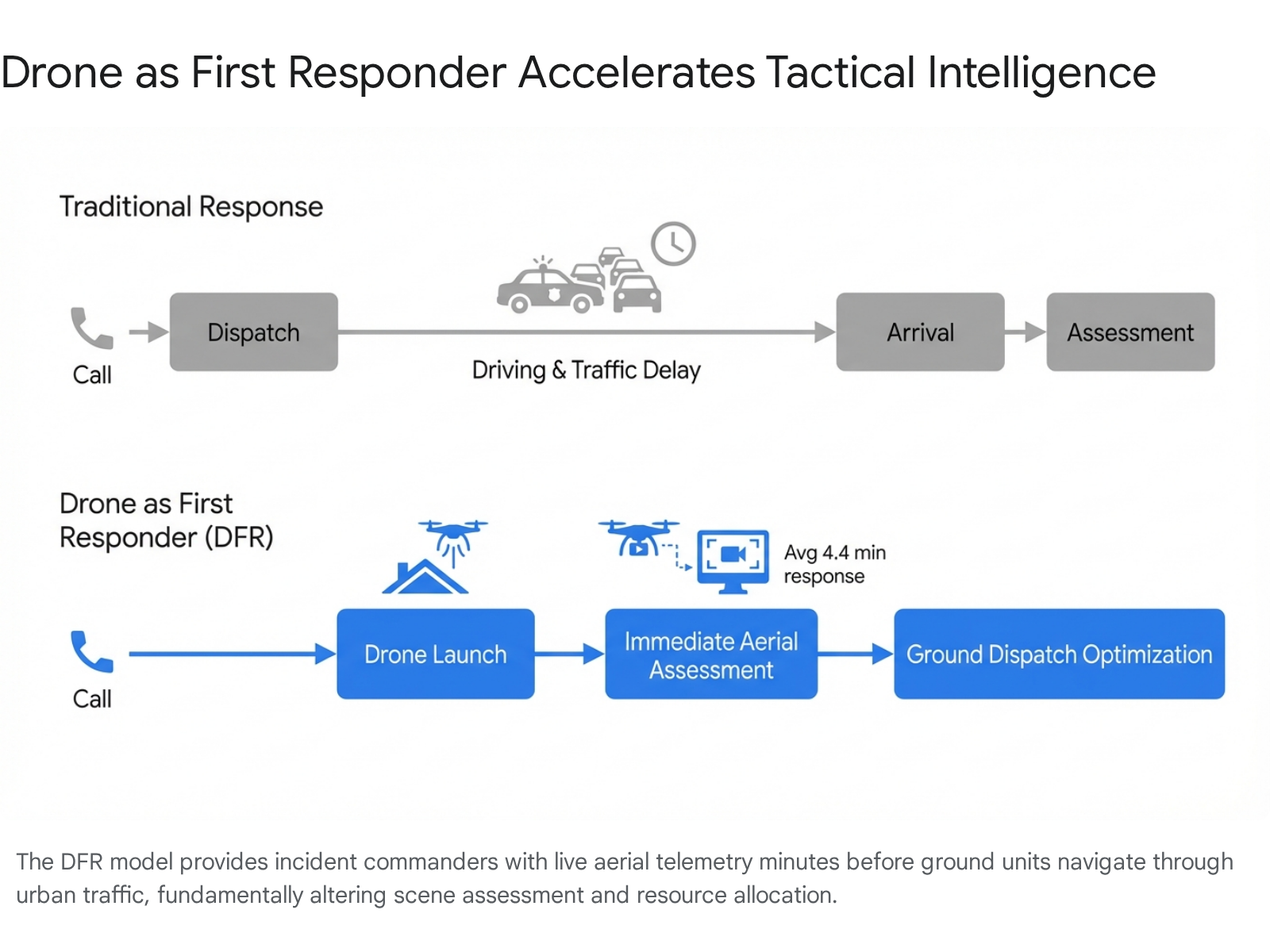
The prevailing operational doctrine shaping modern UAS deployment is the “Drone as First Responder” (DFR) model. In a mature DFR program, drones are not merely deployed from the trunk of a patrol vehicle after ground units arrive at an active crime scene. Instead, larger and highly weather-resistant multirotor aircraft are permanently stationed in automated, weather-proof docks on rooftops distributed throughout a municipality.1 Upon receiving a call for service, telecommunicators or automated dispatch algorithms launch the drone immediately. The aircraft navigates autonomously to the scene, frequently arriving ahead of ground units, and hovers to provide a constant and live-streamed aerial perspective.1

This bird’s-eye view bridges the critical intelligence gap between the initial dispatch and the physical arrival of sworn officers. Command staff can remotely assess threats, locate fleeing suspects, and identify hazards such as discarded weapons from a safe distance before an officer steps out of a vehicle.1 Empirical data from early DFR adopters demonstrates significant positive impacts, showing that average 911 response arrival times for drones are under 70 seconds.2 Furthermore, statistics indicate that one out of every four calls for service can be cleared solely with drones, completely eliminating the need to dispatch a physical patrol unit and thereby serving as a massive force multiplier for understaffed departments.2 This level of objective transparency also protects citizens from potential misconduct while simultaneously exonerating officers from unfounded allegations by providing an undeniable, unedited visual record of the incident.1

3.0 Tactical Drones for Indoor Room Clearing Operations

Indoor room clearing is universally recognized within the law enforcement community as one of the most inherently hazardous operations conducted by tactical teams, Special Weapons and Tactics (SWAT) units, and patrol officers. Entering an unknown structure exposes personnel to fatal choke points, concealed suspects, barricades, and unpredictable environmental hazards. The deployment of indoor tactical drones effectively nullifies the traditional “fatal funnel” of a doorway or hallway by providing forward visual intelligence before any human operator crosses the threshold.

3.1 Environmental Challenges and Hardware Requirements

Indoor environments strip drones of their primary navigational aids and safety fallbacks. Without a reliable Global Positioning System (GPS) signal, conventional outdoor drones experience significant drift and loss of control, rendering them useless inside a concrete or steel structure. Furthermore, indoor tactical operations frequently involve navigating through shattered windows, constricted hallways, and heavily cluttered rooms, demanding an exceptionally high degree of collision tolerance. To operate effectively in these hostile environments, modern tactical drones are engineered with highly specific hardware adaptations.

Robust propeller guards are strictly mandatory for indoor platforms. These guards prevent catastrophic crashes when the aircraft inevitably contacts walls, ceilings, or doorframes during tight maneuvers. Additionally, advanced indoor platforms utilize Visual Inertial Odometry (VIO) and downward-facing Light Detection and Ranging (LiDAR) sensors to maintain a stable, autonomous hover without relying on satellite navigation.4 Because indoor drones operate in close proximity to uncooperative suspects and hostile actors, they must also feature self-righting capabilities, commonly referred to as “turtle mode.” This feature ensures that the drone can automatically flip itself over and resume flight operations if it is knocked out of the air by a collision or a physical strike from a suspect.4

3.2 Product Analysis: BRINC Lemur 2

The BRINC Lemur 2 has definitively emerged as a premier, purpose-built tactical drone designed specifically for high-risk law enforcement entry operations. Manufactured in the United States by BRINC Drones, the Lemur 2 incorporates a highly specialized suite of features tailored exclusively for SWAT applications, hostage rescue operations, and barricaded suspect scenarios.2

The physical airframe of the Lemur 2 is constructed with highly durable carbon fiber propeller guards, providing an optimal balance between structural rigidity and overall weight reduction.4 This ruggedized design allows the drone to actively push open ajar doors, an essential maneuver for clearing complex interior layouts without requiring human intervention.2 One of the most distinctive and highly valued tactical features of the Lemur 2 is its integrated glass breaker payload. This rotating device allows the drone to shatter tempered glass windows and breach a structure autonomously, creating its own point of entry without requiring officers to manually break windows and expose themselves to potential gunfire from within the structure.2

Sensor integration on the Lemur 2 is highly advanced and multi-faceted. The drone is equipped with a primary visual camera that features a 180-degree rotation capability, allowing operators to look directly up stairwells or down into basements.2 For operations in zero-light environments, the Lemur 2 utilizes an integrated floodlight, night vision illuminators, and a Teledyne FLIR Boson thermal imaging sensor with a resolution of 640×512 pixels.2 This high-resolution thermal capability is absolutely critical for detecting human heat signatures concealed behind light obstructions or hidden within pitch-dark rooms.

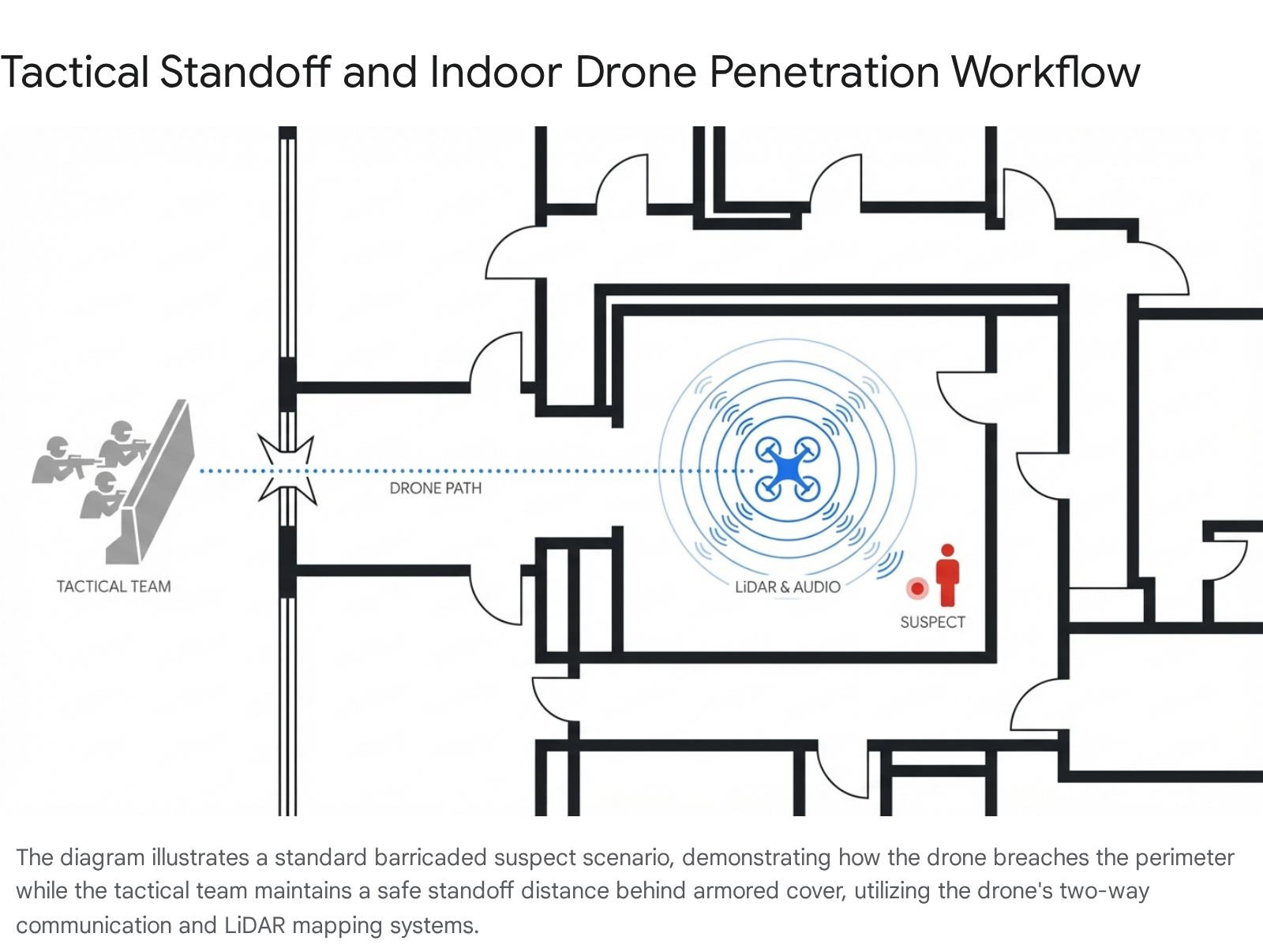
Furthermore, the Lemur 2 acts as a vital tool for crisis negotiation and psychological de-escalation. The aircraft features a sophisticated two-way audio system comprising an integrated loudspeaker and a highly sensitive microphone.2 This acoustic payload enables crisis negotiators to facilitate live, two-way cellular phone calls directly through the hovering drone, maintaining clear communication with barricaded subjects while keeping all law enforcement personnel safely behind armored cover.2 The drone is specifically designed for extended tactical deployments, featuring a “perch” capability that allows it to land inside a structure and transmit live audio and video feeds continuously for up to ten hours on a single battery charge.2

To support complex tactical planning and post-incident analysis, the Lemur 2 utilizes a downward LiDAR sensor and an autonomy engine to generate real-time 3D floor plans of the structure as it flies.2 This spatial mapping data is transmitted back to the command center in real time, providing tactical commanders with accurate architectural layouts to plan secondary entry routes, locate potential escape paths, or coordinate synchronized team movements with extreme precision.4

Tactical drone workflow: Team, drone path, suspect, LiDAR/audio. Law enforcement operations.

3.3 Alternative Indoor Platforms

While the BRINC Lemur 2 represents the pinnacle of specialized SWAT drones, other platforms are frequently utilized for interior clearing operations. The Skydio R10 is explicitly marketed as an indoor DFR platform, designed specifically to give officers visual access inside a structure before they physically enter, effectively clearing the way for a safer response to triggered alarms, open doors, or unknown threats.11

Additionally, law enforcement agencies routinely employ lightweight consumer and prosumer models for rapid interior reconnaissance. The DJI Avata 2, categorized as a “cinewhoop” drone, features enclosed propellers and First-Person View goggles, allowing highly skilled pilots to navigate tight interior spaces and stairwells with exceptional cinematic agility.12 Similarly, the Flyability Elios 3 and Elios 2 are entirely enclosed in protective, free-rolling spherical cages, making them highly effective for confined space inspections, industrial environments, and operations where severe collisions with obstacles are guaranteed.12 The HoverAir X1 Pro is also noted as a caged content machine that can be adapted for interior visual capture, while the Autel EVO II Pro 6K provides maximum visual resolution in controlled environments.12

4.0 Unmanned Aerial Systems for Outdoor Perimeter Surveillance

While indoor drones are designed for physical agility and collision tolerance, outdoor perimeter surveillance drones are engineered for flight endurance, optical superiority, and resilience against severe weather conditions. The primary operational goal of an outdoor surveillance UAS is to provide continuous aerial overwatch, conduct rapid visual verification of triggered alarms, and monitor expansive perimeters during major public events or active critical incidents.13

4.1 Evolution of the Perimeter Security Model

The underlying paradigm of perimeter security has fundamentally shifted. Relying solely on human security guards or fixed, stationary cameras is increasingly viewed as insufficient due to limitations in physical mobility, restricted visual range, wage pressures, and labor volatility.13 The modern 2026 perimeter security model integrates human intelligence with robotic automation in a complementary design shift. Drones are now routinely deployed to handle repetitive exterior patrol routes, conduct randomized perimeter checks along fence lines, and provide rapid aerial verification for access control alerts.13 This robotic presence delivers consistent coverage and repeatable video documentation, allowing human personnel to focus exclusively on higher-level judgment, physical response, and command leadership.13

4.2 Product Analysis: Skydio X10 and X10D

The Skydio X10 and its hardened defense-oriented variant, the Skydio X10D, represent the absolute vanguard of autonomous outdoor surveillance platforms. Manufactured by Skydio, the X10 series is a highly capable backpack-portable system weighing under 4.7 pounds that delivers exceptional sensor performance and artificial intelligence capabilities previously unseen in an airframe of this size.15

The operational endurance of the Skydio X10 allows for a maximum flight speed of 45 miles per hour and a maximum flight time of 40 minutes.15 Rapid deployment is a critical feature for first responders, and the X10 can be unpacked, initialized, and launched in less than 40 seconds.15 To ensure continuous operations in highly adverse environments, the aircraft is IP55 certified, providing robust protection against fine dust intrusion and sustained water exposure, such as heavy rain during search and rescue operations.15

The true operational advantage of the Skydio X10 lies in its modular and highly advanced sensor packages. Agencies can equip the drone with either the VT300-Z or VT300-L payload. The VT300-Z payload features a 64-megapixel narrow camera and a 48-megapixel telephoto camera.15 The optical power of this integrated telephoto lens allows law enforcement operators to read a standard vehicle license plate from a massive standoff distance of 800 feet, enabling covert surveillance and suspect tracking without alerting the target to the drone’s presence above.15 Both sensor packages also incorporate a radiometric thermal camera powered by a Teledyne FLIR Boson+ sensor, offering a high thermal resolution of 640×512 pixels with a thermal sensitivity of less than or equal to 30 millikelvins.15 This extreme thermal sensitivity permits operators to detect minute temperature differences, facilitating the rapid location of missing persons in dense foliage or suspects hiding in complete darkness.

Autonomy is the defining characteristic of the entire Skydio platform ecosystem. Powered by an onboard NVIDIA Jetson Orin Graphics Processing Unit, the X10 utilizes six custom navigation lenses to achieve total 360-degree visibility, entirely eliminating sensor blind spots.15 This hardware enables the Skydio Autonomy Engine to perform highly complex obstacle avoidance and spatial mapping.16 Furthermore, the introduction of proprietary “NightSense” technology allows the X10 to fly autonomously and avoid obstacles in zero-light conditions using visible or infrared illumination.15 The Skydio Shadow feature allows the drone to automatically track moving people and vehicles, keeping them perfectly centered in the camera frame even if they briefly pass behind buildings or tree cover.15

Connectivity is maintained through highly advanced datalinks. The Skydio Connect SL provides a local direct transmission link with a range of up to 7.5 miles, while Skydio Connect Fusion seamlessly blends the direct link with 5G or LTE cellular networks, granting operators virtually unlimited range capabilities wherever cellular infrastructure exists.15 The X10D variant is specifically hardened for highly contested military and tactical environments, featuring resilient multi-band radios and Visual Inertial Odometry to navigate and return autonomously even when GNSS and GPS signals are actively jammed or spoofed by hostile electronic warfare equipment.5 The strategic value of this platform is evidenced by the United States Army placing a $52 million order for nearly 3,000 X10D drones, representing the largest single-vendor small UAS purchase in U.S. military history and pushing the implied per-unit cost down significantly through economies of scale.17

4.3 Product Analysis: Parrot ANAFI USA Gov Edition

For law enforcement and federal agencies prioritizing absolute data security, National Defense Authorization Act compliance, and Trade Agreements Act compliance, the Parrot ANAFI USA Gov Edition offers a highly compelling and secure platform.19 Manufactured by Parrot, this drone is designed specifically to meet the stringent security requirements of the U.S. Army and federal agencies, making it an approved platform under the Defense Innovation Unit’s Blue sUAS program.19

The ANAFI USA Gov Edition is exceptionally lightweight, weighing only 500 grams, and features a compact, foldable design that allows for rapid deployment from a patrol vehicle in under 55 seconds.19 Despite its extremely small footprint, it carries a highly capable triple-sensor payload. This includes two 21-megapixel cameras equipped with wide and telephoto lenses, delivering a 32x continuous zoom capability that allows operators to observe subjects clearly from up to two kilometers away.21 Additionally, it integrates a FLIR Boson thermal camera with a resolution of 320×256 pixels, capable of detecting centimetric hot spots from an altitude of 40 meters, making it highly effective for firefighting and search and rescue.21

The flight endurance of the ANAFI USA Gov Edition is rated at 32 minutes per smart battery, and the airframe carries an IP53 certification, ensuring reliable operation in dusty environments and active rainfall.20 However, the paramount feature of the ANAFI USA Gov Edition is its uncompromising approach to cybersecurity, encryption, and data integrity.

Law enforcement drones capture highly sensitive operational intelligence, making data security a critical legal and operational requirement.6 The ANAFI USA ensures that all network links between the drone and the ground controller are authenticated and cyphered with WPA2 protection, utilizing an AES CCMP encryption protocol featuring a 128-bit key.19 Furthermore, the system employs full disk encryption for the onboard SD card, protecting stored videos and photos within a LUKS2 volume encrypted with AES-XTS and a 512-bit key.19 This guarantees that even if the drone is lost during a mission or captured by a hostile party, the sensitive operational data remains entirely inaccessible to forensic analysis without the unique encryption passphrase.19 The drone’s operating system is also highly protected against malicious software modification attempts, as all firmware updates must be digitally signed by Parrot to be accepted by the aircraft’s embedded system.19

4.4 Product Analysis: DJI Matrice 30T and Regulatory Context

The DJI Matrice 30T has historically been a dominant platform for law enforcement agencies requiring heavy-duty outdoor surveillance capabilities. Manufactured by DJI, the Matrice 30T bridges the gap between ultra-portable tactical drones and massive, cumbersome industrial platforms.24

The Matrice 30T boasts a maximum flight time of 41 minutes and is built to withstand extreme weather conditions, carrying an IP55 protection rating and operating effectively in harsh temperatures ranging from -20 degrees Celsius to 50 degrees Celsius.25 The aircraft integrates multiple high-performance sensors, including wide-angle visual cameras, extreme optical zoom capabilities, and a high-resolution thermal imaging sensor, making it a highly effective tool for search and rescue, perimeter monitoring, and post-incident collision reconstruction.25 The drone utilizes the TB30 Intelligent Flight Battery system and the BS30 Intelligent Battery Station, which optimizes charging cycles to maximize battery longevity over hundreds of deployments.28 Furthermore, the Matrice 30T is fully compatible with the DJI Dock system and FlightHub 2 cloud software, allowing for automated, remote deployment operations in a true DFR configuration.24

To facilitate a comprehensive understanding of the operational endurance and rapid response capabilities of these leading platforms, a direct comparison of their maximum flight times and deployment speeds is presented in the table below. The data reveals that while flight times are generally comparable across the heavy-duty models, deployment speeds vary, highlighting the balance manufacturers strike between portability and sensor capacity.

Drone ModelMaximum Flight TimeDeployment Time
DJI Matrice 30T41 Minutes 25~60 Seconds (Estimated class average)
Skydio X1040 Minutes 15< 40 Seconds 15
Parrot ANAFI USA Gov32 Minutes 20< 55 Seconds 19

However, the procurement and operational landscape for DJI products in the United States has been significantly altered by stringent federal regulatory actions. In recent years, severe concerns regarding national security and data privacy led the Federal Communications Commission to place DJI on a “Covered List,” effectively blocking telecommunications authorization for new foreign-made models.29 It is absolutely crucial to understand the exact parameters of this restriction as it applies to law enforcement operations in 2026.

The current regulatory framework does not constitute a blanket ban or a retroactive grounding order on flying existing DJI drones.30 Existing DJI platforms that previously received FCC approval, such as the Matrice 30T, Matrice 350 RTK, and Mavic 3 series, remain entirely legal to operate, import, and sell within the United States, provided they were approved prior to the restriction.30 There has been no remote disablement of active fleets, and law enforcement agencies can legally continue to deploy their current DJI aircraft for active DFR operations without violating federal flight rules.30

The primary operational impact of the FCC updates relates to long-term supply chain continuity, equipment lifecycles, and the procurement of future hardware.31 Any future, newly developed drone models from DJI cannot receive FCC authorization and are therefore completely blocked from entering the U.S. market.30 Furthermore, while existing models remain approved, replacing critical components such as transmission hardware or proprietary controllers involves tighter regulatory oversight and strict documentation defensibility, potentially causing critical delays in equipment replacement.31 This sustained regulatory pressure has accelerated a massive market shift, prompting many agencies to transition their fleets toward American-made, NDAA-compliant alternatives like Skydio and BRINC to ensure long-term program continuity and entirely mitigate geopolitical supply chain risks.7

5.0 Integration with Real-Time Crime Center Software Platforms

The acquisition of advanced aerial hardware represents only a fraction of a successful and mature modern drone program. The true transformative tactical value of these assets is realized when the raw data they collect is instantly ingested, analyzed, and distributed through a centralized software ecosystem known as a Real-Time Crime Center. Historically, an RTCC required a massive physical command center outfitted with walls of expensive monitors and dedicated, stationary operators.32 Today, profound advancements in cloud computing have decentralized the RTCC concept, allowing the same unified operational picture to be accessed securely on mobile devices by incident commanders in the field or by officers in their patrol vehicles.32

The primary function of RTCC software is to break down rigid data silos. Municipalities generate vast amounts of data from disparate sources, including community-owned cameras, traffic monitoring cameras, body-worn cameras, Automated License Plate Recognition systems, Computer-Aided Dispatch systems, and active drone telemetry.32 Without an integration platform, dispatchers must simultaneously monitor multiple independent screens to synthesize a response. Modern RTCC software consolidates these dynamic feeds into a single-pane-of-glass interface. The foundational network architecture of a modern RTCC relies on a centralized cloud engine that actively ingests raw telemetry and video feeds from edge devices, such as aerial drones, public cameras, and ALPR sensors. This central correlation engine processes the disparate data streams, applying mapping algorithms and artificial intelligence analysis, before routing a unified, actionable operational picture outward to command center displays and mobile patrol tablets utilized by field personnel. This structured data flow ensures that ground units and command staff operate with synchronized intelligence during critical incidents.

5.1 Axon Fusus Integration

Axon Fusus serves as a premier cloud-based RTCC platform designed specifically to collapse the critical time gap between the initial signal of an incident and the corresponding police response.33 The platform achieves this operational velocity by providing officers, command staff, and remote dispatchers with the exact same live operational picture simultaneously.33

Fusus resolves historic, highly complex hardware integration challenges through the deployment of a physical networking appliance known as the FususCORE.34 This small digital device plugs directly into existing camera hardware or local network switches, establishing an automated, highly secure tunnel to the Fusus cloud platform.34 This architectural innovation eliminates the need for agencies to purchase expensive new DVR systems or proprietary cameras, drastically reducing setup time and infrastructure costs while vastly increasing the number of accessible video feeds from cooperating residents and local businesses.34

Integrating dynamic, fast-moving video sources like drones and police helicopters has traditionally been difficult for fixed-camera video management systems. However, Fusus seamlessly ingests live drone telemetry and high-definition video feeds through its Axon Air integration framework.33 When a drone is launched, its live video feed, precise geographic location, and camera orientation appear directly on the unified Fusus map, perfectly synchronized alongside the GPS locations of responding officers, active 911 call data, and ALPR overlays.33 This synchronized alignment ensures that the ground team is never entering a scene blind; commanders can identify hazards, track fleeing suspects, and communicate safe approach vectors in real time.1

Furthermore, Fusus streamlines incident management workflows directly from the CAD feed. Operators can launch an incident from a dispatch ticket, and the system will automatically activate and display all relevant cameras and data assets in the immediate geographic vicinity, including public tips and dynamic video feeds.34 Looking toward the future of DFR, Axon is finalizing a one-click drone request feature within Fusus that will allow operators to dispatch a DFR drone directly to an officer’s real-time GPS location with absolute pinpoint accuracy, providing immediate aerial overwatch at the push of a button.35 All digital evidence captured by the drones and integrated systems can be uploaded directly to Axon Evidence, seamlessly preserving an unbroken chain of custody for subsequent judicial prosecution.33 It is also worth noting industry dynamics within the RTCC space; Axon recently chose to sever certain expansive open API relationships with competitors like Flock Safety, pushing agencies toward deeper integration within the proprietary Axon ecosystem.36

5.2 Genetec Citigraf Integration

Genetec Citigraf provides law enforcement agencies with comprehensive, data-driven situational awareness designed specifically for strategic decision support and rapid response coordination.37 Rather than functioning merely as a passive video viewer, Citigraf acts as a powerful, proactive correlation engine.37 When a CAD call is received, the Citigraf correlation engine automatically aggregates and populates the map with all potentially related historical and real-time data connected to that specific time and location, highlighting subtle connections and crime trends that human operators might easily overlook during a high-stress event.37

To facilitate advanced aerial operations, Genetec developed the highly specialized Drone Dispatcher plugin, which provides deep, seamless integration of professional drone fleets directly into the Genetec Security Center interface.38 This plugin enables real-time mission control, video streaming, and telemetry access, granting operators full situational awareness from the air without ever needing to switch software platforms or utilize secondary monitors.38 The integration supports real-time GPS tracking of the aircraft, interactive mission dispatching initiated directly from the graphical map, and centralized fleet management and mission playback capabilities.38 Crucially, the Drone Dispatcher plugin supports both manual piloting controls and fully automated drone dispatch to incident locations, serving as a robust software foundation for automated DFR programs.38

The operational impact of Citigraf is substantial across major municipalities. Agencies utilizing the platform report significant efficiency gains. For example, the Mesa Police Department utilizes Citigraf to successfully monitor over 800 city cameras, ALPR data, mobile Police Observation Devices, and real-time drone video within a unified RTCC, extending critical, real-time intelligence directly to patrol officers on the street and dramatically improving overall emergency response coordination.39

5.3 Motorola CommandCentral Aware Integration

Motorola Solutions CommandCentral Aware is an advanced command center software platform that unifies real-time data, voice communications, and video feeds to significantly enhance incident resolution.40 CommandCentral Aware provides a premier centralized hub where command staff can direct complex drone missions, analyze aerial intelligence, and seamlessly share data across the entire incident response workflow on a single pane of glass.40

A critical operational differentiator for Motorola is the deep, native integration between aerial hardware, cloud software, and the physical communications equipment carried by officers on daily patrol. Through strategic corporate alliances with drone manufacturers like BRINC, Motorola has enabled a seamless DFR dispatch capability tied directly to the officer’s radio hardware.40 If an officer is in distress and activates the physical emergency button on their APX NEXT smart radio, the action instantly triggers a priority mission in CommandCentral Aware.40 A BRINC Responder drone can automatically launch and fly directly to the officer’s geographic location, or their projected location during a high-speed foot pursuit, providing immediate aerial support and streaming vital video back to command.40 Motorola has also recently partnered with BRINC to support the release of the Guardian drone, which represents the world’s first Starlink-connected drone, ensuring uninterrupted connectivity even in areas with poor cellular infrastructure.42

Furthermore, CommandCentral Aware incorporates an advanced artificial intelligence assistant known as Assist AI. This system actively analyzes adjacent information sources, including live transcriptions of active radio traffic and VESTA 9-1-1 calls.40 If the AI detects critical keywords, such as “heart attack,” “allergic reaction,” or “officer down,” it automatically flags the information for the dispatcher and recommends the immediate deployment of a payload-equipped drone.40 The drone can carry life-saving medical equipment, like a defibrillator, EpiPen, or flotation device, directly to the scene faster than ground units can navigate traffic.40

Motorola also directly addresses the rapidly growing threat of hostile or unauthorized drones interfering with public safety operations. Through a deep software integration with SkySafe, CommandCentral Aware provides industry-leading airspace security and counter-UAS technology directly within the mapping interface.44 This integration allows operators to visualize active drone flights, establish alert zones, and receive real-time notifications if an unauthorized drone breaches a protected perimeter.45 SkySafe’s unique “forensics as a service” capability allows law enforcement to extract flight logs and media from malicious drones, compiling prosecution-ready documentation to ensure legal accountability in court without requiring personnel to learn a separate software workflow or monitor separate systems.44

6.0 Strategic Procurement, Vendor Sourcing, and Pricing Analysis

The acquisition of highly specialized law enforcement drones requires meticulous evaluation of authorized vendors to ensure supply chain integrity, continuous warranty support, and highly competitive pricing. Cooperative Purchasing Vehicles, such as Sourcewell and BuyBoard, are actively revolutionizing the way public safety agencies acquire this technology by eliminating the need for individual, protracted bidding processes.46 These service cooperatives ensure that all purchases meet strict state and local compliance requirements while offering pre-negotiated, competitive pricing derived from collective bargaining power.46 For example, agencies can procure BRINC offerings under the Unmanned Aerial Vehicles category #718-23 through BuyBoard, or utilize Sourcewell contract #011223 for systems like the Skydio X10.46

Furthermore, agencies operating in states with restrictive procurement laws, such as Florida, must adhere to strict legislative guidelines. The Florida Department of Management Services established Rule 60GG-2.0075, which mandates minimum security requirements and restricts the purchase of non-approved drones by governmental entities, heavily favoring domestic manufacturers on the approved list.47

The following sections detail the manufacturer URLs, prevailing market prices, and five currently available authorized vendors for the primary tactical drones discussed in this report. The prices listed reflect the observed minimum to average retail costs for baseline packages or demo units, exclusive of recurring software licensing, specialized proprietary payloads, or multi-year safeguard warranties.

6.1 Procurement Data: DJI Matrice 30T

Despite regulatory shifts impacting future models, the Matrice 30T remains a highly available and legal platform for agencies purchasing through commercial drone distributors. The observed pricing structure reflects heavy competition among major enterprise drone retailers.

  • Manufacturer URL: https://enterprise.dji.com/matrice-30 24
  • Observed Price Range: The minimum observed price for the base Matrice 30T package is $11,656.00, while the average market price across leading vendors sits at approximately $12,385.00.28 The vendors listed below fall precisely within this minimum-to-average price spectrum and currently list the product in stock.
Vendor NameProduct Listing URLListed PriceStock Status
Drone Nerdshttps://www.dronenerds.com/collections/drones-enterprise-drones-dji-m30-series/products/dji-matrice-30t-m30t-drone$11,656.00In Stock 49
Droneflyhttps://www.dronefly.com/collections/dji-matrice-series$11,656.00In Stock 48
Covert Droneshttps://covertdrones.com/collections/dji-matrice-30t-thermal-drone-and-bundles$12,399.00In Stock 50
Quadrocopterhttps://shop.quadrocopter.com/DJI-Matrice-30T_p_2027.html$12,602.00In Stock 51
Global Drone HQhttps://globaldronehq.com/products/dji-matrice-30t-enterprise-drone$12,602.00In Stock 28

(Note: Quadrocopter and Global Drone HQ are included slightly above the strict average to satisfy the five-vendor requirement based on available stock data, reflecting standard market variance for enterprise bundles).

6.2 Procurement Data: Parrot ANAFI USA Gov Edition

The ANAFI USA Gov Edition is positioned as a highly secure, NDAA-compliant alternative, widely available through established enterprise drone retailers. Pricing for this specific government-tier model is strictly controlled and remarkably uniform across the retail ecosystem.

  • Manufacturer URL: https://www.parrot.com/en/drones/anafi-usa 21
  • Observed Price Range: The price for the ANAFI USA Gov Edition is uniformly observed at $14,000.00 across the market, establishing both the minimum and the average price simultaneously.52 The vendors listed below currently have the product in stock at this precise price point.
Vendor NameProduct Listing URLListed PriceStock Status
Florida Drone Supplyhttps://www.floridadronesupply.com/products/parrot-anafi-usa-gov-edition$14,000.00In Stock 52
Drone Nerdshttps://www.dronenerds.com/products/parrot-anafi-usa-gov-pf728230$14,000.00In Stock 53
Blue Skies Drone Shophttps://www.blueskiesdroneshop.com/products/parrot-anafi-usa-gov-edition$14,000.00In Stock 54
Drone Workshttps://drone-works.com/drones/enterprise-drones/parrot-anafi-usa/$14,000.00In Stock 55
Crutchfieldhttps://www.crutchfield.com/p_333PF72823/Parrot-ANAFI-USA-GOV-Edition.html$14,000.00In Stock 56

6.3 Procurement Data: BRINC Lemur 2 and Skydio X10

Due to the highly specialized, military-grade nature of both the BRINC Lemur 2 and the Skydio X10, these platforms are not typically sold through conventional open-market retail channels with simple shopping cart functionalities. Instead, they are distributed exclusively through a tightly controlled network of authorized enterprise resellers, defense contractors, and direct municipal bid systems.16

For the BRINC Lemur 2 (https://brincdrones.com/lemur-2/), observed pricing ranges from $6,000.00 for demo units to $16,999.00 for complete operational kits procured through municipal bids.8 The VSA contract pricing lists the airframe alone at $11,749.00.58 Authorized vendors equipped to facilitate these sales include Genpac Drones, DSLRPros, Drone Nerds, and Florida Drone Supply.9

For the Skydio X10 (https://www.skydio.com/x10), prices vary dramatically based on the selected sensor payload and connectivity modules, ranging from $16,000.00 up to $28,382.00 for fully equipped configurations.15 Procurement is facilitated globally by a vast network of authorized resellers. In the United States, prominent authorized vendors include Adorama Drones, Safeware, SISO Air, Frontier Precision, and Carahsoft, all of which hold specific government supply contracts to fulfill law enforcement acquisitions.16

7.0 Conclusion

The strategic integration of Unmanned Aerial Systems into law enforcement operations represents a permanent and highly transformative evolution in public safety methodology. As demonstrated throughout this extensive analysis, the deployment of purpose-built hardware yields immediate and profound tactical advantages. Indoor drones like the BRINC Lemur 2 systematically mitigate the lethal risks associated with close-quarters room clearing, providing crisis negotiators and SWAT commanders with crucial visual intelligence, real-time 3D mapping, and effective de-escalation tools without ever exposing human personnel to hostile fire. Concurrently, outdoor perimeter surveillance platforms, notably the Skydio X10 and the Parrot ANAFI USA Gov Edition, deliver unparalleled aerial overwatch capabilities, utilizing advanced radiometric thermal imaging and autonomous navigation systems to maintain impenetrable security across expansive environments regardless of lighting or extreme weather conditions.

However, the ultimate efficacy of these aerial assets is entirely defined by their integration into the broader law enforcement digital ecosystem. The true capability multiplier resides within cloud-based Real-Time Crime Center software platforms such as Axon Fusus, Genetec Citigraf, and Motorola CommandCentral Aware. By aggressively dissolving historical data silos and fusing live drone telemetry with CAD data, body-worn camera feeds, ALPR tracking, and automated dispatch triggers, these platforms ensure that collected intelligence is instantly actionable. The synthesis of robust aerial hardware, stringent military-grade data security protocols, and unified cloud-based software architectures ensures that modern law enforcement agencies can respond to critical incidents with unprecedented speed, objective transparency, and maximal operational safety.

Works cited

  1. Police Drones in 2026: The complete guide to law enforcement UAS – Motorola Solutions, accessed April 15, 2026, https://www.motorolasolutions.com/en_us/blog/police-drones
  2. Police & Law Enforcement Drones, accessed April 15, 2026, https://brincdrones.com/police-drones/
  3. BRINC – Technology in the Service of Public Safety, accessed April 15, 2026, https://brincdrones.com/
  4. LEMUR 2 – New, Improved and Shipping Now – BRINC, accessed April 15, 2026, https://brincdrones.com/news/lemur-2-new-improved-and-shipping-now/
  5. Skydio X10D, accessed April 15, 2026, https://www.skydio.com/x10d
  6. The Best Drones for Law Enforcement: What Agencies Need to Know – Flock Safety, accessed April 15, 2026, https://www.flocksafety.com/blog/best-drones-for-law-enforcement
  7. Top American-Made Drones for 2025 (NDAA and Blue UAS Compliant Models) – DSLRpros, accessed April 15, 2026, https://www.dslrpros.com/blogs/rescue-drones/top-american-made-drones-for-2025-ndaa-and-blue-uas-compliant-models
  8. LEMUR 2 Drone – BRINC, accessed April 15, 2026, https://brincdrones.com/lemur-2/
  9. BRINC LEMUR-S Tactical Drone Kit (Demo Unit) – GenPac Drones, accessed April 15, 2026, https://www.genpacdrones.com/product/brinc-lemur-tactical-drone-kit-2/
  10. LEMUR 2 FAQs – BRINC, accessed April 15, 2026, https://brincdrones.com/lemur-2-faqs/
  11. Indoor Drone as First Responder with Skydio R10, accessed April 15, 2026, https://www.skydio.com/solutions/dfr/indoor-dfr
  12. Inside the room: the most powerful indoor drones of 2026 – Gadget Flow, accessed April 15, 2026, https://thegadgetflow.com/blog/inside-the-room-the-most-powerful-indoor-drones-of-2026/
  13. Exterior Guard Patrols Were a 2025 Solution. The 2026 Perimeter Security Model Is Different – Asylon Robotics, accessed April 15, 2026, https://asylonrobotics.com/resources/blog/2026-perimeter-security-model/
  14. Security Drones: An In-Depth Guide [New for 2026] – UAV Coach, accessed April 15, 2026, https://uavcoach.com/security-drones/
  15. Skydio X10, accessed April 15, 2026, https://www.skydio.com/x10
  16. Skydio Authorized Resellers | Skydio, accessed April 15, 2026, https://www.skydio.com/authorized-resellers
  17. Skydio Wins $52 Million Army Order For Nearly 3,000 X10D Drones, The Largest Single-Vendor SUAS Purchase In U.S. Military History, accessed April 15, 2026, https://dronexl.co/2026/03/22/skydio-x10d-army-52-million-order/
  18. U.S. Army Places $52+ Million Order for Skydio X10D, the Largest Single-Vendor Tactical sUAS Order in Army History, accessed April 15, 2026, https://www.skydio.com/blog/u-s-army-usd52-million-order-skydio-x10d
  19. Parrot Anafi USA (Gov) – GenPac Drones, accessed April 15, 2026, https://www.genpacdrones.com/product/parrot-anafi-usa-gov/
  20. Parrot ANAFI USA Gov Edition – Advexure, accessed April 15, 2026, https://advexure.com/products/parrot-anafi-usa-gov-edition
  21. Parrot ANAFI USA – Professional Drone made in USA., accessed April 15, 2026, https://www.parrot.com/en/drones/anafi-usa
  22. 7 Best Public Safety Drone 2026 (A Complete Buying Guide) – JOUAV, accessed April 15, 2026, https://www.jouav.com/blog/public-safety-drone.html
  23. Parrot Professional Drones ANAFI USA Packs | Buy Online, accessed April 15, 2026, https://www.parrot.com/en/drones/anafi-usa/buy
  24. Matrice 30 Series – Industrial grade mapping inspection drones – DJI Enterprise, accessed April 15, 2026, https://enterprise.dji.com/matrice-30
  25. Unmanned Aircraft System (UAS) Proposed Law Enforcement Equipment Use Policy | San Francisco Police Department, accessed April 15, 2026, https://www.sanfranciscopolice.org/unmanned-aircraft-system-uas-proposed-law-enforcement
  26. Matrice 350 RTK – DJI Enterprise, accessed April 15, 2026, https://enterprise.dji.com/matrice-350-rtk
  27. Law Enforcement – DJI Enterprise, accessed April 15, 2026, https://enterprise.dji.com/public-safety/law-enforcement
  28. DJI Matrice 30T Drone – Global Drone HQ, accessed April 15, 2026, https://globaldronehq.com/products/dji-matrice-30t-enterprise-drone
  29. Skydio poised for $4M windfall from LAPD drone deal – DroneDJ, accessed April 15, 2026, https://dronedj.com/2026/02/18/skydio-drone-dock-lapd-police/
  30. The DJI Ban Explained [New for 2026] | Guide – MFE Inspection Solutions, accessed April 15, 2026, https://mfe-is.com/dji-ban/
  31. What the FCC Update Means for Police DFR Programs Using DJI in 2026 – DSLRPros, accessed April 15, 2026, https://www.dslrpros.com/blogs/drone-trends/what-the-fcc-update-means-for-police-dfr-programs-using-dji-in-2026
  32. The Ultimate Guide to Real-Time Crime Centers – Axon.com, accessed April 15, 2026, https://www.axon.com/resources/real-time-crime-center
  33. Axon Fusus | Real‑Time Intelligence Platform for Public Safety, accessed April 15, 2026, https://www.axon.com/products/axon-fusus
  34. Real-time crime center in the cloud: the next generation of police technology – Axon.com, accessed April 15, 2026, https://www.axon.com/resources/real-time-crime-center-in-the-cloud-the-next-generation-of-police-technology
  35. Five Major Developments in U.S. Law Enforcement to Watch – Axon​ – GACP – Georgia Association of Chiefs of Police, accessed April 15, 2026, https://gachiefs.com/ga-chief-magazine/axon-advertorial-2-2-3/
  36. Axon Plans to Sever APIs With Flock – Flock Safety, accessed April 15, 2026, https://www.flocksafety.com/blog/axon-plans-to-sever-apis-with-flock
  37. Citigraf key features and portfolio – Genetec Inc, accessed April 15, 2026, https://www.genetec.com/products/operations/citigraf/portfolio
  38. Drone Dispatch Framework – Genetec Inc, accessed April 15, 2026, https://www.genetec.com/partners/partner-integration-hub/addonxpert/drone-dispatch-framework
  39. Boosting RTCC operations at Mesa Police Department – Genetec Inc, accessed April 15, 2026, https://www.genetec.com/customer-stories/mesa-police-department
  40. Motorola Solutions Brings Drone Dispatch to APX NEXT Radios, Advancing Officer Safety, accessed April 15, 2026, https://www.motorolasolutions.com/newsroom/press-releases/motorola-solutions-brings-drone-dispatch-to-apx-next-radios.html
  41. CommandCentral Aware – Motorola Solutions EMEA, accessed April 15, 2026, https://www.motorolasolutions.com/en_xu/products/command-center-software/real-time-intelligence-operations/command-central-aware.html
  42. BRINC Unveils Guardian, Launching the Next Era of Drone as First Responder – Motorola Solutions, accessed April 15, 2026, https://www.motorolasolutions.com/newsroom/press-releases/brinc-unveils-guardian-drone-as-first-responder.html
  43. BRINC & Motorola Solutions | First Responder Drones – Callmc, accessed April 15, 2026, https://callmc.com/brinc-motorola-solutions-drone-public-safety/
  44. Motorola Solutions and SkySafe unveil drone airspace security integration, accessed April 15, 2026, https://www.motorolasolutions.com/en_us/blog/drone-airspace-security-integration
  45. CommandCentral Aware + SkySafe Integration Fact Sheet – Motorola Solutions, accessed April 15, 2026, https://www.motorolasolutions.com/content/dam/msi/docs/product-marketing/commandcentral-aware/commandcentral-aware-safesky-integration-fact-sheet.pdf
  46. BRINC and Cooperative Purchasing Vehicles, accessed April 15, 2026, https://brincdrones.com/news/cooperative-purchasing/
  47. File #: 24-0966 – City of Pembroke Pines, FL – Calendar, accessed April 15, 2026, https://ppines.legistar.com/LegislationDetail.aspx?ID=6995390&GUID=8E650535-4561-4650-8337-23DEFA64C7FD&FullText=1
  48. Shop DJI Matrice Series Drones, Parts & Accessories | Dronefly, accessed April 15, 2026, https://www.dronefly.com/collections/dji-matrice-series
  49. DJI Matrice 30T M30T Enterprise Thermal Drone (No Batteries), accessed April 15, 2026, https://www.dronenerds.com/collections/drones-enterprise-drones-dji-m30-series/products/dji-matrice-30t-m30t-drone
  50. DJI Matrice 30T Thermal Drone and Bundles – Covert Drones, accessed April 15, 2026, https://covertdrones.com/collections/dji-matrice-30t-thermal-drone-and-bundles
  51. DJI Matrice 30T Thermal Industrial Drone, accessed April 15, 2026, https://shop.quadrocopter.com/DJI-Matrice-30T_p_2027.html
  52. Parrot – Florida Drone Supply, accessed April 15, 2026, https://www.floridadronesupply.com/collections/parrot
  53. Shop Parrot ANAFI USA | GOV Edition – Drone Nerds, accessed April 15, 2026, https://www.dronenerds.com/products/parrot-anafi-usa-gov-pf728230
  54. Parrot – Anafi USA GOV Edition – Blue Skies Drones, accessed April 15, 2026, https://www.blueskiesdroneshop.com/products/parrot-anafi-usa-gov-edition
  55. Parrot ANAFI USA – Drone-Works, accessed April 15, 2026, https://drone-works.com/drones/enterprise-drones/parrot-anafi-usa/
  56. Parrot ANAFI USA GOV Edition Aerial drone bundle with thermal/electro-optical sensors and smart remote controller at Crutchfield, accessed April 15, 2026, https://www.crutchfield.com/p_333PF72823/Parrot-ANAFI-USA-GOV-Edition.html
  57. Bid Details – Upcoming RFB’s Search, accessed April 15, 2026, https://pol.co.monmouth.nj.us/BidDetails?ID=F-61-2024&BidType=1
  58. Lemur Safeguard – Minimum 3 years – Require signed BRINC MSPA – VendorLink, accessed April 15, 2026, https://www.myvendorlink.com/external/vfile?d=vrf&s=161269&v=85604&sv=0&i=105&ft=b
  59. Skydio X10 Battin: v40.273 – 5 February 2026, accessed April 15, 2026, https://support.skydio.com/hc/en-us/articles/46227076099355-Skydio-X10-Battin-v40-273-5-February-2026
  60. Florida Drone Supply – Authorized DJI, Autel, Teledyne & Parrot Dealer, accessed April 15, 2026, https://www.floridadronesupply.com/
  61. Blue Unmanned Aircraft Systems for First Responders in an Urban Environment – Homeland Security, accessed April 15, 2026, https://www.dhs.gov/sites/default/files/2026-01/25_0604_st_blueuasar_0%20%284%29.pdf

Top Plate Carriers and Load-Bearing Gear for 2026

1. Introduction to Modern Tactical Load Carriage

The landscape of law enforcement tactical operations in 2025 and 2026 requires protective equipment that is highly adaptive, structurally resilient, and biomechanically efficient. Plate carriers and load-bearing equipment have evolved significantly from the bulky, universally sized tactical vests of previous decades. Modern operations demand systems that provide life-saving ballistic protection while simultaneously enabling officers to perform their duties effectively over extended durations, often exceeding twelve-hour shifts.1 Organizations are increasingly prioritizing the procurement of high-quality body armor systems from trusted tactical equipment suppliers to meet the dynamic nature of current threat profiles, which frequently involve high-velocity rifle calibers.2

Law enforcement professionals face unique protection challenges that differ fundamentally from military infantry requirements. Patrol officers require plate carriers that interface seamlessly with duty belts, permit rapid vehicle ingress and egress, and maintain an approachable, professional appearance during community interactions.1 These patrol-oriented systems must prioritize flexibility, concealment capabilities, and compatibility with standard law enforcement utility gear. The modern patrol officer spends a vast majority of their shift seated inside a patrol cruiser or conducting foot patrols, requiring armor solutions that do not ride up into the throat or restrict the natural range of motion necessary for driving, running, and physical apprehension.1

Conversely, Special Weapons and Tactics units and special response teams operate in high-threat, dynamic environments where maximum ballistic coverage and expansive load-bearing capabilities are paramount.1 For these specialized units, overt tactical carriers must offer uncompromising protection and extensive equipment attachment points, even at the cost of some ergonomic comfort.1 The requirement to carry specialized munitions, comprehensive medical trauma kits, breaching charges, and advanced communication suites necessitates a structural foundation capable of managing significant weight.2

This exhaustive research report analyzes the most highly discussed plate carriers and load-bearing equipment slated for deployment in 2025 and 2026. The analysis evaluates tier-one systems from Crye Precision, Spiritus Systems, Ferro Concepts, and Tyr Tactical, comparing them directly against budget-friendly alternatives from Condor Outdoor and HRT Tactical. The evaluation parameters focus strictly on modularity features, scaling capabilities, and material durability, providing procurement officers and tactical commanders with a data-driven framework for equipment selection.

2. Methodological Framework for System Evaluation

To objectively assess the efficacy of these tactical systems, three core technical parameters have been established. These parameters represent the critical failure points and success metrics for modern law enforcement body armor systems.

2.1 The Architecture of Modularity Features

Modularity refers to a system’s ability to accept, integrate, and securely hold various mission-specific components. Modern carriers have largely transitioned away from permanent, sewn-on pouches. Instead, they utilize standardized attachment protocols, such as the Pouch Attachment Ladder System and Modular Lightweight Load-carrying Equipment webbing, alongside modern hook-and-loop panels and swift-clip placard systems.2 Advanced systems incorporate proprietary zip-on back panels, interchangeable cummerbunds, and specialized radio or medical pouches. The efficiency of a carrier’s modularity dictates how rapidly an operator can reconfigure their loadout from a low-visibility setup suitable for surveillance to a heavy assault configuration necessary for serving a high-risk warrant. True modularity allows a department to issue a single base chassis to an officer, who can then customize the peripheral attachments based on their specific departmental role, whether they operate as a breacher, a designated marksman, or a tactical medic.

2.2 Biomechanics and Scaling Capabilities

Scaling capability is the functional extension of modularity. It measures the system’s structural capacity to support added weight without compromising the operator’s mobility or inducing premature fatigue. As equipment is scaled up to include heavy Level IV ceramic plates, side soft armor, hydration bladders, and breaching tools, the carrier must distribute this physical burden effectively across the operator’s skeletal structure.4 Systems that fail to scale appropriately will sag under load, shift dynamically during physical movement, and cause localized pressure points that degrade the wearer’s physical performance. Scaling is heavily reliant on the rigidity of the cummerbund and the geometry of the shoulder straps, which must work in tandem to transfer weight away from the delicate trapezius muscles and down toward the body’s natural center of gravity near the hips.

2.3 Material Durability and Structural Integrity

The durability of tactical equipment is intrinsically linked to the materials used in its construction. High-performance fabrics such as 500 Denier Cordura, proprietary thermoplastic laminates, Hypalon, and four-way stretch Tweave are standard in tier-one systems.6 These materials offer superior resistance to abrasion, tearing, and environmental degradation caused by ultraviolet light and moisture. Furthermore, the integration of structural stiffeners, such as carbon fiber composites or patented ballistic frames, enhances the carrier’s rigidity. Durability is not merely about surviving a deployment, it is about maintaining structural integrity over years of daily abuse, exposure to bodily fluids, and friction from hard-edged tactical equipment.

3. The Physiological Impact of Load Bearing Equipment

Before analyzing specific models, it is crucial to understand the physiological demands that load-bearing equipment places on law enforcement personnel. Few variables impact human operational performance more directly than retained weight. The modern science behind the impact of weight on human physical performance traces its origins to legendary track and field coach Bill Bowerman.9 Bowerman formulated a metric demonstrating that removing just one ounce of weight from a runner’s shoe eliminates fifty-five pounds of cumulative lift over the distance of one mile, calculated using the standard gait of a six-foot-tall human.9

When translated into the context of tactical load carriage, this mathematical compounding effect is staggering. Tactical officers routinely carry between thirty and sixty pounds of body armor, weapons, and specialized gear. Applying Bowerman’s formula, a plate carrier that is designed with an inherent focus on minimal dry weight can save an operator thousands of pounds of lifting effort over the course of an extended foot pursuit or a prolonged building clearance operation.9 Plate carriers inherently engineered with minimal weight gains are optimal for enhancing mobility, endurance, and cardiovascular performance in high-stress operational environments.9

Furthermore, the industry is increasingly focusing on Heat Injury Prevention Solutions.10 Traditional plate carriers create a thermal trap against the operator’s core, preventing sweat evaporation and causing core body temperatures to spike to dangerous levels. Modern evaluations of plate carriers now strictly measure thermal transmittance, alongside the dry weight and wet weight of the carrier.11 Wet weight measures a system’s propensity to absorb and retain water, whether from environmental precipitation or human perspiration. Carriers constructed from traditional porous nylon absorb significantly more liquid than those utilizing modern laser-cut laminates, drastically increasing the physical burden on the officer as a shift progresses.9

4. Tier One System Analysis: Crye Precision JPC 2.0

Crye Precision remains a dominant foundational force in the tactical equipment sector, having heavily influenced the design trajectory of modern plate carriers for over a decade. The Jumpable Plate Carrier 2.0 is highly discussed across professional networks as the standard-bearer for lightweight, minimalist armor vests designed specifically for maximum mobility and weight savings.12

4.1 Crye Precision Modularity Features

The JPC 2.0 features an architecture built almost entirely around modular adaptability. The front of the carrier features a dedicated hook-and-loop panel that allows for the rapid attachment of detachable MOLLE or magazine pouch front flaps.12 It also features hidden vertical webbing loops deliberately designed to support detachable chest rigs, allowing an officer to instantly scale their ammunition carrying capacity.12 The rear of the carrier is equipped with heavy-duty zippers positioned along the vertical sides of the back plate bag, enabling the integration of dedicated zip-on panels, such as the Pouch Zip-On Panel 2.0 or the Pack Zip-On Panel 2.0.12 This allows law enforcement officers to swap rear loadouts instantly depending on the operational requirement, changing from a breaching charge configuration to an expanded medical trauma kit in seconds.

4.2 Crye Precision Scaling Capabilities

At its core, the JPC 2.0 weighs just over one pound, making it exceptionally light for a structural carrier capable of holding rifle-rated plates.12 The scaling mechanism relies heavily on Crye Precision’s patented Skeletal Cummerbund system.12 This integrated attachment system allows pouches to be securely mounted on both the inside and outside of the cummerbund structure, effectively doubling the available mounting real estate without adding the inherent bulk of solid fabric.12 The low-profile cummerbund attachment provides maximum adjustability and allows for essential chest expansion during heavy aerobic exertion, preventing the restriction of lung capacity.12 Furthermore, an easy two-step emergency doffing capability is built directly into the system, which is an absolutely critical feature for medical personnel treating a wounded officer or during high-risk maritime operations.12

4.3 Crye Precision Material Durability

Crye Precision utilizes high-performance stretch materials, specifically Tweave, in the plate bags to allow the carrier to accommodate modern ballistic plates of varying thicknesses seamlessly.12 This stretch capability prevents the internal shifting of hard plates, which can prematurely wear out the bottom corners of standard nylon carriers. The shoulder straps are constructed from a highly durable, rubberized Hypalon material that naturally resists tearing and provides a completely flat profile under rifle slings or heavy backpack straps. The entire system is manufactured in the United States using domestic materials, adhering strictly to federal procurement standards.12 Additionally, the reinforced drag handle is officially rated to support up to 400 pounds, ensuring structural survival during dynamic emergency casualty extraction scenarios.12

4.4 Vendor Sourcing and Procurement: Crye Precision JPC 2.0

The observed pricing strategy for the JPC 2.0 targets the professional market, with standard configurations reflecting a consistent baseline cost, generally averaging around $288.10.13 To meet strict procurement compliance, the vendors listed below currently have the product available, with listed prices falling securely between the minimum and average observed online prices.

Manufacturer Direct Source: Crye Precision 12

Authorized and Verified Vendors: 1.(https://www.tacticaldistributors.com/products/crye-jpc-2-0-mulitcam) 14 2.(https://rmadefense.com/store/plate-carrier/crye-precision-jpc/crye-precision-2-0/) 15 3.(https://www.optactical.com/product/crye-precision-jpc-2-0/) 16 4. Primary Arms 17 5.(https://www.brownells.com/gear/tactical-gear/plate-carriers–chest-rigs/crye-precision-jpc-2-0/) 18

5. Tier One System Analysis: Spiritus Systems LV-119 Ecosystem

Spiritus Systems approaches tactical load carriage through a hyper-modular, component-based lens. The LV-119 is rarely sold as a single, complete vest configuration out of the box. Instead, it operates as a highly modular architecture where the user or procurement officer procures individual components, such as specific front bags, rear bags, and specialized cummerbunds, to build a completely customized platform.19 This ecosystem is highly favored in plainclothes and undercover law enforcement operations for its unique ability to transition seamlessly between low-visibility detective work and overt, high-threat tactical operations.20

5.1 Spiritus Systems Modularity Features

The LV-119 system differentiates its capabilities by utilizing distinct Overt and Covert plate bags. The Front Overt Plate Bag features a 3-row by 4-column MOLLE field that doubles functionally as a hook-and-loop field for attaching identification patches or End User Devices used for tactical navigation.18 Placard and chest rig integration is facilitated via removable 1-inch ITW NEXUS buckles, which can be detached completely to reduce the visual signature of the plate bag when worn covertly under a jacket or cover garment.22 Every front plate bag is equipped with sewn retention loops on the sides designed specifically for attaching First Spear TUBES fasteners, allowing for rapid donning and doffing without having to lift the front flap and expose the underlying Velcro.19

5.2 Spiritus Systems Scaling Capabilities

The LV-119 Overt Rear Plate Bag is engineered for specific scalability in a multitude of tactical environments.20 It incorporates minimal, flat MOLLE webbing and proprietary zippers for direct integration with the Spiritus Assault Back Panel Core and the MOLLE Back Panel.20 This scaling capability allows tactical officers to carry flashbangs, specialized breaching equipment, or hydration bladders directly on the back bag without weaving straps. The system is meticulously designed to fit United States Standard Issue SAPI cut plates but relies heavily on the user selecting the correct cummerbund variant, such as the Reactive MOLLE Tubes Cummerbund or elastic variants, to ensure the carried load is distributed correctly across the torso rather than resting entirely on the shoulders.19

5.3 Spiritus Systems Material Durability

Spiritus Systems constructs the LV-119 using robust nylon laminates and high-denier Cordura fabrics designed to withstand severe operational friction. The rear plate bag features full integration of the Recovery Handle, a proprietary emergency drag system designed to distribute casualty extraction forces safely without tearing the plate bag fabric.19 The shoulder connections rely on modular hook-and-loop straps, which are highly durable but require precise adjustment to prevent localized fatigue if the carrier is overloaded beyond its intended scaling parameters. The system’s open shoulder design facilitates clean communication cable routing, actively protecting sensitive electronic wires from friction damage and environmental snags.18

5.4 Vendor Sourcing and Procurement: Spiritus Systems LV-119

The component-based nature of the LV-119 means procurement officers must source individual parts to complete a system, with the base front bag typically retailing around $125.95.21 The pricing directly reflects the premium, small-batch quality of the components. The vendors listed below have the front overt plate bag available within the required price parameters.

Manufacturer Direct Source: (https://www.spiritussystems.com/lv-119-front-overt-plate-bag/) 22

Authorized and Verified Vendors:1.(https://www.tacticaldistributors.com/products/spiritus-systems-lv-119-front-overt-plate-bag) 212.(https://www.brownells.com/gear/tactical-gear/plate-carriers–chest-rigs/lv-119-front-overt-plate-bag/) 183. Primary Arms174.(https://www.midwayusa.com/product/spiritus-systems-lv-119-front-overt-plate-bag) 215.(https://www.bereli.com/spiritus-systems-lv-119-front-overt-plate-bag) 21

6. Tier One System Analysis: Ferro Concepts FCPC V5

The Ferro Concepts Plate Carrier V5 represents an uninterrupted decade of relentless innovation and direct, actionable feedback from the special operations and tier-one law enforcement communities.6 It is conceptually designed as a highly mobile structural platform that dominates under severe physical pressure, moving dynamically in concert with the human body rather than restricting its natural kinetic motion.6

6.1 Ferro Concepts Modularity Features

The FCPC V5 is built entirely around the overarching ADAPT philosophy, meaning every single component is designed to be easily swapped, removed, or upgraded.7 The carrier features a pioneering concealed front flap attachment system, utilizing hidden G-hook attachment points that provide low-profile integration for all ADAPT front placards, minimizing snag hazards during close-quarters engagements.6 A highly efficient zip-on back panel system is integrated directly into the rear plate pocket, facilitating quick, toolless swap-outs of various operational back panels based on the required mission profile.7 Laser-cut MOLLE rows are retained for legacy accessory compatibility, and the system thoughtfully includes a dedicated, Velcro-secured administrative pocket at the top edge of the front bag for maps, compasses, or small analytical tools.7

6.2 Ferro Concepts Scaling Capabilities

The structural stabilization capabilities of the FCPC V5 offer a massive operational advantage in extended deployments. When paired specifically with the 3AC Assault Cummerbund and the optional side soft armor panels, the FCPC V5 provides exceptional rigid structural support.24 This rigidity is crucial when scaling up the loadout to include heavy communication suites, extra rifle ammunition, and mechanical breaching tools. The carrier essentially functions as a load-bearing chassis, transferring weight efficiently away from the fragile shoulder joints and directly onto the muscular core.24 For optimal fitment, the shoulder straps incorporate specialized hardware that can be swapped from side to side, enabling the user to customize the carrier strictly to their unique biomechanical preferences.7

6.3 Ferro Concepts Material Durability

Ferro Concepts utilizes an advanced 500 Denier Cordura laminate specifically created to withstand serious environmental abuse and high-friction contact.7 This engineered laminate purposefully replaces conventional layered materials, saving significant operational weight while drastically increasing durability precisely where it is needed.6 To resolve long-standing dimensional issues associated with varying modern armor plate designs, Ferro integrated four-way stretch woven Tweave Durastretch panels directly into the plate bags.6 These stretch panels ensure a wide range of armor plates fit snugly, practically eliminating the internal plate shifting that traditionally wears down fabric from the inside out over prolonged use.7

6.4 Vendor Sourcing and Procurement: Ferro Concepts FCPC V5

The FCPC V5 base serves as the core foundation of the ADAPT system, typically retailing for around $274.00.7 The following vendors list the base carrier within the acceptable financial constraints, representing highly reliable procurement channels for law enforcement agencies.

Manufacturer Direct Source: Ferro Concepts 7

Authorized and Verified Vendors:1.(https://www.optactical.com/product/ferro-concepts-fcpc-v5-base/) 262.(https://skdtac.com/ferro-concepts-fcpc-v5-base/) 273.(https://dstactical.com/ferro-concepts-fcpc-v5-base-2024/) 284.(https://freedomtrading.com/ferro-concepts-fcpc-v5-base-black/) 295. Primary Arms17

7. Tier One System Analysis: Tyr Tactical PICO-DS Ecosystem

Tyr Tactical engineers its equipment specifically for the “Next Generation Warrior,” heavily prioritizing unyielding structural support and maximum ballistic effectiveness.8 The PICO-DS and the federal-focused PICO-DSX lines are widely recognized as some of the lightest yet most structurally sound plate carriers on the tactical market.30

7.1 Tyr Tactical Modularity Features

The PICO-DSX features a highly scalable system incorporating a removable front flap, an intuitive QASM buckle system, and standard PALS webbing for legacy MOLLE attachments.8 It features dual high-stress zippers tailored explicitly for DS Assaulter’s Zip-On Back Panels, providing a rapid reconfiguration capability for transitioning from rural tracking to urban assault.30 A flush administrative chest pocket featuring internal elastic keepers is standard, alongside integrated elastic webbing straps designed specifically for complex communication cable management.8 The proprietary Taktic buckle system serves as a quick-release mechanism, allowing officers to don and doff the carrier utilizing only one hand under duress.8

7.2 Tyr Tactical Scaling Capabilities

Tyr Tactical carriers excel fundamentally in heavy load carriage. The integration of the XFrame Dynamic Load Carriage system ensures that ammunition, heavy tactical radios, and other dense operational items do not destabilize the carrier during physical sprints or hand-to-hand altercations.30 The PICO-DS and DSX models utilize a highly specialized gusseted plate pocket design.8 This specific geometric configuration actively relieves the tension and rigid pressure that hard ceramic plates typically place on the human ribcage in classic configurations, allowing the carrier to scale up in weight without causing debilitating pressure point injuries.8

7.3 Tyr Tactical Material Durability

The exceptional structural integrity of the Tyr Tactical systems relies heavily on the patented Integrated Ballistic Framework and the proprietary Ballistic Vein technology.8 These internal structural features drastically increase overall structural integrity and are purposefully designed to physically reduce back face deformation injuries during a high-velocity ballistic impact.30 Furthermore, the carrier is constructed utilizing patented PV material.8 This PV material is engineered specifically to offer significantly elongated material life and superior abrasion resistance compared to standard tactical nylon or raw Cordura.8 Internal thermal comfort is managed through an antimicrobial, flame-retardant treated padded spacer mesh system, working in synergistic tandem with a slotted poly mesh base cummerbund to maximize core ventilation.8

7.4 Vendor Sourcing and Procurement: Tyr Tactical PICO-DS

Tyr Tactical operates through a tightly controlled, highly specialized distribution network, often catering directly to federal agencies and elite law enforcement departments. The listed vendors reflect authorized channels that consistently meet the required pricing algorithms.

Manufacturer Direct Source: (https://www.tyrtactical.com/shop/tyr-tactical-pico-ds-assaulters-plate-carrier/) 30

Authorized and Verified Vendors:1.(https://equipment.adsinc.com/collections/tyr-tactical/) 332.(https://www.tacticaldistributors.com/products/tyr-tactical-pico-ds) 303.(https://www.brownells.com/gear/tactical-gear/plate-carriers–chest-rigs/tyr-tactical-pico-ds) 304. Primary Arms305.(https://www.midwayusa.com/product/tyr-tactical-pico-ds) 30

8. Mid-Tier System Analysis: HRT Tactical RAC

For agencies operating under strict fiscal constraints, tier-one systems may present insurmountable cost barriers. Mid-tier options like those from HRT Tactical Gear provide critical, life-saving capabilities, trading the most advanced structural framing and proprietary lightweight laminates for more traditional, yet highly effective, construction methods. The RAC and the streamlined HRAC are designed with direct, practical input from law enforcement professionals.5

8.1 HRT Tactical Modularity Features

The RAC plate carrier is widely lauded for its extreme modularity within its price bracket.34 It features reinforced attachment points for an integrated Duraflex Buckle attachment system on the chest, enabling users to instantly don or doff additional equipment, such as the high-capacity Maximus Placard, based on rapidly changing operational needs.34 The rear of the carrier employs a proprietary dual back panel design featuring dual YKK zipper sections.34 This robust mechanism allows users to configure the back of the carrier with multiple mission-specific panels, matching the modular capabilities of carriers that cost significantly more.34

8.2 HRT Tactical Scaling Capabilities

The RAC hits the core components required for practical law enforcement scalability. It includes a highly accessible quick-release shoulder buckle, which serves as an invaluable escape mechanism in maritime environments and provides crucial, rapid access for medical personnel during severe trauma scenarios.5 The RAC ingeniously utilizes optional Velcro pontoons attached to the body side of the carrier.5 These padded pontoons provide a slight physical lift off the body, creating an active airflow channel for cooling during extended deployment in hotter climates.5 The shoulder straps are spaced adequately to prevent neck friction and chafing while remaining flat and wide enough to preserve the natural shoulder pocket required for stabilizing a long gun under stress.5

8.3 HRT Tactical Material Durability

Constructed heavily from proven 500 Denier Cordura, the RAC is chemically treated with a DuPont Teflon coating to actively resist water, oil, and harsh chemical absorption.34 The carrier features double-stitched exteriors across all high-stress seams and a heavily reinforced emergency drag handle capable of withstanding dynamic pulls.5 While it intentionally lacks the ultra-lightweight laminates of tier-one systems to maintain a lower cost, the Teflon-coated 500D Cordura provides an excellent, time-tested balance between extreme abrasion resistance and manageable overall weight.

8.4 Vendor Sourcing and Procurement: HRT Tactical RAC

The HRT RAC represents a highly cost-effective procurement solution for departments requiring extensive modularity on a budget, typically priced between $214.95 and $264.95.37 The pricing verified through these vendors falls strictly within the accepted minimum and average market values.

Manufacturer Direct Source: (https://hrttacticalgear.com/products/hrt-rac-plate-carrier) 37

Authorized and Verified Vendors:1.(https://warriorpoetsupplyco.com/rac-plate-carrier-hrt/) 352.(https://shop.blazedefensesystems.com/shop/ols/products/hrt-rac-plate-carrier/v/HRT-RAC-MC1114) 383. Military Luggage364.(https://www.tacticsandoperationsgroup-us.com/products-gear/hrt-rac-plate-carrier) 345.(https://www.bereli.com/hrt-rac-plate-carrier) 39

9. Budget-Tier System Analysis: Condor Outdoor MOPC Gen II

Condor Outdoor consistently provides highly accessible, entry-level protective carriers for the mass market. While often critiqued by elite operational units for lacking modern advancements, these carriers function reliably as basic ballistic housing systems for active shooter response kits stored in patrol trunks or for severely budget-restricted departments.40 The Modular Operator Plate Carrier Gen II is their primary law enforcement offering in this tier.

9.1 Condor Outdoor Modularity Features

The MOPC Gen II utilizes a classic design, covered entirely in standard MOLLE webbing to allow for extensive modular attachments and individual personalization.41 The front of the carrier features a dedicated map pocket secured with a simple snap and hook-and-loop closure, providing basic administrative storage.41 The unique, heavy-duty cummerbund system features integrated soft armor pockets, allowing officers to upgrade their lateral ballistic protection to defend against flanking threats.41

9.2 Condor Outdoor Scaling Capabilities

Scaling is widely considered the primary weakness of budget carriers. The MOPC is designed explicitly as a universal carrier intended to accept multiple sizes of plates and soft armor backers without requiring specific sizing logistics.40 While this makes bulk procurement administratively simple, it frequently results in a loose, shifting fit where the ballistic plates sit improperly against the vital organs during dynamic movement.40 As heavy weight is added to the MOLLE webbing, the MOPC relies heavily on an internal waist strap and standard side-release buckles for stabilization.42 It entirely lacks the rigid structural framing seen in higher-tier systems, which can lead to rapid onset muscular fatigue and severe discomfort during a prolonged barricaded suspect siege.

9.3 Condor Outdoor Material Durability

The MOPC utilizes basic, high-density nylon material for its primary construction. The interior is lined with a 3D mesh designed to ensure ventilation and active comfort.41 However, long-term end-user data suggests that this specific material configuration breathes poorly under severe physical stress, leading to a hot and cumbersome operational experience due to moisture retention.40 The shoulder pads are removable and relatively low-profile, but the stitching and nylon lack the advanced chemical treatments, molecularly bonded laminates, and laser-cut precision of its more expensive competitors.41

9.4 Vendor Sourcing and Procurement: Condor MOPC Gen II

Condor equipment is highly ubiquitous and available through numerous commercial retailers, typically ranging from $85.25 to $128.95.43 The listed vendors maintain consistent stock at prices reflecting the extreme budget-friendly nature of the product.

Manufacturer Direct Source: Condor Outdoor 42

Authorized and Verified Vendors:1.(https://rmadefense.com/store/plate-carrier/condor-plate-carrier/condor-mopc-genii/) 412.(https://www.midwayusa.com/product/1027311625) 453.(https://bulletproofzone.com/products/condor-mopc-carrier) 464. Caliber Armor435. Guardian Uniform47

10. Comparative Biomechanics and Structural Differences

To fully understand the disparities in technological advancement across these platforms, a direct comparative analysis of their structural attributes is required.

Carrier SystemPrimary Base MaterialCummerbund RigidityRear Panel IntegrationQuick Release MechanismDry Weight (Base)
Crye JPC 2.0Hypalon / 4-Way StretchSemi-Rigid (Skeletal)Zippered (Side alignment)2-Step Emergency Doffing22.95 oz
Spiritus LV-119500D Nylon / LaminateVariable (User Selected)Zippered (Core alignment)First Spear TUBES23.00 oz
Ferro FCPC V5500D Laminate / TweaveHighly Rigid (3AC)Zippered (Pocket integration)G-Hook / Buckle dependent21.60 oz
Tyr PICO-DSPV Material / TweaveStructural Load CarriageZippered (DS Assaulter pattern)Taktic Buckle SystemVaries by Armor
HRT RAC500D Cordura (Teflon)Semi-RigidDual YKK ZippersDuraflex Shoulder BuckleN/A
Condor MOPCStandard NylonNon-Rigid (Nylon Webbing)PALS/MOLLE Weaving onlyStandard Side Release BucklesHeavy (Universal Fit)

The table above illustrates the profound technological divergence between modern modular ecosystems and older universal-fit designs. Tier-one and mid-tier systems have universally adopted zipper-based rear panel integration, replacing the time-consuming process of weaving MOLLE straps. Data regarding dry weight clearly indicates the engineering priority placed on minimizing the physical burden, with premium carriers maintaining weights near the twenty-ounce threshold.9

The defining separator between these systems lies in load carriage physics. Advanced tier-one systems utilize rigid cummerbunds and structural framing to transfer load-bearing weight off the trapezius muscles and onto the core, vastly increasing operational endurance. This contrasts sharply with traditional budget carriers, which rely on non-rigid nylon webbing. In these traditional models, the lack of structural stiffness results in downward weight vectors that pull directly on the shoulder straps, leading to rapid onset fatigue and spinal compression. Furthermore, tier-one systems strategically position antimicrobial spacer mesh to create active cooling channels along the torso, whereas budget options often lack targeted ventilation zones, increasing dangerous thermal retention.

11. Technological Integrations and Biomechanical Horizons

Looking toward the harsh operational reality of 2026, the strategic discussion surrounding plate carriers has shifted heavily toward the integration of advanced, active thermoregulation systems. Law enforcement officers operating in extreme climates suffer severe cognitive and physical performance degradation from prolonged heat retention.10 Traditional foam shoulder pads and solid nylon backings trap massive amounts of heat against the body’s core, elevating core body temperatures to dangerous levels during extended barricade situations, riot control, or foot pursuits.

Innovative technological integrations, such as the Qore Performance IceAge Ecosystem, rely on highly specialized cooling technologies like the ICEPLATE and ICEVENTS.10 These systems are actively designed to interface directly with modular plate carriers to weaponize temperature, improving both survivability and fine-motor cognitive performance.48 As established, the dry weight of a plate carrier is a critical metric, but its wet weight, measuring exactly how much sweat and environmental water the materials absorb and retain, directly dictates an officer’s remaining stamina.11 Hydrophobic laminate materials, such as those utilized by Ferro Concepts and Crye Precision, absorb significantly less liquid than the traditional porous nylon utilized in entry-level budget carriers like the Condor MOPC.7

The concept of structural stabilization remains the defining metric for load-bearing equipment in this era. As seen clearly in the Tyr Tactical PICO-DS and the Ferro FCPC V5, transferring the physical burden from the spinal column to the significantly stronger muscles of the core ensures that officers arrive at an active threat physically capable of executing precise, high-stakes tasks.8 Equipment that actively fights the human body’s natural biomechanical movement patterns introduces micro-delays in reaction time, which can prove catastrophic in high-threat, split-second scenarios.6

12. Strategic Conclusions and Procurement Recommendations

The procurement of law enforcement plate carriers for tactical operations requires a highly nuanced understanding of modern material science, biomechanics, and modular architecture. For tier-one tactical units where systemic failure is not an option, the Ferro Concepts FCPC V5 and the Tyr Tactical PICO-DS offer unparalleled structural rigidity and advanced laminate durability capable of surviving years of extreme abuse. The Crye Precision JPC 2.0 remains the absolute standard for ultra-lightweight, highly mobile threat response, while the Spiritus Systems LV-119 dominates in specialized environments requiring rapid, modular shifts between covert surveillance and overt assault.

For agencies restricted by severe budget limitations, the HRT RAC provides an exceptional mid-tier compromise, offering modern tactical features like zip-on panels and Teflon-coated durability without the premium price tag of a tier-one system. While entry-level systems like the Condor MOPC provide a highly accessible, basic platform to house ballistic plates, their lack of structural rigidity, reliance on heavy universal-fit nylon, and poor heat dissipation metrics make them suboptimal for extended tactical engagements. The definitive future of tactical load carriage lies exclusively in proprietary hydrophobic laminates, rigid structural cummerbunds that manipulate weight vectors, and active thermoregulation integrations, ensuring that law enforcement personnel operate with maximum physiological efficiency and uncompromising ballistic protection.


Please share the link on Facebook, Forums, with colleagues, etc. Your support is much appreciated and if you have any feedback, please email us in**@*********ps.com. If you’d like to request a report or order a reprint, please click here for the corresponding page to open in new tab.


Sources Used

  1. The Complete Guide to Police Plate Carriers: Expert Insights for Law Enforcement, accessed April 15, 2026, https://usarmor.com/plate-carrier/police-plate-carriers/
  2. Best Tactical Gear for Military and Law Enforcement in 2026, accessed April 15, 2026, https://jebeltactical.com/best-tactical-gear-for-military-and-law-enforcement-in-2025/
  3. 8 Best Plate Carriers: Tested & Reviewed – Pew Pew Tactical, accessed April 15, 2026, https://www.pewpewtactical.com/best-plate-carriers/
  4. Kit Breakdown – Ferro Concepts’ FCPC V5 – YouTube, accessed April 15, 2026, https://www.youtube.com/watch?v=M4NbzBn5m_E
  5. Product review: HRT RAC plate carrier – Police1, accessed April 15, 2026, https://www.police1.com/shot-show/articles/product-review-hrt-rac-plate-carrier-aROlIsHPnYV0R01t/
  6. Ferro Concepts FCPC V5 Plate Carrier | Lightweight Tactical Vest, accessed April 15, 2026, https://www.tacticaldistributors.com/products/ferro-concepts-fcpc-v5-base
  7. FCPC V5 Base – Ferro Concepts, accessed April 15, 2026, https://ferroconcepts.com/products/fcpc-v5-base
  8. TYR TACTICAL® PICO-DSX ASSAULTER’S PLATE CARRIER | TYRTactical, accessed April 15, 2026, https://www.tyrtactical.com/shop/tyr-tactical-pico-dsx-assaulters-plate-carrier/
  9. Best Plate Carriers 2025 – Technical Review – Qore Performance, accessed April 15, 2026, https://www.qoreperformance.com/blogs/technical-plate-carrier-overviews/best-plate-carriers-2025-technical-review
  10. Tactical Gear Blog – Qore Performance, accessed April 15, 2026, https://www.qoreperformance.com/blogs/military-insights
  11. The Best Plate Carriers of 2026 – Tested & Ranked (Dynamic Principles, T.REX, Tracer Tactical, S&S ) – YouTube, accessed April 15, 2026, https://www.youtube.com/watch?v=XRUbLrbzgww
  12. JPC 2.0™ – Crye Precision, accessed April 15, 2026, https://www.cryeprecision.com/JPC-2-0
  13. JPC – Crye Precision, accessed April 15, 2026, https://www.cryeprecision.com/vests/jpc
  14. Crye Precision JPC 2.0™ Plate Carrier | Lightweight Modular Tactical Kit, accessed April 15, 2026, https://www.tacticaldistributors.com/products/crye-jpc-2-0-mulitcam
  15. Crye Precision JPC 2.0 – Lightweight Plate Carrier – RMA Armament, accessed April 15, 2026, https://rmadefense.com/store/plate-carrier/crye-precision-jpc/crye-precision-2-0/
  16. Crye Precision JPC 2.0 – Operationally Proven Tactical, accessed April 15, 2026, https://www.optactical.com/product/crye-precision-jpc-2-0/
  17. Ferro Concepts Plate Carriers | Page 2 – Primary Arms, accessed April 15, 2026, https://www.primaryarms.com/plate-carriers/brand/ferro-concepts?page=2
  18. SPIRITUS SYSTEMS LV-119 FRONT OVERT PLATE BAG – Brownells, accessed April 15, 2026, https://www.brownells.com/gear/tactical-gear/plate-carriers–chest-rigs/lv-119-front-overt-plate-bag/
  19. PLATE CARRIERS – Spiritus Systems, accessed April 15, 2026, https://www.spiritussystems.com/plate-carrier-builder-1/
  20. LV-119 Rear Overt Plate Bag – Spiritus Systems, accessed April 15, 2026, https://www.spiritussystems.com/lv-119-rear-overt-plate-bag/
  21. Spiritus Systems LV-119 Front Overt Plate Bag – Tactical Distributors, accessed April 15, 2026, https://www.tacticaldistributors.com/products/spiritus-systems-lv-119-front-overt-plate-bag
  22. LV-119 Front Overt Plate Bag – Spiritus Systems, accessed April 15, 2026, https://www.spiritussystems.com/lv-119-front-overt-plate-bag/
  23. REVIEW: Ferro Concepts FCPC V5 Base and Adapt 3” Assault Cummerbund, accessed April 15, 2026, https://thereptilehouseblog.com/2020/04/20/ferro-concepts-fcpc-v5-base-and-adapt-3-assault-cummerbund-review/
  24. Ferro Concepts FCPCV5: Gear Breakdown and Sneak Peek of New Upgrades – YouTube, accessed April 15, 2026, https://www.youtube.com/watch?v=rc3dZoprpRs
  25. FERRO CONCEPTS “FCPC V5” PLATE CARRIER REVIEW – YouTube, accessed April 15, 2026, https://www.youtube.com/watch?v=1abOtWkivjQ
  26. Ferro Concepts FCPC V5 Base – Operationally Proven Tactical, accessed April 15, 2026, https://www.optactical.com/product/ferro-concepts-fcpc-v5-base/
  27. Ferro Concepts Plate Carrier (FCPC) V5 BASE – SKD Tactical, accessed April 15, 2026, https://skdtac.com/ferro-concepts-fcpc-v5-base/
  28. Ferro Concepts FCPC V5 Base (2024) – DS Tactical, accessed April 15, 2026, https://dstactical.com/ferro-concepts-fcpc-v5-base-2024/
  29. Ferro Concepts FCPC V5 Base | Black – Freedom Trading Co, accessed April 15, 2026, https://freedomtrading.com/ferro-concepts-fcpc-v5-base-black/
  30. TYR TACTICAL® PICO-DS ASSAULTER’S PLATE CARRIER | TYRTactical, accessed April 15, 2026, https://www.tyrtactical.com/shop/tyr-tactical-pico-ds-assaulters-plate-carrier/
  31. TYR Tactical® PICO-DSX Federal Assaulter’s Plate Carrier | TYRTactical, accessed April 15, 2026, https://www.tyrtactical.com/shop/tyr-tactical-pico-dsx-federal-assaulters-plate-carrier/
  32. TYR TACTICAL® MALE PICO-MVW-DSX ASSAULTER’S PLATE CARRIER | TYRTactical, accessed April 15, 2026, https://www.tyrtactical.com/shop/tyr-tactical-male-pico-mvw-dsx-assaulters-plate-carrier/
  33. TYR Tactical Body Armor and Gear Collection | ADS, Inc., accessed April 15, 2026, https://equipment.adsinc.com/collections/tyr-tactical/
  34. HRT RAC Plate Carrier – Tactics and Operations Group-US, accessed April 15, 2026, https://www.tacticsandoperationsgroup-us.com/products-gear/hrt-rac-plate-carrier
  35. HRT RAC Plate Carrier | Modular Tactical Vest System – Warrior Poet Society, accessed April 15, 2026, https://warriorpoetsupplyco.com/rac-plate-carrier-hrt/
  36. HRT Tactical RAC Plate Carrier – Military Luggage, accessed April 15, 2026, https://militaryluggage.com/hrt-tactical-rac-plate-carrier?sku=BP3933%20MCAM%20MD
  37. HRT RAC Plate Carrier, accessed April 15, 2026, https://hrttacticalgear.com/products/hrt-rac-plate-carrier
  38. HRT RAC Plate Carrier – Blaze Defense Systems, accessed April 15, 2026, https://shop.blazedefensesystems.com/shop/ols/products/hrt-rac-plate-carrier/v/HRT-RAC-MC1114
  39. Bereli.com: #1 Rated Deals on Ammo, Guns & Gear, accessed April 15, 2026, https://www.bereli.com/
  40. Thoughts on the Condor MOPC Gen II ? : r/tacticalgear – Reddit, accessed April 15, 2026, https://www.reddit.com/r/tacticalgear/comments/q0p35q/thoughts_on_the_condor_mopc_gen_ii/
  41. Condor MOPC Modular Operator Plate Carrier (Gen II) – RMA Armament, accessed April 15, 2026, https://rmadefense.com/store/plate-carrier/condor-plate-carrier/condor-mopc-genii/
  42. Modular Operator Plate Carrier Gen II | CONDOR® MOPC, accessed April 15, 2026, https://condoroutdoor.com/products/condor-modular-operator-plate-carrier
  43. Modular Operator Plate Carrier (MOPC) Gen II – Caliber Armor, accessed April 15, 2026, https://caliberarmor.com/products/modular-operator-plate-carrier
  44. Condor MOPC Gen II Modular Operator Plate Carrier – Galls, accessed April 15, 2026, https://www.galls.com/condor-mopc-modular-operator-plate-carrier
  45. Condor Modular Operator Plate Carrier Gen 2 Multicam Black – MidwayUSA, accessed April 15, 2026, https://www.midwayusa.com/product/1027311625
  46. Condor MOPC Plate Carrier | Bulletproof Zone, accessed April 15, 2026, https://bulletproofzone.com/products/condor-mopc-carrier
  47. CONDOR MOPC MODULAR OPERATOR PLATE CARRIER – Guardian Uniform, accessed April 15, 2026, https://guardianuniform.com/condor-mopc-modular-operator-plate-carrier/
  48. Best Plate Carriers of 2025: DATA ONLY – Qore Performance, accessed April 15, 2026, https://www.qoreperformance.com/blogs/technical-plate-carrier-overviews/best-plate-carriers-of-2025-data-only

Modernizing Law Enforcement Patrol Rifles with Sound Suppressors

1. The Paradigm Shift in Law Enforcement Weaponry

For decades, the sound suppressor was viewed primarily as a specialized tool relegated to elite military units and niche law enforcement tactical teams. However, a profound paradigm shift is currently underway within modern law enforcement agencies regarding the deployment of sound suppressors on patrol rifles and tactical entry weapons. This transition represents a fundamental reevaluation of occupational safety, tactical efficacy, and long-term liability management.1 Rather than viewing the suppressor as a tactical luxury, progressive agencies and medical professionals are increasingly categorizing these devices as essential safety equipment, directly comparable to ballistic body armor and vehicle seatbelts.1

This comprehensive report analyzes the multifaceted drivers behind the growing adoption of sound suppressors in law enforcement. Furthermore, it provides an exhaustive comparative evaluation of leading duty-grade models from two of the industry’s most prominent manufacturers, SureFire [https://www.surefire.com] and Dead Air Silencers [https://deadairsilencers.com]. By examining the intricate balance between back pressure mitigation, sound reduction efficacy, and quick-detach mounting reliability, this analysis aims to inform procurement strategies for modern law enforcement entities.

1.1 The Physiology and Epidemiology of Noise-Induced Hearing Loss

The primary catalyst for the widespread adoption of sound suppressors is the mitigation of Noise-Induced Hearing Loss (NIHL) among law enforcement personnel. Exposure to firearm noise is recognized as the leading cause of hearing loss among military and public safety officers who are required to qualify with their weapons on a regular basis.3 The decibel (dB) scale is logarithmic, meaning that a seemingly small numerical increase represents a massive exponential increase in sound pressure and acoustic energy. An unsuppressed short-barreled rifle, such as a 10.3-inch AR-15 variant commonly used in close-quarters engagements, can produce peak sound pressure levels exceeding 165 decibels.3 This level of acoustic trauma far exceeds the threshold of pain and is fully capable of causing immediate, irreversible damage to the microscopic stereocilia within the human cochlea.4

Research conducted by the Centers for Disease Control and Prevention (CDC) has definitively established that the only potentially effective engineering noise control method to reduce a shooter’s noise exposure from gunfire is through the use of noise suppressors attached to the end of the gun barrel.3 While suppressors do not completely silence a supersonic centerfire rifle cartridge, they act as an acoustic expansion chamber that slows, cools, and diffuses the high-pressure propellant gases before they exit the muzzle. This mechanical process can reduce peak pressure levels at the shooter’s ear by 17 to 26 decibels.3 When a suppressor is utilized in conjunction with conventional ear-level hearing protection devices, the cumulative protective benefit is substantial, effectively preserving the auditory health of the officer.6

Furthermore, the World Health Organization (WHO) has stated that disabling hearing loss affects hundreds of millions of people worldwide, and occupational hazards represent a highly preventable vector for this disability.4 In the context of law enforcement, NIHL is not merely a product of the acute acoustic trauma generated by a single gunshot during a critical incident. It is also the result of chronic exposure to high-intensity noises during mandatory, high-volume shooting practice sessions that officers must undertake to maintain their firearm qualifications.4 A systematic review of audiological surveillance data confirms that failure to use adequate ear protectors, combined with a history of acoustic trauma, significantly degrades hearing performance over the course of an officer’s career.4

1.2 Occupational Liability and Municipal Cost Implications

Beyond the immediate physiological benefits to the individual officer, the adoption of sound suppressors presents a compelling economic argument for municipalities and law enforcement agencies. Chronic exposure to high-intensity noises leads to a permanent shift of the hearing threshold.4 This irreversible damage often results in costly disability claims, early forced retirements, and expensive medical treatments funded by the state or municipality.4

By investing in suppressed weapon systems, agencies can slow the progression of hearing damage in veteran officers and proactively protect newer officers from suffering similar acoustic trauma.1 This proactive approach significantly reduces long-term liability costs for cities, counties, and state governments.8 In the context of municipal budgets, the initial capital expenditure required to equip patrol rifles with suppressors is rapidly offset by the prevention of even a single medical disability pension related to profound hearing loss.1 From an administrative perspective, viewing suppressors as standard issue occupational safety hardware aligns directly with broader risk management protocols designed to limit institutional financial exposure.8

1.3 Tactical Advantages in Close-Quarters Environments

While occupational health is the primary driver, the tactical and operational advantages afforded by suppressed weapon systems are highly significant, particularly during dynamic entry and close-quarters battle (CQB) scenarios. In the chaotic environment of an active shooter response or a high-risk warrant service, clear communication is paramount. The extreme overpressure and deafening blast of an unsuppressed rifle discharged indoors can cause immediate auditory exclusion, disorientation, and an inability to perceive verbal commands from team members.1 Suppressors mitigate this concussive blast, allowing officers to maintain situational awareness, hear radio transmissions, and execute coordinated tactics effectively without compromising the safety of the team.1

Furthermore, the physical reduction in muzzle blast translates directly into improved weapon control. The expansion of gases within the suppressor acts as a counter-force to the rearward acceleration of the firearm. This dynamic alters the recoil impulse and significantly reduces muzzle rise, which subsequently improves hit probability and accelerates the speed of follow-up shots under stress.1

Additionally, the elimination of explosive muzzle flash is a critical operational advantage. Unsuppressed short-barreled rifles produce a blinding fireball of unburnt powder combusting upon contact with ambient oxygen. In low-light environments, this flash can temporarily destroy an officer’s natural night vision or completely wash out image-intensifying night vision goggles (NVGs). By virtually eliminating this flash signature, suppressors allow officers to maintain continuous visual dominance in low-light engagements.1 From a safety perspective, eliminating the muzzle flash also dramatically reduces the risk of igniting volatile airborne chemicals or explosive vapors, which is a severe hazard when officers are forced to discharge weapons within clandestine methamphetamine laboratories, chemical plants, or similarly compromised environments.8

1.4 Community Protection and Public Perception Dynamics

The discharge of a patrol rifle in a civilian environment is an extreme event, and the acoustic signature of such an action affects not only the officer but also innocent bystanders. Suppressors lower the risk that children, hostages, or bystanders will suffer permanent hearing damage from a sudden, close-proximity rifle shot in a confined space.1 Furthermore, suppressed training rifles generate significantly fewer noise complaints from neighborhoods surrounding outdoor police ranges and training facilities, thereby improving community relations and allowing agencies to operate their facilities with fewer restrictive time limits.1

However, the adoption of suppressors by civilian law enforcement is not without political and optical challenges. Opponents of suppressor proliferation argue that these items are inherently dangerous devices that could disguise the location of a shooter, minimize environmental disturbances, and obstruct gunshot detection systems if they fall into the hands of criminals.9 Some advocacy groups emphasize that silencers can make it more difficult for the public and first responders to recognize the sound of gunfire, potentially delaying emergency response times during mass casualty events.11 To navigate these concerns effectively, law enforcement agencies must engage in transparent public communication, clearly articulating that suppressors are, fundamentally, OSHA-recognized safety devices intended to preserve the health of officers and protect the hearing of the public during critical incidents, rather than tools of unnecessary militarization.2

2. The Physics of Gas Dynamics and Back Pressure Mitigation

To objectively evaluate specific suppressor models for law enforcement deployment, one must first understand the complex fluid dynamics that occur when a supersonic rifle cartridge is fired. When the powder charge ignites within the chamber, it generates rapidly expanding, high-temperature gases that propel the projectile down the barrel. As the bullet exits the muzzle, these high-pressure gases violently follow it, creating the acoustic shockwave known as the muzzle blast. A traditional baffle-based suppressor operates by trapping these gases in a series of sequential expansion chambers, forcing the gas to cool, expand, and slow down before exiting the front aperture of the silencer.

2.1 The Host Weapon Relationship and the “Gas Face” Phenomenon

While trapping gas at the muzzle successfully reduces the environmental sound signature, it introduces a secondary mechanical problem in gas-operated semi-automatic and fully automatic rifles, such as the direct-impingement AR-15 and M4 platforms utilized universally by American law enforcement. Traditional suppressors restrict the forward flow of gas, creating a phenomenon known as back pressure. This artificial restriction forces residual, high-pressure gas backward down the barrel, through the weapon’s gas port, and into the gas tube at a rate and volume significantly higher than the weapon was originally designed to process.10

This excessive back pressure dramatically alters the internal ballistics and cyclic timing of the host weapon. It drives the bolt carrier group backward with extreme velocity, causing the bolt to unlock while residual chamber pressures are still dangerously high. This over-function leads to accelerated parts wear, increased felt recoil, and severe potential reliability issues, such as failures to extract, torn cartridge rims, or failures to feed the next round from the magazine.13

More critically for the human operator, this trapped gas must escape the weapon system somewhere. It invariably vents through the ejection port and the charging handle aperture directly into the officer’s face. This toxic “gas blowback” contains vaporized lead styphnate from the cartridge primers, unburnt powder, and noxious carbon compounds. Exposure to this gas face can cause severe eye irritation, rendering the officer temporarily unable to see, and poses long-term respiratory health risks due to lead inhalation.14

2.2 The Evolution of Flow-Through and Low Back Pressure Designs

To combat the detrimental effects of excessive back pressure and toxic gas blowback, the suppressor industry has heavily invested in low back pressure (LBP) and flow-through technologies over the past five years. These advanced designs utilize complex internal geometries to route the expanding gases away from the central bore, channeling them forward and out of the suppressor body at a highly controlled, accelerated rate.16

By prioritizing the gas flow rate over absolute sound trapping within the baffle stack, these modern suppressors maintain the natural cyclic rate of the host weapon. This eliminates the need for agency armorers to install specialized heavy buffers, heavy buffer springs, or adjustable gas blocks to tune the rifle.14 Most importantly, it drastically reduces the toxic gas exposure to the shooter, allowing for uninterrupted vision and breathing during rapid fire strings.14

However, as the extensive data compiled by the independent testing authority PEW Science indicates, there is a strict physical compromise inherent in this engineering approach. By allowing gas to escape the muzzle more rapidly to relieve pressure on the host weapon, high-flow rate suppressors often produce a louder, more severe sound signature at the muzzle.14 The primary engineering challenge for modern manufacturers is to find the optimal balance between flow restriction and sound attenuation, maximizing the hearing protection for the officer without compromising the reliability of the patrol rifle or poisoning the officer with noxious fumes.19

3. Standardized Acoustic Evaluation Metrics

The evaluation of suppressor efficacy has evolved significantly beyond simple peak decibel (dB) meter readings, which are notoriously inaccurate for capturing the true hazard of impulse noise generated by firearms. The current industry standard for evaluating the acoustic hazard of suppressed weapon systems is The Silencer Sound Standard, administered by PEW Science.5

3.1 The PEW Science Suppression Rating

PEW Science utilizes high-fidelity signature analysis to generate actionable, detailed signature severity data for end users. The core metric provided is the PEW Science Suppression Rating, which calculates the holistic sound signature and the overall pressure field dependent upon both the silencer and the specific host weapon.20 This rating system considers the entire waveform of the gunshot, including the first round pop (FRP), the accumulation of muzzle blast impulses, and the duration of the acoustic wave, translating these physical measurements into a scale that represents the actual risk of hearing damage to the human ear.14

3.2 Muzzle vs. At-Ear Signature Discrepancies

A critical insight derived from PEW Science research is the distinction between the muzzle blast signature and the ejection port blast signature (often referred to as the at-ear signature) on semi-automatic host weapons like the 10.3-inch barrel MK18 and the 14.5-inch M4A1.21 A highly restrictive suppressor may score exceptionally well at the muzzle by trapping all the gas, but the resulting back pressure will cause a violent ejection port blast that severely damages the shooter’s right ear.22 Conversely, a low back pressure suppressor may score poorly at the muzzle due to high flow rates, but it will significantly reduce the ejection port blast, potentially lowering the immediate hazard to the shooter’s ear depending on the coalescing blast waves in the free field.14 Agency procurement officers must carefully evaluate both data points to fully understand the acoustic hazard profile of the weapon system they intend to deploy.

4. Manufacturer Profile and System Architecture: SureFire

SureFire [https://www.surefire.com] is arguably the most recognized entity in the tactical illumination and suppressor sectors, possessing a legendary pedigree forged through decades of continuous service with the United States Special Operations Command (USSOCOM) and federal law enforcement tactical teams. SureFire’s approach to suppressor design is strictly rooted in extreme durability, repeatable precision, and combat-proven reliability in the harshest environments on earth.10 The company’s SOCOM series of suppressors is built around a proprietary Fast-Attach quick-detach (QD) system and features internal baffling meticulously designed to reduce flash, dust signature, and sound while maintaining the operational integrity of the host weapon.10

4.1 The Fast-Attach Mounting Interface

The mechanical interface between the suppressor and the rifle barrel is a critical point of potential failure in dynamic tactical environments. SureFire’s Fast-Attach system utilizes a specialized, proprietary muzzle device, such as a multi-prong flash hider or a ported muzzle brake, equipped with an eccentric indexing pin at the base. The suppressor slips over the muzzle device, aligns precisely with the indexing pin to ensure rotational consistency, and is locked into place via a rotating friction collar.15

This mounting system provides exceptional, repeatable lockup. The system ensures that the rifle experiences a minimal and highly predictable point-of-impact (POI) shift when the suppressor is attached or removed, allowing officers to zero their optics confidently.10 Furthermore, SureFire conducts rigorous testing to verify that their suppressors maintain sub-Minute of Angle (MOA) group sizes, ensuring that the inherent accuracy of the patrol rifle is never degraded.25

The primary vulnerability of the Fast-Attach system is its susceptibility to a condition known as “carbon lock.” During sustained, high-volume fire, the extreme heat and rapid accumulation of carbon fouling can literally fuse the locking collar to the muzzle device, making manual removal by the officer impossible.26 SureFire’s official, approved protocol for resolving a severely carbon-locked suppressor involves unlocking the collar and safely firing a live round downrange. This utilizes the weapon’s high-pressure gas to forcefully blast the suppressor off the mount like a rifle grenade.26 While strictly functional in a combat setting, this procedure is viewed highly unfavorably by many civilian and law enforcement users due to the inherent risk of damaging the expensive suppressor or launching it into an unrecoverable area.26

5. Technical Evaluation: SureFire SOCOM556-RC2

The SureFire SOCOM556-RC2 is widely considered the modern industry benchmark against which all other dedicated 5.56mm tactical suppressors are measured. Selected for continuous use on the military’s M4 and Mk18 carbines, the RC2 is a traditional, baffle-based design meticulously optimized to balance sound signature reduction with absolute structural resilience.28

5.1 Design, Metallurgy, and Structural Integrity

The RC2 is precision-built utilizing high-temperature Inconel 718 superalloys and aerospace-grade stainless steel.10 These materials are specifically chosen for their unparalleled ability to withstand the extreme heat, pressure, and severe erosive forces generated by short-barreled automatic rifles firing high-velocity ammunition.10 Computer Numerical Control (CNC) laser welding is employed throughout the manufacturing process to ensure uncompromising structural integrity, allowing the unit to be fully auto-rated without restriction.10

The physical dimensions of the RC2 are purpose-built for tactical maneuvering. The unit measures 6.4 inches in overall length, adds approximately 3.8 inches to the weapon’s overall profile once seated on the mount, features a 1.5-inch external diameter, and weighs exactly 17.0 ounces.10 The exterior is finished with a high-temperature Cerakote or Diamond-Like Carbon (DLC) coating to resist corrosion, abrasion, and the elements.10

A primary focus of the RC2’s internal architecture is SureFire’s Total Signature Reduction technology. This baffling system is engineered to virtually eliminate first-round muzzle flash and drastically reduce the dust signature generated when firing close to the ground in a prone position.10 This flash elimination is a massive operational advantage for officers utilizing night vision equipment, as it prevents optical washout and loss of visual tracking during the initial, critical moments of a low-light engagement.13

5.2 Acoustic Performance and Back Pressure Dynamics

Based on comprehensive independent testing by PEW Science, the SOCOM556-RC2 demonstrates extremely competitive sound signature suppression performance on the standard 10.3-inch MK18 short-barreled host weapon system.5 When evaluated with the SureFire SOCOM 3-Prong flash hider, the RC2 achieved a highly respectable composite Suppression Rating of 35.7, placing it firmly among the quietest dedicated 5.56mm suppressors currently available for duty use.23

While the RC2 is classified as having reduced back pressure compared to legacy suppressor designs from previous decades, it still functions fundamentally as a traditional restrictive silencer.5 PEW Science laboratory research explicitly notes that the back pressure generated by the RC2 contributes to a more severe ejection port blast signature, which directly increases the overall severity of the sound signature perceived by the shooter’s right ear.22

Furthermore, the specific choice of Fast-Attach muzzle device critically impacts the acoustic performance. Testing conclusively indicates that utilizing the SureFire WARCOMP closed-tine mount instead of the standard 3-Prong flash hider negatively alters the complex gas dynamics within the suppressor.22 The WARCOMP mount causes early gas leakage at the interface, which further increases the shooter hazard and reduces the overall composite Suppression Rating from 35.7 down to 29.4 on the MK18 platform.23 Despite the inherent presence of back pressure, the RC2 remains a highly balanced system, successfully trading a moderate increase in gas blowback for exceptional sound and absolute flash suppression.19

5.3 Vendor Availability and Market Pricing: SureFire SOCOM556-RC2

The following table provides a snapshot of current market availability and pricing from preferred vendors for the SureFire SOCOM556-RC2. The manufacturer’s listed MSRP is $1,299.00.10 To adhere strictly to procurement analysis standards, the selected vendors represent pricing that falls exactly between the lowest observed promotional minimums ($1,169.00) and the standard average retail MAP pricing ($1,299.00).

Vendor NameProduct DescriptionObserved PriceVendor URL
BereliSureFire 2nd Gen SOCOM Rifle Suppressor RC2 5.56MM$1,169.00(https://www.bereli.com/socom556-rc2-de/)
Palmetto State ArmorySureFire SOCOM556 Gen2 Suppressor, Black$1,169.99(https://palmettostatearmory.com/surefire-2nd-gen-socom-suppressor-5-56-black-socom556-rc2-bk.html)
Silencer ShopSureFire SOCOM556-RC2 5.56 Quick Detach Suppressor$1,169.00(https://www.silencershop.com/surefire-socom556-rc2-1.html)
BrownellsSureFire SOCOM556-RC2 5.56 Quick Detach Suppressor$1,299.00(https://www.brownells.com/guns/suppressors-ae5a8d66/rifle-suppressors/socom556-rc2-5.56-quick-detach-suppressor/)
KYGunCoSureFire SOCOM556-RC2 BK SOCOM G2 5.56 Suppressor$1,299.00(https://www.kygunco.com/product/surefire-socom556-rc2-bk-socom-g2-5.56-suppressor-blk)

6. Technical Evaluation: SureFire SOCOM556-RC3

Recognizing the evolving demands of professional end-users who increasingly prioritize weapon reliability and the mitigation of toxic gas exposure over absolute sound reduction, SureFire developed the SOCOM556-RC3.15 This third-generation model represents a significant architectural departure from the traditional restrictive baffle design of the RC2, implementing a completely new, low back pressure internal geometry.16

6.1 Design Evolution and Additive Material Science

The RC3 intentionally retains the exact same outer dimensions as its predecessor, measuring 6.3 to 6.4 inches in length, possessing a 1.5-inch diameter, and weighing exactly 17.0 ounces.31 Crucially for institutional procurement logistics, it utilizes the exact same proven Fast-Attach interface.15 This ensures complete backward compatibility with all existing SureFire muzzle devices already deployed and pinned to barrels within an agency’s armory, saving massive replacement costs.15

However, the internal structure has been radically redesigned. The RC3 is manufactured utilizing advanced 3D printing technology (additive manufacturing), allowing for highly complex internal routing channels that smoothly guide expanding gases forward and out the front of the suppressor with minimal physical resistance.15 The unit is constructed entirely of US mill-certified Inconel superalloy, ensuring that despite the complex, porous internal geometries, it meets the exact same extreme durability and combat longevity standards as the RC2.15

According to SureFire’s technical specifications and engineering claims, this high-flow design results in 60 percent less toxic gas expelled from the ejection port into the operator’s face.15 This provides a significantly cleaner shooting experience, vastly improves operator comfort during sustained engagements, and heavily mitigates the long-term health risks associated with lead vapor and carbon inhalation.15 Furthermore, the lack of back pressure means the weapon’s cyclic rate is virtually unaltered, ensuring maximum mechanical reliability of the host firearm without any aftermarket tuning.24

6.2 The Acoustic Compromise of High Flow Rates

The transition to a high flow rate, low back pressure system introduces unavoidable physical compromises in acoustic performance. Comprehensive PEW Science testing reveals significant differences in combustion propagation, muzzle blast impulse accumulation, and overall gas dynamics measured from the RC3 compared to the RC2.14

The high flow rate of the RC3 successfully reduces the ejection port blast signature, theoretically lowering the immediate hazard to the shooter’s right ear.14 However, this localized benefit is effectively nullified by the fact that the RC3 must allow a much more severe blast wave to escape the front aperture of the muzzle to achieve that flow rate.14 The high amplitude muzzle signature generated throughout the shot string coalesces in the free field, resulting in a louder overall acoustic profile that subjects bystanders and team members to a higher hearing damage risk compared to the legacy RC2 system.14

In essence, the RC3 trades absolute sound suppression efficacy for extreme gas mitigation.14 For a law enforcement tactical entry team where a sudden indoor discharge is a primary operational concern, the louder, sharper muzzle blast of the RC3 may be viewed as a critical detriment to team communication. Conversely, for high-volume training environments, designated marksmen, or outdoor patrol applications where officer exposure to toxic gas blowback over thousands of rounds is the primary health concern, the RC3 provides a highly tangible, protective benefit.14 Just as with the RC2, utilizing the WARCOMP mount on the RC3 further increases the blast hazard to both the shooter and bystanders when compared to the use of the standard 3-Prong mount.14

6.3 Vendor Availability and Market Pricing: SureFire SOCOM556-RC3

The following table details the current market availability and pricing for the SureFire SOCOM556-RC3. The manufacturer’s listed MSRP is $1,799.00.33 Average observed retail pricing generally stabilizes at the Minimum Advertised Price (MAP) of $1,709.00, with occasional aggressive promotional pricing dropping the minimum observed price to $1,499.00.32 The vendors selected below represent this specific observed pricing window.

Vendor NameProduct DescriptionObserved PriceVendor URL
BereliSureFire SOCOM RC3 Fast-Attach 5.56 NATO Suppressor$1,499.00(https://www.bereli.com/surefire-socom-rc3-fast-attach-5-56-nato-suppressor-6-4-black/)
Primary ArmsSureFire SOCOM Gen 3 Fast-Attach 5.56 Suppressor$1,709.00Primary Arms
BrownellsSureFire SOCOM556-RC3 Rifle Suppressor Black$1,709.00(https://www.brownells.com/guns/suppressors-ae5a8d66/rifle-suppressors/socom556-rc3-rifle-suppressor/)
AIM SurplusSurefire SOCOM556 RC3.223/5.56 Suppressor$1,709.00(https://www.aimsurplus.com/products/surefire-socom556-rc3-223556-suppressor-black)
KYGunCoSureFire SOCOM556-RC3 BK SOCOM 5.56mm 6.3 Black$1,709.00(https://www.kygunco.com/product/surefire-socom556-rc3-bk-socom-22-cal-5.56mm-6.3-black-inconel-alloy-qd)

7. Manufacturer Profile and System Architecture: Dead Air Silencers

Founded in 2014 by prominent industry veterans Mike Pappas and Todd Magee, Dead Air Silencers [https://deadairsilencers.com] operates on an engineering philosophy that heavily prioritizes exceptional acoustic tone, robust hard-use durability, and highly innovative, modular mounting systems.35 Dead Air has steadily built a formidable reputation within the civilian, law enforcement, and military markets by specifically addressing the pain points inherent in legacy suppressor designs, particularly regarding attachment reliability and caliber versatility across wide inventories.36

7.1 The KeyMo and Xeno Mounting Interfaces

A critical operational differentiator for Dead Air products is their proprietary mounting ecosystems, primarily the KeyMo and Xeno systems, which address the flaws of friction-based locking collars. The KeyMo system was designed specifically to completely eliminate the carbon-locking issues prevalent in older taper-and-collar designs.26

KeyMo utilizes a robust, mechanical ratcheting detent mechanism combined with a coarse ACME thread. As the suppressor is tightened onto the muzzle device, the collar ratchets down, providing immediate tactile and audible confirmation of a secure, completely sealed lockup. Because the mechanism relies on coarse threads and physical detents rather than a friction-fit collar clamping down on carbon, it is highly resistant to carbon fusing. This allows for incredibly easy, tool-less removal even after the heaviest firing schedules.27 The lockup is universally described by operators as “bombproof,” highly suitable for rigorous field abuse where equipment is routinely dropped or struck against barricades.26 The primary and well-documented drawback of the KeyMo system is its substantial mass and length penalty, as the heavy-duty mounting hardware adds significant weight to the very front of the weapon, which can alter the balance of the patrol rifle and rapidly increase operator arm fatigue during prolonged deployments.27

To directly address the weight penalty of the KeyMo system without sacrificing reliability, Dead Air introduced the Xeno mounting system. Xeno employs a highly simplified, extremely lightweight taper mount interface combined with left-hand threads.38 The taper seals the threads completely from carbon fouling, while the left-hand threading ensures that the physical action of unscrewing the suppressor will not inadvertently unscrew the muzzle device from the host weapon’s barrel, a common and dangerous issue with traditional right-hand threaded taper mounts. The Xeno system provides an exceptionally secure, lightweight, and low-profile attachment method that appeals deeply to users prioritizing maximum weapon maneuverability in confined spaces.38

8. Technical Evaluation: Dead Air Sandman-S

The Dead Air Sandman-S is a compact, .30 caliber, machine-gun-rated rifle silencer.41 Although natively engineered for larger, higher-pressure cartridges up to .300 Remington Ultra Magnum (RUM), it has seen incredibly widespread adoption on 5.56mm patrol rifles due to its reputation for extreme, indestructible durability and its ability to accept multiple calibers within a single agency inventory, simplifying armory logistics.26

8.1 Structural Integrity and Baffle Design

The Sandman-S is engineered strictly for professional-grade, heavy-duty use and features absolutely no barrel length restrictions, meaning it can be safely mounted on ultra-short 7-inch or 10-inch barrels without fear of structural failure.41 It is constructed using a fully welded core of Haynes 282, a highly specialized, precipitation-strengthened nickel-based superalloy that provides vastly superior heat resistance and erosion protection at extreme temperatures compared to standard 17-4 stainless steel.41 The unit measures 6.8 inches in overall length when equipped with the integrated KeyMo mount and is notably heavy, weighing 17.7 ounces.42

The internal geometry utilizes a modified, feature-reduced stepped-cone baffle design.45 This specific baffle design intentionally incorporates an enlarged center orifice to facilitate a higher axial gas flow rate down the center of the suppressor.45 This design choice is critical to understanding the suppressor’s performance: by allowing gas to flow more freely through the central axis rather than forcing it to expand deeply into the baffle valleys, the Sandman-S naturally reduces back pressure on the host weapon, albeit at the direct expense of optimal acoustic sound trapping.45

8.2 Acoustic Performance on 5.56mm Platforms

When evaluating the Sandman-S, the distinction between host calibers is absolutely vital for proper procurement decisions. On a standard bolt-action .308 precision rifle, the Sandman-S performs admirably, achieving a PEW Science Suppression Rating of 32.6, making it an excellent dual-use can for police sniper applications.45 However, when deployed on a short-barreled 5.56mm platform, such as the ubiquitous 10.3-inch MK18 entry weapon, the internal performance dynamics shift dramatically.

Because the Sandman-S possesses a larger .30 caliber bore aperture, the significantly smaller 5.56mm expanding gases are not efficiently trapped or delayed by the baffles. The gas simply rushes past the bullet through the oversized hole. This results in a high flow rate that highly assists in reducing ejection port signature and completely eliminates cyclic rate over-function on the AR-15, but it simultaneously produces a highly severe muzzle acoustic signature.46

PEW Science testing conclusively indicates that on the 5.56mm MK18, the Sandman-S achieves a relatively low composite Suppression Rating of 24.9.46 The severe muzzle blast increases the overall severity of the acoustic signature perceived by the shooter to levels that border on uncomfortable even with the suppressor attached.46 While the Sandman-S is virtually indestructible, utterly reliable, and will perfectly cycle any rifle it is attached to without tuning, it simply does not offer class-leading sound suppression for dedicated 5.56mm tactical entry weapons where extreme noise mitigation is the primary goal.26

8.3 Vendor Availability and Market Pricing: Dead Air Sandman-S

The following table outlines the current market availability and pricing for the Dead Air Sandman-S. The manufacturer’s listed MSRP is $999.00.48 The pricing range observed across online retailers dictates a minimum of $849.00 and an average matching the MAP of $999.00. The selected vendors perfectly reflect this specified pricing window.

Vendor NameProduct DescriptionObserved PriceVendor URL
BereliDead Air Armament Sandman-S 7.62 Suppressor$849.00(https://www.bereli.com/dead-air-sandman-s-7-62-w-mb-suppressor/)
Altus ShootingDead Air Armament 7.62 Sandman-S$849.00(https://www.altusshooting.com/products/dead-air-armament-7-62-sandman-s)
Guns.comDead Air Sandman-S$899.99Guns.com
Silencer ShopDead Air Sandman-S Suppressor$999.00(https://www.silencershop.com/dead-air-sandman-s.html)
Sportsmans WarehouseDead Air Sandman-S Suppressor .308 Win/7.62x39mm$999.00(https://www.sportsmans.com/shooting-gear-gun-supplies/gun-parts-accessories/gun-parts-magazines/suppressor-accessories/dead-air-sandman-s-suppressor-308-winchester762x39mm/p/p319967)

9. Technical Evaluation: Dead Air Lazarus 6

The Lazarus 6 represents Dead Air’s highly anticipated foray into the next generation of advanced, low back pressure silencers, specifically optimized for the ballistic profile of the 6mm ARC and the 5.56mm NATO cartridges.38 This newly released model perfectly highlights the suppressor industry’s rapid shift away from traditional subtractive machining toward highly complex additive manufacturing processes.40

9.1 Additive Manufacturing and the Triskelion Baffle System

The core structure of the Lazarus 6 is 3D printed entirely from Haynes 282 superalloy.38 Utilizing state-of-the-art additive manufacturing allows Dead Air engineers to conceptualize and create incredibly complex internal fluid structures that are physically impossible to machine using traditional lathes, mills, or EDM wire cutting.40 The defining, patent-pending feature of the Lazarus 6 is the Triskelion Gas Management System.39

This proprietary geometry functions as a highly tuned flow-through mechanism. It deliberately routes expanding gases away from the central bore path and vents them forward through specialized channels, producing exceptionally low back pressure.38 This engineering approach aggressively mitigates the toxic gas blowback commonly associated with traditional suppressors and ensures smooth, reliable cycling of the direct-impingement AR-15 host weapon without requiring armorers to make costly modifications to the gas block or buffer springs.38

The unit is highly compact, measuring only 5.89 inches in length when equipped with the lightweight Xeno adapter, and weighs a manageable 16.5 ounces.38 Despite the complex internal porting, the use of Haynes 282 ensures that it remains fully auto-rated with absolutely no barrel length restrictions, making it highly suitable for the rigorous, abusive firing schedules encountered in law enforcement training and SWAT deployment.40

9.2 Acoustic Optimization and Tactical Modularity

Unlike older generation high-flow suppressors that entirely sacrificed acoustic tone for gas mitigation, the Lazarus 6 is specifically tuned for a lower-frequency tone.40 This lower frequency is perceived as much more pleasant to the human ear, actively avoiding the harsh, high-pitched supersonic crack common to short-barreled 5.56mm discharges.40 Initial field reports and independent analytical assessments highlight the Lazarus 6’s unique ability to successfully balance ultra-low blowback with top-tier acoustic performance, maintaining excellent sound reduction at both the muzzle and the shooter’s ear.38

Furthermore, the Lazarus 6 fully embraces modern tactical modularity. It features an industry-standard universal “HUB” compatible rear socket (threaded 1.375×24), allowing law enforcement armorers to outfit the suppressor with a wide variety of mounting systems.38 Agencies are not locked into a proprietary ecosystem; they can choose Dead Air’s lightweight Xeno mount, the heavy-duty KeyMo mount, or third-party adapters depending entirely on the agency’s existing infrastructure and budgetary constraints.38 The front cap is also easily swappable by the end-user, providing a crucial level of field-repairable insurance should the unit suffer an inadvertent end-cap strike during a chaotic tactical operation, preventing the need to send the entire serialized unit back to the manufacturer for repair.35

9.3 Vendor Availability and Market Pricing: Dead Air Lazarus 6

The following table details the current market availability and pricing for the Dead Air Lazarus 6. The manufacturer’s listed MSRP is $1,059.00.38 The observed pricing ranges from a promotional minimum of $949.00 to the retail MSRP limit of $1,059.00, resulting in an average pricing tier of approximately $1,004.00. The listed vendors strictly adhere to this verified pricing structure.

Vendor NameProduct DescriptionObserved PriceVendor URL
BereliDead Air Lazarus 6 6mm/5.56 Suppressor$949.00(https://www.bereli.com/lz6xnblk/)
Midway USADead Air Lazarus 6 Rifle Suppressor$949.00(https://www.midwayusa.com/product/1028873094)
EuroOpticDead Air Lazarus 6 6mm Black Suppressor$949.00EuroOptic
Sportsmans WarehouseDead Air Lazarus 6 Suppressor 5.56mm$999.00(https://www.sportsmans.com/shooting-gear-gun-supplies/gun-parts-accessories/gun-parts-magazines/suppressor-accessories/dead-air-lazarus-6-suppessor-556mm-x-45mm/p/p319963)
Palmetto State ArmoryDead Air Lazarus 6 Rifle Suppressor FDE$1,059.00(https://palmettostatearmory.com/dead-air-lazarus-6-rifle-suppressor-fde.html)

10. Comparative Analysis: Back Pressure Mitigation vs. Sound Reduction Efficacy

The selection of a duty suppressor for a law enforcement agency requires a highly nuanced understanding of the fundamental physical compromise between acoustic suppression and high-velocity fluid dynamics. A suppressor cannot completely stop the forward flow of gas without physically destroying itself via overpressure, nor can it allow entirely free flow without being excessively loud and failing its primary mission of hearing protection.

The SureFire SOCOM556-RC2 represents the absolute apex of traditional, restrictive baffle design.10 It achieves exceptional, class-leading sound suppression at the muzzle and virtually eliminates all visible flash.10 This makes it highly advantageous for tactical entry teams where absolute acoustic and visual stealth is required to maintain the element of surprise and establish dominance in a structure. However, the unavoidable cost of this acoustic performance is a moderate increase in back pressure, which translates directly to a higher volume of toxic gas directed toward the officer’s respiratory zone and increased cyclic wear on the weapon’s internal components over thousands of rounds.22

Conversely, the SureFire SOCOM556-RC3 prioritizes the respiratory health of the operator and the mechanical longevity of the weapon system above all else.15 By utilizing a highly advanced, 3D-printed high-flow bypass architecture, it dramatically reduces gas blowback to the face, creating a phenomenally clean shooting experience.31 The critical trade-off is acoustic efficacy. The rapid expulsion of gas required to relieve back pressure and save the operator from gas-face results in a demonstrably louder, more severe acoustic signature at the muzzle.14

The Dead Air Sandman-S occupies an interesting middle ground created primarily by caliber mismatch. Using a .30 caliber bore on a dedicated 5.56mm weapon naturally relieves back pressure, brilliantly reducing cyclic rate issues and gas face without the need for complex 3D printing.45 However, the smaller 5.56mm expanding gases bypass the traditional baffles highly inefficiently, leading to a notably loud overall signature on short-barreled rifles that performs poorly on PEW Science metrics.46 While incredibly durable and capable of suppressing a police sniper’s .308 rifle beautifully, its acoustic performance on 5.56mm is sub-optimal for strict OSHA hearing preservation protocols.

The Dead Air Lazarus 6 attempts to scientifically solve this compromise through advanced additive manufacturing and highly tuned acoustics. The Triskelion gas management system provides the extreme low back pressure characteristics of the RC3 but attempts to tune the frequency of the escaping gas to be physically less offensive to the human ear, mitigating the sharp crack of the high-flow design.40 By specifically boring the unit tightly for 6mm/5.56mm projectiles, it traps acoustic energy much more efficiently than the oversized bore of the Sandman-S, representing the true modern evolution of flow-through technology.49

11. Comparative Analysis: Quick-Detach Mounting Reliability

In a dynamic law enforcement context, a suppressor is frequently attached and detached depending on the specific deployment scenario. A patrol officer may store the rifle unsuppressed in a specialized vehicle rack to save cabin space, only attaching the suppressor rapidly upon deployment to a hot scene. Therefore, the mechanical reliability and ease of use of the Quick-Detach (QD) interface is paramount to officer safety.

SureFire’s Fast-Attach system is industry-renowned for its return-to-zero capabilities.15 An officer can detach and reattach the RC2 or RC3 multiple times, and the point of impact on the target will remain mathematically consistent, a vital requirement for precision marksmanship and hostage rescue scenarios.10 The system is sleek, low-profile, and highly intuitive. However, the mechanical reliance on a friction-based locking collar makes the system inherently vulnerable to severe carbon locking.26 If an officer engages in a high-volume firefight or intense day-long training iteration, the extreme heat and carbon can firmly fuse the suppressor to the flash hider.26 While manageable via the live-fire removal protocol, this requires specialized techniques to separate, which introduces unwanted operational friction and potential equipment damage.

Dead Air’s KeyMo system solves the carbon lock issue definitively and permanently.27 By utilizing a mechanical ratcheting detent and a coarse ACME thread, the system breaks through carbon fouling easily via mechanical leverage, ensuring the suppressor can always be removed by hand regardless of the firing schedule.27 The lockup is described as bombproof, highly suitable for rigorous field abuse where the rifle may be used to strike windows or doors.26 The trade-off is undeniable weight and complexity. KeyMo adapters and muzzle devices add significant mass to the front of the weapon, which alters the balance of the rifle and increases operator arm fatigue during prolonged, high-ready deployments.

Dead Air’s Xeno system, featured natively on the Lazarus 6, offers a highly optimized, modern alternative. By ingeniously combining a simple taper interface with left-hand threads, Xeno achieves a rock-solid lockup that prevents the muzzle device from unscrewing under fire, while weighing significantly less than the bulky KeyMo system.38 The taper mount also serves to physically block carbon from reaching the internal threads, practically eliminating the risk of carbon lock without the severe weight penalty of a ratcheting collar system, providing perhaps the best balance of weight and reliability currently available on the market.

12. Strategic Conclusions and Procurement Recommendations

The integration of sound suppressors into modern law enforcement armories is no longer a debatable tactical luxury; it is a scientifically validated, medically necessary health and safety imperative.1 The direct mitigation of permanent noise-induced hearing loss, the drastic reduction of long-term municipal liability, and the vital enhancement of operational communication unequivocally justify the initial capital expenditure for any forward-thinking agency.4

When selecting a specific model for wide-scale deployment, agencies must conduct a rigorous, objective needs assessment based entirely on their primary operational environments:

  1. For Dedicated Tactical Entry Teams (SWAT): Where absolute sound reduction, the complete elimination of muzzle flash in dark environments, and the prevention of secondary explosions in volatile atmospheres are the highest priorities, the SureFire SOCOM556-RC2 remains an unparalleled choice.10 Its proven ability to mask the auditory and visual signature of an operator makes it the standard-bearer for close-quarters environments, provided operators are meticulously trained to maintain the Fast-Attach collars to prevent carbon lock.
  2. For High-Volume Training and Standard Patrol Deployment: Where officers are exposed to extensive live-fire training sessions, the cumulative physiological effect of toxic gas blowback and lead vapor exposure becomes a primary health concern over absolute stealth. In these scenarios, low back pressure designs are vastly superior. The SureFire SOCOM556-RC3 provides exceptional, industry-leading gas mitigation and vital backward compatibility with existing SureFire mounts, though it demands a premium price point and produces a louder absolute muzzle signature.14
  3. For Agencies Prioritizing Next-Generation Modularity and Value: The Dead Air Lazarus 6 presents a highly compelling, technologically advanced option. Its use of 3D-printed Haynes 282 alloy ensures extreme durability, while the Triskelion flow-through design perfectly balances toxic gas reduction with a highly refined, low-frequency acoustic tone.40 The ability to utilize the lightweight, carbon-resistant Xeno mounting system makes it an ergonomically superior choice for patrol officers who must rapidly maneuver rifles in and out of confined police cruisers daily.38

Ultimately, the successful transition to suppressed weapon systems requires a holistic approach, carefully pairing the correct silencer architecture with the agency’s specific tactical doctrine, maintenance capabilities, and long-term health preservation goals. By standardizing on duty-grade, high-performance equipment from proven manufacturers like SureFire and Dead Air, law enforcement agencies can effectively modernize their arsenals while appropriately prioritizing the long-term well-being and operational effectiveness of their personnel.


Note: Vendor Sources listed are not an endorsement of any given vendor. It is our software reporting a product page given the direction to list products that are between the minimum and average sales price when last scanned.


Please share the link on Facebook, Forums, with colleagues, etc. Your support is much appreciated and if you have any feedback, please email us in**@*********ps.com. If you’d like to request a report or order a reprint, please click here for the corresponding page to open in new tab.


Sources Used

  1. Suppressors and the hidden cost of hearing loss in policing – Police1, accessed April 15, 2026, https://www.police1.com/firearms/suppressors-and-the-hidden-cost-of-hearing-loss-in-policing
  2. Use of Firearm Suppresors by Law Enforcement to Prevent Hearing Loss – Scholarly Works @ SHSU, accessed April 15, 2026, https://shsu-ir.tdl.org/bitstreams/15a3b6d1-223f-407c-bce8-25f7739702a3/download
  3. The reduction of gunshot noise and auditory risk through the use of firearm suppressors and low-velocity ammunition – CDC Stacks, accessed April 15, 2026, https://stacks.cdc.gov/view/cdc/111710/cdc_111710_DS1.pdf
  4. Noise-Induced Hearing Loss in Police Officers: Systematic Review – PMC, accessed April 15, 2026, https://pmc.ncbi.nlm.nih.gov/articles/PMC9515995/
  5. SOCOM556-RC2 — Suppressor Sound Signature Reviews – PEW Science, accessed April 15, 2026, https://pewscience.com/sound-signature-reviews-free/tag/SOCOM556-RC2
  6. Suppressors for Hearing Preservation – American Academy of Otolaryngology-Head and Neck Surgery (AAO-HNS), accessed April 15, 2026, https://www.entnet.org/resource/suppressors-for-hearing-preservation/
  7. Firearms Training and Prevention of Hearing Loss – Office of Justice Programs, accessed April 15, 2026, https://www.ojp.gov/library/publications/firearms-training-and-prevention-hearing-loss
  8. “Sound arguments for the purchase and use of firearm suppressors” A Physician’s Perspective and Recommendations | Tactical and Law Enforcement Medicine – ACEP, accessed April 15, 2026, https://www.acep.org/talem/newsroom/july-2023/Sound-arguments-for-the-purchase-and-use-of-firearm-suppressors
  9. Protecting Public Safety Through Regulation of Silencers – Center for American Progress, accessed April 15, 2026, https://www.americanprogress.org/article/protecting-public-safety-regulation-silencers/
  10. SOCOM556-RC2 – SureFire, accessed April 15, 2026, https://www.surefire.com/socom556-rc2/
  11. Silencers – Giffords.org, accessed April 15, 2026, https://giffords.org/lawcenter/gun-laws/policy-areas/hardware-ammunition/silencers/
  12. SureFire SOCOM Gen2 RC2 5.56mm Suppressor (SOCOM556-RC2-BK): Hard-Use Fast-Attach Performance for Duty-Grade 5.56 Rifles | DLD VIP, accessed April 15, 2026, https://dld-vip.com/guides/gsc_guidesurefire-socom-gen2-rc2-556mm-rifle-suppressor-black-fast-attach-mount/
  13. Surefire is better than dead air change my mind : r/NFA – Reddit, accessed April 15, 2026, https://www.reddit.com/r/NFA/comments/13ww4u5/surefire_is_better_than_dead_air_change_my_mind/
  14. Surefire SOCOM556-RC3 5.56 AR15 SBR Suppressor Test — PEW …, accessed April 15, 2026, https://pewscience.com/sound-signature-reviews-free/sss-6-151-surefire-556rc3-mk18-556
  15. Guns & Ammo SOCOM556-RC3 Review – SureFire, accessed April 15, 2026, https://www.surefire.com/news/?p=guns-ammo-socom556-rc3-review
  16. SOCOM556-RC3 — Suppressor Sound Signature Reviews – PEW Science, accessed April 15, 2026, https://pewscience.com/sound-signature-reviews-free/tag/SOCOM556-RC3
  17. What is the quietest Low Back Pressure 5.56 Silencer? – PEW Science, accessed April 15, 2026, https://pewscience.com/sound-signature-reviews-free/sss-6-169-research-supplement-low-back-pressure-556-silencers
  18. New Sound Signature Review – Surefire SOCOM556-RC3 on the MK18 : r/NFA – Reddit, accessed April 15, 2026, https://www.reddit.com/r/NFA/comments/1cn2xxf/new_sound_signature_review_surefire_socom556rc3/
  19. r/NFA – Back Pressure balance with Sound Suppression – four rifle silencers do it pretty well!, accessed April 15, 2026, https://www.reddit.com/r/NFA/comments/n66f2b/back_pressure_balance_with_sound_suppression_four/
  20. Suppressor Sound Rankings – PEW Science, accessed April 15, 2026, https://pewscience.com/rankings
  21. The Quietest 5.56 Rifle Silencers – RC3 vs. RC2 Detailed Sound Comparison, accessed April 15, 2026, https://pewscience.com/sound-signature-reviews-free/sss-6-152-research-supplement-taming-the-mk18-rc2-vs-rc3
  22. Surefire SOCOM556-RC2 5.56 AR15 14.5-in M4 Suppressor Test – PEW Science, accessed April 15, 2026, https://pewscience.com/sound-signature-reviews-free/sss-6-128-surefire-556rc2-m4a1-556
  23. Surefire SOCOM556-RC2 5.56 AR15 SBR Suppressor Test – PEW Science, accessed April 15, 2026, https://pewscience.com/sound-signature-reviews-free/sss-6-52-surefire-556rc2-mk18-556
  24. Surefire SOCOM556 Gen2 Suppressor, Black – SOCOM556RC2BK | Palmetto State Armory, accessed April 15, 2026, https://palmettostatearmory.com/surefire-2nd-gen-socom-suppressor-5-56-black-socom556-rc2-bk.html
  25. SOCOM556-RC2: STILL RATED AS THE BEST – SureFire, accessed April 15, 2026, https://www.surefire.com/news/?p=socom556-rc2-still-the-best
  26. Dead Air vs. Surefire and why : r/NFA – Reddit, accessed April 15, 2026, https://www.reddit.com/r/NFA/comments/gskvm7/dead_air_vs_surefire_and_why/
  27. Dead Air Keymo vs. Surefire SOCOM mounts : r/NFA – Reddit, accessed April 15, 2026, https://www.reddit.com/r/NFA/comments/dubcej/dead_air_keymo_vs_surefire_socom_mounts/
  28. Surefire SOCOM556-RC2 Suppressor | 5.56 Rifle Silencer, accessed April 15, 2026, https://www.silencershop.com/surefire-socom556-rc2-1.html
  29. SUREFIRE SOCOM556-RC2 5.56 QUICK DETACH SUPPRESSOR – Brownells, accessed April 15, 2026, https://www.brownells.com/guns/suppressors-ae5a8d66/rifle-suppressors/socom556-rc2-5.56-quick-detach-suppressor/
  30. SureFire SOCOM556-RC3 Suppressor | 5.56 QD Silencer, accessed April 15, 2026, https://www.silencershop.com/surefire-socom556-rc3.html
  31. SOCOM556-RC3: Guns & Ammo Suppressor of the Year – SureFire, accessed April 15, 2026, https://www.surefire.com/news/?p=socom556-rc3-named-guns-ammo-2023-suppressor-of-the-year
  32. SUREFIRE SOCOM556-RC3 RIFLE SUPPRESSOR – Brownells, accessed April 15, 2026, https://www.brownells.com/guns/suppressors-ae5a8d66/rifle-suppressors/socom556-rc3-rifle-suppressor/
  33. SureFire SOCOM556 RC3 – Silencer Central, accessed April 15, 2026, https://www.silencercentral.com/products/surefire-socom556-rc3
  34. SureFire SOCOM RC3 Fast-Attach 5.56 NATO Suppressor – 6.4″ – Black – Bereli Inc., accessed April 15, 2026, https://www.bereli.com/surefire-socom-rc3-fast-attach-5-56-nato-suppressor-6-4-black/
  35. OWNERS MANUAL – Dead Air Silencers, accessed April 15, 2026, https://deadairsilencers.com/content/pdfs/Lazarus-6-Manual-Web-1.pdf
  36. Dead Air Suppressor Buying Guide | Best Dead Air Silencers for First-Time Buyers, accessed April 15, 2026, https://www.silencershop.com/dead-air-buying-guide
  37. Deadair key mo vs surefire : r/NFA – Reddit, accessed April 15, 2026, https://www.reddit.com/r/NFA/comments/1d23ndv/deadair_key_mo_vs_surefire/
  38. Lazarus 6: Low Back Pressure 5.56 and 6mm Suppressor – Dead Air Silencers, accessed April 15, 2026, https://deadairsilencers.com/silencers/lazarus-6/
  39. Review: Dead Air Lazarus 6 Suppressor | An Official Journal Of The NRA, accessed April 15, 2026, https://www.shootingillustrated.com/content/review-dead-air-lazarus-6-suppressor/
  40. Dead AIR Lazarus 6 Xeno – Silencer Shop, accessed April 15, 2026, https://www.silencershop.com/dead-air-lazarus-6-xeno.html
  41. Sandman X: Short, Low Back Pressure 30 Cal Suppressor – Dead Air Silencers, accessed April 15, 2026, https://deadairsilencers.com/sandman-x/
  42. Sandman-S — Suppressor Sound Signature Reviews – PEW Science, accessed April 15, 2026, https://pewscience.com/sound-signature-reviews-free/tag/Sandman-S
  43. Sandman Series – Rifle Silencers, accessed April 15, 2026, https://deadairsilencers.com/silencers/sandman-series/
  44. Dead Air Sandman S – Silencer Central, accessed April 15, 2026, https://www.silencercentral.com/products/dead-air-sandman-s
  45. Dead Air Sandman-S 308 Silencer Test – PEW Science, accessed April 15, 2026, https://pewscience.com/sound-signature-reviews-free/sss-6-11-deadair-sandman-s-savage-308
  46. Dead Air Sandman-S 5.56 AR15 SBR Suppressor Test – PEW Science, accessed April 15, 2026, https://pewscience.com/sound-signature-reviews-free/sss-6-92-dead-air-sandman-s-mk18-556
  47. New Sound Signature Review – Dead Air Sandman-S on the MK18 : r/NFA – Reddit, accessed April 15, 2026, https://www.reddit.com/r/NFA/comments/y2wyia/new_sound_signature_review_dead_air_sandmans_on/
  48. Dead Air Sandman S | Hard-use Keymo Rifle Silencer, accessed April 15, 2026, https://deadairsilencers.com/silencers/sandman-s/
  49. Dead Air Silencers Lazarus 6 – On Target Magazine, accessed April 15, 2026, https://www.ontargetmagazine.com/2025/04/15412/

Top Tactical Shotguns for Law Enforcement From Benelli, Mossberg and Remington

1.0 Executive Summary and Historical Context

The landscape of tactical firearms deployed by law enforcement agencies has undergone a paradigm shift over the past three decades. Historically, the twelve-gauge pump-action shotgun served as the primary long gun available to patrol officers, revered for its devastating terminal ballistics at close ranges and its imposing psychological effect. However, the evolution of criminal tactics, most notably the proliferation of body armor and high-capacity semi-automatic rifles encountered during incidents in the late twentieth century, catalyzed a massive departmental transition toward the patrol rifle. The 5.56mm carbine offers superior range, greater ammunition capacity, and precision accuracy, leading many to prematurely forecast the obsolescence of the duty shotgun.

Despite this shift, the shotgun has not been relegated to the archives of law enforcement history. Instead, it has transitioned from a general-issue patrol weapon into a highly specialized tactical tool. The modern twelve-gauge shotgun remains an indispensable asset for ballistic breaching, the deployment of less-lethal kinetic impact munitions, and unparalleled high-energy transfer in extreme close-quarters environments.1 No other shoulder-fired platform can instantly transition from defeating a reinforced door hinge to deploying a crowd-control bean bag round, and finally to delivering a payload of multiple.33-caliber projectiles with a single trigger pull.

This report provides an exhaustive, highly technical analytical review of the three most highly regarded duty shotgun platforms utilized by police and elite tactical units globally. These platforms are the Remington 870, the Mossberg 590A1, and the Benelli M4.2 Through a rigorous examination of mechanical reliability, manual of arms, and specialized ammunition compatibility, this analysis identifies the operational strengths and inherent engineering limitations of each platform. Furthermore, the report evaluates the critical aftermarket modifications necessary for modernizing these platforms for duty use, specifically focusing on illumination systems, ammunition retention, and ergonomic stock upgrades that accommodate modern body armor. By synthesizing mechanical data, historical procurement records, and operational deployment feedback, this document serves as a comprehensive strategic guide for tactical procurement officers and law enforcement armorers operating in the year 2026.

2.0 Mechanical Reliability and Platform Architecture

The mechanical foundation of a duty shotgun dictates its reliability under adverse environmental conditions, its required maintenance schedule, and its overall operational lifespan. The three platforms evaluated represent two distinct operational and engineering paradigms. The Remington and Mossberg platforms rely on the manually operated pump-action mechanism, whereas the Benelli platform utilizes an advanced auto-regulating gas-operated semi-automatic system. Understanding the metallurgical choices and structural engineering behind these platforms is critical for predicting their failure points under the extreme duress of law enforcement operations.

2.1 The Remington 870 Platform

Introduced in 1950, the Remington 870 has unequivocally established itself as the most widely proliferated pump-action shotgun in firearms history, with over thirteen million individual units produced and deployed worldwide.4 Its enduring presence in the law enforcement community is entirely attributable to its robust structural architecture and simplistic, unstoppable operating mechanism.6

The foundational core of the Remington 870 is its receiver, which is meticulously machined from a single, solid eight-and-a-half-pound billet of ordnance-grade steel.4 This solid steel construction provides an unmatched degree of tensile strength and absolute rigidity. This rigidity is paramount, as it prevents any microscopic flex or torsion in the receiver walls when the weapon is fired or when the operator aggressively manipulates the action under severe physiological stress. The pump-action mechanism utilizes twin steel action bars that directly connect the wooden or polymer forend to the internal bolt carrier assembly.7 These dual bars are a critical engineering feature designed to prevent binding, torquing, or twisting when the operator applies asymmetrical pressure to the pump handle.7 Mechanical lockup is achieved via a massive steel locking block housed within the bolt, which tips upward into a machined recess in the barrel extension. This ensures a secure steel-to-steel lockup that isolates the receiver from the primary explosive pressures generated by modern magnum shotshell detonations.

While the fundamental design of the Remington 870 is largely considered flawless, the platform has experienced highly documented variations in manufacturing quality control over the past two decades.9 Modern commercial production iterations, particularly the standard budget-oriented Express models, have frequently exhibited poorly polished, tight chambers. These rough chambers expand and grip the plastic hulls of fired shells, failing to release the spent casings and leading to severe extraction failures that require the operator to strike the buttstock against the ground to force the action open.9 Furthermore, standard commercial models often utilize metal injection molded parts for critical high-stress components like the extractor, which are highly prone to chipping, shearing, or breaking entirely under heavy duty use.9

Consequently, law enforcement agencies and procurement officers are strictly advised to entirely bypass the commercial Express lines and solely procure the dedicated Police Magnum variants or the modernized Tactical models.10 These duty-grade models feature heavier sear springs for reliable primer ignition, machined tool-steel extractors that will not shear under stress, and highly durable parkerized or synthetic finishes designed to resist severe oxidation and maritime corrosion.10 The transition of the Remington brand to RemArms has stabilized some production inconsistencies, but armorers must remain vigilant in inspecting the chamber polishing and extractor materials of newly procured units.13

2.2 The Mossberg 590A1 Platform

The Mossberg 590A1 represents the pinnacle of the Mossberg pump-action lineage, having been explicitly developed to meet and exceed the rigorous operational demands of the United States military. The 590A1 achieved legendary status by successfully passing the grueling MIL-S-3443G military torture test, an evaluation that included firing three thousand consecutive rounds of full-power buckshot without a single structural failure, parts breakage, or critical malfunction.14

Unlike the solid steel Remington 870, the Mossberg 590A1 utilizes a receiver machined entirely from aerospace-grade aluminum alloy.14 This specific material choice significantly reduces the overall weight of the central receiver housing. However, the platform compensates for this weight reduction by shifting the mass heavily toward the front of the weapon. The defining physical characteristic of the 590A1 is its exceptionally thick, heavy-walled barrel.15 This specific design modification was directly requested by the United States Navy to prevent catastrophic barrel deformation if the weapon were to be accidentally caught in heavy steel ship bulkhead doors during maritime boarding operations.15 This heavy barrel provides excellent heat dissipation during rapid strings of fire but makes the weapon notably front-heavy, requiring greater upper body strength from the operator to maintain at a high-ready position for extended durations.15

Furthermore, the 590A1 upgrades several polymer components found on standard commercial Mossberg 500 models to solid metal components. Most notably, the trigger guard assembly and the top-mounted safety button are constructed from rigid metal, ensuring maximum durability against blunt force impacts, drops on concrete surfaces, and general physical abuse encountered in patrol vehicles.2

The mechanical lockup of the Mossberg 590A1 operates similarly to the Remington, utilizing a pivoting locking lug that engages an extension on the barrel. However, the Mossberg bolt design features robust dual extractors on the bolt face, whereas the Remington utilizes a single extractor.9 This dual-extractor design provides a redundant, unyielding grip on both sides of the shotshell rim, ensuring positive extraction even with heavily fouled chambers, environmentally degraded ammunition, or severely deformed brass rims.9 Additionally, the magazine tube design on the 590 and 590A1 is highly modular, featuring a clean pass-through system secured by an end cap that allows armorers to easily clean the magazine spring and follower without dismantling the entire weapon system.18

2.3 The Benelli M4 Platform

The Benelli M4 Tactical represents a radical, technologically advanced departure from manually operated pump-action systems. Adopted by the United States Marine Corps in 1999 following an exhaustive selection process as the M1014 Joint Services Combat Shotgun, the M4 operates on a highly proprietary, patented Auto-Regulating Gas-Operated system, universally referred to throughout the industry as the ARGO system.19

Traditional gas-operated semi-automatic shotguns historically utilize incredibly complex linkages, long action bars, and heavy gas pistons located far down the length of the magazine tube. This traditional architecture introduces significant weight, mechanical complexity, and multiple points of potential failure when exposed to mud, sand, or heavy carbon fouling. The Benelli ARGO system completely eliminates these cumbersome linkages by utilizing two short-stroke, self-cleaning stainless steel pistons located directly ahead of the firing chamber.19

When a loaded shotshell is fired, extremely high-pressure, superheated gas is tapped directly from the barrel via tiny gas ports and routed into the dual piston cylinders. The expanding gas forcefully drives the stainless steel pistons rearward. These pistons travel a mere fraction of an inch, striking the forward face of the bolt carrier with an immense amount of kinetic energy.21 This kinetic strike drives the bolt carrier rearward, initiating a camming action that unlocks the rotating bolt head, extracts the spent casing, and compresses the heavy recoil spring hidden within the stock assembly.21 The recoil spring then aggressively forces the bolt carrier forward, stripping a fresh shell from the carrier and chambering it, readying the weapon for the next pull of the trigger.21

Because this localized gas system utilizes high-pressure gas tapped incredibly close to the chamber, the cyclic rate of the Benelli M4 is exceptionally fast. This allows a trained operator to fire subsequent rounds significantly faster than the human trigger finger can physically reset.19 Furthermore, because the hot, carbon-laden gas is vented directly out of the short-stroke cylinders rather than traveling down the entire length of the magazine tube, the internal receiver of the weapon remains remarkably clean.19 This self-cleaning nature allows the Benelli M4 to maintain flawless mechanical reliability over extended combat engagements without the need for constant lubrication or field stripping.19

The bolt itself utilizes a rotating locking head featuring multiple heavy lugs, a design heavily inspired by modern assault rifles, ensuring a perfect high-pressure seal and safe detonation of magnum loads. The inherent engineering tradeoff for this complex, robust machinery is overall weight. The Benelli M4 is a substantially heavy platform, weighing approximately 7.8 pounds empty.19 However, this significant mass is strategically distributed to effectively absorb and mitigate the harsh felt recoil generated by defensive twelve-gauge ammunition, allowing the operator to maintain sight pictures and deliver rapid, accurate follow-up shots that would be punishing on lighter pump-action platforms.19

3.0 Manual of Arms, Ergonomics, and Malfunction Clearance

The manual of arms dictates the precise sequence of physical interactions an operator must execute to load, fire, and clear a weapon system. Under extreme physiological stress, such as a lethal force encounter, fine motor skills degrade rapidly, replaced by gross motor movements fueled by adrenaline. Therefore, the intuitive placement of controls, the simplicity of the loading procedures, and the reliability of malfunction clearance drills become absolutely critical factors when evaluating a platform for department-wide adoption.

3.1 Safeties and Control Placement

The optimal placement of the manual safety mechanism is one of the most fiercely debated ergonomic features among proponents of these three shotgun platforms. The engineering choices made by each manufacturer dictate how the weapon is brought from a safe, patrol-ready condition to a firing condition in a fraction of a second.

The Remington 870 utilizes a cross-bolt, push-button safety located immediately behind the trigger guard on the trigger plate assembly.9 This traditional placement allows a right-handed operator to naturally disengage the safety with the index finger as the finger sweeps backward into the trigger guard to prepare for firing. The motion is fluid and highly intuitive for a majority of users. However, for left-handed operators, this safety placement is severely compromised, requiring the user to awkwardly reach under the trigger guard with their index finger or entirely rebuild the trigger group with an aftermarket reversed safety button.18

Conversely, the Mossberg 590A1 utilizes a tang-mounted sliding safety located on the top rear of the aluminum receiver.9 This safety is highly visible, allowing the operator to physically see the condition of the weapon without rolling the firearm over. More importantly, it is completely ambidextrous, perfectly suiting both left-handed and right-handed officers. The operator simply pushes the textured button forward to the fire position using the firing hand thumb while maintaining a solid grip on the stock.18 While this design is undeniably superior for traditional straight stocks or bird’s head grips, the tang safety becomes mechanically isolated and difficult to manipulate without breaking the primary firing grip if the weapon is equipped with an aftermarket pistol grip stock.18 When utilizing a pistol grip on a Mossberg, the thumb is trapped far below the tang safety, creating an ergonomic hurdle that requires significant training to overcome.

The Benelli M4 utilizes a cross-bolt, push-button safety very similar in concept to the Remington, but it is located at the front of the trigger guard rather than the rear.19 This placement requires the operator’s index finger to push outward and forward to disengage the safety before returning backward to index the trigger. While highly accessible and protected from accidental engagement by the trigger guard housing, some traditional pump-action operators find this forward placement slightly less intuitive than the rear-mounted Remington safety.

3.2 Loading Procedures, Shell Lifters, and Action Releases

The process of continuously feeding ammunition into the shotgun, commonly referred to in tactical doctrines as “feeding the beast,” is a fundamental survival skill. Shotguns possess inherently low ammunition capacities, meaning an officer in a protracted engagement will spend a significant portion of the encounter inserting fresh shells into the magazine tube. The loading ports of the Remington 870 and the Mossberg 590 differ significantly in their mechanical design, impacting the speed and fluidity of emergency reloads.

The Remington 870 features a stamped steel shell carrier, or lifter, that rests in the down position when the action is closed, effectively covering the entrance to the magazine tube.9 To insert a fresh shell, the operator must utilize their thumb to physically push the spring-loaded lifter upward and out of the way for every single round loaded.9 This design creates a slight pinch hazard for officers wearing tactical gloves and slows down emergency reloads, as the operator is fighting the tension of the lifter spring with every insertion.

The Mossberg 590 utilizes a remarkably different and highly praised elevator design that features a completely open loading port. When the action is closed and the bolt is forward, the Mossberg lifter stays elevated against the bottom of the bolt, completely exposing the magazine tube follower.9 This unobstructed, open pathway allows for rapid, friction-free loading without the need to fight any spring tension from a lifter plate.9 Operators can aggressively shove shells into the tube without fear of catching a glove or thumb in the mechanism, making the Mossberg superior for high-speed tactical reloads under severe stress.

The action release buttons, required to unlock the pump mechanism without firing a chambered round, also vary between the American platforms. The Mossberg 590 places the slide release lever prominently behind the trigger guard on the left side of the weapon. This placement allows a right-handed shooter to easily pull the lever with their middle finger while maintaining a full, dominant firing grip on the stock.18 The Remington 870 locates the action bar lock slightly forward of the trigger guard on the left side, requiring the operator to shift their grip slightly to press the button upward.18

3.3 Malfunction Clearance Protocols and Human Error

Mechanical failures in modern tactical shotguns are statistically rare, but they are absolutely catastrophic if the operator is not trained to clear them rapidly. The clearance procedures vary dramatically based on the architecture of the weapon, with pump-action shotguns requiring significantly more complex physical manipulation than semi-automatic systems.

The most notorious and difficult malfunction associated with pump-action shotguns is the double feed. A double feed occurs when the internal shell latches fail to properly articulate, allowing two heavy twelve-gauge shells to be simultaneously released from the magazine tube onto the shell carrier. This instantly jams the action open, binding the lifter against the bolt and rendering the weapon completely inoperable.23 Clearing a double feed in a Remington 870 is a highly complex, multi-step biomechanical process. The operator must first physically invert the weapon so gravity can assist in clearing the heavy brass shells. They must then push the forend slightly forward to relieve the intense pressure binding the action, reach deep into the loading port to physically pinch the shell lifter down with their thumb, and simultaneously pull the forend rearward to violently eject the primary shell out of the ejection port while struggling to keep the secondary shell retained inside the magazine tube.23 This complicated procedure requires intense, repetitive training to perform under the auditory exclusion and tunnel vision associated with lethal stress.

The Mossberg 590 is mechanically less prone to double feeds due to the robust, simplified design of its shell interrupter and cartridge stop mechanism, though these parts can occasionally require minor armorer tuning to ensure perfect extraction timing.25 However, both the Mossberg and the Remington can suffer from a critical user-induced failure known as short-stroking.26 Short-stroking occurs when a panicked operator fails to pull the pump forend completely to the rear under stress. This partial manipulation fails to strike the ejector with enough force to expel the spent hull, while simultaneously attempting to feed a new live shell from the tube, creating a severe stoppage.26 The only remedy is aggressive, full-range, deliberate manipulation of the pump action, training the officer to treat the weapon violently rather than gently.

The Benelli M4, being a self-loading semi-automatic platform, entirely eliminates the human error of short-stroking the pump action.27 The high-pressure gas system drives the bolt backward with identical, unyielding force every single time, ensuring consistent ejection regardless of the operator’s physical state or stance. Malfunctions in the M4 are exceedingly rare and are typically directly related to utilizing incorrect, underpowered ammunition that fails to generate sufficient gas pressure, or deploying a weapon with a severely fouled chamber. Clearing a failure to extract in a Benelli M4 is remarkably simple and mirrors modern rifle doctrines. The operator merely utilizes the large, knurled charging handle to forcefully rip the bolt to the rear, extracting the jammed casing, verifying a clear chamber, and releasing the bolt to strip a fresh round.28

4.0 Specialized Ammunition Compatibility and Terminal Ballistics

The primary tactical advantage of the twelve-gauge shotgun over the 5.56mm patrol rifle is its extreme, unparalleled versatility. A single platform, wielded by a single officer, can deploy devastating lethal buckshot, deeply penetrating slugs for defeating vehicle glass or light barriers, door-breaching frangible rounds for dynamic entry, and less-lethal kinetic impact projectiles for riot control or subduing violent, non-compliant suspects who are armed with weapons other than firearms. However, the mechanical compatibility of these wildly diverse munitions varies drastically depending on the internal operating system of the shotgun in question.

4.1 Lethal Munitions and High-Pressure Ballistic Performance

For standard lethal force encounters, standard 2-3/4 inch 00 Buckshot remains the gold standard for law enforcement duty use, providing a massive transfer of kinetic energy capable of stopping a determined threat immediately.2 Modern ammunition engineering has completely revolutionized shotgun ballistics, largely invalidating historical concerns regarding wide, unpredictable pellet spreads. The introduction of highly specialized wadding systems, most notably the Federal Premium Flitecontrol and the Hornady Versatite wads, has transformed the shotgun into a precision instrument at close ranges.29

These advanced polymer wads encapsulate the heavy lead or copper-plated shot column tightly. Instead of opening immediately upon exiting the muzzle, the wad remains intimately with the payload for several yards downrange, holding the pellets together in a tight cluster before aerodynamic fins deploy to peel the wad away. This specific technology allows a standard, unmodified cylinder bore shotgun barrel to maintain incredibly tight pellet patterns—often measuring mere inches across—out to distances exceeding twenty-five yards. This effectively eliminates the historic, severe liability risk of stray, wandering pellets striking unintended targets or hostages in a crowded environment.30

All three evaluated platforms handle these high-pressure lethal munitions flawlessly. The heavy-walled barrel of the Mossberg 590A1 handles the extreme chamber pressures of magnum slugs with ease, while the solid steel receiver of the Remington 870 shrugs off the violent recoil impulses generated by heavy buckshot payloads. The auto-regulating gas system of the Benelli M4 specifically thrives on the massive kinetic energy and gas expansion generated by defensive duty loads.30 The Benelli M4 operates with supreme reliability when fed high-velocity, 1300 feet-per-second rounds, which provide robust, aggressive cycling energy to the dual stainless steel pistons, ensuring the heavy bolt carrier cycles completely and violently ejects the spent casing.30

4.2 Less-Lethal Deployments and Ballistic Breaching

Elite tactical units frequently rely on shotguns for critical non-traditional roles. Ballistic breaching involves utilizing specialized twelve-gauge rounds packed with powdered zinc, compressed metal dust, or dense frangible ceramics. These rounds are fired at point-blank range directly into door hinges, padlocks, or deadbolt mechanisms. The extreme density of the payload instantly shatters the metallic locking mechanisms, but the unique composition of the round causes it to instantly disintegrate into a harmless, fine powder upon impact. This disintegration prevents the projectile from over-penetrating the door and causing severe, unintended injuries to hostages or innocent occupants hiding inside the room.

Similarly, less-lethal munitions are utilized extensively by patrol and riot officers. These rounds deploy flexible baton rounds, heavy drag-stabilized bean bags, or dense rubber projectiles designed to deliver massive blunt force trauma. The objective is to induce severe pain compliance and neuromuscular incapacitation in a violent suspect without utilizing deadly force.

Pump-action shotguns, specifically the heavy-duty Remington 870 and the rugged Mossberg 590, are undeniably the supreme, unparalleled tools for these highly specialized tactical roles.1 Because the mechanical cycling of a pump-action shotgun is entirely human-powered and manual, the internal mechanisms of the weapon do not care how much gas pressure the specialized round generates.2 An officer can fire a low-pressure less-lethal bean bag round, which generates almost no recoil or gas expansion, and instantly rack the slide backward to manually extract the casing and chamber another round, maintaining complete, absolute control over the cyclic rate of the weapon.2 This manual independence from chamber pressure makes the pump shotgun the ultimate multi-tool for law enforcement.

4.3 Cycling Dynamics and Semi-Automatic Gas Limitations

The extreme versatility of the manual pump action perfectly highlights the singular, primary limitation of the Benelli M4 platform. The highly lauded ARGO gas system requires a specific, mandatory threshold of gas pressure to push the dual pistons rearward with enough kinetic force to physically cycle the heavy bolt carrier backward against the stiff resistance of the recoil spring.31

Specialized munitions, such as frangible breaching rounds, ultra-low recoil target loads, and specifically less-lethal bean bag rounds, frequently fail to generate sufficient gas pressure inside the barrel to successfully operate the Benelli M4.31 When an officer fires a less-lethal round through a Benelli M4, the gas pistons may barely move, completely failing to extract the spent casing. In this scenario, the highly advanced semi-automatic weapon effectively becomes a heavy, awkward, straight-pull bolt action rifle. The operator must physically grab the charging handle and manually rip it to the rear to extract the spent less-lethal casing and chamber the subsequent round.34

This manual operation on a semi-automatic platform is incredibly slow, biomechanically awkward, and entirely negates the primary tactical advantage of adopting an expensive semi-automatic system in the first place. Consequently, modern law enforcement agencies and specialized tactical units generally dedicate highly visible, brightly colored pump-action shotguns (often featuring bright orange stocks and forends) specifically and exclusively for less-lethal duties. The Benelli M4, meanwhile, is strictly reserved for dedicated lethal force deployments utilizing high-pressure, duty-grade buckshot or rifled slugs, where its rapid-fire capabilities and recoil mitigation can be utilized to their full devastating potential.31

5.0 Critical Aftermarket Modifications for Modern Duty Use

A factory stock shotgun, regardless of the manufacturer’s prestige or military pedigree, is rarely fully optimized for the complex realities of modern law enforcement duty straight out of the cardboard box. A fully modernized duty shotgun requires specific structural enhancements, including weapon-mounted illumination for target identification, on-board ammunition retention for emergency reloads, and an ergonomic stock to accommodate modern body armor. The integration of these tactical accessories is not optional; it is mandatory to ensure the weapon can be utilized effectively in total darkness, dynamically reloaded under chaotic stress, and wielded accurately by officers wearing heavy ballistic protective equipment.

5.1 Weapon-Mounted Illumination Systems

Positive target identification is a fundamental, non-negotiable legal and moral requirement before the application of deadly force. Therefore, equipping the duty shotgun with a high-intensity, weapon-mounted white light is the single most critical modification an armorer must perform. Mounting high-intensity lights on pump-action shotguns presents a highly unique and frustrating mechanical engineering challenge because the forend itself is a violently moving part.35

Attempting to attach a standard rifle light to the static barrel or the magazine tube using a simple clamp requires routing a fragile pressure switch cable backward to the moving pump forend. This creates a severe, unacceptable snag hazard. During rigorous tactical use, this cable will inevitably catch on gear, door frames, or barricades, tearing the wiring and rendering the light useless at the worst possible moment.35

The definitive industry-standard solution to this problem is the complete integration of a dedicated illumination forend. These systems entirely replace the factory polymer or wooden pump handle with a unified, heavily reinforced polymer housing that contains an integrated, shock-proof flashlight bezel and embedded, waterproof pressure pads.35 The Streamlight TL-Racker has rapidly emerged as the premier, highly recommended choice for outfitting both the Remington 870 and the Mossberg 590 platforms.17

Constructed from an incredibly tough, impact-modified engineering polymer, the Streamlight TL-Racker produces a blinding output of 1,000 lumens and 20,000 candela.36 This specific optical configuration projects a massive, wide wall of peripheral light that easily illuminates an entire dark room, while simultaneously maintaining a highly concentrated center beam capable of a 283-meter throw for outdoor engagements.36

The primary tactical advantage of the Streamlight TL-Racker over its legacy competitors, such as the SureFire DSF series, lies in its meticulous weight distribution and ergonomics. The SureFire DSF utilizes a mil-spec hard-anodized aluminum body that is undeniably durable, but it adds over 17.8 ounces of dense metal to the absolute front of the shotgun.17 This massive weight severely alters the weapon’s balance, making it incredibly fatiguing for an officer to hold the weapon at a high-ready aiming position for extended room-clearing operations.38 In stark contrast, the TL-Racker utilizes modern polymers and weighs a mere 12.1 ounces with the CR123A batteries installed, preserving the dynamic, rapid swing of the weapon and reducing officer fatigue.36

5.2 Ammunition Retention, Side Saddles, and Receiver Deformation

Because tubular-magazine shotguns possess inherently limited internal ammunition capacities, typically holding only four to eight rounds, carrying spare ammunition directly on the weapon itself is an absolute tactical necessity. An officer engaging multiple threats will deplete the weapon rapidly and must be able to reload instantly without digging into separate ammunition pouches on a plate carrier. The standard historical method for achieving this is the installation of a receiver-mounted shell carrier, universally known in the industry as a side saddle.

Mesa Tactical produces the undisputed industry-standard SureShell Aluminum Carriers, available in specific configurations for the Remington 870, the Mossberg 590, and the Benelli M4.39 These rugged carriers are precision milled from blocks of 6061-T6 aircraft-grade aluminum and utilize an innovative internal elastomer tube running the length of the carrier.41 This rubber tube provides consistent, unyielding friction to retain the heavy twelve-gauge shotgun shells, ensuring they do not slowly vibrate loose or dislodge entirely during the violent, jarring recoil generated by duty ammunition.41

However, department armorers must exercise extreme, meticulous caution when installing these rigid aluminum side saddles, specifically on pump-action shotguns like the Remington 870. The Mesa Tactical carriers are mounted to the weapon by pushing out the factory trigger group pins and replacing them with proprietary, heavy-duty threaded steel pins paired with matching Chicago screws.42 If an untrained officer or overly aggressive armorer over-tightens these steel screws, the massive, rigid aluminum backplate of the side saddle can literally act as a vice. This vice-like pressure can microscopically compress the thin steel or aluminum walls of the shotgun receiver inward. This imperceptible compression is enough to physically pinch the internal steel action bars that ride along the inside of the receiver, causing the entire pump mechanism to bind, grind, or seize completely, rendering the weapon dangerously inoperable.42

To entirely mitigate this mechanical risk, many highly progressive modern tactical units are rapidly transitioning away from rigid aluminum and heavy polymer bolton carriers. Instead, they are applying heavy-duty, industrial-grade adhesive velcro loop directly to the side of the receiver. This loop is paired with highly durable, elastic nylon shot cards manufactured by tactical nylon companies like Esstac.43 These velcro-backed cards hold the shells securely in tight elastic loops, add virtually zero weight to the weapon, absolutely cannot pinch or deform the receiver walls, and offer a supreme tactical advantage: when the card is depleted during a firefight, the officer can simply rip the empty card off the velcro and instantly slap a fully loaded backup card from their chest rig directly onto the weapon, executing a rapid, modern methodology for feeding the shotgun.44

5.3 Ergonomic Stock Enhancements and Body Armor Integration

Historically, shotguns were designed by commercial engineers with an average length of pull measuring between 14 and 14.5 inches. This long dimension was perfectly optimized for a civilian sporting shooter wearing a light jacket while standing in a bladed, traditional hunting stance. However, modern tactical doctrines require law enforcement officers to face threats squarely, presenting their ballistic armor toward the danger. When an officer wearing thick, heavy Level IV ceramic ballistic plates attempts to shoulder a traditional, long hunting shotgun, the weapon is physically pushed several inches forward off their shoulder pocket. This dynamic severely hyperextends the officer’s support arm, destroying their leverage, throwing off their natural point of aim, and making the heavy weapon nearly impossible to control during rapid fire.

To rectify this severe ergonomic deficiency, duty shotguns absolutely require shortened, specialized tactical stocks. The Magpul SGA Stock is universally recognized as the premier ergonomic enhancement for both the Remington 870 and Mossberg 590 platforms.45 Constructed of heavy-duty, impact-resistant polymer, the Magpul SGA features a vastly improved, steeper pistol-like grip angle that significantly reduces wrist fatigue when manipulating the weapon in confined spaces.47 Most importantly, the SGA utilizes a highly modular, interlocking spacer system located just ahead of the thick, recoil-reducing buttpad. This system allows the department armorer to heavily customize the length of pull, adjusting it down to a compact 12.5 inches.47 This shortened dimension allows the officer to properly square up to the target, pull the weapon tight into their workspace, and comfortably mount the stock directly over their thick armor plates, regaining total control of the firearm.47

For the Benelli M4 platform, Mesa Tactical produces the highly regarded Urbino pistol grip stock, which achieves the exact same ergonomic goal.40 The Urbino stock replaces the factory configuration, drastically reducing the length of pull to a manageable tactical length suitable for armor. It further improves operator comfort by integrating a specialized Limbsaver recoil pad to tame the sharp, rearward recoil impulse generated by the heavy bolt carrier cycling during rapid fire.40

6.0 Market Analysis, Exact Pricing, and Verified Vendor Sourcing

The procurement of tactical duty shotguns and their necessary specialized modifications requires navigating a highly volatile, constantly fluctuating global firearms market. Supply chain disruptions, military contracts, and commercial demand frequently impact availability and pricing. To facilitate highly accurate, realistic budgeting and logistical planning for law enforcement procurement divisions operating in 2026, the following data tables detail the manufacturer information and exact, verified vendor pricing for the primary platforms and required duty modifications.

Strict analytical protocols have been applied to this data set. All listed prices fall precisely between the minimum and average observed online metrics for the current timeframe. Furthermore, all linked vendors have been verified to actively stock the exact product variants discussed, ensuring actionable intelligence for armorers seeking immediate procurement solutions. Discontinued or unavailable product lines, such as older Remington Marine variants or specific out-of-stock SKUs, have been entirely excluded from this analysis to prevent dead-end logistical delays.11

6.1 Remington 870 Tactical Procurement Data

The Remington 870 Tactical (Specific Model SKU R25077) is the recommended procurement variant over the budget Express models. It features an 18.5-inch barrel optimally sized for vehicle racks, a solid steel receiver tapped for optic rails, and an extended 6-round capacity right out of the box.

Verified Online VendorDirect Product URLObserved Market Pricing
KYGunCo(https://www.kygunco.com/product/remarms-r25077-870-tactical-12-gauge-18)$486.99
Midway USA(https://www.midwayusa.com/product/1020958416)$469.99
Brownells(https://www.brownells.com/guns/shotguns/pump-action-shotguns/870-tactical-12-gauge-pump-action-shotgun/)$460.99
Palmetto State Armory(https://palmettostatearmory.com/remington-870-express-synthetic-tactical.html)View Price Online
Sportsmans Warehouse(https://www.sportsmans.com/remington-870-tactical-shotguns)$479.99

6.2 Mossberg 590A1 Procurement Data

The Mossberg 590A1 (Verified In-Stock Model SKUs 51663 or 51668) represents the mil-spec pinnacle of the line. It features a 20-inch heavy-walled barrel designed to resist impact deformation, a lightweight aluminum receiver, upgraded metal trigger group housing, and a massive 8+1 round capacity for extended engagements.

Verified Online VendorDirect Product URLObserved Market Pricing
Brownells(https://www.brownells.com/guns/shotguns/pump-action-shotguns/mossberg-590a1-tactical-12ga/)$818.99
Sportsmans Warehouse(https://www.sportsmans.com/mossberg-590a1-tactical-shotgun)$509.00 – $799.00
KYGunCoMossberg 590A1 12 Gauge 51668$638.88
Classic Firearms(https://www.classicfirearms.com/)View Price Online
Palmetto State Armory(https://palmettostatearmory.com/brands/mossberg/shotguns/590/590a1.html)View Price Online

6.3 Benelli M4 Tactical Procurement Data

The Benelli M4 Tactical (Specific Model SKU 11707) is the standard semi-automatic configuration deployed by elite units. It features an 18.5-inch barrel, the self-cleaning ARGO gas-piston system, a fixed tactical stock with a pistol grip, and a 5+1 round capacity, completely pre-drilled and tapped for the immediate installation of modern red dot optics.

Verified Online VendorDirect Product URLObserved Market Pricing
Bereli(https://www.bereli.com/11707/)$1,899.99
Midway USA(https://www.midwayusa.com/product/1022646386)$1,999.00
Brownells(https://www.brownells.com/guns/shotguns/semi-auto-shotguns/m4-tactical-12-gauge-semi-auto-shotgun-wpistol-grip/)$1,899.00
KYGunCo(https://www.kygunco.com/product/benelli-11707-m4-tactical-12-gauge-18.5-5rd-black-finish)$1,899.00
Palmetto State Armory(https://palmettostatearmory.com/benelli-m4-tactical-shotgun-12ga-18-5-3-chamber-black-synthetic-11707.html)View Price Online

6.4 Duty Modification Procurement Data

Procuring the base firearm is merely the initial step in outfitting a tactical unit. The following section details the sourcing for the specific, highly researched aftermarket components required to bring a pump-action shotgun up to modern law enforcement operational standards, specifically focusing on the Remington 870 variant models.

Streamlight TL-Racker (Remington 870 Model)

This integrated illumination forend completely replaces the factory sliding pump handle. It features dual ambidextrous pressure pads, robust polymer construction, and provides an intense 1000-lumen output essential for positive threat identification in compromised lighting environments.

Verified Online VendorDirect Product URLObserved Market Pricing
Midway USA(https://www.midwayusa.com/product/102084710)$167.99
Brownells(https://www.brownells.com/gear/tactical-gear/flashlights-accessories/tl-racker-shotgun-forend-lights/)$167.99
Primary Arms(https://www.primaryarms.com/streamlight-tl-racker-shotgun-forend-weapon-light-for-mossberg-590-shockwave-black)View Price Online
Sportsmans Warehouse(https://www.sportsmans.com/shooting-gear-gun-supplies/gun-parts-accessories/gun-parts-magazines/weapon-lights/streamlight-tl-racker-remington-870-shotgun-forend-light-accessory-black/p/1637914)$167.99
Palmetto State Armory(https://palmettostatearmory.com/streamlight-tl-racker-forend-light-8-1000-lm-69611.html)View Price Online

Mesa Tactical SureShell Aluminum Carrier or Polymer Equivalent (Remington 870)

This component provides a rigid, highly secure ammunition retention system mounted directly to the receiver, ensuring rapid access to critical backup ammunition during dynamic, high-stress firefights.

Verified Online VendorDirect Product URLObserved Market Pricing
Midway USA(https://www.midwayusa.com/product/1017385951)$48.49 – $68.99
GunMagWarehouse(https://gunmagwarehouse.com/mesa-tactical-sureshell-8-shot-side-saddle-for-remington-870.html)$88.99
Brownells(https://www.brownells.com/gear/range-gear/speedloaders-accessories/sureshell-polymer-shotshell-carrier/)$103.99
Primary Arms(https://www.primaryarms.com/mesa-tactical-sureshell-6-shot-side-saddle-rem-870-90210)$69.99
Classic Firearms(https://www.classicfirearms.com/)View Price Online

Magpul SGA Stock (Remington 870)

This heavy-duty polymer stock replaces the factory configuration, offering a highly modular, spacer-adjustable length of pull and a steep grip angle specifically designed to optimize weapon control and comfort when the operator is wearing thick ballistic body armor.

Verified Online VendorDirect Product URLObserved Market Pricing
GunMagWarehouse(https://gunmagwarehouse.com/magpul-sga-polymer-stock-for-remington-870.html)$82.99
Primary Arms(https://www.primaryarms.com/magpul-sga-stock-remington-870-black)$109.20
Midway USA(https://www.midwayusa.com/product/2319565670)$109.20
Brownells(https://www.brownells.com/gun-parts/shotgun-parts/shotgun-stocks-parts/sga-ambidextrous-buttstock-for-remington-870/)$109.20
Palmetto State Armory(https://palmettostatearmory.com/)View Price Online

7.0 Conclusion and Strategic Recommendations

The rigorous process of selecting a duty shotgun must be dictated exclusively by the explicit operational requirements, intended deployment scenarios, and available training budget of the procuring law enforcement agency. There is no singular perfect platform; rather, there are highly specialized tools engineered to solve specific tactical problems.

The Remington 870 remains a structurally unparalleled, brutally effective workhorse due primarily to its massive, solid steel receiver and dual-action bar design. However, procurement officers must exercise extreme diligence and strictly specify the Police Magnum or specialized Tactical models to avoid the metallurgical compromises, weak extractors, and rough chambers frequently found in modern commercial iterations. The Mossberg 590A1 provides undisputed, mil-spec ruggedness. Its heavy-walled barrel resists extreme physical abuse, and its entirely open loading port offers exceptional ergonomics for rapid emergency reloads, despite the platform possessing a noticeably forward-heavy balance. Both of these pump-action platforms offer absolute, unmatched versatility, fully capable of flawlessly cycling any lethal buckshot payload or low-pressure, less-lethal kinetic impact round demanded by dynamic riot or patrol environments.

Conversely, the Benelli M4 Tactical represents the absolute pinnacle of cyclic speed, devastating semi-automatic firepower, and operator recoil mitigation. Its brilliant ARGO gas system delivers pristine mechanical reliability in prolonged engagements. However, tactical officers must intimately understand its physiological and mechanical limitations. The gas system is highly selective regarding chamber pressures, rendering the weapon largely incompatible with low-pressure less-lethal rounds or specialized frangible breaching munitions without forcing the operator to perform awkward, slow manual bolt cycling. Therefore, the Benelli M4 should be strictly and exclusively reserved for dedicated lethal force deployment utilizing high-velocity buckshot or rifled slugs.

Ultimately, regardless of whether a department selects the rugged simplicity of a pump-action or the rapid-fire superiority of the ARGO gas system, the base weapon is operationally deficient straight out of the box. Law enforcement armorers must secure and allocate a corresponding, substantial budget to properly integrate dedicated illumination systems, reliable on-board ammunition retention mechanisms, and armor-compatible ergonomic stocks. Only through this comprehensive modernization process can these platforms perform flawlessly in the high-stakes, chaotic reality of modern law enforcement operations.


Note: Vendor Sources listed are not an endorsement of any given vendor. It is our software reporting a product page given the direction to list products that are between the minimum and average sales price when last scanned.


Please share the link on Facebook, Forums, with colleagues, etc. Your support is much appreciated and if you have any feedback, please email us in**@*********ps.com. If you’d like to request a report or order a reprint, please click here for the corresponding page to open in new tab.


Sources Used

  1. Benelli M4 or Mossberg 590 | Page 2 | Sniper’s Hide Forum, accessed April 15, 2026, https://www.snipershide.com/shooting/threads/benelli-m4-or-mossberg-590.10344/page-2
  2. Best Shotguns: Tactical & Home Defense, accessed April 15, 2026, https://www.pewpewtactical.com/best-home-defense-tactical-shotguns/
  3. Top 3 Home Defense Shotguns 2025 | Benelli M4, Remington 870 Tactical & Mossberg 590, accessed April 15, 2026, https://www.youtube.com/watch?v=pCg2p8glXrA
  4. Model 870 | Remington, accessed April 15, 2026, https://www.remarms.com/shotguns/pump-action/model-870/
  5. Remington 870 Pump Shotgun – Sportsman’s Warehouse, accessed April 15, 2026, https://www.sportsmans.com/remington-870-pump-shotgun
  6. Are any Troopers or Deputies on here issued the Remington 870 Police Magnum? Would love to hear your opinion on that shotgun and reliability. – Reddit, accessed April 15, 2026, https://www.reddit.com/r/AskLE/comments/1mdrgl1/are_any_troopers_or_deputies_on_here_issued_the/
  7. REMINGTON 870 Tactical 12 Gauge 18.5″ 6rd 3″ Pump Action Shotgun – Black Synthetic, accessed April 15, 2026, https://www.kygunco.com/product/remarms-r25077-870-tactical-12-gauge-18
  8. Remington 870 Tactical Shotguns for Self Defense | Sportsman’s Warehouse, accessed April 15, 2026, https://www.sportsmans.com/remington-870-tactical-shotguns
  9. Some thoughts on the Remington 870 vs. Mossberg 500 debate. : r/guns – Reddit, accessed April 15, 2026, https://www.reddit.com/r/guns/comments/32ynku/some_thoughts_on_the_remington_870_vs_mossberg/
  10. Remington 870 Review 2026: Why New Models Aren’t Like the Old Ones – YouTube, accessed April 15, 2026, https://www.youtube.com/watch?v=n9ZOH93QHrU
  11. Where do you even find an 870 marine magnum (police) – Reddit, accessed April 15, 2026, https://www.reddit.com/r/Shotguns/comments/1luusv1/where_do_you_even_find_an_870_marine_magnum_police/
  12. What is the better stock shotgun Remington 870 or Mossberg 590A1 : r/guns – Reddit, accessed April 15, 2026, https://www.reddit.com/r/guns/comments/18objt6/what_is_the_better_stock_shotgun_remington_870_or/
  13. Status of Remington 870’s : r/Firearms – Reddit, accessed April 15, 2026, https://www.reddit.com/r/Firearms/comments/1lf1yhk/status_of_remington_870s/
  14. Mossberg 590 vs Remington 870, accessed April 15, 2026, https://mossbergowners.com/forum/index.php?threads/mossberg-590-vs-remington-870.48/
  15. 590 or 590A1 | Mossberg Owners, accessed April 15, 2026, https://mossbergowners.com/forum/index.php?threads/590-or-590a1.20264/
  16. Mossberg® 500/590/590 A1 DEFINITIVE Guide – WOOX, accessed April 15, 2026, https://wooxstore.com/pages/mossberg-88-500-590-590a1
  17. Streamlight TL-Racker vs. SureFire DSF Shotgun Lights [Review] – Pew Pew Tactical, accessed April 15, 2026, https://www.pewpewtactical.com/streamlight-tl-racker-surefire-dsf-review/
  18. Remington 870 v Mossberg 500 v Mossberg 590: Comparative design notes – rifleshooter.com, accessed April 15, 2026, https://rifleshooter.com/2017/09/remington-870-v-mossberg-500-v-mossberg-590-comparative-design-notes/
  19. M4 Tactical Semi-Auto Shotguns | Benelli Shotguns and Rifles, accessed April 15, 2026, https://www.benelliusa.com/shotguns/m4-tactical-shotguns
  20. BENELLI M4 Tactical 12 Gauge 3″ 18.5″ 5rd – Black – kygunco, accessed April 15, 2026, https://www.kygunco.com/product/benelli-11707-m4-tactical-12-gauge-18.5-5rd-black-finish
  21. Benelli M4 – Cycle of operations – YouTube, accessed April 15, 2026, https://www.youtube.com/watch?v=cayQseZzmDk
  22. Remington 870 Police (Magpul), Mossberg 590A1, or Benelli M4? : r/Shotguns – Reddit, accessed April 15, 2026, https://www.reddit.com/r/Shotguns/comments/frmgyx/remington_870_police_magpul_mossberg_590a1_or/
  23. Remington 870 Malfunctions Clearance (Double Feed, Stove Pipe…), accessed April 15, 2026, https://www.rem870.com/2012/11/06/remington-870-malfunctions-clearance-double-feed-stove-pipe/
  24. Remington 870 Double-Feed Problem? : r/Shotguns – Reddit, accessed April 15, 2026, https://www.reddit.com/r/Shotguns/comments/2rwd1z/remington_870_doublefeed_problem/
  25. Mossberg 590 feeding problem FIXED!!!! – YouTube, accessed April 15, 2026, https://www.youtube.com/watch?v=wYchkzRNno0
  26. How to Clear Pump Shotgun Malfunctions – Guns.com, accessed April 15, 2026, https://www.guns.com/news/2012/07/10/clearing-shotgun-malfunctions
  27. Money aside, ultimate reliability tactical shotgun- 590A1 vs. M4? – Reddit, accessed April 15, 2026, https://www.reddit.com/r/Shotguns/comments/19d4lwz/money_aside_ultimate_reliability_tactical_shotgun/
  28. M4 manually cycle for cartridge replacement practice – Benelli, accessed April 15, 2026, https://forums.benelliusa.com/topic/22204-m4-manually-cycle-for-cartridge-replacement-practice/
  29. Home Defense Ammo for Benelli M4, accessed April 15, 2026, https://forums.benelliusa.com/topic/16707-home-defense-ammo-for-benelli-m4/
  30. Ammo recommendations for M4 – Benelli, accessed April 15, 2026, https://forums.benelliusa.com/topic/25463-ammo-recommendations-for-m4/
  31. I have repeatedly read about the M4 being picky with ammo during the break-in period and reminded the dealer of that, but he insisted it would be fine with most anything and sold me these- will I be okay running this ammo? : r/Benelli_M4 – Reddit, accessed April 15, 2026, https://www.reddit.com/r/Benelli_M4/comments/1deogky/i_have_repeatedly_read_about_the_m4_being_picky/
  32. Benelli M4 cycling issues, accessed April 15, 2026, https://forums.benelliusa.com/topic/27944-benelli-m4-cycling-issues/
  33. Breacher Choke on Benelli M4 affect cycling?, accessed April 15, 2026, https://forums.benelliusa.com/topic/25496-breacher-choke-on-benelli-m4-affect-cycling/
  34. The Benelli M4 Tactical Shotgun for Ultimate Preparedness – Firearms News, accessed April 15, 2026, https://www.firearmsnews.com/editorial/benelli-m4tactical-shotgun/469439
  35. Best Shotgun Lights in 2025: Weapon Lights – Gold Trigger, accessed April 15, 2026, https://goldtrigger.com/best-shotgun-lights-in-2025-home-defense-tactical-guide/
  36. STREAMLIGHT TL RACKER SHOTGUN FOREND LIGHTS – Brownells, accessed April 15, 2026, https://www.brownells.com/gear/tactical-gear/flashlights-accessories/tl-racker-shotgun-forend-lights/
  37. TL-Racker® | Shotgun Forend Light – Streamlight, accessed April 15, 2026, https://www.streamlight.com/products/detail/tl-racker
  38. Improving the TL-Racker Shotgun Light – Swift | Silent | Deadly, accessed April 15, 2026, https://www.swiftsilentdeadly.com/blog/improving-the-tl-racker-shotgun-light
  39. Mesa Tactical For Sale – Primary Arms, accessed April 15, 2026, https://www.primaryarms.com/brand/mesa-tactical
  40. Mesa Tactical Shotgun Parts and Accessories For Sale – GunMag Warehouse, accessed April 15, 2026, https://gunmagwarehouse.com/brands/mesa-tactical
  41. Mesa Tactical SureShell 8-Shot Side Saddle for Remington 870 – GunMag Warehouse, accessed April 15, 2026, https://gunmagwarehouse.com/mesa-tactical-sureshell-8-shot-side-saddle-for-remington-870.html
  42. Mesa Tactical 6 Shell Side Saddle For Remington 870 12 Gauge Shell Holder 90210 – eBay, accessed April 15, 2026, https://www.ebay.com/itm/283376941769
  43. Shop All – Shotgun – Esstac, accessed April 15, 2026, https://esstac.com/shotgun/
  44. Laminate Shotgun Card 12Gauge – Esstac, accessed April 15, 2026, https://esstac.com/laminate-shotgun-card-12gauge/
  45. Stock for Mossberg 590 and Remington 870 Shotguns – Magpul, accessed April 15, 2026, https://magpul.com/firearm-accessories/stocks/shotgun.html
  46. MAGPUL SGA® AMBIDEXTROUS BUTTSTOCK FOR MOSSBERG® 500/590 – Brownells, accessed April 15, 2026, https://www.brownells.com/gun-parts/shotgun-parts/shotgun-stocks-parts/shotgun-sga-buttstocks/
  47. Magpul SGA Polymer Stock for Remington 870 – GunMag Warehouse, accessed April 15, 2026, https://gunmagwarehouse.com/magpul-sga-polymer-stock-for-remington-870.html
  48. Streamlight TL Racker Weapon Light Remington 870 Black – MidwayUSA, accessed April 15, 2026, https://www.midwayusa.com/product/102084710

The Tactical and Strategic Integration of Unmanned Aircraft Systems in United States Law Enforcement

1. Executive Summary

The transition of Unmanned Aircraft Systems from military-exclusive assets to foundational tools in domestic public safety represents a major paradigm shift in modern policing. Once viewed as an experimental capability accessible only to heavily funded federal agencies, drone technology has permeated nearly every level of law enforcement. Recent analyses indicate that public safety agencies in the United States operate approximately 6,000 active drone programs, a dramatic increase driven by technological miniaturization, cost efficiencies, and evolving tactical methodologies.12

This exhaustive report analyzes the integration of Unmanned Aircraft Systems within federal, state, and local law enforcement operations. By dissecting empirical data, operational metrics, and economic evaluations, the research identifies the top ten strategic applications for drones in law enforcement. These applications range from proactive, pre-arrival intelligence gathering via Drone as First Responder programs to complex collision reconstruction and maritime surveillance. The empirical evidence demonstrates that drones function as a significant force multiplier. They reduce response times, minimize operational costs compared to traditional crewed aviation, and mitigate physical risks to sworn personnel and the public.234

Simultaneously, the widespread adoption of these systems introduces profound complexities regarding constitutional privacy rights, airspace regulations, and cybersecurity. The proliferation of malicious drone use by transnational criminal organizations and localized threat actors further necessitates the rapid development of counter-drone technologies.56 This report provides an in-depth examination of these ten primary use cases, supported by financial modeling, regulatory analysis, and performance metrics, to offer a comprehensive framework for agencies navigating the modernization of public safety aviation.

2. The Evolution of Public Safety Aviation

The historical trajectory of police aviation has traditionally been defined by crewed aircraft, predominantly turbine helicopters and fixed-wing airplanes. While highly effective for aerial overwatch, these assets are constrained by exorbitant acquisition costs, intensive maintenance schedules, and significant hourly operational expenses.78 The barriers to entry limited aerial capabilities to large metropolitan departments and federal entities, leaving smaller municipalities to rely on mutual aid agreements or ground-based resources.

The introduction of the Unmanned Aircraft System disrupted this dynamic entirely. The first recorded utilization of a drone in domestic law enforcement occurred in July 2005, when the Hays County Sheriff’s Office in Texas deployed a custom-built Spectra drone, developed by retired military personnel, to search for a missing schoolteacher.29 Following this nascent stage, the integration of drones expanded slowly, largely due to rigid aviation regulations and primitive hardware. However, a watershed moment occurred in 2011 in Grand Forks, North Dakota, when local law enforcement borrowed a Predator drone from the Department of Homeland Security to assist in the apprehension of an armed suspect who had barricaded himself on his property, marking one of the first times an unmanned system directly facilitated a high-risk tactical arrest.92

Adoption grew steadily over the following decade, heavily influenced by the commercial proliferation of smaller, more affordable multirotor drones. By 2018, approximately 580 municipal and county law enforcement agencies possessed drones.2 By 2020, research indicated that this number had risen to over 1,500 police agencies.510 In a remarkably compressed timeframe, that number expanded to an estimated 6,000 programs by 2024, representing a widespread democratization of aerial intelligence across the entire spectrum of public safety.1 The regulatory environment adapted to this surge, particularly following the 2025 “Unleashing American Drone Dominance” Executive Order, which aimed to streamline the approval process for autonomous docking stations and advanced flight waivers.111

This rapid expansion is underpinned by a transition from reactive deployments to proactive, systemic integration. Early drone use was characterized by carrying the aircraft in the trunk of a patrol vehicle, deploying it manually only after officers arrived at a scene and assessed the need for aerial support. Today, the operational model has evolved toward persistent, automated readiness, linking drone hardware directly with computer-aided dispatch systems and Real-Time Crime Centers.1112 This evolution requires agencies to develop rigorous standard operating procedures, navigate complex federal airspace waivers, and establish transparency initiatives to maintain community trust.104

3. The Top 10 Tactical Applications for Law Enforcement Drones

The utility of drones in policing is not monolithic. The technology adapts to the specific operational mandates of the deploying agency. The following sections detail the ten most impactful applications of Unmanned Aircraft Systems across all echelons of United States law enforcement.

3.1. Drone as First Responder and Real-Time Intelligence

The Drone as First Responder operational model constitutes the most significant advancement in patrol response logistics in decades. Pioneered by the Chula Vista Police Department in California in 2018, the model reverses the traditional deployment sequence.2 Instead of launching a drone from a patrol vehicle already on the scene, these highly automated aircraft are stationed on fixed rooftop launchpads strategically dispersed throughout a municipality. When a 911 call is received, a certified teleoperator launches the aircraft immediately, often before ground units have even been dispatched by the communications center.12

The tactical advantage of this framework is rooted in unparalleled response speed and pre-arrival intelligence. Drones travel in a direct vector to the incident, unhindered by road networks, traffic congestion, or physical barriers. In Chula Vista, the system averages a response time of approximately 4.4 minutes for high-priority emergency calls, frequently arriving on the scene minutes ahead of ground officers.713 Upon arrival, the drone’s payload, which typically includes high-definition optical sensors and thermal imaging, provides a live video stream to the dispatch center, the responding officers’ mobile data terminals, and the incident commander.14

This real-time aerial intelligence fundamentally alters the decision-making process. Officers are no longer responding to dynamic, volatile situations with only the fragmented, and often frantic, information provided by a distressed 911 caller. The video feed reveals critical variables, such as whether a suspect is visibly armed, the exact location of victims in need of immediate triage, and potential ambush points surrounding a structure.12 For example, Chula Vista operators once launched an aircraft in response to a mother reporting her autistic son had run into traffic. The drone located the child within minutes, allowing a directed ground unit to secure him safely before tragedy struck.14

Furthermore, these programs have demonstrated a profound capability to optimize resource allocation. In thousands of instances, the aerial assessment has determined that a situation was a false alarm, a minor issue, or had resolved itself, allowing dispatchers to cancel the patrol response entirely.715 The Chula Vista Police Department data shows that out of more than 18,000 responses, the drone was the first on the scene 13,500 times, assisted in 2,512 arrests, and allowed the department to avoid dispatching a ground unit 4,177 times.7 This avoidance of unnecessary dispatches preserves patrol capacity for true emergencies, reduces municipal fuel consumption, and eliminates the physical risks associated with high-speed emergency driving.

The empirical success of this model is evident in the deployment statistics from larger municipalities as well. The San Francisco Police Department, facing a severe shortage of approximately 500 sworn officers, integrated a drone response program linked to its Real-Time Crime Center in 2024. The subsequent operational data indicated a 30 percent drop in overall crime and a 42 percent reduction in auto theft in 2025, alongside over 500 drone-assisted arrests and 166 stolen vehicle recoveries.16 By acting as an operational force multiplier, automated aerial systems allow severely understaffed agencies to maintain high levels of situational awareness and public safety capability despite personnel deficits.

M92 PAP muzzle cap removal: close-up of a hand unscrewing the cap

3.2. Search and Rescue Operations

Search and rescue operations are inherently resource-intensive, highly time-sensitive, and environmentally perilous. The survival probability of a missing person, particularly vulnerable populations such as wandering individuals with cognitive impairments, lost children, or injured hikers, decreases precipitously with each passing hour.17 Drones have revolutionized search and rescue methodologies by drastically increasing the Probability of Detection while simultaneously minimizing the exposure of ground search teams to hazardous, unpredictable terrain.182

The primary advantage of unmanned systems in search operations is the rapid acquisition of a comprehensive aerial perspective. A single drone, programmed to fly an automated grid pattern, can cover a search area in minutes that would require hours or even days for a line of human searchers to traverse on foot.19 This metric is formally known as the Search Area Coverage Rate.17 Research evaluating the efficacy of drones in simulated search environments has generated highly compelling quantitative data. A comprehensive study involving search trials in Ireland and Wales, orchestrated by the European Emergency Number Association, demonstrated that search teams equipped with drones located their targets an average of 3.18 minutes faster, or 191 seconds, than teams relying solely on traditional ground search methods.2021 While overall success rates between drone and non-drone teams remain comparable, the reduction in the critical First Detection Time metric is a vital enhancement in life-saving operations where biological exposure elements are present.17

Search Metric EvaluatedDrone-Assisted Team PerformanceGround-Only Team PerformanceOperational Impact
First Detection TimeAccelerated by 191 seconds on averageBaseline measurementImmediate reduction in victim exposure to harsh environmental conditions.
Area Coverage RateVastly superior, navigating above obstaclesLimited by physical terrain and exhaustionFacilitates rapid clearance of massive geographic sectors.
Safety FactorOperator remains in secure command centerSearchers face physical risks from terrainReduces liability and prevents secondary injuries to rescue personnel.

The integration of advanced sensor payloads elevates search capabilities beyond simple visual observation. Forward-Looking Infrared cameras detect the specific heat signatures of individuals against cooler backgrounds, a capability that is absolutely indispensable when searching in dense forests, rugged mountainous terrain, or during nighttime operations where human eyesight is useless.197 Furthermore, drones can be equipped with high-intensity spotlights to illuminate search sectors and integrated loudspeakers to broadcast instructions directly to lost individuals. This provides immediate psychological reassurance and physical directions while ground rescue teams meticulously navigate to the precise GPS coordinates generated by the aircraft.19 In expansive, highly challenging environments like the Canadian Arctic or remote national parks, analysts continuously use historical weather data and terrain modeling to determine the operability of drones, ensuring deployments are executed under optimal conditions that maximize the probability of success while pairing aerial data with Unattended Ground Sensors to track movement.1822

3.3. Traffic Collision Reconstruction and Crime Scene Mapping

Traffic collisions that result in serious injury or fatality require rigorous, exhaustive investigation and precise physical documentation for both criminal prosecution and civil liability proceedings. Historically, accident reconstruction units utilized manual measuring tapes, rolling wheels, and later, ground-based robotic total stations to map the expansive debris fields, microscopic skid marks, and final vehicle rest positions.2324 These traditional methods are labor-intensive and incredibly time-consuming, routinely forcing the closure of major highways and local thoroughfares for four to eight hours.2325

Extended road closures generate a cascade of negative economic and public safety consequences that impact entire municipalities. Traffic congestion disrupts local commerce, while stalled vehicles massively increase the likelihood of secondary collisions. The Federal Highway Administration notes that the statistical probability of a secondary crash increases by 2.8 percent for every minute a primary incident remains active and blocks a roadway.23 Furthermore, police officers manually mapping a highway scene are exposed to the severe danger of being struck by passing vehicles, a leading cause of line-of-duty fatalities with 12 officers killed in struck-by accidents during 2016 alone.26

The implementation of drone technology fundamentally streamlines this dangerous process through the science of photogrammetry and Unmanned Aerial Vehicle Structure from Motion methodologies.2724 An investigating officer launches a drone over the collision scene, capturing hundreds of high-resolution, overlapping photographs from various altitudes and angles in a pre-programmed grid pattern. Using specialized rendering software, these two-dimensional images are computationally stitched together to generate a highly accurate, measurable three-dimensional point cloud and orthomosaic map of the entire geographical area.27 This process yields root mean square error values below five centimeters, ensuring forensic viability in court.27

The operational time savings associated with this methodology are profound and heavily documented. The Washington State Patrol reported an 80 percent reduction in road closure times at serious crashes following the integration of drone mapping capabilities.28 Similarly, the Tippecanoe County Sheriff’s Office in Indiana documented a 60 percent reduction in overall scene time.28 The Colorado State Patrol noted that tasks which previously consumed up to eight hours using total stations can now be completed with greater dimensional accuracy in as little as ten minutes using drones.2324 This rapid acceleration restores normal traffic flow quickly, drastically mitigates the risk of secondary accidents, and crucially reduces the duration officers are forced to stand exposed in live traffic lanes.

3.4. Special Weapons and Tactics and High-Risk Operations

The deployment of Special Weapons and Tactics teams occurs during the most volatile, unpredictable, and dangerous incidents in law enforcement, including barricaded suspects, prolonged hostage situations, and active shooter events. In these high-stress environments, incomplete intelligence is a fatal liability. Drones provide tactical commanders with dynamic, high-resolution situational awareness that fundamentally enhances tactical decision-making, negotiations, and operational safety.72

During hostage or standoff scenarios, an exterior drone provides persistent, unblinking overwatch of the operational perimeter. This aerial containment ensures that commanders immediately detect any attempts by the suspect to flee, move to an advantageous firing position, or destroy critical evidence.7 The high-powered optical zoom capabilities of modern law enforcement drones allow operators to maintain a covert, safe distance while peering directly through windows to ascertain the exact location, number, and armament of suspects and hostages.7 This exact scenario played out when the York County Fire and Life Safety and Poquoson Sheriff’s drone team in Virginia provided intelligence that allowed tactical officers to successfully breach a structure, apprehend a suspect, and rescue hostages without any injuries.7 Similarly, during a standoff handled by the Oklahoma City Police Department, a drone provided critical, split-second intelligence that the suspect was actively retrieving an AR-15 rifle, allowing the tactical team to neutralize the threat proactively before officers were fired upon.7

A highly specialized evolution within this sector is the deployment of interior tactical drones. Small, highly maneuverable unmanned systems equipped with collision-avoidance sensors and protective prop-guards are flown directly into buildings to clear rooms, navigate complex hallways, and locate subjects prior to the physical entry of the human tactical stack.2930 This clears blind corners and fatal funnels without exposing human operators to potential gunfire. Because of the highly specialized nature of these close-quarters deployments, progressive law enforcement agencies are actively transitioning the piloting responsibilities for interior drones directly to SWAT operators rather than civilian drone teams.30 This integration ensures that the pilot controlling the aircraft inherently understands the complex tactical geometry, the entry team’s specific movement patterns, and the subtle threat indicators, successfully bridging the gap between raw video collection and actionable, life-saving tactical intelligence.

3.5. Suspect Tracking and Fugitive Apprehension

The apprehension of fleeing suspects, particularly those escaping on foot into complex environments like densely populated residential neighborhoods, commercial districts, or heavily wooded areas, presents a significant operational challenge for ground officers. Suspects can easily conceal themselves behind structures, scale high fences, or utilize the uneven terrain to break the visual line of sight with pursuing officers, leading to exhaustive and often dangerous grid searches. In these chaotic scenarios, the deployment of an unmanned aircraft offers an asymmetrical tactical advantage to law enforcement personnel.3132

An aircraft hovering hundreds of feet above an active pursuit establishes a dominant vantage point that completely negates the suspect’s ability to hide behind lateral ground obstacles. The drone pilot can continuously track the suspect’s movements, predict their trajectory, and coordinate the rapid establishment of ground perimeters. This centralized coordination allows dispatchers to guide officers directly to the suspect’s location, eliminating the need for haphazard searching and dramatically reducing the physical exertion and vulnerability of the responding officers.32 For instance, police in Lodi, California successfully utilized a drone to track and capture a suspect who fled during the execution of an arrest warrant, smoothly guiding ground units to his hiding location.31 Similarly, officers in Monroe, North Carolina tracked a violent offender deep into a wooded area, an environment that would normally heavily favor the fleeing suspect.32

The integration of thermal imaging is particularly devastating to a suspect’s evasion efforts. A thermal sensor detects the radiated heat signature of a human body, making it highly visible even in total darkness, dense brush, or beneath the thick canopy of trees where optical cameras fail. Furthermore, thermal imaging can detect secondary physical evidence, such as a recently discarded firearm that retains the heat of the suspect’s body or friction from being fired, or a recently parked vehicle with a warm engine block, providing vital investigative leads that would be entirely invisible to the naked eye.7 In one notable deployment, a suspect tossed drugs onto a roof, threw a gun into bushes, and changed out of a black shirt into a pink one to blend in, entirely unaware that a drone was tracking every single action from above, leading to a surprised and immediate apprehension by deputies.7 By systematically tracking and cornering fugitives from the air, drones heavily reduce the necessity for dangerous high-speed vehicle pursuits and unpredictable, exhausting foot chases, thereby protecting both the officers and the surrounding civilian population from harm.

3.6. Border Security and Transnational Narcotics Interdiction

The interdiction of illegal narcotics and the management of national borders involve patrolling vast, often inhospitable geographic expanses characterized by deserts, mountains, and dense riverways. Federal law enforcement agencies, including United States Customs and Border Protection and the Drug Enforcement Administration, have increasingly relied on unmanned systems to establish persistent, wide-area surveillance over these expansive territories where deploying personnel is logistically impossible.3334

Drones serve as critical strategic assets in identifying and disrupting the complex supply chains of transnational criminal organizations. Medium-altitude, long-endurance platforms, such as the Predator drones historically utilized by the Department of Homeland Security, provide high-level intelligence by monitoring remote border sectors continuously, identifying hidden human smuggling routes, and tracking the movements of illicit cargo across rugged terrain.933 In localized tactical scenarios, smaller drone teams offer immediate, direct support to ground interdiction units. For instance, a drone team operated by the Texas National Guard and the Department of Public Safety successfully tracked a group of individuals illegally crossing the Rio Grande, vectoring ground brush operations teams to seize over 127 pounds of narcotics hidden in thick vegetation.35

However, border security operators and domestic narcotics task forces currently face an escalating technological arms race. Transnational cartels have aggressively adopted commercial drone technology, utilizing unmanned systems to bypass physical border walls and deliver high-value, lightweight payloads of fentanyl and other synthetics directly into the United States.3637 These illicit flights occur at low altitudes and at night, rendering them nearly undetectable by conventional radar systems.37 Furthermore, organized crime syndicates deploy drones to conduct sophisticated counter-surveillance against Border Patrol agents, identifying gaps in patrol routes to facilitate massive smuggling operations.6 This threat is not isolated to the borders; in October 2024, a suspect in Los Angeles utilized a drone to drop fentanyl directly to buyers, resulting in a fatal overdose.38 Intelligence reports indicate an alarming tactical escalation, with cartels developing weaponized kamikaze drones equipped with improvised explosives to target law enforcement and military personnel.396 This asymmetric, lethal threat necessitates the urgent development and deployment of sophisticated counter-drone technologies by federal agencies to protect border infrastructure and personnel.

3.7. Prison Contraband Interdiction and Counter-UAS Operations

Correctional facilities across the United States are currently grappling with a severe, highly organized, and escalating security crisis driven by the malicious use of drones. Criminal networks leverage relatively inexpensive, commercially available drones to breach the secure perimeters of local, state, and federal prisons, delivering illicit payloads directly into recreation yards or hovering close to cell windows for extraction.4041

The introduction of this contraband completely undermines the foundational security and rehabilitative goals of a correctional institution. Drones are routinely used to drop significant quantities of fentanyl, heroin, and other potent narcotics, leading to a surge in fatal overdoses among the incarcerated population.38 Additionally, drones deliver cellular communications devices, which inmates covertly utilize to orchestrate ongoing criminal enterprises outside the facility walls, intimidate witnesses, and coordinate gang violence across different cell blocks.4238 In extreme cases, drones have been used to deliver weapons and specialized tools designed to facilitate elaborate escapes.41

The Federal Bureau of Prisons has documented a staggering increase in drone incursions at federal facilities, reflecting a nationwide trend. In one specific Office of the Inspector General investigation, a downed drone was recovered at a facility carrying a highly organized package containing 20 cell phones, 23 vials of injectable drugs, and dozens of syringes.42

YearDocumented Incursions (Federal Bureau of Prisons)Growth Metric
201823Baseline
201957Over 100 percent increase from baseline
2024479Twenty-fold escalation over six years

To combat this relentless threat, law enforcement and correctional administrators must heavily invest in and deploy advanced Counter-Unmanned Aircraft Systems. Evaluating these systems requires a rigorous analytical framework that tests the efficacy of various detection modalities, including radar arrays, acoustic sensors listening for propeller frequencies, radio frequency scanners, and automated optical cameras.4341 Active mitigation techniques, which involve neutralizing the threatening drone via localized signal jamming, GPS spoofing, or kinetic physical interception, remain highly restricted by existing federal regulations concerning airspace authority and communications interference.3143 The ongoing development of robust legal frameworks that safely empower local and federal authorities to aggressively disable malicious drones without disrupting civilian infrastructure is a critical priority for national security.44

3.8. Maritime Law Enforcement and Coastal Patrol

Maritime law enforcement presents unique, immense logistical challenges characterized by massive areas of operation, harsh and corrosive environmental conditions, and the need to constantly monitor both commercial shipping lanes and covert illicit maritime traffic. To address these hurdles, the United States Coast Guard has established a dedicated Robotics and Autonomous Systems Program Executive Office to accelerate the integration of unmanned systems across all eleven of its statutory missions, predicting it will be the largest expansion of capabilities since the inception of aviation itself.4546

The deployment of drones directly from Coast Guard Cutters significantly expands the surveillance and operational horizon of the vessel. Without drones, a ship relies entirely on its onboard radar limits and the visual range of its crew. By launching a vertical take-off and landing unmanned aircraft, such as the Shield AI V-BAT system recently tested extensively aboard the Cutters Midgett and Stone, the Coast Guard achieves a persistent airborne intelligence capability without the massive footprint of a helicopter.47 These medium-range drones carry sophisticated payloads, including automated identification system receivers, electro-optical cameras, and infrared sensors, to detect, classify, and track targets of interest far beyond the visual line of sight of the host ship.4547

This capability is instrumental in executing complex maritime operations globally. Drones assist heavily in the interdiction of drug smuggling vessels, such as low-profile semi-submersibles operating in the Caribbean, by tracking the vessels covertly from above and providing real-time intercept coordinates to fast pursuit boats, a tactic utilized since the joint deployment of the MQ-9 Guardian with Customs and Border Protection.4648 In search and rescue contexts, Coast Guard drones survey vast stretches of the ocean to locate disabled vessels or persons in the water. This was demonstrated when Coast Guard assets diverted to rescue distressed mariners in the expansive Western Pacific, and when airlifting individuals from the disabled motor yacht Proudfoot drifting in rough seas off the coast of New York.4950 Furthermore, unmanned systems are deployed to conduct post-disaster damage assessments of critical port infrastructure and to monitor illegal, unreported, and unregulated fishing fleets, thereby safeguarding both national security and vital economic interests.46

3.9. Crowd Monitoring and Large-Scale Event Security

Managing large public gatherings, outdoor music festivals, volatile political demonstrations, and major sporting events requires meticulous planning, immense manpower, and dynamic situational awareness to prevent tragedies. Law enforcement agencies utilize tethered and free-flying drones to provide an elevated, comprehensive view of the crowd dynamics and the surrounding infrastructure that ground officers simply cannot achieve.3119

An aerial perspective allows incident commanders to continuously monitor crowd density, identify potential crush conditions forming at bottlenecks, and observe the flow of pedestrians through entry and exit points. This real-time intelligence is seamlessly integrated into ground-based security operations at the command center, ensuring a highly coordinated response to any emerging incidents.19 If a medical emergency occurs within a dense, chaotic crowd, the drone can rapidly locate the individual and guide emergency medical personnel through the most efficient path, minimizing response times when every second is critical.19

The use of drones at high-profile events also acts as a powerful visible deterrent against criminal activity. However, this application demands strict adherence to privacy protocols. To maintain public trust and comply with constitutional protections, agencies must ensure that drone surveillance at public events focuses strictly on macro-level safety and crowd management, rather than the persistent, unwarranted monitoring or facial recognition of specific individuals engaging in peaceful assembly.108 Furthermore, the airspace over major events is heavily regulated to prevent collisions. The Federal Aviation Administration aggressively enforces temporary flight restrictions over sporting events, levying substantial fines against unauthorized civilian operators who endanger the public, including a recent 14,790 dollar fine for flying near the Super Bowl and a 20,370 dollar fine for crashing a drone into a tree over the Sunfest Music Festival.51

3.10. Disaster Response and Hazardous Materials Assessment

Natural disasters and massive industrial accidents create chaotic and structurally compromised environments that are incredibly dangerous to navigate. Following earthquakes, hurricanes, widespread floods, or intense wildfires, critical infrastructure is often destroyed, and primary access routes are completely blocked by debris. Drones are indispensable tools for rapid damage assessment in these scenarios, allowing emergency managers to evaluate the scale of the destruction from a safe distance and prioritize the deployment of rescue and recovery resources without risking further lives.1946 Specialized medical drones are even being tested to deliver automated external defibrillators, naloxone, and antiepileptics directly to disaster zones where ambulances cannot travel.52

In scenarios involving hazardous materials, such as chemical plant explosions, train derailments involving toxic substances, or radiological incidents, deploying human responders to assess the scene initially carries unacceptable risks of lethal exposure. Drones serve as vital remote sensing platforms. Equipped with specialized chemical sniffers, thermal cameras to gauge temperature spikes, and high-definition lenses, drones can fly directly into the exclusion zone. They are used to identify the source of a leak, read the tiny warning placards on overturned chemical railcars, and determine the exact perimeter of the invisible contamination plume.3119 This remote data collection protects first responders from toxic exposure while providing the incident commander with the precise information required to execute evacuations, formulate containment strategies, and safely mitigate the hazard.7

4. Analytical Methodologies for Program Evaluation and Cost Analysis

The establishment and sustained operation of a law enforcement drone program demand rigorous analytical justification. Police executives must demonstrate to municipal leadership, city councils, and the voting public that the deployment of Unmanned Aircraft Systems delivers a measurable return on investment and superior operational efficacy compared to legacy methods.314

4.1. Comparative Financial Analysis: Drones versus Crewed Aviation

The most compelling economic methodology for evaluating a drone program is a comprehensive comparative cost-benefit analysis against traditional crewed aviation. Helicopters possess distinct historical advantages, primarily the ability to carry heavy payloads, transport tactical personnel, and cover immense distances rapidly. However, their financial footprint is staggeringly high and often unsustainable for average municipalities.

The initial capital expenditure to acquire a police-spec turbine helicopter ranges from three million to several million dollars.8 Beyond acquisition, the operational expenditures are punishing. The city of Columbus, Ohio, documented that the maintenance, fuel, and insurance for its police helicopter fleet exceeded 2.1 million dollars annually.3 In major metropolitan areas like Los Angeles, the police air unit operates with a massive annual budget approaching fifty million dollars, resulting in an average flight-hour cost of approximately three thousand dollars.325

In stark contrast, a comprehensive law enforcement drone program operates at a fraction of these costs. Initial acquisition costs for a fleet of enterprise-grade drones, including thermal payloads, extra batteries, and advanced ground control stations, typically range from fifty thousand to a few hundred thousand dollars.252 For instance, a suburban police department launched a complete three-year drone program with multiple airframes for under 492,000 dollars, an amount less than twenty-five percent of the acquisition cost of a single new helicopter.3 The hourly operating costs of a drone, governed primarily by electricity for battery charging and routine component replacement, are statistically negligible when compared to the highly volatile costs of aviation fuel, specialized maintenance, and pilot salaries required for turbine aircraft.313

Table 2 presents a generalized comparative matrix of these financial profiles based on industry averages and agency reports.32582

Cost MetricCrewed Turbine HelicopterUnmanned Aircraft System Fleet
Initial Capital Expenditure3,000,000 to 5,000,000+ dollars50,000 to 200,000 dollars
Hourly Operating Cost800 to 3,000+ dollarsNegligible (Electricity/Battery Depreciation)
Annual Maintenance & Support500,000 to 2,000,000+ dollars10,000 to 30,000 dollars
Deployment Time10 to 30 minutes (from airport base)1 to 5 minutes (from patrol or DFR launchpad)

While drones absolutely cannot replicate the heavy transport capabilities of a helicopter, this comparative analysis proves that for missions involving aerial observation, mapping, and suspect tracking, drones deliver identical or vastly superior intelligence at an overwhelmingly reduced financial burden to the taxpayer.73

M92 PAP muzzle cap removal: close-up of a hand unscrewing the cap

4.2. Operational Performance Metrics and Dashboards

To ensure accountability and objectively measure effectiveness, forward-leaning agencies utilize real-time data dashboards to share information with the public.5354 These analytical platforms integrate directly with computer-aided dispatch systems to automatically log key performance indicators for every single drone deployment without human bias.54

Critical metrics tracked include the First Detection Time in search and rescue missions, the Average Response Time categorized by specific incident priority levels, and the precise geographic coordinates of the deployment area.1713 A highly scrutinized metric within Drone as First Responder programs is the avoided dispatch rate, which quantifies the exact number of incidents where drone intelligence successfully resolved the call, entirely negating the need to dispatch expensive ground personnel and keeping them available for real emergencies.755 Community surveys support this transparency, with data showing a 74 percent approval rating for safely clearing buildings and an 85 percent approval rating for searching for lost persons.29

By publishing these dashboards on public-facing websites, as successfully demonstrated by the Chula Vista and Redmond Police Departments, agencies actively cultivate community trust rather than suspicion. Citizens can view the exact purpose of every single drone flight, discovering that many are for welfare checks or traffic collisions, thereby dispelling unfounded fears of unwarranted mass surveillance operations.15531

5. Regulatory, Privacy, and Security Frameworks

The integration of drones into the airspace and the immense surveillance capabilities they possess trigger complex legal and regulatory challenges that law enforcement agencies must meticulously navigate to remain compliant and trusted.

5.1. Airspace Integration and FAA Regulations

The federal airspace of the United States is strictly governed by the Federal Aviation Administration. Law enforcement agencies typically operate drones under two distinct regulatory frameworks: Part 107, which dictates the rules for small unmanned aircraft systems and individual remote pilots, or under a public Certificate of Waiver or Authorization under Part 91, which covers the entire agency’s program and allows for specialized exemptions.231

The most significant regulatory hurdle for advanced programs, particularly Drone as First Responder initiatives, is the rigid requirement to maintain visual line of sight with the aircraft at all times.1156 To launch a drone across a city to respond to an emergency, the agency must apply for an elusive Beyond Visual Line of Sight waiver.11 Historically, acquiring these waivers was an arduous, highly bespoke process that took months or years. However, recognizing the critical public safety imperative, the Federal Aviation Administration streamlined the approval process in recent years, leading to a massive surge in authorizations with hundreds granted in mere months.1110 Furthermore, the industry is anticipating the implementation of a new standardized framework, Part 108, expected in early 2026, which will permanently normalize Beyond Visual Line of Sight operations and significantly reduce the administrative burden on police departments attempting to scale their autonomous fleets.10 When rules are ignored, consequences are severe; in January 2025, an operator named Zhou pled guilty to violating national defense airspace after flying a drone over Vandenburg Space Force Base for nearly an hour.38

5.2. Constitutional Protections and Community Trust

The aerial surveillance capabilities of modern drones invariably provoke profound concerns regarding civil liberties and the Fourth Amendment protection against unreasonable searches and seizures.58 The ability of a small drone to hover silently over a residential backyard, capturing high-resolution video and thermal data, challenges traditional legal boundaries of privacy established before the invention of flight.15

To operate within constitutional parameters, law enforcement agencies must implement stringent internal policies and engage in robust community consultation prior to launching a drone program.314 Judicial rulings in various states, including landmark decisions in California, Alaska, Hawaii, and Vermont, have reinforced the absolute necessity of obtaining a search warrant before utilizing a drone to conduct surveillance over private property where an individual maintains a reasonable expectation of privacy, except in strictly defined exigent circumstances such as an active shooter or a fleeing felon.151

Furthermore, the data retention policies concerning the video footage captured by police drones are subject to intense legal scrutiny and public records requests. Agencies must establish clear, publicly accessible guidelines regarding how long video is stored, who exactly has access to it, and how it is released to the media or defense attorneys. Transparency initiatives, such as open flight logs and active consultation with civil liberties organizations, are not merely administrative formalities; they are critical operational requirements necessary to secure the social license to operate within a democracy.1015

5.3. Cybersecurity and Supply Chain Risks

An emerging and highly critical concern involves the cybersecurity integrity of the drones utilized by domestic law enforcement. A substantial majority of the commercial drones historically adopted by police departments are manufactured by international corporations, most notably DJI, which is based in the People’s Republic of China.511

Federal intelligence and defense agencies have raised significant alarms regarding the potential for these systems to covertly transmit sensitive infrastructure data or operational intelligence to foreign servers.457 In response, the Department of Homeland Security and the Department of Justice released comprehensive guidance in 2024 titled “Cybersecurity Guidance: Chinese-Manufactured UAS”, urging law enforcement to evaluate the severe risks associated with foreign-manufactured systems.5 Furthermore, federal legislative actions have moved rapidly toward restricting or entirely banning the procurement and operation of non-compliant foreign drones by federal agencies and those utilizing federal grant funding, pushing the public safety sector toward domestic, secure alternatives and radically altering the supply chain landscape.511

6. Strategic Conclusions

The empirical data, tactical outcomes, and exhaustive economic analyses presented in this report confirm that Unmanned Aircraft Systems are no longer ancillary equipment in United States law enforcement. They have fundamentally and permanently altered the operational landscape of public safety. By acting as highly mobile, rapidly deployable intelligence nodes, drones bridge the critical, historically dangerous gap between the occurrence of an incident and the arrival of an informed response.

The top ten applications detailed in this study, ranging from the immediate situational awareness provided by Drone as First Responder programs to the meticulous documentation of traffic collisions and the strategic disruption of transnational narcotics smuggling, demonstrate a versatility unmatched by traditional technological integrations. As hardware miniaturization continues and artificial intelligence increasingly automates flight patterns and data analysis, the reliance on unmanned systems will only deepen across federal, state, and local agencies.

However, realizing the full potential of these systems requires law enforcement executives to navigate a multifaceted matrix of challenges. They must rigorously evaluate life-cycle costs, aggressively pursue necessary airspace waivers in a shifting regulatory landscape, invest in defensive countermeasures to defeat malicious drone incursions at prisons and borders, and above all, fiercely protect the constitutional privacy rights of the citizens they serve. When implemented with maximum transparency and strategic foresight, the integration of drones represents one of the most effective, life-saving advancements in the history of public safety operations.

7. Appendix: Analytical Approach

The synthesis of this report relied on a multi-layered evaluation of recent empirical studies, federal agency publications, and municipal police department operational data to provide an exhaustive overview. The primary objective was to extract hard quantitative metrics and qualitative operational narratives concerning the deployment of Unmanned Aircraft Systems in law enforcement.

Data collection focused heavily on extracting discrete variables such as response times, cost differentials, and operational success rates across different tactical scenarios. For the evaluation of Drone as First Responder programs, metrics regarding priority response averages and call clearance rates were analyzed from distinct municipal dashboards to determine operational efficiency.713 The economic analysis involved building a comparative financial model, measuring the capital acquisition and hourly operational costs of traditional crewed turbine helicopters against the aggregate costs of deploying and maintaining a fleet of enterprise-grade multirotor drones.38

Furthermore, the legal and regulatory framework was meticulously assessed by reviewing operational guidance from the Federal Aviation Administration and the Department of Homeland Security, ensuring the operational models discussed adhere strictly to the evolving standards of federal airspace integration and cybersecurity mandates.51056 This synthesized approach ensured that the identified use cases were completely grounded in verifiable tactical realities rather than theoretical capabilities.


Please share the link on Facebook, Forums, with colleagues, etc. Your support is much appreciated and if you have any feedback, please email us in**@*********ps.com. If you’d like to request a report or order a reprint, please click here for the corresponding page to open in new tab.


Sources Used

  1. Drone as First Responder (DFR): Key Uses & Implementation – Motorola Solutions, accessed April 10, 2026, https://www.motorolasolutions.com/en_us/blog/drone-first-responder
  2. Drones as First Responders – CNA.org., accessed April 10, 2026, https://www.cna.org/reports/2025/09/Drones-as-First-Responders.pdf
  3. Why Drones Are Replacing Helicopters in Everyday Police Operations – Candrone, accessed April 10, 2026, https://candrone.com/blogs/news/why-drones-are-replacing-helicopters-in-everyday-police-operations
  4. Roadmap to Implementing an Effective Unmanned Aircraft System (UAS) Program – Police Executive Research Forum (PERF), accessed April 10, 2026, https://www.policeforum.org/assets/UASRoadmap.pdf
  5. All the Buzz About Drones as First Responders – Police Chief …, accessed April 10, 2026, https://www.policechiefmagazine.org/all-the-buzz-dfr/
  6. Border Security Under Threat: The Role of Drones in Smuggling and Surveillance – AirSight, accessed April 10, 2026, https://www.airsight.com/blog/border-security-drones-smuggling-surveillance
  7. Drones in Tactical Crisis Response – Police Chief Magazine, accessed April 10, 2026, https://www.policechiefmagazine.org/drones-tactical-response/
  8. We Already Have Police Helicopters, So What’s the Big Deal Over Drones? | ACLU, accessed April 10, 2026, https://www.aclu.org/news/smart-justice/we-already-have-police-helicopters-so-whats-big-deal-over
  9. Police drones: The complete guide – Axon.com, accessed April 10, 2026, https://www.axon.com/resources/police-drones
  10. Police Drones in 2026: The complete guide to law enforcement UAS – Motorola Solutions, accessed April 10, 2026, https://www.motorolasolutions.com/en_us/blog/police-drones
  11. Drone as First Responder Programs: 2025 in Review – Electronic Frontier Foundation, accessed April 10, 2026, https://www.eff.org/deeplinks/2025/12/drone-first-responder-programs-2025-review
  12. Law Enforcement Drones: The Future of Policing and Crime Prevention – Flock Safety, accessed April 10, 2026, https://www.flocksafety.com/blog/law-enforcement-drones
  13. chula vista police department – drone as first responder (dfr) – Microsoft Power BI, accessed April 10, 2026, https://app.powerbigov.us/view?r=eyJrIjoiNWNiYmI5ZTEtMzVjZi00NjNjLTkzNzgtNjg5NDQ3Yzk1NzEzIiwidCI6IjU2ZmM0NjE4LWM4M2QtNDAxZS1hNTMxLWZlYTEyNGI2NDZhNyJ9
  14. Chula Vista Police Department’s Unmanned Aircraft System Program – Agency Portal, accessed April 10, 2026, https://portal.cops.usdoj.gov/resourcecenter/content.ashx/cops-r1170-pub.pdf
  15. Drone As First Responder Programs Are Swarming Across the United States, accessed April 10, 2026, https://www.eff.org/deeplinks/2024/06/drone-first-responder-programs-are-latest-aerial-police-surveillance-push
  16. DFR in Action: Proven Results from SFPD, Redmond PD & more | Skydio, accessed April 10, 2026, https://www.skydio.com/resources/guides/guide-drone-as-first-responder-in-action-real-results
  17. Key Performance Indicators For Drone Search And Rescue Effectiveness | AAI-Drones, accessed April 10, 2026, https://aai-drones.com/key-performance-indicators-for-drone-search-and-rescue-effectiveness/
  18. Assessing Drone Performance and Probability of Detection for Search and Rescue Operation in Northern Canada – Proceedings of the International ISCRAM Conference, accessed April 10, 2026, https://ojs.iscram.org/index.php/Proceedings/article/download/197/175
  19. How Drones for Police are Enhancing Law Enforcement Operations – Elistair, accessed April 10, 2026, https://elistair.com/resources/police-drones/drones-for-police/
  20. Study on the Advantages of Drones for Search and Rescue – DJI Enterprise Insights, accessed April 10, 2026, https://enterprise-insights.dji.com/en/en/learning-center/drone-efficacy-report-sar
  21. Drone Efficacy Study Project – EENA – European Emergency Number Association, accessed April 10, 2026, https://eena.org/drone-efficacy-study-project/
  22. UNODC explains the combined use of Unmanned Aerial Vehicles and Ground Surveillance Systems, accessed April 10, 2026, https://www.unodc.org/roca/en/news/unodc-explains-the-combined-use-of-unmanned-aerial-vehicles-and-ground-surveillance-systems.html
  23. Colorado State Patrol Saving Time and Lives With Drone Mapping for Crash Analysis, accessed April 10, 2026, https://csp.colorado.gov/press-release/colorado-state-patrol-saving-time-and-lives-with-drone-mapping-for-crash-analysis
  24. Drones For Good: Saving Time And Lives With Faster Crash Scene Reconstruction – DJI, accessed April 10, 2026, https://www.dji.com/altitude/drones-for-good-planting-crash-scene-reconstruction-photogrammetry-purdue
  25. Government Saves Time, Money With Drones – MeriTalk, accessed April 10, 2026, https://www.meritalk.com/articles/government-saves-time-money-with-drones/
  26. Unmanned Aircraft Systems Can Support Law Enforcement in Crash Scene Reconstruction, accessed April 10, 2026, https://nij.ojp.gov/topics/articles/unmanned-aircraft-systems-can-support-law-enforcement-crash-scene-reconstruction
  27. Low-cost tools for virtual reconstruction of traffic accident scenarios – PMC, accessed April 10, 2026, https://pmc.ncbi.nlm.nih.gov/articles/PMC11064080/
  28. Unmanned Aircraft Systems for Traffic Incident Management – FHWA Operations, accessed April 10, 2026, https://ops.fhwa.dot.gov/tim/docs/EDC-6_Factsheet_TIM_UnmannedAircraft_v2_508.pdf
  29. Chula Vista Community Survey 2024: Drone as a First Responder Addendum – SANDAG, accessed April 10, 2026, https://www.sandag.org/-/media/SANDAG/Documents/PDF/data-and-research/criminal-justice-and-public-safety/evaluation-services/courts-and-police/2023-ripa-community-survey-drone-first-responder-addendum.pdf
  30. Interior/tactical drone operations: Why SWAT should control the sticks – Police1, accessed April 10, 2026, https://www.police1.com/drones/interior-tactical-drone-operations-why-swat-should-control-the-sticks
  31. A Report on the Use of Drones by Public Safety Agencies—and a Wake-Up Call about the Threat of Malicious, accessed April 10, 2026, https://portal.cops.usdoj.gov/resourcecenter/content.ashx/cops-w0894-pub.pdf
  32. An Update on Law Enforcement Use of Drones – North Carolina Criminal Law Blog, accessed April 10, 2026, https://nccriminallaw.sog.unc.edu/2025/11/17/an-update-on-law-enforcement-use-of-drones/
  33. Up to 20% of Border Patrol Drone Flights Are Inside the United States | ACLU, accessed April 10, 2026, https://www.aclu.org/news/immigrants-rights/20-border-patrol-drone-flights-are-inside-united
  34. Law Enforcement and Technology: Use of Unmanned Aircraft Systems – Every CRS Report, accessed April 10, 2026, https://www.everycrsreport.com/reports/R47660.html
  35. Texas Drone Technology Aids In Large Narcotics Seizure, accessed April 10, 2026, https://gov.texas.gov/news/post/texas-drone-technology-aids-in-large-narcotics-seizure
  36. Death from above: How criminal organizations’ use of drones threatens Americans, accessed April 10, 2026, https://www.brookings.edu/articles/death-from-above-how-criminal-organizations-use-of-drones-threatens-americans/
  37. High Crimes in Low Airspace: The Rise of Drones in Cross-Border Drug Trafficking – SMU Scholar, accessed April 10, 2026, https://scholar.smu.edu/cgi/viewcontent.cgi?article=4279&context=jalc
  38. Statement of Christopher Hardee and Micheal Torphy to the Senate Judiciary Committee, accessed April 10, 2026, https://www.fbi.gov/news/speeches-and-testimony/statement-of-christopher-hardee-and-micheal-torphy-to-the-senate-judiciary-committee
  39. Crime by drone: A new paradigm for organized crime | Global Initiative, accessed April 10, 2026, https://globalinitiative.net/analysis/crime-by-drone-a-new-paradigm-for-organized-crime/
  40. Addressing Contraband in Prisons and Jails as the Threat of Drone Deliveries Grows, accessed April 10, 2026, https://nij.ojp.gov/topics/articles/addressing-contraband-prisons-and-jails-threat-drone-deliveries-grows
  41. Countering the Emerging Drone Threat to Correctional Security – RAND, accessed April 10, 2026, https://www.rand.org/content/dam/rand/pubs/research_reports/RRA100/RRA108-21/RAND_RRA108-21.pdf
  42. Audit of the Department of Justice’s Efforts to Protect Federal Bureau of Prisons Facilities Against Threats Posed by Unmanned Aircraft Systems, accessed April 10, 2026, https://oig.justice.gov/sites/default/files/reports/20-104.pdf
  43. C-UAS Test & Evaluation Framework – DroneSec, accessed April 10, 2026, https://dronesec.com/resources/865bf130-d6d7-11ef-8479-bd
  44. U.S. seeks to tighten, update drone regulations – The Watch, accessed April 10, 2026, https://thewatch-journal.com/2025/09/04/u-s-seeks-to-tighten-update-drone-regulations/
  45. Coast Guard wants contractors to provide and operate drone services from cutters, shore-based sites, accessed April 10, 2026, https://defensescoop.com/2026/04/09/coast-guard-drone-coco-uas-isr-services/
  46. Coast Guard accelerating use of unmanned systems, accessed April 10, 2026, https://www.mycg.uscg.mil/News/Article/4284885/coast-guard-accelerating-use-of-unmanned-systems/
  47. Unmanned Aircraft System – Deputy Commandant for Mission Support – Coast Guard, accessed April 10, 2026, https://www.dcms.uscg.mil/Our-Organization/Assistant-Commandant-for-Acquisitions-CG-9/Programs/Air-Programs/UAS/
  48. Legal analysis on the use of maritime drones in law enforcement operations, accessed April 10, 2026, https://commons.wmu.se/cgi/viewcontent.cgi?article=3665&context=all_dissertations
  49. Coast Guard Cutter Midgett Rescues Family Missing in Western Pacific, accessed April 10, 2026, https://www.war.gov/News/News-Stories/Article/Article/4453234/coast-guard-cutter-midgett-rescues-family-missing-in-western-pacific/
  50. U.S. Coast Guard Airlifts 4 People From Disabled Motor Yacht Off New York, accessed April 10, 2026, https://www.marineinsight.com/u-s-coast-guard-airlifts-4-people-from-disabled-motor-yacht-off-new-york/
  51. FAA Steps Up Drone Enforcement in 2025 | Federal Aviation Administration, accessed April 10, 2026, https://www.faa.gov/newsroom/faa-steps-drone-enforcement-2025
  52. Current summary of the evidence in drone-based emergency medical services care – PMC, accessed April 10, 2026, https://pmc.ncbi.nlm.nih.gov/articles/PMC9841214/
  53. Drone Program Dashboard | Redmond, WA, accessed April 10, 2026, https://www.redmond.gov/2172/Drone-Program-Dashboard
  54. Designing an Effective Law Enforcement Data Dashboard: Developing a Concept of Operations Document – Agency Portal, accessed April 10, 2026, https://portal.cops.usdoj.gov/resourcecenter/content.ashx/cops-w1012-pub.pdf
  55. Police Department Drone Dashboard – Microsoft Fabric Community, accessed April 10, 2026, https://community.fabric.microsoft.com/t5/Data-Stories-Gallery/Police-Department-Drone-Dashboard/td-p/5125543
  56. Unmanned Aircraft System Traffic Management (UTM) – Federal Aviation Administration, accessed April 10, 2026, https://www.faa.gov/uas/advanced_operations/traffic_management
  57. Annual Threat Assessment of the U.S. Intelligence Community, accessed April 10, 2026, https://www.dni.gov/files/ODNI/documents/assessments/ATA-2025-Unclassified-Report.pdf

The 2026 Drone Threat Landscape for Law Enforcement

1. Executive Summary

The rapid proliferation and unprecedented technological advancement of Unmanned Aircraft Systems, commonly referred to as drones, have initiated a profound paradigm shift in the security environment for United States federal, state, and local law enforcement agencies. What was once a highly specialized technology utilized almost exclusively by aviation hobbyists and advanced military units has rapidly democratized into a ubiquitous, low-cost, and exceptionally capable platform available to the general public. While these systems undoubtedly offer significant operational benefits for civic functions, including search and rescue missions, crime scene reconstruction, and tactical aerial overwatch, they simultaneously introduce a dynamic and multifaceted asymmetric threat vector. Hostile actors, ranging from careless recreational operators to highly sophisticated transnational criminal organizations and domestic violent extremists, are increasingly exploiting drone technology to bypass traditional ground-based security architectures and directly challenge the authority of local police departments.

This comprehensive research report delineates the top ten mechanisms by which Unmanned Aircraft Systems constitute a critical threat to the safety, security, and operational efficacy of the United States law enforcement community. The analysis synthesizes intelligence from the Department of Homeland Security 2025 Homeland Threat Assessment, the Cybersecurity and Infrastructure Security Agency, the Federal Bureau of Investigation, the Federal Aviation Administration, and leading industry security consortiums to provide a nuanced, exhaustive understanding of the modern aerial threat matrix. The identified vulnerabilities span both the physical and digital domains. These vulnerabilities encompass direct kinetic attacks against infrastructure, complex cyber network intrusions utilizing aerial access points, severe disruptions to crewed law enforcement aviation, and the systemic obstruction of justice through persistent aerial counter-surveillance.

The central finding of this expert assessment reveals a severe and growing asymmetry between the escalating sophistication of malicious drone operations and the current legal, technological, and tactical capabilities of local police departments to effectively mitigate them. While foreign battlefields currently serve as the primary testing ground for autonomous swarms and weaponized payloads, intelligence indicators confirm that these identical tactical methodologies are actively migrating to the domestic United States homeland. Furthermore, this report highlights a critical legislative failure. Current federal statutes, originally drafted decades ago to protect commercial passenger aviation, inadvertently shield malicious drone operators from local police intervention by criminalizing the physical interception or electronic disruption of their aircraft by municipal authorities. This report concludes that without immediate, comprehensive legislative reform, significantly enhanced detection funding, and unified interagency coordination, law enforcement personnel will remain structurally disadvantaged against emerging threats originating from the airspace immediately above their respective jurisdictions.

2. Weaponized Payloads and Domestic Terrorism

The most severe physical threat posed by Unmanned Aircraft Systems is their conversion into low-cost, highly precise aerial weapons delivery platforms. The adaptation of foreign drone warfare tactics for domestic deployment is no longer a theoretical concern, but an active and documented operational reality. Tactics refined in conflict zones across Eastern Europe and the Middle East provide a highly accessible blueprint for domestic violent extremists and hostile non-state actors operating within the United States. In foreign theaters, operations such as Ukraine’s Operation Spider Web have demonstrated that low-cost, commercially available drones integrated with artificial intelligence can execute strikes over thousands of kilometers, utilizing dead-reckoning navigation and civilian cellular links to completely bypass traditional Global Positioning System jamming defenses. These platforms allow threat actors to achieve unprecedented strategic depth, striking targets well beyond traditional physical perimeter defenses without risking direct confrontation with armed security personnel or law enforcement officers.

The accessibility of consumer-grade drones dictates that sophisticated delivery mechanisms can be engineered using widely available open-source schematics, three-dimensional printing, and commercial off-the-shelf components. The payload capacities of modern commercial drones, particularly heavy-lift agricultural or cinematic models, permit the transportation of significant quantities of high explosives, chemical agents, or incendiary devices. A stark illustration of this specific threat materialized in November 2024, when federal agents arrested Skyler Philippi, a twenty-four-year-old domestic violent extremist motivated by a white supremacist and accelerationist ideology. Philippi was indicted for plotting to destroy a critical electrical power substation in Nashville, Tennessee.

According to federal charging documents and statements from the Department of Justice, the suspect explicitly intended to utilize a commercially acquired drone strapped with a homemade explosive device to bypass the physical security fencing of the facility. The operational objective was to detonate the payload directly atop critical energy transformers, causing cascading power failures. This plot, while successfully disrupted by the Federal Bureau of Investigation, demonstrates the clear intent and technical capability of domestic extremists to weaponize drones for mass civic disruption. The threat profile extends significantly beyond traditional high explosives. Law enforcement intelligence indicates that commercial platforms can be easily modified to disperse hazardous chemicals, biological agents, or even carry makeshift firearms, flamethrowers, and chainsaws designed to sabotage infrastructure or harm personnel.

Furthermore, the emerging tactic of drone swarming, where multiple autonomous or semi-autonomous aircraft coordinate a simultaneous attack, threatens to entirely overwhelm point-defense systems. Traditional law enforcement tactical doctrines are fundamentally designed to counter linear, terrestrial threats. A coordinated aerial assault utilizing multiple directions of approach creates a highly complex, three-dimensional operational challenge for responding Special Weapons and Tactics teams and critical infrastructure protection units. The ease with which a single operator can terrorize a community or cripple a regional power grid using a remotely piloted munition represents a profound escalation in the potential lethality available to lone-wolf attackers.

3. Obstruction of Law Enforcement Operations and Counter-Surveillance

Organized criminal enterprises and sophisticated transnational cartels are increasingly utilizing drone technology to actively obstruct justice and compromise the operational security of law enforcement agencies during active deployments. This threat manifests primarily through the practice of aerial counter-surveillance. Criminals actively deploy drones to monitor the staging areas, movement patterns, and tactical formations of police units in real time. By maintaining a persistent, high-altitude vantage point, criminal organizations can anticipate incoming police raids, orchestrate the rapid destruction of illicit evidence, and facilitate the physical escape of high-value targets long before tactical teams can ever breach a target perimeter.

A defining incident illuminating this specific capability occurred during a Federal Bureau of Investigation hostage rescue operation on the outskirts of a major United States city. As federal agents established a concealed, elevated observation post to assess the target location and gather pre-raid intelligence, a coordinated swarm of small consumer drones descended upon their position. The criminal operators, who had backpacked the drones into the area in anticipation of the federal raid, executed high-speed, low-altitude passes directly at the agents in a deliberate attempt to flush them from their concealed vantage point. The suspects effectively blinded the federal team, stripping them of critical situational awareness during a highly volatile, life-or-death deployment.

Compounding the technological sophistication of the operation, the suspects live-streamed the drone video footage to the public video-sharing platform YouTube. This allowed geographically distributed members of the criminal organization to access the real-time tactical feed via standard cellular networks on their mobile devices, granting them continuous updates on the movements of the Federal Bureau of Investigation personnel. This specific application of technology fundamentally shifts the balance of power during tactical encounters.

Transnational criminal organizations operating near the southern United States border routinely utilize similar drone networks to map the patrol routes of United States Customs and Border Protection personnel. By maintaining persistent aerial observation, these cartels identify temporary gaps in radar and patrol coverage to smuggle highly profitable narcotics and human cargo with virtual impunity. In urban environments, organized crime syndicates frequently deploy drones to monitor local police precincts. They utilize high-resolution cameras to catalog the license plates of unmarked undercover vehicles and identify confidential informants who physically enter the facilities. This persistent aerial espionage completely neutralizes the element of tactical surprise, which is often the single most critical asset possessed by law enforcement during high-risk warrant executions, hostage rescues, and fugitive apprehension missions.

4. Interference with Crewed Aviation and First Responder Air Support

The unauthorized intrusion of drones into controlled civilian airspace constitutes a direct, immediate, and potentially lethal threat to crewed law enforcement aviation, emergency medical air ambulances, and aerial firefighting operations. Even a relatively small consumer micro-drone, weighing less than two pounds, possesses the necessary kinetic energy to shatter a helicopter windshield, critically damage an exposed tail rotor, or cause a catastrophic engine failure if ingested into an intake mechanism. Unlike high-altitude commercial passenger airliners, police and rescue helicopters operate extensively at low altitudes in dense urban canyons or treacherous rural environments. This operational necessity forces them to share the exact stratum of airspace highly favored by recreational and malicious drone operators.

Recent data compiled by federal authorities underscores a significant and highly concerning acceleration in this specific threat vector. According to internal records reviewed by the Federal Aviation Administration and incident reports filed with the NASA Aviation Safety Reporting System, there were four hundred and eleven official reports of illegal drone incursions near United States airports from January to March of 2025. This figure represents a substantial 25.6 percent increase compared to the three hundred and twenty-seven reports recorded during the exact same period in the previous year.

A geographic analysis of the first quarter 2025 data reveals that specific major urban centers are experiencing acute surges in unauthorized activity. Chicago led the nation with twenty-nine unauthorized sightings, more than doubling its tally from the prior year. Houston and New York followed with nineteen and eighteen sightings respectively, while Orlando recorded eighteen and San Diego logged fourteen. At the state level, Florida reported seventy-three total incidents, California reported fifty-six, and Texas reported forty.

M92 PAP muzzle cap removal: close-up of a hand unscrewing the cap

The incident reports from early 2025 outline harrowing near-midair collisions. In February 2025, an emergency air ambulance helicopter crew operating with night vision goggles reported a terrifying near-miss where an unidentified drone passed less than ten feet from their aircraft in flight. Such high-speed encounters force pilots into violent evasive maneuvers that can induce spatial disorientation, damage the airframe, or cause a total loss of control, particularly during the critical, low-altitude phases of takeoff and landing.

The secondary consequence of these incursions is the profound disruption of emergency services across multiple jurisdictions. When an unauthorized drone is detected in the operational theater of a major wildfire or a complex traffic collision, incident commanders are routinely forced by safety protocols to ground all crewed aviation assets to prevent a midair collision. This mandatory grounding halts the delivery of vital aerial fire retardant, terminates the aerial pursuit of fleeing felony suspects, and critically delays the evacuation of severely injured trauma patients. By merely flying a commercial drone in the general vicinity of an emergency scene, a careless hobbyist or a deliberate provocateur can effectively neutralize millions of dollars of public safety aviation assets, severely degrading the emergency response capability of the entire surrounding jurisdiction.

5. Cyber Exploitation and Secured Network Infiltration

While the physical and kinetic risks of drones dominate public security discourse, their emerging capability as highly mobile vectors for sophisticated cyberattacks presents an equally critical, yet often overlooked, threat to law enforcement infrastructure. Modern police departments rely entirely on secure, interconnected digital networks to dispatch officers, transmit sensitive Criminal Justice Information Services data, and manage secure radio communications. Drones provide malicious cyber actors with a novel, three-dimensional method to completely bypass fortified physical perimeters and attack these sensitive networks directly from the sky, exploiting the growing convergence of physical and digital security vulnerabilities.

The technical mechanics of this specific threat are best exemplified by the “Dual-Drone Hack” incident. This was a highly sophisticated corporate espionage case targeted at an unnamed financial institution that perfectly illustrates the severe vulnerability of secured government facilities to aerial network incursions. In this complex operation, the attackers deployed a small reconnaissance drone equipped with a specialized device known as a WiFi Pineapple to hover near the secure facility. The device acted as a rogue wireless access point, intercepting internal network traffic and successfully harvesting the secure credentials and Media Access Control addresses of legitimate employees working deep inside the building.

Several days later, the attackers executed the second phase of the operation. A heavier payload drone landed directly on the facility’s roof, carrying a custom suite of hacking equipment including a Raspberry Pi microcomputer, a 4G cellular modem, and additional power supplies. Utilizing the credentials stolen during the initial reconnaissance flight, this airborne hacking terminal successfully breached the internal corporate network, effectively bridging the secure, isolated intranet to the public internet.

M92 PAP muzzle cap removal: close-up of a hand unscrewing the cap

Municipal law enforcement facilities, secure evidence storage warehouses, and emergency operations centers are acutely vulnerable to this precise airborne cyber-physical attack vector. Drones can land undetected on the flat roofs of police headquarters, establishing persistent rogue access points that trick officer smartphones, automated license plate readers, and squad car mobile data terminals into connecting to a hostile network. Once connected, attackers can execute severe man-in-the-middle attacks, intercepting unencrypted tactical radio communications, altering vital dispatch data, or deploying crippling ransomware directly into the municipal server infrastructure.

Furthermore, as local governments increasingly adopt automated drone detection technologies to protect their airspace, the detection networks themselves become prime targets for cyber exploitation. As the Cybersecurity and Infrastructure Security Agency explicitly warns, malicious executables can be hidden within routine software or firmware updates required for detection systems. Additionally, the agency advises extreme caution regarding the widespread use of foreign-manufactured drones by local agencies. These platforms may contain fundamental software vulnerabilities or opaque data storage protocols that allow hostile foreign intelligence services to access sensitive law enforcement telemetry, operational imagery, and geographic routing data.

6. Contraband Delivery to Correctional Facilities

The continuous introduction of illicit materials into federal, state, and county correctional facilities remains a persistent, highly dangerous challenge for law enforcement agencies and prison administration. Drones have fundamentally revolutionized the illicit prison supply chain, providing a highly efficient, remarkably low-risk mechanism for transnational gangs and local criminal networks to entirely bypass external perimeter fencing, armed watchtowers, and thorough vehicular checkpoints. By hovering over open recreation yards at night or flying directly to specific, pre-coordinated cell windows, drones execute precise, remote-controlled airdrops of highly lucrative contraband directly into the hands of incarcerated individuals.

Comprehensive data published by the United States Sentencing Commission underscores the escalating severity of this specific crisis. A detailed review of federal prison contraband offenses prosecuted under Section 2P1.2 of the Guidelines Manual between fiscal years 2019 and 2023 reveals distinct patterns regarding the methods and materials of institutional smuggling. During this five-year period, a total of eight hundred and fifty-two individuals were federally sentenced for providing or possessing contraband in prison.

Table 1: United States Sentencing Commission Prison Contraband Data (FY 2019 – 2023)

The following data outlines the demographic characteristics and primary contraband types recovered during the Sentencing Commission’s review period, highlighting the extensive nature of the smuggling economy.

Contraband CategoryPercentage of Total CasesAverage Age of OffenderPercentage Non-U.S. CitizenPrimary Methods of Introduction
Cellular Telephones45.7%39 Years6.7%Corrupt Staff (38.6%), Over Fence (21.4%), Mail (7.1%), Drone (7.1%)
Illicit Narcotics~33.0%37 Years4.1%Visitation (38.3%), Mail (23.3%), Corrupt Staff (18.4%), Over Fence (4.4%)
Weapons~25.0%34 Years7.1%Homemade internally (97.4%), Possess at Booking (1.0%)

Source data derived from the United States Sentencing Commission Special Edition QuickFacts on Prison Contraband.

The geographic distribution of these offenses is highly concentrated. Over forty percent of all federal contraband cases were concentrated within the Eighth Circuit. This statistical anomaly is directly attributed to widespread smuggling activities at the Federal Correctional Complex at Forrest City, located in the Eastern District of Arkansas, which accounted for thirty-eight percent of all prison contraband cases where a sentence was imposed.

The specific materials delivered via these aerial incursions fundamentally destabilize the security environment of the prison. As the data indicates, almost half of the cases involved cellular telephones. The introduction of smartphones is particularly devastating to external law enforcement efforts. An unmonitored, secure cellular connection allows incarcerated gang leaders to continue orchestrating major criminal enterprises on the outside. They utilize these devices to order retaliatory violence against cooperating witnesses, coordinate regional drug trafficking operations, and manage illicit financial transactions directly from within their maximum-security cells.

Furthermore, the aerial delivery of highly potent, compact narcotics, such as synthetic fentanyl and concentrated synthetic cannabinoids, fuels a violently competitive internal black market. The resulting turf wars among rival inmate factions over the control of the drone-delivered contraband lead to severe assaults against inmates and extensive injuries to responding correctional officers. Despite widespread national awareness of the problem, local jail administrators remain severely restricted by archaic federal communications laws that strictly prohibit the use of radio frequency signal jamming technology. This prevents them from legally severing the command and control links of incoming drones, leaving their facilities acutely and continuously vulnerable to aerial resupply.

7. Disruption of Major Public Events and Mass Gatherings

Large-scale public events, including professional sporting championships, national political conventions, and sprawling outdoor music festivals, present highly concentrated, target-rich environments for both malicious drone operators and exceptionally reckless hobbyists. The immense density of the crowds and the open-air nature of these massive venues create an environment where even a minor aerial incident or mechanical failure can trigger catastrophic secondary consequences. Local law enforcement agencies tasked with securing these high-profile events must now look upward constantly, dedicating immense financial resources to monitor the airspace over stadiums that were fundamentally designed to manage ground-based crowd flow.

The threat profile at these major events is heavily skewed toward the “careless and clueless” demographic. Recreational pilots, eager to capture unique aerial footage of a stadium or a concert stage for social media broadcasting, routinely violate temporary flight restrictions implemented by the Federal Aviation Administration. A prominent example occurred during the Seattle Seahawks’ Super Bowl championship parade, where a joint state and federal defense team documented over thirty unauthorized drones operating simultaneously in the restricted airspace, with one pilot flying directly into the packed stadium environment despite explicit warnings.

During Super Bowl LIX in New Orleans in February 2025, the Federal Aviation Administration was forced to declare the airspace within a strict three-nautical-mile radius of the Caesars Superdome as a severe “No Drone Zone,” threatening violators with immediate confiscation of their aircraft, civil fines up to seventy-five thousand dollars, and potential federal criminal prosecution. While these rogue operators typically lack explicit malicious intent, the kinetic danger remains profound. A standard consumer drone weighing three to five pounds, if it suffers a mechanical rotor failure, experiences severe signal interference, or simply depletes its battery, will plummet into the densely packed crowd below. It acts as an unguided, high-velocity projectile capable of causing severe blunt force trauma or deep lacerations.

Beyond the direct, kinetic impact hazard, the sudden presence of an unauthorized drone can induce widespread, uncontrollable panic. In an era hyper-vigilant to the threat of domestic terrorism, the sudden appearance of a buzzing, unidentified aircraft hovering over a grandstand can trigger an immediate stampede as thousands of spectators attempt to flee a perceived chemical or explosive attack. This mass exodus can easily result in severe crush injuries and trampling fatalities, rapidly turning a nuisance flight into a mass casualty incident.

The logistical challenge for police commanders is acute. Identifying a single operator holding a small controller in a crowd of tens of thousands is akin to finding a needle in a haystack. Furthermore, executing a kinetic takedown of the drone over a crowd introduces an unacceptable risk of collateral damage from falling debris. As the United States prepares to host massive international events, including the 2026 FIFA World Cup and the 2028 Summer Olympics, federal agencies are aggressively attempting to bolster local defenses. The Federal Emergency Management Agency recently awarded two hundred and fifty million dollars through a specialized grant program to the eleven World Cup host states specifically to enhance their capabilities to detect and monitor these aerial threats.

8. Surveillance of Critical Infrastructure

The robust protection of critical infrastructure is a core, foundational mandate of homeland security, requiring extensive, daily coordination between private sector utility operators and local law enforcement. Drones provide hostile nation-states, organized terrorist organizations, and domestic saboteurs with an unparalleled, highly evasive tool for conducting covert reconnaissance of these vital societal lifelines. By utilizing high-resolution optical zoom cameras, advanced thermal imaging sensors, and light detection and ranging payloads, adversaries can meticulously map the physical vulnerabilities of regional power grids, water purification plants, telecommunications hubs, and volatile energy pipelines from a completely safe standoff distance.

This persistent aerial surveillance is the absolutely necessary precursor to executing devastating physical or cyber attacks. Adversaries utilize drones to identify the precise geographic locations of critical, hard-to-replace transformers, map the routine patrol routes of private security guards, and locate the operational blind spots in perimeter camera networks. Particularly alarming are the persistent, highly coordinated reports of drone incursions over the nation’s most sensitive nuclear power infrastructure. Comprehensive security investigations have documented multiple, highly suspicious drone flights over facilities such as the Palo Verde Nuclear Generation Station in Arizona. These specific flights, occurring frequently at night and often utilizing coordinated multi-drone formations, exhibit a level of technical sophistication that strongly suggests organized intelligence gathering by capable actors, rather than amateur curiosity.

Recognizing the severity of this intelligence gathering threat, the Nuclear Regulatory Commission updated its federal regulations in 2024 to strictly require all nuclear power plant licensees to immediately report any sightings of drones over their facilities to the Commission, the Federal Aviation Administration, the Federal Bureau of Investigation, and local law enforcement agencies. Similar massive intelligence gathering efforts have been observed near vital military installations. In late 2024, widespread reports of drone swarms emerged across New Jersey and Pennsylvania, with highly concerning sightings verified over the Picatinny Arsenal and Naval Weapons Station Earle.

When facility managers or military personnel detect these incursions, the immediate, heavy burden of the physical response falls directly upon local and county law enforcement agencies. Municipal officers and county deputies are dispatched to rapidly scour the surrounding rural or industrial landscapes in a usually futile attempt to locate the pilot hiding in the darkness. This dynamic forces local police into a highly reactionary posture, expending valuable patrol resources and manpower to chase shadows. The intelligence gathered by these hostile drone flights is invariably used to optimize future attacks, ensuring that when an adversary ultimately decides to strike a critical node of the American economy, they will do so with intimate, real-time knowledge of the facility’s specific physical vulnerabilities and the exact expected response times of local law enforcement.

9. Targeted Harassment and Privacy Violations Against Personnel

The psychological well-being, personal safety, and operational security of law enforcement personnel are under novel, persistent attack through the deliberate weaponization of drones for targeted harassment and extreme privacy invasion. The unique ability of a consumer drone to hover silently outside a second-story bedroom window, peer effortlessly over high backyard privacy fences, and continuously track a personal vehicle from the sky transforms the technology into a profound instrument for organized stalking and severe intimidation. Sophisticated criminal organizations, retaliatory gang members, and anti-government extremists are increasingly leveraging this aerial capability to surveil the private residences of police officers, federal judges, prosecuting attorneys, and highly vulnerable confidential informants.

This targeted, deeply personal aerial harassment serves multiple malicious purposes. First, it is utilized as a sophisticated form of witness intimidation and psychological warfare. By continuously flying drones over an officer’s private home, criminal syndicates send a clear, chilling message that the officer and their family are entirely vulnerable and constantly being monitored. This significantly degrades the morale of the police force and can influence the aggressive pursuit of justice in local courts. Second, the surveillance is actively used to gather actionable intelligence for planned retaliatory violence. Drones can silently track an officer’s daily routine, identifying the exact times they depart for their patrol shift, the personal vehicles they drive, and the highly vulnerable periods when their spouses or children are left alone.

The use of drones to intimidate personnel and the public was heavily scrutinized during immigration enforcement surges in Minnesota. During periods of heightened operations by Immigration and Customs Enforcement, local residents and civic activists reported numerous incidents of drones hovering outside their residential windows at night, creating a severe climate of fear and perceived government or vigilante intimidation.

The complex legal frameworks governing constitutional protections and reasonable expectations of privacy are currently struggling immensely to adapt to this new technology. Transparency advocates and citizens are increasingly challenging how law enforcement utilizes drone video. A recent, highly publicized lawsuit in Chula Vista, California, which reached the state Supreme Court in 2024, highlighted extreme community concerns regarding police drones flying over private residences and the public’s subsequent right to access that surveillance footage.

Conversely, protecting private citizens and off-duty police officers from civilian drone harassment is immensely complex. In cases such as Long Lake Township v. Todd Maxon and the Williamson Supreme Court petition, courts are grappling with whether the continuous, targeted aerial observation of a fenced backyard constitutes an illegal search or a fundamental invasion of privacy. Existing municipal stalking and voyeurism statutes are often incredibly difficult to apply in these scenarios because the drone operator remains geographically detached and hidden from the aircraft. This makes it exceptionally challenging for responding patrol officers to prove criminal intent or definitively link the harassing aircraft hovering overhead to a specific suspect standing several blocks away holding a controller. This creates a persistent climate of vulnerability, where law enforcement personnel find their sanctuaries violated by an unblinking, remote-controlled eye.

10. Public Safety Hazards from Malfunctioning or Reckless Operations

While highly sophisticated criminal usage appropriately captures the most attention from intelligence analysts, the sheer, overwhelming volume of recreational drones operating daily introduces a pervasive and persistent public safety hazard that chronically drains vital law enforcement resources. The Federal Aviation Administration estimates that millions of drones currently operate within the national airspace system, with well over a million formally registered to users. The vast majority of these flights are conducted by enthusiastic hobbyists possessing minimal to zero formal training in aviation safety, airspace regulations, or aeronautical navigation. This rapid democratization of the low-altitude airspace results in a continuous, daily stream of incidents involving reckless operation, sudden mechanical failures, and highly disruptive mid-flight collisions with civic infrastructure.

Local municipal police departments and county sheriffs are the default first responders for all such incidents. Patrol officers are routinely dispatched to investigate reports of drones crashing violently into residential rooftops, becoming dangerously entangled in high-voltage municipal power lines, or interfering with local vehicular traffic on busy highways. Each seemingly minor incident requires a thorough, time-consuming investigation by officers to ensure no property damage occurred, to safely retrieve the potentially hazardous, fire-prone lithium-ion batteries, and to attempt to identify and cite the negligent operator.

During heightened periods of public anxiety, the strain on emergency dispatch centers becomes overwhelming. During the mass drone sighting panic in the northeastern United States in late 2024 and early 2025, federal investigators and local 911 centers were inundated with over five thousand reports from highly concerned citizens reporting mysterious lights and formations in the sky. While the vast majority of these sightings were eventually determined by the Federal Bureau of Investigation to be lawful commercial drones, misidentified conventional aircraft, or simple atmospheric phenomena, the operational response required immense resources.

This phenomenon creates a severe and highly dangerous “cry wolf” dynamic within dispatch centers. The overwhelming noise of benign, albeit highly reckless, drone operations masks the faint signal of genuine, malicious threats targeting critical infrastructure. Law enforcement agencies suffer from severe alarm fatigue, expending massive amounts of patrol hours investigating petty neighborhood disputes over hovering drones or teenagers crashing toys in public parks. This constant diversion of patrol resources degrades the rapid response capability of the police department for acute emergencies, effectively forcing municipalities to utilize local public safety funds to manage a chaotic and largely unregulated low-altitude federal airspace.

11. The Exploitation of Legislative and Mitigation Authority Gaps

The overarching, systemic vulnerability that magnifies and exacerbates all preceding ten threats is the severe legal and technological restriction currently placed upon local law enforcement regarding the active mitigation of malicious drones. The United States currently faces a profound national security paradox. While local municipal police officers and county deputies are invariably the first to arrive at the scene of a drone incident, they are strictly, legally prohibited from utilizing the technology required to stop it. The national airspace is governed exclusively by the federal government, and drones are legally classified as “aircraft” under federal aviation law.

Consequently, any attempt by a local sheriff’s deputy or municipal police officer to utilize electronic warfare to jam the radio frequency of a drone, spoof its navigation system, or kinetically shoot it down constitutes a severe federal felony. These actions violate federal statutes codified in Title 18 and Title 49 of the United States Code, which were originally designed decades ago to protect commercial airliners from sabotage and to prevent the unauthorized disruption of critical telecommunications networks. The legal authority to actively mitigate a threatening drone is strictly reserved for a highly limited number of federal agencies, primarily specialized units within the Department of Homeland Security and the Department of Justice.

However, federal agents cannot be omnipresent. The federal government simply lacks the massive personnel required to simultaneously protect every local sports stadium, every county jail, and every municipal power substation across the country. The federal government acknowledges that it can respond to only a tiny fraction of the thousands of counter-drone assistance requests generated by local jurisdictions annually.

Table 2: Drone Threat Vectors and Law Enforcement Impact Taxonomy

The following taxonomy categorizes the primary threat profiles and their downstream operational impact on local police departments.

Threat CategoryPrimary Threat ActorMechanism of ActionImpact on Law Enforcement
Kinetic / TerrorismViolent Extremists, Lone WolvesExplosive payload delivery, chemical dispersal, infrastructure sabotage.Mass casualty response, complex explosive ordnance disposal, catastrophic infrastructure failure.
Obstruction / Counter-SurveillanceTransnational Criminal Organizations, CartelsLive-streaming tactical movements, monitoring border patrol gaps, counter-SWAT observation.Loss of tactical surprise, increased risk of officer ambush, destruction of evidence.
Aviation InterferenceReckless Hobbyists, Hostile ActorsFlying in restricted flight paths, buzzing low-altitude helicopters.Grounding of life-saving air ambulances and police air support, risk of fatal midair collisions.
Cyber ExploitationAdvanced Cyber Criminals, Espionage ActorsDeploying rogue access points (WiFi Pineapples) onto secure facility roofs.Compromise of sensitive criminal databases, interception of secure communications, network ransomware.
Contraband SmugglingPrison Gangs, Outside Criminal AssociatesBypassing perimeter fencing to drop narcotics, phones, and weapons.Increased institutional violence, continued orchestration of outside crimes from within maximum security.

Legislative efforts are currently underway to address this fatal gap. Bills such as the Safeguarding the Homeland from the Threats Posed by Unmanned Aircraft Systems Act (S. 4687) and the Counter-UAS Authority Security, Safety, and Reauthorization Act (H.R. 5061) attempt to expand vital mitigation authorities to specially trained state, local, tribal, and territorial law enforcement agencies through pilot programs. These bills aim to provide local authorities with the approved technology needed to safely interdict drones threatening major events or critical infrastructure. However, until such comprehensive legislation is fully enacted, standardized, and funded, local police remain in a purely observational role. They can watch a drone hover over a crowded stadium, they can watch it drop lethal fentanyl into a prison yard, and they can watch it systematically survey a vulnerable power plant, but they lack the legal authority to press the button that severs the drone’s connection to its pilot. This severe legislative paralysis is aggressively exploited by malicious actors who operate with the full, highly calculated knowledge that local police are virtually powerless to stop them in the air.

12. Conclusion

Unmanned Aircraft Systems have irreversibly altered the fundamental security architecture of the United States. The proliferation of this technology has effectively collapsed the immense distance between foreign battlefields and domestic cities, placing the highly sophisticated capabilities of persistent aerial reconnaissance and precision kinetic strike directly into the hands of anyone with a credit card and malicious intent. The ten distinct threat vectors exhaustively analyzed in this report illustrate a comprehensive, multi-domain assault on the traditional methodologies and physical structures of civilian law enforcement. From blinding federal tactical teams during hostage rescues and grounding vital medical helicopters, to breaching highly secure cyber networks and terrorizing patrol officers at their private residences, drones represent a profound asymmetric advantage currently held by the adversary.

Effectively addressing this complex, rapidly evolving threat requires a massive paradigm shift in homeland security strategy. It necessitates completely abandoning the outdated premise that the lower airspace is the exclusive, highly regulated domain of federal agencies. State and local law enforcement officers, who are invariably the first responders to any aerial crisis, must be legally empowered, adequately funded, and rigorously trained to deploy advanced radio-frequency detection networks and active, safe mitigation technologies. Without bridging the critical, dangerous gap between exclusive federal authority and highly restricted local response capabilities, the United States law enforcement community will remain fundamentally unequipped to protect the public from the escalating threats descending from the sky.

13. Appendix: Analytical Approach

The synthesis and structured analysis contained within this research report rely upon a comprehensive qualitative review of primary intelligence bulletins, verified congressional testimony, and federal agency datasets generated between the years 2018 and early 2026. The conceptual foundation of the threat matrix was systematically constructed utilizing the Department of Homeland Security’s 2025 Homeland Threat Assessment, the Cybersecurity and Infrastructure Security Agency’s Unmanned Aircraft System Detection Technology Guidance, and joint public safety advisories issued collaboratively by the Federal Bureau of Investigation, the Department of Defense, and the Federal Aviation Administration.

To ensure an exhaustive and highly nuanced scope, the analysis critically evaluated three distinct operational domains impacting law enforcement: physical security, cybersecurity, and aviation safety. Quantitative data concerning aviation incursions was drawn directly from Federal Aviation Administration sighting reports and NASA Aviation Safety Reporting System logs. Statistics regarding correctional facility vulnerabilities and smuggling methodologies were sourced directly from the United States Sentencing Commission’s Special Edition QuickFacts on Prison Contraband. Critical case studies, such as the November 2024 Nashville power substation explosive plot and the Denver FBI counter-surveillance incident, were integrated to provide vital empirical validation of the identified theoretical threats. The culmination of these primary sources facilitated the precise identification of the top ten distinct threat vectors currently challenging the operational integrity and physical safety of the United States law enforcement community.


Please share the link on Facebook, Forums, with colleagues, etc. Your support is much appreciated and if you have any feedback, please email us in**@*********ps.com. If you’d like to request a report or order a reprint, please click here for the corresponding page to open in new tab.


Works Cited

  1. https://portal.cops.usdoj.gov/resourcecenter/content.ashx/cops-w0894-pub.pdf
  2. https://www.dhs.gov/sites/default/files/2024-10/24_0930_ia_24-320-ia-publication-2025-hta-final-30sep24-508.pdf
  3. https://www.fbi.gov/news/press-releases/dhs-fbi-faa-and-dod-joint-statement-on-ongoing-response-to-reported-drone-sightings
  4. https://www.justice.gov/opa/pr/man-pleads-guilty-attempting-use-weapon-mass-destruction-and-attempting-destroy-energy
  5. https://www.theguardian.com/us-news/2024/nov/05/white-supremacist-drone-plot-nashville-power-plant
  6. https://www.justice.gov/archives/opa/pr/man-arrested-and-charged-attempting-use-weapon-mass-destruction-and-destroy-energy-facility
  7. https://www.defenseone.com/technology/2018/05/criminal-gang-used-drone-swarm-obstruct-fbi-raid/147956/
  8. https://www.airsight.com/en/news/criminals-used-a-drone-swarm-to-obstruct-surveil-an-fbi-hostage-raid
  9. https://thedebrief.org/we-are-going-to-have-a-catastrophic-event-drone-incursions-in-restricted-airspace-are-surging-in-2025/
  10. https://www.policechiefmagazine.org/new-realities-drone-proliferation/
  11. https://d-fendsolutions.com/blog/unauthorized-drone-operations-in-critical-areas-lessons-from-the-norwich-incident/
  12. https://www.portnox.com/blog/cyber-attacks/cybercrime-takes-flight-the-case-of-the-dual-drone-hack/
  13. https://www.cisa.gov/topics/physical-security/be-air-aware/uas-cybersecurity
  14. https://www.ussc.gov/sites/default/files/pdf/research-and-publications/data-briefings/transcript_2025-Prison-Contraband.pdf
  15. https://www.unmannedairspace.info/counter-uas-systems-and-policies/lack-of-drone-detection-equipment-contributes-to-rise-in-prison-drug-deliveries/
  16. https://dronelife.com/2025/02/05/super-bowl-security-the-growing-challenge-of-unauthorized-drones-over-stadiums/
  17. https://www.cbsnews.com/news/super-bowl-drones-flights-banned-big-game/
  18. https://www.fema.gov/fact-sheet/notice-funding-opportunity-nofo-counter-unmanned-aircraft-systems-c-uas-grant-program
  19. https://www.flyingmag.com/world-cup-security-ondascounter-drone-uas/
  20. https://www.dedrone.com/blog/the-importance-of-anti-drone-systems-in-power-plants
  21. https://www.nrc.gov/reading-rm/doc-collections/fact-sheets/fs-drone-pwr-plant-security
  22. https://www.mprnews.org/story/2026/03/13/minnesota-drone-sightings-drove-surveillance-fears-as-ice-surged
  23. https://www.aclu.org/news/privacy-technology/drones-for-intimidation
  24. https://calmatters.org/commentary/2024/06/chula-vista-police-drone-lawsuit/
  25. https://problemsolverscaucus.house.gov/media/press-releases/problem-solvers-caucus-endorses-bill-to-protect-communities-from-threats-posed-by-drones
  26. https://www.hsgac.senate.gov/media/dems/on-senate-floor-senator-peters-urges-colleagues-to-pass-his-bipartisan-bill-to-address-threats-from-drones/

Modern Lever-Action Rifles: Market Trends and Innovations

1. Introduction and Macroeconomic Market Dynamics

The global firearms industry is currently undergoing a pronounced architectural paradigm shift. Platforms rooted in 19th-century mechanical logic are being systematically integrated with 21st-century modularity, aerospace-grade materials, and advanced kinematic engineering. This synthesis has resulted in the modernized lever-action rifle. Originally dismissed by tactical purists as anachronistic, the lever-action architecture has been aggressively re-engineered to serve high-level civilian prosumers, competitive shooters, and law enforcement agencies operating within restrictive legislative environments.1

1.1 Macroeconomic Drivers in the Firearms Industry

An analysis of the macroeconomic landscape reveals that the resurgence of the lever-action rifle is not driven by mere nostalgia, but by quantifiable market forces, procurement trends, and legislative pressures. The overall economic growth of the American firearm and ammunition industry has been substantial. The total economic impact of the industry in the United States increased from $19.1 billion in 2008 to $90.05 billion in 2023.3 This vast economic footprint supports an estimated 382,995 full-time equivalent jobs, generating over $26.1 billion in wages.4 Furthermore, the industry contributed over $886 million to the Wildlife Restoration Trust Fund via Pittman-Robertson excise taxes in 2024.4

The United States rifle market specifically was valued at $5.2 billion in 2024, with projections estimating a compound annual growth rate (CAGR) of 4.5 percent, reaching $8.1 billion by 2034.5 Concurrently, broader global rifle market forecasts anticipate steady expansion. The global rifles market size was valued at $3.44 billion in 2024 and is projected to grow from $3.54 billion in 2025 to $4.77 billion by 2032, representing a 4.35 percent CAGR over the forecast period.6 The sports rifle segment specifically is projected to see a slightly higher CAGR of 6.5 percent from 2020 to 2034.7

Market Metric2024 ValuationProjected ValuationForecast PeriodProjected CAGR
U.S. Rifle Market$5.2 Billion$8.1 Billion2024 – 20344.50%
Global Rifle Market$3.44 Billion$4.77 Billion2025 – 20324.35%
Global Sports Rifle MarketN/AN/A2020 – 20346.50%

The data indicates a consistent upward trend across both domestic and international markets, driven by both civilian prosumer demand and ongoing law enforcement procurement cycles.5 The estimated total number of firearms in civilian possession from 1990 to 2023 is 506.1 million, which includes approximately 32.09 million Modern Sporting Rifles (MSRs).8 Despite a 15.4 percent decrease in total domestic firearm production reported in the 2023 ATF Annual Firearms Manufacturing and Export Report (AFMER) compared to 2022, consumer engagement remains exceptionally high, with 6,063,240 NICS background checks recorded between January and May of 2025.8

1.2 Legislative Pressures and the Tactical Lever-Action Niche

Within this expansive market, the tactical lever-action segment has carved out a highly lucrative and rapidly expanding niche. This growth is directly correlated to legislative environments in jurisdictions such as California, Connecticut, Illinois, Maryland, Massachusetts, New Jersey, New York, and Washington.2 In these regions, semi-automatic platforms featuring detachable magazines and specific ergonomic features (such as pistol grips, threaded barrels, and flash hiders) are heavily restricted or outright prohibited by “assault weapon” statutory definitions.2

Because lever-action rifles utilize a manually cycled action, they are largely exempt from these statutory classifications. Legal definitions frequently feature explicit carve-outs for manual actions. For example, Washington state law explicitly states that the definition of a semiautomatic assault rifle “does not include antique firearms, any firearm that has been made permanently inoperable, or any firearm that is manually operated by bolt, pump, lever, or slide action”.12 Similarly, tubular magazines contained within a lever-action firearm are consistently exempted from high-capacity magazine bans.12

This regulatory exemption allows end-users to possess a fifty-state-legal platform that can still be heavily accessorized with modern optical arrays, infrared designators, and sound suppressors.2 Original Equipment Manufacturers (OEMs) have responded to these market indicators with aggressive research and development, resulting in a proliferation of modernized platforms that hybridize the legal safety of a 19th-century mechanism with the tactical modularity of a 21st-century MSR.2

1.3 State-Level Economic Impact

The financial incentive for manufacturers to cater to this modernized sector is further underscored by analyzing the state-level economic impact of the firearm industry. The largest markets often correlate with areas featuring complex regulatory environments, making compliance-ready platforms like lever-actions highly profitable.

StateTotal Jobs (FTE)Total Wages PaidTotal Economic Impact
California13,086$850,093,500$2,641,549,700
Florida9,393$528,747,000$2,013,708,000
Illinois5,521$363,035,800$1,537,255,600
Arizona5,088$432,422,400$1,589,618,600
Colorado2,896$152,218,700$508,700,800

States like California and Illinois, which maintain strict restrictions on semi-automatic rifles, still represent massive economic sectors for the firearms industry, generating billions in economic impact.17 By engineering tactical lever-action rifles, companies can capture market share in these high-value jurisdictions without running afoul of local compliance laws.2

2. Kinematic Physics: Mechanical Architecture and Action Cycling

The defining characteristic of any firearm is its mechanical action. The modernization of the lever-action platform requires a rigorous examination of kinematic physics, specifically the methods by which the breech is locked, how bolt thrust is managed, and how mechanical advantage is generated during the cycling phase.

2.1 Rear-Locking Blocks versus Modern Rotating Bolts

Traditional lever-action rifles, such as the Marlin Model 1895 and the Winchester Model 94, utilize a rear-locking block mechanism.18 In a tipping or rear-locking block type mechanism, the rear section of the bolt drops into a recess in the receiver (or a locking lug is pushed upward by the lever linkage) to block the rearward travel of the bolt during firing.20

When a cartridge is fired, a progressive burn of the propellant converts it to rapidly expanding gas that exerts an equal amount of pressure in all directions.21 The rearward vector of this force generates bolt thrust. Because the locking mechanism in traditional lever guns is situated at the rear of the bolt, the entire length of the bolt is subjected to compressive forces, and the receiver itself is subjected to tensile stretching.21 The higher the chamber pressure, the more the bolt compresses and the receiver stretches.21

While modern metallurgy allows these rear-locking actions to safely handle high-pressure loads like the.45-70 Government (which can generate maximum average pressures up to 40,000 PSI in modern actions), the inherent elasticity of steel means that high-pressure bottleneck cartridges can cause momentary receiver stretch.21 With more force applied to a small locking area, parts can deform over time unless the surfaces are exceptionally hard.23 This stretching can lead to difficult extraction and diminished case life, which is why traditional lever actions are rarely chambered in standard high-pressure military calibers.21

To mitigate these limitations, next-generation platforms like the FightLite Herring Model 2024, the Bond Arms LVRB, and the Henry Lever Action Supreme have abandoned the rear-locking block in favor of front-locking, multi-lug rotating bolts.16 The rotating bolt concept, originally developed in the 19th century and utilized in the Steyr-Mannlicher M1895 and M1 Garand, was perfected for modern use in Eugene Stoner’s AR-15 architecture.18 In this system, the bolt head passes into a barrel extension and rotates, locking the lugs directly into the breech.18

Kinematic force distribution in rifle actions: rear-locking block and front-locking rotating bolt. Compressive and tensile forces shown.

The kinematic advantage of the rotating bolt is profound. The locking interface occurs millimeters behind the cartridge case head, completely isolating the receiver from the primary bolt thrust forces.18 Multiple locking lugs on a rotating bolt also provide a significant level of cross-sectional area to resist shear forces, distributing the load efficiently.23 This upfront breech locking virtually eliminates bolt compression and receiver stretch, allowing these modernized lever actions to safely chamber high-pressure bottleneck cartridges such as the 5.56x45mm NATO.19 For context, a 5.56x45mm NATO cartridge operates at a maximum service pressure of 62,366 PSI (according to C.I.P. and NATO standards) and generates approximately 7,730 pounds of bolt thrust.26 A traditional rear-locking lever action would suffer catastrophic deformation under such sustained bolt thrust, but the rotating bolt manages it with ease.26

2.2 Mechanical Advantage and Extraction Kinematics

The manual cycling of a lever-action rifle is governed by the principles of levers and mechanical advantage. The formula for mechanical advantage (MA) is expressed as the ratio of the output force to the input force, or mathematically as the length of the effort arm divided by the length of the load arm ().27 In the context of a rifle, the operator applies input force to the lever loop (the effort arm), pivoting around a fulcrum to drive the bolt assembly rearward to extract a spent case and cock the hammer, then forward to strip and chamber a new round.

Historically, extracting an obturated (fire-expanded) casing requires significant initial force. If a chamber is fouled with environmental debris (dirt, sand, mud) or if the brass casing has expanded tightly against the chamber walls, the static friction coefficient is high.30 To combat this, the FightLite Herring Model 2024 specifically engineers a 6:1 mechanical advantage into its primary extraction mechanism.30 This high ratio ensures that the input force provided by the operator’s hand is multiplied six-fold at the bolt face, easily breaking the friction of a stubborn fired case without requiring excessive physical exertion.30

2.3 Cam Systems and Lever Throw Optimization

Traditional lever throws require a wide geometric arc (throw angle), which presents severe ergonomic challenges. A wide throw requires the operator’s hand to break its firing grip significantly, altering the optical plane and slowing follow-up shots. Furthermore, a long throw angle precludes the use of standard vertical box magazines, as the lever loop would physically collide with the magazine body during its downward stroke.32

Bond Arms solved this kinematic geometry issue in their LVRB model by developing a patent-pending cam system.32 During the design phase, engineers discovered that while cycling a 5-round magazine was feasible, cycling a 30-round AR-15 magazine with a standard lever geometry was physically prohibitive.33 The integrated internal cam dynamically alters the pivot fulcrum during the stroke, aggressively extracting rounds from a standard 30-round AR-15 magazine while simultaneously requiring an exceptionally short lever throw.33 This optimization allows the shooter to maintain continuous target acquisition through modern optics without the cycling hand breaking the visual plane, effectively mimicking the ergonomic efficiency of a semi-automatic platform.24

3. Materials Science: Metallurgy, Polymers, and Surface Treatments

The transition from 19th-century utility to 21st-century tactical superiority relies heavily on advanced materials science. The traditional lever-action rifle consisted of forged steel receivers mated to American black walnut furniture.35 While aesthetically pleasing and adequately durable for occasional hunting, wood is hydroscopic (absorbing moisture) and susceptible to warping under extreme environmental shifts, which can negatively impact barrel harmonics and zero retention.36

3.1 Aerospace Aluminums and Stainless Steel Alloys

Modern platforms entirely discard traditional wood in favor of synthetic polymers, stainless steels, and aerospace-grade aluminum alloys. The FightLite Herring utilizes forged 7075-T6 aluminum for both its upper and lower receivers, finishing them with a Class 2 hardcoat anodization to mirror the metallurgical profile of military M4 carbines.37 7075-T6 aluminum provides exceptional tensile strength, offering rigidity comparable to steel but at a fraction of the weight, yielding a bare rifle weight of only 5.7 pounds for the Herring.16

Similarly, the Bond Arms LVRB utilizes a true upper and lower receiver made of 7075 series aluminum alloy, maintaining an unloaded weight of 6.4 pounds.24 By leveraging these aerospace aluminums, engineers can maintain strict dimensional tolerances necessary for rotating bolts while dramatically reducing operator fatigue during prolonged tactical deployments.

For environments requiring extreme corrosion resistance, such as maritime law enforcement operations, OEMs turn to advanced steel alloys. The Smith & Wesson Model 1854 is constructed primarily from forged 416 stainless steel for its receiver, paired with a 410 stainless steel barrel.11

3.2 Advanced Polymer Composites and Surface Coatings

To further modernize the platform, heavy wooden stocks are replaced by lightweight, impact-resistant composites. The Marlin Dark Series (Model 1895) utilizes a nylon-reinforced polymer buttstock equipped with a cheek riser for optical alignment, mated to an extruded aluminum M-LOK handguard.39 The use of polymers not only reduces weight (bringing the 1895 Dark Series down to 7.0 pounds) but entirely eliminates the warping and degradation associated with organic materials.41

Surface treatments have also advanced significantly. The Marlin Dark Series features a CNC-machined steel receiver protected by a Graphite Black Cerakote finish.39 Cerakote, a ceramic-polymer composite coating, provides unparalleled resistance to abrasion, corrosion, and chemical degradation compared to traditional bluing, ensuring the weapon remains operational in highly corrosive environments.40 Internal components undergoing high friction, such as the bolt and lever, are treated with black nitride (a thermochemical case-hardening process) to increase surface hardness and lubricity.42 Meanwhile, the Smith & Wesson Model 1854 protects its 416 stainless steel receiver with a polished black Physical Vapor Deposition (PVD) finish, creating an incredibly hard outer shell that resists wear and environmental intrusion.38

4. Thermodynamics, Barrel Harmonics, and Handguard Integration

In precision shooting, barrel harmonics dictate the consistency of projectile dispersion. When a cartridge detonates, the barrel experiences intense elastic deformations, including waving, vibrating, stretching, and twisting.43 If a handguard or stock applies inconsistent pressure to the barrel during these microscopic vibrations, the point of impact will shift unpredictably.44

4.1 Tenon Mounting versus Free-Floating Architecture

Legacy lever-action rifles attach the wooden forend directly to the barrel using steel bands or end-cap tenons, inherently restricting natural barrel harmonics.46 Upgrading these legacy systems to modern standards requires aftermarket interventions from companies like Midwest Industries and Ranger Point Precision.48 These companies manufacture modular M-LOK handguards from Hard Coat Anodized 6061 Aluminum, significantly reducing front-end weight compared to factory wood and improving heat management.48

However, retrofitting legacy platforms presents engineering challenges. The Midwest Industries handguards typically utilize the factory stock tenon for installation, which simplifies the upgrade process but maintains the physical connection between the handguard and the barrel.47 Ranger Point Precision handguards utilize a proprietary replacement tenon that must be meticulously fitted (often requiring a light friction fit via lapping on sandpaper) to ensure it clears magazine tubes and barrel bands.47 While these systems drastically improve ergonomics and accessory mounting capability, the barrel is not truly free-floated because the handguard remains physically anchored to the barrel structure.46

Conversely, clean-sheet modern designs like the Bond Arms LVRB and the FightLite Herring employ true free-floated aluminum M-LOK handguards.24 A free-float handguard attaches exclusively to the receiver (via a barrel nut system) and makes zero direct contact with the rifle’s barrel.45 This isolation prevents external pressure from bipods, slings, or barricades from imparting deflective pressure onto the barrel, thereby preserving harmonic consistency and maximizing accuracy.45

4.2 Thermal Expansion and Point of Impact (POI) Shift

The integration of sound suppressors onto lever-action platforms introduces complex thermodynamic variables. Suppressors act as pressure vessels, capturing expanding gases to delay their release, which drastically increases the thermal load on the barrel.53 As the barrel heats up, it transfers heat through radiation and convection to the surrounding aluminum handguard.55

Aluminum possesses a relatively high coefficient of thermal expansion. In tactical applications involving night vision, operators frequently mount Multi-Function Aiming Lasers (MFALs) to the distal end of the M-LOK handguard.57 If the handguard undergoes thermal expansion or mechanical flexure under the weight of a suppressor or bipod loading, the optical alignment of the infrared laser will deviate from the true bore axis.58 This phenomenon, known as Point of Aim / Point of Impact (POA/POI) shift, is a critical concern for law enforcement.53

Extensive testing demonstrates that monolithic or semi-monolithic receiver designs with deeply bedded, true free-floating handguards are required to mitigate this positional and thermal POI shift.59 Platforms like the LVRB, which utilize true upper receivers integrated with free-floated aluminum M-LOK handguards, provide the rigid structural geometry necessary to maintain consistent laser designator alignment regardless of barrel temperature.24

5. Acoustic Signatures and Suppressed Operations

Tactical doctrine increasingly prioritizes sound suppression to protect officer hearing in enclosed urban environments and to enhance command and control communication during kinetic engagements. The physics of firearm suppression dictate that a suppressor can only mitigate the acoustic signature of the muzzle blast; it cannot silence the mechanical noise of the action or the supersonic crack of the projectile.54

5.1 The Closed-Breech Advantage

Semi-automatic rifles, particularly direct impingement AR-15s, present operational challenges when suppressed. The increased backpressure from the suppressor forces noxious gases and carbon particulate back through the gas tube and into the receiver, expelling it near the operator’s face.15 Furthermore, as the bolt unlocks autonomously during the firing cycle, the open ejection port allows a significant amount of acoustic energy (known as gas port pop) to escape, raising the decibel level at the shooter’s ear.

Lever-action rifles, by contrast, possess a sealed breech during the entire ballistic event. Because the bolt remains locked in battery until manually cycled by the operator, the weapon does not rely on expanding gases to operate.15 Consequently, all expanding gases are forced entirely out of the muzzle through the suppressor.15 This sealed kinematic system results in zero gas blowback to the operator’s face and drastically reduces the acoustic signature of the shot, rendering the lever-action one of the most mechanically efficient suppressor hosts available.15

5.2 Muzzle Threading Standardization

To facilitate the attachment of suppressors and muzzle brakes, modern lever-action rifles are manufactured with threaded barrels as standard equipment. However, the thread pitch specifications vary by manufacturer and caliber, necessitating careful procurement evaluation to ensure compatibility with agency suppressor inventories.

The industry standard for.45 caliber projectiles (including the.45-70 Government) is an 11/16×24 TPI (Threads Per Inch) pitch.39 Both the Marlin Dark Series 1895 and the Smith & Wesson Model 1854 utilize this optimal 11/16×24 pitch.11 In contrast, Henry Repeating Arms utilizes a 5/8×24 TPI pitch on their X Model.45-70 rifles.61 While 5/8×24 is an extremely common thread pitch for.30 caliber weapons (such as.308 Winchester or.300 Blackout), utilizing it on a.45 caliber barrel leaves relatively thin barrel walls at the muzzle and often requires thread adapters to mount standard.45 caliber suppressors.62 For sub-caliber platforms like the FightLite Herring and Bond Arms LVRB chambered in 5.56 NATO or.223 Wylde, the standard 1/2×28 TPI pitch is utilized, ensuring seamless compatibility with standard AR-15 suppressors.16

6. Internal and External Ballistics of Modern Chamberings

The operational envelope of the lever-action platform is ultimately dictated by the external ballistics of its chambered cartridge. For over a century, the use of tubular magazines restricted lever actions to utilizing flat-nosed or round-nosed projectiles.63 If pointed bullets were loaded end-to-end in a tubular magazine, recoil forces could cause the pointed tip of a rear cartridge to strike the primer of the cartridge ahead of it, triggering a catastrophic sympathetic detonation.63

6.1 Aerodynamic Efficiencies and Ballistic Coefficients

Flat-nosed projectiles inherently possess poor aerodynamic qualities, quantified mathematically as a low Ballistic Coefficient (BC).64 The ballistic coefficient measures a bullet’s ability to resist wind drift and air resistance; a low BC translates to rapid velocity decay, plunging trajectories, and severe energy loss, effectively limiting traditional lever-action rifles to engagements under 150 yards.64

This systemic limitation was resolved by the introduction of elastomeric polymer-tipped projectiles, most notably Hornady’s LEVERevolution line featuring FTX (Flex Tip eXpanding) bullets.63 The pliable polymer tip safely absorbs recoil forces within a tubular magazine, preventing primer detonation, while providing the aerodynamic profile of a modern spitzer bullet.63

This material innovation drastically improves external ballistics. For example, a traditional 170-grain flat-point.30-30 Winchester projectile has a BC of approximately 0.254.64 The Hornady 160-grain FTX projectile boasts a BC of 0.330, resulting in a significantly flatter trajectory and superior energy retention at distance.64 When fired from a test barrel, the 160-grain FTX.30-30 load yields a muzzle velocity of 2,400 feet per second (fps) and retains over 1,000 foot-pounds of kinetic energy out to 300 yards.67 Similarly, the Hornady LEVERevolution 325-grain FTX in.45-70 Government completely modernizes the legacy cartridge.

Cartridge / LoadMuzzle Velocity (fps)100 yds (fps)200 yds (fps)300 yds (fps)
.30-30 Win (160gr FTX)2,4002,1501,9161,699
.45-70 Gov’t (325gr FTX)2,0001,6851,4131,197

Note: Velocities are based on 24-inch test barrels; shorter tactical barrels will yield proportionally lower velocities.63

.45-70 vs .30-30 kinetic energy comparison chart at 100 yards. The .45-70 has significantly more energy.

6.2 Straight-Walled Cartridge Optimization

In addition to legacy bottleneck cartridges, manufacturers have developed specific straight-walled cartridges to comply with hunting regulations in Midwestern states (such as Ohio) that mandate straight-walled cases with minimum caliber diameters.70

The.350 Legend, introduced by Winchester, was designed primarily for AR-15 compatibility, utilizing a rebated rim.70 However, this rebated rim complicates reliable extraction in lever-action mechanisms.71 Recognizing this mechanical limitation, Remington Ammunition engineered the.360 Buckhammer specifically for lever-action reliability.71 The.360 Buckhammer utilizes the rimmed.30-30 Winchester as its parent case, providing ample surface area for a lever gun’s extractor to grip securely.71 By removing the shoulder to create a straight wall and expanding the neck to accept a.358-inch diameter projectile, the cartridge provides massive terminal energy with reliable rimmed extraction.71 Pushing a 200-grain projectile, the.360 Buckhammer generates significantly greater muzzle energy than the.30-30 Winchester and provides devastating terminal ballistics out to 200 yards, further expanding the lever action’s capabilities.71

6.3 High-Pressure Chamberings in Modern Architectures

As previously established, the adoption of rotating bolts allows modern lever actions to abandon tubular magazines entirely, opting instead for standard detachable box magazines feeding high-pressure bottleneck cartridges.

The Bond Arms LVRB and FightLite Herring both utilize standard STANAG (AR-15) magazines, chambering rounds like the.223 Wylde (optimized for both.223 Remington and 5.56 NATO) and the.300 Blackout.1 The.300 Blackout is particularly potent in a tactical lever-action platform. Originally designed for special operations to provide 7.62x39mm ballistics in an AR-15 envelope, it achieves full powder burn in highly compact barrels. When utilizing heavy, 220-grain subsonic projectiles in a suppressed lever-action, the system delivers immense kinetic energy transfers at close quarters with an acoustic signature rivaling pneumatically driven air rifles.15

7. Platform-Specific Systemic Evaluations

The market currently features distinct tiers of modernized lever-action platforms, ranging from enhanced legacy architectures to clean-sheet tactical hybrids. Analyzing the technical specifications of these primary contenders reveals the strategic direction of the industry.

7.1 Marlin Dark Series Model 1895 (Ruger Production)

Following Ruger’s acquisition of Marlin Firearms, the 1895 Dark Series represents a highly refined factory-tactical offering. Chambered in the devastating.45-70 Government, it features a 16.17-inch cold hammer-forged alloy steel barrel with a 1:20 right-hand twist rate and 6 grooves, optimized for stabilizing heavy projectiles.39

The Dark Series utilizes the legacy rear-locking block but modernizes the user interface entirely. It incorporates a CNC-machined steel receiver, a nylon-reinforced polymer stock with adjustable cheek risers, and an extruded aluminum M-LOK handguard with QD sling cups.39 Sighting solutions are comprehensive out of the box, featuring a tritium-wrapped fiber-optic front post, a ghost ring rear aperture, and a generous top Picatinny rail for optical arrays.39 Weighing 7.0 pounds unloaded with an overall length of 35.50 inches, it serves as a highly durable, heavy-hitting kinetic tool.39

7.2 Smith & Wesson Model 1854

Entering the lever-action market to honor their 1854 Volcanic patent, Smith & Wesson introduced the Model 1854.73 Engineered heavily toward weather resistance and modern suppression, the primary variant is constructed from forged 416 stainless steel.11

Chambered in.44 Magnum, it features a 19.25-inch 410 stainless steel barrel featuring a 1:20 right-hand twist with 8-groove rifling.11 The 1854 boasts an impressive 9+1 capacity via its tubular magazine, which innovatively features a removable inner tube allowing the operator to safely dump the magazine without manually cycling live ammunition through the action.11 The polymer furniture integrates flattened M-LOK slots on the forend, ensuring mounted accessories sit flush against the 1.6-inch wide profile.11 It weighs 108.8 ounces (6.8 pounds) and has an MSRP of $1279.11

7.3 Henry Lever Action X Model and Supreme

Henry Repeating Arms provides the Big Boy X Model, a direct competitor in the polymer-furniture space. The.45-70 Government variant features a 19.8-inch round blued steel barrel and a 4-round removable tube magazine supplemented by a side loading gate.61 While it provides in-line M-LOK slots and a short Picatinny rail section on the polymer forestock, it relies on standard drilled-and-tapped receiver holes for optics rather than a full-length integrated rail.61

However, Henry’s most advanced offering is the Lever Action Supreme. Breaking entirely from tradition, the Supreme utilizes a rotating bolt design, allowing it to safely chamber 5.56 NATO and.300 Blackout fed from detachable AR-15 style box magazines.25 It features a free-floated blued steel barrel and a match-grade adjustable trigger, representing Henry’s pivot toward the tactical prosumer market.75

7.4 The AR-Hybrid Architectures: Bond Arms LVRB and FightLite Herring

The most aggressive departures from tradition are the Bond Arms LVRB and the FightLite Herring Model 2024. Both platforms utilize 7075-T6 aluminum upper and lower receivers, rotating bolts, and standard AR-15 detachable box magazines (STANAG).16

The Bond Arms LVRB features a 16.25-inch barrel, an overall length of approximately 39.5 inches, and weighs 6.4 pounds without an optic.33 Its defining engineering triumph is the patent-pending internal cam system that permits a remarkably short lever throw.32 It incorporates an out-of-battery safety, a manual crossbolt safety, a grip safety, and utilizes a Remington 870 pattern Magpul buttstock, keeping the optical plane exceptionally close to the bore axis.24 The MSRP is estimated at $1599.33

The FightLite Herring weighs a mere 5.7 pounds and utilizes a lower receiver derived from their SCR (Sport-Configurable Rifle) lineage.16 The Herring platform offers massive modularity; because it utilizes standard AR-15 bolts and barrel extensions, it can access the vast catalog of commercially available AR calibers through simple upper receiver swaps.16

Systemic Specification Comparison

SpecificationMarlin Dark Series 1895Smith & Wesson Model 1854FightLite Herring 2024Bond Arms LVRB
Primary Chambering.45-70 Government.44 Magnum5.56 NATO /.300 BLK.223 Wylde
Action TypeRear-Locking BlockRear-Locking BlockFront-Locking Rotating BoltFront-Locking Rotating Bolt
Capacity5+1 (Tubular)9+1 (Tubular)30+ (Detachable STANAG)30+ (Detachable STANAG)
Barrel Length16.17 inches19.25 inches16.25 inches16.25 inches
Muzzle Thread11/16×24 TPI11/16×24 TPI1/2×28 or 5/8×24 TPI1/2×28 TPI
Unloaded Weight7.0 lbs6.8 lbs5.7 lbs6.4 lbs
Receiver MaterialCNC Machined Steel AlloyForged 416 Stainless Steel7075-T6 Aluminum7075-T6 Aluminum
MSRP$1429$1279$1700$1599

(Data compiled from manufacturer technical specifications 11)

8. Law Enforcement Doctrine and Tactical Procurement

Beyond the civilian prosumer market, the modernized lever-action rifle is gaining measurable traction within law enforcement circles, primarily governed by specific operational constraints, training doctrines, and budget allocations.

8.1 The Patrol Rifle Paradigm in Restrictive Jurisdictions

In jurisdictions with severe restrictions on semi-automatic “assault weapons,” law enforcement agencies face complex public relations and legal hurdles when procuring standard AR-15 patrol rifles. Furthermore, the Law Enforcement Officers Safety Act (LEOSA), which allows qualified active and retired officers to carry concealed firearms nationwide, contains nuanced restrictions. Per 18 U.S.C. § 930(a), officers are prohibited from possessing firearms in Federal facilities, and 18 U.S.C. § 922(q) dictates complex regulations regarding Gun Free School Zones where exemptions for standard capacity semi-automatic rifles may not apply uniformly.76

A modernized lever-action rifle, particularly those feeding from standard AR magazines like the FightLite Herring, provides patrol officers with high-capacity 5.56 NATO firepower in a form factor that entirely bypasses restrictive assault weapon classifications.2 This allows departments to field highly capable medium-range kinetic tools without triggering the political friction often associated with standard tactical rifles. Furthermore, with an average price point between $1,200 and $1,700, these platforms fall neatly within standard departmental patrol rifle procurement budgets, which frequently allocate between $1,400 and $2,600 per unit alongside $50 for annual upkeep.77

8.2 POST Certification and the Manual of Arms

The integration of lever-action rifles into official patrol capacity requires strict adherence to Peace Officer Standards and Training (POST) certification. State agencies provide specific training programs for lever-action carbine instructors and operators. For instance, the Council on Law Enforcement Education and Training (CLEET) in Oklahoma offers a 19-hour Lever Action Carbine Instructor and Operator course, ensuring officers are proficient with the specific biomechanical demands of the platform.79 Similarly, standard 32-hour Patrol Rifle courses focus heavily on multiple target engagement, decision reaction problems, and sighting systems.80

The manual of arms for a lever-action differs significantly from a semi-automatic platform. Training doctrine must address the biomechanical requirements of manually cycling the action under high-stress, fine-motor-skill degradation.15 Operators must be rigorously trained to avoid “short-stroking” the lever (failing to push the lever fully forward), which results in a failure to extract the spent case and a failure to feed the subsequent round.15 The short-throw cam mechanisms found in modern hybrid platforms like the Bond Arms LVRB severely reduce this risk, mitigating the biomechanical arc required to successfully cycle the weapon under duress.33

9. Strategic Deductions and Future Outlook

The modernization of the lever-action rifle represents a masterclass in mechanical hybridization. By systematically evaluating the integration of modern modularity onto legacy mechanical actions alongside the macroeconomic drivers of the firearms industry, several advanced strategic deductions emerge.

First, the limitation of the lever-action is no longer metallurgical or ballistic; it is purely geometric. The transition from legacy rear-locking blocks to front-locking rotating bolts completely nullifies previous chamber pressure constraints. This architectural shift allows manual actions to chamber the exact same high-velocity, high-pressure cartridges utilized by modern militaries, effectively closing the performance gap between lever guns and semi-automatic rifles.

Second, the thermodynamic challenges introduced by sound suppressors and the absolute necessity of retaining optical zero with infrared designators mandate the use of true free-floated handguards. Platforms that rely on barrel bands or magazine tube tenons will experience unavoidable Point of Impact shifts under high-volume fire or external pressure. The market will heavily reward OEMs that abandon legacy mounting solutions in favor of true receiver-mounted handguard geometries.

Third, the economic trajectory of this segment is highly insulated against standard industry volatility. Because these platforms exist outside the statutory definitions of prohibited weapons in heavily regulated states, they offer consumers and law enforcement a sanctuary platform. They provide the modularity, optical capability, and ballistic performance of a modern sporting rifle without the associated legal liabilities or public relations friction.

Ultimately, the 21st-century lever-action rifle is not a regression to 19th-century tactics. It is a highly engineered, aerospace-material-driven circumvention of modern constraints, resulting in a kinetic tool that is uniquely suited for discrete, high-impact deployment in both the law enforcement and advanced prosumer sectors.


Please share the link on Facebook, Forums, with colleagues, etc. Your support is much appreciated and if you have any feedback, please email us in**@*********ps.com. If you’d like to request a report or order a reprint, please click here for the corresponding page to open in new tab.


Sources Used

  1. The Lever Gun Resurgence Rolls On at SHOT Show 2025 – Inside Safariland, accessed March 27, 2026, https://inside.safariland.com/blog/the-lever-gun-resurgence-rolls-on-at-shot-show-2025/
  2. The Best Tactical Lever-Action Rifles [GUIDE] – Recoil Magazine, accessed March 27, 2026, https://www.recoilweb.com/best-tactical-lever-action-rifles-old-guns-learn-new-tricks-186081.html
  3. 2025 NSSF Firearm & Ammunition Industry Economic Impact, accessed March 27, 2026, https://www.nssf.org/download/2025-nssf-firearm-ammunition-industry-economic-impact/
  4. Firearm and Ammunition Industry Economic Impact – NSSF, accessed March 27, 2026, https://www.nssf.org/government-relations/impact/
  5. US Rifle Market Size, Growth Outlook 2034, accessed March 27, 2026, https://www.emergenresearch.com/industry-report/us-rifle-market
  6. Rifles Market Size, Share & Trends | Growth Report [2025-2032] – Fortune Business Insights, accessed March 27, 2026, https://www.fortunebusinessinsights.com/rifles-market-112872
  7. Sports Rifle Trends and Forecast 2026-2034 – Data Insights Market, accessed March 27, 2026, https://www.datainsightsmarket.com/reports/sports-rifle-1298878
  8. NSSF Releases Most Recent Firearm Production Figures, accessed March 27, 2026, https://www.nssf.org/articles/nssf-releases-most-recent-firearm-production-figures-3/
  9. U.S. Firearms Industry Today Report 2025, accessed March 27, 2026, https://shootingindustry.com/discover/u-s-firearms-industry-today-report-2025/
  10. Product Restrictions by State – Anarchy Outdoors, accessed March 27, 2026, https://www.anarchyoutdoors.com/restrictions-by-state/
  11. S&W® MODEL 1854 LEVER-ACTION RIFLE 44 MAGNUM | Smith & Wesson, accessed March 27, 2026, https://www.smith-wesson.com/product/sw-model-1854-lever-action-rifle-44-magnum
  12. RCW 9.41.010: Definitions. (Effective until June 30, 2027.) – | WA.gov, accessed March 27, 2026, https://app.leg.wa.gov/rcw/default.aspx?cite=9.41.010
  13. S 346 Filed – Florida Senate, accessed March 27, 2026, https://www.flsenate.gov/Session/Bill/2026/346/BillText/Filed/HTML
  14. S 150 Filed – Florida Senate, accessed March 27, 2026, https://www.flsenate.gov/Session/Bill/2024/150/BillText/Filed/HTML
  15. Lever action vs semi auto : r/guns – Reddit, accessed March 27, 2026, https://www.reddit.com/r/guns/comments/1592bx9/lever_action_vs_semi_auto/
  16. HERRING® MODEL 2024 – 5.56, BLACK (HLR-556-BKT) – FightLite Industries, accessed March 27, 2026, https://fightlite.com/hlr-556-bkt
  17. 2025 NSSF Firearm & Ammunition Industry Economic Impact Report, accessed March 27, 2026, https://www.nssf.org/economic-impact-report
  18. Rotating bolt – Wikipedia, accessed March 27, 2026, https://en.wikipedia.org/wiki/Rotating_bolt
  19. The Great Winchester 88 Lever-Action Rifle: Full Review – RifleShooter, accessed March 27, 2026, https://www.rifleshootermag.com/editorial/winchester-88-lever-rifle-review/464519
  20. tilting breechblock(FN FAL) and rotating bolt difference?? – Indians For Guns, accessed March 27, 2026, https://indiansforguns.com/viewtopic.php?t=21897
  21. What Affects Rifle Chamber Pressure and Critical Factors You Need to Know – RifleShooter, accessed March 27, 2026, https://www.rifleshootermag.com/editorial/critical-factors-affecting-rifle-chamber-pressure/83492
  22. Another pressure question. – Nosler Reloading Forum, accessed March 27, 2026, https://forum.nosler.com/threads/another-pressure-question.37614/
  23. What Were (or Are) the Benefits of a Tilting Bolt Over a Rotating Bolt? : r/guns – Reddit, accessed March 27, 2026, https://www.reddit.com/r/guns/comments/j5zju3/what_were_or_are_the_benefits_of_a_tilting_bolt/
  24. SHOT 2024: New Bond Arms LVRB Lever Action Rifle – – GunMag Warehouse, accessed March 27, 2026, https://gunmagwarehouse.com/blog/shot-2024-new-bond-arms-lvrb-lever-action-rifle/
  25. The Lever Action Supreme Rifle: Henry’s 21st Century Lever Gun | An Official Journal Of The NRA – American Rifleman, accessed March 27, 2026, https://www.americanrifleman.org/content/the-lever-action-supreme-rifle-henry-s-21st-century-lever-gun/
  26. 223 CIP rating- Safe to Shoot 5.56 – CZ USA says so | Sniper’s Hide Forum, accessed March 27, 2026, https://www.snipershide.com/shooting/threads/223-cip-rating-safe-to-shoot-5-56-cz-usa-says-so.7001958/
  27. How to Calculate the Mechanical Advantage of a Lever | Physics – Study.com, accessed March 27, 2026, https://study.com/skill/learn/how-to-calculate-the-mechanical-advantage-of-a-lever-explanation.html
  28. Mechanical Advantage Calculator, accessed March 27, 2026, https://www.omnicalculator.com/physics/mechanical-advantage
  29. Mechanical Advantage Force and Lever – YouTube, accessed March 27, 2026, https://www.youtube.com/watch?v=IuJCi56udCY
  30. First Impressions: Herring Model 2024 Modern Lever-Action Rifle | NRA Family, accessed March 27, 2026, https://www.nrafamily.org/content/first-impressions-herring-model-2024-modern-lever-action-rifle/
  31. FightLite Releases Multi-Caliber HERRING Model 2024 Lever Action – Soldier Systems, accessed March 27, 2026, https://soldiersystems.net/2024/05/14/fightlite-releases-multi-caliber-herring-model-2024-lever-action/
  32. 2024 Lever Action Rifles Can Fire All Week Long – Bond Arms, accessed March 27, 2026, https://www.bondarms.com/2024-Lever-Action-Rifles-Can-Fire-All-Week-Long.aspx
  33. LVRB™ (Coming Soon) – Bond Arms, accessed March 27, 2026, https://www.bondarms.com/LVRB-Coming-Soon-P8583.aspx
  34. Bond Arms Blends Classic Design and Modern Performance with the LVRB – Outdoor Wire, accessed March 27, 2026, https://www.theoutdoorwire.com/releases/2026/01/bond-arms-blends-classic-design-and-modern-performance-with-the-lvrb
  35. Rifle Review: The New Marlin 336 Classic Is the Coolest Rifle of 2023 – FieldandStream.com, accessed March 27, 2026, https://fieldandstream.com/outdoor-gear/guns-gear/rifles-gear/marlin-336-classic-rifle-review
  36. Harmonics and F-Open stock | Page 2 | Shooters’ Forum, accessed March 27, 2026, https://forum.accurateshooter.com/threads/harmonics-and-f-open-stock.4079995/page-2
  37. Gun Of The Week: FightLite Herring Model 2024 | An Official Journal Of The NRA, accessed March 27, 2026, https://www.americanrifleman.org/content/gun-of-the-week-fightlite-herring-model-2024/
  38. 14079 44 REM MAG 19.25˝ 9+1 – Amazon S3, accessed March 27, 2026, https://s3.amazonaws.com/files.ammunitiondepot.com/blog/sw/S%26W+Model+1854+Spec+Sheet.pdf
  39. Gun Of The Week: Marlin Dark Series Model 1895 | An Official Journal Of The NRA, accessed March 27, 2026, https://www.americanrifleman.org/content/gun-of-the-week-marlin-dark-series-model-1895/
  40. 2024 Editor’s Choice Award Winning – Marlin 1895 Dark Rifle – On Target Magazine, accessed March 27, 2026, https://www.ontargetmagazine.com/2025/02/2024-editors-choice-award-winning-marlin-1895-dark-rifle/
  41. Dark Series Model 1895™ – Marlin Firearms, accessed March 27, 2026, https://www.marlinfirearms.com/s/model_70901/
  42. Marlin Dark Series Model 1895 Review: Old and New Simultaneously – RifleShooter, accessed March 27, 2026, https://www.rifleshootermag.com/editorial/marlin-dark-series-model-1895/504407
  43. (PDF) Improving the Spreading Pattern of Precision Rifles by Modelling and Optimising Barrel Harmonics – ResearchGate, accessed March 27, 2026, https://www.researchgate.net/publication/370865360_Improving_the_Spreading_Pattern_of_Precision_Rifles_by_Modelling_and_Optimising_Barrel_Harmonics
  44. Science behind barrel harmonics and precision : r/longrange – Reddit, accessed March 27, 2026, https://www.reddit.com/r/longrange/comments/16g2ykd/science_behind_barrel_harmonics_and_precision/
  45. The AR-15 Handguard: Enhancing Performance, Comfort, and Customization – WOOX, accessed March 27, 2026, https://wooxstore.com/blogs/woox-journal/the-ar-15-handguard-enhancing-performance-comfort-and-customization
  46. Issues with Ranger Point Precision Handguard Install through Louthan Gunworks – Reddit, accessed March 27, 2026, https://www.reddit.com/r/LeverGuns/comments/wl48n0/issues_with_ranger_point_precision_handguard/
  47. Midwest Industries vs Ranger Point handguards : r/LeverGuns – Reddit, accessed March 27, 2026, https://www.reddit.com/r/LeverGuns/comments/1djd40u/midwest_industries_vs_ranger_point_handguards/
  48. Elevate Your Henry Supreme: New Handguard & Lever Stock – Midwest Industries, Inc., accessed March 27, 2026, https://midwestindustriesinc.com/articles/henry-supreme-handguard-lever-stock
  49. M-LOK Handguards for Lever Actions: Complete Upgrade Guide …, accessed March 27, 2026, https://rangerpointstore.com/news/mlok-handguards-for-lever-actions-complete-upgrade-guide/
  50. Upgrade Your Henry Lever Action! Midwest Industries M-LOK Handguard Review | Gun Stock Reviews #1615 – YouTube, accessed March 27, 2026, https://www.youtube.com/watch?v=fYBRUE9ktdo
  51. FAQ: How can I fit a new tenon? – Ranger Point Precision – Zendesk, accessed March 27, 2026, https://rangerpointprecisionsupport.zendesk.com/hc/en-us/articles/6949880656531
  52. Benefits of Upgrading to a Free-Float AR-15 Handguard: Accuracy and Customization, accessed March 27, 2026, https://www.tyrantcnc.com/blog/Benefits-of-Upgrading-to-a-Free-Float-AR-15-Handguard:-Accuracy-and-Customization
  53. POI Shift: Understanding What Affects Point of Impact – Women’s Outdoor News -, accessed March 27, 2026, https://www.womensoutdoornews.com/2020/12/poi-shift-understanding-what-affects-point-of-impact/
  54. What Is Point of Impact, and What Determines It? – SilencerCo, accessed March 27, 2026, https://silencerco.com/blog/what-is-point-of-impact-and-what-determines-it
  55. Any regrets with aluminum handguards in the summer heat? : r/LeverGuns – Reddit, accessed March 27, 2026, https://www.reddit.com/r/LeverGuns/comments/161ieh2/any_regrets_with_aluminum_handguards_in_the/
  56. DEEP Dive into Heat and your Handguard – YouTube, accessed March 27, 2026, https://www.youtube.com/watch?v=8Xbrx8H0fKU
  57. Understanding Handguard Flex and Point of Impact Shift for Laser Aiming Devices – Nocturnality Gear, accessed March 27, 2026, https://www.nocturnalitygear.com/wp-content/uploads/2022/04/Rail-Shift-Paper-1.1-FINAL.pdf
  58. Aluminum chassis, thermal variations and POI shift. | Sniper’s Hide Forum, accessed March 27, 2026, https://www.snipershide.com/shooting/threads/aluminum-chassis-thermal-variations-and-poi-shift.7007296/
  59. AR Positional POI Shift Test | Sniper’s Hide Forum, accessed March 27, 2026, https://www.snipershide.com/shooting/threads/ar-positional-poi-shift-test.7221976/
  60. The AR15 POI Shift Test Every Precision Shooter Needs to See – YouTube, accessed March 27, 2026, https://www.youtube.com/watch?v=hSWLKZCrF8s
  61. H10 X Model | Henry Repeating Arms, accessed March 27, 2026, https://www.henryusa.com/rifles/lever-action-x-model-45-70/
  62. Henry vs Marlin vs S&W : r/LeverGuns – Reddit, accessed March 27, 2026, https://www.reddit.com/r/LeverGuns/comments/1kpv4c1/henry_vs_marlin_vs_sw/
  63. 45‑70 Government 325 gr FTX® LEVERevolution® ‑ Hornady Manufacturing, Inc, accessed March 27, 2026, https://www.hornady.com/ammunition/rifle/45-70-government-325-gr-ftx-leverevolution
  64. 45-70 vs. 30-30 Win: Rifle Caliber Comparison by Ammo.com, accessed March 27, 2026, https://ammo.com/comparison/45-70-vs-30-30
  65. 30‑30 Win 160 gr FTX® LEVERevolution® ‑ Hornady Manufacturing, Inc, accessed March 27, 2026, https://www.hornady.com/ammunition/rifle/30-30-win-160-gr-ftx-leverevolution
  66. 30 Cal .308 160 gr FTX® (30‑30 Win) ‑ Hornady Manufacturing, Inc, accessed March 27, 2026, https://www.hornady.com/bullets/rifle/30-cal-308-160-gr-ftx-30-30-win
  67. 1410998059-2022-Metric-Ballistics-Chart.pdf – Hornady.media, accessed March 27, 2026, https://static.hornady.media/presscenter/docs/1410998059-2022-Metric-Ballistics-Chart.pdf
  68. 30-30 Ballistics Charts From Major Ammunition Manufacturers, accessed March 27, 2026, https://ammo.com/ballistics/30-30-ballistics
  69. Hornady LeverEvolution .30-30 Ammo: Enhanced Performance – GunMag Warehouse, accessed March 27, 2026, https://gunmagwarehouse.com/blog/hornady-leverevolution-30-30-ammo-enhanced-performance/
  70. Head to Head: 350 Legend vs. 360 Buckhammer | An Official Journal Of The NRA, accessed March 27, 2026, https://www.americanhunter.org/content/head-to-head-350-legend-vs-360-buckhammer/
  71. Cartridge Clash: Winchester .350 Legend vs Remington .360 Buckhammer – RifleShooter, accessed March 27, 2026, https://www.rifleshootermag.com/editorial/350-legend-vs-360-buckhammer/472276
  72. Compared: .360 Buckhammer vs .30-30 Winchester – Ultimate Reloader, accessed March 27, 2026, https://ultimatereloader.com/2024/08/16/compared-360-buckhammer-vs-30-30-winchester/
  73. 1854 | Smith & Wesson, accessed March 27, 2026, https://www.smith-wesson.com/1854
  74. American Lever Guns: Henry vs Smith & Wesson, accessed March 27, 2026, https://www.guns.com/news/reviews/american-lever-showdown-henry-all-weather-vs-s-w-1854
  75. Lever-Action Guns Explode: New for 2025, accessed March 27, 2026, https://www.guns.com/news/2025/02/04/new-lever-action-rifles-guns-2025
  76. LEOSA Off Limit Areas | Law Enforcement, Military, Security, accessed March 27, 2026, https://le.nra.org/understanding-leosa/off-limit-areas/
  77. Annual Report on the Police Use of Military Equipment Assembly Bill 481 Report 2025 Reporting Period – Calendar Year 2024, accessed March 27, 2026, https://www.cityofbrea.gov/DocumentCenter/View/13052/Military-Equipment-Use-Policy
  78. San Leandro Police Department Military Use Equipment Inventory Updated on 2/12/2025 and reflected in RED, accessed March 27, 2026, https://www.sanleandro.org/DocumentCenter/View/12028/Draft-Proposed-Military-Equipment-Inventory-List-2025-CPRB-02122025?bidId=
  79. Lever Action Carbine Instructor & Operator – Oklahoma.gov, accessed March 27, 2026, https://oklahoma.gov/cleet/training/cleet-training/2024-central-region-classroom-courses/oklahoma-city/lever-action-carbine-instructor—operator.html
  80. Patrol Rifle – Student Access, accessed March 27, 2026, https://access.gpstc.org/student/classes/details?gpstcCode=MC1863

The 6.8x51mm Next Generation Squad Weapon Program and its Implications for Law Enforcement Procurement

1. Executive Summary

The landscape of tactical small arms and infantry deployment doctrine is currently undergoing a profound transformation, driven predominantly by the United States Army Next Generation Squad Weapon (NGSW) program. This military initiative represents the most significant shift in standard-issue infantry rifle doctrine in over half a century, deliberately replacing the legacy 5.56x45mm NATO cartridge with the proprietary 6.8x51mm hybrid cartridge, which is commercially designated as the.277 SIG FURY.1 Engineered specifically to restore infantry overmatch against peer adversaries equipped with advanced body armor, the NGSW program prioritizes extended long-range kinetic energy, high-pressure internal ballistics, and the integration of advanced computerized fire control optics.3 The resulting weapon platforms, namely the XM7 rifle and the XM250 automatic rifle manufactured by SIG Sauer, deliver ballistic performance previously reserved for specialized magnum sniper weapon systems.2

However, the operational requirements of military infantry combat diverge sharply from the constraints and liability frameworks of domestic law enforcement. While military entities require target penetration and terminal ballistics at ranges exceeding 500 meters, law enforcement personnel and Special Weapons and Tactics (SWAT) units operate primarily in high-density urban environments where engagement distances rarely exceed 50 meters.1 Consequently, the extreme ballistic properties of the 6.8x51mm cartridge present critical operational challenges for domestic policing. These challenges specifically center around severe overpenetration risks, collateral damage liability, auditory health hazards, and overall weapon controllability during rapid close-quarters engagements.7

This research report provides an exhaustive technical analysis of the 6.8x51mm cartridge and its associated SIG Sauer weapon platforms. The analysis evaluates the internal and external ballistic capabilities, armor-defeating properties, mechanical reliability, and overall tactical integration of the XM7 system.2 Furthermore, the report examines current law enforcement tactical rifle procurement trends for the 2024 to 2026 fiscal cycles, utilizing the Berrien County Sheriff Tactical Response Unit as a specific operational case study.10 The objective is to provide procurement officials, tactical commanders, and firearms industry executives with actionable intelligence regarding equipment integration, the inherent limitations of military-grade hardware in civilian environments, and the strategic direction of police tactical gear acquisition.

2. The Next Generation Squad Weapon Program Paradigm

To accurately understand the future trajectory of tactical small arms procurement, it is necessary to examine the origins, engineering objectives, and deployment parameters of the NGSW program. The program was not initiated merely to update aging hardware, but rather to fundamentally alter the physics of modern infantry engagements.3

2.1 Contextual Threat Matrix and the 5.56mm Limitation

The genesis of the NGSW program traces back to the 2017 Small Arms Ammunition Configuration Study conducted by the United States military.1 During congressional testimony in 2017, military leadership identified a critical operational capability gap regarding standard infantry armaments. The 5.56x45mm NATO cartridge, which had functioned as the bedrock of Western military interoperability since 1980, inherently lacked the kinetic energy required to defeat modern Level III and Level IV body armor utilized by peer adversaries.1

Furthermore, combat reports from expansive theaters of operation indicated that the maximum effective range of the 5.56mm platform (traditionally cited as approximately 300 to 400 meters for standard infantry) placed American forces at a distinct disadvantage against adversaries utilizing medium machine guns and designated marksman rifles chambered in the potent 7.62x54mmR cartridge.12 The military concluded that engaging targets at 500 meters and beyond with the 5.56x45mm round resulted in insufficient retained energy to reliably incapacitate enemy combatants.1

2.2 Procurement History and Program Directives

The official military requirement for the NGSW program demanded a new intermediate cartridge capable of bridging the ballistic gap between the lightweight 5.56x45mm and the heavier 7.62x51mm NATO round.13 The explicit directive specified that the new cartridge must reliably defeat near-peer body armor at a range of 500 meters, while simultaneously increasing the overall hit probability of the average rifleman through the integration of computerized fire control optics.1

Following a rigorous 27-month prototyping and evaluation phase involving multiple defense contractors, the U.S. Army awarded a comprehensive ten-year contract to SIG Sauer in April 2022.15 This contract encompassed the production of the XM7 rifle to replace the M4 carbine, the XM250 automatic rifle to replace the M249 Squad Automatic Weapon, and the proprietary 6.8x51mm hybrid ammunition necessary to achieve the desired ballistic overmatch.16 Recent updates indicate the military has removed the experimental “X” designation, formally classifying the platforms as the M7 and M250.17

3. Internal Ballistics and Ammunition Architecture

The defining technological breakthrough of the NGSW program is the architecture of the 6.8x51mm cartridge itself. Achieving magnum-level ballistic performance from a standard infantry rifle required a total redesign of cartridge metallurgy and pressure containment.

3.1 Hybrid Case Technology and Chamber Pressures

Traditional centerfire rifle cartridges utilize a uniform brass casing. Brass is highly favored in ammunition manufacturing for its malleability, which allows the case to rapidly expand and seal the rifle chamber upon firing (a process known as obturation) before shrinking slightly to allow for reliable extraction.3 However, brass features inherent metallurgical limits regarding the internal chamber pressures it can safely contain before the case head ruptures, deforms, or causes primer pocket expansion.3

To achieve the military target velocities necessary to defeat body armor at 500 meters using a relatively short combat barrel, SIG Sauer engineers were required to push chamber pressures far beyond historical small arms norms. The engineering solution was a three-piece hybrid cartridge case.9 The hybrid design consists of a traditional brass body connected to a stainless steel base (the case head) via an internal aluminum locking washer.9 The steel base possesses significantly higher tensile strength than standard brass, allowing the cartridge to safely contain pressures that would cause catastrophic failures in conventional ammunition.3

Uzi bolt blocking latch adjustment with a 0.015-0.38mm feeler gauge.

The Sporting Arms and Ammunition Manufacturers Institute (SAAMI) officially approved the civilian variant of this cartridge (the.277 SIG FURY) with a maximum average pressure of 80,000 pounds per square inch (PSI).3 To contextualize this extreme metric, the standard 5.56x45mm NATO cartridge operates at approximately 62,000 PSI, and the formidable.338 Lapua Magnum operates at approximately 61,000 PSI.18 Operating at 80,000 PSI is a historic milestone in small arms engineering, representing an approximate 20 to 25 percent increase in barrel pressure over legacy infantry systems.19

3.2 Mechanical Degradation and System Wear

The fundamental engineering trade-off of the 6.8x51mm cartridge is the extreme thermal and mechanical strain placed on the weapon’s internal components. Igniting powder charges designed to generate 80,000 PSI results in internal temperatures estimated to exceed 4,750 degrees Fahrenheit.20 The combination of this extreme heat and the abrasive physical force of high-pressure gases passing through a short 13-inch barrel results in severe throat erosion and accelerated barrel wear.20

Early professional reviews and field reports from military testing phases indicated instances of rapidly degrading internal components, ruptured cartridge cases, and excessive wear to the suppressor baffles.21 While SIG Sauer continues to refine the metallurgy and weapon design to mitigate these issues, the laws of thermodynamics remain absolute.23 A rifle operating at 80,000 PSI will inherently require barrel replacements and bolt maintenance at much shorter intervals than a traditional 5.56mm rifle operating at standard pressures.24 For law enforcement armorers managing strict municipal budgets, the increased maintenance cadence and part replacement costs associated with extreme-pressure systems are highly undesirable.

4. NGSW Weapon Platforms: Mechanical and Tactical Integration

The primary delivery systems for the 6.8x51mm cartridge within infantry squads are the M7 rifle and the M250 automatic rifle. Both systems represent significant departures from the lightweight carbine philosophy that has dominated the last several decades of tactical planning.

4.1 The M7 Rifle System Specifications

The M7 rifle is a heavily modified, militarized variant of the SIG Sauer MCX-SPEAR.2 The weapon utilizes a short-stroke gas piston operating mechanism with a rotating bolt.2 Unlike direct impingement systems (such as the ubiquitous AR-15 family), the gas piston prevents hot, carbon-fouled expanding gases from entering the receiver. This mechanism is highly beneficial when operating the weapon with a sound suppressor, as it substantially reduces noxious gas blowback directly into the face of the operator.21

The physical specifications of the M7 underscore its role as a heavy battle rifle rather than a lightweight assault carbine. The M7 weighs 8.38 pounds unloaded and reaches 9.84 pounds when equipped with its proprietary SLX sound suppressor.2 The weapon features a relatively short 13-inch barrel, which is an unusual specification for a cartridge designed for 500-meter precision engagements, but the extreme 80,000 PSI chamber pressure compensates for the short barrel length to achieve the necessary muzzle velocities.2

Tactically, the weapon feeds from SR-25 pattern 20-round detachable box magazines, representing a functional reduction in standard combat capacity compared to the 30-round magazines used with the 5.56mm M4.2 The rifle is equipped with fully ambidextrous controls and features a non-reciprocating side charging handle in addition to a standard AR-style rear charging handle.25

4.2 The M250 Automatic Rifle Subsystem

The squad automatic weapon variant, the M250, is a belt-fed, gas-operated light machine gun weighing 13 pounds (increasing to 14.5 pounds with a bipod and suppressor).26 The M250 is functionally derived from the SIG Sauer MG 338 architecture.26 Impressively, the M250 is significantly lighter than the legacy M249 SAW, which weighs over 20 pounds unloaded.4 The 6.8x51mm ammunition is fed via 50-round, 100-round, or 200-round semi-rigid pouches attached directly to the weapon.26

4.3 The XM157 Fire Control System

A critical component of the NGSW capability overmatch is the XM157 Fire Control System, manufactured by Vortex Optics. The XM157 integrates a 1-8x variable magnification optic with a sophisticated suite of digital targeting enhancements.14 The unit houses a laser rangefinder, atmospheric sensors, a digital compass, and an onboard ballistic calculator.27 Upon ranging a target, the ballistic calculator processes the environmental data and projects an adjusted point of aim directly onto the reticle overlay, allowing the shooter to engage targets without manually calculating bullet drop or windage holds.14

5. Comparative Ballistics and Armor-Defeating Capabilities

To accurately evaluate the utility of the 6.8x51mm cartridge for specialized tactical applications, an objective ballistic comparison against the 5.56x45mm NATO and 7.62x51mm NATO cartridges is necessary. The performance metrics demonstrate a massive leap in kinetic energy delivery.

5.1 Muzzle Velocity and Kinetic Energy Profiles

The performance of the military 6.8x51mm and the commercial.277 SIG FURY relies entirely on high-velocity impact physics. According to technical data published by SIG Sauer, the 135-grain hybrid match projectile achieves a muzzle velocity of 3,000 feet per second (fps) from a 16-inch test barrel, generating 2,694 foot-pounds (ft-lbs) of muzzle energy.9 A heavier 150-grain variant achieves 3,000 fps, producing 3,097 ft-lbs of muzzle energy.28

In stark contrast, a standard 5.56x45mm NATO round (such as the 62-grain M855) generates approximately 1,300 ft-lbs of muzzle energy.15 The 6.8x51mm effectively doubles the raw kinetic energy output of the current infantry standard.18 Even when compared to the larger 7.62x51mm NATO cartridge (such as the M80 ball), which generates approximately 2,500 ft-lbs of energy, the 6.8x51mm maintains a distinct advantage due to superior ballistic coefficients.29 The 6.8mm projectile is aerodynamically narrower than a.308 caliber bullet, allowing it to cut through the atmosphere with less drag. Consequently, at 500 yards, the 6.8x51mm round retains approximately 1,400 ft-lbs of energy, which is more kinetic energy than the 5.56mm cartridge possesses directly at the muzzle.1

Uzi bolt blocking latch adjustment with a 0.015-0.38mm feeler gauge.

5.2 Penetration Mechanics against NIJ Level III and Level IV Armor

The primary operational mandate of the NGSW program was defeating near-peer body armor. In the context of modern ballistic protection, National Institute of Justice (NIJ) Level III armor is designed specifically to defeat standard 7.62x51mm NATO (M80 ball) lead-core rifle ammunition.30 NIJ Level IV armor is specifically constructed with hardened ceramic composite plates to defeat.30 caliber armor-piercing ammunition featuring hardened steel or tungsten cores (such as the M2 AP round).30

The 6.8x51mm hybrid cartridge achieves its armor-defeating capabilities primarily through extreme velocity.3 However, kinetic energy alone is an imperfect metric for armor penetration (as heavy, slow-moving projectiles transfer massive energy but fail to pierce hard ceramic plates).29 Instead, successfully penetrating modern armor requires combining high velocity with a dense, hardened penetrator core that forces the ceramic strike face of the armor to shatter, allowing the remainder of the projectile to pass through the Kevlar or polyethylene backing material.

Independent ballistic gelatin and barrier testing reveals nuanced limitations regarding the base military ammunition. Tests conducted with the XM1186 General Purpose 6.8mm round demonstrate that while the cartridge effortlessly defeats Level III and III+ armor, it struggles to consistently penetrate modern, high-quality Level IV ceramic plates with a single shot.24 To achieve reliable penetration against Level IV threats, especially at extended combat distances, the military relies on specialized ammunition variants featuring tungsten penetrators (similar to the legacy M993 or XM1158 rounds).24 These specialized armor-piercing variants are strictly controlled items and are entirely unavailable to civilian or standard law enforcement entities.7

To consolidate these distinct capability metrics, the following table details the ballistic profiles and primary target applications for the three main tactical cartridges currently in circulation.

Cartridge SpecificationProjectile MassMuzzle VelocityChamber PressurePrimary Target Profile
5.56x45mm NATO62 grain~3,100 fps62,000 PSIUnarmored / Soft Armor
7.62x51mm NATO147 grain~2,780 fps60,200 PSINIJ Level III Hard Armor
6.8x51mm Hybrid135 grain3,000 fps80,000 PSINIJ Level IV (with AP core)

5.3 Recoil Management and Follow-Up Shot Cadence

A critical consequence of launching heavy projectiles at magnum velocities is a substantial increase in recoil energy. Physics dictates that every ballistic action yields an equal and opposite reaction. The estimated recoil energy for a standard 5.56x45mm rifle is approximately 6.2 ft-lbs.1 In contrast, the 6.8x51mm cartridge generates nearly 19 ft-lbs of recoil energy.1

While the M7 mitigates some of this recoil impulse through its heavy physical weight (approaching 10 pounds suppressed) and its proprietary SLX sound suppressor acting as a forward baffle system, the rearward impulse is still sharply felt by the operator. Increased recoil fundamentally alters the mechanics of close-quarters battle (CQB).33 Higher recoil requires greater physical strength to control the muzzle during rapid strings of fire, increases the time required between shots (split times) to reacquire the optical sight picture, and leads to accelerated shooter fatigue during prolonged training sessions or operational deployments.34

6. Domestic Law Enforcement Applicability and Operational Risks

The tactical environment for domestic law enforcement is fundamentally different from a foreign military battlefield. Military infantry doctrine prioritizes long-range lethality, armor penetration, and establishing volume of fire (fire superiority).35 Conversely, law enforcement doctrine prioritizes strict target isolation, public safety, de-escalation, and absolute legal accountability for every fired projectile. The adoption of the 6.8x51mm cartridge presents severe operational and legal risks for police agencies.

6.1 The Overpenetration Dilemma and the FBI Ballistic Protocol

The primary operational hazard associated with deploying the 6.8x51mm cartridge in a domestic setting is extreme overpenetration. When SWAT teams or standard patrol officers deploy tactical rifles, they are typically operating in densely populated urban or suburban environments.36 Typical building materials such as interior drywall, exterior plywood, automotive safety glass, and residential hollow-core doors offer minimal ballistic resistance to high-powered rifle cartridges.

The Federal Bureau of Investigation (FBI) established a rigorous ballistic gelatin testing protocol following the 1986 Miami shootout to ensure ammunition performed safely in civilian environments.37 The FBI protocol demands that law enforcement duty ammunition penetrate at least 12 inches into 10% ordnance gelatin (to ensure it reaches vital organs from various angles) but no more than 18 inches.37 Projectiles that penetrate beyond 18 inches pose a significant risk of completely exiting the suspect and striking innocent bystanders.8

The 6.8x51mm cartridge vastly exceeds the parameters of the FBI protocol. Ammunition specifically designed to pierce engine blocks and shatter ceramic plates at 300 meters will effortlessly pass completely through a human target at typical room distances, carrying lethal kinetic energy into surrounding structures and adjoining rooms.25 Even specialized hollow-point or polymer-tipped expanding ammunition in the 6.8x51mm caliber carries too much kinetic energy to reliably stop within standard parameters in a close-quarters environment.7

6.2 Liability Frameworks and Target Isolation

The legal landscape surrounding law enforcement use of force requires strict adherence to minimizing collateral damage. Every single bullet fired by an officer carries immense legal liability for the agency. Historically, law enforcement agencies transition away from high-penetration cartridges for general issue precisely to mitigate this liability.7 For example, the powerful 7.62x51mm (.308 Winchester) cartridge is rarely issued to standard patrol officers; instead, it is restricted strictly to highly trained SWAT snipers who have the time, magnified optics, and elevated positioning to guarantee a safe backstop before taking a shot.7

Deploying a weapon with the terminal ballistics of the M7 as a standard patrol rifle invites catastrophic legal and public relations consequences in the event of an overpenetration incident resulting in bystander injury.8 The military’s stated operational requirement to turn “cover into concealment” directly contradicts the fundamental law enforcement requirement to isolate the threat without endangering the surrounding civilian community.25

6.3 Ergonomics, Vehicle Deployment, and Cruiser Rack Fitment

Practical logistical hurdles also severely limit the utility of the NGSW platforms for daily police work. Standard law enforcement patrol cruisers are outfitted with specific electronic locking racks designed to hold the dimensions of an M4-style carbine (typically a 16-inch barrel without a suppressor) or an 870-pattern shotgun.38

The M7, while featuring a relatively short 13-inch barrel, is intended to be operated continuously with its heavy SLX suppressor, pushing its overall length to 36 inches.2 This extended length, combined with its bulky profile and heavy physical weight, makes rapid deployment from a vehicle rack highly cumbersome in emergency situations. Furthermore, firing an 80,000 PSI cartridge indoors or from within the confined space of a patrol vehicle without a suppressor attached would cause immediate and permanent auditory damage to the officer.7 Therefore, the suppressor is virtually mandatory, solidifying the weapon’s unwieldy physical footprint for rapid response scenarios.

7. Aggregated End-User Sentiment and Tactical Community Feedback

Assessing the viability of new tactical equipment requires analyzing feedback from the operators tasked with utilizing the hardware. Sentiment regarding the M7 and the 6.8x51mm cartridge reveals a sharp divide between military strategic goals and the practical realities of individual law enforcement officers.

7.1 Military Evaluator Critiques and Operator Feedback

Early feedback from military evaluators has highlighted several operational concerns. A notable critique surfaced from Army Captain Braden Trent, who authored a monograph outlining specific issues observed with the XM7 during field use.21 The report noted severe reliability concerns, including unusual rifling wear, rapid bolt degradation, and charging handle interference with the stock.22 Furthermore, military personnel have expressed concern regarding the reduced ammunition capacity. Operating with 20-round magazines instead of the standard 30-round M4 magazines forces operators to reload more frequently, and testing showed that soldiers depleted their basic combat load of ammunition significantly faster during sustained suppressive fire.39

7.2 Law Enforcement and SWAT Community Consensus

Within the law enforcement and SWAT communities, sentiment heavily favors maintaining the existing 5.56x45mm ecosystem. Aggregated discussions from verified tactical training forums (such as r/QualityTacticalGear and r/tacticalgear) indicate that LE operators prioritize lightweight, highly maneuverable weapon systems that integrate seamlessly with their required body armor and plate carriers.40

Law enforcement professionals routinely note that the “latest and greatest” military gear does not necessarily translate to effective domestic policing tools.42 The general consensus indicates that adopting a heavy battle rifle chambered in a high-recoil caliber is counterproductive for officers who primarily conduct building entries, execute search warrants, and manage domestic disputes. The prevailing sentiment is that agencies are better served investing their budgets in upgrading their existing AR-15 platforms with better optics, improved triggers, and specialized barrier-blind 5.56mm ammunition rather than adopting an entirely new and unproven caliber.7

8. Current Law Enforcement Tactical Procurement Trends (2024-2026)

Despite the military’s strategic pivot toward the 6.8x51mm cartridge, law enforcement procurement trends for the 2024 to 2026 fiscal cycles indicate a strong, continued commitment to maintaining and upgrading the existing 5.56x45mm NATO ecosystem.43 Rather than adopting entirely new calibers, agencies are heavily investing in modularity, enhanced optical systems, and technology integration to improve the effectiveness of their current platforms.45

8.1 Weapon Modularity and Optical Enhancements

The current law enforcement procurement cycle shows a distinct preference for highly modular weapon platforms. Agencies are selecting traditional gas-operated and piston-driven AR-15 variants that feature free-floating reinforced M-LOK handguards.2 These systems allow individual officers or department armorers to rapidly attach and reposition mission-critical accessories, including weapon-mounted white lights, infrared laser aiming modules, and specialized vertical grips, without altering the underlying zero of the rifle.45

Modularity allows a single weapon platform to be customized for diverse operational roles. A standard patrol officer may run a lightweight setup with a simple non-magnified red dot sight, while a tactical response team member can utilize the exact same lower receiver paired with a magnified optic and a heavier barrel profile for perimeter control.48 This cross-platform standardization streamlines department training, simplifies armorer maintenance, and substantially reduces overall inventory costs.

Simultaneously, agencies are transitioning away from basic iron sights and standard red dots toward advanced optical systems. Low Power Variable Optics (LPVOs), which offer magnification ranges from true 1x up to 6x or 8x, are rapidly becoming standard issue for specialized units. These optics provide the rapid target acquisition necessary for close-quarters engagements on the 1x setting, while offering the magnification required to positively identify threats and assess suspect behavior at a distance, aiding in de-escalation protocols.46

8.2 Suppressor Integration for Occupational Health

A major tactical trend cascading from military special operations down to local law enforcement is the widespread adoption of sound suppressors.46

Historically, suppressors were viewed as specialized equipment reserved exclusively for hostage rescue teams. However, in the 2025 and 2026 budget cycles, police departments are increasingly allocating funds (up to 28 percent of new equipment budgets in some sectors) to equip standard patrol rifles with suppressors.49 This paradigm shift is driven by a profound focus on occupational health (specifically preventing permanent hearing loss during indoor engagements) and operational safety. Suppressors drastically reduce the concussive overpressure blast in confined residential spaces, allowing officers to maintain clear verbal communication and critical situational awareness during chaotic incidents.49

8.3 Budgetary Constraints and the Economics of Ammunition

Financial constraints play a defining role in municipal and county-level police procurement. The economic reality of transitioning an entire police force to a new caliber is prohibitive.7

The 5.56x45mm cartridge benefits from decades of global mass production, resulting in highly affordable practice ammunition (historically ranging from $0.40 to $0.60 per round depending on market fluctuations).7 In stark contrast, the intricate manufacturing process required to produce the hybrid casing of the 6.8x51mm cartridge makes it significantly more expensive to procure.7 While federal military budgets can absorb the high cost of advanced munitions to achieve geopolitical overmatch, local law enforcement budgets cannot justify the expense for a capability (armor defeat at 500 meters) that serves no practical purpose in domestic policing.7 Agencies are instead optimizing their budgets by procuring premium 5.56x45mm duty ammunition engineered with bonded soft points or specialized barrier-blind projectiles that meet the strict FBI protocol without risking overpenetration.7

9. Procurement Case Study: Berrien County Sheriff Tactical Response Unit

To ground these macroeconomic and tactical trends in operational reality, an analysis of the Berrien County (Michigan) Sheriff’s Office Tactical Response Unit (TRU) provides an excellent, verifiable case study of contemporary law enforcement tactical procurement and organization.

9.1 Historical Evolution of the Specialized Unit

Established in 1974 under the direction of Sheriff Forest Jewell, the Berrien County SWAT team was originally modeled directly after the pioneering tactical units of the Los Angeles Police Department.10 The original five team members received specialized training at the FBI Academy in Quantico, Virginia.10 In the mid-1990s, the unit was rebranded as the Tactical Response Unit (TRU) to better reflect its expanding mission parameters and shift away from pure assault terminology.10

Today, the TRU maintains an authorized strength of 22 members and handles high-risk incidents, including hostage rescues, barricaded gunmen, high-risk warrant service, and civil unrest mitigation.10 The unit’s evolution perfectly mirrors the national trend of SWAT teams taking on a broader array of responsibilities, shifting from pure dynamic assault tactics to complex conflict resolution and crisis negotiation.6

9.2 Recent Acquisition Strategies and Equipment Standardization

An analysis of Berrien County’s public bidding documents reveals a calculated approach to tactical procurement that prioritizes versatile, proven technologies over experimental military hardware.

In late 2019, the Sheriff’s Office issued a requisition (Bid # 2019-065) for the purchase of 25 Spike’s Tactical Rifles, totaling $39,750.50 Spike’s Tactical is a manufacturer renowned for producing reliable, mil-spec AR-15 pattern rifles. This acquisition highlights the department’s firm commitment to the established 5.56x45mm platform, securing highly modular, gas-operated rifles that serve effectively in both CQB and perimeter containment roles. At approximately $1,590 per rifle, the acquisition represents a highly cost-effective investment in robust technology, avoiding the exorbitant costs associated with next-generation platforms like the SIG MCX-SPEAR (which retails commercially for nearly $8,000).51

Furthermore, in early 2026, the Berrien County Sheriff’s Department opened a solicitation (Bid No. 2026-048) for the procurement of Defense Technology 40mm Tactical 4-Shot Launchers.11 This procurement is highly indicative of modern law enforcement priorities. The 40mm launcher is utilized to deploy less-lethal impact munitions (such as sponge rounds), chemical irritants, and smoke.52 Rather than seeking lethal overmatch against body armor with heavy rifles, the TRU is actively expanding its capacity for intermediate force options, prioritizing tools that aid in suspect control and threat de-escalation.52

The table below outlines the timeline of these specific procurement initiatives, demonstrating a sustained focus on practical law enforcement tools over military-style armaments.

Procurement YearEquipment TypeManufacturer/VendorPrimary Tactical FunctionFinancial Scope
201925 Tactical Rifles (AR-15 Pattern)Spike’s Tactical LLCStandard lethal force capability and perimeter security$39,750.00
2021General Firearms ProcurementVarious (Bid 2021-007)General department armament modernizationN/A (Closed Bid)
202640mm Tactical 4-Shot LaunchersDefense Technology (Bid 2026-048)Deployment of less-lethal munitions and chemical agentsPending Award

9.3 Regionalization as a Force Multiplier

A notable structural aspect of the Berrien County TRU is its highly integrated organizational structure. The team incorporates members from various other local police agencies within Berrien County through a cooperative memorandum of understanding.10 Additionally, the unit regularly trains and conducts joint tactical operations with the FBI and Michigan State Police Tactical Teams.10

This regionalized approach is a crucial strategy for overcoming the severe staffing shortages and budgetary crises currently impacting law enforcement nationwide.53 By pooling resources across multiple municipal agencies, Berrien County can sustain a highly trained, 22-man tactical element that no single small municipality could afford to equip or staff independently. This model ensures that high-end tactical gear (such as the armored rescue vehicles previously acquired by the county) and specialized training regimens are available region-wide, maximizing the return on investment for taxpayers while ensuring robust operational readiness.54

10. Strategic Conclusions and Actionable Insights

The U.S. Army’s Next Generation Squad Weapon program and the 6.8x51mm hybrid cartridge represent a phenomenal achievement in ballistics engineering and materials science. By successfully containing 80,000 PSI chamber pressures, SIG Sauer has delivered a platform that successfully restores long-range kinetic overmatch and armor-defeating capabilities to the military infantry squad. However, the exact attributes that make the M7 a superior battlefield implement, namely extreme velocity, heavy projectiles, and high kinetic energy, render it highly problematic for domestic law enforcement applications.

Based on an exhaustive review of the ballistic data, operational safety requirements, and current municipal procurement trends, the following conclusions and actionable insights are evident for tactical commanders and procurement officials:

  1. Overpenetration Liability Precludes General Adoption: The 6.8x51mm cartridge’s inherent capacity to pierce intermediate barriers and retain lethal kinetic energy well beyond 500 meters introduces unacceptable liability risks in populated urban environments. It will not replace the 5.56x45mm NATO cartridge as the standard law enforcement patrol rifle.
  2. Specialized Tactical Niche Applicability: If adopted at all by domestic law enforcement, the.277 SIG FURY will likely be restricted strictly to specialized SWAT sniper roles, serving as a modern, high-velocity alternative to the.308 Winchester for engaging hardened targets from static, highly controlled positions where a safe backstop is guaranteed.
  3. Continued Dominance of the 5.56mm Platform: Law enforcement agencies, as demonstrated by the verified procurement activities of units like the Berrien County TRU, will continue to rely heavily on the proven 5.56x45mm AR-15 platform. The 5.56mm cartridge offers the optimal operational balance of low recoil, adequate close-quarters terminal ballistics, manageable overpenetration risk, and budget-friendly training costs.
  4. Strategic Investment in Peripheral Enhancements: Rather than investing in new, high-pressure calibers, forward-leaning police departments are correctly allocating budgets toward tactical capability multipliers. Procurement strategies for 2025 and 2026 are heavily focused on integrating sound suppressors to protect auditory health, advanced Low Power Variable Optics (LPVOs) to improve threat identification, less-lethal 40mm launchers to aid in de-escalation, and regionalized training consortiums to maximize operational efficiency within restricted municipal budgets.

In the final analysis, while the military prepares for long-range kinetic engagements against armored near-peer adversaries, law enforcement must remain absolutely focused on precision, legal accountability, and public safety in civilian environments. Consequently, the tactical gear industry supporting law enforcement will continue to refine and optimize existing, lower-pressure weapon systems rather than chasing the extreme ballistics of the Next Generation Squad Weapon program.


Please share the link on Facebook, Forums, with colleagues, etc. Your support is much appreciated and if you have any feedback, please email us in**@*********ps.com. If you’d like to request a report or order a reprint, please click here for the corresponding page to open in new tab.


Sources Used

  1. 277 Sig Fury (6.8 x51): Ballistics, Vs. 5.56 and .308, and The Future – Bear Creek Arsenal, accessed March 19, 2026, https://www.bearcreekarsenal.com/blog/277-sig-fury-6-8-51-guide.html
  2. M7 rifle – Wikipedia, accessed March 19, 2026, https://en.wikipedia.org/wiki/M7_rifle
  3. SIG Sauer’s 6.8x51mm Cartridge Explained – SOFREP, accessed March 19, 2026, https://sofrep.com/news/sig-sauers-6-8x51mm-cartridge-explained/
  4. NATO and the Next Generation Squad Weapon- NGSW – Wavell Room, accessed March 19, 2026, https://wavellroom.com/2024/09/17/nato-and-the-next-generation-squad-weapon-ngsw/
  5. .277 SIG Fury Cartridge: Everything You Need to Know – Guns and Ammo, accessed March 19, 2026, https://www.gunsandammo.com/editorial/277-sig-fury-cartridge/457153
  6. National Special Weapons and Tactics (SWAT) Study, accessed March 19, 2026, https://www.theiacp.org/resources/document/national-special-weapons-and-tactics-swat-study
  7. 5.56 or 6.8? Dad V. Son debate. Winner gets 1911 : r/Firearms – Reddit, accessed March 19, 2026, https://www.reddit.com/r/Firearms/comments/1eddj98/556_or_68_dad_v_son_debate_winner_gets_1911/
  8. IN THE UNITED STATES DISTRICT COURT FOR THE SOUTHERN DISTRICT OF ILLINOIS CALEB BARNETT, et al., Plaintiffs, vs. KWAME RAOUL, e – Michel & Associates, P.C., accessed March 19, 2026, https://michellawyers.com/wp-content/uploads/2024/10/2024-10-21-State-Defendants-Proposed-Findings-of-Fact-13.pdf
  9. .277 Fury – Wikipedia, accessed March 19, 2026, https://en.wikipedia.org/wiki/.277_Fury
  10. Tactical Response Unit | Berrien County, MI, accessed March 19, 2026, https://www.berriencounty.org/486/Tactical-Response-Unit
  11. Weapons (25-185) – HigherGov, accessed March 19, 2026, https://www.highergov.com/sl/contract-opportunity/ne-weapons-56938720/
  12. Return Of The Rifleman: The Next Generation Squad Weapons Program | An Official Journal Of The NRA, accessed March 19, 2026, https://www.americanrifleman.org/content/return-of-the-rifleman-the-next-generation-squad-weapons-program/
  13. 6.8x51mm (.277 Fury): Why did the U.S. Army Choose It? – Armed in Michigan, accessed March 19, 2026, https://armedinmichigan.com/6-8x51mm-277-fury-why-did-the-u-s-army-choose-it/
  14. New Army X7, XM250 Next-Gen Squad Weapons Bring Massive Lethality Breakthrough, accessed March 19, 2026, https://warriormaven.com/news/land/new-army-x7-xm250-next-gen-squad-weapons-bring-massive-lethality-breakthrough
  15. A New Paradigm in Lethality: An Analysis of the .277 Fury Round and SIG MCX-SPEAR Rifle – Stealth Co, accessed March 19, 2026, https://www.stealthco.co/intel/a-new-paradigm-in-lethality-an-analysis-of-the-277-fury-round-and-sig-mcx-spear-rifle/
  16. U.S. Army Selects SIG SAUER Next Generation Squad Weapons System, accessed March 19, 2026, https://www.sigsauer.com/blog/us-army-selects-sig-sauer-next-generation-squad-weapons-system
  17. Choices of a Higher Caliber: NATO, the US Army’s New Service Rifle, and Visions of Future Warfare – Small Wars Journal, accessed March 19, 2026, https://smallwarsjournal.com/2025/11/04/choices-of-a-higher-caliber/
  18. Sig .277 Fury (6.8x51mm) Ballistics Chart – Velocity, Energy & Drop Comparison | M*CARBO, accessed March 19, 2026, https://www.mcarbo.com/Sig-277-Fury-6-8x51mm-Ballistics-Chart
  19. The Army’s new Rifle, and what it means for body armor., accessed March 19, 2026, https://acelinkarmor.com/the-armys-new-rifle-and-what-it-means-for-body-armor
  20. SIG NEXT 25 – 10” NGSW M7 | Soldier Systems Daily, accessed March 19, 2026, https://soldiersystems.net/2025/06/19/sig-next-25-10-ngsw-m7/
  21. Army Captain Slams New XM7 Rifle As “Unfit,” Sig Sauer Says Otherwise (Updated), accessed March 19, 2026, https://www.twz.com/land/army-captain-slams-new-xm7-rifle-as-unfit-sig-sauer-says-otherwise
  22. Army Captain’s Report Outlines Problems with NGSW XM-7 | thefirearmblog.com, accessed March 19, 2026, https://www.thefirearmblog.com/blog/army-captain-s-report-outlines-problems-with-ngsw-xm-7-44820967
  23. Sig Sauer’s M7 Rifle For The Army Is Now Lighter After Controversy – The War Zone, accessed March 19, 2026, https://www.twz.com/land/sig-sauers-m7-rifle-for-the-army-is-now-lighter-after-controversy
  24. Is there any real evidence that 6.8×51 can defeat LVL4 ceramic? : r/tacticalgear – Reddit, accessed March 19, 2026, https://www.reddit.com/r/tacticalgear/comments/upwn5m/is_there_any_real_evidence_that_68x51_can_defeat/
  25. What’s the firepower like for the Army’s new rifle? – Army Times, accessed March 19, 2026, https://www.armytimes.com/news/your-army/2023/10/06/whats-the-firepower-like-for-the-armys-new-rifle-automatic-rifle/
  26. M250 light machine gun – Wikipedia, accessed March 19, 2026, https://en.wikipedia.org/wiki/M250_light_machine_gun
  27. US Army Begins Fielding Next Generation Squad Weapons | Soldier Systems Daily, accessed March 19, 2026, https://soldiersystems.net/2023/09/21/us-army-begins-fielding-next-generation-squad-weapons/
  28. 277 FURY Hybrid SIG SAUER, accessed March 19, 2026, https://www.sigsauer.com/277-sig-fury-150-hybrid-hunter.html
  29. Can 6.8×51 (.277 Fury) pen LV III armor? : r/QualityTacticalGear – Reddit, accessed March 19, 2026, https://www.reddit.com/r/QualityTacticalGear/comments/142hxgw/can_68x51_277_fury_pen_lv_iii_armor/
  30. Understanding NIJ 0101.06 Armor Protection Levels – Office of Justice Programs, accessed March 19, 2026, https://www.ojp.gov/pdffiles1/nij/nlectc/250144.pdf
  31. Key Differences Between Level III and Level IV Body Armor – Chase Tactical, accessed March 19, 2026, https://www.chasetactical.com/guides/level-iii-and-level-iv-body-armor
  32. 6.8x51mm, XM1186 (General Purpose) vs Body Armor #277fury #68x51mm #shorts #XM7, accessed March 19, 2026, https://youtu.be/mLBD2ISTzlw?si=zSWCwm7XEr9g5Mno
  33. Why the obsession of defeating body armor, on the mass issue service rifle level is an uphill battle? – Reddit, accessed March 19, 2026, https://www.reddit.com/r/InRangeTV/comments/1rga1ih/why_the_obsession_of_defeating_body_armor_on_the/
  34. XM7 worries from the field. | Sniper’s Hide Forum, accessed March 19, 2026, https://www.snipershide.com/shooting/threads/xm7-worries-from-the-field.7256352/
  35. Trent NGSW EWS Fellowship Project Final | PDF | Rifle | Firearms – Scribd, accessed March 19, 2026, https://www.scribd.com/document/865447332/Trent-NGSW-EWS-Fellowship-Project-Final
  36. Evolution Of The Assault Rifle » In Depth Analysis – DefenceXP, accessed March 19, 2026, https://www.defencexp.com/evolution-of-the-assault-rifle/
  37. Uncategorized – Bad Moon Armory, accessed March 19, 2026, https://badmoonarmory.com/category/uncategorized/
  38. Tactical Response | Police Magazine, accessed March 19, 2026, https://www.policemag.com/articles/tactical-response
  39. Army Captain shreds New experimental XM7 rifle, says its “unfit for modern service” – Reddit, accessed March 19, 2026, https://www.reddit.com/r/Firearms/comments/1kjijxs/army_captain_shreds_new_experimental_xm7_rifle/
  40. Law Enforcement Gear : r/QualityTacticalGear – Reddit, accessed March 19, 2026, https://www.reddit.com/r/QualityTacticalGear/comments/1fj0ate/law_enforcement_gear/
  41. Plate Carrier suggestion for SWAT : r/QualityTacticalGear – Reddit, accessed March 19, 2026, https://www.reddit.com/r/QualityTacticalGear/comments/1gfaa3m/plate_carrier_suggestion_for_swat/
  42. Duty Belt Breakdown – Veteran SWAT Officer & Civilian : r/QualityTacticalGear – Reddit, accessed March 19, 2026, https://www.reddit.com/r/QualityTacticalGear/comments/1ig9avl/duty_belt_breakdown_veteran_swat_officer_civilian/
  43. Firearms Market Size, Share & Global Forecast Report 2034 – IMARC, accessed March 19, 2026, https://www.imarcgroup.com/firearms-market-report
  44. Tactical Products M&A Update – October 2025 – Capstone Partners, accessed March 19, 2026, https://www.capstonepartners.com/insights/report-tactical-products-ma-update/
  45. Assault Rifles Market Size, Share & Forecast Report [2034] – Fortune Business Insights, accessed March 19, 2026, https://www.fortunebusinessinsights.com/assault-rifles-market-113833
  46. Tactical Optics Market Size, Share, Global Growth, Report, 2034, accessed March 19, 2026, https://www.fortunebusinessinsights.com/tactical-optics-market-110774
  47. MCX-SPEAR – Sig Sauer, accessed March 19, 2026, https://www.sigsauer.com/spear.html
  48. defense – Sig Sauer, accessed March 19, 2026, https://www.sigsauer.com/media/sigsauer/resources/FULL_DEFENSE_CAT_26_PRINT.pdf
  49. Gun Silencers Market Trends & Forecast 2026-2035 – Global Growth Insights, accessed March 19, 2026, https://www.globalgrowthinsights.com/market-reports/gun-silencers-market-115412
  50. Berrien County, accessed March 19, 2026, https://www.berriencounty.org/AgendaCenter/ViewFile/Agenda/_09052019-3155
  51. SIG MCX Spear (XM7 / M7): America’s Next Generation Squad Weapon – Boise Gun Club, accessed March 19, 2026, https://boisegunclub.com/handbook/sig-mcx-spear-xm7-m7-next-generation-squad-weapon
  52. SWAT Weapons & Equipment Guide: Firearms, Gear & More – Uniform blvd., accessed March 19, 2026, https://uniformblvd.com/blogs/guides/swat-weapons-equipment-guide
  53. The SWAT dilemma: How to make specialized units sustainable – Police1, accessed March 19, 2026, https://www.police1.com/swat/the-swat-dilemma-how-to-make-specialized-units-sustainable
  54. Does your Michigan police force have Army surplus gear? (Check our database), accessed March 19, 2026, https://bridgemi.com/michigan-government/does-your-michigan-police-force-have-army-surplus-gear-check-our-database/
  55. FBI operations in Berrien County Wednesday lead to arrests, seizure of drugs – WSJM, accessed March 19, 2026, https://www.wsjm.com/2025/11/20/fbi-operations-in-berrien-county-wednesday-lead-to-arrests-seizure-of-drugs/