Category Archives: Country Analytics

Metro Clark: Economic Transformation and Future Outlook – Pampanga, Philippines

1. Executive Summary

The Metro Clark conurbation, anchored within the province of Pampanga in the Central Luzon region of the Philippines, is currently navigating a structural and macroeconomic transformation of historic proportions. Transitioning from a secondary provincial market into a primary geopolitical and logistics node within the Asia-Pacific region, the area is the focal point of unprecedented sovereign-level investments, master-planned urban decentralization, and aggressive industrial agglomeration. This exhaustive research report provides a granular analysis of the economic fundamentals, demographic profiles, and infrastructural catalysts driving the Clark Air Base environs—encompassing both the mature Clark Freeport Zone (CFZ) and the greenfield New Clark City (NCC).

The regional growth engine is underpinned by highly resilient macroeconomic metrics. In 2024, the provincial economy of Pampanga expanded by 5.1 percent, reaching a Gross Domestic Product (GDP) valuation of P595 billion, while the highly urbanized core of Angeles City posted a 6.9 percent expansion valued at P151 billion.1 This robust economic velocity is supported by a deeply favorable demographic structure. With a provincial population exceeding 3 million and a highly youthful median age of 25.65 years, the region is operating deep within a demographic dividend, supplying the requisite human capital for advanced manufacturing and tertiary services.2

Over the next decade, the region’s trajectory will be definitively shaped by the convergence of trilateral geopolitical mandates and national infrastructure initiatives. The launch of the Luzon Economic Corridor (LEC)—a joint commitment by the United States, Japan, and the Philippines—aims to drive up to $100 billion in investments, primarily centralized around the Subic-Clark-Manila-Batangas (SCMB) Railway.4 Concurrently, the Pax Silica Initiative has designated a 4,000-acre site in New Clark City as an allied technology and economic security zone, fundamentally rewiring global supply chains for semiconductors, artificial intelligence, and critical minerals away from adversarial dependencies.7

This report outlines a strategic outlook segmented into three distinct phases. The three-year horizon (2026–2029) is characterized by infrastructural gestation, highlighted by the operationalization of the P8.5 billion Clark National Food Hub and the massive expansion of aviation logistics facilities by UPS and FedEx.10 The five-year horizon (2026–2031) will witness the mandated institutional migration of the Philippine national government to New Clark City by 2030, alongside the commencement of SCMB rail operations.13 Finally, the ten-year horizon (2026–2036) will see the full maturation of the region as an integrated, globally competitive hub for semiconductor manufacturing and advanced commercial real estate, effectively acting as a permanent counter-magnet to the congestion of Metro Manila.9

2. Macroeconomic Foundation and Regional Fiscal Dynamics

The bedrock of the Metro Clark area’s sustained urban and industrial expansion lies in its robust macroeconomic output. The region is systematically transitioning from an agrarian-heavy economy into a highly sophisticated ecosystem characterized by advanced logistics, financial services, and high-value manufacturing.

2.1. Gross Domestic Product and Sectoral Transitions

The economic performance of the Clark environs demonstrates resilient capital absorption despite volatile global macroeconomic headwinds. According to data from the Philippine Statistics Authority (PSA), Pampanga’s provincial economy grew by 5.1 percent in 2024, bringing its total GDP to P595 billion.1 Simultaneously, Angeles City, which serves as the immediate urban support system for the Clark Freeport Zone, saw its economy expand by 6.9 percent, achieving a valuation of P151 billion.1 While these figures reflect a slight moderation from the aggressive post-pandemic recovery spikes recorded in 2023—where Pampanga and Angeles City grew at 6.5 percent and 7.5 percent, respectively—they indicate a healthy stabilization into sustainable, long-term expansionary territory.1

A granular analysis of the sectoral composition reveals the sophistication of this economic transition. Within Pampanga, the fastest-growing industry in 2024 was Financial and Insurance Activities, which surged by an exceptional 19.4 percent.1 This explosive growth in sophisticated tertiary and quaternary sectors provides critical insight into the changing nature of the regional economy. It demonstrates that the region is rapidly developing the indigenous capital allocation infrastructure necessary to support multinational corporate operations, reducing reliance on Metro Manila-based financial institutions. The Central Luzon region is actively diversifying its economic base to meet regional targets that project Gross Regional Domestic Product (GRDP) growth to remain between 6.2 and 9.3 percent annually through 2028.16

2.2. Foreign Direct Investment and Legislative Catalysts

The influx of capital into the Clark region is heavily supported by national legislative reforms designed to enhance the Philippines’ competitive positioning in Southeast Asia. Foreign Direct Investment (FDI) inflows to the Philippines stabilized at $8.9 billion in 2024, with equity investments predominantly flowing into manufacturing, information and communications technology (ICT), and real estate.17 These are the precise sectors that form the core of the BCDA’s master plan for Clark.

The regulatory environment was structurally enhanced by the passage of the Corporate Recovery and Tax Incentives for Enterprises to Maximize Opportunities for Reinvigorating the Economy (CREATE MORE) Act in November 2024.17 As a signature piece of economic legislation, the CREATE MORE Act provides the fiscal predictability demanded by capital-intensive operators. By extending the duration of tax exemptions for up to 27 years, lowering corporate income taxes for companies operating under the enhanced deductions regime, and streamlining local tax policies, the legislation creates a highly frictionless environment for foreign capital.17

Furthermore, the Clark Special Economic Zone operates under the purview of specialized investment promotion agencies, including the Philippine Economic Zone Authority (PEZA) and the Board of Investments (BOI).18 These agencies have been widely recognized for instituting regulatory transparency, enforcing no-red-tape policies, and providing one-stop-shop services for locators.18 When coupled with the Marcos Administration’s commitment under the “Build, Better, More” agenda to maintain national infrastructure spending at 5 to 6 percent of GDP, the macroeconomic environment surrounding Clark presents an exceptionally low-risk profile for long-term institutional investors.17

Economic Indicator / Metric2024 Performance / ValuationStrategic Implication for Metro Clark
Pampanga GDP Growth5.1% (P595 Billion)Stabilized, sustainable macroeconomic expansion.
Angeles City GDP Growth6.9% (P151 Billion)High urban velocity supporting commercial real estate.
Fastest Growing SectorFinancial & Insurance (19.4%)Maturation of local capital and corporate support ecosystems.
National FDI Inflows$8.9 BillionCapital targeting manufacturing, ICT, and real estate.
CREATE MORE Act IncentivesUp to 27 years tax exemptionSecures long-term commitments from multinational fabricators.

3. Demographic Profiling and Workforce Capacity

The economic vitality of the Metro Clark conurbation is inextricably linked to its deep and highly favorable demographic profile. Translating infrastructural investment into tangible economic output requires a massive, trainable, and youthful workforce, a metric where Pampanga holds a distinct national advantage.

3.1. Population Density and the Demographic Dividend

As of the 2024 census projections, the population of Pampanga, inclusive of the independent component city of Angeles, stands at 3,069,898.2 The province exhibits a high population density of 1,452 persons per square kilometer, largely concentrated along the primary transit arteries and the immediate periphery of the Clark Freeport Zone.2 This density is highly advantageous for industrial locators, as it ensures a concentrated labor pool that can be mobilized efficiently without requiring extensive and costly employee transport infrastructure.

The most critical demographic asset of the region is its age structure. The median age in Pampanga is exceptionally youthful, recorded at 25.65 years.3 A detailed breakdown of the dependency ratios further illustrates this advantage: the youth dependency ratio is 44.24, while the old-age dependency ratio is a mere 7.37, resulting in a total dependency ratio of 51.61.3 In economic terms, this structural configuration indicates that the region is operating deep within a “demographic dividend”—a prolonged macroeconomic phase where the working-age population vastly outnumbers non-working dependents. This allows for higher household savings rates, increased domestic consumption, and a massive supply of labor to fuel industrial expansion.

Furthermore, the national labor force participation rate is projected to increase to 50.98 percent in 2025, reflecting a steady post-pandemic return to economic activity.19 As the human development index (HDI) of the Philippines continues to improve, tracking upward from 0.693 in 2015 to 0.712 in 2018, the baseline health, education, and standard of living for the local workforce provides a solid foundation for advanced industrial training.20

3.2. Human Capital Development and Skills Alignment

However, possessing a massive demographic base is insufficient if the labor force lacks the highly specific technical proficiencies required by the incoming high-tech manufacturing and digital service sectors. A localized skill profiling study conducted on accounting and business graduates in Pampanga revealed nuanced capabilities: while graduates self-reported moderately high competencies in teamwork, communication, and information systems, they demonstrated distinct vulnerabilities in entrepreneurial acumen, advanced auditing, and management accounting.21 This indicates a potential spatial mismatch between legacy educational outputs and the sophisticated demands of global corporate locators.

Recognizing this critical gap, systemic interventions are being deployed. The national government’s EDCOM II Workforce Development Plan is explicitly designed to shift the focus from supply-side education to demand-driven labor outcomes.22 By aligning curricula, certification, and credentialing directly with employer needs, the plan aims to eliminate underemployment and wasted demographic potential.22 In Pampanga, the Technical Education and Skills Development Authority (TESDA) is aggressively recalibrating its programs to support the specific needs of the Clark ecosystem, focusing on electronics assembly, advanced logistics operations, and cold-chain management.23 Local academic institutions, such as the Pampanga State Agricultural University (PSAU), are concurrently launching initiatives to instill crucial soft skills and workplace ethics, ensuring the labor force is not only technically proficient but culturally aligned with multinational corporate environments.25 The success of these institutional interventions is an absolute prerequisite for the successful operationalization of the high-tech economic zones planned for the region over the next decade.

Demographic MetricPampanga Profile (2024/2025)Economic Analysis / Implication
Total Population3,069,898Massive consumer base and labor pool.
Population Density1,452/km²Highly concentrated, allowing for efficient labor mobilization.
Median Age25.65 yearsDeep demographic dividend; highly trainable youth sector.
Old Age Dependency Ratio7.37Extremely low burden on the working population.
National LFPR (2025)50.98%Increasing labor market participation driving productivity.

4. The “W” Growth Corridor and Spatial Urban Dynamics

The physical expansion of the Metro Clark conurbation is not an organic, haphazard sprawl. Instead, it is governed by a highly engineered spatial strategy deliberately designed to pull demographic and economic gravity away from the severely congested National Capital Region (NCR).

4.1. Evolution of the Spatial Framework

The spatial planning of Central Luzon has evolved significantly over the past three decades. In 1995, the Japan International Cooperation Agency (JICA) proposed a “Triad concept” of urbanization, focusing on the interdependent growth of Metro Subic (seaport), Metro Angeles/Clark (airport), and the Bulacan Conurbation.26 While foundational, this triad proved too geographically limiting to capture the massive industrial growth occurring in adjacent provinces.26 Consequently, the regional development apparatus, led by the Department of Trade and Industry, evolved this framework into the “W Growth Corridor”.26 This expansive corridor integrates 49 municipalities and 3 cities that possess high potential for rapid, interdependent growth, forming a contiguous belt of economic activity that visually resembles the letter ‘W’ on a map.26

4.2. The Structure of the Metro Clark Area

At the absolute fulcrum of this W Growth Corridor lies the Metro Clark Area (MCA). The MCA is formally classified by the Central Luzon Regional Development Plan (CLRDP) 2023-2028 as an emerging conurbation with a distinct concentric structure.27

The inner core consists of the highly urbanized cities of Angeles, Mabalacat, and San Fernando.28 This core is characterized by dense commercial activity, high-rise residential developments, and premium tertiary services, serving as the immediate staging ground for executives and corporations operating within the Freeport Zone. Radiating outward is the urban fringe, which encompasses the municipalities of Magalang, Arayat, Mexico, Santo Tomas, Bacolor, Lubao, and Porac in Pampanga, and extends northward into the municipalities of Bamban and Concepcion in Tarlac.28

This spatial layout is heavily dictated by the Quadspine Connectivity Framework, which leverages major expressway arteries—namely the North Luzon Expressway (NLEX) and the Subic-Clark-Tarlac Expressway (SCTEX)—to physically integrate specialized production zones with rapidly expanding settlement areas.28 The movement pattern demonstrates a deliberate decentralization policy: heavy industrial, manufacturing, and large-scale logistics facilities are being pushed toward the land-rich urban fringe, while high-density commercial and financial services consolidate within the inner core.28

However, this rapid spatial expansion carries inherent geographical risks. The CLRDP emphasizes the critical necessity of developing climate and disaster-resilient infrastructure, as significant portions of the Central Luzon basin remain highly susceptible to seasonal flooding and rain-induced landslides.28 Mitigating these environmental constraints through massive civil engineering projects, such as the Pampanga River Flood Control Project, is essential to maintaining the uninterrupted supply chain velocity demanded by global locators.30
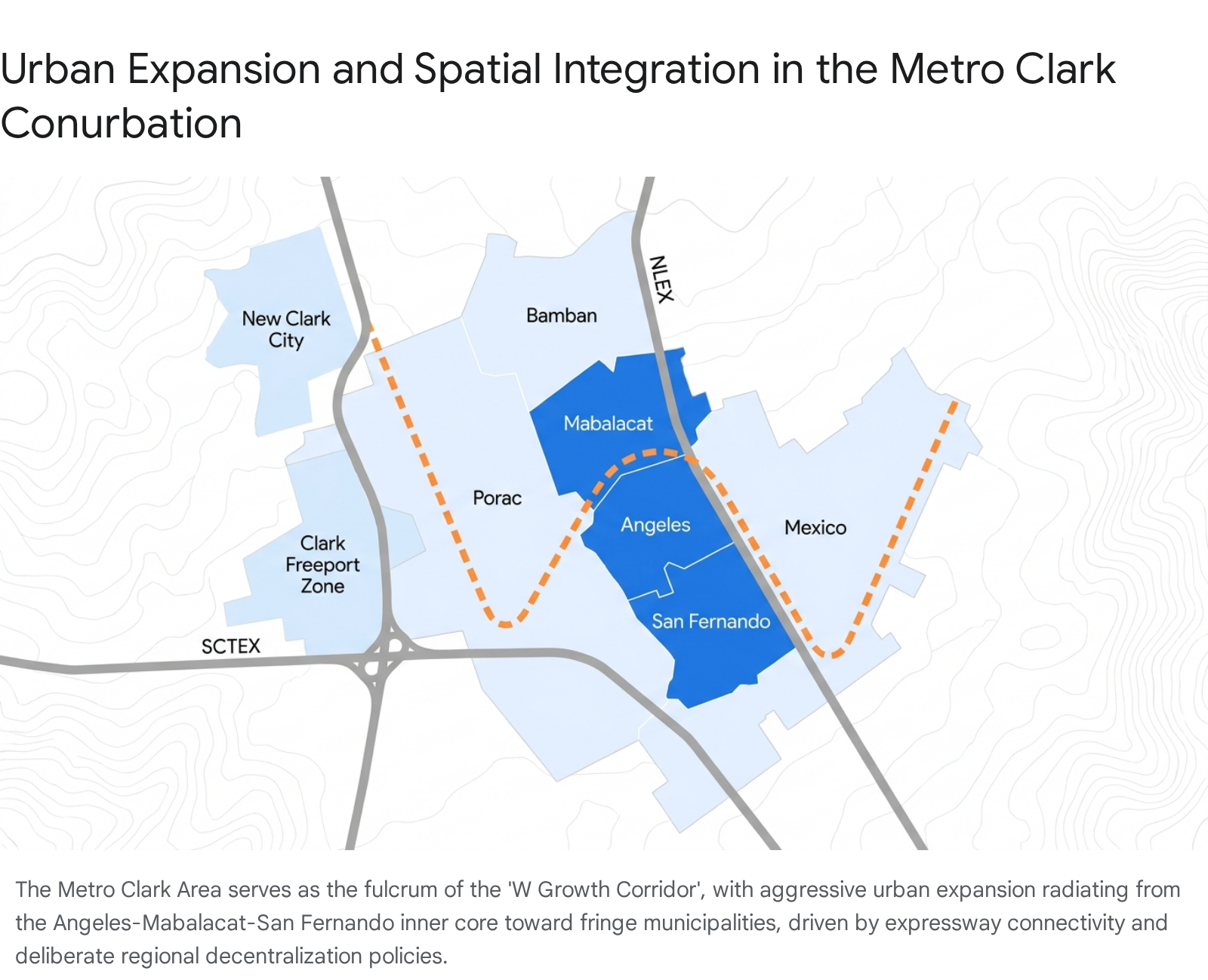
Map of Metro Clark conurbation showing urban expansion and spatial integration, including Angeles, Mabalacat, San Fernando, and SCTEX.

5. Geopolitics and the Luzon Economic Corridor (LEC)

The economic trajectory of the Clark region cannot be assessed purely through the lens of domestic growth metrics. It is currently the primary theater for intense geopolitical maneuvering and sovereign-level investment programs. Driven largely by the strategic imperatives of the United States and Japan, these initiatives are aimed at fundamentally rewiring global supply chains and establishing a resilient economic foothold in the Indo-Pacific.

5.1. The Trilateral Partnership and the SCMB Railway

In April 2024, the leaders of the United States, Japan, and the Philippines formalized the launch of the Luzon Economic Corridor (LEC).4 Positioned as a flagship initiative under the Partnership for Global Infrastructure and Investment, the LEC seeks to accelerate coordinated investments in high-impact infrastructure, explicitly linking the critical economic nodes of Subic Bay, Clark, Metro Manila, and Batangas.4 The sheer scale of this initiative is unprecedented, with the Philippine government projecting the generation of approximately $100 billion in direct investments from the US and Japan over the next five to ten years.5

The structural and logistical backbone of the LEC is the proposed Subic-Clark-Manila-Batangas (SCMB) Railway. Envisioned as a 250-kilometer freight and passenger line, the railway will connect two of Luzon’s most vital deep-water maritime ports—Subic Bay in the north and Batangas City in the south—directly through the industrial heartland of Clark and the dense consumer center of Manila.6 The United States Trade and Development Agency (USTDA) has already committed multimillion-dollar funding for technical assistance, comprehensive transportation modeling, and port-rail integration analysis to accelerate the project.6 Current timelines project the construction of the Subic-Clark segment to commence between 2027 and 2028, followed by the Clark-Manila-Batangas segment in 2028–2029, with a target for full rail operations by early 2030.13

The second and third-order economic effects of the SCMB Railway will be profoundly transformative for the region. Currently, logistics operators rely on the congested highway networks spanning Metro Manila. The railway provides a high-capacity, highly resilient alternative that will drastically reduce logistics costs, fuel consumption, and freight dwell times for manufacturers located in the Clark Freeport Zone.6 This modal shift from road to rail freight will lower working capital requirements for locators by dramatically increasing inventory velocity.

Furthermore, the SCMB Railway is fundamentally a dual-purpose infrastructure. Beyond commercial cargo, it possesses significant strategic military mobility value. In an era of heightened Indo-Pacific tensions, the railway enables rapid troop deployment, equipment transfer, and robust disaster response capabilities between deep-water ports and the inland airfields of Clark, perfectly aligning with the broader security objectives of the US-Philippine defense alliance.31

However, realizing this mega-infrastructure is not without significant socio-economic friction. Reports indicate that land acquisition for the right-of-way has already resulted in the eviction of 212 landowners in Porac and Floridablanca, Pampanga, as well as the displacement of indigenous Aeta communities, including approximately 500 families in Capas, Tarlac.13 Managing the environmental safeguards, indigenous rights, and compensation frameworks will be a critical governance challenge that could impact the strict timeline of the project.13
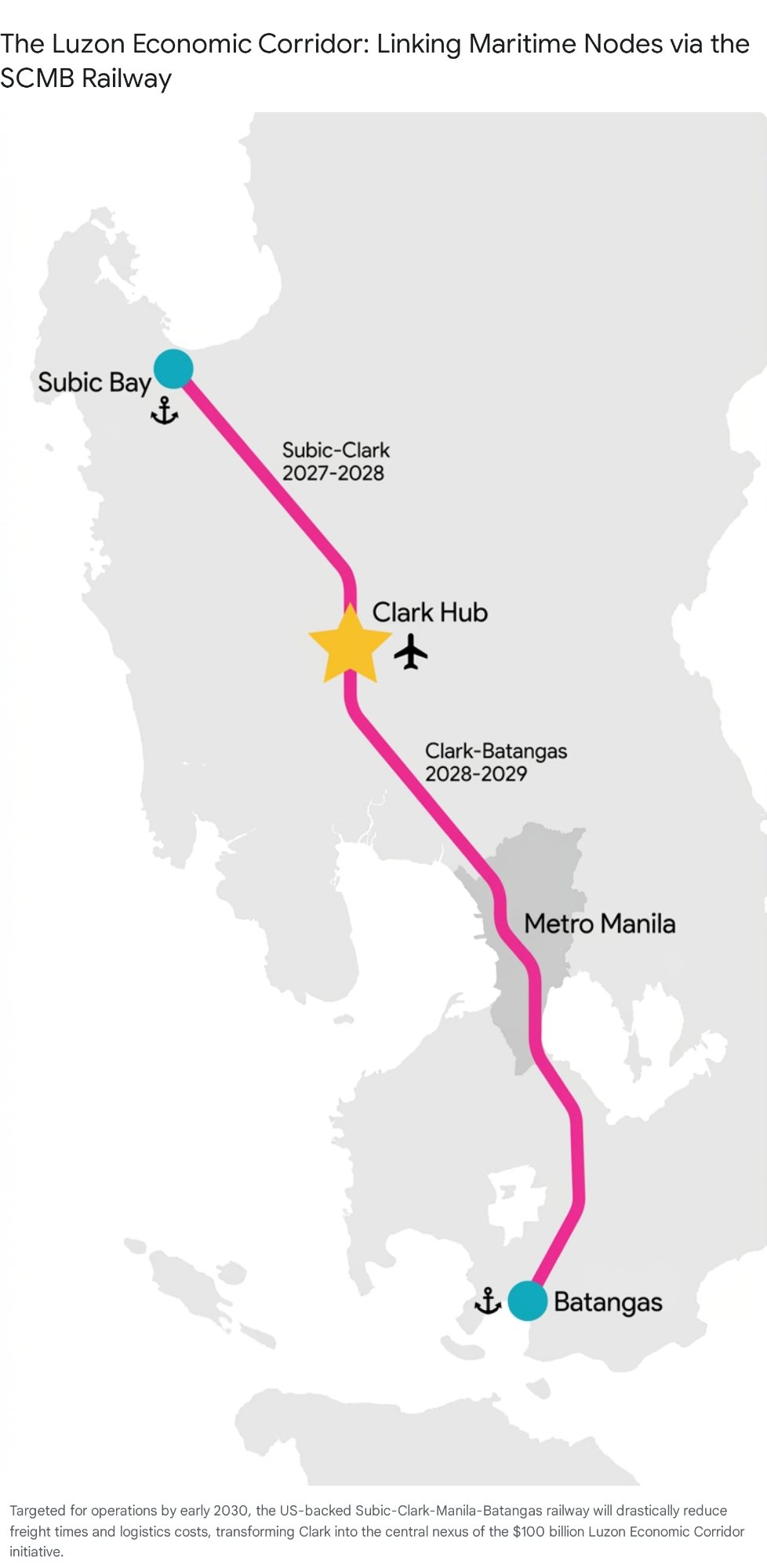
Map showing the Luzon Economic Corridor railway connecting Subic Bay, Clark Hub, and Batangas.

5.2. Pax Silica and the 4,000-Acre Allied Technology Hub

Beyond heavy logistics and transport infrastructure, the Clark region is the vanguard of a highly coordinated effort to secure next-generation technologies. The United States and the Philippines have jointly designated New Clark City as the site for a massive 4,000-acre technology economic zone operating under the Pax Silica Initiative.8

The Pax Silica network comprises thirteen allied nations—including Australia, Japan, the Republic of Korea, and India—committed to establishing secure, transparent, and resilient supply chains for critical minerals, advanced semiconductors, and artificial intelligence capabilities.9 The explicit objective of this initiative is to build a sovereign-aligned manufacturing system capable of competing with, and ultimately displacing, concentrated and adversarial supply chains.8 The selection of the Philippines for the first AI-native industrial acceleration hub leverages the country’s geographical centrality in the Indo-Pacific, its highly technical workforce, and critically, its vast natural endowments of essential minerals like nickel, copper, chromite, and cobalt.7

For business development analysts, the gestation of this 4,000-acre zone signals a guaranteed, massive influx of highly specialized foreign direct investment. The establishment of anchor semiconductor foundries and AI processing centers will force the rapid agglomeration of tier-2 and tier-3 component suppliers, specialized chemical providers, and highly secure data center operators within the Metro Clark area.

Crucially, because advanced semiconductor manufacturing and AI data centers are exceptionally energy-intensive operations, this initiative is forcing a simultaneous acceleration in clean energy deployments. Recognizing the vulnerability of relying on imported energy and the impending depletion of the Malampaya gas fields—which currently supply approximately 30 percent of Luzon’s electricity—the Philippine government has enacted vital legislative reforms, such as allowing 100 percent foreign ownership of renewable energy projects.32 This regulatory shift allows multinational green-energy developers to build the dedicated, utility-scale solar and wind infrastructure required to power the Pax Silica hub, further elevating the region’s Environmental, Social, and Governance (ESG) credentials.

6. Master-Planned Developments: Deconstructing CFZ and NCC

To accurately underwrite real estate and operational risk in the region, analysts must distinguish between the conurbation’s two primary economic engines, both masterfully orchestrated by the Bases Conversion and Development Authority (BCDA): the legacy Clark Freeport Zone (CFZ) and the ambitious greenfield project of New Clark City (NCC). The BCDA has proven highly effective in asset monetization and ecosystem creation, having generated over 400,000 jobs, secured exports worth over $5 billion, and accumulated a total asset value surpassing $10 billion across its special economic zones.10

6.1. The Clark Freeport Zone: Aviation, Global Logistics, and Hospitality

The 31,850-hectare Clark Special Economic Zone, with the CFZ at its historical core, represents the mature commercial and logistical heart of the conurbation.10 Managed by the Clark Development Corporation (CDC), the zone is currently pivoting aggressively away from basic light manufacturing toward becoming a premier, high-value global aviation and logistics hub.33

At the center of this transformation is the Clark Civil Aviation Complex (CCAC). Spanning 2,367 hectares, the CCAC is undergoing a strategic repositioning led by the Clark International Airport Corporation (CIAC) to integrate air cargo, light manufacturing, and associated industries directly adjacent to the tarmac.11 The strategic integration of global logistics giants highlights the scale of this shift. UPS is currently expanding its Clark hub, which is slated to become fully operational by 2026, significantly strengthening its integrated express, supply chain, and healthcare logistics capabilities across the Asia-Pacific.12 Concurrently, FedEx is executing plans to double the size of its gateway facility in Clark, while Lufthansa Technik Philippines has committed an P8 billion investment to construct a second maintenance, repair, and overhaul (MRO) hangar.12

Further amplifying this logistical capacity is the proposed Clark National Food Hub. Utilizing a 62-hectare site within the aviation complex, this project represents an P8.5 billion investment targeted for completion by 2028.10 The Food Hub will revolutionize national agricultural distribution by providing state-of-the-art cold-chain storage and processing for perishables.33 The second-order effects of this facility are profound: by significantly reducing post-harvest agricultural losses and stabilizing regional food supply chains, the hub will help moderate regional inflation, protecting the purchasing power of the local workforce and preventing wage-push pressures that deter industrial locators.

Beyond heavy logistics, the CFZ is experiencing a boom in the commercial and hospitality sectors. In 2025, the zone recorded over 1.5 million overnight guests and 1.8 million same-day visitors, straining the current inventory of 4,100 hotel rooms.34 To capture this surging demand, foreign capital is deploying rapidly. Notably, Korean developer JnH Philippines Development Corp. recently amended its lease agreement to accelerate an P840-million mixed-use project along C.M. Recto Highway.34 By compressing the construction timeline from five years to just 30 months, JnH aims to quickly deliver 17 pool villas and high-rise mixed-use towers, bolstering Clark’s position as a premier destination for Meetings, Incentives, Conferences, and Exhibitions (MICE) tourism.34 Physical connectivity is also being enhanced; the recently completed 894-meter, six-lane Sacobia Bridge now provides a seamless, high-capacity link between the Clark International Airport and the residential zones of New Clark City, reducing transit friction for both tourists and daily commuters.35

6.2. New Clark City: The National Government Administrative Center

While the CFZ serves as the commercial and logistical anchor, New Clark City (NCC)—a massive 9,450-hectare planned community located across the border in the municipalities of Capas and Bamban, Tarlac—is engineered to be the country’s first truly smart, green, and disaster-resilient metropolis.10 Designed from inception to accommodate up to 1.2 million residents and 800,000 workers across 13 distinct neighborhoods, NCC represents the physical manifestation of the state’s ultimate decentralization policy.36

The cornerstone of the NCC master plan is the National Government Administrative Center (NGAC). Legislative initiatives, most notably the proposed “Kabisera 2030” bill, seek to mandate the permanent transfer of the seat of the national government to NCC by 2030.14 Under this proposal, the Office of the President, the Office of the Vice President, and the central offices of all national government agencies and government-owned corporations currently located in the National Capital Region must relocate.14 This is not merely a bureaucratic reshuffling; it is a strategic economic necessity. A study by JICA highlighted the paralyzing economic cost of transportation and congestion in Metro Manila, necessitating a secondary capital protected from the capital’s severe vulnerability to seismic activity and flooding.15

The institutional migration to the NGAC has already commenced, signaling strong sovereign commitment. The Philippine Coast Guard (PCG) is currently relocating its Command and Admiral Staff College to the new Government Building in NCC, a move designed to ensure the continuity of national security institutions outside of flood-risk zones.38 More significantly from a macroeconomic perspective, the Bangko Sentral ng Pilipinas (BSP) is constructing a massive 31-hectare complex in NCC, which will house its highly sensitive Security Plant Complex (SPC) responsible for national currency production.10 The relocation of the central bank’s physical asset production serves as the ultimate endorsement of the city’s geological stability. This sovereign confidence will invariably cascade into the private sector, encouraging major commercial banks and financial institutions to establish robust secondary headquarters and disaster-recovery data centers in the area.

To anchor the city’s civic life, the NGAC also houses the New Clark City Sports Hub, featuring a 20,000-seater Athletics Stadium.40 As the first facility in the Philippines to receive Class 1A certification from World Athletics, equipped with a Polytan synthetic track and advanced RFID performance tracking, it positions NCC to host major international events, driving sports tourism and elevating the city’s global profile.40

6.3. NCC Investment Inflows and Development Timelines

Since the finalization of its master plan in 2017, New Clark City has proven its bankability by attracting P143.22 billion in investments.10 The master plan dictates an orderly rollout across three phases: Phase 1 (2017–2022), Phase 2 (2023–2030), and Phase 3 (2031–2040).41 Currently navigating Phase 2, the focus is squarely on mixed-use industrial and residential integration.

The employment generation potential is staggering. The NCC development inherently possesses the capacity to create over 103,000 jobs.10 Specific industrial allocations, such as the 500-hectare mixed-use industrial park containing general and light industrial zoning, are attracting heavy manufacturing.41 The TARI Estate project alone is projected to create 60,000 new jobs.10 Furthermore, St Baker’s bold initiative to establish battery manufacturing facilities in the area is expected to generate 1,000 jobs by 2030, reserving half of these positions for local technical and engineering talent.10

To support this massive influx of human capital without replicating the slum dynamics of older cities, residential infrastructure is being aggressively scaled. In February 2025, the BCDA formalized a 50-year lease agreement with a consortium including Sta. Clara International Corp. and the state-owned Korea Overseas Infrastructure and Urban Development Corp. to construct a 6.1-hectare real estate project.10 Concurrently, a 33.89-hectare affordable housing project is underway, designed as “modern, grassroots villages” that ensure social inclusivity while minimizing the stigma traditionally associated with subsidized housing.10 The environmental sustainability of this rapid urbanization is guaranteed through partnerships with firms like Danfoss, Inc., implementing comprehensive decarbonization and renewable energy solutions across the city’s 44.8-hectare central park system.10

7. Real Estate Dynamics: Office, Industrial, and Residential Markets

The macroeconomic shifts, infrastructural gestation, and government mandates detailed above are directly reflected in the real estate absorption metrics of the region. As Metro Manila grapples with structural real estate challenges, the Metro Clark area is successfully capturing the overflow, repositioning itself as a highly lucrative destination for institutional real estate capital.

7.1. Commercial and IT-BPM Office Absorption

The Philippine office market is navigating a complex period of recalibration. Nationally, total office demand demonstrated resilience, reaching 966,000 square meters by the third quarter of 2025.43 However, the vacancy rates within Metro Manila’s central business districts remain elevated, stabilizing around 18 percent generally, with certain areas facing much steeper challenges.43

The primary catalyst for commercial real estate growth remains the Information Technology and Business Process Management (IT-BPM) sector, which accounts for 45 percent of total national demand.43 As prime office spaces in Metro Manila face high operational costs and the lingering market distortions caused by the mass exit of Philippine Offshore Gaming Operators (POGOs), IT-BPM firms are executing aggressive provincial expansion strategies.43

Pampanga is uniquely positioned to capture this demand. Ranked as a Tier 1 provincial location, it boasts a substantial total office stock of 529,000 square meters, with approximately 130,000 square meters of high-quality space currently available.44 The region’s viability is secured by its designation as a “Digital City.” To achieve this status, a location must guarantee Grade-AAA power infrastructure, digital fiber optic networks, and an abundant talent pipeline.44 With an annual output of over 54,000 higher education graduates in the wider region, Pampanga easily satisfies the stringent human capital metrics demanded by global outsourcing conglomerates.44

Within the Clark CBD itself, the market is extraordinarily tight. Major BPO players, including iQor, Asurion, and Concentrix, are actively expanding their footprints.10 As of mid-2024, the Clark CBD reported 117,000 square meters of occupied office space, leaving a minimal 8,000 square meters of available space within the immediate Freeport Zone.10 This severe supply-side constraint will inevitably exert strong upward pressure on lease rates in the near term, signaling a highly favorable environment for commercial developers capable of delivering Grade-A, ESG-compliant office towers.

7.2. Residential Real Estate and the POGO Exodus Impact

The residential real estate market presents a sharply bifurcated reality between the capital and the provinces. In the National Capital Region, the residential sector is struggling with massive oversupply. Colliers projects that the overall vacancy rate in Metro Manila’s secondary market will reach an all-time high of 26.5 percent by the end of 2025.45 In specific locations like the Bay Area, vacancy rates exceed 50 percent, a direct consequence of the systemic exodus of POGO operations which previously occupied vast swathes of residential condominiums built immediately prior to and during the pandemic.45 Furthermore, high interest rates and affordability constraints continue to temper buyer appetite among middle-income households in the capital.47

Conversely, the dynamics in provincial areas like Pampanga are distinctly more stable. While the departure of POGOs created localized, temporary shocks in peripheral rental markets, the rapid absorption of commercial space by IT-BPM and traditional corporate occupiers is generating sustained, qualitative demand for mid-market and premium residential housing in the Metro Clark Conurbation. According to market data, average house prices in areas outside the NCR rose by a sustainable 1 percent year-over-year in Q3 2025, representing a healthy stabilization following more aggressive double-digit growth in previous years.45

Developers in Central Luzon are strategically shifting their capital allocation toward sprawling suburban townships and sustainable horizontal developments. This pivot captures the evolving preferences of a growing middle class, as well as the influx of highly compensated expatriate and domestic professionals relocating to the CFZ and NCC, who demand low-density living environments with integrated green spaces rather than vertical condominiums.48

7.3. Industrial Parks and Logistics Facilities

The industrial and logistics real estate sector stands as the most resilient and aggressively expanding asset class in the region. Buoyed by the unabated boom in e-commerce, the imperative for supply chain decentralization, and the impending influx of semiconductor manufacturing, the demand for premium industrial space is accelerating rapidly.46

The market is currently witnessing a qualitative upgrade in industrial facility requirements. The BCDA’s strategic partnerships with entities like the Science Park of the Philippines, and the zoning of 500 hectares in NCC specifically for mixed-use industrial parks (encompassing light industrial, general industrial, and R&D specific zones), align perfectly with the exacting needs of modern manufacturers.42 As the Pax Silica tech zone transitions from policy to physical construction, the absorption of industrial space is projected to remain exceptionally tight. Global manufacturers of electric vehicles, semiconductor fabricators, and food processors increasingly demand built-to-suit, highly automated, and energy-resilient facilities, pushing industrial land valuations in the Clark periphery to historic highs.46

Real Estate SectorCurrent Regional Dynamics (Metro Clark/Pampanga)Primary Demand Drivers10-Year Outlook Implication
Commercial/OfficeTight vacancies in Clark CBD (only 8,000 sqm available); Tier 1 provincial status.IT-BPM provincial expansion, traditional corporate relocation escaping Manila costs.Upward pressure on rents; urgent requirement for Grade-A smart buildings in NCC.
ResidentialStabilizing horizontal growth (1% YoY); pivot toward affordable community developments.Influx of logistics/BPM workers; impending government employee mass relocation.Sustained demand for master-planned suburban townships; minimal exposure to the NCR condo glut.
Industrial/LogisticsAggressive expansion; near-zero vacancy in premium cold-chain and logistics parks.E-commerce, semiconductor friendshoring (Pax Silica), agricultural cold-chain.Massive capital appreciation for industrial land; demand for built-to-suit, ESG-compliant facilities.

8. Strategic Growth Outlook: 3, 5, and 10-Year Forecasts

Synthesizing the macroeconomic performance data, hard infrastructural timelines, and sovereign-level geopolitical directives reveals a highly structured, phased trajectory for the Metro Clark conurbation.

8.1. Three-Year Outlook (2026–2029): Infrastructure Gestation and Institutional Relocation

The immediate three-year horizon will be defined by intensive capital expenditure, earthmoving, and the physical realization of foundational logistical assets. Economic growth during this phase will be heavily weighted toward the construction, engineering, and capital goods sectors.

  • Logistics Solidification: By 2028, the P8.5 billion Clark National Food Hub will become fully operational, fundamentally altering agricultural supply chains and stabilizing inflation in Central Luzon.10 Simultaneously, the expanded aviation hubs for UPS and FedEx will come online, cementing the Clark Civil Aviation Complex as the premier, high-velocity air freight node in the country, effectively bypassing the bottlenecks of Ninoy Aquino International Airport.12
  • Real Estate and Hospitality Recalibration: The accelerated completion of the JnH mixed-use development by late 2028 will add critical capacity to the region’s MICE and hospitality sector.34 This will allow the region to absorb the projected surge in corporate travel associated with the site selection and planning phases of the incoming semiconductor and manufacturing firms.
  • Government Migration Initiation: Early phases of the National Government Administrative Center in New Clark City will witness increased physical occupancy.14 As the Philippine Coast Guard and the Bangko Sentral ng Pilipinas operationalize their new facilities, secondary support industries will begin shifting their bureaucratic gravity northward.

8.2. Five-Year Outlook (2026–2031): Logistics Ascendancy and Transit Integration

By 2031, the region will pivot from a construction-led growth model to an operational, logistics-led expansion, characterized by a dramatic, permanent increase in the velocity of goods and human capital.

  • The SCMB Railway Catalyst: The projected operationalization of the Subic-Clark-Manila-Batangas railway by 2030 stands as the most consequential economic event of the decade.13 The radical reduction in terrestrial freight costs will immediately boost the gross margins of manufacturers located in the CFZ and NCC. This cost advantage will likely trigger a secondary, massive wave of foreign direct investment from firms that were previously deterred by the prohibitive logistics costs associated with Manila’s congestion.
  • The Capital Shift Deadline: 2030 marks the statutory deadline mandated by the Kabisera 2030 proposals for the transfer of the national government seat to NCC.14 The enforcement of this mandate will induce a permanent demographic shift of tens of thousands of highly skilled bureaucrats and their families to the region. This influx will create immense, localized economic multipliers, driving a boom in retail, private education, and healthcare real estate.
  • Phase 3 Transition: New Clark City will formally transition into Phase 3 (2031-2040) of its master development plan.41 Having secured its industrial base, the focus will shift toward scaling high-density residential and commercial zones to support a rapidly agglomerating population that approaches the 1 million mark.

8.3. Ten-Year Outlook (2026–2036): Semiconductor Prominence and The Decongested Capital

Looking a decade ahead, the Metro Clark conurbation will operate as a mature, globally integrated economic apex, fundamentally decoupled from the structural limitations and vulnerabilities of Metro Manila.

  • The Pax Silica Reality: The 4,000-acre allied technology economic zone in NCC will be fully integrated into global supply chains.8 Clark will no longer be viewed merely as an outsourcing or light-manufacturing hub, but as an indispensable, sovereign-backed node in the semiconductor, AI, and critical minerals network of the United States and its allies.8 The presence of advanced fabrication plants and secure data centers will elevate the region’s per capita GDP significantly above the national average, attracting top-tier global talent.
  • Demographic Maturation and Upskilling: The youthful, 25-year-old median population of the 2020s will have aged into their peak earning and consumption years. Assuming the successful execution of the upskilling interventions championed by TESDA and local universities, the indigenous labor pool will be highly specialized.22 This high-income workforce will support a robust, consumption-driven local economy, insulated from external macroeconomic shocks.
  • Spatial Equilibrium Achieved: The “W Growth Corridor” will function as a seamless, highly efficient economic organism.26 The spatial mismatch between where people live (the urban fringe) and where they work (the industrial cores) will be largely resolved by the efficient transit linkages provided by the SCMB railway and completed expressway networks. Metro Clark will stand as the definitive blueprint for sustainable, high-growth urban development in the Asia-Pacific.

9. Conclusion

The Metro Clark conurbation is currently executing a textbook transition from a localized special economic zone to a macroeconomic powerhouse of immense national and international consequence. The synergy between massive, physical infrastructural investments—specifically the SCMB Railway and the aviation logistics upgrades within the CCAC—and the sovereign-level geopolitical commitments of the Pax Silica initiative virtually guarantees exceptional capital absorption over the next decade.

For business development analysts, institutional investors, and sovereign wealth funds, the empirical data signals a clear and urgent imperative: the window for securing early-mover advantage in industrial land banking, affordable-to-mid-market residential development, and tertiary commercial services within the urban fringe of the Metro Clark Area is rapidly closing. As the national government finalizes its migration to New Clark City and global supply chains permanently anchor into the newly formed technology zones, the region will unequivocally solidify its position not just as a resilient alternative to Metro Manila, but as the premier destination for high-value, sustainable economic growth in the Republic of the Philippines.


Please share the link on Facebook, Forums, with colleagues, etc. Your support is much appreciated and if you have any feedback, please email us in**@*********ps.com. If you’d like to request a report or order a reprint, please click here for the corresponding page to open in new tab.


Sources Used

  1. PSA: Pampanga, Angeles City economies expanded in 2024, accessed May 5, 2026, https://pia.gov.ph/regions/psa-pampanga-angeles-city-economies-expanded-in-2024/
  2. Pampanga (Province, Philippines) – Population Statistics, Charts, Map and Location, accessed May 5, 2026, https://citypopulation.de/en/philippines/luzon/admin/0354__pampanga/
  3. Pampanga Profile – PhilAtlas, accessed May 5, 2026, https://www.philatlas.com/luzon/r03/pampanga.html
  4. Philippines Luzon Economic Corridor – International Trade Administration, accessed May 5, 2026, https://www.trade.gov/market-intelligence/philippines-luzon-economic-corridor
  5. PHILIPPINES: Major Upgrade of the Luzon Economic Corridor Announced, accessed May 5, 2026, https://research.hktdc.com/en/article/MTY5MjYyMjQ0MQ
  6. USTDA Strengthens U.S.-Philippines Alliance Through Support for Flagship Rail Project, accessed May 5, 2026, https://www.ustda.gov/ustda-strengthens-u-s-philippines-alliance-through-support-for-flagship-rail-project/
  7. Fact Sheet: U.S. and Philippines Plan the Launch of Historic 4000 Acre Economic Security Zone to Shore Up Supply Chains, accessed May 5, 2026, https://ph.usembassy.gov/fact-sheet-u-s-and-philippines-plan-the-launch-of-historic-4000-acre-economic-security-zone-to-shore-up-supply-chains/
  8. US, Philippines pick New Clark City for 4000-acre tech zone – Manila Bulletin, accessed May 5, 2026, https://mb.com.ph/2026/04/20/us-philippines-pick-new-clark-city-for-4000-acre-tech-zone
  9. The United States and The Philippines Launch Plans for 4000-Acre Economic Security Zone to Shore Up Supply Chains, accessed May 5, 2026, https://ph.usembassy.gov/the-united-states-and-the-philippines-launch-plans-for-4000-acre-economic-security-zone-to-shore-up-supply-chains/
  10. NEXT GREAT CITY – Bases Conversion and Development Authority, accessed May 5, 2026, https://www.bcda.gov.ph/sites/default/files/2026-01/Clark%20Magazine%202026.pdf
  11. Clark International Airport’s Rise as the Philippines’ Premier Regional Logistics Hub, accessed May 5, 2026, https://blog.gettransport.com/news/clark-airport-logistics-excellence/
  12. Clark on the road to become global logistics and aviation hub, accessed May 5, 2026, https://bcda.gov.ph/news/clark-road-become-global-logistics-and-aviation-hub
  13. Subic-Clark-Manila-Batangas Railway serves US imperialist economic and geopolitical interests – NDFP, accessed May 5, 2026, https://ndfp.info/subic-clark-manila-batangas-railway-serves-us-imperialist-economic-and-geopolitical-interests/
  14. *22 JUL 25 A10 *48 – legacy.senate.gov.ph., accessed May 5, 2026, https://legacy.senate.gov.ph/lisdata/3854234995!.pdf
  15. New Clark City ready as seat of gov’t by 2030 – Philippine Star, accessed May 5, 2026, https://www.philstar.com/headlines/2019/08/14/1943302/new-clark-city-ready-seat-govt-2030
  16. Unlocking the Potentials of Central Luzon, accessed May 5, 2026, https://www.bsp.gov.ph/Pages/IRG/irg-files/Clark%202025/Regional%20Development%20Plan%20Updates%20and%20Economic%20Outlook.pdf
  17. 2025 Investment Climate Statements: Philippines – U.S. Department of State, accessed May 5, 2026, https://www.state.gov/reports/2025-investment-climate-statements/philippines
  18. 2024 Investment Climate Statements: Philippines – State Department, accessed May 5, 2026, https://2021-2025.state.gov/reports/2024-investment-climate-statements/philippines/
  19. Philippines Labor Force Participation Rate 2025: 50.98 | Geo Factbook, accessed May 5, 2026, https://geofactbook.com/countries/philippines/labor-force
  20. 03Overlay of Economic Growth, Demographic Trends, and Physical Characteristics – – Philippine Development Plan, accessed May 5, 2026, https://pdp.depdev.gov.ph/wp-content/uploads/2021/12/Chapter-03.pdf
  21. Skill Profiling of Pampanga Accounting Graduates | PDF – Scribd, accessed May 5, 2026, https://www.scribd.com/document/965997033/MEDINA-SOFT-AND-TECHNICAL-SKILLS
  22. EDCOM II • FINAL REPORT – Workforce Development Plan, accessed May 5, 2026, https://edcom2.gov.ph/media/2026/01/EDCOM-II_Y03_Workforce-Development-Plan.pdf
  23. Tesda – Technical Education And Skills Development Authority, accessed May 5, 2026, https://www.tesda.gov.ph/
  24. ILS Marks 2025 With Strong Momentum in Research, Policy Leadership, and Global Engagements – DOLE ILS Official, accessed May 5, 2026, https://ils.dole.gov.ph/policy-advocacies/media-resources/news/ils-marks-2025-with-strong-momentum-in-research-policy-leadership-and-global-engagements
  25. Academics – Pampanga State Agricultural University, accessed May 5, 2026, https://psau.edu.ph/category/vpaa/
  26. 5.2.1 National and Regional Economic Development Plans – JICA Report PDF, accessed May 5, 2026, https://openjicareport.jica.go.jp/pdf/11525102_04.pdf
  27. PDP-2023-2028.pdf – – Philippine Development Plan, accessed May 5, 2026, https://pdp.depdev.gov.ph/wp-content/uploads/2023/01/PDP-2023-2028.pdf
  28. CENTRAL LUZON Regional Development Plan 2023 – 2028 | PDF – Scribd, accessed May 5, 2026, https://www.scribd.com/document/677962642/CENTRAL-LUZON-Regional-Development-Plan-2023-2028
  29. (Pre-Pub) CL-RDP 2023-2028 1.pdf – Slideshare, accessed May 5, 2026, https://www.slideshare.net/slideshow/prepub-clrdp-20232028-1pdf/259252414
  30. dpwh strategic infrastructure programs – and projects, accessed May 5, 2026, https://www.bsp.gov.ph/Pages/IRG/irg-files/Clark%202025/Department%20of%20Public%20Works%20and%20Highways%20Clark.pdf
  31. Subic to Batangas 250KM U.S.-Backed Railway Could Change Philippines Forever, accessed May 5, 2026, https://www.youtube.com/watch?v=anw1mrTd2_Y
  32. Energy Security and the U.S.-Philippine Alliance – CSIS, accessed May 5, 2026, https://www.csis.org/analysis/energy-security-and-us-philippine-alliance
  33. Strategic moves push Clark Aviation Capital as a premier global aviation and logistics hub, accessed May 5, 2026, https://philstarlife.com/news-and-views/856786-strategic-moves-push-clark-aviation-capital-premier-global-aviation-logistics-hub
  34. Korean developer JnH accelerates Clark timeline – BusinessWorld Online, accessed May 5, 2026, https://www.bworldonline.com/economy/2026/05/03/747061/korean-developer-jnh-accelerates-clark-timeline/
  35. 2024 ANNUAL REPORT – Bases Conversion and Development …, accessed May 5, 2026, https://www.bcda.gov.ph/sites/default/files/2025-08/BCDA%202024%20Annual%20Report_Big,%20Bold%20Moves.pdf
  36. New Clark City – Wikipedia, accessed May 5, 2026, https://en.wikipedia.org/wiki/New_Clark_City
  37. Building a better world by connecting communities. – New Clark City Master Plan – aecom, accessed May 5, 2026, https://publications.aecom.com/social-infrastructure/projects/new-clark-city/
  38. PCG to relocate Command, Admiral Staff College to New Clark City, accessed May 5, 2026, https://pia.gov.ph/news/luzon/cl/pcg-to-relocate-command-admiral-staff-college-to-new-clark-city/
  39. Coast Guard to relocate school to New Clark City – SunStar, accessed May 5, 2026, https://www.sunstar.com.ph/pampanga/coast-guard-to-relocateschool-to-new-clark-city
  40. About Us – New Clark City, accessed May 5, 2026, https://newclark.ph/about-new-clark-city/
  41. New Clark City Development Overview | PDF | Mixed Use Development – Scribd, accessed May 5, 2026, https://es.scribd.com/document/555334946/New-Clark-City-Primer
  42. 2022 New Clark Primer .pdf, accessed May 5, 2026, https://bcda.gov.ph/sites/default/files/2022-01/2022%20New%20Clark%20Primer%20.pdf
  43. Leechiu: Office recovery strengthens in Q3 2025 on steady outsourcing growth – InsiderPH, accessed May 5, 2026, https://insiderph.com/leechiu-office-recovery-strengthens-in-q3-2025-on-steady-outsourcing-growth
  44. Central Luzon Property Market Updates: – Log In ‹ Ayala Land Estates Seller’s Hub, accessed May 5, 2026, https://admin.ayalalandestates.com.ph/wp-content/uploads/2025/06/Central-Luzon-Property-Market-Updates-by-Colliers-Philippines-Research.pdf
  45. Philippines’s Residential Property Market Analysis 2026, accessed May 5, 2026, https://www.globalpropertyguide.com/asia/philippines/price-history
  46. Philippine Property Market Outlook 2025 | PDF | Metro Manila | Economies – Scribd, accessed May 5, 2026, https://www.scribd.com/document/806166150/Colliers-Manila-2025-Outlook-v1
  47. Leechiu: Residential market recovering, office demand shows resilience – Manila Bulletin, accessed May 5, 2026, https://mb.com.ph/2025/10/06/leechiu-residential-market-recovering-office-demand-shows-resilience
  48. PH real estate 2025: Poised for growth amid shifting dynamics | Inquirer Business, accessed May 5, 2026, https://business.inquirer.net/494580/ph-real-estate-2025-poised-for-growth-amid-shifting-dynamics
  49. BCDA reaffirms focus on infrastructure development, projects in New Clark City, accessed May 5, 2026, https://www.bcda.gov.ph/news/bcda-reaffirms-focus-infrastructure-development-projects-new-clark-city

Systemic Fragility Analysis of the Iranian State: A 36-Month Predictive Outlook – Q2 2026

Executive Summary

Overall Fragility Score: 8.8 / 10

Assessed Lifecycle Stage: Stage 3 (Crisis) transitioning rapidly toward Stage 4 (Collapse)

The Islamic Republic of Iran is currently operating within the late, most volatile phases of Stage 3 (Crisis) of the state lifecycle model. The state exhibits an accelerating and arguably irreversible momentum toward Stage 4 (Collapse) within the designated 36-month forecast horizon. State capacity is visibly, severely, and simultaneously impaired across all core functional domains. The convergence of a devastating international conflict, an unprecedented and suffocating United States naval blockade, the assassination of the Supreme Leader, and a domestic climate catastrophe has pushed the complex adaptive system of the Iranian state far beyond its historical resilience thresholds. The state is currently failing to execute its foundational mandate, maintaining order almost exclusively through extreme, unsustainable coercive violence.

Top Key Drivers of Fragility:

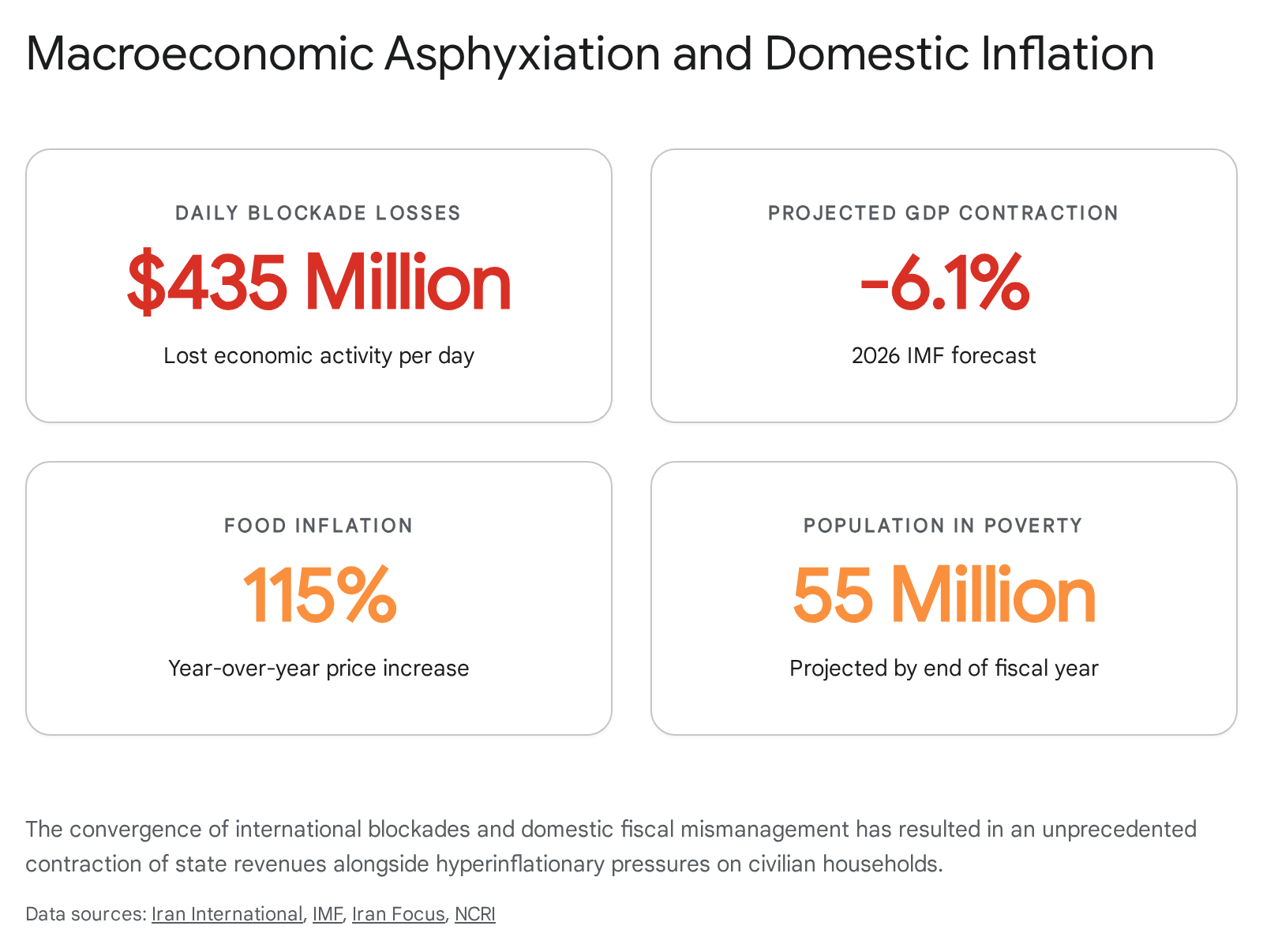
  • Macroeconomic Asphyxiation: A comprehensive United States naval blockade is eliminating approximately 435 million dollars in daily economic activity, crippling state revenues, and driving domestic food inflation past the 115 percent threshold.
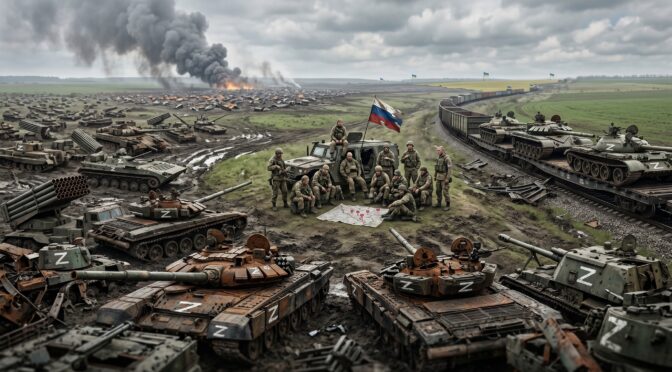
  • Security Apparatus Fracture: Acute logistical shortages, coupled with the systemic hoarding of medical supplies and ammunition by the Islamic Revolutionary Guard Corps, have triggered severe institutional friction, insubordination, and rising desertion rates within the conventional military.
  • Leadership Vacuum and Elite Schisms: The targeted killing of Ali Khamenei and the highly contested, opaque succession of his severely injured son, Mojtaba Khamenei, have catalyzed open hostility between the civilian presidency and the military establishment over the strategic direction of the state.
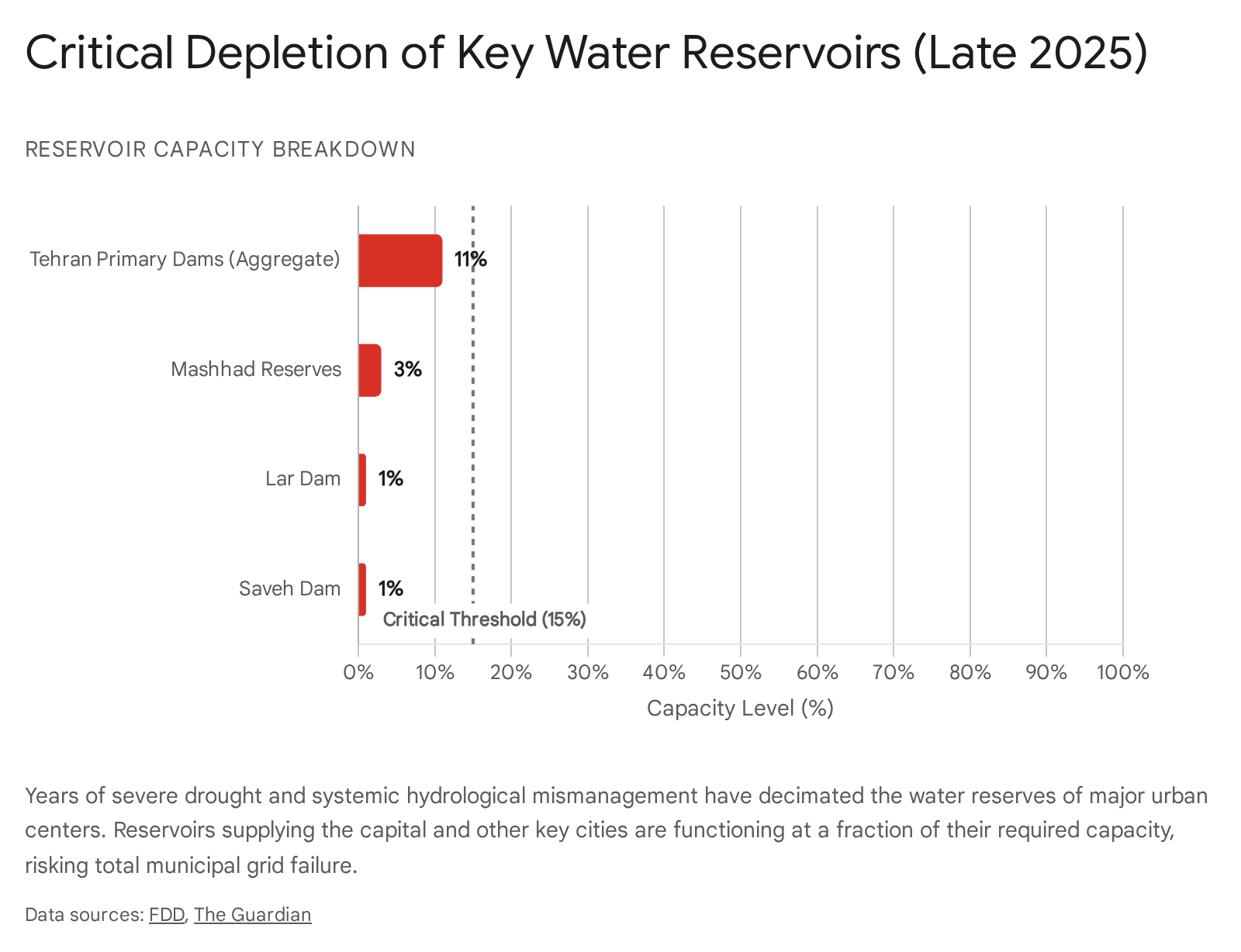
  • Existential Resource Depletion: Critical water infrastructure failure has brought the capital city of Tehran, alongside other major urban centers, to the brink of “Day Zero,” raising the immediate specter of mass, unmanageable climate-induced urban evacuation.

Forecast Trajectory:

The systemic trajectory is steeply negative and highly volatile. The compounding nature of the identified systemic shocks indicates that non-linear deterioration is highly probable. Without a rapid diplomatic resolution to external blockades and immediate structural interventions in resource management, the central political authority is projected to lose its monopoly on the legitimate use of violence and territorial control within the forecast period, precipitating a formal transition to a collapse state.

State Fragility Dashboard

Domain / IndicatorCurrent Score (1-10)TrendVolatilityWeighted ImpactBrief Rationale
A.1 Public Finances9.0DeterioratingHigh15.0%Maritime blockade halts trade, zeroing oil export revenues and driving severe budget deficits funded entirely by inflationary currency printing.
A.2 Economic Structure8.5DeterioratingMedium10.0%Massive human capital flight and parastatal monopolization suffocate civilian productivity and destroy long-term macroeconomic recovery potential.
A.3 Household Health9.0DeterioratingHigh10.0%Currency collapse and extreme food inflation force over 55 million citizens below the absolute poverty line, completely dissolving the social contract.
B.1 Governance & Law8.0DeterioratingHigh10.0%Opaque succession crisis and Guardian Council electoral engineering erode all remaining pillars of representative legitimacy and public mandate.
B.2 State Legitimacy8.5StaticLow10.0%Public trust is irreparably broken, evidenced by historically low voter turnouts and a complete reliance on extreme coercive violence for survival.
B.3 Security Cohesion9.5DeterioratingHigh15.0%Critical institutional rift between the conventional military and the IRGC over resource allocation threatens the state’s monopoly on force.
C.1 Social Cohesion8.0DeterioratingMedium5.0%Deepening ethnic disenfranchisement in border regions drives up to half of all protest fatalities, risking geographic and territorial fragmentation.
C.2 Public Services8.5DeterioratingHigh10.0%Pension fund insolvency and rolling power grid blackouts demonstrate daily, undeniable state failure to the increasingly hostile urban population.
D.1 Climate Vulnerability9.5DeterioratingLow10.0%Multi-year droughts and extreme heat events threaten the immediate biological habitability of major population and economic centers.
D.2 Resource Stress9.5DeterioratingLow5.0%Primary dam levels operating between 1 percent and 11 percent capacity push Tehran toward Day Zero, ensuring catastrophic internal displacement.

Detailed Domain Analysis

Module A: Economic Resilience and State Capacity

A.1 Public Finances

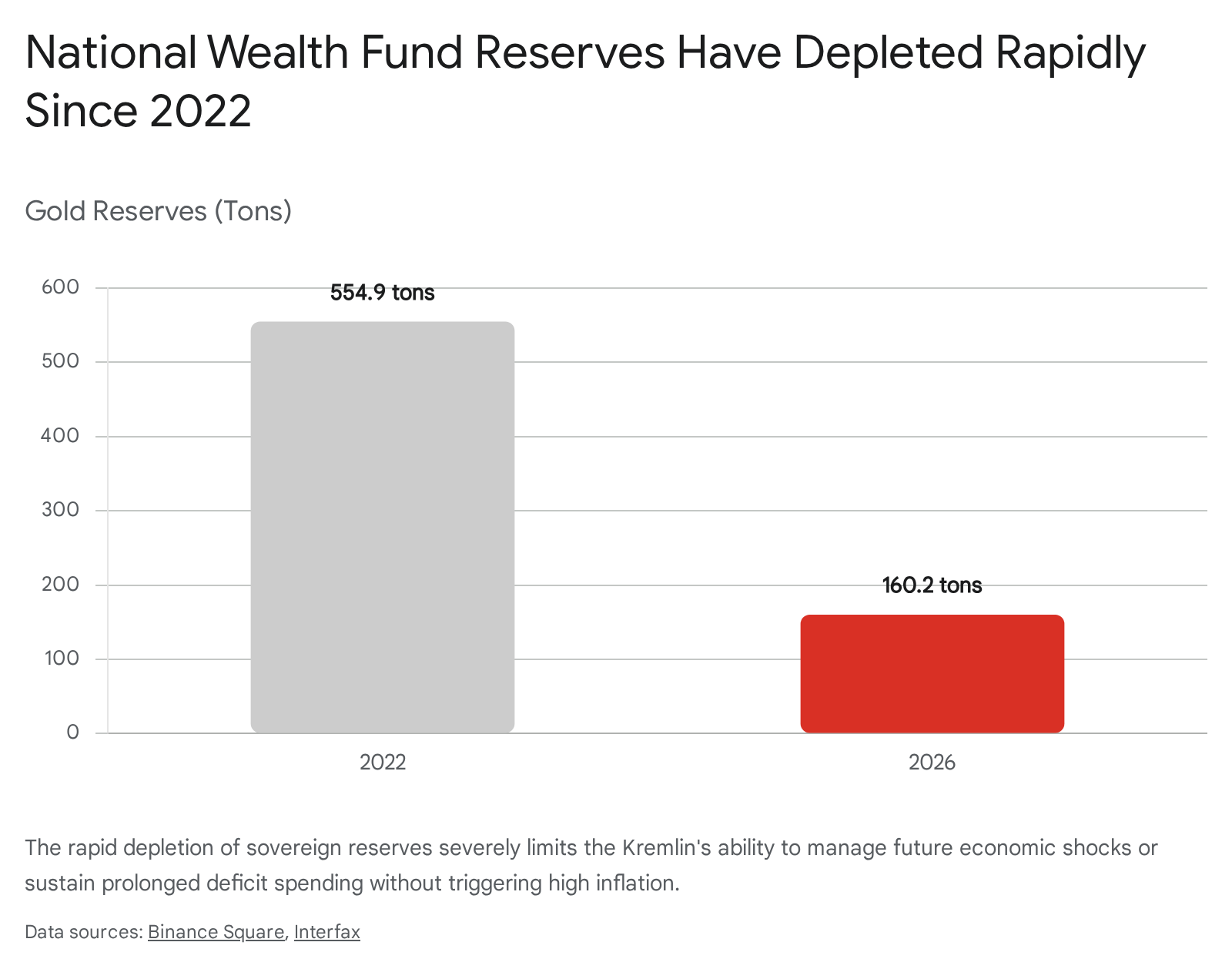
The foundational pillar of Iranian macroeconomic stability has been systematically dismantled by an unprecedented United States naval blockade and intense international sanctions. This maritime interdiction campaign has effectively neutralized the state’s capacity to engage in seaborne trade, which historically served as the primary conduit for both licit and illicit revenue generation. Quantitative assessments indicate that the blockade is eliminating an estimated 435 million dollars in daily economic activity.1 Central to this catastrophic contraction is the absolute cessation of crude oil shipments. Prior to the escalation of hostilities, the state successfully exported approximately 1.5 million barrels per day through shadow networks. The truncation of these export volumes deprives the central treasury of roughly 139 million dollars in daily revenue, compounding to a monthly fiscal deficit approaching 13 billion dollars when factoring in broader trade disruptions.2

This absolute revenue collapse has triggered a severe and inescapable “subsidy trap” for the central government. The state is bound by structural, non-discretionary spending pressures to subsidize basic goods for a rapidly impoverishing population to prevent immediate mass starvation and rioting. In a desperate bid to manage the bankrupt treasury, the administration of President Masoud Pezeshkian implemented quarterly fuel price indexing based on refinery costs.3 This mechanism creates an uncontrollable inflationary spiral: as inflation drives up refining costs, retail fuel prices automatically climb every 90 days, which in turn drives up the cost of agricultural transport and basic goods.3

Lacking foreign exchange reserves, the central bank has resorted to printing unbacked currency to cover domestic obligations, resulting in hyperinflationary conditions. The rial has experienced a record devaluation, surging past 1.8 million rials to the United States dollar on the open market 4, while alternative metrics place the exchange rate at a staggering 136,400 tomans.3 The International Monetary Fund projects a severe contraction, with real gross domestic product expected to shrink by 6.1 percent in 2026.5 Meanwhile, the parallel financing of the regional proxy network via shadow banking architectures diverts what little foreign exchange remains directly into the hands of the Islamic Revolutionary Guard Corps and its foreign subsidiaries, further starving the domestic economy.7

  • Current State: Critical insolvency. The state is unable to generate sufficient foreign exchange to meet basic import requirements or service domestic subsidy obligations without printing unbacked fiat currency.
  • Trajectory (Delta): Rapidly deteriorating. The compounding effects of the blockade and the quarterly fuel indexing mechanism ensure that the fiscal deficit will continue to widen exponentially over the next 12 to 36 months.
  • Volatility: Extremely high. The currency markets are subject to wild, daily fluctuations driven by geopolitical developments, rumors of leadership changes, and the unpredictable nature of the ongoing conflict.
Iranian economy: $435M daily blockade losses, -6.1% GDP, 115% food inflation, 55M in poverty

A.2 Economic Structure and Productivity

The long-term growth potential of the Iranian economy has been structurally dismantled, transitioning from a developing mixed economy to a heavily militarized, rent-seeking system. The dominance of parastatal organizations and the Islamic Revolutionary Guard Corps has completely crowded out private enterprise. The IRGC operates as the most powerful controller of all important economic sectors across Iran, securing no-bid contracts from the state for servicing the oil sector, developing infrastructure, and controlling consumer imports.8 This monopolization degrades the civilian economy’s ability to compete, innovate, or generate high-wage employment, locking the nation into a cycle of low productivity and high corruption.

Simultaneously, the nation is suffering from an unprecedented and catastrophic human capital flight. Brain drain has reached critical velocity, effectively permanently altering the demographic dividend. Data indicates that an estimated 150,000 to 180,000 scientific professionals left the country between 2007 and 2021, and the exodus has vastly accelerated through 2025 and 2026.9 The return rate for these highly skilled migrants is a mere 1 percent, compared to a global average of 7 percent for similar demographics.9

The demographic profile of this emigration is deeply alarming for state survival: 83 out of 86 recent scientific Olympiad medalists have emigrated, alongside 6,500 medical specialists in a single recent year.9 The healthcare sector is particularly devastated, losing approximately 3,000 nurses annually.9 This represents a massive destruction of state financial investment, as the government spends roughly 68,000 dollars to train each individual nurse.9 The loss of this educated, technically proficient demographic removes the exact cohort necessary for any future economic reconstruction, cementing long-term systemic stagnation regardless of geopolitical outcomes. Consumer price changes underscore this structural failure, with the International Monetary Fund projecting a 68.9 percent inflation rate.5

  • Current State: Structurally stagnant and heavily monopolized. The private sector is entirely subjugated to the military-industrial complex, and the technical workforce has largely fled the jurisdiction.
  • Trajectory (Delta): Deteriorating. The rate of professional emigration is accelerating, and the IRGC is consolidating its grip on the remaining functional sectors of the economy to fund its survival.
  • Volatility: Medium. The structural decay is a steady, linear decline rather than a volatile fluctuation, though sudden spikes in inflation introduce localized market chaos.

A.3 Household Financial Health

The financial health of the average Iranian household is in a state of terminal, irreversible distress. The middle class, once the stabilizing anchor of the republic, has effectively collapsed and merged entirely into the impoverished demographic.10 Internal parliamentary reports and economic analyses indicate that up to 55 million citizens are projected to fall below the absolute poverty line by the end of the current fiscal year.3 Real household disposable income has been decimated by an official food inflation rate documented at 115 percent.9

A highly illustrative metric of this localized financial precarity is the cost of basic caloric sustenance: in downtown Tehran, a single fried egg currently costs one million rials, and a standard hamburger costs five million rials.4 These hyper-inflated costs are juxtaposed against a minimum wage that hovers just above 200 million rials per month, rendering basic survival mathematically impossible for the average wage earner without participating in the informal or illicit economy.4

This absolute financial precarity has fractured the foundational social contract entirely. Systemic, inescapable poverty directly fuels violent sociopolitical unrest, as citizens realize that compliance with the state no longer guarantees baseline survival. The transition from political dissidence to desperate bread riots represents a dangerous shift in the nature of domestic security threats.

  • Current State: Catastrophic poverty. The vast majority of the population cannot afford basic sustenance through formal employment channels.
  • Trajectory (Delta): Deteriorating. As the central bank continues to monetize debt, purchasing power parity will continue to collapse, pushing millions more into severe malnutrition and poverty.
  • Volatility: High. The cost of essential goods fluctuates daily based on the black market exchange rate of the rial, creating immense psychological and financial stress for households.

Module B: Political Legitimacy and Institutional Integrity

B.1 Governance and Rule of Law

Institutional integrity has been fatally compromised by a systemic reliance on exclusionary electoral engineering and an opaque, highly destabilizing succession crisis. The Guardian Council continues to enforce strict, ideologically driven vetting processes, heavily restricting candidate eligibility and ensuring that only absolute loyalists can participate in the political process. During the special presidential election, the council permitted only 6 out of 80 potential candidates to run, deliberately engineering a loyalist outcome.11 This “legitimacy deficit dilemma” dictates that as the state faces rising public rejection, it relies increasingly on exclusionary tactics, thereby accelerating the public’s alienation and driving voter turnout to the lowest levels recorded in the history of the republic.11

Following the assassination of Supreme Leader Ali Khamenei in a targeted airstrike in February 2026 12, the state entered a critical, perilous power vacuum. The subsequent rapid election of his son, Mojtaba Khamenei, by the Assembly of Experts 13 has triggered widespread questions of legitimacy and systemic stability. Mojtaba lacks formal administrative experience and possesses modest theological credentials, blatantly violating the regime’s historical aversion to hereditary rule, which was a core ideological pillar of the 1979 revolution.14 Furthermore, Mojtaba was reportedly injured during the strikes and has not been seen in public, forcing the state into a highly defensive media posture to deny persistent rumors of his death or permanent incapacitation.16

This vacuum has catalyzed extreme elite fragmentation. The civilian government, led by President Masoud Pezeshkian, is currently engaged in a severe, open factional conflict with the military establishment, specifically IRGC Chief Commander Ahmad Vahidi.18 Pezeshkian has demanded a return of executive powers to his civilian administration to manage the economic collapse, explicitly warning that without a ceasefire, the economy faces total ruin within weeks.18 Vahidi has rejected these demands outright, blaming the civilian government for failing to implement structural reforms and effectively taking control of the state’s negotiating posture.18 This elite fragmentation paralyzes the state apparatus at the exact moment when unified, decisive action is required to manage compounding existential crises.

  • Current State: Severely compromised and fractured. The central authority is divided, the succession is contested, and electoral legitimacy is entirely absent.
  • Trajectory (Delta): Deteriorating. The open conflict between the presidency and the IRGC is escalating, moving from private bureaucratic struggles to public denunciations.
  • Volatility: High. The unconfirmed physical status of the new Supreme Leader introduces massive unpredictability into the daily functioning of the state.

B.2 State Legitimacy and Public Trust

Public trust in the state apparatus, the clerical establishment, and the judiciary has collapsed entirely. The regime relies almost exclusively on ideological narrative control and the immediate threat of lethal force to maintain superficial domestic order. The state’s perceived efficacy is at an absolute nadir, driven by its inability to protect its own leadership, defend its airspace, or provide basic economic stability.

To maintain control over the domestic narrative and prevent dissident coordination, the state enforced a draconian 53-day internet blackout.21 This blackout, the longest nationwide disruption recorded, cost the already fragile economy an estimated 1.8 billion dollars and further alienated the business and youth demographics.21 The framing of internal politics as a struggle between “moderates” and “hardliners” is increasingly viewed by the public as a false dichotomy engineered to preserve the system rather than reform it.22 The public recognizes that the state no longer governs; it merely occupies.

  • Current State: Trust is non-existent. The state is viewed universally as a hostile, occupying force by the majority of the civilian population.
  • Trajectory (Delta): Static. Trust has already reached absolute zero; it cannot materially degrade further, it can only manifest in increasingly violent resistance.
  • Volatility: Low. The population’s complete rejection of the state’s foundational mandate is a hardened, universally accepted reality.

B.3 Security Apparatus Cohesion

The state’s monopoly on the legitimate use of force is actively and dangerously deteriorating. The cohesion of the security apparatus is breaking down along deep institutional fault lines, specifically between the conventional military (Artesh) and the Islamic Revolutionary Guard Corps.

An organizational mapping of the Iranian power structure reveals severe, arguably terminal, institutional friction. The Supreme Leader, currently injured and operating opaquely, sits atop a fractured hierarchy. Parallel state institutions are increasingly adversarial. The IRGC has established absolute resource dominance, maintaining a firm grip on internal security functions, shadow revenues, and military logistics. This has marginalized the civilian Presidency, which finds itself sidelined despite desperate demands for a return of executive power to manage the macroeconomic collapse. Most critically, the connection between the IRGC and the conventional military, the Artesh, has been effectively severed by logistical refusal.

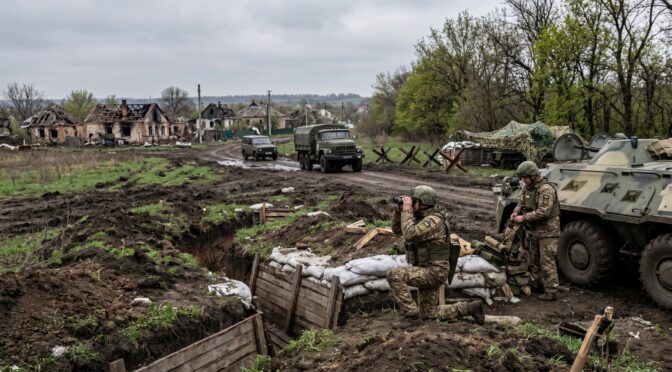
Reports from the frontlines indicate acute supply shortages and rising desertions within the regular army.23 The most critical and incendiary flashpoint involves medical support: IRGC personnel have reportedly explicitly refused to transport wounded Artesh soldiers to hospitals, citing fabricated shortages of ambulances and blood supplies, despite having clear access to functional medical facilities.23 This callous refusal has deepened intense anger and resentment between the personnel of the two forces.

Furthermore, frontline Artesh units have reported receiving as few as 10 rounds of ammunition per soldier, leaving them entirely exposed.23 The severe disparity in resources, combined with the undeniable perception of neglect and expendability by IRGC commanders, has prompted mass desertions among conventional forces.23 The systemic risk here is extreme: if the Artesh fully fractures, or formally refuses to suppress domestic protests out of resentment toward the IRGC, the regime’s coercive backbone will snap. The state’s survival currently relies entirely on its ability to suppress dissent violently; the loss of the Artesh removes the manpower necessary to execute this strategy, directly triggering a Stage 4 Collapse.

  • Current State: Highly fractured and antagonistic. The two primary pillars of state security are engaged in active logistical warfare against one another.
  • Trajectory (Delta): Deteriorating rapidly. Desertions are increasing, and mutual resentment is hardening into institutional hatred.
  • Volatility: High. A single mass casualty event involving unsupported Artesh troops could trigger a formalized, battalion-level mutiny overnight.

Module C: Social Cohesion and Human Development

C.1 Social Fragmentation

Social cohesion within the borders of the Islamic Republic has fractured along deep, cross-cutting ethnic and generational cleavages. The regime’s historical reliance on a Persian-centric, orthodox Shiite nationalism has fundamentally alienated significant minority populations residing in the geographic periphery of the state.

During recent, sustained protest waves, fatalities in the ethnic minority regions, specifically the Kurdish provinces and the Baluch regions in Sistan and Baluchestan, accounted for a staggering 40 to 50 percent of the roughly 500 civilians killed nationwide.25 The state views these minority groups not merely as domestic dissidents requesting reform, but as existential, armed threats capable of geographical secession. Security forces have launched targeted, brutal repression campaigns in these areas, including arbitrary detentions, mass executions, and the heavy militarization of the borders.25

This intense, ethnically targeted persecution ensures that any future uprising will possess a strong separatist or federalist character. The generational divide further exacerbates this fragmentation, with a highly connected, secular-leaning youth population entirely rejecting the theocratic strictures of an aging clerical elite. The state lacks any unifying national narrative capable of bridging these divides, relying instead on the threat of foreign invasion to manufacture temporary, fragile unity.

  • Current State: Deeply fragmented and hostile. Peripheral ethnic regions are highly militarized and alienated from the central Persian authority.
  • Trajectory (Delta): Deteriorating. State violence specifically targeting minority groups is radicalizing formerly moderate populations toward armed separatism.
  • Volatility: Medium. Ethnic unrest flares predictably in response to state executions or economic shocks.

C.2 Public Services and Welfare

The state’s capacity to deliver core public services has evaporated, providing daily, tangible, and undeniable reminders of governance failure to the urban population. The national pension system is effectively insolvent, destroying the livelihoods of the elderly demographic. In the 2025 fiscal year, the government failed entirely to settle legally mandated debts to the Social Security Organization. Of a required 200 trillion tomans, the state approved only 185 trillion, and realized a mere 70 trillion in heavily discounted bonds.29 This catastrophic shortfall has severely reduced healthcare access for pensioners, prompting retirees to hold dozens of coordinated protests across multiple cities to demand basic survival stipends.29

The healthcare system itself is collapsing under the weight of economic ruin and brain drain. Working conditions have deteriorated to the point where fully employed medical professionals are unable to afford basic housing. Reports confirm that nurses in Tehran are rendered homeless by hyperinflation, forced to sleep in their personal vehicles between grueling shifts and use hospital facilities for basic hygiene.9

Furthermore, the state has struggled to maintain basic municipal infrastructure. Energy facilities have sustained damage, and despite official claims of grid stability, the energy ministry has warned of imminent, severe summer power cuts and brownouts.30 These rolling blackouts place massive physical stress on populations facing extreme heat, spoiling scarce food supplies and paralyzing what remains of the commercial economy.

  • Current State: Failing. Core municipal and welfare services are either insolvent or operating severely below required capacity.
  • Trajectory (Delta): Deteriorating. The state lacks the capital to repair the power grid or inject liquidity into the pension funds.
  • Volatility: High. Service interruptions, such as sudden blackouts or delayed pension checks, act as immediate, unpredictable catalysts for street protests.

Module D: Environmental and Resource Security

D.1 Climate Change Vulnerability

Iran faces an immediate, existential threat from climate-driven environmental collapse, which acts as a massive threat multiplier across all other domains. The nation is currently experiencing unprecedented, multi-year droughts that have severely depleted both surface water and deep groundwater reserves.

Research indicates that temperatures in Iranian cities have risen twice as fast as the global average between 1990 and 2022.31 The combination of extreme heat events and absolute water scarcity threatens the fundamental biological habitability of massive urban centers. The agricultural sector, entirely reliant on predictable precipitation and groundwater extraction, has been decimated, forcing the state to rely heavily on expensive food imports precisely when the naval blockade has cut off foreign exchange capabilities. The state possesses virtually zero capacity for proactive water infrastructure adaptation, having exhausted its capital on military expenditures.

  • Current State: Highly vulnerable and actively degrading. The climate has shifted beyond the parameters that historical Iranian infrastructure was built to handle.
  • Trajectory (Delta): Deteriorating. Temperature baselines continue to rise, and precipitation levels continue to fall below historical averages.
  • Volatility: Low. The warming trend and drought are persistent, long-term realities with little to no fluctuation toward positive outcomes.

D.2 Resource Stress and Environmental Degradation

Decades of systemic, hubristic resource mismanagement, characterized by a state-sponsored mania for megaprojects, poorly planned dam building, deep wells, and inter-basin water transfers, have resulted in absolute, undeniable water bankruptcy.32 The ancient qanat underground aquifer systems, which sustained life on the plateau for millennia, have been abandoned or destroyed by industrial pumping.31 This depletion has led to massive, irreversible land subsidence that is actively cracking buildings, collapsing highways, and destroying infrastructure in historic cities like Isfahan and Yazd.33

Critical, world-renowned ecosystems have been eradicated: Lake Urmia has lost over 90 percent of its surface area, transforming into vast salt marshes that generate toxic, agricultural-destroying dust storms across the northwest, while the Zayandeh Rud river regularly runs completely dry.33

The immediate, existential crisis is localized in the nation’s largest population centers. Major dams supplying vital drinking water to Tehran, Tabriz, and Mashhad are approaching total depletion. By late 2025, the Lar Dam and the Saveh Dam had fallen to a catastrophic 1 percent capacity.35 The five primary dams supplying Tehran were collectively operating at just 11 percent capacity.31

This depletion has brought the capital city of over 10 million people to the absolute brink of “Day Zero”, the defined point at which municipal water systems cease to function entirely and taps run permanently dry.31 Taps in southern Tehran have already run dry, and nightly pressure cuts are standard operating procedure.31 President Pezeshkian has explicitly and publicly warned that if the drought continues without relief, the state will be forced to attempt the evacuation of the capital.31 The logistical impossibility of evacuating 10 million people in a state experiencing a fuel crisis and hyperinflation guarantees catastrophic loss of life and total state collapse.

  • Current State: Terminal resource depletion. The hydrology of the state has been broken, and municipal reserves are exhausted.
  • Trajectory (Delta): Deteriorating. Without massive, unprecedented rainfall, the reservoirs will hit absolute zero within the forecast period.
  • Volatility: Low. The drying of the reservoirs is a mathematical certainty based on current consumption and evaporation rates.
Bar chart showing critically low water levels in Tehran, Mashhad, and Lar reservoirs by late 2025.

Synthesis and Predictive Outlook

Dynamic Weighting Algorithm

To accurately predict the trajectory of the Iranian state, the impact of the analyzed indicators must be dynamically weighted based on its current position deep within Stage 3 (Crisis). The algorithm rejects static weighting models. In a stable system, long-term environmental sustainability and structural economic indicators carry balanced weight. However, in a severe, late-stage crisis state, immediate survival mechanics dictate state viability. Therefore, the weighting rationale aggressively prioritizes metrics that directly dictate the state’s day-to-day capacity to suppress unrest and fund its most basic, immediate operations.

The analytical weighting is distributed as follows:

  • Module A (Economic Resilience) and Module B (Political Legitimacy and Security Cohesion) are weighted heavily at 35 percent each. The immediate loss of state revenue due to the blockade and the active fracturing of the security apparatus are the most rapid, lethal vectors for state collapse. If the state cannot pay its security forces, or if those forces mutiny, the state ceases to exist immediately.
  • Module D (Environmental Security) is weighted at 15 percent. While environmental degradation is typically a slow-moving, long-term indicator, the sheer imminence of “Day Zero” in Tehran alters the calculus. This acts as a direct, near-term catalyst for systemic failure, elevating its immediate importance in the 36-month horizon.
  • Module C (Social Cohesion) is weighted at 15 percent. The social contract is already thoroughly broken; intense public unrest is a constant, established baseline. The critical variable is no longer whether the public will rebel, but whether the state retains the financial and coercive means to suppress them.

Feedback Loop and Cascade Failure Analysis

The Iranian state is currently trapped in multiple reinforcing feedback loops, widely known in systems dynamics as vicious cycles, that are exponentially accelerating its decline toward a Stage 4 Collapse. A systems dynamic causal loop mapping of these crises reveals three distinct, highly interconnected cycles.

  1. The Water Mismanagement and Unrest Loop (The Environmental Cycle):
    Decades of state policy prioritizing water-intensive agriculture and corrupt dam construction permanently depleted rural aquifers. This induced water bankruptcy destroys rural agricultural livelihoods, forcing desperate farmers to migrate into already overburdened urban centers like Tehran and Mashhad. This massive, unplanned demographic influx drastically strains municipal infrastructure, accelerating the depletion of city reservoirs toward Day Zero. The lack of basic resources sparks intense, desperate urban protests. The state responds with violent suppression, depleting finite security resources and completely destroying public trust, while failing entirely to address the root hydrological crisis, ensuring the cycle repeats with increased severity the following season.
  2. The Subsidy and Hyperinflation Trap (The Economic Cycle):
    The international naval blockade has eliminated the state’s primary source of foreign exchange and trade revenue. To prevent immediate mass starvation and nationwide rioting, the state is forced to maintain massive subsidies on food and fuel. Lacking real revenue, the central bank prints unbacked currency to fund these non-discretionary obligations. This vastly expands the money supply, resulting in immediate hyperinflation and currency devaluation. The devaluation increases the real cost of importing basic goods and refining fuel, which in turn demands exponentially higher subsidies. This loop destroys the purchasing power of the population, driving the middle class into absolute poverty and increasing the frequency of economic protests, feeding back into the need for more subsidies.
  3. The Coercion and Fragmentation Loop (The Security Cycle):
    As domestic unrest and economic failure mount, the civilian government loses all effectiveness and legitimacy, forcing the regime to rely entirely on the Islamic Revolutionary Guard Corps for basic survival. This reliance elevates the IRGC’s political and economic power, allowing them to hoard shrinking state resources, weaponry, and critical medical supplies. This hoarding deprives the conventional military (Artesh) of basic operational necessities. The resulting logistical starvation leads to plummeting morale, severe institutional friction, and mass desertions within the regular army. As the Artesh weakens or actively mutinies, the state’s overall capacity to project force diminishes, forcing the IRGC to stretch its own loyalist forces thinner across multiple crisis zones, thereby exponentially increasing the likelihood of a successful localized uprising that the state cannot suppress.

These three loops intersect at the critical node of urban resource strain and civil unrest, creating an accelerating, inescapable vortex of state failure.

Scenario Modeling and Tipping Points

Reasonable Worst-Case Scenario (36-Month Horizon):

By the summer of 2027, the combination of the sustained United States naval blockade and an unmitigated, record-breaking drought triggers “Day Zero” in Tehran. The municipal water grid fails completely for a metropolitan population of over 10 million residents. The civilian government’s panicked attempts to organize a systematic evacuation collapse immediately due to severe fuel shortages and hyperinflationary paralysis. Mass, desperate riots over drinking water erupt across the capital and secondary cities like Mashhad and Tabriz.

The IRGC attempts to violently suppress the riots to protect the regime core, but finds its ranks fatigued, under-supplied, and spread too thinly across the vast geography of the unrest. The IRGC commands the Artesh to deploy lethal force against unarmed civilians to maintain order. The Artesh, already suffering from extreme logistical deprivation, deep resentment toward the IRGC’s hoarding of medical supplies, and profound ideological alignment with the suffering populace, formally mutinies. Units of the Artesh refuse orders and engage in direct, sustained firefights with IRGC forces in the streets of Tehran to protect civilian populations.

Simultaneously, heavily armed ethnic minority groups in Sistan, Baluchestan, and Kurdistan seize upon the chaos in the capital to expel weakened, distracted security forces from their peripheral provinces, formally declaring autonomous, self-governing zones. The central government loses its monopoly on violence and territorial control. Supreme Leader Mojtaba Khamenei, unable to project authority, is either ousted by a military junta or completely isolated in a fortified bunker. The Islamic Republic formally transitions into Stage 4 (Collapse), resembling a fractured, warlord-dominated geography with competing centers of power, collapsed infrastructure, and massive outbound refugee flows destabilizing neighboring states.

Key Tipping Points:

  • Economic: The official food inflation rate breaches 200 percent, or the state formally defaults entirely on pension payments, triggering the permanent defection of the remaining bureaucratic class and transitioning the crisis from political protests to pure survival-driven resource riots.
  • Environmental: The water reserves of the Lar, Saveh, or primary Tehran dams drop to absolute zero, triggering systemic, unrecoverable municipal grid failure in the capital.
  • Political: Independent confirmation of Mojtaba Khamenei’s permanent incapacitation or death, sparking an open, violent succession war between competing IRGC factions and the remnants of the civilian presidency.
  • Security: A formalized battalion-level mutiny within the Artesh, or recorded, verified instances of Artesh personnel engaging in sustained, organized firefights with IRGC or Basij units over resource distribution or civilian protection.

Appendix: Methodology

The methodology utilized for this predictive modeling relies strictly on a Systems Dynamic Framework. This advanced analytical approach rejects traditional, linear, isolated indicator analysis, recognizing instead that state fragility is an emergent property of a complex, adaptive system characterized by continuous interactions across economic, political, social, and environmental domains.

The analysis synthesizes highly distinct, seemingly disparate data points to identify causal linkages and amplifying feedback loops. For example, the critical assessment of the Artesh and IRGC friction was derived not merely from tracking isolated desertion rates, but by correlating those desertion metrics with localized logistical deprivation and the deliberate hoarding of medical supplies during periods of heightened operational tempo and domestic unrest. Similarly, macroeconomic hyperinflation was evaluated not merely as an isolated monetary phenomenon governed by central bank policy, but as a direct, inescapable consequence of the state’s inability to fund the foundational social contract under the crushing pressure of a maritime blockade and a collapsing industrial base.

The dynamic weighting algorithm was calibrated specifically to the defined parameters of a “Stage 3: Crisis” lifecycle phase, ensuring that the predictive modeling accurately reflects the immediate survival mechanics of a state on the brink of total failure, rather than applying peacetime metrics to a wartime environment.


Please share the link on Facebook, Forums, with colleagues, etc. Your support is much appreciated and if you have any feedback, please email us in**@*********ps.com. If you’d like to request a report or order a reprint, please click here for the corresponding page to open in new tab.


Sources Used

  1. Has the U.S.-imposed blockade on Iran been effective? – Connecticut Public Radio, accessed May 5, 2026, https://www.ctpublic.org/2026-05-04/has-the-u-s-imposed-blockade-on-iran-been-effective
  2. What the US naval blockade would mean for Iran’s economy, accessed May 5, 2026, https://www.iranintl.com/en/202604135100
  3. Iran’s Polycrisis: A Regime Entrapped by a Convergence of Failures …, accessed May 5, 2026, https://www.ncr-iran.org/en/news/economy/irans-polycrisis-a-regime-entrapped-by-a-convergence-of-failures/
  4. Even state media sounds alarm as Iran’s economy sinks, accessed May 5, 2026, https://www.iranintl.com/en/202604294396
  5. Islamic Republic of Iran and the IMF, accessed May 5, 2026, https://www.imf.org/en/countries/irn
  6. Iran – IMF DataMapper, accessed May 5, 2026, https://www.imf.org/external/datamapper/profile/IRN
  7. Economic Fury Targets Iran Shadow Banking Facilitators | U.S. Department of the Treasury, accessed May 5, 2026, https://home.treasury.gov/news/press-releases/sb0477
  8. The Islamic Revolutionary Guard Corps (IRGC) | Council on Foreign …, accessed May 5, 2026, https://www.cfr.org/backgrounders/irans-revolutionary-guards
  9. Iran’s Brain Drain Crisis: How Corruption and Repression Are …, accessed May 5, 2026, https://iranfocus.com/economy/54492-irans-brain-drain-crisis-how-corruption-and-repression-are-driving-a-generation-away/
  10. Iran’s Political Instability: Capital and Brain Drain – Jewish Journal, accessed May 5, 2026, https://jewishjournal.com/commentary/opinion/383295/irans-political-instability-capital-and-brain-drain/
  11. Iran’s Presidential ‘Election’ Seeks to Consolidate Regime’s Control – FDD, accessed May 5, 2026, https://www.fdd.org/analysis/2024/06/22/irans-presidential-election-seeks-to-consolidate-regimes-control/
  12. Assassination of Ali Khamenei – Wikipedia, accessed May 5, 2026, https://en.wikipedia.org/wiki/Assassination_of_Ali_Khamenei
  13. 2026 Iran war – Wikipedia, accessed May 5, 2026, https://en.wikipedia.org/wiki/2026_Iran_war
  14. Mojtaba Khamenei front-runner for supreme leader – bne IntelliNews, accessed May 5, 2026, https://www.intellinews.com/mojtaba-khamenei-front-runner-for-supreme-leader-429626/
  15. After Khamenei: Planning for Iran’s Leadership Transition | Council on Foreign Relations, accessed May 5, 2026, https://www.cfr.org/reports/leadership-transition-in-iran
  16. Is Iran regime losing control? Khamenei rumors fuel command crisis, expert says, accessed May 5, 2026, https://www.jpost.com/israel-news/article-895187
  17. Beyond The Blackout, Who Really Runs Iran Now? – OpEd – Eurasia Review, accessed May 5, 2026, https://www.eurasiareview.com/04052026-beyond-the-blackout-who-really-runs-iran-now-oped/
  18. Rift deepens between Iran’s president and Guards chief over war, economy, accessed May 5, 2026, https://www.iranintl.com/en/202603288722
  19. A clash has broken out between ruling factions in Iran; shadow leader overthrows Mojtaba Khamenei – YouTube, accessed May 5, 2026, https://www.youtube.com/watch?v=wQtkVOFueaI
  20. Iran Update Special Report, April 18, 2026 | ISW, accessed May 5, 2026, https://understandingwar.org/research/middle-east/iran-update-special-report-april-18-2026/
  21. 2026 Internet blackout in Iran – Wikipedia, accessed May 5, 2026, https://en.wikipedia.org/wiki/2026_Internet_blackout_in_Iran
  22. War shadow lays bare divisions among Iran’s clerics, accessed May 5, 2026, https://www.iranintl.com/en/202605049026
  23. Desertions, Supply Shortages, and Fractures Between the Army and …, accessed May 5, 2026, https://militarnyi.com/en/blogs/desertions-fractures-army-irgc-iran-war/
  24. Desertions, shortages and army-IRGC rift strain Iran’s military | Iran …, accessed May 5, 2026, https://www.iranintl.com/en/202603127596
  25. Iran: Freedom in the World 2026 Country Report, accessed May 5, 2026, https://freedomhouse.org/country/iran/freedom-world/2026
  26. A geography of protest: Inside the rise of Iran’s minority factor – Atlantic Council, accessed May 5, 2026, https://www.atlanticcouncil.org/blogs/menasource/a-geography-of-protest-inside-the-rise-of-irans-minority-factor/
  27. Iran’s Fear of Kurdish Opposition and the Potential of an Internal Uprising – Fair Observer, accessed May 5, 2026, https://www.fairobserver.com/world-news/middle-east-news/irans-fear-of-kurdish-opposition-and-the-potential-of-an-internal-uprising/
  28. Punishing Vulnerability: Iran’s Minority Crackdown After the 12-Day War, accessed May 5, 2026, https://newlinesinstitute.org/middle-east-center/punishing-vulnerability-irans-minority-crackdown-after-the-12-day-war/
  29. Iran’s Pensioners Face Deepening Livelihood and Healthcare Crisis …, accessed May 5, 2026, https://irannewsupdate.com/news/society/irans-pensioners-face-deepening-livelihood-and-healthcare-crisis/
  30. Iran’s power grid stable but energy minister warns of summer pressure after war damage, accessed May 5, 2026, https://www.intellinews.com/iran-s-power-grid-stable-but-energy-minister-warns-of-summer-pressure-after-war-damage-436304/
  31. How ‘day zero’ water shortages in Iran are fuelling protests | Iran …, accessed May 5, 2026, https://www.theguardian.com/world/2026/jan/15/how-day-zero-water-shortages-in-iran-are-fuelling-protests
  32. Iran’s Water Crisis Is Its Greatest Threat – TIME, accessed May 5, 2026, https://time.com/7321571/iran-water-crisis-greatest-threat/
  33. Water and Security in the Middle East: Lessons from the Iranian Crisis – Resilience.org, accessed May 5, 2026, https://www.resilience.org/stories/2026-03-05/water-and-security-in-the-middle-east-lessons-from-the-iranian-crisis/
  34. Iran’s capital faces unprecedented water shortages and even possible evacuation. What changes could help?, accessed May 5, 2026, https://www.citystgeorges.ac.uk/news-and-events/news/2025/december/iran-water-shortages
  35. Seeing Iran’s Environmental Crisis Clearly: People Are Paying the …, accessed May 5, 2026, https://www.fdd.org/analysis/2026/02/20/seeing-irans-environmental-crisis-clearly-people-are-paying-the-price-for-the-islamic-republics-failures/
  36. Tehran’s “Day Zero”: A Threat or an Opportunity to Revive Water Governance and Adaptive Water Policy Making in Iran? | Al Jazeera Centre for Studies, accessed May 5, 2026, https://studies.aljazeera.net/en/analyses/tehran%E2%80%99s-%E2%80%9Cday-zero%E2%80%9D-threat-or-opportunity-revive-water-governance-and-adaptive-water
  37. Iranian President Warns Tehran May Have to Evacuate If Water Crisis Persists, accessed May 5, 2026, https://caspiannews.com/news-detail/iranian-president-warns-tehran-may-have-to-evacuate-if-water-crisis-persists-2025-11-7-0/

Systemic Fragility Analysis of Cuba: A 36-Month Predictive Outlook – Q2 2026

Executive Summary

Overall Fragility Score: 9.4 / 10

Assessed Lifecycle Stage: Crisis

Key Drivers of Fragility:

  • Catastrophic failure of the National Electrical System driven by obsolete infrastructure, deferred maintenance, and severe external fuel deprivation resulting from the 2026 maritime blockades.
  • Acute macroeconomic contraction characterized by rampant currency devaluation, sovereign debt default, and extreme foreign exchange illiquidity, severely exacerbated by military monopolization of profitable sectors.
  • Unprecedented demographic hemorrhage, with emigration removing a critical percentage of the working age population, thereby accelerating the dependency ratio and depleting the national labor force.
  • The disruption of external energy subsidies, culminating in the January 2026 United States oil blockade following the geopolitical intervention in Venezuela, which severed vital hydrocarbon imports.
  • The shifting nature of civil unrest from ideologically motivated dissent to highly volatile, spontaneous protests driven by absolute material deprivation, prolonged blackouts, and widespread food insecurity.

Forecast Trajectory:

The Republic of Cuba is experiencing an accelerating deterioration of core state functions. The systemic trajectory is steeply negative, characterized by extreme volatility across all measured indicators. The convergence of infrastructure collapse, agricultural failure, and the total exhaustion of state financial reserves indicates that the current administration possesses diminished capacity to arrest the systemic decay. Without an immediate, massive, and unconditional infusion of external capital and energy, the state is highly likely to transition from the Crisis stage to a state of localized or total Collapse within the 36 month forecast horizon.

State Fragility Dashboard

Domain / IndicatorCurrent Score 1 to 10TrendVolatilityWeighted ImpactBrief Rationale
A. Economic Resilience9.5DeterioratingHigh30%Deep recession, extreme inflation, and the total loss of household purchasing power.
A.1 Public Finances10.0DeterioratingHighAbsolute lack of foreign exchange, sovereign default, and parallel military economy.
A.2 Economic Structure9.5DeterioratingLowAgricultural collapse and forced state absorption of the nascent private sector.
A.3 Household Health9.5DeterioratingHighUp to 89 percent of the population living in extreme poverty with severe food insecurity.
B. Political Legitimacy8.5DeterioratingHigh15%Transition from consensus governance to reliance on raw coercion and security forces.
B.1 Governance8.5DeterioratingLowLeadership lacks historic revolutionary legitimacy, facing friction with military conglomerates.
B.2 Public Trust9.0DeterioratingHighRecord breaking localized protests driven by basic survival needs rather than ideology.
B.3 Security Cohesion8.0StaticHighRising risk of enforcement fatigue as rank and file security forces suffer material deprivation.
C. Social Cohesion9.5DeterioratingLow20%Historic demographic collapse removing the economic base and straining social services.
C.1 Emigration10.0DeterioratingLowOver one million citizens fled since 2022, leaving an unsustainable elderly demographic.
C.2 Public Services9.5DeterioratingHighCollapse of the healthcare sector and catastrophic failure of the electrical grid.
D. Environmental Security9.5DeterioratingHigh35%Energy infrastructure failing simultaneously with extreme climate vulnerability.
D.1 Climate Vulnerability9.0DeterioratingHighCategory 5 Hurricane Melissa in 2025 destroyed vital crops and triggered viral outbreaks.
D.2 Resource Stress10.0DeterioratingHighThe 2026 oil blockade severed vital energy supplies, pushing the national grid to collapse.

Detailed Domain Analysis

Module A: Economic Resilience and State Capacity

A.1. Public Finances

Current State: The public finances of the Republic of Cuba are in a state of terminal insolvency. The central government operates with a severe lack of foreign currency, functionally locking the nation out of global credit markets. The state remains in sovereign default on its international debt obligations, rendering standard mechanisms of macroeconomic stabilization impossible.1 Following the ill conceived monetary reform in 2021 known as the Tarea Ordenamiento, the domestic currency experienced an inflationary spiral that eradicated household savings and decoupled the formal state economy from the daily financial reality of the population.2

Trajectory: The fiscal trajectory is rapidly deteriorating. In an effort to capture hard currency, the government established a parallel economy utilizing a virtual currency known as MLC (Moneda Libremente Convertible), forcing citizens to purchase basic goods in highly inflated, state run stores.4 However, the true barometer of the macroeconomic environment is the informal exchange rate, which is characterized by relentless depreciation. In late 2025, the informal rate monitored by independent financial platforms breached 400 Cuban Pesos (CUP) to the United States Dollar. By May 2026, the currency had collapsed further, reaching 540 CUP per USD, a historic low that functionally eliminates the utility of state salaries.5 Concurrently, the state imposed new transaction surcharges and faced additional United States restrictions on remittance processing entities like Orbit, pushing financial flows deeper into the informal sector.2

Volatility: Volatility is exceptionally high. The formal banking sector is functionally bypassed by the civilian populace. A profound structural anomaly driving this volatility is the macroeconomic dominance of the Grupo de Administración Empresarial (GAESA). This conglomerate, managed entirely by the Revolutionary Armed Forces, operates outside the purview of the National Assembly and the Comptroller General. Leaked intelligence in 2024 revealed that GAESA controlled an estimated 18 billion USD in liquid assets, dominating the tourism, retail, and remittance sectors.8

Systemic Connection Analysis: This bifurcation creates a severe systemic distortion. While the formal civilian state is bankrupt and unable to purchase basic fuel or medical supplies, vast reserves of foreign currency are hoarded by military oligarchs and frequently routed through offshore tax havens.9 The state is currently trapped in an “import paralysis” scenario. The central civilian government’s inability to secure foreign exchange directly prevents the importation of essential agricultural fertilizers, industrial machinery, and diesel fuel. This financial bottleneck is the primary catalyst for the cascading physical failures observed in the national electrical grid and the public healthcare system.

A.2. Economic Structure and Productivity

Current State: The structural foundation of the Cuban economy is failing. The nation is trapped in a deep recession, with official metrics indicating a contraction of 1.9 percent in 2023 and an estimated 2.0 percent in 2024.10 Projections of a modest 1.0 percent recovery for 2025 were entirely negated by persistent industrial paralysis caused by nationwide blackouts.10 Decades of chronic underinvestment have left industrial and agricultural infrastructure decrepit.12 Agricultural production has plummeted to historic lows due to a critical lack of inputs such as diesel, fertilizer, and basic machinery, a crisis compounded by rigid state price controls that disincentivize farming.12

Trajectory: The trajectory of economic productivity is persistently negative. The state is exceptionally dependent on food imports. Domestic yields for the 2025 to 2026 cycle are catastrophic: coffee output fell to a mere 100,000 bags, corn to 210,000 metric tons, and rice to an unsustainable 65,000 metric tons.13 To prevent absolute starvation, the state relies heavily on agricultural purchases from the United States under the Trade Sanctions Reform and Export Enhancement Act (TSREEA). In January 2026 alone, the United States exported 35.6 million USD in agricultural products to Cuba, underscoring the total failure of domestic food sovereignty.14

Volatility: Volatility in this sector is low, as the decline is steady and structural rather than cyclical. A central point of tension is the state’s relationship with the emerging private sector, composed of micro, small, and medium enterprises (MSMEs). By 2024, the private sector accounted for 55 percent of retail sales by value, surpassing the state for the first time in decades.8 However, the political apparatus views independent economic power as a fundamental threat to regime survival.12 In March 2026, the state promulgated Decree Law 114/2025, a legal mechanism forcing private enterprises to enter into mixed economic associations with state entities.15

Systemic Connection Analysis: This regulatory capture is designed to subordinate the private sector, starving it of true autonomy and preventing the accumulation of private capital. The monopolization of profitable sectors by the military via GAESA actively starves domestic agriculture and civilian infrastructure of essential reinvestment. By prioritizing the construction of luxury tourism hotels over the maintenance of the national power grid or the subsidization of domestic farming, the state structure directly engineers national poverty and accelerates infrastructure decay.9

A.3. Household Financial Health

Current State: Household financial health has reached a state of catastrophic distress. Real household purchasing power has been decimated by triple digit inflation and the rapid depreciation of the peso. The average state salary hovers around 7000 CUP, which equates to roughly 14 USD on the informal market.7 Retirees are in an even more precarious position, with standard state pensions providing a meager 2000 CUP, or less than 4 USD per month.16 The cost of basic survival far exceeds these fixed incomes. For context, a single carton of eggs commands up to 3000 CUP in informal channels, rendering it entirely inaccessible to state workers and the elderly.7

Trajectory: The trajectory points toward a deepening, prolonged humanitarian crisis. Independent demographic and economic estimates suggest that up to 89 percent of the population now lives in extreme poverty.1 Food and medicine scarcity is absolute. A deep class divide has emerged, strictly delineated by access to foreign currency. Citizens receiving regular remittances from relatives in the United States or Europe, or those participating directly in the illicit dollarized economy, are able to procure basic necessities. Conversely, state workers, the rural population, and the elderly are subjected to severe material deprivation.12

Volatility: Volatility is high, as household survival depends entirely on the unpredictable fluctuations of the informal exchange rate and the intermittent availability of subsidized goods. Elderly citizens, heavily overrepresented in the demographic makeup, increasingly rely on local church charities for single daily meals consisting of basic rice and ground meat, as the state ration card provides only a fraction of necessary caloric intake.16 Food insecurity is widespread, with surveys indicating that 70 percent of Cubans frequently skip meals and only 15 percent consistently maintain three meals a day.18

Systemic Connection Analysis: The daily operational reality of accessing basic caloric needs consumes the entirety of the population’s physical and mental energy. This absolute material scarcity entirely destroys the foundational revolutionary social contract, which historically guaranteed baseline egalitarian welfare, free universal healthcare, and heavily subsidized rations in exchange for political compliance.19 The erosion of this social safety net translates directly into widespread public resentment, shifting the population’s posture from passive endurance to active, desperate confrontation with state authorities.

Module B: Political Legitimacy and Institutional Integrity

B.1. Governance and Rule of Law

Current State: The political legitimacy of the Cuban state is deeply eroded. The current civilian leadership, headed by President Miguel Díaz-Canel, operates without the charismatic and historical authority commanded by the foundational revolutionary generation. The governance structure is characterized by rigid centralization, intense bureaucratic inertia, and an increasing reliance on the judicial system as a mechanism for pure political repression.8

Trajectory: Following the historic, nationwide protests of July 11, 2021, the state escalated its use of arbitrary detention, handing down draconian prison sentences to demonstrators to instill fear and paralyze future dissent.12 In late 2025 and early 2026, prominent political prisoners who had been temporarily released as part of diplomatic negotiations, such as José Daniel Ferrer, were systematically re-arrested and subjected to severe mistreatment, signaling the regime’s absolute intolerance for political pluralism.8 Authorities routinely detain, harass, and intimidate independent activists and journalists, utilizing the legal code to criminalize basic civil liberties.20

Volatility: Governance volatility is low, as the state’s response to crisis remains uniformly coercive. However, a silent institutional fracture exists between the civilian government and the military oligarchy controlling GAESA. Reports indicate that the Castro family intentionally separated active military generals from the financial control of GAESA to prevent the rise of internal rivals.9

Systemic Connection Analysis: The administration is caught in a fatal “performance legitimacy trap.” Unable to provide basic services, food, or electricity, the civilian administration cannot govern through popular consent. As economic performance continues to collapse, the administration is forced to rely exclusively on pure coercion to maintain order. The rule of law has devolved into rule by force. The lack of institutional channels for the meaningful expression of public discontent guarantees that future political grievances will manifest as uncoordinated, highly volatile street protests.12

B.2. State Legitimacy and Public Trust

Current State: Public trust in the state apparatus has effectively collapsed. The ideological consensus that sustained the government for decades is gone, replaced by widespread frustration and overt public defiance. The frequency and scale of spontaneous protests have escalated dramatically.

Trajectory: The trajectory of civil unrest is sharply upward. According to the Observatorio Cubano de Conflictos, the state experienced a record 1245 protests in October 2025.22 This escalation continued into the spring, with over 1100 protests recorded in April 2026 alone.23 State media narratives, which consistently blame external actors such as the United States embargo for internal failures, have lost all efficacy among the general public.

Volatility: The volatility of public compliance is extremely high. The nature of civil unrest has fundamentally evolved. Demonstrations are no longer solely driven by abstract demands for political freedom or human rights, but by immediate, non negotiable survival imperatives. Protests are now routinely triggered by prolonged power outages and the absence of municipal water, frequently featuring the blocking of roads, the banging of empty pots, and the vandalization of local government property.18

Systemic Connection Analysis: This shift from ideological dissent to resource driven desperation makes the unrest far more dangerous for the state. Ideological movements can be decapitated by arresting leadership figures; resource driven riots are decentralized, spontaneous, and immune to standard political suppression tactics. The population has lost its fear of the security apparatus because the immediate threat of starvation or dying in a sweltering, unpowered hospital outweighs the threat of imprisonment.

B.3. Security Apparatus Cohesion

Current State: The cohesion of the security apparatus remains the final, critical pillar preventing total state collapse. The Revolutionary Armed Forces (FAR) and the Ministry of the Interior (MININT) currently maintain a monopoly on the use of organized violence. The security environment is highly militarized, but violent crime, including armed robbery and home invasions, has risen significantly, particularly during the prolonged nighttime power outages.24 Law enforcement responsiveness is heavily degraded due to severe fuel shortages limiting vehicle patrols.

Trajectory: The trajectory of security cohesion is static but highly fragile. There is a growing, palpable risk of enforcement fatigue. The rank and file personnel of the national police and rapid response brigades suffer from the exact same material deprivations, power outages, and food shortages as the civilians they are ordered to suppress.

Volatility: Volatility is high. While the elite echelons of the military are insulated by GAESA revenues and exclusive supply chains, the operational levels are not.9 The Committees for the Defense of the Revolution (CDRs), historically utilized as local surveillance and coordination mechanisms, are experiencing reduced participation as daily survival takes precedence over political loyalty.18

Systemic Connection Analysis: If the macroeconomic contraction reaches a point where the state cannot physically feed or pay its security forces, the institutional integrity of the FAR and MININT will inevitably fracture. Historical precedents suggest a grave risk that unpaid security elements could seamlessly transition into clandestine criminal networks or local extortion rackets, accelerating the transition from a highly centralized authoritarian state to a fragmented, collapsed entity.18

Module C: Social Cohesion and Human Development

C.1. Social Fragmentation and Emigration

Current State: The Republic of Cuba is enduring a demographic hemorrhage of unprecedented proportions. Emigration rates have surged to historic highs, representing a catastrophic systemic bleed that threatens the very existence of the nation state. Since 2022, well over one million Cubans have abandoned the island.12

Trajectory: The trajectory of this demographic collapse is accelerating and highly destabilizing. By December 2024, official statistical bureaus implicitly acknowledged a 10.1 percent decrease in the effective population compared to 2020 levels, bringing the total population below 10 million for the first time since the 1980s.25 Independent demographic researchers estimate that the population contraction between 2022 and 2024 may have reached an astonishing 18 percent.26 The exodus is heavily concentrated among the youth, educated professionals, and working age individuals, who increasingly view emigration as an absolute universal aspiration.26

Volatility: Volatility is low, as the outward flow of citizens is consistent and structural. This massive brain drain strips the economy of its essential labor force and destroys any potential engine for future economic recovery. Consequently, the remaining population is rapidly aging. As of 2024, nearly 26 percent of the population was aged 60 or older, almost double the regional average for Latin America.17 The national death rate has exceeded the birth rate for five consecutive years.26

Systemic Connection Analysis: The emigration crisis creates a fatal, irreversible feedback loop. The flight of the youth leaves an increasingly elderly, vulnerable population entirely dependent on a bankrupt state pension system and a collapsing healthcare network. As social conditions worsen due to the loss of skilled labor, the incentive for the remaining youth to flee intensifies, further hollowing out the state’s capacity to function. The remittances sent back by these emigrants ironically sustain the state’s remaining retail infrastructure, tying Cuba’s survival directly to the very citizens it forced into exile.

C.2. Public Services and Welfare

Current State: The collapse of Cuba’s once heralded public service sector is absolute and systemic. The healthcare system is facing a catastrophic shortage of supplies. The state previously utilized medical diplomacy, exporting doctors for hard currency, but this has cannibalized domestic care.19 By late 2025, the national pharmacy network was experiencing a 70 percent deficit in basic medications. Medical professionals are forced to operate in severe conditions, with more than 300 pediatric operations per week delayed due to a lack of anesthesia, oxygen, and sterile supplies.27 When the power grid fails, nurses in neonatal units are forced to manually hand pump ventilators to keep infants alive.27

Trajectory: The most visible and immediate catalyst for state failure is the disintegration of the National Electrical System (SEN). The trajectory of the power grid is terminal. The grid has suffered multiple total systemic disconnections. Complete national blackouts, where the entire island lost power simultaneously, occurred in October 2024, December 2024, September 2025, and multiple times in March 2026.29 By April 2026, daily generation deficits regularly exceeded 1700 megawatts, resulting in agonizing power outages lasting 18 hours or more across vast swaths of the territory.31

Volatility: Volatility is extremely high. The grid operates on the brink of collapse daily.

Systemic Connection Analysis: The failure of the electrical grid is the apex vulnerability of the Cuban state. Blackouts instantly halt all economic productivity, spoil scarce refrigerated food reserves in households without backup power, disrupt municipal water pumping, and paralyze hospital life support systems.27 More critically, prolonged darkness provides the immediate operational environment for civil unrest, serving as the primary trigger for the localized riots and protests sweeping the island.18

Module D: Environmental and Resource Security

D.1. Climate Change Vulnerability

Current State: Cuba’s geographic positioning subjects it to extreme climate vulnerability, acting as a profound threat multiplier against deeply degraded state infrastructure. Over the past three years, the island has absorbed repeated, devastating external shocks from tropical cyclones.

Trajectory: Following the devastating impacts of Hurricane Ian in 2022 and Hurricane Rafael in 2024, which caused severe damage to the electrical system and water supply in western provinces 32, the eastern provinces were struck by Hurricane Melissa in October 2025. Hurricane Melissa made landfall as a catastrophic Category 5 storm, bringing extreme winds of 290 kilometers per hour and torrential rainfall.34 The storm caused 61 deaths across the Caribbean and resulted in widespread destruction of critical infrastructure in Cuba, displacing thousands and destroying over 144 health institutions.32

Volatility: Climate volatility is inherently high. The compounding impacts of these storms are devastating. Hurricane Melissa destroyed an estimated 103,213 hectares of vital agricultural crops, including plantains, cassava, and coffee, instantly worsening the national food security crisis.36 Furthermore, the flooding associated with extreme weather events routinely overwhelms decrepit sanitation infrastructure. Following Hurricane Melissa, the Ministry of Public Health was forced to declare a complex national outbreak of arboviral diseases, including Dengue, Chikungunya, and the Oropouche virus.28

Systemic Connection Analysis: Extreme weather events impose unfunded, multi billion dollar recovery costs on an already insolvent state. A bankrupt administration cannot rebuild washed out roads, replace downed transmission lines, or distribute emergency aid, leaving vast regions isolated. Climate shocks directly accelerate the transition toward state collapse by instantly destroying local agricultural yields, triggering viral outbreaks in a medical system lacking basic reagents, and causing mass internal displacement.

D.2. Resource Stress and Infrastructure Degradation

Current State: The integrity of Cuba’s critical infrastructure is fatally compromised by decades of deferred maintenance and an absolute reliance on imported fuels. The energy sector relies heavily on obsolete, Soviet era thermoelectric plants, most notably the Antonio Guiteras facility. These plants suffer from chronic mechanical failures, false boiler signals, and structural leaks.30 Domestic crude oil production is heavily sulphurous, highly corrosive, and entirely insufficient to meet national demand, requiring continuous external subsidies.

Trajectory: The trajectory of resource security reached a breaking point in January 2026. Following the United States military intervention in Venezuela, the incoming administration implemented a strict oil blockade, halting all Venezuelan shipments and threatening tariffs against any other nation supplying oil to Cuba.37 Prior to the blockade, Venezuela supplied 33 percent of Cuba’s oil, while Mexico supplied 44 percent.39 The blockade induced an immediate, massive fuel deficit. Although minor shipments from Mexico and the arrival of a single Russian product tanker in March 2026 provided temporary, localized relief, the baseline energy requirements of the state remain unmet, and shipping data indicates numerous tankers have aborted deliveries due to sanctions risk.38

Volatility: Volatility is high, dependent entirely on geopolitical maneuvers and the successful evasion of maritime blockades.

Systemic Connection Analysis: The energy infrastructure is a ticking time bomb. The inability to import fuel causes the thermoelectric plants to shut down, initiating rolling blackouts. To compensate, the state attempts to run emergency backup diesel generators, which rapidly deplete strategic fuel reserves, eventually leading to a total collapse of the national grid. Without fuel, agricultural machinery cannot harvest crops, logistics networks cannot distribute the limited food available, and security forces cannot deploy rapidly to contain unrest. The resource stress interacts with every other domain, acting as the primary accelerant for systemic collapse.

Synthesis and Predictive Outlook

Dynamic Weighting Algorithm

To generate a highly accurate predictive assessment of Cuba’s state fragility, the analyzed indicators are dynamically weighted based on the state’s current presence in the Crisis stage of the lifecycle model.

  • Energy and Resource Security is assigned an exceptionally high weight of 35 percent. In a modern state apparatus, electrical and fuel continuity is the fundamental prerequisite for all other functions. The total collapse of the SEN is the highest probability vector for immediate regime failure.
  • Economic Resilience is weighted at 30 percent. Extreme foreign exchange illiquidity prevents the mitigation of resource shocks, drives profound food insecurity, and directly fuels the public anger necessary for mass mobilization.
  • Social Cohesion is weighted at 20 percent. The demographic hemorrhage removes the fundamental human capital required for state recovery, ensuring that even if external shocks subside, the state lacks the internal capacity to rebuild.
  • Political Legitimacy is weighted at 15 percent. In the current crisis stage, ideological authority has become largely irrelevant; the state relies entirely on physical coercion to maintain order, reducing political legitimacy to a secondary factor behind brute operational capacity.

Feedback Loop and Cascade Failure Analysis

A comprehensive mapping of the systemic vectors reveals three interconnected loops destabilizing the Cuban state. External shocks, such as the United States oil blockade, directly precipitate infrastructure failure, notably the collapse of the national electrical grid. This infrastructure failure simultaneously triggers profound economic contraction and widespread social unrest. The resulting social unrest forces the state to expend scarce resources on repression, which further depletes the fiscal reserves necessary for infrastructure repair. Concurrently, the economic contraction drives mass emigration, permanently reducing the tax and labor base, thereby accelerating the underlying economic contraction.

Specifically, the Cuban state is currently caught in three severe reinforcing feedback loops, vicious cycles that are actively accelerating the decline toward the Collapse stage.

  1. The Energy Protest Repression Loop: This is the primary cycle of immediate destabilization. The state lacks foreign exchange to purchase fuel on the open market, and external blockades restrict subsidized shipments. The lack of fuel causes the obsolete thermoelectric plants to fail, resulting in 18 hour national blackouts. The blackouts spoil food, cut off municipal water supplies, and incite intense public anger, triggering spontaneous street protests in localized municipalities. To maintain territorial control, the state must deploy rapid response security brigades and military personnel. However, deploying these forces burns critical, scarce strategic fuel reserves and diverts already depleted state finances away from infrastructure repair, leading to longer blackouts and repeating the cycle with vastly increased intensity.
  2. The Demographic Fiscal Decay Loop: This represents the structural cycle of long term ruin. Deep economic contraction and absolute material scarcity eliminate all prospects for upward mobility, prompting the working age, educated population to emigrate. Over one million productive citizens have fled since 2022. This unprecedented brain drain shrinks the domestic tax base, removes essential skilled labor from the healthcare and engineering sectors, and drastically reduces aggregate economic productivity. The shrinking formal economy leaves the state unable to fund the public pension system or maintain subsidies for the rapidly expanding elderly demographic. The resulting surge in extreme poverty further degrades the standard of living, incentivizing even more working age citizens to flee the island.
  3. The Import Paralysis Scarcity Loop: This is the macroeconomic cycle of deprivation. Sovereign debt default and United States sanctions sever Cuba from international financial markets. The central state cannot acquire hard foreign currency. Without foreign exchange, the government cannot import essential agricultural fertilizers, machinery parts, or basic food commodities. The lack of inputs causes domestic agricultural yields to collapse entirely. To feed the population, the state is forced to spend its minimal remaining foreign currency on emergency food imports at premium prices, leaving zero capital available for infrastructure investment or industrial revitalization, ensuring domestic production remains paralyzed indefinitely.

Scenario Modeling: The Reasonable Worst Case Scenario (2026 to 2029)

Over the 36 month forecast horizon, the convergence of the aforementioned feedback loops presents a highly probable worst case scenario resulting in acute state collapse.

In the late summer of 2026, navigating the peak of the Caribbean hurricane season, the Antonio Guiteras thermoelectric plant suffers a catastrophic, unrecoverable structural failure due to a combination of deferred maintenance and the forced usage of highly corrosive, unrefined domestic crude oil. Simultaneously, the United States maritime oil blockade tightens significantly, successfully deterring the remaining Mexican and Russian tanker deliveries from approaching Cuban ports.

The National Electrical System undergoes a total, cascading disconnection that state engineers cannot reboot due to a complete lack of diesel for startup generators. A nationwide blackout persists not for days, but for multiple weeks. Communication networks fail entirely as backup batteries deplete. Without electricity, municipal water systems dry up, and the remaining refrigerated food supply spoils rapidly in the intense summer heat.

Driven by imminent starvation, heat exhaustion, and absolute material deprivation, uncoordinated but massive riots erupt simultaneously across Havana, Santiago de Cuba, and dozens of provincial capitals. The central government, operating from fortified command centers, orders the deployment of the Revolutionary Armed Forces and MININT to suppress the uprisings with lethal force. However, a critical systemic tipping point is breached: enforcement fatigue. Operational level soldiers and police officers, whose own families are starving and living in darkness, refuse orders to fire upon their neighbors. The command and control structure of MININT and the FAR fractures.

Without the capacity to project organized violence, the central civilian government in Havana loses territorial control. Elements of the security apparatus disintegrate into localized, armed factions, commandeering remaining food and fuel reserves to establish regional protection rackets. The Republic of Cuba transitions completely into the Collapse stage, characterized by a fragmented territory governed by informal, militarized networks operating a hyper localized survival economy. This systemic collapse triggers a mass, uncoordinated maritime exodus toward the United States and neighboring Caribbean nations, transforming a domestic political failure into an immediate regional security and humanitarian crisis.

Conclusion and Tipping Points

The Republic of Cuba is firmly entrenched in a terminal Crisis stage. The resilience of the state has been entirely exhausted across all measurable domains. The administration possesses no internal financial mechanisms to repair its critical infrastructure, no agricultural capacity to feed its population, and no diplomatic mechanisms to reliably secure the external energy subsidies required for basic systemic function.

The critical tipping points to monitor over the next 12 to 18 months include the following:

  1. Grid Irreparability: A formal or informal declaration by state engineers that a major thermoelectric plant can no longer be repaired, permanently reducing the baseline generation capacity of the nation.
  2. Military Insubordination: Any verified report, internal leak, or observable instance of military or police units refusing deployment orders during a civilian protest, indicating the fracture of the state’s monopoly on violence.
  3. Total Fuel Exhaustion: The complete cessation of the remaining 20,000 barrels per day supplied by regional actors like Mexico, rendering the state incapable of powering its security logistics or emergency services.

The probability of the state arresting this decline without a fundamental, systemic change to its political economy or a massive, unprecedented infusion of external humanitarian and infrastructural aid is assessed to be exceptionally low. The current trajectory points inexorably toward state failure.

Appendix: Methodology

This predictive analysis utilizes a complex systems dynamic framework to evaluate state fragility. Traditional geopolitical assessments often treat economic, social, and political indicators as independent, isolated variables. In contrast, this methodology defines the target nation state as a complex, adaptive system composed of deeply interconnected subsystems.

The foundational premise of this analytical engine is that state failure is rarely caused by a single catastrophic event, but is rather an emergent property arising from the continuous interaction, friction, and compounding stress between these subsystems. The framework mandates the rigorous identification of reinforcing feedback loops, explicitly mapping how stress in one domain directly degrades functionality in another domain.

To structure the temporal forecast, the analysis aligns the real time data streams against a rigid five stage lifecycle model: Stable, Stressed, Crisis, Collapse, and Post Collapse Recovery. By tracking the rate of change (Delta) and the unpredictability (Volatility) of specific operational indicators, the framework projects the systemic trajectory. This allows for the identification of specific, quantifiable tipping points where the system will be forced into a non linear transition to a more severe stage of fragility. The dynamic weighting algorithm ensures that indicators with the most immediate impact on regime survival, such as energy infrastructure integrity, are prioritized over longer term, slower moving variables.


Please share the link on Facebook, Forums, with colleagues, etc. Your support is much appreciated and if you have any feedback, please email us in**@*********ps.com. If you’d like to request a report or order a reprint, please click here for the corresponding page to open in new tab.


Sources Used

  1. Economy of Cuba – Wikipedia, accessed May 5, 2026, https://en.wikipedia.org/wiki/Economy_of_Cuba
  2. Cuba: Country File, Economic Risk Analysis | Coface, accessed May 5, 2026, https://www.coface.com/news-economy-and-insights/business-risk-dashboard/country-risk-files/cuba
  3. Country Report Cuba 1st Quarter 2024, accessed May 5, 2026, https://higherground.mt/wp-content/uploads/2024/02/Country_Report_Cuba_1st_Quarter_2024.pdf
  4. Economic Report 2025 Cuba – SECO, accessed May 5, 2026, https://www.seco.admin.ch/dam/seco/de/dokumente/Aussenwirtschaft/Wirtschaftsbeziehungen/L%C3%A4nderinformationen/Lateinamerika/wirtschaftsbericht_kuba.pdf.download.pdf/Wirtschaftsbericht_Kuba_2025.pdf
  5. Why the Dollar and the Euro Rise & Fall vs the Cuban Peso – elTOQUE, accessed May 5, 2026, https://eltoque.com/en/why-the-dollar-and-the-euro-rise-fall-vs-the-cuban-peso
  6. Tasas de cambio en Cuba hoy – elTOQUE, accessed May 5, 2026, https://eltoque.com/tasas-de-cambio-cuba
  7. Cuban peso hits a record low against the US dollar in informal markets – CityNews Halifax, accessed May 5, 2026, https://halifax.citynews.ca/2026/02/11/cuban-peso-hits-a-record-low-against-the-us-dollar-in-informal-markets/
  8. Cuba: Freedom in the World 2026 Country Report, accessed May 5, 2026, https://freedomhouse.org/country/cuba/freedom-world/2026
  9. Is the Cuban regime the next to fall? – Real Instituto Elcano, accessed May 5, 2026, https://www.realinstitutoelcano.org/en/analyses/is-the-cuban-regime-the-next-to-fall/
  10. Cuba predicts 1% growth in 2025 after dismal year, economy minister says – Investing.com, accessed May 5, 2026, https://www.investing.com/news/economic-indicators/cuba-predicts-1-growth-in-2025-after-dismal-year-economy-minister-says-3775297
  11. Cuba: a succession of economic and financial crises amid the weakening of the Cuban model – Agence Française de Développement, accessed May 5, 2026, https://www.afd.fr/sites/default/files/2025-07/maquette-2025-macrodev-ndeg65-uk-bat-web.pdf
  12. Cuba Country Report 2026 – BTI Transformation Index, accessed May 5, 2026, https://bti-project.org/en/reports/country-report/CUB
  13. Cuba – USDA Foreign Agricultural Service, accessed May 5, 2026, https://www.fas.usda.gov/data/production/cu
  14. U.S. Ag/Food Exports To Cuba Decreased 21.7% In January 2026. Year-To-Year Down 21.7%. US$88,746.00 Gasoline; US$6,393.00 Blood. US$6.8 Million Vehicles/Parts; US$20.8 Million Donations — U.S. – Cuba Trade and Economic Council, Inc., accessed May 5, 2026, https://www.cubatrade.org/blog/2026/4/8/zztmxfyt01p2fau2c7734akd9vhqh3
  15. With the Legalization in Cuba of Mixed Companies Between the …, accessed May 5, 2026, https://translatingcuba.com/with-the-legalization-in-cuba-of-mixed-companies-between-the-private-sector-and-the-state-the-regime-aims-to-capture-efficiency/
  16. Cuba’s crisis impacts elderly | News, Sports, Jobs – Altoona Mirror, accessed May 5, 2026, https://www.altoonamirror.com/news/seniors/2026/05/cuba-crisis-impacts-elderly/
  17. PHOTO ESSAY: Elderly Cubans cope with a deepening economic crisis | National News, accessed May 5, 2026, https://www.wdrb.com/news/national/photo-essay-elderly-cubans-cope-with-a-deepening-economic-crisis/article_c12bd835-6961-5c05-b92e-8d34fcfa38b7.html
  18. Preparing for the Consequences of Collapse in Cuba – CSIS, accessed May 5, 2026, https://www.csis.org/analysis/preparing-consequences-collapse-cuba
  19. Healthcare in Cuba – Wikipedia, accessed May 5, 2026, https://en.wikipedia.org/wiki/Healthcare_in_Cuba
  20. Cuba – United States Department of State, accessed May 5, 2026, https://2021-2025.state.gov/reports/2023-country-reports-on-human-rights-practices/cuba/
  21. Human Rights Watch (Author): “World Report 2026; Cuba”, Document #2136203 – Ecoi.net, accessed May 5, 2026, https://www.ecoi.net/en/document/2136203.html
  22. Observatorio Cubano de Conflictos – Otra Cuba Mejor es Posible, accessed May 5, 2026, https://observatoriocubano.com/
  23. Cuba registró más de 1.100 protestas en abril en medio de represión y crisis, según observatorio – Martí Noticias, accessed May 5, 2026, https://www.martinoticias.com/a/cuba-registr%C3%B3-m%C3%A1s-de-1-100-protestas-en-abril-en-medio-de-represi%C3%B3n-y-crisis-seg%C3%BAn-observatorio/462689.html
  24. Cuba Country Security Report – OSAC, accessed May 5, 2026, https://www.osac.gov/Content/Report/60e51af6-edd7-4996-83ff-1c8e3c4acee4
  25. Cuba empties: Exodus of more than one million people leaves an aging population, accessed May 5, 2026, https://en.unav.edu/web/global-affairs/cuba-se-vacia-exodo-de-un-millon-de-personas-que-deja-una-poblacion-envejecida
  26. ‘History will tell’: as US pressure grows, Cuba edges closer to collapse amid mass exodus, accessed May 5, 2026, https://www.theguardian.com/global-development/2026/jan/10/cuba-regime-polycrisis-collapse-exodus-economy-migration-us-sanctions-trump
  27. Cuban doctors endure burnout, blackouts as once-vaunted healthcare declines ​ By Reuters – Investing.com, accessed May 5, 2026, https://www.investing.com/news/world-news/cuban-doctors-endure-burnout-blackouts-as-oncevaunted-healthcare-declines–4581775
  28. Cuba: anticipated impact of Hurricane Melissa – ACAPS, accessed May 5, 2026, https://www.acaps.org/fileadmin/Data_Product/Main_media/20251029_ACAPS_Cuba_-_Anticipated_impact_of_Hurricane_Melissa_.pdf
  29. Why did Cuba lose electrical power in 2026? | Britannica, accessed May 5, 2026, https://www.britannica.com/question/Why-did-Cuba-lose-electrical-power-in-2026
  30. 2024–2026 Cuba blackouts – Wikipedia, accessed May 5, 2026, https://en.wikipedia.org/wiki/2024%E2%80%932026_Cuba_blackouts
  31. Cuba Electricity: 2026 Crisis, Grid Overview & History, accessed May 5, 2026, https://www.electricchoice.com/blog/cuba-electricity-crisis/
  32. Hurricane Rafael – Nov 2024 | ReliefWeb, accessed May 5, 2026, https://reliefweb.int/disaster/tc-2024-000203-cub
  33. FINAL REPORT – Cuba | Hurricane Ian – IFRC.org, accessed May 5, 2026, https://go-api.ifrc.org/api/DownloadFile/67636/MDRCU008fr
  34. Plan of Action – Response to Hurricane Melissa: United Nations System in Cuba (October 2025) | OCHA, accessed May 5, 2026, https://www.unocha.org/publications/report/cuba/plan-action-response-hurricane-melissa-united-nations-system-cuba-october-2025
  35. Climate change enhanced intensity of Hurricane Melissa, testing limits of adaptation in Jamaica and eastern Cuba, accessed May 5, 2026, https://www.worldweatherattribution.org/climate-change-enhanced-intensity-of-hurricane-melissa-testing-limits-of-adaptation-in-jamaica-and-eastern-cuba/
  36. Cuba, Hurricane Melissa: Flash Update No. 6 (As of 8 November, 2025) – ReliefWeb, accessed May 5, 2026, https://reliefweb.int/report/cuba/cuba-hurricane-melissa-flash-update-no-6-8-november-2025
  37. 2026 Cuban crisis – Wikipedia, accessed May 5, 2026, https://en.wikipedia.org/wiki/2026_Cuban_crisis
  38. Russian Diesel Tanker Bound for Cuba Amid U.S. Oil Pressure – Windward, accessed May 5, 2026, https://windward.ai/blog/russian-diesel-tanker-bound-for-cuba-amid-us-oil-pressure/
  39. Venezuela and Mexico: How Trump is trying to choke Cuba’s oil supplies, accessed May 5, 2026, https://www.aljazeera.com/news/2026/1/28/venezuela-and-mexico-how-trump-is-trying-to-choke-cubas-oil-supplies

The Decline of Russian Military Power – Q2 2026

1. Executive Summary

As the Russo-Ukrainian war progresses through the spring of 2026, the Russian Federation is approaching a critical convergence of systemic vulnerabilities that directly threaten its capacity to sustain conventional, high-intensity combat operations. Extensive intelligence analysis of Russian military burn rates, macroeconomic indicators, demographic shifts, and domestic political sentiment demonstrates that the Kremlin is rapidly and unsustainably depleting its Soviet-inherited materiel reserves, its human capital, and its current fiscal buffers. While the Russian military maintains a capacity for localized, tactically grinding offensives, the overarching strategic trajectory suggests that the current intensity of conventional operations is materially unviable beyond late 2026 to early 2027.

The structural cannibalization of the Russian state is manifesting across three primary operational domains. First, the military apparatus is experiencing an insurmountable equipment deficit. Open-source intelligence and satellite imagery confirm that over 80% of pre-war tank stockpiles have been exhausted, with domestic industrial production replacing less than a quarter of battlefield losses.1 Second, the economic engine supporting the conflict is faltering; the National Wealth Fund (NWF) faces the imminent depletion of its highly liquid assets by the end of 2026, forcing the government into deeply inflationary domestic borrowing to cover a ballooning structural budget deficit.3 Third, the political environment is fracturing under the compounding weight of demographic exhaustion. With over 1.33 million total military casualties and a civilian labor shortage exceeding 4 million workers, public fatigue is crystallizing into the lowest presidential approval ratings recorded since the invasion began.6

With the pivotal State Duma elections scheduled for September 2026, the domestic political environment will increasingly restrict the Kremlin’s strategic maneuverability.10 The Russian leadership is fast approaching a definitive strategic decision point where it must either transition to a fundamentally different operational model—such as the “Doctrine of Continuum Conflict,” relying on hybrid, asymmetric, and informational warfare rather than mechanized assault—or negotiate a cessation of hostilities.12 To survive politically in a post-conflict or frozen-conflict scenario, the Kremlin will likely attempt to spin any cessation as a historic strategic victory by emphasizing the mitigation of Western expansionism and the preservation of newly claimed sovereign territory.13 Ultimately, while Russia retains significant disruptive potential on the global stage through cyber, nuclear, and asymmetric channels, the foundational core of its conventional military and economic power is experiencing irreversible decay.

2. The Military and Demographic Burn Rate

The foundational premise of the Russian campaign—that mass, sheer industrial scale, and a high tolerance for attrition would inevitably overcome Ukrainian resistance—has been fundamentally undermined by the disproportionate burn rate of Russian personnel and materiel. The calculus of attrition has decisively shifted from a deliberate operational strategy to a systemic, existential liability for the Russian Armed Forces.

2.1. Armor and Artillery Depletion Timeline

The most immediate physical constraint on Russian combat operations is the near-total exhaustion of its armored vehicle and artillery stockpiles. The Russian military apparatus is currently fighting a modern war on the rapidly expiring credit of the Soviet Union’s industrial legacy. As of May 2026, documented estimates indicate that Russia has exhausted over half of the total armored vehicles and artillery previously held in strategic storage.1 Analysis of key reserve bases across the Russian Federation, such as the 111th Central Tank Reserve Base in the Khabarovsk Krai, reveals a critical hollowing out of combat-ready platforms.14

The raw statistics regarding vehicle consumption are staggering. According to the General Staff of the Armed Forces of Ukraine, total Russian military losses as of May 4, 2026, include 11,914 tanks, 24,507 armored combat vehicles, and over 41,306 artillery systems.15 Independent open-source intelligence verification corroborates the catastrophic trajectory of these losses. Specifically, Russia has utilized 4,799 of its 7,342 pre-war tank stock, meaning a mere 19% of the original storage remains viable for refurbishment.1

The qualitative degradation of these reserves is arguably as significant as the quantitative decline. The restoration of modern platforms is moving at an unviable pace due to severe technological constraints, Western sanctions on dual-use microelectronics, and limited existing stock. For instance, the pre-war reserve of modern T-90 tanks has been 100% exhausted from storage.1 Consequently, the Russian defense industrial base is forced to cannibalize and refurbish increasingly antiquated models to maintain frontline presence, heavily relying on the T-80B/BV (1,409 units refurbished), T-72B (1,251 units), and the deeply obsolete T-62 (1,048 units).1 Even older models, such as the T-54/55, are being pulled from deep storage, with 176 units already mobilized.1

The situation regarding Infantry Fighting Vehicles (IFVs) and Armored Personnel Carriers (APCs) is similarly dire. Of the 7,121 pre-war BMP-1/2/3 units held in depots, 4,999 have been mobilized and subsequently destroyed or heavily damaged, leaving only 16% of the initial stock available for future operations.1 APCs have fared no better, with only 39% of the pre-war inventory remaining.1 Artillery and multiple rocket launch systems (MRLS), the traditional backbone of Russian operational doctrine, are heavily depleted, with only 18% of pre-war reactive artillery (such as the BM-21 Grad and BM-30 Smerch) remaining.1

The crux of the military crisis lies in the insurmountable disparity between the battlefield burn rate and domestic production capacity. Russian forces are losing equipment at a rate that the domestic defense sector simply cannot match, creating a mathematical certainty of exhaustion. For example, Russia manufactures approximately 250 T-90M tanks annually, a figure that represents less than half of the losses sustained in single, localized operational nodes like Avdiivka or Pokrovsk.2 To maintain repairable equipment reserves at current combat intensity, the industrial base would need to immediately increase production to between 700 and 1,000 armored vehicles annually.2 This is a benchmark that is physically impossible to achieve given critical bottlenecks, particularly in artillery barrel manufacturing, metallurgical constraints, and the lack of skilled labor.2 Repair facilities themselves are struggling with profound technological limitations; workers are frequently required to cannibalize two to three decommissioned vehicles just to restore a single operational unit, drastically reducing the actual yield of the remaining storage yards.2

This severe hardware deficit has triggered forced tactical shifts on the battlefield. The scarcity of armored protection has necessitated a reversion to small-group infantry assaults—frequently described by analysts as “meat grinder” tactics—and the widespread, desperate use of unarmored transport.1 Russian forces are increasingly relying on motorcycles, all-terrain vehicles (ATVs), civilian cars, and improvised platforms (such as “Shahed-mobiles”) to transport troops to the zero line.2 While foreign military lifelines, notably from North Korea and Iran, have provided temporary relief—such as Pyongyang’s delivery of 200 long-range artillery pieces—this assistance merely delays rather than prevents the macroeconomic trajectory of equipment exhaustion.2 Current operational projections strongly indicate that recoverable equipment will reach critical, functional exhaustion by late 2026 or early 2027, severely curtailing Russia’s ability to conduct mechanized warfare.16

2.2. Human Capital and Demographic Collapse

The material deficit is compounded by a catastrophic and generational drain on Russian human capital. Since the commencement of the 2022 invasion, the Russian Armed Forces have sustained massive personnel losses that have deeply scarred the national demographic profile. Official assessments from early May 2026 indicate approximately 1.33 million total Russian casualties (killed and wounded), with daily casualty rates frequently exceeding 1,000 to 1,200 personnel.7 Fatalities alone are estimated to be as high as 325,000.7 This volume of loss is historically unprecedented for a modern major power; for context, Russian fatalities in Ukraine are more than 17 times greater than Soviet fatalities during the decade-long war in Afghanistan, and over 5 times greater than all Russian and Soviet wars combined since World War II.7

The systemic impact of these losses extends far beyond the immediate tactical realities of the battlefield, catalyzing a profound demographic and economic crisis across the Russian Federation. The Russian Central Bank Chief, Elvira Nabiullina, publicly acknowledged the severity of the crisis in April 2026, stating definitively that Russia is operating under an unprecedented labor shortage: “We have truly never lived in such a shortage of workforce in the modern history of Russia. We have never had anything like this before, and it affects the entire economic situation”.8

The confluence of wartime casualties, the ongoing mobilization of roughly 1.5 million men since the fall of 2022, and the mass emigration of hundreds of thousands of educated professionals has decimated the civilian labor pool.8 The so-called “labor reserve”—individuals who are not currently employed but could potentially work—has dropped by a staggering 40% since 2021, representing a decline of 2.6 million available workers and leaving a residual pool of only 4.4 million.8 The United Nations has issued dire long-term demographic projections for Russia, estimating a population decline of 25 to 50 percent by the year 2100, driven by below-replacement birth rates that have persisted since the 1990s and heavily exacerbated by the current conflict.19

This demographic void is creating severe macroeconomic distortions that threaten the stability of the state. To attract personnel to the military without instituting highly unpopular mandatory general mobilization, the Ministry of Defense is offering exorbitant signing bonuses. In places like occupied Kherson, residents are offered contract incentives totaling 3.32 million rubles (approx. $41,800 USD) for their first year, stripping the civilian sector of able-bodied men.21 Civilian industries are consequently forced to aggressively raise salaries to compete for the dwindling labor pool, directly fueling wage-driven inflation that the Central Bank is struggling to contain.8

Furthermore, the burden of these casualties is disproportionately borne by the far-flung, underdeveloped, and resource-rich regions of the Russian Federation. Areas such as Western Siberia and the Volga-Ural basin—which produce the oil and gas rents that make up nearly half of the federal budget—suffer the highest per-capita battlefield losses.21 The Kremlin’s reliance on these regions as both its economic engine and its primary human reservoir creates a dangerous feedback loop; the very regions that bankroll the war machine are losing the manpower necessary to maintain the extractive industries.21 The systemic failure to balance military manpower requirements with civilian industrial needs ensures that Russia will suffer diminished economic productivity and capacity for decades, regardless of the war’s outcome.

3. The Economic Burn Rate: The Fiscal Time Bomb

Despite persistent state propaganda claiming economic resilience and successful adaptation to Western sanctions, the fundamental arithmetic of the Russian economy is collapsing under the weight of sustained wartime expenditure. The Russian economic burn rate is rapidly outpacing revenue generation, pointing toward a severe and potentially catastrophic fiscal constriction by the end of 2026.

3.1. The 2026 Federal Budget Deficit and Revenue Shortfalls

The 2026 federal budget, signed into law by Vladimir Putin in late 2025, was drafted on highly optimistic assumptions regarding global oil prices, an artificially undervalued ruble, and seamless domestic tax collection.23 However, the reality of the first two quarters of 2026 has shattered these fiscal projections. Just two months into the fiscal year, the budget was widely described by financial analysts as being “shot to pieces,” running a massive deficit of 1.72 trillion rubles in January alone—a figure that represents nearly half of the entire full-year target of 3.786 trillion rubles.4

While global Brent crude prices experienced a temporary spike to over $83 a barrel due to the escalating 2026 conflict in the Middle East involving Iran, this geopolitical shock has not translated into fiscal salvation for Moscow.4 Russian crude continues to trade at a significant discount on global markets due to the persistent enforcement of international sanctions and price caps. Compounding this structural issue is the reality of currency valuation; the ruble has traded much stronger (approximately 77.8 rubles per dollar) than the 92.2 rubles per dollar explicitly budgeted by the Kremlin.4 This combination means that the Russian treasury receives significantly fewer domestic rubles from its hydrocarbon exports than anticipated. At the current exchange rate, oil would need to be priced at $70 per barrel just to meet basic fiscal assumptions, a threshold that is difficult to sustain given the sanctions-driven discount.4 Consequently, oil and gas revenues—which historically accounted for a dominant 42% of total budget revenue in 2022—have plunged, and are projected to constitute only 22% of the total budget in 2026.23

To compensate for these catastrophic shortfalls in hydrocarbon revenues, the Kremlin has attempted to forcefully extract capital from the domestic civilian economy via aggressive non-oil revenue mechanisms. The 2026 budget relies on an increase in the corporate income tax from 20% to 25% (shifting revenues from regional budgets directly to the federal budget), the implementation of a tiered personal income tax replacing the flat tax, an increase in the Value Added Tax (VAT) to 22%, and the abolition of critical tax exemptions for small and medium-sized enterprises.23

However, these severe austerity measures are choking domestic economic activity. High, untargeted government spending on the defense sector has fueled rampant inflation, forcing the Central Bank of Russia to maintain prohibitively high interest rates—currently sitting around 16.5%.23 This aggressive monetary tightening acts as a “dry sponge,” suffocating both corporate and private lending in the civilian sector.23 By suppressing civilian demand to transfer resources toward the military-industrial complex, the broader economy is grinding to a halt. In 2026, GDP growth forecasts were repeatedly slashed by international institutions from an optimistic 2.4% down to roughly 1.0% or 0.7%, signaling deep stagnation.23

3.2. The Evaporation of the National Wealth Fund

The most critical indicator of Russia’s rapidly dwindling strategic endurance is the accelerated depletion of the National Wealth Fund (NWF). The NWF, traditionally built on surplus oil and gas profits over the past two decades, serves as the central pillar of the country’s wartime fiscal architecture and the absolute primary mechanism for covering federal budget shortfalls.3

While the total nominal size of the fund appears robust on official state ledgers—standing at 13.64 trillion rubles, or roughly $178 billion as of early 2026—the reality of its liquidity paints a deeply perilous picture for the Russian state.3 The liquid assets—defined as funds readily convertible into cash to meet immediate fiscal needs, such as yuan and gold bullion—have been drastically drawn down. Over the preceding years, the government spent more than half of the liquid portion to finance the invasion of Ukraine and mask structural deficits.4 Data tracking the evaporation of the National Wealth Fund’s liquid reserves shows a systematic drawdown to cover ballooning wartime budget deficits. The highly liquid assets fell precipitously from a peak of roughly $113 billion down to just $55 billion (4.23 trillion rubles) by February 2026.3 Ministry of Finance data indicated a further, uninterrupted decline to 3.88 trillion rubles by March 2026.27 This trajectory indicates that the Kremlin’s primary financial buffer may reach total exhaustion by late 2026.

Fiscal Indicator2021 / Pre-Invasion BaselineQ1 2026 RealityStrategic Trajectory
NWF Liquid Assets> $113 Billion USD~$55 Billion USD 3Nearing total depletion by late 2026; removal of primary fiscal safety net.
Central Bank Interest Rate~ 4.25% – 6.00%16.5% 23Suffocating civilian lending; indicative of unmanageable core inflation.
Oil & Gas Revenue Share42% of Federal Budget22% of Federal Budget 23Permanent structural loss of primary revenue driver due to sanctions and price caps.
Regional Budget DeficitsGenerally balanced66% of regions in deficit 23Shifting financial burden to provinces, risking localized instability and infrastructure decay.

Under current Russian law, the government is permitted to draw upon the NWF to cover budget shortfalls when market oil prices fall below the baseline price set in the budget ($59 per barrel in 2026).23 With current revenue streams consistently failing to meet expanding military expenditures, and the government politically unwilling to significantly cut core defense or domestic welfare spending, the reliance on the NWF remains absolute.4 Leading economists from the Gaidar Institute and the Russian Presidential Academy of National Economy and Public Administration (RANEPA) explicitly project that if current spending trends persist alongside constrained revenue, the liquid portion of the NWF will be entirely exhausted before the end of 2026.5

Without access to Western foreign capital markets due to comprehensive sanctions, the imminent exhaustion of the NWF will force the Russian Ministry of Finance into a set of highly destructive choices. The government will have to either drastically cut social spending—risking immediate and severe domestic unrest—or aggressively increase domestic borrowing by issuing government bonds at extremely high, inflationary yields. Alternatively, the Central Bank may be forced to print money to monetize the debt, a policy choice that would inevitably spiral the Russian economy into rapid hyperinflation, destroying the savings of the middle class and violating the core tenet of Putin’s domestic economic promise.

4. The Political Environment and Regime Stability

The convergence of severe military exhaustion and macroeconomic degradation is actively deteriorating the domestic political environment within the Russian Federation. Vladimir Putin’s foundational social contract with the Russian populace—which historically traded political compliance and civil liberties for economic stability, predictable living standards, and national pride—is fraying rapidly. The political landscape is entering a highly volatile and unpredictable phase ahead of the crucial September 2026 State Duma elections.

4.1. Plunging Public Approval and War Fatigue

In April and May 2026, President Putin’s public approval ratings fell to their lowest recorded point since the initial days of the full-scale invasion in February 2022.6 Polling data from the Kremlin-aligned Public Opinion Foundation (FOM) indicated that approval had slipped to 73%, with overt distrust of the president rising to 17%.6 The independent Levada Center similarly observed a slow but steady decline over the preceding six months, pegging approval at 79% but highlighting downward momentum.6 Most tellingly, the state-run Russian Public Opinion Research Center (VTsIOM) recorded a highly unusual decline in Putin’s ratings for seven consecutive weeks, with nearly a quarter of respondents (24.1%) expressing distrust.6

This decline in executive approval is not merely a statistical anomaly or a minor fluctuation; it is symptomatic of deeply entrenched, society-wide war fatigue. A comprehensive Levada Center survey revealed that a striking two-thirds (66%) of the Russian public are now “keen to see peace talks”.10 The populace is increasingly exhausted by the daily realities of the conflict: rising consumer prices, the looming threat of subsequent waves of mandatory military mobilization, and the imposition of severe internal censorship measures.6 To maintain narrative control, the state has resorted to blocking popular communication platforms like Telegram and instigating routine mobile internet restrictions aimed at curbing anti-war dissent and preventing citizens from reporting on the increasingly frequent Ukrainian drone strikes deep within Russian territory.6

The growing disconnect between the Kremlin’s maximalist wartime rhetoric and the public’s desire for stabilization creates a profound electoral vulnerability. During the September 2025 regional elections, which served as a critical “dress rehearsal” for the 2026 parliamentary vote, campaign strategists noted a stark shift in voter behavior. Candidates who adopted highly pro-war and ultra-patriotic rhetoric noticeably underperformed expectations.10 For instance, the acting governor of the Sverdlovsk region, Denis Pasler, suffered electorally after leaning heavily into pro-war messaging.10 Recognizing this toxicity, the ruling United Russia party explicitly avoided mentioning the conflict in Ukraine wherever possible to prevent alienating voters, pivoting instead to safe, traditional messages promising “development” and “stability”.10

4.2. Elite Cohesion and the 2026 State Duma Elections

The September 2026 State Duma elections represent the first nationwide parliamentary vote since the invasion began, serving as a critical stress test for the regime’s political machinery.30 While United Russia benefits from massive, insurmountable institutional advantages and will undoubtedly retain its constitutional majority through overt electoral engineering, the elections are viewed by the Kremlin as a period of significantly heightened systemic risk.11

The central political dilemma lies in the fact that Putin’s personal authority and historical legacy are inextricably linked to the ongoing conflict. Consequently, political managers will not be permitted to run a campaign entirely devoid of war references, despite the proven electoral toxicity of such messaging.10 Forcing an unwanted war narrative onto a highly fatigued public will require severe administrative pressure, widespread voter suppression, and the coerced mobilization of state employees to ensure optically acceptable turnout numbers.10 This heavy-handed approach risks sparking a further surge in social disillusionment and malaise.10

Furthermore, elite cohesion within the highest echelons of the Russian state is showing visible signs of strain. Enhanced security protocols for Putin and high-ranking officials highlight an atmosphere of intense paranoia within the Kremlin. Following a contentious December 2025 meeting where security officials openly shifted blame onto one another for the assassinations of Russian military leaders in Moscow, the Federal Protective Service (FSO) regulations were heavily amended.29 Intelligence reports indicate that Putin has increasingly restricted his movements to secured underground bunkers in Krasnodar Krai, avoiding his traditional residences in Moscow Oblast and Valdai.29 The visible deployment of short and medium-range air defense systems, including Pantsir-S1 and S-400 systems, directly around leadership residences underscores the internal recognition that the war has deeply and dangerously penetrated the Russian rear.29 While there is currently no organized political opposition capable of mounting a direct challenge to topple the regime, the combination of elite paranoia, impending electoral pressure, and a dissatisfied populace drastically narrows Putin’s political runway.10

5. Comparative Analysis: Russian vs. Ukrainian Trajectories

Evaluating Russia’s ability to sustain the conflict requires contextualizing its downward trajectory against Ukraine’s adaptive military posture and the ongoing evolution of Western support mechanisms. The comparative dynamics in the spring of 2026 reveal stark, widening asymmetries between the two combatants.

5.1. Casualty and Territorial Exchange Rates

The conflict has devolved into a grueling war of attrition where the exchange rate of casualties for territory heavily disfavors the Russian Federation. Since seizing the strategic initiative in late 2023, Russian forces have advanced at an agonizingly slow and costly pace. In major offensives, the average rate of advance fluctuates between a mere 15 and 70 meters per day—slower than almost any major offensive campaign in the last century.7 In total, since the beginning of 2024, Russia has managed to capture less than 1.5% of Ukrainian territory.7 As of early 2026, Russia occupies approximately 18.5% of Ukraine, a figure that largely consists of territory (such as Crimea and areas of the Donbas) held prior to the full-scale 2022 invasion.7

This minimal, incremental territorial gain has been purchased at an exorbitant cost in lives. The casualty and fatality ratio stands at approximately 2.5:1 or 2:1 in favor of Ukraine.7 While Ukraine also faces severe manpower challenges—with intelligence estimates indicating between 500,000 to 600,000 casualties and reports of up to 200,000 soldiers absent without official leave (AWOL) early in the year—its primarily defensive posture allows it to exact a vastly disproportionate toll on advancing Russian mechanized and infantry columns.7 In April 2026, Russian forces even suffered a net loss of controlled territory (approximately 116 square kilometers) for the first time since Ukraine’s August 2024 Kursk incursion, largely due to operational exhaustion, the degradation of mechanized units, and the impact of Ukrainian long-range strikes.33

5.2. Technological and Industrial Asymmetries

A critical divergence between the combatants lies in their capacity for industrial and technological adaptation. While Russia is increasingly relying on the refurbishment of legacy Soviet hardware and low-tech mass infantry assaults, Ukraine is in the midst of a profound defense-tech revolution.32 Functioning akin to a military “Silicon Valley,” Ukraine’s decentralized defense sector has successfully optimized the mass production of inexpensive, highly accurate drones and cruise missiles.32 Systems like the newly serialized “Peklo” (Hell) missile drone, boasting a 700 km range and a speed of 700 km/h, provide Ukraine with organic, highly effective deep-strike capabilities.32

Ukraine has strategically utilized these long-range assets to persistently target critical Russian oil and gas infrastructure, exacerbating Moscow’s revenue crisis by physically degrading its export and refining capacities.32 The systematic destruction of refineries and logistics hubs deep within the Russian rear has forced Moscow to divert scarce and valuable air defense assets away from the frontlines, creating localized operational vulnerabilities that Ukrainian forces exploit.34

Conversely, the model of Western support for Ukraine has evolved to prioritize long-term resilience over ad-hoc deliveries. While the United States, under a new administration, has introduced political friction by shifting away from uncompensated grants and occasionally using aid as leverage, the European Union has dramatically accelerated its pursuit of strategic autonomy and defense industrialization.22 Mechanisms such as Security Action for Europe (SAFE) loans, the legally sound utilization of frozen Russian assets to fund Ukrainian defense, and the institutionalization of the NATO Security Assistance and Training for Ukraine (NSATU) mission provide Kyiv with a much more predictable, long-term acquisition pipeline.22 Ukraine’s deep integration into Western capability coalitions—such as specialized groups focusing on armor, drones, and air defense—is steadily aligning its force structure with NATO standards.22 In stark contrast, Russia is becoming increasingly dependent on highly transactional, ad-hoc resupply from isolated autocracies like North Korea and Iran, further isolating it from the global technological commons.2

6. Strategic Decision Points and “Spinning” the Cessation of Hostilities

Given the convergence of military materiel depletion by late 2026, the imminent exhaustion of the National Wealth Fund, and the acute political pressures surrounding the September 2026 Duma elections, Vladimir Putin is rapidly approaching a definitive strategic deadline. The Kremlin cannot sustain the current tempo of operations indefinitely; it must either fundamentally alter the nature of the conflict or negotiate a cessation of hostilities on highly manipulated terms to ensure regime survival.

6.1. The Timeline for Decisive Action

Intelligence assessments strongly indicate that the window for Russia to achieve its maximalist territorial objectives in Ukraine via conventional military force is closing rapidly. The critical decision point will likely occur between the immediate aftermath of the September 2026 elections and the Spring of 2027. This window directly corresponds with the projected point when repairable equipment stocks run dry and liquid fiscal reserves hit absolute zero.3 The Kremlin must secure a domestic political victory before the economic reality of the NWF’s depletion fully translates into an inability to pay state salaries, fund pensions, or maintain the loyalty of the vast internal security apparatuses.

Recent global geopolitical developments, such as the 2026 conflict involving Iran and Israel, have provided the Kremlin with temporary diplomatic leverage and a much-needed distraction. U.S. President Trump has floated the idea of a temporary ceasefire in Ukraine, attempting to link Russian diplomatic cooperation on the Iranian front with potential concessions in Eastern Europe.35 While Putin expressed readiness for a temporary pause—potentially timed to coincide with a scaled-back Victory Day parade—Ukraine and its European allies view such offers as transparent tactical ruses designed solely to allow battered Russian forces to reconstitute and rearm.35 Regardless of the immediate diplomatic maneuvering, Moscow is actively probing the international environment for an exit strategy that preserves its core domestic narratives.

6.2. Narrative Off-Ramps and the “Continuum Conflict”

If forced into a cessation of hostilities or a prolonged operational freeze due to systemic exhaustion, the Kremlin possesses a sophisticated, centralized state media apparatus designed to fabricate a victory narrative out of strategic stagnation. The required spin will likely focus on three core propaganda tenets 12:

  1. The Illusion of Territorial and Strategic Supremacy: Domestically, the Kremlin will frame the retention of the approximately 18.5% of Ukrainian territory currently occupied—particularly the Donbas region and the critical land bridge to Crimea—as the successful fulfillment of the “Special Military Operation’s” primary objective of protecting ethnic Russians and securing the homeland’s borders.7 Furthermore, they will loudly spin any ceasefire agreement as having successfully prevented Ukraine’s immediate integration into NATO, claiming to have fulfilled the demand for the “neutralization” of a hostile neighbor.13
  2. The “Exhaustion of the West” Narrative: Russian elite messaging is already systematically laying the groundwork to frame the conflict not as a war against Ukraine, but as an existential struggle against the combined, hegemonic might of NATO.13 By forcing the West to the negotiating table, Putin can claim that Russia successfully withstood an unprecedented global economic and military siege. This narrative serves to demonstrate the unparalleled resiliency of the Russian state, asserting its status as an unyielding superpower that outlasted Western resolve.13
  3. Transition to the “Doctrine of Continuum Conflict”: A formal, comprehensive peace treaty resolving all territorial disputes is highly unlikely. Instead, the Kremlin will likely pursue a state of “strategic suspension”.12 Under the modern framework recognized by analysts as the Doctrine of Continuum Conflict, the termination of kinetic hostilities simply shifts the theater of war to other domains.12 Because Russia lacks the conventional power to achieve a decisive victory, it will replace mechanized assaults with intensified hybrid warfare, aggressive cyberattacks on Western critical infrastructure, economic weaponization, and informational disruption.12 This approach relies on “phase compression” and “domain fluidity,” allowing Putin to maintain a state of perpetual mobilization and anti-Western grievance.12 This perpetual conflict is politically necessary for his regime’s ideological survival, but pursuing it via asymmetric means allows him to do so without incurring the unsustainable daily burn rate of tanks, artillery, and personnel.

7. Conclusions on the State of the Country

Analyzing the true condition of the Russian Federation in May 2026 requires strictly separating the immediate tactical realities on the ground in Ukraine from the long-term structural viability of the state. The country is exhibiting the classic, terminal symptoms of an imperial power vastly overextending its foundational resources in pursuit of unattainable strategic objectives.

7.1. What is “Good” (Areas of Enduring Russian Strength)

Despite severe degradation across multiple sectors, Russia retains specific, highly dangerous capabilities that prevent an immediate state collapse and guarantee its status as a persistent threat:

  • Tactical Defense and Entrenchment: Russia has proven highly capable of constructing deep, layered defensive fortifications. Dislodging Russian forces from the 18.5% of Ukrainian territory they currently occupy requires a level of offensive combat power, specific munitions, and mass that is exceedingly difficult for Ukraine and its Western partners to continuously generate.7
  • Asymmetric and Hybrid Capacity: As conventional military capabilities wane, Russia’s ability to engage in the Doctrine of Continuum Conflict remains fully intact. Its offensive cyber units, global intelligence networks, and demonstrated ability to weaponize energy flows, agricultural exports, and migration against European targets ensure it remains a premier, highly agile security threat to NATO.12
  • Nuclear Deterrence: Russia’s unquestioned status as a premier nuclear superpower continues to successfully limit the scope, scale, and speed of direct Western intervention, securing the regime against external existential threats and effectively capping escalation.13
  • Regime Control and Internal Security: Despite falling public approval ratings and rising economic discontent, Putin’s absolute control over the massive internal security apparatus (including the FSB and Rosgvardia) remains unchallenged. The state’s monopoly on violence makes a sudden democratic uprising, mass protest movement, or successful elite coup highly improbable in the short term.6

7.2. What is “Bad” (Systemic Failures and Inevitable Crises)

The foundations of Russian state power are rotting from within, driven by the unsustainable physical and financial demands of the conflict:

  • The Demise of Conventional Power Projection: The historic myth of inexhaustible Russian military depth has been decisively destroyed. The loss of over 1.33 million personnel and the near-total exhaustion of the vast Soviet inheritance of armored vehicles and artillery guarantees that Russia will lack the conventional capacity to project power across multiple theaters for decades.1 Rebuilding the military to pre-2022 levels would require massive, sustained capital investment that the current economy simply cannot generate.2
  • Macroeconomic and Fiscal Ruin: The Kremlin has irrevocably sacrificed long-term economic development and technological modernization for short-term wartime stimulus. The impending depletion of the National Wealth Fund’s liquid assets by the end of 2026, coupled with high baseline inflation, crushing interest rates (16.5%), and the permanent loss of Western energy markets, ensures a severe, generational decline in the standard of living for the Russian populace.3
  • Irreversible Demographic Collapse: The loss of prime working-age men to the battlefield, combined with the mass emigration of the educated elite, has created an unrecoverable labor deficit of up to 4.4 million workers. This permanent loss of human capital critically damages industrial productivity, stifles innovation, and shifts an unbearable economic burden onto a rapidly aging population, ensuring long-term GDP stagnation.8

7.3. Final Assessment

The Russian Federation is currently operating entirely on borrowed time and borrowed capital. The burn rate of its people, its military equipment, and its financial reserves dictates that the current modality of the high-intensity Ukraine conflict cannot be sustained past late 2026 to early 2027.

While the deeply controlled political environment, enforced through severe internal censorship and a vast security apparatus, will likely allow Vladimir Putin to survive the immediate term and navigate the perilous 2026 State Duma elections, he is presiding over a state in terminal structural decline. To avoid complete economic insolvency, hyperinflation, and the total collapse of his conventional military forces, Putin will be compelled by material reality to seek a cessation of hostilities. This will not manifest as a genuine pursuit of peace or a desire for regional stability, but rather as a necessary tactical pause spun domestically as a historic victory over Western aggression.

Ultimately, regardless of the precise territorial settlement achieved in Ukraine, Russia will emerge from this conflict as a fundamentally weaker, technologically degraded, more isolated, and permanently scarred nation. Having consumed its Soviet inheritance, it will be forced to rely entirely on asymmetric hybrid warfare and nuclear posturing to mask its hollowed-out conventional core.

Works cited

  1. OSINT Study: Russia Has Exhausted Over Half of Its Stockpiles of …, accessed May 4, 2026, https://militarnyi.com/en/news/osint-study-russia-has-exhausted-over-half-of-its-stockpiles-of-armored-vehicles-and-artillery/
  2. The Insider: As Russia depletes Soviet tanks and artillery, Putin’s Ukraine war drive to end by 2026 – Euromaidan Press, accessed May 4, 2026, https://euromaidanpress.com/2025/02/11/the-insider-as-russia-depletes-soviet-tanks-and-artillery-putins-ukraine-war-drive-to-end-by-2026/
  3. Russia’s National Wealth Fund: Size, Liquidity and Structural …, accessed May 4, 2026, https://globalswf.com/news/russia-s-national-wealth-fund-size-liquidity-and-structural-constraint
  4. Iran War Won’t Save Putin’s Crumbling Economy – CEPA, accessed May 4, 2026, https://cepa.org/article/iran-war-wont-save-putins-crumbling-economy/
  5. Russia’s National Welfare Fund at Risk of Depletion By 2026, Economists Warn, accessed May 4, 2026, https://www.themoscowtimes.com/2025/06/09/russias-national-welfare-fund-at-risk-of-depletion-by-2026-economists-warn-a89395
  6. Putin’s approval rating falls to its lowest point since Russia’s full …, accessed May 4, 2026, https://meduza.io/en/news/2026/05/01/putin-s-approval-rating-falls-to-its-lowest-point-since-russia-s-full-scale-invasion-began
  7. Russia’s Grinding War in Ukraine – CSIS, accessed May 4, 2026, https://www.csis.org/analysis/russias-grinding-war-ukraine
  8. Historic Worker Shortage Grips Russia as War Pulls Millions From Economy, accessed May 4, 2026, https://united24media.com/world/historic-worker-shortage-grips-russia-as-war-pulls-millions-from-economy-18316
  9. Total russian combat losses in Ukraine as of May 1, 2026, accessed May 4, 2026, https://mod.gov.ua/en/news/total-russian-combat-losses-in-ukraine-as-of-may-1-2026
  10. Kremlin’s Regional Election Experiments Show War Is Not a Vote …, accessed May 4, 2026, https://carnegieendowment.org/russia-eurasia/politika/2025/09/russia-election-themes
  11. The Outlook for This Year’s Elections to the State Duma in Russia | Institute of Central Europe – Instytut Europy Środkowej – lublin.pl, accessed May 4, 2026, https://ies.lublin.pl/en/comments/the-outlook-for-this-years-elections-to-the-state-duma-in-russia/
  12. From “Epic Fury” to Continuum Conflict: Power, Law, and Strategy in …, accessed May 4, 2026, https://www.ibtimes.co.in/epic-fury-continuum-conflict-power-law-strategy-era-without-endings-901746
  13. Russia Analytical Report, Feb. 9–17, 2026 | Russia Matters, accessed May 4, 2026, https://www.russiamatters.org/news/russia-analytical-report/russia-analytical-report-feb-9-17-2026
  14. On the verge of exhaustion. How Russian warehouses of military equipment are emptying : r/ukraine – Reddit, accessed May 4, 2026, https://www.reddit.com/r/ukraine/comments/1dv7iqu/on_the_verge_of_exhaustion_how_russian_warehouses/
  15. Russia loses 1,120 soldiers and 11 ground robotic systems over past day, accessed May 4, 2026, https://www.pravda.com.ua/eng/news/2026/05/04/8032980/
  16. Russia is Losing – Time for Putin’s 2026 Hybrid Escalation | Royal …, accessed May 4, 2026, https://www.rusi.org/explore-our-research/publications/commentary/russia-losing-time-putins-2026-hybrid-escalation
  17. Russia scales back battlefield ambitions as troop shortages choke offensive plans, accessed May 4, 2026, https://english.nv.ua/nation/hur-says-russia-pushed-back-war-timeline-to-late-2026-or-early-2027-50596140.html
  18. Russia loses 1,080 soldiers and 76 artillery systems over past day, accessed May 4, 2026, https://www.pravda.com.ua/eng/news/2026/05/03/8032883/
  19. The War Is Coming Home to Russia | RAND, accessed May 4, 2026, https://www.rand.org/pubs/commentary/2026/02/the-war-is-coming-home-to-russia.html
  20. “Russia has never seen this”: Russia’s central bank chief admits a 2.5 million worker deficit, accessed May 4, 2026, https://euromaidanpress.com/2026/04/29/russia-labor-floor-nabiullina-admits-unprecedented-shortage/
  21. Russia’s Vanishing Workforce – American Foreign Policy Council, accessed May 4, 2026, https://www.afpc.org/publications/articles/russias-vanishing-workforce
  22. Wartime Assistance to Ukraine from the US and EU – CEPA, accessed May 4, 2026, https://cepa.org/comprehensive-reports/wartime-assistance-to-ukraine-the-successes-failures-and-future-prospects-of-us-and-eu-support-models/
  23. Russia’s 2026 budget: mounting financial challenges and economic stagnation – OSW, accessed May 4, 2026, https://www.osw.waw.pl/en/publikacje/osw-commentary/2025-12-09/russias-2026-budget-mounting-financial-challenges-and-economic
  24. The Russian Federal Budget 2025–2027 – RAND, accessed May 4, 2026, https://www.rand.org/content/dam/rand/pubs/perspectives/PEA3800/PEA3854-1/RAND_PEA3854-1.pdf
  25. The Kremlin to Russian Consumers — Pay for Our War – CEPA, accessed May 4, 2026, https://cepa.org/article/the-kremlin-to-russian-consumers-pay-for-our-war/
  26. The ‘Dry Sponge’ of the Russian Economy – Riddle Russia, accessed May 4, 2026, https://ridl.io/the-dry-sponge-of-the-russian-economy/
  27. Russia National Wealth Fund Liquid Assets – Trading Economics, accessed May 4, 2026, https://tradingeconomics.com/russia/national-wealth-fund-liquid-assets
  28. Another wave of public outcry tests Putin’s rule in wartime Russia, accessed May 4, 2026, https://www.ksat.com/news/world/2026/04/25/another-wave-of-public-outcry-tests-putins-rule-in-wartime-russia/
  29. Russian Offensive Campaign Assessment, May 4, 2026 | ISW, accessed May 4, 2026, https://understandingwar.org/research/russia-ukraine/russian-offensive-campaign-assessment-may-4-2026/
  30. What to expect from Russia’s 2026 elections – New Eurasian …, accessed May 4, 2026, https://nestcentre.org/how-the-kremlin-is-preparing-for-the-2026-state-duma-elections/
  31. Russian Offensive Campaign Assessment, April 29, 2026 | ISW, accessed May 4, 2026, https://understandingwar.org/research/russia-ukraine/russian-offensive-campaign-assessment-april-29-2026/
  32. Ukraine is leading a military revolution but needs more Western …, accessed May 4, 2026, https://www.atlanticcouncil.org/blogs/ukrainealert/ukraine-is-leading-a-military-revolution-but-needs-more-western-support/
  33. Russian Offensive Campaign Assessment, May 2, 2026, accessed May 4, 2026, https://understandingwar.org/research/russia-ukraine/russian-offensive-campaign-assessment-may-2-2026/
  34. Russian Offensive Campaign Assessment, April 17, 2026 | ISW, accessed May 4, 2026, https://understandingwar.org/research/russia-ukraine/russian-offensive-campaign-assessment-april-17-2026/
  35. Trump and Putin discuss Iran war and float temporary Ukraine …, accessed May 4, 2026, https://www.theguardian.com/world/2026/apr/29/trump-and-putin-discuss-iran-war-and-float-temporary-ukraine-ceasefire-in-call
  36. How are pro-Kremlin Russian media portraying Ukraine’s victories? – Al Jazeera, accessed May 4, 2026, https://www.aljazeera.com/news/2022/9/13/how-are-pro-kremlin-russian-media-portraying-ukraines-victories
  37. What does Putin Want?: Assessing Interests in the Invasion of Ukraine, accessed May 4, 2026, https://hnmcp.law.harvard.edu/hnmcp/blog/what-does-putin-want-assessing-interests-in-the-invasion-of-ukraine/

Systemic Fragility Analysis of the Russian Federation: A 36-Month Predictive Outlook – Q2 2026

Executive Summary

Overall Fragility Score: 7.8 / 10

Assessed Lifecycle Stage: Stressed (Transitioning rapidly to Crisis)

The Russian Federation is currently operating in a late-stage Stressed lifecycle phase, exhibiting leading indicators of a transition into a systemic Crisis. While the central state apparatus retains macroeconomic control and the capacity to suppress organized political opposition, the underlying structural foundations of the state are eroding at an accelerating pace. The system is characterized by a negative equilibrium where a prioritized military industrial complex thrives at the direct expense of civilian economic vitality, demographic sustainability, and municipal infrastructure. The state’s capacity to absorb concurrent internal and external shocks is severely compromised.

Key Drivers of Fragility:

  • Terminal Demographic Contraction: A convergence of a 1.37 total fertility rate, massive wartime casualties exceeding 1.2 million personnel, and a sudden collapse in inward labor migration has created an irrecoverable 2.5 million worker deficit.
  • Fiscal Pincer and Asset Depletion: National Wealth Fund liquid assets plummeted by over 70 percent since 2022. Concurrently, structural defense spending remains entrenched at 6.3 percent of gross domestic product, forcing the state into highly inflationary domestic borrowing.
  • Security Apparatus Fragmentation: The deliberate atomization of the elite and the elevation of Rosgvardia as a heavily militarized parallel security force reflect deep internal mistrust, heightening the probability of an irregular leadership transition.
  • Accelerating Infrastructure Decay: The diversion of federal funding to the military sector has triggered a cascading failure of municipal heating and utility networks across permafrost-heavy regions, fracturing the domestic social contract.

Forecast Trajectory: Over the 36-month forecast horizon, the Russian state faces a 70 percent probability of a partial or full political and economic breakdown if current geopolitical and military expenditures are maintained.1 The state is highly likely to experience localized administrative failures, increased inter-elite violence, and a sharp contraction in civilian living standards, pushing the system to the brink of the formal Crisis stage by late 2027.

State Fragility Dashboard

Domain / IndicatorCurrent Score (1-10)TrendVolatilityWeighted ImpactBrief Rationale
A.1. Public Finances6.5DeterioratingHigh15%Sovereign liquid assets critically depleted; defense spending fixed at 6.3 percent of GDP; reliance on high-yield domestic debt.2
A.2. Economic Structure7.5DeterioratingModerate10%Severe 2.5 million labor deficit; central bank rates at 16 to 21 percent stifling civilian investment; 12 months of falling industrial production.5
A.3. Household Health7.0DeterioratingHigh5%Real inflation eroding wages; massive regional wealth disparities; utility failures increasing household financial distress.7
B.1. Governance & Law8.0StaticLow10%Total centralization of executive power; arbitrary asset nationalization eroding elite property rights; extreme institutional isolation.7
B.2. State Legitimacy6.0DeterioratingModerate10%Broad public compliance masks deep resentment over local infrastructure decay; grassroots protests rising in ethnic republics.8
B.3. Security Cohesion8.5DeterioratingHigh15%High intra-agency rivalry; Rosgvardia expanding into a parallel military; 20 to 30 percent assessed probability of elite fracturing.9
C.1. Social Fragmentation7.0DeterioratingModerate10%Repression of ethnic minorities; impending systemic crisis regarding the reintegration of over one million traumatized combat veterans.13
C.2. Public Services8.0DeterioratingHigh10%Healthcare system failing under casualty burden; municipal utility failures doubled in 2026 due to diverted federal funds.8
D.1. Climate Vulnerability6.0StaticLow5%Permafrost thaw threatens 60 percent of territory; tens of billions in projected damages directly threatening Arctic logistics.17
D.2. Demographics9.5TerminalLow10%Fertility at 1.37; male life expectancy dropped to 61; massive brain drain; classified data masking severe excess male mortality.1

Detailed Domain Analysis

Module A: Economic Resilience and State Capacity

A.1. Public Finances

Current State: The Russian state is currently operating under severe fiscal strain that is temporarily masked by state-directed liquidity injections. The National Wealth Fund, historically designed as the primary sovereign macroeconomic shock absorber, has experienced a precipitous and structural decline. Gold reserves within the fund dropped from 554.9 tons in mid-2022 to 160.2 tons by January 2026, representing a massive 71 percent reduction in physical asset backing.3 Total liquid assets have plummeted concurrently. By early 2026, liquid holdings including the Chinese yuan fell to approximately 4.1 trillion rubles, which equates to roughly $52.6 billion.3 This reserve level represents a mere 1.7 percent of projected gross domestic product.20 Concurrently, defense and national security spending has been structurally entrenched at exorbitant levels. Military expenditure is set to reach approximately 13.5 trillion rubles, consuming 6.3 percent of the total GDP and accounting for 40 percent of all federal government outlays.2

Trajectory (Delta): The trajectory of Russian public finances is steeply deteriorating. To bridge the widening gap between stagnant hydrocarbon export revenues and surging military outlays, the federal government has resorted to significant tax hikes. Corporate tax rates were raised from 20 percent to 25 percent at the start of 2025, and the Value Added Tax was increased to 22 percent by January 2026.5 Furthermore, the state budget framework spanning 2026 to 2028 projects ongoing, unresolvable deficits that must be covered almost entirely by domestic borrowing.4 The Russian state plans to issue 15 trillion rubles in new domestic debt over this three-year period.4 This maneuver directly crowds out civilian credit and increases the sovereign debt burden.

Volatility: Fiscal volatility remains exceptionally high. Russian public revenues are critically sensitive to global hydrocarbon pricing fluctuations and the continued willingness of Asian markets, primarily China and India, to accept Russian resources at heavily discounted rates.5 A sudden drop in global oil demand or tighter enforcement of secondary sanctions on maritime shipping would immediately collapse the revenue base supporting the current budget.

Systemic Connection Analysis: The Russian state is caught in a severe fiscal pincer movement. Structural, non-discretionary spending pressures, primarily ongoing military procurement, veteran healthcare, and survivor benefits for the families of the deceased, are vastly outpacing the heavily sanctioned economy’s capacity to generate organic revenue. As the National Wealth Fund liquid assets near depletion, the state will be forced to choose between printing money to monetize the debt or extracting increasingly punitive taxes from a stagnant civilian sector. Both options will rapidly accelerate inflation and erode public compliance, accelerating the transition into a systemic crisis.

National wealth fund gold reserves depleted from 554.9 tons in 2022 to 160.2 tons in 2026.

A.2. Economic Structure and Productivity

Current State: The Russian economy has fundamentally transitioned into a rigid, two-tiered system operating in a negative equilibrium.21 The military industrial complex successfully monopolizes human capital, bank loans, and federal subsidies, while the civilian economy is systematically suffocated by a lack of resources.21 The most critical bottleneck throttling economic productivity is human capital. As of early 2026, Russia faces an unprecedented labor deficit of 2.5 million workers.6 Central bank chair Elvira Nabiullina has publicly admitted that modern Russia has never experienced a labor shortage of this magnitude, noting that the available labor reserve plummeted from 7 million individuals in 2021 to a mere 4 million by the end of 2025.6 This deficit is severely impacting industrial output. Major manufacturing stalwarts are showing deep structural fatigue. For instance, AvtoVAZ, the nation’s largest carmaker, was forced to institute four-day work weeks, while Uralvagonzavod, the primary tank manufacturer, initiated mass layoffs explicitly citing sheer worker exhaustion alongside supply chain sanctions.6

To demonstrate the depth of this crisis, labor shortages are pervasive across all skill levels:

Professional SectorEstimated Worker Deficit (2024 Data)Regional Examples
Commercial Drivers216,000 personnel 19Sevastopol: 16.3% overall deficit 19
Industrial Mechanics166,000 personnel 19Chukotka: 12.1% overall deficit 19
Engineering141,000 personnel 19Kamchatka: 11.9% overall deficit 19
Construction Labor112,000 personnel 19Moscow Region: 11.0% overall deficit 19

Trajectory (Delta): The trajectory is defined by heavily managed stagnation. To combat wage-driven inflation, which is currently running near 10 percent, the Central Bank of Russia has maintained punishingly high key interest rates, fluctuating between 16 percent and 21 percent over the past year.5 These prohibitive rates effectively freeze private sector civilian investment. The workforce is officially projected by Rosstat to shrink by an additional 1.4 million personnel by the end of 2026, guaranteeing that the labor shortage will only intensify.6 Furthermore, Russian factories have cut their workforces for consecutive months, and overall industrial production has fallen for twelve straight months heading into 2026.6

Volatility: Economic volatility is moderate but climbing. The economy’s orientation has shifted entirely toward Asia, making it dangerously dependent on Chinese supply chains for both import substitution and the generation of export revenue.5 Any macroeconomic slowdown in China will immediately cascade into the Russian industrial base.

Systemic Connection Analysis: The labor shortage acts as an inescapable gravity well for the entire Russian macroeconomic structure. The military apparatus drains the most productive demographic cohorts for combat operations and defense manufacturing, forcing civilian industries to compete for a rapidly shrinking pool of available workers. This competition drives up wages without a corresponding increase in actual technological efficiency or output, thereby feeding a persistent inflationary spiral. The central bank attempts to crush this inflation with high interest rates, which subsequently kills long-term civilian productivity growth. The state is structurally degrading its ability to compete globally.

A.3. Household Financial Health

Current State: Household financial health across the Russian Federation is deeply bifurcated. Individuals directly engaged in the military sector, either through combat contracts paying upward of $3000 monthly or via defense manufacturing jobs, are experiencing rapid, artificial wage growth.7 However, the broader civilian population is suffering acute financial distress. While official state inflation is reported at roughly 8.5 percent, the real inflation rate for essential household goods is widely perceived by the public to be between 20 percent and 25 percent.7 Russia remains one of the most unequal societies globally, with the wealthiest one percent of the population controlling over 70 percent of all private assets.7

Trajectory (Delta): The trajectory is deteriorating. Regional disparities are compounding the economic stress. While metropolitan centers like Moscow maintain a per capita income five times higher than peripheral republics like Ingushetia, it is the impoverished peripheral regions that are bearing the disproportionate brunt of military mobilization and combat casualty rates.7

Volatility: High. Household financial distress is heavily correlated with seasonal expenditures, particularly winter utility costs in northern and Siberian regions.

Systemic Connection Analysis: As federal funds are aggressively funneled into the defense sector, municipal subsidies are slashed across the board. This forces local and regional authorities to raise basic utility tariffs on a population already squeezed by double-digit real inflation.8 The resulting localized financial precarity directly fractures the social contract. This dynamic is particularly dangerous in ethnic minority republics, whose populations increasingly feel they are bleeding human capital for Moscow’s geopolitical ambitions without receiving basic municipal security or economic stability in return.

Module B: Political Legitimacy and Institutional Integrity

B.1. Governance and Rule of Law

Current State: The Russian political system operates as a deeply personalized autocracy characterized by total vertical centralization and the complete absence of independent judicial or legislative oversight.7 A defining feature of the current governance model is the arbitrary redistribution of massive economic assets, effectively destroying the concept of property rights. The Prosecutor General’s Office has initiated over 170 nationalization lawsuits since 2022, seizing private assets valued at approximately 4.99 trillion rubles, or roughly 53.5 billion euros.10 These seizures, which have targeted prominent infrastructure like Domodedovo airport, predominantly enrich state corporations and President Vladimir Putin’s immediate inner circle.10

Trajectory (Delta): The governance trajectory is static in structure but increasingly brittle in practical application. The regime has formally transitioned into a Fortress Kremlin governance model.9 This posture is marked by political leadership retreating into highly secured, physically isolated environments. The executive relies heavily on the Federal Protective Service for physical security and strict information filtering, resulting in reduced presidential mobility and bunkerized, paranoid decision-making processes.9

Volatility: Volatility appears low on the surface due to strict state control, but it is exceptionally high beneath the institutional veneer. The system eliminates opponents through politically motivated killings, suppressing all pluralism.7

Systemic Connection Analysis: The authoritarian drift dilemma is fully active within the Russian state. By arbitrarily seizing assets from the technocratic elite to reward loyalist security factions, the Kremlin destroys the foundational property rights required for any long-term economic stability or foreign investment. The economic elites are kept deliberately atomized and locked inside the country by Western sanctions, resulting in a systemic environment where survival dictates absolute public compliance but fosters deep, hidden resentment. As elite competition intensifies over a shrinking pool of economic assets, the regime’s underlying stability becomes highly fragile.10

B.2. State Legitimacy and Public Trust

Current State: Public trust is entirely managed via a state media monopoly and draconian censorship laws that criminalize dissent. Authorities have filed over 10,000 administrative charges and hundreds of criminal prosecutions specifically to suppress anti-war sentiment.7 However, localized legitimacy is visibly fraying. A major shift in public consciousness is occurring as ordinary citizens begin explicitly connecting the deterioration of their daily living conditions with the immense financial drain of the military conflict.8

Trajectory (Delta): The trajectory of public trust is deteriorating. Citizens are increasingly engaging in grassroots, decentralized resistance to bypass federal censorship. In the Republic of Bashkortostan, the sentencing of local environmental activist Fayil Alsynov triggered the Baymak protests, mobilizing thousands of citizens in freezing negative twelve degree temperatures.11 Similar localized protests over land rights and municipal failures have erupted in rural Dagestan and Yakutia, indicating that rural and indigenous communities are reaching a breaking point.23

Volatility: Moderate. Protests currently remain strictly localized and deliberately focus on communal issues rather than explicit anti-regime slogans to avoid immediate, overwhelming state violence.8

Systemic Connection Analysis: Public compliance relies on the state delivering basic stability. As federal funding for municipalities collapses, the state fails to uphold its end of the social contract. The narrative promoted by state media regarding global great power status fails to resonate with citizens freezing in unheated apartment blocks. If local protests over utilities begin to merge with broader grievances regarding mobilization, the state will struggle to contain the unrest without deploying military force domestically.

B.3. Security Apparatus Cohesion

Current State: The state’s monopoly on violence is maintained, but the underlying architecture of that violence is fracturing into competing, heavily armed fiefdoms. The most significant development is the evolution of the Russian National Guard, Rosgvardia, led by Kremlin loyalist Viktor Zolotov. Rosgvardia has been formally elevated into a parallel military structure.12 Operating completely outside the Ministry of Defense’s chain of command, it forms a distinct third pillar alongside the regular military and the Federal Security Service. Rosgvardia has actively absorbed former Wagner private military company fighters, integrated heavy armor and tank units into its formations, and established a dedicated General Staff for intelligence and operational planning.12

Trajectory (Delta): Cohesion is deteriorating rapidly. There is a deeply destabilizing confrontation occurring among the top tiers of the security state, specifically between military intelligence, the FSB, and the Ministry of Defense.9 The environment is characterized by intense paranoia, multi-layer counterintelligence screenings of inner-circle personnel, and violent blame-shifting for military stagnation.9

Volatility: Volatility is extremely high. Geopolitical risk models currently assess a 20 percent to 30 percent probability of a serious coup attempt or a forced, irregular leadership transition within the next 12 to 18 months.9

Systemic Connection Analysis: The vast expansion of Rosgvardia represents a definitive inward turn of the security state. The executive branch recognizes that the regular military, exhausted and depleted by years of high-intensity combat, poses a latent political threat. By building a heavily armed praetorian guard dedicated exclusively to regime survival and insulated from the regular armed forces, the state fundamentally alters the domestic balance of power. While this deters a traditional military uprising, it dramatically increases the likelihood of catastrophic intra-regime violence if elite consensus collapses, as multiple factions now possess the armor and manpower to contest control of the capital.

Module C: Social Cohesion and Human Development

C.1. Social Fragmentation

Current State: Russian society is experiencing severe, cross-cutting fragmentation along geographic, ethnic, and generational fault lines. The burden of military mobilization has fallen disproportionately on peripheral, non-ethnic Russian republics. In tandem with mobilization, the central government has accelerated policies that actively strip these republics of their cultural sovereignty. This includes the systematic abolition of indigenous language studies in regions like Tatarstan and Bashkortostan, and the heavy militarization of local school systems to prepare youth for state service.13

Trajectory (Delta): Social cohesion is deteriorating. A massive wave of social friction is building as combat veterans return to civilian life. Over one million men are expected to return from the front lines, many drawn directly from penal colonies or suffering from profound combat trauma and traumatic amputations.14 These individuals are filtering back into local communities that entirely lack the psychological, medical, or economic infrastructure to reintegrate them effectively.14

Volatility: Volatility is moderate to high. Historical data from post-Afghan and post-Chechen conflicts strongly indicates that such dynamics inevitably result in a severe spike in violent crime, domestic abuse, and organized gang activity, fundamentally destabilizing local governance.14

Systemic Connection Analysis: The suppression of ethnic identities combined with the influx of traumatized veterans creates a highly combustible social environment. As the federal center demands more resources and manpower from the periphery while simultaneously restricting cultural rights, the potential for armed separatism or violent regional defiance increases significantly, threatening the territorial integrity of the state.

C.2. Public Services and Welfare

Current State: Core public services are buckling under the dual weight of mass war casualties and severe federal budget cuts. The civilian healthcare system is in a state of acute crisis. Ten out of the twenty professions with the highest labor deficits in the Russian economy are in the medical sector, including critical, life-threatening shortages of emergency doctors, pharmacists, and dietitians.19 Concurrently, the municipal infrastructure is experiencing catastrophic, systemic failures. During the winter cold snap of January 2026, utility outages for power, heating, and water doubled compared to the previous year, with 1,788 distinct reports of disruptions nationwide.16

Trajectory (Delta): The trajectory for public welfare is rapidly deteriorating. The state explicitly reduced funding for the housing and utilities sector in its three-year budget framework to a mere 1.999 trillion rubles.16 Consequently, the infrastructure repair rate sits at roughly 2 percent annually, falling vastly short of the rate required to halt further deterioration.16 The Ministry of Construction admits that actual wear and tear on utility networks currently ranges from 40 percent to 80 percent depending on the region.16 Government programs intended to replace dilapidated housing have been officially suspended to channel funds to the military.8

Volatility: Volatility is exceptionally high. Infrastructure failures are highly seasonal, meaning that extreme winter weather dictates the immediate tempo of local discontent and physical suffering.

Systemic Connection Analysis: The degradation of public services creates an immediate, reinforcing feedback loop with the country’s demographic decline. The collapse of accessible civilian healthcare accelerates excess mortality rates among the elderly, the chronically ill, and wounded veterans. This systemic failure further strains the labor pool and permanently reduces the long-term economic carrying capacity of the Russian state.

Module D: Environmental and Resource Security

D.1. Climate Change Vulnerability

Current State: The Russian Federation is highly exposed to climate-driven infrastructure degradation, primarily due to its geography. Approximately 60 percent of the Russian landmass is situated on permafrost.8 As global temperatures rise, this foundational permafrost is thawing at an accelerating rate. A recent assessment of the Arctic Circumpolar Permafrost Region reveals that 97 percent of subregions are moderately vulnerable to thaw, while an alarming 25 percent possess exceptionally low adaptive capacities to manage the changing terrain.18

Trajectory (Delta): The environmental security trajectory is deteriorating. The thaw poses an existential, physical threat to Russia’s long-term energy strategy, specifically targeting its critical Arctic Liquified Natural Gas infrastructure.29 Projects like the Yamal LNG facility, which are paramount to Russia’s pivot toward Asian energy markets, rely heavily on frozen ground for structural integrity.29 The Ministry of Natural Resources estimates that permafrost thaw will cause $62.7 billion in direct economic damages by 2050, primarily through the destruction of pipelines, paved roads, and heavy industrial facilities.17

Volatility: Volatility is low, as permafrost thaw is a slow-burn, highly predictable physical process that alters the landscape over decades rather than months.

Systemic Connection Analysis: Climate vulnerability imposes massive unfunded liabilities on the Russian state at the worst possible moment. Just as the central government is redirecting all available domestic capital toward military production and deficit financing, the physical foundation of its primary revenue generator is literally sinking into the tundra. Preventing the collapse of Arctic energy logistics will require tens of billions in unexpected engineering and maintenance interventions, money the state no longer possesses.

D.2. Resource Stress and Demographic Degradation

Current State: Russia is in the midst of a terminal demographic collapse. The total fertility rate has plunged to 1.37, matching the catastrophic demographic lows last seen during the economic depression of the late 1990s.31 In 2024, the nation recorded only 1.22 million total births.19 Exacerbating this severe natural decline are massive, ongoing wartime losses. Estimates of casualties vary, but consensus assessments place total losses well over 1.2 million personnel killed, severely wounded, or missing.6 Independent tracking lists confirm over 213,000 named dead, with statistical models estimating up to 273,000 real fatalities.19 Consequently, male life expectancy in Russia plummeted from 66 years to 61 years by mid-2025.1

Trajectory (Delta): The demographic trajectory is terminal. Historically, Russia managed to offset its severe natural population decline through the mass importation of labor migrants from Central Asia. This mitigation mechanism has now utterly failed. Driven by severe xenophobia, legalized state discrimination, and the omnipresent threat of forced conscription, the migrant labor pool collapsed from a peak of 7 million individuals to barely 3 million.19

To obscure the true scale of this disaster, the federal government has classified all critical demographic data, preventing independent planners from assessing the true mortality rates.19 Concurrently, regional authorities are resorting to draconian measures to force population growth, implementing informal abortion bans and conducting life raids on medical clinics to harass physicians.19

Demographic IndicatorRecent Data PointTrend Analysis
Total Fertility Rate1.37 live births per woman 31Dropped 23% since the 2015 peak; below replacement level.
Working Age MalesOver 1.2 million casualties 6Permanent removal of most productive cohorts from economy.
Migrant Labor PoolDropped from 7M to 3M 19Loss of primary demographic shock absorber due to xenophobia.
Male Life ExpectancyDropped to 61 years 1Indicates severe public health and combat-related mortality crisis.

Volatility: Volatility is low. Demographic momentum operates on generational timelines and requires decades to reverse.

Systemic Connection Analysis: This demographic collapse is the apex vulnerability of the Russian state. It guarantees that the current 2.5 million worker deficit will never be organically resolved.6 This demographic ceiling mathematically caps the future size of the economy, permanently restricts the potential tax base, and severely limits the state’s future capacity to field large conventional armies.

Synthesis and Predictive Outlook

3.1. Dynamic Weighting Algorithm

To determine the overall fragility score and the exact lifecycle trajectory of the Russian state, this analytical framework utilizes a dynamic weighting mechanism. In a Stable lifecycle state, economic, institutional, and social indicators are weighted evenly. However, as the state enters a Stressed-to-Crisis transition, structural constraints take precedence over transient political maneuvering.

  • Demographics (30%): Weighted highest. The absolute lack of human capital forms an unbreakable, physical ceiling on economic recovery and military sustainability. No policy directive can rapidly manufacture 2.5 million adults.
  • Economic Resilience (25%): Heavily weighted due to the immediate, critical depletion of the National Wealth Fund and the punishingly high-interest rate environment destroying civilian capacity.
  • Security Cohesion (25%): Highly weighted due to the severe short-term risk of an irregular leadership transition via siloviki infighting.
  • Social and Environmental (20%): Weighted lower for short-term collapse risk, as highly authoritarian regimes can temporarily suppress social unrest through extreme violence, though these factors act as powerful long-term systemic accelerants.

3.2. Feedback Loop and Cascade Failure Analysis

The Russian state is currently trapped within three critical, reinforcing feedback loops that are aggressively accelerating its decline toward a systemic Crisis stage.

Loop 1: The Demographic-Military Trap The state requires immense, continuous infusions of manpower to sustain its military operations, pulling hundreds of thousands of prime-age males out of the civilian workforce.6 This exacerbates the structural 2.5 million labor shortage, driving up civilian wages as companies compete for a shrinking pool of workers, without increasing actual productivity.6 The resulting wage-driven inflation forces the Central Bank to maintain interest rates at 21 percent.5 These punitive rates annihilate civilian business investment, causing overall economic stagnation and preventing the creation of high-value industries.5 Consequently, the state cannot generate enough organic wealth to support families, driving the birth rate even lower and ensuring the labor pool continues to shrink perpetually.19

Loop 2: The Infrastructure-Fiscal Spiral Western sanctions and the permanent loss of the European energy market have structurally constrained federal revenues.5 To maintain the mandatory 6.3 percent military expenditure, the federal government aggressively slashes subsidies for municipal infrastructure.8 The degradation of 40 percent to 80 percent of the utility networks leads directly to mass heating and water failures during the extreme winter months.16 To repair these failures, local governments are forced to raise utility tariffs on households whose real wages are already severely eroded by inflation.8 This localized financial distress sparks grassroots protests in peripheral regions.23 To suppress these protests, the state must increase funding for domestic security forces like Rosgvardia, further draining the federal budget and completing the vicious cycle.

Loop 3: Authoritarian Drift and Elite Fragmentation Facing rising social discontent and a stagnant battlefield, the executive centralizes power further and arbitrarily seizes commercial assets from technocratic elites to reward loyalist security factions.10 This blatant destruction of property rights terrifies the remaining economic elite, who realize their physical and financial survival is completely dependent on unpredictable executive whim.21 Fearing internal betrayal, the executive isolates itself physically and elevates parallel security structures like Rosgvardia outside the traditional military chain of command.9 This institutional bypass provokes intense paranoia and rivalry within the traditional intelligence and military agencies, leading to institutional paralysis, violent scapegoating, and an increased likelihood of a preemptive coup as competing factions realize it is a “now-or-never” scenario for their own survival.9

3.3. Scenario Modeling and Tipping Points

Reasonable Worst-Case Scenario (36-Month Horizon): By the winter of 2027, the National Wealth Fund’s liquid assets drop to absolute zero, forcing the Russian Central Bank to engage in unsterilized money printing to cover the 15 trillion ruble deficit.3 Hyperinflation spikes above 30 percent. Concurrently, a severe, prolonged cold snap triggers a cascading failure of municipal heating grids across multiple ethnic republics and key Siberian industrial centers, leaving millions without heat for weeks.8

Because the regular military is bogged down on the front lines and depleted of rapidly deployable reserves, the executive deploys Rosgvardia to suppress mass, violent riots in regional capitals like Ufa and Makhachkala. When local police units, sympathetic to their freezing constituents, refuse to assist Rosgvardia, low-level armed clashes erupt. Utilizing this domestic chaos and loss of territorial control as a pretext, an alliance between disgruntled elements of the Federal Security Service and the regular military command initiates a palace transition, citing the executive’s health and the urgent need to restore national order.9 The resulting elite fracturing paralyzes central command and control, leading to a de facto collapse of the central political authority and a rapid transition into the formal Crisis or Collapse stage.

Key Tipping Points for State Collapse:

  1. Reserve Depletion: Liquid assets in the National Wealth Fund fall below 0.5 percent of GDP, entirely eliminating the state’s capacity to subsidize basic social welfare and manage currency shocks.
  2. Monetary Breaking Point: The Central Bank loses control of inflation, forcing the key interest rate above 25 percent, triggering a wave of mass defaults in the civilian corporate sector and wiping out remaining household savings.
  3. Security Fracture: A high-profile, violent purge of a top-tier security official within the FSB or Ministry of Defense triggers preemptive, armed self-defense actions by rival security factions.
  4. Infrastructure Cascade: Winter utility failures exceed the localized level, simultaneously disabling infrastructure in major strategic logistics nodes outside of Moscow, severely disrupting the military supply chain and sparking uncontainable regional protests.

Appendix: Systems-Dynamic Analytical Framework

This assessment utilized a multi-domain systems-dynamic methodology to evaluate state fragility over a 36-month horizon. Rather than isolating individual economic or military data points, the analysis mapped the complex interactions between macroeconomic constraints, political institutional integrity, demographic realities, and environmental stressors. The integration of geopolitical risk forecasting with granular socioeconomic data allowed for the precise identification of the reinforcing feedback loops that drive systemic decay. The framework rigorously evaluated multiple distinct intelligence inputs, applying a weighted algorithm that prioritized structural, unalterable constraints, such as absolute demographic collapse and severe labor deficits, over transient political posturing. This comprehensive systems approach enables an accurate mapping of the Russian Federation onto the five-stage state lifecycle model, providing a highly reliable predictive outlook of state failure probabilities.


Please share the link on Facebook, Forums, with colleagues, etc. Your support is much appreciated and if you have any feedback, please email us in**@*********ps.com. If you’d like to request a report or order a reprint, please click here for the corresponding page to open in new tab.


Sources Used

  1. Strategic Forecast: Russia Collapse Risk | Small Wars Journal by …, accessed May 5, 2026, https://smallwarsjournal.com/2025/09/16/strategic-forecast-russia-collapse-risk/
  2. A Budget for a Fifth Year of War: Military Spending in Russia’s Budget for 2026 | SIPRI, accessed May 5, 2026, https://www.sipri.org/publications/2026/sipri-insights-peace-and-security/budget-fifth-year-war-military-spending-russias-budget-2026
  3. SHOCKING: Russia’s Financial Safety Net is Evaporating! | AFR TRADERS on Binance Square, accessed May 5, 2026, https://www.binance.com/en/square/post/35517913757522
  4. Russian budget framework for 2026‒2028 foresees tax hikes and lots of red ink, accessed May 5, 2026, https://www.bofbulletin.fi/en/blogs/2025/russian-budget-framework-for-2026-2028-foresees-tax-hikes-and-lots-of-red-ink/
  5. Russia’s economy faces years of low growth – GIS Reports, accessed May 5, 2026, https://www.gisreportsonline.com/r/russia-economy-low-growth/
  6. “Russia has never seen this”: Russia’s central bank chief admits a …, accessed May 5, 2026, https://euromaidanpress.com/2026/04/29/russia-labor-floor-nabiullina-admits-unprecedented-shortage/
  7. Russia Country Report 2026 – BTI Transformation Index, accessed May 5, 2026, https://bti-project.org/en/reports/country-report/RUS
  8. War Spending Accelerating Russian Infrastructure Collapse …, accessed May 5, 2026, https://www.eurasiareview.com/14012026-war-spending-accelerating-russian-infrastructure-collapse-analysis/
  9. Fortress Kremlin: Elite Fractures, Regime Security, and Coup Risk in …, accessed May 5, 2026, https://lansinginstitute.org/2026/05/04/fortress-kremlin-elite-fractures-regime-security-and-coup-risk-in-russia/
  10. www.ssoar.info Wartime Asset Redistribution in Russia: Causes …, accessed May 5, 2026, https://www.ssoar.info/ssoar/bitstream/handle/document/108735/ssoar-russanald-2026-335-burkhardt_et_al-Wartime_Asset_Redistribution_in_Russia.pdf?sequence=1
  11. Russia’s Bashkortostan protests: Separatism isn’t the real threat facing Putin, accessed May 5, 2026, https://www.atlanticcouncil.org/blogs/ukrainealert/russias-bashkortostan-protests-separatism-isnt-the-real-threat-facing-putin/
  12. The Evolution of the Russian National Guard – Riddle Russia, accessed May 5, 2026, https://ridl.io/the-evolution-of-the-russian-national-guard/
  13. From Periphery to Frontline: Ethnic Minority Rights in Wartime Russia – Modern Diplomacy, accessed May 5, 2026, https://moderndiplomacy.eu/2025/07/07/from-periphery-to-frontline-ethnic-minority-rights-in-wartime-russia/
  14. Russia Analytical Report, March 16–23, 2026, accessed May 5, 2026, https://www.russiamatters.org/news/russia-analytical-report/russia-analytical-report-march-16-23-2026
  15. Attacks on Health in Ukraine Continue to Escalate Four Years into Russia’s Full-Scale Invasion – PHR, accessed May 5, 2026, https://phr.org/news/attacks-on-health-in-ukraine-continue-to-escalate-four-years-into-russias-full-scale-invasion/
  16. Utility Failures Plagued Russia During January Cold Snap – Report – The Moscow Times, accessed May 5, 2026, https://www.themoscowtimes.com/2026/02/02/utility-failures-plagued-russia-during-january-cold-snap-report-a91839
  17. Russia’s Arctic infrastructure is becoming increasingly vulnerable | Polar Journal, accessed May 5, 2026, https://polarjournal.net/russias-arctic-infrastructure-is-under-threat/
  18. The Arctic Permafrost Vulnerability Index – MDPI, accessed May 5, 2026, https://www.mdpi.com/2071-1050/17/8/3288
  19. Russia’s Current Demographic Crisis Is Its Most Dangerous Yet …, accessed May 5, 2026, https://carnegieendowment.org/russia-eurasia/politika/2025/09/russia-new-demographic-crisis
  20. Russian National Wealth Fund falls 90.5 bln rubles in Feb to 13.5 trln rubles, liquid assets at 1.7% of GDP – Interfax, accessed May 5, 2026, https://interfax.com/newsroom/top-stories/116451/
  21. The Future of Russian Power: Threat Perceptions, Military …, accessed May 5, 2026, https://carnegieendowment.org/events/2026/04/future-of-russian-power-event
  22. Russia’s economic challenges expected to persist into 2026 amid cooling trend, accessed May 5, 2026, https://aa.com.tr/en/world/russia-s-economic-challenges-expected-to-persist-into-2026-amid-cooling-trend/3791964
  23. Pro-Democracy Resistance Is All Over Russia. You Are Made Not to Notice It. – LSE Blogs, accessed May 5, 2026, https://blogs.lse.ac.uk/crp/2025/07/31/pro-democracy-resistance-is-all-over-russia-you-are-made-not-to-notice-it/
  24. Russia building ‘parallel force’ to protect Putin, analyst warns – TVP World, accessed May 5, 2026, https://tvpworld.com/91679651/rosgvardia-becoming-rival-military-force-expert-says
  25. Putin Expands Rosgvardia’s Role – The Moscow Times, accessed May 5, 2026, https://www.themoscowtimes.com/2026/02/12/putin-expands-rosgvardias-role-a91934
  26. Regions Calling: What Will 2026 Bring for Russia’s Regions? This Is …, accessed May 5, 2026, https://www.themoscowtimes.com/2026/01/08/regions-calling-what-will-2026-bring-for-russias-regions-this-is-what-experts-say-a91630
  27. The Roots of Spontaneous Protest in Bashkortostan – PONARS Eurasia, accessed May 5, 2026, https://www.ponarseurasia.org/the-roots-of-spontaneous-protest-in-bashkortostan/
  28. The Social Contract at War: Mobilization, Legitimacy, and Post-War Cohesion in Ukraine, accessed May 5, 2026, https://tdcenter.org/2026/03/19/the-social-contract-at-war-mobilization-legitimacy-and-post-war-cohesion-in-ukraine/
  29. Russia’s Arctic LNG Infrastructure: Development and Operational Analysis – Tearline.mil, accessed May 5, 2026, https://www.tearline.mil/public_page/russias-arctic-lng-infrastructure-development-and-operational-analysis
  30. Cold Realities – per Concordiam, accessed May 5, 2026, https://perconcordiam.com/cold-realities/
  31. PUTIN’S FATAL BLOW TO RUSSIA’S DEMOGRAPHICS: LATEST DATA, accessed May 5, 2026, https://thinktank.4freerussia.org/wp-content/uploads/2026/03/Digital-Russian_demography_DA_edits_2.0-3.pdf
  32. Demographics of Russia – Wikipedia, accessed May 5, 2026, https://en.wikipedia.org/wiki/Demographics_of_Russia
  33. The Russia-Ukraine War Report Card, April 29, 2026, accessed May 5, 2026, https://www.russiamatters.org/news/russia-ukraine-war-report-card/russia-ukraine-war-report-card-april-29-2026
  34. Russia’s Demographic Vanishing Act: A Warning From History, accessed May 5, 2026, https://www.russiamatters.org/analysis/russias-demographic-vanishing-act-warning-history

SITREP Russia-Ukraine Conflict – April 25 – May 2, 2026

1. Executive Summary

During the reporting period of April 25 to May 2, 2026, the geopolitical and operational landscape of the Russia-Ukraine conflict experienced a profound recalibration. Characterized by a transition into a theater of extreme technological attrition, the conflict has seen territorial control in the eastern provinces remain largely static while the depth, intensity, and collateral impact of the battlefield have expanded exponentially. At the macro level, the diplomatic frameworks previously guiding international mediation have deteriorated significantly, forcing strategic realignments across all operational domains.

At the strategic level, U.S. mediation efforts have executed a pronounced pivot toward a framework that Russian officials refer to as the “Anchorage understanding,” a shift that has severely eroded Ukrainian and European confidence in Western diplomatic reliability.1 Consequently, the Ukrainian government has accelerated the integration of its domestic Defense Industrial Base (DIB) with European partners, seeking sovereign technological overmatch to compensate for the volatility of external financial and material support.2

Militarily, the terrestrial frontline remains a heavily fortified, attritional stalemate. Russian forces continue to control approximately 75% of the Donetsk province, executing localized tactical assaults that yield only marginal gains, such as the occupation of Sukha Balka.1 Unable to achieve rapid operational breakthroughs through mechanized maneuver, both combatants have intensified deep-rear precision strike campaigns. The Russian Federation has fundamentally altered its aerial bombardment doctrine, significantly increasing the volume of daytime unmanned aerial vehicle (UAV) attacks—launching a record 6,583 drones in April alone—to maximize civilian psychological attrition and economic disruption.5

Conversely, the Armed Forces of Ukraine (AFU) have extended their strike radius deep into the Russian Urals, targeting critical aerospace infrastructure over 1,600 kilometers from the international border, while systematically dismantling the Russian hydrocarbon export sector through persistent UAV interdiction.7 This asymmetric capability has simultaneously transformed the maritime domain. Ukrainian naval operations have successfully reduced Russian operational freedom in the Black Sea to a mere 25% of the total battlespace, effectively confining the remnants of the Black Sea Fleet to a narrow coastal corridor.9

The escalation in precision targeting has precipitated severe ecological and infrastructural crises. Repeated Ukrainian UAV strikes on the Tuapse oil refinery have triggered a catastrophic environmental disaster, resulting in massive petroleum spills and toxic atmospheric contamination along the Black Sea coastline.10 Concurrently, Russian flight paths for hypersonic munitions have introduced acute risks of radiological incidents near Ukrainian nuclear facilities.13

Furthermore, the operational environment is rapidly adapting to the weaponization of artificial intelligence in cyberspace. The deployment of advanced large language models capable of autonomously converting software vulnerabilities into weaponized exploits has effectively collapsed the capability gap between state-sponsored advanced persistent threats (APTs) and deniable proxy groups, granting the Russian cyber apparatus a distinct asymmetric advantage in its digital sabotage campaigns against Ukrainian and allied networks.14

2. Strategic and Diplomatic Developments

The reporting period witnessed an accelerated degradation of the established diplomatic structures surrounding the conflict, driven primarily by shifts in United States foreign policy and mediation tactics. The strategic posture of the United States has moved definitively away from the foundational principle of “nothing about Ukraine without Ukraine,” fundamentally altering the risk calculus in Kyiv.1

2.1 The “Anchorage Understanding” and Shifting U.S. Mediation

Diplomatic momentum is increasingly influenced by the “Anchorage understanding,” a tentative framework established during an August 2025 meeting in Alaska between U.S. President Donald Trump and Russian President Vladimir Putin.1 Russian officials have heavily leveraged this understanding as the baseline for their current maximalist demands. While the precise details remain undisclosed, the framework has fostered competing internal U.S. peace proposals. In November 2025, a 28-point plan circulated that would formally recognize Crimea, Luhansk, and Donetsk as de facto Russian territory, alongside a less concessionary 20-point alternative spearheaded by Secretary of State Marco Rubio.1

The operationalization of this new diplomatic approach is evidenced by the travel itinerary of the chief U.S. negotiator, Steve Witkoff, who has traveled to Moscow on eight separate occasions since March 2025 without conducting a single visit to Kyiv.1 This asymmetry in diplomatic engagement has exacerbated tensions. In late March 2026, Ukrainian President Volodymyr Zelenskyy publicly accused U.S. officials of conditioning future security guarantees on Ukraine’s willingness to formally cede the entirety of the Donetsk province.1

These anxieties were compounded in April 2026 when U.S. Vice President JD Vance publicly criticized Ukrainian leadership for “haggling over a few square kilometers,” a statement interpreted broadly as overt U.S. pressure on Ukraine to yield sovereign territory.1 On April 14, 2026, Vance further noted his pride in the administration’s successful termination of direct U.S. financial support for Ukraine, signaling a hardline pivot in material assistance.1 Despite these constraints, the U.S. Department of State did submit a proposed license for defense exports to Ukraine to the U.S. Congress on April 29, and authorized the release of a previously secured $400 million in military funds on April 30, highlighting internal administrative complexities regarding continued aid.15

2.2 Russian Strategic Rhetoric and Cognitive Warfare

The Russian Federation continues to project unwavering commitment to its maximalist objectives, utilizing diplomatic channels and domestic media to wage cognitive warfare aimed at fracturing Western resolve. On April 29, 2026, during a phone call with President Trump, President Putin reiterated his commitment to Russia’s original war aims.17 Intelligence assessments indicate Putin used this engagement to falsely portray Ukrainian defensive lines as collapsing and to frame a Russian military victory as an inevitability, despite overwhelming evidence of a tactical stalemate on the ground.17 Notably, the Kremlin also utilized the call to reprimand the U.S. administration regarding recent U.S.-Israeli operations against Iran, demonstrating Moscow’s intent to link the European and Middle Eastern theaters strategically.17

This diplomatic posturing was amplified domestically on April 30, when Russian Security Council Deputy Chairperson Dmitry Medvedev delivered a highly aggressive address at the Znanie Pervye (Education First) federal educational marathon.19 Medvedev explicitly labeled the United States as Russia’s primary geopolitical adversary and framed the ongoing war in Ukraine as an existential conflict with the West that will persist “within a generation”.19 By rejecting the legitimacy of U.S. mediation efforts, Medvedev’s rhetoric—often utilized to represent the extreme spectrum of Kremlin thought—serves to domesticate the narrative that the war is a necessary, long-term struggle for Russian survival, thereby justifying ongoing economic and human sacrifices.19

2.3 Erosion of Allied Confidence

The confluence of shifting U.S. mediation tactics and aggressive Russian diplomatic posturing has resulted in a severe erosion of trust among international allies. As of late April 2026, polling data indicates a profound collapse in Ukrainian confidence regarding U.S. reliability. Approximately 70% of the Ukrainian populace currently expects U.S.-brokered peace negotiations to fail, and only 28% view the United States as a reliable strategic partner.1

This sentiment is mirrored across the broader European continent. Only 30% of Polish citizens currently consider America a reliable ally, while 51% of the broader European public now views the United States as an “unfriendly country”.1 Within the Ukrainian government, frustration has reached critical levels. Senior diplomatic sources in Kyiv indicate an emerging consensus that Ukraine must operate under the assumption that it is effectively “losing” the United States as a reliable strategic anchor, expecting little future assistance beyond localized intelligence sharing and hoping to avoid coerced participation in an unacceptable territorial settlement.1

3. Military Events and Battles

The operational environment remains deeply fractured across the terrestrial, aerial, and maritime domains. While the ground war is characterized by bloody, localized attrition, the aerial and maritime spaces have seen significant expansions in the range and lethality of automated strike platforms.

3.1 Ground Operations and Territorial Realignments

The terrestrial frontline has solidified into a highly engineered network of trenches, minefields, and fortified urban centers, drastically limiting the operational mobility of mechanized forces. The primary geographic focal point remains the Donetsk province, where the Russian military currently occupies approximately 75% of the territory but faces extreme difficulties in seizing the remaining 5,000 square kilometers.1

This remaining Ukrainian-held sector in Donetsk houses roughly 200,000 civilians and functions as a critical “fortress belt” that has successfully absorbed continuous Russian assaults for years.1 Russian tactical gains in this sector have been agonizingly slow and resource-intensive. For instance, in the week of April 22 to April 29, Russian forces gained a total of only 14 square miles across the entire theater—a significant deceleration from the 40 square miles gained during the previous week.4 The most notable territorial shift in this sector occurred on April 29, when open-source intelligence groups and interactive mapping platforms confirmed that Russian armed forces had successfully occupied the settlement of Sukha Balka.4

Despite this grueling reality, the Russian military command continues to disseminate highly exaggerated reports of success. On April 21, Russian Chief of the General Staff Army General Valery Gerasimov claimed that Russian forces had seized over 1,700 square kilometers and 80 settlements since the beginning of 2026, including the entirety of the Luhansk Oblast.20 Independent battle damage assessments wholly contradict these assertions, indicating that Russian forces have only advanced 381.5 square kilometers and secured 13 settlements in that timeframe, and have actually suffered a net loss of 59.79 square kilometers across the broader theater since March 1.20

In the northern sectors of Sumy and Kharkiv, combat operations are characterized by infiltration attempts and the establishment of gray zones. On April 30, the Russian Ministry of Defense prematurely claimed the seizure of Korchakivka, a settlement situated north of Sumy City.19 The Ukrainian Kursk Grouping of Forces subsequently refuted this claim on May 1, revealing that Russian forward officers had fabricated the operational report out of desperation to demonstrate progress ahead of the May 1 holiday schedule.8

The tactical reality on the ground is far more severe than official Kremlin reports suggest. In the Kupyansk direction, Ukrainian Joint Forces Task Force Spokesperson Colonel Viktor Trehubov reported on April 30 that Russian infantry elements have been reduced to utilizing subterranean gas pipelines running from Holubivka to infiltrate northern Kupyansk.19 These subterranean assaults reflect the extreme lethality of the surface environment, with Russian units reportedly sustaining up to 70 percent casualties during such desperate infiltration maneuvers.19

3.2 Aerial and Missile Strike Campaigns

The reporting period was defined by a massive, sustained escalation in Russian aerial bombardments, demonstrating a tactical evolution aimed at systematically dismantling Ukrainian air defenses and civilian infrastructure. The Russian aerospace forces have refined their strike packages, utilizing highly coordinated waves of long-range drones to exhaust interceptor magazines before deploying difficult-to-intercept ballistic munitions.7

This tactic was brutally demonstrated between the night of April 24 and the morning of April 25, when the Russian military executed one of the most operationally dense bombardments of the conflict, launching a combined package of 666 drones and missiles.7 The primary target of this overwhelming barrage was Dnipro City, alongside targets in Chernihiv, Odesa, and Kharkiv. The strike package was highly complex, consisting of 619 loitering munitions (predominantly Shahed, Gerbera, and Italmas variants) designed to saturate radar arrays, followed by 29 Kh-101 cruise missiles, five Kalibr cruise missiles, one Iskander-K, and 12 Iskander-M or S-300 ballistic missiles.7

Ukrainian air defense networks managed to intercept 30 missiles and 580 drones, demonstrating an 88% interception rate, yet the sheer volume of the attack ensured that 13 missiles and 36 drones successfully struck 23 distinct locations.5 In Dnipro City, the bombardment lasted for over 20 hours. According to Mayor Borys Filatov, Russian forces deliberately employed illegal “double-tap” tactics, intentionally striking residential infrastructure and subsequently targeting the first responders and municipal officials who arrived to assist the wounded.7 This massive strike resulted in at least six civilian fatalities and 47 injuries in Dnipro alone.7

This event followed a devastating strike on the capital city of Kyiv on April 24, where Russian forces utilized North Korean-supplied Hwasong-11A (KN-23) ballistic missiles.21 The attack severely damaged the Sviatoshynskyi District, trapping residents under the rubble of five-story buildings and resulting in 13 fatalities and over 90 injuries, making it one of the deadliest single attacks on the capital since the summer of the previous year.21

A critical operational shift observed throughout April 2026 is the Russian transition from nighttime bombardments to high-volume daytime drone strikes. In April, Russia launched a record-breaking 6,583 long-range drones.5 The explicit pivot to daytime operations—which continued aggressively on May 2 with a daylight attack involving 410 drones striking industrial facilities in Ternopil—is assessed by intelligence analysts as a deliberate strategy to maximize civilian psychological trauma, disrupt economic productivity, and exploit public spaces during peak civilian activity hours.5

3.3 Ukrainian Deep-Rear Asymmetric Strike Campaign

To offset Russian numerical superiority and disrupt the logistical apparatus fueling the invasion, the Armed Forces of Ukraine have executed an unprecedented deep-rear strike campaign, demonstrating the capacity to hold strategic Russian military and energy assets at risk at extreme ranges.

On April 25, Ukrainian Unmanned Systems Forces executed a highly sophisticated strike against the Shagol Airfield in Chelyabinsk Oblast, located a staggering 1,676 kilometers from the international border.8 Satellite battle damage assessments published on May 1 confirmed severe damage to several advanced Su-57 stealth fighters and Su-34 fighter-bombers stationed at the facility.8 Concurrent UAV strikes targeted military-industrial assets in Yekaterinburg and Chelyabinsk, fundamentally altering the strategic depth of the conflict by proving that the Russian Urals—previously considered a secure rear area—are now highly vulnerable to Ukrainian interdiction.7

Map showing Ukrainian drone strikes deep into Russia, including Urals targets.

In conjunction with targeting military aviation, Ukraine maintained a relentless operational tempo against Russia’s hydrocarbon export sector. Between April 28 and May 1, Ukrainian UAVs systematically struck the Transeft Perm Linear Production Dispatch Station in Perm Oblast, the Orsknefteorgsintez Oil Refinery in Orenburg Oblast, and the Tuapse Oil Refinery in Krasnodar Krai.8 The strikes on the Perm dispatch station—a strategic hub for Russia’s oil pipeline system—ignited fires across almost all local storage tanks, severely degrading distribution capabilities.18 Cumulatively, these strikes have successfully driven the average output of Russian oil refineries down to 4.69 million barrels a day, marking their lowest daily processing average since December 2009.8

3.4 Maritime Operations and the Contraction of the Black Sea Fleet

The maritime domain in the Black Sea continues to undergo a profound transformation characterized by asymmetric denial. The Russian Black Sea Fleet, historically the dominant power projecting force in the region, has been relegated to a defensive preservation posture. As of early 2026, cumulative Ukrainian strikes have destroyed or critically damaged approximately 30% of the fleet’s combat assets, severely degrading Russia’s amphibious assault potential and long-range naval missile capabilities.9

During this reporting period, analysts assessed that the Armed Forces of Ukraine now dictate the operational tempo across more than 60% of the Black Sea battlespace.9 Conversely, Russian operational freedom has contracted drastically to a mere 25% of the total maritime area, effectively confining the fleet to a narrow, 25-kilometer-wide strip along the Caucasus coast near Novorossiysk.9

Ukrainian intelligence and naval units actively exploit this vulnerability. On the night of April 25 to April 26, the Ukrainian Security Service (SBU) executed a highly coordinated, multi-vector strike on the Sevastopol Naval Base and Belbek Airfield in occupied Crimea.26 Utilizing an estimated 71 drones, this operation successfully inflicted critical damage on two large landing ships—the Yamal (Ropucha-class) and the Filchenkov (Tapir-class)—as well as the Ivan Khurs reconnaissance ship.26 The strike also degraded vital onshore infrastructure, hitting the Lukomka Black Sea Fleet Training Center, a MR-10M1 Mys-M1 coastal radar station, and a MiG-31 interceptor aircraft.26

Expanding their maritime interdiction beyond military vessels, the Ukrainian Navy utilized unmanned surface vehicles (USVs) on April 28 to strike the Marquise, a sanctioned oil tanker operating under a Cameroonian flag.18 The vessel, boasting a carrying capacity of over 37,000 tons, was intercepted 210 kilometers southeast of Tuapse.18 This signifies a strategic expansion of Ukrainian naval targeting to include the shadow fleet and maritime logistics vessels supporting the Russian hydrocarbon export economy, further politicizing and weaponizing global shipping lanes.18

3.5 Major Accidents: Ecological Crisis and Nuclear Near-Misses

The collateral consequences of the precision strike campaigns have precipitated major civilian and ecological hazards. The most severe incident of the reporting period is the catastrophic environmental disaster unfolding in the Russian Black Sea port of Tuapse.

Successive Ukrainian UAV strikes on the Rosneft-operated Tuapse oil terminal—which processes around 12 million metric tons of crude annually—occurred on April 16, April 20, April 28, and May 1.10 These strikes ignited massive fuel storage fires that required over 160 firefighters and dozens of emergency vehicles to contain.11 The structural destruction of the containment infrastructure, compounded by heavy regional rainfall, resulted in a catastrophic overflow of petroleum products into the Tuapse River, which subsequently drained rapidly into the Black Sea.12

The resulting ecological impact has been devastating. The region experienced toxic atmospheric phenomena described by local residents as “black rain,” with airborne benzene, xylene, and soot concentrations radically exceeding safe human exposure levels.29 An immense oil slick extending up to 77 kilometers along the coastline has decimated local marine life and avifauna, effectively ruining the beaches of the popular resort region near Anapa and Sochi.12 By May 2, emergency authorities reported removing over 13,300 cubic meters of contaminated soil and fuel oil, with Russian President Vladimir Putin publicly acknowledging the spill as one of the most serious environmental challenges Russia has faced in recent years.6

Simultaneously, the risk of a radiological disaster has escalated dramatically. Ukrainian intelligence and the Prosecutor General detailed previously unreported Russian military activity, confirming that the Russian military has repeatedly routed drones and hypersonic Kinzhal missiles directly through the airspace over the disused Chernobyl nuclear plant and the active Khmelnytskyi nuclear facility.13 Specifically, tracking data indicates that 35 Kinzhal missiles have been detected within 20 kilometers of these highly sensitive sites, with 18 passing near both sites on a single flight path.13 This routing introduces an extreme, unmitigated risk of a major nuclear accident stemming from navigational failures, mechanical malfunctions, or localized air-defense interceptions.13

3.6 Chronological Timeline of Military Events (April 25 – May 2, 2026)

DatePrimary CountryDescription of Military Event / Battle
April 25RussiaExecuted a massive coordinated strike utilizing 666 drones and missiles, heavily targeting Dnipro City with illegal “double-tap” tactics, resulting in multiple civilian casualties. 7
April 25UkraineConducted ultra-long-range UAV strikes deep into the Russian Urals, heavily damaging Su-57 and Su-34 aircraft at the Shagol Airfield in Chelyabinsk Oblast. 8
April 26RussiaContinued the active militarization of the Zaporizhzhia Nuclear Power Plant (ZNPP), utilizing the facility’s perimeter to store military hardware and stage drone launches. 27
April 26UkraineSBU operatives executed a multi-vector strike on the Sevastopol Naval Base, critically damaging the Yamal and Filchenkov landing ships, and the Ivan Khurs reconnaissance vessel. 26
April 27RussiaMaintained limited ground assaults in the Kherson direction, specifically targeting the islands within the Dnipro River Delta, without securing territorial gains. 27
April 27UkraineConducted mid-range interdiction strikes against Russian troop concentrations near the occupied settlement of Velyka Novosilka in the Donetsk Oblast. 32
April 28RussiaSustained intense aerial bombardment pressure, launching a localized wave of 123 UAVs into Ukrainian airspace overnight. 32
April 28UkraineAdvanced tactical positions in the Kharkiv and Orikhiv directions; naval forces successfully struck the sanctioned oil tanker Marquise in the Black Sea. 18
April 29RussiaOccupied the settlement of Sukha Balka in the eastern theater; launched an additional 171 drones across Ukraine. 4
April 29UkraineSeverely degraded Russian oil logistics by striking the Transeft Perm Dispatch Station and the Orsk Oil Refinery, while also destroying Mi-28 helicopters in Voronezh Oblast. 8
April 30RussiaFalsely claimed the seizure of Korchakivka in Sumy Oblast; Security Council Deputy Chairperson Dmitry Medvedev delivered a highly aggressive speech reaffirming existential war aims. 8
April 30United StatesAuthorized the release of $400 million in previously secured military funding to support the Ukrainian armed forces amidst broader strategic diplomatic shifts. 16
May 1RussiaDeployed 409 drones overnight targeting Ukrainian municipal and energy infrastructure. 8
May 1UkraineExecuted the fourth precision strike in two weeks against the Tuapse Oil Refinery, triggering a massive, uncontrolled environmental disaster along the Black Sea coast. 8
May 2RussiaShifted to intensive daytime bombardment, launching nearly 410 drones that struck industrial facilities and injured civilians in the western city of Ternopil. 6

4. Weapon Systems, Technologies, and DIB Shifts

The attritional nature of the conflict has necessitated massive structural shifts in how both nations source, manufacture, and deploy military hardware. The reporting period provided deep technical insights into new munition deployments, sovereign industrial capacity, and the weaponization of commercial space and cyber architecture.

4.1 Ukraine’s Defense Industrial Base (DIB) Integration

The Ukrainian Defense Industrial Base (DIB) is undergoing a rapid metamorphosis from an improvised, survival-oriented network into a highly integrated, export-oriented European security pillar.3 Driven by the systematic destruction of domestic infrastructure—including Russian strikes that have damaged 9 gigawatts of power generation capacity, of which only 3.5 gigawatts have been restored—and fluctuating confidence in U.S. supply chains, Kyiv has prioritized deep European defense integration.1 Further exacerbating this urgency are severe delays in the delivery of U.S. material; for instance, Javelin anti-armor missiles ordered in May 2022 are now not expected to be delivered until mid-2026.34

In response, Ukraine is directing up to 40% of its GDP toward defense and domestic innovation.35 A recent comprehensive survey of the Ukrainian DIB sector revealed that 90% of defense firms received inquiries from foreign nations regarding cooperation during the first quarter of 2026.2 The most significant interest originated from the United States (36%), Germany (29%), and Denmark (21%).2 The strategic focus of the Ukrainian DIB has shifted away from mere raw material acquisition toward the establishment of international joint ventures (supported by 64% of surveyed firms) and the direct export of finished, battle-tested technologies (supported by 79%).2 Ukrainian firms are pioneering a distributed, bottom-up innovation model where research and development are embedded directly within combat formations, allowing for the iterative, real-time refinement of autonomous navigation software and electronic warfare countermeasures at a pace traditional defense contractors cannot match.36

4.2 Aerospace and Missile Systems: The S-71K and FP-9

The reporting period unveiled critical technical intelligence regarding two highly consequential weapon systems recently introduced to the battlefield: the Russian S-71K “Kovyor” and the Ukrainian FP-9 ballistic system.

The Russian S-71K “Kovyor” Cruise Missile Detailed intelligence published by Ukraine’s Main Directorate of Intelligence (HUR) revealed the architecture of the S-71K, a new air-launched cruise missile developed by Russia’s United Aircraft Corporation.24 Designed for seamless integration with the advanced Su-57 stealth fighter (and adaptable for the Su-34), the S-71K represents a strategic shift in Russian munitions manufacturing toward simplified, mass-producible strike assets.24 The missile is explicitly designed to bridge the capability gap between cheap, low-payload Shahed drones and highly expensive, sophisticated traditional cruise missiles like the Kh-101 and Kalibr.24

Constructed from multilayer composite fiberglass and internal aluminum alloys, the missile carries a 250-kilogram OFAB-250-270 high-explosive fragmentation warhead.24 It is powered by an R500 turbojet engine and relies on a relatively basic flight controller and inertial navigation system, allowing it to accurately saturate air defense networks at ranges up to 300 kilometers.24

Crucially, the HUR analysis exposed the systemic failure of international export controls. Despite heavy sanctions, the S-71K is overwhelmingly reliant on foreign-sourced microelectronics. The missile incorporates approximately 40 distinct foreign components—including DC-DC converters (XL6009E1), high-current inductors, MOSFETs, and PWM controllers—manufactured by companies such as Analog Devices, Infineon Technologies, ON Semiconductor, and Shanghai Xinlong Semiconductor.24 These critical components are illicitly procured through complex civilian supply chains utilizing intermediary shell companies in China, the United Arab Emirates, and various former Soviet states, demonstrating Russia’s sustained capacity to bypass Western sanctions to fuel its military-industrial complex.24

Russian S-71K missile foreign components: DC/DC converter, MOSFETs, CPU, battery charger.

The Ukrainian FP-9 Ballistic System In a parallel technological leap, Ukraine publicly showcased the FP-9 ballistic system for the first time during this reporting period. The FP-9 represents a massive expansion in sovereign Ukrainian long-range precision strike capabilities, boasting a confirmed operational range of 800 to 850 kilometers.35 Equipped with a heavy, high-speed warhead explicitly designed to penetrate and bypass advanced Russian air defense networks, the FP-9 drastically complicates Russian theater logistics.35 By placing virtually all rear-area staging grounds, strategic command nodes, and Ural-based industrial centers within direct, sovereign strike range, the FP-9 reduces Ukraine’s reliance on Western-supplied long-range munitions, which are frequently subject to restrictive engagement rules.35

4.3 Cyber and Space Domain Escalations

The cyber and space domains have become equally vital to the prosecution of the war, characterized by the rapid weaponization of artificial intelligence and high-stakes infrastructure targeting.

In the space domain, the operational integrity of Russian military satellite communications was severely compromised. Following an initial breach on April 22, the full extent of a highly sophisticated cyberattack executed by pro-Ukrainian hacker units against Russia’s Gonets satellite system became publicly apparent.37 The breach successfully exposed highly sensitive internal communications, intelligence data routing, and infrastructure schematics linked directly to Russian state and military users.37 The Gonets system, functioning similarly to Western commercial satellite constellations, is critical for Russian remote communication and command orchestration; its compromise significantly degrades Russian situational awareness and secure data transmission capabilities across the theater.

In the cyber domain, a paradigm-shifting threat emerged with the full integration of advanced Artificial Intelligence into offensive hacking operations. In early April 2026, the AI firm Anthropic released the Claude Mythos Preview model.14 This model demonstrated an unprecedented capability to autonomously convert software vulnerabilities into fully functional, ready-to-deploy digital exploits, achieving a 72.4% success rate in the Firefox JS shell testbed.14 Cybersecurity analysts assess that this development acts as a “nuclear-analog moment” for cyberspace, effectively collapsing the capability gap between elite state-sponsored hackers and lower-tier criminal proxies.14

The Russian Federation is uniquely positioned to maximize the utility of this AI proliferation. Russian cyber doctrine heavily relies on a “privateer model,” wherein the state outsources aggressive offensive operations to deniable criminal proxies operating under the tacit tolerance and direct tasking of Russian intelligence services.14 By leveraging AI tools like Mythos, these proxy groups can now scale their attacks and weaponize vulnerabilities at an unprecedented volume, directing highly sophisticated ransomware and disruption campaigns against Ukrainian critical infrastructure, as well as penetrating Fortune 500 companies and medical infrastructure within allied Western nations.14 Further evidencing the breadth of Russian digital operations, German intelligence recently attributed a highly sophisticated global cyber campaign targeting Signal and WhatsApp messaging services directly to Russian state actors, who successfully accessed chat histories and internal files to map allied communications networks.40

4.4 Chronological Timeline of DIB and Technological Developments (April 25 – May 2, 2026)

DatePrimary CountryDescription of Technological / DIB Development
April 25RussiaThe structural and architectural details of the S-71K “Kovyor” missile were exposed by intelligence agencies, revealing a strategy to mass-produce simplified, low-cost cruise missiles heavily reliant on smuggled Western microelectronics. 24
April 25UkrainePublicly showcased the new indigenous FP-9 ballistic system, successfully extending sovereign precision strike capabilities to operational distances of up to 850 kilometers. 35
April 26RussiaOperational details regarding the structural compromise of the Gonets satellite communication system were publicized, highlighting deep vulnerabilities in Russian space-based command and data routing. 37
April 27UkraineComprehensive DIB reports indicated that 90% of domestic defense firms are now engaged in joint venture and export negotiations with Western partners, marking a transition toward deep structural integration with European defense markets. 2
April 29United StatesDiplomatic frameworks shifted explicitly as U.S. negotiators signaled reliance on the “Anchorage understanding,” diverging from prior methodologies that prioritized Ukrainian sovereign consent in security arrangements. 1
May 1UkraineReached a critical milestone in combat aviation readiness with the receipt and operational integration of the first mobile F-16 fighter jet flight simulators. 16

5. Russian Occupation and Sociopolitical Control

Within the occupied territories of Ukraine, the Russian Federation continues to execute a systematic campaign of sociopolitical assimilation, economic extraction, and demographic engineering, aimed at permanently integrating these regions into the Russian state apparatus.

A primary pillar of this strategy is the systematic militarization and indoctrination of Ukrainian youth. Occupation authorities, particularly those operating within the Zaporizhzhia Nuclear Power Plant (ZNPP) administration in Enerhodar, have established extensive military-patriotic youth programs.41 These programs are designed not only to indoctrinate children with Russian state narratives but to actively train them in combat skills, including the operation of first-person-view (FPV) drones.41 Furthermore, authorities are actively channeling Ukrainian youth into Russia’s domestic nuclear sector to address long-term labor shortages.41 In a more severe violation of international law, Russian officials continue the practice of temporarily deporting Ukrainian children from occupied cities such as Mariupol to St. Petersburg under the guise of “cultural indoctrination” programs.41

Economically, the occupation is characterized by aggressive resource extraction and financial instability. Israeli and Ukrainian media corroborated reports during this period that the Russian Federation is actively exporting vast quantities of grain stolen from occupied Ukrainian agricultural hubs to international buyers, including Israel, to circumvent sanctions and fund the occupation administration.41 Meanwhile, the internal economic management of these territories remains highly volatile; a major Russian-operated mine in the occupied Luhansk Oblast recently withheld wages and initiated mass layoffs, underscoring the instability of Russia’s extractive projects.41 To solidify long-term demographic shifts, Russian state-owned entities like VTB Bank are heavily expanding investments in residential construction within occupied Crimea, incentivizing the relocation of Russian citizens to the peninsula.41

6. Lessons Learned

The rapid evolution of combat tactics, autonomous technologies, and geopolitical postures over the past week has generated profound lessons for the future of modern warfare, spanning the strategic, operational, and tactical levels.

6.1 Strategic Lessons

The primary strategic lesson derived from this reporting period revolves around the extreme fragility of international alliance structures and the absolute necessity of sovereign industrial capability in attritional conflicts. The dramatic erosion of Ukrainian confidence in U.S. mediation—plummeting to a mere 28%—and the willingness of U.S. negotiators to consider territorial concessions directly with Moscow over the “Anchorage understanding” demonstrate that client states cannot indefinitely rely on the continuity of external security guarantees.1

Consequently, Ukraine’s rapid strategic pivot to scale its domestic Defense Industrial Base (DIB) and secure co-production agreements with European partners proves that long-term survival requires sovereign technological generation.2 Furthermore, the exposure of the Russian S-71K missile’s supply chain—which utilizes over 40 distinct Western components despite stringent sanctions—underscores the fundamental inadequacy of current global export control regimes.24 The strategic lesson is clear: border-based economic sanctions are highly porous in a globalized, digitized economy. Effective economic warfare requires deep, systemic auditing of corporate supply chains, rigorous enforcement against dual-use technologies, and aggressive interdiction of intermediary trading hubs.

6.2 Operational Lessons

Operationally, the reporting period conclusively solidified the concept of “asymmetric maritime denial.” Ukraine, a nation completely lacking a conventional blue-water navy, has successfully neutralized a significant portion of the Russian Black Sea Fleet, driving it out of the western and central Black Sea and permanently restricting its operations to a 25-kilometer coastal strip.9 The operational lesson is that the rapid proliferation of low-cost, highly maneuverable unmanned surface vehicles (USVs), when integrated with shore-based precision anti-ship missiles and robust ISR (Intelligence, Surveillance, and Reconnaissance), can successfully deny maritime supremacy to a traditionally superior, heavily capitalized naval force.9

Additionally, the sustained campaign against Russian refineries demonstrates the high operational value of targeting dual-use economic infrastructure to degrade enemy combat power. Ukrainian long-range strikes not only constrain the refined fuel supplies available to the Russian military logistics chain but also systematically dismantle the hydrocarbon export revenue required by the state to finance the war.8 However, the catastrophic ecological fallout resulting from the Tuapse refinery strikes serves as a stark operational lesson regarding the severe collateral risks of striking massive industrial complexes, where secondary environmental damage (such as massive marine oil slicks and toxic atmospheric plumes) can quickly spiral out of control and threaten civilian populations.10

6.3 Tactical Lessons

At the tactical level, the total saturation of the airspace by unmanned systems has forced a continuous, grueling cycle of adaptation. The Russian tactical evolution of utilizing massive, highly coordinated swarms of inexpensive loitering munitions (up to 666 in a single night) ahead of ballistic missiles has proven highly successful at intentionally exhausting localized surface-to-air interceptor stockpiles.7 The explicit tactical shift to daytime drone swarms further indicates that unmanned systems are increasingly utilized not just for kinetic destruction, but for psychological attrition and economic paralysis—forcing civilian populations and industrial workers into shelters during peak productive hours.5

On the ground, the extreme lethality of the surface environment has necessitated desperate tactical innovations. The Russian infantry’s reliance on subterranean gas pipelines to infiltrate the heavily defended settlement of Kupyansk, despite suffering casualty rates of up to 70 percent, highlights the impossibility of traditional mechanized maneuver in environments saturated by ISR and FPV drones, forcing combat into highly attritional, close-quarters subterranean and urban domains.19

Finally, the democratization of offensive cyber capabilities via Artificial Intelligence represents a critical, paradigm-shifting tactical lesson. The deployment of generative models like Claude Mythos allows relatively unskilled proxy actors to weaponize software vulnerabilities rapidly and autonomously.14 Cyber defense infrastructure can no longer rely on patching known vulnerabilities at a human pace; to survive, it must rapidly evolve to utilize AI-driven autonomous defense systems capable of matching the speed, volume, and ingenuity of AI-generated attacks.14

6.4 Chronological List of Lessons Learned (April 25 – May 2, 2026)

DatePrimary CountryDescription of Lesson Learned
April 25RussiaDemonstrated the tactical efficacy of massive, mixed-munition drone waves to intentionally exhaust sophisticated surface-to-air interceptors prior to ballistic missile deployment. 7
April 25UkraineValidated the operational necessity and psychological impact of executing ultra-long-range UAS strikes against high-value aerospace assets deep within adversarial territory (e.g., the Urals). 7
April 28RussiaConfirmed the extreme vulnerability of critical maritime logistics and shadow fleet vessels to autonomous surface vehicle interdiction in contested, asymmetric waters. 18
April 28UkraineEstablished that asymmetric maritime denial utilizing USVs and shore-based precision fires can effectively and permanently displace a numerically and technologically superior conventional naval fleet. 9
April 29United StatesHighlighted the volatility of strategic mediation, demonstrating that shifts in domestic political leadership directly alter the geopolitical risk calculus for allied nations fighting attritional wars. 1
April 30RussiaDemonstrated that the lethality of modern ISR-saturated surface combat forces infantry to utilize highly dangerous subterranean infiltration routes (e.g., gas pipelines), accepting massive casualty rates to achieve minor tactical positioning. 19
May 1RussiaHighlighted the strategic advantage of integrating advanced LLM Artificial Intelligence into state-sponsored proxy cyber operations, allowing for the rapid, automated weaponization of zero-day vulnerabilities. 14
May 1UkraineDemonstrated the severe, uncontainable collateral ecological risks associated with kinetic strikes on massive coastal hydrocarbon infrastructure, as evidenced by the devastating Tuapse disaster. 11

Please share the link on Facebook, Forums, with colleagues, etc. Your support is much appreciated and if you have any feedback, please email us in**@*********ps.com. If you’d like to request a report or order a reprint, please click here for the corresponding page to open in new tab.


Sources Used

  1. Ukraine’s falling confidence in US mediation | Brookings, accessed May 2, 2026, https://www.brookings.edu/articles/ukraines-falling-confidence-in-us-mediation/
  2. Ukrainian defense sector sees surge in international demand for partnerships in 2026, accessed May 2, 2026, https://odessa-journal.com/ukrainian-defense-sector-sees-surge-in-international-demand-for-partnerships-in-2026
  3. Securing Ukraine’s Future in Europe: Ukraine’s Defense Industrial Base—An Anchor for Economic Renewal and European Security | Council on Foreign Relations, accessed May 2, 2026, https://www.cfr.org/articles/securing-ukraines-future-in-europe-ukraines-defense-industrial-base-an-anchor-for-economic-renewal-and-european-security
  4. Russia in Review, April 25-May 2, 2025, accessed May 2, 2026, https://www.russiamatters.org/news/russia-review/russia-review-april-25-may-2-2025
  5. Russia Fired Record Number of Drones at Ukraine in April – AFP Analysis, accessed May 2, 2026, https://www.themoscowtimes.com/2026/05/01/russia-fired-record-number-of-drones-at-ukraine-in-april-afp-analysis-a92664
  6. Ukraine war briefing: Russian oil hub of Tuapse hit for fourth time as environmental disaster mounts – The Guardian, accessed May 2, 2026, https://www.theguardian.com/world/2026/may/02/ukraine-war-briefing-russian-oil-hub-of-tuapse-hit-for-fourth-time-as-environmental-disaster-mounts
  7. Russian Offensive Campaign Assessment, April 25, 2026 | ISW, accessed May 2, 2026, https://understandingwar.org/research/russia-ukraine/russian-offensive-campaign-assessment-april-25-2026/
  8. Russian Offensive Campaign Assessment, May 1, 2026 | ISW, accessed May 2, 2026, https://understandingwar.org/research/russia-ukraine/russian-offensive-campaign-assessment-may-1-2026/
  9. The Changing Military Balance in the Black Sea: A Ukrainian Perspective, accessed May 2, 2026, https://carnegieendowment.org/research/2026/04/the-changing-military-balance-in-the-black-sea-a-ukrainian-perspective
  10. accessed May 2, 2026, https://en.wikipedia.org/wiki/2026_Tuapse_oil_terminal_disaster#:~:text=On%2016%20April%202026%2C%20Ukrainian,storage%20areas%20and%20port%20infrastructure.
  11. 2026 Tuapse oil terminal disaster – Wikipedia, accessed May 2, 2026, https://en.wikipedia.org/wiki/2026_Tuapse_oil_terminal_disaster
  12. Black Rain, Toxic Air and Bird Deaths: Russian Black Sea Town Reels From Refinery Strike, accessed May 2, 2026, https://www.themoscowtimes.com/2026/04/24/black-rain-toxic-air-and-bird-deaths-russian-black-sea-town-reels-from-refinery-strike-a92581
  13. Russia accused of risking major accident by flying missiles near Chernobyl, accessed May 2, 2026, https://www.independent.co.uk/bulletin/news/russia-missiles-chernobyl-ukraine-accident-b2962634.html
  14. Mythos in Moscow: Why Russia Will be the Relative Winner of AI Cyber Proliferation, accessed May 2, 2026, https://www.russiamatters.org/analysis/mythos-moscow-why-russia-will-be-relative-winner-ai-cyber-proliferation
  15. Russian Offensive Campaign Assessment, May 2, 2025 | ISW, accessed May 2, 2026, https://understandingwar.org/research/russia-ukraine/russian-offensive-campaign-assessment-may-2-2025/
  16. ISW Russian Offensive Campaign Assessment, April 30, 2026 – Kyiv Post, accessed May 2, 2026, https://www.kyivpost.com/post/75144
  17. ISW Russian Offensive Campaign Assessment, April 29, 2026, accessed May 2, 2026, https://www.kyivpost.com/post/75060
  18. Russian Offensive Campaign Assessment, April 29, 2026, accessed May 2, 2026, https://understandingwar.org/research/russia-ukraine/russian-offensive-campaign-assessment-april-29-2026/
  19. Russian Offensive Campaign Assessment, April 30, 2026, accessed May 2, 2026, https://understandingwar.org/research/russia-ukraine/russian-offensive-campaign-assessment-april-30-2026/
  20. Russian Offensive Campaign Assessment, April 21, 2026, accessed May 2, 2026, https://understandingwar.org/research/russia-ukraine/russian-offensive-campaign-assessment-april-21-2026/
  21. April 2025 Russian attack on Kyiv – Wikipedia, accessed May 2, 2026, https://en.wikipedia.org/wiki/April_2025_Russian_attack_on_Kyiv
  22. Ukraine war situation update 19 – 25 April 2025 – ACLED, accessed May 2, 2026, https://acleddata.com/update/ukraine-war-situation-update-19-25-april-2025
  23. Ukraine says a strike hit Russian Black Sea oil terminal in Tuapse, accessed May 2, 2026, https://apnews.com/article/russia-ukraine-war-tuapse-strike-2efb9ac87f60bd4ef7f2646240922192
  24. Russia has a new missile — here’s what we know about the S-71K, accessed May 2, 2026, https://kyivindependent.com/ukraine-reveals-design-foreign-components-of-russias-new-s-71k-missile/
  25. A sinking fleet: russia’s largest losses in the Black Sea and the Sea of Azov during the war, accessed May 2, 2026, https://mod.gov.ua/en/news/a-sinking-fleet-russia-s-largest-losses-in-the-black-sea-and-the-sea-of-azov-during-the-war
  26. Russian Offensive Campaign Assessment, April 26, 2026 | ISW, accessed May 2, 2026, https://understandingwar.org/research/russia-ukraine/russian-offensive-campaign-assessment-april-26-2026/
  27. Russian Offensive Campaign Assessment, April 27, 2026, accessed May 2, 2026, https://understandingwar.org/research/russia-ukraine/russian-offensive-campaign-assessment-april-27-2026/
  28. ‘Turbulent and dangerous’: How shipping is the new global battleground, accessed May 2, 2026, https://www.aljazeera.com/news/2026/5/1/turbulent-and-dangerous-how-shipping-is-the-new-global-battleground
  29. Environmental disaster fears follow Ukrainian drone strikes on Russian oil refineries, accessed May 2, 2026, https://www.commonspace.eu/news/environmental-disaster-fears-follow-ukrainian-drone-strikes-russian-oil-refineries
  30. Fourth Strike in Two Weeks: Tuapse Oil Terminal Hit Again, Fires Reignite – Kyiv Post, accessed May 2, 2026, https://www.kyivpost.com/post/75149
  31. Ukrainian Drones Hit Tuapse Port Again, Environmental Crisis Deepens, accessed May 2, 2026, https://www.marinelink.com/news/ukrainian-drones-hit-tuapse-port-again-538706
  32. Russian Offensive Campaign Assessment, April 28, 2026 | ISW, accessed May 2, 2026, https://understandingwar.org/research/russia-ukraine/russian-offensive-campaign-assessment-april-28-2026/
  33. The Russia-Ukraine War Report Card, April 29, 2026, accessed May 2, 2026, https://www.russiamatters.org/news/russia-ukraine-war-report-card/russia-ukraine-war-report-card-april-29-2026
  34. Ukraine, the U.S. Defense Industrial Base, and the Elusive Crisis-Era Munitions Production Surge, accessed May 2, 2026, https://www.ndu.edu/News/Article-View/Article/4445408/ukraine-the-us-defense-industrial-base-and-the-elusive-crisis-era-munitions-pro/
  35. Secret of FP‑9: the mystery of Ukraine’s new strategic weapon is revealed – YouTube, accessed May 2, 2026, https://www.youtube.com/watch?v=Ckl5E0Zil94
  36. The New Revolution in Military Affairs, accessed May 2, 2026, https://carnegieendowment.org/research/2026/04/ukraine-russia-war-changing-warfare-practice-military-strategy
  37. Major Cyber Attacks, Data Breaches, Ransomware Attacks in April 2026, accessed May 2, 2026, https://www.cm-alliance.com/cybersecurity-blog/major-cyber-attacks-data-breaches-ransomware-attacks-in-april-2026
  38. Data Centers, Telecommunications Networks, and Space-Based Systems – FDD, accessed May 2, 2026, https://www.fdd.org/analysis/2026/04/29/data-centers-telecommunications-networks-and-space-based-systems/
  39. Russian cyberattacks against Ukraine may be considered war crimes – CCD | УНН, accessed May 2, 2026, https://unn.ua/en/amp/russian-cyberattacks-against-ukraine-may-be-considered-war-crimes-ccd
  40. Germany believes Russia responsible for global cyber campaign on Signal, WhatsApp, media reports – The Kyiv Independent, accessed May 2, 2026, https://kyivindependent.com/germany-believes-russia-responsible-for-global-cyber-campaign-on-signal-whatsapp-media-reports/
  41. Russian Occupation Update, April 30, 2026 | ISW, accessed May 2, 2026, https://understandingwar.org/research/russia-ukraine/russian-occupation-update-april-30-2026/
  42. NATO Tech in Russian Missile? Ukraine Shocked As Putin Unveils New S-71K With Western Components, accessed May 2, 2026, https://www.youtube.com/watch?v=sYiCXwF4oPo

Operation Epic Fury Weekly SITREP – May 02, 2026

1.0 Executive Summary

The operational environment for the week ending May 2, 2026, marks a critical strategic inflection point in the multifaceted conflict encompassing the United States, the State of Israel, and the Islamic Republic of Iran. While the direct kinetic exchange of aerial bombardments between the United States and Iran remains suspended under a fragile, conditional ceasefire extension brokered by Pakistani mediators, the theater of conflict has metastasized. The primary domains of engagement have definitively shifted from direct territorial strikes to systemic economic warfare, maritime interdiction, and an intense escalation of hostilities in the Levantine theater. The military campaigns, designated as Operation Epic Fury by the United States and Operation Roaring Lion by Israel, have evolved from decapitation and suppression strikes into a protracted war of economic attrition and regional realignment.1

The most profound systemic shift observed this week occurred within the global economic and diplomatic spheres, specifically concerning maritime commerce and energy markets. The United States Central Command (CENTCOM) has successfully operationalized a comprehensive, global naval blockade against Iranian shipping interests. This maritime interdiction campaign, initially limited to the Persian Gulf and the Gulf of Oman, has expanded to global choke points, fundamentally suffocating the Iranian export economy.5 Assessments indicate this blockade has already inflicted an estimated $4.8 billion in lost oil revenue for Tehran, effectively trapping dozens of heavy tankers within the region and forcing operators to seek highly inefficient, longer routes to Asian markets to evade United States maritime interdiction forces.6 In a direct countermeasure designed to circumvent this physical blockade, the Iranian regime has attempted to impose extortionate “safe passage tolls” on international commercial shipping vessels transiting the Strait of Hormuz. In response, the United States Department of the Treasury’s Office of Foreign Assets Control (OFAC) issued a severe, comprehensive alert on May 1. This directive expands the scope of secondary sanctions to any maritime entity, financial institution, or insurance provider facilitating these toll payments, explicitly including payments disguised as charitable contributions to Iranian organizations.8 This development ensures that the economic strangulation of the Iranian state will continue unabated, regardless of the physical ceasefire.

Simultaneously, the geopolitical architecture of the Gulf Cooperation Council (GCC) has sustained a historic fracture. The United Arab Emirates (UAE) formally executed its withdrawal from the Organization of the Petroleum Exporting Countries (OPEC) and the broader OPEC+ alliance, a decision that took effect on May 1, 2026.11 This unprecedented departure, catalyzed by the effective closure of the Strait of Hormuz and sharply diverging national security threat perceptions compared to Saudi Arabia, signals a profound and likely permanent realignment of global energy production strategies.13 The UAE has calculated that its economic future, heavily reliant on its sovereign wealth fund and global market integration, is better served outside the production constraints mandated by Riyadh, especially as the ongoing conflict has forced the shut-in of nearly two million barrels per day of Emirati offshore production.12

In the diplomatic arena, bilateral attempts to forge a permanent cessation of hostilities have completely stalled. A revised Iranian negotiating framework, transmitted via the Pakistani diplomatic backchannel, was summarily rejected by United States President Donald Trump on May 1, with the executive branch expressing deep dissatisfaction with the proposed terms.16 Concurrently, the United States executive branch initiated a highly consequential domestic legal maneuver regarding the continuation of the military campaign. With the statutory 60-day deadline imposed by the War Powers Resolution of 1973 approaching on May 2, President Trump formally notified congressional leadership that direct hostilities had “terminated” as of April 7. The administration’s legal framework asserts that the current ceasefire effectively pauses the legislative clock, thereby bypassing the constitutional requirement to secure explicit congressional authorization to maintain the vast regional military deployment and the ongoing naval blockade.18

Militarily, both the United States and Iran are leveraging the operational pause to rapidly reconstitute their degraded forces. Open-source intelligence (OSINT) and commercial satellite imagery confirm that the Islamic Revolutionary Guard Corps (IRGC) is actively engaged in excavation operations, clearing debris from subterranean missile complexes to recover surviving launch platforms and munitions buried during the initial weeks of Operation Epic Fury.21 To offset the loss of 39 aircraft during the initial 39-day bombing campaign, the United States Department of Defense has surged additional tactical assets to regional bases. This includes the deployment of A-10 Thunderbolt II attack aircraft optimized for maritime interdiction and close air support, alongside advanced EA-37B Compass Call electronic warfare platforms.1 Concurrently, the Israel Defense Forces (IDF) have dramatically escalated kinetic operations in southern Lebanon. Israel has issued expansive mandatory evacuation orders across dozens of Lebanese villages and conducted intensive, sustained airstrikes against Hezbollah infrastructure. This aggressive northern posture demonstrates unequivocally that while the skies over Tehran remain temporarily quiet, the broader regional war shows no signs of comprehensive de-escalation.22

2.0 Chronological Timeline of Key Events (Last 7 Days)

The following timeline details the critical escalations, diplomatic maneuvers, and military actions recorded over the past seven days. All events are logged using Coordinated Universal Time (UTC).

  • April 26, 2026, 08:00 UTC: Kuwait International Airport achieves a partial reopening for limited commercial aviation operations. The facility begins servicing Kuwait Airways flights exclusively through Terminal 4, concluding a comprehensive two-month airspace closure mandated by the initial outbreak of hostilities.25
  • April 26, 2026, 14:00 UTC: Iranian Foreign Affairs Minister Abbas Araghchi arrives in Muscat, Oman. He engages in high-level strategic discussions with Omani Sultan Haitham al Tariq, focusing heavily on maritime security protocols within the Strait of Hormuz and potential de-escalation frameworks.27
  • April 27, 2026, 12:00 UTC: United States Special Envoy to the Middle East Steve Witkoff formally submits significant amendments to the Pakistani-brokered ceasefire proposal. These amendments specifically reintroduce stringent parameters regarding the dismantlement of the Iranian nuclear program.28
  • April 28, 2026, 09:00 UTC: The government of the United Arab Emirates issues a historic declaration announcing its complete withdrawal from the OPEC cartel and the affiliated OPEC+ alliance. The exit is scheduled to take effect on May 1, with officials citing long-term strategic economic realignments and the severe constraints imposed by the ongoing maritime conflict.11
  • April 28, 2026, 15:00 UTC: Approximately 150 soldiers assigned to the 192nd Military Police Battalion of the Connecticut Army National Guard depart Bradley Air National Guard Base. The unit is deployed to the United States Central Command area of responsibility to provide critical support for the logistical and security requirements of Operation Epic Fury.29
  • April 29, 2026, 07:00 UTC: The Iranian economy experiences a catastrophic currency shock. The Iranian rial collapses to an unprecedented all-time low on the open market, trading at 1,800,000 rials to one United States Dollar. United States Treasury Secretary Scott Bessent publicly highlights the collapse as evidence of the regime’s failure.28
  • April 30, 2026, 14:00 UTC: CENTCOM Commander Admiral Brad Cooper arrives at the White House to deliver a classified briefing to President Trump. The briefing details contingency plans for a renewed campaign of kinetic strikes targeting Iranian energy infrastructure and potential special operations to physically secure maritime transit routes in the Strait of Hormuz.30
  • April 30, 2026, 15:30 UTC: The Israel Defense Forces release urgent, mandatory evacuation warnings for residents across 15 specific villages located in southern Lebanon, signaling an imminent expansion of the aerial bombardment campaign against Hezbollah positions north of the established security zone.24
  • May 1, 2026, 10:00 UTC: The United Arab Emirates’ withdrawal from OPEC becomes officially effective, marking a permanent shift in Gulf energy politics.12
  • May 1, 2026, 14:00 UTC: The United States Treasury Department’s Office of Foreign Assets Control (OFAC) issues a sweeping, global alert to the maritime industry. The directive explicitly warns that compliance with Iranian demands for safe passage tolls in the Strait of Hormuz constitutes a severe violation of United States sanctions, threatening secondary penalties for any involved entity.8
  • May 1, 2026, 18:00 UTC: President Donald Trump submits a formal notification letter to congressional leadership. The document asserts that direct hostilities with Iran “terminated” as of April 7, a legal interpretation designed to preempt the expiration of the 60-day authorization window mandated by the War Powers Resolution of 1973.18
  • May 1, 2026, 21:52 UTC: Iran’s Permanent Representative to the United Nations, Amir Saeid Iravani, issues a formal diplomatic letter demanding comprehensive financial reparations from Saudi Arabia, the UAE, Bahrain, Qatar, Kuwait, and Jordan. Iran alleges these states facilitated United States and Israeli military aggression.32
  • May 2, 2026, 06:00 UTC: Iranian judicial authorities execute two individuals, Yaghoub Karimpour and Nasser Bekrzadeh, by hanging in Urmia Central Prison. The men were convicted in fast-tracked trials of conducting espionage and transmitting sensitive intelligence regarding nuclear facilities to the Israeli Mossad.34
  • May 2, 2026, 08:28 UTC: The IDF issues a secondary wave of urgent evacuation orders targeting nine additional villages in southern Lebanon, including Jibshit and Habboush, immediately preceding intense artillery and aerial bombardments.22

3.0 Situation by Primary Country

3.1 Iran

3.1.1 Military Actions & Posture

The Islamic Republic of Iran is aggressively exploiting the current operational pause to reconstitute its heavily degraded conventional military apparatus. Following weeks of intense bombardment during the opening phases of Operation Epic Fury and Operation Roaring Lion, Iranian strategic forces are prioritizing the recovery of offensive assets. Intelligence assessments, corroborated by commercial satellite reconnaissance, indicate that engineering units affiliated with the Islamic Revolutionary Guard Corps are actively engaged in widespread excavation operations. These units are clearing massive debris fields from the entrances of subterranean ballistic missile bases to recover surviving launch platforms and munitions that were buried to avoid destruction by United States and Israeli bunker-penetrating ordnance.21 This activity strongly suggests an intent to rapidly restore a second-strike capability should the ceasefire architecture collapse.

In the domestic airspace domain, the Iranian integrated air defense network remains at a heightened state of readiness. On April 30, state-affiliated media reported the widespread activation of air defense systems across multiple sectors of Tehran Province, reportedly to intercept suspected hostile reconnaissance drones.21 The Iranian military command publicly anticipates that any resumption of hostilities by the United States would be characterized by short, intensive suppression of enemy air defenses strikes, designed to clear corridors for subsequent Israeli kinetic action.21

In the maritime domain, the IRGC Navy continues to assert nominal territorial control over approximately 2,000 kilometers of the Iranian coastline and the highly contested waters of the Strait of Hormuz.17 However, the physical projection of this sovereign control is severely curtailed by the dominant presence of the United States naval blockade. Unable to freely navigate commercial or military vessels, Iran has resorted to unconventional economic warfare tactics. Reports indicate the regime is attempting to levy safe passage tolls on international commercial shipping vessels attempting to transit the Strait, a coercive tactic that the United States has publicly likened to state-sponsored piracy.8

3.1.2 Policy & Diplomacy

The Iranian diplomatic corps is currently operating under severe internal friction and external pressure. Externally, the diplomatic track has hit a significant impasse. Over the weekend of April 25, Tehran submitted a revised negotiating framework via Pakistani mediators, hoping to secure a permanent cessation of hostilities. However, this proposal was summarily rejected by President Trump on May 1, who publicly stated his dissatisfaction with the terms and expressed doubt regarding the viability of a final agreement.16

In a highly aggressive lawfare maneuver designed to isolate regional adversaries, Iran’s Permanent Representative to the United Nations, Amir Saeid Iravani, submitted a formal diplomatic letter to the UN Secretary-General on May 1. The document demands comprehensive material and moral financial compensation from six regional states, specifically Saudi Arabia, the UAE, Qatar, Bahrain, Kuwait, and Jordan. Iravani alleged that these nations breached their international obligations by actively facilitating United States and Israeli military operations, either through the provision of airspace corridors or logistical support from hosted military installations.32

Internally, the Iranian political establishment is experiencing a profound schism that threatens to undermine its negotiating posture. Intelligence reporting indicates a growing rift between the elected government, led by President Masoud Pezeshkian and Parliament Speaker Mohammad Bagher Ghalibaf, and the diplomatic apparatus led by Foreign Minister Abbas Araghchi.28 Pezeshkian and Ghalibaf are reportedly maneuvering to oust Araghchi, accusing him of insubordination, bypassing civilian oversight, and taking direct strategic directives from the IRGC leadership regarding the parameters of the nuclear negotiations.28 This civil-military divide vastly complicates the peace process, as international mediators struggle to ascertain which Iranian faction holds ultimate negotiating authority in the power vacuum left by the assassination of former Supreme Leader Ali Khamenei.

3.1.3 Civilian Impact

The humanitarian, structural, and economic toll inside the Islamic Republic is catastrophic and compounding daily. To date, independent human rights organizations and state media reports indicate that at least 3,636 individuals have been killed in Iran since the conflict commenced on February 28.39 This figure includes over 1,221 military personnel and members of the IRGC, as well as thousands of civilians.39 Civilian infrastructure has suffered extensive collateral damage, with critical medical facilities in major metropolitan areas, including Tehran, Isfahan, Shiraz, and Mashhad, overwhelmed by mass casualty events stemming from the sustained bombing campaigns.41

Economically, the nation is facing total systemic collapse. The national currency, the rial, plummeted to a historic, devastating low of 1,800,000 rials to one United States Dollar by late April.28 The United States naval blockade is paralyzing the export sector, costing the Iranian state an estimated $500 million daily, with cumulative lost oil revenues reaching an estimated $4.8 billion.6

Amidst this external pressure, the domestic security apparatus has violently intensified its crackdown on internal dissent and perceived espionage. On May 2, Iranian judicial authorities executed two men, Yaghoub Karimpour and Nasser Bekrzadeh, by hanging in Urmia Central Prison.34 Both men, belonging to the minority Yarsan and Kurdish communities respectively, were convicted in fast-tracked, opaque judicial proceedings of conducting espionage and transmitting sensitive intelligence regarding the Natanz nuclear facility to the Israeli intelligence service, Mossad.34

3.2 Israel

3.2.1 Military Actions & Posture

While the deep-strike elements of Operation Roaring Lion targeting Iranian sovereign territory are currently suspended under the ceasefire parameters, the Israel Defense Forces have aggressively and decisively pivoted their combat power toward the northern front. The Israeli political and military establishment has definitively decoupled the Levantine theater from the Iranian ceasefire agreement. Leadership maintains that the total disarmament of Hezbollah and the restoration of security along the northern border require sustained, uninhibited military action, regardless of the status of negotiations with Tehran.1

Throughout the week ending May 2, the IDF executed an intense, systematic campaign of aerial and artillery bombardments across southern Lebanon and the Bekaa Valley. On April 30, the IDF issued expansive, mandatory evacuation orders for 15 villages situated north of the historically established security zone, warning civilians to relocate at least one kilometer away from targeted areas.24 This was followed by a secondary wave of urgent evacuation warnings on May 2 for nine additional municipalities, including Jibshit, Habboush, and Kfar Jouz.22 The subsequent kinetic strikes resulted in severe infrastructural devastation, including the total destruction of the historic Husayniyya gathering hall in the town of Doueir, alongside multiple reported fatalities in the villages of Kfar Dajjal and Al-Louaizeh.23

To sustain this exceptionally high-tempo operational environment, the Israeli military logistics network has relied on a massive influx of United States support. Reporting indicates that the United States successfully delivered 6,500 tons of advanced munitions and military materiel to Israel within a highly compressed 24-hour window, utilizing a combination of heavy sea vessels and strategic cargo airlift operations.45 Tactically, the IDF is rapidly adapting to emerging battlefield threats. Frontline units have begun deploying specialized protective netting on Merkava main battle tanks and armored personnel carriers to specifically counter the proliferation of fiber-optic guided First-Person View drones currently utilized by Hezbollah operatives.1

In a profound regional security development that underscores the evolving geopolitical landscape, Israel deployed a highly advanced Iron Dome air defense battery, complete with accompanying IDF operational personnel, to the United Arab Emirates.27 This deployment, authorized directly by Prime Minister Benjamin Netanyahu following urgent consultations with Emirati President Mohammed bin Zayed, represents a historic, tangible deepening of the Abraham Accords security architecture. It demonstrates a shared commitment to mutual defense against the Iranian ballistic missile and drone threat.27

3.2.2 Policy & Diplomacy

The Israeli security cabinet maintains a highly aggressive and uncompromising diplomatic posture, actively preparing the domestic public and international allies for the high probability of a resumption of direct hostilities with the Iranian state. Defense Minister Israel Katz delivered a forceful public address on April 30, stating unequivocally that Israel is prepared to act unilaterally to ensure Iran is permanently stripped of its capability to threaten the Israeli state.28 He expressed deep skepticism regarding the efficacy of the current diplomatic track brokered by Pakistan.28 Classified Israeli intelligence assessments shared with the cabinet indicate a strong belief that the United States-Iran negotiations could collapse entirely within the coming days. In such an eventuality, Israeli officials anticipate that the United States military will be required to escalate pressure by initiating kinetic strikes against Iranian gas and energy infrastructure to break the diplomatic deadlock.28

3.2.3 Civilian Impact

The domestic situation within Israel remains deeply impacted by the ongoing conflict, operating under a legally declared “special state of emergency on the home front,” a status the government recently extended through the spring of 2026.47 The human cost of the war is significant, with official statistics recording the deaths of 28 Israeli civilians and 19 military personnel, alongside over 8,500 individuals who have sustained injuries from incoming Iranian ballistic missiles and drone attacks since the conflict’s inception.48

The macroeconomic damage to the Israeli state is severe, with current estimates placing the direct economic toll at approximately $50 billion.48 Despite these massive systemic disruptions and financial costs, domestic public support for the war effort remains remarkably robust. Internal polling data compiled by the Institute for National Security Studies indicates that 78.5 percent of the Israeli public firmly supports the joint military strikes on Iran.49 Furthermore, 60 percent of respondents expressed high satisfaction with the military achievements secured thus far. However, the data also reveals a pragmatic shift in expectations, with the percentage of the public believing the war will result in the total collapse of the Ayatollah regime declining from 69 percent at the onset of operations to 58 percent.49

3.3 United States

3.3.1 Military Actions & Posture

United States Central Command is currently executing and managing one of the most complex, multi-domain logistical and operational campaigns in modern military history. Operation Epic Fury has transitioned significantly from its initial phase of deep-strike aerial bombardment into a massive, sustained maritime interdiction effort. The United States Navy’s blockade of the Iranian coastline, the Gulf of Oman, and the Strait of Hormuz is fully operational and expanding its global reach.5 To date, United States naval forces have successfully intercepted and turned around at least 45 commercial vessels attempting to violate the blockade parameters.9 This enforcement relies heavily on Visit, Board, Search, and Seizure operations conducted by specialized Marine Expeditionary Units supported by MH-60 Sea Hawk helicopters operating from guided-missile destroyers.1 To counter the persistent asymmetric threat of Iranian mine-laying operations designed to close the Strait of Hormuz, the Navy recently awarded a $100 million contract to the artificial intelligence firm Domino to rapidly deploy advanced underwater mine-detection drone swarms.28

Confirmed U.S. Aircraft Attrition (Feb 28 - May 2, 2026) table

The aerial component of the operation is undergoing continuous reinforcement to replace significant combat losses and maintain air superiority. According to comprehensive open-source tracking and internal reporting, the United States suffered the loss of 39 aircraft during the initial 39 days of the conflict.1 This substantial attrition includes up to 24 high-value MQ-9 Reaper drones, four F-15E Strike Eagles, one A-10 Warthog, and the total destruction of a highly prized E-3G Sentry AWACS surveillance aircraft.1 To immediately replenish combat power and adapt to the shifting mission parameters, CENTCOM has initiated the deployment of dozens of A-10 Thunderbolt II attack aircraft from Air National Guard units to the regional theater.1 These platforms are specifically tasked with providing close air support for maritime interdiction operations and potential future strikes against fortified Iranian energy hubs such as Kharg Island.1 Furthermore, advanced EA-37B Compass Call electronic warfare jets have been forward-deployed to provide critical stand-off jamming capabilities against sophisticated Iranian radar and communication networks.1

A highly somber operational update was provided this week when CENTCOM officially confirmed the deaths of all six United States Air Force crew members aboard a KC-135 Stratotanker.1 The refueling aircraft crashed in western Iraq on March 12 during a routine support sortie for Operation Epic Fury, underscoring the intense strain the high-tempo operations are placing on the logistical and aerial refueling fleets.1

3.3.2 Policy & Diplomacy

The executive branch executed a highly controversial and legally consequential policy maneuver regarding domestic war authorization protocols. Under the stipulations of the War Powers Resolution of 1973, the President is constitutionally required to seek formal congressional authorization within 60 days of initiating unprovoked military hostilities abroad.18 With the critical 60-day deadline falling on May 2, 2026, President Trump submitted a formal letter to congressional leadership on May 1. The document explicitly stated that direct exchanges of fire had ceased on April 7 due to the implementation of the ceasefire agreement.18 The administration’s novel legal position asserts that this operational pause effectively “terminated” the hostilities, thereby freezing the 60-day statutory clock and negating the immediate legal requirement for a highly contentious congressional vote to authorize the continuation of the blockade and regional deployment.19

On the economic warfare front, the Department of the Treasury dramatically escalated its global pressure campaign against the Iranian state. OFAC released a highly detailed, comprehensive alert on May 1 specifically targeting the global maritime shipping and insurance industry. The alert explicitly warned that any shipping company, regardless of national origin, that pays safe passage tolls to the Iranian regime to secure transit through the Strait of Hormuz will be subject to severe secondary sanctions. These penalties include potential exclusion from the United States financial system.8 OFAC specifically noted that Iranian entities have increasingly attempted to disguise these extortionate payments as benign charitable donations routed through organizations such as the Iranian Red Crescent Society or the Bonyad Mostazafan.8 The directive makes clear that the United States views any transfer of value to the Iranian state in exchange for maritime passage as a sanctionable offense.

3.3.3 Civilian Impact

While the continental United States has not experienced direct, kinetic military impacts from the conflict, the financial and logistical burden of the war is compounding at a rapid pace. Internal Pentagon financial assessments, recently leaked to the press, indicate that the true monetary cost of Operation Epic Fury is rapidly approaching $50 billion. This figure is double the $25 billion estimate publicly stated by Defense Department officials during recent congressional testimony.56 This massive discrepancy is largely attributed to the rapid, unanticipated depletion of highly expensive precision-guided munitions stockpiles, such as Tomahawk Land Attack Missiles, and the immense replacement costs required for the 39 destroyed aircraft, which includes the $30 million per unit MQ-9 Reaper drones.1

Domestically, the conflict has resulted in heightened security postures across the homeland. Major military installations have implemented elevated force protection protocols following a series of highly concerning, unauthorized drone incursions detected over critical infrastructure sites, including Barksdale Air Force Base, highlighting vulnerabilities in domestic airspace defense during overseas engagements.1

4.0 Regional and Gulf State Impacts

The geopolitical and security landscape of the Gulf states has been fundamentally and violently altered by the Iranian conflict. What began as a localized kinetic exchange has rapidly metastasized into a region-wide security and economic crisis, forcing allied nations to rapidly reassess their strategic postures, economic alliances, and airspace sovereignty.

CountryCivilian/Military CasualtiesStrategic Developments & Security Posture
Lebanon~2,521 killed, 7,804 injured 48Massive IDF airstrikes ongoing. Mass evacuations ordered in the south. Infrastructure heavily decimated.
UAE2 soldiers, 11 civilians killed 48Exited OPEC. Received Israeli Iron Dome system. Banned citizen travel to conflict zones. Sustained $2B in defense costs.
Saudi Arabia3 killed, 23 injured 48Issued ultimatum to Iran regarding US bases. Forcefully rejected Iranian compensation demands.
Kuwait4 soldiers, 6 civilians killed 48Airspace partially reopened. Fuel tanks previously damaged at Kuwait International Airport by Iranian drones.
Bahrain3 killed, 42 injured 48Airspace open strictly on approval basis. Condemned Iranian strikes. Targeted in UN compensation letter.
Qatar20 injured 48Condemned Iranian strikes. Airspace highly restricted. Targeted in UN compensation letter.
Oman3 killed, 15 injured 48Serving as primary diplomatic backchannel. Ports outside Hormuz seeing 117% export boom.
Jordan19 injured 48Air defense heavily active against Iranian projectiles. Targeted in UN compensation letter.

4.1 United Arab Emirates (UAE)

The most consequential regional economic development of the week was the UAE’s formal execution of its exit from OPEC and the broader OPEC+ alliance, which became officially effective on May 1, 2026.11 While Emirati officials publicly cited long-term domestic energy investment strategies and the desire to maximize production capacity, intelligence assessments point directly to the ongoing war as the primary catalyst for the departure.11 The effective closure of the Strait of Hormuz has forced the UAE to involuntarily shut in nearly two million barrels per day of highly lucrative offshore production.12 Bound by restrictive OPEC production quotas that historically favored Saudi Arabian market dominance, and bearing the massive brunt of the economic fallout from the maritime blockade, Abu Dhabi calculated that its national security and economic interests had irreparably diverged from Riyadh’s leadership.14 This historic move officially fractures the longstanding UAE-Saudi energy alliance that has dictated global oil policy for decades.

Militarily, the UAE has borne a staggering defensive burden. Since the outbreak of hostilities, Emirati air defense networks have tracked over 174 incoming Iranian ballistic missiles and intercepted 689 hostile drone incursions, resulting in a defensive financial expenditure approaching $2 billion.57 To rapidly bolster its heavily degraded air defense architecture, the UAE accepted the emergency deployment of an Israeli Iron Dome battery, marking an unprecedented level of overt military cooperation and integration between the two nations under the Abraham Accords framework.27 Concurrently, the UAE Ministry of Foreign Affairs issued an emergency directive banning all Emirati citizens from traveling to Iran, Iraq, and Lebanon due to the acute security risks.58

4.2 Saudi Arabia

Riyadh finds itself executing a highly delicate balancing act, attempting to manage diplomatic de-escalation while projecting credible military deterrence against Iranian aggression. Saudi Foreign Minister Prince Faisal bin Farhan delivered a stark, unambiguous ultimatum to his Iranian counterpart, Abbas Araghchi. The Saudi leadership warned that if Iranian attacks on critical Saudi energy infrastructure and civilian centers persist, the Kingdom will abandon its neutral defensive posture and explicitly permit the United States military to launch offensive kinetic strikes directly from sovereign Saudi bases.59 Furthermore, Saudi Arabia forcefully and publicly rejected the formal letter submitted by Iran to the United Nations demanding financial compensation. Riyadh labeled the Iranian claims as entirely baseless and held the regime in Tehran solely responsible for the ongoing regional destabilization.33

4.3 Qatar and Oman

Qatar, which hosts the massive Al Udeid Air Base utilized by CENTCOM as a primary regional command node, remains in a highly precarious diplomatic position. While officially condemning the Iranian strikes that impacted its sovereign territory, Doha faces intense internal and regional pressure regarding its historical relationship with militant groups and its broader utility as a mediating power.61 Qatari airspace remains heavily restricted, with all commercial flight operations managed strictly through predetermined, fixed entry and exit corridors to mitigate the risk of accidental targeting.62

Conversely, Oman has masterfully leveraged its unique geographic position outside the contested waters of the Strait of Hormuz to realize massive economic windfalls. Omani shipping ports have reported an astounding 117 percent increase in exports as global maritime logistics companies bypass the dangerous Persian Gulf entirely.63 Diplomatically, Muscat has solidified its role as the primary, indispensable conduit for direct negotiations, hosting Iranian Foreign Minister Araghchi earlier in the week to facilitate dialogue with Western powers.27 However, neighboring Gulf states view Oman’s increasingly close and lucrative relationship with Tehran with deep, growing suspicion, further straining the cohesion of the GCC.63

4.4 Regional Airspace Security

The civilian aviation sector across the entire Middle East remains severely crippled by the conflict. The European Union Aviation Safety Agency (EASA) formally extended its stringent Conflict Zone Information Bulletin through the first week of May. The directive strictly advises all European operators to entirely avoid the airspace of Bahrain, Iran, Iraq, Israel, Jordan, Kuwait, Lebanon, Oman, Qatar, the UAE, and Saudi Arabia due to the extreme risk of misidentification and crossfire.64 The primary, highly lucrative commercial aviation routing connecting Europe and Asia has been forced to detour entirely around the central Middle East corridor. Airlines are now utilizing extreme southern routes through Egyptian and lower Omani airspace, significantly increasing flight times and fuel costs.62 While Kuwait International Airport achieved a limited, heavily regulated reopening on April 26 for flagship carrier operations, the overall regional airspace environment remains defined by the constant threat of short-notice closures, intense military traffic, and pervasive GPS spoofing and electronic warfare interference.25

5.0 Appendices

Appendix A: Methodology

This Situation Report was generated utilizing a deep, comprehensive sweep of real-time open-source intelligence, official state broadcasts, military press releases, and global financial market data covering the seven-day period ending May 2, 2026. The methodology strictly prioritized primary source documentation, including official operational releases from United States Central Command, the Israel Defense Forces, the United States Department of the Treasury (OFAC), and statements issued by the White House. These primary sources were rigorously cross-referenced with independent geopolitical risk monitors, aviation safety bulletins (such as those from EASA), and established regional press syndicates to ensure factual accuracy. Casualty figures, aircraft attrition rates, and financial damage estimates were triangulated from multiple independent tracking agencies and leaked internal assessments to mitigate the influence of state-sponsored propaganda or inflated claims. Conflicting reports regarding the scope and enforcement mechanisms of the United States naval blockade were resolved by prioritizing official OFAC regulatory alerts and Department of Defense operational briefings over unverified regional reporting.

Appendix B: Glossary of Acronyms

  • AWACS: Airborne Warning and Control System
  • CAS: Close Air Support
  • CENTCOM: United States Central Command
  • EASA: European Union Aviation Safety Agency
  • FPV: First-Person View (commonly referring to guided drone systems)
  • GCC: Gulf Cooperation Council
  • IADS: Integrated Air Defense System
  • IDF: Israel Defense Forces
  • INSS: Institute for National Security Studies
  • IRGC: Islamic Revolutionary Guard Corps
  • OPEC: Organization of the Petroleum Exporting Countries
  • OFAC: Office of Foreign Assets Control (United States Department of the Treasury)
  • OSINT: Open-Source Intelligence
  • SEAD: Suppression of Enemy Air Defenses
  • VBSS: Visit, Board, Search, and Seizure

Appendix C: Glossary of Foreign Words

  • Basij: A voluntary paramilitary militia established in Iran following the 1979 revolution, operating subordinate to the command structure of the IRGC.
  • Husayniyya: A congregation hall utilized by Shia Muslims for commemoration ceremonies, particularly those associated with the Mourning of Muharram.
  • Khamenei: Refers to the Supreme Leader of Iran. Ali Khamenei was assassinated at the onset of the current war; his son, Mojtaba Khamenei, succeeded him in the role.
  • Majlis: The Islamic Consultative Assembly, serving as the national legislative body of the Islamic Republic of Iran.
  • Rial: The official fiat currency of the Islamic Republic of Iran, currently experiencing severe hyperinflation.
  • Wilayat al-Faqih: Translated as “Guardianship of the Islamic Jurist,” this is the foundational political and religious doctrine of the Iranian regime, which grants absolute, unchecked religious and political authority to the Supreme Leader.

Please share the link on Facebook, Forums, with colleagues, etc. Your support is much appreciated and if you have any feedback, please email us in**@*********ps.com. If you’d like to request a report or order a reprint, please click here for the corresponding page to open in new tab.


Sources Used

  1. Operation Epic Fury U.S. Aircraft Losses Visualized – The War Zone, accessed May 2, 2026, https://www.twz.com/air/operation-epic-fury-u-s-aircraft-losses-visualized
  2. The US–Israel and Iran War: Implications for the Horn of Africa, accessed May 2, 2026, https://www.ifa.gov.et/2026/05/01/the-us-israel-and-iran-war-implications-for-the-horn-of-africa/
  3. Peace Through Strength: Operation Epic Fury Crushes Iranian Threat as Ceasefire Takes Hold – The White House, accessed May 2, 2026, https://www.whitehouse.gov/releases/2026/04/peace-through-strength-operation-epic-fury-crushes-iranian-threat-as-ceasefire-takes-hold/
  4. Interim Assessment: Evaluating the Strategic Damage Caused to Iran in Operation “Roaring Lion” (Week 3 – March 21), accessed May 2, 2026, https://israel-alma.org/interim-assessment-evaluating-the-strategic-damage-caused-to-iran-in-operation-roaring-lion-week-3-march-21/
  5. Joint Force Enforces Maritime Blockade in Gulf of Oman, Globally – Department of War, accessed May 2, 2026, https://www.war.gov/News/News-Stories/Article/Article/4470128/joint-force-enforces-maritime-blockade-in-gulf-of-oman-globally/
  6. US believes Iran has lost $4.8 billion in oil earnings due to blockade — report, accessed May 2, 2026, https://www.timesofisrael.com/liveblog_entry/us-believes-iran-has-lost-4-8-billion-in-oil-earnings-due-to-blockade-report/
  7. US believes naval blockade costs Iran $4.8 billion in oil revenue: Report, accessed May 2, 2026, https://ddnews.gov.in/en/us-believes-naval-blockade-costs-iran-4-8-billion-in-oil-revenue-report/
  8. U.S. Treasury Expands Hormuz ‘Toll’ Warning, Puts Maritime Industry on Notice, accessed May 2, 2026, https://gcaptain.com/u-s-treasury-expands-hormuz-toll-warning-puts-maritime-industry-on-notice/
  9. US warns shipping firms they could face sanctions over paying Iranian tolls in the Strait of Hormuz, accessed May 2, 2026, https://apnews.com/article/iran-us-war-ceasefire-negotiations-strait-9317c11e51ba8dfa527b424f931fe04b
  10. US Treasury Advises Shippers to Not Pay Tolls for Hormuz Passage, accessed May 2, 2026, https://www.marinelink.com/news/us-treasury-advises-shippers-not-pay-538704
  11. Explained: The UAE’s exit from OPEC, and its possible impact on global oil prices, accessed May 2, 2026, https://indianexpress.com/article/explained/explained-global/uae-exits-opec-oil-prices-impact-india-significance-10660880/
  12. UAE’s exit rattles OPEC’s grip on the oil market | Wood Mackenzie, accessed May 2, 2026, https://www.woodmac.com/blogs/the-edge/uaes-exit-rattles-opecs-grip-on-the-oil-market/
  13. Why is the UAE leaving OPEC? – Atlantic Council, accessed May 2, 2026, https://www.atlanticcouncil.org/content-series/fastthinking/why-is-the-uae-leaving-opec/
  14. Why the UAE Walked Out on OPEC—and What It Means for the Cartel | Council on Foreign Relations, accessed May 2, 2026, https://www.cfr.org/articles/why-the-uae-walked-out-on-opec-and-what-it-means-for-the-cartel
  15. Why UAE stepped away from OPEC amid Iran war and soaring crude oil prices, accessed May 2, 2026, https://m.economictimes.com/markets/stocks/news/why-uae-stepped-away-from-opec-amid-iran-war-and-soaring-crude-oil-prices/articleshow/130629426.cms
  16. Israel-Iran war LIVE: Iran military official says renewed war with U.S. …, accessed May 2, 2026, https://www.thehindu.com/news/international/iran-israel-us-war-ceasefire-news-strait-of-hormuz-live-updates-may-2-2026/article70930695.ece
  17. US-Israel war on Iran updates: Trump ‘not satisfied’ with Tehran’s …, accessed May 2, 2026, https://www.aljazeera.com/news/liveblog/2026/5/1/iran-war-live-tehran-says-us-ports-siege-intolerable-trump-mulls-action
  18. Trump Declares End to Combat Operations Against Iran as War Powers Deadline Passes, accessed May 2, 2026, https://www.kyivpost.com/post/75246
  19. Epic Fury Update – May 1, 2026, accessed May 2, 2026, https://sof.news/middle-east/epic-fury-update-2/
  20. Trump claims hostilities have ended in Iran in letter to congressional leaders, accessed May 2, 2026, https://www.theguardian.com/world/2026/may/01/trump-iran-war-hostilities-letter
  21. Iran Update Special Report, May 1, 2026 | ISW, accessed May 2, 2026, https://understandingwar.org/research/middle-east/iran-update-special-report-may-1-2026/
  22. IDF issues evacuation warnings for 9 villages in south Lebanon ahead of Hezbollah airstrikes | The Times of Israel, accessed May 2, 2026, https://www.timesofisrael.com/liveblog_entry/idf-issues-evacuation-warnings-for-9-villages-in-south-lebanon-ahead-of-hezbollah-airstrikes/
  23. More killed, displaced as Israel strikes south Lebanon villages, accessed May 2, 2026, https://www.newarab.com/news/more-killed-displaced-israel-strikes-south-lebanon-villages
  24. IDF issues evacuation warnings for another 15 south Lebanon villages, accessed May 2, 2026, https://www.timesofisrael.com/liveblog_entry/idf-issues-evacuation-warnings-for-another-15-south-lebanon-villages/
  25. Which Countries Have Reopened Airspace After the US-Iran Ceasefire? (April 2026), accessed May 2, 2026, https://blog.wego.com/which-countries-have-reopened-airspace-after-the-us-iran-ceasefire/
  26. Middle East flight updates: Emirates up to 80 per cent of pre-war operation capacity, accessed May 2, 2026, https://www.thenationalnews.com/travel/2026/04/30/iran-war-middle-east-flight-status/
  27. Iran Update Special Report, April 26, 2026 – Institute for the Study of War, accessed May 2, 2026, https://understandingwar.org/research/middle-east/iran-update-special-report-april-26-2026/
  28. Operations Epic Fury and Roaring Lion: 5/1/26 Update – JINSA, accessed May 2, 2026, https://jinsa.org/wp-content/uploads/2026/05/Operations-Epic-Fury-and-Roaring-Lion-05.01.26.pdf
  29. National Guard Military Police Battalion Deploys in Support of Operation Epic Fury, accessed May 2, 2026, https://www.war.gov/News/News-Stories/Article/Article/4473393/national-guard-military-police-battalion-deploys-in-support-of-operation-epic-f/
  30. Israel said bracing for Iran fighting to resume soon, as Trump briefed on military options, accessed May 2, 2026, https://www.timesofisrael.com/israel-said-bracing-for-iran-fighting-to-resume-soon-as-trump-briefed-on-military-options/
  31. CENTCOM chief to brief Trump on new plans for military action against Iran — report, accessed May 2, 2026, https://www.timesofisrael.com/centcom-chief-to-brief-trump-on-new-plans-for-military-action-against-iran-report/
  32. Iran demands compensation from Gulf states, accessed May 2, 2026, https://www.azernews.az/region/257828.html
  33. Iran Demands Accountability for Regional Nations Aiding U.S.-Israeli Aggression, accessed May 2, 2026, https://wanaen.com/iran-demands-accountability-for-regional-nations-aiding-u-s-israeli-aggression/
  34. Two more men hanged in Iran as authorities ramp up executions, accessed May 2, 2026, https://www.iranintl.com/en/202605024526
  35. Live Updates: Trump “not satisfied” with new peace deal offered by Iran as standoff’s costs multiply, accessed May 2, 2026, https://www.cbsnews.com/live-updates/iran-war-trump-strait-of-hormuz-israel-lebanon-ceasefire/
  36. US-Israel-Iran War News Live Updates: ‘On way back from Iran, will take Cuba,’ says Trump, shares his ‘war-ending’ plan – The Times of India, accessed May 2, 2026, https://timesofindia.indiatimes.com/world/middle-east/us-israel-iran-war-news-live-updates-ceasefire-donald-trump-iran-talks-strait-of-hormuz-blockade-impact-oil-crisis-latest-updates/liveblog/130708687.cms
  37. Iran demands compensation from 5 Arab states over alleged participation in US-Israeli strikes – Anadolu Ajansı, accessed May 2, 2026, https://www.aa.com.tr/en/middle-east/iran-demands-compensation-from-5-arab-states-over-alleged-participation-in-us-israeli-strikes/3904666
  38. Iran demands compensation from five regional states over conflict damages, accessed May 2, 2026, https://qazinform.com/news/iran-demands-compensation-from-five-regional-states-over-conflict-damages-39f6b4
  39. Operations Epic Fury and Roaring Lion: 4/30/26 Update – JINSA, accessed May 2, 2026, https://jinsa.org/wp-content/uploads/2026/04/Operations-Epic-Fury-and-Roaring-Lion-04.30.26.pdf
  40. These Are the Civilians Who Have Been Killed in the Iran War – TIME, accessed May 2, 2026, https://time.com/article/2026/04/21/iran-war-civilians-killed/
  41. More of the same. Epic Fury’s impact on global health and humanitarian actions, accessed May 2, 2026, https://www.kcl.ac.uk/epic-furys-impact-on-global-health-and-humanitarian-actions
  42. 2026 United States naval blockade of Iran – Wikipedia, accessed May 2, 2026, https://en.wikipedia.org/wiki/2026_United_States_naval_blockade_of_Iran
  43. 2026 Iran war | Explained, United States, Israel, Strait of Hormuz, Map, & Conflict | Britannica, accessed May 2, 2026, https://www.britannica.com/event/2026-Iran-war
  44. 2026 Lebanon war – Wikipedia, accessed May 2, 2026, https://en.wikipedia.org/wiki/2026_Lebanon_war
  45. May 1, 2026 – FDD, accessed May 2, 2026, https://www.fdd.org/overnight-brief/may-1-2026/
  46. Iran Update Special Report, April 29, 2026, accessed May 2, 2026, https://understandingwar.org/research/middle-east/iran-update-special-report-april-29-2026/
  47. Operation Roaring Lion: A Special Home Front Situation – The Israel Democracy Institute, accessed May 2, 2026, https://en.idi.org.il/articles/63607
  48. 2026 Iran war – Wikipedia, accessed May 2, 2026, https://en.wikipedia.org/wiki/2026_Iran_war
  49. Findings of a Flash Survey—Two Weeks into Operation Roaring Lion | INSS, accessed May 2, 2026, https://www.inss.org.il/publication/survey-lions-roar-2/
  50. US warns shipping firms they could face sanctions over paying Iranian tolls in the Strait of Hormuz – KVUE, accessed May 2, 2026, https://www.kvue.com/article/syndication/associatedpress/us-warns-shipping-firms-they-could-face-sanctions-over-paying-iranian-tolls-in-the-strait-of-hormuz/616-d790f5b0-60a9-4ff5-926c-b1d74754325c
  51. The Strait of Hormuz is ‘open,’ but the US blockade remains in place. Here’s what that means., accessed May 2, 2026, https://www.atlanticcouncil.org/dispatches/the-strait-of-hormuz-is-open-but-the-us-blockade-remains-in-place-heres-what-that-means/
  52. Operation Epic Fury – U.S. Central Command, accessed May 2, 2026, https://www.centcom.mil/OPERATIONS-AND-EXERCISES/EPIC-FURY/
  53. U.S. Central Command (CENTCOM) Official Website Homepage, accessed May 2, 2026, https://www.centcom.mil/
  54. Operation Epic Fury: Unilateral Power and the War Powers Resolution, accessed May 2, 2026, https://www.devdiscourse.com/article/law-order/3893967-operation-epic-fury-unilateral-power-and-the-war-powers-resolution
  55. At the 60-Day Mark, the Iran War is Triply Illegal – Just Security, accessed May 2, 2026, https://www.justsecurity.org/137669/60-day-mark-iran-war-triply-illegal/
  56. Iran war’s true cost closer to $50 billion, not $25 billion, U.S. officials say, accessed May 2, 2026, https://www.cbsnews.com/news/iran-war-cost-closer-50-billion-us-officials/
  57. Gulf states on verge of acting against Iran over ‘reckless’ strikes across region, accessed May 2, 2026, https://www.theguardian.com/world/2026/mar/02/gulf-states-iran-strikes-response
  58. Iran warns of ‘long and painful strikes’ if US resumes attacks, accessed May 2, 2026, https://indianexpress.com/article/world/us-news/iran-warns-of-long-and-painful-strikes-if-us-resumes-attacks-10665044/
  59. Saudi Arabia has told Iran to stop attacks, warned of possible retaliation, sources say, accessed May 2, 2026, https://www.timesofisrael.com/saudi-arabia-has-told-iran-to-stop-attacks-warned-of-possible-retaliation-sources-say/
  60. Saudi fury grows as Iran attacks push Gulf to respond | The Jerusalem Post, accessed May 2, 2026, https://www.jpost.com/middle-east/article-889358
  61. Fractures rock Gulf alliance as UAE quits OPEC during Iran war – analysis, accessed May 2, 2026, https://www.jpost.com/middle-east/article-894853
  62. Middle East Airspace – Current Operational Picture – International Ops 2025 – OpsGroup, accessed May 2, 2026, https://ops.group/blog/middle-east-airspace-current-operational-picture/
  63. Can the Gulf Cooperation Council Survive the Oman Rift over the Iran War?, accessed May 2, 2026, https://www.meforum.org/mef-observer/can-the-gulf-cooperation-council-survive-the-oman-rift-over-the-iran-war
  64. Middle East Escalation 2026: Severe Airspace Restrictions Impact Flights to Asia and Africa, accessed May 2, 2026, https://eurami.org/middle-east-escalation-2026-severe-airspace-restrictions-impact-flights-to-asia-and-africa/
  65. Airspace of the Middle East and Persian Gulf – EASA – European Union, accessed May 2, 2026, https://www.easa.europa.eu/en/domains/air-operations/czibs/2026-03-r8
  66. Summary – Safe Airspace, accessed May 2, 2026, https://safeairspace.net/summary/
  67. Safe Airspace – Conflict Zone and Risk Database, accessed May 2, 2026, https://safeairspace.net/

Japan’s Shift to Drones: A New Era in Defense Strategy

1. Introduction and the Paradigm Shift in Japanese Defense

In what can only be described as a watershed moment for Indo-Pacific military architecture, the enactment of Japan’s fiscal year 2026 defense budget on April 7 has codified a fundamental structural shift within the Japan Ground Self-Defense Force (JGSDF).1 This transition mandates the total operational liquidation of the JGSDF’s traditional manned rotary-wing combat aviation assets—specifically the U.S.-supplied Boeing AH-64D Apache and Bell AH-1S Cobra attack helicopters, alongside the Kawasaki OH-1 observation fleet—in favor of a comprehensive “Operational Pivot” toward multi-role unmanned aerial vehicles (UAVs).1 This evolution formally concludes the era of the “Flying Tank” within Japanese military doctrine, replacing it with the overarching strategic concept of “Expendable Mass” and the deployment of highly distributed sensor networks across the maritime domain.

The reallocation of more than ¥280 billion (approximately $1.76 billion) away from legacy attack helicopters toward unmanned strike and reconnaissance systems represents far more than a routine procurement update or budgetary realignment; it is a stark acknowledgment of the “Iron Reality” of 21st-century ground combat.2 Observations drawn from recent high-intensity conflicts in the Ukrainian theater and the Middle East have irrefutably demonstrated that high-end, heavily armored attack helicopters are increasingly vulnerable to sophisticated man-portable air defense systems (MANPADS), low-cost loitering munitions, and expansive electronic warfare (EW) disruptions.2 The modern airspace, stretching from the surface to 10,000 feet, is now so thoroughly saturated with precision-guided interceptors that the deployment of traditional close air support via rotary assets is viewed as tactically obsolete against a peer adversary.

By adopting a “Full-Stack” autonomous posture, Tokyo intends to fundamentally alter the risk calculus of its maritime and littoral defense strategy. The removal of human pilots from the Weapon Engagement Zone (WEZ) permits the JGSDF to accept localized tactical losses of hardware—termed “High-Mass” attrition—that would be politically, demographically, and operationally catastrophic if it involved manned aircraft.1 Concurrently, this transition directly addresses acute demographic and recruitment constraints within Japan. The strategic retirement of approximately 50 AH-1S Cobras, 12 AH-64D Apaches, and 37 Kawasaki OH-1s is projected to free up roughly 1,000 highly trained personnel.1 In an organization facing persistent recruitment headwinds driven by a rapidly aging population, reassigning these personnel to emergent cyber, space, and drone-control domains is not merely an option, but a demographic necessity.1

2. Geopolitical Foundations: The Takaichi Doctrine and Regional Assertion

The catalyst for this accelerated defense modernization is the sweeping political mandate secured by Prime Minister Sanae Takaichi following a landslide electoral victory in February 2026, which granted her Liberal Democratic Party (LDP) a two-thirds supermajority of 316 out of 465 seats in the parliament.5 This unprecedented legislative power has enabled the rapid implementation of a policy framework widely characterized as the “Takaichi Doctrine”.7 This doctrine represents a profound departure from Japan’s historically passive “Basic Defense Force Concept,” pushing the nation entirely into a posture of “Active Deterrence” and proactive strategic autonomy.8

At the core of the Takaichi Doctrine is the unapologetic fusion of military capability with economic security and technological sovereignty. The doctrine operates on the premise that national security begins in supply chains, data centers, and advanced manufacturing capabilities long before it manifests on the kinetic battlefield.11 Furthermore, Takaichi’s approach is marked by a moral and historical revisionism that seeks to overwrite decades of post-war national self-doubt, embracing traditional values and projecting a vision of interpreted sovereignty that refuses to apologize for Japan’s necessity to defend its modern geopolitical interests.7 This stands in stark contrast to historical artifacts like the Hakko Ichiu monument, an emblem of 1930s militarist expansion built from plundered stones; the Takaichi Doctrine, while assertive, focuses on robust defensive deterrence and the preservation of the democratic global commons rather than imperial conquest.8

2.1 The Taiwan Contingency and the “Digital Fence”

The most geopolitically significant aspect of the Takaichi Doctrine is the establishment of rigid, formal red lines regarding the Taiwan Strait. Prime Minister Takaichi has explicitly elevated the late Shinzo Abe’s assertion that “a Taiwan contingency is a Japanese contingency” into official state policy, unambiguously placing Taiwan within Japan’s strategic sphere of influence.13 Under this framework, a Chinese blockade or armed assault on Taiwan is legally and doctrinally defined as an “existential crisis” for Japan, potentially triggering the exercise of collective self-defense rights.13

The geographic and economic realities driving this policy are acute. Taiwan sits a mere 110 kilometers from Japan’s outlying southwestern islands.13 More critically, Japan imports 85% of its total energy requirements, contrasting sharply with regional rival China, which generates 85% of its energy internally from coal, nuclear, and renewables.5 With 90% of Japan’s vital energy imports traversing the maritime chokepoints adjacent to Taiwan, any disruption to these sea lanes poses an immediate, catastrophic threat to the Japanese economy and state survival.5 Japan possesses a strategic crude oil reserve capable of covering approximately 150 days of consumption, but in a prolonged contingency, this stockpile is insufficient without open sea lanes.5

Consequently, the Takaichi Doctrine necessitates the creation of a “Digital Fence” across the Ryukyu island chain—a forward-deployed, “Zero-Latency” surveillance and strike web sustained entirely by long-endurance autonomous assets.13 This digital fortification is designed to raise the costs of adversarial adventurism, ensuring that any hostile movement toward Taiwan or the First Island Chain is immediately detected and held at risk by standoff munitions.13

2.2 Navigating the “Tiger and the Wolf”

Japan’s aggressive defense posture is further necessitated by the complexities of its alliance with the United States. Analysts in Tokyo frequently summarize Japan’s current geopolitical precariousness using the proverb Zenmon no tora, kōmon no ōkami (“A tiger at the front gate, a wolf at the back gate”).8 In this paradigm, China represents the tiger—a powerful, aggressive, and fundamental revisionist threat to Japan’s sovereignty and regional stability. The United States, particularly under the administration of President Donald Trump in 2026, represents the wolf—essential for ultimate survival and extended nuclear deterrence, but simultaneously predatory, transactional, and demanding.8

This transactional pressure is evidenced by U.S. requests for Japanese naval deployments to the Strait of Hormuz to counter Iranian blockades, alongside the looming threat of 25% tariffs on nations continuing to trade with Iran.14 To navigate between the tiger and the wolf, the Takaichi Doctrine pursues “armed coexistence” and strategic autonomy.8 By drastically increasing defense spending and securing its own autonomous strike capabilities, Japan aims to prove it is an independent actor capable of defending its core interests, thereby reducing its vulnerability to both Chinese coercion and American extortion.8

3. The Demise of the Air Cavalry and the ‘Iron Reality’

The doctrinal shift away from manned rotary-wing assets reflects a systemic, data-driven reevaluation of cost-benefit dominance within modern anti-access/area denial (A2/AD) environments. The traditional concept of the “Air Cavalry”—utilizing heavily armed helicopters to conduct close air support, anti-armor strikes, and forward reconnaissance—has been rendered largely untenable by the proliferation of cheap, highly capable countermeasures.2

The warning signs for rotary aviation have been accumulating globally. A pivotal indicator occurred in January 2026, when the United States Army formally deactivated its 5th Air Cavalry Squadron, 17th Cavalry Regiment.2 This reconnaissance and attack helicopter squadron, heavily equipped with AH-64E Apaches, had been stationed in South Korea as a premier deterrent force for over three years.2 Military analysts widely interpreted this deactivation as a direct strategic response to the demonstrated vulnerability of such airframes to drone strikes and advanced air defense networks observed in the Ukrainian theater.2 Following suit, the South Korean Defense Ministry drastically reduced its own outstanding orders for Apache attack helicopters, signaling a region-wide loss of confidence in the platform’s survivability.2

3.1 The Cost-Benefit Asymmetry

The vulnerabilities of the AH-64D Apache and AH-1S Cobra platforms are multifold in the current threat landscape. Exposing a $40 million aviation asset—flown by two highly trained, irreplicable aviators—to asymmetric interception by a $100,000 loitering munition or a shoulder-fired missile represents an unacceptable and unsustainable operational imbalance.1 In the high-stakes landscape of 2026, Japan has determined that the procurement economics heavily favor the drone. For the price of a single AH-64D, the JGSDF can procure up to eight Bayraktar TB2S unmanned aerial vehicles, achieving a “Massive Multiplier” effect that significantly expands battlefield presence and distributed lethality.1

Furthermore, the operational endurance of manned helicopters is biologically and mechanically restricted. A standard Apache sortie window rarely exceeds three to four hours before requiring refueling and crew rotation.3 In stark contrast, securing the vast, 6,800-island geography of the Japanese archipelago—spanning thousands of square miles of open ocean—requires persistent, multi-day loiter capabilities to maintain an unbroken chain of situational awareness.3 Unmanned systems provide this endurance, operating for 27 to 45 hours continuously, thus outlasting the legacy helicopter fleet by ratios approaching 15:1.3

Installing CNC Warrior M92 folding brace: Hand with bandaged finger on grip

The JGSDF is therefore liquidating its traditional “Air Cavalry” in favor of a “Distributed Sensor” model.3 This model relies on deploying a high volume of cheaper, unmanned nodes that provide superior intelligence gathering and beyond-line-of-sight (BLOS) kinetic strike capabilities, entirely circumventing the logistical footprint and risk profile associated with heavy aviation battalions.3

4. Procurement Profiles: The Vanguard of the Unmanned Fleet

To rapidly operationalize this doctrinal pivot, the fiscal year 2026 defense budget has explicitly allocated ¥11.1 billion (approximately $69.7 million) for the immediate acquisition of five “wide-area UAVs” specifically for the JGSDF.1 Crucially, the Ministry of Defense has intentionally refrained from restricting this procurement to unarmed platforms. The strategic requirement dictates that these new systems must not only detect surface vessels at extreme ranges but also gather real-time intelligence, coordinate multi-domain responses, and directly execute kinetic firepower when authorized.1

Two primary platforms, having successfully completed exhaustive testing and evaluation by the Japanese government throughout FY2024 and FY2025, have emerged as the definitive leading candidates for the JGSDF’s wide-area UAV requirement: the Bayraktar TB2S and the Heron Mk II.1

Platform DesignationManufacturer & OriginEstimated Unit CostMax EndurancePropulsion SystemPrimary Operational Role in JGSDF Doctrine
Bayraktar TB2SBaykar (Turkey)~$5 Million27 Hours100-hp Rotax 912BLOS Kinetic Strike, Maritime Monitoring
Heron Mk IIIAI (Israel)~$10 Million45 Hours141-hp Rotax 915 iSDeep ISTAR, ELINT/COMINT, Electronic Warfare
AH-64D ApacheBoeing (USA)~$40 Million~3 HoursTwin-turboshaftLegacy Close Air Support (Phased Out)

4.1 The Bayraktar TB2S (Baykar, Turkey)

The Bayraktar TB2S represents an advanced, satellite-equipped iteration of the tactical UAV platform that gained immense international prominence during the conflicts in Nagorno-Karabakh and the early phases of the Russo-Ukrainian war.1 For Japan, the critical technological enhancement of the TB2S over the baseline model is the integration of a robust Satellite Communications (SATCOM) link. This addition fundamentally enables Beyond-Line-of-Sight (BLOS) operations, which are absolutely mandatory given Japan’s expansive maritime geography and the strategic necessity to monitor the vast Ryukyu chain continuously without relying on vulnerable ground-based relay stations.1

Powered by a highly reliable 100-horsepower Rotax 912 reciprocating engine, the TB2S can remain airborne for approximately 27 hours per sortie.1 From a lethality perspective, the airframe features four underwing hardpoints capable of carrying up to 150 kilograms (roughly 330 lbs) of laser-guided munitions, effectively fulfilling the “Kinetic Strike” role that was previously the sole purview of the Apache.1 During government testing, completed in fiscal year 2025, the platform demonstrated its ability to operate from austere airstrips that would be entirely inaccessible to the heavy logistical tail required by traditional attack helicopters.1

4.2 The Heron Mk II (Israel Aerospace Industries)

Serving as the heavier, more sensor-dense complement to the TB2S is the Medium-Altitude Long-Endurance (MALE) Heron Mk II, produced by Israel Aerospace Industries (IAI).1 While the TB2S excels in cost-effective kinetic strikes, the Heron Mk II is exquisitely optimized for persistent Intelligence, Surveillance, Target Acquisition, and Reconnaissance (ISTAR) missions.19 Equipped with a more powerful 141-horsepower Rotax 915 iS engine, the Heron Mk II boasts a remarkable operational endurance of 45 hours, capable of operating at speeds up to 278 kilometers per hour and altitudes reaching 35,000 feet.1

The immense strategic value of the Heron Mk II lies in its substantial payload capacity of roughly 1,035 lbs.1 This expanded capacity accommodates advanced electronic warfare (EW) suites, long-range maritime AESA radars, high-fidelity Electro-Optical/Infrared (EO/IR) sensors, and sophisticated signals intelligence components capable of both Electronic Intelligence (ELINT) and Communications Intelligence (COMINT).1 During evaluations at Shirahama Airport in Wakayama Prefecture—overseen by Kawasaki Heavy Industries acting as the domestic handling company—the platform demonstrated its ability to maintain a wide-area surveillance umbrella, peering deeply into contested environments to intercept adversary communications without the necessity of physically penetrating hostile or politically sensitive airspace.17 This aligns perfectly with Japan’s legal frameworks for Self-Defense Force operations, allowing for aggressive intelligence gathering while maintaining a defensive posture.17

4.3 Supplementary Platforms and Multi-Tiered Sourcing

While the TB2S and Heron Mk II represent the vanguard of the JGSDF’s specific replacement program, Tokyo is executing a heavily diversified, multi-sourced unmanned strategy across all its military branches to ensure redundancy and operational flexibility:

  • MQ-9B SkyGuardian / SeaGuardian: The Japan Coast Guard and the Japan Maritime Self-Defense Force (JMSDF) are rapidly expanding their fleets of U.S.-made MQ-9B drones for high-end maritime patrol. The JMSDF secured a massive $489.4 million appropriation in the FY2026 budget to acquire four additional units, with a strategic goal of fielding a total fleet of 23 aircraft by 2032 for persistent surveillance of surface vessels and submarines.21
  • Shield AI V-BAT: Emphasizing ship-based vertical take-off and landing (VTOL) capabilities, the JMSDF has allocated ¥4 billion for the procurement of six V-BAT UAV systems to be integrated onto the new Sakura-class offshore patrol vessels.22 Furthermore, the platform is undergoing evaluation for integration onto the heavily upgraded Mogami-class frigates (the “New FFM”).22
  • Gray Eagle 25M (General Atomics): Currently under secondary consideration by the JGSDF, the Gray Eagle 25M is a modernized variant of the MQ-1C featuring a 200-horsepower heavy-fuel engine and over 40 hours of endurance.17 Its primary advantage is its utilization of a Modular Open Systems Approach (MOSA) architecture, allowing for the rapid, plug-and-play reconfiguration of electronic warfare pods or alternative sensor packages based on immediate mission parameters.17

5. The SHIELD Concept: Asymmetric Littoral Architecture

The tactical application of these diverse unmanned platforms is synthesized under the recently funded, highly ambitious “SHIELD” framework. Formally designated as Synchronised, Hybrid, Integrated and Enhanced Littoral Defense, the SHIELD initiative received a robust $640.6 million appropriation in the FY2026 defense budget.6 This program is specifically designed to operationalize Japan’s unique geographic asymmetries, leveraging the Ryukyu island chain’s natural chokepoints to create an impenetrable, multi-domain defense matrix against adversarial maritime incursions.

SHIELD fundamentally departs from traditional, linear defense models centered on capital ships and manned aircraft by establishing a layered, autonomous kill-web. The architecture seamlessly integrates the aerial, surface, and underwater branches of the Japanese military, focusing heavily on the rapid deployment of swarming, replicable, and largely expendable systems.6

The architectural layout of SHIELD forms a comprehensive cross-domain matrix. Operationally, this functions as an interlocking sensor and strike web stretching from the ocean depths to the upper atmosphere. High-altitude MALE UAVs, such as the Heron Mk II or TB2S, operate in the upper airspace, transmitting persistent telemetry and targeting data signals down to the surface environment. On the ocean surface, Unmanned Surface Vessels (USVs) patrol in tandem with legacy Japanese frigates, which themselves act as forward deployment nodes launching smaller, tactical ship-based UAVs into the immediate engagement zone. Beneath the surface, Unmanned Underwater Vehicles (UUVs) patrol the depths to detect the acoustic signatures of adversarial submarines. Crucially, multi-directional data links connect all these disparate assets in real-time to a central command and control node located on a fortified coastal island, creating a decentralized but highly synchronized littoral barrier.

This intricate system is supported by specific funding line items, including a $14.1 million allocation in FY2026 dedicated solely to conducting demonstration tests for the simultaneous algorithmic control of large swarms of these varied unmanned assets.22 By deploying the SHIELD matrix primarily in the southern islands adjacent to Taiwan, the Ministry of Defense is actively establishing a stand-off disruption zone. If an adversary attempts to breach the First Island Chain, they will not face concentrated formations of vulnerable destroyers or manned helicopters; rather, they will face a decentralized, AI-coordinated swarm of drones capable of autonomous target designation and kinetic interception.6

6. Economic Statecraft, Cyber Defense, and the “Silicon Ceiling”

The transition to autonomous warfare is occurring against the backdrop of profound global macroeconomic and technological shifts. The Takaichi Doctrine recognizes that the nature of deterrence has expanded beyond kinetics into the realm of computational supremacy and energy resilience. Analysts assessing the 2026 threat landscape frequently cite the emergence of the “Silicon Ceiling” and the “Kinetic Bomb”.23

The “Kinetic Bomb” represents a state of extreme systemic vulnerability where the complexity of modern digital economies exceeds the resilience of the physical networks supporting them.23 Concurrently, the “Silicon Ceiling” dictates that the exponential growth of advanced technologies, particularly Artificial Intelligence, is increasingly capped by the physical reality of energy availability and the vulnerability of power grids to simple kinetic strikes.23 The defense of physical infrastructure against cheap drone attacks is paramount because the destruction of a single critical node can cripple a nation’s computational architecture.

To mitigate these vulnerabilities, Japan has enacted the Economic Security Promotion Act, which legally frameworks economic resilience as an explicit extension of national defense.10 This legislation deconstructs Japan’s technological strategy into three critical pillars to maximize the cost of adversarial action:

  1. Semiconductor Sovereignty: Japan views domestic microchip production not merely as an industrial or commercial policy, but as a dire survival mechanism.10 By heavily subsidizing domestic manufacturing consortiums like Rapidus, Japan aims to reverse industrial fragmentation and establish itself as an indispensable, heavily fortified node in the global semiconductor network, eliminating single points of failure in supply chains historically reliant on Chinese manufacturing.10
  2. Artificial Intelligence Governance: The strategy moves beyond the rapid development of AI to its strict governance, focusing on establishing guardrails to prevent AI from being weaponized for disinformation or devastating cyber-attacks against critical civilian and military infrastructure.10
  3. Active Cyber Defense: In perhaps the most controversial shift for a historically pacifist nation, Takaichi has mandated a transition to “active cyber defence”.10 Recognizing that passive firewalls are wholly insufficient against state-sponsored actors, this model implements “slashable safety resilience,” granting the state the authority to conduct preemptive or retaliatory cyber counter-strikes to neutralize threats before they actualize, thereby creating effective, tangible deterrence.10

This approach to economic statecraft actively embraces the concept of “friend-shoring”—aligning supply chains exclusively with trusted allies like the United States and Australia to secure industrial resilience against the weaponization of interdependence and geopolitical coercion.10 It represents a “hard fork” in the regional economy, where Tokyo accepts short-term commercial efficiency losses in exchange for long-term sovereign security.10

7. Industrial Warp Speed: Domestic Sourcing and Technological Sovereignty

A core tenet of this economic security pillar is the absolute requirement to domesticate critical defense supply chains. While the initial procurement of wide-area UAVs relies on proven foreign airframes from Turkey and Israel to rapidly fill the capability gap left by the Apache retirement, the Ministry of Defense is aggressively structuring these acquisitions to ensure “Industrial Warp Speed” integration by Japan’s legacy heavy industries.24

7.1 Licensing and Local Manufacturing

Kawasaki Heavy Industries (KHI) has rapidly established itself as a central player in this industrial transition. KHI is currently designated as the domestic handling company for the Heron Mk II, overseeing rigorous flight testing and payload integration.17 However, military diplomatic engagements—such as visits by Japanese Navy delegations to Baykar facilities in Turkey and vice versa—indicate that this relationship is expected to evolve from mere importation to comprehensive licensed local manufacturing, assembly, and lifecycle maintenance.19

Simultaneously, Subaru—traditionally recognized for its automotive footprint but possessing a highly robust aerospace division—is deeply involved in localizing the unmanned ecosystem. Under a ¥660 million contract awarded by the Acquisition, Technology & Logistics Agency (ATLA) in late 2023, Subaru is spearheading a complex concept-demonstration study for a domestic multi-purpose vertical-takeoff-and-landing (VTOL) UAV.1 By localizing the production and intellectual property of these platforms, Japan ensures “National Security Endurance,” effectively insulating its future drone fleet from external supply shocks, international embargoes, or logistical severing during a regional crisis.24

Corporate EntityPrimary DomainKey Defense Initiatives & Unmanned Contracts
Kawasaki Heavy Industries (KHI)Aerospace/Heavy IndustryDomestic handling for Heron Mk II; ¥3.9 billion contract for autonomous combat support drone enhancement; potential localized manufacturing.
SubaruAutomotive/Aerospace¥660 million ATLA contract for VTOL multi-purpose UAV concept study; cost reduction research for drone systems.
Mitsubishi Heavy Industries (MHI)Defense/ShipbuildingDevelopment of ARMDC-20X AI combat support drones (Loyal Wingmen); lead contractor for GCAP next-gen fighter.

7.2 The GCAP Fighter and AI Integration

The domestication of drone technology feeds directly into Japan’s most ambitious aerospace project: the Global Combat Air Programme (GCAP). This collaborative initiative with the UK and Italy aims to field a next-generation fighter aircraft by 2035.25 Japanese firms are explicitly tasked with developing autonomous “loyal wingmen” to fly alongside the piloted GCAP fighter. Mitsubishi Heavy Industries (MHI) has already showcased the ARMDC-20X, an AI-equipped combat support drone, while Kawasaki was awarded a ¥3.9 billion ($26 million) contract to research the performance enhancement of these autonomous support assets.26 Subaru is concurrently focused on reducing the systemic costs of these accompanying drone systems.26

The success of this sweeping domestic integration relies heavily on the mandatory adoption of a Modular Open Systems Approach (MOSA) across all procurement lines.17 By utilizing standardized, open-source architectural frameworks rather than vendor-locked proprietary software, Japanese industries can rapidly reconfigure standard drone platforms.28 A MOSA framework allows the JGSDF to seamlessly swap in indigenous electronic warfare pods, advanced optical sensors, or updated AI-driven decision-support software as the threat environment dictates, without requiring expensive or delayed intervention from the original foreign manufacturer.17 This agility ensures that as the electromagnetic spectrum evolves, Japan can update its autonomous capabilities in real-time.

8. Fiscal Realignments, Tax Policies, and “Zero-Latency” Projections

The scale and scope of Japan’s unmanned modernization are financially unprecedented in the nation’s post-war history. The April 7 enactment of the FY2026 defense budget explicitly funds the initial transition away from helicopters, but it serves only as the baseline for a vastly larger fiscal trajectory.1 To execute the Takaichi Doctrine, Japan is systematically driving its overall defense spending toward 2% of GDP by 2027, definitively breaking the historical political precedent that capped military expenditures at roughly 1%.29

For FY2026, the approved defense spending reached a record $58 billion (approximately 9.04 trillion yen), marking the 12th consecutive year of increases and firmly establishing Japan as the world’s third-largest defense spender behind the United States and China.22 To finance this massive ¥9 to ¥10 trillion annual defense baseline without catastrophically exacerbating the national debt, the Takaichi administration is navigating highly complex domestic fiscal waters. The government has proposed a controversial mix of revenue-generating measures, including corporate tax adjustments, increased tobacco taxes, and a planned 1% income tax surtax scheduled to begin in 2027.4

Within this rapidly expanding macro-budget, the specific funding allocated for uncrewed defense capabilities is experiencing an exponential surge. Under the current five-year defense projection mapped out by the National Defense Strategy, direct investment in drone procurement and associated research and development is programmed to increase tenfold—scaling from an initial baseline of ¥100 billion to a staggering ¥1 trillion ($6.3 billion) by 2027.6

Installing CNC Warrior M92 folding brace: Hand with bandaged finger on grip

A significant portion of this ¥1 trillion investment is directed toward achieving “Zero-Latency” operational environments.34 In drone-centric warfare, the speed of the sensor-to-shooter loop dictates ultimate battlefield superiority. Zero latency refers to the technological aspiration of compressing the time between target identification and kinetic interception to near-instantaneous levels, eliminating the processing delays inherent in human-in-the-loop systems.34 By investing heavily in AI-enabled decision support, multi-domain sensing, and general-purpose computing platforms, the JGSDF aims to fully automate the tactical environment.6 When a TB2S or Heron Mk II identifies an anomalous radar signature traversing the Ryukyu chain, advanced AI algorithms will instantly fuse that data with satellite imagery, verify the threat profile, and authorize a kinetic strike from a SHIELD surface vessel or the drone itself—executing the kill chain faster than a human operator could traditionally process the telemetry.

9. Strategic Conclusions

The liquidation of the Japan Ground Self-Defense Force’s manned attack helicopter fleet in April 2026 is not merely an isolated procurement decision dictated by budget constraints; it is the physical manifestation of a profound national strategic awakening. By systematically replacing the venerable but vulnerable AH-64D Apache and AH-1S Cobra with long-endurance, multi-role autonomous platforms like the Bayraktar TB2S and the Heron Mk II, Tokyo has decisively aligned its tactical capabilities with the brutal, attrition-heavy realities of modern, sensor-dense combat environments.1

Under the robust political mandate and historical revisionism of the Takaichi Doctrine, Japan is now treating economic security, domestic industrial capacity, and military modernization as indistinguishable elements of national survival.10 The aggressive deployment of the SHIELD coastal defense architecture across the Ryukyu island chain effectively establishes a high-attrition, autonomous barrier that fundamentally alters the risk calculus and complicates the operational planning of any revisionist state attempting to project power into the Western Pacific or threaten Taiwan.6

By committing an unprecedented ¥1 trillion to unmanned systems by 2027, embracing active cyber defense, and actively fostering domestic aerospace production hubs through entities like Kawasaki Heavy Industries, Subaru, and Mitsubishi Heavy Industries, Japan has engineered a resilient, “Full-Spectrum” defense apparatus.6 In substituting the exquisite vulnerability of the legacy “Flying Tank” with the persistent, networked lethality of “Expendable Mass,” Tokyo has not merely adapted to the future of warfare—it has positioned itself at the absolute vanguard of Indo-Pacific deterrence, ensuring that it remains an autonomous powerhouse capable of keeping the tigers of the region permanently at bay.


Please share the link on Facebook, Forums, with colleagues, etc. Your support is much appreciated and if you have any feedback, please email us in**@*********ps.com. If you’d like to request a report or order a reprint, please click here for the corresponding page to open in new tab.


Sources Used

  1. Japan Drops Apaches, Bets $70M On Drones Instead, accessed April 22, 2026, https://dronexl.co/2026/04/14/japan-apaches-70m-drones/
  2. Japan Replacing Apache Attack Helicopters with Unmanned Strike …, accessed April 22, 2026, https://militarywatchmagazine.com/article/japan-responds-drone-warfare-apache
  3. Drones instead of Apache helicopters. Japan chooses UAVs, accessed April 22, 2026, https://defence24.com/armed-forces/drones-instead-of-apache-helicopters-japan-chooses-uavs
  4. Progress and Budget in Fundamental Reinforcement of Defense …, accessed April 22, 2026, https://www.mod.go.jp/en/d_act/d_budget/pdf/fy2026_20251226a.pdf
  5. Japan Builds Up its Defense Posture Through Investments and Alliances, accessed April 22, 2026, https://maritime-executive.com/article/japan-builds-up-its-defense-posture-through-investments-and-alliances
  6. Japan Is Pushing Hard on Autonomous Weapons | RealClearDefense, accessed April 22, 2026, https://www.realcleardefense.com/articles/2026/04/08/japan_is_pushing_hard_on_autonomous_weapons_1175307.html
  7. Japan’s Female Prime Minister | YIP Institute Foreign Policy, accessed April 22, 2026, https://yipinstitute.org/policy/japans-female-prime-minister
  8. Keeping the Chinese ‘tiger’ and U.S. ‘wolf’ at bay – The Japan Times, accessed April 22, 2026, https://www.japantimes.co.jp/commentary/2026/02/27/japan/keeping-china-us-wolf-at-bay/
  9. Full article: “All Politics is local”: the U.S.–China balance in the First Island Chain and Japan’s defense transformation – Taylor & Francis, accessed April 22, 2026, https://www.tandfonline.com/doi/full/10.1080/14799855.2025.2580672
  10. Sanae Takaichi and Japan’s New Technological Strategy: Economic …, accessed April 22, 2026, https://dras.in/sanae-takaichi-and-japans-new-technological-strategy-economic-security-regional-competition-and-geopolitical-assertion/
  11. Takaichi Marks Japan’s Turn Toward Strategic Maturity – Modern …, accessed April 22, 2026, https://moderndiplomacy.eu/2025/11/12/takaichi-marks-japans-turn-toward-strategic-maturity/
  12. How Japan rebrands monument of aggression as ‘cultural heritage’, accessed April 22, 2026, http://en.people.cn/n3/2026/0421/c98649-20448653.html
  13. The CSPC Dispatch – Nov 14, 2025 — Center for the Study of the …, accessed April 22, 2026, https://www.thepresidency.org/the-dispatch/the-cspc-dispatch-nov-14-2025
  14. Takaichi’s Security Agenda After the Landslide Election | Carnegie …, accessed April 22, 2026, https://carnegieendowment.org/research/2026/03/takaichis-security-agenda-after-the-landslide-election
  15. imbex – National Maritime Foundation, accessed April 22, 2026, https://maritimeindia.org/wp-content/uploads/2026/01/Making-Waves-16-31-December-2025.pdf
  16. Politics is local”: the U.S.–China balance in the First Island Chain and Japan’s defense transformation – Taylor & Francis, accessed April 22, 2026, https://www.tandfonline.com/doi/pdf/10.1080/14799855.2025.2580672
  17. Japan buys drones to replace Apache fleet – The Defence Blog, accessed April 22, 2026, https://defence-blog.com/japan-buys-drones-to-replace-apache-fleet/
  18. Swarms over the Strait – Amazon S3, accessed April 22, 2026, https://s3.us-east-1.amazonaws.com/files.cnas.org/documents/Indo-Pacific-Drones_DEFENSE_2024-final.pdf
  19. Israel’s Heron-2 vs Türkiye’s Bayraktar TB2: The High-Stakes Drone Race for Japan’s Skies, accessed April 22, 2026, https://defencesecurityasia.com/en/israel-heron2-vs-turkiye-bayraktar-tb2-drone-race-japan-skies/
  20. Battle over Tokyo: Israeli and Turkish Drones Compete for Japan’s Defense, accessed April 22, 2026, https://www.israeldefense.co.il/en/node/68617
  21. Japan tests Israeli Heron MK II amid drone fleet build-up – TURDEF, accessed April 22, 2026, https://turdef.com/article/japan-tests-israeli-heron-mk-ii-amid-drone-fleet-build-up
  22. Japan Approves Record Defense Budget for Fiscal Year 2026 …, accessed April 22, 2026, https://www.navalnews.com/naval-news/2025/12/japan-approves-record-defense-budget-for-fiscal-year-2026/
  23. (PDF) The Kinetic Bomb: Reevaluating Ehrlich’s Malthusian Trap Amidst the 2026 Global Energy and AI Crisis – ResearchGate, accessed April 22, 2026, https://www.researchgate.net/publication/402796852_The_Kinetic_Bomb_Reevaluating_Ehrlich’s_Malthusian_Trap_Amidst_the_2026_Global_Energy_and_AI_Crisis
  24. Japan plans major drone deployment, considers Turkish, Israeli UAVs – Türkiye Today, accessed April 22, 2026, https://www.turkiyetoday.com/world/japan-plans-major-drone-deployment-considers-turkish-israeli-uavs-3205441
  25. Japan to Develop Successor to Kawasaki T-4 Trainer, accessed April 22, 2026, https://militarnyi.com/en/news/japan-to-develop-successor-to-kawasaki-t-4-trainer/
  26. Japan unveils AI combat support drones at Tokyo Aerospace Exhibition | Caliber.Az, accessed April 22, 2026, https://caliber.az/en/post/japan-unveils-ai-combat-support-drones-at-tokyo-aerospace-exhibition
  27. E SD – Security & Defence European, accessed April 22, 2026, https://euro-sd.com/wp-content/uploads/2024/10/ESD_10_2024_WEB.pdf
  28. Building a Mutually Complementary Supply Chain between Japan and the United States, accessed April 22, 2026, https://csis-website-prod.s3.amazonaws.com/s3fs-public/2024-08/240815_Johnstone_Complementary_Chain.pdf?VersionId=D0Ekoby3TcgDj14daUZ94fOHwaFoe7RN
  29. Japan’s Defence Budget Surge: A New Security Paradigm – RUSI, accessed April 22, 2026, https://www.rusi.org/explore-our-research/publications/commentary/japans-defence-budget-surge-new-security-paradigm
  30. Japan’s Present and Future National Security Strategy: Five Key Challenges to Watch, accessed April 22, 2026, https://www.csis.org/analysis/japans-present-and-future-national-security-strategy-five-key-challenges-watch
  31. Japan’s Cabinet approves record defense budget aiming to deter China as tensions grow, accessed April 22, 2026, https://www.pbs.org/newshour/world/japans-cabinet-approves-record-defense-budget-aiming-to-deter-china-as-tensions-grow
  32. Japan is pushing hard on autonomous weapons | The Strategist, accessed April 22, 2026, https://www.aspistrategist.org.au/japan-is-pushing-hard-on-autonomous-weapons/
  33. Japan looks to build drone ‘shield’ in record defense budget request – The Japan Times, accessed April 22, 2026, https://www.japantimes.co.jp/news/2025/08/29/japan/japan-defense-budget-drones/
  34. (PDF) P o l i t i c s • A r m e d F o r c e s • P r o c u r e m e n t • Te c h n o l o g – Academia.edu, accessed April 22, 2026, https://www.academia.edu/96275997/P_o_l_i_t_i_c_s_A_r_m_e_d_F_o_r_c_e_s_P_r_o_c_u_r_e_m_e_n_t_Te_c_h_n_o_l_o_g
  35. Security & Defence European, accessed April 22, 2026, https://euro-sd.com/wp-content/uploads/2023/01/ESD_1_2023.pdf
  36. Department of Defense Fiscal Year (FY) 2026 Budget Estimates – Justification Book – U.S. Army, accessed April 22, 2026, https://www.asafm.army.mil/Portals/72/Documents/BudgetMaterial/2026/Discretionary%20Budget/rdte/RDTE%20-%20Vol%203%20-%20Budget%20Activity%205A.pdf