Folks, I have a really heavy garage door – I don’t know the exact weight but it uses springs rated for a 400 pound door – that much I can tell you . Some years back I replaced the pullies with two units I got from Home Depot. They did last maybe three years (I’m not exactly sure how long but it wasn’t very long relatively speaking) and then the door started jamming and the cable was jumping the pulley so I needed to get some replacements. Note, I was only having a ton of trouble on one side but garage door pullies are best replaced in pairs.
I got a good look at the pulley and it was fried. For whatever reason, I did not get a picture of it before I threw it in the trash. The pulley was bent away from the axle, the bearing were very loose and the outside lip of the pulley that should hold the cable in place was bending/rolling outward and no longer retaining the cable – no wonder there were constant problems.
So, I first went to Home Depot and was not impressed. I then started reading on pullies on Amazon and found the units I am now running. They are amazingly more beefy than what our local Home Depot had.
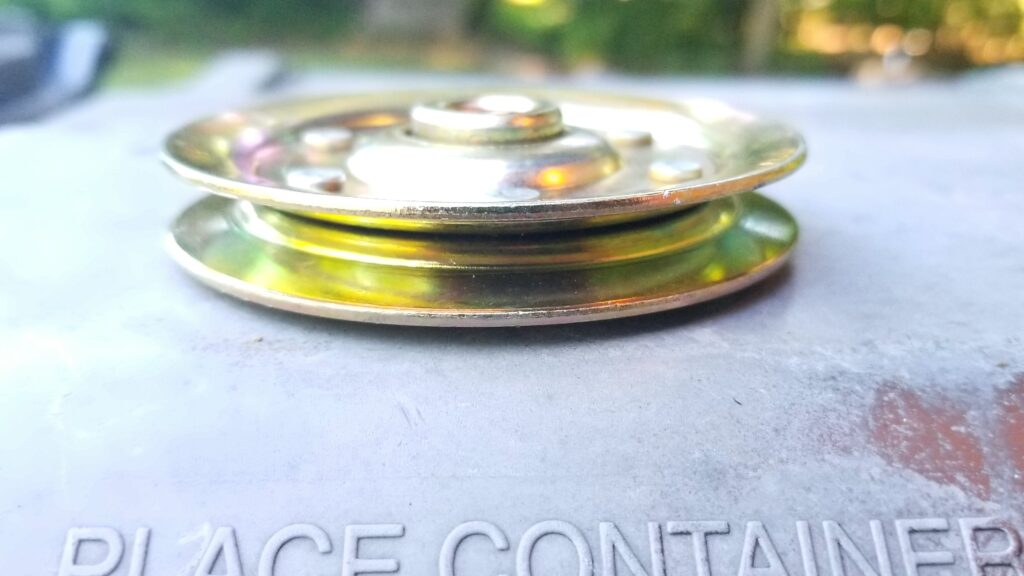
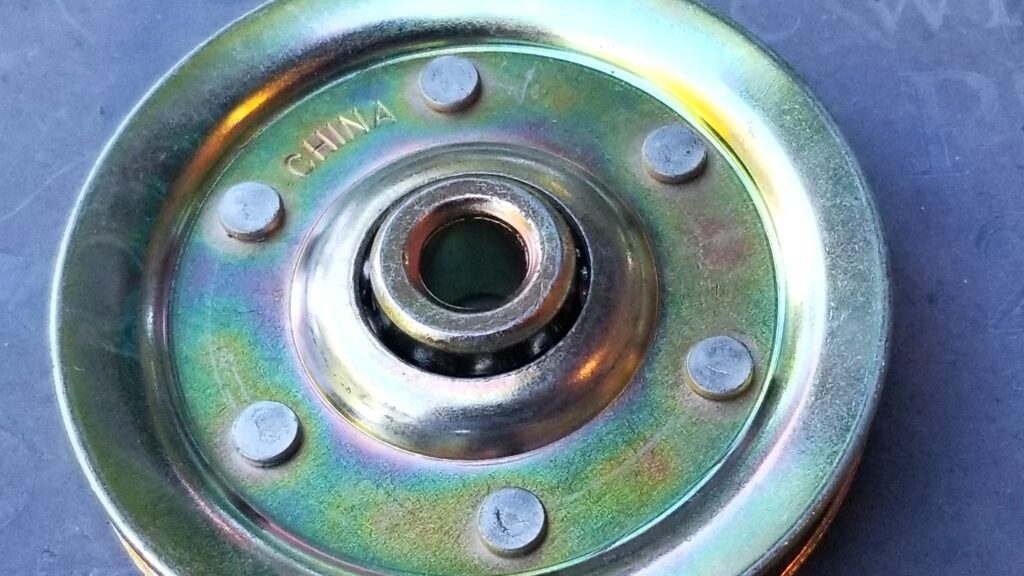
The sides of the pulley are stampings but they are made from heavy gauge steel and the groove in the pulley is deeper than what I originally had.The bearings turn smoothly and there is no play. I was very impressed.
If you are looking for a new 3″ diameter pulley that uses a 3/8″ bolt to mount, I’d definitely recommend these. There’s a good reason they have almost five stars with 158 reviews.
Installation
I’m to the point where anything that is easy really makes me happy. This was really easy. I’ll tell you what I did for my door and your design may require different or additional steps.
I opened the garage door to remove the tension on the cables.
I worked on one pulley at a time.
I removed the cable from the pulley
Used one wrench to hold the nut in the back and a socket in the front to remove the old pulley (it was a wreck)
Installed the new pulley along with the shackles to keep the cable in place just in case – that means running the bolt through the assembly and back into the hole on the garage door’s wall frame.
Put the cable back on the pulley
Sprayed Teflon dry lube on the bearings. I don’t like oil as it collects dust and dirt but that’s just me.
Moved stuff out of the way
Tested the door
Done
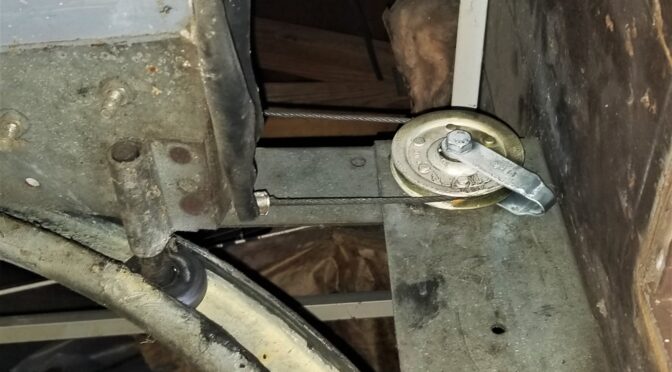
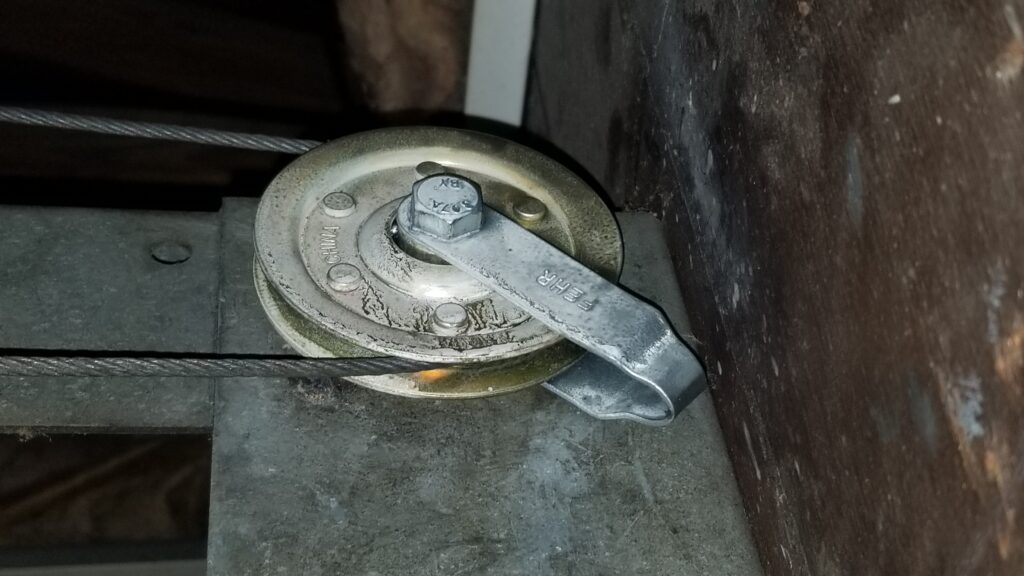
You can see the new pulley mounted on the frame. The powdery look is the Teflon dry lubricant. I moved the shackle around some to try and figure out where it might do the best to keep the cable from jumping out. The pulley’s groove is so deep that I honestly don’t think it matters in my case but it is there for added insurance.
Conclusion
Happy to report that these are rock solid replacements – it came as a pack of four so I have two for the future as well – if I ever need them. I’m very happy with the results – the door opens and closes very smoothly and the cable no longer jumps the pulley. It’s also much quieter I notice.
Note, I have to buy all of my parts – nothing here was paid for by sponsors, etc. I do make a small amount if you click on an ad and buy something but that is it. You’re getting my real opinion on stuff.
I have a Hatsan Gladius Long precharged pneumatic (PCP) air rifle in .22 caliber that I use to dispatch garden pests and have written a number of posts about it. It’s extremely effective because it has power, is accurate and relatively quiet. The one challenge I have with it is over penetration. It does have adjustable power settings but I find that I can’t go below the “3” setting (out of five) to have the range I need and enough power for a humane kill. The problem is that the domed JSB Diablo 18.13gr pellets I’ve used since the start shoot right through a squirrel if I am going for a heart shot vs. a headshot and really wanted to reduce this so I started reading on pellet types.
First off, I really like JSB pellets. They are made in Czechoslovakia and are really uniform. I shoot them in both my PCPs and have no complaints. I saw an advertisement for their new “Hades” series of pellets and started searching on what people were saying about them.
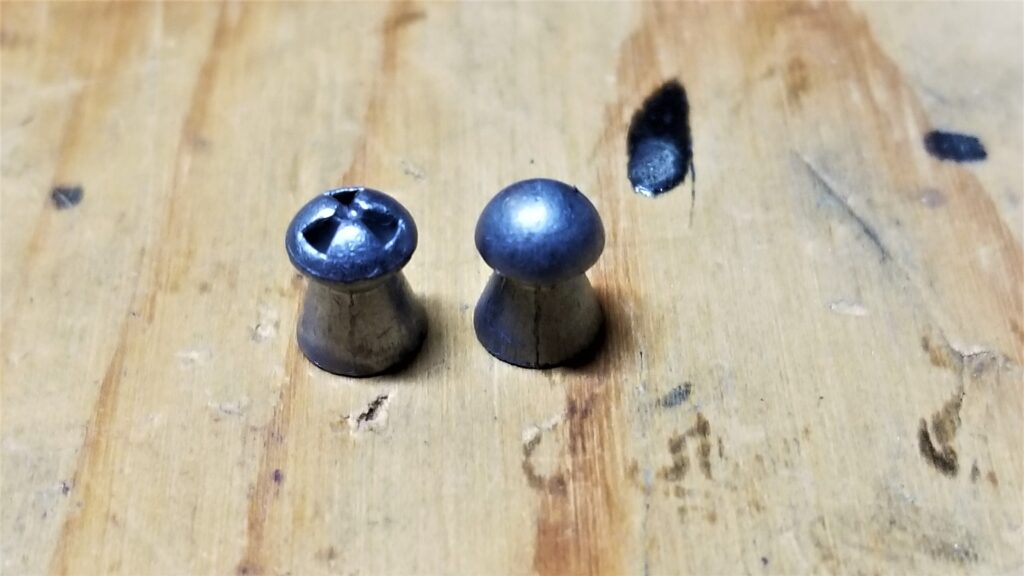
A 15.89gr Hades is on the left and an 18.13gr JSB Jumbo Heavy Diablo is on the right. The Diablo has proven to be wonderfully accurate and my farthest shot has been about 50 yards with it.
My Real World Review
There are guys out there with chronographs, blocks ballistic gelatin and what not. I’m not one of those guys. However, I can tell you want I’ve noted after about 150 real world shots.
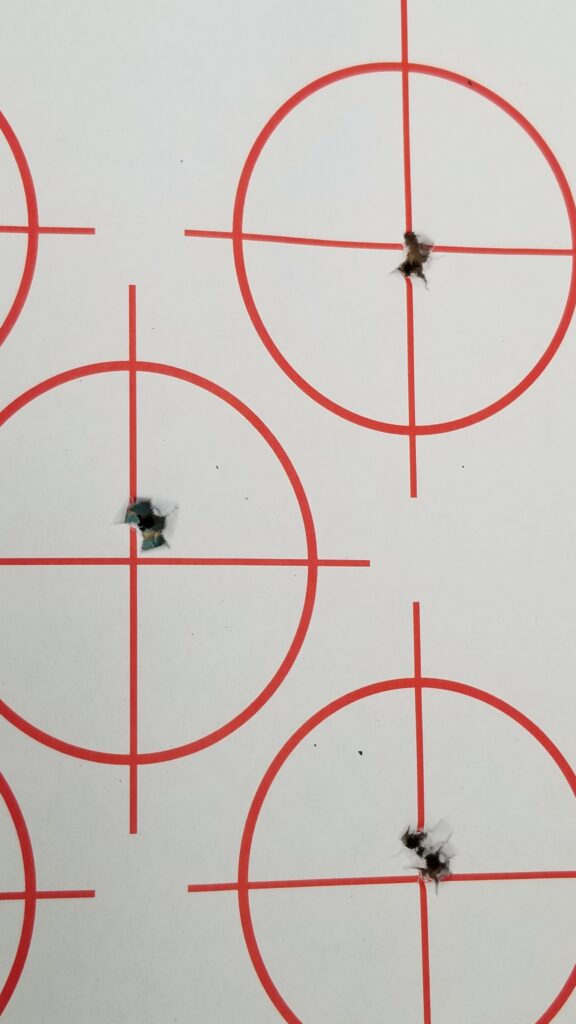
Most of my pest control happens within 60 feet – yes, feet. I set up a target at 30 feet and zeroed my scope. In firing groups, it seemed consistent enough.
Good enough for me.
Did I see anything different with garden pest control? Not really to be perfectly honest. I can tell you the exit wound was bigger than what the Diablos would leave and it was somewhere around half again the diameter of the pellet.
I still have over-penetration with the Hades and the need to be very careful is still true. Both tree and ground squirrels are small and soft. There’s simply not a lot of mass there to stop a pellet. If you have bigger pests, you might see a difference.
I did one close range headshot of a racoon at the rifle’s highest power setting and did not see a difference over what Diablos would do.
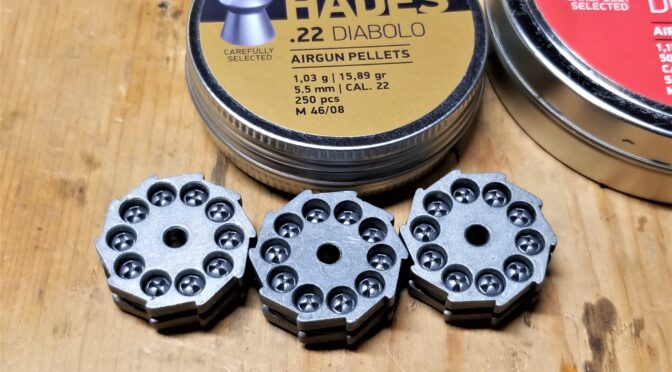
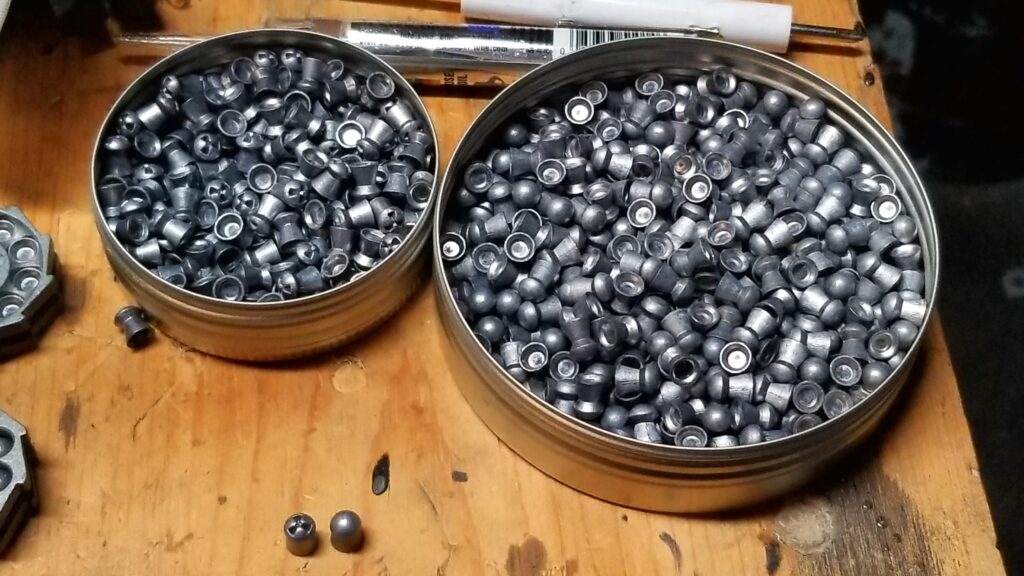
My Hades pellets are on the left. I bought two of the 200 round tins initially and backordered two of the 500 round tins that have since arrived. I have about 1200 rounds of the Hades left as the first tin is almost empty and then I will go back to my Diablos as I have 3-4 of the big 500 round tins.
Conclusion
For my use as described above, I did not see a big difference between the Hades and the Jumbo Diablos. The Hades seems to be a decent pellet as long as you have accurate shot placement. I bought a ton of Diablos way back when so I’ll use up my Hades and then go back to my supply of Diablos.
I hope this helps you out.
9/18/23 Update: I am now using Hades pellets in my .22 Leshiy 2 and I do think they make a difference when it comes to dispatching tree squirrels for pest control. It may be the Hatsan just didn’t push the pellet fast enough – I’m not sure. Amazon is carrying a number of calibers so click here if you’d like to see them.
Note, I have to buy all of my parts – nothing here was paid for by sponsors, etc. I do make a small amount if you click on an ad and buy something but that is it. You’re getting my real opinion on stuff.
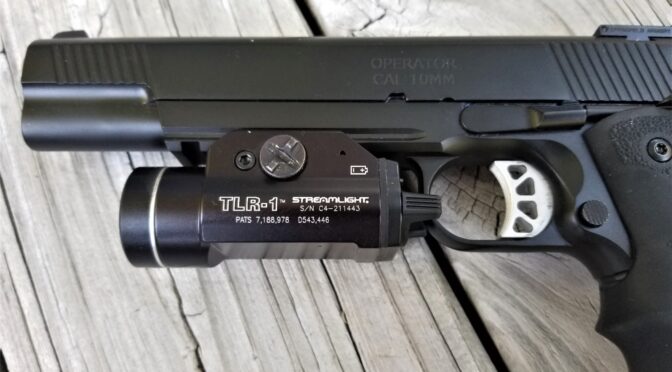
Years ago, I found out that cheap lights are not something to put on a firearm for self-defense. They simply are not reliable enough. I’ve also found that Streamlight weapons lights hold up plus are backed by top notch support. For pistols, I have a number of the TLR series weapons lights and found them to be solid. With that said, we do need to address the topic of the post – if you install the light on one pistol, how do you move it to another?
How do the TLR lights secure to a weapon?
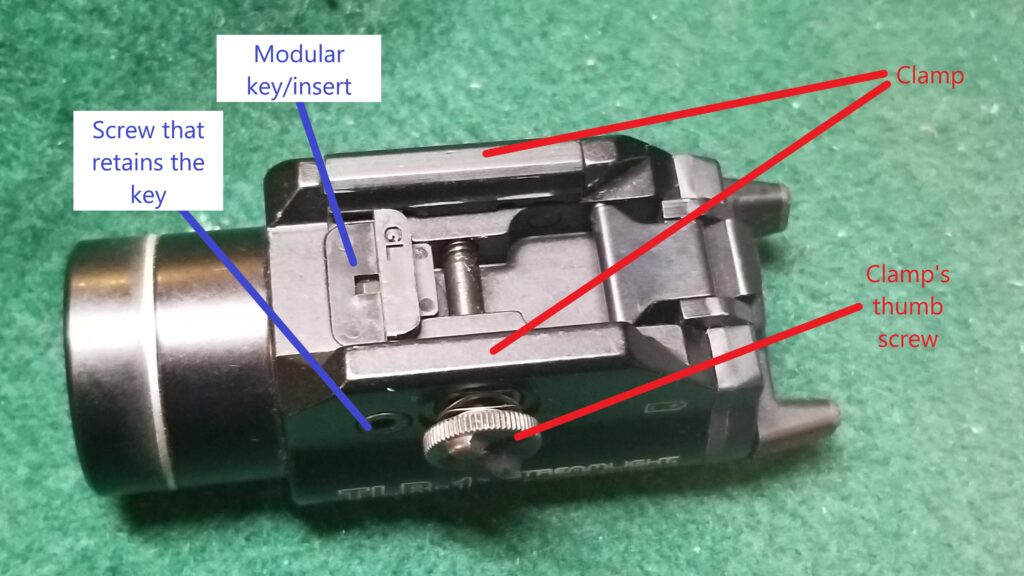
First off, the TLR design is modular built around an adjustable clamp and then different “key” inserts that allow the TLR to fit a variety of weapons. When you purchase a TLR, it comes with keys to fit:
“1913” – Mil-Std-1913 Picatinny rails
“GL” – Glock rails as well as Tuger KP345 and SR-9
“TSW/99” – Smith & Wesson and TSW/99, Post 2004 Walther 99 Full size
When you buy a TLR, you must insert the proper key to get it to fit the rail on your weapon. While they were intended for pistols, I’ve used them on a variety of rifles and shotguns over the years as I move lights from weapon to weapon. The key shown above has the “GL” code which means it the one for interfacing with the rail on Glock pistols assuming the pistol model both has a rail and is large enough to hold the particular model of light. For example, you can run the above TLR-1 on a full size Glock 34 but will stick out past the end on a 17. Some people don’t care but I prefer a TLR-4 for a 17 as the TLR-4 is shorter and ends flush with the bottom of the receiver.
Ok, but what if I want to move the light to another weapon?
So, this brings us to the main point – can you move a TLR from one platform to another? The short answer is absolutely – you remove the retaining screw and replace the key with the appropriate one for the new pistol.
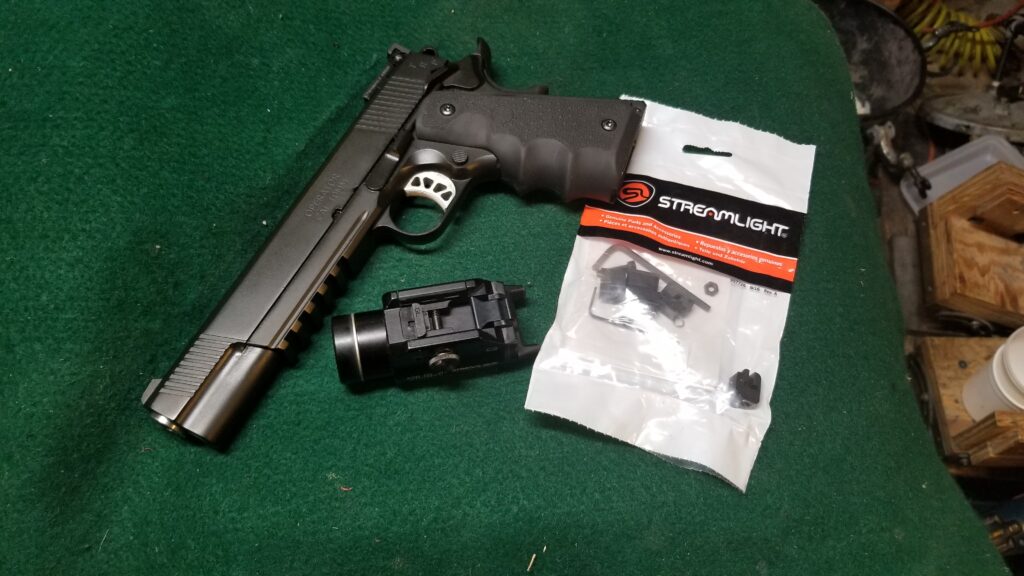
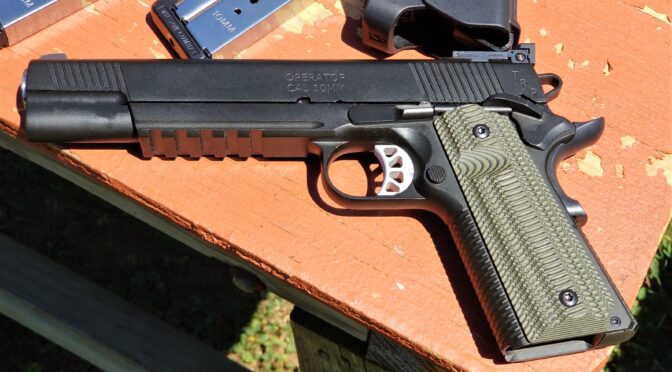
And there’s the rub – what if you’ve lost or “temporarily misplaced” your bag of keys? Folks, that is what happened to me. I could not find any of my keys and needed to change the TLR-1 from Glock to 1913 to fit my new TRP Operator. Here’s the good news – you can buy just the keys. Streamlight realized there would be people like us and sell kits that have the keys, the screw, small nut and even a the hex key needed to do the job. The kit does depend on the model of TLR you have so make sure they match the light and the weapon you want to move to.
Streamlight Kit 69175 fits the TLR-1 and TLR-2. The 69176 kit is specifically for TLR-3 and TLR-4 models.
Here’s my 6″ TRP Operator, the TLR-1 and the replacement key set 69175.
You can find the two key kits very readily both on Amazon and on eBay:
Conclusion
I really like the TLR lights and hope this post helps you out if you need to move your TLR but can’t find your keys.
Note, I have to buy all of my parts – nothing here was paid for by sponsors, etc. I do make a small amount if you click on an ad and buy something but that is it. You’re getting my real opinion on stuff.
According to statistics, there almost 5 million new gun owners in 2020. I think there are a ton of reasons and certainly concerns over the safety of one’s self and loved ones is in the minds of a lot of people these days. With that said, there are a few things I want to pass along and will do so in a series of blog posts. We’ll kick things off with some comments on safety and getting your new firearm ready.
Learn About Your Firearm & How To Use It
Please take the time to learn about your firearm and how to use it. I can’t stress this enough – take a class on firearms and self-defense. Ask around and odds are any number of groups in your area holds classes and you need to find a good one. Like any subject matter, there are good teachers and ones who candidly suck so ask around. If you have no idea where to start, ask your dealer, local sportsman’s club, shooting ranges, friends, etc.
My Short List of Safety Rules
I’ve been shooting since I was so little that my dad had to hold the rifle and help me so literally almost fifty years. I’ve shot with a lot of great guys and one thing they all stressed was the need for safety. Here’s my list of key safety practices that you can always add more to:
Treat every firearm as loaded and pointed in a safe direction. Assume nothing – verify the state of your weapon. Tons of accidents have happened because of an accidental discharge.
Keep your finger off the trigger until you are ready to fire. It is very easy to trip or be startled and accidentally squeeze the trigger. You can avoid this by keeping your trigger finger flat against the trigger guard or side of your weapon and off the trigger!
Be certain of your target and what lies beyond it. There are two safety point here – make sure of what you are shooting at or you risk making a mistake – potentially a horrible mistake. Second, bullets do not necessarily stop in the target or you may miss the target. What lies around and behind the target?
Your firearm’s biggest safety is you. Don’t rely on a firearm’s safety to prevent a mistake. Think. Anticipate. Your mind is your biggest safety. Think safe, be safe.
Know your weapon. An awful lot of tragic mistakes have been made as people fumbled with a firearm they did not understand and had not sufficiently practiced with. A crisis is not the place to try and figure out what to do or not do. When the adrenaline is flowing, you will forget a lot of academic details and stand better odds of remembering what you have physically practiced.
Take care of your weapon and it will take care of you. Make sure it is cleaned, lubricated, using proven magazines (if it uses them) and proven ammunition.
New Guns Aren’t Good to Go
Let’s expand on the last point above. Something that I think is often overlooked and not sufficiently explained to new owners is that most firearms will not reliably work out of the box. I’m not saying something bad about a given maker or model. The fact is that there are a ton of things that may cause your firearm to not work right when you need it most:
Many firearms do not arrive sufficiently clean. You need to run a patch or bore snake down the barrel to remove any contaminants that have accumulated. I’ve seen new firearms with filthy bores, pristine bores and all points between. Read the manual to understand what cleaners are safe with your firearm. For example, some strong solvents can harm polymer receivers.
Normally a person cleans and lubricates a new purchase at the same time. Read the manual on instructions for how to lubricate your new purchase. It’s not as simple as pouring on the oil. Indeed, too much lubricate can impair the operation of certain firearms. Note, not all lubricants are recommended on all firearms either. For example, penetrating oil can harm some polymer receivers.
Just to reinforce the point – Read the manual for your pistol, rifle or shotgun. You need to understand how to operate the weapon as well as how to clean and lubricate it. Most manufacturers have websites with manual that you can download. There are often videos showing details. You can also ask your gun dealer if he/she can explain the details of your weapon to you.
If your weapon uses magazines, test them at the range with the ammo that you plan on using. You may be surprised but some combinations of magazines and ammunition may work horribly in one firearm and perfectly fine in another. I can’t stress this enough – shoot at least 30 rounds (and the more the better) before you rely on a given combination of weapon and ammunition. By the way, you read and hear people recommend 50, 100, 200+ rounds before you rely on something and they are all right – the more you shoot something, the better your odds are plus practice is good.
Speaking of practice, don’t just take a firearm to the range once, have a great session and declare victory. You need to also practice loading, unloading, recovering from a jam, etc. Don’t wait for an emergency as I mentioned earlier. The best firearm in the world will not help you if you forget how to do something during a time of need.
More Gun Safety Resources
There are tons of videos and web pages about gun safety. I’d recommend that you spend the time to learn how to be safe so here are a few more pages for you:
I hope this post helped you out. Whatever you do, don’t just buy a firearm and ammunition and do nothing until something happens and you need it. Shooting is actually a fun sport – it doesn’t need to be all doom and gloom. Spending the time to learn about safety, learn about your weapon and practice using it — these are all worth your time.
In the last post, I covered installing the forward assist button and the ejection port cover. In this post, we’ll proceed with installing the Midwest Industries 7″ Combat Rail, gas tube and the Satern helical muzzle brake.
Special Assembly Note
Here’s some hard won advice I want to share with you. When you install the barrel nut and the muzzle brake, there is significant torque involved. You absolutely do not install a magazine well block in a vise or clamp the upper directly — You will bend or break stuff. For example, the alignment pin on the barrel will let go – and has done so to tons of people who didn’t secure their upper properly … Spend the money to get the right tool.
Here’s my personal experience: Years ago before I knew much about ARs, I had one of those little jigs that puts pins through the takedown and pivot pin lugs – I think I got it cheap off Amazon. At any rate, I was trying to remove a bird cage muzzle brake that was on real tight and managed to bend the takedown lug of the upper and that was the end of me using those. Yeah, I was ticked and then I started asking around what tools/jigs folks were using.
There are two options for you that I can recommend. Personally, I use a Magpul Barrrel Extension Vise (“BEV”) Block with a bolt carrier to secure it. It has steel lugs that engage the barrel extension and a full-length steel shank for strength. I’ve used many times over the years and it hasn’t let me down.
This photo is from my last Beowulf rifle build. The BEV block is to the left of the bolt carrier. You slide the BEV block up through the mag well and forward to engage the barrel extension. The bolt body comes from the rear and a pin goes through the hole you see to secure the block via the pivot pin hole on the upper. It’s nice and solid. Magpul sells you the block but you need to supply the carrier. You could either have a spare sitting around just for this, which is what I do, or remove the bolt from your carrier and use it. The carrier is not harmed in the process.
Your other option is a Geissele Reaction Rod. I’ve heard good things about the Geissele rod but have never used it. Guys who have it gush about it and you know how fast guys are to complain when a tool sucks.
You can usually find either at Brownells, Midway, Primary Arms, PSA, etc. There’s a lot of back ordering going on these days so you might need to hunt some.
Midwest Industries 7″ Combat Rail
Let’s roll right into the handguard discussion because we will need the barrel nut to install the barrel first. With the advent of the free floating handguards, meaning the handguard does not touch or push on the barrel affecting accuracy, makers started creating their own barrel nuts that their handguard would attach to and the nuts vary dramatically in terms of design.
My favorite AR free floating handguards are the Midwest Industries (MI) Combat rails. They are very well made, rugged, easy to install and all the surfaces that can poke or nick you have been rounded over. I’ve installed four of them now and really do like them.
For the 7.5″ barrel, I opted for a 7″ rail to allow for the muzzle brake to poke out the end and vent properly. I also only use M-LOK attachments now and the Combat rail has those.
The MI Combat rails come with installation instructions that are quite detailed. Take the time to read them before starting. If you have questions you can either contact them or do some quick searching. In general, a little bit of time spent preparing can make things go far more smoothly.
To install the rail, the first thing to do is to disassemble the rail – Midwest Industries ships the unit with the barrel nut, torque plate and two screws installed so you can see how it goes together plus it keeps everything tidy.
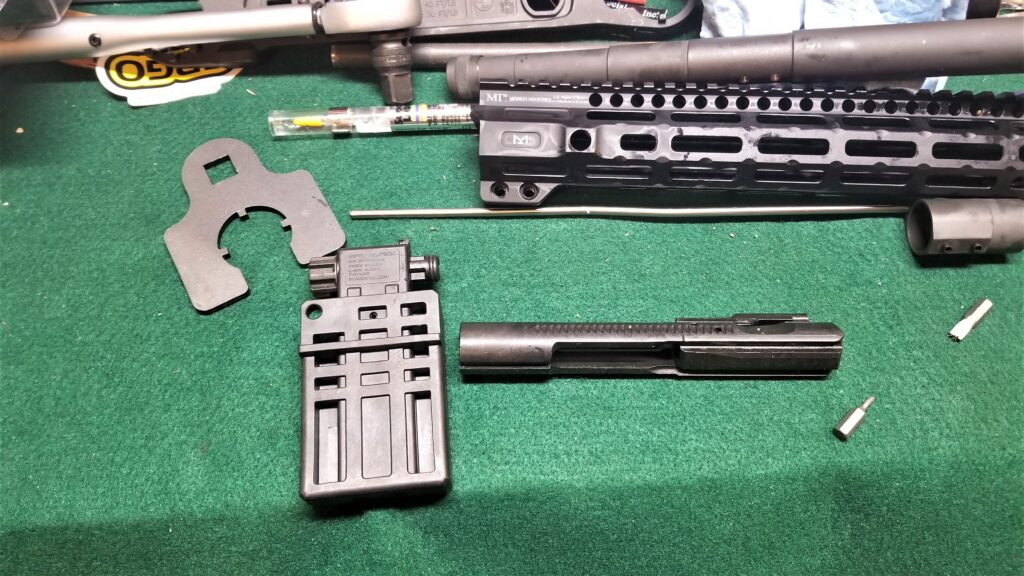
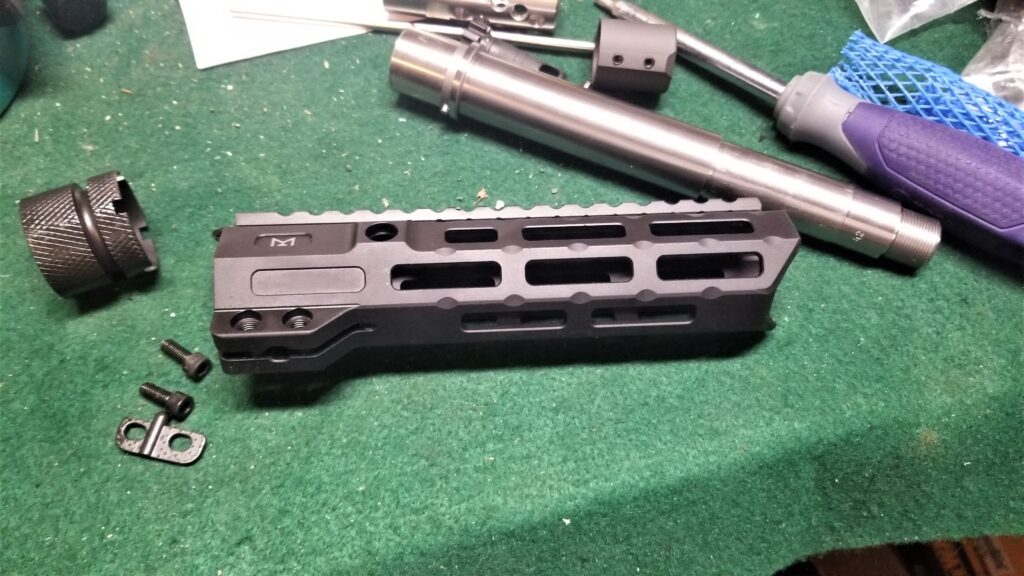
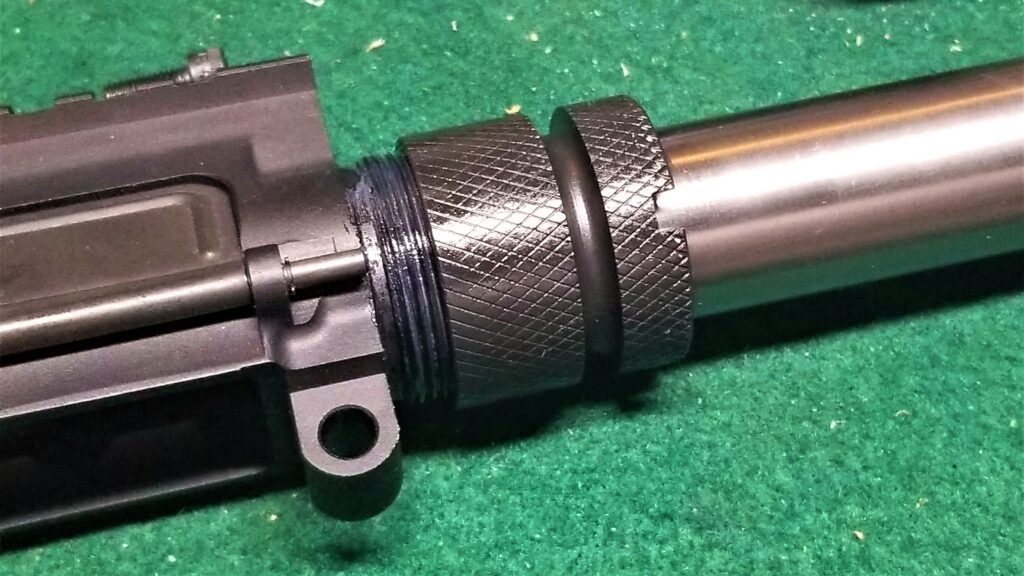
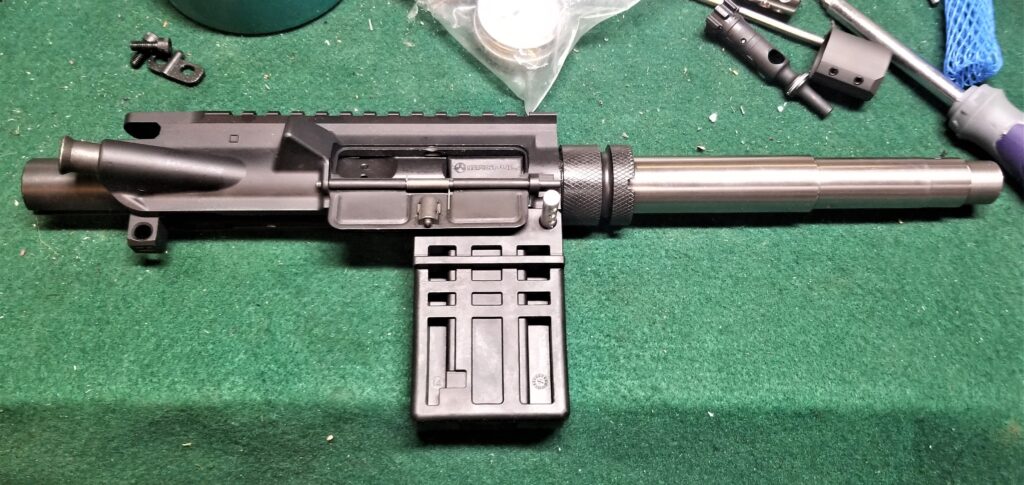
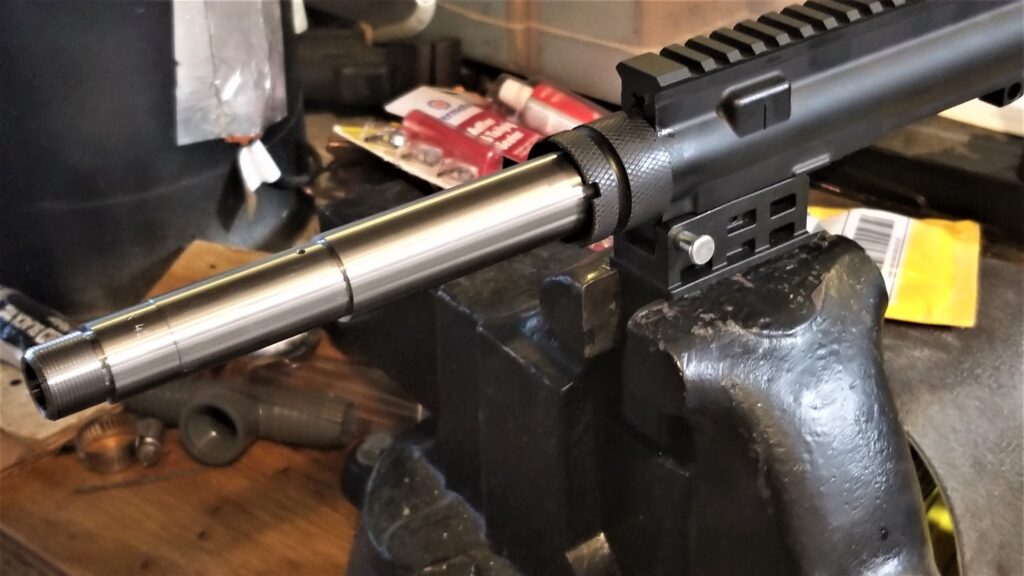
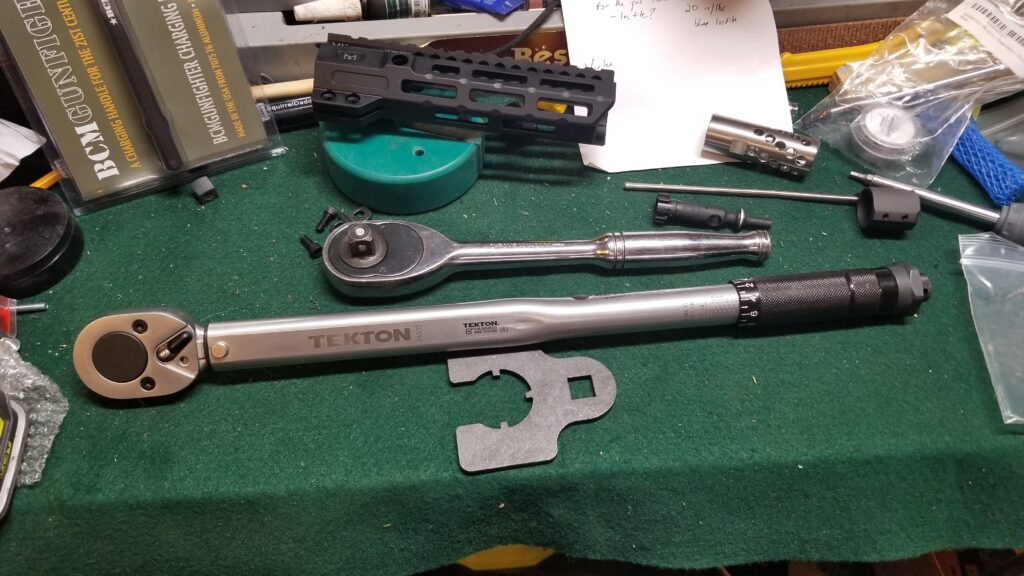
After you remove the rail from the box, you will need to disassemble it. I put all my small parts in a magnetic try to avoid losing them. Top left of the rail is the barrel nut, below that are the two 10-32×1/2″ allen head handguard screws and below them is the torque plate that limits the handguard’s forward travel. It’s really an elegant design. The biggest benefit is that you can torque the handguard down to MI’s 40 ft/lbs and there is nothing that will get in the way of the gas tube being installed. Slide the barrel into the upper making sure the index pin on the barrel goes into the corresponding groove on the top of the upper. Coat the threads with Aeroshell 33MS/64, or equivalent grease, and hand thread the barrel nut into place. The slots on the barrel nut must be facing the end of the barrel as pictured. Note, different builders use different greases and some use one of the various non-seize compounds. I have a small container of the Aeroshell 33MS/64 grease just for this purpose and lightly apply it using an acid brush (these are small still brushes used to apply acid flux (hence the name) and are handy for many tasks such as this). The checkering on the but will allow the relatively soft aluminum rail to get a very secure grip when the two clamping screws on the rail are torqued down later.Follow the directions for installing the BEV Block. You can see the bolt carrier sticking out the rear and a 1/4″ clevis pin going through the pivot pin hole to secure the assembly. The reason for the universal clevis pin is that I lost, or maybe I should say “temporarily misplaced” some time last year, the original pin that came with the block. The 1/4″ clevis pin works just fine.You will need to secure the upper in a good bench vise to torque down the barrel nut. This is why the BEV Block rocks. As long as your vise is secure, so is the upper. The torquing stresses are handled by the engagement of the BEV Block into the barrel extension – not the aluminum upper. This is a Samson vise that belonged to my dad – it’s heavily ,made and bolted to the 1-1/2″ thick work bench.To properly install the barrel nut, you need a torque wrench. “Farmer tight” is not recommended. Per Army manual TM 9-1005-319-23&P, proper assembly is to torque the barrel to 30 ft-lbs, loosen and repeat three times. This stretches the threads and reduces the risk of the barrel nut loosening up. The Midwest Industries installation instructions specified 40 ft-lbs so I torqued to that spec and loosened it three times. Note, they supply the special barrel nut wrench that then engages with your 1/2″ torque wrench. I use a Tekton 24335 torque wrench for this and am always sure to rest it to zero before putting it away.
Pistol Length Gas Tube
Once the barrel nut has been installed, the gas tube is easy. I bought a 0.875″ diameter gas block and pistol length gas tube from Satern. They make a single divot on the bottom of the barrel so when you slide the tube into place and tighten the set screws, the gas block is properly located. The installation is easy – slide the block on with the tube going into the hole made for it at the top of the receiver.
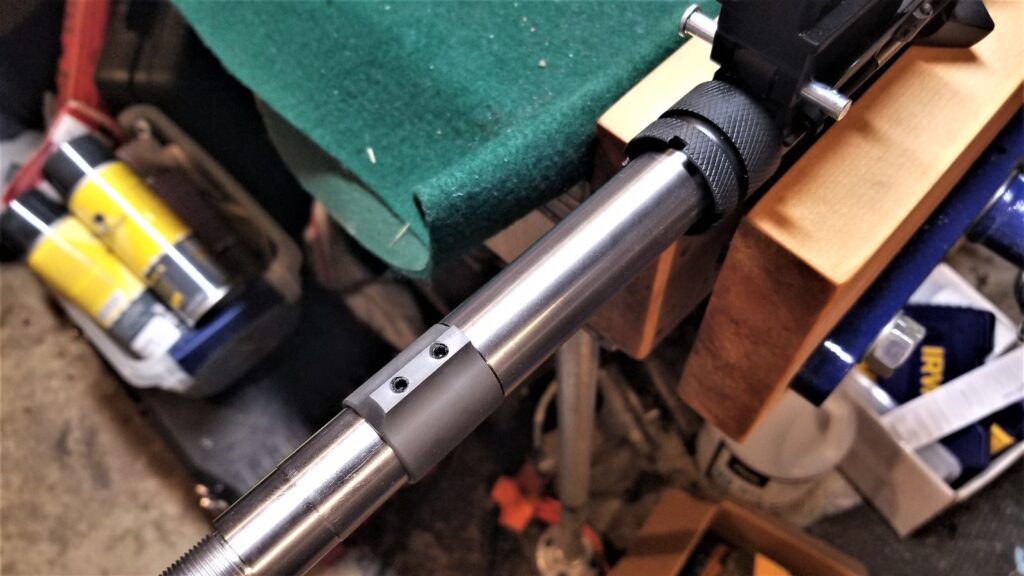
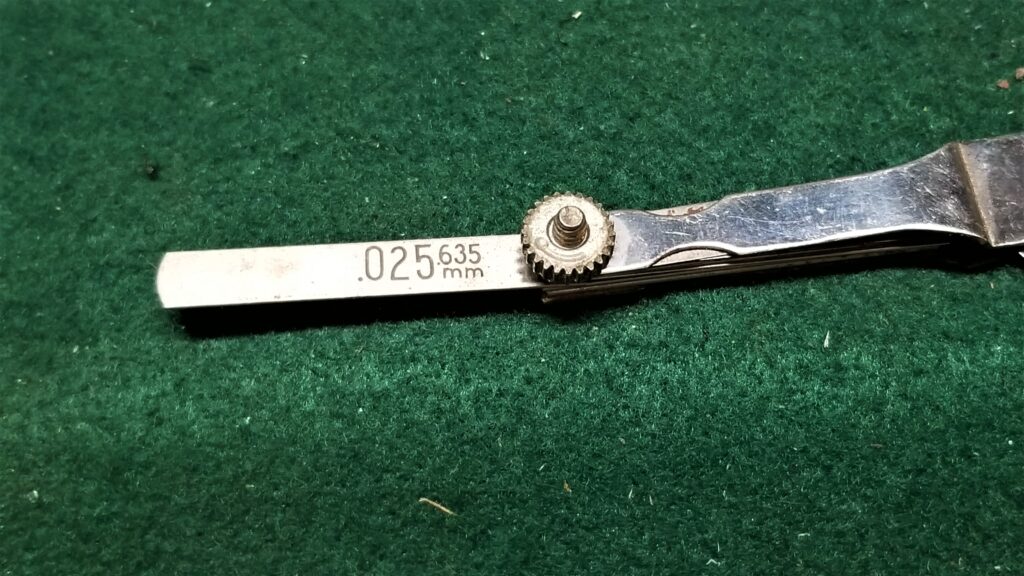
In this photo, the upper is upside down clamped by its Picatinny rail in my wood working vise. A wood vise is darned handy when you want to work on things and not tear them up. This is a big 10.5″ Yost with maple jaws. At any rate, you can see the bottom of the gas block and the two set screws. Coat them with a medium-strength thread locker to reduce the odds of vibration shaking them loose. The set screws should be torqued to 20 inch-pounds per Satern – that is inch-pounds and not foot-pounds!! Note the slight gap between the right edge of the gas block and the shoulder of the barrel. That should be there and it should measure 0.025″ with a feeler gauge.You can get feeler gauges many places – notably auto parts stores. Here, I have the 0.025″ leaf, or blade depending on who you talk to, extended. It should slide into the space with just a bit of resistance as it touches the sides but the next larger size should not if you are aiming to be on spec. I was told to hit 0.025 so that’s what I confirmed. Sometimes people will give you a range and in those cases, you just want the gauge that fits to fall in that range.
Satern “Heliport” Muzzle Brake
Because this is a low profile brake, you can install it before or after the handguard. If you are installing a tanker brake, you’d do it after the handguard. In my case, I opted for before.
Remember what I said earlier. You need a jig to properly hold the barrel or something will brake. In this case, you run the risk of the index/alignment pin on the barrel shearing off or bending the receiver. Don’t do it.
Installing the Handguard Itself
At this point you should have the barrel installed, the barrel nut installed and torque down as well as the gas tube. Installing the handguard is actually quite simple. You slide it back onto the nut with the “ears” aligning it to the upper’s rail. You then flip the receiver upside down, install the torque plate, apply thread locker to the screws, install and torque them down to 55 in-lbs.
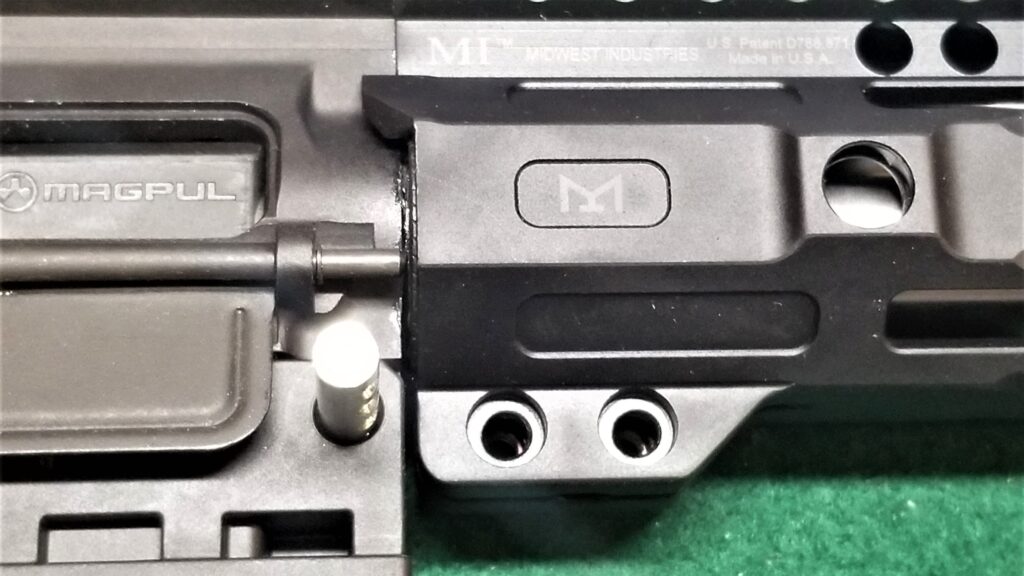
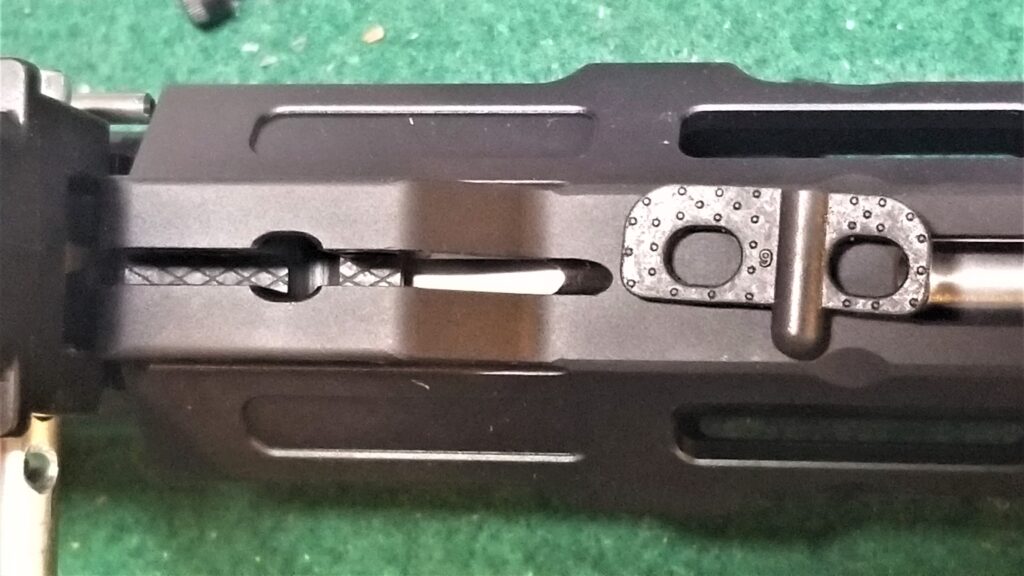
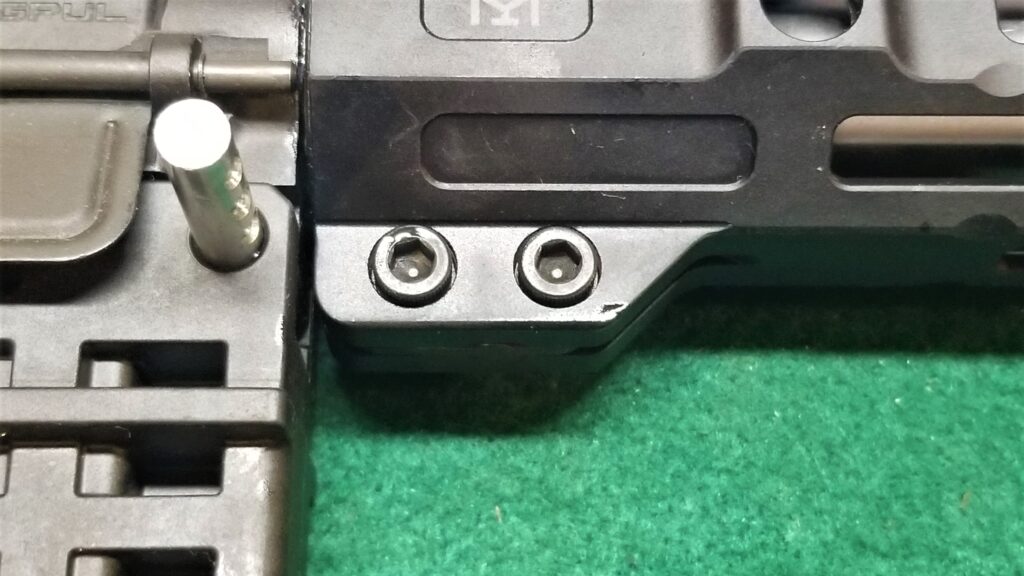
Here, I’ve pushed the rail back against the upper. You can see the alignment “ear” on the rail stabilizing the rail against the upper. I’ve not needed to adjust these. The bottom two holes just forward of the protruding clevis pin are where the two 10-32×1/2″ socket cap screws will be inserted after the torque plate is installed.This photo turned out better than I hoped for. Through the slot in the rail you can see the barrel not. Note how the groove in the nut is towards the front. The torque plate that ls laying on the rail is asymmetrical for that reason – it will go down with the protrusion entering the slot. Note the raised dots that will lock the plate into position when the two clamping screws are installed. Seriously, these details play a big part in why this is my favorite AR handguard.WIth the torque plate installed, put medium thread locker on the screws and install them. I like to bring them down equally snug and then torque to the specified 55 in-lbs using a 1/4″ torque wrench. Once installed, the rail is good to go.
Install The Bolt Head
I bought the bolt head from Satern and it needed to be installed in a carrier. Luckily I had some spares from cases where I swapped out bolts for WMD NiB bolts. I opted for a carrier with a nice smooth nitride finish and installed the head. Note, during assembly I apply a thin coat of Super Lube grease to all sliding parts. I’ve found it’s a great break in lube.
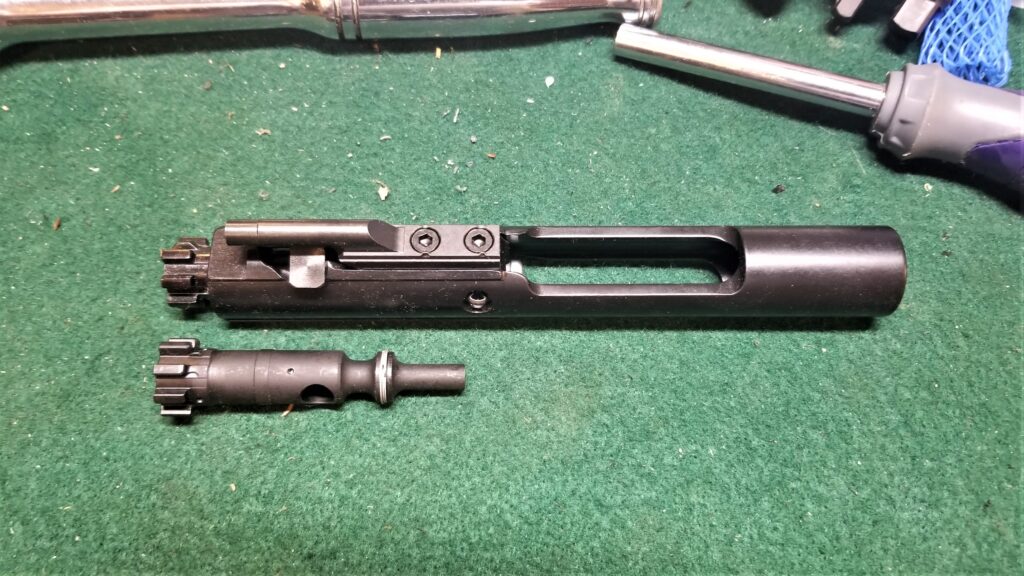
The Satern 12.7×42 bolt head (bottom) installs in a 5.56 carrier with no fitting needed. Assembly and disassembly are the same as any other AR bolt carrier group (BCG).
Install The Charging Handle, Bolt Carrier Group & Done
I installed the BCG and BCM Mod 3 charging handle into the upper and with that, the upper was fully assembled not including any sights or optics.
Note, I have to buy all of my parts – nothing here was paid for by sponsors, etc. I do make a small amount if you click on an ad and buy something but that is it. You’re getting my real opinion on stuff.
A Beowulf uses a standard AR upper receiver with an enlarged ejection port. My Alexander Arms (AA) upper has an ejection port that measures 3.02″ wide x 0.62″ tall. In case you are wondering, I grabbed on of my PSA 5.56×45 ARs and its port measures 3.02″ wide x 0.49″ tall.
The PSA’s port is about 0.35″ from the bottom of the base of the picatinny rail that has a casting line in receiver to the inside of the port. The AA still has the stepped lip for the ejection port door even though it doesn’t use one so I am measuring to the actual opening. I’m not sure how standard that measure is but offer it up – it does correspond with the top of the case deflector in the three ARs I looked at. The AA’s port is also about 0.35″. Note, this is an approximate. I’m trying to use caliper to measure a curved surface.
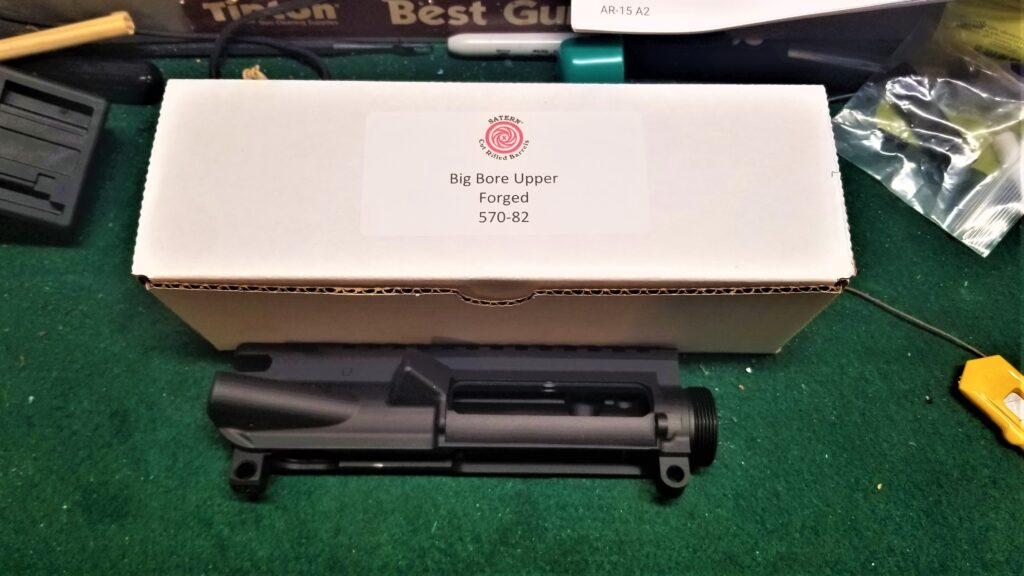
So this means you can either buy a standard upper and enlarge the port yourself or you can buy an upper that comes with the port already enlarged. Satern makes a big bore upper that supports the Beowulf round. Rather that bothering machining an existing upper, I went with the Satern receiver.
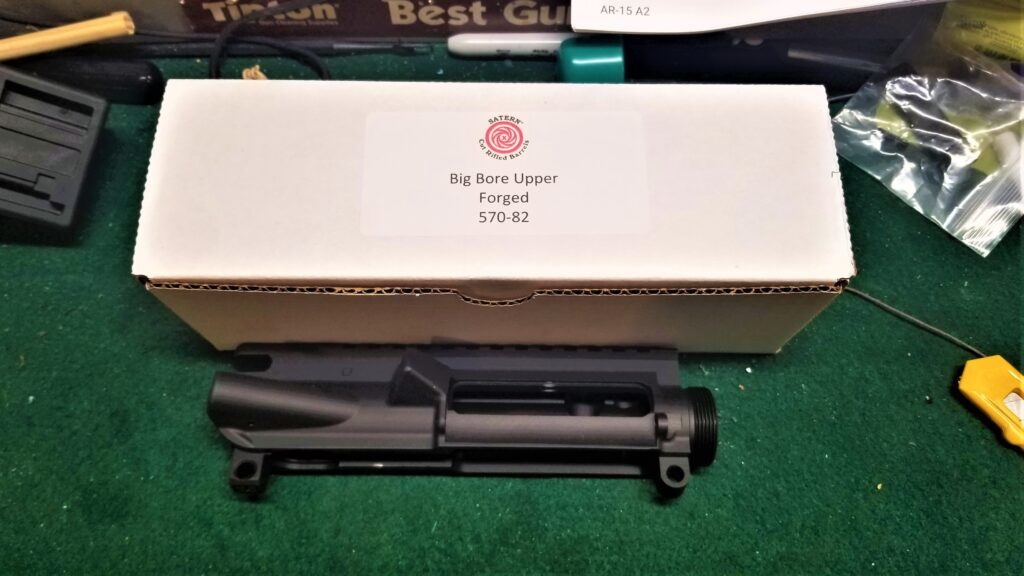
This is Satern’s stripped upper. They offer other options as well.
The Satern’s opening is 3.02″ wide x 0.62″ also. The slight difference is the measure from that casting mark under the rail to the entrance – it’s about 0.38″. Again – that last measure is a ballpark depending on the angle I hold the calipers. I can tell you for sure that it slight further down than the AA’s port.
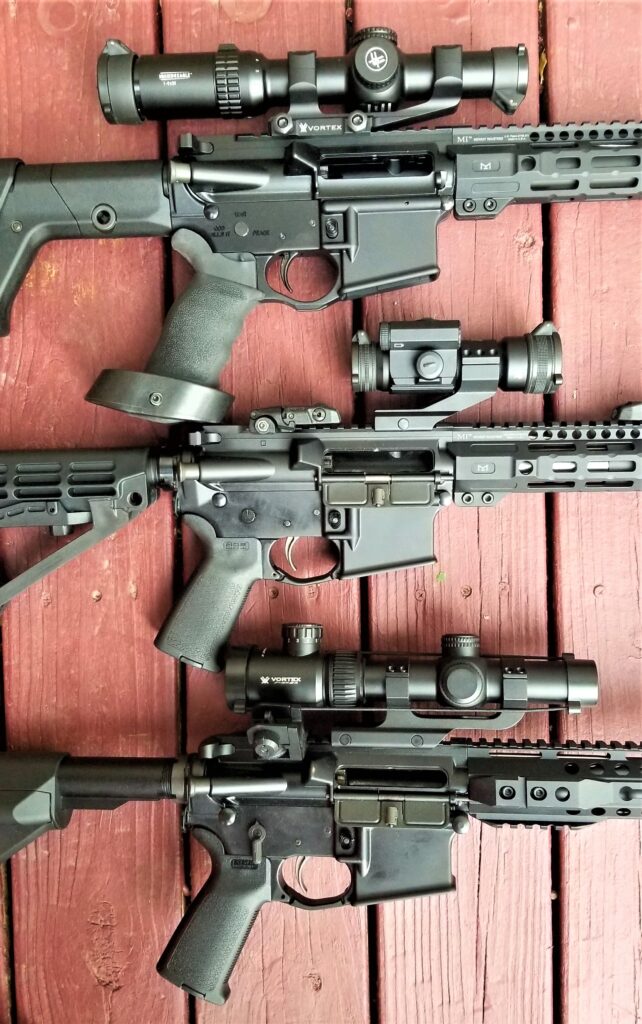
A picture helps you compare. The top AR rifle is based on an Alexander Arms .50 Beowulf 16″ DIY Upper. The middle rifle uses the Satern Big Bore upper and other parts. The bottom is my 5.56 16″ PSA upper.
So, to assemble the base components on a stripped upper is easy. I’ll go cover each of the basic parts to make a complete upper.
Install the Forward Assist
It’s interesting when you read about the history of forward assists on the M16. Eugene Stoner, the original designer of the M16 platform, did not think one a forward assist (FA) was needed and that if one had to force the bolt to close then it would probably cause a problem later when it came time to extract. Colt, however, wanted to make government buyers happy. The US Air Force didn’t think the FA was needed but the Army demanded it have one and later claimed it was for psychological reasons.
I have a mixed opinion on them as do many people. If you must force the bolt closed then something is wrong. I’ve used it relatively little and there was, in all cases, underlying problems *but* it might help you fire that one round that makes a difference. So, I build with them, they are there but I very rarely use them.
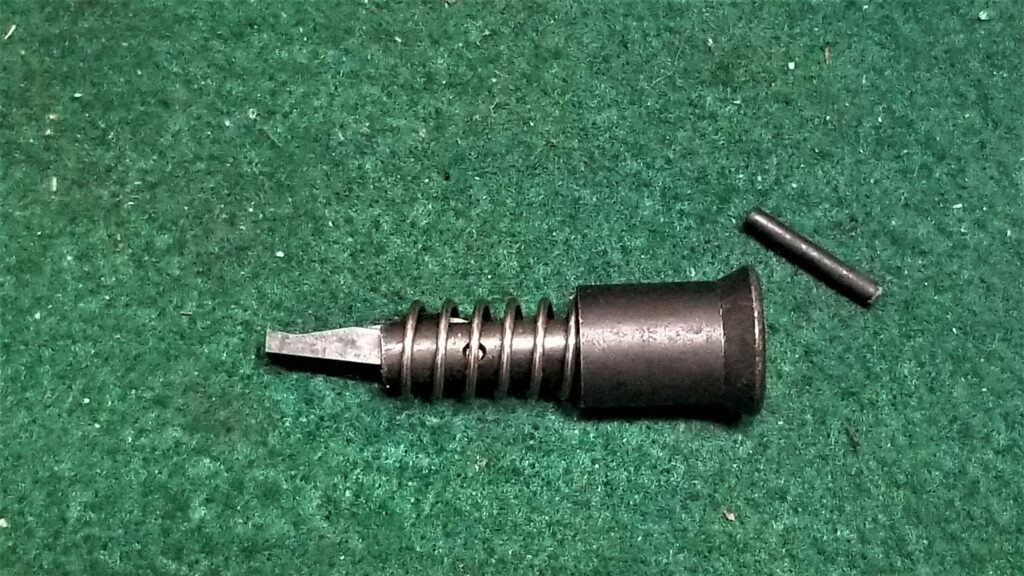
This is a basic forward assist. It’s only 5 parts – the pawl (the part sticking out), a pin that holds the pawl in the body of the FA plunger, a spring and then the cross-pin to hold it in place in the receiver. The CMMG unit comes with the pawl and pin already installed. See how the pawl is shaped at the top in this photo? That’s the part that must be rotated to properly engage the teeth in the side of bolt when the FA is pressed.
With that said, the Satern upper has a provision for a FA and you need to install one. I used a model from CMMG and installation is easy:
Lightly greased it first with Superlub grease and then inserted the assembly in into the hole with the pawl (the little “foot”) rotated towards the bolt.
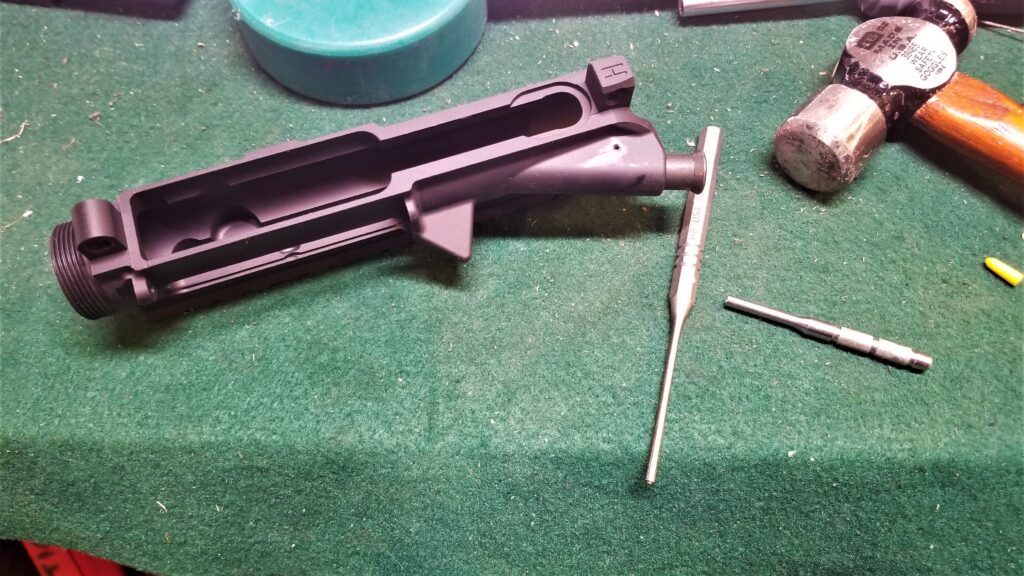
Press the FA all of the way into the tube and while holding the FA all the way forward, use a roll pin starter punch to drive in the roll pin that will hold it in place.
Note, have some wood or something under the tube that the FA is going into. Supporting it will make driving the roll pin into place much easier. The starter punch gets the pin into the hole and then the standard roll pin punch will help you tap it into place until flush. It does not require a ton of force.
Test the FA – it should spring in and out.
Turn the receiver upside down and press the FA button again, you should see the pawl come out of it’s tube in the side of the receiver – it should be oriented/rotated to push on the “teeth” on the side of the bolt (yeah, that’s what those “ribs” in the side of the bolt are for.
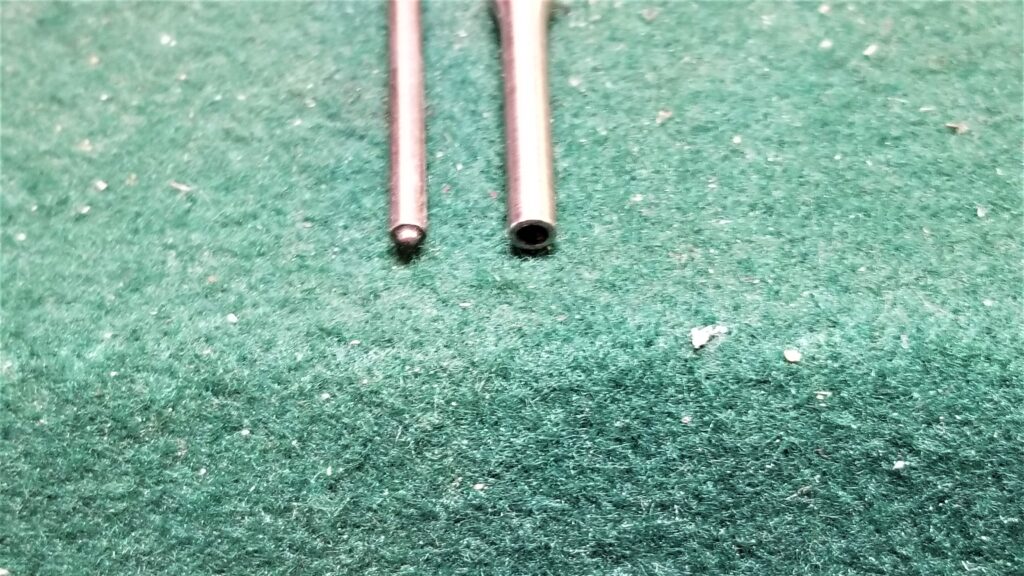
If you want to make your roll pin work way, way easier, then invest in a set of roll pin starter punches and a set of standard roll pin punches. The punch on the left is a standard roll pin punch. The dome in the middle helps hold the roll pin in place and centers the punch on the pin. The punch of the right is for starting roll pins. The roll pin is inserted into the hole and supports the pin while you tap it in place. Both of these types of punches are extremely helpful.It’s installed.
Installing the Ejection Port Cover Assembly
As you read above, the Beowulf has an enlarged ejection port so a standard-sized 5.56 ejection port cover/door will not work. Okay, you have two options at this point. Either skip the cover or buy one. I went with the latter because Satern makes an enlarged cover that fits their receiver.
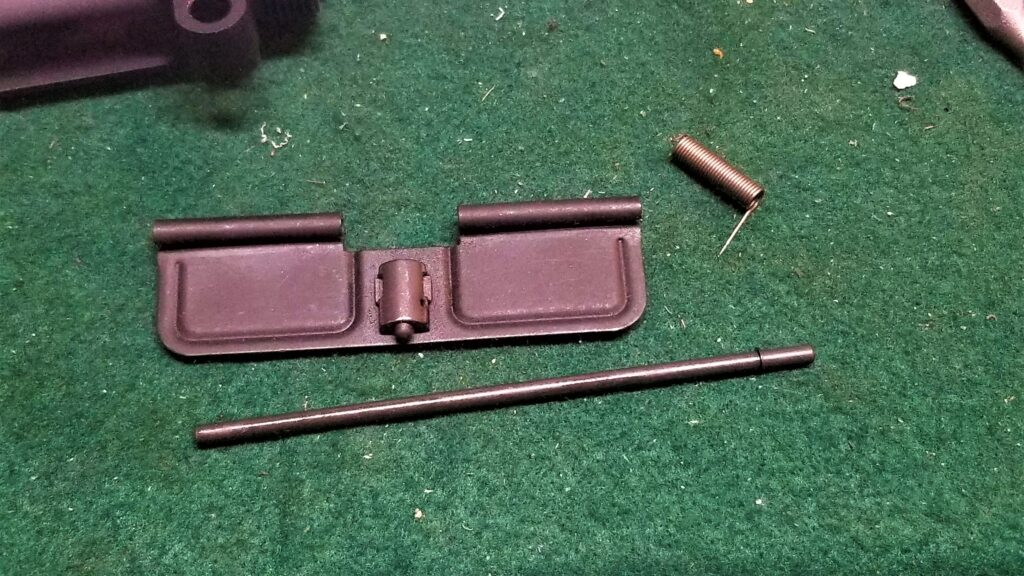
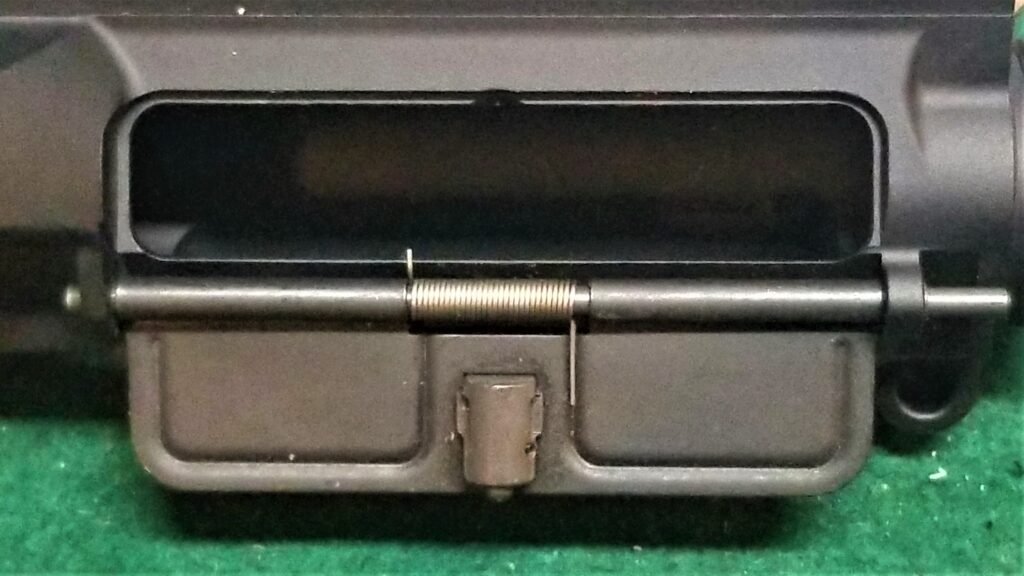
The Satern comes with the cover, pin, snap ring for the pin and the cover spring. In my case, the clip was already installed on the pin as shown above.
In terms of installation order, installing the cover does need to be done before the barrel locking nut because the nut will block installation later. Here are the steps:
If the clip hasn’t been installed on the pin yet, you need to tap it on square with a small hammer. I’ve had guys tell me they’ve used pliers for this step but I haven’t done that. Note, be careful and pay attention – the little clip can really fly away if it isn’t tapped into place squarely.
Lay the upper receiver down with the ejection port up. I usually place it such that the barrel nut threads are to the right.
Note the spring has a long and a short leg. The long leg will rest on the cover and the sort leg will rest on the receiver.
The basic installation is to move the cover into place, slide the pin in from the left (back of the receiver) towards the right and sliding through the tube in the cover but stop just before the opening where you will put the spring.
Note the spring has a long and a short leg. The long leg will rest on the cover and the sort leg will rest on the receiver.
This is the part that drives me nuts – I pivot the pin away from the receiver just enough to install the spring. The short leg of the screw will go against the receiver and you need to twist the long end to create the tension.
I then try and hold it all in place while sliding the pin the rest of the way in. There are videos out there on this and different people do it different ways. It can be frustrating so just be patient.
Yes, the right end of the pin is just sticking out because once you install the barrel nut, it’s not going anywhere.
You should be able to put a finger in from the bottom of the receiver well and pop it open. I do this as a quick test.
To actually function test the cover, temporarily install the charging handle and bolt. Close the cover with the bolt closed as well. When you pull the charging handle back, the cover should spring open. If it does not, then you have most likely installed the spring wrong.
Last step is to use some clippers and trim the small portion of the small leg of the spring that is sticking into the ejection port to get it out the way. Don’t do this until after you have the cover installed and tested.
Here’s the installed ejection port cover up close. The pin was slid in from left to right. You can see the short leg of the cover spring is to the left against the receiver and the long leg is to the right. When you install the pin through the spring, stop part way and angle it so you can twist the long leg around. Then, hold it together, angle the pin back down and slide it the rest of the way through. It’s an unnatural act and takes some practice. Test the cover and once it works, use nippers to trim that small bit of spring that is sticking into the ejection port.
The Barrel
In my opinion, you’ve just finished the hardest parts of the upper. I hate that little demonic dust cover spring just to be clear 🙂 The next three are pretty much tackled together because aftermarket handguards come with their own barrel but that needs to be installed.
First off, I went with Satern because the barrel in my first 12.7×42 rifle was made by them and was very accurate. Second, I liked that they sold it with a matching headspaced bolt. My biggest problem with my first rifle was that Radical Firearms did not include the right bolt. [Click here for my post about that first build if you are interested.] A common misconception is that a 12.7×42/Beowulf cartridge uses a 7.62×39 bolt. This is not correct. The depth and extractor are different. 6.5 Grendel does use the same bolt as 12.7×42. So, when I bought my Satern barrel, I bought it with a matching bolt just to play it safe.
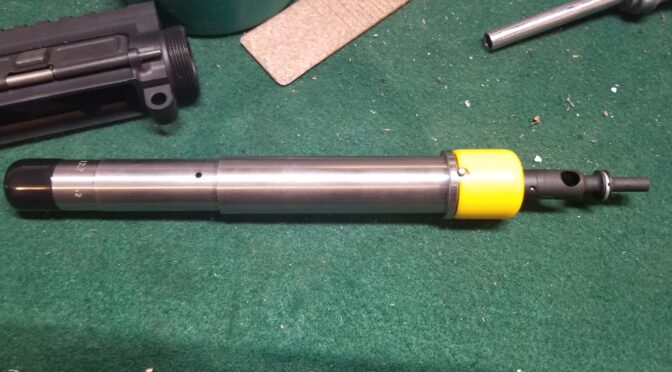
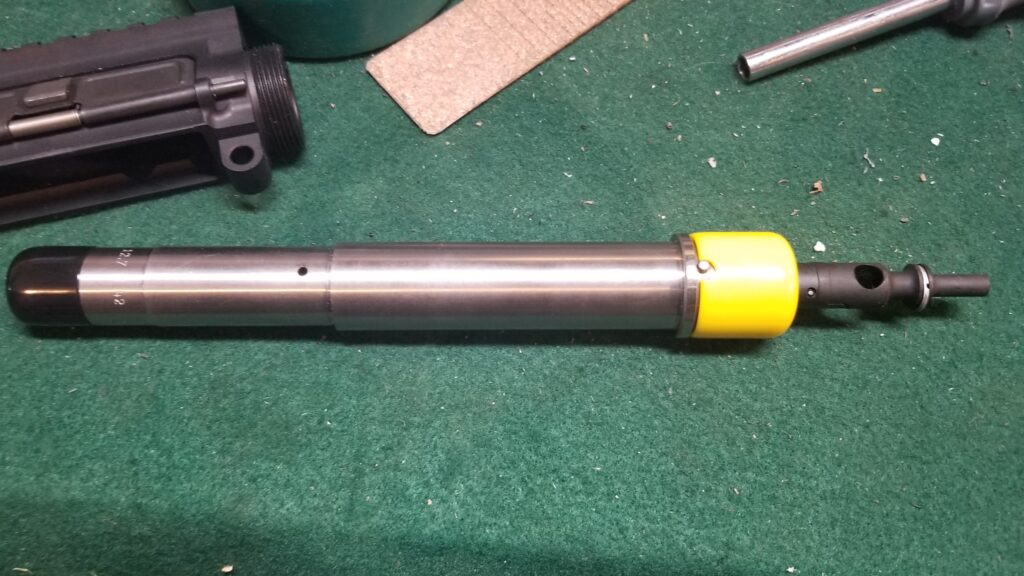
Satern not only shipped fast but they packed everything really, really well. here you can see the 7.5″ barrel with the black protective cover on the threads and the yellow cap is holding the matching bolt securely in place. You can also see the gas port towards the middle and the indexing pin in the notch of the yellow cover.
The barrel is threaded 3/4-24. This is not the same as an Alexander Arms barrel. I asked Satern why and they told me they wanted a thicker wall. Whatever the reason, you need to remember this thread size when you are buying whatever brake or muzzle device you plan.
One of the really cool design aspects of the AR system is that the barrel just slides into the receiver and is properly indexed by the pin shown above fitting into a corresponding notch in the upper receiver. The barrel is “locked” into place via a barrel nut. A gas tube then slides into place over the barrel with the gas tube entering the upper receiver above the locking at the top. I’ll come back to that shortly.
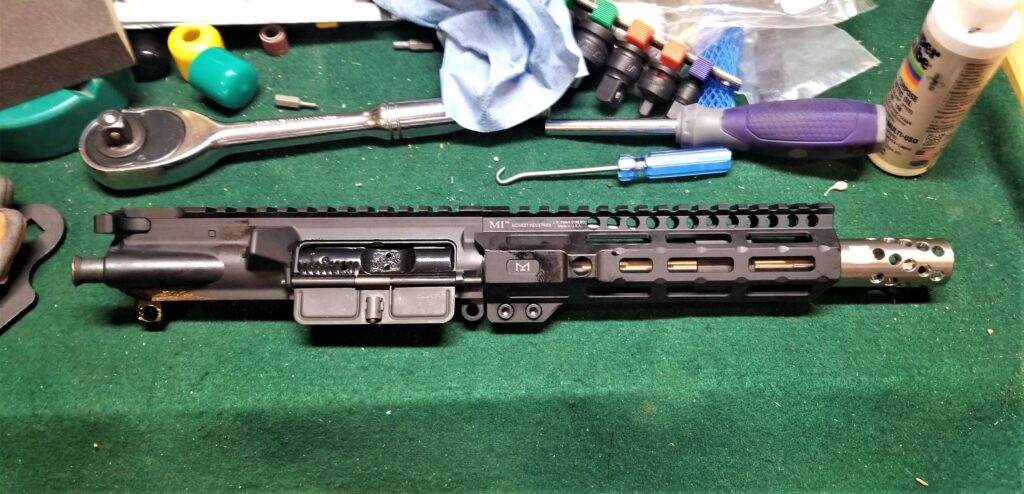
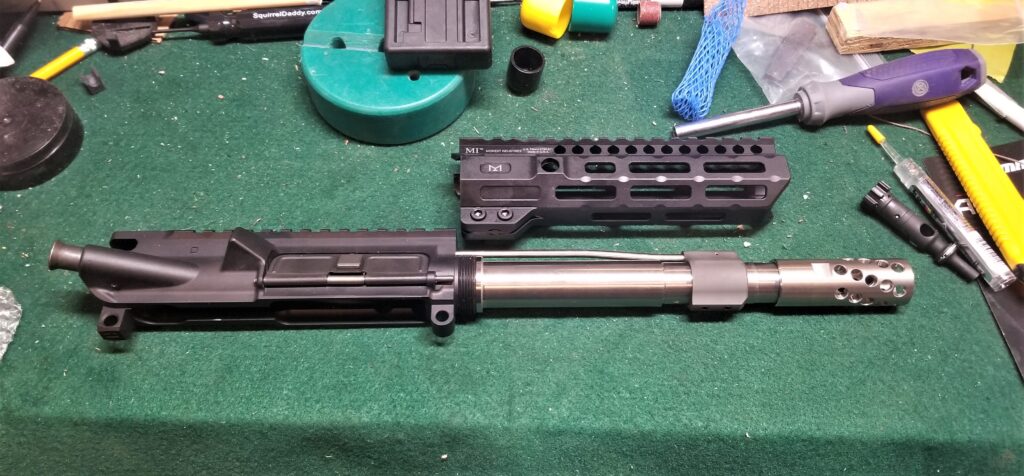
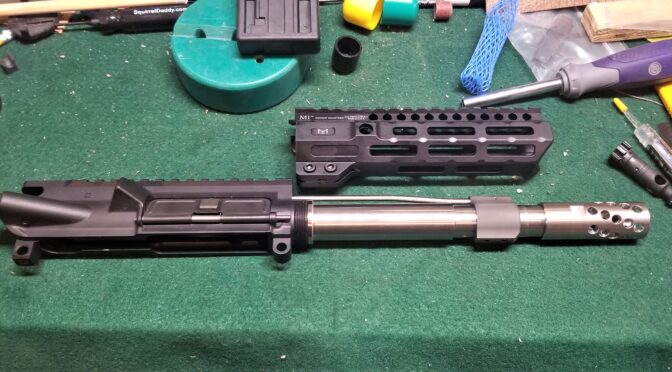
This is just a mockup as the barrel nut has not been pulled out of the MI Combat rail yet. I will often do test fits to avoid surprises and make sure things are going to look the way I want them to – for example, I wanted to confirm the brake’s exhaust ports would clear the MI 7″ Combat Rail and they did. I also had planned to finish the barrel and brake a satin black Molyresin finish but was so taken with the stainless look that I changed my mind.
In Conclusion
After test fitting, it’s time to get into the installation of the barrel, nut, gas tube, handguards and brake. I’d say that’s enough to cover in the next post!
Note, I have to buy all of my parts – nothing here was paid for by sponsors, etc. I do make a small amount if you click on an ad and buy something but that is it. You’re getting my real opinion on stuff.
My friends know I am eccentric so I’ll point that out right up front. I design and build firearms that are very practical and some that are pushing the fringe. I’ve liked the .50 Beowulf cartridge (also known by it’s metric designation as 12.7x42mm). Bill Alexander designed the Beowulf to operate out a fairly standard AR platform which included a 16″ barrel and normal buffer. With the huge popularity of AR pistols with braces, I got to thinking – how short can I go?
Well, there are a number of pistol length uppers now that are 12″. Alexander Arms themselves both a 12″ complete upper as well as a 12″ DIY upper waiting for you to add your handguards of choice. There are cheap builders out there and I would tell you to be very careful to research the vendor before you buy. Some of them have awful track records.
Know what? I wanted to go even shorter and I had no problem buying the parts and building one myself. You see, I wanted a howitzer. To me, a howitzer is a firearm with a barrel so short that it can’t burn all the powder before the bullet exits resulting in a spectacular flare. Useful? Not really. Cool? Oh hell, yes 🙂
Satern’s Liberty Barrels & Upper Parts
If there’s one thing I have learned about the Beowulf, you need the right combination of parts or reliability will suffer. So that really meant that I needed to go with a reputable vendor. There’s a barrel company that really knows their stuff that you may not of heard about – Satern. They are located in Estherville, Iowa, and operated by Debra and Steven Satern. I talked to Deb a few times while I was planning my build. They were great to deal with and shipped fast – even with all the COVID craziness these days.
This is Satern’s stripped big bore upper that will work with 12.7×42 (.50 Beowulf), 450 Bushmaster and .458 SOCOM. The ejection port has been enlarged for the bigger cartridges. Note, they also offer a complete upper with the ejection port cover, forward assist, charging handle and bolt options as well as a complete upper without the bolt.
different barrel lengths – 7.5, 10.5, 14.5 and 16″ – note they come with the correct headspaced bolt. This is a big deal. Not all vendors use the right bolt and that causes reliability problems. Also, the thread is unique – 3/4-24 and not the 49/64-20 that Alexander Arms uses. This means you will need to either get your brake from Satern, Timber Creek or another vendor that supports a .50 cal with 3/4-24 threads. I went with Satern’s Heliport brake in part due to this threading.
They offer Barrel kits with brakes
Big bore forged uppers – basically a standard AR upper with the ejection port milled open larger. They offer uppers with the dust cover already installed or just a stripped upper
Gas tube assemblies
I went down their menu and bought the 7.5″ barrel, 3/4-24 Heliport brake, stripped upper, ejection port door, and pistol length gas tube from them. I just like doing my own thing is what it boils down to.
Other Parts
Once I had the main parts of the upper figured out, the rest was pretty easy. The lower is how-ever you want to build your lower. I planned for a pistol build using some of my favorite parts:
SBTactical’s SBA4 brace – it has six positions and the rear end is stiffer and better formed than the SBA3.
Midwest Industries Combat Rail – these are very well made and finished. I especially like how the handguard fits onto their locking nut allowing for a ton of flexibility.
Vortex Strikefire II Red/Green Dot – these have a real nice wide field of view allowing for rapid target acquisition plus it can co-witness with iron sights out of the box.
BCM’s Gunfighter Mod 3B charging handle – I’ve become very fond if these over the year’s and the enlarged latch handle just feels right to me.
Summary
That’s it for now. The next post will start to get into the actual build.
Note, I have to buy all of my parts – nothing here was paid for by sponsors, etc. I do make a small amount if you click on an ad and buy something but that is it. You’re getting my real opinion on stuff.
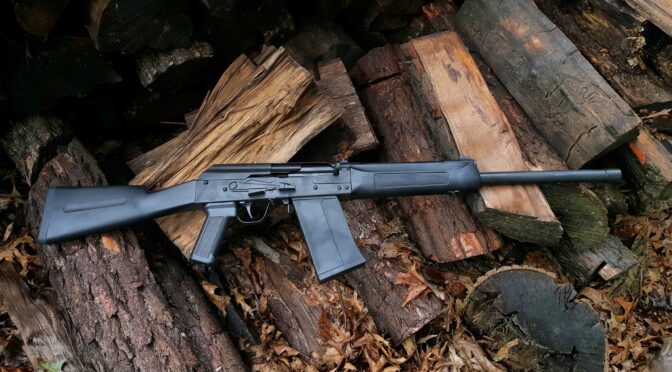
A fellow messaged me the other day and asked what options he had to replace the light fixed stock on his SDS 12 gauge shotgun. I told him that he has a lot. The rear of an SDS is very similar to an AKM or AK-74.
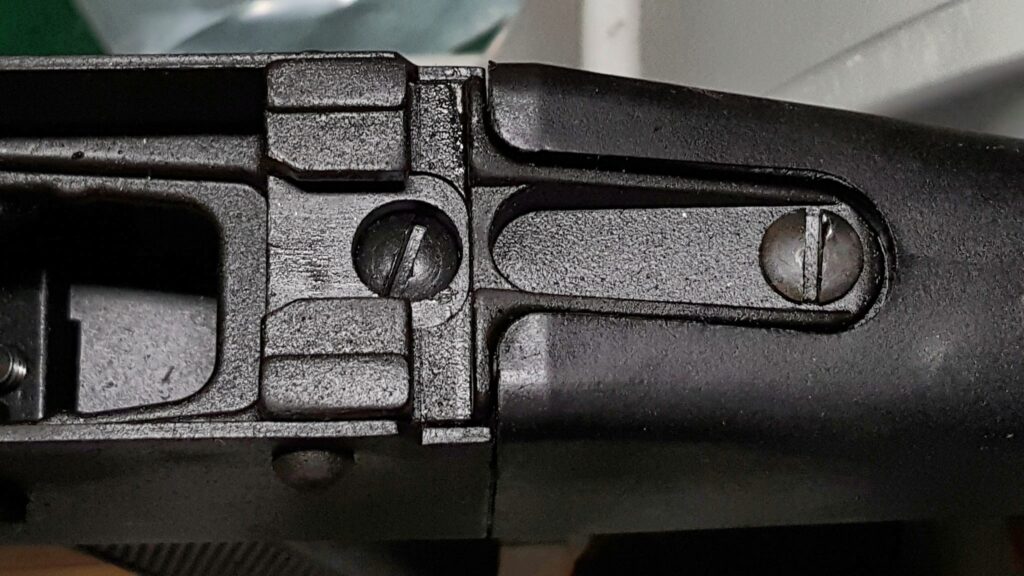
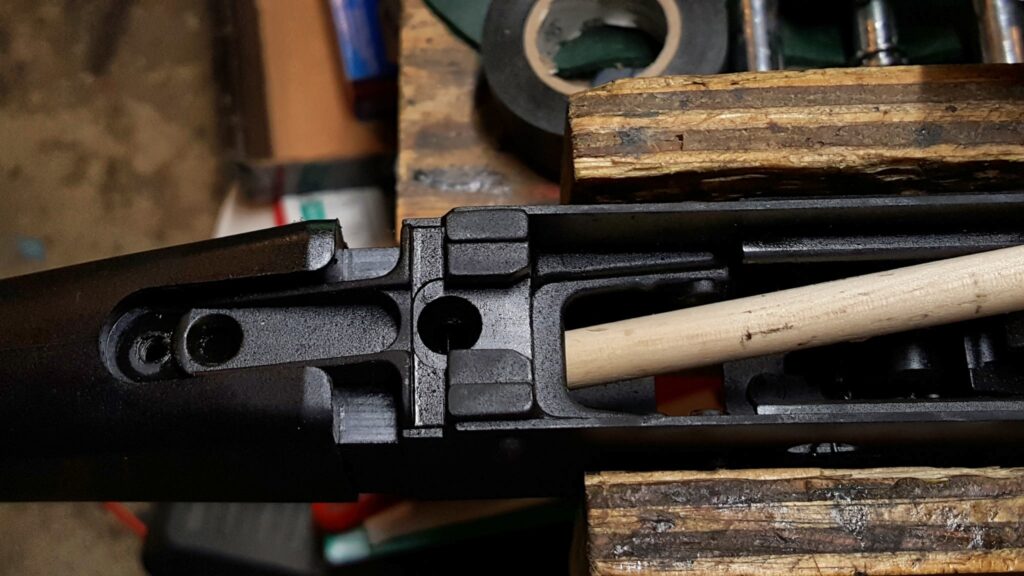
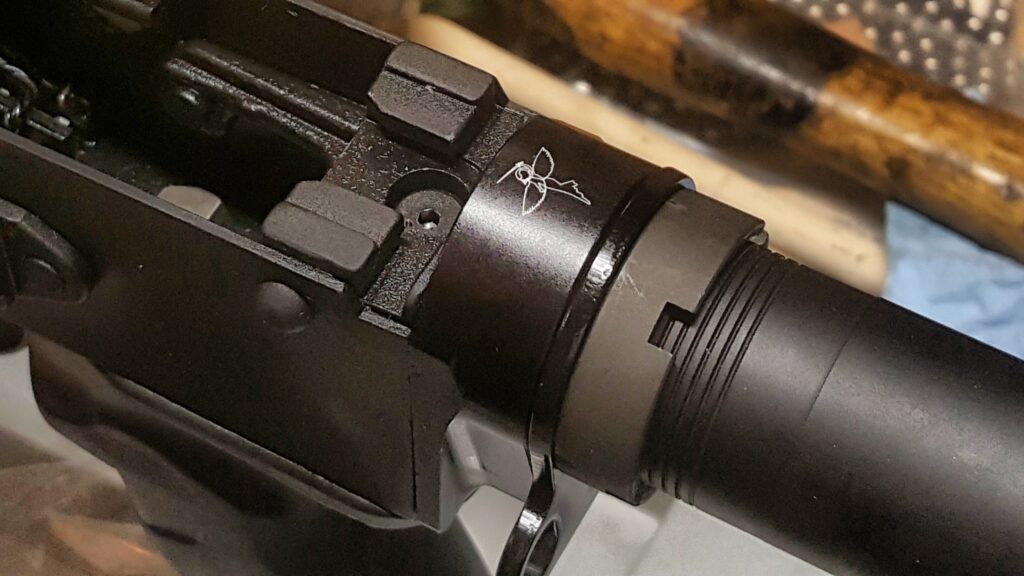
The rear piece that holds the stock in is called a “trunnion” they are what provide the real strength in the sheet metal receiver. The stock is held in place by the two screws you see. Be sure to use a blade screw driver bit that completely fills the slot. You can see that whomever installed the screws at the factor did not do this and slightly deformed both slots by using an undersized screwdriver or blade bit.You may need to use a wood dowel, or whatever you have handy, to tap the stock out. I like using a hardwood dowel because it doesn’t bend or scratch things all up.I used a Rifle Dynamics adapter that lets you convert from the AK-rear to an AR/M4 buffer tube. Both the Rifle Dynamics adapter and the one sold by PSA are very well made.
With the rear stock removed, you can use any AKM/AK-74 traditional wood or polymer stock that you want or adapter to use an AR-style stock. Read up online before you buy because there are tons and tons of options and combinations for you.
I hope this helps you out and here are a few examples for your consideration: