There seems to be two schools of thought when it comes to magazines for Glock Pistols, Polymer80 Pistols and the myriad other arms that can use the reliable Glock magazine design. One will tell you that only Glock magazines are reliable. The other school will tell you that there are other magazine makers out there that work just fine as well. I subscribe to the latter and think that there are other magazine makers that turn out quality products and ETS is one of them.
“ETS” stands for Elite Tactical Systems and they have what they call “The ETS Way” that espouses providing quality products and taking care of customers. To do that they have a 30-day money back guarantee, lifetime warranty, their products are made in the USA and they pride themselves on exceptional customer service.
Just to be clear, I don’t work for them and this isn’t some paid endorsement – folks ask me questions and eventually I write a blog post after a quick reply via email. That’s how this post came about.
I’ve bought and used probably a dozen or more of their Glock magazines over the years and have never had a problem including storing some of them fully loaded for over a year now. They support quite a few other platforms as well and I want to try their new AR magazines.
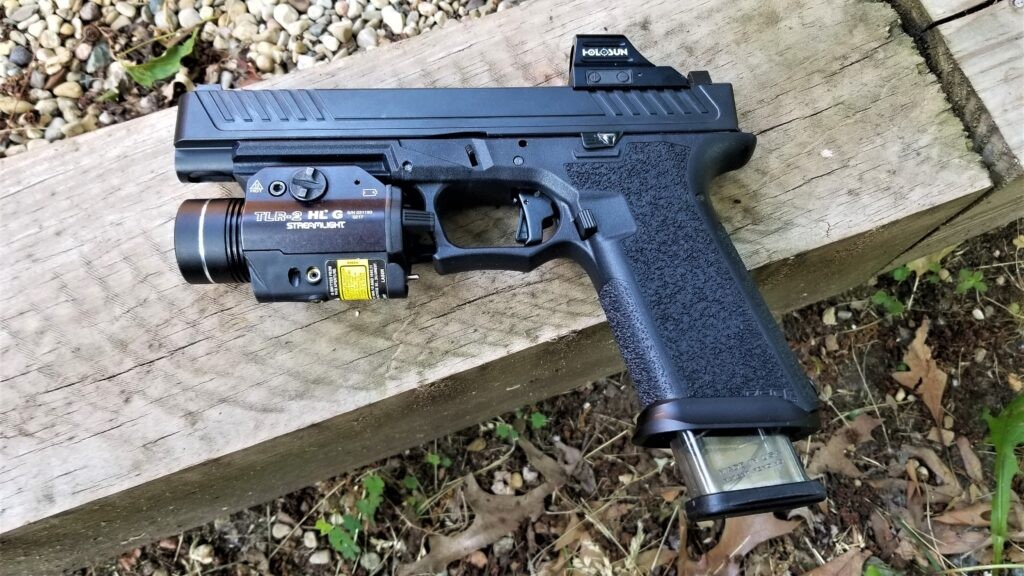
This is my Polymer80 Glock 34-style pistol. It has a 22 round ETS magazine inserted and that is an aluminum Tyrant CNC mag well funnel you see. Note, I recently upgraded from the G34-style slide stop lever shown to a Vickers VTSS-001 and prefer the Vickers. Bottom line is that this combination works really, really well.
Now you may be wondering “Why bother?” The answer is real simple – they make transparent clear mags as well as smoke/translucent mags so you can see your round count really easily and I like that.
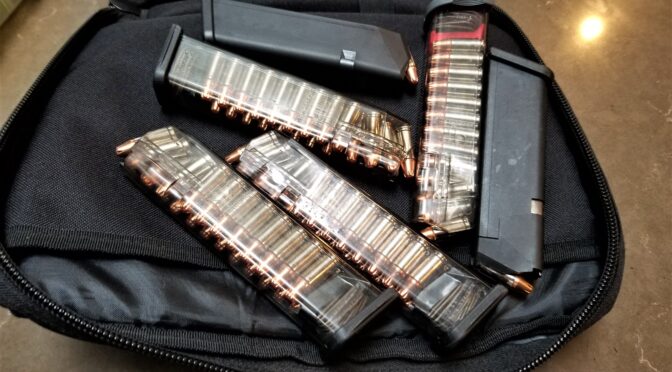
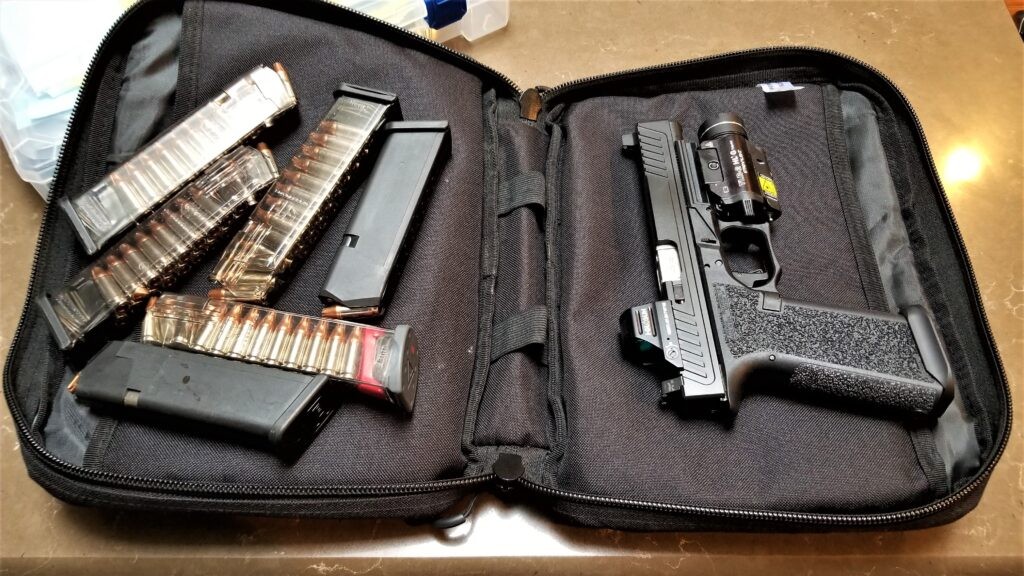
Look at the magazines, with the clear 22-round ETS mags you can instantly see the round count without needing to look at the OEM 17 round Glock magazines’ count indicator on the back. I’ve also been experimenting with different color followers and Vickers Tactical base plates (note the second magazine from the bottom edge of the photo – it has a red follower and an oversized base plate on it). What I am finding is that I really like using the Vickers plates when I want to reach blind into a bag, let’s say it’s dark for example, and instantly know I am grabbing a magazine with +P Critical Duty ammo loaded.
In Conclusion
When people ask me about ETS magazines, I recommend them. If you want to stick with only using Glock magazines, that’s your choice too. Speaking for myself, I’m happy with the ETS magazines.
Where to find them?
The great news is that most major firearms websites carry ETS so you shop around for the color and capacity you want. I buy most of mine from GunMagWarehouse followed by Midway USA.
Here are some listings for their Glock magazines:
Note, I have to buy all of my parts – nothing here was paid for by sponsors, etc. I do make a small amount if you click on an ad and buy something but that is it. You’re getting my real opinion on stuff.
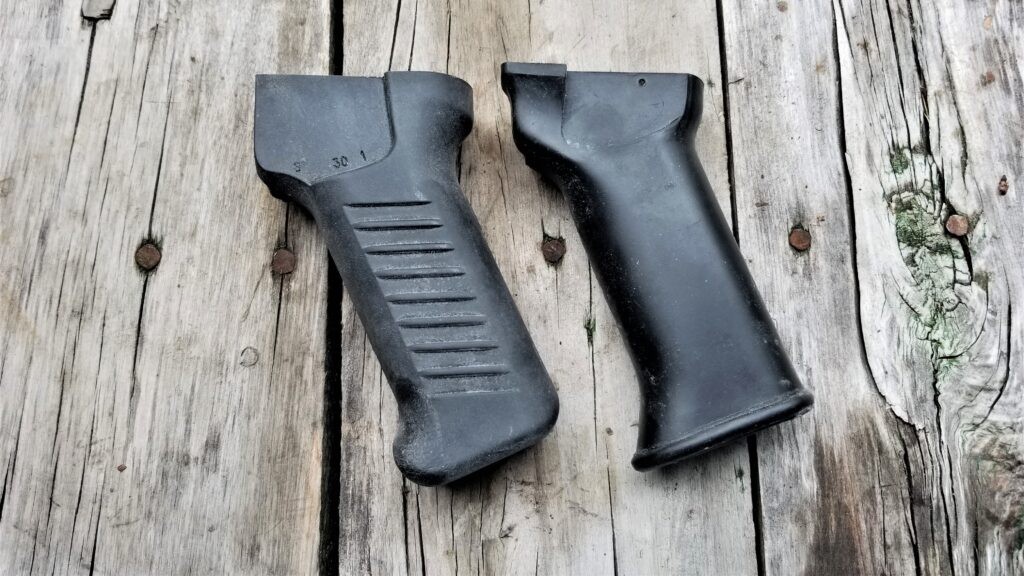
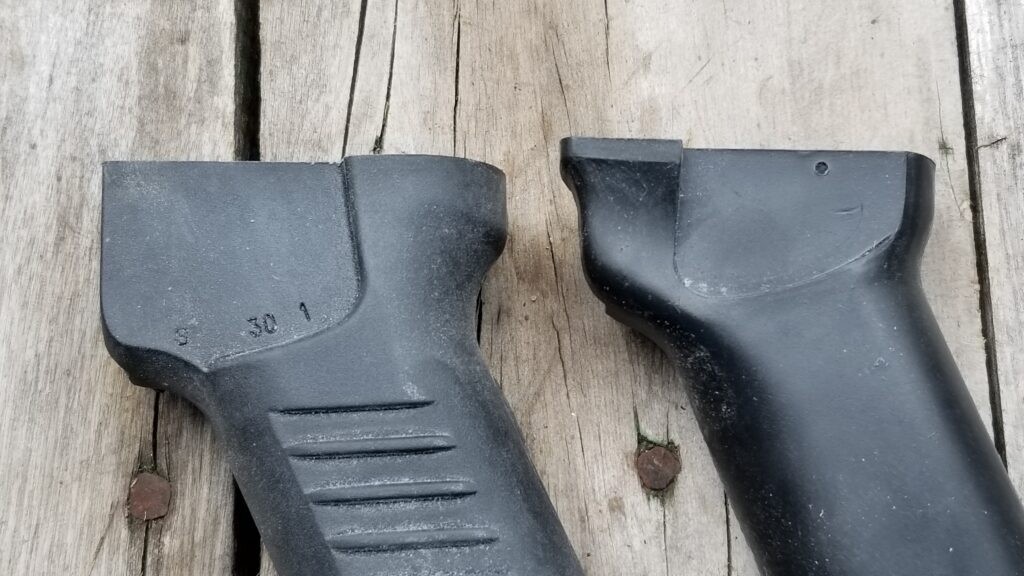
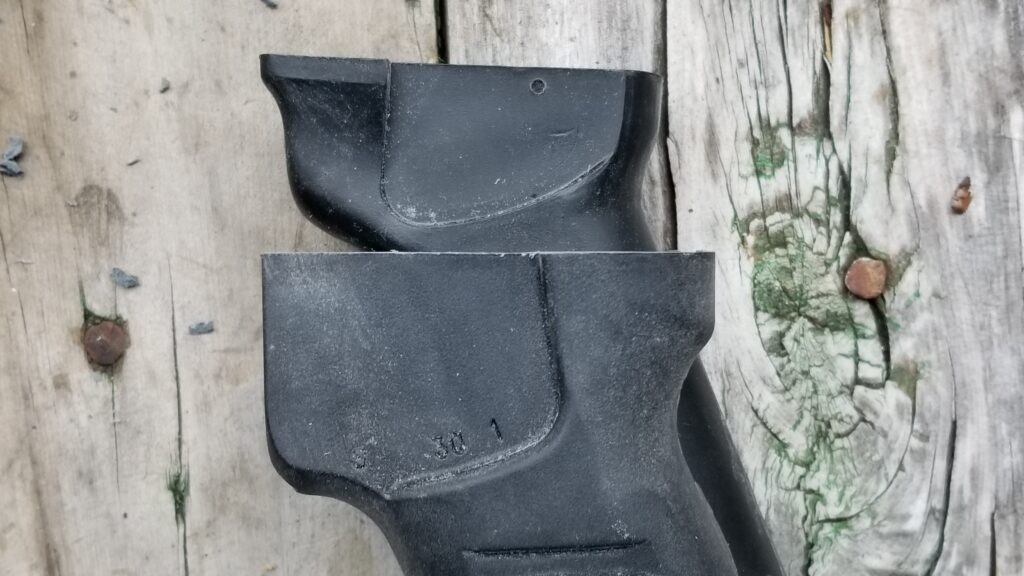
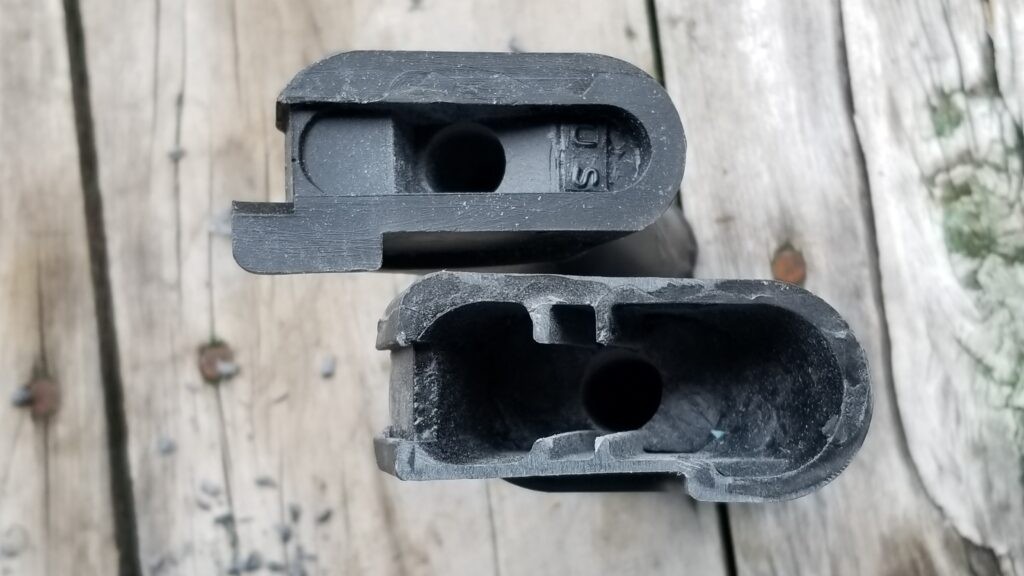
A recurring question I get is if a Bulgarian ARM-9 grip can be used on an IMI Galil rifle. Not easily is my answer and I took a bunch of photos so you can decide for yourself. You would need to add black epoxy to the inside back of the ARM in order to Dremel or mill it open further to duplicate the swing of the Galil’s lever – at least that’s how it looks to me because I don’t own an IMI Galil to experiment with.
So, here are some photos so you can see what I mean:
Note the difference in the shape of the ARM-9 grip’s notch on the left vs. the IMI Galil’s notch on the right
Here are the notches even closer.
Here’s the ARM sitting on top of the Galil for another perspective.
Here’s where you can see that the ARM-9’s original wall design is hollow behind the notch. It’s not an impossible change – if you were to abrasive blast the inside of the ARM grip and then use wax stripper, you could then fill that back in with black epoxy. It wouldn’t be an exact color match by any means.
Summary
So there you have it. They are different and definitely not a simple swap with out doing some epoxy work and then maybe a top coat of some finish if you want the colors to match. I hope this helps you out as you think through your options.
I did a series of posts back in the Fall of 2019 about a custom Yugo M76 that I had Two Rivers Arms build for me that I then added my own optic to [click here for the series]. A fellow recently contacted me about what optic he ought to get for his rifle, I replied and it also occurred to me that more explanation would make for a good blog post.
What is a Yugo M76?
It is a smei-automatic 10-round Designated Marksman’s Rifle (DMR) designed and built by Zastava for the Yugoslav military chambered in 8mm Mauser (7.92x57mm with an IS or JS designator at the end of the size). The 8mm Mauser round is in the same ballpark class as the American .30-06 round to give you a rough equivalent.
Let me revisit the “DMR” designation – because that is what the M76 is. The M76 was designed for a designated marksman in a squad to have much further reach than the rest of the team would have. It was not a surgical weapon and instead stressed reliability and good enough accuracy with an effective range of about 800 meters with 1.5-2 minutes of angle (MOA).
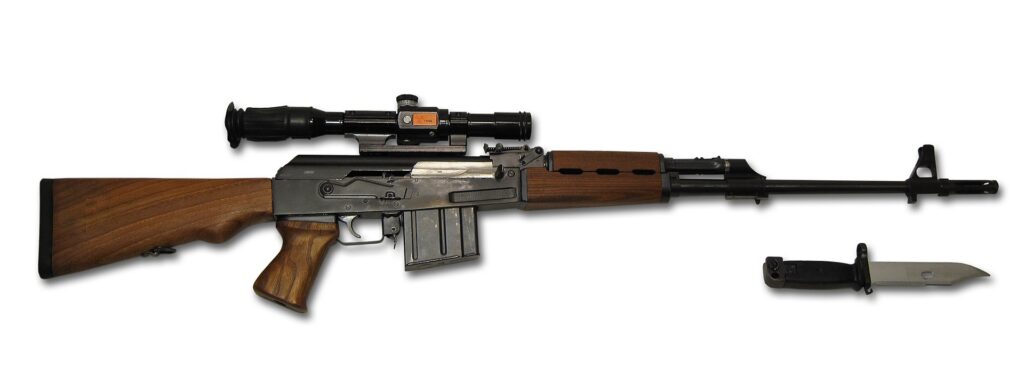
This photo is from Wikipedia and it lets you see the ZRAK optic on the M76. By the way, Wikipedia does have a nice summary write up on the M76.
What does that tell us?
That short intro starts hinting at the type of scope you might want to consider. It’s firing a relatively powerful cartridge but isn’t the most precise rifle on the planet. I can also tell you that while there is recoil, it’s not bad at all.
Choice #1 – Mounting Styles
The very first thing to consider is what type of mount you wish to use. The M76 inherits the robust side-mount rail but with some unique dimensions. The rifle was originally paired with an offset 4x ZRAK scope that slid onto that rail and clamped into place. This offset design isn’t for all folks but it definitely works for people familiar with it.
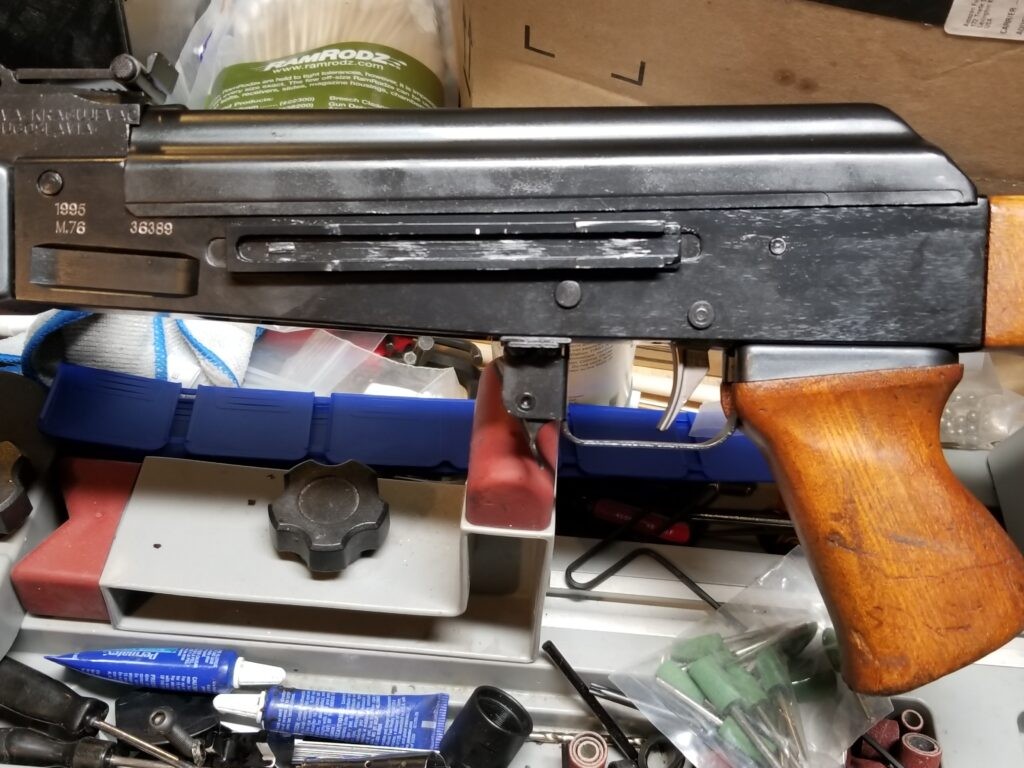
Here you can see the optic side mount rail. It sits securely in a groove in the milled receiver and is riveted in place.
The second route is to get a mount that clamps on the above rail but then centers the optic over the centerline of the bore. Call me an old school American but that is definitely my preference.
You can get mounts this way that directly hold the optic directly with the scope rings being built directly into the mount or you can get mounts that have a Picatinny rail on top that you can then secure whatever optic you want. This is my preference just so you know because it gives me more flexibility down the road.
RS Regulate mounts are the way to go!!
The best side mounts I have found that enable a ton of flexibility and adjustment are the RS Regulate brand mounts designed by Scot Hoskinson. He offers a number of different options so you need to stop by his site and take a look.
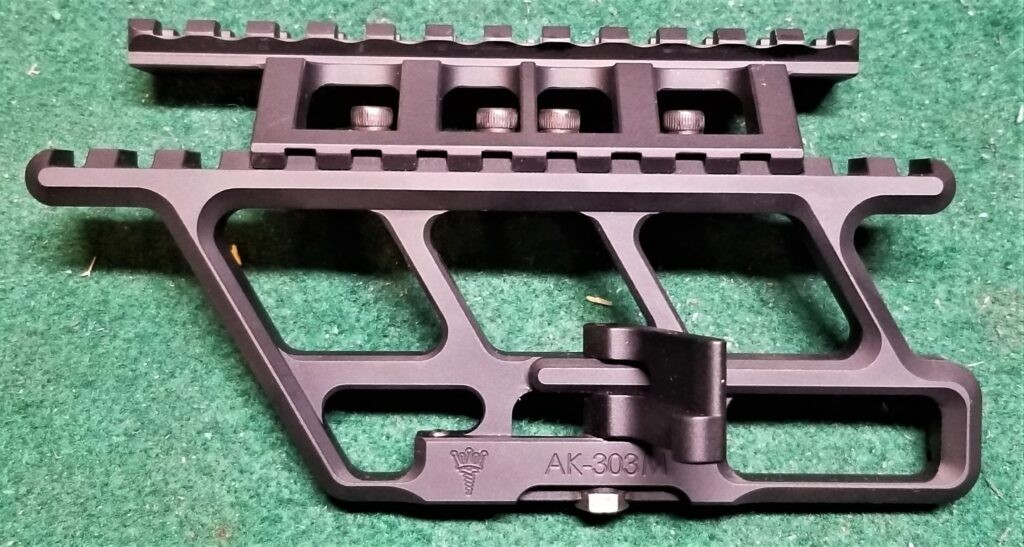
This is the RS Regulate AK-303M lower paired with the AKR upper rail.
Note, RS Regulate mounts are being counterfeited in China. I’d recommend only buying direct or from a reputable dealer below:
What optic to use?
On one hand, you could stick with the communist block styling . You can hunt around and buy 4x ZRAK optics still. There are also a lot of different offset mount optics that you can look into that are side mounted for example 8x and variable power. Just confirm the clamp on a particular model has enough adjustment to fasten onto the M76’s rail.
As of my writing this, there aren’t any ZRAK scopes on eBay but Apex Gun Parts does have some in fair to good condition (meaning very worn) and they are a good firm to deal with. Kalinka Optics has a variety of offset mount optics and is also reputable. If you really want an offset scope, I’d recommend Kalinka and go with something new.
With that said, you may be wondering “but what size scope?” The 8mm round definitely has some reach and you have to ask yourself what do you really plan on doing? This “what am I going to use it for” question is known as the “use case”.
When the Yugoslavs designed the M76, they needed a middle of the road simple optic that would allow the shooter to hit something man sized out to 800 meters. Four power magnification fits that bill because it gives you a wide field of view (meaning what you can see left to right and up and down in he scope – the more you see, the wider the field of view). They weren’t looking for precision by any means – just good enough to extend the reach of the shooter.
I’m 53 and while I grew up shooting a lot with iron sights, I can’t see very well at 100 yards and I sure can’t shoot precisely. Now remember, the M76 you have will likely be shooting1-4 MOA (1-4″ at about 100 yards, 2-8″ at 200 yards and so forth). It all depends on the condition of the rifle and the type of ammo you are shooting not to mention your own abilities. Spending a fortune on a giant quality surgical scope, like a 6-24x, is overkill…. unless that is what you really want.
What I would recommend is a variable power and I tend to favor 4-16x because I have the nice bright field of view at 4x and can zoom in if needed. Most of my shooting is within 200 yards so this works just fine for me on my DMR rifles.
Now you may be wondering “But I saw the photo of that giant scope you are running – what’s up with that?” Good question and let me explain.
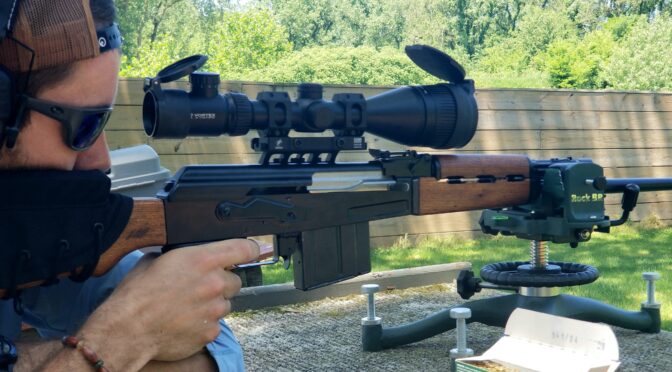
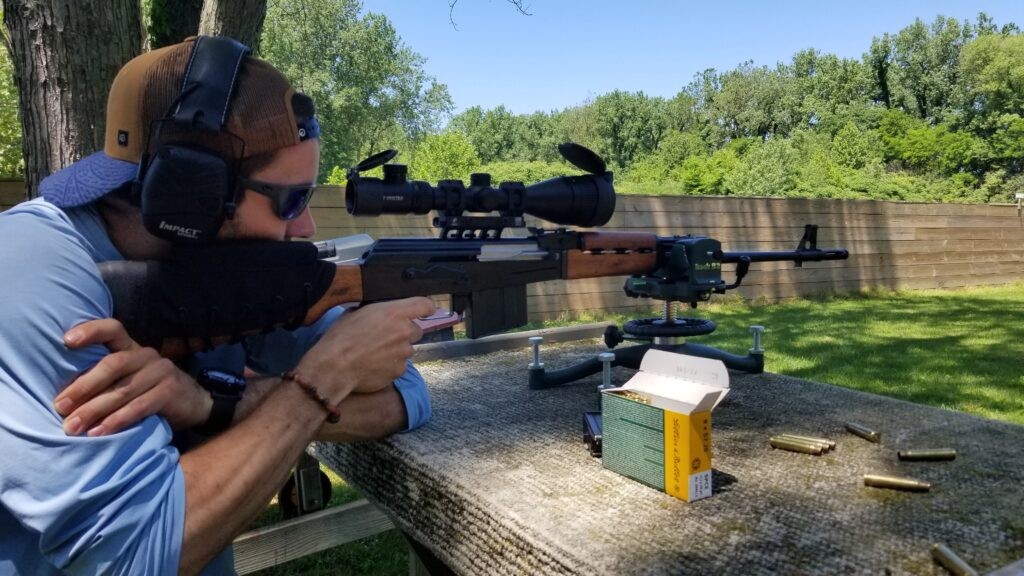
That’s a Vortex Crossfire II 3-12×56 scope known as the “hog hunter” and my buddy shooting it during a range visit this summer.
My “use case” when I was planning for the optics was for hog hunting. I wanted a really big objective to suck in light for shooting at dusk and an illuminated recticle. I also happened to already have it left over from another project. It is quite affordable by the way.
So, the Hog Hunter seemed like a great match – 3-12x for fast shooting in close to having a 12x for distance shots. The big 56mm objective does pull in a lot of light. The lit recticle is only bright enough to make a difference at night and isn’t as bright as what you would see on a tactical scope.
Having used it for a while now, I’ll tell you that it delivers on the above with a couple of caveats that may make you stay away from it unless thye don’t bother you:
First, it is a big scope – far bigger than what you may think in terms of dimensions and weight due to the big objective. It’s almost 13.5″ long and 21.1 ounches.
Second. it is a giant objective and you will need to plan for. I had to carefully calculate the rings needed for it to clear the front handguard and I needed them to be quick release because the scope mount could not slide backwards due to the big objective hitting the rear sight block (RSB) of the rifle. I am still using the AD-RECON-SL mount and it is solid!
For a lot of folks, starting with an objective around 40mm tends to give you a nice bright image. I tend to use 44-50mm objectives scopes the most. Think of it this way – the bigger the objective, the more light it can pull in all other things being equal.
So where am I at today and what scope would I recommend?
I still am running the Hog Hunter and like it. If I had it to do over,I would get a 4-16x magnification and a 44-50mm objective. Recticle-wise, I’m fine with just about anything for what I plan to use it for but if I were to specify one, I’d get one with Mil-Rad (Mil-Dot) graduations because that is what I am familiar with.
There are also other variable zoom scopes out there as well such as 2.5-10x, 3-9x, 1-6x, 1-8x, etc. These are all options if you still have good eyes and want an even wider field of view on the low end. I run all of those combinations on rifles where I plan to be relatively close and not so much for long distance. Point being it is up to you – I wanted a higher power scope for shots starting often at 100 yards.
Vortex makes really good optics and I would move with whatever I could afford at the time. What you will notice is that as you move up their product line , the bigger price tag also comes with clearer and brighter optics *but* they all have Vortex’s no nonsense warranty.
Vortex Optics Offerings
I am going to present their various offerings that I would recommend and am able to show the scopes listed at various merchants as well so you can shop around:
Let’s start with their entry-level Crossfire II scopes:
Next, let’s look at the Diamondback and Diamondback Tactical series scopes:
The following are Strike Eagle scopes and the designs are focusing more on tactical versatility.
Even higher end are the various Viper HS scopes. I have a number of these and find them to be bright, clear and rugged:
My favorite Vortex scopes that I afford is the Viper PST Gen III series. Yeah, budget does have a role and have not been able to afford a Razor but the PSTs excellent. When I can afford a really exceptional optic, I look at the PSTs. A number of vendors still carry Gen II scopes and they work great also. I’ve had several Gen IIs and only one Gen III so far.
In Conclusion
I hope this helps give you some ideas of what optic to put on your M76 rifle. I really like Vortex Optics and am a user – I’m happy with the Hog Hunter but it is big. I think you’d be very happy with just about any of their scopes depending on what you want to do.
Note, I have to buy all of my parts – nothing here was paid for by sponsors, etc. I do make a small amount if you click on an ad and buy something but that is it. You’re getting my real opinion on stuff.
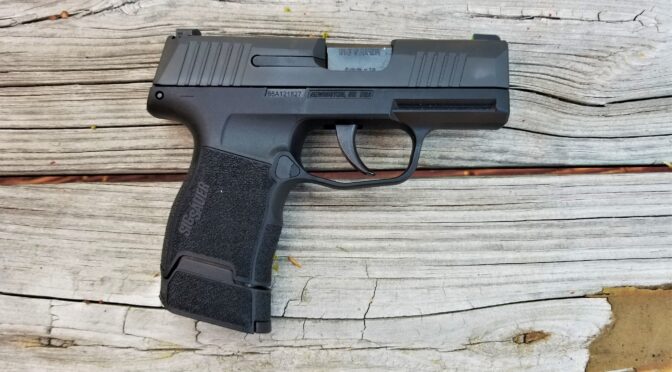
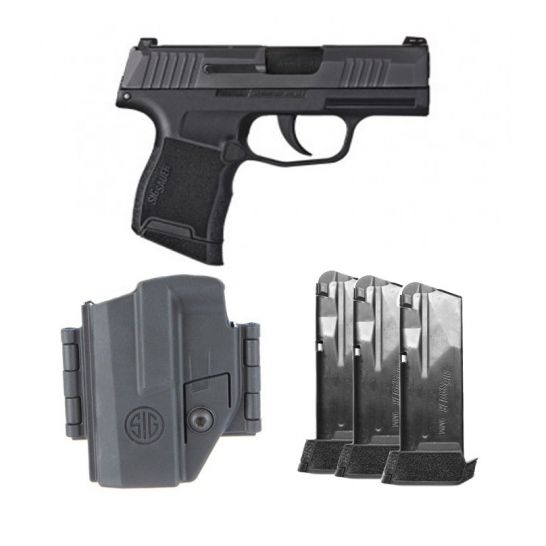
This is the PSA deal. Note, the photo in the ad shows a 10-round magazine loaded and the three 12-round magazines but to be clear, the deal is for three magazines and not three plus one. The photo at the top of the post is my personal P365 with a 12 round magazine inserted.
The Sig P365 is rated for +P 9mm ammo and is my every day carry. I can tell you that I have never had a failure to feed or extract with the pistol and have fired Hornady Critical Duty +P, Federal HST +P, all kinds of 115gr and 124gr FMJ ball ammo, etc. It just east whatever I give it and is reliable – that’s why I rely on it to protect my family when we are out and about and discretion is required – it’s an ideal concealed carry pistol.
I really like the 12-round magazines. The small plastic fitting on the bottom is ideal for my to put my pinky finger on and I wear size XL gloves. The 10 round magazines are even shorter. Most of the time I am carrying using a 12 round magazine. They do make a 15 round magazine but that sticks out a tad more than I care for.
Note, go for real SIG magazines. Some of the aftermarket ones, such as Promags, don’t get as good of reviews.
I can’t speak first hand to the holster they are including though – I use a soft Desantis 106 IWB holster and a High Noon shoulder rig. Given the holster is from SIG, I would expect it to be good enough to get started with.
Note, I have to buy all of my parts – nothing here was paid for by sponsors, etc. I do make a small amount if you click on an ad and buy something but that is it. You’re getting my real opinion on stuff.
In the last post, I described changing the inner tube on my daughter’s bike and then finding that the crank was grinding. It was so bad that it felt like metal on metal. When we brought her home last year, I noticed the crank had a ton of play in it and had a grinding feel when turning and knew that meant the bearings in the crank/lower-bracket were bad.
I’ve not worked on the crank of a bike for probably 40 years – literally. I had a vague idea of what to do but some details have changed over the years and I had to do some reading. Given that I had to really dig to figure out what to do, I figured it was worth sharing this also in case someone else has “what in the heck is this?” moment with one of these Schwinns or a bike with a similar setup.
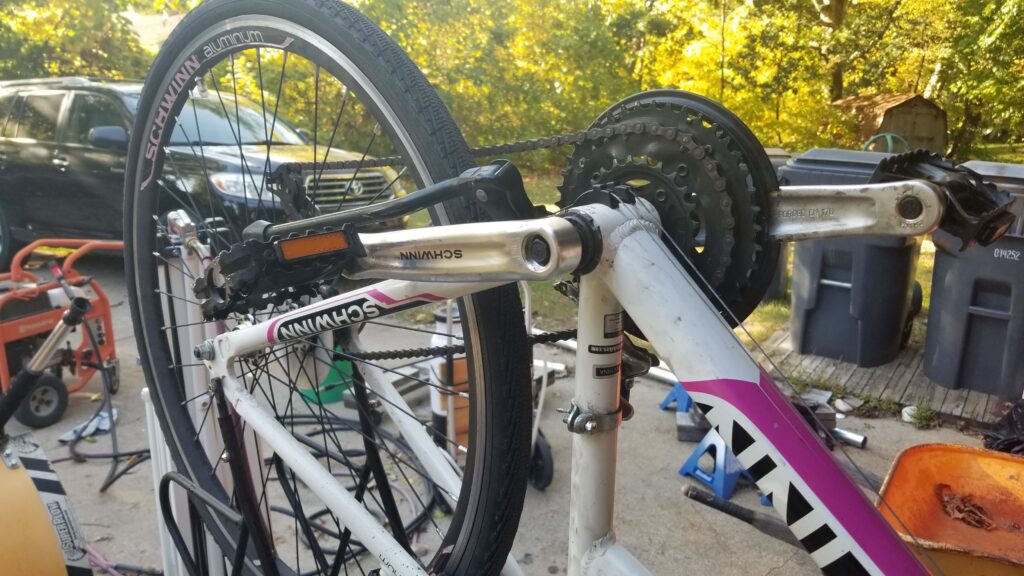
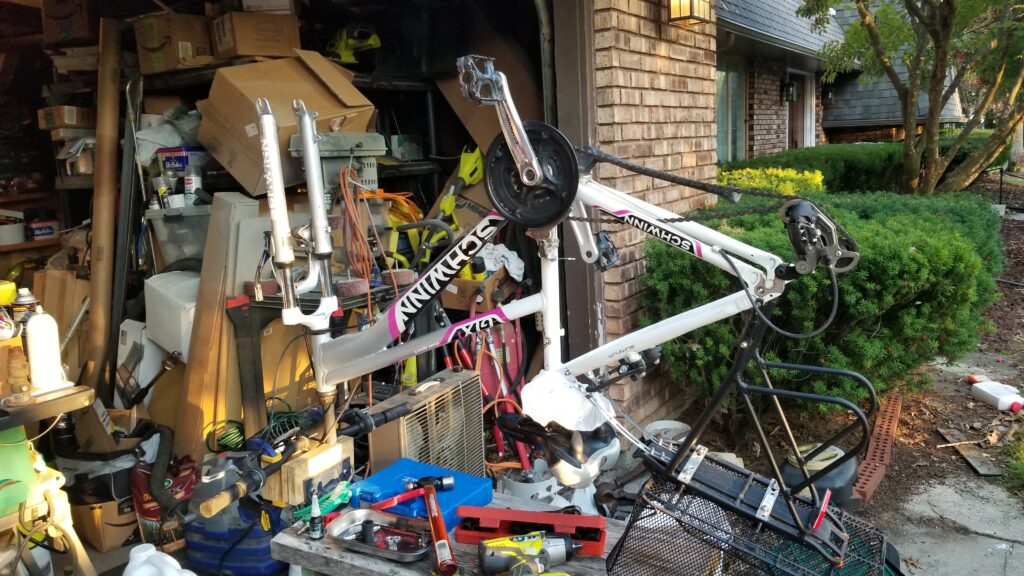
Here’s the bike upside down. I have it resting on a work table with the handbars clamped onto a wood working vise. A weird way to hold it but it worked. It just so happens the bike basket helped stabilize things.
I had to watch a bunch of videos and read some blog posts to get an idea of what to do. I thought “crank” applied to the whole assembly but it turns out the correct term for the innards is the “bottom bracket” and cranks just appear to the lever arms the pedals attach to.
Here’s the approximate sequence of what to do
I’m writing this a few weeks after doing the actual work but hope it helps if you find yourself in a similar bind:
Step 1: Remove the left and right cranks. They are pressed in place and I had to buy an actual purpose built puller to get them off. None of my generic gear pullers would work.
You remove the obvious bolt and then use a purpose-built puller that threads into the crank all the way and then tighten the center bolt to push the crank off. The Schwinn needs a puller that has 22mmx1mm threads made for a square crank.
Park makes two tools – the one I used and the one I bought for future use. I bought and used the CCP-22 crank puller but I would not recommend it. Both cranks were on so hard that I had to hit the handle with a dead blow mallet to get it to turn. At least for the bike I was working on, the integral handle wasn’t sufficient to remove the crank.
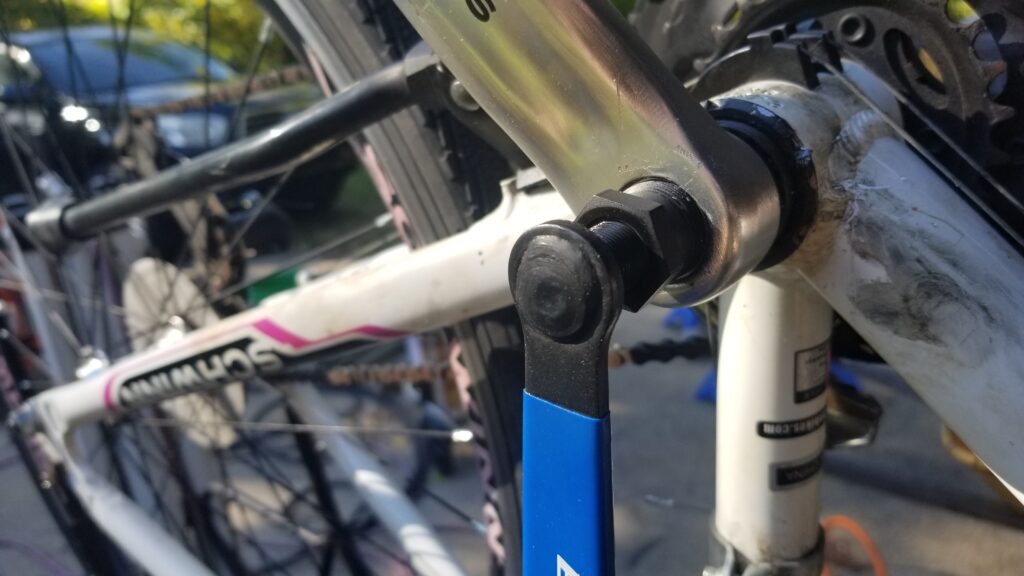
Here’s the Park CCP-22 crank puller in use. It did the job but the handle alone didn’t give me the torque I need.
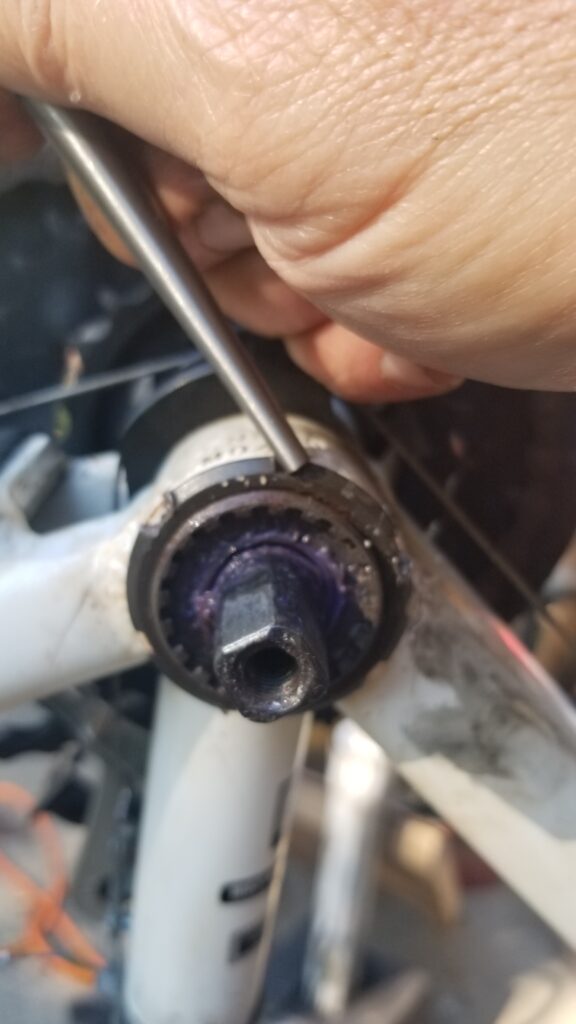
Step 2: Loosen the lock ring. When you look at the bracket, you will notice it is threaded and goes into the frame. Securing it is a locking ring that is threaded and is tightened against the frame to apply pressure. You loosen the locking ring by putting a punch in one of the little “notches” and tapping the ring so it will turn counter clockwise. It will come lose and turn very easily. Just move it a few turns from the frame but leave it on the bracket – you do not need to remove it all the way.
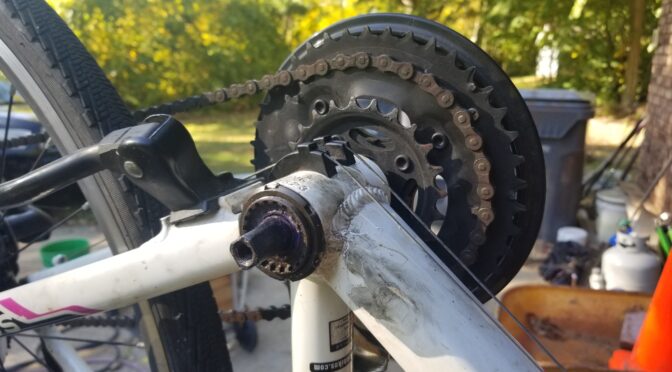
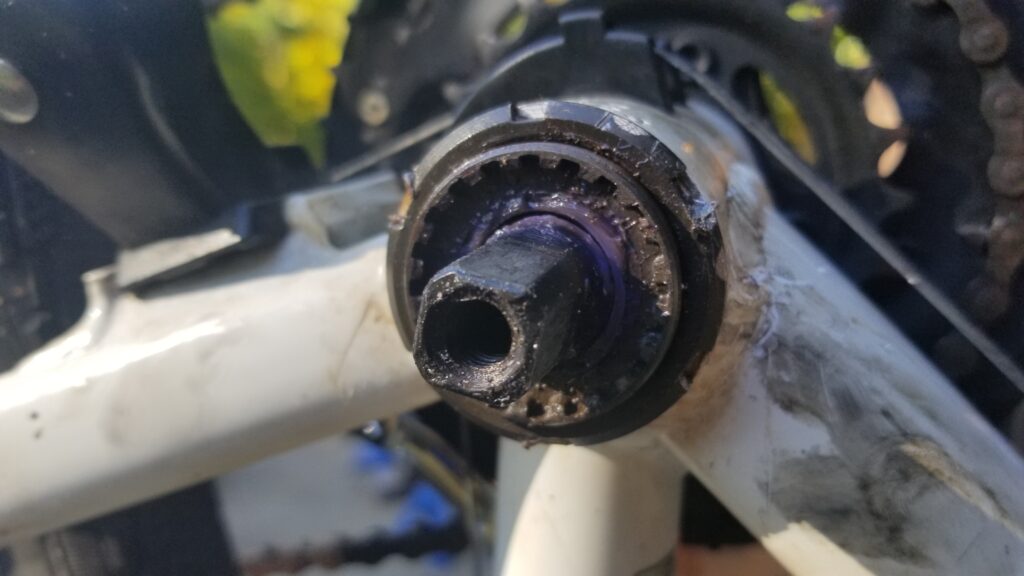
The locking ring is the part with the little rectangular notches right against the bike frame. The first evidence of this think being whipped together is here. Look how “smashed” the notch is at about the 2pm position. Regardless, it came free quite easily.
Step 3: Remove the non-geared side of the lower-bracket. If you look at the photo above, you will notice there are splines radiating inwards on the bracket. You need to measure the diameter and count the number of splines in order to buy the correct size wrench to remove this part of the bracket. This one was about 31.5 mm inner diameter and had 22 splines. The Park BBT-22C tool fits these. There are many different sizes so you really to confirm this.
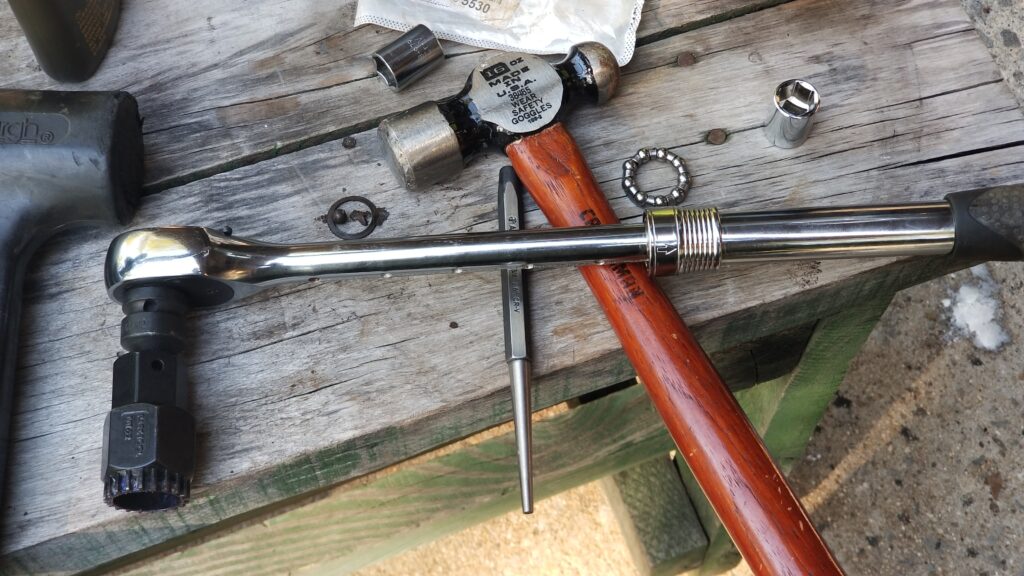
Here you can see my BBT-22C tool on the end of a big 1/2″ E-Z Red extendable wrench with a Tekton 1/2″ to 3/8″ socket adapter. I like to have plenty of torque when I need it. You can also see the dead blow hammer on the left that I had to use to beat the Park wrench to remove the cranks. You can also see the punch and hammer used to tighten and remove the bracket’s locking ring one one of the two bearing assemblies.
I used the above pictured E-Z Red wrench and BBT-22C adapter to remove the bracket, When the bracket came out of the frame, I kid you not, ball bearings fell out. What a mess.
None of the ball bearing assemblies were intact, there was no grease to speak of and the rusty sludge that I had to clear out of the frame had remnants of the ball bearings and the cages/retainers. There were literally no ball bearings supporting the crank axle/spindle. The axle was just turning directly on the ends of the lower bracket! No wonder she was complaining it was hard to pedal
Step 4: Remove the geared side of the bracket. This comes off very similar to the non-geared side with two exceptions. First, it is reverse threaded. Turn clockwise to remove the bracket on that side. Second there is no lock nut. The proper tensioning of the bracket is done from the non-geared side. By the way, if you maneuver the crank and gear assembly around a bit, you can leave the chain in the derailer.
Step 5: Thoroughly clean and grease the frame’s tube where the bracket was at. You do not want debris to get into your brand new bearings. I had a ton of crud to get out and then I liberally greased the walls.
Step 6: Reinstall the geared side of the bracket. Remember that it is reverse threaded and it goes in all the way. The final adjustment is done from the non-geared side. Note, I put a lot of grease in the dome before screwing it back into the frame.
Tip: Re-install all threaded pieces such as brackets and bolts by hand to make sure the thread is properly aligned and not cross-threaded. Use a wrench to tighten things down only once you know the threads are properly mated.
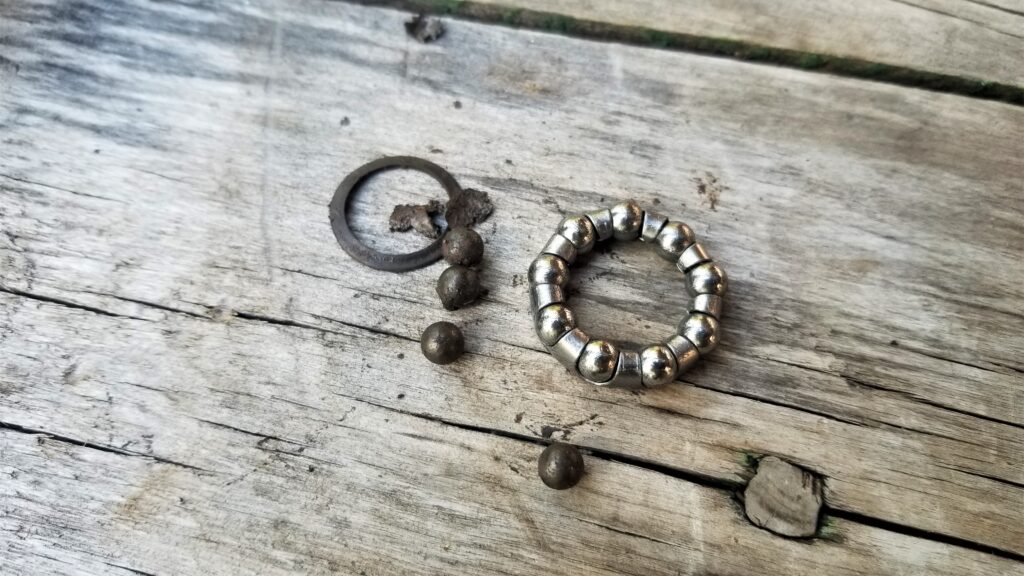
Step 7: Grease and install the bearings. I had grease everywhere at this point and didn’t want to touch my phone. Normally you would be able to see your old bearings and have an idea of what to buy. All I had were some rusty ball bearings and pieces of the retaining rings. So, I did some digging on Amazon only knowing I had a Schwinn bike and needed bearings with an inner diameter based on the axle or shaft between the cranks of about 0.72″ and an outside diameter of about 1.14″ (29mm).
Okay, I got lucky. In reading the comments of a lot of different bearings, a 1/4″ x 9 ball unit from Jaceyon popped up with people reporting they worked on Schwinn bikes. I was running out of time so I ordered them and they worked! Click here for the bearings on Amazon – a new tab will open.
Use wheel bearing grease to pack the bearings as best you can. I apply a lot of grease to all surfaces including the bracket face, the axle/shift and the bearings. I like to use a synthetic wheel bearing grease, such as Mobil’s, because I find it doesn’t ooze oil like normal grease does. In the end, use what you have but just be sure to grease the bearings before installation.
When you install them, there is a proper orientation. Please look at the inside ends of the brackets – they are domed. This means the exposed bearings will engage with these ends. The flat part of the housing faces the inside of the tube.
This is the front or top of the bearing. It will be facing outward from the bicycle such that the bearings are engaging on the domed surfaces of each end of the bracket. Those are some remnants of the original. I don’t think any grease was applied during assembly. By the way, some will refer to the ball bearing group as a set or say that the bearings are caged. No matter how you look at it, the retainer properly positions the balls around the crank’s axle to allow it to turn freely. You can imagine that if they rust it will be game over pretty fast. The retainer is just folded sheet metal.
I slide the geared side bearing and the axle in. Again, make sure the bearings are facing outward so they will engage with the bracket. I then put a bunch of grease in the non-geared bracket end dome and hand screw it back into place.
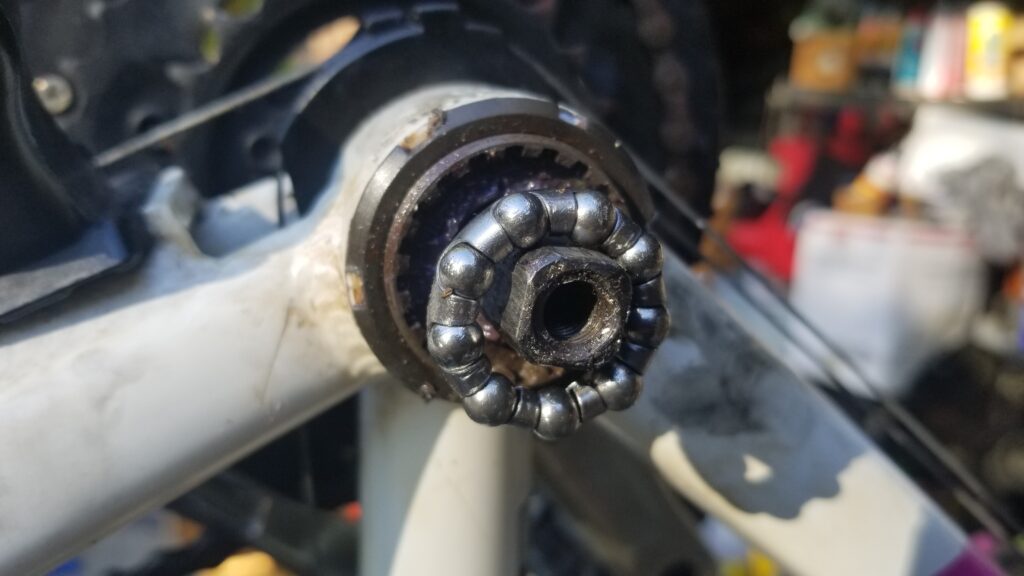
They will go in like this with the ball bearings facing out on each end. I have not greased these yet and this set of bearings is just sitting on the end of the installed bracket for the purpose of this photo. If it were really being inserted, I would have it covered in synthetic wheel bearing grease.
Step 8: Tighten the bracket and install the lock ring. Now this part may take some tuning. By tightening the non-geared side, you are compressing the bearings into place. Tighten the bracket until the crank axle can no longer wiggle but it can still turn. Do not use a huge wrench here or rush – you can smash the bearings – I’ve done it. Tighten a little and feel the axle, over and over.
Step 9: Tighten the lock ring. Use a punch and hammer to rotate the ring clock wise and lock the bracket back in place.
Use a punch or whatever tool you want and a hammer to tighten the lock ring and secure the backet.
Step 10: Reinstall the cranks. Situate them on the shafts and use the center bolt to press them back into place on the axle as well as lock them there. Each crank arm should be 180 degrees opposite of the other. The square ends of the axle are intended to make this easier 🙂
Reinstall your chain too when you are wrapping up the gear-side if you haven’t already,
Step 11: Give it a test ride. If it makes a creaking or groaning noise when you pedal either the bracket needs more tightening or you trashed the bearings. If the sound will not go away, you will need to take it back apart because the bearing probably failed for some reason. That means you go back to step 3. Hopefully you will not have this happen. It did to me the first time and luckily the bearings I bought were four sets to a bag. I’m really not sure why it busted but I am glad I had a spare.
Videos
I didn’t find any exact videos, which is one of the reasons why I wrote this post, but there are videos that can give you a better idea of what is needed. I’m hoping that between my post above and your watching these videos, you will have a pretty good idea of what needs to be done.
Conclusion
With this done, the bike was all set for my daughter to use again. I don’t think a ton of care was taken during assembly and really wouldn’t be surprised if little to no grease was applied to the bearings.
I hope this helps you out.
4/30/2924 Update: The bike is still going. I am sure that greasing them really well is a big factor for longevity. Go to your local car parts store and get any normal wheel bearing grease – you do not need any that says it is a high-temp formula, extra thick or whatever.
6/27/2021 Update: The bike is still doing just fine. No problems with the crank and bearings at all.
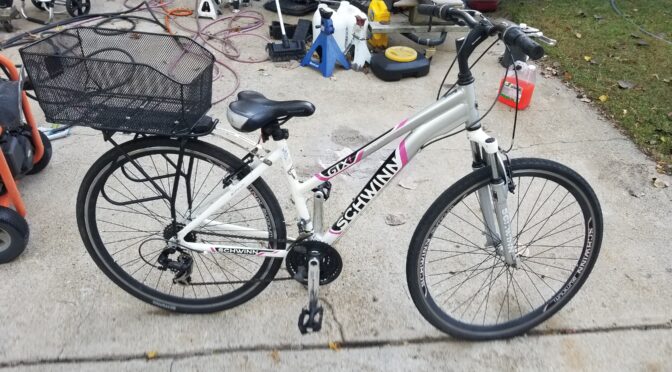
Growing up in the 70s, Schwinn bikes were real popular as there was a dealer in town. Over the years, the brand has been bought and sold and is owned by Pacific Cycle now. The bikes are made in Chang Zhou China and are sold through places like Walmart and Sam’s Club.
With that said, my daughter needed a bike and we bought her one in 2016 from Sam’s Club. It was already assembled so I was happy I didn’t have to mess with it. Growing up in a rural area with few kids around, one of my hobbies was fiddling with my Sears Free Spirit 10-speed and often needing my dad to bail me out when I messed things up — I tend to learn a lot by screwing up 🙂
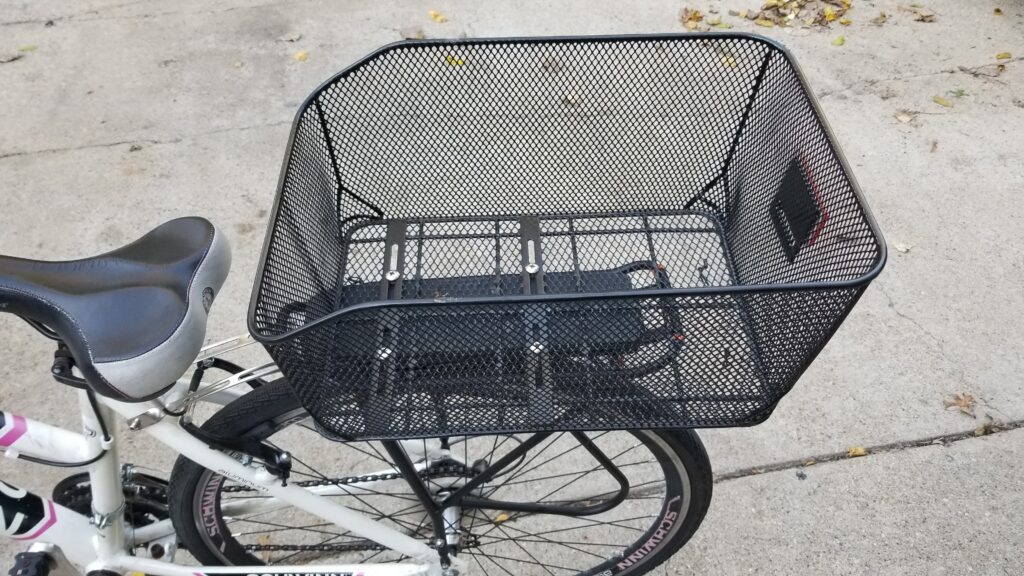
At any rate, the big went with us on a number of trips over the years and went with my daughter to college. It’s hard to beat having a bike on campus to get around and we invested in a basic rear basket for two reasons – the obvious was to let her throw stuff in it. The other was that it could block the water and mud that otherwise throws a stripe up your back when you have to bike in the rain.
Installing the basket required buying the Ibera adjustable rear rack, installing a piece of wood that I painted black to block the water (you could use any solid you want) and then the Axiom wire basket. I found them on Amazon and bought based on specs and reviews. I did have to get longer bolts from Ace Hardware to connect the basket to the rack due to the wood insert.
Here’s the exact Ibera rack I bought:
And this is the wire mesh basket:
The Call…
The bike worked great until I got a call – “Dad, I have a flat – what do I do?” Well, we live just over an hour drive away so the next time we went up, I brought the bike back.
What Size Inner Tube?
Many bike tires, such as this Schwinn, have an inner tube and eventually it cracks or a hole gets poked in it. Some folks patch their inner tubes but I just replace them – especially given the age of the bike and that I knew it was an original tube.
The info you will need to get a replacement tube is on the side of the tire (not the tube). You may see the ETRTO (European Tire and Rim Technical Organization – or ISO) number marked as XX-YYY where XX is the tire’s inner width and YYY is the inner tire diameter. On this Schwinn, it is 40-622.
You may also see an older French sizing that is marked something like AAAxBBm. AAA is the approximate tire outer diameter and BB is the width. There will be a letter at the end “m” is the inner diameter. I ike the ERTO method better – it just makes more sense to me. At any rate, the Schwinn had this code also: 700x38C.
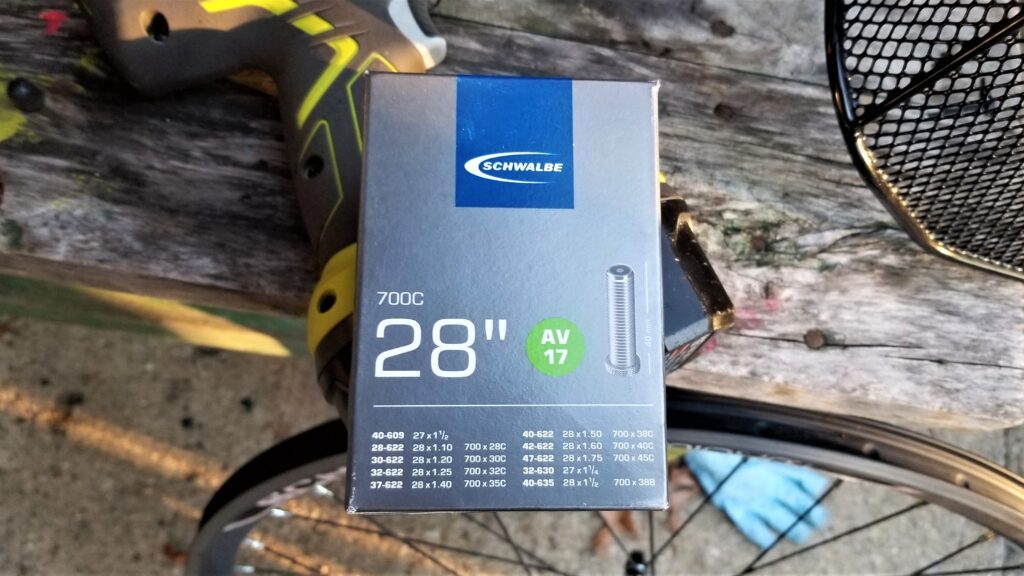
Okay, so armed with that info, I hopped on Amazon and started reading reviews. I didn’t want to buy a cheap tube and have it give out prematurely so I looked at Schwalbe – an old name in German inner tubes. I also used their website to confirm the size I needed – their AV17 model. which fits 700x38C, 28×15 or 40-622 tires and has a Schrader air valve. I bought two because if the one was aging, which was my suspicion, I bet the other was as well.
Tip: If you are in the US, you will want a tube with a basic Shrader Valve to inflate your tube. This is the most common type of valve and you will find it on cars, trucks, tractors, and so forth sold in America – it’s nickname you may hear in other countries is the “American Valve” for that reason. There is another type known as a “Presta Valve” and it is unique. Only buy a tube with that type of valve if you know you need it. There is a third type called the “Woods Valve” or “Dunlop Valve” but that tends to only be in the Netherlands and parts of Asia.
Schwalbe AV17 tubes are the right size.
Last comment – there are a ton of bike tubes on Amazon and at stores. There are also different types such as ones that are self-sealing, etc. The choice is up to you, your budget and whether you mind changing the tubes or not. Since my daughter is not readily available and the bike is a big help to get at school, I spent $14 per tube vs. $5-6/tube for tube-shaped objects that may or may not hold up. Read the reviews and you decide.
Replacing The Tube
There are how-to videos out there you can watch if you want. Basically if the tube is already flat, you pull the tire off the rim a side at time. You can use a blade screw drive to help get it started off the rim but I find most of the time if I push the tire away from me while lifting off the rim, I can get it started and then just work my way around. The old tube should just lift right out of the tire unless it stuck due to glue or something from a past patch.
Note, if there is no inner tube on your bike, you have a tubeless tire and the leak may well be in the tire itself.
A nice part of the design is that you can pull the rear tire without having to remove the derailer. Back in the dark ages, that was not the case so you wound up with some really dirty hands.
Before you install the new tire, look at the rim and make sure there are no spokes protruding into the area where the tube is at. Your rim should have either have something rubbery to protect the tube glued in place or at least some type of tape. They sell protective inner tube pads or you can even try putting in 2-3 layers of PVC electrical tape. If you go the tape route, you will need to cut a hole for the inflation tube to stick out.
To install the new tube, put in the tire. Yes, put it in the tire – not on the rim. It’s designed to fit the outside diameter of the tire and will not fit otherwise. So, tuck it into the tire and then push the air valve through the hole the rim. A perk of using Schwalbe tubes is that they have a lock nut you can snug down to hold the tube in hole.
You then tuck the tire into the rim. Depending on the fit, you may need to do a side at a time or be able to do both at once. Take care not to pinch or cut the tube.
A trick I learned years ago is to partially inflate the tube and then gently bounce it all the way around to try and ensure the tube is not caught between the tire and the rim. Not everyone does this so it’s up to you. I then bring it up to pressure and re-install it. I check the air pressure a few hours later to make sure it’s sealed and no punctures happened.
Again, because I suspected the age of the tires was the culprit, I did both tubes. It’s up to you.
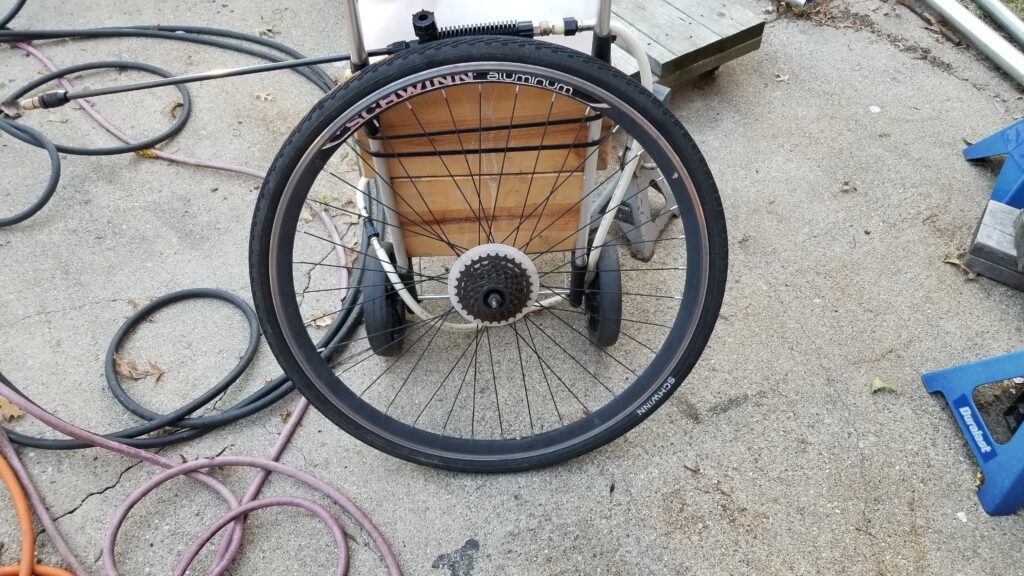
Here’s the finished rear.
Videos
In case you have questions, here are some videos that others have created and posted on Youtube that demonstrate how to remove and install inner tubes:
Conclusion
I hope this helps you out when it comes to the tubes.
thought I was done and then I felt the cranks were grinding horribly. That bugged the heck out of me because I knew it meant to bearings were history and that will be the topic of the next blog post.
Everyone is trying to find ammo and some prices have gone through the roof when you do find some. An option you may not know about is Gorilla Ammunition located in Vero Beach, FL.
Mrgunsngear visited their factory in 2017 and shared a video showing their ammo, AR-10 and AR-15 rifles.
Kit Badger visited in 2018 and talked to both sides of the house – brass case and their polymer case ammo. His coverage of the polymer ammo was very interesting and he assembled the following video:
Good to Go
So, from everything I have read and watched, their ammo is reliable and accurate – by all accounts I read, very accurate. They aren’t the cheapest but the quality in terms of reliability and accuracy are there and that’s what I want these days.
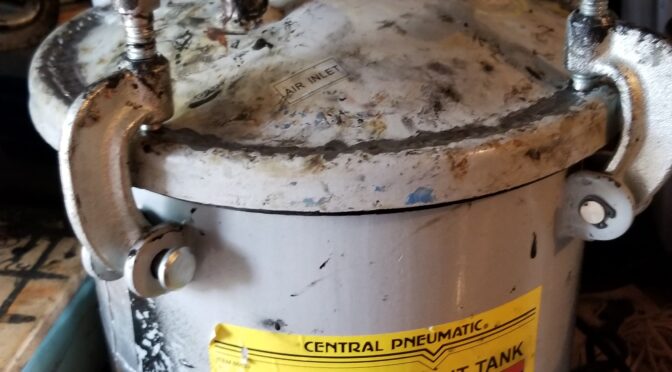
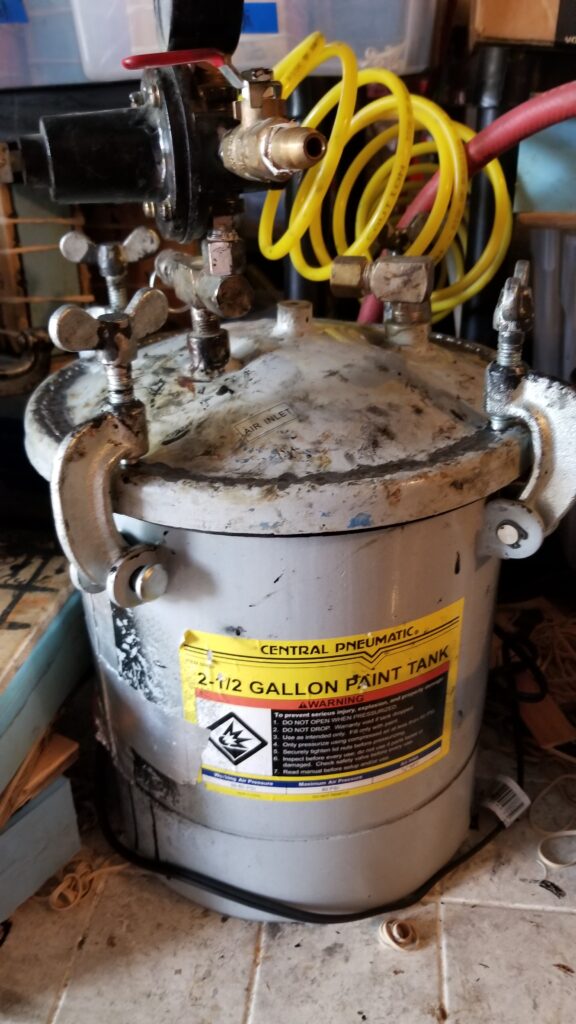
Folks, I’ve used Harbor Freight’s Central Pneumatic 2-1/2 gallon (10 liter) paint pots (HF Item 66839) for years to pressure cast grips. You may know them as “paint pots”, “pressure pots” – they are the same thing. I read fear-mongering stories on the Internet where folks are scared of them blowing up. You know what? They’re safe as long as you stay within their pressure rating and I know what I’m talking about. I’ve used my tanks through thousands of duty cycles at 60 PSI with no major problems.
There is a headache though – the cheap gaskets the tanks come with either don’t last or are a bear to seal. It used to be you had to make your own replacement gaskets or try to repair what you had but now there is an awesome ready-to-go quality gasket you can buy.
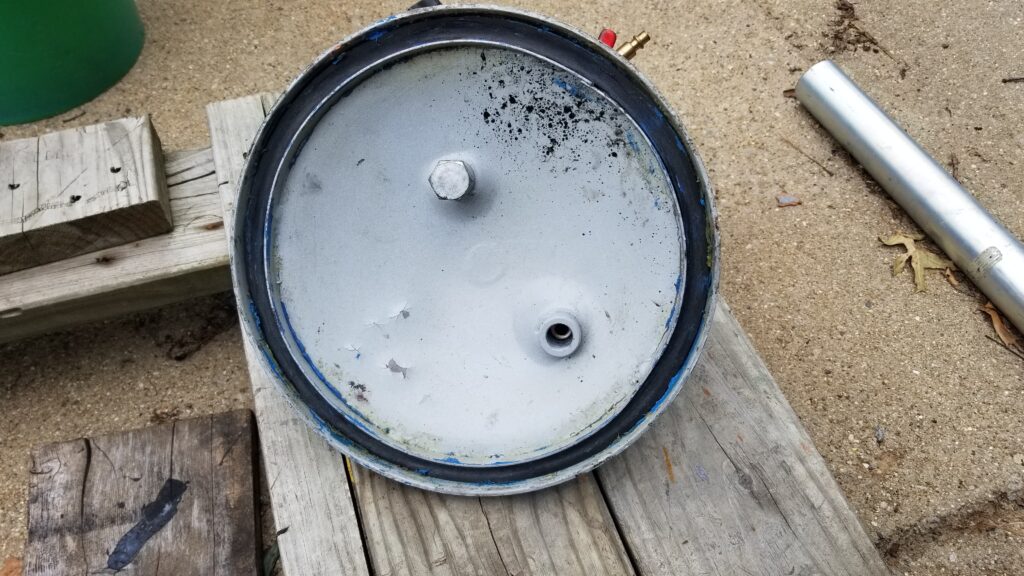
Here’s the lid of one of my modified tanks. You can see remnants of blue RTV everywhere from past fixes. The OEM gaskets are thin and don’t always seal very easily. I keep a wrench by my tanks to crank down the lids the last bit if there are air leaks after pressurizing because the original gaskets are so crummy.
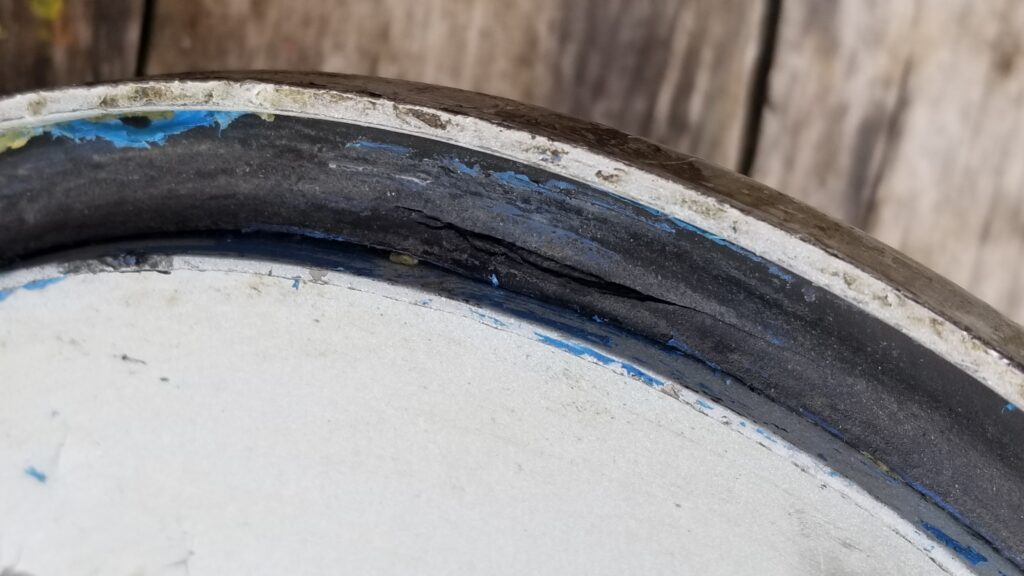
There’s a failure – see the groove/tear in the middle of the black gasket? In the past I would have filled that with RTV and let it cure for 24 hours. I don’t do that any more – I replaced this old gasket with a new one I will tell you about shortly.
How are they better? They are thicker and the durometer (firmness) of the gasket is such that there is a bit of give to get a really good seal. The gasket measures 10-5/16″ for the outside diameter and 9-5/16″ for the inside diameter. It’s also a 1/4″ thick which is great and the dogs (the bolts on top that secure the lid) have enough adjustment to accommodate this thicker gasket.
To cut to the chase, these units fit my pressure tanks perfectly. No more gluing, cutting, etc. These work right out of the box and are way, way better. They also fit a number of other thanks including:
TCP GLOBAL Brand 2.5 Gallon Pressure Pot Tanks Systems. Part# PT8310, PT8312 and PT8318
Binks or Devilbiss Brand 2.7 Gallon Paint Pressure Pot Tank Systems that use the Devilbiss Part# PT-33 Gasket. Binks Tank Part# 83C-210, 83C-220 and 83C-221
Other brands of tanks as well – many are made by the same Chinese factories and use the same size gasket.
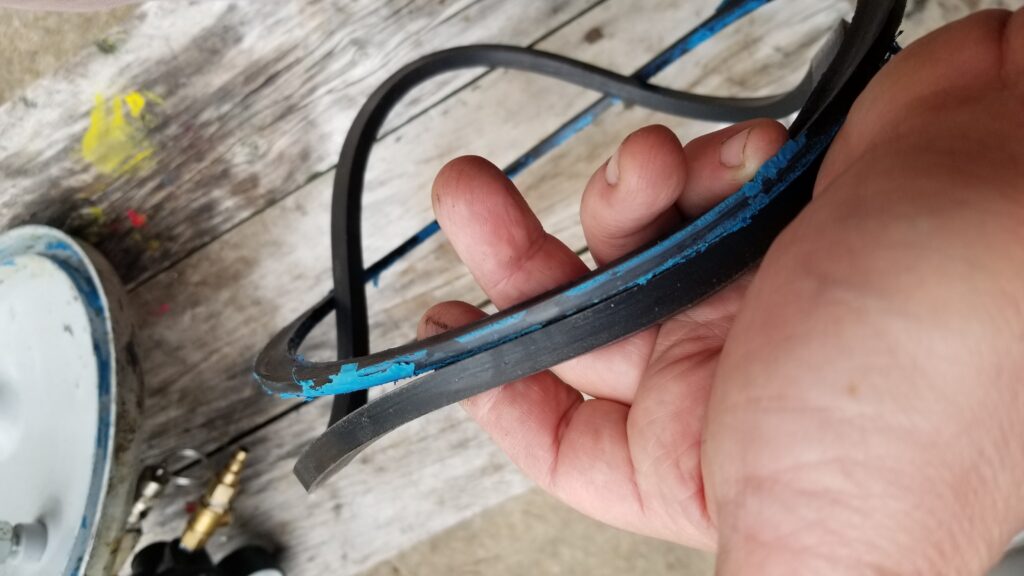
Look at the difference! The old gasket has the blue RTV on it and the new one is the much thicker all black gasket.
Installation is a breeze
Literally, pull the old gasket out and push this new one in place. I did not need to do any trimming. When I put the lid back on the tank, I did have to back off the toggle bolts in the dogs (clamps) so that they could pass over the edge of the lid given it’s new taller height but that was literally just backing the off a 1/4″ more or so. Then when I turned the bolts down, the clamping pressure fully seated the gasket and the job was done. I spent more time taking the pictures than I did replacing the gasket and adjusting the bolts!!
Here’s the tank with the new gasket installed. You can see the dogs (clamps) have plenty of adjustment. When I took this photo, I clamped the top down by hand with no wrench and pressurized the tank to 60 PSI – no leaks or problems. Seriously, these gaskets rock.
These TCP Global replacement gaskets are awesome. The seal works wonderfully and I can just tighten the lid down by hand now – no more wrenching. If you have a tank these gaskets will fit, I highly recommend them.
August 24, 2024 Update: They have held up great. I am now using them in all four of my pressure pots.
March 6, 2022 Update: These are still working great. I’ve slowly replaced most of my original HF gaskets with these and have no problems to report.
Note, I have to buy all of my parts – nothing here was paid for by sponsors, etc. I do make a small amount if you click on an ad and buy something but that is it. You’re getting my real opinion on stuff.