Category Archives: Himalayan Imports Khukuris

Himalayan Imports Khukuris

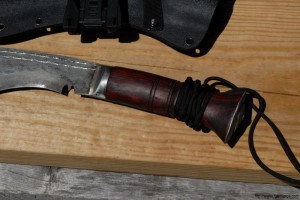
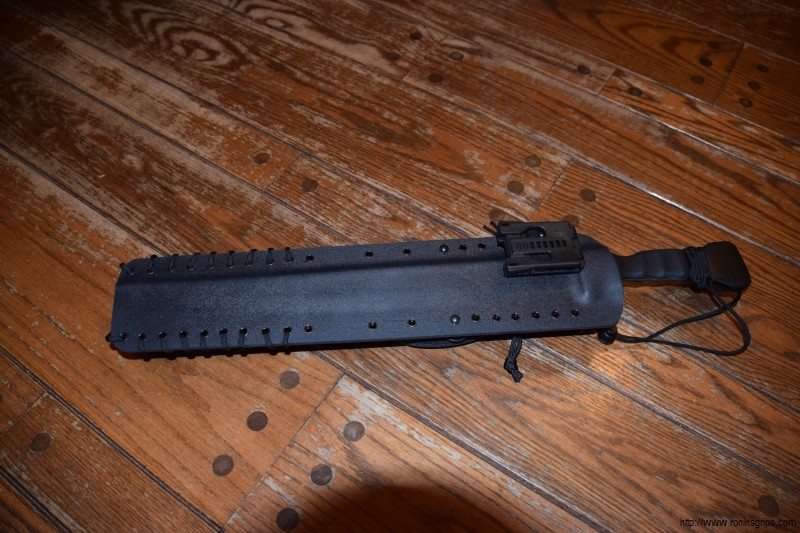
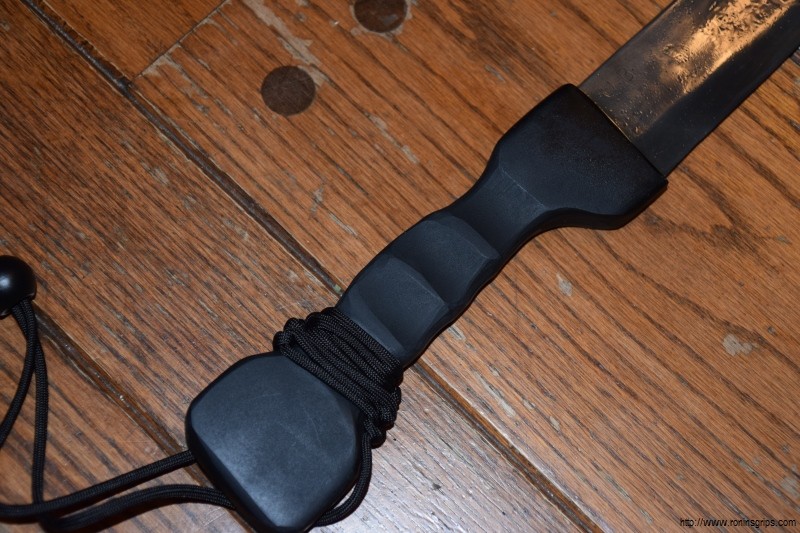
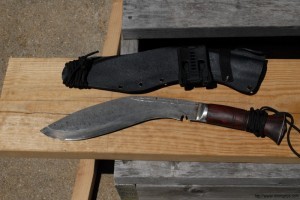
Custom Himalayan Imports Uddha Sword – 24″ Overall with a 16.5″ Blade by Bura

I bought a beat up HI Uddha sword about a year back where the handle was toast.  The cool part was that the blade was made by Bura, who was one of the best kamis in Nepal.  He had to retire due to health problems and his blades are collector’s items now.  At any rate, I decided to replace the trashed handled with black paper micarta, acid etched the blade and made a custom Kydex sheath.  It has a new owner now but thought you might find it interesting.

Specs:

24″ overall

16.5″ Blade

7.5″ Handle

Weight of the sword alone:  1.86 pounds

Weight of sheath:  1.08 pounds

Total weight:  2.94 pounds


Custom Himalayan Imports Uddha sword with sheath and Maxpedition pouch  Custom Himalayan Imports Uddha sword with sheath  Custom Himalayan Imports Uddha sword in black sheath on wooden floor  Close-up of a black sword handle wrapped with black paracord Close-up of a black sheath with a belt clip attached to a Himalayan Imports Uddha sword  Close-up of a black sheath with paracord lacing for a Himalayan Imports Uddha sword.  Black Custom Himalayan Imports Uddha sword with sheath on wooden surface  Himalayan Imports Uddha sword handle and sheath with Maxpedition pouch Maxpedition pouch attached to a custom Uddha sword sheath with paracord lacing.  Custom Himalayan Imports Uddha Sword with black handle and blade on wooden surface

What can a custom 21″ HI Sirupati look like?

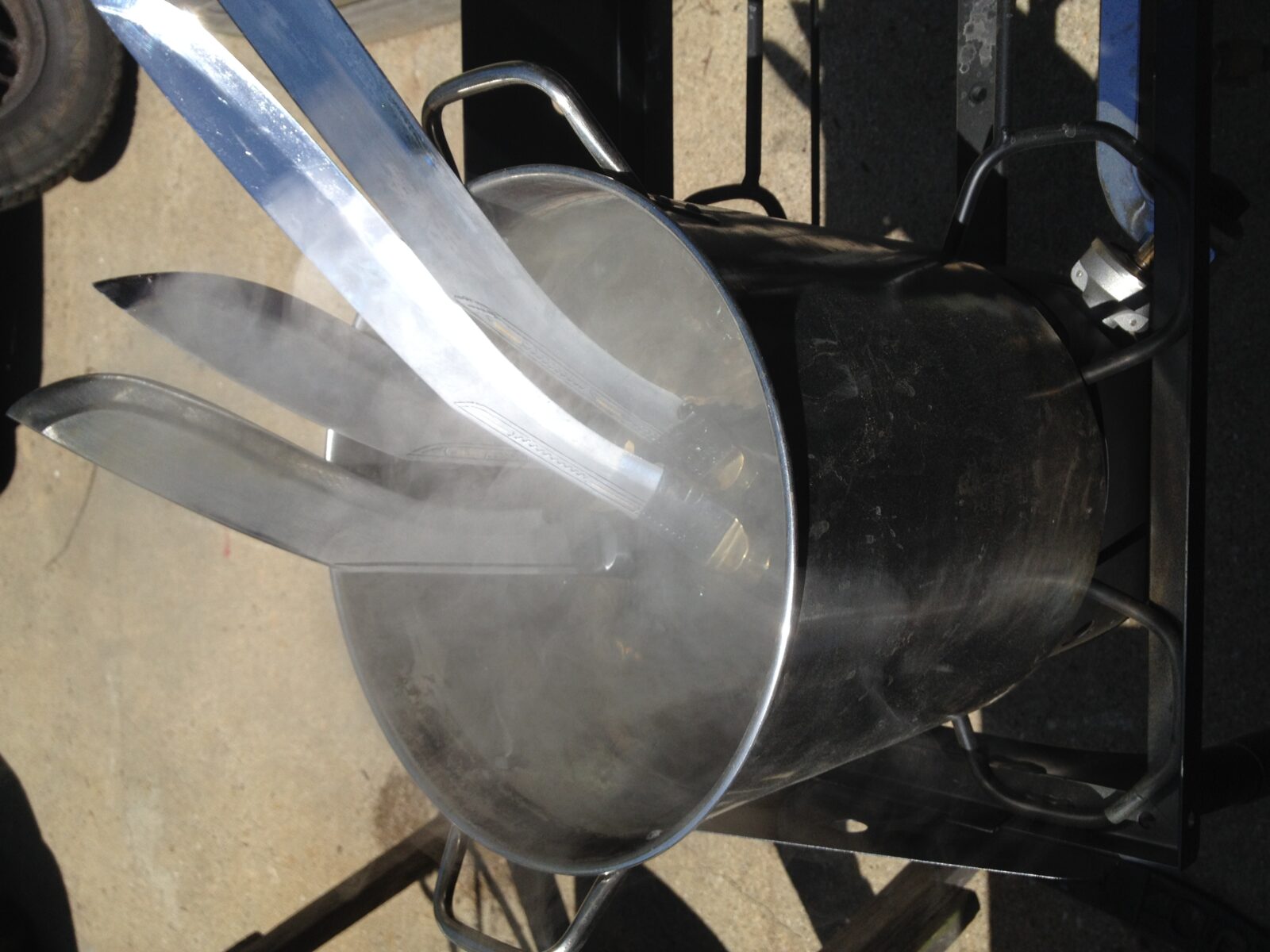
This HI Sirupati had a 16-17″ blade and was about 21″ overall when it arrived to us with a busted handle so the first step was to boil it and a few others with bad handles and then pry it off:

Custom 21" HI Sirupati rotisserie spit with steam rising Close-up of antique silver cutlery with engraved details in a pot  Custom 21-inch HI Sirupati knife with dark horn handle and metal ferrule. Four custom 21" HI Sirupati kukris in progress on a wooden surface.

I made two new handles by gluing assembled blocks around the tangs of the two Sirupatis.  I didn’t mention it before, but they are twins – both about 21″ long so you can see a before and after shot.  The trick was to form a block made of black paper micarta and black glass reinforced Acraglas epoxy.  I then used my new Esteem grinder to remove the parts of the micarta that didn’t feel like a handle:

Custom 21" HI Sirupati machete handle and bladeCustom 21" HI Sirupati belt grinder with motor and controls

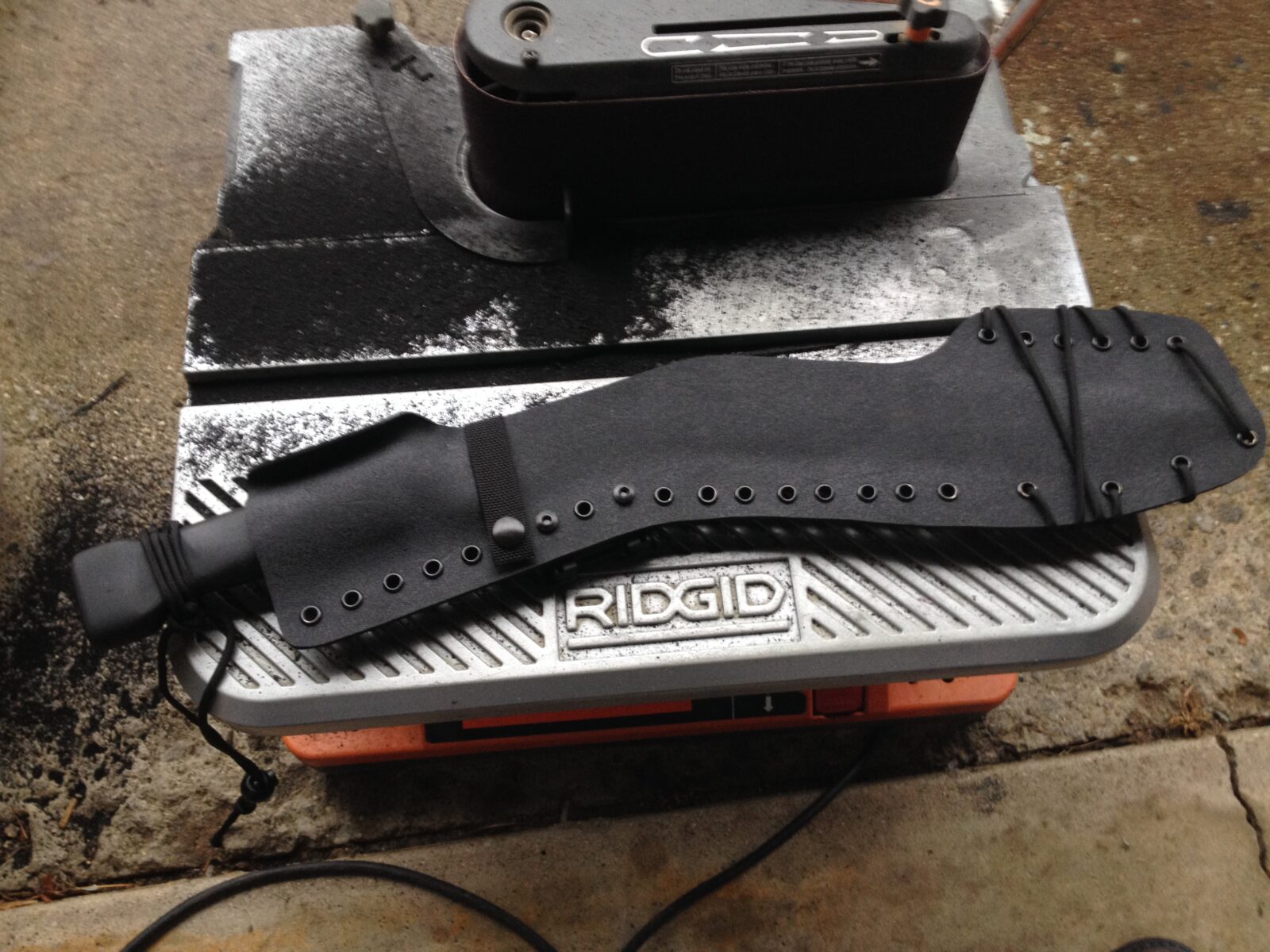
The following photos are of the first completed Sirupati that has an acid etched blade and its custom sheath made from 0.093″ thick Kydex:

Custom 21" HI Sirupati kukri knife on a Ridgid tile saw Custom 21-inch HI Sirupati knife on metal surface with leather sheath Custom 21" HI Sirupati knife and sheath with paracord wrap Close up of custom 21-inch HI Sirupati sheath with blade on metal surface Close-up of a custom 21" HI Sirupati kukri, showing ornate handle details. Custom 21" HI Sirupati knife and sheath Custom 21" HI Sirupati kukri with sheath on a belt sander

The intent of posting this is to show how a very traditional looking khukuri can look after some modernizing.

How To Rehydrate Khukuri Wood Handles

I am routinely asked how to rehydrate khukuri wood handles that have dried out over time.  This is a service we provide when tuning khukuris and have learned a few tricks along the way that we can share.  We approach rehydration or moisturizing by using a 50/50 mix of quality boiled linseed oil (BLO) and turpentine, which we purchase by the gallon from our local Ace Hardware store and sometimes Lowes.  The turpentine helps thin the BLO and avoids it becoming unduly tacky.

The procedure is pretty simple so let me outline it.  I see handles that often need some tinder loving care such as this Keshar Lal Villager Utility Knife (KLVUK) khukuri handle:
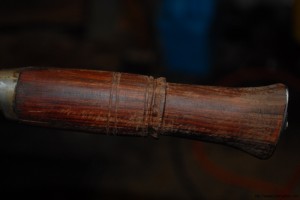
Close-up of a weathered wooden khukuri handle, showing texture and grain.

My first step is to do any wood repairs such as gluing cracks, filling holes and sanding.  It is very common to find a poor fit between the end cap and the wood for example and I will true it up all the way around either with sanding strips or a sanding mop such as what is shown here:
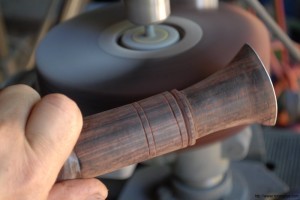
Khukuri wood handle being polished on a buffing wheel

A mop is good for fast touch ups but not for leveling surfaces or otherwise intentionally shaping the wood.  I buy big shop rolls of 1″ wide sand paper in 80, 120, 220 and 320 grits so I can select the grit I need.

The next step is to soak the handle in the turpentine and BLO mixture.  I shoot for it being about 90-100 degrees and soak the wood for at least four hours.
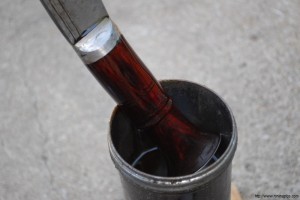
Rehydrating a khukuri wood handle in oil for maintenance.

I then rub the handle down with a blue shop towel to remove the liquid and let it air dry for about a day.  The results are striking.  The below photo shows three KLVUKs that arrived with basically the same color of wood that I picked for this story for that very reason.  The bottom handle is untouched.  The middle handle is after sanding and the top handle is after following the above process.  This helps you see the results.
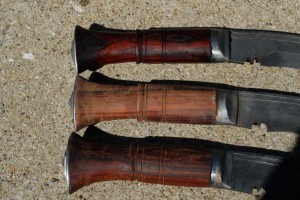
Three wooden khukuri handles, showing wood grain and metal ferrules.

Here is one of our completed KLVUKs:
Khukuri knife with wooden handle and sheath, ready for wood handle rehydration. Close up of Khukuri knife with wood handle on wooden board

I hope this helps you do some care on your blades as well.


Very cool video review of HI Khukuris

As many of you know, I think very highly of HI khukuris – both the organization and the blades they produce.  This is a great video where the reviewer does a thorough job and explains why he likes the MI M43 that he tested so much.  At any rate, if you are interested, check this out as it is very well done:


There are three websites you might want to check out to learn more:

1) The actual HI website where they have history, photos and you can place orders:
http://www.himalayan-imports.com/

2) They have a forum on the BladeForums website as well where people discuss their offerings:
http://www.bladeforums.com/forums/forumdisplay.php/739-Himalayan-Imports


Please share the link on Facebook, Forums, with colleagues, etc. Your support is much appreciated and if you have any feedback, please email us in**@*********ps.com. If you’d like to request a report or order a reprint, please click here for the corresponding page to open in new tab.


Why We Branched Into Himalayan Imports Khukuris

Himalayan Imports khukuri knife with sheath and smaller kukri Himalayan imports khukuri knife on wooden surface with leather sheath

I’ve had folks ask why we branched from AK furniture into Himalayan Imports khukuris.  The answer is simple – both AKs and HI khukuris are incredibly rugged, dependable tools that may not be the most “pretty” things made but you can bet your life on them.  In fact, I got into the HI khukuris after so many board members on www.akfiles.com said over and over that HI khukuris are absolutely the best available.  So, in the fall of 2011, I bought my first HI khukuri – a massive Super Chiruwa Ang Khola.  Then I bought another … and another … and another.  They are addictive just like AKs as well!
Himalayan Imports khukuri knife with two sheaths and two small knivesHimalayan Imports khukuri knife with leather sheaths on wooden surface

What I found amazing is that the bladesmiths in Nepal (known as “kamis”) are working in the HI factory in very primitive conditions forging these blades from salvaged truck springs (5160 alloy) and using basic hand tools and anvils.  Their methods have been handed down from grandfather, to father, to son for hundreds of years making differentially hardened, field serviceable blades.  The engineering, if I dare call it that, is so amazingly cool.  They figured out what worked and what didn’t by trial and error over hundreds of years.  Each khukuri is unique and reflects the kami who makes it.  These aren’t mass produced pretty knives rolling off a conveyor belt.  Instead they are extremely functional tools with a long proven history.  If you like reading about history, there are so many fascinating references on the Internet and books available!

Himalayan Imports khukuri knife with sheath and Maxpedition pouch

At any rate, as I journeyed along, I noticed a lot of guys who owned AKs also owned an HI blade or were very interested in getting one.  Given that we’ve been working with plastics for over three years now, it seemed like a good fit.  Starting in the spring of 2013, we began planning for the custom Kydex sheaths including research into designs, materials and tooling.  Over the course of the summer we made a number of test sheaths until we hit on the current type of design and how to make it.  We also found out that a lot of folks, women included, didn’t just want a sheath – they wanted to get the blade from us as well to one-stop-shop.  Thus, we first started making sheaths for our spare blades to sell plus we got into rehandling the khukuris using the various types of micarta that are available.

Gray kukri knife on a wooden table with a yellow background Black kukri knife with green handle on wood surface Two Himalayan Imports khukuri knives on a wooden board.