
1. Executive Summary
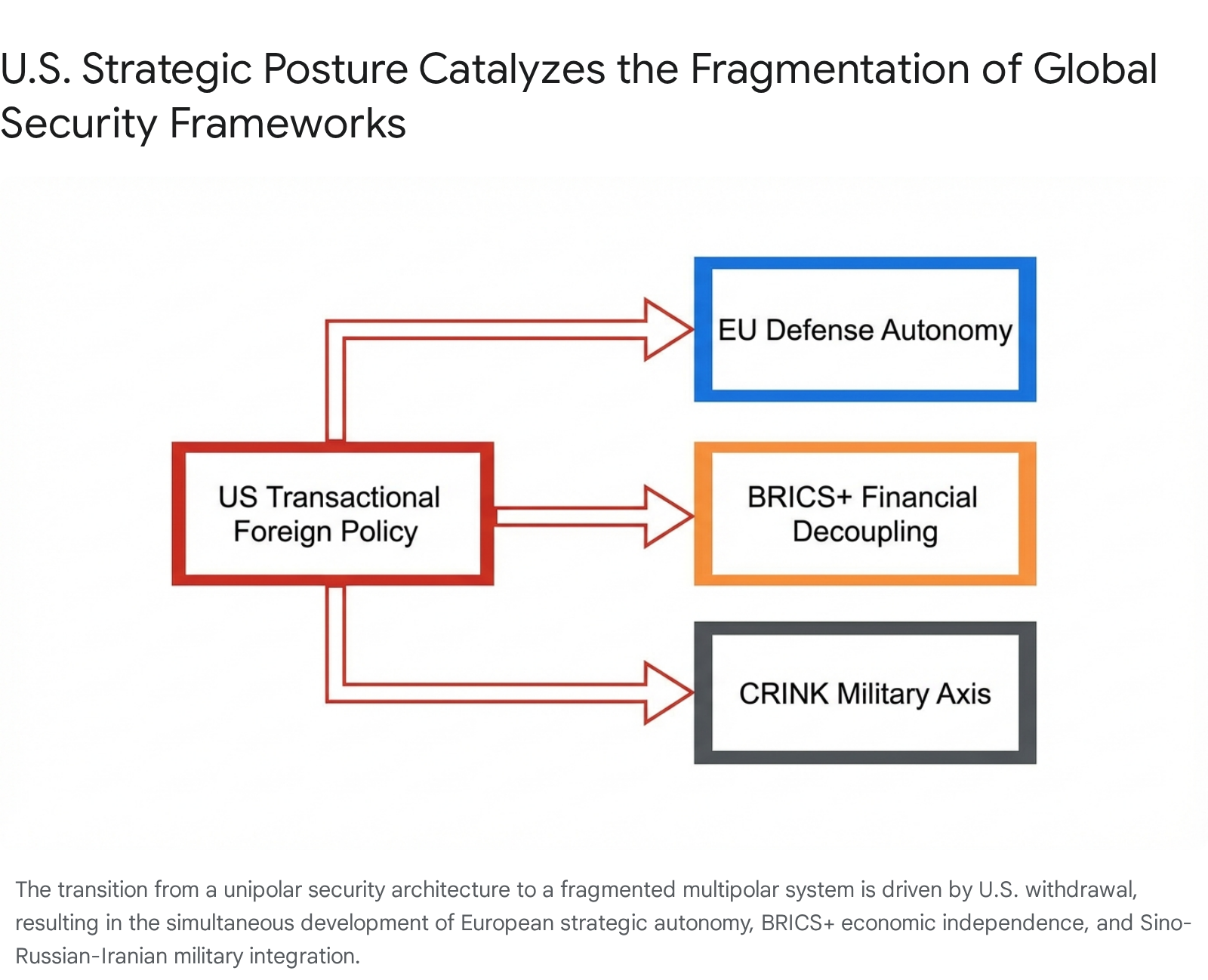
The global security and economic architecture is undergoing its most profound transformation since the end of the Cold War. The return of the “America First” doctrine under the Donald Trump administration (2025–2026) has systematically dismantled the foundational pillars of unipolarity, signaling an intentional United States withdrawal from its traditional role as the underwriter of the liberal international order.1 By treating alliances as transactional rather than structural, and by applying coercive economic statecraft equally against strategic adversaries and historic allies, the United States has catalyzed a rapid, albeit fragmented, global realignment.3
This report provides an exhaustive analysis of how United States posturing has affected European and global coalitions, evaluating the new structures being formed to fill the hegemonic vacuum. The analysis focuses on three primary theaters of coalition-building: European strategic and military autonomy, independent maritime security initiatives in the Middle East, and the consolidation of non-Western financial and technological blocs.
The findings indicate that while European and Global South coalitions are rapidly institutionalizing new frameworks—ranging from the European Defence Industrial Strategy (EDIS) to the BRICS+ mBridge payment systems—these independent formations face acute limitations without United States integration.5 In the maritime domain, European-led coalitions such as the European Maritime Awareness in the Strait of Hormuz (EMASOH) and Operation Aspides in the Red Sea have demonstrated high tactical efficacy in localized defensive escorts and diplomatic de-escalation.7 However, the unprecedented escalation of the 2026 Iran War and the subsequent closure of the Strait of Hormuz highlight a critical threshold: independent regional coalitions lack the mass, offensive strike capabilities, and “over-the-horizon” deterrence required to neutralize state-level asymmetric threats during a systemic regional conflict.9
Concurrently, the global financial system is experiencing a deliberate bifurcation. The expansion of the BRICS+ coalition has formalized a strategic endeavor to execute a “de-SWIFTing” of the international economy, leveraging Central Bank Digital Currencies (CBDCs) and blockchain infrastructure to create sanction-proof cross-border settlement mechanisms.6 While complete global de-dollarization is not imminent, these mechanisms provide a viable parallel architecture that degrades the efficacy of Western economic coercion.12 In the security realm, this fragmentation has facilitated the emergence of the CRINK axis (China, Russia, Iran, and North Korea), codified in the 2026 Trilateral Strategic Pact, which presents a unified challenge to the remaining vestiges of the rules-based order.14
Ultimately, the global system is transitioning from a United States-led unipolar order into a heavily militarized, multipolar environment characterized by competing “minilateral” frameworks. While Europe and the BRICS+ nations are successfully hedging against unpredictability by establishing sovereign financial, regulatory, and defensive infrastructures, their ability to project power and maintain global supply chain continuity independent of the United States remains structurally constrained for the medium term. The international community has entered a volatile period where stability relies not on overarching hegemonic guarantees, but on the delicate calibration of overlapping, regional ad-hoc coalitions.
2. The Post-American Security Environment and U.S. Strategic Reposturing
The strategic posture of the United States in the 2025–2026 period represents a decisive rupture from eight decades of American foreign policy. Rather than modifying the existing rules-based order from within, the current administration has actively engaged in order-transforming contestation, fundamentally altering the calculus of global alliances.1
2.1 The Weaponization of Interdependence and the End of Unipolarity
The defining characteristic of the current United States posture is the deliberate weaponization of economic and security interdependence. The administration has systematically reframed international trade as a tool of coercion, deploying indiscriminate tariffs as leverage to extract political compromises from allies.3 The global economic impact of this posture has been profound; initial mass tariff announcements destroyed an estimated $10 trillion in global stock values within weeks, equating to roughly half the gross domestic product (GDP) of the European Union.3 A primary example of this dynamic is the July 2025 Turnberry Agreement, wherein European leaders, operating under extreme duress, accepted an unbalanced, economically detrimental tariff arrangement to ensure the temporary continuation of a United States diplomatic and military presence in Ukraine.2
This transactional approach has fundamentally altered the psychological baseline of transatlantic and transpacific relations. The United States administration views multilateral institutions as constraints on national sovereignty, leading to its withdrawal from sixty-six international organizations and United Nations entities by early 2026.2 This institutional retreat includes drastic cuts to United Nations funding, severely curtailing global humanitarian and peacekeeping operations and removing vital communication channels required to mediate conflicts.17 The administration’s approach to traditional European allies has been characterized by deep ideological hostility, with senior United States officials, including Vice President JD Vance at the February 2025 Munich Security Conference, accusing European nations of abandoning fundamental democratic values, framing transatlantic differences as an ideological war.2
This rhetoric aligns with a broader strategy of “elimination, transformation, and subjugation,” whereby the administration seeks to replace traditional liberal democratic partnerships with bilateral agreements forged through leverage.3 Furthermore, the administration’s willingness to question established territorial boundaries—most notably through explicit threats to acquire Greenland from Denmark via coercive tariffs or military means—has shattered the assumption that the United States is a reliable guarantor of allied territorial integrity.2 To symbolize this shift toward unconstrained power politics, the United States Department of Defense was symbolically renamed the Department of War.2
2.2 The 2025 National Security Strategy and the “Donroe Doctrine”
The release of the comprehensive 2025 National Security Strategy (NSS) codified this geopolitical shift, explicitly moving away from promoting democratic values in favor of a strictly realist, interest-driven contest over economics and security.19 The NSS formalizes a “Donroe Doctrine,” asserting unapologetic United States preeminence in the Western Hemisphere, viewing Latin America primarily as a domain of risks and an arena for resource extraction to secure critical supply chains.2
Crucially, the NSS downgrades the Middle East and Europe to secondary theaters, explicitly stating that the Indo-Pacific remains the essential non-hemispheric theater for geopolitical competition.20 Analysts observe that the document devotes more focus to Indo-Pacific security than to Europe, the Middle East, and Africa combined.20 The strategy treats sovereignty, industrial revival, tight border control, and burden-shifting to regional partners as the core tenets of national security, demanding that European and Gulf partners function as frontline security providers rather than consumers of United States deterrence.20 Consequently, the overarching effect of United States posturing has been to force allied nations to accelerate their pursuit of strategic autonomy, transforming them from compliant partners into independent actors operating outside the orbit of Washington’s preferences.22
3. The Acceleration of European Strategic Autonomy: Ambitions and Structural Constraints
The most immediate and consequential reaction to United States transactionalism has been the forced acceleration of European strategic autonomy. Historically, European reliance on the United States for conventional deterrence and high-end military enablers allowed for deeply integrated, yet subservient, defense postures.18 The realization that the United States security umbrella is no longer absolute—exacerbated by the high probability of a United States military pivot to the Indo-Pacific in the event of a contingency involving China during the 2026–2028 “maximum period of risk”—has necessitated a historic and complex shift in European defense planning.18
3.1 Navigating the Specialization Dilemma and Strategic Cacophony
The current European defense landscape is fundamentally hindered by what defense analysts term “strategic cacophony”.24 Europe fields roughly thirty individual national militaries equipped with 178 different types of weapon systems, compared to just 30 systems utilized by the United States.24 This profound fragmentation creates severe logistical vulnerabilities and battlefield asymmetries.25 The simultaneous operation of diverse armored vehicles and howitzers across French, German, British, Italian, and Swedish forces necessitates highly complex, incompatible supply chains.25 Because these national forces were historically designed to act as highly specialized appendages to a broader United States-led warfighting effort, they currently lack the intrinsic capability to function seamlessly as an independent, cohesive pan-European force.24
This creates a “specialization dilemma.” While economic theory dictates that nations should specialize in specific defense domains to enhance efficiency, the lack of absolute trust and the persistent fear of abandonment prevent European capitals from relinquishing national capabilities.24 The resulting duplication of facilities and multinational management structures adds significant friction and cost, preventing the realization of economies of scale.24
To address this systemic inefficiency, the European Commission introduced the first-ever European Defence Industrial Strategy (EDIS) and the €1.5 billion European Defence Industry Programme (EDIP) in March 2024.5 EDIS mandates structural changes to the European Defence Technological and Industrial Base (EDTIB), setting ambitious targets: by 2030, member states must devote 50% of their procurement budgets to European sources (scaling to 60% by 2035), and acquire at least 40% of their equipment collaboratively.28 While EDIS provides a necessary regulatory framework to mainstream a defense readiness culture, it is currently underfunded relative to the scale of the crisis, raising considerable doubts about its transformative potential without massive, sustained joint financing.5
3.2 The Capability Chasm: Operational Realities Without U.S. Enablers
Despite regulatory and industrial reforms, European militaries face a perilous “capability chasm.” Decades of reliance on the United States military have left critical operational gaps that cannot be closed quickly, even with unlimited funding.18 Independent assessments suggest it would cost European countries upward of $357 billion to build a force capable of addressing a serious Article 5 contingency without significant United States support.29
The most pressing vulnerability lies in the Suppression and Destruction of Enemy Air Defences (SEAD/DEAD).18 European air forces severely lack the specialized munitions and platforms required to dismantle advanced integrated air defense systems (IADS) and formidable Russian ground-based air defense (GBAD) networks.18 This mission relies almost exclusively on periodic detachments from United States Navy EA-18G Growler squadrons and high-end fifth-generation assets.18 Furthermore, Europe suffers from a profound deficit in airborne electromagnetic attack (EA) capabilities.18 While prototypes like the United Kingdom’s SPEAR EW exist, Europe lacks traditional air-launched stand-in decoys and jammers comparable to the United States ADM-160 MALD-J, as well as the intelligence collection architecture (ELINT) necessary for modern electronic warfare.18
3.3 The Dependency Vulnerability: The F-35 Paradigm
The pursuit of European strategic autonomy is severely complicated by “operational sovereignty” dependencies tied inextricably to imported United States hardware. The F-35 Lightning II is the lynchpin of NATO’s air combat strategy and nuclear sharing agreements, yet its operation remains completely reliant on United States-controlled infrastructure.18
European operators are bound to the cloud-based Autonomic Logistics Information System (ALIS) and the Operational Data Integrated Network (ODIN) for critical maintenance and mission planning.18 Crucially, the highly sensitive Mission Data Files (MDFs)—which fuse enemy threats, aircraft stealth profiles, and sensor data to project safe routing—cannot be programmed independently by European nations (with the sole exception of Israel).18 According to United States policy, partner nations must rely on the F-35 Partner Support Complex (PSC), a unit within the United States Air Force’s 350th Spectrum Warfare Group in Florida, for data programming.18 Consequently, the United States government retains the absolute ability to severely degrade or entirely disable European combat effectiveness simply by severing access to logistics networks, spare parts, and software updates.18 This dynamic highlights the absolute limits of European defense autonomy; long-term programs like the Anglo-Japanese-Italian Global Combat Aircraft Programme (GCAP) and the Franco-German-Spanish Future Combat Aircraft System (FCAS) are vital, but will not yield operational sovereignty until well into the 2030s.18
| Critical Capability Area | European Deficit / Vulnerability Profile | Current Reliance on United States Frameworks | Projected Timeframe to Attain Autonomy |
| SEAD/DEAD Missions | Lack of specialized munitions (e.g., AARGM-ER) and mass required to dismantle IADS. | Dependent on United States EA-18G Growlers and mass fifth-generation fighter deployments. | Long-term (Post-2030 via GCAP/FCAS integration) |
| Airborne Electronic Attack (EA) | Absence of stand-in jammers (MALD-J analogues) and pooled multinational EA squadrons. | Near-total reliance on United States electromagnetic warfare assets and threat libraries. | Medium-term (Pending SPEAR EW procurement and AI adoption) |
| Operational Sovereignty | F-35 fleets cannot be independently maintained, repaired, or programmed with threat data. | Tied to United States ALIS/ODIN networks and Florida-based mission data programming. | Unattainable without abandoning platform reliance |
| Logistics & Resupply | Fragmented supply chains due to 178 non-interchangeable weapon systems; shallow munitions depth. | Dependent on United States heavy airlift and strategic deep stockpiles for high-intensity operations. | Medium-term (Pending aggressive EDIS implementation) |
| Command & Control (C2) | Lack of redundant, pan-European command structures to manage large-scale warfighting. | Deeply integrated into United States European Command (EUCOM) networks and ISTAR overwatch. | Short-to-Medium term |
4. Macroeconomic Realities of European Rearmament
The sheer scale of capital required to build an independent European defense architecture and bridge the capability chasm is staggering. The transition from peacetime complacency to a war-ready footing requires macroeconomic restructuring that tests the political and fiscal limits of the European Union.
4.1 The 5% NATO Pledge and Fiscal Rule Suspensions
At the historic June 2025 NATO Summit in The Hague, member states committed to a radical increase in defense spending, pledging an annual investment of 5% of their gross domestic product (GDP) by 2035.18 This pledge is bifurcated: at least 3.5% of GDP is strictly allocated to core military requirements, deterrence, and crisis management, while an additional 1.5% is directed toward protecting critical infrastructure, cyber defense, and civil resilience.18
However, achieving this 5% target presents severe macroeconomic challenges. Countries facing the largest required spending increases to meet this target—such as Italy, Spain, Belgium, and France—also exhibit some of the highest debt-to-GDP ratios in Europe.33 Historical data analyzed by the IMF indicates that while defense spending carries a positive short-term macroeconomic multiplier (raising government and private consumption by about 0.5% of GDP per 1% increase in defense outlays), relying solely on deficit financing is unsustainable for highly indebted nations.30 Without corresponding tax increases, historical military buildups in indebted nations inevitably led to substantial cuts in civilian spending.33 Furthermore, because the current European defense buildup is massive and synchronized across multiple nations, economic models suggest that multipliers might fall below historical estimates due to capacity pressures, particularly if the European Central Bank maintains a non-accommodative monetary policy.30
To prevent the total collapse of the European Union’s economic governance framework, the European Commission initiated a controversial ‘reform of the reform’ regarding the Stability and Growth Pact (SGP).35 The Commission permitted the activation of the ‘national escape clause,’ temporarily easing numerical fiscal rules to allow countries to incur extra defense-related deficit spending up to 1.5% of GDP for a maximum of four years.35 This flexibility, strictly tied to the Classification of the Functions of Government (COFOG) on defense, prevents excessive deficit procedures (EDP) from immediately punishing nations that are aggressively rearming.35 Yet, economists warn that activating escape clauses continuously erodes the credibility of the framework, raising long-term sovereign debt sustainability concerns.35
4.2 European Defense Bonds and the Pursuit of Financial Sovereignty
To circumvent restrictive national fiscal constraints and the limitations of the SGP, new pan-European macroeconomic instruments are being heavily theorized and developed. The Kiel Institute for the World Economy has proposed a transformative model centered on the issuance of joint European defense bonds.38
This proposal suggests issuing joint debt totaling approximately €2 trillion over a ten-year period, representing roughly 1% of the aggregate GDP of the participating states.38 Driven by a “coalition of willing EU member states” and backed by an intergovernmental treaty, these funds would bypass duplicate national structures, managed instead by independent steering committees.38 The investment would aggressively target next-generation military technologies where European cooperation yields the highest efficiency: artificial intelligence, cyber defense, and space-based satellite infrastructure.38
Crucially, this mechanism serves a dual strategic purpose. Beyond financing rapid rearmament, the issuance of €2 trillion in joint debt would create a massive, highly liquid, and secure European bond market.38 This fundamentally strengthens Europe’s role within the global financial system, establishing a secure bond market independent of the United States Treasury market, thereby advancing both military and financial sovereignty simultaneously.38 This aligns with broader European initiatives under the Critical Raw Materials Act to establish joint purchasing platforms to secure supply chains against adversarial disruption.40
5. Case Study: Efficacy of Independent European Maritime Coalitions
The withdrawal of reliable United States security guarantees has forced Europe to independently project power to protect its strategic interests and global supply chains, most notably in the critical maritime chokepoints of the Middle East. The operational effectiveness of these independent coalitions provides a vital, empirical case study in the viability of a post-American security architecture.
5.1 EMASOH and Operation Agenor: Diplomatic De-escalation
Recognizing the profound risks of being tethered to escalating United States-Iran tensions during the Trump administration, European nations sought an independent mechanism to secure the Strait of Hormuz. In early 2020, France led the establishment of the European Maritime Awareness in the Strait of Hormuz (EMASOH) and its military component, Operation Agenor.41 Headquartered at the French naval base in Abu Dhabi, the initiative drew support from Belgium, Denmark, Germany, Greece, Italy, the Netherlands, Norway, and Portugal.41
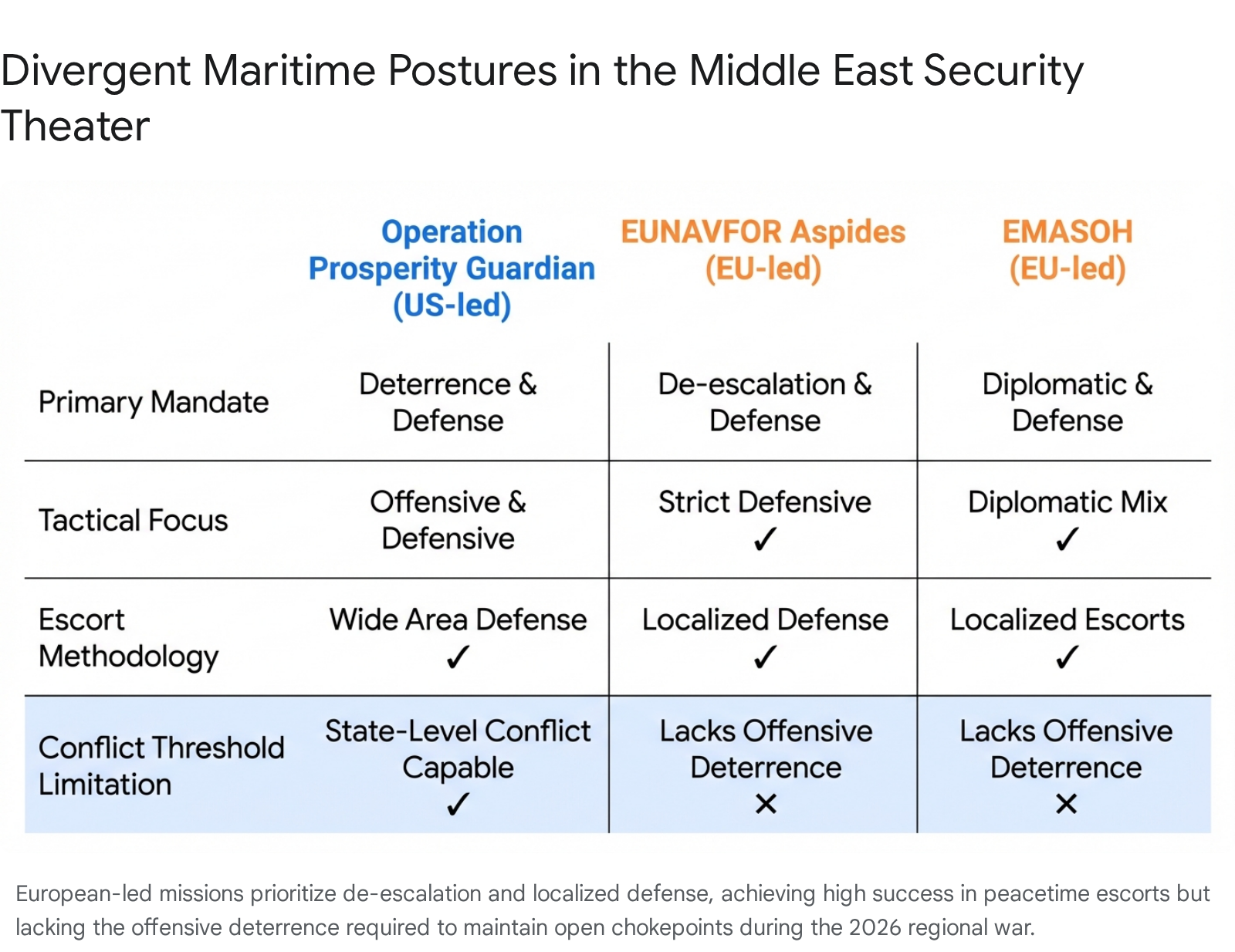
EMASOH operates on a strictly defensive and diplomatic mandate, intentionally distinct from the more aggressive posture of the United States-led International Maritime Security Construct (IMSC).42 Its primary objective is de-escalation and ensuring freedom of navigation. This is achieved by providing persistent maritime situational awareness, conducting reassurance calls, and accompanying merchant vessels through the narrow, congested waterway.8 Operationally, EMASOH has been highly successful in its narrow mandate of localized maritime policing and diplomatic reassurance.8 It proved that a unified European command structure could function effectively to protect regional shipping alongside, but entirely independent of, United States naval forces, securing praise from regional Arab partners reluctant to overtly align with Washington.8
5.2 EUNAVFOR Aspides vs. Operation Prosperity Guardian
The outbreak of the Red Sea crisis generated a second distinct European response through the launch of EUNAVFOR Aspides in February 2024, operating under the European Union’s Common Security and Defence Policy (CSDP).47 Designed to protect merchant shipping from Houthi missile and drone attacks, Greece provides the strategic headquarters in Larissa, while Italy commands the tactical force utilizing frigates from France, Germany, and Belgium.48
Aspides represents a significant evolution in European strategic cohesion, demonstrating a willingness to adopt a distinct, sovereign posture from the United States-led Operation Prosperity Guardian (OPG) and the parallel United States-United Kingdom offensive strike campaign, Operation Poseidon Archer.49 While OPG achieved formidable interception rates through a high-tempo air defense posture, it struggled to provide schedule certainty for the shipping industry because it failed to institutionalize predictable convoys.7
In contrast, Aspides implemented a strictly defensive mandate (expressly forbidding strikes on Yemeni soil) centered on predictable, bookable group transits and close-protection escorts.7 By mid-2025, European Union naval commanders had refined their operational intelligence, utilizing EU Satellite Centre imagery and commercial synthetic aperture radar to adjust convoy schedules based on intelligence assessments of probable Houthi launch windows.7 This resulted in a highly effective defensive shield that thwarted approximately 150 attacks and provided risk managers and underwriters with the stability required to route vessels safely, establishing Aspides as a premier example of European operational autonomy.7
5.3 The 2026 Iran War: The Threshold of Independent Defensive Capabilities
Despite these remarkable tactical successes in de-escalation and escort, the profound limitations of independent, strictly defensive European coalitions were brutally exposed by the eruption of the 2026 Iran War.
The conflict formally commenced on February 28, 2026, when the United States and Israel launched “Operation Epic Fury,” a massive, coordinated air campaign targeting Iranian nuclear facilities, military infrastructure, and senior leadership.9 The opening hours witnessed nearly 900 strikes, resulting in the death of Supreme Leader Ali Khamenei and decapitating the Iranian command structure.9 Over the following weeks, United States Central Command (CENTCOM) executed over 7,000 strikes, triggering asymmetric Iranian retaliatory ballistic missile attacks against 27 United States military bases across nine nations, including an attempted strike on the joint facility at Diego Garcia.9
The geopolitical fallout was immediate and catastrophic for global trade. On March 2, 2026, the Islamic Revolutionary Guard Corps (IRGC) enacted the de facto closure of the Strait of Hormuz, threatening to destroy any vessel attempting passage.9 Tanker traffic plummeted by 70%, stalling over 150 freight ships and triggering a massive global energy-economic shock.9 Concurrently, Houthi forces reactivated their anti-access/area-denial (A2/AD) campaign, resuming missile fires against Israel on March 28, 2026, and targeting shipping in the Red Sea.52
This forced EUNAVFOR Aspides to issue severe threat warnings to the shipping industry, assessing the threat level as “medium” for neutral vessels and “high” for any ships affiliated with Israeli or United States interests, noting that limited military resources would result in significantly longer waiting times for protective escorts.53
This catastrophic escalation demonstrates the fundamental flaw in the current model of European strategic autonomy. Coalitions like EMASOH and Aspides are highly effective at treating the symptoms of regional instability through localized escort and interception.55 However, they entirely lack the offensive strike mass, the intelligence infrastructure, and the escalatory dominance required to deter a determined state actor (Iran) from closing a strategic chokepoint.9 When the geopolitical environment shifts from low-intensity proxy harassment to high-intensity state-on-state warfare, independent European naval missions are statistically overwhelmed, lacking the capacity to restore schedule certainty.9 Consequently, while independent maritime formations can operate successfully without the United States in a gray-zone environment, they cannot independently secure the global commons against tier-one adversaries during a systemic conflict.
6. The Consolidation of the Global South and the BRICS+ Financial Architecture
As European nations seek military autonomy, the Global South is actively constructing parallel economic infrastructures to insulate itself from United States financial hegemony. Driven by the weaponization of the United States dollar, the increasing use of secondary sanctions, and the protectionist trade policies emanating from Washington, the BRICS organization has rapidly evolved from an economic dialogue forum into a formidable geopolitical bloc capable of restructuring global finance.
6.1 Demographic and Economic Rebalancing
Between 2024 and 2025, BRICS underwent a historic expansion, integrating Egypt, Ethiopia, Iran, the United Arab Emirates (UAE), and Indonesia into its formal structure.12 This enlarged bloc, referred to as BRICS+, represents a paradigm shift in global economic gravity. As of 2024, the member nations account for approximately 45% of the global population and 40.2% of the world’s GDP based on purchasing power parity (PPP), decisively overtaking the G7’s 28.8% share.10 Furthermore, the inclusion of major oil-producing states grants BRICS+ significant control over global energy production, fundamentally shifting the balance of geoeconomic power and challenging Western-centric institutions such as the IMF and World Bank.10
The unifying motivation among BRICS+ members is not necessarily ideological alignment—member states like India maintain strong security ties with the West while engaging with BRICS—but rather a pragmatic requirement to mitigate the consequences of American dominance.59 Member states utilize the coalition as a safe harbor from United States diplomatic coercion, a mechanism to expand economic options without democratization pressures, and a platform for strategic hedging.59
6.2 De-SWIFTing, mBridge, and Alternative Settlement Frameworks
The most consequential initiative emerging from BRICS+ is the systematic effort to challenge the dominance of the United States dollar and the SWIFT international payments network. While true global de-dollarization remains a long-term prospect—the United States dollar’s deep liquidity and institutional roots are difficult to uproot abruptly—BRICS+ is successfully executing a strategy of “de-SWIFTing” to ensure trade continuity and resilience.6
The architecture of this financial independence relies on several sophisticated, intersecting technological initiatives. The bloc has heavily promoted intra-BRICS trade using local currencies, driven by initiatives like the BRICS Pay cross-border platform. By 2024, local currencies already accounted for 65% of trade between member states.58 BRICS Pay acts as a direct challenge to SWIFT, allowing nations to bypass Western correspondent banks, thereby significantly reducing exposure to asset freezes and secondary sanctions.12 This aligns with the New Development Bank’s strategic goal of increasing its loans in local currencies to 30% of its entire lending portfolio by 2026.62
A highly potent technological advancement supporting this shift is the integration of interoperable Central Bank Digital Currencies (CBDCs) via the blockchain-based mBridge ledger initiative.6 This architecture allows for payment-versus-payment (PvP) foreign exchange settlements directly between sovereign domestic ledgers, utilizing digital currencies such as the e-CNY.6 Crucially, this distributed ledger model eliminates settlement and Herstatt risk without requiring the creation of a supranational currency or a shared central bank, preserving the absolute monetary sovereignty of participating nations while ensuring rapid, low-cost execution.6
6.3 Commodity-Backed Instruments and Geoeconomic Pragmatism
To address the limited liquidity of certain national currencies (excluding the Chinese Yuan), the bloc is actively advancing proposals for digital currencies backed by tangible commodities, specifically gold or oil reserves.12 By tokenizing gold reserves using distributed ledger technology (DLT), where each digital unit is backed by physical assets stored in secure vaults, BRICS+ aims to create a universally accepted, highly stable unit of account.63 This mechanism drastically reduces exchange rate volatility and transaction costs for intra-bloc trade; estimates suggest that shifting even 50% of intra-BRICS trade to such a currency would yield cost savings of 1% to 2% per transaction, equating to billions of dollars.63
While these systems are currently utilized primarily for intra-bloc trade, their continued development provides a viable, sanction-proof parallel track for global commerce. The threat by the United States President to impose 100% tariffs on nations utilizing these alternative currencies demonstrates Washington’s acute recognition of this strategic threat, yet such coercive measures are highly likely to further accelerate the Global South’s commitment to financial decoupling and the pursuit of sovereignty.12
| Alternative Financial Initiative | Core Mechanism | Strategic Objective | Current Efficacy / Status |
| BRICS Pay | Cross-border payments platform bypassing Western correspondent banks. | De-SWIFTing; reducing exposure to secondary sanctions. | Operational; facilitating the 65% of intra-bloc trade currently utilizing local currencies. |
| mBridge Ledger | Blockchain-based network for interoperable Central Bank Digital Currencies (CBDCs). | Payment-versus-payment (PvP) settlement preserving sovereign ledgers. | Advanced testing; poised to streamline trade via instruments like the e-CNY. |
| Commodity-Backed Digital Currency | Tokenization of physical gold/oil reserves via Distributed Ledger Technology. | Establish a stable, universally accepted unit of account independent of fiat volatility. | Conceptual/Developmental; faces fierce opposition via United States tariff threats. |
| New Development Bank (NDB) Local Lending | Institutional financing distributed in non-dollar denominations. | Insulate infrastructure financing from dollar liquidity crunches. | Active; targeting 30% of total lending portfolio in local currencies by 2026. |
7. The Emergence of the CRINK Axis and Alternative Security Frameworks
The deterioration of United States unipolarity and the weaponization of the global financial system have facilitated the convergence of major United States adversaries into a formalized, highly capable strategic bloc. The alignment of China, Russia, Iran, and North Korea—frequently termed the CRINK axis—represents a severe complication to global security architectures, transforming isolated sanctioned states into a mutually reinforcing network.14
7.1 The 2026 Sino-Russian-Iranian Trilateral Strategic Pact
The culmination of this adversarial alignment occurred on January 29, 2026, when Iran, China, and Russia formally signed a historic Comprehensive Trilateral Strategic Pact.15 This agreement goes significantly beyond previous bilateral arrangements, such as the 2021 Iran-China 25-year cooperation agreement focused on infrastructure, and the 2025 Iran-Russia treaty designed to blunt Western sanctions.15 The 2026 pact explicitly combines the three powers into a coordinated framework, aligning their policies on nuclear sovereignty, economic integration, and, critically, operational military coordination.15
By cementing this pact, Beijing, Moscow, and Tehran have established a formalized cornerstone for a multipolar order, declaring a joint commitment to rejecting unilateral coercion and the Western-dominated rules-based international system.15 This creates a massive, contiguous Eurasian bloc capable of internalizing supply chains, sharing intelligence, and insulating its members from United States economic statecraft.
7.2 Operationalizing the Axis: Maritime Security Belts and Supply Chain Reversals
The diplomatic integration of the CRINK nations is underpinned by expanding, highly visible operational military cooperation. The “Maritime Security Belt” naval drills, conducted jointly by the naval forces of Iran, China, and Russia in the Gulf of Oman and the Indian Ocean, expanded significantly in scope and complexity throughout 2024 and 2025.65 These exercises involve live-fire drills and advanced assets, including the Chinese People’s Liberation Army (PLA) Navy guided-missile destroyer Urumqi and frigate Linyi, alongside the Russian Pacific fleet cruiser Varyag and anti-submarine ship Marshal Shaposhnikov, operating with Iranian frigates Alborz and Jamaran.65 These maneuvers are explicitly designed to challenge United States naval dominance near critical chokepoints like the Strait of Hormuz, increasing the risk of miscalculation with nearby United States carrier strike groups.65
Furthermore, the axis functions as a highly effective, sanction-evading military supply chain that has inverted traditional proliferation hierarchies. Russia, traditionally a massive arms exporter, now heavily relies on Iranian and North Korean defense industries to sustain its protracted military operations in Europe.14 The mass transfer of Iranian Shahed-131 and Shahed-136 loitering munitions, armed Mohajer-6 drones, and hundreds of Fateh-110 short-range ballistic missiles to Russia underscores a deep interoperability and shared industrial base among the adversary bloc.14
The eruption of the 2026 Iran War profoundly tested this axis. While direct military intervention by China or Russia to defend Iranian airspace remains ambiguous, the geopolitical fallout of the United States-led “Operation Epic Fury” provides Beijing and Moscow with a strategic opportunity. As the conflict fractures the United States-Gulf partnership—evidenced by the vulnerability of Gulf states hosting United States assets targeted by Iranian retaliation—Russia and China are exceptionally well-placed to exploit the dysfunction, expanding their diplomatic and economic ties to a destabilized but strategically vital region.9
8. Technological Sovereignty and the Fragmentation of Indo-Pacific Coalitions
The fracture of the global order extends deeply into the technological domain. Access to advanced computing, artificial intelligence (AI), and critical semiconductor supply chains is no longer viewed merely as an economic advantage, but as a requirement for national survival and security.
8.1 Pax Silica, the Quad, and Semiconductor Supply Chains
Recognizing that AI development is fundamentally reorganizing the global economy and military balance, the United States has launched “Pax Silica,” a strategic initiative aimed at securing the end-to-end silicon supply chain.71 By convening trusted partners—including Japan, South Korea, Singapore, the Netherlands, and the United Kingdom—Pax Silica seeks to protect foundational critical minerals, advanced manufacturing, and logic outputs from coercive dependencies.71
However, Deloitte projections indicate that by 2026, front-end chip manufacturing (such as gate-all-around transistors) and extreme ultraviolet (EUV) lithography equipment will become highly contested geoeconomic chokepoints.72 Escalating trade restrictions and tariffs targeting these components threaten to severely disrupt the $300 billion AI chip market, forcing nations to navigate deeply interdependent and fragile supply chains.72 In response to Chinese dominance in critical materials, minilateral initiatives like the Quad (United States, Japan, India, Australia) are actively working to build resilient, diversified supply chains for power equipment and emerging technologies, including Open RAN capabilities, to prevent adversarial embargoes from eroding competitive advantages.73
Concurrently, the potential withdrawal or reduction of United States diplomatic and financial support in the Indo-Pacific—such as diminished USAID funding—forces regional bodies like the Association of Southeast Asian Nations (ASEAN) to seek independent security and disaster management initiatives.74 While nations like Indonesia and Malaysia hedge their bets by joining BRICS to expand economic options, they continue to seek joint defense exercises (e.g., Balikatan, Cobra Gold) with the United States to maintain regional deterrence against Chinese expansionism, illustrating the complex, overlapping nature of modern Indo-Pacific security architectures.74
8.2 Europe’s Hybrid Technology Sovereignty
Europe’s response to the technological decoupling is the pursuit of “hybrid technology sovereignty”.77 Recognizing that total isolationism is counterproductive, the European Union seeks to avoid the extremes of protectionism while aggressively protecting its domestic interests from both United States corporate monopolization and Chinese state influence.77
The implementation of the sweeping AI Act, which becomes fully applicable in August 2026, positions the European Union as the undisputed global leader in rights-based AI governance.77 By regulating data processing, algorithmic models, and high-risk AI systems extraterritorially, Europe intends to dictate the normative standards of global technology.77 This strategy acknowledges that while Europe may lag behind the United States in domestic semiconductor manufacturing and hyper-scale cloud infrastructure, it can exert immense global control through robust legal frameworks and regulatory dominance.77 This hybrid approach demonstrates that modern global coalitions can project influence and safeguard sovereignty as effectively through digital policy and market regulation as through traditional hardware dominance.77
9. Conclusion: Assessing the Viability of Coalitions Without U.S. Integration
The posturing of the United States in the 2025–2026 period has irreversibly accelerated the transition from a unipolar hegemony to a highly fragmented, multipolar world. The explicit withdrawal from multilateralism, coupled with the aggressive weaponization of economic ties and tariffs, has forced historic allies and adversaries alike to forge independent, sovereign coalitions to ensure their survival.
The empirical evidence indicates that these new formations are highly effective, provided they operate within specific, localized parameters. The BRICS+ financial architecture—specifically the utilization of mBridge ledgers and BRICS Pay—is successfully insulating the Global South from SWIFT-based sanctions, facilitating a resilient, parallel global economy that bypasses the United States dollar. European military-industrial reforms, driven by EDIS and the potential issuance of €2 trillion in joint Defense Bonds, are laying the foundational groundwork for true strategic autonomy. Furthermore, European naval operations such as EUNAVFOR Aspides and EMASOH have proven that independent European military commands can successfully execute complex localized defense, commercial escort, and diplomatic de-escalation missions without reliance on United States task forces.
However, these independent coalitions possess hard structural limits and cannot seamlessly replace the systemic stability previously provided by the United States. As demonstrated by the catastrophic escalation of the 2026 Iran War and the subsequent closure of the Strait of Hormuz, regional defensive coalitions lack the sheer offensive mass and escalatory deterrence required to prevent tier-one actors from disrupting the global commons during a systemic conflict. Furthermore, Europe’s profound technological and operational dependencies on United States military enablers—ranging from SEAD capabilities to the software infrastructure of the F-35—dictate that absolute strategic autonomy remains unattainable until well into the next decade.
Ultimately, while the independent structures currently forming across Europe, the Global South, and the Indo-Pacific are robust enough to ensure the economic continuity and limited tactical autonomy of their respective blocs, they are insufficient to single-handedly manage global crises or deter major state-on-state warfare. The international system has entered a volatile period of fragmented minilateralism, where global security and economic stability will increasingly rely not on a single hegemon, but on the delicate, highly complex calibration of overlapping, and frequently contested, regional coalitions.
Please share the link on Facebook, Forums, with colleagues, etc. Your support is much appreciated and if you have any feedback, please email us in**@*********ps.com. If you’d like to request a report or order a reprint, please click here for the corresponding page to open in new tab.
Sources Used
- League of Nations Redux? Multilateralism in the Post-American World, accessed April 3, 2026, https://carnegieendowment.org/research/2025/09/multilateralism-post-american-world
- What Can the EU Do About Trump 2.0? | Carnegie Endowment for …, accessed April 3, 2026, https://carnegieendowment.org/research/2026/02/what-can-the-eu-do-about-trump-20
- MAGA goes global: Trump’s plan for Europe – European Council on …, accessed April 3, 2026, https://ecfr.eu/publication/maga-goes-global-trumps-plan-for-europe/
- Peril and possibility: Collapsing old order, emerging disorder, or new order? | Brookings, accessed April 3, 2026, https://www.brookings.edu/articles/peril-and-possibility-collapsing-old-order-emerging-disorder-or-new-order/
- The European Union Charts Its Own Path for European Rearmament – CSIS, accessed April 3, 2026, https://www.csis.org/analysis/european-union-charts-its-own-path-european-rearmament
- BRICS Payment Settlement: The Quest and Implications – Modern Diplomacy, accessed April 3, 2026, https://moderndiplomacy.eu/2026/01/29/brics-payment-settlement-the-quest-and-implications/
- Safeguarding Strategic Waterways: The EU’s Operation ASPIDES and the Evolving Maritime Threat in the Red Sea – TRENDS Research & Advisory, accessed April 3, 2026, https://trendsresearch.org/insight/safeguarding-strategic-waterways-the-eus-operation-aspides-and-the-evolving-maritime-threat-in-the-red-sea/
- Joining the pieces together: Toward a comprehensive EU maritime approach for the Northwestern Indian Ocean, Persian Gulf, and Red Sea – Middle East Institute, accessed April 3, 2026, https://mei.edu/publication/joining-pieces-together-toward-comprehensive-eu-maritime-approach-northwestern-indian/
- The Fault Lines Of A New Middle East: The 2025-2026 US-Israel …, accessed April 3, 2026, https://www.eurasiareview.com/23032026-the-fault-lines-of-a-new-middle-east-the-2025-2026-us-israel-iran-war-and-the-reordering-of-regional-geopolitics-analysis/
- BRICS and the Battle for a New Global Order: Geopolitical Shifts in 2025, accessed April 3, 2026, https://ingoldwetrust.report/nuggets/brics-and-the-battle-for-a-new-global-order-geopolitical-shifts-in-2025/
- Can BRICS challenge our dollar-centric global financial system? – Positive Money, accessed April 3, 2026, https://positivemoney.org/uk-global/update/can-brics-challenge-our-dollar-centric-global-financial-system/
- Brics 2025 Expansion and Its Impact on Global Trade and Technology – WUAB, accessed April 3, 2026, https://wuab.org/magazine-articles/brics-2025-expansion-and-its-impact-on-global-trade-and-technology/
- Can BRICS Pay Eventually Succeed in Challenging the West’s Global Financial Hegemony? – International Banker, accessed April 3, 2026, https://internationalbanker.com/finance/can-brics-pay-eventually-succeed-in-challenging-the-wests-global-financial-hegemony/
- CRINK Security Ties: Growing Cooperation, Anchored by China and Russia – CSIS, accessed April 3, 2026, https://www.csis.org/analysis/crink-security-ties-growing-cooperation-anchored-china-and-russia
- Iran, China and Russia sign trilateral strategic pact – Middle East Monitor, accessed April 3, 2026, https://www.middleeastmonitor.com/20260129-iran-china-and-russia-sign-trilateral-strategic-pact/
- Twofold Relevance of International Law in Transitional Orders – Oxford Academic, accessed April 3, 2026, https://academic.oup.com/isagsq/article/6/1/ksaf120/8468018
- Ten Challenges for the UN in 2025-2026 | International Crisis Group, accessed April 3, 2026, https://www.crisisgroup.org/sbr/global/sb13-ten-challenges-un-2025-2026
- US Weapons and European Capability Gaps | Royal United …, accessed April 3, 2026, https://www.rusi.org/explore-our-research/publications/commentary/us-weapons-and-european-capability-gaps
- Unpacking a Trump Twist of the National Security Strategy | Council on Foreign Relations, accessed April 3, 2026, https://www.cfr.org/articles/unpacking-trump-twist-national-security-strategy
- U.S. Indo-Pacific Strategy in the 2025 National Security Strategy – Beyond the Horizon ISSG, accessed April 3, 2026, https://behorizon.org/u-s-indo-pacific-strategy-in-the-2025-national-security-strategy/
- Trump’s National Security Strategy doesn’t downgrade the Middle East, it redefines it, accessed April 3, 2026, https://www.atlanticcouncil.org/blogs/menasource/trumps-national-security-strategy-doesnt-downgrade-the-middle-east-it-redefines-it/
- Full article: European strategic autonomy as a double-edged sword? US perspectives in an Era of Sino-American competition – Taylor & Francis, accessed April 3, 2026, https://www.tandfonline.com/doi/full/10.1080/07036337.2025.2537368
- Transatlantic Relations Under Trump: An Uneasy Peace – CSIS, accessed April 3, 2026, https://www.csis.org/analysis/transatlantic-relations-under-trump-uneasy-peace
- Solving Europe’s Defense Dilemma: Overcoming the Challenges to European Defense Cooperation – CSIS, accessed April 3, 2026, https://www.csis.org/analysis/solving-europes-defense-dilemma-overcoming-challenges-european-defense-cooperation
- How Europe Can Defend Itself with Less America – CSIS, accessed April 3, 2026, https://www.csis.org/analysis/how-europe-can-defend-itself-less-america
- EDIS | Our common defence industrial strategy, accessed April 3, 2026, https://defence-industry-space.ec.europa.eu/eu-defence-industry/edis-our-common-defence-industrial-strategy_en
- EDIP Forging European Defence, accessed April 3, 2026, https://defence-industry-space.ec.europa.eu/eu-defence-industry/edip-forging-europes-defence_en
- EU Defence Series: Strengthening the Industry, accessed April 3, 2026, https://icds.ee/en/eu-defence-series-strengthening-the-industry/
- Defending Europe with less America – European Council on Foreign Relations, accessed April 3, 2026, https://ecfr.eu/publication/defending-europe-with-less-america/
- Macroeconomic Impacts of EU Defense Spending in: IMF Working …, accessed April 3, 2026, https://www.elibrary.imf.org/view/journals/001/2026/053/article-A001-en.xml
- Global defence spending continues to grow amid geopolitical uncertainty, accessed April 3, 2026, https://www.iiss.org/online-analysis/military-balance/2026/02/global-defence-spending-continues-to-grow-amid-geopolitical-uncertainty/
- Fiscal aspects of European defence spending: implications for euro area macroeconomic projections and associated risks, accessed April 3, 2026, https://www.ecb.europa.eu/press/economic-bulletin/focus/2025/html/ecb.ebbox202505_07~d1ab88c6b1.en.html
- Can Europe Deliver NATO’s Five Percent? – Intereconomics, accessed April 3, 2026, https://www.intereconomics.eu/contents/year/2026/number/2/article/can-europe-deliver-nato-s-five-percent.html
- Higher defence spending may increase capacity pressures moderately – Danmarks Nationalbank, accessed April 3, 2026, https://www.nationalbanken.dk/media/xf5ppsvx/higher-defence-spending-may-increase-capacity-pressures-moderately.pdf
- European Union fiscal rules: it’s already time to reform the reform – Bruegel, accessed April 3, 2026, https://www.bruegel.org/analysis/european-union-fiscal-rules-its-already-time-reform-reform
- The reformed EU fiscal framework in action: – Institut Jacques Delors, accessed April 3, 2026, https://institutdelors.eu/content/uploads/2026/01/PP319_The_reformed_EU_fiscal_framework_in_action_Eisl_EN.pdf
- An Assessment of the Euro Area Fiscal Stance in 2025 and 2026, considering the flexibility for higher defence spending – Economy and Finance – European Union, accessed April 3, 2026, https://economy-finance.ec.europa.eu/document/download/a0a12bd1-2d85-43f2-a49f-03e8bf58f2b2_en?filename=eb085_en_0.pdf
- Joint defense bonds strengthen Europe’s security for tomorrow – Kiel …, accessed April 3, 2026, https://www.kielinstitut.de/publications/news/joint-defense-bonds-strengthen-europes-security-for-tomorrow/
- European Defense: Debt or Death – CEPA, accessed April 3, 2026, https://cepa.org/article/european-defense-debt-or-death/
- Progress and shortfalls in euroPe’s defence: an assessment – The International Institute for Strategic Studies, accessed April 3, 2026, https://www.iiss.org/globalassets/media-library—content–migration/files/publications—free-files/strategic-dossier/pds-2025/complete-file/iiss_strategic-dossier_progress-and-shortfalls-in-europes-defence-an-assessment_092025.pdf
- What the European maritime initiative in the Strait of Hormuz tells us about Brussel’s security ambitions, accessed April 3, 2026, https://europeanleadershipnetwork.org/commentary/what-the-european-maritime-initiative-in-the-strait-of-hormuz-tells-us-about-brussels-ambition-and-capacity-as-a-security-actor/
- Europe and Red Sea Security Recent steps could prove useful for wider EU-GCC collaboration – Gulf Research Center, accessed April 3, 2026, https://www.grc.net/single-commentary/144
- Europe’s role in Gulf maritime security – Middle East Institute, accessed April 3, 2026, https://mei.edu/publication/europes-role-gulf-maritime-security/
- European Maritime Awareness in The Strait of Hormuz (EMASOH) – Forsvarsministeriet, accessed April 3, 2026, https://www.fmn.dk/en/topics/operations/ongoing-operations/hormuz/
- Evaluatie EMASoH – HCSS – The Hague Centre for Strategic Studies, accessed April 3, 2026, https://hcss.nl/report/evaluatie-emasoh/
- The EU’s New Red Sea Naval Mission: Implications and Challenges, accessed April 3, 2026, https://www.washingtoninstitute.org/policy-analysis/eus-new-red-sea-naval-mission-implications-and-challenges
- EUNAVFOR Operation ASPIDES | EEAS – European Union, accessed April 3, 2026, https://www.eeas.europa.eu/eunavfor-aspides_en?s=410381
- A Preliminary Analysis of Naval Operations in the Red Sea: Aspides and Operation Prosperity Guardian – FOI, accessed April 3, 2026, https://www.foi.se/rest-api/report/FOI%20Memo%208486
- From Atalanta to Aspides: Old and New Challenges for EU Maritime …, accessed April 3, 2026, https://www.iai.it/en/publications/c05/atalanta-aspides-old-and-new-challenges-eu-maritime-operations
- Operation Poseidon Archer: Assessing one year of strikes on Houthi targets, accessed April 3, 2026, https://www.iiss.org/online-analysis/military-balance/2025/03/operation-poseidon-archer-assessing-one-year-of-strikes-on-houthi-targets/
- Update on Operation ASPIDES in the Red Sea area | IUMI, accessed April 3, 2026, https://iumi.com/newsletter-march-2025/update-on-operation-aspides-in-the-red-sea-area/
- Red Sea crisis – Wikipedia, accessed April 3, 2026, https://en.wikipedia.org/wiki/Red_Sea_crisis
- EUNAVFOR ASPIDES warns of rising Red Sea shipping threat – Container News, accessed April 3, 2026, https://container-news.com/eunavfor-aspides-warns-of-rising-red-sea-shipping-threat/
- EUNAVFOR ASPIDES Informational Message to the Shipping Industry – MSCIO, accessed April 3, 2026, https://mscio.eu/media/documents/20260328-EUNAVFOR_ASPIDES_Informational_Message_to_the_Shipping_Industry.pdf
- Operation Aspides, or the Peril of Low Expectations in Yemen, accessed April 3, 2026, https://carnegieendowment.org/research/2024/12/operation-aspides-or-the-peril-of-low-expectations-in-yemen
- Full article: The BRICS expanded: Shaped by – or shaping – the global order?, accessed April 3, 2026, https://www.tandfonline.com/doi/full/10.1080/10220461.2025.2525312
- Trade: BRICS expansion into payment systems poses threat to dominance of US dollar, accessed April 3, 2026, https://www.ibanet.org/BRICS
- Enhancing Cross-Border Settlement Mechanisms Among BRICS Member States, accessed April 3, 2026, https://bricscouncil.ru/en/analytics/sovershenstvovanie-mekhanizmov-transgranichnykh-raschetov-mezhdu-stranami-chlenami-briks
- BRICS Expansion and the Future of World Order: Perspectives from Member States, Partners, and Aspirants | Carnegie Endowment for International Peace, accessed April 3, 2026, https://carnegieendowment.org/research/2025/03/brics-expansion-and-the-future-of-world-order-perspectives-from-member-states-partners-and-aspirants
- Indo-Pacific Outlook 2026 | APF Canada, accessed April 3, 2026, https://www.asiapacific.ca/publication/indo-pacific-outlook-2026
- India to lead new BRICS payment system to rival SWIFT, US dollar | The World | ABC News, accessed April 3, 2026, https://www.youtube.com/watch?v=uCJ7EIL3gqo
- Reflections After the BRICS Summit: Membership, Payment Systems, and What Lies Ahead, accessed April 3, 2026, https://www.wilsoncenter.org/blog-post/reflections-after-brics-summit-membership-payment-systems-and-what-lies-ahead
- Gold-backed digital currency could be a game-changer for Brics – OMFIF, accessed April 3, 2026, https://www.omfif.org/2024/12/gold-backed-digital-currency-could-be-a-game-changer-for-brics/
- China, Iran and Russia Sign Historic Trilateral Strategic Pact – Window International Network (WIN), accessed April 3, 2026, https://www.win1040.org/china-iran-and-russia-sign-historic-trilateral-strategic-pact/
- Russia, China, and Iran deepen ties with naval drill – FDD, accessed April 3, 2026, https://www.fdd.org/analysis/op_eds/2024/03/14/russia-china-and-iran-deepen-ties-with-naval-drill/
- Iran to hold joint naval drills with China, Russia amid rising US tensions – TRT World, accessed April 3, 2026, https://www.trtworld.com/article/c9513f89f260
- Russia, China, Iran to hold joint naval drills in Strait of Hormuz: What to know – AL-Monitor, accessed April 3, 2026, https://www.al-monitor.com/originals/2026/02/russia-china-iran-hold-joint-naval-drills-strait-hormuz-what-know
- U.S vs Iran BREAKING: China, Russia and Iran LAUNCH Naval Drills Near Strait of Hormuz, Daring Trump – YouTube, accessed April 3, 2026, https://www.youtube.com/watch?v=p19j-BPVIzQ
- The Reckoning Coming for America’s Middle East Strategy – Small Wars Journal, accessed April 3, 2026, https://smallwarsjournal.com/2026/03/17/reckoning-americas-middle-east-strategy/
- Implications of the Iran War for U.S.-Saudi Relations – New Lines Institute, accessed April 3, 2026, https://newlinesinstitute.org/middle-east-center/implications-of-the-iran-war-for-u-s-saudi-relations/
- Pax Silica Summit – United States Department of State, accessed April 3, 2026, https://www.state.gov/releases/office-of-the-spokesperson/2025/12/pax-silica-initiative
- New technologies and familiar challenges could make semiconductor supply chains more fragile – Deloitte, accessed April 3, 2026, https://www.deloitte.com/us/en/insights/industry/technology/technology-media-and-telecom-predictions/2026/new-supply-chain-tech.html
- No AI Without Power: Why the Quad Must Secure Power Equipment Supply Chains – CSIS, accessed April 3, 2026, https://www.csis.org/analysis/no-ai-without-power-why-quad-must-secure-power-equipment-supply-chains
- Treaty Withdrawals and Security Realignments: Potential Impact of U.S. Disengagement in Asia – Perry World House, accessed April 3, 2026, https://perryworldhouse.upenn.edu/news-and-insight/treaty-withdrawals-and-security-realignments-potential-impact-of-u-s-disengagement-in-asia/
- The United States’ Enduring Commitment to the Indo-Pacific Region, accessed April 3, 2026, https://asean.usmission.gov/the-united-states-enduring-commitment-to-the-indo-pacific-region/
- Testimony: Economics is security: Building US strategy in Southeast Asia | Brookings, accessed April 3, 2026, https://www.brookings.edu/articles/economics-is-security-building-us-strategy-in-southeast-asia/
- How a hybrid approach to AI sovereignty is shaping EU digital policy – IAPP, accessed April 3, 2026, https://iapp.org/news/a/how-a-hybrid-approach-to-ai-sovereignty-is-shaping-eu-digital-policy
- AI Act | Shaping Europe’s digital future – European Union, accessed April 3, 2026, https://digital-strategy.ec.europa.eu/en/policies/regulatory-framework-ai
- A new era of self-reliance: Navigating technology sovereignty – Deloitte, accessed April 3, 2026, https://www.deloitte.com/us/en/insights/industry/technology/technology-media-and-telecom-predictions/2026/tech-sovereignty.html
- European Parliament resolution of 22 January 2026 on European technological sovereignty and digital infrastructure (2025/2007(INI)), accessed April 3, 2026, https://table.media/assets/europe/european-parliament-resolution-of-22-january-2026.pdf