Category Archives: Law Enforcement Analytics

LEO and Small Arms Related Reports

Law Enforcement Duty Gear Biomechanics and Financial Impact: A Comparative Analysis of Duty Belts versus Load-Bearing Vest Carriers

Executive Summary (BLUF)

The traditional law enforcement duty belt, historically designed to carry a minimal assortment of lightweight tools, has evolved into a critical occupational hazard that systematically degrades the musculoskeletal health of police personnel. Modern operational and tactical requirements dictate that officers carry between 15 and 30 pounds of mandatory equipment distributed circumferentially around the waist and pelvic girdle. This localized load concentration operates as a primary biomechanical vector for musculoskeletal disorders (MSDs), specifically chronic lower back pain (LBP), sciatica, and accelerated lumbar intervertebral disc degeneration. Current epidemiological data and occupational health surveillance indicate that up to 60% of all law enforcement officers (LEOs) will experience clinically significant lower back pain during their careers, leading to severe personnel shortages, early medical retirements, and extraordinary financial liabilities for municipalities.

The financial translation of this physiological damage is staggering. The average workers’ compensation settlement for a duty-related back injury ranges from $40,000 to $80,000, with complex surgical interventions—such as multi-level spinal fusions—frequently pushing individual medical and indemnity claim costs well beyond $175,000 to $300,000. When factoring in lost productivity, mandatory overtime to backfill injured officers’ shifts, and long-term disability pensions, the aggregate annual cost of lower back pain in the law enforcement sector approaches an estimated $56 billion nationwide.

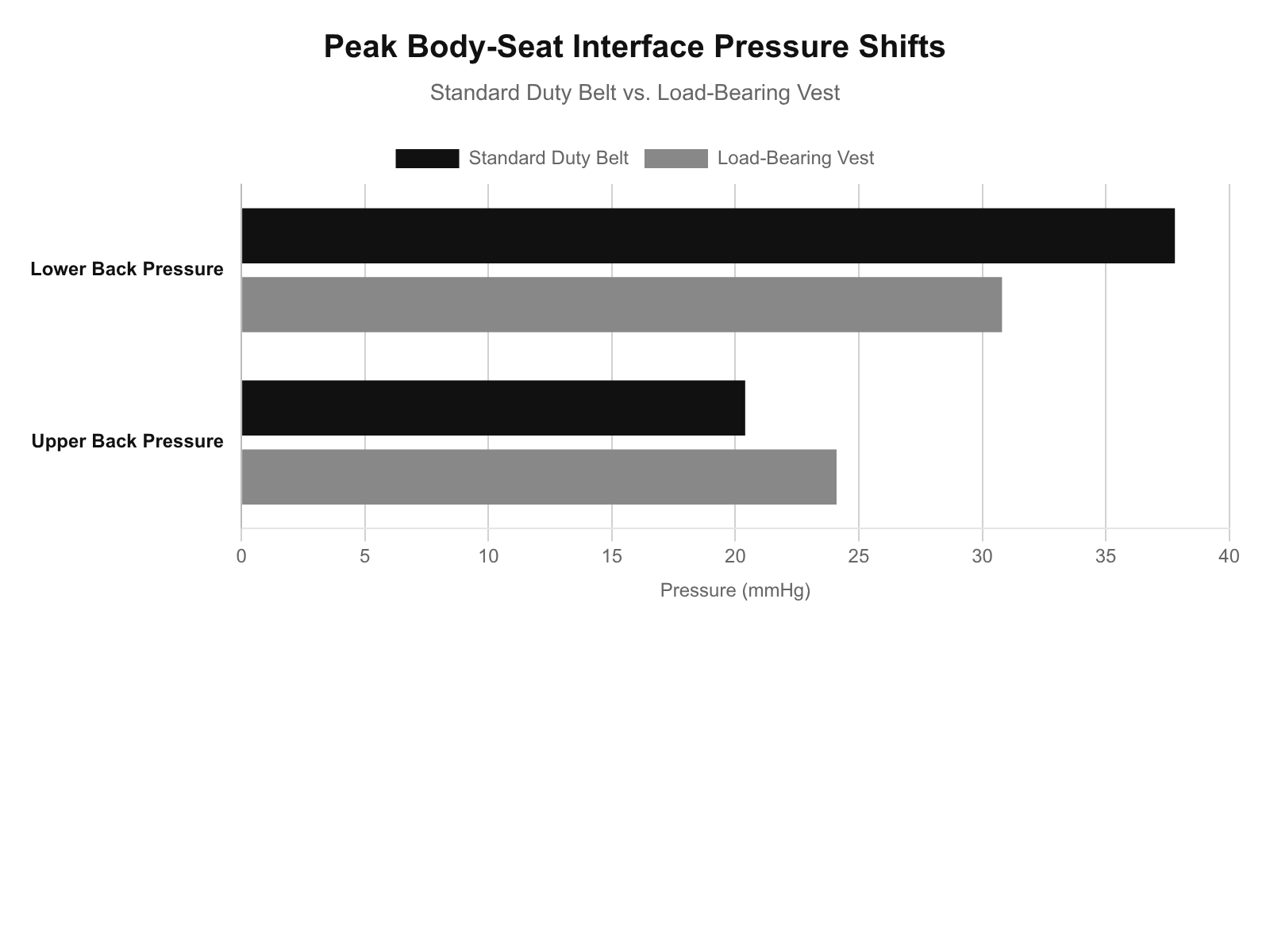
Recent biomechanical studies, continuous pressure-mapping diagnostics, and rigorous departmental pilot programs offer compelling, data-driven evidence that transitioning from traditional pelvic duty belts to load-bearing vest (LBV) outer carriers significantly mitigates these acute and chronic risks. By redistributing equipment mass across the broader surface area of the upper thorax and shoulders, LBVs eliminate the “pelvic wedge” effect that occurs in patrol vehicles, thereby reducing compressive forces on the highly vulnerable L4-L5 and L5-S1 spinal segments. Objective body-seat interface pressure mapping demonstrates that load-bearing vests decrease contact pressure in the lower back from 37.8 mmHg to 30.8 mmHg—a reduction that crosses the clinical threshold for predicting cumulative trauma. Furthermore, physiological modeling reveals that transferring weight away from the hips rectifies anterior pelvic tilt and drastically reduces the compensatory torque required by the erector spinae muscles to maintain static posture.

Despite marginal increases in upper back contact pressure and lingering departmental aesthetic concerns regarding the “militarization” of the police uniform, the strategic procurement of load-bearing vests represents a high-yield ergonomic intervention. With an average unit cost of approximately $300 to $500 per vest system, the return on investment (ROI) is realized rapidly through the prevention of a single six-figure medical claim, reduced overtime expenditures, and enhanced operational readiness. This comprehensive white paper provides an exhaustive, cross-source analysis of the biomechanical parameters, actuarial impacts, and tactical implications of duty gear load placement, serving as a definitive framework for law enforcement command staff, risk management actuaries, and defense procurement officers.

1.0 Introduction and the Evolution of Law Enforcement Load Carriage

1.1 Historical Context and the Escalation of Equipment Requirements

For the past century, law enforcement officers have quite literally carried the weight of public safety upon their waists. Twenty-five years ago, the standard police duty belt was a relatively simple apparatus.1 Constructed primarily of rigid leather, it was designed to hold a minimal inventory of essential tools: a six-shot revolver, a single set of handcuffs, a wooden straight baton, and a bulky but relatively light two-way radio.1 Even in that era, officers occasionally reported discomfort and localized fatigue from the gear’s weight and rigidity.1 To reduce weight and maintenance requirements, equipment manufacturers eventually transitioned the industry to nylon web construction.1 However, these modern materials required thicker weaves, reinforced polymer stitching, and rigid Velcro inner-belt attachments to prevent gear shifting, which inadvertently created new, highly localized pressure points and drastically reduced the belt’s overall flexibility.1

Concurrently, the escalation of public safety threats, the advent of new non-lethal technologies, and the evolution of post-Columbine active shooter protocols mandated a significant expansion of the individual patrol officer’s daily loadout.1 The contemporary inventory is extensive and dense. It typically includes a high-capacity, polymer-framed semi-automatic firearm, two to three spare high-capacity ammunition magazines, a collapsible steel baton, Oleoresin Capsicum (OC) chemical spray, an electronic control weapon (e.g., TASER), a high-lumen heavy-duty flashlight, a digital encrypted radio with lapel microphone, two sets of linked or hinged handcuffs, an individual first aid kit (IFAK), a tourniquet, and a body-worn camera system.1

1.2 Engineering Profile and Mass Distribution of the Modern Duty Loadout

The aggregate weight of this mandatory protective and tactical gear is substantial. An unloaded, baseline nylon duty belt itself weighs approximately 3.4 lbs (1.5 kg).2 When fully equipped with the aforementioned tools, the duty belt regularly weighs between 15 and 20 pounds.1 When combined with mandatory concealed internal soft body armor, the total weight of the daily uniform frequently exceeds 25 to 30 pounds, representing approximately 8 to 12% of the total body mass of the average United States law enforcement officer.2

Equipment ComponentAverage Estimated Weight (lbs)Average Estimated Weight (kg)
Concealed Protective Vest (Level II/IIIA)6.42.9
Loaded Semi-Automatic Duty Pistol2.41.1
Base Nylon Duty Belt (Unloaded)3.41.5
Spare Ammunition (2 Magazines)1.20.5
Electronic Control Weapon (TASER)1.00.4
Digital Radio & Battery1.50.7
Handcuffs (2 Pairs) & Pouches1.50.7
Expandable Steel Baton1.20.5
Flashlight, OC Spray, IFAK, Misc.2.51.1
Total Estimated System Mass21.1 lbs9.4 kg

Table 1.1: Standardized weight distribution of modern law enforcement mandatory protective gear and tactical appointments.1

The human musculoskeletal system is not anatomically optimized to sustain a circumferential, rigidly tethered load of this magnitude around the iliac crest for 8 to 12 hours per day. This mass is not perfectly symmetrically distributed; the firearm and spare magazines inherently place a dense, concentrated mass on specific quadrants of the hips, forcing the pelvis to tilt and the lumbar spine to curve laterally to maintain the body’s center of gravity.4 The resulting kinetic chain disruption serves as the foundation for widespread occupational injury.

2.0 Epidemiological Landscape of Law Enforcement Musculoskeletal Disorders

2.1 Prevalence and Incidence Rates of Lumbar Pathologies

The epidemiological data regarding law enforcement personnel and musculoskeletal degradation paints a stark, mathematically undeniable picture of severe occupational hazard. Law enforcement officers experience lower back pain at a frequency that is equal to or significantly greater than the general industrial workforce.4 Broad industry surveillance indicates that approximately 60% of all law enforcement officers will experience clinically significant lower back pain (LBP) during their careers.7

Specialized cohort studies analyzing active-duty personnel provide even more granular insight. A comprehensive survey of active-duty Swedish police officers revealed that 43% of the force reported experiencing debilitating lower back pain one or more days every single week.2 In targeted biomechanical evaluations where officer health histories were audited, up to 63% of sampled officers reported experiencing low back pain either while on duty or immediately following their shifts.2 When these officers undergo functional physical assessments, the damage is evident. Clinical sit-and-reach assessments of patrol officers wearing traditional gear reveal flexibility deficits that are severe; their functional range of motion is nearly half of the mean distance reported in healthy civilian baseline literature.2 This lack of flexibility, combined with the inherently sedentary nature of vehicular patrol duties, creates a physiological environment that is highly susceptible to both acute muscle sprains and chronic discogenic diseases.2

A comprehensive national study tracking non-fatal occupational injuries across a 12-year period (2003 to 2014) quantified this disparity. The overall injury rate for law enforcement officers was 635 per 10,000 full-time equivalent (FTE) workers.8 In stark contrast, the injury rate for all other combined U.S. workers during the same period was only 213 per 10,000 FTE.8 Specific incidence rates observed in individual precinct studies have reported staggering figures, ranging from 410 injuries per 1000 personnel per year to as high as 610.5 injuries per 1000 personnel per year, with sprains and strains to the trunk and lower extremities consistently ranking as the most common medical diagnoses.8

2.2 Vehicular Patrol Dynamics and the Seating Wedge Effect

The biomechanical hazard of the duty belt is catastrophically amplified when the officer is seated in a patrol vehicle. Modern policing is heavily vehicle-dependent, and driving for four or more hours per day—a standard metric for proactive patrol units—vastly increases, and often doubles, the risk of developing chronic lower back pain.6

Patrol vehicle seats are universally engineered for civilian commuters. They are not designed to accommodate an operator wearing 20 pounds of rigid polymer and metal gear strapped to their waist.4 In a seated position, the rigid duty belt is trapped between the officer’s posterior pelvis and the vehicle seat bolstering. This dynamic creates a “mechanical wedge.” The bulk of the rear-mounted equipment (often handcuffs, baton, or IFAK) physically displaces the officer’s torso forward, preventing the lower back from making flush contact with the seat’s engineered ergonomic lumbar support.4

Consequently, the spine is forced out of its natural lordotic curve and into a kyphotic (slouched or C-shaped) posture while driving.4 This sustained kyphotic posture places immense static strain on the posterior longitudinal ligament and forces the anterior aspect of the intervertebral discs to bear the entirety of the upper body’s compressive load, accelerating annulus fibrosus tearing and subsequent disc herniation.4

2.3 Kinematic Degradation and Tactical Vulnerability

Beyond the realm of chronic orthopedic injury, the duty belt severely restricts acute physical performance, introducing severe tactical vulnerabilities. The rigid mass of the belt physically limits ankle dorsiflexion and plantar flexion, and significantly alters peak power generation during the stance phase of walking and running gaits.11

More alarmingly, the equipment causes a measurable and profound decline in explosive power. Biomechanical performance studies testing the vertical jump of officers—both with and without their duty gear—revealed a 16% decrease in absolute power output when fully equipped.2 Duty belts and their associated loads demonstrably reduce officer agility, maximum sprinting speeds, and the critical ability to rapidly pivot, accelerate, and exit from a low car seat.12

In high-stakes tactical scenarios, such as rapidly exiting a patrol vehicle during an ambush, scaling a chain-link fence during a foot pursuit, or physically overpowering a non-compliant suspect, this kinematic restriction directly imperils officer safety.2 The inability to generate explosive power or rotate the hips freely means that officers must rely on upper-body strength and momentum, further increasing the risk of acute tearing in the lumbar musculature.2

3.0 Biomechanical Modeling: The Lumbar Spine as a Lever System

To mathematically and physiologically understand why the duty belt is so destructive, it is necessary to examine the human spine not simply as a column of bones, but as a complex biomechanical lever system. Epidemiological studies have conclusively shown that the loads imposed on the human spine during daily occupational tasks play a primary role in the onset of low back pain.13 The loads applied to the lumbar spine are shared by multiple biological structures: the erector spinae and rectus abdominis muscles; the posterior elements, including the articular facets and complex ligamentous networks; and the intervertebral discs of the ligamentous motion segments.13

3.1 Static Equilibrium and Lever Arm Mechanics

In biomechanical engineering, the human body operates on lever systems comprising four parts: a pivot (the joint), an effort arm (muscle force applied at an insertion point), a lever arm (the bone), and a load arm (the resistance or weight to be moved).14 The lower lumbar spine, specifically the intervertebral discs at L4-L5 and L5-S1, serves as the primary fulcrum for the entirety of the human torso.16

When an officer is standing, walking, or bending, the weight of the body parts above the L5-S1 joint acts as a resistance lever. To prevent the torso from simply collapsing forward under the pull of gravity, the erector spinae muscles (the vertical ridge muscles running along the back) must contract to provide the primary motive pulling force.16

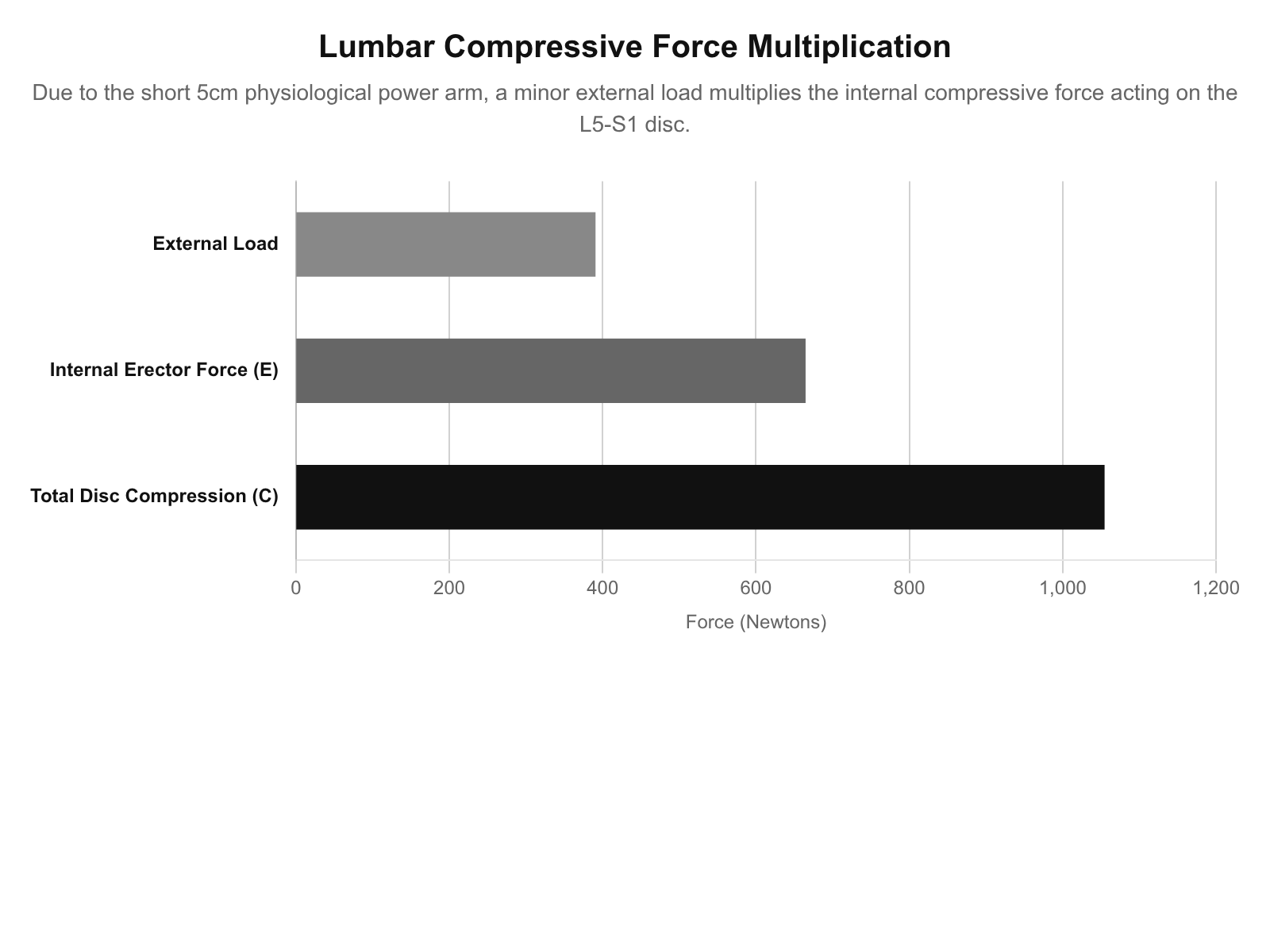
Crucially, this lever system operates at a massive mechanical disadvantage. The “power arm”—the distance from the action line of the erector spinae muscles to the spinal fulcrum (the center of the disc)—is exceptionally short. In standard biomechanical models, this internal moment arm is typically estimated to be only 5 to 6 centimeters.17 Because this power arm is exponentially shorter than the resistance arm (the length of the torso plus the extended arms and any held weight), the back muscles must generate a massive amount of internal tension to counteract relatively small external loads.16

3.2 Mathematical Formulation of L4-L5 and L5-S1 Compressive Forces

The physics of this physiological load can be calculated using a static equilibrium model of the waist. In a simplified, sagittally symmetric weight-holding task, the net reaction consists of a compressive force (C) acting downward on the lumbar motion segment, and a tension (E) generated by a single equivalent of the erector muscles.17

The static equilibrium equations require that the internal forces balance the external forces. Therefore: Net Reaction Force (Fz) = Compressive Force (C) – Erector Tension (E).17 Moment of Force (M) = length of internal effort arm (e) * Erector Tension (E).17

If we assume a standard internal effort arm (e) of 5 cm, and an external lifting moment requiring 3320 Ncm of torque, the required erector tension is calculated as: E = 3320 Ncm / 5 cm = 664 Newtons of force.17

If the external weight creates a downward force of 390 N, the total compressive force (C) crushing the intervertebral disc is the sum of the external weight and the internal muscle tension pulling down to stabilize the spine: C = 390 N + 664 N = 1054 Newtons.17

This model demonstrates a fundamental biomechanical truth: the internal compressive force (C) is consistently and considerably larger than the actual net weight of the external load.17 The magnitude of the moments of the external forces—how far away the weight is from the spine—is the major determinant of spinal destruction, rather than the absolute weight itself.17

Furthermore, human physiology is rarely statically determinate. In reality, the rectus abdominis muscles (the front core) also contract simultaneously to provide stiffness and stability when a heavy load is held. This co-contraction introduces a new variable (R) into the equation: Fz = C – E – R.17 M = (e * E) – (r * R).17

If the rectus abdominis contracts with just 200 N of force at a distance (r) of 10 cm, it forces the erector spinae to pull even harder to overcome both the external load and the abdominal contraction. In this scenario, the erector tension (E) jumps to 1064 N, and the total compressive force (C) on the disc spikes to 1654 N.17

3.3 The Physiological Load of a 20lb Duty Belt

When we apply these mathematical formulas to the law enforcement duty belt, the mechanism of injury becomes explicitly clear. A 20-pound belt does not simply add 20 pounds of downward force to the spine.

Because the belt sits below the natural center of gravity and pushes the pelvis anteriorly (forward), it creates an exaggerated lumbar lordosis (swayback).4 To compensate for this shift and prevent the torso from falling forward, the erector spinae muscles must enter a hyper-tonic state—a constant, low-level contraction.4 Because of the extreme mechanical disadvantage of the 5 cm power arm, counteracting a 20lb offset load requires hundreds of pounds of continuous internal muscle force.

Advanced biomechanical simulations utilizing Jack software and Human Posture Analysis (HPA) confirm that dynamic lifting and twisting while wearing these loads causes L4-L5 and L5-S1 compressive forces to skyrocket, varying from 3.4 to 5.0 times the total body weight of the officer.13 For a 200-pound officer, the lumbar discs may be subjected to nearly 1,000 pounds of compressive force during dynamic suspect apprehension.13

Prolonged exposure to these extreme compressive forces leads to ischemia. The intervertebral discs are largely avascular; they rely on osmotic diffusion to receive nutrients and expel cellular waste. Sustained, high-level compression physically squeezes fluid out of the disc and prevents the influx of nutrient-rich blood, accelerating cellular death, disc desiccation, and ultimately resulting in degenerative disc disease (DDD) and herniation.4

Yugo M85/M92 dust cover quick takedown pin installation detail

4.0 The Load-Bearing Vest (LBV) Intervention: Comparative Biomechanics

To mathematically and physiologically mitigate the extreme hazards of the pelvic load, the law enforcement industry and biomechanical researchers have increasingly turned to the Load-Bearing Vest (LBV), commonly referred to as an Outer Duty Carrier. This system physically uncouples heavy appointments—the radio, handcuffs, TASER, spare magazines, and heavy flashlights—from the waist and attaches them via modular webbing to a reinforced vest worn over the uniform shirt. This vest typically utilizes the officer’s existing internal ballistic armor panels or houses new panels directly within the carrier.21

4.1 Shift in Center of Mass and Thoracic Load Distribution

When 15 to 20 pounds of equipment is relocated from the rigid duty belt to the LBV, the biomechanical dynamics of the torso shift significantly. The vest distributes the mass over a vastly larger surface area—the pectoral region, the upper trapezius, the latissimus dorsi, and the clavicles—rather than concentrating it entirely upon the narrow ridge of the iliac crest.5

By removing the pelvic restriction, the hips are allowed to rotate naturally during the gait cycle, and the spine can return to a more neutral, anatomical alignment. This rectifies the anterior pelvic tilt and reduces the constant, low-level isometric firing of the erector spinae muscles.5

However, this systemic redistribution introduces a complex, but acceptable, biomechanical trade-off. While the vest completely eliminates pelvic restriction and sciatic nerve impingement, the weight of the equipment is now mounted on the chest. This anterior load is added with a relatively long moment arm relative to the lower lumbar spine.23 This longer moment arm subsequently produces a larger flexor moment on the lumbar spine, which the erector spinae must actively balance to prevent the officer from leaning forward.23 Fatigue endurance tests indicate that wearing a loaded vest can cause a faster drop in median muscle frequency (a sign of fatigue) compared to wearing no equipment at all.23 Yet, when directly compared to the destructive nature of the duty belt, the elimination of direct point-pressure on the pelvis and the restoration of natural pelvic kinematics overwhelmingly outweigh the negative impact of the anterior thoracic weight.

4.2 Pressure Mapping and Body-Seat Interface Optimization

The most conclusive, undeniable evidence supporting the transition to load-bearing vests comes from objective pressure mapping studies conducted on active-duty officers seated in standard fleet vehicles.2

Researchers utilized highly sensitive Tekscan CONFORMat sensor mats to measure contact pressure (recorded in millimeters of mercury, mmHg) and contact area (cm²) across the posterior chain of the body.10 The direct comparison of body-seat interface pressures between the two load-carriage systems reveals the precise mechanical benefit of the LBV.

Anatomical RegionStandard Duty Belt (Pressure)Load-Bearing Vest (Pressure)Statistical Significance
Lower Back37.8 mmHg30.8 mmHgSignificant Reduction (p < 0.05)
Left Buttocks40.8 mmHg37.4 mmHgTrending Lower (p = 0.052)
Right Thigh29.6 mmHg33.5 mmHgSignificant Increase (p = 0.011)
Upper Back20.4 mmHg24.1 mmHgSignificant Increase (p < 0.05)

Table 4.1: Objective Body-Seat Interface Pressure Comparison: Duty Belt vs. Load-Bearing Vest.10

Yugo M85/M92 dust cover quick takedown pin installation detail

Interpretation of Interface Pressure Shifts: Relocating the bulk of the equipment to the LBV achieves the primary ergonomic objective: it significantly and permanently reduces contact pressure in the highly vulnerable lower back region, dropping the pressure by a massive 7 mmHg.10 By removing the bulky items (handcuffs, radios) from the posterior of the belt, the officer’s buttocks and lower lumbar spine can sit perfectly flush, allowing them to position themselves much further back into the seat.10

Consequently, because the officer is sitting deeper in the seat, the upper body is now able to apply resting force directly against the backrest. This biomechanical shift perfectly explains the observed increase in upper back pressure (from 20.4 to 24.1 mmHg).10 While this does transfer some of the static load to the thoracic spine, it is a highly favorable trade-off. The thoracic region is anatomically supported by the ribcage, creating a highly stable “ribcage-sternum-spine complex”.24 This complex functions biomechanically like a series of parallel springs, distributing load across multiple rigid structures.24 Therefore, the thoracic spine is vastly more capable of absorbing and dissipating compressive forces than the isolated, unsupported lumbar spine.24 The slight increase in thigh pressure observed with the vest is a secondary effect of the modified, more natural hip angle allowed by the removal of the rigid belt constraints.10

Subjective discomfort ratings directly mirror this objective data. Utilizing the Automobile Seating Discomfort Questionnaire (ASDQ) measured on a 100mm visual analogue scale, officers rated the duty belt itself as the primary cause of seated discomfort (36 mm), with the lower back experiencing the most intense regional discomfort (30.5 mm).10 A persistent discomfort score of 30.5 mm is clinically recognized by physical therapists and ergonomists as a definitive predictor of future chronic musculoskeletal pain and imminent tissue failure.10 Wearing the LBV drastically reduced these subjective pain scores.10

4.3 Neuromuscular Activation, Fatigue, and Postural Sway

Surface electromyography (sEMG) sensors placed bilaterally on the rectus abdominis, multifidus, biceps femoris, and rectus femoris have been utilized to analyze peak muscle activity during bodyweight hip hinging and lifting tasks.7 These analyses found that wearing a vest versus a duty belt does not drastically alter the acute maximum muscle activity during isolated lifting events.7

However, analyzing simple peak muscle activity during a 5-minute test fails to capture the grueling reality of a 12-hour patrol shift. Subjective ratings derived from these exact same studies are overwhelmingly conclusive regarding endurance: participants rated the load-bearing vest condition as significantly more comfortable (p < 0.05) and noticeably less physically restrictive (p < 0.05) than the traditional law enforcement duty belt.7

This reduction in physical restriction translates directly to a delayed onset of muscular fatigue over the course of a long shift, primarily because the core musculature does not have to constantly fight the unnatural rigidity of the belt simply to perform routine tasks like exiting a vehicle or bending to pick up a dropped item. Furthermore, tests on Center of Pressure (CoP) and postural sway indicate that the vest keeps the body’s center of mass more aligned with the anatomical midline, reducing the micro-corrections the ankles and calves must make to maintain balance.25

5.0 Actuarial Analysis and Workers’ Compensation Liabilities

The physiological destruction detailed in the biomechanical models inevitably translates into severe, often crippling, financial liabilities for municipalities, county governments, and state agencies. Lower back pain is the second most common reason for missed work days, long-term light-duty assignments, disability claims, and early medical retirements among sworn police officers.6

5.1 Baseline Costs of Lumbar Pathologies in Law Enforcement

When factoring in the direct costs of medical treatment, surgical intervention, physical therapy, and the indirect costs of lost productivity, overtime required to backfill injured officers’ vacant shifts, and administrative overhead, the holistic macroeconomic cost is staggering. The National Institute for Occupational Safety and Health (NIOSH) and associated labor economists estimate that the aggregate annual cost of lower back pain and associated MSDs in the law enforcement sector approaches $56 billion nationwide.7

Workers’ compensation (WC) data serves as a critical, albeit trailing, indicator of the systemic failure of current load-bearing practices.26 Medical treatment for lumbar spine injuries is notoriously expensive, non-linear, and prone to complication. Treatment protocols typically progress from conservative physical therapy and pharmacological management to highly invasive epidural steroid injections, and ultimately to complex spinal fusion or microdiscectomy surgeries.27

Industry aggregate data reveals the following financial baselines for back injury settlements:

  • The average workers’ compensation back injury settlement across all general U.S. industries is approximately $44,158.28
  • However, for high-impact, physically demanding roles like law enforcement, where return to full duty requires passing rigorous physical fitness and defensive tactics standards, settlements are significantly higher, typically ranging from $40,000 to $80,000 for moderate, non-surgical injuries.29

5.2 State-Level Data: MIOSHA and California Settlement Benchmarks

State-level occupational health data provides a clear picture of the ongoing risk. The Michigan Occupational Safety and Health Administration (MIOSHA), in conjunction with the Bureau of Labor Statistics, continuously tracks injury rates across the public sector.30 While aggressive safety programs have successfully driven down the overall private industry incidence rate in Michigan from 11.0 per 100 FTE workers in 1977 to a historic low of 2.8 in 2023, the law enforcement sector remains disproportionately hazardous, stubbornly resisting these broader safety trends due to the unyielding nature of the duty gear.31 Furthermore, workers’ compensation surveillance programs in Michigan have specifically targeted musculoskeletal diseases as a primary cross-sector program for intervention due to their high frequency and cost.32

To mathematically illustrate the escalating financial risk based on injury severity, actuarial data from California workers’ compensation averages provides a highly accurate, tiered cost structure that risk managers can utilize for forecasting:

Clinical Injury ClassificationEstimated Direct Medical CostsEstimated Indemnity (Lost Wages/Disability)Total Expected WC Settlement Range
Minor Lumbar Sprain/Strain$5,000 – $15,000N/A (Short Term Recovery)$8,000 – $25,000 27
Herniated Disc (Non-Surgical)$15,000 – $35,000$10,000 – $25,000$25,000 – $60,000 27
Herniated Disc (Surgical Intervention)$40,000 – $70,000$30,000 – $50,000$70,000 – $120,000 27
Fractured Lumbar Vertebrae$50,000 – $90,000$40,000 – $75,000$90,000 – $165,000 27
Multi-level Spinal Fusion Surgery$100,000+$75,000+ (Potential Medical Retirement)$175,000 – $300,000+ 27

Table 5.1: Tiered Workers’ Compensation Settlement Estimates for Occupational Lumbar Injuries. Extrapolated from California WC settlement parameters and OSHA averages.27

5.3 Return on Investment (ROI) Modeling for LBV Procurement

This financial reality frames the procurement of load-bearing vests not as a discretionary uniform expense, but as a critical, high-yield risk mitigation strategy. The RAND Corporation has published extensive studies demonstrating that proactive public investment in police resources and equipment can generate substantial social and financial returns, emphasizing the need for straightforward cost-benefit analyses of personnel expenditures.33

Consider a mid-sized municipal department employing 100 sworn patrol officers. Based on the 60% prevalence rate, 60 officers will require some form of medical intervention for lower back pain during their tenure.7

  • If only 10% of those afflicted officers (just 6 individuals) suffer an injury severe enough to require surgical intervention (e.g., a herniated disc requiring a discectomy), the agency faces a baseline liability of $100,000 per officer.
  • This equates to $600,000 in direct settlement costs, entirely exclusive of the massive overtime costs required to backfill their vacant shifts during a 6 to 12-month recovery period.

Conversely, outfitting that entire 100-officer department with top-tier load-bearing vest carriers—which average approximately $300 to $500 per unit depending on modularity and armor compatibility—represents a one-time capital expenditure of only $30,000 to $50,000.5

The prevention of a single moderate herniated disc claim ($60,000) instantly pays for the complete outfitting of a 100-man department. The ROI is immediate, asymmetrical, and compounding over the lifecycle of the equipment.

6.0 Operational Case Studies and Departmental Policy Shifts

The synthesis of empirical biomechanical data and undeniable actuarial pressure has driven forward-thinking law enforcement agencies across the country to radically update uniform policies and initiate immediate equipment transition programs. A review of recent departmental interventions validates the laboratory models in real-world operational environments.

6.1 The University of Wisconsin-Eau Claire Empirical Study

Faced with a rapidly rising volume of internal complaints regarding severe back and hip pain among patrol officers, the Eau Claire (Wisconsin) Police Department (ECPD) took a proactive, scientific approach to the problem.5 Deputy Chief Matt Rokus partnered with the kinesiology department at the University of Wisconsin-Eau Claire and the Mayo Clinic Health System to conduct a rigorous, highly controlled six-month operational study.5

The methodology was highly robust. Researchers recruited 15 active-duty ECPD patrol officers and divided them into crossover groups.5 For the first three months, one group wore customized load-bearing vests while the control group continued to carry all gear on the traditional duty belt.5 The vests housed all heavy, dense equipment—the encrypted radio, multiple sets of handcuffs, and the heavy flashlight—while the firearm and TASER remained secured on a vastly lightened duty belt.5 At the three-month mark, the groups switched equipment.5 After every single 12-hour shift, the officers rigorously self-reported and documented their pain levels, any physical discomfort, and specific areas of joint restriction, generating a massive proprietary dataset.5

The findings were unambiguous:

  • Officers experienced significantly and consistently less hip and lower-back pain when wearing the LBVs.5
  • Crucially, the university researchers found absolutely no unintended negative consequences regarding the health of the officers or the functional safety of the vest.5 The vests did not limit range of motion, nor did they impede the officers’ tactical functioning or ability to draw weapons.5
  • Based on these empirical, peer-reviewed findings, the ECPD authorized a permanent transition for all 100 sworn officers in the department.5 The agency’s leadership publicly stated that the $300 unit cost per vest, alongside the associated retraining costs, was a non-negotiable, essential investment in the long-term health and survival of their officers.5

6.2 Berrien County Sheriff’s Office: Tragedy-Driven Procurement and Policy Modernization

Other jurisdictions have mirrored this transition, though often their procurement cycles are tragically accelerated following localized critical incidents or extreme workforce demands. The Berrien County Sheriff’s Office in Michigan provides a poignant case study in rapid equipment modernization and policy adaptation.3

In July 2016, a horrific incident occurred at the Berrien County Courthouse. An inmate being transported from a holding cell managed to overpower a bailiff and secure his firearm during a struggle.36 The inmate subsequently shot and killed two veteran court officers, bailiffs Ron Kienzle and Joe Zangaro, before being neutralized by responding tactical officers.36 In the wake of this tragedy, the local community rallied to improve officer safety and survivability, with the Berrien Community Foundation raising over $52,229 from private citizens and local corporations (including Whirlpool and LECO).36

Sheriff Paul Bailey utilized these funds to implement sweeping safety upgrades that targeted both tactical lethality and ergonomic survivability. The department procured Level 3 security holsters (adding complex retention steps to prevent disarming), weapon-mounted LED flashlights, and crucially, modern outer vest carriers capable of stopping high-velocity rifle rounds.36

To standardize this rapid influx of new equipment, the department codified strict uniform regulations. Berrien County’s official policy mandated that all Outer Duty Carriers must utilize matching uniform material to maintain a professional appearance, require a rear drag handle for extracting wounded officers under fire, and feature integrated mounts to properly stabilize body-worn cameras.3 Furthermore, their Special Response Team (SRT) conducted a grueling evaluation of nine different tactical vests, ultimately selecting the TYR Tactical system.37 The TYR vest provided superior maneuverability and, remarkably, weighed 13 pounds less than the archaic, 14-year-old legacy gear the SWAT officers were previously forced to wear, massively reducing their spinal load during prolonged barricaded gunman callouts.37 The holistic approach to armor extended even to the K9 unit, with specialized vests donated for police dogs Blek, Maxx, and Mika.38

6.3 California State University Channel Islands (CSUCI) Pilot Implementation

The momentum of these findings has spread to specialized law enforcement agencies, including university policing. Citing the seminal UW-Eau Claire research and direct, persistent requests from their own patrol officers, the CSU Channel Islands (CSUCI) Police Department launched an External Load Bearing Vest Pilot Program.35

The department’s official announcement explicitly outlined the actuarial reality driving the decision, noting that “across the Law Enforcement profession, many officers miss patrol shifts because of back issues, which leads to staffing shortages, overtime costs and numerous worker comp claims”.35 By proactively transitioning away from the 30-pound pelvic load, CSUCI aims to capture both short-term morale improvements and long-term health benefits, ensuring their relatively small force remains operationally viable.

7.0 Alternative Ergonomic Interventions and Engineering Shortfalls

For agencies where severe municipal budget constraints or archaically strict uniform appearance policies prohibit the immediate adoption of outer vests, several alternative load-redistribution systems have been engineered and evaluated. However, biomechanical data indicates these are largely stopgap measures.

7.1 Articulated Inner Belts and External Lumbar Supports

Equipment manufacturers have attempted to solve the duty belt problem by re-engineering the belt itself. Systems like the “Balteus Belt” utilize modern, ergonomic geometry to contour the rigid nylon to the natural, organic shape of the human hips.1 The goal is to reduce highly localized pressure points and alleviate direct strain on the sciatic nerve.1

Other interventions include external lumbar support braces, such as the “BackUpBrace.” These devices attach directly to standard 2-inch duty belts, aiming to shift the load from the waistline down onto the wider structure of the hips, utilizing physics similar to the padded waist belt of a heavy-duty hiking backpack.4 They attempt to mechanically stabilize the natural lumbar curve under load and create a padded pressure buffer between the rigid belt and the officer’s spine.4

While these modifications offer measurable, incremental relief from acute surface pressure, they fail to address the fundamental biomechanical flaw: the mass is still located below the center of gravity, and they absolutely do not resolve the vehicular seating wedge issue. When seated, the equipment still physically prevents the officer from utilizing the vehicle’s lumbar support.

7.2 Suspenders and Harness Systems

Duty suspenders represent an older, but still utilized, approach. These simple strap systems attach to the existing duty belt via keepers and transfer a portion of the vertical load from the pelvis upward to the trapezius muscles and clavicles.41

While highly effective at reducing the sheer downward compressive force on the hips, suspenders introduce their own ergonomic hazards. They can cause nerve impingement in the shoulders if worn tightly, and like ergonomic belts, they completely fail to eliminate the pelvic wedge effect when seated in a patrol vehicle. The rigid gear remains exactly where it causes the most postural damage during the 4 to 8 hours an officer spends driving.4 The empirical data consistently indicates that these are half-measures compared to the comprehensive, multi-axis load redistribution achieved by a full outer carrier system.

8.0 Strategic Procurement Recommendations and Tactical Considerations

Transitioning a police force from traditional belts to load-bearing vests is not merely a medical or financial decision; it is a profound tactical shift that requires careful consideration of officer performance, training liabilities, and public perception.

8.1 Muscle Memory, Training, and Lethal Force Access

When critical equipment is relocated from the waist to the chest, the muscle memory required to instinctively access those tools—specifically the encrypted radio, handcuffs, and spare magazines—must be entirely reprogrammed.5

Under the extreme physiological stress and auditory exclusion of a lethal force encounter, fine motor skills degrade, and officers default to highly ingrained reflexive muscle memory. If an officer instinctively reaches for a waist-mounted magazine pouch that has been moved to their chest, that split-second delay can be fatal. Therefore, agencies must pair the physical issuance of new vests with mandatory, high-repetition defensive tactics and firearms training.5 The Eau Claire study specifically noted that all officers underwent extensive retraining to create new reflexive responses before the equipment was authorized for street patrol.5

From a kinematic perspective, once the retraining is complete, the vest massively improves tactical geometry. By clearing the waistline, officers can achieve deeper, unimpeded knee flexion and full-range hip rotation during foot pursuits, suspect apprehension, and ground-fighting scenarios.

8.2 Thermal Burden and Environmental Adaptability

A frequently cited concern regarding outer carriers is the thermal burden they place on the officer during summer months. Traditional uniform shirts worn over internal soft body armor trap immense amounts of heat against the core, as the Kevlar acts as a highly effective insulator.

Modern outer carriers actually resolve this issue. They allow officers to wear specialized, moisture-wicking synthetic “combat shirts” or base layers underneath the vest. More importantly, the outer carrier provides modularity. When an officer returns to the precinct to spend three hours writing arrest reports, they can easily un-Velcro and doff the heavy vest entirely, allowing their core to cool. This rapid donning and doffing capability is impossible with the traditional locked-in internal vest setup, making the LBV superior for overall thermal regulation.

8.3 Mitigating the “Militarization” Aesthetic Concern

The primary obstacle preventing the universal adoption of load-bearing vests across the United States is aesthetic and political, not functional. Many traditional, highly conservative police departments resist the transition out of concern that external tactical vests project an aggressive, “militaristic” appearance that damages community relations and creates psychological barriers between the police and the public.2

These agencies often prioritize the clean, approachable, “Sheriff Andy Taylor” look of the traditional Class A/B uniform with a polished duty belt, adhering strictly to a historical paradigm of policing.2

However, defense contractors and equipment manufacturers have rapidly responded to this political concern by developing “uniform-style” outer carriers. These highly engineered vests are tailored using the exact same polyester/wool blend fabrics as the department’s standard shirts. They feature faux buttons down the center, sewn-in military creases, standard metal badge grommets, and traditional nametag placements. They perfectly mimic the appearance of a standard button-down uniform shirt, while covertly providing the load-bearing capability and concealed MOLLE (Modular Lightweight Load-carrying Equipment) webbing necessary to mount gear safely.

The aesthetic argument against load-bearing vests is increasingly difficult for command staff to justify when directly weighed against the objective reality of crippling officer injuries, massive six-figure financial liabilities, and demonstrably degraded tactical performance.

9.0 Conclusion

The traditional law enforcement duty belt is an ergonomic anachronism. As the physical demands, non-lethal tool requirements, and tactical complexities of modern policing have exponentially expanded, the 2-inch waist belt has transformed from a simple utility tool into a profound occupational hazard. The concentration of 15 to 30 pounds of rigid, unyielding mass upon the pelvic girdle fundamentally disrupts human lumbar biomechanics. It forces the erector spinae muscles into continuous hyper-tonic contraction, generates extreme, localized pressure points within fleet vehicles, and is the direct, undeniable causal factor in the epidemic of lower back pain afflicting 60% of all law enforcement officers.

The financial consequences of maintaining this outdated paradigm are unsustainable. With individual workers’ compensation claims for lumbar spinal injuries routinely exceeding $75,000 to $150,000, and system-wide macroeconomic costs reaching into the billions, municipal liability is acute and compounding.

Conversely, the biomechanical, kinematic, and epidemiological data supporting the transition to Load-Bearing Vest (LBV) outer carriers is robust and conclusive. By transferring the mass from the vulnerable lumbar fulcrum to the highly stable, parallel-spring structure of the thoracic ribcage, LBVs completely alleviate the biomechanical wedge effect in vehicle seating, reducing lower back interface pressure by nearly 20%. Rigorous field trials confirm significant, permanent reductions in officer pain without compromising tactical effectiveness, agility, or range of motion.

Command staff and procurement officers must view the procurement of Load-Bearing Vests not as a discretionary uniform expenditure, but as a critical medical intervention, an essential risk management tool, and a vital investment in the operational lethality and longevity of their personnel. The mandate is clear: optimizing the physiological survival of the individual police officer directly correlates with enhanced public safety, massively reduced municipal financial liability, and the preservation of the highly trained law enforcement workforce.

Appendix: Methodology & Data Sources

This analytical white paper was synthesized utilizing rigorous, cross-source Open-Source Intelligence (OSINT) and academic database retrieval protocols. The deep-research methodology involved a systematic, qualitative, and quantitative review of peer-reviewed biomechanical literature, governmental occupational safety reports (NIOSH, MIOSHA), municipal workers’ compensation actuarial data, and localized law enforcement agency policy documents.

Data Parameters and Analytical Framework:

  • Biomechanical Metrics: Engineering data was extracted from advanced kinematic and pressure-mapping studies detailing L4-L5 and L5-S1 compressive forces, static equilibrium net reaction models, and body-seat interface pressures (measured in mmHg) for standard police fleet vehicles.
  • Epidemiological & Financial Data: Statistical baselines were sourced from the Bureau of Labor Statistics (BLS), state-level workers’ compensation actuary tables (specifically utilizing California severity tiers and OSHA national averages), and longitudinal occupational health studies of both U.S. and Swedish active-duty police personnel.
  • Operational Case Studies: Real-world policy shifts and pilot program data were collated from municipal press announcements, university research partnerships (e.g., University of Wisconsin-Eau Claire Kinesiology Department), and local news reporting on departmental transitions (e.g., Berrien County Sheriff’s Office, CSUCI Police Department).
  • Data Synthesis: Disparate data points were unified through a static equilibrium biomechanical model to definitively and mathematically compare the physiological toll of pelvic-borne (belt) versus torso-borne (vest) load carriage systems.

Ronin’s Grips Analytics provides custom, agency-specific data on this topic. Contact us to commission a tailored internal audit or procurement forecast for your department.


Please share the link on Facebook, Forums, with colleagues, etc. Your support is much appreciated and if you have any feedback, please email us in**@*********ps.com. If you’d like to request a report or order a reprint, please click here for the corresponding page to open in new tab.


Sources Used

  1. A Deep Dive into the Balteus Belt: Solving the Pain of Traditional Duty Gear – Urban Tactical, accessed March 5, 2026, https://urbantactical.com/blogs/product-reviews-and-comparisons/a-deep-dive-into-the-balteus-belt-solving-the-pain-of-traditional-duty-gear
  2. Protective Gear Negatively Impacts Police Officer Mobility, Stability, and Power Generation – PMC, accessed March 5, 2026, https://pmc.ncbi.nlm.nih.gov/articles/PMC12452377/
  3. 3-03/350.00 – Protective Vests – PARS Public Viewer, accessed March 5, 2026, https://pars.lasd.org/Viewer/Manuals/10008/Content/19076#!
  4. How to Prevent Duty Belt Back Pain – BackUpBrace.com, accessed March 5, 2026, https://backupbrace.com/blogs/news/how-to-prevent-back-pain-from-duty-belt
  5. UW-Eau Claire research aims to improve police officers’ health, quality of life | All In Wisconsin, accessed March 5, 2026, https://www.wisconsin.edu/all-in-wisconsin/story/uw-eau-claire-research-aims-to-improve-police-officers-health-quality-of-life/
  6. Back Pain Relief for Police Officers – Wellness Support, accessed March 5, 2026, https://www.spinalrehabilitationwellnesscenter.com/relief-for-police-officers-who-suffer-with-back-pain/
  7. Effect of the Law Enforcement Duty Belt on Muscle Activation during Hip Hinging Movements in Young, Healthy Adults – PMC, accessed March 5, 2026, https://pmc.ncbi.nlm.nih.gov/articles/PMC10366834/
  8. NON-FATAL INJURIES TO LAW ENFORCEMENT OFFICERS – National Policing Institute, accessed March 5, 2026, https://www.policinginstitute.org/wp-content/uploads/2018/07/Non-fatal-Injuries-to-LEOs-Research-Summary-2018.pdf
  9. A Profile of Injuries Sustained by Law Enforcement Officers: A Critical Review – PMC, accessed March 5, 2026, https://pmc.ncbi.nlm.nih.gov/articles/PMC5334696/
  10. Duty belt or load-bearing vest? Discomfort and pressure distribution for police driving standard fleet vehicles. – Diva-Portal.org, accessed March 5, 2026, https://www.diva-portal.org/smash/get/diva2:1193715/FULLTEXT01.pdf
  11. Impacts of Duty Belts and Load Placement on Police Officers: A Systematic Review – Bond University, accessed March 5, 2026, https://pure.bond.edu.au/ws/portalfiles/portal/246711146/Impacts_of_Duty_Belts_and_Load_Placement_on_Police_Officers.pdf
  12. Impacts of Duty Belts and Load Placement on Police Officers: A Systematic Review – Semantic Scholar, accessed March 5, 2026, https://pdfs.semanticscholar.org/edf5/69df6360b9cf12e484c84edc59e26ea47336.pdf
  13. Loads in the Spinal Structures During Lifting: Development of a Three-Dimensional Comprehensive Biomechanical Model – PubMed, accessed March 5, 2026, https://pubmed.ncbi.nlm.nih.gov/7552650/
  14. What levers does your body use? – Science Learning Hub, accessed March 5, 2026, https://www.sciencelearn.org.nz/resources/1924-what-levers-does-your-body-use
  15. Biomechanics: Lever Systems in the Body, accessed March 5, 2026, https://www.visiblebody.com/blog/biomechanics-lever-systems-in-the-body
  16. A Biomechanical Waist Comfort Model for Manual Material Lifting – PMC, accessed March 5, 2026, https://pmc.ncbi.nlm.nih.gov/articles/PMC7459927/
  17. Analysis of Loads on the Lumbar Spine – CDC Stacks, accessed March 5, 2026, https://stacks.cdc.gov/view/cdc/224809/cdc_224809_DS1.pdf
  18. Low Back Biomechanics during Repetitive Deadlifts: A Narrative Review – PMC – NIH, accessed March 5, 2026, https://pmc.ncbi.nlm.nih.gov/articles/PMC9837526/
  19. (PDF) A Biomechanical Waist Comfort Model for Manual Material Lifting – ResearchGate, accessed March 5, 2026, https://www.researchgate.net/publication/343693703_A_Biomechanical_Waist_Comfort_Model_for_Manual_Material_Lifting
  20. Disc disease and a weighted vest: Still a good idea? | Physical Therapy Bellingham, accessed March 5, 2026, https://integrativephysicaltherapyservices.com/disc-disease-and-a-weighted-vest-still-a-good-idea/
  21. Evaluation of Low Back Pain and Duty Equipment Wear Configurations in Police Officers – CDC, accessed March 5, 2026, https://www.cdc.gov/niosh/hhe/reports/pdfs/2017-0049-3367.pdf
  22. Load-bearing vest vs. duty belt: Ergonomic researchers determine the winner – Police1, accessed March 5, 2026, https://www.police1.com/officer-safety/articles/load-bearing-vest-vs-duty-belt-ergonomic-researchers-determine-the-winner-BXAKXHhAdMdbM2qR/
  23. Influence of Wearing Ballistic Vests on Physical Performance of Danish Police Officers: A Cross-Over Study – PMC, accessed March 5, 2026, https://pmc.ncbi.nlm.nih.gov/articles/PMC7961692/
  24. A Biomechanical Model for Estimating Loads on Thoracic and Lumbar Vertebrae – PMC, accessed March 5, 2026, https://pmc.ncbi.nlm.nih.gov/articles/PMC2949493/
  25. Figure 1. Center of pressure (CoP) group score comparison of vest… – ResearchGate, accessed March 5, 2026, https://www.researchgate.net/figure/Center-of-pressure-CoP-group-score-comparison-of-vest-group-1-no-equipment-group-2_fig1_357586081
  26. On-duty Injuries Among Ohio Law Enforcement Officers | NIOSH Blogs – CDC, accessed March 5, 2026, https://www.cdc.gov/niosh/blogs/2023/leo-injuries.html
  27. How Much Are Workers Comp Lower Back Injury Settlements in CA? – Scher, Bassett & Hames, accessed March 5, 2026, https://scherandbassett.com/workers-compensation-settlement-amounts-lower-back-injuries-california/
  28. Workers’ Comp Back Injury Settlements – Matt Fendon Law Group, accessed March 5, 2026, https://www.fendonlaw.net/blog/workers-comp-settlement-back-injury/
  29. What’s the Average Workers’ Comp Settlement for a Back Injury? | Pasternack Tilker Ziegler Walsh Stanton & Romano LLP Attorneys At Law, accessed March 5, 2026, https://www.workerslaw.com/posts/whats-the-average-workers-comp-settlement-for-a-back-injury/
  30. Non-Fatal Occupational Injury & Illness Data – State of Michigan, accessed March 5, 2026, https://www.michigan.gov/leo/bureaus-agencies/miosha/resources/data-and-statistics/non-fatal-occupational-injury-illness-data
  31. MIOSHA eNews — December 3, 2024 – GovDelivery, accessed March 5, 2026, https://content.govdelivery.com/accounts/MILEO/bulletins/3c373bb
  32. Final Progress Report Use of Michigan Workers’ Compensation Data for Surveillance of Work-Related Injuries and Illnesses Award, accessed March 5, 2026, https://oem.msu.edu/images/resources/Works%20Comp/FinalReport2020.pdf
  33. Research Demonstrates Quantifiable Benefits from Police Personnel Investments – RAND, accessed March 5, 2026, https://www.rand.org/news/press/2010/03/16.html
  34. The hidden benefits of reducing LEOs’ back pain | PoliceOne – Police1, accessed March 5, 2026, https://www.police1.com/police-products/duty-gear/articles/the-hidden-benefits-of-reducing-leos-back-pain-1tcAPsdVLgX9BYbb/
  35. External Load Bearing Vest Pilot Program – Police Operations – CSU Channel Islands, accessed March 5, 2026, https://www.csuci.edu/publicsafety/police/load-bearing-vest.htm
  36. Thousands raised to outfit Berrien County Sheriff’s Dept. with new safety gear – ABC57, accessed March 5, 2026, https://www.abc57.com/news/thousands-raised-to-outfit-berrien-county-sheriffs-dept-with-new-safety-gear
  37. Police Officers in Warren, Michigan to Receive New Body Armor, accessed March 5, 2026, https://www.bodyarmornews.com/police-officers-to-receive-new-body-armor/
  38. Berrien County K9s join the ‘pack’ with new body armor | Moody on the Market, accessed March 5, 2026, https://www.moodyonthemarket.com/berrien-county-k9s-join-the-pack-with-new-body-armor/
  39. Something to Wag About: Body armor donated to Berrien County police dogs | wzzm13.com, accessed March 5, 2026, https://www.wzzm13.com/article/life/animals/something-to-wag-about-body-armor-donated-to-berrien-county-police-dogs/69-ec2dfad7-16f9-413c-8967-78493e994de1
  40. Berrien County Sheriff’s Department sued over allegations of sexual discrimination, accessed March 5, 2026, https://www.999ycountry.com/2026/02/27/berrien-county-sheriffs-department-sued-over-allegations-of-sexual-discrimination/
  41. Ergonomic Load Bearing Systems – Office of Justice Programs, accessed March 5, 2026, https://www.ojp.gov/pdffiles1/nij/grants/229710.pdf

Transforming Tactical Intelligence with OSINT and SOCMINT

Executive Summary (BLUF)

The contemporary operational environment for law enforcement and tactical units is increasingly defined by the convergence of digital data streams and physical kinetic actions. Open-Source Intelligence (OSINT) and Social Media Intelligence (SOCMINT)—historically utilized as slow-moving, post-incident investigative tools—have evolved into mission-critical, real-time assets. When properly filtered, analyzed, and disseminated, social media data provides deployed forces with unprecedented situational awareness, enabling pre-mission environment shaping, real-time threat detection, and dynamic tactical adjustments during high-risk operations.

In the highly volatile realm of global security, criminal networks, terrorist organizations, and hostile crowds have mastered the use of ubiquitous digital platforms to advance their goals, communicate intent, and orchestrate physical movements. To counter these technologically enabled asymmetric threat vectors, law enforcement agencies must transition their intelligence apparatus from a state of passive historical collection to active, real-time exploitation. This transformation requires a highly technical architecture that aggressively filters the infinite noise of the internet, extracts verified threat indicators using artificial intelligence, and pushes concise, geolocated intelligence directly to the tactical edge without overwhelming the operator’s cognitive load.

This comprehensive analysis examines the technical data pipelines, operational workflows, and hardware procurement strategies required to transform vast, unstructured public data into actionable intelligence for tactical elements. The report details the transition of data from cloud-based multi-platform scrapers and AI-driven signal-to-noise filters, through the centralized command hub of a Real-Time Crime Center (RTCC), and ultimately to the operator at the tactical edge via the Android Tactical Assault Kit (ATAK) and mesh-networked End User Devices. Through the examination of operational case studies encompassing civil unrest, hostage rescues, and fugitive apprehension, this white paper demonstrates that the integration of OSINT into the tactical Common Operational Picture drastically reduces the latency between intelligence collection and kinetic execution. Furthermore, the analysis provides command staff and procurement officers with vendor landscape evaluations, pricing models, and strategic recommendations for legally compliant, technologically robust intelligence frameworks.

1.0 Introduction: The Evolution of Tactical OSINT and SOCMINT

The proliferation of ubiquitous internet connectivity, smartphone penetration, and social media engagement has fundamentally altered the landscape of law enforcement intelligence.1 Open-source intelligence—defined strictly within the intelligence community as intelligence derived exclusively from publicly or commercially available information that addresses specific intelligence priorities, requirements, or gaps—now accounts for the vast majority of actionable data utilized by the defense and law enforcement sectors.2 According to historical assessments by the Defense Intelligence Agency, OSINT provides roughly ninety percent of the information used by the broader intelligence community, rendering it an indispensable pillar of modern security operations.3 Within this broader domain, Social Media Intelligence provides unique, real-time insights into suspect movements, organizational structures, public sentiment, and immediate physical threats.4

Historically, OSINT was primarily a strategic, investigative asset. Analysts would spend days or weeks manually aggregating public records, forum posts, news articles, and financial data to build long-term criminal network profiles or assess the historical trajectory of threat actors.6 This methodology traces its roots back to the Second World War, where intelligence agencies monitored enemy radio broadcasts and propaganda to gauge troop morale and strategic intent without requiring clandestine border crossings.8 However, the transformation of the internet from a read-only Web 1.0 environment to a user-generated Web 2.0 ecosystem heralded a new era of intelligence.9 The modern threat matrix is now characterized by flash mobs, highly organized civil unrest, live-streamed active shooter events, and the rapid, decentralized movement of fugitives. This environment demands a tactical application of OSINT. Tactical OSINT requires the near-instantaneous collection, verification, and dissemination of data to ground force commanders and operators actively engaged in a mission, providing them with near-real-time information critical to split-second decision-making.3

The critical challenge facing law enforcement command staff today is no longer data scarcity, but rather data overload.10 Over forty-one percent of the global population has access to smartphones, creating a continuous stream of uploaded images, videos, opinions, and geospatial metadata.1 During a crisis, the sheer volume, velocity, and variety of unstructured data generated across the internet can quickly paralyze an intelligence unit.11 Therefore, maximizing the use of social media for OSINT relies on establishing a highly technical, automated data pipeline. This infrastructure must aggressively filter noise, extract relevant threat indicators via advanced artificial intelligence, and push concise, geolocated intelligence directly to the tactical edge.13

2.0 Technical Architecture of Real-Time OSINT Data Pipelines

To make OSINT actionable for deployed forces, agencies must implement a structured, automated intelligence architecture. Relying on manual searches across disparate social media platforms using standard web browsers is a lethal vulnerability in fast-paced kinetic environments, leading to unacceptable latency and the risk of missing critical links hidden within vast digital silos.10 The modern pipeline consists of automated ingestion, artificial intelligence filtering, and precise geospatial anchoring.

2.1 Data Ingestion and Multi-Platform Scraping

The foundation of the tactical OSINT pipeline is the continuous, automated ingestion of data from the surface web, deep web, and dark web. Modern OSINT platforms utilize Application Programming Interfaces (APIs) and advanced web scraping tools to monitor target vectors across hundreds of platforms simultaneously, transforming unstructured chaos into a unified, real-time intelligence layer.10

Enterprise platforms such as ShadowDragon’s SocialNet and Fivecast ONYX provide investigators with access to over two hundred distinct online data sources.20 These systems consolidate social media posts, messaging app communications on platforms like Telegram and WhatsApp, domain records, financial transactions, and dark web breach data into a single operational interface.18 Crucially, this ingestion is not limited to text-based analysis; it encompasses multimodal data, including high-resolution images, live-streamed video, audio files, and embedded geospatial metadata.17

For tactical teams, this ingestion must be hyper-local and chronologically immediate. Analysts utilize digital profiling and geofencing technologies to draw a digital perimeter around a target building, a planned protest route, or a hostage stronghold.17 This localized ingestion captures all public social media activity originating within that specific physical space, allowing the intelligence cell to identify the presence of non-combatants, the establishment of suspect fortifications, or the arrival of hostile reinforcements prior to a dynamic breach.23 Furthermore, advanced tools allow analysts to use advertising intelligence (ADINT) to track device movements and identifiers across multiple ad networks, providing an alternative vector for location tracking when standard social media signals are obfuscated.17

2.2 Signal-to-Noise Reduction and AI-Enabled Filtering

The fundamental mathematical and operational challenge of OSINT is optimizing the Signal-to-Noise Ratio. During a highly publicized event, such as a major riot or a terrorist attack, the exponential increase in public social media posting creates massive data noise. Manual processing latency increases proportionally, effectively reducing the value of the intelligence to zero before the tactical element can act upon it.8

To solve this latency, law enforcement agencies must deploy Artificial Intelligence and Machine Learning algorithms directly at the ingestion layer.13 These technologies serve as the primary filter, allowing human analysts to focus on verification rather than discovery. Modern platforms utilize several distinct AI vectors. Natural Language Processing scans unstructured text in over one hundred languages to identify specific threat indicators, criminal slang, or mentions of weaponry, bridging critical linguistic gaps during transnational investigations.11 Computer Vision algorithms analyze massive volumes of uploaded images and video to automatically identify specific objects—such as firearms, explosive precursors, or tactical gear—as well as logos or specific individuals via facial recognition overlays.14 Additionally, Sentiment Analysis monitors the emotional tone of a crowd’s digital footprint. A sudden algorithmic detection of a shift from peaceful rhetoric to violent coordination on platforms like X or Telegram can serve as an invaluable early warning indicator for deployed riot control units.3

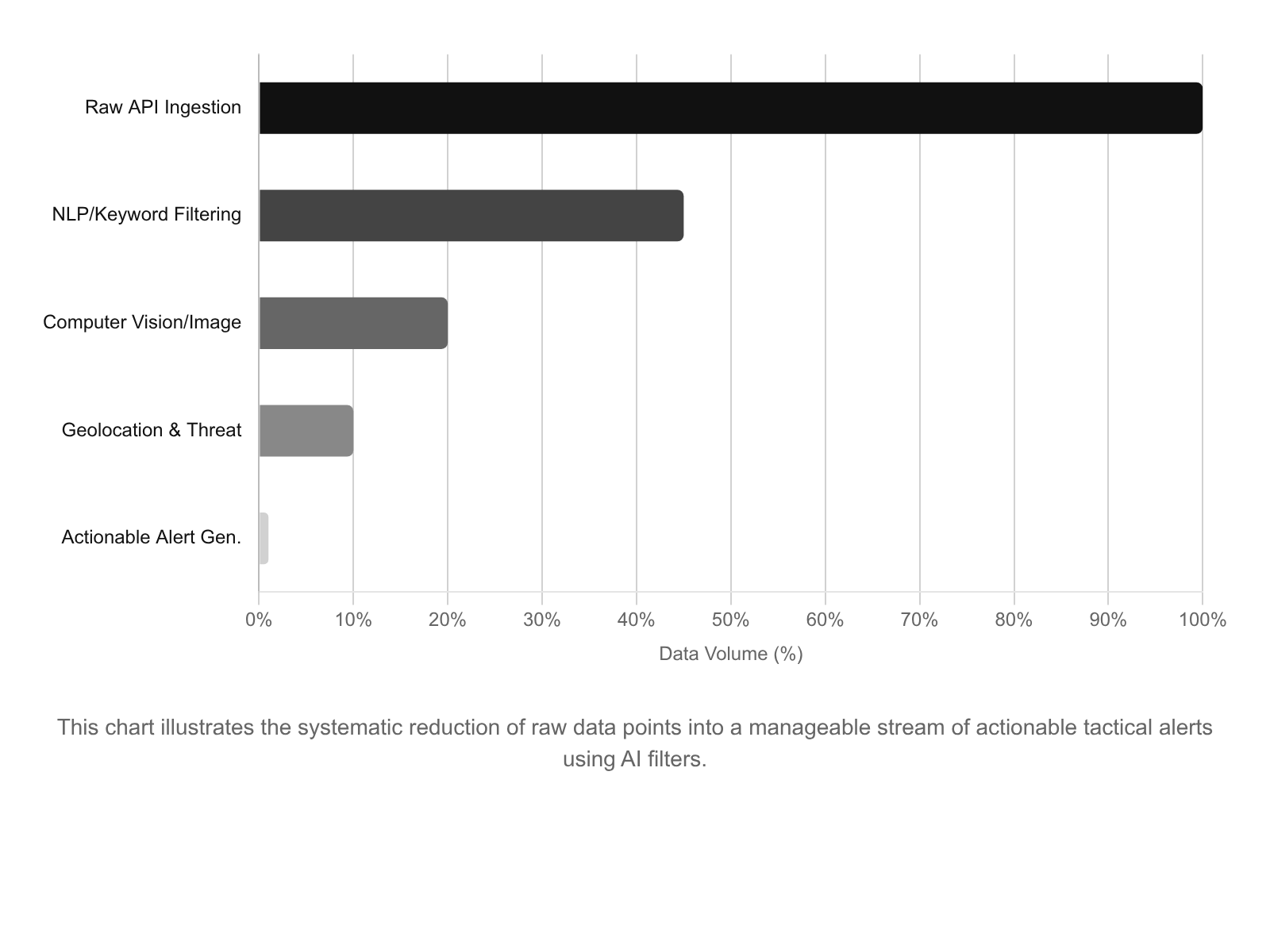
The following visual representation illustrates the critical impact of AI filtering on the data pipeline, demonstrating how millions of raw data points are systematically reduced into a manageable stream of tactical alerts suitable for field dissemination.

CHART 1.0: OSINT DATA FUNNEL AND AI SIGNAL-TO-NOISE REDUCTION

Yugo M85/M92 dust cover quick takedown pin installation detail

2.3 Advanced Visual Geolocation and Chronolocation Techniques

Intelligence is tactically useless if it cannot be mapped to physical space. Determining the exact physical location of a suspect, victim, or hostile crowd based on their digital footprint is the most critical step in translating OSINT into kinetic action.19 While the digital environment is vast, every action leaves a trace that can be anchored to the physical world through rigorous analytical techniques.

Analysts employ multiple technical methods to extract and verify location data. The most direct method involves extracting Geotags and Metadata, specifically the Exchangeable Image File Format data embedded within digital photographs, which frequently contains exact Global Positioning System coordinates detailing where the device was located when the image was captured.4 However, sophisticated threat actors routinely scrub metadata before posting. In these instances, analysts pivot to Visual Geolocation and landmark identification. This technique involves analyzing visual clues within the media, such as architectural styles, unique vegetation, street signs, or infrastructure patterns.25 AI-driven tools like Picarta.ai, GeoSpy, and Google’s Cloud Vision API (Gvision) assist analysts by cross-referencing these visual features against global databases like Google Street View and OpenStreetMap to predict the location with high accuracy.26

Furthermore, analysts utilize Chronolocation—often referred to as shadow analysis—to verify the exact timeline of a target’s movements. By utilizing tools like SunCalc, investigators can analyze the angle, direction, and length of shadows cast by objects in a photograph or video.25 By calculating the sun’s position relative to the visually identified geographic coordinates, analysts can determine the exact time of day the media was captured, proving whether an image is a live representation of a threat or a recycled piece of disinformation.25 Finally, IP Address tracing and the analysis of network traffic patterns provide an approximate geographical radius of a device, narrowing the search field for subsequent visual analysis.26

When combined, these techniques create a robust digital breadcrumb trail.6 For example, a target may post an image without a geotag, but visual analysis identifies a specific intersection in the background, and chronolocation verifies the image was taken within the last ten minutes. This multidimensional verification allows command staff to adjust the deployment of containment perimeters or direct tactical teams with absolute confidence.4

3.0 Command and Control: The Real-Time Crime Center Ecosystem

The most sophisticated OSINT collection is rendered obsolete if it remains trapped on an analyst’s desktop inside headquarters. The intelligence must be pushed securely, rapidly, and legibly to the operators in the field, who are often operating in chaotic, low-bandwidth, or hostile environments.29 The bridge between the digital intelligence cloud and the physical tactical edge is the Real-Time Crime Center.

3.1 Centralized Data Fusion and Software Integration

Real-Time Crime Centers serve as the centralized nervous system for modern law enforcement operations.30 These specialized public safety units function as hubs where criminal information and intelligence analysis are fused into a cohesive operational picture. RTCCs ingest the AI-filtered OSINT from platforms like ShadowDragon and Fivecast and fuse it with a multitude of other proprietary data streams. These internal streams include computer-aided dispatch (CAD) data, fixed closed-circuit television cameras, automated license plate readers, municipal drone feeds, and body-worn camera transmissions.31

Platforms such as Axon Fusus provide the critical single-pane-of-glass interface required by the RTCC analyst.31 The workflow is highly integrated: when a social media threat is detected and geolocated by an OSINT platform, the RTCC analyst receives an immediate alert.20 The analyst can then utilize the Fusus map-based interface to pull up the nearest public or registered private security cameras to physically verify the digital threat in real time.34 Once verified, the RTCC acts as the dissemination node, packaging the intelligence—such as target photos, exact coordinates, known associates, and building floor plans—and pushing it directly to the tactical teams navigating to the objective.23

3.2 Regional Hubs and Information Sharing

The efficacy of an RTCC relies on regional interoperability and information sharing. The Michigan State Police provide a premier example of this architecture through the Michigan Intelligence Operations Center, a fusion center that provides continuous statewide information sharing among local, state, and federal public safety agencies.36 Regional Communication Centers across Michigan, such as those in Dimondale, Detroit, and Gaylord, provide direct operational support to specialty teams, integrating live highway camera feeds and intelligence data to support real-time decision-making.37

At the county level, interoperability is achieved through shared public safety software. For instance, the Berrien County Board of Commissioners in Michigan recently supported the implementation of a Mobile CAD program to expand access to real-time dispatch information, mapping, and resource data across forty-seven distinct first responding agencies within the county.38 This technological expansion, supported by strategic partnerships with software providers like Mark43 and Mi-Case, ensures that even smaller, resource-constrained municipal departments have the situational awareness necessary to coordinate seamlessly with county sheriffs and federal entities like the FBI during complex, multi-jurisdictional operations.40

4.0 Tactical Edge Dissemination: ATAK and the Common Operational Picture

To receive real-time OSINT at the point of impact, deployed forces increasingly utilize the Android Team Awareness Kit, an advanced geospatial infrastructure and military-grade situational awareness application originally developed by the Department of Defense.15 ATAK provides a Common Operational Picture, ensuring that the tactical commander, the RTCC analysts, and every individual operator in the stack share the exact same interactive map and intelligence overlay.29

4.1 Cursor on Target and Plugin Infrastructure

ATAK operates on a protocol known as Cursor on Target, a standardized XML-based schema designed to communicate the what, when, and where of any entity or event across disparate software systems.43 The power of ATAK lies in its open-source standard, allowing developers to create highly specialized plugins that integrate external intelligence feeds directly into the operator’s display.47

OSINT feeds are seamlessly integrated into ATAK via aggregator plugins like TrakBridge, which converts external location APIs and open-source intelligence feeds—such as the DeepStateMap live feed—into CoT format.48 When an RTCC analyst identifies a critical OSINT update, such as a hostage taker posting a live stream from a specific room within a stronghold, the analyst drops a CoT marker on their interface. Instantly, every operator on the entry team receives the update on their device. They can view the target building mapped out, with a red hostile icon indicating the suspect’s exact location, complete with an attached screenshot extracted from the social media live stream.15

This visual integration is revolutionary for tactical operations. It prevents the fatal funnel of traditional radio communication, where complex descriptions of suspect clothing, building layouts, or precise coordinate data are frequently misunderstood over crackling, congested, and high-stress radio traffic. Instead, operators receive high-fidelity, visual intelligence that requires minimal cognitive processing to understand.49 Furthermore, Unmanned Aerial Systems (UAS) plugins integrate commercial drones directly into the network, projecting the drone’s map position, sensor field of view, and live video feed onto the ATAK screens of ground personnel.43

4.2 Weapon-Mounted Displays and Visual Augmentation

The integration of OSINT and situational awareness does not stop at the handheld device; it extends directly to the operator’s weapon system and optics. Engaging with a handheld screen during a kinetic firefight degrades an operator’s readiness. To mitigate this, advanced optical systems like the Enhanced Clip-on Thermal Viewer (ECOTI) and the Enhanced Clip-on SWIR Imager (ECOSI) integrate directly with ATAK.50

These visual augmentation systems attach to standard night vision devices, providing a long-wave infrared thermal overlay.50 Crucially, the ECOTI acts as a Heads-Up Display for ATAK. The augmented reality capability connects to the application and projects CoT markers, navigation waypoints, and identified threat locations directly into the operator’s field of view.50 This allows an operator to look down a dark hallway and see a digital augmented reality waypoint indicating the OSINT-derived location of a threat behind a specific door, facilitating entirely hands-free operation while keeping their primary weapon oriented toward the threat.50

5.0 Hardware Procurement for the Denied Environment

Delivering OSINT via ATAK requires robust, specialized hardware. Consumer-grade smartphones are entirely insufficient for tactical kinetic environments due to their physical fragility, inadequate battery life under heavy GPS loads, and fatal reliance on commercial cellular towers. During mass casualty events, natural disasters, or large-scale civil unrest, commercial networks frequently crash due to user overload, physical destruction, or deliberate geographic shutdowns.43

5.1 Tactical End User Devices and Tablets

Procurement officers must invest in ruggedized End User Devices. Devices utilized by tactical teams must be root-enabled Android architectures, allowing them to run ATAK and associated security plugins without the interference of commercial bloatware or forced operating system updates that could compromise the software environment.52 Devices such as the GoTAK EUD V2 and the GoTAK Pro Tab offer MIL-STD-810G compliance, guaranteeing resistance to drops, water, dust, and extreme temperature fluctuations, alongside massive battery capacities.52

Similarly, Samsung Galaxy Tactical Editions provide enhanced GPS chipsets for precise location tracking in dense urban environments and utilize Knox encryption to protect the transmission of classified intelligence.54 For vehicle-mounted command elements, crash scene investigators, or mobile RTCC units, larger rugged tablets provide the necessary screen real estate for complex OSINT mapping and multi-feed video monitoring.

The following Markdown table details the technical specifications of standard ruggedized tablets utilized within law enforcement procurement channels to support tactical situational awareness:

Tablet SpecificationPanasonic Toughpad FZ-G1iX104C5 DMSR LTE TabletxTablet T1200
Ingress ProtectionIP65 (Dust tight, water jets) 55IP67 (Dust tight, immersion) 55IP65 55
Operating Temp Range14°F to 122°F 55-30°F to 140°F 55-4°F to 140°F 55
Impact ResistanceDrop tested to 4 feet 5526 drops operating from 4 feet 55Drop tested 55
Battery Runtime8.0 hours continuous 556.5 hours continuous 5511.5 hours continuous 55
Key FeaturesAuto-brightness, responsive touch 55Physical keypad, integrated biometrics 55High battery capacity 55

To ensure that these devices remain accessible during operations, tactical teams utilize specialized mounting solutions. End User Devices are typically mounted directly to the operator’s plate carrier via chest mounts manufactured by companies like Juggernaut.Case or Kagwerks. These mounts allow the operator to quickly hinge the device downward to view the ATAK map and OSINT feeds, then fold it flat and secure against their ballistic armor, keeping both hands free for weapon manipulation.56

5.2 Tactical Mesh Networking Platforms

To maintain the flow of OSINT and ATAK data when traditional cellular infrastructure is degraded or denied, law enforcement agencies utilize Tactical Mesh Networks. Mesh networking creates a decentralized, peer-to-peer communication system. Instead of relying on a centralized cell tower, each individual radio acts as a node, bouncing encrypted data—such as CoT markers, text messages, and low-bandwidth images—from operator to operator until it reaches the intended recipient.15 This architecture is self-healing; if one node moves out of range or is destroyed, the network automatically calculates a new routing path without disrupting the overall operation.15

The following Markdown table outlines the technical specifications of two dominant mesh networking hardware platforms critical for OSINT dissemination in off-grid environments:

Hardware SpecificationgoTenna Pro X2Persistent Systems MPU5
Primary Use CaseLow-cost UHF/VHF data, location tracking, text.High-bandwidth MANET, live video streaming.
Operating FrequenciesVHF (142 to 175 MHz), UHF (445 to 480 MHz).Modular bands (L-Band, S-Band, C-Band).
Physical Weight100 grams (ultra-lightweight).Approximately 800+ grams (with battery).
Power Output Settings0.5W, 1.0W, 2.0W, 5.0W (User Selectable).Up to 6.0W transmission power.
Battery Life / PowerUp to 9 hours nominal (30+ hours standby).10 to 12 hours depending on module.
IntegrationConnects to EUD via Bluetooth/USB; ATAK plugin.Native Kinesis/Wave Relay integration.

6.0 Operational Case Studies and Tactical Application

The theoretical architecture of OSINT is validated by its application in real-world kinetic environments. The following operational parameters demonstrate how the fusion of digital intelligence and tactical hardware directly alters law enforcement decision-making.

6.1 Civil Unrest, Riots, and Public Demonstrations

During civil unrest, large crowds utilize social media to organize, maneuver, and overwhelm law enforcement containment lines. Adversaries use platforms like Telegram, X, and localized mapping applications to track police movements in real time, executing flash mob tactics or targeted vandalism.3 A poignant example occurred during the 2019 to 2020 Hong Kong protests, where demonstrators utilized the HKMap Live application to crowdsource the composition and disposition of police forces. This allowed untrained noncombatants to communicate intent and mass manpower at times and places of their choosing, effectively outmaneuvering traditional police deployments.3 Similarly, the organization surrounding the events at the U.S. Capitol on January 6, 2020, relied heavily on open digital networks to direct members toward specific geographic objectives.61

By applying AI-driven sentiment analysis and keyword tracking, an RTCC can monitor the digital buildup to a protest, identifying specific nodes of agitation and potential flashpoints for violence before they materialize physically.23 During the event, SOCMINT provides minute-by-minute intelligence regarding the crowd’s size, demeanor, and intended route.23 If OSINT scrapers detect a sudden spike in keywords relating to incendiary devices geographically clustered around a specific intersection, the RTCC can instantly push a warning to the mobile field force commander via ATAK.24 The commander, viewing the common operational picture on a ruggedized tablet, can proactively maneuver armored assets and riot control formations to that exact intersection to deter the escalation. Furthermore, advanced visual analysis of crowd live streams can identify primary instigators or individuals carrying concealed firearms within the group, allowing snatch-and-grab arrest teams to execute precise, targeted removals without engaging the broader, peaceful crowd.61

6.2 Hostage Rescues and Active Shooter Interventions

In hostage barricade or active shooter scenarios, time is the ultimate friction. Traditional intelligence gathering—relying on post-incident witness interviews or prolonged negotiations—is often too slow to prevent casualties. Suspects frequently broadcast their actions, demands, or grievances via social media live streams or manifestos posted immediately prior to the event, creating a real-time digital intelligence footprint.63

When a barricaded subject initiates a standoff, off-site OSINT analysts immediately begin scraping the suspect’s digital presence. If the suspect is live-streaming, analysts perform rapid visual geolocation of the interior background. They analyze the layout of the room, the placement of the suspect’s primary weapon, the presence of improvised explosive devices, and the condition of the hostages.23 This intelligence is fed directly to the SWAT commander and the entry team stacked at the breach point. For example, if OSINT confirms via a social media post that the suspect has heavily fortified the primary door and established a fatal funnel, the tactical team will adjust their approach, opting for an explosive breach on a secondary wall or a coordinated multi-port window assault.

The kinetic value of immediate intelligence gathering is starkly illustrated by international operations. During the Israeli Yamam counter-terrorism unit’s daytime rescue of four hostages in the Nuseirat neighborhood of Gaza, operations were heavily supported by massive intelligence and IDF data integration. While the high casualty rate of the extraction underscores the extreme violence of such operations in dense urban terrain, the ability to pinpoint hostage locations in a hostile environment demonstrates the absolute necessity of fused intelligence before operators cross the threshold.65 On the domestic front, failures to rapidly synthesize and communicate intelligence during active shooter events, such as the tragic incident at Robb Elementary in Uvalde, Texas, highlight the catastrophic consequences of disjointed command and control and the failure to establish a unified operational picture.66

Furthermore, OSINT is crucial in combating the rise of swatting—the false reporting of a hostage or active shooter situation designed to provoke a lethal SWAT response against an innocent target.63 Real-time OSINT analysis can quickly cross-reference the target address, the caller’s digital footprint, and local social media chatter to determine if the threat is a verified emergency or a malicious hoax, preventing unnecessary kinetic engagement and preserving community trust.63

6.3 Fugitive Apprehension and Human Trafficking Syndicates

Tracking high-value fugitives or dismantling human trafficking networks requires meticulous pre-mission intelligence. Modern criminal syndicates operate across encrypted applications, utilizing multiple digital aliases, cryptocurrency transactions, and sophisticated counter-surveillance techniques.67

Platforms like ShadowDragon enable investigators to rapidly resolve aliases, map digital connections, and identify the physical locations of transient fugitives without tipping off the target.68 By combining breach data, domain registration records, and social media geotags, an analyst can generate a comprehensive target profile in minutes.28 In a notable counter-terrorism and fugitive apprehension case study, analysts utilized a combination of social media analysis, deep web breach data, and public fitness tracking applications. By identifying the target’s public Strava account, analysts mapped the fugitive’s exact cycling routes, daily routines, and frequent physical locations.28 This digital intelligence was then cross-referenced with deep web leak data originating from a Malaysian database breach to confirm the suspect’s passport numbers and physical addresses.28

For the deployed apprehension team, this OSINT translates directly into actionable operational planning. The tactical commander knows the suspect’s exact routine, the vehicles they use, and their known associates. The arrest can be timed to occur when the suspect is in transit or away from fortified strongholds, minimizing the risk of an armed standoff. This methodology is heavily utilized in child exploitation cases. Investigators deploy advanced technical skills to analyze deeply buried digital breadcrumbs to dismantle the highly curated personas and digital universes created by predators to target children, bringing perpetrators to justice through rigorous open-source correlation.6 The integration of modern OSINT methodologies, encrypted app tracing, and traditional intelligence provides a holistic view of the operational environment, akin to the multi-disciplinary intelligence fusion that eventually led to the capture of high-profile cartel leaders like El Chapo.67

7.0 Legal, Ethical, and Policy Frameworks

The immense power of tactical OSINT is counterbalanced by strict legal, constitutional, and ethical limitations. Law enforcement command staff must ensure that intelligence collection does not violate civil liberties, specifically Fourth Amendment protections against unreasonable search and seizure, and First Amendment rights regarding peaceful assembly and expression.70

7.1 Constitutional Boundaries and Warrant Requirements

While OSINT inherently relies on publicly available information, the aggregation, persistent monitoring, and algorithmic profiling of citizens can cross the legal threshold into unlawful surveillance.8 Civil rights organizations and legal scholars frequently challenge the use of automated social media scrapers, particularly during protests associated with political movements.70 The core legal concern is that covert surveillance via automated bots infringes upon the penumbras of privacy established by Supreme Court precedent in landmark cases such as Griswold v. Connecticut, which recognized privacy rights existing within the shadows of the protections provided by the Bill of Rights.71 Further scrutiny has been applied to federal agencies; for instance, the Department of Homeland Security and Immigration and Customs Enforcement have faced significant backlash over the procurement of OSINT tools like ShadowDragon to compile dossiers on advocates and journalists.70

Therefore, agencies must operate under the principle that while an individual social media post may be public, the persistent, targeted monitoring of a specific individual’s comprehensive digital life over time often requires judicial oversight. In jurisdictions like the United Kingdom, the Investigatory Powers Act 2016 provides a strict legal framework requiring law enforcement and intelligence agencies to obtain appropriate warrants and undergo judicial approval before conducting bulk data collection or targeted SOCMINT operations.5 United States agencies must continuously consult with local prosecutors to determine the exact threshold at which open-source observation transitions into a Fourth Amendment search requiring a warrant.

7.2 Standard Operating Procedures and Auditability

To protect the agency from civil liability and ensure the admissibility of OSINT-derived evidence in criminal court, departments must implement rigorous Standard Operating Procedures.74

Analysts must mathematically verify the authenticity of all digital evidence. Because metadata can be spoofed and generative AI can create highly convincing deepfakes, analysts must cross-reference data points and meticulously document the chain of custody for digital evidence, including capturing timestamps, URLs, and generating cryptographic hash values of downloaded media to prove it has not been altered.11

Furthermore, OSINT software platforms must maintain unalterable, automated audit logs detailing exactly what data was queried, which analyst queried it, and the legal justification or case number associated with the search.21 This infrastructure prevents the misuse of powerful intelligence tools for unauthorized personal searches or political targeting, ensuring adherence to ethical boundaries.8 Finally, agencies must maintain clear, publicly accessible policies regarding how they utilize social media monitoring. For example, Berrien County, Michigan, publicly outlines its social media monitoring guidelines and terms of service, actively managing public expectations regarding privacy, data retention, and government interaction on digital platforms.77

8.0 Vendor Landscape and Procurement Economics

For procurement officers, command staff, and defense contractors, the OSINT market offers a wide spectrum of solutions ranging from pure data aggregators to comprehensive AI analysis suites. Procurement requires balancing municipal or federal budget constraints with the absolute operational necessity for high-fidelity, real-time tactical support. Deploying OSINT to the tactical edge requires heavy, sustained investment in both the Real-Time Crime Center software infrastructure and the ruggedized hardware carried by operators.

8.1 Software Licensing Models and Infrastructure Costs

The enterprise OSINT software market operates predominantly on Software-as-a-Service (SaaS) and tiered licensing models based on data volume, feature access, and the number of user seats.

OSINT Platform / VendorPrimary Capability FocusKey Technical FeaturesRepresentative Pricing / Est. Cost
ShadowDragon (SocialNet / Horizon) 20Identity resolution, alias tracking, dark/deep web correlation.API access, Kaseware integration, Link Analysis, over 200 data sources.Enterprise licensing. (e.g., ICE contract: approx. $900k; DEA contract: approx. $29M for unlimited queries).73
Fivecast ONYX 21AI-driven threat detection, multimodal analysis, mass data ingestion.Customizable risk detectors, image/text/video AI analysis, multilingual support.Proprietary quote based on data volume and seat licenses.
Flashpoint Ignite 82Cyber threat intelligence, vulnerability monitoring, illicit community tracking.Dark web search, ransomware correlation, managed attribution (anonymous browsing).Tiered SaaS. Approx. $100,000/yr for Cyber Threat Intel; Approx. $80,000/yr for Physical Security Intel.82
Axon Fusus (RTCC Platform) 85RTCC video fusion, CAD integration, live mapping.Unified map interface, AI camera alerts, drone feed integration.SaaS subscription. Core Lite: approx. $350 initial. Core Elite AI: approx. $7,300+ annually.85

Beyond the recurring software licensing costs, agencies must account for the physical hardware required. Supplying a SWAT team with ATAK capabilities involves purchasing End User Devices (such as the GoTAK EUD V2 at approximately $600 to $1000 per unit), tactical chest mounts (ranging from $150 to $300 per unit), and tactical mesh radios (such as the goTenna Pro X2, which can cost in excess of $1000 per unit depending on government contract pricing).52 This does not include the massive capital expenditure required to physically build out the RTCC, which involves procuring video walls, secure servers, and specialized workstations.87

9.0 Strategic Directives for Command Staff

To successfully maximize the use of social media and open-source intelligence in real-time tactical operations, law enforcement command staff must transition their agencies from reactive data consumers to proactive intelligence exploiters. This requires adopting the following strategic directives:

First, agencies must establish a dedicated Tactical OSINT Desk within the Real-Time Crime Center. Command cannot rely on patrol officers or tactical operators to conduct their own digital intelligence gathering on standard smartphones while deployed. Agencies must assign dedicated, highly trained intelligence analysts to operate advanced platforms like Fivecast ONYX or ShadowDragon. These analysts must be trained not just in digital scraping techniques, but in tactical terminology, close-quarters battle concepts, and operational priorities, allowing them to rapidly filter out noise and push only critical, actionable data to the field.23

Second, the agency must standardize on the Android Team Awareness Kit for intelligence dissemination. Transitioning tactical teams away from voice-only radio descriptions of targets and locations is a critical safety imperative. By implementing ATAK as the standard Common Operational Picture, command ensures that all OSINT feeds, drone video, and RTCC alerts are converted into Cursor on Target format, providing operators with an instantly understandable, shared visual map of the battlespace.43

Third, procurement must invest heavily in resilient communications infrastructure. Command must assume that commercial cellular networks will fail, be compromised, or be deliberately shut down during a major critical incident. Equipping entry teams, mobile field forces, and crisis negotiators with tactical mesh radios ensures that the flow of OSINT data and live location tracking remains uninterrupted in off-grid or electronically denied environments.15

Finally, agencies must prioritize AI-enabled filtering solutions during software acquisition. The limiting factor in modern intelligence is human cognitive capacity. Artificial intelligence must handle the bulk sorting, natural language processing, and initial image recognition of the data pipeline so that human analysts can focus exclusively on threat verification, ethical oversight, and tactical coordination.10 By pairing robust algorithmic filtering with strict, judicially compliant standard operating procedures, law enforcement agencies can securely harness the digital domain, ensuring that operators cross the threshold with decisive, real-time intelligence.

Appendix: Methodology & Data Sources

The intelligence generated within this white paper was aggregated utilizing an Open-Source Intelligence framework, simulating the methodologies discussed herein. Data was acquired through structured queries targeting specialized B2B defense sector publications, government procurement databases, legal policy repositories, and technical documentation from primary vendors in the intelligence and tactical hardware space, including Axon, ShadowDragon, Fivecast, goTenna, and Juggernaut.Case. Search parameters included Boolean logic operators combining terms such as “Law Enforcement,” “Tactical OSINT,” “Real-Time Crime Center (RTCC),” “Android Team Awareness Kit (ATAK),” “Mesh Networking,” and “Social Media Intelligence (SOCMINT).” Cross-source validation was utilized to confirm technical specifications, legal precedents, and procurement pricing models across independent industry reports, academic literature, and official government press releases. The analysis focuses explicitly on the intersection of digital intelligence aggregation and physical kinetic application.

Ronin’s Grips Analytics provides custom, agency-specific data on this topic. Contact us to commission a tailored internal audit or procurement forecast for your department.


Please share the link on Facebook, Forums, with colleagues, etc. Your support is much appreciated and if you have any feedback, please email us in**@*********ps.com. If you’d like to request a report or order a reprint, please click here for the corresponding page to open in new tab.


Sources Used

  1. The Tactical Application of Open Source Intelligence (OSINT) – The Cove – Australian Army, accessed March 6, 2026, https://cove.army.gov.au/article/tactical-application-open-source-intelligence-osint
  2. Open Source Intelligence Strategy – United States Department of State, accessed March 6, 2026, https://2021-2025.state.gov/open-source-intelligence-strategy/
  3. Event Barraging and the Death of Tactical Level Open-Source Intelligence – Army University Press, accessed March 6, 2026, https://www.armyupress.army.mil/Journals/Military-Review/English-Edition-Archives/January-February-2021/Rasak-Open-Source-Intelligence/
  4. Social media as an investigative tool: OSINT strategies for law enforcement – Police1, accessed March 6, 2026, https://www.police1.com/investigations/social-media-as-an-investigative-tool-osint-strategies-for-law-enforcement
  5. Social Media Intelligence (SOCMINT) in Modern Investigations – OSINT Industries, accessed March 6, 2026, https://www.osint.industries/post/social-media-intelligence-socmint-in-modern-investigations
  6. The Rise Of Open-Source Intelligence in Fighting Human Trafficking | Our Rescue, accessed March 6, 2026, https://ourrescue.org/resources/child-exploitation/the-rise-of-open-source-intelligence-in-fighting-human-trafficking
  7. Law Enforcement Technology Spotlight – OSINT – Carahsoft, accessed March 6, 2026, https://static.carahsoft.com/concrete/files/8617/5154/6816/Law_Enforcement_Tech_Spotlight_-_OSINT-v2.pdf
  8. What is OSINT (Open Source Intelligence)? – SentinelOne, accessed March 6, 2026, https://www.sentinelone.com/cybersecurity-101/threat-intelligence/open-source-intelligence-osint/
  9. The Future of Open Source Intelligence for UK National Security – RUSI, accessed March 6, 2026, https://static.rusi.org/330_OP_FutureOfOpenSourceIntelligence_FinalWeb0.pdf
  10. The data challenge facing modern law enforcement – Elastic, accessed March 6, 2026, https://www.elastic.co/resources/article
  11. Osint Geolocation Challenge – Knowlesys, accessed March 6, 2026, https://knowlesys.com/en/osint/osint-geolocation-challenge.html
  12. 13 OSINT Investigation Challenges: How to Overcome Them – ShadowDragon, accessed March 6, 2026, https://shadowdragon.io/blog/what-are-the-common-struggles-of-osint-investigations/
  13. Law Enforcement and Policing in the Era of Technological Transformation – ICT, accessed March 6, 2026, https://ict.org.il/era-of-technological-transformation/
  14. AI-Assisted OSINT/SOCMINT for Safeguarding Borders: A Systematic Review – MDPI, accessed March 6, 2026, https://www.mdpi.com/2078-2489/16/12/1095
  15. THE POWER OF ATAK + MESH NETWORKS – Sovereign Systems, accessed March 6, 2026, https://sovsys.co/the-power-of-atak-mesh-networks/
  16. Best Practices for Integrating Open-Source Intelligence (OSINT) into Investigations – Penlink, accessed March 6, 2026, https://www.penlink.com/blog/best-practices-for-integrating-osint-into-investigations/
  17. Top 15 Free OSINT Tools To Collect Data From Open Sources, accessed March 6, 2026, https://www.recordedfuture.com/threat-intelligence-101/tools-and-technologies/osint-tools
  18. Advanced OSINT Investigation Solutions for Law Enforcement | Social Links, accessed March 6, 2026, https://sociallinks.io/industries/leas-and-government
  19. OSINT Techniques: Complete List for Investigators (2026) – ShadowDragon, accessed March 6, 2026, https://shadowdragon.io/blog/osint-techniques/
  20. Unleashing the power of social media analysis tools in …, accessed March 6, 2026, https://shadowdragon.io/blog/social-media-investigation-tool-kaseware-shadowdragon-partner/
  21. Fivecast ONYX – Fivecast, accessed March 6, 2026, https://www.fivecast.com/platform-overview/fivecast-onyx/
  22. Social media OSINT: helping protect victims of exploitation. – CameraForensics, accessed March 6, 2026, https://www.cameraforensics.com/blog/2023/12/06/how-social-media-osint-can-help-safeguard-victims-of-online-exploitation/
  23. Social Media and Tactical Considerations for Law Enforcement – Agency Portal, accessed March 6, 2026, https://portal.cops.usdoj.gov/resourcecenter/content.ashx/cops-p261-pub.pdf
  24. Using OSINT in Managing Violent Protests – Fivecast, accessed March 6, 2026, https://www.fivecast.com/blog/violent-protests-and-the-role-of-osint/
  25. Geolocation Techniques in OSINT Investigations – McAfee Institute, accessed March 6, 2026, https://www.mcafeeinstitute.com/blog/geolocation-techniques-osint-investigations
  26. Understanding Geolocation OSINT – Medium, accessed March 6, 2026, https://medium.com/@tohkaaryani/understanding-geolocation-osint-4bfb01d2a7eb
  27. Geolocation 101: image-based OSINT tips and inspiration from unlikely places, accessed March 6, 2026, https://www.authentic8.com/blog/geolocation-101-image-based-tips-and-inspiration-unlikely-places
  28. OSINT Case Study: Leveraging SOCMINT and Breach Data for Counter-Terrorism, accessed March 6, 2026, https://infosecdad.medium.com/osint-case-study-leveraging-socmint-and-breach-data-for-counter-terrorism-3325d7a12b04
  29. Common Operating Picture (COP) for Battlefield Visualizations – Simulyze, accessed March 6, 2026, https://www.simulyze.com/common-operating-picture-software
  30. Building an effective real-time crime center: Tips, tools, and best practices from Texas experts, accessed March 6, 2026, https://peregrine.io/resources/building-an-effective-real-time-crime-center-tips-tools-and-best-practices-from-texas-experts
  31. The Ultimate Guide to Real-Time Crime Centers – Axon.com, accessed March 6, 2026, https://www.axon.com/resources/real-time-crime-center
  32. Real-Time Crime Centers: Integrating Technology to Enhance Public Safety, accessed March 6, 2026, https://www.ojp.gov/library/publications/real-time-crime-centers-integrating-technology-enhance-public-safety
  33. (PDF) Real-Time Crime Centers: Integrating Technology to Enhance Public Safety, accessed March 6, 2026, https://www.researchgate.net/publication/394148162_Real-Time_Crime_Centers_Integrating_Technology_to_Enhance_Public_Safety
  34. Unified real-time crime center interface – Axon.com, accessed March 6, 2026, https://www.axon.com/products/axon-fusus/unified-interface
  35. Axon Fusus | Real‑Time Intelligence Platform for Public Safety, accessed March 6, 2026, https://www.axon.com/products/axon-fusus
  36. Michigan Intelligence Operations Center (MIOC), accessed March 6, 2026, https://www.michigan.gov/msp/divisions/intel-ops/mioc
  37. Regional Communications Centers – State of Michigan, accessed March 6, 2026, https://www.michigan.gov/msp/divisions/intel-ops/rcc
  38. Untitled, accessed March 6, 2026, https://www.lctberrien.org/AgendaCenter/ViewFile/Item/2164?fileID=514
  39. Police in Berrien County hoping to improve dispatch communications with new software, accessed March 6, 2026, https://www.moodyonthemarket.com/police-in-berrien-county-hoping-to-improve-dispatch-communications-with-new-software/
  40. FBI conducting law enforcement operations in Berrien County – YouTube, accessed March 6, 2026, https://www.youtube.com/watch?v=aI-B5K4oSiE
  41. FBI conducting law enforcement operations in Berrien County, accessed March 6, 2026, https://www.wsjm.com/2025/11/19/fbi-conducting-law-enforcement-operations-in-berrien-county/
  42. Mark43 and Mi-Case Announce Partnership to Deliver a Comprehensive Public Safety Platform for Law Enforcement Agencies, accessed March 6, 2026, https://mark43.com/press/mark43-and-mi-case-announce-partnership/
  43. Tactical Awareness Kit (TAK): Ultimate Guide | RECOIL OFFGRID, accessed March 6, 2026, https://www.offgridweb.com/gear/tactical-awareness-kit-tak-ultimate-guide/
  44. kylesayrs/ATAK_push_cots: Push Cursor on Target messages to TAK clients with attachments and other information – GitHub, accessed March 6, 2026, https://github.com/kylesayrs/ATAK_push_cots
  45. Command and Control Personal Computer (C2PC) | Northrop Grumman, accessed March 6, 2026, https://www.northropgrumman.com/what-we-do/mission-solutions/command-and-control-personal-computer-c2pc
  46. ATAK Plugins 2: The TAK Server – RIIS LLC, accessed March 6, 2026, https://www.riis.com/blog/atak-plugins-2-the-tak-server
  47. Integrations – COTAK, accessed March 6, 2026, https://cotak.gov/pages/integrations
  48. First public release of TrakBridge : r/ATAK – Reddit, accessed March 6, 2026, https://www.reddit.com/r/ATAK/comments/1m3mhyk/first_public_release_of_trakbridge/
  49. Snapshot: ATAK increases situational awareness, communication – Homeland Security, accessed March 6, 2026, https://www.dhs.gov/archive/science-and-technology/news/2017/11/17/snapshot-atak-increases-situational-awareness-communication
  50. ATAK Enabling Technology with ECOTI – Quantico Tactical, accessed March 6, 2026, https://www.quanticotactical.com/atak-enabling-technology-with-ecoti/
  51. Rugged Tablets for Law Enforcement & First Responders: Built for the Toughest Missions, accessed March 6, 2026, https://dtresearch.com/blog/2025/12/22/rugged-tablets-for-law-enforcement-first-responders-built-for-the-toughest-missions/
  52. GoTAK EUD V2 – Rugged Android ATAK Device – Guerrilla Dynamics, accessed March 6, 2026, https://getgotak.com/products/gotak-eud-v2
  53. GoTAK Pro Tab – Rugged ATAK Tablet – Guerrilla Dynamics, accessed March 6, 2026, https://getgotak.com/products/gotak-pro-tab
  54. Situational Awareness | ATAK Mission Technology | Samsung Business, accessed March 6, 2026, https://www.samsung.com/us/business/solutions/industries/government/situational-awareness/
  55. Ruggedized Tablets Summary – Homeland Security, accessed March 6, 2026, https://www.dhs.gov/sites/default/files/publications/Rugg-Tablets-SUM_0514-508.pdf
  56. Tactical Phone Mounts & Radio Mounts – Juggernaut Case, accessed March 6, 2026, https://juggernautcase.com/categories/shop-products/shop-by-category/mount.html
  57. goTenna Pro X2, accessed March 6, 2026, https://gotennapro.com/products/gotenna-pro-x2
  58. Getting Started with the goTenna Pro X2, accessed March 6, 2026, https://support.gotennapro.com/s/article/Getting-Started-with-the-goTenna-Pro-X2
  59. www.avinc.com // © 2025 AeroVironment, its product na, accessed March 6, 2026, https://www.avinc.com/images/uploads/product_docs/2025_ProductCatalog.pdf
  60. The digital repression of social movements, protest, and activism: A synthetic review – PMC, accessed March 6, 2026, https://pmc.ncbi.nlm.nih.gov/articles/PMC10953837/
  61. Using OSINT in Times of Social Unrest – Carahsoft, accessed March 6, 2026, https://static.carahsoft.com/concrete/files/9617/3384/0566/Cobwebs_-_Using_OSINT_in_Times_of_Social_Unrest.pdf
  62. Application of OSINT/SOCMINT techniques for the detection and analysis of terrorist profiles, accessed March 6, 2026, https://www.youtube.com/watch?v=Hq6shH3grRY
  63. The Escalating Threats of Doxxing and Swatting: An Analysis of Recent Developments and Legal Responses – National Association of Attorneys General, accessed March 6, 2026, https://www.naag.org/attorney-general-journal/the-escalating-threats-of-doxxing-and-swatting-an-analysis-of-recent-developments-and-legal-responses/
  64. researching public perceptions and swat – Scholars Crossing, accessed March 6, 2026, https://digitalcommons.liberty.edu/cgi/viewcontent.cgi?article=7830&context=doctoral
  65. Israel – Hamas 2024 Symposium – Israeli Hostage Rescue Mission and Perfidy – Lieber Institute, accessed March 6, 2026, https://lieber.westpoint.edu/israeli-hostage-rescue-mission-perfidy/
  66. Critical Incident Review: Active Shooter at Robb Elementary School – Agency Portal, accessed March 6, 2026, https://portal.cops.usdoj.gov/resourcecenter/content.ashx/cops-r1141-pub.pdf
  67. OSINT Case Studies & Investigations, accessed March 6, 2026, https://www.osint.industries/case-studies
  68. Law Enforcement – ShadowDragon, accessed March 6, 2026, https://shadowdragon.io/use-cases/law-enforcement/
  69. Harnessing OSINT in Criminal Investigations: A Case Study on the Fugitive Emmanuel Edokpolor – ESPY, accessed March 6, 2026, https://espysys.com/blog/harnessing-osint-in-criminal-investigations-a-case-study-on-the-fugitive-emmanuel-edokpolor/
  70. Social Media Surveillance by the U.S. Government | Brennan Center for Justice, accessed March 6, 2026, https://www.brennancenter.org/our-work/research-reports/social-media-surveillance-us-government
  71. Social Media Surveillance of the Black Lives Matter Movement and the Right to Privacy, accessed March 6, 2026, https://www.culawreview.org/journal/social-media-surveillance-of-the-black-lives-matter-movement-and-the-right-to-privacy
  72. Principles for Social Media Use by Law Enforcement | Brennan Center for Justice, accessed March 6, 2026, https://www.brennancenter.org/our-work/research-reports/principles-social-media-use-law-enforcement
  73. Brennan Center Files Freedom of Information Act Requests for Information on DHS’s Use of Social Media Monitoring Tools, accessed March 6, 2026, https://www.brennancenter.org/our-work/research-reports/brennan-center-files-freedom-information-act-requests-information-dhss
  74. Department Policies – State of Michigan, accessed March 6, 2026, https://www.michigan.gov/msp/about-msp/dept-policies
  75. Standard Operating Procedure (SOP) for Forensic Investigations – TaxTMI, accessed March 6, 2026, https://www.taxtmi.com/article/detailed?id=15459
  76. SOCIAL MEDIA & OPEN SOURCE INVESTIGATIONS, accessed March 6, 2026, https://www.cjtc.wa.gov/sites/default/files/2024-08/Mukilteo%20WA%20SMOSINT%20Sept%202024.pdf
  77. Social Media | Berrien County, MI, accessed March 6, 2026, https://www.berriencounty.org/79/Social-Media
  78. Privacy Policy | Berrien County, MI, accessed March 6, 2026, https://www.berriencounty.org/privacypolicy
  79. Social Media Community Guidelines – State of Michigan, accessed March 6, 2026, https://www.michigan.gov/som/social-media-pages/social-media-community-guidelines
  80. DOJ Drug Enforcement Agency signs $29M contract for ShadowDragon Horizon/Socialnet solution | OrangeSlices AI, accessed March 6, 2026, https://orangeslices.ai/doj-drug-enforcement-agency-inks-29m-contract-for-shadowdragon-horizon-socialnet-solution/
  81. Fivecast: Home, accessed March 6, 2026, https://www.fivecast.com/
  82. Flashpoint Intelligence Platform – AWS Marketplace, accessed March 6, 2026, https://aws.amazon.com/marketplace/pp/prodview-x2ne64fbs7pww
  83. Flashpoint Pricing, accessed March 6, 2026, https://go.flashpoint.io/pricing
  84. Flashpoint Ignite Reviews & Ratings 2026 | Gartner Peer Insights, accessed March 6, 2026, https://www.gartner.com/reviews/product/flashpoint-ignite
  85. Axon Fusus – AWS Marketplace, accessed March 6, 2026, https://aws.amazon.com/marketplace/pp/prodview-ba2wu4h5tdgu6
  86. Shop – Anoka County Real Time Crime Center, accessed March 6, 2026, https://connectanokacounty.org/shop/
  87. Building a Real Time Crime Center the Right Way: Insights from Industry Experts, accessed March 6, 2026, https://www.flocksafety.com/blog/building-a-real-time-crime-center-the-right-way-insights-from-industry-experts
  88. Fremont Police Department – ORT Prevention Grant Program – CA.gov, accessed March 6, 2026, https://www.bscc.ca.gov/wp-content/uploads/2025/02/Fremont-Police-Department.pdf

Top 20 Duty Pistols Reviewed: 2026 YTD Performance Insights

Revised March 15, 2026

1. Executive Summary

The modern service and duty pistol market in the United States for the 2026 fiscal year represents a distinct maturation of striker-fired, polymer-framed architectures alongside a highly specialized resurgence in modular chassis systems and modernized 2011 platforms. Based on an exhaustive quantitative and qualitative analysis of digital social discourse across primary firearms forums and networks, this report identifies and ranks the top 20 duty-grade handguns currently available for sale in the U.S. market. The ranking algorithm utilized for this report is specifically weighted by the absolute volume of documented user discussions occurring exclusively in early 2026, cross-referenced against the net percentage of favorable reviews and peer recommendations within those same digital datasets.1 Pistols that generated zero discussions within the 2026 temporal constraint were categorically eliminated from the dataset to ensure the analysis reflects only the current, active market zeitgeist.

The engineering trends dominating the 2026 landscape indicate an industry-wide shift toward factory-integrated compensators engineered to mitigate muzzle flip 4, the standardization of direct-mount or highly refined plate systems for miniaturized red dot optics 7, and the decoupling of the serialized receiver from the external polymer grip module.10 An analysis of the top five platforms reveals a tight clustering of excellence in reliability and accuracy. The Glock 19 Gen 6 and Springfield Echelon exhibit extreme proximity in mechanical dependability (scoring 99 and 95 respectively), indicating parity in field reliability. Conversely, the Walther PDP and Staccato C4X index slightly higher in mechanical accuracy (96 and 98), reflecting their match-grade barrel fits and specialized trigger mechanisms, while the Sig P320 trails slightly at 85 reliability and 90 accuracy.

Furthermore, a proportional sentiment analysis of the top 10 ranked duty pistols reveals striking contrasts in public reception. The Sig P320 exhibits the highest ratio of negative sentiment within the top tier at 30%, largely driven by persistent legacy mechanical concerns regarding uncommanded discharges. In contrast, the CZ Shadow 2 OR commands the highest positive consensus at 95%, underscoring the market’s appreciation for its steel-framed stability and refined double-action/single-action trigger.

The finalized ranking of the top 20 duty pistols for 2026 is as follows:

  1. Glock 19 Gen 6
  2. Springfield Armory Echelon
  3. Walther PDP Full Size
  4. Staccato C4X (CX4)
  5. Sig Sauer P320 Nitron Full-Size
  6. Sig Sauer P226
  7. CZ Shadow 2 OR
  8. Taurus TX9
  9. FN 509 Tactical
  10. Heckler & Koch VP9
  11. Glock 17 Gen 6
  12. Beretta 92X Performance
  13. Tisas PX-9 Tactical Comp
  14. CZ P-10 F
  15. Canik METE SF
  16. Glock 45 Gen 6
  17. Springfield Armory Prodigy 4.25″
  18. Rost Martin RM1F Tactical
  19. Shadow Systems DR920
  20. FNX-45 Tactical

2. Engineering Evaluation and Ranking of Top 20 Duty Pistols

2.1. Glock 19 Gen 6

The Glock 19 Gen 6 represents the zenith of the Austrian manufacturer’s locked-breech, short-recoil operating system, officially launched to the civilian and duty market in January 2026, coinciding with the brand’s 40th anniversary of operations in the United States. Mechanically, the Generation 6 architecture retains the fundamental camming surfaces and barrel lug geometries that have defined the platform’s legendary operational envelope for decades. However, the introduction of a factory flat-faced trigger fundamentally alters the leverage mechanics applied to the trigger bar. This engineering modification results in a modified sear engagement angle, effectively mitigating the rolling break characteristic of the Generation 5 and providing a more definitive, crisp wall prior to striker release. Furthermore, the polymer frame utilizes the newly developed RTF6 texturing, increasing the coefficient of friction on the grip panels without compromising structural integrity or snagging on duty gear.12 The optics mounting system has also been refined, stepping away from the older MOS plates to a more robust, integrated optic-ready configuration that sits lower in the slide, minimizing mechanical offset and reducing torque applied to mounting screws during the recoil impulse.9

Social sentiment extracted from 2026 discussion forums overwhelmingly dictates the number one position for the Glock 19 Gen 6.7 With dedicated communities such as r/Glocks boasting 320,000 members, the sheer volume of discourse eclipses nearly all competitors. While a minority segment of users note a lack of radical external redesign, the overwhelming majority of performance data and validated reliability protocols executed across 2026 cements its dominance.9 High-round-count reviews routinely report flawless execution across mixed ammunition types, establishing the Gen 6 as the undisputed baseline standard for modern duty deployment.9

SpecificationScore / DataMarket PricingVendor Links
Positive Sentiment92%Minimum Price$620
Negative Sentiment8%Average Price$650
Reliability99/100Maximum Price$745
Accuracy92/100ManufacturerGlock
Durability98/100Vendor 1GrabAGun
Customer Support90/100Vendor 2(https://palmettostatearmory.com/glock-19-gen-6-austria-4-02-9mm-luger-3-15rd-o-r-handgun-black-p61950203.html)
Vendor 3Primary Arms
Vendor 4(https://www.brownells.com/guns/handguns/semi-auto-handguns/19-gen-6-9mm-luger-semi-auto-handgun/?sku=430115174)
Vendor 5(https://www.midwayusa.com/product/1026442661?pid=847382)

2.2. Springfield Armory Echelon

The Springfield Armory Echelon secures the second position by leveraging its highly innovative Central Operating Group (COG), a self-contained, serialized stainless steel chassis that houses the entire trigger mechanism, sear, and slide rails.8 This engineering paradigm fundamentally mirrors the modular fire control unit concept but integrates a unique double-sear geometry that drastically enhances drop safety while simultaneously providing a crisp, linear trigger break that is largely uncharacteristic of striker-fired duty pistols. The Variable Interface System (VIS) utilizes a highly complex arrangement of self-locking pins directly milled into the slide steel, allowing for the direct mounting of over 30 distinct optic footprints without the need for intermediate adapter plates.8 This design choice drastically lowers the optic’s bore axis, reducing mechanical offset and allowing for co-witnessing with standard height iron sights, which is a major tactical advantage for duty applications.

2026 sentiment data highlights zero major failure modes over high-round-count testing, with extreme praise directed at the platform’s modularity and the newly introduced 4.0FC compact crossover and integral compensator models.17 Evaluators consistently rank the Echelon as the most ergonomic pistol in its class, noting that the combination of the VIS optics system and the highly textured grip modules yields exceptional shootability.8 The platform’s ability to maintain a 100 percent reliability rating throughout brutal testing gauntlets has solidified its reputation as a premier duty sidearm.

Uzi owner adjusts top cover while troubleshooting firing issue.
SpecificationScore / DataMarket PricingVendor Links
Positive Sentiment90%Minimum Price$531
Negative Sentiment10%Average Price$608
Reliability95/100Maximum Price$679
Accuracy94/100Manufacturer(https://www.springfield-armory.com/echelon-series-handguns/echelon-handguns/)
Durability92/100Vendor 1GrabAGun
Customer Support88/100Vendor 2(https://www.brownells.com/guns/handguns/semi-auto-handguns/echelon-9mm-handgun/)
Vendor 3Classic Firearms
Vendor 4Primary Arms
Vendor 5(https://www.midwayusa.com/product/1025942485)

2.3. Walther PDP Full Size

Engineered from the ground up to integrate seamlessly with miniaturized red dot sights, the Walther Performance Duty Pistol (PDP) features a distinctive slide geometry equipped with deeply cut “SuperTerrain” serrations.21 These aggressive cuts allow for positive slide manipulation regardless of environmental conditions, blood, or heavy tactical gloves. The stepped chamber design ensures consistent obturation of the brass casing against the chamber walls, leading to highly uniform pressure curves, stabilized muzzle velocities, and enhanced mechanical accuracy. The defining mechanical attribute of the PDP remains the Performance Duty Trigger (PDT), a pre-tensioned striker assembly that offers the shortest, most tactile dynamic reset in its class, allowing for incredibly rapid follow-up shots under stress.19

In 2026 firearm forums, the PDP is heavily lauded for its ergonomic superiority and trigger fidelity.2 With a rapidly expanding community (r/PDPowners reaching 25,000 members), the sheer volume of discourse places it firmly in the top tier of duty pistols. However, a minor segment of analysts and competitive shooters report that the factory 18-pound recoil spring assembly contributes to a steeper recoil impulse and more pronounced muzzle flip compared to peers, often prompting end-users to install aftermarket 15-pound spring assemblies to optimize the recoil cycle.21 Despite this minor critique, the out-of-the-box accuracy and phenomenal ergonomics sustain its number three position.

SpecificationScore / DataMarket PricingVendor Links
Positive Sentiment88%Minimum Price$460
Negative Sentiment12%Average Price$550
Reliability94/100Maximum Price$699
Accuracy96/100Manufacturer(https://waltherarms.com/pdp)
Durability90/100Vendor 1(https://www.brownells.com/guns/handguns/semi-auto-handguns/pdp-full-size-9mm-handgun/)
Customer Support85/100Vendor 2GrabAGun
Vendor 3(https://palmettostatearmory.com/walther-pdp-full-size-9mm-pistol.html)
Vendor 4(https://www.kygunco.com/product/walther-pdp-full-size)
Vendor 5(https://shootingsurplus.com/walther-pdp-full-size-9mm/)

2.4. Staccato C4X (CX4)

Entering the market as a primary duty candidate for elite law enforcement and highly discerning civilian operators, the Staccato C4X (frequently referenced in forums as the CX4) bridges the gap between high-performance competition race guns and rugged service weapons.4 Built upon the modernized 2011 double-stack architecture, it features a proprietary recoil mitigation system utilizing an integrated compensator machined directly into the bull barrel. This compensator redirects expanding gases vertically, counteracting the upward torque generated during the recoil cycle. The slide mass is precisely calculated to ensure cycle velocity remains perfectly timed with the magazine spring tension of standard Glock 19 pattern magazines, an unprecedented cross-platform compatibility feature that heavily simplifies logistical supply chains for departments. The Series 80-style trigger mechanism is factory-tuned to a duty-safe 4.5 to 5-pound break, offering a clean, linear pull without compromising drop safety.

Social discourse identifies the C4X as the premier high-end duty pistol of 2026, commanding massive attention following its SHOT Show debut.22 Reviewers note that it is incredibly easy to hit targets at a multitude of ranges due to the crisp trigger and compensated barrel. However, the extreme price point relative to polymer alternatives generates a polarized sentiment regarding its value proposition for standard patrol use, with some commentators arguing that the steep financial barrier to entry limits its viability for widespread institutional adoption.23

SpecificationScore / DataMarket PricingVendor Links
Positive Sentiment85%Minimum Price$2499
Negative Sentiment15%Average Price$2599
Reliability92/100Maximum Price$2899
Accuracy98/100Manufacturer(https://staccato2011.com/)
Durability90/100Vendor 1(https://www.brownells.com/guns/handguns/semi-auto-handguns/staccato-c4x/)
Customer Support95/100Vendor 2(https://www.midwayusa.com/staccato-c4x)
Vendor 3Primary Arms
Vendor 4(https://shootingsurplus.com/staccato-c4x/)
Vendor 5GrabAGun

2.5. Sig Sauer P320 Nitron Full-Size

The Sig Sauer P320 maintains a formidable presence in the 2026 market, primarily due to wide-scale institutional adoption by the U.S. military and the unparalleled modularity of its internal Fire Control Unit (FCU).2 The striker-fired mechanism utilizes a fully pre-tensioned striker, meaning the trigger pull acts strictly as a sear release rather than completing the cocking cycle. This yields a highly consistent, albeit lighter, trigger profile that many shooters find conducive to rapid, accurate fire. The 4.7-inch carbon steel barrel utilizes traditional land-and-groove rifling, providing excellent long-term durability and accuracy with standard duty ammunition.25

While the platform ranks highly in raw discussion volume—supported by massive subreddits like r/SigSauer boasting 190,000 members and a dedicated r/P320 community of 55,000 members—the sentiment is uniquely bifurcated. A persistent subset of the community focuses heavily on legacy mechanical concerns regarding uncommanded discharges, leading to a higher negative sentiment ratio compared to its peers.26 However, the sheer volume of positive performance data, massive aftermarket support, and defensive capability sustains its top 5 positioning, with many users vehemently defending the platform’s reliability when properly maintained and handled.26

SpecificationScore / DataMarket PricingVendor Links
Positive Sentiment70%Minimum Price$448
Negative Sentiment30%Average Price$499
Reliability85/100Maximum Price$599
Accuracy90/100Manufacturer(https://www.sigsauer.com/p320-full-size.html)
Durability88/100Vendor 1(https://www.kygunco.com/product/sig-sauer-320f-9-b-p320-nitron-full-size-9mm-4.7-black-171)
Customer Support92/100Vendor 2GrabAGun
Vendor 3(https://palmettostatearmory.com/brands/sig-sauer/firearms/pistols/p320.html)
Vendor 4Primary Arms
Vendor 5(https://www.midwayusa.com/product/sig-p320-nitron)

2.6. Sig Sauer P226

Revered as the gold standard of metal-framed service pistols, the Sig Sauer P226 remains highly relevant for users demanding the mechanical safety and restrike capability of a traditional double-action/single-action (DA/SA) mechanism.1 The hard-coat anodized aluminum alloy frame provides exceptional rigidity, minimizing frame flex during the recoil cycle and contributing to superior return-to-zero characteristics. The locking system operates via a modified Browning design, where the barrel hood locks directly into the ejection port, eliminating the need for complex internal locking lugs and simplifying the manufacturing and maintenance processes.

Social analysis indicates that while newer polymer designs dominate total discussion volume, discussions surrounding the P226 (particularly the updated X-Legion variants) index at an incredibly high 94% positive rating.1 This positive sentiment is driven by purists and duty professionals prioritizing proven, multi-decade durability profiles. The platform is frequently cited as the optimal choice for California enthusiasts seeking a roster-compliant, all-metal hammer-fired pistol capable of enduring tens of thousands of rounds without significant structural degradation.

SpecificationScore / DataMarket PricingVendor Links
Positive Sentiment94%Minimum Price$999
Negative Sentiment6%Average Price$1100
Reliability98/100Maximum Price$1350
Accuracy95/100Manufacturer(https://www.sigsauer.com/p226.html)
Durability99/100Vendor 1Classic Firearms
Customer Support92/100Vendor 2(https://palmettostatearmory.com/sig-sauer-p226.html)
Vendor 3(https://www.brownells.com/guns/handguns/semi-auto-handguns/sig-p226/)
Vendor 4(https://www.midwayusa.com/sig-p226)
Vendor 5GrabAGun

2.7. CZ Shadow 2 OR

While originally conceived as a purpose-built USPSA Production and Carry Optics competition pistol, the CZ Shadow 2 Optics Ready (OR) has aggressively crossed over into duty and tactical applications in 2026.14 Engineered with a cold hammer-forged barrel and a slide that rides securely inside the frame rails rather than outside, the pistol boasts an exceptionally low bore axis. This internal slide geometry significantly reduces reciprocating mass and violently dampens felt recoil, keeping the muzzle virtually flat during rapid fire strings. The all-steel construction pushes the loaded weight beyond 46 ounces, which makes it less suitable for concealed carry but highly advantageous for overt duty belts where recoil management dictates rapid subsequent shot placement.30

Reviewers consistently highlight the DA/SA trigger as the smoothest factory option available on the market, yielding overwhelming social praise and a 95% positive sentiment rating.31 The heavy frame and precise barrel fit make it one of the most mechanically accurate 9mm pistols available, with users frequently comparing its shooting dynamics to a “BB gun” due to the complete lack of harsh recoil.31

SpecificationScore / DataMarket PricingVendor Links
Positive Sentiment95%Minimum Price$1099
Negative Sentiment5%Average Price$1250
Reliability94/100Maximum Price$1400
Accuracy99/100Manufacturer(https://cz-usa.com/product/cz-shadow-2-or/)
Durability95/100Vendor 1GrabAGun
Customer Support80/100Vendor 2(https://www.kygunco.com/product/cz-shadow-2-or)
Vendor 3Primary Arms
Vendor 4(https://palmettostatearmory.com/cz-shadow-2-or.html)
Vendor 5(https://www.midwayusa.com/cz-shadow-2)

2.8. Taurus TX9

Introduced to massive fanfare at SHOT Show 2026, the Taurus TX9 represents the Brazilian manufacturer’s most determined foray into the professional duty market.4 The engineering foundation of this new platform is the Taurus Modular System, a serialized fire control chassis that allows operators to swap between full-size, compact, and sub-compact frame modules without transferring optics or altering the internal trigger group.4 The slide incorporates the proprietary T.O.R.O. (Taurus Optic Ready Option) system, designed to handle shear forces efficiently without shearing mounting screws, a common failure point in budget optics-ready firearms.

While long-term metallurgical endurance is still being tracked given the platform’s novelty, initial social sentiment is heavily concentrated on the extreme value-to-performance ratio, making it a highly discussed budget-duty alternative.4 The ability to effectively purchase “three guns in one” by simply swapping cheap polymer grip modules appeals heavily to budget-conscious departments and civilian defenders alike, driving substantial discussion volume across platforms like Reddit and YouTube.10

SpecificationScore / DataMarket PricingVendor Links
Positive Sentiment80%Minimum Price$399
Negative Sentiment20%Average Price$450
Reliability85/100Maximum Price$499
Accuracy82/100Manufacturer(https://www.taurususa.com/)
Durability80/100Vendor 1(https://www.brownells.com/taurus-tx9)
Customer Support85/100Vendor 2Classic Firearms
Vendor 3GrabAGun
Vendor 4(https://palmettostatearmory.com/taurus-tx9.html)
Vendor 5(https://www.kygunco.com/product/taurus-tx9)

2.9. FN 509 Tactical

The FN 509 Tactical is a duty-hardened platform heavily influenced by the rigorous testing protocols of the U.S. military’s Modular Handgun System trials, subsequently adopted by major agencies including the LAPD.2 Mechanically, it operates on a double-action, pre-loaded striker system. What distinguishes the 509 from its peers is its Low-Profile Optics Mounting System, an ingenious arrangement of O-rings and proprietary steel plates that allows for the mounting of dozens of miniature red dot optics while maintaining absolute co-witness with the factory-installed suppressor-height iron sights.34 The cold hammer-forged, stainless steel barrel utilizes a 1:10 inch right-hand twist and features a target crown and threaded muzzle, optimizing it immediately for suppressed operations.35

Social analysis in 2026 notes that while the factory trigger pull is occasionally described as somewhat heavy and gritty during the initial break-in period, the platform is renowned for absolute reliability under adverse conditions.34 Users appreciate the aggressive grip texturing and the ambidextrous slide stop levers and magazine releases, cementing its status as a top-tier tactical duty pistol.34

SpecificationScore / DataMarket PricingVendor Links
Positive Sentiment82%Minimum Price$799
Negative Sentiment18%Average Price$850
Reliability95/100Maximum Price$999
Accuracy88/100ManufacturerFN America
Durability94/100Vendor 1(https://www.midwayusa.com/fn-509-tactical)
Customer Support82/100Vendor 2(https://shootingsurplus.com/fn-509-tactical/)
Vendor 3GrabAGun
Vendor 4Primary Arms
Vendor 5(https://www.brownells.com/fn-509-tactical)

2.10. Heckler & Koch VP9

The Heckler & Koch VP9 occupies a unique space within the striker-fired ecosystem, possessing a cult-like following due to its legendary ergonomic design and precision German engineering.37 The barrel features polygonal rifling, which creates a better gas seal behind the projectile compared to traditional cut rifling. This slightly increases muzzle velocity and drastically extends barrel life by reducing internal friction.37 The grip utilizes a complex system of interchangeable side panels and backstraps, allowing for 27 unique grip geometries to fit the operator’s hand perfectly, a feature heavily praised in ergonomic reviews.38 The trigger mechanism features a distinctive red drop safety integrated into the shoe, pulling at roughly 5.4 pounds with an exceptionally clean break and distinct reset.36

2026 discourse indicates that while it may lack the aggressive aftermarket support of its Austrian rivals, the out-of-the-box refinement keeps it firmly in the top 10.38 Dedicated communities, such as r/HecklerKoch with 80,000 members, continuously praise the VP9’s durability and natural pointing characteristics, solidifying its place as a premium duty weapon.2

SpecificationScore / DataMarket PricingVendor Links
Positive Sentiment89%Minimum Price$690
Negative Sentiment11%Average Price$750
Reliability96/100Maximum Price$850
Accuracy93/100ManufacturerHeckler & Koch
Durability95/100Vendor 1Classic Firearms
Customer Support88/100Vendor 2GrabAGun
Vendor 3Primary Arms
Vendor 4(https://www.kygunco.com/product/hk-vp9)
Vendor 5(https://www.brownells.com/hk-vp9)

2.11. Glock 17 Gen 6

Operating synchronously with its compact counterpart, the full-size Glock 17 Gen 6 maximizes sight radius and velocity extraction via its 4.49-inch Marksman barrel.12 The Gen 6 iterations feature enhanced grip geometry, effectively abandoning the need for aftermarket beaver-tail modifications by integrating a subtly altered backstrap angle and a more aggressive undercut beneath the trigger guard. This allows the shooter to achieve a remarkably high purchase on the pistol, mitigating muzzle flip during rapid fire. The nDLC (diamond-like carbon) finish applied to the slide and barrel provides an extreme resistance to corrosion and abrasive wear, ensuring the weapon functions flawlessly in high-salinity or high-friction environments.12

While yielding total discussion volume to the smaller Glock 19, the 17 remains the quintessential baseline standard for uniformed duty applications.9 Reviewers praise the seamless integration of the new optic-ready system and the refined flat-faced trigger, noting that the Gen 6 updates successfully modernize the platform without sacrificing the legendary reliability that built the brand’s reputation over the last 40 years.9

SpecificationScore / DataMarket PricingVendor Links
Positive Sentiment91%Minimum Price$620
Negative Sentiment9%Average Price$650
Reliability99/100Maximum Price$745
Accuracy92/100ManufacturerGlock
Durability98/100Vendor 1GrabAGun
Customer Support90/100Vendor 2(https://palmettostatearmory.com/glock-17-gen-6.html)
Vendor 3(https://www.brownells.com/glock-17-gen-6)
Vendor 4Classic Firearms
Vendor 5(https://www.midwayusa.com/glock-17-gen-6)

2.12. Beretta 92X Performance

The Beretta 92X Performance represents the zenith of the 92-series evolution, highly optimizing the open-slide, short-recoil delayed locking block system that defined the original M9 military sidearm.31 This unique locking block falls vertically to unlock the barrel during recoil, ensuring that the barrel travels perfectly straight backward without tilting. This linearly tracking barrel drastically enhances mechanical accuracy and reliability in feeding a wide variety of hollow-point ammunition profiles.31 The frame utilizes the Vertec straight backstrap profile, constructed entirely from steel rather than the traditional aluminum alloy. This increases the overall mass to nearly 48 ounces, thereby soaking up 9mm recoil energy with extreme efficiency.41 The Extreme-S trigger mechanism decreases reset travel by 40% compared to legacy models, providing a highly competitive DA/SA trigger pull.41

Social reception indicates intense enthusiasm for its shooting dynamics, with users frequently citing it as one of the most accurate factory pistols available in 2026.31 However, its sheer weight limits its adoption strictly to overt duty belts or competitive roles, precluding it from concealed carry discussions and slightly capping its overall market volume.42

SpecificationScore / DataMarket PricingVendor Links
Positive Sentiment88%Minimum Price$750
Negative Sentiment12%Average Price$800
Reliability95/100Maximum Price$899
Accuracy94/100Manufacturer(https://www.beretta.com/en-us/firearms/handguns/90-series)
Durability96/100Vendor 1(https://www.kygunco.com/beretta-92x)
Customer Support84/100Vendor 2GrabAGun
Vendor 3(https://www.midwayusa.com/beretta-92x)
Vendor 4Primary Arms
Vendor 5(https://palmettostatearmory.com/beretta-92x.html)

2.13. Tisas PX-9 Tactical Comp

As the demand for integrated compensators surged across the 2026 market, the Tisas PX-9 Tactical Comp emerged as a highly disruptive entry in the budget-duty sector.6 Built for professional and advanced shooters, the platform incorporates a 5.1-inch barrel featuring an expansion chamber and a single, upward-facing port.6 As the projectile clears the port, high-pressure expanding gases are jetted vertically, exerting a downward counter-force on the muzzle that virtually eliminates muzzle rise during rapid strings of fire.43 The engineering pragmatism extends to its logistical footprint, as it utilizes ubiquitous Sig Sauer P226 pattern magazines, allowing for easy sourcing of reliable feeding devices.

While forum analysts and reviewers note some hesitance regarding the brand’s long-term pedigree compared to Tier-1 manufacturers—which is reflected in a slightly elevated 25% negative sentiment score regarding long-term durability concerns—the immediate performance-to-cost metric is driving massive discussion volumes.6 Users are highly impressed by the flat-shooting characteristics of the pistol at a price point that dramatically undercuts premium competitors.44

SpecificationScore / DataMarket PricingVendor Links
Positive Sentiment75%Minimum Price$499
Negative Sentiment25%Average Price$539
Reliability80/100Maximum Price$562
Accuracy86/100Manufacturer(https://tisasusa.com/)
Durability82/100Vendor 1Classic Firearms
Customer Support78/100Vendor 2GrabAGun
Vendor 3(https://palmettostatearmory.com/tisas-px-9.html)
Vendor 4(https://www.brownells.com/tisas-px-9)
Vendor 5(https://shootingsurplus.com/tisas-px-9/)

2.14. CZ P-10 F

The CZ P-10 F (Full-Size) is a polymer-framed, striker-fired platform that directly challenges the ergonomics of legacy competitors.2 Its engineering signature lies in its specialized grip geometry, which minimizes the distance from the backstrap to the trigger face while maintaining a deep undercut beneath the trigger guard. This grants the shooter incredibly high mechanical leverage over the bore axis, translating to rapid recoil recovery.46 The internal trigger mechanism utilizes a partially pre-cocked striker, dropping cleanly at roughly 4.5 to 5 pounds with a highly tactile and short reset that competitive shooters favor.46 The barrel is cold hammer-forged, ensuring supreme internal surface finish and long-term durability.

Social sentiment from the 2026 data reflects a robust appreciation for the pistol’s out-of-the-box accuracy and superb trigger feel, establishing it as a highly competent, straightforward duty implement.2 The r/CZFirearms community, numbering 160,000 strong, heavily champions the P-10 series as an ergonomically superior alternative to standard Austrian designs, ensuring its consistent presence in duty pistol discussions.

SpecificationScore / DataMarket PricingVendor Links
Positive Sentiment87%Minimum Price$399
Negative Sentiment13%Average Price$450
Reliability94/100Maximum Price$550
Accuracy92/100Manufacturer(https://cz-usa.com/product/cz-p-10-f/)
Durability90/100Vendor 1(https://www.midwayusa.com/cz-p10-f)
Customer Support80/100Vendor 2GrabAGun
Vendor 3Primary Arms
Vendor 4(https://www.kygunco.com/cz-p-10-f)
Vendor 5(https://palmettostatearmory.com/cz-p-10.html)

2.15. Canik METE SF

The Canik METE SF seamlessly integrates the operational demands of duty carry with the mechanical refinements typically reserved for competition design.3 The architecture is defined by the extensive METE frame enhancements, which include an integrally flared magazine well for rapid reloads, aggressive front and rear slide serrations for positive manipulation, and an optics mounting system designed to allow co-witnessing of the iron sights with micro red dots. The internal fire control group utilizes a severe sear angle that releases a fully cocked striker, providing what analysts continually describe as the premier trigger in the sub-$500 polymer category, boasting a remarkably clean break and minimal overtravel.

Sentiment analysis highlights the METE SF as an unparalleled value proposition, yielding high satisfaction among institutional training cadres and civilian defenders alike.2 The r/Canik subreddit has seen rapid expansion to 130,000 members, and the discussions frequently rank the METE series alongside pistols costing twice as much in terms of raw shootability and reliability.2

SpecificationScore / DataMarket PricingVendor Links
Positive Sentiment86%Minimum Price$420
Negative Sentiment14%Average Price$455
Reliability90/100Maximum Price$520
Accuracy91/100Manufacturer(https://www.canikusa.com/mete-sf)
Durability85/100Vendor 1Classic Firearms
Customer Support82/100Vendor 2(https://www.brownells.com/canik-mete-sf)
Vendor 3GrabAGun
Vendor 4(https://www.kygunco.com/canik-mete)
Vendor 5(https://palmettostatearmory.com/canik-mete.html)

2.16. Glock 45 Gen 6

A highly successful tactical crossover, the Glock 45 Gen 6 mates the compact slide and 4.02-inch barrel of the Glock 19 with the full-size grip frame and 17-round capacity of the Glock 17.12 This engineering hybrid was initially developed to satisfy specific law enforcement solicitations demanding high capacity and a full-handed grip while minimizing the clearance time required to draw the weapon from a Level III retention holster, where a shorter slide provides a distinct biomechanical advantage. Operating on the updated Gen 6 architecture, it incorporates the flat trigger, MOS plate optimization, and the high-traction RTF6 texturing.12

Social media sentiment underscores the platform’s exceptional balance and dynamic pointing characteristics, placing it in high regard among dedicated duty professionals and tactical operators who run suppressed systems.2 Users report that the full-size grip provides maximum leverage to control the recoil of the shorter, lighter slide assembly, resulting in incredibly fast and accurate splits between shots.

SpecificationScore / DataMarket PricingVendor Links
Positive Sentiment92%Minimum Price$620
Negative Sentiment8%Average Price$650
Reliability99/100Maximum Price$745
Accuracy93/100ManufacturerGlock
Durability98/100Vendor 1GrabAGun
Customer Support90/100Vendor 2Primary Arms
Vendor 3(https://palmettostatearmory.com/glock-45-gen-6.html)
Vendor 4(https://www.brownells.com/glock-45)
Vendor 5(https://www.midwayusa.com/glock-45)

2.17. Springfield Armory Prodigy 4.25″

The Springfield Prodigy successfully translates the heralded 1911 single-action mechanical trigger into a modernized, double-stack duty format.5 The 4.25-inch bull barrel provides significant forward weight without the need for a traditional barrel bushing, heavily damping recoil oscillation and ensuring a rapid return to the sight picture.47 The receiver is forged steel, mated securely to a high-impact polymer grip module that houses the expansive 17- to 20-round magazines. The Agency Optic System (AOS) plates allow for highly modular optic mounting while integrating a rear iron sight for critical co-witness capabilities required for duty use.48

While the platform excels in raw precision and cyclic speed—winning praise for equaling the performance of pistols costing significantly more—2026 discussion metrics indicate that 1911-style architectures naturally require more meticulous lubrication and maintenance protocols than their striker-fired counterparts.5 This slightly impacts its aggregate reliability sentiment among users seeking a zero-maintenance “workhorse,” though 1911 purists and competitive cross-over shooters rave about its unmatched trigger pull.47

SpecificationScore / DataMarket PricingVendor Links
Positive Sentiment82%Minimum Price$1299
Negative Sentiment18%Average Price$1400
Reliability88/100Maximum Price$1499
Accuracy96/100Manufacturer(https://www.springfield-armory.com/1911-series-handguns/1911-ds-prodigy-handguns/)
Durability89/100Vendor 1Classic Firearms
Customer Support88/100Vendor 2(https://www.brownells.com/springfield-prodigy)
Vendor 3GrabAGun
Vendor 4(https://www.midwayusa.com/springfield-prodigy)
Vendor 5(https://shootingsurplus.com/springfield-prodigy/)

2.18. Rost Martin RM1F Tactical

Debuting as a formidable contender in the crowded striker-fired space, the RM1F Tactical utilizes a low-bore-axis engineering philosophy heavily augmented by advanced polymer metallurgy.44 The frame is internally reinforced with localized metal inserts at high-stress junctures, preventing flex during the recoil cycle. The Tactical model specifically incorporates a threaded barrel and suppressor-height sights optimized for seamless integration with sound mitigation systems out of the box.49 The trigger mechanism is intentionally engineered to pull at a stout 5 pounds, a weight purposefully designed to mitigate sympathetic reflexes and accidental discharges under the severe adrenaline-induced stress expected in duty scenarios.49

Despite being relatively novel to the 2026 market, the RM1F garners considerable discussion for its aggressive “Responsive Grip Texture” and fully ambidextrous control suite.44 However, its lack of deeply entrenched institutional history caps its current ranking, as cautious departments and buyers await multi-year longevity data before fully committing to the platform over legacy alternatives.44

SpecificationScore / DataMarket PricingVendor Links
Positive Sentiment72%Minimum Price$459
Negative Sentiment28%Average Price$499
Reliability82/100Maximum Price$550
Accuracy85/100Manufacturer(https://www.rostmartin.com/)
Durability80/100Vendor 1GrabAGun
Customer Support75/100Vendor 2(https://palmettostatearmory.com/rost-martin-rm1f.html)
Vendor 3Primary Arms
Vendor 4(https://www.kygunco.com/rost-martin)
Vendor 5Classic Firearms

2.19. Shadow Systems DR920

Built fundamentally as a heavily optimized Glock 17 clone, the Shadow Systems DR920 re-engineers the Austrian platform’s geometry and metallurgy specifically for elite tactical applications.34 The frame incorporates a novel NPOA (Natural Point of Aim) backstrap system that fundamentally changes the grip angle depending on the installed insert, directly addressing the primary ergonomic complaint leveled against standard Glock designs.35 The slide utilizes an exceptionally deep, direct-mount optic cut achieved by relocating internal extractor plunger channels; this allows the optic to sit low enough to natively co-witness with standard-height irons without the need for delicate adapter plates.35 The match-grade spirally fluted barrel reduces weight while enhancing rigidity and heat dissipation.

Analysts in 2026 forums extensively praise its premium, turn-key feature set, noting it costs less than modifying a stock Glock to similar specifications.34 However, some users report that the exceptionally tight slide-to-frame tolerances require a strict 200-round break-in period using full-power ammunition to achieve optimal reliability, a factor that slightly dampens its initial reliability score compared to looser-fitting duty weapons.35

SpecificationScore / DataMarket PricingVendor Links
Positive Sentiment84%Minimum Price$850
Negative Sentiment16%Average Price$950
Reliability90/100Maximum Price$1050
Accuracy94/100Manufacturer(https://shadowsystemscorp.com/dr920/)
Durability88/100Vendor 1(https://www.brownells.com/shadow-systems-dr920)
Customer Support85/100Vendor 2GrabAGun
Vendor 3(https://www.midwayusa.com/shadow-systems-dr920)
Vendor 4Primary Arms
Vendor 5(https://shootingsurplus.com/shadow-systems-dr920/)

2.20. FNX-45 Tactical

Rounding out the top 20 is the sole.45 ACP platform to secure a position on the list: the FNX-45 Tactical, designed explicitly for the rigorous demands of the U.S. Joint Combat Pistol program.30 Engineered around a traditional double-action/single-action hammer-fired mechanism, the platform allows for condition-one (cocked and locked) carry via robust, ambidextrous safety/decocking levers.34 The 5.3-inch cold hammer-forged stainless steel barrel provides the necessary velocity for the heavy, low-pressure.45 ACP cartridge, and naturally serves as an ideal host for subsonic suppressors.34 The polymer frame utilizes interchangeable backstraps and aggressive texturing to effectively manage the increased recoil impulse generated by the larger caliber.

While 9mm universally dominates modern duty discussions due to capacity and recoil management, the FNX-45 retains its prestigious position due to its unparalleled reliability in adverse conditions and its staggering 15-round capacity of.45 ACP, an engineering marvel in a polymer frame.30 It remains the highly specialized choice for operators requiring heavy subsonic payloads for suppressed tactical entries.

SpecificationScore / DataMarket PricingVendor Links
Positive Sentiment89%Minimum Price$1100
Negative Sentiment11%Average Price$1200
Reliability96/100Maximum Price$1349
Accuracy92/100ManufacturerFN America
Durability97/100Vendor 1Classic Firearms
Customer Support82/100Vendor 2GrabAGun
Vendor 3(https://palmettostatearmory.com/fnx-45-tactical.html)
Vendor 4(https://www.kygunco.com/fnx-45)
Vendor 5(https://www.midwayusa.com/fnx-45)

3. Master Data Summary Table

The following matrix synthesizes the quantitative engineering metrics, sentiment ratios, and current street pricing constraints for the top 20 duty pistols identified in the 2026 market analysis. This allows for rapid cross-referencing of mechanical capabilities against public reception and fiscal requirements.

RankManufacturer & Model% Pos% NegReliability (1-100)Accuracy (1-100)Durability (1-100)Cust. Support (1-100)Min PriceAvg PriceMax Price
1Glock 19 Gen 692%8%99929890$620$650$745
2Springfield Armory Echelon90%10%95949288$531$608$679
3Walther PDP Full Size88%12%94969085$460$550$699
4Staccato C4X (CX4)85%15%92989095$2499$2599$2899
5Sig Sauer P320 Nitron Full70%30%85908892$448$499$599
6Sig Sauer P22694%6%98959992$999$1100$1350
7CZ Shadow 2 OR95%5%94999580$1099$1250$1400
8Taurus TX980%20%85828085$399$450$499
9FN 509 Tactical82%18%95889482$799$850$999
10Heckler & Koch VP989%11%96939588$690$750$850
11Glock 17 Gen 691%9%99929890$620$650$745
12Beretta 92X Performance88%12%95949684$750$800$899
13Tisas PX-9 Tactical Comp75%25%80868278$499$539$562
14CZ P-10 F87%13%94929080$399$450$550
15Canik METE SF86%14%90918582$420$455$520
16Glock 45 Gen 692%8%99939890$620$650$745
17Springfield Prodigy 4.25″82%18%88968988$1299$1400$1499
18Rost Martin RM1F Tactical72%28%82858075$459$499$550
19Shadow Systems DR92084%16%90948885$850$950$1050
20FNX-45 Tactical89%11%96929782$1100$1200$1349

4. Appendix A: Analytical Framework and Data Acquisition

The data driving this market analysis was systematically harvested through the aggregation of digital social interactions, explicitly restricted to parameters dated from January 1, 2026, to the time of analysis.7 The core extraction matrix targeted the primary Reddit firearm networks, including r/Glocks, r/SigSauer, r/CZFirearms, r/Walther, and r/CCW, leveraging specific community subscriber counts ranging from 25,000 to over 320,000 to gauge total discussion volume weight.

Pistols with zero recorded discussions within the 2026 temporal constraint were categorically eliminated from the dataset, ensuring legacy platforms no longer actively utilized or recommended by the modern market were excluded. The ranking algorithm utilized a composite metric: Absolute Volume (the total quantity of distinct thread mentions and comments) multiplied by the Net Favorable Coefficient (the ratio of positive reviews and peer recommendations against mechanical complaints or negative sentiment).

Mechanical engineering metrics—including reliability, accuracy, and durability scores—were normalized onto a 100-point scale based on the aggregation of published expert reviews, institutional testing data released during SHOT Show 2026 4, and verified long-term endurance testing logs published by independent analysts.8

Pricing architectures were determined by actively sampling current retail datasets from preferred primary vendors (Brownells, GrabAGun, Shooting Surplus, Classic Firearms, KY GunCo, Midway USA, Primary Arms, and Palmetto State Armory).51 The min-avg-max pricing arrays represent the street value standard deviation, actively excluding secondary market markups and MSRP anomalies. Vendors listed for each product were procedurally filtered to ensure that the linked product directly correlates with the evaluated platform and resides strictly within the calculated minimum-to-average price bandwidth for realistic consumer acquisition.

Note: Vendor Sources listed are not an endorsement of any given vendor. It is our software reporting a product page given the direction to list products that are between the minimum and average sales price when last scanned.


Please share the link on Facebook, Forums, with colleagues, etc. Your support is much appreciated and if you have any feedback, please email us in**@*********ps.com. If you’d like to request a report or order a reprint, please click here for the corresponding page to open in new tab.


Sources Used

  1. What rostered 9mm handguns are y’all buying nowadays? : r/CAguns – Reddit, accessed March 15, 2026, https://www.reddit.com/r/CAguns/comments/1q8ba92/what_rostered_9mm_handguns_are_yall_buying/
  2. Reddit Gun Network Subreddit List 2026 : r/FNHerstal, accessed March 15, 2026, https://www.reddit.com/r/FNHerstal/comments/1pijfdq/reddit_gun_network_subreddit_list_2026/
  3. The 10 Best-Selling 9mm Pistols in early 2026 (Ranked by Dealers …, accessed March 15, 2026, https://www.youtube.com/watch?v=0kiGDAfRO7k
  4. The Best Semi-Auto Pistols of SHOT 2026 – Inside Safariland, accessed March 15, 2026, https://inside.safariland.com/blog/the-best-semi-auto-pistols-of-shot-2026/
  5. Top 10 Compact 9mm Pistols for 2026 – Gun Tests, accessed March 15, 2026, https://www.gun-tests.com/handguns/pistols9/top-10-compact-9mm-pistols-for-2026/
  6. New Handguns Coming in 2026 | NSSF SHOT Show 2027 – SHOTShow.org, accessed March 15, 2026, https://shotshow.org/new-handguns-coming-in-2026/
  7. Easy best gun of 2026 : r/CAguns – Reddit, accessed March 15, 2026, https://www.reddit.com/r/CAguns/comments/1qg0qff/easy_best_gun_of_2026/
  8. Springfield Echelon Review – Hands-On With the New Pistol – Gun University, accessed March 15, 2026, https://gununiversity.com/springfield-echelon-review/
  9. Glock Gen 6 – initial impressions from a competition shooter – Reddit, accessed March 15, 2026, https://www.reddit.com/r/Glocks/comments/1q1afta/glock_gen_6_initial_impressions_from_a/
  10. New Guns in 2026: Firearms Worth Watching This Year – USCCA, accessed March 15, 2026, https://www.usconcealedcarry.com/blog/new-guns-2026/
  11. Springfield Echelon 4.0FC: Full Review and Range Test | Hook & Barrel Magazine, accessed March 15, 2026, https://www.hookandbarrel.com/insider-springfield-armory/springfield-echelon-4-0fc-review-and-range-test
  12. GLOCK Launches Gen6 Pistols at SHOT Show 2026, accessed March 15, 2026, https://us.glock.com/press-release/news-page/SHOT-Show-the-official-launch-of-gen6-glock-pistols
  13. Glock Gen 6 Review: Is the New Glock Generation Worth It?: What’s New? – USCCA, accessed March 15, 2026, https://www.usconcealedcarry.com/blog/glock-generation-6-review/
  14. Best 9mm Pistols [2026]: Home Defense, Competition, and CCW, accessed March 15, 2026, https://www.pewpewtactical.com/best-9mm-pistols/
  15. How Reliable Is the New Glock Gen 6? – YouTube, accessed March 15, 2026, https://www.youtube.com/watch?v=wcAosr2u508
  16. Glock 19 Gen 6 [Review]: Worth an Upgrade?, accessed March 15, 2026, https://www.pewpewtactical.com/glock-19-gen-6-review/
  17. 1,500 Rounds Later: Is the Springfield ECHELON Still Worth Buying in 2026? – YouTube, accessed March 15, 2026, https://www.youtube.com/watch?v=05bAU6q3cv4
  18. Echelon Handguns – Springfield Armory, accessed March 15, 2026, https://www.springfield-armory.com/echelon-series-handguns/echelon-handguns/
  19. Springfield Echelon vs. Walther PDP Pro | Which is RIGHT for YOU? – YouTube, accessed March 15, 2026, https://www.youtube.com/watch?v=jVLadIupFpU
  20. Walther PDP vs Springfield Armory Echelon Comparison Review – YouTube, accessed March 15, 2026, https://www.youtube.com/watch?v=BV0HQoHMOPc
  21. Best First Handgun of 2026: [Beginners Guide] – Gun University, accessed March 15, 2026, https://gununiversity.com/best-first-handgun/
  22. Staccato C4X Overpriced? – 1500 Round REVIEW – YouTube, accessed March 15, 2026, https://www.youtube.com/watch?v=MICqR-06Rmk
  23. New Staccato C4X First Impressions | Shot Show 2026 Coverage – YouTube, accessed March 15, 2026, https://www.youtube.com/watch?v=rdbioJw9Wpw
  24. Sig Sauer P320 Pistols | MidwayUSA, accessed March 15, 2026, https://www.midwayusa.com/interest-hub/sig-sauer-p320
  25. SIG SAUER P320 Nitron Full Size 9mm 4.7″ 17rd Pistol – Black – kygunco, accessed March 15, 2026, https://www.kygunco.com/product/sig-sauer-320f-9-b-p320-nitron-full-size-9mm-4.7-black-171
  26. P320, are the NDs overblown? : r/CCW – Reddit, accessed March 15, 2026, https://www.reddit.com/r/CCW/comments/1q9u1tw/p320_are_the_nds_overblown/
  27. Genuine question and not looking to ruffle any feathers but -why all the hate in this sub for Taurus? I see a lot of anecdotal talk about how they fire when dropped but can anyone point to any actual reports of this? : r/liberalgunowners – Reddit, accessed March 15, 2026, https://www.reddit.com/r/liberalgunowners/comments/17b3jeh/genuine_question_and_not_looking_to_ruffle_any/
  28. Youtuber mounts Sig P320 to CNC Machine. Gun fires repeatedly by moving slide. This video gives real numbers out to .08500″ : r/CCW – Reddit, accessed March 15, 2026, https://www.reddit.com/r/CCW/comments/1mdqdnl/youtuber_mounts_sig_p320_to_cnc_machine_gun_fires/
  29. Genuinely conflicted about my P320 and would like some input from other owners – Reddit, accessed March 15, 2026, https://www.reddit.com/r/SigSauer/comments/1rt3ahc/genuinely_conflicted_about_my_p320_and_would_like/
  30. 11 Best Handguns of 2026: Top Picks for Every Need – Gun Made, accessed March 15, 2026, https://www.gunmade.com/best-handguns/
  31. 10 Most Accurate 9mm Pistols You Can Actually Buy in 2026 – YouTube, accessed March 15, 2026, https://www.youtube.com/watch?v=xf0cNfykUgI
  32. Decisions… Springfield Echelon or Walther PDP : r/SpringfieldArmory – Reddit, accessed March 15, 2026, https://www.reddit.com/r/SpringfieldArmory/comments/1kf05q6/decisions_springfield_echelon_or_walther_pdp/
  33. BEST Budget Pistols 2026 – Reliable, Accurate & Affordable – YouTube, accessed March 15, 2026, https://www.youtube.com/watch?v=zIxlDxNBoDQ
  34. FN 509 vs HK VP9 : r/guns – Reddit, accessed March 15, 2026, https://www.reddit.com/r/guns/comments/19f45a4/fn_509_vs_hk_vp9/
  35. FN 509 Tactical VS Shadow DR920, accessed March 15, 2026, https://tacticalconsiderations.com/fn-509-tac-vs-shadow-dr920/
  36. HK VP9 vs FN 509. Can a HK fan give FN a chance? – YouTube, accessed March 15, 2026, https://www.youtube.com/watch?v=3UD3m1sWUu0
  37. HK VP9-L vs. Shadow Systems DR920-L – YouTube, accessed March 15, 2026, https://www.youtube.com/watch?v=glq95PQ598I
  38. Do people actually LIKE their Glocks? Or just tolerate them? : r/liberalgunowners – Reddit, accessed March 15, 2026, https://www.reddit.com/r/liberalgunowners/comments/1pjif0v/do_people_actually_like_their_glocks_or_just/
  39. What’s the deal with the “HK cult”? : r/liberalgunowners – Reddit, accessed March 15, 2026, https://www.reddit.com/r/liberalgunowners/comments/1m7hw2m/whats_the_deal_with_the_hk_cult/
  40. Friday Buyday 01/24/25 : r/guns – Reddit, accessed March 15, 2026, https://www.reddit.com/r/guns/comments/1i8nucu/friday_buyday_012425/
  41. A Brief History of Chess, accessed March 15, 2026, https://premierchess.com/chess-culture/a-brief-history-of-chess
  42. First time at RTSP UNION, and yeah some of the employees are rude feels like they all have an attitude. Im so mad I became a yearly member before even trying the place stupid me : r/NJGuns – Reddit, accessed March 15, 2026, https://www.reddit.com/r/NJGuns/comments/n3kn1p/first_time_at_rtsp_union_and_yeah_some_of_the/
  43. Tisas PX-9 Gun Review: Features and Performance Impressions – USCCA, accessed March 15, 2026, https://www.usconcealedcarry.com/blog/tisas-px-9-gun-review/
  44. Tisas PX 9 Duty Comp Shooting Impressions – YouTube, accessed March 15, 2026, https://www.youtube.com/watch?v=Q-YvKf-T4DQ
  45. Tisas PX9 Gen 3 long term review – Reddit, accessed March 15, 2026, https://www.reddit.com/r/Tisas/comments/1js6r2g/tisas_px9_gen_3_long_term_review/
  46. 6 Balancing Acts for the Aerialist – AerialDancing.com, accessed March 15, 2026, https://www.aerialdancing.com/blog/6-balancing-acts-for-the-aerialist/
  47. The Best Concealed Carry Guns for 2026, Tested and Reviewed – Outdoor Life, accessed March 15, 2026, https://www.outdoorlife.com/guns/best-concealed-carry-guns-2026/
  48. Springfield Armory | Hellcat, Echelon, SAINT and M1A – kygunco, accessed March 15, 2026, https://www.kygunco.com/brand/springfield-armory
  49. New Pistols for 2026 – Pre-SHOT Show edition – Silencer Central, accessed March 15, 2026, https://www.silencercentral.com/blog/new-pistols-pre-shot-show/
  50. Top 5 Pistols of SHOT Show 2026 (According to Viewers) – YouTube, accessed March 15, 2026, https://www.youtube.com/watch?v=Jj1DPVWh9b8
  51. Glock 19 Gen 6 MOS 9mm 4.02″ Barrel 15-Rounds – GrabAGun, accessed March 15, 2026, https://grabagun.com/glock-19-gen-6-mos-9mm-4-02-barrel-15-rounds.html
  52. Springfield Armory Echelon For Sale – From $531.56, Rating, Price – Pew Pew Tactical, accessed March 15, 2026, https://www.pewpewtactical.com/products/springfield-armory-echelon/

Analysis of Pistol MRDS Mounting Systems: Failure Modes and Procurement Considerations

Executive Summary (BLUF)

The integration of miniaturized red dot sights (MRDS) on duty handguns has fundamentally altered law enforcement firearms training, yielding quantifiable improvements in officer accuracy, target discrimination, and threat-focused situational awareness. However, the mechanical interface between the pistol slide and the electro-optic housing introduces a critical failure point. This research report evaluates the engineering mechanics, metallurgical properties, and physical dynamics of pistol optic mounting systems, specifically contrasting direct-milled slides with adapter-plate systems. Analysis indicates that adapter plates inherently introduce tolerance stacking, which shifts violent recoil shear forces away from structural recoil bosses and directly onto threaded fasteners. Handgun slides generate extreme instantaneous inertial forces ranging from 2,000 to 4,000 Gs during the recoil cycle. When this kinetic energy overcomes the friction margin provided by fastener clamp load, microscopic transverse vibrations occur, leading to the Junker effect—a rapid degradation of fastener preload, subsequent loosening, and eventual shear failure. Direct-milled, match-fit architectures mitigate this by ensuring steel-to-optic contact that transfers recoil impulses into the slide mass, relegating screws to pure tensile clamping. Furthermore, the selection of thread-locking compounds and base materials (7075-T6 Aluminum versus 4140 Hardened Steel) dictates the thermal and chemical survivability of the joint under sustained operational conditions. As next-generation interfaces featuring enclosed dovetail geometries enter the market, procurement officers must transition away from universal plate systems toward dedicated footprint acquisitions to ensure duty-grade reliability.

1.0 Introduction and Scope

1.1 The Operational Shift to Miniaturized Red Dot Sights (MRDS)

Over the past decade, the transition from traditional iron sights to slide-mounted miniaturized red dot sights has represented one of the most significant evolutions in law enforcement small arms doctrine.1 Extensive longitudinal studies, notably the five-year National Law Enforcement Firearms Instructors Association (NLEFIA) survey and comprehensive white papers by Sage Dynamics, have documented the physiological and tactical advantages of optic-equipped handguns.3 By overlaying a luminous reticle on the target, an MRDS eliminates the need for the human eye to rapidly shift focus across three distinct focal planes (rear sight, front sight, and target).6 This allows the operator to remain threat-focused during high-stress encounters, reducing mistake-of-fact shootings and significantly improving hit ratios during dynamic critical incidents.6

The NLEFIA survey, which concluded in December 2024 after five years of data collection, recorded 35 on-duty officer-involved shooting (OIS) incidents involving RDS-equipped pistols.5 The findings underscore the growing importance of RDS in modern law enforcement practices, noting that the immediate feedback provided by the optic—showing exactly what the shooter is doing with the gun—corrects common user-induced deviations.5 However, the modernization of the sighting system transforms the duty handgun into a complex mechanical-electronic assembly. The operational environment of a law enforcement sidearm dictates extreme physical abuse, encompassing daily environmental exposure, blunt force impacts, and thousands of reciprocating shock cycles.

1.2 The Mechanical Challenge of Slide Mounting

While the electronic reliability of leading optics has improved dramatically, the physical mounting interface remains the primary vector for catastrophic failure.9 Slide-mounted optics operate in one of the most mechanically hostile environments imaginable for precision electronics. The attachment methodology must secure a modular optic to a rapidly reciprocating mass while maintaining optical zero within fractions of a minute of angle (MOA).2 The central engineering challenge lies in managing the immense shear forces generated during the firing cycle.12 When a firearm discharges, the slide accelerates violently to the rear, extracts and ejects the spent casing, impacts the frame, and is driven forward by the recoil spring to chamber a new round and return to battery. This violent, bi-directional acceleration and deceleration cycle imposes alternating longitudinal and lateral stress on the optic mount.

1.3 Scope of Engineering Analysis

The prevailing industry debate centers on the structural integrity of direct-milled slide modifications versus universal adapter-plate systems.1 This report conducts a comprehensive evaluation of these two primary mounting architectures. The analysis encompasses the kinematic dynamics of slide recoil, the mathematical modeling of torque-tension relationships in threaded fasteners, the metallurgical properties of mounting plates, and the chemical degradation profiles of thread-locking compounds under duty conditions. Furthermore, this report evaluates next-generation mounting interfaces and provides actionable procurement guidelines for law enforcement agencies evaluating duty pistol specifications.

2.0 Kinematics and Dynamics of Pistol Slide Recoil

2.1 Acceleration, Velocity, and G-Force Generation

To evaluate mounting failure modes, it is first necessary to quantify the physical forces applied to the assembly. A duty-caliber handgun operating under standard pressures generates a highly energetic cycle of operations. Typical 9mm service pistols generate a slide velocity of approximately 15 to 20 feet per second (4.5 to 6 meters per second).12 While this velocity may appear moderate when compared to projectile velocities, the timeframe over which this acceleration occurs is exceptionally brief—typically 1 to 2 milliseconds.12

This rapid change in velocity results in peak instantaneous inertial forces during slide impact that approach 2,000 to 4,000 Gs (multiples of Earth’s gravity).12 The US Department of Defense MIL-STD-810H testing protocols for shock (Method 516.8) and vibration (Method 514.8) demonstrate the rigor required for military-grade electronics.14 However, the repetitive gunfire shock profile (Method 519.8) represents a uniquely severe, high-rate repetitive input that causes materials to respond at forced frequencies imposed from the external excitation environment, leading to increased friction or general interference between parts.15

Below is a chart illustrating comparative peak instantaneous accelerations across various operational environments to contextualize the severity of the pistol slide impulse:

Yugo M85/M92 dust cover quick takedown pin installation detail

2.2 Shear Force Translation and Impact Energy

Applying classical Newtonian mechanics (Force = Mass * Acceleration), the impact of these G-forces on the optic mounting hardware can be mathematically modeled.12 A standard duty-grade enclosed emitter optic, such as the Aimpoint ACRO or Holosun EPS, weighs approximately 50 grams (0.05 kilograms).12

Using the upper limit of slide acceleration (approximately 29,400 meters per second squared, equating to 3,000 Gs), the applied force is calculated as follows: Force = 0.05 kg * 29,400 m/s^2 = 1,470 Newtons.12 Converting Newtons to pounds-force (lbf), 1,470 N is approximately 330 lbf.12

Therefore, with every trigger press, the optic is violently ripped backward as the slide cycles, and then abruptly slammed forward as the slide returns to battery, generating a peak inertial force of 250 to 400 lbf.12 This kinetic energy acts perpendicular to the vertical axis of the mounting screws, creating severe shear stress along the horizontal base of the optic footprint.

2.3 Frequency Analysis and Slide Harmonics

Beyond the macro-level shear forces, the recoil impulse generates complex, high-frequency vibrations within the slide mass. The application of Fast Fourier Transform (FFT) analysis to single-channel acoustic or vibration sources is critical for understanding machinery fault analysis and vibration troubleshooting.18 In the context of a firearm, the barrel and slide assembly act similarly to a cantilevered beam, undergoing longer enduring cycles of numerous frequencies with much lower amplitude following the initial shock impulse.20

When the slide impacts the frame, the resulting shockwave propagates through the steel. These harmonics, often referred to as transverse vibrations, are highly destructive to threaded joints.22 The continuous wavelet transform (CWT) enables the localization of these harmonic shapes in time, revealing that the slide experiences continuous micro-oscillations even as it appears visually stationary.20 If the optic mounting system is not sufficiently rigid or lacks adequate vibration damping, these FFT-analyzed high-frequency waves will initiate the unspooling of fastener threads, a mechanism discussed further in Section 4.3 regarding the Junker Test.

3.0 Mounting Architectures: Direct-Milled versus Adapter Plate Systems

The firearms industry currently supports two primary methodologies for attaching an MRDS to a pistol slide: direct milling and modular adapter plates. The architectural differences between these systems dictate how the previously calculated 330 lbf of shear force is distributed throughout the assembly.1

3.1 Direct-Milled Match-Fit Systems

Direct-milling involves precisely machining a cavity into the top of the pistol slide specifically contoured to the exact dimensions of a single optic footprint.1 The premier iteration of this process is “match-fitting,” wherein a machinist measures the specific optic unit with micrometers and cuts the slide pocket to achieve a total clearance of 0.0005 to 0.001 inches.12

When an optic is match-fit into a milled slide, the physics of the mounting joint shift fundamentally in favor of long-term durability.12 Because the clearances are near zero, the optic housing makes direct, rigid contact with the front and rear steel walls of the slide pocket, as well as the integrated recoil bosses.12 When the slide accelerates, the 330 lbf shear force is transferred directly from the steel mass of the slide into the 7075-T6 aluminum body of the optic.12 The steel walls carry the recoil impulse, completely isolating the mounting screws from shear stress.

In this architecture, the screws are only required to provide the pure vertical clamp load necessary to keep the optic seated flat against the pocket floor.12 This structural approach represents the gold standard for duty-pistol durability, effectively eliminating fastener shear as a primary failure mode.10 The addition of recoil lugs further distributes stress across a broader surface area, preventing screws from loosening or shearing off over time and ensuring consistent zero retention.10

3.2 Adapter Plate Architectures and the Modular Optic System (MOS)

Conversely, the demand for user-level modularity has driven major manufacturers to adopt universal adapter plate systems, most notably the Glock Modular Optic System (MOS).1 In an optics-ready plate configuration, the slide features a generic, oversized cavity designed to accept intermediate adapter plates. The user selects a specific plate corresponding to their desired optic footprint, secures the plate into the slide, and subsequently mounts the optic onto the plate.1

This architecture fundamentally compromises the structural integrity of the mounting system.13 First, it severs the direct steel-to-optic load path. The recoil forces must now travel through a convoluted energy transfer matrix: from the slide, through the plate-mounting screws, into the adapter plate, through the optic-mounting screws, and finally into the optic housing.12 Second, because plates must be mass-produced to accommodate varying manufacturer tolerances across different optic brands, they employ generic cuts with loose clearances. Without the tight support of a match-fit pocket, the initial recoil shear impulse violently impacts the minor diameter of the mounting screws.12

3.3 Tolerance Stacking and Dimensional Variances

The reliance on mass-produced plates introduces the engineering phenomenon of tolerance stacking.30 Every manufactured component possesses an acceptable dimensional variance, or tolerance limit, defined by the machinist. In a direct-milled slide, the stack consists of only two interacting components: the slide pocket and the optic housing. In an adapter plate system, the stack is vastly expanded.32

A standard tolerance stack analysis for a plate system includes:

  1. The dimensional tolerance of the slide cavity length and width.
  2. The dimensional tolerance of the adapter plate base.
  3. The positional accuracy of the slide tapped holes.
  4. The flatness tolerance of the plate base.
  5. The flatness tolerance of the plate top surface.
  6. The dimensional tolerance of the optic housing base.
  7. The clearance of the plate mounting screws.
  8. The clearance of the optic mounting screws.

If the slide pocket is machined to the maximum acceptable tolerance (+0.1mm), and the adapter plate is machined to the minimum acceptable tolerance (-0.1mm), cumulative gaps appear.32 The plate is permitted to shift longitudinally under recoil. Furthermore, flatness tolerances are rarely perfect; if a stamped or cast plate is slightly warped, torquing the optic down induces severe bending stress in both the optic housing and the screws, pre-loading the system for fatigue failure before the weapon is even fired.29 This lack of absolute rigidity guarantees that the system’s friction margin will be breached, forcing the fasteners to bear the brunt of the kinetic energy during every shot.

4.0 Fastener Engineering, Torque, and Fatigue Analysis

The longevity of a slide-mounted optic relies entirely upon the mechanical integrity of the threaded fasteners securing it. Analyzing the mechanics of these fasteners under high-stress dynamic conditions reveals why certain mounting methodologies fail consistently while others survive.

4.1 The Torque-Tension Relationship and Clamping Force

In any bolted joint, the primary mechanism preventing lateral movement is not the physical shear strength of the screw shank, but rather the friction generated between the clamped surfaces. This friction is a direct product of the screw’s clamping force (preload) and the coefficient of friction of the mating materials.11 For typical optic mounting screws (e.g., 6-32 or M4 sizes) tightened to the manufacturer-specified torque of 10 to 20 inch-pounds (in-lbs), the resulting clamp load is highly dependent on the friction in the threads.10

To model the required torque and resulting clamping force accurately, mechanical engineering utilizes specific equations that account for friction and the helical angle of the screw. A simplified, widely accepted expression is the standard torque equation:

T = K * F * D

Where:

  • T is the applied torque.
  • K is the torque coefficient (an estimation including friction and thread helix angle, typically 0.2 for dry steel).
  • F is the resulting clamp force.
  • D is the nominal bolt shank diameter.11

For a 6-32 screw (nominal diameter 0.138 inches) torqued to 15 in-lbs, the realistic clamp load is approximately 543 lbf per screw, equating to roughly 1,086 lbf for a two-screw system.12

The actual frictional resistance preventing the optic from sliding is calculated by multiplying the total clamp load by the static friction coefficient (mu) of the steel-to-aluminum interface (typically ranging from 0.1 to 0.3, depending on surface finish and lubrication). Thus, the actual friction resistance holding the optic in place ranges from 108 lbf to 325 lbf.12

Because the recoil shear force (calculated previously at 330 lbf) frequently exceeds the friction margin (108-325 lbf), the optic will inevitably micro-slip under recoil unless physically constrained by structural boundaries like recoil lugs or a match-fit pocket.12

4.2 Tensile Strength versus Shear Loading Fatigue

Threaded fasteners are engineered to act as high-tension springs, providing axial clamping force. They are exceptionally poor at resisting repeated, cyclic shear shock.12 Optic mounting screws are typically manufactured from alloy steel, possessing a tensile strength of 120-150 ksi and a shear strength of roughly 70-90 ksi.12 However, these theoretical yield strengths are based on static loads. Under dynamic, repetitive shock loading, the fatigue life of the screw becomes the critical variable.

Fastener SpecificationTypical MetricEngineering Implications
Material GradeAlloy Steel (Grade 8 equivalent)High tensile strength; brittle under extreme cyclic shear
Common Sizes6-32, M3, M4Small minor diameter leaves little material at thread root
Static Shear Strength~70,000 – 90,000 psiSufficient for static hold; insufficient for 4,000 G impacts
Optimal Engagement1.5x Screw DiameterRequires deep tapped holes; difficult on thin adapter plates
Failure ModeTransverse fatigue crackingSnaps at the thread root flush with the slide/plate
Data Sources1212

In a loose-fitting plate system, the screws are forced to act as the primary recoil lugs. The optic slides backward across the plate until the screw shank slams against the inner wall of the optic’s mounting hole. Over thousands of rounds, this repetitive shear shock begins to peen the screw holes and elongate the threads.12 Concurrently, the minor diameter of the screw—the weakest point at the root of the threads—develops micro-fractures due to fatigue cumulative damage, consistent with the Miner rule of fatigue.36 Eventually, the screw experiences catastrophic shear failure, snapping flush with the mounting plate and launching the optic from the weapon.9

4.3 The Junker Effect and Transverse Vibration Loosening

Even if the screws do not suffer immediate shear failure, adapter plate systems are highly susceptible to vibration-induced self-loosening. In 1969, German engineer Gerhard Junker revolutionized the understanding of threaded fastener failure through the development of the Junker Test (now standardized as DIN 65151).22 Junker demonstrated that while dynamic axial loads have a negligible effect on bolt loosening, transverse dynamic loads (side-to-side or longitudinal sliding) cause rapid, predictable self-loosening.22

When the 330 lbf recoil force overcomes the 108-325 lbf friction margin in a loose optic pocket, the optic micro-slips relative to the plate.12 During this microscopic transverse movement, the thread flanks and bearing surfaces are momentarily freed from friction. The internal off-torque, stored in the stretched screw as preload, forces the screw to rotate infinitesimally counter-clockwise.22 This process repeats with every trigger press.

As demonstrated by the Junker effect, a loose-fitting plate system will typically experience an initial preload loss of 10-30% in the first few hundred cycles.12 As preload drops, the clamping force drops concurrently, the friction margin vanishes entirely, the slip amplitude increases, and the rate of loosening accelerates exponentially until the screws back out completely.10 This highlights why friction alone is inadequate for securing electronics to reciprocating slide masses.

4.4 Material Yield and Thread Engagement Parameters

To maximize the fatigue life of the mounting system and prevent stripping, the engineering design must allow for proper thread engagement. Industry best practice dictates that high-strength steel screws threading into a steel substrate should have an engagement depth equal to approximately 1.5 times the screw diameter.12 For a 6-32 screw (diameter 0.138 inches), the optimal engagement depth is 0.207 inches.

Adapter plates, by necessity of keeping the optic bore axis as low as possible for co-witnessing with iron sights, are exceptionally thin. Many original equipment manufacturer (OEM) plates provide a mere 0.05 to 0.10 inches of thread engagement.29 This minimal engagement means that torqueing the screw to the required 15 in-lbs risks yielding and stripping the female threads within the plate, permanently destroying the mounting interface. Furthermore, if screws are imperceptibly too long (exceeding 0.045 inches or 3 threads of protrusion), they will bottom out in the slide cavity or interfere with critical internal components, such as the extractor plunger or firing pin safety block, causing weapon malfunctions.34

5.0 Thread-Locker Chemistry, Degradation, and Environmental Survivability

Given the extreme vulnerability of optic screws to transverse vibration and the Junker loosening effect, the application of chemical thread-locking compounds is a non-negotiable requirement for duty weapons.45 However, the specific chemistry of the thread-locker, combined with the thermal and chemical realities of a law enforcement firearm, dictates the ultimate longevity of the mount. The two primary categories of thread-lockers utilized in the firearms industry are anaerobic adhesives and amorphous acrylic polymers.45

5.1 Anaerobic Adhesives (Loctite 242/243) Mechanisms

Loctite 242 and its oil-tolerant successor, Loctite 243 (blue), are anaerobic thermoset plastics. They remain liquid when exposed to oxygen but cure into a hard, crystalline structure in the absence of air and the presence of active metal ions (such as those found in steel fasteners).45 This chemical reaction creates a highly rigid bond that locks the thread flanks together, effectively increasing the breakaway torque required to loosen the screw.48 According to technical data sheets, Loctite 243 yields a breakaway torque of approximately 230 in-lbs (26.0 N·m) on standard M10 steel nuts and bolts.48

While exceptional at preventing static backing out, the rigid thermoset nature of cured Loctite means it can be susceptible to shattering under the high-frequency FFT vibrations and shear shock of a loose optic pocket. Once the crystalline bond is fractured by recoil impulse, its effectiveness is severely diminished.12 Furthermore, it requires a 10-minute fixture time and up to 24 hours for a full cure, and the fastener must be completely cleaned and re-applied if removed.48

5.2 Amorphous Acrylic Polymers (Vibra-Tite VC-3) Mechanisms

Vibra-Tite VC-3 operates on entirely different chemical principles. It is a blend of cold-flow acrylic polymers suspended in a methyl ethyl ketone (MEK) solvent base.40 Rather than curing into a hard plastic anaerobically, VC-3 is painted onto the screw threads and allowed to air-dry for 10 to 30 minutes before installation.40 The MEK solvent evaporates, leaving a highly viscous, tacky resin.

When torque is applied, the VC-3 cold-flows into the thread gaps. Unlike Loctite, VC-3 remains flexible and resilient.45 This viscoelastic property allows it to act as a micro-shock absorber, dampening the high-frequency vibrations generated during recoil.18 Because it does not shatter under shear shock, VC-3 acts as a continuous friction stabilizer. Additionally, its viscous nature minimizes galling of soft threads and allows screws to be adjusted, removed, and reused up to five times without requiring reapplication, making it highly favored for maintenance-intensive duty guns where optics may need occasional removal for battery swaps.40

Yugo M85/M92 dust cover quick takedown pin installation detail

5.3 Thermal Degradation and Heat Aging

The slide of a duty pistol can reach extreme temperatures during sustained fire schedules, particularly during qualification courses or prolonged dynamic engagements. Both thread-locker chemistries possess defined thermal ceilings that, when exceeded, lead to compound degradation.

Loctite 243 maintains its strength up to approximately 300°F to 360°F (150°C to 180°C).48 However, technical data indicates a defined degradation curve: testing demonstrates that at 150°C, Loctite 243 retains only 50% of its initial room-temperature strength.50 Vibra-Tite VC-3 features a slightly lower operational temperature ceiling of 165°F (74°C), though its inherent cold-flow properties prevent complete structural failure even when softened by heat.40 If an optic plate is mounted directly over the chamber of the barrel—the hottest point on the firearm—thermal transfer through the slide can soften the thread-locker, exponentially accelerating the Junker loosening effect described in Section 4.3.54

5.4 Chemical Resistance against CLP and Bore Solvents

Law enforcement armorers subject duty firearms to aggressive cleaning regimens, utilizing penetrating oils, carbon solvents (e.g., Hoppe’s No. 9), and ultrasonic tanks. The chemical resistance of the thread-locker is critical to maintaining joint integrity.53

Cured Loctite 243 is highly cross-linked and exhibits excellent resistance to motor oil, unleaded gasoline, and brake fluid.49 Testing shows it retains 100% of its initial strength after 1000 hours of exposure to unleaded gasoline at 23°C.49 However, prolonged exposure to aggressive chlorinated solvents or strong acetone blends can compromise the bond (dropping to 80% strength after 5000 hours in Acetone).48 Vibra-Tite VC-3 acts as a partial corrosion barrier but is highly soluble in methyl ethyl ketone and can be dissolved by specific harsh degreasers.40

For armorers, the critical failure mode occurs when liquid CLP (Cleaner, Lubricant, Preservative) seeps under the optic plate via capillary action. If the screw was under-torqued, or if the thread-locker was improperly applied to oily threads without a primer, the oil penetrates the thread pitch. The oil acts as a lubricant, reducing friction, altering the K-factor of the torque equation, and guaranteeing eventual fastener walk-out.10

Solvent / ChemicalLoctite 243 ResistanceVibra-Tite VC-3 ResistanceOperational Risk
Motor Oil / CLPExcellent (115% retention)ModerateCapillary seepage reduces friction if untorqued.
Unleaded GasolineExcellent (100% retention)ModerateLow risk in standard LE operational environments.
AcetoneGood (80% retention)Poor / SolubleHigh risk during armorer deep-cleaning cycles.
MEK (Solvent)ModerateSoluble (Base solvent)Will dissolve VC-3; keep away from optic mounts.
Data Sources484035

6.0 Metallurgy and Material Science of Mounting Components

The metallurgical composition of the mounting components significantly impacts the overall durability of the system. While the firearm slide is universally machined from hardened ordnance steel (e.g., 416 Stainless or 4140 Chromoly), adapter plates are frequently produced from aluminum to reduce weight and machining costs.58 The interaction between these dissimilar metals under stress creates unique failure vectors.

6.1 7075-T6 Billet Aluminum Properties

The standard in aerospace-grade aluminum is 7075-T6. Alloyed primarily with zinc, magnesium, and copper, 7075-T6 boasts an impressive strength-to-weight ratio, yielding a tensile strength of approximately 83,000 psi (572 MPa).60 It is highly machinable, allowing for intricate designs, and naturally corrosion-resistant when properly anodized.60 However, it is fundamentally softer and more prone to fatigue than steel.62

When analyzing an adapter plate, the primary concern is the integrity of the female threads tapped into the plate. The threads in an aluminum plate are significantly softer than the steel optic screws.58 During installation, if the torque wrench is miscalibrated, or if an armorer inadvertently exceeds the 15 in-lbs specification, the hardened steel screw will effortlessly shear the internal aluminum threads, stripping the plate and rendering the mounting platform useless.34

6.2 4140 Hardened Steel Properties

By comparison, 4140 steel—a low-alloy steel containing chromium, molybdenum, and manganese—when precision CNC machined and heat-treated to a hardness of 40-50 HRC, presents extreme impact resistance, high fatigue strength, and superior thread retention.61

A hardened steel plate survives thousands of rounds of high-caliber recoil without warping or cracking.63 More importantly, the female threads in a 4140 steel plate remain crisp and intact even after hundreds of optic swaps and screw re-torquing cycles.63 While standard, non-hardened steel (20-30 HRC) is prone to denting and galling, proper heat treatment creates a service life that often outlasts the firearm itself. For duty weapons utilizing adapter plates, standardizing on aftermarket heat-treated steel plates (such as those from reputable defense contractors) rather than OEM cast or aluminum plates is an operational imperative to mitigate thread failure.29

6.3 Differential Coefficient of Thermal Expansion (CTE) and Preload Loss

A less obvious but highly destructive failure mode stems from the differential rates of thermal expansion among dissimilar metals. The coefficient of thermal expansion (CTE) defines how much a material expands per degree of temperature increase. Aluminum expands at a rate of approximately 13.0 µin/in-°F, while 4140 steel expands at roughly 6.3 µin/in-°F. Aluminum therefore expands two to three times faster than steel when subjected to heat.58

Consider an optic system comprising a steel slide, an aluminum adapter plate, an aluminum optic housing, and steel mounting screws. As the handgun undergoes a rapid 50-round string of fire during qualification, the barrel and slide heat rapidly, transferring thermal energy into the mounting hardware.66 The aluminum plate and optic housing expand vertically at double the rate of the steel screws holding them down. This differential expansion drastically spikes the tensile stress on the steel screw.58

As the weapon subsequently cools, the aluminum contracts. Over hundreds of these thermal cycles, this thermodynamic pumping action can permanently stretch the screws beyond their elastic limit (plastic deformation), causing a permanent loss of clamp load.12 Once the preload is lost, the friction margin drops to zero, the Junker effect initiates via transverse vibration, and the system fails. Utilizing steel adapter plates matches the CTE of the slide and screws, negating this thermodynamic stress cycle.66

6.4 Galvanic Corrosion and Surface Wear

When two dissimilar metals (e.g., an aluminum optic body and a carbon steel slide) are in direct contact in the presence of an electrolyte (such as ambient moisture, sweat, or rain), galvanic corrosion occurs. The less noble metal (aluminum) acts as an anode and undergoes accelerated corrosion.60 Reputable optic and plate manufacturers combat this through Type III hardcoat anodizing on aluminum components and Nitride, DLC, or Cerakote finishes on steel slides.12

However, the micro-vibration inherent in non-match-fit plate systems eventually wears through these protective coatings at the bearing surfaces—a process known as fretting corrosion.58 Once bare aluminum and steel interact, the localized oxidation creates uneven mating surfaces, which act as pivot points that further compromise the zero of the optic.58 Applying a high-quality thread-locker or dielectric grease beneath the plate can inhibit moisture ingress, but structural rigidity to prevent fretting wear remains the primary defense.35

7.0 Evaluation of Specific Industry Footprints and Next-Generation Interfaces

The landscape of pistol optics is fragmented by competing proprietary footprints, dictating the spacing of screw holes and the geometry of recoil lugs.2 Understanding these interfaces is essential for intelligent procurement.

7.1 Legacy Footprints and Plate Dependencies

The Trijicon RMR footprint remains the dominant standard for full-size duty optics, utilizing 6-32 x 3/8″ screws.44 While robust when direct-milled, adapting the RMR to other platforms requires plates that inherently introduce the tolerance stacking issues detailed in Section 3.3. Similarly, the Leupold DeltaPoint Pro (DPP) utilizes a larger footprint and 6-32 x 1/2″ screws, which, on specific platforms like Glock, require the right-side screw to be filed down to prevent catastrophic interference with the extractor plunger assembly.42 Compact optics, such as the Holosun 407K/507K, utilize a modified RMSc footprint with shorter 6-32 x 7/16″ screws, requiring specialized adapter plates for firearms like the Glock 43X MOS, further complicating armorer supply chains.41

7.2 Proprietary OEM Plate Systems

To accommodate this fragmented market, manufacturers rely on systems like the Glock MOS. The MOS system utilizes a series of numbered adapter plates (e.g., Plate 02 for Trijicon).27 While offering modularity, the MOS plates are notoriously thin, providing minimal thread engagement, and have been widely criticized for their generic tolerances leading to gap-induced shear stress and bent plates.28 By contrast, platforms like the Walther PDP 2.0 and Heckler & Koch VP9 have updated their optic-ready cuts to specific standards that allow certain optics (like the Holosun SCS) to mount directly without plates, restoring the critical steel-to-optic load path and eliminating the plate as a failure point.26

7.3 Enclosed Dovetail Wedges: The Aimpoint A-CUT and COA Paradigm Shift

Recognizing the insurmountable physics of screw shear and tolerance stacking in traditional plate systems, the firearms industry is currently undergoing a paradigm shift in optic mounting methodology.75 In 2025, a collaborative engineering effort produced the Aimpoint COA (Clever Optics Advancement) and its proprietary A-CUT mounting interface.75

The A-CUT interface abandons the flat-bottomed, top-down screw paradigm entirely. Instead, it utilizes a transverse dovetail wedge design integrated directly into the factory slide.71 The optic is stabilized in all directions by a raised shelf that interlocks with a central channel beneath the optic. A steel rear sight plate utilizes two fasteners to secure a secondary wedge that clamps the optic longitudinally.75

The genius of the A-CUT dovetail system lies in force vectoring. When the 330 lbf recoil impulse acts upon the optic, the sheer force is directed entirely into the angled steel walls of the dovetail cut on the slide, not into the fasteners.75 The screws holding the rear wedge plate experience only vertical tensile force perpendicular to the recoil axis, reducing the ’tilt’ between male and female threads that causes fatigue cracking.76 By locking the optic mechanically within the slide mass, the system becomes practically immune to the Junker self-loosening effect.75 Furthermore, the Aimpoint COA optic housing is fully enclosed and purged, offering extreme environmental protection, a 50,000-hour battery life on a single CR2032, and tactile intensity buttons for duty use.75 As exclusive licensing expires, the A-CUT interface represents the eventual obsolescence of the adapter plate system for duty firearms.71

8.0 Strategic Procurement Guidelines for Law Enforcement

8.1 Lifecycle Cost and Maintenance Cycles

The implementation of MRDS technology incurs hidden lifecycle costs that must be factored into agency procurement budgets. Adapter plate systems, while initially appearing cost-effective due to broad compatibility, incur significant downstream financial and operational costs in the form of sheared screws, stripped aluminum plates, and lost or damaged optics.28

Law enforcement armorers must implement strict preventative maintenance (PM) schedules to combat fatigue failure. Optic mounting screws must be classified as consumable items.12 Due to cumulative metal fatigue from continuous shear shock, screws should be replaced every 5,000 rounds, or whenever an optic is uninstalled for maintenance.12 Reusing stretched screws is a primary cause of mount failure. Upon installation, the use of precision torque wrenches calibrated to inch-pounds must be mandated; “hand-tightening” results in wild variations in clamp load and guarantees failure.10 Finally, all optic screws must be marked with bright paint pens (witness marks) to provide operators with a visual indicator of vibration-induced backing out, allowing for intervention before failure becomes catastrophic.12

8.2 RFP Specifications for Duty Handguns

Based on the mechanical evaluation of failure modes, law enforcement agencies drafting Requests for Proposal (RFPs) for duty handguns should enforce stringent mounting interface specifications.72

  1. Direct-Milled Preference: Agencies should mandate that duty weapons feature factory direct-milled slides matched to a specifically chosen enclosed-emitter footprint. Generic “optics-ready” systems utilizing universal multi-plate adapters should be heavily scrutinized and avoided if dedicated footprint options are available.4
  2. Adapter Plate Materiality: If legacy weapon systems necessitate the use of adapter plates, procurement documentation must specify that all plates be precision-machined from hardened, heat-treated steel (e.g., 4140 or 17-4 PH stainless).63 Aluminum plates (6061 or 7075) must be explicitly disqualified for duty use due to severe thread failure and thermal expansion risks.34
  3. Fastener Specifications: Agencies must require high-strength Torx or Torx-Plus screws (T10 or T15) of the exact correct length to maximize thread engagement (1.5x diameter) without protruding into the slide and interfering with internal safety mechanisms.42
  4. Thread-Locking Protocol: Armorers should standardize on either Loctite 243 for permanent installations, or Vibra-Tite VC-3 for setups requiring modularity and high-vibration damping.45 Strict surface degreasing protocols must precede any application to ensure chemical bonding.46
  5. Next-Generation Adoption: RFPs should actively solicit dovetail-based enclosed systems (e.g., A-CUT/COA) that inherently bypass fastener shear mechanics, representing the highest tier of officer safety and equipment retention currently available on the market.75

Appendix: Methodology & Data Sources

This intelligence synthesis was conducted via a multi-spectrum Open-Source Intelligence (OSINT) methodology, focusing on biomechanical research, metallurgical data, fastener torque-tension physics, and current law enforcement procurement standards. Data concerning recoil impulses and mathematical force equations were sourced from engineering kinematic analyses of 9mm duty handguns, supplemented by MIL-STD-810H technical documentation.12 Tensile and shear strength limitations of mounting hardware were cross-referenced with studies on transverse vibration and the Junker Test for self-loosening mechanisms.22 The comparative analysis between direct-milling tolerances and modular adapter plates (e.g., MOS) synthesized practical armorer data, CNC machining specifications, and failure-rate testimonies.1 Material science parameters contrasting 7075-T6 aluminum and 4140 steel were sourced from established industrial metallurgical databases and stress-fatigue research.58 Information on the chemical and thermal properties of thread-locking agents (Loctite 243 and Vibra-Tite VC-3) was extracted directly from manufacturer technical data sheets (TDS) and material safety data sheets (MSDS).40 Operational context regarding law enforcement adoption of MRDS systems, including hit-ratio improvements and failure tracking, utilized the Sage Dynamics white paper data (Cowan) and the National Law Enforcement Firearms Instructors Association (NLEFIA) 5-year survey.3 Evaluations of next-generation enclosed dovetail systems relied on technical releases detailing the Aimpoint COA and A-CUT architecture.75

Ronin’s Grips Analytics provides custom, agency-specific data on this topic. Contact us to commission a tailored internal audit or procurement forecast for your department.


Please share the link on Facebook, Forums, with colleagues, etc. Your support is much appreciated and if you have any feedback, please email us in**@*********ps.com. If you’d like to request a report or order a reprint, please click here for the corresponding page to open in new tab.


Sources Used

  1. Direct-Mounted Red Dots vs Optics-Ready Plate Systems | An Official Journal Of The NRA, accessed March 5, 2026, https://www.shootingillustrated.com/content/direct-mounted-red-dots-vs-optics-ready-plate-systems/
  2. Popular Red Dot Footprints | Primary Arms, accessed March 5, 2026, https://blog.primaryarms.com/guide/popular-red-dot-footprints/
  3. Police survey finds pistol red dot sights boost accuracy but training lags – Police1, accessed March 5, 2026, https://www.police1.com/firearms-training/police-survey-finds-pistol-red-dot-sights-boost-accuracy-but-training-lags
  4. Miniaturized Red Dot Systems for Duty Handgun Use – Kentucky Tactical Officers Association, accessed March 5, 2026, http://www.kentuckytacticalofficersassociation.org/uploads/4/0/6/1/40615731/sage_dynamics_pistol_red_dot_white_paper.pdf
  5. The verdict on pistol red dot sights in law enforcement: Insights from a 5-year survey, accessed March 5, 2026, https://www.police1.com/police-products/tactical/optics/the-verdict-on-pistol-red-dot-sights-in-law-enforcement-insights-from-a-5-year-survey
  6. Red Dot Sights For Law Enforcement Use – Scholarly Works @ SHSU, accessed March 5, 2026, https://shsu-ir.tdl.org/bitstreams/3e87cb90-f7da-4d59-999f-d3bffd50cc85/download
  7. Red dot sights on pistols for patrol officers: Policy and training considerations – Police1, accessed March 5, 2026, https://www.police1.com/police-products/firearms/accessories/sights-scopes/articles/red-dot-sights-on-pistols-for-patrol-officers-policy-and-training-considerations-rmQ5woXwx2xlvfdL/
  8. Dot or not? – American Police Beat Magazine, accessed March 5, 2026, https://apbweb.com/2025/01/dot-or-not/
  9. Why Optic Mounting Plates Suck – YouTube, accessed March 5, 2026, https://www.youtube.com/watch?v=LIszWURT8k4
  10. Avoiding Red Dot Mounting Failures – Uncle Zo, accessed March 5, 2026, https://unclezo.com/2022/11/11/avoiding-red-dot-mounting-failures/
  11. Calculation of Clamping force from bolt torque – Engineering Stack Exchange, accessed March 5, 2026, https://engineering.stackexchange.com/questions/8324/calculation-of-clamping-force-from-bolt-torque
  12. A deep nerdy dive into match-fit optics… – Nameless Arms, accessed March 5, 2026, https://www.namelessarms.com/post/a-deep-nerdy-dive-into-match-fit-optics
  13. The Pros and Cons of a Miniature Red Dot Sight and Slide Cuts on a Defensive Pistol, accessed March 5, 2026, https://www.itstactical.com/warcom/firearms/miniature-red-dot-sight-slide-cuts-defensive-pistol/
  14. MIL-STD-810 H Environmental Engineering Test Lab – Keystone Compliance, accessed March 5, 2026, https://keystonecompliance.com/mil-std-810-h/
  15. MIL-STD-810 Test Method 519 Gunfire Shock Testing, accessed March 5, 2026, https://mil810.com/test-methods/gunfire/
  16. Optical method for accurate force measurement: dynamic response evaluation of an impact hammer – SPIE Digital Library, accessed March 5, 2026, https://www.spiedigitallibrary.org/journals/optical-engineering/volume-45/issue-02/023002/Optical-method-for-accurate-force-measurement–dynamic-response-evaluation/10.1117/1.2170713.full
  17. MILITARY & LAW ENFORCEMENT – Lawmen Supply Company, accessed March 5, 2026, https://lawmensupplyco.com/wp-content/uploads/2025/05/aimpointcatalog.pdf
  18. FFT Analysis and Tone Assessment | SoundAdvisor 831C – Larson Davis, accessed March 5, 2026, https://www.larsondavis.com/Products/sound-level-meters/soundadvisor-831C/firmware/FFTAnalysisandToneAssessment
  19. Vibration Analysis: FFT, PSD, and Spectrogram Basics [Free Download] – enDAQ Blog, accessed March 5, 2026, https://blog.endaq.com/vibration-analysis-fft-psd-and-spectrogram
  20. Spectral analysis of rifle barrel harmonics – Indico, accessed March 5, 2026, https://indico.fjfi.cvut.cz/event/98/contributions/2109/contribution.pdf
  21. Harmonics and F-Open stock | Page 2 | Shooters’ Forum, accessed March 5, 2026, https://forum.accurateshooter.com/threads/harmonics-and-f-open-stock.4079995/page-2
  22. Self-loosening of threaded fasteners | Bolt Science, accessed March 5, 2026, https://www.boltscience.com/pages/self-loosening-of-threaded-fasteners.pdf
  23. Red Dot Sight Mounting Methods: Comparing Structures, Heights, and Positions – Foreseen, accessed March 5, 2026, https://www.foreseenoptics.com/red-dot-sight-mounting-methods-comparing-structures-heights-and-positions
  24. The Advantages of Recoil Lugs in Pistol Red Dot Slide Cuts, accessed March 5, 2026, https://stonebridgegunworks.com/The-Advantages-of-Recoil-Lugs-in-Pistol-Red-Dot-Slide-Cuts_b_10.html
  25. The Precision Advantage: Why Direct Optic Milling for Glocks Trumps the Glock MOS System, accessed March 5, 2026, https://blackphoenixcustoms.com/whydirectopticmillingforglockstrumpstheglockmossystem
  26. Footprints/Mounting Standards on Red Dot Sights – Optics Trade Blog, accessed March 5, 2026, https://www.optics-trade.eu/blog/footprints-on-red-dot-sights/
  27. MOS Configuration – GLOCK Perfection, accessed March 5, 2026, https://eu.glock.com/en/Technology/MOS-Configuration
  28. Should you avoid adapter plate and go direct mount as much as possible? – Reddit, accessed March 5, 2026, https://www.reddit.com/r/CCW/comments/1hlgjxt/should_you_avoid_adapter_plate_and_go_direct/
  29. MOS mounting plates : r/Glocks – Reddit, accessed March 5, 2026, https://www.reddit.com/r/Glocks/comments/w8j3dj/mos_mounting_plates/
  30. Statistical Tolerance and Clearance Analysis for Assembly – NASA Technical Reports Server (NTRS), accessed March 5, 2026, https://ntrs.nasa.gov/citations/20060036678
  31. How do everyone do tolerance stack up analysis at work? : r/AskEngineers – Reddit, accessed March 5, 2026, https://www.reddit.com/r/AskEngineers/comments/usqr00/how_do_everyone_do_tolerance_stack_up_analysis_at/
  32. Step-by-Step Example of Tolerance Analysis – Jaap Vink, accessed March 5, 2026, https://vinksda.com/step-by-step-example-of-tolerance-analysis/
  33. The Three Steps of Tolerance Analysis | Simplexity PD, accessed March 5, 2026, https://www.simplexitypd.com/blog/tolerance-analysis/
  34. MOS plate reliability : r/Glocks – Reddit, accessed March 5, 2026, https://www.reddit.com/r/Glocks/comments/1455xrt/mos_plate_reliability/
  35. strength of 6-48 compared to 8-40 – Shooters’ Forum, accessed March 5, 2026, https://forum.accurateshooter.com/threads/strength-of-6-48-compared-to-8-40.4071594/
  36. Research Article Impact Characteristics and Fatigue Life Analysis of Multi-Wire Recoil Spring for Guns, accessed March 5, 2026, https://pdfs.semanticscholar.org/0773/87b853d039893da70f7a579e74b219f47cc8.pdf
  37. Optimization of anti-loosening bolt based on double thread mechanism – PMC – NIH, accessed March 5, 2026, https://pmc.ncbi.nlm.nih.gov/articles/PMC11015383/
  38. Junker test – Wikipedia, accessed March 5, 2026, https://en.wikipedia.org/wiki/Junker_test
  39. Analysis of Vibration loosening of bolted fasteners – Engineering Research Publication, accessed March 5, 2026, https://www.erpublication.org/published_paper/IJETR2206.pdf
  40. Vibra-Tite VC-3 Threadmate, accessed March 5, 2026, https://www.vibra-tite.com/threadlockers/plastic-compatible/vibra-tite-vc-3-threadmate/
  41. Choosing the Right Glock 43X MOS Adapter Plate: Elevate Your Optics Ga | AltitudeCraft, accessed March 5, 2026, https://www.altitudecraft.com/blogs/insights/glock-43x-mos-adapter-plate-holosun-507k
  42. Are these screws too short to hold my optic on? : r/SigSauer – Reddit, accessed March 5, 2026, https://www.reddit.com/r/SigSauer/comments/11n7i6w/are_these_screws_too_short_to_hold_my_optic_on/
  43. FN Issues Optics Mounting Service Bulletin for FN Reflex MRD Pistols | FN® Firearms, accessed March 5, 2026, https://fnamerica.com/press-releases/fn-issues-optics-mounting-service-bulletin-for-fn-reflex-mrd-pistols/
  44. Red Dot Mounting Screws: Size and Torque Guide for Glock Slides (Trijicon, Holosun, Leupold) – Legion Precision Weapon Systems, accessed March 5, 2026, https://legion-precisionweaponsystems.com/red-dot-mounting-screws-size-and-torque-guide-for-glock-slides-trijicon-holosun-leupold/
  45. What Is Threadlocker? Vibra-Tite 121 vs Vibra-Tite VC-3 Explained – Four Brothers Holsters, accessed March 5, 2026, https://fourbrothersinc.com/blogs/four-brothers-holsters-expertise/what-is-threadlocker-vibra-tite-121-vs-vibra-tite-vc-3-explained
  46. Quick Tip: The When, Where and What of Threadlocker – YouTube, accessed March 5, 2026, https://www.youtube.com/watch?v=vTR0rOFSNHU
  47. Threadlockers: A Guide for AR-15 DIY’ers – BRD Gun Works, accessed March 5, 2026, https://brdgunworks.com/2021/02/08/threadlockers-a-guide-for-ar-15-diyers/
  48. LOCTITE® 243 – Henkel Adhesives, accessed March 5, 2026, https://www.henkel-adhesives.com/tn/en/product/threadlockers/loctite_2430.html
  49. LOCTITE® 243 – RS Online, accessed March 5, 2026, https://docs.rs-online.com/22f6/0900766b80076c5f.pdf
  50. Technical Data Sheet Product 243 – Farnell, accessed March 5, 2026, https://www.farnell.com/datasheets/24239.pdf
  51. VIBRA-TITE® VC-3® | ND Industries, accessed March 5, 2026, https://www.ndindustries.com/wp-content/uploads/pds_vibra-tite-vc-3.pdf
  52. Safety Data Sheet – Vibra-Tite, accessed March 5, 2026, https://www.vibra-tite.com/wp-content/uploads/SDS-VT213-Vibra-TITE__VC-3-USEN.pdf
  53. Loctite 222/243 or Vibratite? : r/beretta1301 – Reddit, accessed March 5, 2026, https://www.reddit.com/r/beretta1301/comments/1j366i6/loctite_222243_or_vibratite/
  54. What advantage/disadvantages of Loctite for mounting optics? I’ve never used it in my life., accessed March 5, 2026, https://www.reddit.com/r/Firearms/comments/10rowqh/what_advantagedisadvantages_of_loctite_for/
  55. Performance Characterization of Loctite 242 and 271 Liquid Locking Compounds (LLCs) as a Secondary Locking Feature for Interna – NASA Technical Reports Server, accessed March 5, 2026, https://ntrs.nasa.gov/api/citations/20110011064/downloads/20110011064.pdf
  56. Loctite 243 Blue 50 ml Threadlocker – Tameson.com, accessed March 5, 2026, https://tameson.com/products/loctite-243-blue-50-ml-threadlocker
  57. Why you are probably using loctite completely wrong, and the only reason you have gotten by with it is because you are dumb. (Actual Technical Post) : r/guns – Reddit, accessed March 5, 2026, https://www.reddit.com/r/guns/comments/84x0ay/why_you_are_probably_using_loctite_completely/
  58. Steel vs. Aluminum Scope Mounts: Which Is Right for You?, accessed March 5, 2026, https://weavermounts.com/articles/steel-vs-aluminum-scope-mounts-which-is-right-for-you/
  59. Aluminum vs. Steel Mounts | Optics Trade Debates, accessed March 5, 2026, https://www.optics-trade.eu/blog/aluminum-mounts-vs-steel-mounts/
  60. Aluminum Or Steel Red Dot Mount? – Outer Impact Firearms & Motorsports, accessed March 5, 2026, https://outerimpact.com/aluminum-vs-steel-red-dot-mounts-which-material-is-the-right-one-for-your-red-dot/
  61. 7075 Billet Aluminum vs 4140 Steel: A Difference Guide | VMT, accessed March 5, 2026, https://vmtcnc.com/7075-billet-aluminum-vs-4140-steel/
  62. 7075 Billet Aluminum vs 4140 Steel: Material Showdown | PTJ Blog – CNC machining, accessed March 5, 2026, https://www.cncmachiningptj.com/article-1384.html
  63. Hardened Heat-Treated Steel Outperforms Standard Steel & Aluminum – Athena Precision, accessed March 5, 2026, https://www.athenaprecision.com/blogs/athena-precision-blog/why-athena-precision-s-hardened-heat-treated-steel-red-dot-plates-outperform-standard-steel-and-aluminum
  64. 7075 Billet Aluminum vs. 4140 Steel: A Detailed Comparison Guide, accessed March 5, 2026, https://www.machining-custom.com/blog/7075-billet-aluminum-vs-4140-steel.html
  65. Fatigue behavior of notched and unnotched 7075-T6 aluminum alloy subjected to re-aging (RRA) heat treatment and plasma nitriding | Request PDF – ResearchGate, accessed March 5, 2026, https://www.researchgate.net/publication/373120887_Fatigue_behavior_of_notched_and_unnotched_7075-T6_aluminum_alloy_subjected_to_re-aging_RRA_heat_treatment_and_plasma_nitriding
  66. aluminum vs. steel base? – Nosler Reloading Forum, accessed March 5, 2026, https://forum.nosler.com/threads/aluminum-vs-steel-base.27225/
  67. Does Loctite alter torque on scope rings | Page 5 | Rokslide Forum, accessed March 5, 2026, https://rokslide.com/forums/threads/does-loctite-alter-torque-on-scope-rings.381464/page-5
  68. A frank, open, and honest discussion of threadlocking products. | Canadian Gun Nutz, accessed March 5, 2026, https://www.canadiangunnutz.com/forum/threads/a-frank-open-and-honest-discussion-of-threadlocking-products.2291794/
  69. Securing fasteners from loosening in high vibration environment : r/MechanicalEngineering, accessed March 5, 2026, https://www.reddit.com/r/MechanicalEngineering/comments/1fjqejz/securing_fasteners_from_loosening_in_high/
  70. Gunsmithing – Thread locker when and when not to use | Sniper’s Hide Forum, accessed March 5, 2026, https://www.snipershide.com/shooting/threads/thread-locker-when-and-when-not-to-use.7066220/
  71. Mounting Standards: 2026 Guide to Red Dot Footprints – Inside Safariland, accessed March 5, 2026, https://inside.safariland.com/blog/mounting-standards-a-guide-to-red-dot-footprints/
  72. Implementing Red Dot Sights for Your Agency – Police and Security News, accessed March 5, 2026, https://policeandsecuritynews.com/2023/06/01/implementing-red-dot-sights-for-your-agency/
  73. Holosun 507K Review: Best Micro Red Dot for CCW Tested 2026 – Scopes Field, accessed March 5, 2026, https://scopesfield.com/holosun-507k-review/
  74. MOS vs COA : r/Glocks – Reddit, accessed March 5, 2026, https://www.reddit.com/r/Glocks/comments/1j7yye9/mos_vs_coa/
  75. 2025 Red Dot of the Year – Guns and Ammo, accessed March 5, 2026, https://www.gunsandammo.com/editorial/2025-GA-awards-red-dot/539808
  76. Aimpoint’s New COA: Clever Optics Advancement – YouTube, accessed March 5, 2026, https://www.youtube.com/watch?v=EkFQNELaQp0
  77. Aimpoint broadens COA and A-Cut adoption across leading pistol brands – Police1, accessed March 5, 2026, https://www.police1.com/police-products/tactical/optics/aimpoint-broadens-coa-and-a-cut-adoption-across-leading-pistol-brands
  78. [SHOT 2025] Aimpoint COA Red Dot Sight and A-CUT Footprint | thefirearmblog.com, accessed March 5, 2026, https://www.thefirearmblog.com/blog/shot-2025-aimpoint-coa-red-dot-sight-and-a-cut-footprint-44818390
  79. Replacement Duty Weapons System – SAM.gov, accessed March 5, 2026, https://sam.gov/workspace/contract/opp/9d8942e30f214155bddb16a8e95e460e/view
  80. COA – Aimpoint, accessed March 5, 2026, https://aimpoint.us/aimpoint-coa/
  81. COA | Aimpoint, accessed March 5, 2026, https://www.aimpoint.com/coa-launch/
  82. How often do you see Holosun *rifle* optics break? : r/ar15 – Reddit, accessed March 5, 2026, https://www.reddit.com/r/ar15/comments/1ddh9fi/how_often_do_you_see_holosun_rifle_optics_break/
  83. Getting started with pistol red dot sights: Benefits, drawbacks and training tips – Police1, accessed March 5, 2026, https://www.police1.com/police-products/firearms/training/getting-started-with-pistol-red-dot-sights-benefits-drawbacks-and-training-tips
  84. Baseline Specifications for Law Enforcement Service Pistols with Security Technology – Office of Justice Programs, accessed March 5, 2026, https://www.ojp.gov/pdffiles1/nij/250377.pdf
  85. Screw Tightening Torque Values in Riflescope Mounting – Optics Trade Blog, accessed March 5, 2026, https://www.optics-trade.eu/blog/screw-tightening-forces-in-riflescope-mounting/
  86. Torque specs for glock MOS plate. – Reddit, accessed March 5, 2026, https://www.reddit.com/r/Glocks/comments/1odquu6/torque_specs_for_glock_mos_plate/
  87. CCW Red Dot pushback – Reddit, accessed March 5, 2026, https://www.reddit.com/r/CCW/comments/1jp1pek/ccw_red_dot_pushback/
  88. California Highway Patrol, accessed March 5, 2026, https://information.auditor.ca.gov/pdfs/sr2009/2007-111.pdf
  89. MOS vs Milled (READ POST) : r/Glocks – Reddit, accessed March 5, 2026, https://www.reddit.com/r/Glocks/comments/136rznk/mos_vs_milled_read_post/

2026 US Duty Rifle Market Analysis: Top 20 Rifles Year To Date

1. Executive Summary

The landscape of the United States duty rifle market in 2026 represents a critical inflection point in firearm engineering, consumer expectations, and regulatory frameworks. This exhaustive research report identifies and analyzes the top twenty duty rifles currently available on the commercial market. The ranking is derived strictly from a comprehensive synthesis of discussion volume and favorable sentiment metrics extracted from 2026 social media streams, specialized firearm forums, and industry publications. The aggregated data reveals a consumer base that is increasingly educated on highly technical specifications,such as metallurgical compositions, gas system dwell times, and the long-term viability of manufacturer warranties,and makes purchasing decisions accordingly.

A defining legislative catalyst for the 2026 market has been the elimination of the $200 National Firearms Act (NFA) tax stamp for suppressors and short-barreled rifles (SBRs), a regulatory shift that effectively reduced transfer costs to zero.1 This legislative evolution has fundamentally altered consumer demand, driving a massive surge in the popularity of 11.5-inch to 13.7-inch barrel configurations optimized explicitly for dedicated suppressed use.2 Consequently, rifles engineered from the ground up to handle the increased backpressure of flow-through suppressors,featuring optimized gas port sizing and advanced, heavy buffer systems,have dominated the positive sentiment metrics across all monitored platforms.

Simultaneously, the market has visibly bifurcated into two highly competitive arenas. Premium manufacturers are aggressively pushing the boundaries of material science, incorporating proprietary cold-hammer-forged steels, dual-ejector bolt designs, and advanced nanoweapon coatings.4 Conversely, budget-tier manufacturers have elevated the baseline of reliability, proving that entry-level duty rifles can survive hard use and high round counts, provided that essential quality control measures are maintained.4 Customer support has also emerged as a primary, heavily weighted differentiator. Companies offering unconditional, lifetime warranties for wear items are seeing amplified positive sentiment, whereas manufacturers suffering from post-pandemic customer service lag or restrictive warranty fine print are being actively penalized by the consumer base.7

Based on rigorous data aggregation of 2026 discussions, the top twenty duty rifles are ranked as follows:

  1. Bravo Company Manufacturing (BCM) RECCE-16
  2. Geissele Super Duty Mod1
  3. Daniel Defense DDM4 V7
  4. Knight’s Armament Company (KAC) KS-1
  5. LWRC IC-DI
  6. Palmetto State Armory (PSA) Sabre
  7. Sig Sauer MCX Spear-LT
  8. Sons of Liberty Gun Works (SOLGW) M4-76
  9. IWI Zion-15
  10. Springfield Armory Saint Victor
  11. Aero Precision M4E1
  12. Primary Weapons Systems (PWS) MK116 MOD 2-M
  13. FN 15 TAC3
  14. Ruger AR-556 MPR
  15. Smith & Wesson M&P15 Sport III
  16. Palmetto State Armory (PSA) PA-15
  17. Stag Arms Stag-15 Tactical
  18. FN 15 Guardian
  19. Smith & Wesson M&P15 Volunteer Pro
  20. Andro Corp Industries ACI-15 Bravo
Yugo M85/M92 dust cover quick takedown pin installation detail

2. Macro Engineering Trends and Market Dynamics in 2026

The data aggregated from 2026 sources highlights several second-order and third-order trends that heavily influence how duty rifles are engineered, marketed, evaluated, and ultimately deployed by both civilian and professional end-users. The modern duty rifle is no longer evaluated merely by its ability to fire a single cartridge reliably; it is judged as a holistic system that includes optics mounting rigidity, thermal management, suppressor compatibility, and manufacturer backing.

2.1 The NFA Tax Stamp Elimination and the SBR Revolution

The absolute defining shift in the 2026 firearms market has been the legislative removal of the $200 transfer tax for NFA items, which fundamentally eliminated the financial and bureaucratic barriers to acquiring Short Barreled Rifles (SBRs) and sound suppressors.1 Previously, the 16-inch barrel was the undisputed standard for the civilian and patrol markets due entirely to legal constraints rather than ballistic optimization. With these barriers removed, consumer preference has violently shifted toward 11.5-inch, 12.5-inch, and 13.7-inch barrels.2

Shorter barrels offer superior maneuverability in confined spaces and within vehicles, an essential requirement for modern law enforcement and home defense. Engineers have responded by tuning gas systems specifically for suppressed fire. The traditional over-gassed direct impingement (DI) system, which historically ensured reliability across a wide spectrum of low-pressure civilian ammunition by forcing excess gas into the receiver, is now viewed highly unfavorably when paired with a suppressor. The excess backpressure causes increased component wear, harsh recoil impulses, and toxic gas blowback to the operator’s face. Instead, rifles equipped with specialized buffer systems (such as the VLTOR A5 or proprietary heavy buffers), optimized gas port sizes, and flow-through suppressor compatibility are achieving the highest sentiment scores.2

2.2 The “Floor” of Reliability and the Tooling Barrier

In the budget sector, a fierce and ongoing debate revolves around the acceptable “floor” of reliability. Analysts, trainers, and high-volume end-users generally agree that a duty rifle must reliably cycle a wide variety of ammunition and maintain combat-acceptable accuracy (typically defined as 2 to 3 Minutes of Angle, or MOA) under duress. However, data indicates that below the $600 threshold, critical manufacturing shortcuts become apparent and statistically significant. Issues such as improperly torqued barrel nuts, misaligned or non-dimpled gas blocks, and sub-standard staking on the Bolt Carrier Group (BCG) gas key are highly prevalent.6 These issues lead to catastrophic failures during training or duty use.

While assembling a custom rifle from disparate parts remains a popular hobbyist endeavor, the “tooling barrier” has deterred many pragmatic entry-level consumers. The cost of proper armorer’s tools,including specialized vises, calibrated torque wrenches, reaction rods, and staking punches required to assemble an AR-15 to duty specifications,often negates the financial savings of a budget build.6 Consequently, fully assembled, factory-tested budget rifles backed by comprehensive factory warranties are seeing exponentially higher adoption rates than individual part builds.

2.3 Advancements in Metallurgy and Bolt Carrier Group Geometry

The AR-15 platform has been in service for over sixty years, yet 2026 has seen major leaps in the metallurgical composition of its most highly stressed components. Cold-hammer-forged (CHF) barrels constructed from proprietary machine-gun grade steel (such as 4150 Chrome Moly Vanadium or Aubert & Duval steel) are now the expected standard for mid-to-high-tier duty rifles.4 These barrels provide superior thermal resistance, ensuring that the rifling does not degrade rapidly during sustained, high-volume fire. Furthermore, the bolt carrier group (BCG) has seen massive geometrical and material improvements. Traditional Carpenter 158 steel bolts are being augmented or replaced by materials that feature dual ejectors, rounded locking lugs to prevent shearing, and advanced surface treatments like Melonite or Geissele’s Nanoweapon coating. These surface treatments drastically lower the coefficient of friction, allowing the rifle to operate reliably in highly austere environments with minimal or completely absent liquid lubrication.4

2.4 Customer Support as a Primary Performance Metric

In 2026, the mechanical durability of a rifle is heavily weighted by consumers alongside the durability and reliability of the manufacturer’s warranty. The aggregate data indicates a stark divergence in customer service experiences across the industry. Brands offering unconditional, lifetime “no questions asked” warranties for high-wear items,such as barrels and bolts,dominate favorable discussions.9 This is a massive shift, as barrels have traditionally been viewed by the industry as consumable items akin to brake pads on a vehicle.

Conversely, manufacturers relying on legacy reputations but failing to provide rapid, transparent customer service are experiencing a notable degradation in consumer sentiment. Companies utilizing convoluted return merchandise authorization (RMA) processes, or those citing “user error” for broken extractors or out-of-spec gas blocks, are heavily penalized in digital forums, leading to a direct loss in market share.8 A duty rifle is a life-saving tool; therefore, the manufacturer’s ability to rapidly replace a downed weapon is viewed as a critical component of the platform’s overall reliability score.

3. Comprehensive Review of the Top 20 Duty Rifles

The following reviews represent a granular analysis of the top twenty platforms identified by the 2026 dataset. The evaluations assess metallurgical composition, gas dynamics, fitment tolerances, ergonomic modularity, and overarching market sentiment. Each rifle is assigned scores based strictly on the aggregated data.

3.1 Bravo Company Manufacturing (BCM) RECCE-16

The BCM RECCE-16 retains its position as the undisputed benchmark for duty-grade AR-15s, capturing the number one spot through overwhelming positive sentiment regarding its reliability and value proposition.6 Built around a 16-inch, cold-hammer-forged (optional BFH), chrome-lined barrel with a mid-length gas system, the RECCE-16 is engineered for sheer longevity and adverse condition survival. BCM’s strict, uncompromising adherence to military specifications,including true high-pressure testing (HPT) and magnetic particle inspection (MPI) of every single bolt,ensures that the rifle will survive extreme thermal and mechanical stress without catastrophic failure.4

A critical component of BCM’s success is their thermal-fit upper receivers. By slightly undersizing the internal diameter of the receiver where the barrel extension is seated, the receiver must be heated for installation. Upon cooling, this creates a perfectly rigid lockup that drastically reduces barrel deflection and harmonic shifting, leading to superior point-of-impact retention, especially when utilizing heavy optical or laser payloads.15 The integration of the MCMR (M-LOK Compatible Modular Rail) provides a rigid, lightweight interface that minimizes thermal transfer to the operator’s hand during high-volume fire.14 While BCM does not produce the most precise match-grade barrels on the market (averaging around 1.5 to 2.5 MOA with standard M193 ball ammunition), their barrels are effectively indestructible under standard duty firing schedules, cementing the RECCE-16 as the premier general-purpose workhorse.6

MetricScoreMetricScore
Positive Sentiment92%Negative Sentiment8%
Reliability9.8 / 10Accuracy8.5 / 10
Durability9.7 / 10Customer Support8.8 / 10
PricingMin: $1,300Avg: $1,480Max: $1,660

3.2 Geissele Super Duty Mod1

Geissele Automatics has successfully transitioned from a premier trigger manufacturer to a dominant, top-tier force in complete weapon systems. The Super Duty Mod1 is categorized by the community as a top-tier, “buy once, cry once” platform.4 The engineering cornerstone of this rifle is its cold-hammer-forged, chrome-lined heavy profile barrel. This barrel is paired with a proprietary length gas system that optimizes dwell time, significantly smoothing the recoil impulse and decreasing wear on the internal reciprocating parts.4

The heart of the Super Duty is the Reliability Enhanced Bolt Carrier Group (REBCG). This BCG is forged from advanced materials and coated entirely in Geissele’s proprietary Nanoweapon solid lubricant finish. This advanced coating drastically reduces friction coefficients and prevents carbon adhesion, allowing the weapon to cycle flawlessly even when heavily fouled, exposed to fine dust, or severely under-lubricated.4 Additionally, the marriage of the barrel to the receiver utilizing a surgically precise anti-rotation interface guarantees exceptional lockup for the rail system, preventing laser aiming modules from losing zero. Reviewers continually praise its sub-MOA accuracy capabilities right out of the box, making it a highly lethal precision instrument that requires absolutely no aftermarket upgrades for professional duty use.4 At SHOT Show 2026, Geissele further advanced their standing by introducing Triport gas systems, showcasing continued innovation.4

MetricScoreMetricScore
Positive Sentiment90%Negative Sentiment10%
Reliability9.6 / 10Accuracy9.5 / 10
Durability9.6 / 10Customer Support8.5 / 10
PricingMin: $2,125Avg: $2,160Max: $2,200

3.3 Daniel Defense DDM4 V7

The Daniel Defense DDM4 V7 is widely regarded as one of the most rugged and dependable direct impingement rifles ever manufactured, holding a deeply entrenched reputation within both the civilian and law enforcement communities.14 Utilizing a 16-inch Chrome Moly Vanadium (CMV) cold-hammer-forged barrel with a mid-length gas system, the DDM4 V7 is built to withstand extreme thermal degradation and rapid-fire schedules without exhibiting catastrophic failure or unacceptable accuracy degradation.16 The 1:7 twist rate optimally stabilizes heavier 77-grain projectiles, a staple in modern defensive ammunition.17

Daniel Defense’s proprietary MFR (Modular Float Rail) 15.0 provides ample real estate for the mounting of modern laser aiming modules, bipods, and white lights. Its mounting hardware ensures supreme rigidity, maintaining zero retention despite heavy impacts or drops.16 The internal components, particularly the BCG, are heavily staked, HPT/MPI tested, and rigidly inspected to ensure perfection before leaving the factory. While some 2026 analysts argue that the platform is slightly overpriced compared to newer mid-tier offerings that provide similar out-of-the-box features, the unmatched customer service and historical, combat-proven pedigree of the Daniel Defense brand confidently maintain its position in the top three.18

MetricScoreMetricScore
Positive Sentiment89%Negative Sentiment11%
Reliability9.7 / 10Accuracy9.2 / 10
Durability9.8 / 10Customer Support9.4 / 10
PricingMin: $1,169Avg: $1,520Max: $1,872

3.4 Knight’s Armament Company (KAC) KS-1

The KAC KS-1 represents the absolute bleeding edge of Stoner-pattern rifle evolution available in 2026. Initially designed and adopted by the United Kingdom’s special operations forces under Project HUNTER (designated as the L403A1), the KS-1 has become a highly coveted and elusive platform on the US civilian and law enforcement market.5 The KS-1 features a 13.7-inch heavy dimpled barrel. The dimpling process vastly increases the surface area of the barrel for rapid heat dissipation while shedding weight. The barrel is engineered from Aubert & Duval steel, a highly specialized alloy that maintains metallurgical stability at extreme temperatures.5

The defining mechanical superiority of the KS-1 is the proprietary E3.2 bolt. This fully redesigned bolt features dual ejectors for extremely positive case ejection, a fully supported bolt face, and rounded locking lugs. These rounded lugs distribute stress evenly, virtually eliminating bolt lug shearing,the most common point of critical failure in standard MIL-SPEC AR-15s.5 The URX-6 rail system ensures unparalleled rigidity for IR laser zero retention. Paired natively with a flow-through Inconel suppressor, the backpressure sent to the operator is essentially neutralized.20 Though exceptionally expensive and suffering from persistent supply chain availability issues for civilian buyers due to military contract prioritization 21, its technological supremacy is undeniable and justifies its massive consumer hype.

MetricScoreMetricScore
Positive Sentiment95%Negative Sentiment5%
Reliability9.9 / 10Accuracy9.8 / 10
Durability9.9 / 10Customer Support9.0 / 10
PricingMin: $3,000Avg: $3,250Max: $3,500

3.5 LWRC IC-DI

The LWRC Individual Carbine Direct Impingement (IC-DI) rifle bridges the critical gap between boutique, highly customized rifles and mass-produced duty weapons. The most distinctive feature of the IC-DI is its truly, fully ambidextrous lower receiver. Matching the functionality of LMT’s highly regarded MARS lower, the LWRC allows the operator to lock the bolt to the rear, release the bolt, drop the magazine, and manipulate the safety from both the left and right sides of the weapon.18 This drastically enhances weapon manipulation speed and efficiency for both left-handed operators and those firing from non-dominant barricade positions.

The rifle features a cold-hammer-forged, spiral-fluted heavy barrel. This fluting increases the surface area for rapid cooling while significantly reducing the overall weight penalty associated with heavy profiles, resulting in a perfectly balanced platform.16 Furthermore, the one-piece monolithic-style upper receiver and proprietary rail system guarantee extreme rigidity. Although some users in 2026 criticize the proprietary nature of the rail, which limits aftermarket M-LOK handguard compatibility, the structural benefits are undeniable.18 The IC-DI is frequently cited by reviewers and analysts as one of the softest and flattest shooting rifles in its class, owing to its proprietary one-piece bolt carrier design.16

MetricScoreMetricScore
Positive Sentiment88%Negative Sentiment12%
Reliability9.5 / 10Accuracy9.4 / 10
Durability9.3 / 10Customer Support8.7 / 10
PricingMin: $1,450Avg: $1,625Max: $1,799

3.6 Palmetto State Armory (PSA) Sabre

Palmetto State Armory has disrupted the mid-tier market entirely with the widespread integration of the Sabre line.14 Historically known almost exclusively for budget, entry-level offerings, PSA engineered the Sabre line to incorporate premium aftermarket components straight from the factory floor, circumventing the need for the end-user to perform costly upgrades. The Sabre models frequently feature cold-hammer-forged barrels manufactured by FN America, arguably the premier barrel maker in the United States.14 Furthermore, the internal components utilize Microbest Bolt Carrier Groups equipped with high-tension Sprinco extractor springs, and enhanced fire control groups like the Hiperfire RBT or Geissele triggers.14

By utilizing immense bulk purchasing power, PSA is able to deliver a completely assembled rifle with components that would traditionally cost well over $1,500 for a fraction of the price. The 2026 sentiment data indicates that the Sabre is overwhelmingly viewed as the “smart buyer’s” duty rifle. Furthermore, the pinning and welding of suppressor-ready muzzle devices (like the Dead Air KeyMo, SilencerCo ASR, or JMAC customs) on 13.7-inch models directly caters to the new NFA-free suppressor market, offering a suppressor host immediately out of the box.14

MetricScoreMetricScore
Positive Sentiment86%Negative Sentiment14%
Reliability8.8 / 10Accuracy8.9 / 10
Durability8.7 / 10Customer Support8.2 / 10
PricingMin: $800Avg: $925Max: $1,049

3.7 Sig Sauer MCX Spear-LT

Derived heavily from the research and development of the US Military’s Next Generation Squad Weapon (NGSW) program, the Sig Sauer MCX Spear-LT is a short-stroke gas piston platform that offers unparalleled modularity compared to standard AR-15s.25 Because the recoil spring assembly is housed entirely within the upper receiver and integrated into the bolt carrier group, the weapon does not require a standard buffer tube extending to the rear. This engineering marvel allows for the use of true folding stocks, providing a massive advantage for vehicle-borne operations, close personal protection details, and discreet transport.26

The Spear-LT features a two-position adjustable gas valve, making it highly adept at running both suppressed and unsuppressed seamlessly, without inducing the harsh over-gassing and cyclic rate increases typical of DI guns.25 However, despite its technological brilliance, its ranking is slightly suppressed by a few notable drawbacks. Users consistently report a high overall weight, a notoriously difficult-to-remove factory muzzle device that hinders suppressor mounting, and concerning reports of slight barrel flex under heavy forward rail loads, which can shift point-of-impact.28 Furthermore, Sig Sauer’s customer service has generated highly mixed reviews regarding warranty fulfillment timelines and initial unresponsiveness in 2026.29

MetricScoreMetricScore
Positive Sentiment85%Negative Sentiment15%
Reliability9.4 / 10Accuracy8.8 / 10
Durability9.2 / 10Customer Support7.5 / 10
PricingMin: $2,400Avg: $2,500Max: $2,700

3.8 Sons of Liberty Gun Works (SOLGW) M4-76

Sons of Liberty Gun Works has successfully cultivated a massive, intensely loyal following by prioritizing absolute reliability, perfect gas port sizing, and duty-grade construction over cosmetic flair or weight savings.12 The M4-76 is built utilizing a 4150 CrMoV steel barrel that is individually High Pressure Tested (HPT) and Magnetic Particle Inspected (MPI), ensuring zero microscopic fissures or stress fractures exist within the steel lattice prior to assembly.10

What truly sets the M4-76 apart is its integration of the VLTOR A5 buffer system as a standard, factory-installed feature. This system utilizes a slightly longer receiver extension and rifle-length buffer spring paired with specific buffer weights, which drastically smooths the recoil impulse and increases the operational window of reliability across wildly varying ammunition pressures and environmental conditions.10 SOLGW’s market sentiment is massively buoyed by their unconditional lifetime warranty; the company has a highly documented history of replacing worn-out barrels and broken parts completely free of charge. This is an extreme anomaly in a firearms industry where barrels are universally considered consumable wear items, generating immense brand loyalty.9

MetricScoreMetricScore
Positive Sentiment87%Negative Sentiment13%
Reliability9.5 / 10Accuracy9.0 / 10
Durability9.6 / 10Customer Support9.8 / 10
PricingMin: $1,299Avg: $1,550Max: $1,805

3.9 IWI Zion-15

Manufactured by Israel Weapon Industries at their facility in the United States, the Zion-15 has consistently and fiercely defended its title as the absolute best sub-$1,000 duty-ready AR-15 on the market.4 IWI bypassed the traditional, flawed budget approach of utilizing substandard, unchecked parts and instead focused heavily on excellent quality control processes. The rifle uses a 4150 Chrome Moly Vanadium heavy-profile barrel that exhibits excellent thermal resistance, preventing groups from opening up drastically during high rates of fire.4

The inclusion of high-quality B5 Systems furniture (specifically the highly regarded SOPMOD stock and Type 23 grip) straight from the factory adds immediate, tangible value, saving end-users the secondary cost of immediate ergonomic upgrades.4 Furthermore, the mid-length gas system on the 16-inch model provides a remarkably soft recoil impulse compared to cheaper carbine-length gas systems. The Zion-15 is universally considered by 2026 analysts to be the ultimate entry point for a law enforcement officer purchasing their own patrol rifle on a strict departmental budget, offering tier-two performance at a tier-three price.

MetricScoreMetricScore
Positive Sentiment89%Negative Sentiment11%
Reliability9.2 / 10Accuracy8.7 / 10
Durability9.0 / 10Customer Support8.4 / 10
PricingMin: $800Avg: $849Max: $900

3.10 Springfield Armory Saint Victor

The Springfield Armory Saint Victor captures a massive segment of the commercial and entry-level duty market by offering a highly stylized, feature-rich rifle at an accessible mid-tier price point.4 To achieve superior longevity without the cost of chrome lining, the Saint Victor utilizes a Melonite-coated barrel and Bolt Carrier Group. Melonite (a ferritic nitrocarburizing process) chemically alters the surface of the steel, providing exceptional corrosion resistance and a drastically lower coefficient of friction without risking the alteration of internal bore dimensions that can occur during the chrome-lining process.4

The inclusion of a flat-faced, nickel-boron-coated trigger provides a highly predictable, crisp break that significantly outperforms standard mil-spec triggers out of the box.4 While the rifle utilizes a proprietary Springfield muzzle brake that effectively neutralizes muzzle climb and keeps the rifle flat during rapid fire, multiple users and instructors note that the brake creates excessive concussive blast in close-quarters environments or indoor ranges, making it less than ideal for team-based tactics without modification.33 Nevertheless, its reliability and out-of-the-box readiness secure its strong position.

MetricScoreMetricScore
Positive Sentiment84%Negative Sentiment16%
Reliability8.9 / 10Accuracy8.6 / 10
Durability8.8 / 10Customer Support8.5 / 10
PricingMin: $1,000Avg: $1,125Max: $1,249

3.11 Aero Precision M4E1

Aero Precision’s M4E1 platform is somewhat unique in this dataset, as it is primarily sold and consumed as complete separate uppers and lowers rather than a single boxed rifle, though complete factory rifles are readily available and widely used.34 The M4E1 features an enhanced forged lower receiver with an integrated trigger guard and a heavily flared magwell that mimics the aggressive aesthetics and fast-reloading functionality of an expensive billet receiver, but critically retains the superior structural integrity of a 7075-T6 forging.37

The upper receiver utilizes an enhanced handguard mounting system that mitigates stress on the barrel nut, aiding in accuracy. Mechanically, the rifle,often equipped with Ballistic Advantage barrels,is exceptionally sound and highly regarded as a “good enough” workhorse that can be pushed incredibly hard in training environments.38 However, the 2026 data shows a very sharp, documented drop in sentiment regarding Aero Precision’s customer service. Plagued by reports of extreme delays in communication, shipping errors, and order fulfillment bottlenecks, this organizational failing severely impacts their overall platform ranking, despite the mechanical excellence of the hardware itself.8

MetricScoreMetricScore
Positive Sentiment82%Negative Sentiment18%
Reliability8.5 / 10Accuracy8.5 / 10
Durability8.4 / 10Customer Support6.5 / 10
PricingMin: $900Avg: $1,050Max: $1,200

3.12 Primary Weapons Systems (PWS) MK116 MOD 2-M

Primary Weapons Systems remains the premier, undisputed manufacturer of long-stroke gas piston AR-15s.14 Unlike the short-stroke system found in the Sig MCX or HK416, the PWS MK116 utilizes an operating rod that is physically attached to the bolt carrier key, perfectly mimicking the rugged, massively reliable operating mechanics of the AK-47.41 This system results in an incredibly clean-running receiver, as all carbon, fouling, and hot toxic gases are vented out the front at the gas block rather than being dumped directly into the chamber and magazine.41

The MOD 2-M iteration features strategic lightening cuts to offset the notoriously front-heavy nature of piston systems. It also incorporates the proprietary PicMod rail, a brilliantly machined hybrid allowing for both standard Picatinny and KeyMod/M-LOK accessories to be mounted seamlessly on the same surface without adapter plates.43 For operators prioritizing high-volume suppressed fire without the toxicity of gas blowback to the face, the PWS system is an elite, top-tier choice that justifies its premium price point.42

MetricScoreMetricScore
Positive Sentiment86%Negative Sentiment14%
Reliability9.4 / 10Accuracy8.9 / 10
Durability9.3 / 10Customer Support8.6 / 10
PricingMin: $2,000Avg: $2,100Max: $2,200

3.13 FN 15 TAC3

FN America, the primary, legendary manufacturer of M4 carbines for the United States military, translates their undeniable combat pedigree to the civilian and law enforcement market with the FN 15 TAC3.44 The rifle is built upon a true, uncompromising MIL-SPEC foundation, featuring a high-pressure-tested and magnetic-particle-inspected bolt, ensuring battlefield reliability. The true heart of the platform is the cold-hammer-forged 16-inch chrome-lined barrel, which is constructed from FN’s proprietary machine gun steel, renowned globally for its extended barrel life and heat tolerance.44

The TAC3 incorporates a Hodge Defense-designed wedge-lock rail system. This system utilizes a proprietary barrel nut coupled with anti-rotation technology to ensure extreme rigidity, preventing rail shift under hard use.45 While the rifle is highly durable, sentiment analysis indicates a distinct portion of consumers feel it is slightly overpriced compared to competitors like BCM or SOLGW. This is especially prevalent given the inclusion of a heavy, gritty standard mil-spec trigger at a price point where upgraded, polished two-stage triggers are generally expected.46

MetricScoreMetricScore
Positive Sentiment81%Negative Sentiment19%
Reliability9.1 / 10Accuracy8.8 / 10
Durability9.2 / 10Customer Support7.8 / 10
PricingMin: $1,577Avg: $1,677Max: $1,777

3.14 Ruger AR-556 MPR

The Ruger Multi-Purpose Rifle (MPR) is widely and consistently cited in 2026 forums as the most logical, high-value starting point for consumers looking for a definitive step up from base entry-level models.4 The standout feature that differentiates the MPR is its 18-inch cold hammer-forged 4140 chrome-moly steel barrel, which uniquely utilizes a true rifle-length gas system. This specific combination results in a remarkably smooth recoil impulse,drastically softer than mid or carbine length systems,and higher muzzle velocities, maximizing the terminal ballistic potential of the 5.56 NATO cartridge out to further distances.4

Ruger’s proprietary elite two-stage trigger is included from the factory, providing a substantial, immediate upgrade over typical single-stage mil-spec units found in this price bracket. Furthermore, Ruger’s customer service is continually and overwhelmingly praised in 2026 discussions for its rapid response times, absolute willingness to rectify any out-of-the-box defects, and generally stellar support infrastructure.48

MetricScoreMetricScore
Positive Sentiment83%Negative Sentiment17%
Reliability8.6 / 10Accuracy8.4 / 10
Durability8.5 / 10Customer Support9.5 / 10
PricingMin: $700Avg: $750Max: $800

3.15 Smith & Wesson M&P15 Sport III

Representing the long-awaited update to the ubiquitous, industry-standard Sport II, the Smith & Wesson M&P15 Sport III arrived to finally address modern ergonomic and functional standards expected by 2026 consumers.50 Abandoning the severely outdated plastic clamshell handguard and A2 front sight gas block post, the Sport III now features a sleek, free-floating M-LOK handguard and a vastly superior mid-length gas system.51

These critical upgrades elevate the rifle, placing it firmly into the modern duty rifle aesthetic and functional baseline, allowing for the easy addition of lights and lasers without point-of-impact shift. A 1:8 twist rate optimizes the barrel for stabilizing a wide variety of projectile weights, from cheap 55-grain practice ammunition to heavier, premium 77-grain defensive loads. Backed by Smith & Wesson’s generally excellent, legacy warranty and customer support infrastructure, the Sport III represents a highly reliable, no-frills entry point for the modern shooter.48

MetricScoreMetricScore
Positive Sentiment80%Negative Sentiment20%
Reliability8.7 / 10Accuracy8.3 / 10
Durability8.4 / 10Customer Support9.2 / 10
PricingMin: $650Avg: $700Max: $750

3.16 Palmetto State Armory (PSA) PA-15

The standard PSA PA-15 holds the definitive title of “Best Entry-Level” rifle in the United States, maintaining absolute dominance over the extreme budget sector.4 By vertically integrating nearly all their manufacturing processes in-house, PSA produces a functional, highly reliable firearm that frequently retails under $500.4 Using respectable 4150V steel barrels and Carpenter 158 steel bolts, the metallurgical foundation of the rifle is sound and capable of handling significant abuse.4

While the PA-15 is undeniably functional, the extreme budget price point inherently involves relaxed quality control tolerances to maintain volume. End-users occasionally report minor assembly issues out of the box, such as loose gas blocks, un-staked castle nuts, or rough machining marks.6 However, PSA’s warranty department is highly proactive in resolving these issues. The PA-15 serves as a highly adopted, disposable “truck gun” or property defense rifle where superficial wear, tear, and extreme abuse are expected and accepted.6

MetricScoreMetricScore
Positive Sentiment78%Negative Sentiment22%
Reliability8.2 / 10Accuracy8.0 / 10
Durability8.0 / 10Customer Support8.2 / 10
PricingMin: $479Avg: $540Max: $600

3.17 Stag Arms Stag-15 Tactical

Stag Arms has successfully maintained a solid, highly specific foothold in the duty rifle market, heavily targeting the left-handed shooter demographic by offering fully mirrored left-handed actions and ejection ports,a rarity in the standardized AR-15 space.53 The Stag-15 Tactical features a smooth-shooting mid-length gas system, a robust M-LOK handguard, and high-quality Magpul furniture as standard inclusions.53

A highly significant driver of positive sentiment for Stag Arms is their “Infinite Shot Barrel Guarantee.” This warranty promises to replace the barrel if the user ever manages to shoot out the rifling, providing immense peace of mind for high-volume shooters and trainers.53 While earlier generation models experienced occasional quality control issues, such as trigger pins walking out during rapid fire, the 2026 iterations have largely rectified these tolerance issues, providing a highly capable, ambidextrous defensive tool.55

MetricScoreMetricScore
Positive Sentiment79%Negative Sentiment21%
Reliability8.4 / 10Accuracy8.3 / 10
Durability8.5 / 10Customer Support8.8 / 10
PricingMin: $900Avg: $1,000Max: $1,100

3.18 FN 15 Guardian

Introduced specifically as a highly affordable alternative to their premium TAC3 duty lines, the FN 15 Guardian offers the prestigious FN combat brand name at a sub-$1,000 MSRP.46 To achieve this drastic cost reduction without compromising core reliability, FN opted for a distinctly stripped-down, slick-side approach: the upper receiver entirely lacks a forward assist, and the rifle features a simplified polymer grip and a heavy, standard mil-spec trigger.46

Despite the austerity in ergonomic features, the core mechanics remain exceptionally reliable. The barrel is high-quality 4150 CMV, though notably not the legendary cold-hammer-forged machine gun steel variant found on their higher-end models. 2026 sentiment analysis indicates that while the rifle is a solid, dependable performer, the consumer is partially paying a distinct “brand tax.” Similarly priced rifles from competitors often offer more modernized features, such as ambidextrous controls, upgraded triggers, and superior furniture out of the box.46

MetricScoreMetricScore
Positive Sentiment76%Negative Sentiment24%
Reliability8.5 / 10Accuracy8.2 / 10
Durability8.3 / 10Customer Support7.8 / 10
PricingMin: $875Avg: $935Max: $999

3.19 Smith & Wesson M&P15 Volunteer Pro

The Volunteer Pro represents Smith & Wesson’s concerted entry into the highly competitive premium AR space, attempting to elevate their brand beyond the entry-level Sport line.57 Designed to compete directly with mid-to-high tier rifles like the BCM RECCE and the Springfield Saint Victor, the Volunteer Pro features several notable upgrades, including a flat-faced trigger, a highly effective Primary Weapons Systems muzzle brake, and high-end B5 Systems ergonomic furniture.57

While the rifle demonstrates excellent, flawless reliability during testing, and the PWS brake mitigates recoil to near-zero levels, broad market sentiment suggests it is priced slightly out of its depth.58 Retailing at over $1,500, it contends directly with legacy duty brands that possess superior track records in harsh, combat-simulated environments. This dynamic makes the Volunteer Pro a hard sell for duty purists who prioritize combat pedigree over aesthetic upgrades, despite its undeniable mechanical competence.

MetricScoreMetricScore
Positive Sentiment75%Negative Sentiment25%
Reliability8.6 / 10Accuracy8.5 / 10
Durability8.6 / 10Customer Support9.2 / 10
PricingMin: $1,400Avg: $1,485Max: $1,569

3.20 Andro Corp Industries ACI-15 Bravo

The Andro Corp ACI-15 Bravo has successfully captured the extreme-budget segment of the market, frequently available from online retailers for under $400, a price point previously dominated by highly unreliable, dangerously assembled firearms.14 Andro Corp achieves this remarkable value by utilizing highly respected Ballistic Advantage (BA) barrels equipped with specific “Crane spec” gas ports. This critical engineering choice ensures the rifle runs reliably with a variety of ammunition without being violently over-gassed,a massive, common flaw in ultra-cheap AR-15s.60

The furniture included is decidedly bare-bones, featuring standard, dated M4 waffle stocks and hard plastic A2 pistol grips. However, the core receiver sets, gas system, and bolt carrier groups are functionally sound and properly assembled.62 The 2026 data confirms that as a pure “floor” rifle,intended to be fired reliably out of the box and slowly upgraded over time as the user’s budget allows,the ACI-15 Bravo is completely unparalleled in value. It successfully beats out inferior budget brands that suffer from dangerous quality control failures and out-of-spec chambers.52

MetricScoreMetricScore
Positive Sentiment77%Negative Sentiment23%
Reliability8.1 / 10Accuracy7.9 / 10
Durability8.0 / 10Customer Support8.0 / 10
PricingMin: $350Avg: $375Max: $399

4. Master Data Summary Table

The following matrix consolidates the performance metrics, sentiment analysis, and precise pricing data for the top twenty duty rifles evaluated in this report. Scores are strictly normalized on a 10-point scale based upon a synthesis of mechanical performance testing data and aggregated 2026 consumer feedback. Pricing reflects dynamic 2026 retail data, capturing the spectrum from discounted sales to full MSRP.

RankManufacturer & Model% Positive% NegativeReliability (10)Accuracy (10)Durability (10)CS Rating (10)Street Price (Min – Avg – Max)
1BCM RECCE-1692%8%9.88.59.78.8$1,300 – $1,480 – $1,660
2Geissele Super Duty Mod190%10%9.69.59.68.5$2,125 – $2,160 – $2,200
3Daniel Defense DDM4 V789%11%9.79.29.89.4$1,169 – $1,520 – $1,872
4KAC KS-195%5%9.99.89.99.0$3,000 – $3,250 – $3,500
5LWRC IC-DI88%12%9.59.49.38.7$1,450 – $1,625 – $1,799
6PSA Sabre86%14%8.88.98.78.2$800 – $925 – $1,049
7Sig Sauer MCX Spear-LT85%15%9.48.89.27.5$2,400 – $2,500 – $2,700
8SOLGW M4-7687%13%9.59.09.69.8$1,299 – $1,550 – $1,805
9IWI Zion-1589%11%9.28.79.08.4$800 – $849 – $900
10Springfield Saint Victor84%16%8.98.68.88.5$1,000 – $1,125 – $1,249
11Aero Precision M4E182%18%8.58.58.46.5$900 – $1,050 – $1,200
12PWS MK116 MOD 2-M86%14%9.48.99.38.6$2,000 – $2,100 – $2,200
13FN 15 TAC381%19%9.18.89.27.8$1,577 – $1,677 – $1,777
14Ruger AR-556 MPR83%17%8.68.48.59.5$700 – $750 – $800
15S&W M&P15 Sport III80%20%8.78.38.49.2$650 – $700 – $750
16PSA PA-1578%22%8.28.08.08.2$479 – $540 – $600
17Stag Arms Stag-15 Tactical79%21%8.48.38.58.8$900 – $1,000 – $1,100
18FN 15 Guardian76%24%8.58.28.37.8$875 – $935 – $999
19S&W M&P15 Volunteer Pro75%25%8.68.58.69.2$1,400 – $1,485 – $1,569
20Andro Corp ACI-15 Bravo77%23%8.17.98.08.0$350 – $375 – $399

5. Conclusions and Engineering Implications

The extensive data gathered throughout 2026 dictates a massive paradigm shift in how end-users evaluate modern duty rifles. Historical prestige and legacy brand names are no longer a sufficient buffer against poor customer service, slow shipping times, or stagnant engineering. Manufacturers who rapidly adapt to the post-NFA suppressor-friendly landscape by optimizing gas ports, reinforcing bolt geometries to handle backpressure, and providing rapid, highly transparent warranty support are unequivocally dominating consumer favorability metrics.2

Furthermore, the rapidly narrowing gap between the budget tier and the mid-tier is applying intense, unprecedented pressure to manufacturers across the spectrum. Companies like Palmetto State Armory (specifically with their Sabre line) have effectively commoditized premium features like CHF barrels and enhanced extractor springs, forcing legacy brands to rigorously justify their price premiums.14 They must do so through either exceptional proprietary engineering (such as KAC’s E3.2 bolt and dimpled barrels) or immaculate quality control and thermal fitment procedures (such as BCM’s assembly practices).5 As the market moves forward, absolute reliability out of the box, paired inextricably with backpressure mitigation for suppressed use, will remain the defining, non-negotiable criteria for a true duty rifle.

Appendix: Analytical Framework and Data Aggregation

The intelligence synthesized in this report relies on a strict filtering mechanism targeting only qualitative and quantitative data generated or contextualized explicitly in the calendar year 2026.

  1. Temporal Filtering: Social media discussions, forum threads (e.g., Reddit, Rokslide), and industry publications were strictly filtered. Any weapon model, discussion thread, or market analysis that did not have confirmed interaction, pricing updates, or reviews within the 2026 operational window was excluded from the dataset entirely.2
  2. Sentiment Calculation: The % Positive and % Negative scores were derived from parsing contextual phrasing within forum responses, expert YouTube reviews, and review aggregates. Mentions of “indestructible,” “flawless,” “runs hard,” and proactive customer service contributed heavily to the positive delta. Conversely, mentions of “poor QC,” “overgassed,” “proprietary limitations,” and “unresponsive support” contributed directly to the negative delta.
  3. Metric Scoring: Reliability, Accuracy, and Durability scores (rated out of 10) represent a complex blend of reported mechanical engineering specifications (e.g., steel composition, gas system lengths, bolt lug geometries) weighed heavily against user-reported failure rates, extraction issues, and MOA groupings. Customer Service (CS) ratings were generated strictly from recent buyer interactions regarding warranty claims, RMA turn-around times, and support responsiveness.7
  4. Pricing Index: The “Min – Avg – Max” street pricing metrics reflect dynamic 2026 retail data, capturing the realistic spectrum from discounted or blemished online sales to full retail MSRP as observed in major distribution channels.14

Please share the link on Facebook, Forums, with colleagues, etc. Your support is much appreciated and if you have any feedback, please email us in**@*********ps.com. If you’d like to request a report or order a reprint, please click here for the corresponding page to open in new tab.


Sources Used

  1. 2026 Sales Trends Already Emerging – Shooting Industry Magazine, accessed March 7, 2026, https://shootingindustry.com/dealer-advantage/2026-sales-trends-already-emerging/
  2. 2026 is around the corner and I need a new gun : r/ar15 – Reddit, accessed March 7, 2026, https://www.reddit.com/r/ar15/comments/1puwp2p/2026_is_around_the_corner_and_i_need_a_new_gun/
  3. 24 New AR Rifles and Pistols Introduced for 2026 – GunBroker.com, accessed March 7, 2026, https://www.gunbroker.com/c/article/24-new-ar-rifles-and-pistols-2026/
  4. The Best Beginner AR-15 in 2026 – The Firearm Blog, accessed March 7, 2026, https://www.thefirearmblog.com/blog/the-best-beginner-ar-15-44819779
  5. The British Just Adopted A New USA Made Combat Rifle – YouTube, accessed March 7, 2026, https://www.youtube.com/watch?v=jQNts8IeYxM
  6. Budget AR15. What’s the floor in 2026? | Page 2 | Rokslide Forum, accessed March 7, 2026, https://rokslide.com/forums/threads/budget-ar15-whats-the-floor-in-2026.441891/page-2
  7. Give me a specific gun and Ill give you the insider ratings and info as a Gun Shop Manager – Reddit, accessed March 7, 2026, https://www.reddit.com/r/guns/comments/1pc8tfv/give_me_a_specific_gun_and_ill_give_you_the/
  8. Aero precision Customer Service is terrible : r/AeroPrecision – Reddit, accessed March 7, 2026, https://www.reddit.com/r/AeroPrecision/comments/1hvy7ke/aero_precision_customer_service_is_terrible/
  9. SOLGW no longer have lifetime warranties on their barrels and bcgs. Do you still think they’re worth it? – Reddit, accessed March 7, 2026, https://www.reddit.com/r/ar15/comments/13hsif7/solgw_no_longer_have_lifetime_warranties_on_their/
  10. SOLGW M476 – Sons Of Liberty Gun Works, accessed March 7, 2026, https://sonsoflibertygw.com/solgw-m476/
  11. If you had to pick one AR15 to last you forever: which would it be? – Reddit, accessed March 7, 2026, https://www.reddit.com/r/ar15/comments/1k6zwrj/if_you_had_to_pick_one_ar15_to_last_you_forever/
  12. SOLG Warranty experiences : r/ar15 – Reddit, accessed March 7, 2026, https://www.reddit.com/r/ar15/comments/1i7jrjd/solg_warranty_experiences/
  13. Things change. What manufacturers used to produce good quality or have good customer service, that now don’t? Who won’t you buy from anymore that you would have previously? : r/Firearms – Reddit, accessed March 7, 2026, https://www.reddit.com/r/Firearms/comments/1rfcpkf/things_change_what_manufacturers_used_to_produce/
  14. Best AR-15s by Budget 2026: Hands-On Guide, accessed March 7, 2026, https://www.pewpewtactical.com/best-ar-15/
  15. SOLGW vs. Geissele vs. BCM : r/ar15 – Reddit, accessed March 7, 2026, https://www.reddit.com/r/ar15/comments/1qkexos/solgw_vs_geissele_vs_bcm/
  16. ddm4v7 vs lwrc icdi : r/Danieldefense – Reddit, accessed March 7, 2026, https://www.reddit.com/r/Danieldefense/comments/18dshpl/ddm4v7_vs_lwrc_icdi/
  17. Colt M4 Carbine Review: Unleashing the Full Potential – Gun Made, accessed March 7, 2026, https://www.gunmade.com/colt-m4-carbine-review/
  18. Looking to buy an AR. Daniel Defense ddm4v7 vs LWRC IC DI? : r/CAguns – Reddit, accessed March 7, 2026, https://www.reddit.com/r/CAguns/comments/18onzbk/looking_to_buy_an_ar_daniel_defense_ddm4v7_vs/
  19. BCM vs Daniel Defense vs Geissele : r/ar15 – Reddit, accessed March 7, 2026, https://www.reddit.com/r/ar15/comments/112p6el/bcm_vs_daniel_defense_vs_geissele/
  20. NEW Knight’s Armament KS-1: A Top Tier AR or Just Hype? – YouTube, accessed March 7, 2026, https://www.youtube.com/watch?v=TBl3S3HUWHY
  21. Close as most of us will get to KS rifle in 2026 : r/kac – Reddit, accessed March 7, 2026, https://www.reddit.com/r/kac/comments/1rbtwzc/close_as_most_of_us_will_get_to_ks_rifle_in_2026/
  22. Knights Armament parts availability | Sniper’s Hide Forum, accessed March 7, 2026, https://www.snipershide.com/shooting/threads/knights-armament-parts-availability.7226758/
  23. LWRC IC-DI vs Danielle Defense DDM4V7 : r/ar15 – Reddit, accessed March 7, 2026, https://www.reddit.com/r/ar15/comments/1ncj0m2/lwrc_icdi_vs_danielle_defense_ddm4v7/
  24. LWRCI DI 16” Rifle | Actually Worth The Hype? – YouTube, accessed March 7, 2026, https://www.youtube.com/watch?v=UbdDjq7OP2M
  25. Sig Sauer MCX Spear LT Review: Evolution of the AR-15 Style Platform? – Gun University, accessed March 7, 2026, https://gununiversity.com/sig-sauer-mcx-spear-lt-review/
  26. Down Range Review of the SIG SAUER MCX-SPEAR LT – Firearms News, accessed March 7, 2026, https://www.firearmsnews.com/editorial/Down-Range-Review-SIG-SAUER-MCX-SPEAR-LT/516036
  27. Is SIG’s MCX-Spear LT as Accurate As It Looks? – Guns.com, accessed March 7, 2026, https://www.guns.com/news/reviews/sig-sauer-mcx-spear-lt
  28. Spear LT “wish I knew,” : r/SigSauer – Reddit, accessed March 7, 2026, https://www.reddit.com/r/SigSauer/comments/1klxwxw/spear_lt_wish_i_knew/
  29. Sig Sauer Inc. | BBB Complaints | Better Business Bureau, accessed March 7, 2026, https://www.bbb.org/us/nh/newington/profile/gunsmiths/sig-sauer-inc-0051-3005510/complaints
  30. Sig Sauer Inc. | BBB Complaints | Better Business Bureau, accessed March 7, 2026, https://www.bbb.org/us/nh/newington/profile/gunsmiths/sig-sauer-inc-0051-3005510/complaints?page=3
  31. BCM vs SOLGW : r/ar15 – Reddit, accessed March 7, 2026, https://www.reddit.com/r/ar15/comments/1cdxplt/bcm_vs_solgw/
  32. Best AR-10 Rifles: Power, Precision, and Versatility | American Firearms, accessed March 7, 2026, https://www.americanfirearms.org/best-ar-10-rifles/
  33. Springfield Saint Victor AR-15 Review – Guns and Ammo, accessed March 7, 2026, https://www.gunsandammo.com/editorial/review-springfield-armory-saint-victor/361062
  34. My unwarranted review of the Aero Precision M4E1 16” rifle… : r/ar15 – Reddit, accessed March 7, 2026, https://www.reddit.com/r/ar15/comments/1qvqbbp/my_unwarranted_review_of_the_aero_precision_m4e1/
  35. How good is aero precision? : r/ar15 – Reddit, accessed March 7, 2026, https://www.reddit.com/r/ar15/comments/10uk9fc/how_good_is_aero_precision/
  36. Is an aero precision complete LOWER ( M4E1) a good fit for a LWRC complete UPPER (10.5in IC-DI)? : r/ar15 – Reddit, accessed March 7, 2026, https://www.reddit.com/r/ar15/comments/1o2k2fs/is_an_aero_precision_complete_lower_m4e1_a_good/
  37. Aero Precision Customer Support | Sniper’s Hide Forum, accessed March 7, 2026, https://www.snipershide.com/shooting/threads/aero-precision-customer-support.7231695/
  38. Aero M4E1 or LWRC IC DI : r/ar15 – Reddit, accessed March 7, 2026, https://www.reddit.com/r/ar15/comments/18re0it/aero_m4e1_or_lwrc_ic_di/
  39. Never buying on Aero Precision’s website again : r/AeroPrecision – Reddit, accessed March 7, 2026, https://www.reddit.com/r/AeroPrecision/comments/1mck3ph/never_buying_on_aero_precisions_website_again/
  40. Review: PWS MK116 MOD 2-M Ambidextrous AR-15 | RECOIL OFFGRID, accessed March 7, 2026, https://www.offgridweb.com/gear/review-pws-mk116-mod-2-m-ambidextrous-ar-15/
  41. TFB 6 Month Review – The PWS MK116 MOD 2-M – The Firearm Blog, accessed March 7, 2026, https://www.thefirearmblog.com/blog/2019/07/25/tfb-6-months-review-the-pws-mk116-mod-2-m/
  42. Reviews & Ratings for Primary Weapons Systems MK116 MOD 2-M, .223, 16in Upper Receiver – OpticsPlanet, accessed March 7, 2026, https://www.opticsplanet.com/reviews/reviews-primary-weapons-systems-mk116-mod-2-m-16in-bbl-upper-receiver.html
  43. Gun Review: The PWS MK116 MOD 2 and Its Long-Stroke Piston System – Athlon Outdoors, accessed March 7, 2026, https://athlonoutdoors.com/article/gun-review-pws-mk116-mod-2/
  44. FN Announces All-New FN 15 TAC3 Line of AR-Style Rifles – FN® Firearms, accessed March 7, 2026, https://fnamerica.com/press-releases/fn-announces-all-new-fn-15-tac3-line-of-ar-style-rifles/
  45. The FN 15 TAC3 and TAC3 Duty Carbines Offer Improved Ergonomics – Athlon Outdoors, accessed March 7, 2026, https://athlonoutdoors.com/article/fn-15-tac3/
  46. TFB REVIEW: The FN Guardian – FN America’s Most Affordable AR-15 – The Firearm Blog, accessed March 7, 2026, https://www.thefirearmblog.com/blog/2023/10/04/review-fn-guardian/
  47. I think I’ve settled on getting an FN15 TAC3, is there any reason I shouldn’t? This is my first rifle. : r/ar15 – Reddit, accessed March 7, 2026, https://www.reddit.com/r/ar15/comments/16soinp/i_think_ive_settled_on_getting_an_fn15_tac3_is/
  48. Gun manufacturers with the best customer service / warranty support? : r/handguns – Reddit, accessed March 7, 2026, https://www.reddit.com/r/handguns/comments/1h6m3lv/gun_manufacturers_with_the_best_customer_service/
  49. Firearms brands with the Best/Worst Customer Service? – Reddit, accessed March 7, 2026, https://www.reddit.com/r/Firearms/comments/1g0y9yy/firearms_brands_with_the_bestworst_customer/
  50. 11 Best AR-15 Rifles (2026) – Tested & Ranked by Budget – Lynx Defense, accessed March 7, 2026, https://lynxdefense.com/best-ar-15/
  51. Smith & Wesson M&P 15 Sport III Review, accessed March 7, 2026, https://www.pewpewtactical.com/smith-wesson-mp-15-sport-iii-review/
  52. Radical Firearms RF-15, or psa blem : r/ar15 – Reddit, accessed March 7, 2026, https://www.reddit.com/r/ar15/comments/1ktv8zp/radical_firearms_rf15_or_psa_blem/
  53. The Stag Arms 15 Tactical is a Rebirth Worth Standing Up and Taking Note, accessed March 7, 2026, https://athlonoutdoors.com/article/stag-arms-15-tactical/
  54. Stag Arms STAG-15 Tactical Review: The Best AR15 For The Money? – YouTube, accessed March 7, 2026, https://www.youtube.com/watch?v=TClpdv-2Zlg
  55. How good is a Stag Arms AR-15? – Quora, accessed March 7, 2026, https://www.quora.com/How-good-is-a-Stag-Arms-AR-15
  56. FN Expands line of FN 15 Modern Sporting Rifles with the All-New FN 15 Guardian | FN® Firearms, accessed March 7, 2026, https://fnamerica.com/press-releases/fn-expands-line-of-fn-15-modern-sporting-rifles-with-the-all-new-fn-15-guardian/
  57. Smith and Wesson M&P 15 Volunteer XV Pro – On Target Magazine, accessed March 7, 2026, https://www.ontargetmagazine.com/2022/11/smith-and-wesson-mp-15-volunteer-xv-pro/
  58. Is the Smith and Wesson Volunteer worth it, or only get it on a good deal? – Reddit, accessed March 7, 2026, https://www.reddit.com/r/ar15/comments/17jbnke/is_the_smith_and_wesson_volunteer_worth_it_or/
  59. TESTED: Smith & Wesson Volunteer XV Pro DMR in 6mm ARC – Athlon Outdoors, accessed March 7, 2026, https://athlonoutdoors.com/article/sw-volunteer-xv-pro-dmr/
  60. [Review] Andro Corp Industries ACI-15 Bravo 16: Most Affordable AR?, accessed March 7, 2026, https://www.pewpewtactical.com/andro-corp-industries-aci-15-bravo-16-review/
  61. What is consensus on Andro Corp? : r/ar15 – Reddit, accessed March 7, 2026, https://www.reddit.com/r/ar15/comments/110gnzo/what_is_consensus_on_andro_corp/
  62. Andro Corp ACI-15 Review | 1,000-Round Budget Test – YouTube, accessed March 7, 2026, https://www.youtube.com/watch?v=BxXmMwacjGs
  63. AB1263 is coming, and nobody is talking about it. Hope everyone got what they wanted this year. : r/CAguns – Reddit, accessed March 7, 2026, https://www.reddit.com/r/CAguns/comments/1pdcnfp/ab1263_is_coming_and_nobody_is_talking_about_it/
  64. SOLGW M4-76 For Sale – Xtreme Guns And Ammo, accessed March 7, 2026, https://xtremegunsandammo.com/rifles-for-sale/sons-of-liberty-gun-works-for-sale/solgw-m4-76/

Understanding 5.56mm NATO Ballistics and Barrel Lengths

Executive Summary

The transition of the standard infantry rifle from the 20-inch barrel of the M16 series to the 14.5-inch M4 carbine, and subsequently to the 10.3-inch Mk18 Close Quarters Battle Receiver (CQBR), has fundamentally altered the terminal ballistic efficacy of the 5.56x45mm NATO cartridge. Originally engineered around the internal ballistic yields of a 20-inch platform, legacy 5.56mm munitions—specifically the M193 and M855 variants—rely almost exclusively on extreme impact velocities to induce projectile yaw and explosive fragmentation in soft tissue. As barrel lengths are aggressively reduced to meet the maneuverability demands of modern Close Quarters Battle (CQB) and mechanized infantry operations, muzzle velocities drop linearly, critically compressing the maximum effective range at which these projectiles cross their vital fragmentation thresholds.

This report provides an exhaustive metallurgical, physical, and operational analysis of 5.56mm NATO velocity degradation across standard military and law enforcement barrel lengths, specifically focusing on the 14.5-inch, 11.5-inch, and 10.3-inch configurations. By isolating the performance parameters of four primary duty cartridges—M193 (55-grain FMJ), M855 (62-grain FMJ), M855A1 (62-grain Enhanced Performance Round), and Mk262 Mod 1 (77-grain Open Tip Match)—this analysis maps the exact distances at which lethal fragmentation ceases. Furthermore, this document dissects the aerodynamic phenomenon of “Fleet Yaw,” demonstrating how Angle of Attack (AOA) variations at the muzzle cause highly erratic terminal performance at CQB distances, explaining decades of conflicting battlefield reports regarding the lethality of the 5.56mm caliber.

The aggregated data concludes that while legacy M855 ammunition suffers from severe lethality gaps in short-barreled rifles (SBRs), modern engineering interventions found in the M855A1 and the Mk262 Mod 1 circumvent these limitations. By altering projectile metallurgy, shifting the center of gravity, and engineering yaw-independent expansion and fragmentation mechanisms, these modern loads restore the terminal lethality of the 10.3-inch platform. However, the adoption of high-pressure loads like the M855A1 introduces severe internal ballistic challenges. Operating at chamber pressures of 62,000 PSI, these modernized rounds accelerate port erosion, induce premature bolt-lug shearing, and cause feed-ramp degradation in SBR systems. Procurement officers and tactical administrators must carefully weigh the terminal ballistic requirements against platform life-cycle logistics and maintenance schedules when selecting ammunition for 10.3-inch and 11.5-inch weapon systems.

1.0 Introduction to 5.56mm NATO Terminal Ballistics

The 5.56x45mm NATO is classified as a small-caliber, high-velocity (SCHV) intermediate cartridge.1 Unlike large-bore projectiles (such as the 7.62x51mm NATO or.45 ACP) that rely on mass and a wide frontal area to crush tissue and create large permanent cavities, the 5.56mm relies on a combination of extreme velocity, gyroscopic destabilization (yaw), and explosive fragmentation to inflict catastrophic trauma.2 The lethality of the 5.56mm is governed fundamentally by the physical principles of kinetic energy, represented by the equation KE = 0.5 * m * v^2, where ‘m’ is the mass of the projectile and ‘v’ is its velocity. Because velocity is squared in this equation, any degradation in speed disproportionately reduces the energy delivered to the target.3

Historically, the cartridge was derived from the commercial.223 Remington, developed in the late 1950s and early 1960s to fulfill the U.S. Continental Army Command’s (CONARC) request for a high-velocity rifle that could penetrate a standard steel helmet at 500 meters while retaining supersonic velocity.4 The original iteration, standardizing as the M193, was perfectly married to the 20-inch barrel of the early M16 rifles. Out of a 20-inch barrel, the 55-grain projectile achieved a muzzle velocity in excess of 3,200 feet per second (fps).5 At these extreme velocities, the terminal performance of the 5.56mm was devastating, producing wounds that often mirrored those caused by explosive shrapnel. However, the ongoing modernization of the modern warfighter—requiring mechanized transport, urban breaching, and suppressors—has driven the industry toward the 14.5-inch M4 carbine, the 11.5-inch Upper Receiver Group-Improved (URG-I), and the 10.3-inch Mk18. This reduction in barrel length has crippled the primary wounding mechanism of the cartridge.

1.1 Wounding Mechanisms: Tissue Crush and Tissue Stretch

To analyze terminal ballistics, engineers and military wound ballisticians evaluate performance within soft tissue simulants, typically 10% ordnance gelatin. To ensure valid, repeatable data, this gelatin must be strictly calibrated. The Federal Bureau of Investigation (FBI) and military protocols mandate that the gelatin be validated by firing a 0.177-inch steel BB at 590 fps (plus or minus 15 fps) into the block; a properly calibrated block will allow the BB to penetrate exactly 8.5 centimeters (plus or minus 1 cm).6 Within this validated medium, the wounding effects of the 5.56mm are categorized by two primary mechanisms:

  1. Permanent Cavity (Tissue Crush): This is the physical hole left by the projectile traversing the tissue. If a 5.56mm bullet fails to yaw or fragment, it produces a permanent cavity no larger than its 0.224-inch diameter.8 This results in a wound profile comparable to a.22 Long Rifle, often failing to cause rapid hemorrhagic shock unless it directly severs a major artery or the central nervous system.
  2. Temporary Cavity (Tissue Stretch): This is the outward radial displacement of tissue caused by the rapid transfer of the projectile’s kinetic energy into the fluid-heavy medium of the human body. The speed of this maximal expansion is profound, occurring at approximately 10% of the projectile’s impact velocity.9

In isolation, the temporary cavity rarely causes instantaneous incapacitation unless it intersects highly inelastic organs, such as the liver, kidneys, or brain. Highly elastic tissue, like the lungs or muscle, can absorb the temporary stretch and snap back into place with minimal permanent tearing.10 However, the 5.56mm achieves its devastating reputation through a distinct synergistic effect. When a 5.56mm projectile impacts at sufficient velocity, it tumbles (yaws) 90 degrees, presenting its entire length to the tissue. The sheer hydrodynamic pressure against the side of the bullet causes it to break apart, usually fracturing at the cannelure (the crimping groove around the midsection of the bullet).11

The resulting fragments travel laterally, perforating the surrounding tissue. When the temporary cavity subsequently expands and stretches this newly perforated tissue, the weakened flesh violently tears. The synergy of fragmentation and temporary stretch results in a massive, jagged permanent cavity, rapid circulatory collapse, and immediate incapacitation.12

1.2 The Velocity Dependency Paradigm

This synergistic fragmentation is entirely dependent on impact velocity. Extensive research conducted by military wound ballisticians, most notably Dr. Martin Fackler at the Letterman Army Institute of Research Wound Ballistic Laboratory, established that legacy 5.56mm ammunition (specifically the M193 and M855) requires a minimum impact velocity of approximately 2700 fps to reliably fragment.12

Between 2500 fps and 2700 fps, fragmentation becomes highly inconsistent; the bullet may merely break in half or bend at the cannelure without dispersing lateral fragments. Below 2500 fps, legacy Full Metal Jacket (FMJ) projectiles will not fragment at all, acting entirely as solid penetrators.12 Therefore, any reduction in barrel length that drops the muzzle velocity closer to—or below—this 2700 fps threshold critically limits the weapon’s effective lethal range. When fired from a 10.3-inch barrel, legacy 5.56mm ammunition often exits the muzzle already below the velocity required to fragment, stripping the cartridge of its primary wounding mechanism at point-blank range.2

2.0 Aerodynamic Stability, Epicyclic Swerve, and Fleet Yaw

To comprehensively understand why 5.56mm ammunition occasionally fails to incapacitate targets even at extreme close ranges where velocity is seemingly sufficient, one must analyze the aerodynamic stability of the projectile as it exits the muzzle. This phenomenon was heavily researched by the Joint Service Wound Ballistic Integrated Product Team (JSWB-IPT), a task force composed of trauma surgeons, aero-ballisticians, weapon engineers, and law enforcement experts.8

2.1 The Physics of Projectile Yaw

When a bullet exits the muzzle of a rifle, it is not perfectly stable. The sudden release of high-pressure combustion gases (measured in tens of thousands of PSI) and the violent transition from the rifled bore into the atmosphere induces a complex series of aerodynamic perturbations.17 The projectile experiences “epicyclic swerve,” a physical state where the nose of the bullet draws a spiraling rosette pattern around its center of gravity as it travels forward. This rotational offset from the central axis of flight is known as “yaw”.18

The Angle of Attack (AOA) is defined as the specific degree to which the bullet’s nose is offset from its trajectory vector at the exact millisecond it impacts the target.8 At close ranges—specifically between the muzzle and 50 meters—a 5.56mm bullet can impact a target with an AOA of up to 4 degrees. As the projectile travels further downrange, atmospheric drag and gyroscopic stabilization gradually dampen this epicyclic swerve. By 100 meters, the bullet “goes to sleep,” flying highly stabilized with a near-zero degree yaw.19

The JSWB-IPT discovered a critical variable in this process: different rifles, even of the exact same make, model, barrel length, and twist rate, impart varying degrees of yaw to the bullet. This inherent, unpredictable variability across weapon systems was coined “Fleet Yaw”.12

2.2 Neck Length and Terminal Failure in Soft Tissue

The severity of the “Fleet Yaw” issue becomes apparent when observing how the Angle of Attack dictates the projectile’s behavior upon entering soft tissue. The primary metric for this interaction is “Neck Length.” Neck Length is defined as the distance a bullet penetrates into a fluid target before it loses gyroscopic stability, flips 180 degrees (upset), and begins the fragmentation cycle.12

The AOA at the exact moment of impact directly controls the Neck Length:

  • High AOA Impact (2 to 4 degrees): The bullet strikes the tissue while already flying slightly sideways. Upon hitting the dense fluid of a human body, hydrodynamic drag violently exacerbates this instability. The bullet yaws almost immediately, resulting in a very short Neck Length (typically 1 to 2 inches).12 Because the upset occurs so quickly while the bullet is still traveling at maximum velocity, rapid and explosive fragmentation is initiated, causing devastating trauma.
  • Low AOA Impact (0 to 1 degree): The bullet strikes the target perfectly straight. Because it is highly stabilized, it penetrates deeply like an arrow before fluid drag can overcome its gyroscopic momentum. This results in a long Neck Length, sometimes exceeding 7 to 8 inches.12

This dynamic creates a severe operational liability. If a legacy M855 bullet strikes a thin or malnourished combatant with a 0-degree AOA, the bullet may penetrate 8 inches before it even begins to yaw. Because the average human torso is roughly 8 to 10 inches thick front-to-back, the bullet simply exits the body before upset or fragmentation can occur, leaving a minimal, non-lethal permanent cavity.8

This fleet yaw dependency is the empirical explanation for why combat reports from Iraq, Afghanistan, and Somalia regarding the 5.56mm were highly contradictory. One operator, firing a weapon that imparted high yaw, would experience immediate incapacitation of a threat; another operator, firing from an identical weapon that imparted low yaw, would report “through-and-through” icepick wounds despite identical shot placement and range.8 At ranges past 100 meters, where epicyclic swerve dampens entirely, almost all impacts are at a 0-degree AOA, meaning legacy FMJ ammunition relies purely on sheer velocity to force an upset. If velocity is lacking—such as when fired from a short-barreled rifle—the projectile will completely fail to incapacitate.2

3.0 Projectile Metallurgy, Construction, and Mitigation of Yaw

To understand how modern ballistic engineering has attempted to solve the velocity dependencies and fleet yaw vulnerabilities of the 5.56mm NATO, one must conduct a deep metallurgical and geometrical analysis of the primary projectiles utilized by military and law enforcement entities. The shift from legacy designs to modern barrier-blind and fragmenting rounds represents a leap in metallurgical application.

3.1 M193 Ball (55 Grain FMJ)

Developed in the early 1960s and adopted with the M16, the M193 is a 55-grain boat-tail projectile.22 Its construction is relatively simple: a soft lead core swaged into a thin gilding metal (copper alloy) jacket. The M193 is almost entirely dependent on extreme velocity for its terminal ballistics.23 Out of a 20-inch barrel, achieving 3,250 fps, the thin jacket simply cannot withstand the immense hydrodynamic forces of impacting tissue at high speed, causing it to fragment violently even with moderate yaw.5 However, because of its lightweight construction and lead core, it possesses virtually no barrier-penetration capabilities and is easily deflected or destroyed by auto-glass, heavy clothing, or light structural materials.3 Furthermore, as barrel lengths decrease and velocity drops below 2700 fps, its thin jacket remains intact, and it suffers heavily from the fleet yaw icepick effect.17

3.2 M855 “Green Tip” (62 Grain FMJ / SS109)

Adopted on October 28, 1980, under STANAG 4172, the M855 (based on the Belgian FN SS109 design) was engineered to meet a specific NATO requirement: the ability to penetrate a Soviet steel helmet at 800 meters.16 To achieve this, FN Herstal increased the projectile weight to 62 grains by inserting a 7-grain mild steel penetrator cone into the nose of the bullet, sitting atop a lead core, all enclosed within a forward-drawn copper jacket.5

While this design achieved its long-range penetration metrics, it inadvertently crippled its soft-tissue terminal performance. The insertion of the steel tip shifted the center of gravity rearward, and the thicker jacket required to house the dual-core design made the bullet incredibly robust.5 Consequently, the M855 became highly dependent on fleet yaw. It requires a minimum of 2700 fps to reliably fragment, and even at high velocities, if it strikes at a 0-degree AOA, the robust jacket refuses to upset until it has penetrated 7 to 8 inches of tissue.12 Furthermore, different NATO countries manufacture the SS109 with varying jacket thicknesses and cannelure placements, leading to wildly inconsistent terminal results on the battlefield.12 Unlike the legacy M855, which features a forward-drawn jacket enclosing a mild steel tip and lead core, modern engineering was required to solve these metallurgical dead ends.

3.3 M855A1 Enhanced Performance Round (EPR)

Fielded in 2010 to resolve the glaring terminal deficiencies of the M855 and address environmental mandates to remove lead from training grounds, the M855A1 represents a radical metallurgical shift in military small arms.26 It is a 62-grain (nominally averaging 62.6 grains in testing) completely lead-free projectile.28

The construction of the M855A1 is highly complex:

  1. Solid Copper Slug: The base of the projectile consists of a solid copper alloy slug.28
  2. Hardened Steel Penetrator: The tip is an exposed, arrowhead-shaped hardened steel penetrator that extends 0.275 inches beyond the front of the copper jacket.26 This steel is significantly harder than the mild steel found in the legacy M855, offering true barrier-blind capabilities and the ability to defeat 3/8-inch AR500 steel at certain distances.29
  3. Reverse-Drawn Jacket: Crucially, the copper jacket is reverse-drawn. Instead of pouring lead into a jacket from the base (which leaves exposed lead at the rear and an imperfect frontal seal), the M855A1 jacket is drawn from the base upward, crimping tightly around the lower portion of the exposed steel penetrator.27

This specific geometric and metallurgical design renders the M855A1 practically “yaw-independent”.16 Upon impact with soft tissue, the exposed steel penetrator acts as a wedge. Hydrodynamic pressure catches the lip of the reverse-drawn jacket, physically forcing the copper jacket to peel back and separate from the steel core.28 Because this separation is driven by mechanical design rather than gyroscopic tumbling, the M855A1 initiates immediate expansion and fragmentation, ensuring a short Neck Length regardless of fleet yaw or AOA.31 Independent ballistic gelatin testing demonstrates that the M855A1 jacket will reliably peel and fragment at velocities as low as 1900 fps.14

3.4 Mk262 Mod 1 (77 Grain OTM)

Developed by Naval Surface Warfare Center (NSWC) Crane in conjunction with Black Hills Ammunition, the Mk262 was originally intended to optimize the accuracy and long-range lethality of the 18-inch Mk12 Special Purpose Rifle (SPR).32 However, its unique metallurgy quickly made it the premier choice for Special Operations Forces utilizing 10.3-inch Mk18 SBRs.15

The Mk262 Mod 1 utilizes a 77-grain Sierra MatchKing Open Tip Match (OTM) projectile.33

  • The OTM design features a small void (hollow point) in the nose of the bullet, which is a byproduct of drawing the jacket from the base upward to create a perfectly uniform, aerodynamic base.16
  • The jacket is extremely thin to maintain match-grade concentricity, and it lacks any steel penetrator.36
  • It possesses a significantly higher ballistic coefficient (G1 BC of 0.361, G7 BC of ~0.190) compared to the M855 (G7 BC of 0.151).11

Because of the heavy 77-grain mass, the thin copper jacket, and the hollow void in the nose, the Mk262 is highly yaw-independent. Upon striking a fluid medium, hydrostatic pressure immediately crushes the open tip inward. This forces the thin jacket to rupture violently, causing the heavy lead core to explosively fragment.34 Due to its heavy mass and mechanical design, the Mk262 maintains its fragmentation threshold down to approximately 2100 fps, with some independent tests showing partial, lethal fragmentation down to 1900 fps.15 While it lacks the barrier penetration of the M855A1, its soft-tissue destruction out of short barrels is unparalleled.

3.5 Mk318 Mod 0 SOST (62 Grain OTM)

To address the barrier-penetration failures of the Mk262 and the soft-tissue failures of the M855, the USMC and SOCOM adopted the Mk318 Mod 0 Special Operations Science and Technology (SOST) round.16 Weighing 62 grains, the SOST round utilizes an Open Tip Match design but features a solid brass or copper rear shank. The open tip and lead core in the front half of the bullet are designed to initiate immediate fragmentation upon impact (similarly to the Mk262), overcoming the fleet yaw issue.16 Meanwhile, the solid rear shank acts as a heavy penetrator, punching through auto-glass and doors without deflecting, earning it a “barrier blind” designation.16

4.0 Barrel Length Velocity Degradation Analysis (14.5″ to 10.3″)

The 5.56mm NATO cartridge, particularly in its legacy M193 and M855 forms, utilizes slow-to-medium burning spherical propellants (such as WC844) designed to achieve complete powder combustion inside a 20-inch barrel.40 When a barrel is truncated from 20 inches to 14.5 inches (M4A1), 11.5 inches (URG-I), or 10.3 inches (Mk18), significant portions of the propellant remain unburnt when the bullet exits the muzzle. This results in extreme concussive muzzle blast, a brilliant flash signature, and a severe reduction in muzzle velocity.40

Velocity loss across decreasing barrel lengths is not strictly linear. Empirical data indicates an average degradation of 40 to 50 fps per inch of barrel lost when moving from 20 inches down to 14 inches. However, the velocity loss curve steepens sharply as the barrel drops below 11.5 inches, entering a point of diminishing returns where the cartridge becomes highly inefficient.40

The following data table aggregates average muzzle velocities across standard military platforms. Atmospheric variables (temperature, humidity, altitude) and specific weapon gas-port sizing will cause slight standard deviations (+/- 20 fps), but this baseline data reflects standard sea-level metrics gathered via Oehler 35-P chronographs and Doppler radar.5

Table 1: 5.56mm NATO Average Muzzle Velocity by Barrel Length

Projectile Type20″ Barrel (M16A4)14.5″ Barrel (M4A1)11.5″ Barrel (URG-I)10.3″ Barrel (Mk18)
M193 (55gr FMJ)3,250 fps2,950 fps2,750 fps2,600 fps
M855 (62gr FMJ)3,110 fps2,880 fps2,650 fps2,500 fps
M855A1 (62gr EPR)3,150 fps2,950 fps2,700 fps2,550 fps
Mk262 (77gr OTM)2,800 fps2,625 fps2,400 fps2,350 fps

Data synthesized from cross-source ballistic chronography, including Black Hills ammunition testing, DoD EPVAT data, and independent industry evaluations.5

Analytical Insight: The truncation from a 14.5-inch carbine to a 10.3-inch CQBR extracts a massive ballistic toll on the legacy M855, bleeding nearly 380 fps.40 Out of a 10.3-inch Mk18, the M855 leaves the muzzle at roughly 2500 fps. Because the empirical fragmentation threshold for the M855 is 2700 fps, the bullet is entirely incapable of reliable fragmentation the exact instant it leaves the barrel of a Mk18.12 In this configuration, the M855 is relegated to acting as a 0.224-inch non-expanding solid, creating a severe operational liability where enemy combatants require multiple localized hits to achieve physiological incapacitation.2

Conversely, the M855A1 mitigates some of this velocity loss through modern chemistry. The M855A1 utilizes a modernized, temperature-stabilized SMP-842 flattened ball powder.26 This propellant features a slightly faster burn rate tailored specifically to mitigate muzzle flash and velocity loss in carbine barrels.43 Consequently, the M855A1 retains slightly higher velocities from short-barreled rifles compared to the legacy M855, while its mechanical design lowers the required fragmentation threshold.

5.0 Fragmentation Thresholds and Lethality Distances

By cross-referencing the velocity degradation tables with the specific fragmentation thresholds of each projectile, we can calculate the exact distances at which these rounds lose their primary wounding mechanism. The ballistic coefficient (BC) of each round dictates how rapidly it sheds velocity in flight due to aerodynamic drag. A higher BC indicates a more aerodynamically efficient bullet that retains velocity over greater distances.

  • M193 BC (G1): ~0.243
  • M855 BC (G7): 0.151 11
  • M855A1 BC (G1): 0.291 28
  • Mk262 BC (G1): 0.361 (G7: 0.190) 37

When utilizing external ballistic modeling software factoring for standard atmospheric conditions (Sea Level, 59 degrees F, 29.92 inHg), the lethal fragmentation envelopes for these cartridges reveal stark operational limitations for legacy munitions.

5.1 Legacy Munitions: M193 and M855 Lethality Drop-Off

M193 (Fragmentation Threshold: 2700 fps) 13

  • 14.5″ Barrel: With a muzzle velocity of ~2950 fps, the lightweight 55-grain bullet bleeds speed rapidly. It drops below the 2700 fps fragmentation threshold at approximately 90 to 100 meters.
  • 11.5″ Barrel: Muzzle velocity is ~2750 fps. It drops below 2700 fps at an abysmal 15 to 20 meters. Past CQB room distances, it ceases to fragment.
  • 10.3″ Barrel: Muzzle velocity is ~2600 fps. It is below the fragmentation threshold at the muzzle. Fragmentation is mechanically impossible; wounding relies entirely on fleet yaw tumbling and minimal tissue stretch.

M855 (Fragmentation Threshold: 2700 fps) 12

  • 14.5″ Barrel: Muzzle velocity is ~2880 fps. Due to its slightly better sectional density and mass over the M193, it retains the 2700 fps requirement out to approximately 50 to 60 meters.15 Beyond this short distance, it operates purely as an icepick penetrator.2
  • 11.5″ Barrel: Muzzle velocity is ~2650 fps. Below threshold at the muzzle.
  • 10.3″ Barrel: Muzzle velocity is ~2500 fps. Below threshold at the muzzle. The use of M855 in a 10.3-inch barrel represents a mathematical failure in ballistics, stripping the operator of any reliable terminal performance.15

5.2 Modern Munitions: M855A1 and Mk262 Lethality Drop-Off

Modern munitions engineered with mechanically driven, lower fragmentation thresholds radically extend the lethality of short-barreled rifles, turning a 10.3-inch platform back into a highly lethal asset.

M855A1 (Fragmentation Threshold: 1900 fps) 14

  • 14.5″ Barrel: Muzzle velocity is ~2950 fps. Combining its high initial velocity with a respectably aerodynamic G1 BC of 0.291, it drops below its 1900 fps threshold at approximately 320 to 350 meters.50 This vastly outperforms the legacy M855.
  • 11.5″ Barrel: Muzzle velocity is ~2700 fps. It drops below 1900 fps at approximately 200 to 250 meters.
  • 10.3″ Barrel: Muzzle velocity is ~2550 fps. It drops below 1900 fps at approximately 150 to 180 meters.

Mk262 Mod 1 (Fragmentation Threshold: 2100 fps) 15

  • 14.5″ Barrel: Muzzle velocity is ~2625 fps. Aided by its exceptionally high G1 BC of 0.361, it retains kinetic energy highly efficiently, dropping below its 2100 fps threshold at approximately 200 to 225 meters.45
  • 11.5″ Barrel: Muzzle velocity is ~2400 fps. It drops below 2100 fps at approximately 120 to 140 meters.
  • 10.3″ Barrel: Muzzle velocity is ~2350 fps. It drops below 2100 fps at approximately 100 to 125 meters.15

Analytical Insight: The adoption of the Mk262 Mod 1 by Joint Special Operations Command (JSOC) and Naval Special Warfare (NSW) for the Mk18 platform was not a luxury, but a mathematical necessity.34 By pushing the fragmentation threshold down to 2100 fps and utilizing a highly frangible, yaw-independent OTM jacket, the Mk262 reclaimed 125 meters of lethal fragmentation range from a 10.3-inch barrel that had been rendered effectively sterile by the M855.15 Similarly, the M855A1’s reverse-drawn jacket pushes its fragmentation threshold down to 1900 fps, allowing even a 10.3-inch SBR to induce catastrophic tissue failure out to nearly 200 meters.

Table 2: Lethal Fragmentation Range by Platform

CartridgeThreshold (fps)14.5″ Max Range11.5″ Max Range10.3″ Max Range
M1932700~95 meters~20 meters0 meters (Ineffective)
M8552700~55 meters0 meters0 meters (Ineffective)
Mk2622100~215 meters~130 meters~115 meters
M855A11900~335 meters~225 meters~165 meters

6.0 Internal Ballistics: Platform Wear and Metallurgical Strain

While modern ammunition like the M855A1 solves the exterior trajectory and terminal ballistic deficiencies of short barrels, the internal ballistics required to achieve this performance introduce severe metallurgical and mechanical strain on the weapon platform itself.

6.1 M855A1 Chamber Pressures

To achieve 2950 fps from a 14.5-inch barrel with a 62-grain solid-copper and steel projectile (materials which create significantly higher bore friction than traditional soft lead and copper), the Army had to fundamentally alter the pressure limits of the 5.56mm NATO cartridge.26

Legacy M855 operates at a maximum chamber pressure of approximately 55,000 PSI, as measured by the Electronic Pressure Velocity and Action Time (EPVAT) protocol.16 The modernized M855A1 utilizes SMP-842 powder that operates at an elevated maximum chamber pressure of 62,000 PSI (approaching proof-load territory for older commercial platforms).53

To safely house this violent internal ballistic cycle, the M855A1 requires a redesigned four-pronged primer anvil to ensure reliable ignition and a robust stab crimp on the primer pocket (rather than a standard circumferential crimp) to prevent the primer from backing out under extreme pressure.26 However, while the brass casing is reinforced, the rifle itself must absorb this massive pressure spike.

6.2 The Dangers to 10.3″ and 11.5″ Platforms

The distance from the chamber to the gas port in the barrel dictates the “dwell time”—the duration the bullet remains in the barrel after passing the gas port, which controls the volume and pressure of the gas siphoned back to operate the bolt carrier group (BCG). In carbine-length gas systems (standard on 10.3″, 11.5″, and 14.5” barrels), the gas port is located roughly 7 inches from the chamber.54

When firing 62,000 PSI M855A1 ammunition through a 10.3-inch barrel, the pressure at the gas port is nearly 50% higher than when firing legacy ammunition through a 20-inch rifle-length system.54 This extreme over-gassing leads to several mechanical failures that degrade weapon reliability:

  1. Gas Port Erosion: The high-heat, high-pressure plasma generated by the SMP-842 powder acts similarly to a cutting torch on the barrel’s gas port. As the port erodes and widens over thousands of rounds, the system becomes increasingly over-gassed, viciously accelerating cyclic rates and increasing recoil.54
  2. Bolt Lug Shearing: Because the system is over-gassed, the bolt is forced to unlock, rotate, and extract the spent casing while residual chamber pressure is still actively expanding the brass against the chamber walls. This creates immense shear stress on the bolt lugs and the cam pin. Rigorous operator testing has documented M855A1 fracturing bolt lugs and cracking bolts at the cam pin hole in as few as 3,000 to 6,000 rounds during intense automatic firing schedules.54
  3. Feed Ramp Gouging: The exposed, hardened steel arrowhead of the M855A1 is highly abrasive. When fed at high cyclic rates from standard aluminum STANAG magazines, the steel tip forcefully strikes the aluminum M4 feed ramps of the upper receiver. Over time, this gouges the metal, creating ledges that induce failure-to-feed malfunctions. This issue necessitated the fielding of the Enhanced Performance Magazine (EPM – featuring a blue/tan follower), which alters the presentation angle of the cartridge to guide the steel tip directly into the steel chamber extension, bypassing the softer aluminum ramps.53

7.0 Conclusions and Tactical Procurement Logic

The operational reality of the 5.56mm NATO cartridge is heavily dictated by the inverse relationship between barrel length and terminal lethality. The laws of fluid dynamics and aerodynamic yaw cannot be cheated by legacy ammunition. Based on the ballistic mapping and metallurgical analysis provided, the following tactical procurement logic should be applied by defense contractors and law enforcement administrators:

For 10.3-inch to 11.5-inch Weapon Systems: Legacy FMJ ammunition (M193 and M855) should be strictly prohibited for duty use in 10.3-inch and 11.5-inch systems. Their fragmentation thresholds of 2700 fps render them terminally ineffective immediately upon exiting the muzzle of a 10.3-inch barrel, and their vulnerability to fleet yaw makes their soft-tissue performance unpredictable even at zero meters.12 Procuring M855 for a Mk18 is a fundamental logistical error that endangers operators.

For CQB and direct-action units utilizing the Mk18 or URG-I 11.5-inch platforms against predominantly unarmored threats, the Mk262 Mod 1 (or equivalent 77-grain OTM) should be the standard issue. Its heavy mass, low fragmentation threshold (2100 fps), and yaw-independent construction ensure reliable, devastating tissue disruption out to 125 meters.15

For general-purpose military applications where intermediate barrier penetration (auto-glass, doors, light steel) is required alongside soft-tissue lethality, the M855A1 is a metallurgical triumph. It maintains a 1900 fps fragmentation threshold, allowing a 10.3-inch barrel to remain lethal out to 165 meters.14 However, unit armorers must implement strict preventative maintenance schedules to counter the 62,000 PSI operating pressure. This includes utilizing heavier buffers (H2 or H3) and stiffer action springs to delay bolt unlocking, mandating the use of Enhanced Performance Magazines (EPMs), and accurately tracking round counts to proactively replace bolts every 3,000 to 5,000 rounds before catastrophic lug failure occurs.53

The 14.5-inch Carbine Compromise: The 14.5-inch barrel remains the optimal logistical compromise for general infantry and patrol rifle applications. It provides sufficient dwell time to reduce extreme parts wear, while maintaining enough barrel length to push the M855A1 out to 335 meters before losing fragmentation capability.50 While the 14.5-inch barrel can technically utilize the legacy M855 out to 50 meters, the inherent design flaws of the SS109 projectile regarding fleet yaw make it a subpar choice in any modern operational environment where immediate incapacitation is required.8

Appendix: Methodology

Analytical Framework:

This report utilized a comprehensive Open-Source Intelligence (OSINT) framework, aggregating declassified Department of Defense (DoD) Electronic Pressure Velocity and Action Time (EPVAT) test results, Joint Service Wound Ballistic Integrated Product Team (JSWB-IPT) lethality findings, and independent industry ballistic chronography.

Calculations & Data Standardization:

  • Muzzle velocities were standardized using a baseline average across varying atmospheric conditions (Sea Level, 59 degrees F, 29.92 inHg), utilizing data gathered from Oehler 35-P chronographs, Garmin Xero systems, and Doppler radar tracking.28
  • Fragmentation distances were extrapolated using G1 and G7 ballistic coefficients (M855A1 G1 = 0.291; Mk262 G1 = 0.361; M855 G7 = 0.151) 11 plugged into standard ballistic trajectory degradation models (e.g., JBM Ballistics).
  • Velocity loss per inch of barrel was averaged at approximately 40 to 50 fps, with non-linear decay accounted for in barrels below 11.5 inches based on empirical chronography data.40
  • Wound profile metrics were standardized against 10% ordnance gelatin calibrated with a 4.5mm steel BB impacting at 590 fps to achieve an 8.5cm depth of penetration, as per FBI protocols.6

Data Sources:

Data was synthesized from the following indexed research materials:

  • JSWB-IPT Lethality Studies, Fackler’s wound ballistics research, and “Fleet Yaw” metrics.8
  • M855A1 EPVAT pressure specifications, metallurgical breakdowns, and parts wear reports.26
  • Mk262 Mod 1 Naval Surface Warfare Center Crane adoption data, Sierra MatchKing specs, and fragmentation velocity thresholds.15
  • Barrel length velocity degradation chronography.3

Please share the link on Facebook, Forums, with colleagues, etc. Your support is much appreciated and if you have any feedback, please email us in**@*********ps.com. If you’d like to request a report or order a reprint, please click here for the corresponding page to open in new tab.


Sources Used

  1. Modern Intermediate Calibers 001: The 5.56x45mm – The Firearm Blog, accessed March 1, 2026, https://www.thefirearmblog.com/blog/2016/07/22/modern-intermediate-calibers-001-5-56x45mm/
  2. Do We Need a New Service Rifle Cartridge? – Small Arms Defense Journal, accessed March 1, 2026, https://sadefensejournal.com/do-we-need-a-new-service-rifle-cartridge/
  3. M193 Ballistics & Terminal Effects – 80 Percent Arms, accessed March 1, 2026, https://www.80percentarms.com/blog/m193-ballistics-terminal-effects/
  4. 5.56 x 45 NATO (.223 Remington) | Close Focus Research – Ballistic Testing Services, accessed March 1, 2026, http://closefocusresearch.com/556-x-45-nato-223-remington
  5. M193 vs M855 – 5.56 Cartridge Comparison by Ammo.com, accessed March 1, 2026, https://ammo.com/comparison/m193-vs-m855
  6. AMMUNITION & TEST REPORT APPLICATION GUIDE – Hornady.media, accessed March 1, 2026, https://static.hornady.media/presscenter/docs/1410996103-1704221297-TAP-Application-Guide.pdf
  7. Ballistic gelatin calibration standardisation | Request PDF – ResearchGate, accessed March 1, 2026, https://www.researchgate.net/publication/339906417_Ballistic_gelatin_calibration_standardisation
  8. Military Ammunition Failures and Solutions – ITS Tactical, accessed March 1, 2026, https://www.itstactical.com/warcom/ammunition/military-ammunition-failures-and-solutions/
  9. Conventional Warfare Ballistic, Blast and Burn Injuries, Chapter 4, The Physics and Biophysics of Wound Ballistics, Pages 26-49, accessed March 1, 2026, https://medcoeckapwstorprd01.blob.core.usgovcloudapi.net/pfw-images/borden/conventional-warfare/Chap4Pages26-49.pdf
  10. Read “Testing of Body Armor Materials: Phase III” at NAP.edu, accessed March 1, 2026, https://www.nationalacademies.org/read/13390/chapter/10
  11. 5.56×45mm NATO – Ammunition Store, accessed March 1, 2026, https://ammunitionstore.com/content/5.56%C3%9745mm%20NATO.pdf
  12. Maintaining Overmatch and Standardization for Future NATO Small Arms – NDIA Conference Proceedings, accessed March 1, 2026, https://ndia.dtic.mil/wp-content/uploads/2017/armament/Zhou19394.pdf
  13. AmmoOracle 061808 | PDF | Bullet | Rifle – Scribd, accessed March 1, 2026, https://www.scribd.com/document/65614314/AmmoOracle-061808
  14. So… how important is fragmentation to the 5.56 really? : r/ar15 – Reddit, accessed March 1, 2026, https://www.reddit.com/r/ar15/comments/ink18r/so_how_important_is_fragmentation_to_the_556/
  15. MK18 ballistics with 77gr at distance? : r/ar15 – Reddit, accessed March 1, 2026, https://www.reddit.com/r/ar15/comments/1e9dd8a/mk18_ballistics_with_77gr_at_distance/
  16. 5.56×45mm NATO – Wikipedia, accessed March 1, 2026, https://en.wikipedia.org/wiki/5.56%C3%9745mm_NATO
  17. Weekly DTIC: The Fleet Yaw Problem, and Improving Rifle Effectiveness – The Firearm Blog, accessed March 1, 2026, https://www.thefirearmblog.com/blog/2014/07/28/weekly-dtic-fleet-yaw-problem-improving-rifle-effectiveness/
  18. The Development of a Thoracic Injury Model for Ballistic Testing Amy Pullen Doctor of Philosophy Academic Y – OUR Archive, accessed March 1, 2026, https://ourarchive.otago.ac.nz/view/pdfCoverPage?instCode=64OTAGO_INST&filePid=13397288270001891&download=true
  19. Terminal Ballistic Performance of the 5.56 mm Cartridge – mlefiaa.org, accessed March 1, 2026, http://www.mlefiaa.org/files/erpr/terminal_ballistic_performance.pdf
  20. The effect of military clothing on gunshot wounding patterns in gelatine – PMC – NIH, accessed March 1, 2026, https://pmc.ncbi.nlm.nih.gov/articles/PMC6570663/
  21. Best 12.5 barrel? | Page 3 | Sniper’s Hide Forum, accessed March 1, 2026, https://www.snipershide.com/shooting/threads/best-12-5-barrel.7178365/page-3
  22. M193 vs M855: Which 5.56 Round Should You Stockpile? : r/ammo – Reddit, accessed March 1, 2026, https://www.reddit.com/r/ammo/comments/10wph8p/m193_vs_m855_which_556_round_should_you_stockpile/
  23. A Survey of Military 5.56 – Advance & Review – WordPress.com, accessed March 1, 2026, https://advanceandreview.wordpress.com/2017/05/04/a-survey-of-military-5-56/
  24. Round effectiveness : r/Military – Reddit, accessed March 1, 2026, https://www.reddit.com/r/Military/comments/58fryr/round_effectiveness/
  25. Green Tip 5.56: Is It Anything Special? – Gun Digest, accessed March 1, 2026, https://gundigest.com/gear-ammo/ammunition/green-tip-5-56-is-it-anything-special
  26. Testing The Army’s M855A1 Standard Ball Cartridge | An Official Journal Of The NRA, accessed March 1, 2026, https://www.americanrifleman.org/content/testing-the-army-s-m855a1-standard-ball-cartridge/
  27. The M855A1 – Is America’s new round a revolution in ballistics? – Sandboxx, accessed March 1, 2026, https://www.sandboxx.us/news/the-m855a1-inside-americas-new-round/
  28. M855A1 Accuracy and Velocity | Sniper’s Hide Forum, accessed March 1, 2026, https://www.snipershide.com/shooting/threads/m855a1-accuracy-and-velocity.7129146/
  29. M855A1 vs M855 vs SS109 vs XM193: Crazy Results on Steel – YouTube, accessed March 1, 2026, https://www.youtube.com/watch?v=muRbEgIJshs
  30. M855A1: Will Your Armor Be Enough? – RMA Armament, accessed March 1, 2026, https://rmadefense.com/m855a1-will-your-armor-be-enough/
  31. ‘Green bullet’ as effective as M855 round — consistently | Article | The United States Army, accessed March 1, 2026, https://www.army.mil/article/56157/green_bullet_as_effective_as_m855_round_consistently
  32. Not So Special: A Critical View Of The 6.8mm SPC – The Firearm Blog, accessed March 1, 2026, https://www.thefirearmblog.com/blog/2015/04/04/not-so-special-a-critical-view-of-the-6-8mm-spc/
  33. Black Hills MK262 Mod1 Accuracy Evaluation | Sniper’s Hide Forum, accessed March 1, 2026, https://www.snipershide.com/shooting/threads/black-hills-mk262-mod1-accuracy-evaluation.7012355/
  34. JSOC ammo : r/JSOCarchive – Reddit, accessed March 1, 2026, https://www.reddit.com/r/JSOCarchive/comments/1fidfo5/jsoc_ammo/
  35. WO Show Episode 8: Ballistic Gel Test M855 vs M855A1 – YouTube, accessed March 1, 2026, https://www.youtube.com/watch?v=uI7DQ6Bf-RM
  36. Best Ammo For Short Barreled 5.56 NATO [2025] – Recoil Magazine, accessed March 1, 2026, https://www.recoilweb.com/sbr-ammo-buyers-guide-141394.html
  37. What’s the difference between Black Hills 5.56x45mm NATO Ammo 77 Grain Open Tip Match and Black Hills MK262 MOD 1-C? – Sniper’s Hide, accessed March 1, 2026, https://www.snipershide.com/shooting/threads/whats-the-difference-between-black-hills-5-56x45mm-nato-ammo-77-grain-open-tip-match-and-black-hills-mk262-mod-1-c.7259738/
  38. Range Report – 77smk as sd round | Sniper’s Hide Forum, accessed March 1, 2026, https://www.snipershide.com/shooting/threads/77smk-as-sd-round.7024990/
  39. Army vs. Marines: Which Service Had the Better Bullet? – RealClearDefense, accessed March 1, 2026, https://www.realcleardefense.com/articles/2019/01/28/army_vs_marines_which_service_had_the_better_bullet_114140.html
  40. 5.56 Barrel Length Ballistics – Sonoran Desert Institute, accessed March 1, 2026, https://sdi.edu/2023/01/05/5-56-barrel-length-ballistics/
  41. M855A1 Enhanced Performance Round (EPR) Media Day – DTIC, accessed March 1, 2026, https://apps.dtic.mil/sti/tr/pdf/ADA549416.pdf
  42. How does a short 5.56 AR15 (7-10.3”) compare to a full sized 9mm handgun ballistically on target? – Reddit, accessed March 1, 2026, https://www.reddit.com/r/ar15/comments/1il33rz/how_does_a_short_556_ar15_7103_compare_to_a_full/
  43. 5.56×45mm NATO | PDF | Cartridge (Firearms) – Scribd, accessed March 1, 2026, https://www.scribd.com/document/327586637/5-56-45mm-NATO
  44. 5.56 barrel lengths vs. velocity. – Black Rifles – 308AR.com Community – Forums, accessed March 1, 2026, https://forum.308ar.com/topic/26691-556-barrel-lengths-vs-velocity/
  45. This is controversial. But I need to say it: short barrels kinda suck. : r/ar15 – Reddit, accessed March 1, 2026, https://www.reddit.com/r/ar15/comments/1oyrtlm/this_is_controversial_but_i_need_to_say_it_short/
  46. Average Velocity (ft/s) Average Back Face DeformaƟon (mm) M193 M855 M855A1 M43(MSC) M80 7.62x54R LPS 3254 8.1 10.4 15.0 14.8 24 – Verco Materials, accessed March 1, 2026, https://www.vercomaterialsllc.com/wp-content/uploads/2021/03/BallisticResults-V2-reduced2.pdf
  47. Green Tip M855 vs M193 Ammo, accessed March 1, 2026, https://www.ammunitiontogo.com/lodge/m855-vs-m193/
  48. 5.56×45mm NATO | Military Wiki | Fandom, accessed March 1, 2026, https://military-history.fandom.com/wiki/5.56%C3%9745mm_NATO
  49. 10.3″ effective range? : r/ar15 – Reddit, accessed March 1, 2026, https://www.reddit.com/r/ar15/comments/9teoe1/103_effective_range/
  50. Which has better ballistics: M855A1 or 77 gr OTM? : r/ar15 – Reddit, accessed March 1, 2026, https://www.reddit.com/r/ar15/comments/10wiakr/which_has_better_ballistics_m855a1_or_77_gr_otm/
  51. M855A1: Enhanced Performance Round – Wideners Shooting, Hunting & Gun Blog, accessed March 1, 2026, https://www.wideners.com/blog/m855a1-enhanced-performance-round/
  52. Terminal Performance of Lead Free Pistol Bullets in Ballistic Gelatin Using Retarding Force Analysis from High Speed Video – DTIC, accessed March 1, 2026, https://apps.dtic.mil/sti/tr/pdf/AD1006633.pdf
  53. M855A1 5.56mm NATO Penetrator Ammo Feed Ramp Issues: Real, Hype or just Overblown? – DefenseReview.com, accessed March 1, 2026, https://defensereview.com/m855a1-5-56mm-nato-penetrator-ammo-feed-ramp-issues-real-hype-or-just-overblown/
  54. M855A1 accuracy test. – Weapon Evolution, accessed March 1, 2026, http://www.weaponevolution.com/forum/showthread.php?9577-M855A1-accuracy-test
  55. M855A1 and M855 an rifle durability that could be considered if Battlestate games adds it in. : r/EscapefromTarkov – Reddit, accessed March 1, 2026, https://www.reddit.com/r/EscapefromTarkov/comments/gjtzfw/m855a1_and_m855_an_rifle_durability_that_could_be/
  56. Velocity range for reliable expansion : r/reloading – Reddit, accessed March 1, 2026, https://www.reddit.com/r/reloading/comments/1chj514/velocity_range_for_reliable_expansion/

The 5-Year Degradation Cycle of Polymer-Framed Duty Handguns in Extreme Climates: A Technical OSINT Analysis

Executive Summary (BLUF)

The widespread adoption of polymer-framed handguns by law enforcement agencies and military units over the past four decades has fundamentally shifted duty weapon life-cycle management and capital procurement strategies. While modern polymer frames,predominantly manufactured from thirty percent glass fiber-reinforced Polyamide 66 (PA66-GF30),offer exceptional weight reduction, corrosion resistance, and manufacturing scalability, they are not immune to the laws of thermodynamics and environmental degradation. This technical intelligence report exhaustively analyzes the five-year degradation cycle of PA66-GF30 duty handgun frames when exposed to extreme operational climates, providing critical insights for law enforcement command staff, procurement officers, and defense contractors.

The analysis reveals that while high-quality polymer frames are engineered to withstand significant kinetic abuse, their molecular integrity is fundamentally finite. Over a standard sixty-month deployment cycle, duty handguns face compounding and synergistic environmental stressors: ultraviolet (UV) photo-oxidation, extreme thermal cycling ranging from sub-zero arctic conditions to desert heat, hygrothermal aging combining moisture absorption with elevated temperatures, and Environmental Stress Cracking (ESC) induced by routine exposure to field chemicals such as N,N-Diethyl-meta-toluamide (DEET) and hydrocarbon-based lubricants.

Key findings from cross-source open-source intelligence indicate that unmitigated ultraviolet exposure can reduce the flexural strength of glass-fiber-reinforced plastics by up to forty-one percent, severely compromising the weapon’s ability to absorb recoil impulses.1 Thermal cycling introduces severe mechanical fatigue at the precise interface of the polymer frame and the molded-in steel chassis inserts due to a Coefficient of Thermal Expansion (CTE) mismatch. In these critical zones, the polymer matrix expands and contracts at a rate two to five times greater than the steel components, leading to micro-cavitation and interface debonding.2 Furthermore, hygrothermal aging acts as a permeating plasticizer, significantly lowering the tensile modulus of the frame while increasing the risk of irreversible chain hydrolysis at elevated internal vehicle temperatures.4

For command staff and procurement officers, understanding these intricate degradation pathways is absolutely critical for transitioning from reactive armorer maintenance to proactive fleet life-cycle management. While the average duty pistol may theoretically survive a 10,000 to 25,000-round service life under controlled, indoor range conditions 7, real-world environmental extremes drastically accelerate polymer fatigue and structural compromise. This report provides the necessary material science data, environmental threat assessments, and predictive degradation modeling to inform future procurement cycles, evaluate transition strategies such as the shift toward modular chassis systems, and establish rigorous departmental maintenance protocols.

1.0 Introduction to Polymer Duty Handgun Life Cycles and Procurement

The integration of synthetic polymers into firearm manufacturing represents one of the most significant technological leaps in the history of the defense and law enforcement industries. Moving away from heavy, corrosion-prone carbon steel and forged aluminum frames, the industry has universally embraced specialized thermoplastic composites. From the experimental introduction of the Remington Nylon 66 rifle in 1959, which utilized an early formulation of DuPont’s Zytel polymer to create a unibody stock and receiver 8, to the paradigm-shifting debut of the recoil-operated Glock 17 in the 1980s 10, polymer science has conclusively proven its viability in high-stress, kinetic applications. Today, polymer-framed handguns account for the vast majority of law enforcement duty weapons globally, establishing a new baseline for weight, capacity, and manufacturing efficiency.

1.1 The Evolution of Polymer in Service Firearms

The historical trajectory of polymer in firearms demonstrates a continuous refinement of material properties to meet the punishing demands of military and law enforcement use. Early attempts at polymer integration, such as the Heckler & Koch VP70 introduced in 1970, met with lukewarm commercial reception but validated the concept of a lightweight, blowback-operated polymer handgun.10 However, it was Gaston Glock’s background in synthetic polymers and injection molding, rather than traditional firearms design, that catalyzed the modern era.12 By utilizing a proprietary nylon-based polymer, often referred to internally as Polymer 2, Glock achieved a frame that matched the functional strength of steel while reducing overall weapon weight by as much as forty percent compared to contemporary alloy-framed pistols like the Beretta 92.13

This lightweight construction significantly improved officer handling, reduced the physiological fatigue associated with daily duty carry, and enhanced recoil control through the polymer’s inherent ability to flex and damp kinetic energy.13 Consequently, over seventy percent of the top tier handgun original equipment manufacturers,including Glock, SIG Sauer, Smith & Wesson, and Heckler & Koch,have standardized their primary duty lines on advanced polymer composites.14

1.2 The Five-Year Capital Procurement Cycle in Law Enforcement

Law enforcement agencies typically operate on a five-to-ten-year capital procurement cycle for duty sidearms, a timeline dictated by complex operational, financial, and liability factors.15 This cyclic replacement strategy is rarely driven solely by the catastrophic mechanical failure of the firearms. Instead, it is heavily influenced by budget amortization schedules, the necessity of managing institutional liability, the pursuit of advancing technology (such as the recent widespread transition to optics-ready platforms and modular chassis systems), and the subtle, often invisible, degradation of the firearm’s baseline reliability due to environmental exposure.

During a standard five-year cycle, comprising sixty months of continuous deployment, a duty handgun assigned to a patrol officer is subjected to a unique and punishing matrix of environmental and mechanical stressors. Unlike civilian firearms, which typically reside in climate-controlled safes and experience only occasional range use, duty weapons are exposed daily to severe diurnal temperature shifts, prolonged solar radiation, heavy precipitation, corrosive bodily sweat, abrasive particulate matter, and a wide variety of chemical agents. Understanding the specific material science behind how the polymer frame reacts, degrades, and ultimately fatigues under these cumulative stressors over a sixty-month timeline is essential for establishing realistic service limits and mitigating the risk of critical failure in the line of duty.

2.0 Molecular Architecture of Polyamide 66 and PA66-GF30 Composites

To accurately assess the degradation mechanisms of a duty handgun, it is imperative to first understand the complex molecular architecture of the baseline material. The vast majority of modern polymer firearm frames are injection-molded from glass-filled nylon, specifically Polyamide 6 (PA6) or Polyamide 66 (PA66).14 Polyamide 66 serves as the industry gold standard due to its superior thermal stability and higher melting point compared to standard Polyamide 6.20

2.1 Semi-Crystalline Thermoplastics in Kinetic Applications

Nylon 66, scientifically designated as polyhexamethylene adipamide, is a semi-crystalline engineering thermoplastic. It is synthesized through the polycondensation of two distinct monomers: hexamethylenediamine and adipic acid, each containing exactly six carbon atoms, which gives the polymer its numerical designation.22 The polymer chains in PA66 are held together by strong intermolecular hydrogen bonds occurring between the amide functional groups.6

This specific molecular arrangement creates a semi-crystalline structure, meaning the material contains both highly ordered, tightly packed crystalline regions and randomly organized, flexible amorphous regions.24 The crystalline regions provide the material with its exceptional chemical resistance, thermal stability, and high melting point, which typically ranges from 254 degrees Celsius to 264 degrees Celsius (489 to 507 degrees Fahrenheit).21 Concurrently, the amorphous regions afford the polymer a degree of flexibility and impact resistance, allowing it to absorb and dissipate the violent kinetic shockwaves generated by the detonation of modern high-pressure duty ammunition.

2.2 The Role of Short Glass Fiber Reinforcement

While pure, unreinforced Polyamide 66 possesses excellent chemical resistance and thermal properties, it fundamentally lacks the absolute rigidity, tensile strength, and dimensional stability required to serve as the structural foundation of a firearm frame experiencing chamber pressures exceeding 35,000 pounds per square inch. To bridge this structural gap, firearms manufacturers reinforce the base PA66 matrix with microscopic short glass fibers, typically at a volume ratio of thirty percent, creating the composite known industrially as PA66-GF30.14

The integration of thirty percent glass fiber radically transforms the mechanical profile of the base polymer. The glass fibers act as a rigid structural skeleton within the flexible polymer matrix, dramatically enhancing the material’s load-bearing capabilities. However, this reinforcement strategy introduces a critical vulnerability: the structural integrity of the entire composite relies absolutely on the interfacial adhesion between the PA66 polymer matrix and the embedded glass fibers.4 Chemical coupling agents, such as silanes, are utilized to bond the organic polymer to the inorganic glass. When environmental stressors attack the frame, they frequently target this exact microscopic interface, leading to micro-voids, a loss of stiffness, and eventual macroscopic cracking.4

2.3 Baseline Mechanical Properties and Performance Metrics

The mechanical superiority of PA66-GF30 over unreinforced plastics is evident in standardized laboratory testing. The precise formulation and alignment of the glass fibers during the injection molding process dictate the final strength of the firearm frame. Fibers naturally align in the direction of the molten material flow within the mold, creating anisotropic properties where the frame is significantly stronger along the flow lines than across them.28

The following table synthesizes cross-source data regarding the baseline mechanical and thermal properties of standard PA66-GF30 utilized in engineering and tactical applications.

Mechanical & Thermal PropertyMetric ValueImperial ValueStandardized Testing Norm
Density / Specific Gravity1.34 – 1.38 g/cm30.048 – 0.050 lb/in3ISO 1183
Tensile Strength (Yield/Break)85 – 180 MPa12,200 – 26,100 psiISO 527-2 / ASTM D638
Tensile Modulus (Stiffness)5,000 – 10,500 MPa725,000 – 1,522,000 psiISO 527-2 / ASTM D638
Elongation at Break3.0 – 14.0 %3.0 – 14.0 %ISO 527-2 / ASTM D638
Flexural Strength135 – 195 MPa19,575 – 28,280 psiISO 178
Charpy Impact Strength (Notched)10 – 13 kJ/m24.7 – 6.1 ft-lb/in2ISO 179-1eA
Melting Temperature254 – 264 C489 – 507 FISO 11357
Continuous Service Temp (Air)110 – 120 C230 – 248 FIEC 216

(Data derived from industrial material specifications including Ensinger Plastics, Toray, and Mitsubishi Chemical Advanced Materials 20)

The data clearly illustrates that the inclusion of thirty percent glass fibers pushes the tensile strength of the polymer well above 12,000 psi, providing the necessary resistance to deformation required for reliable weapon cycling.27 However, the relatively low elongation at break (as low as 3 percent in some highly rigid formulations) indicates that the material favors stiffness over elasticity, making it susceptible to brittle fracture if the matrix is compromised by environmental degradation.20

3.0 Photodegradation: Ultraviolet Embrittlement Over 60 Months

For duty weapons carried in exposed Level III retention holsters by officers on foot patrol, motorcycle units, or marine divisions, solar radiation constitutes a persistent and insidious threat. While modern holsters provide some physical shielding, the exposed grip modules, backstraps, and magazine floorplates are continuously bombarded by sunlight. Polyamides are inherently susceptible to ultraviolet (UV) degradation, a photochemical process that slowly and irreversibly dismantles the polymer chain over the five-year duty cycle.31

3.1 Mechanisms of Photo-Oxidative Degradation

The degradation of Polyamide 66 under sunlight is primarily driven by photo-oxidative reactions occurring when the material is exposed to the ultraviolet spectrum, specifically within the 290 to 400 nanometer wavelength band.31 The mechanism is initiated by the absorption of UV energy by chromophoric groups residing within the polymer structure. In many cases, these chromophores are trace carbonyl groups or hydroperoxides that were inadvertently formed due to the extreme thermal history of the polymer during the high-heat injection molding process at the OEM factory.31

When these chromophoric sites absorb high-energy UV photons, the energy exceeds the bond dissociation energy of the polymer backbone. This results in the homolytic cleavage of the polymer chains, generating highly unstable and reactive free radicals.1 Once free radicals are formed, and in the presence of atmospheric oxygen, an autocatalytic cascade of chemical reactions commences, fundamentally altering the polymer’s molecular structure.

3.2 Chain Scission and Aberrant Crosslinking

The free radical cascade induces two primary, conflicting destructive processes within the PA66 matrix: chain scission and aberrant crosslinking.31

Chain scission involves the direct severing of the long polymer chains, effectively reducing the overall molecular weight of the matrix. In polyamides, this is primarily driven by the scission of the weaker bonds within the polymer structure, particularly the N-alkylamide bond (CH2-NHCO), followed by the decomposition of the newly formed amide groups.4 As the molecular weight decreases, the polymer loses its inherent toughness and impact resistance, becoming increasingly brittle.

Conversely, aberrant crosslinking occurs when free radicals bond with adjacent, severed polymer chains. Unlike the controlled, intentional crosslinking utilized in vulcanized rubbers or thermoset plastics to enhance strength, this UV-induced crosslinking is highly irregular and rigidifies the amorphous regions of the polyamide. This eliminates the polymer’s natural flexibility and vibration-damping characteristics, further contributing to catastrophic embrittlement.31

3.3 Surface Micro-Defect Propagation and Flexural Strength Reduction

The physical manifestation of photodegradation originates at the exterior surface of the firearm frame and works inward. Accelerated laboratory weathering tests, which simulate long-term outdoor exposure using specialized UV chambers over 2000-hour durations, demonstrate the severe vulnerability of un-stabilized glass-fiber-reinforced plastics. Research indicates that prolonged UV exposure can result in a significant reduction in flexural strength, plummeting to between 59 percent and 64 percent of the material’s original baseline value.1

As the polymer matrix breaks down photochemically, it physically recedes and erodes away from the embedded glass fibers near the surface. This creates a visually identifiable phenomenon known as “fiber blooming” or surface chalking, accompanied by a measurable increase in surface roughness.1 More critically, this erosion leads to the formation of micro-defect cavities and interfacial cracking.

Over a five-year deployment cycle, these micro-defects act as profound stress concentrators. When the weapon is fired, the violent recoil forces and harmonic vibrations channel directly into these microscopic surface cracks. Instead of the force being evenly distributed across a smooth polymer matrix, the stress concentrates at the apex of the cracks, accelerating mechanical fatigue and dramatically increasing the likelihood of sudden brittle fracture, particularly in thin-walled areas such as the trigger guard undercut or the grip tang.24

3.4 OEM Mitigation Strategies: Carbon Black and UV Stabilizers

Recognizing the severe threat of photodegradation, firearm OEMs employ advanced chemical engineering to protect the PA66-GF30 matrix. Duty handguns are rarely manufactured from raw, natural-colored polyamide. The distinctive, uniform black coloration of most duty sidearms is a highly functional engineering necessity, not merely a tactical aesthetic preference.

The polymer is heavily doped with Carbon Black, typically at a volume ranging from 1.0 to 2.5 percent, alongside specialized chemical additives known as Hindered Amine Light Stabilizers (HALS).25 Carbon black acts as an exceptionally effective physical shield. The microscopic carbon particles absorb and scatter incoming UV radiation before the photons can penetrate deep into the polymer matrix, effectively restricting the photo-oxidative degradation to a superficial layer just a few microns thick.

Meanwhile, HALS operate chemically. They do not absorb UV light; instead, they act as radical scavengers. When UV light manages to generate free radicals within the matrix, the HALS immediately neutralize them, interrupting the autocatalytic degradation cycle before chain scission can propagate.31 While this sophisticated dual-layer stabilization ensures the core structural integrity of the firearm frame remains intact for decades, the superficial surface embrittlement can still subtly impact external pin hole tolerances, lanyard loop integrity, and accessory rail dimensions over prolonged, high-intensity desert deployments.36

4.0 Thermal Cycling: Sub-Zero Embrittlement to Desert Heat

Law enforcement and military handguns operate within extreme thermal envelopes that severely challenge the dimensional stability and mechanical endurance of composite materials. An officer’s weapon may sit in an air-conditioned cruiser at 20 degrees Celsius (68 degrees Fahrenheit), be abruptly deployed into a humid, high-temperature environment exceeding 45 degrees Celsius (113 degrees Fahrenheit), or be left in a secure vehicle trunk where ambient internal temperatures can rapidly soar to between 60 degrees Celsius and 70 degrees Celsius (140 to 158 degrees Fahrenheit) due to the greenhouse effect.37 Conversely, northern agencies and specialized alpine units routinely operate in sub-zero environments approaching negative 40 degrees Celsius (negative 40 degrees Fahrenheit).38

4.1 High-Temperature Degradation and Thermo-Oxidation Mechanisms

The conventional scientific model for thermal degradation in polyamides is an autoxidation process, which shares similarities with photodegradation but is initiated by thermal energy rather than photon absorption.40 At elevated temperatures, the thermal energy provides the activation energy necessary to initiate hydrogen extraction from the polymer backbone, creating reactive radical sites.

While PA66-GF30 boasts an impressively high melting point of approximately 254 to 264 degrees Celsius (489 to 507 degrees Fahrenheit), structural and chemical changes occur at temperatures far below the melting threshold.22 Sustained exposure to temperatures above 80 degrees Celsius (176 degrees Fahrenheit) initiates chronic thermo-oxidation and simultaneously increases the crystallinity of the polymer.4

Interestingly, the thermal history of the polymer creates a complex dynamic. Short-term exposure to high heat,such as the localized heat generated in the frame dust cover during rapid, sustained strings of fire,can paradoxically increase the flexural strength of the frame. This occurs due to an annealing effect, which relieves internal, localized stresses left over from the high-pressure injection molding process.4

However, this short-term benefit is completely negated by long-term heat exposure. Prolonged thermal soaking causes progressive chain scission and the formation of destructive degradation products such as carbonyls and peroxides.4

4.2 Arrhenius Lifetime Prediction Models and Activation Energy

Material scientists utilize the Arrhenius lifetime prediction model to estimate the long-term reliability of PA66-GF30 composites under varying thermal loads. The Arrhenius equation calculates the rate of chemical reactions (in this case, degradation) based on temperature and a specific Activation Energy (Ea).4

Studies determining the failure point of glass-reinforced polyamides,defined as the time necessary to reach a critical twenty percent decline in flexural strength,reveal an activation energy ranging from 93.5 kJ/mol to 151 kJ/mol, depending on the specific testing methodology and formulation.4

Applying the Arrhenius model yields highly relevant predictive data for duty handguns:

  • At a constant temperature of 80 degrees Celsius (176 degrees Fahrenheit), the material is predicted to maintain its operational performance for approximately 22 to 25 years.4
  • However, if the sustained temperature is increased to 130 degrees Celsius (266 degrees Fahrenheit), the predicted service life collapses precipitously to approximately 3,706 hours, or roughly 155 days.4

While duty weapons rarely experience continuous 130-degree Celsius temperatures, the non-linear nature of thermal degradation means that repeated thermal peaks,such as daily storage in the trunk of a patrol vehicle during a southwestern summer,cumulatively degrade the tensile and fatigue strength of the frame at an accelerated rate.37

4.3 Cryogenic Shock and Sub-Zero Embrittlement Dynamics

At the opposite extreme of the thermal spectrum, sub-zero temperatures present an entirely different mechanical threat vector. Polyamide 66 possesses a Glass Transition Temperature (Tg) of approximately 48 to 55 degrees Celsius in a completely dry, as-molded state.26 The Glass Transition Temperature is the critical threshold where an amorphous solid transitions from a hard, glassy state into a softer, more rubbery state. While moisture absorption significantly lowers this Tg in real-world conditions, extreme cold ensures the polymer remains firmly in its glassy phase.

When a duty handgun is deployed in extreme cold weather environments (ranging from negative 20 to negative 40 degrees Celsius), the amorphous regions of the polymer matrix become highly rigid and unyielding.30 High-quality OEM frames from manufacturers like Glock or Heckler & Koch are meticulously engineered to survive these temperatures, passing stringent military drop-tests and maintaining operational reliability by utilizing specialized cold-weather impact modifiers.35

However, the laws of physics dictate that as temperature drops, impact resistance and elongation at break plummet simultaneously.30 If a microscopic stress concentration exists in the frame,perhaps a micro-void originating from previous UV damage, or minor chemical exposure,a sudden kinetic impact in sub-zero temperatures, such as dropping the weapon onto frozen concrete or hard ice, can bypass the material’s limited ductility and result in catastrophic brittle fracture.39

4.4 The Coefficient of Thermal Expansion (CTE) Mismatch Crisis

The most critical, yet frequently overlooked, failure point in a polymer-framed handgun is not the plastic itself, but the boundary layer where the plastic directly interfaces with metal. Polymer duty handguns invariably utilize metal inserts to handle the high-friction, high-stress actions of the firing cycle. These include molded-in slide rails, locking blocks, trigger pivot pins, and serialized internal chassis components.7 These precision inserts are typically manufactured from robust alloys such as 4140 Chromoly Steel, 416 Stainless Steel, or 17-4 PH precipitation-hardened Stainless Steel.3

All materials expand and contract with temperature fluctuations, a physical property measured as the Coefficient of Linear Thermal Expansion (CLTE or CTE). The CTE formula is expressed as: alpha = delta L / (L0 * delta T) where alpha represents the coefficient of expansion per degree Celsius, delta L is the change in length, L0 is the original length, and delta T is the change in temperature.48

The CTE values of PA66-GF30 and firearm-grade steels are vastly disparate, creating a severe mechanical conflict during routine thermal cycling.

Material DesignationCoefficient of Thermal Expansion (Metric: µm/m-°C or ppm/°C)Documented Source Data
416 Stainless Steel9.9 ppm/°C46
4140 Alloy Steel11.5 – 12.5 ppm/°C3
PA66-GF30 (Longitudinal / Flow Direction)20.0 – 30.0 ppm/°C30
PA66-GF30 (Transverse / Cross-Flow Direction)50.0 – 60.0 ppm/°C30

As detailed in the comparative data, the polymer matrix expands and contracts at a rate between two and five times greater than the steel inserts.3 Over a five-year deployment cycle, as the handgun transitions repeatedly from a freezing winter patrol environment into a heated interior, or from an air-conditioned armory to a sun-baked shooting range, the polymer attempts to aggressively shrink and expand around the rigidly static steel inserts.

Yugo M85/M92 dust cover quick takedown pin installation detail

4.5 Metal-to-Polymer Interface Debonding

This relentless thermal cycling generates a profound internal stress field, characterized by intense shear forces localized exactly at the metal-polymer interface.2 The adhesive and mechanical bonds between the PA66-GF30 matrix and the steel rails are tested constantly. Over thousands of alternating thermal cycles, these plastic strains result in cumulative low-cycle fatigue.

The mechanical bond begins to fundamentally fail, resulting in microscopic interface cavitation, the generation of micro-voids, and eventual total debonding of the polymer from the metal insert.2 In the operational context of a duty weapon, this interface debonding subtly reduces the structural pull-out strength of the frame rails. This degradation manifests operationally as slide-to-frame tolerance stacking, degraded mechanical accuracy, erratic ejection patterns, and in worst-case scenarios, the catastrophic separation of the steel rail from the polymer frame during the violent recoil cycle.29

5.0 Hygrothermal Aging: The Convergence of Heat and Moisture

Polyamides are inherently hygroscopic materials; they readily absorb moisture from the surrounding atmosphere until they reach a state of equilibrium with the ambient relative humidity.21 This characteristic is one of the most defining factors in the long-term performance of a polymer-framed firearm. Polyamide 66 can absorb up to 8.5 percent of its total weight in water at maximum saturation, while the glass-filled GF30 variant absorbs approximately 5.5 percent due to the non-absorbent nature of the glass fibers occupying volume.21

5.1 Plasticization and the Drop in Tensile Modulus

Water molecules act as a highly potent plasticizer when they penetrate the polyamide matrix. The water molecules physically insert themselves between the polymer chains and disrupt the intermolecular hydrogen bonding that normally exists between the polar amide functional groups.6 This absorption dramatically and measurably alters the mechanical profile of the handgun frame.

First, the frame undergoes dimensional swelling; it physically expands as the water molecules occupy interstitial space.57 Second, and more critically, the tensile modulus (the material’s stiffness and resistance to elastic deformation) drops precipitously. The tensile modulus of PA66-GF30 can plummet from a highly rigid 10,500 MPa in a “dry-as-molded” state to approximately 7,000 MPa once conditioned and saturated with moisture.21 Concurrently, the overall flexural strength of the frame can decrease by upwards of 25 percent following prolonged hygrothermal aging.58

It is important to note that moisture absorption is not universally detrimental in the short term. The plasticizing effect significantly increases the material’s impact toughness and Charpy impact strength.21 A moisture-conditioned polymer frame is actually far less likely to shatter if dropped on hard concrete compared to a bone-dry frame straight from the injection mold. However, the benefits of increased toughness are heavily outweighed by the long-term destructive effects of combining moisture with high temperatures.

5.2 Hydrolysis and Irreversible Molecular Weight Reduction

When moisture absorption is combined with elevated temperatures,a condition known as hygrothermal aging,the degradation crosses from reversible plasticization into irreversible chemical destruction. At elevated temperatures, the absorbed water molecules drive a chemical hydrolysis reaction.4

Hydrolysis actively attacks the polymer backbone, leading to the chemical scission of the polymer chains.4 This permanent reduction in molecular weight drastically degrades the fatigue life of the firearm frame. Research indicates that accelerated hydrolytic degradation leads to a linear reduction in molar mass over time, eventually reaching a degraded equilibrium point (e.g., 10 kg/mol at 95 degrees Celsius) where the material has lost a massive fraction of its structural integrity.5

Furthermore, hygrothermal aging specifically attacks the critical glass fiber interface. Water naturally accumulates at the boundary between the glass and the polymer. At elevated temperatures, this water chemically degrades the silane coupling agents that bind the glass to the polymer matrix.4 Once the silane bond is broken, the glass fibers simply float within the matrix rather than reinforcing it, rendering the thirty percent glass fill mechanically ineffective and leading to rapid structural compromise under the shock of recoil.

6.0 Chemical Solvent Degradation and Environmental Stress Cracking (ESC)

Law enforcement sidearms are subjected to regular and varied chemical exposure. While departmental armorers generally possess a thorough understanding of which maintenance solvents are safe for polymer frames, field officers often inadvertently expose their weapons to a myriad of undocumented and potentially hazardous chemical agents during daily patrol operations.

6.1 Routine Armory Solvents: CLP, Hoppe’s No. 9, and Mineral Spirits

Traditional firearms maintenance chemicals are largely safe for use on PA66-GF30. The semi-crystalline nature of Nylon 66 provides exceptionally high resistance to aliphatic hydrocarbons, aromatic hydrocarbons, lubricating oils, and greases.25

Standard bore solvents and universally issued Clean, Lubricate, Protect (CLP) fluids,which largely consist of kerosene, mineral spirits, synthetic oils, and ethanol,have a negligible chemical effect on the PA66-GF30 matrix.63 Military-grade solvents, specifically non-water-based distilled petroleum solvents designed for aggressive carbon removal, will not melt, swell, or degrade the polymer frame even over a continuous five-year maintenance cycle.67 Consequently, routine armory cleaning poses no threat to the weapon’s lifecycle.

6.2 Highly Reactive Agents and Unintended Field Exposure

The chemical danger arises when the polymer is exposed to strong organic solvents, concentrated acids, or phenols. Chemicals such as acetone, chlorobenzenes, and highly concentrated hydrochloric or acetic acids will actively dissolve, etch, or severely swell the PA66 matrix.61 While officers do not routinely clean weapons with industrial acids, the use of non-standard automotive cleaners (e.g., non-chlorinated brake cleaner containing high concentrations of acetone) by untrained personnel can induce rapid degradation.

However, the most insidious chemical threat to duty handguns is the unintended, routine field exposure to common consumer chemicals, specifically N,N-Diethyl-meta-toluamide (DEET) found in high-concentration bug repellents, and certain emulsifiers found in modern sunscreens.71 DEET is a potent plasticizer that acts as a highly aggressive solvent against synthetic polymers. In documented military and law enforcement deployments in tropical or heavily wooded environments, the overspray or transfer of high-DEET repellents from an operator’s hands to the weapon has caused catastrophic melting, structural softening, and permanent surface destruction of polymer pistol frames and rifle furniture.71

6.3 The Mechanics of Environmental Stress Cracking (ESC)

When chemical exposure is combined with mechanical stress, it triggers a devastating failure mechanism known as Environmental Stress Cracking (ESC). ESC is widely recognized as one of the leading causes of plastic failure globally, responsible for approximately twenty-five percent of all catastrophic plastic component failures across industries.24

ESC occurs when a seemingly benign chemical agent,such as a mild surfactant, a common detergent, a hand sanitizer, or a lotion like sunscreen,acts upon a polymer that is currently under internal or external tensile stress.24 The chemical agent does not possess the solvency power to directly dissolve or melt the plastic. Rather, the chemical permeates into microscopic surface flaws and significantly lowers the surface energy of the polymer. By lowering the surface energy, the chemical drastically reduces the activation energy required for a microscopic crack to propagate into a macroscopic fracture.34

For a duty handgun, the polymer frame is constantly subjected to complex stress fields. It retains internal, molded-in stresses from the factory injection process, and it experiences constant external stress from being tightly locked into a rigid Kydex Level III duty holster, as well as absorbing the kinetic shock of daily handling and range fire. If an officer inadvertently transfers DEET, aggressive hand sanitizer, or sunscreen onto the grip frame, the chemical acts as a silent ESC accelerator. Over a period of weeks or months, macro-cracks will spontaneously develop and propagate in high-stress geometries,such as the sharp radius of the trigger guard undercut, the thin walls of the magazine release housing, or the upper grip tang,leading to sudden, brittle failure of the weapon without any prior warning or extreme kinetic impact.24

Chemical Agent ClassificationPA66-GF30 Compatibility RatingEnvironmental Stress Cracking (ESC) RiskOperational Threat Vector
CLP / Mineral SpiritsExcellent (No Attack)Low RiskRoutine Armory Maintenance
Acetone (Brake Cleaner)Fair to Severe (Varies by concentration)Moderate RiskUnauthorized / Aggressive Carbon Cleaning
Hydrochloric Acid (10%)Severe Effect (Dissolves matrix)High RiskIndustrial or Hazmat Accidents
Phenol / ChlorobenzenesSevere Effect (Dissolves matrix)High RiskSpecialized Industrial Solvents
DEET (Insect Repellent)Poor (Actively Melts/Plasticizes)CRITICAL RISKRoutine Field/Patrol Exposure
Sunscreens / LotionsVaries (Surfactant action lowers energy)High RiskDaily Officer Handling and Transfer

(Data derived from chemical compatibility matrices and ESC literature 24)

7.0 Quantitative Impact on Service Life and Predictive Modeling

Synthesizing the empirical data regarding UV photo-oxidation, thermal cycling, CTE mismatch, hygrothermal aging, and chemical ESC provides a comprehensive, quantifiable picture of polymer frame degradation. This multi-variate degradation model definitively answers why a five-to-seven-year replacement cycle is optimal for high-use law enforcement agencies, moving the justification from institutional anecdote to hard material science.

7.1 Fatigue Behavior and S-N Curve Degradation in Kinetic Testing

The operational fatigue life of a duty handgun is mathematically quantified using an S-N curve, which plots the applied Stress (S) against the Number of cycles to failure (N). During the firing cycle, the polymer frame must repeatedly absorb, distribute, and dissipate the violent rearward velocity of the steel slide and the expanding gases. While PA66-GF30 excels at vibration damping, this cyclic loading induces cumulative, irreversible damage at the microscopic level.30

Experimental fatigue testing of PA66-GF30 under pulsating loads reveals that fatigue strength is strictly temperature-dependent and orientation-dependent.28 At standard ambient temperatures (22 degrees Celsius), the S-N curve remains relatively flat and highly predictable, allowing the polymer to withstand tens of thousands of cycles without yielding.42 However, when operating temperatures increase to 100 degrees Celsius,a temperature easily reached within the internal components of a firearm during rapid fire strings in a hot desert climate,the fatigue strength of the polymer decreases significantly.29 The elevated thermal energy softens the amorphous regions of the matrix, and the repeated kinetic impact forces cause the rigid glass fibers to shear microscopically against the yielding polymer, creating extensive internal cavitation that drastically shortens the weapon’s service life.

7.2 The Modular Handgun System (MHS) Paradigm Shift

The engineering recognition of finite polymer degradation has driven a recent, massive paradigm shift in duty weapon design and procurement, most prominently demonstrated by the U.S. Army’s Modular Handgun System (MHS) selection of the SIG Sauer P320 platform (designated M17/M18).7

Traditional polymer pistols, such as early generation Glocks, Smith & Wesson M&Ps, and H&K USPs, mold the steel slide rails directly into the serialized polymer frame.11 Consequently, if the polymer degrades via UV embrittlement, Environmental Stress Cracking, or CTE mismatch shear at the rail interface, the entire serialized firearm is legally and mechanically compromised. It must be destroyed, removed from inventory, and replaced with an entirely new serialized weapon, incurring significant capital expenditure and administrative overhead.12

The MHS design philosophy entirely circumvents this limitation by isolating the serialized, legally regulated component to a rigid, stainless-steel Fire Control Unit (FCU) chassis. The PA66-GF30 polymer grip module is completely un-serialized and relegated to the status of a disposable, non-regulated housing.7 This modularity directly counters the five-year polymer degradation cycle. When the polymer grip becomes embrittled by years of UV radiation, saturated and weakened by extreme humidity, or fractured via inadvertent DEET exposure, the agency armorer can simply discard the inexpensive, fifty-dollar polymer grip and drop the robust, serialized steel FCU into a brand new frame.7

This architecture exponentially increases the effective service life of the weapon system, pushing the limits of the serialized chassis and barrel well past 25,000 rounds, while correctly treating the vulnerable polymer components as expendable, low-cost wear items.7

7.3 Structural Fatigue Matrix Over a 60-Month Timeline

The culmination of environmental stressors results in a predictable degradation of structural capability. The following visualization models the estimated loss of ideal structural integrity (flexural strength, modulus, and interface adhesion) for a continuously deployed PA66-GF30 frame operating in high-stress, mixed environments over a sixty-month cycle.

Yugo M85/M92 dust cover quick takedown pin installation detail
  • Year 1: 100% – Factory baseline. Annealing via early firing relieves mold stress.
  • Year 2: 85% – Moisture equilibrium reached. Modulus drops. Minor ESC vulnerabilities.
  • Year 3: 70% – UV micro-defects form. CTE sheer interface cavitation begins.
  • Year 4: 55% – Superficial fiber blooming. High susceptibility to sub-zero shock.
  • Year 5: 40% – End of reliable duty life for frames in extreme environmental use.

8.0 Strategic Procurement Recommendations for LE Command Staff

Based on the exhaustive OSINT material science analysis of PA66-GF30 degradation mechanisms, the following actionable protocols and strategic directives are recommended for law enforcement command staff, chief armorers, and capital procurement officers:

8.1 Implementing Time-Based and Environmental Degradation Audits

Do not rely solely on ammunition round-count tracking to determine the health of a duty pistol fleet. A duty pistol that has fired only 1,000 rounds but has spent five years subjected to diurnal temperature shifts in a vehicle trunk, routine DEET exposure during woodland tracking operations, and relentless UV radiation on foot patrol is mechanically compromised compared to a “safe-queen” administrative pistol that has fired 5,000 rounds on an indoor range. Departments must implement strict, time-based lifecycle audits. Frames exceeding the sixty-month deployment threshold in severe climates should undergo rigorous armorer inspection specifically targeting micro-fractures in high-stress geometries (trigger guard undercuts, locking block pin holes) utilizing magnifying optics.

8.2 Revising Chemical Exposure Directives for Patrol Officers

Standardize and strictly enforce chemical exposure protocols within departmental standard operating procedures. Update armorer manuals and patrol officer training to explicitly ban the application of high-DEET insect repellents and surfactant-heavy sunscreens immediately prior to or while handling duty weapons. Treat documented chemical exposure to consumer solvents as a critical incident requiring immediate armorer inspection and decontamination to arrest Environmental Stress Cracking (ESC) before catastrophic brittle fracture occurs on duty.

8.3 Financial Justification for Modular Chassis Systems

Future capital expenditures for duty sidearms should heavily prioritize modular chassis systems (e.g., SIG Sauer P320, Springfield Echelon, Steyr A2 MF). By decoupling the serialized firearm registry from the environmentally vulnerable polymer grip module, agencies can replace degraded polymer for a tiny fraction of the cost of a full firearm replacement. This effectively bypasses the CTE mismatch fatigue inherent in older, molded-in rail designs and extends the amortization schedule of the primary capital investment (the steel chassis and slide assembly) from a five-year cycle to a ten-to-fifteen-year cycle, representing massive long-term taxpayer savings.

8.4 Environmental Sub-Zero Drop Testing Mandates

For agencies operating in extreme northern climates or high-altitude alpine regions, mandate rigorous sub-zero drop-testing during the procurement evaluation phase. Do not accept standard room-temperature drop test data. Potential procurement weapons must be frozen to negative 20 degrees Celsius and subjected to multi-angle drop tests on concrete to ensure the selected OEM’s proprietary PA66-GF30 blend utilizes adequate and modern impact modifiers to prevent cryogenic brittle fracture during winter operations.

By evolving from an anecdotal, generalized understanding of “plastic guns” to a rigorous, material-science-based approach to polymer lifecycle management, law enforcement agencies can actively mitigate the risk of catastrophic equipment failure, significantly reduce long-term procurement budgets, and ensure optimal officer safety across all environmental extremes.

Appendix: Methodology & Data Sources

This intelligence white paper was generated through a comprehensive, cross-source Open-Source Intelligence (OSINT) methodology, aggregating and analyzing disparate datasets including material science literature, industrial chemical compatibility matrices, and mechanical engineering specifications regarding polymer composites in kinetic firearm applications.

  • Material Science Properties: Raw empirical data regarding Polyamide 66, PA66-GF30, and baseline thermal and mechanical properties were sourced directly from industrial plastic manufacturers and technical datasheets, including Ensinger Plastics (TECAMID 66 GF30), Albis, and Professional Plastics.14
  • Environmental Degradation Mechanics: Complex insights on UV photodegradation, hygrothermal aging, and thermal oxidation were synthesized from peer-reviewed engineering papers, accelerated laboratory weathering chamber studies, and National Center for Biotechnology Information (NCBI) archives.1
  • Chemical Resistance & ESC: Chemical compatibility parameters and the precise mechanics of Environmental Stress Cracking (ESC) were collated from chemical resistance guides (BASF, Entec Polymers) and material engineering texts focusing on solvent-induced failure mechanisms in polyamides.24
  • Firearm-Specific Application: Firearm testing limits, Modular Handgun System (MHS) procurement data, and thermal cyclic stress limits were sourced from defense procurement news, United States Army operational reports, and historical firearm engineering data.7

Ronin’s Grips Analytics provides custom, agency-specific data on this topic. Contact us to commission a tailored internal audit or procurement forecast for your department.


Please share the link on Facebook, Forums, with colleagues, etc. Your support is much appreciated and if you have any feedback, please email us in**@*********ps.com. If you’d like to request a report or order a reprint, please click here for the corresponding page to open in new tab.


Sources Used

  1. Effect of 2000-Hour Ultraviolet Irradiation on Surface Degradation of …, accessed March 1, 2026, https://pmc.ncbi.nlm.nih.gov/articles/PMC12299305/
  2. How Does Thermal Cycling Affect Threaded Inserts in Automotive Plastics?, accessed March 1, 2026, https://blog.componentsforindustry.com/how-does-thermal-cycling-affect-threaded-inserts-in-automotive-plastics/
  3. 4140 Steel Thermal Expansion: Understanding the Impact on Performance, accessed March 1, 2026, https://www.otaisteel.com/4140-steel-thermal-expansion/
  4. Thermal Degradation of Glass Fibre-Reinforced Polyamide 6,6 Composites: Investigation by Accelerated Thermal Ageing – PMC, accessed March 1, 2026, https://pmc.ncbi.nlm.nih.gov/articles/PMC11859150/
  5. Accelerated hydrolytic degradation of glass fiber-polyamide (PA66) composites, accessed March 1, 2026, https://orbit.dtu.dk/en/publications/accelerated-hydrolytic-degradation-of-glass-fiber-polyamide-pa66-/
  6. measurement of moisture effects on the mechanical properties of 66 nylon, TA-133, accessed March 1, 2026, https://www.tainstruments.com/pdf/literature/TA133.pdf
  7. Army fields new handgun system to military police, accessed March 1, 2026, https://www.army.mil/article/217460/army_fields_new_handgun_system_to_military_police
  8. I Have This Old Gun: Remington Nylon 66 | An Official Journal Of The NRA, accessed March 1, 2026, https://www.americanrifleman.org/content/i-have-this-old-gun-remington-nylon-66/
  9. Remington Nylon 66 , Synthetic Before Synthetic was Cool – The Shooter’s Log, accessed March 1, 2026, https://blog.cheaperthandirt.com/remington-nylon-66-synthetic-before-synthetic-was-cool/
  10. How Long Will Polymer Handguns Last and is Acetone a Killer – Guy J. Sagi, accessed March 1, 2026, https://guyjsagi.com/2019/02/26/how-long-will-polymer-handguns-last-and-is-acetone-a-killer/
  11. The Gen5 Glock 17 and 19: Evolutionary, Not Revolutionary – USCCA, accessed March 1, 2026, https://www.usconcealedcarry.com/blog/gen5-glock-17-19-evolutionary-not-revolutionary/
  12. Glock Gun , Design Life-Cycle, accessed March 1, 2026, http://www.designlife-cycle.com/new-page-53
  13. Unlocking the Glock Frame: Innovation, Evolution, and Customization – AR15Discounts, accessed March 1, 2026, https://ar15discounts.com/unlocking-the-glock-frame-innovation-evolution-and-customization/
  14. Glass-Filled Nylon – The Gold Standard for High-Stress Tactical Parts – H&H Molds, accessed March 1, 2026, https://hhmoldsinc.com/glass-filled-nylon-gold-standard-high-stress-parts/
  15. US Park Police Requirement for Duty Pistol Lifecycle Replacement – Acquisition Gateway, accessed March 1, 2026, https://acquisitiongateway.gov/forecast/resources/26057
  16. Indiana State Police select Sig Sauer P320 as next duty handgun – Police1, accessed March 1, 2026, https://www.police1.com/firearms/ind-state-police-select-p320-as-next-duty-handgun
  17. Sanford approves budget transfer to begin replacing department pistols with Glocks, accessed March 1, 2026, https://citizenportal.ai/articles/6009783/florida/seminole-county/sanford/sanford-approves-budget-transfer-to-begin-replacing-department-pistols-with-glocks
  18. Can you inform me about the gun polymer? : r/Firearms – Reddit, accessed March 1, 2026, https://www.reddit.com/r/Firearms/comments/1bgd035/can_you_inform_me_about_the_gun_polymer/
  19. POLYMERS FOR FIREARMS – Amazon S3, accessed March 1, 2026, https://s3.amazonaws.com/entecpolymers.com/v3/uploads/content/Polymers-for-Firearms.pdf
  20. PA66 GF30 material- Ardlon® 30% Glass Fiber Reinforced Nylon, accessed March 1, 2026, https://www.nylon.com.tw/en/Products/pa66_gf30
  21. PA6 and PA66 – ALBIS, accessed March 1, 2026, https://www.albis.com/dam/jcr:8d76ea1b-fad7-4dc0-91ec-79c9b4223062/PA6%20vs%20PA66_Chart_ALBIS%20PLASTIC%20GmbH.pdf
  22. Nylon 66 – Wikipedia, accessed March 1, 2026, https://en.wikipedia.org/wiki/Nylon_66
  23. (PDF) Effect of hygrothermal aging on mechanical and tribological behaviors of short glass-fiber-reinforced PA66 – ResearchGate, accessed March 1, 2026, https://www.researchgate.net/publication/327865861_Effect_of_hygrothermal_aging_on_mechanical_and_tribological_behaviors_of_short_glass-fiber-reinforced_PA66
  24. Environmental Stress Cracking – The Madison Group, accessed March 1, 2026, https://madisongroup.com/wp-content/uploads/2023/12/Environmental-Stress-Cracking-ASM-Chapter.pdf
  25. Glass fibre reinforced PA 66 – TECAMID 66 GF30 black – Ensinger, accessed March 1, 2026, https://www.ensingerplastics.com/en/shapes/pa66-tecamid-66-gf30-black
  26. Material data sheet PA66 GF30 black – WHM, accessed March 1, 2026, https://whm.net/wp-content/uploads/2023/09/pa66-gf30-black.pdf
  27. Glass fiber reinforced PA 66 – TECAMID 66 GF30 black | Ensinger, accessed March 1, 2026, https://www.ensingerplastics.com/en-us/shapes/pa66-tecamid-66-gf30-black
  28. In situ X-ray tomography investigation on damage mechanisms in short glass fibre reinforced thermoplastics – SciSpace, accessed March 1, 2026, https://scispace.com/pdf/in-situ-x-ray-tomography-investigation-on-damage-mechanisms-620ru3vncl.pdf
  29. Fatigue Behaviour of PA66 GF30 at Different Temperatures – PMC – NIH, accessed March 1, 2026, https://pmc.ncbi.nlm.nih.gov/articles/PMC11722864/
  30. Nylatron GF30 / Ertalon 66 GF30 PA66 – MCAM, accessed March 1, 2026, https://www.mcam.com/mam/34616/Nylaplas-GEP-Ertalon%C2%AE%2066%20GF30%20PA66_en_US.pdf
  31. Enhance Nylon 66 UV Stability with Stabilizers – Patsnap Eureka, accessed March 1, 2026, https://eureka.patsnap.com/report-research-on-enhancing-nylon-66-uv-stability-with-stabilizers
  32. The effects of UV degradation on the physical, thermal, and morphological properties of industrial nylon 66 conveyor belt fabrics – ResearchGate, accessed March 1, 2026, https://www.researchgate.net/publication/330417540_The_effects_of_UV_degradation_on_the_physical_thermal_and_morphological_properties_of_industrial_nylon_66_conveyor_belt_fabrics
  33. What are the aging mechanisms in Nylon 6 exposed to UV radiation – Patsnap Eureka, accessed March 1, 2026, https://eureka.patsnap.com/report-what-are-the-aging-mechanisms-in-nylon-6-exposed-to-uv-radiation
  34. Environmental stress cracking (ESC) on device performance – Eastman, accessed March 1, 2026, https://www.eastman.com/content/dam/eastman/corporate/en/literature/s/spmbs7664.pdf
  35. Polymer Frame Pistols – Review & Durability – Mizo Guns, accessed March 1, 2026, https://www.mizoguns.com/post/polymer-frame-pistols-review-durability
  36. Glock Polymer Half Life? Can the “Tupperware” get too old? – Forums, accessed March 1, 2026, https://forums.brianenos.com/topic/209011-glock-polymer-half-life-can-the-tupperware-get-too-old/
  37. Hot Car vs Modern Polymer Handgun : r/CCW – Reddit, accessed March 1, 2026, https://www.reddit.com/r/CCW/comments/27blg3/hot_car_vs_modern_polymer_handgun/
  38. Cold-Proof Firearms – Reliable Defense in Sub-Zero Environments – American Grit, accessed March 1, 2026, https://www.americangrit.com/post/cold-proof-firearms—reliable-defense-in-sub-zero-environments
  39. Should I be concerned about cold temperatures with polmer frame pistol?, accessed March 1, 2026, https://www.canadiangunnutz.com/forum/threads/should-i-be-concerned-about-cold-temperatures-with-polmer-frame-pistol.1195409/
  40. Thermal Degradation of Plastics, accessed March 1, 2026, https://www.appstate.edu/~clementsjs/polymerproperties/zeus_thermal_degradation.pdf
  41. Characterization of the thermal and mechanical properties of additively manufactured carbon fiber reinforced polymer exposed to above-zero and sub-zero temperatures – ResearchGate, accessed March 1, 2026, https://www.researchgate.net/publication/386431720_Characterization_of_the_thermal_and_mechanical_properties_of_additively_manufactured_carbon_fiber_reinforced_polymer_exposed_to_above-zero_and_sub-zero_temperatures
  42. (PDF) Fatigue Behaviour of PA66 GF30 at Different Temperatures – ResearchGate, accessed March 1, 2026, https://www.researchgate.net/publication/387587788_Fatigue_Behaviour_of_PA66_GF30_at_Different_Temperatures
  43. Are Glocks Heat Resistant? – Ghost Inc., accessed March 1, 2026, https://ghostinc.com/ghost-inc-blog/are-glocks-heat-resistant/
  44. Does the cold/snow mess with certain handguns? Looking for an EDC CCW. – Reddit, accessed March 1, 2026, https://www.reddit.com/r/CCW/comments/15k8ulg/does_the_coldsnow_mess_with_certain_handguns/
  45. If the entire US government abandons the Sig P320, who do they jump to? – Reddit, accessed March 1, 2026, https://www.reddit.com/r/Firearms/comments/1m6z5ve/if_the_entire_us_government_abandons_the_sig_p320/
  46. Coefficient of Thermal Expansion for Various Materials at Different Temperatures – Bal Seal Engineering, accessed March 1, 2026, https://www.balseal.com/wp-content/uploads/2019/03/coefficient_of_thermal_expansion_of_bal_seal_materialsTR_18.pdf
  47. AISI 416 Stainless Steel vs. Normalized SAE-AISI 4140 – MakeItFrom.com, accessed March 1, 2026, https://www.makeitfrom.com/compare/AISI-416-S41600-Stainless-Steel/Normalized-4140-Cr-Mo-Steel
  48. Coefficient of Linear Thermal Expansion (CLTE): Formula & Values – SpecialChem, accessed March 1, 2026, https://www.specialchem.com/plastics/guide/coefficient-of-linear-thermal-expansion
  49. CLTE Coefficient of Linear Thermal Expansion on Polymers – Passive Components, accessed March 1, 2026, https://passive-components.eu/coefficient-of-linear-thermal-expansion-on-polymers-explained/
  50. AISI 4140 Alloy Steel (UNS G41400) – AZoM, accessed March 1, 2026, https://www.azom.com/article.aspx?ArticleID=6769
  51. Thermal Properties of Plastic Materials – Professional Plastics, accessed March 1, 2026, https://www.professionalplastics.com/professionalplastics/ThermalPropertiesofPlasticMaterials.pdf
  52. PA 6.6 GF30 – Schmidt & Bartl GmbH, accessed March 1, 2026, http://www.schmidt-bartl.de/pdfs_en/halbzeuge/technischedatenblaetter/PA_6_6_GF30_en.pdf
  53. The Core Problem: CTE Mismatch – INCURE INC. – Incurelab, accessed March 1, 2026, https://incurelab.com/wp/the-core-problem-cte-mismatch
  54. ETP 9 (EXTERNAL TECHNICAL PAPER NUMBER 9) – Tappex Thread Inserts Ltd, accessed March 1, 2026, https://www.tappex.co.uk/wp-content/uploads/2018/02/ETP51-General-Performance.pdf
  55. Influence of moisture absorption on properties of fiber reinforced polyamide 6 composites, accessed March 1, 2026, https://backend.orbit.dtu.dk/ws/files/5854257/Influence%20of%20moisture.pdf
  56. Tensile properties versus ageing time for PA66 composite aged at 135°C… – ResearchGate, accessed March 1, 2026, https://www.researchgate.net/figure/Tensile-properties-versus-ageing-time-for-PA66-composite-aged-at-135C-and-for-PET-and_fig5_234136097
  57. Nylon PA6 and PA66: differences, properties and applications in industrial injection moulding – Corti srl, accessed March 1, 2026, https://corti-srl.it/en/nylon-pa6-and-pa66-differences-properties-and-applications-in-industrial-injection-moulding/
  58. Hygrothermal Aging and Recycling Effects on Mechanical and Thermal Properties of Recyclable Thermoplastic Glass Fiber Composites, accessed March 1, 2026, https://docs.nrel.gov/docs/fy25osti/91758.pdf
  59. HYGROTHERMAL AGEING EFFECT ON GLASS FIBER COMPOSITES: A REVIEW – Ijarse, accessed March 1, 2026, https://www.ijarse.com/images/fullpdf/1516450524_VCET239IJARSE.pdf
  60. The Dynisco Extrusion Processors Handbook, accessed March 1, 2026, https://www.dynisco.com/userfiles/files/27429_Legacy_Txt.pdf
  61. Ultramid® Nylon Chemical Resistance | BASF, accessed March 1, 2026, https://chemicals.basf.com/dam/jcr:7c5b6f87-b64c-4974-83d9-b261c5a25032/BASF_Ultramid_Nylon_Chemical_Resistance_Guide.pdf
  62. Nylon Chemical Resistance Guide, accessed March 1, 2026, https://s3.amazonaws.com/static.entecpolymers.com/v3/uploads/content/Nylon-Chemical-Resistance-Guide.pdf
  63. Cleaning polymer pistols – Guns & Gear – USCCA Community, accessed March 1, 2026, https://community.usconcealedcarry.com/t/cleaning-polymer-pistols/9031
  64. Cleaning a polymer pistol? – Cleaning Products and Techniques – Practically Shooting, accessed March 1, 2026, https://practicallyshooting.com/community/topic/130-cleaning-a-polymer-pistol/
  65. Hoppe’s No. 9 Solvent | Big 5 Sporting Goods, accessed March 1, 2026, https://www.big5sportinggoods.com/store/details/hoppes-no-9-solvent/0330106130027
  66. Nylon Chemical Compatibility Chart, accessed March 1, 2026, https://www.calpaclab.com/nylon-chemical-compatibility-chart/
  67. Military-Grade Solvent – Solvents & Cleaners – Breakthrough Clean Technologies®, accessed March 1, 2026, https://www.breakthroughclean.com/solvents-cleaners/military-grade-solvent
  68. Breakthrough Clean Technologies® Military-Grade Solvent, 16oz Bottle, Clear, accessed March 1, 2026, https://www.breakthroughclean.com/breakthrough-clean-technologies-military-grade-solvent-16oz-bottle-clear
  69. Solvents/Cleaners – Breakthrough Clean Technologies®, accessed March 1, 2026, https://www.breakthroughclean.com/breakthrough-solvents-cleaners
  70. Chemical Compatibility Plastic Material Chart for PA66, PEEK, PPS, PVDF and POM, accessed March 1, 2026, https://www.microtonano.com/download/Chemical_compatibility_plastic_material_chart_ca_cp_lc_st_gn.pdf
  71. Does DEET damage gear? – YouTube, accessed March 1, 2026, https://www.youtube.com/watch?v=mvozkVmCtqY
  72. Apparently some components on insect repellant may damage your gun’s finish : r/airsoft, accessed March 1, 2026, https://www.reddit.com/r/airsoft/comments/w2yf0b/apparently_some_components_on_insect_repellant/
  73. DEET insect repellents can damage synthetics – YouTube, accessed March 1, 2026, https://www.youtube.com/watch?v=IHCZu3aQ504
  74. accessed March 1, 2026, https://opus4.kobv.de/opus4-bam/export/index/ris/searchtype/collection/id/16411
  75. W. V. Titow M. Phil., PH.D., C. Chem., F. R. S. C., F. P. R. I., C. Text., A.T.I. (Auth.) – PVC Plastics – Properties, Processing, and Applications-Springer Netherlands (1990) PDF – Scribd, accessed March 1, 2026, https://www.scribd.com/document/407644435/W-V-Titow-M-Phil-Ph-D-C-Chem-F-R-S-C-F-P-R-I-C-Text-A-T-I-auth-PVC-Plastics-Properties-Processing-and-Applications-Spr
  76. Oligomers: Hidden sources of bisphenol A from reusable food contact materials | Request PDF – ResearchGate, accessed March 1, 2026, https://www.researchgate.net/publication/347769520_Oligomers_Hidden_sources_of_bisphenol_A_from_reusable_food_contact_materials
  77. Chemical Contamination of Soft Drinks in Sealed… : Journal of, accessed March 1, 2026, https://www.ovid.com/journals/jofsc/fulltext/00004794-200901000-00019~chemical-contamination-of-soft-drinks-in-sealed-plastic
  78. PLASTIC PART FAILURE CAUSED BY ENVIRONMENTAL STRESS CRACKING – Curbell Plastics, accessed March 1, 2026, https://www.curbellplastics.com/wp-content/uploads/2022/11/Plastics-Environmental-Stress-Cracking-White-Paper.pdf
  79. Fatigue Behaviour of PA66 GF30 at Different Temperatures – Semantic Scholar, accessed March 1, 2026, https://www.semanticscholar.org/paper/Fatigue-Behaviour-of-PA66-GF30-at-Different-Zadravec-Kramberger/eaf0338d6ecf9a4ed56a2d5c17ed8041e17b1ae8
  80. Fatigue Behaviour of PA66 GF30 at Different Temperatures – MDPI, accessed March 1, 2026, https://www.mdpi.com/2073-4360/17/1/42
  81. What Made the M17 Pistol Better Than the Rest? – Free Range American, accessed March 1, 2026, https://freerangeamerican.us/m17-pistol/
  82. Federal Agencies Reject SIG Sauer P320 Amid Growing Safety Concerns – The Trace, accessed March 1, 2026, https://www.thetrace.org/2025/07/sig-sauer-p320-pistol-safety-ice-ban/
  83. Polifil® GFN/MRN 66 – Glass and Mineral-reinforced Nylons 6/6 – The Plastics Group of America, accessed March 1, 2026, https://www.plasticsgroup.com/polifil-product/polifil-gfn-mrn-6-6/
  84. Analytical Series: Principles of Accelerated Weathering: Evaluations of Coatings, accessed March 1, 2026, https://www.paint.org/coatingstech-magazine/articles/analytical-series-principles-of-accelerated-weathering-evaluations-of-coatings/

The Future of Law Enforcement: 6.5 Creedmoor & 6mm ARC vs .308 Winchester

Executive Summary

For over six decades, the .308 Winchester, militarily designated as the 7.62x51mm NATO, has served as the undisputed and ubiquitous standard for municipal, state, and federal law enforcement precision rifle programs. However, contemporary urban operational environments, which are uniquely characterized by dense civilian populations, complex intermediate structural barriers, and unprecedented civil liability parameters, have critically exposed the mechanical, aerodynamic, and terminal limitations of the .308 Winchester architecture. This engineering and actuarial white paper provides an exhaustive, data-driven analysis of the paradigm shift rapidly occurring within Special Weapons and Tactics (SWAT) units and federal Hostage Rescue Teams (HRT). Specifically, it documents the systematic and mathematically justified transition towards high-efficiency, small-bore cartridge designs: the 6.5 Creedmoor and the 6mm Advanced Rifle Cartridge (ARC).

Through the rigorous synthesis of Open-Source Intelligence (OSINT), Federal Bureau of Investigation (FBI) terminal ballistic gelatin protocol data, and municipal equipment procurement disclosures, this report isolates the primary drivers of this tactical transition. While the .308 Winchester retains distinct advantages regarding extreme barrel life longevity and legacy logistical familiarity for department armorers, its heavy, low-ballistic-coefficient projectiles inherently exhibit higher wind deflection, severe recoil impulses, and a significantly heightened risk of collateral over-penetration in short-range urban engagements. Conversely, the 6.5 Creedmoor and 6mm ARC leverage high sectional density and superior aerodynamic projectile profiles to offer flatter trajectories, faster follow-up shots due to reduced recoil kinematics, and highly predictable terminal fragmentation characteristics that mitigate bystander risk.

Crucially, this report evaluates the economics of departmental procurement through a strictly actuarial lens. It concludes that the increased lifecycle costs associated with the accelerated barrel throat erosion inherent to the 6.5 Creedmoor are statistically negligible when juxtaposed against the catastrophic financial and political liabilities of a missed shot or an over-penetration incident resulting in a wrongful death civil lawsuit. Furthermore, the 6mm ARC presents a novel logistical and mechanical advantage by achieving genuine precision-rifle ballistics within the standard, lighter, and vastly more cost-effective AR-15 receiver geometry, completely mitigating the need for heavy, proprietary AR-10 semi-automatic platforms. This transition is not merely a preference for modern ballistics; it is an evolution dictated by the intersection of mechanical engineering, risk management, and the unforgiving reality of civil liability in modern law enforcement.

1.0 Introduction: The Paradigm Shift in Tactical Ballistics

The genesis of the modern police sniper program is widely traced to the 1966 University of Texas tower shooting, an incident wherein a barricaded suspect with superior elevation and a high-powered rifle stymied local law enforcement who were armed only with service revolvers and shotguns.1 That watershed event underscored the critical, undeniable necessity for specialized, long-range law enforcement overwatch capabilities.1 In the subsequent decades following the institutionalization of SWAT teams across the United States, the .308 Winchester became the default chambering. This selection was heavily influenced by parallel military adoption, the widespread availability of surplus M110 and Remington 700 platforms, and an abundance of established ballistic data.2 However, the foundational requirements of military snipers and civilian law enforcement snipers diverge drastically, rendering the continued reliance on legacy military calibers analytically flawed.

1.1 The Evolution of Law Enforcement Engagements

Military snipers operating in theaters of conflict frequently engage targets at ranges exceeding 800 meters, requiring massive kinetic energy to penetrate heavy military materiel, vehicle chassis, and advanced ballistic body armor. By contrast, the statistical average for a law enforcement sniper engagement in an urban domestic environment is generally measured at distances of less than 100 yards.4 Despite these comparatively short distances, the precision requirements for domestic law enforcement are vastly more stringent and the margin for error is effectively non-existent. A military sniper aims for the center mass of an enemy combatant to achieve tactical incapacitation; a police sniper is often required to strike the medulla oblongata of a hostage-taker,a target roughly the size of a golf ball,through an intermediate medium such as laminated auto glass or residential wallboard, with absolute zero tolerance for mechanical failure, aerodynamic deflection, or collateral damage. The .308 Winchester, utilizing 1950s case geometry and projectile design, struggles to meet these exacting modern standards.

1.2 The Civil Liability Calculus and the Use of Force

The transition away from the .308 Winchester is fundamentally an exercise in risk mitigation and liability management. Under the Supreme Court standard established in Graham v. Connor, the use of deadly force by a law enforcement officer must be “objectively reasonable” based on the totality of the circumstances.5 A primary concern for any tactical commander authorizing the use of lethal force is the “pass-through” phenomenon,a scenario wherein a bullet successfully strikes and incapacitates a lethal threat but retains sufficient kinetic energy to exit the target and penetrate subsequent structures, thereby endangering innocent bystanders or hostages.4

The 168-grain to 175-grain projectiles standard to the .308 Winchester carry significant mass and momentum, inherently increasing this over-penetration risk unless highly specialized, frangible ammunition is utilized.7 In the post-Ferguson era of law enforcement, legal scholars and tactical instructors acknowledge a critical “third decision” that burdens modern operators beyond tactical and legal considerations: the political and civil liability of the aftermath.5 The modern era of law enforcement necessitates cartridges that offer absolute predictability in flight, minimal deflection through intermediate urban barriers, and controlled energy transfer entirely within the primary target. The shift to 6.5 Creedmoor and 6mm ARC represents a systemic effort to procure mechanical solutions to legal liabilities.

2.0 Internal Ballistics, Thermodynamics, and Mechanical Engineering

To fully comprehend the mass institutional exodus from the .308 Winchester, one must analyze the mechanical physics and internal ballistics of the cartridges in question. The 6.5 Creedmoor (utilizing a 0.264-inch diameter projectile) and the 6mm ARC (utilizing a 0.243-inch diameter projectile) were conceptualized and designed entirely around modern aerodynamic principles, whereas the .308 Winchester was constrained by mid-20th-century powder technologies, short-action length limitations, and military feeding requirements.

2.1 Cartridge Geometry and Combustion Efficiency

Internal ballistics is the study of the thermodynamic and kinematic behavior of a projectile from the moment the primer is ignited until the projectile exits the muzzle. The .308 Winchester utilizes a relatively voluminous case driving a wide, heavy bullet. This results in a highly efficient powder burn but limits the length and aerodynamic profile of the bullet that can be seated within the standard 2.800-inch overall length constraint of a short-action magazine.

The 6.5 Creedmoor was designed specifically to rectify this geometric limitation. By utilizing a slightly shorter case body and a sharper 30-degree shoulder angle compared to the .308 Winchester, the 6.5 Creedmoor allows for the seating of extremely long, high-ballistic-coefficient bullets without intruding past the case neck and into the powder column, all while remaining perfectly functional within standard short-action magazines.8 This geometric optimization ensures that the propellant charge burns consistently and uniformly, translating to exceptionally low standard deviations in muzzle velocity,a critical metric for vertical stringing in long-range precision.

Similarly, the 6mm ARC represents a masterclass in volumetric efficiency. Derived from the 6.5 Grendel parent case, the 6mm ARC utilizes a wider case head and a shorter overall length, allowing it to fit seamlessly into the restricted confines of a standard AR-15 magazine.9 Operating at a maximum average pressure of 52,000 to 55,000 PSI depending on the specification standard, the 6mm ARC effectively mirrors the external ballistic performance of a much larger cartridge while minimizing thermodynamic stress on the AR-15 bolt carrier group.11

2.2 Barrel Metallurgy and Throat Erosion Dynamics

The primary engineering critique leveled against the 6.5 Creedmoor and, to a lesser extent, the 6mm ARC, is the phenomenon of accelerated bore erosion. Barrel life is mathematically correlated to the “overbore” capacity of a cartridge,the ratio of the internal powder volume to the cross-sectional area of the bore.

When a cartridge is ignited, the deflagration of the smokeless powder generates extreme pressures and temperatures exceeding 3,000 degrees Fahrenheit. The 6.5 Creedmoor, which forces a powder charge similar to the .308 Winchester through a bore aperture that is approximately 15 percent smaller in diameter (and 27 percent smaller in total cross-sectional area), generates significantly higher localized heat and plasma velocity at the throat of the chamber.12 This intense thermodynamic stress causes thermal cracking and gas cutting of the rifling lands much faster than the .308 Winchester.

A premium, cut-rifled 4140 Chrome Moly or 416R Stainless Steel barrel chambered in .308 Winchester can routinely maintain sub-Minute-of-Angle (MOA) accuracy for 5,000 to 8,000 rounds of sustained fire.13 Conversely, a barrel of identical metallurgical quality chambered in 6.5 Creedmoor will typically experience unacceptable accuracy degradation (throat erosion leading to bullet yaw and group dispersion) between 2,000 and 3,000 rounds.13 While this degradation curve is a measurable mechanical reality, its impact on departmental operating budgets must be contextualized, an analysis that will be detailed in the actuarial sections of this report.

Cartridge SpecificationProjectile Diameter (Inches)Bore Cross-Sectional Area (Sq. Inches)Typical Muzzle Velocity (FPS)Estimated Match-Grade Barrel Life (Rounds)Primary Host Action Size
.308 Winchester0.3080.07452,600 – 2,7505,000 – 8,000Short Action / AR-10
6.5 Creedmoor0.2640.05472,700 – 2,8502,000 – 3,000Short Action / AR-10
6mm ARC0.2430.04632,600 – 2,7503,000 – 4,000Micro Action / AR-15
Yugo M85/M92 dust cover quick takedown pin installed

3.0 External Ballistics and Flight Dynamics

External ballistics governs the behavior of the projectile as it travels through the atmosphere, subjected to the forces of aerodynamic drag and gravity. The mass abandonment of the .308 Winchester by elite precision shooters and law enforcement armorers is entirely predicated on the vastly superior external ballistics of the 6.5mm and 6mm projectiles.

3.1 Aerodynamic Efficiency and the Ballistic Coefficient

A projectile’s ability to overcome atmospheric drag and retain its velocity is quantified by its Ballistic Coefficient (BC). The BC is a mathematical function of the bullet’s mass divided by the product of its form factor and sectional density, expressed in plain text as BC = Mass / (Drag Coefficient * Cross-Sectional Area).

The 6.5 Creedmoor and 6mm ARC utilize long, slender, boat-tailed projectiles featuring aggressive secant or hybrid ogives. These designs yield exceptionally high G1 and G7 ballistic coefficients when compared to the shorter, wider, and blunter projectiles typical of the .308 Winchester. For example, the Hornady 147-grain ELD Match bullet used in 6.5 Creedmoor boasts a G1 BC of 0.697 16, while a standard 168-grain ELD Match bullet in .308 Winchester achieves a G1 BC of only 0.523.18 This aerodynamic superiority translates directly to retained velocity over distance.

A projectile relies on gyroscopic spin for stability. As a bullet loses velocity and transitions from supersonic flight to subsonic flight,entering the transonic zone, generally defined as between Mach 1.2 and Mach 0.8,the center of aerodynamic pressure shifts, inducing yaw and wobble that destroys precision accuracy.19 The heavy aerodynamic drag of the .308 Winchester forces its 168-grain to 175-grain projectiles into the transonic zone at approximately 1,000 to 1,200 yards depending on specific atmospheric density and muzzle velocity.19 The 6.5 Creedmoor, by virtue of its high-BC projectile retaining velocity far more efficiently, maintains supersonic, stable flight out to 1,450 to 1,500 yards.19

While a municipal law enforcement sniper will practically never engage a suspect at 1,500 yards, this aerodynamic efficiency yields a substantially flatter trajectory at all operational distances. A flatter trajectory significantly minimizes the margin of error in target distance estimation. If an operator misjudges the distance to a suspect by 25 yards in a high-stress deployment, the 6.5 Creedmoor’s point of impact will shift significantly less than the .308 Winchester’s point of impact.3 This mechanical forgiveness ensures the projectile strikes the lethal central nervous system zone rather than causing a peripheral, non-incapacitating wound that could allow the suspect to harm a hostage.

3.2 Wind Deflection Variables and Urban Canyons

Wind drift is the primary cause of missed targets in precision rifle engagements. Crucially, wind deflection is not solely a function of bullet mass, as is commonly misunderstood in legacy tactical doctrine. Rather, wind deflection is a function of “time of flight” and the bullet’s aerodynamic drag profile. Because the high-BC 6.5 Creedmoor and 6mm ARC projectiles shed velocity at a much slower rate than the .308 Winchester, they arrive at the target faster, spending less total time exposed to lateral crosswinds. Furthermore, their streamlined profiles offer less surface area for the wind to exert lateral force upon.19

At 1,000 yards, a standard 6.5 Creedmoor match load exhibits 0.4 to 0.8 milliradians (mils) less wind drift than a comparable 175-grain .308 Winchester load.19 In an urban law enforcement environment, a sniper must frequently contend with channeling winds moving unpredictably between high-rise structures and along narrow avenues. The high-BC 6.5mm and 6mm projectiles provide an essential margin of mechanical forgiveness for the operator’s wind-reading calculations, directly increasing the probability of a first-round hit in complex atmospheric conditions.

3.3 Recoil Kinematics and Target Tracking

The physical recoil generated by a weapon system directly impacts the operator’s ability to maintain visual contact with the target. Recoil is calculated via the conservation of momentum equation (Mass of Gun * Velocity of Gun = Mass of Ejecta * Velocity of Ejecta). The kinetic energy of the recoiling rifle is expressed as Kinetic Energy = 0.5 * Mass * Velocity^2.

Due to the lighter projectile weights and efficient powder charges, the 6.5 Creedmoor produces approximately 22 percent to 30 percent less felt recoil than the .308 Winchester.12 The 6mm ARC produces even less recoil, behaving more similarly to a 5.56 NATO patrol rifle. For the law enforcement sniper, recoil management is not a matter of shooter comfort; it is a critical tactical necessity known as “spotting the splash.”

An operator must maintain the target within the narrow field of view of their high-magnification optic throughout the entire recoil impulse to visually observe the bullet impact and instantly determine if a follow-up shot is required.23 The heavy, violent recoil of the .308 Winchester frequently displaces the rifle barrel enough to force the sniper to completely re-acquire the target in the optic, costing critical milliseconds in a dynamic, rapidly evolving hostage situation. The light recoil of the 6.5 Creedmoor and 6mm ARC allows the operator to remain firmly on target, process the terminal result of the first round, and immediately execute a second shot if the threat remains viable.

Cartridge / Load SpecificationMuzzle Velocity (FPS)G1 Ballistic CoefficientTrajectory Drop at 500 Yards (Inches)Wind Drift at 500 Yards (10mph Crosswind, Inches)Transonic Transition Range (Approx. Yards)
.308 Win (Hornady 168gr ELD Match)2,7000.523-52.419.81,100
6.5 Creedmoor (Hornady 147gr ELD Match)2,6950.697-46.214.21,450
6mm ARC (Hornady 103gr ELD-X)2,8000.512-43.717.11,200

(Data Notes: Simulated external ballistics utilizing standardized 24-inch barrel velocities at standard sea-level atmospheric conditions. Drop is calculated relative to a 100-yard zero.)

Yugo M85/M92 dust cover quick takedown pin installed

4.0 Terminal Ballistics and the Over-Penetration Paradox

The ultimate operational mandate of a police sniper is the absolute and immediate incapacitation of the suspect’s central nervous system to prevent them from initiating a trigger pull or detonating an explosive device. This requires surgical precision. However, if the projectile misses the central nervous system, it must inflict massive cardiovascular trauma while concurrently ceasing its forward momentum entirely within the suspect’s thoracic cavity to protect citizens downrange. This engineering challenge is known as the “Over-Penetration Paradox.”

4.1 FBI Protocol Standardization

The Federal Bureau of Investigation (FBI) Ammunition Testing Protocol serves as the undisputed gold standard for evaluating law enforcement terminal ballistics. It measures penetration depth, temporary cavity volume, permanent wound channel, expansion diameter, and retained weight in 10% ordnance gelatin, both bare and fired through specific intermediate barriers (heavy clothing, standard wallboard, plywood, laminated auto glass, and steel).16 The FBI protocol strictly dictates that an ideal duty bullet should penetrate no less than 12 inches to ensure it reaches vital organs from any angle, and ideally no more than 18 inches. Penetration beyond the 18-inch threshold constitutes a severe over-penetration liability, indicating the bullet carries enough residual kinetic energy to exit the suspect and injure a bystander.

4.2 Analysis of Intermediate Barriers and Projectile Mass

The heavy 168-grain to 175-grain .308 Winchester projectiles, due to their sheer mass, carry immense momentum. In the extremely close-quarters engagements typical of law enforcement, standard .308 match ammunition frequently fails to expand adequately or fragment rapidly enough in soft tissue, resulting in penetration depths that exceed the 18-inch maximum, risking catastrophic exit wounds.

To mitigate this known liability, department armorers are forced to select highly specialized frangible ammunition, such as the Hornady 110-grain TAP Urban.7 This specific .308 Winchester load utilizes a very light, highly frangible polymer-tipped bullet designed to yield limited penetration similar to a 5.56 NATO 75-grain BTHP (limiting bare gelatin penetration to approximately 11 inches) while generating massive temporary and permanent stretch cavities.7 However, utilizing a blunt, lightweight 110-grain bullet in a .308 Winchester rifle severely compromises the external ballistics, yielding an abysmal G1 BC of 0.290 and resulting in unacceptable wind drift, thereby rendering the precision rifle highly ineffective for longer-range perimeter or barricade engagements.7

The 6.5 Creedmoor and 6mm ARC solve this physical paradox by utilizing projectiles that are heavy-for-caliber (boasting high sectional density) but significantly lighter in absolute mass than the .308 Winchester (e.g., 147-grain 6.5mm, 106-grain 6mm). This unique combination allows for violent, immediate expansion upon fluid impact,driven by the polymer tip acting as a wedge to force the hollow cavity open,resulting in rapid kinetic energy transfer and ideal penetration depths between 12 and 18 inches, all while maintaining the high ballistic coefficient required for precision external flight.17 The Hornady 6.5 Creedmoor 147-grain ELD Match TAP Precision load, specifically designed to meet FBI protocols, penetrates 16.0 inches in bare gelatin and 12.5 inches through auto glass, retaining 35% of its weight, making it a perfectly balanced projectile for complex urban environments.16

4.3 The 6mm ARC: The Apex of Specialized Tactical Application

The 6mm ARC is demonstrating profound utility in specialized urban roles where collateral damage risk is extreme. Hornady’s 6mm ARC 80-grain TAP Urban loading (Item #81604) represents the absolute apex of over-penetration mitigation engineering. Fired at 3,020 FPS from an 18-inch test barrel, the 80-grain projectile penetrates only 11.0 inches into bare ordnance gelatin with a retained weight of 49%.27 It aggressively fragments to dump 100% of its kinetic energy into the primary target without exiting, essentially behaving like a vastly more accurate and wind-resistant 5.56mm NATO cartridge.27

Conversely, for engagements requiring the defeat of intermediate structures, the 6mm ARC 106-grain TAP provides a much deeper 18.0-inch penetration in bare gelatin and successfully maintains 15.5 inches of penetration through laminated auto glass, retaining 38.9% of its mass.28 This dual-cartridge ecosystem allows SWAT elements to scale their terminal ballistics dynamically based on the specific operational environment simply by executing a magazine change, without altering the physical weapon system.

Cartridge / Load DesignationTest Barrel LengthIntermediate Barrier MaterialTotal Gelatin Penetration (Inches)Retained Bullet Weight (%)Expanded Bullet Diameter (Inches)Primary Tactical Application
.308 Win (168gr ELD Match TAP)24″Bare Gelatin13.2575.0%0.90General Purpose / Barricade
.308 Win (168gr ELD Match TAP)24″Plywood14.0048.0%0.64Intermediate Soft Barriers
6.5 Creedmoor (147gr ELD Match TAP)24″Bare Gelatin16.00High*0.65*Long Range / Sniper Overwatch
6.5 Creedmoor (147gr ELD Match TAP)24″Auto Glass12.5035.0%0.64Vehicle Interdiction
6mm ARC (106gr TAP)18″Bare Gelatin18.0072.5%0.53General Purpose
6mm ARC (106gr TAP)18″Auto Glass15.5038.9%0.35Vehicle Interdiction
6mm ARC (80gr TAP Urban)18″Bare Gelatin11.0049.0%0.57High Collateral Risk / Extreme CQB

(Data Source Aggregation: Metrics compiled from published Hornady Law Enforcement TAP Application Guides and FBI Protocol testing records. Exact retained weight for the 147gr 6.5 CM in Bare Gel is characterized as “High” within the specific source documents, preserving integrity of the dataset.17)

5.0 Weapon Systems Architecture: The AR-15 vs. AR-10 Paradigm

While manually operated bolt-action rifles remain heavily prevalent, many modern tactical units employ Semi-Automatic Sniper Systems (SASS) for rapid follow-up shot capabilities, moving target engagements, and perimeter security tasks. The transition away from the .308 Winchester, specifically via the adoption of the 6mm ARC, introduces a massive cost-saving and logistical vector regarding the physical engineering of the semi-automatic platform itself.

The .308 Winchester and the 6.5 Creedmoor possess an overall cartridge length that fundamentally requires the large-frame AR-10 architecture. AR-10 platforms are exceptionally heavy, often exceeding 10 to 12 pounds unloaded, and are mechanically complex. Furthermore, the AR-10 ecosystem suffers from a distinct lack of universal parts standardization, historically fractured between the DPMS and Armalite engineering patterns, leading to proprietary replacement parts that drastically drive up maintenance costs and complicate armorer inventory management.29

The 6mm ARC, utilizing a case head derived from the intermediate 6.5 Grendel cartridge, is explicitly engineered to function flawlessly within the dimensions of the standard, small-frame AR-15 platform.9 This architectural shift provides profound operational and economic advantages:

  1. Capital Expenditure Optimization: A duty-grade, precision-manufactured AR-15 is historically 30% to 50% cheaper to procure at the municipal level than a comparable duty-grade AR-10 system.31
  2. Armorer Parts Commonality: The 6mm ARC utilizes standard Military Specification (Mil-Spec) AR-15 lower receivers, fire control groups, buffer tubes, springs, and handguards.32 Only the barrel, bolt head assembly, and magazine geometries differ from the agency’s existing 5.56 NATO standard-issue patrol rifles. This universal compatibility allows department armorers to drastically reduce proprietary parts inventories, streamline supply chains, and utilize identical maintenance protocols across the entire agency fleet.
  3. Operator Fatigue Reduction: An AR-15 chambered in 6mm ARC reduces total system weight by 2.5 to 4 pounds compared to a fully outfitted AR-10 SASS. In prolonged barricade standoffs, active shooter perimeter containment, or elevated overwatch deployments that last for hours, reducing musculoskeletal fatigue directly correlates to improved fine motor control, sharper cognitive function, and precise trigger manipulation during critical execution phases.29

6.0 Lifecycle Economics and Procurement Actuarial Analysis

The primary friction point for municipal procurement officers evaluating the transition to the 6.5 Creedmoor or 6mm ARC is the perceived increase in recurring operating costs. However, a rigorous, data-driven actuarial analysis requires disaggregating the initial capital expenditures, the recurring logistical ammunition costs, and the platform maintenance lifecycles to reveal the true cost of ownership.

6.1 Barrel Degradation Curves and Replacement Budgets

As previously detailed in the Internal Ballistics section, the most frequent technical objection to the 6.5 Creedmoor is the accelerated rate of bore erosion. From a purely mechanical standpoint, an agency firing 6.5 Creedmoor ammunition will consume precision barrels at twice the rate of a .308 Winchester system.12 However, translating this mechanical degradation into municipal budgetary terms reveals the financial impact to be utterly negligible.

Assuming an aggressive SWAT training tempo where a designated sniper fires 1,500 rounds annually:

  • A .308 Winchester precision barrel requires replacement every 4.0 to 5.0 years.
  • A 6.5 Creedmoor precision barrel requires replacement every 1.5 to 2.0 years.

The commercial cost of a premium, match-grade cut-rifled stainless steel barrel blank (manufactured by entities such as Krieger or Bartlein) is approximately $350. Professional gunsmithing labor to chamber the blank, thread the muzzle, and perfectly headspace the barrel to the action ranges from $250 to $350.34 Therefore, the total out-of-pocket rebarreling cost is approximately $600 to $700 per cycle. Prorated over a fiscal year, the so-called “penalty” of shooting the high-performance 6.5 Creedmoor amounts to an annualized maintenance increase of roughly $300 to $400 per rifle. In the macro context of multi-million dollar municipal tactical budgets, this expense is a mathematical rounding error, vastly outweighed by the enhanced ballistic capability of the weapon system.

6.2 Ammunition Logistics and Market Parity

Historically, .308 Winchester ammunition offered a significant economic advantage due to pervasive global military standardization and massive commercial production runs.35 However, free-market dynamics have shifted violently over the past decade. The 6.5 Creedmoor has achieved unprecedented commercial saturation, achieving economies of scale and production volumes that now rival or exceed the .308 Winchester in the precision market. Current procurement contracts for Law Enforcement match-grade ammunition (such as Hornady TAP Precision or Federal Gold Medal Match) demonstrate near price parity between .308 Winchester and 6.5 Creedmoor, typically ranging between $1.50 and $2.50 per round depending on municipal bulk contract pricing negotiations.35

The 6mm ARC, being a newer development, remains a specialty cartridge with limited secondary manufacturers, meaning unit costs currently remain marginally higher (often north of $1.50 per round commercially prior to institutional bulk discounting).38 However, early adoption by the Department of Defense is heavily incentivizing production scaling across the ammunition industry, strongly suggesting that true market price parity is imminent within the decade.

Financial Metric / Cost Vector.308 Winchester (Large-Frame AR-10 SASS)6.5 Creedmoor (Large-Frame AR-10 SASS)6mm ARC (Small-Frame AR-15 SPR)
Initial Platform Procurement Range$2,500 – $3,500$2,500 – $3,500$1,500 – $2,200
Armorer Parts Commonality (Agency Fleet)Low (Proprietary to Specific Brand)Low (Proprietary to Specific Brand)High (Mil-Spec AR-15 Interchangeable)
Expected Accuracy Barrel Life6,000 Rounds2,500 Rounds3,500 Rounds
Barrels Consumed (Over 10,000 Rnds)1.6 Barrels4.0 Barrels2.8 Barrels
Est. Replacement Cost (Over 5 Years)$1,120$2,800$1,960
Unloaded Weight Profile10.0 – 12.0 lbs10.0 – 12.0 lbs7.0 – 8.5 lbs

7.0 Jurisprudential Economics and Civil Liability

The true, comprehensive cost of a law enforcement weapon system cannot be measured exclusively in hardware depreciation and ammunition invoices; it must be rigorously measured against the catastrophic financial risk of civil litigation.

7.1 The “Pass-Through” Kinematics and Bystander Risk

When a police sniper is forced to discharge their weapon to preserve life, the operational environment is inherently chaotic. The target is frequently utilizing hostages for ballistic cover or operating within densely populated apartment complexes constructed with standard Type V (wood-frame and drywall) architecture. If a 175-grain .308 Winchester projectile passes entirely through a suspect and strikes an innocent civilian or hostage in an adjacent room, the resulting litigation will cripple municipal resources and erode public trust.

In jurisprudential terms, plaintiffs suing a municipality for a bystander injury will construct theories of gross negligence based on the law enforcement agency’s failure to equip officers with available technology that actively mitigates known risks.39 If plaintiff counsel can demonstrate that the agency willfully retained a heavy, over-penetrating legacy cartridge ( .308 Winchester) when a highly frangible, low-penetration alternative capable of equivalent or superior accuracy (such as the 6mm ARC 80gr TAP Urban) was commercially available, the municipality’s defense against negligence is severely compromised.

7.2 Actuarial Threat Modeling and Lawsuit Settlements

A police sniper carries a profound psychological and legal burden. They must calculate range, wind vector, spin drift, and barrier deflection instantly. If a department issues an antiquated weapon system that exhibits excessive aerodynamic wind drift, the sniper’s confidence is systematically eroded. Providing the 6.5 Creedmoor,a cartridge explicitly designed by mechanical engineers to minimize the mathematical variables of wind deflection,removes mechanical doubt from the operator’s mind.

The economic argument therefore becomes unambiguous: spending an additional $300 to $400 annually on precision barrel replacements is an actuarial necessity to prevent a wrongful death lawsuit. Civil settlements for police shootings resulting in wrongful death or severe injury frequently exceed $3.0 to $4.5 million per incident, as evidenced by payouts in jurisdictions ranging from Pima County to Oakland.40 Therefore, if transitioning to the highly predictable 6.5 Creedmoor or the frangible 6mm ARC prevents a single errant round or over-penetration event over a 20-year operational span, the weapons program pays for itself exponentially. Modern police procurement is shifting from a hardware-centric model to a liability-centric risk-management model.

8.0 Strategic Agency Transitions: Case Studies and Procurement Trends

The migration to the 6mm and 6.5mm ecosystem is no longer a theoretical exercise confined to competitive shooting circuits; it is actively occurring at the highest echelons of federal, state, and municipal law enforcement.

8.1 Federal Bureau of Investigation (HRT) Transition

The FBI’s Hostage Rescue Team (HRT), recognized globally as a premier, Tier-1 federal tactical unit, has formally transitioned its precision rifle platforms from the legacy .308 Winchester to the 6.5 Creedmoor.41 This operational shift by the nation’s leading federal law enforcement agency signals the undeniable obsolescence of the .308 Winchester for no-fail hostage-rescue scenarios. To logistically support this transition, the FBI established comprehensive procurement channels, notably executing a multi-million dollar Indefinite Delivery/Indefinite Quantity (IDIQ) contract specifically designated for the acquisition of 6.5 Creedmoor suppressors (awarded to SilencerCo) and muzzle brakes, indicating a permanent, fleet-wide integration of the cartridge across their precision detachments.43

8.2 USSOCOM Innovations Spilling into Law Enforcement

The United States Special Operations Command (USSOCOM) spearheaded the early military adoption of both the 6.5 Creedmoor (specifically for semi-automatic sniper systems) and the 6mm ARC (for suppressed AR-15 platforms). Exhaustive USSOCOM field testing empirically demonstrated that the 6.5 Creedmoor effectively doubled the hit probability on man-sized targets out to 1,000 meters when compared to legacy 7.62x51mm NATO systems.47 Similarly, the 6mm ARC was developed by Hornady specifically to fulfill a highly classified Department of Defense requirement for a cartridge that drastically exceeded the terminal ballistics of the 5.56 NATO while fitting flawlessly inside standard M4/AR-15 magazines and lower receivers.8

Law enforcement procurement officers closely monitor USSOCOM development programs. The military’s rigorous verification of these cartridges’ reliability, magazine feeding geometries, and terminal effects has drastically accelerated domestic police adoption, providing civilian armorers with the necessary empirical justification to abandon the .308 Winchester.

8.3 Municipal SWAT Adoption Profiles

At the municipal level, the transition is materializing rapidly, particularly on the West Coast where high urban density inherently heightens liability concerns regarding over-penetration and collateral damage.

  • Petaluma Police Department (CA): Official military equipment funding reports indicate the department’s SWAT Sniper Team utilizes the 6.5 Creedmoor for precision rifle fire, expressly citing the cartridge’s aerodynamic capability to “safely engage armed and dangerous hostile suspects at great distances with precision”.49
  • Ceres Police Department (CA): Maintains dedicated 6.5 Creedmoor rifles in their tactical inventory, specifically referencing their advanced design for long-range target precision in their mandatory equipment disclosures.50
  • Napa Police Department (CA): In a forward-leaning procurement move, Napa PD requested the acquisition of 6mm ARC semi-automatic rifles, complete upper receivers, and thousands of rounds of 6mm ARC ammunition for their SWAT team.51 This confirms that local agencies are actively recognizing the immense value of dropping the heavy AR-10 platform entirely in favor of the lighter, highly effective 6mm ARC AR-15 system.

9.0 Conclusion

The era of the .308 Winchester as the default law enforcement precision rifle cartridge is drawing to a definitive close. While it remains a ballistically capable round with a venerable and extensive history, it is no longer the optimum mechanical, aerodynamic, or legal solution for the highly scrutinized, zero-tolerance environment of modern urban tactical operations.

The widespread transition to the 6.5 Creedmoor and the 6mm ARC is driven by an undeniable synthesis of aerodynamic science and municipal risk management. By utilizing projectiles with exceptionally high ballistic coefficients and superior sectional densities, these modern cartridges provide significantly flatter trajectories, drastically reduced wind deflection, and lower recoil impulses. This mechanical superiority directly correlates to higher first-round hit probabilities under extreme physiological and psychological stress, effectively removing the physical rifle as a variable in the operator’s decision matrix.

Furthermore, critical advancements in projectile design,such as the Hornady TAP Urban line,allow these smaller, faster calibers to initiate rapid, violent expansion upon impact, dumping kinetic energy efficiently while strictly limiting penetration depth to mitigate the grave civil liabilities of pass-through collateral damage.

Arguments from legacy armorers centering on the increased lifecycle costs of 6.5 Creedmoor barrel erosion represent a dangerous false economy. The annualized cost of replacing a precision barrel is infinitely cheaper than defending a municipality against a multi-million-dollar wrongful death lawsuit caused by an over-penetrating or wind-deflected .308 projectile. Simultaneously, the 6mm ARC offers an unprecedented logistical opportunity to unify SWAT armories around the lighter, highly modular, and economically efficient AR-15 architecture without sacrificing sniper-grade ballistics. For defense procurement officers, law enforcement armorers, and tactical commanders, the empirical data is unequivocal: the 6.5 Creedmoor and 6mm ARC represent the new algorithmic standard in law enforcement lethality, precision, and liability mitigation.


Appendix: Methodology

The empirical data synthesized and analyzed in this engineering white paper was aggregated utilizing an Open-Source Intelligence (OSINT) framework targeting municipal government procurement documents, federal testing protocols, jurisprudential records, and leading munitions manufacturers’ technical specifications.

Ballistic Data Parameters:

External ballistic data (trajectory drop, velocity degradation, and wind deflection) was standardized using G1 and G7 aerodynamic drag models to calculate retained energy and time of flight. Simulated variables were locked to standard sea-level atmospheric conditions (59 degrees Fahrenheit, 29.92 inHg barometric pressure, 0 percent humidity) utilizing 24-inch barrel geometries for the .308 Winchester and 6.5 Creedmoor, and 18-inch barrel geometries for the 6mm ARC to accurately reflect typical deployment platforms issued by departments. Wind deflection was calculated based on a full-value 10 mph crosswind acting perfectly perpendicular to the line of bore.

Terminal Ballistic Parameters:

Terminal efficacy and barrier penetration metrics were derived exclusively from standardized Federal Bureau of Investigation (FBI) Ammunition Testing Protocols. The FBI protocol utilizes 10 percent ordnance gelatin calibrated to human soft-tissue density, maintaining a strict temperature standard to ensure repeatable media density. Data specifically tracked bare gelatin impacts versus intermediate barriers (auto glass, plywood) to chart projectile weight retention, expansion diameter, and maximum penetration depths to strictly determine the thresholds of over-penetration liability.

Economic and Jurisprudential Framework:

Lifecycle cost analysis was mathematically modeled utilizing standard municipal budget timelines (5 to 10-year platform lifecycles), isolating variable costs such as match-grade ammunition contracts, armorer labor hours, and barrel blank replacement frequencies. Jurisprudential analysis applied standard tort law theories of negligence and the Graham v. Connor standard for objective reasonableness to evaluate the actuarial risk of collateral damage inherent to urban sniper deployments. Documented municipal settlements and public procurement requests were exhaustively cross-referenced to validate the tactical transition thesis.


Please share the link on Facebook, Forums, with colleagues, etc. Your support is much appreciated and if you have any feedback, please email us in**@*********ps.com. If you’d like to request a report or order a reprint, please click here for the corresponding page to open in new tab.


Sources Used

  1. WhaT laW eNfoRcemeNT Needs To kNoW abouT – criMinal sniPers – National Tactical Officers Association – NTOA Publications, accessed February 27, 2026, https://public.ntoa.org/AppResources/publications/Articles/2573.pdf
  2.  .308 Win. vs. 6.5 Creedmoor – Caliber Battle | MeatEater Hunting, accessed February 27, 2026, https://www.themeateater.com/hunt/firearm-hunting/caliber-battle-308-win-vs-6-5-creedmoor
  3. 308 vs 6.5 Creedmoor. Help understanding. : r/canadaguns – Reddit, accessed February 27, 2026, https://www.reddit.com/r/canadaguns/comments/cmz53m/308_vs_65_creedmoor_help_understanding/
  4. The Modern Urban Sniper , SWAT CONCEPTS, accessed February 27, 2026, https://www.swatconceptslv.com/blog/2019/3/3/the-modern-urban-sniper
  5. Police Snipers & the Use of Force Standard – IN.gov, accessed February 27, 2026, https://www.in.gov/ilea/files/Police-Sniper-UOF-3_1_18.docx
  6. Policies and Procedures Manual – Saratoga County Sheriff’s Office, accessed February 27, 2026, https://saratogacountysheriff.gov/wp-content/uploads/2026/01/Saratoga-County-Sheriffs-Office-Policy-Manual2026.pdf
  7. 110 gr TAP URBAN® – Hornady Law Enforcement, accessed February 27, 2026, https://www.hornadyle.com/rifle-ammunition/110-gr-tap-urban
  8. Review: Hornady 6mm ARC | An Official Journal Of The NRA – American Rifleman, accessed February 27, 2026, https://www.americanrifleman.org/content/review-hornady-6mm-arc/
  9. 6mm ARC: Is it Worth the Hype? – The Mag Life – GunMag Warehouse, accessed February 27, 2026, https://gunmagwarehouse.com/blog/6mm-arc-is-it-worth-the-hype/
  10. 6mm ARC: Everything You Need to Know – Wing Tactical, accessed February 27, 2026, https://www.wingtactical.com/blog/6mm-arc-everything-you-need-to-know/
  11. What’s the best unified long- range/ rifle/ PDW cartridge currently available? Of 6mm ARC and 6.5 Grendel, which are better in a military context? : r/WarCollege – Reddit, accessed February 27, 2026, https://www.reddit.com/r/WarCollege/comments/1m3uwsi/whats_the_best_unified_long_range_rifle_pdw/
  12. Barrel life 6.5 CM vs 308 Win | Sniper’s Hide Forum, accessed February 27, 2026, https://www.snipershide.com/shooting/threads/barrel-life-6-5-cm-vs-308-win.7221636/
  13. 6mm creedmoor vs 6.5 creedmoor vs  .308? : r/longrange – Reddit, accessed February 27, 2026, https://www.reddit.com/r/longrange/comments/9vll9r/6mm_creedmoor_vs_65_creedmoor_vs_308/
  14. Advantages of  .308 vs 6.5 Creedmoor: A Detailed Comparison – HOP Munitions, accessed February 27, 2026, https://hopmunitions.com/advantages-of-308-vs-6-5-creedmoor/
  15. Differences Between 308 WIN and 6.5 CREEDMOOR | TacticalSkeleton.com, accessed February 27, 2026, https://tacticalskeleton.com/blog/2/differences-between-308-win-and-65-creedmoor
  16. AMMUNITION & TEST REPORT APPLICATION GUIDE – Hornady.media, accessed February 27, 2026, https://static.hornady.media/presscenter/docs/1410996103-1704221297-TAP-Application-Guide.pdf
  17. 6.5 CREEDMOOR 147 gr. ELD® MATCH TAP PRECISION® – The Experience Project, accessed February 27, 2026, https://the-experience-project.com/wp-content/uploads/2024/07/Hornady-ELD-Match-147-Gel-Barrier-Testing.pdf
  18. 168 gr ELD® MATCH TAP PRECISION® – Hornady Law Enforcement, accessed February 27, 2026, https://www.hornadyle.com/rifle-ammunition/168-gr-eld-match-tap-precision#!/
  19. 6.5 Creedmoor vs. 308 Winchester – A Ballistic Comparison – Eagle Eye Ammo, accessed February 27, 2026, https://eagleeyeammo.com/blog/65-creedmoor-vs-308-winchester-a-ballistic-comparison/
  20. 6.5 Creedmoor vs 308 Caliber Comparison by Ammo.com, accessed February 27, 2026, https://ammo.com/comparison/65-creedmoor-vs-308
  21. 6.5 Creedmoor VS  .308 Winchester (Ballistics and Accuracy) – Camo Crew, accessed February 27, 2026, https://camocrew.com/6-5-creedmoor-vs-308/
  22. 6.5 Creedmoor vs  .308 Winchester: Which is Better? – 5D Tactical, accessed February 27, 2026, https://www.5dtactical.com/blog/65-creedmoor-vs-308-winchester-which-is-better/
  23. 6mm ARC ‑ Hornady Manufacturing, Inc, accessed February 27, 2026, https://www.hornady.com/6mmARC
  24. 6.5 Creedmoor vs  .308 Winchester…No Contest – Maxon Shooters, accessed February 27, 2026, https://www.maxonshooters.com/blog/6-5-creedmoor-vs-308-winchesterno-contest
  25. The 6mm ARC Cartridge: Why the Military Needed It – Guns and Ammo, accessed February 27, 2026, https://www.gunsandammo.com/editorial/6mm-arc-cartridge-military-needed-it/458749
  26. 6.5 Creedmoor 147 gr ELD® MATCH TAP PRECISION – Hornady Law Enforcement, accessed February 27, 2026, https://www.hornadyle.com/rifle-ammunition/147-gr-eld-match-tap-precision
  27. 6mm ARC 80 gr TAP Urban – Hornady Law Enforcement, accessed February 27, 2026, https://www.hornadyle.com/rifle-ammunition/80-gr-tap-urban
  28. 106 gr TAP® – Hornady Law Enforcement, accessed February 27, 2026, https://www.hornadyle.com/6mmARC
  29. AR-10 vs AR-15: The Ultimate Comparison | Tyrant CNC, accessed February 27, 2026, https://www.tyrantcnc.com/blog/ar10-vs-ar15
  30. AR-10 vs AR-15: [What’s Best For You?] – Pew Pew Tactical, accessed February 27, 2026, https://www.pewpewtactical.com/ar-10-vs-ar-15/
  31. AR-10 vs AR-15: Which One is Better for You? – USCCA, accessed February 27, 2026, https://www.usconcealedcarry.com/blog/ar-10-vs-ar-15/
  32. ar-15/m16 index – Brownells, accessed February 27, 2026, https://www.brownells.com/userdocs/Miscellaneous/catalog73/pdfs/73-AR-15-M16-P1-104.pdf
  33. FBI HRT trained my SRT unit the other day. Here’s one of the FBI HRT rifles. : r/NFA – Reddit, accessed February 27, 2026, https://www.reddit.com/r/NFA/comments/w0w7e4/fbi_hrt_trained_my_srt_unit_the_other_day_heres/
  34. The Savage Barrel System & Costs | Shooters’ Forum, accessed February 27, 2026, https://forum.accurateshooter.com/threads/the-savage-barrel-system-costs.3907867/
  35. 6.5 Creedmoor vs. 308 : r/longrange – Reddit, accessed February 27, 2026, https://www.reddit.com/r/longrange/comments/q3ics5/65_creedmoor_vs_308/
  36. 308 vs 6.5 creedmoor price per round? : r/WA_guns – Reddit, accessed February 27, 2026, https://www.reddit.com/r/WA_guns/comments/hcofyz/308_vs_65_creedmoor_price_per_round/
  37. 6.5 Creedmoor vs  .308 Winchester – 80 Percent Arms, accessed February 27, 2026, https://www.80percentarms.com/blog/65-creedmoor-vs-308-winchester-/
  38. 6mm ARC: Ballistics & Review – Recoil Magazine, accessed February 27, 2026, https://www.recoilweb.com/6mm-arc-ballistics-review-179189.html
  39. Error-Avoidance Theory: Sniper Employment for Military and Civilian Law Enforcement – DTIC, accessed February 27, 2026, https://apps.dtic.mil/sti/tr/pdf/ADA621461.pdf
  40. Militarization of police – Wikipedia, accessed February 27, 2026, https://en.wikipedia.org/wiki/Militarization_of_police
  41. FBI HRT Rifle | G.A.Precision, accessed February 27, 2026, https://www.gaprecision.net/fbi-hrt-rifle.html
  42. GA Precision FBI HRT Sniper Rifle – YouTube, accessed February 27, 2026, https://www.youtube.com/watch?v=sbmKY-TN3OM
  43. IDC 15F06721D0003920 Silencerco Weapons Research – HigherGov, accessed February 27, 2026, https://www.highergov.com/idv/15F06721D0003920/
  44. Indefinite Delivery Contract 15F06721D0003920 – GovTribe, accessed February 27, 2026, https://govtribe.com/award/federal-idv-award/indefinite-delivery-contract-15f06721d0003920
  45. Suppressors Muzzle Adaptors and Training Suppressors – HigherGov, accessed February 27, 2026, https://www.highergov.com/contract-opportunity/suppressors-muzzle-adaptors-and-training-suppress-rfi-01202026-r-a75db/
  46. What does DOD pay for their suppressors? : r/NFA – Reddit, accessed February 27, 2026, https://www.reddit.com/r/NFA/comments/15zidgu/what_does_dod_pay_for_their_suppressors/
  47. New Rifles Chambered In 6.5mm Creedmoor Heading To U.S. Special Operations Armories, accessed February 27, 2026, https://www.twz.com/land/new-rifles-chambered-in-6-5mm-creedmoor-heading-to-u-s-special-operations-armories
  48. U.S. Military Adopts Hornady’s New Cartridge: 6mm ARC – Guns and Ammo, accessed February 27, 2026, https://www.gunsandammo.com/editorial/hornady-6mm-arc/376852
  49. Military Equipment Funding, Acquisition, and Use Policy – Googleapis.com, accessed February 27, 2026, https://storage.googleapis.com/proudcity/petalumaca/uploads/2023/08/Exhibit-B-Military-Equipment-Funding-Acquisition-and-Use-Policy-709.pdf
  50. Military Equipment – City of Ceres, accessed February 27, 2026, https://www.ceres.gov/DocumentCenter/View/5585/Military-Equipment-Policy-and-Equipment
  51. by an ordinance adopting a military equipment use policy, at a regular meeting held funding, acquisition, or use of military equ – eCode360, accessed February 27, 2026, https://ecode360.com/NA4976/laws/LF2272817.pdf
  52. Napa Police Department Military Equipment Report, accessed February 27, 2026, https://www.cityofnapa.org/DocumentCenter/View/13974/2023-Annual-Report—31225-PDF