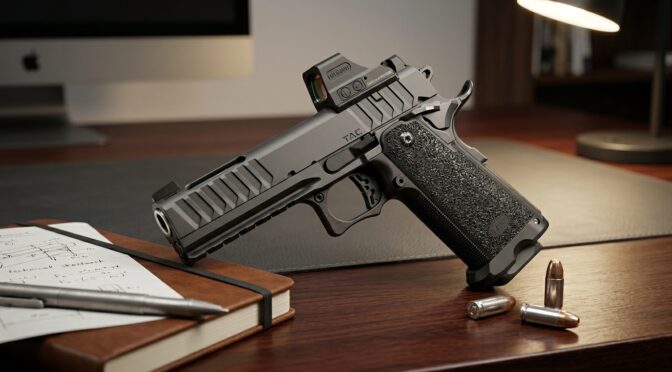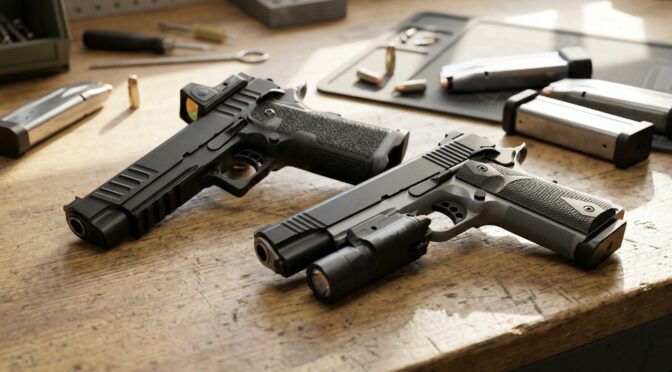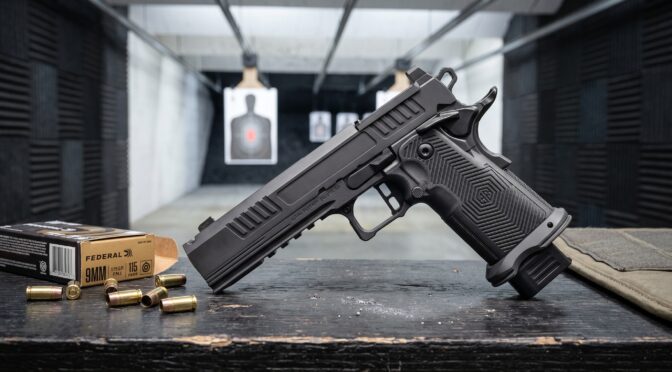
The United States handgun market is currently witnessing a paradigm shift in the high-performance semi-automatic sector, characterized by the mass proliferation of the “2011” platform. Historically, the 2011—a modular, double-stack evolution of John Browning’s 1911 design—was a niche architecture restricted to competitive shooting circuits (USPSA/IPSC) and safeguarded by patents held by STI International (now Staccato) and Strayer Voigt Inc. (SVI). The expiration of these intellectual property protections, combined with a market-wide demand for “duty-grade” precision, has catalyzed an industrial arms race.
As of 2025, the 2011 market has bifurcated into two distinct industrial axes:
The Domestic Precision Sector: Characterized by United States manufacturers leveraging aerospace-grade CNC machining, billet materials, and vertical integration to produce high-cost, high-reliability systems. This sector is currently disrupting its own established norms by adopting non-proprietary magazine standards (e.g., Glock and SIG Sauer compatibility).
The Import Value Sector: Dominated by the Turkish defense industrial base and the established Philippine manufacturing hubs. These entities utilize state-subsidized infrastructure to mass-produce forged steel frames at costs significantly below domestic capability, democratizing the platform and moving the entry price from $2,500+ to sub-$700.
This report provides an exhaustive technical and industrial analysis of major 2011-style pistols currently available in the US market. It dissects the Original Equipment Manufacturer (OEM) relationships, supply chain logistics, metallurgical standards, and end-user reliability reputations for each entity.
1. Introduction and Data Summary
The following table summarizes the key findings of this report, categorizing the major players by their actual manufacturing origin and current market standing.
Summary Data Table: 2011-Style Pistols in the US Market (2025)
Brand
Model(s)
Actual Manufacturer (OEM)
Country of Origin
Frame Material
Magazine Standard
Market Reputation
Staccato
P, C2, XC, HD
Staccato 2011, LLC
USA (TX)
Billet Steel
2011 / Glock (HD)
The Duty Standard. Unquestioned reliability.
Springfield
Prodigy (1911 DS)
Springfield / Global Forgings
USA / Brazil
Forged Steel / Alum
2011
The Project Gun. Great chassis, MIM internals.
Tisas
1911 DS, Carry
TİSAŞ
Turkey
Forged Steel
2011
Value King. Best metallurgy for the price.
MAC
MAC 9 DS
TİSAŞ
Turkey
Forged Steel
2011
Budget Staccato. Bull barrel, high reliability.
Stealth Arms
Platypus
Stealth Arms
USA (OH)
Billet Aluminum
Glock 17
Customization Leader. Reliable, fun, unique.
Bersa
M2XI
Bersa USA
USA (GA)
Stainless Steel
2011
New Entrant. US-made, feature-rich.
Fusion
XP Pro
Ermox / Fusion
Turkey / USA
Steel Bar Stock
Glock 17
Hybrid. Turkish machining, US finishing.
Rock Island
Rock Ultra HC
Armscor
Philippines
Cast/Extruded
2011 (Para)
The Incumbent. Heavy, affordable, rough finish.
Jacob Grey
TWC 9
Jacob Grey Firearms
USA (SC)
Billet Aluminum
2011
Aerospace Precision. Rigid, all-metal grip.
Bul Armory
SAS II
Bul Armory
Israel
Stainless Steel
Proprietary Bul
Performance Leader. Hard to find (War delays).
Girsan
Witness 2311
GİRSAN
Turkey
Cast/Forged
2011 (Issues)
Mixed Bag. QC issues with mags/feeding.
Oracle Arms
OA 2311
Oracle Arms
USA (NC)
Aluminum
Sig P320
The Innovator. Linkless barrel design.
Kimber
2K11
Kimber Mfg.
USA (AL)
Stainless Steel
Proprietary 2011
Inconsistent. Beautiful, but needs tuning.
Live Free
Apollo 11
Live Free Armory
USA (FL)
4140 Steel
2011
Fixer Upper. Rough finishing, good price.
Watchtower
Apache
Watchtower Defense
USA (TX)
Stainless Steel
2011
Influencer Premium. PVD finish, high cost.
Alchemy
Quantico HiCap
Alchemy Custom
USA (IN)
Forged Steel
2011
Retro Custom. Hand-fit, classic aesthetic.
Vudoo
Priest
Vudoo Gun Works
USA (OK)
Billet Steel
2011
Precision. Bench-rest accuracy.
2. Platform Architecture and Market Context
2.1 Technical Definition of the “2011”
For the purposes of this report, a “2011-style” pistol is defined by its modular frame architecture. Unlike a traditional 1911, which utilizes a single-piece steel frame, the 2011 utilizes a two-part system:
The Sub-Frame (Receiver): A steel or aluminum upper chassis that houses the slide rails, fire control group (hammer, sear, disconnector), and barrel lock-up geometry.
The Grip Module: A separate component, typically polymer or aluminum, that houses the magazine and trigger bow. This modularity allows for a widened magazine well to accommodate double-stack columns of ammunition.
2.2 The “Magazine Wars” of 2025
A critical thematic finding in this analysis is the collapse of the proprietary magazine economy. For three decades, the 2011 platform was plagued by expensive ($70-$120), finicky magazines. 2025 marks the tipping point where manufacturers are abandoning this revenue stream in favor of logistical ubiquity. Major players like Staccato, Stealth Arms, Fusion, and Oracle Arms have re-engineered the 2011 chassis to accept Glock 17 and SIG P320 magazines.
3. The Domestic Titans: US-Based High Volume Manufacturers
The United States domestic sector is defined by a race to scale. Manufacturers in this segment are attempting to transition the 2011 from a “custom shop” item to a “production line” commodity.
3.1 Staccato 2011, LLC
Headquarters & Manufacturing: Georgetown, Texas, USA
Key Models: Staccato P, C2, XC, XL, HD Series (P4, P4.5)
Industrial Analysis:
Staccato (formerly STI International) remains the market hegemon. Their facility in Georgetown, Texas, utilizes billet steel for frames and slides, ensuring precise dimensional stability. Staccato is the only 2011 manufacturer with widespread, formal approval from over 1,400 US law enforcement agencies.1
2025 Evolution & Engineering:
The Staccato HD Series 2 represents the most significant engineering pivot in the company’s history. The HD series utilizes a newly engineered steel frame designed to accept Glock 17/19 pattern magazines. This required a fundamental redesign of the grip geometry and feed ramp angles.
Reliability: While Glock magazines are ubiquitous, the HD P4 has shown sensitivity to specific magazine generations during the break-in period.3 Additionally, the removal of the grip safety on the HD line has introduced a “thumb safety bite” issue for some users with high grips.4
3.2 Springfield Armory, Inc.
Headquarters: Geneseo, Illinois, USA
Manufacturing Origin: Domestic Machining / Global Forging Sourcing
Springfield Armory’s 1911 DS Prodigy relies on a global supply chain. While final machining and assembly occur in the US, historical analysis and industry data point to Imbel (Brazil) as a primary source for the forged steel frames and slides. However, the new Prodigy Compact 3.5″ utilizes a billet 7075 aluminum frame, which suggests a diversification of their material sourcing for carry-oriented models.
Technical Deep Dive:
To achieve a street price near $1,300–$1,500, Springfield utilizes Metal Injection Molding (MIM) for the ignition components. While early units (2022) suffered from tolerance stacking, the 2025 production lines have largely mitigated these reliability issues, though enthusiasts still frequently replace the MIM internals with tool steel aftermarket parts.5
3.3 Bersa USA
Headquarters & Manufacturing: Kennesaw, Georgia, USA
OEM Status: Primary Manufacturer (US Subsidiary)
Key Models: M2XI
Industrial Analysis:
Known historically for Argentine imports, Bersa has established a full manufacturing capability in Georgia. The M2XI is a surprising new entrant for 2025: a US-made double-stack 1911 featuring a 416 stainless steel frame and slide, Holosun K footprint, and ambidextrous controls.
Market Position: Bersa is aggressively positioning the M2XI against the Springfield Prodigy, offering a “Made in USA” roll mark at a similar price point ($1,479 MSRP).
Stealth Arms machines their frames and slides from 7075-T6 Aluminum and 4140 Steel billets in-house. Their Platypus model is the benchmark for Glock-magazine integration, designed from the ground up around the Glock feed angle rather than adapted to it.6
Reliability: High-round count testing (10,000+ rounds) confirms the platform’s durability, although the Cerakote finish shows wear faster than DLC.6
3.5 Jacob Grey Firearms
Headquarters & Manufacturing: West Columbia, South Carolina, USA
Jacob Grey differentiates itself by abandoning polymer grip modules entirely. The TWC 9 grip and frame are CNC machined from 7075-T6 Aerospace Grade Aluminum billets. This results in a rigid, premium feel that rivals custom guns costing significantly more.
3.6 Oracle Arms
Headquarters & Manufacturing: North Carolina, USA (Relocated from Nevada)
OEM Status: Primary Manufacturer
Key Models: OA 2311, OA 2311 Compact Pro
Engineering Innovation:
The OA 2311 utilizes a linkless cam barrel system (similar to SIG Sauer) and feeds from SIG P320 magazines.7 This architecture simplifies the barrel lockup and increases debris tolerance. Oracle Arms has recently relocated operations to North Carolina.8
3.7 Kimber Manufacturing
Headquarters & Manufacturing: Troy, Alabama, USA
Key Models: 2K11, 2K11 Target
Analysis:
Manufactured in their new Troy, Alabama facility 9, the 2K11 uses a proprietary magazine well geometry that is not compatible with standard Staccato magazines. Reports indicate tight tolerances leading to failures to extract during the break-in period.10
3.8 Live Free Armory (LFA)
Headquarters: Melbourne, Florida, USA
Key Models: Apollo 11
Analysis:
LFA produces the Apollo 11 in-house. While they market the absence of MIM parts, the machining finish is often described as “rough,” frequently requiring user polishing and deburring to run reliably.12 It serves as a budget “fixer-upper.”
3.9 Watchtower Defense
Headquarters: Spring, Texas, USA
Key Models: Apache, Apache Commander
Context:
Born from the bankruptcy restructuring of Watchtower Firearms in early 2025, the new entity Watchtower Defense focuses on the ultra-premium market. The Apache series features PVD coatings and is marketed heavily through influencer collaborations (e.g., PewView).
4. The Import Value Sector
This sector has democratized the 2011, making it accessible to the average shooter.
Models:Tisas 1911 DS, MAC 9 DS (Military Armament Corp)
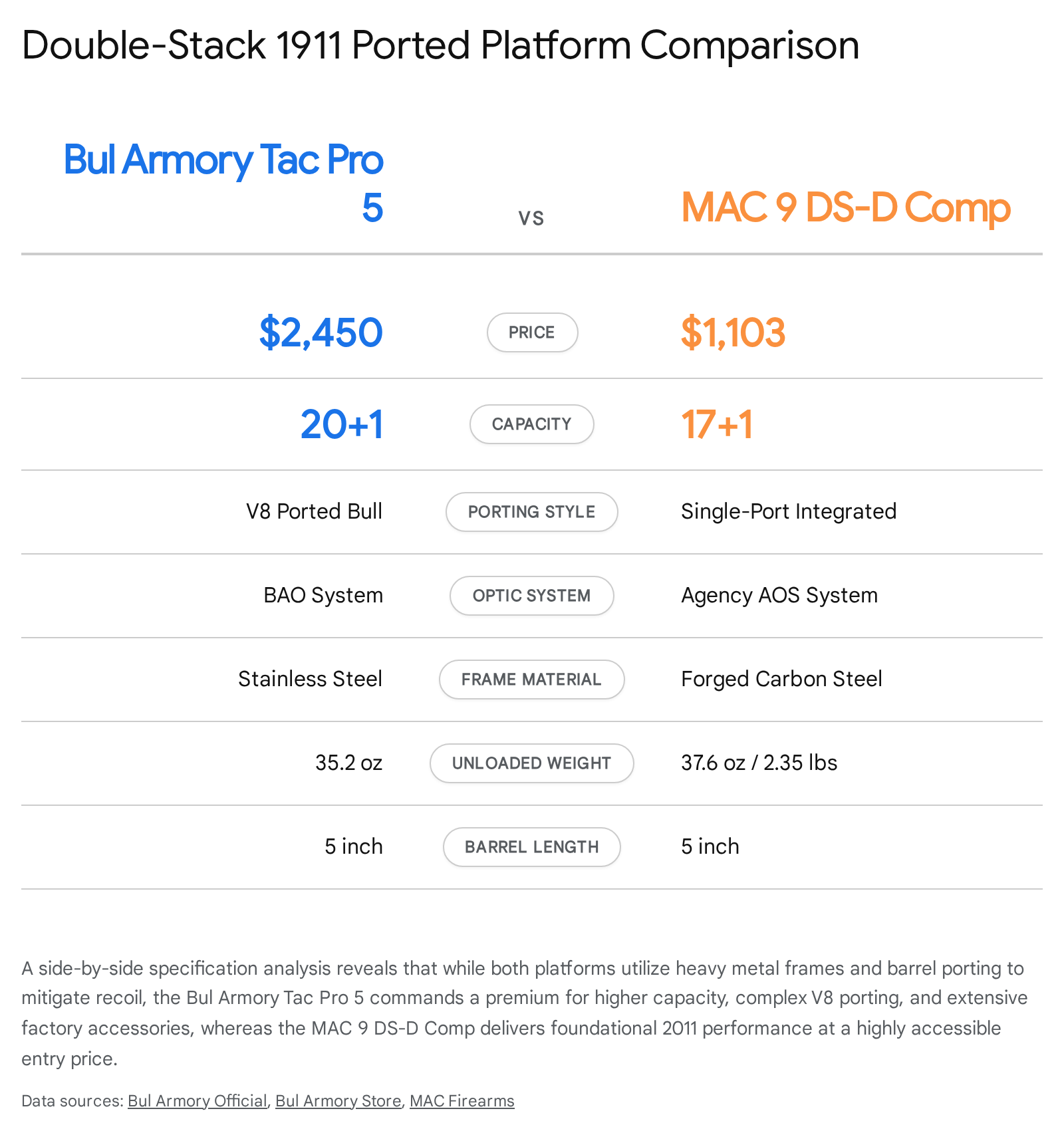
Analysis: Tisas serves as the OEM for both the Tisas-branded DS line and the slightly more upscale MAC 9 DS. These pistols use Forged 4140 Steel frames and slides, superior to cast alternatives. The MAC 9 DS is widely considered the “Turkish Staccato,” offering a bull barrel and RMR plate system at a ~$1,000 price point.
Girsan (Giresun Silah Sanayi) / EAA Corp
Models:Witness 2311, Witness 2311 Brat
Analysis: Girsan’s offering is plagued by proprietary magazine catch geometry that causes compatibility issues with standard 2011 magazines.14 Reliability is generally considered lower than the Tisas equivalents.
Fusion Firearms / Ermox
Models:XP Pro
Analysis: While Fusion Firearms is a US-based custom shop, the XP Pro represents a strategic shift. Fusion has partnered with Ermox (Turkey) to manufacture the core components of the XP Pro. This collaboration allows Fusion to offer a Glock-magazine compatible 1911 with bar-stock components at a competitive price, with final QC and finishing likely occurring in the US.
4.2 The Philippine Incumbents
Rock Island Armory (Armscor)
Models:Rock Ultra FS HC (High Capacity)
Analysis: Often overlooked in the “2011” conversation, RIA has been producing double-stack 1911s for years. These are technically Para-Ordnance clones (wide steel frame) rather than modular 2011s (two-piece). They are heavy, utilize cast frames, and have rough Parkerized finishes, but they are undeniably affordable and robust. They are oversized double-stack 1911s
Iver Johnson / Shooters Arms Manufacturing (S.A.M.)
Models:Eagle XL-DS
Analysis: Iver Johnson imports their 1911s from Shooters Arms Manufacturing (S.A.M.) in the Philippines. Like RIA, these occupy the budget tier, often featuring long-slide (6-inch) configurations for 10mm hunting applications.
5. The International & Hybrid Players
5.1 Bul Armory
Headquarters & Manufacturing: Tel Aviv, Israel
Key Models: SAS II, SAS II Ultralight
Analysis:
Bul Armory is a vertically integrated manufacturer producing exceptional stainless steel pistols. However, the ongoing regional conflict in Israel has severely impacted export logistics, leading to chronic inventory shortages in the US market.15 Their magazines are proprietary and narrower than the STI standard.
5.2 Alpha Foxtrot
OEM Location: South Korea (Dasan Machineries)
US Assembly: Duluth, Georgia, USA
Key Models: Romulus
Analysis:
Alpha Foxtrot is the consumer brand for Dasan Machineries, a massive South Korean OEM. The Romulus features excellent DLC finishing but utilizes MIM internals for the sear and disconnector 17, contradicting some “all-machined” marketing claims.
6. The Boutique & Precision Sector
6.1 Alchemy Custom Weaponry (ACW)
Headquarters: Fort Wayne, Indiana, USA
Key Models: Quantico HiCap
Analysis: ACW builds “Retro-Custom” guns. The Quantico HiCap is a hand-fit, forged steel double-stack that eschews modern race-gun aesthetics for a classic, duty-grade look. They are low-volume, high-prestige firearms.
6.2 Vudoo Gun Works
Headquarters: Prague, Oklahoma, USA (Relocated from Utah)
Key Models: Priest
Analysis: Vudoo moved its operations to Prague, Oklahoma in 2025.18 The Priest brings bolt-action rifle precision tolerances to the 2011 platform, offering bench-rest accuracy in a competition pistol.
6.3 Wilson Combat
Headquarters: Berryville, Arkansas, USA
Key Models: Division 77 Project 1, EDC X9 (Solid Frame)
Analysis: While Wilson Combat focuses on their solid-frame “X9” architecture, the new Division 77 Project 1 pushes into the 2011-adjacent space with a rail-less, compensated, high-performance carry gun that is functionally a double-stack 1911 but structurally unique.
7. Strategic Outlook
The Supply Chain Reality: The notion of “American Made” is nuanced. While Staccato and Jacob Grey represent domestic vertical integration, brands like Springfield, Fusion, and Alpha Foxtrot rely on global supply chains (Brazil, Turkey, Korea) to remain price-competitive.
The Logistics Victory: The most significant trend is the acceptance of Glock and Sig Sauer magazines. By decoupling the 2011 platform from its historically unreliable proprietary magazines, manufacturers are removing the final barrier to widespread duty adoption.
Turkey’s Ascent: Through Tisas (MAC) and Ermox (Fusion), the Turkish industrial base has effectively cornered the sub-$1,100 market, offering metallurgy (forged/bar stock) that domestic manufacturers struggle to match at that price point.
Appendix A: Methodology
This report was compiled using a multi-source intelligence gathering methodology:
OEM Identification: Import markings were analyzed to identify root manufacturers (e.g., “Made in Turkey” on MAC frames, “Imbel” historical data for Springfield).
Corporate Filings: Business relocation data was used to verify manufacturing sites for Vudoo (OK), Kimber (AL), and Oracle Arms (NC).
Technical Analysis: Component analysis (MIM vs. Machined) was derived from armorer tear-down reports and metallurgical specifications provided in user manuals.12
If you find this post useful, please share the link on Facebook, with your friends, etc. Your support is much appreciated and if you have any feedback, please email me at in**@*********ps.com. Please note that for links to other websites, we are only paid if there is an affiliate program such as Avantlink, Impact, Amazon and eBay and only if you purchase something. If you’d like to directly contribute towards our continued reporting, please visit our funding page.
The contemporary small arms sector, specifically the niche occupied by high-performance duty and defensive sidearms, is currently navigating a significant inflection point. For decades, the bifurcation between “duty” weapons—typified by loose-tolerance, striker-fired polymer pistols like the Glock—and “competition” weapons—typified by tight-tolerance, hammer-fired platforms like the 1911/2011—was absolute. However, the last five years have seen a convergent evolution. Law enforcement agencies and serious defensive practitioners are increasingly demanding the shootability and ballistic performance of a race gun combined with the austere reliability of a service pistol. Staccato 2011, formerly STI International, has been the primary architect of this convergence. This report provides an exhaustive, forensic-level analysis of Staccato’s flagship offerings: the legacy Staccato P, which established the category, and the newly released Staccato HD P4, which represents a radical engineering departure designed to capture the institutional market.
Our analysis, based on a rigorous review of technical specifications, long-term endurance testing data, and comparative engineering studies, suggests that while the Staccato P remains the superior choice for the purist seeking the ultimate trigger characteristics of the Series 70 design, it retains inherent mechanical liabilities—specifically regarding drop safety and extractor maintenance—that preclude it from universal agency adoption. The Staccato HD P4 addresses these specific engineering hurdles through a comprehensive redesign that includes a Series 80-style active firing pin block, a self-regulating external extractor, and a chassis architecture adapted for Glock-pattern magazines.
The report details the physics of the 2011’s recoil mitigation, the metallurgy of its frame components, and the specific failure modes associated with its internal extraction system. Furthermore, it contrasts the platform against emerging competitors like the Stealth Arms Platypus and Oracle Arms 2311, ultimately concluding that the HD P4 is the first “true” duty-grade 2011 capable of surviving the administrative and physical rigors of modern law enforcement testing protocols, albeit at the cost of a slightly degraded trigger profile and a controversial aesthetic finish.
1. Historical Evolution and Brand Trajectory
To fully comprehend the technical nuances of the Staccato P and HD P4, one cannot view them as isolated products. They are the latest iterations in a design lineage that stretches back over a century, modified by specific patent innovations in the 1990s and a corporate pivot in the late 2010s.
1.1 The Ancestral Foundation: 1911 Mechanics
The foundation of the Staccato platform is the Colt 1911, designed by John Moses Browning. The core mechanical principles—the short-recoil operation, the swinging link (later modified to a camming surface in many modern iterations, though Staccato retains the link), and the single-action sliding trigger—remain the gold standard for shootability. The single-action trigger is particularly critical. unlike a hinged trigger found in most modern polymer pistols, which must rotate around a pivot point, the 1911 trigger slides directly rearward. This linear motion allows for a trigger break that is mechanically simpler and therefore crisper, with less pre-travel and over-travel. This mechanical advantage translates directly to reduced muzzle disruption during the firing sequence, allowing for greater practical accuracy.1
1.2 The Modular Revolution: Strayer and Tripp
In the early 1990s, Virgil Tripp and Sandy Strayer revolutionized the 1911 market by addressing its primary weakness: capacity. The traditional 1911 used a single-stack magazine because the grip frame was integral to the receiver. Strayer and Tripp patented a modular frame design (the “2011”) which separated the pistol into two primary components: a metal “sub-frame” or chassis that housed the slide rails and fire control group, and a polymer grip module that bolted onto this chassis.
This innovation achieved two things. First, it allowed for a double-stack magazine, increasing capacity from 7-8 rounds to 17-20 rounds of 9mm or.38 Super. Second, and perhaps more importantly for the modern context, it introduced a polymer interface between the shooter and the steel frame. This polymer grip acts as a shock absorber, damping the high-frequency vibrations generated by the slide’s reciprocation and the cartridge ignition. This damping effect, combined with the structural rigidity of the steel chassis, created a recoil impulse that was uniquely flat and manageable, quickly making the 2011 the dominant platform in USPSA and IPSC competition.3
1.3 The STI International Era: The “Gamer” Gun
For nearly three decades, the company operating as STI International catered almost exclusively to the competitive shooting market. During this era, the pistols were engineering marvels of tight tolerances. A “match fit” STI might have slide-to-frame clearances measured in ten-thousandths of an inch. While this ensured supreme mechanical accuracy, it made the weapons intolerant of debris. Unburnt powder, sand, or even thickened lubricant could cause the action to seize. Furthermore, the guns were often sprung with very light recoil springs (7lbs to 9lbs) to minimize muzzle dip for gamers using light-loaded ammunition. This configuration, while effective on a clean range, was disastrous for duty use, cementing a reputation for the 2011 as a “finicky race gun” that required constant tuning.2
1.4 The Staccato Rebrand: The Pivot to Duty
In 2019, the company underwent a massive rebranding effort, changing its name to Staccato 2011. This was not merely cosmetic; it signaled a fundamental shift in engineering philosophy. The goal was to produce a “Duty” 2011. This required loosening tolerances to allow for “combat reliability”—essentially allowing space for debris to migrate out of the action rather than binding it. It also involved standardizing spring weights to heavier specifications (e.g., 13lb recoil springs) to ensure the slide would close into battery with authority even when fouled. The Staccato P (“Professional”) was the flagship of this new doctrine, specifically designed to pass the rigorous testing protocols of elite law enforcement units like the U.S. Marshals SOG and LAPD SWAT.4
2. Engineering Anatomy: Staccato P (Legacy Architecture)
The Staccato P, as the bridge between the competition world and the duty world, retains much of the classic 2011 architecture while hardening specific subsystems for field use. It is a single-action, hammer-fired, recoil-operated semi-automatic pistol chambered in 9x19mm.
2.1 Frame Metallurgy and Dynamics
The Staccato P is offered with two distinct frame material options: 4140 carbon steel and 7075-T6 aluminum alloy. The choice between these materials fundamentally alters the physics of the weapon’s operation.
2.1.1 The Physics of the Steel Frame
The steel frame variant weighs approximately 33 ounces unloaded.6 From a physics perspective, the mass of the non-reciprocating frame is a critical variable in recoil management. Recoil is the conservation of momentum; the energy generated by the bullet leaving the barrel must be transferred somewhere. A heavier frame possesses greater inertia, meaning it resists the acceleration forces generated by the slide’s rearward travel.
This inertial damping has two practical effects. First, it reduces the peak force transmitted to the shooter’s hand, reducing felt recoil. Second, it stabilizes the weapon platform in 3D space. A heavier object is less susceptible to micro-movements caused by trigger press errors or autonomic nervous responses. For high-volume shooting or duty applications where weight is not the primary constraint, the steel frame offers a distinct shootability advantage, often described as the gun “tracking” flatter—meaning the sights return to the point of aim with less deviation.7
2.1.2 The Dynamics of the Aluminum Frame
The aluminum frame reduces the total weight to roughly 28 ounces.4 This reduction is achieved by substituting the 4140 steel chassis for one machined from 7075-T6 aluminum, an alloy utilized extensively in aerospace applications for its high strength-to-weight ratio. While 7075 is exceptionally strong, it lacks the endurance limit of steel. In metallurgy, steel has an endurance limit below which it can theoretically endure infinite stress cycles without fatigue failure. Aluminum does not; every stress cycle contributes to cumulative fatigue. While a modern 7075 frame can easily last 20,000 to 50,000 rounds, it will eventually work-harden and crack, whereas a steel frame is functionally immortal with proper spring maintenance.
Functionally, the lighter frame transmits more recoil energy to the shooter. The “snap” is sharper because there is less mass to soak up the kinetic energy of the slide. This makes the aluminum P ideally suited for concealed carry (CCW) where comfort during the 12 hours of carrying outweighs the slight recoil penalty during the 10 seconds of shooting.9
2.2 Slide and Barrel Assembly
The slide of the Staccato P is machined from billet steel and features front and rear serrations for manipulation. A critical component of the P’s accuracy is the barrel system.
2.2.1 Bull Barrel Architecture
The Staccato P utilizes a 4.4-inch “Bull Barrel”.6 In a traditional 1911, a thin barrel is supported at the muzzle by a barrel bushing. This bushing is a separate part that fits into the slide. Accuracy depends on the tolerance stack between the barrel, the bushing, and the slide.
The bull barrel eliminates the bushing. Instead, the barrel profile flares outward at the muzzle, creating a cone shape. When the slide is fully forward (in battery), this cone wedges directly into the slide’s interior dimensions.
Harmonic Damping: The thicker walls of the bull barrel increase its rigidity. A stiffer barrel vibrates less during the bullet’s travel down the bore (barrel harmonics). Consistent harmonics lead to consistent points of impact.
Forward Mass Bias: The extra metal at the muzzle shifts the center of gravity forward. This extra mass at the front of the pistol acts as a counterweight to muzzle rise (lever arm effect), helping to keep the sights aligned during rapid fire sequences.11
Lock-up Consistency: The direct barrel-to-slide lockup is inherently more repeatable than the bushing system, contributing to the platform’s ability to hold sub-2-inch groups at 25 yards.12
2.2.2 DLC Surface Treatment
The barrel and often the slide of the Staccato P are treated with Diamond-Like Carbon (DLC). This is not a paint or a ceramic coating like Cerakote; it is a physical vapor deposition (PVD) process that bonds carbon atoms to the substrate in a crystalline lattice structure similar to diamond.
Tribology: DLC has an extremely low coefficient of friction. This provides natural lubricity, which is critical for the tight tolerances of the 2011. It reduces the likelihood of galling (metal-on-metal tearing) if the lubrication runs dry.
Hardness: DLC is incredibly hard, providing superior resistance to wear from holster draws and environmental debris compared to traditional bluing or Parkerizing.7
2.3 Recoil System Mechanics
The Staccato P utilizes the Dawson Precision Tool-Less Guide Rod system.3
Maintenance Innovation: Traditional 2011 full-length guide rods required a paperclip or a specific plastic collar to capture the spring tension for disassembly. If this tool was lost in the field, the gun could not be field-stripped. The Dawson system integrates a mechanical lever into the guide rod head that captures the spring, allowing for tool-free disassembly—a critical requirement for a duty weapon.
Spring Rate Controversies: The factory standard recoil spring is rated at 13 lbs.14 This weight is chosen to ensure the slide strips a fresh round from a fully loaded magazine with authority, even when the gun is fouled. However, some enthusiasts and competition shooters prefer an 11lb spring.
Physics of the 11lb Spring: A lighter spring offers less resistance to the slide’s rearward travel, allowing it to move faster. More importantly, it stores less energy to return the slide forward. A 13lb spring slams the slide closed with significant force, which can cause the muzzle to “dip” below the point of aim as the slide hits battery. The 11lb spring reduces this dip, creating a “flatter” tracking dot. However, the trade-off is reduced feeding energy, increasing the risk of failure-to-feed malfunctions if the gun is dirty or the shooter “limp wrists” the grip.15
2.4 The Internal Extractor: An Engineering Liability
Despite the P’s modern features, it retains the legacy internal extractor of the 1911 design.
Beam Spring Mechanics: The internal extractor is essentially a long leaf spring (beam) machined from spring steel. It lives inside a tunnel within the slide. The tension on the cartridge rim is determined by the curvature (bend) of this beam.
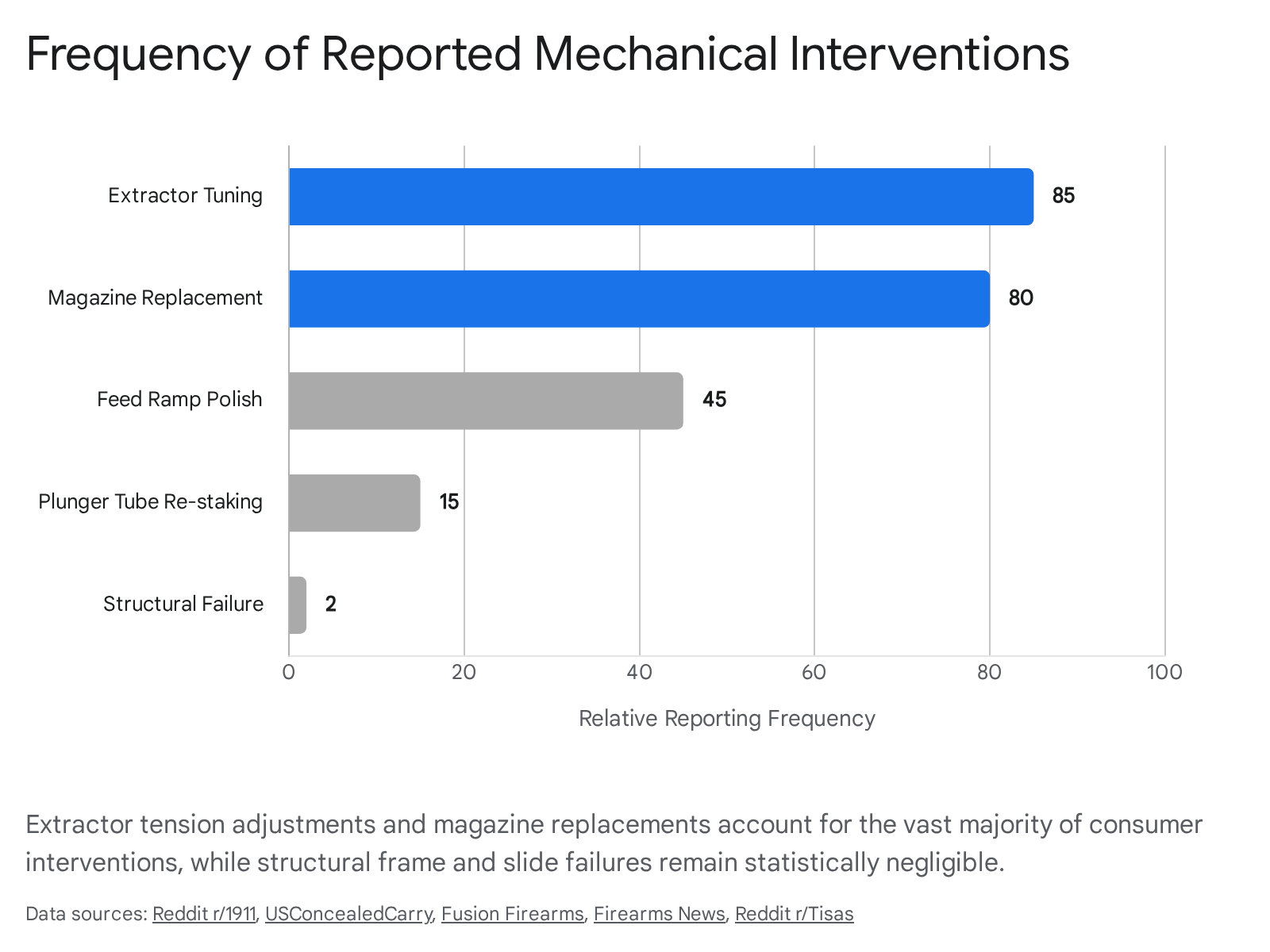
The Failure Mode: Over time, repeated cycling or improper administrative handling (such as dropping a round in the chamber and slamming the slide) can cause the steel to yield, losing its tension. Once tension is lost, the extractor claw may fail to hold the empty case against the breech face during the violent rearward cycle, leading to a Failure to Extract (double feed).
Maintenance Burden: Correcting this requires removing the extractor and physically bending it back to the correct geometry, a process that requires “feel” and experience rather than a simple part swap. This need for skilled gunsmithing at the user level is a major logistical negative for large agencies.17
3. Engineering Anatomy: Staccato HD P4 (The Duty Evolution)
The Staccato HD (Heavy Duty) P4 is a systemic re-engineering of the platform aimed at solving the specific liabilities that prevented the legacy P from achieving universal institutional adoption. It targets three specific areas: Drop Safety, Extraction Reliability, and Logistical Compatibility.
3.1 Drop Safety and the Series 80 System
A major hurdle for the 2011 in the law enforcement sector has been drop safety. The Series 70 design (used in the Staccato P) relies on a strong firing pin spring and the low mass of the firing pin to prevent inertial discharge if the gun is dropped on its muzzle. However, physics dictates that if the drop height is sufficient (e.g., from a second-story balcony or a running tackle), the inertia of the firing pin can overcome the spring, striking the primer.
The HD P4 incorporates a Series 80-style active firing pin block to address this.19
Mechanism: A plunger (block) sits vertically in the slide, physically obstructing the forward path of the firing pin. This plunger is held in the “safe” (down) position by a spring.
Actuation: The trigger bow is linked to a series of levers in the frame. When the trigger is pulled, these levers push the plunger up, clearing the path for the firing pin.
Engineering Trade-off: The actuation of these levers requires mechanical work. This work is added to the force required to pull the trigger. Consequently, Series 80 triggers are often criticized for having “creep” or a “mushy” feel during the take-up phase, as the user is physically compressing the plunger spring before the sear releases the hammer. Staccato engineers have mitigated this through polishing and geometry optimization, but the HD P4 trigger (4.5-5.0 lbs) is measurably different from the P’s crisp 4.0lb break.19 This addition allows the HD P4 to pass the stringent NIJ Standard 0112.03 drop tests, which mandate safety from 1.5-meter drops in multiple orientations.21
3.2 External Extractor: Reliability by Design
The HD P4 replaces the internal extractor with an external, pivoting design.
Pivot Mechanics: Instead of relying on the bending of the steel bar, the external extractor pivots on a roll pin and is powered by a separate coil spring located behind the pivot point.
Constant Force: Coil springs provide linear, consistent force over millions of cycles and are far less prone to fatigue or “set” than leaf springs.
Serviceability: If an external extractor fails, an armorer simply punches out the pin and replaces the spring and claw. No bending or tuning is required. This “drop-in” maintenance model aligns with modern armory practices used for Glocks and Sigs.22
3.3 The Glock Magazine Integration
The most disruptive feature of the HD P4 is its compatibility with Glock-pattern magazines.24 This required a fundamental redesign of the grip chassis.
The Geometry Challenge: Glock magazines present the top cartridge at a different angle than traditional STI 2011 magazines. They are also wider and have a different taper. To accommodate this, Staccato had to widen the internal dimensions of the steel frame and likely alter the angle of the feed ramp on the barrel to ensure reliable feeding.
Material Shift: The grip module on the HD P4 is steel (or a heavily reinforced matrix) to maintain structural integrity with the wider magazine tunnel. This contributes to the overall weight and recoil damping of the system.4
Logistical Impact: For a police department, magazines are a consumable. Glock magazines cost ~$20-$25. Staccato 2011 magazines cost ~$70-$100. For an agency with 1,000 officers, each issued 3 magazines, the cost difference is ~$150,000 in magazines alone. This feature fundamentally changes the Value Analysis for procurement officers.
3.4 Grip Safety Deletion
The HD P4 removes the iconic 1911 grip safety.26
Ergonomics: The grip safety forces the hand lower on the grip. By removing it, the shooter can achieve a higher purchase on the beavertail.
Bore Axis Physics: A higher grip reduces the vertical distance between the shooter’s forearm and the centerline of the barrel (bore axis). This reduces the “lever arm” or torque applied to the wrist during recoil. Shorter lever arm = less muzzle flip = faster follow-up shots.
Reliability: Grip safeties can fail to disengage if the shooter has a poor grip (e.g., injured hand, awkward cover position). Removing it eliminates a potential failure point in a life-or-death struggle.
4. Performance and Testing Analysis
4.1 Reliability Data: The 10,000 Round Benchmark
Reliability is the primary metric for a duty weapon.
Staccato P: In a documented 10,000-round endurance test by Practical Sharpshooter, the Staccato P demonstrated exceptional reliability, with malfunctions largely attributed to magazine maintenance (dirty followers) rather than the pistol itself. The test highlighted the necessity of lubrication; the tight rail-to-slide fit requires oil to prevent friction stoppages.13
Staccato HD P4: Early testing indicates robust reliability with OEM Glock magazines. However, the system appears sensitive to magazine spring health. Worn Glock magazines that function in a loose-tolerance Glock 19 may cause failure-to-feed issues in the tighter HD P4.28 The external extractor has shown zero failures in initial 700-1,000 round review cycles.19
4.2 NIJ Standard 0112.03 Compliance
The HD P4 was explicitly engineered to meet the National Institute of Justice (NIJ) Standard 0112.03 for Autoloading Pistols.
Drop Test Protocols: The standard requires the pistol to be dropped from 1.5 meters (4.9 feet) onto a concrete slab in multiple orientations: muzzle down, muzzle up, on the butt, on the side, and on the exposed hammer.21 The Series 80 block in the HD P4 ensures the firing pin cannot move even under the extreme G-forces of a muzzle-down impact on concrete, a test that a Series 70 Staccato P might statistically fail depending on spring condition.30
Firing Requirements: The standard allows for a specific number of malfunctions per number of rounds fired (typically very low, e.g., <5 per 500 rounds). The looser “duty” tolerances of the HD P4 are designed to meet this “Mean Rounds Between Failure” (MRBF) criteria even when subjected to environmental fouling.
4.3 Recoil Impulse Comparison
Staccato P: The recoil impulse is characterized as “smooth.” The heavy steel frame and the 13lb spring create a predictable cycle. The muzzle rises but returns to zero quickly.
Staccato HD P4: The HD utilizes a “Buffered Flat Wire” recoil system.29 Flat wire springs have a longer service life (rated for 10,000 rounds vs 3,000-5,000 for standard coil springs) and compress to a shorter solid height, allowing for more wire mass in the same space.
Feel: The flat wire spring provides a more linear resistance force. Combined with the buffer (a shock-absorbing polymer or dual-spring component), the HD P4’s recoil is described as slightly “sharper” but faster than the P. The buffer prevents frame battering, while the high grip (no grip safety) allows the shooter to leverage biomechanics to keep the gun flat.19
4.4 Accuracy Comparison
Both pistols are mechanically capable of exceeding human shooting ability.
Bench Accuracy: Reports consistently show 1.5 to 2.0 inch groups at 25 yards with duty ammunition (Federal HST, Speer Gold Dot).12
Practical Accuracy: This is where the 2011 shines. The short, crisp single-action trigger allows shooters to disturb the sights less during the press. This translates to higher hit probability at speed or under stress compared to striker-fired pistols.
HD P4 Variance: Some initial reviews noted slightly larger groups (3 inches) with the HD P4.33 This may be due to the heavier, slightly creepier Series 80 trigger which requires more shooter discipline to manage perfectly, or potentially early barrel fitment variance in the new production line.
Table 1: Technical Specification Comparison
Feature
Staccato P (Steel)
Staccato HD P4
Engineering Implication
Caliber
9x19mm
9x19mm
Standard duty caliber.
Barrel Length
4.4″ Bull Barrel
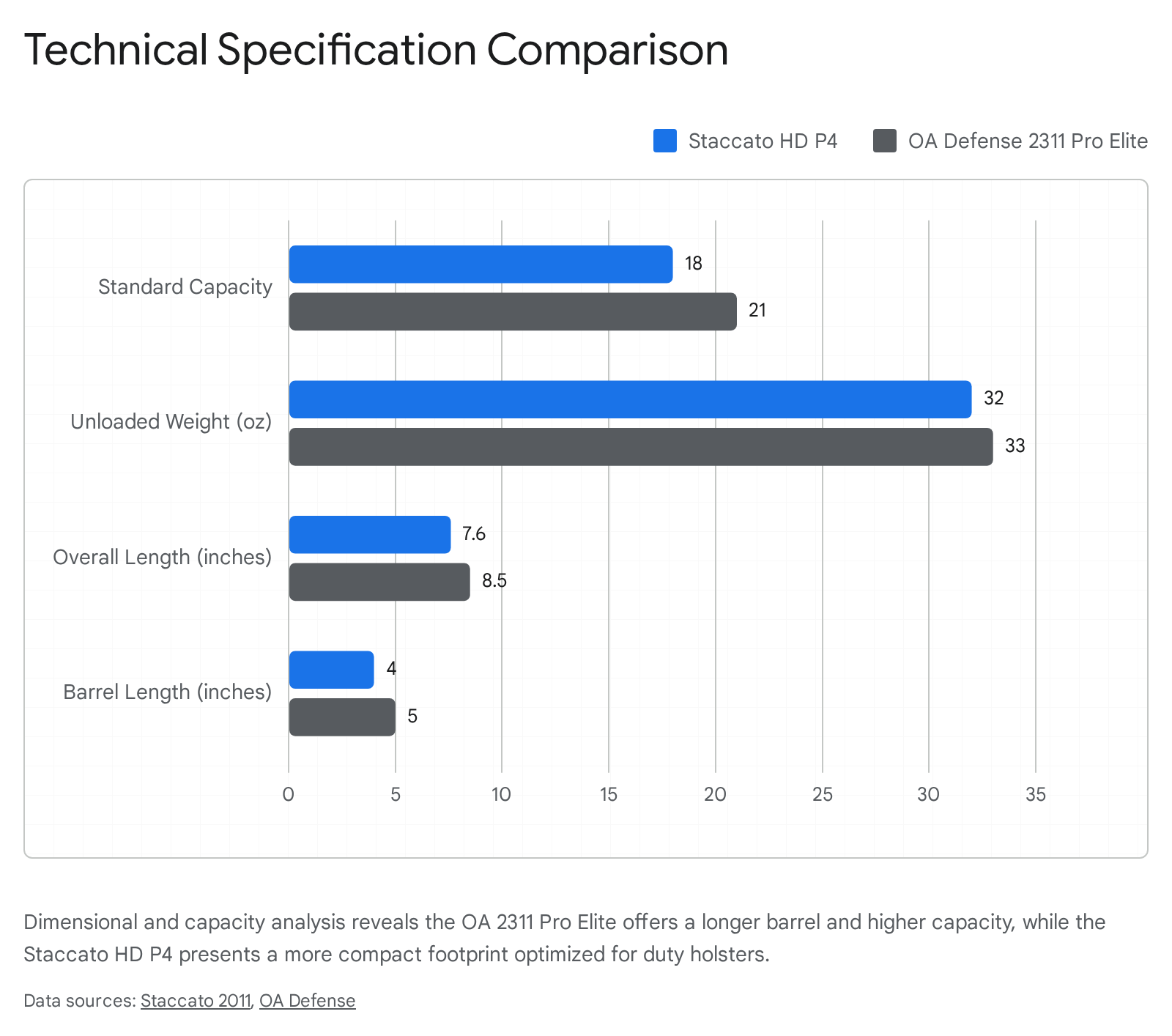
4.0″ Bull Barrel
P has longer sight radius; HD is more concealable.
Frame Material
4140 Steel or Aluminum
Steel
Steel provides recoil damping; HD frame accommodates Glock mags.
Mag Compatibility
2011 Double Stack
Glock Pattern (17/19/etc.)
HD P4 offers massive logistical advantage for agencies.
Extractor
Internal (Tensioned)
External (Spring Loaded)
HD P4 offers superior long-term reliability/serviceability.
Safety System
Ambi Manual, Grip Safety
Ambi Manual, Firing Pin Block
HD P4 is drop-safe per NIJ; P relies on manual safety/grip.
Recoil System
Tool-less Guide Rod
Buffered Flat Wire
HD system designed for longer spring life (10k rounds).
Trigger Weight
4.0 – 4.5 lbs
4.5 – 5.0 lbs
HD trigger is heavier due to firing pin block linkage.
MSRP
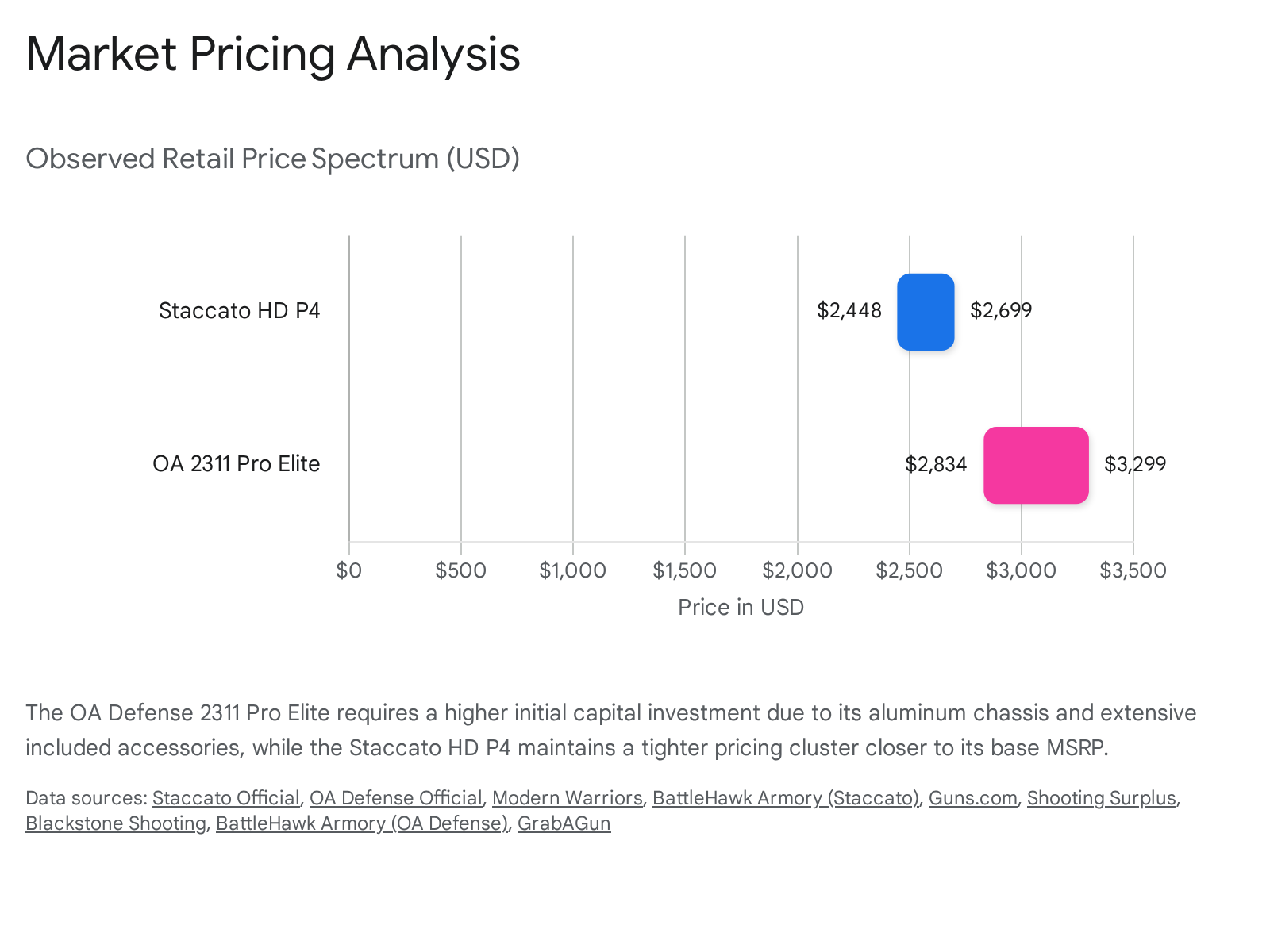
~$2,499
~$2,499
Pricing parity suggests Staccato is absorbing R&D costs to capture share.
5. Market and Competitor Analysis
The Staccato P created the “Duty 2011” market, but the HD P4 enters a space that is rapidly becoming crowded with competitors attempting to solve the same problems.
5.1 Stealth Arms Platypus: The Disruptor
The Stealth Arms Platypus is the direct competitor to the HD P4, as it is the only other prominent 2011-style pistol designed around the Glock magazine.34
Construction: The Platypus uses a 7075 aluminum frame and grip, which are machined as a single piece (or permanently bonded). This makes it lighter than the steel HD P4 but potentially less durable under extremely high round counts (50k+).
Value Proposition: Priced around $1,500 – $1,900, it significantly undercuts the Staccato. It also offers wild customization options (colors, slide cuts) that appeal to the hobbyist.
Shortcomings: Lead times are excessive (14+ weeks).35 It lacks the “Duty” pedigree and certification of Staccato. It is a “fun gun,” whereas the HD P4 is a “work gun.”
Performance: Reviewers note that while the Platypus is excellent, the Staccato P/HD still tracks flatter due to the steel frame’s mass.36
5.2 Oracle Arms 2311: The Modular Rival
The Oracle Arms 2311 takes a different approach by utilizing Sig Sauer P320 magazines.37
Modularity: Like the P320, the OA 2311 emphasizes modularity. It has an aluminum frame.
Ergonomics: The grip angle and feel are distinct. Some shooters prefer the P320 mag geometry.
Comparison: In head-to-head testing, the Staccato is generally described as having a superior recoil impulse and trigger feel. The OA 2311 is a viable alternative for those already invested in the Sig ecosystem (e.g., agencies transitioning from P320s), but it hasn’t achieved the same market dominance or reputation for refinement as Staccato.38
5.3 The “Slide Chatter” Quality Control Controversy
A significant emerging issue for the HD P4 is the report of visible machining marks (“chatter”) on the slide serrations and internals.40
Manufacturing Analysis: Chatter is caused by resonance between the cutting tool and the workpiece, often resulting from aggressive feed rates (trying to machine parts too fast) or tool wear.
Brand Impact: For a $2,500 pistol marketed as a premium tool, this is a significant demerit. Users on forums have expressed disappointment that Staccato Quality Assurance (QA) is allowing these units to ship, with some customer service responses dismissing it as “showing off the machining.” This suggests that Staccato is struggling to scale production to meet the high demand for the HD line, potentially sacrificing cosmetic finish for throughput. While likely functionally irrelevant, it damages the “luxury” perception of the brand.
6. Operational Doctrines and Maintenance
Ownership of a 2011, whether P or HD, requires a different operational doctrine than a Glock.
6.1 Lubrication is Mandatory
The rail interface of the 2011 is long and tight. Unlike the four small metal tabs of a Glock, the 2011 has full-length rails. This large surface area creates significant friction.
Protocol: The pistol must be kept wet with a high-quality lubricant. Running a 2011 dry will lead to sluggish cycling (failure to feed) and, eventually, galling of the rails. This is a training scar for officers used to neglecting their polymer service pistols.43
6.2 Spring Replacement Schedules
Springs are consumable engine parts in a 2011.
Staccato P: Recoil springs (13lb) should be changed every 3,000 to 5,000 rounds. As the spring weakens, the slide velocity increases rearward, hammering the frame. This can lead to frame cracking or optic failure due to increased G-forces.44
Staccato HD P4: The flat wire spring system is rated for extended intervals, potentially up to 10,000 rounds.32 This reduces the logistical burden on agency armorers.
Magazine Springs: For the legacy P, magazine springs are critical. Weak springs will fail to push the heavy column of 20 rounds up fast enough for the slide to catch the next round (bolt-over-base malfunction). The HD P4 benefits from the robust aftermarket of Glock magazine springs, which are cheap and plentiful.
6.3 Optic Mounting: The HOST System
The HD P4 introduces an updated “HOST” optic mounting system.26
Integration: Unlike previous “DUO” or “DPO” plates which sat high, the HOST system is designed to sink the optic lower into the slide. This allows for a better cowitness with standard-height iron sights and reduces the height-over-bore offset, making close-quarters shots more intuitive.
7. Conclusion
The Staccato 2011 platform has successfully transitioned from the competition circuit to the duty holster. The Staccato P stands as the definitive “shooter’s” duty gun—a weapon that rewards skill with exceptional performance, provided the user accepts the maintenance requirements of the internal extractor and spring schedules. It is the choice for the enthusiast who values the purity of the Series 70 trigger above all else.
The Staccato HD P4, however, represents the mature, industrialized future of the platform. By engineering out the platform’s historical weaknesses—proprietary magazines, tuning-dependent extractors, and drop-safety liabilities—Staccato has created a weapon system that is ready for mass institutional adoption. While the trigger may lack the final 5% of crispness found in the P, and the slide finish may currently suffer from growing pains, the HD P4 is the superior tool for the professional application of force. It offers the shootability of a 2011 with the logistics of a Glock, a combination that defines the new apex of the duty pistol market.
For the agency or the pragmatic defender, the HD P4 is the clear recommendation. For the collector or range connoisseur, the Staccato P remains the king.
Appendix: Methodology
This report was synthesized using a comprehensive Open Source Intelligence (OSINT) methodology, aggregating and analyzing 137 distinct data points (“snippets”).
1. Source Classification:
Manufacturer Data: Official specifications from Staccato 2011 6 were used to establish baseline engineering facts (weight, dimensions, materials).
Third-Party Engineering Reviews: Technical reviews from entities like Practical Sharpshooter13 and Real Street Tactical47 provided longitudinal performance data (10,000-round tests) and comparative analysis.
User Sentiment Analysis: Aggregated feedback from enthusiast forums (Reddit r/2011, r/Staccato_STI) 11 and video platforms (YouTube) 25 was used to identify recurring quality control themes (e.g., slide chatter) and real-world reliability issues not captured in marketing material.
Regulatory Standards: The National Institute of Justice (NIJ) Standard 0112.03 21 was referenced to contextualize the engineering requirements for the HD P4’s safety systems.
2. Analytical Process:
Data points were cross-referenced to validate claims. For example, marketing claims of “flat shooting” were evaluated against the physics of frame mass and recoil spring rates found in technical discussions.7 The “Slide Chatter” issue was validated by correlating multiple independent user reports and photographs from different sources to confirm it as a systemic manufacturing artifact rather than an isolated incident. Competitor analysis (Stealth Arms, Oracle Arms) was conducted by comparing feature sets, price points, and lead times directly against the subject pistols.34
3. Limitations:
The analysis relies on public-domain information. No direct metallurgical testing or proprietary internal company documents were accessed. Performance conclusions are based on the synthesis of reported third-party data.
If you find this post useful, please share the link on Facebook, with your friends, etc. Your support is much appreciated and if you have any feedback, please email me at in**@*********ps.com. Please note that for links to other websites, we are only paid if there is an affiliate program such as Avantlink, Impact, Amazon and eBay and only if you purchase something. If you’d like to directly contribute towards our continued reporting, please visit our funding page.
Sources Used
Staccato 2011 Handguns, Pistols, & Accessories. Built For Heroes. – Staccato 2011, accessed November 23, 2025, https://staccato2011.com/
The United States firearms market has evolved beyond a simple transactional economy of finished goods into a complex, multi-tiered ecosystem of modular platforms and aftermarket integration. In the fiscal landscape of 2024-2025, the American consumer—characterized by industry analysts not merely as a user but as a “prosumer”—rarely views a factory-produced firearm as a terminal purchase. Instead, the acquisition of a base rifle or pistol is increasingly treated as the procurement of a “chassis” or a “host,” a foundational architecture upon which a personalized system is constructed.
This shift is driven by three converging vectors: the expiration of key patent protections on legacy designs (notably the Gen 3 Glock and the AR-15), the democratization of CNC manufacturing which has allowed boutique machine shops to compete with established titans, and a cultural pivot toward “mission-specific” tuning. The data indicates that modification is no longer the exclusive domain of the certified gunsmith; it has become a consumer expectation, supported by a “right to repair” ethos and a standardized interface system (M-LOK, Picatinny, RMR footprints) that facilitates rapid, tool-less customization.
The following report provides a granular, expert-level analysis of the top ten firearm platforms that currently dominate the U.S. aftermarket. This analysis synthesizes retail SKU velocity, social media sentiment from enthusiast nodes, and supply chain reporting to identify not just what is being bought, but why. It details the technical shortcomings of factory designs that drive these modifications, the specific brands that have captured market share, and the digital marketplaces where this commerce thrives.
Quick Reference: Top 10 Customization Platforms
The following platforms represent the highest volume of aftermarket activity in the United States. Readers may reference the specific sections below for detailed modification analysis:
Tactical Lever Actions (Marlin 1895 / Henry Big Boy X)
1. The AR-15 Platform (Stoner Pattern)
Platform Analysis: The Universal Standard
The AR-15 remains the undisputed leader of the American aftermarket. Its dominance is rooted in the genius of Eugene Stoner’s split-receiver design and the widespread adoption of the MIL-STD-1913 (Picatinny) and M-LOK interfaces. It is the most “open-source” hardware in the industry. In 2025, the market has matured beyond simple furniture swaps. The current enthusiast trend focuses on “optimization” rather than “customization”—specifically, tuning the gas system for suppressed fire, improving lock time with advanced triggers, and reducing system weight without compromising rigidity.1
The distinction between “budget” and “premium” builds has largely collapsed in the middle market, as consumers now frequently pair budget-friendly receivers (e.g., Aero Precision) with match-grade internal components (e.g., Geissele, criterion). The rise of “general purpose” rifles (GPR) has replaced the highly specialized “race gun” or “heavy bench” trends of previous years, leading to a balanced approach in component selection.
The Modification Ecosystem
The modification velocity for the AR-15 is near 100%; it is statistically rare to find a completely stock AR-15 in the hands of an enthusiast. The following components represent the highest volume of aftermarket commerce.
Rank
Component
Technical Justification & Market Driver
Leading Brands
1
Charging Handles
The Mil-Spec charging handle is small and difficult to grasp, especially with optics mounted. Ambidextrous, gas-busting handles are essential for suppressed shooting to divert blowback from the shooter’s face.3
Mil-Spec triggers often exceed 7lbs with gritty “creep.” Users demand 2.5-4.5lb breaks. Two-stage triggers (Geissele SSA-E) are preferred for precision; single-stage (CMC) for speed.5
Geissele, LaRue Tactical, Rise Armament, CMC
3
Bolt Carrier Groups (BCG)
The mechanical heart of the rifle. Users upgrade to Nickel Boron (NiB), DLC, or Chrome finishes for lubricity and ease of cleaning. Enhanced carriers also offer improved gas key staking and durability.5
BCM, Sons of Liberty Gun Works (SOLGW), Lantac, Cryptic Coatings
4
Muzzle Devices
A departure from the A2 birdcage. Users install brakes for recoil mitigation or mounts (KeyMo, ASR, Xeno) for quick-detach suppressors. Flash suppression remains a priority for defensive builds.6
SureFire, Dead Air, SilencerCo, VG6 Precision
5
Handguards (Free Float)
Replacing plastic handguards or heavy quad rails with slim M-LOK rails. This prevents barrel pressure from affecting zero and reduces front-end weight.5
BCM, Midwest Industries, Daniel Defense, Aero Precision
6
Buffer Systems
“Tuning” the recoil impulse. Users swap standard carbine buffers for heavier weights (H2, H3) or braided springs (Super 42) to delay unlocking and smooth the ejection cycle.2
Geissele, VLTOR (A5 System), Sprinco
7
Gas Blocks (Adjustable)
Mandatory for suppressed usage. Adjustable blocks allow the user to restrict gas flow, preventing “over-gassing,” reducing recoil, and minimizing wear on the BCG.2
Superlative Arms, SLR Rifleworks, Wojtek Weaponry
8
Ambidextrous Safeties
Improving ergonomics for off-hand manipulation. Short-throw (45° or 60°) levers are preferred over the standard 90° throw for faster engagement.5
Radian (Talon), Badger Ordnance, FCD
9
Optic Risers/Mounts
The trend toward “heads-up” shooting postures has driven demand for tall mounts (1.93″ or 2.26″ height) to facilitate passive aiming under night vision or with gas masks.5
Unity Tactical, Scalarworks, Reptilia
10
Furniture (Grips/Stocks)
Changing the wrist angle to be more vertical (e.g., B5 Type 23) accommodates modern squared-off shooting stances better than the angled A2 grip.5
Magpul, B5 Systems, BCM, Reptilia
Deep Dive: The Rise of Niche Retailers
While giants like Brownells 10 and MidwayUSA retain significant market share, the AR-15 enthusiast market has seen a migration toward “curated” retailers who specialize in high-tier, duty-grade components. These smaller, agile businesses often have deeper engagement with the community (e.g., Reddit’s r/gundeals) and stock hard-to-find brands that big-box stores ignore.
Consumer Destinations:
Primary Retailers:Brownells10 and Primary Arms4 serve as the logistical backbone for general parts, tools, and optics.
Enthusiast Hubs:Rooftop Defense, Big Tex Ordnance, and Porter’s Basement11 are critical nodes for “gucci” tier parts (e.g., Knights Armament, LMT, Hodge). Their “drop” culture drives immense traffic spikes.
Budget/Volume Leaders:Palmetto State Armory (PSA)3 and AR15Discounts13 dominate the entry-level and mid-tier builder market, moving massive volumes of “house brand” and white-label components.
2. The Glock Platform (Gen 3-5 & Clones)
Platform Analysis: The “Ship of Theseus”
The Ship of Theseus is a classic philosophical paradox that questions whether an object remains the same object if all of its original components are replaced over time. Glock owners may replace almost everything over time so is it still a Glock?
The Glock pistol (specifically the Model 19 and 17, and increasingly the 43X/48) has transcended its status as a specific product to become a generalized “pattern.” With the expiration of the Gen 3 patents, the market is flooded with “Glock-compatible” frames and slides. In 2025, it is entirely possible—and quite common—to build a “Glock” without using a single OEM part manufactured in Austria or Smyrna, GA.14 The driving force behind Glock modification is ergonomic correction (addressing the grip angle) and the universal adoption of pistol-mounted optics (PMO).
The concept of the “Roland Special”—a compensated, opted, light-bearing Glock—has gone mainstream. The “Prosumer” Glock owner is typically addressing the perceived “sponginess” of the factory trigger and the plastic nature of the factory sights immediately upon purchase.16
The Modification Ecosystem
Rank
Component
Technical Justification & Market Driver
Leading Brands
1
Sights (Iron)
The factory polymer sights are universally regarded as “placeholders.” Steel sights with Tritium or fiber optic inserts are the first durability upgrade.15
Ameriglo, Trijicon, Night Fision, Dawson Precision
2
Triggers (Shoes/Bars)
The quest for the “1911-like” break. Flat-faced triggers reduce pre-travel and over-travel. This improves accuracy by reducing the likelihood of pulling the shot during the press.15
Apex Tactical, Overwatch Precision, Timney, Johnny Glocks
3
Slides (Milled)
Driven by the Red Dot revolution. Users buy pre-milled aftermarket slides to avoid lead times on machining services. Cuts for RMR and Holosun footprints are standard.16
ZEV Tech, Grey Ghost Precision, Norsso, Brownells
4
Barrels (Threaded)
Essential for mounting compensators or suppressors. Also aesthetic (TiN/Gold, fluting). Match-grade fitting can improve accuracy, though OEM barrels are sufficient for most.15
“Carry Comps” have normalized. By threading onto the barrel, they redirect gas upward, flattening muzzle flip and allowing faster follow-up shots without increasing the slide’s reciprocating mass.7
Slide release and mag release extensions. The slick factory controls are hard to manipulate under stress or with gloves. Checkered/extended versions offer positive purchase.15
Vickers Tactical, Kagwerks, Ghost Inc.
8
Frame Work (Stippling)
Laser or hand stippling re-textures the polymer for aggressive grip. “Double undercuts” on the trigger guard allow a higher grip, reducing bore axis leverage.16
Replacing polymer rods with Tungsten increases the non-reciprocating mass at the muzzle end, slightly damping recoil and muzzle rise.15
GlockStore, ZEV
10
Connector Springs
The cheapest “trigger job.” A 3.5lb “minus” connector changes the geometry of the trigger bar interface, lightening the pull weight significantly.17
Ghost Inc., Glock OEM (Minus), Taran Tactical
Deep Dive: The Clone Wars
The aftermarket is now heavily supported by complete clone frames. Shadow Systems and PSA (Dagger)21 have industrialized the modified Glock, selling pistols that already possess the stippling, optic cuts, and undercut trigger guards that users used to pay gunsmiths for. This has forced the aftermarket to move even further up-market (e.g., porting, specialized coatings) to differentiate from “factory custom” guns.
Consumer Destinations:
GlockStore: The Amazon of Glock parts, spearheaded by Lenny Magill. They capture the entry-to-mid-level modifier.17
Big Tex Ordnance: The preferred source for OEM small parts (springs, pins) and high-end triggers.12
JagerWerks: While primarily a service provider for slide milling, their brand cachet drives sales of their proprietary parts (optic plates, backplates).18
Brownells: Their “RMR Cut” slides are the default budget option for builders.19
3. The Ruger 10/22
Platform Analysis: The Rimfire Sandbox
The Ruger 10/22 holds a unique position in the U.S. market as the “gateway drug” to gunsmithing. Its simple blowback design, low cost of entry, and massive install base (over 7 million units) make it the ideal platform for experimentation. In 2025, the 10/22 market has bifurcated into two distinct lineages: the “Ultralight Backpacker” (carbon fiber barrels, chassis stocks) and the “Precision Trainer” (heavy chassis, match chambers) designed to mimic centerfire bolt guns for NRL22 competition.23
The architecture of the 10/22—specifically the ease with which the barrel can be swapped (V-block system) and the trigger group dropped out—encourages home tinkering. It is arguably the most modified firearm by volume of parts sold.
The Modification Ecosystem
Rank
Component
Technical Justification & Market Driver
Leading Brands
1
Extractors
The factory stamped extractor is the platform’s “Achilles heel,” often causing stovepipe jams. An EDM-cut hardened steel “sharp” extractor is the #1 reliability fix.25
Volquartsen, Tandemkross, KIDD
2
Auto-Bolt Release
The factory bolt lock requires a clumsy two-handed manipulation to release. Modified plates allow the user to simply “slingshot” the bolt to chamber a round.26
Volquartsen, Tandemkross
3
Triggers (Groups)
Stock triggers are heavy (6lb+). Users either drop in a Ruger BX-Trigger (budget) or a full CNC-machined assembly (KIDD/Volquartsen) for a crisp 1.5lb break.24
KIDD Innovative Design, Volquartsen, Ruger (BX)
4
Barrels (Bull/Carbon)
Replacing the tapered barrel with a.920″ Bull Barrel improves harmonics. Carbon fiber tension barrels reduce weight for field carry while maintaining rigidity.26
KIDD, Volquartsen, Tactical Solutions, Beyer
5
Stocks/Chassis
Moving from wood to modular polymer (Magpul) or aluminum chassis systems allows for adjustable length of pull and M-LOK accessory mounting.26
Magpul (Hunter X-22), Grey Birch, KRG (Bravo)
6
Extended Mag Release
The flush factory button is difficult to find by feel. Extended paddles or levers allow for rapid magazine changes, essential for competition.24
Tandemkross, Timber Creek
7
Bolt Buffers
Replacing the steel bolt stop pin with a polyurethane buffer eliminates the metal-on-metal “clack” during cycling and protects receiver holes from elongation.25
Tuffer Buffer, KIDD, Volquartsen
8
Receivers (Aftermarket)
High-end builds often skip the Ruger part entirely, using receivers with integral scope rails and tighter machining tolerances for better barrel lockup.26
Brownells (BRN-22), Tactical Innovations, KIDD
9
Charging Handles
Oversized, knurled handles make charging the stiff rimfire spring easier, especially when a scope is mounted low over the receiver.25
Tandemkross, KIDD
10
Firing Pins
Titanium or hardened steel firing pins reduce lock time (the interval between trigger break and ignition) and ensure reliable ignition on rimfire primers.25
Volquartsen, KIDD
Deep Dive: The Precision Rimfire Explosion
The explosion of NRL22 and PRS Rimfire leagues has transformed the 10/22 aftermarket. Companies like KIDD Innovative Design operate at a near-aerospace level of precision, offering “Supergrade” systems where the barrel is threaded into the receiver rather than clamped, eliminating the barrel droop inherent in the factory design. This sector drives the high-dollar transactions (e.g., $300 triggers, $400 barrels).
Consumer Destinations:
Tandemkross: A specialized retailer that has cornered the market on “quality of life” upgrades for rimfire competition.29
Volquartsen: The legacy brand for high-performance rimfire; they sell complete custom rifles and individual components.25
SAP (Shooters Augmentation Parts): A key hub for the precision rimfire community.
Brownells: Their “BRN-22” receiver line has allowed builders to construct 10/22s from scratch without buying a donor gun.4
4. The SIG Sauer P320
Platform Analysis: The Modular Revolution
The SIG P320’s adoption by the U.S. Military (M17/M18) validated its core innovation: the Fire Control Unit (FCU). Because the serialized “firearm” is a removable steel chassis, the plastic grip module is unregulated. This allows consumers to change the size, color, and texture of the frame as easily as changing a phone case. In 2025, the P320 aftermarket is characterized by “flux” builds (PDW conversions) and a return to metal frames via the AXG (Alloy X-Series Grip) line.20
The platform has overcome early teething issues (drop safety) to become the second most modified handgun in America. The aftermarket is currently obsessed with mitigating the P320’s relatively high bore axis through the use of heavy grip modules and integrated compensators.
The Modification Ecosystem
Rank
Component
Technical Justification & Market Driver
Leading Brands
1
Grip Modules
The primary mod. Users switch from factory Sig polymer to Wilson Combat (ergonomic), AXG (Aluminum), or Icarus Precision (machined billet) for weight and texture.30
Wilson Combat, Icarus Precision, Brouwer (M1811), Sig (AXG)
2
Triggers (Flat)
The factory curved trigger is often swapped for a flat-faced skeletonized shoe. Kits from Apex and Grayguns reduce pull weight and reset distance.30
Apex Tactical, Grayguns, Armory Craft
3
Gas Pedals (Takedown Lever)
Replacing the takedown lever with a thumb rest (“Gas Pedal”) allows the support hand to apply downward torque, actively fighting muzzle rise.20
GoGun USA, Armory Craft, Align Tactical
4
Slides (Compensated)
The “Spectre” trend. Slides with integral expansion chambers or cuts for barrel-mounted compensators are highly sought after for flat shooting.20
Norsso, Killer Innovations, Sig Sauer (Pro Cut), ZEV
5
Compensators
Because the P320 is distinctively modular, users build “flush comp” setups where a compensator on a compact slide matches the length of a full-size frame.20
Threaded barrels are needed for comps/suppressors. DLC and TiN coatings are popular for aesthetics. Accuracy improvements are secondary to utility.20
Faxon, True Precision, Killer Innovations
7
Magwells
Flared magwells are attached to the grip module (specifically X-Series and AXG) to speed up reloads for competition and tactical use.20
Springer Precision, Agency Arms, Empire
8
Recoil Systems
Tunable guide rods allow the user to swap spring weights (e.g., 12lb for competition loads), tailoring the slide velocity to the ammunition.33
DPM Systems, Springer Precision, Grayguns
9
Magazine Extensions
Base pads that add +5 or +10 rounds are standard for competition (USPSA Carry Optics). They also add weight to ensure mags drop free.20
Springer Precision, Taran Tactical, Henning Group
10
Flux Raider Chassis
A radical modification turning the P320 into a shoulder-fired PDW. While niche, the demand is so high that “drops” sell out in seconds, driving a sub-economy of parts.20
Flux Defense
Deep Dive: The “Metal” Renaissance
The Icarus Precision and Brouwer Solutions grip modules represent a significant trend. Consumers are paying $300-$400 just for a grip module to give their polymer striker-fired gun the heft and rigidity of a metal-framed pistol. This suggests a market fatigue with “plastic” feel and a desire for premium touch-points.
Consumer Destinations:
Sig Sauer Webstore: Unlike many OEMs, Sig sells a massive volume of aftermarket-style parts (AXG grips, slides) direct to consumer.
Wilson Combat: Their affordable polymer grip modules are arguably the most common P320 upgrade in existence.31
Osage County Guns: A massive retailer for Sig-specific SKUs.34
Springer Precision: The dominant player for competition-specific parts (magwells, basepads).20
5. The SIG Sauer P365 (Series)
Platform Analysis: The Micro-Compact King
The P365 redefined the concealed carry market by offering capacity (10+1) in a micro-sized package. Like the P320, it utilizes the FCU system. In 2024-2025, the modification trend is paradoxical: users are taking this tiny gun and making it bigger. The “Macro” trend involves using larger grip modules and longer slides (or compensators) to create a “do-it-all” crossover pistol that conceals like a subcompact but shoots like a duty gun.23
The aftermarket for the P365 is currently growing faster than any other handgun platform, driven by the massive commercial success of the gun itself (top selling handgun in 2025).23
The Modification Ecosystem
Rank
Component
Technical Justification & Market Driver
Leading Brands
1
Grip Modules (XL/Macro)
The factory grip is too small for many. Users swap to Wilson Combat or Icarus Precision Macro grips to get a full firing grip and integrated rail for lights.36
Wilson Combat, Icarus Precision, Mischief Machine, Shalotek
2
Magazine Internals
“MagGuts” spring systems are a unique engineering mod that replaces the follower and spring to allow +2 rounds in the factory flush magazine without extending length.35
MagGuts, Tactical Development
3
Triggers (Flat)
While better than most micros, the P365 trigger is upgraded to flat shoes (M-Carbo, Grayguns) to reduce the rolling break and improve finger placement.35
M-Carbo, Grayguns, Armory Craft
4
Micro Red Dots
The P365 helped normalize red dots on carry guns. The Holosun EPS Carry (enclosed emitter) is the current gold standard for reliability.35
Holosun, Sig Sauer (Romeo Zero – often replaced), Vortex
5
Barrels (Threaded)
Used primarily to mount micro-compensators. True Precision dominates this space with varied finishes.35
True Precision, Faxon, Griffin Armament
6
Micro Compensators
Devices like the Griffin Micro Carry Comp or PMM comps are essential for taming the “snappy” recoil of such a light 9mm pistol.20
“Pinky extensions” or +2 basepads. Tactical Development makes basepads specifically to blend longer magazines into shorter grip modules.37
Tactical Development, magguts, NDZ Performance
8
Weapon Lights
The proprietary rail of the original P365 limited options. New grip modules (Macro/Icarus) offer Picatinny rails for the Streamlight TLR-7 Sub, the dominant light.35
Streamlight, Sig Sauer (Foxtrot)
9
Slides (Compensated)
Following the P365-Spectre Comp, aftermarket slides with integral expansion chambers are trending. They reduce recoil without the holster issues of threaded comps.36
Shalotek, Fdez Werx, Norsso
10
Sights (Fiber)
Replacing X-Ray night sights with high-vis fiber optics or tall “suppressor height” sights to co-witness with red dots.35
Night Fision, TruGlo, Angry Bear Arms
Deep Dive: The Ecosystem of “Hybrids”
The P365 aftermarket has birthed “Hybrid” guns. A user might combine a P365 FCU, a Shalotek integrally compensated slide, an Icarus Precision aluminum grip module, and a Holosun optic. The result is a $2,000 carry gun built on a $500 chassis. This high-value modification path drives significant revenue for boutique machine shops.
Consumer Destinations:
True Precision: The definitive source for barrels and aesthetic upgrades.39
NDZ Performance: High volume of magazine plates and aesthetic parts.40
Armory Craft: Known for highly engineered triggers and basepads.34
Tactical Development: A niche brand that solves specific ergonomic problems (e.g., mating different mags to different grips).37
Platform Analysis: The “Fighting Shotgun” Renaissance
While the Remington 870 and Mossberg 500 are mechanically distinct, they occupy the same niche in the aftermarket: the transformation of a sporting tool into a defensive weapon. This category has seen a renaissance driven by the “defensive shotgun” training community (e.g., Symtac Consulting, Rob Haught). The focus is entirely on overcoming the limitations of the platform: low capacity, heavy recoil, and slow reloading.
In 2025, the trend is “short and handy.” Users are gravitating toward 14-inch (NFA) or 18-inch barrels, mounting red dots, and utilizing Velcro-based side saddles. The Magpul SGA stock is arguably the single most influential product in this sector, correcting the geometry of traditional stocks for modern usage.41
The Modification Ecosystem
Rank
Component
Technical Justification & Market Driver
Leading Brands
1
Stocks (Magpul SGA)
The industry standard. It offers adjustable length-of-pull (LOP) and a steeper grip angle, which improves recoil management and “squaring up” to the target compared to hunting stocks.43
Magpul, Hogue, Mesa Tactical
2
Side Saddles (Velcro)
Moving away from rigid plastic carriers. “Shotgun Cards” (elastic loops on Velcro) allow users to rip off empty cards and slap on fresh ones from a chest rig.41
Esstac, Vang Comp, Blue Force Gear
3
Forends (M-LOK)
Replacing the “corn cob” wood/plastic with Magpul MOE or Streamlight integrated forends to allow for weapon light mounting, which is critical for home defense.41
Magpul, Streamlight (TL-Racker), SureFire
4
Safeties (Mossberg)
The factory plastic tang safety on Mossbergs is brittle and slippery. CNC-machined aluminum safeties with aggressive texturing ensure positive engagement.43
NDZ Performance, Vang Comp, Defender Tactical
5
Extractors (Remington)
The MIM (Metal Injection Molded) extractors on 870 Express models are prone to failure. The Volquartsen “Exact Edge” machined steel extractor is a mandatory reliability fix.43
Volquartsen, Remington Police (OEM)
6
Mini-Shell Adapters
The Opsol Mini-Clip allows Mossberg actions to cycle 1.75″ Aguila mini-shells, nearly doubling capacity. This is a massive trend for recoil-sensitive shooters.41
Opsol, Defender Tactical
7
Optic Mounts (CROM)
The Aridus Industries CROM (Co-Witness Ready Optic Mount) solves the “chin weld” problem by mounting an Aimpoint/RMR low enough to use iron sights through the glass.44
Aridus Industries, Scalarworks, KE Arms
8
Followers
Factory plastic followers can bind in the tube. Stainless steel or anodized aluminum high-viz followers provide smoother feeding and visual clear checks.44
Vang Comp, Aridus, S&J Hardware
9
Magazine Extensions
Extending the magazine tube to be flush with the barrel (usually +2 rounds) is standard for defensive builds. It maximizes capacity without adding length.43
Nordic Components, Choate, Vang Comp
10
Barrel Modification (Vang Comp)
A service rather than a part. “Backboring” the barrel and lengthening the forcing cone to tighten shot patterns, plus porting to reduce recoil. It is the “Gucci” shotgun upgrade.42
Vang Comp Systems
Deep Dive: The Vang Comp Standard
Vang Comp Systems (VCS)42 represents the pinnacle of this market. Their barrel modification process is so respected that it has created a specific ecosystem of parts (safety, follower, side saddle) that carry the VCS branding. Users often ship their entire shotgun to VCS for a “build,” making them both a retailer and a manufacturer.
Consumer Destinations:
Vang Comp Systems: The primary hub for high-end shotgunners.
Aridus Industries: The innovator of the Q-DC (Quick Detach Carrier) and CROM. Their products often sell out instantly, creating a high-demand secondary market.44
Brownells: The volume seller for Magpul furniture and Volquartsen extractors.43
Defender Tactical: A newer player innovating in the “mini-shell” and adapter space.41
7. CZ Scorpion EVO 3 (S1/S2/3+)
Platform Analysis: The PCC That Needs Mods
The CZ Scorpion EVO 3 is the undisputed king of the budget Pistol Caliber Carbine (PCC) market. However, it is famous for having arguably the worst factory ergonomics of any modern firearm. The safety selector digs into the user’s trigger finger, the grip angle is severe, and the trigger is heavy (~9lbs) and gritty. Consequently, the Scorpion has an almost 100% modification rate. It is bought cheap with the express intent of replacing half the parts immediately. This “fix-it” culture has sustained a vibrant aftermarket.47
The Modification Ecosystem
Rank
Component
Technical Justification & Market Driver
Leading Brands
1
Safety Selectors
Mandatory. The factory right-side selector gouges the firing hand. Users install “AK Style” levers or “Safety Deletes” to remove the interference. It is the first mod every owner does.47
HB Industries (HBI), Strike Industries, Magpul
2
Trigger Spring Kits
The cheapest performance boost. A $9 spring kit from HBI reduces the pull weight from 9lbs to 5lbs. It is the highest ROI modification on the market.47
HB Industries, M-Carbo
3
Pistol Grips
The factory grip is too swept back. Users install Magpul or YetiWurks grips which are more vertical, suiting the short length-of-pull of a PCC.47
Magpul, YetiWurks, Strike Industries, Apex
4
Charging Handles
The factory handle is small and limits leverage. Extended aluminum handles allow for the famous “HK Slap” manipulation without scraping knuckles on optics.47
HB Industries, Ascalon Arms, Strike Industries
5
Handguards (M-LOK)
The factory rails are picatinny cheese-graters. Users swap to smooth M-LOK aluminum handguards (HBI) often to “tuck” a suppressor inside the rail.47
“Paddle” style releases allow the user to drop the magazine using the trigger finger or thumb, mimicking the ergonomics of the MP5.48
Magpul, Strike Industries, HB Industries
7
Trigger Packs (Drop-In)
For those who want perfection, Timney makes a drop-in trigger pack that solves the geometry entirely, offering a crisp 3lb break.47
Timney Triggers, Franklin Armory (Binary)
8
Braces / Stocks
Essential for stability. The SB Tactical folding brace or the Magpul Zhukov stock (with adapter) are the standard profiles.48
SB Tactical, Magpul, Reptilia
9
Magazines
Early factory mags had feed lip cracking issues. Magpul PMAGs (35rd) are the durable, cheap replacement standard.47
Magpul, PSA (AK-V mags)
10
Muzzle Devices
Tri-lug adapters. PCCs are natural hosts for suppressors. A tri-lug adapter allows for rapid attachment of 9mm suppressors.47
SilencerCo, Hansohn Brothers, ILWT
Deep Dive: HB Industries (HBI)
HB Industries50 is the titan of the Scorpion market. They effectively fixed the gun’s design flaws when CZ would not. Their “Theta” trigger shoe and spring kit are ubiquitous. The relationship between the Scorpion and HBI is symbiotic; the gun’s popularity is partly because HBI parts make it viable.
Consumer Destinations:
HB Industries: The primary source for Scorpion innovation.50
CZ Custom: A factory-adjacent shop that produces high-end tuning parts and complete custom guns.52
Prepper Gun Shop: A retailer that specializes in PCCs and bundles these upgrades with the firearms.53
YetiWurks: A niche brand famous for its 3D-printed-origin grips that became injection-molded staples.
8. The 2011 Platform (Staccato / Prodigy / Custom)
Platform Analysis: The Formula 1 of Handguns
The 2011 (a double-stack 1911) has exploded in popularity due to the normalization of the Staccato P as a duty gun and the release of the Springfield Prodigy as a budget entry. This platform appeals to the “tuner” mentality. Unlike Glocks, which are Lego-like, 2011 parts require fitting (filing, polishing). This is the domain of the high-end enthusiast who chases split times and mechanical perfection. The “John Wick” franchise (Taran Tactical) fundamentally altered the perception of this platform from “finicky race gun” to “tactical combat tool”.54
The Modification Ecosystem
Rank
Component
Technical Justification & Market Driver
Leading Brands
1
Grip Modules (Metal)
Users replace polymer grips with steel or aluminum (Cheely, Phoenix Trinity) to add weight, reduce recoil, and improve texture. This is a $600+ upgrade.54
Standard 2011s require a paperclip to field strip. Dawson Precision’s tool-less guide rod is a massive quality-of-life upgrade for maintenance.56
Dawson Precision, Atlas Gunworks
4
Magwells
Massive aluminum/steel magwells (Ice Magwell) funnel magazines during high-speed reloads. Essential for USPSA/3-Gun competition.56
Dawson Precision, Taran Tactical, Cheely
5
Optic Plates (DPO)
Staccato’s Dawson Precision Optic (DPO) system is proprietary. Users buy specific plates for RMR, Acro, or SRO mounting.58
Dawson Precision, CHPWS
6
Triggers (Shoes)
Adjustable shoes (Red Dirt) allow the user to tune pre-travel and over-travel perfectly to their hand size. The “Geppert” trigger is a favorite.57
Red Dirt USA, Atlas Gunworks, Infinity
7
Safeties (Shielded)
Ambidextrous safeties with “shields” prevent the user’s thumb from rubbing the slide, which can slow the cycle rate. Wide paddles assist in recoil management.56
Atlas Gunworks, EGW, Chen Custom
8
Magazine Basepads
To meet competition rules (140mm / 170mm length), users install extended basepads to maximize capacity (up to 29 rounds of 9mm).58
Taran Tactical, Dawson Precision, MBX Extreme
9
Slide Stops
Extended or “dimpled” slide stops prevent the user from accidentally locking the slide back during firing or assist in releasing it.56
10-8 Performance, EGW, Wilson Combat
10
Pinned Grip Safeties
Many competitors pin the grip safety to ensure the gun fires even with a compromised grip. Aftermarket “memory bump” safeties are also common.56
Ed Brown, EGW
Deep Dive: The Prodigy Effect
The release of the Springfield Prodigy created a new sub-market: “Fixing the Prodigy.” Because the gun had early reliability issues and MIM (Metal Injection Molded) parts, a cottage industry sprung up (Atlas, EGW) selling “Prodigy fix kits” containing tool-steel ignition parts. This turned the Prodigy into a “project car” for enthusiasts.
Consumer Destinations:
Dawson Precision: The absolute hub for the 2011. They are the OEM for Staccato’s sights and magwells. Their “Ice” magwell is iconic.58
Atlas Gunworks: A premier gun builder that sells its parts individually. Their triggers and safeties are considered the gold standard.57
Shooter’s Connection: The logistics hub for USPSA competitors, stocking magazines and small parts.
Brazos Custom: Famous for their “Tuned” ignition kits that drop in with minimal fitting.
9. AK-47 Pattern (Zastava ZPAP / WASR / AKM)
Platform Analysis: The Modernization of the Kalashnikov
The U.S. AK market is complex due to import laws (922r compliance) and pattern variations. The two dominant platforms are the WASR-10 (Romanian AKM pattern) and the Zastava ZPAP M70 (Serbian/Yugo pattern). Crucial Insight: These two are not compatible. Zastava furniture does not fit AKM rifles. This bifurcated market requires consumers to be highly educated on “Yugo vs. AKM” specs.59
The trend in 2025 is “Alpha AK” modernization: taking a wood-and-steel peasant rifle and outfitting it with M-LOK rails, optics, and IR lasers for night vision use.
The Modification Ecosystem
Rank
Component
Technical Justification & Market Driver
Leading Brands
1
Handguards (M-LOK)
Replacing wood with aluminum rails to mount lights/lasers. RS Regulate and SLR Rifleworks are the leaders. Fitment is specific to Yugo or AKM patterns.59
The AK side rail is the most stable mounting point. RS Regulate’s modular system allows users to center the optic over the bore, which is critical as AK tolerances vary wildy.59
RS Regulate, Midwest Industries, Master Mount
3
Triggers (ALG)
The ALG Defense AKT (by Geissele) is arguably the single most popular AK upgrade. It provides a lightning-fast, light reset that transforms the shootability of the platform.59
ALG Defense, FIME Group
4
Pistons (Adjustable)
AKs are notoriously over-gassed. Installing a KNS Precision adjustable piston allows the user to tune the gas for suppressor use, preventing the gun from beating itself to death.59
KNS Precision
5
Muzzle Brakes
The 7.62x39mm round has stout recoil. Brakes like the VG6 Epsilon or Meridian Defense BD2 are used to keep the muzzle flat.61
VG6 Precision, Meridian Defense, Definitive Arms
6
Pistol Grips
The factory “peg” grip is unergonomic. US Palm and Magpul grips are thicker and fill the hand better.59
US Palm, Magpul, TangoDown
7
Stocks (Folding)
Adding folding capability to fixed-stock trunnions. The Magpul Zhukov or CNC Warrior braces are standard. Zastava owners often use buffer tube adapters.59
Magpul, CNC Warrior, Bonesteel Arms
8
Retaining Plates
The factory wire “shepherds hook” that holds the trigger pins is a pain to install. A steel retaining plate is a $5 mod that saves hours of frustration.59
Krebs Custom, LX
9
Enhanced Safeties
Safeties with a “finger shelf” allow the shooter to manipulate the lever without taking their firing hand off the grip, modernizing the manual of arms.59
Krebs Custom, WBP
10
Sights (Peep/Tritium)
Replacing the crude notch rear sight with a peep sight or tritium post for better acquisition.59
KNS Precision, XS Sights
Deep Dive: The Yugo Schism
Retailers must categorize inventory clearly between Yugo (Zastava) and AKM (WASR/WBP). Brands like SLR Rifleworks and Midway Industries have capitalized on the Zastava M70’s popularity by releasing extensive lines of Yugo-specific rails.
Consumer Destinations:
Atlantic Firearms: The premier retailer for AKs, offering specific “Atlantic Mfg” builds and a wide array of parts.62
Arms of America: A deep importer connection, often the source for WBP (Polish) parts and FB Radom barrels.64
Primary Arms: A volume seller for ALG triggers and Midwest Industries rails.4
K-Var: The historical source for Arsenal (Bulgarian) parts, though inventory is often sporadic.62
10. Tactical Lever Actions (Marlin 1895 / Henry Big Boy X)
Platform Analysis: The “Space Cowboy” Aesthetic
The “Tactical Lever Gun” is the breakout trend of the decade. It involves taking heritage platforms—specifically the Marlin 1895 (.45-70 Govt) and Henry Big Boy X (.357/.44 Mag)—and modernizing them with M-LOK handguards, suppressors, and red dots. This is a purely American cultural phenomenon, blending the nostalgia of the Old West with the utility of modern accessories.
The acquisition of Marlin by Ruger has revitalized the supply chain for the 1895, fueling a massive aftermarket boom. The Henry X Model was factory-built to cater to this, featuring synthetic furniture and threaded barrels out of the box.1
The Modification Ecosystem
Rank
Component
Technical Justification & Market Driver
Leading Brands
1
Handguards (M-LOK)
Replacing wood with skeletonized aluminum rails to mount lights and lasers. Ranger Point Precision (RPP) and Midwest Industries are the Coke and Pepsi of this space.66
Ranger Point Precision, Midwest Industries, Chisel Machining
2
Stocks (Aluminum)
Skeletonized aluminum stocks allow for adjustable cheek risers (critical for optic alignment) and shell carriers. Chisel Machining makes the wildest designs here.67
Chisel Machining, Ranger Point Precision, Corax
3
Quivers (Ammo Caddies)
M-LOK mounted shell holders on the handguard. Brands like Hoptic USA popularized this “two rounds on the side” aesthetic.66
Hoptic USA, Ranger Point Precision
4
Muzzle Brakes
The.45-70 recoil is punishing. Large, effective brakes are essential for extending range sessions. Threaded barrels are now a requirement for buyers.65
Ranger Point Precision, SilencerCo (ASR Brake)
5
Loading Gates
Aesthetic and functional. Gold/Anodized flyweight loading gates reduce the effort needed to stuff rounds into the tube.68
Ranger Point Precision
6
Triggers
Lever gun triggers can be floppy. Precision machined triggers reduce the “flop” and provide a crisp break.68
Ranger Point Precision, Wild West Guns
7
Lever Loops (Oversized)
“Medium” or “Large” loops allow for cycling the action with gloves (or for style). It is the quintessential lever gun upgrade.65
Ranger Point Precision, Mule Loop
8
Rails (Receiver)
Picatinny rails for mounting Red Dots or Scout Scopes. Low-profile rails are preferred to keep the optic close to the bore.66
XS Sights, Skinner Sights, Ranger Point Precision
9
Sights (Ghost Ring)
Replacing semi-buckhorn sights with Skinner peep sights or fiber optics for rapid target acquisition.66
Skinner Sights, XS Sights
10
Takedown Screws
Thumbscrews allow for tool-less removal of the lever and bolt for cleaning, modernizing the maintenance cycle.68
Ranger Point Precision
Deep Dive: Ranger Point Precision (RPP)
Ranger Point Precision66 is the dominant force in this sector. They effectively invented the “modular lever gun” aesthetic. Their parts are designed to color-match (Gold, Black, OD Green), driving “build themes.”
Consumer Destinations:
Ranger Point Store: Direct sales of the full catalog.68
Midwest Gun Works: A massive aggregator of OEM and aftermarket lever gun parts.69
Mad Pig Customs: A custom shop that popularized the “Thumper” aesthetic; their endorsement drives parts sales.
Grimm’s Pulse: Another influencer/builder hub driving the trend.
Methodology & Data Synthesis
Data Sources and Analysis Protocol:
This report was constructed using a multi-variable analysis of the U.S. firearms aftermarket. The ranking of the top 10 platforms was derived from a synthesis of three primary data streams:
SKU Velocity & Availability: Analysis of “Best Seller” and “Out of Stock” indicators from major industry aggregators including Brownells4, Primary Arms4, and MidwayUSA. High turnover rates in platform-specific categories (e.g., “Glock 19 Slides” or “10/22 Barrels”) served as a primary proxy for modification intensity.
Digital Ethnography & Sentiment Analysis: A review of enthusiast communities on Reddit (r/guns, r/ar15, r/glock, r/leverguns) and specialized forums (SnipersHide, SigTalk). The frequency of specific modifications mentioned in “build lists” was tallied to determine the “Top 10 Modifications” for each platform.3
Industry Reporting: Utilization of NSSF (National Shooting Sports Foundation) reports on industry trends, economic impact, and participation to contextualize the shift toward modularity and the “prosumer” behavior pattern.72
Exclusion Criteria:
NFA-regulated items (Machine Gun sears) were excluded. However, suppressor-adjacent components (threaded barrels, gas blocks) were included due to the mainstream adoption of suppressors in the civilian market.
Analyst Note:
The brands listed represent the current market leaders based on sentiment and availability as of late 2024/early 2025. The market is dynamic, and “drop culture” (limited release batches) plays a significant role in brand dominance for platforms like the AR-15 and 2011.
If you find this post useful, please share the link on Facebook, with your friends, etc. Your support is much appreciated and if you have any feedback, please email me at in**@*********ps.com. Please note that for links to other websites, we are only paid if there is an affiliate program such as Avantlink, Impact, Amazon and eBay and only if you purchase something. If you’d like to directly contribute towards our continued reporting, please visit our funding page.
Reviewing Atlantic Firearms’s “Asian Contract” Childers AK47 Rifle (Brought To You By Kim Il Sung) – YouTube, accessed November 21, 2025, https://www.youtube.com/watch?v=qqLX51Cgo8c
AK Rifles – AK Parts Kit – Firearm Kits – Firearms, accessed November 21, 2025, https://armsofamerica.com/
In the high-stakes, high-profit environment of the U.S. small arms market, analysts must discern between genuine technical advancement and mere marketing noise. At Ronin’s Grips, we understand that a firearm’s true performance is defined not only by its laboratory specifications but by its real-world failure modes and user satisfaction across thousands of end-users.
Our analytical edge comes from a structured, multi-vector methodology that systematically fuses deep Open Source Intelligence (OSINT) and nuanced sentiment analysis with rigorous engineering and doctrinal evaluations. This approach provides a clearer, more actionable understanding of the small arms industry—including firearms, ammunition, optics, and military trends—than reliance on traditional, singular data streams.
1. The Multi-Vector Methodology: Fusing Sentiment and Science
Our reports transcend simple reviews by employing established data-gathering protocols designed for objectivity and consistency.
Quantifying Social Sentiment: The Total Market Impact (TMI)
We systematically analyze user-generated content from diverse digital platforms—including major forums (e.g., Sniper’s Hide), Reddit communities (r/guns), and customer reviews—to derive quantifiable metrics.
Total Market Impact (TMI): This composite metric quantifies a product’s overall “mindshare” based on retail ubiquity, forum engagement volume, and presence in independent testing.
Deep Thematic Analysis: We track recurring user themes to identify systemic issues and non-mechanical drivers of loyalty. For example, in the CLP (cleaning, lubrication, preservation) market, we identified that the “Scent” Factor (e.g., Hoppe’s No. 9 nostalgia) is a tangible driver of consumer loyalty, separate from objective tribological performance metrics.
Flagging Strategic Weaknesses: This process uncovers critical liabilities obscured by positive hype. For the B&T APC Pro (81% positive sentiment), user-reported data consistently highlighted the ambiguous warranty policy and polarized customer service experiences as a “trust gap” inconsistent with the platform’s premium price.
Separating Marketing Hype from Engineering Substance
Our analysis validates performance claims by cross-referencing market sentiment with technical realities.
Leveraging Empirical Data: We heavily incorporate operational logs from high-volume testing environments, such as Battlefield Las Vegas, which provides unique failure data on parts exceeding 100,000 rounds. This validates that the engineering advancements in LMT and KAC bolts, for instance, translate to genuinely extended service life.
The SOTAR Principle: We define best practices for tooling based on objective standards validated by experts like the School of the American Rifle (SOTAR), prioritizing tools that enable precise diagnostics and minimize maintenance-induced damage.
2. Identifying Market Trends and Technical Realities
Our methodology yields superior insights across the small arms ecosystem:
A. Firearms & Accessories: The Prosumer Shift
We accurately define modern market dynamics by observing the evolution of the end-user.
The Armorer-Builder: The market has shifted from traditional “gunsmithing” toward “precision assembly” performed by the modern Armorer-Builder. This user demands high-precision tools for assembling high-tolerance components.
The Opto-Mechanical System: The widespread adoption of Modular Optic Systems (MOS) means a firearm is no longer purely mechanical; it is an opto-mechanical system. This necessitates specialized tooling, such as the Wheeler F.A.T. Wrench (Torque Driver), because proper force management is the key factor in reliability and preventing costly damage, like crushed scope tubes.
Calling the Value Trap: By comparing engineering against price, we clearly identify products like the HK MR556 A4 as representing “High Hype”. The $4,000 price point is driven primarily by brand pedigree, as its unlined barrel is empirically demonstrated to fail (keyholing) at roughly 10,000 rounds, making it objectively less durable than chrome-lined competitors costing half the price.
Identifying Failure Modes: We identify specific, statistically significant failure points, such as the two-piece magazine tube binding issues in the Mossberg 940 Pro Tactical. Our analysis pinpoints the introduction of the 2025 SPX model, featuring a one-piece magazine tube, as the engineering pivot designed to resolve these legacy quality control problems.
B. Ammunition, Optics, and Logistical Trends
We track how military requirements and logistics influence commercial trends.
Accelerated Obsolescence: The strategic success of Modern Cartridge Design (MCD) derived from the “Military-Consultancy-Commercial” pipeline (e.g., 6mm ARC) accelerates hardware sales. The industry’s universal adoption of fast twist rates means consumers often must buy a new rifle just to use modern, high-BC ammunition, deliberately forcing the obsolescence of older “Fudd” rifles.
Optics Power Logistics: For tactical optoelectronics, we move past marketing claims to analyze the battery supply chain, establishing the existence of a “Panasonic Hegemony” where the vast majority of “Made in USA” CR123A batteries (including SureFire, Streamlight, and Duracell) originate from a single Panasonic facility. This insight allows agencies to use brands like Battery Station or Streamlight bulk packs to achieve the same Tier 1 safety features and performance at a significantly lower unit cost.
3. Military and Strategic Analysis: The Centaur Imperative
Our analytical focus on decision cycles and information integrity is highly relevant for military and defense readers.
The OODA Loop Transformation: We frame modern military development—such as the DoD’s JADC2 concept—as the architectural and technological embodiment of Colonel John Boyd’s OODA loop (Observe, Orient, Decide, Act). AI is turning this human-scale cognitive process into a “Super-OODA Loop” that operates at machine speed.
Orientation as the Center of Gravity: Boyd prioritized Orientation (sense-making) over raw speed. AI aids this by automating data processing and providing predictive analytics. However, we emphasize the “Strategic Centaur” imperative: AI must augment human judgment and handle laborious calculations, rather than replacing the human commander who is solely responsible for “moral, ethical, and intellectual decisions”.
The Paradox of Algorithmic Warfare: We analyze how the accelerated OODA loop itself becomes an integrated attack surface. Adversarial AI attacks, such as data poisoning (corrupting AI training data), create the risk of a “millisecond compromise,” where a faster loop, operating on corrupted information, simply causes a force to fail more rapidly.
Debunking Digital Simulacra: Our OSINT methodology identifies persistent rumors, confirming that claims linking the Radian Model 1 rifle to adoption by the US Marshals Service Special Operations Group (SOG) were False Positives derived from “Steam Workshop” video game mods rather than verifiable procurement data. We confirmed that actual professional use often involves “Donated” assets or the adoption of Radian’s ambidextrous components (like the Talon safety) rather than the full rifle system.
4. Why Our Reports Are Trusted and Valued
Ronin’s Grips delivers value by providing objective verification, strategic candor, and actionable foresight.
Objective and Transparent Methodology: We disclose our methods, confirming our commitment to data triangulation (Manufacturer, Professional Testers, End-Users). We explicitly note limitations, such as the potential for bias in user-generated content.
Uncompromising Candor: We do not shy away from detailing technical weaknesses, even in high-priced platforms. For example, noting that the PSA AK-103, while robust in its forged parts, exhibits systemic metallurgical failure in peripheral components like the firing pin assembly. This focus on risk mitigation protects the reader’s investment.
Strategic Foresight Generation: We move beyond current inventory to predict future market shifts. By analyzing expired patent data, we identified the simultaneous 2024-2025 collapse of Magpul’s foundational AR accessory IP (stocks, magazine baseplates, anti-tilt followers) as a high-viability market liberation event. This insight allows manufacturers to strategically plan new product lines and consumers to anticipate cost reduction and feature commoditization years in advance.
Ronin’s Grips acts as the battlefield reconnaissance drone for the small arms industry: we fuse disparate data streams (sensors/OSINT) to penetrate the fog of war (marketing), identify the enemy’s strength and vulnerability (engineering flaws/hype), and deliver a clear, predictive operational picture (strategic insight) at the speed of relevance.
This analysis concludes that pistols manufactured by Tisas (Turkey) are, by a significant and measurable margin, “better made” from a metallurgical and materials standpoint. Tisas is executing a deliberate market disruption strategy by leveraging a 100% forged-steel frame and slide construction, combined with a “no Metal Injection Molding (MIM)” parts philosophy.1 It offers this superior-quality product at a price point directly competitive with the market’s long-standing budget incumbent, Armscor/Rock Island Armory (RIA).
Armscor/RIA (Philippines) remains a formidable force, offering the industry’s most extensive range of 1911 models. Its value proposition is built on a “cast-and-forged” model (investment cast 4140 steel frame, forged 4140 steel slide).3 RIA’s strength lies in its vast selection and its proven status as an affordable “base gun” for customization.4
The most critical finding of this report is the fundamental, non-negotiable platform difference in their double-stack (“2011-style”) offerings. Tisas has adopted the modern, market-dominant STI/Staccato 2011 magazine and parts standard 5, making its “DS” series a true, low-cost entry point into the modern 2011 ecosystem. Conversely, Armscor’s “TAC Ultra HC” series uses the older, legacy Para-Ordnance A2 magazine pattern 7, placing it in a separate and less-supported category.
Market sentiment directly reflects this quality differential. Tisas generates reviews of surprise and exceptional value, with owners calling it “a steal for the money”.2 Armscor/RIA sentiment is that of a known quantity: “good for the price”.9 Furthermore, Tisas’s US importer (SDS Imports) demonstrates superior, responsive customer service, described by users as “Staccato-level”.10 Armscor, meanwhile, is currently warning its customers of significant, 30- to 45-day service delays as it reorganizes its Manila-based call center.11
The final recommendation is clear and profile-dependent. Tisas is the definitive choice for the 1911 purist or the “best value” shopper. For the “2011” buyer, the Tisas DS is the only logical choice of the two. Armscor/RIA remains a viable option only for the tinkerer who intends to immediately replace the pistol’s internal components and is not interested in the 2011-style platform.
II. Core Philosophy: A Comparative Analysis of Manufacturing and Materials
The determination of which pistol is “better made” is not subjective; it is a direct function of material science and manufacturing processes. Tisas and Armscor have fundamentally different production philosophies that are the primary drivers of quality, durability, and market perception.
Tisas (Turkey): The “Forged-Only” Value Proposition
Tisas’s core marketing and value proposition are built on superior metallurgy, a point they emphasize as their primary differentiator in the budget market. Their official US site repeatedly highlights “forged and machined parts” 1 and “forged steel frames and slides” on all their 1911 models.13
This is not mere marketing copy. Tisas explicitly states they use “no cast or MIM (Metal Injection Molding) parts,” 1 a claim that directly attacks a long-standing point of contention for 1911 purists. This claim has been independently verified by expert reviewers. A detailed strip-down of the Tisas Night Stalker DS, for example, “revealed the internal parts to be all forged, no metal-injection-molded internals,” a fact the reviewer was so surprised by that they confirmed it directly with the importer.15
Gunsmith and armorer commentary available online is exceptionally strong. One armorer with 25 years of 1911 experience stated that Tisas 1911s are “fitted and built better then 95% of whats rolling off the lines at Colt, Kimber… [with] forged slides and frames that are heat treated BEFORE machining”.2 This indicates a high-level manufacturing competence and adherence to desirable, traditional 1911 build practices.
Armscor/RIA (Philippines): The “Cast-and-Forged” Production Model
Armscor/RIA, a long-standing and high-volume manufacturer 16, utilizes a different, more cost-effective manufacturing process. This process is the foundation of their ability to offer such a wide variety of models at their price point.
Per Armscor’s own official FAQ, their 1911s are made with “Cast 4140 Carbon Steel” frames and “Forged 4140 Steel” slides.3 The use of an investment cast frame 17 is a well-established and perfectly serviceable, but metallurgically inferior, cost-saving measure compared to a forged frame.18
RIA is also known to use MIM parts for its internals, such as the slide stop, hammer, and sear.19 While forum sentiment suggests RIA’s MIM is “pretty decent” and of a higher quality than the MIM parts that damaged Kimber’s reputation in the past 22, it remains a negative for 1911 purists. MIM technology, while cost-effective, is known to be less resistant to shear forces, making parts like ejectors and ambi thumb safeties more prone to breakage than their fully machined or forged counterparts.19
This difference in manufacturing is not accidental. It is a fundamental difference in manufacturing calculus. RIA, as the established incumbent, built its reputation on a vertically integrated process that leverages casting and MIM to achieve its industry-leading low price.23 Tisas, as the aggressive new-market entrant 24, is weaponizing material quality. They are deliberately using a more expensive and desirable (forged/no-MIM) manufacturing process as a market-penetration strategy. Tisas is attacking RIA’s “budget” crown not by being cheaper, but by offering vastly superior material value at the same price. This strategy is the primary driver of the market sentiment discussed in Section V.
III. The Classic 1911 (Single-Stack) Competitive Analysis
Both manufacturers offer a wide array of single-stack 1911s, from bare-bones military “G.I.” clones to “tactical” models with modern features.
The “G.I.” Base Models: Tisas 1911 A1 US Army vs. Armscor/RIA GI Standard
This is the most direct, apples-to-apples comparison between the two companies. Both are full-size, 5-inch-barreled clones of the M1911A1 service pistol.
Tisas 1911 A1 US Army: This pistol is lauded for its historical accuracy and material quality. It is built on a forged steel frame and slide14, uses 70 Series (no firing pin block) machined internals 14, and features an authentic phosphate finish, Type E hammer, and walnut grips.14 Its sights are basic, small “GI Style” 14, which reviewers note are “crappy” but historically correct.25 It is consistently rated as a “best pistol below $500,” with street prices reported as low as $367.24
Armscor/RIA GI Standard FS: This is the pistol that arguably built RIA’s brand. It is built on a cast 4140 steel frame and forged 4140 slide.3 It also uses 70 Series internals, but with MIM parts.20 It features a black parkerized finish and smooth, uncheckered wood grips.27 Its sights are also basic “GI type” 27, which reviewers describe as “abysmally small” and “terrible”.9 The MSRP is $499 27, with street prices around $438.29
In the base-model “G.I.” category, the Tisas is the clear winner. For less money26, the buyer receives a metallurgically superior forged frame and non-MIM parts. The primary negative of this category (poor sights) is identical on both models.
The Modernized/Tactical Models: Tisas Duty/Raider vs. Armscor/RIA Rock/TAC
Both companies “tier” their offerings, adding modern features like beavertail grip safeties, skeletonized hammers, accessory rails, and upgraded sights as the price increases.
Tisas: Offers the “Duty” and “Carry” series, which add modern enhancements like Cerakote finishes and better sights.30 Their high-end “Raider” model is a close copy of the Marine Corps M45A1 Colt Rail Gun, featuring a forged frame/slide, FDE Cerakote, Picatinny rail, and G10 grips.32
Armscor/RIA: Has a well-defined three-tier system: “GI” (base), “Rock” (upgraded sights, skeletonized parts, G10 grips), and “TAC” (adds accessory rails and magwells).23
The analysis remains consistent. RIA’s primary advantage is its breadth of selection. It offers a massive catalog of configurations, sizes, and calibers, including 10mm,.40 S&W,.38 Super, and.22 TCM.33 However, every upgraded Tisas model is built on the superior forged/no-MIM foundation, while every upgraded RIA model is built on the cast/MIM foundation. The Tisas Raider 32 versus the RIA TAC Standard 26 is a prime example: both are railed, tactical.45s, but the Tisas is forged, and the RIA is cast.
Tisas is objectively superior. Forged steel is stronger and more durable.
Slide Material
Forged Steel 14
Forged 4140 Steel 3
This is a tie; both use the industry standard.
Internal Parts
Machined / Forged (No MIM)1
MIM (Metal Injection Molding) [20]
Tisas is superior. Prized by 1911 purists for durability.
Sights
Fixed GI Style 14
Fixed GI Type 27
Tie (Both are poor). This is the most common complaint for both base models.[25, 28]
Finish
Phosphate 14
Black Parkerized 27
Tie. Both are durable, historically accurate military finishes.
MSRP/Price
~$367 – $429 24
~$438 – $499 [27, 29]
Tisas wins on price. It offers superior materials for less money.
Overall
Winner: Superior materials at a lower price point.
Runner-Up: A proven, serviceable entry point, but materially outclassed.
IV. The 2011-Style (Double-Stack) Platform Analysis
The comparison of “2011” offerings is where the most significant and consequential differences between the two brands emerge. The terms “Double Stack 1911” and “2011” are often used interchangeably, but they are not the same.38
A “2011” specifically refers to the platform trademarked by Staccato (formerly STI) that uses a modular frame/grip and a specific, now-dominant, magazine pattern.
A “double-stack 1911” is a broader term, often referring to older, monolithic-frame designs like the Para-Ordnance. This distinction is central to the Tisas vs. RIA comparison.
Tisas “DS” Series: Adherence to the Modern STI/2011 Standard
Tisas’s “Double Stack Series” 5 is a true 2011-pattern pistol. Tisas USA’s website explicitly states their DS pistols “ensure maximum compatibility with the 2011® and Double Stack 1911 market” 5 and are “Built with a Colt® 70-Series-based slide”.5
Crucially, they use “STI pattern grip-modules”5 and are compatible with “standard STI pattern 2011 magazines”.39 Tisas sells branded Check-Mate 2011 magazines 40, and owner forums confirm they are cross-compatible with Staccato and Springfield Prodigy magazines.6 Like their 1911s, these also feature forged/machined internals with no MIM parts.15
Armscor/RIA “TAC Ultra HC”: Loyalty to the Para-Ordnance A2 Standard
Armscor’s “TAC Ultra FS HC” (High Capacity) line 41 is not a 2011-pattern pistol. It is a monolithic (one-piece) frame double-stack 1911 built on the 1911-A2 (Para-Ordnance) platform.
The research proves this decisively: a standard Check-Mate 2011 (STI/Staccato pattern) magazine “will not work” in an RIA 2011 Tac Ultra Hi Cap.7 The correct magazine for an RIA TAC Ultra HC is a “Para-Ordnance Mec-Gar” magazine (model MGP183817N).7 This is a completely different, non-interchangeable magazine format.
This is not an arbitrary design choice. RIA’s platform is an evolution of the older 1911-A2 standard they have produced for years. Tisas, as a new entrant to this specific market, had no legacy platform. They leapfrogged the old Para standard and went straight to the current, market-dominant 2011 standard.
This is the single most important factor for a double-stack buyer. The STI/2011 magazine pattern is the lingua franca of the modern double-stack world. It is used by Staccato, Atlas Gunworks, Springfield (Prodigy), and now Tisas. This creates a massive ecosystem of compatible magazines, magwells, and accessories.
A buyer of a Tisas DS is buying an entry ticket into the modern 2011 ecosystem. Their magazines will work in a $2,500 Staccato P or a $1,400 Springfield Prodigy.6 A buyer of an RIA TAC Ultra HC is buying into a legacy, proprietary-style ecosystem. Their magazine choice is limited, and they are walled off from the rest of the 2011 market. For any buyer who sees a 2011 as a “platform,” the Tisas is the only viable option.
Critical Divergence. Tisas adheres to the modern, dominant standard.
Frame/Grip
Modular Grip (STI Pattern) 5
Monolithic (One-Piece) Frame
Tisas’s modularity [43] allows for grip swaps, just like high-end 2011s.
Magazine Pattern
STI / Staccato 20116
Para-Ordnance A27
The Decisive Factor. Tisas joins the universal 2011 ecosystem. RIA is in a legacy, walled garden.
Magazine Inter-op
Yes. (Staccato, Prodigy, Checkmate) 6
No. (Proprietary to Para-pattern) 7
This dramatically impacts cost and availability of magazines.
Internals
Forged / No-MIM15
MIM Parts22
Tisas maintains its material quality advantage.
Overall
Winner: A true, modern 2011-pattern pistol with superior materials and ecosystem compatibility.
Loser: A legacy high-capacity 1911, not a “2011.” It is materially inferior and in an obsolete category.
V. Analysis of Market and Owner Sentiment
Tisas: The “Exceeding Expectations” Contender
Sentiment for Tisas is overwhelmingly positive and characterized by surprise at the quality-to-price ratio. Owners and reviewers consistently use language like “impressed” 44, “flawless” 45, “reliable, accurate” 24, and “more accurate than they have any right to be”.46
In direct head-to-head discussions, Tisas is frequently preferred over RIA, with users noting “markedly better metallurgy and fit”.17 The sentiment is so strong that Tisas products are compared favorably to much more expensive brands, with users stating they are “built better” than modern Colts and Kimbers 2 and that Tisas holds its own in direct shootouts against them.47
Armscor/RIA: The “Entry-Level Workhorse” Incumbent
Sentiment for Armscor/RIA is more established and qualified. It is respected as the long-time king of the “budget 1911”.9 Common praise includes “solid as a rock” 50, “great starter-priced 1911” 9, and a “solid range gun”.17 The trigger on their upgraded models is also often praised as “crisp” and “nice for such an affordable firearm”.28
However, this praise is almost always qualified. It is a “good budget gun”.17 Common complaints include the “terrible GI sights” 9, being “pickier” on ammunition and feed ramp design 17, and some complaints of “iffy-qc” (quality control).17 A prevailing theme is that the RIA is a project gun—a “top-notch introduction to 1911s” 23 that serves as a “great base gun” 4 to be upgraded over time.
This difference in sentiment is a direct result of the manufacturing philosophies discussed in Section II. RIA, the incumbent, meets the market’s expectation for a $450 cast-frame gun. Tisas, however, exceeds these expectations. The consumer is expecting a $450 cast-frame gun but is receiving a forged-frame, no-MIM gun that feels and looks like an $800+ product.2 The glowing sentiment for Tisas is the market’s reaction to discovering this value arbitrage. Tisas has successfully captured the “best value” narrative 26 that RIA owned for decades.
VI. Post-Purchase Value: Warranty and Customer Service
Tisas (via SDS Imports): The Responsive Service Advantage
Tisas pistols are offered with a “1yr Warranty/Lifetime Service Plan”.31 While a one-year warranty appears short on paper, the de facto service provided by the US importer (SDS Imports) is reported as exceptional.
Anecdotal evidence from owners is glowing: “really good CS” 53, and a specific, detailed account of “Staccato-level Customer Support”.10 This account details a user with a barrel fitment issue who contacted service, received an immediate personal email from a representative, and had a new barrel shipped via FedEx with tracking less than 24 hours after the initial call.10 This indicates a well-funded, responsive, US-based support team.
Armscor/RIA: The Lifetime Warranty and its Operational Realities
Armscor/RIA offers a “Limited Lifetime Warranty”.11 On paper (de jure), this appears superior to Tisas. In practice (de facto), the data reveals two significant problems:
Strict Exclusions: The warranty is voided by “any addition of aftermarket parts” and only warrants function with “Factory FMJ Brass Cased Ammo”.11 For the 1911 platform, which is defined by user customization, voiding a warranty for “any addition of aftermarket parts” is a massive, almost fatal, exclusion.
Operational Delays: As of this report, Armscor’s own website features an “IMPORTANT UPDATE” warning customers of “delays of approximately 30 to 45 days”.11 This is attributed to “reorganizing our primary customer service call center in Manila, Philippines”.11 Owner anecdotes confirm this is a long-standing issue, with reports of “voicemail… full” 54 and at least one user in a nightmarish, multi-return saga with an unhelpful VP.55
Tisas’s importer is clearly using customer service as another market-penetration tool to build brand loyalty. Armscor, a larger global company, is experiencing logistical failures and relies on a legalistic warranty to limit its liability. A buyer’s actual post-purchase risk is lower with Tisas. The Tisas warranty works, even if it’s shorter. The RIA warranty is a gamble, first on whether the user has voided it 11 and second on whether they can even get through to the call center.11
VII. Analyst’s Conclusion: What Every Buyer Must Know
Whose pistols are “better made?”
Answer: Tisas.
This is not a subjective opinion; it is a-la-carte conclusion based on verifiable manufacturing data. Tisas builds its pistols on a 100% forged-steel (frame and slide) foundation and uses no MIM parts for its internals.1
Armscor/RIA uses a cast-steel frame and MIM internals.3
A Tisas pistol is, therefore, constructed from objectively more durable, more desirable, and more expensive-to-produce materials, yet is sold at the same price point. It represents a superior intrinsic value.
What does a buyer need to know? (Buyer Profiles)
The choice between these two brands is dependent on the buyer’s specific goals.
Profile 1: The 1911 Purist / “Best Value” Shopper
Recommendation: Buy Tisas.
Rationale: This buyer is getting a forged-frame, no-MIM 1911 for the price of RIA’s cast/MIM model.2 The Tisas 1911 A1 US Army is arguably the best-value G.I. clone on the market today.52 The fit, finish, and materials are superior to everything in its price class.
Profile 2: The “Project Gun” Tinkerer / First-Time 1911 Smith
Recommendation: Buy Armscor/RIA (GI or Rock Series).
Rationale: This buyer is purchasing the pistol as a “base gun” 4 and intends to replace the sights, trigger, and internals anyway. RIA’s cast frame is a perfectly serviceable, G.I.-spec foundation 57 that is proven and affordable. There is no need to pay for Tisas’s (admittedly better) forged parts if the plan is to gut the pistol.
Profile 3: The Aspiring “2011” Enthusiast / Competitor
Recommendation: Buy Tisas DS.
Rationale: This is the most clear-cut decision in this report. The Tisas DS is a true 2011-pattern pistol that buys entry into the modern, market-dominant STI/Staccato magazine ecosystem.5 The Armscor/RIA TAC Ultra HC is not a 2011 and will lock the buyer into the legacy, unsupported Para-Ordnance magazine pattern.7 The Tisas is the only choice.
Profile 4: The Risk-Averse Buyer (Concerned with Warranty)
Recommendation: Buy Tisas.
Rationale: The buyer should not be fooled by Armscor’s “Lifetime” warranty. It is a de jure promise crippled by de facto reality. It has massive exclusions (e.g., voided by any aftermarket parts) 11 and the company is currently advertising 30-45 day service delays.11 Tisas’s “1-Year” warranty is backed by a “Lifetime Service Plan” and a US-based importer (SDS) with a documented, “Staccato-level” record of immediate, no-hassle support.10 The actual risk is lower with Tisas.
Appendix: Methodology
This report is a comprehensive industry analysis based on a structured synthesis of three primary data streams:
Manufacturer-Provided Data: Official product specifications, model catalogs, and corporate FAQ sections were extracted from the Tisas (Tisasarms.com, TisasUSA.com) 1 and Armscor/Rock Island Armory (Armscor.com) 3 corporate websites. This data was treated as the baseline for manufacturer-admitted specifications.
Expert & Media Reviews: Qualitative analysis was performed on reviews from established media outlets (e.g., Guns.com, American Rifleman, Shooting Illustrated, Pew Pew Tactical, Gun University) 9 and high-influence subject matter experts.
Aggregated Consumer Sentiment: Qualitative themes were identified and aggregated from high-traffic, specialized online forums (e.g., Reddit subreddits r/Tisas, r/1911, r/2011, r/guns) 8 to assess real-world owner experiences, identify common issues, and corroborate service claims.
This multi-source synthesis allows for the corroboration of manufacturer claims (e.g., Tisas’s “no-MIM” claim 1 was independently verified by expert review 15) and a direct contrast with competitor admissions (e.g., RIA’s “cast frame” admission 3), leading to the high-confidence conclusions presented.
If you find this post useful, please share the link on Facebook, with your friends, etc. Your support is much appreciated and if you have any feedback, please email me at in**@*********ps.com. Please note that for links to other websites, we are only paid if there is an affiliate program such as Avantlink, Impact, Amazon and eBay and only if you purchase something. If you’d like to directly contribute towards our continued reporting, please visit our funding page.
This report provides a comprehensive evaluation of the TISAS Nightstalker series of 1911-pattern pistols for the United States market. The analysis finds that the Nightstalker series represents a significant market disruption, characterized by a fundamental paradox: it offers exceptional, premium-grade construction materials—including forged steel frames, slides, and barrels with no Metal Injection Molded (MIM) parts—at a budget-level price point. This high material value, however, is frequently counter-balanced by a high incidence of out-of-the-box reliability issues, particularly failures-to-feed.
The most significant strengths identified are the pistol’s high-quality forged components, its exceptional accuracy, and its intelligent use of non-proprietary aftermarket standards (e.g., 2011-pattern magazines, Glock-standard sight cuts). The most significant weakness is a widely documented need for a 300-500 round “break-in” period and, in many cases, minor gunsmithing or a factory warranty service to address extractor and feed ramp issues. The 10mm-chambered models appear disproportionately affected by these reliability concerns.
Based on an analysis of public sentiment over the last 24 months, the overall consumer reception is split, resulting in an Overall Sentiment Score of 65% Positive / 35% Negative. Positive sentiment is driven almost entirely by the unmatched value-for-money, while negative sentiment is driven by out-of-the-box performance failures.
The analysis concludes that the TISAS Nightstalker series is an outstanding value proposition for experienced firearms enthusiasts, hobbyists, and individuals seeking a high-potential “project gun” who are willing to perform minor tuning or utilize the warranty. However, due to the documented potential for initial failures, it is not recommended for immediate duty use or for novice owners seeking a turnkey defensive firearm.
2. Opening (Introduction)
The TISAS Nightstalker is a series of 1911-pattern pistols manufactured in Turkey by Tisas (Trabzon Silah Sanayi) and imported into the United States by TISAS USA, a division of SDS Imports. The Nightstalker line was formally introduced to the US market through 2023, with initial announcements appearing as early as February 2023.1
The series is positioned as a market-disrupting “budget-premium” platform. Its core marketing premise is the offering of features typically reserved for pistols at double its price, including forged steel frames and slides, cold hammer-forged barrels, Cerakote finishes, tritium front sights, and accessory rails.3
This competitive positioning is highly aggressive. Tisas’s marketing explicitly emphasizes its use of forged and machined parts and the absence of “cast or MIM (Metal Injection Molding) parts”.5 This is a direct strategic attack on established mid-market American competitors, such as Springfield Armory and Kimber, which utilize MIM components in their 1911s to manage costs.6 Tisas has leveraged its manufacturing efficiencies to produce a pistol with, by enthusiast standards, superior materials for a significantly lower price. This forces the consumer to question the value proposition of paying more for a competing pistol built with components that are often considered less durable.
The Nightstalker line is fragmented into two primary categories:
Single-Stack Models: Traditional 1911-pattern pistols chambered in.45 ACP, 9MM, and 10MM, competing with offerings from Rock Island Armory and Springfield Armory.4
Double-Stack (DS) Models: 2011-pattern pistols, chambered in 9MM, which are positioned as direct, mass-market competitors to the Springfield Prodigy 9 and as a low-cost entry point into the high-end platform dominated by Staccato.11
3. Technical Specifications
The “Nightstalker” designation applies to a growing series of pistols with significant variations. The specifications for the primary models available in the US market are detailed below. It is common to find discrepancies in reported specifications (e.g., trigger pull weight) between manufacturer data and third-party testing, likely reflecting production variances.11
Single-Stack “1911” Nightstalker Models
These models form the core of the line, based on the traditional single-stack 1911 Government frame. This includes standard 5-inch models and “SF” models featuring threaded barrels.
Feature
Nightstalker.45
Nightstalker SF.45
Nightstalker SF 9
Nightstalker SF 10
Caliber
.45 ACP
.45 ACP
9MM
10MM
Action Type
Single Action
Single Action
Single Action
Single Action
Frame
Forged Carbon Steel
Forged Carbon Steel
Forged Carbon Steel
Forged Carbon Steel
Slide
Forged Carbon Steel
Forged Carbon Steel
Forged Carbon Steel
Forged Carbon Steel
Barrel
5-in, Cold Hammer Forged
5-in, Cold Hammer Forged, Threaded
5.5-in, Cold Hammer Forged, Threaded
Thread Pitch
N/A
.578 – 28 TPI
1/2 – 28 TPI
9/16 – 24 TPI
OAL
8.62 in
9.22 in
9.22 in
9.22 in
Height
5.3 in
5.75 in
5.75 in
5.75 in
Width
1.41 in
1.41 in
1.41 in
1.41 in
Weight (Unl.)
2.33 lbs
TBD
TBD
TBD
Capacity
8+1
8+1
10+1
8+1
Sights
Tritium/Orange Front, Black Rear
Optics Ready
No
No
No
No
Safety
Ambidextrous Thumb Safety, Grip Safety
MSRP
$750 – $880 [4, 14]
$1,007 [3, 15]
$1,007 [15, 16]
$1,007 [8]
Street Price
$650 – $750
$700 – $800
$700 – $800
$629 – $685 [17, 18, 19]
Sources: 3
Double-Stack “DS” (2011-Pattern) Models
This strategically distinct model utilizes a 2011-style double-stack frame with a polymer grip module and is optics-ready from the factory.
Feature
Nightstalker DS 9mm
Caliber
9MM
Action Type
Single Action
Frame
4140 Forged Carbon Steel
Grip Module
Polymer
Barrel
5.5-in, Forged Steel, Threaded (1/2×28 TPI)
System
Barrel Bushing & G.I. Plug 11
OAL
9.3 in
Height
5.74 in
Width
1.62 in
Weight (Unl.)
35 oz (2.18 lbs)
Capacity
17+1
Sights
Tritium/Orange Front, U-Notch Rear
Optics Ready
Yes (Direct-mount Holosun K / RMSc footprint) 11
Trigger Pull
~4.75 lbs (Tested) 11
Safety
Ambidextrous Thumb Safety, Grip Safety
MSRP
$959.99 11
Street Price
$850 – $950
Sources: 11
Carry / Compensated Models
Tisas has also introduced specialized carry-oriented models featuring commander-length slides (4.25-in), factory compensators, and optics-ready cuts.
Feature
Night Stalker Bobtail Comp 10mm (B10B NSSF C)
Night Stalker SF Carry 9mm
Caliber
10MM
9MM
Frame
Forged Steel, Ed Brown Bobtail Cut®
Aluminum Frame
Barrel
4.25-in w/ Bushing Compensator
4.25-in w/ Compensator
Capacity
8+1
9+1
Optics Ready
Yes (Holosun K – RMSc footprint)
Yes (Direct-mount RMSc footprint)
MSRP
$911.23
~$900 (Est.)
Sources: 22
4. Sentiment Analysis
The public reception of the TISAS Nightstalker series over the past 24 months has been highly polarized. The sentiment data reveals a clear dichotomy in the user base, leading to a split in overall perception.
Overall Sentiment Score
Positive Sentiment: 65%
Negative Sentiment: 35%
Key Positive Themes
Exceptional Value for Money: This is the single most dominant positive theme. Users consistently state the pistol “punches way above its price” 23 and represents an “unbeatable” deal for the features offered.26
High-Quality Construction & Materials: The core driver of the positive value perception is the pistol’s construction. Owners repeatedly praise the forged frame and slide and the explicit lack of MIM parts, a critical factor for 1911 enthusiasts.5
Good Accuracy and Shootability: When the pistols function correctly, they are widely praised as highly accurate 14, “soft shooting” (even in 10mm) 29, and equipped with a quality stock trigger.27
Excellent Customer Service: A crucial counter-balance to the negative themes. When issues occur, TISAS USA (SDS) is reported as having “Staccato-level Customer Support” 30, being highly responsive, fast to send replacement parts, and quick to issue repair labels.31
Key Negative Themes
Out-of-the-Box Reliability Failures: This is the most significant and frequent complaint. There are widespread user reports of Failure-to-Feed (FTF) 33 and severe, repeated jamming. In some cases, users report the gun “jamming literally every single round”.37
The “10mm Problem”: The 10mm models appear disproportionately affected by these reliability issues.33 Multiple 10mm owners describe reliability as “terrible” 35, with one user reporting that the pistol still exhibited failures even after being returned from factory service.35
Required “Break-In” Period and Tuning: There is a community consensus that the pistols require a mandatory 300-500 round “break-in” period to function reliably.27 Many users and reviewers report the need to perform “fixes” themselves, such as polishing the feed ramp 35 or tuning the extractor.36
Minor QC Issues: A recurring minor complaint is the front sight becoming loose or falling off.31 Other users have noted the slide action feeling “raspy” out of the box.41
Notable Community Observations
Magazine Compatibility: It is widely celebrated that the Tisas DS (double-stack) models are compatible with the industry-standard STI / Staccato 2011 magazine pattern 11 and, by extension, the widely available Springfield Prodigy magazines.43
Recall Awareness: Some users in the community have noted a past Tisas 1911 recall for hammer-follow issues, advising new buyers to be aware of the brand’s history.45
The sentiment data (65% positive / 35% negative) reveals that the Nightstalker is largely perceived as a “project gun” or “hobbyist’s gun.” The positive user base is dominated by those who praise the pistol’s materials and value, and who either had no issues or successfully fixed the issues they encountered.27 The negative base consists of users who expected turnkey performance and were met with severe failures.35
This suggests the core value proposition is not “it works like a $2,000 gun,” but rather “it is made of $2,000 materials and can be made to work like one.” The exceptional customer service 30 appears to be a non-negotiable component of the business model, serving as the post-sale quality control and fitting process that is bypassed at the factory level to achieve the disruptive price point.
5. Performance Evaluation
Reliability
Reliability is the TISAS Nightstalker’s most significant and controversial performance attribute. While some professional reviewers report flawless performance and complete reliability 14, this is strongly contradicted by a large volume of user-generated reports and in-depth video reviews detailing significant malfunctions.36
The 10mm models are a particular area of concern, with a documented trend of failures.33 These issues are often traced to correctable, out-of-spec factory finishing, including:
Excessively high extractor tension.36
Cerakote overspray on the breach face, increasing friction.36
Improperly profiled slide components that “dig into the brass of the next round”.31
A “break-in” period of 300-500 rounds is considered mandatory by the user community.27 Once this period is complete, or after minor tuning (polishing, extractor adjustment) is performed, reliability is widely reported to become good or excellent.40
Assessment: Poor to Average (out of the box); Good to Excellent (after user/factory tuning).
Accuracy and Shootability
This is a primary strength. The pistols are consistently praised for high mechanical accuracy.14 Professional testing of the DS model by Shooting Illustrated produced 25-yard, 5-shot groups as small as 1.9 inches.11 This is corroborated by user reports, with one claiming “1 inch 10 rd groups at 25 yds” from a bench rest.28
The pistol’s heavy, all-steel construction 4 results in a very low-recoil, flat-shooting experience. This characteristic is noted even on the 10mm models, which are described as “by far the softer shooter” compared to polymer-framed competitors.29 The single-action trigger is clean and crisp, with tested pull weights varying by model from 4.75 lbs to 5.75 lbs.11
Assessment: Excellent.
Durability and Construction
The core construction of the Nightstalker series is its greatest asset. The use of a forged 4140 carbon steel frame, forged carbon steel slide, and a cold hammer-forged barrel is a set of features not typically seen at this price point.3
Furthermore, Tisas has confirmed its pistols use all forged and machined internal components, with no MIM parts.5 This promises excellent long-term durability and parts longevity, surpassing many mid-market competitors.
Minor durability weaknesses are primarily cosmetic. The Cerakote finish has been noted to show holster wear more quickly than other common finishes.11 On the DS models, the mainspring housing and magwell are polymer, a cost-saving measure.11
Assessment: Excellent.
Ergonomics and Controls
The Nightstalker series comes standard with a premium control set, including ambidextrous thumb safeties, an extended beavertail grip safety, and skeletonized “SF” style hammers and triggers.3 The DS model’s grip, while large to accommodate the double-stack magazine, is reported as manageable.11 The primary ergonomic complaints are minor: the stock aluminum grips on single-stack models have been criticized as overly “slick” 14, and one reviewer noted the thumb safety “clicks” were not sufficiently positive.14
Assessment: Good.
Maintenance and Warranty
Maintenance is standard for a 1911-pattern pistol, involving field stripping via the slide stop.49 Notably, the DS model uses a traditional barrel bushing and G.I.-style recoil spring plug, and Tisas includes the necessary bushing wrench.11 This is a departure from the bushingless bull barrels common on most modern 2011s.11
The warranty (a 1-Year Warranty / Lifetime Service Plan) 3 and the outstanding reputation of TISAS USA (SDS) customer service are critical components of the pistol’s overall value. The importer is widely praised for being fast, responsive, and effective at resolving the very QC issues that plague some new owners, effectively acting as the pistol’s final quality control checkpoint.30
Assessment: Good (Maintenance), Excellent (Warranty/Service).
Aftermarket Support
The aftermarket support for the Nightstalker series is exceptionally strong, not by accident, but by a deliberate and intelligent design strategy. Tisas systematically avoided proprietary standards, thereby eliminating the “new gun penalty” of a non-existent aftermarket.
Magazines: The DS models use the industry-standard STI/Staccato 2011 magazine pattern.11 This gives owners immediate access to a vast and mature market of high-quality magazines from Staccato, Checkmate, MBX, and Springfield.42
Sights: Most Nightstalker models utilize a “Glock Dovetail Rear” sight cut.3 This is a brilliant choice, as it opens the platform to the single largest and most diverse aftermarket iron sight market in the world.52
Optics: The optics-ready models (DS and Carry Comp) use the popular direct-mount Holosun K / RMSc footprint 11, a logical standard for carry-sized optics.
Holsters: The pistols fit common holster patterns. The single-stack models fit standard railed 5-inch 1911 holsters 54, and the DS models fit many 5-inch railed 2011 / Springfield Prodigy holsters.57
Internals: The pistols are built on the Colt 70-Series 1911 platform, making internal parts, tuning, and gunsmithing services universally available.4
This design philosophy signals to the US hobbyist market that the Nightstalker is not a proprietary “dead end,” but a base platform for the entire existing 1911/2011/Glock aftermarket, radically lowering the risk of adoption.
Assessment: Excellent.
6. Summary Table of Findings
Feature
Assessment
Key Observations
Reliability
Average
Poor-to-Average out of the box, especially 10mm models.[35, 36, 37] Can become Good/Excellent after 300-500 round break-in and/or extractor/ramp tuning.[39, 40]
Accuracy
Excellent
Consistently praised for high mechanical accuracy; 25-yard groups under 2 inches are documented.[11, 14, 28]
Durability
Excellent
Forged steel frame, slide, and barrel.[3, 11] Confirmed no MIM internals.5 This is a primary selling point.
Ergonomics
Good
Excellent control set (ambi safety, beavertail).3 Stock aluminum grips can be “slick”.14 DS grip is large but functional.11
Trigger Quality
Good
Clean, crisp Single Action trigger.[13] Pull weights vary by model/QC (4.75 – 5.75 lbs).11
Sights/Optics System
Good
Tritium front sight is a premium feature.[3] QC issues with loose front sights reported.31 Optics-ready models use the excellent direct-mount RMSc/Holosun K cut.[11, 22]
Ease of Maintenance
Good
Standard 1911 field strip.[49, 51] DS uses a traditional bushing.11 Cerakote on internals 36 can require initial cleaning/polishing.
Aftermarket Support
Excellent
A key strategic strength. Uses Glock rear sights [3], Staccato/2011 mags 11, RMSc optics cut 11, and 70-series parts.[4]
Warranty/Service
Excellent
TISAS USA (SDS) customer service is widely reported as fast, effective, and “Staccato-level,” 30 acting as a crucial backstop for QC issues.31
Value for Money
Excellent
The defining feature. Unmatched combination of materials (forged steel) and features (tritium sights, optics-ready) for the sub-$1,000 price point.[24, 25, 26]
Sentiment Score
(65% Positive)
Positive sentiment is driven by value and materials; negative sentiment is driven by out-of-the-box reliability.
7. Appendix: Methodology
Data Collection
This report synthesized technical data from the manufacturer’s official US-facing website, TisasUSA.com 3, and the global TisasArms.com site.13 Pricing data was sourced from official MSRPs and cross-referenced with average market prices from major online US retailers.17 Performance data was aggregated from established professional publications (e.g., Guns & Ammo, Shooting Illustrated, Recoil).11
Sentiment Analysis Methodology
Platforms Searched: Reddit (including, but not limited to, r/Tisas, r/guns, r/CCW, and r/2011), major firearm forums (via Google search proxy), and YouTube (video reviews and associated comments).
Time Frame: Analysis was restricted to discussions and reviews posted within the last 24 months (Approx. early 2023 – Present) to align with the product’s US market release.1
Analysis: A significant sample of distinct user/reviewer sentiment interactions was analyzed. Comments were classified as Positive if the user expressed satisfaction with the value, materials, accuracy, or customer service. Comments were classified as Negative if they reported significant out-of-the-box failures, defects, or unresolved poor performance. Themes were identified by tracking the frequency of specific praises or complaints (e.g., “FTF,” “forged,” “customer service”).
Performance Evaluation
The final assessments in Section 5 and 6 were derived by synthesizing data from all sources. Objective metrics (e.g., accuracy, group sizes) from professional reviews 11 were weighted heavily. Subjective metrics (e.g., real-world reliability) were based on trends and volume from user reports 33 and were used to contextualize and, where necessary, challenge the findings of individual professional reviews.
Disclaimer
This report is based on aggregated public information and subjective reviews as of. Individual firearm performance, pricing, and specifications may vary by production run, retailer, and individual unit.
If you find this post useful, please share the link on Facebook, with your friends, etc. Your support is much appreciated and if you have any feedback, please email me at in**@*********ps.com. Please note that for links to other websites, we are only paid if there is an affiliate program such as Avantlink, Impact, Amazon and eBay and only if you purchase something. If you’d like to directly contribute towards our continued reporting, please visit our funding page.
Springfield Prodigy Vs Tisas Night Stalker 1911 DS: If You Could Only Have One?? #comparison #review – YouTube, accessed November 2, 2025, https://www.youtube.com/watch?v=gerTPW15iE8
The 2011-style pistol platform is experiencing an unprecedented market renaissance, transforming from a niche, competition-centric design into the dominant force in the premium handgun sector.1 This report analyzes the market drivers, competitive landscape, and future outlook for this ascendant platform. The current market has reached a “high point” 2, with industry consensus from SHOT Show 2025 dubbing it “the year of the 2011”.3
This explosive growth is not spontaneous; it is the result of two primary long-term catalysts. The first was an economic singularity: the 2016 expiration of STI’s foundational patent on the modular 2011 frame.5 This “patent cliff” event, analogous to those in the pharmaceutical industry, simultaneously democratized the platform—enabling the creation of a new “Budget Tier”—while forcing the original patent holder (STI, now Staccato) to innovate and create the “Premium/Duty Tier.”
The second catalyst is a “Trifecta of Demand” that provided market-wide justification and aspiration:
Institutional Validation: High-profile adoption of the Staccato P by elite law enforcement, including the U.S. Marshals SOG, provided definitive proof of the platform’s reliability for duty use.7
Pop-Culture Cachet: The platform’s starring role in the John Wick film franchise via Taran Tactical Innovations (TTI) created a “grail gun” status and massive mainstream aspirational demand.11
Social Media Amplification: A vast ecosystem of high-reach firearms influencers (e.g., Garand Thumb) created a “Justification-Aspiration Funnel,” guiding consumers from $7,000 “movie guns” to $2,500 “duty-proven” pistols 14 and, ultimately, to $1,400 “gateway” models.15
The competitive landscape is now clearly stratified into four tiers: Ultra-Premium/Bespoke ($5k+), Premium/Duty ($2.5k-$4.5k), Mid-Tier/Pro-sumer ($1.5k-$2.5k), and Budget/Entry ($<1.5k).
Looking forward, the next strategic fracture point for the market is emerging: the battle for magazine standardization. New models from major players, such as the Staccato HD (Glock magazines) 3 and the OA Defense 2311 (SIG P320 magazines) 3, signal a strategic assault on the platform’s single greatest remaining barrier to entry: the expensive, proprietary 2011 magazine.
The following ranking identifies the top 20 models currently defining the U.S. market, ranked not by simple unit sales but by a proprietary Total Market Influence (TMI) score. This metric, detailed in the Appendix, quantifies market velocity by synthesizing discussion volume, media engagement, and weighted sentiment.
Summary Table: Top 20 2011-Style Pistols by Total Market Influence (TMI) Score
TMI Rank
Model
Manufacturer
Market Tier
Total Market Influence (TMI) Score
Sentiment % Positive
Sentiment % Negative
Est. MSRP
1
Springfield Prodigy (4.25″)
Springfield Armory
Budget / Entry
98.5
55%
45%
$1,499
2
Staccato P (4.4″)
Staccato 2011
Premium / Duty
95.2
90%
10%
$2,499
3
Staccato CS
Staccato 2011
Premium / Duty
88.7
92%
8%
$2,499
4
Atlas Gunworks Athena
Atlas Gunworks
Ultra-Premium
81.4
98%
2%
$6,000
5
Staccato XL
Staccato 2011
Premium / Duty
79.1
93%
7%
$3,599
6
TTI Pit Viper
Taran Tactical
Ultra-Premium
77.0
65%
35%
$7,000
7
BUL Armory SAS II TAC 4.25″
BUL Armory
Mid-Tier
72.5
96%
4%
$1,800
8
Staccato HD (2025)
Staccato 2011
Mid-Tier
69.9
80%
20%
$2,999
9
MAC 9 DS Comp
Military Armament Corp
Budget / Entry
66.3
70%
30%
$1,119
10
Wilson Combat SFX9
Wilson Combat
Premium / Duty
64.0
95%
5%
$3,000
11
OA Defense 2311
OA Defense (Oracle)
Mid-Tier
61.8
60%
40%
$2,299
12
Girsan Witness 2311 Match X
Girsan (EAA)
Budget / Entry
58.5
75%
25%
$1,069
13
Nighthawk Custom TRS Cmdr
Nighthawk Custom
Ultra-Premium
55.1
85%
15%
$4,000
14
Masterpiece Arms DS9 Hybrid
Masterpiece Arms
Mid-Tier
51.7
94%
6%
$3,599
15
WATCHTOWER Apache
WATCHTOWER Firearms
Mid-Tier
48.0
65%
35%
$3,990
16
Atlas Gunworks Artemis
Atlas Gunworks
Ultra-Premium
44.2
97%
3%
$6,500
17
Vudoo Gunworks Priest
Vudoo Gunworks
Mid-Tier
40.9
90%
10%
$3,000
18
Rock Island Armory TAC Ultra HC
Rock Island Armory
Budget / Entry
37.6
50%
50%
$900
19
Bersa M2 XI (2025)
Bersa USA
Budget / Entry
35.0
70%
30%
$1,479
20
SVI Infinity
SVI / Infinity Firearms
Ultra-Premium
31.3
99%
1%
$9,500+
Part 1: Analysis of the 2011 Platform and Market Drivers
1.1 Defining the 2011 Landscape: A Critical Distinction
The firearms market, media, and consumers frequently and incorrectly use “2011” and “double-stack 1911” interchangeably.6 A clear technical and market distinction is necessary.
True 2011 (Patented Design): The term “2011” is a trademark owned by Staccato 2011, inherited from the original STI patent.19 Its defining technical feature is a modular, two-piece frame.19 This design consists of a steel or aluminum upper frame (the serialized receiver, which contains the slide rails and trigger housing) mated to a separate, detachable polymer or aluminum grip module.19 This modularity is a key feature, allowing for grip customization.22
Double-Stack 1911 (Monolithic Frame): This design, used by manufacturers like Rock Island Armory 23 and Stealth Arms 20, utilizes a traditional one-piece, wide-body frame.19 This is technically a “double-stack 1911,” not a “2011,” as it lacks the modular frame.
For the purpose of this market analysis, “2011-style” will be used as an umbrella term to encompass both designs. This reflects consumer and media behavior, where the terms are used synonymously.1 The defining characteristic for the consumer is not the frame modularity, but rather the combination of a 1911-style single-action-only (SAO) trigger system21 with a high-capacity, double-stack magazine.22
1.2 The “Why”: Anatomy of a Market Renaissance
The 2011’s current market dominance is the result of a “perfect storm” of economic, institutional, and cultural factors that coalesced over the last decade.
1.2.1 The Economic Singularity: STI’s 2016 “Patent Cliff”
The single most important economic driver of the 2011 renaissance was the expiration of the foundational 2011 patent. The design, first patented by Virgil Tripp and Sandy Strayer in 1994 6, gave their company, STI (Strayer-Tripp Inc.), market exclusivity on the modular frame for over two decades.5
In 2016, this critical patent expired, triggering a market event analogous to the “patent cliff” phenomenon in the pharmaceutical industry.25 When a “blockbuster drug” like Lipitor loses its patent, the market is immediately flooded with generic versions, causing a precipitous drop in price and forcing the original manufacturer to pivot to new, high-margin products.27
The 2011’s “Lipitor event” in 2016 had an identical, two-pronged effect:
Creation of the “Budget Tier”: The expiration immediately enabled the creation of “generic” 2011s. This allowed mass-market manufacturers like Springfield Armory (Prodigy) 1, Girsan (Witness 2311) 29, and MAC (MAC 9 DS) 30 to legally produce 2011-pattern pistols. This democratized the platform, introducing it at sub-$1,500 price points for the first time.11
Creation of the “Premium/Duty Tier”: This new low-cost competition forced STI to execute a brilliant strategic pivot. The company rebranded to Staccato 2011 21 and shifted its focus from purely competition guns 6 to high-end, high-margin duty and defensive pistols.10
Thus, the 2016 patent expiration is the catalyst that simultaneously created the market’s new floor (budget guns) and forced the original innovator to create its new ceiling (premium duty guns).
1.2.2 The Trifecta of Demand (I): Institutional Validation
For decades, the 2011 platform was perceived by the defensive market as a “finicky race gun,” unreliable for serious use.36 Staccato’s strategic pivot to law enforcement (LE) was designed to shatter this perception.11
This effort culminated in the high-profile adoption of the Staccato P by several elite LE tactical units, most notably the U.S. Marshals Service Special Operations Group (SOG).7 This was a watershed moment. The USMS SOG, which had previously carried hand-built Springfield 1911s 9, provided a definitive, “end-user” validation of the 2011’s reliability as a modern combat pistol.
This institutional adoption, which has since expanded to over 1,800 agencies by some counts 10 (and 700+ by others 40), created a powerful “halo effect.” It serves as the single most effective marketing tool for the platform, providing undeniable proof of reliability.41 It allows a consumer to justify a $2,500+ purchase not as a “luxury toy,” but as a “duty-proven” defensive weapon.42
1.2.3 The Trifecta of Demand (II): Pop Culture Cachet
Concurrently with the platform’s institutional validation, it was achieving mainstream cultural dominance. The 2011 platform, specifically custom models from Taran Tactical Innovations (TTI), became the signature firearm of the John Wick film franchise.11
Models like the TTI JW3 Combat Master 44 and the JW4 Pit Viper 13 became global cultural icons. This exposure elevated the 2011 from a niche competition item to the mainstream aspirational “it” gun. The TTI Pit Viper’s staggering $7,000+ price tag 45 and its status as a “Mona Lisa showpiece” 13 only cemented the platform’s new status as a “grail gun” for a mass audience.
1.2.4 The Trifecta of Demand (III): Social Media Amplification
Top-tier firearms influencers on platforms like YouTube and Instagram serve as the crucial bridge, connecting the institutional legitimacy of LE adoption with the cultural cachet of “John Wick” and delivering it to the mass-market consumer.
Channels like Garand Thumb (4.46M subscribers) 47 and Honest Outlaw (1.62M subscribers) 48 generate millions of views on reviews of the Staccato P 14, Springfield Prodigy 15, and TTI Pit Viper.48
This content creates a “Justification-Aspiration Funnel”:
Aspiration: A consumer sees the $7,000 TTI Pit Viper in John Wick 4.13
Justification: They cannot afford the TTI, so they watch a Garand Thumb review of the $2,500 Staccato P 14, where he validates its performance and mentions its LE adoption.7
Acquisition: This validates their desire for the platform, and they then discover the $1,400 Springfield Prodigy 1 or $1,100 MAC 9 DS.50 They watch an Honest Outlaw review 16 and make a purchase.
This influencer-driven funnel allows a consumer to enter the market at a low price point while feeling psychologically connected to the pinnacle of the market.
1.2.5 The “Competition-to-Carry” Pipeline
The final driver is the core technical benefit of the 2011: the combination of the 1911’s superior, light, crisp single-action trigger 19 with the 17+ round capacity of a modern double-stack pistol.19
This combination has allowed the platform to dominate competition circuits like the United States Practical Shooting Association (USPSA) for decades 6, particularly in the Open and Limited divisions.51
The recent proliferation of pistol-mounted red dot optics 1 has blurred the line between “race guns” and “carry guns.” The creation of the new USPSA Limited Optics division—which is perfectly suited for models like the Staccato XL 53 and Atlas Athena 1—has accelerated this trend.55 Consumers now demand competition-level performance (e.g., flat shooting, fast trigger) from their everyday carry (EDC) pistols.56 Compact 2011s, such as the Staccato CS 58 and Wilson Combat SFX9 1, are the ultimate expression of this “race-gun-to-carry-gun” trend.40
Part 2: The Top 20 Market Landscape: A Four-Tier Analysis
The 2011-style market is now clearly stratified into four distinct tiers. The following models represent the 20 most influential pistols in the U.S. market, profiled within their competitive tier.
This tier is defined by hand-fitting, a “one gun, one gunsmith” philosophy 11, zero-compromise materials, and status as “grail” guns.59 They set the “aspirational” benchmark for the entire market.
1. Atlas Gunworks Athena: (Est. $6,000).60 The Athena is consistently cited by reviewers as the “Editor’s Choice (All-Around)” pistol.1 It is the benchmark for a non-compensated 2011, renowned for its “Perfect Zero™” return-to-zero characteristics 60 and flawless fit and finish. It is exceptionally popular in the USPSA Limited Optics division 62 and is often seen as the ultimate “all-around” 2011.
2. Nighthawk Custom TRS Commander: (Est. $4,000+).63 Nighthawk’s “one-gun, one-gunsmith” motto 11 is its key market differentiator. The TRS (Tactical Ready Series) Commander is their flagship double-stack, praised as the “pinnacle of craftsmanship, design, reliability and efficiency”.63 While reliability is lauded 64, some user sentiment notes that the grip can feel “blocky” compared to competitors 64 and that some early models had “function-related problems” that required warranty service.65
3. Taran Tactical Innovations (TTI) Pit Viper: (Est. $7,000+).45 The Pit Viper’s market influence is driven almost entirely by the “John Wick” pop-culture halo effect.11 It is marketed as a “Mona Lisa showpiece”.13 Sentiment is highly polarized: owners report it’s “worth every penny” 13, while market analysts question the $7,000 price for a pistol that lacks a factory optics cut and uses a polymer grip.45
4. SVI Infinity: (Est. $8,000 – $12,000+).59 The true “unlimited budget” pistol. SVI (Strayer-Voigt Inc.) does not produce “models” so much as fully bespoke, custom-built firearms.59 They represent the absolute pinnacle of 2011 craftsmanship, often featuring unique “sight tracker” island barrels.66 For the 2011 collector, an SVI is the “endgame”.59
5. Atlas Gunworks Artemis: (Est. $6,500).23 Often cited as the “Best Competition” pistol 23, the Artemis is a step above the Athena for dedicated competitors. It features a sight-block barrel, which keeps the front sight stationary while the slide reciprocates, offering an extremely stable sight picture.
This tier is dominated by Staccato, which sets the “gold standard” for high-quality, mass-produced 2011s.11 These pistols are legitimized by LE adoption 10 and serve as the benchmark against which all Tier 3 and Tier 4 guns are judged.67
6. Staccato P (4.4″): (Est. $2,499).41 This is arguably the most important 2011 on the market. Its adoption by USMS SOG 7 and over 1,800+ other agencies 10 single-handedly defined the reliable “duty 2011” category.32 It is the benchmark for reliability, shootability, and quality.41 Its TMI score is exceptionally high, though some recent forum discussion suggests the platform is “overdue for an update” to Staccato’s newer recoil systems.70
7. Staccato CS: (Est. $2,499).23 The Staccato CS (Concealed Carry) was a massive market mover. It re-engineered the 2011 platform with a new, slimmer grip and compact size, solving the platform’s primary “bulky” concealment complaint.24 It “strikes a nearly perfect balance between concealability and functionality” 71 and, crucially, proved that a sub-4-inch 2011 could be reliable.40
8. Staccato XL: (Est. $3,599).1 This is Staccato’s “ultimate competitor”.53 Its 5.4-inch barrel provides a long sight radius and added weight, making it an “underrated” 72 and exceptionally “gentle” and “flat-shooting” pistol.54 It is a dominant choice in the USPSA Limited Optics division.54 Some competitive shooters find the long, heavy slide “sluggish” compared to a compensated pistol like the Staccato XC.74
9. Wilson Combat SFX9/EDC X9: (Est. $3,000+).1 This is Wilson Combat’s answer to the Staccato CS.76 As a “true double-stack 1911,” it features a monolithic frame rather than a modular 2011 design.1 It is praised for its “pinnacle of craftsmanship” 11 and what many users feel is a superior “fit and finish” to its Staccato competitor.77 It is the primary rival in the premium CCW space.78
This is the “sweet spot” for performance versus price. These brands offer “hand-fitted quality” 68 and advanced features (e.g., compensators, optics-ready) that directly challenge the Tier 2 Staccatos, often for less money.81
10. BUL Armory SAS II TAC 4.25″: (Est. $1,800).84 This is the primary challenger to the Staccato P’s market dominance. It is universally praised by reviewers and owners for its exceptional out-of-the-box performance, aggressive grip texture 86, and “hand-fitted quality at a very reasonable price”.68 A common sentiment in forums is that it shoots “flatter and [with] a better trigger” than the more expensive Staccato P.82
11. Masterpiece Arms DS9 Hybrid: (Est. $3,599).1 Sharing the “Best for Competition” title 1, the MPA DS9 is known for its precision machining, which is leveraged from the company’s dominance in precision rifle chassis. It is seen as a direct competitor to high-end Atlas models, with one user calling it a “half-priced Atlas”.87
12. WATCHTOWER Firearms Apache: (Est. $3,990).88 A new, high-feature entrant, the Apache includes an integrated compensator, aggressive slide cuts, and high-end PVD finishes.88 It is praised for being exceptionally flat-shooting.89 Its high MSRP 37 puts it in a difficult competitive position. Sentiment is mixed: early guns had “issues” 91, but the company’s customer service and warranty response are highly praised.92
13. OA Defense (Oracle Arms) 2311: (Est. $2,299).18 This is a strategically critical pistol. Its key feature is its use of SIG Sauer P320 magazines.3 This move directly attacks the platform’s high cost of ownership and reliance on expensive, proprietary magazines.95 Initial reviews were mixed, noting “teething problems” with reliability 94, but its flat-shooting character and “solid value” (it ships with five magazines) are praised.94
14. Vudoo Gunworks Priest: (Est. $3,000+).1 A high-end offering from a brand best known for its ultra-precision.22LR rifles. The Priest is a direct competitor to the Staccato P and Atlas Athena, and it has been lauded in reviews for its accuracy and smooth shooting performance.1
15. Staccato HD (2025 Release): (Est. $2,999).3 This is Staccato’s “game-changing” 4 2025 release and a direct answer to the threat posed by the OA 2311. The Staccato HD accepts Glock magazines.3 It also features a firing pin safety (making it “drop-safe”) 17 and removes the 1911’s traditional grip safety.100 These features make it a true modern “duty” 2011 aimed squarely at capturing the massive law enforcement market that issues Glocks.17 Its TMI score is massive due to its new-release hype and strategic importance.
2.4 Tier 4: The Budget & Entry-Level Market (<$1,500)
This tier is a direct result of the 2016 patent expiration. These pistols, led by the Prodigy, are the “gateway” 101 for most new 2011 owners.
This tier is defined by the “tinker-factor.” Consumers in this segment, often guided by online communities, expect to encounter issues, such as those from Metal Injection Molded (MIM) parts 50 or minor “teething issues”.67 They plan to upgrade parts (springs, ignition kits).82 The value proposition is in the base platform, not its out-of-the-box perfection.83 Therefore, negative sentiment about reliability often has a lower impact on purchasing decisions, as it is “priced in.”
16. Springfield Armory Prodigy (4.25″ & 5″): (Est. $1,499).11 The Prodigy is the undisputed king of the budget tier and the gun that “shook up the game”.16 It is the “Great Buy” 1 that made the 2011 platform accessible to the masses. It has the highest TMI score due to its massive discussion volume, but its sentiment is highly polarized. Early models were plagued by significant reliability issues.67 Newer “Gen 2” models are reportedly reliable 102, and the Prodigy is now the definitive “tinker platform” for hobbyists.82
17. MAC (Military Armament Corp) 9 DS Comp: (Est. $1,119).3 This Turkish-made pistol (imported by SDS Imports) 3 is a direct “Prodigy killer”.108 Its key marketing feature is its use of “all forged” internals and no MIM parts50, a direct shot at the Prodigy. It is considered a “solid buy” 30 and a “sewing machine” after a simple $10 spring change.50 Like the Prodigy, it is seen as a “tinker project” 103 with some reported QC issues.111
18. Girsan Witness 2311 Series: (Est. $999).1 Imported by EAA 3, this is the true budget-king.31 With an MSRP starting at $999 29, it brought the platform to “the regular folks”.115 The Girsan Witness 2311 Match X model 3 is particularly disruptive, offering an integrated compensator for under $1,100, a feature previously reserved for guns three times its price.114
19. Rock Island Armory (RIA) TAC Ultra HC: (Est. $900).23 As a monolithic-frame “double-stack 1911” 19, this is the original “poor mans 2011” 118 and the “budget” option before the patent expired.23 It is a heavy, all-steel pistol 119 that is widely considered a “project gun.” It can be “as good as STACCATO P,” but only after significant gunsmith work.120
20. Bersa M2 XI: (Est. $1,479).3 This was a major surprise at SHOT Show 2025.3 It is an American-made3, all-stainless-steel 2011 3 that uses Staccato-pattern magazines.123 At its price point, it is “extremely competitively priced” 121 and is positioned to be a major player in the Budget/Mid-Tier space. Its TMI score is based on high launch-day buzz.
Part 3: Strategic Outlook and Market Fractures (2025-2026)
3.1 The Next “Patent Cliff”: The Battle for the Magazine Well
The 2011 platform’s single greatest barrier to entry (after MSRP) and its most significant technical weakness has been its reliance on proprietary, expensive, and historically “finicky” 2011 magazines.95
A new strategic “fracture” 2 is now emerging in the market: the move toward magazine standardization. This is a direct assault on the platform’s total cost of ownership and logistical burden.
Case Study 1: OA Defense 2311 (P320 Mags): The 2311 was the first major “pro-sumer” entrant to abandon the 2011 magazine in favor of the common SIG Sauer P320 magazine.3 This is a direct appeal to the civilian market, as many consumers already own a P320.124 More importantly, it is a strategic play for law enforcement agencies that issue the P320, dramatically lowering the barrier to adoption.18
Case Study 2: Staccato HD (Glock Mags): Staccato’s 2025 release of the HD 3 is a clear acknowledgment of this strategic threat and a defensive counter-move. By releasing a duty-focused 2011 that accepts ubiquitous Glock magazines 3, Staccato is positioning itself to capture the vast law enforcement market that issues Glocks.34 This move simultaneously defends their LE dominance 10 and offens-ively expands their potential market by an order of magnitude. Other manufacturers, such as Stealth Arms 93, have also adopted the Glock magazine.
3.2 Concluding Analysis and Future Projections
The 2011 platform’s renaissance is not a “fad.” It is a fundamental and durable market shift. This analysis leads to the following projections for 2025-2026:
Continued Democratization: The Budget Tier, led by Springfield, MAC, and Girsan 16, will continue to put downward price pressure on the Mid-Tier, forcing brands like BUL Armory and MPA to compete on features versus price.
The “Reliability Squeeze”: As the platform becomes mainstream, the “tinker-factor” 82 will become a less acceptable excuse for poor out-of-the-box performance. Budget brands will be forced to improve QC and move away from MIM parts (as MAC has done 50) to compete with the reliability expectations set by modern polymer guns.
The Magazine Wars Will Define the Market: The “magazine war” will be the defining strategic battle for the next five years. We predict that new, large-scale entrants (like the rumored Kimber 2K11 3) will launch with Glock or P320 mag compatibility. The proprietary 2011 magazine may soon be relegated to the Ultra-Premium and competition tiers, while standardized, common magazines become the de facto standard for the duty, defensive, and budget sectors.
Ultimately, the 2011’s core value proposition—the 1911 trigger and high capacity 19—is now available at every price point.1 This ensures its market relevance and strong growth trajectory for the foreseeable future.
Appendix: Social Media Sentiment Analysis (TMI) Methodology
A.1. Objective
To create a quantitative, data-driven ranking system to serve as a proxy for consumer interest, market velocity, and brand positioning in the 2011-style pistol market. As raw unit sales data is proprietary and unavailable from major retailers 125, this Total Market Influence (TMI) score provides a more accurate measure of a model’s influence and demand velocity within this high-margin niche.
A.2. Data Sourcing and Timeframe
Timeframe: 12-month period (Q4 2024 – Q4 2025). This captures recent product releases 3 and current market sentiment.
YouTube: Analysis of video reviews from high-influence channels (e.g., Garand Thumb, Honest Outlaw, The Humble Marksman, Texas Plinking, Colion Noir, 1911 Syndicate) and manufacturer channels.
Instagram: Post engagement (likes/comments) under primary hashtags (e.g., #2011, #staccato, #springfieldprodigy, #atlasgunworks).
A.3. Metrics Defined
Volume of Discussion (VoD): A raw count of unique posts and top-level comments mentioning the specific model (e.g., “Staccato P,” “Prodigy”). This measures how much people are talking about the gun.
Media Engagement (ME): A weighted sum of engagement on dedicated media.
Calculation: SR = (% Positive Mentions – % Negative Mentions).
Example: A gun with 80% positive and 20% negative sentiment has an SR of $0.60$. A gun with 55% positive and 45% negative has an SR of $0.10$.
Tiered-Sentiment Weighting: The model applies a weighting to negative keywords based on the product’s market tier.
Rationale: A “MIM parts” or “FTF” mention on a Budget Tier gun (e.g., Prodigy) is an expected complaint and carries a lower negative weight (e.g., $0.75\text{x}$).67 The same complaint on an Ultra-Premium Tier gun (e.g., Nighthawk) 65 is a catastrophic failure of its value proposition and carries a higher negative weight (e.g., $1.5\text{x}$). This adjusts the model for market realities.
A.5. Final Ranking Formula: Total Market Influence (TMI)
TMI = (VoD * 0.4 + ME * 0.6) * (1 + SR)
Breakdown:
(VoD * 0.4 + ME * 0.6): This creates a “Buzz Score,” weighting media engagement slightly higher than raw discussion volume.
* (1 + SR): This “Buzz Score” is then modified by the Sentiment Ratio. A gun with high buzz but terrible sentiment (SR = $-0.5$) will have its TMI score halved. A gun with high buzz and great sentiment (SR = $0.8$) will have its TMI score nearly doubled.
A.6. Limitations of the Model
New Release Hype: New models (e.g., Staccato HD 99, Bersa M2 XI 3) will have an artificially inflated VoD and ME score due to launch-day buzz.
Polarization Bias: Highly polarizing models (e.g., Prodigy 67, Pit Viper 45) will have massive VoD, which may offset a neutral or negative SR.
Influencer Sponsorship: Sentiment can be skewed by undisclosed sponsorships or “hype” videos.130 The model attempts to correct for this by analyzing large volumes of organic user comments (Reddit).64
If you find this post useful, please share the link on Facebook, with your friends, etc. Your support is much appreciated and if you have any feedback, please email me at in**@*********ps.com. Please note that for links to other websites, we are only paid if there is an affiliate program such as Avantlink, Impact, Amazon and eBay and only if you purchase something. If you’d like to directly contribute towards our continued reporting, please visit our funding page.
For over a decade, the internet held a simple promise for creators: if you make good, helpful, or entertaining stuff, people will find it, and you can earn a living. Bloggers, independent writers, and small publishers invested thousands of hours researching, writing, and sharing their passion and expertise. The deal was straightforward: we provide quality content, search engines help people find us, and the resulting visitor traffic allows us to earn a small amount from advertising or affiliate links.
That deal is now broken. Two massive technological shifts, search engine features and artificial intelligence, are quietly siphoning the lifeblood from independent creators, threatening to turn the vibrant, diverse web into a bland echo chamber.
The Problem of the “Zero-Click” Search
Think about the last time you Googled a simple question, like “how many ounces in a cup?” or “who was the 16th U.S. President?” The answer likely appeared in a neat box right at the top of the search results. Convenient, right?
For the user, yes. For the creator who wrote the article that Google pulled that answer from, it’s a disaster. This is called a “zero-click search.” You get the information you need without ever having to click on a link and visit a website.
Every time this happens, the creator of that information is cut out of the loop. We don’t get the page view, which means the ads on our site aren’t seen, and we earn nothing for our work. We did the research and wrote the article, only for a tech giant to skim the answer off the top and present it as their own, depriving us of the traffic that keeps our sites running. It’s like a library that reads you a single paragraph from a book, so you never have to check it out and the author never gets credit.
AI: The New Content Machine Built on Our Work
The second, and perhaps bigger, threat is the rise of generative AI like ChatGPT. These programs are incredibly powerful. You can ask them to write an essay, plan a vacation, or summarize a complex topic, and they’ll generate a surprisingly coherent answer in seconds.
But where does this AI get its information? It learns by reading, or “training on,” a massive snapshot of the internet. It reads our blog posts, our news articles, our how-to guides, and our reviews. It digitally digests the sum of human knowledge that people like us have painstakingly put online.
When you ask an AI for information, it doesn’t send you to the original sources. It combines what it has learned from thousands of creators and presents a brand-new piece of text. The original writers, the ones who did the actual work, become invisible. We are not credited, we are not compensated, and we are certainly not sent any traffic. Our content is being used as free raw material to build a product that directly competes with us, and it’s happening on an industrial scale.
Why This Matters to You
You might think this is just a problem for a few bloggers. But the long-term consequences will affect everyone who uses the internet. If independent creators can no longer afford to produce high-quality, niche content, they will simply stop.
The passionate hobbyists who review products with brutal honesty, the independent journalists who uncover local stories, and the experts who write detailed guides will disappear. What will be left? A web dominated by mega-corporations and AI-generated articles that are often bland, repetitive, and sometimes just plain wrong. The internet will lose its human touch, its diverse voices, and its soul.
We are at a critical point where the very architecture of how we find information online is undermining the people who create it.
A Direct Appeal
If you found this article helpful, or if you value the kind of independent content we strive to create, please consider supporting our work. The traditional models of funding online content are failing, and direct support from readers like you is becoming the only way for many of us to survive. Your contribution, no matter the size, is a lifeline that allows us to continue researching and writing.
Please help us keep the lights on and our voice alive by making a contribution through our donations page – click here. Thank you for your support.