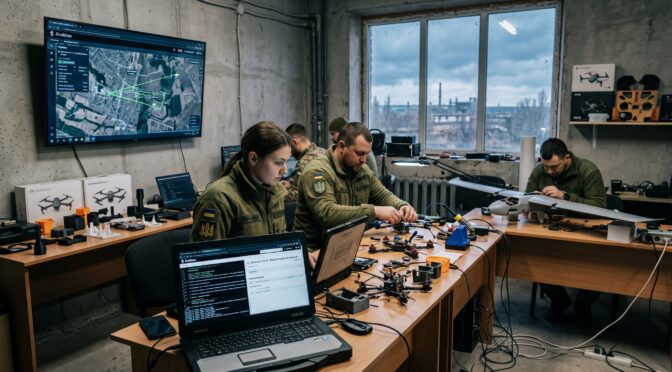
The ongoing conflict in Ukraine has precipitated a fundamental, irreversible paradigm shift in modern military operations, transitioning the locus of strategic advantage from heavy, hardware-centric platforms to agile, software-defined systems. In this highly contested environment, the traditional metrics of military power—mass, armor, and kinetic yield—are increasingly offset by a new imperative: the speed of the software iteration cycle. The Ukrainian armed forces, supported by a vast network of decentralized civil-military partnerships, have pioneered the application of commercial DevSecOps (Development, Security, and Operations) methodologies to the battlefield. By treating unmanned aerial vehicles (UAVs) not as static munitions but as dynamic edge-computing nodes, Ukraine has compressed the innovation cycle from years to mere days.
This report exhaustively analyzes the agile software development frameworks, continuous integration pipelines, artificial intelligence architectures, and cryptographic supply chain security measures that define Ukraine’s revolutionary approach to unmanned warfare. The analysis demonstrates how an asymmetric, software-first approach has effectively neutralized conventional military advantages, creating a blueprint for the future of warfare that international defense ministries are currently scrambling to emulate.
The Strategic Imperative for Software-Defined Warfare
Historically, military procurement and weapons development have been governed by rigid, top-down acquisition processes characterized by multi-year development cycles, extensive requirements documentation, and centralized manufacturing.1 The reality of the Ukrainian battlefield, however, demonstrates that such traditional models are structurally incapable of adapting to the rapid evolution of electronic warfare (EW) and localized tactical innovations. Instead, Ukraine has embraced a model of distributed combat power where software modifications directly dictate battlefield efficacy.3
The catalyst for this strategic shift is the electromagnetic spectrum (EMS), which has become a continuous, software-driven domain of contestation. Russian electronic warfare elements systematically attempt to sever the command and telemetry links between drone operators and their vehicles using sophisticated spoofing techniques and high-power jamming systems.4 In response, a static hardware solution is fundamentally insufficient; adversary EW signatures, frequencies, and tactics evolve on a weekly, sometimes daily, basis. To maintain operational viability, Ukrainian engineers push software updates to drone fleets overnight, utilizing principles from agile software development to ensure that lessons learned from the morning’s combat directly inform the afternoon’s engineering patches.2
This capability to out-code the adversary—often referred to as the “Uberization of warfare”—has allowed a networked ecosystem of smaller, decentralized manufacturers to out-scale traditional defense giants.2 By treating the physical drone as a commoditized, replaceable delivery mechanism and the software as the actual, evolving weapon system, Ukraine has created a highly resilient operational capability. The underlying philosophy mirrors the commercial technology sector’s shift toward hardware-agnostic software modules. Electronic and software components are developed independently of any specific airframe, often comprising highly encrypted chips that enable critical autonomous functions such as perceiving the environment and recognizing targets.6 This decoupling of software from hardware represents the foundational architecture of Ukraine’s combat advantage.
Agile Methodologies and Rapid Software Delivery
To achieve the unprecedented velocity required to sustain frontline drone operations, Ukrainian defense technology sectors have heavily adopted agile development methodologies, abandoning monolithic software releases in favor of continuous delivery models. The United States Department of Defense has recognized this shift, noting that adopting DevSecOps practices is critical to actualizing modern defense strategies and ensuring survival in high-stakes environments, where 18-month development cycles are no longer just an inconvenience, but a threat to national security.7
The Code-to-Battlefield Pipeline
The continuous deployment architecture functions as a rapid iteration pipeline that ensures both velocity and security. In a combat ecosystem where adversaries rapidly adapt, integrating security directly into the pipeline is not a bureaucratic compliance measure, but an absolute operational necessity.7
Crucially, rather than relying strictly on simulated environments, Ukrainian developers utilize empirical combat feedback. The “Test in Ukraine” platform enables developers to evaluate new firmware, evasion algorithms, and AI models directly in high-intensity EW environments.9 This provides actionable stress-testing data that cannot be replicated in peacetime facilities.
Once the code passes validation, the firmware must be securely distributed. From secure repositories, the firmware is securely transmitted to frontline operator terminals via encrypted networks. At these decentralized workshops, technicians physically flash the new firmware onto the flight controllers of the drones via direct cable connections, or increasingly, utilize secure Over-The-Air (OTA) updates via Wi-Fi or cellular data links. This OTA capability allows engineering teams to push new evasion algorithms and telemetry configurations directly to active drone fleets overnight, completely bypassing years-long procurement cycles and preventing the need to physically return devices to manufacturers for rapid upgrades.
Open-Source Architecture, Middleware, and Hardware Abstraction
At the core of the Ukrainian UAV software ecosystem is the extensive utilization of open-source flight control stacks, predominantly ArduPilot and PX4.10 These platforms, originally designed for academic research, agricultural mapping, and hobbyist applications, have been aggressively customized and weaponized, effectively democratizing access to precision-guided munitions capabilities.10
The reliance on open-source software provides a profound strategic advantage. It prevents vendor lock-in, allows for the integration of heavily commoditized commercial-off-the-shelf (COTS) hardware, and taps into a massive global community of developers who continuously patch bugs and improve navigation logic.12
The Bifurcated Computing Architecture: Flight Controllers vs. Companion Computers
Modern combat drones deployed in Ukraine generally utilize a bifurcated computing architecture to separate real-time flight stabilization from complex mission logic and artificial intelligence processing.14 This abstraction is critical for maintaining flight safety while rapidly iterating experimental combat software.
- The Flight Controller (The Brainstem): Hardware components such as the Cube Orange or Pixhawk run the deterministic Real-Time Operating System (RTOS) hosting ArduPilot or PX4.16 This underlying layer handles the strict, time-sensitive physics of flight—motor mixing, gyroscopic stabilization, attitude control, and basic GPS waypoint navigation.14
- The Companion Computer (The Prefrontal Cortex): Hardware such as the inexpensive Raspberry Pi 4 or 5, or advanced neural processing modules like the NVIDIA Jetson TX2 and Orin Nano, act as companion computers.15 These modules do not handle immediate flight physics; instead, they run comprehensive Linux environments capable of processing computationally heavy tasks.15 This includes running computer vision models for automated target recognition, processing complex electronic warfare data, and managing encrypted LTE or satellite communications.14
These two distinct systems communicate seamlessly via the MAVLink (Micro Air Vehicle Link) protocol.14 This architectural division is critical for agile DevOps. It allows Ukrainian software engineers to rapidly write, test, and update complex Python or C++ applications for AI targeting on the companion computer without risking the core stability of the flight control loop running on the Pixhawk. If a new experimental targeting algorithm crashes, the companion computer reboots, but the flight controller continues to keep the aircraft safely airborne.
Ecosystem Dynamics: ArduPilot vs. PX4
Both ArduPilot and PX4 power a massive portion of the drone fleets, yet they serve slightly different strategic purposes based on their governance models and technical architectures.
ArduPilot, governed by the GNU General Public License (GPL), is deeply embedded in the ecosystem due to its maturity, robust community support, and extensive documentation.12 It boasts over 12,000 GitHub stars and supports an immense variety of airframes, making it the software backbone for many of Ukraine’s deep-strike fixed-wing platforms and reconnaissance multi-rotors.13
Conversely, PX4 is maintained under the more permissive BSD license by the Dronecode consortium (operating under the Linux Foundation).13 This licensing structure is highly attractive to commercial defense contractors who wish to modify the software for proprietary weapons systems without being legally obligated to release their source code to the public.11 Furthermore, PX4 offers robust, first-class integration with ROS 2 (Robot Operating System) and fastDDS middleware.13 This makes PX4 exceptionally suitable for engineering complex multi-agent swarm logic, automated drone-carrier deployments, and advanced sensor fusion architectures.13
| Feature / Platform | ArduPilot | PX4 Autopilot |
| Licensing Model | GNU General Public License (GPL) | BSD 3-clause License |
| Governance | Independent Board | Linux Foundation (Dronecode) |
| Primary Strength | Unmatched airframe support and community maturity; dominant in deep-strike operations. | Enterprise-friendly licensing; superior native integration with ROS 2 and advanced swarm middleware. |
| GitHub Metrics (Est.) | ~12.1k stars, 18.7k forks | ~9.5k stars, 14k forks |
Frontline Software Factories and Edge Computing
The traditional Department of Defense concept of a “software factory” involves remote, highly secure stateside data centers iteratively pushing code to enterprise military clients.17 The realities of the Ukrainian conflict have forced a radical redefinition of this concept, pushing the software factory directly to the tactical edge. Distributed, camouflaged drone workshops operate just kilometers from the zero line, functioning simultaneously as repair depots, manufacturing hubs, and software integration laboratories.18
These frontline laboratories are essential for closing the feedback loop between raw combat data and rapid software iteration.20 When Russian EW units deploy new jamming frequencies, alter their spoofing signatures, or deploy novel air defense protocols, Ukrainian drone pilots record the telemetry and video degradation data.1 This data is rapidly transmitted back to distributed engineering teams—often comprised of volunteers, gamers, and seasoned developers—who immediately begin writing countermeasures.1 These countermeasures might include software instructions for autonomous frequency hopping mid-air, AI algorithms trained to ignore specific corrupted GPS packets, or new video encoding techniques to punch through RF noise.1
Within hours or days, these critical software patches are securely distributed to frontline operator terminals. Technicians in the camouflaged frontline workshops then physically flash the new firmware onto thousands of commercial drones using local connections, fundamentally altering their behavior, lethality, and evasion capabilities.19 This capability to implement rapid, secure distribution and rapid terminal flashing means that a drone captured by Russian forces on a Tuesday yields no permanent intelligence advantage, as the operational software and communication protocols of the entire fleet can be completely rotated by Thursday.
The Risk of Centralized Firmware: The “1001” Cyberattack Case Study
The heavy reliance on remote firmware distribution and field-flashing terminals is not without significant cyber-kinetic risk. Threat actors inherently recognize that disrupting the firmware supply chain effectively grounds the drone fleet without firing a single missile.
A stark demonstration of this vulnerability occurred with the Russian developers of the custom “1001” firmware. This specialized software was designed to convert civilian DJI drones for military use by removing manufacturer-imposed altitude and geofencing limits, enhancing resistance to GPS spoofing, and enabling the use of high-capacity combat batteries.22 The firmware was distributed to frontline Russian units via a network of service centers equipped with pre-configured laptops acting as flashing terminals.22
Unidentified hackers successfully executed a targeted cyberattack on the centralized servers responsible for delivering this firmware.22 The attackers breached the distribution infrastructure, displayed false warning messages on the operator terminals, and entirely disabled the deployment system.22 While the developers claimed the actual drone source code was not injected with malicious backdoors, the attack successfully severed the logistical tether.22 Drone operators were forced to disconnect their terminals, halting the deployment of newly modified drones to the battlefield.22 This incident highlights the critical vulnerability of centralized software distribution mechanisms in warfare and underscores why Ukraine heavily emphasizes decentralized, highly encrypted DevSecOps pipelines.
Brave1 and Institutional Innovation Architectures
To support, fund, and scale this massive, decentralized network of software innovators and hardware engineers, the Ukrainian government established Brave1. Operating as a defense technology coordination platform and innovation cluster led by the Ministry of Digital Transformation, Brave1 serves as a central hub connecting independent engineers, military end-users, foreign investors, and government procurement agencies.23
Redefining Military Procurement
Brave1 explicitly breaks away from traditional, bureaucratic defense procurement models. It functions dynamically as both a marketplace and an technology accelerator.25 Crucially, Brave1 is not a traditional government procurement body that issues multi-year tenders.25 Instead, the platform provides a highly structured, high-velocity pathway for vendor registration, field demonstration, security evaluation, and validation.25 Once a technological solution—such as a new AI targeting algorithm, a resilient flight controller, or a novel ground robot—passes Brave1’s rigorous field testing, the platform validates the technology and introduces the developers directly to military units and agencies.25 This allows the actual procurement to operate at a pace that matches immediate operational requirements rather than bureaucratic timelines.25
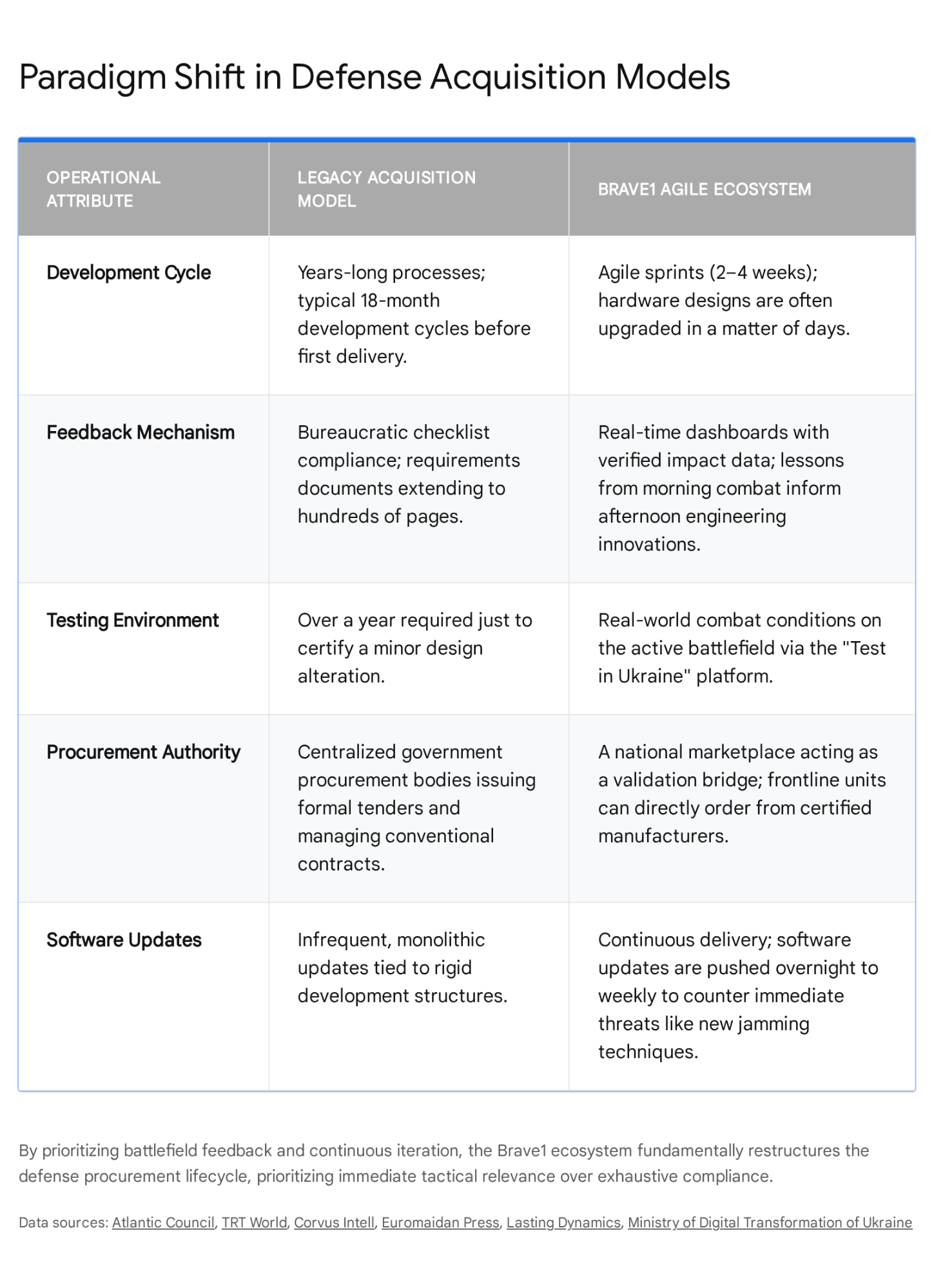
This architecture creates a demand-driven combat ecosystem. Frontline units can effectively “shop” for certified technologies using government-allocated funding through the Brave1 Market.26 This utilizes a specialized “ePoints” combat points system that directly matches specific tactical needs with immediate, vetted technological solutions.26 This real-time marketplace is continuously fed with verified combat data, allowing manufacturers to monitor impact statistics, strike distances, and failure modes via live dashboards, which further accelerates the software iteration cycle.27
Test in Ukraine and the Palantir Dataroom
A critical component of Brave1’s international success is its integration of real-world battlefield conditions into the software development process. The “Test in Ukraine” platform allows both domestic developers and massive international defense companies to evaluate their systems in high-intensity EW environments.9 This provides developers with empirical stress-testing data that simply cannot be replicated in peacetime testing grounds in the West.9 For example, the German defense manufacturer DIEHL utilized this platform to evaluate advanced systems under active combat conditions.9
Furthermore, to accelerate the development of autonomous systems, Brave1 launched a highly secure “Dataroom” in partnership with Palantir Technologies.28 This secure environment grants vetted developers access to vast, structured datasets of real-world combat telemetry.28 These datasets include thousands of hours of visual and thermal imagery of aerial targets—particularly Iranian-designed Shahed drones—collected under various weather, lighting, and electronic warfare conditions.28 By training Artificial Intelligence models on authentic, messy combat footage rather than synthetic or sterile data, Ukrainian developers drastically improve the accuracy, speed, and reliability of computer vision algorithms utilized for autonomous terminal guidance and interceptor drones.28
Influencing European Procurement Models
The efficacy of the Ukrainian agile model is actively reshaping European defense strategy. Realizing that multi-year certification processes are obsolete against rapid technological threats, European capitals are building institutional architecture around the idea that Ukrainian combat data should directly drive European procurement.29 Initiatives like BraveTech EU Phase 2, managed by the European Defence Agency, explicitly mandate that defense solutions be assessed against operational scenarios drawn directly from the war in Ukraine.29
However, despite European initiatives like the European Defence Industry Programme (EDIP) carving out funds to integrate Ukrainian methodologies with Western manufacturing, Ukraine fiercely guards its sovereign intellectual property.29 For example, during the “Drone Armada” discussions involving joint production agreements with Poland, Ukraine explicitly refused to transfer the core technologies for its military drones.30 This highlights that while Ukraine is eager to export its agile procurement principles and coordinate manufacturing, the specific DevSecOps developments, encrypted AI targeting modules, and proprietary hardware designs forged in its innovation ecosystem remain closely guarded national secrets.
DELTA, AI Integration, and Cloud-Native Situational Awareness
The orchestration of thousands of discrete, software-defined assets across an active battlespace requires an equally agile command and control infrastructure. In Ukraine, this capability is manifested in DELTA, a comprehensive, cloud-native situational awareness and battlefield management system.31 Originating from the volunteer group Aerorozvidka in 2015 during the war in Donbas, and now managed by the Ministry of Defense’s Center for Innovation, DELTA stands as a premier example of bottom-up software development transforming national military strategy.33
Architecture and Interoperability
Unlike the U.S. Department of Defense’s top-down approach to Combined Joint All-Domain Command and Control (CJADC2), which has historically struggled with the forced integration of legacy, siloed defense systems, DELTA grew organically in response to immediate tactical needs.32 It began as a highly focused application—a digital map for situational awareness—and iteratively scaled into a massive microservices ecosystem.32
The architecture is inherently cloud-native on the backend, ensuring high availability, scalable data processing, and the rapid deployment of updates across the entire theater of operations.31 On the client side, it is heavily hardware-agnostic. It runs seamlessly via web browsers on standard PCs, mobile phones, and the ubiquitous Android tablets used by frontline commanders in the trenches.32
DELTA aggregates data from a vast, diverse array of sensor networks. It fuses commercial satellite imagery, intelligence from allied nations, raw video streams from airborne drones, stationary camera feeds, and crowd-sourced intelligence submitted by civilians via chatbots like eEnemy (єВорог).32 This creates a near-real-time Common Operating Picture (COP) that eliminates the fog of war.3 Furthermore, the system was developed in strict coordination with NATO standards.31 It supports data exchange via the Link 16 protocol and is fully interoperable with western platforms, including Poland’s TOPAZ artillery fire control system, effectively functioning as a robust CJADC2 network in active, high-intensity combat.32
Integrating AI: The Avengers Platform
The sheer volume of raw data flowing into DELTA from thousands of concurrent drone feeds creates a cognitive overload for human analysts. In modern warfare, achieving “decision advantage”—the ability to process information and act faster than the adversary—is the critical bottleneck in the kill chain.34 To mitigate this overload, DELTA integrates the Avengers artificial intelligence platform.32 Unlike external systems such as the U.S. Department of Defense’s Maven Smart System (MSS), Avengers is a distinctly Ukrainian capability developed specifically for their unique threat landscape.36
The Avengers platform acts as a sophisticated automated target recognition (ATR) engine.6 It directly integrates with VEZHA, a live-streaming system that operates within the DELTA ecosystem, simultaneously processing thousands of live drone video streams.6 Utilizing advanced machine learning algorithms trained in the Palantir-partnered Brave1 Dataroom, Avengers automatically identifies, classifies, and tracks enemy assets.6 The system is capable of detecting camouflaged armor in forests, distinguishing real tanks from physical wooden decoys, and tracking armored personnel carriers moving on dirt roads.36
By automatically presenting commanders with actionable target coordinates rather than raw, unanalyzed video feeds, AI in DELTA compresses the decision cycle.4 The platform reduces the time from target detection to destruction to mere seconds.34 In this context, artificial intelligence operates not as an autonomous decision-maker executing lethal force, but as a high-speed analytical enabler that vastly accelerates the human-in-the-loop targeting process.4
Autonomy at the Tactical Edge
While DELTA and Avengers utilize heavy compute clusters for backend data processing and situational awareness, the most profound tactical shift is the deployment of artificial intelligence directly to the tactical edge—pushing autonomous capabilities onto the microchips of the drones themselves.6
Mitigating Electronic Warfare via Terminal Autonomy
Russian electronic warfare tactics focus heavily on severing the command link between the drone and the human pilot via radio frequency (RF) jamming, as well as spoofing the GPS signals required for coordinate navigation.4 If a drone relies entirely on constant human joystick input and external satellite navigation, it becomes an inert piece of plastic the moment it enters a sophisticated Russian EW dome.
To counter this dense electromagnetic interference, Ukrainian developers have integrated high-level computer vision and inertial navigation software directly onto the drone’s onboard companion computer.6 Platforms such as the Saker Scout utilize embedded machine learning to operate independently in the final stages of an attack.37 The operational workflow is highly resilient: the human pilot flies the drone to the general vicinity of the target using standard RF controls. Once the target is identified via the drone’s onboard optical sensors, the pilot engages the autonomous tracking software.37
At this point, the drone’s localized AI takes full control of the flight hardware. It utilizes optical navigation to map its environment and terminal guidance algorithms to lock onto the target.37 The drone will track moving vehicles and execute a precision strike without any further direct human flight control.37 Because the entire targeting logic is executed onboard the physical platform, severing the RF link via heavy jamming has absolutely no effect on the drone’s ability to complete its kinetic mission.37
This shift from remotely piloted vehicles to semi-autonomous, fire-and-forget loitering munitions fundamentally neutralizes the primary vector of electronic warfare defense. Furthermore, Ukrainian software engineers encrypt these onboard AI modules heavily.6 This ensures that if a drone fails to detonate and is captured, adversaries cannot easily reverse-engineer the microchips to extract the neural network weights and targeting parameters.6
Cyber Threats, Cryptography, and UA DroneID
As unmanned systems become deeply integrated into the digital networks of the battlefield, they inherently inherit the vast vulnerabilities of cyberspace. The software-defined war is subject to relentless cyber-kinetic attacks from highly capable adversaries, necessitating robust DevSecOps practices, meticulous identity management, and advanced cryptographic protocols.
The Russian Cyber Threat Landscape
Russian state-sponsored Advanced Persistent Threat (APT) groups have continuously targeted the digital infrastructure enabling Ukraine’s military operations.38 The threat matrix spans several highly resourced entities operating under Russian intelligence services:
| Threat Actor Group | Known Affiliation | Primary Targets & Objectives in Ukraine |
| Sandworm (Voodoo Bear) | GRU (Military Intelligence) | Deployment of destructive wiper malware (Industroyer2, HermeticWiper, CaddyWiper) against energy grids, IT sectors, and military networks to erode C2 resilience.39 |
| Secret Blizzard (Turla / Snake) | FSB Center 16 | Sophisticated espionage, intellectual property theft, and sabotage operations against defense tech infrastructure and government entities.41 |
| APT28 (Fancy Bear / BlueDelta) | GRU (Military Intelligence) | Phishing campaigns and network intrusion targeting Ukrainian emergency services, law enforcement, and military officials for intelligence gathering.42 |
One of the most direct and alarming threats to the tactical drone ecosystem occurred when Russian hackers actively targeted Ukraine’s front-line Android tablets. In a sophisticated operation, hackers from Russian military intelligence (Sandworm/APT28) physically captured Android tablets used by Ukrainian officers on the front lines to gain initial access.47 The Security Service of Ukraine (SBU) discovered that these actors developed seven bespoke malware samples specifically designed to exploit military situational awareness systems like Kropyva (developed by Army SOS) and Delta. By exploiting an open port vulnerability in the system that these tablets were connected to, the hackers sought to gain unauthorized access to the coordinates, Starlink connection data, and communications (such as Signal and Telegram) of thousands of frontline devices. This incident, echoing earlier 2014-2016 Fancy Bear attacks on Yaroslav Sherstyuk’s artillery applications, underscores the extreme risk inherent in decentralized, mobile-first battlefield software.48 The network perimeter is entirely porous, extending to any muddy trench where a connected tablet is deployed.
UA DroneID: Cryptographic Fleet Orchestration
One of the most pressing operational challenges stemming from the massive proliferation of drones is airspace deconfliction. In the early stages of the conflict, the lack of standardized digital identification protocols led to extreme rates of fratricide. Some estimates presented at defense conferences suggested that up to 50% of early drone losses were attributable to friendly fire from Ukrainian EW suppression and kinetic air defense assets, as operators could not distinguish incoming hostile munitions from returning friendly reconnaissance drones.43
To solve this critical operational failure, the Ministry of Defense, the Ministry of Digital Transformation, the NGO Aerorozvidka, and the civilian cybersecurity firm Cossack Labs developed UA DroneID.44 Launched in 2023, UA DroneID is a highly secure, cryptographically signed Identification Friend or Foe (IFF) protocol designed specifically for the unmanned systems ecosystem.44
Integrated directly into the DELTA battle management system by Aerorozvidka and the Center for Innovation and Development of Defense Technologies, the UA DroneID protocol establishes a rigorous zero-trust architecture.44 Cossack Labs handles the core protocol architecture, cryptography, and telemetry protection to ensure the data flow cannot be spoofed by adversary forces, while the Ministry of Digital Transformation assists with integrating the more than 15 drone manufacturers currently utilizing the system.44
In operation, UA DroneID continuously transmits securely encrypted telemetry and mission data, mathematically authenticating the drone as a friendly asset to automated air defense systems and adjacent units monitoring the DELTA map.44 By establishing a standardized, secure data exchange mechanism that resists electronic spoofing and cryptographic interception, UA DroneID has drastically reduced friendly fire incidents—dropping them by an estimated 90% following its rollout.44 Furthermore, it allows for the safe, coordinated orchestration of massive mixed fleets of UAVs sourced from civilian and military manufacturers, acting as the secure technical “glue” between physical hardware and cloud-based battle management.44 This continuous telemetry tracking provides commanders with unprecedented analytical capabilities to determine which specific drone configurations are best suited for striking distinct targets.49
Supply Chain and Regulatory Implications
The rapid expansion of Ukraine’s drone production and the active export of its combat-tested software technologies to allied NATO nations introduces massive information governance and cross-border compliance challenges.45 Defense technology supply chains are incredibly data-intensive operations, relying heavily on classified hardware specifications, proprietary AI training datasets, and secure firmware distribution networks.45
Every integration of a Ukrainian software module into a Western defense platform demands stringent DevSecOps compliance to ensure that the code has not been compromised by Russian cyber elements seeking to inject latent vulnerabilities into NATO systems.7 While importing technology rapidly enhances allied capabilities, maintaining rigorous cryptographic security over API endpoints, communication relays, and source code repositories remains the paramount operational security challenge of the modern era.22
Conclusion
The war in Ukraine serves as the crucible for the future of combat, providing a violent, uncompromising validation of software-defined warfare. The traditional metrics of military superiority are being rewritten by the realities of the tactical edge, where the ability to push a localized software update to a commercial drone faster than an adversary can adjust their electronic warfare jammers dictates the outcome of an engagement.
Ukraine has empirically demonstrated that the agility of a nation’s DevSecOps infrastructure is now a primary, load-bearing component of its national defense capability. By embracing open-source hardware abstraction, agile development pipelines, and decentralized front-line software factories, Ukraine has built a resilient, highly lethal, and continuously evolving unmanned force. The integration of advanced artificial intelligence for autonomous terminal guidance, supported by robust cryptographic frameworks like UA DroneID and the cloud-native DELTA command system, represents a generational leap forward in combined arms coordination. For allied militaries observing the conflict, the central lesson is unequivocal: in the modern era of contested electromagnetic spectrums and hyper-proliferated drone swarms, institutional software agility is not merely an administrative upgrade, but the foundational prerequisite for battlefield survival.
Please share the link on Facebook, Forums, with colleagues, etc. Your support is much appreciated and if you have any feedback, please email us in**@*********ps.com. If you’d like to request a report or order a reprint, please click here for the corresponding page to open in new tab.
Sources Used
- Agile Warfare: How Ukraine is Changing Military Innovation – Vislink, accessed June 26, 2026, https://www.vislink.com/blog/agile-warfare-how-ukraine-is-changing-military-innovation/
- The ‘Uberisation’ of Warfare: How Ukraine’s Drone Revolution Is Rewriting Modern War, accessed June 26, 2026, https://researchcentre.trtworld.com/publications/analysis/the-uberisation-of-warfare-how-ukraines-drone-revolution-is-rewriting-modern-war/
- Distributed Combat Power: How Ukraine is Redefining Fires, Electronic Warfare, and Air Defense at the Tactical Level – Small Wars Journal, accessed June 26, 2026, https://smallwarsjournal.com/2026/05/21/distributed-combat-power-how-ukraine-is-redefining-fires-electronic-warfare-and-air-defense-at-the-tactical-level/
- Mapping the MilTech war: eight lessons from Ukraine’s battlefield – PubAffairs Bruxelles, accessed June 26, 2026, https://www.pubaffairsbruxelles.eu/opinion-analysis/mapping-the-miltech-war-eight-lessons-from-ukraines-battlefield-2/
- Drone superpower Ukraine is an ideal tech partner for the Gulf states – Atlantic Council, accessed June 26, 2026, https://www.atlanticcouncil.org/blogs/ukrainealert/drone-superpower-ukraine-is-an-ideal-tech-partner-for-the-gulf-states/
- Ukraine’s Future Vision and Current Capabilities for Waging AI-Enabled Autonomous Warfare – CSIS, accessed June 26, 2026, https://www.csis.org/analysis/ukraines-future-vision-and-current-capabilities-waging-ai-enabled-autonomous-warfare
- DevSecOps for Defense: How Software Factories & Agile Are Revolutionizing Military Development [2026] | – Lasting Dynamics, accessed June 26, 2026, https://www.lastingdynamics.com/blog/devsecops-agile-defense-military-software-development/
- Fog of war: how the Ukraine conflict transformed the cyber threat landscape – Google Blog, accessed June 26, 2026, https://blog.google/threat-analysis-group/fog-of-war-how-the-ukraine-conflict-transformed-the-cyber-threat-landscape/
- Ukraine Becomes Real-Time Lab for Global Military Innovation – Digital State UA, accessed June 26, 2026, https://digitalstate.gov.ua/news/tech/ukrayina-vidkryla-platformu-test-in-ukraine-dlia-vyprobuvannia-miznarodnykh-oboronnykh-tekhnolohiy-pershyy-uchasnyk-diehl
- Ukraine’s Drone Strikes Are a Window Into the Future of Warfare | RealClearDefense, accessed June 26, 2026, https://www.realcleardefense.com/articles/2023/09/15/ukraines_drone_strikes_are_a_window_into_the_future_of_warfare_979706.html
- alireza787b/PX4-Autopilot-Me – GitHub, accessed June 26, 2026, https://github.com/alireza787b/PX4-Autopilot-Me
- ArduPilot – Versatile, Trusted, Open, accessed June 26, 2026, https://ardupilot.org/
- PX4 vs ArduPilot: Build Powerful Drone Control Apps – A-bots, accessed June 26, 2026, https://a-bots.com/blog/PX4-vs-ArduPilot
- Raspberry pis found in Ukrainian Drones : r/raspberry_pi – Reddit, accessed June 26, 2026, https://www.reddit.com/r/raspberry_pi/comments/10by11r/raspberry_pis_found_in_ukrainian_drones/
- Top 5 Companion Computers for UAVs | ModalAI, Inc., accessed June 26, 2026, https://www.modalai.com/blogs/blog/top-5-companion-computers-for-uavs
- Guidelines for Designing a Custom Drone with PX4 Autopilot, accessed June 26, 2026, https://discuss.px4.io/t/guidelines-for-designing-a-custom-drone-with-px4-autopilot/39179
- Introduction to the DoD Software Factory – Anchore Enterprise, accessed June 26, 2026, https://anchore.com/blog/introduction-to-the-dod-software-factory/
- Innovating Under Fire: Lessons from Ukraine’s Frontline Drone …, accessed June 26, 2026, https://mwi.westpoint.edu/innovating-under-fire-lessons-from-ukraines-frontline-drone-workshops/
- Inside a camouflaged drone workshop, one step away from the front lines in Ukraine, accessed June 26, 2026, https://www.reddit.com/r/europe/comments/1l7hu4m/inside_a_camouflaged_drone_workshop_one_step_away/
- NATO Must Learn from Ukraine’s Frontline Drone Labs – CEPA, accessed June 26, 2026, https://cepa.org/article/nato-must-learn-from-ukraines-frontline-drone-labs/
- How software modifications affect drone warfare – The Russian example, accessed June 26, 2026, https://en.kkrva.se/how-software-modifications-affects-drone-warfare-the-russian-example/
- Cyberattack deals blow to Russian firmware used to repurpose civilian drones for Ukraine war – Recorded Future News, accessed June 26, 2026, https://therecord.media/cyberattack-russia-firmware-blow-hackers
- information about the project Brave1 – Digital State UA, accessed June 26, 2026, https://digitalstate.gov.ua/projects/tech/brave1
- How Ukraine Rebuilt Its Military Acquisition System Around Commercial Technology – CSIS, accessed June 26, 2026, https://www.csis.org/analysis/how-ukraine-rebuilt-its-military-acquisition-system-around-commercial-technology
- Brave1 defense ecosystem: how Ukraine’s defense tech platform works – Corvus Intelligence, accessed June 26, 2026, https://corvusintell.com/blog/defense-market/brave1-defense-ecosystem/
- Over 500000 drones ordered by the military through Brave1 Market using combat points, accessed June 26, 2026, https://mod.gov.ua/en/news/over-500-000-drones-ordered-by-the-military-through-brave1-market-using-combat-points
- Ukraine and NATO are building new kind of wartime procurement – Euromaidan Press, accessed June 26, 2026, https://euromaidanpress.com/2026/04/13/ukraine-and-nato-are-building-new-kind-of-wartime-procurement/
- Over 100 Ukrainian companies are already leveraging Brave1 Dataroom to train AI models, accessed June 26, 2026, https://mod.gov.ua/en/news/over-100-ukrainian-companies-are-already-leveraging-brave1-dataroom-to-train-ai-models
- “Ukraine-Tested” has become the European procurement standard: BraveTech EU Phase 2, EDIP USI, PURL, and the 18 June NATO ministerial : r/CredibleDefense – Reddit, accessed June 26, 2026, https://www.reddit.com/r/CredibleDefense/comments/1u91ycn/ukrainetested_has_become_the_european_procurement/
- A one-time transfer of drone technology from Ukraine is not possible – New Eastern Europe, accessed June 26, 2026, https://neweasterneurope.eu/2026/06/24/a-one-time-transfer-of-drone-technology-from-ukraine-is-not-possible/
- Delta (situational awareness system) – Wikipedia, accessed June 26, 2026, https://en.wikipedia.org/wiki/Delta_(situational_awareness_system)
- Does Ukraine Already Have Functional CJADC2 Technology? – CSIS, accessed June 26, 2026, https://www.csis.org/analysis/does-ukraine-already-have-functional-cjadc2-technology
- The Ukrainian Way of Digital Warfighting: Volunteers, Applications, and Intelligence Sharing Platforms – CSS ETH Zürich, accessed June 26, 2026, https://css.ethz.ch/en/center/CSS-news/2024/07/the-ukrainian-way-of-digital-warfighting-volunteers-applications-and-intelligence-sharing-platforms.html
- Ukraine’s DELTA System Shows How Drones, Data, and Leadership Shape Modern Security – HSToday, accessed June 26, 2026, https://www.hstoday.us/subject-matter-areas/unmanned-vehicles/ukraines-delta-system-shows-how-drones-data-and-leadership-shape-modern-security/
- The Ministry of Defence demonstrates DELTA, Avengers, and UA DRONE ID to NATO in real combat conditions | MoD News, accessed June 26, 2026, https://mod.gov.ua/en/news/battle-tested-the-ministry-of-defence-demonstrates-delta-avengers-and-ua-drone-id-to-nato-in-real-combat-conditions
- AI Helps Ukrainian Defense Forces Track Thousands of Enemy Targets, accessed June 26, 2026, https://militarnyi.com/en/news/ai-helps-ukrainian-defense-forces-track-thousands-of-enemy-targets/
- CSS STUDY Learning from the Ukrainian … – CSS ETH Zürich, accessed June 26, 2026, https://css.ethz.ch/content/dam/ethz/special-interest/gess/cis/center-for-securities-studies/pdfs/CSS_Study_2024_Learning_from%20the_Ukrainian_Battlefield.pdf
- The IO Offensive: Information Operations Surrounding the Russian Invasion of Ukraine | Mandiant | Google Cloud Blog, accessed June 26, 2026, https://cloud.google.com/blog/topics/threat-intelligence/information-operations-surrounding-ukraine
- Report on Cyber Lessons Learned during the War in Ukraine – OCR of the Document | National Security Archive, accessed June 26, 2026, https://nsarchive.gwu.edu/media/31762/ocr
- Cyber Threat Activity Related to the Russian Invasion of Ukraine, accessed June 26, 2026, https://www.cyber.gc.ca/sites/default/files/cyber-threat-activity-associated-russian-invasion-ukraine-e.pdf
- Frequent freeloader part II: Russian actor Secret Blizzard using tools of other groups to attack Ukraine | Microsoft Security Blog, accessed June 26, 2026, https://www.microsoft.com/en-us/security/blog/2024/12/11/frequent-freeloader-part-ii-russian-actor-secret-blizzard-using-tools-of-other-groups-to-attack-ukraine/
- Ukrainian emergency services and hospitals hit by espionage campaign using new AgingFly malware – Recorded Future News, accessed June 26, 2026, https://therecord.media/aging-fly-espionage-campaign-targets-ukraine-emergency-services
- The Future of Drones in Ukraine: A Report from the DIU-Brave1 Warsaw Conference – CSET, accessed June 26, 2026, https://cset.georgetown.edu/article/the-future-of-drones-in-ukraine-a-report-from-the-diu-brave1-warsaw-conference/
- UA DroneID: Ukraine Launches Secure “Friend-or-Foe” Drone Identification System – Oj, accessed June 26, 2026, https://odessa-journal.com/aerorozvidka-and-cossack-labs-unveil-ua-droneid-to-identify-friend-or-foe-and-reduce-friendly-fire-on-drones
- When Weapons Cross Borders, Data Follows: Ukraine’s Drone Expansion and the Compliance Reckoning to Come – ComplexDiscovery, accessed June 26, 2026, https://complexdiscovery.com/when-weapons-cross-borders-data-follows-ukraines-drone-expansion-and-the-compliance-reckoning-to-come/
- Ukraine’s drone success offers a blueprint for cybersecurity strategy – Atlantic Council, accessed June 26, 2026, https://www.atlanticcouncil.org/blogs/ukrainealert/ukraines-drone-success-offers-a-blueprint-for-cybersecurity-strategy/
- Inside Russia’s attempts to hack Ukrainian military operations – NPR, accessed June 26, 2026, https://www.npr.org/2023/08/10/1193167328/russia-hack-ukraine-military
- CYBERDEFENSE REPORT The Ukrainian Way of Digital Warfighting Volunteers, Applications, and Intelligence Sharing Platforms – CSS ETH Zürich, accessed June 26, 2026, https://css.ethz.ch/content/dam/ethz/special-interest/gess/cis/center-for-securities-studies/pdfs/CSS_Cyberdefense_Report_Ukrainian_Way_of_Digital_Warfighting.pdf
- Ukraine’s Defence Ministry unveils advanced technology enhancing drone capabilities, accessed June 26, 2026, https://www.pravda.com.ua/eng/news/2024/04/10/7450583/