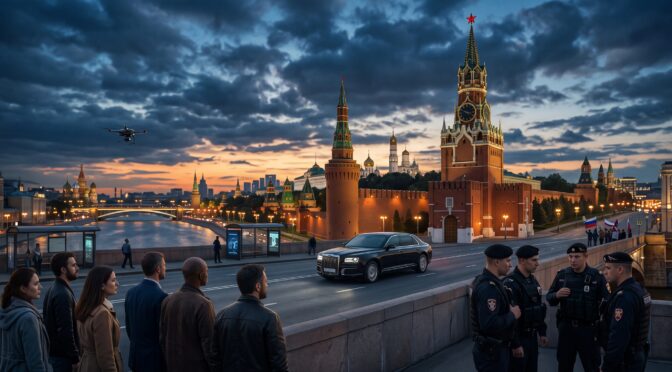
The internal political architecture of the Russian Federation has entered a highly sensitive, volatile, and transformative phase. Driven by the prolonged strategic, economic, and military demands of the ongoing war in Ukraine, systemic shifts within the highest echelons of the ruling elite, and President Vladimir Putin’s advancing age and deteriorating health, the Kremlin is currently navigating a complex transition of power.1 As of 2026, the Russian governance model has shifted drastically from a posture of outward risk-taking and managed internal competition to one of profound inward consolidation.1 This strategic realignment is punctuated by severe elite fractures, the heavy militarization of domestic security apparatuses, and the installation of a wartime technocracy designed to sustain a protracted conflict while insulating the core regime against internal usurpation.1
This comprehensive intelligence assessment evaluates the real probabilities of a coup against Vladimir Putin, the systemic mechanisms of alternative leadership transitions, the evolving power dynamics among the siloviki (security elites), and the prospective successors who stand to inherit the Russian state. Furthermore, it analyzes how these potential successors—and the broader generational shift occurring within the Russian bureaucracy—will dictate the future trajectory of United States-Russia relations, global security stability, and the geopolitical orientation of the Eurasian landmass.
Part I: The Architecture of Regime Security and Coup-Proofing
The “Fortress Kremlin” Model and Heightened Threat Perception
Intelligence assessments leaked to European agencies in early 2026 indicate a sharp, sustained increase in Vladimir Putin’s anxiety regarding his personal security, deep-seated fears of elite betrayal, and the potential for a palace coup.4 This heightened threat perception is not merely psychological or speculative; it is actively reflected in sweeping institutional changes and physical security postures.1 Since March 2026, the Kremlin has effectively transitioned to a “bunkerized” or “fortress” governance model.1
The primary catalyst for this shift is the dual threat of kinetic attacks and the structural breakdown of elite cohesion. The kinetic threat is dominated by the fear of long-range drones operated either by Ukrainian forces or internal defectors, a vulnerability that was glaringly exposed when a drone strike damaged the Mosfilm Tower in Moscow City on May 4, 2026.7 This paranoia was further exacerbated by the December 22, 2025 assassination of Lieutenant General Fanil Sarvarov in Moscow City, which prompted immediate security overhauls.4 Following a December 2025 meeting where security officials shifted blame onto each other for Sarvarov’s death, the FSO expanded its regulations to directly provide security to 10 high-ranking generals, further centralizing control.4 In response, the Russian military and security services have deployed an increased number of short and medium-range air defense systems—specifically Pantsir-S1 and S-400 batteries—directly around Putin’s Valdai and Moscow City residences.7 Following intense domestic criticism of these air defense vulnerabilities, the Ministry of Defense abruptly appointed Colonel General Alexander Chayko as the new commander-in-chief of the Aerospace Forces (VKS) on May 4, 2026.7
To mitigate the insider threat, the Federal Protective Service (FSO) has been granted a dramatically expanded mandate. Moving far beyond traditional physical bodyguard duties, the FSO has assumed a pervasive, intrusive counterintelligence role that eclipses the jurisdiction of other agencies.1 The practical effect of this expanded authority includes multi-layered screening protocols for all personnel, the strict restriction of digital connectivity among presidential staff (who are now only permitted to use phones without internet access), and the consolidation of surveillance control over Moscow’s broader operational environment, including large-scale FSO-directed internet outages and canine sweeps along the Moskva River to respond to potential drone attacks.
Furthermore, Putin’s physical mobility has been severely curtailed by these new protocols. He increasingly relies on pre-recorded public appearances, heavily managed environments, and highly secure, subterranean facilities, notably failing to visit a single military facility throughout 2026. By spending weeks at a time in underground bunkers, Putin is able to micromanage the war effort while remaining physically insulated; however, this bunkerization has simultaneously resulted in him growing increasingly detached from civilian affairs and the daily realities of the Russian populace.8
Fragmented Coercion: The “Divide-and-Balance” System
The resilience of the Russian regime against an armed uprising is predicated on a historically rooted, deliberately engineered system of institutional fragmentation. Under wartime conditions, the traditional Russian governance model of “competitive overlap”—where the Kremlin relies on overlapping mandates among the siloviki (security services) to prevent any single actor from dominating—has been heavily reinforced.1 The coercive capacity necessary to execute a successful coup is fractured across multiple, inherently hostile agencies: the Ministry of Defense (MoD) and the General Staff, the Federal Security Service (FSB), the FSO, and the National Guard (Rosgvardia).1
This overlapping jurisdiction ensures that no single faction can achieve the critical mass required for a unilateral seizure of power without triggering an immediate, violent counter-response from a rival agency.1 This practice aligns with the structural balancing often observed in poorly institutionalized authoritarian regimes, wherein a politicized professionalism is fostered to ensure the executive remains the sole arbiter of power.9
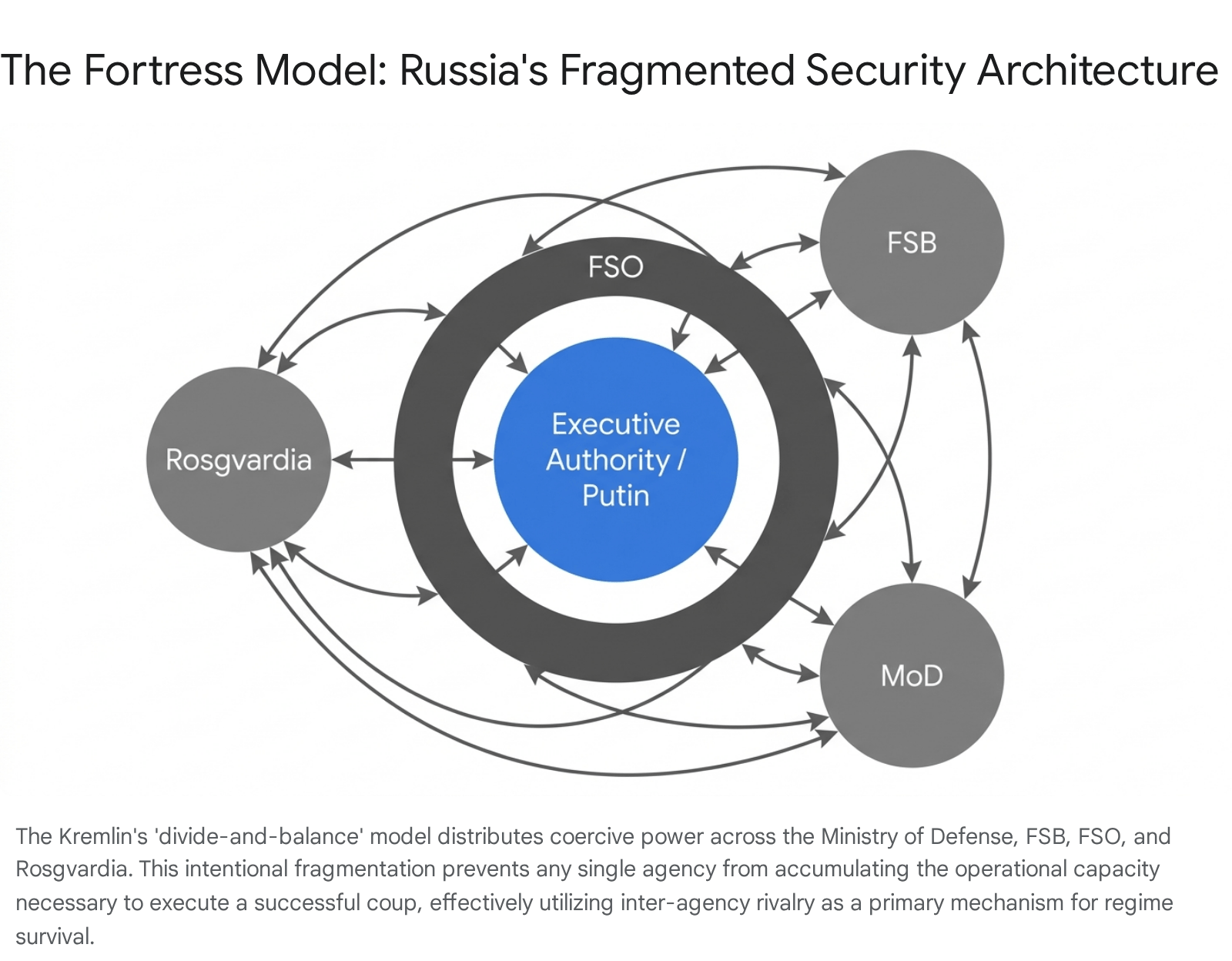
The paramount example of this coup-proofing strategy is the empowerment of Rosgvardia (the National Guard). Following the short-lived, deeply humiliating mutiny by the Wagner Group in June 2023, the Kremlin aggressively moved to reinforce this praetorian guard.10 Under the command of fiercely loyal Putin ally Viktor Zolotov, Rosgvardia was formally authorized to receive heavy weaponry, including attack helicopters, artillery, and main battle tanks, fundamentally transforming it from a riot-control gendarmerie into a mechanized internal army.10 Furthermore, Rosgvardia absorbed elite tactical units such as the “Grom” special forces—highly trained officers with combat experience in the FSB, the Foreign Intelligence Service (SVR), and military intelligence (GRU)—consolidating the internal security apparatus.13
In a crisis scenario involving a potential coup by the military or the FSB, Rosgvardia is designed to act not as an initiator, but as the ultimate “coup-blocker” and regime kingmaker, neutralizing any armed columns attempting to advance on the capital.1 This dynamic produces a system that, while highly inefficient for external war-fighting due to constant blame-shifting and coordination breakdowns, is remarkably robust against internal military overthrow.1
Part II: Real Risks of a Coup and Alternative Unseating Mechanisms
Coup Probability Assessment: The 10-15% Success Rate
Despite the Kremlin’s heightened state of alert and the profound dissatisfaction among various elite factions regarding the trajectory of the war and the crippling effects of Western sanctions, the probability of a traditional military coup—characterized by armored divisions seizing critical infrastructure in Moscow—remains exceptionally low.1
Current analytical frameworks and intelligence models applied to the Russian operational environment suggest a 20–30% probability of a serious coup attempt or a forced leadership-transition maneuver within the next 12 to 18 months.1 However, the probability of such an attempt resulting in a successful overthrow of the regime is considerably lower, estimated at merely 10–15%.1 The discrepancy between the likelihood of an attempt and its ultimate success lies entirely in the aforementioned “divide-and-balance” defensive architecture. The security bloc possesses the coercive capacity and the access required to initiate a coup, but because they are deliberately monitored by the FSO and counter-balanced by Rosgvardia, the operational security required to plan and execute a synchronized overthrow is nearly impossible to maintain.1
Triggers for Instability
While the baseline probability of a successful military coup remains suppressed by structural barriers, the regime is not immune to shock events. Specific stress triggers could rapidly alter the calculus of the elites, shifting their focus from regime preservation to personal survival, thereby elevating the risk of a serious unseating maneuver to 35–40%.1
| Primary Coup Triggers | Mechanism of Action | Systemic Impact |
| Catastrophic Military Defeat | A decisive collapse of Russian defensive lines in Ukraine, or a sustained wave of successful Ukrainian strikes eliminating senior command staff in the rear.1 | Destroys the credibility of the Commander-in-Chief; prompts the military to preemptively seize power to prevent total institutional collapse and scapegoating. |
| Severe Fiscal Shock | An inability to fund the war economy, failure to pay internal security forces, or a systemic collapse in the state budget due to sanctions and resource depletion.1 | Erodes the transactional loyalty of the siloviki and technocratic elites; disrupts the patronage networks that guarantee elite compliance. |
| High-Profile Purges | Highly visible, public arrests within the FSB, the General Staff, or the residual networks of former Defense Minister Sergei Shoigu.1 | Triggers a “now-or-never” survival reflex among targeted elites, forcing them to initiate a preemptive strike against the Kremlin before they are eliminated.1 |
| Unexplained Disappearance | A prolonged, unexplained absence of the President from live or heavily managed public broadcasts, particularly amidst rumors of failing health.1 | Signals a power vacuum, prompting rival factions to mobilize their respective armed elements to secure control over the capital and the transition process. |
Alternative Unseating: The Palace Coup and the Khrushchev Paradigm
If Vladimir Putin is to be unseated, the mechanism is highly unlikely to resemble a popular democratic revolution or a violent, public military putsch. The political opposition in exile—represented by figures such as Yulia Navalnaya, Vladimir Kara-Murza, and Ilya Yashin—remains deeply marginalized, internally fractured, and entirely devoid of structural influence or coercive power within the Russian state apparatus.15 While these figures successfully lobby the European Parliament and Yashin is organizing a new political party aimed at uniting disparate anti-war factions 16, their capacity to initiate a regime change from outside the borders of the Russian Federation is virtually non-existent.15 Additionally, a “Westernization scenario”—where elites oust Putin to install a Western-oriented leader in the mold of Mikhail Gorbachev—is highly implausible because Putin has systematically marginalized or co-opted the liberal, Western-oriented factions within the elite.51 Therefore, the most plausible scenario for regime rupture is an elite-managed “palace transition” or an internal conspiracy orchestrated by a coalition of technocratic and security elites.1
This scenario draws profound and highly relevant historical parallels to the October 1964 ouster of Soviet Premier Nikita Khrushchev.18 Khrushchev was removed not by a military uprising or a popular revolt, but by a bloodless, bureaucratic consensus achieved within the upper echelons of the Communist Party.19 His removal was driven by elite dissatisfaction with his erratic leadership, economic failures, the alienation of the military-industrial complex, and his tendency to issue directives demanding initiative from below while ruling as a dictatorial oligarchy from above.20
Crucially, the lesson of 1964 is that elite politics in Marxist-Leninist and modern Russian authoritarian regimes are inherently ambiguous and highly contingent.21 Khrushchev was lulled into a false sense of security by a system designed to generate misinformation and sycophancy, leaving him vulnerable to a coup precisely because he misunderstood his own undeniable strengths and weaknesses.21 Modern structural analysis indicates that Putin suffers from a similar informational isolation, largely induced by his self-bunkerization and the filtering of intelligence by the FSO and loyalist factions.1
In a modern context, a palace coup coalition could maneuver to isolate Putin by exploiting a medical pretext.1 Utilizing the President’s heavily monitored and allegedly deteriorating health status—which includes rumors of oncological issues and the progression of Parkinson’s disease—conspirators could declare an “emergency delegation of power” via a sudden Security Council decree.1 The operational success of this maneuver relies entirely on gaining complete control over Putin’s physical access, severing his communications with loyalist regional commanders, and controlling his public appearances.1 This mechanism requires the active, indispensable complicity of the leadership of the Federal Protective Service, without whom physical isolation is impossible. Following such a putsch, the new regime would likely fete Putin as a restorer of Russian greatness, offering him a gilded retirement while pivoting the state toward technocratic retrenchment.18
Part III: Structural Vulnerabilities, Elite Fractures, and the May 2024 Realignment
The resilience of the Russian regime is currently being severely tested by the degradation of its internal arbitration mechanisms and the breakdown of elite cohesion. Historically, Putin has ruled by positioning himself as the vital, indispensable arbiter above a multiplicity of competing factions.1 However, under the immense pressures of a protracted war, this controlled competition has mutated into destabilizing, zero-sum friction.1
The Breakdown of Elite Cohesion
A highly visible and damaging institutional rivalry has emerged, involving Chief of the General Staff Valery Gerasimov, FSB Director Alexander Bortnikov, and Rosgvardia Director Viktor Zolotov.1 This friction is driven by the intense politicization of failure attribution—where agencies blame one another for battlefield setbacks, security breaches, and intelligence failures regarding Ukrainian capabilities—as well as the allocation of increasingly strained state resources.1 The military establishment, frustrated by political micromanagement and the fear of purges, finds itself heavily monitored by the FSB and balanced by Rosgvardia, creating a deeply paranoid command environment.1
Furthermore, the 2020 constitutional amendments, which effectively removed term limits for the presidency, eliminated a credible, legal timeline for a transition of power.1 By personalizing the constitution to allow for his lifelong rule, Putin degraded the state’s “managed-succession model”.1 In the absence of a clear successor or a guaranteed post-Putin political settlement, and amidst the rising fear of wartime purges and asset redistribution, the elite face an acute dilemma.1 This environment engenders a logic of preemptive action, where rival factions may conclude that striking first against competitors—or the executive himself—is necessary for physical and economic survival.1
The May 2024 Reshuffle: Consolidating the War Economy
Recognizing the untenable friction within the security apparatus and the need to optimize the state for a protracted conflict, Putin executed the most significant renewal of the managerial elite since the beginning of the full-scale invasion during the May–June 2024 reshuffle.22 The clear motivation behind this package of appointments was to reassert Putin’s personal control over influential state corporations, eradicate competing power bases, and tighten oversight over the spending of state funds.2
The most consequential move of this reshuffle was the removal of Sergei Shoigu from the Ministry of Defense.23 Shoigu, who had served as Defense Minister for 12 years, had become a highly toxic figure to the elite and the public due to the army’s poor performance, logistical failures, and rampant corruption within his ministry.24 To prevent him from remaining a threat, Shoigu was shifted to the role of Secretary of the Security Council, a move analysts describe as holding him “hostage” rather than letting him retire and potentially mobilize his residual military networks.1 Crucially, Shoigu was unable to bring his team with him to the Security Council, effectively neutralizing his operational power.2 Simultaneously, Nikolai Patrushev, a longtime hardliner and foundational pillar of the FSB establishment who previously held the Security Council post, was humiliatingly demoted to a minor advisory role overseeing shipbuilding—a forced retirement intended to signal the dismantling of the old guard.23
The Ascendancy of Andrei Belousov
Replacing Shoigu was Andrei Belousov, a 67-year-old civilian, academic economist, and staunch statist with absolutely no prior military or security service experience.28 Belousov’s appointment was a shock to many observers but signaled a definitive recognition by the Kremlin that the conflict in Ukraine had evolved past operational maneuvering into a grueling war of industrial attrition.25
Belousov is tasked not with operational military strategy, but with the grand strategic management of the nation’s resources for a “forever war”.3 His primary mandate is to optimize a defense budget that has ballooned to 6% of GDP, reaching approximately 8% when combined with broader national security expenditures.3 This figure is dangerously approaching the 10-13% threshold that ultimately bankrupted the Soviet economy in its final decade.3 Belousov is highly trusted by Putin to streamline financial flows, resolve military overspending, and ruthlessly cut the corruption that defined Shoigu’s tenure, making him inherently unpopular within the Ministry of Defense.3
Belousov’s worldview is characterized by a deeply ingrained Orthodox statism. He transitioned from Soviet Orthodox to Russian Orthodox in 2007 and frequently begins government meetings with a prayer.3 Intellectually rooted in the Soviet Gosplan (state planning committee) apparatus, he is a proponent of “military Keynesianism,” believing the state must not be a mere night watchman, but the absolute helmsman of the economy, serving as both the leading investor and primary market player.3 He previously gained notoriety for implementing an “excess profits” tax on massive metallurgical corporations, arguing that business must be subordinate to the state as a “junior partner”.29
Belousov views the global economy as a zero-sum game and is a core architect of “Putinomics” and the concept of the “Third Russian Empire”.3 He advocates for the autarkic “Iranization” of the Russian economic model based on Orthodox ideology, explicitly rejecting cooperation with the West.32 While Belousov is proving highly effective at managing the war economy and centralizing control over the defense-industrial base, his lack of an independent political power base, absence of military loyalty, and advanced age render him an unlikely candidate for the presidency.3 He is a profound, technocratic enabler of the system, rather than its heir. Furthermore, Belousov operates as an isolated “Quartermaster-in-Chief,” intentionally boxed in by a team of deputy ministers formed entirely without his input. These deputies include Kremlin-appointed “overseers” like Anna Tsivileva and Pavel Fradkov, designed to represent other factions and ensure Belousov cannot consolidate independent military power.2 However, Belousov is already demonstrating a willingness to flex his political muscle. In preparation for the September 2026 State Duma elections, his ministry outright rejected the Presidential Administration’s quota list of 100 “war veterans,” arguing they were merely “paper veterans” (insider officials with brief frontline stints), signaling his intent to challenge established political structures.28
Part IV: The “Autopilot” Transition Model and the Generational Shift
Given the systemic risks of a power vacuum, the lack of a legal succession timeline, and his own physical vulnerabilities, Vladimir Putin has initiated a highly controlled, long-term transition model aimed at securing the regime through the 2030 election cycle.2 This model does not entail a sudden handover of power to a designated crown prince; rather, it represents a special type of transition designed to place the Russian state on “autopilot”.2
Shedding Operational Management
Under this transition framework, Putin intends to retain strategic command, final arbitration authority, and absolute control over historical state trajectory, while systematically shedding the burden of day-to-day operational management.2 As the transition progresses, he is expected to drastically reduce his visibility in routine bureaucratic affairs, cancel minor regional visits, and reserve his presence only for high-level meetings with top officials and grand, historical speeches addressing the destiny of the nation.2
To facilitate this “autopilot” mode, the Kremlin is deliberately diluting the power of established, aging elite clans (such as the Patrushev and Shoigu networks) and replacing them with a highly loyal younger generation.2 This generational shift serves a dual purpose: it dismantles entrenched patronage networks that possess the capacity to challenge the executive, and it injects the bureaucracy with younger officials—the “children” and “grandchildren” of the elite—whose entire political existence and wealth are owed directly to Putin.2
A critical mechanism of this transition is the system of checks and balances imposed on the government apparatus. Prime Minister Mikhail Mishustin and his cabinet have been surrounded by a web of “restraining figures” and Kremlin-appointed overseers to ensure they cannot make independent decisions or develop an autonomous power base.2 Figures such as First Deputy PM Denis Manturov, Presidential Aide Alexei Dyumin, and VEB.RU Chairman Igor Shuvalov act as these restraints.2 Concurrently, the State Council—a body heavily influenced by Putin’s direct aides—has been elevated as the primary hub for domestic policy and the implementation of long-term national projects, effectively bypassing the traditional government structure and the weakened Security Council.2
The Stance of the “Next Generation”
The rising elite represents a distinct psychological and ideological departure from their predecessors. Having come of age after the collapse of the Soviet Union, this demographic—many of whom are in their late thirties to early fifties—completely lacks the rigid Soviet psychology of the elder siloviki.27
| Key Figures of the Rising Generation | Background & Current Role | Systemic Function |
| Maria Vorontsova & Katerina Tikhonova | Putin’s daughters. Vorontsova (40) controls major medical businesses; Tikhonova (38) heads the Innopraktika foundation.27 | Acting as massive centers of power and financial gatekeepers, granting ambitious young officials access to Putin.27 |
| Kirill Dmitriev | The “Russian Jared Kushner” (50). Head of the Russian Direct Investment Fund. Married to Tikhonova’s closest friend.27 | The financial stronghold of the Putin family. Expected to pursue high-level diplomacy; harbors ambitions to become Foreign Minister.27 |
| Boris Kovalchuk | Son of Putin’s closest friend (47). Former CEO of Inter RAO, recently appointed head of the Accounts Chamber.2 | Operates as a trusted “overseer,” ensuring state financial flows remain under the direct control of Putin’s inner circle.2 |
| Vladimir Kiriyenko | Son of Sergei Kiriyenko (Domestic Policy Chief). Heads VK, Russia’s leading IT conglomerate.27 | Controls the domestic information space and social media, crucial for propaganda and internal narrative control.27 |
| Anna Tsivileva & Pavel Fradkov | Tsivileva (Putin’s relative) and Fradkov (son of former PM) are newly appointed Deputy Defense Ministers.2 | Installed as trusted “overseers” within the Ministry of Defense to box in Andrei Belousov and ensure direct Kremlin control over military logistics.2 |
This new generation exhibits a unique, highly pragmatic duality. On one hand, they are fiercely imperialistic, harboring ambitions of restoring Russian greatness and viewing the West with deep suspicion.27 On the other hand, they are fundamentally full-fledged capitalists who reject international isolation and the prospect of a new Cold War.27 They belong to a cynical cohort that firmly believes business can and should be conducted with everyone globally—including China, the Global South, Europe, and the United States—provided it enriches the Russian state and their personal assets.27 This pragmatic approach is exemplified by tasks such as assigning space officials to create a Russian equivalent to Starlink by attempting direct negotiations with American figures like Elon Musk.27
Part V: Profiles of Potential Successors and Implications for the US
Should the transition accelerate—either through Putin’s sudden incapacitation, a managed handover to preserve the regime, or a palace coup—a discrete set of individuals are positioned to assume the presidency. Each candidate represents a distinct factional alignment, and each carries profoundly different implications for the geopolitical posture of the Russian state, the continuation of the war in Ukraine, and the future of United States-Russia relations.
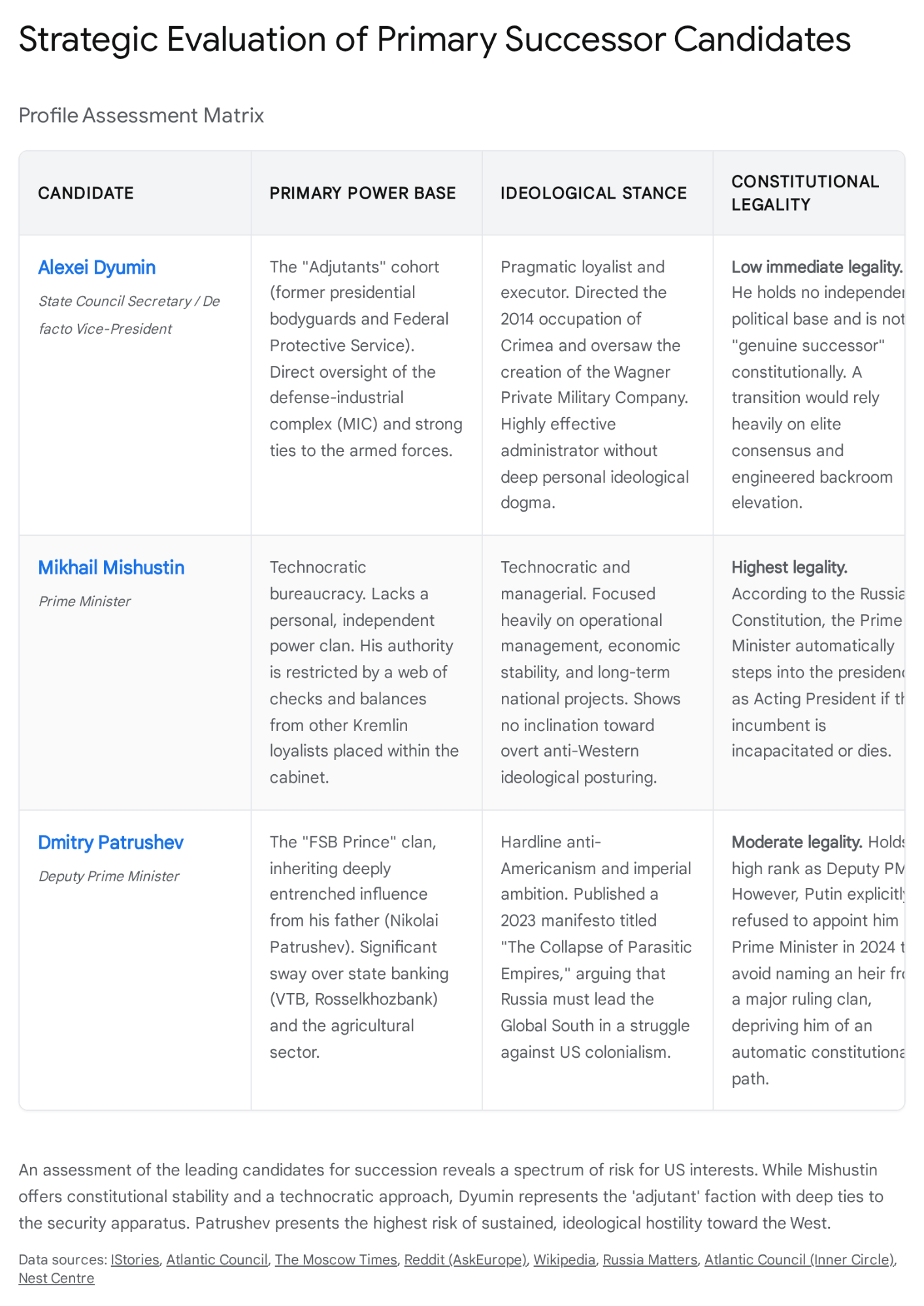
1. Alexei Dyumin: The De Facto Vice President and “Adjutant”
Background and Power Base: Alexei Dyumin, 53, is widely considered the leading candidate and the “biggest star” among the younger generation of Russian bureaucrats to succeed Vladimir Putin.27 Coming from a military family, Dyumin is a career officer who served in the FSB before moving to the FSO, where he rose to become the deputy head of the Presidential Security Service and Putin’s personal bodyguard.34 His foundational experience includes serving as an engineer in an Air Force unit focused on counterintelligence before joining the FSO in 1996.35 Furthermore, he graduated cum laude from the presidential academy for civil servants in 2009, reinforcing his administrative credentials.35 He famously earned the President’s immense personal trust and the moniker “the man who saved Putin from a bear” after peacefully deterring a wild brown bear from entering a presidential residence in Valdai while Putin slept.27
However, Dyumin is not merely a glorified bodyguard; he possesses a formidable, versatile resume that blends coercive military action with civilian administration. As commander of the Special Operations Forces (SSO) in 2014, he orchestrated the rapid occupation and annexation of Crimea.38 Subsequently, as Deputy Defense Minister, he oversaw the creation and deployment of the Wagner Private Military Company.27 In 2016, he was appointed governor of the Tula Oblast—a critical region housing major arms-manufacturing enterprises—where he served effectively for eight years, earning a reputation as a competent administrator.27
Crucially, Dyumin demonstrated immense crisis-management capability during the June 2023 Wagner mutiny. Leveraging his long-standing ties to Yevgeny Prigozhin, Dyumin played a decisive role in negotiating a de-escalation, halting the mercenary advance directly within his gubernatorial territory, thereby saving the regime from a bloody clash in Moscow.27 In May 2024, Putin brought Dyumin into the Kremlin as a Presidential Aide and appointed him Secretary of the State Council.2 In this capacity, Dyumin functions as the de facto Vice President, coordinating regional policy, overseeing the defense-industrial complex, and acting as the primary restraining force checking the autonomy of the federal government.2 He seamlessly integrates the political and business elites through informal networks, notably serving as the chairman of the Night Hockey League, where he plays alongside Putin, Mishustin, the Rotenberg brothers, and key oligarchs.2
Implications for US Relations: Because Dyumin lacks an independent institutional clan, personal team, or distinct power base outside of Putin’s direct patronage, he is viewed as a highly managed proxy who would maintain the current systemic balance.2 A Dyumin presidency would likely ensure the preservation of the system Putin built, avoiding a chaotic collapse into warlordism or state fragmentation.33
For the United States, Dyumin represents a formidable, highly capable, but fundamentally rational adversary. He is deeply integrated into the military-intelligence apparatus and has personally overseen covert operations against Western interests. He would pursue a highly militarized, statist foreign policy heavily focused on defense-industrial sovereignty and partnerships with China (as evidenced by his facilitation of massive Chinese investments in Tula).27 However, unlike ideological zealots, Dyumin is a pragmatist with a proven capacity for high-stakes negotiation. He is less likely to engage in reckless brinkmanship, making him an opponent the US could conceptually deter or engage in transactional diplomacy regarding European security architectures.
2. Mikhail Mishustin: The Constitutional Baseline and Technocrat
Background and Power Base: Mikhail Mishustin, 60, has served as the Prime Minister of the Russian Federation since January 2020.33 Under the strict legal framework of the Russian Constitution, if the President dies, is incapacitated, or resigns, the Prime Minister automatically assumes the role of Acting President and is mandated to call federal elections to determine a permanent successor.33 Specifically, the constitution places the prime minister in power for a three-month transitional period, after which elections must confirm the permanent candidate.51
A former career tax official and technocrat, Mishustin has no background in the intelligence services or the military. He is credited with successfully modernizing the Russian bureaucratic state, digitizing tax collection, and managing the macroeconomic stabilization of the country under the crushing weight of historic Western sanctions following the invasion of Ukraine.33 Despite his constitutional primacy, Mishustin is politically vulnerable in a hard-power transition. He has absolutely no personal power base, commands no coercive force, and is not aligned with the siloviki.2 He is currently enveloped by Kremlin-appointed minders, such as Dyumin and Denis Manturov, explicitly designed to limit his autonomy and prevent him from consolidating power.2
Implications for US Relations: Mishustin’s entire governance philosophy is focused on domestic economics, artificial intelligence integration, and trade logistics.46 His foreign policy orientation is heavily tilted toward the East; in November 2025, he traveled to Beijing for the 30th regular meeting between Chinese and Russian heads of government, meeting directly with President Xi Jinping to synchronize Russia’s economic plans with China’s 15th Five-Year Plan.47 He views energy exports from the Caspian and the circumvention of the dollar as strategic imperatives.46
If Mishustin were to secure permanent power—a scenario that would likely require the backing of a moderate elite coalition desperately seeking relief from the constraints of the war economy—he would be significantly better for the US relationship than a security hardliner. He is a pure pragmatist who views foreign policy through a transactional, economic lens rather than an imperial one.46 Under his leadership, Moscow would likely seek a “retrenchment scenario,” attempting to freeze conflicts, roll back the excesses of military mobilization, and normalize global trade to save the Russian economy.51 This represents a “Khrushchev-type” retrenchment scenario.51 However, his capacity to extract Russia from its adversarial posture would be severely constrained by the entrenched military-industrial complex; the siloviki could easily overpower him if he attempted to capitulate to Western demands.51
3. Dmitry Patrushev: The FSB Prince and Ideologue
Background and Power Base: Dmitry Patrushev, 47, is the former Minister of Agriculture and was elevated to the position of Deputy Prime Minister in the May 2024 government reshuffle.27 Crucially, he is the son of Nikolai Patrushev, the former Director of the FSB and long-time Secretary of the Security Council.27 Dmitry Patrushev represents the ultimate manifestation of the “FSB Prince”—a direct blood heir to the most powerful and ruthless security clan in the Russian Federation.27
Following in his father’s footsteps, Dmitry graduated from the FSB Academy before entering the financial sector, where he became a senior vice president at VTB Bank by age 29, eventually moving to head Rosselkhozbank and the Ministry of Agriculture.27 In early 2024, his father aggressively lobbied the Kremlin for Dmitry to be appointed Prime Minister, positioning him directly in the constitutional line of succession.27 Putin, unwilling to entrust his ultimate fate to a single, powerful clan, rejected this bid, opting instead to demote Nikolai Patrushev to isolate the family’s power.27 Nevertheless, Dmitry retained his upward trajectory, securing the Deputy Prime Minister role and successfully installing his own loyalists in his former ministries, demonstrating his enduring bureaucratic influence.27
Implications for US Relations: A transition of power to Dmitry Patrushev would represent the most dangerous and destabilizing outcome for the United States and European security.27 He is deeply aligned with his father’s extreme ideological framework. Nikolai Patrushev is the chief architect and ideologue of modern Russian anti-Americanism.27 Nikolai is the author of the 2023 manifesto “The Collapse of Parasitic Empires,” published in Razvedchik magazine, which outlines a rigid doctrine demanding that Russia unite and lead the Global South in an existential, civilizational struggle to dismantle US hegemony and neocolonialism.27
The Patrushev clan views international relations as a never-ending, zero-sum struggle for dominance, maintaining a sincere and deep-seated animus against the United States, which they view as Russia’s primary adversary.53 A Dmitry Patrushev presidency would institutionalize an aggressive, “Andropov-type” radicalization scenario.51 This scenario closely mirrors the 1982–1984 rule of Soviet leader Yuri Andropov, marked by intensifying Cold War tensions, societal militarization, and an increasingly authoritarian grip on elites.51 This would entail the total militarization of Russian society, the launch of severe ideological purges domestically, and a foreign policy dedicated to actively destabilizing US interests globally through asymmetric warfare, the sponsorship of rogue states, and highly escalatory brinkmanship—including the potential threat of incursions into NATO territory or the deployment of weapons of mass destruction to force Western capitulation.51
4. Sergei Sobyanin: The Technocratic Alternative
Background and Power Base: Sergei Sobyanin, currently the Mayor of Moscow, is a senior leader within the Presidium of the State Council, charged with managing regional policy alongside figures like Dyumin and Sergei Kiriyenko.2 Having previously served as the governor of the oil-rich Tyumen region in the 1990s—where he actually won competitive, democratic elections—Sobyanin occupies a highly unique space in the modern Russian elite.52 He is widely perceived as a highly competent technocrat and represents the closest approximation to a “liberal” or moderate figure operating within the upper echelons of the current authoritarian regime.52 However, his “liberal” credentials are counterbalanced by his deep loyalty to Putin; in 2000, he helped Putin remove Russia’s independent prosecutor-general, and in 2004, he was among the first governors to support the abolition of regional elections.
Implications for US Relations: While Sobyanin completely lacks the coercive force or the intelligence networks of the siloviki, he possesses deep administrative competence, commands the vast economic resources of the capital, and maintains the loyalty of the civilian bureaucracy. In a “fragmentation scenario” where a palace coup occurs, or where the military and security elites exhaust themselves in a violent stalemate, a coalition of economic technocrats could push Sobyanin forward as a stabilizing, compromise candidate to prevent state collapse. From a US perspective, Sobyanin would likely pursue a policy of profound retrenchment.51 He would seek to normalize economic relations, dismantle the excesses of the autarkic war economy, and stabilize the domestic front by de-escalating conflicts with the West. While he would not instantly transform Russia into a liberal democracy, his governance would represent a massive reduction in the immediate kinetic threat posed to the international order.
The Systemic Enablers: Kiriyenko and the Future State
While figures such as Andrei Belousov and Sergei Kiriyenko (First Deputy Chief of Staff overseeing domestic policy) are unlikely to mount the throne themselves, their profound influence dictates the structural reality any future successor will inherit.27 Kiriyenko, the architect of domestic political management, is actively cultivating a new generation of bureaucrats through rigorous administrative competitions such as the Leaders of Russia and the military-patriotic Time of Heroes programs.27 He is molding a cadre of ideologically orthodox, combat-veteran bureaucrats to populate the state apparatus.27
This personnel policy strongly parallels the final years of Fidel Castro in Cuba, where a younger generation of loyalists was groomed to be even more orthodox and staunchly conservative than the revolutionaries who preceded them.27 Consequently, even if a moderate figure like Mishustin or Sobyanin were to take power, they would be attempting to govern a state machinery that Kiriyenko and Belousov have meticulously engineered to be deeply militarized, highly centralized, and ideologically primed for protracted, generational conflict with the West.
Conclusion
The Russian Federation in 2026 is a state undergoing a profound, high-risk transformation, balancing the existential demands of a protracted war economy against the biological and structural realities of an aging autocrat. Vladimir Putin is actively seeking to immunize his regime against internal threats by bunkerizing his governance, deeply fracturing the security apparatus to prevent coordinated coups, and initiating a slow, highly controlled generational handover of power to loyal “adjutants” and “princes.”
The probability of a chaotic, violent military overthrow remains low, severely constrained by the dense, counter-intelligence layers of the FSO and the mechanized deterrence of Rosgvardia. However, the systemic strain of the war economy, coupled with the intentional erosion of established succession mechanisms, has created fertile ground for an elite-managed palace transition—mirroring the 1964 ouster of Nikita Khrushchev—should Putin falter physically or strategically isolate himself further.
For United States intelligence and foreign policy, the optimal outcome lies not in the exiled democratic opposition, which currently lacks any capacity to influence a transition, but in the ascension of the pragmatic, technocratic wings of the current elite. While figures like Alexei Dyumin or Mikhail Mishustin would undoubtedly maintain Russia’s authoritarian structure and imperial ambitions, their inherent pragmatism and desire to avoid total economic isolation offer viable avenues for transactional diplomacy and long-term de-escalation. Conversely, the consolidation of power by the ideological heirs of the FSB, epitomized by Dmitry Patrushev, would signal an irreversible commitment to a generational, systemic, and highly destructive confrontation with the United States and the broader Western alliance.
Please share the link on Facebook, Forums, with colleagues, etc. Your support is much appreciated and if you have any feedback, please email us in**@*********ps.com. If you’d like to request a report or order a reprint, please click here for the corresponding page to open in new tab.
Sources Used
- Fortress Kremlin: Elite Fractures, Regime Security, and Coup Risk in …, accessed June 24, 2026, https://lansinginstitute.org/2026/05/04/fortress-kremlin-elite-fractures-regime-security-and-coup-risk-in-russia/
- Transition without a successor: The transformation of Putin’s regime, accessed June 24, 2026, https://nestcentre.org/transition-without-a-successor/
- Soviet Man Takes the Wheel of Russia’s War Economy – CEPA, accessed June 24, 2026, https://cepa.org/article/soviet-man-takes-the-wheel-of-russias-war-economy/
- Russian Offensive Campaign Assessment, May 4, 2026 | ISW, accessed June 24, 2026, https://understandingwar.org/research/russia-ukraine/russian-offensive-campaign-assessment-may-4-2026/
- How credible are intel claims that Putin’s inner circle is turning against him? – YouTube, accessed June 24, 2026, https://www.youtube.com/watch?v=2Nf7m_Vq5VU
- Vladimir Putin Fears an Assassination Attempt and a Coup, an EU Intelligence Agency Says, accessed June 24, 2026, https://istories.media/en/stories/2026/05/04/vladimir-putin-fear/
- Russian Offensive Campaign Assessment | MAR–MAY 2026 | ISW, accessed June 24, 2026, https://understandingwar.org/research/russia-ukraine/russian-offensive-campaign-assessment-updates-3/
- Russia Analytical Report, April 27–May 4, 2026, accessed June 24, 2026, https://www.russiamatters.org/news/russia-analytical-report/russia-analytical-report-april-27-may-4-2026
- Coup-proofing in Russia Explorative Study of Institutional Deficiencies as Constraint on Russian Coup-Proofing Policies – Diva-Portal.org, accessed June 24, 2026, https://www.diva-portal.org/smash/get/diva2:1958466/FULLTEXT01.pdf
- Putin Reinforces Rosgvardia Troops With Heavy Armor After Wagner Coup – Newsweek, accessed June 24, 2026, https://www.newsweek.com/russia-ukraine-rosgvardia-national-guard-vladimir-putin-wagner-group-mutiny-1818187
- UK intelligence explains why Putin wants to give heavy weapons to Russian National Guard, accessed June 24, 2026, https://www.pravda.com.ua/eng/news/2023/08/08/7414639/
- Russian National Guard head says his forces to receive heavy weaponry and tanks, blames Wagner rebellion on West – Meduza, accessed June 24, 2026, https://meduza.io/en/news/2023/06/27/russian-national-guard-head-says-his-forces-to-receive-heavy-weaponry-and-tanks-blames-wagner-rebellion-on-west
- Rosgvardia Receives Heavy Weaponry After Wagner’s Failed Rebellion – Warsaw Institute, accessed June 24, 2026, https://warsawinstitute.org/rosgvardia-receives-heavy-weaponry-wagners-failed-rebellion/
- Vicious Blame Game Erupts Among Putin’s Security Forces – CEPA, accessed June 24, 2026, https://cepa.org/article/vicious-blame-game-erupts-among-putins-security-forces/
- Yulia Navalnaya Urges European Parliament to Support Anti-War Russians, accessed June 24, 2026, https://yulianavalnaya.com/en/news/european-parliament-speech
- Even in Exile, Russia’s Political Opposition Struggles to Rise Above Its Divisions, accessed June 24, 2026, https://www.themoscowtimes.com/2026/05/18/even-in-exile-russias-political-opposition-struggles-to-rise-above-its-divisions-a92780
- Is the Russian opposition even relevant? – New Eastern Europe, accessed June 24, 2026, https://neweasterneurope.eu/2025/09/05/is-the-russian-opposition-even-relevant/
- Russia Tomorrow: Five scenarios for Russia’s future – Atlantic Council, accessed June 24, 2026, https://www.atlanticcouncil.org/content-series/russia-tomorrow/five-scenarios-for-russias-future/
- Envisioning Détente: The Johnson Administration and the October 1964 Khrushchev Ouster* – DukeSpace, accessed June 24, 2026, https://dukespace.lib.duke.edu/server/api/core/bitstreams/72828597-5b02-42ea-8ab9-d24efac43361/content
- Foreign Relations of the United States, 1964–1968, Volume XIV, Soviet Union, accessed June 24, 2026, https://history.state.gov/historicaldocuments/frus1964-68v14/d265
- “You Don’t Know Khrushchev Well”: The Ouster of the Soviet Leader as a Challenge to Recent Scholarship on Authoritarian Politics, accessed June 24, 2026, https://direct.mit.edu/jcws/article/24/1/78/109004/You-Don-t-Know-Khrushchev-Well-The-Ouster-of-the
- Putin tightens grip on power with post-inauguration leadership reshuffle, accessed June 24, 2026, https://nestcentre.org/putin-tightens-grip-on-power-with-post-inauguration-leadership-reshuffle/
- Shifting Shadows: A Closer Look at Putin’s Latest Government Reshuffle – Egmont Institute, accessed June 24, 2026, https://egmontinstitute.be/shifting-shadows-a-closer-look-at-putins-latest-government-reshuffle/
- Putin’s Reshuffle Is About Optimization, Not Change, accessed June 24, 2026, https://carnegieendowment.org/russia-eurasia/politika/2024/05/belousov-shoigu-russian-government-reshuffle
- Putin appoints economist as defense minister as Russia plans for long war – Atlantic Council, accessed June 24, 2026, https://www.atlanticcouncil.org/blogs/ukrainealert/putin-appoints-economist-as-defense-minister-as-russia-plans-for-long-war/
- Andrei Belousov: Putin picks trusted technocrat to run defence ministry – The Guardian, accessed June 24, 2026, https://www.theguardian.com/world/article/2024/may/14/andrei-belousov-putin-picks-trusted-technocrat-to-run-defence-ministry
- The next generation: Russia’s future rulers – Atlantic Council, accessed June 24, 2026, https://www.atlanticcouncil.org/content-series/russia-tomorrow/the-next-generation-russias-future-rulers/
- Russia’s Gray Man Makes His Move – CEPA, accessed June 24, 2026, https://cepa.org/article/russias-gray-man-makes-his-move/
- The Defense Industrial Implications of Putin’s Appointment of Andrey Belousov as Minister of Defense – CSIS, accessed June 24, 2026, https://www.csis.org/analysis/defense-industrial-implications-putins-appointment-andrey-belousov-minister-defense
- Andrei Belousov and the Tragedy of Soviet Economics – Riddle …, accessed June 24, 2026, https://ridl.io/andrei-belousov-and-the-tragedy-of-soviet-economics/
- “Long War” Drives Putin’s Cadre Reshuffling – Peace Research Institute Oslo (PRIO), accessed June 24, 2026, https://www.prio.org/2024/05/long-war-drives-putins-cadre-reshuffling/
- “Putinomics”: truth and myths – Agenda Pública, accessed June 24, 2026, https://agendapublica.es/noticia/19254/putinomics-truth-and-myths
- Putin’s Musings on Immortality Highlight His Glaring Succession Dilemma, accessed June 24, 2026, https://www.themoscowtimes.com/2025/09/13/putins-musings-on-immortality-highlight-his-glaring-succession-dilemma-a90508
- The Mapping of Power: Russia’s “Game of Thrones”, accessed June 24, 2026, https://istories.media/en/stories/2026/05/29/russias-game-of-thrones/
- Spotlight on a Potential Putin Successor – Davis Center for Russian and Eurasian Studies, accessed June 24, 2026, https://daviscenter.fas.harvard.edu/insights/spotlight-potential-putin-successor
- Aleksey Dyumin – Wikipedia, accessed June 24, 2026, https://en.wikipedia.org/wiki/Aleksey_Dyumin
- Who is Aleksey Dyumin? Putin’s Ex-Bodyguard Tipped to Replace Shoigu – Newsweek, accessed June 24, 2026, https://www.newsweek.com/who-aleksey-dyumin-putin-bodyguard-replace-shoigu-prigozhin-wagner-1809192
- Who is Putin’s most likely successor in Russia if something happens to him? – Reddit, accessed June 24, 2026, https://www.reddit.com/r/AskEurope/comments/1q0re6b/who_is_putins_most_likely_successor_in_russia_if/
- Dyumin Alexei – Persons ∙ Directory ∙ President of Russia, accessed June 24, 2026, http://en.kremlin.ru/catalog/persons/462/biography
- Former Putin Bodyguard, Kremlin Aide Dyumin Elevated To Key Position, accessed June 24, 2026, https://www.rferl.org/a/russia-kremlin-dyumin-promotion/32970315.html
- Is Prigozhin’s Mutiny the Nail in the Coffin for Putin’s Golden Boy, Dyumin?, accessed June 24, 2026, https://carnegieendowment.org/russia-eurasia/politika/2023/07/is-prigozhins-mutiny-the-nail-in-the-coffin-for-putins-golden-boy-dyumin
- The evidence suggests Putin is not grooming Alexei Dyumin as his successor, accessed June 24, 2026, https://www.chathamhouse.org/2024/06/evidence-suggests-putin-not-grooming-alexei-dyumin-his-successor
- Putin’s Potential Successors Part 2: Aleksey Dyumin – Recorded Future, accessed June 24, 2026, https://www.recordedfuture.com/research/putins-potential-successors-part-2-aleksey-dyumin
- The World According to Dyumin—Putin’s Former Bodyguard and His Potential Successor, accessed June 24, 2026, https://www.russiamatters.org/analysis/world-according-dyumin-putins-former-bodyguard-and-his-potential-successor
- Mikhail Mishustin – Wikipedia, accessed June 24, 2026, https://en.wikipedia.org/wiki/Mikhail_Mishustin
- Russia’s Prime Minister Mishustin: A Quiet Technocrat Who Toes the Line and Gets Results, accessed June 24, 2026, https://www.russiamatters.org/analysis/russias-prime-minister-mishustin-quiet-technocrat-who-toes-line-and-gets-results
- Russian Prime Minister Mikhail Mishustin to Be in China for the 30th Regular Meeting Between Chinese and Russian Heads of Government_Ministry of Foreign Affairs of the People’s Republic of China, accessed June 24, 2026, https://www.fmprc.gov.cn/eng/xw/wsrc/202510/t20251031_11744730.html
- President Xi Jinping Meets with Russian Prime Minister Mikhail Mishustin, accessed June 24, 2026, https://hk.ocmfa.gov.cn/eng/xjpzxzywshd/202511/t20251104_11746567.htm
- Mishustin to visit China on Nov 3-4, to meet with Xi Jinping – Russian govt press service, accessed June 24, 2026, https://interfax.com/newsroom/top-stories/114626/
- Xi eyes deeper China-Russia ties despite ‘turbulent’ external conditions – Al Jazeera, accessed June 24, 2026, https://www.aljazeera.com/news/2025/11/4/xi-eyes-deeper-china-russia-ties-despite-turbulent-external-conditions
- Leadership Change in Russia | Council on Foreign Relations, accessed June 24, 2026, https://www.cfr.org/reports/leadership-change-russia
- All the autocrat’s men: The court politics of Putin’s inner circle – Atlantic Council, accessed June 24, 2026, https://www.atlanticcouncil.org/content-series/russia-tomorrow/all-the-autocrats-men-the-court-politics-of-putins-inner-circle/
- Looking out Five Years: Who Will Decide Russian Foreign Policy?, accessed June 24, 2026, https://carnegie.ru/commentary/72811
- Hopes for a Successor – Riddle Russia, accessed June 24, 2026, https://ridl.io/hopes-for-a-successor/