1. Executive Summary
The Modern Day Marine 2026 exposition, held at the Walter E. Washington Convention Center in Washington, D.C., served as a critical inflection point for the United States Marine Corps (USMC). As the service transitions from the initial restructuring phases of Force Design 2030 toward the operational realization of the Ground Combat Element 2040 (GCE 2040) doctrinal framework, the technological and strategic priorities on display highlighted a force rapidly adapting to the realities of peer-level, high-intensity conflict.1 Analyzing the announcements, product unveilings, and strategic dialogues from the event reveals a service grappling with the complex demands of distributed maritime operations, heavily influenced by contemporary combat observations in Eastern Europe and the Middle East.1
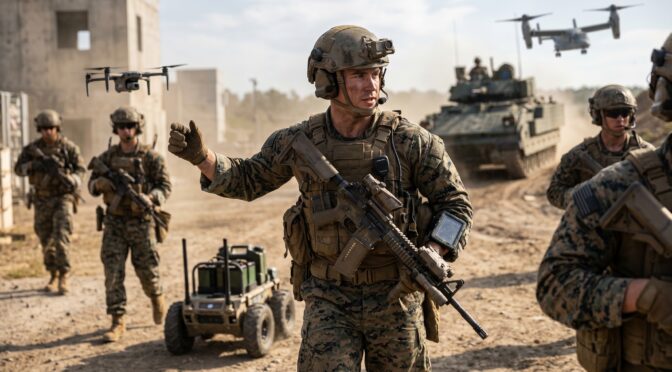
A defining theme of the 2026 exposition was the urgent drive to operationalize artificial intelligence (AI) at the tactical edge. This initiative is designed to counter the ubiquitous threat of unmanned aerial systems (UAS) and push lethal, precision-strike capabilities down to the lowest infantry echelons.3 Rather than replacing the individual warfighter, the USMC is aggressively fielding autonomous platforms, such as the Textron RIPSAW M1 and American Rheinmetall Mission Master Silent Partner Hotel (MMSP-H), to act as force multipliers and cognitive offloads for the rifle squad and maneuver elements.4
Concurrently, a stark divergence in small arms doctrine has emerged between the USMC and the U.S. Army. The Marine Corps’ official decision to retain the 5.56mm M27 Infantry Automatic Rifle, explicitly rejecting the Army’s newly adopted 6.8mm M7 Next Generation Squad Weapon, underscores a service prioritizing amphibious mobility, sustained volume of fire, and coalition interoperability over extended-range armor penetration.6 Meanwhile, the integration of advanced fire control optics, notably the Smart Shooter SMASH 2000L, marks a paradigmatic shift in individual lethality, transforming every dismounted Marine into an organic air defense node capable of neutralizing Group 1 and 2 drones.7
Strategic vulnerabilities and logistical bottlenecks were also a focal point of leadership discussions. Senior naval and Marine officials openly acknowledged the fragility of the amphibious fleet’s force generation model, proposing significant overhauls to deployment cycles to meet insatiable combatant commander demand.9 Furthermore, leadership identified a critical risk posed by a lack of organic theater ballistic missile defense (TBMD) in the Indo-Pacific, recognizing that U.S. Army air defense assets are too strained to guarantee coverage for distributed Marine expeditionary forces.11 This report provides a detailed analysis of the new product announcements, technological integrations, and the second- and third-order strategic lessons learned from Modern Day Marine 2026, articulating the trajectory of the USMC over the next decade.
2. Strategic Doctrine: The Evolution to Ground Combat Element 2040
The most significant doctrinal revelation at Modern Day Marine 2026 was the preliminary detailing of the Ground Combat Element 2040 (GCE 2040) framework. As Force Design 2030 approaches the end of its planning and initial implementation cycle, GCE 2040 represents the next evolutionary step for the service. It focuses heavily on integrating advanced technologies, autonomous platforms, and AI-driven battle management systems while maintaining the absolute centrality of the human operator.1
2.1. Equipping the Marine, Not Manning the Machine
GCE 2040 explicitly embraces a “human-centric” warfare philosophy.1 While the modern battlefield is increasingly populated by autonomous systems and loitering munitions, USMC leadership stressed that technology must serve the infantry unit, not dictate its foundational structure. The overarching goal is to build lethal, resilient combat teams where unmanned systems are treated as “members of the team,” allowing commanders to consciously transfer physical and tactical risk from human personnel to disposable or attritable hardware.1
This doctrinal pivot suggests a future where Marine infantry squads act less as traditional kinetic assault elements and more as forward-deployed battle managers. By pushing sensor data, electronic warfare capabilities, and loitering munitions down to the platoon and squad levels, the Marine Corps intends to enable combat formations to sense, make sense of, and act upon targeting data at unprecedented speeds.1 This rapid processing capability is deemed essential for heavily out-pacing adversary decision cycles in contested domains, particularly when operating as Stand-In Forces within an adversary’s Weapons Engagement Zone (WEZ).1
2.2. Lessons from Contemporary Conflicts
The strategic discussions surrounding GCE 2040 were deeply grounded in observations from recent global conflicts. Marine leadership noted that the war in Ukraine and ongoing engagements in the Middle East have provided concrete lessons for what combat will look like in the next major ground war.2 Maj. Gen. Farrell Sullivan, commanding general of the 2nd Marine Division, emphasized that the service is preparing for a “high-end fight, where all domains are contested—and then in some, the adversary will have an advantage”.2
The proliferation of inexpensive, one-way attack drones, loitering munitions, and the sophisticated use of the electromagnetic spectrum have necessitated a rapid departure from the counter-insurgency tactics honed during the Global War on Terror.1 The integration of commercial off-the-shelf (COTS) drone technology by state and non-state actors alike has compressed the acquisition timeline, forcing the Marine Corps to seek procurement models that deliver capabilities in months rather than traditional multi-year defense acquisition cycles.2
3. Project Dynamis and Artificial Intelligence at the Tactical Edge
A foundational technical component of the GCE 2040 vision is Project Dynamis, a service-level initiative aimed at accelerating the Marine Corps’ integration into Combined Joint All-Domain Command and Control (CJADC2).1 Unveiled and discussed at length during the exposition by Col. Arlon Smith, the director of the project, Dynamis is designed to deliver AI-powered decision advantage directly to the tactical edge.12
3.1. The Shift to Agile Software Development
Unlike legacy procurement programs that focus on acquiring static pieces of hardware, Project Dynamis operates through iterative software development sprints, referred to as “Serials”.12 This methodology mirrors commercial software development, allowing the military to rapidly integrate and iterate mature, dual-use commercial solutions for battle management and command and control (C2).12
Recent testing events have demonstrated the viability of this approach. During Dynamis Serial 003, conducted in conjunction with the U.S. Army’s Next Generation Command and Control (NGC2) Ivy Sting IV event at Fort Carson, the Navy and Marine Corps integrated battle management C2 nodes from four different Joint Force locations.12 This exercise successfully connected decentralized networking capabilities, allowing disparate units to share targeting data across a resilient joint mesh network.12
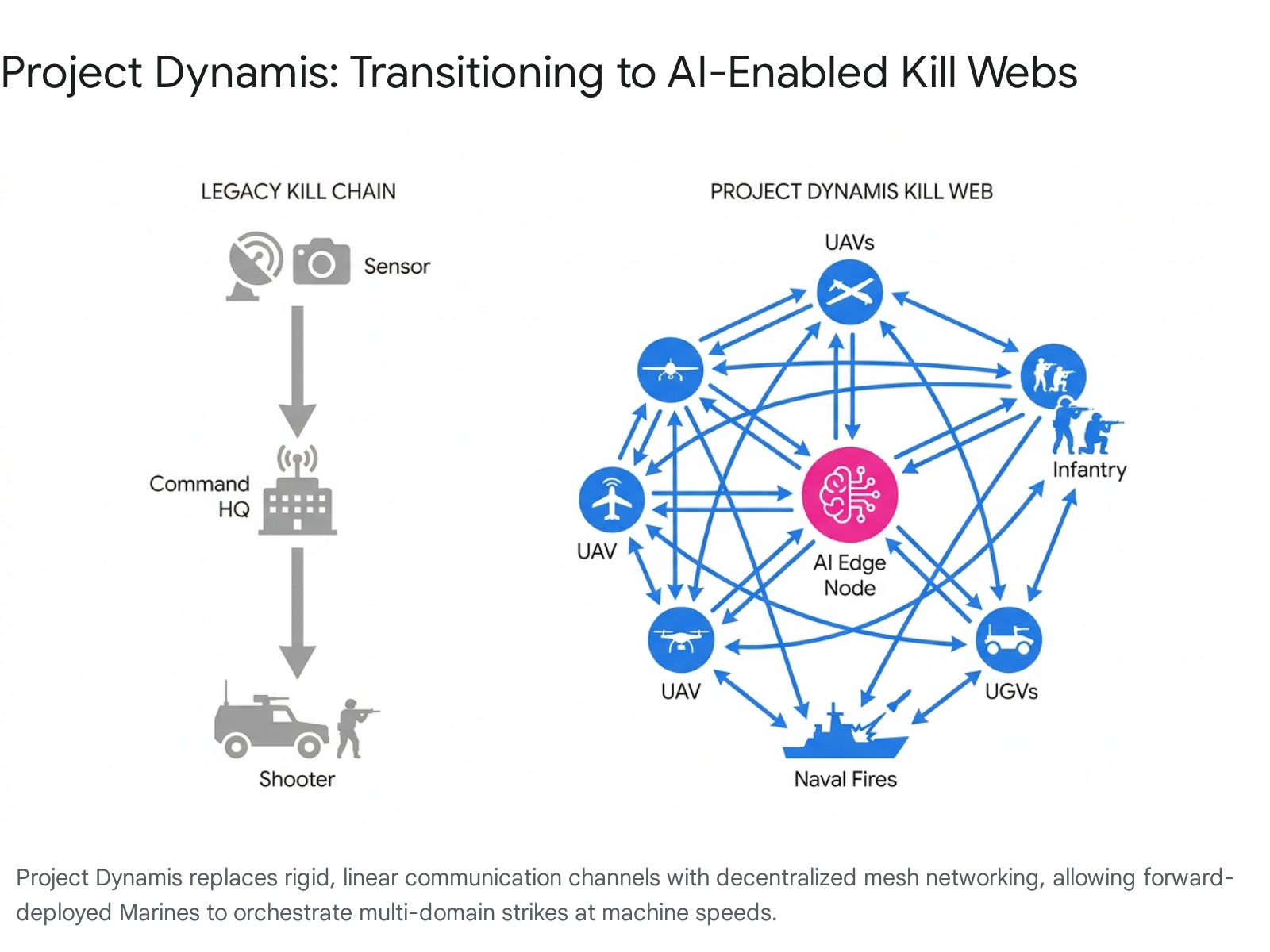
Furthermore, Dynamis Serial 005 advanced the development of a data-centric kill web using AI and machine learning. During one scenario, special operations forces transmitted targeting data from a commercial network, across classification levels, through Army systems, and directly to a Marine Corps weapons platform.14 This automated, machine-to-machine data flow significantly reduced manual input and human oversight, reducing airspace deconfliction times by up to 80 percent when sharing High-Mobility Artillery Rocket System (HIMARS) munition flight path data.14
3.2. From Linear Kill Chains to Dynamic Kill Webs
The ultimate objective of Project Dynamis is the decoupling of software from hardware, allowing Marines to leverage modern, secure networks to weaponize data.12 By utilizing platforms like the MAGTF C2 Prototype (MCP)—a small form factor, high-compute hardware stack capable of operating in degraded environments—and Palantir’s Maven Smart Systems, Marine units can aggregate, orchestrate, and share fused sensor data at machine speeds.12
This represents a profound doctrinal shift from legacy, linear “kill chains” to dynamic “kill webs.” In a kill web, any sensor (whether an overhead drone, a ground-based radar, or a dismounted infantryman) can theoretically pair with any shooter (naval artillery, loitering munitions, or aircraft) across the joint force, vastly complicating the adversary’s defensive calculus.12
3.3. The Four Pillars of Project Dynamis
The execution of Project Dynamis is structured around four core technological pillars, which were heavily emphasized during technical briefings at the exposition 15:
- Assured Command and Control: Driving the holistic modernization of the USMC command, control, communication, and computers (C4) portfolio. This involves adopting a joint resilient common data fabric and decentralized mesh networking capabilities to ensure communications remain viable even under heavy electronic warfare jamming.15
- Battlespace Awareness: Accelerating advanced AI-enabled battle management C2 capabilities to provide steady-state, all-domain awareness. This pillar supports dynamic, long-range targeting at scale and serves as the foundation for USMC participation in joint kill webs.15
- Counter-C5ISRT (C-C5ISRT): Deploying advanced technologies to counter adversary command and control, battlespace awareness, and targeting. This involves operationalizing tactical cyber and electromagnetic spectrum operations, including advanced spoofing, jamming, and signature management techniques.15
- Robotic and Autonomous Integration: Leading the service-level effort to develop edge node prototypes that seamlessly integrate the command and control of robotic and autonomous systems into the broader tactical network.15
4. Amphibious Fleet Readiness and Force Generation
Beyond ground combat technology, the Marine Corps faces acute, systemic challenges regarding its foundational maneuver capability: the amphibious fleet. Presentations and keynote addresses by senior civilian and military leaders laid bare the growing disconnect between combatant commander demand and the current supply of operational amphibious vessels.
4.1. The ARG-MEU Demand Signal
Commandant Gen. Eric Smith noted that the demand for Amphibious Ready Groups and Marine Expeditionary Units (ARG-MEUs) by regional combatant commanders has significantly eclipsed the previously mandated 3.0 continuous presence (which dictates one ARG-MEU deployed from the East Coast, one from the West Coast, and one out of Japan).9 Requests for ARG-MEU support are currently surging from U.S. Southern Command, European Command, Central Command, and Africa Command.16 General Smith indicated that the actual demand is “well north of three… like double that”.16
This high operational tempo is visible in current deployments. The 22nd MEU is actively participating in Operation Southern Spear, the 31st MEU is deployed to the Middle East in support of Operation Epic Fury, and the 11th MEU is reportedly en route to the Middle East while conducting routine patrols around the southern Philippines.16 Smith labeled ARG-MEUs the most flexible tool in the Defense Department inventory, providing critical humanitarian assistance, executing non-combatant evacuation operations, and delivering precision strike capabilities in crisis scenarios.16
4.2. Reforming the Fleet Response Plan
Sustaining this intense operational pace has proven exceedingly difficult due to the cumulative effects of aging ship systems, deferred maintenance, supply-chain friction, and workforce shortages in naval shipyards.17 This struggle has emphasized the Marine Corps’ and Navy’s immediate need to return to a permanent, sustainable 3.0 ARG-MEU presence, which Smith identified as his “number one priority” and “personal north star”.16
In response to these systemic readiness issues, Chief of Naval Operations Adm. Daryl Caudle highlighted potential adjustments to the force generation model.9 The Navy currently employs a 36-month Optimized Fleet Response Plan for amphibious ships, accommodating maintenance, training, and a single seven-month deployment.10 However, leadership is actively considering a transition to a 50- or 52-month cycle that accommodates two deployments per cycle.10
By altering the model, the Navy hopes to strip away the administrative overhead of shorter cycles that do not yield combat credibility. Caudle stated that the goal is to make force generation more efficient and reduce the phases of the cycle that do not significantly add to a ship’s readiness for its next deployment.10 To oversee this transition, the Navy has established the Amphibious Force Readiness Board, an action body tasked with increasing operational availability, reducing maintenance delays, and better synchronizing Navy and Marine Corps demand signals.17 This structural reform is vital; without a ready, reliable amphibious fleet, the Marine Corps’ entire expeditionary posture and Stand-In Force doctrine remains severely compromised.
5. Infantry Small Arms: Caliber Divergence and Modernization
Historically, the Marine Corps and the U.S. Army have moved in relative tandem regarding primary infantry weapons procurement. However, announcements surrounding Modern Day Marine 2026 confirmed a decisive, calculated split in small arms doctrine, reflecting deeply diverging operational philosophies regarding weight, logistics, and engagement ranges.
5.1. Retaining the M27 IAR vs. the Army M7
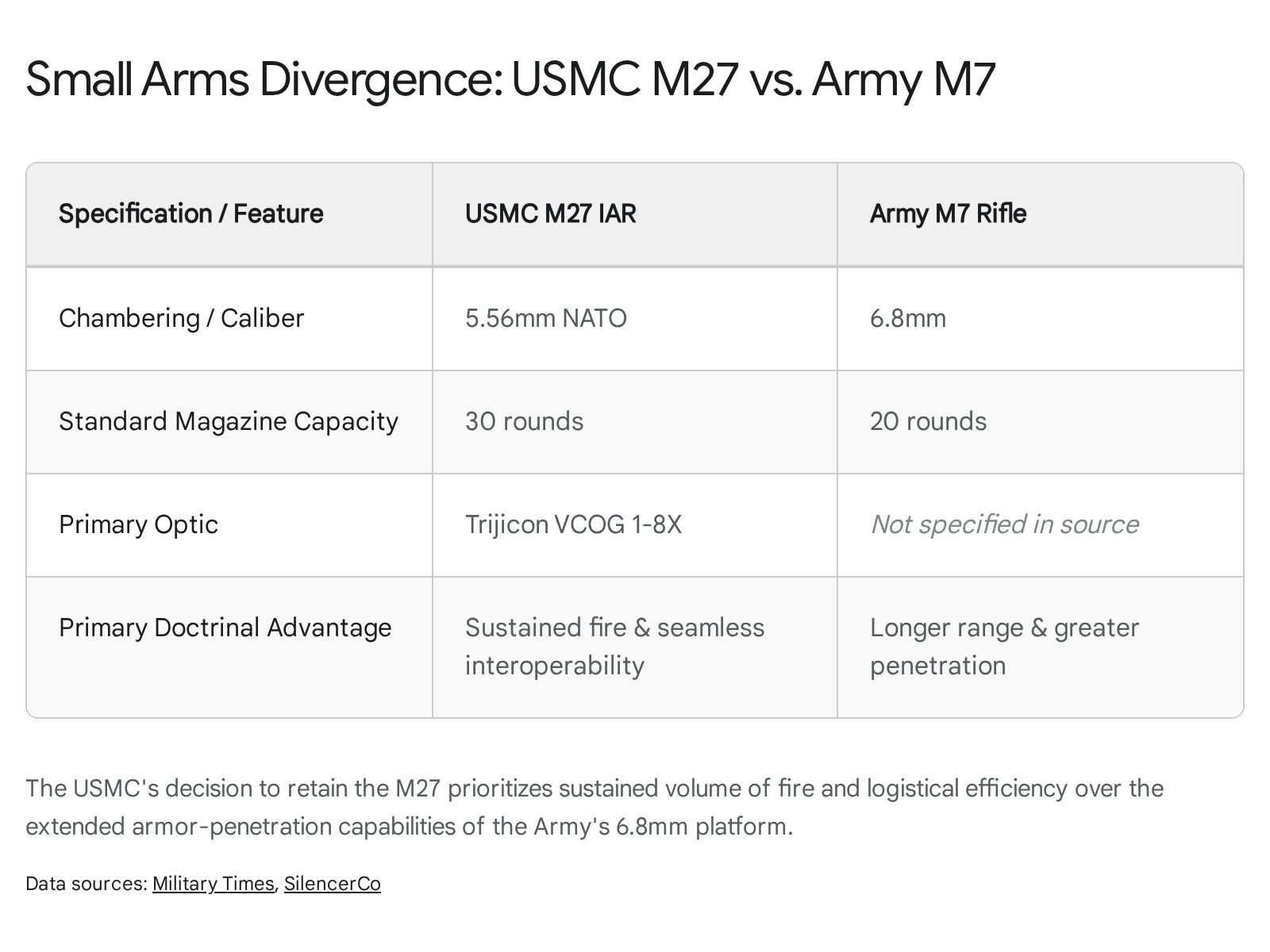
The Marine Corps has officially opted to retain the Heckler & Koch M27 Infantry Automatic Rifle (chambered in the legacy 5.56x45mm NATO cartridge) as its primary service weapon, explicitly rejecting the adoption of the Army’s new Sig Sauer M7 rifle (chambered in the larger 6.8x51mm cartridge).6
The Army’s transition to the M7, part of the Next Generation Squad Weapon (NGSW) program, is driven by the specific requirement to overmatch modern adversary body armor at extended ranges.6 The higher-pressure 6.8mm round delivers significantly greater kinetic energy and penetrative power compared to the 5.56mm.6 The Army is currently issuing the M7 rifle and its light machine gun counterpart, the M250, to close combat forces, including infantry units, scouts, combat medics, and special operations personnel.19
However, Marine Corps Combat Development Command determined that the M27 remains the superior platform for Marine infantry and close combat formations.6 The rationale behind this rejection of the M7 is multi-layered and heavily rooted in the realities of amphibious and expeditionary warfare:
- Volume of Fire and Magazine Capacity: The physical size of the 6.8mm cartridge limits the standard M7 magazine to 20 rounds, whereas the M27 utilizes standard 30-round 5.56mm magazines.6 For a Marine rifle squad, a 33% reduction in primary magazine capacity fundamentally alters suppressing fire tactics and compromises the ability to maintain fire superiority during an amphibious assault or close-quarters engagement. Concerns regarding this reduced capacity were raised by analysts at the exposition, though both the Army and Sig Sauer defended the rifle’s performance.19
- Logistical Weight Penalty: The 6.8mm ammunition is significantly heavier and bulkier than the 5.56mm round. In expeditionary environments where Marines must carry their sustainment on their backs, or where supplies must be ferried ashore via light uncrewed systems, the cumulative weight penalty of the 6.8mm cartridge was deemed operationally unacceptable for the USMC.6
- Interoperability and Standardization: The 5.56mm NATO round ensures seamless interoperability with allied and coalition partners.6 This is a critical factor for Marines operating as forward-deployed Stand-In Forces alongside allied nations in the Pacific, where shared logistical supply chains are vital for sustained operations.6
- Weapon Characteristics: The M27 utilizes a short-stroke gas piston system, which the USMC values for its reliability, suitability for automatic fire, and compatibility with suppressors and short barrels.18
The retention of the M27, paired with suppressors, allows the USMC to maintain a familiar, highly accurate, and logistically sustainable weapon system tailored specifically for littoral combat.6
5.2. Handgun Modernization and Standardized Optics
In tandem with its rifle decisions, the USMC has fully embraced the Sig Sauer M18 as its general-issue handgun, replacing older platforms.18 A more compact variant of the Army’s M17, the M18 features a striker-fired, polymer-frame design that breaks from the decades of metal-framed legacy pistols.18 These modern handguns come equipped with Picatinny rails and are designed to be optics-ready.18
Crucially, the Marine Corps has officially authorized the use of red dot optics on the M17/M18 series for combat qualification.20 This regulatory change reflects a broader industry and military consensus acknowledging that reflex sights significantly enhance target acquisition speed and accuracy under physiological stress.18 Historically, selecting an optic required a tradeoff between the speed of a red dot in close-quarters environments and the precision of a magnified optic at a distance.22 By integrating red dots onto sidearms, and utilizing versatile low-power variable optics (LPVOs) like the Trijicon VCOG 1-8X on their primary rifles, the Marines are bridging this gap, providing individual warfighters with unprecedented visual acuity across varying engagement distances.18
The exposition also featured new commercial optic developments relevant to military applications, such as EOTech’s new Vudu 4-12x36mm super short rifle scope and Burris’s new Veracity line, highlighting the rapid advancement in optical clarity, focal plane technology, and reduced form factors.23
6. Counter-UAS Systems and Individual Air Defense
The pervasive proliferation of cheap, easily weaponized drones—heavily observed in the skies over Ukraine and the Middle East—was categorized by leadership at Modern Day Marine as one of the most significant tactical threats currently facing the joint force.1 The reality of aerial observation and precision munition drops has compromised traditional notions of concealment and maneuver. In response, the Marine Corps is deploying innovative, decentralized solutions to protect its forces.
6.1. The SMASH 2000L Smart Scope Integration
The most consequential optical development announced regarding counter-UAS (C-UAS) is the widespread fielding of the SMASH 2000L advanced fire control system, manufactured by Smart Shooter.7 The USMC is actively pushing these smart scopes to units deploying to contested regions; notably, members of the 11th Marine Expeditionary Unit, embarked on the Boxer Amphibious Ready Group in the Pacific Ocean, were recently photographed utilizing the optic during counter-drone training.7
The SMASH 2000L fundamentally alters the infantryman’s defensive capability. It utilizes an onboard fire-control computer and electro-optical sensors to lock onto small, moving aerial targets, calculating an intercept solution based on distance, movement speed, and environmental factors.7 The system ensures the rifle only fires when a hit is guaranteed, vastly increasing the probability of kill against erratic drones.7
Strategic Implications of the SMASH 2000L:
- Decentralized Air Defense: By turning standard M4 carbines or M27 IARs into highly effective counter-drone weapons, the USMC reduces its reliance on heavy, vehicle-mounted systems—like the Marine Air Defense Integrated System (MADIS)—for point defense against Group 1 and 2 drone threats.1 Every rifleman becomes an immediate, mobile air defense asset.
- Favorable Cost Exchange Ratios: Firing a standard 5.56mm round to destroy a low-cost quadcopter restores a favorable economic parity to counter-drone warfare. It avoids the unsustainable expenditure of multi-million dollar missile interceptors on highly expendable, asymmetric threats.7
- Cognitive Offloading: The optic significantly reduces the immense training burden required to hit fast-moving aerial targets with small arms. This allows Marines of any Military Occupational Specialty (MOS)—from infantrymen to logistics clerks—to effectively defend their immediate perimeter without requiring specialized, intensive air-defense training.1
6.2. Organic-Counter Small UAS (O-CsUAS) Kits
Alongside the individual optical enhancements, the Marine Corps is rushing dismounted Organic-Counter Small UAS (O-CsUAS) kits to the Fleet Marine Force.25 These man-portable systems provide comprehensive capabilities to detect, track, identify, and defeat Group 1-2 drones using both kinetic and non-kinetic (electronic warfare) effects.25
This rapid fielding initiative acknowledges that maneuver coverage at the ground combat and logistics levels has historically been a critical shortfall.2 By delivering these kits directly to infantry battalions and combat logistics battalions, the service is closing the vulnerability gap for dismounted patrols and resupply convoys that must operate under constant threat of aerial observation and attack.2 To ensure proficiency, units such as the 2nd Marine Division are scheduled to undergo first-of-its-kind, dedicated drone-defeat training and counter-UAS “lanes” at Twentynine Palms, integrating these new capabilities into live-fire scenarios.27
6.3. Area-Wide C-UAS Architecture: The Halo_Shield
To address the drone threat at the broader base and installation level, defense contractors proposed expansive, architectural solutions. AeroVironment announced the launch of the Halo_Shield system, a modular, tile-based C-UAS architecture designed to protect critical infrastructure.28
Rather than relying on isolated point-defense systems, Halo_Shield integrates various sensors, command-and-control nodes, and effectors into a distributed network.29 The system utilizes domain-specific “tiles” (Sentinel, Terrestrial, Nautical, Aerial, and Celestial) that can operate independently or combine to create a mission-tailored defense network across a large geographic area.29 The architecture incorporates existing AeroVironment products, such as LOCUST laser weapon systems, Titan RF jammers, and Switchblade loitering munitions acting as interceptors.29 This scalable approach aims to defend against not only single drones but coordinated drone swarms and subsonic cruise missiles, filling the vital gap between individual rifleman optics and heavy missile defense batteries.28
7. Loitering Munitions and Organic Precision Fires
To achieve distributed lethality and extend the reach of the infantry, the USMC is aggressively expanding its Organic Precision Fires (OPF) program. The ability to engage targets well beyond the line of sight—without calling in scarce aviation assets or relying on centralized artillery support—is a primary, defining objective of the GCE 2040 vision.1
7.1. Organic Precision Fires-Light (OPF-L)
The USMC announced that it has successfully completed Initial Operational Test and Evaluation (IOT&E) and will officially begin fielding its Organic Precision Fires-Light (OPF-L) systems to operational units in the June 2026 timeframe.32 These systems provide man-packable, precision strike capabilities directly to the infantry squad level.
Following an initial contract award in 2024, systems from three primary vendors are currently being tested and procured: Anduril (providing the Bolt-M system), AeroVironment (providing the Switchblade 300 Block 20), and Teledyne FLIR (providing the Rogue 1 system).32 Both Anduril and Teledyne have received follow-on contracts for over 600 systems each.32
The early capability release of the OPF-L features advanced waypoint navigation and automatic target-locking mechanisms.33 This allows the munition to be piloted dynamically, enabling Marines to shape the battlefield, conduct reconnaissance, and strike targets while remaining concealed outside of adversary direct-fire ranges.33 The rapid acquisition of these systems—moving from initial contract to operational fielding in just two years—demonstrates the USMC’s new willingness to accept acquisition risk in exchange for rapid operational deployment, applying lessons learned from the Army’s Low Altitude Stalking and Strike Ordnance (LASSO) program.32
7.2. Organic Precision Fires-Medium (OPF-M) Requirements
Building upon the foundation of the light variant, the Marines utilized the exposition to discuss the recent Request for White Papers for the Organic Precision Fires-Medium (OPF-M) capability, with production contracts targeted for fiscal year 2028.31
The OPF-M requirements highlight a severe escalation in required range and lethality, bridging the gap between squad-level munitions and heavy artillery:
- Range and Endurance: The OPF-M must possess a range of at least 15 miles with a loiter time exceeding 20 minutes.31
- Lethality: The warhead must be powerful enough to destroy heavily armored vehicles (main battle tanks) or, at minimum, achieve a mobility kill.31
- Portability: The entire system must be man-portable by a two-man dismounted team, with the munition weighing less than 35 pounds and the ground control station weighing under 20 pounds.31
Furthermore, the OPF-M is envisioned to feature automatic target tracking and robust functionality in GPS-denied environments, mitigating the effects of adversary electronic warfare and jamming.31 The service envisions a distributed control system where the flight of the drone can be handed off from one ground control station to another mid-flight.31 By equipping dismounted infantry with long-range, anti-armor kamikaze drones, the USMC creates an asymmetric, highly distributed threat matrix for any adversary mechanized forces attempting to maneuver in contested littorals.
8. Unmanned Ground Vehicles (UGVs) and Autonomous Logistics
The integration and maturation of Unmanned Ground Vehicles (UGVs) was prominently displayed throughout the exposition. These platforms are shifting from experimental concepts to combat-ready prototypes, directly addressing the critical logistical vulnerabilities and heavy sustainment demands of distributed maritime operations.
8.1. Textron RIPSAW M1 UGV
Textron Systems, alongside its subsidiary Howe & Howe, debuted the RIPSAW M1 UGV technology demonstrator at Modern Day Marine 2026.4 Designed specifically to support USMC littoral mobility and uncrewed teaming concept of operations (CONOPS), the M1 is a wheeled, all-electric platform capable of acting as a robotic force multiplier for heavier crewed platforms like the Advanced Reconnaissance Vehicle (ARV) and the Amphibious Combat Vehicle (ACV).4
Key Capabilities:
- Payload and Mobility: Weighing 4,300 pounds, the M1 boasts a robust 2,000-pound payload capacity.35 Its electric drive provides up to 30 miles of silent range, and it can reach top speeds of 53 mph.34 Crucially for the Marine Corps’ amphibious profile, it is capable of fording water obstacles up to 48 inches deep.34
- Modular Open Systems Approach (MOSA): The architecture allows for rapid payload swapping based on mission requirements. Roles range from reconnaissance, surveillance, and target acquisition (RSTA) to acting as a hard-kill counter-UAS platform.4
- Manned-Unmanned Teaming (MUM-T): Textron displayed the M1 integrated with its Damocles loitering munition launchers.36 This pairing allows an unmanned scout vehicle to push forward into cluttered terrain, detect an armored threat, and organically launch a kinetic strike with an explosively formed penetrator, all without exposing the human operators controlling it from a standoff distance.35
8.2. Alternative UGV Platforms
The UGV market is highly competitive, as evidenced by the presence of multiple viable contenders on the show floor, each offering unique capabilities tailored to expeditionary warfare.
- American Rheinmetall MMSP-H: The Mission Master Silent Partner Hotel was showcased as a fully autonomous amphibious UGV capable of carrying 2,200 pounds on land and 880 pounds while afloat.5 Crucially, the MMSP-H holds NAVAIR certification, meaning it is cleared for helicopter sling-load operations and parachute drops, granting it immense strategic mobility and ease of insertion.5
- AM General Demonstrator: AM General displayed a combat-ready UGV integrating a Moog RIwP (Reconfigurable Integrated-weapons Platform) remote turret.38 This platform brings stabilized 30mm cannon firepower and Stinger/Coyote missile options to an autonomous chassis, effectively blurring the line between a logistics vehicle and an autonomous short-range air defense (SHORAD) system.38
The proliferation of these platforms indicates a near-future operating environment where hazardous tasks—such as maintaining supply lines, providing perimeter base security, drawing enemy fire, and making initial contact with the enemy—are managed primarily by autonomous robotic nodes.
| Feature / Platform | Textron RIPSAW M1 | American Rheinmetall MMSP-H | AM General Demonstrator |
| Primary Propulsion | All-Electric (Wheeled) | Amphibious / Wheeled | Wheeled |
| Payload Capacity | 2,000 lbs | 2,200 lbs (Land) / 880 lbs (Water) | Configurable |
| Key Capability | 53 mph speed, 48-inch fording | NAVAIR Certified, Sling/Air Drop capable | Heavy Weaponry Integration |
| Showcased Integration | Damocles Loitering Munitions | Wild Goose drone deployment | Moog RIwP Turret (30mm/Missiles) |
| Doctrinal Role | Force multiplier for ARV/ACV | Amphibious resupply & logistics | Autonomous SHORAD / Convoy Overwatch |
9. Modernization of Armored and Reconnaissance Vehicles
While unmanned systems dominated discussions, the modernization of crewed armored vehicles remains central to the USMC’s ability to hold key maritime terrain, provide protected maneuver, and serve as command nodes for autonomous fleets.
9.1. Advanced Reconnaissance Vehicle (ARV) Progress
General Dynamics Land Systems (GDLS) prominently featured the ARV-30 prototype at their booth.39 This next-generation 8×8 platform mounts a 30mm cannon and integrates multidomain sensor nodes with automated data fusion.39 It is designed to act as a robust command hub, allowing Marine units to coordinate across both manned and unmanned assets simultaneously, extending command and control reach into complex environments.39 GDLS also showcased the Digital Twin Sustainment Suite (DTSS), a software environment designed to enhance training, learning retention, and maintenance efficiency for ground combat vehicle units.39
Program managers provided critical updates on the ARV acquisition pipeline.41 Increment 1 of the program (which includes C4/UAS, logistics, and 30mm variants) is currently in pre-production development with both GDLS and Textron. A down-select decision is scheduled for 2029, with a production award to follow in late 2030.41
Crucially, the Marines revealed details for ARV Increment 2, targeted for development beginning in 2029.41 Increment 2 will run in parallel with the fielding of Increment 1 and will focus on three specialized variants:
- Counter-UAS Variant: Designed to provide 24-hour kinetic and non-kinetic defeat capabilities, optimized for both aerial and ground threats.41
- Recovery Variant: The primary design drivers include a heavy crane and winch, alongside a fuel foraging system and metal-cutting capabilities to support stranded vehicles in austere environments.41
- Precision Fires Variant: Designed to provide beyond-line-of-sight strikes up to 40 kilometers, equipped with surface attack, electronic attack, and advanced reconnaissance capabilities.41
9.2. Amphibious Combat Vehicle (ACV) Upgrades and ROGUE-Fires
The Amphibious Combat Vehicle (ACV), though relatively newly fielded as a replacement for the legacy AAV7A1, is already slated for significant survivability upgrades.35 Program managers confirmed that the USMC is seeking innovative ideas to integrate Active Protection Systems (APS) onto the 8×8 fleet.43 While traditional APS is designed to intercept incoming anti-tank guided missiles (ATGMs) and rocket-propelled grenades (RPGs), the Marines are specifically looking for systems that possess the inherent ability—or can be rapidly modified—to swat down incoming loitering munitions and one-way attack drones, reflecting the reality of the modern battlespace.43
Additionally, Oshkosh Defense exhibited the Remotely Operated Ground Unit for Expeditionary Fires (ROGUE-Fires).44 This unmanned chassis, based on the proven Joint Light Tactical Vehicle (JLTV) platform, is equipped with the Navy/Marine Expeditionary Ship Interdiction System (NMESIS).44 ROGUE-Fires provides an expeditionary, land-based anti-ship capability that enables Marines to operate forward, disperse rapidly, and execute sea-denial campaigns without exposing crewed artillery units to counter-battery fire.44
10. Layered Air Defense and the TBMD Dilemma
While the Marine Corps is making rapid, decentralized strides in neutralizing small drones with smart optics and electronic warfare, a glaring strategic vulnerability remains at the upper tiers of air defense.
10.1. The Theater Ballistic Missile Defense (TBMD) Gap
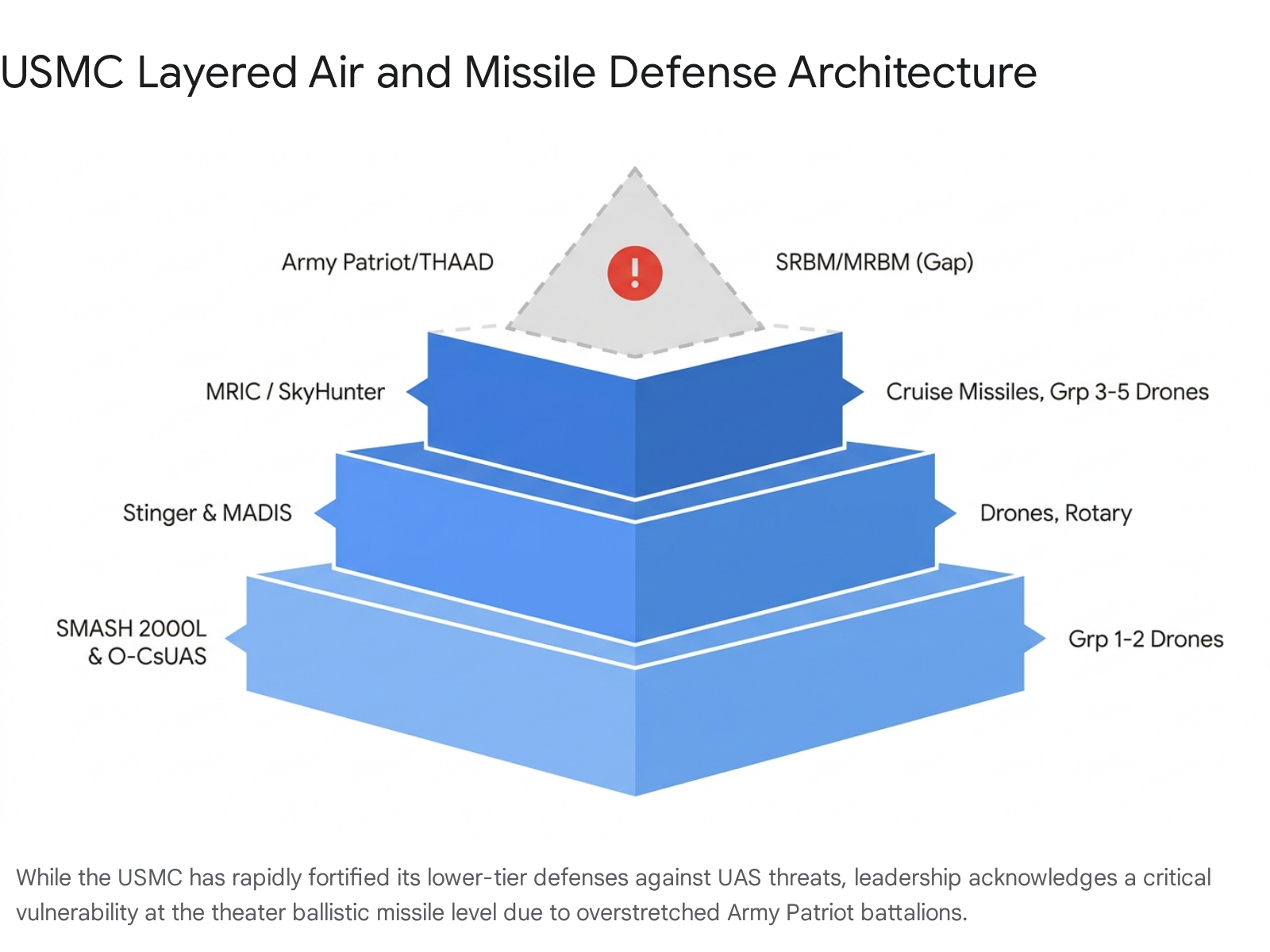
During aviation and combat development panels at MDM 2026, Marine leadership openly acknowledged a severe operational risk: the USMC currently lacks an organic Theater Ballistic Missile Defense (TBMD) capability and has realized it can no longer depend solely on the U.S. Army to provide it.11
The Army’s Patriot and THAAD battalions are heavily strained and considered the service’s “most stressed force element,” facing constant deployment demands in the Middle East, Europe, and static bases in the Pacific.11 In a hypothetical high-end conflict in the Indo-Pacific—where adversaries like China possess a vast and expanding arsenal of advanced ballistic missiles, including those equipped with high-altitude cluster munition warheads designed to overwhelm terminal defenses—Army air defense assets will likely be tethered to critical strategic infrastructure.11 This leaves distributed Marine Expeditionary Advanced Base Operations (EABO) and mobile littoral regiments highly vulnerable to Short-Range and Medium-Range Ballistic Missiles (SRBMs/MRBMs).11
The USMC’s current upper-tier solution, the Medium-Range Intercept Capability (MRIC)—which utilizes the Israeli Iron Dome’s SkyHunter interceptors paired with the AN/TPS-80 G/ATOR radar—is optimized primarily for cruise missiles and higher-end drones (Group 3 and 5).11 Its effectiveness against high-velocity ballistic missiles is limited and unproven as a reliable shield.11 Consequently, Lt. Col. Robert Barclay, the Marine Air Command and Control Systems Integration Branch Head, stated that defending against SRBMs and MRBMs is likely a necessary requirement for the Corps. The service intends to take a “hard look” over the next year to establish formal requirements for an organic TBMD system.11
11. Next-Generation Aviation Concepts
Aviation developments highlighted at the exposition depicted an air combat element in transition, actively seeking to replace legacy manned platforms with systems that offer greater range, autonomy, and survivability in denied airspace.
11.1. Tiltrotor and Rotary Innovations
A prominent display at the exposition was Bell’s MV-75 Cheyenne II tiltrotor concept, envisioned as a potential next-generation successor to the legacy AH-1Z Viper and UH-1Y Venom helicopter fleets.47 The MV-75 model featured heavy, long-range armament, including the Naval Strike Missile (NSM) and the Precision Attack Strike Munition (PASM, a variant of the L3Harris Red Wolf cruise missile).47 Equipping a high-speed tiltrotor with anti-ship cruise missiles significantly extends the aviation combat element’s striking range and operational radius, perfectly aligning with the sea-denial imperatives of Force Design 2030.47
Simultaneously, the Sikorsky CH-53K King Stallion heavy-lift helicopter is undergoing rigorous preparation for its first operational deployment with the 26th Marine Expeditionary Unit.48 The unparalleled lift capacity of the CH-53K is vital for moving the heavy logistics loads, vehicles, and artillery systems required to sustain distributed units across the vast oceanic distances of the Pacific.
11.2. Autonomous Aviation and Wingmen
The integration of unmanned systems extends heavily into the aviation domain. The Marine Corps aims to begin operational testing with “unmanned wingmen”—specifically through the Collaborative Combat Aircraft (CCA) effort—alongside crewed fighter jets by 2029.49 Platforms like the highly autonomous, low-cost XQ-58A Valkyrie and the General Atomics YFQ-42 Fighter Drone are currently being tested to serve as the “autonomy brain” alongside crewed jets.49
Furthermore, the Navy and Boeing successfully conducted the first test flight of the unmanned MQ-25A Stingray, demonstrating autonomous taxiing, takeoff, and landing capabilities.9 These uncrewed platforms will reduce the reliance on human pilots for hazardous intelligence, surveillance, and reconnaissance (ISR) missions, and critically extend the combat radius of crewed fighters through unmanned aerial refueling. The service is also evaluating light uncrewed cargo helicopters, based on the Robinson R66 and Bell 505, to automate aerial logistics and resupply for forward-deployed troops.50
12. Human Performance, Training, and Simulation
While hardware and technology dominate the expo floor, the USMC’s senior enlisted leadership forcefully emphasized during the “Everyone Fights” panel that human capital remains the decisive factor in future conflicts.51
12.1. The “Division I Athlete” Model
Sgt. Maj. Carlos A. Ruiz, the 20th Sergeant Major of the Marine Corps, outlined the new Marine Corps Total Fitness (MCTF) initiative.51 This program represents a radical, systemic shift in human performance management. The Corps aims to treat enlisted Marines with the same holistic physiological, nutritional, and psychological care afforded to elite Division I athletes.51 This includes transitioning traditional, rudimentary base gyms into comprehensive “War Centers” that focus on injury prevention, specialized training, and cognitive resilience, ensuring the human operator is optimized to handle the immense stress of modern, high-tech warfare.51
12.2. Professional Military Education and Wargaming
To match the intellectual complexity of modern warfare, Professional Military Education (PME) is being overhauled. Leadership noted the critical need to expand TS/SCI (Top Secret/Sensitive Compartmented Information) clearances down to the tactical edge.51 To effectively utilize the kill webs generated by Project Dynamis, squad leaders must have access to the classified intelligence networks feeding their AI-enabled optics and loitering munitions.51
Furthermore, training is becoming increasingly digitized and immersive. Events like the OBJ 1 Wargaming Convention at MDM highlighted the use of digital tabletop wargames and decision-support tools provided by defense firms to refine tactical doctrine.52 At the individual level, systems like the Infantry Immersion Trainer (IIT) and Advanced Small Arms Lethality Trainer use virtual and augmented reality to replicate the linguistic, cultural, and tactical complexities of modern battlefields.53 By utilizing these synthetic environments, Marines can repeatedly rehearse complex, multi-domain engagements before executing them in live-fire scenarios.
13. Conclusion and Strategic Outlook
The diverse array of products, policies, and strategic dialogues unveiled at Modern Day Marine 2026 paints a vivid picture of a Marine Corps moving aggressively beyond the counter-insurgency paradigms of the past two decades. The transition to Ground Combat Element 2040 involves outfitting the individual Marine with capabilities historically reserved for battalion or brigade-level assets—ranging from AI-driven fire control and mesh networking to anti-armor loitering munitions.
However, these formidable tactical enhancements are juxtaposed against significant, unresolved strategic challenges. The Marine Corps must navigate the fragile readiness of the amphibious fleet, pushing the Navy toward more sustainable deployment cycles to ensure the force can physically arrive at the fight. Concurrently, the service must rapidly innovate to close the theater ballistic missile defense gap, ensuring that forward-deployed forces can survive inside the contested weapons engagement zones of peer adversaries. Ultimately, the success of GCE 2040 will not rest solely on the acquisition of autonomous systems or advanced weaponry, but on the seamless integration of software, hardware, and the highly trained, resilient human operators orchestrating the future fight.
Please share the link on Facebook, Forums, with colleagues, etc. Your support is much appreciated and if you have any feedback, please email us in**@*********ps.com. If you’d like to request a report or order a reprint, please click here for the corresponding page to open in new tab.
Sources Used
- Marines Offer Glimpse Of New Plan For Its Future Ground Combat Forces – The War Zone, accessed May 1, 2026, https://www.twz.com/sea/marines-offer-glimpse-of-new-plan-for-its-future-ground-combat-forces
- Marines will update land warfare doctrine as they prep for near-peer, drone-driven fight, accessed May 1, 2026, https://www.defenseone.com/policy/2026/04/marines-will-update-land-warfare-doctrine-they-prep-near-peer-drone-driven-fight/413169/
- Military leaders want a more integrated, joint approach to drone …, accessed May 1, 2026, https://defensescoop.com/2026/04/30/drone-dominance-military-leaders-integrated-approach/
- Textron Systems And Howe & Howe Debut Ripsawtm M1 Uncrewed Ground Vehicle (Ugv) Technology Demonstrator, accessed May 1, 2026, https://investor.textron.com/news-releases/news-details/2026/Textron-Systems-And-Howe–Howe-Debut-Ripsawtm-M1-Uncrewed-Ground-Vehicle-Ugv-Technology-Demonstrator-2026-8rfSLD-iKi/default.aspx
- American Rheinmetall shows next-gen squad systems at Modern Day Marine, accessed May 1, 2026, https://defence-blog.com/american-rheinmetall-shows-next-gen-squad-systems-at-modern-day-marine/
- Stick to your guns: Why the Marine Corps is opting for the M27 over …, accessed May 1, 2026, https://www.militarytimes.com/news/your-military/2026/02/27/why-the-marine-corps-is-choosing-the-m27-rifle-over-the-armys-m7/
- U.S. Marines Deploy SMASH 2000L Smart Scope to Counter Drone Threat at Squad Level, accessed May 1, 2026, https://www.armyrecognition.com/news/army-news/2026/u-s-marines-deploy-smash-2000l-smart-scope-to-counter-drone-threat-at-squad-level
- Marines to field rifle-mounted smart scope to help counter drones – Marine Corps Times, accessed May 1, 2026, https://www.marinecorpstimes.com/news/your-marine-corps/2025/07/17/marines-to-field-rifle-mounted-smart-scope-to-help-counter-drones/
- Modern Day Marine | Defense News, accessed May 1, 2026, https://www.defensenews.com/digital-show-dailies/modern-day-marine/
- Navy, Marine Corps weighing force generation model revamp for amphibs, accessed May 1, 2026, https://breakingdefense.com/2026/04/navy-marine-corps-weighing-force-generation-model-revamp-for-amphibs/
- Marines Realize They Can’t Depend On Army For Ballistic Missile Defense, accessed May 1, 2026, https://www.twz.com/land/marines-realizing-they-cant-depend-on-army-alone-for-ballistic-missile-defense
- Project Dynamis Accelerates Development of Next Generation Battle Management Command and Control – Marines.mil, accessed May 1, 2026, https://www.marines.mil/News/News-Display/Article/4403396/project-dynamis-accelerates-development-of-next-generation-battle-management-co/
- Marine Corps’ Project Dynamis Speeds AI for Future Battlefield Operations | GovCast, accessed May 1, 2026, https://www.youtube.com/watch?v=Mldyux2SiFw
- Marine Corps Advances AI-Driven Battle Management in Dynamis Serial 005 Exercise, accessed May 1, 2026, https://www.executivegov.com/articles/usmc-dynamis-serial-005-ai-battle-management
- Project Dynamis – Marines.mil, accessed May 1, 2026, https://www.marines.mil/Project-Dynamis/
- US combatant chiefs want more amphibious ready groups, Marine commandant says, accessed May 1, 2026, https://www.militarytimes.com/news/your-military/2026/05/01/us-combatant-chiefs-want-more-amphibious-ready-groups-marine-commandant-says/
- CNO Remarks at Modern Day Marine (As Prepared) – Navy.mil, accessed May 1, 2026, https://www.navy.mil/Press-Office/Speeches/display-speech/Article/4474704/cno-remarks-at-modern-day-marine-as-prepared/
- Upcoming Changes to Military Small Arms – SilencerCo, accessed May 1, 2026, https://silencerco.com/blog/upcoming-changes-military-small-arms
- U.S. Marine Corps rejects switch to M7 rifle – The Defence Blog, accessed May 1, 2026, https://defence-blog.com/u-s-marine-corps-rejects-switch-to-m7-rifle/
- U.S. Marine Corps Authorizes Red Dot Optics on M17/M18 Pistols for Combat Qualification, accessed May 1, 2026, https://www.armyrecognition.com/news/army-news/2026/u-s-marine-corps-authorizes-red-dot-optics-on-m17-m18-pistols-for-combat-qualification
- Marines can now use optical sights with pistols for qualifying – Task & Purpose, accessed May 1, 2026, https://taskandpurpose.com/news/marines-optic-pistol-qualifications/
- New optic system combines magnification, red dot – Police1, accessed May 1, 2026, https://www.police1.com/police-products/tactical/optics/speed-vs-precision-how-to-bridge-the-gap
- New Optics Coming in 2026 | NSSF SHOT Show 2027, accessed May 1, 2026, https://shotshow.org/new-optics-coming-in-2026/
- Marines on way to Middle East seen using rifles with anti-drone smart scope, accessed May 1, 2026, https://taskandpurpose.com/news/marines-drone-optic-2026/
- US Marine Corps Advances Modernization with Simultaneous Training and Fielding of Organic C-sUAS. – DVIDS, accessed May 1, 2026, https://www.dvidshub.net/news/557550/us-marine-corps-advances-modernization-with-simultaneous-training-and-fielding-organic-c-suas
- Marine Corps to Deploy Counter-Drone Systems Across Units in 2025, accessed May 1, 2026, https://www.marines.mil/News/News-Display/Article/4151802/marine-corps-to-deploy-counter-drone-systems-across-units-in-2025/
- Marine division to get first-of-its-kind counter-drone training as officials signal ‘significant concern’ over defeating UAS | DefenseScoop, accessed May 1, 2026, https://defensescoop.com/2026/04/28/marine-division-to-get-first-of-its-kind-counter-drone-training/
- AV Announces Halo_Shield™, Comprehensive Tile-Based C-UAS Solution, accessed May 1, 2026, https://lasvegassun.com/news/2026/apr/28/av-announces-halo_shield-comprehensive-tile-based-/
- AeroVironment Unveils Halo_Shield Counter-Drone Defense System, accessed May 1, 2026, https://www.executivebiz.com/articles/aerovironment-haloshield-counter-drone
- AeroVironment launches Halo_Shield counter-drone defense system – StreetInsider, accessed May 1, 2026, https://www.streetinsider.com/Corporate+News/AeroVironment+launches+Halo_Shield+counter-drone+defense+system/26379822.html
- Why the US Marine Corps wants a new anti-tank loitering munition, accessed May 1, 2026, https://www.militarytimes.com/news/your-military/2026/04/24/why-the-us-marine-corps-wants-a-new-anti-tank-loitering-munition/
- Marines to field light loitering munition to operational units in ‘June timeframe’: Official, accessed May 1, 2026, https://breakingdefense.com/2026/04/marines-to-field-light-loitering-munition-to-operational-units-in-june-timeframe-official/
- Marine Corps Completes the Early Capability Release of OPF-Light, accessed May 1, 2026, https://www.marines.mil/News/News-Display/Article/4471046/marine-corps-completes-the-early-capability-release-of-opf-light/
- Textron debuts RIPSAW M1 combat robot at Marine Expo – The Defence Blog, accessed May 1, 2026, https://defence-blog.com/textron-debuts-ripsaw-m1-combat-robot-at-marine-expo/
- Robotic Ripsaw M1 built to scout and draw fire for US Marines, accessed May 1, 2026, https://newatlas.com/military/ripsaw-m1-gives-us-marines-fighting/
- Textron unveils autonomous ground vehicle designed for Marine Corps littoral units, accessed May 1, 2026, https://www.defenseone.com/defense-systems/2026/04/textron-unveils-autonomous-ground-vehicle-designed-marine-corps-littoral-units/413153/
- Textron unveils RIPSAW M1 UGV, accessed May 1, 2026, https://www.calibredefence.co.uk/textron-unveils-ripsaw-m1-ugv/
- U.S. Military Eyes Armed UGV With 30mm Cannon And Coyote Stinger Missiles For Counter Drone Warfare – Army Recognition, accessed May 1, 2026, https://www.armyrecognition.com/news/army-news/2026/u-s-military-eyes-armed-ugv-with-30mm-cannon-and-coyote-stinger-missiles-for-counter-drone-warfare
- General Dynamics Business Units to Participate in Modern Day Marine 2026, accessed May 1, 2026, https://gdmissionsystems.com/articles/2026/04/27/news-release-general-dynamics-business-units-to-participate-in-modern-day-marine-2026
- General Dynamics shows ARV-30 at Modern Day Marine – The Defence Blog, accessed May 1, 2026, https://defence-blog.com/general-dynamics-shows-arv-30-at-modern-day-marine/
- Marines to start development on Advanced Reconnaissance Vehicle Increment 2 in 2029, accessed May 1, 2026, https://breakingdefense.com/2026/04/marines-to-start-development-on-advanced-reconnaissance-vehicle-increment-2-in-2029/
- MDM News: Marines Already Looking to Upgrade Amphibious Combat Vehicles, accessed May 1, 2026, https://www.nationaldefensemagazine.org/articles/2026/4/30/marines-already-looking-to-upgrade-amphibious-combat-vehicles
- Marine Amphibious Combat Vehicles To Get Missile-Swatting Active Protection Systems, accessed May 1, 2026, https://www.twz.com/sea/marine-amphibious-combat-vehicles-to-get-missile-swatting-active-protection-systems
- Oshkosh Defense Shows Expeditionary Power and Modernized Mobility at Modern Day Marine 2026, accessed May 1, 2026, https://oshkoshdefense.com/oshkosh-defense-shows-expeditionary-power-and-modernized-mobility-at-modern-day-marine-2026/
- Oshkosh Defense exhibits at Modern Day Marine 2026 – Power Progress, accessed May 1, 2026, https://www.powerprogress.com/news/oshkosh-defense-exhibits-at-modern-day-marine-2026/8120116.article
- Modern Day Marine | Oshkosh Defense, accessed May 1, 2026, https://oshkoshdefense.com/trade-shows/modern-day-marine-2/
- New Cruise Missile-Armed MV-75 Tiltrotor Concept For The Marines Shown Off, accessed May 1, 2026, https://www.twz.com/air/new-cruise-missile-armed-mv-75-tiltrotor-concept-for-the-marines-shown-off
- CH-53K gears up for first deployment with 26th Marine Expeditionary Unit, accessed May 1, 2026, https://breakingdefense.com/2026/04/ch-53k-gears-up-for-first-deployment-with-26th-marine-expeditionary-unit/
- With unmanned systems in the forefront, Marine Corps evolves how it operates, accessed May 1, 2026, https://breakingdefense.com/2026/04/with-unmanned-systems-in-the-forefront-marine-corps-evolves-how-it-operates/
- Modern Day Marine 2026 | The War Zone, accessed May 1, 2026, https://www.twz.com/modern-day-marine-2026
- USMC 2040: The Radical Shift in Marine Corps Training – YouTube, accessed May 1, 2026, https://www.youtube.com/watch?v=uRVisM8k-fc
- MDM 2026 – SPA, accessed May 1, 2026, https://spa.com/event/mdm2026/
- 20 2 6 P & S Ca t a l o g – Marine Corps Systems Command, accessed May 1, 2026, https://www.marcorsyscom.marines.mil/Portals/105/PMs/PM%20TRASYS/2026_P-S_Single_Page_Layout_V3.pdf?ver=yyd-kqX8FZ8MyDcixn0R1g%3D%3D
- Modern Day Marine: The Future of Fighting Now, accessed May 1, 2026, https://www.mca-marines.org/leatherneck/modern-day-marine-the-future-of-fighting-now/