Tag Archives: INDOPACOM

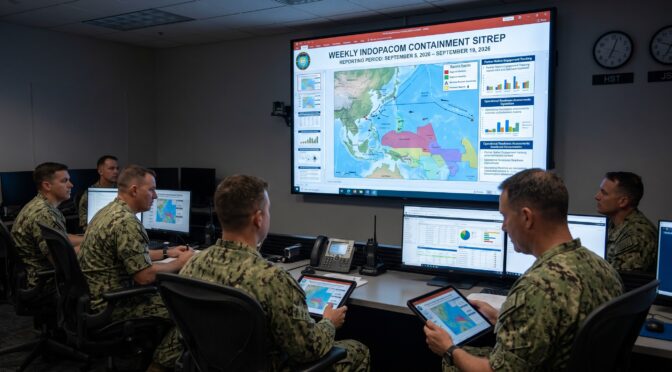
Weekly INDOPACOM Containment SITREP: September 5 to 19, 2026

1. Executive Summary

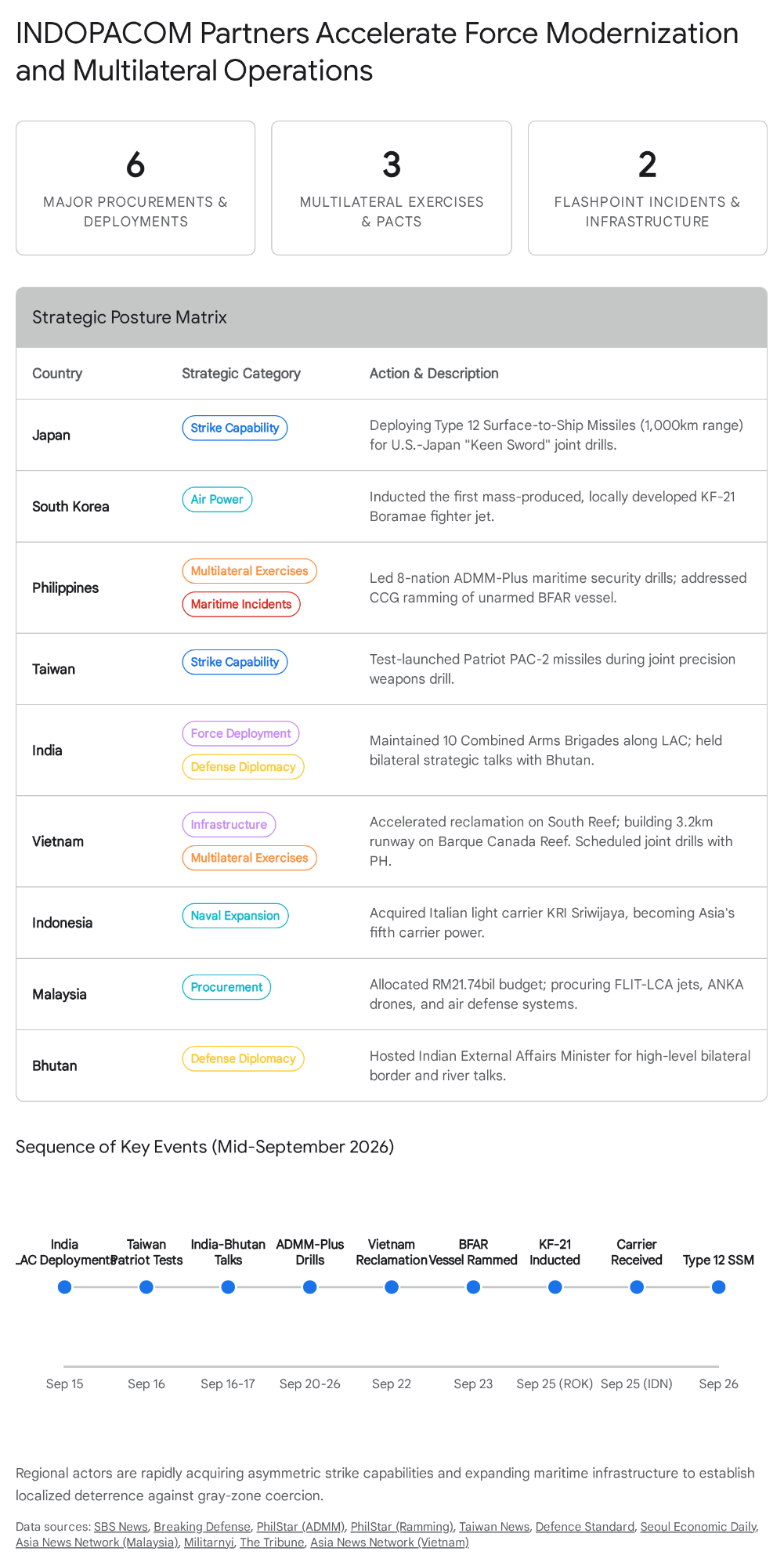
Between September 5 and September 19, 2026, the Indo-Pacific strategic landscape shifted noticeably toward deeper multilateral defense ties and sharper maritime friction. Regional nations are increasingly moving away from passively watching China modernize its forces, opting instead for active, asymmetric containment. This pivot is driving unprecedented defense spending, aggressive investments in autonomous and AI-driven platforms, and an expanded schedule of multi-domain military exercises.

Japan FY2027 defense request $55.5B vs. Taiwan FY2026 budget $31.27B

Across Northeast Asia, governments are stepping up their readiness. Japan submitted a record request for its defense budget for fiscal year 2027, prioritizing standoff strike capabilities, uncrewed systems, and AI integration across its command structures. Taiwan passed substantial regular and supplementary budgets aimed at procuring coastal defense drones and fielding long-range cruise missiles capable of reaching deep into the Chinese mainland. Meanwhile, South Korea pushed forward with its own autonomous warfare initiatives—planning to integrate hundreds of thousands of drones into frontline units while deepening defense-industrial ties with European partners and managing joint exercise commitments with the United States.

In Southeast Asia, friction at sea worsened. A Chinese vessel collided directly with a Philippine Coast Guard ship near Palawan, highlighting the constant risk of escalation in the South China Sea. Facing persistent gray-zone pressure, both Manila and Hanoi accelerated construction on their occupied features in the Spratly Islands, extending runways and building sheltered harbors to support longer maritime deployments. Indonesia hosted its largest Super Garuda Shield exercise to date, working with partner militaries on complex, multi-domain operations. Malaysia focused on bolstering its maritime flanks through joint drills with the Indian Navy and high-level engagements with the US Pacific Fleet.

In South Asia, the border regions joining India, Bhutan, and China remain a key flashpoint. India noted a tactical pull-back of Chinese troops along the Line of Actual Control after deploying its brigades and establishing new communication hotlines. However, satellite imagery revealed ongoing, unauthorized Chinese settlement building inside disputed Bhutanese territory, pushing New Delhi to expand its defense umbrella over Bhutan and safeguard the vital Siliguri Corridor.

Together, these moves reflect a closely networked regional push to complicate operational planning for the People’s Liberation Army and counter broad territorial claims through targeted, localized defenses.

2. Regional Developments

2.1 Japan

The administration of Prime Minister Sanae Takaichi is reshaping the Japanese Self-Defense Forces, steering them away from strictly defensive postures toward integrated, long-range counterstrike capabilities. On August 31, 2026, Japan’s Ministry of Defense requested a record fiscal year 2027 budget of ¥8.89 trillion (roughly $55.5 billion USD)1. This marks the 15th consecutive annual increase and hits the government’s target of raising defense spending to 2 percent of GDP ahead of schedule3. Japanese officials describe the security environment as the most challenging since World War II, driven by China’s military modernization, North Korea’s missile testing, and closer ties among Beijing, Pyongyang, and Moscow5.

Much of this budget focuses on AI and uncrewed tech. The Ministry of Defense plans to deploy a new platform called the “AI Orchestrator” alongside an AI decision-support tool to help Joint Operations Command make faster choices during high-intensity conflict6. Japan is moving beyond legacy systems to create a unified defense network featuring sensor-to-shooter capabilities, shared data layers, space domain awareness, and updated communications satellites7. Japan is also developing compact quantum magnetic sensors for low-cost drones. Expected by fiscal 2031, these sensors will allow drone swarms to scan for tiny magnetic signature changes caused by submerged Chinese submarines8, strengthening maritime surveillance at key choke points where traditional anti-submarine forces are stretched thin8.

Hardware requests reflect a clear shift toward standoff strike and persistent surveillance. To cope with staffing shortages and limit casualties, Tokyo is asking for funds to acquire autonomous platforms and advanced munitions, as well as modifications for the JS Izumo and JS Kaga helicopter carriers to support F-35B operations1.

System / PlatformRequested Funding (JPY / USD equivalent)Strategic Function
MQ-9B SeaGuardian UAVs (17 units)¥292.2 billion ($1.83 billion)Persistent Intelligence, Surveillance, Reconnaissance, and Targeting
Aegis System Equipped Vessels (2 units)¥68.9 billion ($431 million)Integrated Air and Missile Defense
Type 12 Surface-to-Ship Missile¥56.2 billion ($351 million)Long-range standoff strike capability
Submarine-launched Guided Missiles¥16.3 billion ($102 million)Covert strike targeting ships and land assets
Tomahawk Integration (3 Destroyers)¥1.1 billion ($6.9 million)Near-term counterstrike capability

Along with equipment, the budget outlines organizational changes. To address personnel shortages, a new Support Agency for Retired SDF Personnel and Families will assist with reemployment and family care2. The Ministry of Defense is also launching three new bureaus—including an International Policy Bureau to guide foreign defense ties—and establishing mechanisms to reinforce domestic defense manufacturing4. A new framework allows Japan to temporarily nationalize defense manufacturing facilities if needed to secure supply chains during extended crises2.

Operationally, the Japan Ground Self-Defense Force kicked off “Orient Shield 26” alongside US and Australian forces across Hokkaido and Kagoshima, running from September 8 to September 243. The exercises drew quick pushback from Beijing. At the Xiangshan Forum on September 16, Chinese Defense Minister Dong Jun criticized Japan’s forward deployment of offensive arms, cautioning against rising militarism and historical revisionism4. Chinese officials argued that Orient Shield masked the positioning of strike systems that threaten regional stability3.

Tensions between Tokyo and Beijing remain heightened following earlier remarks from Prime Minister Takaichi, who noted that a naval blockade of Taiwan could represent a “survival-threatening situation” for Japan, potentially triggering a military response under collective self-defense9. Even so, diplomatic channels remain open; an eight-member delegation from the Japan-China Friendship Parliamentarians’ Union visited senior Chinese officials in mid-September9.

2.2 South Korea

South Korea is expanding its autonomous systems and defense manufacturing base to offset demographic declines and counter asymmetric threats from North Korea and broader regional actors. President Lee Jae Myung is pushing to modernize infantry and naval forces. The Ministry of National Defense recently announced a plan to train 500,000 “drone warriors” and produce over 110,000 uncrewed aerial systems by 2029, aiming to make drones standard gear for individual soldiers13. To guard supply chains against cyber vulnerabilities, Seoul is requiring these systems to use only domestic parts, steering clear of Chinese tech13.

The military plans to acquire more than 20,000 low-cost drones, integrating AI-driven swarming and loitering munitions to push tactical strike choices down to frontline units rather than relying entirely on centralized command13. This move is forcing a streamlining of procurement rules to speed up the integration of commercial tech into the military13.

On the naval side, South Korea awarded a key contract to Leonardo DRS on September 17 for integrated electric power and propulsion on its next-generation KDDX guided-missile destroyers15. This marks a major step in fielding domestic surface combatants for contested seas15. Concurrently, US defense agencies are seeking contracts to upgrade physical readiness facilities at locations like Camp Hovey to maintain overall troop readiness16.

Diplomatically, Seoul is balancing alliance expectations with regional realities. President Lee ruled out sending South Korean combat troops overseas, specifically declining requests from the Trump administration regarding involvement in the Middle East, citing constitutional limits and a desire to avoid foreign wars17. However, he noted the government is exploring options to expand the Cheonghae naval unit’s footprint in the Gulf of Aden to protect essential crude oil shipping lanes17.

Joint activities with the United States have seen recent tweaks. The Ulchi Freedom Shield exercise was shortened by six days in August, and the biennial Ssang Yong amphibious exercise was replaced by a national drill to manage costs and control messaging toward Pyongyang19. Still, US Pacific Command carried out the trilateral “Freedom Edge 26” exercise with South Korea and Japan in early September, focusing on ballistic missile defense and anti-surface operations to maintain high-end interoperability19.

To hedge against regional shifts, South Korea is broadening its defense partnerships. The Defense Acquisition Program Administration simplified procedures for Korean defense firms to access non-public NATO standards, paving the way for deeper defense-industrial cooperation across Europe19. Seoul also deepened ties with France in September, agreeing to joint military exercises, cyber standardization, and expanded intelligence sharing, which includes a planned stop in South Korea for the French Pégase air mission20. In Southeast Asia, South Korea signed new agreements with the Philippines to bolster arms industry cooperation and expand combined training21.

2.3 Philippines

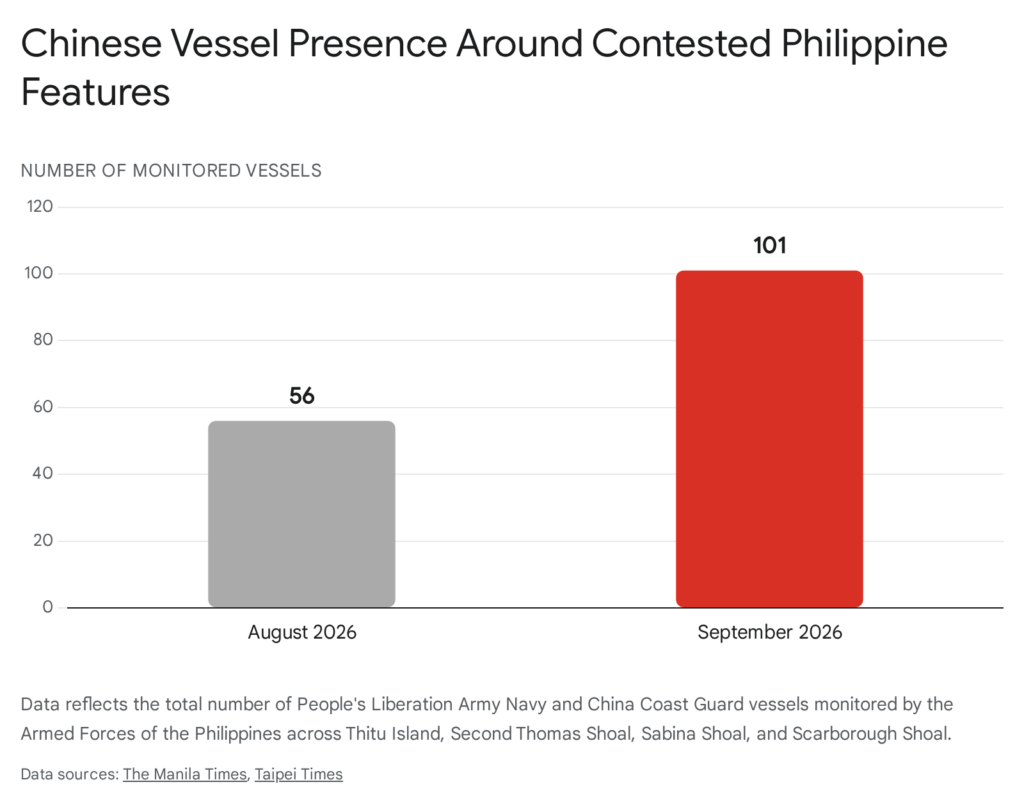
Conditions in the West Philippine Sea remain volatile, marked by frequent confrontations. On September 18, 2026, a China Coast Guard vessel rammed the BRP Datu Magat Salamat, a civilian ship operated by the Philippine Bureau of Fisheries and Aquatic Resources near Sabina and Second Thomas Shoals off Palawan22. Video released by the Philippine Coast Guard showed the Chinese ship cutting across the bow just 10 meters away before colliding, causing heavy damage22. Beijing rejected the account, claiming the Philippine vessel unexpectedly altered course and accelerated into the Chinese ship22.

This collision follows a broader pattern of gray-zone activity. In July 2026, Manila accused Chinese forces of firing water cannons at government vessels near Scarborough Shoal and assaulting a Philippine sailor during a resupply mission to Second Thomas Shoal22. China has since barred Philippine Defense Minister Gilberto Teodoro from entering the country, and Teodoro has responded that he will continue to defend Philippine sovereignty regardless22. Although the Permanent Court of Arbitration invalidated Beijing’s expansive South China Sea claims in 2016, Chinese coast guard and maritime militia units continue to assert control across the area24.

In response, Manila is building out its island outposts. Satellite imagery shows near-completion of a new sheltered harbor and significant progress on runway extensions at Thitu Island (Pag-asa) in the Spratlys26. Home to roughly 400 Filipinos, Thitu is Manila’s largest outpost in the region25. The additions follow the opening of a Coast Guard station on the island equipped with radar systems to track activity around nearby Chinese-occupied Subi Reef25.

Manila is also strengthening security ties to offset China’s naval edge. In mid-September, Philippine and US forces carried out joint maritime drills off Palawan and Occidental Mindoro, combining Philippine naval and air units with the US Coast Guard Cutter Stratton and a P-8A Poseidon patrol plane27. To build additional presence, the US Coast Guard deployed six fast-response cutters to form an Expeditionary Cutter Squadron operating out of Singapore and the Philippines28. Manila also accepted a donated coastguard vessel from Taiwan, expanding unofficial security ties across the Luzon Strait29.

2.4 Taiwan

Taiwan is scaling up defense funding to support an asymmetric “porcupine” strategy aimed at deterring any cross-strait action by the People’s Liberation Army. President Lai Ching-te and Premier Cho Jung-tai raised total 2026 defense spending by 22.9 percent year-over-year to NT$949.5 billion ($31.27 billion USD), or 3.32 percent of GDP30. In a shift toward NATO-style reporting, Taiwan included Coast Guard and veterans’ affairs funding in the defense total for the first time30. The US State Department welcomed the budget hike beyond 3 percent of GDP as a clear sign of commitment31.

To address potential vulnerabilities in major legacy systems, Taipei is focusing on agile asymmetric capabilities. On September 3, the Executive Yuan introduced a special supplementary budget of NT$145.7 billion ($4.6 billion USD) to accelerate domestic defense manufacturing32. This fast-tracked funding aims to field survivable assets quickly.

Asymmetric Procurement CategoryEstimated Quantity / FocusSupplementary Budget Allocation
Coastal Surveillance & Reconnaissance Drones600+ unitsNT$55.9 billion ($1.77 billion USD)
Coastal Attack Drones & Loitering Munitions40,000+ unitsPart of the Uncrewed Systems allocation
Small Suicide Drone BoatsInitial batch of 100+ unitsPart of the Uncrewed Systems allocation
Strong Bow Missile SystemSerial ProductionMedium-tier anti-tactical ballistic missile defense

Budget disclosures also confirmed that Taiwan has operationalized long-range strike capabilities. The military deployed the “Ching Tien I” cruise missile, which features a 1,500-kilometer range and Mach 3 speeds capable of reaching targets deep inside China32. Documents also reference work on the “Ching Tien II,” a mobile variant with a 2,000-kilometer reach and Mach 5 speed, intended to provide a long-range deterrent against PLA staging grounds32.

In the field, Taiwanese forces held their first multi-drone joint strike exercise during the week of September 14, incorporating tactics drawn from recent global conflicts34. On September 17, troops conducted live-fire tests at Jiupeng Military Base, launching the domestic Land Sword II air defense missile, Hsiung Sheng cruise missile, and Chien Hsiang loitering munitions to validate integrated strike and defense systems35.

These domestic steps come as foreign deliveries face delays. Acting US Navy Secretary Hung Cao noted that Washington paused certain arms shipments to Taiwan, adding to an existing Foreign Military Sales backlog estimated at $31.72 billion36. To navigate these holdups, Taipei previously passed a $26 billion special defense package to secure US systems, including HIMARS, Harpoon, and Patriot missiles37.

2.5 India

India continues to manage its border with China through a mix of direct deterrence, economic recalibration, and regional naval diplomacy. Following extended standoffs, India’s Ministry of Defence noted a reduction in Chinese troop presence along the Line of Actual Control (LAC) in 202539. Analysts credit this shift to India’s matching deployment of 10 combined arms brigades to the border area, creating a balanced deterrent on the ground39.

Diplomatic talks between National Security Advisor Ajit Doval and Chinese Foreign Minister Wang Yi yielded formal steps to manage tensions. The 2026 agreement created an Expert Group on Boundary Delimitation and set up two high-level military hotlines connecting India’s Eastern and Central Commands directly with PLA counterparts42. While these tools reduce the risk of accidental clashes, experts describe the border status as “armed co-existence,” with primary disputes over Aksai Chin and Tawang unresolved43.

Military preparations remain active. Throughout September, Indian and US troops held the 22nd “Yudh Abhyas” exercise. About 350 personnel from each side trained in the Rajasthan desert and the high-altitude terrain of Auli, Uttarakhand—roughly 100 kilometers from the LAC44. Beijing protested the location, claiming the drills violated existing bilateral agreements46. India’s COMSA agreement with the US continues to support secure communications and tech access during such joint exercises46.

At sea, the Indian Navy continues to operate eastward to protect shipping channels and build ties with Southeast Asian navies. The guided-missile destroyer INS Mysore docked in Lumut, Malaysia, on September 9 for Exercise Samudra Laksamana alongside the Royal Malaysian Navy47. The exercise focused on tactical maneuvers near the South China Sea, supporting India’s Act East policy and freedom of navigation efforts48.

On the industrial side, Indian defense firm Solar Industries acquired South African explosives manufacturer Omnia for $1.3 billion, broadening India’s footprint in commercial and military energetic materials49.

2.6 Vietnam

Under President and General Secretary To Lam, Vietnam continues its balance of “bamboo diplomacy,” pairing public neutrality with steady physical upgrades in the South China Sea. Hanoi avoided signing multilateral statements condemning Beijing’s actions, adhering to its core “Four No’s” defense posture while expanding its outposts across the Spratly Islands50.

Satellite imagery shows Vietnam actively developing 27 sites across 18 reefs in the Spratlys51. Land reclamation has added over 2,200 acres of new land—roughly 71 percent of the total area reclaimed by China52. These outposts now feature eight new harbors and extended airfields, with major work visible at Tennent Reef, Pearson Reef, and Barque Canada Reef53.

These upgrades serve logistical and defensive needs. The new harbors allow the Vietnamese Coast Guard and maritime militia to remain at sea longer to protect fishing and energy exploration fleets52. The expanded landmasses also provide space for coastal defense systems, radar installations, and anti-ship emplacements52.

This physical footprint is backed by new weapons acquisitions. In May 2026, Vietnam agreed to purchase supersonic BrahMos anti-ship missiles from India, significantly extending its coastal strike range50. Hanoi also finalized a defense training agreement with Japan to support maritime patrol capabilities50. These moves directly counter China’s ongoing military construction in the area, such as a new helipad and radar facilities on Antelope Reef in the Paracels54.

2.7 Indonesia

Indonesia is adapting to regional maritime shifts by expanding multilateral defense involvement while preserving its non-aligned foreign policy tradition. From August 31 to September 11, the Indonesian National Armed Forces hosted “Super Garuda Shield 2026,” its largest iteration since starting in 200755. The US Pacific Command co-led the event, which involved over 6,000 personnel from 15 participating nations, including Australia, Japan, India, Canada, the UK, and Singapore55.

The 2026 exercises emphasized multi-domain integration across land, sea, air, and cyber operations55. Forces used the Pacific Multi-Domain Training network to coordinate live-fire drills, airborne drops, and amphibious landings alongside cyber defense training55. Training sites expanded into North Kalimantan, placing drills near the Celebes Sea and Makassar Strait55.

While Jakarta emphasizes that Super Garuda Shield is not a formal alliance, the scope of the drills sends a clear deterrence signal55. Indonesia also recently welcomed its first aircraft carrier, enhancing its capacity to monitor key archipelagic sea lanes and the southern South China Sea29.

2.8 Malaysia

Malaysia is updating its defense posture to address routine incursions by foreign aircraft and maritime vessels into its exclusive economic zone. A recent midterm review highlighted South China Sea tensions and cybersecurity as key priorities driving policy adjustments57.

To bolster security, the Royal Malaysian Navy is increasing joint activities with international partners. From September 9 to 12, Malaysia hosted the Indian Navy destroyer INS Mysore for Exercise Samudra Laksamana off Lumut47, focusing on tactical coordination and extended deployment logistics48. Shortly after, Admiral Steve Koehler, Commander of the US Pacific Fleet, visited Kota Kinabalu, Sabah, for strategic discussions with Malaysian military leadership58.

Kuala Lumpur is also leveraging its strategic partnership with Japan, which has produced joint naval exercises in the South China Sea and capacity-building assistance from the Japan Coast Guard59.

2.9 Bhutan

Bhutan remains a focal point in the quiet strategic competition between India and China. Satellite intelligence from early September indicates China accelerated construction of permanent settlements within disputed border areas61. Analysts have identified more than 200 structures across six sites in the Jakarlung Valley and Beyul Khenpajong region62.

Analysts view these construction efforts as a way to establish facts on the ground and gain leverage during long-running boundary negotiations with Thimphu61. By populating these outposts, Beijing complicates countermeasures without risking civilian safety61. Bhutan’s government has kept a low public profile regarding the border issues61, while China has enacted tighter travel decrees along adjacent border zones63.

For India, developments in Bhutan carry major security implications. Disputed areas near the Doklam plateau border the Siliguri Corridor—the narrow pass connecting mainland India to its northeastern states62. To secure this transit point, New Delhi has reinforced its defense infrastructure commitments in Bhutan under existing bilateral agreements65. The Indian military continues upgrading border transport links, including the Haa-Doklam road network, and conducting joint surveillance operations to maintain stability along the border66.

3. Conclusion

Recent developments suggest the Indo-Pacific security setup is changing. Isolated bilateral disputes are increasingly giving way to networked defense efforts that rely heavily on asymmetric technologies.

By expanding defense budgets and prioritizing autonomous systems, regional militaries are working to offset conventional force imbalances. Projects like Japan’s quantum drone sensors for anti-submarine surveillance and Taiwan’s deployment of mobile cruise missiles alter the operational calculus in key maritime areas. Meanwhile, expanded island outposts maintained by Vietnam and the Philippines reflect an ongoing effort to maintain presence in the South China Sea despite frequent maritime friction.

Although risks of friction remain, regional security is increasingly shaped by enhanced deterrence. Through joint exercises like Super Garuda Shield, direct communication lines along the LAC, and expanding defense industry partnerships, regional nations are building a more integrated defense posture across the Indo-Pacific.

4. Master Summary Table

CountryDateActivity CategoryFactual Description
JapanAug 31, 2026Defense FinancingMinistry of Defense requested a record ¥8.89 trillion ($55.5 billion) FY2027 budget emphasizing AI, quantum magnetic drone sensors for ASW, and standoff missiles.
JapanSep 8 – 24, 2026Military ExercisesJGSDF commenced “Orient Shield 26” joint drills with US and Australian forces in Hokkaido and Kagoshima.
South KoreaSep 2026Procurement & StrategyAnnounced plans to manufacture 110,000 drones and train 500,000 “drone warriors” by 2029, explicitly banning Chinese components.
South KoreaSep 17, 2026Weapons ProcurementAwarded electric propulsion contract to Leonardo DRS for the next-generation KDDX guided-missile destroyer program.
PhilippinesSep 18, 2026Force DeploymentA Chinese Coast Guard vessel intentionally rammed the civilian government ship BRP Datu Magat Salamat near Palawan.
PhilippinesSep 2026Force PostureNearing completion of a new sheltered harbor and runway extension on Thitu Island (Pag-asa) in the Spratlys.
TaiwanSep 3, 2026Defense FinancingProposed a supplementary NT$145.7 billion ($4.6 billion) budget to fast-track procurement of coastal attack drones and Strong Bow missiles.
TaiwanSep 14 – 17, 2026Military ExercisesConducted joint attack drone exercise and successfully test-fired the Land Sword II, Hsiung Sheng, and Chien Hsiang systems at Jiupeng.
IndiaSep 9 – 22, 2026Military ExercisesHosted US forces for “Yudh Abhyas 2026” near the LAC in Rajasthan and Uttarakhand.
IndiaSep 2026Bilateral AgreementsFormalized Expert Group on Boundary Delimitation and installed new high-level military hotlines with China’s PLA.
VietnamSep 2026Force PostureContinued massive reclamation of the Spratly Islands, expanding 27 sites across 18 reefs with harbors and runways.
IndonesiaAug 31 – Sep 11, 2026Military ExercisesHosted the largest-ever “Super Garuda Shield” involving over 6,000 troops from 15 nations to simulate multi-domain operations.
MalaysiaSep 9 – 14, 2026Security CooperationConducted Exercise Samudra Laksamana with the Indian Navy and hosted the Commander of the US Pacific Fleet in Kota Kinabalu.
BhutanSep 2026Force PostureSatellite imagery revealed China constructed over 200 unauthorized structures in the disputed Jakarlung Valley and Beyul Khenpajong.

Please share the link on Facebook, Forums, with colleagues, etc. Your support is much appreciated and if you have any feedback, please email us in**@*********ps.com. If you’d like to request a report or order a reprint, please click here for the corresponding page to open in new tab.


Sources Used

  1. Record defence budget for Japan in FY27: the naval programs, https://www.fw-mag.com/shownews/1239/record-defence-budget-for-japan-in-fy27-the-naval-programs
  2. Japan’s Ministry of Defense requests record ¥8.9 trillion for FY2027, https://finance.biggo.com/news/0b74c5fa-8d5f-4a2b-aaf9-080c438c478d
  3. China warns Japan’s forward deployment of strategic offensive, https://www.aa.com.tr/en/asia-pacific/china-warns-japan-s-forward-deployment-of-strategic-offensive-weapons-risks-confrontation/4057269
  4. China defense minister urges an end to ‘provocative acts’ to open, https://bworldonline.com/world/2026/09/16/777729/china-defense-minister-urges-an-end-to-provocative-acts-to-open-security-forum/
  5. Japan’s Record Defence Budget Request Is Really About AI, https://www.realcleardefense.com/articles/2026/09/16/japans_record_defence_budget_request_is_really_about_ai_1206332.html
  6. Feature: Japan’s FY 2027 defence budget request targets AI … – Janes, https://www.janes.com/defence-intelligence-insights/defence-news/c4isr/feature-japans-fy-2027-defence-budget-request-targets-ai-unmanned-stand-off-capabilities
  7. Japan’s record defence budget request is really about AI, https://www.aspistrategist.org.au/japans-record-defence-budget-request-is-really-about-ai/
  8. Chinese submarines face a new challenge: Japan’s low-cost drones with quantum sensors, https://timesofindia.indiatimes.com/defence/international/chinese-submarines-face-a-new-challenge-japans-low-cost-drones-with-quantum-sensors/articleshow/134277396.cms
  9. Chinese defense chief warns against militarism and revisionism in, https://www.japantimes.co.jp/news/2026/09/16/japan/china-defense-minister-japan/
  10. China warns against militarism, historical revisionism at security forum, https://english.kyodonews.net/articles/-/85253
  11. China opposes Japan’s joint military exercise – Asia News Network, https://asianews.network/china-opposes-japans-joint-military-exercise/
  12. The limits of Takaichi’s ‘Japan is back’ – ThinkChina.sg, https://www.thinkchina.sg/politics/limits-takaichis-japan-back
  13. ROK to train 500000 ‘drone warriors’ to counter North Korean threats, https://ipdefenseforum.com/2026/07/rok-to-train-500000-drone-warriors-to-counter-north-korean-threats/
  14. South Korea planning to expand its drone capabilities against North, https://www.jpost.com/international/article-900596
  15. Leonardo DRS to supply propulsion for South Korea’s KDDX vessels, https://www.naval-technology.com/news/leonardo-drs-south-korea-kddx/
  16. Physical Fitness Equipment – Sweetspot, https://console.sweetspotgov.com/federal-contracts/0864d290-75df-55ee-abbb-2be27cf3a794
  17. ‘No troops for war’: South Korea’s Lee rules out deployment to, https://timesofindia.indiatimes.com/world/rest-of-world/no-troops-for-war-south-koreas-lee-rules-out-deployment-to-overseas-conflicts/articleshow/134327383.cms
  18. Iran claims it struck an oil tanker in the Strait of Hormuz, and other Mideast developments, https://apnews.com/article/mideast-roundup-news-september-18-2026-024350a0820dfc5dd433b4e13445fab5
  19. Fault Lines – South Korean exercises, Paracels construction, PIF, https://www.aspistrategist.org.au/fault-lines-rok-exercises-south-china-sea-construction-pif-tension/
  20. Seoul’s defence pivot to Europe, https://islandsbusiness.com/news-break/seouls-defence-pivot-to-europe/
  21. South Korea and Philippines agree to expand defense industry, https://defensehere.com/en/south-korea-and-philippines-agree-to-expand-defense-industry-cooperation/
  22. Chinese ship rams Philippines gov’t vessel in South China Sea, https://www.aljazeera.com/news/2026/9/18/chinese-ship-rams-philippines-govt-vessel-in-south-china-sea-coastguard
  23. Chinese coast guard vessel rams civilian Philippine boat on refuelling mission in South China Sea, https://timesofindia.indiatimes.com/world/china/chinese-coast-guard-vessel-rams-civilian-philippine-boat-on-refuelling-mission-in-south-china-sea/articleshow/134331498.cms
  24. Chinese Coast Guard Clash With Philippine Navy Raises South, https://moderndiplomacy.eu/2026/07/20/chinese-coast-guard-clash-with-philippine-navy-raises-south-china-sea-tensions/
  25. Philippines opens Coast Guard station on strategic South China Sea, https://ipdefenseforum.com/2026/04/philippines-opens-coast-guard-station-on-strategic-south-china-sea-island/
  26. Philippines nears completion of Thitu Island harbour as runway, https://www.janes.com/defence-intelligence-insights/defence-news/sea/philippines-nears-completion-of-thitu-island-harbour-as-runway-extension-works-advance
  27. Philippines, US Hold Joint Maritime Drills in South China Sea, https://english.aawsat.com/world/5145534-philippines-us-hold-joint-maritime-drills-south-china-sea%C2%A0
  28. U.S. Coast Guard deploys fast-response cutters to Pacific, https://ipdefenseforum.com/2026/08/u-s-coast-guard-deploys-fast-response-cutters-to-pacific/
  29. South China Sea: Latest News and Updates, https://www.scmp.com/topics/south-china-sea
  30. Taiwan to Massively Hike 2026 Defence Budget as US Presses, https://www.reddit.com/r/LessCredibleDefence/comments/1mwbnt3/taiwan_to_massively_hike_2026_defence_budget_as/
  31. Defense budget proposal sending US signals: expert – Taipei Times, https://www.taipeitimes.com/News/taiwan/archives/2026/08/23/2003862980
  32. China & Taiwan Update, September 11, 2026 | ISW, https://understandingwar.org/research/china-taiwan/china-taiwan-update-september-11-2026/
  33. Taiwan seeks $4.6bn supplementary defence budget for drones, https://www.army-technology.com/news/taiwan-defence-budget-proposal/
  34. Taiwan holds first joint drill using multiple attack drones … – KELO-AM, https://kelo.com/2026/09/18/taiwan-holds-first-joint-drill-using-multiple-attack-drones-in-modernisation-push/
  35. Taiwan military tests Land Sword II missile | Sep. 17, 2026 18:03, https://www.taiwannews.com.tw/news/6441760
  36. 10 Ways the U.S. Can Strengthen Deterrence in the Taiwan Strait, https://www.fdd.org/analysis/2026/09/15/10-ways-the-u-s-can-strengthen-deterrence-in-the-taiwan-strait/
  37. How to Navigate Taiwan’s Security Dilemma?, https://globaltaiwan.org/2026/09/how-to-navigate-taiwans-security-dilemma/
  38. Taiwan Boosts Defense Spending Amid PRC Military Pressure, https://legis1.com/news/taiwan-defense-spending-boosts-amid-prc-military
  39. China Reduces PLA Forces After India’s LAC Deployment, https://defencestandard.com/china-pla-force-reduction-lac-india-deployment/
  40. India says China has scaled back troop numbers along their border, https://www.defensenews.com/global/asia-pacific/2026/09/17/india-says-china-has-scaled-back-troop-numbers-along-their-border/
  41. India–China Relations: A Nash Equilibrium on the Border? – NEXT IAS, https://www.nextias.com/ca/editorial-analysis/15-09-2026/india-china-border
  42. The Shaksgam Gambit – Raksha Anirveda, https://raksha-anirveda.com/the-shaksgam-gambit/
  43. India-China relations | The new equation, https://www.indiatoday.in/magazine/cover-story/story/20260928-india-china-relations-the-new-equation-2997443-2026-09-18
  44. 95 Km From China Border: India-US Troops To Train In High, https://newsable.asianetnews.com/india/exercise-yudh-abhyas-2026-apache-helicopters-to-join-india-us-yudh-abhyas-exercise-in-uttarakhand-rajasthan-articleshow-v02q4g9
  45. India-US Yudh Abhyas 2026 begins today: Why is this military, https://www.indiatvnews.com/news/india/india-us-yudh-abhyas-2026-begins-why-is-this-military-exercise-different-from-earlier-editions-latest-updates-2026-09-15-1054251
  46. India, US Begin Joint Military Exercise ‘Yudh Abhyas 2026’ In, https://www.facebook.com/ndtv/posts/india-us-begin-joint-military-exercise-yudh-abhyas-2026-in-uttarakhand/1560587286106867/
  47. Indian Naval Ship #INSMysore arrived at Lumut, Malaysia, on 09, https://www.facebook.com/IndianNavy/posts/indian-naval-ship-insmysore-arrived-at-lumut-malaysia-on-09-september-2026-to-pa/1552023210300963/
  48. INS Mysore Participates in Exercise Samudra Laksamana 2026, https://plutusias.com/ins-mysore-participates-in-exercise-samudra-laksamana-2026-key-takeaways-for-upsc/
  49. Solar Industries buys South Africa’s Omnia in $1.3 billion deal, https://m.economictimes.com/news/defence/solar-industries-buys-south-africas-omnia-in-1-3-billion-deal/articleshow/134241769.cms
  50. Quietly, not silently: How Vietnam deals with China on the South, https://www.thinkchina.sg/politics/quietly-not-silently-how-vietnam-deals-china-south-china-sea
  51. Vietnam is racing to fortify the South China Sea — building on 27, https://www.facebook.com/RFAEnglish/videos/vietnam-is-racing-to-fortify-the-south-china-sea-building-on-27-sites-across-at-/1343314397679673/
  52. The Ripple Effects of Vietnam’s Island-Building in the South China Sea, https://www.csis.org/analysis/ripple-effects-vietnams-island-building-south-china-sea
  53. China’s Activities in the South China Sea, https://www.mod.go.jp/en/d_act/sec_env/pdf/ch_d-act_b.pdf
  54. China set to militarize once pristine South China Sea reef, https://ipdefenseforum.com/2026/08/china-set-to-militarize-once-pristine-south-china-sea-reef/
  55. Super Garuda Shield 2026 to be Indonesia’s biggest defense exercise, https://ipdefenseforum.com/2026/08/super-garuda-shield-2026-to-be-indonesias-biggest-defense-exercise/
  56. Super Garuda Shield 2026 Opens in Indonesia, Reinforcing United States-Indonesia Strategic Partnership, https://id.usembassy.gov/super-garuda-shield-2026-opens-in-indonesia-reinforcing-united-states-indonesia-strategic-partnership/
  57. The Mid-Term Review of the Malaysian Defence White Paper, https://www.iseas.edu.sg/wp-content/uploads/2026/01/ISEAS-Perspective_2026_11.pdf
  58. Reinforcing regional security partnerships U.S. Navy Adm. Steve, https://www.facebook.com/USPacificFleet/posts/reinforcing-regional-security-partnerships-us-navy-adm-steve-koehler-commander-u/1517371957090733/
  59. Partnership deepens across all levels | The Japan Times, https://www.japantimes.co.jp/2026/09/16/special-supplements/partnership-deepens-across-levels/
  60. JAPAN-MALAYSIA JOINT STATEMENT JUNE 10, 2026, TOKYO, https://www.kln.gov.my/web/guest/speeches-statements/-/asset_publisher/statement/content/japan-malaysia-joint-statement-june-10-2026-tokyo?inheritRedirect=false&redirect=https%3A%2F%2Fwww.kln.gov.my%2Fweb%2Fguest%2Fspeeches-statements%3Fp_p_id%3D101_INSTANCE_statement%26p_p_lifecycle%3D0%26p_p_state%3Dnormal%26p_p_mode%3Dview%26p_p_col_id%3Dcolumn-2%26p_p_col_count%3D1
  61. China steps up construction along disputed Bhutan border, satellite, https://www.tbsnews.net/worldbiz/china/china-steps-construction-along-disputed-bhutan-border-satellite-images-show-356716
  62. Bhutan-China Border Issues: Unravelling Implications for India, https://usanasfoundation.com/bhutan-china-border-issues-unravelling-implications-for-india
  63. China: New Border Decree Curtails Right to Leave, https://www.hrw.org/news/2026/09/16/china-new-border-decree-curtails-right-to-leave
  64. Doklam Standoff Highlights India And China’s ‘Great Game’ Over, https://fpa.org/radar-doklam-standoff-highlights-india-chinas-great-game-bhutan/
  65. Bhutan–China border – Wikipedia, https://en.wikipedia.org/wiki/Bhutan%E2%80%93China_border
  66. India–Bhutan: Defence Infrastructure And Training Cooperation, https://www.impriindia.com/insights/policy-update/india-bhutan-defence/

Weekly INDOPACOM Military SITREP: August 22 – 29, 2026

1. Executive Summary

From August 22 to 29, 2026, military acquisitions and joint maneuvers steadily rose in the Indo-Pacific security landscape. Regional partners—including Japan, South Korea, the Philippines, Taiwan, India, Vietnam, Indonesia, Malaysia, and Bhutan—actively worked to balance the PRC’s growing territorial influence. A key shift emerged this week as nations moved away from traditional platforms toward autonomous drones, loitering munitions, and long-range precision strike capabilities.

In Northeast Asia, Japan finalized a record $60.2 billion budget request to prioritize standoff missiles and uncrewed tech. Trilateral cooperation deepened as the U.S., South Korea, and Japan announced the Freedom Edge exercise for September, helping maintain momentum after the early end of the Ulchi Freedom Shield drill. Meanwhile, Taiwan solidified its “asymmetric” defense by passing a massive drone procurement bill and contracting Anduril Industries for over 2,000 loitering munitions.

Across Southeast Asia, the focus remained on coastal denial. The Philippines integrated new U.S. autonomous sea vessels into its archipelagic defense, while Vietnam protested Chinese expansion in the Paracels even as it advanced its own island-building projects. Indonesia began construction on its Scorpene Evolved submarines, and Malaysia moved to equip its new littoral combat ships with essential surface-to-air missiles.

In South Asia, diplomacy was the main focus as India and China reached an eight-point consensus to stabilize their disputed boundary. While the agreement eased tensions near Bhutan, India continued to strengthen its ground deterrent by approving a new purchase of U.S. Javelin anti-tank missiles.

Together, these moves reflect a regional push for advanced, distributed defense networks designed to deter aggression and protect sovereign claims.

August 2026 Indo-Pacific Asymmetric Procurement Matrix showing missile ranges and uncrewed platform acquisitions.

2. Regional Developments

2.1 Japan

During the final week of August 2026, the Japanese government finalized its largest-ever defense budget request for the coming fiscal year. According to Naval News1, the request sits between $56.1 billion and $60.2 billion1. This historic spending level aligns with Japan’s goal to reach 2 percent of GDP for defense by 20273, framing military growth as both a security need and a driver for domestic industrial growth3.

Despite the ambitious targets, Japan faces stiff fiscal headwinds. Revenue constraints are tight, with debt and social security making up nearly 60 percent of government spending6. To help cover the costs, a 4 percent corporate defense surtax was implemented earlier this year6.

The new budget prioritizes uncrewed and standoff systems to counter regional threats1, focusing heavily on the Synchronized, Hybrid, Integrated and Enhanced Littoral Defense (SHIELD) network1.

Program / AssetFunding Requested (USD)Strategic Purpose
SHIELD Network$876.3 millionEstablish a multi-layered, automated coastal defense architecture using autonomous assets.
10th Taigei-class Submarine$816.0 millionConstruct a 3,000-ton diesel-electric attack submarine for extended underwater domain awareness.
New FFM Multirole Frigate$713.9 millionProcure upgraded Mogami-class vessels equipped with Type 12 and Type 17 missiles.
Aegis System Upgrades$545.5 millionPrepare test environments for two advanced Aegis system equipped vessels (ASEVs).
Izumo-class Modifications$195.0 millionUpgrade JS Izumo and JS Kaga with deck status lights and guidance systems for F-35B integration.
New Patrol Vessels$195.0 millionConstruct two 1,900-tonne vessels for enhanced territorial sea surveillance.
Tomahawk Integration$11.6 millionEquip Aegis destroyers JS Myoko and JS Atago with US-made Tomahawk launch functions.

A critical component of Japan’s changing defense posture involves the accelerated deployment of long-range strike capabilities. On March 31, 2026, the Ministry of Defense deployed domestically produced long-range counterstrike missiles, specifically the upgraded Type-12 surface-to-ship missiles, to Camp Kengun in Kumamoto Prefecture on the island of Kyushu1. The upgraded Type-12, manufactured by Mitsubishi Heavy Industries, features a low-observable stealth design and an extended operational range of approximately 1,000 kilometers. This range extension allows Japanese Ground Self-Defense Forces stationed in Kyushu to hold hostile naval assets at risk across the East China Sea and near the Taiwan Strait, covering strategic maritime approaches used by the People’s Liberation Army Navy’s Eastern Theater Command1. Furthermore, by fiscal year 2030, Japan plans to deploy Type 03 Medium-Range Surface-to-Air Missiles to Yonaguni Island, located only 110 kilometers from Taiwan, augmenting existing coastal surveillance units.

Japan’s military exercises during this period reflected deep integration with United States forces, despite growing political anxieties in Tokyo regarding the dependability of the American security umbrella following the scaling back of exercises on the Korean peninsula and the withdrawal of THAAD interceptors for redeployment to the Middle East. The United States military deployed the Typhon mid-range missile system to Kyushu in coordination with the Japanese Ministry of Defense for the joint Valiant Shield and Orient Shield exercises.

Japanese officials also confirmed their participation in the upcoming trilateral Freedom Edge exercise scheduled for early September alongside the United States and South Korea, which will focus on multidomain interoperability off the coast of Jeju Island10. Unsurprisingly, the announcement of the record budget and joint exercises drew sharp rebukes from Pyongyang, with North Korean state media accusing Japan of preparing for a “war of aggression”12.

2.2 South Korea

South Korea saw a period of rapid adjustments in late August. Most notably, the Ulchi Freedom Shield exercise concluded early following a political directive from the U.S., intended to leave the door open for diplomatic talks with Kim Jong Un10.

The early end to the drill, combined with potential cancellations of upcoming amphibious landing exercises due to U.S. commitments in the Middle East, sparked some concern over readiness in Seoul16. To keep the partnership strong, the Ministry of National Defense confirmed that trilateral maneuvers with the U.S. and Japan would continue as planned10.

The Freedom Edge exercise, starting September 7, will focus on ballistic missile defense and anti-submarine warfare10. This trilateral effort, reported by The Associated Press12 is a direct response to North Korean missile activity and helps maintain a sophisticated allied response to regional threats10.

This trilateral maneuver serves as a direct response to North Korea’s expanding nuclear arsenal and its recent launch of approximately ten short-range ballistic missiles toward the Sea of Japan, a kinetic demonstration explicitly reacting to the ongoing allied drills10. North Korea’s Ministry of Foreign Affairs condemned the exercises and accused the United States of hostile actions, specifically referencing potential future sales of air-to-air missiles to the South Korean air force4.

Beyond operational exercises within the peninsula, South Korea continued to assert its influence as an exporter of naval hardware in the Indo-Pacific. The Philippine Department of National Defense explicitly highlighted South Korea as its primary maritime equipment partner during this reporting period. Defense Secretary Gilberto Teodoro Jr. noted that Manila relies heavily on Ulsan-based HD Hyundai Heavy Industries for the modernization of the Philippine Navy, demonstrating Seoul’s indirect role in shaping the maritime balance of power in the contested South China Sea19.

2.3 Philippines

The Philippines continued its shift toward archipelagic defense this month. Driven by persistent pressure from the China Coast Guard, Manila is prioritizing the protection of its 200-nautical-mile exclusive economic zone. This strategy, detailed at Ronin’s Grips20, moves the military focus from internal security to sovereignty enforcement.

India is currently preparing the final battery of the BrahMos supersonic cruise missile system for delivery to the Philippine Marine Corps21. Once operational, these mobile shore-based launchers will allow the Philippines to threaten naval targets up to 290 km away, significantly complicating the risk for any adversary operating in the West Philippine Sea.

BrahMos Coastal Defense System ProfileSpecifications
Total Contract ValueApproximately $375 million (Signed Jan 2022)
System ConfigurationShore-based, twin-canister mobile launcher
Operational RangeApproximately 290 kilometers
Flight SpeedMach 2.8 (Supersonic)
Warhead Payload200 to 300 kilograms (Semi-armor-piercing high-explosive)
Strategic PositioningWestern Luzon, holding Scarborough Shoal (200-250km away) at risk

When fully operational, these mobile coastal batteries will enable the Philippines to threaten hostile surface combatants near contested features, changing naval risk calculations in the West Philippine Sea by reducing the reaction time of adversary vessels. The twin-canister configuration acquired by Manila differs from standard Indian triple-canister launchers, specifically designed to reduce weight for transport across constrained Philippine coastal infrastructure.

In tandem with missiles, the Philippines is integrating uncrewed surface vessels like the Ocean Aero Triton23. These drones can submerge for days to monitor vessel movements and secure subsea cables, forming a persistent layer of surveillance that Manila intends to expand by 202723.

Diplomatic friction over Scarborough Shoal also grew. Manila rejected Beijing’s unilateral ecological preserve declaration, viewing it as a pretext for physical blockades24. To strengthen its presence, the Department of National Defense is now looking to procure more warships to supplement its existing South Korean-built fleet15.

2.4 Taiwan

Taiwan accelerated its “asymmetric” buildup in late August, prioritizing drones and loitering munitions to raise the cost of any potential invasion. The 2027 defense budget is set to increase by 18 percent to $35.1 billion, or roughly 3 percent of GDP25.

On August 27, the Legislative Yuan broke a political gridlock to pass a special drone procurement bill. This mandates a domestic supply chain free of Chinese parts and funds everything from reconnaissance drones to suicide surface vessels26. Concurrently, the Ministry of National Defense signed an $847 million deal with Anduril Industries for over 2,000 unmanned systems27, as disclosed in procurement documents29.

A critical breakthrough in this legislative gridlock occurred on August 27, when the Legislative Yuan passed a special budget dedicated exclusively to unmanned systems. The legislature approved the opposition Kuomintang version of the drone procurement bill, establishing a NT$240 billion (approximately $7.3 billion) fund to be executed over a six-year period starting in 202726. This legislation sets an annual spending cap of NT$40 billion and requires the Ministry of Economic Affairs to develop a domestic drone supply chain that does not use Chinese components, while the Ministry of National Defense is responsible for military procurement. The budget covers the acquisition of coastal attack drones, coastal reconnaissance drones, and small suicide unmanned surface vessels.27

On the exact same day the legislative bill passed, the Ministry of National Defense formalized a large procurement contract with the United States defense technology firm Anduril Industries. According to a detailed procurement disclosure29, the NT$26.9 billion ($847 million) contract secures 2,032 unmanned systems, forming the core of Taiwan’s near-term autonomous deterrent27.

Anduril Unmanned Systems Procurement ProfileSystem Specifications & Mission Role
Altius-700M Loitering MunitionQuantity: 1,554 units. Range: 160 km. Warhead: 14 to 15 kg heavy strike payload. Mission: Capable of destroying heavy armored vehicles, air defense systems, and naval vessels.
Altius-600ISR Reconnaissance DroneQuantity: 478 units. Range: 400 km. Mission: Long-endurance intelligence, surveillance, and reconnaissance (ISR) to provide targeting data for strike assets within a modular launch network.
Delivery ScheduleInitial deliveries commence Q4 2026, with the final production lots scheduled for completion by June 2033.

These platforms give Taiwan a clear edge. The Altius-700M loitering munition packs the punch of a Hellfire missile, allowing for standoff strikes against naval vessels or staging areas27. This is a direct answer to increasing PRC drone incursions, like the recent “Soaring Dragon” violation over Pratas Island31.

These acquisitions respond directly to PRC military posturing. In January 2026, a People’s Liberation Army WZ-7 “Soaring Dragon” surveillance drone violated Taiwanese airspace over Pratas (Dongsha) Island31. This incursion tested Taiwanese air defense responses without triggering kinetic escalation, serving as a catalyst for Taiwan to modernize its own unmanned fleet and redefine its rules of engagement regarding airspace violations.

Finally, the Lai administration is planning an air defense shield dubbed the “T-Dome.” Inspired by Israel’s Iron Dome, this network aims to protect the island against the PRC’s vast arsenal of ballistic and cruise missiles32. Analysts note that these combined moves create a formidable deterrent by making any potential conflict far more complex and costly for the PLA33.

2.5 India

India pursued a dual-track strategy this week: leading high-level diplomatic talks to stabilize its borders while simultaneously boosting its tactical edge on the ground.

On August 24–25, Indian and Chinese officials met in Beijing for the 25th round of Special Representatives talks34. This resulted in an eight-point consensus to manage the Line of Actual Control (LAC) and seek an “early harvest” deal on boundary delimitation—essentially settling uncontested areas first to build momentum37.

To operationalize the agreement, the two nations established two new bureaucratic structures under the Working Mechanism for Consultation and Coordination: the Expert Group on Boundary Delimitation and the Working Group on Border Management35.

To prevent future skirmishes, both sides agreed to new military hotlines and high-level commander meeting points34. They also agreed to resume sharing river data and reopen border trade points to foster goodwill34.

  • The establishment of two additional meeting points for Senior Highest Military Commander negotiations34.
  • The creation of two new border military hotlines specifically operating in the Eastern and Middle Sectors of the boundary34.
  • A commitment to resume the sharing of hydrological data for trans-border rivers, a critical issue given Indian concerns over Chinese mega-hydropower projects on the Yarlung Tsangpo river (the Brahmaputra) in Tibet34.
  • The reopening of three designated border trading points to foster economic exchanges and goodwill among border communities.

On the defense front, India is set to acquire the U.S. FGM-148 Javelin anti-tank missile system, as reported by LatestLY40. This fire-and-forget weapon significantly boosts the lethality of infantry units stationed in the high-altitude terrain along the LAC24. These acquisitions, alongside successful domestic ballistic missile tests41, continue to solidify India’s multi-layered defense network.

FGM-148 Javelin Procurement DetailsAcquisition Scope
Contract Value$45.7 million
Munitions100 FGM-148 Javelin rounds (fly-to-buy configuration)
Launch Infrastructure25 Lightweight Command Launch Units (LwCLU)
Support SystemsBasic skills trainers, missile simulation rounds, and tool kits
LogisticsLifecycle support, technical assistance, and system integration

The Javelin provides the Indian Army with a fire-and-forget, man-portable anti-armor weapon24. The system utilizes an imaging infrared seeker to execute top-attack profiles against armored vehicles and fortified bunkers, targeting the thinnest armor on top of a tank24. This procurement directly enhances the tactical lethality of Indian infantry units stationed in high-altitude environments along the Line of Actual Control, providing a proven deterrent against mechanized incursions. Concurrently, domestic defense modernization proceeded apace, building on the successful July 2026 test by the Defence Research and Development Organisation (DRDO) of a long-range ballistic missile interceptor capable of destroying incoming threats at distances up to 5,000 kilometers, fortifying India’s multi-layered defense network41.

2.6 Vietnam

Vietnam faced rapid Chinese militarization in the South China Sea this week, leading to formal diplomatic protests and a shift in its maritime posture. On August 28, Hanoi condemned new Chinese installations in the disputed Paracel Islands43.

The friction centers on Yagong Island and Antelope Reef, where satellite imagery analyzed by The War Zone and Reuters shows the first signs of a new radar facility and a massive 1,500-acre artificial island45. Analysts believe thegrading on Antelope Reef is preparation for a 10,000-foot military runway10.

The developments on Yagong Island serve as a supporting node for a much larger strategic project located just 14 kilometers away on Antelope Reef. Recent intelligence indicates that the People’s Republic of China has completed the first phase of a land reclamation project on Antelope Reef, transforming a submerged feature into a nearly 1,500-acre artificial island over the course of just ten months25. The teardrop-shaped facility includes a deep-water port, a 680-meter quay capable of berthing large coast guard and naval vessels, helicopter pads, and administrative buildings46. Most concerning for Vietnamese security planners is the ongoing grading of the island’s northwest edge, which analysts assess is preparation for a 10,000-foot military runway10.

If completed, this would become China’s largest naval base in the Paracels, potentially hosting strategic bombers just 400 km from the Vietnamese coast46. In response, Vietnam has quietly accelerated its own island-building campaign in the Spratlys, reinforcing facilities and expanding multi-level military structures to protect its sovereign claims48.

In response to these developments, Vietnam has quietly accelerated its own asymmetric island-building campaign further south in the Spratly Islands, matching infrastructure development with infrastructural entrenchment. Independent geospatial analysis confirms that Hanoi has added approximately 65,000 square meters of landmass to West Reef and an additional 21,000 square meters to Sand Cay48. While smaller in scale than the Chinese reclamation efforts on features like Fiery Cross Reef, the Vietnamese construction involves the reinforcement of breakwaters and the expansion of multi-level military facilities capable of housing logistics vessels and personnel19. This silent infrastructure race underscores Vietnam’s strategy of physical entrenchment to protect its sovereign claims against an overwhelming conventional adversary.

2.7 Indonesia

Indonesia continued its diversified procurement strategy this month, aiming to build a credible deterrent in the North Natuna Sea. Jakarta is utilizing technology transfers from multiple global partners to avoid over-reliance on any single power49.

A major milestone was reached when PT PAL began the first steel-cutting for the lead Scorpene Evolved submarine in Surabaya51. These conventionally powered boats use lithium-ion batteries for long-range covert patrols and will be built domestically. Indonesia is also advancing deals for Turkish frigates and Indian BrahMos missiles to further bolster its offshore enforcement capabilities52.

Indonesian Maritime Modernization AssetsStrategic Capabilities
Scorpene Evolved Submarines72-meter conventionally powered boats utilizing lithium-ion batteries. Offers 78 days endurance and 8,000 nm range for deep covert patrols. Built domestically at PT PAL.
ISTIF-class Frigates$1 billion contract via Turkey/Qatar. Enhanced fuel capacity and radar cross-section reduction for sustained offshore EEZ enforcement.
BrahMos Missile SystemSupersonic (Mach 2.8) coastal defense cruise missiles. 290 km range designed to compress adversary naval reaction times near the Natuna Islands.

The Scorpene Evolved variant features lithium-ion battery technology, allowing it to remain submerged for extended periods while reaching speeds exceeding 20 knots. Displacing roughly 1,600 to 2,000 tonnes surfaced, these conventionally powered submarines will enhance the Indonesian Navy’s capacity for covert surveillance and persistent patrols across the archipelagic chokepoints and the exclusive economic zone bordering the South China Sea. The agreement includes extensive technology transfer, with French engineers assisting in the training of over 400 Indonesian technicians to ensure the complete domestic construction of both ordered hulls, fostering a long-term defense-industrial base.

In the surface domain, defense reporting from the DIMDEX 2026 exhibition confirmed that Qatar’s Barzan Holding and Turkish shipbuilder TAIS formalized a $1 billion agreement to construct two ISTIF-class frigates for an international client widely identified as Indonesia52. The ISTIF-class design offers superior fuel capacity and range compared to previous corvettes, providing the necessary loiter time to manage the vast distances required for Indonesian offshore patrols.

Indonesia also signaled its intent to acquire coastal strike capabilities by confirming a procurement agreement with India for the BrahMos supersonic cruise missile system, in a package previously estimated at $200 million to $350 million49. This acquisition provides Jakarta with a fast-response strike tool capable of reaching targets up to 290 kilometers away, injecting a highly credible deterrent variable into the operational planning of any foreign coast guard or maritime militia fleets operating near the Natuna Islands.

Highlighting its pragmatic approach to procurement, the Indonesian Navy also conducted operational testing of the Chinese-manufactured HC-540 vertical takeoff and landing (VTOL) uncrewed aerial vehicle50. The evaluation of this shipborne surveillance drone demonstrates Jakarta’s willingness to integrate Chinese technology for specific reconnaissance roles, even as it explicitly arms itself to deter Chinese maritime incursions in its northern waters. Furthermore, Indonesia expanded its coast guard training capabilities, fully operationalizing the Bakamla training center in the North Natuna Sea, a facility constructed in partnership with the United States53. In the aerospace sector, Indonesia placed a pre-order for 48 KAAN fifth-generation stealth fighters from Turkey, a strategic hedge designed to secure advanced air superiority assets amidst delays and disputes regarding payment schedules for the joint South Korean KF-21 fighter program54.

2.8 Malaysia

Malaysia is moving urgently to fix vulnerabilities in its fleet while facing ongoing harassment near its offshore gas fields. The Ministry of Defence signed a vital contract for VL MICA surface-to-air missiles to arm its new littoral combat ships55. This provides a baseline air defense layer after the cancellation of its primary anti-ship missile contract earlier this year.

The Ministry of Defence executed a vital procurement contract to arm the Royal Malaysian Navy’s Maharaja Lela-class littoral combat ships (LCS). According to defense reporting from Defence Security Asia55, Malaysia formalized a Letter of Acceptance with the European missile consortium MBDA for the acquisition of the VL MICA vertical-launch surface-to-air missile system. The contract, valued at approximately RM504.5 million ($126 million), procures 29 VL MICA missiles. The VL MICA utilizes thrust-vector control and a 12-kilogram focused-fragmentation warhead to defeat fast, low-flying anti-ship missiles and aircraft at an interception range of up to 20 kilometers.

The strategic context of this acquisition is highly sensitive and indicative of systemic procurement challenges. The Maharaja Lela-class vessels were originally slated to carry the Kongsberg Naval Strike Missile as their primary anti-ship armament. However, Norway’s invocation of force majeure in May 2026 resulted in the cancellation of that contract, leaving the frigates entirely devoid of offensive anti-ship weaponry. Consequently, the integration of the VL MICA represents an immediate measure to ensure the ships possess at least a baseline air-defense capability to survive in a contested littoral environment.

Furthermore, analysts note that the procurement of merely 29 missiles to outfit five ships, each equipped with a 16-cell Sylver vertical launch system (a total fleet capacity of 80 cells), suggests Malaysia is purchasing a minimal training and rotational loadout rather than a sustainable wartime stockpile. The first vessel of this class, the Maharaja Lela, is expected to be delivered to the Navy in August 2026 following the completion of sea acceptance trials, and the fleet represents an RM11.2 billion investment56.

Operationalizing these vessels is critical for protecting assets like the Kasawari gas field, which frequently encounters China Coast Guard vessels57. Beyond ships, Malaysia is set to receive maritime patrol aircraft and FA-50M light combat aircraft from South Korea starting this October to enhance its long-term surveillance over contested waters.

2.9 Bhutan

While Bhutan maintains a small military, its security is deeply tied to the broader Sino-Indian dynamic. The recent stabilization of the India-China border directly benefits Bhutanese integrity, especially regarding the sensitive Doklam tri-junction61. As the Indian Army implicitly guarantees Doklam’s security, the reduction in border friction allows Thimphu to negotiate with Beijing from a more stable position39.

The Kingdom of Bhutan has been locked in protracted boundary negotiations with the People’s Republic of China, attempting to resolve disputes over several areas. The most strategically vital of these is the 89-square-kilometer Doklam plateau in the west, alongside regions in the north covering approximately 180 square kilometers (Sinchulumpa and Gieu)61. The Doklam plateau is a highly sensitive tri-junction area connecting Bhutan, China, and the Indian state of Sikkim. The strategic value of this terrain is immense, as it overlooks the Siliguri Corridor, a narrow strip of land connecting India’s northeastern states to the rest of the country. Doklam was the site of a severe 73-day military standoff between Indian and Chinese forces in 2017 after China attempted to extend a road into Bhutanese territory61.

The successful conclusion of the 25th round of Special Representatives talks between India and China on August 24 and 25 directly impacts this theater63. By establishing an eight-point consensus aimed at reducing friction along the Line of Actual Control and creating mechanisms for an Early and Substantial Harvest regarding boundary delimitation, India and China have temporarily stabilized the strategic environment37. The introduction of new military hotlines and high-level commander meetings reduces the likelihood of accidental skirmishes spilling over into Bhutanese territory39. Because the security of the Doklam tri-junction is implicitly guaranteed by the Indian Army, a reduction in Sino-Indian border hostilities translates to a secure status quo for Bhutan. This stabilization allows the government in Thimphu to continue its bilateral boundary negotiations with Beijing without the immediate threat of unilateral military coercion or infrastructure encroachment by the People’s Liberation Army.

3. Conclusion

The events of late August 2026 reveal a significant shift in the region. Nations across the Indo-Pacific are increasingly taking defense into their own hands, investing in advanced uncrewed systems and long-range strike tools. By building networked defense environments, regional partners are raising the threshold for conventional military action and fundamentally reshaping the balance of power in the Indo-Pacific.

Simultaneously, the diplomatic and operational landscape is moving away from the traditional bilateral hub-and-spoke model. The institutionalization of the trilateral Freedom Edge exercises between South Korea, Japan, and the United States, the high-end technology transfers between France, Turkey, and Indonesia, and India’s growing role as a supplier of strategic weapons to Southeast Asia point toward the emergence of a resilient, multilateral web of defense partnerships. While diplomatic efforts like the Sino-Indian Special Representatives talks provide temporary stabilization, the underlying structural trend is one of robust military modernization. These interconnected actions impose complex operational constraints on the People’s Liberation Army, raising the threshold for conventional military action and fundamentally altering the balance of power across the Indo-Pacific theater.

4. Master Summary Table

CountryDate RangeActivity CategoryFactual Description
JapanAug 2026Budget / ProcurementRequested record $60.2B defense budget for FY2027 to fund SHIELD network, New FFM frigates, Aegis upgrades, and uncrewed assets.
JapanAug 2026Force PostureAccelerated deployment of 1,000-km range stealth Type-12 surface-to-ship missiles to Kyushu for March 2026.
South KoreaAug 20-28, 2026ExercisesUlchi Freedom Shield bilateral drill concluded early; trilateral Freedom Edge drill with US and Japan set for Sept 7.
PhilippinesAug 23-25, 2026ProcurementFinal deliveries of Indian-manufactured BrahMos coastal defense missile batteries prepared for transfer.
PhilippinesAug 2026Posture / AgreementsIntegrated US-supplied Ocean Aero Triton autonomous surface vessels; asserted legal rights over Scarborough Shoal against PRC.
TaiwanAug 20-27, 2026Budget / ProcurementLegislative Yuan passed $7.3B uncrewed systems budget; signed $847M contract with Anduril for 2,032 Altius drones.
IndiaAug 24-25, 2026Diplomatic / PostureEstablished 8-point consensus with China at 25th SR talks to stabilize LAC, adding new hotlines and working groups.
IndiaAug 28, 2026ProcurementSecured approval for $45.7M Foreign Military Sale from the US for FGM-148 Javelin anti-tank guided missiles.
VietnamAug 28, 2026DiplomaticIssued formal protests over Chinese militarization and 10,000-ft runway grading on Antelope Reef in the Paracels.
IndonesiaAug 7-28, 2026Procurement / PostureCut steel on French-designed Scorpene Evolved submarine; advanced $1B Turkish ISTIF-class frigate deal; evaluated Chinese HC-540 VTOL drone.
MalaysiaAug 2026ProcurementContracted 29 VL MICA air-defense missiles from MBDA to arm the Maharaja Lela-class littoral combat ships amidst NSM cancellation.
BhutanAug 24-25, 2026Security CooperationIndirectly benefited from India-China border stabilization protocols, lowering the risk of conflict at the Doklam tri-junction.

Please share the link on Facebook, Forums, with colleagues, etc. Your support is much appreciated and if you have any feedback, please email us in**@*********ps.com. If you’d like to request a report or order a reprint, please click here for the corresponding page to open in new tab.


Sources Used

  1. Japan requests largest-ever defense budget for fiscal year 2026, https://www.navalnews.com/naval-news/2025/08/japan-requests-largest-ever-defense-budget-for-fiscal-year-2026/
  2. Japan’s defence budget set to hit record $56 billion as Indo-Pacific, https://timesofindia.indiatimes.com/defence/international/japans-defence-budget-set-to-hit-record-56-billion-as-indo-pacific-tensions-mount-and-us-pulls-back/articleshow/133409620.cms
  3. Japan casts defense buildup as path to economic prosperity, https://ipdefenseforum.com/2026/08/japan-casts-defense-buildup-as-path-to-economic-prosperity/
  4. Japan’s strengthening military posture and new security policies, https://commonslibrary.parliament.uk/research-briefings/cbp-10972/
  5. Japan’s 2026 defense white paper highlights ‘new era of crisis’ in, https://www.defensenews.com/global/asia-pacific/2026/08/10/japans-2026-defense-white-paper-highlights-new-era-of-crisis-in-indo-pacific/
  6. Japan’s defence budget isn’t really 2 percent of GDP. It’s not even, https://www.aspistrategist.org.au/japans-defence-budget-isnt-really-2-percent-of-gdp-its-not-even-close/
  7. Japan’s New 1000km Stealth Missile: Why Type-12 is Deploying Early, https://www.youtube.com/watch?v=awHbDIRXpFg
  8. How Japan’s Southwest Shift Is Building an ‘Island Shield’, https://japan-forward.com/how-japans-southwest-shift-is-building-an-island-shield/
  9. US Midrange Missiles Deploy to Japan for SDF … – AcademicJobs.com, https://www.academicjobs.com/global-news/us-midrange-missiles-deploy-to-japan-for-sdf-drills-or-academicjobs-24088
  10. U.S., South Korea and Japan to hold drill as North Korea ramps up, https://www.nprillinois.org/2026-08-28/u-s-south-korea-and-japan-to-hold-drill-as-north-korea-ramps-up-pressure-on-u-s
  11. US, South Korea and Japan to hold trilateral drill – Taipei Times, https://www.taipeitimes.com/News/front/archives/2026/08/29/2003863320
  12. North Korea says record-high Japan defense budget would risk, https://japantoday.com/category/politics/n-korea-says-record-high-japan-defense-budget-would-risk-turmoil
  13. Japan defence budget risks ‘turmoil’, says Pyongyang – The Star, https://www.thestar.com.my/aseanplus/aseanplus-news/2026/08/24/japan-defence-budget-risks-turmoil-says-pyongyang
  14. U.S., South Korea and Japan to hold drill as North Korea ramps up, https://www.opb.org/article/2026/08/28/u-s-south-korea-and-japan-to-hold-drill-as-north-korea-ramps-up-pressure-on-u-s/
  15. S. Korea, US to hold UFS exercise from Aug. 17, https://www.koreatimes.co.kr/southkorea/defense/20260810/s-korea-us-to-hold-ufs-exercise-from-aug-17
  16. US, South Korea and Japan to hold trilateral drill as North Korea ramps up pressure on US, https://apnews.com/article/north-korea-us-south-drill-japan-trump-kim-a953d60690bf861f134e36a021bdbd70
  17. US, South Korea and Japan to hold trilateral drill as North … – SFGATE, https://www.sfgate.com/news/world/article/us-south-korea-and-japan-to-hold-trilateral-22407204.php
  18. South Korea, US and Japan to hold Freedom Edge drill near Jeju next month, https://www.indiatoday.in/world/story/south-korea-us-japan-freedom-edge-drill-to-counter-north-korea-threats-ptag-2981668-2026-08-28
  19. DND eyes additional warships amid South China Sea tensions, https://www.inquirer.net/486126/dnd-eyes-additional-warships-amid-south-china-sea-tensions/
  20. Philippines’ Maritime Strategy Amid China’s Gray-Zone Tactics, https://blog.roninsgrips.com/philippines-maritime-strategy-amid-chinas-gray-zone-tactics-august-2026/
  21. Philippines Nears Full BrahMos Deployment, Shifting South China, https://defencesecurityasia.com/en/philippines-brahmos-deployment-south-china-sea-missile-balance/
  22. Philippines Says BrahMos Deliveries on Track, Eyes Wider, https://envantermedya.com/en/en-philippines-brahmos-deliveries-india/
  23. Philippines-U.S. asymmetric capabilities effort raises Manila’s, https://ipdefenseforum.com/2026/08/philippines-u-s-asymmetric-capabilities-effort-raises-manilas-maritime-security-with-sea-drones/
  24. China’s military drills do not alter Philippines’ legal claim to, https://ipdefenseforum.com/2026/08/chinas-military-drills-do-not-alter-philippines-legal-claim-to-scarborough-reef/
  25. China & Taiwan Update, August 21, 2026 | ISW, https://understandingwar.org/research/china-taiwan/china-taiwan-update-august-21-2026/
  26. Taiwan president pushes $6.6 billion military drone bill ahead of, https://politiko.com.ph/2026/08/26/taiwan-president-pushes-6-6-billion-military-drone-bill-ahead-of-crucial-vote/politiko-global/
  27. China & Taiwan Update, August 28, 2026 | ISW, https://understandingwar.org/research/china-taiwan/china-taiwan-update-august-28-2026/
  28. Taiwan Pushes Domestic Drone Industry Expansion With Dedicated, https://www.visiontimes.com/2026/06/22/taiwan-pushes-domestic-drone-industry-expansion-with-dedicated-military-procurement-act.html
  29. Taiwan signs NT$26.9 billion deal for more than 2,000 Altius drones, https://www.taiwannews.com.tw/news/6428878
  30. Taiwan signs NT$26.9bn ALTIUS drone contract – IN Defence, https://indefencemag.com/taiwan-signs-nt26-9bn-altius-drone-contract/
  31. China & Taiwan Update, January 23, 2026 | ISW, https://understandingwar.org/research/china-taiwan/china-taiwan-update-january-23-2026/
  32. T-Dome: political instrument or operational solution?, https://www.frstrategie.org/en/programs/taiwan-security-and-diplomacy-program/t-dome-political-instrument-or-operational-solution-2026
  33. Will China invade Taiwan by end of 2026? – CryptoSlate, https://cryptoslate.com/predictions/market/will-china-invade-taiwan-before-2027/
  34. China, India make progress on boundary question, https://www.chinadailyasia.com/article/638594
  35. India, China to see how best to activate 8-point consensus from 25th SR talks on boundary question: MEA, https://www.aninews.in/news/world/asia/india-china-to-see-how-best-to-activate-8-point-consensus-from-25th-sr-talks-on-boundary-question-mea20260828182616
  36. 25th Round of the Special Representatives Talks on the India-China, https://www.mea.gov.in/press-releases?dtl/41698
  37. India-China agree to push for ‘early harvest’ deal on boundary question after Doval-Wang talks, https://theprint.in/diplomacy/india-china-agree-to-push-for-early-harvest-deal-on-boundary-question-after-doval-wang-talks/3025852/
  38. In a Rare Joint Text, India, China Push for ‘Early and Substantial, https://m.thewire.in/article/diplomacy/india-china-rare-joint-text-early-substantial-harvest-boundary/amp
  39. India, China agree on eight-point roadmap to strengthen border, https://asianews.network/india-china-agree-on-eight-point-roadmap-to-strengthen-border-management/
  40. What Is Javelin Anti-Tank Missile System That India Plans … – LatestLY, https://www.latestly.com/india/news/what-is-javelin-anti-tank-missile-system-that-india-plans-to-purchase-from-the-us-7579789.html
  41. Defence Procurement in India: Budget, Policy, Contracts, https://defencestandard.com/guides/india-defence-procurement/
  42. DRDO Missile Test Success 2026 | Celebrations & Details, https://www.academicjobs.com/de-de/global-news/drdo-missile-test-success-celebrated-indias-2026-defense-milestones-807
  43. Chinese construction on disputed islet draws Vietnam’s ire, https://www.bairdmaritime.com/security/non-naval-security/chinese-construction-on-disputed-south-china-sea-islet-draws-vietnams-ire
  44. Vietnam demands end to activity in Paracels after report of Chinese, https://www.internazionale.it/ultime-notizie-reuters/2026/08/28/vietnam-demands-end-to-activity-in-paracels-after-report-of-chinese-construction
  45. New installations emerge on islet as China accelerates South China, https://wkzo.com/2026/08/25/new-installations-emerge-on-islet-as-china-accelerates-south-china-sea-build-up/
  46. Public Anger Grows as Vietnamese State Media Ignores China’s, https://thevietnamese.org/2026/08/public-anger-grows-as-vietnamese-state-media-ignores-chinas-expansion-in-the-paracel-islands/
  47. China’s Massive New Artificial Island In The South China Sea … – TWZ, https://www.twz.com/news-features/chinas-massive-new-artificial-island-in-the-south-china-sea-emerges-primed-for-militarization
  48. Vietnam Island Building | Asia Maritime Transparency Initiative – CSIS, https://amti.csis.org/vietnam-island-building/?lang=zh-hant
  49. Indonesia Approves BrahMos Supersonic Cruise Missile Deal With, https://www.armyrecognition.com/news/army-news/2026/indonesia-approves-brahmos-supersonic-cruise-missile-deal-with-india-to-strengthen-maritime-deterrence
  50. Indonesia Tests Chinese HC-540 VTOL Drone, Expanding Maritime, https://defencesecurityasia.com/en/indonesia-tests-chinese-hc-540-vtol-drone-maritime-surveillance/
  51. Indonesia Begins Building Scorpène Evolved Submarine, https://defencesecurityasia.com/en/indonesia-scorpene-evolved-submarine-construction-indo-pacific-undersea-power/
  52. Türkiye and Qatar Advance $1B ISTIF-Class Frigate Program for, https://www.armyrecognition.com/archives/archives-defense-exhibitions/2026-archives-news-defense-exhibitions/dimdex-2026/tuerkiye-and-qatar-advance-1b-istif-class-frigate-program-for-indonesia-in-dimdex-2026
  53. Indonesia needs to look beyond the US in boosting its coast guard, https://ceias.eu/indonesia-needs-to-look-beyond-the-us-in-boosting-its-coast-guard/
  54. [Indonesia’s Military Buildup] Indonesia Extends Reach Beyond, https://economy.ac/news/2026/05/202605289127
  55. Malaysia Arms Its Most Capable Warships With French VL MICA, https://defencesecurityasia.com/en/malaysia-vl-mica-missile-deal-mbda-maharaja-lela-class-lcs-royal-malaysian-navy/
  56. Malaysia Spends “Billions” on Acquiring Assets to Safeguard, https://defencesecurityasia.com/en/malaysia-spends-billions-on-acquiring-assets-to-safeguard-national-sovereignty-in-the-south-china-sea/
  57. Malaysia’s “Triadic Maritime Diplomacy” Strategy in the South China, https://www.allazimuth.com/2024/03/25/malaysias-triadic-maritime-diplomacy-strategy-in-the-south-china-sea/
  58. (Almost) Everyone is Drilling Inside the Nine-Dash Line, https://amti.csis.org/almost-everyone-is-drilling-inside-the-nine-dash-line/
  59. MP calls for ‘stronger’ govt action over South China Sea intrusions, https://www.freemalaysiatoday.com/category/nation/2022/04/29/mp-calls-for-stronger-govt-action-over-south-china-sea-intrusions
  60. Deciphering the maritime diplomatic properties of Malaysia’s oil and, https://www.researchgate.net/publication/376671636_Deciphering_the_maritime_diplomatic_properties_of_Malaysia’s_oil_and_gas_explorations_in_the_South_China_Sea
  61. Bhutan–China border – Wikipedia, https://en.wikipedia.org/wiki/Bhutan%E2%80%93China_border
  62. Squeezed in the Himalaya – Nepali Times, https://nepalitimes.com/squeezed-in-the-himalaya
  63. India And China To Operationalise Eight‑Point Consensus On, https://www.indiandefensenews.in/2026/08/india-and-china-to-operationalise.html
  64. India, China to see how best to activate 8-point consensus from 25th, https://www.tribuneindia.com/news/world/india-china-to-see-how-best-to-activate-8-point-consensus-from-25th-sr-talks-on-boundary-question-mea/