Executive Summary
During the reporting period of September 26 through October 10, 2026, the US-Iran geopolitical theater was characterized by a highly volatile “dual-track” paradigm1, wherein rhetorical commitments to diplomatic frameworks effectively masked a profound acceleration of kinetic escalation and economic warfare. Diplomatically, the collapsed Islamabad Memorandum of Understanding (MoU) remains the paradoxical foundation of regional dialogue. Despite the MoU’s operational failure over the summer, Beijing, Tehran, and Islamabad launched a coordinated diplomatic offensive in late September to revive its architecture. This culminated in United Nations Secretary-General António Guterres’s visit to Islamabad in early October, where he formally validated Pakistan’s mediation channel and called for an immediate return to the Bürgenstock negotiating architecture2. However, this diplomatic track is entirely divorced from the operational reality on the ground, serving primarily as a rhetorical holding pattern while both sides attempt to alter the regional balance of power through force.
Operationally, Washington and its regional allies have dramatically escalated maximum pressure campaigns across multiple domains. The US Treasury’s September 30 codification of the General License X (GL X) revocation triggered an immediate macroeconomic contagion inside Iran, driving the Rial to a historic low of 2.72 million to the US Dollar alongside nearly 90% point-to-point inflation. In the maritime domain, US Central Command (CENTCOM) solidified its naval blockade of Iranian ports, reaching a milestone of 130 redirected commercial vessels and confirming the destruction of 13 Iranian shadow-network ships over a 12-week period. Simultaneously, a massive Saudi-led offensive, “Operation Yemen Dawn,” commenced on October 5, driving Houthi forces from the strategic Bab el-Mandeb chokepoint. This offensive, backed by the newly activated Makkah Alliance for Defense, signals a strategic outsourcing of anti-proxy kinetic operations from Washington to a unified Sunni coalition, fundamentally altering the balance of power in the Red Sea, severing critical proxy supply lines, and tightening the strategic noose around Tehran as it grapples with cascading domestic crises.
Detailed Operational and Diplomatic Developments
Bilateral Interactions: The Phantom Architecture of the Islamabad MoU
The diplomatic landscape over the past 14 days has been defined by concerted, high-level attempts to resuscitate the Islamabad Memorandum of Understanding (MoU). Originally drafted on June 14, 2026, and signed on June 173, the MoU established an ambitious 14-point framework aimed at halting hostilities, reopening the Strait of Hormuz to full pre-conflict capacity, lifting the US naval blockade, and securing Iranian commitments to down-blend highly enriched uranium (HEU) under the supervision of the International Atomic Energy Agency (IAEA)4. This nuclear provision was designed to extend Iran’s breakout time, thereby mitigating immediate proliferation risks and addressing core Western security concerns4. The agreement also floated the possibility of a $300 billion reconstruction and economic development program for Iran, supported by the US and regional partners, to reintegrate Tehran into the global financial system6. While the agreement functionally collapsed in early July—initiated by Iranian strikes on commercial vessels and subsequent US retaliatory airstrikes—the diplomatic architecture established by Pakistani and Qatari mediators—a deliberate shift that sidelined Oman’s traditional diplomatic channel8—remains the only internationally recognized framework for de-escalation5.
In late September, a clear strategic messaging campaign emerged from Beijing, signaling a shift in China’s risk tolerance regarding the prolonged blockade of the Strait of Hormuz. Chinese President Xi Jinping publicly urged both Washington and Tehran to stay rational, return to the Islamabad MoU, and rebuild the negotiation mechanism to prevent further spillover into the Red Sea and Yemen9. The strategic rationale for Beijing’s intervention is deeply rooted in energy security; while China benefits from discounted Iranian crude via dark fleet evasion, the escalating interdiction of these vessels by CENTCOM threatens the reliability of this supply chain. In a coordinated signal on September 26, Iranian President Masoud Pezeshkian publicly welcomed Beijing’s support for returning to the memorandum9.
The strategic rationale for Tehran’s renewed diplomatic posture is driven by absolute domestic desperation. Facing total economic collapse and the systemic degradation of its maritime logistics, the Pezeshkian administration is utilizing Beijing’s diplomatic weight to force Washington back to the Bürgenstock table without appearing capitulatory to its hardline domestic factions, such as the Principlists and elements of the IRGC who view the reopening of the Strait as a strategic mistake4. For Washington, maintaining the illusion of a diplomatic off-ramp keeps the international community—particularly European allies—aligned with US maximum pressure tactics, even as the Pentagon tightens the military screws.
This diplomatic track received a major institutional endorsement during UN Secretary-General António Guterres’s official visit to Pakistan from October 6 to 812. Meeting with Foreign Minister Ishaq Dar—who briefed the UN chief on ongoing US-Iran mediation efforts—as well as Prime Minister Shehbaz Sharif and President Asif Ali Zardari (who awarded Guterres the Nishan-e-Imtiaz), the UN Chief praised Pakistan’s “pivotal role” in regional diplomacy12. Guterres issued a direct plea from Islamabad to “End the conflict. Return to diplomacy. Fully restore navigational rights and freedoms in accordance with international law”12. While highly visible, these UN-backed entreaties have yet to yield technical-level engagements between US and Iranian negotiators. Notably, during this visit, the Indian Ministry of External Affairs preemptively dismissed Guterres’s visit to the UNMOGIP office in Islamabad, reiterating that the observer group has outlived its relevance since the 1972 Simla Agreement, highlighting the complex regional optics Pakistan must navigate while acting as an international peace broker18.
Furthermore, efforts to operationalize a “Lebanon deconfliction cell”—a key secondary objective of the original MoU framework designed to freeze operations in southern Lebanon—remain paralyzed and have been effectively superseded by alternative security arrangements8. The underlying operational reality is dictated by the June 26 Trilateral Framework signed by the US, Israel, and Lebanon, which explicitly excludes Iran and Hezbollah, mandating that Israeli forces clear southern Lebanon of Hezbollah infrastructure22. Consequently, Tehran views this framework as an existential threat to its proxy deterrence architecture, rendering the MoU’s original deconfliction cell non-viable during this reporting period.
Economic Statecraft: Codification of GL X Revocation and Macroeconomic Freefall
The reporting period witnessed a catastrophic acceleration of Iran’s macroeconomic collapse, directly triggered by US regulatory actions finalizing the end of all remaining sanctions relief. The economic warfare executed by the US Treasury Department has systematically dismantled the financial lifelines that briefly sustained the Iranian economy during the early summer negotiations25.
On September 30, the US Department of the Treasury’s Office of Foreign Assets Control (OFAC) formally published the revocation of General License X (GL X) and the expiration of the wind-down General License X1 (GL X1) in the Federal Register26. Originally issued on June 21 to facilitate the Islamabad MoU, GL X had broadly authorized the production, delivery, and sale of Iranian crude oil, petrochemical products, and petroleum products29. Following the collapse of the MoU, OFAC abruptly revoked GL X on July 7, initiating a brutal wind-down period that expired on July 1730.
The publication in the Federal Register on September 30 formally codified that all payments owed to Iran or blocked persons under previously authorized transactions must be made into blocked, interest-bearing accounts located within the United States, effectively trapping Iranian capital30. This regulatory finalization was accompanied by the announcement of sweeping new US sanctions targeting Iran’s automotive, railway, steel, and manufacturing sectors35.
The strategic rationale for Washington’s regulatory actions is clear: to permanently close the legal loopholes—such as the severe lack of escrow mechanisms that had plagued GL X1—that permitted shadow trading and to suffocate the Islamic Revolutionary Guard Corps’ (IRGC) funding streams just as regional proxy wars demand unprecedented capital expenditures.
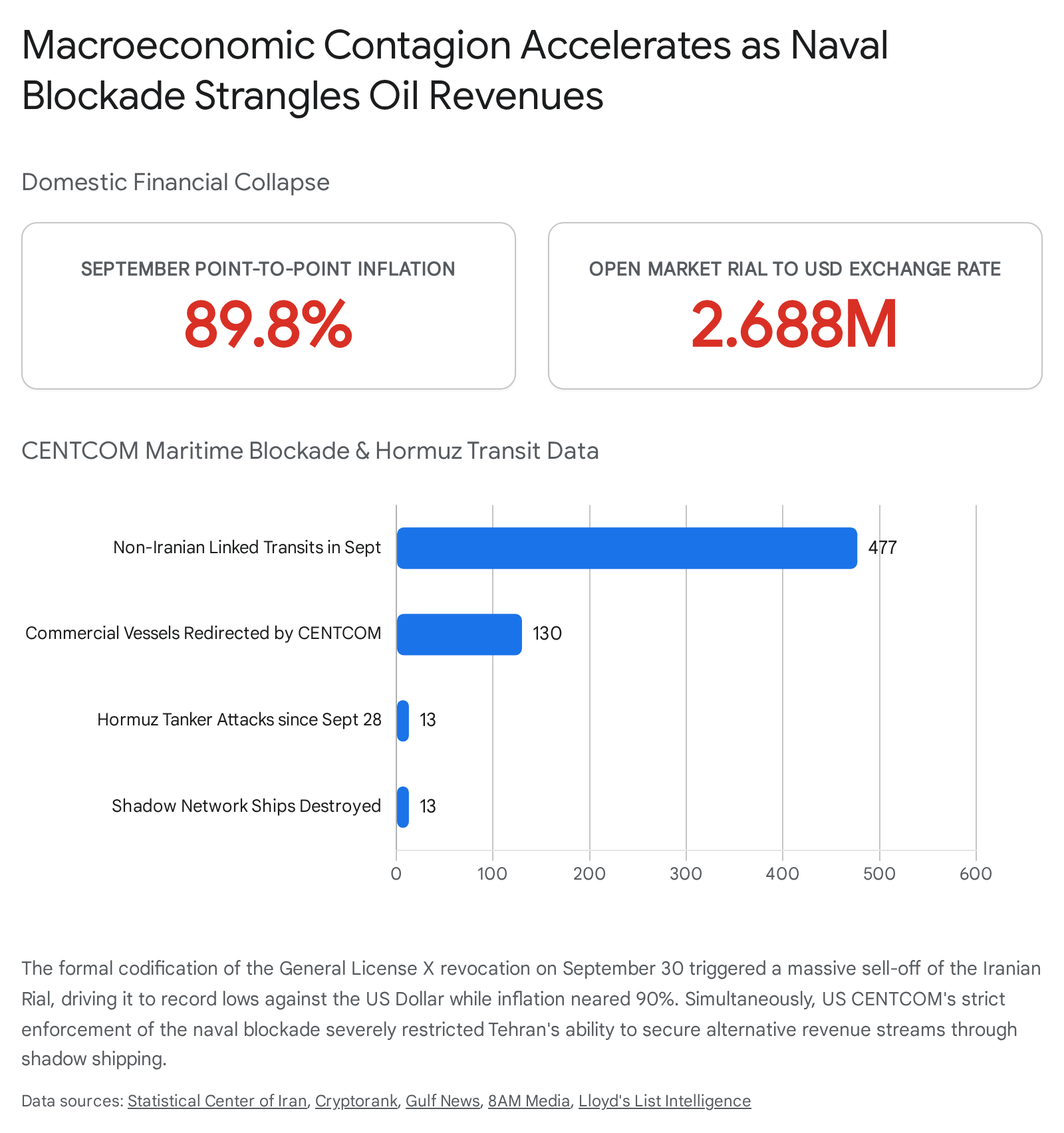
The domestic macroeconomic contagion resulting from these finalized sanctions was immediate and violent. By the first week of October, the Iranian Rial completely collapsed on the open market, plunging to a historic low of between 2.688 million and 2.723 million rials to the US dollar36. This represents a total loss of purchasing power for the average Iranian citizen and effectively renders the currency meaningless for international trade39. The rapid devaluation is exacerbating the regime’s desperation to unlock the proposed $300 billion reconstruction fund initially floated in the MoU7. For context, before the US withdrawal from the JCPOA, the currency traded at approximately 43,000 to the dollar38. Concurrently, the Statistical Center of Iran reported that point-to-point inflation reached a staggering 89.8% in September 2026, creating a hyperinflationary environment that is destroying household savings40.
The following table contextualizes the severity of the macroeconomic crisis currently destabilizing the Iranian state:
| Economic Indicator | September/October 2026 Data | Strategic Impact |
| Open Market Exchange Rate | ~2.72 Million IRR / 1 USD | Total erosion of purchasing power; severe disruption of black-market import financing36. |
| Point-to-Point Inflation | 89.8% (September 2026) | Hyperinflationary spiral threatening food security and escalating the risk of mass civil unrest4. |
| GDP Contraction Forecast | Projected 2.8% shrinkage for 2026 | Deindustrialization and systemic contraction as structural energy and manufacturing sectors freeze41. |
| Currency Redenomination | Central Bank planning “Toman” shift | A purely cosmetic accounting maneuver shaving four zeros off denominations, offering no structural economic relief. |
The systemic shock has paralyzed internal markets. The velocity of inflation is forcing the Central Bank of Iran to accelerate plans for drastic redenomination measures—such as transitioning fully to the “Toman” and shaving four zeros off the currency—merely to facilitate basic accounting and avoid printing multi-million rial notes39. However, this accounting maneuver offers no structural relief to the underlying scarcity of foreign reserves. The regime is trapped in a hyperinflationary spiral where the cost of imported goods, food staples, and crucial industrial components is skyrocketing, threatening severe domestic instability.
Kinetic Escalation: CENTCOM’s Stranglehold and Iran’s Asymmetric Reprisals
The economic strangulation of Iran is entirely enabled by the total kinetic dominance of the US Navy in the Gulf of Oman and the approaches to the Strait of Hormuz. The military blockade, ostensibly reinstated after the collapse of the MoU, has transitioned from a posture of deterrence to one of active maritime degradation.
On October 5, CENTCOM issued a major operational update confirming the strict, lethal enforcement of the ongoing naval blockade against Iranian ports. CENTCOM Commander Adm. Brad Cooper announced that US forces had successfully intercepted and redirected the 130th commercial vessel attempting to violate the blockade43. More critically, CENTCOM confirmed the destruction of 13 commercial vessels belonging to Iran’s illicit “shadow network” over the preceding 12 weeks46.
The destruction of these vessels represents a significant evolution in US rules of engagement. Washington is no longer merely deterring approaches or seizing illicit cargo through complex legal forfeiture mechanisms; it is permanently degrading the physical maritime capital the IRGC relies upon to bypass sanctions. By sinking these shadow vessels, CENTCOM is imposing an unsustainable, asymmetric replacement cost on Tehran’s smuggling infrastructure. “We will swiftly act against any vessels trying to run the blockade. Our forces are highly trained, professional, and lethal,” Adm. Cooper stated, signaling that the US military remains intensely focused on severing Iran’s maritime access45.
In response to the tightening blockade, the IRGC has doubled down on asymmetric harassment and retaliatory deterrence in the Strait of Hormuz. While September saw a post-conflict record of 477 non-Iranian-linked commercial transits through the chokepoint (up from 160 in July), indicating a partial recovery in Middle East Gulf (MEG) export traffic, the environment remains highly non-permissive48. Since September 28, Lloyd’s List Intelligence and the Joint Maritime Information Center have recorded at least 13 distinct attacks or harassment incidents targeting commercial tankers and gas carriers in the Strait, marking a seven-month high in maritime threat activity.
Tehran’s strategic rationale is clear: unable to break the US blockade of its own ports, the IRGC seeks to impose prohibitive war-risk insurance premiums and logistical costs on international shipping utilizing the chokepoint. By holding global energy transit at risk, Tehran hopes to fracture the US-led coalition through global energy market panic and force a diplomatic concession. However, the market is adapting. Sophisticated logistical workarounds are mitigating the impact of Iran’s harassment campaign. In September, 13 former Hormuz shuttle Very Large Crude Carriers (VLCCs) were tracked bypassing the Gulf of Oman bottleneck entirely, unloading Saudi-origin oil directly in India or conducting ship-to-ship transfers off India’s west coast. This shift increases effective fleet supply and supports the recovery of MEG crude exports despite IRGC harassment, blunting the strategic impact of Iran’s maritime terrorism.
Proxy Group Activities: Operation Yemen Dawn and the Formalization of the Makkah Alliance
The most profound shift in the regional security architecture during the reporting period occurred in the Red Sea theater, fundamentally altering the proxy balance of power and threatening the survival of Iran’s most effective regional asset: the Houthi movement.
On October 5, Yemen’s internationally recognized government, fully backed by a massive Saudi-led coalition military intervention, launched “Operation Yemen Dawn”49. The strategic objective of the offensive, as articulated by the head of Yemen’s Presidential Leadership Council, Rashad al-Alimi, is to completely roll back Houthi territorial gains along the western coast, secure the critical Red Sea maritime routes, and ultimately push toward the rebel-held capital of Sanaa to restore state institutions50.
The ground offensive was spearheaded by the Southern Giants Brigades, recognized as the anti-Houthi coalition’s most formidable and capable fighting force53. Within 48 hours of the operation’s commencement, government forces secured major tactical victories that threatened to unhinge the Houthi defensive lines. Coalition forces recaptured the strategic port city of Mokha, seized the Dhubab district and its airport, and successfully cut the primary resupply road linking Dhubab to Mokha45.
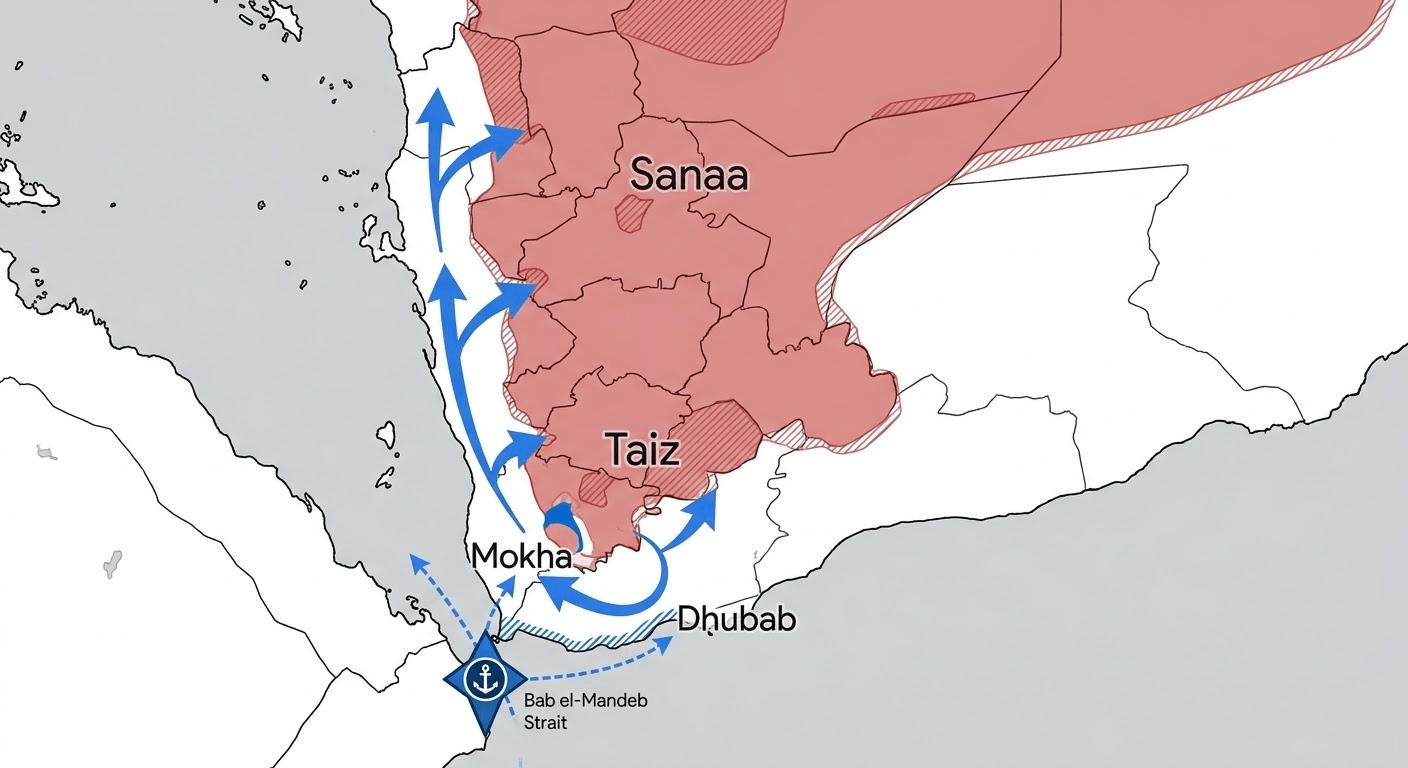
Operation Yemen Dawn marks a massive escalation by Riyadh, signaling the end of years of fragile stalemates. Saudi military spokesman Maj. Gen. Turki al-Malki confirmed that approximately 100 coalition fighter jets were participating in the campaign, providing round-the-clock close air support and establishing a secure air defense umbrella over the Bab el-Mandeb Strait45. The coalition reported the destruction of 324 “high-value” Houthi targets in the opening salvos of the offensive, effectively blinding Houthi coastal defense batteries and command nodes45.
Stripped of their coastal strongholds and facing a collapse of their western flank, the Houthis retaliated immediately through asymmetric means, launching long-range ballistic missiles and drones deep into Saudi territory. Over a four-day period, strikes targeting Saudi aviation infrastructure, including King Khalid International Airport in Riyadh, killed at least three people and grounded hundreds of commercial flights, forcing a temporary disruption of Saudi airspace51. These retaliatory strikes carry significant economic risk for Riyadh, threatening critical airspace just weeks before it hosts the World Petroleum Congress and the Future Investment Initiative (FII)56.
The strategic implications of this theater for the broader US-Iran conflict are profound. First, by recapturing Mokha and dominating the geography adjacent to the Bab el-Mandeb, the Saudi-backed forces are systematically dismantling the IRGC’s ability to interdict Red Sea shipping, a capability Tehran has heavily relied upon to threaten global energy markets and extract leverage against Washington.
Second, and perhaps more significantly for the long-term geopolitical landscape, the operation is nested within the newly formalized “Makkah Alliance for Defense.” Following an emergency meeting in Riyadh on October 5, the alliance—a trilateral collective defense pact comprising Saudi Arabia, Turkey, and Pakistan—officially activated its coordination mechanisms, appointing retired Pakistani Lt. Gen. Nauman Mahmud as its first Secretary-General51.
While a permanent joint military force is still in development, the immediate operational integration is highly impactful. Both Pakistan and Turkey have confirmed the deployment of military assets and troops to Saudi Arabia. Turkey is providing advanced defensive systems, intelligence, and technical support, while the Pakistani military confirmed the deployment of forces to Saudi Arabia in “multiple capabilities” to reinforce the Kingdom’s air and missile defenses against Houthi reprisals13.
The activation of the Makkah Alliance is a watershed geopolitical event. It signifies the formalization of a collective, nuclear-armed Sunni defense pact explicitly designed to contain and roll back Iran’s “Axis of Resistance.” For Washington, this represents a highly successful offloading of regional security burdens; regional powers are now expending political capital, military hardware, and lives to degrade Iranian proxies, freeing US naval and air assets to focus strictly on enforcing the Iranian maritime blockade and deterring direct state-on-state escalation.
Geopolitical Postures
The following table summarizes the comparative strategic postures and key actions of primary state actors during the reporting period, reflecting the deep polarization between diplomatic maneuvering and kinetic execution in the Middle East theater.
| Actor | Primary Posture | Key Actions (Sept 26 – Oct 10, 2026) | Strategic Rationale |
| China | Diplomatic Broker & Economic Hedger | Pushed aggressively on Sept 26 for the US and Iran to return to the Islamabad MoU framework. | Seeks to stabilize energy markets and protect its illicit imports of discounted Iranian crude, which are currently threatened by CENTCOM’s lethal blockade enforcement. |
| GCC / Saudi Arabia | Kinetic Offensive & Coalition Building | Launched “Operation Yemen Dawn” with 100 fighter jets on Oct 5 to retake Bab el-Mandeb50. Activated the Makkah Alliance for Defense57. | Capitalizing on Iran’s economic weakness to permanently degrade Houthi capabilities, secure the Red Sea, and establish a collective Sunni defense architecture independent of total US reliance. |
| Pakistan | Primary Mediator & Sunni Security Partner | Hosted UN Secretary-General Guterres to validate its mediation role and briefed him on efforts12. Simultaneously deployed troops to Saudi Arabia under the Makkah Alliance13. | Navigating a complex dual-role: serving as the indispensable, internationally recognized broker for US-Iran talks while militarily backing Saudi Arabia against Iranian proxies to secure financial and geopolitical patronage. |
| Israel / Russia | (ISR): Kinetic Consolidation (RUS): Opportunistic Beneficiary | (ISR): Maintained hardline military operations against Iranian presence in Lebanon, underpinned by the exclusionary Trilateral Framework23. (RUS): Benefiting economically from the geopolitical risk premium on global oil prices. | Israel seeks the permanent destruction of Hezbollah infrastructure, viewing the MoU deconfliction cell as inadequate. Russia leverages Middle East instability to distract Western resources and inflate fossil fuel revenues. |
Chronological Timeline
The following sequence of events details the rapid acceleration of both the diplomatic and kinetic tracks over the previous 14 days, highlighting the systemic collapse of the Iranian economy alongside expanding regional military offensives.
- September 26: Chinese President Xi Jinping publicly calls on Washington and Tehran to stay rational and immediately return to the Islamabad MoU framework to prevent regional spillover; Iranian President Pezeshkian welcomes the support9.
- September 28: A sharp spike in Iranian asymmetric maritime harassment begins; at least 13 attacks on commercial tankers and gas carriers in the Strait of Hormuz are recorded, marking a seven-month high in threat activity.
- September 30:
- The US Treasury’s OFAC officially publishes the revocation of General License X and the expiration of GL X1 in the Federal Register, finalizing the legal end of oil sanctions waivers and trapping Iranian capital26.
- The US Treasury announces sweeping new sanctions targeting Iran’s automotive, railway, steel, and manufacturing sectors, further choking off state revenues.
- October 3 – 4: Driven by the codification of the GL X revocation and the announcement of new sanctions, the Iranian Rial plummets on the open market, hitting catastrophic record lows between 2.688 million and 2.723 million to the US Dollar.
- October 5:
- CENTCOM announces it has successfully redirected its 130th commercial vessel under the Iranian blockade and confirms the destruction of 13 Iranian shadow-network ships over the past 12 weeks, signaling a lethal shift in rules of engagement44.
- The Saudi-led coalition and Yemeni government forces launch “Operation Yemen Dawn,” supported by 100 fighter jets. Southern Giants Brigades capture the strategic port of Mokha and the Dhubab district, encircling Houthi fighters and securing the Bab el-Mandeb approaches45.
- The Makkah Alliance for Defense holds an emergency meeting in Riyadh, officially appointing retired Pakistani Lt. Gen. Nauman Mahmud as Secretary-General and initiating defensive troop and technical deployments from Turkey and Pakistan to Saudi Arabia13.
- October 6 – 8: UN Secretary-General António Guterres conducts an official visit to Islamabad, Pakistan. He is briefed by the Foreign Minister on mediation efforts, praises Pakistan’s role in the US-Iran conflict, receives the Nishan-e-Imtiaz award, and issues an urgent international call for a return to diplomacy and navigational freedom12.
Works cited
- SITREP: US-Iran Regional Security and OSINT Summary (June 21, https://blog.roninsgrips.com/sitrep-us-iran-regional-security-and-osint-summary-june-21-june-27-2026/
- Strait of Hormuz Archives – Ronin’s Grips, https://blog.roninsgrips.com/tag/strait-of-hormuz/
- Intelligence Assessment: The Resilience of the Islamic Republic of, https://blog.roninsgrips.com/intelligence-assessment-the-resilience-of-the-islamic-republic-of-iran-and-u-s-policy-miscalculations/
- Assessing the Islamabad MOU and the U.S.-Iran Nuclear Negotiations, https://www.armscontrol.org/issue-briefs/2026-06/assessing-islamabad-mou-and-us-iran-nuclear-negotiations
- Islamabad Memorandum – Wikipedia, https://en.wikipedia.org/wiki/Islamabad_Memorandum
- US – Iran Sign Islamabad MoU and its Implications – Drishti IAS, https://www.drishtiias.com/daily-updates/daily-news-analysis/us-iran-sign-islamabad-mou-and-its-implications
- IN FOCUS – Islamabad MoU between US, Iran sets stage for direct, https://www.aa.com.tr/en/world/in-focus-islamabad-mou-between-us-iran-sets-stage-for-direct-talks-in-switzerland/3970706
- Iran-US Relations: Assessing the Bürgenstock Negotiations, https://www.specialeurasia.com/2026/06/22/us-iran-burgenstock-negotiations/
- Masoud Pezeshkian Welcomes Xi Jinping’s Support To Return To, https://newscord.org/article/masoud-pezeshkian-welcomes-xi-jinpings-support-to-return-to-islamabad-mou–Story_20260926_PresidentPezeshkianh14b41b06
- China encourages Iran, US to return to Islamabad MoU, https://www.tbsnews.net/world/china-encourages-iran-us-return-islamabad-mou-1544396
- China calls on US, Iran to return to Islamabad MoU, dialogue, https://www.aa.com.tr/en/asia-pacific/china-calls-on-us-iran-to-return-to-islamabad-mou-dialogue/4073387
- UN chief urges US, Iran to return to diplomacy, end war, hails, https://aa.com.tr/en/world/un-chief-urges-us-iran-to-return-to-diplomacy-end-war-hails-pakistan-s-pivotal-role-/4079754
- Outgoing UN chief lauds Pakistan’s mediation role in US-Iran conflict, https://tribune.com.pk/story/2633248/un-chief-arrives-in-pakistan-for-three-day-visit
- Taliban Holds High-Level Meeting As Armed Opposition Steps Up Attacks, https://www.afintl.com/en/202610106118
- Pakistan briefs UN chief on US-Iran mediation efforts during, https://www.arabnews.pk/pakistan/pakistan-briefs-un-chief-on-us-iran-mediation-efforts-during-islamabad-talks-3003299
- Guterres lauds ‘pivotal role’ in US-Iran diplomacy – Newspaper – Dawn, https://www.dawn.com/news/2035314
- In Islamabad, Guterres calls for end to US-Iran conflict | United Nations, https://www.un.org/en/islamabad-guterres-calls-end-us-iran-conflict
- UNMOGIP outlived its relevance after Simla Agreement: MEA on UNSG visit to Islamabad, https://www.aninews.in/news/world/asia/unmogip-outlived-its-relevance-after-simla-agreement-mea-on-unsg-visit-to-islamabad20261009201853
- Iran and U.S. agree on ‘de-confliction cell’ for Lebanon after initial, https://nowlebanon.com/iran-and-u-s-agree-on-de-confliction-cell-for-lebanon-after-initial-hiccups/
- Iran Update Special Report, June 22, 2026 – ISW, https://understandingwar.org/research/middle-east/iran-update-special-report-june-22-2026/
- Iran, US to set up ‘deconfliction cell’ to stop military ops in Lebanon, https://www.timesofisrael.com/liveblog_entry/iran-us-to-set-up-de-confliction-cell-to-stop-military-ops-in-lebanon-mediators-say/
- Lebanon: Closed Consultations – Security Council Report, https://www.securitycouncilreport.org/whatsinblue/2026/08/lebanon-closed-consultations-3.php
- Operationalizing the Trilateral Framework Agreement, https://mei.edu/publication/operationalizing-the-trilateral-framework-agreement/
- What Does the Trilateral Framework Mean for Lebanon?, https://timep.org/2026/07/01/what-does-the-trilateral-framework-mean-for-lebanon/
- US-Iran Conflict and OSINT Summary (August 22 – 28, 2026, https://blog.roninsgrips.com/us-iran-conflict-and-osint-summary-august-22-28-2026/
- Publication of Iran-Related Web General Licenses X and X1, https://www.federalregister.gov/documents/2026/09/30/2026-20010/publication-of-iran-related-web-general-licenses-x-and-x1
- 61758 Federal Register/Vol. 91, No. 188/Wednesday, September 30, https://www.govinfo.gov/content/pkg/FR-2026-09-30/pdf/2026-20010.pdf
- Federal Register, Volume 91 Issue 188 (Wednesday, September 30, https://www.govinfo.gov/content/pkg/FR-2026-09-30/html/2026-20010.htm
- Issuance of Iran-related General License, https://ofac.treasury.gov/recent-actions/20260622_33
- 2026-20010 | Publication of Iran-Related Web General… | PRIA, https://policyrisk.com/federal-register/2026-20010
- OFAC Revoked Iran General License X: 2026 Guide, https://ofacblockedfundslawyers.com/ofac-revoked-iran-general-license-x-what-happens-to-deals/
- OFFICE OF FOREIGN ASSETS CONTROL Iranian Transactions and, https://ofac.treasury.gov/media/936446/download?inline
- US-Iran Regional Security and OSINT Summary (August 1, 2026, https://blog.roninsgrips.com/us-iran-regional-security-and-osint-summary-august-1-2026-august-8-2026/
- 61748 Federal Register/Vol. 91, No. 188/Wednesday, September 30, https://downloads.regulations.gov/OFAC_FRDOC_0001-2315/content.pdf
- CENTCOM Destroys 13 Vessels and Reroutes 130 Ships Enforcing, https://iranwire.com/en/news/158535-centcom-destroys-13-vessels-and-reroutes-130-ships-enforcing-maritime-blockade-on-iran/
- Iran Economy in Crisis as Rial Crashes and Inflation Nears 90%, https://cryptorank.io/news/feed/92fa6-iran-economy-in-crisis-as-rial-crashes-and-inflation-nears-90
- Iran’s Rial Slides To Record Lows As Dollar Tops 2.7 Million Rials, https://newscord.org/article/zero-inflation-17-zakani-commodities-in-the-midst-of-736-inflation-a-big-claim-f–Story_20261003_4c236a50
- Iranian Rial Plunges to Record Low as Dollar Nears 2.7 Million, https://www.facebook.com/arabtimeskuwait/posts/iranian-rial-plunges-to-record-low-as-dollar-nears-27-millioniran-rial-iranriyal/1520651983424392/
- Why People’s are Buying Iranian Currency #iran – Facebook, https://www.facebook.com/tabraizshams12/posts/why-peoples-are-buying-iranian-currency-iran/122204466572545364/
- Iran’s Inflation Reaches 89.8% in September: Statistical Center, https://iranwire.com/en/news/158322-irans-inflation-reaches-898-in-september-statistical-center/
- Iranian Rial hits record low Inflation and war hit Iranian households, https://www.facebook.com/WIONews/posts/wionbusinessinsights-iranian-rial-hits-record-lowinflation-and-war-hit-iranian-h/1429966945909142/
- Brent Crude Decoupling: Economic Impact of the 2026 Hormuz Crisis, https://www.timetrex.com/blog/brent-crude-decoupling
- US Navy redirects 130 vessels amid Iran naval blockade – Gulf News, https://gulfnews.com/world/mena/us-navy-redirects-130-vessels-amid-iran-naval-blockade-1.500699657
- CENTCOM Maintains Strict Enforcement of U.S. Blockade Against Iran, https://www.centcom.mil/MEDIA/PUBLIC-RELEASES/Article/4619553/centcom-maintains-strict-enforcement-of-us-blockade-against-iran/
- CENTCOM says 130 vessels redirected under US blockade of Iran, https://www.iranintl.com/en/202610054128
- CENTCOM Says 13 Ships Destroyed as Part of U.S. Maritime, https://8am.media/eng/centcom-says-13-ships-destroyed-as-part-of-u-s-maritime-blockade-of-iran/
- US redirected 130 vessels in Iran blockade – Apa.az, https://en.apa.az/america/us-redirected-130-vessels-in-iran-blockade-528294
- Strait of Hormuz Brief: 8 October, 2026 – Lloyd’s List Intelligence, https://www.lloydslistintelligence.com/resources/blog/strait-of-hormuz-brief-8-october-2026
- Operation ‘Yemen Dawn’: Saudi-led coalition joins fight to wrest Red, https://timesofindia.indiatimes.com/world/middle-east/operation-yemen-dawn-saudi-led-coalition-joins-fight-to-wrest-red-sea-from-houthis/articleshow/134700138.cms
- Riyadh-backed forces say they retook key Red Sea port in anti-Houthi offensive, https://www.iranintl.com/en/202610054086
- Saudi-Led Coalition Launches Operation Dawn of Yemen With 100, https://newscord.org/article/saudi-led-coalition-deploys-100-fighter-jets-in-dawn-of-yemen-against-houthis–Story_20261005_OperationYemenDawnSa3a2a26df
- Eryani: Yemen Dawn Operation Will Restore the State New, https://www.sudanindependent.net/news/politics/2026/10/06/Eryani-Yemen-Dawn-Operation-W
- Who are Yemen’s Southern Giants Brigades leading the fight, https://www.al-monitor.com/originals/2026/10/who-are-yemens-southern-giants-brigades-leading-fight-against-houthis
- Operation Yemen Dawn map October 2026 Yemen frontlines, https://www.facebook.com/david.kafeero.2025/posts/updated-yemen-map-operation-yemen-dawn-october-5major-movement-along-yemens-west/1101527032423499/
- Yemen’s government says it secured Bab el-Mandeb – YouTube, https://www.youtube.com/shorts/vnMtVla5D3s
- Four days of Houthi strikes on Saudi airports kill three and ground hundreds of flights, https://enterpriseam.com/menaplus/2026/10/09/four-days-of-houthi-strikes-on-saudi-airports-kill-three-and-ground-hundreds-of-flights/
- Makkah Alliance Moves Towards Practical Military Cooperation, https://english.ratopati.com/story/82886/mecca-alliance-begins-military-cooperation-no-immediate-decision-to-go-to-war