Executive Summary
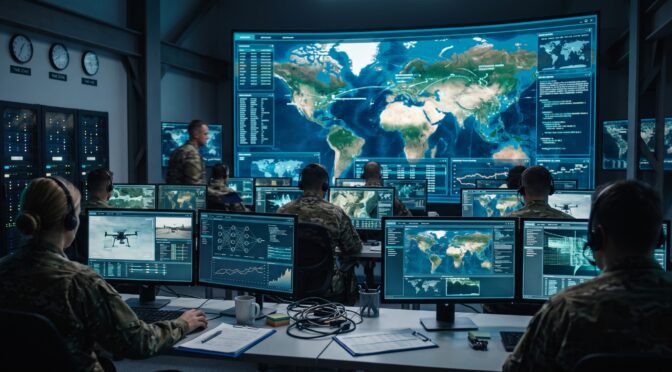
The integration of artificial intelligence (AI) and machine learning into military operations marks a fundamental shift in how modern wars are fought. As algorithmic systems move from research labs to active battlefields, they are reshaping battlefield command, intelligence gathering, target identification, and combat decisions. This report evaluates today’s top military AI applications, ranking five key examples by their practical impact, operational scale, and long-term influence on military strategy.
The analysis identifies five primary military AI applications, ranked from immediate operational impact to global strategic significance:
- Maven Smart System (MSS) and Project Maven: The United States’ flagship AI platform, which provides the highest operational impact by combining data from sensors across the globe to streamline military planning and targeting.
- Lavender and The Gospel: Israel’s automated targeting systems, which have dramatically expanded target identification in urban warfare while raising major concerns about human oversight and international legal compliance.
- Saker Scout and Edge AI Drones: Ukraine’s frontline deployment of autonomous drones, which bypass heavy signal jamming by using onboard computer vision rather than live human piloting.
- Cognitive Electronic Warfare (CEW): Real-time machine learning applied to radar and communication signals, allowing aircraft like the F-35 to dynamically adapt to unfamiliar radar threats mid-flight.
- AI in Strategic Early Warning and Nuclear Command Systems: Although still expanding, using AI for nuclear warning and preemptive defense carries the highest risk of all, as it compresses decision timeframes and could destabilize global nuclear deterrence.
This report breaks down each application, examining how it functions, its battlefield performance, and its broader consequences for modern conflict.
1. Maven Smart System (MSS): Enterprise Command, Control, and Automated Targeting
Ranked first due to its vast scale and deep integration into the U.S. military, the Maven Smart System (MSS) is currently the most advanced military AI platform in active use1. It began in 2017 as Project Maven under the Algorithmic Warfare Cross-Functional Team, created to quickly adapt commercial AI tools for military defense3. Today, managed by the Chief Digital and Artificial Intelligence Office (CDAO), MSS provides the core software supporting the Pentagon’s combined, all-domain military command strategy2.
System Architecture and Data Fusion
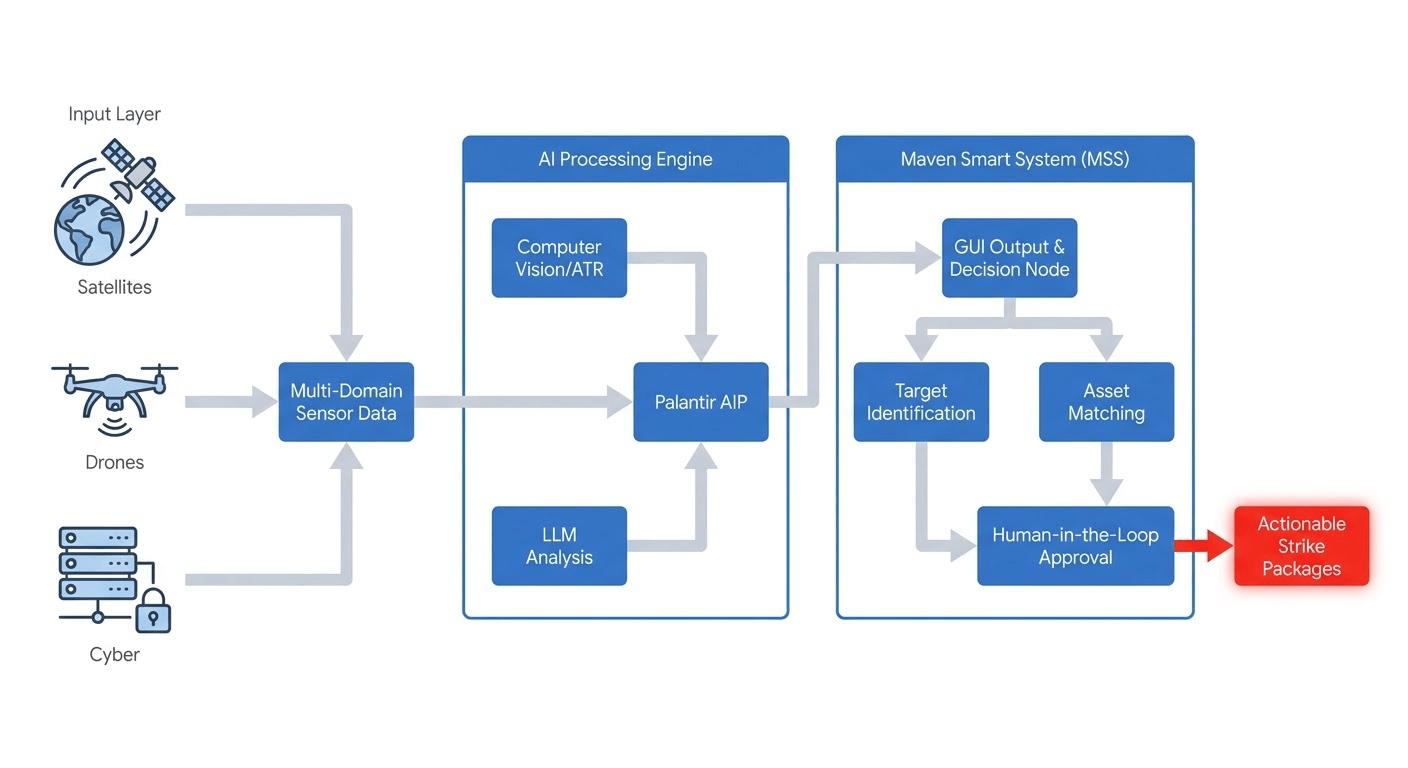
MSS excels at bringing together scattered, complex data into a clear, single view of the battlefield1. Powered by Palantir Technologies’ Artificial Intelligence Platform (AIP), it helps commanders track operations, identify targets, plan missions, and coordinate information sharing1. The software pulls in live intelligence feeds from satellites, high-altitude drones, cyber monitoring tools, and ground sensors1. For instance, in early 2024, U.S. Central Command processed 179 separate data streams through MSS to monitor events in the Middle East1.
The system relies on computer-vision software for automated target detection. By continuously scanning video and satellite imagery, the AI automatically finds, classifies, and flags potential targets (like mobile missile launchers, radar installations, or naval vessels) for human review1. In addition, MSS incorporates Large Language Models through features like “Maven Threads,” allowing planners to search intelligence data using plain English requests1. While Anthropic’s Claude was initially integrated into Maven to assist with data analysis, the Department of Defense designated the company as a supply chain risk in March 2026 and ordered its removal1.
Speeding Up the Decision Loop
The primary benefit of MSS is how quickly it moves a decision from threat identification to action. Before AI tools were available, analysts spent roughly 97 percent of their time gathering data and only 3 percent evaluating it1. MSS reverses this workload. By consolidating up to nine separate software applications into one simple interface, operators can identify targets, match them to available weapons, execute strikes, and evaluate damage in seconds rather than minutes1, 7.
The real-world results have been substantial. During military exercises, a small targeting team of 20 using MSS generated intelligence work equivalent to a 2,000-person team from earlier conflicts1. In active operations, Maven supported airstrikes in Iraq, Syria, and Yemen3. Most notably, during 2026 operations in Iran, the system helped commanders strike over 1,000 targets in the first 24 hours, representing a tenfold increase in targeting speed1.
By 2026, the user base for MSS grew to around 80,000 military personnel across the Joint Staff, the Intelligence Community, and NATO allies1.
| DoD FY2027 Budget Request Category | Allocated Funding | Key Programs / Objectives |
| Total AI & CJADC2 Investment | $58.5 Billion | Comprehensive multi-year integration of commercial and DoD AI technologies.4 |
| Sovereign AI Arsenal | $46.0 Billion | Mandatory investment in enterprise-scale AI infrastructure for strategic advantage.4 |
| Maven Smart System (MSS) & JFN | $2.3 Billion | Funding specifically to deliver CJADC2 to joint warfighting capabilities and deploy MSS across combatant commands.4 |
| AI R&D and Technical Approaches | $2.2 Billion | Leading-edge research in AI models for military and operational logistics.4 |
| Drone Dominance & Autonomy | $53.6 Billion | Multi-year investment in autonomous systems procurement and C-UAS capabilities.4 |
As budget figures confirm, MSS is no longer an experiment. It has become the core software system driving America’s modern military strategy4.
2. Lavender and The Gospel: Automated Target Generation
Ranked second are the automated targeting tools used by the Israel Defense Forces (IDF), primarily known as “The Gospel” and “Lavender.” While Maven acts as an overall command system, these Israeli platforms focus specifically on creating large volumes of targets during intense urban warfare. Their use has demonstrated unprecedented operational speed, but it has also raised serious questions about over-relying on automated outputs and weakening human control during strikes.
How the AI Identifies Targets
The IDF uses multiple AI systems to analyze intelligence and select targets. The Gospel focuses on physical structures, such as buildings, headquarters, and facilities10. It combines satellite imagery, radio signals, cyber data, and field reports to recommend targets far faster than human analysts ever could10. Using this tool, the IDF identified up to 15,000 targets in the first 35 days of combat, a workload that would normally take human teams years to complete10.
By contrast, Lavender is designed to identify specific individuals suspected of belonging to militant groups11. By studying communication patterns and behavior from broad surveillance data, Lavender assigns a likelihood score to individuals5. In the opening weeks of the conflict, the system flagged up to 37,000 people as potential targets11. Lavender was frequently paired with tracking software called “Where’s Daddy?”, which monitored when flagged individuals returned home5.
Risks to Human Oversight and Legal Standards
The key concern with these systems is how rapidly machine recommendations can erode meaningful human judgment. Under international law, militaries must carefully verify targets to prevent civilian harm10. Defense policies generally require a human operator to make final decisions on lethal force14.
However, the massive output from systems like Lavender easily leads to “automation bias,” where human officers trust software recommendations without sufficient questioning5. Reports indicate human oversight was often reduced to brief spot-checks lasting roughly 20 seconds per target, mainly to confirm the individual was male before approving a strike11.
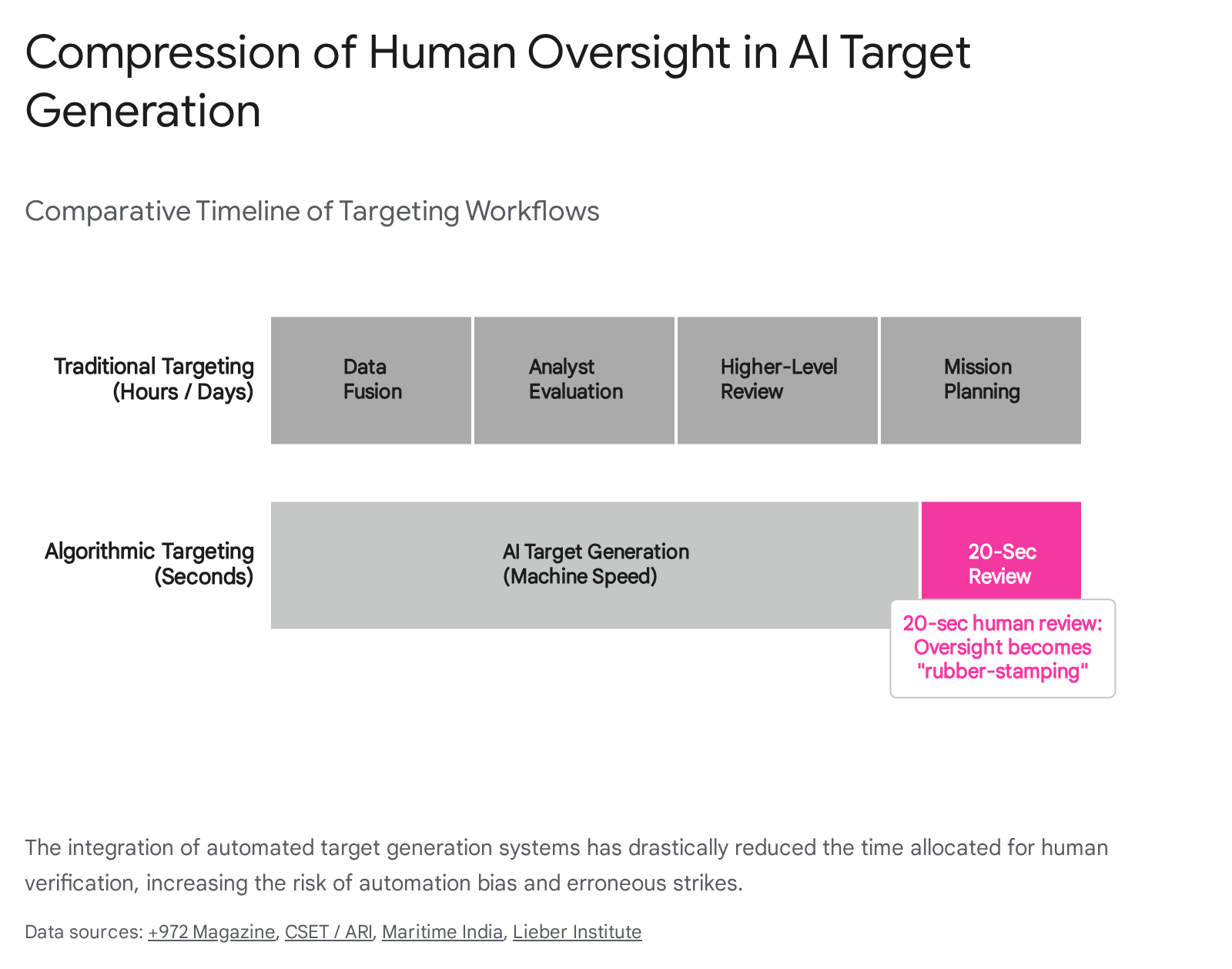
This brief review process carried significant risks. Lavender operated with an estimated 10 percent margin of error11. It regularly flagged non-combatants whose communication patterns resembled those of militants, such as civil defense workers, family members, or individuals using a borrowed phone11.
| Targeting Metric | Traditional / Legacy Operations | AI-Driven Operations (e.g., Lavender/Gospel) |
| Target Generation Volume | 100 to 200 targets per day10 | 15,000 targets in 35 days; up to 37,000 individuals flagged10 |
| Human Verification Time | Hours to days of intelligence cross-checking10 | ~20 seconds per target (“rubber stamp” review)11 |
| Collateral Damage Thresholds | Strictly limited; high-value targets only10 | Up to 15-20 civilians for junior operatives; 100+ for commanders10 |
| Primary Munition Type | Precision-guided munitions (“smart bombs”)10 | Unguided munitions (“dumb bombs”) utilized on residential structures10 |
Because the system tracked targets to residential homes and relied heavily on unguided bombs to conserve precision munitions, automated target generation directly contributed to major civilian casualties and destruction10. To prevent situations where humans simply rubber-stamp machine decisions, legal experts recommend mandatory review delays to guarantee thorough human evaluation before launching strikes18.
3. Saker Scout and Autonomous Drones: Navigating Signal-Jammed Battlefields
Ranked third is the use of onboard AI in unmanned aerial vehicles (UAVs), extensively developed and deployed by Ukrainian forces. While Maven and Lavender rely on cloud servers, tools like Ukraine’s Saker Scout process data directly on the drone. This capability solves one of the biggest challenges on the modern battlefield: enemy signal jamming.
Beating Electronic Jamming
In Ukraine, remotely piloted drones are critical for scouting and strikes. However, these drones require constant radio connections with human operators. Powerful signal jammers create coverage zones over artillery and armored vehicles that sever these connections, dropping strike success rates to between 10 and 20 percent21.
To solve this, developers built lightweight AI models that run directly on small, onboard computer chips21. This setup allows the drone to process camera footage and navigate independently without needing a live connection to a human pilot or cloud network23.
Autonomous Tracking and Engagement
When GPS signals are blocked, drones like the Saker Scout compare live camera images to pre-loaded terrain maps to find their way. This visual navigation allows the drone to enter target areas autonomously21.
Once overhead, onboard software scans the ground for military equipment. The AI is trained to recognize specific vehicle signatures, including tanks, artillery, and transport trucks21. Advanced versions can spot camouflaged or partially hidden targets that human pilots might miss21.
When a target is confirmed, the drone locks on and carries out its attack run independently. Because the final phase relies entirely on internal visual tracking, radio jamming cannot stop the strike21.
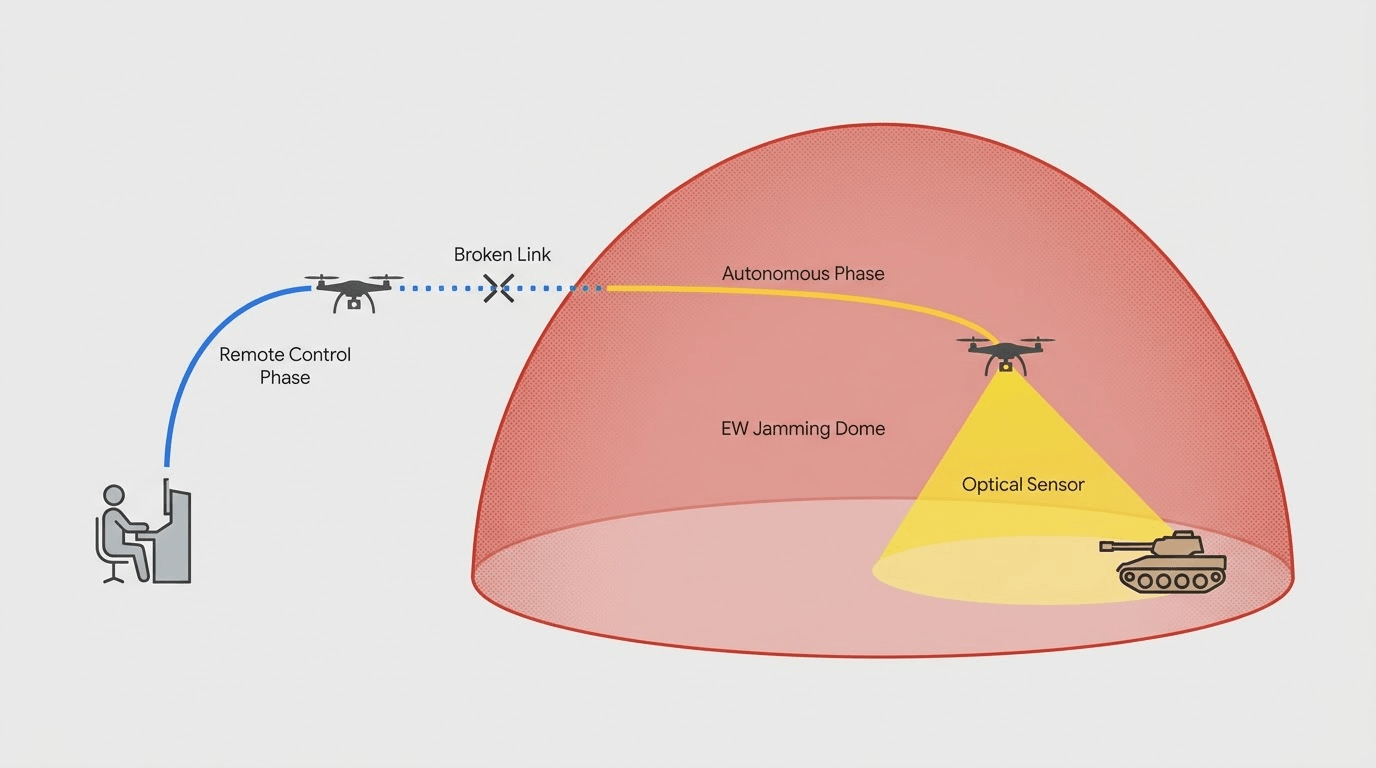
Adding onboard AI has increased drone strike accuracy from 50 percent to roughly 80 percent in heavy jamming areas21. Scale is expanding rapidly: in 2026, Ukraine ordered over 590,000 drone systems and 22,000 ground vehicles27. More than 70 distinct AI vision systems are currently active, with goals to equip all frontline drones with computer vision24.
| Edge-AI Drone Specifications | Demonstrated Capability |
| Operational Range | Up to 10 km (with standard flagship systems)30 |
| Target Recognition Database | Up to 64 distinct military target classes, plus 7 core categories for ZIR21 |
| Autonomous Lock-on Range | 150 meters to 1,000 meters21 |
| EW Resilience | High (Utilizes optical navigation and terminal autonomy to bypass RF jamming)21 |
| Overall Engagement Success Rate | ~80% (up from 10-20% under heavy manual EW jamming)21 |
This shift highlights a major trend in warfare: while guidelines emphasize human control, intense electronic jamming forces militaries to rely on autonomous software to keep systems effective16.
4. Cognitive Electronic Warfare: AI in the Spectrum
Ranked fourth is Cognitive Electronic Warfare (CEW), which uses AI to control radar and radio signals rather than physical weapons. Modern forces depend heavily on clear communications and radar systems. AI changes electronic warfare from a system of fixed, pre-set responses to one that adapts instantly during flight33.
The Limits of Standard Electronic Warfare
Traditionally, military aircraft matched incoming radar signals against a pre-loaded database of known enemy equipment35. If a match was found, the system responded with a programmed jamming signal.
Today, modern radar systems can alter their frequencies and signal patterns within milliseconds. When older defense systems encounter an unfamiliar signal, they fail to recognize it. Updating threat databases manually can take months, leaving aircraft unprotected in the meantime34.
In-Flight Signal Adaptation
Cognitive Electronic Warfare solves this by using machine learning to analyze unknown radio signals live. Pioneered by research programs like DARPA’s Adaptive Radar Countermeasures, CEW uses neural networks to evaluate unfamiliar signals instantaneously36.
When an aircraft like the F-35 or EA-18G Growler detects an unknown radar, the onboard AI assesses its behavior, creates a custom jamming signal, and tests its effect33, 35. If the first attempt does not disrupt the radar, the software adjusts in milliseconds until it successfully blocks the threat36.
| Capability | Legacy Electronic Warfare | Cognitive Electronic Warfare (CEW) |
| Threat Recognition | Relies on static, pre-programmed threat libraries34 | Utilizes ML to identify and characterize novel, unknown waveforms36 |
| Response Generation | Executes predetermined jamming techniques35 | Autonomously synthesizes bespoke countermeasures on the fly36 |
| OODA Loop Speed | Months (requires lab analysis and manual fleet updates)34 | Milliseconds (in-flight algorithmic generation and iteration)34 |
| Primary Platforms | Older 4th Gen fighters, EA-6B Prowler38 | F-35 Lightning II, EA-18G Growler, next-gen drones33 |
This approach speeds up threat response times from months to fractions of a second34. It also helps counter adversarial techniques designed to trick digital sensors, ensuring aircraft stay protected in high-risk airspace41.
5. AI in Strategic Warning and Nuclear Command Systems
Ranked fifth, but carrying the most significant long-term risk, is the introduction of AI into strategic early warning and nuclear command systems. Applying AI to nuclear deterrence affects global stability and could shorten decision times during critical national security crises44.
Preemptive Tracking and Strategic Risk
Major military powers are testing AI to track and neutralize enemy missile installations before launch47. Nuclear balance relies on the certainty that a nation can respond to an attack; if a country knows its nuclear force cannot be wiped out in a single initial strike, the incentive to launch first remains low45.
AI could unsettle this balance by compiling data from satellites, subsea sensors, and cyber feeds to pinpoint mobile missile launchers or submarines46. If a state believes AI allows it to locate and destroy an opponent’s entire arsenal beforehand, the stability of traditional deterrence disappears. Conversely, if a country fears its retaliatory capacity is vulnerable, it may feel pressured to launch prematurely during a crisis46.
Shortened Timelines and Escalation Hazards
Relying on AI decision support in warning networks compresses the time available for human deliberation. When high-speed weapons or automated alerts force rapid responses, leaders have only a few minutes to evaluate reports and confirm threats45, 46.
If leaders become overly dependent on algorithmic predictions, technical glitches, false data, or cyberattacks could cause software to misinterpret ordinary events as incoming attacks41, 46. Under extreme pressure, automation bias could prompt decision-makers to launch retaliatory strikes based on flawed computer assessments44.
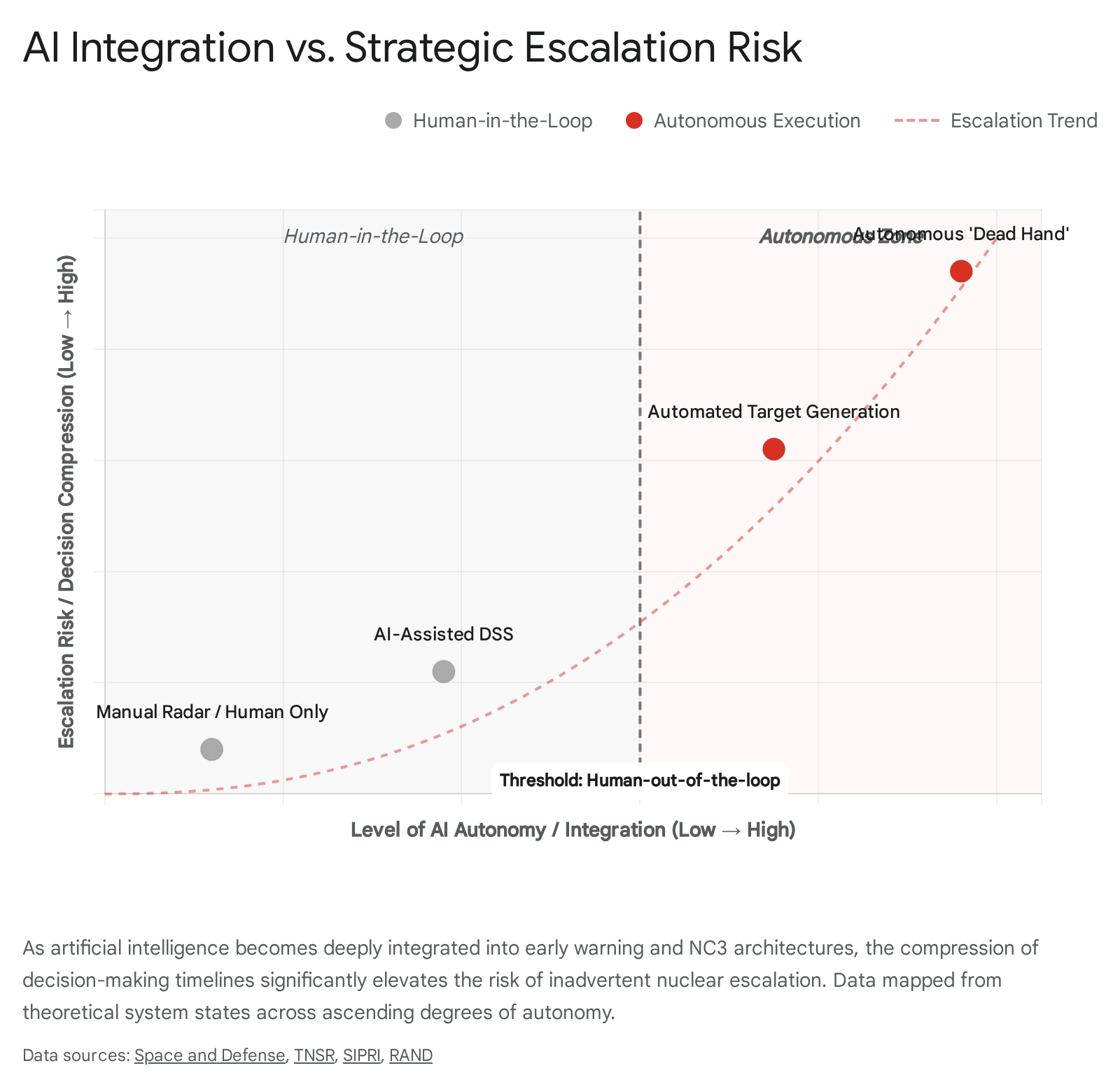
Additionally, mixing conventional AI tools with strategic early warning systems heightens risks. A conventional cyberattack against military communications could be mistaken for an attempt to blind nuclear warning systems, raising the danger of accidental escalation45, 46.
Conclusion
AI integration in military operations is no longer theoretical; it is actively reshaping modern warfare. As shown across these five applications, AI provides clear tactical benefits: speeding up target analysis, scaling target identification, bypassing signal jamming, adapting to radar threats live, and evaluating massive data streams.
At the same time, this acceleration presents real operational and ethical challenges. Major software platforms and automated tools show that human review struggles to keep pace with algorithmic speed. When AI accelerates combat decisions, operators risk becoming mere approvals for machine choices. On the frontline, the demand to survive signal-jammed environments is encouraging greater autonomy. At the strategic level, integrating AI into warning and command systems risks shortening crisis timelines and creating unforeseen dangers.
Ultimately, advantages in future conflict will not depend solely on having the fastest algorithms. Success will belong to military forces that balance machine processing speed with sound human judgment, keeping AI as a helpful analytical tool rather than an unchecked driver of conflict.
Please share the link on Facebook, Forums, with colleagues, etc. Your support is much appreciated and if you have any feedback, please email us in**@*********ps.com. If you’d like to request a report or order a reprint, please click here for the corresponding page to open in new tab.
Sources Used
- What Is Maven Smart System, and What Does It Do? – CSIS, https://www.csis.org/analysis/what-maven-smart-system-and-what-does-it-do
- Maven Smart System, https://assets.ctfassets.net/xrfr7uokpv1b/25muZs93DY5XOUBtuh68yn/b40d9784f69917219f972890ceede986/Maven_One_Pager.pdf
- Project Maven – Wikipedia, https://en.wikipedia.org/wiki/Project_Maven
- FY 2027 Budget Overview – Under Secretary of War (Comptroller), https://comptroller.war.gov/Portals/45/Documents/defbudget/FY2027/FY2027_Budget_Request_Overview_Book.pdf
- artificial intelligence and the transformation of modern, https://maritimeindia.org/wp-content/uploads/2026/05/Capt-KS-Vikramaditya-AI-Paper-02-Apr-26-Ed-05-Apr-26.pdf
- Palantir Defense | US Air & Space Forces, https://www.palantir.com/offerings/defense/air-space/
- The AI Revolution in Military Operations: Transformative Impacts, https://debuglies.com/2026/02/23/the-ai-revolution-in-military-operations-transformative-impacts-across-domains/
- A $1.5 trillion defense budget: The IT programs contractors should, https://www.washingtontechnology.com/opinion/2026/06/15-trillion-defense-budget-it-programs-contractors-should-be-watching/414438/
- DOD wants more than $2B in fiscal 2027 to move … – DefenseScoop, https://defensescoop.com/2026/05/28/dod-fy27-budget-cjadc2-maven-smart-system-palantir/
- Israel – Hamas 2024 Symposium – The Gospel, Lavender, and the, https://lieber.westpoint.edu/gospel-lavender-law-armed-conflict/
- ‘Lavender’: The AI machine directing Israel’s bombing spree in Gaza, https://www.972mag.com/lavender-ai-israeli-army-gaza/
- The Use of the ‘Lavender’ in Gaza and the Law of Targeting: ai … – Brill, https://brill.com/view/journals/ihls/16/2/article-p336_003.xml
- Questions and Answers: Israeli Military’s Use of Digital Tools in Gaza, https://www.hrw.org/news/2024/09/10/questions-and-answers-israeli-militarys-use-of-digital-tools-in-gaza
- Autonomous Weapons Risk, Law & Human Control | KillChains.com, https://killchains.com/risks-law.php
- Israel’s use of Military AI-systems in the occupied territories of, https://puc.overheid.nl/mrt/doc/PUC_794610_11/1/
- AI in National Security: Judgment and Accountability · Synthetic Outlaw, https://www.syntheticoutlaw.com/industries/defense-national-security.html
- DoD Directive 3000.09, November 21, 2012 – DoW General Counsel, https://ogc.osd.mil/Portals/99/autonomy_in_weapon_systems_dodd_3000_09.pdf
- Operational Necessity of HIL (Docs Design), https://ari.us/handsonthetrigger
- Examining Israel’s AI-Powered Military Response in Gaza, https://digitalcommons.denison.edu/cgi/viewcontent.cgi?article=1160&context=prologue
- The Ethics of Artificial Intelligence in Military Operations – arXiv, https://arxiv.org/html/2609.26507v1
- https://www.csis.org/analysis/ukraines-future-vision-and-current-capabilities-waging-ai-enabled-autonomous-warfare
- Ukraine is Now Using AI-Powered Drones With Some … – Kyiv Post, https://www.kyivpost.com/post/21247
- Edge AI for UAV-Based Critical Infrastructure Inspection – arXiv, https://arxiv.org/html/2609.18448v1
- Smart weapons: More than 70 systems using AI and computer vision, https://mod.gov.ua/en/news/smart-weapons-more-than-70-systems-using-ai-and-computer-vision-are-already-striking-enemy-targets
- Ukraine’s Saker Drone Uses AI To Identify Russian Targets – YouTube, https://www.youtube.com/watch?v=yBIY4R3b8NI
- U.S. Based AI Firm Helps Ukraine Identify Russian Targets, https://defensemirror.com/news/37899
- Ukraine Contracts 22,000 Ground Drones in 2026 – Defence Leaders, https://defenceleaders.com/news/ukraine-contracts-22000-ground-drones-in-2026/
- Former Ukrainian defense minister unveils ‘Army of Robots’, https://www.jpost.com/defense-and-tech/article-909829
- Ukraine says more than 70 AI-enabled systems are striking, https://defence-industry.eu/ukraine-says-more-than-70-ai-enabled-systems-are-striking-battlefield-targets-as-it-seeks-computer-vision-across-all-frontline-drones/
- Ukraine’s Armed Forces will use SAKER SCOUT drones with AI, https://www.pravda.com.ua/eng/news/2023/09/04/7418331/
- By Algorithm or Order: Integrating Lethal Autonomous Weapon, https://www.armyupress.army.mil/Journals/Military-Review/Online-Exclusive/2026-OLE/Algorithm-or-Order/
- The Race To Incorporate Artificial Intelligence Into Attack Drones In, https://oe.t2com.army.mil/product/the-race-to-incorporate-artificial-intelligence-into-attack-drones-in-ukraine/
- EA-18G Growler – Air Force, https://www.airforce.gov.au/aircraft/ea-18g-growler
- CEW | PDF – Scribd, https://www.scribd.com/document/1006498699/CEW
- Cognitive EW – EMSOPEDIA, https://www.emsopedia.org/entries/cognitive-ew/
- Behavioral Learning for Adaptive Electronic Warfare (BLADE), https://www.darpa.mil/research/programs/behavioral-learning-for-adaptive-electronic-warfare
- Emso Synthesis Complete Mcte 1 | PDF | Electronic Warfare | Seminar, https://www.scribd.com/document/1058291630/Emso-Synthesis-Complete-Mcte-1
- EA-18G Growler – NAVAIR, https://www.navair.navy.mil/product/EA-18G-Growler
- 5th Gen Development or showboating? – S, https://356007295890291112.weebly.com/military-hardware-tech/5th-gen-fighter-development
- Cognitive Electronic Warfare System Market Research Report 2034, https://marketintelo.com/report/cognitive-electronic-warfare-system-market
- Adversarial Camouflage – arXiv, https://arxiv.org/html/2603.21867v1
- arXiv:2306.14609v1 [cs.LG] 26 Jun 2023, https://arxiv.org/pdf/2306.14609
- Adversarial Machine Learning Poses a New Threat to National, https://www.afcea.org/signal-media/cyber-edge/adversarial-machine-learning-poses-new-threat-national-security
- and a new study suggests AI may favour nuclear escalation as its, https://www.facebook.com/trtworld/posts/ai-cant-build-weapons-itself-but-it-can-be-integrated-into-advanced-military-sys/1409182271244010/
- Artificial Intelligence and the Future of Strategic Stability, https://tnsr.org/roundtable/artificial-intelligence-and-the-future-of-strategic-stability/
- Impact of Military Artificial Intelligence on Nuclear Escalation Risk, https://www.sipri.org/sites/default/files/2025-06/2025_6_ai_and_nuclear_risk.pdf
- AI at the Nexus of Nuclear Deterrence: Enhancing Left of Launch, https://nuclearnetwork.csis.org/ai-at-the-nexus-of-nuclear-deterrence-enhancing-left-of-launch-operations/
- How Might Artificial Intelligence Affect the Risk of Nuclear War?, https://www.rand.org/content/dam/rand/pubs/perspectives/PE200/PE296/RAND_PE296.pdf
- Cadet Voice: Artificial Intelligence and Stability in Nuclear Crises, https://digitalcommons.unomaha.edu/cgi/viewcontent.cgi?article=1085&context=spaceanddefense
- AI, NC3, and Strategic Stability: Risks and Opportunities, https://securityandtechnology.org/wp-content/uploads/2025/10/AI-NC3-and-Strategic-Stability-Risks-and-Opportunities.pdf
- Algorithmic Stability: How AI Could Shape the Future of Deterrence, https://www.csis.org/analysis/algorithmic-stability-how-ai-could-shape-future-deterrence