Tag Archives: Bhutan

Weekly INDOPACOM Containment Situation Report: September 19 – 26, 2026

1. Executive Summary

Between September 19 and September 26, 2026, the military dynamic in the Indo-Pacific shifted distinctly toward active defense. Across Northeast Asia, Southeast Asia, and the Himalayan border, allied and partner nations moved quickly from passive monitoring to preparing their forces for action. The region is now characterized by countries purchasing long-range weapons, teaming up for joint naval patrols, and sharing more classified intelligence to push back against China’s military influence. According to a recent situational report from Ronin’s Grips, regional powers are moving away from sole reliance on the United States and are instead building a network of shared security partnerships1.

In Northeast Asia, Japan and South Korea made major updates to their defense programs. Japan prepared to deploy 1,000-kilometer Type 12 missiles for the Keen Sword military exercises2. This marks a major shift from Tokyo’s strictly defensive stance, as these weapons can reach Chinese staging areas. South Korea introduced its first domestically developed KF-21 fighter jet into service3. Seoul also increased its defense budget by 8.2 percent, directing funds into artificial intelligence, drones, and nuclear submarine research4. Across the Taiwan Strait, Taiwan tested a decentralized strike network at Jiupeng Base, combining local attack drones with standard air and naval missiles5.

In Southeast Asia, maritime tensions escalated as countries coordinated their defense efforts. The Philippines hosted an ASEAN-Plus naval exercise featuring 11 ships from eight nations6. This took place shortly after a China Coast Guard vessel deliberately rammed an unarmed Philippine fisheries boat 54 miles off Palawan7. Vietnam responded to Chinese construction in the Paracel Islands by accelerating its own island development in the Spratlys, including a 3.2-kilometer runway at Barque Canada Reef8. Indonesia altered the regional naval balance by commissioning the KRI Sriwijaya, Southeast Asia’s first light aircraft carrier, to serve as a mobile command post9. Meanwhile, Malaysia continued acquiring drones and light combat jets to protect its offshore energy sites10.

In the Himalayas, India observed China withdrawing roughly 40,000 to 50,000 troops from the Line of Actual Control11. Nevertheless, India maintained its 10 brigades in position and continued road construction to prevent sudden border incursions12. Bhutan made no public statements regarding Chinese village construction in the disputed Doklam area, but worked more closely with the Indian Army on logistics and security13.
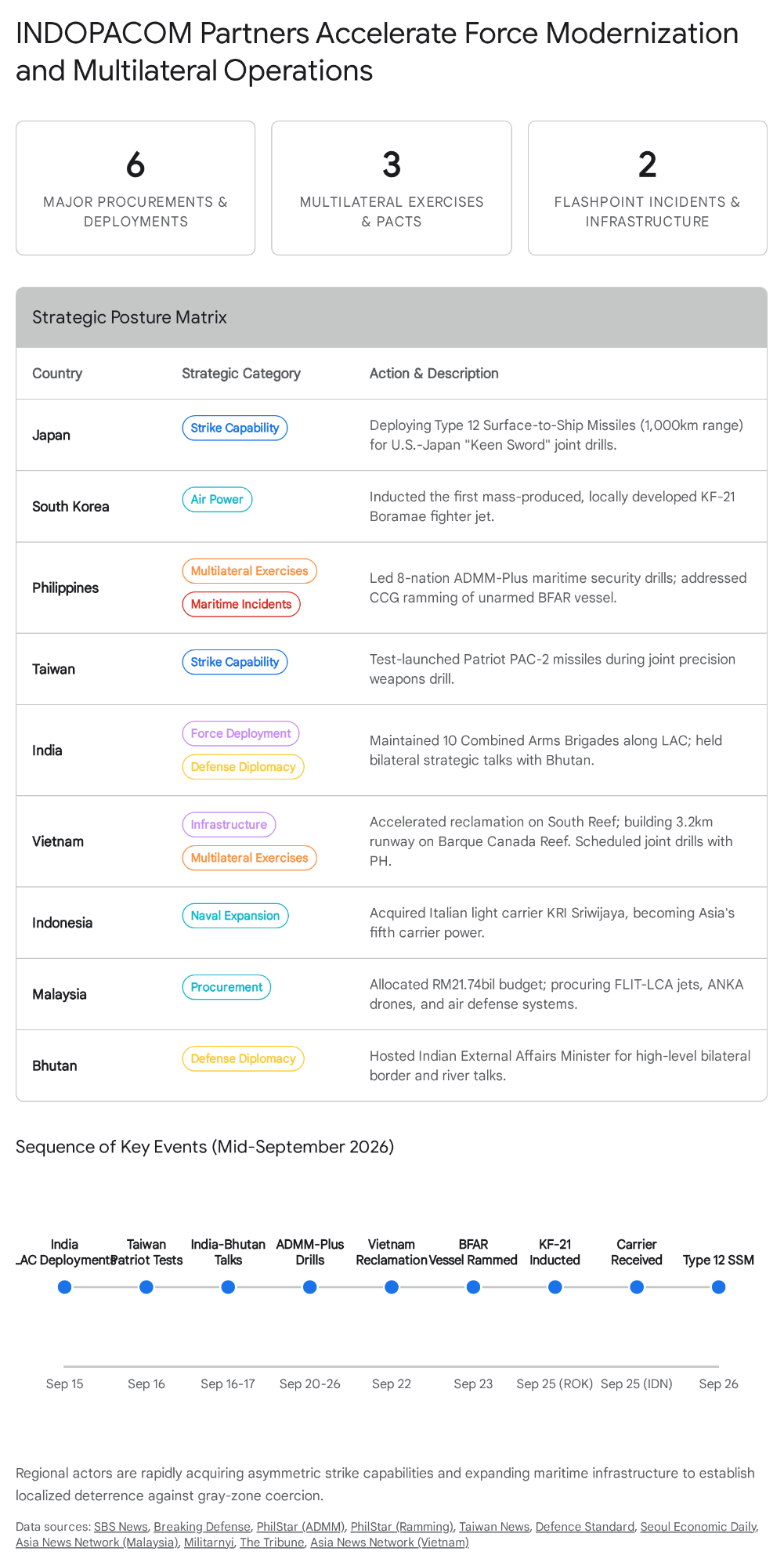
Screenshot of INDOPACOM containment situation report data

2. Regional Developments

2.1 Japan

Japan’s military took a clear shift toward acquiring long-range weapons and expanding intelligence sharing with neighboring countries.

In a major policy change, the Japan Ground Self-Defense Force prepared to use its Upgraded Type 12 surface-to-ship missiles during the Keen Sword military exercises in October2. According to the Japanese Ministry of Defense, the live-fire exercises will take place in Kumamoto Prefecture2. These missiles can reach targets up to 1,000 kilometers away, covering China’s coastline and the waters around Taiwan2. This is the first time Japan has featured weapons capable of hitting foreign bases during a domestic exercise, reflecting Tokyo’s focus on building a strong deterrent2. To address local concerns, the military plans to hold briefings for residents living near Camp Kengun2.

Japan’s broader strategy was outlined by Defense Minister Shinjiro Koizumi, who indicated Japan might consider nuclear-powered submarines to keep pace with China’s expanding navy14. The public discussion of such capabilities highlights Tokyo’s concerns regarding undersea threats in the Pacific14. Additionally, Prime Minister Sanae Takaichi’s administration is revising Japan’s core defense guidelines to place greater emphasis on drones and modern warfare tactics15.

Japan also broadened its logistics and intelligence networks. After concluding a logistics support pact16, Tokyo and Manila signed an Information Sharing Agreement17. This agreement helps coordinate responses in contested waters17. Furthermore, Japan and India completed their Veer Guardian 2026 air exercises18. This marked a significant milestone, as Japanese fighter aircraft operated from Indian bases for the first time, and Japan’s air chief flew in India’s Tejas fighter jet18.

The US and Japan also adjusted their equipment positioning. Japan announced that the US is redeploying its Typhon missile system, which launches Tomahawk cruise missiles, from Kagoshima back to Okinawa2. Beijing expressed opposition to the move, with a Chinese defense spokesperson warning that Japan’s deployment of offensive long-range weapons increases the risk of confrontation19.

Capability AreaSpecific Asset or ActionStrategic Implications
Long-Range StrikeType 12 Missile Deployment in KumamotoExtends reach to 1,000 km, covering the Chinese coast and Taiwan Strait.
Intelligence SharingSupply and Intelligence Pact with the PhilippinesSets up a formal way to share classified data about gray zone activities.
Joint TrainingVeer Guardian 2026 in IndiaImproves teamwork and marks the first deployment of Japanese fighters to India.
Troop MovementTyphon System MovementShows flexible use of US Tomahawk systems within the island chain.

2.2 South Korea

South Korea focused on expanding domestic weapons production and positioning its military to deter threats across the Korean peninsula and the wider Indo-Pacific region.

In a major milestone for its defense industry, the Republic of Korea Air Force officially inducted its first production model of the KF-21 Boramae fighter jet3. The aircraft was delivered from the manufacturing facility in Sacheon to the 156th Fighter Squadron at Yecheon Air Base3. This is part of an initial order of 40 jets tailored for air-to-air combat, integrating domestic technology with European systems like the Meteor missile3. South Korea is also developing a ground-attack variant and plans to acquire 80 additional units3. The KF-21 reduces Seoul’s reliance on foreign defense suppliers while creating export opportunities, with the Philippines and Malaysia already showing interest3.

To support these initiatives, South Korea requested a record $53.9 billion defense budget for 2027, representing an 8.2 percent increase4. The budget reflects a strategic shift from large troop numbers toward advanced military technologies4. Major investments are directed toward drones, long-range air defenses, and specialized drone warfare units4. Significant funding is also allocated to prepare for assuming wartime operational control from the United States by 202920. Additionally, nearly $75 million was set aside to accelerate research into domestic nuclear-powered submarines to match naval developments by China and North Korea21.

South Korea also approved the development of a new anti-ship missile to replace aging systems across its fleet22. Naval modernization remains a priority, with continued progress on the 7,000-ton KDDX destroyers, which will feature domestic sensors and launch systems by 203221.

Regarding regional alliances, US Forces Japan confirmed that the Freedom Edge 26 trilateral exercises with Japan and South Korea remain on schedule23. The three-way exercise emphasizes integrated missile defense and naval operations23. Seoul and Washington also advanced discussions on a $350 billion economic partnership connected to defense spending, shipbuilding, and nuclear technology24.

Strategic InitiativeFinancial or Asset AllocationDefense Implication
KF-21 Boramae Jets40 Block 1 aircraft orderedRelies less on foreign jets and boosts domestic export capacity.
Command TransferKRW 12.17T (35% increase)Pays for command upgrades for independent wartime operations by 2029.
Drone Systems20% budget increase for AI and dronesMakes up for a shrinking pool of military recruits.
Nuclear SubmarinesKRW 100B allocatedAims to establish persistent underwater tracking and longer patrols.

2.3 Philippines

The Philippines faced increasing pressure from assertive Chinese actions in surrounding waters, responding by expanding multilateral operations involving navy and coast guard assets.

In a demonstration of regional cooperation, the Philippines and Japan co-hosted maritime security exercises off the coast of Zambales6. Held from September 20 to 26, the event brought together 11 warships from eight nations6. Participating vessels included the Philippine Navy’s BRP Jose Rizal and BRP Tarlac, along with ships from Singapore, Brunei, India, New Zealand, Australia, the US, and Japan6. The drills focused on building mutual trust and ensuring seamless communication between naval forces6. Although China is a member of the broader framework, Beijing declined to participate6. Instead, a Chinese warship monitored the fleet from a distance near Scarborough Shoal, declining radio invitations from the Philippine Navy to join the exercises6.

These joint exercises followed a series of maritime confrontations. On September 18, a China Coast Guard vessel deliberately rammed the BRP Datu Magat Salamat, a civilian fisheries vessel25. The incident occurred approximately 54 miles off Palawan7. The Philippine ship was resupplying local fishermen when the Chinese vessel blocked its path, causing damage to its hull and railings26. Defense Secretary Gilbert Teodoro condemned the action as unlawful and noted that defense officials are reviewing response options25. This event follows an earlier incident in which Chinese vessels repeatedly collided with the Philippine Coast Guard vessel BRP Teresa Magbanua near Ayungin Shoal27. Additionally, on September 2, a Chinese fighter jet flew dangerously close to a Philippine patrol aircraft near Scarborough Shoal28.

In response to these security challenges, the Philippines strengthened bilateral defense relations within Southeast Asia. Manila finalized plans to conduct its first joint naval exercises with Vietnam29. A Vietnamese Coast Guard vessel deployed to the South China Sea to participate in joint exercises with the Philippine Coast Guard focused on search and rescue, firefighting, and maritime law enforcement29. The exercise featured a former US Coast Guard cutter transferred to Vietnam29.

Domestically, President Ferdinand Marcos Jr. appointed General Antonio Nafarrete as the new Chief of Staff of the Armed Forces of the Philippines30. General Nafarrete stated that the military will prioritize territorial defense in the West Philippine Sea30. Concurrently, lawmakers passed updated counter-espionage legislation designed to prevent the unauthorized sharing of classified information during peacetime31.

DateIncident or ExerciseInvolved AssetsOutcome or Impact
Sep 2, 2026Aerial InterceptPLA J-10 vs. AFP Patrol AircraftPLA aircraft buzzed a patrol flight over Scarborough Shoal.
Sep 18, 2026Deliberate RammingCCG 21585 vs. BFAR BRP Datu Magat SalamatCivilian fisheries vessel was damaged 54 nm off Palawan; formal condemnation issued.
Sep 20-26, 2026ADMM-Plus Drills11 warships from 8 nationsCo-hosted with Japan in Zambales; built multilateral teamwork while being watched by the PLA Navy.

2.4 Taiwan

Taiwan’s military focused on testing asymmetric defense tactics and decentralized command structures to deter potential blockade or invasion scenarios.

From September 16 to 18, Taiwan’s armed forces conducted a major live-fire exercise at Jiupeng Military Base in Pingtung County32. The three-day event tested Taiwan’s capacity to integrate its army, navy, and air force for precision strike operations5. The exercise linked radar networks, command centers, and missile batteries into a unified targeting architecture5.

For the first time, Taiwan deployed multiple types of domestic attack drones alongside conventional missile systems to practice coastal defense and maritime interdiction33. The exercise evaluated the entire targeting sequence from initial detection to weapon launch5. Units fired Patriot PAC-2 and Tien Kung air defense missiles, Sky Sword II missiles, Hsiung Feng III anti-ship missiles, and HIMARS rockets32. President William Lai Ching-te observed the drills, noting that combining unmanned platforms with standard munitions demonstrates Taiwan’s adaptation to modern conflict33. During the exercise, military radar detected a Chinese reconnaissance drone off the coast of Taitung County, highlighting the continuous surveillance environment34.

The Defense Ministry also emphasized distributing portable air defense capabilities to infantry units. The Army demonstrated new training simulators for US-supplied Stinger missiles35. These virtual systems enable personnel to practice engaging low-altitude targets such as drones35. Trainees undergo 30 to 45 days of simulator practice before proceeding to live-fire qualifications35.

Naval programs advanced despite logistical challenges. Officials indicated that Taiwan’s first domestically built submarine, the Hai Kun, is expected to be delivered to the Navy by October following its 21st sea trial36. Meanwhile, air force modernization encountered a brief delay when the first two F-16V aircraft produced by the US returned to Hawaii shortly after departure, potentially affecting delivery schedules for the remaining 66 aircraft37.

Strategic CapabilityDeployed or Tested SystemsOperational Purpose
Integrated Strike NetworkPatriot PAC-2, Tien Kung, Sky Sword II, HIMARSChecks the full system from spotting a target to making a strike.
Drone IntegrationIndigenous Attack DronesMixes drone swarms with regular missiles for coastal defense.
Local Air DefenseStinger Missile SimulatorsHelps infantry practice shooting down drones and low-flying aircraft.
Underwater DefenseHai Kun SubmarineProvides stealth capabilities to disrupt potential blockades or invasions.

2.5 India

India maintained a focused defense posture along its Himalayan border, balancing diplomatic dialogue with high operational readiness and infrastructure development, while expanding defense exports to Southeast Asia.

India’s Ministry of Defence released a report detailing adjustments in Chinese force deployments along the disputed border. The assessment noted a reduction in Chinese personnel positioned near India during 202512. Defense analysts estimate that China relocated approximately 10 combined arms brigades, totaling 40,000 to 50,000 troops, to rear staging areas11. However, the report emphasized that China retains at least 10 combined arms brigades near the Line of Actual Control, supported by artillery and missile units38.

Despite partial Chinese troop withdrawals, India maintained its defensive readiness. The Defence Ministry affirmed that the Indian Army remains fully deployed and prepared for contingencies12. Commanders kept 10 brigades stationed along forward positions to secure key sectors such as Taksing in Arunachal Pradesh39. To support these deployments, India accelerated the construction of all-weather roads, tunnels, and bridges near the Galwan Valley to ensure rapid logistical support39.

Beyond its northern border, India expanded its regional influence through arms exports and military engagement. Officials confirmed the export of BrahMos cruise missiles to Vietnam40. This agreement follows a similar transfer to the Philippines, reflecting New Delhi’s strategy to enhance anti-ship capabilities among Southeast Asian partner nations40.

India also reinforced partnerships across the Quad framework. Indian and US army units launched Exercise Yudh Abhyas, deploying 600 soldiers from each nation for joint combat training12. Concurrently, cooperation between the Indian Air Force and the Japan Air Self-Defense Force deepened following Exercise Veer Guardian, which marked the first deployment of Japanese fighters to Indian air bases18.

DomainAction or PostureStrategic Intent
Himalayan BorderMaintained 10-brigade deploymentStops sudden border grabs despite China pulling some troops back.
Road BuildingExpansion of the border road networkEnsures troops and supplies can move quickly in bad weather.
Defense ExportsBrahMos missile sales to Vietnam and the PhilippinesGives Southeast Asian nations a strong anti-ship weapon against the PLA Navy.
Joint ExercisesVeer Guardian 26 (Japan) and Yudh Abhyas (US)Improves teamwork and builds stronger ties with Quad members.

2.6 Vietnam

Vietnam expanded island fortification efforts and diversified defense procurement to counter Chinese maritime influence in the South China Sea, prioritizing strategic deterrence over public confrontation.

Satellite imagery revealed significant expansion of Vietnamese installations in the Spratly Islands, notably at Barque Canada Reef8. Land reclamation enlarged the feature to approximately 167 hectares8. Engineers are finalizing a 3.2-kilometer airfield on the reef8. Vietnam also expanded South Reef to over 60 hectares, constructing defensive positions, harbors, living quarters, and storage facilities41. Over the past three years, Hanoi has undertaken reclamation work across all 21 of its controlled features in the Spratlys41. These developments aim to strengthen defensive positions and provide operational support for maritime patrol vessels42.

Alongside its construction activities, Vietnam formally objected to Chinese developments elsewhere in the region. The Foreign Ministry called for China to halt construction on Yagong Island and Antelope Reef in the Paracel Islands43. Intelligence reports indicate Beijing completed initial infrastructure on Antelope Reef and installed radar systems on Yagong Island to monitor vessel movements44. Hanoi stated these actions infringe upon its territorial sovereignty and violate international law43.

To secure its maritime domain, Vietnam engaged in new defense partnerships. The Vietnam Coast Guard dispatched a former US Coast Guard cutter to participate in joint exercises with the Philippine Coast Guard29. Hanoi is also finalizing an agreement to acquire Indian BrahMos anti-ship missiles to strengthen coastal defense capabilities40. Concurrently, Vietnam extended defense support agreements with Russia through 2030 to maintain its Kilo-class submarine fleet and coastal defense infrastructure45.

Spratly FeatureConstruction ActivityStrategic Purpose
Barque Canada ReefReclaimed 167 hectares and built a 3.2-km runway.Can handle maritime strike fighters and heavy transport planes.
South ReefReclaimed 60 hectares and built deep harbors and ammo dumps.Provides a base for coast guard ships to protect fishing and oil assets.
Multiple OutpostsExpansion across all 21 Vietnamese outposts.Makes Chinese naval planning much harder through layered island defenses.

2.7 Indonesia

Indonesia expanded its naval presence, shifting from diplomatic engagement toward active patrols around the Natuna Islands to deter foreign maritime incursions.

In a major boost to its naval capabilities, the Indonesian Navy commissioned its first aircraft carrier, the KRI Sriwijaya9. Italy transferred the 14,000-ton light carrier under a bilateral defense agreement9. The vessel accommodates up to 18 helicopters, carries 830 personnel, and reaches speeds of 30 knots9. Equipped with missile defense systems, the ship will primary function as a mobile command post and humanitarian response vessel9. Analysts observe that the carrier provides Jakarta with sustained presence in the North Natuna Sea to monitor foreign fishing and coast guard activity near domestic energy projects46. The Navy also inducted its first submarine rescue ship, the KRI Canopus-936, addressing a key operational gap in submarine support9.

Infrastructure development in the Natuna region advanced alongside force acquisitions. Construction continued on a submarine facility on Pulau Natuna Besar47. To support patrol operations, Jakarta is evaluating a Japanese proposal to upgrade fishing ports across the Natuna Islands48. These upgrades would enable port facilities to accommodate both commercial fishing vessels and coast guard cutters, strengthening forward presence without establishing explicit military bases48.

On the diplomatic front, Indonesia maintained dialogue with Beijing while reaffirming its territorial position. During meetings in Jakarta, Indonesian foreign and defense ministers met with Chinese counterparts49. Both sides called for finalizing a binding South China Sea Code of Conduct and agreed to expand military communications to reduce operational risks49.

Naval Asset or BaseSpecificationsStrategic Role
KRI Sriwijaya (Carrier)14,000 tons, 18 helicopters, 830 personnel.Acts as a mobile command hub for long patrols in the North Natuna Sea.
KRI Canopus-936Submarine rescue vessel.Fixes a major underwater safety gap for the submarine fleet.
Natuna Submarine Base1,050 sqm facility on Pulau Natuna Besar.Provides supplies for long underwater patrols near tense waters.
Dual-Use Ports (Natuna)Upgraded using Japanese funds.Helps track ships and resupply coast guard fleets.

2.8 Malaysia

Malaysia invested in upgrading radar networks and naval vessels to protect its maritime domain, particularly around energy assets near the Kasawari gas field and Luconia Shoals.

In its 2026 budget, the Ministry of Defence secured RM21.74 billion, designating RM6 billion specifically for procurement and modernization50. To improve maritime surveillance, the Air Force prepared to receive three Turkish-manufactured Anka-S unmanned aerial vehicles10. These platforms will assist Kuala Lumpur in monitoring foreign coast guard vessels operating within Malaysian exclusive economic zones10. The Air Force is also awaiting four South Korean FA-50 light combat aircraft to enhance air patrol and interception capabilities50.

The Navy prioritized completing its delayed Littoral Combat Ship program, with the initial vessel expected in mid-2027 to strengthen regional patrol capabilities51. The budget also provides for five fast interceptor craft, short-range air defense systems, and a multi-role support ship50. Demonstrating a commitment to regional security cooperation, Malaysia sent naval units to join the ADMM-Plus drills hosted by the Philippines52. Additionally, defense officials are piloting a community-based security framework in Sabah to involve local populations in coastal monitoring50.

Asset ProcurementQuantityOperational Purpose
Anka-S Drones3 unitsProvides constant watch over the Kasawari gas field and Luconia Shoals.
FA-50 Combat Jets4 unitsOffers a cheaper way to intercept intruders and control the skies.
Littoral Combat ShipsExpected 2027Heavy navy ships for regular patrols and defending territory.
Fast Interceptor Craft5 unitsQuick response boats to handle smugglers and border pushers.

2.9 Bhutan

Bhutan managed a delicate geopolitical position, balancing Chinese border pressures against its security alignment with India.

Satellite imagery and security analysis indicate China is continuing the development of dual-use villages and military outposts in disputed border areas, including the Doklam plateau, Jakarlung, and Pasamlung53. Analysts suggest these activities are designed to pressure Bhutan into territorial concessions regarding Doklam, a strategic location overlooking the Siliguri Corridor, which connects mainland India to its northeastern states13.

To prevent escalation and avoid a repetition of the 2017 standoff, the Bhutanese government maintained a cautious diplomatic approach without making public declarations13. Thimphu continues to address boundary issues through quiet bilateral negotiations with Beijing13.

Concurrently, Bhutan maintained close operational cooperation with India. The Royal Bhutan Army continues joint training with a 600-strong Indian military detachment based in the Paro Valley54. India is funding and constructing paved access roads extending from the Paro Valley to high-altitude border posts54. These infrastructure improvements enable the Indian Army to rapidly deploy troops and heavy transport helicopters if required, replacing traditional pack-animal transport54. Indian External Affairs Minister S. Jaishankar visited Thimphu in mid-September to coordinate bilateral security interests and ensure border talks with China do not compromise regional stability55.

Border RegionChinese ActivityStrategic Implication for India
Doklam PlateauBuilding villages and outposts.Threatens the Siliguri Corridor; started the 2017 military standoff.
Jakarlung and PasamlungSlow land grabs and road building.Pressures Bhutan to accept land trades that favor Beijing.
Paro ValleyExpanding paved roads to border posts.Lets the Indian Army quickly send reinforcements and heavy helicopters.

3. Conclusion

Regional dynamics over the past week demonstrate that nations across the South China Sea, East China Sea, and the Himalayas are adjusting their strategic planning. Passive defense postures reliant primarily on the United States are giving way to active security partnerships. Furthermore, defense analytics published by Ronin’s Grips indicate that regional governments are responding to Chinese military modernization by increasing defense investments and acquiring autonomous drone systems56.

In the military sphere, regional powers are expanding long-range strike capabilities. Japan’s 1,000-kilometer Type 12 missiles, South Korea’s KF-21 fighters, Taiwan’s integrated drone networks, and India’s missile exports to Vietnam highlight a shared focus on long-range deterrence. By deploying systems capable of targeting distant positions and maritime assets, these nations aim to deter potential military actions.

At the same time, maritime friction remains constant in Southeast Asia. The ramming of an unarmed Philippine civilian vessel by a China Coast Guard ship underscores ongoing territorial disputes. In response, regional partners are standardizing joint patrols and intelligence sharing, as shown by the ADMM-Plus exercises, the Japan-Philippines information-sharing agreement, and joint coast guard drills between the Philippines and Vietnam. Consequently, the Indo-Pacific is shifting toward a security model focused on local defense manufacturing and multilateral cooperation.

4. Master Summary Table

CountryDateActivity CategoryFactual Description
JapanSep 2026Deployment and ExerciseGetting ready to deploy 1,000-km range Type 12 missiles to Kumamoto for the Keen Sword drills.
JapanSep 2026Intelligence SharingSigned an Information Sharing Agreement with the Philippines to improve teamwork in tense waters.
South KoreaSep 25, 2026Procurement and DeploymentBrought the first homegrown KF-21 Boramae fighter jet into the ROKAF 156th Fighter Squadron.
South KoreaSep 2026Defense FinancingAnnounced a record $53.9 billion defense budget for 2027, focusing on AI, drones, and nuclear sub research.
PhilippinesSep 20-26, 2026ExerciseHosted the ADMM-Plus maritime security drills with 11 warships from 8 nations in the West Philippine Sea.
PhilippinesSep 18, 2026Maritime IncidentA China Coast Guard ship intentionally rammed the civilian boat BRP Datu Magat Salamat 54 miles off Palawan.
TaiwanSep 16-18, 2026Exercise and TestingRan the Tri-Service Joint Precision Missile Launch at Jiupeng Base, testing a strike network mixing attack drones with standard missiles.
IndiaSep 2026Force PostureKept 10 brigades along the border and kept building roads, even though China pulled back roughly 40,000 to 50,000 troops.
VietnamSep 2026Force Posture and InfrastructureSped up island building in the Spratlys, including growing Barque Canada Reef to 167 hectares and building a 3.2-km runway.
IndonesiaSep 25, 2026ProcurementCommissioned its first light aircraft carrier, the 14,000-ton KRI Sriwijaya, to act as a mobile command base.
MalaysiaSep 2026Defense Financing and ProcurementSet aside a RM21.74 billion budget, buying light combat jets, Turkish drones, and air defense systems.
BhutanSep 16-17, 2026Security CooperationHosted India’s External Affairs Minister for talks while staying quiet on border talks with China despite Chinese village building.

Please share the link on Facebook, Forums, with colleagues, etc. Your support is much appreciated and if you have any feedback, please email us in**@*********ps.com. If you’d like to request a report or order a reprint, please click here for the corresponding page to open in new tab.


Works cited

  1. Weekly INDOPACOM Containment SITREP: August 31 to, https://blog.roninsgrips.com/weekly-indopacom-containment-sitrep-august-31-to-september-7-2026/
  2. Japan’s Attack Missiles to Be Deployed in U.S.-Japan Joint Drills, https://news.sbs.co.kr/english/article.do?news_id=N1008770705
  3. https://breakingdefense.com/2026/09/south-korea-inducts-first-locally-developed-fighter-jet-into-air-force/
  4. South Korea supercharges defense budget to record levels, https://www.defensenews.com/global/asia-pacific/2026/09/09/south-korea-supercharges-defense-budget-to-record-levels/
  5. https://www.janes.com/defence-intelligence-insights/defence-news/c4isr/taiwan-validates-joint-precision-strike-kill-chain-in-tri-service-live-fire-exercise
  6. Warships from ASEAN, other states sail in West Philippine Sea, https://www.philstar.com/headlines/2026/09/25/2558775/warships-asean-other-states-sail-west-philippine-sea
  7. Chinese coast guard ship rams Philippine vessel – 1News.az, https://1news.az/en/news/20260919205506531-Chinese-coast-guard-ship-rams-Philippine-vessel
  8. Barque Canada Reef – Wikipedia, https://en.wikipedia.org/wiki/Barque_Canada_Reef
  9. Indonesia Becomes Asia’s Fifth Carrier Power With Italian Handover, https://en.sedaily.com/politics/2026/09/25/indonesia-becomes-asias-fifth-carrier-power-with-italian
  10. Malaysia-Turkey drone deal advances maritime security, defense, https://ipdefenseforum.com/2025/09/malaysia-turkey-drone-deal-advances-maritime-security-defense-modernization/
  11. Chinese Soldiers Pull Back From LAC 6 Years After Galwan, https://timesofindia.indiatimes.com/videos/news/chinese-soldiers-pull-back-from-lac-6-years-after-galwan-down-to-10-pla-arms-brigade/videoshow/134235232.cms
  12. China Reduces PLA Forces After India’s LAC Deployment, https://defencestandard.com/china-pla-force-reduction-lac-india-deployment/
  13. Bhutan’s Borders: The China Challenge and the India Factor, https://blogs.lse.ac.uk/southasia/2023/01/23/bhutans-borders-the-china-challenge-and-the-india-factor/
  14. China & Taiwan Update, September 22, 2026 | ISW, https://understandingwar.org/research/china-taiwan/china-taiwan-update-september-22-2026/
  15. Japan urged to ponder wartime past – China Daily HK, https://www.chinadailyasia.com/article/640150
  16. NEW MILITARY TREATY ASG-2029 – Facebook, https://www.facebook.com/groups/452866971950555/posts/2079474239289812/
  17. The Philippines and Japan sign an information-sharing agreement, https://www.facebook.com/bncphl/posts/middayreport-the-philippines-and-japan-sign-an-information-sharing-agreement-cen/122290505522354398/
  18. India-Japan air exercise Veer Guardian signals growing strategic alignment in the Indo-Pacific, https://timesofindia.indiatimes.com/defence/news/india-japan-air-exercise-veer-guardian-signals-growing-strategic-alignment-in-the-indo-pacific/articleshow/134380553.cms
  19. China warns Japan’s forward deployment of strategic offensive, https://www.aa.com.tr/en/asia-pacific/china-warns-japan-s-forward-deployment-of-strategic-offensive-weapons-risks-confrontation/4057269
  20. Special Report: South Korea’s defence budget to exceed USD50, https://www.janes.com/defence-intelligence-insights/defence-news/air/special-report-south-koreas-defence-budget-to-exceed-usd50-billion-for-first-time
  21. How Japan, South Korea are building up naval capabilities for, https://breakingdefense.com/2026/09/how-japan-south-korea-are-building-up-naval-capabilities-for-china-threat/
  22. South Korea Approves Development of New AShM, https://militarnyi.com/en/news/south-korea-approves-development-of-new-ashm/
  23. Fault Lines – South Korean exercises, Paracels construction, PIF, https://www.aspistrategist.org.au/fault-lines-rok-exercises-south-china-sea-construction-pif-tension/
  24. US and South Korea Advance $350 Billion Investment Deal as Alliance Talks Deepen, https://moderndiplomacy.eu/2026/09/23/us-and-south-korea-advance-350-billion-investment-deal-as-alliance-talks-deepen/
  25. Philippines developing options on vessel ramming by China, https://www.philstar.com/headlines/2026/09/23/2558276/philippines-developing-options-vessel-ramming-china
  26. The Philippine Coast Guard confirmed that a China … – Facebook, https://www.facebook.com/PTVph/videos/look-the-philippine-coast-guard-confirmed-that-a-china-coast-guard-vessel-rammed/4527027277541100/
  27. BREAKING: A China Coast Guard vessel rammed the BRP Datu, https://www.facebook.com/ModernizePhilippines/posts/breaking-a-china-coast-guard-vessel-rammed-the-brp-datu-magat-salamat-a-bureau-o/1561399669353329/
  28. Chinese fighter jets intercept Philippine patrol aircraft – Philstar.com, https://www.philstar.com/headlines/2026/09/09/2554991/chinese-fighter-jets-intercept-philippine-patrol-aircraft
  29. Philippines and Vietnam to hold naval exercises to counter China, https://militarnyi.com/en/news/philippines-and-vietnam-to-hold-naval-exercises-to-counter-china/
  30. Nafarrete takes AFP helm amid renewed tensions with China, https://newsinfo.inquirer.net/2267978/nafarrete-takes-afp-helm-amid-renewed-tensions-with-china
  31. House passes anti-spying bill amid civil rights concerns – Inquirer.net, https://newsinfo.inquirer.net/2307161/house-passes-anti-spying-bill-despite-civil-rights-concerns
  32. Taiwan military launches Patriot missiles in joint precision weapons, https://www.taiwannews.com.tw/news/6440815
  33. Taiwan holds first joint drill using multiple attack drones … – The Hindu, https://www.thehindu.com/news/international/taiwan-holds-first-joint-drill-using-multiple-attack-drones-in-modernisation-push/article71479863.ece
  34. Aircraft survey the route for National Day rehearsals, https://www.taipeitimes.com/News/taiwan/archives/2026/09/24/2003864813
  35. Army unveils Stinger simulators, highlights counter-drone role, https://focustaiwan.tw/politics/202609220023
  36. Army unveils Stinger simulators, highlights counter-drone role, https://www.taipeitimes.com/News/taiwan/archives/2026/09/23/2003864748
  37. FEATURE:Chinese coast guard turns to the Pacific, https://www.taipeitimes.com/News/taiwan/archives/2026/09/13/2003864184
  38. PLA troop deployment along LAC reduced in 2025, but 10 combined, https://www.thehindu.com/news/national/pla-troop-deployment-along-lac-reduced-in-2025-but-10-combined-arms-brigades-remain-mod-report/article71463567.ece
  39. India-China reset has limits. Don’t mistake it for a boundary settlement, https://theprint.in/opinion/india-china-border-taksing/3051669/
  40. Vietnam is rapidly expanding its presence in disputed Spratly, https://www.facebook.com/WIONews/videos/vietnam-is-rapidly-expanding-its-presence-in-disputed-spratly-islands-while-movi/1771584837146325/
  41. Vietnam steps up reclamation work on strategic reef in South China, https://asianews.network/vietnam-steps-up-reclamation-work-on-strategic-reef-in-south-china-sea-in-island-building-efforts/
  42. Vietnam steps up reclamation work on strategic reef in South China, https://www.straitstimes.com/asia/se-asia/vietnam-steps-up-reclamation-work-on-strategic-reef-in-s-china-sea-in-island-building-efforts
  43. South China Sea, https://southchinaseanewswire.com/
  44. Military Ambitions Challenge Paracel Islands Sovereignty, https://moderndiplomacy.eu/2026/09/04/military-ambitions-challenge-paracel-islands-sovereignty/
  45. Hanoi is building Southeast Asia’s pre-eminent sea power, https://moderndiplomacy.eu/2026/06/19/hanoi-is-building-southeast-asias-pre-eminent-sea-power/
  46. Not a Claimant, Still Targeted: Indonesia in the South China Sea, https://www.factsasia.org/blog/not-a-claimant-still-targeted-indonesia-in-the-south-china-sea-gray-zone
  47. Indonesia begins construction of submarine base in South China Sea, https://www.janes.com/defence-intelligence-insights/defence-news/indonesia-begins-construction-of-submarine-base-in-south-china-sea
  48. Japan’s Natuna port proposal highlights Indonesia’s balancing act, https://www.thestar.com.my/aseanplus/aseanplus-news/2026/09/18/japans-natuna-port-proposal-highlights-indonesias-balancing-act-on-china
  49. Indonesia, China urge finalization of South China Sea Code of, https://en.antaranews.com/news/428192/indonesia-china-urge-finalization-of-south-china-sea-code-of-conduct
  50. Malaysia’s Defence Ministry to focus on modernisation, readiness in, https://asianews.network/malaysias-defence-ministry-to-focus-on-modernisation-readiness-in-2026-minister/
  51. RMN Modernises Fleet to Safeguard Sovereignty – GBP, https://gbp.com.sg/stories/rmn-modernises-fleet-to-safeguard-sovereignty/
  52. 11 vessels from 8 countries join ASEAN Defense Ministers’ Meeting, https://www.facebook.com/ANCalerts/videos/11-vessels-from-8-countries-join-asean-defense-ministers-meeting-plus-maritime-e/969744188858751/
  53. China’s high-stakes incursion in the heights of Bhutan, https://www.chathamhouse.org/publications/the-world-today/2022-10/chinas-high-stakes-incursion-heights-bhutan
  54. Bhutan: The Indian Army’s Front Line, https://bhutannewsnetwork.com/2014/11/bhutan-the-indian-armys-front-line/
  55. EAM Jaishankar to visit Bhutan on Sept 16-17; hold talks with, https://www.tribuneindia.com/news/world/eam-jaishankar-to-visit-bhutan-on-sept-16-17-hold-talks-with-counterpart-dhungyel/
  56. Weekly INDOPACOM Containment SITREP: September 5 to 19, 2026, https://blog.roninsgrips.com/weekly-indopacom-containment-sitrep-september-5-to-19-2026/

Weekly INDOPACOM Military SITREP: August 22 – 29, 2026

1. Executive Summary

From August 22 to 29, 2026, military acquisitions and joint maneuvers steadily rose in the Indo-Pacific security landscape. Regional partners—including Japan, South Korea, the Philippines, Taiwan, India, Vietnam, Indonesia, Malaysia, and Bhutan—actively worked to balance the PRC’s growing territorial influence. A key shift emerged this week as nations moved away from traditional platforms toward autonomous drones, loitering munitions, and long-range precision strike capabilities.

In Northeast Asia, Japan finalized a record $60.2 billion budget request to prioritize standoff missiles and uncrewed tech. Trilateral cooperation deepened as the U.S., South Korea, and Japan announced the Freedom Edge exercise for September, helping maintain momentum after the early end of the Ulchi Freedom Shield drill. Meanwhile, Taiwan solidified its “asymmetric” defense by passing a massive drone procurement bill and contracting Anduril Industries for over 2,000 loitering munitions.

Across Southeast Asia, the focus remained on coastal denial. The Philippines integrated new U.S. autonomous sea vessels into its archipelagic defense, while Vietnam protested Chinese expansion in the Paracels even as it advanced its own island-building projects. Indonesia began construction on its Scorpene Evolved submarines, and Malaysia moved to equip its new littoral combat ships with essential surface-to-air missiles.

In South Asia, diplomacy was the main focus as India and China reached an eight-point consensus to stabilize their disputed boundary. While the agreement eased tensions near Bhutan, India continued to strengthen its ground deterrent by approving a new purchase of U.S. Javelin anti-tank missiles.

Together, these moves reflect a regional push for advanced, distributed defense networks designed to deter aggression and protect sovereign claims.

August 2026 Indo-Pacific Asymmetric Procurement Matrix showing missile ranges and uncrewed platform acquisitions.

2. Regional Developments

2.1 Japan

During the final week of August 2026, the Japanese government finalized its largest-ever defense budget request for the coming fiscal year. According to Naval News1, the request sits between $56.1 billion and $60.2 billion1. This historic spending level aligns with Japan’s goal to reach 2 percent of GDP for defense by 20273, framing military growth as both a security need and a driver for domestic industrial growth3.

Despite the ambitious targets, Japan faces stiff fiscal headwinds. Revenue constraints are tight, with debt and social security making up nearly 60 percent of government spending6. To help cover the costs, a 4 percent corporate defense surtax was implemented earlier this year6.

The new budget prioritizes uncrewed and standoff systems to counter regional threats1, focusing heavily on the Synchronized, Hybrid, Integrated and Enhanced Littoral Defense (SHIELD) network1.

Program / AssetFunding Requested (USD)Strategic Purpose
SHIELD Network$876.3 millionEstablish a multi-layered, automated coastal defense architecture using autonomous assets.
10th Taigei-class Submarine$816.0 millionConstruct a 3,000-ton diesel-electric attack submarine for extended underwater domain awareness.
New FFM Multirole Frigate$713.9 millionProcure upgraded Mogami-class vessels equipped with Type 12 and Type 17 missiles.
Aegis System Upgrades$545.5 millionPrepare test environments for two advanced Aegis system equipped vessels (ASEVs).
Izumo-class Modifications$195.0 millionUpgrade JS Izumo and JS Kaga with deck status lights and guidance systems for F-35B integration.
New Patrol Vessels$195.0 millionConstruct two 1,900-tonne vessels for enhanced territorial sea surveillance.
Tomahawk Integration$11.6 millionEquip Aegis destroyers JS Myoko and JS Atago with US-made Tomahawk launch functions.

A critical component of Japan’s changing defense posture involves the accelerated deployment of long-range strike capabilities. On March 31, 2026, the Ministry of Defense deployed domestically produced long-range counterstrike missiles, specifically the upgraded Type-12 surface-to-ship missiles, to Camp Kengun in Kumamoto Prefecture on the island of Kyushu1. The upgraded Type-12, manufactured by Mitsubishi Heavy Industries, features a low-observable stealth design and an extended operational range of approximately 1,000 kilometers. This range extension allows Japanese Ground Self-Defense Forces stationed in Kyushu to hold hostile naval assets at risk across the East China Sea and near the Taiwan Strait, covering strategic maritime approaches used by the People’s Liberation Army Navy’s Eastern Theater Command1. Furthermore, by fiscal year 2030, Japan plans to deploy Type 03 Medium-Range Surface-to-Air Missiles to Yonaguni Island, located only 110 kilometers from Taiwan, augmenting existing coastal surveillance units.

Japan’s military exercises during this period reflected deep integration with United States forces, despite growing political anxieties in Tokyo regarding the dependability of the American security umbrella following the scaling back of exercises on the Korean peninsula and the withdrawal of THAAD interceptors for redeployment to the Middle East. The United States military deployed the Typhon mid-range missile system to Kyushu in coordination with the Japanese Ministry of Defense for the joint Valiant Shield and Orient Shield exercises.

Japanese officials also confirmed their participation in the upcoming trilateral Freedom Edge exercise scheduled for early September alongside the United States and South Korea, which will focus on multidomain interoperability off the coast of Jeju Island10. Unsurprisingly, the announcement of the record budget and joint exercises drew sharp rebukes from Pyongyang, with North Korean state media accusing Japan of preparing for a “war of aggression”12.

2.2 South Korea

South Korea saw a period of rapid adjustments in late August. Most notably, the Ulchi Freedom Shield exercise concluded early following a political directive from the U.S., intended to leave the door open for diplomatic talks with Kim Jong Un10.

The early end to the drill, combined with potential cancellations of upcoming amphibious landing exercises due to U.S. commitments in the Middle East, sparked some concern over readiness in Seoul16. To keep the partnership strong, the Ministry of National Defense confirmed that trilateral maneuvers with the U.S. and Japan would continue as planned10.

The Freedom Edge exercise, starting September 7, will focus on ballistic missile defense and anti-submarine warfare10. This trilateral effort, reported by The Associated Press12 is a direct response to North Korean missile activity and helps maintain a sophisticated allied response to regional threats10.

This trilateral maneuver serves as a direct response to North Korea’s expanding nuclear arsenal and its recent launch of approximately ten short-range ballistic missiles toward the Sea of Japan, a kinetic demonstration explicitly reacting to the ongoing allied drills10. North Korea’s Ministry of Foreign Affairs condemned the exercises and accused the United States of hostile actions, specifically referencing potential future sales of air-to-air missiles to the South Korean air force4.

Beyond operational exercises within the peninsula, South Korea continued to assert its influence as an exporter of naval hardware in the Indo-Pacific. The Philippine Department of National Defense explicitly highlighted South Korea as its primary maritime equipment partner during this reporting period. Defense Secretary Gilberto Teodoro Jr. noted that Manila relies heavily on Ulsan-based HD Hyundai Heavy Industries for the modernization of the Philippine Navy, demonstrating Seoul’s indirect role in shaping the maritime balance of power in the contested South China Sea19.

2.3 Philippines

The Philippines continued its shift toward archipelagic defense this month. Driven by persistent pressure from the China Coast Guard, Manila is prioritizing the protection of its 200-nautical-mile exclusive economic zone. This strategy, detailed at Ronin’s Grips20, moves the military focus from internal security to sovereignty enforcement.

India is currently preparing the final battery of the BrahMos supersonic cruise missile system for delivery to the Philippine Marine Corps21. Once operational, these mobile shore-based launchers will allow the Philippines to threaten naval targets up to 290 km away, significantly complicating the risk for any adversary operating in the West Philippine Sea.

BrahMos Coastal Defense System ProfileSpecifications
Total Contract ValueApproximately $375 million (Signed Jan 2022)
System ConfigurationShore-based, twin-canister mobile launcher
Operational RangeApproximately 290 kilometers
Flight SpeedMach 2.8 (Supersonic)
Warhead Payload200 to 300 kilograms (Semi-armor-piercing high-explosive)
Strategic PositioningWestern Luzon, holding Scarborough Shoal (200-250km away) at risk

When fully operational, these mobile coastal batteries will enable the Philippines to threaten hostile surface combatants near contested features, changing naval risk calculations in the West Philippine Sea by reducing the reaction time of adversary vessels. The twin-canister configuration acquired by Manila differs from standard Indian triple-canister launchers, specifically designed to reduce weight for transport across constrained Philippine coastal infrastructure.

In tandem with missiles, the Philippines is integrating uncrewed surface vessels like the Ocean Aero Triton23. These drones can submerge for days to monitor vessel movements and secure subsea cables, forming a persistent layer of surveillance that Manila intends to expand by 202723.

Diplomatic friction over Scarborough Shoal also grew. Manila rejected Beijing’s unilateral ecological preserve declaration, viewing it as a pretext for physical blockades24. To strengthen its presence, the Department of National Defense is now looking to procure more warships to supplement its existing South Korean-built fleet15.

2.4 Taiwan

Taiwan accelerated its “asymmetric” buildup in late August, prioritizing drones and loitering munitions to raise the cost of any potential invasion. The 2027 defense budget is set to increase by 18 percent to $35.1 billion, or roughly 3 percent of GDP25.

On August 27, the Legislative Yuan broke a political gridlock to pass a special drone procurement bill. This mandates a domestic supply chain free of Chinese parts and funds everything from reconnaissance drones to suicide surface vessels26. Concurrently, the Ministry of National Defense signed an $847 million deal with Anduril Industries for over 2,000 unmanned systems27, as disclosed in procurement documents29.

A critical breakthrough in this legislative gridlock occurred on August 27, when the Legislative Yuan passed a special budget dedicated exclusively to unmanned systems. The legislature approved the opposition Kuomintang version of the drone procurement bill, establishing a NT$240 billion (approximately $7.3 billion) fund to be executed over a six-year period starting in 202726. This legislation sets an annual spending cap of NT$40 billion and requires the Ministry of Economic Affairs to develop a domestic drone supply chain that does not use Chinese components, while the Ministry of National Defense is responsible for military procurement. The budget covers the acquisition of coastal attack drones, coastal reconnaissance drones, and small suicide unmanned surface vessels.27

On the exact same day the legislative bill passed, the Ministry of National Defense formalized a large procurement contract with the United States defense technology firm Anduril Industries. According to a detailed procurement disclosure29, the NT$26.9 billion ($847 million) contract secures 2,032 unmanned systems, forming the core of Taiwan’s near-term autonomous deterrent27.

Anduril Unmanned Systems Procurement ProfileSystem Specifications & Mission Role
Altius-700M Loitering MunitionQuantity: 1,554 units. Range: 160 km. Warhead: 14 to 15 kg heavy strike payload. Mission: Capable of destroying heavy armored vehicles, air defense systems, and naval vessels.
Altius-600ISR Reconnaissance DroneQuantity: 478 units. Range: 400 km. Mission: Long-endurance intelligence, surveillance, and reconnaissance (ISR) to provide targeting data for strike assets within a modular launch network.
Delivery ScheduleInitial deliveries commence Q4 2026, with the final production lots scheduled for completion by June 2033.

These platforms give Taiwan a clear edge. The Altius-700M loitering munition packs the punch of a Hellfire missile, allowing for standoff strikes against naval vessels or staging areas27. This is a direct answer to increasing PRC drone incursions, like the recent “Soaring Dragon” violation over Pratas Island31.

These acquisitions respond directly to PRC military posturing. In January 2026, a People’s Liberation Army WZ-7 “Soaring Dragon” surveillance drone violated Taiwanese airspace over Pratas (Dongsha) Island31. This incursion tested Taiwanese air defense responses without triggering kinetic escalation, serving as a catalyst for Taiwan to modernize its own unmanned fleet and redefine its rules of engagement regarding airspace violations.

Finally, the Lai administration is planning an air defense shield dubbed the “T-Dome.” Inspired by Israel’s Iron Dome, this network aims to protect the island against the PRC’s vast arsenal of ballistic and cruise missiles32. Analysts note that these combined moves create a formidable deterrent by making any potential conflict far more complex and costly for the PLA33.

2.5 India

India pursued a dual-track strategy this week: leading high-level diplomatic talks to stabilize its borders while simultaneously boosting its tactical edge on the ground.

On August 24–25, Indian and Chinese officials met in Beijing for the 25th round of Special Representatives talks34. This resulted in an eight-point consensus to manage the Line of Actual Control (LAC) and seek an “early harvest” deal on boundary delimitation—essentially settling uncontested areas first to build momentum37.

To operationalize the agreement, the two nations established two new bureaucratic structures under the Working Mechanism for Consultation and Coordination: the Expert Group on Boundary Delimitation and the Working Group on Border Management35.

To prevent future skirmishes, both sides agreed to new military hotlines and high-level commander meeting points34. They also agreed to resume sharing river data and reopen border trade points to foster goodwill34.

  • The establishment of two additional meeting points for Senior Highest Military Commander negotiations34.
  • The creation of two new border military hotlines specifically operating in the Eastern and Middle Sectors of the boundary34.
  • A commitment to resume the sharing of hydrological data for trans-border rivers, a critical issue given Indian concerns over Chinese mega-hydropower projects on the Yarlung Tsangpo river (the Brahmaputra) in Tibet34.
  • The reopening of three designated border trading points to foster economic exchanges and goodwill among border communities.

On the defense front, India is set to acquire the U.S. FGM-148 Javelin anti-tank missile system, as reported by LatestLY40. This fire-and-forget weapon significantly boosts the lethality of infantry units stationed in the high-altitude terrain along the LAC24. These acquisitions, alongside successful domestic ballistic missile tests41, continue to solidify India’s multi-layered defense network.

FGM-148 Javelin Procurement DetailsAcquisition Scope
Contract Value$45.7 million
Munitions100 FGM-148 Javelin rounds (fly-to-buy configuration)
Launch Infrastructure25 Lightweight Command Launch Units (LwCLU)
Support SystemsBasic skills trainers, missile simulation rounds, and tool kits
LogisticsLifecycle support, technical assistance, and system integration

The Javelin provides the Indian Army with a fire-and-forget, man-portable anti-armor weapon24. The system utilizes an imaging infrared seeker to execute top-attack profiles against armored vehicles and fortified bunkers, targeting the thinnest armor on top of a tank24. This procurement directly enhances the tactical lethality of Indian infantry units stationed in high-altitude environments along the Line of Actual Control, providing a proven deterrent against mechanized incursions. Concurrently, domestic defense modernization proceeded apace, building on the successful July 2026 test by the Defence Research and Development Organisation (DRDO) of a long-range ballistic missile interceptor capable of destroying incoming threats at distances up to 5,000 kilometers, fortifying India’s multi-layered defense network41.

2.6 Vietnam

Vietnam faced rapid Chinese militarization in the South China Sea this week, leading to formal diplomatic protests and a shift in its maritime posture. On August 28, Hanoi condemned new Chinese installations in the disputed Paracel Islands43.

The friction centers on Yagong Island and Antelope Reef, where satellite imagery analyzed by The War Zone and Reuters shows the first signs of a new radar facility and a massive 1,500-acre artificial island45. Analysts believe thegrading on Antelope Reef is preparation for a 10,000-foot military runway10.

The developments on Yagong Island serve as a supporting node for a much larger strategic project located just 14 kilometers away on Antelope Reef. Recent intelligence indicates that the People’s Republic of China has completed the first phase of a land reclamation project on Antelope Reef, transforming a submerged feature into a nearly 1,500-acre artificial island over the course of just ten months25. The teardrop-shaped facility includes a deep-water port, a 680-meter quay capable of berthing large coast guard and naval vessels, helicopter pads, and administrative buildings46. Most concerning for Vietnamese security planners is the ongoing grading of the island’s northwest edge, which analysts assess is preparation for a 10,000-foot military runway10.

If completed, this would become China’s largest naval base in the Paracels, potentially hosting strategic bombers just 400 km from the Vietnamese coast46. In response, Vietnam has quietly accelerated its own island-building campaign in the Spratlys, reinforcing facilities and expanding multi-level military structures to protect its sovereign claims48.

In response to these developments, Vietnam has quietly accelerated its own asymmetric island-building campaign further south in the Spratly Islands, matching infrastructure development with infrastructural entrenchment. Independent geospatial analysis confirms that Hanoi has added approximately 65,000 square meters of landmass to West Reef and an additional 21,000 square meters to Sand Cay48. While smaller in scale than the Chinese reclamation efforts on features like Fiery Cross Reef, the Vietnamese construction involves the reinforcement of breakwaters and the expansion of multi-level military facilities capable of housing logistics vessels and personnel19. This silent infrastructure race underscores Vietnam’s strategy of physical entrenchment to protect its sovereign claims against an overwhelming conventional adversary.

2.7 Indonesia

Indonesia continued its diversified procurement strategy this month, aiming to build a credible deterrent in the North Natuna Sea. Jakarta is utilizing technology transfers from multiple global partners to avoid over-reliance on any single power49.

A major milestone was reached when PT PAL began the first steel-cutting for the lead Scorpene Evolved submarine in Surabaya51. These conventionally powered boats use lithium-ion batteries for long-range covert patrols and will be built domestically. Indonesia is also advancing deals for Turkish frigates and Indian BrahMos missiles to further bolster its offshore enforcement capabilities52.

Indonesian Maritime Modernization AssetsStrategic Capabilities
Scorpene Evolved Submarines72-meter conventionally powered boats utilizing lithium-ion batteries. Offers 78 days endurance and 8,000 nm range for deep covert patrols. Built domestically at PT PAL.
ISTIF-class Frigates$1 billion contract via Turkey/Qatar. Enhanced fuel capacity and radar cross-section reduction for sustained offshore EEZ enforcement.
BrahMos Missile SystemSupersonic (Mach 2.8) coastal defense cruise missiles. 290 km range designed to compress adversary naval reaction times near the Natuna Islands.

The Scorpene Evolved variant features lithium-ion battery technology, allowing it to remain submerged for extended periods while reaching speeds exceeding 20 knots. Displacing roughly 1,600 to 2,000 tonnes surfaced, these conventionally powered submarines will enhance the Indonesian Navy’s capacity for covert surveillance and persistent patrols across the archipelagic chokepoints and the exclusive economic zone bordering the South China Sea. The agreement includes extensive technology transfer, with French engineers assisting in the training of over 400 Indonesian technicians to ensure the complete domestic construction of both ordered hulls, fostering a long-term defense-industrial base.

In the surface domain, defense reporting from the DIMDEX 2026 exhibition confirmed that Qatar’s Barzan Holding and Turkish shipbuilder TAIS formalized a $1 billion agreement to construct two ISTIF-class frigates for an international client widely identified as Indonesia52. The ISTIF-class design offers superior fuel capacity and range compared to previous corvettes, providing the necessary loiter time to manage the vast distances required for Indonesian offshore patrols.

Indonesia also signaled its intent to acquire coastal strike capabilities by confirming a procurement agreement with India for the BrahMos supersonic cruise missile system, in a package previously estimated at $200 million to $350 million49. This acquisition provides Jakarta with a fast-response strike tool capable of reaching targets up to 290 kilometers away, injecting a highly credible deterrent variable into the operational planning of any foreign coast guard or maritime militia fleets operating near the Natuna Islands.

Highlighting its pragmatic approach to procurement, the Indonesian Navy also conducted operational testing of the Chinese-manufactured HC-540 vertical takeoff and landing (VTOL) uncrewed aerial vehicle50. The evaluation of this shipborne surveillance drone demonstrates Jakarta’s willingness to integrate Chinese technology for specific reconnaissance roles, even as it explicitly arms itself to deter Chinese maritime incursions in its northern waters. Furthermore, Indonesia expanded its coast guard training capabilities, fully operationalizing the Bakamla training center in the North Natuna Sea, a facility constructed in partnership with the United States53. In the aerospace sector, Indonesia placed a pre-order for 48 KAAN fifth-generation stealth fighters from Turkey, a strategic hedge designed to secure advanced air superiority assets amidst delays and disputes regarding payment schedules for the joint South Korean KF-21 fighter program54.

2.8 Malaysia

Malaysia is moving urgently to fix vulnerabilities in its fleet while facing ongoing harassment near its offshore gas fields. The Ministry of Defence signed a vital contract for VL MICA surface-to-air missiles to arm its new littoral combat ships55. This provides a baseline air defense layer after the cancellation of its primary anti-ship missile contract earlier this year.

The Ministry of Defence executed a vital procurement contract to arm the Royal Malaysian Navy’s Maharaja Lela-class littoral combat ships (LCS). According to defense reporting from Defence Security Asia55, Malaysia formalized a Letter of Acceptance with the European missile consortium MBDA for the acquisition of the VL MICA vertical-launch surface-to-air missile system. The contract, valued at approximately RM504.5 million ($126 million), procures 29 VL MICA missiles. The VL MICA utilizes thrust-vector control and a 12-kilogram focused-fragmentation warhead to defeat fast, low-flying anti-ship missiles and aircraft at an interception range of up to 20 kilometers.

The strategic context of this acquisition is highly sensitive and indicative of systemic procurement challenges. The Maharaja Lela-class vessels were originally slated to carry the Kongsberg Naval Strike Missile as their primary anti-ship armament. However, Norway’s invocation of force majeure in May 2026 resulted in the cancellation of that contract, leaving the frigates entirely devoid of offensive anti-ship weaponry. Consequently, the integration of the VL MICA represents an immediate measure to ensure the ships possess at least a baseline air-defense capability to survive in a contested littoral environment.

Furthermore, analysts note that the procurement of merely 29 missiles to outfit five ships, each equipped with a 16-cell Sylver vertical launch system (a total fleet capacity of 80 cells), suggests Malaysia is purchasing a minimal training and rotational loadout rather than a sustainable wartime stockpile. The first vessel of this class, the Maharaja Lela, is expected to be delivered to the Navy in August 2026 following the completion of sea acceptance trials, and the fleet represents an RM11.2 billion investment56.

Operationalizing these vessels is critical for protecting assets like the Kasawari gas field, which frequently encounters China Coast Guard vessels57. Beyond ships, Malaysia is set to receive maritime patrol aircraft and FA-50M light combat aircraft from South Korea starting this October to enhance its long-term surveillance over contested waters.

2.9 Bhutan

While Bhutan maintains a small military, its security is deeply tied to the broader Sino-Indian dynamic. The recent stabilization of the India-China border directly benefits Bhutanese integrity, especially regarding the sensitive Doklam tri-junction61. As the Indian Army implicitly guarantees Doklam’s security, the reduction in border friction allows Thimphu to negotiate with Beijing from a more stable position39.

The Kingdom of Bhutan has been locked in protracted boundary negotiations with the People’s Republic of China, attempting to resolve disputes over several areas. The most strategically vital of these is the 89-square-kilometer Doklam plateau in the west, alongside regions in the north covering approximately 180 square kilometers (Sinchulumpa and Gieu)61. The Doklam plateau is a highly sensitive tri-junction area connecting Bhutan, China, and the Indian state of Sikkim. The strategic value of this terrain is immense, as it overlooks the Siliguri Corridor, a narrow strip of land connecting India’s northeastern states to the rest of the country. Doklam was the site of a severe 73-day military standoff between Indian and Chinese forces in 2017 after China attempted to extend a road into Bhutanese territory61.

The successful conclusion of the 25th round of Special Representatives talks between India and China on August 24 and 25 directly impacts this theater63. By establishing an eight-point consensus aimed at reducing friction along the Line of Actual Control and creating mechanisms for an Early and Substantial Harvest regarding boundary delimitation, India and China have temporarily stabilized the strategic environment37. The introduction of new military hotlines and high-level commander meetings reduces the likelihood of accidental skirmishes spilling over into Bhutanese territory39. Because the security of the Doklam tri-junction is implicitly guaranteed by the Indian Army, a reduction in Sino-Indian border hostilities translates to a secure status quo for Bhutan. This stabilization allows the government in Thimphu to continue its bilateral boundary negotiations with Beijing without the immediate threat of unilateral military coercion or infrastructure encroachment by the People’s Liberation Army.

3. Conclusion

The events of late August 2026 reveal a significant shift in the region. Nations across the Indo-Pacific are increasingly taking defense into their own hands, investing in advanced uncrewed systems and long-range strike tools. By building networked defense environments, regional partners are raising the threshold for conventional military action and fundamentally reshaping the balance of power in the Indo-Pacific.

Simultaneously, the diplomatic and operational landscape is moving away from the traditional bilateral hub-and-spoke model. The institutionalization of the trilateral Freedom Edge exercises between South Korea, Japan, and the United States, the high-end technology transfers between France, Turkey, and Indonesia, and India’s growing role as a supplier of strategic weapons to Southeast Asia point toward the emergence of a resilient, multilateral web of defense partnerships. While diplomatic efforts like the Sino-Indian Special Representatives talks provide temporary stabilization, the underlying structural trend is one of robust military modernization. These interconnected actions impose complex operational constraints on the People’s Liberation Army, raising the threshold for conventional military action and fundamentally altering the balance of power across the Indo-Pacific theater.

4. Master Summary Table

CountryDate RangeActivity CategoryFactual Description
JapanAug 2026Budget / ProcurementRequested record $60.2B defense budget for FY2027 to fund SHIELD network, New FFM frigates, Aegis upgrades, and uncrewed assets.
JapanAug 2026Force PostureAccelerated deployment of 1,000-km range stealth Type-12 surface-to-ship missiles to Kyushu for March 2026.
South KoreaAug 20-28, 2026ExercisesUlchi Freedom Shield bilateral drill concluded early; trilateral Freedom Edge drill with US and Japan set for Sept 7.
PhilippinesAug 23-25, 2026ProcurementFinal deliveries of Indian-manufactured BrahMos coastal defense missile batteries prepared for transfer.
PhilippinesAug 2026Posture / AgreementsIntegrated US-supplied Ocean Aero Triton autonomous surface vessels; asserted legal rights over Scarborough Shoal against PRC.
TaiwanAug 20-27, 2026Budget / ProcurementLegislative Yuan passed $7.3B uncrewed systems budget; signed $847M contract with Anduril for 2,032 Altius drones.
IndiaAug 24-25, 2026Diplomatic / PostureEstablished 8-point consensus with China at 25th SR talks to stabilize LAC, adding new hotlines and working groups.
IndiaAug 28, 2026ProcurementSecured approval for $45.7M Foreign Military Sale from the US for FGM-148 Javelin anti-tank guided missiles.
VietnamAug 28, 2026DiplomaticIssued formal protests over Chinese militarization and 10,000-ft runway grading on Antelope Reef in the Paracels.
IndonesiaAug 7-28, 2026Procurement / PostureCut steel on French-designed Scorpene Evolved submarine; advanced $1B Turkish ISTIF-class frigate deal; evaluated Chinese HC-540 VTOL drone.
MalaysiaAug 2026ProcurementContracted 29 VL MICA air-defense missiles from MBDA to arm the Maharaja Lela-class littoral combat ships amidst NSM cancellation.
BhutanAug 24-25, 2026Security CooperationIndirectly benefited from India-China border stabilization protocols, lowering the risk of conflict at the Doklam tri-junction.

Please share the link on Facebook, Forums, with colleagues, etc. Your support is much appreciated and if you have any feedback, please email us in**@*********ps.com. If you’d like to request a report or order a reprint, please click here for the corresponding page to open in new tab.


Sources Used

  1. Japan requests largest-ever defense budget for fiscal year 2026, https://www.navalnews.com/naval-news/2025/08/japan-requests-largest-ever-defense-budget-for-fiscal-year-2026/
  2. Japan’s defence budget set to hit record $56 billion as Indo-Pacific, https://timesofindia.indiatimes.com/defence/international/japans-defence-budget-set-to-hit-record-56-billion-as-indo-pacific-tensions-mount-and-us-pulls-back/articleshow/133409620.cms
  3. Japan casts defense buildup as path to economic prosperity, https://ipdefenseforum.com/2026/08/japan-casts-defense-buildup-as-path-to-economic-prosperity/
  4. Japan’s strengthening military posture and new security policies, https://commonslibrary.parliament.uk/research-briefings/cbp-10972/
  5. Japan’s 2026 defense white paper highlights ‘new era of crisis’ in, https://www.defensenews.com/global/asia-pacific/2026/08/10/japans-2026-defense-white-paper-highlights-new-era-of-crisis-in-indo-pacific/
  6. Japan’s defence budget isn’t really 2 percent of GDP. It’s not even, https://www.aspistrategist.org.au/japans-defence-budget-isnt-really-2-percent-of-gdp-its-not-even-close/
  7. Japan’s New 1000km Stealth Missile: Why Type-12 is Deploying Early, https://www.youtube.com/watch?v=awHbDIRXpFg
  8. How Japan’s Southwest Shift Is Building an ‘Island Shield’, https://japan-forward.com/how-japans-southwest-shift-is-building-an-island-shield/
  9. US Midrange Missiles Deploy to Japan for SDF … – AcademicJobs.com, https://www.academicjobs.com/global-news/us-midrange-missiles-deploy-to-japan-for-sdf-drills-or-academicjobs-24088
  10. U.S., South Korea and Japan to hold drill as North Korea ramps up, https://www.nprillinois.org/2026-08-28/u-s-south-korea-and-japan-to-hold-drill-as-north-korea-ramps-up-pressure-on-u-s
  11. US, South Korea and Japan to hold trilateral drill – Taipei Times, https://www.taipeitimes.com/News/front/archives/2026/08/29/2003863320
  12. North Korea says record-high Japan defense budget would risk, https://japantoday.com/category/politics/n-korea-says-record-high-japan-defense-budget-would-risk-turmoil
  13. Japan defence budget risks ‘turmoil’, says Pyongyang – The Star, https://www.thestar.com.my/aseanplus/aseanplus-news/2026/08/24/japan-defence-budget-risks-turmoil-says-pyongyang
  14. U.S., South Korea and Japan to hold drill as North Korea ramps up, https://www.opb.org/article/2026/08/28/u-s-south-korea-and-japan-to-hold-drill-as-north-korea-ramps-up-pressure-on-u-s/
  15. S. Korea, US to hold UFS exercise from Aug. 17, https://www.koreatimes.co.kr/southkorea/defense/20260810/s-korea-us-to-hold-ufs-exercise-from-aug-17
  16. US, South Korea and Japan to hold trilateral drill as North Korea ramps up pressure on US, https://apnews.com/article/north-korea-us-south-drill-japan-trump-kim-a953d60690bf861f134e36a021bdbd70
  17. US, South Korea and Japan to hold trilateral drill as North … – SFGATE, https://www.sfgate.com/news/world/article/us-south-korea-and-japan-to-hold-trilateral-22407204.php
  18. South Korea, US and Japan to hold Freedom Edge drill near Jeju next month, https://www.indiatoday.in/world/story/south-korea-us-japan-freedom-edge-drill-to-counter-north-korea-threats-ptag-2981668-2026-08-28
  19. DND eyes additional warships amid South China Sea tensions, https://www.inquirer.net/486126/dnd-eyes-additional-warships-amid-south-china-sea-tensions/
  20. Philippines’ Maritime Strategy Amid China’s Gray-Zone Tactics, https://blog.roninsgrips.com/philippines-maritime-strategy-amid-chinas-gray-zone-tactics-august-2026/
  21. Philippines Nears Full BrahMos Deployment, Shifting South China, https://defencesecurityasia.com/en/philippines-brahmos-deployment-south-china-sea-missile-balance/
  22. Philippines Says BrahMos Deliveries on Track, Eyes Wider, https://envantermedya.com/en/en-philippines-brahmos-deliveries-india/
  23. Philippines-U.S. asymmetric capabilities effort raises Manila’s, https://ipdefenseforum.com/2026/08/philippines-u-s-asymmetric-capabilities-effort-raises-manilas-maritime-security-with-sea-drones/
  24. China’s military drills do not alter Philippines’ legal claim to, https://ipdefenseforum.com/2026/08/chinas-military-drills-do-not-alter-philippines-legal-claim-to-scarborough-reef/
  25. China & Taiwan Update, August 21, 2026 | ISW, https://understandingwar.org/research/china-taiwan/china-taiwan-update-august-21-2026/
  26. Taiwan president pushes $6.6 billion military drone bill ahead of, https://politiko.com.ph/2026/08/26/taiwan-president-pushes-6-6-billion-military-drone-bill-ahead-of-crucial-vote/politiko-global/
  27. China & Taiwan Update, August 28, 2026 | ISW, https://understandingwar.org/research/china-taiwan/china-taiwan-update-august-28-2026/
  28. Taiwan Pushes Domestic Drone Industry Expansion With Dedicated, https://www.visiontimes.com/2026/06/22/taiwan-pushes-domestic-drone-industry-expansion-with-dedicated-military-procurement-act.html
  29. Taiwan signs NT$26.9 billion deal for more than 2,000 Altius drones, https://www.taiwannews.com.tw/news/6428878
  30. Taiwan signs NT$26.9bn ALTIUS drone contract – IN Defence, https://indefencemag.com/taiwan-signs-nt26-9bn-altius-drone-contract/
  31. China & Taiwan Update, January 23, 2026 | ISW, https://understandingwar.org/research/china-taiwan/china-taiwan-update-january-23-2026/
  32. T-Dome: political instrument or operational solution?, https://www.frstrategie.org/en/programs/taiwan-security-and-diplomacy-program/t-dome-political-instrument-or-operational-solution-2026
  33. Will China invade Taiwan by end of 2026? – CryptoSlate, https://cryptoslate.com/predictions/market/will-china-invade-taiwan-before-2027/
  34. China, India make progress on boundary question, https://www.chinadailyasia.com/article/638594
  35. India, China to see how best to activate 8-point consensus from 25th SR talks on boundary question: MEA, https://www.aninews.in/news/world/asia/india-china-to-see-how-best-to-activate-8-point-consensus-from-25th-sr-talks-on-boundary-question-mea20260828182616
  36. 25th Round of the Special Representatives Talks on the India-China, https://www.mea.gov.in/press-releases?dtl/41698
  37. India-China agree to push for ‘early harvest’ deal on boundary question after Doval-Wang talks, https://theprint.in/diplomacy/india-china-agree-to-push-for-early-harvest-deal-on-boundary-question-after-doval-wang-talks/3025852/
  38. In a Rare Joint Text, India, China Push for ‘Early and Substantial, https://m.thewire.in/article/diplomacy/india-china-rare-joint-text-early-substantial-harvest-boundary/amp
  39. India, China agree on eight-point roadmap to strengthen border, https://asianews.network/india-china-agree-on-eight-point-roadmap-to-strengthen-border-management/
  40. What Is Javelin Anti-Tank Missile System That India Plans … – LatestLY, https://www.latestly.com/india/news/what-is-javelin-anti-tank-missile-system-that-india-plans-to-purchase-from-the-us-7579789.html
  41. Defence Procurement in India: Budget, Policy, Contracts, https://defencestandard.com/guides/india-defence-procurement/
  42. DRDO Missile Test Success 2026 | Celebrations & Details, https://www.academicjobs.com/de-de/global-news/drdo-missile-test-success-celebrated-indias-2026-defense-milestones-807
  43. Chinese construction on disputed islet draws Vietnam’s ire, https://www.bairdmaritime.com/security/non-naval-security/chinese-construction-on-disputed-south-china-sea-islet-draws-vietnams-ire
  44. Vietnam demands end to activity in Paracels after report of Chinese, https://www.internazionale.it/ultime-notizie-reuters/2026/08/28/vietnam-demands-end-to-activity-in-paracels-after-report-of-chinese-construction
  45. New installations emerge on islet as China accelerates South China, https://wkzo.com/2026/08/25/new-installations-emerge-on-islet-as-china-accelerates-south-china-sea-build-up/
  46. Public Anger Grows as Vietnamese State Media Ignores China’s, https://thevietnamese.org/2026/08/public-anger-grows-as-vietnamese-state-media-ignores-chinas-expansion-in-the-paracel-islands/
  47. China’s Massive New Artificial Island In The South China Sea … – TWZ, https://www.twz.com/news-features/chinas-massive-new-artificial-island-in-the-south-china-sea-emerges-primed-for-militarization
  48. Vietnam Island Building | Asia Maritime Transparency Initiative – CSIS, https://amti.csis.org/vietnam-island-building/?lang=zh-hant
  49. Indonesia Approves BrahMos Supersonic Cruise Missile Deal With, https://www.armyrecognition.com/news/army-news/2026/indonesia-approves-brahmos-supersonic-cruise-missile-deal-with-india-to-strengthen-maritime-deterrence
  50. Indonesia Tests Chinese HC-540 VTOL Drone, Expanding Maritime, https://defencesecurityasia.com/en/indonesia-tests-chinese-hc-540-vtol-drone-maritime-surveillance/
  51. Indonesia Begins Building Scorpène Evolved Submarine, https://defencesecurityasia.com/en/indonesia-scorpene-evolved-submarine-construction-indo-pacific-undersea-power/
  52. Türkiye and Qatar Advance $1B ISTIF-Class Frigate Program for, https://www.armyrecognition.com/archives/archives-defense-exhibitions/2026-archives-news-defense-exhibitions/dimdex-2026/tuerkiye-and-qatar-advance-1b-istif-class-frigate-program-for-indonesia-in-dimdex-2026
  53. Indonesia needs to look beyond the US in boosting its coast guard, https://ceias.eu/indonesia-needs-to-look-beyond-the-us-in-boosting-its-coast-guard/
  54. [Indonesia’s Military Buildup] Indonesia Extends Reach Beyond, https://economy.ac/news/2026/05/202605289127
  55. Malaysia Arms Its Most Capable Warships With French VL MICA, https://defencesecurityasia.com/en/malaysia-vl-mica-missile-deal-mbda-maharaja-lela-class-lcs-royal-malaysian-navy/
  56. Malaysia Spends “Billions” on Acquiring Assets to Safeguard, https://defencesecurityasia.com/en/malaysia-spends-billions-on-acquiring-assets-to-safeguard-national-sovereignty-in-the-south-china-sea/
  57. Malaysia’s “Triadic Maritime Diplomacy” Strategy in the South China, https://www.allazimuth.com/2024/03/25/malaysias-triadic-maritime-diplomacy-strategy-in-the-south-china-sea/
  58. (Almost) Everyone is Drilling Inside the Nine-Dash Line, https://amti.csis.org/almost-everyone-is-drilling-inside-the-nine-dash-line/
  59. MP calls for ‘stronger’ govt action over South China Sea intrusions, https://www.freemalaysiatoday.com/category/nation/2022/04/29/mp-calls-for-stronger-govt-action-over-south-china-sea-intrusions
  60. Deciphering the maritime diplomatic properties of Malaysia’s oil and, https://www.researchgate.net/publication/376671636_Deciphering_the_maritime_diplomatic_properties_of_Malaysia’s_oil_and_gas_explorations_in_the_South_China_Sea
  61. Bhutan–China border – Wikipedia, https://en.wikipedia.org/wiki/Bhutan%E2%80%93China_border
  62. Squeezed in the Himalaya – Nepali Times, https://nepalitimes.com/squeezed-in-the-himalaya
  63. India And China To Operationalise Eight‑Point Consensus On, https://www.indiandefensenews.in/2026/08/india-and-china-to-operationalise.html
  64. India, China to see how best to activate 8-point consensus from 25th, https://www.tribuneindia.com/news/world/india-china-to-see-how-best-to-activate-8-point-consensus-from-25th-sr-talks-on-boundary-question-mea/