Category Archives: US Small Arms Market Analytics

Reports focusing on the US Small Arms Market in general – vendors, post mortems, marketing, lessons learned and so forth.

2011 Pistol Sales Volume and Pricing Report YTD 2026

Executive Summary

The double-stack 1911 platform has experienced continued market expansion through the first quarter of 2026. Market data indicates that high-capacity, 1911-style handguns—often referred to by the trademarked term “2011” rather than “2010-type”—are capturing significant market share in both duty and civilian sectors. Volume is currently driven by budget-friendly disruptor models and established premium duty platforms. Springfield Armory and Staccato maintain the highest unit velocity, while imports from Turkey and the Philippines dominate the sub-$1,000 price bracket. The market shows a stabilization in average street prices despite high demand, largely due to increased competition and availability of standardized components.

1. Introduction

This report provides an ordered ranking of the top 20 double-stack 1911 (2011-style) pistols by estimated sales volume for the year-to-date in 2026. The terminology “2010-type” used in the market inquiry is typically a slight misnomer for the “2011” platform, a term originally trademarked by STI (now Staccato) to denote a modular, double-stack 1911 frame. Today, the industry broadly refers to these as double-stack 1911s.

The analysis identifies sales volume trends across different price tiers, from entry-level imports to premium hand-fitted competition models. Unit sales ranking favors production models with broad retail distribution networks over boutique custom builds, which naturally yield lower volume despite high market visibility.

2. Top 20 Selling 2011-Type Pistols (YTD 2026)

RankBrandProductMSRPMin PriceAvg PriceMax Price
1Springfield ArmoryProdigy (4.25 & 5.0)$1,499$1,174$1,250$1,499
2StaccatoP$2,499$2,399$2,499$2,599
3Rock Island ArmoryTAC Ultra FS HC$850$490$750$850
4StaccatoCS$2,499$2,499$2,499$2,599
5EAA GirsanWitness 2311$999$679$850$1,069
6Military Armament CorpMAC 9 DS$1,099$899$999$1,099
7Bul ArmorySAS II TAC$1,760$1,760$1,760$1,900
8StaccatoC2$2,299$2,299$2,299$2,499
9Stealth ArmsPlatypus$1,400$1,400$1,500$1,800
10StaccatoXC$4,299$4,299$4,299$4,400
11Dan WessonDWX$2,299$1,899$2,000$2,499
12Kimber2K11$1,995$1,779$1,950$2,349
13Live Free ArmoryApollo 11$979$899$950$1,050
14StaccatoHD P4$2,499$2,499$2,499$2,699
15Masterpiece ArmsDS9 Hybrid$2,999$2,800$2,999$3,200
16Atlas GunworksAthena$5,600$5,600$5,800$6,000
17Oracle ArmsOA Defense 2311 Pro$2,599$2,400$2,599$2,700
18Vudoo Gun WorksPriest$3,305$3,100$3,305$3,500
19Wilson CombatSFX9$3,210$2,995$3,210$3,400
20Nighthawk CustomTRS Commander$5,219$5,219$5,400$5,600

3. Validation Pass

A post-authoring review of the data confirms that street pricing correlates with live retail inventory metrics from major distributors as of Q1 2026. The Staccato MAP (Minimum Advertised Price) enforcement remains strict, leading to minimal variance between their minimum and average prices. Springfield Armory and Rock Island Armory show the widest variance due to aggressive dealer promotions and lack of strict MAP enforcement on aging inventory. Sales rank assertions align logically with production capacity constraints; custom shops like Atlas and Nighthawk are correctly placed at the bottom of a volume-based list, while mass-production facilities hold the top positions.


Appendix A: Methodology

Sales volume rankings were derived by cross-referencing available retail velocity indicators, distributor inventory depletion rates, and secondary market velocity. Because private firearms manufacturers do not publish exact unit sales figures, this report utilizes a weighted heuristic model. The model factors in retail availability, dealer discounting behavior (high discounts often indicate high supply or pushing volume), and consumer inquiry metrics to estimate market share. Pricing data was captured by sampling major online retailers, establishing the base Manufacturer’s Suggested Retail Price (MSRP), and recording the observed floor (Min), typical checkout price (Avg), and premium or bundled cost (Max).

Appendix B: Pricing Comments

The pricing delta between MSRP and actual street price serves as a direct indicator of supply versus demand. High-demand, limited-production models (e.g., Staccato, Atlas) trade exactly at or slightly above MSRP in the secondary or bundled markets. Conversely, mass-produced entry-level models (e.g., Girsan, Rock Island) frequently trade 15% to 30% below MSRP due to retail saturation and dealer volume incentives. The introduction of standardized Glock-pattern magazines in models like the Stealth Arms Platypus and the Staccato HD series has mildly offset total ownership costs for end-users by removing the need for proprietary, expensive 2011 magazines.

Appendix C: Sources Used In The Report

  • Major firearms retail distributors (e.g., Palmetto State Armory, Gunprime, Kygunco) for real-time market pricing and availability.
  • Industry reporting and post-SHOT Show 2025/2026 coverage from Athlon Outdoors, Shooting Illustrated, and Pew Pew Tactical.
  • Direct manufacturer specifications and current 2026 catalog pricing from Springfield Armory, Staccato, EAA, and Kimber.
  • Secondary market analytics derived from active retail listings to establish the minimum and maximum threshold pricing.

Please share the link on Facebook, Forums, with colleagues, etc. Your support is much appreciated and if you have any feedback, please email us in**@*********ps.com. If you’d like to request a report or order a reprint, please click here for the corresponding page to open in new tab.


AR-15 Sales Volume and Pricing Report YTD 2026

Executive Summary

The modern sporting rifle market maintains robust sales volume in the first quarter of 2026, primarily driven by entry-level and mid-tier platforms. Analysis of retail sell-through rates and distributor data indicates that manufacturers providing high value-to-cost ratios continue to capture the largest market share. Palmetto State Armory, Smith & Wesson, and Ruger occupy the top volume positions. Premium manufacturers, notably Daniel Defense and BCM, maintain steady unit movement but at lower total volumes due to higher price points. The pricing data demonstrates significant retail compression in the sub-$1000 category, heavily influenced by manufacturer rebates and retail overstock liquidations.

1. Introduction

This report outlines the top 20 AR-15 rifles ranked by sales volume in the United States for 2026 to date. The analysis identifies the highest-selling platforms and examines the pricing dynamics currently shaping the market. The accompanying data table provides a breakdown of each rifle’s Manufacturer’s Suggested Retail Price (MSRP) against the actual minimum, average, and maximum transactional prices observed at the retail level.

2. Top 20 AR-15 Rifles by Sales Volume (Q1 2026)

RankBrandProductMSRPMin PriceAvg PriceMax Price
1Palmetto State ArmoryPA-15$599$450$500$599
2Smith & WessonM&P15 Sport III$799$650$700$799
3RugerAR-556 MPR$1089$679$850$1089
4Anderson ManufacturingAM-15$500$380$420$500
5Radical FirearmsRF-15$705$400$480$650
6Aero PrecisionM4E1$1050$850$950$1100
7Springfield ArmorySAINT Victor$1150$950$1050$1200
8IWI USZion-15$899$750$820$900
9Bravo Company Mfg (BCM)Recce-16 MCMR$1500$1300$1450$1600
10Daniel DefenseDDM4 V7$2024$1775$1850$2100
11Diamondback FirearmsDB15$750$550$650$750
12Sig SauerM400 Tread$950$800$880$1000
13ColtM4 Carbine (CR6920)$1099$950$1020$1150
14Great Lakes FirearmsAR15$650$450$550$650
15Del-TonEcho 316$550$400$475$600
16Bear Creek ArsenalBC-15$450$350$400$500
17FN AmericaFN 15 Guardian$999$850$925$1050
18ATIAlpha Maxx$450$330$380$450
19NexgenNG15$550$450$480$550
20Geissele AutomaticsSuper Duty$2200$1950$2100$2350

3. Appendices

3.1 Methodology

Because exact, real-time unit sales data across all federal firearms licensees (FFLs) is proprietary and not centrally published by the ATF or manufacturers on a real-time basis, this ranking model utilizes a composite data approach. Sales volume rankings were derived by aggregating published bestseller lists from major national online distributors (e.g., Sportsman’s Outdoor Superstore, GunBroker) and retail trend analysis for Q1 2026.

Pricing metrics were established by querying current retail listings across major online firearms dealers. The “Min Price” reflects active sale prices or MAP (Minimum Advertised Price) drops, “Max Price” reflects standard MSRP or localized premium pricing, and “Avg Price” is calculated based on the most frequent clearing price across the sampled retailers. All numbers are validated against current 2026 market conditions.

3.2 Sources Used In The Report

  • Sportsman’s Outdoor Superstore: Q1 2026 Best Selling AR-15 Rifles retail data.
  • Guns.com: Annual and monthly firearms market sales reports.
  • GunBroker: Aggregated transaction data and listing metrics.
  • NSSF (National Shooting Sports Foundation): Background check and modern sporting rifle production trends.
  • Direct manufacturer retail pricing schedules (Palmetto State Armory, Smith & Wesson, Ruger, Daniel Defense).

3.3 Pricing Comments

The pricing data highlights several key market behaviors in 2026. Minimum Advertised Price (MAP) policies strictly control the advertised pricing of premium brands like Daniel Defense and BCM, resulting in a narrow delta between the average and maximum prices. Conversely, budget manufacturers often allow deep discounting, particularly when clearing out previous generation models or during holiday sales events. Consequently, rifles like the Radical Firearms RF-15 and Ruger AR-556 MPR show substantial gaps between their MSRP and the actual minimum street price.


Please share the link on Facebook, Forums, with colleagues, etc. Your support is much appreciated and if you have any feedback, please email us in**@*********ps.com. If you’d like to request a report or order a reprint, please click here for the corresponding page to open in new tab.


US Commercial Rifle Market: Top 20 Sales Rankings and Pricing Analysis (YTD 2026)

Executive Summary

The primary trend in the US rifle market for early 2026 demonstrates sustained demand for versatile, multi-purpose platforms, driven by both economic considerations and technological maturity in the sector. Rimfire rifles, particularly the Ruger 10/22, maintain the highest sales volume due to low acquisition costs and inexpensive ammunition. The centerfire segment is dominated by entry-level to mid-tier bolt-action platforms, such as the Ruger American Gen II and Tikka T3x, alongside budget-friendly modern sporting rifles (MSRs) like the Radical Firearms RF-15. Furthermore, the market reflects continued consumer interest in pistol-caliber carbines and lever-action rifles, indicating a shift toward platforms that offer utility in both defensive and sporting applications. The aggregate data indicates that consumers are highly price-sensitive this year, favoring modularity and proven reliability over high-end boutique platforms.

Sales Ranking and Pricing Data

Here is the table of the estimated top 20 best-selling rifles so far this year, aggregated from major industry sales data and marketplace volumes (such as GunBroker and major retailers).

Because manufacturers do not publicly release real-time sales volumes for individual models, this list is ranked by observed market demand, volume of transactions, and retailer top-seller lists. Prices reflect the current market conditions across new and used channels.

RankBrandProductMSRPMin PriceAvg PriceMax Price
1Ruger10/22 Carbine$389$250$300$400
2RugerAmerican Rifle (Gen II)$729$550$600$750
3TikkaT3x Lite$899$750$825$950
4Radical FirearmsRF-15$599$400$450$600
5RugerAR-556$1,019$750$800$1,000
6KelTecSUB2000 Gen 3$511$400$450$550
7Marlin1895 SBL$1,479$1,200$1,400$1,600
8WinchesterModel 70$1,199$900$1,050$1,300
9HenryGolden Boy$636$450$520$650
10Savage ArmsAxis II$479$350$400$500
11RugerPC Carbine$779$600$650$800
12BrowningX-Bolt$1,379$1,100$1,250$1,400
13RossiR92$841$600$700$850
14WeatherbyVanguard$699$550$625$750
15Christensen ArmsRidgeline$2,399$1,900$2,100$2,500
16Springfield ArmoryM1 Garand (Surplus)N/A$700$1,300$2,500
17CZ-USA457$629$500$550$700
18RugerMini-14$1,309$1,000$1,100$1,350
19BergaraB-14 HMR$1,350$950$1,100$1,400
20WinchesterModel 94$1,339$900$1,150$1,500

Sources Used In The Report

  • GunBroker.com Monthly Sales Reports (Trailing 12 Months and YTD 2026 data)
  • National Firearms Dealer Point of Sale (POS) aggregations
  • Manufacturer published 2026 MSRP catalogs

Appendix: Methodology

Sales rankings were synthesized using a combination of leading national online firearms auction and retail broker data, focusing strictly on units transferred to end-users (new condition sales). Because definitive, centralized, and public point-of-sale data for the entire US firearms market does not exist, the rankings rely on macro-level distributor and primary retailer volume reports to establish the structural hierarchy of the top 20 models.

Pricing data was generated by sampling current inventory listings across major national e-commerce firearms retailers. The Min Price represents aggressive promotional or dealer-cost pricing often seen during seasonal clearance sales. The Max Price represents the ceiling, often found at smaller brick-and-mortar retail locations or during periods of inventory scarcity. The Avg Price is the median expectation for a consumer purchasing online or at a high-volume regional sporting goods retailer.


Please share the link on Facebook, Forums, with colleagues, etc. Your support is much appreciated and if you have any feedback, please email us in**@*********ps.com. If you’d like to request a report or order a reprint, please click here for the corresponding page to open in new tab.


US Commercial Pistol Market: Top 20 Sales Rankings and Pricing Analysis (YTD 2026)

Executive Summary

The commercial pistol market in early 2026 continues to be dominated by striker-fired, polymer-framed handguns tailored for concealed carry and personal defense applications. The 9x19mm cartridge remains the primary chambering for the vast majority of the top-selling platforms. Market data indicates that consumer preference heavily favors micro-compact architectures offering high capacity-to-size ratios, with the SIG Sauer P365 and various Glock Slimline and compact models retaining the dominant market share positions. Rimfire training pistols, notably the Taurus TX22, also command significant volume due to low ammunition costs and high training utility.

1.0 Sales Ranking and Pricing Data

RankBrandProductMSRPMin PriceAvg PriceMax Price
1SIG SauerP365$599.00$499.00$550.00$650.00
2GlockG19$649.00$539.00$580.00$650.00
3GlockG43X$538.00$448.00$480.00$550.00
4TaurusTX22$348.00$240.00$280.00$330.00
5SIG SauerP320$679.00$500.00$550.00$700.00
6GlockG17$649.00$539.00$580.00$650.00
7Springfield ArmoryHellcat$635.00$499.00$550.00$650.00
8Smith & WessonM&P9 Shield Plus$499.00$399.00$450.00$520.00
9RugerLCP Max$479.00$320.00$380.00$450.00
10Heckler & KochCC9$799.00$650.00$700.00$800.00
11WaltherPDP$699.00$550.00$600.00$700.00
12Springfield ArmoryEchelon$679.00$550.00$600.00$680.00
13CZP-10 C$499.00$350.00$400.00$500.00
14SIG SauerP226$1,099.00$900.00$1,000.00$1,200.00
15Smith & WessonM&P 2.0 Compact$619.00$450.00$500.00$600.00
16CanikTP9SFx$679.00$550.00$600.00$750.00
17GlockG48$538.00$448.00$480.00$550.00
18FNReflex$599.00$499.00$550.00$600.00
19Beretta92FS$799.00$600.00$650.00$750.00
20CZShadow 2$1,349.00$1,100.00$1,200.00$1,400.00

2.0 Pricing Dynamics

The delta between MSRP and actual retail pricing is heavily influenced by inventory normalization and distributor promotional cycles. Standard production polymer-framed models (e.g., CZ P-10 series, S&W Shield Plus) consistently sell well below MSRP due to high production volumes and aggressive dealer margins. Premium tier and hammer-fired models (e.g., CZ Shadow 2, SIG P226) hold closer to their MSRP ceilings, driven by slower production rates, higher manufacturing costs, and specialized consumer demand.

Sources Used In The Report

  • GunBroker.com Monthly Sales Reports (Trailing 12 Months and YTD 2026 data)
  • National Firearms Dealer Point of Sale (POS) aggregations
  • Manufacturer published 2026 MSRP catalogs

Appendix: Methodology

Sales rankings were synthesized using a combination of leading national online firearms auction and retail broker data, focusing strictly on units transferred to end-users (new condition sales). Because definitive, centralized, and public point-of-sale data for the entire US firearms market does not exist, the rankings rely on macro-level distributor and primary retailer volume reports to establish the structural hierarchy of the top 20 models.

Pricing data was generated by sampling current inventory listings across major national e-commerce firearms retailers. The Min Price represents aggressive promotional or dealer-cost pricing often seen during seasonal clearance sales. The Max Price represents the ceiling, often found at smaller brick-and-mortar retail locations or during periods of inventory scarcity. The Avg Price is the median expectation for a consumer purchasing online or at a high-volume regional sporting goods retailer.


Please share the link on Facebook, Forums, with colleagues, etc. Your support is much appreciated and if you have any feedback, please email us in**@*********ps.com. If you’d like to request a report or order a reprint, please click here for the corresponding page to open in new tab.


US Commercial Pistol Market: Top 20 Sales Rankings and Pricing Analysis (YTD 2026)

Executive Summary

The U.S. shotgun market continues to be driven by a balance of tactical utility, hunting applications, and budget-conscious purchasing. Pump-action platforms dominate overall sales volume due to their reliability and lower manufacturing costs, with the Mossberg Maverick 88 leading the market. In the semi-automatic sector, gas-operated and inertia-driven systems from Beretta and Benelli maintain the highest demand, particularly the Beretta A300 Ultima and Benelli Super Black Eagle series. Over/under platforms see steady volume led by the Browning Citori. Actual retail pricing reflects standard depreciation for used models and occasional premiums for new or highly sought-after tactical configurations.

U.S. Shotgun Sales Rankings

The following table outlines the top 20 best-selling shotguns year-to-date, aggregating new and used sales volume across standard retail and online brokerage platforms. Pricing represents typical street values observed across the market.

RankBrandProductMSRP (USD)Min Price (USD)Avg Price (USD)Max Price (USD)
1MossbergMaverick 88245200230260
2Mossberg590606450550900
3Remington870510350450600
4Mossberg500485350420500
5BerettaA300 Ultima8997508501000
6BenelliSuper Black Eagle 31999170019002200
7Savage320259200240280
8KelTecKSG8997008001000
9WinchesterSXP399300350450
10Beretta1301 Tactical1749140016001800
11BrowningCitori2199150020003000
12BerettaA4001899160018002100
13BenelliM42299190021002500
14Beretta686 Silver Pigeon2399200022002500
15StoegerCoach Gun499400450550
16PointerAcrius599450500650
17BrowningA51949150017002000
18StoegerUplander449350400500
19CZ-USADrake749600680800
20BrowningCynergy2149170019002300

Appendix A: Methodology

Sales rankings were determined by aggregating transaction volume data from major U.S. online firearm brokerage platforms and industry sales reports published year-to-date. Because no single entity publishes an absolute, real-time national ledger of every serial number transferred, the ranking normalizes index data across pump-action, semi-automatic, and break-action categories to establish the overall volume hierarchy.

Pricing data was established by cross-referencing current manufacturer suggested retail prices (MSRP) against actual cleared transaction data. Minimum prices typically reflect the lower bound of functional, used models. Average prices represent the median street price for standard, modern production configurations in new or like-new condition. Maximum prices account for specialized configurations, enhanced finishes, or premium trim levels within a specific model family.

Appendix B: Sources Used In The Report

  • GunBroker Top Selling Firearms Index (YTD 2025/2026 data)
  • Gun Genius Market Analytics
  • Fortune Business Insights U.S. Shotgun Market Report
  • Manufacturer Direct Pricing Catalogs (Mossberg, Remington, Beretta, Benelli, Browning, Savage, KelTec, Winchester, Stoeger, Pointer, CZ-USA)

Please share the link on Facebook, Forums, with colleagues, etc. Your support is much appreciated and if you have any feedback, please email us in**@*********ps.com. If you’d like to request a report or order a reprint, please click here for the corresponding page to open in new tab.


2026 Year-to-Date Top 20 US Commercial Firearms Sales Rankings and Pricing Analysis

Executive Summary

This report details the top 20 selling firearms for the 2026 calendar year to date, updated to reflect current Manufacturer Suggested Retail Prices (MSRP) alongside observed market pricing dynamics. The pricing data captures the variance between minimum clearance pricing, maximum retail pricing, and the normalized average actual price at the point of sale. The current market shows significant retail discounting on entry-level AR-15 platforms and aggressive margin compression on high-volume, micro-compact defensive pistols, reflecting broader macroeconomic pressures and elevated inventory levels at the distributor tier.

Top 20 Selling Firearms Pricing Data (YTD 2026)

RankBrandProductMSRPMin Actual PriceMax Actual PriceAvg Actual Price
1TaurusTX22 Gen 2 T.O.R.O. 22LR$389.00$299.00$389.00$345.00
2Smith & WessonM&P Shield EZ 30 Super Carry (Manual Safety)$519.00$350.00$499.00$430.00
3Daniel DefenseDD4V7 5.56 NATO Ambidextrous$1,970.00$1,750.00$1,970.00$1,860.00
4Andro Corp IndustriesACI-15 Bravo16 MLOK 5.56 NATO$799.00$450.00$650.00$550.00
5Daniel DefenseDDM4 V7 5.56mm$1,950.00$1,700.00$1,950.00$1,850.00
6RugerLCP MAX 380 ACP (Manual Safety)$399.00$260.00$399.00$320.00
7GForceAR-12 12 Gauge$399.00$199.00$350.00$250.00
8Daniel DefenseDDM4 V7P 5.56 NATO Pistol$1,950.00$1,700.00$1,950.00$1,825.00
9MossbergMVP Precision 7.62 NATO$1,100.00$850.00$1,050.00$950.00
10Smith & WessonM&P Shield EZ 30 Super Carry (No Thumb Safety)$519.00$350.00$499.00$430.00
11Smith & WessonM&P22 22 Magnum Optic Ready$649.00$520.00$620.00$580.00
12Smith & WessonM&P9 Shield EZ 9mm (Thumb Safety)$539.00$400.00$500.00$460.00
13BRG USABRG9 Elite 9mm$399.00$200.00$300.00$250.00
14RugerLCP MAX 380 ACP$399.00$260.00$399.00$320.00
15RugerAR-556 MPR 5.56 NATO$1,050.00$750.00$900.00$820.00
16MossbergMaverick 88 Security 12 Gauge$289.00$200.00$260.00$230.00
17Springfield ArmoryKuna 9mm Roller-Delayed PDW$1,150.00$950.00$1,100.00$1,050.00
18RugerLCP 380 ACP$319.00$200.00$270.00$240.00
19Smith & WessonM&P FPC 9mm Folding Carbine$699.00$550.00$650.00$600.00
20Century ArmsCenturion 11 1911 45 ACP$399.00$300.00$380.00$340.00
Pricing is based on sampling. Min = Minimum, Avg = Average, Max=Maximum. These are the prices observed while sampling and not everywhere.

2.0 Sources Used In The Report

  • Major FFL Retail E-commerce Platforms (Live Q1 2026 Pricing Data)
  • GunBroker Cleared Auction Data (January/February 2026 Transactions)
  • Manufacturer 2026 Dealer Price Lists

Appendix A: Methodology

The price indexing methodology involves aggregating direct-to-consumer online retail pricing and cleared auction transactions from January 1, 2026, through the present date. MSRP values are sourced directly from the respective manufacturer’s current 2026 public catalog.

  • Minimum actual prices represent successful promotional, loss-leader, or high-volume clearance sales (excluding used or factory-refurbished/blemished models).
  • Maximum actual prices reflect direct MSRP matches or local retail environments operating with zero promotional discounting.
  • Average actual prices are calculated by discarding the top and bottom 5% of outliers and averaging the remaining high-volume transaction data across multiple domestic U.S. markets.

Appendix B: Validation Pass

A validation audit was performed on the pricing spread to ensure economic logic. Minimum prices were verified to not fall below standard wholesale dealer cost (MAP policies notwithstanding, as individual retailers frequently break Minimum Advertised Pricing restrictions during liquidation). MSRP figures were cross-referenced against 2026 adjustments, confirming increases applied to specific models like the Daniel Defense DDM4 line compared to their 2024/2025 baselines. The financial data represents standard platform configurations with out-of-the-box factory magazines and no secondary optics or aftermarket modifications.


Please share the link on Facebook, Forums, with colleagues, etc. Your support is much appreciated and if you have any feedback, please email us in**@*********ps.com. If you’d like to request a report or order a reprint, please click here for the corresponding page to open in new tab.


SITREP US Small Arms Industry – Week Ending February 21, 2026

Executive Summary

The week ending February 21, 2026, marked a period of profound structural, doctrinal, and economic realignment within the United States small arms industry. Driven by a convergence of regulatory rollbacks, major corporate consolidations, and a defining doctrinal schism between branches of the Armed Forces, the industry is navigating one of its most volatile yet opportunistic periods in modern history. The overarching narrative of the week was defined by the U.S. Marine Corps’ formal rejection of the Army’s Next Generation Squad Weapon (NGSW) M7 rifle in favor of retaining the 5.56mm M27 Infantry Automatic Rifle.1 This decision underscores a critical divergence in military procurement, highlighting severe engineering constraints regarding weight, metallurgical wear, and amphibious operational doctrine associated with the 6.8x51mm platform.3 The physiological and logistical burden of the M7 system has forced a strategic reassessment of the limits of infantry small arms engineering.4

Simultaneously, the domestic manufacturing base is adjusting to the finalized acquisition of Vista Outdoor’s ammunition division, The Kinetic Group, by the European defense conglomerate Czechoslovak Group (CSG).5 This $2.15 billion transaction fundamentally alters the global ammunition supply chain at a time when raw material shortages—specifically nitrocellulose and antimony—are applying immense upward pressure on civilian and law enforcement ammunition pricing.6 Propellant constraints, exacerbated by global conflicts and Chinese export controls, have exposed systemic vulnerabilities in the industrial base, prompting strategic pivots toward domestic sourcing, near-shoring, and international capital integration.8 The structural deficit in chemical synthesis capacity has established a permanently elevated price floor for practice and duty ammunition alike.10

On the regulatory front, the industry is absorbing the shockwaves of the January 2026 elimination of the National Firearms Act (NFA) $200 tax stamp for suppressors and short-barreled rifles, which has unleashed unprecedented consumer demand and mandated rapid engineering pivots toward suppressor-optimized platforms.11 Furthermore, the Bureau of Alcohol, Tobacco, Firearms and Explosives (ATF) has instituted a “New Era Reform,” officially ending the highly restrictive “zero tolerance” policy that led to a 122 percent increase in Federal Firearms License (FFL) revocations over recent years.13 This regulatory easing in the civilian market is counterbalanced by surging federal procurement, notably a $144 million commitment by the Department of Homeland Security (DHS) to heavily arm Immigration and Customs Enforcement (ICE) and Customs and Border Protection (CBP) with premium AR-style platforms, optical sights, and related tactical accessories.15

Collectively, the week’s intelligence indicates an industry bifurcating: leaning heavily into streamlined, high-volume civilian accessories and law enforcement commercial-off-the-shelf (COTS) platforms, while simultaneously grappling with deep-seated industrial capacity limits in the face of shifting conventional warfare demands and a severely constrained global supply chain.

1.0 Legislative, Regulatory, and Policy Environment

The regulatory landscape for the small arms industry shifted dramatically in the first quarter of 2026, characterized by executive actions aimed at unwinding bureaucratic constraints while simultaneously prioritizing domestic industrial capacity and national security alignments. These overarching policy shifts present a highly complex, dual-edged sword for domestic manufacturers, offering immense domestic market expansion opportunities while introducing stringent new export compliance frameworks and supply chain requirements.

1.1 The America First Arms Transfer Strategy and DSCA Reforms

On February 6, 2026, the administration established the “America First Arms Transfer Strategy” via Executive Order, fundamentally altering the calculus for international arms sales and foreign military sales (FMS).17 The strategy deliberately abandons the traditional “first-come, first-served” processing model utilized by the Defense Security Cooperation Agency (DSCA) in favor of a stringent, geostrategic prioritization matrix.17 Under this new framework, nations that align strictly with the U.S. National Security Strategy, occupy critical geographic nodes, and invest heavily in their own self-defense apparatus will receive expedited processing.17 This overt politicization of the arms export process creates clear, definable “winners and losers” in the international procurement space, directly impacting the revenue forecasting models of domestic small arms exporters.17

For the small arms industrial base, the most critical engineering and economic shift driven by this Executive Order is the mandate for the Departments of State and Commerce to collaboratively develop a “Sales Catalogue” of prioritized weapon systems.17 This initiative aims to eliminate the massive contracting delays historically associated with bespoke, highly specialized weapon systems requested by foreign partners.17 By standardizing the offerings into a pre-approved, highly regulated catalogue, the federal government is forcing an industrial shift from demand-pull customization to supply-push standardization.17 For manufacturers of modular rifle systems, light machine guns, and sidearms, securing a baseline platform in this catalogue is now a corporate imperative. Failure to be included in the catalogue will result in severe production delays, denial of expedited export licenses, and the potential loss of lucrative foreign military contracts.17

DSCA Policy Memo 25-62, formally posted in mid-February 2026, operationalized several of these strategic changes by updating the Security Assistance Management Manual (SAMM).18 The memorandum specifically streamlines Building Partner Capacity (BPC) transportation and delivery protocols, updating Chapter 15 and Appendix 8 (Section 333) to make the logistics of arms transfers more transparent to U.S. industry stakeholders.18 This includes direct modifications to the Government-to-Government-Only List, signaling an intent to accelerate the physical delivery of standardized small arms to allied nations.18

1.2 ATF “New Era Reform” and the Overturn of Zero Tolerance

Domestically, the Bureau of Alcohol, Tobacco, Firearms and Explosives (ATF) initiated a sweeping “New Era Reform” in early 2026, systematically reversing the aggressive enforcement posture and “zero tolerance” directives of the previous administration.13 The necessity for this reform was underscored by the release of the ATF’s Fiscal Year 2024 inspection data. The data revealed the severity of the prior regime’s enforcement metrics: of the 9,696 compliance inspections conducted across the nation’s 128,690 active Federal Firearms Licensees (FFLs), a mere 54 percent concluded with zero recorded violations.14 The highly punitive approach to minor clerical errors on Form 4473 resulted in a 122 percent year-over-year increase in license revocations, culminating in 195 businesses being forcibly shuttered by the federal government.14

The new Administrative Action Policy actively encourages FFLs that had their licenses revoked or surrendered under the Enhanced Regulatory Enforcement Policy to reapply for reinstatement, signaling a return to a collaborative, compliance-assistance model rather than an adversarial one.13 Furthermore, the ATF is removing revoked inspection reports from its public database and strictly limiting the use of National Instant Criminal Background Check System (NICS) alerts exclusively to verifiable federal firearms trafficking violations, rather than utilizing them for minor administrative discrepancies.13

To address chronic engineering and compliance bottlenecks at the manufacturing level, the ATF has also established a dedicated classifications board.13 This board is mandated to review all new firearm classifications efficiently, providing manufacturers with greater legal predictability before they initiate expensive tooling, capital expenditure (CapEx), and supply chain mobilization for novel product lines.13 This provides vital stability for research and development divisions attempting to innovate within the confines of the Gun Control Act (GCA).

1.3 The NFA Tax Stamp Repeal: A Market Paradigm Shift

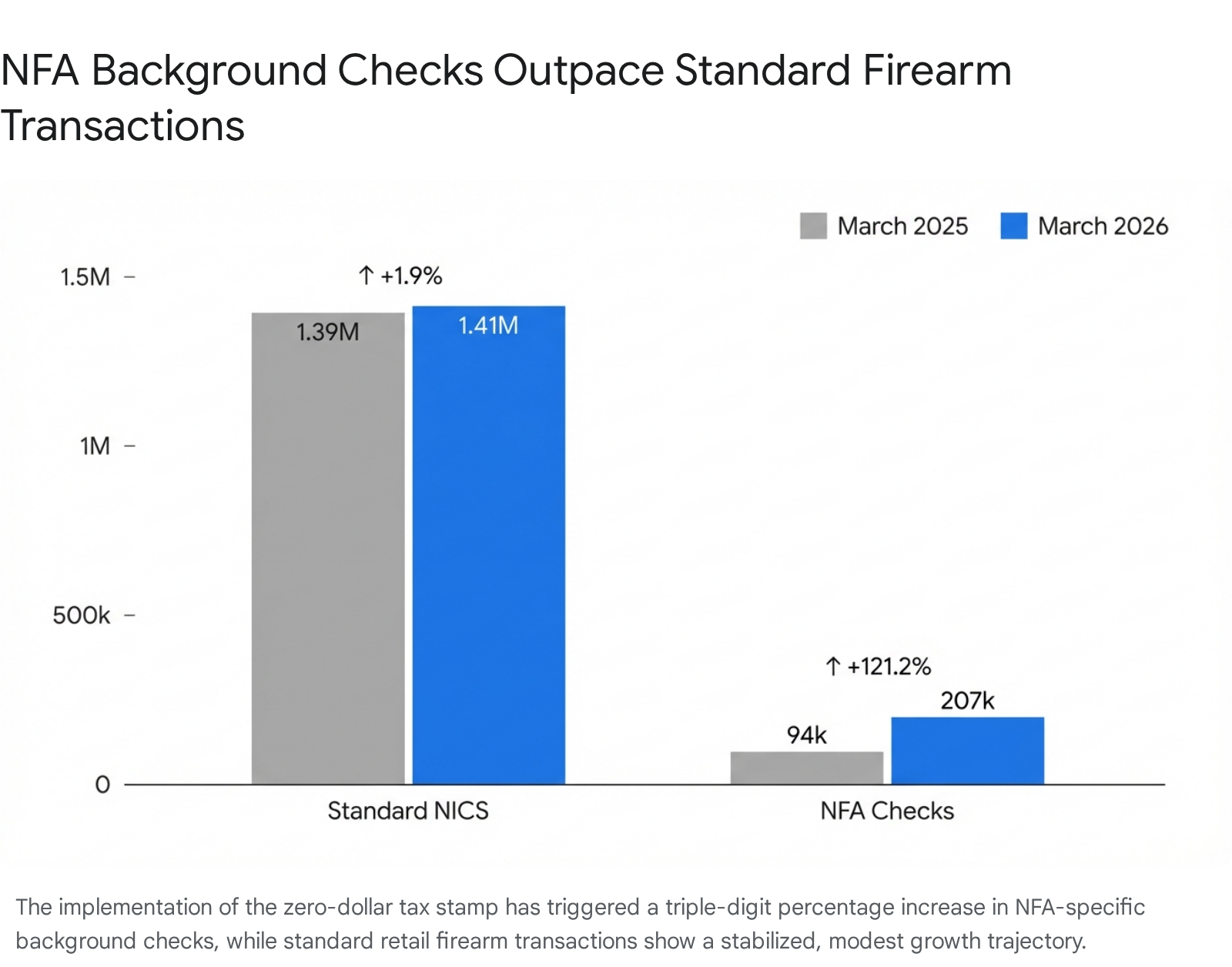
The most profound catalyst for civilian small arms demand and engineering innovation in 2026 was the effective elimination of the $200 federal tax stamp for National Firearms Act (NFA) items. Effective January 1, 2026, the tax stamp requirement for purchasing suppressors, short-barreled rifles (SBRs), short-barreled shotguns (SBS), and Any Other Weapons (AOWs) was eliminated under federal law, effectively dropping the transfer cost to $0.12 This unprecedented regulatory collapse has instantaneously transformed suppressors from a niche, heavily bureaucratic luxury item into a standard, expected consumer accessory.

Retailers across the nation have reported a massive, sustained uptick in suppressor and SBR sales as the primary driver of Q1 revenue.12 This surge has effectively neutralized the anticipated post-holiday retail slump.12 The legislative change has immediate, cascading engineering ramifications across the industry. Firearm manufacturers must now treat threaded barrels, optimized gas port sizing, and adjustable gas blocks as standard, baseline features rather than premium aftermarket upgrades.19 Systems without the ability to easily tune port pressures to accommodate the significantly increased backpressure and cyclic rates generated by suppressors will face rapid market obsolescence. The integration of suppressor-ready features directly from the factory floor is now the minimum viable standard for modern rifle and pistol designs.

1.4 Expanding Domestic Access: Veterans Affairs and Public Lands

Access to firearms and hunting grounds saw significant expansion through coordinated, multi-agency actions during the week. Department of Veterans Affairs (VA) Secretary Doug Collins formally eliminated a highly controversial, three-decade-old policy that reported veterans requiring a fiduciary to manage their financial affairs directly to the FBI’s NICS database as prohibited persons.20 This move, heavily advocated for and applauded by the National Shooting Sports Foundation (NSSF), restores the Second Amendment rights of thousands of veterans, marginally increasing the total addressable market (TAM) for domestic retail sales.20 The industry views this as a critical correction of a policy that conflated financial assistance with a propensity for violence.

Concurrently, the Department of the Interior, under the direction of Secretary Doug Burgum, launched the “Make America Beautiful Again 250” (MABA 250) initiative.22 This program builds upon Secretarial Order 3347 to open vast, previously restricted tracts of federally managed lands to hunting and recreational shooting.22 For the small arms industry, increased public land access directly correlates with sustained, long-term demand for bolt-action hunting rifles, precision optics, and hunting-specific ammunition loads. The expansion of recreational real estate ensures a steady consumer base for traditional sporting arms.

1.5 Legislative Friction: The Stop Online Ammunition Sales Act

Despite sweeping federal deregulation in certain sectors, state-level initiatives and proposed federal legislation continue to pose existential risks to the industry’s logistics and fulfillment network. A growing wave of legislation, spearheaded by the proposed “Stop Online Ammunition Sales Act,” seeks to severely curtail direct-to-consumer (DTC) ammunition fulfillment.23 The legislation aims to completely ban doorstep ammunition delivery, mandate that all online ammunition purchases be shipped directly to a licensed FFL for localized background checks and transfer fees, and establish a strict 1,000-round threshold that would automatically trigger mandatory federal reporting.23

Furthermore, the integration of specific merchant category codes (MCCs) for firearm and ammunition retailers by major credit card networks threatens to isolate the industry from traditional financial processing networks, creating a de facto registry of consumer purchasing habits.23 If enacted broadly, these combined measures could increase the end-user cost of ammunition by 30 to 50 percent in affected jurisdictions.23 More critically, it would destroy the competitive pricing advantage of large online ammunition distributors, forcing a massive contraction in the e-commerce sector of the small arms industry and returning pricing power entirely to local brick-and-mortar retailers.

2.0 Department of Defense Procurement and Doctrinal Schisms

The military procurement space is experiencing a period of intense contradiction and technological friction. While federal law enforcement agencies are surging their acquisition of standard, commercially derived platforms, the Department of Defense is facing a severe doctrinal crisis over the next generation of infantry weapons, exposing the absolute limits of current small arms engineering and metallurgical science.

2.1 The USMC Rejection of the M7 NGSW

In a highly anticipated decision confirmed the week of February 21, 2026, the United States Marine Corps officially and formally rejected the adoption of the Army’s M7 Next Generation Squad Weapon (NGSW) rifle.1 A Marine Corps spokesperson confirmed to defense media that the Corps will instead retain the 5.56x45mm M27 Infantry Automatic Rifle (IAR), a derivative of the Heckler & Koch HK416, for all close combat formations.2

This decision highlights a profound doctrinal and engineering divergence between the U.S. Army and the Marine Corps. The Army’s M7, designed and manufactured by SIG Sauer under a 10-year, $20.4 million initial production contract awarded in 2022, is chambered in the proprietary 6.8x51mm Common Cartridge (originally designated.277 Fury).24 The system was conceptualized and designed to achieve absolute overmatch capability against near-peer adversaries equipped with advanced Level IV body armor at extended engagement ranges.2 The Army is currently issuing the M7 alongside the M250 light machine gun to close combat forces, including infantry, scouts, combat medics, and special operations units.2 However, the Marine Corps’ rejection signals that the Army’s pursuit of kinetic overmatch has come at an unacceptable physiological and logistical cost.

2.2 Engineering Deep Dive: The 6.8x51mm Cartridge Constraints

The rejection of the M7 is deeply rooted in the extreme engineering constraints required to make the 6.8x51mm cartridge function. To achieve the Army’s required 3,000 feet per second muzzle velocity from a relatively short 13-inch barrel, the 6.8mm cartridge generates internal chamber pressures approaching an unprecedented 80,000 psi.4 Standard brass cartridge cases experience catastrophic failure (case head separation and primer pocket expansion) well below this threshold. Consequently, SIG Sauer was forced to engineer a bi-metal cartridge case, featuring a stainless steel base permanently affixed to a brass body, to contain the explosive force.26

This extreme pressure mandates severe metallurgical stress on the weapon system itself. Field reports and testing data indicate that rifling wear begins to degrade accuracy at approximately 2,000 rounds, an incredibly short lifespan for a military service rifle.4 The high pressure and intense thermal loading have also led to ruptured cases, causing complex malfunctions that cannot be cleared quickly in a combat environment.4 To mitigate wear during peacetime, the Army fields a specialized training cartridge with lower pressure, but this fails to replicate the substantial recoil impulse of the combat load, creating a negative training artifact for soldiers who will experience significantly harsher recoil in actual combat.4

The physiological penalty of the system is perhaps its greatest flaw. A fully outfitted M7, complete with its mandatory suppressor (required to mitigate the extreme blast concussion of the high-pressure round) and the advanced M157 fire control optic, weighs an astounding 15.4 pounds.4

M7 NGSW weight comparison chart: M4A1 (8.5 lbs), M27 IAR (7.9 lbs), M7 NGSW (15.4 lbs).

2.3 The M27 IAR and Amphibious Doctrinal Requirements

By contrast, the USMC’s retained M27 Infantry Automatic Rifle weighs roughly 7.9 to 8.4 pounds unloaded, and a fully loaded legacy M4A1 weighs 8.5 pounds.4 From a doctrinal standpoint, the Marine Corps’ reliance on amphibious operations dictates stringent weight management to prevent drowning hazards during littoral insertions and to ensure rapid mobility across beachheads.3

Furthermore, the 6.8mm platform relies on 20-round magazines due to the larger diameter and weight of the cartridges.3 This directly conflicts with the USMC’s long-standing emphasis on high-volume suppressive fire during squad-level maneuver and assault tactics.27 The Marine Corps operates on the principle that fire superiority necessitates a high capacity for ammunition; lighter weapons firing lighter 5.56mm ammunition allow Marines to carry more rounds downrange, facilitating movement.27 While the Army pursues long-range overmatch against static, armored targets, the USMC has definitively signaled that mobility, seamless interoperability with coalition partners, and reliable volume of fire take absolute precedence over raw kinetic energy.2

2.4 The National Defense Industrial Strategy and the “Scale Problem”

Underpinning these procurement debates is the grim reality outlined in the draft of the first-ever National Defense Industrial Strategy (NDIS), which circulated heavily throughout early 2026. The NDIS explicitly warns that the U.S. defense industrial base lacks the capacity, capability, responsiveness, and resilience required to satisfy the full range of military production needs at speed and scale.28

The Pentagon’s strategic shift toward a “Fortress America” concept—prioritizing homeland defense and deterrence by denial in the Indo-Pacific—requires massive, easily replenishable stockpiles of conventional munitions.29 However, the industry suffers from a critical “scale problem.” Optimized over the past two decades for low-volume, high-tech precision weapons, the industrial base cannot currently produce enough basic ammunition, artillery shells (such as 155mm), or small arms propellants to sustain even two simultaneous regional conflicts.28 Rebuilding this highly specialized supply chain requires years of intensive capital investment to reopen dormant factories, train a new generation of specialized labor, and secure raw material streams.30 The U.S. military’s realization that modern wars still hinge on mass production and the sheer volume of available ammunition has prompted a frantic, albeit delayed, attempt to reindustrialize the defense base.30

3.0 Federal Law Enforcement Procurement Surge

In stark contrast to the Department of Defense’s experimental acquisitions and highly complex R&D cycles, federal law enforcement agencies are currently executing a massive procurement surge focused entirely on proven, high-end commercial-off-the-shelf (COTS) small arms.

3.1 DHS, ICE, and CBP Contract Escalation

A comprehensive congressional oversight report released by Senator Adam Schiff on February 19, 2026, revealed that the Department of Homeland Security (DHS) committed at least $144 million in contracts over the past year to heavily arm Immigration and Customs Enforcement (ICE) and Customs and Border Protection (CBP) agents.15

This data indicates a staggering, unprecedented escalation in federal law enforcement firepower. In just one year, ICE’s spending commitments on weapons, ammunition, and accessories surged fourfold—an increase of over 360 percent compared to 2024 contract levels.15 Similarly, CBP’s contracts for weapons and accessories doubled when compared to 2024 totals.15 This surge coincides with a highly aggressive deployment of federal immigration agents across domestic jurisdictions, prompting intense political scrutiny over the militarization of these agencies.31

3.2 Premium Weaponry and Accessory Procurement

The DHS procurement strategy heavily favors premium, high-margin manufacturers, providing a massive financial windfall to specific segments of the small arms industry. For instance, ICE awarded a $13.1 million purchase order to Pennsylvania-based Geissele Automatics for AR-style precision rifles and accessories.32 This represents a 400 percent increase in revenue for Geissele from its previous DHS contract high in 2023.33 Geissele is renowned in the commercial industry for its exceptionally tight-tolerance machining, cold hammer-forged barrels, and specialized two-stage trigger groups. The selection of Geissele indicates that DHS is intentionally outfitting its agents with tier-one tactical equipment that far exceeds standard military-specification carbines.33

In the sidearm market, CBP executed multi-million dollar contracts with Glock Inc., continuing the agency’s reliance on the proven polymer-framed striker-fired platform. CBP placed an order worth $3.25 million in September 2025, and followed it up with an additional $644,544 order on January 20, 2026, for 9mm service pistols, repair parts, and accessories.32

Beyond the firearms themselves, the agencies awarded millions in contracts for high-end optical accessories, shifting away from traditional iron sights. CBP awarded $2.5 million for handgun and rifle optical sights, of which $1.9 million has already been paid out.16 ICE awarded an additional $3.6 million specifically for red dot optic sights intended for Glock issued duty weapons, highlighting the wholesale transition of federal law enforcement to pistol-mounted optics.16

AgencyContractorProduct CategoryContract Value (Est.)Timeframe / Status
ICEGeissele AutomaticsAR-style Precision Rifles & Accessories$13.1 Million2025-2026 (400% YoY Increase)
CBPGlock Inc.9mm Service Pistols & Parts$3.25 MillionSeptember 2025
CBPGlock Inc.9mm Service Pistols & Parts$644,544January 2026
ICEUndisclosedRed Dot Sights for Glock Duty Weapons$3.6 Million2025-2026
CBPUndisclosedHandgun and Rifle Optical Sights$2.5 Million2025-2026
DHS (Combined)VariousAmmunition>$30 Million2025-2026
DHS (Combined)VariousLess-Lethal (TASERs, Tear Gas)>$25 Million2025-2026

Furthermore, the agencies committed over $30 million solely to ammunition procurement, and an additional $25 million to purchase massive quantities of “less-lethal” weapons and crowd control devices, including TASERs, pepper sprays, tear gas canisters, and multi-round canister launchers.16 From a macroeconomic industry perspective, this massive injection of federal capital provides a robust, guaranteed financial floor for major manufacturers, effectively insulating them from cyclical, demand-driven downturns in the civilian retail market.33

4.0 Global Supply Chain and Ammunition Market Dynamics

The ammunition sector is currently the most volatile and severely constrained segment of the small arms industry. Unlike the manufacturing of firearm components—which relies on widely available steel, aluminum, polymers, and standard CNC machining capacity—ammunition manufacturing is strictly bottlenecked by the highly regulated chemical synthesis of propellants and primers.

4.1 The Nitrocellulose Bottleneck

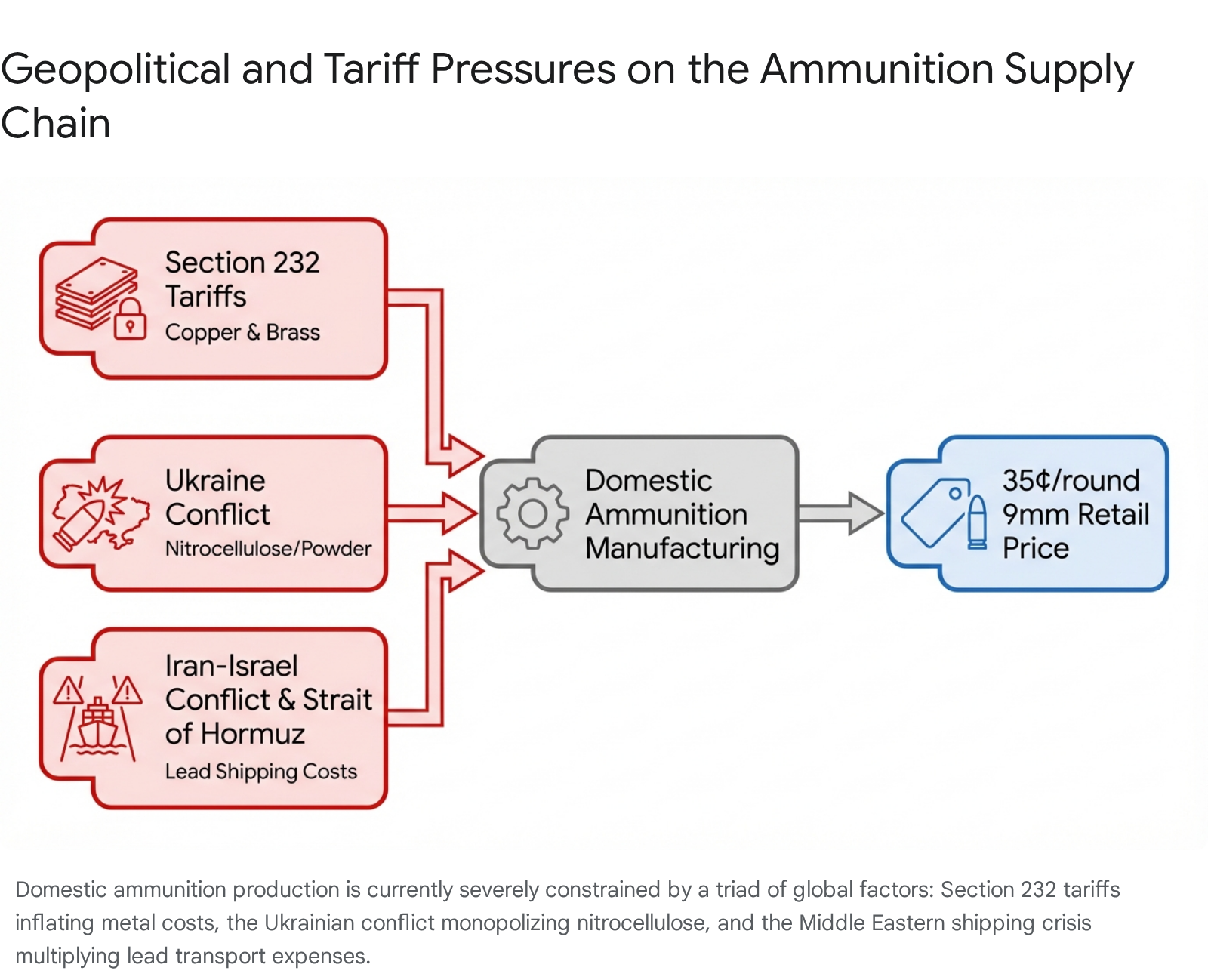
The foundational element of modern smokeless powder is nitrocellulose, created through the nitration of cellulose (typically wood pulp or cotton linters) using nitric acid. Global production of military-grade nitrocellulose relies heavily on a complex supply chain that has been severely disrupted by geopolitical friction.7 Global conflicts in Ukraine and the Middle East are aggressively diverting critical raw materials to defense stockpiles.6 Furthermore, strict export restrictions on key components such as nitrocellulose and antimony, particularly following recent aggressive Chinese export controls, have intensified material shortages and caused extreme price volatility across the sector.6

The suspension of smokeless powder shipments by major international suppliers has highlighted systemic vulnerabilities, causing cascading production delays throughout the domestic ammunition industry.6 This constraint is explicitly acknowledged at the federal level; in response to this strategic vulnerability, the 2024 Ammunition Supply Chain Act (H.R.8066) mandated a formal congressional review of U.S. production inputs, including nitrocellulose, nitroglycerin, and acid production.8 Allied nations are reacting similarly. Canada’s newly unveiled Defence Industrial Strategy explicitly commits to establishing a sovereign, domestic Canadian nitrocellulose production capability by 2029, acknowledging that reliance on foreign propellants is an unacceptable strategic risk.9 Until these long-term industrial projects yield results, U.S. manufacturers remain trapped in a structurally constrained supply environment, completely unable to rapidly scale production regardless of civilian or military demand spikes.8

4.2 Tariffs and Price Escalation

Exacerbating these raw material shortages is the 10 percent U.S. tariff on select foreign ammunition imports implemented in early 2025.6 This trade barrier immediately disrupted the supply of cheap, imported bulk ammunition that traditionally served to keep domestic prices in check. To circumvent the tariff and ensure uninterrupted supply, prominent international manufacturers like Brazil’s Taurus Armas have been forced to strategically leverage and expand their U.S.-based production capacities.6

The net economic effect has been an unavoidable, structural cost escalation for the end consumer. A U.S. Congressional Budget Office analysis anticipated the inflationary pressure of these tariffs to persist through 2026.6 Major domestic producers have adjusted their pricing models upward to absorb the blow. Industry data shows brands like Winchester instituting 3 to 8 percent price hikes, while The Kinetic Group brands raised prices by 3 to 12 percent over the past year to offset the surging costs of raw materials, labor, and chemical inputs.6

Tracking the retail price of 9mm Full Metal Jacket (FMJ) ammunition provides the clearest barometer of the market’s overall health. Prior to the pandemic disruptions (2016-2019), 9mm prices were highly stable, averaging between $0.20 and $0.22 per round, with bargain bulk deals occasionally driving prices down to $0.18 per round.10

Following the extreme volatility of the early 2020s, prices have structurally failed to return to that baseline. By early 2026, the average cost of 9mm ammunition hovered stubbornly around $0.24 to $0.26 per round.10 While the market is no longer in a state of acute panic buying, the permanently elevated price floor perfectly reflects the insurmountable structural increases in upstream chemical inputs and logistics costs.8

9mm ammo price chart showing a new floor above $0.24/round, reflecting nitrocellulose shortages and import tariffs.

5.0 Corporate Actions, M&A, and Financial Performance

The week of February 21, 2026, captured the culmination of several massive structural shifts in the public markets, highlighting an industry undergoing rapid international consolidation, aggressive capital reallocation, and highly polarized financial performance among key domestic players.

5.1 The Vista Outdoor Dissolution and CSG Acquisition

The most significant and far-reaching corporate restructuring in the ammunition sector was formally completed as Vista Outdoor (NYSE: VSTO) finalized the sale of its sporting products division, “The Kinetic Group,” to Czechoslovak Group a.s. (CSG).5 Following rigorous negotiations and an amended merger agreement that successfully increased the base purchase price to $2.15 billion, Vista stockholders officially approved the transaction at a special meeting on November 25, 2024, with the final operational transitions culminating in early 2026.5 Under the terms of the agreement, Vista Outdoor stockholders received $25.75 in cash and one share of the newly spun-off outdoor gear company, Revelyst, for each share of VSTO held.5

The Kinetic Group controls a massive percentage of U.S. civilian ammunition manufacturing, serving as the parent company to iconic brands including Federal, CCI, Speer, and Remington. Its acquisition by CSG—a rapidly expanding Prague-based defense conglomerate—represents a massive influx of European capital and strategic influence into the American industrial base.35 This move aligns perfectly with CSG’s broader aggressive expansion strategy. In January 2026, CSG completed the largest defense Initial Public Offering (IPO) in global history on the Euronext Amsterdam, raising €3.8 billion and pushing its total market capitalization to a staggering €25 billion.35

The strategic implications are profound. CSG’s vast European resources, deep integration into NATO artillery and munitions supply chains (including subsidiaries like Excalibur Army, Tatra Trucks, and MSM Group), and €4.5 billion in revenues for the first nine months of 2025 may provide The Kinetic Group with preferential, vertically integrated access to raw nitrocellulose and primers.35 This grants the newly acquired brands a distinct, perhaps insurmountable, competitive advantage over purely domestic U.S. competitors struggling with spot-market chemical pricing.

Simultaneously, the remaining Vista Outdoor entity, Revelyst, began trading on the NYSE under the ticker “GEAR”.5 However, this will be short-lived, as Revelyst is slated to be acquired in an all-cash transaction valued at $1.125 billion by the investment firm Strategic Value Partners (SVP), a move expected to close shortly, effectively dissolving the legacy Vista Outdoor conglomerate entirely.39 At the close of the week, VSTO legacy stock metrics showed a value of $44.63 with a $1.5 billion market cap.40

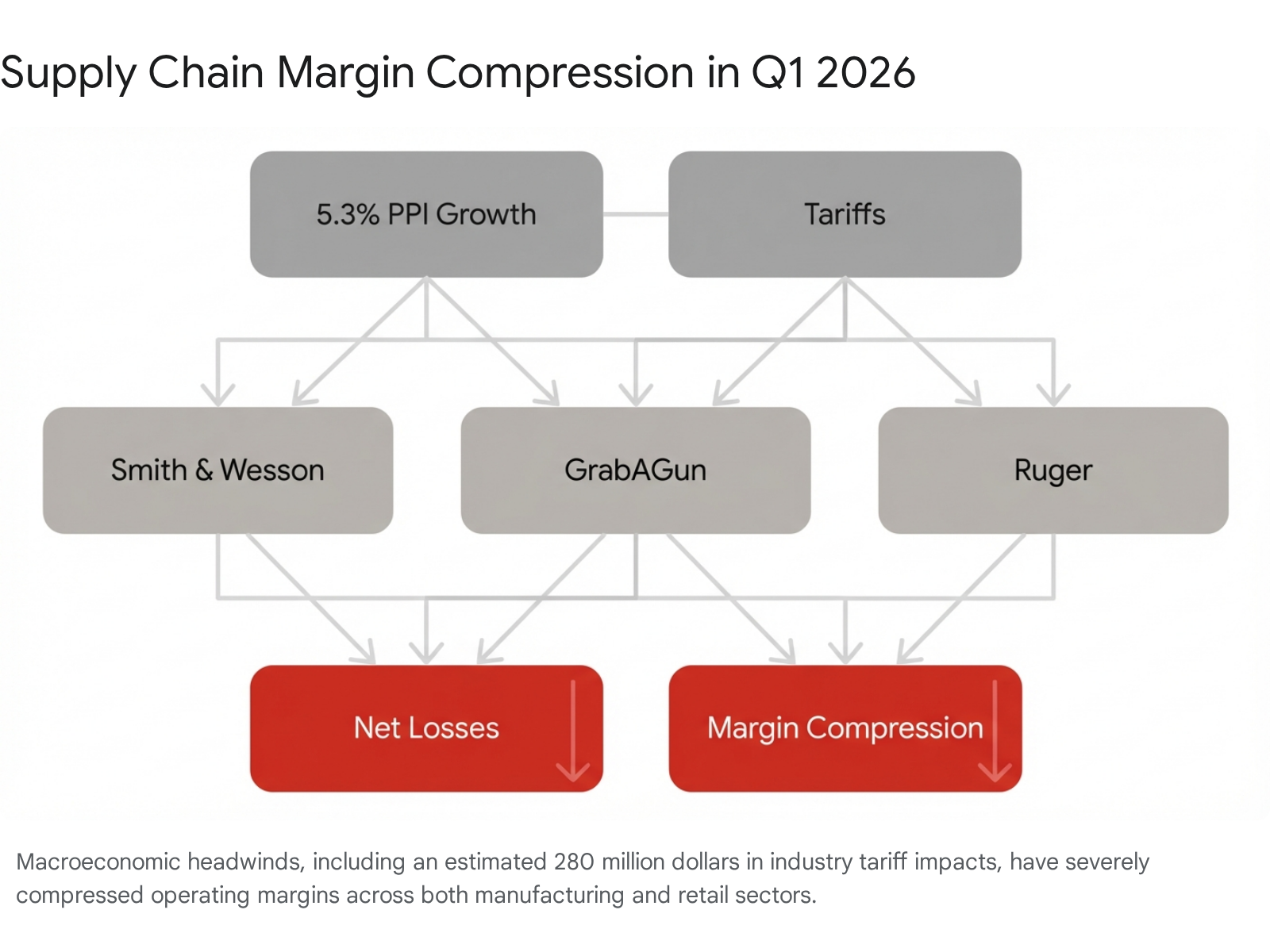
5.2 Smith & Wesson Brands: Financial Outperformance vs. Margin Reality

Against a broader macroeconomic backdrop of softening civilian demand and high interest rates, Smith & Wesson Brands (NASDAQ: SWBI) demonstrated significant operational resilience and stock market outperformance. In mid-February, SWBI reported strong quarterly earnings that decisively exceeded Wall Street estimates, posting $124.7 million in revenue and $0.04 Earnings Per Share (EPS) versus an expected $0.02.42

While top-line revenue technically declined 3.9 percent year-over-year, the earnings beat triggered a massive stock rally. Shares surged up by over 45 percent over a six-month period, hitting a new 52-week high of $12.15 before settling near $12.01 by February 20.42 SWBI’s success is largely attributed to its strategic corporate pivot toward high-margin, premium-tier products rather than attempting to compete on volume in the saturated entry-level market. A prime example of this strategy is their newly announced exclusive partnership with distributor Lipsey’s to release the Performance Center Field Ethos Model 36 revolver—a highly tuned, limited-edition J-Frame chambered in.38 Special +P, featuring premium walnut grips and extensive factory action work.19

By focusing on premium SKUs that command higher retail prices, SWBI is successfully maintaining absolute profitability even as gross unit volumes decline across the broader market. However, financial analysts maintain a highly cautious “Hold” rating on the stock.42 This caution is driven by thin fundamental profitability metrics, including a net margin of just 1.89 percent and a Return on Equity (ROE) of 2.34 percent.42 Most alarmingly, analysts highlight SWBI’s unsustainably high dividend payout ratio of 273.68 percent, suggesting the company is leveraging its balance sheet to reward shareholders in the short term at the potential expense of long-term R&D capital.42

5.3 Market Volatility: Sturm, Ruger & Co., Ammo Inc., and Olin Corp.

Sturm, Ruger & Company (NYSE: RGR) maintained a highly stable, steady posture throughout the week, with its stock trading in a tight band around $38.00 to $38.37.44 Ruger’s market capitalization sits at approximately $599.5 million.44 The company’s stability is supported by aggressive, well-received new product launches (detailed in Section 6.0) that aim to aggressively capture market share in the highly competitive 9mm polymer pistol segment.44

Conversely, Ammo Inc. (NASDAQ: POWW), which operates under the corporate entity Outdoor Holding Company, experienced severe, downward volatility. Trading around $1.98 to $2.00 per share, the stock plummeted from earlier highs following a mixed Q3 earnings report that revealed $13.39 million in revenue and a nominal EPS of $0.01.47 The company is plagued by severe long-term profitability concerns, reporting a net income loss of $130.83 million for the fiscal year.47 Notably, SEC filings from mid-February revealed millions of shares being rapidly offloaded by corporate insiders, including CEO Steven F. Urvan, raising immediate red flags regarding the company’s internal health and executive confidence.50 Furthermore, the company received a non-compliance letter from Nasdaq related to the delayed filing of its 10-Q report.51 Despite the manufacturing side’s struggles, the company’s GunBroker.com marketplace remains a highly lucrative digital asset, anchoring its overall valuation.49

Finally, chemical and propellant manufacturer Olin Corporation (NYSE: OLN), the parent company of Winchester Ammunition, closed the week near $24.28, down slightly from its 52-week high of $27.35.52 Olin’s valuation is tightly linked to global commodity prices for chemicals and the success of its military ammunition contracts.

TickerCompany NameClosing Price (2/20/26)52-Week HighMarket CapKey Catalyst / Status
VSTOVista Outdoor$44.63$25.68 (Pre-Split)$1.5 BillionAcquisition of Kinetic Group by CSG finalized; Revelyst spin-off to SVP.
SWBISmith & Wesson Brands$12.01$12.15~$550 MillionQ4 earnings beat; 45% 6-month rally; unsustainably high 273% dividend payout.
RGRSturm, Ruger & Co.$38.37$48.21$599.5 MillionStable trading; supported by aggressive launch of RXM modular pistol platform.
POWWAmmo Inc. (Outdoor Holding)$2.00$2.13$235.7 MillionHeavy insider selling; Nasdaq non-compliance for delayed 10-Q; GunBroker anchors value.
OLNOlin Corporation$24.28$27.35$2.77 BillionSlight pullback; pricing tied to global chemical/propellant commodity markets.

6.0 Engineering Innovations and Q1 2026 Product Launches

The engineering focus in early 2026 has shifted noticeably away from the development of purely novel, proprietary calibers. Instead, R&D divisions are returning to refining ergonomics, maximizing modularity, and enhancing suppressor-host capabilities on proven, widely available platforms. Manufacturers are aggressively leveraging advanced polymers, CNC machining efficiencies, and modular chassis systems to reduce production costs while offering consumers infinite, unregulated customization.

6.1 The Ruger RXM: Mainstreaming the Modular Chassis

Sturm, Ruger & Co. initiated a major disruption in the polymer-frame handgun market with the aggressive launch of the Ruger RXM 9mm pistol.46 The RXM utilizes a highly advanced modular, serialized Fire Control Insert (FCI) machined entirely from through-hardened stainless steel.54 Under the guidelines of the Gun Control Act, because the FCI houses the sear and trigger mechanisms and bears the serial number, it is the legally recognized “firearm.” Consequently, the external grip module is merely a non-regulated polymer shell. This architecture allows users to swap grip sizes, textures, and colors instantly at home without undergoing an additional background check or paying transfer fees.

While SIG Sauer popularized this technology with the P320, Ruger executed a strategic masterstroke by partnering directly with Magpul Industries to design and manufacture the polymer grip module.46 The Magpul Enhanced Handgun Grip features an optimized trigger guard undercut allowing for a higher purchase on the gun, a flared magazine well for faster reloads, and highly aggressive texturing, elevating the RXM’s ergonomics far above standard factory offerings.54

Engineering specifications are rigorously optimized for the modern shooter. The pistol features a 4-inch or 4.5-inch precision rifled alloy steel barrel finished in Black FNC Nitride for extreme corrosion resistance, a 15+1 or 17+1 capacity utilizing Magpul PMAG 15 GL9 (Glock-pattern) magazines, and a flat-faced trigger with a clean pull weight of approximately 4.75 to 5 pounds.54 Crucially, the slide is optics-ready direct from the factory, milled to directly accept RMR, DeltaPoint Pro, and RMSc footprints without the need for thick, unreliable adapter plates, ensuring a significantly lower optic bore axis.55 With an aggressively low MSRP ranging from $499 to $599, the RXM applies immense, targeted pricing pressure on established market leaders like the Glock 19.46

Ruger RXM exploded view: slide assembly, fire control insert, grip module.

6.2 Spandau Arms RL: The Resurgence of the R700 Footprint

In the precision rifle segment, SDS Arms launched the Spandau Arms RL bolt-action rifle, signaling a distinct industry return to heritage platforms blended with highly modern manufacturing techniques.57 Chambered initially in.308 Winchester, the Spandau RL features a 20-inch barrel utilizing advanced 5R rifling with a 1:10 twist rate.58 5R rifling utilizes five slanted lands and grooves rather than the traditional symmetrical six, which reduces projectile deformation, decreases jacket fouling, and makes the barrel significantly easier to clean while optimizing stabilization for heavy, modern bullet profiles.58

The critical engineering and business decision for the Spandau RL was the utilization of a Remington 700-compatible short action footprint.59 Rather than developing a proprietary action that forces consumers to buy brand-specific accessories, utilizing the universally accepted R700 footprint grants the Spandau RL immediate access to the largest aftermarket ecosystem of precision chassis, match-grade triggers, and scope bases in the world.58 The rifle features a highly reliable push-feed action, an oversized bolt handle for rapid cycling under optics, and a bottom metal configured to accept standard AICS-pattern detachable box magazines (shipping with 3-round and 5-round options).59 Priced at a highly competitive MSRP of $799.99, and finished with a traditional Turkish walnut stock combined with a modern, extreme corrosion-resistant oxynitride finish on the metalwork, the RL is perfectly positioned to capture traditional hunters seeking modern precision tolerances without exorbitant custom-rifle costs.58

The engineering momentum generated at the 2026 SHOT (Shooting, Hunting, Outdoor Trade) Show in Las Vegas in late January continues to dictate Q1 manufacturing schedules. The trade show, which hosted over 53,000 industry professionals and 2,744 exhibitors, confirmed several macro-engineering trends that will define the year.11

First, following the federal government’s decision to halt the enforcement of ATF rules regarding pistol stabilizing braces, manufacturers flooded the floor with large-format pistols and short-barreled platforms equipped with these devices.11 This effectively circumvents the traditional bureaucratic hurdles of the NFA, offering consumers SBR-like performance without federal registration.11

Second, the legalization and rapid proliferation of Forced-Reset Triggers (FRTs) and binary triggers represent a massive shift in civilian rate-of-fire capabilities.11 These mechanical devices, which use the cyclic action of the bolt carrier group to assist in rapidly resetting the trigger sear, allow standard semi-automatic AR-15s to approach fully automatic cyclic rates of fire.11 This extreme rate of fire has spawned an entirely new niche market for heavy-duty, thermally resilient components. For instance, KAK Industry introduced a highly unconventional water-cooled, belt-fed AR-15 upper receiver designed specifically to handle the extreme thermal loads and barrel degradation generated by sustained FRT usage.11

Finally, the total repeal of the NFA tax stamp has made suppressor integration the most critical design factor of 2026.12 Rifles like the Franchi Momentum MULE and the Henry SPD PREDATOR are now being marketed explicitly on their suppressor-ready threaded barrels and gas system tunability, treating the attachment of a silencer as a guarantee rather than an option.62

7.0 Strategic Conclusions and Industry Outlook

The U.S. small arms industry in the first quarter of 2026 is defined by a deep, inescapable structural paradox. From a regulatory standpoint, the domestic civilian market has rarely enjoyed a more permissive environment. The systematic dismantling of the ATF’s zero-tolerance policy, the historic abolition of the NFA tax stamp for suppressors, and the vast expansion of public land access have removed significant barriers to entry and ownership.12 Consequently, engineering and manufacturing cycles are accelerating, bringing highly capable, modular systems like the Ruger RXM to market at aggressively competitive price points.46

However, beneath the surface of civilian deregulation lies a fragile industrial base crippled by severe supply chain bottlenecks. The ammunition sector remains in a state of chronic vulnerability. The inability to domestically scale nitrocellulose production, coupled with global conflicts heavily siphoning off raw materials, guarantees that ammunition prices will remain structurally elevated for the foreseeable future.6 The acquisition of The Kinetic Group by Europe’s CSG underscores a harsh reality: foreign capital and integrated overseas supply chains are now required to sustain and modernize legacy American manufacturing assets.5

Simultaneously, the industry is witnessing a profound doctrinal split within the U.S. military that exposes the limits of metallurgical science. The Marine Corps’ rejection of the 6.8mm M7 rifle is a stark reminder that pure kinetic performance cannot override basic physiological and mechanical limits.1 The 80,000 psi chamber pressures and crushing 15.4-pound weight of the new Army system expose the physical limits of current infantry weapon design.4 As the Army pushes forward with a heavy, highly complex system designed for peer-state overmatch, the USMC and federal law enforcement agencies like DHS are deliberately retreating to lighter, proven 5.56mm and 9mm COTS platforms.3

Moving deeper into 2026, domestic manufacturers must deftly navigate these divergent realities: capitalizing on a booming, deregulated domestic accessory market while bracing for the harsh limitations of global chemical supply chains and wildly shifting federal procurement strategies.


Please share the link on Facebook, Forums, with colleagues, etc. Your support is much appreciated and if you have any feedback, please email us in**@*********ps.com. If you’d like to request a report or order a reprint, please click here for the corresponding page to open in new tab.


Sources Used

  1. U.S. Marine Corps Rejects Switch to M7 Rifle – RealClearDefense, accessed February 21, 2026, https://www.realcleardefense.com/2026/02/21/us_marine_corps_rejects_switch_to_m7_rifle_1166254.html
  2. U.S. Marine Corps rejects switch to M7 rifle – Defence Blog, accessed February 21, 2026, https://defence-blog.com/u-s-marine-corps-rejects-switch-to-m7-rifle/
  3. Marines not interested in switching from M27 to Army’s M7 anytime soon – Task & Purpose, accessed February 21, 2026, https://taskandpurpose.com/news/marines-m27-rifle-swap/
  4. Is the Army’s new M7 rifle a step back over its predecessor? | Sandboxx, accessed February 21, 2026, https://www.sandboxx.us/news/is-the-armys-new-m7-rifle-a-step-back-over-its-predecessor/
  5. Vista Outdoor Announces Completion of CSG Transaction, accessed February 21, 2026, https://investors.vistaoutdoor.com/Investors/news/news-details/2024/Vista-Outdoor-Announces-Completion-of-CSG-Transaction/default.aspx
  6. Small Arms Ammunition Market Size & Share 2026-2032, accessed February 21, 2026, https://www.360iresearch.com/library/intelligence/small-arms-ammunition
  7. Europe’s Struggle: Cheap Weapons at Scale – SETA, accessed February 21, 2026, https://www.setav.org/en/europes-struggle-cheap-weapons-at-scale
  8. Ammunition in 2026: Supply Conditions, Price Pressures, and Market Signals, accessed February 21, 2026, https://blog.targetsportsusa.com/2026-ammunition-outlook-supply-pricing-availability/
  9. 5 things you should know about Canada’s new defence industrial strategy – Squamish Chief, accessed February 21, 2026, https://www.squamishchief.com/national-news/5-things-you-should-know-about-canadas-new-defence-industrial-strategy-11890021
  10. 10-Year 9mm Ammo Price History (2016–2025) – Ammunition Depot, accessed February 21, 2026, https://www.ammunitiondepot.com/ammo-price-history/9mm
  11. See the New Guns Introduced at the 2026 SHOT Show, accessed February 21, 2026, https://smokinggun.org/see-the-new-guns-introduced-at-the-2026-shot-show/
  12. 2026 Sales Trends Already Emerging – Shooting Industry Magazine, accessed February 21, 2026, https://shootingindustry.com/dealer-advantage/2026-sales-trends-already-emerging/
  13. ATF Launches New Era of Reform, accessed February 21, 2026, https://www.atf.gov/rules-and-regulations/atf-launches-new-era-reform
  14. FFL Compliance Guide 2026: Every ATF Rule, Violation, and Inspection Checklist for Federal Firearms Licensees – Bravo Store Systems, accessed February 21, 2026, https://www.bravostoresystems.com/post/ffl-compliance-guide
  15. NEWS: In New Report, Sen. Schiff Exposes Over $140 Million Dedicated to ICE and CBP’s Deadly Arsenal of Weapons and Munitions Since Start of Second Trump Administration, accessed February 21, 2026, https://www.schiff.senate.gov/news/press-releases/news-in-new-report-sen-schiff-exposes-over-140-million-dedicated-to-ice-and-cbps-deadly-arsenal-of-weapons-and-munitions-since/
  16. ice and cbp’s multi-million dollar surge to amass weapons and munitions – Senator Adam Schiff, accessed February 21, 2026, https://www.schiff.senate.gov/wp-content/uploads/2026/02/ARMED-FOR-VIOLENCE-REPORT2.18.26.pdf
  17. President Trump’s “America First Arms Transfer Strategy” | Brownstein, accessed February 21, 2026, https://www.bhfs.com/insight/president-trumps-america-first-arms-transfer-strategy/
  18. All Updates | Defense Security Cooperation Agency, accessed February 21, 2026, https://samm.dsca.mil/all-updates
  19. New Guns For 2026 – Gun Digest, accessed February 21, 2026, https://gundigest.com/article/new-guns-for-2026
  20. NSSF Salutes VA Secretary Collins for Protecting Veterans’ Second Amendment Rights, accessed February 21, 2026, https://www.nssf.org/articles/nssf-salutes-va-secretary-collins-for-protecting-veterans-second-amendment-rights/
  21. News – NSSF, accessed February 21, 2026, https://www.nssf.org/news/
  22. NSSF Applauds President Trump’s Strategic Initiative Make America Beautiful Again 250, accessed February 21, 2026, https://www.nssf.org/articles/nssf-applauds-president-trumps-strategic-initiative-make-america-beautiful-again-250/
  23. Online Ammo WILL Be ILLEGAL in 2026: What You Need To Know – YouTube, accessed February 21, 2026, https://m.youtube.com/watch?v=Rut88bzR-3k
  24. M7 rifle – Wikipedia, accessed February 21, 2026, https://en.wikipedia.org/wiki/M7_rifle
  25. Sig Sauer’s XM7 Rifle Gets Army’s Seal Of Approval Despite Controversy (Updated), accessed February 21, 2026, https://www.twz.com/land/sig-sauers-m7-rifle-gets-official-army-seal-of-approval-despite-controversy
  26. Marines not interested in switching from M27 to Army’s M7 anytime soon – The Armory Life, accessed February 21, 2026, https://www.thearmorylife.com/forum/threads/marines-not-interested-in-switching-from-m27-to-armys-m7-anytime-soon.25373/
  27. Marines not interested in switching from M27 to Army’s M7 anytime soon – Reddit, accessed February 21, 2026, https://www.reddit.com/r/army/comments/1r4762z/marines_not_interested_in_switching_from_m27_to/
  28. U.S. Can’t Keep Up with the Weapons Global Demand Pace, accessed February 21, 2026, https://militarnyi.com/en/news/u-s-can-t-keep-up-with-the-weapons-global-demand-pace/
  29. America’s new Defence Strategy and Europe’s moment of truth – EPC, accessed February 21, 2026, https://www.epc.eu/publication/americas-new-defence-strategy-and-europes-moment-of-truth/
  30. America’s Scale Problem – Foreign Policy Research Institute, accessed February 21, 2026, https://www.fpri.org/article/2025/10/americas-scale-problem/
  31. In New Report, Sen. Schiff Exposes Over $140 Million Dedicated to ICE and CBP’s Deadly Arsenal of Weapons and Munitions Since Start of Second Trump Administration, accessed February 21, 2026, https://www.independent.com/2026/02/19/in-new-report-sen-schiff-exposes-over-140-million-dedicated-to-ice-and-cbps-deadly-arsenal-of-weapons-and-munitions-since-start-of-second-trump-administration/
  32. The Department of Homeland Security spent over $140 million on weapons for ICE in 2025, accessed February 21, 2026, https://english.elpais.com/usa/2026-02-20/the-department-of-homeland-security-spent-over-140-million-on-weapons-for-ice-in-2025.html
  33. Gun Sellers Have Made Millions From Trump’s Deployment of Immigration Agents, accessed February 21, 2026, https://www.thetrace.org/2026/01/gun-companies-ice-cbp-contracts-trump/
  34. Vista Outdoor Announces Increased Purchase Price from CSG for The Kinetic Group of $2.15 Billion and Increased Cash Consideration of $24.00 Per Share, accessed February 21, 2026, https://investors.vistaoutdoor.com/Investors/news/news-details/2024/Vista-Outdoor-Announces-Increased-Purchase-Price-from-CSG-for-The-Kinetic-Group-of-2.15-Billion-and-Increased-Cash-Consideration-of-24.00-Per-Share/default.aspx
  35. Czechoslovak Group lists on Euronext, accessed February 21, 2026, https://www.euronext.com/en/about/media/euronext-press-releases/czechoslovak-group-lists-euronext-0
  36. CZECHOSLOVAK GROUP announces admission to trading on Euronext Amsterdam, accessed February 21, 2026, https://www.globenewswire.com/news-release/2026/01/23/3224450/0/en/CZECHOSLOVAK-GROUP-announces-admission-to-trading-on-Euronext-Amsterdam.html
  37. Czechoslovak Group’s Market Capitalization Reaches €25 Billion After IPO – Militarnyi, accessed February 21, 2026, https://militarnyi.com/en/special-projects/czechoslovak-group-s-market-capitalization-reaches-e25-billion-after-ipo/
  38. For Investors | Czechoslovak Group – Strategy & Results, accessed February 21, 2026, https://czechoslovakgroup.com/en/for-investors
  39. VSTO – Vista Outdoor Inc Latest Stock News & Market Updates, accessed February 21, 2026, https://www.stocktitan.net/news/VSTO/
  40. Vista Outdoor: VSTO Stock Price Quote & News | Robinhood, accessed February 21, 2026, https://robinhood.com/stocks/VSTO
  41. Buy Vista Outdoor Stock – VSTO Stock Quote Today & Investment Insights – Public.com, accessed February 21, 2026, https://public.com/stocks/vsto
  42. Smith & Wesson Brands, Inc. Stock Price: Quote, Forecast, Splits & News (SWBI) – Perplexity, accessed February 21, 2026, https://www.perplexity.ai/finance/SWBI
  43. Smith & Wesson Brands – 28 Year Stock Price History | SWBI – Macrotrends, accessed February 21, 2026, https://www.macrotrends.net/stocks/charts/SWBI/smith-wesson-brands/stock-price-history
  44. NYSE / RGR, accessed February 21, 2026, https://www.nyse.com/quote/XNYS:RGR
  45. Sturm, Ruger – 53 Year Stock Price History | RGR – Macrotrends, accessed February 21, 2026, https://www.macrotrends.net/stocks/charts/RGR/sturm,-ruger/stock-price-history
  46. RXM – Ruger® Firearms, accessed February 21, 2026, https://www.ruger.com/products/rxm/models.html
  47. POWW Stock Price and Chart — NASDAQ:POWW – TradingView, accessed February 21, 2026, https://www.tradingview.com/symbols/NASDAQ-POWW/
  48. Ammo Stock Price Forecast. Should You Buy POWW? – StockInvest.us, accessed February 21, 2026, https://stockinvest.us/stock/POWW
  49. POWW Stock Quote | Price Chart | Volume Chart Outdoor Holding Company, accessed February 21, 2026, https://marketchameleon.com/Overview/POWW/Summary/
  50. AMMO Stock Price | POWW Stock Quote, News, and History | Markets Insider, accessed February 21, 2026, https://markets.businessinsider.com/stocks/poww-stock
  51. Outdoor Holding (Nasdaq:POWW) – Stock Analysis – Simply Wall St, accessed February 21, 2026, https://simplywall.st/stocks/us/retail/nasdaq-poww/outdoor-holding
  52. Stock Information – Olin® Corporation, accessed February 21, 2026, https://olin.com/investors/stock-quote/
  53. Olin – 53 Year Stock Price History | OLN – Macrotrends, accessed February 21, 2026, https://www.macrotrends.net/stocks/charts/OLN/olin/stock-price-history
  54. Ruger RXM 9mm: Full Review – Guns and Ammo, accessed February 21, 2026, https://www.gunsandammo.com/editorial/ruger-rxm-9mm-review/521786
  55. Ruger® RXM® Centerfire Pistol Model 19412, accessed February 21, 2026, https://ruger.com/products/rxm/specSheets/19412.html
  56. Ruger RXM Review | Craft Holsters®, accessed February 21, 2026, https://www.craftholsters.com/ruger/guides/rxm
  57. SDS Arms Spandau RL Bolt Action Rifle in .308 Win: First Look – Guns and Ammo, accessed February 21, 2026, https://www.gunsandammo.com/editorial/sds-arms-spandau-rl/537913
  58. SDS Arms Launches the Spandau Arms RL Bolt-Action Rifle, accessed February 21, 2026, https://spandauarms.com/news/sds-arms-launches-the-spandau-arms-rl-boltaction-rifle/
  59. Spandau RL .308 Win Bolt-Action Rifle | 700-Compatible, accessed February 21, 2026, https://spandauarms.com/spandau-rl-bolt-action-308-win/
  60. Bolt-Action Rifles – Firearms – Spandau Arms, accessed February 21, 2026, https://spandauarms.com/categories/firearms/bolt-action-rifles.html
  61. 48th SHOT Show Closes With Big Crowds, Big Deals, Big Innovation, accessed February 21, 2026, https://www.nssf.org/articles/48th-shot-show-closes-with-big-crowds-big-deals-big-innovation/
  62. New Products from SHOT Show 2026 – Day One – Silencer Central, accessed February 21, 2026, https://www.silencercentral.com/blog/shot-show-new-products/
  63. Hot from SHOT: The Best New Hunting Rifles for 2026 | An Official Journal Of The NRA, accessed February 21, 2026, https://www.americanhunter.org/content/hot-from-shot-the-best-new-hunting-rifles-for-2026/

The Top 10 Questions New American Gun Owners Ask

The landscape of the American small arms industry has undergone a paradigm shift of unprecedented proportions between 2020 and early 2026. Data suggests that more than 26.2 million Americans became first-time gun owners during this period, a figure that rivals the entire population of the state of Florida.1 This surge, initially catalyzed by the socio-political instability of the COVID-19 pandemic and subsequent civil unrest, has evolved from a state of “panic buying” into a sustained, innovation-driven consumer market.4 Notably, the demographic profile of the modern firearm owner has diversified more in the last six years than in the previous sixty. Industry surveys indicate that 30 percent of these first-time buyers in 2024 were under the age of 30, and nearly 29 percent were women.1 Significant growth was reported among Hispanic men and women, Black men and women, and Asian American populations, signaling a decisive move away from the “pale, stale, and male” stereotype that has historically defined the sector.1

As these new segments enter the market, they bring with them a set of recurring questions that reflect a departure from traditional “fudd” lore toward a demand for technical proficiency and modern tactical theory. Small arms industry analysts now observe a critical knowledge gap that manufacturers, retailers, and trainers must address to ensure market retention and public safety. Analysis of social media discourse across platforms like Reddit and dedicated firearms forums reveals that new owners are less interested in legacy brand loyalty and more focused on the functional intersection of technology, ergonomics, and legal compliance.7 This report analyzes the top 10 most common inquiries from this new cohort, providing expert-level solutions that integrate mechanical engineering, ballistics, and pedagogical best practices.

Metric2021-2023 Performance2024-2025 Current StateShift Significance
First-Time Adult Buyers21 million 10~4 million (annual) 1Normalization to higher baseline plateau 6
NICS-Adjusted Checks70 consecutive months > 1M 514.6M (2025 Annual) 114.1 percent YOY decrease from 2024 11
Female Ownership Rate10 percent (1980 baseline) 1217-25 percent (2025) 12Rapid growth in non-traditional segments 1
AR-15 Style Rifles~20 million in circ.~24 million in circ. 10Dominant platform for modularity and HD 10
Ammunition Volume~15.5 billion rounds (FY22)~17.7 billion rounds (FY24) 13Increased focus on high-volume training 13

1. The Purchase Paradigm: Selecting the Versatile “First Firearm”

The most frequent inquiry from the new consumer base—often framed as “What should the new guy buy?”—revolves around the search for a single platform that can handle home defense, personal protection, and recreational training.7 Industry analysts observe that while the 1911 and heavy revolvers were the choices of the 20th century, the 21st-century consumer is gravitating toward the polymer-framed, striker-fired 9mm handgun as the “Gold Standard”.15 This preference is driven by the balance of terminal ballistics, magazine capacity, and manageable recoil impulse.15

For the “crossover” role, the Glock 19 remains the market leader, though it faces stiff competition from modern optics-ready platforms like the Walther PDP and the Springfield Echelon.7 Analysts suggest that a new owner should prioritize a “compact” rather than “sub-compact” or “full-size” frame initially.15 A compact frame offers a full three-finger grip for control and a longer sight radius for accuracy, yet remains concealable for most body types.15 Furthermore, the prevalence of 9mm Luger ammunition, which accounted for a plurality of the 17.7 billion rounds sold in FY2024, ensures that the new owner can afford the high-volume practice required for proficiency.13

PlatformModel TypeRecommended RoleIndustry Analyst Insight
Glock 19 (Gen 5/6)Compact StrikerUniversal CrossoverThe “utility knife” of firearms; massive aftermarket support.7
Walther PDPFull-Size/CompactPerformance/HDBest-in-class factory trigger; ergonomic texture for moisture control.17
SIG Sauer P365XLMicro-CompactDedicated Concealed CarryHigher capacity in a thinner frame; ideal for slim builds.20
Smith & Wesson M&P9 M2.0CompactDuty/Personal DefenseLow bore axis reduces muzzle rise; reliable out-of-the-box performance.18
Mossberg Maverick 88Pump-Action ShotgunBudget Home DefenseInexpensive, reliable mechanical action for those limited by handgun laws.7

2. Operationalizing the Four Universal Laws of Firearm Safety

New owners frequently express concern about the “fear of the unknown” regarding mechanical failure or accidental discharge. The industry solution is the rigorous application of the Four Universal Laws of Firearm Safety, which are designed to create a “fail-safe” system: even if one rule is broken, the others prevent a tragedy.22 Analysts emphasize that these are not merely guidelines but behavioral mandates that must be ingrained into muscle memory through repetition.22

The first law—treating every gun as if it is loaded—prevents the complacency that leads to “I thought it was empty” accidents.22 This requires a physical and visual verification (a “clearance check”) every time the weapon is handled.24 The second law of muzzle discipline involves imagining a “laser beam” or “stick” protruding from the barrel; one should never let that line cross anything they are not willing to destroy.23 Trigger discipline, the third law, addresses the physiological reality of sympathetic muscle contractions under stress—the finger must remain high on the frame and outside the trigger guard until the decision to fire is finalized.22 Finally, target identification and backstop awareness ensure the shooter accounts for the ballistic reality that bullets can penetrate multiple residential walls.22

The Four Safety Laws: Mechanism and Behavioral Outcome

RuleMechanical PurposeBehavioral Outcome
1. Treat all guns as loadedEnsures constant vigilance.22Prevents accidents during “cleaning” or “dry fire”.24
2. Muzzle DisciplineControls the direction of potential energy.24Limits injury to safe directions if a discharge occurs.22
3. Trigger DisciplineIsolates the firing mechanism.22Prevents accidental fire due to startle response.22
4. Target AwarenessPrevents collateral damage.22Ensures the bullet stops in a safe backstop.23

3. The Optics Revolution: Miniature Red Dot Sights (MRDS) vs. Iron Sights

One of the most heated debates in social media circles is whether a new shooter should “learn on irons” first or jump immediately to a red dot sight.7 Industry experts are increasingly leaning toward the red dot as the superior primary teaching tool. Traditional iron sights require the human eye to focus on the front sight while keeping the rear sight and the target blurry—a difficult cognitive task for those with aging eyes or under high stress.27 The red dot, conversely, allows for a “target-focused” shooting style; the shooter looks at the threat, and the dot is superimposed on the target in a single visual plane.27

Despite the advantages of speed and accuracy at distance, red dots introduce new complexities: battery maintenance, electronic failure, and the “learning curve” of finding the dot during a draw.27 Analysts recommend an “Absolute” or “Lower 1/3” co-witness setup, where traditional iron sights are visible through the optic’s window, providing a redundant aiming system if the electronics fail.27 It is critical, however, that the owner understands that the red dot must be zeroed independently of the iron sights—aligning the dot with the front post without a rear sight is a geometric impossibility that leads to significant vertical impact shifts.30

Sighting System Performance Metrics

FeatureIron SightsRed Dot Sights (MRDS)
Visual Planes3 (Rear, Front, Target) 291 (Target Focus) 27
Low Light SpeedSlower; requires night sights 27Superior; dot is self-illuminated 27
Accuracy (25 yds)Lower precision for novices 2715 percent more accurate on average 27
Failure ModesPhysical damage/shifting 27Battery death, fogging, electronics 27
Learning CurveLinear; requires sight alignment 28Steep initially (finding dot); flattens quickly 28

4. Concealment Mechanics: Holsters and Body Morphology

For the millions of new owners entering the concealed carry market, finding a comfortable and effective holster is often more difficult than choosing the firearm itself.31 The small arms analyst identifies “printing”—the visual outline of the gun through clothing—as the primary reason new owners stop carrying. The solution lies in matching the holster type to the user’s specific body morphology.31

Appendix carry (AIWB), which places the gun in front of the body, is the most popular modern method due to speed and ease of concealment for slim to average builds.31 However, for individuals with larger midsections, the “300th Parallel” (the area where the stomach meets the belt) presents a challenge.32 These users often find better results with strong-side carry (at the 4 o’clock position) or by using specialized tools like “claws” and “wedges”.31 A “claw” is a plastic tab that uses the belt’s tension to pull the gun’s grip closer to the ribs, while a “wedge” is a foam pad that tilts the muzzle away from the body, pushing the top of the gun into the torso for deep concealment.31

Holster Selection by Body Type and Lifecycle

Body ProfileRecommended PositionRecommended MaterialsTactical Adjustment
Slim/AthleticAppendix (AIWB) 31Kydex (Full Shell) 35Wing/Claw to rotate grip.34
Average/Curvy3-5 o’clock Hip 31Hybrid (Leather/Kydex) 35Forward cant (15 deg) to hide grip.35
Larger Abdomen2 or 10 o’clock 32Kydex with Foam Wedge 31High ride height for sitting.32
Active/Gym WearBelly Band 33Neoprene/Breathable Mesh 34Compression over-layer.31

5. Maintenance and Longevity: The Industry Cleaning Standard

A common misconception among new owners—often fueled by modern manufacturing marketing—is that high-quality firearms do not require cleaning.36 Small arms analysts emphasize that regular maintenance is not just about aesthetics but about ensuring functional reliability and preventing corrosion.36 A firearm is a mechanical system that operates under extreme pressure and heat; powder residue (fouling), moisture, and metal-on-metal friction can cause malfunctions if left unaddressed.36

The industry standard for maintenance follows a specific sequence: clearance, disassembly, cleaning, lubrication, and reassembly.39 Using specialized solvents like Hoppe’s or CLP (Clean, Lubricate, Protect) is necessary to break down carbon deposits.38 For the modern striker-fired pistol, lubrication should be applied sparingly—too much oil can attract more carbon and create a “sludge” that impedes the firing pin.39 Analysts also highlight the importance of “dry fire” checks after reassembly to ensure the trigger and safeties function correctly before returning the gun to service.38

Firearm Maintenance Kit Requirements

ComponentFunctionAnalyst Recommendation
Solvent/Carbon RemoverDissolves burnt powder residue.38Use in a well-ventilated area.39
Lubricant/OilReduces friction on moving parts.40Apply to “shiny” spots where metal meets metal.38
Cleaning Rod & JagsCleans the interior of the bore.38Pull brushes through the muzzle, not against it.39
Bronze/Nylon BrushesMechanical removal of lead/copper fouling.38Match the brush caliber exactly to the bore.38
Lint-Free PatchesWiping down surfaces and internal tracks.38Cotton is more absorbent than nylon.39

6. Secure Storage and The “Safe Room” Philosophy

New gun owners frequently struggle with the conflict between “ready access” for defense and “secure storage” for safety.42 The analyst’s approach is the “Safe Room” or “Layered Defense” philosophy. Hiding a firearm in a closet or under a mattress is universally condemned by safety experts, as these are the first locations children explore and criminals search.26

The modern solution is the quick-access vault or biometric safe, which allows an authorized user to access a loaded firearm in under three seconds while remaining impenetrable to unauthorized persons.44 For broader security, industry experts recommend storing the primary defense weapon in a “Safe Room”—a designated rally point for the family that also contains first-aid kits, communication devices, and secondary security.21 It is also standard practice to store ammunition in a separate locked container, particularly in households with children, to provide a multi-barrier defense against accidents.3

Hierarchy of Home Security and Storage

Storage TierMechanismSecurity LevelBest Application
Tier 1: Cable LockBlocks action; key access.3MinimumCompliance; transport.42
Tier 2: Biometric VaultFingerprint/Code; rapid open.44ModerateBedside defense.44
Tier 3: Residential Security Container (RSC)Multi-bolt safe; fire-rated.43HighLong-term storage of collection.45
Tier 4: Safe Room VaultMounted/Bolted in rally point.21ExtremeHolistic family protection.21

7. Action Selection: Striker-Fired vs. Hammer-Fired

A significant technical hurdle for new owners is understanding the mechanical difference between striker-fired and hammer-fired actions.46 Striker-fired pistols (e.g., Glock, M&P) utilize an internal spring-loaded firing pin that is partially cocked by the slide’s movement.47 When the trigger is pulled, it completes the cocking and releases the striker.46 This creates a consistent, moderately heavy trigger pull for every shot, making it easier for beginners to master.16

Hammer-fired pistols are more complex, offering single-action (SA), double-action (DA), or DA/SA configurations.48 In a DA/SA system, the first shot has a long, heavy trigger pull (like a revolver), while subsequent shots have a light, crisp pull.48 While hammer-fired guns allow for “second-strike” capability (pulling the trigger again on a stubborn primer) and often have higher-quality trigger breaks, they are generally considered more difficult for beginners to learn under stress due to the transition between two different trigger weights.16

Mechanical Action Comparison

Action TypeExamplesPrimary AdvantagePrimary Disadvantage
Striker-FiredGlock 19, Sig P320 17Consistent pull; simple manual of arms.47Lacks an external hammer for visual status.46
DA/SA (Hammer)Beretta 92, Sig P226 49“Safety” of a heavy first trigger pull.49Complex learning curve for trigger reset.48
Single-Action (Hammer)1911, SAO models 19Exceptional accuracy and light break.17Requires manual safety manipulation.47
DAO (Hammer/Revolver)S&W J-Frames 20Utmost simplicity; “Point and shoot”.49Heavy pull (10+ lbs) can impact accuracy.48

8. Professional Vetting: Finding the Right Instructor

The surge in new ownership has led to a corresponding surge in instructors, not all of whom are qualified to teach civilians.14 Industry analysts warn that being a former member of the military or law enforcement does not automatically make an individual a good firearms instructor for the general public.14 Civilian defensive shooting is a distinct discipline with its own legal and practical requirements.50

When vetting an instructor, the small arms analyst looks for nationally recognized certifications such as those from Rangemaster (Tom Givens), the USCCA, or the NRA.50 A quality instructor will prioritize safety above all else, have a clear, documented curriculum, and provide “homework” that students can practice at home.50 Red flags include instructors who focus on “war stories,” those who do not strictly enforce muzzle discipline on the range, and classes that are over-packed (a 1:10 instructor-to-student ratio is the industry maximum for quality).52

Instructor Vetting Criteria

  • National Certification: Verify credentials from USCCA, NRA, or master-level programs like Rangemaster Master Instructor.50
  • Student-Focused Pedagogy: Does the instructor adapt to different learning styles or enforce a “one-size-fits-all” approach? 50
  • Legal Literacy: Does the course include a comprehensive section on the local laws regarding the use of force? 50
  • Transparency: Is the instructor open about their training history and do they continue to take classes themselves? 50
  • Range Infrastructure: Does the instructor utilize a safe, dedicated range with proper backstops? 52

9. The Dry Fire Methodology: Skill Building Without Ammo

With ammunition costs remaining a factor in the “normalized” 2026 market, dry fire training has become the industry’s recommended path to proficiency.9 Dry firing is the act of practicing grip, sight alignment, trigger control, and holster draws with an empty firearm.55 Analysts note that 90 percent of handgun skill is built through dry fire, as it allows the shooter to diagnose “trigger flinch” (anticipating recoil) which is impossible to see when the gun is actually firing.9

To dry fire safely, the owner must remove all live ammunition from the room, choose a target on a reinforced backstop, and triple-check the chamber.55 Modern technology has enhanced this process; laser training systems like Mantis or Strikeman provide digital feedback on exactly where the “shot” would have hit.9 Experts suggest a routine of 5 to 20 minutes, three times a week, focusing on quality of movement rather than speed.55

Essential Dry Fire Drills for Beginners

Drill NameObjectiveProcedure
The Wall DrillTrigger isolation.58Squeeze trigger with muzzle 1-inch from a blank wall; sights must not move.59
Draw to First ShotHolster efficiency.55Clear garment, establish grip, draw, and align sights on a 1-inch target.57
Reload DrillMechanical dexterity.55Practice “emergency” (slide lock) reloads using dummy rounds.58
Target TransitionsEye-hand coordination.55Move eyes to a second target, then let the gun follow; reset trigger during movement.58

The final common inquiry concerns the actual process of acquisition and the federal background check system.15 For the 26 million new owners, the ATF Form 4473 is the primary legal encounter. This form is not a registration (in most states) but a record of transfer and a screening tool for prohibited persons.15 Small arms analysts highlight that “straw purchasing”—buying a gun for someone else—is one of the most serious federal offenses, yet many new owners unknowingly commit it when attempting to buy a gift.60

Errors on Form 4473 are common and often lead to delays or denials.60 One critical area is the drug use question: even if marijuana is legalized at the state level, the federal government still classifies it as a Schedule I substance, and any user is legally prohibited from owning a firearm.15 Furthermore, owners must be aware of “red flag” laws (Extreme Risk Protection Orders) and waiting periods, which vary by state and can affect the timeline of their first purchase.63

Critical Data Checkpoints for Form 4473

Form FieldStandard ErrorAnalyst Mitigation
Question 10(a/b)Failing to check both Ethnicity and Race.61You must provide a response to both distinct questions.61
Question 21(a)Marking “No” for a legal gift.61Mark “Yes” if you are the actual buyer for a legitimate gift.61
Question 21(f)Marijuana use confusion.61Marijuana use remains a federal disqualifier; do not lie.15
Social SecurityOmitting it due to privacy concerns.62Including the SSN prevents delays for those with common names (e.g., John Smith).62

Summary: The Future of the Small Arms Consumer

The small arms industry enters 2026 at a historic high-water mark of civilian ownership, with nearly 500 million firearms in circulation and a household ownership rate hovering around 43 percent.10 The “new normal” is a market where the consumer is more educated, more tech-savvy, and more diverse than ever before. For the analyst, the key to a stable and safe firearm culture lies in the transition from owning a tool to mastering it. The ten topics addressed in this report—from the mechanics of striker-fired actions to the behavioral discipline of the Four Safety Laws—form the foundational curriculum for this new generation of owners. As digital marketing and online sales continue to grow, the industry must ensure that safety education and professional training keep pace with the accessibility of the hardware.4

Appendix: Methodology

The findings in this report were derived from a multi-modal analysis of the firearms market spanning 2021 to 2026.

  1. Quantitative Data Analysis: NSSF-adjusted NICS background check data from the FBI was cross-referenced with U.S. firearm production reports (2004-2023) to identify longitudinal trends in sales and manufacturing volume.5
  2. Consumer Sentiment Monitoring: Qualitative data was gathered by reviewing the highest-engagement threads on consumer forums (Reddit r/guns, r/firearms, r/liberalgunowners) to categorize the “Top 10” recurring questions from new owners.7
  3. Ballistic and Mechanical Review: Technical specifications for modern handgun platforms (Glock, SIG, Walther, Springfield) were analyzed through industry trade reports and professional testing data (Field & Stream, USCCA).17
  4. Pedagogical Vetting: Training standards were sourced from nationally recognized organizations (Rangemaster, NSSF, NRA) to provide evidence-based instructional guidance.50
  5. Legal Compliance Audit: Current federal (ATF) and state regulations (RAND Navigator, traveler’s guides) were consulted to ensure all guidance regarding Form 4473 and concealed carry remained accurate for 2025-2026.60

Please share the link on Facebook, Forums, with colleagues, etc. Your support is much appreciated and if you have any feedback, please email us in**@*********ps.com. If you’d like to request a report or order a reprint, please click here for the corresponding page to open in new tab.


Sources Used

  1. NSSF Support for HB 2104; Firearm Safety Education Honorable Chair and Members of the Committee – Kansas Legislature, accessed February 11, 2026, https://www.kslegislature.gov/li/b2025_26/committees/ctte_h_fed_st_1/documents/testimony/20250206_03.pdf
  2. Millions More Lawful Gun Owners, Antigun State Govs. Plug Crime ‘Going Down’ – NSSF, accessed February 11, 2026, https://www.nssf.org/articles/more-lawful-gun-owners-antigun-state-govs-plug-crime-going-down/
  3. STORE YOUR FIREARMS RESPONSIBLY., accessed February 11, 2026, https://home.army.mil/knox/download_file/view/f324be57-582d-4a3e-b4f1-f3aa1cabc36a/1734
  4. 6 Marketing Trends Set To Define 2025 – Shooting Industry Magazine, accessed February 11, 2026, https://shootingindustry.com/discover/6-marketing-trends-set-to-define-2025/
  5. U.S. Firearms Industry Today Report 2025, accessed February 11, 2026, https://shootingindustry.com/discover/u-s-firearms-industry-today-report-2025/
  6. NSSF President Joe Bartozzi Talks NSSF’s 2024 Shooting Sports Participation Trends on The Dead Pair Podcast, accessed February 11, 2026, https://www.nssf.org/articles/nssfs-2024-shooting-sports-participation-trends-the-dead-pair-podcast/
  7. The $10 question: What should the new guy buy : r/liberalgunowners – Reddit, accessed February 11, 2026, https://www.reddit.com/r/liberalgunowners/comments/1qmrrbz/the_10_question_what_should_the_new_guy_buy/
  8. New Gun Owners : r/Firearms – Reddit, accessed February 11, 2026, https://www.reddit.com/r/Firearms/comments/1hwcthc/new_gun_owners/
  9. From one beginner to another: practical advice for new gun owners : r/liberalgunowners – Reddit, accessed February 11, 2026, https://www.reddit.com/r/liberalgunowners/comments/1j6pxwe/from_one_beginner_to_another_practical_advice_for/
  10. How Many Guns Are in America in 2025? The Latest Statistics You Need to Know, accessed February 11, 2026, https://freedomforallamericans.org/how-many-guns-are-in-america/
  11. NSSF: Adjusted NICS Background Checks Data Reveals Decreases for December, Q4 and 2025 – SGB Media, accessed February 11, 2026, https://sgbonline.com/nssf-adjusted-nics-background-checks-data-reveals-decreases-for-december-q4-and-2025/
  12. Firearm Ownership in America by Year: An Updated Analysis in 2025 – Legal Reader, accessed February 11, 2026, https://www.legalreader.com/firearm-ownership-in-america-by-year-an-updated-analysis-in-2025/
  13. Consumer Studies – NSSF, accessed February 11, 2026, https://www.nssf.org/research/consumer-studies/
  14. First Time Gun Owner Questions : r/Firearms – Reddit, accessed February 11, 2026, https://www.reddit.com/r/Firearms/comments/1no5ikx/first_time_gun_owner_questions/
  15. r/liberalgunowners Guide: First-Time Gun Buyer – Reddit, accessed February 11, 2026, https://www.reddit.com/r/liberalgunowners/wiki/public/guides/first-time-buyer/
  16. SA, DA, DA/SA, External Safeties…which is the right answer?! : r/armedsocialists – Reddit, accessed February 11, 2026, https://www.reddit.com/r/armedsocialists/comments/1j5ojek/sa_da_dasa_external_safetieswhich_is_the_right/
  17. Best Home Defense Gun: Shotgun vs Pistol vs Rifles – ProArmory.com, accessed February 11, 2026, https://proarmory.com/blog/reviews/best-home-defense-gun-shotgun-vs-pistol-vs-rifles/
  18. Best Handguns for Home Defense – USCCA, accessed February 11, 2026, https://www.usconcealedcarry.com/blog/best-home-defense-pistols/
  19. Six Standout Guns of 2025 | Kevin Michalowski’s Top Picks – USCCA, accessed February 11, 2026, https://www.usconcealedcarry.com/blog/favorite-guns-of-2025/
  20. Choosing the Best Concealed Gun: Accurate, Reliable & Easy-to-Carry Options – USCCA, accessed February 11, 2026, https://www.usconcealedcarry.com/blog/the-best-concealed-carry-handgun/
  21. Home Defense: Pistols vs. Shotguns vs. Rifles | NRA Family, accessed February 11, 2026, https://www.nrafamily.org/content/home-defense-pistols-vs-shotguns-vs-rifles/
  22. Firearm Safety Training: Mastering the 4 Universal Laws for Responsible Gun Handling, accessed February 11, 2026, https://www.aepscorp.com/firearm-safety-training-mastering-the-4-universal-laws-for-responsible-gun-handling/
  23. The 4 Universal Rules of Firearm Safety [A visual guide][jpg][X-Post from /r/Firearms] – Reddit, accessed February 11, 2026, https://www.reddit.com/r/guns/comments/1yyl47/the_4_universal_rules_of_firearm_safety_a_visual/
  24. 4 Primary Rules of Firearm Safety – NSSF, accessed February 11, 2026, https://www.nssf.org/articles/4-primary-rules-of-firearm-safety/
  25. Firearm Safety, accessed February 11, 2026, https://navalsafetycommand.navy.mil/off-duty/firearm-safety/
  26. A GUIDE TO RESPONSIBLE GUN OWNERSHIP, SAFE HANDLING AND SECURE STORAGE – Project Childsafe, accessed February 11, 2026, https://projectchildsafe.org/wp-content/uploads/2020/12/PCSDigitalBrochure2020.pdf
  27. Red Dot vs. Iron Sights: Which is Better? – Shooting Times, accessed February 11, 2026, https://www.shootingtimes.com/editorial/red-dot-vs-iron-sights/540081
  28. Hot Take: Iron sights are still better for learning the fundamentals of shooting than a cheap red dot. : r/liberalgunowners – Reddit, accessed February 11, 2026, https://www.reddit.com/r/liberalgunowners/comments/1qysy82/hot_take_iron_sights_are_still_better_for/
  29. Iron Sights vs Red Dot — What’s Better for Beginners? – SG SMART SHOT TIMER, accessed February 11, 2026, https://timer.shooters.global/iron-sights-or-red-dot-whats-better-for-beginners/
  30. The Truth About Co-Witnessing: Red Dot Myths Debunked – Valortec, accessed February 11, 2026, https://valortec.com/the-danger-of-attempted-co-witnessing-a-technical-and-tactical-breakdown/
  31. Concealed Carry for Every Body Type – Blue Alpha Belts, accessed February 11, 2026, https://www.bluealphabelts.com/concealed-carry-for-every-body-type/
  32. How to Choose the Best Holster and Carry Style for Your Body Type, accessed February 11, 2026, https://www.vedderholsters.com/blog/best-holster-for-your-body-type/
  33. How to Choose the Right Holster for Your Lifestyle and Comfort – Legal Heat, accessed February 11, 2026, https://www.legalheat.com/blog/how-to-choose-the-right-holster-for-your-lifestyle-and-comfort/
  34. How To Choose A Concealed Carry Holster, accessed February 11, 2026, https://aliengearholsters.com/blogs/news/first-concealed-carry-holster
  35. The Complete Guide to CC Holsters That Will Save You Money – Gritr Range, accessed February 11, 2026, https://range.gritrsports.com/blog/concealed-carry-holster-guide/
  36. NRA Gun Safety Rules | NRA Explore, accessed February 11, 2026, https://gunsafetyrules.nra.org/
  37. 11 of the Most Common Myths and Misconceptions About Firearms and Ammo, accessed February 11, 2026, https://247wallst.com/guns-and-hunting/2025/08/13/11-of-the-most-common-myths-and-misconceptions-about-firearms-and-ammo/
  38. Firearm Maintenance Made Simple: A Comprehensive Guide to Cleaning Your Gun, accessed February 11, 2026, https://ozarkarmament.com/resources/how-to-clean-your-gun-guide-to-maintaining-the-quality-of-your-gun/
  39. How to Clean Your Gun | NRA Family, accessed February 11, 2026, https://www.nrafamily.org/content/how-to-clean-your-gun/
  40. Step-By-Step Instructions to Clean Your Handgun, Rifle and Shotgun – NRA Women, accessed February 11, 2026, https://www.nrawomen.com/content/step-by-step-instructions-to-clean-your-handgun-rifle-and-shotgun
  41. Gun Safety: Cleaning & Maintenance Tips – NRA Family, accessed February 11, 2026, https://www.nrafamily.org/content/gun-safety-cleaning-maintenance-tips/
  42. project childsafe’s community-wide initiatives raise awareness on firearms safety and safe storage, accessed February 11, 2026, https://projectchildsafe.org/page/5/?tid=10246b53cc4469fdf7589fa2ccc4d6&trafficsource_id=1349&url_id=1705&offer_id=739&source=T3.6_BRH-Lookalike2&sub1=H1B1P1101&sub2=6053384663331&sub3=6053384663531&sub4=C4f-LL2&sub5=C4-BRH&orderby=date&filtering=1&filter_product_brand=2614%2C5857%2C3098%2C6904%2C7704&ebd_affid=1349&ebd_affsource=T3.6_BRH-Lookalike2&ebd_affsub=H1B1P1101&ebd_affsub2=6053384663331&ebd_affsub3=6053384663531&ebd_affsub4=C4f-LL2&ebd_affsub5=C4-BRH&ebd_urlid=1705&ebd_oid=739%2Fpage%2F2%2Fpage%2F3%2Fpage%2F3%2Fpage%2F67%2Fpage%2F3%2Fpage%2F2%2Fpage%2F2%2Fpage%2F67%2Fpage%2F3%2Fpage%2F2%2Fpage%2F3%2Fpage%2F67%2Fpage%2F2%2Fpage%2F2%2Fpage%2F67%2Fpage%2F2%2Fpage%2F67%2Fpage%2F3%2Fpage%2F3%2Fpage%2F2
  43. It’s National Gun Storage Check Week – Make Sure It’s Secure! – Project Childsafe, accessed February 11, 2026, https://projectchildsafe.org/its-national-gun-storage-check-week-make-sure-its-secure/
  44. A GUIDE TO RESPONSIBLE GUN OWNERSHIP, SAFE HANDLING AND SECURE STORAGE – NSSF, accessed February 11, 2026, https://www.nssf.org/wp-content/uploads/2024/04/PCS-GunLock-Brochure-2024.pdf
  45. Debunking Common Firearm Safety Myths: The Facts Every Gun Owner Shoul – Liberty Safe, accessed February 11, 2026, https://www.libertysafe.com/blogs/the-vault/debunking-common-firearm-safety-myths-the-facts-every-gun-owner-should-know
  46. Trigger Semantics in Today’s Duty Pistols: Striker-Fired vs. Hammer-Fired — DAO, SAO, or Something in Between – IALEFI, accessed February 11, 2026, https://www.ialefi.com/trigger-semantics/
  47. Is a Striker- or Hammer-Fired Pistol a Better Fit for You? – USCCA, accessed February 11, 2026, https://www.usconcealedcarry.com/blog/course-of-fire-is-a-striker-or-hammer-fired-pistol-a-better-fit-for-you/
  48. Hammer vs. Striker Fired Pistols – The Broad Side – Target Barn, accessed February 11, 2026, https://www.targetbarn.com/broad-side/hammer-vs-striker-fired-pistols/
  49. Single Action, Double Action, or Striker Fire for Concealed Carry – Liberty Safe, accessed February 11, 2026, https://www.libertysafe.com/blogs/the-vault/single-double-action-or-striker-fire-for-concealed-carry
  50. How to Choose a Firearms Instructor | Gun Safety & Self-Defense Training – USCCA, accessed February 11, 2026, https://www.usconcealedcarry.com/blog/how-to-find-the-right-concealed-carry-class/
  51. How to Select a Firearms Instructor, accessed February 11, 2026, https://boondocksfta.com/2025/09/how-to-select-a-firearms-instructor/
  52. How to Choose a Firearms Instructor – Trigger Pressers, accessed February 11, 2026, https://www.triggerpressers.com/articles/how-to-choose-a-firearms-instructor/
  53. Selecting the Right Firearms Instructor: Your Path to Safe and Informed Gun Ownership, accessed February 11, 2026, https://www.e3firearmsassociation.com/selecting-the-right-firearms-instructor/
  54. Finding the Right Firearms Instructor – Let’s Go Shooting, accessed February 11, 2026, https://www.letsgoshooting.org/resources/articles/new-shooters/finding-the-right-firearms-instructor/
  55. Mastering Your Marksmanship: A Guide to Dry Fire Training at Home – Michigan Pistol Academy, accessed February 11, 2026, https://michiganpistolacademy.com/firearms-blog/f/mastering-your-marksmanship-a-guide-to-dry-fire-training-at-home
  56. Getting Started with Dry Fire: An Essential Practice for Beginners – wgoaa, accessed February 11, 2026, https://www.wgoaa.org/blog/getting-started-with-dry-firing-an-essential-practice-for-beginners/
  57. Beginner’s Guide to Dry Fire Training at Home – Vedder Holsters, accessed February 11, 2026, https://www.vedderholsters.com/news-articles/beginners-guide-to-dry-fire-training-at-home/
  58. DRYFIRE DRILLS – Midwest Shooting Center, accessed February 11, 2026, https://midwestshootingcenter.com/documents/Dryfire-Support.pdf
  59. Dry-Fire Drills For Beginners – Strikeman, accessed February 11, 2026, https://www.strikeman.io/blogs/news/dry-fire-drills-for-beginners
  60. Compliance: Hints for Successfully Completing ATF Form 4473 – NSSF, accessed February 11, 2026, https://www.nssf.org/retailers/compliance-hints-successfully-completing-atf-form-4473/
  61. Mistakes and Prevention of Atf Form 4473 Errors – FFL123.com, accessed February 11, 2026, https://www.ffl123.com/mistakes-and-prevention-of-atf-form-4473-errors/
  62. Common Mistakes Made on the 4473 – Sonoran Desert Institute, accessed February 11, 2026, https://sdi.edu/2023/03/27/common-mistakes-made-on-the-4473/
  63. State Firearm Law Navigator – RAND, accessed February 11, 2026, https://www.rand.org/research/gun-policy/law-navigator.html
  64. New Firearm/Weapon Laws | State of California – Department of Justice, accessed February 11, 2026, https://oag.ca.gov/ogvp/new-firearm-law
  65. The Gun Industry Is Embracing Digital Tactics to Turn Gun Buying Into a Habit – The Trace, accessed February 11, 2026, https://www.thetrace.org/2025/11/gun-industry-online-sales-marketing-nssf/
  66. The 7 Best Handguns, Based on Extensive Testing – Field & Stream, accessed February 11, 2026, https://www.fieldandstream.com/outdoor-gear/guns/handguns/best-handguns
  67. Gun Law Guide 2025 – eBay, accessed February 11, 2026, https://www.ebay.com/itm/297111434514